Brazilian veterinarians from Renato Archer Technology and Information Center in Campinas successfully implanted first in the world titanium 3D-printed beak on …
Via Youtube
Video: Meet Gigi: Parrot with first ever 3D printed titanium beak
Video: Son of Executed Saudi Cleric to Defy Saudi Regime By Attending Upcoming Human Rights Summit
Mohammed al-Nimr, the son of Sheik Nimr al-Nimr, and CODEPINK’s Medea Benjamin speak against Saudi Arabia’s brutality, and discuss the Summit on Saudi …
Via Youtube
Video: Part 2: Will Obama’s Guantánamo Plan Close the Prison or Just Relocate It to a New ZIP Code?
http://democracynow.org – President Obama has submitted a plan to Congress to close Guantánamo Bay military prison. Despite Obama’s pledge to close the …
Via Youtube
ITT Cites FAIR on Media Shift on Superdelegates

In These Times illustrated its story with a photo of a Sanders rally. (photo: Marc Piscotty/Getty Images)
In These Times‘ Christopher Hass (2/25/16) cites FAIR on media manipulation of superdelegates:
What is disturbing, however, is that many mainstream outlets (including MSNBC and Politico) have begun combining superdelegate totals in with pledged delegates as part of their results on election night, and the New York Times, the Associated Press, Bloomberg news and others have begun including superdelegate endorsements in their overall delegate counts. Fairness & Accuracy In Reporting points out that this didn’t use to be the case, and doing so gives the false impression that superdelegates are somehow connected to the voting itself. They are not, and the media should stop pretending otherwise.
This piece was reprinted by RINF Alternative News with permission from FAIR.
Video: Trump trolls Rubio during Texas Rally
Donald Trump mocks rival Marco Rubio during a campaign stop in Texas RT LIVE http://rt.com/on-air Subscribe to RT! http://www.youtube.com/subscription_c.
Via Youtube
Video: Will the ECB Freeze of Printing Large Currency Help End Corruption and Tax Evasion?
Economist James Henry says the European Central Bank is 16 years too late.
Via Youtube
Video: MarShawn McCarrel: Remembering the Black Lives Matter Activist Who Shot Himself at Ohio Statehouse
http://democracynow.org – We end today’s show remembering Black Lives Matter activist MarShawn McCarrel. On February 8, he shot himself to death at the …
Via Youtube
Public Hoopla over Private Parts

As the recent attention lavished on figures like Laverne Cox and Caitlyn Jenner attests, trans visibility continues to rise in the United States. But that doesn’t mean life is suddenly easy for us transwomen.
Take something as simple as obeying nature’s call. Trips to public restrooms can be terribly stressful for us — even for folks like me who ”pass” as cisgender.
It took me over a year after I first embraced being trans to screw up the courage to enter a women’s room. Even now, two years after I first started presenting as female 24/7, I find myself furtively scanning the faces of the other women when I’m standing in a long bathroom queue.
Why? To confirm that no blowup is brewing.

Ted Eytan / Flickr
Being identified as trans by an unfriendly stranger can lead directly to verbal or physical harassment — or even assault. So when we’re out in public, we often avoid behavior that might attract attention. Like making eye contact. Or showing our hands. Or speaking.
Unfortunately, conservative legislators across the country are making this experience more stressful than it already is.
Over the past year, laws have been proposed in several states that would ban transgender citizens from using bathrooms appropriate to their gender identity. These bills call for fines and even jail time for anyone who refuses to comply.
South Dakota, where lawmakers have passed a bathroom bill targeting transgender schoolchildren, may become the first state to enact one.
Republican Governor Dennis Daugaard, in whose hands the decision now lies, initially claimed he’d never even met a trans person — and didn’t intend to before deciding whether to sign it. (He was forced to reverse that position, thankfully, and met with some trans students on February 23.)
Why is the far right making so much public hoopla over our private parts? They say it’s to preserve ”privacy rights.” Behind that highfalutin rationale, though, is the specter of (cisgender) women and girls being attacked by male sexual predators “disguised” as female.
To transgender Americans, these “bathroom bills” represent one of the more frustrating — and mystifying — forms of backlash against our emergence into the national spotlight.
Frustrating because the fear-mongering these bills foster is obstructing passage of sorely needed reforms, like protecting trans kids from bullying at school.
Mystifying because, as groups like the American Civil Liberties Union, Media Matters, the Human Rights Campaign, and the Transgender Law Center have shown, there’s no credible evidence whatsoever that “the predatory transwoman” exists anywhere outside of right-wing fantasies.
So why all this clamoring to restrict our bathroom access?
The truth is, the right isn’t concerned about our actions (real or imagined). Indeed, as the South Dakota governor’s bizarre initial refusal to meet one of us attests, who we are as people is beside the point.
The menace we pose is instead symbolic: Our very existence threatens their vision of a strictly gendered social order — one rooted in the nuclear family, with Adam and Eve serving as the prototype. To accept gender variance is to question the fundamental distinction between “man” and “woman” that this vision depends on.
But instead of arguing that their vision trumps a more inclusive one that embraces us, they’re demonizing us. Instead of recognizing us as a vulnerable group whose rights need to be protected, they’re trying to make us illegal.
Sadly, this scapegoating resonates with many people. The pivotal role a vicious anti-trans ad campaign played in toppling Houston’s high-profile LGBT rights ordinance last November bears this out all too well.
On the upside, times are changing: Demonizing us is no longer enough to keep us in the closet. The fact that they’re resorting to crass fear-mongering over who pees where suggests how desperate they’re getting.
Education and increased visibility are slowly shifting public opinion in our favor. In the meantime, lawmakers should focus on the many real challenges facing the nation right now — and let us pee in peace.
The post Public Hoopla over Private Parts appeared first on OtherWords.
This piece was reprinted from Other Words by RINF Alternative News with permission.
Video: How the Democratic Candidates Can Adopt a More Progressive Immigration Platform
Author and activist David Bacon says increasing deportations will not increase wages, but but strengthening unions and workers’ rights and raising the minimum …
Via Youtube
Video: Is Donald Trump Heading to the GOP Nomination? Billionaire Wins Nevada Caucus with 46% of Vote
http://democracynow.org – In his third consecutive victory, billionaire businessman Donald Trump has easily won the Nevada caucus. Trump received 46 percent …
Via Youtube
Video: ‘Too many players in Syria crisis. It’s like Germany in The Thirty Years’ War’
A ceasefire has come into force in Syria. Along with the government – almost 100 opposition factions have confirmed that they will respect the truce. However …
Via Youtube
Video: UK Prime Minister Cameron Sets Trap For Himself Over Pledge to Leave EU
Economist John Weeks discusses the upcoming ‘Brexit’ referendum, arguing for reforming the European Union instead of leaving – a position also favored by …
Via Youtube
Video: Top U.S. & World Headlines — February 25, 2016
Visit http://democracynow.org to watch the full independent, global news hour, read the transcript, search our archive and to make a donation to support us.
Via Youtube
Video: Stones and Molotov cocktails: Kosovo capital burns as protesters riot over presidential vote
Clashes erupted on the streets of Pristina, Friday, after thousands came out to demonstrate against a session of the Assembly of Kosovo at which a new …
Via Youtube
Video: Baltimore Police Tactics Under Renewed Scrutiny After Man Injured During Arrest
Baltimore resident Aaron Winston’s arm is broken while in custody sparking more scrutiny of police tactics.
Via Youtube
Video: Winning His Race: Is Trump the Poster Child for the Rise of U.S. Hate Groups?
http://democracynow.org – Donald Trump is the front-runner as he enters the final Republican presidential debate ahead of next week’s Super Tuesday primary.
Via Youtube
What Do the Possible Supreme Court Nominees Have in Their Wallets?

The federal appellate judges mentioned as possible replacements for Supreme Court Justice Antonin Scalia have generally kept financially conservative profiles, according to a Center for Public Integrity database, but several made hefty salaries at prominent law firms before joining the bench.
As speculation rages about who President Obama might nominate to replace Scalia, the names of federal appellate judges Merrick Garland, Jane Kelly, Patricia Millett, Jacqueline Nguyen, Srikanth Srinivasan and Paul Watford keep popping up.
For the disclosures required of federal judges, five of the six reported relatively modest and uncomplicated financial holdings for 2012 – the most recent year readily available – compared with many of their colleagues sitting on appellate courts, the nation’s second highest level of courts.
All but one of the possible nominees, Garland, steered clear of investments in corporate stock ownership, which have been called a “mousetrap” for judges due to the potential for conflicts of interest with their caseloads. In a broader 2014 investigation, the Center for Public Integrity found 24 examples in which other federal appellate judges owned stock in companies with a case before them, a violation of federal law.
On the Supreme Court, where many cases are decided by a 5-4 split, such stock ownership can have an especially profound impact. Justices Samuel Alito, John Roberts and Stephen Breyer have had to recuse themselves from cases when their ownership overlapped with matters before the high court.
Terrorism Is American as Apple Pie

The following excerpt, by Michael D. Yates, is the Foreword to America’s Addiction to Terrorism:
Henry Giroux is a phenomenon. He has written more than sixty books, authored hundreds of essays, won numerous awards, and been an outstanding teacher for nearly forty years. His influence on the field of critical pedagogy is without parallel, and he has made significant contributions to many other areas as well, including both cultural and media studies.
What distinguishes Giroux’s writing is a combination of lucid analysis and incisive and justifiably harsh criticism of the deterioration of the human condition under the onslaught of a savage modern-day capitalism. However, his examination of this savagery does not stop with a description of the vicious attacks on working people by corporations and their allies in government. Nor is it content to enumerate the economic, political, and social consequences of these assaults, such as the rise in poverty, stagnating wages, unconscionably high unemployment, deteriorating health, the astonishing increase in the prison population, and a general increase in material insecurity, to name a few. Instead, he goes beyond these to interrogate the more subtle but no less devastating effects of neoliberal capitalism, and by implication capitalism itself, on our psyches and on our capacity to resist our growing immiseration.
10,000 wounds: Afghan war injuries hit 10K+ as UK veteran trauma remains rife

More than 10,000 physical wounds were sustained by British military personnel during the Afghan war, as psychological injury remains rife among UK veterans who have returned home.
The grim statistics were released Thursday, having been assembled in a report by the Defense Statistics branch of the Ministry of Defence (MoD).
They were compiled by the UK’s cutting-edge military field hospital, which operated in the war-torn state between April 2006 and 2014. The year 2014 marked the official end of Britain’s combat role there, codenamed Operation Herrick.
Physical injuries
Field hospital admissions from the period show that 10,371 injuries were sustained by 1,982 personnel. In each of these cases, the injuries were deemed serious enough to warrant the activation of a specialist trauma team.
“The 1,982 UK Service Personnel who were admitted to the field hospital with injuries that required the activation of the UK trauma team sustained 10,371 separate injuries,” the report says.
“The majority of UK Service Personnel sustained four or less injuries (58 percent), the most frequent number of injuries sustained was one injury (21 percent of all UK Service Personnel).”
Senate Dems start feud with Obama over Israel
US Senate Democrats have started a public feud with President Barack Obama over his decision to exclude provisions on Israeli settlements from a bill that punishes American companies contributing to the Boycott, Divestment and Sanctions Movement (BDS) against Israel.
The Trade Facilitation and Trade Enforcement Act of 2015, which was signed into law by Obama on February 11, aims to remove unfair barriers to competitive US trade.
Obama has decided not to implement provisions in the trade law that compel US negotiators to protect Israel from being punished economically for its treatment of Palestinians.
The White House censured the term “Israeli-controlled territories” in the bill, saying the language lumping Israel and the Palestinian territories together contradicts US policy toward the settlements.
“Certain provisions of this act, by conflating Israel and ‘Israeli-controlled territories,’ are contrary to longstanding bipartisan United States policy, including with regard to the treatment of settlements,” Obama said in a signing statement on Wednesday.
Obama said he intended to interpret the newly signed law “in a manner that does not interfere with my constitutional authority to conduct diplomacy.”
UK warned over teacher brain drain

A non-ministerial department of the UK government warns that thousands of British teachers are being lured abroad with lucrative pay packages as the country’s schools grapple with a recruitment crisis.
Head of the Office for Standards in Education, Children’s Services and Skills (Ofsted) Sir Michael Wilshaw said elite public schools have been opening up branches abroad, leading to a boom in international schools.
According to Wilshaw, more people left the UK (18,000) to teach than trained (17,000) on English post-graduate routes.
His statements come after the government missed its teacher trainee recruitment targets for the past four years. This has led to shortages of teachers in most subject areas, and many schools are finding it hard to recruit staff, the state-funded BBC said.
‘How many more Flints out there?’ Scientists concerned over official neglect

As the Senate considers funding to repair the water supply in Flint, Michigan and other US cities, new revelations of official neglect that led to lead poisoning have surfaces. Scientists who discovered the problem have little faith in the authorities.
Emails released by Governor Rick Snyder’s office show that top aides urged switching Flint back to Detroit’s water system in October 2014, after General Motors complained that the city’s heavily chlorinated water from the Flint River was corroding their engine parts. The switch to Flint River took place in April that year, and was ordered by the city’s state-appointed emergency manager as a cost-cutting measure.
The governor’s chief legal counsel Mike Gadola and Snyder’s environmental policy adviser Valerie Brader both urged the change, but no action was taken, Detroit News reported.
Flint switched back to Detroit water in mid-October 2015, after doctors and scientists warned the public about dangerously high levels of lead in the water supply. The contamination occurred as the Flint River water combined with chloride disinfectants and corroded the untreated lead pipes in the city’s system.
Federal, state and local officials are still arguing over who is responsible for the disaster that befell Flint. When a team of physicians and researchers first warned of the lead contamination, they were rebuffed by the state, said Dr. Mona Hanna-Attisha, a pediatrician at the Hurley Medical Center in Flint.
“When the state tells you you’re wrong,” Hanna-Atisha told RT, “it’s hard not to get physically ill.” For about two hours, her team second-guessed their work. “We regrouped, because the numbers didn’t lie. Everything was consistent. So we fought back.”
Confronting the government was difficult and challenging, but necessary. “It doesn’t matter if it’s hard, if it’s the right thing to do,” she said. “This is my job as a pediatrician, to protect these kids.”
Lead poisoning is a known cause of developmental problems in children, and Hanna-Atisha said she and her colleagues will devote all of their resources over the next two decades to ensure that the children affected by the contamination overcome its effects.
“It seems like the water is getting better, but the people have a long way to go in terms of their healing,” she said. One good thing that came out of the Flint crisis is an increased awareness of danger posed by lead in the water, and the need for increased monitoring. “We need more transparency,” said Hanna-Atisha.
Flint’s water troubles go beyond lead contamination, however. Between May 2014 and November 2015, 87 people were infected by Legionella, a bacterium causing a deadly respiratory disease. Nine of them have died. Yet the city’s water supply has yet to be tested for the presence of Legionella, despite the urging of multiple experts, Detroit News reported.
Marc Edwards, the Virginia Tech professor who helped expose the Flint water crisis, is not surprised. He reminded RT of lead poisoning in the Washington, DC water supply in 2003, for which no federal official was ever punished. Edwards blames the Environmental Protection Agency (EPA) for that disaster, and the Centers for Disease Control and Prevention (CDC) for helping cover it up.
“The DC lead crisis was thirty times worse, at least, in terms of harm done, compared to Flint,” Edwards told RT, yet the affected children in the District of Columbia have not seen a penny from the federal authorities. The two whistleblowers who tried to bring the case to light were fired.
“Without DC, you wouldn’t have had a Flint. The way this was covered up, and we never held the agencies accountable, another DC was inevitable,” Edwards said.
Even as the Michigan National Guard was handing out water bottles and treatment instructions to Flint residents, the EPA and the Michigan Department of Environmental Quality (DEQ) were saying that the federal water rules had not been broken.
“These are the people paid to protect us, and they are actually working to poison us. It’s not just that the emperor has no clothes – the emperor is poisoning little kids!” Edwards said. “It raises the question: How many more Flints are out there?”
To help the nearly bankrupt Michigan city replace the damaged pipes, the federal government is offering a loan package. A Senate bill with bipartisan support would offer $70 million in credit subsidies for water infrastructure projects, $100 million in subsidized loans and grants to states with water problems, and $50 million for public health programs.
Under the proposal, introduced by Michigan Democrats Debbie Stabenow and Gary Peters, the funding would come from revoking $250 million in loan credits to automobile companies for improving fuel economy.
“These programs provide low-interest loans to the states, local governments and other water suppliers to help address critical water infrastructure needs, and when the loan is paid back, more communities can receive funding,” said Oklahoma Republican James Inhofe, chairman of the Senate Environment and Public Works Committee.
Several senators have put a hold on the bill, however, so its future appears uncertain.
Via RT. This piece was reprinted by RINF Alternative News with permission or license.
Eton student who sent child porn to undercover cop spared jail despite Britain’s ‘crackdown’

A former Eton College student who made and shared graphic child pornography images has avoided jail time, despite Britain’s promise to crack down on pedophiles.
In January and February 2015, then-17-year-old Andrew Picard sent a message to an undercover officer via Skype which read: “Do you want to see pics of boys and girls your age nude?” The Daily Mail reports.
Police traced Picard’s IP address to his computer at the prestigious boarding school which contained more than 2,000 pornographic images and videos of children, some involving rape and beastality.
Particularly disturbing images featured children as young as two being raped and forced to have sex with dogs.
On Thursday, the now-18 year old was sentenced to 10 months in prison, with 18 months suspended, and ordered to seek mental health treatment, the Telegraph reports. Judge Peter Ross said prison would “undo” the extensive counseling Picard has undergone since his arrest.
Some have questioned whether Piccard, the son of a lawyer, would have received such a light sentence if he had not come from a privileged background.
How has Eton school boy #AndrewPicard been spared jail? Money and playing the ‘I need help card’ – you should be put away for life.
— Shabana Mansuri (@shabamans) February 26, 2016
It turns out that lots of people are NOT sent to prison for Andrew Picard’s crime. Only reason he was in paper was because he went to Eton
— Camilla Long (@camillalong) February 26, 2016
Pedophile crackdown – ‘not realistic’?
The conviction of entertainer Rolf Harris, the report into former presenter Jimmy Savile, claims of a Westminster child abuse cover up in Margaret Thatcher’s cabinet, and an investigation into 1980s pedophile rings have led to British authorities promising to introduce harsher crackdowns on sexual abusers.
Speaking in March 2015 about the pedophile ring inquiry, Home Secretary Theresa May warned that people did not fully appreciate “the scale of that abuse” and suggested the problem of pedophilia is “woven, covertly, into the fabric of our society”.
NCA deputy director Phil Gormly signalled that pedophilia needs to be targeted by both police and legislators.
“This is a challenge for law enforcement and a challenge for policy makers,” Gormly was quoted by the Express in July 2014. “We are not going to be able to arrest our way out of this problem.”
According to a police estimate released in October 2014, 50,000 men view and share images of child sex abuse in Britain.
National Crime Agency (NCA) general director Keith Bristow said it’s “not realistic” to expect that everyone who accesses a child porn image will be brought through the justice system.
“I don’t think I can be more candid than say, if there are 50,000 people involved in this particularly horrible type of criminality, I don’t believe that all 50,000 will end up in the criminal justice system being brought to justice,” Bristow said. “Our responsibility is to focus on the greatest risk and tackle those people.”
Via RT. This piece was reprinted by RINF Alternative News with permission or license.
Cameron: Reformed EU in UK’s best interest

British Prime Minister David Cameron has issued fresh warning against his country leaving the European Union.
Cameron, who keeps lauding a recent deal with the EU, says jobs would be at risk in Britain if the country votes to leave the 28-nation bloc.
“We are clearly better off inside a reformed European Union rather than take the leap in the dark”, he said while addressing employees of defense giant BAE Systems in Warton, Lancashire on Thursday.
“There are three million jobs that in some way depend on our trade in the European Union. Of course we would go on trading with the EU if we left but would that trade be at the same level”, he added.
Last week, the EU leaders in Brussels unanimously supported Cameron’s proposed reforms to keep Britain in the EU.
Behind FBI’s Data-Access Fight with Apple
Knowing even a little of James Comey’s post 9/11 background, it becomes
rather hard to believe the FBI Director is sincerely leveling with the American
public in his
latest quest to compel Apple (and other encrypted communication companies)
to create a mechanism for government access, that he is solely motivated by
his desire to “look
the (San Bernardino) survivors in the eye” and tell them the FBI has
followed up on all investigative leads.
It should be recalled that Comey gained his reputation for legal integrity
based on one dramatic night (in March 2004), during his 20 months as deputy
attorney general, confronting Bush Administration officials in Attorney General
John Ashcroft’s hospital room. Even though almost no one understood “what
the Ashcroft ‘hospital showdown’ on NSA spying was all about”
until a couple weeks after Comey was confirmed as FBI Director in July 2013
– see this
article that seems to finally piece it all together – it was known that
no Justice Department official, including Comey, generally opposed the illegal
warrantless monitoring program that went into effect just days after the 9/11
attacks.
Except for a few whistleblowers, the only internal debate that developed was
how to do it. In addition to the illegal “Presidential
Program” monitoring of Americans, Comey supported and signed off on the
George W. Bush Administration’s torture tactics as well as years-long
indefinite detentions that denied some American citizens their right to counsel
and other constitutional rights.
But Comey’s reputation as a man of law, albeit mostly false, preceded
him. Other than some grilling about the torture he had approved of, almost none
of the hard questions I suggested in this New
York Times opinion piece for Judiciary Committee senators were asked
of Comey during his Senate confirmation hearings. Maybe Apple could still ask
him some of them!
Forget What Hillary Said in the 1990s. It’s Her Current Positions That Trouble Me.

Many of Secretary Clinton’s supporters have suggested that there is no significant difference between her record and that of Bernie Sanders on criminal justice. They say, “He supported the 1994 crime bill too.”
They miss the point.
The biggest problem with Hillary Clinton’s record on criminal justice is not the bills she helped her husband push in the 1990s. It is the positions she has taken, and continues to take, as a candidate for president in 2008 and in 2016.
Let’s be honest, a lot of leaders made bad calls on crime bills in the early 1990s. Two of the African-American members of Congress supporting Clinton today, for example, relented and allowed the 1994 bill to come to a vote despite their well-founded objections. 22 members of the Congressional Black Caucus voted for it. Even many civil rights organizations took bad positions on this and other bills.
No, the problem with Hillary Clinton is not that she, like so many others, was wrong back when her husband was president.
Ron Paul on Syria Ceasefire: More War or Chance For Peace?
Washington’s hawks are already trashing the Syria ceasefire deal that the US and Russia presented yesterday. The Russians will never honor their agreement, they argue. Nevertheless the agreement offers some slight hope that the five year war might be coming to a close — but only if some of the dangerous ambiguities in the agreement are spelled out properly. What else will have to change if this deal has any chance? Tune in to the Liberty Report to find out:
Reprinted from The Ron Paul Institute for Peace & Prosperity.
Video: Who is the Better Candidate for Black Voters?
Veteran social and political activist Dr. Ron Daniels argues that Sanders’ campaign vision for a more progressive America will benefit African Americans.
Via Youtube
Video: Argentina’s Presidential Giveaway to Vulture Funds
James S. Henry analyzes the new conservative Argentine president’s economic policies and his effort to appease “vulture” funds.
Via Youtube
Video: Exclusive: U.S. Journalist Detained Covering Bahrain Protests Gives 1st Interview Since Release
http://democracynow.org – In an exclusive interview, we speak with one of four U.S. journalists who were detained in the Gulf state of Bahrain and released …
Via Youtube
Journalists Should Stand Up for Whistleblowers

The Obama administration’s ongoing crusade against government whistleblowers — which culminated last year in the imprisonment of former CIA officer Jeffrey Sterling — has reignited a debate over the role journalists should play in defending their profession and the sources and networks on which it depends.
Sterling’s serving a three-and-half-year prison term for a conviction built primarily on circumstantial evidence — a heavy sentence, though less than the draconian 24 years the government originally sought.
Sterling’s alleged crime was divulging a botched CIA operation to New York Times journalist James Risen.
While the Times and other news organizations fought for their own — hiring a team of lawyers to defend Risen against a government subpoena — they did much less to advocate for the rights of whistleblowers, or to denounce the severe punishment meted out to Sterling himself.

Mike Mozart / Flickr
The case highlights the tension among journalists about their larger role in society. Do they merely hold up an objective window to the world, or should they advocate for the free flow of information and those who act as sources for their reporting?
Reporters could learn a lesson from free speech and privacy advocates. We see our work as an essential collaboration among “what,” “why,” and “how” people.
The “what” people are those who first identify a problem in society. They’re the whistleblowers — like former intelligence officer Edward Snowden, who alerted us to the alarming extent of mass government surveillance.
The “why” people investigate the roots of a problem. Journalist Glenn Greenwald and filmmaker Laura Poitras have devoted their careers to analyzing the rise of the surveillance state. It’s natural that a “what” person like Snowden would seek out Greenwald and Poitras to explain the threat of wholesale surveillance to a wider audience.
The “how” people are the advocates who work with the information and analysis to organize the public around a solution. Following Snowden’s revelations, a coalition of privacy advocates — including Access Now, the ACLU, the Electronic Frontier Foundation, and my organization, Free Press — mobilized public campaigns to try to stop unchecked government spying.
Together, “what,” “why,” and “how” people form an ecosystem for protecting the flow of information. When one element is missing, the system falls apart.
The world of journalism is made up of “what” and “why” people. Claiming objectivity as a tenet of their trade, many journalists dismiss the “how” work of advocates as beyond the realm of “serious” reporting.
This has left a perilous gap at a time when the ecosystem is under threat.
Reporters Without Borders now ranks the United States 49th out of 180 countries in its Press Freedom Index. “That’s a 14-place drop since 2012,” says Delphine Halgand, the group’s U.S. director.
President Obama’s war on whistleblowers is largely to blame, she adds. “The Obama administration has prosecuted a total of eight whistleblowers under the Espionage Act of 1917, which is more than any previous administration combined.”
Obama’s Justice Department has used the 100-year-old law — which was intended to go after World War I-era spies — to convict Sterling and others. This sets a dangerous precedent, intimidates reporters and sources, and cloaks government operations from public scrutiny.
That’s a problem we all need to address. But it’s one news organizations in particular should take very seriously.
A more interconnected world has blurred the lines that once separated reporters from whistleblowers and citizen journalists. Each plays a role in a system whose survival relies on the health of its parts.
It’s not enough for journalists to defend their own rights. They need to ask how they can better advocate for the people who are indispensable to their work. Their jobs depend on freeing the flow of information — and so does our democracy.
The post Journalists Should Stand Up for Whistleblowers appeared first on OtherWords.
This piece was reprinted from Other Words by RINF Alternative News with permission.
‘You Shouldn’t Appoint Someone Like Scalia to Any Office’
Janine Jackson interviewed Paul Rosenberg on Antonin Scalia’s record for the February 19, 2016, CounterSpin.

Ruben Bolling’s Tom the Dancing Bug remembered Justice Antonin Scalia more clearly than most media eulogists.
Play
Stop
X
MP3jPLAYLISTS.MI_5 = [
{ name: “1. CounterSpin Paul Rosenberg Interview “, formats: [“mp3”], mp3: “aHR0cDovL3d3dy5mYWlyLm9yZy9hdWRpby9jb3VudGVyc3Bpbi9Db3VudGVyU3BpbjE2MDIxOVJvc2VuYmVyZy5tcDM=”, counterpart:””, artist: “”, image: “true”, imgurl: “” }
];
MP3jPLAYERS[5] = { list:MP3jPLAYLISTS.MI_5, tr:0, type:’MI’, lstate:true, loop:false, play_txt:’Play’, pause_txt:’Pause’, pp_title:’FAIR’, autoplay:false, download:true, vol:80, height:71, cssclass:’ ‘, popout_css:{ enabled:true, colours: [“#fff”, “rgba(201,207,232,0.35)”, “rgb(241,241,241)”, “rgba(245,5,5,0.7)”, “rgba(92,201,255,0.8)”, “transparent”, “transparent”, “#525252”, “#525252”, “#768D99”, “#47ACDE”, “”, 600, 200 ],
cssInterface: { “color”: “#525252” },
cssTitle: { “left”: “16px”, “right”:”16px”, “top”:”8px” },
cssImage: { “overflow”: “hidden”, “width”:”auto”, “height”:”71px” },
cssFontSize: { “title”: “16px”, “caption”: “11.2px”, “list”: “12px” },
classes: { interface:’ verdana-mjp’, title:’ left-mjp norm-mjp plain-mjp childNorm-mjp childPlain-mjp’, image:’ Himg right-mjp’, poscol:”, ul:’ darken1-mjp verdana-mjp med-mjp childNorm-mjp childPlain-mjp left-mjp’ }} };
Janine Jackson: Chief Justice John Roberts said that the death of Antonin Scalia, the longest-serving Supreme Court justice who died February 13, represents “a great loss to… the country he so loyally served.” But though encomia lauding Scalia’s service and his philosophy are coming from many quarters, they are rubbing many people very wrong indeed. And mindful of journalism as a first draft of history, some are concerned that Scalia’s official memory will be a serious distortion of his real ideas and impact. Paul Rosenberg is a contributor at Salon.com, a columnist for Al Jazeera English and senior editor at Random Lengths News. He joins us now by phone from Southern California. Welcome to CounterSpin, Paul Rosenberg.
Paul Rosenberg: Hi. Glad to be with you.

Paul Rosenberg
JJ: We expect obituaries to tell us about a person’s unfailing graciousness and how he loved a joke and shooting skeet. But it matters very much how reporters characterize Scalia’s ideas and his record. I was never going to shoot skeet with the guy, but I am living in a country whose laws he shaped. So I want to start you with what is presented as his big idea, what’s behind the “conservative intellectual renaissance” that the New York Times says that Scalia led: originalism. Now, setting aside how Scalia used it, how much sense does it make just as an idea, originalism?
PR: Well, how he used it makes a lot less sense than the broader sense that it conveys.
JJ: Uh-huh.
PR: If you want to take the broader sense to mean trying to understand what things were originally intended to do, that can be a useful starting place. But if you limit it to dictionary meanings at the time, that’s a really bizarre way to go about things.
And it’s not something that he even did himself when it came to perhaps his most notorious case, Heller, in which he just ignored the preamble to the Second Amendment and said, oh, that just doesn’t count. You know, we don’t have to worry about “well-regulated militias,” let’s just go right to “the right to bear arms.” It’s more of a posture, a bludgeoning instrument to attack others than something that’s really a solid guiding principle that he himself actually was faithful to, or that any of us should take seriously, really.
You want to look to political psychology to understand what’s going on here. It’s very much reasoning to reach a predetermined result, and that’s not what judges are supposed to do. But people can’t help but do it. What they can do is to be more conscious. And he was one of the least conscious people at what he was doing.
For example, I point to a very devastating review of his book that was written by another very prominent conservative, Judge Richard Posner, who’s been called the most important conservative thinker who’s not on the Supreme Court.
JJ: Uh-huh.
PR: And he just ripped that book to shreds. And I make reference to it in my piece, because it’s so devastating and yet you can’t say, “Oh, he’s just a liberal attacking Scalia.” He’s someone who comes out of the same general political philosophy, but he thinks that Scalia’s presentation and way of thinking about it is just hopelessly muddled and incoherent, the exact opposite of what his reputation is.
JJ: If someone wants to know what are the biggest cases or the most lasting legacy of Scalia’s time on the Court, what would you point to?
PR: Bush v. Gore, obviously.
JJ: Right.
PR: I mean, in Bush v. Gore, basically what they ruled was that it would be an “irreparable harm” to continue counting the votes. And the idea that that would be the case, and that only harm to Bush should be considered, not harm to Gore or to the voters, it was just without precedent. You never find it, it was so unprecedented. Just the idea of taking this venerated concept and just throwing it around, you know, like confetti, it was a bizarre act with a very indefensible outcome. So that’s one thing.
JJ: And his reaction, of course, when people complain about Bush v. Gore, is?
PR: “Get over it.”
JJ: “Get over it.”
PR: That’s how he defended himself; he just told people to get over it.
But he had the same underlying attitude again in the Shelby County case, in which they gutted the Voting Rights Act. The Voting Rights Act—it’s not just a good idea, it was an enactment directed by the Constitution, the 15th Amendment, and it’s something that they were actually constitutionally directed to do. And, basically, the judges decided, well, you know, you didn’t do a good enough job; you should have updated your maps that you were using in a different way than you did.
JJ: Uh-huh.
PR: And the Congress held months and months of hearings; they generated tens of thousands of pages to document what they were doing. And the idea that the Court could come in and just toss that out and say, not good enough—that’s the height of arrogance. And yet he was someone who, when it suited him, would turn to democracy and say, we have to defend democracy. He used democracy as his justification in opposing gay marriage: People should have the right to be bigots. So he’s bizarrely inconsistent everywhere you look.
JJ: More than hearing that he was a sweetheart who loved his mother, you know, that sort of softening, the sort of fuzzing-up of what Scalia actually said in particular cases seems much more worrisome to me. And on that note, I just wonder what you’re making of the media coverage.
PR: The media coverage is atrocious, but it’s of a part with his heritage. He devoted a great deal of energy to proselytizing. He was involved in the institutional organizing of a foundation of the Federalist Society. So all of this propaganda that we’re hearing, and much of it just repeated by people just trying to do a job, covering the news, you know, just swallowing this stuff whole. And I think you can’t really separate it out. He uses things like calling gay rights “special preferences.”
JJ: Right.
PR: He uses the right-wing activists, weaves them into his argument. So it’s very much a mistake to think of this as something separate or separable. It’s all part of the same culture, and it’s part of the same political movement. And you can’t really separate the law from the politics from the theatrics, and the weaving of false narratives throughout all of it.
JJ: And the idea of being personally caustic or bitter, undermining, making fun of his colleagues’ rules and rulings and thoughts, and essentially calling them stupid, that seems to me to just speak to a temperament that just doesn’t seem like what you’re looking for in a Supreme Court justice. But I’m reading about it now as just, you know, he was just bombastic; he just felt things very strongly.
PR: You’re absolutely right in that. I mean, they’re supposed to look at judicial temperament in judges, and honestly you shouldn’t appoint someone like Scalia to any office. Because judicial temperament is something he totally lacked. And you can see that reflected in his rulings as well as in his manner. It can be entertaining and it might be nice to see on TV, but in the courtroom, where people’s lives hang in the balance, that’s not what we want a judge to be like. We want a judge to be able to sympathize, to be able to understand both sides, not just one. And that kind of arrogance just is a neon sign that this person is not qualified to do that.
JJ: One of the most devastating rulings associated with Scalia is Herrera v. Collins, and you wrote about that in Salon. It seems to me very strikingly important, his position about killing an innocent person. What happened there?
PR: Well, his ruling was that there was no constitutional right that an innocent person could use to secure a rehearing on a claim of actual innocence. If all of your normal legal procedures didn’t give you a way to get a rehearing, evidence that you actually were innocent—there was nothing more to be done.
JJ: Yeah.
PR: It’s a very closed, hermetically sealed view of the law, that there’s no overarching responsibility to do justice; all there are are the set of rules. No sense of a spirit of the laws at all, in my view, in that approach. Because innocent people can and have been executed by the state under that theory.
JJ: Let me ask you, finally, what do you think is going to happen? I won’t ask you to predict, but what do you make of, first of all, the argument that Obama is not allowed to appoint a successor to Scalia? And, gosh, it really makes for kind of wild political times, doesn’t it?
PR: Well, yeah. The claim that Obama is not allowed to is just ridiculous. No one has ever said this before. This is a completely new argument. And would they make it if he were not black?
JJ: Right.
PR: Would they make it if he were not a Democrat? We certainly know they had never made it before. The Constitution says he “shall appoint,” not that he may. It’s not optional, it’s his duty. It’s very clear-cut. So he’s just doing what he’s supposed to do.
But I would say that what Obama ought to do is nominate someone very high-profile, so that the story does not go away. Of course, it goes without saying, someone qualified. So that it matters to people and it cannot be ignored.
JJ: Any final thoughts, Paul Rosenberg, on the way we should think of Antonin Scalia, what’s important to remember about him, and, what journalists who are going to be talking about him for a while, some things they might be thinking about or following up on?
PR: I think the most important thing probably is simply to remember that in Herrera he didn’t see the law protecting innocent life, and that in Heller he didn’t see a need to read the actual text, which he was known for championing. Those two things are what I would keep in mind as the most telling of who he really was.
JJ: We’ve been speaking with Paul Rosenberg. He’s a contributor at Salon.com, also senior editor at Random Lengths News. You find his article, “Shed No Tears for Antonin Scalia,” on Salon.com. Paul Rosenberg, thank you so much for joining us today on CounterSpin.
PR: Thank you very much.
This piece was reprinted by RINF Alternative News with permission from FAIR.
Video: ALCU and NAACP Allege Talbot County Voted in Secret to Keep Confederate Statue
Another Eastern Shore town is under fire for making controversial decisions involving race behind closed doors.
Via Youtube
Video: Top U.S. & World Headlines — February 26, 2016
Visit http://democracynow.org to watch the full independent, global news hour, read the transcript, search our archive and to make a donation to support us.
Via Youtube
Video: Rattling the Bars: The Purgatory of Prison, Life With(out) the Possibility of Parole
In this Episode of Rattling the Bars, TRNN Executive Producer Eddie Conway examines the history and politics behind Maryland’s parole system. This episode …
Via Youtube
Neocon Kagan Endorses Hillary Clinton
Exclusive: Hillary Clinton’s cozy ties to Washington’s powerful neocons have paid off with the endorsement of Robert Kagan, one of the most influential neocons. But it also should raise questions among Democrats about what kind of foreign policy a President Hillary Clinton would pursue, writes Robert Parry.
By Robert Parry
Prominent neocon Robert Kagan has endorsed Democrat Hillary Clinton for president, saying she represents the best hope for saving the United States from populist billionaire Donald Trump, who has repudiated the neoconservative cause of U.S. military interventions in line with Israel’s interests.
In a Washington Post op-ed published on Thursday, Kagan excoriated the Republican Party for creating the conditions for Trump’s rise and then asked, “So what to do now? The Republicans’ creation will soon be let loose on the land, leaving to others the job the party failed to carry out.”
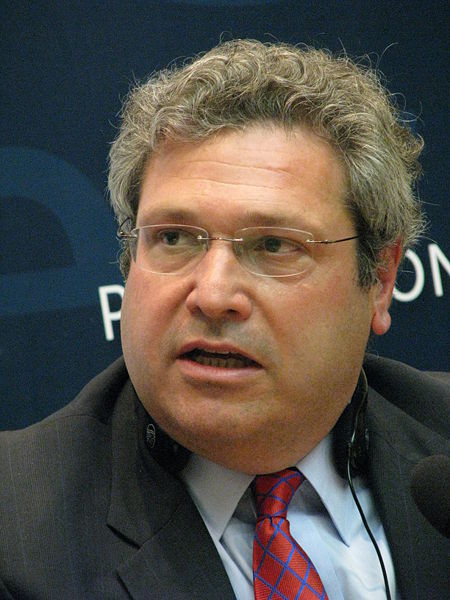
Prominent neocon intellectual Robert Kagan. (Photo credit: Mariusz Kubik, http://www.mariuszkubik.pl)
Then referring to himself, he added, “For this former Republican, and perhaps for others, the only choice will be to vote for Hillary Clinton. The [Republican] party cannot be saved, but the country still can be.”
While many of Kagan’s observations about the Republican tolerance – and even encouragement – of bigotry are correct, the fact that a leading neocon, a co-founder of the infamous Project for the New American Century, has endorsed Clinton raises questions for Democrats who have so far given the former New York senator and Secretary of State mostly a pass on her pro-interventionist policies.
The fact is that Clinton has generally marched in lock step with the neocons as they have implemented an aggressive “regime change” strategy against governments and political movements that don’t toe Washington’s line or that deviate from Israel’s goals in the Middle East. So she has backed coups, such as in Honduras (2009) and Ukraine (2014); invasions, such as Iraq (2003) and Libya (2011); and subversions such as Syria (from 2011 to the present) – all with various degrees of disastrous results.
Yet, with the failure of Republican…
Video: Senate Confirms New FDA Commissioner With Close Ties to Big Pharma
Public Citizen’s Dr. Michael Carome describes the thousands in consulting fees new FDA commissioner Dr. Robert Califf received from pharmaceutical …
Via Youtube
Video: Lee Fang: TV Pundits Praise Hillary Clinton On Air, Fail to Disclose Financial Ties to Her Campaign
http://democracynow.org – “I think Hillary Clinton has done everything right,” says Stephanie Cutter in a recent “Meet the Press” panel, in which she is introduced …
Via Youtube
Military Victories Are Counterproductive If They Leave a Political Vacuum


The Iraqi army was only able to recapture Ramadi with the help of heavy American bombing, leaving the city became a barren landscape. (Photo: Media World Bulletin)
After World War II the Allies refrained from either punishing Germany and Japan, or letting those shattered countries recover as best they could. Instead the Americans helped restore their former enemies’ economies so they could begin to rebuild. The generous U.S. aid that poured into Western Europe under the Marshall plan turned the region into a lucrative market for American consumer goods and provided reliable allies against the Soviet Union. The Germans in turn acknowledged the damage they had done under the Nazis and paid restitution to the survivors.
Similarly, the American occupation of Japan under Douglas MacArthur was wisely aimed at rebuilding a country whose cities had been turned to ashes by U.S. bombing. Again the result was to turn a wartime enemy into a friendly and potentially powerful ally against Communist China. Meanwhile, Japan was to remain demilitarized for the foreseeable future.
The United States emerged from a war that had killed 30 million people with its own cities intact, an expanding economy, and as the world’s most powerful nation. The war had exacted such a heavy toll on the Soviet Union that it could hardly compete. Nevertheless, Washington’s postwar foreign policy was devoted to preventing the spread of Soviet influence anywhere beyond Eastern Europe. To accomplish that end the U.S. was almost continuously at war, with American troops or proxy armies, wherever a country in Asia, Africa, or Central America seemed in danger of turning communist and coming into the Soviet orbit.
After each war, whether in Korea, Vietnam, Angola, Guatemala, Nicaragua, El Salvador, Kosovo, or Iraq, Washington showed little concern for the nature of the resulting government as long as it was anti-communist. Too often the resulting regime was either corrupt, or brutal, or both. Our current wars, in Afghanistan, Iraq, Libya, and Syria, show evidence of leading to a similar result.
In Iraq, a series of U.S.-backed Shiite-dominated governments, especially under former prime minister, Nouri al-Maliki, intensified the ethnic conflict between Shiites and Sunnis that had resulted from the American invasion and overthrow of Saddam Hussain. The current prime minister, Haider al-Abadi, has tried to heal the split by incorporating more Sunnis into the government and releasing many of the Sunnis imprisoned under the former government. But so far he has made little progress. “He has the willingness, but he hasn’t made any reforms,” said Sheikh Faisal Asawi, the mayor of Falluja. “He has no power, to be honest.”
Consequently, Iraq remains a dysfunctional state, in danger of splitting into Kurdish, Sunni, and Shiite mini-states. The paralyzed Parliament is unable to provide enough basic services such as electricity and water. Under such conditions, Iraq is a fertile recruiting ground for the Islamic State, or ISIS. “It did not grow from the earth,” Sheikh Asawi said of ISIS. Iraqis joined “but because of corruption, because of injustice, because of the culture of hate.”
Ryan C. Crocker, a former U.S. ambassador to Iraq, blames current U.S. policy, or lack of policy, toward Iraq for ISIS’s rise and continued growth. “There is no political architecture that will convince any Sunni over the age of 3 that he or she has a future with the Iraqi state,” he said recently. “The administration is trying to use a limited military weapon to defeat an adversary that only a political offensive can overcome and we’re not willing or able to make that effort.”
The “military weapon” that Crocker referred to includes the recent effort to reclaim the city of Ramadi and much of Anbar province from ISIS. The Iraqi army was only able to recapture Ramadi with the help of heavy American bombing, but as a result the city became a barren landscape, with hundreds of thousands of its residents made homeless and forced to flee. The U.S. has agreed to contribute $10 million to pay for generators and limited-service clinics, but the Iraqi government doesn’t have the funds even to begin rebuilding.
A similar scenario is playing out in Libya, where in 2011 under pressure from France and Obama administration hawks, American bombing attacks helped insurgents oust long-time strongman Muammar al Qadaffi. Qadaffi’s overthrow unleashed the religious, tribal and ethnic militias he had kept in check and they are now fighting one another for power. There is no longer a central government, but instead two rival parliaments, one in Tripoli and one in Tobruk. The power vacuum has enabled ISIS to become a magnet for unemployed young men throughout the Middle East and North Africa, so that today
ISIS forces in Libya total an estimated 6,500. The group is well armed — just after Qadaffi was overthrown, ISIS members broke into his extensive arsenal and distributed the contents to its fighters throughout the Middle East and Africa. They have so far succeeded in capturing a 150-mile stretch of the coastline and are mounting increasingly successful attacks on Libya’s oil facilities.
In an attempt to stop the flow of recruits to ISIS, forces from 30 African and Western nations are currently taking part in training exercises in Senegal. But many analysts maintain that the use of military force is not what it will take to defeat ISIS. Martin Kobler, a German diplomat, citing ISIS’s rapid growth between 2015 and 2016, noted, “This is something that can only flourish in a political and security vacuum.”
So far there are few if any signs that the international community is taking steps to fill that vacuum. The U.S. with its overwhelming air power is almost certain to weaken or defeat ISIS in the end. But If the political and economic grievances that spurred its growth are left unresolved, it won’t be long before another, equally dangerous group arises. Meanwhile, policymakers should be asking themselves how many new enemies for the U.S. our extensive bombing campaigns are creating.
This piece was reprinted from Foreign Policy In Focus by RINF Alternative News with permission.
Video: Can Sanders Win Over South Carolina’s Black Working Class Vote?
Attorney Kamau Franklin says Bernie Sanders needs to make greater strides to get his message out to Black Voters in the south in order to have a shot at the …
Via Youtube
Video: #WhichHillary? #BlackLivesMatter Activist Demands Apology from Clinton for “Superpredator” Comments
http://democracynow.org – Ahead of Saturday’s South Carolina Democratic primary, a Black Lives Matter activist interrupted Democratic presidential candidate …
Via Youtube
Video: Clinton and Sanders’ Record on Deportation and Guest Worker Policies
Activist and author David Bacon says based on Bernie’s record, it is clear he would support family reunification and guest worker rights – but when it comes to …
Via Youtube
Video: “Trump is a Mercenary”: Native Writer Gyasi Ross on GOP Debate & Why He’s Not Endorsed Anyone (Yet)
http://democracynow.org – As presidential candidates head into Super Tuesday, we look at a voting bloc that’s gotten little attention during this campaign season: …
Via Youtube
Real Feminists Don’t Tell Women How to Vote

I didn’t look up to Wonder Woman or Lara Croft as a child: I had women like Gloria Steinem. I was the type of girl who cut my dolls’ hair short, insisted girls could do anything boys could, and invented stories where brave female protagonists always outsmarted the bad guys.
So I was absolutely floored to hear Steinem tell Bill Maher that the only reason young women might support Bernie Sanders is that they want to chase the boys who back him. “When you’re young, you’re thinking, where are the boys?” Steinem said. “The boys are with Bernie.”
Steinem later walked back her comments. Still, some people — like Rachel Krantz and Jill Filipovic — leapt to her defense, suggesting that many young women feel pressure to act a certain way to attract men, or to remain part of the “in” crowd.

Wikipedia
Steinem’s bizarre comments didn’t just set us back decades — they also reinforced ignorant notions regarding women’s decision making. It’s one thing to hear nonsense like that from a clueless male politician. It’s another matter entirely to hear it from a leading feminist.
Steinem wasn’t the only feminist elder to talk down to millennial women who are feeling the Bern.
Madeleine Albright said there’s a “special place in hell” for young women who don’t vote for Hillary Clinton. When a moderator asked Clinton herself to address that offensive comment at a debate, Clinton didn’t bother to condemn it. She demurred that Albright had been making remarks like that for “the past 25 years.”
Steinem and Albright claim that opposing Clinton makes women anti-feminist. But isn’t voting for Clinton solely because she’s a woman as sexist as voting for Sanders because he’s a man?
Young women are in a better position than our forebears, because we have resources that older generations had to create for themselves. They fought for our right to vote, our right to control our own bodies, our right to work for pay, and our right to own our own property and assets.
Thanks to those pioneers, women now have so many more potential career paths to choose from. The feminists who came before us made it not only conceivable but totally natural that a woman could be the next U.S. president.
Sexist statements are a throwback to an era when women were told that our place was in the kitchen, when we needed to find and obey a husband at all costs, and when unwed mothers were sent to sanatoriums and their babies were taken from them by social workers.
Gloria Steinem and her peers helped lead us out of that era, but my generation is still fighting for equal pay and reproductive rights. We’re still fighting against domestic violence and for paid parental leave. We have too many issues to fight for — and no time to waste on sexism within our own ranks.
Income inequality, racial discrimination, and labor rights are women’s issues. A successful candidate will take all these things and much more into account.
Young progressive women like me will cast our ballots after considering where the candidates stand on all the issues we care about. We can keep fighting for the right to choose without undermining other women’s choices.
The post Real Feminists Don’t Tell Women How to Vote appeared first on OtherWords.
This piece was reprinted from Other Words by RINF Alternative News with permission.
‘People Don’t Really Have Time to Dream’
Janine Jackson interviewed Darnell Moore about the Black Futures Month project for the February 19, 2016, CounterSpin.

Darnell Moore: “The goal was to really…think about creative ways to utilize the imagination, to move us from problem to solution, to move us from sort of looking at a past that also gets very stagnant to possibilities of what a present and future might look like.”
Play
Stop
X
MP3jPLAYLISTS.MI_4 = [
{ name: “1. CounterSpin Paul Rosenberg Interview “, formats: [“mp3”], mp3: “aHR0cDovL3d3dy5mYWlyLm9yZy9hdWRpby9jb3VudGVyc3Bpbi9Db3VudGVyU3BpbjE2MDIxOVJvc2VuYmVyZy5tcDM=”, counterpart:””, artist: “”, image: “true”, imgurl: “” }
];
MP3jPLAYERS[4] = { list:MP3jPLAYLISTS.MI_4, tr:0, type:’MI’, lstate:true, loop:false, play_txt:’Play’, pause_txt:’Pause’, pp_title:’FAIR’, autoplay:false, download:true, vol:80, height:71, cssclass:’ ‘, popout_css:{ enabled:true, colours: [“#fff”, “rgba(201,207,232,0.35)”, “rgb(241,241,241)”, “rgba(245,5,5,0.7)”, “rgba(92,201,255,0.8)”, “transparent”, “transparent”, “#525252”, “#525252”, “#768D99”, “#47ACDE”, “”, 600, 200 ],
cssInterface: { “color”: “#525252” },
cssTitle: { “left”: “16px”, “right”:”16px”, “top”:”8px” },
cssImage: { “overflow”: “hidden”, “width”:”auto”, “height”:”71px” },
cssFontSize: { “title”: “16px”, “caption”: “11.2px”, “list”: “12px” },
classes: { interface:’ verdana-mjp’, title:’ left-mjp norm-mjp plain-mjp childNorm-mjp childPlain-mjp’, image:’ Himg right-mjp’, poscol:”, ul:’ darken1-mjp verdana-mjp med-mjp childNorm-mjp childPlain-mjp left-mjp’ }} };
Janine Jackson: Social movements have always been fueled and uplifted by culture — art, music, stories. And not just movements, but the human beings who comprise them. In this vein, February marks the second annual Black Futures Month, a project of Black Lives Matter that brings together different cultural forms to shed light and spark discussion about issues that affect black communities, including questions not only of police violence, but also of labor, reproductive and gender justice.
Black History Month can be a valuable reminder of African-American struggles and unheralded contributions to US society. Black Futures Month extends the conversation from where African-Americans have been to where we might still go.
Our next guest is one of the forces behind it. Darnell Moore is a senior correspondent at Mic.com, co-managing editor of the Feminist Wire, and also now writer-in-residence at the Center on African-American Religion, Sexual Politics and Social Justice at Columbia University. He joins us now by phone from Vancouver. Welcome to CounterSpin, Darnell Moore.
Darnell Moore: Thank you so much for having me.

“Grow,” Seán Geer (Black Lives Matter: Black Futures Month)
JJ: Black Futures Month. I have to say, just to say it gives me kind of a chill.
DM: It does.
JJ: It feels transformative. Tell us more about it and how it fits within the Blacks Lives Matter movement.
DM: It’s really the brainchild of Tanya Lucia Bernard, who is an artist and organizer, arts and culture lead at BLM, and Opal Tometi. They organized this last year. And the goal was to really push the conversation forward. That is, to think about creative ways to utilize the imagination, to move us from problem to solution, to move us from sort of looking at a past that’s very stagnant, to possibilities of what a present and future might look like. And one of the ways that Tanya thought we could do that is through the medium of art. Because we realize that art and culture can be windows and avenues to not only creative expression, but also consciousness-raising and also to visions of what a black future might be.
JJ: Yeah, it’s not a rejection of Black History Month but, as Tanya Lucia Bernard has said, black people are more than what happened to us.
DM: That’s exactly right.
JJ: Which I also found a very powerful statement. There’s such a feeling that we’re retrenched, that we’re fighting to just make things not be worse, which is why this feels so exciting and energizing to think, well, let’s dream about how things might be.
DM: Yeah. And I mean I just would add, you know, one of the things that I have been thinking through all of last year is the space that we have to actually dream, to imagine, to vision possibilities for what a black, loving, liberatory future can look like, is often stifled by our need to survive. People don’t really have time to dream and to imagine, because they’re literally placing their bodies on the line, whether that’s in the labor force or protesting to live. So this is an important call to us to stop and to meditate a bit and to conjure a future, and to pull out of ourselves that creative capacity to do the work of actually building the future we want to see.
JJ: The recent suicide of Ohio Black Lives Matter activist and musician MarShawn McCarrel was a reminder, if any were needed, that these movements are made of human beings and people who may have many areas of struggle. And even if you would never do anything else, it doesn’t help us to deny that the work of organizing can be isolating, can be depressing, and particularly when of course, as you’re saying, the subject of your work is trauma. But art also speaks to that as well. There’s also a healing element, I think, of art in this way.
DM: Indeed. As someone who, you know, I did a clinical counseling program, and while I haven’t practiced as a therapist in some time, and that was a very short stint, I think I’m still living my life very much concerned about the stakes of emotional justice, healing justice. That is to say, I’m thinking about the ways entrenched forms of trauma work themselves out in our lives such that we can begin to either build worlds utilizing the stale, traumatic energy of our past, or that energy can eat at us and eat us away.
JJ: Uh-huh.
DM: I mean, often I found a lot of organizers turn to the work as a way to sort of cope, without realizing that one needs space and/or mediums to address a lot of the trauma that we’re attempting to respond to.
JJ: I think one of the things that is most exciting to many people about Black Lives Matter is the way that it is focused on process as well as outcome, in terms of engaging people in the work, making sure people are represented in the work and are included in the work, and not just about the big goals that might be recognized outside of the movement.
And that brings me back to corporate media, of course, who—they exhibit the sort of “great men” theory of history, as many textbooks do, and they don’t really seem to know what to do with Black Lives Matter, which doesn’t operate on that model. Media talk about it as only about race, or only about police, and they don’t seem willing or able to really engage a movement that is intersectional, that is complex, and that doesn’t act or look the way that they think it should.
Having said that, I find that less worrisome than I might, because of the ways that many people are finding to talk around the dominant media and have the conversation anyway. On some level, that’s what’s most exciting.
DM: Yes. You know, what I find so exciting about this moment is the way that people are democratizing media by force, and that is, they are creating the common narrative necessary for our survival. If that means taking to Twitter or Tumblr or creating blogs or interrupting mainstream corporate media outlets by offering intervention through Black Twitter or other forms, I really appreciate that. I do think we are in a moment where the counternarrative is sort of the goal, the offering of the counternarrative is a goal of movement organizers. And folks who have really established themselves in social media outlets, and those who haven’t, realize that and are doing wonderful work. They’re realizing the power of the word —
JJ: Uh-huh.
DM:—of the image, and what it means for us to curate those on our own terms.
JJ: Well, we use February as a hook, but the work of Black Futures Month doesn’t really end with the end of February, does it?
DM: No. In fact, that’s what—it compels us to think beyond the 28, 29 days of a month.
JJ: Always the shortest month, right?
DM: Yes.
JJ: Well, one of the worst things that corporate media can do, I think, is to tell us, in ways subtle and not at all subtle, that the way things are is the only way that they can be. And I know that that’s what Black Futures Month is engaging in upending. And I think it’s also part of the idea behind your new project, “The Movement.” Tell us a little bit, in the time we have left, tell us about that and some of the stories that you’re telling with that.
DM: I’m really excited to be hosting this new digital series that is a part of Mic’s new repertoire. And, in short, “The Movement” really is attempting to do a couple of things. One, stretch the boundaries of what we imagine a movement to be and who we tend to center as our heroes and sheroes of various movements, to state that this movement that we’re part of, Black Lives Matter, is an iteration of a long genealogy, a long history of black liberation, queer liberation, of various interconnected movements. I want to see this moment as—it’s distinct in character and maybe in mode and form, but it is part of a long history of black liberation struggle. And that is to say, just because one doesn’t have millions of followers on Twitter, or they’re not being lifted up as leaders, does not mean that every day, ordinary people, black, brown, queer, disabled, indigenous, in our communities haven’t been doing work.
And a point of this digital series, it’s a mini doc that centers on those folk. It analyzes problems, but it does it through really paying attention to people in their communities who are unsung heroes, who are creating solutions for those problems.
There’s this idea that black people in urban space worry more about police violence and blue-on-black violence than we do on, quote unquote, “black-on-black crime.” The way that we can dispel that myth of black-on-black crime, what I showed and what we show in there, is we do care about various forms of violence. And here is a group that we covered in Camden, Cure for Camden, that is doing that.
All the way to stories on food deserts in Native American spaces and communities to covering the only black woman-owned legal marijuana dispensary in Colorado.
So we’re doing some interesting things. And it’s aesthetically beautiful, but I’m hoping that the narratives are powerful and offering hope. And not only hope, but saying to folk, Look, our people are always working. They’re always working, some of whom aren’t working with the benefit of fanfare or big budgets, and yet they’re still working and putting their hands at the plow.
JJ: We’ve been speaking with Darnell Moore of the Feminist Wire and of Mic, where you can find the new digital series “The Movement.” Darnell Moore, thank you so much.for joining us this week on CounterSpin.
DM: Thank you.
This piece was reprinted by RINF Alternative News with permission from FAIR.
Video: Obama’s Plan to Close Guantánamo Too Little Too Late
Omar Shakir, Bertha Fellow and attorney at the Center for Constitutional Rights says, the proposal is very similar to the executive order Obama issued in 2009, …
Via Youtube
Video: Did Trump University Scam Low-Income Students Who Are Now Suing the GOP Front-Runner?
http://democracynow.org – During Thursday’s GOP presidential debate, Florida Senator Marco Rubio said Trump University is a “fake school” where students …
Via Youtube
VIPS Offers Advice to Candidates
Former Secretary of State Clinton, whose campaign is brimming with establishment foreign policy advisers, has chided Democratic rival Sen. Sanders for lacking a roster of experts. But ex-CIA analyst Ray McGovern says an untapped resource for any candidate is the Veteran Intelligence Professionals for Sanity.
By Ray McGovern
A Memo to: Dr. Ben Carson, Hillary Clinton, Ted Cruz, John Kasich, Marco Rubio, Bernie Sanders, Dr. Jill Stein, and Donald Trump
The media brouhaha over naming your campaign advisers on foreign policy prompts this reminder of a unique resource available, gratis, to all of you. That resource is our nonpartisan group – Veteran Intelligence Professionals for Sanity (VIPS). If we were into self-promotion, we would add to our (virtual) letterhead: “serving satisfied customers since 2003.”
We are about apolitical analysis; we are into spreading unvarnished truth around; we do not shape our analysis toward this or that debating point. Thus, we eschew the moniker “campaign adviser.” But that doesn’t mean we wouldn’t provide apolitical and unvarnished advice to anyone who seeks it.

Former CIA analyst Ray McGovern
Unique? We are on the outer edge of atypical in the sense that we are a fiercely nonpartisan, tell-it-like-it-is group of professionals with long experience in intelligence and related fields and with no policy or personal axes to grind. We are Republicans, Democrats and Independents. Abundant proof that party preference plays no role in our analysis can be seen in our enviable record – in the substantive work we have produced over the past 13 years – both before and after the ill-advised attack on Iraq in March 2003.
Also distinguishing us from “campaign advisers,” none of us in VIPS lust for a high position in a new administration; none are heavily invested in arms industries; none of us ask for a retainer. In other words, there are no strings attached to the substantive analysis we provide to all our readers and listeners. If objective, disinterested analysis is your cup of tea, we suggest that you check out VIPS’s record, to include the multiple warnings we gave President George W. Bush in the months before the…
Denied the Right to Unionize, Domestic Workers Find New Ways to Organize

Fifty cents an hour. That’s how much Lizet Palencia was being paid in 1994 when she began her first job as a live-in domestic worker in New York City.
“I had to do everything for them,” Palencia said. “I remember it was 1 in the morning, 2 in the morning, I was still washing dishes.”
“I was just focusing on getting the money because I needed it,” she said.
More than two decades later, domestic workers in New York City are still not granted their full rights – not only in wages, but also in terms of health insurance, the right to one day off per week, and in some cases, even the right to work without physical and sexual harassment in the workplace.
In 2010, New York became the first state in the nation to enact a Domestic Workers’ Bill of Rights. The law was passed after years of lobbying, with domestic workers across the state sending handwritten letters to legislators in Albany. Although domestic workers won basic rights through the law, the right to bargain collectively was not one of them, and enforcement of the Bill of Rights has been almost impossible. But some domestic workers in New York think this has allowed them to focus on worker-led, grassroots organization tactics.
The Domestic Workers’ Bill of Rights Today
EU says won’t campaign in ‘Brexit’ vote

The European Commission said on Monday that it will not take part in the campaign to keep Britain in the EU ahead of an in-out referendum in June.
“The Commission will not campaign, will not take part in the campaign,” AFP has quoted spokesman Margaritis Schinas as saying at a news briefing.
“Our role of facilitator between the British government and its 27 partners stops here.”
British Prime Minister David Cameron late Friday struck a reform deal brokered by the Commission at a European Union summit that gave the country “special status” in the 28-nation bloc.
The agreement reached after two days of intense negotiations, paves the way for the UK’s EU referendum, expected to be held in June, and guarantees that Britain will never be forced to bail out members of the eurozone.
The deal also gives Britain the right to supervise financial institutions and markets to preserve financial stability.
Russia seeking to fly hi-tech surveillance planes over US

Russia is about to formally request permission from the US to fly surveillance planes with highly advanced cameras over the country, a move that has already alarmed American intelligence and military officials.
Russian and the US are both signatories to the 34-member Open Skies Treaty, which allows member countries to fly unarmed surveillance planes equipped with high-powered digital cameras over one another’s territory and foster transparency about military activities.
Moscow will submit its request to the Vienna-based Open Skies Consultative Commission on Monday, formally asking to be allowed to fly an aircraft with advanced sensors over the US, according to a congressional staffer said on condition of anonymity.
This means President Barack Obama’s administration must decide on granting Russians the permission, or denying them as according to the latest State Department compliance report, Moscow has failed to meet all its obligations under the treaty.
Obama’s decision is particularly important as Russia and the US are at odds over the conflicts in Syria and Ukraine.
The request has sparked concern among different American officials as it comes at one of the most tension-filled times in the US-Russia relations since the end of the Cold War.
Portuguese government prepares second austerity package
Paul Mitchell
Less than three months after it came to power with the support of the Left Bloc (BE) and Communist Party (PCP), the Portuguese Socialist Party (PS) government is preparing a second set of austerity measures.
The election promise made by Prime Minister António Costa to “reverse austerity” is in tatters, as are the claims of the BE and PCP that the PS could be pressured to oppose the “troika”—the European Commission (EC), International Monetary Fund (IMF) and European Central Bank (ECB).
Last Thursday at a meeting of the Eurogroup of Finance Ministers in Brussels, Portuguese Finance Minister Mário Centeno was given his orders, not that he needed persuading. Centeno has made it clear the PS government’s first priority is to ensure Portugal complies with European Union (EU) fiscal rules.
At the meeting, European Commissioner for Economic Affairs Pierre Moscovici warned that the risk of Portugal violating the rules had “not disappeared” even after the 13 additional austerity measures, worth around €1 billion, that Centeno submitted last month to the EC, as part of Portugal’s 2016 budget.
These measures are being imposed on the pretext of paying for the limited social programme the BE and PCP insisted on, in order to cover for them agreeing to support a pro-capitalist PS minority government and further integrate themselves into the political establishment. The increase in the minimum wage, changes to tax credits, the unfreezing of pensions, the replacement of pay cuts and the reduction in an emergency tax surcharge were, according to BE deputy Mariana Mortágua, “the reasons that made us sign an agreement with the PS,” before adding “knowing that to stop impoverishment it is still very little.”
Mortágua declared that funding the social programme with higher taxes on fuels, vehicles and tobacco was “indefensible.” But she immediately attempted to let the PS off the hook and cover for the BE’s own complicity in the fraud being perpetrated on Portuguese workers and youth by stating, “Contrary to what the Right says, [they] are not ‘brutal’ tax increases, and are not an attack on those who have less.”
In fact, companies have already made it clear that the increased taxes will be recouped in the form of higher prices and fares, which will disproportionately harm the poorest.
On the day of the Eurogroup meeting, just as Moscovici was insisting that “It is in the interest of Portugal to reassure investors,” the interest rates the PS government pays on its borrowing soared to a two-year high of 4.5 percent. It has risen by 2 percent since the PS took office in December.
Further warnings were made about the reaction of the DBRS credit ratings agency, which is the only major agency still classifying Portugal bonds above “junk” status, prolonging the country’s eligibility for the ECB’s favourable bond purchasing scheme. Should DBRS change its mind at its next review, Portugal will be forced to borrow at higher rates from private lenders increasing its huge debt, which already siphons off 10 percent of public expenditure to service each year.
Following the Brussels meeting, the Eurogroup issued a statement, approved unanimously, welcoming “the commitments of the Portuguese authorities to prepare as of now, new additional measures to be implemented when necessary to ensure compliance with the Stability and Growth Pact.” The EC’s decision whether to impose these measures, known as “Plan B,” will be taken at the end of April when Portugal’s final 2015 economic performance figures and new EU-wide economic forecasts become available.
The rise in Portugal’s bond yields is a symptom of the increasing global turmoil that has seen stock markets slump and renewed worries over the viability of European banks, particularly Deutsche Bank. The fate of such a prestigious German bank was no doubt foremost in the mind of German Finance Minister Wolfgang Schäuble when he voiced his concerns about Portugal on Friday. He declared that the country still lacked “resilience,” stating, “We hope that the problems we had with Portugal will not re-appear.”
“Portugal should be aware that it may disrupt financial markets, if it gives the impression it is reversing the path it has travelled. Which is very delicate and dangerous to Portugal,” Schäuble added. His statement was a warning to other EU governments that any retreat on austerity will not be tolerated.
Centeno responded by saying, “The message has to be consolidated in the market, the government will do everything necessary on the budget front to demonstrate that the objective is to put public accounts on a healthy trajectory from an economic and sustainable point of view.”
“We are convinced that, in May when the rating agencies and the commission carry out their mid-term evaluations of the budget, the evaluation will be positive,” he added.
The government is already reining back on one of the key social measures it agreed with the BE and PCP, the reduction of the 40-hour week in the public sector to 35 hours. Its introduction has been delayed to July, provoking a one-day strike earlier this month. Centeno has announced that a study will now be conducted to find out what additional costs to the state will result from implementing 35 hours, after weeks of claiming there wouldn’t be any. He warned that it “will be implemented with very strict conditions” and with regard to the “cost to public finances.”
Centeno has also apologised for the way large private investment companies, including Blackrock and Pimco, were made to cover some of the losses of the “good” bank, Novo Banco, which was created out of the collapse of Portugal’s biggest bank, Banco Espirito Santo, in 2014. He said, “We must go to the market and explain that it was a single event… Everyone knows that it was a decision of the Bank of Portugal” and that they now have to “work together with the ECB and the Portuguese financial sector to ensure that this type of event does not happen again.”
Centeno reassured the EU and financial markets about the so-called re-nationalisation of Portugal’s national airline, TAP, most of which had been sold to the Gateway consortium by the previous right-wing government. Privatisation is another key element of the PS-BE-PCP agreement. After first claiming that “the nature of the company as a private company” had changed by the state acquiring half the company’s shares, Centeno then said that TAP nevertheless “continues to be” a private company and “the presence of the government is restricted to strategic issues.”
The BE tried to cover for yet another about-turn by the PS, claiming it was a “breakthrough,” before adding that it was a “lame” breakthrough and that the party would be seeking “clarification” about the status of TAP from Minister of Planning and Infrastructure Pedro Marques.
Via WSWS. This piece was reprinted by RINF Alternative News with permission or license.
Americans beginning to see the truth about Israel
The percentage of Americans viewing Israel favorably has fallen to 59 percent.
By contrast, nearly a quarter of Americans (24 percent) now view the Palestinian
Authority favorably. Americans viewing Iran favorably also surged to a recent
high of 16% of the adult population.
These are the results of three IRmep polls of the U.S. adult internet population
fielded by Google Consumer Surveys February 19-20. The questions posed were,
“What is your overall opinion of [country]?” Respondents could also
fill in their own response. Most of these, representing up to 12.9% of the total
responses, offered no opinion.
The IRmep survey methodology differs from the popular Gallup World Affairs
Survey methodology. Gallup conducts a serial telephone survey with multiple
questions per respondent. Gallup’s last publicly available data is from a February
8-11, 2015 survey of 837 adults with a 4% margin of error. IRmep’s Google
Consumer Survey margin of error on three questions fielded separately ranged
from only 1.5% to 2.3% with a sample size target of 1029 national adults. Nevertheless,
comparing historical Gallup data (2001-2015) with new IRmep poll numbers (2016
only) asking the same question reveals a stunning turn in U.S. public opinion.
Showdown: Justice Department Escalates Against Apple
The US Justice Department escalated its standoff with Apple today, filing a motion to compel Apple to create software that would facilitate the Federal Government’s breaking the encryption of an iPhone in the possession of one of the San Bernardino shooters. Apple has argued that no one could depend on being secure from the prying eyes of government should it comply with the Federal government’s orders. Wrote Apple CEO Tim Cook, in a letter to customers this week, “in the wrong hands, this software – which does not exist today – would have the potential to unlock any iPhone in someone’s physical possession.”
The Justice Department’s counterargument appears to be that this is a special case and they can be trusted to never use this “key” to our iPhones again. But ironically, this heightened encryption feature was incorporated into iPhones in response to revelations by NSA whistleblower Edward Snowden that the federal government had been illegally spying on American citizens. Apparently we are supposed to trust them this time.
In its filing today, the Justice Department (DoJ) ridiculed Apple’s concerns that being compelled by the government to create software to hack its own products would set a horrible precedent in a United States that still has a Fourth Amendment. Apple’s objections were not at all based on principle, the DoJ sneered, but rather “Apple’s current refusal to comply with the court’s order, despite the technical feasibility of doing so, instead appears to be based on its concern for its business model and public brand marketing strategy.”
Video: Sanders Hits a Brick Wall of the Black Vote
Glen Ford says the majority of the black vote is wedded to Clinton and the right-wing of the Democratic Party in national elections, in-spite of being more left-wing …
Via Youtube
Video: Puerto Rico’s Debt Crisis is Focus of 2 Congressional Hearings as Dems Propose a “Super-Bankruptcy”
http://democracynow.org – Democracy Now! co-host Juan González reports Congress held two hearings on the Puerto Rican debt crisis Thursday after House …
Via Youtube
War, What Is It Good For? Absolutely Nothing
It may be hard to believe now, but in 1970 the protest song “War,”
sung by Edwin
Starr, hit number
one on the Billboard Hot 100 chart. That was at the height of the
Vietnam antiwar movement and the song, written by Norman Whitfield and Barrett
Strong, became something of a sensation. Even so many years later,
who could forget its famed chorus? “War, what is it good for?
Absolutely nothing.” Not me. And yet heartfelt as the song
was then – “War, it ain’t nothing but a heartbreaker. War,
it’s got one friend, that’s the undertaker…” – it has little resonance
in America today.
But here’s the strange thing: in a way its authors and singer could hardly
have imagined, in a way we still can’t quite absorb, that chorus has proven
eerily prophetic – in fact, accurate beyond measure in the most literal
possible sense. War, what is it good for? Absolutely nothing.
You could think of American war in the twenty-first century as an ongoing
experiment in proving just that point.
Looking back on almost 15 years in which the United States has been engaged
in something like permanent war in the Greater Middle East and parts of Africa,
one thing couldn’t be clearer: the planet’s sole superpower with
a military funded and armed like none other and a “defense” budget
larger than the next
seven countries combined (three
times as large as number two spender, China) has managed to accomplish –
again, quite literally – absolutely nothing, or perhaps (if a slight rewrite
of that classic song were allowed) less than nothing.
Unless, of course, you consider an expanding series of failed
states, spreading terror movements, wrecked
cities, countries hemorrhaging refugees,
and the like as accomplishments. In these years, no goal of Washington
– not a single one – has been accomplished by war. This has
proven true even when, in the first flush of death and destruction, victory
or at least success was hailed, as in Afghanistan in 2001 (“You helped
Afghanistan liberate itself – for a second time,” Secretary of Defense
Donald Rumsfeld to U.S. special operations forces), Iraq in 2003 (“Mission
accomplished“), or Libya in 2011 (“We came, we saw, he died,” Hillary Clinton
on the death
of autocrat Muammar Gaddafi).

Homeless Britain: Numbers sleeping rough rocket by almost a third in one year

New UK government figures reveal a dramatic increase in the number of people sleeping rough in Britain, with the figure rising by almost a third in one year and doubling over five.
The “snapshot” figures published by the Department for Communities and Local Government found that 3,569 people were sleeping on the streets on a typical night in the autumn of 2015, compared to 2,744 the year before, marking an increase of 30 percent – the greatest single hike in the last 5 years.
The 2015 figure was double that of 2010, when 1,768 people were found sleeping rough on a typical autumn night.
Jon Sparkes, CEO at the homelessness charity Crisis, said the figures are a “stark and sobering wake-up call.” The charity is calling on the government to extend support currently offered to first-time home buyers to homeless people who are looking to rent but can’t afford to do so.
The ten local districts with the highest number of people sleeping rough were Westminster, Bristol, Brighton and Hove, Manchester, Cornwall, Brent, Luton, Bedford, Croydon, and the City of London.
London has experienced a 27 percent increase in street sleepers since 2014, while in the rest of the country the difference grew by 31 per cent. In London, 43 percent of people sleeping rough are from the UK, 36 percent are from central and eastern Europe, and 18 percent of the total are from Romania.
Labour housing spokesman John Healey said the figures were a reminder of the Conservative ministers’ failure to deal with the UK’s housing crisis.
In response to the figures, homelessness minister Marcus Jones said that the government has pledged to increase funding to tackle homelessness to £139 million over the next four years.
“We have protected homelessness prevention funding and expect local authorities to provide quality advice and assistance to all those that approach them for help,” he said in a statement.
“Many rough sleepers have complex needs that include mental health difficulties or addiction, and we are developing a £5 million social impact bond that will help entrenched rough sleepers move off the streets.”
A report published this month by the homeless charity St Mungo’s found that the number of people recorded sleeping rough in London with an identified mental health problem has more than tripled over the last five years – surging from 711 in 2009-2010 to 2,342 in 2014-2015.
The Stop the Scandal report found that many mental health teams specializing in homelessness were downsized or closed as a result of funding cuts – by an average of 45% – between 2009-2010 and 2014-2015.
The charity is gathering signatures and writing to David Cameron to urge him to “stop the scandal” by launching a new national strategy offering rough sleepers specialist supported housing, mental health assessments, and professional support.
Via RT. This piece was reprinted by RINF Alternative News with permission or license.
Video: US Bombs ISIS in Libya, Allies Support ISIS in Libya
Pan-African News Wire Editor Abayomi Azikiwe says the U.S. is acting like the chief policeman of the region after it participated in the destruction of the Libyan …
Via Youtube
Video: Is BDS Headed Towards Criminalization in Canada?
Brace Batchoun of Canadians for Justice and Peace in the Middle East says Canada’s Liberal government just passed a motion that could stifle or even …
Via Youtube
Economic Recovery? 13 Of The Biggest Retailers In America Are Closing Down Stores

Michael Snyder
Barack Obama recently stated that anyone that is claiming that America’s economy is in decline is “peddling fiction“. Well, if the economy is in such great shape, why are major retailers shutting down hundreds of stores all over the country? Last month, I wrote about the “retail apocalypse” that is sweeping the nation, but since then it has gotten even worse. Closing stores has become the “hot new trend” in the retail world, and “space available” signs are going up in mall windows all over the United States. Barack Obama can continue huffing and puffing about how well the middle class is doing all he wants, but the truth is that the cold, hard numbers that retailers are reporting tell an entirely different story.
Earlier today, Sears Chairman Eddie Lampert released a letter to shareholders that was filled with all kinds of bad news. In this letter, he blamed the horrible results that Sears has been experiencing lately on “tectonic shifts” in consumer spending…
In a letter to shareholders on Thursday, Lampert said the impact of “tectonic shifts” in consumer spending has spread more broadly in the last year to retailers “that had previously proven to be relatively immune to such shifts.”
“Walmart, Nordstrom, Macy’s, Staples, Whole Foods and many others have felt the impact of disruptive changes from online competition and new business models,” Lampert wrote.
And it is very true – Sears is doing horribly, but they are far from alone. The following are 13 major retailers that are closing down stores…
#1 Sears lost 580 million dollars in the fourth quarter of 2015 alone, and they are scheduled to close at least 50 more “unprofitable stores” by the end of this year.
#2 It is being reported that Sports Authority will file for bankruptcy in March. Some news reports have indicated that around 200 stores may close, but at this point it is not known how many of their 450 stores will be able to stay open.
#3 For decades, Kohl’s has been growing aggressively, but now it plans to shutter 18 stores in 2016.
#4 Target has just finished closing 13 stores in the United States.
#5 Best Buy closed 30 stores last year, and it says that more store closings are likely in the months to come.
#6 Office Depot plans to close a total of 400 stores by the end of 2016.
The next seven examples come from one of my previous articles…
#7 Wal-Mart is closing 269 stores, including 154 inside the United States.
#8 K-Mart is closing down more than two dozen stores over the next several months.
#9 J.C. Penney will be permanently shutting down 47 more stores after closing a total of 40 stores in 2015.
#10 Macy’s has decided that it needs to shutter 36 stores and lay off approximately 2,500 employees.
#11 The Gap is in the process of closing 175 stores in North America.
#12 Aeropostale is in the process of closing 84 stores all across America.
#13 Finish Line has announced that 150 stores will be shutting down over the next few years.
These store closings can be particularly cruel for small towns. Just consider the impact that Wal-Mart has had on the little town of Oriental, North Carolina…
The Town’n Country grocery in Oriental, North Carolina, a local fixture for 44 years, closed its doors in October after a Wal-Mart store opened for business. Now, three months later — and less than two years after Wal-Mart arrived — the retail giant is pulling up stakes, leaving the community with no grocery store and no pharmacy.
Though mom-and-pop stores have steadily disappeared across the American landscape over the past three decades as the mega chain methodically expanded, there was at least always a Wal-Mart left behind to replace them. Now the Wal-Marts are disappearing, too.
Of course there are many factors involved in this ongoing retail apocalypse. Competition from online retailers is becoming more intense, and consumer spending patterns are rapidly changing.
But in the end, the truth is that you can’t get blood out of a rock. The middle class in America is shrinking, and there just isn’t as much discretionary spending going on as there used to be.
And now that we have entered a new economic downturn, many retailers are finding that there are some local communities that can no longer support their stores. The following comes from CNBC…
Though the shift to online shopping is no doubt playing a role in lighter foot traffic at malls, there’s more to their changing economics than the rise of Amazon. Changing demographics in a town are another reason a shopping center could struggle or fail — for example, if massive layoffs in a particular industry cause people to move away to find employment.
“A lot of people want to try and tie it to the Internet or ‘that’s not cool,’ or teens don’t like it,” Jesse Tron, a spokesman for industry trade group International Council of Shopping Centers, told CNBC last year. “It’s hard to support large-format retail in those suburban areas when people are trying to just pay their mortgage.”
In order to have a thriving middle class, we need good paying middle class jobs. Unfortunately, our economy has been bleeding those kinds of jobs quite rapidly. For example, Halliburton just announced that it is eliminating 5,000 more jobs after getting rid of 4,000 workers at the end of last year.
During the Obama years, good paying middle class jobs have been getting replaced by low paying service jobs. At this point, 51 percent of all American workers make less than $30,000 a year.
And there is no way that you can support a middle class family with children on $30,000 a year.
We have an economy that is in the process of failing. We can see it in the explosion of subprime auto loans that are going bad, we can see it in the hundreds of retail stores that are shutting down, and we can see it in the tens of thousands of good paying energy jobs that are being lost.
During the Obama years, interest rates have been pushed to the floor, the Federal Reserve has created trillions of dollars out of thin air, and the size of our national debt is getting close to doubling. Despite all of those desperate measures, our economy continues to crumble.
We stole from the future to try to paper over our failures and it didn’t work. Now an economic downturn that will ultimately turn out to be even worse than the “Great Recession” of 2008 and 2009 has begun, and our leaders have absolutely no idea how to fix things.
I wish I had better news to report, but I don’t. Get prepared now, because very rough times are ahead.
Obama’s Supreme Court Nominee
Since their arrival on the American political scene in the eighties and nineties, Green activists and voters have been tagged by Democrats as spoilers and reckless idealists. In each and every election in which a Green has run, Democrats warned that the interloper would throw the election to the Republican candidate. The barrage was heaviest in 2000 when Democrats falsely claimed Ralph Nader caused Al Gore to lose to George W. Bush.
When all else fails to convince a Green to vote for the Democratic presidential candidate, Democrats deploy their nuclear option: the composition of the Supreme Court hangs in the balance. “You wouldn’t want fill-in-the-blank to make an appointment, would you?” No, of course not, replies the hapless Green. This is a crafty argument that pushed no small number of fence sitters over to the donkey side (not including yours truly).
Barack Obama now appears poised to destroy the argument once and for all. Joe Biden floated the first trial balloon last week in a Minnesota Public Radio interview:
In order to get this done, the president is not going to be able to go out — nor would it be his instinct, anyway — to pick the most liberal jurist in the nation and put them on the court. There are plenty of judges (who) are on high courts already who have had unanimous support of the Republicans.
People Die (from Drone Strikes) While Hayden Lies
In a New York Times op-ed published on February 21, former CIA director, Air Force general, and “Playing to the Edge: American Intelligence in the Age of Terror” author Michael Hayden advocated for the continuing use of drone warfare. He urges the public and implicitly, the next U.S. president, to “embrace” this policy for the desired result of “keeping America safe.” After over a decade of the CIA’s and USAF’s unilateral use of this sinister weapons system, a well-documented record of their unintended consequences confronts us, if we have the courage to face it.
Killer drones have been and continue to be sold to the American people on the basis of lies, including these that Hayden, who has directed drone strikes and personally seen the killing of civilians, repeats in his advocacy piece.
Lie #1: That the policy of using drones to kill people in other countries is “warfare” and serves as a legitimate means to protect the United States.
It’s not, and it doesn’t. Warfare is reciprocal violence, or at least contains the possibility of defensive action (such as anti-aircraft guns) against violence such as that caused by either the Hellfire missiles or GBU-12 bombs named in Hayden’s novelistic portrayal of a pre-strike conversation between an operator and his commander. The US government uses Reaper and Predator drones, loaded with these devastating munitions, as its remotely piloted, high-tech tools in a policy of assassination in at least 7 countries: Afghanistan, Iraq, Libya, Pakistan, Somalia, Syria, and Yemen.
This policy was started by Bush in 2002 in Yemen and has been vastly expanded by Obama since 2009. While “warfare” is used frequently as a sort of shorthand for various military actions, often in countries that the US has never declared war on, Hayden’s use of the word in this op-ed is sloppy and misleading. Drone “warfare” would mean that other countries could use drone strikes against the United States, or US troops, either first or in retaliation – a total impossibility.
The carnage by remote control, with no way for those attacked to fight back (as with torture), generates hatred against the United States. On Democracy Now!, four whistleblowers who operated drones in the Air Force made their case that drones are “also serving as a fundamental recruitment tool similar to Guantánamo Bay.”
The drone killings are counterproductive to longer-term US security and to our tattered reputation internationally.
Newly-Translated WikiLeaks Saudi Cable: Overthrow the Syrian Regime, but Play Nice with Russia
It is no secret that Saudi Arabia, along with its Gulf and Western allies,
has played a direct role
in fueling the fires of grinding sectarian conflict that has kept Syria burning
for the past five years. It is also no secret that Russian intervention has
radically altered the kingdom’s “regime change” calculus in
effect since at least 2011. But an internal Saudi government cable sheds new
light on the kingdom’s current threats
of military escalation in Syria.
Overthrow the Regime “by all means available”
A WikiLeaks cable
released as part of “The
Saudi Cables” in the summer of 2015, now fully translated here for
the first time, reveals what the Saudis feared most in the early years of the
war: Russian military intervention and Syrian retaliation. These fears were
such that the kingdom directed its media “not to oppose Russian figures
and to avoid insulting them” at the time.
Saudi Arabia had further miscalculated that the “Russian position”
of preserving the Assad government “will not persist in force.”
In Saudi thinking, reflected in the leaked memo, Assad’s violent ouster
(“by all means available”) could be pursued so long as Russia stayed
on the sidelines. The following section is categorical in its emphasis on regime
change at all costs, even should the U.S. vacillate for “lack of desire”:
The Escalating War on Cash
On February 16th, The Washington Post printed the article, “It’s time to kill the $100 bill.” This came on the heels of a CNNMoney item, the day before, entitled “Death of the 500 euro bill getting closer.” The former cited a recent Harvard Kennedy School working paper, No. 52 by Senior Fellow Peter Sands, concluding that the abolition of high denomination notes would help deter “tax evasion, financial crime, terrorist finance, and corruption.” In recent days, former Treasury Secretary Larry Summers, ECB President Mario Draghi, and even the editorial board of the New York Times came out in support of the elimination of large currency notes. Apart from the question as to why these calls are being raised now with such frequency, the larger issue is whether these moves are actually needed or if they merely a subterfuge for more complex economic manipulations by central banks to extend control over private wealth.
In early 2015, it was reported that Spain had already limited private cash transactions to 2,500 euros. Italy and France set limits of 1,000 euros. In France, all cash withdrawals in excess of 10,000 euros in a single month must be reported to government agencies. In the U.S., such limits are $10,000 per withdrawal. China, India, and Sweden are among those with plans under way to eradicate cash.
On April 20, 2015, the Mises Institute reported that Chase, a subsidiary of JPMorgan Chase and a bailout recipient of some $25 billion (ProPublica, 2/22/16), had announced restrictions on its customers’ ability to use cash in the payment of credit cards, mortgages, equity lines and auto loans. Before that, on April 1, 2015, Chase, in concert with JPMorgan, updated its safe deposit box lease agreement to provide, “You agree not to store any cash or coins [including gold and silver] other than those found to have a collectible value.”
The war on cash unquestionably has extended from government into the private banking sector. But the public is predominantly unaware of the ever-increasing encroachment of individual privacy and freedom.
Leading California Democrat sentenced to five years in prison for corruption
Alan Gilman
Former California State Senator Leland Yee, a San Francisco Bay Area Democrat, was sentenced Wednesday by a federal judge to five years in prison for political corruption.
Yee was arrested on March 26, 2014 by the FBI on charges related to public corruption and gun trafficking. On July 1, 2015, Yee pleaded guilty to felony racketeering involving money laundering, public corruption and bribery, and his sentencing was continued to this week.
In his plea agreement, Yee admitted that he traded his political influence for bribes, typically offered by undercover FBI agents posing as potential campaign contributors. Yee, among other things, admitted he agreed to influence legislation for would-be medical marijuana businesses in California, an NFL team owner trying to exempt pro athletes from the state’s workers’ compensation laws, and a fictitious software firm, set up as an FBI sting, seeking government technology contracts.
Yee was ensnared by an FBI investigation that spanned several years and led to the convictions of Raymond “Shrimp Boy” Chow, a reputed Chinatown mobster, Keith Jackson, a former school board president and fundraiser for Yee, and others.
Jackson received a nine-year sentence. Chow faces a life term when he is sentenced next month.
Yee also faced charges involving his involvement in attempting to arrange an illegal international arms deal through the Philippines. According to an affidavit by FBI agent Emmanuel V. Pascua, Yee discussed helping the agent get weapons worth $500,000 to $2.5 million, including shoulder-fired missiles, and explained the entire process of acquiring them from a Muslim separatist group in the Philippines and bringing them to the US. The state senator was seeking to cash in on this arms deal, while making a name for himself in state politics as an advocate of gun control.
Yee began his political career in 1988 when he won a seat to the San Francisco United School Board. In 1996, he was elected to the San Francisco Board of Supervisors and in 2002 to the State Assembly. By 2004, he became the first Asian-American to be appointed speaker pro tempore, which made him the second-highest-ranking Democrat of the California State Assembly. Due to term limits, Yee had to leave the State Assembly and was elected to the State Senate in 2006. Again facing term limits, Yee had begun to campaign for the office of Secretary of State, California’s chief election officer, at the time of his arrest.
Prosecutor Susan Badger alleged that Yee was “desperate for money” in part to finance his statewide campaign as well as the need to retire the debt incurred in his unsuccessful campaign for San Francisco mayor.
US District Judge Charles Breyer told Yee that “indicating your vote was for sale” was “a serious violation of the public trust.”
Breyer also told Yee his participation in the gun-running scheme was hypocritical and “inexplicable,” since he publicly favored gun control. “The answer is money. You did it for money for the perpetuation of power. That to me is the most venal thing.”
Yee’s conviction follows the January 28, 2014, conviction of Democratic State Senator Roderick Wright, who was found guilty of committing voter fraud and perjury for falsely claiming residence in his impoverished district including Inglewood and south Los Angeles, when he actually lived in affluent Baldwin Hills.
In addition, State Senator Ronald Calderon, a Democrat from Montebello, an eastern suburb of Los Angeles, is scheduled to begin his federal public corruption trial in May on 24 felony counts, including accepting nearly $100,000 in bribes.
When Yee, Wright, and Calderon were all charged in 2014 of these separate crimes, it brought to 7 percent the proportion of the California Senate under indictment. The forced resignations of these state senators cost Democrats their supermajority in the legislature and prompted a series of “reforms.”
The State Senate adopted resolutions that year to ban members from fundraising during the last month of the legislative session and the month leading up to a budget vote, when business interests are especially active in trying to influence legislation.
The resolutions also required the Senate Rules Committee to appoint an ethics ombudsman to accept allegations of wrongdoing and protect whistle-blowers from retaliation.
Looking back on those changes, State Senator Joel Anderson, a Republican from San Diego, described them Wednesday as mere “window dressing for a culture of corruption.”
“Sadly, all of the Senate reforms would not have prevented today’s verdict,” Anderson said.
Gov. Jerry Brown, Senate leader Kevin de León and many other top Democrats declined to comment on the sentencing, which ends a case that was an embarrassment to party officials. De León recently said Yee’s guilty plea “turns the page on one of the darker chapters of the Senate’s history.”
Rather than turning the page, the criminal conduct of Yee and his political colleagues serves to demonstrate that the Democratic Party, which dominates the legislature of the nation’s most populous state, is just as corrupted and controlled by big-money interests as the Republicans.
Via WSWS. This piece was reprinted by RINF Alternative News with permission or license.
‘US test-fires ICBMs to silence GOP, support terrorists in Syria’
The US military’s test-firing of two intercontinental ballistic missiles this week is intended at silencing Republican critics who accuse President Barack Obama of being weak, an American writer and retired professor says.
The ICBMs were also an attempt to prop up support for Saudi Arabia and Turkey who are supporting militants fighting the Syrian government, said James Petras, a professor emeritus of sociology at Binghamton University in Binghamton, New York, and adjunct professor at Saint Mary’s University in Halifax, Nova Scotia in Canada.
“This is a dangerous game because once the US begins to escalate its military potential, it could trigger some reciprocal action on the part of Russia,” Petras told Press TV on Monday.
The US military test-fired its second ICBM in a week on Thursday, seeking to demonstrate its nuclear arms capacity at a time of rising strategic tensions with Russia and China.
The blastoff of the unarmed Minuteman III missile from a silo at Vandenberg Air Force Base in California was meant to demonstrate the ability of American nuclear arms, Deputy Defense Secretary Robert Work said.
Trafficking prosecutions hit record in UK

Britain’s chief prosecutor says prosecutions for human trafficking in England and Wales have increased since the introduction of a new anti-slavery law last year.
Alison Saunders said the number of people trafficked as laborers or domestic workers now exceeded the number forced into sexual exploitation.
She went further adding that there has also been an increase in the trafficking of people for sham marriages.
There are an estimated 13,000 victims of forced labor, sexual exploitation and domestic servitude in Britain. Globally, forced labour generates an estimated $150 billion in illegal profits every year, reported AFP.
Does Mitch McConnell Really Give a Damn About the Supreme Court?

Many years ago, I worked on a documentary about the how and why of political TV ads. The primary focus was on two media consultants: the late Bob Squier, a Democrat; and Bob Goodman, Republican.
One ad of which Goodman was especially proud was for a fellow in Kentucky running against Todd Hollenbach, Sr., the incumbent judge/executive of Jefferson County. Produced in 1977, the spot featured a farmer complaining about taxes that he claimed Judge Hollenbach had raised and then lied about.
As he mucked out a barn and his faithful horse whinnied, the farmer declared, “Maybe Hollenbach ought to have my job, because in my business, I deal with that kind of stuff every day.”
Then he threw a shovel of manure right at the camera.
Hollenbach lost to the candidate who approved this message: Mitch McConnell.
Video: Days of Revolt: The Solution (2/2)
In this episode of teleSUR’s Days of Revolt, Chris Hedges and Green Party presidential candidate Jill Stein lay out the solutions to issues like economic …
Via Youtube
Video: Why Russia and U.S Cold War Could Soon Turn Into A World War
In this video Luke Rudkowski reports on the insane situation between unfolding between Russia and the U.S during the syrian Munich peace talks. As Russia is …
source
Video: BRISTOL OPINIONS: Your Knowle West & Barton Hill mayor candidate Tony Britt
Name: Tony Britt Birthplace: Knowle West How long lived in Bristol: 48 years – all my life Age: 48 Job: Charity volunteer Marital status: Single Children: Milliemae …
Via Youtube
Why McConnell Blocks Scalia Replacement
Senate Majority Leader Mitch McConnell says his obstruction of President Obama’s nominee to replace Supreme Court Justice Antonin Scalia is to empower the people, but it’s more about making sure that the Citizens United gusher of special interest money keeps pouring into Republican coffers, writes Michael Winship.
By Michael Winship
Many years ago, I worked on a documentary about the how and why of political TV ads. The primary focus was on two media consultants: the late Bob Squier, a Democrat; and Bob Goodman, Republican. One ad of which Goodman was especially proud was for a fellow in Kentucky running against Todd Hollenbach, Sr., the incumbent judge/executive of Jefferson County. Produced in 1977, the spot featured a farmer complaining about taxes that he claimed Judge Hollenbach had raised and then lied about.
As he mucked out a barn and his faithful horse whinnied, the farmer declared, “Maybe Hollenbach ought to have my job, because in my business, I deal with that kind of stuff every day.” Then he threw a shovel of manure right at the camera. Hollenbach lost to the candidate who approved this message: Mitch McConnell.

Senate Majority Leader Mitch McConnell, R-Kentucky.
McConnell has been shoveling it ever since, but perhaps never as stunningly as on Tuesday, when he spoke from the floor of the U.S. Senate. The now-majority leader of the so-called greatest deliberative body in the world blustered, as he has several times in the last couple of weeks, that Senate Republicans would never, ever consider an appointment by President Obama to replace the still-dead Supreme Court Justice Antonin Scalia.
The President, McConnell then said, “has every right to nominate someone, even if doing so will inevitably plunge our nation into another bitter and avoidable struggle.”
Excuse me, Senator, the bitter and undeniably avoidable struggle was created by you on the Saturday that Scalia’s corpse was found. The body was barely cold when you crassly announced that the duly-elected President of the United States should not name the judge’s successor but must leave it to the next president – more than 300 days from now.
McConnell continued, “Even if he never…
Video: The Dollar Vigilante Jeff Berwick Debates Merits Of Free Market Capitalism With Richie Allen
Please Support The Show – http://richieallen.co.uk/ http://www.DollarVigilante.Com/ https://www.facebook.com/therichieallenshow …
Via Youtube
In OtherWords: February 24, 2016

This week in OtherWords, Olivia Alperstein laments Gloria Steinem’s take on why so many young women are feeling the Bern, John Kiriakou draws attention to the shocking state of health care for incarcerated women, and Anastasia Walker weighs in on anti-trans bathroom bills.
If you haven’t already subscribed, please ensure that you don’t miss the latest from OtherWords by signing up for our free weekly newsletter. If you’re on Twitter, why not follow us? Our handle is @OTWords.
And if you’d like to see these bold opinion pieces delivered to more newspapers and new media outlets, please consider making a tax-deductible donation today.

Hillary Clinton’s Little Red Riding Hood Problem, an OtherWords cartoon by Khalil Bendib
- Real Feminists Don’t Tell Women How to Vote / Olivia Alperstein
We have no time to waste on sexism within our own ranks. - Journalists Should Stand Up for Whistleblowers / Timothy Karr
The media requires free-flowing information — and so does our democracy. - Public Hoopla over Private Parts / Anastasia Walker
Lawmakers have no business following trans people into the bathroom. - The Unelectibility Winning Streak / Donald Kaul
John Kasich does well when he can sit next to you in a diner and ask about your grandkids, but this country is too big for that kind of campaigning. - A Greener Leap Year / Emily Schwartz Greco
Try to devote a few of those bonus hours in 2016 to picturing life after fossil fuels. - America’s Killer Prisons / John Kiriakou
Inmates across America die every day because of substandard medical care. - Walling off Common Sense / Jill Richardson
Trump’s border plan is such a loser. - Mitch McConnell Is a Supreme Hypocrite / Jim Hightower
The president’s responsibility to appoint judges isn’t voided in an election year. - Hillary Clinton’s Little Red Riding Hood Problem / Khalil Bendib
The post In OtherWords: February 24, 2016 appeared first on OtherWords.
This piece was reprinted from Other Words by RINF Alternative News with permission.
Some Questions for the ‘Expert’ Who Accused Me of ‘Passive Terrorism’


Women are used to getting blamed for wearing too little. Can they now also be blamed for wearing too much? (Photo: Kashfi Halford / Flickr)
Misogynists have spun the old trope that what women wear is somehow the cause of what men do time and time again. But thanks to the Air Force, Muslim women are now getting a disturbingly refreshing take on the subject.
We’re used to getting blamed for the violence of men when we wear too little. Now we can also take credit for the violence of men when we wear too much.
In Countering Violent Extremism: Scientific Methods and Strategies, a recent white paper issued by the Air Force Research Laboratory, contributor Tawfik Hamid claims men join terrorist organizations because they’re sexually deprived by women who wear hijabs. Hamid, a self-described former Islamic extremist, calls the traditional head covering a form of “passive terrorism” and makes “weakening the hijab phenomenon” a pivotal piece of his plan to combat Islamic extremism.
There lies the gross generalization: Women like me who wear hijabs are terrorists.
I think some editor may have missed an error in the subtitle of this report — namely the part that suggests this claim has anything to do with “science.” Indeed, in a preface, the report’s editor hailed the document as “more relevant than ever.”
I’m always incredulous when I hear a powerful man tell a group of other powerful men that they’ll all be safer if more women just take off their clothes. But exalting testimonials from high-ranking military officials are featured prominently on Hamid’s website, so I’m willing to test the theory.
Thus, in the interest of science, I have some questions about a few things that must not have come up during his “research.”
I don’t wear a hijab every day, but I usually wear one on my way to the mosque on Fridays. Will I only end up on a no-fly list at the end of the week, then? Do I only count as a “passive terrorist” during those times when I choose to cover my hair and wear loose clothing?
Alternately, am I revered as a peacemaker on the days when I let my locks flow free and I put on skinny jeans? How can I tell when I’ll be targeted for looking “too Muslim”?
Since this is a scientific paper, we should test other variables too.
For example, are Christian nuns — who may hold conservative values and cover their bodies — also to blame for violent extremism? What does the “science” say on head-to-toe covering in different religions? Is it only Muslim women whose modest dress conjures up uncontrollable, testosterone-infused rage in men?
I won’t hold my breath waiting for the answers.
Wearing a hijab means something different to each woman. It’s a very personal decision that has absolutely nothing to do with whether our male counterparts will strap on a suicide vest.
But more to the point, claims like Hamid’s aren’t just offensive to women. They let the U.S. government itself off the hook for foreign policies — like invasions, drone strikes, arms sales to oppressive regimes, and military interventionism in the Muslim world — that play a much bigger role in driving terrorism than what a woman chooses to wear on her head.
I find it a little hard to believe that if I stop wearing my hijab on Eid, those men who have seen their homes destroyed, weddings bombed, and refugee children drowned as a result of U.S. militarism will feel less inclined to return the favor.
This piece was reprinted from Foreign Policy In Focus by RINF Alternative News with permission.
Neema Singh Guliani on Apple vs. FBI, Stephen Zunes on Misremembering the Iraq War
Play
Stop
X
MP3jPLAYLISTS.MI_0 = [
{ name: “1. CounterSpin Full Show Neema Singh Guliani Stephen Zunes “, formats: [“mp3”], mp3: “aHR0cDovL3d3dy5mYWlyLm9yZy9hdWRpby9jb3VudGVyc3Bpbi9Db3VudGVyU3BpbjE2MDIyNi5tcDM=”, counterpart:””, artist: “”, image: “true”, imgurl: “” }
];
MP3jPLAYERS[0] = { list:MP3jPLAYLISTS.MI_0, tr:0, type:’MI’, lstate:true, loop:false, play_txt:’Play’, pause_txt:’Pause’, pp_title:’FAIR’, autoplay:false, download:true, vol:80, height:71, cssclass:’ ‘, popout_css:{ enabled:true, colours: [“#fff”, “rgba(201,207,232,0.35)”, “rgb(241,241,241)”, “rgba(245,5,5,0.7)”, “rgba(92,201,255,0.8)”, “transparent”, “transparent”, “#525252”, “#525252”, “#768D99”, “#47ACDE”, “”, 600, 200 ],
cssInterface: { “color”: “#525252” },
cssTitle: { “left”: “16px”, “right”:”16px”, “top”:”8px” },
cssImage: { “overflow”: “hidden”, “width”:”auto”, “height”:”71px” },
cssFontSize: { “title”: “16px”, “caption”: “11.2px”, “list”: “12px” },
classes: { interface:’ verdana-mjp’, title:’ left-mjp norm-mjp plain-mjp childNorm-mjp childPlain-mjp’, image:’ Himg right-mjp’, poscol:”, ul:’ darken1-mjp verdana-mjp med-mjp childNorm-mjp childPlain-mjp left-mjp’ }} };
 This week on CounterSpin: The FBI is demanding that Apple help it access the iPhone of San Bernardino attacker Syed Rizwan Farook. But, says FBI head James Comey, it’s a very narrow request, about just this case, so people should, in his words, “stop saying the world is ending.” Why are privacy and civil rights advocates in fact so alarmed by this case? We’ll hear from Neema Singh Guliani of the ACLU.
Play
Stop
X
MP3jPLAYLISTS.MI_1 = [
{ name: “1. CounterSpin Neema Singh Guliani Interview “, formats: [“mp3”], mp3: “aHR0cDovL3d3dy5mYWlyLm9yZy9hdWRpby9jb3VudGVyc3Bpbi9Db3VudGVyU3BpbjE2MDIyNkd1bGlhbmkubXAz”, counterpart:””, artist: “”, image: “true”, imgurl: “” }
];
MP3jPLAYERS[1] = { list:MP3jPLAYLISTS.MI_1, tr:0, type:’MI’, lstate:true, loop:false, play_txt:’Play’, pause_txt:’Pause’, pp_title:’FAIR’, autoplay:false, download:true, vol:80, height:71, cssclass:’ ‘, popout_css:{ enabled:true, colours: [“#fff”, “rgba(201,207,232,0.35)”, “rgb(241,241,241)”, “rgba(245,5,5,0.7)”, “rgba(92,201,255,0.8)”, “transparent”, “transparent”, “#525252”, “#525252”, “#768D99”, “#47ACDE”, “”, 600, 200 ],
cssInterface: { “color”: “#525252” },
cssTitle: { “left”: “16px”, “right”:”16px”, “top”:”8px” },
cssImage: { “overflow”: “hidden”, “width”:”auto”, “height”:”71px” },
cssFontSize: { “title”: “16px”, “caption”: “11.2px”, “list”: “12px” },
classes: { interface:’ verdana-mjp’, title:’ left-mjp norm-mjp plain-mjp childNorm-mjp childPlain-mjp’, image:’ Himg right-mjp’, poscol:”, ul:’ darken1-mjp verdana-mjp med-mjp childNorm-mjp childPlain-mjp left-mjp’ }} };
 Also on the show: There are a lot of things that don’t get much talked about in presidential debates—poverty, the trade deficit, Native Americans…. One thing that does come up fairly reliably is the Iraq War, with candidates explaining their support for the 2003 invasion or how they would’ve handled it differently. The Iraq War has become a story, but how true a story is it? We’ll see how media do in Iraq War 101 with Stephen Zunes, professor of politics and coordinator of Middle Eastern studies at the University of San Francisco.
Play
Stop
X
MP3jPLAYLISTS.MI_2 = [
{ name: “1. CounterSpin Stephen Zunes Interview “, formats: [“mp3”], mp3: “aHR0cDovL3d3dy5mYWlyLm9yZy9hdWRpby9jb3VudGVyc3Bpbi9Db3VudGVyU3BpbjE2MDIyNnVuZXMubXAz”, counterpart:””, artist: “”, image: “true”, imgurl: “” }
];
MP3jPLAYERS[2] = { list:MP3jPLAYLISTS.MI_2, tr:0, type:’MI’, lstate:true, loop:false, play_txt:’Play’, pause_txt:’Pause’, pp_title:’FAIR’, autoplay:false, download:true, vol:80, height:71, cssclass:’ ‘, popout_css:{ enabled:true, colours: [“#fff”, “rgba(201,207,232,0.35)”, “rgb(241,241,241)”, “rgba(245,5,5,0.7)”, “rgba(92,201,255,0.8)”, “transparent”, “transparent”, “#525252”, “#525252”, “#768D99”, “#47ACDE”, “”, 600, 200 ],
cssInterface: { “color”: “#525252” },
cssTitle: { “left”: “16px”, “right”:”16px”, “top”:”8px” },
cssImage: { “overflow”: “hidden”, “width”:”auto”, “height”:”71px” },
cssFontSize: { “title”: “16px”, “caption”: “11.2px”, “list”: “12px” },
classes: { interface:’ verdana-mjp’, title:’ left-mjp norm-mjp plain-mjp childNorm-mjp childPlain-mjp’, image:’ Himg right-mjp’, poscol:”, ul:’ darken1-mjp verdana-mjp med-mjp childNorm-mjp childPlain-mjp left-mjp’ }} };
And, as usual, we take a look back at the week’s press, including superdelegates, the conflicts of a drone defender and Hollywood’s inclusion crisis.
Play
Stop
X
MP3jPLAYLISTS.MI_3 = [
{ name: “1. CounterSpin Banter “, formats: [“mp3”], mp3: “aHR0cDovL3d3dy5mYWlyLm9yZy9hdWRpby9jb3VudGVyc3Bpbi9Db3VudGVyU3BpbjE2MDIyNkJhbnRlci5tcDM=”, counterpart:””, artist: “”, image: “true”, imgurl: “” }
];
MP3jPLAYERS[3] = { list:MP3jPLAYLISTS.MI_3, tr:0, type:’MI’, lstate:true, loop:false, play_txt:’Play’, pause_txt:’Pause’, pp_title:’FAIR’, autoplay:false, download:true, vol:80, height:71, cssclass:’ ‘, popout_css:{ enabled:true, colours: [“#fff”, “rgba(201,207,232,0.35)”, “rgb(241,241,241)”, “rgba(245,5,5,0.7)”, “rgba(92,201,255,0.8)”, “transparent”, “transparent”, “#525252”, “#525252”, “#768D99”, “#47ACDE”, “”, 600, 200 ],
cssInterface: { “color”: “#525252” },
cssTitle: { “left”: “16px”, “right”:”16px”, “top”:”8px” },
cssImage: { “overflow”: “hidden”, “width”:”auto”, “height”:”71px” },
cssFontSize: { “title”: “16px”, “caption”: “11.2px”, “list”: “12px” },
classes: { interface:’ verdana-mjp’, title:’ left-mjp norm-mjp plain-mjp childNorm-mjp childPlain-mjp’, image:’ Himg right-mjp’, poscol:”, ul:’ darken1-mjp verdana-mjp med-mjp childNorm-mjp childPlain-mjp left-mjp’ }} };
This piece was reprinted by RINF Alternative News with permission from FAIR.
UK bank risk returns: Most risky in the developed world – Taxpayers on hook again

Our banking system in the UK is still dangerously dysfunctional. Post-crisis reforms failed to fully address the risks posed by the City of London, and with banks back in the driving seat, these reforms are already being rolled back. We cannot afford a return to business as usual.
The UK has one of the biggest, most concentrated, risky, complex, and interconnected banking systems in the developed world. It leaves us uniquely exposed to global financial turmoil.
If post-2008 promises to reform our financial system had been kept, the dangers we face now would not be so acute. Instead, UK banks have fast-tracked a return to business as usual. Contrary to recent claims by policymakers, post-crisis reforms did not fix the structural problems with our banks. Recent concessions to the City are already rolling back the limited progress made:
Banks are still at risk of failing. Measures to increase banks’ capital do not go far enough, and in any case they misdiagnose the problem: financial crises are created within the financial system. More must be done to change the business models behind our banks’ risky behaviour.
UK taxpayers remain on the hook. Banks remain too big to fail, and as a result, continue to receive £5.8bn a year in implicit government subsidies. The ring fence between retail and investment banking – intended to insulate the taxpayer from losses caused by risky activities – is also being rolled back.
The UK banking sector still lacks competition and diversity. The UK has the second most concentrated banking sector in the G7 – its top 3 banks own over half of all bank assets – and is uniquely dependent on shareholder-owned banks. Recent changes to the bank levy actually undermine competition, as they benefit big, international banks like HSBC at the expense of smaller challengers.
Recent concessions to big banks have been justified by claims that international investment banking is vital to our economy. These claims are grossly exaggerated: our status as an international banking hub is as much of a liability as an asset.
Osborne’s privatisation drive continues – railway stations next

As if confirmation was required that a nationalised rails service would be better for the country, The Guardian reported fifteen months ago; “How infuriating it must be, then, for free-market ideologues that east coast (nationalised) depended on less public subsidies than any of the 15 privately run rail franchises. Indeed, the franchise has proved a lucrative cash cow for the state, bringing in around £1bn to the exchequer since 2009. East coast is an embarrassing success story for public ownership. Instead, it must be run by a tax exile and a Scottish businessman perhaps best known for campaigning against gay equality.”
And so it was sold off. No doubt increased subsidies will follow. But now there’s something new for George Osborne to flog off.
Network Rail is a ‘not for dividend’ company with no shareholders which reinvests its income in the railways and was moved onto the books of the government just 18 months ago, it is now apparent why. Network Rail is about to sell its largest railway stations to shopping centre landlords and developers in yet another privatisation drive. And this, it appears, is just the start.
When the stations are sold-off, the profits, like in all privatised operations will go to shareholders and not reinvested back into public safety and upgrades. Network Rail has its problems and one of those is debt. One has to consider what a private company can do to halt losses and generate profits when considering public safety as the main cause of losses. Clearly, the private for-profit operations have failed in the past.
Not all stations will be sold off but the shops within them are rented out. For instance, the concession model has been used at St Pancras station. This is run by HS1, which in turn is managed by Canadian pension funds on a 30-year concession, having paid £2.1bn for the privilege in 2010. The profits from that operation goes to funding Canadian state pension liabilities!
A recent review also included recommending selling off the entire Network Rail operation which manages 20,000 miles of track and 40,000 bridges and tunnels and demonstrates that selling off assets and public safety is one giant scam operation to siphon off billions of public money.
Gallup Poll Shows Americans Prefer Terrorist Nations Over Iran. Why?

Eric Zuesse, originally posted at strategic-culture.org
A February 17th Gallup Poll showed that Americans prefer the chief nation that sponsors international terrorism, when given a choice between that terrorist-sponsoring nation and Iran. The disapproval shown of Iran is 79%; the approval is 14%. Back in 2014, the disapproval/approval were 84%/12%. At that time, Saudi Arabia had figures of 57%/35%. Iran was seen by Americans as being even more hostile toward Americans than is Saudi Arabia.
Americans are profoundly misinformed about international relations — and there’s a reason for this: the deep corruption within the American Establishment (the people who shape American political opinions).
Here are the facts: 92% of Saudi Arabians approve of ISIS. That country’s leadership — both the Saud family who own the country, and their clerics — teach them this way. In fact: on youtube you can see the “Former Imam of the Grand Mosque in Mecca, Adel Kalbani: Daesh ISIS have the same beliefs as we do,” and he has high religious authority in Saudi Arabia. And, so, how can the Saudi public be blamed for believing what they hear in their churches — the mosques — such as that ISIS are devout believers, like they themselves are? Those clerics keep the ideology, and keep the royal family in power. That’s why the Saud family fund their clergy.
Fifteen of the nineteen 9/11 hijackers came from Saudi Arabia, and the bookkeeper/bagman who had collected, in cash, every one of the million-dollar-plus donations to Al Qaeda up till 9/11, said under oath, in U.S. court-testimony which Western news-media have hidden from the public: virtually all of the Saudi Princes, and many of their close friends (each of which individuals he identified by name) were $1M+ donors to the Al Qaeda organization; and, without those funds, any attacks such as 9/11 would have been simply impossible for them to do.
The bag-man and bookkeeper for Osama bin Laden was captured by the United States and was sent to a maximum-security U.S. prison where he is unable to speak to anyone, but the 9/11 families managed to get his testimony in a court case that they were bringing against Al Qaeda — against the people behind it, the people who fund it, the people who enabled Osama bin Laden to hire and train the 9/11 hijackers — and this man who had personally picked up in cash each one of the million-dollar-plus donations to Al Qaeda, named many of the leading Saudi Princes and their closest friends as having been the people who had provided the funds. And he said: “Without the money of the — of the Saudi, you will have nothing” of Al Qaeda.
Here’s one exchange:
Q: To clarify, you’re saying that the al-Qaeda members received salaries?
A: They do, absolutely.
The royals’ ‘charity’ that pays not only Al Qaeda but ISIS and other such organizations, is from the donors, to their warriors; the warriors are being paid by those ‘charitable donations.’ That’s what pays their salaries. Jihadist organizations are religious charities — whose aim is to spread the Islamic faith (which is why the mullahs or ‘holy men,’ who are also being paid by that same Saud family, approve of the Sauds to be the rulers).
Here’s another exchange:
Q: What — what was bin Laden’s attitude towards the Saudi ulema [the religious scholars, the clerics]?
A: It was of complete reverence and obedience. [It was like a Roman Catholic’s attitude] toward the Pope.
Among the mega-donors that he could remember off the top of his head were Prince Waleed bin Talal al-Saud, Prince Turki al-Faisal al-Saud, Prince Bandar bin Sultan al-Saud (affectionately known in the U.S. as “Bandar Bush” (he was Saudi Arabia’s U.S. Ambassador at the time of 9/11; he later became Chief of Saudi intelligence).
The bagman explained:
The Saudi government is — they have two heads of the snake, they have the Saudi, like Al Saud, and the Wahhabi [clerics] were in charge of the Islamic Code of the Islam [the lawmakers and judges] — or Islamic power in Saudi Arabia, okay, and that’s why they have the name ‘Wahhabi,’ okay, okay. So the Saudi [the Saud royal family] cannot keep [the Executive or ruling] power in Saudi Arabia without having the agreement, okay, of the Wahhab, the Wahhabi, the scholar [the clerics, who interpret the Quran, the nation’s real Constitution), okay.
One might reasonably wonder, then: why do Americans hate and fear Iran, over and above even the nation — the royal family and their clerics — that were actually behind 9/11? Might it be, perhaps, because the Shia clerics of Iran are as fundamentalist as the Sunni ones in Saudi Arabia? Not at all; but, yet, Americans seem to assume that that’s the case.
The American public are duped by lying ‘news’ media, which don’t let them know the reality — the American people are kept in the dark.
The Sauds, the one family who own Saudi Arabia, hate the Iranian public, just as much as they hate the American public; and they do so because they (the Saud family) intend ultimately (their descendants) to conquer and rule over both, and over the entire world. But first, they need to kill all Shiites (and Iran is ruled by Shiites), because otherwise even the Islamic world itself won’t be united. Without a united Islam, how could they have a chance ultimately to conquer the non-Islamic world? It wouldn’t even be possible — and they know this. In fact, their nation was created in 1744 by a mutual oath between Mohammed Ibn Saud and Mohammed Ibn Wahhab that embodied it.
The U.S. aristocracy have been allied with the Saudi royal family for decades. When the fascist John Foster Dulles and Allen Dulles had Kim Roosevelt — Teddy Roosevelt’s fascist grandson — organize the 1953 CIA overthrow of the progressive democratic secular freely elected Iranian Prime Minister Mohammed Mossadegh, and install there the barbaric Shah and his torture-chambers, it sparked the Iranian public to hate Americans, who had brought this hell to them. The Eisenhower Administration did this.
Then, in 1979, came the Iranian revolution installing not a Mossadegh-type secular democracy such as America overthrew, but instead a Shiite clerical dictatorship, to replace the American fascist one, which had been entirely alien to Iran (though this alien regime used a local dictator, the Shah, as its figurehead — who answered to Washington). In succession now, Mossadegh’s two enemies — first the U.S. aristocracy, and now the Shiite clergy — have replaced an alien, U.S., dictatorship by a native one. But that native one (after 1979, the Shia clergy) has no international-jihadist ideology. Though Shia clerics hate the apartheid Israeli regime and fund Hezbollah to fight it, there is otherwise nothing that’s even remotely comparable to jihadism, in the Shia branch of Islam. Jihad (global conquest) is strictly a Sunni phenomenon, and it centers around the Saudi government, which is owned by the Saud family, and whose laws are made by the Wahhabist (the Sauds’ extremely fundamentalist Islamic) clergy, which is financed by the Sauds and by the subjects that the royal family own — the ‘citizens’ of Saudi Arabia. This is why 92% of the Saudi public think that ISIS is good. (By contrast, in the multicultural nation of Syria, which is allied with Iran and Russia and is ruled by a decidedly non-sectarian and secular government that’s composed mainly of Shia, and which has been invaded by Wahhabist-Salafist foreign fighters who are financed by America’s jihadist allies, 78% of the population disapprove of ISIS, and 82% blame the U.S. as being the chief power behind ISIS.)
The original sin that has shaped America’s role in the Mideast (other than our siding with the apartheid nation of Israel and so being widely despised around the world by Muslims) occurred when America’s aristocracy took over Iran in 1953, for their oil companies. But Americans hate Iranians as a result of that original sin, which was done by the Dulleses to Iranians on behalf of U.S. oil-company friends, which include the Sauds. The American people are getting the blowback from the American aristocracy’s international crimes abroad.
And, now, as Gallup is consistently finding, Americans hate the Iranians. That’s because the Iranians have called America “the great Satan” because that’s what America (our aristocracy and its agents) had actually been to them — to the Iranian people. Iran’s public are right, even though the clergy that rule over them are wrong — but Americans don’t know that distinction, and so condemn the Iranian nation.
Meanwhile, the Sauds, from whom the American public have suffered 9/11 and lots else, are ‘American allies’ according to the duplicitous U.S. press. They are not allies actually of the American public, but of the American aristocracy, which the American press don’t even expose to the public: this country, after all, is (not) a ‘democracy.’
On February 22nd, Gallup headlined “Four Nations Top U.S.’s Greatest Enemy List” and reported that they were: North Korea, Russia, Iran, and China. Those were the four nations whose names had been volunteered by respondents in answer to “What one country anywhere in the world do you consider to be the United States’ greatest enemy today? (open-ended).” The complete list of nations identified by one or more of the 1,021 respondents included 25 nations. Saudi Arabia came near the bottom of that list. (On 22 April 2015, CNN issued a poll finding that the same four nations came up as posing the biggest “threat” to the U.S.; but also finding that ISIS was considered by Americans to be a far bigger threat than any nation.)
And our government won’t prosecute, nor attempt to prosecute, the people who actually fund terrorism — not even the terrorism that hits here, never mind in Europe etc. That refusal to prosecute the people who were behind the 9/11 attacks is also what the expurgated 28 pages in the U.S. Senate’s 9/11 report are all about. (And, since the American public don’t know, there’s no pressure from the public on that, either.)
Instead, our lying politicians, who are empowered (in both Parties) by money from the same people, constantly call Iran the major backer of international terrorism, though they know that the allegation is rabidly false. Hillary Clinton says, “We have a lot of other business to get done with Iran. Yes, they have to stop being the main state sponsor of terrorism.” But, actually, she and the other agents of America’s aristocracy are the ones who have to stop their constant lying, because plenty of American suckers believe their lies — and it ends up showing in the Gallup and other opinion-polls, and ultimately in the people that the thus-deluded American public vote for to serve in Congress and the Presidency. Americans are deluded by their aristocracy’s constant lies.
After all: it’s not hard for any authentic news-reporter to prove that Hillary herself is aware that what she said there was false — that her remark was a lie, not merely a slip-up. When she was the U.S. Secretary of State, one of the first things she did (after assisting the fascist junta that had taken over in Honduras on 28 June 2009 to stay in power) was to send a cable to the U.S. Ambassadors in all of the capitals where the donations to Al Qaeda, ISIS, and other terrorist groups, were coming from, requiring those Ambassadors to the local aristocracy to tell them to stop doing that; these were the Ambassadors only in fundamentalist-Sunni-run countries: Saudi Arabia (the center of it all), Qatar, UAE, Kuwait, and Pakistan. It’s because Sunni-run countries are where almost all of the jihadists and especially the funding for jihadism come from. In that private cable, she even said things like: “Donors in Saudi Arabia constitute the most significant source of funding to Sunni terrorist groups worldwide.” “Qatar’s overall level of CT [Counter Terrorist] cooperation with the U.S. is considered the worst in the region.” “Kuwait … has been less inclined to take action against Kuwait-based financiers and facilitators plotting attacks outside of Kuwait. Al-Qa’ida and other groups continue to exploit Kuwait both as a source of funds and as a key transit point.” “UAE-based donors have provided financial support to a variety of terrorist groups, including al-Qa’ida, the Taliban, LeT and other terrorist groups, including Hamas.”
Those are our ‘allies’? She knows that Al Qaeda and ISIS received no money from Shia. She knows that Al Qaeda and ISIS are Sunni-only groups, which hate all Shia — they want to defeat Iran, they don’t represent Iran. (But the American public seem to be unaware of that reality.)
Garbage like what Hillary said there against Iran makes it into Presidential candidates’ debates; and none of the ‘press’ says the person was either lying or else incredibly ignorant for saying such a thing. A statement like that poisons the well of U.S.-Iranian relations, even more than a half-century after it had already been poisoned big-time, back in 1953. Why is this poisoning so persistent?
This lie that Hillary Clinton and so many other American politicians spout, is one of many lies that our ‘news’ media can’t expose, because to do that would also expose themselves — that the media themselves have deceived the American public by not pointing out that the politicians are lying about these major, determinative, issues. In this regard, it’s similar to the lie that Bush didn’t lie but merely had been mistaken about “Saddam’s WMD”: how could the press now acknowledge that Bush had lied, when they refused to even examine his lies while they were being made, which is when it counts? And that’s why politicians such as Clinton can get away with their lies against Iran.
America is now piling up with lies, which the nation’s ‘news’ media can’t expose without exposing themselves as being part of the deception of the American public. (After they had stenographically reported George W. Bush’s lies about ‘Saddam’s WMD,’ they could never admit how rotten the U.S. press were — and still are. They have to hide that, too.) This piling-on of lies is now becoming extremely dangerous, even to the very possibility of restoring democracy to America. Without an honest press, democracy is impossible. Without an honest press, democracy won’t be able to be restored in America.
There is nothing that the U.S. press is as dishonest about as Russia and its traditional allies, such as Ukraine, Syria, and Libya. (And: Iran — because America since 1953 has joined with the jihadist Sunni royal families on that, and virtually forces Iran to ally with Russia for protection against us.) And this nest of subjects includes the entire topic of jihadism, which America’s aristocracy secretly back (and use as a tactic against Russia and its allies) but which Russia’s aristocracy and public both oppose, consistently — and not only by tokens such as killing Al Qaeda’s leaders, but by getting done the entire ugly job that needs to be done (which was described there with a remarkable lack of bias, in a recent issue of the New Yorker magazine, by Joshua Yaffa, headlining “Putin’s Dragon”). There is no way to defeat jihadism without destroying the jihadist culture, itself. Instead, the U.S. has been and is allied to it. Not just in Saudi Arabia, but also in the other Arabic Sunni oil-kingdoms: Qatar, Kuwait, and UAE — and, more recently, also in the resurgently-Sunni NATO ‘ally’: Turkey. So: our ‘press’ must lie big-time, and with only very few exceptions of honesty, about these matters.
That’s what is merely being reflected in Gallup’s latest, and prior, polls about the opinions that Americans have regarding Iran. This is a severe, worsening, and dangerous, sickness of the American ‘press.’ And nobody seems to have any solution for it. How can the people of a nation boycott its corrupt press? How can they even know that they should? How can they ever know that they are “being had” — that they are being governed by lies? That their government, politicians, and press, surround them with those lies?
—————
Investigative historian Eric Zuesse is the author, most recently, of They’re Not Even Close: The Democratic vs. Republican Economic Records, 1910-2010, and of CHRIST’S VENTRILOQUISTS: The Event that Created Christianity.
Breaking the Backbone of Indian Society: The Small Farmer

This is an updated and amended version of an article originally published in August 2015 which includes new information and new links to journal articles
Despite what many people might think, small farms actually produce most of the world’s food: a lower estimate is 53% for the world as a whole, but others have put the figure at 75%.
The UN Environment Programme, the International Fund for Agricultural Development, UN FAO (Food and Agriculture Organization) and the UN Special Rapporteur on the Right to Food all estimate that small farmers produce up to 80% of the food in non-industrialised countries.
The importance of smallholder/family farms can also be viewed from the perspective that they meet between 34% and 114% of domestic calorific requirements across the globe
These figures are all the more impressive when we consider that existing policy frameworks are often not supportive of small farms and are even outright hostile towards them (for example, see this by the Oakland Institute). Facilitated by an appropriate policy framework, it is therefore reasonable to assume that smallholders could feed the global population.
Throughout the world, however, there is a concerted effort to remove smallholder farmers from the land. They are being squeezed onto less and less land (25 percent, according to GRAIN, but 53 percent, according to this paper), and the world is fast losing farms and farmers through the concentration of land into the hands of big agribusiness, institutional investors and the powerful moneyed classes. If nothing is done to reverse this trend, the world could lose its capacity to feed itself.
In India, small farms account for around 92% of all farms and occupy around 40% of all agricultural land (see this report by GRAIN). They form the bedrock of food production. Yet, as in many other places, the policy framework within which they operate is making farming financially non-viable for them to carry on.
Hundreds of thousands of farmers have taken their lives since 1997, and many more are experiencing economic distress or have left farming as a result of debt, a shift to (GM) cash crops and economic ‘liberalisation’. Facilitated by the WTO and the US-India Knowledge Initiative on Agriculture, there is a deliberate strategy to make agriculture financially non-viable for India’s small farms, to get most farmers out of farming and to impose a World Bank sanctioned model of agriculture.
The aim is to displace the current model and replace it with a system of chemical-intensive industrial (GMO) agriculture suited to the needs of Western agribusiness, food processing and retail concerns That system will determine what is grown, who grows it, how it is grown, who processes it, how it is processed and who sells it.
From seed to plate, transnational agribusiness and retailers will determine everything. This is the pay-off for India’s nuclear agreement with the US and is the impetus behind the Knowledge Agreement on Agriculture.
If you want to see the kind of impact this could have, look no further than what has happened in Mexico on the back of NAFTA, in terms of rising food insecurity, bad food and health and poisoned agriculture (not to mention a devastated economy with former workers driven into the arms of drug cartels to make a living).
It’s not difficult to see where policy makers’ priorities lie in India, as trade and food policy analyst Devinder Sharma highlights:
“Agriculture has been systematically killed over the last few decades… because the World Bank and big business have given the message that this is the only way to grow economically… 60 percent of the population lives in the villages or in the rural areas and is involved in agriculture, and less than two percent of the annual budget goes to agriculture… When you are not investing in agriculture… You are not wanting it to perform…”
The great Indian con-trick
There is a huge con-trick taking place in India: support given to agriculture is portrayed as a drain on the economy and is reduced, while the genuinely massive drain of tax breaks, bail outs, sops, tax avoidance and evasion that benefit industry and the rich are afforded scant attention. Despite these advantages, industry has failed to deliver. And yet regardless of the gross under-investment in agriculture, it still manages to deliver bumper harvests year after year.
Devinder Sharma continues:
“In the last 10 years, we had 36 lakh crore going to the corporates by way of tax exemptions. Where are the jobs? They just created 1.5 crore (15 million) jobs in the last ten years. Where are the exports? … The only sector that has performed very well in this country is agriculture. Year after year we are having a bumper harvest. Why can’t we strengthen that sector and stop the population shift from the villages…?” (36 lakh crore is 36 trillion rupees: 68 rupees = 1 USD)
What we are witnessing is an illogical, ongoing attack on the smallholder farmer.
It is illogical not least because there is consistent evidence from peer-reviewed papers that small-scale farms are often more productive per unit area, generate more jobs and money within local economies than large-scale industrialsed farms and contain more agrobiodiversity and are more resilient and contribute better to dietary diversity. Dietary diversity is a key indicator of overall food security.
It therefore comes as little surprise that the International Assessment of Agricultural Knowledge and Science for Development Report stated that smallholder, traditional farming can deliver food security in low-income countries through sustainable agri-ecological systems.
So why eradicate this model of farming?
This is an issue that the FAO raises. In 2013, the FAO’s High Level Panel of Experts (2013) stated:
“the fact that smallholder agriculture is able in some cases to outperform large-scale agriculture in terms of yield should be reason enough to concentrate on the question of overcoming the problem of limited or restricted access to factors and inputs to production, rather than to focus on the change of model/scale.”
Yet, regardless of the clear advantages of small-scale farms, India’s policy makers are intent on changing the model. There seems to be a blind rush towards displacing farmers and a belief that the corporate-industrial sector to can pave the way to a brighter future.
Corporate-industrial India has failed to deliver in terms of boosting exports or creating jobs, despite the massive hand outs and tax exemptions given to it [see this and this]. The number of jobs created in India between 2005 and 2010 was 2.7 million (the years of high GDP growth). According to International Business Times, 15 million enter the workforce every year.
With GDP growth slowing and automation replacing human labour the world over in order to decrease labour costs and boost profit, there are no jobs to cater for the hundreds of millions of agricultural workers who are to be displaced from the land or those whose livelihoods will be destroyed as transnational corporations move in and seek to capitalise food-related sectors that currently employ tens of millions.
While there is no logic to what is taking place, it is clear to many why it is happening. India’s development is being hijacked by the country’s wealthy ruling elite and multinational corporations. Farmers are being sold out to corporate interests whose only concern is to how secure profits: Monsanto has appropriated hundreds of millions of dollars from small farmers in India, who live on a knife edge.
Thanks to its political and commercial influence, Monsanto has already captured the cotton industry in India with its GMOs. It is increasingly shaping agri-policy and the knowledge paradigm by funding agricultural research in public universities and institutes. Its practices and colonisation of institutions have led to it being called the ‘contemporary East India Company‘, and regulatory bodies are now severely compromised and riddled with conflicts of interest where decision-making over GMOs are concerned.
The Monsanto enterprise in India is a corrupt one, something that the pro-GMO lobby conveniently ignores. Just like it chooses to ignore the fraudulent way by which GMOs were placed onto the commercial market in the US. Vandana Shiva notes that on a global level Monsanto imposed the false idea of ‘manufacturing’ and ‘inventing’ seeds in order to slap patents on them or in India’s case extract massive royalties. Its collection of these royalties as ‘trait value’ or as a ‘fee for technology traits’ is an intellectual property rights category that does not exist in any legal framework. It was concocted by Monsanto lawyers to work outside of the laws of the land and is thus illegal. Furthermore, the introduction of GMOs without approvals, and thus Monsanto’s original entry into India, was a violation and subversion of India’s biosafety regulations.
To compound the deceptions, transnational agribusiness forwards the myth that GM food is necessary to feed the world’s burgeoning population. Its claims are always hidden behind a flimsy and cynical veil of humanitarian intent (helping the poor and hungry), which is easily torn away to expose the hypocrisy and self-interest that lies beneath. The world does not need GM to feed itself. These humanitarian sentiments are little more than a Trojan horse aimed at securing greater control of food and agriculture.
The roots of hunger and food poverty result from structural factors, including trade, distribution problems, lack of personal income and the increasingly globalised system of industrialised agriculture and food production (for instance, see this and this). The companies behind the GM project are part of that system: they fuel it and profit from it. Through patents and royalties, GM is little more that a strategy to secure greater profits and greater control over food and agriculture.
India’s Standing Committee on Agriculture unequivocally concluded that GM seeds and foods are dangerous to human, animal and environmental health and directed the former Government of Manmohan Singh to ban GMOs. Despite this and the recommendations to put a hold on open field GM trials by the Supreme Court-appointed Technical Expert Committee, such trials have been green-lighted.
The GM biotech sector should not be trusted. As the sector’s largest player, Monsanto is responsible for knowingly damaging people’s health and polluting the environment and is guilty of a catalogue of decades-long deceptive, duplicitous and criminal practices.
The sector attempts to control the ‘science’ around its product, places restrictions on any independent research into its products, censors findings that indicate the deleterious impacts of its products and attacks scientists who reach conclusions not to its liking.
It cannot demonstrate that yields are better, nutritional values are improved, health is not damaged or that harm to the environment does not occur with the adoption of GMOs. Independent studies and evidence, not inadequate industry funded or back ones, have indicated yields are often worse and pesticide use has increased, health is negatively impacted, soil is damaged and biodiversity is undermined, among other things (this report with links to numerous official reports and peer-reviewed papers supports these claims).
Transnational Agribusiness and US strategy
The US has for many decades used agriculture as a means of subjugating other nations. The oil-rich Rockefeller family set out to control and profit from global agriculture via the petrochemical-dependent ‘green revolution’. Along with other players, such as Cargill Grain Company, Rockefeller interests set out to destroy family farms in the US and the indigenous agriculture and food security of other countries. This hegemonic export-oriented, dollar strengthening strategy was actively supported by their stooges in the US government (for a brief summary of what occurred, see this) and facilitated globally through ‘free’ trade agreements, the IMF, World Bank and WTO. Thanks to the agritech corporations, GMOs now represent the ultimate stranglehold of US interests over food via seed patenting and intellectual property rights.
Of course, GM is phase two of the green revolution. The mainstream narrative about the green revolution is that it was a hugely successful humanitarian venture that saves tens of millions of lives. We are now hearing the same rhetoric to promote GM. Recently deceased farmer and campaigner Bhaskar Save outlines here why the green revolution was a disaster for India and any speculative assessments or rhetoric about its successes must be placed within a suitable context and contested.
Despite compliant politicians and officials in high places in India who seem hell-bent on capitulating to transnational agribusiness interests, many recognise the dangers and are actively campaigning in favour of traditional agriculture. However, they are attacked and accused of slowing down growth. Certain activists and civil organisations are also accused of working against the national interest by colluding with foreign interests to undermine‘development’. The hypocrisy is obvious: the state itself has for a long time been colluding with foreign interests to undermine the basis of traditional agriculture.
This is similar to the type of cynical attack we see all over the world. Taking the case of GMOs, any resistance to their introduction is portrayed as robbing food from the bellies of the poor and as ‘anti-human’. While espousing fake concern for the poor in order to help line the pockets of big agribusiness, the pro-GMO lobby says nothing about the structural violence waged on rural communities thanks to agri-business-backed IMF/World Bank/WTO policies or the devastating effects of GMOs in places like South America.
While dodging these issues, that lobby sets out to denigrate opponents and to portray the real solutions (as opposed to the bogus GM solution) its critics offer for hunger and poverty as being ideologically driven. This lobby has been unable to win the debate on GM, so slick PR, dirty tricks and smears have become the order of the day. Its twisted logic effectively attempts to side-line reality. For example, GM is being cynically offered as a solution to reduce edible oil imports, which India was virtually self-sufficient in prior to trade rules decimating indigenous production: a case of running down a sector and then offering a bogus solution as the remedy to reduce the reliance on imports.
The political backing for GMOs by the US State Department, the strategic position of the US GM biotech sector in international trade agreements (from TTIP to the US-India Knowledge Initiative on Agriculture) and at the WTO and the push to get GMOs into India does not bode well.
The GMO onslaught in India is ultimately part of a US-led neoliberal invasion (and part of a global war on working people – whether they are smallholders in India or workers in Greece or the US), resulting in the selling off to private concerns of seeds, retail, water, airports, land, industry, energy, telecommunications, etc.
If the beneficiaries are not always India’s ruling elite, then they are its senior associates in the interlocking directorate of state-corporate interests in the West who have plundered their own economies and are now plundering the rest of the planet under the guise of ‘globalisation’. Those behind this project regard the folk whose lands are taken, wealth appropriated and livelihoods stripped away as ‘collateral damage’.
Part of the strategy is a massive PR campaign that involves trying to convince the public that all of this is necessary and represents progress.
Colin Todhunter is an independent writer
TTIP reading room to open in the UK, but campaigners warn of lack of transparency

The UK government has announced its plans to open a special ‘TTIP reading room’ where MPs are able to read the negotiating texts of the controversial trade deal being negotiated between the EU and the USA – the Transatlantic Trade and Investment Partnership (TTIP). The announcement was made in response to a written parliamentary question by Caroline Lucas MP, in advance of the 12thround of the TTIP negotiations which started in Brussels on 22 February.
The TTIP negotiating documents have been subjected to extreme levels of secrecy, leading to widespread criticism from both civil society and MEPs. In 2015 Green MEP Molly Scott Cato wrote of the extreme security lengths she had to endure to access the reading room that had been set up in Brussels.
Responding to the massive public controversy that has erupted across Europe over the trade deals being hammered out behind closed doors, in early 2016 it was announced that the first member-state reading room was opened in Germany, where German MPs could peruse the negotiating documents. German MP Katja Kipping wrote of her frustrating experience of accessing the texts, and how she, “read nothing that would lead me to reconsider my previous criticism that consumer protection plays no part in TTIP.” BIS’ plans for a UK TTIP reading room is the first of its kind to be announced since the one that was opened in Berlin.
Nick Dearden, the director of Global Justice Now said:
“Given the extent of the impact that TTIP would have on our public services, our consumer standards and our democracy, it’s astounding that MPs still haven’t been able to look at all at the negotiating texts. While the opening of this reading room is an opportunity for MPs to see for themselves the extent of the corporate power grab under TTIP, there are still big questions as to whether or not they will have any say whatsoever as to the contents of the toxic trade deal, or if it will simply get voted on in Brussels.”
Setting up this reading room is only a small step, and one that seems to have been taken reluctantly by the British government, seeing that Germany already has its reading room set up. It’s deplorable that MPs will have to sign confidentiality documents in order to see documents in a guarded room. This effects all of us – and should be open to all of us. We think the fact that it’s not speaks volumes about TTIP.”
Brexit : Tories unleash military leaders, Russian invasion, ISIS, threats from US and NATO in fear campaign

Originally, Britain signed up to the European Economic Community or EEC via a referendum in 1975 for the purposes of enhancing trade, it was in essence a trade deal, or at least that was how it was sold to the British people. What the unsuspecting people of Britain were not aware of was that in reality the origins of the EU was devised by the USA back in the 1950’s that saw the continent more as an opportunity of a puppet run super-state filled with attendant yes-men for trade and the manipulation of strategic global markets and, just as importantly a defensive buffer zone against it’s new foe – the Reds from Russia. Think TTIP, Ukraine and an ever expanding NATO alliance.
See – Origins of the EU – USA Covert Operations to Assimilate Europe Into A Federal State
In recent years, the grandiose rhetoric of David Cameron’s speeches, acting more as a public relations ambassador to corporations than for his own citizens has dwindled in the face of more important issues to the people, namely immigration and a refugee crisis. And for all of Cameron’s bragging of a new deal the EU is not about to change universal treaties to accommodate Britain in some sort of two tier system. The EU’s imperial heart is not planted in democracy and it never will be.
Anything Cameron has negotiated are nothing but mere words, to be over-ridden at will by an authoritarian judiciary in Brussels at a later date when convenient.
Like the Scottish referendum, Cameron is resorting to a fear campaign out of desperation. It will include politicians, corporations, business leaders, celebrities and even the new menace threatening our democracy – the military.
All Polls Show Sanders as the Strongest Candidate to Win Presidency, but Democrats Likely to Select Clinton as the Nominee Anyway; Kasich the Strongest Republican but Trump Likelier to win that Nomination

Eric Zuesse
The latest report by RealClearPolitics, which includes all polls this month on hypothetical Presidential match-ups in the November general election, indicates that of all the major-Party candidates in the U.S. Presidential contest (Clinton, Sanders, Trump, Rubio, Cruz, and Kasich), generally the strongest candidate in match-ups against each one of the leading candidates of the opposite Party is Democrat Bernie Sanders. The strongest Republican is John Kasich.
Democrat Hillary Clinton loses by 7.4% to John Kasich, by 4.7% to Marco Rubio, and by 0.8% to Ted Cruz, and she wins by 2.8% over Donald Trump.
Democrat Bernie Sanders wins by 6.0% over Trump, by 4.7% over Cruz, by 0.5% over Kasich, and ties with Rubio.
Consequently, the strongest of all of the candidates, at this point in the contest, is clearly Democrat Sanders (who beats-or-ties all Republicans), but the next-strongest candidate is Republican John Kasich (who easily beats Clinton and virtually ties Sanders).
At this stage in the contest, rational voters whose main concern is to beat the opposite Party will be voting for Sanders if they are Democrats, and for Kasich if they are Republicans.
The most-detailed of the latest polls is the one taken February 10-15 February by Quinnipiac. They summarize it at the opening of their report:
American voters back Sen. Bernie Sanders of Vermont over Republican candidates by margins of 4 to 10 percentage points in head to head presidential match-ups, according to a Quinnipiac University National poll released today. The closest Republican contender is Ohio Gov. John Kasich who trails Sanders 45 – 41 percent.
Former Secretary of State Hillary Clinton trails or ties leading Republicans in the November face-off.
However, the Fox News Poll that RealClearPolitics includes as being one of this month’s “General Election “ polls wasn’t that, but was instead a survey taken only of South Carolinians. It shouldn’t have been included in this tabulation of “General Election” polls. So, the latest two general-election polls are actually Quinnipiac’s and Suffolk University’s (for USA Today). That USA Today Poll, taken February 11-15, was summarized by USA Today by noting that Hillary Clinton is still the likely winner of the Democratic nomination because of her huge lead in the southern states — the early states, where almost all Democrats are Blacks and intend to vote for Clinton and against Sanders; consequently those southern Democrats might win the Democratic primaries and the nomination for Clinton, despite her being the weaker candidate against the Republican candidates and thus the likelier Democratic candidate to produce a Republican Presidency after November. USA Today also said: “Sanders does slightly better in match-ups against leading Republican candidates,” but noted that Clinton gets 50% of likely Democratic primary and caucus voters while Sanders gets only 40%. Furthermore, in the primaries and caucuses voting within the next two weeks, almost all of the states are southern, so Clinton will probably sweep nearly all of them, which would likely convince Democrats in other states that she’d be the strongest candidate to run against the ultimate Republican choice. This is the reason why bettors have odds favoring Clinton to become the nominee.
According to those two recent general-election polls, there is also an overwhelming likelihood that Trump will win the nomination though Kasich would likely be the far-stronger candidate against the Democratic nominee, regardless of whether that turns out to be Clinton or Sanders.
So, it seems probable that both Parties will reject their strongest candidate — Sanders for the Democratic Party, and Kasich for the Republican Party — because the earliest states to vote will be in the deep south, where racial conflicts have generally been the strongest. Both Party-organizations — Democratic and Republican — made that choice, and it gives the advantage, in both Parties, to the candidates who have exploited racial conflicts the most effectively for their own benefits.
—————
Investigative historian Eric Zuesse is the author, most recently, of They’re Not Even Close: The Democratic vs. Republican Economic Records, 1910-2010, and of CHRIST’S VENTRILOQUISTS: The Event that Created Christianity.
Hillary Clinton Is Backed by Major Republican Donors

Eric Zuesse
An analysis of Federal Election Commission records, by TIME, which was published on 23 October 2015, showed that the 2012 donors to Romney’s campaign were already donating more to Hillary Clinton’s 2016 campaign than they had been donating to any one of the 2016 campaigns of — listed here in declining order below Clinton — Lindsey Graham, Rand Paul, Carly Fiorina, Chris Christie, Rick Perry, Mike Huckabee, Donald Trump, Bobby Jindal, Rick Santorum, George Pataki, or Jim Gilmore. Those major Romney donors also gave a little to two Democrats (other than to Hillary — who, as mentioned, received a lot of donations from these Republican donors): Martin O’Malley, Jim Web, and Lawrence Lessig. (Romney’s donors gave nothing to Bernie Sanders, and nothing to Elizabeth Warren. They don’t want either of those people to become President.)
Clinton is the only Democratic candidate who is even moderately attractive to big Republican donors.
In ascending order above Clinton, Romney’s donors were donating to: John Kasich, Scott Walker, Ben Carson, Marco Rubio, Ted Cruz, and Jeb Bush. The top trio — of Bush, Cruz, and Rubio — together, received around 60% of all the money donated for the 2016 race by the people who had funded Mitt Romney’s 2012 drive for the White House.
So: the Democrat Hillary Clinton scored above 14 candidates, and below 6 candidates. She was below 6 Republican candidates, and she was above 11 Republican candidates (Lindsey Graham, Rand Paul, Carly Fiorina, Chris Christie, Rick Perry, Mike Huckabee, Donald Trump, Bobby Jindal, Rick Santorum, George Pataki, and Jim Gilmore). The 6 candidates she scored below were: Jeb Bush, Ted Cruz, Marco Rubio, Ben Carson, Scott Walker, and John Kasich.
This means that, in the entire 17-candidate Republican field, she drew more Republican money than did any one of 11 of the Republican candidates, but less Republican money than did any one of 6 of them. So, if she were a Republican (in what would then have been an 18-candidate Republican field for 2016), she would have been the 7th-from-the-top recipient of Romney-donor money.
Therefore, to Republican donors, Hillary Clinton is a more attractive prospect for the U.S. Presidency than was 64% of the then-current 17-member Republican field of candidates.
Another way to view this is that, to Republican donors, a President Hillary Clinton was approximately as attractive a Presidential prospect to lead the nation as was a President Graham, or a President Kasich — and was a more attractive prospective President than a President Lindsey Graham, a President Rand Paul, a President Carly Fiorina, a President Chris Christie, a President Rick Perry, a President Mike Huckabee, a President Donald Trump, a President Bobby Jindal, a President Rick Santorum, or a President George Pataki.
To judge from Clinton’s actual record of policy-decisions, and excluding any consideration of her current campaign-rhetoric (which is directed only at Democratic voters), all three of those candidates who were in Clinton’s Republican-donor league — Graham, Clinton, and Kasich — would, indeed, be quite similar, from the perceived self-interest standpoint of the major Republican donors.
As to whether any one of those three candidates as President would be substantially worse for Republican donors than would any one of the Republican big-three — Bush, Cruz, and Rubio — a person can only speculate.
However, the main difference between Clinton and the Republican candidates is certainly the rhetoric, not the reality. The reason for that Democratic rhetoric is that Ms. Clinton is competing right now only for Democratic votes, while each one of the Republican candidates is competing right now only for Republican votes.
Hillary Clinton’s rhetoric is liberal, but her actual actions in politics have been conservative, except for her nominal support for liberal initiatives that attracted even some Republican support, or else that the Senate vote-counts (at the time when she was in the Senate) indicated in-advance had no real chance of becoming passed into law. In other words: her record was one of rhetoric and pretense on a great many issues, and of meaningful action on only issues that wouldn’t embarrass her in a Democratic primary campaign, to attract Democratic voters.
In terms of her actual record in U.S. public office, it’s indistinguishable from that of Republican politicians in terms of corruption, and it’s indistinguishable from Republican politicians in terms of the policies that she carried out as the U.S. Secretary of State for four years. Her record shows her to be clearly a Republican on both matters (notwithstanding that her rhetoric has been to the exact contrary on both matters).
In a general-election contest against the Republican nominee, Clinton would move more toward the ideological center, and so also would any one of the Republican candidates, who would be nominated by Republican primaries and so running against her in the general election, to draw votes from the center as well as from the right. The rhetorical contest would be between a center-right Clinton and a slightly farther-right Republican; but, at present, the rhetorical contest is starkly different on the Democratic side than it is on the Republican side, simply because the candidates are trying right now to appeal to their own Party’s electorate (Democrats=left; Republicans=right) during the primary phase of the campaign, not addressing themselves now to the entire electorate (as during the general-election campaign).
Only in the general-election contest do all of the major candidates’ rhetoric tend more toward the center. The strategic challenge in the general election is to retain enough appeal to the given nominee’s Party-base so as to draw them to the polls on Election Day, while, at the same time, being close enough to the political center so as to attract independent voters and crossover voters from the other side.
A good example of the fudging that typically occurs during the general-election phase would be the 2012 contest itself. Both Barack Obama and Mitt Romney drew closer to the rhetorical center during the general-election matchup; but they were actually much more similar to each other than their rhetoric ever was. (After all, Obamacare is patterned upon Romneycare.) During the general-election Romney-Obama contest, Romney famously said that Russia “is without question our number one geopolitical foe, they fight for every cause for the world’s worst actors.” Then, Obama criticized that statement, by saying, “you don’t call Russia our No. 1 enemy — not Al-Qaida, Russia — unless you’re still stuck in a Cold War mind warp.” But, now, as President, Obama’s own National Security Strategy 2015 refers to Russia on 17 of the 18 occasions where it employs the term “aggression,” and he doesn’t refer even once to Saudi Arabia that way, even though the Saudi royal family (who control that country) have been the major funders of Al Qaeda, and though 15 of the 19 perpetrators on 9/11 were Saudis — none of them was Russian — and though 92% of the citizenry in the nation that the Saud family owns and whose ‘news’ media and clerics drum into those people’s heads the holiness of jihad, approve of ISIS (which the Saud family prohibit inside Saudi Arabiua even while supporting and funding the jihadists in Syria and elsewhere), and though the Sauds as the country’s leaders are using American weapons and training to bomb and starve-to-death Yemenis. Instead of calling the Saudi regime “aggressors,” we supply arms to them, and cooperate with them against their major oil-competitor, Russia. (For example, we arm the Saudi-funded jihadists that Russia is bombing in Syria, because Syria is a key potential pipeline route into Europe for Saudi oil and Qatari gas, to replace Russian oil and gas in Europe. So, we support the jihadists, even though Obama’s rhetoric opposes them — and even though Obama killed Osama bin Laden, whose Al Qaeda was funded mainly by the Saud family and their friends. Hillary Clinton is even more hawkish against Russia than is Obama. She would be even better for Republican donors than Obama has been.)
Also regarding such fudging: on 27 March 2009, President Obama in secret told the assembled chieftains of Wall Street, “My administration is the only thing between you and the pitchforks. … I’m protecting you.” Romney could have said the same, if he had been elected. And President Obama’s record has now made clear that he indeed has fulfilled on that promise he made secretly to them. The reality turned out to be far more like Romney, than like Obama’s campaign rhetoric had ever been. Similarly, on Obama’s trade-deals (TPP, TTIP, and TISA), he has been very much what would have been expected from Romney, though Obama in the 2008 Democratic Presidential primaries had campaigned against Hillary Clinton for her having supported and helped to pass NAFTA. Obama’s trade-deals go even beyond NAFTA, to benefit international mega-corporations, at the general public’s expense.
What Hillary’s fairly strong appeal to Romney’s financial backers shows is that the wealthy, because of their access to leaders in government, know and recognize the difference between what a candidate says in public, versus what the winning public official has said to them (in private) and actually does while serving in office. They know that she keeps her promises to them, not her promises to the electorate.
Hillary Clinton is a good investment for a billionaire — even for the 70% of them who are Republicans. And, based on those 2015 donation-figures, it seems that they would prefer a President Hillary Clinton, over a President Donald Trump. However, their three favorite candidates, in order, were: Jeb Bush, Ted Cruz, and Marco Rubio. But, in a Clinton-versus-Trump contest, Hillary Clinton would likely draw more money from Republican mega-donors than Trump would, and, of course, she would draw virtually all of the money from Democratic mega-donors. In such an instance, Hillary Clinton would probably draw a larger campaign-chest (especially considering super-pacs) than any candidate for any political office in U.S. (or global) history. Hillary Clinton would almost certainly be the most-heavily-marketed political product in history, if she becomes nominated and ends up running against Trump.
—————
Investigative historian Eric Zuesse is the author, most recently, of They’re Not Even Close: The Democratic vs. Republican Economic Records, 1910-2010, and of CHRIST’S VENTRILOQUISTS: The Event that Created Christianity.
Arms Control: Worse Than Baby Steps


Nuclear weapons are as much of an emergency for the earth as global warming, but their abolition is treated as if we have all the time in the world. (Photo: Wikimedia Commons )
In the realm of public opinion, nuclear weapons have been replaced by global warming as the world’s greatest existential threat. One can debate which is more of an emergency, but we don’t wish to contribute to any perceived need for them to compete for space in the minds of the public. In his latest Bulletin for the Los Alamos Study Group, Executive Director Greg Mello writes about nuclear weapons:
We’re past the time for baby steps. This is not 1990. We don’t have the climate stability we had or the oil, or the cohesion in our society, or the skills.
… Said simply, U.S. nuclear weapons policies need radical change, not minor reforms, if the United States is to survive. We cannot afford a refreshed Cold War.
… We cannot afford Cold War institutions; leaving them intact was and is one of the greatest follies of the arms control community. We cannot afford what our nuclear weapons and associated military policies do to us and do to the rest of the world.
“In point of fact,” Mello adds, “they are destroying us. To a great extent they have already succeeded.” He continues:
… We have now reached the point – and this seems quite new in degree – where our biggest newspapers of record routinely, even daily, print falsehoods about critical subjects such as our oil and gas supplies and our foreign coups d’etat and wars, to pick a few. They maintain a coy silence about existential threats to our civilization.
… The result of all this is that citizens and political leaders alike cannot understand what is happening to our country and the world, and they cannot prioritize their responses.
… It is necessary now to triage issues, as Helen Caldicott reminded us in a conference last year at the New York Academy of Medicine. How can this be done, with the organs of public consciousness enthralled by the trivial, enslaved to myths that are long past their sell-by dates?
No need to choose between global warming and nuclear weapons: They can be bundled. After all, what is nuclear war but instant global warming (even though the subsequent nuclear winter, it has been said, would “solve” global warming).
Mello’s proscription? You won’t like it.
For most of us I think it starts by walking away from our computers, out our front doors and into the streets, into the churches, and the environmental and arms control groups. We all need to talk.
It starts by conversations that lead to actions. Information is not enough. Opinions don’t matter. Participation matters. Make no mistake, mass denial and the growth of social psychosis and tyranny won’t go away by themselves. Confrontation in one form or another is required.
Those of us incapable or indisposed to confrontation can at least support those who are.
This piece was reprinted from Foreign Policy In Focus by RINF Alternative News with permission.
Video: Ralph Nader: Scalia, Hillary, and the Upholding of Corporate Supremacy
Consumer advocate Ralph Nader says the both the Republican and Democratic parties are subservient to corporate power.
Via Youtube
Video: Second intervention? Pentagon confirms airstrikes on ‘ISIS camp’
The Pentagon has confirmed that US fighter jets carried out air strikes on ISIS base in Libya, killing dozens. The attack targeted the mastermind behind last …
Via Youtube
Video: ‘Crocodile attack’: Combat helicopters flaunt firepower in drills
Russian military helicopters (Crocodile, Havoc, Hind) conducted live-firing drills in Krasnodar. At total of about 20 military helicopters and over 100 flight and …
Via Youtube
Video: Squeeze and shoot! ‘World’s first handgun for disabled’
US based company Constitution Arms has designed what could be the world’s first handgun for disabled people.’ Gun can reportedly be used by people with …
Via Youtube
Video: RAW: Spectacular launch of Russian rocket taking European satellite into space
A fascinating video shows the Russian “Rokot” launch vehicle taking the European Space Agency’s Sentinel 3A satellite into space from the Plesetsk …
Via Youtube
Holding the EU Together
Stressed by a long recession and a new refugee crisis, the European Union granted extraordinary concessions to London to keep Great Britain from splitting away from the Continent, but the glue holding the fragile union together may increasingly be an exaggerated fear of Russia, writes Gilbert Doctorow.
By Gilbert Doctorow
On Saturday, we woke up to the largely unexpected news of a solution to Britain’s demand for officially recognized “special status’” within the European Union. Just hours earlier, the reporters of Euronews were busily explaining that there was lack of consensus among the heads of state in the European Council about the deep concessions demanded by the British government.
We were told time was running out, that the debates on Britain had pushed aside much needed discussion of the migrant crisis, also planned for the summit that began Thursday evening. For British Prime Minister David Cameron, any postponement of a deal would have jeopardized his plans for a referendum on Brexit later this spring.

British Prime Minister David Cameron.
After the “special status” agreement, there were mostly smiles among the high European Union officials interviewed for comments on the compromise deal. Commission President Jean-Claude Juncker and Council President Donald Tusk were visibly delighted at having pulled the rabbit from a hat. Meanwhile, the facial expressions of French President Francois Hollande and Belgian Prime Minister Charles Michel betrayed disappointment and resignation.
Though it is by no means clear that the concessions that Cameron received in Brussels will be enough to overcome the opposition from “Brexit” partisans in the U.K. and give the E.U. supporters the upper hand in a tight contest of public opinion, the concessions were, in fact, tangible, significant and immediate. For the E.U., they put in question the momentum towards ever greater unity, a goal from which the British received an express opt-out.
The settlement also allows Britain to cut benefits to nationals of other E.U. member states residing in England and so to jeopardize the freedom of movement within the E.U. that Continentals recognize as a fundamental pillar…
Video: Europe’s scariest airport: Incredible pilot skills as planes try to land in crazy crosswinds
Nerve-wracking footage shows commercial flights on a perilous approach to the runaway, blown about by the heavy crosswinds at “Europe’s scariest airport” on …
Via Youtube
Video: ‘Battle for Britain’ won: EU unanimously supports UK special status
UK Prime Minister David Cameron has reached an agreement with the 28 nation bloc in overtime on Friday after two days of intense negotiations which sought …
Via Youtube
Video: Hit in wallet: ISIS cuts salaries, drops bonuses for fighters
Since the start of the month, the Syrian army has been making significant gains on the ground with the support of Russian air cover. And thanks to the offensives …
Via Youtube
Video: A Homeless Anarchist Community Run By Women
In this video we travel to the Waianae Boat Harbor in Oahu, Hawaii, where we explore The Harbor, a homeless and anarchist community solely run by women.
source
Video: Florida Officer Myron Pratt Recieves Award, Cop Convicted Later of Statutory Rape
Story: https://photographyisnotacrime.com/2016/02/19/florida-cop-jailed-for-on-duty-statutory-rape-was-another-award-winner/ Vero Beach PD give Myron Pratt …
Via Youtube
Video: Keiser Report: War on Cash (Episode 878)
Check Keiser Report website for more: http://www.maxkeiser.com/ From Amsterdam, Max Keiser and Stacy Herbert discuss the war on cash and the Dutch …
Via Youtube
Video: Richard Boyd Barrett TD On Why Ireland Should Leave The EU
Please Support The Show – http://richieallen.co.uk/ https://www.facebook.com/therichieallenshow http://www.youtube.com/RichieAllenShowMedia Tune in at …
Via Youtube
Clinton’s Experience: Fact and Fantasy
By Barbara Koeppel (First published on April 15, 2008)

The problem for presidential candidate Hillary Clinton is how to stop kicking herself in the leg. Although she’s scored real achievements over the years, when repeating her 35-years-of-experience mantra, she pushes the facts too far.
By now, her gaffes on Tuzla, Bosnia, where her claims of “landing under sniper fire” and “running for cover” are well-known. Ditto her lines on Northern Ireland – where Nobel Peace Prize winner Lord Trimble of Lisnagarvey, Ireland, said she was “a wee bit silly” for exaggerating the part she played in bringing peace.

Democratic presidential candidate Hillary Clinton.
But if we reality-check some other claims, what can we say of her 35 years, on which she hopes to distinguish herself from Sen. Barack Obama, who has actually logged more years in elected posts, counting his years in the Illinois legislature?
To start with, for 14 of the 35 years that she’s counting, Clinton was a full-time corporate litigator in Little Rock, Arkansas, at the Rose Law Firm. Further, for her White House years – aside from her work as chair of the President’s Task Force on Health Care Reform – she served as First Lady, not policy maker.
While First Lady in Arkansas, she did, as she claims, help “transform the education system.” Teachers and others there agree that, as chair of a commission to re-write Arkansas’ deplorable education standards, she was effective. Among other things, the new norms raised teacher salaries and amounts spent per pupil, and reduced class size.
Since Arkansas ranked 49th out of America’s 50 states in most educational measurements, and dead last in the percent of students who went on to college, the base was so low that any gains would be good. But it’s a fact the numbers improved.
Add to the fact column her work on child welfare boards, like the Children’s Defense Fund and the Arkansas Advocates for Children and Families.
Dubious Claims
Other claims, however, are downright dubious, if not terminal twaddle. Let’s start with her now-impassioned concerns for workers’ rights. This is surely an eyebrow-raiser, since her record on labor issues is…
Video: Nationalists wreck Russian bank in Kiev on Maidan anniversary
The footage shows a group of right wing Ukrainian protesters attacking Russian Alfa Bank office in Kiev. Another Russian bank, Sberbank, was also attacked …
Via Youtube
Video: Battle for Daraa: Syrian Army bombards rebels in southern Syria
The footage shows the Syrian army’s heavy artillery used against rebels on the outskirts of the southern city of Daraa. RT LIVE http://rt.com/on-air Subscribe to …
Via Youtube
Video: RAW: Chinese infantry in combat drill action, even archery
Watch Chinese soldiers polish combat skills in drills – footage includes action cam POV video and even ‘military archers’ training. RT LIVE http://rt.com/on-air …
Via Youtube
Video: RAW: US policemen kill black man armed with BB gun
Mobile phone footage shows three police officers opening fire and fatally shooting Paul Gaston in Cincinnati this week. Gaston got serious car accident and …
Via Youtube
Who is Khalifa Hifter?

Who is the American citizen leading one side of the civil war in Libya, and why did he spend 20 years in suburban Virginia, reportedly under the auspices of the CIA?
(RINF) – In 1991, the New York Times reported that 350 exiled “Libyan soldiers were trained by American intelligence officials in sabotage and other guerrilla skills. The plan to use the exiles fit neatly into the Reagan Administration’s eagerness to topple Colonel [Muammar] Qaddafi.”
Former Libyan General Khalifa Hifter was the leader of that group, the Libyan National Army, and was one of those flown to the United States and granted exile.
Within three years, Hifter was given U.S. citizenship and spent much of the next 20 years in suburban Virginia, near the CIA’s headquarters in Langley, VA.
Switched sides in the ’80s
Born in 1943 in eastern Libya, Hifter was an army officer when he participated in the coup that brought Qaddafi to power in 1969. But in the late 1980s, Hifter was captured in neighboring Chad while fighting for Qaddafi’s army. Qaddafi refused to admit that any Libyans were being held captive in Chad, and thus, many of those captives formed an anti-Qaddafi insurgent group while imprisoned. Shortly thereafter, Hifter and others were flown by the U.S. Air Force to New York for resettlement.
Leader of a U.S. based “contra-style group”
A 1996 Congressional Research Service report claimed that Hifter began “preparing an army to march on Libya.” The report also stated that the Libyan National Army is in exile “with many of its members in the United States.”
In the same year, the Washington Post reported that Hifter was alleged to be the leader of “a contra-style group based in the United States called the Libyan National Army.”
Hifter “spent most of the previous two decades, at least some of that time working with the Central Intelligence Agency,” according to the New Yorker magazine.
The New York Times’ Ethan Chorin reported that he found “many traces of a long relationship between General Hifter, the United States and the National Front for the Salvation of Libya, the main exile group opposing Colonel Qaddafi at the time. These included assertions that the CIA recruited General Hifter to help prepare military activity against [Qaddafi]. General Hifter settled in Virginia and … was put in charge of training like-minded Libyans as prospective insurgents.”
“So a former Qaddafi general who switches sides is admitted to the United States, puts down roots in Virginia outside Washington, D.C. and then somehow supports his family in a manner that mystifies a fellow who has known Hifter his whole life. Hmm,” pondered Russ Baker in the Business Insider.
“The likelihood that Hifter was brought in to be some kind of asset is pretty high. Just as figures like Ahmed Chalabi were cultivated for a post-Saddam Iraq, Hifter may have played a similar role as American intelligence prepared for a chance in Libya,” Baker continued.
Hifter and the 2011 U.S. intervention in Libya
On March 20, 2011, the United States joined France and Great Britain in an air attack against Libya. Eleven days later, Dennis Kucinich (D-OH) addressed congress.
Kucinich challenged the Obama administration’s widely-accepted narrative that the U.S. intervention was being conducted to prevent a deepening of the humanitarian crisis caused by the Qaddafi government.
Kucinich pointed out that it was the Libyan National Army’s “call for opposition to the Qaddafi regime in February which was the catalyst of the conflict which precipitated the humanitarian crisis which is now used to justify our intervention … But I ask … how spontaneous was this rebellion?”
Kucinich continued, “the new leader of Libya’s opposition military left for Libya two weeks ago, apparently around the same time the president signed the covert operations order … The new leader spent the past two decades of his life in Libya? No. In suburban Virginia, where he had no visible means of support. His name, Colonel Khalifa Hifter. One wonders when he planned his trip … and who is his travel agency?”
“Like Clint Eastwood”
Hifter returned to Libya expecting to have no problem winning over others who were attempting to oust Qaddafi.
Mustafa Gheriani, an opposition spokesman, said Hifter had swaggered into town “like Clint Eastwood,” with aspirations of leadership.
But after being absent from the country for over two decades, Hifter was unable to wrestle full control of the rebel faction from Abdul Fattah Younes, Qaddafi’s former interior minister. Within months, though, Hifter gained complete command after Younes was mysteriously assassinated.
By 2014 Hifter had secured his position and he launched Operation Dignity in May of that year. In March 2015, Hifter was officially sworn in as army chief by Libya’s UN-recognized government based in Tobruk. But Libya’s Supreme Court ruled that Hifter’s opposition in Libya, the General National Congress, was the national legislature, essentially leaving Libya with two competing governments.
U.S. allies currently supporting Hifter
In May 2014, when asked if Egypt and the UAE were behind Hifter, the U.S. Ambassador to Libya Deborah Jones said, “I have nothing for you on that.”
But in February 2015, the BBC reported that, “since the 2011 ousting of Qaddafi, no government has managed to establish control over the whole country. Two military coalitions claim to represent the legitimate government.
One is Libya Dawn, a grouping of militias that includes various Islamist groups as well as forces from the east of the country, which supports the former elected parliament … It vehemently opposes any role for former members of the Qaddafi regime in politics, and is backed by Qatar and Turkey.
The other is Dignity, headed by a general, Khalifa Hifter … It would prefer to include some members of the previous regime in politics, and is backed by Egypt and the UAE.”
Is Hifter still supported by the U.S.?
The U.S. continues to send mixed signals on whether or not they currently support Hifter.
In May 2014, when asked about Hifter, then U.S. State Department spokesperson Jen Psaki said, “we have not had contact with him recently.” She went on to say that the department did not condone the violent attacks being led by Hifter in Libya.
But just a few days later, Ambassador Jones said that she would not “condemn blanketly” the actions of Hifter, who declared war on Islamic “terrorists” in Libya and forced the country to call new parliamentary elections. Hifter’s actions were described as “a de facto coup” by some.
The Ambassador added that Hifter is “clearly one of the influencers” in Libya and that “our approach now is to reach out to all the influencers.”
But mixed signals continued to be sent when an anonymous senior U.S. official told The New Yorker magazine, that “the U.S. government has nothing to do with General Khalifa Hifter. Hifter is killing people, and he says he is targeting terrorists, but his definition is way too broad.”
Who are U.S. bombs targeting in Libya?
It has been established that Hifter was supported by the CIA for some period of time, but whether he continues to receive direct U.S. support is uncertain.
If nothing else, Hifter’s cause is being aided by the U.S.
In November 2015, two U.S. F-15 aircraft launched an airstrike against Hifter’s rivals in Derna, Libya. At the time, residents in Sirte and Tripoli reported U.S. drones and spy planes orbiting above.
Another U.S. airstrike followed last week as fighter-bombers struck an alleged ISIS training camp in rural Libya near the Tunisian border, killing at least 49 people, including two Serbian embassy staffers who were being held hostage by ISIS.
As both airstrikes were directed at some of his rivals, it appears that U.S. citizen Khalifa Hifter will, at worst, have his cause furthered by his second home country.
KLA Country (A Forewarning from Kosovo)
From the Archive: President Clinton’s 1999 air war on Serbia supposedly to stop genocide in Kosovo became the model for neocon/liberal hawk “humanitarian” wars this century. But – as Kosovo descends again into political violence – the war also foreshadowed what can go wrong, as Don North reported in this prescient story from 1999.
By Don North (Originally published on Aug. 12, 1999)
Serbia was the NATO’s victory in Kosovo expelled the Serb military and stopped the brutal “ethnic cleansing” of the province’s Albanian majority. But in a post-war inspection, I found that the pro-Albanian Kosovo Liberation Army is quickly establishing itself as the real power on the ground, sowing the seeds for more violence and corruption ahead.
In effect, the ethnic Albanian guerrilla force emerged from hiding after the Serb withdrawal in June 1999 to claim the spoils of a war in which the KLA never won a battle. Ignoring commitments to disband as a military force, the KLA instead asserted its power by dividing the province into seven KLA regions. The KLA set up roadblocks in areas supposedly under the control of NATO’s “KFOR” occupation troops, a clear message to Serbs that the KLA was the province’s new master.

Backed by the United States and NATO in 1999, the Kosovo Liberation Army or KLA was accused of war crimes, ethnic cleansing and organized crime activities. (Photo credit: BBC)
Since then, the KLA has been blamed for a new round of “ethnic cleansing,” a systematic campaign to transform Kosovo into an ethnic Albanian territory by terrorizing Serbs and Gypsies and driving them into exile. The revenge attacks have included mass murders, destruction of property and the razing of Serb religious shrines.
Even as 37,000 NATO peacekeepers fanned out across Kosovo, the scene on the ground suggested that little could be done to preserve Kosovo as a multi-ethnic home for both Serbs and Albanians. Tens of thousands of Serbs fled with the retreating Serb army and many others have left since the NATO troops arrived. The present Serb population may be fewer than 30,000, down from a pre-war estimate of about 200,000.
The emerging reality is far removed from…
Video: Combat Cam: Iraqi Air Force allegedly targeting ISIS hideouts in Ramadi
Iraqi Defense ministry released video allegedly showing its Air Force targeting ISIS in Ramadi RT LIVE http://rt.com/on-air Subscribe to RT!
Via Youtube
Hillary Clinton’s Six Foreign-Policy Catastrophes

Eric Zuesse
Many commentators have mentioned (such as here and here and here and here) that Hillary Clinton left behind no major achievement as the U.S. Secretary of State; but, actually, she did. Unfortunately, all of her major achievements were bad, and some were catastrophic. Six countries were especially involved: Honduras, Haiti, Afghanistan, Libya, Syria, and Ukraine. The harm she did to each country was not in the interest of the American people, and it was disastrous for the residents there.
Hillary Clinton at every campaign debate says “I have a better track-record,” and that she’s “a progressive who gets things done.” Here’s what she has actually done, when she was Secretary of State; here’s her track-record when she actually had executive responsibility for U.S. foreign-affairs. This will display her real values, not just her claimed values:
SUMMARY OF THE CASE TO BE PRESENTED
The central-American nation of Honduras is ruled today by an extremist far-right government, a fascist junta-imposed government, because of what Hillary Clinton and Barack Obama did in 2009. The lives of all but the top 0.001% of the population there are hell because of this.
The matter in Haiti was similar but less dramatic, and so it received even less attention from the U.S. Press.
Furthermore, under Secretary of State Clinton, failures at the U.S. Department of State also caused the basis for a hatred of the United States to soar in Afghanistan after the U.S. has drawn down its troops there. This failure, too, has received little coverage in the U.S. press, but our nation will be paying heavily for it long-term.
Hillary Clinton was the Administration’s leading proponent of regime-change, overthrowing Muammar Gaddafi in Libya. That worked out disastrously.
Clinton was also the Secretary of State when the 2006-2010 drought was causing massive relocations of population in Syria and U.S. State Department cables passed along up the chain of command the Assad government’s urgent request for aid from foreign governments to help farmers stave off starvation. The Clinton State Department ignored the requests and treated this as an opportunity to foment revolution there. It wasn’t only the Arab Spring, in Syria, that led to the demonstrations against Assad there. Sunni jihadist fighters streamed into Syria, backed by the U.S., Saudi Arabia, Qatar, and Turkey. The U.S. was, in effect, assisting jihadists to oust the non-sectarian, secular Shiite leader of Syria and replace him with a fundamentalist Sunni dictator.
The groundwork for a coup d’etat in Ukraine was laid by Hillary Clinton, when she made her State Department’s official spokesperson Victoria Nuland, who had been the chief foreign-affairs advisor to Vice President Dick Cheney. Nuland then became the organizer of the 20 February 2014 coup in Ukraine, which replaced a neutralist leader of Ukraine, Viktor Yanukovych, with a rabidly anti-Russian U.S. puppet, Arseniy Yatsenyuk, and a bloody civil war. Nuland is obsessed with hatred of Russia.
On top of all that, Hillary Clinton is incredibly corrupt. And she treats subordinates like trash.
No well-informed Democrat will vote for her in the Democratic Party primaries. Here is what voters in the Democratic primaries need to know before they vote:
——————
HONDURAS
On 28 June 2009, the Honduran military grabbed their nation’s popular democratically elected progressive President, Manuel Zelaya, and flew him into exile.
The AP headlined from Tegucigalpa the next day, “World Leaders Pressure Honduras to Reverse Coup,” and reported: “Leaders from Hugo Chavez to Barack Obama called for reinstatement of Manuel Zelaya, who was arrested in his pajamas Sunday morning by soldiers who stormed his residence and flew him into exile.”
Secretary Clinton, in the press conference the day after the coup, “Remarks at the Top of the Daily Press Briefing”, refused to commit the United States to restoration of the democratically elected President of Honduras. She refused even to commit the U.S. to using the enormous leverage it had over the Honduran Government to bring that about. Here was the relevant Q&A:
Mary Beth Sheridan. QUESTION: Madam Secretary, sorry, if I could just return for a second to Honduras, just to clarify Arshad’s point – so, I mean, the U.S. provides aid both under the Foreign Assistance Act and the Millennium challenge. So even though there are triggers in those; that countries have to behave – not have coups, you’re not going to cut off that aid?
SECRETARY CLINTON: Well, Mary Beth, we’re assessing what the final outcome of these actions will be. This has been a fast-moving set of circumstances over the last several days, and we’re looking at that question now. Much of our assistance is conditioned on the integrity of the democratic system. But if we were able to get to a status quo that returned to the rule of law and constitutional order within a relatively short period of time, I think that would be a good outcome. So we’re looking at all of this. We’re considering the implications of it. But our priority is to try to work with our partners in restoring the constitutional order in Honduras.
QUESTION: And does that mean returning Zelaya himself? You would insist on that in order to –
SECRETARY CLINTON: We are working with our partners.
She refused to answer the question, even though Zelaya had been an ally of the U.S., a progressive democrat. (Though Republicans decried Zelaya for pushing land-reform, the fact is that Honduras is virtually owned by two dozen families, and drastically needs to drag itself out of its feudal system. Doing that isn’t anti-American; it’s pro-American. It’s what Zelaya was trying to do, peacefully and democratically. Our nation’s Founders fought a Revolution to overthrow feudalism – British – in our own country. Hillary was thus being anti-American, not just anti-democratic, here.) This is stunning. The U.S had even been outright bombed by fascists, on the “day that will live in infamy,” December 7, 1941; and, then, we spilled lots of blood to beat those fascists in WWII. What was that war all about, if not about opposing fascism and fascists, and standing up for democracy and democrats? A peaceful democratic U.S. ally had now been overthrown by a fascist coup in Honduras, and yet Hillary Clinton’s response was – noncommittal?
For a superb 3-minute summary account of Hillary Clinton’s responsibility for turning Honduras into a fascist dictatorship, see this: https://www.youtube.com/watch?v=U6mi2WaImVI
The coup government made no bones about its being anti-democratic. On July 4th of 2009, Al Giordano at Narcosphere Narconews bannered “Honduras Coup Chooses Path of Rogue Narco-State,” and he reported that, “Last night, around 10 p.m. Tegucigalpa time, CNN Español interrupted its sports news programming for a live press conference announcement (‘no questions, please’) by coup ‘president’ Micheletti. There, he announced that his coup ‘government’ of Honduras is withdrawing from the Democratic Charter of the Organization of American States. … The Honduras coup’s behavior virtually assures that come Monday, the US government will define it as a ‘military coup,’ triggering a cut-off of US aid, joining the World Bank, the Inter-American Development Bank, PetroCaribe, the UN and the rest of the world in withdrawing economic support for the coup regime.” But that didn’t happen. The U.S. just remained silent. Why was our Secretary of State silent, even now?
It certainly couldn’t have been so on account of her agent on the ground in Honduras, the U.S. Ambassador to that country: he was anything but noncommittal. He was fully American, not at all neutral or pro-fascist.
Here was his cable from the U.S. Embassy, reviewing the situation, for Washington, after almost a month’s silence from the Administration:
From: Ambassador Hugo Llorens, U.S. Embassy, Tegucigalpa, Honduras, 24 July 2009.
To: Secretary of State, White House, and National Security Council.
“SUBJECT: TFHO1: OPEN AND SHUT: THE CASE OF THE HONDURAN COUP”
This lengthy message from the Ambassador closed:
“The actions of June 28 can only be considered a coup d’etat by the legislative branch, with the support of the judicial branch and the military, against the executive branch. It bears mentioning that, whereas the resolution adopted June 28 refers only to Zelaya, its effect was to remove the entire executive branch. Both of these actions clearly exceeded Congress’s authority. … No matter what the merits of the case against Zelaya, his forced removal by the military was clearly illegal, and [puppett-leader Roberto] Micheletti’s ascendance as ‘interim president’ was totally illegitimate.”
On the same day when the Ambassador sent that cable, AFP headlined “Zelaya ‘Reckless’ to Return to Honduras: Clinton,” and reported that our Secretary of State criticized Zelaya that day for trying to get back into his own country. “‘President Zelaya’s effort to reach the border is reckless,’ Clinton said during a press conference with visiting Iraqi Prime Minister Nouri al-Maliki. … Washington supports ‘a negotiated peaceful solution to the Honduran crisis,’ Clinton said.” It wasn’t “the Honduran coup” – she wouldn’t call it a “coup” – it was “the Honduran crisis”; so, she accepted the junta’s framing of the issue, not the framing of it by Zelaya and everyone other than the fascists. She wanted “a negotiated peaceful solution” to the forced removal at gunpoint of Honduras’s popular democratically elected President. Furthermore, Hillary’s statement here was undiplomatic: if she had advice for what the elected President of Honduras ought to be doing, that ought to have been communicated to him privately, not publicly, and said to him by suggesting what he ought to do, not by insulting what he already was doing, publicly calling it “reckless.” Such a statement from her was clearly not meant as advice to help Zelaya; it was meant to – and did – humiliate him; and diplomats around the world could see this. Manifestly now, Hillary Clinton supported the fascists. However, her boss, the U.S. President, stayed silent.
During the crucial next two weeks, Obama considered what to do. Then, on 6 August 2009, McClatchy newspapers bannered “U.S. Drops Call to Restore Ousted Honduran Leader,” and Tyler Bridges reported that Zelaya wouldn’t receive U.S. backing in his bid to be restored to power. Though all international organizations called the Honduran coup illegitimate, and refused to recognize the leader chosen by its junta, the Obama Administration, after more than a month of indecision on this matter, finally came out for Honduras’s fascists. According to James Rosen of McClatchy Newspapers three days later, the far-right Republican U.S. Senator Jim DeMint had “placed a hold on two nominees to senior State Department posts to protest Obama’s pushing for ousted Honduran President Manuel Zalaya’s return to power, which the administration backed away from last week.” Obama, after a month of silence, caved silently. Instead of his using the bully pulpit to smear the fascist DeMint publicly with his fascism, Obama just joined him in it, silently. Why?
Perhaps it was because the chief lobbyist hired in the U.S. by the Honduran aristocracy (whose thugs had installed this new Honduran government), was Hillary’s old friend, Lanny Davis. As slate.com had said on 27 August 2008, headlining “A Day in the Life of Hillary’s Biggest Fan”: “When it comes to defending Hillary Clinton, Lanny Davis has no rival.” He was the fascists’ fixer, inside the Obama Administration. On 9 July 2009, The Hill bannered “Hondurans Lobby Against Deposed Leader,” and reported that Honduras’s equivalent of the U.S. Chamber of Commerce (which was controlled by those two-dozen families) had hired “Lanny Davis, the former special counsel to President Bill Clinton,” and that, “The lobbying blitz began [6 July] Monday, one day before Zelaya met with Clinton as part of his push to be reinstated.” Lanny Davis had had his input to Hillary even before President Zelaya did. Moreover, The Hill reported that, “17 Republican senators, including Minority Leader Mitch McConnell (Ky.) [and DeMint] wrote Secretary Clinton and asked her to meet with officials from the interim government of Honduras.” America’s Republican leadership were immediately and strongly supporting Honduras’s fascists. This Republican Senators’ letter attacked “the rush to label the events of June 28th a coup d’etat,” and said that it instead reflected “‘the universal principle that people should choose their own leaders.’ In a 125-3 vote, the Honduran Congress approved of the actions taken to remove Mr. Zelaya from office and install Mr. Micheletti.” (The article “2009 Honduran coup d’état” at wikipedia says that after the military seized the President on June 28th, “Later that day, the Honduran Congress, in an extraordinary session, voted to remove Zelaya from office, after reading a false resignation letter attributed to President Zelaya.” A link to the forged letter was provided. To Republicans, that is how democracy is supposed to operate, not a “coup.” Just masked men with machine guns, and then forged documents and well-connected foreign lobbyists.)
So, the Honduran aristocracy (mainly the Facussé, Ferrari, Canahuati, Atala, Lamas, Nasser, Kattan, Lippman, and Flores, clans) had purchased a line straight to the U.S. Secretary of State, via Mr. Davis. And Obama caved. On 13 August 2009, Mark Weisbrot of the Center for Economic and Policy Research headlined a Sacramento Bee op-ed “Obama Tacitly Backs Military’s Takeover of Honduran Democracy” and he reported that the Administration’s recent “statements were widely publicized in the Honduran media and helped to bolster the dictatorship. Perhaps more ominously, the Obama administration has not said one word about the atrocities and human rights abuses perpetrated by the coup government. Political activists have been murdered, independent TV and radio stations have been shut down, journalists have been detained and intimidated, and hundreds of people arrested.” There was now, again as under Bush, widespread revulsion against the U.S. throughout Latin America. Also on the 13th, Dick Emanuelson, at the Americas Program of the Center for International Policy, headlined “Military Forces Sow Terror and Fear in Honduras,” and he described in Honduras a situation very much like that which had occurred in Argentina when the generals there took over in 1976 and rounded up and “disappeared” leaders who constituted a threat to the aristocracy’s continued rule in that country.
The U.S. was now the only power sustaining the Honduran junta’s government. Hillary had said “We are working with our partners,” but she lied. It turned out that the U.S. was instead working against “our partners” – against virtually all of the world’s democratic nations. Brazil Magazine headlined on August 13th, “Brazil Urges Obama to Tighten the Vise on Honduras to Get Zelaya Back,” and reported that Brazilian President Luiz Inacio Lula da Silva had urged President Obama to come out publicly for the “immediate and unconditional” restoration of Zelaya to office. It didn’t happen, however; and on Friday, August 21st, Mark Weisbrot thus bannered in Britain’s Guardian, “Obama’s Deafening Silence on Honduras: Seven weeks after the coup in Honduras, the US is hindering efforts to restore President Manuel Zelaya to power.” Weisbrot documented lies from the Obama Administration regarding the coup; and he noted, “The one thing we can be pretty sure of is that no major US media outlet will look further into this matter.” He was assuming that the U.S. had a controlled press, and it seems that he was correct, except for the McClatchy Newspaper chain, which courageously reported on the Honduran horrors.
Obama was lying – not even acknowledging that the coup was a coup – even though (as Weisbrot pointed out) “on Wednesday, Amnesty International issued a report documenting widespread police beatings and brutality against peaceful demonstrations, mass arbitrary arrests and other human rights abuses under the dictatorship. The Obama administration has remained silent about these abuses — as well as the killings of activists and press censorship and intimidation. To date, no major [U.S.] media outlet has bothered to pursue them.” America’s aristocracy were clearly supporting Honduras’s.
Nearly a hundred scholars signed a public letter saying that if only the U.S. were to come out clearly against the coup, “the coup could easily be overturned,” because only the U.S. was keeping the coup regime in power (via banking and other crucial cooperation with the coup government). The U.S. was key, and it chose to turn the lock on the Honduran prison, and leave its victims to be murdered.
During the following months, as the shamefulness of America’s position on this became increasingly untenable, Obama seemed to be gradually tilting back away from the coup in Honduras. However, Senator DeMint and some other Republicans travelled to Honduras and spoke publicly there against the U.S. Government, and endorsed the coup-installed Honduran leadership. DeMint headlined in Rupert Murdoch’s Wall Street Journal, on 10 October 2009, “What I Heard in Honduras,” and he wrote: “In the last three months, much has been made of a supposed military ‘coup’ that whisked former Honduran President Manuel Zelaya from power and the supposed chaos it created. After visiting Tegucigalpa last week and meeting with a cross section of leaders, … I can report there is no chaos there. … As all strong democracies do after cleansing themselves of usurpers, Honduras has moved on.” All governments in the hemisphere except the U.S. labeled the coup a “coup,” but DeMint and other top Republicans such as Mitch McConnell simply denied that it was. DeMint received ovations in Washington, at the far-right Heritage Foundation, which he now heads. This U.S. Senator condemned Zelaya there as “a deposed would-be Marxist dictator,” and he referred to the junta as “friends of freedom.” He condemned Obama by indirection, as being the enemy, who led “an American foreign policy unmoored from our commitment to human rights and human freedom and tied instead to the President’s personal ambition,” perhaps communist. Obama remained silent, in the face of these lies against both Zelaya and himself.
The assertion by Republicans that the coup was not a “coup” was a blatant lie. Everyone worldwide except America’s Republicans referred to it as a “coup.” Furthermore, Ambassador Llorens in Tegucigalpa was constantly speaking with leaders (but only leaders) of business, religious, civic, and other organizations throughout Honduras, and everyone he spoke with stated his position in regards to the “coup.” For example (from the Embassy cables), “Monsignor Juan Jose Pineda, the Auxiliary Bishop of Tegucigalpa … stated that the Church had not taken sides in relation to the coup d’etat,” but “vociferously condemned the poor treatment of the Church by what he believed to be elements of the anti-coup movement.” And the leaders of two conservative political parties “argued that anti-coup protests have not been peaceful.” Only America’s Republicans lied that it hadn’t been a “coup.” Not even Republicans’ friends in Honduras, the fascists there, did. It was a coup. Republicans simply lied, as usual. (This is why Fox “News” has been found in every study to have the most-misinformed audience of any major news medium – they’re being lied to constantly.)
On 5 October 2009, Jason Beaubien of NPR headlined “Rich vs. Poor at Root of Honduran Political Crisis,” and he reported that, though Honduran conservatives were charging that Zelaya secretly intended to make Honduras into a communist dictatorship, the actual situation in Honduras was, as explained by an economics professor there, that “power in Honduras is in the hands of about 100 people from roughly 25 families. Others estimate that Honduran elite to be slightly larger, but still it is a tiny group.” This professor “says the country’s elite have always selected the nation’s president. They initially helped Zelaya get into office, and then they orchestrated his removal” when President Zelaya pressed land- and other- reforms. If communists would ever come to power in Honduras, it will be because of fascists’ intransigence there, not because of progressives’ attempts to end the hammer-lock of the local feudal lords.
Adolf Hitler similarly used a popular fear of communism to persuade conservative fools to vote for himself and for other fascists; but fascists and communists are alike: enemies of democracy. This hasn’t changed. Nor has The Big Lie technique that fascists still use.
Then, on 6 October 2009, The New York Times bannered “Honduran Security Forces Accused of Abuse.” (“Abuse” had also been the term that the Times and other major media employed for torture when George W. Bush did it, but now they applied this euphemism to the outright murders perpetrated by Honduras’s junta.) Such “abuse” was “news” to people inside the United States, but not to the people in other nations around the world, where the horrors in Honduras were widely publicized. Also on October 6th, narcosphere.narconews.com/thefield headlined “Poll: Wide Majority of Hondurans Oppose Coup d’Etat, Want Zelaya Back,” and Al Giordano reported “the first survey to be made public since a July Gallup poll showed a plurality of Hondurans opposed the coup d’etat.” This poll of 1,470 randomly chosen Honduran adults found 17.4% favored the coup, 52.7% opposed it. 33% opposed Zelaya’s return to power; 51.6% favored it. 22.2% wanted the coup-installed leader to stay in power; 60.1% wanted him to be removed. 21.8% said the National Police were not “engaging in repression”; 54.5% said they were repressing. Furthermore, the survey found that “the two national TV and radio stations shut down by the coup regime happen to be the most trusted news sources in the entire country.” Finally, approval ratings were tabulated for the twenty most prominent political figures in the country, and Zelaya and his wife were rated overwhelmingly above all others, as, respectively, #1 and #2, the two most highly respected public figures in Honduran politics.
An American visitor to Honduras posted online photos of the country prior to Zelaya’s Presidency, and he described them: “It took me awhile to get used to the sight of heavily armed guards and policemen everywhere. … Every supermarket we visited had an armed guard, carrying a shotgun, patrolling the parking lot. Most restaurants or fast food establishments we visited, such as Pizza Hut, had an armed guard in the parking lot. … Only 30% of the people have wealth. The other 70% are poor. Being rich in Honduras can be dangerous. That is why most rich people live in walled or fenced compounds. … And they all have armed guards on the grounds.” This is the type of society that Wayne LaPierre and other officials of the NRA describe as the ideal – every man for himself, armed to the teeth. Republicans, like Honduras’s aristocrats, want to keep such a Paradise the way it is; but the vast majority of Hondurans do not – they want progress.
Naturally, therefore, the U.S.’s Republican Party was overwhelmingly opposed to Zelaya, and were thus opposed to the Honduran public, who didn’t like their feudal Paradise. Obama remained remarkably silent on the matter. The Obama Administration brokered a supposed power-sharing deal between Zelaya and the coup government, but it fell apart when Zelaya learned that Obama actually stood with the fascists in letting the coup government oversee the imminent election of Honduras’s next President – which would give the “election” to the fascists’ stooge. On 5 November 2009, the Los Angeles Times headlined an editorial “Obama Must Stand Firm on Honduran Crisis: A U.S.-brokered deal to return Honduran President Manuel Zelaya to office is unraveling, and the Obama administration seems to be wavering.” They closed by saying: “If the Obama administration chooses to recognize the [winner of the upcoming] election without Zelaya first being reinstated [with powers to participate in overseeing the vote-counting], it will find itself at odds with the rest of Latin America. That would be a setback for democracy and for the United States.” But it’s exactly what Obama did. On 9 November 2009, McClatchy Newspapers bannered “Honduran Deal Collapses, and Zelaya’s Backers Blame U.S.” Tyler Bridges reported that Senator DeMint now dropped his objections to a key State Department appointment, when the appointee, Thomas Shannon (and also Secretary of State Hillary Clinton herself), made clear that the Obama Administration agreed with DeMint. Thus, “Zelaya’s supporters, who’ve been organizing street protests against the [coup-installed] Micheletti regime, are down to their final card: calling on Hondurans to boycott the elections.”
On 12 November 2009, the Washington Post bannered “Honduras Accord Is on Verge of Collapse,” and quoted a spokesperson for U.S. Senator John Kerry, head of the Senate Foreign Relations Committee, saying: “The State Department’s abrupt change in policy last week — recognizing the elections scheduled for November 29th even if the coup regime does not meet its commitments under the Tegucigalpa-San Jose Accord — caused the collapse of an accord it helped negotiate.” (Let’s hope that Kerry will turn out to be a better Secretary of State than his predecessor was.)
A week later, on November 19th, the Latin American Working Group bannered “Honduras: Things Fall Apart,” and summarized the joint culpability of the Obama Administration, and of the Honduran fascists.
On 29 November 2009, the Heritage Foundation bannered “Heritage in Honduras: ‘I Believe in Democracy’,” and Big Brother propagandized: “Today the Honduran people are voting in an historic election with consequences for the entire region. Heritage’s Izzy Ortega is on the ground as an official election observer speaking with Hondurans practicing their right to vote. Watch his first interview below.” A typical reader-comment posted there was “I want WE THE PEOPLE back in the United States. For once in my life I’am jealous of another country!” Conservatives wanted fascism in the U.S.A. – not only in Honduras. Of course, the aristocracy’s stooge was “elected” in Honduras. (Zelaya wasn’t even a candidate in this “election.” Most democratic countries throughout the world did not recognize the results of this “election.” However, the U.S. did; and so did Israel, Italy, Germany, Japan, Peru, Costa Rica, and Panama.)
By contrast, on the same day, Costa Rico’s Tico Times headlined “Peaceful March Faces ‘Brutal Repression’ in San Pedro Sula” Honduras. Mike Faulk reported that, “About 500 people marching peacefully in the northwestern city of San Pedro Sula were repressed by tear gas and water cannons on Election Day today.” The next day, Agence France Presse headlined “Conservatives Win Honduran Election,” and reported that “Conservative Porfirio Lobo has claimed a solid win. … The United States was quick to underline its support.” Barack Obama was the leading (virtually the only) head-of-state supporting the Honduran fascist transfer of power to their new “elected” Honduran President. The major “news” media in the U.S. deep-sixed what was happening in Honduras, but the Honduran situation was widely reported elsewhere. Typical of the slight coverage that it did receive in the U.S., the Wall Street Journal bannered on November 26th, “Honduras Lurches Toward Crisis Over Election,” and their “reporter,” Jose de Cordoba, opened, “Honduran President Manuel Zelaya’s push to rewrite the constitution, and pave the way for his potential re-election, has plunged one of Latin America’s poorest countries into a potentially violent political crisis.” Rupert Murdoch’s rag never reported the gangster-government’s violence. Moreover, Zelaya had never pushed “to rewrite the constitution”; he had wanted to hold a plebiscite on whether there should be a constitutional convention held to rewrite the nation’s existing Constitution, which everyone but the Honduran aristocracy said contained profound defects that made democracy dysfunctional there. The editors of the former U.S.S.R.’s newspaper Pravda would have chuckled at Murdoch’s “reporting.” By contrast, for example, blog.AFLCIO.org had headlined on 16 November 2009, “Trumka: Free Elections Not Possible Now in Honduras.” The American labor movement was reporting on events in Honduras, but had been defeated by the U.S. aristocracy increasingly since 40 years earlier (Reagan), and therefore no longer constituted a major source of news for the American people. Richard Trumka was the AFL-CIO President, but was by now just a marginal character in the new fascist Amerika.
On 9 January 2010, the Honduras Coup 2009 blog translated from a Honduran newspaper published that day, and headlined “Honduras Is Broke.” Honduras’s Finance Minister, Gabriela Nuñez, was quoted as saying that international aid must keep coming in order for the nation to continue paying its bills, and that avoiding default is “a work from week to week.”
A few months later, the Council on Hemispheric Affairs headlined on 5 March 2010, “Secretary of State Hillary Clinton Does Latin America,” and reported that, “While in Buenos Aires, she carelessly stated, ‘The Honduras crisis has been managed to a successful conclusion … It was done without violence.’ This is being labeled as a misguided statement considering the physical violence including murders, beatings, torture that the coup government used in order to repress the opposition. Many of these tactics are still being used. This diplomatic stumble is expected to draw significant attention to the multiple errors in the U.S. approach.” Moreover, while there, she was “announcing that the Obama administration will restore aid that had been previously suspended.” The commentator said that this drew attention to “a political decision that once again may have served to isolate the U.S. from much of Latin America.” Furthermore, “While in Costa Rica, … Clinton said the post-coup [Honduran] government … was, in fact, democratically elected,” which made a mockery of the term “democracy.” That election was perhaps even less democratic than the “elections” in Iran have recently been, but it was remarkably similar, with the main difference being that in Honduras the aristocracy controlled the “election,” whereas in Iran the theocracy did. Anyway, Hillary approved.
On 1 May 2010, Britain’s Guardian headlined regarding Honduras, “Cocaine Trade Turns Backwater into Hideout for Brutal Assassins: The Central American nation is on the brink of becoming a fully-fledged narco-state,” and reported that, “Corrupt police and drug gangs are blamed, with the government unable or unwilling to crack down on them.”
The Herald of Tegucigalpa, El Heraldo, headlined on 26 January 2011, “Presidente Asigna Medalla de Honor al Mérito a J. J. Rendón,” and reported that President Porfirio Lobo had decorated with the Order of Merit the master-propagandist who had deceived enough Honduran voters to “elect” Lobo (with the assistance of vote-rigging and terror). That was the same “John Rendon” (or actually Juan José Rendón) who had been hired by the George W. Bush Administration to deceive the American public into invading Iraq in 2003. This time, he was working for Barack Obama, instead of for George W. Bush, but it was fascism just the same.
Without Obama, Honduras’s fascists would have been defeated. Obama’s refusal to employ either his financial and banking power or his bully pulpit, and Hillary’s outright support of the fascist junta, together sealed the deaths of many thousands of Hondurans. The U.S. thus, single-handedly among all nations, kept Honduras’s newly-installed fascist regime in power. A U.S. professor who specialized in Honduras, Orlando Perez, said that Obama did this probably because he concluded “that Honduras’ political, military and economic elite wouldn’t accept Zelaya’s return”; in other words, that Obama wanted to serve Honduras’s aristocracy, regardless of the Honduran public, and even regardless of the increased contempt that Latin Americans would inevitably feel toward the U.S. from this matter.
The results for Hondurans were hellish. On 11 April 2011, McClatchy Newspapers bannered “Honduran Police Ignore Rise in Attacks on Journalists, Gays,” and reported that within just those almost-two years, Honduras had become “the deadliest country in the hemisphere,” because of the soaring crime-rate, especially against homosexuals and against journalists. The new fascist government tacitly “sends a message to the criminals, the paramilitaries and the hit men that they can do as they please.” Hondurans were by then five times likelier to be murdered than Mexicans were. Honduras’s aristocrats, however, were safe, because they hired their own private security forces, and also because the government’s security-apparatus was controlled by the aristocracy. Only the public were unprotected.
Fox “News” Latina bannered, on 7 October 2011, “Honduras Led World in Homicides in 2010,” and (since Rupert Murdoch’s Fox is a Republican front) pretended that this had happened because Latin America was violent – not because Fox’s Republican friends had had their way in policy on Honduras, and had thus caused the Honduran murder-rate to soar. (During the latest year, whereas homicides had declined in all of the other high-homicide nations, homicides had skyrocketed 22% in Honduras – and that’s why Honduras now led the world in homicides, but Fox “News” didn’t mention any of these facts.)
The actual problem was that the U.S. had a Republican government under nominal “Democratic” leadership, both at the White House and at the State Department (not to mention at Treasury, Justice, and Education). Obama not only gave Rupert Murdoch a nice foil to gin-up his hate-machine; he also gave Murdoch the most politically gifted Republican in the country: Obama, a Republican in “Democratic” clothing. It certainly was so with regard to Honduran policy, in which Obama seemed to be following Hillary Clinton’s lead to the right.
On 21 October 2011, the Nation bannered “Wikileaks Honduras: US Linked to Brutal Businessman,” and Dana Frank reported that, “Miguel Facussé Barjum, in the embassy’s words, is ‘the wealthiest, most powerful businessman in the country,’ one of the country’s ‘political heavyweights.’” He owned a 22,000-acre palm-oil plantation, including lots of vacant land that thousands of peasants or “campesinos” wanted to farm and make their homes. “The campesinos’ efforts have been met with swift and brutal retaliation,” hired killers – a cost of doing business (like exterminators). Furthermore, wikileaks cables from during George W. Bush’s Presidency indicated that “a known drug trafficking flight with a 1,000 kilo cocaine shipment from Colombia … successfully landed … on the private property of Miguel Facusse. … Its cargo was off-loaded onto a convoy of vehicles that was guarded by about 30 heavily armed men.” The plane was burned and bulldozed into the ground, and the U.S. Ambassador said that this probably couldn’t have happened without Facussé’s participation. But now, the U.S. was actually on the side of such people. Not only was the U.S. continuing as before in Honduras, but “The US has allocated $45 million in new funds for military construction,” including expansion of the U.S. air base that had participated in the 2009 coup. Other wikileaks cables indicated that someone from the U.S. Embassy met with Facussé on 7 September 2009. Furthermore, “A new US ambassador, Lisa Kubiske, arrived in Honduras this August. She is an expert on biofuels – the center of Miguel Facussé’s African palm empire.” Moreover, on 13 August 2009, hondurascoup2009.blogspot had headlined “Get to Know the 10 Families that Financed the Coup,” and cited a study by Leticia Salomón of the Autonomous University of Honduras, which said that, “A fundamental person in the conspiracy was the magnate Miguel Facussé, decorated by the Colombian Senate in 2004 with the Orden Mérito a la Democracia, and who today monopolizes the business of palm oil and in 1992 supported the purchase of land from campesinos at less than 10% of its actual value.” Furthermore, the coup “was planned by a business group lead [led] by Carlos Flores Facussé, ex-president of Honduras (1998-2002) and owner of the newspaper La Tribuna, which together with La Prensa, El Heraldo, TV channels 2, 3, 5 and 9 were the fundamental pillar of the coup.” Moreover, on 10 February 2010, the Honduras Culture and Politics blog headlined “Mario Canahuati Goes to Washington,” and reported that Honduras’s new Foreign Minister, Mario, was related to Jorge Canahuati, “owner of La Prensa and El Heraldo,” and also to Jesus Canahuati, who was the VP of the Honduran chamber-of-commerce organization that hired Lanny Davis. Meanwhile, Mario’s father, Juan Canahuati, owned textile factories that assembled clothing for major U.S. labels, and which would thus benefit greatly from the fascists’ roll-back of Zelaya’s increase in the minimum wage. (Other articles were also posted to the web, listing mainly the same families behind the coup.)
So, as such examples show, the aristocracy were greatly enriched by the Honduran coup, even though the non-criminal (or “legitimate”) Honduran economy shriveled. By supporting this new Honduran regime, Obama and Hillary assisted the outsourcing of clothes-manufacturing jobs, etc., to such police-states. International corporations would be more profitable, and their top executives and controlling stockholders would reap higher stock-values and capital gains and bigger executive bonuses, because of such fascist operations as the 2009 coup. If workers or campesinos didn’t like it, they could leave – for the U.S., where they would be competing directly against the poorest of our own country’s poor.
An article quoted Jose Luis Galdamez, a journalist for Radio Globo (a Honduran station briefly shut down by the junta) explaining how that nation’s elite impunity functions: “The rich simply send you out to kill … and then kill with impunity. They never investigate into who killed who, because the groups in power control the media, control the judiciary, and now control the government [the Executive Branch] again.” This is to say: In Honduras, hired killers are safe. The Government represents the aristocracy, not the public; so, aristocrats are free to kill. America’s congressional Republicans like this “Freedom.” It’s maximum liberty – for aristocrats: the people these “Representatives” actually serve.
On 18 November 2011, Mark Weisbrot in Britain’s Guardian headlined “Honduras: America’s Great Foreign Policy Disgrace,” and he reported that, when the junta’s man “Porfirio Lobo took office in January 2020, … most of the hemisphere refused to recognize the government because his election took place under conditions of serious human rights violations. In May 2011, an agreement was finally brokered in Cartagena, Colombia, which allowed Honduras back into the Organization of American States. But the Lobo government has not complied with its part of the Cartagena accords, which included human rights guarantees for the political opposition.” The frequent murders of non-fascist political and labor union leaders “in broad daylight” (so as to terrorize anyone who might consider to replace them) had continued, despite the accords. Weisbrot noted that, “when President Porfirio Lobo of Honduras came to Washington last month, President Obama Greeted him warmly” and Obama said, “What we’ve been seeing is a restoration of democratic practices and a commitment to reconciliation.” How nice. However, Lobo did comply with one aspect of the Cartagena agreement: he let Manuel Zelaya and his wife back into Honduras.
Honduras was now (even more than before Zelaya) under a “libertarian” government – a government that respected only property-rights of approved people, no personal or other rights for anyone (such as Facussé’s propertyless campesinos). Paul Romer, the husband of Obama’s former chief economist Christina Romer, was joining with other libertarians to promote the idea of a totally “free market” model city in Honduras. On 10 December 2011, Britain’s libertarian ECONOMIST magazine bannered “Hong Kong in Honduras,” and “Honduras Shrugged [a play on Ayn Rand’s Atlas Shrugged]: Two Start-Ups Want to Try Out Libertarian Ideas in the Country’s New Special Development Regions.” Then, on 6 September 2012, Britain’s Guardian bannered “Honduras to Build New City with Its Own Laws and Tax System.” However, the entrepreneur aiming to develop this new Honduran city freed from the law, the grandson of the far-right economist Milton Friedman, Patri Friedman, headlined at his Future Cities Development Inc., on 19 October 2012, “Closing Statement From Future Cities Development, Inc.” and he announced that though “passing with a vote of 126-1” in the Honduran legislature, his project was ruled unconstitutional by a judge, because it would remove that land from the Honduran legal system. Patri had been fundraising for this project ever since he had publicly announced at the libertarian Koch brothers’ Cato Institute, on 6 April 2009, “Democracy Is Not The Answer,” and he then said, “Democracy is rigged against libertarians.” He ended his statement by announcing “my proposal,” which was to “build new city-states,” where there would be no democracy, and only the investors would have any rights at all – an extreme gated community. Just months later, the new Honduran President, a libertarian like Patri, invited him to do it, but this judge killed the idea.
Inasmuch as Honduras was becoming too dangerous for Americans, the AP headlined on 19 January 2012, “Peace Corps Pullout a New Blow to Honduras,” and reported that, “The U.S. government’s decision to pull out all its Peace Corps volunteers from Honduras for safety reasons is yet another blow to a nation still battered by a coup and recently labeled [by the U.N. as] the world’s most deadly country.” Three days later, on the 22nd, Frances Robles of the Miami Herald, headlined “Graft, Greed, Mayhem Turn Honduras into Murder Capital of World,” and reported the details of a nation where aristocrats were protected by their own private guards, the public were on their own, and all new entrants into the aristocracy were drug traffickers and the soldiers and police who worked for those traffickers. Narcotics were now by far the most booming industry in Honduras, if not the only booming industry there post-coup. Robles reported, “Everybody has been bought,” in this paradise of anarchism, or libertarianism (i.e.: in this aristocratically controlled country).
On 12 February 2012, NPR headlined “Who Rules in Honduras? Coup’s Legacy of Violence.” The ruling families weren’t even noted here, much less mentioned, in this supposed news-report on the subject of “Who Rules in Honduras?” However, this story did note that, “Many experts say things got markedly worse after the 2009 coup.” (That was a severe understatement.)
Jim DeMint, who has since left the Senate, and who recently took over as the head of the far-right Heritage Foundation where he had formerly been a star, got everything he wanted in Honduras, and so did Hillary Clinton’s friend Lanny Davis – the aristocrats’ paid hand in the affair, on the “Democratic” side. (The aristocrats had many other agents lobbying their friends on the Republican side.) Honduras’s public got only hell. Four days later, on February 16th, Reuters headlined “Honduras Under Fire After Huge Prison Blaze,” and reported: “Survivors of a Honduran jailhouse fire that killed more than 350 inmates [some not yet tried, much less convicted], accused guards of leaving prisoners to die trapped inside their cells and even firing on others when they tried to escape.”
This was how law operated, in a supremely fascist nation. Dwight Eisenhower and the Dulles brothers had done a similar thing to the Iranians in 1953, and then to the Guatemalans in 1954; Obama now, though passively, did it to the Hondurans. When Ike did it in Iran, who would have guessed at the whirlwind that would result there 26 years later, in 1979? (Ironically, when Ike did it, the mullahs were delighted that the elected Iranian President, Mossadegh, whom they hated, had been overthrown. America now reaps their whirlwind.)
This is the type of hypocritical leadership that has caused the United States to decline in public approval throughout the world under Obama – ironic after his Nobel Peace Prize awarded within just months of his becoming President. On 10 December 2010, Gallup bannered “U.S. Leadership Ratings Suffer in Latin America,” and reported that approval of “the job performance of the leadership of the United States” had declined since 2009 in 14 of 18 nations in the Western Hemisphere. It had declined steepest in Mexico, Argentina, Honduras, and Venezuela. Honduras, however, was the only country where approval of the U.S. was now even lower than it had been under George W. Bush in 2008. This Honduran plunge since the 2009 coup had been that steep. Then, on 19 April 2012, Gallup headlined “U.S. Leadership Losing Some Status,” and reported that across 136 countries, approval of the U.S. had peaked in 2009 when George W. Bush was replaced by Obama, but that “the U.S. has lost some of its status” since 2009, and that the “U.S. Image Sinks in the Americas,” down one-quarter from its 2009 high, though still not yet quite as low in most countries as it had been under Bush. Then, three months later, on June 13th, the PewResearch Global Attitudes Project headlined “Global Opinion of Obama Slips, International Policies Faulted,” and reported that favorable opinion of the U.S. had sunk during Obama’s first term. It declined 7% in Europe, 10% in Muslim countries, 13% in Mexico, and 4% in China. However, it increased 8% in Russia, and 13% in Japan. It went down in eight countries, and up in two, and changed only 2% or less in three nations.
The global fascist push to eliminate Zelaya’s Presidency had first been well outlined by Greg Grandin in the Nation on 28 July 2009, headlining “Waiting for Zelaya.” He wrote: “The business community didn’t like Zelaya because he raised the minimum wage. Conservative evangelicals and Catholics – including Opus Dei, a formidable presence in Honduras – detested him because he refused to ban the ‘morning after’ pill. The mining, hydroelectric and biofuel sector didn’t like him because he didn’t put state funds and land at their disposal. The law-and-order crowd hated him because he apologized on behalf of the state for a program of ‘social cleansing’ that took place in the 1990s. … Zelaya likewise moved to draw down Washington’s military presence; Honduras, alone among Central American countries, hosts a permanent detachment of US troops.” Later that same year (2009), John Perkins, author of Confessions of an Economic Hit Man, came out with his new Hoodwinked, in which he said (p. 213): “I was told by a Panamanian bank vice president who wanted to remain anonymous, ‘Every multinational knows that if Honduras raises its hourly [minimum-wage] rate, the rest of Latin America and the Caribbean will have to follow. Haiti and Honduras have always set the bottom.’” The increase in Honduras’s minimum wage was widely cited as having probably been the coup’s chief source.
Zelaya offered an explanation as to why the U.S. helped the fascists. On 31 May 2011, “Democracy Now” radio headlined “Exclusive Interview with Manuel Zelaya on the U.S. Role in Honduran Coup,” and Zelaya revealed that when he was abducted from his house, “We landed in the U.S. military base of Palmerola,” before being flown from there out of the country, and that “Otto Reich started this.” Reich had been the fanatical far-right Cuban-American who ran U.S. Latin-American policy for the Republican Reagan and both the father and son Bush Administrations, including Iran-Contra against Nicaragua (which helped Iran’s mullahs), and the fascist 2002 coup against Venezuela’s popular elected President Hugo Chavez, which coup was then peacefully overturned and reversed, due to worldwide repudiation of the junta everywhere except the U.S. Government. Zelaya said that the coup against himself had been organized via both Reich and the previous, George W. Bush-appointed, U.S. Ambassador to Honduras, Charles Ford, who had subsequently been appointed to “the U.S. Southern Command … in order to prepare for the coup d’etat” in Honduras. Zelaya didn’t personally blame Obama. “Even though Obama would be against the coup, the process toward the coup was already moving forward. … They are even able to bend the arm of the President of the United States, President Obama, and the State Department.” Zelaya portrayed a weak President Obama, not a complicit one. If this was true, then Lanny Davis was pushing against a weak leader, not against strong resistance within the then-new Democratic U.S. Administration. Hillary Clinton’s press conference the day after the coup reflected unconcern regarding democracy, not (like with Republicans such as Sen. DeMint) outright support of fascism. The situation that was portrayed by Zelaya was a U.S. Government that was heavily infiltrated by fascists throughout the bureacracy, and a new Democratic President and Secretary of State who had no stomach to oppose fascists – an Administration who were mere figureheads.
On 15 March 2012, Laura Carlson, at Foreign Policy In Focus, bannered “Honduras: When Engagement Becomes Complicity,” and she opened: “U.S. Vice President Joe Biden traveled to Honduras on March 6 with a double mission: to quell talk of drug legalization and reinforce the U.S.-sponsored drug war in Central America, and to bolster the presidency of Porfirio Lobo. The Honduran government issued a statement that during the one-hour closed-door conversation between Biden and Lobo, the vice president ‘reiterated the U.S. commitment to intensify aid to the government and people of Honduras, and exalted the efforts undertaken and implemented over the past two years by President Lobo.’ In a March 1 press briefing, U.S. National Security Advisor Tony Blinken cited ‘the tremendous leadership President Lobo has displayed in advancing national reconciliation and democratic and constitutional order.’ You’d think they were talking about a different country from the one we visited just weeks before on a fact-finding mission on violence against women. What we found was a nation submerged in violence and lawlessness, a president incapable or unwilling to do much about it, and a justice system in shambles.”
Carlson went on to note: “Land grabs to transfer land and resources from small-scale farmers, indigenous peoples, and poor urban residents into the hands of large-scale developers and megaprojects have generated violence throughout the country. Many of the testimonies of violence and sexual abuse that we heard from Honduran women regarded conflicts over land, where the regime actively supports wealthy interests against poor people in illegal land occupations for tourism, mining, and infrastructure projects, such as palm oil magnate Miguel Facusse’s actions.” She noted: “The United States helped deliver a serious blow to the Honduran political system and society. The United States has a tremendous responsibility for the disastrous situation.” And she closed: “There’s no excuse for spending U.S. taxpayer dollars on security assistance to Honduras as human rights violations pile up.” She called this “A Coup for Criminals.”
What Iran and Guatemala became to the historical record of Eisenhower’s Presidency, Honduras will be to that of Obama. Sometimes even a small country, even a banana republic, can leave a big black mark on a President’s record. Though Czechoslovakia was just a small and weak country, it’s even what Britain’s Prime Minister Neville Chamberlain is primarily remembered for nowadays – his yielding it to the fascists in 1938.
In November 2013, the Center for Economic Policy Research bannered a study, “Honduras Since the Coup,” and among the highlights they reported were:
“Economic growth has slowed since the 2009 coup. From 2006-2008 average annual GDP growth was 5.7 percent. In 2009 Honduras’ GDP, as with most countries in Central America, contracted due to the world recession. From 2010-2013, average annual growth has been only 3.5 percent.”
“Economic inequality, which decreased for four consecutive years starting in 2006, began trending upward in 2010. Honduras now has the most unequal distribution of income in Latin America.”
“In the two years after the coup, over 100 percent of all real income gains went to the wealthiest 10 percent of Hondurans.”
“Poverty and extreme poverty rates decreased by 7.7 and 20.9 percent respectively during the Zelaya administration. From 2010-2012, the poverty rate increased by 13.2 percent while the extreme poverty rate increased by 26.3 percent.”
“The unemployment situation has worsened from 2010-2012.”
Crime rates and other non-economic factors were unfortunately ignored in this study, but it indicated clearly that, from at least the economic standpoint, the public in Honduras suffered while the elite did not. Hillary Clinton and Barack Obama had done to Honduras something rather similar to what George W. Bush and his team did to Iraq, but with this major difference: Zelaya was a good and democratic leader of Honduras, whereas Saddam was a tyrant (though Iraq was even worse after his reign than during it). This “Democratic” U.S. Administration turned out to support fascism, much as its Republican predecessor had done.
The soaring murder-rate after the U.S.-supported coup caused a soaring number of escapees from the violence; they’re flooding into the U.S. now as illegal immigrants.
——————
HAITI
In Haiti, the situation is similar as an example of the U.S. backing aristocrats, so as to keep the masses in poverty and for American aristocrats to profit from doing so. On 1 June 2011, the Nation headlined “WikiLeaks Haiti: Let Them Live on $3 a Day,” and Dan Coughlin and Kim Ives reported that, “Contractors for Fruit of the Loom, Hanes and Levi’s worked in close concert with the US Embassy when they aggressively moved to block a minimum wage increase for Haitian assembly zone workers, the lowest-paid in the hemisphere, according to secret State Department cables. … The factory owners told the Haitian Parliament that they were willing to give workers a 9-cents-per-hour pay increase to 31 cents per hour to make T-shirts, bras and underwear for US clothing giants like Dockers and Nautica. But the factory owners refused to pay 62 cents per hour, or $5 per day, as a measure unanimously passed by the Haitian Parliament in June 2009 would have mandated. And they had the vigorous backing of the US Agency for International Development and the US Embassy when they took that stand.” Hillary Clinton’s State Department pushed hard to reverse the new law. “A deputy chief of mission, David E. Lindwall, said the $5 per day minimum ‘did not take economic reality into account’ but was a populist measure aimed at appealing to ‘the unemployed and underpaid masses.'” An “Editor’s Note” from the Nation added: “In keeping with the industry’s usual practice, the brand name US companies kept their own hands clean, letting their contractors do the work of making Haiti safe for the sweatshops from which they derive their profits — with help from US officials.” Those “officials” were ultimately Clinton and Obama. On 3 June 2011, Ryan Chittum at Columbia Journalism Review headlined “A Pulled Scoop Shows U.S. Fought to Keep Haitian Wages Down,” and he added some perspective to the story: “Hanesbrands CEO Richard Noll … could pay for the raises for those 3,200 t-shirt makers with just one-sixth of the $10 million in salary and bonus he raked in last year.” And then, when the U.S. turns away “boat people,” trying to escape the “voluntary” slavery of the Haitian masses, the standard excuse is that it’s done so as to “protect American jobs.” But is that really where Hillary Clinton gets her campaign funds?
——————
AFGHANISTAN
On 26 July 2009, Marisa Taylor bannered at McClatchy Newspapers, “Why Are U.S.-Allied Refugees Still Branded as ‘Terrorists?’,” and she reported that “DHS [Department of Homeland Security] is working with other agencies, such as the State Department, to come up with a solution” to the routine refusal of the United States to grant U.S. visas to translators and other local employees of the U.S. in Iraq and Afghanistan who wanted to move to the U.S. and who had overwhelming reason to fear retaliation from anti-Americans in their home countries after we left. The State Department did nothing. Then, Human Rights First headlined on 13 August 2009, “Senator Leahy on ‘Material Support’ Bars,” and reported that, “In a powerful statement submitted for the Congressional Record on August 5, 2009, Senator Leahy (D-VT) reaffirmed his commitment to ‘restore common sense’ to the bars to refugee and asylum status based on associations with what the Immigration and Nationality Act defines as terrorism,” which was “written so broadly” that it applied even to “children who were recruited against their will and forced to undergo military training, doctors (acting in accordance with the Hippocratic oath) … and those who fought against the armies of repressive governments in their home countries.”
The State Department failed to act. On 2 February 2013, the Washington Post bannered “Alleged Terrorism Ties Foil Some Afghan Interpreters’ U.S. Visa Hopes,” and Kevin Sieff in Kabul reported that, “As the American military draws down its forces in Afghanistan and more than 6,000 Afghan interpreters seek U.S. visas, the problem is threatening to obstruct the applications of Afghans who risked their lives to serve the U.S. government.” What kind of lesson is this teaching to interpreters and other local employees of the U.S. missions in unstable foreign countries? Helping the U.S. could be terminally dangerous.
——————
LIBYA
“We came, we saw, he died! (Chuckles)”
And what happened afterwards?
(And what happened before?)
But what happened afterwards is even worse than people know: as Wayne Madsen recently reported, Hillary’s success at overthrowing Gaddafi served brilliantly the purposes of the U.S. aristocracy and of the jihadists who are financed by the Saud family and the other fundamentalist Sunni royal faimilies in Arabia. Even if she doesn’t become President, she has already done enough favors for those royals so as to be able to fill to the brim the coffers of the Clinton Foundation.
——————
SYRIA
A record drought in Syria during 2008-2010 produced results like this:
“Two years before the ‘Arab Spring’ even began:
In the past three years, 160 Syrian farming villages have been abandoned near Aleppo as crop failures have forced over 200,000 rural Syrians to leave for the cities. This news is distressing enough, but when put into a long-term perspective, its implications are staggering: many of these villages have been continuously farmed for 8000 years.
That source had been published on 16 January 2010.”
The drought continued on through 2010 and sporadically afterwards, and it intensified in Syria the already widespread ‘Arab Spring’ demonstrations against the existing regimes.
Even before the ‘Arab Spring’ demonstrations in 2011, the Syrian government was pleading with foreign governments for food aid, and these pleas were reported to Secretary of State Clinton, but she ignored them.
Obama grabbed this opportunity to dust off an old CIA 1957 plan to overthrow the Ba’athist Party that ruled Syria — the only secular, non-sectarian, party in Syria, and the only political force there that insisted upon separation between church and state. The Ba’athists were allied with Russia, and the U.S. aristocracy wanted to conquer Russia even after the end of communism there in 1990. Replacing a secular government by a fundamentalist Sunni Sharia law regime would end Syria’s alliance with Russia; so, Obama worked with other fundamentalist Sunni dictatorships in the region — Saudi Arabia, Qatar, UAE, Kuwait, and Turkey — to perpetrate a sarin gas attack in Syria that they’d all blame on Syria’s Ba’athist leader, Bashar al-Assad, even though the U.S. and its Arab partners had actually perpetrated it.
On 12 November 2011, Secretary of State Clinton said:
The failure of the Assad regime, once again, to heed the call of regional states and the international community underscores the fact that it has lost all credibility. The United States reiterates its calls for an immediate end to the violence, for free unfettered access for human rights monitors and journalists to deter and document grave human rights abuses and for Asad to step aside.
In other words: she was already demanding “regime change” in Syria. Back in 2002, she had similarly demanded “regime change in Iraq,” because the Ba’athist, Russia-allied, anti-sectarian, Saddam Hussein ruled there. She did it again in Syria — just as she had done it in Lybia in order to get rid of the non-sectarian Russia-allied dictator there, Muammar Gaddafi.
During the Democratic primary debate on 20 December 2015, her opponent Bernie Sanders said:
I worry too much that Secretary Clinton is too much into regime change and a little bit too aggressive without knowing what the unintended consequences might be.
Yes, we could get rid of Saddam Hussein, but that destabilized the entire region. Yes, we could get rid of Gadhafi, a terrible dictator, but that created a vacuum for ISIS. Yes, we could get rid of Assad tomorrow, but that would create another political vacuum that would benefit ISIS.
He said that defeating the jihadists in Syria should be completed before the issue of what to do about Assad is addressed. The questioner, David Muir, asked Clinton whether she agreed with that. She replied:
We are doing both at the same time.
MUIR: But that’s what he’s saying, we should put that aside for now and go after ISIS.
CLINTON: Well, I don’t agree with that.
She is obsessed with serving the desires of the U.S. aristocracy — even if that means the U.S. helps supply sarin gas to the rebels in Syria to be blamed on Assad, and even if it also means that the existing, Ba’athist, government in Syria will be replaced by a jihadist Sunni government that serves the Saud family and the other Arabic royal families.
——————
UKRAINE
Secretary of State Hillary Clinton chose as being the State Department’s chief spokesperson Victoria Nuland who was previously the Principal Deputy National Security Advisor to Vice President Dick Cheney from 2003 to 2005, after having been appointed by President George W. Bush as the U.S. Deputy Permanent Representative to the anti-Russian military club NATO from 2000 until 2003. Her big passion, and her college-major, as a person who ever since childhood hated Russia, was Russian studies, and she “was twice a visiting fellow at the Council on Foreign Relations — as a ‘Next Generation’ Fellow looking at the effects of anti-Americanism on U.S. relations around the world, and as a State Department Fellow directing a task force on ‘Russia, its Neighbors and an Expanding NATO.’” Although her career started after the Soviet Union and its communism ended in 1990, it has nonetheless been obsessed with her hatred of Russia and with her passion for the U.S. aristocracy to take it over, as if communism hadn’t really been a factor in the “Cold War” — and she has been promoted in her career on that basis.
V.P. Cheney liked her “neo-conservatism,” which she shared with her husband, Robert Kagan, who had been one of the leading proponents for “regime change in Iraq.” (“Neo-conservatism” is the group of policy intellectuals who passionately argued for “regime change in Iraq” during the Bill Clinton and George W. Bush Administrations, and who support every policy to overthrow the leaders of any nation that’s at all friendly toward Russia.)
When Hillary Clinton retired in 2013, Obama made Nuland the Assistant Secretary of State for European and Eurasian Affairs, and Nuland’s first assignment (she was already at work on it by no later than 1 March 2013, which was before the U.S. Senate had even confirmed her appointment) was to overthrow the democratically elected government of Ukraine because Ukraine is next door to Russia and the U.S. aristocracy has, since communism ended in the Soviet Union in 1990, been trying to surround Russia by NATO missiles, most especially in Ukraine. President Obama hid from the public his hostility toward Russia until he became re-elected in 2012 (he even mocked his opponent, Mitt Romney, for saying, at 0:40 on this video, that Russia is “our number one geopolitical foe”), but then, once he was safely re-elected, immediately set to work to take over Ukraine and to add it to NATO. Then, in his National Security Strategy 2015, he identified Russia as being by far the world’s most “aggressive” nation. Hillary Clinton is determined to carry this anti-Russian hostility through as President, even though she lies as Obama does and so, similarly, won’t say it during the Democratic primaries. But the takeover of Ukraine was an Obama operation in which she played an important role, to set it up.
Here is the recording of Nuland on 4 February 2014, telling the U.S. Ambassador in Ukraine, Geoffrey Pyatt, whom to place at the top of the Ukrainian government when the coup will be completed, which occurred 22 days later. It was to be the culmination of her efforts, which had started even prior to 1 March 2013.
Here is the broader video of that coup.
Here is the head of the “private CIA” firm Stratfor saying it was “the most blatant coup in history.”
Here is the electoral map showing the voting percentages in each region of Ukraine for the election that had chosen the President, “Janukovych,” whom Obama overthrew in that coup. The region in purple on that map had voted 90% for “Janukovych.” It’s called Donbass and consists of Donetsk and Luhansk. It refused to accept the coup-imposed leaders. Obama wanted the residents there bombed into submission. Here’s a video of that bombing-campaign. Here’s another — specifically of firebombings (which are illegal). The money for that bombing-campaign came from taxpayers in U.S. and EU, and also from the IMF, in the form of loans that saddled Ukraine with so much debt it went bankrupt on 4 October 2015, as determined by a unanimous vote of the 15 international banks that collectively make this decision. The infamously high corruption in Ukraine went even higher after the U.S.-EU takeover of Ukraine. After Ukraine’s bankrupttcy, the IMF changed its rules so that it could continue to lend money there, until the people in Donbass are either exterminated or expelled. The U.S. President controls the IMF. For the international aristocracy, the U.S. President is the most important servant there is. Hillary Clinton wants to become that servant. It’s why her top twenty financial backers represent the U.S. aristocracy.

OTHER MATTERS
Finally, it should also be noted that Hillary’s record as the chief administrator at the State Department was also poor. The State Department’s own Accountability Review Board Report on Benghazi Attack said: “In the months leading up to September 11, 2012, security in Benghazi was not recognized and implemented as a ‘shared responsibility’ in Washington, resulting in stove-piped discussions and decisions on policy and security. Key decisions … or non-decisions in Washington, such as the failure to establish standards for Benghazi and to meet them, or the lack of a cohesive staffing plan, essentially set up Benghazi.” That’s failure at the very top. It’s not in Libya. It’s not even in Africa. It’s in “Washington.”
Who, at the State Department in “Washington,” had “buck stops here” authority and power? Hillary Clinton.
Republicans are obsessed with the Benghazi failure, because it reflects negatively upon her but not on themselves. However, Hillary’s real and important failures reflected negatively upon Republicans also, because these failures (such as her supporting fascists in Honduras) culminated actually Republican foreign-policy objectives, and dashed Democratic (and democratic) policy-objectives. This is the real reason why Republicans focus instead upon Hillary’s Benghazi mess.
Hillary Clinton also was a notoriously poor administrator of her own 2007-2008 presidential primary campaign. Even coming into 2014, some leading Democrats were afraid that if she were to become the Party’s candidate, then the entire Party would get “Mark Penned,” which is the euphemism for her inability to select top-flight people for key posts. Obama had a far higher-skilled campaign-operation than she did, even though she started out with an enormous head-start against Obama in 2008.
Back in 2006, the encyclopedically brilliant Democrat Jack Beatty headlined in The Atlantic, “Run, Barack, Run,” and he contrasted the “enthralling” presence and speaking-style of Barack Obama to the presence and speaking-style of the Party’s presumptive 2008 nominee. He said of Clinton: “As she showed in her speech at the memorial service for Coretta Scott King, Hillary Clinton is a boring, flat-voiced, false-gesturing platform speaker. She shouts into the microphone; Obama talks into it. Her borrowed words inspire no trust – they remind us of her borrowed foundation – and her clenched personality inspires little affection. Money can’t buy her love, nor buzz protect her political glass jaw. The question for Democrats is, Who will break it first? Will it be one of her Democratic challengers – Obama, Joe Biden, John Edwards – or John McCain?” He was hoping that it would turn out to be one of the Democrats, especially Obama, so as to avoid a continuation of the Bush years. He got his wish, even if not his intended result. (Obama was so gifted a con-man that even the brightest Democrats, such as Beatty, couldn’t see through his con. Nobody could – so, the Republicans had to invent an ‘Obama’-demon that was almost diametrically opposite to the real one, in order to provide a punching-bag that their suckers would hate. Republicans ended up punching actually the most gifted Republican since the time of Ronald Reagan — a black and charismatic version of Mitt Romney, the man who lost to Obama in 2012 though having created the model both for Obamacare and for Obama’s policies toward Wall Street, and even toward Russia.)
At the start of the present campaign, it had seemed almost inevitable that Hillary Clinton would be the Democratic Presidential nominee in 2016. A Quinnipiac poll released on 7 March 2013 was headlined “Clinton, Christie Lead The Pack In Early Look At 2016,” and reported that, “Former First Lady, and Secretary of State Clinton wins easily against any” opponent, from either Party.
Her public statements aren’t consistent, because she changes them whenever politically convenient to do so; but the statements of a liar are simply ignored by intelligent people, anyway. Her statements are ignored by intelligent voters. What matters is her actions, her actual record, which is lengthy, and ugly. Her record is, moreover, consistent. So, it leaves no doubt as to what her actual policies are: only fools will listen to anything that a liar such as she is, says on the stump, because she’s a con-person who is selling, essentially, a toxic dump, and trying to get top-dollar for it by describing the pretty land covering it over, and by crossing her fingers that not many people will smell any stench percolating up from down below. The only people who can intelligently trust her verbal commitments are her big donors, who hear those commitments in private, not in public, and who understand how to interpret them. Her voters are there merely to be conned, not to be served. She needs them to be the rug she walks upon in order to get back into the White House, where she intends to be serving real gold to her big donors, to make their bets, on her, profitable for them.
And here are her big donors — the people she seeks to serve there.
This presentation will now close with a brief update on the situation in Honduras, because that catastrophe was Hillary Clinton’s first one as the Secretary of State:
On 15 February 2016, Alexander Main, of the Center for Economic and Policy Research, headlined an op-ed in The New York Times, “An Anti-Corruption Charade in Honduras,” and he wrote there:
In Honduras, protests erupted when a local journalist revealed that millions of dollars of public funds from the country’s health care system had been funneled to the ruling National Party and the election campaign of President Juan Orlando Hernández. A handful of administrators and business executives have been indicted for other corruption in the health system, but no charges have been brought against Mr. Hernández or other top party officials over the diversion of funds to the party. … The country’s security forces are heavily infiltrated by organized crime — ‘rotten to the core,’ a former police official told The Miami Herald. Two weeks later, the official was shot dead. Scores of journalists, lawyers, land rights activists, gay rights advocates and opposition figures have been assassinated, without consequence for their killers. …
Sadly, the American government is ill positioned to offer help. In 2009, the State Department under Secretary Hillary Clinton helped a military coup in Honduras succeed by blocking efforts to restore the left-leaning president, Manuel Zelaya, to power. Since then, Washington’s diplomatic efforts have focused on shoring up a series of corrupt post-coup governments. More than 100 members of Congress have called on the Obama administration to condemn human rights violations by security forces, and have questioned America’s security assistance to Honduras.
Yet Washington continues to back Mr. Hernández.
Hillary Clinton did, indeed, have an impact as the Secretary of State, and it continues to this day, and will live on as a curse, probably for decades to come — especially in the lands that she played a principal role in helping to destroy.
She prides herself on her “experience,” as if having a title, “Secretary of State,” and performing miserably in that function, qualifies someone to be a good U.S. President. America’s press hasn’t challenged her on the claim, either. Thus, many people, who trust both her and the American press, think that there must be truth to her claim: that she has achieved a lot, and that what she has achieved was terrific for the American people, and for the world. They’ve been successfully deceived.
There is an alternative, within the Democratic Party: Bernie Sanders. Here is his experience. And here are his top donors.
CONCLUSION
Only fools vote for her. Her campaigns are targeting especially fools who are either female or black or Hispanic, but she (and her financial backers) will welcome any fool to vote for her, because clearly no non-fool (except those financial backers) will.
PostScript:
This article was submitted to the major print news-media, and major online news-media, with the question: “Would you want this as an exclusive?” None replied even to say something like, “Maybe, give us a week to check out the linked sources.” None replied at all. Consequently, this article is now being provided free of charge to the public, and free of charge to all media to publish, but that’s the choice a journalist must make in order to present a truthful and reasonably comprehensive picture of Hillary Clinton’s record as the U.S. Secretary of State. Republican ‘news’ media don’t want this article, because it shows her as being hardly different from the Republicans on international matters; and Democratic ‘news’ media don’t want it, because it shows her as being hardly different from the Republicans on international matters. So, only the few news-media that are neither Republican nor Democratic, and are dedicated only to honestly and truthfully informing the public about the candidates for the U.S. Presidency, will publish it, even if it’s offered free-of-charge. About foreign affairs, there’s no truth in any of the large U.S. ‘news’ media: they’re all controlled by the U.S. aristocracy, who agree in both Parties, and who are united against the interests of the publics in every nation.
Here below are the news-media that had received the article, submitted to them for consideration as an exclusive, and all of which media rejected this article, without comment, so that you can see that the editors there know the information that’s revealed here (they have read it here, even if they didn’t already know it before and simply hid it all along from their readership). The reason they don’t want their readers to know these facts is that they don’t want the public to know that (except on purely groupist issues concerning women, Blacks and Hispanics — her voting-base) Hillary Clinton is actually a Republican in ‘Democratic’ verbal garb. Neither Republican, nor Democratic, ‘news’ media, want their readers to know that she’s actually a Republican — even more than her husband was. Anyway: here, you’ll see that though the information that has been included in this article is ignored in the reporting by all of the big reporters and by the talking heads on TV ‘news,’ they’re not actually unaware of it; they’re simply not allowed to let the public know it.
Those media are: Vanity Fair, National Review, Rolling Stone, Harper’s, BusinessWeek and Bloomberg News, McClatchy newspapers, New York Times, Guardian, Washington Post, Mother Jones, Nation, Progressive, New Republic, New Yorker, Foreign Policy, Politico, Salon, Huffington Post, and Slate. (If any of your friends subscribe to or read those, why not pass this along to them, so that they’ll know what they don’t know about Hillary Clinton. Maybe they already know how bad the Republicans are, but do they know how bad the Clintons and Obama really are? Perhaps they don’t know it, from sources that want them not to know it.)
Any news-medium that wishes to publish this article without this “PS” is hereby welcomed to do so, because, at this particular moment, I am more concerned to get the truth out about Hillary Clinton, than about the U.S. press.
—————
Investigative historian Eric Zuesse is the author, most recently, of They’re Not Even Close: The Democratic vs. Republican Economic Records, 1910-2010, and of CHRIST’S VENTRILOQUISTS: The Event that Created Christianity.
Video: Israeli women monitor soldiers guarding West Bank checkpoints
Checkpoints in the West Bank have become the focus of the deadly cycle of violence between Palestinians and Israeli soldiers. And with little sign of hostility …
Via Youtube
Kosovo Chaos Undercuts Clinton ‘Success’
Exclusive: President Bill Clinton’s Kosovo war of 1999 was loved by neocons and liberal hawks – the forerunner for Iraq, Libya, Syria and other conflicts this century – but Kosovo’s political violence and lawlessness today underscore the grim consequences of those strategies even when they “succeed,” writes Jonathan Marshall.
By Jonathan Marshall
The insatiable appetite of America’s bipartisan foreign policy elites for military intervention — despite its record of creating failing states in Afghanistan, Iraq, Libya, Syria and Yemen — traces back to the marriage of liberal and neoconservative interventionists during the Clinton administration’s 78-day bombing of Serbia to create the break-away state of Kosovo in 1999.
One scholar-advocate has called NATO’s campaign “The most important precedent supporting the legitimacy of unilateral humanitarian intervention.” Even Sen. Bernie Sanders was proud to support that use of American power, ostensibly “to prevent further genocide.”

Kosovo Foreign Minister (and former leader of the Kosovo Liberation Army) Hashim Thaci.
But Kosovo, which is still not recognized as an independent state by nearly half of all UN members, and which still relies on 4,600 NATO troops to maintain order, is hardly a showcase for the benefits of military intervention. With an unemployment rate of 35 percent, Kosovo is wracked by persistent outbreaks of terrorism, crime, and political violence.
Following a series of violent street protests and wild disruptions of parliament, the leader of the radical nationalist party, Vetëvendosje, announced on Feb. 19, “This regime is now is in its final days. They will not last long.”
That day, members of Vetëvendosje set off tear gas cannisters in parliament and tussled with police in the latest of their many protests against an agreement reached by the government last summer to grant limited powers to the country’s Serbian minority, in return for Serbia’s recognition of Kosovo. Opposition lawmakers also rail against endemic corruption and the country’s under-performing economy.
Two days earlier, at least 15,000 Kosovars gathered in the central square of Pristina, the…
Video: Naked PETA models spice up London Fashion Week with anti-fur protest
Half-naked activists of the People for the Ethical Treatment of Animal organisation (PETA) caused a stir at London Fashion Show when they staged a protest in …
Via Youtube
Video: Sanders Loses Nevada In Close Election
Author David Bacon explains how influential unions neutral stance allowed the Sanders campaign to come back from a 25-point deficit in the polls.
Via Youtube
Video: Subprime Mortgage Whistleblowers Warn Bigger Crash on Its Way (2/2)
Whistleblowers Richard Bowen and Michael Winston, along with UMKC’s Bill Black, discuss the rampant fraud at Countrywide and Citigroup and how today’s …
Via Youtube
Video: Subprime Mortgage Whistleblowers Warn Bigger Crash on Its Way (1/2)
Whistleblowers Richard Bowen and Michael Winston, along with UMKC’s Bill Black, discuss the rampant fraud at Countrywide and Citigroup and how today’s …
Via Youtube
Video: Donald Trumps Conspiracy Theory Truth’s
In this video Luke Rudkowski examines the latest controversial comments made by Donald Trump with his attack on Jeb and George W Bush. Thank you so …
source
Video: Florida city covering up for cop who has killed four people
Homestead police officer Anthony Green shot and killed Edward Foster III last year, claiming the man had a gun. But witnesses say Foster did not have a gun …
Via Youtube
Video: The Richie Allen Show – Sunday View 24th January 2016
Please Support The Show – http://richieallen.co.uk/ https://www.facebook.com/therichieallenshow http://www.youtube.com/RichieAllenShowMedia Tune in at …
Via Youtube
America’s Slide toward Failed State
The blanket refusal of Senate Republican leaders to consider President Obama’s choice to succeed Justice Scalia reflects a descent of the United States toward the kind of dysfunctional failed state that Washington normally upbraids, says ex-CIA analyst Paul R. Pillar.
By Paul R. Pillar
We Americans, usually quick to judge other societies by American standards, can become more self-aware by reversing the direction of the comparison and thinking of what the attributes of other nations might highlight about our own deficiencies.
Such comparisons can work in either of two ways. One is to observe how far the United States has fallen behind others in endeavors at which others excel and set the standards. Investment in transportation infrastructure, for example. Ride a train in Switzerland after riding one in the United States and the point becomes clear.

U.S. Supreme Court with Justice Antonin Scalia, seated second from left.
The other sort of comparison is to examine the troubles of other countries that are deeply troubled, with an eye toward identifying underlying problems that might also be found in the United States even though the United States has not gone as far down the troubled path — at least not yet. There is no shortage of countries, from Syria to Somalia to South Sudan, that we commonly label as politically unstable and that present grief for their own citizens, challenges for U.S. policymakers, and fodder for foreign policy pundits.
An attempt to identify underlying problems can come up with many things, involving the structure of civil society, ethnic divisions, and the like. But two very fundamental necessities for stable liberal democracy are in short supply in those trouble lands. One is the acceptance as legitimate of interests and viewpoints different from one’s own. Such acceptance does not preclude continued sharp differences. Recognized legitimacy is not the same as agreement.
Opposing political positions can grow out of different interests or different views about the best way of pursuing a shared interest. Either way, what is required is acknowledgment that one’s own side in a political contest does not necessarily have a monopoly on…
Saudi Arabia’s Dictator Demands Regime-Change in Syria — Otherwise WW III

Eric Zuesse
As has been recently reported, many experts on international relations are saying that the danger of a nuclear war between NATO and Russia is greater now than it was during the Cuban Missile Crisis in 1962 — in other words: greater than ever before in history. But it has just ratcheted a bit higher still:
The owner of Saudi Arabia, King Salman al-Saud, speaking through his spokesperson and chosen Foreign Minister, in an interview that was published on February 19th in Germany’s magazine Spiegel, says that he demands the resignation or else the overthrow of Syria’s President Bashar al-Assad, who is allied with both Iran and Russia. Polls of the Syrian public, by Western polling firms, consistently show Assad to be overwhelmingly approved by the Syrian people to be the leader of Syria, and show that Syrians blame the United States for causing ISIS, which is disapproved by 76% of Syrians. The other named jihadist groups, such as al-Nusra which is Al Qaeda in Syria, received similarly low approval-ratings from the Syrian public. In stark contrast, a poll of Saudi Arabians shows that 92% of them approve of ISIS. But the United States is allied with the fundamentalist-Islamic dictatorship Saudi Arabia, against the separation-of-church-and-state democracy of Russia. So too is America’s fellow-NATO-member Turkey allied with the fundamentalist Muslims, and they’re publicly threatening to invade Syria (another nation that has strict separation of church-and-state) with ground troops. They’re backed by planes that were supplied to the Sauds by the United States.
Robert Parry reported on February 18th, “A source close to Russian President Vladimir Putin told me that the Russians have warned Turkish President Recep Tayyip Erdogan that Moscow is prepared to use tactical nuclear weapons if necessary to save their troops in the face of a Turkish-Saudi onslaught. Since Turkey is a member of NATO, any such conflict could quickly escalate into a full-scale nuclear confrontation.”
The Saudi Foreign Minister also says that his country is waiting for U.S. President Barack Obama to take the lead in forcing Assad to resign, because, he says, otherwise Assad will necessarily be overthrown in a war, and there is a possibility that World War III could result, though he also says, “I don’t think World War III is going to happen in Syria.” He even says that to talk about “the danger of World War III … is an over-dramatization,” because he expects America to lead in the overthrow of Assad. He’s waiting for Obama’s decison.
Spiegel’s interviewer asked some challenging follow-up questions, such as, “Is Saudi Arabia not financing extremist groups? Zarif speaks of attacks by al-Qaida.” To that one, he answered, “Yes, but that’s not us. We don’t tolerate terrorism.”
In the UAE, the TV network of Dubai telecast on 22 January 2016 an interview with the former Imam of the Grand Mosque in Mecca Saudi Arabia, a high authority on the Sauds’ faith, which is likewise the faith of the six royal families of UAE, and this interview was telecast in Arabic, so the expectation was naturally to be speaking to the locals instead of to foreigners. However, a youtube on January 27th included subscripts in English, and is headlined “Former Imam of the Grand Mosque in Mecca, Adel Kalbani: Daesh ISIS have the same beliefs as we do.” He states there that the only difference between ISIS and their faith is that (1:55-) “We follow the same thought but apply it in a refined way,” because Saudis believe that (1:12-) “if we execute them [people] in a way that does not show us in a bad way, then that’s fine,” whereas ISIS’s way is so (1:09-) “brutal that it ruins our image in front of the world.” But that’s just the Saudi faith as it’s represented by the ‘holy men.’ What about the royals themselves?
Here is the evidence on this matter, which Spiegel’s interviewer failed even to bring up: The individual who had been the bookkeeper, accountant, and bagman for Al Qaeda, and who personally collected (in cash) each one of the million-dollar-plus donations to Al Qaeda, from which donations the “salaries” (as he referred to them) of each one of the terrorists and terrorists-in-training were being paid, testified under oath in an American court case, saying that almost all of that money came from Saudi Arabia’s royal family, from their Princes, including from the one — Prince Bandar bin Sultan al-Saud — who was, at the very time of 9/11, serving in the United States, as the Saudi Ambassador. Bandar subsequently became the chief of Saudi intelligence. The Saudi King appointed a man like that — a big donor to Al Qaeda — to be his Kingdom’s chief of intelligence. The current King of Saudi Arabia, King Fahd al-Saud, was mentioned by that bagman as having been among the people to whom Osama bin Laden had him deliver letters to at the time when the Saud family were planning whom to select to become the next King; Al Qaeda’s bagman said that he had delivered Osama’s letters to “Abdullah, Fahd, okay, Salman, Waleed bin Talal, Bandar, Turki of course, and Shaykh — Shaykh Bin Baz, Shaykh Uthaimeen, Shaykh Shehri, and Shaykh Hammoud al-Uqlaa, but Shaykh Osama told me that the — the letter for the — for — for the ulema [the religious leaders] I could give it — give it to Turki.” (I.e.: Turki was the contact-man with the religious scholars.)
Here was a follow-up question from the transcript, and the bagman’s answer to it:
Q Do you have any understanding why in that context Osama bin Laden would have been sending letters to both members of the royal family and the senior ulema [the scholars]?
A: My understanding from talking with people like Abu Basir al-Wahishi who become the — the head of al-Qaeda in the Arabian peninsula, who I used to be close to, okay, or Halad or Shaykh Abu Hasan [but is that the same person?], Shayk Mujahideen, Shaykh Aman, and Shaykh Abul Sef — my understanding that they — they want to know who they should support.
The counsel or advice from Osama bin Laden was respected by the members of the Saudi royal family, in order to help them to determine which one of them should become the next King. Presumably, Osama’s advice was necessary in order for them to learn which ones of themselves could become appointed to lead as King without sparking attacks by Al Qaeda and by the clergy (whose faith they spread) against the Saud family, and which ones would be unacceptable to Al Qaeda and to the clergy. Al Qaeda were, in a sense, the clergy’s enforcers, and they could do this at home in Saudi Arabia. This was the implicit threat: that they had to appoint someone who was in-synch with the jihadist goals, spreading the faith, the goal of the Wahhabist (which is the Saudi branch of Salafism) clerics. (Salafism/Wahhabism is jihadist by its very founding, and is above all dedicated to exterminating Shiites in order to unify global Islam behind the jihadist cause, religious conquest for purified Sunni faith, the Caliphate.)
Furthermore: When Hillary Clinton was the U.S. Secretary of State, one of the first things she did was to send, to her Ambassadors in Saudi Arabia, Qatar, UAE, and Kuwait, instructions for them to tell their royals to make sure that they would no longer allow those donations to continue; and she even said: “Donors in Saudi Arabia constitute the most significant source of funding to Sunni terrorist groups worldwide.” She didn’t name names, but they already knew the names. That was eight years after 9/11, in 2009, and there’s no reason to think that the situation has changed since, just as there indeed had been no change after the 9/11 attacks and the donations instead continued into at least 2009.
A truthful answer from the Saudi Foreign Minister, to the question, “Is Saudi Arabia not financing extremist groups? Zarif speaks of attacks by al-Qaida,” would have been: “We don’t support jihad that threatens our own regime, like ISIS does by saying that we Sauds aren’t descended from the Prophet [Mohammed] and that their leader al-Baghdadi is and so he should rule the world and we shouldn’t, and that we therefore aren’t qualified even to run Saudi Arabia, and to serve as custodians over Mecca and Medina, on that basis.” But, he didn’t give that honest answer.
The Saudi Foreign Minister went on to tell Spiegel, “We believe that introducing surface-to-air missiles in Syria [which the United States supplies to the Sauds] is going to change the balance of power on the ground.” He believes this because it will enable the overthrow-Assad forces on the ground to shoot down Russian jets. He supports jihadist groups, but only the ones that acknowledge the Sauds’ authority.
On February 20th, Almasdar News headlined “Turkey says Obama shares Syria concerns with Erdogan, affirms support,” and reported that, “Turkey’s presidency said U.S. President Barack Obama had shared his concerns over the Syrian conflict and promised his support on Friday, hours after a tense exchange between the two NATO allies over the role of Kurdish militants. In a phone conversation that lasted one hour and 20 minutes, Ankara said Obama had told his counterpart President Tayyip Erdogan that Turkey had a right to self-defense.” These “tensions” resulted from Obama’s urging Turkey to “show reciprocal restraint.”
In other words: Turkey is a member of NATO and it will therefore be backed by fellow-NATO-member U.S. in any war against Russia, but Turkey should use “restraint.” The issue there was the use by U.S.-backed Kurds in Syria, of U.S. weapons which those Kurds were firing against the jihadists who are trying to take over Syria. The pro-jihadist Erdogan wants to send his ground-forces into Syria to kill those Kurds, but those Kurds are allied now with both the United States and Russia, and so Erdogan has been holding off. The possibility exists that if the Syrian conflict can be ended without having sparked a nuclear war, then Syria will become a federal republic, and the Kurdish region in its easternmost corner will become a largely autonomous state within the Syrian federal union. That outcome is unacceptable to Erdogan, but U.S. Secretary of State John Kerry has tentatively agreed with Russia that it needs to be and remain open.
The Saudi Foreign Minister told Spiegel, “It is important that Bashar leaves in the beginning, not at the end of the process.” In other words, King Saud agrees with Hillary Clinton that Assad must be forced out of power while, and not after, the battles to defeat ISIS are going on. They demand their own victory, before any political process can begin in Syria. (As the Sauds see Assad, he’s not only a secularist, but he’s a Shiite, and therefore should die and be replaced by a fundamentalist Sunni like themselves.)
Whether or not to continue America’s war against Russia, which has continued even after the Warsaw Pact ended in 1991 with a ceaseless expansion of NATO right up to Russia’s borders, is the biggest issue in the U.S. Presidential campaign, with Hillary Clinton and the Establishment Republicans demanding its continuation, and with Bernie Sanders and Donald Trump saying that there’s no sound reason for continuing it.
On February 18th, Stephen Kinzer had an op-ed in the Boston Globe titled, “The media are misleading the public on Syria,” and he wrote:
Washington-based reporters tell us that one potent force in Syria, al-Nusra, is made up of “rebels” or “moderates,” not that it is the local al-Qaeda franchise. Saudi Arabia is portrayed as aiding freedom fighters when in fact it is a prime sponsor of ISIS. Turkey has for years been running a “rat line” for foreign fighters wanting to join terror groups in Syria, but … we hear little about it.
The first reader-comment to it was:
Ozark02/18/16 02:08 PM
When did you join the payroll of the Kremlin and Teheran, Mr. Kinzer?
The first reply to that was:
tsynchronous02/18/16 02:13 PM
Sadly he is on the payroll of a foundation funded by IBM — even though he thinks capitalism and the USA is evil.
A subsequent response to it was:
Miker602/19/16 05:19 AM
And notice that Stephen Kinzer completely leaves out Barack Obama’s famous “RED LINE” proclamation for Bashir Assad, and why did he completely back out of it?
That alone is enough to Stephen Kinzer to be the one who is misleading the public on Syria.
Actually, the comment by Miker602 was further evidence that Kinzer’s op-ed is true. In fact, that sarin gas attack was carried out by al-Nusra, which had been supplied the sarin from the Benghazi Libya U.S. Consulate, which was actually a CIA operation and worked with the Sauds who own Saudi Arabia, plus the Thanis who own Qatar, plus Erdogan who aims to re-establish the Ottoman Empire, and it was definitely not done by the forces of Bashar al-Assad. In other words: Obama was behind it, but Assad was not, and Obama (and ‘our’ ‘allies’) were doing it in order to blame it on Assad so as to have an excuse for invading. But how much is this fact being reported in the U.S., or in the ‘news’ media of its allies?
Or, how much is the fact being reported that, other than the United States leadership, many if not most of the other Western countries are saying that in the event of an invasion of Syria by Turkey, it will not have their backing: According to Russia’s Sputnik News on February 20th, Luxembourg and Germany have already said no to participating in any such invasion. It seems that U.S. President Obama is trying to get other allies to support and participate in invading Syria, but hasn’t yet had any takers, except for the terrorist-supporting nations, only one of which (Turkey) is even in NATO at all. (Perhaps if he can get other NATO members to join, then he’ll call a halt to John Kerry’s negotiations with Russia. War would presumably commence shortly afterward.)
The big problem — which virtually no one in the West’s ’news’ media talks about — is that NATO didn’t end when the Warsaw Pact did, but instead became a U.S.-run military club against the post-Soviet, non-communist, democratic nation of Russia.
Ending the corruption that’s behind all this will take forever. But something else is behind it that can and should be done more immediately.
End NATO Now. It has become urgent.
—————
Investigative historian Eric Zuesse is the author, most recently, of They’re Not Even Close: The Democratic vs. Republican Economic Records, 1910-2010, and of CHRIST’S VENTRILOQUISTS: The Event that Created Christianity.
Turkey’s Perilous Crossroad
Turkey is at a dangerous crossroad, having plunged down the bloody route of “regime change” in Syria and getting drawn deeper into conflicts with Kurds, Iran and Russia. Can President Erdogan return to the more peaceful path he once followed, asks ex-CIA official Graham E. Fuller.
By Graham E. Fuller
What does Turkey need to do to overcome its present foreign policy fiasco, one of the worst in modern Turkish history? The irony of all this is that those directly responsible for this mess — the team of Recep Tayyip Erdogan (now president) and Ahmet Davutoglu, (former foreign minister and now prime minister) — is exactly the team that one decade ago had made extraordinary steps in creating a new, creative and successful foreign policy.
What went wrong? And how can Ankara now climb back out of the deep hole that it has dug for itself? The answer is simple: Erdogan and Davutoglu should return to their original successful principles of a decade ago, now recklessly abandoned. The overwhelmingly most urgent task is for Ankara to get out of Syria.

Today’s Turkey blends the ancient with the modern.
Turkey’s Syrian policy has done more to destroy Turkey’s international position than any other single factor. But let’s be clear: Ankara is not primarily responsible for the present disaster in Syria. Syrian President Bashar al-Assad is. But Erdogan has huely exacerbated the problem, encouraged radical jihadist elements fighting in Syria, helped stir up sectarian passions, and mishandled the Syrian Kurds.
All these policies have damaged relations with countries that really matter for Turkey: Iran, Iraq, Russia, China, the U.S., the European Union, Kurdish communities, and of course relations with Syria itself. Instead Ankara has opened a dubious, dangerous and futureless coalition with Saudi Arabia. And it has created a damaging confrontation with Russia in which Turkey is already the loser.
What should Ankara now do?
- Acknowledge the reality that Assad is not going to fall anytime soon — even though that was a reasonable assumption after the outbreak of an uprising against him in 2011. Turkey must abandon the obsessive effort to overthrow him. Russia, the…
Video: Patriarch meets penguins in Antarctic: Kirill strolls South Pole shores
Russian Orthodox Patriarch Kirill has come to the Antarctic to visit the only permanent church in the South Pole, to talk with scientists at a Russian polar station, …
Via Youtube
Video: Gang forging passports for ISIS busted near Moscow, 14 detained (FSB special op footage)
Russia’s Federal Security Service (FSB) has arrested 14 suspects from an international criminal group involved in forging passports and other documents for …
Via Youtube
Video: Street trolling: Chinese internet wants Snowden St as US names plaza after dissident Liu Xiaobo
Beijing has labelled “provocative” the US Senate’s approval to rename a plaza in front of the Chinese embassy in Washington after a jailed dissident.
Via Youtube
Video: Bird’s eye view of Europe’s biggest ice rink – awesome drone footage
Bird’s eye view of Europe’s largest ice rink, where skaters have been revelling in its frozen attractions, in the Russian capital. Courtesy: TRIGGER AERO …
Via Youtube
Video: A Theme Park for Democracy
The first states to caucus in the U.S. primaries are supposed to spearhead a proud American tradition of democratic rule. The Real News went out to Iowa to see …
Via Youtube
Fearing Sanders as ‘Closet Realist’
Exclusive: To Washington’s neocons like David Ignatius, Sen. Sanders should be disqualified for being a “closet realist” who doesn’t accept their forced “regime change” in Syria. Sanders is also not onboard for more “nation building” like the neocon handiwork in Afghanistan, Iraq and Libya, writes Robert Parry.
By Robert Parry
How little Official Washington’s neocon-dominated foreign policy elite has learned from the past couple of decades can be measured by reading the last line of Friday’s Washington Post op-ed by David Ignatius, supposedly one of the deeper thinkers from the American pundit class.
Ignatius writes, regarding the Syrian mess, “It’s never too late for the United States to do the right thing — which is to build, carefully, the political and military framework for a new Syria.”

Washington Post columnist David Ignatius. (Photo credit: Aude)
Reading Ignatius and other neocon-oriented policy prescribers, it’s as if Afghanistan, Iraq and Libya – not to mention other failed states following U.S. interventions – never happened. Just like Iraq was a cakewalk, Syria will be one of those child puzzles with only 24 pieces, easy to assemble and reassemble.
Though Ignatius doesn’t get into the nitty-gritty of his nation-building scheme, it should be obvious that for President Barack Obama to “do the right thing” in Ignatius’s way of thinking, the U.S. military would first have to invade and occupy Syria, killing any Syrians, Iranians, Russians and others who might get in the way. Then there would be the tricky process of “carefully” putting Syria back together again amid the predictable IEDs, suicide bombings and sectarian strife.
One is tempted to simply dismiss Ignatius as not a serious person, but he is considered part of the crème de la crème of Official Washington’s current foreign-policy establishment. He’s sought after to moderate foreign policy conferences and he pontificates regularly from the well-read pages of The Washington Post.
But he is really just another example of how dangerous it was for the American people to exact no accountability from the hubristic neoconservatives and their…
Video: Greek protesters storm Finance Ministry over pension reforms
Public health service workers tried to storm Finance Ministry in Athens during a protest against social security reform and pension cuts on Thursday, after they …
Via Youtube
Video: Outcome of Bolivian referendum on term limit extension unlikely to affect Morales popularity
Kathryn Ledebur of the Andean Information Network discusses the background and implications of the Feb. 21 referendum in Bolivia.
Via Youtube
Video: Meteorite video: Celestial object falls near French ski resort
Players and spectators of a rugby match in Valmorel, south-eastern France, had a rare opportunity to see a falling meteorite. Local authorities said the …
Via Youtube
Video: Syria frontline video: Army retakes last militant stronghold in Latakia province
Syrian Arab Army has completely retaken the town of Kinsabba in north-western part of the country, government’ s military spokesperson announced Thursday.
Via Youtube
Video: Keiser Report: Ugly-to-the-Bone Economy (Episode 877)
Check Keiser Report website for more: http://www.maxkeiser.com/ In this episode of the Keiser Report, Max Keiser and Stacy Herbert ask what Dorothy Parker …
Via Youtube
Video: Honduran Protesters Continue to Demand Resignation of President Hernández
Alexander Main of CEPR says protesters are also demanding a United Nations-backed commission like the one that forced the resignation of President Molina …
Via Youtube
Which Democrat Stood for Civil Rights?
The conventional wisdom is that Hillary Clinton is more committed to the African-American community than Bernie Sanders – and thus deserves the black vote – but Clinton supported the drive toward mass incarceration, vowing to bring young “super-predators … to heel,” as Marjorie Cohn recalls.
By Marjorie Cohn
Twenty years after the so-called “trial of the century,” FX is presenting the miniseries “The People v. O.J. Simpson.” Like 100 million other people across the country, I watched the 1995 murder trial on television. I also was a legal commentator for CBS News and Court TV.
Cameras in the Courtroom: Television and the Pursuit of Justice, a book I co-authored with veteran CBS News correspondent David Dow, was based largely on the Simpson case. I use transcripts and examples from the trial in my evidence and criminal procedure classes at Thomas Jefferson School of Law in San Diego. I am still convinced that race played a major role in the not-guilty verdict.

Former Secretary of State Hillary Clinton confronts Sen. Bernie Sanders in Democratic presidential debate on Jan. 17, 2016.
It is no surprise that the miniseries begins with the vicious 1991 beating of Rodney King and the riots that ensued after the 1992 acquittal of the four Los Angeles Police Department officers who assaulted King. The incident, which had been recorded on videotape, went viral.
The jurors in the Simpson trial were well aware of the King case. Nine of the jurors were African-American, and one was Latino. The case was tried in downtown Los Angeles. These jurors knew the LAPD was notorious for committing misconduct, especially against blacks, and they could well believe that the police had framed Simpson The prosecution made several strategic errors that enabled the jury to find reasonable doubt. Since the jurors were sequestered for nine months, they became a tight unit. It didn’t take them long to agree on the not-guilty verdict.
During the preliminary hearing, LAPD Detective Mark Fuhrman denied that he had used the N-word in the previous 10 years. At trial, the defense presented two witnesses who testified that Fuhrman had recently used the expletive. Since the…
Video: US not safe against ballistic missiles, despite billions spent on defense system – govt report
The US is incapable of protecting itself from ballistic missile strikes launched by North Korea and Iran, despite spending billions to develop a defense system …
Via Youtube
Video: Sanders Earns Endorsement of Nevada’s Largest County’s Black Caucus
Yvette Williams, Chair and Founder of the Clark County Black Caucus, says Sanders is pushing the Democratic party towards policy positions more in the …
Via Youtube
Video: Asssad’s adviser: Once Syria & Russia succeed vs terrorists, Turkey & S. Arabia are going crazy
RT crosses live to Dr. Bouthaina Shaaban, political adviser to the President of Syria, to discuss the situation in the country, and relations with the West. RT LIVE …
Via Youtube
Video: Searching life on Mars: Russia, ESA to send orbiter & rover mission to Red Planet
The exploration of Mars is about to go one step further. Russia and Europe’s space agencies are about to send a new mission to the Red Planet RT LIVE …
Via Youtube
Video: ‘Day Without Latinos’ draws 20,000 to Capitol in protest against immigration bills
Tens of thousands of Latin-Americans and civil rights supporters rallied outside the Wisconsin State Capitol in Madison, Thursday, later storming the building in …
Via Youtube
Hillary Clinton and the Dogs of War
Former Secretary of State Clinton grudgingly admits her Iraq War vote was a “mistake,” but it was not a one-off misjudgment. Clinton has consistently stood for a war-like U.S. foreign policy that ignores international law and relies on brinkmanship and military force, writes Nicolas J S Davies.
By Nicolas J S Davies
A poll taken in Iowa before the presidential caucus found that 70 percent of Democrats surveyed trusted Hillary Clinton on foreign policy more than Bernie Sanders. But her record as Secretary of State was very different from that of her successor, John Kerry, who has overseen groundbreaking diplomatic breakthroughs with Iran, Cuba and, in a more limited context, even with Russia and Syria.
In fact, Clinton’s use of the term “diplomacy” in talking about her own record is idiosyncratic in that it refers almost entirely to assembling “coalitions” to support U.S. threats, wars and sanctions against other countries, rather than to peacefully resolving international disputes without the threat or use of force, as normally understood by the word “diplomacy” and as required by the UN Charter.

Secretary of State Hillary Clinton meeting with Israel’s right-wing Foreign Minister Avigdor Lieberman in Jerusalem on July 16, 2012. (Photo credit: Department of State)
There is another term for what Clinton means when she says “diplomacy,” and that is “brinksmanship,” which means threatening war to back up demands on other governments. In the real world, brinksmanship frequently leads to war when neither side will back down, at which point its only value or purpose is to provide a political narrative to justify aggression.
The two main “diplomatic” achievements Clinton gives herself credit for are: assembling the coalition of NATO and the Arab monarchies that bombed Libya into endless, intractable chaos; and imposing painful sanctions on the people of Iran over what U.S. intelligence agencies concluded by 2007 was a peaceful civilian nuclear program.
Clinton’s claim that her brinksmanship “brought Iran to the table” over its “nuclear weapons program” is particularly deceptive. It was in fact Secretary…
Video: Devastated battlefield drone footage: Buzzing over Ukrainian ‘Debaltsevo cauldron’, 1 yr on
Drone footage captures abandoned armoured vehicles and damaged homes almost a year ago after the end of the battle in Debaltsevo. COURTESY: RT’s …
Via Youtube
Would Sanders Be the Arms Control President We Thought We Were Getting in Obama?


President Obama may not have given away the $1.2 million award from the Nobel committee, but that doesn’t mean he should have abandoned his anti-nuclear mission, as well. (Photo: The Official White House Photostream / Flickr)
President Obama may not have given away the $1.2 million award from the Nobel committee, but that doesn’t mean he should have abandoned his anti-nuclear mission, as well.
In an article at Breaking Defense, Mark Cancian, a former top defense budget analyst at the Office of Management and Budget under President Obama, presents a “thought experiment.”
What if Vermont Senator Bernie Sanders becomes president? What would a Sanders defense program look like?
Cancian figures that Sanders would attempt to bring U.S. defense spending down from 3.1 percent of the GDP (which, remember, doesn’t even include wars) to the 1.3 percent of GDP averaged by other NATO states. In order to accomplish that
Sanders first target would be nuclear forces. He has repeatedly argued that they are too expensive and pledged to cut $100 billion in nuclear spending over 10 years. Sanders would likely embrace a doctrine called “minimum deterrence”; that is, maintaining only enough nuclear capability to threaten devastating retaliation. Although force definitions for minimum deterrence vary, 300 to 400 warheads is a rough estimate. That compares with the current New START cap of 1550. Getting down to that level would require retiring the entire ICBM force, retiring the nuclear bomber force, and reducing the sea-based leg to about six submarines from the current 14. The new Long Range Strike Bomber program (LRSB) would be terminated because of its high cost, even though its primary mission is conventional. There would be commensurate reductions in the National Nuclear Security Administration, which develops and produces nuclear weapons. One of the weapons labs, likely Lawrence Livermore in California, would have to be shuttered.
Kindly bear with me a moment while I recover from “be still my beating heart” mode. The memory is still too fresh of not only President Obama’s abandonment of his arms control (never mind disarmament) goals, but how Jimmy Carter entered his presidency with visions of a nuclear-free world dancing in his head and exited it with an expanded nuclear arsenal.
This piece was reprinted from Foreign Policy In Focus by RINF Alternative News with permission.
Video: Apocalyptic Cizre: Devastated town in Turkey where scores allegedly torched to death
Footage from the city of Cizre in Turkey’s southeast, where the military reportedly let ‘more than 150 people’ burn to death. They were allegedly trapped in the …
Via Youtube
Billionaire-Owned Observer Whines About Democratization of Media in 2016’s Worst Op-ed

New York Observer‘s depiction of the “atypical candidate” Bernie Sanders. (image: DonkeyHotey)
Second only to glib equivalencies between Donald Trump and Bernie Sanders, 2016’s most popular lazy media trope is the idea that rabid Sanders fans have unleashed dark populist forces that threaten our republic. Both are fairly common, and more or less write themselves if the author tosses coherence and intellectual honesty out the window. But it’s rare that both are on such stark display as with New York Observer‘s editor-at-large Ryan Holiday’s recent op-ed (2/17/16).
The diatribe, “The Cause of This Nightmare Election? Media Greed and Shameless Traffic Worship,” poses as media criticism but is little more than petulant establishment gatekeeping. Let’s begin with the thesis, or what passes for one, which is that the democratization of media has created a “sub-prime market” for the media. A superficially catchy hook but one that, upon further examination, make little sense:
I am talking, of course, about our media system. A system in which tens of thousands of reporters—bloggers—chasing online traffic bonuses produce sensational, inflammatory and outright dangerous “news” at the expense of the public they are supposed to be serving. A system in which speculative, high-valence news—whether it starts as a tweet or a rumor—is packaged, dissected, repacked and passed along from outlet to outlet until a thinking person can hardly follow what is real and what is fake.
Those damned “bloggers” (gasp!) are “chasing online traffic.” This is opposed to sometime in the past when ratings, newspaper sales and the ad revenue they generated didn’t matter. But never mind that; this new breed of vague “media system” has created a monster:
Atypical candidates like Donald Trump and Bernie Sanders are effectively subsidized by the media in order to provide the storylines those outlets require to create the compelling spectacles they need to keep the cycle going and audiences hooked.
Here Holiday—formerly the marketing director for American Apparel and, according to his bio, a “media strategist and prominent writer on strategy and business”—has hatched a somewhat goofy conspiracy theory: that “the media” are intentionally propping up “atypical” candidates to keep “audiences hooked.” He begins by saying the “the media” (now morphed from bottom-feeding bloggers to major corporate media) disproportionately covered Trump and help feed his rise, which is empirically true. Trump, as the the Tyndall Report documented (Washington Post, 12/7/15), was the focus of 234 minutes of nightly network news coverage in the first 11 months of 2015—more than twice as much airtime as the next-most-covered candidate, Hillary Clinton, at 113 minutes.
But he lumps Sanders in with Trump in a misreading of media coverage so off-base as to be hallucinatory. Over the same time period, Sanders got just ten minutes of coverage—less than 5 person of Trump’s coverage, 10 percent of Clinton’s coverage and even a fifth as much as the 56 minutes given to Joe Biden and his protracted decision not to run for president.
To justify his complaint that even this minimal coverage was too much, he puts forth one of the more risibly elitist nuggets of political commentary of the 2016 campaign:
On the other end of the spectrum, the rise of Bernie Sanders simply doesn’t pass the smell test. This is a candidate who Nate Silver shows is extremely unlikely to win, who would be 75 years old on Inauguration Day, who embraces, quite openly, the word “socialist” in a country that considers the word more dangerous politically than “atheist,” and who is drowning in headlines.
Of course, Sanders has not been “drowning in headlines” (emphasis in the original). His coverage did tick up after his poll numbers began to catch up to Clinton’s—but even in 2016, as Sanders virtually tied in Iowa and beat Clinton by a wide margin in New Hampshire, he still got only 83 percent as many mentions as Clinton in the New York Times (and 75 percent as many as Trump).
What, exactly, would Holiday have the “the media” do? Should they ignore Sanders because Nate Silver—one of those dreaded bloggers—ran a model and said the voters didn’t matter? Since when does 538.com determine who the media should and shouldn’t cover? It’s hard to overstate how contemptuous of the democratic process this line of argument is.
Holiday’s piece is written by media elites for media elites, the type of thing that gets passed around in journalistic circles because it angrily expresses what so many of them truly believe: Candidates must win the Washington Post and New York Times primaries to be taken seriously by voters in actual primaries. The whole premise—that some scruple-free, vaguely defined gutter “media” helped propelled Sanders in a supra-democratic fraud—ignores the fact that nearly every major media outlet, from the Times and the Post to NBC and CNN, has either marginalized or openly warned against Sanders.
The post goes downhill from there, with pseudo-important generalities like this:
Pause for a second to tally the millions upon millions of pageviews outlets from Salon to Breitbart, Gawker to Huffington Post have raked in writing about Sanders and Trump and Rubio and Cruz and Clinton’s emails and all of the rest of it.
What does this even mean? Politically oriented sites get clicks reporting on…politics. So does CNN, the New York Times and virtually every news website, including the Observer. Indeed, the Observer, which is owned by Trump’s billionaire son-in-law, ran a number of pieces highlighting Clinton’s emails, most of which were by former NSA spook and current mudslinger John Schindler (who also called for “potential jihadists” to be put into internment camps in the Observer’s high-minded pages).
And yes, the Observer also writes, repeatedly, about Sanders, Trump, Rubio and Cruz. By Holiday’s own standard, not only is his publication guilty, but so is every publication on earth that dares write about things of political relevance. Holiday, for some strange reason, has walked into a barbeque restaurant and self-righteously condemned them for serving meat. He laments further:
Instead of being a force of reason and accountability in 2015 and 2016, the pageview-hungry media has become an enabler of chaos and divisiveness.
This is the rub: This article is not a serious piece of media criticism and the reason we know that is because it has no clearly defined target. First it’s the “bloggers,” then the cable news outlets, then any publication that reports on major candidates not preordained by Nate Silver, then any media outlet that wants ad revenue—including, by definition, his own. It’s not media criticism, it’s lazy centrist navel-gazing. It’s a way for Holiday to signal to other establishment media types that he’s above the fray like them, while lamenting their—and by extension his—increasing irrelevance.
Adam Johnson is an associate editor at AlterNet and writes frequently for FAIR.org. Follow him on Twitter at @adamjohnsonnyc.
This piece was reprinted by RINF Alternative News with permission from FAIR.
The Big Issue Is Big Money
The biggest falsehood of Hillary Clinton’s campaign is to call Bernie Sanders a “single-issue” candidate, since he has actually addressed many issues. But Michael Winship says there’s some truth in the charge because Sanders has identified Big Money as the root of many problems – and that is true.
By Michael Winship
Maybe it’s that 50,000-year-old, Neanderthal DNA scientists say a lot of us possess, but this feels like the most brutal, vicious and mendacious political year since the days when politicians traded jugs of corn whiskey for votes, fought duels, and flagellated opponents to near death with canes.
In last Saturday night’s Republican debate, the words “lie,” “lying” and “liar” were fired off by the candidates against each other like volleys in a paintball tournament. On the other hand, statements that were, in fact, true were greeted with booing. Booing.

Sen. Bernie Sanders and former Secretary of State Hillary Clinton at a Democratic presidential debate sponsored by CNN.
In one of his rare, stopped-watch-is-right-twice-a-day moments, Donald Trump said, “Obviously the war in Iraq was a big, fat mistake, all right? George Bush made a mistake, we can make mistakes. But that one was a beauty.” Who could argue with that? Boos.
Trump continued, “They lied. They said there were weapons of mass destruction – there were none. And they knew there were none. There were no weapons of mass destruction.” More and louder boos.
Jeb Bush protested and Trump threw in, “The World Trade Center came down during your brother’s reign, remember that. That’s not keeping us safe.” The boos turned into roars of anger.
Even debate moderator John Dickerson came under attack. Just hours after Antonin Scalia’s death had been revealed, Ted Cruz claimed, “We have 80 years of precedent of not confirming Supreme Court justices in an election year.” Dickerson corrected him, pointing out that Justice Anthony Kennedy was confirmed 28 years ago in an election year, 1988. The GOP crowd booed as if Dickerson had just announced that the national anthem was being changed to “Midnight at the Oasis.”
Have we so lost touch that the truth no longer…
Video: Trump escape: Tens of thousands rush to remote island website offering rescue if candidate wins
Cape Breton Island’s tourism office is warmly welcoming those who feel a little cold towards Donald Trump. The Nova Scotia island is in such need of tourism …
Via Youtube
Video: CrossTalk on EU migration crisis: Human Tidal Wave
Europe’s migration/refugee crisis is expected to match or even exceeded last year’s record numbers. Much of the discussion on what to do centers on the cost of …
Via Youtube
Video: What’s Next With The 350,000 Soldiers, 20,000 Tanks & 2,500 Warplanes Outside of Syria
In this video Luke Rudkowski breaks down the latest news of 350000 Soldiers, 20000 Tanks & 2500 Warplanes amassing near Syria threatening a full all out …
source
Video: David Icke On New Book “Phantom Self” and The Worldwide Wakeup Tour 2016/2017!
Please Support The Show – http://richieallen.co.uk/ https://www.facebook.com/therichieallenshow http://www.youtube.com/RichieAllenShowMedia Tune in at …
Via Youtube
Video: Syria combat footage: Anti-tank missiles vs jihadi infantry in battle for Latakian town (GRAPHIC)
Courtesy: Eyad Al-Hosain https://www.youtube.com/user/eyadalhosain1 Frontline footage shows Syrian army in battle against jihadists, including fighters from …
Via Youtube
How the Democratic Party Got Lost
Though the political odds still favor Hillary Clinton, her stumbling candidacy and dependence on vast sums of special-interest money reflect the weaknesses of the Democratic Party, which lost its way in the 1980s and 1990s, forgetting its historic role as defender of the little guy, as Michael Brenner explains.
By Michael Brenner
The Clinton juggernaut is losing traction. Powered by the full weight of the Democratic Establishment, it was designed to smoothly carry its idol across America and into the White House. It still may get there. But now it must traverse a far more treacherous and uncertain route than Hillary Clinton and her entourage ever imagined.
The course is lined with the pundits, operatives and analysts who will cover the spectacle with their usual attention to trivia and a faith in their own perspicacity which matches that of the heroine herself.
Former Secretary of State Hillary Clinton.
This was all predictable. For it conforms to the parochialism and inbreeding that for so long has infirmed the Democratic Party’s leadership as well as the punditocracy. Fortunes could be made betting against the “Washington consensus” whose singular talent for getting it wrong extends from the country’s endless skein of foreign misadventures to electoral politics.
They give the impression of all sipping out of each other’s double-lattes at Starbucks in Dupont Circle. The resulting damage done to the party’s traditional constituents, to the integrity of national discourse and to America’s interests in the world is incalculable – and may well be irreparable.
Still, it is worth recording the pathologies that this latest bruising encounter with reality reveal. Most obvious is the disconnect between political elites and the country they presume to know or aspire to govern. The success of Bernie Sanders makes that transparently clear. His greatest asset is simply that (even though he has served in the Senate as an Independent) he ran as a “Democrat” – that is, as representative of the party as forged in the mid-Twentieth Century and whose precepts conform to the socio-economic interests and philosophical truths typically held by most Americans…
Looking for ‘Revitalization’ in All the Wrong Places

FOX40‘s depiction (2/18/16) of the sort of homelessness that a new basketball stadium in Sacramento has not caused to go away.
With Sacramento’s new basketball arena set to open in October, local station FOX40 sent a reporter to find out what the new home of the Kings (being built at a public cost of $226 million) is doing for the city’s downtown. Her key finding: A new NBA arena hasn’t cured homelessness:
One downtown with two very different faces. The drive to revive Sacramento is evident in a state-of-the-art arena. But that effort is facing a troubling problem on the streets.
One downtown, there is hope for a rebirth of a city and emergence from the shadows. The other: where people feel hopeless, forgotten in the shadows.
“They could spend $500 million on a basketball court, but they won’t put out a dime to help the homeless people,” said Larry, who lives on the streets.
The struggle on the streets juxtaposed to a downtown on the cusp of a rebirth.
On the one hand, using the Kings arena as a hook to examine chronic homelessness (though the examination here doesn’t go much beyond “it exists”) isn’t the worst thing in the world, especially for local newscasts that almost never focus on the lives of the poor. But on the other, this report reveals how deeply messed up local development reporting can be.
The key is that word “rebirth.” In developer-speak, all too often parroted by local news reports, rebirth or revitalization or renaissance is what happens to neighborhoods when you build new stuff. And newness, in this mindset, is supposed to fix everything, whether it’s lack of jobs or a strained city treasury or the team being a chaotic disaster or, apparently, homelessness. We built you a new basketball arena, poor people, why do you persist in not being able to afford homes?
Put that way, the premise of reports like these sounds, frankly, insane. (It’s even more insane when you take into account that economic studies have found no correlation between new NBA arenas and income growth.) There’s a glimmer of a legitimate story in here, along the lines of how having homeless people sleeping downtown is an embarrassment to the elected officials who are trying to sell Sacramento as all cleaned up now. But noting all the new construction taking place downtown and then asking “Will it work?,” as FOX40 does, shows a stunning misunderstanding of what redevelopment is supposed to accomplish—or, worse, is an implication that the only “revitalization” that counts is the kind that makes the homeless disappear to somewhere else. After all, the Olympics get away with it.
The FOX40 reporters who put together this piece probably didn’t think that this was the message they were conveying, but that shouldn’t let them off the hook. If you’re going to be a journalist, it’s vitally important that you think about not only what you’re covering, but how you’re covering it, and what assumptions go into the way you frame your story.
This news item ends up telling one story in its text—“homelessness bad and intractable!”—and another in its subtext—“how much concrete do we have to pour in order to fix social problems?” Sometimes good journalism is less about finding answers than asking the right questions.
Neil deMause, a contributing writer for FAIR, runs the stadium news website Field of Schemes, where a version of this post appeared (2/19/16).
This piece was reprinted by RINF Alternative News with permission from FAIR.
Video: UK ‘unique’ Brimstone missiles killed zero ISIS fighter in Syria yet, MoD admits
Britain’s sophisticated air-to-surface Brimstone missiles have not killed any terrorists in Syria so far, although at least nine missiles have been fired. A single …
Via Youtube
Zika is a Reproductive Rights Issue


(Photo: Conred Guatemala / Flickr)
The mosquito-borne Zika virus, which is becoming a burgeoning public health issue in 26 countries in the Latin American region, has been making international headlines for weeks. The symptoms of Zika are mild: They include joint pain, fever, rash, and red eyes, and should only last a few days — unless you’re pregnant.
For pregnant women, there’s a worrisome correlation between the virus and a serious birth defect called microcephaly, which is marked by an abnormally small head and an underdeveloped brain. Fetuses diagnosed with this condition are often miscarried or die shortly after birth. Those that survive suffer from developmental and health problems.
To combat this problem, the governments of some Zika-infected countries — including Colombia, Ecuador, and Jamaica (where the disease hasn’t even been confirmed yet) — are now asking women to delay their pregnancies. In El Salvador, officials are counseling women to hold off on conceiving for up to two years.
There is, however, a glaring problem with this directive: The majority of these mostly Catholic countries have harsh laws regarding reproductive rights. Though Pope Francis recently declared that contraception might be acceptable for Catholic women in Zika-infected countries, they still don’t have access to abortion. The procedure is outright illegal in Haiti, El Salvador, and Nicaragua. In other countries, like Guatemala and Venezuela, abortion is only permitted to save a woman’s life.
In Brazil, the hardest hit country, abortion is restricted to cases of medical necessity. Though the practice is virtually illegal, between 1 and 4 million Brazilian women have abortions each year. Women of means can usually access a safe and clean clinic to get the procedure. Poor women, however, are more likely to subject themselves to dangerous methods to end their pregnancies.
The Zika virus is bringing this inequality to the fore.
The Brazilian Ministry of Health has recorded 3,670 suspected cases of the associated birth defect since the beginning of 2015, and 404 of those have been confirmed. So far, 17 microcephaly cases have been linked to Zika. Most of those have been reported in the Zika epicenter of northeastern Brazil — the most impoverished region in the country. Shoddy sanitation systems and a lack of running water make the area a breeding ground for mosquitos.
While governments scramble to contain the virus, the Obama administration is asking Congress for $1.8 billion in emergency funding, including $335 million for the U.S. Agency for International Development to respond to Zika abroad. These funds would be used to support pregnant women’s health by helping them access things like mosquito repellant.
There is no mention, however, of helping them access safe abortions.
That’s because even if Zika-infected countries with draconian abortion laws decided to lift their bans, thanks to a legal restriction known as the Helms amendment, the United States would still face hurdles helping women in Latin America make their own reproductive choices.
The Helms amendment, which was added to the Foreign Assistance Act of 1973 after the Roe v. Wade decision the previous year, prohibits the use of foreign aid to pay for “abortion as a method of family planning” or to provide counseling that could be construed as “motivation or coercion of a person to practice abortion.”
Reproductive rights advocates have long lamented that the amendment is being misinterpreted. When put into practice, they say, it essentially prohibits paying for safe and accessible abortions of any variety — including those of medical necessity.
“Even if [these countries] change their laws, because of the Helms amendment, we wouldn’t even be able to help them,” explains Brian Dixon of the Population Connection Action Fund — the political arm of an international family planning organization. “I would never claim that the Helms amendment is the primary barrier,” Dixon clarifies. But if the United States wants to help end the Zika outbreak, it should consider looking at its own policies that harm women around the globe.
Population Connection has been advocating for President Barack Obama to do something about the Helms amendment before he leaves office, as well as pushing the 2016 presidential candidates to state their position on the amendment.
Both Hillary Clinton and Bernie Sanders have now pledged to “reinterpret” the Helms amendment. Clinton said she’d make sure the amendment would make exceptions for instances of rape or incest, while Sanders promised to repeal the policy altogether.
The U.S. Centers for Disease Control and the Pan American Health Organization are still learning about the link between birth defects and the Zika virus. But for now, even as the disease continues to spread, officials can only advise pregnant women to avoid mosquito bites and to avoid traveling to Zika-infected countries.
“The burden of dealing with it,” says Dixon, “has fallen on women.”
This piece was reprinted from Foreign Policy In Focus by RINF Alternative News with permission.
Video: It’s Bigger Than Beyonce’: Art as War
Associate Fellow at the Institute for Policy Studies Ajamu Baraka and music industry veteran, journalist and founder of RapRehab.com Paul Porter discuss the …
Via Youtube
Feeling the Bern Across America
Many political pundits see Bernie Sanders’s New Hampshire landslide as a fluke and look to Hillary Clinton’s Southern “firewall” to bring the Democratic race back to its expected course. But Lisa Pease has examined the Sanders campaign and sees an opening instead for a national course correction.
By Lisa Pease
Bernie Sanders can absolutely win the Democratic Party’s nomination. He’s still way behind Hillary Clinton in a number of Super Tuesday states. But you have to have worked on or followed presidential campaign politics to understand the power of momentum. If you ask any campaign leader which they’d rather have, the lead or momentum, they will usually choose momentum.
Leads can dissolve quickly in the face of momentum. Nationally, Hillary Clinton used to lead Sanders by an average of about 20 percentage points. But in the wake of Sanders’s surprising performance in Iowa and his 22-point margin of victory in New Hampshire, the latest Quinnipiac poll shows he and Hillary are statistically tied across the country.

Vermont Sen. Bernie Sanders, who is running for the Democratic presidential nomination.
How did this happen? Did people suddenly remember they didn’t like Hillary Clinton? No. Many are suddenly finding out that they actually like Bernie Sanders — a lot.
Where Sanders has actively campaigned, he’s closed, to borrow his Brooklyn vernacular, “Yuge” polling gaps to tie or pass Clinton in several states. For most of last year, Sanders was behind Clinton in New Hampshire by a large margin. These were, we were told, the people who “knew” him “well” because he was their “next-door” neighbor. But that wasn’t true. People really didn’t know him. When they found out who he was, not only did he win, he got more votes in New Hampshire than any other candidate — Democrat or Republican — in history.
The polls in South Carolina currently show Clinton well ahead. But guess what? Sanders only personally entered the state as part of his official South Carolina campaign this week. And Sanders is now running a powerful four-minute ad featuring Erica Garner, the daughter of Eric Garner, who was tragically choked to death in New…
Why Do Western ‘News’ Media Ignore Many Important News-Events?

Eric Zuesse
On 12 February 2016, the much-maligned-in-the-West Mr. Bashar al-Assad, President of Syria, was interviewed by Agence France Presse — a reportorial coup, of which AFP were justifiably proud, because their 26 numbered questions to him (and the follow-ups) were substantive and were focused on providing to the publics in Western nations the perspective by Assad (which one might thus characterize as his “defense” case), against the virtually uniform chorus of condemnation of Assad by Western governments, which governments demand his overthrow and support the tens of thousands of foreign jihadists who have been flocking into Syria to provide the “boots on the ground” to achieve such an overthrow, of him — overthrow of the President of the sovereign nation of Syria — overthrow of him by these foreign fighters. (It’s an invasion of Syria, but the Western press don’t report its being that.)
Only two news-sites published in English this widely-distributed-to-the-press news-item: AFP itself, and France24 News. All of the ’news’ media in other countries ignored it — didn’t publish it, nor even quote from it — though, as you will see here, they shouldn’t have: they should have published it, or at least quoted extensively from it (as will be done here). Mr. Assad is accused by Western governments of numerous heinous crimes, some of which are demonstrably lies against him that Western ‘news’ media and Western politicians nonetheless repeat interminably, as if they weren’t already exposed to be hoaxes from his enemies, and based on frauds that were set up by the very same governments that are trying to overthrow him. (The link that was just provided here brings a reader to the evidence, just in case the reader might happen never to have seen the evidence on the given matter: the charge that Assad’s forces, instead of the U.S. government, was behind the notorious sarin gas attack in Ghouta Syria on 21 August 2013. Anyone who is closed-minded to the actual evidence regarding that matter should cease reading right here, because no such reader will be able open-mindedly to read AFP’s interview of Assad; it would just be a waste of such a person’s time.)
Here are some highlights of their interview, courtesy of AFP:
Question 1: How do you feel when you see tens of thousands of your citizens starving, running away from hunger, from their areas which are being shelled by your Russian allies, and trying to cross the borders to Turkey? And how do you feel when you see the pictures of them drowning in their attempt to cross the seas?
President Assad: If we talk about emotions, I belong to this people; and it is self-evident that I have the same feelings my people have. Any scene of suffering is painful to all of us as Syrians. But as an official, the question for me is less about emotions than about what I, as an official, should do, being responsible before my people.
However, when the cause of this suffering is the terrorists, not the Russian shelling as claimed by Western media, and when one cause for migration is the almost five-year-old embargo against the Syrian people, naturally my, and every Syrian official’s first task is to fight terrorism essentially using Syrian capabilities, but also using our friends’ support in the fight against terrorism. That’s why I say the problem of Syrian refugees abroad, as well as the problem of hunger inside Syria, as you referred to it, is a problem caused by terrorism, Western policies, and the embargo imposed on the Syrian people.
Question 2: Mr. President, can we talk about the possibility of putting an end to shelling civilian populations and also lifting the blockade imposed on certain areas?
President Assad: The conflict has been, since the beginning of the crisis in Syria, about who wins the support of the people in Syria. Consequently, it doesn’t make sense for us to shell civilians if we want to win them to our side. This is in theory. Practically, while moving around in Syria, you will find that in any area under the control of the state, all sections of Syrian society, including the families of the militants, are being cared for by the state. What is more is that in a city like Raqa, which is under the full control of Daesh (ISIS), the state continues to pay the salaries of employees and send vaccines for children. So it doesn’t make sense for the state to shell civilians while doing all the above, unless we are talking about mistakes which happen in every battle. …
Question 5: Do you think, Mr. President, that you can regain control over all Syrian territory?
… [The West’s] continuing supplies to terrorists through Turkey, Jordan, and partly from Iraq – because Daesh (ISIS) exists in Iraq with Saudi, Turkish, and Qatari support -– naturally means that the solution will take a long time and will incur a heavy price. So it is difficult to give a precise answer about the timeframe.
Question 6: Can’t you say precisely how many years you need to restore peace to Syria?
President Assad: The question is: for how many years will Turkey and Saudi Arabia continue to support terrorism? That is the question. And when will the West put pressure on these countries to stop supporting terrorism?
Question 7: Who is your main enemy? Is it the so-called moderate opposition and the Islamists, or is it Daesh (ISIS)?
President Assad: I don’t think that the term “opposition” can be used, in France or anywhere else in the world, to describe somebody carrying a weapon. Opposition is a political act. Suppose that you mean to say “moderate terrorists”, this is a different term. Saying that, you mean that they do not belong to Daesh (ISIS), Al-Nusra, or to these extremist groups. … The moderate opposition is a fantasy. … Most of the militants belong to extremist groups, such as Daesh (ISIS), Al-Nusra, Ahrar al-Sham, and others. So, my answer is that every terrorist is an enemy. We respect every political opposition; and we do have political opposition inside Syria. They adopt tough positions against the state, and we are not attacking them. … The state will confront all those who carry weapons. It will not ask them about their ideology. But the difference is that the extremist groups refuse to have any dialogue with the state. They believe that they will fight, die, and go to heaven. This is their doctrine. …
Question 9: Mr. President, what do you think of Jaish al-Islam and Ahrar al-Sham? They did negotiate with you, and went to Geneva.
President Assad: They went as part of the opposition formed by Saudi Arabia, because it is Saudi Arabia which supports terrorism worldwide. So it is only natural for the representatives of Saudi Arabia to be terrorists, not politicians.
Question 10: So you will not negotiate with those?
President Assad: In principle, direct negotiations were not supposed to take place in Geneva 3. They were supposed to take place through de Mistura [of the UN]. And here we should be precise: we are not negotiating with Syrians, but with representatives of Saudi Arabia, France, the UK, and others. So, if you mean Syrian-Syrian dialogue, the answer is naturally no. Dialogue with these people is not a Syrian-Syrian dialogue at all. …
Question 11: All those who went to Geneva were based outside Syria. Can you explain?
President Assad: No, some of them are based inside Syria, and some live outside Syria but they are involved in politics and have supporters in Syria. I’m not talking only about terrorists, I’m talking about people who have been formed in a foreign state and act on behalf of a foreign state.
Question 12: Don’t you think that had you been more tolerant in dealing with this opposition in the past, you would have avoided this conflict? Don’t you bear part of the responsibility?
President Assad: We do not claim that we did not make mistakes in Syria. This is natural in any state. And we do not claim that we, in the Middle East, have reached a stage of significant political openness. We were moving in that direction, not very quickly, and maybe slowly. Back to your question, the more radical segments of the opposition inside Syria, which attack the state, have not been imprisoned or prosecuted by the state, neither before or after the crisis. So, I don’t know what is meant by tolerance in this case.
Question 13: Maybe it was difficult for the opposition inside Syria before. Maybe they did not have a margin for movement?
President Assad: You are talking about a general condition in the Middle East. … The question is: what is the institutional action that we should take in order to move forward. This has legal, social, or cultural aspects, because democracy is more of a culture than a law. You cannot proceed with laws while remaining culturally in your place.
Question 14: Mr. President, do you think that there might be a Turkish intervention in Syria now? And do you think the Saudi threats are serious?
President Assad: Logically, intervention is not possible, but sometimes reality is at odds with logic, particularly when there are irrational people leading a certain state. That’s why I don’t rule that out for a simple reason: Erdogan is a fanatical person with Muslim Brotherhood inclinations. He is living the Ottoman dream. … He believes that he has an Islamist mission in our region. The same applies to Saudi Arabia. The collapse of the terrorists in Syria is a collapse of their policies. I tell you that this process is surely not going to be easy for them, and we will certainly confront it.
Question 15: Mr. President, are you prepared to give northern Syria to the Kurds for self-rule after the crisis?
President Assad: This question is directly related to the Syrian constitution; and as you know, the constitution is not given by the government, all sections of Syrian society have a say in it, and it is put to public referendum. That’s why this should be a national question, not a question put to any Syrian official, whether it has to do with self-rule, federalism, decentralisation, or any similar thing. All these things are part of the political dialogue in the future; but I would like to stress that the Kurds are a Syrian national group.
Question 16: Is it true that the Russians tried to persuade you to step down? Don’t you fear a Russian-American deal on this issue?
President Assad: If we look at Russian policies and Russian officials in the same way we look at unprincipled Western officials and policies, this is a possibility. But the fact is the exact opposite, for a simple reason: the Russians treat us with great respect. They do not treat us as a superpower dealing with a minor state, but as a sovereign state dealing with a sovereign state. That’s why this issue has not been raised at all in any shape or form.
Question 17: Mr. President, are you prepared to give Russia and Iran permanent bases on your territory? Do you fear that Syria will become a satellite to these powers?
President Assad: Having military bases for any country in Syria does not mean that Syria will become a satellite state to these countries. They do not interfere in issues related to the law, the constitution, nor to politics. In any case, the Russian base exists already, while the Iranians have not asked to have one. But in principle, we do not have a problem.
Question 18: So if the Iranians raise this possibility, will you accept?
President Assad: The issue hasn’t been raised, and consequently this is hypothetical. But as I said, when we accept it in the case of Russia, it means the principle is acceptable. But this also depends on the capabilities of every state and their role on the regional and international arena.
Question 19: Has Russia asked your permission to build new bases on your territory?
President Assad: No. …
Question 21: Mr. President, do you intend to be a president for life? And if you don’t, are you in the process of grooming a successor, perhaps one of your sons?
President Assad: First, the presidency is not a hobby that we enjoy. It is a responsibility, particularly in these circumstances. As to my selecting a successor, this country is neither a farm nor a company. If I want to remain president, that should be dependent on two factors: first, my desire to be president, and second, the desire of the people. When the next elections come and I feel that the people don’t want me, I shall not stand. That’s why it’s too early to talk about this. We still have years before the next elections. …
Question 22: Mr. President, you know that there have been many accusations made about your government and you personally, most recently by the UN investigation committee which accused you of genocide, which is a crime against humanity. Aren’t you concerned that you will one day face an international court?
President Assad: … What refutes the reports of these organisations is that, first, they do not provide any evidence, and this is the case in general. Second, there is a logic for things: if Western states and rich Gulf states are against an individual, and this individual is killing his people, how would he withstand for five years in these circumstances? That’s why I’m not concerned about these threats or these allegations.
Question 23: But don’t you believe that these reports are correct? There are eyewitnesses in this case.
President Assad: No, there is a difference between individual crimes having been committed and having a state policy of systematic killing. I said that innocent people die in the war. That is true, but war crimes are committed when orders are given to follow a policy of committing massacres for certain purposes. Had this been true, people would have fled from state-controlled areas to the areas controlled by armed groups. What is happening is the exact opposite — everybody moves to the state-controlled areas.
Question 24: Mr. President, how do you think you will figure in history: as a man who saved Syria or a man who destroyed it?
President Assad: This depends on who will write the history. If it is the West, it will give me all the bad attributes. What’s important is how I think. Certainly, and self-evidently, I will seek, and that is what I’m doing now, to protect Syria, not to protect the chair I’m sitting on.
Repeated Western polling of the Syrian population shows that overwhelmingly they would elect Assad in any free and fair internationally monitored election, and that they despise ISIS and blame the U.S. Government for it. This makes clear why (until recently at least) U.S. President Obama has insisted that Assad must be overthrown before there are any elections in Syria (and Hillary Clinton still does insist upon that): it’s the only way for the West’s tyrants to get rid of him, so as to serve their own financial backers.
The reason why Western ‘news’ media ignore many important news-events (such as the AFP’s superb interview of the man whom the U.S. aristocracy and its allied aristocracies are determined to overthrow) is that informing the public truthfully so that voters will be able to vote on the basis of truths instead of on the basis of delusions that are inculcated into them by the media, isn’t actually their purpose, at all — especially not when the topic is international relations. Those delusions of the public are placed into the public’s mind, by the profession that knows how to do that. It’s what the aristocracy hires them to do. That’s the way to succeed in this profession. Specifically, in the present instance: any news-editor who would have decided to accept and publish this AFP article (and none did) would risk his career by that.
—————
Investigative historian Eric Zuesse is the author, most recently, of They’re Not Even Close: The Democratic vs. Republican Economic Records, 1910-2010, and of CHRIST’S VENTRILOQUISTS: The Event that Created Christianity.
Paul Rosenberg on Antonin Scalia, Darnell Moore on Black Futures Month
Play
Stop
X
MP3jPLAYLISTS.MI_0 = [
name: “1. CounterSpin Paul Rosenberg Darnell Moore Complete Show “, formats: [“mp3”], mp3: “aHR0cDovL3d3dy5mYWlyLm9yZy9hdWRpby9jb3VudGVyc3Bpbi9Db3VudGVyU3BpbjE2MDIxOS5tcDM=”, counterpart:””, artist: “”, image: “true”, imgurl: “”
];
MP3jPLAYERS[0] = list:MP3jPLAYLISTS.MI_0, tr:0, type:’MI’, lstate:true, loop:false, play_txt:’Play’, pause_txt:’Pause’, pp_title:’FAIR’, autoplay:false, download:true, vol:80, height:71, cssclass:’ ‘, popout_css: enabled:true, colours: [“#fff”, “rgba(201,207,232,0.35)”, “rgb(241,241,241)”, “rgba(245,5,5,0.7)”, “rgba(92,201,255,0.8)”, “transparent”, “transparent”, “#525252”, “#525252”, “#768D99”, “#47ACDE”, “”, 600, 200 ],
cssInterface: “color”: “#525252” ,
cssTitle: “left”: “16px”, “right”:”16px”, “top”:”8px” ,
cssImage: “overflow”: “hidden”, “width”:”auto”, “height”:”71px” ,
cssFontSize: “title”: “16px”, “caption”: “11.2px”, “list”: “12px” ,
classes: interface:’ verdana-mjp’, title:’ left-mjp norm-mjp plain-mjp childNorm-mjp childPlain-mjp’, image:’ Himg right-mjp’, poscol:”, ul:’ darken1-mjp verdana-mjp med-mjp childNorm-mjp childPlain-mjp left-mjp’ ;
 This week on CounterSpin: The death of Supreme Court Justice Antonin Scalia sent shockwaves through the political and media world; but for many the real shock was hearing a man eulogized as gracious and thoughtful who called the Voting Rights Act a “perpetuation of racial entitlement,” complained of the law profession’s “anti-anti-homosexual culture” and argued that mere “actual” innocence is no reason for the state not to kill someone. Paul Rosenberg is senior editor at Random Lengths News, and contributor to Salon and Al Jazeera English. We’ll talk to him about Scalia’s legacy.
Play
Stop
X
MP3jPLAYLISTS.MI_1 = [
name: “1. CounterSpin Paul Rosenberg Interview “, formats: [“mp3”], mp3: “aHR0cDovL3d3dy5mYWlyLm9yZy9hdWRpby9jb3VudGVyc3Bpbi9Db3VudGVyU3BpbjE2MDIxOVJvc2VuYmVyZy5tcDM=”, counterpart:””, artist: “”, image: “true”, imgurl: “”
];
MP3jPLAYERS[1] = list:MP3jPLAYLISTS.MI_1, tr:0, type:’MI’, lstate:true, loop:false, play_txt:’Play’, pause_txt:’Pause’, pp_title:’FAIR’, autoplay:false, download:true, vol:80, height:71, cssclass:’ ‘, popout_css: enabled:true, colours: [“#fff”, “rgba(201,207,232,0.35)”, “rgb(241,241,241)”, “rgba(245,5,5,0.7)”, “rgba(92,201,255,0.8)”, “transparent”, “transparent”, “#525252”, “#525252”, “#768D99”, “#47ACDE”, “”, 600, 200 ],
cssInterface: “color”: “#525252” ,
cssTitle: “left”: “16px”, “right”:”16px”, “top”:”8px” ,
cssImage: “overflow”: “hidden”, “width”:”auto”, “height”:”71px” ,
cssFontSize: “title”: “16px”, “caption”: “11.2px”, “list”: “12px” ,
classes: interface:’ verdana-mjp’, title:’ left-mjp norm-mjp plain-mjp childNorm-mjp childPlain-mjp’, image:’ Himg right-mjp’, poscol:”, ul:’ darken1-mjp verdana-mjp med-mjp childNorm-mjp childPlain-mjp left-mjp’ ;
 Also on the show: Black History Month is a valuable opportunity to highlight unheralded contributions African-Americans have made to US society, but in many cases it’s become routinized and decontextualized. And, let’s face it, a little snippet on how George Washington Carver found many uses for the peanut just doesn’t match the moment—when black people are in a frontline struggle not to talk about history, but to change it. Enter Black Futures Month, a creative project of Black Lives Matter that uses art to spark conversation and reflection. We’ll hear from one of the people behind it: Darnell Moore, senior correspondent at Mic and co-managing editor of the Feminist Wire.
Play
Stop
X
MP3jPLAYLISTS.MI_2 = [
name: “1. CounterSpin Darnell Moore Interview “, formats: [“mp3”], mp3: “aHR0cDovL3d3dy5mYWlyLm9yZy9hdWRpby9jb3VudGVyc3Bpbi9Db3VudGVyU3BpbjE2MDIxOU1vb3JlLm1wMw==”, counterpart:””, artist: “”, image: “true”, imgurl: “”
];
MP3jPLAYERS[2] = list:MP3jPLAYLISTS.MI_2, tr:0, type:’MI’, lstate:true, loop:false, play_txt:’Play’, pause_txt:’Pause’, pp_title:’FAIR’, autoplay:false, download:true, vol:80, height:71, cssclass:’ ‘, popout_css: enabled:true, colours: [“#fff”, “rgba(201,207,232,0.35)”, “rgb(241,241,241)”, “rgba(245,5,5,0.7)”, “rgba(92,201,255,0.8)”, “transparent”, “transparent”, “#525252”, “#525252”, “#768D99”, “#47ACDE”, “”, 600, 200 ],
cssInterface: “color”: “#525252” ,
cssTitle: “left”: “16px”, “right”:”16px”, “top”:”8px” ,
cssImage: “overflow”: “hidden”, “width”:”auto”, “height”:”71px” ,
cssFontSize: “title”: “16px”, “caption”: “11.2px”, “list”: “12px” ,
classes: interface:’ verdana-mjp’, title:’ left-mjp norm-mjp plain-mjp childNorm-mjp childPlain-mjp’, image:’ Himg right-mjp’, poscol:”, ul:’ darken1-mjp verdana-mjp med-mjp childNorm-mjp childPlain-mjp left-mjp’ ;
That’s all coming up but first we’ll take a quick look back at the week’s press, including Woodward on Scalia, Sanders on Kissinger and the growth of government.
Play
Stop
X
MP3jPLAYLISTS.MI_3 = [
name: “1. CounterSpin Banter “, formats: [“mp3”], mp3: “aHR0cDovL3d3dy5mYWlyLm9yZy9hdWRpby9jb3VudGVyc3Bpbi9Db3VudGVyU3BpbjE2MDIxOUJhbnRlci5tcDM=”, counterpart:””, artist: “”, image: “true”, imgurl: “”
];
MP3jPLAYERS[3] = list:MP3jPLAYLISTS.MI_3, tr:0, type:’MI’, lstate:true, loop:false, play_txt:’Play’, pause_txt:’Pause’, pp_title:’FAIR’, autoplay:false, download:true, vol:80, height:71, cssclass:’ ‘, popout_css: enabled:true, colours: [“#fff”, “rgba(201,207,232,0.35)”, “rgb(241,241,241)”, “rgba(245,5,5,0.7)”, “rgba(92,201,255,0.8)”, “transparent”, “transparent”, “#525252”, “#525252”, “#768D99”, “#47ACDE”, “”, 600, 200 ],
cssInterface: “color”: “#525252” ,
cssTitle: “left”: “16px”, “right”:”16px”, “top”:”8px” ,
cssImage: “overflow”: “hidden”, “width”:”auto”, “height”:”71px” ,
cssFontSize: “title”: “16px”, “caption”: “11.2px”, “list”: “12px” ,
classes: interface:’ verdana-mjp’, title:’ left-mjp norm-mjp plain-mjp childNorm-mjp childPlain-mjp’, image:’ Himg right-mjp’, poscol:”, ul:’ darken1-mjp verdana-mjp med-mjp childNorm-mjp childPlain-mjp left-mjp’ ;
SOURCE LINKS:
- “Shed No Tears for Antonin Scalia: Let Us Not Praise the Man Who Gave Us Citizens United and Bush v Gore,” by Paul Rosenberg (Salon, 2/16/16)
- Black Lives Matter: Black Futures Month
- “Introducing ‘The Movement,’ Mic’s New Digital Series,” by Darnell Moore (Mic, 1/12/16)
This piece was reprinted by RINF Alternative News with permission from FAIR.
Video: Lost in Las Vegas
Lost in Las VegasOn the eve of the Nevada primaries, a special presentation of the feature length documentary by Paul Jay reveals Las Vegas as a model of …
Via Youtube
The Saudi Slaughter in Yemen


House destroyed by aerial bombing in Yemen.
Although the Saudis have promised a high-level committee to investigate civilian deaths from their airstrikes in Yemen, they continue to strike civilian targets with countless deaths and destructions.
For instance, among those recently killed in an airstrike on an abandon cement factory were “people in parked cars, a grocery store owner, a pharmacist and shoppers.” The nationalist insurgents, the Houthis, have also unfortunately contributed to the increased casualties as they try to repel the invaders and defeat the local groups opposed to them.
The civil war in Yemen, compounded by the Saudi invasion, has so far displaced 2.3 million people. It has left 5,700 dead, among them 2,500 civilians. Two thirds of the deaths have resulted from airstrikes. And 82% of the population requires assistance and medical supplies. The United States fears that 14.4 million Yemenis are at risk of “severe hunger.”
To add to the misery of the Yemeni people, the United States just approved the sale of weapons to the Saudis worth $1.3 billion. Among the weaponry are air-to-ground ordinances that included 22,000 bombs. From 2010 to 2014, the United States sold $90 billion worth of weapons to Saudi Arabia. Initially, among the U.S. weapons sold to the Saudis were the internationally banned cluster bombs.
The Saudis have feared Yemen for a long time. They worry that the Houthis and their allies will destabilize the Saudi regime and export revolutionary zeal to the Saudi people. The fear of losing their power is why the Saudi royals, with the help of the majority Sunni regimes in the Gulf, launched an air and ground war against Yemen. Riyadh hopes to reinstate the former government of President Abd-Rabbu Mansoor Hadi and make Yemen a satellite country of Saudi Arabia. Facing an onslaught by the highly equipped Saudi forces with American help, the Houthis were obliged to ally with the unsavory former president, Ali Abdullah Saleh, to defend Yemen. Although calls for talks have gone nowhere, a new effort is underway to hold negotiations in Europe under the auspices of the UN.
The Saudis have made the poorly supported claim that they are fighting a proxy war with Iran in Yemen. Unfortunately, the Obama administration parrots these lies in its official statements, which the major media then repeat. The Saudis and the Gulf States have conjured up Iranian’s involvement in order to justify their war on Yemen. In the meantime, al-Qaeda is deepening its roots and widening its reach in and around the country.
US support for the Saudi regime has continued despite the invasion and the resulting humanitarian disaster. The United States provides the Saudis with intelligence and helps to enforce the current naval blockade. Moreover, in January, Secretary John Kerry said, “We have as solid a relationship, as clear an alliance, and as strong a friendship with the Kingdom of Saudi Arabia as we ever had, and nothing has changed.” Kerry’s level of support for the Saudis contrasts sharply with the U.S. claims of supporting freedom, democracy, and human rights worldwide.
Yemen is one of the poorest countries in the world. The Saudis and the Gulf states are some of the richest countries in the world. And yet the Saudis, the Gulf States, and the United States are destroying Yemen, which had been a potential outpost of democracy in the region. Again, the United States derailed a potential democracy to serve a totalitarian regime, the Saudi Arabia.
The United States bears the moral and legal responsibility for facilitating a potential genocide in Yemen that results from the current war and the population’s lack of food, basic health, and sanitation. The United States keeps wondering why the people of the region continue to harbor the worst terrorists. The reason lies in part because the United States has chosen alliances with dictators for the sake of oil and the stability of corrupt regimes.
This piece was reprinted from Foreign Policy In Focus by RINF Alternative News with permission.
Video: Pope vs. Trump
Activist David Bacon says the Pope is drawing attention to an escalating migration crisis at the border.
Via Youtube
Former UK Ambassador to Syria: U.S./UK Policy on Syria Is Doomed, Even Corrupt

Eric Zuesse
Peter Ford, who was the UK’s Ambassador in Syria during 2003-2006, was asked by the BBC in their “The Big Questions” interview on February 14th, whether the current Syrian President Bashar al-Assad would have to be a part of the solution in that country after the war is over, and Ambassador Ford said:
“I think sadly, but inevitably, he is. Realistically, Assad is not going to be overthrown. This becomes more clear with every day that passes. Western analysts have been indulging in wishful thinking for 5 years; it’s time to get real, we owe it to the Syrian people to be much more realistic and hard headed about this. The West has to stop propping up the so-called ‘moderate opposition’, which is not moderate at all.”
This was quoted by Almasdar News on February 18th, which went on to note that,
“The frustrated interviewer asked Mr. Ford about ‘what we should have done,’ and he responded that ‘we should have backed off, we should have not tried to overthrow the regime.’ Mr. Ford eloquently added that this policy has been ‘like a dog returning to vomit.’”
The accompanying video of the interview there at Almasdar News showed him making that statement in this context: The interviewer was clearly anti-Assad, and Ford responded with evident anger by noting (starting at 2:55 on the video) the shocking fact that:
“In Aghanistan, Iraq, Libya, like a dog returning to vomit, we go back to [and the audience already was started to clap here], we never saw a secular Arab regime that we didn’t want to overthrow.”
He was saying there that we support only non-secular regimes, sectarian regimes, in Arabia, this meaning fundamentalist Sunni governments — especially Saudi Arabia, Qatar, Kuwait, UAE, the very same regimes that even the U.S. Secretary of State acknowledged in a 2009 cable that was wikileaked, are the chief regimes that are funding Al Qaeda, ISIS and other jihadist groups. Ford was noting that the United States and UK strive to keep in power those governments, the ones that are led by royal families that supply the bulk of funding for jihadist groups — jihadists who perpetrate terrorism in the United States and Europe. “We never saw a secular Arab regime that we didn’t want to overthrow”: Ambassdor Ford was so bold as to imply that our governments are supporting, under the table, the very same ruling families that they know to be funding (as that cable only vaguely referred to them) “Sunni terrorist groups worldwide” (which includes in Western countries, too).
The BBC’s interviewer ignored that statement; he wasn’t struck by it, such as to ask: “Why are we supporting the chief funders of Islamic jihad? Why are we overthrowing (or in Syria are trying to overthrow) a secular regime, against which we join foreign jihadist groups in order to overthrow that non-sectarian regime; why are these dogs, as you call the U.S. and UK, returning time and again to that vomit?”
This was a live interview program, and so the BBC censors weren’t able to eliminate Ambassador Ford’s responses from the interview; but, instead, the interviewer did his best to interrupt and to talk over Ford’s shocking — and shockingly truthful — assertions about the government (ours) that supposedly represent our interests (and not the interests of Western oil companies etc.). Ford will probably not be invited again to be on live television in the West to air his views about Syria.
Ford’s evident anger at what’s going on, and at the media’s resistance to letting the public know about the reality, appeared to reach near to the edge of his blurting out that ulterior motives have to be behind this addiction to “vomit” — but he was a professional diplomat, and so he was able to restrain himself there.
The U.S. Secretary of State who had specifically requested the fundamentalist-Islamic Arab ‘allies’ to stop funding terrorism was Hillary Clinton, the leading candidate now contending for the Democratic Party’s Presidential nomination. Here she was, expressing her current view regarding Syria, in a recent debate against her Democratic Party opponent, Senator Bernie Sanders:
QUESTIONER: In respect to when you take out Syrian President Bashar al-Assad. Right now or do you wait? Do you tackle ISIS first? You have said, Secretary Clinton, that you come to the conclusion that we have to proceed on both fronts at once. We heard from the senator just this week that we must put aside the issue of how quickly we get rid of Assad and come together with countries, including Russia and Iran, to destroy ISIS first. Is he wrong?
CLINTON: I think we’re missing the point here. We are doing both at the same time.
QUESTIONER: But that’s what he’s saying, we should put that aside for now and go after ISIS.
CLINTON: Well, I don’t agree with that.
She’s still — now after five years, and even though she knows that we’re supporting jihadist-backing Arabic royal families and their Shariah-law regimes — comes back to that “vomit”: that “we never saw a secular Arab regime that we didn’t want to overthrow.” She’s an example of this addiction, to that “vomit.”
She does this even though, in October 2014, the man who had collected the mega-donations to Al Qaeda (all of which had been in cash) had detailed, under oath, in a U.S. court proceeding, that the Saud family were the main people who paid the “salaries” of the 9/11 terrorists. The Saud family are now the chief backers of the overthrow-Assad campaign. Do politicians such as Clinton actually represent the Sauds? It’s not only the Bush family who do.
What’s exhibited here is a double-scandal: first, that a person such as that would even be a Democratic Party candidate for the U.S. Presidency (and Jeb Bush shares Hillary Clinton’s foreign policy prescriptions, though he’s virtually certain not to win the Republican Presidential nomination); and, second, that the Western press try to avoid, as much as possible, to expose the fact that this is, indeed, “vomit,” and avoid to explain to their audience the very corrupt governmental and news-media system that enables people such as Ms. Clinton to become and remain a leading Presidential candidate in the United States. Clearly, a person like that isn’t qualified to be in government at all; she’s corrupt, or else incredibly stupid. And no one thinks she’s that stupid. But lots of people accuse her of being corrupt.
—————
Investigative historian Eric Zuesse is the author, most recently, of They’re Not Even Close: The Democratic vs. Republican Economic Records, 1910-2010, and of CHRIST’S VENTRILOQUISTS: The Event that Created Christianity.
Video: Sanders’ Political Revolution Within the Limits of the Democratic Party
Paul Heideman says Sanders campaign could lead to a split in the Democratic Party over the issue of moneyed interests dominating the party leadership.
Via Youtube
Scalia’s Big Shoes


The post Scalia’s Big Shoes appeared first on OtherWords.
This piece was reprinted from Other Words by RINF Alternative News with permission.
Video: Bayer Pharma, Fetal Deaths, and Illegal Kickbacks
On Wednesday, Congressman Mike Fitzpatrick (R-PA) alleged that the pharmaceutical giant Bayer HealthCare had downplayed hundreds of fetal deaths …
Via Youtube
Video: Ralph Nader: A Cover for Corporatism in Scalia’s ‘Originalism”
Ralph Nader says Scalia interpreted the constitution hypocritically as he extended the bill of rights from persons to corporations.
Via Youtube
Pro-GMO Activism in India: Journalism gives way to Spin, Smears and Falsehoods

In a recent piece for the magazine Swarajya (an online and print publication based in India), its national affairs editor, Surajit Dasgupta, makes it clear that he has no time for any criticisms about the use of GMO technology in food and agriculture. He has even less time for those who voice such criticisms.
He argues that ‘activists’ concerns’ would be valid if a GMO were proved to be not substantially equivalent to its non-GM-derived counterpart and if any negative non-intended consequences of genetic engineering were detected. Although failing to cite any relevant texts, Dasgupta then argues that “Report after report will tell you that the concerns above are but an activist’s red herring.”
This is simply incorrect. There is enough evidence to contest the claim that GMOs are ‘substantially equivalent’ to non-GMO and that negative consequences of GM have indeed been detected.
GM is technically and conceptually different from natural breeding and poses different risks. This fact is recognized in national and international laws and agreements on genetically modified organisms (GMOs). For example, European law defines a GMO as an organism in which “the genetic material has been altered in a way that does not occur naturally by mating and/or natural recombination” and requires the risks of each GMO to be assessed (European Parliament and Council. Directive 2001/18/EC of the European Parliament and of the Council of 12 March 2001 on the deliberate release into the environment of genetically modified organisms and repealing Council Directive 90/220/EEC. Off J Eur Communities. 2001:1–38).
The Cartagena Protocol on Biosafety, an international agreement signed by 166 governments worldwide that seeks to protect biological diversity from the risks posed by GM technology, and the United Nations food safety body Codex Alimentarius, agree that GM differs from conventional breeding and that safety assessments should be required before GM organisms are used in food or released into the environment.
Dasgupta’s claim is scientifically inaccurate and deliberately misleading. It is not the intention to regurgitate here what has previously been written about the processes of GM. Some readers might benefit from consulting this to appreciate how GM works and how it is in fact substantially non-equivalent to conventional breeding. They may also consult this, which is (despite Dasgupta’s claims below) supported by peer-reviewed evidence and which demonstrates that GM is not substantially equivalent.
Countering the usual pro-GMO smears and spin with science
By employing all the usual spin of the pro-GMO lobby in an attempt to marginalise critics and criticisms of GM, Dasgupta’s attempt to hide behind some kind of veil of ‘objective journalism’ clearly fails. He calls critics ‘Luddites’, ‘anti-science’ and ‘half-baked intellectuals’ of the internet variety, equipped with misleading information fed by sundry dot org websites run by interest groups in the US – where these activists’ ringmasters are curiously inactive.
Really? Groups opposing GM in the US are highly active. But we’ve heard these type of smears and attacks all before, which are of course merely cheap, lazy PR spin designed by the industry to attack critics and are utterly bogus.
Throughout his piece, Dasgupta tries to convince the reader that the debate on GM is over. In order words: science has won over emotional, ignorant activists. He would do better by keeping an open mind.
For example, hardly some ignorant activist or half-baked intellectual who relies on Google for pseudo-scientific explanations, Dr Michael Antoniou of King’s College London School of Medicine in the UK uses genetic engineering for medical applications. However, he has warned against its use in developing crops for human food and animal feed:
“GM crops are promoted on the basis of ambitious claims – that they are safe to eat, environmentally beneficial, increase yields, reduce reliance on pesticides, and can help solve world hunger.”
He adds that:
“Research studies show that genetically modified crops have harmful effects on laboratory animals in feeding trials and on the environment during cultivation. They have increased the use of pesticides and have failed to increase yields.”
Dr John Fagan is a former genetic engineer who in 1994 returned to the National Institutes of Health $614,000 in grant money due to concerns about the safety and ethics of the technology.
Fagan says:
“Crop genetic engineering as practiced today is a crude, imprecise, and outmoded technology. It can create unexpected toxins or allergens in foods and affect their nutritional value. Recent advances point to better ways of using our knowledge of genomics to improve food crops, that do not involve GM.”
He goes on to state:
“Over 75% of all GM crops are engineered to tolerate being sprayed with herbicide. This has led to the spread of herbicide-resistant superweeds and has resulted in massively increased exposure of farmers and communities to these toxic chemicals. Epidemiological studies suggest a link between herbicide use and birth defects and cancer.”
These two scientists are not alone in voicing such concerns. Indeed, there are numerous scientists and prestigious scientific institutes that do not give their support to GM technology and this is also reflected by scientific peer-reviewed literature. See this fully-referenced report with references which blows apart the claim that there is some kind of consensus on GM within the ‘scientific community’ (for further insight, see Who says GMOs are safe and who says they are not).
Moreover, both Antoniou and Fagan have backed up their claims in this report with reference to a wide range of studies that have appeared in peer-reviewed journals, including The Lancet, Advances in Food and Nutrition Research, Scandinavian Journal of Immunology, European Journal of Histochemistry, Journal of Proteome Research and many more.
Despite criticisms of GM having strong scientific underpinnings, Dasgupta insists on calling critics ‘Luddite activists’ who can only resort to slander:
“One wishes a scientist dragged them to the court on a charge of libel. No proof required! Ask them to name a particular scientist whose professional integrity can be questioned, and they can’t.”
Yet he has nothing to say on the smearing and ruining of independent scientists whose credible research highlighted findings that questioned the safety of GM. And he has nothing to say about the unscientific polemics that were used to attack Seralini and his team and the targeting of the very heart of science which occurred in an attempt to discredit Seralini’s work. And indeed there is silence when it comes to the politically and commercially motivated agenda that underpins the push to get GM accepted (which I have outlined here).
The report Seedy Business shows how science can be swayed, bought or biased by agribusiness in many ways, such as suppressing adverse findings, harming the careers of scientists who produce such findings, controlling the funding that shapes what research is conducted, the lack of independent US-based testing of health and environmental risks of GMOs and tainting scientific reviews of GMOs by conflicts of interest.
And how very convenient to overlook the systematic subversion of science to promote GM as well as the inadequate, short-term studies and concealed data which is justified on the basis of ‘commercial confidentiality’ (see this) (Dasgupta churns out a similar argument – citing ‘patent theives’ – in an attempt to justify the secrecy around GM mustard in India).
Readers are urged to check websites such as Lobbywatch, Powerbase and Spinwatch, where they will see links between some prominent GM scientist-lobbyists and big agribusiness companies, the ultra-right group the Competitive Enterprise Institute, the Scientific Alliance (described as a front group for corporate interests) and Bivings Group (a public relations company that worked with Monsanto), among others.
And these connections have resulted in well-orchestrated smear campaigns against individuals and groups (see this, this and this), pro -GM propaganda (see this about the sweet potato) and dirty tricks (for example, using fake identities to attacks critcs of GM).
At the same time, those responsible for such things carefully manage the message that they themselves are the persecuted victims of ideologically-driven anti-GM campaigners.
And this is the line Dasgupta takes: the GM project is being held back by ‘Luddites’ and ideologically-driven activists who attacking science, smearing individuals and distorting debate.
Doublespeak and hypocrisy are the order of the day.
Flawed pro-GMO advocacy masquerading as objective journalism
He then roles out a brief list of studies/reports/statements/scientists that he alleges support GM and which have no links to big biotech and are thus beyond reproach. Bear in mind that Dasgupta attacks critics of GM for referring to some kind of university of Google and activist-tainted sites to base their claims on and not peer-reviewed science.
So let us see just who Dasgupta cites to support his claims.
First, he makes use of a personal interview (not a peer-reviewed article) he once conducted. But what is perhaps more relevant is that he cites the statement (again, not an article appearing in a peer-reviewed journal) Legally mandating GM food labels could mislead and falsely alarm consumers by the Board of Directors of the American Association for the Advancement of Science, dated 25 October 2012.
However, 12 days before California voted on the ballot initiative Proposition 37, for labeling of genetically engineered food, the board of directors of the American Academy for the Advancement of Science released the above statement that GM engineered crops “pose no greater risk than the same foods made from crops modified by conventional plant breeding techniques” and that mandatory labeling of GMOs could therefore “mislead and falsely alarm consumers.”
US Right to Know has discovered that when the AAAS board released its statement, its chair was Nina Federoff. She was a member of the scientific advisory board of Evogene for five years, an Israeli biotechnology company, and was a long-time member of the board of directors of the biotechnology firm Sigma-Aldrich. In her role as ‘science and technology advisor’ to the State Department and US Agency for International Development, the Pesticide Action Network called her “literally the US ambassador for GE”. She even endorsed a campaign statement by opponents of Proposition 37, offering that she was “passionately opposed to labeling” of genetically engineered food.
Dasgupta then cites S Key, JK Ma and PM Drake’s 2008 paper, Genetically modified plants and human health, which he claims to be a veritable work on both advantages and challenges in GM crops. He claims this is ‘trustworthy’. He conveniently overlooks the fact that this piece contains a major falsehood and serious factual errors leading to an illogical and invalid conclusion on the safety of GM crops.
Next, he refers to The American Medical Association’s 2012 paper Report 2 of the Council on Science and Public Health: Labelling of Bioengineered Foods, which he claims explains what no ‘science-illiterate activist’ can.
According to Food and Water Watch, this report was designed to address GMO labelling, not GMO safety. Supporters of GM like to dwell on a quote pertaining to the lack of documented adverse effects on human health from GMOs. However, GMO advocates choose to misrepresent the AMA council report’s full statement, which acknowledges the potential for adverse effects and the need for mandatory, pre-market safety assessments. The final, official AMA policy does not include the quote used by the pro-GMO activists, and it actually notes safety issues.
Dasgupta then cites the United States Institute of Medicine and National Research Council’s 2004 paper Safety of Genetically Engineered Foods: Approaches to Assessing Unintended Health Effects on the basis of its integrity.
The National Academies of Science in the US has cited safety concerns with GMOs for many years, including potential unintended consequences associated with gene manipulation and, as stated in the paper cited above, the potential for genetic engineering techniques to raise “toxicities, allergies, nutrient deficiencies and imbalances,” the negative effects on beneficial, non-target species and the inadequacy of current regulatory safety reviews. Food & Water Watch argues that, at the time, biotech companies like Monsanto and DuPont and the Biotechnology Industry Organization, a trade association, sat on high-level National Research Council boards and their influence may have even weakened the language and conclusions.
Dasgupta also states that ‘erudite columnist’ Anand Ranganathan put all speculative allegations regarding GM crops to rest in a three-part series. But the pieces he refers to appear on a website, not in a peer-reviewed journal.
It seems critics of GM must only cite peer-reviewed science but he can cite any source, no matter how flawed or irrelevant.
But any astute reader would already appreciate this last point. The publication for whom Dasgupta is national affairs editor recently published a piece by Shanthu Shantharam that attacked individuals and organisations and was little more than a collection of unsubstantiated slurs and claims. One need look no further to understand that the piece should never have been published because it did not comply with Swarajya’s own publication guidelines (points 2 and 4 here).
It might appear that standards of ‘objective journalism’ do not apply when it comes to promoting a pro-GM agenda.
Dasgupta then says:
“The rabble rousers better not question the honesty of these scientists and science writers, lest they should be pulled up for defamation. Wild charges levelled on the whole group with no mention of specifics, unfortunately, cannot be stopped.”
Well, what we have above are a few specifics. There are serious deficiencies in the sources Dasgupta’s cites. By using them, he fails to make the point he set out to and seriously undermines his own argument.
More smears, falsehoods and misrepresentations
What we get from thereon is a good deal of inflammatory writing and ‘rabble rousing’. He claims that critics of GM peddle half-truths and scare-mongering about GM in order to serve their own self interests. Dasgupta churns out the usual falsehood of anti-GM activists in wealthy countries keeping people in poor countries hungry by denying them food. Again, it doesn’t take much to demolish this lie and to appreciate that a fraudulent GMO project is being offered as a proxy solution by those with a strident neoliberal ideological agenda for deep-seated social, political and economic factors that are fuelled by neoliberalism and which drive poverty and hunger around the world.
And he doesn’t stop there. Dasgupta draws a comparison between critics of GM and ‘private websites promoting cults’:
“be it a Christian website damning homosexuality, a Muslim website condemning pork, a Hindu website slamming beef, a maker of tinned vegan dishes cursing non-vegetarian food, a trader’s cartel spreading paranoia about FDI in retail or an indirect player in agriculture forbidding genetic modification of crops.”
And in predictable fashion, he then attacks various people, such as Joseph Mercola, Vandana Shiva, Anuradha Mittal (Oakland Institute) and Devinder Sharma.
It’s extremely shoddy stuff.
He takes aim at organic farming and claims organic does not lead to substantially increased income for the farmers, whereas sowing GM varieties of seeds would themselves lead to rich harvests. Again, both points are erroneous. For example, GM cotton in India has been a disaster for farmers in rain fed areas according to the peer-reviewed paper referred to in this piece, and there is enough evidence to show GM does not lead to ‘rich harvests’ but often human and ecological disaster.
Moreover, organic can lead to increases in farmer incomes and is indeed recommended as a strategy in countries like India for securing a sustainable model of agriculture and food security. The International Assessment of Agricultural Knowledge, Science and Technology for Development (IAASTD) was the work of over 400 scientists and took four years to complete. Dasgupta might like to take note that it was twice peer reviewed and states we must look to smallholder, traditional farming to deliver food security in lower income countries through agro-ecological systems which are sustainable.
There is also this, which refers to peer-reviewed papers and various reports to support the claims made about agroecology, not least that increased productivity with fewer external inputs is but one advantage of the model.
Finally, early on in his piece, Dasgupta attempts to justify the secrecy surrounding GM mustard in India by referring to some high-minded notions of commercial confidentiality (patent protection from theives), despite serious allegations that the entire testing trials are based on regulatory delinquency and unremitting fraud. He forwards the ludicrous argument that openness should only occur and relevant documents released once GM mustard is given the go ahead. How convenient.
And he presents a well-established myth in an attempt to justify the entry of GM mustard into farmers’ fields. He says that by blocking genetically modified mustard developed, they (‘the activists’) “will only help foreigners sell their edible oils to us beyond the present level of 70 per cent of our needs.”
Of course, this too is another deception. GM mustard is being pushed as a Trojan horse solution on the basis it can provide better yields and that it can reduce India’s imports of edible oils. The fact is that the GM trait will add nothing to yields, and trade policies (not poor agricultural productivity) coupled with the impact of foreign agribusiness concerns operating in India have decimated the edible oils sector within the country.
There are various other points in Dasgupta’s piece that could be addressed. But the reader will get the point. It is a cheap piece of advocacy based on falsehoods, slurs and misrepresentations born from the frustration of the pro-GMO lobby’s failure to force GM food crops into India.
Colin Todhunter is an independent writer
‘US tied to global security role’ – shameless and blatant BBC propaganda

Mark Urban is the diplomatic and defence editor of BBC’s Newsnight that goes by the strap-line “This is where the global struggle for peace and security gets incisive, informed, coverage”
He has just written and headlined with “US remains reluctantly tied to global security role” – categorised under US/Canada.
Urban’s article starts with “America’s military finds itself pulled in several directions – and even the $582bn (£403bn) defence budget rolled out earlier this month will not be enough to satisfy all of its needs. New challenges – from Russia and the so-called Islamic State (IS) group – are forcing the Pentagon to change its plans, and reopening old arguments about whether its allies are doing enough. One of the headlines to come out of the new budget was a quadrupling of spending on US military preparations to defend allies in Europe. When Nato boss, Secretary General Jens Stoltenberg, says the alliance is facing its “most challenging security environment in a generation”, he is thinking principally of the challenge posed by a “newly assertive Russia”.
Urban continues with a quote; “The US is doing what they’ve always done – bail out Europeans unprepared to fund defence properly,” says General Sir Richard Shirreff, Nato’s number two soldier until two years ago, “but more than that it’s recognition that Europe is strategically vital for the US and that the withdrawal of the last of the US heavy brigades a couple of years ago went too far in the face of the very real threat posed by Putin.”
Urban is clearly deluded. The ‘new challenges’ the US are facing are self imposed. ISIS, a deliberately manufactured and well funded terror group is designed to carry out American operations in Syria. In the meantime, Russia has made no threat of any kind to the European Union or any members of it in the context of his report.
Is this is the same global security guard that the BBC refers to where General Wesley Clark, Retired 4-star U.S. Army general, Supreme Allied Commander of NATO admitted that “We’re going to take out 7 countries in 5 years: Iraq, Syria, Lebanon, Libya, Somalia, Sudan & Iran..”? (see the enlightening Global Research Article and video interview HERE).
Video: Top U.S. & World Headlines — February 18, 2016
Visit http://democracynow.org to watch the full independent, global news hour, read the transcript, search our archive and to make a donation to support us.
Via Youtube
Video: Apple vs. the FBI: Inside the Battle Snowden Calls “The Most Important Tech Case in a Decade”
http://democracynow.org – A major debate over privacy and online encryption has erupted after the computer giant Apple announced it will resist a court order to …
Via Youtube
The Billionaire Bankrolling the Latest Trade Deal Push

A New York Times article about Barack Obama’s Trans-Pacific Partnership opened with this sunny headline: “Trade Pact Would Lift U.S. Incomes, Study Says.”
But wait, a study by whom? It comes from the Washington-based Peterson Institute for International Economics.
What’s that? We’re not told, even though that information is key to understanding this group’s upbeat take on the TPP trade scheme.
It turns out the institute is largely funded by major global corporations that would gain enormous new power over consumers, workers, and the very sovereignty of the United States if Congress rubber stamps this raw deal.

Wikipedia
In fact, many of the multinational giants financing the institute were among the 500 corporate powers that were literally allowed to help write the 2,000-page agreement — including Caterpillar, Chevron, IBM, GE, and General Motors.
And get this: The Peterson Institute itself helped write this scam it’s now hyping.
Is this Peterson guy some sort of unbiased scholar? Hardly.
Pete Peterson, a Wall Street billionaire and the founding chairman of his eponymous institute, is one of the 400 richest people in the country. He’s also a reactionary, anti-public-spending ideologue who was Nixon’s commerce secretary.
Hailed by the Los Angeles Times as one of “the most influential billionaires in U.S. politics,” he uses his influence (and his fortune) to demonize such people’s programs as Social Security and to push policies that enthrone the billionaire class over the rest of us. The TPP would be his ultimate political coup against us commoners.
We don’t need an academicky institute to tell us who would benefit from TPP. All we need to know is that it was negotiated in strict secrecy with global corporate elites, while consumers, workers, and all others were locked out.
Remember, if you’re not at the table, you’re on the menu.
The post The Billionaire Bankrolling the Latest Trade Deal Push appeared first on OtherWords.
This piece was reprinted from Other Words by RINF Alternative News with permission.
‘Nobody Asked a Worker!’
Janine Jackson interviewed Aviva Chomsky about the Boston Globe‘s delivery debacle and immigrant labor for the February 12, 2016, CounterSpin. This is a lightly edited transcript.

Aviva Chomsky : ‘This is just one tiny example of how our immigration system, our foreign policy, our global economic system, allows privileged people in the First World to enjoy the benefits of exploited Third World labor’ (image: Democracy Now!)
Janine Jackson: The Boston Globe’s decision to contract out its subscriber delivery service to a new company that said they could do it cheaper was the kind of business call made every day. And media usually treat such events as just that: business news, for the business page. But those decisions have human impacts, too, sometimes huge ones. It’s just that the lives they change, generally speaking, aren’t the ones that make the paper.
Something different happened at the Globe, though, at least for a little while. Our next guest tells the story in an article for TomDispatch called “All The News That’s Fit to Print.” Aviva Chomsky is professor of history and coordinator of Latin American studies at Salem State University in Massachusetts. She’s author of the book Undocumented: How Immigration Became Illegal, and also They Take Our Jobs! and 20 Other Myths About Immigration. She joins us now by phone from Massachusetts. Welcome to CounterSpin, Aviva Chomsky.
Aviva Chomsky: Thanks. Thanks for having me on the show.
JJ: The story you tell in the article is emblematic of a number of things, so let’s just start in. The Boston Globe changes their delivery contractor, and what happens?
AC: In a way, not to be too historical, but I think we have to start before they changed delivery carriers, with how newspapers are delivered at all in today’s United States. Because I think a lot of people still have in mind that newspapers are delivered by 12-year-olds on their bicycles, and that’s not how it is at all anymore. Newspaper delivery has become big business, and it’s done through an elaborate system of subcontracting. And the people who deliver the newspapers are adults, they do it by car, and their routes are far longer and more complex than what the kids in the neighborhoods used to do.
So newspaper delivery is a job that’s done through subcontracting. It’s a 365-day-a-year job, it has to be done in the middle of the night from about 2 a.m. until 6 a.m., no matter what the weather, what the conditions. And it’s a job that’s extremely poorly paid; that is, you have to have your own car, your own insurance, you have to drive hundreds of miles a week.
But you’re not considered an employee, you’re considered an independent contractor. And therefore the employer, which is the subcontractor who is contracted by the newspaper, doesn’t have any of the responsibilities that an employer has. They don’t have to pay you minimum wage, they don’t have to give you unemployment insurance, worker’s compensation, Social Security. They get out of all their responsibilities as an employer.
JJ: Right.

Boston Globe delivery workers rally for better conditions. (photo: North Shore Labor Council)
AC: And, not surprisingly, this is an area of the economy where a lot of the people who work there are immigrants, and a significant number are also undocumented. Because it’s designed to be sort of a hidden, underground piece of the economy. So that’s how it’s been.
But then the Boston Globe decided they wanted to make it even cheaper for themselves, and they contracted out to a new delivery company that promised to give them a lower rate. And basically the only way to get a lower rate is to pay your workers even less.
JJ: What we would call “cutting labor costs” in the mainstream media, which means—
AC: Yes, exactly.
JJ: —paying workers less who are already relatively very low-paid or underpaid.
AC: And there is something just a little bit ironic about this whole situation, that this is the newspaper, this is the people who are supposed to be doing the investigation and bringing the news, and that they’re relying on this very hidden system of distribution.
JJ: It’s actually kind of core to the story. I wanted to point out earlier for those folks who think, “Well, but nobody gets a print paper anyway,” that 56 percent of Americans still read the newspaper in the hard copy. So let’s move away from the idea that everybody’s just reading it online. And then, yes, this is a business that you think is about transparency and about uncovering, and yet a core part of the industry itself is largely unseen.
Well, the story that you write is actually about the broaching of that division. Because what happens is that when the contract changes, workers are laid off, the new workers are not just getting paid less but facing worse conditions. And there’s actually a disruption in delivery; is that right?
AC: A huge disruption in delivery, so that tens of thousands of the Boston Globe‘s couple of hundred thousand subscribers are not getting the Globe, day after day after day, week after week. It was a full month of delivery disruption. And this is really the first time that the newspaper itself, and the newspaper reporters, acknowledged that they had no idea how the paper ever got to its subscribers.
JJ: Well, that’s what’s fascinating. The Globe now, for whatever reasons, they have the idea to have the reporters and other staff deliver the Sunday paper. And this is an event; the New York Times and NPR do kind of fish-out-of-water stories about reporters delivering the paper. My mother-in-law, Kathleen Naureckas, who worked in journalism for many years, has a saying, partly humorous, that news is what happens to or near an editor.
AC: Uh-huh.
JJ: Here we have a story, it’s under the nose of reporters, but, as you found, for the most part, at least initially, the way they approached this story, once they were kind of confronted with it and needed to report on it, the way they reported on it was more of a reflection on them than on their ostensible subjects.
AC: Yeah. And here it’s not just the Boston Globe reporters, but this story was picked up nationally. So it was in the New York Times, the fact that Boston Globe reporters spent one night doing what immigrant workers do 365 days a year, that suddenly made national news. So NPR, as you said, the New York Times, Columbia Journalism Review; it was popping up everywhere, this amazing fact that newspaper reporters spent a night delivering the paper. And I’m surprised that no one was sort of embarrassed to acknowledge just how big this divide is, and how unlikely and shocking it was that something like this could happen, that newspaper reporters could actually see how the paper gets delivered.
JJ: And what its implication is, of course, for the way that lack of experience impacts their reporting. I mean, part of what you found was reporters saying, ‘wow, this is very eye-opening, you know—
AC: Uh-huh.
JJ: —the conditions that they’re working in.’ That’s dispiriting in its own way. But what you also found was, despite the confrontation with the reality and the difficulty of the job, there still was a kind of lack of interest, really, in digging into what that life was like.
AC: Well, there were a couple of Globe reporters who really did try to get under the surface, and I have to especially give a shout-out to Marcela Garcia, who’s one of the few Globe reporters who actually speaks Spanish, which helped a lot, who actually interviewed some of the workers there.
But most of the Boston Globe’s reporting and the national-level reporting ignored the workers completely. That is, it told the story about how the Boston Globe workers went out, but the emphasis was that the whole problem was software, that is, that the new company had inadequate software. So it tried to go from one extreme, of the reality of the grittiness and the exploitation involved in this actual physical labor, and turn it into something technological and computerized, further invisibilizing the workers who actually do the work. So article after article said the problem was the software, the problem was the software.
JJ: Yeah, it’s a technological fix to the difficulties. It wasn’t even as if — I mean, it’s an interesting thing that happened. First of all, I want to underscore: You cite one article that says, you know, “Whatever they’re paying these people, it’s not enough. Now that I’ve done this job, I see that it’s very hard.” And that idea of, well, “whatever they’re paying them”—the fact that a reporter writing on this crisis labor situation would not have looked into it enough to see, what are they paying them, you know? What are the actual facts at hand here, what is the pay rate that these workers are objecting to?
AC: And some of the reporting went even further, that is, they asked the Boston Globe and they asked ACI, the new carrier, and PCF, the old carrier, what they were paying, and none of those official sources were willing to tell them. But nobody asked a worker! Like, it’s so easy to find out what they’re paying, but they just went to the official sources, and then they wrote that none of the official sources would tell them.
JJ: So that’s a big piece of this story, is that disconnect between the reporters—some of whom, of course, are writing about labor, some of whom are writing about immigration and immigrant communities—not having this basic knowledge. But then, what you wind up with about how, after some good reporting, the Globe itself seemed to come away with a kind of tech fix: What we needed was more sensible paper routes.
This gets to a bigger point that you make about how we manage to disassociate—or maybe don’t just manage, but work hard to disassociate—our shiny clean virtual lives from the material-world conditions and relationships that make them possible. And I take it that you see that attitude as reflected in, not just media coverage, but also in policy, that we rely on these immigrant workers but we don’t acknowledge them.
AC: And that’s something that’s almost built into our DNA as a country. And, you know, I teach history, so I’m always really shocked to see the extent to which students still, in 2016, are coming into the classroom with these sort of sanitized, racially whitened versions of American history, where inequality, exploitation, people of color, extermination of Native Americans, taking of lands are just whitewashed out.
JJ: Well, let me just pull you into that. Election season, of course, is high tide for empty rhetoric, and one of the lines that we will hear and have heard is “America is a nation of immigrants.”
AC: Uh-huh.
JJ: I’ve heard you speak about this before. When you hear that, “Oh, we’re a nation of immigrants,” what should we be bearing in mind when we hear that evoked?
AC: Oh, well, thank you for asking me that question, because it’s a phrase that we are hearing every single day now, and it just makes my skin crawl. Because when we use that kind of language, “We’re a nation of immigrants,” we’re adopting what I would call a white supremacist version of US history. That is, there’s a hidden word in that, which is, “We are a nation of white immigrants.”
And the reason I say that word is hidden there is that for most of US history, to be an immigrant, you had to be white. That is, only white people were allowed to be immigrants, that is, people who could become citizens. People of color who either were forcibly transported to the territory or who already lived in the territory were not considered immigrants; they were not eligible to citizenship. So when we talk about Ellis Island and welcoming immigrants, we’re talking about white immigrants. Because only white people were allowed to immigrate during so much of US history.
JJ: A lack of historicity is a chronic problem with media. It’s a way that coverage can work against understanding, even without being false at the level of the sentence. And continuing that historical theme, I wonder if you can talk about the historical creation of illegality. Because this is something that we hear all the time, that people don’t oppose immigrants or immigration per se, it’s the illegality of it. And I think there’s a sense that that is a platonic understanding, when in fact it’s a historical creation.

Mexican workers arriving in California in 1942 to provide war-time labor (photo: Dorothea Lange)
AC: And it goes back to what I was just talking about. That is, if only white people could be considered immigrants, people of color were welcomed into the country, but not as immigrants. That is, people from Africa were forced to come to the country, but not as immigrants; they weren’t considered immigrants.
And until, really, the 1960s, Mexicans were welcomed into the country, also not as immigrants but as workers, and as specifically deportable workers. Because they could not be citizens, not being white, they were never considered immigrants. And there were a series of different legal regimes, from the early 20th century through 1965, that over and over again reiterated the fact that Mexicans were absolutely necessary as a labor force, but they had to be deported when their labor was not needed, and that they would not be considered immigrants or potential citizens.
And it’s really in the civil rights climate of the 1960s that the deportability of Mexicans solely because of their racial/national categorization as Mexicans started to become problematic. And the legal system for deporting people just for being Mexican started to be dismantled.
So that in 1965, when there’s an immigration quota put on Mexico for the first time, that’s acknowledging Mexicans as immigrants for the first time, but turning most of the Mexicans, who are still being brought here as workers, into illegal workers. It’s a new way of enforcing deportability on Mexicans after it becomes un-politically correct to say, “Well, of course they’re deportable, because they’re Mexican.” Now it becomes, “They’re deportable because they’re illegal.”
JJ: And that seems so crucial and so often papered over, this idea of status, in this case immigration status, as being caste. Because it allows people to say we’re not discriminating.
AC: Uh-huh.
JJ: Because it’s not about race, it’s just about criminality. And I understand that you see a connection between that status as caste, and the legal disabilities that come along with it—that has other analogues in American society right now that are relevant.
AC: Absolutely. And a lot of my thinking on this was really shaped by reading Michelle Alexander’s book The New Jim Crow, and looking at how new legal regimes enforce the same kinds of status under new language on African-Americans.
JJ: Right. So you have African-Americans disproportionately impacted by the criminal justice system who, once you have a criminal record, you can’t vote, you can’t serve on a jury; there are other things, benefits of citizenship, that don’t accrue to you. But it becomes difficult, or more difficult, somehow or ostensibly, to trace it to race, because it’s not about race, it’s about criminal status.
AC: Although they’re the very same rights that African-Americans were deprived of on the basis of race until the 1960s.
JJ: Right. Well, again it brings us back to the way that we talk about these things, and what and who is missing from that conversation. So to just kind of bring it back around to the Boston Globe story, what we had there was a moment to include immigrant workers in the conversation about their own lives. Would you say it was a missed opportunity? I mean, what do you ultimately take away from that story that you wrote about?
AC: Well, in terms of the news coverage, I would say there were a couple of Boston Globe reporters who tried really valiantly to highlight the labor issue, to make that be the focus of the discussion.
JJ: Uh-huh.
AC: But I would say the newspaper as a whole, the management of the newspaper and the national level of coverage, just absolutely refused to acknowledge that.
JJ: And with that, I mean, a lot of what you’re talking about is making invisible — you know, we’re not talking about issues, we’re talking about human beings. And a lot relies on not seeing the lives and the experiences of these people whose labor in fact impacts virtually every aspect of our lives. So it actually is kind of an effort to make us not see them, in a way.
AC: And I would really say that this is just one tiny example of how our immigration system, our foreign policy, our global economic system, allows privileged people in the First World to enjoy the benefits of exploited Third World labor without ever having to see it. And that the privilege of getting to enjoy the material fruits of it is compounded by the privilege of not having to know it’s happening.
JJ: And I can’t help but add that helping us know things are happening that maybe we don’t want to know about really should be part of journalists’ core work, I would hope.
AC: Uh-huh.
JJ: We’ve been speaking with Aviva Chomsky. Her most recent book is Undocumented: How Immigration Became Illegal. Aviva Chomsky, thank you so much for speaking with us this week on CounterSpin.
AC: Oh, you’re very welcome. Thanks for having me.
This piece was reprinted by RINF Alternative News with permission from FAIR.
Video: What Is the Government Still Hiding? ACLU Continues Fight to Obtain Photos of Bush-Era Torture
http://democracynow.org – Earlier this month, the Pentagon released nearly 200 photographs relating to the abuse of prisoners by U.S. military personnel in Iraq …
Via Youtube
Video: Targeting Transgender Children, South Dakota Passes Transphobic School Bathroom Bill
http://democracynow.org – South Dakota could soon become the first state in the country to ban transgender students from using the bathroom that corresponds …
Via Youtube
Video: Keep It in the Ground: Author Terry Tempest Williams Buys 1,750 Acres of Oil & Gas Leases in Utah
http://democracynow.org – In Utah, more than 100 protesters disrupted a federal auction of oil and gas leases, spontaneously bursting into song until they were …
Via Youtube
No Candidate is Perfect

Let me tell you something people don’t often say when arguing about presidential candidates on Facebook: No candidate is perfect.
But that doesn’t mean it’s not worth choosing to support one.
For example, you can support Bernie Sanders because you believe he’s the best all-around candidate, while simultaneously accepting that he tends to be clumsy when it comes to matters of race.
It’s also possible to support Hillary Clinton while noting that you dislike her vote in favor of the Iraq War, or are concerned about the millions of dollars her family’s foundation accepted from Saudi Arabia.
The same goes for Republican candidates. Each of those contenders comes with advantages and disadvantages.

Gage Skidmore / Flickr
In other words, whatever your leanings are, you need to weigh each candidate’s pros and cons. How well do their proposals match your values? Do you believe they have a shot at actually getting something done?
It’s a balancing act.
Hillary has more foreign policy experience than Bernie, although you might not consider that a good thing if you don’t like the decisions she made as a senator and secretary of state. Bernie doesn’t have a history of supporting pro-corporate economic policies like Hillary, and that’s a perk if you share his economic populism.
A ridiculous way to choose a candidate, by the way, is by selecting the one whose genitalia matches your own. And it’s an insult to women to suggest that any of us ought to, as former Secretary of State Madeleine Albright did when she said there’s a “special place in hell” for women who don’t support Hillary Clinton.
Even if you make your choice based on the issues, however, whomever you choose is still imperfect. In fact, it’s dishonest to claim that your preferred candidate is, by virtue of being the best person running in your eyes, without flaws.
And it’s dumb.
If you want what’s best for America, then it makes sense to pick the best candidate — and then push them to become even better.
On the flip side, it’s also foolish to abstain from supporting any candidate because no contender perfectly matches your views.
The death of Supreme Court Justice Antonin Scalia is a good reminder of one of the most enduring legacies that any president can leave: Supreme Court justices. President Ronald Reagan appointed Scalia, who carried on Reagan’s values long after he left office.
Our next president will remain in office for up to eight years, but his or her Supreme Court nominees will probably shape our legal system for decades to come. No matter your feelings on the individual candidates, a win for your party in November could create an opportunity to nudge the Supreme Court in the direction of your choice for the next 20 or 30 years.
In other words, we should behave like rational, logical grownups as we select the next leader of our country. All candidates have their own flaws. Our job as citizens is to pick the best one and push them to become even better after we vote.
The post No Candidate is Perfect appeared first on OtherWords.
This piece was reprinted from Other Words by RINF Alternative News with permission.
Video: First Test: Human-like robot put through paces in Russia
A remotely-operated robot reproducing the minutest particulars of a human doing complicated work will be taken into space to do dangerous jobs in orbit.
Via Youtube
Video: Criminal Offence? UK to ban Israeli West Bank goods boycotts
Britain’s Conservative government is to announce next week a law that would ban local councils, student unions and other public bodies form boycotting goods …
Via Youtube
Video: What You Need To Know About The Richest Man In America
In this video Luke Rudkowski talks about the richest man in the United States Bill Gates who is worth 81 billion dollars. We go over Gate’s support of vaccinations …
source
Video: MIT Professor Stephanie Seneff: “I Have Evidence That Monsanto’s Roundup Causing Cancer!”
Please Support The Show – http://richieallen.co.uk/ https://www.facebook.com/therichieallenshow http://www.youtube.com/RichieAllenShowMedia Tune in at …
Via Youtube
Hillary v. Bernie: Their Two Opposite Views of the Presidency

Eric Zuesse
Whereas Bernie Sanders claims to represent the bottom 99%, Hillary Clinton claims to represent a coalition of groups who are victimized by bigots (racists, sexists, etc.: she aims at women, homosexuals, Blacks, etc.). Whereas Bernie seeks to mobilize the bottom economic 99% against the top 1% who have scooped up almost all of the economic benefits that Americans have gained since 1993, Hillary seeks to mobilize all bigotry-victims against all of the many types of bigots. These pitches are fundamentally different from one-another. In fact, they’re diametrically opposite diagnoses of the biggest ailment threatening the U.S. future: our perilous economy.
At the close of the Wisconsin Democratic debate on February 11th, Hillary Clinton made an appeal to members of labor unions, and then said: “I think that a lot of what we have to overcome to break down the barriers that are holding people back, whether it’s poison in the water of the children of Flint, or whether it’s the poor miners who are being left out and left behind in coal country, or whether it is any other American today who feels somehow put down and oppressed by racism, by sexism, by discrimination against the LGBT community, against the kind of efforts that need to be made to root out all of these barriers, that’s what I want to take on. … Yes, does Wall Street and big financial interests, along with drug companies, insurance companies, big oil, all of it, have too much influence? You’re right. But if we were to stop that tomorrow, we would still have the indifference, the negligence that we saw in Flint. We would still have racism holding people back. We would still have sexism preventing women from getting equal pay. We would still have LGBT people who get married on Saturday and get fired on Monday.”
Bernie Sanders closed instead with: “This campaign is not only about electing someone who has the most progressive agenda, it is about bringing tens of millions of people together to demand that we have a government that represents all of us and not just the 1 percent, who today have so much economic and political power.”
Hillary Clinton is saying that what’s “holding people back” is bigotry.
Bernie Sanders is saying that what’s holding people back is concentration of too much power in too few people — not meaning a concentration of too much power in a freely and democratically elected government (which Republicans constantly attack as having too much power), but instead meaning a concentration of too much power in the richest 1% who buy the government, and who use it to make American workers compete against the workers in Haiti, Honduras, Vietnam, etc., so as to benefit the global stockholders of international corporations by lowering wages, instead of to benefit American workers by increasing wages. He’s attacking a system that benefits global stockholders by lowering wages everywhere to some lowest common denominator, so as to increase profits and stock-values and executive compensation everywhere. Workers don’t receive the benefits of that; the stockholders and executives in international corporations do. That’s the “1%”, though actually it’s even more concentrated in the top 0.1%.
Hillary Clinton is saying that the main problem in America is America’s bigots — it’s no economic motivation, by billionaires who essentially buy the government, nor by anyone else. This political view, in which there are essentially no economic classes, but only bigots and their victims, is fundamentally different from Sanders’s view. It’s so different that in some other countries they would constitute two different political parties.
Sanders is saying that the main problem in America is actually America’s corruption — a system that he says has been very successfully gamed by “the billionaire class.”
That’s what the Democrats’ Presidential choice comes down to.
This choice is a stark one. Democratic voters are being asked which is the primary issue for government to overcome: countervailing excessive greed by the super-rich, or countervailing all bigotry by anyone? Both greed and bigotry are bad, but which is more the main function of government to countervail? That’s the question.
Hillary Clinton is saying that what American workers are pitted against is, essentially, bigots, individuals who are bigoted — bigoted against gays, against women, against Blacks, against Hispanics, etc.; they’re not pitted against the controlling stockholders who are collectively represented by their corporation’s management and who want higher profits from paying lower wages. Hillary Clinton focuses on the cultural divide, the various types of inter-ethnic conflicts, as being “what we have to overcome to break down the barriers that are holding people back.”
Bernie Sanders is saying that the big problem American workers are up against isn’t bigots — rich and poor — as much as it’s the unlimited greed of the controlling stockholders who are represented by management (even if they’re not bigots). His diagnosis is that not only should workers have the collective-bargaining right against the corporation’s owners, just like those corporate owners themselves already possess the collective-bargaining right via managers they hire, but that workers should also be more the focus of government’s concern and sympathy than stockholders are, because there are far more workers than owners, and because a one-person-one-vote democracy is far better than a one-dollar-one-vote ‘democracy’ (the latter of which is otherwise called an “oligarchy” or an “aristocracy”), the latter of which is what Sanders campaigns to put a stop to.
Hillary Clinton is saying that there is no common and shared enemy that oppressed employees have: instead, the main problem is racist bigots in the case of Blacks; it’s homophobic bigots in the case of homosexuals; it’s misogynist bigots in the case of females, etcetera; and, if a Black happens also to be a homophobe, or a homosexual happens to be also an anti-Black racist, then each one of those victim-groups will be fighting against the bigoted members of the other victim-groups. The chief job of the government, led by the U.S. President, is then somehow to punish all types of bigots equally, regardless of their particular group, so as to minimize the complaints about bigotry from, and by, all Americans. That’s a balancing of groups against groups — a balancing of ethnicities. This is Clinton’s diagnosis and cure for America’s economic problems.
Hillary’s diagnosis isn’t economic or systemic, but instead cultural and individual — it’s actually individual against individual, instead of stockholders against employees. And, just as a particular victim of bigotry can also be a bigot (for example, a Black can be homophobic, sexist, or etc.), a particular employee can also be a stockholder; some individuals stand on both sides at once, there too; but those are all individual matters, not systemic matters, and so they’re not really authentic issues of governmental policy. Hillary Clinton says that they are the main issues of governmental policy — that people’s problems are mainly individual problems, against bigots; not systemic problems, against stealers-of-the-public’s-government — and she says that the government should focus on individuals’ problems, not on systemic problems. That’s her view, which she expresses on almost every occasion, though she doesn’t put it in quite this way — a systematic way.
Bernie Sanders, in contrast to Hillary Clinton, is saying that the oppressed do have a common and shared (a systemic) enemy. Here is how he expressed this in a speech to the Democratic National Committee on 28 August 2015: “We need a political movement which is prepared to take on the billionaire class and create a government which represents all Americans, and not just corporate America and wealthy campaign donors.” He was saying this to individuals — specifically, to the Democratic Party’s chief political agents — most of whose own career success has largely depended upon that “billionaire class,” but Sanders was up-front to them about it. He even calls this “movement” a “revolution.” He’s not trying to hide his opposition to the staus-quo.
The Democratic Party’s Presidential contest isn’t really a contest between ‘idealism’ versus ‘pragmatism,’ such as some propagandists claim. To characterize either candidate as ‘the idealist’ versus ‘the pragmatist’ is false. That characterization of this contest is actually deeply deceptive, because it focuses on vague abstractions, whereas the real issue in the Democratic Party primaries now is totally nitty-gritty, and it concerns two alternative diagnoses of what has been going wrong with America’s economy in recent decades.
In Bernie’s view, American democracy is now in the emergency room; in Hillary’s view, complainers (against anything other than bigots) are like mere hypochondriacs who simply don’t understand the experts who say that things aren’t so bad, and that therefore no “revolution” is needed.
Is America’s basic governmental problem bigotry (i.e., certain cultural and ‘values’ problems), as Hillary says; or is it instead corruption (i.e., certain economic and governmental problems), as Bernie says?
These are two very different conceptions of what the U.S. Presidency is about.
And that’s the central choice in the Democratic Presidential primaries. More than anything else, that’s what the choice between Clinton and Sanders comes down to.
—————
Investigative historian Eric Zuesse is the author, most recently, of They’re Not Even Close: The Democratic vs. Republican Economic Records, 1910-2010, and of CHRIST’S VENTRILOQUISTS: The Event that Created Christianity.
Video: ‘We need to let oil market hit bottom, then you start over’ – Jim Rogers
The world’s two biggest crude producers say they won’t increase oil output. Along with Russia and Saudi Arabia, Qatar and Venezuela have agreed to freeze …
Via Youtube
Hillary Clinton’s Hypocrisy on Dissent
Exclusive: Hillary Clinton says she’s a great defender of American veterans, but when Army vet (and ex-CIA analyst) Ray McGovern was assaulted for silently protesting one of her speeches, she did nothing – and newly released emails show she rebuffed an adviser’s proposal to apologize, reports Robert Parry.
By Robert Parry
Five years ago, Secretary of State Hillary Clinton’s personal adviser Sidney Blumenthal urged her to apologize to former Army officer (and ex-CIA analyst) Ray McGovern after he was roughly arrested when he stood silently with his back turned in protest against a Clinton speech, ironically condemning foreign leaders who show intolerance of dissent.
According to an internal email recently released from former Secretary Clinton’s private email server, Blumenthal cited “an unfortunate incident” that occurred at her speech at George Washington University in Washington on Feb. 15, 2011. Blumenthal wrote that “something bad happened” and urged Clinton to have someone reach out and apologize to McGovern.

Army veteran and ex-CIA analyst Ray McGovern, standing in protest of a speech by Secretary of State Hillary Clinton on Feb. 15, 2011.
Instead, Clinton, who has declared that “supporting veterans is a sacred responsibility,” denied any responsibility for McGovern’s brutal arrest, which left the 71-year-old who was wearing a “Veterans for Peace” T-shirt, bloodied and bruised. She also offered no explanation for why she failed to stop the police when the arrest was occurring right in front of her; instead she just continued on with her speech about the need for leaders to respect the rights of dissidents.
In the email, Clinton did tell Blumenthal, “I’ll see what else can be done,” but it’s not clear what that may have been. Afterwards, McGovern became a government target because of what the State Department called his “political activism, primarily anti-war.”
Though the criminal charges against McGovern were dropped, he was placed on the State Department’s “Be On the Look-out” or BOLO alert list, instructing police to “USE CAUTION, stop” and question him and also contact the State Department’s…
Video: Blast Off! Sentinel 3A successfully heads to space
The Sentinel-3A will carry four different Earth observation instruments to measure sea surface topography, land surface temperature and ocean and land color …
Via Youtube
Video: Epidemic of Cynicism: ‘US doesn’t really care about what happens in Syria’
Barack Obama said that Russia’s military campaign in Syria is a testament to the weakness of Assad’s position. Brian Becker from the anti-war ANSWER …
Via Youtube
The [Redacted] Truth about the CIA

It’s no secret that the CIA isn’t always up front with the public about its operations. You may even be kept in the dark if you’re an elected official. But did you know the agency even lies to its own employees?
That’s the subject of a recent Washington Post report on a heretofore unknown practice at the CIA called “eyewashing.”
Before moving to the substance of the article, however, I owe my readers an explanation: The Central Intelligence Agency must approve of everything I write about intelligence, the CIA, foreign policy, diplomacy, the military, and national security — for the rest of my life.
They didn’t like this column, even though the source material is freely available to anybody who reads the Post. The CIA consented to let me run it, but only if I redacted a few important sections.

Global Panorama / Flickr
I’ve decided to show you the CIA’s cuts, rather than engage in a protracted negotiation.
Now, back to eyewashing. Eyewashing, simply put, is a way that the CIA deceives its own employees.
According to the Post, CIA veterans described eyewashing as an “important security measure” and a “means of protecting vital secrets by inserting fake communications into routine cable traffic.” But these lies eventually are passed to Congress, too.
And when documents are finally declassified, the lies make their way to historians and to the American people. Here’s how eyewashing works.
Let’s say a CIA officer is working on a sensitive operation in the field. He’s reporting his progress to headquarters, and the operation becomes even more sensitive. XXXXXXXXXXXXXXXXXXXXXXXXXXXXXXXXXXXXXXXXXXXXXXXXXXXXXXXXXX XXXXXXXXXXXXXXXXXXXXXXXXXXXXXXXXXXXXXXXXXXXXXXXXXXXXXXXXXX XXXXXXXXXXXXXXXXXXXXXXXXXXXXXXXXXXXXXXXXXXXXXXXXXXXXXXXXXX XXXXXXXXXXXXXXXXXXXXXXXXXXXXXXXXXXXXXXXXXXXXXXXXXXXXXXXXXX XXXXXXXXXXXXXXXXXXXXXXXXXXXXXXXXXXXXXXXXXXXXXXXXXXXXXXXXXX XXXXXXXXXXXXXXXXXXXXXXXXXXXXXXXXXX.
Investigators from the Senate Intelligence Committee found at least two instances where the CIA turned over eyewashed cables for the committee’s report on torture. Both related to Abu Zubaydah, an alleged al-Qaeda operative the CIA believed — incorrectly — XXXXXXXXXXX XXXXXXXXXXXXXXXXXXXXXXXXXXXXXXXXXXXXXXXXXXXXXXXXXXXXXXXXXXX XXXXXXXXXXXXXXXXXXXXXXXXXXXXXXXXXXXXXXXXXXXXXXXXXX.
This practice is ripe for abuse.
What happens when an officer decides to issue a deceptive “eyewash” cable to his coworkers because the source — or the officer — is doing something illegal or unethical? With the eyewash cable in place, congressional oversight committees would have no idea.
Interestingly, the Post article said that most former senior CIA officers interviewed, including attorneys, had never heard of the practice.
That means it wasn’t passed through the chain of command. No legal opinions were issued. The inspector general didn’t know it was happening. While those who did know about the practice claimed it didn’t get out of hand, you’ll just have to take their word for it. Plainly, there’s no adult supervision in the CIA.
Imagine what can happen if we accept that our public servants can simply lie.
Why not eyewash a torture program? Why not eyewash a secret prison system? Where does it end?
And more importantly, how can it end at all if nobody except the perpetrators knows it’s happening in the first place?
The CIA may tell you that eyewash cables are important to protecting sources and operations. What I would tell you is that it’s forbidden by federal law.
Indeed, it’s a criminal offense to “conceal, cover up, falsify, or make a false entry“ into an official record. It’s called “making a false statement,” and it’s punishable by five years imprisonment. There’s no legal exemption for the CIA.
It’s in the CIA’s nature to lie, even to its congressional overseers. But that doesn’t mean the American people should stand for it.
The post The [Redacted] Truth about the CIA appeared first on OtherWords.
This piece was reprinted from Other Words by RINF Alternative News with permission.
MMFA Cites FAIR’s Work on Baltimore ‘Purge’

The Baltimore Sun (4/27/15) justified a police crackdown based on a dubious “Purge” threat. (screengrab: MMFA)
In a report highlighting how little has changed since the 1968 Kerner Commission criticized the “white perspective” of media coverage of race riots, Media Matters for America’s Tyler Cherry (2/18/16) cited Adam Johnson’s debunking of media justifications for a crackdown on young protesters in Baltimore (FAIR.org, 4/29/15):
Newsrooms covering Baltimore and Ferguson also disseminated misinformation that often originated from local city and police department officials. On April 27, 2015, The Baltimore Sun reported that a mass police presence had been pre-emptively convened near a Baltimore mall because of a “flier that circulated widely” among students online advocating a “purge,” referencing the 2013 movie The Purge that dramatized a night of lawlessness and anarchy.
After Baltimore students finished school and headed toward the mall, they were greeted by police in riot gear. Because of the purge rumors, the police allegedly shut down the subway and blocked buses from leaving, leaving hundreds of students on the streets unable to get home. A violent clash ensued.
But the purge rumor was immediately disputed. Fairness & Accuracy In Reporting (FAIR) tried tracing The Baltimore Sun’s account of the flier’s distribution and said the evidence was “murky at best.” FAIR noted how the Sun’s shaky reporting ended up “creat[ing] a perception of actual danger that the proffered evidence doesn’t substantiate.”…
Such shoddy reporting does more than run counter to journalistic ethics and best practices. Back in 1968, the Kerner report said the commission was “deeply concerned that millions of Americans, who must rely on the mass media, … formed incorrect impressions and judgments about what went on in many American cities.”
This piece was reprinted by RINF Alternative News with permission from FAIR.
Video: Russian Mad Max? Man creates Lada ‘tank’
Pavel Shavrin, a Russian engineer from Ural, decided to equip his Lada car with tank tracks for an extreme performance in the snowy country-side. COURTESY: …
Via Youtube
Video: The Papa doesn’t like that! Pope Francis snaps at Mexican crowd after pull
Pope Francis caught on camera lashing out at faithful in Mexico after they almost pull him over. RT LIVE http://rt.com/on-air Subscribe to RT!
Via Youtube
Risking Nuclear War for Al Qaeda?
Exclusive: The risk that the multi-sided Syrian war could spark World War III continues as Turkey, Saudi Arabia and U.S. neocons seek an invasion that could kill Russian troops — and possibly escalate the Syrian crisis into a nuclear showdown, amazingly to protect Al Qaeda terrorists, reports Robert Parry.
By Robert Parry
When President Barack Obama took questions from reporters on Tuesday, the one that needed to be asked – but wasn’t – was whether he had forbidden Turkey and Saudi Arabia to invade Syria, because on that question could hinge whether the ugly Syrian civil war could spin off into World War III and possibly a nuclear showdown.
If Turkey (with hundreds of thousands of troops massed near the Syrian border) and Saudi Arabia (with its sophisticated air force) follow through on threats and intervene militarily to save their rebel clients, who include Al Qaeda’s Nusra Front, from a powerful Russian-backed Syrian government offensive, then Russia will have to decide what to do to protect its 20,000 or so military personnel inside Syria.

President Barack Obama meets with Vice President Joe Biden and other advisers in the Oval Office on Feb. 2, 2016. [White House photo]
A source close to Russian President Vladimir Putin told me that the Russians have warned Turkish President Recep Tayyip Erdogan that Moscow is prepared to use tactical nuclear weapons if necessary to save their troops in the face of a Turkish-Saudi onslaught. Since Turkey is a member of NATO, any such conflict could quickly escalate into a full-scale nuclear confrontation.
Given Erdogan’s megalomania or mental instability and the aggressiveness and inexperience of Saudi Prince Mohammad bin Salman (defense minister and son of King Salman), the only person who probably can stop a Turkish-Saudi invasion is President Obama. But I’m told that he has been unwilling to flatly prohibit such an intervention, though he has sought to calm Erdogan down and made clear that the U.S. military would not join the invasion.
So far, Erdogan has limited Turkey’s direct military attacks on Syria to cross-border shelling against U.S.-backed Kurdish forces that have seized territory from the…
Video: ‘Now devastated’: 5 yrs after Libyan revolution
On this date, five years ago, a day of rage was proclaimed in Libya, with anti-government protesters pouring onto the streets across the country. February 17th is …
Via Youtube
Video: Can Sanders Distinguish Himself From Clinton on Foreign Policy?
Institute for Policy Studies’ Peter Certo says if Bernie Sanders wants political revolution, it doesn’t just mean taking our economy back from the billionaires; …
Via Youtube
Judgment Day for Austerity in Irish Election


Part of the Fine Gael-Labour coalition’s problem is that it claimed it had no choice but to enforce the savage austerity regime of the European Central Bank, but is trying to take credit for recent improvement in the economy. (Photo: Wikipedia)
What looked like a smooth path to electoral victory for the Irish government has suddenly turned rocky, and the Fine Gael-Labour coalition is scrambling to keep its majority in the 166-seat Dáil. A series of missteps by Fine Gael’s Taoiseach [prime minister] Enda Kenney, and a sharply critical report of the 2008 Irish “bailout,” has introduced an element of volatility into the Feb. 26 vote that may end in a victory by an interesting, if fragile, coalition of leftists and independents.
The center-right Fine Gael and center-left Labour Party currently hold 99 seats, but few observers see them maintaining their majority. Fine Gael has dropped from 30 percent several months ago to 26 percent today, and Labour is only polling at 9 percent. That will not translate into enough seats to control the Dáil, and putting together a ruling coalition will be tricky, particularly when polls indicate that the independent bloc that has picked up 3 percent and is now the number one vote getter. In general, the independents are left or left-leaning.
The country is in the middle of an economic “boom,” but that is a relative term. Ireland is still reeling from years of European Central Bank (ECB) and International Monetary Fund (IMF) imposed austerity that doubled the rate of childhood poverty and saddled working people with onerous taxes, painful rate hikes and high unemployment. Wages have fallen 15 percent. Since 2008, almost 500,000 Irish—the majority of them young and educated—have emigrated from the country in search of jobs.
The government’s trouble began in December, when torrential rains swamped parts of the country and Kenny’s slow response to the disaster angered rural voters. Flood victims blamed the government for failing to invest in flood control, an infrastructure improvement that fell victim to the austerity regime.
Then the Fine Gael-Labour coalition was hit with a double whammy: a report by in-house auditors for the European Union and an Irish parliamentary study of the collapse of Irish banks from 2008 to 2010. The EU study found that the European Central Bank (ECB) had pressured the Irish government not to impose losses on “senior bondholders” and, instead, put the burden on taxpayers. According to the parliamentary study, the ECB threatened to withdraw emergency support for Irish banks—thus crashing the economy—if wealthy bondholders were forced to take losses. All of this came as news to most of the Irish.
The center-right Fianna Fail Party was in power when the great crash came in 2008, a crash that had nothing to do with government spending or debt, but was instead, the result of real estate speculation by banks and financial institutions. Irish land values jumped 800 percent, which should have warned the banks that a bubble was inflating. But the bondholders, speculators and banks did nothing because they were making enormous amounts of money. When the bubble popped, Irish taxpayers were forced to pick up the $67 billion tab.
Fianna Fail was crushed in the 2011 election, losing two-thirds of their deputies, and Fine Gael-Labour took over.
Part of the government’s problem is that for the past five years it has been saying that it had no choice but to enforce the savage austerity regime of the ECB, but it is now trying to take credit for the recent improvement of the economy.
The coalition’s mantra has been “stay the course,” good times are ahead. The term the government is using is “fiscal space,” or the estimated amount of money that will be available for investment if Ireland continued its economic recovery. According to Fine Gael that figure would be $12 billion between 2017 and 2021.
First, no one understood “fiscal space,” a term used by the IMF. Even Deputy Prime Minister Joan Burton, a Labour Party leader, called it “a new kind of ‘F’ word” and said voters hadn’t a clue what it meant. Asked to define it, Kenny said the Irish voters wouldn’t understand it, a statement that managed to insult everyone. The government subsequently knocked the figure down to $10 billion, and the opposition said it was more like $8 billion.
And while Fine Gael is taking credit for the economy, critics are pointing out that it wasn’t austerity, but a fall in world oil prices and a decline in the value of the euro that favors Ireland’s export industry, that got the economy going.
Finally Kenny muffed a question about whether Fine Gael might consider a coalition with Fianna Fail because the Labour Party was dropping in the polls and might not hold its 33 seats. This enraged Labour, and Kenny had to mend fences and pledge that Fine Gael would never go into a government with Fianna Fail.
In short, the government is looking inept, and it is taking fire for its shift from “we had no choice in applying the austerity” to “we take all the credit for the current situation.” Fintan O’Toole, the sharp-tongued columnist for the Irish Times and author of “Ship Of Fools,” chronicling the financial greed that led to the 2008 meltdown, wrote of the government, “If you had no power, you can claim no credit; if you did have power, you have to account for how unjustly you used it.”
Behind the cover of “It’s not our fault,” the government cut funds for caregivers, threw people off of National Health, cut support for the disabled, support for education, and did nothing about rising homelessness. As O’Toole points out, the improvements in the economy were because of oil prices, low interest rates and the falling euro, all “entirely outside the control of the Irish government.”
In any case, the country is still deeply in debt and, while the jobless rate is no longer 15 percent, it is still just below 10 percent.
The Dáil is a motley affair, with a host of small parties and a bloc of independents. Currently Fine Gael has 66 seats and Labour 33. The center-right Fianna Fail (that inched up slightly in recent polls) has 21, and the leftist Sinn Fein has 14. The latter dropped three points in the poll from 20 percent to 17 percent. Other left parties include the Social Democrats, the Anti-Austerity Party, and there is a mix of mainly leftists in the independent bloc. The centrist Greens are showing some growth, as is the small rightist Renva Party.
Right now various stripes of the left hold 41 seats, a figure that is likely to go up in the coming elections. To control the Dáil requires 80 seats, but if the independents do well, Sinn Fein holds its own, and Labour jumps ship, an anti-austerity coalition is possible.
In the end it may be a hung parliament, with no bloc of parties able to cobble together an effective government. Kenny may double cross Labour and join with Fianna Fail. But whoever takes over, the policies of austerity have been deeply discredited during this election and anyone who tries to “stay the course” is in for stormy weather.
This piece was reprinted from Foreign Policy In Focus by RINF Alternative News with permission.
Video: Israeli soldiers electrocute blindfolded Palestinian (GRAPHIC)
One soldier from the Netzach Yehuda battalion has been sentenced to seven months in prison for his role in the abuse of a Palestinian detainee who was …
Via Youtube
Scalia’s Ghost Can’t Save Oil, Gas, and Coal

Bleak news for fossil fuels is piling up higher than an icy Washington snowbank in the capital’s most precipitation-challenged state.
Peabody Energy, the nation’s biggest coal company, is limping toward bankruptcy after its shares sank 99 percent over the past two years. Arch Coal, the industry’s second-largest player, filed for bankruptcy earlier this year.
King Coal is huddling for warmth with down-and-out oil and gas producers. One out of three of the world’s biggest publicly traded companies in those businesses could file for bankruptcy this year, the Deloitte auditing and consulting firm determined. They collectively owe $150 billion in debt.
“These companies have kicked the can down the road as long as they can,” William Snyder, head of corporate restructuring at Deloitte, told the Reuters news service. “Now they’re in danger of kicking the bucket.”

Paul Sableman / Flickr
So it’s no wonder that oil, gas, and coal cheerleaders couldn’t control their glee when, only four days before Justice Antonin Scalia’s unexpected death, the Supreme Court issued a stay that put the Clean Power Plan on hold.
The Court’s unprecedented move froze the federal government’s most powerful tool for reducing carbon dioxide emissions from the nation’s power plants. Should the Obama administration prevail against the 27 states, Peabody, and the other dirty-energy leaders that are suing over the Clean Power Plan, this policy will expedite the reduction of our nation’s reliance on coal.
It’s also designed to boost the amount of electricity generated nationwide by renewable energy — along with natural gas and other options the government wrongly deems to be better for the climate.
But the dirty-energy lobby’s elation is already fizzling.
The Clean Power Plan now has a 75 percent chance of surviving, says lawyer Brian Potts, who represents companies on environmental regulatory issues. Between the Supreme Court stay and the arch-conservative justice’s death, Potts had pegged the odds of the Clean Power Plan’s enactment at only 10 percent.
It’s already hard enough to keep track of this policy’s prospects. But, just like the extreme weather climate change delivers, this outlook is unpredictable.
What happens with this high-profile Supreme Court case — and many others — will depend on multiple factors. Chief among them is whether Senate Republicans block President Barack Obama’s nominee to replace Scalia. Then there’s the question of how the lower court rules at a time when the remaining eight justices are evenly split. (In these instances, the lower court’s ruling stands without setting a major precedent.)
Ultimately, no court can save the oil, gas, and coal industries. Fossil fuels are losing their economic edge over renewable energy alternatives at a time when opposition to their extraction, transportation, and combustion is rising and global markets are dissipating.
Meanwhile, these corporations are torpedoing their own financial resilience by overpaying their executives and spending too much on their shareholders’ dividends.
The shift toward a greener energy future won’t be cheap. But since continuing to rely on oil, gas, and coal for most of the world’s energy would destroy the planet, we can’t afford not to make this investment.
The biggest questions are how long this unavoidable transition will take and whether it can happen fast enough to avert a climate catastrophe.
The timing will largely depend on what happens with our political climate. And just like recent weather in our capital city, where a rapid temperature spike made five inches of snow vanish in a single morning, our political climate is pretty volatile.
The post Scalia’s Ghost Can’t Save Oil, Gas, and Coal appeared first on OtherWords.
This piece was reprinted from Other Words by RINF Alternative News with permission.
Video: Hillary Clinton regularly beats Bill while advocating against domestic violence – frmr Nixon adviser
The American presidential contest is heating up, but the new book about Democratic co-frontrunner Hillary Clinton may have some wide consequences.
Via Youtube
Video: Migrants not interested in staying in Calais, just crossing point to UK – Deputy Mayor
The French port town of Calais has become a symbol of the migrant crisis unraveling in Europe. Thousands of refugees seeking to cross to the UK are currently …
Via Youtube
Video: Carnage in Syria a Product of US Empowerment of Saudi Arabia
Vijay Prashad and Paul Jay discuss the demands Americans can make of the US government to create a cessation of hostilities (2/2)
Via Youtube
Video: Operation Sophia: Wikileaks reveals EU military plan to stop refugee influx
WikiLeaks has released a classified report detailing the EU’s military operations against refugee flows in Europe. It also outlines a plan to develop a “reliable” government in …
Via Youtube
Video: “Rigged” Elections In Uganda?
We were joined by Reverend Dr. Kapya Kaoma who is the senior researcher at Political Research Associates, and the author of American Culture Warriors in …
Via Youtube
Video: Euro over Dollar: Brazil waivers US currency in trade with Iran
The US dollar is losing ground as the leading currency used for international trade with Brazil now saying it’s planning to use the Euro instead, in its dealings …
Via Youtube
Video: The Real Effects of a Transaction Tax
Robert Pollin details the tax on Wall Street that he proposed in the Inclusive Prosperity Act, which Bernie Sanders has adopted as the Robin Hood Tax, and …
Via Youtube
Video: RAW: Car explosion strikes Ankara, Turkey, targets buses carrying troops
At least 5 people have been killed and 10 more injured in a car explosion in Ankara, local authorities said. The blast happened in close proximity to the Turkish …
Via Youtube
Video: Wife of Ex-CIA Agent to Obama: ‘Pardon My Husband’
Holly Sterling, the wife of imprisoned CIA whistleblower, presented a petition at the National Press Club Wednesday morning that asks President Obama to …
Via Youtube
The Passion of Scalia

My mother always told me never to speak ill of the dead.
For that reason I won’t go on at length about Antonin Scalia, the recently departed Supreme Court justice. My opinion wouldn’t be worth that much anyway. I didn’t know the man — I was never even in the same room with him.
However, I do find this avalanche of posthumous praise of him as “a judicial giant” and one of the great justices of our history a little gag-inducing.
OK, he was a bon vivant and a fun guy who wrote snarky, entertaining opinions. I get that. As a jurist, however, he left much to be desired. As a matter of fact, he was terrible — one of the most destructive justices of recent times.
Named to the court by Ronald Reagan in 1986, he revived a conservative judicial philosophy that had long lain dormant: originalism.

Flickr / SteveMasker
It’s an approach that treats the Constitution as holy writ, a set of rules written in stone that allows very little room for broad interpretation. Cases that came to the Supreme Court, in Scalia’s view, were to be viewed exclusively through the lens of an 18th-century document, with no attempt to adjust to the changes in society wrought by time.
He didn’t want a living, breathing Constitution. He wanted a dead one.
His argument was that the wisdom of nine unelected jurists was no match for the wisdom of the people as expressed in laws written by their elected representatives.
In other words, if people wanted social change, let them vote for it. That argument makes hash of the theory of constitutional government, which holds that the Constitution acts as a bulwark to protect the rights of the minority against the desires of the majority.
And Scalia might say: “Where are those rights in the Constitution? Show me.”
Generally speaking I’m against literalists, whether religious or political. The people who believe in the literal truth of the Bible, for example — who arrive at the conclusion that the earth was created 5,000 years ago because that’s what the “begats” add up to — are only one step removed from the originalists who are slaves to our founding fathers.
Who, not incidentally, accepted the enslavement of millions of Americans and denied a majority of this country’s inhabitants the right to vote.

Scalia’s Big Shoes, an OtherWords cartoon by Khalil Bendib
Scalia was perhaps useful as a check on judges who might take unbridled license with the Constitution. But I object to the constant theme in Scalia’s obituaries that he was a man of ironclad principles who didn’t deviate from his beliefs to satisfy expedience. For those who believe that, I offer two words and a letter: Bush v. Gore.
Scalia was the point man on the court when it halted the recount of ballots in Florida and effectively gave the 2000 presidential election to George W. Bush, who received fewer votes nationwide than his opponent, Al Gore. Subsequent reporting revealed that a full recount would have proven that Gore beat Bush in Florida, too — and therefore won that White House race.
Whether or not you agree with Scalia’s belief that we should supposedly treat the Constitution as a “sacred” document, there’s no evidence that it gives the Supreme Court any role in the conduct of elections. That task is left to the states.
Where was Scalia’s famed originalism then? Somehow he swept it under the carpet.
Scalia was unapologetic about his pivotal role in the election. When asked about it in later years, he would dismiss the question with the sneering remark: “Get over it.”
Get over it? I’d love to get over it. I’d love not to have had George W. Bush made president by judicial fiat. Imagine what might have been, just in one regard. Our troops wouldn’t have invaded Iraq. Perhaps the Middle East wouldn’t have exploded, sending its toxic fallout throughout the Western world.
That’s not how things went. I think Scalia went against his principles to make a political decision that favored the party to which he owed his career.
That’s his real legacy.
The post The Passion of Scalia appeared first on OtherWords.
This piece was reprinted from Other Words by RINF Alternative News with permission.
Darkness at High Noon in Korea


Barack Obama and South Korean President Park Geun-Hye (Photo: White House)
As the world focuses on the war in Syria, the refugee crisis in Europe, and the primary slugfest in the United States, the two Koreas are heading toward a catastrophe in the Far East.
Although relations on the Korean peninsula have been deteriorating for the better part of eight years, the last six months have been particularly tense. North Korea recently conducted its fourth nuclear test and followed up with a satellite launch using a long-range rocket. The international community reacted in its customary fashion, with condemnations and the imposition of more sanctions. South Korea joined in the chorus of disapproval.
But this time, South Korea went a step further. It severed its last important economic link with the North.
The Kaesong Industrial Complex was the only legacy remaining of the “sunshine policy,” the Nobel-Prize winning project of former South Korean president Kim Dae Jung. Established in 2004, the economic zone brought together South Korean businesses and North Korean labor in a business park located just north of the Demilitarized Zone in the ancient Korean capital of Kaesong.
Last week, South Korean President Park Geun-Hye pulled the plug on Kaesong. North Korea expelled the South Korean employees and froze the assets. The North also cut the communications hotlines that had connected the two countries. In this way, the two sides cooperated one last time to extinguish the final fading rays of sunshine.
The South Korean Ministry of Unification initially claimed that the proceeds from Kaesong helped the North fund its nuclear and missile programs. The minister subsequently walked back that claim, admitting that the government had no such evidence. That didn’t prevent President Park from repeating the same claim the next day.
The nosedive in relations on the Korean peninsula is already having a regional impact. North Korea has announced, in response to a new round of sanctions from Tokyo, that it’s suspending its investigations into the people it abducted from Japan in the 1970s and 1980s. Both China and Russia are concerned that South Korea will adopt a new missile defense system in the wake of North Korea’s actions. And the United States has sent four F-22 stealth fighters to fly over South Korea in addition to an aircraft carrier already on its way for upcoming exercises.
But it’s the suspension of Kaesong that remains most troubling. The project represented the only real example of Korean reunification avant la lettre: a model for how the two very different countries could gradually work together toward common goals. Kaesong had survived for more than a decade despite North Korea’s nuclear tests and South Korea’s shift to the right. It symbolized the triumph of pragmatism over propaganda.
Park Geun-Hye has abandoned all her earlier talk of a “trustpolitik” policy of engaging the North. “We now need to find a fundamental solution to effectively change North Korea, and it is our time to be brave,” she said this week. Those sound a lot like fighting words.
Optimists always say that it’s darkest before the dawn. But we’re well past dawn on the Korean peninsula. We’re heading toward a showdown at high noon. And yet the sky seems to be getting darker and darker. Can all the parties concerned somehow avert a total eclipse of the sun?
The Importance of Kaesong
At its height last year, the Kaesong Industrial Complex employed over 50,000 North Korean workers and over 800 South Korean managers at 124 firms. As a result, 2015 was a very good year for the economic zone. For the first time since it started over a decade ago, the complex generated more than $500 million in economic output. That’s a lot of shoes, overcoats, and electrical products, many of which are sold in South Korea.
North Korean workers, mostly women, earned $150-160 a month. The North Korean government took approximately 70-80 percent of that total, which led many outsiders to conclude that the place was a “sweatshop,” even a place of “slave labor.”
But $30-48 a month, given North Korea’s depressed economy, is a lot of money for a North Korean — not to mention the other benefits, such as lunches and snacks, that came with the job. The average worker at a state enterprise only makes about $1 a month. The working conditions at Kaesong, meanwhile, were a lot better than anything you’d find in other North Korean factories. Although North and South Korean workers ate separately and kept their interactions to a minimum, the complex nevertheless provided an unprecedented opportunity for each side to humanize the other.
As North Korean defector Je Son Lee recently wrote, “When I was still living in North Korea, people used to say, ‘If you have one person in the family who works for Kaesong Industrial Complex, it can feed the mouths of everyone in their family.’”
Unfortunately the international community largely treated Kaesong as the bastard child of inter-Korean relations. God forbid that any Kaesong products might have sneaked into other countries covered by free-trade agreements with South Korea. As I wrote back in September:
Despite trade union concerns, the FTA — which went into effect in 2012 — has not extended any benefits to Kaesong. The United States — along with the EU and Turkey — relies on a panel to determine if any products from Kaesong are eligible under the FTA. So far, the panel has nixed every product.
Nor was North Korea able to attract significant foreign investment into the zone beyond that from the South Koreans.
And yet ironically, here was something that U.S. and South Korean conservatives should have been rushing to support. It was a clear capitalist encroachment into what many consider one of the last bastions of communism in the world (though I prefer to think of North Korea as an example of corporatist nationalism). It was a non-union zone, and conservatives love to talk about how much they hate unions (except, of course, in countries where they want workers to organize and effect regime change).
And the zone was smack dab in the middle of one of North Korea’s invasion routes into the south. As of last week, the North Korean military has taken control of the area. In what possible way could the closure of Kaesong represent a win for Seoul and Washington?
The North Korean Threat
When pressed by Chuck Todd of MSNBC at one of the Democratic debates to pick the biggest threat to the United States — Russia, North Korea, or Iran — Bernie Sanders chose North Korea.
That in itself wasn’t such a strange answer. After all, the United States continues to cooperate with Russia on a number of issues and has recently concluded a nuclear agreement with Iran. No one in Pyongyang or DC was going to get angry at Bernie for that.
In fact, Sanders’s full response revealed not so much his ignorance of foreign policy — a favorite evaluation of media savants — but how thoroughly mainstream his approach is:
Clearly North Korea is a very strange situation because it is such an isolated country run by a handful of dictators, or maybe just one, who seems to be somewhat paranoid. And, who had nuclear weapons.
And, our goal there, in my view, is to work and lean strongly on China to put as much pressure [as possible]. China is one of the few major countries in the world that has significant support for North Korea, and I think we got to do everything we can to put pressure on China. I worry very much about an isolated, paranoid country with atomic bombs.
Sanders supports increasing sanctions against North Korea and wants to pressure China into doing likewise. Again, this puts the Democratic presidential candidate in good company. The Senate passed the most recent sanctions legislations 96 to 0, and the House did the same by a margin of 408 to 2.
But here’s the problem with this position. First, if isolation is what makes North Korea so dangerous, why would more international sanctions make the country any less of a danger? Second, if China has resisted pressure for more than two decades to turn the screws on its neighbor, why would it change its position now?
I’m not happy that North Korea has a nuclear weapons program. And believe me, China isn’t happy either. But registering our opposition to the program will not magically eliminate the North’s nukes. Nor will additional sanctions convince the leadership in Pyongyang to change their minds, any more than the economic embargo against Cuba transformed the system there. North Korea is convinced that the outside world wants to destroy it — which is not mere paranoia — and a nuclear weapon is its only security blanket.
The cynical will say that the international community has tried both isolation and engagement, and neither has worked. But that’s not really true. The international community has put its body and soul behind isolation and has been, at best, half-hearted about engagement. If only to make the obligatory nod toward non-proliferation, politicians condemned North Korea for its nuclear tests and missile launches.
But at some point, again in the interests of non-proliferation, the key players have to get back to the table with North Korea and negotiate a freeze of its nuclear capabilities at their current rudimentary level. More importantly, we have to multiply the points of engagement, not shut them down.
The North Korean regime is noxious in many ways. But one thing is for sure: Even though it’s outgunned, it won’t stand down in a showdown at high noon. And unless we start using our words, East Asia will be plunged into a darkness far more profound than the one that so famously exists north of the DMZ at night.
This piece was reprinted from Foreign Policy In Focus by RINF Alternative News with permission.
Video: Putin, Orban meet in Moscow, discuss sanctions & refugee crisis
The solution to the refugee crisis lies in the political settlement of conflicts, particularly in Syria and Libya, President Vladimir Putin said following a meeting with …
Via Youtube
Video: CCTV footage: Truck hits tricycle at crossroads, driver seriously injured
A CCTV footage shows a truck hitting a tricycle at a crossroads in Huai’an, China, on Tuesday. The tricycle driver was injured and is reportedly in coma. RT LIVE …
Via Youtube
Video: CCTV: Moment of Ankara blast caught on security camera
At least 28 people have been killed nad 61 injured in a car explosion in Ankara, Turkey’s Deputy Prime Minister said. The blast happened in close proximity to …
Via Youtube
Video: Top U.S. & World Headlines — February 17, 2016
Visit http://democracynow.org to watch the full independent, global news hour, read the transcript, search our archive and to make a donation to support us.
Via Youtube
Video: ‘Whoops’: Iraq admits it ‘lost’ radioactive material, now feared in ISIS hands
Iraqi officials are searching for “highly dangerous” radioactive material that apparently went missing last year, according to a leaked report. RT’s Emily Siu has …
Via Youtube
Video: Michigan’s Water Wars: Nestlé Pumps Millions of Gallons for Free While Flint Pays for Poisoned Water
http://democracynow.org – As Flint residents are forced to drink, cook with and even bathe in bottled water, while still paying some of the highest water bills in the …
Via Youtube
Strangling the Israel Boycott
Brushing aside the free-speech rights of Americans, Sen. Mark Kirk and other members of the U.S. Congress are pushing Zionist-demanded legislation to stifle a boycott movement aimed at pressuring Israel to stop oppressing Palestinians, as Lawrence Davidson explains.
By Lawrence Davidson
It was bound to happen – an attempt by the U.S. Congress to support the attacks on the Boycott, Divestment and Sanctions movement already taking place in some states and municipalities. The strategy is to legitimize an increasingly standard approach to undermining the boycott of Israel, an approach wherein the investment of any state funds, including pension funds, in any business or organization that boycotts the Zionist state is forbidden.
Bipartisan pairs in Congress – Sen. Mark Kirk, R-Illinois, and Sen. Joe Manchin, D-West Virginia, and Congressional Representatives Robert Dold, R-Illinois, and Juan Vargas, D-California – introduced into both houses the “Combating BDS Act of 2016” (S.2531 and H.R.4514). We can be sure that all four of them are doing this at the coordinated behest of Zionist special interests to which they are financially tied.

Sen. Mark Kirk, R-Illinois.
In other words, acting in their official capacity, these members of Congress are engaged in paying back their Zionist benefactors who have helped facilitate money and other forms of election assistance by doing what the patrons want on things that touch on Israel-Palestine. Sadly, this is the way the U.S. campaign system works. Unless you are very wealthy, you are constantly scrounging for money. Under such circumstances one’s pathway to success is made easier if you don’t know the difference between your ethics and your elbow.
The four sponsors of the “Combating BDS Act” would, of course, deny any such tainted motives. Rather, they would insist that theirs is an effort to weigh in against anti-Semitism and defend the integrity the “only democracy in the Middle East.” If they really believe this is so, the kindest thing that can be said for these legislators is that they are profoundly ignorant about Israel and its true character. It is also possible that they know the truth about their…
Video: Angry French farmers hold tractor protest as agro-prices continue to fall
Farmers staged a demonstration against falling food prices following Russian sanctions against EU agro-products in France, Wednesday, making fires and …
Via Youtube
Video: Meet the Flint Official Whose Bid to Restore Safe Drinking Water Was Blocked by an Unelected Manager
http://democracynow.org – To learn more about how how Flint ended up with an unelected emergency manager, we spoke with Flint City Councilmember Eric …
Via Youtube
I Am Kalief Browder

The day before I started high school, my father took me up to the park around the corner from our house to have “the talk.”
It’s the talk black families had when Trayvon Martin was shot and killed in Florida. It’s the talk we had when Michael Brown was shot and killed in Missouri. It’s the talk we had when Tamir Rice was shot and killed in Ohio. And it’s the talk we had when Sandra Bland was found dead in a jail cell following a traffic stop in Texas.
If you’re a black teen, it’s a talk about how to survive.
My dad made sure I understood that I was going to be profiled — even put in danger of harm or arrest — simply because of the color of my skin.
I didn’t have to wait long to experience this harsh reality firsthand. When I was 16, my friends and I walked through a popular entertainment store in Cambridge, Massachusetts to meet up with some of our classmates.

Derek Mindler / Flickr
A security guard at the door stopped us.
He looked at each of us, and then asked us to empty our backpacks. Confused, we protested that we hadn’t touched anything — and we hadn’t. But the image of three young black guys passing through a store with backpacks was enough make the security guard suspicious. It felt like he was presuming our guilt.
My friends and I were lucky enough to be released without charge. However, on any given day, over 50,000 young people are detained in state and local prisons nationwide. Although young black people are just 17 percent of the nation’s juvenile population, we account for 31 percent of all juvenile arrests.
Kalief Browder — a 16 year-old kid from New York — was once accused of stealing, just like us. Awaiting trial for robbing someone of a backpack — a crime he said he didn’t commit — Browder wound up spending three years at the notorious Rikers Island prison before the charges were finally dropped. He spent two of those years in solitary confinement.
Browder’s torture was so severe that he took his own life shortly after his release in 2013. He was just 22.
President Barack Obama mentioned Browder recently, when he issued an executive order banning juvenile solitary confinement in federal prisons. That was a welcome step, though it leaves the much greater number of young people locked up in state and local prisons without the same protection.
The recent U.S. Supreme Court decision Montgomery v. Louisiana, on the other hand, does offer some relief to incarcerated youth at the state level. The ruling upheld a previous decision that mandatory life sentences without parole for people under 18 were unconstitutional. Moreover, it worked retroactively, requiring that anyone who’d received the sentence when they were still underage must have the opportunity to argue for their release.
These two decisions reflect positive steps towards criminal justice reform, but they’re only helpful to young people who’ve already been arrested and locked up. That’s not enough. Every level of our legal system must be examined not only for inhumane detention practices and police brutality, but also racial profiling.
I didn’t know Kalief Browder, but I do know that the criminal justice system sees me the same way it saw him. That’s because we share three traits that presume our guilt: Being young, black, and male.
It’s time to change that. Because I don’t want to have to give “the talk” to my own child.
The post I Am Kalief Browder appeared first on OtherWords.
This piece was reprinted from Other Words by RINF Alternative News with permission.
Video: Inside How Citizens, Journalists, Doctors & Scientists Exposed the Flint Water Crisis Cover-Up
http://democracynow.org – We speak with Curt Guyette of the ACLU of Michigan. He is an investigative reporter who was just named Michigan Journalist of the …
Via Youtube
Video: How the Criminal Justice System Protects Police
Todd Oppenheim compares the treatment of the six officers charged with killing Freddie Gray to the clients he represents as a Baltimore Public defender.
Via Youtube
Video: What Did GM & the Governor Know? GM Stopped Using Flint Water Over a Year Before Emergency Declared
http://democracynow.org – In October 2014, General Motors recognized the Flint water was corroding its engines. They got permission from the city’s unelected …
Via Youtube
The TPP Trades Public Interest for Corporate Profits


Communications Workers of America protest the signing of the Trans-Pacific Partnership. (Image: AFGE / Flickr)
From her home in Berks County, Pennsylvania, Karen Feridun is helping stage a growing citizen pushback against the expansion of natural gas extraction. But a far-reaching global deal recently signed halfway around the world may make her job much harder.
Feridun got involved in this fight over concerns that fracking waste laden with toxic chemicals could end up in the sewage sludge that some Pennsylvania towns spread on local farm fields.
Figuring her best bet for keeping the state’s water, food, and communities safe was putting a stop to fracking, Feridun founded Berks Gas Truth. The group is now part of a statewide coalition calling for a halt to fracking in Pennsylvania.
The campaign got a boost when the Pennsylvania Supreme Court, after hearing a case brought by the Delaware Riverkeeper Network, ruled that local governments have the right to protect the public trust. The court also found that oil and gas companies must abide by municipal zoning and planning laws.
The decision was celebrated as a huge victory for local control. But, Feridun told me, “the Trans-Pacific Partnership could turn over the apple cart entirely.”
The day after we spoke, U.S. Trade Representative Michael Frohman joined top officials from eleven other Pacific Rim nations in a New Zealand casino to sign the Trans-Pacific Partnership (TPP) — a sweeping “free trade” agreement aimed at opening national borders to the flow of goods, services, and finance.
The location couldn’t have been more symbolic. By entering into this deal, the Obama administration is playing roulette with America’s future.
The White House hopes to win greater access to raw materials, cheap labor, and burgeoning consumer markets in Asia for U.S. companies. What do we stand to lose? Nothing less than the ability to set rules and regulations that protect our families’ health, our jobs, and our environment.
The provision at the heart of this wager is something called an “investor-state” clause. It would let companies based in TPP partner countries sue governments over laws or regulations that curtail their profit-making potential.
It’s a risky bet. Here’s the White House’s simplistic calculus: The U.S. government has never lost an investor-state case.
The more we win, it seems, the bigger our next gamble. The TPP would be the largest free trade agreement in history, covering about 40 percent of the global economy and giving additional countries the option to “dock” to the treaty later. It also adds thousands of companies that could potentially sue the United States in trade court.
Back in Berks County, the demand from newly opened overseas markets for U.S. gas may increase local pressure to frack. The TPP’s investor-state provisions would let foreign-owned gas companies challenge any statewide limits on the practice standing in their way.
If this sounds unlikely, look no further than our neighbors to the north. U.S. oil and gas company Lone Pine Resources is suing Canada using a similar clause in the North American Free Trade Agreement (NAFTA) when Quebec passed a moratorium to halt fracking under the St. Lawrence River.
Now, TransCanada — the Canadian company behind the hugely unpopular Keystone XL pipeline — is bringing a $15 billion claim against the United States for denying permits to build it. That’s exactly the kind of legal action that makes people like Karen Feridun fighting oil and gas projects nervous.
Even if Washington wins the TransCanada suit under NAFTA, the fear of spending millions of dollars fending off litigation under the much larger TPP could have a chilling effect on future efforts to keep oil, gas, and coal in the ground.
Luckily, as Feridun and her neighbors know, Congress hasn’t approved the Trans-Pacific Partnership yet. If lawmakers care about protecting good jobs, clean skies, safe water, and a stable climate in this hotly contested election year, they’d be wise not to gamble against the public interest.
This piece was reprinted from Foreign Policy In Focus by RINF Alternative News with permission.
Video: “Thirsty for Democracy: The Poisoning of an American City”: Special Report on Flint’s Water Crisis
http://democracynow.org – Today, we go to Flint, Michigan, for a Democracy Now! special on the ongoing Flint water crisis. In 2014, an unelected emergency …
Via Youtube
Behind Flint’s Lead-Poisoned Water
Largely abandoned by auto manufacturers who shifted factories to low-wage areas, Flint, Michigan, suffers from a powerlessness that allowed Michigan Gov. Rick Snyder and other officials to ignore the city’s lead-poisoned water, as Dennis J Bernstein reports.
By Dennis J Bernstein
The lead-poisoned water of Flint, Michigan, is a national scandal that bears on multiple American problems, from poverty and race, to the impact of industrialization and deindustrialization, to political attacks on the Environmental Protection Agency and other regulators who then fail to do their jobs protecting citizens from hazards.
Columbia University Professor David Rosner, a leading expert on the deadly history of the use of lead by U.S. corporations, most notably General Motors, has documented how lead in various ways was mainlined into the blood streams of Americans, throughout the Twentieth Century, as a result of corporate greed.

Michigan’s Republican Gov. Rick Snyder.
Co-author of seven books on industrial and occupational hazards, including Deceit and Denial: The Deadly Politics of Industrial Pollution and Lead Wars: The Politics of Science and the Fate of America’s Children, Dr. Rosner was interviewed by Dennis J Bernstein.
DB: Let’s begin with the micro and work our way out to the macro. What’s your best understanding of what happened in Flint? How did it come to pass that the people of Flint, mostly black and Latino, a bit less than half of them living under the poverty line, were poisoned by their own government?
DR: Well, it’s government, and its industry, and it’s all of us, in some sense. The short story is that the water in the Flint River corroded pipe, and leeched out of those pipes lead, into the faucets, and into the water the children were drinking. And that this was essentially something that was identified literally a couple of years ago, and the problem was never addressed, and was depicted as kind of a public relations problem, rather than a public health problem.
So children were ingesting this lead, and they were accumulating lead in their blood. And a young physician, Mona Hanna-Attisha, discovered that she was seeing in her hospital that…
See Marco Run

Since his relatively strong third-place showing in Iowa, the ups and downs of Senator Marco Rubio’s GOP presidential campaign are getting more attention. And so are the lefts and rights.
After the man once dubbed “The Republican Savior“ by Time magazine fared well in Iowa, he flopped in the New Hampshire primary. This may have had something to do with a disastrous debate performance — as well as a cringeworthy spat with Ted Cruz over who would be tougher on undocumented immigrants.
With his fortunes shifting from week to week, it’s reasonable to wonder when the real Marco Rubio will stand up.
Actually, he already has — and the reality might be different from what you imagine.

Gage Skidmore / Flickr
Although the fresh-faced Florida senator likes to talk about representing the next generation of leadership, he holds stale, old-fashioned views — many of which he changes on a whim.
Rubio has criticized Barack Obama for being the “most divisive figure in modern American history.” That’s a harsh insult, especially since Rubio isn’t exactly a Kumbaya kind of guy himself.
He believes that women shouldn’t be allowed to have an abortion, even in cases of rape or incest (never mind that abortion is legal). This position places him on the fringes; Gallup polling shows that a majority of Americans consistently support the right of women to choose to have an abortion, at least under certain circumstances.
Rubio also doesn’t want Obama to nominate a replacement for the late Supreme Court justice Antonin Scalia, although that’s the president’s sworn constitutional duty.
For his part, Rubio’s promised to appoint Supreme Court justices who would overturn marriage equality, denying millions of LGBTQ people the chance to share in the joy and commitment of marriage. How would that not be divisive?
On immigration, Rubio’s all over the place. He was once part of the bipartisan effort for immigration reform. Then he changed his mind and said he wouldn’t support the bill he helped write.
These days, he says he supports immigration reform, but not until the border has been “secured,” which could mean never. And he’s vague on the question of whether undocumented immigrants should have a path to citizenship — an idea that, again, most Americans support.
Meanwhile Rubio wants to end the program that’s granted young undocumented immigrants temporary relief from deportation and do away with family reunification as a basis for legal immigration (which was how his own family emigrated from Cuba, by the way).
Rubio’s only consistent theme on immigration is opportunism: He’s generally in favor of whatever he thinks will benefit his own political aspirations.
When he announced his run for the GOP nomination, Rubio complained that “too many of our leaders and our ideas are stuck in the 20th century.”
What irony, considering that Rubio doesn’t believe in man-made climate change (or in doing anything to address it), defying a virtually unanimous consensus among 21st century scientists. He’s also against normalizing relations with Cuba — a Cold War view if there ever was one — and, in a rather medieval turn, voted against a bill to help prevent violence against women.
Sure, Rubio has charisma and is telegenic. Some commentators have even compared him to another young senator who ran for president: Barack Obama.
One key difference is that Obama, once he won the nomination, ran with overwhelming support from the African-American community. He earned this support because he favored policies that African-American voters liked.
In contrast, Rubio is against the Affordable Care Act, which has helped millions of Latinos become insured. He’s likewise against Obama’s executive action on immigration, which Latinos strongly support. Since research has found that Latinos are generally progressive voters, Republicans who predict that as the GOP nominee Rubio would sweep the Hispanic vote are mistaken.
Americans deserve a thoughtful, inclusive leader. Unfortunately, the more we know about Rubio, the more we see that he is not the man for the job. If Marco Rubio is their savior, Republicans should be very worried.
The post See Marco Run appeared first on OtherWords.
This piece was reprinted from Other Words by RINF Alternative News with permission.
Video: We Can Now Hear the Universe
Scientists say they can now “hear the universe” at a news conference in which they confirmed they have detected gravitational waves, as predicted by Albert …
Via Youtube
Video: “Traffic 2” Producer Emma Ibbitson On The Multi Billion Pound Forced Adoption Scandal!
Please Support The Show – http://richieallen.co.uk/ https://www.facebook.com/therichieallenshow http://www.youtube.com/RichieAllenShowMedia Tune in at …
Via Youtube
Playing Whack-a-Terrorist in Libya
The Libyan “regime change” of 2011 – aggressively promoted by then-Secretary of State Hillary Clinton – turned a relatively prosperous and secular country into another failed state where terrorism is finding a home, prompting new calls for a Western “whack-a-mole” intervention, as ex-CIA analyst Paul R. Pillar explains.
By Paul R. Pillar
The “next front against Islamic State,” as a headline in The Economist puts it, appears to be Libya. The chairman of the U.S. Joint Chiefs of Staff, General Joseph Dunford, had talks last month with his French counterpart with an eye toward taking “decisive military action” against ISIS.
Regardless of how far such planning may or may not have come already, it is not surprising to hear such talk, given that ISIS reportedly has established as large a presence in Libya — a real, material presence, and not just one defined in terms of expressions of sympathy or allegiance — as it has anywhere outside of Iraq and Syria.
President Barack Obama and Secretary of State Hillary Clinton honor the four victims of the Sept. 11, 2012, attack on the U.S. mission in Benghazi, Libya, at the Transfer of Remains Ceremony held at Andrews Air Force Base, Joint Base Andrews, Maryland, on Sept. 14, 2012. (State Department photo)
Opening up a real military front against it with Western armed forces might seem to be an appropriate going to where the action is, but it also would perpetuate a fundamentally flawed conception of counterterrorism as revolving around military offensives against whatever presence on the ground has been established by whatever radical group currently worries us the most.
This conception embodies the fallacy that control of a patch of distant real estate is to be equated with threats of terrorist attacks against the West and especially the United States. Even if the connection between distant real estate and proximate terrorism were greater than it really is, there is the further common but also fallacious corollary that whatever particular patch has most recently caught our attention is somehow more significant than other patches, including ones that have not yet come into being or gotten headlines as…
Bernie’s Broadsides Against Kissinger Weren’t Even Half of It


Alli McCracken, Co-director of the peace group CODEPINK, dangles a pair of handcuffs in front of former Secretary of State Henry during a protest at a Senate hearing in January 2015. (Photo: CodePink / Flickr)
At the February 11 Democratic Debate, Bernie Sanders and Hillary Clinton had a spirited exchange about an unlikely topic: the 92-year old former Secretary of State Henry Kissinger.
In particular, Sanders berated Clinton for saying that she appreciated the foreign policy mentoring she got from Henry Kissinger. “I happen to believe,” said Sanders, “that Henry Kissinger was one of the most destructive secretaries of state in the modern history of this country.”
In one of Sanders’ rare outbursts of enmity, he added, “I am proud to say that Henry Kissinger is not my friend. I will not take advice from Henry Kissinger. And in fact, Kissinger’s actions in Cambodia, when the United States bombed that country, overthrew Prince Sihanouk, created the instability for Pol Pot and the Khmer Rouge to come in, who then butchered some 3 million innocent people, was one of the worst genocides in the history of the world. So count me in as somebody who will not be listening to Henry Kissinger.”
Clinton went on to defend Kissinger, using the example of China. “His opening up China and his ongoing relationships with the leaders of China is an incredibly useful relationship for the United States of America,” she insisted.
Sanders responded that Kissinger scared Americans about communist China, then opened up trade so U.S. corporations could dump American workers and hire exploited, repressed Chinese. First he warned us about “the terrible, authoritarian, Communist dictatorship,” groaned Sanders. “Now he’s urging companies to shut down and move to China. Not my kind of guy.”
Now that many Americans, particularly young ones, are hearing the name of Henry Kissinger, they should learn some other reasons why Kissinger wouldn’t make a good mentor.
As secretary of state, Kissinger facilitated the horrendous September 11, 1973 coup against the democratically elected government of Salvador Allende that brought to power the ruthless dictator Augusto Pinochet in Chile. As some 5,000 people were being detained and tortured in Chile’s National Stadium, Kissinger told Pinochet, “You did a great service to the West in overthrowing Allende.” The Pinochet dictatorship, which lasted for two decades, left over 3,000 people dead or missing, thousands tortured, and hundreds of thousands driven into exile.
There was also Kissinger’s role in the brutal 1975 Indonesian invasion of East Timor, which took place just hours after Kissinger and President Ford visited Indonesia. They’d given the Indonesian strongman Suharto the U.S. green light — and the weapons — for an invasion that led to a 25-year occupation in which over 100,000 soldiers and civilians were killed or starved to death. The UN’s Commission for Reception, Truth, and Reconciliation in East Timor (CAVR) concluded that U.S. “political and military support were fundamental to the Indonesian invasion and occupation” of East Timor.
The report by the UN Commission on Human Rights describes the horrific consequences of that invasion. It includes the gang rape of female detainees following periods of prolonged sexual torture — including the use of snakes, genital mutilation, all manners of battery and burning, and long periods of time in which their heads were submerged underwater.
From 1969 through 1973, it was Kissinger, along with President Nixon, who oversaw the slaughter in Vietnam, Cambodia, and Laos — killing perhaps one million during this period. He was the one who gave the order for the secret bombing of Cambodia. Nixon “wants a massive bombing campaign in Cambodia,” Kissinger was recorded explaining. “He doesn’t want to hear anything about it. It’s an order, to be done. Anything that flies on anything that moves.”
In 2001 the French judge Roger Le Loire issued a warrant to have Kissinger appear before his court to account for his actions. When Kissinger received the summons at the Ritz Hotel in Paris, he fled the country. More indictments followed from Spain, Argentina, and Uruguay — and even a civil suit in Washington DC.
The late writer Christopher Hitchens, in his book The Trial of Henry Kissinger, skewers Kissinger for ordering or sanctioning the destruction of civilian populations, the assassination of “unfriendly” politicians, and the kidnapping and disappearance of soldiers, journalists, and clerics who got in his way. He holds Kissinger responsible for war crimes that range from the deliberate mass killings of civilian populations in Indochina to collusion in mass murder and assassination in Bangladesh, as well as the overthrow of the democratically elected government in Chile and the incitement and enabling of genocide in East Timor.
Hitchens was a lot harder on Kissinger than the civil Bernie Sanders. “Kissinger should have the door shut in his face by every decent person and should be shamed, ostracized, and excluded,” Hitchens said. “No more dinners in his honor; no more respectful audiences for his absurdly overpriced public appearances; no more smirking photographs with hostesses and celebrities; no more soliciting of his worthless opinions by sycophantic editors and producers.”
Hitchens could have added another category of people who shouldn’t solicit Kissinger’s dangerous opinions: presidential candidates.
This piece was reprinted from Foreign Policy In Focus by RINF Alternative News with permission.
What’s at Stake with the Supreme Court

Nearly every issue that matters to the American people eventually finds its way before the Supreme Court.
Whether it’s access to health care, the right of women to make personal medical decisions, the ability of workers to defend themselves against discrimination, or simply having access to the voting booth, it’s difficult to look at any part of our lives and not find evidence for the importance of our nation’s highest court.
But even that list of challenges doesn’t convey the total importance of filling the seat vacated by the death of Justice Antonin Scalia. With Republican senators threatening to block any replacement put forward by President Barack Obama, the integrity of our political system is also at stake.

Wikipedia
What happens next will shed light on whether our political process is so broken that one party can ignore the plain language of our Constitution — which entrusts nominations to the president, in every year of his or her term — and do serious harm to our federal courts, all to score political points against a president they don’t like and tilt the Supreme Court towards the decisions they prefer.
The Constitution is clear about how we should handle vacancies on the Supreme Court. Article II, Section 2 says that the president shall “with the advice and consent of the Senate” name a new justice. That’s pretty simple, right?
Yet within minutes of media reports of Scalia’s passing, Senate Republicans, led by presidential candidate Ted Cruz, announced that they wouldn’t even consider anyone Obama might nominate. It didn’t take long for Senate Majority Leader Mitch McConnell to say the same, and for senators like Kelly Ayotte of New Hampshire and Pat Toomey of Pennsylvania to line up behind him.
Their refusal to fulfill their constitutional obligation is, to put it kindly, breathtaking. Over the past three decades, the longest confirmation process took 99 days. The last four justices, spanning two administrations, were confirmed in an average of 75 days. There are more than 300 days left before the end of the Obama administration.
If Congress fails to act, the Supreme Court will go two terms — well over a year — with a vacancy. Since the 1980s, Congress has almost never left a vacancy during a Supreme Court session.
But more important than the numbers is the idea that the Supreme Court — an institution Americans have traditionally thought of as operating above politics, where ordinary individuals are supposed to get the same shot at justice as enormous corporations or powerful special interests — is just another political pawn that Republicans can hold hostage.
Obama has said that despite the threats, he intends to nominate someone to fill Scalia’s seat. And already a few conservatives are rejecting the GOP’s partisan attacks on the Supreme Court. Senator Susan Collins of Maine and former Attorney Alberto Gonzales have made clear that the Senate should evaluate a nominee based on his or her merits.
Are Republican leaders willing to put partisanship aside, to honor our Constitution and give President Obama’s nominee fair consideration? Or will they let partisan rancor and petty politics damage our nation’s highest court?
There’s a lot at stake with pending Supreme Court cases. But the question of whether Republicans are willing to fulfill their constitutional obligations may be the biggest question of all.
The post What’s at Stake with the Supreme Court appeared first on OtherWords.
This piece was reprinted from Other Words by RINF Alternative News with permission.
NYT Rounds Up ‘Left-Leaning Economists’ for a Unicorn Hunt

To be fair, as a New York Times reporter, Jackie Calmes probably doesn’t meet many left-leaning economists, so she may not be sure what they look like. (photo: Isaac Brekken/NYT)
With Hillary Clinton ramping up her attacks on Bernie Sanders as a budget-buster—in the February 11 debate, she claimed his proposals would increase the size of government by 40 percent—the New York Times (2/15/16) offered a well-timed intervention in support of her efforts: “Left-Leaning Economists Question Cost of Bernie Sanders’ Plans.”
While the “left-leaning” is no doubt meant to suggest critiques from those who would be inclined to sympathize with Sanders, all the quoted economists have ties to the Democratic establishment. So slight is their leftward lean that it would require very sensitive equipment to measure.
Opinion pieces critical of Sanders often begin with a pledge of allegiance to his “impracticality.” This story, by Times reporter Jackie Calmes, is an “objective,” newsy version of that:
With his expansive plans to increase the size and role of government, Senator Bernie Sanders has provoked a debate not only with his Democratic rival for president, Hillary Clinton, but also with liberal-leaning economists who share his goals but question his numbers and political realism.
Though Sanders wants to increase federal spending on infrastructure, college tuition and childcare, as well as other programs, the bulk of his proposed increase would be for establishing a single-payer healthcare system, and that’s what Calmes’ piece focuses on. It would replace the current mix of multiple forms of public insurance (Medicare, Medicaid, state and local programs) and private insurance with a unitary federal system, much like what Canada has. It would not nationalize doctors and hospitals, as in Britain; only the payment side would be socialized. Sanders refers to it as Medicare for All, which is a simplification, but close enough for politics.
The liberal-leaning economists that Calmes rounds up suggest that Clinton may have been too modest in her accusation that Sanders wants to jack up the size of government by 40 percent. No, Calmes warns that “the increase could exceed 50 percent, some experts suggest, based on an analysis by a respected health economist that Mr. Sanders’ single-payer health plan could cost twice what the senator…asserts.”
As if that wasn’t scary enough, Calmes turns to mockery: “Alluding to one progressive analyst’s criticism of the Sanders agenda as ‘puppies and rainbows,’ Mr. Goolsbee said that after his and others’ further study, ‘they’ve evolved into magic flying puppies with winning Lotto tickets tied to their collars.’”

Paul Krugman illustrated his column (2/16/16) with an image of this tapestry. If in his metaphor a single-payer healthcare system is a unicorn, then presumably the people poking it with spears are establishment journalists.
The theme of magic was further developed in a piece by New York Times op-ed columnist Paul Krugman, “My Magic Unicorn” (2/16/16), in which the word “unicorn” appears six times (not counting the headline). Krugman’s column, which denounces Sanders’ proposals as hopelessly unrealistic, refers to Calmes’ news story for support, a news story that itself reads like an op-ed in disguise.
The “Mr. Goolsbee” quoted in the story is Austan Goolsbee, who was a long-time adviser to Barack Obama before he became president, and then served on Obama’s Council of Economic Advisers. (During the 2008 campaign, Goolsbee was reported as having assured the Canadian government that Obama’s anti-NAFTA talk was “more reflective of political maneuvering than policy”—New York Times, 3/4/08.) Now Goolsbee teaches economics at the University of Chicago’s business school and is a consultant to hedge funds. A very left-leaning resume there.
And the “progressive analyst” who came up with the “puppies and rainbows” line is Ezra Klein, who in mid-January wrote a harshly disparaging piece, “Bernie Sanders’s Single-Payer Plan Isn’t a Plan at All,” on the website he co-founded, Vox (1/17/16). How times change: As long-time FAIR contributor Seth Ackerman showed in an incisive analysis (Jacobin, 1/25/16), Klein was once a strong proponent of a single-payer scheme.
In a 2007 piece for the American Prospect (4/22/07), Klein explored what he called “the best healthcare systems in the world,” including Canada’s, looking for lessons for the US. (Krugman liked the piece enough to put it on a 2012 syllabus for a Princeton class on the welfare state.) Klein’s conclusion, expressed in his opening sentence, was that while medicine is hard, health insurance is simple: We should emulate these other systems that achieve both universal coverage and cost control, like those of Canada, France, Germany and the UK. Though he now holds Sanders’ advocacy of single-payer in disdain, Klein specifically praised Canada’s single-payer system, citing a 2003 paper by Steffie Wooldhandler, Terry Campbell and David Himmelstein in the New England Journal of Medicine (8/21/03) that found that administrative costs were over three times as high in the US than in Canada, mainly because of the inefficiencies of private health insurance. Eliminate private insurance and you enjoy hundreds of billions in savings.
The “respected” health care economist—it’s funny how journalists stick that handle in front of some names and not others—that Calmes cites is Kenneth Thorpe of Emory University, who, as she discloses, “advised the Clintons in the 1990s.”
Indeed he did; he served in Bill’s cabinet where, according to his Emory faculty bio, he “coordinated all financial estimates and program impacts of President Clinton’s healthcare reform proposals for the White House.”
Sanders has proposed paying for his single-payer health insurance program mainly by raising taxes on the rich and imposing a 6.2 percent payroll tax on employers and a 2.2 percent income tax on households (while fully exempting lower-income households and partly exempting middle-income ones from the tax). Those tax increases would replace current spending on private insurance, so it would be very wrong to call them new spending.
Thorpe’s paper argues that Sanders underestimates the cost of his single-payer health insurance scheme by close to half. More realistic assumptions would require substantial tax increases across the board and result in lower wages for the presently uninsured as employers compensate for the new payroll tax. Frightening, if true, and Calmes and her headline writer frame the article to persuade us that it is.
Woolhandler and Himmelstein, authors of the 2003 article on administrative costs that Ezra Klein used to like, are not persuaded by Thorpe. In a Huffington Post piece (1/29/16), they find his estimates of administrative savings from a shift to a single-payer system too low and his assumptions of an increase in demand for healthcare too high. He ignores the cost of tax breaks that would disappear under single-payer and assumes no savings on drugs and medical devices, despite the government’s strong bargaining position as the exclusive purchaser. (Calmes alludes to their critique in the piece with a single sentence: “Mr. Thorpe and Sanders aides and allies have been battling online.” The words “battling online” link to the Woolhandler/Himmelstein piece; a print reader would be totally in the dark.)
As Woolhandler and Himmelstein point out, in earlier studies—one done for the state of Missouri, and another for the National Coalition on Health Care—Thorpe projected large savings from single-payer reform. Now this former Clinton adviser finds the opposite.
There’s a political angle to Calmes’ piece as well, which she uses longtime Democratic economist Henry Aaron to deliver. (Aaron is a fellow at the Brookings Institution, a think tank that a congressional staffer once described to me as “a graveyard for conservative Democrats.”) Aaron calls the idea of single-payer a “fairy tale” in the current political climate. Citing the testimony of “other economists in a ‘lefty chat group’ he joins online,” Aaron believes that were Sanders elected, he’d destroy his political capital by fighting such a doomed fight.
I’m familiar with this line of argument from a liberal chat group I used to hang out with online (it takes its off-the-record secrecy with great seriousness)—it may be the same one, but I can’t tell for sure. It goes like this: The right so dominates the present scene that one can do nothing but play defense, hoping to salvage what remains of social spending but never daring to ask for more. Political capital, in this account, can only dwindle when put to work; unlike other forms of capital, it never pays returns. The right never thought that way when it was plotting its ascendancy from the 1950s through the 1970s.
Calmes gave the last word to Thorpe, who concludes from a failed attempt to bring single-payer to Vermont that it would be unworkable on a national scale. Vermont’s plan wasn’t really single-payer; providers would still have had to contend with multiple payers, thereby limiting administrative savings, and the state would have little bargaining power with drug and device manufacturers. The experience of a small state in a big country is hardly conclusive.
What might be more persuasive is the experience of our northern neighbor, a country very much like ours. Canada covers almost all its population at a cost of 10.2 percent of GDP. Even after Obamacare, about a tenth of the US population is uninsured, but that incomplete coverage costs us 16.4 percent of GDP.
Britain’s system costs 8.9 percent of GDP, a little over half what we pay. Both countries have longer life expectancies than we do. But we should be afraid of the unicorns.
Doug Henwood is the author of My Turn: Hillary Clinton Targets the Presidency.
You can send a message to the New York Times at letters@nytimes.com, or write to public editor Margaret Sullivan at public@nytimes.com (Twitter:@NYTimes or @Sulliview). Please remember that respectful communication is the most effective.
This piece was reprinted by RINF Alternative News with permission from FAIR.
The Disgrace of Flint’s Poison Water
The case of Flint, Michigan, and its lead-poisoned water supply has exposed a U.S political disgrace, treating poor and minority communities with shocking disregard – and showing little interest in punishing the officials responsible, as Marsha Coleman-Adebayo told Dennis J Bernstein.
By Dennis J Bernstein
As a teacher in the mid-1970s, my middle-school students in Far Rockaway, Queens, one of the poorest communities of New York City, were celebrating Mayday, the international workers holiday. Marilyn, the proud-queen of the Mayday show, was dressed in a redesigned wedding gown, surrounded by the girls in the class who were admiring her classy attire.
When it came time to kick off the Mayday festivities, Marilyn rose to take her place at the Maypole, but she never made it to a full standing position. She grew extremely dizzy, fell back into her chair and was taken to the emergency room. I then learned that places where my students lived, played and studied were laced with lead-based products and their minds were being dulled and poisoned, even as I tried to expand them.

Now, four decades later, there is the case of Flint, Michigan, where an entire city has had its water systems poisoned by lead. Many in the community and environmental activists around the country are outraged at what was allowed to happen to Flint and the slow reaction of state and federal officials. And the more the people of Flint find out about what their politicians and officials knew and didn’t do the angrier the citizens are getting.
According to the Centers for Disease Control, “Lead is a neurotoxic substance that has been shown in numerous research studies to affect brain function and development. Children who have been exposed to elevated levels of lead are at increased risk for cognitive and behavioral problems during development. Exposure to lead can result in a variety of effects upon neuropsychological functioning including deficits in general intellectual functioning, ability to sustain attention on tasks, organization of thinking and behavior, speech articulation, language comprehension and production, learning and memory efficiency, fine motor skills, high activity level,…
Why Terrorists Aren’t Hitting the U.S. Now

Eric Zuesse
On 30 December 2009, U.S. Secretary of State Hillary Clinton sent a cable (subsequently released to the public by wikileaks) to America’s Ambassadors in Saudi Arabia, Qatar, UAE, Kuwait, and Pakistan, headlined, “Terrorist Finance: Action Request for Senior Level Engagement on Terrorism Finance.”
She told those Ambassadors to make clear to the given nation’s aristocrats that, under the new U.S. President, Barack Obama, there would no longer be any allowance for continuation of their donations to Al Qaeda and other jihadist groups that attack the United States.
It opened, “This is an action request cable,” meaning that the operations of the local U.S. Embassy in the given nation would be monitored for compliance with the Secretary of State’s “request.”
Clinton’s focus was:
on disrupting illicit finance activities in Afghanistan and Pakistan and the external financial/logistical support networks of terrorist groups that operate there, such as al-Qa’ida, the Taliban, and Lashkar e-Tayyiba (LeT). The IFTF’s [Interagency Illicit Finance Task Force] activities are a vital component of the USG’s [U.S. Government’s] Afghanistan and Pakistan (Af/Pak) strategy dedicated to disrupting illicit finance flows between the Gulf countries and Afghanistan and Pakistan. The IFTF has created a diplomatic engagement strategy to assist in the accomplishment of this objective. The strategy focuses on senior-level USG engagement with Gulf countries and Pakistan to communicate USG counterterrorism priorities and to generate the political will necessary to address the problem. The IFTF has drafted talking points for use by all USG officials in their interactions with Gulf and Pakistani interlocutors. These points focus on funding for terrorist groups threatening stability in Afghanistan and Pakistan and targeting coalition soldiers. These points have been cleared through the relevant Washington agencies.
Although the named concern was “groups threatening stability in Afghanistan and Pakistan,” the U.S. Secretary of State was actually telling her agents (the Ambassadors) to warn the local aristocracy to stop funding the groups that pose a terrorist threat to the United States as well.
This cable initiated a process that has led to the world-affairs of today. However, as the cable itself made clear, it was itself the end-product of considerable discussions that had been begun earlier by Richard Holbrooke (whom Secretary Clinton confusingly misidentified in her cable as the “Special Representative to the President for Afghanistan and Pakistan (S/SRAP) Ambassador Richard Holbrooke,” but who was actually the Special Representative of the President, not to the President — an important difference).
Holbrooke was, in fact, a longtime friend and advisor to Hillary, and had been selected for his post jointly by Clinton and Obama, while those two were discussing the possibility of her becoming Obama’s Secretary of State, between the time when Obama was elected, and his inauguration. The arrangement that was settled upon was that Holbrooke would be the “Special Representative of the President” but would not be able to report directly to him; he would instead need to report through the Secretary of State. Hillary was doing Holbrooke a favor to suggest his name, but she would not give him the direct access to the President that a person of Holbrooke’s desire for power would probably much have preferred. Nonetheless, this appointment of Holbrooke got him back into the game, after his eight years in the wilderness, during the Presidency of George W. Bush.
Obama and Clinton had conceived of Holbrooke’s “Special Presidential” post as being intended to engineer the U.S. out of Afghanistan, without getting the Taliban too much into Afghanistan; and, the inclusion of Pakistan among the targets of this cable was for that particular reason: Pakistan has been and is the haven where the Taliban stay when they’re not in power in Afghanistan.
All of the other targets of this cable consisted of the aristocracies that fund not only the Taliban but Al Qaeda and other jihadist groups. Those are the royal families, and their friends, who run the Arabic oil kingdoms. All of them are fundamentalist Sunnis.
Holbrooke was concerned about those Arabic aristocrats because they provide the essential funding for the extremist, Salafist-Wahhabist, ideology, the extremist-Sunni ideology, which drives all of those jihadist groups, not only in Afghanistan and Pakistan, but throughout the world.
Whereas Shia Islam also has an extremist group, Hezbollah, that group’s focus is specifically against Israel, and it poses no security-threat against the United States, nor against Europe (except to the extent those are helping Israel to cruch Palestinians). All of the jihadism against the U.S. and Europe comes from extremist Sunni Islam, the Wahhabist (inside Saudi Arabia) and the Salafist (outside Saudi Arabia) clergy and their followers. In turn, those clergy receive their funding from the given nation’s royal family and its retainers or associated aristocratic clans. And, in their turn, those fundamentalist Sunni clergy preach that the family that owns their country is approved by God to own it. That’s the basic deal there, and an important part of it is for the aristocracy to fund not only those clerics but the jihadists they inspire to kill nonbelievers.
Holbrooke was aiming to cut off that funding.
He had the right background for this task.
Holbrooke was the vice chairman of Perseus LLC, a leading private equity firm. From February 2001 until July 2008, he was a member of the Board of Directors of American International Group (AIG, which was bailed out by U.S. taxpayers in 2008). He was a member of the board of directors of the Council on Foreign Relations in New York, which is Wall Street’s watering-hole between higher-paid assignments, sort of the door that’s often referred to as “the revolving door” between Washington and Wall Street, and he also formerly served on the Advisory Board of the National Security Network. He was additionally a member of the International Institute for Strategic Studies, and the Economic Club of New York. He was a member of the Trilateral Commission, and of the Bilderberg group, at the latter of which he was a featured presenter. Consequently, Holbrooke knew all of the people who knew all of the people who knew what needed to be done in order to strangulate the sources of funding to jihadist groups flowing into Afghanistan.
That’s what stood behind Secretary of State Clinton’s cable.
This cable reviewed the existing situation regarding each one of the governments, and it included separate instructions to each of the Embassies:
Concerning Saudi Arabia:
While the Kingdom of Saudi Arabia (KSA) takes seriously the threat of terrorism within Saudi Arabia, it has been an ongoing challenge to persuade Saudi officials to treat terrorist financing emanating from Saudi Arabia as a strategic priority. …
Donors in Saudi Arabia constitute the most significant source of funding to Sunni terrorist groups worldwide. …
Saudi Arabia remains a critical financial support base for al-Qa’ida, the Taliban, LeT, and other terrorist groups, including Hamas, which probably raise millions of dollars annually from Saudi sources. …
She noted that,
In 2002, the Saudi government promised to set up a Charities Committee that would address this issue, but has yet to do so.
She instructed the U.S. Ambassador there to:
encourage the Saudi government to take more steps to stem the flow of funds from Saudi Arabia-based sources to terrorists and extremists worldwide,
and to,
encourage the Saudi government to take more steps to stem the flow of funds from Saudi Arabia-based sources to terrorists and extremists worldwide.
Concerning Qatar:
Qatar’s overall level of CT [Counter Terrorist] cooperation with the U.S. is considered the worst in the region. Al-Qaida, the Taliban, UN-1267 listed LeT, and other terrorist groups exploit Qatar as a fundraising locale. Although Qatar’s security services have the capability to deal with direct threats and occasionally have put that capability to use, they have been hesitant to act against known terrorists out of concern for appearing to be aligned with the U.S. and provoking reprisals. …
However, given the current focus of U.S. engagement with the GOQ [Government of Qatar] on terror finance related to Hamas, it would be counter-productive for Embassy Doha to engage the GOQ at this time on disrupting financial support of terrorist groups operating in Afghanistan and Pakistan. [No explanation of that was provided, but one interpretation of it might be: Protecting Israel from Hamas is more important to the Obama Administration than is “disrupting financial support of terrorist groups operating in Afghanistan and Pakistan.” If so, then Ambassador Holbrooke would seem not to have been assigned to a top-priority function, after all. That might have been a bitter pill for him to swallow.]
Concerning Kuwait:
Kuwait … has been less inclined to take action against Kuwait-based financiers and facilitators plotting attacks outside of Kuwait. Al-Qa’ida and other groups continue to exploit Kuwait both as a source of funds and as a key transit point. …
Clinton noted that though
Kuwait’s law prohibits efforts to undermine or attack Arab neighbors, … the GOK [Government of Kuwait] faces an uphill battle to implement comprehensive terror finance legislation due to a lack of parliamentary support.
In other words: Kuwait’s aristocracy refuse to donate to jihadist groups that attack themselves or the aristocracies of other “Arab” countries, but do contribute to jihadist groups which attack non-Arab countries. Furthermore, the official reason why they do is that the parliament, which consists of people who are elected by the public, supports jihadists who attack non-Arab countries. (Actually, when they support jihadists trying to take over Syria, they are violating that rule, but only because those Sunni jihadists would be replacing a Shiite leader, Bashar al-Assad, who is, to them, even worse: he’s a non-sectarian Shiite, whose political party, the Ba’athist Party, is committed to a separation between church-and-state.)
The Washington Post’s Karen DeYoung headlined on 25 April 2014, “Kuwait, ally on Syria, is also the leading funder of extremist rebels.” She reported that, “Last month, the administration decided to go public with its concerns. … Such fundraising was not illegal in Kuwait until last year, when the government took advantage of an unrelated parliamentary boycott to push through a new law. Disappointingly, since then there has not been much vigor shown in implementing a ban on terrorist financing.”
DeYoung went on: “Unlike other monarchies and autocracies in the region, Kuwait’s politics are relatively open and combative. The executive branch, headed by Emir Sabah Ahmed al-Sabah, frequently clashes with a feisty parliament composed of warring political groups within both the Sunni majority and the Shiite minority. Unlike other Gulf countries, Kuwait allows broad freedom of association for its 2.7 million citizens, and Sabah’s rule is characterized more by political incorporation than confrontation.”
Secretary of State Clinton’s cable continued:
A particular point of difference between the U.S. and concerns Revival of Islamic Heritage Society (RIHS). … providing financial and material support to al-Qa’ida. … In Kuwait, RIHS enjoys broad public support as a charitable entity. The GOK to date has not taken significant action to address or shut down RIHS’s headquarters or its branches.
So: whereas the Sabah family had been saved by America’s 1991 war against Saddam Hussein’s invasion and attempted takeover there, they won’t crack down against Al Qaeda; they won’t stop the funding to Al Qaeda. They “took advantage of an unrelated parliamentary boycott to push through a new law,” but, after the boycott ended, don’t enforce the new law.
Concerning UAE:
UAE-based donors have provided financial support to a variety of terrorist groups, including al-Qa’ida, the Taliban, LeT and other terrorist groups, including Hamas.
Concerning Pakistan:
Pakistan’s intermittent support to terrorist groups and militant organizations threatens to undermine regional security and endanger U.S. national security objectives in Afghanistan and Pakistan. Although Pakistani senior officials have publicly disavowed support for these groups, some officials from the Pakistan’s Inter-Services Intelligence Directorate (ISI) continue to maintain ties with a wide array of extremist organizations, in particular the Taliban, LeT and other extremist organizations. These extremist organizations continue to find refuge in Pakistan and exploit Pakistan’s extensive network of charities, NGOs, and madrassas. This network of social service institutions readily provides extremist organizations with recruits, funding and infrastructure for planning new attacks.
THE DEAL
President Obama’s first Administration concentrated on disengaging the United States from Afghanistan and from Iraq. Secretary of State Clinton’s cable was specifically motivated by the Afghan situation. Although Obama was able to kill almost all of the top leaders of Al Qaeda, including bin Laden, the United States remained militarily involved in both Afghanistan and Iraq, and even in Pakistan and many other countries, where American drones have killed lots of jihadists but also lots of non-militants. These drone-attacks killing civilians have increased the hostility that Muslims already feel toward the United States.
Why, then, has the jihadist situation against the U.S. been far less of a problem after Obama entered the White House than it had been prior to that? It’s certainly not because the hostility that many Muslims feel toward the U.S. has gone down; it has instead increased.
Whereas Muslim hostility against the U.S. has risen, the U.S. has become safer against Islamic terrorism. There is only one way that I can find to explain this puzzling fact:
Obama’s top international-affairs priority is actually different in his second Administration than it was in his first. In his second Administration, the top priority has been to war against Russia and its allies (which have included not only Putin but Russia’s allies: Bashar al-Assad, Muammar Gaddafi, and Viktor Yanukovych), and this target is hated passionately also by Wahhabists-Salafists, ever since the days when the U.S. National Security Advisor, Zbigniew Brzezinski in 1979 told them, “your cause is right, and God is on your side.” Then, after Afghanistan, Russia dealt mercilessly with the breakaway jihadists in Chechnya; and Russia is dealing in the same way with the jihadists against the non-sectarian government in Syria. Russia’s leadership know that they will be hated by many Sunnis for killing and maiming so many of them in Syria; but, within Syria itself, the public, both Shiite and Sunni, know that the alternative to Assad is Shariah law, rule by jihadists, and even many Sunnis in Syria stand against that and for Assad.
The United States and the Sharia-law countries, the Wahhabist-Salafist nations, are working together in Obama’s second Administration, and the war against Russia and its allies has become co-led by both the Obama Administration and the Saud family, Saudi Arabia’s royal family, the chief financial backers of Al Qaeda.
International terrorism is a strategic foreign-policy tool, which, in almost all instances, is applied by fundamentalist Sunni Islamists, whose operations are financed by fundamentalist Sunni royal families of the Arabic nations. The royals (and their billionaire friends who receive state contracts from them) in Saudi Arabia, Qatar, UAE, and Kuwait, are the main financial backers of jihadists. Actually, those royal financial backers are terrorism’s controllers, and the jihadist fighters are merely their soldiers — soldiers who are well paid by their controllers, but who fight not only for the pay: they fight also because they share the same fundamentalist Sunni faith as their controllers do. Their clerics tell them to obey their royal masters, and it’s a ‘holy war.’
Any jihadist group that would target the United States during this time, would lose its funding. The royals would cease donating. In order for the royal families to stay in power in the Arabic countries, they need the approval of their clerics; donations to approved jihadists are essential in order for that ‘holy’ authorization of the royals to rule to continue; and so, the donations continue, and those clerics preach to the faithful that terrorism against the United States would be wrong at the present time, and they issue fatwas against Russia, and against Bashar al-Assad, etc., instead. Consequently, the jihadist groups are now focused against Russia and its allies. The jihadist groups are America’s allies again, much as they had been when the U.S. armed the mujahideen to oust Russia’s allies from Afghanistan.
Holbrooke’s strategy might have failed, but he had been allowed to execute it only within the narrow confines of getting the U.S. out of Afghanistan, not as a policy with broader scope. Once Obama became re-elected and switched to make Russia America’s top enemy, getting the U.S. out of Afghanistan was no longer being pressed as particularly important. And, all of the Arabic royals have followed through on their part of the limited bargain that they apparently struck with Obama: they avoid hitting the United States. They keep their armies of jihadists, but focus it only against Russia and its allies.
There is evidence that Obama was targeting against Russia even prior to his becoming President, but only laid the groundwork for the anti-Russia strike during his first Administration; and, then, during his re-election campaign, when he knew that at that time the American public didn’t yet share his hostility against Russia, Obama publicly derided Mitt Romney’s assertion, “Russia, this is, without question, our number one geopolitical foe.” It was one of Obama’s most skillful tricks. He had fooled not only Russia, but Romney too, who apparently thought himself to be taking advantage of an Obama vulnerability, and who never imagined that Obama was just like Romney but much slicker. Obama benefited from both cons: both deceiving Medvedev, and deceiving Romney. And, now, Obama is quadrupling (by 2017) America’s military assets for invading Russia, all the while as he’s calling Russia the most aggressive country on the planet. His hatred of Russia appears to be visceral and perhaps outside the bounds of all reason. His eagerest supporters in this anti-Russia campaign are the Sauds and the other Arabic royals — the very same people who fund jihadists. They’re competing against Russia in the oil and gas markets, and the special prize to be won here is dominance in the world’s largest oil-and-gas market: Europe.
Nobody had figured out Obama prior to his becoming President. He behaved like a perfect CIA operative. Perhaps he even outdoes President George Herbert Walker Bush in that. America’s recent Presidents might not be good, but they’re incredibly slick. They run rings around the voters. Perhaps the days of democracy in America are over, especially after the 9/11 trick.
—————
Investigative historian Eric Zuesse is the author, most recently, of They’re Not Even Close: The Democratic vs. Republican Economic Records, 1910-2010, and of CHRIST’S VENTRILOQUISTS: The Event that Created Christianity.
Video: Rattling the Bars: 121 Days Without Sleep
In this Episode of Rattling the Bars, TRNN Producer Eddie Conway examines the institutional practice of sleep deprivation in California State Prisons.
Via Youtube
In OtherWords: February 17, 2016

This week in OtherWords, Raul A. Reyes sizes up Marco Rubio’s presidential bid and Donald Kaul weighs in on Justice Antonin Scalia’s legacy.
If you haven’t already subscribed, please ensure that you don’t miss the latest from OtherWords by signing up for our free weekly newsletter. If you’re on Twitter, why not follow us? Our handle is @OTWords.
And if you’d like to see these bold opinion pieces delivered to more newspapers and new media outlets, please consider making a tax-deductible donation today.
Scalia’s Big Shoes, an OtherWords cartoon by Khalil Bendib
- What’s at Stake with the Supreme Court / Marge Baker
Will Republicans let partisan rancor and petty politics damage it? - See Marco Run / Raul A. Reyes
If the young senator from Florida is their savior, Republicans should be very worried. - I Am Kalief Browder / Branden Miles
Every young black kid gets “the talk” about racial profiling. - The Passion of Scalia / Donald Kaul
Had the late justice not violated his own philosophy, George W. Bush might not have occupied the White House and brought on the Iraq War. - Scalia’s Ghost Can’t Save Oil, Gas, and Coal / Emily Schwartz Greco
The Clean Power Plan probably got a reprieve when the arch-conservative jurist died. - The [Redacted] Truth about the CIA / John Kiriakou
America’s most notorious spy agency even deceives its own employees. - No Candidate is Perfect / Jill Richardson
Can we behave like rational, logical grownups as we select the next leader of our country? - The Billionaire Bankrolling the Latest Trade Deal Push / Jim Hightower
A corporate-backed study says the latest Washington trade scam will raise incomes — but for whom? - Scalia’s Big Shoes / Khalil Bendib cartoon
The post In OtherWords: February 17, 2016 appeared first on OtherWords.
This piece was reprinted from Other Words by RINF Alternative News with permission.
Recalling the Slaughter of Innocents
From the Archive: The quarter-century anniversary of an early U.S. war crime in Iraq passed largely unnoticed this week, the bombing of a civilian air-raid shelter in Baghdad during President George H.W. Bush’s Persian Gulf War, an atrocity that killed more than 400 women and children, as Ray McGovern recalled in 2011.
By Ray McGovern (Updated from the original publication on Feb. 14, 2011)
Twenty-five years ago, as Americans were celebrating Valentine’s Day, Iraqi husbands and fathers in the Amiriyah section of Baghdad were peeling the remains of their wives and children off the walls and floor of a large neighborhood bomb shelter.
The men had left the shelter the evening before, so their wives would have some measure of privacy as they sought refuge from the U.S.-led coalition bombing campaign, which was at its most intense pre-ground-war stage.

After the bombing, the Amiriyah Bunker was turned into a memorial to the victims. However, after the U.S. invasion and occupation of Iraq in 2003, the memorial was closed to the public. The scene in the photo shows a group of visitors examining the hole created by the U.S. bomb.
All of the more than 400 women and children were incinerated or boiled to death at 4:30 a.m. on Feb. 13, 1991, when two F-117 stealth fighter-bombers each dropped a 2,000-pound laser-guided “smart bomb” on the civilian shelter at Amiriyah.
It was one of those highly accurate “surgical strikes.” The first bomb sliced through 10 feet of reinforced concrete before a time-delayed fuse exploded, destroying propane and water tanks for heating water and food. Minutes later the second bomb flew precisely through the opening that had been cut by the first and exploded deeper in the shelter creating an inferno. Fire rose from the lower level to the area where the women and children were seeking shelter – and so did the boiling water. Those who did not burn to death immediately or die from the bombs’ impact were boiled or steamed to death in the intense heat.
The bombs hit toward the end of the month-long bombing campaign to “soften up” Iraq before the U.S.-led ground invasion to drive Iraqi troops from Kuwait. The aerial bombing had…
Video: Saudi Plans for Syria Ground Invasion: Bluff or a Disaster in the Making?
Vijay Prashad and Paul Jay discuss the potential consequences of a Saudi-Turkish invasion of Syria, more likely aimed at Assad than ISIS and on a collision …
Via Youtube
Women High on List of Victims of Hillary Clinton’s Hawkish Foreign Policy


A line can be traced between the vote for the Iraq War and the enslavement of women, such as Yazidis pictured, by the Islamic State. (Photo: European Parliament / Flickr)
Yesterday Foreign Policy in Focus posted an article by Stephen Zunes on Hillary Clinton’s foreign policy. It’s of sufficient eloquence and importance to spur us to enter the echo chamber and emphasize some of its key points. Professor Zunes points out that “several things about Clinton’s record would make her an unusual standard bearer for” the cause of women. For instance:
Historically, it’s uncommon for women voters — who statistically tend to be more dovish on foreign policy matters than men — to support the most hawkish candidate in the Democratic primaries.
Furthermore
Feminists with an interest in foreign policy are divided on the prospects of a Hillary Clinton presidency. Many rightly applaud her advocacy for global feminist concerns [but do] these issues make up for her more problematic foreign policy positions?
More to the point, their effect on women:
Given that modern warfare results in far more civilian than military casualties, women are often its primary victims. Despite Clinton’s strong record of supporting women’s rights in the United States and in certain overseas programs, her militaristic disposition has arguably made life worse for millions of women outside of her constituency.
For example, the Iraq War, made possible in part through Clinton’s vote to authorize the invasion, has been a disaster for Iraqi women. The secular regime overthrown by U.S. forces was replaced by Islamist fundamentalists, and the ensuing sectarian civil war has produced horrific cases of sexual violence — including not least the enslavement of women by extremist groups like the Islamic State.
Professor Zunes’s piece becomes even more valuable as he adds a number of “bet you didn’t know that” examples of the knock-on effects of Hillary Clinton’s foreign policy on women (and, needless to say, children). We would just add how frightening it is to think that a line exists between her policies and the enslavement of, for instance, Yazidi women.
This piece was reprinted from Foreign Policy In Focus by RINF Alternative News with permission.
Video: The Ujima People’s Progress Party: Maryland’s First Black Worker Led Political Party
Nnamdi Scott of the Ujima People’s Progress Party joined us to discuss independent politics, the 2016 presidential election and Baltimore’s mayoral race.
Via Youtube
Video: China Considers Putting Nukes Under Military Control
Colonel Larry Wilkerson explains the significance of China considering placing nuclear arsenal on high alert.
Via Youtube
Video: Molotovs & Fireworks: Pro-Kurdish demonstrators clash with police in Istanbul
Protesters used Molotov cocktails and fireworks against police vehicles as clashes escalated between pro-Kurdish demonstrators and Turkish security forces in …
Via Youtube
Meet the corporations lobbying the hardest for TTIP and ending democracy

It is quite incredible that the unelected bureaucrats of the EU Commission are even entertaining such an idea as the deeply unpopular TTIP trade deal amid huge citizen protest whilst already facing multiple episodes of social, political and economic unrest and crisis as the demise of the European project gathers pace.
The EU is experiencing extensive political threats and upheaval from left and right of centre political groups angry at EU imposed austerity. Greece is being raped by its so-called partners and it is just one of several other EU states en-route to ruin.
The declining global economic picture provides all the more reason for the corporations to look for new avenues of revenue. But which businesses are pushing most for the proposed EU-US trade deal TTIP? And who is really influencing EU negotiators? And just how are the rights of European citizens represented in the biggest trade deal in history?
Just in Brussels alone, there are now over 30,000 corporate lobbyists, shadowy agitators as The Guardian puts it, who are responsible for influencing three quarters of legislation in the EU. But even they are left in the shade when it comes to the power being afforded to corporations in the TTIP negotiations.
The US Chamber of Commerce, the wealthiest of all US corporate lobbies, and DigitalEurope (whose members include all the big IT names, like Apple, Blackberry, IBM, and Microsoft) are there.
Transatlantic Business Council, a corporate lobby group representing over 70 EU and US-based multinationals. ACEA, the car lobby (working for BMW, Ford, Renault, and others) and CEFIC, the Chemical Industry Council (lobbying for BASF, Bayer, Dow, and the like) are all there.
FoodDrinkEurope, the biggest food industry lobby group (representing multinationals like Nestlé, Coca Cola, and Unilever) are sitting at the negotiating table as well.
Video: CrossTalk on Media: Bullhorns gotta bullhorn
On this edition of the program we have a look at the spin behind the rogue state known as Turkey. And what accounts for the persistence of myths about Russia?
Via Youtube
Video: Kos Battle: Despite protests Greece will go ahead with planned refugee centers
Riot police have used tear gas on protesters on the Greek island of Kos. Locals were rallying against the construction of a refugee registration center for newly …
Via Youtube
Video: ‘I want to give audience more’ FM spox Zakharova on digital diplomacy & social media
Maria Zakharova, the face and voice of Russia’s Ministry of Foreign Affairs talks to RT RT LIVE http://rt.com/on-air Subscribe to RT!
Via Youtube
Video: Top U.S. & World Headlines — February 16, 2016
Visit http://democracynow.org to watch the full independent, global news hour, read the transcript, search our archive and to make a donation to support us.
Via Youtube
Obama’s ‘Moderate’ Syrian Deception
Exclusive: President Obama, who once called the idea of “moderate” Syrian rebels a “fantasy,” has maintained the fiction to conceal the fact that many “moderates” are fighting alongside Al Qaeda’s jihadists, an inconvenient truth that is complicating an end to Syria’s civil war, explains Gareth Porter.
By Gareth Porter
Secretary of State John Kerry insisted at the Munich Security Conference on Saturday that the agreement with Russia on a temporary halt in the war in Syria can only be carried out if Russia stops its airstrikes against what Kerry is now calling “legitimate opposition groups.”
But what Kerry did not say is that the ceasefire agreement would not apply to operations against Al Qaeda’s Syrian franchise, the Nusra Front, which both the United States and Russia have recognized as a terrorist organization. That fact is crucial to understand why the Obama administration’s reference to “legitimate opposition groups” is a deception intended to mislead public opinion.

President Barack Obama talks with Ambassador Samantha Power, U.S. Permanent Representative to the United Nations, following a Cabinet meeting in the Cabinet Room of the White House, Sept. 12, 2013. (Official White House Photo by Pete Souza)
The Russian airstrikes in question are aimed at cutting off Aleppo city, which is now the primary center of Nusra’s power in Syria, from the Turkish border. To succeed in that aim, Russian, Syrian and Iranian forces are attacking rebel troops deployed in towns all along the routes from Aleppo to the border.Those rebels include units belonging to Nusra, their close ally Ahrar al-Sham, and other armed opposition groups – some of whom have gotten weapons from the CIA in the past.
Kerry’s language suggests that those other “legitimate opposition groups” are not part of Nusra’s military structure but are separate from it both organizationally and physically. But in fact, there is no such separation in either of the crucial provinces of Idlib and Aleppo.
Information from a wide range of sources, including some of those the United States has been explicitly supporting, makes it clear that every armed anti-Assad…
Video: Russian bear care: Martha operated so she can see again
Martha, a bear working with the Moscow State Circus, underwent unique surgery in the Russian city of Irkutsk, Saturday, carried out at night in a deserted human …
Via Youtube
Video: Pt. 1: “Maya Angelou: And Still I Rise”: Film on Writer & Activist Chronicles Extraordinary Life
http://democracynow.org – In a Black History Month special, we remember the life and legacy of the legendary poet, playwright and civil rights activist Maya …
Via Youtube
Kissinger? Kissinger Who?

Photo in The Nation (2/5/16) illustrating Henry Kissinger’s close relationship to Hillary Clinton. (photo: Alex Brandon/AP)
Last week, presidential challenger Bernie Sanders attacked his rival Hillary Clinton live on US television for taking advice from Nixon-era Secretary of State Henry Kissinger, whom he accused of paving the way for genocide with his bombing of Cambodia.
You know who wasn’t impressed? US television.
According to a search of the Nexis news database, there were exactly two references to Kissinger following the debate on the major broadcast networks. CBS‘s Gayle King (Early Show, 2/12/16) reported that “Sanders questioned why Clinton would praise former secretary of State Henry Kissinger,” and then played an excerpt from the exchange:
SANDERS: Henry Kissinger was one of the most destructive secretaries of state. Count me in as somebody who will not be listening to Henry Kissinger.
CLINTON: I know journalists have asked who you do listen to on foreign policy and we have yet to know who that is.
SANDERS: Well, it ain’t Henry Kissinger, that’s for sure.
CLINTON: That’s fine. That’s fine.
On NBC‘s Today show, Andrea Mitchell (2/12/16) played an even shorter excerpt (beginning with “journalists have asked you…”) as an illustration of how the candidates “hammered each other…on foreign policy.”
That was it. The three network evening newscasts, with a typical combined nightly viewership of 24 million, didn’t mention Kissinger. Nor did any of the Sunday morning talkshows. Even PBS NewsHour, whose Gwen Ifill and Judy Woodruff moderated the debate, never discussed the Kissinger exchange.
Twenty-four-hour cable news did a little better, with CNN Newsroom (2/12/16) replaying the entire exchange, including Sanders’ explanation of why he objected to Clinton citing Kissinger as a mentor:
Kissinger’s actions in Cambodia, when the United States bombed that country, overthrew Prince Sihanouk, created the instability for Pol Pot and the Khmer Rouge to come in, who then butchered some 3 million innocent people, one of the worst genocides in the history of the world.
This was aired in the context of former California Democratic Party chair Bill Press saying that “the weirdest part, I think, of the whole debate…was Hillary wrapping herself in the arms of Henry Kissinger as a role model,” since “90 percent of Democrats are going to say who is Henry Kissinger and the other 10 percent are going to say they hate him.” After which longtime Clinton family adviser Paul Begala lectured: “A president actually has to get advice from all kinds of people.”
On CNN‘s Legal View (2/12/16), author/activist Jonathan Tasini—who ran unsuccessfully for New York’s Democratic senatorial nomination against Hillary Clinton in 2006, and incidentally wrote a study of labor coverage for FAIR in 1990—seems to have been the only commentator on national TV who took a moral stand against taking advice from Kissinger:
I don’t think we would have imagined that in a Democratic debate someone would say that Henry Kissinger’s an adviser…. A war criminal. Someone who should have been indicted, should have been impeached, should have been in prison.
Tasini was interrupted by Democratic funder Robert Zimmerman—”And what’s your point, Jonathan? What’s your point?”–who went on to give what seemed to be the Clinton campaign’s line of the day: “Hillary Clinton, to her credit, takes input from a number of different people.”
That was also the line taken by retired Gen. Mark Hertling, a CNN military commentator (New Day, 2/12/16):
You draw strength from a lot of different political and strategy theorists. That’s what you have to do as a politician and potential president. You have to find a lot of different things to look at from the standpoint of theory and policies.
Mostly, though, CNN seemed amused that Sanders would bring up Clinton’s connection to perhaps the Republican Party’s most famous foreign policy theorist: “Bernie Sanders may have won the 1976 part of the debate bringing up Henry Kissinger,” host John Berman quipped on CNN‘s Early Show (2/12/16). “Not resonating with millennials,” co-host Christine Romans chided.
Mockery was the order of the day on the right-wing Fox News Channel: “Of all the attacks Bernie Sanders could have launched against Hillary Clinton, this one truly came out of left field,” correspondent James Rosen began a segment on Fox‘s Special Report (2/12/16). Rosen told viewers that “Sanders advanced familiar left-wing criticisms of Kissinger’s role in the bombing of Cambodia, blaming him for the genocide that took place there years later.” (Actually, the mass killing in Cambodia began less than two years after Congress put a stop to the Nixon/Kissinger bombing campaign in 1973.)
Rosen said that “the explosion in Kissinger searches on Google suggested many of today’s voters didn’t even recognize the name.” Some might say it indicated a strong interest in learning more about Kissinger, an interest that media outlets could satisfy by providing information on his record and philosophy. Instead, Rosen offered Fox News host Jeanine Pirro definitively telling viewers that they are not, in fact, interested in Kissinger: “Does anyone care about Henry Kissinger now? I mean, do the people today care about that? No.”
Fox‘s The Five (2/12/16) offered contempt for the idea that Kissinger was relevant to the election in more succinct form:
GREG GUTFELD: By the way, Sanders talked about Henry Kissinger more than he talked about ISIS, Iran and Iraq combined.
JUAN WILLIAMS: I loved it. Henry Kissinger.
MSNBC, which positions itself to CNN‘s left for marketing purposes, displayed much less interest in Clinton’s Kissinger connection than either CNN or Fox did. Virtually the only discussion of Sanders’ critique came on All In (2/12/16) when host Chris Hayes played a clip of the exchange—minus Sanders linking Kissinger to the rise of Pol Pot–then asked Sen. Barbara Boxer, a Clinton supporter, to respond. She dismissed it, saying, “I think that’s just a made-up, kind of silly point”:
I mean, that was just a throw-away point, that he thought she was running the department efficiently, didn’t mean she endorses his philosophy. Let’s look at the facts here. And I think the facts lead to Madame President on this one.
That was all MSNBC had to say about it, except for Chris Matthews (Hardball, 2/12/16) mentioning Kissinger and remarking, “I love the way Bernie hit on that last night.” Whether he meant he was impressed or amused by Sanders’ attack is unclear, because he never talked about again.
If the US had a genuinely progressive TV network, it likely would show more interest in Clinton’s ties to Kissinger, which go far beyond his endorsing her managerial skills. The two are reportedly close personal friends, as Mother Jones‘ David Corn (2/12/16) noted, spending several Christmas vacations together at designer Oscar de la Renta’s seaside estate at Punta Cana, Dominican Republic. “At Christmas, we’re always in the same group,” de la Renta told Vogue (7/7/11), referring to friends like Kissinger and the Clintons. A Wall Street Journal profile (2/23/12) of de la Renta noted:
Over Christmas the Kissingers were among the close group who gathered in Punta Cana, including Barbara Walters, Bill and Hillary Clinton, and Charlie Rose. “We have two house rules,” says Oscar, laughing. “There can be no conversation of any substance and nothing nice about anyone.”

Washington Post photo of Henry Kissinger illustrating a book review (9/4/14) by Hillary Clinton that praised his vision of a “just and liberal order” (photo: Marvin Joseph/Washington Post)
Nor is the relationship purely social. As Clinton wrote in a glowing Washington Post review (9/4/14) of Kissinger’s book World Order:
Kissinger is a friend, and I relied on his counsel when I served as secretary of State. He checked in with me regularly, sharing astute observations about foreign leaders and sending me written reports on his travels.
This collaboration, to hear Clinton tell it, was not based on a felt need to “get advice from all kinds of people,” as Begala would have it, but on shared ideology:
His analysis, despite some differences over specific policies, largely fits with the broad strategy behind the Obama administration’s effort over the past six years to build a global architecture of security and cooperation for the 21st century.
Greg Grandin in The Nation (2/5/16) pointed out aspects of this shared ideology that might be offputting to those who take a progressive view of international policy: “When it comes to coups and bombing,” Grandin writes, “Clinton follows Kissinger’s lead”—endorsing the overthrow of Honduras’ elected government, for example, and advocating bombing Libya and Syria into compliance with US visions.
There’s a lot that could be said about Clinton’s connection to Kissinger and how it has impacted her foreign policy choices—and how it might impact the policies of a future Clinton administration. The US’s TV news outlets, however, decided that viewers didn’t need to know.
Jim Naureckas is the editor of FAIR.org. Follow him on Twitter: @JNaureckas.
This piece was reprinted by RINF Alternative News with permission from FAIR.
Video: Turkey attacks Kurds on Syrian territory for 3rd day, says won’t let Azaz fall to YPG forces
Turkish Prime Minister Ahmed Davutoglu said on Monday Ankara will not allow the town of Azaz in northern Syria to fall to the Kurdish YPG forces and promised …
Via Youtube
Video: Pt. 3: “Maya Angelou: And Still I Rise”: Film on Writer & Activist Chronicles Extraordinary Life
http://democracynow.org – In a Black History Month special, we remember the life and legacy of the legendary poet, playwright and civil rights activist Maya …
Via Youtube
Video: Pt. 2: “Maya Angelou: And Still I Rise”: Film on Writer & Activist Chronicles Extraordinary Life
http://democracynow.org – In a Black History Month special, we remember the life and legacy of the legendary poet, playwright and civil rights activist Maya …
Via Youtube
Video: ‘Chernobyl on Hudson River’: Governor calls for NY nuclear plant closure over radioactive leak
The Governor of New York wants the state’s Indian Point, nuclear power plant shut down, after a leak of the radioactive isotope, trit-ium, contaminated ground …
Via Youtube
The ‘Downton Abbey’ Generals
As Official Washington lusts for a new Cold War – all the better to fleece the taxpayers on behalf of the Military-Industrial Complex – there are also smaller perks that the powerful prefer, like U.S. generals having enlisted soldiers perform as their personal servants like the wait staff on “Downton Abbey,” notes Mike Lofgren.
By Mike Lofgren
If there is one refrain that officials at the Department of Defense repeat with dogged persistence, it is that our military is underfunded. DOD testimony to Congress brims over with references to budget cuts. This meme has spread to the point where many in the public think that we spend too little on defense. Republican presidential candidates certainly talk as if they believe it.
This is despite the fact that the Pentagon’s budget has nearly doubled since 9/11. Adjusted for inflation, we are spending substantially more on the military than the average Pentagon budget during the Cold War.

A related complaint is a purported lack of military personnel. As the saying goes, the military is “stretched thin” and has to “do more with less.” Accordingly, several candidates would increase the “end strength” (the congressionally authorized personnel numbers) of the various services.
After hearing this unremitting dirge about military austerity, it may come as a surprise to learn that the Army is soliciting its troops to become full-time aides to generals. What does this involve? According to the Army Times, “duties typically include:
- Maintaining the general’s uniforms.
- Planning and executing official military social events.
- Daily meal preparation, to include menu development, shopping and storing of rations.
- Administrative requirements and record-keeping of finances.
- Household management, to include the upkeep of a general’s assigned quarters.
- Perform other tasks that assist the general in the performance of his or her official duties.”
Translated into plain English, the Army is looking for Mr. Carson from Downton Abbey, with our generals playing the role of the Earl of Grantham. Given that there are around 300 U.S. Army generals, this means that a similar number of enlisted personnel is involved. The…
How a Candidate’s Mega-Donors Get Served After the Election

Eric Zuesse, updated from strategic-culture.org
An example will be described here of a way in which corrupt Presidential candidates load up their campaigns’ advertising budgets by pushing for policies to increase the percentage of America’s prisoners who are locked away in for-profit prisons, corporate-owned prisons — basically, for those politicians pushing to privatize the imprisonment function of government. To provide depth in this account, we’ll focus specifically on privatization of the imprisonment of “illegal aliens” or “undocumented aliens.” (The official definition of that concept: “An ‘Undocumented Alien’ is an alien who has entered the United States illegally and is deportable if apprehended, or an alien who entered the United States legally but who has fallen ‘out of status’ and is deportable.”) We’ll also explain here why our government requires that at least 34,000 suspected ‘illegal aliens’ must be imprisoned at any given time. (Basically, it’s mandated in order to pad the profits of imprisonment-corporations. That’s how corrupt our country is, as will here be documented.) And we’ll discuss how the Obama Administration insists upon this 34,000-prisoner-minimum policy, in practice (though opposing it in rhetoric).
The Nation magazine recently headlined “This Man Will Almost Certainly Die,” and documented that, “Contractors operating immigrant-only prisons are rarely forced to follow the rules that govern regular BOP [Bureau of Prisons] facilities.” In other words, they documented (and the ACLU has documented far more) that one way the imprisonment corporations increase their executive compensation, corporate dividends, stock-performance, and attractiveness to investors, is by their not being required, in practice, to treat prisoners as well as the government-owned prisons are Constitutionally required to treat prisoners. Not all of a person’s Constitutionally protected rights are lost when the given individual becomes charged, nor even if the person becomes convicted, of a violation of law. Government-owned prisons are required by the courts to maintain certain minimal standards. Privately owned prisons simply aren’t (as The Nation explained, and the ACLU further documented).
Because The Nation is a Democratic Party mouthpiece, the magazine also recently headlined, “The Democratic Presidential Candidates Would End Private Prison Contracts,” and their headline’s falsehood regarding Hillary Clinton might have been published just in case Clinton becomes the nominee (the headline was virtually certain to be true about Sanders, but almost certainly false about Clinton). They did this despite the fact that Clinton is tied with the Republican Marco Rubio as being the biggest of all of the many recipients of campaign-funds from imprisonment-corporations (and this indicting fact about her will be documented here). Hillary Clinton has a lengthy record of similarly promising one thing during political campaigns and then subsequently as a government official fighting actually for the exact opposite behind the scenes (she’s quite similar to Barack Obama on that — her sheer mendacity). So: it’s irresponsible if not dishonest for a so-called ‘journalistic’ enterprise to run a blatantly false headline like this. That’s a propaganda-enterprise, not actually a journalistic one. (But their article about the barbarism of imprisonment-corporations was thoroughly honest.)
The prison industry also provides a good example of the general untrustworthiness of the American press, both liberal and conservative: One recent article at Vice News criticized the legislation proposed by Presidential candidate and U.S. Senator Bernie Sanders to eliminate America’s private prisons, or corporate-owned prisons, and it quoted a liberal ‘expert’ on the subject, who said: “Even though there’s a left-right consensus on criminal justice reform, a lot of folks on the right still very much embrace private prisons, which have a lot of lobbying power, so politically, it’s not a viable reform.”
That’s how corrupt the U.S. is: even when there’s verbal ‘consensus’ among the office-holders who control the government’s money and policies, the actual votes by the office-holders go in the opposite direction, whenever that’s necessary in order for the office-holder to have enough campaign-money to become re-elected by ignorant voters who believe the candidate’s words and promises and ignore his record of votes — and they get just more of the same. (In fact, our government provides almost unusable websites by which a voter may search and inspect a given candidate’s voting-record and inspect the bills that he or she was voting on. Obscurantism reigns, so as to reduce government officials’ accountability to the voters.) If this is ‘democracy,’ it’s ‘democracy-by-deception’: the candidate says one thing, but, when a crucial vote in Congress comes, votes the opposite — and most of the people who had voted for that candidate never even get to know that he or she had conned them.
Another article at Vice News (this being an honest one) showed that the U.S. Presidential candidates who in the 2016 race had received the most donations from private prison corporations were Hillary Clinton and Marco Rubio, each of whom had received $133,000 from them this cycle. Clinton’s money came almost entirely from the largest imprisonment-company, GEO (former Wackenhut), which is mainly allied with ALEC and the rest of the Republican Koch brothers’ political operation; but Rubio’s money came mostly from the second-largest, CCA (Corrections Corporation of America), which was founded by the Tennessee Republican Party Chairman Thomas W. Beasley and two of his friends. CCA is a heavily Republican corporation. And so is GEO. (So is the 3rd-largest.) (Republicans openly support the privatization of virtually any government-function. Corruption itself has even been openly supported by some Republicans, as being the ‘efficient’ way to do things. The Republican Party’s ideology isn’t opposed to corruption. But the Democratic Party’s ideology is. And that’s the reason why Democratic politicians tend to speak one way and vote another, whereas Republican politicians are almost invariably the same in their actual policies as they have promised in their rhetoric. They lie like the dickens against Democrats, but are truthful about the policies they’ll pursue — they actually do vote for the policies that they had campaigned on.)
That last-mentioned Vice article said nothing about Sanders (he hadn’t received any donations from these companies; he refuses to), but it did discuss the imprisonment industry’s favorite candidates:
Officially, private prison companies don’t try to influence how the US government treats immigrants. The GEO Group noted that the company’s lobbyists “focus entirely on promoting the use of public-private partnerships.” [Note: Hillary Clinton has always praised ‘public-private partnerships.’] MTC [the 3rd-largest] and CCA did not respond to requests for comment.
The candidates aren’t talking about it either: The campaigns for Clinton, Bush, Rubio, and Trump ignored repeated VICE inquiries about private prisons. But activists say industry lobbying may have shaped the “detention-bed mandate,” a policy that requires Immigration and Customs Enforcement (ICE) to keep at least 34,000 people locked up — mainly in private prisons — while they wait to appear in immigration court. It costs taxpayers $2 billion a year for ICE to meet the quota.
Progressive journalists had earlier pointed out both Clinton’s and Rubio’s aggressive fundraising from the private-prisons industry. (However, whereas Rubio didn’t need to lie about his supporting private prisons, since he’s a Republican and virtually the entire Party supports them, Clinton did lie and say she won’t support them. The Democratic electorate opposes privatization of prisons; and most Democratic voters don’t really care much whether they were suckered by candidates they had voted for; so, lying as to what policies they will pursue works well for lots of Democratic candidates — just look at Barack Obama as an example, such as the public option he had promised in his health plan: he abandoned it as soon as he was elected.)
Extreme corruption is the reason why the United States has not only the world’s highest prisoner-count, but the world’s highest imprisonment-rate. Even if incarceration rates didn’t necessarily correlate with corruption, they do necessarily reflect the extent to which a given nation’s government is (by means of its laws and its enforcement of those laws) at war against its own population; and, so, technically speaking, incarceration rates (the percentage of the population who are in prison) are supposed to reflect the prevalence of law-breaking within a given nation. After all: by definition, people are presumed to be in prison for law-breaking, irrespective of whether the given nation’s laws are just — and, if they’re not just, then this fact reflects even more strongly that the nation itself is corrupt. So: a high incarceration-rate does strongly tend to go along with a nation’s being highly corrupt, in more than merely a technical sense — it’s almost more like being the definitive measure of “corruption.” So, the correlation between incarceration-rates and corruption must be assumed to be high, and any measure of corruption which fails to at least include countries’ incarceration-rates should be rejected.
Out of the world’s 223 countries, the U.S. has the world’s second-highest incarceration rate: 698 per 100,000, just behind #1 Seychelles, with 799 per 100,000. Seychelles doesn’t even have as many as 100,000 citizens (but only 90,024 — as many people as are in the city of Temple, Texas). By contrast, the U.S. has 322,369,319; so, the U.S. is surely the global leader in imprisonment. And, furthermore, #3, St. Kitts and Nevis, with an incarceration-rate of 607 per 100,000, has only 54,961 citizens (as many people as are in the city of Columbus, Indiana). The only other country that might actually be close to the U.S. in imprisoning its own people is North Korea, which could even beat out the U.S. there, but which wouldn’t likely beat tiny Seychelles: North Korea is estimated to have “600-800 people incarcerated per 100,000,” and a total population of “24,895,000.”
Thus, for imprisonments, the U.S. really does have no close second: it’s the unquestionable global market-leader, for prisons and prisoners.
And this brings us to the market-leader for prisons within America itself, and to the stunning corruption that stands behind it. So, here’s that extraordinary example, and the story behind its corruption, which will provide a close-up view of America’s general corruption, from the top (including the government itself) on down:
In order to protect the profits of privately run prisons in the U.S. (where “Sixty-two percent of detention beds are administered by private prison corporations,” meaning that most U.S. prisoners are being ‘served’ by for-profit corporations in for-profit-run prisons), the U.S. Federal Government — Barack Obama’s Administration, the Administratin of that man who constantly criticizes America’s high imprisonment-rate — is refusing to honor Freedom Of Information Act (FOIA) requests by the Center for Constitutional Rights (CCR), which is trying to find out why people are being imprisoned as illegal immigrants who ought not to be. Wrongly-imprisoned people are a device by which private prison-operating companies keep their prison-beds occupied and thus drawing income from the U.S. government, just like a high occupancy-rate is essential for a hotelier’s profitability. But — unlike in the hotel trade — this coercive bed-occupancy produces more than mere profits; it produces also distressed families, of those individuals who are yanked and unjustifiably imprisoned, families suffering needlessly.
It turns out that U.S. federal laws, passed mainly by the Republicans, but also with votes from corrupt Democrats, require (in H.R.3547) the U.S. government to pay for “a level of not less than 34,000 detention beds” for ‘illegal immigrants.’ (You can see that requirement being cited by the Republican interrogator of an Obama Administration official, Department of Homeland Security, at 1:03:00- in this video, where the Obama official is being criticized for not locking up enough people to meet the law’s requirements.) (Republicans and other conservatives love to punish people, irrespective of justice; so, they want at least those 34,000 prisoners. To be concerned about justice, as the CCR is, is to be ‘soft on crime,’ as Republicans view it. Instead of justice, Republicans seek revenge; thus, for example, Republicans overwhelmingly support torture against ‘terrorist’ suspects; Democrats overwhelmingly oppose it. Torture overwhelmingly reduces the trustworthiness of a suspect’s statements, but torture always serves as a vent for revenge, even when the suspect actually had had nothing to do with terrorism; so, Republicans strongly approve of torture. Similarly, the most-conservative Muslims approve of beheading ‘infidels.’ Conservatives everywhere, and in every faith, support harsh punishments; and the U.S. is a conservative country; so, sentences are long, and the conditions are harsh.)
However, the Obama Administration itself, even as it locks up, on some days, just shy of the legally mandated minimum of 34,000 accused ‘illegal immigrants’ (which shortfall is here drawing the ire of that congressional Republican in the video), is also actively blocking CCR from access to the information about how the government and private corporations set rates for immigration detention beds and facilities. CCR argues that private profits are being given higher priority by the Administration than is the welfare of the public; and, thus, that the General Welfare Clause of the U.S. Constitution is being violated here.
The Obama Administration says that it won’t release the information, because to do so would “harm corporations competitively.” That’s more important to Obama than is the Constitution’s “the genetral welfare.”
CCR claims, and the Obama Administration is opposing their claim, that “there is essentially no competitive market in government contracts that could be harmed by the release of information, that there should be nothing proprietary about the terms of a government contract, and that the public has a right to understand how Congress funds immigration detention and how that funding is influenced.”
However, CCR is concerned specifically about that profit-motive here — that the revolving door between government service and the private sector might itself be a key part of the explanation for the government’s requiring that at least 34,000 people will be in prison for, or awaiting trial on charges of, ‘illegal immigration.’ CCR contends that the only reason why people should be imprisoned in America is that they’ve actually broken laws for which the correct punishment is a prison term. But the position of the U.S. government is contrary: if the beneficiary of someone’s imprisonment is a private corporation, the public shouldn’t necessarily be allowed to know what’s going on, nor why.
And, so, that’s the issue here. Does a private corporation’s privacy-right exceed the public’s right-to-know? The government says yes; CCR says no. CCR argues that to privatize is not to immunize: the government has the same obligations to the public, regardless of how it has chosen to carry out its obligations — either directly, or else by contracting them out (such as here). The Obama Administration argues that a private corporation is private, protected from the public’s scrutiny — and that the corporation’s only obligations (other than to stockholders) are to the government, not to the public; thus, no such FOIA requests will be honored.
Here’s what’s not in dispute about the case: the man who, in the first Obama Administration, was the head of the U.S. Department of Homeland Security’s Office of Immigration and Customs Enforcement’s Office of Enforcement and Removal Operations, David Venturella, is now the top sales official at GEO Group, which is “the world’s leading provider of correctional detention, and residential treatment services around the globe” — and that’s also the first thing GEO says about itself, on its own “Who We Are” page. And Mr. Venturella is now being cited by the Obama Administration as an ‘expert,’ in order to deny CCA’s FOIA request.
As a GEO official, Venturella claims in his 22 December 2015 declaration in the court-case, that, “the winning proposal in almost every Federal procurement competition is awarded to the lowest priced bidder,” and that, “The disclosure of GEO’s proprietary bed-day rates and staffing plans would result in substantial competitive financial harm to GEO.” He claims that, “Even with access to their larger competitors’ staffing plans, the smaller private companies do not have access to the capital needed to compete to win a large facility.” In other words: he pretends that GEO is one of “the smaller private companies.” But then he goes on to say (just in case a reader might happen to consider GEO not to be one of “the smaller private companies”): “The second stage would be acrimonious competition between the larger organizations, public and private, that will very likely lead to their withdrawal from the detention market as well, thereby leaving ICE [Immigration and Customs Enforcement] with no viable detention service providers.” Venturella assumes here that ICE cannot itself own and operate its prisons. (He doesn’t say why; he merely assumes that it’s the case — perhaps that everything should be privatized, and must be privatized, so ICE shouldn’t run its own prisons.) And, he also is vaguely threatening there to abandon this market. He’s actually suggesting that, if the government were to require this information about cost and profitability to be released to CCA, then GEO might no longer even bid on this business — regardless of how profitable it is to them. And, he says, this would leave ICE “with no viable detention service providers.”
So: that (ridiculously and multifold false) argument is the reason why injustices to defendants in the U.S. immigration system must continue, according to Venturella, the salesman for GEO (his title is “Senior Vice President”). And, the U.S. government from Obama doesn’t challenge it, but instead unquestioningly accepts his propaganda, and his profits-above-prisoners values. Obama favors investors’ ‘right to profit’ above prisoners’ right to health care, education, etc. — and then blames prisoners for their recidivism.
Essentially, the Obama Administration is joining with GEO arguing that the profitability of private prison companies is more important than any injustices that might happen to be caused by Congress’s establishment of an arbitrary fixed and stable minimum number of prisoners every day — and, since the head of the top prison-company is saying that profits would be threatened by adhering to FOIA in this particular matter, the Freedom Of Information Act (FOIA) request in this case must be denied.
The basic argument, in other words, is that privatization is more important than the U.S. Constitution and its General Welfare Clause.
How close are these contractors to the government?
Here are five of the seven members of the Board of Directors of GEO:
One is “Former Director, Federal Bureau of Prisons.”
Another is “Former Under Secretary United States Air Force.”
Another is “Executive Director, National League of Cities.”
Another is “Chairman and CEO of ElectedFace Inc.,” which “will connect people to their elected officials in every political district.”
Another is George C. Zoley, the company’s Founder and CEO, who is also “America’s Highest Paid ‘Corrections Officer.’” In fact: “GEO Group’s revenue in 2012 exceeded $1.4 billion and CMD [Center for Media and Democracy] estimates that 86% of this money came out of the pockets of taxpayers. CMD’s investigation of GEO Group unearthed how the company’s cost-cutting strategies lead to a vicious cycle where lower wages and benefits for workers, high employee turnover, insufficient training, and under-staffing results in poor oversight and mistreatment of detained persons, increased violence, and riots.” (If so, then that would add to the misery that’s produced by the improper imprisonments. Privatizing prisons doesn’t increase efficiency, but lowers efficiency.)
“According to Nasdaq, major investors in GEO Group include: Vanguard, BlackRock, Scopia Capital (a hedge fund run by Jeremy Mindich and Matt Sirovich) Barclays Global Investors, Bank of New York Mellon, and more.[132] George Zoley, CEO of GEO, is a major stockholder with over 500,000 shares.[133] For more on investors, see Ray Downs, ‘Who’s Getting Rich Off the Prison-Industrial Complex?’ Vice, June 2013.”
Privatization is very profitable. But not for everybody. Only for the well-connected. For everybody else, it’s just more poor and abused workers, and unjustly imprisoned people. But virtually all Republicans, and also the Obama Administration and other corrupt Democrats (and Obama will get his enrichment after he leaves office), think that privatization is necessary — even more necessary than is adherence to the U.S. Constitution, or than a justly ruled nation, and a prosperous public.
This type of government fits with America’s extraordinarily high incarceration rate. Looking under the hood of one dysfunctional car (America), one finds a dysfunctional motor (corruption even in the ‘justice’ system).
But a few U.S. officials do whatever they can to reduce the country’s corruption. For example, the “Immigration Detention Bed Quota Timeline” shows that, in September 2015, when Senator Sanders (who probably is the U.S. federal government’s leading campaigner against corruption) introduced “the Justice is Not for Sale Act of 2015, which seeks to end the bed quota among other criminal justice and immigration detention reforms,” his bill’s co-sponsors in the House were Reps. Raúl Grijalva (D-AZ), Keith Ellison (D-MN), and Bobby Rush (D-IL). That’s the piece of proposed legislation which was condemned by the earlier-quoted liberal who said of it, “Even though there’s a left-right consensus on criminal justice reform, a lot of folks on the right still very much embrace private prisons, which have a lot of lobbying power, so politically, it’s not a viable reform.”
Those bill-sonsors were the most-progressive members of the U.S. Congress. Arrayed against them are the billions of dollars in political propaganda that cause the number of such progressives to be extremely few in the U.S. government. For that bill to pass in Congress, practically all conservatives (including ‘liberals,’ meaning snake-tongued conservatives, otherwise called conservative Democrats) would first have to become replaced by progressives, in Congress. Sanders says that it would require “a political revolution,” and he’s correct on that. He’s not telling the liberal commentariat that he disagrees with them about the difficulty of cleaning up Washington, just that “a political revolution” is needed, and that he seeks the votes of everyone who favors cleaning it up. His opponent, Hillary Clinton, is against that. She’s willing only to tinker with the corruption. All Republican candidates are also against cleaning it up. (It’s actually part of conservative ideology.) That’s the reality, and America’s voters will decide in the 2016 elections whether to continue America’s intense corruption.
—————
Investigative historian Eric Zuesse is the author, most recently, of They’re Not Even Close: The Democratic vs. Republican Economic Records, 1910-2010, and of CHRIST’S VENTRILOQUISTS: The Event that Created Christianity.
Video: Israeli police officer kicks Palestinian man out of wheelchair (GRAPHIC)
The footage shows an Israeli police officer pushing a Palestinian man out of his wheelchair last Sunday in Hebron in West Bank. The incident happened after a …
Via Youtube
Video: Afghan civilian casualties in 2015 hit record high – UN report
The number of civilians killed or injured in Afghanistan in 2015 was the highest in the last seven years amid increased fighting between pro-government forces and insurgent groups, …
Via Youtube
Video: Nick Kollerstrom On The Myths And The Realities Of The Holocaust & The British Memorial
Please Support The Show – http://richieallen.co.uk/ http://terroronthetube.co.uk/ Breaking the Spell: The Holocaust: Myth & Reality: Volume 31 (Holocaust …
Via Youtube
Video: Raining Shells: Turkish army fires on Kurdish forces in Syria
Howitzers of the Turkish Army at the Akcabar Military Base shelled the positions of Kurdish Democratic Union Party (PYD) fighters located just across the border …
Via Youtube
Video: Russia presents Ebola vaccine at WHO meeting in Geneva
Russia has presented its vaccine against the deadly Ebola virus to the UN Office in Geneva. RT LIVE http://rt.com/on-air Subscribe to RT!
Via Youtube
Lost Lessons of Libya
Exclusive: Despite months of Western diplomatic efforts, Libya remains an object lesson in “regime change” arrogance, a failed state beset by rival militias and becoming a new base for Islamic extremists – as the movie “Thirteen Hours” graphically depicts, writes James DiEugenio.
By James DiEugenio
American foreign policy leaders are not great at learning lessons from the past. The cautionary tale about “regime change” from George W. Bush’s invasion of Iraq in 2003 did not even last until 2011 when President Barack Obama – at the urging of Secretary of State Hillary Clinton – plunged into “regime change” in Libya, creating one more failed state and another humanitarian catastrophe.
Different presidents, different parties, very similar results.

A scene from the movie, “Thirteen Hours,” about the fatal clash between Libyan jihadists and U.S. security personnel around the U.S. consulate in Benghazi on Sept. 11, 2012.
In the case of Libya, many of the failings from that enterprise are recounted in the book, Thirteen Hours, along with one of the tragic consequences of that adventure, the death of U.S. Ambassador Christopher Stevens and three other Americans in Benghazi on Sept. 11, 2012, an event highlighted in a movie by the same name.
But the failure of Obama and Clinton to heed the warnings from the Iraq disaster has historical precedents in other prescient warnings that were ignored by impetuous leaders, such as early doubts expressed about the gathering storm clouds in Vietnam in the 1950s.
In 1958, William Lederer, a former Navy officer, and Eugene Burdick, a political scientist, submitted their draft of a non-fiction book called The Ugly American to W.W. Norton Company. An editor at Norton suggested it would probably be more dramatically effective if it was rewritten as a roman a clef, that is as a thinly disguised fiction based on actual people and events.
From a marketing standpoint at least, the editor was correct. The Ugly American became a sensational success, spending 76 weeks on the best-seller lists and eventually selling over four million copies. [New York Times, Nov. 29, 2009]
Arrogance and Stupidity
Essentially, the authors…
Inequality in the United States’ Political Class

In the lead-up to his New Hampshire primary victory, Senator Bernie Sanders boosted his public support by blasting Hillary Clinton’s lucrative ties to Wall Street.
This public concern over Clinton’s relationship with the financial industry speaks to more than the issue of campaign contributions. Average Americans are worrying today about the power and influence wealthy Americans, especially wealthy white males, have over the political class. Our political leaders themselves too often appear to be part of this same white male economic elite.
The 2016 presidential candidates may be more diverse by race, gender, and class than candidates in the past. But that’s not saying much. According to Forbes, six of the remaining 10 major contenders have fortunes worth at least $20 million. Trump, with his $4.5 billion stash, sits off the charts. Outside of Sanders and Senator Rubio, every candidate in the top tier has a personal fortune worth at least $3 million.
 Source: Agustino Fontevecchia, “Forbes’ 2016 Presidential Candidate Wealth List.“
Video: Turkey says it’s ‘shocked’ by US position on Syrian Kurds
Turkish Prime Minister Ahmed Davutoglu said on Monday Ankara will not allow the town of Azaz in northern Syria to fall to the Kurdish YPG forces and promised the “harshest reaction,” if the…
Via Youtube
Two Former U.S. Presidents Simultaneously Advocate for a Close Family Member as the Next U.S. President

Americans love to mock the British for choosing — in the 21st century — to live under a monarchy and honor the hereditary succession of a royal family. I enthusiastically participate in that derision. Few concepts are as antithetical to reason and democratic liberty as anointing families that are vested with an entitlement to wield power through dynasty and lineage.
The U.S. officially has no formal royal families, but clearly loves dynastic political power. As the U.S. becomes increasingly oligarchical — all of its institutions, including its political ones, dominated by a tiny number of extremely rich families — it is natural that all forms of hereditary power will flourish. There are still examples of people from backgrounds devoid of family wealth or influence attaining political power — Barack Obama certainly qualifies — but it’s virtually impossible for them to succeed without the overwhelming support of those oligarchical circles.
Dynastic power is not a new phenomenon in the U.S., but this past week featured a particularly vivid illustration of how potent it is. The two U.S. presidents prior to President Obama — Bill Clinton and George W. Bush — made appearances on the campaign trail to urge Americans to elect their favorite candidate, which, in both cases, happens to be a close family member.
“There’s no doubt in my mind Jeb Bush has the experience and the character to be a great president,” said George W. Bush, himself the son of a former U.S. president, in South Carolina about his brother. At a rally in Tennessee, Bill Clinton pronounced his wife “the best change-maker I’ve ever known,” and in a separate speech in Florida angrily denounced Democrats who support his wife’s opponent by depicting them as the equivalent of the GOP’s Tea Party.
Until Jeb Bush proved to be a remarkably inept candidate, it was long expected that the 2016 election would match the son of one former president and brother of another, against the wife of another former president. Further underscoring the dynastic dynamic was that their funding would come from the same sources, numerous powerful factions would have difficulty choosing which candidate would serve their agenda most faithfully, and, as is often true of aristocracies, the two extremely rich families have become very close friends.
Read the full article at The Intercept.
‘Political correctness gone mad’: Man asked not to wear Union Jack jacket because it’s ‘offensive’

A man in South Yorkshire, England has been asked not to wear his Who-style Union Jack jacket by alleged council officials because it may cause offense.
Jason Mawer was given the jacket for his birthday in January. Its design is inspired by legendary rock band The Who, and being a big fan, he was thrilled. This joy turned to shock, however, while walking around his hometown when he was confronted on two separate occasions by two different people who told him to remove the jacket because it could cause offence. Mawar says he believes the hypersensitive busy-bodies are council officials.
Mawar was first stopped while walking through his hometown of Barnsley by someone who he was “sure” was a “council enforcement officer.”
The person was wearing a high-visibility jacket and told him he shouldn’t wear such clothing while in town, the Daily Mail reported.
“To be honest I was in a hurry and I was walking along as she asked me to take it off. In the end I just said, ‘No I’m not taking it off,'” Mawer told the newspaper.
So it’s fine to wear a black sheet from head to toe with just eye holes but NOT OK to wear a Union Jack jacket?
Britain 2016.
— Spev (@Radio_Spev) February 13, 2016
“It was an insult to be asked to take it off. It is my pride and joy,” he said. “I’m a big fan of The Who and the Mod era and have all the gear.”
In a second incident, Mawer was once again asked to remove his red, white, and blue jacket.
“Would you mind removing your coat? It might offend somebody,” Mawer says he was told.
Mawer described the incidents as cases of “political correctness gone mad,” while his partner said it was “disgusting.”
The Barnsley Council has said “no such incident has been recorded” by their enforcement teams.
“The council’s officers would not approach someone because of their clothes,” the council said in a short statement on their official Twitter account.
RT. This piece was reprinted by RINF Alternative News with permission or license.
Bush crime family members are pillars of US deep state: Scholar

The Bush crime family is the dirtiest bunch of corrupt politicians in the United States, and they are the pillars of the US deep state, an American scholar and political analyst says.
Dr. Kevin Barrett, a founding member of the Scientific Panel for the Investigation of 9/11, made the remarks in an interview with Press TV on Tuesday, after former US President George W. Bush joined Jeb Bush on the campaign trail for the first time this cycle on Monday night, arguing his brother is the best choice for “the serious job” of the presidency.
George W. Bush condemned Republican presidential frontrunner Donald Trump – without mentioning the billionaire businessman by name — and went on to predict that his brother, Jeb Bush, would win the 2016 election.
“The news that Jeb Bush has finally allowed his idiot brother, W., to join him on the campaign trail is rather amusing,” Dr. Barrett said.
“This happened immediately after Donald Trump had gone his furthest ever in attacking George W. Bush for not only lying about the non-existent weapons of mass destruction that were the excuse used to invade Iraq in 2003, but also Trump hinted EXPLOSIVELY at Bush being responsible for the explosive controlled demolition of the World Trade Center on September 11, 2001,” he added.
Met to investigate abuse allegations handling

Mounting pressure on the Metropolitan police over its mishandling of historic allegations of sexual abuse against public figures has forced it to open a judge-led inquiry.
Met announced the inquiry’s findings would be regarded as private for its commissioner Sir Bernard Hogan-Howe and only a small part of it will be published.
According to the Guardian, the review follows fierce criticism of the Met’s handling of rape and sexual abuse allegations against the former Conservative home secretary Leon Brittan and the former military chief Lord Bramall. Both men were investigated following complaints by two individuals but not charged, leading to claims they were unfairly treated and subjected to a witch-hunt.
The retired judge Sir Richard Henriques will examine how police forces can maintain the confidence of victims, while avoiding the appearance of believing any story they are told.
In a statement, Sir Bernard Hogan-Howe said the aim was “whether we can provide a better balance between our duty to investigate and the interests of suspects, complainants and victims.”
UK to advance anti-BDS legislation

The UK is reportedly planning to legally challenge any organization which supports a movement to boycott Israel.
Reports say that Cabinet Office Minister Matthew Hancock will announce the new proposed regulations this week during a trip to Israel.
According to a report in The Sunday Times, Hancock said such boycotts were divisive, potentially damaging to the UK’s relationship with Israel and risked fueling anti-Semitism. The report stated that the regulations will allow Britain to act against organizations that impose boycotts and make it easier to take them to court.
The new regulations follow a December 2014 decision by councilors in Leicester, one of Britain’s largest local authorities, condemning Israel’s actions in Gaza and voting to boycott goods from the settlements.
Under the regulations, any organization which backs the campaign, dubbed Boycott, Divestment, and Sanctions Movement (BDS), would likely be taken to court.
Regional tensions and falling oil prices deepen crisis of Saudi monarchy
Jean Shaoul
The House of Saud is seeking to impose onto the working class the full cost of its oil policies that led to crude prices sinking to below $30 a barrel in January, its disastrous military intervention in Yemen, and covert wars in Iraq and Syria in support of Islamist extremists.
It is stoking sectarian tensions against its minority Shi’ite population, concentrated in the oil-producing Eastern Province, as a means of dividing and deflecting popular opposition away from the venal and sclerotic monarchy and isolating Iran, its main rival in the region.
All this has resulted in increasingly tense relations with the United States, on whom the monarchy depends.
The plummeting of oil prices, a product of the decision, backed by Washington, to reject any reduction in output in order to protect its market share and undermine the economies of Russia and Iran that have backed the Syrian regime of President Bashar al-Assad, has since taken its toll on the Saudi economy.
Nevertheless, despite prices plunging to an 11-year low of under $30 per barrel, Saudi Oil Minister Ali Naimi said the oil policy would continue—even if prices reach $20 per barrel. While Saudi Arabia’s oil producer, the government-owned Aramco, can produce at less than $20 per barrel, the government, which is almost totally dependent on oil revenues—there is almost no revenue from taxation—needs at least $90 per barrel to maintain fiscal balance.
Naimi stressed that his oil price strategy is working, with Saudi oil exports to major consumers in Asia (Asia takes more two-thirds of Saudi oil exports) and Europe reaching multi-year highs in the first half of 2015, and exports to the US increasing, although far less the 2.2 million bpd in May 2003. Riyadh now has around 8.1 percent of the global market compared to 7.9 percent in 2014, although it is likely to have difficulty maintaining this as additional crude comes to the market from Iran and Iraq and US shale oil production is still rising.
Last year, Saudi Arabia recorded its highest budget deficit, at nearly $100 billion (15 percent of GDP) since the post-Gulf War period. Its 2016 budget deficit, projected to reach 13.5 percent of GDP, is likely to exceed this.
Despite this, the 2016 budget cut public spending by 25 percent, slashing energy subsidies, with gas prices set to increase by 50 percent. It will also raise revenues by introducing a tax on Saudi nationals for the first time—a 5 percent value added tax—and privatising government-owned companies, including Aramco, in a bid to prevent the budget deficit soaring from $98 billion in 2015 to $140 billion and limit the need to rely on its approximately $600 billion reserves.
It marks a departure from the long running basis of Saudi rule: a modicum of welfare, subsidies for health and housing, cheap gasoline and free education while the House of Saud creams off the country’s vast oil wealth without the veneer of parliamentary democracy. The removal of such benefits cannot but spark social and political opposition, under conditions where about 60 percent of the population are under 30, and 28.3 percent of young people are unemployed, with an even higher rate for young women.
There are few reliable figures on Saudi poverty. In 2011, three young bloggers were arrested for reporting on poverty in Riyadh. They had released a YouTube video showing the living conditions in the capital, as well as personal interviews and comments made by beggars. After the video was viewed nearly 800,000 times, the Saudi police arrested the youth to make sure that no one else followed their example.
Private sector growth, a crucial element in the government’s plan for creating employment for the hundreds of thousands of young Saudis entering the job market every year, fell from 5 percent in 2014 to 2.9 percent in 2015.
The new budget measures follow the issue of two series of bonds in August and cuts in government spending in October and were timed to coincide with the execution of 47 prisoners, including Nimr al-Nimr, a Muslim cleric and leading spokesman for Saudi Arabia’s oppressed Shi’ite minority, which drowned out the economic news. Nimr was tortured and convicted by a kangaroo court on charges of “disobeying the ruler” and “encouraging, leading and participating in demonstrations” that swept the predominantly Shi’ite Eastern Province in 2011.
The mass executions, along with the sharp rise in beheadings in 2015, were intended to show that no opposition would be tolerated, while Nimr’s execution was designed to exacerbate sectarian tensions within the country and throughout the region, and provoke Iran. It triggered demonstrations and firebomb attacks on the Saudi embassy in Tehran and the consulate in Mashad, to which Riyadh responded by severing diplomatic relations.
This is driven by the Saudi monarchy’s opposition to the US deal with Iran and fear that Iran’s reintegration into international relations will jeopardise its own position under conditions where the entire region is collapsing as a result of US imperialism’s shifting and contradictory policies.
It follows increasing tensions with Washington, many of whose decisions it has opposed, including the Obama administration’s refusal to prevent the ouster of Egypt’s President Hosni Mubarak that sparked unrest throughout the region, including the Gulf; its willingness to work with the Muslim Brotherhood government of President Mohammed Mursi; its support for the pro-Iranian Shi’ite government in Iraq, its reluctance to intervene decisively in the war in Syria to overthrow President Bashar al-Assad, Iran’s ally and a significant player in Lebanon, allowing Russia to intervene to shore up Assad.
Riyadh is determined to undermine the US-Iran rapprochement and any negotiated end to the war in Syria, which it has funded to the tune of billions of dollars as well as participating in the CIA’s covert action campaign. It seeks to draw the US into the war in Syria to salvage its position and if possible against Iran itself.
The bitter sectarian war the Saudis have stoked in Syria has not only been unsuccessful in terms of Riyadh’s objectives, but has strengthened the al-Qaeda-linked Sunni Islamist militias with their own agendas in Saudi Arabia itself. Al-Qaeda has been one of the main beneficiaries of its military intervention in Yemen.
On Monday last week, Islamic State (IS) claimed responsibility for a car bomb attack on a member of the Saudi armed forces in Riyadh, although there were no reports of injuries. On January 29, IS attacked a Shia mosque in Eastern Province, killing four people and injuring 18.
Such are the tensions between the Saudi monarchy and Washington that US Secretary of State John Kerry flew to Riyadh two weeks ago to try to calm tensions in the Gulf, allay fears over the Syria talks in Geneva and assure the Gulf States of continued US support. He said, “Folks, we have as solid a relationship, as clear an alliance, and a strong friendship with the Kingdom of Saudi Arabia as we ever had.”
Germany, however, has become increasingly concerned that Saudi Arabia is about to set the whole region aflame. The Independent newspaper reported that BND, the German intelligence agency, had published a memo last year saying that Saudi Arabia had adopted “an impulsive policy of intervention.” It characterised the Saudi defence minister and Deputy Crown Prince Mohammed bin Salman—the 30-year-old favourite son of the 80-year-old feeble King Salman—as a political gambler who is destabilising the Arab world through proxy wars in Yemen and Syria.
Via WSWS. This piece was reprinted by RINF Alternative News with permission or license.
GOP Frontrunner: ‘Bush Lied, People Died’
Pardon me while I sit back and enjoy the panic of the Republican – and media
– elites as the GOP frontrunner takes up that old left-wing antiwar slogan:
“Bush lied – people died!” That’s the essence of what Donald Trump said at Saturday’s
South Carolina GOP
presidential debate when moderator John Dickerson – who smirked his way
through the entire debate – asked Trump if he still thought George W. Bush should
be impeached as he supposedly said in a long ago interview:
“George
Bush made a mistake. We can make mistakes. But that one was a beauty. We should
have never been in Iraq. We have destabilized the Middle East.”
DICKERSON: “But so I’m going to – so you still think he should be impeached?”
TRUMP: “You do whatever you want. You call it whatever you want. I want
to tell you. They lied. They said there were weapons of mass destruction, there
were none. And they knew there were none. There were no weapons of mass destruction.”
The storm of booing from that crowd, which seemed mainly to consist of members
of the Lindsey Graham Ladies Home Garden Club, conjured in my memory another
signal moment in the
history of GOP presidential debates: when Ron Paul said that the 9/11 attacks
were “blowback” resulting from half a century of propping up Arab despots in
the Middle East. Remember how everyone declared that Paul was finished: that
by saying the un-sayable he had forever dashed all hopes of making a political
impact on the Republican party and that he was now consigned to the margins?
What happened, however, was nothing of the sort: instead, that moment of speaking
truth to power catapulted
him to national prominence and was instrumental in creating a national movement
that lives and grows to this day.
Why Are Neocons So Desperate To Rescue al-Qaeda in Syria?
Reading Dennis Ross and David Ignatius is a good reminder that the neocons live in a different world than the rest of us. They do not conform their analysis to reality, but rather they conform reality to their view of the world. Where most people would be encouraged to read that Aleppo in Syria was about to be liberated from its 3.5 year occupation by al-Qaeda’s Syrian franchise, the neocons see a disaster.
On the brink of al-Qaeda’s defeat in Aleppo, the Washington Post‘s Ignatius is furious that, “President Obama won’t approve military tactics that could actually shift the balance.” Yes, he wants to shift the balance toward al-Qaeda because like the other neocons he is so invested in the idea of regime change in Syria that he would even prefer turning the country into another Libya than to see government forces defeat his jihadist insurgents. Failing to “shift the balance” toward al-Qaeda fighters in Aleppo only brings “greater misery for the Syrian people,” in the world of Ignatius.
Ignatius’s Washington Post, which has never seen a potential war it did not want to see turned into an actual war, thinks it a tragedy that the Syrian army’s advance on al-Qaeda occupied Aleppo has “cut off all vital routes of supply from Turkey to the rebel-held areas of the city.” Those would be Turkish supplies in support of al-Qaeda and ISIS rebels, but the Post is too deceptive to mention that fact.
British man accused of planning US, UK forces

A British man has gone on trial accused of planning a terror attack on UK or US military personnel.
Prosecutors say Junead Khan, 25, from Luton used a bomb-making article from an al-Qaeda publication to plan an attack on British or American military personnel in the UK.
Prosecutor Max Hill told a London court that Khan, a delivery driver whose work took him past US air bases in eastern England was “preparing for an attack on British forces or American soldiers or airmen” when he was arrested in July.
Police have found a laptop in Khan’s home containing an article from an al-Qaida online magazine entitled “Make a bomb in the kitchen of your mom.” Khan denies preparing for an attack.
Edward Snowden burns Jeb Bush, Kanye in one devastating tweet

Kanye West hasn’t had a great week. With his tweets getting more attention than the release of his new album, The Life of Pablo, and the news that he is $53 million in debt, the rapper may have also entered a feud with an unlikely person: Edward Snowden.
The Life of Pablo (TLOP) has so far received mixed reviews… from those that have been able to listen to it. With the new release only being available on Tidal – a service so faulty that some reported not being able to sign up for it this weekend – West’s fans have been requesting that he release it to a more accessible platform.
“exclusive to Tidal” basically means searching “zippyshare & CDQ”
— Desus Nice (@desusnice) February 14, 2016
Kanye’s album will only be on tidal? Oh sick it’s kinda like it never even came out.
— Lane Pieschel (@TurboHater) February 15, 2016
However, on Sunday the artist tweeted that he would not sell his album for another week.
Please for all music lovers. Please subscribe to tidal!!! I decided not to sell my album for another week. Please subscribe to tidal.
— KANYE WEST (@kanyewest) February 14, 2016
The desperate tone reminded Snowden of another public plea…
The “please clap” reference is a jab at Jeb Bush’s now infamous request during a speech in New Hampshire, during which he had to implore the crowd to demonstrate its support for his ideas.
Kanye has yet to respond to the fugitive National Security Agency whistleblower. But will this become the next Ghostface vs Shkreli? Only time will tell.
My album will never never never be on Apple. And it will never be for sale… You can only get it on Tidal.
— KANYE WEST (@kanyewest) February 15, 2016
People wanted me to tweet again well here’s some tweets!!!
— KANYE WEST (@kanyewest) February 15, 2016
Via RT. This piece was reprinted by RINF Alternative News with permission or license.
Video: Gas blast rocks residential building in Yaroslavl, Russia (drone footage)
An entire section of a five story residential building in the Russian city of Yaroslavl has collapsed in a powerful gas explosion, which killed 7 people.
Via Youtube
US ‘waging endless wars’ against independent nations: Author

The United States is “waging endless wars” and “raping” countries that seek independence from the US government and is not subservient to Washington’s interests, according to an American author and radio host.
“The problem is [that] America tolerates no independent governments,” Stephen Lendman told Press TV on Monday.
“It wants all governments worldwide to be subservient to US interests, to literally become US vassal states, to play by Washington’s rules and independence is the worst sin that any country can commit,” Lendman stated.
Countries like Iran, Russia, China and Syria “are all on America’s target list for regime change, to install puppet governments, subservient to US interests,” he added. “So Iran bashing continues, just the way Russia bashing and China bashing [continues] and this goes on endlessly.”
“That’s why America wages so many wars, endless wars, one after another, literally raping one country after another, nonstop,” Lendman stated.
“I can never remember a time looking back over so many years and decades that America wasn’t at war with some country in some way, directly or a proxy war anywhere in the world,” the veteran analyst noted.
Bush is back: George W hits the campaign trail to help brother Jeb

George W Bush is back in the political limelight after a long hiatus to support brother Jeb’s campaign to become president number 45.
Number 43 made an appearance Monday at a South Carolina rally, the state he won in 2000 after beating Senator John McCain.
South Carolina, the next state for Republicans, is seen as crucial for Bush’s chances following a disappointing fourth-place finish in New Hampshire.
43 brought up “name-calling” in the election, before quoting their father, number 41.
“Labels are for soup cans,” said W.
He added the US did not need a president “who mirrors and inflames our frustration”.
“If being president of the United States makes me part of the establishment, well I proudly carry that label,” he said, before praising his brother’s experience and demeanor. “In my experience, the strongest person usually isn’t the loudest in the room.”
W also brought up 9/11 to remind the crowd that a president may face unexpected crises and mentioned Jeb’s “calm resolve”, which presumably is kind of like 43’s “seven minutes of silence” after he was told about the second attack.
Austerity causes biggest rise in England’s death rate since WWII – health expert

Government cuts to social services could be killing large numbers of vulnerable people in England, a health journal has said, as new figures show 2015 saw the biggest increase in the national death rate for decades.
Preliminary figures from the Office for National Statistics (ONS) indicate mortality rates in 2015 rose by 5.4 percent on 2014 – an increase of nearly 27,000 deaths, bringing the total to 528,340.
Death rates in England and Wales had been falling since the 1970s, but this trend reversed in 2011 when mortality rates started rising.
Health advisers are now saying the rising death rate could be caused by cuts to vital social services. Oxford University Professor Danny Dorling, who is also an adviser to Public Health England, said the increase in deaths could be the biggest since World War II.
“When we look at 2015, we are not just looking at one bad year. We have seen excessive mortality – especially among women – since 2012. I suspect the largest factor here is cuts to social services – to Meals on Wheels, to visits to the elderly,” he said.
“We have seen these changes during a period when the health service is in crisis, while social care services have been cut back.
“The statistics clearly show that this is the biggest rise we have seen since the 1960s. But this may well turn out to be the greatest rise since the Second World War, taking into account the sustained nature of the rise, as well as other factors, such as the trend for immigration of older people in the 1960s.”
Research published last June by the Association of Directors of Adult Social Services (ADASS) showed that Britain’s most vulnerable people are at risk due to an additional £1.1 billion (US$1.6 billion) of cuts to adult social care.
ADASS President Ray James said at the time withholding government funds must be short-lived “if we are going to avoid further damage to the lives of older and vulnerable people who often will have no one else but social care to turn to.”
Cuts to other benefits, such as disability and unemployment, have also taken their toll on vulnerable sections of society.
Last week it was revealed a mentally ill man in Glasgow, Scotland killed himself after his benefits were stopped by the Department for Work and Pensions (DWP).
Paul Donnachie, 50, had his disability benefit payments stopped in June 2015 after he failed to turn up for four work capability assessments. His sister, Eleanor, told the Daily Record “the government murdered him.”
“The Conservative government aren’t living in the real world and have no idea how people live,” she said. “They don’t care about working-class people and the vulnerable.”
Age UK charity director Caroline Abrahams called on the government to investigate the rising death rate.
“These figures suggest something is going badly wrong…we owe it to older people to investigate why last year’s statistics are so unusually high and to take firm action to address the causes, whatever they may be,” she said.
A spokesperson for the Department of Health said it will continue to monitor the data closely.
“This is provisional data and our experts monitor deaths closely. Excess winter deaths can be due to a number of causes and deaths can fluctuate from year to year,” the spokesperson said.
“We will continue to monitor this data closely and be advised by experts on any action necessary.”
Via RT. This piece was reprinted by RINF Alternative News with permission or license.
Stop-and-Frisk Attorneys Comment on Court Monitor’s Second Report
Today, the court-appointed monitor overseeing reforms to the New York City Police Department’s unconstitutional stop-and-frisk practices filed his second interim report on the steps taken to date to implement the court’s orders in the Center for Constitutional Rights’ landmark case, Floyd v. City of New York. While the number of stops the department conducts continues to decrease, the percentages of Black and Latino New Yorkers being stopped remain disproportionately high. The monitor reports that there are still a substantial number of unconstitutional stops, and that supervisors are failing to catch and flag them. He begins his report writing that “Ultimately, this a challenge of leadership, particularly at the levels that interact most directly with the officers engaged in enforcement—sergeants, lieutenants, captains, precinct and unit commanders.”
In response to the report, the Center for Constitutional Rights issued the following statement:
The court monitor identifies important reforms to policies and training that have been implemented in the first year of the monitorship, but recognizes that much more work needs to be done to rectify decades of unconstitutional and discriminatory policing in New York. His report captures some of the key obstacles to reform that must be overcome to ensure these changes take hold, particularly the challenge in mid-level leadership. We have long argued that you can write the best policies in the world and have the best training in the world, but unless and until there is commitment to reform at all levels of leadership, little will change. To succeed, reform must be comprehensive: the NYPD has to overhaul the way it trains, supervises, evaluates, and holds its officers accountable to the communities they serve.
Another critical piece of the effort to reform the police department is the court-ordered Joint Remedial Process (JRP), which is intended to solicit substantive input from directly-affected communities as well as other stakeholders on further reforms to the NYPD’s stop-and-frisk practices. The court-appointed facilitator for the JRP has now convened 40 focus groups in different locations, with different populations, including youth of color, LGBTQ youth, homeless people, and recently incarcerated people. The information collected will be combined with other input to shape recommendations for further reforms.
In his second report to the judge overseeing the case, the monitor writes, “Unfortunately, in many focus group sessions and discussions with individual officers throughout the ranks, we hear that this message is garbled by the time it reaches them. Many officers, including supervisors, do not have an appreciation of what changes are being made and equally important, why they are being made. And many appear not to understand what is expected of them.” He continues, “If, as the Commissioner has stated, these changes will improve the NYPD and make both the police officers and the communities safer, that message needs to be communicated better throughout the Department.”
It has been a little over a year since the monitorship began, and in that time the Center for Constitutional Rights has been working out the specifics of many of the court-ordered reforms with the NYPD. The major areas where we have made substantive progress are by no means complete, but they include:
- New curriculum for cadet training on constitutionality and racial profiling
- Revamped training for all officers and for supervisors
- New written policies on stop and frisk and racial profiling
- The creation of a process for the department to investigate civilian complaints of racial profiling
- A new stop form for officers to fill out that more accurately documents how and why stops are made
In August 2013, the Center for Constitutional Rights won a landmark ruling that found the NYPD’s stop-and-frisk practices to be racially discriminatory and unconstitutional under the Fourth and Fourteenth Amendments. The court appointed a monitor to oversee reforms.
Read more about Floyd here.
Covington & Burling LLP, Demos, and Beldock Levine & Hoffman LLP are co-counsel in the case.
###
Via Center for Constitutional Rights (CCR). This piece was reprinted by RINF Alternative News with permission or license.
Video: Submarine rescue op drills held in Black Sea
The Russian Black Sea fleet held search and rescue drills in the Black Sea as part of the navy’s ongoing military exercises. During the exercise, airplane and …
Via Youtube
Video: Keiser Report: Unintended Consequences of Economics Goals (E876)
Check Keiser Report website for more: http://www.maxkeiser.com/ In this episode of the Keiser Report Max Keiser and Stacy Herbert discuss unintended …
Via Youtube
France Dumps Liberté for Security
Exclusive: France’s response to last year’s terror attacks in Paris imposed draconian measures that waived basic civil rights during the immediate “emergency,” but the French parliament is now considering making those rules permanent, as Jonathan Marshall explains.
Jonathan Marshall
When Islamist radicals destroy centuries-old artifacts, from Bamyan to Palmyra, civilized people everywhere register their outrage. Yet in the name of fighting those same Islamists, some Western governments are destroying their own architecture of legal and human rights that took centuries to build.
The United States, post-9/11, offers countless examples. But now the government of French President François Hollande is bucking condemnations from local and international human rights groups, the United Nations, and the European Council to ram through parliament constitutional amendments that would permanently enshrine the government’s emergency powers.

Peace for Paris symbol.
In the classic words of authoritarian leaders everywhere, France’s interior minister insists, “it is terrorism that is the threat to freedom not the state of emergency.”
France is today living under a temporary national state of emergency, imposed after the Nov. 13, 2015 terrorist attacks in Paris that killed 130 people and injured hundreds. Already extended once, the emergency will expire Feb. 26, unless extended again by parliament.
The national emergency — based on legislation dating back to the Algerian War in 1955 — gives the government extraordinary rights to search homes and hold people under house arrest without warrants, ban public protests, and censor the media. The French bar association condemned it as “a judicial and social model which breaks with republican values.”
The constitutional amendments, if adopted, would not only bar legal challenges to the emergency powers, but would strip French-born nationals of their citizenship if they are convicted of terrorism. Hollande’s Justice Minister, Christiane Taubira, resigned in protest against the latter proposal. She tweeted, with a nod to Charles de Gaulle, “sometimes resisting means leaving.”
Critics point out that France’s…
Video: Russia, Saudi Arabia agree to freeze oil production
The world’s two biggest crude producers have agreed not to increase oil output, according to Qatar’s energy minister, quoted by Bloomberg. OPEC members …
Via Youtube
Video: Hundreds of cluster-bomb attacks recorded in Syria over last 5 years – HRW’s Mary Wareham
Human Rights Watch has released a report, saying the Saudi-led coalition in Yemen has been using internationally banned cluster munitions. RT spoke to a …
Via Youtube
Nuclear Ban Treaty Seeks to Make an End Run Around Nuclear Powers


Once nuclear weapons are declared illegal, momentum may build toward their abolition. (Photo: Steve Jurveston / Wikimedia Commons)
It might be news to you, but a treaty banning nuclear weapons is being negotiated. Wait — are nuclear-weapons states signing on? Of course not. Then what’s the point?
As the International Campaign to Abolish Nuclear Weapons (ICAN), at the forefront of the movement, states in its presentation Ban Nuclear Weapons Now:
The prohibition of weapons typically precedes and stimulates their elimination, not the other way around.
Thus…
Negotiations on a treaty banning nuclear weapons should be undertaken by committed nations even without the participation of those armed with nuclear weapons. The alternative is to continue allowing the nuclear-armed nations to control the process and perpetuate two-tier systems and treaty regimes that have no power to compel disarmament.
In other words, it’s not a top-down movement as most nuclear treaties have been. Nor is it exactly a bottom-up since it’s not a traditional mass movement movement with demonstrations. It kind of leapfrogged that stage and has gone straight to trying to shape policy by creating a treaty. From the presentation:
At the UN, three in four nations – including all of Latin America, the Caribbean and Africa – have supported the goal of prohibiting nuclear weapons. They must now translate this support for the goal of a ban into action to start negotiations on a treaty.
In December, the United Nations General Assembly established a working group, backed by 138 nations, to explore measures, presumably the treaty, to make nuclear weapons illegal. Its first meeting began at the end of January in Geneva In the Los Alamos Study Group blog Forget the Rest,* LASG Executive Director Greg Mello shares a letter he sent to the group (on the rare occasion that he wasn’t able to be present for such an event).
The nuclear weapon states believe their arsenals are fully legitimate – fully supported not just by international law but also by reason, morality, and their own governments’ responsibilities to prevent war. That is how they see it. Why should there be good faith negotiations to get rid of something as legitimate and important as nuclear weapons (in their view)?
… States can only accomplish this through law, conventional law, which is to say by a treaty that prohibits nuclear weapons. By definition, there is no other way.
… Without a treaty on the table, the various well-intentioned and indeed excellent statements by diplomats are really just opinions and postures.
… Nuclear weapons will be legal – de facto legal, and de jure legal as well as morally necessary in the eyes of those who possess them – until they are made illegal.
This work “has to be done by non-nuclear weapon states, not by nuclear weapon states,” which, of course, “will resist.” Next Mello explains how a ban treaty could actually result in nuclear-weapon states signing on. For example:
A growing ban would reach deep into the human conscience, affecting everything, including career decisions. It would affect corporate investments as well as congressional enthusiasm for the industry. I have spoken with nuclear weapons CEOs who know it is a “sunset” field with only tenuous support in the broader Pentagon, despite all the nuclear cheer-leading we see.
Especially because …
Modernization of the whole nuclear arsenal is very likely unaffordable, even assuming current economic conditions hold (they won’t).
“Beyond all this,” writes Mello …
I believe a ban would also help decrease popular support in the U.S. for war and war expenditures in general. Why? There is a tremendous war-weariness in the U.S., right alongside our (real, but also orchestrated) militarism. A growing ban on nuclear weapons would be a powerful signal to political candidates and organizations that it is politically permissible to turn away from militarism somewhat, that there is something wrong with the levels of destruction this country has amassed and brandished so wildly and with such deadly and chaotic effects.
Whether or not you believe in deterrence, it’s tough to argue with that.
*From the Russell-Einstein Manifesto issued by Bertrand Russell and signed by Albert Einstein, among others, to alert the world to the dangers of nuclear weapons: “We appeal, as human beings, to human beings: Remember your humanity, and forget the rest.”
This piece was reprinted from Foreign Policy In Focus by RINF Alternative News with permission.
Video: ‘Plan B’: Central EU states call for securing borders if migrant influx goes on
Some Central European states are raising concerns over current migration policies spearheaded by Germany. Criticism came at a meeting of the so-called …
Via Youtube
Video: The Supreme Court and the Non-Violent Settling of Elite Disputes
Attorney Kamau Franklin says when there’s been no pressure from the people, the nation’s top court historically protected capitalist interests and served elite …
Via Youtube
Video: Making NATO ‘nervous’: Corbyn opposes UK nuke renewal program
The UK’s Labour party leader, Jeremy Corbyn, is causing quote, ‘a great deal of nervousness’ among NATO officials, that’s according to a former head of the …
Via Youtube
Video: TRNN in Hampshire: Trump’s Wall Proposal and the Dehumanization of Mexicans
Mexico City congressman Agustin Barrios-Gomez discusses the history of the U.S.-Mexican relationship in the context of immigration policy.
Via Youtube
Video: Russian Patriarch: Joint action to protect Christians required
FULL INTERVIEW: http://www.youtube.com/watch?v=G9CqERK4Cd4 In an exclusive interview to RT’s Ed Schultz Patriarch Kirill stressed the importance of his …
Via Youtube
Video: Haiti’s New Interim President has Close Ties to Business Elite
CUNY’s Francois Pierre-Louis and Black Agenda Report’s Glen Ford discuss how protesters forced former President Michel Martelly to step down, but the …
Via Youtube
Video: What Turkey & Saudi Arabia Aim to Gain with Possible Ground Invasion in Syria
Col. Larry Wilkerson says Turkish and Saudi officials may be bluffing, but the prospect nevertheless is a calamity reminiscent of pre-World War I conditions.
Via Youtube