Though the political odds still favor Hillary Clinton, her stumbling candidacy and dependence on vast sums of special-interest money reflect the weaknesses of the Democratic Party, which lost its way in the 1980s and 1990s, forgetting its historic role as defender of the little guy, as Michael Brenner explains.
By Michael Brenner
The Clinton juggernaut is losing traction. Powered by the full weight of the Democratic Establishment, it was designed to smoothly carry its idol across America and into the White House. It still may get there. But now it must traverse a far more treacherous and uncertain route than Hillary Clinton and her entourage ever imagined.
The course is lined with the pundits, operatives and analysts who will cover the spectacle with their usual attention to trivia and a faith in their own perspicacity which matches that of the heroine herself.
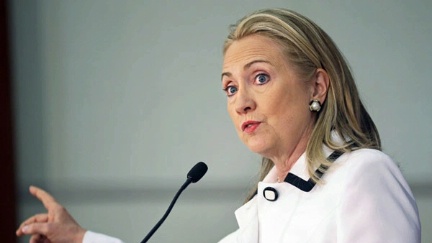
Former Secretary of State Hillary Clinton.
This was all predictable. For it conforms to the parochialism and inbreeding that for so long has infirmed the Democratic Party’s leadership as well as the punditocracy. Fortunes could be made betting against the “Washington consensus” whose singular talent for getting it wrong extends from the country’s endless skein of foreign misadventures to electoral politics.
They give the impression of all sipping out of each other’s double-lattes at Starbucks in Dupont Circle. The resulting damage done to the party’s traditional constituents, to the integrity of national discourse and to America’s interests in the world is incalculable – and may well be irreparable.
Still, it is worth recording the pathologies that this latest bruising encounter with reality reveal. Most obvious is the disconnect between political elites and the country they presume to know or aspire to govern. The success of Bernie Sanders makes that transparently clear. His greatest asset is simply that (even though he has served in the Senate as an Independent) he ran as a “Democrat” – that is, as representative of the party as forged in the mid-Twentieth Century and whose precepts conform to the socio-economic interests and philosophical truths typically held by most Americans…