Democratic Mayoral Candidate DeRay McKesson tells The Real News he will defend teacher unionism and support keeping charter schools under public …
Via Youtube
Video: DeRay: Maryland’s Unionized Charter Schools Could Be Model For Nation

Video: Appointing a Justice: Do Partisan Politics Matter More Than Merits?

Dean of UNC-Irvine Law Erwin Chemerinsky explains how the two major parties have created a system for selecting Supreme Court Justices who don’t prioritize …
Via Youtube
Hillary Clinton’s False Hopes
Surely, Hillary Clinton hopes for the happy conclusion to the maddening string
of primaries and caucuses that have exhausted her. Surely, she hopes to be the
presidential nominee of the Democratic Party this year. And surely, she hopes
to be elected president. These hopes are realistic probabilities in her own
mind.
But if she is hoping for the end to her legal woes, that is a false hope –
and she knows it.
The relentless barrage of bad legal news for Clinton, which has been relegated
to below-the-fold stories because of the primary news position of the presidential
primary contests, must keep her and her lawyers up late at night. While her
husband has been arguing with military veterans at her political rallies and
while Marco Rubio and Donald Trump have been mocking each other’s body parts,
a series of curious developments has occurred in the Clinton email scandal.
It is fair to call this a scandal because it consists of the public revelation
of the private and probably criminal misdeeds of the nation’s chief diplomat
during President Barack Obama’s first term in office. Clinton’s job as secretary
of state was to keep secrets. Instead, she exposed them to friend and foe. The
exposure of state secrets, either intentionally or negligently, constitutes
the crime of espionage. For the secretary of state to have committed espionage
is, quite simply, scandalous.
We are not addressing just a handful of emails. To date, the State Department
has revealed the presence of more than 2,000 emails on her private server that
contained state secrets – and four that were select access privilege, or SAP.
The SAP emails require special codes in order to access them. The codes change
continually, and very few people in the government have the codes. SAP is a
sub-category of “top secret,” and it constitutes the highest level
of protected secrecy, for the utmost protection of the government’s gravest
secrets. It is unheard of for SAP-level data to reside in a non-secure, vulnerable
venue – yet that is where Clinton caused four SAPs to reside.
Video: The Real Truth Behind The U.S and Russia Ceasefire in Syria
In this video Luke Rudkowski interviews independent journalist Dan Dicks of Press For Truth about the ceasefire in Syria. We go over the details of the deal …
source
Video: Jessica Orta wife of Ramsey Orta New York Man Who Recorded Eric Garner’s Death Arrested, Again
https://photographyisnotacrime.com/2016/02/21/new-york-man-who-recorded-eric-garners-death-arrested-again-fears-nypd-retaliation/
Via Youtube
Video: Mike Sivier::”Snr Citizens Freezing To Death In Fuel Poverty & Treated As Useless Eaters By Govt!”
Please Support The Show – http://richieallen.co.uk/ Mike Sivier’s Website:- http://VoxPoliticalOnline.Com/ https://www.facebook.com/therichieallenshow …
Via Youtube
Video: Col. Wilkerson: The Foreign Policy of Clinton, Trump, Cruz & Rubio “Frighten Me”

Former Bush administration official Larry Wilkerson says the candidates’ hawkish foreign policy record is cause for concern with the potential of a possible North …
Via Youtube
Nobel-Prize-Winning Economist Condemns Obama’s ‘Trade’ Deals

Eric Zuesse
The Nobel-Prize-winning former chief economist of the World Bank, and Chairman of the Council of Economic Advisers to the U.S. President, Joseph Stiglitz, went to England to warn the British public, and Parliament, that “no democracy” can support U.S. President Barack Obama’s proposed trade-deals, because all of these have a feature built into them, called Investor State Dispute Resolution, or ISDS, which will establish a supra-national authority that gives international corporations the power to sue any signatory nation that introduces new or increased economic regulations regarding product-safety, the environment, workers’ rights, or anything else that the corporation alleges lowers the corporation’s profits; and because these cases will be tried not in courts that are subject to the given nation’s constitution and laws, but instead by private three-person panels of mainly corporate lawyers, and their rulings will not be subject to being appealed within the given nation’s court system — the panel’s decison will be final. There will be no democratic accountability at all, regarding regulations and laws that are designed to protect the public: environmental, product-safety, and workers’ rights. The existing regulations will be, in effect, locked in stone, or else decreased — never increased, no matter how much the latest scientific findings might indicate they ought to be. That’s because the international corporations’ panels will have powers above and beyond any signatory nation’s constitution and laws. ISDS gives international corporations the right to sue taxpayers; it does not give any government the right to sue an international corporation (and that also means no right to sue such a corporation for having filed a frivolous lawsuit against the taxpayers). It’s a new profit-center for international corporations, in which those profits are coming from the taxpayers of nations that lose these lawsuits — and these cases will explode in volume if Obama’s deals get passed.
Stiglitz was speaking specifically about the TTIP, which is Obama’s proposed trade-deal with Europe, and he based his analysis upon the published proposed TPP, which is its companion trade-deal for virtually all nations that are in or on the Pacific. (Wikileaked texts indicate that the TTIP is basically similar to TPP.)
In the article by Huffington Post that reports on Stiglitze’s comments was this, from Stiglitz:
“There’s nothing to stop you, in TTIP, from passing regulations. You can keep the regulations. You would just have to keep writing a cheque to [cigarette firm] Phillip Morris every year for the profits they lost from what they would have been if they had been able to kill people in the way they had in the past,” he said. “Every year you would have to write them another billion dollar cheque.” …
He said it would mean “any government that passes a regulation that has an adverse effect on the profits of a company can be sued” by that company.
Stiglitz said the lawyers who drafted TPP designed it to be so strict that if governments passed regulations “trying to prevent polonium in baby cereal” companies would sue. “This is not a joke,” he added.
Previously, on the basis of a legal analysis of Obama’s trade-deals, a leading legal expert at the United Nations, explained why (as my headline summarized it) “UN Lawyer Calls TTP & TTIP ‘a dystopian future in which corporations and not democratically elected governments call the shots’.” That lawyer was saying essentially the same thing as Stiglitz, but from a legal not an economic standpoint.
For information specifically about the motivation behind Obama’s trade-deals, see this.
Obama’s proposed ‘trade’ deals have not yet been passed into law in the United States. Here are the positions of leading U.S. Presidential candidates regarding whether they will favor or oppose them if they become the next U.S. President on 20 January 2017:
Hillary Clinton supports and was actively involved in producing Obama’s proposed trade-deals, but they became too unpopular among Democratic primary voters and so during her Democratic Party primary campaign for the White House she reversed her previous verbal position on the matter, just as she did in 2008 when she condemned her husband’s more-limited model, the NAFTA, after her having actually helped him to win approval for it in the U.S. Senate.
Bernie Sanders has condemned and voted against Obama’s trade-deals consistently. His actions have matched his words.
Donald Trump also condemns Obama’s proposed trade-deals, but his opposition, like Hillary’s, is merely verbal while he’s running for President, and though he (unlike Clinton) has no active record of having helped to produce these deals, he (like Clinton) does have a record of switching his positions in order to win votes. He’s not like Sanders; he can’t be trusted (or, at least, not intelligently trusted).
More details about these deals, and their origins, can be found here, which provides the deeper historical context, going all the way back to the U.S. Constitution.
Specifically regarding the corporate panels that will, in a sense, become an international-corporate world government if these deals become law, the details of that can be found here.
Essentially, what both Stiglitz and the UN’s lawyer are saying is that, if these deals become law, then workers’ rights laws, and product-safety laws, and environmental laws, won’t be able to be increased — not even, for example, in order to meet the verbal commitments that were recently made at the Paris conference on climate change. (Those ‘commitments’ to reduce global-warming gases would automatically become not merely unenforceable — which they already are — but they would become outright impossible to fulfill, because any effort to put them into place would produce crippling corporate-lawsuit-imposed fines against taxpayers.)
When Stiglitz said, “This is not a joke,” he was saying, essentially, the same thing as the UN lawyer did: “We don’t want a dystopian future in which corporations and not democratically elected governments call the shots. We don’t want an international order akin to post-democracy or post-law.” He was saying: Don’t assume that the future won’t be an international-corporate dictatorship, because that now is actually quite likely. If both of these agreements become law, then even the publics in non-member nations will almost certainly become crushed, because they’ll be essentially boycotted by international corporations: both employment and consumption will collapse there. The interntional corporations would still come out way ahead, no matter how impoverished those people might become.
President Obama has specifically targeted the BRICS nations for that type of crushing treatment. He says this within a moralistic context in which he also says “the United States is and remains the one indispensable nation.” He said that on 28 May 2014, when he told graduating cadets at West Point this too:
“Russia’s aggression toward former Soviet states unnerves capitals in Europe, while China’s economic rise and military reach worries its neighbors. From Brazil to India, rising middle classes compete with us.”
None of the five BRICS countries — Brazil, Russia, India, China, and South Africa — is included in either of these two ‘trade’-pacts: Obama was telling America’s future military leaders that those are enemy nations, which those future U.S. military officers might be fighting against in their careers, and he was placing that prospect into a broader economic (not merely military) context. Obama’s ‘trade’ deals are about lots more than merely ‘trade.’
It’s widely expected that at least the TPP, if not also the TTIP, will become passed into law in the United States at some time between the November 8th U.S. Presidential election and the start of the new Presidency on 20 January 2017.
Both of these ‘trade’ deals are being rammed through Congress in direct violation of the U.S. Constitution’s Treaty Clause. Apparently, the U.S. Constitution no longer rules in the United States. The U.S. Supreme Court has never considered the matter (even though it would entail overthrowing a large portion of the U.S. Constitution if it becomes passed into law and sticks). However, if Obama’s ‘trade’ deals become passed into law, and remain, then what Stiglitz said, “This is not a joke,” will also mean that no intelligent and decent person will want to have children, unless that person wants them to live in a downward-spiralling dictatorship — which is what that would mean (and which would hardly qualify as being ‘decent’).
The vote that the American people will be making on November 8th could thus turn out to be the most important vote in the entire history of the world: the stakes are so large — for the entire world. And that’s no joke, either. If these proposed deals are not already too late to stop, this could well be the last chance. And to say that isn’t ‘apocalyptic,’ either: there’s nothing at all of ‘Scripture’ referred-to here. There’s nothing that’s at all ‘supernatural’ about this. It’s pure reality: very hard, very cold, and very real (and very profitable for the international billionaires whose agents have been pushing for this ever since at least 1954).
—————
Investigative historian Eric Zuesse is the author, most recently, of They’re Not Even Close: The Democratic vs. Republican Economic Records, 1910-2010, and of CHRIST’S VENTRILOQUISTS: The Event that Created Christianity.
Video: What Will it Take for the Candidates to Talk About Public Education?

Nikhil Goyal, author of Schools on Trial, compares Sanders and Clinton education platforms and responds to the calls of the leading Republican candidates to …
Via Youtube
David Cameron Running Scared of David Icke?

Mick Meaney
(RINF) – Today during a speech about France’s Brexit, prime minister David Cameron lashed out at prominent researcher and author, David Icke.
According to a report by The Telegraph, Cameron said:
“Of course you can say this is all some giant conspiracy, some sort of David Icke’s style sort of you know … It is just nonsense”.
Just why is David Cameron singling out David Icke?
Could it be that Cameron, and the rest of the establishment are now running scared of the tidal wave of truth that is flooding a rapidly awakening society, due in no small part to the information that Dave Icke has uncovered?
On the Davidicke.com website, David Icke responded with:
We are really making progress. British Prime Minister David Cameron denies there is a conspiracy of the kind I have been exposing to keep Britain enslaved in the EU bureaucratic Big Brother tyranny – how interesting that he felt the need to make such a denial. Touching a nerve are we, Dave?
Tonight David Icke also issued a video response to David Cameron:
https://www.youtube.com/watch?v=sa367flPUvo
Cameron’s attack seems to be influenced by a video in which David Icke calls for Britain to leave the EU.
https://www.youtube.com/watch?v=uDiGONVJqcU
Notes on London’s housing crisis
Via WSWS. This piece was reprinted by RINF Alternative News with permission or license.
Allison Smith
Surging London home prices decimate living standards
Recent employment growth and low inflation helped increase overall incomes in London by 2.9 percent since 2008. However, the high cost of housing in the capital city has pushed the region to the bottom of the league table for living standards in the United Kingdom.
Most Londoners have in fact suffered falling living standards, especially when the slant towards rising incomes for the wealthy is taken into account.
Matthew Whittaker, chief economist at Resolution Foundation remarked, “Londoners have experienced some of the strongest income growth in recent years, with typical household incomes now well above pre-crash levels, but the wider picture on living standards changes completely once housing costs are included. On this measure living standards have actually fallen over the last seven years, and by far more than anywhere else in the UK.”
House prices leapt 9.4 percent last year, pushing the average cost of a London home to a record £536,000, while average rents jumped up to an average all-time high of £1,301, far outpacing every other U.K. region.
In many areas of London, landlords are renting out sheds and rooms without windows, smoke detectors, or hot water—and even, as in one case in east London’s Newham borough, a converted walk-in freezer.
Record number of evictions nationally, with most in London
The Ministry of Justice reports that tenants living in 42,728 rented households across England and Wales were forcibly removed from their homes last year—a 53 percent increase since 2010 and a record number since statistics began to be reported in 2000.
Most of the evictions took place within 16 London Boroughs—mostly by social landlords. This is a result of stagnating or declining wages and cuts to benefits, at the same time that the cost of living is skyrocketing, especially rent. Councils have a dwindling supply of social housing units available due to the forced selloff of high-value council properties.
Increasingly, poor tenants are finding it unaffordable to move and forced eviction is fast becoming the only way they can secure new housing, as councils require them to demonstrate they are homeless before they are allocated emergency housing.
Emergency housing is often bed and breakfast or hostel accommodation that are unsuitable for families with children. The charity Shelter reports that nearly 4,000 families are now living in hostels and the most dramatic rise is in central London.
22,000 London homes left empty
A Freedom of Information request revealed that 22,000 houses lay empty in 31 out of 33 London boroughs. However, this could be considerably higher as local authorities do not require owners to declare their properties uninhabited.
Helen Williams, chief executive of the charity Empty Homes, told the Guardian, “With so many people priced out of decent housing across London it makes sense to make the most of existing properties as we build new homes to address the capital’s housing needs.”
London’s free newspaper City A.M. reported that one offender, the Crown Estate, “is sitting on over £800m worth of empty properties in London alone… exposing the scale of the developer’s property footprint in the capital. The monarchy’s portfolio of property and land includes 312 vacant properties in the Greater London area, according to a Freedom of Information request, ranging from rooms on Regent Street and other prime central London locations to garages and commercial space.”
Housing charity sells off affordable housing to developers
Glasspool Charity Trust auctioned off apartments currently occupied by low income and benefits tenants at the Butterfields Estate in the north London borough of Walthamstowe.
A statement said, “As trustees of the Glasspool Charity Trust we sought assurances regarding our tenants, their rights and protection from our selling agents at the time of the negotiations. We were assured that they would be protected within the law. We have no power to prevent a new owner from reviewing their position with the existing tenancies post-sale.”
In 2012, the Shelter housing charity found that in 25 percent of all London areas, rents increased by an average of £300 a year. As demand grows for rented accommodation, many more residents are being priced out of decent homes and forced into deplorable conditions and, increasingly, homelessness. Last year, Shelter researched the huge emotional and financial costs of the lack of affordable housing on low income households.
Nearly 30 percent of renters moved three times in five years
According to a Shelter and YouGov study, 27 percent of renters in the United Kingdom have moved three or more times within the last five years—the equivalent of 400,000 families.
One report described it as almost a nomadic form of existence. Alarmingly, nearly half of parents in rental accommodations were forced to borrow money to move or had fallen behind on rental payments. Sixty-five percent of families report having to change schools after their last move, and one in four parents say that moving causes distress and feelings of insecurity in their children.
Shelter CEO Campbell Robb said, “With short-term contracts, sudden rent hikes and expensive moving costs putting huge pressure on family life, it’s no wonder that millions of parents are battling to give their children a stable home.”
He added, “We know the vast majority of parents are crying out for longer term tenancies, so it’s about time the government turned this into a reality and gave England’s 11 million private renters a better deal.”
A 2010 study by Queens University in Belfast found that children who move five or more times are at least three times more likely to experience serious mental health issues.
Record low home ownership among young Londoners
Resolution Foundation’s Living Standards 2016 report shows there continues to be a sharp decline in new entrants to the U.K. housing market, with home ownership rates between 2001 and 2014 down an average of 11 percentage points for people under 60 years of age.
Millennials (born between 1982 and 2004) experienced the sharpest home ownership decline—a 49 percent reduction since 1998 and a full 16 points lower than residents in the Generation X group (born between 1965 and 1981).
The figures for young Londoners are devastating, with home ownership among low-to-middle income residents under 35 years of age plummeting by 67 percent to just 13 percent of residents in 2014. The percentage living in private rented accommodation has increased 87 percent, from 37 percent in 2000 to 70 percent in 2014. Londoners in this age group are also more likely to live in social housing as opposed to owning their own home, with 17 percent living in council properties.
Record wait time for council housing
According to recent figures provided by the Department for Communities and Local Government, up to 25 percent of households in some areas of London are on a waiting list for social housing. Although the overall number of applications for housing is down, nearly all those on the list are waiting a record period to be placed into social housing.
In 2015, Camden had the highest percentage of residents waiting for social housing—nearly one-in-four residents, totaling 24,644—up 10 percent from 2014. In Islington, nearly 20 percent of households were on a waiting list, and the equivalent of one-in-six residents were waiting for housing in Barking and Dagenham, Brighton, Bolton, Tower Hamlets, Medway and Reading in 2015.
The overall decrease in the number of households waiting for housing isn’t due to fewer residents needing assistance. Rather, cuts to housing benefits and other government policies, such as the Localism Act 2011 and Right to Buy, have given local councils the power to restrict eligibility for social housing, especially for those residents who cannot prove a connection to the area.
Report warns number of £1 million homes in UK will triple by 2030
A report co-authored by Professor Paul Cheshire of London School of Economics and Santander Bank, forecasts that by the year 2030, the number of £1 million homes in the United Kingdom will triple and the average home price will more than double from £283,565 to £557,444.
The report projects that within fifteen years London home prices will increase by a factor of 16.5 and nearly one-in-four homes across the capital city will sell for £1 million or more. Prices in Kensington and Chelsea and Westminster boroughs are set to increase by 70 percent. Professor Cheshire said, “By 2030, the divide between housing haves at the top and the have-nots at the bottom will be even wider than it is now.”
Young people under 35 years of age are hardest hit by the staggering increase in home prices. The vast majority are only likely to own a property through inheritance. A recent survey of teachers in London reports that one in 10 young teachers still live at home, even after five years of tenure in their career. Sixty-one percent of those surveyed said that the high cost of living might force them to move out of London altogether.
UK flight refuses passenger over ‘prayer ‘message on phone

A British national was forced out of a plane after a fellow passenger found a text message on his mobile phone about prayers and reported him as a security threat.
Armed police at London’s Luton airport removed the man from the easyJet flight to Amsterdam by force on Thursday.
Laolu Opebiyi, 40 said that security personnel forced him to hand over his phone and password to establish his innocence. He acknowledged the prayer message saying he was simply trying to arrange a conference call prayers with his friends using WhatsApp.
Opebiyi was cleared following brief questioning by the security but the pilot refused to allow him back on to the flight. He subsequently waited more than three hours to catch the next flight.
Obama extends anti-Russia sanctions for another year

US President Barack Obama has signed a new Executive Order that extends economic sanctions against Russia for another year.
The decree, published Wednesday on the official White House website, states that economic and financial sanctions imposed on Moscow over its involvement in the Ukrainian crisis will stay in place until March 6, 2017.
The decision came as “Russia’s actions continue to pose an unusual and extraordinary threat to the national security and foreign policy of the United States,” Obama said in the document.
“I found that the actions and policies of the Government of the Russian Federation with respect to Ukraine undermine democratic processes and institutions in Ukraine; threaten its peace, security, stability, sovereignty, and territorial integrity; and contribute to the misappropriation of its assets,” the president added.
The move drew criticism from the Kremlin, with Russian presidential spokesman Dmitry Peskov telling reporters on Thursday that the decision was regrettable.
Brave Afghan Forces Kill Inside Hospital, for Freedom

Apparently a new feature of the modern war of terror is the shameless, blameless, overt targeting of hospitals, doctors and bedridden patients, all without the means of even modest self-defense.
Following the American destruction of a Doctors Without Borders facility in Afghanistan, the Saudi targeting, using American weapons, of hospitals in Yemen, the Israeli destruction, using American weapons, of Palestinian hospitals in Gaza, and the Russia/Syrian destruction of a Doctors Without Borders facility in Syria, we now have another case, perpetrated against the rules of war, international treaties and simple humanity.
Afghan security forces, possibly accompanied by NATO advisers, raided a hospital south of Kabul and abducted and then killed at least three men suspected of being insurgents.
New York City transit upgrade aids developers

Via WSWS. This piece was reprinted by RINF Alternative News with permission or license.
Mark Witkowski and Philip Guelpa
In early January, amid media fanfare, New York Governor Andrew Cuomo announced plans to rebuild vital transportation infrastructure in the New York City area, in what he billed as “the biggest construction program in our state’s history.” The centerpiece of this project is renovation of Manhattan’s Penn Station, through which hundreds of thousands of rail riders travel on a typical workday. Cuomo’s proposal calls for an ambitious upgrading of the station, as well as new train tunnels under the Hudson River to improve transportation between the city and New Jersey, and for a new section of track to be built along a rail corridor in Long Island which is currently a bottleneck in the Long Island Railroad system.
The governor has pledged $8.3 billion in state assistance for these projects. However, actual funding details for Cuomo’s transportation projects have not been made public. The Metropolitan Transportation Authority, the state agency that includes the New York City transit system, is currently $34.1 billion in debt. Rider advocates have expressed concerns that the state will not live up to its promises, leading to further fare increases.
Overcrowding in the New York subway system
Cuomo’s proposals are completely inadequate to meet current needs. The transportation infrastructure in the New York City metropolitan area has suffered many decades of neglect. The effects of the resulting decay are compounded by increased demand, brought on, in part, by gentrification spreading out from the city’s core neighborhoods, forcing working class families farther from their places of employment and into areas less serviced by the existing transportation system. There has not been a major expansion of the city’s subway system since the Second World War, when the population was much more concentrated than it is today.
Penn Station is a prime example of this deterioration, and few question the need for improvements. It is currently a complex and confusing warren of dilapidated passageways and overcrowded waiting areas, a legacy of the demolition of the original, classic station. Built in 1910, and considered a Beaux Arts masterpiece, it was torn down in 1963 to build Madison Square Garden. Critics question whether Cuomo’s plan, which has yet to be described in detail, would be adequate to substantially address the current severe congestion (more than 600,000 passengers per day) or growing needs in the future. It is only the latest in a series of unrealized plans that date back over two decades.
 Crowd in a New York subway station
The governor’s proposals come as a large swath of Manhattan real estate known as “Hudson Yards” is undergoing massive private redevelopment spurred on by the recent $2 billion extension of the #7 subway line from its previous terminus in Times Square. Hudson Yards lies immediately to the west of Penn Station, much of the new development being built on a massive platform constructed over the rail yards which serve the station.
The Hudson Yards project is the largest private real estate development in the United States and the largest in New York City since Rockefeller Center was constructed during the 1930s. What is clear is that the private interests behind Hudson Yards will benefit greatly from Cuomo’s infusion of public funds into nearby infrastructure.
Cuomo has been touting high profile projects – which are meant to aid developers- as part of his legacy, while leaving the transportation issues faced by millions of working people largely ignored. Workers in New York City are more dependent on public transport than anywhere else in the United States. Approximately 55 percent of households in the city do not own or lease an automobile, and even for those who do, public transportation is typically the only practical option as parking is expensive or in many cases simply not available near workplaces.
Not to be outdone by Cuomo, New York City Mayor Bill de Blasio has championed a proposal for a new light rail line which, if built as proposed, will connect the clusters of ultra-expensive luxury developments now rising along the Brooklyn-Queens waterfront on the East River. The light rail line could conceivably connect to existing subway lines, but would not provide direct access to Manhattan.
This light rail line is intended to make waterfront property in formerly industrial areas more accessible and, consequently, more valuable for developers. Many are rightly viewing this multi-billion dollar project as more public largess towards developers, which will do next to nothing to serve existing working class areas in Queens and Brooklyn, located further away from the rapidly gentrifying shoreline along the river.
It should be noted that Cuomo and de Blasio, both Democrats, have been politically wrangling over numerous issues, including transportation and housing, as well other matters of concern to the city’s working class, each trying to present himself as the leading “progressive” in the state. How much their squabble factors into these initiatives is debatable. That these expenditures are intended to benefit the city’s wealthy real estate developers, while leaving the real concerns of working people unaddressed, is not.
The proposals presented by both the mayor and governor ignore the seriously dilapidated state of New York’s existing subway lines, which are used by over 5 million people every day. The daily passenger load has increased 61 percent since 1992.
Alongside seemingly interminable construction delays, conditions continue to worsen. Peeling paint, rust and corrosion, and broken or filthy wall tiles are visible everywhere in the subway system, parts of which are 100 years old. Handrails and stairs are in bad repair, creating dangerous conditions, and the trains themselves are often delayed due to malfunctioning equipment. Few stations on the elevated lines have working elevators or escalators.
Long-delayed work (euphemistically called “deferred maintenance”) has exacerbated the deterioration, resulting in the need for more extensive, time-consuming, therefore disruptive, repairs.
There is currently talk of shutting down the tunnel used by the L train, which connects northern and eastern Brooklyn to Manhattan, for extensive repairs. Doing so would force riders in some of Brooklyn’s poorest neighborhoods to find alternate routes to work; however, media coverage has focused largely around inconvenience to the residents of the hyper-gentrified Williamsburg area where construction of many “luxury” housing projects is underway.
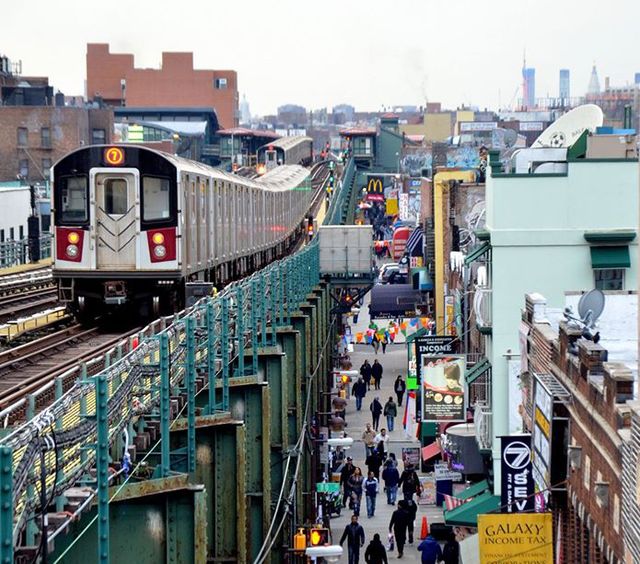 The number 7 train
In Queens, the #7 line, which connects working class neighborhoods to Manhattan, has been in operation since 1917. Much of the line shows signs of severe decay and neglect. The line experiences frequent service disruptions during the rush-hour periods, leaving tens of thousands of workers no means to get to their jobs or home afterwards.
Maintenance work on the line has been ongoing for decades. Individual projects have often lasted for months, or even years, as was the case when express service was suspended for much of the 1980s. Nevertheless, these efforts have been grossly inadequate to meet the need. There simply hasn’t been a sufficient expenditure of resources to reconstruct the line or build new capacity into the system. The lack of funding for transit systems stands in stark contrast to America’s unlimited military spending.
 Ryan Yuellendahl
, a 27-year-old plumber’s helper and musician who uses the #7, told the WSWS, “I ride it every day. There are a lot of track delays. In proportion to the rate hike [the base fare was raised to $2.75 in 2015], I see very little being fixed. I have not seen positive changes in five years. The only difference is the 34th Street station [that services Hudson Yards] was added at the other end of the line in Manhattan. That does not make any difference for all the riders from Queens, except for lining the pockets of some rich people.”
Ryan also spoke about the connection between transportation and housing. “It is a big problem attaining housing, especially along this line. You see how busy it is. I pay $1,300 for a studio apartment. I grew up in Long Island and have been in Queens for five or six years and seen significant changes. I used to pay $600 in rent.”
Michael Carter, a school teacher and longtime resident of New York, stated, “Everything is made worse because it is overdeveloped. [Former mayor] Bloomberg seemed to toss away all the zoning laws, and now it is overcrowded and the infrastructure can’t handle it. Even in older apartments there could be five or six guys all crammed together even if the apartment was only made for two people.”
 Justin Hill
Other riders we spoke with in Woodside, Queens voiced a number of concerns regarding the poor service and lack of alternatives. Bobby, a messenger, commenting on a scenario no doubt faced by many, said, “There have been times where I’ve spent 15 to 20 minutes on a train stuck between stations. When the trains don’t work, I am late for work, and my boss doesn’t want to hear any excuses. The supervisor will be mad at me because this kind of thing keeps happening.” There are no hard statistics that we know of on how many workers have been fired or disciplined for being late. Business groups, however, have complained that such delays add to lost productivity and their bottom line.
Justin Hill, a longtime resident of New York, stated, “They always say that the delays are part of construction, and I believe them. However, everything is still in disrepair. I’ve seen places where the cement under the beams is falling out.”
After a brief discussion about the city’s budget, he added, “The resources really should be spread out, but the people that choose where the money goes are not the ones riding the trains.”
Neocon Armchair Warhawks Panic Over Trump Foreign Policy

The neocons are renowned for their courage on the battlefield. There is no
keyboard they are afraid to finger. No pen they won’t commandeer. When the battle
cry is sounded, they unhesitatingly push the “on” button at their computers
and saddle up for battle. Off with the loafers and under the desk! “Caution
to the wind! Bring in a wine spritzer, dammit, I’m off to waaar!”
While this Institute and this column most definitely do not take a position
on any candidate and in fact your correspondent views voting itself with disdain
in today’s corrupt US political system, it is impossible to avoid viewing with
extreme amusement the collective neocon hysterical breakdown over the possibility
that voters of the Republican Party – a party neocons crashed en masse
starting in 1972 and especially 1976 – may be sending as their nominee for
president a man who has committed the cardinal sins of:
1) Stating the obvious that the Iraq war was
brought to us by the liars of the neoconservative movement and has been a total
disaster for the rest of us who are forced to pay for their fantasies of world
domination.
2) Suggesting that he might actually speak with
Russian President Vladimir Putin to see if US/Russia differences can be worked
out without a potentially world-ending nuclear war.
3) Though arguing that he is hugely pro-Israel,
nevertheless suggesting that if the US is to play a role in the Israel/Palestine
issue (this Institute would argue that it should not), the US side should, in
the interests of any chance of success, take a neutral role in the process.
Video: Road Rampage: Elephant goes wild in India, smashes cars

Elephant smashed several vehicles during holy festivities at Bhagavathi Temple in Pulappatta, South India COURTESY: RT’s RUPTLY video agency, NO …
Via Youtube
The Elephant in the Race

The audience in the theater takes its seats and slowly settles down. The curtain rises on a conventional living room in a conventional American home, neither squalid nor opulent. Middle class, it whispers.
A woman of a certain age sits in a chair in the middle of the room, reading a book. In a dimly lit corner, unnoticed at first, is a fully grown elephant, munching hay.
Enter a somewhat disheveled, gray-haired man. He sits in the chair to the left of the woman and begins to read a newspaper. Soon, however, he peers into the corner and does a double take.
“Hillary,” he says, sotto voce. “I don’t want to alarm you, but there’s an elephant in the room.”

Penn State / Flickr
“Don’t be silly.”
“I mean it. Look, right there in the corner. That gray thing eating hay. It’s huge.”
“I see it. It’s not an elephant.”
“Hillary, listen to me. I’ve been to the zoo, I know elephants and that’s one.”
“No it’s not,” she insists. “It’s a bank.”
“What are you talking about?” the man shoots back. “Some piggy banks look like elephants, but that’s no piggy bank.”
“This isn’t that kind of bank,” Hillary answers. “You don’t put money in it, you take it out.”
“You mean like an ATM? You go to it whenever you need a hundred or so and it gives it to you?”
“More like $225,000 or so, but basically that’s the principle.”
“$225,000, wow! That’s a Super-PACaderm you’ve got there. What interest rate are you paying?”
“No interest,” she explains. “You don’t even have to pay it back. It’s for goodwill.”
“Surely you have to do something for all that money,” the man sniffs. “Two hundred twenty-five thousand clams buys a lot of goodwill in the goodwill market.”
“Sometimes I give a little speech. Sometimes I just read material they give me,” she shrugs. “You know me, I’ve always depended on the kindness of strangers.”
“This sounds like a scam to me. We should get rid of that thing before it goes berserk and tramples on all of us.”
“Nonsense. We’ve got it under perfect control. It’s very well behaved. Besides, he’s too big to get rid of. Look at him.”
“Yeah, huge. That’s why we have to get rid of it. If it collapses we’ll all be crushed.”
“How are two little people like us going to get him out of the door?” she asks skeptically. “I mean, really.”
“We’ll get help.” He goes to the window and throws it open, sticks his head out, and yells: “Listen up, people! We’ve got an emergency here. There’s an elephant in the room. We need your help to get rid of it. Come over as fast as you can, and bring ropes.”
“Any luck?” she asks.
“I don’t think so. No one was listening. There’s a strange bunch of guys out there having an argument.”
“Are they from around here?”
“No. They’re milling around calling each other liars. One of them had a really weird haircut and another kept saying his father was a bartender and his mother was a maid, like that meant something. I didn’t get it.”
“Must be one of those cults — a Rush Limbaugh fan club or something. We’ll call Homeland Security. They’ll take care of it.”
“But what about the elephant?”
“Don’t worry about it,” she shrugs. “We’ll get a leash.”
“What about all the people who don’t have an elephant?”
“I feel their pain. Now quit making such a fuss.”
The man sits back in his chair with a resigned shrug. The elephant screams. The curtain falls.
Eat your heart out, Arthur Miller.
The post The Elephant in the Race appeared first on OtherWords.
This piece was reprinted from Other Words by RINF Alternative News with permission.
Video: Greece overwhelmed with refugees as neighbors tighten borders

Greek Prime Minister Alexis Tsipras says the EU risks turning his country into a refugee “warehouse” unless other nations in the bloc share the burden of the …
Via Youtube
Irish Shillelagh Austerity


Ireland’s election drove a big spike into the austerity policies of the “troika”—the European Central Bank, the European Commission and the International Monetary Fund. (Photo: eBay)
Note: A shillelagh is a blackthorn walking stick that the Irish use for whacking things they don’t like.
If there is one thing clear after Ireland’s recent election, it is that people no longer buy the myth that austerity is the path to economic salvation. It is the same message that Greeks, Portuguese and Spaniards delivered to their elites over the past year: the prophets of tough love, regressive taxes, and massive social services cutbacks should update their resumes and consider a different profession than politics.
Ireland is a small country but the Feb. 26 election drove a big spike into the policies of the “troika”—the European Central Bank, the European Commission and the International Monetary Fund—that have blitzed economies across the continent and made chronic unemployment and growing economic inequality a continuing source of malaise.
The governing center-right Fine Gael lost 16 seats, and its partner, the center-left Labour Party, was virtually wiped out, dropping from 37 seats it controlled after the 2011 election only to six. The two parties had overseen an economic program that almost doubled child poverty rates, drove some 500,000 young people to emigrate, reduced wages by 15 percent, and sharply raised the jobless rate.
Ireland’s economic difficulties had nothing to do with public spending, but were the fallout from private speculators and banks caught in the great 2008 financial meltdown. Rather than making the speculators pay, the then government of Fianna Fail shifted the bank debts to taxpayers. The troika agreed to a $67 billion bailout of the banks, but only if major bondholders were exempted and the government would institute a draconian austerity program. Most Irish voters were unaware of this “trade off” until just before the election.
The Fine Gael/Labour government has long claimed that it had no choice but to apply the austerity formulas and that, in any case, the policies worked, because the economy was recovering. Voters didn’t buy it. The “recovery” has largely been restricted to Dublin—where homelessness in January reached a record high—and the growth was largely a product of falling oil prices and a decline in the value of the euro, rather than the result of austerity.
As Fintan O’Toole of the Irish Times put it, “What voters said on Friday is in some ways highly complex, but in relation to the dominant narrative” that austerity is the path to recovery, the Irish said, ‘We don’t believe you.’” The Fine Gael-Labour campaign slogans of “stability” and “all is well” fell flat. The government, O’Toole said, “imagined that it would ride back to power on a feel-good factor, as if people who had been repeatedly beaten should feel good that the beating has stopped.”
At first glance, the Irish election looked like a shootout between the two center-right parties—Fine Gael and Fianna Fail—that have taken turns governing Ireland for more than eight decades. But this time around Fianna Fail ran from the left—mild left, as it were—promising greater fairness and more public services. Fianna Fail, which was crushed in the 2011 election, bounced back from 21 seats to 44 and is now the second largest party in the Dáil after Fine Gael.
The Dáil has 158 seats.
Another winner was the unabashedly leftist Sinn Fein Party, which picked up nine seats for a total of 23 and is now the third largest force in the Dáil. The People Before Profits/Anti-Austerity Party gained two seats, and the independent bloc picked up a seat. In contrast, the rightwing Renua Party lost its three seats.
Irish elections are complex affairs, employing a proportional representation system that provides a path for small parties to gain a foothold in the Dáil, but makes campaigning complicated.
What emerged from the Feb. 26 vote was a hung parliament: Fine Gael/Labour did not win enough seats for a majority, but neither did anyone else. There is talk of a “grand coalition” between Fine Gael and Fianna Fail, but both parties would have to renege on pre-election promises that they wouldn’t consider such a move, and it would automatically make Sinn Fein the leader of the opposition. The latter possibility scares both center-right parties.
Fine Gael, Fianna Fail, and Labour refuse to consider a coalition with Sinn Fein because of the Party’s links to the Irish Republican Army and violence. It is an odd rationale, considering that all three parties have roots in the sometimes quite violent struggle for Irish independence and the bloody 1922-23 civil war over the Anglo-Irish Treaty that freed the Republic from Great Britain.
In any case, Sinn Fein leader Gerry Adams made it clear that his party has no interest in being a minority member of any combination that Fine Gael or Fianna Fail put together. And there is no way that Sinn Fein can construct a majority coalition. At most, the left and center-left parties could muster 60 votes, and that would include the Labour Party, a dubious possibility. Indeed, one Labour Party leader, Alan Kelly, has already called for a Fine Gael-Fianna Fail unity government.
It is possible that Fine Gael will try to rule as a minority government, but that would require Fianna Fail to abstain when it comes time to elect a Prime Minister, or Taoiseach. And it would also mean that Fianna Fail might have to choose between swallowing some of Fine Gael’s austerity policies that it ran against in the election, or bringing down the government. Since any minority government will be extremely fragile, another round of elections is a real possibility. During the campaign, Fianna Fail leader Michael Martin said he would not go into a coalition with Fine Gael, and Irish voters in a rematch might punish any party that broke its promises.
Irish voters essentially gave two messages in the last election, one directed at Europe and the other at its own political structure.
About Europe, the voters firmly rejected the increasingly discredited policies of the troika, joining Greek, Spanish and Portuguese voters in saying “enough.” Austerity as a cure for economic crisis, as O’Toole points out, “was not just an Irish story—it was a European narrative.” That narrative is under siege.
About Ireland, voters turned their own political structure upside down. The two parties that have dominated Ireland since the end of the 1922-23 civil war can now claim the allegiance of slightly less than 50 percent of the electorate. This election, as Sinn Fein’s Adams argues, represents “a fundamental realignment of Irish politics.”
This piece was reprinted from Foreign Policy In Focus by RINF Alternative News with permission.
Video: Syria ceasefire: Truce comes into effect, ‘cautious’ optimism over deal

A ceasefire has come into force in Syria. The government and armed opposition groups are obliged to cease hostilities – under an internationally brokered deal, …
Via Youtube
Video: March in Moscow as opposition member Nemtsov murdered 1 year ago

Russian activists are marching in memory of opposition figure Boris Nemtsov, who was murdered in Moscow one year ago today. Let’s cross to RT’s Nikki Aaron …
Via Youtube
Video: Keiser Report: Democracy suicide (E881, ft. Boris Johnson wig)

In this episode of the Keiser Report, Max Keiser and Stacy Herbert discuss democracies committing suicide (as John Adams had warned) and the ominous …
Via Youtube
Video: ‘Far wrong’: UK protesters clash with far-right neo-Nazi group outside Liverpool town hall

A demonstration on Saturday in Liverpool saw the far-right Neo-Nazi group fight running battles with police and anti-fascist protesters. Demonstrators from both …
Via Youtube
The Cocktail Option

Over half a million people in the United States will die of cancer this year — more than 1,500 a day. It’s so common that we’ve grown numb to the risks. But this could change sooner than you might think.
President Barack Obama has put Vice President Joe Biden in charge of a new “moonshot task force” to defeat the disease that took Biden’s son’s life in 2015. “We’ll clear out the bureaucratic hurdles — and, quite frankly, let science happen,” Biden said. The initiative aims to make “a quantum leap on the path to a cure.”
What if fighting cancer didn’t require anything that daunting? What if a treatment that could save millions of lives can be found not in some magic formula yet to be invented, but rather in a combination of already existing drugs?
The documentary Surviving Terminal Cancer suggests that this could be the case. The film tells the stories of a handful of people who survived the deadliest form of brain cancer, known as glioblastoma multiforme.

From documentary Surviving Terminal Cancer
How did they do it? By ignoring their oncologists who told them to give up.
The cancer survivors eradicated their deadly tumors not by finding one miracle drug, but by repurposing a combination of multiple drugs already on the market, an approach known as cocktail therapy.
Together, these drugs killed or blocked the growth pathways of their cancer. This method of using a mixture of medications to produce the desired effects was used to transform AIDS from a death sentence to a treatable illness in the 1990s.
Many of these terminal cancer survivors aren’t doctors. They’re people of all different professions who managed to do some research on their cancer and get their hands on the combination of repurposed prescriptions they needed. Often this required lying about their symptoms to their doctors — feigning acne or an allergy, for example.
And the pioneers of a cocktail approach to brain cancer treatment are almost entirely outside the field of oncology, including my father. He’s a psychiatrist.
Clearly, the science is there. But here in the United States, we’re not letting it happen. Unable to overcome the obstacles preventing him from officially testing the treatment in our country, my dad managed to obtain support in Germany. Official trials have now begun there.
The question is, why does this innovative research have to be conducted overseas? Why do our oncologists refuse to consider the merits of cocktail therapy even though its effectiveness is well-documented for other diseases? And trials aside, why don’t they consider it a viable option for their terminally ill patients for whom they have nothing else to offer?
What have they got to lose?
As it turns out, plenty. Doctors are held back from innovative treatment plans because they fear litigation, including malpractice accusations that may arise as a result of straying from traditional cancer treatment paths. For us to have more survivors to tell their stories, Congress must make it easier for doctors and terminally ill patients to consent, if they wish, to participate in reasonable but untested treatment options.
There are other barriers in place as well. For example, Big Pharma has no interest in cocktail therapy options since they aren’t very profitable. Most of the drugs involved are already out in generic form and therefore cost a small fraction of what companies can currently charge a patient for cancer treatment: an average of $100,000 a year.
To counter the drugmakers’ clout, Congress should cap the money pharmaceutical companies are allowed to make from selling their drugs. That’s how our government prevents utilities from gouging their customers who rely on them for water and electricity.
Why shouldn’t life-saving creativity be a safe and fully legal option for doctors? Sweeping aside the bureaucratic hurdles obstructing research into cocktail-style cancer treatments could give Biden’s task force all the room it needs to make that quantum leap it’s after.
The post The Cocktail Option appeared first on OtherWords.
This piece was reprinted from Other Words by RINF Alternative News with permission.
Video: Turkish & Arabic language courses banned for ‘security reasons’ in French town

Turkish and Arabic language courses have been banned in the French city of Migennes. The city’s mayor said the move was due to ‘security reasons’. RT LIVE …
Via Youtube
Video: Masha and the Bear: Russian cartoon wins YouTube love with billions of views

Meet “Masha and the Bear” – It’s a Russian cartoon series, that’s become a YouTube sensation, viewed more than 12 billion times. It’s already been translated in …
Via Youtube
Video: ‘Hotties feel the Bern’? Sanders lovers campaign on Tinder, get own dating site

Bernie-lovers flock to Bernie Singles dating site – so many of them took to the page when it first launched that it crashed within an hour. RT spoke to one of the …
Via Youtube
Video: Thousands of refugees stranded at Greek-Macedonian border as gates closed (Live record)

Feed from Idomeni, at the border between Greece and Republic of Macedonia, on February 28, as thousands of refugees remain stranded following …
Via Youtube
Video: Rare footage: Turkish tanks & artillery concentrate on border with Syria near Kobani

A Russian TV channel has obtained footage showing a Turkish military buildup on the Syrian border near Kobani. This follows a series of cross-border shelling …
Via Youtube
A Voting Rights Victory in Maryland

Thousands of Marylanders will regain the right to cast their ballots this election year, thanks to the state’s lawmakers.
The Maryland House and Senate recently voted to override a veto by Governor Larry Hogan to ensure that ex-offenders will automatically get their right to vote back once they’ve been released from prison.
Previously, Maryland required all individuals with past felony convictions to complete all terms of their probation and parole before their access to the polls could be restored through a lengthy and confusing process. That policy — which disproportionately impacted communities of color — was unduly punitive.
It delayed the restoration of voting rights for men and women who’d already paid their debt to society by completing their prison sentences. This kind of voter disenfranchisement must not be tolerated in a nation that professes to be governed by democratic tenets.

Wikipedia
So as of March 10, an estimated 40,000 Maryland men and women currently on felony probation or parole will have their right to vote restored. For many of them, this will come in time to vote for local and national leaders, including our nation’s next president.
Maryland is joining 13 other states, plus the District of Columbia, in immediately restoring the voting rights of ex-offenders upon their release — plus two states, Maine and Vermont, that don’t strip anyone with a criminal conviction of their voting rights, including when they’re behind bars.
While there’s much to applaud, this victory isn’t enough. That’s because 11 states permanently bar certain ex-offenders from ever voting again.
Today, almost 6 million U.S. citizens are effectively locked out of the democratic process because of laws that disenfranchise citizens convicted of felony offenses. “These restrictions serve only to further alienate and isolate millions of Americans as they work to regain normality in their lives,” said Representative John Conyers, a Michigan Democrat who’s authored legislation that would safeguard voting rights for ex-offenders nationally.
Because of the enduring tangle of race and the criminal justice system in our nation, convicted felons disproportionately come from communities of color, effectively disenfranchising not only individuals but entire communities. Throughout our nation, nearly one in 13 African-American adults is banned from voting because of laws that disenfranchise the formerly incarcerated.
And it should come as no surprise that the states with the harshest policies just happen to be those with legacies of slavery, segregation, discrimination, and voter suppression. Just like voter ID laws, felon disenfranchisement is a tactic that suppresses voter turnout.
Among other benefits, voting promotes public safety. Civic engagement establishes a vested interest in the well-being of the communities where ex-offenders make their homes, work, and pay taxes. We’re a stronger and truer democracy when all of our citizens enjoy this fundamental right.
Denying ex-offenders the right to vote serves no real purpose other than to undermine the democratic principles on which our nation was founded.
The post A Voting Rights Victory in Maryland appeared first on OtherWords.
This piece was reprinted from Other Words by RINF Alternative News with permission.
Talking About Racism May Be Destructive to Cable Relationships–Unlike Domestic Violence Charges
 After four years, MSNBC cancelled the talkshow of African-American writer and political scientist Melissa Harris-Perry. The cable news network had repeatedly pre-empted her weekend morning show, and in response to questions about her absence from MSNBC’s roster had scheduled Harris-Perry to appear in a weekend news-reading role. This led Harris-Perry to write a memo to her staff that explained she was turning down this assignment, saying:
The purpose of this decision seems to be to provide cover for MSNBC, not to provide voice for MHP Show. I will not be used as a tool for their purposes. I am not a token, mammy or little brown bobblehead.
This memo—which pointedly noted that “social media has noted the dramatic change in editorial tone and racial composition of MSNBC’s on-air coverage”—was effectively the end of Harris-Perry’s career at MSNBC. “It’s highly unlikely she will continue” at MSNBC after the memo became public, a network executive told the Washington Post’s Paul Farhi (2/28/16). The email was “destructive to our relationship,” the executive explained.
So bringing up the status of people of color at the network is something that you can’t do at MSNBC without destroying your relationship there—despite the fact that, as CNN’s Dylan Byers (3/2/16) pointed out, MSNBC has cancelled or sidelined numerous non-white hosts in recent years, including Martin Bashir, Toure, Karen Finney, Al Sharpton, Joy Reid, Alex Wagner and José Díaz-Balart.
What you can do without permanently harming that relationship, however, is fabricate stories about historical events, as Brian Williams did—because he’s being brought back to be the channel’s regular “breaking news anchor.”

Gawker‘s initial report (5/18/15) on domestic violence allegations against Bill O’Reilly.
Another thing that won’t necessarily destroy your relationship to a major cable news network is being accused of domestic violence by your child. In proceedings that resulted in Fox News host Bill O’Reilly losing joint custody of the two children he had with his ex-wife (Gawker, 2/29/16), a psychologist testified that O’Reilly’s teenage daughter had described an incident in which “her dad was choking her mom or had his hands around her neck and dragged her down some stairs.” (Choking, by the way, is considered one of the most serious signals that a physically abusive relationship could turn deadly.)
The allegation was first reported by Gawker in May 2015; the news site followed up by publishing the relevant court transcripts. The story doesn’t seem to have affected Bill O’Reilly’s relationship with Fox one bit, where he continues to have a platform to fulminate (2/11/16) about how “the dissolution of the black family has led to the rise of young black male crime.”
Jim Naureckas is the editor of FAIR.org. Follow him on Twitter at @JNaureckas.
This piece was reprinted by RINF Alternative News with permission from FAIR.
Video: ‘Demo for all’: Violence as thousands turn out for ‘family values’ rally in Stuttgart

The police were on high alert in the German city of Stuttgart, Sunday, after clashes between rival groups of protesters which saw at least 100 people injured.
Via Youtube
Video: Top U.S. & World Headlines — March 2, 2016

Visit http://democracynow.org to watch the full independent, global news hour, read the transcript, search our archive and to make a donation to support us.
Via Youtube
Video: Extreme measures: Wheelchair users suspended from bridge, called for subsidies in Bolivia

A group of Bolivians in wheelchairs suspended themselves from a bridge in Cochabamba in an effort to call for an increase in subsidies for the disabled.
Via Youtube
Video: It’s Time for a Basta Trump Campaign: Latino Leaders Launch Voter Registration Drive

http://democracynow.org – “With hate-spewing Donald Trump closer than ever to the Republican nomination for President, it’s time to get real about a Basta …
Via Youtube
Video: ‘Putin’s to blame!’ Russian leader accused of everything – from stealing MH370 to killing dinosaurs

US science writer Jeff Wise, who has been widely promoting himself as central to CNN’s coverage of missing Malaysia Airlines flight MH370, has once again put …
Via Youtube
Video: Latino Vote Helps Bernie Sanders Surge to Victory in Colorado in Massive Democratic Caucus Turnout

http://democracynow.org – In the race to the White House, Democrat Bernie Sanders surged to victory last night in the Colorado caucus, along with Vermont, …
Via Youtube
What Trumpism Means for Democracy


(Photo: Gage Skidmore / Flickr)
Whether or not Donald Trump ultimately succeeds in winning the White House, historians are likely to rank him as the most consequential presidential candidate of at least the past half-century.
He’s already transformed the tone and temper of American political life. If he becomes the Republican nominee, he will demolish its structural underpinnings as well. Should he prevail in November, his election will alter its very fabric in ways likely to prove irreversible. Whether Trump ever delivers on his promise to “Make America Great Again,” he’s already transforming American democratic practice.
Trump takes obvious delight in thumbing his nose at the political establishment and flouting its norms. Yet to classify him as an “anti-establishment” figure is to miss his true significance. He is to American politics what Martin Shkreli is to Big Pharma. Each represents in exaggerated form the distilled essence of a much larger and more disturbing reality. Each embodies the smirking cynicism that has become one of the defining characteristics of our age. Each in his own way is a sign of the times.
In contrast to the universally reviled Shkreli, however, Trump has cultivated a mass following that appears impervious to his missteps, miscues, and misstatements. What Trump actually believes — whether he believes in anything apart from big, splashy self-display — is largely unknown and probably beside the point. Trumpism is not a program or an ideology. It’s an attitude or pose that feeds off, and then reinforces, widespread anger and alienation.
The pose works because the anger — always present in certain quarters of the American electorate but especially acute today — is genuine. By acting the part of impish bad boy and consciously trampling on the canons of political correctness, Trump validates that anger. The more outrageous his behavior, the more secure his position at the very center of the political circus. Wondering what he will do next, we can’t take our eyes off him. And to quote Marco Rubio in a different context, Trump “knows exactly what he is doing.”
Targeting Obama’s Presidency
There is a form of genius at work here.
To an extent unmatched by any other figure in American public life, Trump understands that previous distinctions between the ostensibly serious and the self-evidently frivolous have collapsed. Back in 1968, then running for president, Richard Nixon, of all people, got things rolling when he appeared on Laugh-In and uttered the immortal words, “Sock it to me?” But no one has come close to Trump in grasping the implications of all this: In contemporary America, celebrity confers authority. Mere credentials or qualifications have become an afterthought. How else to explain the host of a “reality” TV show instantly qualifying as a serious contender for high office?
For further evidence of Trump’s genius, consider the skill with which he plays the media, especially celebrity journalists who themselves specialize in smirking cynicism. Rather than pretending to take them seriously, he unmasks their preening narcissism, which mirrors his own. He refuses to acknowledge their self-assigned role as gatekeepers empowered to police the boundaries of permissible discourse. As the embodiment of “breaking news,” he continues to stretch those boundaries beyond recognition.
In that regard, the spectacle of televised “debates” has offered Trump an ideal platform for promoting his cult of personality. Once a solemn, almost soporific forum for civic education — remember Kennedy and Nixon in 1960? — presidential debates now provide occasions for trading insults, provoking gaffes, engaging in verbal food fights, and marketing magical solutions to problems ranging from war to border security that are immune to magic. For all of that we have Trump chiefly to thank.
Trump’s success as a campaigner schools his opponents, of course. In a shrinking Republican field, survival requires mimicking his antics. In that regard, Ted Cruz rates as Trump’s star pupil. Cruz is to Trump what Lady Gaga was to Amy Winehouse — a less freewheeling, more scripted, and arguably more calculating version of the original.
Yet if not a clone, Cruz taps into the same vein of pissed-off, give-me-my-country-back rage that Trump himself has so adeptly exploited. Like the master himself, Cruz has demonstrated a notable aptitude for expressing disagreement through denigration and for extravagant, crackpot promises. For his part, Marco Rubio, the only other Republican still seriously in the running, lags not far behind. When it comes to swagger and grandiosity, nothing beats a vow to create a “New American Century,” thereby resurrecting a mythic past when all was ostensibly right with the world.
On two points alone do these several Republicans see eye-to-eye. The first relates to domestic policy, the second to America’s role in the world.
On point one: With absolute unanimity, Trump, Cruz, and Rubio ascribe to Barack Obama any and all problems besetting the nation. To take their critique at face value, the country was doing swimmingly well back in 2009 when Obama took office. Today, it’s FUBAR, due entirely to Obama’s malign actions.
Wielding comparable authority, however, a Republican president can, they claim, dismantle Obama’s poisonous legacy and restore all that he has destroyed. From “day one,” on issues ranging from health care to immigration to the environment, the Republican candidates vow to do exactly this. With the stroke of a pen and the wave of a hand, it will be a breeze.
On point two: Ditto. Aided and abetted by Hillary Clinton, Obama has made a complete hash of things abroad. Here the list of Republican grievances is especially long. Thanks to Obama, Russia threatens Europe; North Korea is misbehaving; China is flexing its military muscles; ISIS is on the march; Iran has a clear path to acquiring nuclear weapons; and perhaps most distressingly of all, Benjamin Netanyahu, the prime minister of Israel, is unhappy with U.S. policy.
Here, too, the Republican candidates see eye-to-eye and have solutions readily at hand. In one way or another, all of those solutions relate to military power. Trump, Cruz, and Rubio are unabashed militarists. (So, too, is Hillary Clinton, but that’s an issue deserving an essay of its own). Their gripe with Obama is that he never put American military might fully to work, a defect they vow to amend. A Republican commander-in-chief, be it Trump, Cruz, or Rubio, won’t take any guff from Moscow or Pyongyang or Beijing or Tehran. He will eradicate “radical Islamic terrorism,” put the mullahs back in their box, torture a bunch of terrorists in the bargain, and give Bibi whatever he wants.
In addition to offering Obama a sort of backhanded tribute — so much damage wrought by just one man in so little time — the Republican critique reinforces reigning theories of presidential omnipotence. Just as an incompetent or ill-motivated chief executive can screw everything up, so too can a bold and skillful one set things right.
Juan and Evita in Washington?
The ratio between promises made and promises fulfilled by every president in recent memory — Obama included — should have demolished such theories long ago. But no such luck. Fantasies of a great president saving the day still persist, something that Trump, Cruz, and Rubio have all made the centerpiece of their campaigns. Elect me, each asserts. I alone can save the Republic.
Here, however, Trump may enjoy an edge over his competitors, including Hillary Clinton and Bernie Sanders. With Americans assigning to their presidents the attributes of demigods — each and every one memorialized before death with a library-shrine — who better to fill the role than an egomaniacal tycoon who already acts the part? The times call for strong leadership. Who better to provide it than a wheeler-dealer unbothered by the rules that constrain mere mortals?
What then lies ahead?
If Trump secures the Republican nomination, now an increasingly imaginable prospect, the party is likely to implode. Whatever rump organization survives will have forfeited any remaining claim to represent principled conservatism.
None of this will matter to Trump, however. He’s no conservative, and Trumpism requires no party. Even if some new institutional alternative to conventional liberalism eventually emerges, the two-party system that has long defined the landscape of American politics will be gone for good.
Should Trump or a Trump mini-me ultimately succeed in capturing the presidency, a possibility that can no longer be dismissed out of hand, the effects will be even more profound. In all but name, the United States will cease to be a constitutional republic. Once President Trump inevitably declares that he alone expresses the popular will, Americans will find that they have traded the rule of law for a version of caudillismo. Trump’s Washington could come to resemble Buenos Aires in the days of Juan Perón, with Melania a suitably glamorous stand-in for Evita, and plebiscites suitably glamorous stand-ins for elections.
That a considerable number of Americans appear to welcome this prospect may seem inexplicable. Yet reason enough exists for their disenchantment. American democracy has been decaying for decades. The people know that they are no longer truly sovereign. They know that the apparatus of power, both public and private, does not promote the common good, itself a concept that has become obsolete. They have had their fill of irresponsibility, lack of accountability, incompetence, and the bad times that increasingly seem to go with them.
So in disturbingly large numbers they have turned to Trump to strip bare the body politic, willing to take a chance that he will come up with something that, if not better, will at least be more entertaining. As Argentines and others who have trusted their fate to demagogues have discovered, such expectations are doomed to disappointment.
In the meantime, just imagine how the Donald J. Trump Presidential Library, no doubt taller than all the others put together, might one day glitter and glisten — perhaps with casino attached.
This piece was reprinted from Foreign Policy In Focus by RINF Alternative News with permission.
Video: GRAPHIC: Woman waves child’s head, screams ‘I am terrorist’ outside Moscow Metro

A woman dressed all in black and holding what is thought to be a child’s severed head has been arrested near a metro station in Moscow. She was shouting, “I …
Via Youtube
Video: Part 1: Super Tuesday: Few Surprises as Clinton and Trump Win 7 States Each, Sanders Gains 4

http://democracynow.org – The biggest voting day of the presidential primary race was a big victory night for Democratic candidate Hillary Clinton and …
Via Youtube
Paying for Low-Wage Pollution

Imagine if a corporation set up shop in your community and immediately dumped toxic sludge in your local waterways and buried radioactive waste next to your biggest playground. You and your neighbors, I bet, would demand full compensation from that corporation to pay for the clean-up and public health costs.
You’d have a strong case.
What about corporations that pollute communities not with chemicals, but with poverty wages? The impact can be every bit as toxic, and yet companies that pay low wages get off scot-free. In fact, their CEOs usually get bonuses.
Economic justice activists across the country are fighting back against this outrage. They’re demanding that corporate polluters pay a price for low wages.
In the Chicago area, for instance, Cook County commissioners are considering a bill that would slap fees on corporations employing more than 750 workers at less than the local living wage — currently $14.57 per hour, or $11.66 with health benefits.

Courtesy of National People’s Action
Under this proposed Responsible Business Act, companies would pay the local government $750 per employee each year for every dollar their wages fall below the living wage. The bill would generate an estimated $580 million in the first four years.
Community stakeholders would get a voice in deciding how to spend this revenue to help low-income residents. For example, some of that money might boost health care options, pre-trial services, and housing assistance.
Why not just raise the minimum wage? In an ideal world, it would be the best solution. That’s why “Fight for $15“ campaigns are catching on. Unfortunately, the vast majority of Americans still live in places where wages won’t lift working families out of poverty anytime soon.
Low-wage employer fees provide a good alternative by targeting the large corporations that can afford to pay their workers more, but are choosing to drive low-wage pollution instead. This approach encourages these companies to raise wages while leveling the playing field for the businesses that are already taking the high road.
As long as poverty wages persist, we’ll all pay the price.
Poverty wages leave workers with too little buying power. Local businesses suffer when local people can’t afford to buy their products and services.
And young people suffer, too. Researchers have linked high poverty rates to lower educational achievement and poor health. And poverty wages make high poverty rates inevitable.
Low-income people, especially in communities of color, also face a far greater risk of being arrested and jailed for minor offenses, leaving them with even higher barriers to future economic opportunities.
Who subsidizes these poisonous poverty wages? Taxpayers.
To keep their families healthy and safe, low-wage workers have little choice but to turn to public assistance programs. Reforms like Cook County’s Responsible Business Act could help us recoup some of these costs.
Large corporations are “socializing labor costs,” sums up Will Tanzman of IIRON, the Illinois-based economic and social justice organization that’s part of a growing movement for the Responsible Business Act. One local poll, he points out, shows county residents favoring the bill by a 2-1 margin.
Connecticut activists pushed a similar bill last year. A new law in that state mandates the creation of an advisory board where workers will join employers, public assistance recipients, elected officials, and other stakeholders to develop recommendations for how the governor and state legislators can address the public cost of low-wage work.
Activists and elected officials elsewhere, including Colorado and New York, are also exploring the possibility of applying low-wage employer fees.
These campaigns aren’t about demonizing public assistance. In the richest country in the world, we should have a safety net strong enough to ensure that all our most vulnerable people live in dignity. That ought to be a matter of national pride.
But a system that lets overpaid CEOs underpay workers and then get taxpayers to foot the bill for the damage that results? None of us can take any pride in that.
The post Paying for Low-Wage Pollution appeared first on OtherWords.
This piece was reprinted from Other Words by RINF Alternative News with permission.
Video: Site of barbaric child beheading in Moscow, medics treat unconscious mother

A woman dressed all in black and holding what is thought to be a child’s severed head has been arrested near a metro station in Moscow. According to …
Via Youtube
Video: “Trump’s Train Did Not Stop in Texas Last Night”: Cruz Wins Home State as SCOTUS Hears Abortion Case

http://democracynow.org – Senator Ted Cruz was victorious in his home state of Texas on Super Tuesday, reports our guest Andrea Grimes, who has led political …
Via Youtube
Video: Chaos as police teargas migrants tearing down fence at Greek-Macedonian border

Macedonian police fire tear gas at hundreds of refugees and migrants at the Idomeni border between Macedonia and Greece, Monday, after refugees stormed …
Via Youtube
Video: JNU Student Union President Kanhaiya Kumar Released On Bail After Being Arrested for Sedition

Subin Dennis, PhD student at India’s largest University (JNU) says that while the students are jubilant celebrating his release, they will not rest until all the …
Via Youtube
Video: Part 2: Super Tuesday: Few Surprises as Clinton and Trump Win 7 States Each, Sanders Gains 4

http://democracynow.org – The biggest voting day of the presidential primary race was a big victory night for Democratic candidate Hillary Clinton and …
Via Youtube
NYT Works Hard to Present Primary Race as More Boring Than It Is
Something you often see in media analysis is that campaign reporters have a bias toward the horserace—that is, because they want an audience, they have an incentive to present electoral races as more interesting and competitive than they actually are.
It’s completely untrue. The fact is, when real politics are at stake, corporate media often go out of their way to make races seem as boring as possible—to declare them over long before most citizens have had a chance to vote.

(NYT, 3/2/16)
Take this item from the homepage of the New York Times today (3/2/16) summing up Bernie Sanders’ Super Tuesday performance: “Wins for Sanders in Liberal Strongholds.” Well, that’s kind of a dog-bites-man story, isn’t it? (That’s another myth about journalism—that media love a man-bites-dog story. Actually, most news outlets adore a story that reinforces their preconceptions.)
In addition to being boring, this headline has the further demerit of being wrong: Of Sanders’ four Super Tuesday victories, one was in Oklahoma, which hasn’t voted for a Democratic presidential candidate since 1964, more than half a century ago. In recent years it’s voted Republican by about a 2-to-1 margin. Sanders won it with a 10-point margin.
Another victory was in Colorado, a solidly purple state—it voted for Obama twice, but also for George W. Bush twice—and for Bill Clinton only once, in 1992. Before that, it was reliably Republican going back, again, to 1964. Sanders had a 19-point margin of victory.
And Sanders won these non-liberal strongholds not just by tapping into hidden reserves of liberalism but by appealing to a broad range of ideologies. In Oklahoma, according to exit polls, Sanders did about equally well with self-described liberals and those who identify as conservative—the latter making up about 19 percent of Oklahoma’s Democratic voters. Clinton won in Oklahoma among those who see themselves as “moderate.”
Colorado didn’t have an exit poll, but Sanders did well in Weld County, described by the New York Times (10/23/14) as a “conservative stronghold where 20,000 oil and gas wells pump day and night,” whereas Clinton won Boulder’s Logan County, across what the Times called “the border between the liberal and conservative corners of the American West.”
So why report that Sanders won in “liberal strongholds”? In part, it’s laziness: That’s what you thought was going to happen, so that’s what you report. In fact, that what happened was what was supposed to happen was a major theme of Patrick Healy and Amy Chozick‘s report: “Mrs. Clinton succeeded in containing Mr. Sanders to states he was expected to win, like Vermont and Oklahoma.” How very reassuring! Actually, though, 538 gave Clinton a very slight edge to win Oklahoma, essentially predicting a tie vote—rather than the 19-point blowout Sanders achieved.
538 didn’t predict an outcome in either Colorado or Minnesota, but the last Colorado poll listed by Real Clear Politics (Quinnipiac, 11/11-15/15) had Clinton up by 28 percentage points—47 points better than her actual performance. The latest Minnesota poll (Star Tribune, 1/25/16) had Clinton 34 points ahead—whereas actual caucus-goers there picked Sanders by 24 points. These are surprising turnarounds—in Minnesota’s case, a shift of 58 percentage points in a little over a month. But rather than stressing the surprising and dramatic nature of these outcomes—and the difficulties of predictions in this election season in particular—the New York Times instead chose to mislead its readers by telling them that that’s what was expected all along.

(NYT, 3/1/16)
The motivation for this perverse coverage is not hard to imagine: The New York Times is a paper that consciously sees itself as speaking for an establishment that Bernie Sanders is challenging, and the sooner that challenge comes to an end, the better. Thus the Times‘ retrospective on a campaign still very much underway, written by Jason Horowitz (3/1/16): “Democrats Turn to Hillary Clinton After Flirting With Bernie Sanders.”
Under a photo from a Virginia Clinton rally, a caption relates that the young voter pictured “said the odds against Bernie Sanders had him looking at Hillary Clinton.” Mission accomplished, New York Times.
Jim Naureckas is the editor of FAIR.org. Follow him on Twitter at @JNaureckas.
You can send a message to the New York Times at letters@nytimes.com, or write to (outgoing) public editor Margaret Sullivan at public@nytimes.com (Twitter:@NYTimes or @Sulliview). Please remember that respectful communication is the most effective.
This piece was reprinted by RINF Alternative News with permission from FAIR.
Video: From lion tamer to female fighter: Combating terrorists in Syrian Aleppo

The Syrian army and rebel groups are generally observing the first ceasefire of the five-year war. Monday marks the third day of the truce. RT LIVE …
Via Youtube
Video: CrossTalk: Bullhorn Patrol

On this edition of the program we make some sense of western media spin. The ceasefire in Syria is holding – surprising many. What should we make of John …
Via Youtube
Video: Loyalty to Obama Drives Black Voter Support for Clinton

Lawrence Brown & Robert Greene discuss why Sanders is having trouble gaining support amongst black voters in the South.
Via Youtube
Biden announces Israel visit to new discuss military deal
US Vice President Joe Biden will be meeting with Israeli Prime Minister Benajmin Netanyahu in Tel Aviv next week to discuss a new military deal.
Biden’s office announced the two-day trip on Wednesday, adding that he is also slated to meet Israeli President Reuven Rivlin and Palestinian President Mahmoud Abbas.
Moreover, the VP would pay a visit to the city of al-Quds (Jerusalem) and the West Bank city of Ramallah in the occupied lands, as part of a broader Middle East tour that includes stops in the United Arab Emirates and Jordan.
On the top of Biden’s agenda is a new US-Israel deal that will replace the current military aid deal that is set to expire in 2018.
Despite Israel’s procurement of $6.2 billion in total annual aid from the US, the Tel Aviv regime is now seeking a new 10-year agreement worth $5 billion in annual military aid with Washington.
This is a significant increase from the $3.1 billion it has received yearly since a 2007 agreement with the George W. Bush administration.
US military assistance to Israel has amounted to $124.3 billion since it began in 1962, according to a recent congressional report.
German Chancellor Merkel’s refugee policy and the call for a European army
Via WSWS. This piece was reprinted by RINF Alternative News with permission or license.
Ulrich Rippert
On the Sunday television talk show hosted by Anne Will, German Chancellor Angela Merkel stated her opposition to a change in course on refugee policy. A “national solution” was not in Germany’s interests. Freedom of movement within the Schengen zone had to be maintained. Instead of national borders, the European Union’s external borders had to be secured. Intensified efforts to this end were required, she said.
Sunday’s broadcast was deliberately arranged to give Merkel the opportunity to respond to her critics. For months, right-wing Christian Social Union (CSU) chairman Horst Seehofer has been insisting on stricter restrictions on the number of refugees at the national borders.
At the beginning of the year, Seehofer demanded an upper limit on refugees of 200,000 per year. At the frontier, “relations determined by law [had] to be reestablished rapidly”, he asserted. Otherwise, the Bavarian state government (in which he is Minister-President) would file a complaint against the federal government in Germany’s Constitutional Court, Seehofer threatened, even though the CSU is itself a part of the federal government coalition.
The German government has come under immense pressure following the implementation of strict border controls by the Austrian government and others over the past week, and the decision by one Balkan country after another to shut its borders to refugees.
“Germany divided, isolated in Europe—when will you make an about-turn, Mrs. Merkel?” Will headlined her programme and called upon the chancellor to respond to the attacks on her policy. Merkel, who often argues in careful and compromising diplomatic tones, was clear and categorical on Sunday. Responding to the question, “When will you change course?”, she answered bluntly, “I will not change course”. In answer to the question, “Do you have a plan B?”, the response was even more succinct, “No!”
Then Merkel explained that she shared the goal of her critics of sharply reducing the number of refugees. In the summer, she did not “open the borders”, as she was often accused of doing, she had merely not closed already open borders. Today, she also wanted to defend open borders within the Schengen zone [the area comprising the more than two dozen European countries that have abolished passport and other border controls]. This was because the ending of freedom of movement within Schengen would mean the end of the common European economic market and, very rapidly, the end of the European single currency. “From the standpoint of German interests, nobody can seriously want that”, Merkel stated.
Therefore, instead of strengthening the European Union’s internal borders, the external ones had to be secured. This would not be easy, and required “difficult and sometimes very drawn-out” negotiations, but there was no way around that. The European Union [EU] had to learn to effectively protect its external borders, she declared, adding, “That’s why I’m for NATO intervention in the Aegean”. NATO units would support Frontex [the EU agency that patrols its borders] and the Turkish army in “the struggle against smugglers”, and secure the maritime border between Greece and Turkey.
Collaboration with the Turkish government was thus indispensable, she continued. Much had been achieved in talks with the Turks. After the €3 billion [$US 3.26 billion] agreed upon by the EU had been made available, the building of mass internment camps for refugees on the Syrian border was proceeding apace. Germany was also directly involved. The German technical assistance unit (DTW) had been deployed to aid Turkish emergency services with providing for refugees.
Merkel attempted to conceal her support for the sealing off of “fortress Europe” with humanitarian phrases. In Greece, one could currently see that the closure of the Balkan route did not “lead to the desired aim”, but had catastrophic consequences. Since Greece’s border was difficult to secure due to its many islands, refugees were arriving every day who could go no further and were massing in a country that is highly indebted, she said.
The Greek government could not be left alone precisely at this moment, Merkel stated, noting she was in close contact with Greek prime minister Alexis Tsipras. Clearly the German government fears Greece could collapse under the pressure of the refugees––with 100,000 having arrived since the beginning of the year––with incalculable consequences for the finances and continued existence of the EU.
The German government is therefore concentrating on militarily patrolling and securing the Aegean Sea between Greece and Turkey. At a meeting of NATO members in Brussels last week, details about the NATO deployment in the Aegean were discussed and finalised. German naval units have been operational since Saturday and are carrying out surveillance on the refugee routes around the clock. Their task is to punish “people smugglers” (i.e., target refugee boats) who were “similar to terrorists” and bring back refugees “rescued” at sea directly to Turkey.
The “European solution” to the refugee crisis demanded by Merkel is increasingly assuming a military form. An emergency EU summit with Turkey is planned in Brussels next Monday, at which the cooperation on deterring refugees will be concretised. Ankara is demanding financial support for this.
While the most prominent issues are financial support and visa relaxation for Turkish citizens, Turkey’s intervention in the Syrian war, where Ankara is determined to topple the Assad regime and prevent the emergence of a Kurdish state, will be discussed behind closed doors. Merkel has repeatedly spoken out in favour of the establishment of a “security zone” in Syria, a demand also raised by Turkey. This would necessitate a direct military intervention by NATO.
In this context, an article published in the Süddeutsche Zeitung more or less simultaneously with Merkel’s talk show appearance Sunday was significant. Two leading representatives of economic think tanks, Michael Hüther (Cologne Institute of Economic Research) and Hans-Werner Sinn (longtime president of the Ifo Institute for Economic Research in Munich), demanded the construction of a “joint, European army”.
The full-page piece began with a very sober assessment of the situation in Europe. Faced with financial problems and the unresolved refugee crisis, the EU is threatened with a break-up. “European politics has never appeared so worn out, disillusioned, divided and clueless as today”, the authors claimed.
The refugee crisis made clear how deep the crisis of leadership in Europe was. A leading European power was missing. “The leading power in Europe in practice, Germany”, could no longer evade its responsibility. It was wrong to rely upon the borders being secured by Turkey. Instead, the creation of a “comprehensive European defence community” had to be adopted as a clear goal.
Hüther and Sinn wrote, “Faced with the military flash-points in Europe’s environs, we consider it an unsustainable anachronism that the 28 EU states control 25 separate armies with their own general staffs, even though they are bound together in emergencies via NATO”.
Europe needed a new project to maintain its unity. “Before the euro zone states involve themselves even more in a union of financial liabilities”, the Schengen zone states or the euro zone should come together to form a kind of “European defence community”. “A new, sustainable pillar of European cooperation [would be] based” on joint units and a command structure, “which gives the political union a solid basis and has a logic of political order”.
With Merkel’s refugee policy increasingly assuming the form of sealing off Europe militarily, and with conflicts growing in NATO over the war in Syria, the demand is being raised for a European army under German leadership.
Secretive food industry jeopardizing public’s right to information

I just don’t get it.
Over the more than 20 years I have worked as a business journalist, I’ve always been motivated by a simple premise: Knowledge is power, and that power belongs with the public. The spread of information that people can use to make decisions – what to buy, what to eat, where to invest, etc. – helps support and promote the principles of freedom and democracy, I believe. (Article by Carey Gillam, republished from USRTK.org.)
That’s why the fear and loathing emanating from the food industry over the public’s right to information about the food they consume is so hard for me to grasp.
As we kick off 2016 the leaders of many of the nation’s largest and most powerful food companies are doubling down on their commitment to block mandatory labeling of foods made with genetically engineered crops, and they are seeking Agriculture Secretary Tom Vilsack’s help to do so. The issue has become urgent for the industry as what would be the nation’s first mandatory labeling measure is set to go into effect July 1 in Vermont. The industry has thus far failed to convince a federal court to block the law’s implementation, though the fight could go to trial this spring.
Citizens in many other states continue to try to pass similar mandatory labeling measures. A GMO label would allow a consumer to know at a glance information that many consider important. Given that knowledge, some people might shy away from GMO-labeled foods; others may not care. Some may seek out GMO-labeled foods if they feel they provide special value or are helping “feed the world,” as GMO seed developers such as Monsanto Co. claim. But the public’s right to that knowledge – to that decision-making ability – terrifies many in an industry that generates sales of roughly $2.1 trillion annually. The fear is so strong that they have enlisted teams of legal and public relations professionals to help try to convince regulators and federal lawmakers to override Vermont’s law and prohibit any future laws like it.
The Grocery Manufacturers Association, whose members include PepsiCo., Kellogg Co. and hundreds of other large food companies, leads the charge against GMO labeling, saying it would be too costly to implement and is unnecessary because GMOs are proven safe. The organization says it is “hopeful that compromise will establish a uniform national standard for foods made with genetically engineered crops.” The group recently put forth a proposed initiative that would add barcodes to products that consumers could scan with their smartphones to access information. But whether or not the presence of GMO ingredients would ever be required to be included in that information is unclear.
Those fighting for mandatory labeling include members of the organic and natural foods industry, but also consumer groups, environmentalists and lots of regular moms and dads who want to know what they are feeding their children. Many of these labeling supporters cite pesticide residues on GMO foods as a concern, and contradictory science on the safety of GMOs. Some opponents say they don’t want to buy products that they feel contribute to corporate control of the world’s food supply. A barcode won’t cut it, many of the leading GMO labeling proponents say. They point to a national survey conducted in November by the Mellman Group that concluded 88 percent of people want a printed GMO label rather than having to use a smartphone app to scan a bar code.
Agriculture Secretary Vilsack looks set to sit down with representatives from both sides of the issue in January to try to forge a compromise if one can be found. Both sides say they are willing to meet in the middle. Millions of dollars have been spent lobbying for and against labeling and fighting the issue out in the courts, and both sides are weary of the war. Details of the discussions to be held are being kept confidential, according to some participants, to give the process the greatest chance of success.
As the discussions loom, we should not lose sight of the fact that this issue – and many others – come down to the power of information, and the critical nature of who controls that information. Those companies developing and profiting from GMOs have the information they need to patent their creations and track where and how they are used. Farmers planting GMOs are provided a range of information about the seeds, their limitations and their benefits, and can easily choose non-GMO seeds because varieties are labeled and tracked. Systems are in place to allow food manufacturers to know whether or not they are purchasing ingredients made from GMO crops. It seems consumers are the only ones left out of the information pipeline.
Indeed, some advocating against GMO labeling argue that consumers aren’t smart enough to understand or use GMO labeling information effectively. They argue that consumers are being conned into fearing GMOs. In a Dec. 27 blog posting opposing GMO labeling,[1] GMO supporters Jon Entine and retired University of Illinois professor Bruce Chassy wrote of consumers “who can’t define what a GMO is” and said that pro-labeling efforts are driven by “small groups of well-financed professional activists.” Chassy and Entine argue that these “activists” use “misinformation and fear-mongering to whip up support for their agenda.”
Such pro-GMO advocates may hope consumers also are not well informed about their connections to the corporate food industry. Chassy doesn’t mention in that blog, for instance, that for years while working as a professor of food safety at the University of Illinois, he collaborated quietly with Monsanto executives on multiple projects[2] aimed at countering concerns about health and environmental impacts of GMOs. Monsanto has acknowledged that it provided several unrestricted grants to the biotechnology outreach program that Chassy helped lead, but said there was nothing improper about the relationship.
That is information some might want to know. But it only became public after the non-profit group U.S. Right to Know obtained emails[3] between Chassy and several other university professors and Monsanto, and shared them with media outlets.
Another batch of emails[4] recently disclosed shows discussions between Kevin Folta, chairman of the horticultural sciences department at the University of Florida, and a public relations agency about how to counter a Canadian teenager who developed a website questioning the safety of genetically modified foods. Folta also received grant money from Monsanto.
I don’t know about you, but this is all information I think is important. Knowing what goes on behind the scenes helps me make decisions about who I trust and what I believe about the food I buy for myself and my family. As a journalist I’ve been fortunate enough to get behind those scenes a time or two myself: I’ve toured Monsanto’s laboratories, visited Dow AgroSciences’ test plots; and spent more time than I can calculate with farmers in their fields. I’ve also spent countless hours with scientists on both sides of this debate; waded through stacks of legal and regulatory documents; and sat down with government regulators to talk over the myriad issues.
The knowledge I have gained leaves me straddling the fence a bit. I see benefits to GMOs, and I see risks. And I know with certainty that I want more information, not less.
Whatever one’s views are about GMOs, or other aspects of the food industry, the right to information is essential, and not one to be abridged.
Read more at USRTK.org.
Sources:
[2] NYTimes.com
[3] USRTK.org
[4] GlobalNews.ca
Reprinted on RINF Alternative News with permission from
Natural News.
The FBI has been databasing suspicious memes and their creators for five years to silence political dissent
From: blacklistednews.com
News has been making rounds across the internet that the FBI in collusion with the National Science Foundation has sunk nearly one million dollars into a program at the University of Indiana developed with the goal of:
“The project is aimed at modeling the diffusion of information online and empirically discriminating among models of mechanisms driving the spread of memes. We explore why some ideas cause viral explosions while others are quickly forgotten. Our analysis goes beyond the traditional approach of applied epidemic diffusion processes and focuses on cascade size distributions and popularity time series in order to model the agents and processes driving the online diffusion of information, including: users and their topical interests, competition for user attention, and the chronological age of information. Completion of our project will result in a better understanding of information flow and could assist in elucidating the complex mechanisms that underlie a variety of human dynamics and organizations. The analysis will involve studying meme diffusion in large-scale social media by collecting and analyzing massive streams of public micro-blogging data.
The project stands to benefit both the research community and the public significantly. Our data will be made available via APIs and include information on meme propagation networks, statistical data, and relevant user and content features. The open-source platform we develop will be…
UK child poverty to soar under Conservatives: Report
A new study indicates child poverty in the United Kingdom will increase in the coming years under the ruling conservative Tories.
The research by the Institute for Fiscal Studies ﴾IFS﴿ shows government cuts to benefits and tax credits will lead to a rise in the number of children living below the poverty line.
It predicts families with three or more children will be hardest hit as the Department for Work and Pensions rolls back support for larger families.
The researchers said the total number of children living in poverty will reach 2.6 million by 2020‐ 2021.
The proportion of children in relative poverty will rise by eight percent and those living in absolute poverty by three percentage points.
While the incomes of those at the top are expected to increase at a steady rate of 2.3 percent per year, poorer families will face five years of zero growth in incomes, widening the income inequality gap, according to RT.
Video: ‘I’d move heaven & Earth to access Lavrov’s emails’ – ex- NSA, CIA chief

Privacy seems less and less attainable these days, as foreign spy agencies target top political figures. The former director of both the NSA and CIA told US …
Via Youtube
Video: Trump Dominates Super Tuesday by Channeling Resentment

Frances Fox Piven & James Early talk with Paul Jay about Trump’s appeal to sections of the white working class.
Via Youtube
Poor evicted under nuisance laws by New York City police
Via WSWS. This piece was reprinted by RINF Alternative News with permission or license.
Steve Light
The New York City Police Department (NYPD) is locking residents out of their homes, some permanently, using secret court orders before residents have a chance to defend themselves and without warning, according to an investigation by Pro Publica and the Daily News published earlier this month.
Conducted under a “public nuisance abatement” law, the evictions are considered civil actions, not criminal cases, so that tenants have no right to an attorney while the police, using only a judge’s signature, deny them constitutional rights of due process. The result has been to push hundreds of people into homelessness and the resulting devastating short and long-term consequences for them and their families’ lives.
The report analyzed 516 residential “nuisance” actions filed in court from January 1, 2013 to June 30, 2014 and the outcomes of related criminal cases. Most of those targeted were poor and living in mostly minority communities. Of the people forced to give up leases or banned from their homes, 173 were not convicted of a crime, including 44 who did not even face criminal prosecution. In order to regain their residency, another 74 agreed to warrantless searches of their home by the police and others agreed to the forfeiture of their leases if they were accused of future wrongdoing.
One case described in the report is the arrest of Jameelah El-Shabazz and her son, who had had “run-ins” with the police over drugs, in their Bronx apartment. Police found cups of white powder that turned out to be crushed eggshells used in practicing the Ifa religion of Nigeria. It took a week before testing results allowed their release from Rikers Island prison.
Five months later the police locked out the family with a nuisance-law court order based on previously dismissed drug charges. El-Shabazz was coerced into signing an agreement that her son, whom police claimed had sold drugs from the home to a confidential informant, was barred from the apartment for life. To demand a hearing before a judge to challenge this could have left her still locked out for weeks.
The Pro Publica/Daily News report notes that the narcotics officer behind the nuisance abatement case against El-Shabazz, Detective Peter Valentin, was the most-sued officer on the NYPD, and “was put on desk duty in 2014 for allegedly fabricating buys from confidential informants.”
Police request temporary residential closing orders as an “emergency” which does not permit residents a chance to go before a court to defend themselves, even though police filings show alleged offenses that were, on average, six months old. Orders have been granted 70 percent of the time, with eight of the twenty judges giving approval in 100 percent of cases.
The New York public nuisance law was originally enacted in 1977 to eliminate sex shops from the Times Square area in order to promote family-friendly tourism. It was amended to include residences and violations were expanded to include drugs, gambling, illegal social clubs and counterfeit goods operations. A court ruled that the three violations necessary to close a location need not to have resulted in convictions.
The NYPD was authorized in 1994 to file its own nuisance abatement cases independent of the Mayor’s office. In effect, the police became prosecutors as well as an enforcement agency. “Nuisance abatement” went from 25 closings of businesses in 1977 to 1,082 cases in 2013, 44 percent of which were at residences.
With growing homelessness and the lack of affordable housing at socially explosive levels throughout the city, officials moved to cover themselves from the political fallout of the report. Fern Fisher,
the deputy chief administrative judge for the city’s courts, recommended limiting lockout orders before residents had a chance to come to court, especially when based on old allegations by confidential informants.
The Police Commissioner, William Bratton, promised he will take “a fresh look” at the policy. The head of the city Law Department claimed it will ensure that the ex parte orders (in which a judge’s decision is made without all parties present) are requested only “in cases of appropriate urgency,” but did not define how this is specifically interpreted.
New York City’s “progressive” Democratic mayor, Bill de Blasio, commented that “there should always be due process,” and that he would examine the protocols around such evictions, but a spokesperson added that the Mayor did not mean to imply that he was opposed to the use of secret lockout orders by the NYPD. Various other elected city officials raised the usual diversions of class-action suits and calls for federal investigations. As a social problem, universally they have construed the problem in racial terms, as being chiefly a violation of the civil rights of minorities.
This attack on basic democratic rights in fact converges with the increasingly severe crisis of affordable housing facing the working class throughout the city. There were 28,743 eviction judgements processed in the city’s housing courts in 2012, a figure that hides the real number of incidents because formal court-mandated evictions comprise only a minority of forced moves.
UK, US in secret nuke material exchange over past years: MoD
The British Defense Ministry has admitted to exchanging materials for nuclear weapons with the United States over the past five years.
Nuke materials have been flown between the UK and the US 23 times in the last five years, MoD said without giving details.
The military flights carried tritium, plutonium and enriched uranium, which are needed for UK’s Trident nuclear warheads.
The shipments reportedly started or ended at the RAF base at Brize Norton in Oxfordshire.
The nuclear exchange caused worries among politicians and campaign groups, who are concerned about radioactive contamination.
The ministry, however, insists that the transports were safe.
The Guardian reported last month that two MoD emergency exercises in 2011 and 2012 envisaged such flights might crash. One imagined a leak of enriched uranium and plutonium spreading up to five kilometers across south Wales.
UK MPs later questioned the government, prompting Armed Forces minister Penny Mordaunt to make the announcement.
Freedom of Information changes scrapped
The government has stepped back from proposals to amend the Freedom of Information (FOI) Act, after the commission set up to examine FOI found that it is “working well.”
In its report, published today, the cross-party Commission on Freedom of Information found that there is “no evidence” in favour of changing the Act substantially. In some areas, the commission said, “the right of access should be increased.” In a written statement published today, the government said that it agreed with several of the commission’s key recommendations, and that it would “carefully consider” others.
The commission was set up last year, with the government saying at the time that it would examine whether FOI should be scaled back in order to protect “policy development.”
Human rights organization Reprieve – which has previously used FOI to uncover information relating to UK involvement in covert drone strikes, and the CIA’s torture programme – had expressed concern that any watering down of the Act would restrict the public’s ability to hold the government accountable for human rights abuses.
Commenting, Maya Foa, a director at Reprieve, said:
“Freedom of Information plays a vital role in uncovering government wrongdoing – from waste and incompetence to complicity in human rights abuses. The government’s plans to dilute FOI should never have been introduced, so the Commission’s findings today are welcome. Let’s hope this will make ministers think twice before attempting to undermine the British public’s right to know.”
###
Reprieve is a UK-based human rights organization that uses the law to enforce the human rights of prisoners, from death row to Guantánamo Bay.
Flint fallout: Schools across US find elevated lead levels in drinking water

Several schools across the United States have found evidence of higher-than-acceptable levels of lead in their drinking water. This comes in the wake of the crisis in Flint, Michigan, whose high levels of lead in water lead to a state of emergency.
Any facilities with aging water infrastructure are vulnerable to lead contamination, and school buildings are no exception.
The school district for Ithaca, New York shut down all drinking water sources last week after learning that water from 10 schools had last been sampled for lead contamination in 2005.
US Senator Chuck Schumer (D-New York) has since called on both the Environmental Protection Agency (EPA) and Congress to help address the presence of lead in the schools’ water.
“I am calling on the federal EPA to step up to the plate and get all hands on deck to help the community test this water… and move forward with ways to remediate this situation,” Schumer said in a statement. “We need the EPA inspectors and lead experts here, on the ground, as soon as possible to work with the school district to develop a plan and prevent any future contamination.”
Superintendent Luvelle Brown, who said in a statement that the district shut measures out of an “abundance of caution,” welcomed the intervention of state and national governments.
“We thank Senator Schumer for his support and advocacy on our behalf, and we welcome federal health expertise to the area to work collaboratively with the school district to remedy this situation,” said Brown, according to the Cornell Daily Sun.
On Thursday, nearby Binghamton, New York put protocols in place to reduce lead exposure in the city’s schools after finding elevated levels of the toxic metal in tests from more than 50 water sources from 2013.
Superintendent Marion Martinez said that the district took action last month by shutting down or replacing sinks and drinking fountains that showed high levels of lead.
“We don’t have a state or federal legal requirement to test the water, but we have a moral requirement,” she said. “Going into the future, we commit ourselves to testing our drinking water sources every three years. We are obligating ourselves to do that.”
On Monday, some water samples taken from Champion, Ohio schools showed elevated levels of lead, resulting in one sink each at three different schools to be disconnected.
The EPA identifies levels of lead over 15 parts per billion as cause for action in drinking water. Municipalities across the country have begun to further scrutinize their water supplies after the water crisis in Flint, Michigan, where the city’s entire municipal water infrastructure was revealed to be delivering water to residents that was contaminated with unsafe levels of the toxic substance.
Schools with high levels of lead in their water may be a particularly critical problem because of the nature of lead exposure. While having lead in the body leads to a wide array of medical problems for adults, children who are exposed to the metal can suffer from irreversible developmental problems such as lowered intelligence and hyperactivity.
Via RT. This piece was reprinted by RINF Alternative News with permission or license.
Intel Agencies: Clinton Emails Match Top Secret Documents
Clinton supporters, erroneously, make much out of the idea that of the many, many emails that passed through her private server, none were “marked” classified. They claim that, when in fact thousands of those same emails are indeed now marked classified, that is just after-the-fact Washington squabbling.
So this new information – that America’s intelligence agencies now say the contents of some of those unmarked emails match the contents of their own classified documents – is a big deal. It also suggests just how Clinton’s unclassified server came to be loaded up with classified material.
Several agencies have told Congress that Hillary Clinton’s home server contained some emails that should have been treated as TOP SECRET because their wording matched sections of some of the government’s most highly classified documents. These reports are the first formal declarations by intel agencies detailing how they believe Clinton violated government rules when highly classified information in at least 22 email messages passed through her unsecured home server.
So how this all work?
There is no physical connection between the U.S. government’s unclassified and classified systems; you absolutely cannot email a document from the dark side to the light. Properly configured, classified systems should not allow for removable media, to lessen the chance for information transfer (one of the reasons Chelsea Manning was able to smuggle out so much classified was because his computer was not properly set up, and included a DVD burner. We still don’t know how Ed Snowden got his documents out.)
Given these restrictions, the way anyone can move information from one system to the other is what’s called “sneakernet,” after the athletic shoes. You print out a marked, classified document, and then retype the parts you like into the unclassified system. You of course do not add the marking – TOP SECRET – because that would be like robbing a bank and then sticking a sign on your chest saying “Attention Cops, I’m the Guy Who Just Robbed a Bank.” Including the classification markings would be admitting to a crime.
Privacy advocates slam new UK surveillance law

Technology companies and privacy campaigners have blasted a newly proposed surveillance law in the UK that calls for bulk data collection of Internet users.
“Powers for bulk interception and bulk equipment interference – hacking by any other name – leaves the right to privacy dangerously undermined and the security of our infrastructure at risk,” said Gus Hossein, executive director of Privacy International.
The comments come in the wake of the new proposed law allowing Britain’s security services and police to collect online data of users in bulk.
The new ‘Investigatory Powers Bill’ would require websites to keep Internet connection records for up to a year and allow law enforcement agencies to access them to help with investigations, according to AFP.
This is while British Home Secretary Theresa May says the government is “not seeking sweeping new powers” in what would be the first overhaul of snooping laws for 15 years.
“Terrorists and criminals are operating online and we need to ensure the police and security services can keep pace with the modern world and continue to protect the British public from the many serious threats we face,” she added.
US bishops hide sex abuse of hundreds of children

Two Roman Catholic bishops, at the helm of a church in the US state of Pennsylvania, have helped cover up the sexual abuse of hundreds of children, molested by some 50 priests over a span of four decades, an official report says.
According to a grand jury’s 147- page document released on Tuesday, the case is particularly focused on Bishops James Hogan and Joseph Adamec, who were in charge of the Roman Catholic Diocese of Altoona–Johnstown in Pennsylvania from the mid-1960s until 2011.
The report said Hogan was involved in covering up abuse allegations by transferring offending priests and Adamec, his staff at the time who succeeded him later, threatening some victims with excommunication.
Kathleen Kane, Pennsylvania Attorney General, whose office made the report public, said in a statement that their conduct endangered thousands of children and allowed child predators to abuse additional victims.
“The heinous crimes these children endured are absolutely unconscionable,” said Kane. “These predators desecrated a sacred trust and preyed upon their victims in the very places where they should have felt most safe.”
“Just as troubling is the cover-up perpetrated by clergy leaders that allowed this abuse to continue for decades,” Kane added. “They failed in our society’s most important task of protecting our children.”
In OtherWords: March 2, 2016

This week in OtherWords, Donald Kaul gets dramatic with Hillary Clinton’s astronomic Wall Street speaking fees, Marc Morial hails the re-enfranchisement of thousands of formerly incarcerated Marylanders, and I explain why Al Gore has cheered up.
If you haven’t already subscribed, please ensure that you don’t miss the latest from OtherWords by signing up for our free weekly newsletter. If you’re on Twitter, why not follow us? Our handle is @OTWords.
And if Super Tuesday’s made you want to see these bold opinion pieces delivered to more newspapers and new media outlets, please consider making a tax-deductible donation today.

The GOP Experiences Extreme Weather, an OtherWords cartoon by Khalil Bendib
- Paying for Low Wage Pollution / Liz Ryan Murray
Economic justice activists are championing laws that shift the costs of toxic poverty wages from communities to corporations. - A Voting Rights Victory in Maryland / Marc Morial
Almost 6 million U.S. citizens are effectively locked out of the democratic process. - The Cocktail Option / Emma Kast
What if treating cancer requires no quantum leap? - The Elephant in the Race / Donald Kaul
A one-act play starring Hillary Clinton, Bernie Sanders, and a big elephant. - Al Gore Moves to the Bright Side / Emily Schwartz Greco
The bastions of fossil fuels are growing defensive and desperate. - What’s at Stake in Apple’s Privacy Fight / John Kiriakou
The feds dropped the ball on a key terrorism case, so now they’re going after privacy itself. - ‘Indian’ Mascots Are a Slap in the Face / Jill Richardson
If Native Americans say the mascots are offensive and you ignore them, then you’re being disrespectful. - You Don’t Matter to Drugmakers / Jim Hightower
Big pharma executives are going all out to paint themselves as the good guys — just not to you. - The GOP Experiences Extreme Weather / Khalil Bendib
The post In OtherWords: March 2, 2016 appeared first on OtherWords.
This piece was reprinted from Other Words by RINF Alternative News with permission.
Video: South Calais refugee camp after eviction order issued (Live record)

Bulldozers have been ordered to clear up to half of a refugee camp in Calais on Monday, February 29, after the Nord Pas de Calais prefect gave an order for …
Via Youtube
Video: Clinton and Trump Win Super Tuesday

Hillary won the majority of states for Democrats on Super Tuesday, though Sanders beat expectations, and Trump completed a near sweep for Republicans.
Via Youtube
Video: How Society Controls You, PUA Sasha Daygame
In this video Luke Rudkowski interviews pick up artist Sasha Daygame about how society conforms and controls our minds from actually achieving true …
source
Video: George Thompson has passed away. He was 53.
A true warrior has passed away.
Via Youtube
Video: John Hankey: ” I believe Father & Son George Bush Murdered JFK and JFK Junior!”
Please Support The Show – http://richieallen.co.uk/ John Hankey Websites – http://www.TheDarkLegacy.Com/ www.BushKilledJFK.
Via Youtube
Video: US student caught stealing N Korean poster sheds tear, apologizes for ‘severe’ crime

A US student arrested in North Korea for a “hostile act” has tearfully apologized for stealing a political banner “as a trophy,” saying that a church supported by the …
Via Youtube
Video: Sanders Wins Four States, No “Knock Out” For Clinton

Bhaskar Sunkara and Paul Jay discuss the significance of Bernie Sanders remaining competitive in the Democratic Primary.
Via Youtube
Why Democrats’ Super-Tuesday Results Aren’t Conclusive

Eric Zuesse
Hillary Clinton won, on Tuesday March 1st, six (6) states that aren’t even in contest for the November general election for the U.S. Presidency, but which are considered to be already in the bag for the given state’s dominant political Party to win in the general election: Alabama, Arkansas, Georgia, Massachusetts, Tennessee, and Texas. The Democratic Presidential nominee (regardless whether Clinton or Sanders) will get zero Electoral College votes from any of those states except Massachusetts, which is the only one of the states that’s going to be voting for the Democratic nominee on November 8th. However, since that’s also a state which will vote for the Democratic nominee regardless of whether it’s Clinton or Sanders, her victories in all six of those states mean zero regarding the candidate’s ability to win the general election — the Electoral College.
However, Hillary did win 1 (one) really meaningful state: Virginia. That state is among the ten toss-up states, the states that could vote either way, Republican or Democratic, on November 8th. Hillary’s victory there means a high likelihood that Virginia’s EC votes will be likelier to go to the Democratic nominee if that nominee turns out to be Clinton, than if it turns out to be Sanders. The number of EC votes that were at stake there was: 13.
Bernie Sanders won, on March 1st, 3 meaningless primary states: Minnesota, Oklahoma, and Vermont.
But he also won 1 really meaningful state: Colorado. The number of EC votes at stake there was: 9.
In prior contests, Hillary won the following really meaningful primaries-or-caucuses (and number of EC votes): IA (6), NV (6), SC (9). So: she is the stronger prospective nominee in really-meaningful states which collectively have 30 out of the needed-to-win 270 EC votes.
Bernie previously won: NH (4). So: he is the stronger prospective nominee in really-meaningful states which collectively have 13 out of the needed-to-win 270 EC votes.
All ten of the toss-up states — the really-meaningful states — collectively have 130 of the 270 needed-to-win EC votes. (The other 140 EC votes are already-spoken-for.)
Hillary needs to win 100 more of them, to reach 130.
Bernie needs to win 117 more of them, to reach 130.
Forget about California, New York, and Texas (the largest states), because they’re already in-the-bag for whatever Party dominates the given state: Democratic in CA and NY, Republican in TX.
Here are the dates when the crucial primaries-caucuses in the remaining toss-up states will be held:
March 15: Florida (29), Ohio (18)
April 5: Wisconsin (10)
April 28: Pennsylvania (20)
However, beyond the toss-up or really-meaningful, states, the following additional states are also in play, just in case the election turns out to be not so close that the toss-up states alone will decide the outcome of the general election on November 8th: OR (7), AZ (11), NM (5), MN (10), WI (10), MI (16), NC (15), and GA (16). Of those, Clinton has already won GA (16), and Sanders has already won MN (10).
Here are the dates when the crucial primaries-caucuses in these states will be held:
March 8: Michigan (16)
March 22: Arizona (11)
May 17: Oregon (7)
June : New Mexico (5)
What’s important to recognize is that, because of the overwhelming dominance of one Party or the other in each of the following states, any campaign-appearances by either candidate in any of them will be foolish unless something has occurred between now and then that indicates an increasing inevitability of Clinton winning the nomination (a “steamroller-effect”), in which case, voters even in these states might have some previously unexpected opportunities to attend her rallies.
If Hillary Clinton wins Michigan on March 8th, and then Florida and Ohio on March 15th, that would mean she’d be the stronger candidate to win 63 more EC votes than Sanders is, so that the only rational reason for Sanders to stay in the contest beyond March 15th would be for his positioning in the 2020 Presidential field, which wouldn’t be very rational at all for someone who is already 74 years old.
There will, in any case, be no sensible reason for Sanders to visit any of the throw-away states, unless, say, Clinton becomes indicted for destruction of federal evidence — which would first have to mean that Obama is allowing the FBI to pursue that, which is itself unlikely, because he almost certainly wants her to be the next President (so that Obama won’t be investigated by the Feds, and so that his policy-priorites, such as increasing wealth-inequality and conquering Russia, will continue to be pursued).
These are the throw-away states:
Washington, California, Idaho, Utah, Montana, Wyoming, N. Dakota, S. Dakota, Nebraska, Kansas, Oklahoma, Texas, Missouri, Arkansas, Louisiana, Mississippi, Indiana, Kentucky, Tennessee, Alabama, West Virginia, S. Carolina, Alaska, Hawaii.
If you happen to live in one of those states and wonder why the candidates aren’t visiting there, maybe the reason is that they’re not dumb — they understand the Electoral College. It’s nothing personal; it’s just politics, and a bit of intelligence (which one can’t always take for granted in politics).
—————
Investigative historian Eric Zuesse is the author, most recently, of They’re Not Even Close: The Democratic vs. Republican Economic Records, 1910-2010, and of CHRIST’S VENTRILOQUISTS: The Event that Created Christianity.
Video: Drone RAW: Greek Olympic stadium turned into refugee camp

Drone footage captured the former Olympic Baseball Centre in Athens’ Hellinikon Olympic Complex as it was converted into a refugee hotspot, Monday. Greek …
Via Youtube
Video: Unplugged mid-air: Ankara cuts pro-Kurdish TV channel over ‘terrorist propaganda’

An independent Turkish broadcaster was simply cut off-air right in the middle of an interview with two prominent opposition journalists. RT LIVE …
Via Youtube
Video: Look-alikes school: 29 sets of twins gather under one roof in India

29 pairs of twins gathered in the Camford English Medium School at Chittoor, India, to celebrate the World Twins Day. All of them study in the same school which …
Via Youtube
Video: ‘Jungle crisis’: Police fire teargas and stun flashes in Calais motorway as refugees block trucks

Recently evicted refugees tried to block passing lorries travelling down the motorway outside the entrance to the Calais ‘Jungle’ camp. Police attempted to …
Via Youtube
Inflammatory Rhetoric? Islamic State Has Nothing on India’s Far Right


India’s President Narendra Modi is a member of the far-right Bharatiya Janata Party. (Photo: Flickr Commons)
For those reeling at the ever-increasing xenophobia of many American conservatives (foremost among them, Donald Trump), for those saddened by the rise of nationalist and nativist movements in Europe that are openly anti-Muslim … we present the face of anti-Islam in India. Reports the Indian Express:
Speaker after speaker urged Hindus to “corner Muslims and destroy the demons (rakshas)”, while declaring that “all preparations” had been made to effect “badla (revenge)” before the 13th-day death rituals for Mahaur. “Human skulls would be offered to his martyrdom,” VHP district secretary Ashok Lavania, who has been jailed earlier for assaults on Muslims, said.
The occasion? (Explanations in brackets.)
… the Sangh Privar [family of Hindu nationalist organisations] Sunday [Feb. 28] held a condolence meeting here for VHP [Vishva Hindu Parishad, one of those organizations] worker Arun Mahaur, who was killed last week allegedly by some Muslim youths. Among those present on the dais were Union Minister of State [member of the lower executive body] and BJP [India’s far-right Bharatiya Janata Party, which has the most representation in India’s parliament] Agra MP Ram Shankar Katheria.
Katheria also said, “if we are required to take to the streets, we will come on the streets in thousands. Let anybody dare stop us.” Another BJP leader said, “Behead ten heads for one head.” Yet another: “During Kali worship, narmund (human skulls) are offered after beheading demons. Before his terhavin, the Hindu community will perform a similar act and offer these narmunds.”
What does that sound like? The Islamic State, of course.
Meanwhile, at Tehelka, Kancha Ilaia writes of the Sangh Parivar:
They attack Islam as a religion without any serious analysis of its history and practice. But the actions of their so called Hindus – whether of murder, rape, attack on general public, intellectuals and so on – are justified by all of them. The Members of the BJP forget that they are a political party and it is running the nation from the seat of power.
It’s tough for those of us in the United States. to stand in judgment of India. The rhetoric of one of our own political parties, the Republicans — especially Trump, Cruz, and Rubio — is only marginally less divisive than that of the Vishva Hindu Parishad and BHOP.
This piece was reprinted from Foreign Policy In Focus by RINF Alternative News with permission.
Video: Secret Service agent chokes journalist at Trump rally

Time magazine photographer got into an altercation with a Secret Service agent during a rally for Republican presidential frontrunner Donald Trump.
Via Youtube
Plunging Manufacturing Numbers Mean That It Is Time To Hit The Panic Button For The Global Economy

Michael Snyder
(RINF) – We haven’t seen numbers like these since the last global recession. I recently wrote about how global trade is imploding all over the planet, and the same thing is true when it comes to manufacturing. We just learned that manufacturing in China has now been contracting for seven months in a row, and as you will see below, U.S. manufacturing is facing “its toughest period since the global financial crisis”. Yes, global stocks have bounced back a bit after experiencing dramatic declines during January and the first part of February, and this is something that investors are very happy about. But that does not mean that the crisis is over. All bear markets have their ups and downs, and this one will not be any different. Meanwhile, the cold, hard economic numbers that keep coming in are absolutely screaming that a new global recession is here.
Just consider what is happening in China. Manufacturing activity continues to implode, and factories are shedding jobs at the fastest pace since the last financial crisis…
Chinese manufacturing suffered a seventh straight month of contraction in February.
China’s official Purchasing Managers’ Index (PMI) stood at 49.0 in February, down from the previous month’s reading of 49.4 and below the 50-point mark that separates growth from contraction on a monthly basis.
A private survey also showed China’s factories shed jobs at the fastest rate in seven years in February, raising doubts about the government’s ability to reduce industry overcapacity this year without triggering a sharp jump in unemployment.
For years, the expansion of the Chinese economy has helped fuel global economic growth. But now things have shifted dramatically.
At this point, things are already so bad that the Chinese government is admitting that millions of workers are going to lose their jobs at state-controlled industries in China…
China’s premier told visiting U.S. Treasury Secretary Jacob Lew on Monday his government is pressing ahead with painful reforms to shrink bloated coal and steel industries that are a drag on its slowing economy and ruled out devaluing its currency as a short-cut to boosting exports.
Premier Li Keqiang’s comments to Lew on Monday were in line with a joint declaration by financial officials from the Group of 20 biggest rich and developing economies who met over the weekend in Shanghai. They pledged to avoid devaluations to boost sagging trade and urged governments to speed up reforms to boost slowing global growth.
Across all state-controlled industries, as many as six million workers could be out of a job, with almost two million in the coal industry alone.
But it isn’t just China. Right now manufacturing activity is slowing down literally all over the planet, and this is exactly what we would expect to see if a new global recession had begun. The following chart and analysis come from Zero Hedge…
As the below table shows, 28 regions have reported so far. Seven saw improvements in their manufacturing sectors in February, twenty recorded a weakening, and India was unchanged. This means that over 70% of the world saw manufacturing sentiment deteriorate in February compared to January.
In terms of actual expansion, there were 21 countries in positive territory and 7 in negative. In particular, Greece moved from neutral to contraction territory, while Taiwan dropped below breakeven from expansion.
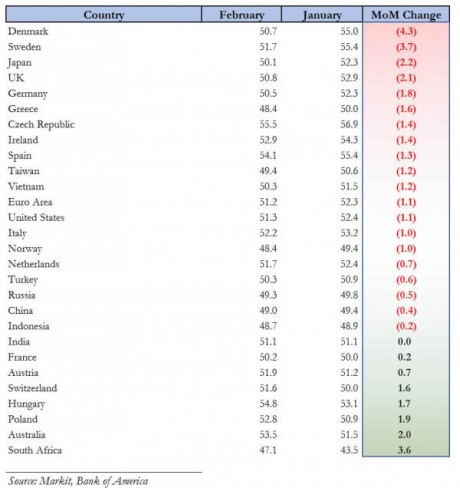
Unfortunately, most Americans don’t really pay much attention to what is going on in the rest of the world. For most of us, what really matters is what is happening inside the good ole USA.
And of course the news is not good. There were more signs of trouble for U.S. manufacturing in the February numbers, and this continues a trend that stretches back well into last year. The following is what Chris Williamson, the chief economist at Markit, had to say about these numbers…
“The February data add to signs of distress in the US manufacturing economy. Production and order book growth continues to worsen, led by falling exports. Jobs are being added at a slower pace and output prices are dropping at a rate not seen since mid-2012.
“The deterioration in the manufacturing sector’s performance since mid-2014 has broadly tracked the dollar’s rise, which makes US goods more expensive in overseas markets and leads US consumers to favour cheaper imported goods.
“With other headwinds including the downturn in the oil sector, heightened uncertainty due to financial market volatility, global growth worries and growing concerns about the presidential election, it’s no surprise that the manufacturing sector is facing its toughest period since the global financial crisis.“
Over the past couple of decades, the U.S. economy has lost tens of thousands of manufacturing facilities. We desperately need a manufacturing renaissance – not another manufacturing decline.
As good paying manufacturing jobs have been shipped overseas, they have been replaced by low paying service jobs. As a result, the middle class is shrinking and the ranks of the poor are exploding.
It is hard to believe, but today more than 45 million Americans are on food stamps, and a significant percentage of those individuals actually have jobs. They are called “the working poor”, and it is becoming a major crisis in this nation.
And no matter what Obama may say, unemployment remains a major problem in the United States as well. At this point, unemployment rates in 36 states are higher than they were just before the last recession hit in 2008.
Of course a lot of people are going to look at this article and will point to the stock market gains of the past couple of weeks as evidence that “things are getting better”. It is this kind of clueless approach that is keeping the American people from coming together on solutions to our problems.
The truth is that the United States has been experiencing economic decline for decades. Our economic infrastructure has been gutted, the middle class is steadily deteriorating, and we have amassed the biggest pile of debt in the history of the world.
Anyone that believes that things are “just fine” is in a massive state of denial. Consuming far more wealth than we produce is not a formula for a sustainable economy, and it is just a matter of time before we find this out the hard way.
Sanders very well poised to turn the table on Clinton: Analyst
An international lawyer and political analyst says Donald Trump may win the Republican nomination but he is going nowhere, while Hillary Clinton’s early lead comes from support in Republican states and may not hold up when the primaries move to states which traditionally are more amenable to Bernie Sanders’ far more progressive political message.
Barry Grossman, who is based on the Indonesian island of Bali, told Press TV on Wednesday that Sanders remains very well poised to turn the tables on Clinton and go on to defeat Trump in a general election, despite the overwhelming mainstream media bias against him.
US voters casted their ballots across 11 states in a day-long contest known as Super Tuesday, when the greatest number of states hold primary elections to pick the Republican and Democratic White House nominees.
Democrat Clinton and Republican Trump both scored major victories on Super Tuesday.
Trump emerged as the winner of Republican contests in Arkansas, Virginia, Georgia, Alabama, Massachusetts, Vermont and Tennessee, while Clinton triumphed in Texas, Georgia, Arkansas, Alabama, Tennessee, Massachusetts and Virginia, according to US media projections.
Sanders won in Vermont, Oklahoma, Minnesota, and Colorado.
Ontario report: Inequality at levels “not seen since the Great Depression”

Via WSWS. This piece was reprinted by RINF Alternative News with permission or license.
Dylan Lubao
A report published by the union-backed Ontario Common Front paints a harrowing portrait of the social devastation inflicted on the province’s working class and poor over the course of a single generation. Titled “Falling Behind”, the report documents the impact of years of right-wing government policies that have laid waste to the jobs and living standards of working Ontarians, producing levels of social inequality not seen since the Great Depression.
The report places responsibility for this social disaster on provincial governments both past and present, which have implemented anti-worker policies in the service of big business. Figures included in the report demonstrate that tax cuts for corporations and the wealthy and years of social spending cuts have crippled public services such as health care and education. The resulting crises, such as overcrowded hospitals, sky-high post-secondary tuition fees, the shuttering of community service organizations, and the slashing of social assistance funds, are then blamed on government “waste” and “inefficiency” and used to justify privatization and still greater cuts.
Although the report points to the depth of the social crisis facing millions of Ontario workers, it omits the central role played by the unions and the New Democratic Party (NDP) in facilitating this situation, and thus only tells half the story.
Among some of the starkest findings in the report are the following:
* At 12 percent of its workforce, Ontario has the highest proportion of minimum wage workers (C$11.25 per hour) in the country.
* In 2009, 13.1 percent of Ontarians, or 1,689,000 people, lived under the poverty line, including 14.6 percent of all children.
* Between 1976 and 2004, the bottom 40 percent—600,000 Ontario families—experienced stagnating or declining incomes, while the wealthiest 10 percent saw their incomes rise by an average 41 percent.
* Public spending per capita in Ontario is the lowest in the country, at C$9,000 per person.
* Almost 400,000 Ontarians used food banks in 2011.
* Almost one quarter of unemployed Ontarians are out of work for six months or longer.
* Child care costs and university tuition fees in Ontario are the highest in the country.
The gap between the wealthiest and the poorest in Ontario is now at its greatest since the 1930s. The ruling class of Ontario, like its counterparts at the national and international level, has accomplished this by effecting a massive transfer of wealth from the bottom to the top, using the 2008 financial crisis as a pretext to accelerate its austerity drive.
Between 1976 and 2004, the chasm between the rich and poor grew ever wider. In 1976, the wealthiest 10 percent of Ontarians earned “just” 27 times more than the poorest 10 percent. By 2004, this had exploded to 75 times more. In the span of one generation, the top 10 percent have experienced a 41 percent increase in net wealth, but the poorest 10 percent have suffered a staggering 150 percent decline.
With almost one third of Ontarians earning within C$4 of the miserable C$11.25-per-hour minimum wage and the price of necessities such as housing, food, and utilities steadily rising, workers and their families increasingly find it difficult to meet basic expenses.
The relentless drive of the banks and corporations to increase profits, in addition to the anemic nature of the so-called economic recovery, has led to the shedding of 318,000 manufacturing jobs since 2000. At least 270,000 new jobs would be required to merely return Ontario’s employment numbers to their pre-recession levels. Instead, corporations have done the opposite, with major layoffs taking place on a monthly basis.
Kathleen Wynne’s Liberal government and its Conservative and NDP predecessors have delivered decades of austerity.
In 2012, the Liberals, led by then-premier Dalton McGuinty, initiated the greatest spending cuts in the province’s history, dwarfing those made by the hated Harris Conservatives in the late 1990s. When the Liberals took office in 2003, they essentially maintained the massive tax cuts for the rich and super-rich, as well as the savage cuts to welfare rates, which had been implemented by their Conservative predecessors.
As a result of these cuts to public services, which include a three-year public spending freeze that began last year and C$7 billion in cuts over the past five years, the social services on which millions of Ontario workers depend have been gutted to the point of near-collapse.
Ontario’s hospitals are the most underfunded in the country, and Ontarians pay more for health care expenses than residents of any other province. More than 30,000 Ontarians at any given moment are waiting for a hospital bed or long-term care, and hospitals regularly operate at or above full capacity.
Social and community services have been hollowed out as a result of drastic budget cuts. Wages within this sector have fallen precipitously as a result of these cuts, to the point that many workers in this sector are forced to use the same services and resources they administer.
“Falling Behind” repudiates the incessant gloating of government and big business representatives about the merits of the “free market” in creating a “just and equitable society.” The real picture that emerges is that of debilitating poverty and hardship for the vast majority of Ontario’s workers, and a feeding frenzy of unprecedented proportions for the wealthy.
At the same time, the Ontario Common Front, which is comprised of 90 community organizations and led by the Ontario Federation of Labour (OFL), maintains an indefensible silence about the role played by the trade unions and the NDP in facilitating this crisis. If “Falling Behind” is a list of crimes perpetrated against the province’s workers and poor, then it is also an implicit indictment of the treachery of the union bureaucracy and the middle class “left.”
The Ontario Common Front was created by the trade union bureaucracy in the wake of the 2011 Occupy protests as a way to corral oppositional and anti-austerity sentiment back behind the pro-capitalist perspective of the union bureaucracy. The participating community groups were solicited so as to give a left-wing gloss to the unions’ thoroughly right-wing nationalist politics.
The unions, while historically tied to the social-democratic NDP, have in one shape or another supported the Liberals’ bids for power since 1998 [http://www.wsws.org/en/articles/2014/06/14/onta-j14.html], when many major unions created the Ontario’s Working Families Coalition to muster votes for the Liberals. Driven by fear of the explosive social power of the working class, which threatened to escape their control during the mass anti-Conservative protests between 1995 and 1997, the unions shifted further to the right, playing a critical role in bringing the big business Liberals to power in Queen’s Park.
The stock-in-trade of the union bureaucracy is the promotion of “strategic voting,” urging support for the “lesser evil” Liberals to prevent a hard-right Conservative government. Once in power, the Liberals invariably implement right-wing policies as demanded by the corporations and financial houses that line Bay Street.
Similarly, the NDP and its pseudo-left supporters, while posing as opponents of austerity and allies of the working class, represent the interests of a thin and affluent middle class layer. Dependent on the capitalist system for their privileged social status and hostile to socialism and the interests of the working class, they have rapidly shed their left-wing pretensions in response to the economic crisis and the resurgence of working class opposition to capitalism.
For 18 months between 2012 and 2014, Andrea Horwath’s NDP was in a de facto coalition with the Liberals, enabling the passage of McGuinty’s devastating austerity budget and its use of strikebreaking legislation to impose a cut in teachers’ real wages. Over the opposition of the unions, Horwath only pulled her party’s support in May 2014 in an attempt to salvage what was left of the NDP’s tattered left credentials. This, however, did not prevent the NDP from running its most right-wing campaign ever in the ensuing election.
An exposure of the sordid machinations of the unions and the NDP would completely undermine the Ontario Common Front’s legitimacy, existing as it does as a tool of the union bureaucracy.
Video: ‘Jungle’ frontline: police move in to clear migrant camp in Calais amid tensions

Around 150 migrants, some armed with iron bars, have attempted to block or climb lorries traveling towards the Eurotunnel, as clashes with police continued into …
Via Youtube
Video: ‘Quite an adrenaline rush’: RT reporters shelled in Syria near Turkish border

RT Spanish correspondent Boris Kuznetsov, RT Arabic correspondent Hassan Nasr, RT cameraman Khaled Eldera and Ruptly cameraman Aleksandr …
Via Youtube
Video: 1 Person 1 Vote? Not in US presidential Elections!

Republicans and Democrats will flock to the polls and meeting rooms on Tuesday across 12 states, where primaries and caucuses will make or break the seven …
Via Youtube
Video: Emergency Simulation: UK holds largest ‘train crash’ drill, 2k people involved

About 2000 volunteers took part in train crash simulation in Dartford, UK, to train rescue workers, ambulance and police to respond to emergency situations.
Via Youtube
Video: ‘I have new cheat box!’ Protester interrupts Volkswagen presentation in Geneva

A presentation at the Geneva Motor Show by a board member of the German carmaker Volkswagen was briefly interrupted by a lone protester on Tuesday.
Via Youtube
Video: US, Israel hold ballistic missile defense drill, test emergency medical response

US and Israeli armies held a joint military drill at an army base in Israel on Tuesday. The exercise stimulated rockets hitting a bus at the Hatzor air force base and …
Via Youtube
Video: Max Blumenthal: GOP Elite Prefer Losing the White House over a Trump Presidency

Author and Journalist Max Blumenthal Says the Republican Party Can’t Stop the Monster their Policies Helped Birth.
Via Youtube
NHS privatisation – Is Hunt selling department to company his cousin is Chair of?

Remember the scandalous disposal of Royal Mail? Both Michael Heseltine and Peter Mandelson had tried and failed to sell it off in 1994 and 2009 respectively, both driven by the Treasury’s need for cash. Vince Cable’s handling of the sale was disastrous.
This time around a new chief executive was hired and by May 2013 Royal Mail delivered a 60 per cent surge in profits. Park that fact for a moment.
Then firms known for their unethical and insatiable greed approach to business, the likes of Goldman Sachs, Lazard and Barclays and a few others were paid nearly £13 million simply for placing shares with clients – but not before setting the share-price at £3.30 which was a clear under valuation. As it turns out, Royal Mail was 24 times over subscribed and on day one 38 per cent under valued. There was a 72 per cent increase in the share value in five months accompanied by a 30 per cent increase in the first class stamp price. This was a proper scandal.
The valuation of £3.3 billion should have been £5.5 billion, the austerity ridden tax-payer the big loser. The banks, hedge funds and financial institutions walked away scot-free. This was nothing short of a corporate heist facilitated by incompetent (at best) or criminal (more likely) politicians.
The National Audit Office was not complimentary in its aftermath; “The sale process used by the Department did not identify the market price of the shares and this is not an isolated example.”
Deloitte Touche were appointed as ‘financial accountants’ earning £750k for their efforts – park that as well.
One privatisation that the establishment press has not reported is the sell-off of NHS Professionals. This is a state owned recruitment agency for medical professionals. NHS Professionals is a limited company wholly owned by the Department of Health. Not for long though.
Video: ‘Turkish military actions on Syrian border could lead to truce disruption’ – Russian MoD

Turkey’s “provocative” military buildup on the border and shelling of the Syrian territory could thwart the truce and disrupt the peace process in the Arab Republic …
Via Youtube
Video: Calais migrants protest eviction from camp, wrestle with police

French authorities continued dismantling the sprawling makeshift migrant camp after a night of violent clashes with some of the thousands of migrants who’ve …
Via Youtube
Video: RAW: Toddler falls out of car trunk in China, driver doesn’t notice

A 2 year old boy got out of the special seat and fell out of the trunk of a car starting from the crossroads in Suzhou, China. The toddler was saved by a passenger …
Via Youtube
Video: Balkan route: Thousands of migrants stuck in Greece as Macedonia warns to seal border

The Balkan refugee route may soon be closed, if Austria reaches its limit of 37500 asylum seekers entries in 2016, Macedonia’s president said, adding that “in …
Via Youtube
Video: Top U.S. & World Headlines — March 1, 2016

Visit http://democracynow.org to watch the full independent, global news hour, read the transcript, search our archive and to make a donation to support us.
Via Youtube
Hillary Clinton’s Dark Drug War Legacy in Mexico


(Image: SOA Watch / Flickr)
Mexico, John M. Ackerman wrote recently for Foreign Policy, “is not a functional democracy.” Instead, it’s a “repressive and corrupt” oligarchy propped up by a “blank check” from Washington.
Since 2008, that blank check has come to over $2.5 billion appropriated in security aid through the Mérida Initiative, a drug war security assistance program funded by Washington. Negotiated behind closed doors in the last years of the Bush administration, the plan was originally proposed as a three-year program. Yet Hillary Clinton’s State Department pushed aggressively to extend it, overseeing a drastic increase of the initiative that continues today.
Much of this aid goes to U.S.-based security, information, and technology contracting firms, who make millions peddling everything from helicopter training to communications equipment to night-vision goggles, surveillance aircrafts, and satellites.
This aid comes in addition to the direct sales of arms and other equipment to Mexico authorized by the State Department, as Christy Thorton pointed out in a 2014 New York Times op-ed. Those sales reached $1.2 billion in 2012 alone, the last full year of Clinton’s tenure. Indeed, as the Mérida Initiative has grown, Mexico has become one of the world’s biggest purchasers of U.S. military arms and equipment.
But while sales have boomed for U.S.-based contractors, the situation in Mexico has badly deteriorated. The escalation of U.S. counter-drug assistance in the country has paralleled a drastic increase in violence, fueling a drug war that’s killed more than 100,000 people since 2006.
State Complicity
High-profile human rights cases — such as the kidnapping and disappearance of the 43 students from the teacher-training college in Ayotzinapa, Guerrero in September 2014 — sparked renewed attention to the devastating effects of the U.S.-funded drug war in Mexico. Yet, they didn’t come out of nowhere.
Forced disappearances like these were ballooning even as Clinton was pushing Mérida Initiative programs forward, with official records reaching upwards of 3,000 to 4,000 people a year in 2011 and 2012. According to the United Nations, these widespread kidnappings and disappearances often involve state authorities, and the problem is worsened by the government’s failure to investigate.
U.S. laws explicitly prohibit the delivery of aid to foreign individuals and units implicated in systematic human rights violations. But files released by WikiLeaks revealed that Clinton’s State Department regularly received information on widespread “official corruption“ in Mexico, even as they were bolstering the flow of equipment, assistance, and training that ended up in the hands of abusive and compromised security forces.
Indeed, in 2009 and 2010 — the middle years of Clinton’s tenure at State — U.S. embassy cables boasted that intelligence and military cooperation between the two countries had never been better. Such cables, and the full archival orbit of declassified and leaked U.S. and Mexican records, demonstrate that Clinton’s State Department repeatedly cleared the delivery of U.S. assistance training and equipment to security forces implicated in corruption or abuse.
One document from June 2011 recorded a visit of U.S. officials to the northern state of Tamaulipas in May 2011 to assess training needs for state security forces. The visit came as Mexico’s federal authorities were trying to cover up the discovery of mass graves from the recent San Fernando massacres in the region. Even as U.S. officials were reporting on the Mexican government’s complicity and cover-up of the massacres, the U.S. embassy recommended further training for Tamaulipas security forces.
The same document also reports that Mexican immigration agents had been fired for kidnapping migrants. Yet the delivery of biometric data equipment to the same agency continued unimpeded.
In the southern state of Guerrero, meanwhile, records from 2009 to 2010 show that the U.S. embassy cleared local and federal police, military officials, and investigative agents for training and assistance from units implicated in human rights violations. Even then, the U.S. embassy — and not to mention reputable human rights groups — knew about the direct involvement of government officials in abuses there.
Human Rights Watch reported in 2011, for example, on widespread cases of torture in Guerrero going back to 1994. The group noted regular abuses by police and military forces, including “cases of homicide, torture, and extortion” overseen by the judicial police chief in the northern part of the state. The same report highlighted strong evidence of the involvement of military officials from Chilpancingo in cases of kidnapping and disappearances in 2010, as the U.S. embassy was clearing officials for training from the same military base.
After government security forces killed two students from the Ayotzinapa teacher training school during a protest in December 2011, U.S. Ambassador to Mexico Earl Anthony Wayne sent a cable reporting that “the evidence of heavy-handed police tactics is strong and disconcerting.” It was the same school where, less than three years later, 43 students would be disappeared — and six others killed — after being attacked by local police forces.
The Beneficiaries
In addition to training Mexico’s security forces, Clinton’s State Department bolstered Mexico’s wiretap capabilities, provided communications systems and computers, and installed information sharing software, biometric databases, and radar systems. It also peddled Blackhawk helicopters, surveillance aircrafts, satellites, and all-terrain vehicles, and built joint-intelligence fusion centers for targeting high-value cartel leaders.
The implementation and delivery of this equipment took place hand-in-hand with private contractors. Major players like General Electric, Honeywell, Motorola, Sharp, IBM, and Dell appear throughout records of these transactions, along with scores of others — including Science Applications International, Rapiscan, American Science and Engineering, RCA, and many more.
Several contractors benefited significantly from helicopter deliveries and services in particular. These played a prominent role in both the conduct and the promotion of the broader drug war effort.
Three Sikorsky UH-60M Black Hawk helicopters, for example, were sent to Mexico’s federal police in November 2010. Just two weeks after their handover, they were deployed in the largest aerial operation conducted to date against the La Familia de Michoacán drug cartel. The U.S. embassy boasted in a secret cable that the operation — which reportedly led to the killing of drug kingpin Nazario Moreno Gonzalez, or “El Chayo” — was a “needed win“ for then-president Felipe Calderón in his increasingly unpopular war against the cartels.
El Chayo’s killing was the first clear evidence the State Department could highlight to show Congress that Calderón’s strategy — and the U.S. intelligence and security aid behind it — was leading to results. Yet the operation, which also caused large-scale civilian deaths, appeared to be in vain: The Mexican government reported that El Chayo was killed again, years later, in an operation carried out against the cartel in March 2014.
Nonetheless, the 2010 operation provided the justification to further ratchet up U.S. support. In May 2011, embassy staff accompanied Mexican federal police representatives to review an aircraft project in North Carolina and receive presentations from the AMCOM missile command and industry representatives. More aircrafts were subsequently delivered.
Sikorsky, along with other companies such as General Electric, continued to reap the benefits of the drug war in Mexico even after Clinton left the State Department. In March 2015, the department approved the sale of three Black Hawk helicopters to the Mexican military for $110 million. This followed a larger deal in April 2014 for 18 Black Hawks at $680 million.
Notably, several of the contractors that profited from U.S. security assistance in Mexico — such as General Electric, Lockheed Martin, and United Technologies Corporation, which owns Sikorsky — reportedly contributed to the Clinton Foundation. And according to the transparency group Open Secrets, Clinton currently tops the list of all 2016 presidential candidates in campaign contributions from the military contracting industry.
Back to Business as Usual
Naturally, Clinton herself was aware of how her department’s support for the Mexican drug war would look in light of the revelations about corruption and human rights abuses.
In January 2011, shortly after the release of a huge tranche of leaked diplomatic cables, Secretary Clinton apologized to her Mexican counterpart Patricia Espinosa for any “embarrassment” caused by the WikiLeaks documents, announcing her intention to get
“beyond WikiLeaks” and reaffirm the U.S.-Mexico relationship. Clinton expressed optimism that they could create a better “narrative” than the waste, fraud, and abuse revealed in the cables and regular media accounts and “explain to Congress why foreign assistance money under ‘Beyond Merida’ should continue.”
Getting beyond WikiLeaks, of course, meant getting back to business as usual — and back behind closed doors.
While thousands of Clinton’s own emails have since been released, the secrecy continues — with much of the important information still heavily redacted. For example, the emails contain potentially important documents, such as a memo to President Obama with a report on Clinton’s trip to Mexico City and Monterrey. This document, however, is completely redacted, except for one line.
In his piece for Foreign Policy, John Ackerman argued that Clinton’s defense of the status quo in Mexico is “grounded in a vicious cycle of complicities between economic and political elites on both sides of the border.” Indeed, the record available for public scrutiny shows that Clinton’s State Department — rather than addressing human rights concerns over the Mérida funding — focused on ensuring that security assistance continued in the face of abuse, cover-ups, and ongoing impunity.
This piece was reprinted from Foreign Policy In Focus by RINF Alternative News with permission.
Video: Toys & Flowers: Muscovites commemorate murdered 4yo child

Moscow is in a state of shock after a woman dressed in black was seen walking around near a metro station with a ‘child’s severed head’ in her hand and …
Via Youtube
Video: Donald Trump Wants to Commit War Crimes and Neocons Still Think He’s Too Moderate

http://democracynow.org – Republican front-runner Donald Trump’s campaign has come under fire from high-level military officials, including former CIA Director …
Via Youtube
Video: Keiser Report: ‘Concrete Club’ of Banking Sector (Episode 882)

Check Keiser Report website for more: http://www.maxkeiser.com/ Every week Max Keiser looks at all the scandal behind the financial news headlines. In this …
Via Youtube
Video: Super Tuesday: Amid Protests over Racism, Donald Trump Appears Poised to Triumph in Key Contests

http://democracynow.org – Super Tuesday has arrived, the biggest primary day in the presidential race. Republicans and Democrats each go to the polls in 11 …
Via Youtube
Video: Radical Danish cleric preaches death to infidels sparks criticism

A radical Danish cleric has sparked a wave of criticism after preaching death for infidels, adulterers and religious traitors among his parishioners. To discuss the …
Via Youtube
Video: Part 1: “We Must & Can Aim High”: Former Labor Secretary Robert Reich on Endorsing Bernie Sanders

http://democracynow.org – We speak with Robert Reich, the former labor secretary under President Bill Clinton from 1993 to 1997, about his decision to formally …
Via Youtube
The Trump Campaign: Bad for America, but Good for CBS

Les Moonves: “It may not be good for America, but it’s damn good for CBS.” (cc photo: David Shankbone/Wikimedia)
CBS CEO Les Moonves, who in December (Intercept, 12/10/15; FAIR.org, 1/23/16) said of GOP presidential candidate Donald Trump, “Go Donald! Keep getting out there!” because “the more they spend, the better it is for us,” had more to say about the business of politics at another investors’ conference, as The Intercept‘s Lee Fang (2/29/16) reported.
Speaking to the Morgan Stanley Technology, Media and Telecom Conference at San Francisco’s Park Hotel, Moonves observed that “in local [broadcasting], the No. 1 word is ‘political’ [advertising],” and continued:
Man, who would have expected the ride we’re all having right now? This is pretty amazing…. Who would have thought that this circus would come to town?
But, you know—it may not be good for America, but it’s damn good for CBS, that’s all I got to say.
So what can I say? It’s—you know, the money’s rolling in, and this is fun.
Moonves noted that the election has been a boost for ratings—“We had a debate a couple of weeks ago, it was 14 million people on a Saturday night. You know, it’s amazing, that’s all I can say”—but, more importantly, the spending by candidates on political advertising goes directly into CBS’s coffers:
Yeah, [Trump’s] getting a lot of free media, but all that’s happening out there, there’s a lot of money in the marketplace, there’s a lot of money in the marketplace….
They’re not even talking about issues. They’re throwing bombs at each other, and I think the advertising reflects that. Most of the ads are not about issues; they’re sort of like the debates. They’re saying, he did this or he did that. Doesn’t say what I stand for.
I’ve never seen anything like this, and this is going to be a very good year for us. Sorry. It’s a terrible thing to say, but bring it on, Donald, go ahead, keep going.
Moonves did not want his cheering on Trump—whose campaign promotes xenophobia, war crimes and threats of violence against various groups, including journalists—to be mistaken for an endorsement:
I said that at another investor conference, and the next day some blog put out, “Moonves Supporting Trump Wholeheartedly.” I said, no no no, I’m not taking any side. I’m just saying, for us, economically, Donald’s place in this election is a good thing.
Moonves chuckles like a Bond villain as he tells his wealthy audience how his company is profiting at the expense of the nation. It’s not actually all that funny, though, for a television executive to celebrate how a campaign that’s hurting the United States is driving his network’s profit bonanza. Among CBS’s chief assets are the 16 TV broadcasting licenses it holds, along with its 117 radio station licenses. These licenses each include a public interest clause:
The licensee shall, during the term of this license, render such broadcasting service as will serve the public interest, convenience, or necessity to the full extent of the privileges herein conferred.
When a broadcaster cheers on the electoral “circus” (“bring it on, Donald, go ahead, keep going”) that he acknowledges “may not be good for America, but it’s damn good for CBS,” can he really be said to be “render[ing] such broadcasting service as will serve the public interest”? Or when he brags about how much money he’s making from running ads that are “not even talking about issues…sort of like the debates”—you know, the ones that his corporation helps put on?
Over decades, the FCC has progressively lowered the standard broadcasters have to meet to fulfill their public interest requirements. But as long as there is any kind of standard, surely “the money’s rolling in, and this is fun” doesn’t meet it.
Hear Les Moonves’ remarks, courtesy of The Intercept:
Jim Naureckas is the editor of FAIR.org. Follow him on Twitter at @JNaureckas.
You can file a complaint with the FCC here.
This piece was reprinted by RINF Alternative News with permission from FAIR.
Video: Former Bush Treasury Official Agrees with Sanders on Breaking Up the Big Banks

Economist Gerald Epstein says President of Minneapolis Federal Reserve Neel KashKari’s Support of Bernie’s Banking Policy is Both Surprising and Welcome.
Via Youtube
Video: Robert Reich: Donald Trump Isn’t a Conservative, He is an Authoritarian

http://democracynow.org – Commenting on the rise of Republican front-runner Donald Trump, Robert Reich, former labor secretary under President Clinton, …
Via Youtube
Video: Iranian Elections: A Blow to Hardliners As New Fault Lines in Iranian Politics Emerge

National Iranian American Council president Trita Parsi says it’s s no longer reformists versus conservatives as much as it is moderates with President Rouhani, …
Via Youtube
Video: Part 2: “We Must & Can Aim High”: Former Labor Secretary Robert Reich on Endorsing Bernie Sanders

http://democracynow.org – We speak with Robert Reich, the former labor secretary under President Bill Clinton from 1993 to 1997, about his decision to formally …
Via Youtube
An Essential Citizen’s Guide to the Truth About GM Crops and Food

GMO Myths and Truths: A Citizen’s Guide to the Evidence on the Safetyand Efficacy of Genetically Modified Crops and Foods, 3rd Edition, by Claire Robinson Mphil, Michael Antoniou PhD and John Fagan PhD
“Many who defend the use of GMO crops and foods claim that there is no evidence that any GMO is harmful to health or the environment. But this is wrong. There is plenty of sound empirical evidence of such harm, presented by qualified scientists in peer-reviewed literature. This book is a succinct summary and documentation of that evidence.” – Richard Jennings, PhD, Department of History and Philosophy of Science, University of Cambridge, UK
Before the internet, you had to head down to the library and try to access certain books and journals to get the information you required. If you were lucky, the publications were in stock and not out on loan; if not, you would have to go on a waiting list or search through what was available on the shelves. And the fact it took months or even years for a text to finally end up in print often meant certain information could already be outdated as soon as it hit the shelves. What now takes two minutes to access on the web, could have taken weeks to access before.
Yet, even with all the information readily available at the fingertips courtesy of the internet, it can still be difficult to find exactly what you want. It can be a case of spending half a day moving from site to site but not really accessing the precise bit of information required or finding everything you need in one place.
Certain fields of knowledge can be wide-ranging and draw from so many disciplines that it can be difficult to know where to begin. And what can be more confusing and indeed controversial than the area of genetically modified organisms (GMOs), food and agriculture?
There is a good deal of misinformation surrounding GMOs, and the enormous wealth of the pro-GMO lobby oils a massive PR machine that clouds the issues and presents GM in a wholly positive light. This wealth is moreover translated into political clout whereby governments and the GM biotech sector conspire to mislead the public and promote this technology.
The industry and its supporters say the technology is safe, increases yields, is better for farmers and the environment, uses less chemical inputs and is necessary to feed the world. They also say critics are ideologically driven, deal in pseudoscience and are Luddites who are stealing food from the bellies of the poor by campaigning against GMO. Such attacks have no basis in reality. But spin and smears are what the industry and its supporters have increasingly come to rely on. It reflects their failure to force GM onto the public and into the fields across most of the world.
A one-stop resource for all things GMO
If ever a comprehensive, one-stop resource were needed to counter the disinformation of the powerful, well-funded pro-GMO lobby, it is now. GMO Myths and Truths is a new book that does just that by presenting the scientific case against genetically modified (GM) crops and foods and deconstructing the propaganda and myths of the pro-GMO lobby. Originally published online in 2012 (second in 2014, also online), it has to date been available to the public as a free pdf download on the Earth Open Source website.
The new printed edition was produced in response to requests for a shorter publication in book form that could be easily read and passed on to others, including policy makers. It was recognised that some find it difficult to read a long document on a computer.
I for one have found the web version of GMO Myths and Truths to be an invaluable one-stop resource over the years. For the layperson, it explains in easy-to-understand terms and steps what genetic engineering is and how it is carried out. It describes and provides access to important scientific studies carried out into the safety and efficacy of GM and looks at the environmental impacts of the technology.
GMO Myths and Truths adopts a comprehensive approach to GM by moving beyond science to address wider issues related to intellectual property rights and seed patenting, alternative models of farming that are more productive and sustainable, food security, hunger and poverty. By addressing these issues, the authors demonstrate that GM is not needed and is being offered as a proxy solution for more deep-seated structural factors.
The conclusion to be drawn is that GM is a convenient diversion from the root causes of inequality, poverty and food insecurity across the globe. GM first and foremost serves the commercial interests of the biotech companies themselves.
The book itself may be described as ‘grey’ literature, in terms of it not being a peer-reviewed publication. But this in itself certainly should not (peer review has become increasingly politicised and open to corporate influence, not least where GM is concerned) and does not detract from its credibility or the validity of the arguments presented. There are in fact more than enough references to official reports, documents and peer-reviewed studies and papers for the reader to check.
New information
Like the pdf version, the book has a convenient layout, making it easy for the reader to locate specific themes and issues. What’s more, it also contains a fair amount of new information that does not appear in the previous editions. It provides updated evidence to dismiss the industry claim of a scientific consensus on GM food safety and new data that further outlines the risks that GMOs pose for health and the environment.
For example, there is information about a peer-reviewed publication by over 300 scientists that declares there is no scientific consensus that GM crops and foods are safe. The ‘trillion meal study’, so often touted by pro-GMO activists, is also deconstructed. The authors show why it fails to provide any credible evidence for GMO safety.
Other information not contained in previous versions sets out why the temporary increase in India’s cotton yield from 2003 to 2011 was not due to GM Bt cotton and why the current (2011 onward) decline is. The book also exposes how the GMO biotech industry’s own tests showed Bt eggplant was toxic and deconstructs the spin surrounding the crop in Bangladesh to show how it has pretty much been a failure.
The authors describe why the US government’s approval of GM crops engineered to resist the herbicides dicamba and glyphosate will create problems for farmers and health risks for consumers, and how a peer-reviewed paper shows claims that GM crops have reduced insecticide use are unreliable because they fail to consider escalating insecticide seed treatments in their calculations
Another new addition describes how a peer-reviewed gene expression analysis confirms that rats fed an ultra-low dose of Roundup (within permitted regulatory limits) suffered liver and kidney damage.
GMO Myths and Truths addresses the concerns that many ordinary people have about the technology. Although it deals with complex issues, it uses simple language and explains the issues in a comprehensible way that appeals to both layperson and professional alike.
“To all those concerned citizens, policymakers, journalists, researchers and students who have missed a reliable, unbiased, comprehensive and readable account of plant genetic engineering and its unpredictable consequences: Here it is, and it is a splendid piece of work!” – Terje Traavik, PhD, Professor of Virology and Professor Emeritus of Gene Ecology, Faculty of Health Sciences, UiT – The Arctic University of Norway; and Scientific Director Emeritus, Gen.k – Centre for Biosafety, Norway
Colin Todhunter is an independent writer. His website is here
Video: Brokered Conventions and Party Breaks Ups Would Make Tuesday Truly Super

Glen Ford, executive editor and founder of BlackAgendaReport.com was back for this installment of The Ford Report in which he talked about the potential value …
Via Youtube
Video: Calls Grow for Wendy’s to Join Fair Food Program as Coalition Plans Major Protest of Fast-Food Giant

http://democracynow.org – This week, Democracy Now! broadcast from Westerville, Ohio, near the headquarters of fast-food giant Wendy’s, where student …
Via Youtube
Video: Days of Revolt: Sacrifice Zones

In this episode of Days of Revolt, Chris Hedges and two Native American activists discuss the violation of land and lives of Indigenous peoples, particularly the …
Via Youtube
Video: Real Journalism Banned From 2016 CNN GOP Presidential Debate
In this video Luke Rudkowski details the extra measures CNN and the GOP are making to keep WeAreChange out of the presidential debate. Check out Change …
source
Video: Oklahoma Cops Suffocate Man to Death in Front of Family
This is an update to a 2014 story. https://photographyisnotacrime.com/2014/02/25/confiscated-video-showing-oklahoma-cops-killing-man-released/
Via Youtube
Video: Wolfgang Halbig: “I’ll give $10,000 To Anyone Who Proves Me Wrong About The Sandy Hook Shooting!”
Please Support The Show – http://richieallen.co.uk/ Wolfgang’s Website: http://SandyHookJustice.Com/ https://www.facebook.com/therichieallenshow …
Via Youtube
Renowned photojournalist assaulted by US Secret Service at Trump rally

Via WSWS. This piece was reprinted by RINF Alternative News with permission or license.
Andre Damon
An agent of the US Secret Service violently assaulted veteran photojournalist Christopher Morris Monday at a rally in Radford University in Virginia for right-wing Republican presidential candidate Donald Trump.
The incident, which was caught on video, is a testament to the brutality of law enforcement forces and the violent climate whipped up at the rallies of right-wing demagogue.
 Christopher Morris
Bystander video showed the Secret Service agent choking the journalist with both hands. “I stepped 18 inches out of the pen and he grabbed me by the neck and started choking me and then he slammed me to the ground,” said Morris.
Morris, who was working on assignment from TIME magazine, was seeking to photograph supporters of the group Black Lives Matter, who staged a protest during Trump’s speech in opposition to a string of racist and xenophobic remarks by the candidate.
Another video showed that Morris played no role in initiating the violence, but rather responded to confrontational behavior from the Secret Service agent, by declaring “f*ck you.” This prompted the assault. The US Constitution protects even offensive speech directed against law enforcement officers, and using such speech as a pretext for violence or arrest is a violation of the First Amendment.
Shortly before the assault, Trump vituperated against reporters, who he said were “amazingly dishonest” and “a real problem in this country.” While he said politicians were “sleaze bags,” “the press is worse,” and the political press is “the worst of all.”
Morris has documented over eighteen foreign conflicts, including the US invasion of Iraq, the Persian Gulf war, and the wars in Afghanistan, Somalia, Yugoslavia and Chechnya. He has extensively documented both the Bush and Obama administrations.
In a statement, Morris said, “I’ve worked for nine years at the White House and have never had an altercation with the Secret Service.”
“The agent’s response was disproportionate and unnecessarily violent. I hope this incident helps call attention to the challenges of press access,” he added.
A review of Morris’ work, available at his web site, reveals him to be an extraordinary gifted and accomplished photographer.
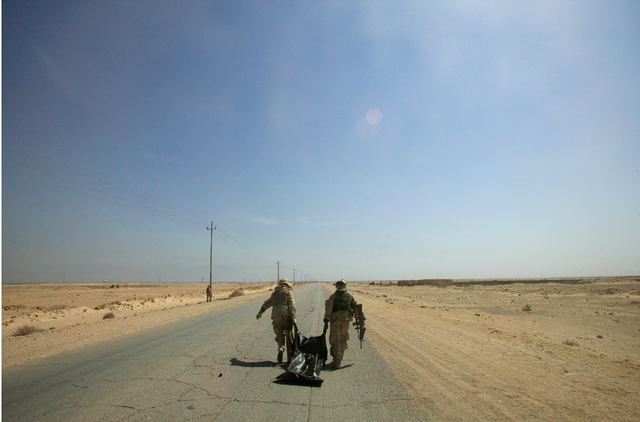 One of Morris’s photos showing US troops dragging a body bag in Iraq
His photojournalism during the Iraq war is at once hauntingly beautiful and unflinching in its depiction of the carnage of the US occupation, and his coverage of the institutions of American state power is subtle and perspicacious.
His second book, Americans, published in 2012, is described by the publisher as presenting “a nation in a state of perpetual loss and its people searching for an identity—stranded within two long-running wars and an economy on the verge of collapse.”
The Dulles Brothers and Their Legacy of Perpetual War
I was intrigued by the 2015 release of David Talbot’s The Devil’s Chessboard: Allen Dulles, the CIA, and the Rise of America’s Secret Government. But it also reminded me of a 2014 book I had been wanting to read titled The Brothers: John Foster Dulles, Allen Dulles, and Their Secret World War by Stephen Kinzer. Since the earlier book covered both important brothers — the younger Allen who was Director of Central Intelligence and the elder John Foster who was Secretary of State — I decided to go with Kinzer.
As it turned out, I was so fascinated by Kinzer’s discussion of the Dulleses that after finishing The Brothers, I dove right into Talbot’s The Devil’s Chessboard. I am so glad that I did. While there is some unavoidable overlap, reading the two books in quick succession is not at all redundant. In fact, they are such splendid complements of each other, that one almost wonders if the two authors coordinated.
Both books are essential reading to understand, not only these two fascinating figures, but the U.S. itself from the post-World War II era to today. The Dulles brothers rose to power at a pivotal moment in American history. The great nations of Europe and East Asia were devastated by the War and for the most part lay prostrate at the feet of the American collossus. Together John Foster and Allen seized the day and fastened the U.S. government upon the world as a hyperactive, ruthless empire committed to perpetual war. In doing so, they also helped fasten an equally hyperactive and ruthless garrison state upon the American people themselves.
This interventionism was framed under the rubric of the Cold War: an all-encompassing struggle pitting the “forces of freedom” against revolutionary communism and Soviet imperialism. In reality it was all about Washington’s own global hegemony, which was advanced especially for the sake of the elite corporate interests that the Dulles brothers had served all throughout their careers.
As the nation’s top diplomat, John Foster established implacable hostility toward the communist bloc as an unshakable tenet of U.S. foreign policy. And for him, even worse than the communists were the “neutralists” who “immorally” refrained from picking sides in the Cold War. These neutralists were even more of a threat because they threatened to defuse what he saw as a necessary conflict. Thus he framed the diverse anti-colonial independence movement sweeping the third world after World War II as little more than a communist plot.
For an active boycott of the Brexit referendum!
Via WSWS. This piece was reprinted by RINF Alternative News with permission or license.
For an active boycott of the Brexit referendum!
Statement of the Socialist Equality Party, British section of the International Committee of the Fourth International
29 February 2016
1. The June 23 referendum on Britain’s membership in the European Union raises issues of immense international importance. The outcome will have implications for workers not only in the UK, but far beyond its shores.
2. The Socialist Equality Party urges workers and young people to boycott the referendum. The Remain and Leave campaigns are both headed by Thatcherite forces that stand for greater austerity, brutal anti-immigrant measures and the destruction of workers’ rights. Their differences are over how best to defend the interests of British capitalism against its European and international rivals under conditions of economic slump and the escalation of militarism and war.
3. A boycott prepares the ground for the development of an independent political struggle of the British working class against these forces. Such a movement must develop as part of a continent-wide counteroffensive by the working class, which will expose the referendum as only an episode in the deepening existential crisis of the British and European bourgeoisie.
4. The question put before the electorate as to whether to “Remain” in or “Leave” the EU conceals everything that must be understood about the implications of both alternatives for the working class. The referendum is the outcome of a manoeuvre by Prime Minister David Cameron in 2013 to prevent a further haemorrhaging of support for the Tories in favour of the United Kingdom Independence Party, even as Cameron sought to utilize the United Kingdom Independence Party’s anti-immigrant xenophobia to push official politics further to the right. Voters are being asked to take a position on whether to Remain or Leave based on the four demands agreed by Cameron with other EU leaders:
- An “emergency brake” on EU migrants claiming in-work benefits that will last for seven years.
- Restriction of child benefits for EU migrants to the rate of their home country.
- A specific opt-out for the UK from the EU’s commitment to forge an “ever closer union.”
- The right of the UK to impose a temporary brake on financial regulations that impact the City of London.
5. There can be no good outcome of such a plebiscite. Whichever side wins, working people will pay the price. It is not a question of choosing the “lesser evil”—both options are equally rotten. Any possibility of an independent voice for the working class being registered has been deliberately excluded. A Remain vote means not only endorsing the reactionary institutions of the EU. The terms negotiated by Cameron as the basis of the UK remaining in the EU sanction his government’s attacks on migrants and measures to protect the criminal activities of the UK’s banks and financial institutions. A Leave vote, however, would be seized on as an endorsement of demands for British “sovereignty” and “independence”—euphemisms for removing all obstacles to the intensified exploitation of the working class and a more ruthless clampdown on immigration.
6. The responsibility of the Socialist Equality Party is to define a policy that upholds the interests of workers not only in Britain, but in Europe as a whole and throughout the world. Every vote or referendum must be evaluated in connection with its specific context. Even then, the tactical approach taken has always to be determined by principled considerations. The SEP’s call for a boycott is not made lightly and has nothing in common with political abstention of an anarchist character. Nor is it advanced as a timeless principle. It is a policy motivated by the need to prepare workers and youth for the bitter class conflicts that will inevitably emerge following June 23.
Oppose the European Union
7. The SEP is irreconcilably hostile to the European Union, but our opposition is from the left, not the right. The EU is not an instrument for realising the genuine and necessary unification of Europe. It is a mechanism for the subjugation of the continent to the dictates of the financial markets and a forum in which competing states fight amongst themselves and conspire against the working class. That is why, especially since the 2008 financial crash, the EU has shed its previous social democratic and liberal pretensions while facilitating the efforts of the ruling elite to utilise the crisis of its own creation to carry out a social counterrevolution. Billions of euros have been handed over to the banks and speculators while working people have been subjected to unending cuts in jobs, wages and social conditions. Greece and other countries have been bankrupted at the behest of the EU and the European Central Bank and their working populations reduced to penury.
8. This is being accompanied by the deliberate whipping up of the most virulent forms of nationalism and xenophobia. After decades in which Europe’s governments proclaimed that the continent would “never again” witness the rule of the swastika and the jackboot, anti-Muslim and anti-immigrant propaganda is employed to provide scapegoats for the social crisis created by austerity and encourage the growth of extreme-right and fascistic movements. Under EU instruction, border fences and concentration camps are being erected as the waves of desperate humanity fleeing the wars, persecution and misery created by the imperialist powers in the Middle East and North Africa find the doors of Fortress Europe slammed shut.
9. The measures directed today against migrant workers will be turned against the entire working class tomorrow. In response to soaring social inequality and growing popular anger, the ruling class is preparing authoritarian forms of rule. It is increasing the powers of the security apparatus, stepping up mass surveillance and destroying democratic rights in the name of the “war on terror.”
10. The right-wing putsch in Ukraine, in which the EU played a leading role, has been used to legitimise the remilitarisation of the continent as part of US-led provocations against Russia. NATO is set to dispatch thousands of troops to Eastern and Central Europe and the Baltic states, while naval drills are being staged with increasing frequency in the Eastern Mediterranean and the Black Sea. Some 25 years after the dissolution of the Soviet Union, the US is expanding its nuclear missile arsenal in Europe as part of what NATO describes openly as preparations for “hybrid warfare” against Russia.
11. Europe’s governments are fully complicit in US aggression, regarding it as an opportunity to realise their own militarist ambitions. Each is looking to increase military spending, even as it savagely attacks workers’ living conditions. The British parliament’s decision to bomb Syria was taken at the same time that Berlin decided in favour of military involvement in the war-ravaged country, as part of its drive to restore Germany’s role as a European and world military power. But even as the US and Europe have joined forces to press their imperialist interests in the Middle East and North Africa, tensions have grown between American and European imperialism, as well as between London, Berlin and Paris. These tensions threaten to plunge the continent into military conflict.
The Remain campaign
12. No support can be extended to the Remain campaign. This option has the backing of much of Britain’s corporate elite, who regard EU membership as essential to their ability to compete internationally—not least through a continued offensive against the living standards of the working class throughout the continent. It also has the support of the United States and the major European powers, which fear that a British exit (Brexit) could provide the catalyst for the EU’s unravelling and jeopardise the NATO alliance and its agenda of militarism and war. Twelve former heads of the armed forces signed a letter in favour of the Remain campaign, insisting that “Britain’s role in the EU strengthens the security we enjoy as part of NATO,” and citing the need to confront Russian “aggression.”
13. With the Tory party in a state of civil war, the Labour Party and the Trades Union Congress (TUC) have rallied to the defence of EU membership. This only confirms that these organisations are organically incapable of taking a position that is not dictated to them by the ruling class—a fact not changed one iota by the election of Jeremy Corbyn as Labour Party leader. Corbyn has come forward as a professional liar and apologist for the EU in an attempt to make it more palatable to those repelled by the noxious chauvinism of the Leave campaign.
14. Corbyn claims that the EU is a source of wealth and jobs and can be reformed to become a “Social Europe”. Not only does this pass over in silence the social crimes the EU has committed in Greece, Ireland, Spain and Portugal, it is aimed at concealing the refusal of the Labour Party and the TUC to wage any struggle against the austerity drive of the Cameron government by promoting the illusion that this task can be left to Brussels. At the same time, Corbyn echoes the anti-migrant agenda, centring his criticism of Cameron’s deal with the EU on the complaint that it “will do nothing to cut inward migration to Britain.” This, and not the actions of the employers and the government, Corbyn blames for driving down pay rates.
15. Corbyn’s pro-EU rhetoric is echoed by pseudo-left groups such as Left Unity and the Scottish Socialist Party, who hold up Syriza in Greece, Podemos in Spain and Die Linke in Germany as allies in the struggle to “democratise” Europe. No greater indictment of such claims can be found than the assigning of leadership of this political charade to Yanis Varoufakis, with his “Plan B” for Europe. As Greece’s former finance minister, Varoufakis shares political responsibility with Syriza leader Alexis Tsipras for the betrayal of the struggle of the Greek working class against EU-dictated austerity. He is the archetypal representative of corrupt and privileged upper-middle class layers who regard the EU as their personal milch cow, and who have seized on the economic crisis as an opportunity to further their own careers and gain lucrative posts in government and the state apparatus. Wherever they have assumed such positions, they have attacked the working class with the same vigour as all other capitalist officials and parties.
The Leave campaign
16. None of this imparts a progressive character to the Leave campaign, or justifies lending even the most critical support to it. Its claim that the British parliament and its parties are any less instruments for imposing the wishes of finance capital than the EU is a transparent fraud. Every leading Tory involved in the campaign has sat in successive governments that have implemented basic attacks on democratic rights, waged bloody wars and thrown millions into poverty. The United Kingdom Independence Party (UKIP), which strikes a populist pose of opposition to the “Westminster elite”, is funded overwhelmingly by multi-millionaire financial speculators Stuart Wheeler and Aaron Banks, and former porn publisher Richard Desmond, now owner of Express newspapers. As to their professed concern with democracy, it is telling that one of the Leave campaign’s central demands is for the scrapping of the European Convention on Human Rights.
17. The economic agenda of the Leave campaign is framed from the standpoint of the City of London, whose position as a global financial centre is held out as offering the prospect of revisiting the halcyon days of empire. When UKIP et al. speak of leaving Europe in order to “turn out to the world”, they are asserting the right of British capital to better exploit the investment opportunities offered by countries such as India, Pakistan, Bangladesh and China, where the annual minimum wage ranges from £600 to slightly more than £1,000. To this end, they will demand that workers in Britain sacrifice their wages and working conditions on the altar of the “national interest.”
18. The Panglossian vision of economic success offered by the Leave campaign is far removed from the reality of a Brexit. Estimates of the impact of leaving the EU on the economy and jobs vary wildly. But a worst-case scenario—based upon a closing off of trade with Europe—calculated a loss of gross domestic product of up to 9 percent, equivalent to the 2008 crash. Especially under conditions of a developing global slump, a Brexit would accelerate the fracturing of the entire continent and of the United Kingdom itself, unleashing national and separatist tensions and encouraging protectionism and trade war measures. Seizing on Cameron’s initiative, the National Front in France is already urging a “Franxit”, while the far-right Fidesz government in Hungary has called a referendum to endorse anti-migrant quotas.
19. British workers cannot find a way out of the current economic and political impasse on the basis of a nationalist programme. The notion of returning to an isolated and sovereign British state in today’s global economy is as archaic as Stonehenge. In his 1934 essay, “Nationalism and Economic Life,” Trotsky posed the fundamental choice facing humanity as either a descent into nationalist and fascist reaction and war, or a turn towards the building of a new socialist world order. He described as “the basic tendency of our century… the growing contradiction between the nation and economic life,” and posed the question:
How may the economic unity of Europe be guaranteed, while preserving complete freedom of cultural development to the people living there? How may unified Europe be included within a coordinated world economy? The solution to this question may be reached not by deifying the nation, but on the contrary by completely liberating productive forces from the fetters imposed upon them by the national state. But the ruling classes of Europe, demoralized by the bankruptcy of military and diplomatic methods, approach the task today from the opposite end, that is, they attempt by force to subordinate economy to the outdated national state… decadent fascist nationalism, preparing volcanic explosions and grandiose clashes in the world arena, bears nothing except ruin. All our experiences on this score during the last 25 or 30 years will seem only an idyllic overture compared to the music of hell that is impending.
Reject “left” nationalism
20. The first consideration of socialists is to safeguard not only the present interests of the working class, but also its future. The biggest political danger in this situation is the mixing of class banners on the basis of the espousal of a supposedly “left nationalism”. It was on the basis of opposition to such a policy that the SEP rejected support for Scottish separatism in the 2014 referendum, characterising it as a retrograde step that cut across the unity of the working class in England and Scotland. Today, the Scottish National Party is threatening a second referendum in the event of a Brexit, on the explicit basis of support for Scotland’s membership in the EU.
21. In the June 23 referendum, a politically criminal role is being played by George Galloway, the leader of the nominally anti-war RESPECT party, and pseudo-left organisations such as the state capitalist Socialist Workers Party (SWP) and the Socialist Party (SP), a section of the Committee for a Workers’ International. They have utilised left phraseology only to align the working class with a right-wing initiative. Galloway has joined public platforms with UKIP to argue for a Brexit, asserting that divisions between “left” and “right” and between the working class and the ruling class count for nothing when compared with the necessity to defend national sovereignty. He defined “internationalism” as the British bourgeoisie’s right to trade with the Commonwealth, Brazil, Russia, India, China and South Africa, describing them as countries “where the sun is rising, not setting…”
22. This calculated invocation of Britain’s imperial past is of a piece with his rallying call, “Left, Right, Left Right, forward march to victory on the 23rd of June.” On Twitter, Galloway said of UKIP leader Nigel Farage, “We are allies in one cause… Like Churchill and Stalin…” Galloway is fully aware that his analogy will be understood by his audience as an appeal to the jingoism and anti-German sentiment that animates their opposition to the EU. He stands in the politically degraded tradition of Stalinism, with its long history of opportunist alliances with right-wing nationalism. To praise Stalin is to solidarise with the gravedigger of the October 1917 Revolution and the architect of political crimes that cost the lives of millions—a man whose alliance with Churchill was preceded by the Hitler-Stalin pact.
23. Those who claim that their anti-EU campaign is independent of Farage and company are perpetrating a fraud. The Rail, Maritime and Transport union (RMT), the train drivers union ASLEF, the Stalinist Morning Star newspaper and the group Trade Unions Against the EU, along with the pseudo-left SWP, its offshoot Counterfire and the SP, all assert that it is possible to wage a parallel initiative to the official Leave campaign on a “progressive” and “socialist” basis. However, their declared opposition to the Tories and UKIP and their invocation of socialist phrases count for little.
24. The lack of seriousness in their approach is epitomised by their focus on the supposed opportunity represented by a Brexit to “ mess up the Tories” and provide a means to “remove Cameron.” They give no consideration as to who is supposed to be removing Cameron and to what purpose. They are wholly indifferent to the actual forces being strengthened by the Leave campaign. In reality, they are subordinating the working class to an initiative aimed at shifting political life even further along a nationalist trajectory, thereby strengthening and emboldening the far right in the UK and across Europe, while weakening the political defences of the working class. Having helped release the genie of British nationalism, they are politically responsible for its consequences.
Lessons of history
25. The lessons of the German workers’ movement underscore the deadly consequences of aligning the working class with right-wing forces. In December 1929, a referendum was held on the instigation of the German Nationalist Party. It sought to introduce a “Law Against the Enslavement of the German People” that would formally renounce the Treaty of Versailles and end the payment of reparations to the victorious powers in the First World War. There was mass opposition to the terms of Versailles, but the referendum was recognised by class conscious workers for what it was—an effort to exploit this sentiment by the nationalist right, and especially Hitler’s Nazi Party, which used it to establish its national presence.
26. The Communist Party of Germany (KPD) opposed the referendum and turnout was less than 15 percent. However, it in its aftermath, under instruction from Stalin and the Comintern, the KPD began a process of wholesale adaptation to German nationalism with the adoption of “National Bolshevism.”
27. By 1931, the KPD’s retreat was such that it lined up with the fascists in supporting what it dubbed the “Red Referendum”. Initiated by the Nazis, the referendum urged the removal of the Social Democrats from power in Prussia, Germany’s largest state, which included the capital Berlin. The KPD supported the referendum on the basis that the Social Democrats were “social fascists” and were engaged in repression against the working class. Their removal, the KPD claimed, would be a step towards “national liberation” and a “people’s revolution.”
28. Trotsky’s scathing critique of the KPD is equally a devastating indictment of the role being played today by Galloway and the pseudo-left:
In the conduct of the Central Committee of the German Communist Party, everything is wrong: the evaluation of the situation is incorrect, the immediate aim incorrectly posed, the means to achieve it incorrectly chosen.
29. The KPD had formed a de facto united front with the fascists, Trotsky explained:
If one could designate his party adherence on the ballots, then the referendum would at least have the justification (in the given instance, absolutely insufficient politically) that it would have permitted a count of its forces and by that itself, separate them from the forces of fascism. But German ‘democracy’ did not trouble in its time to provide for participants in referendums the right to designate their parties. All the voters are fused into one inseparable mass which, on a definite question, gives one and the same answer…
Whether the fascists vote together with the Communists or not would lose all significance at the moment when the proletariat, by its pressure, overthrows the fascists and takes the power into its own hands… To come out into the streets with the slogan ‘Down with the Brüning-Braun [Centre Party/Social Democratic Party] government’ at a time when, according to the relationship of forces, it can only be replaced by a government of Hitler-Hugenberg [German National Party], is the sheerest adventurism… Consequently, we consider the coincidence of voting with the fascists not from the point of view of some abstract principle, but from the point of view of the actual struggle of the classes for power, and the relationship of forces at a given stage of this struggle.
For an active boycott
30. Trotsky’s insistence on a concrete appraisal of the relationship of class forces informs the SEP’s attitude towards the June 23 referendum. There are occasions in which it would be entirely correct to endorse a vote to quit the EU. Under conditions of a movement of the working class involving mass strikes and appeals for solidarity with the Greek masses and other victims of EU diktats, a vote to leave would acquire an anti-capitalist character.
31. This is not the case today. This is the political responsibility of the pseudo-left groups, all of whom hailed Syriza as a model for waging a struggle against EU austerity. Had Syriza honoured the massive mandate of the July 5, 2015 referendum in Greece and taken up a political struggle against the EU, the entire political situation in Europe would have been altered. The Brexit vote would be taking place under conditions where the working class was shaping events instead of right-wing political forces. But then it could be expected that neither Cameron nor UKIP would be pressing for a ballot.
32. Given today’s specific circumstances, an active boycott provides the only means through which workers and young people can express an independent class standpoint. Our call is based upon the position advocated by Lenin in 1905 in relation to the reactionary constitution drafted by the Russian minister of the interior, Alexander Bulygin. Urging a boycott of the parliament, or Duma, as part of a revolutionary struggle against Tsarism, Lenin explained:
If we are not mistaken this idea is already fairly widespread among the comrades working in Russia, who express it in the words: an active boycott. As distinct from passive abstention, an active boycott should imply increasing agitation tenfold, organising meetings everywhere, taking advantage of election meetings, even if we have to force our way into them, holding demonstrations, political strikes, and so on and so forth….
33. The SEP conceives of an active boycott not as an individual protest, but as a means of beginning the political clarification of the working class and countering the disorientation created by the Labour and trade union bureaucracy and its pseudo-left apologists. We will utilise the active boycott campaign to provide workers and youth with a conscious political orientation and leadership.
For the United Socialist States of Europe
34. The campaign for the active boycott is intimately bound up with the task of transforming the International Committee of the Fourth International (ICFI) into the international centre of revolutionary opposition to militarism and war. We will work in close collaboration with our European and international co-thinkers, especially the Socialist Equality Party of Germany, to popularise and promote the ICFI’s manifesto Socialism and the Fight Against War, which lays down four criteria on which a new anti-war movement must be based:
- The struggle against war must be based on the working class, the great revolutionary force in society, uniting behind it all progressive elements in the population.
- The new anti-war movement must be anti-capitalist and socialist, since there can be no serious struggle against war except in the fight to end the dictatorship of finance capital and the economic system that is the fundamental cause of militarism and war.
- The new anti-war movement must therefore, of necessity, be completely and unequivocally independent of, and hostile to, all political parties and organizations of the capitalist class.
- The new anti-war movement must, above all, be international, mobilizing the vast power of the working class in a unified global struggle against imperialism. The permanent war of the bourgeoisie must be answered with the perspective of permanent revolution by the working class, the strategic goal of which is the abolition of the nation-state system and the establishment of a world socialist federation. This will make possible the rational, planned development of global resources and, on this basis, the eradication of poverty and the raising of human culture to new heights.
35. Against the national chauvinism and xenophobia promoted by both sides in the referendum campaign, the working class must advance its own internationalist programme to unify the struggles of workers throughout Europe in defence of living standards and democratic rights. The alternative for workers to the Europe of the transnational corporations is the struggle for the United Socialist States of Europe.
36. The post-1945 project of European unification was an attempt by the ruling elites to resolve the fundamental contradiction that had twice in the 20th century plunged the continent into war—between the integrated character of European and global production and the division of the continent into antagonistic nation states. Economic integration came to be considered as essential to enable Europe to compete effectively in the global marketplace against the United States, with the ultimate aim of an accompanying move towards political union. At the same time, US imperialism promoted the integration of capitalist Europe as a bulwark against the Soviet Union and the threat of socialist revolution by a militant and radicalized European working class. But unity within the framework of capitalism could never mean anything other than the domination of the most powerful nations and corporations over the continent and its peoples. Rather than national and social antagonisms being alleviated, they have taken on malignant forms.
37. The EU is breaking apart and cannot be revived. It is only through the creation of the United Socialist States of Europe, established as an integral component of a world federation of socialist states, that the vast productive forces of the continent can be utilised for the benefit of all. Throughout Europe there are growing indications of a coming eruption of the class struggle. Mass opposition already exists to the devastating impact of austerity, the assault on democratic rights, military barbarism and colonial-style wars of conquest. But this presently finds no political expression. The SEP and the ICFI offer a perspective on the basis of which the rising oppositional sentiment in the working class can coalesce and become a mighty and unstoppable revolutionary force. We urge all those who agree with us to join the SEP and build it as the new revolutionary leadership of the working class.
No to the European Union—No to British nationalism!
For the unity of the British and European working class!
For the United Socialist States of Europe!
Police refuse to release video showing shooting of Salt Lake City teenager
Via WSWS. This piece was reprinted by RINF Alternative News with permission or license.
By David Brown
Protests broke out over the weekend in Salt Lake City, Utah, after police shot a teenage boy, Abdi Mohamed, Saturday night. Mohamed remains in critical condition, and more protests are planned throughout the week.
 Abdi Mohamed
On Sunday, the Salt Lake City Police Department (SLCPD) announced that it would not be releasing video footage from the body cameras of the two offers involved in the shooting, citing an “ongoing investigation.” The officers’ names have also not been released.
Witnesses told local news that a fight broke out between Mohamed, 17, and an unidentified older man shortly before 8:00 p.m., and Mohamed picked up a nearby broom handle. Police already in the area responding to another call ordered Mohamed to drop the broom handle and then immediately opened fire.
The man that police claim Mohamed and another individual were hitting with sticks did not require medical attention.
One witness, Selam Mohammed, told Fox13: “The police said ‘drop it’ once, then they shot him four times. We were trying to break it up before the police even came, but the police ran in on foot and pulled their guns out already. They already had them, like, as soon as [the officer] was running he was already grabbing for his gun, not even trying to Tase him or anything.”
Abdi Mohamed is from Kenya and moved to the US 10 years ago with his family. He lives in West Valley City, a Salt Lake City suburb, with his girlfriend, Becca Monson, and their son. “He was a really caring, good, loving boyfriend, and a really good, caring, loving father,” Monson told Fox. “He just wanted to make sure we were loved and we were happy.”
The SLCPD told reporters Saturday night that at least two officers were involved in the shooting. Crowds of people at the scene started yelling at police and throwing rocks and bottles. The shooting took place near a shopping mall and the Road Home, a homeless shelter.
The police responded by calling in backup from neighboring police departments. Over 100 officers showed up in riot gear to disperse the crowds and barricade a four-block area around the scene. Public transportation in the area was shut down for three hours. Witnesses told reporters that the police used pepper spray and Tasers on the crowds. SLCPD acknowledged that they had detained some protesters, but they have not confirmed how many or what they were arrested for.
Detective Ken Hansen, with the Unified Police Department, told reporters that “there were pockets of that disturbance for hours.”
Police kill on average three people a day in the United States and injure significantly more. According to the Guardian, 169 people have been killed by police so far this year, following 1,140 last year. A separate tally, by killedbypolice.net, put the number of individuals killed in 2015 at 1,205.
Popular anger over police brutality finds no expression within the political system where Democrats and Republicans have jointly supported the militarization of police under the guise of “combating terrorism.”
Never combine these over-the-counter drugs – your life may be endangered

Never before in the history of the world has the general public relied so heavily on pharmaceuticals to treat pain, calm nerves, or address a serious medical condition. And with so many different types of drugs, as well as different combinations of drugs available to consumers today, the threat of creating a deadly chemical experiment in your medicine cabinet couldn’t be more real.
Most people who take pharmaceuticals probably aren’t thinking about how the individual drugs they take might act differently inside their bodies when exposed to other drugs. This phenomenon is called a drug interaction, and depending on the types of drugs being ingested, such an interaction could spell the end of one’s life.
The following five examples represent deadly drug combinations that you never want to ingest at the same time if you care about staying alive:
1) Painkillers and anti-anxiety medications. The metabolic pathways inside the body that are affected by opioid painkillers like hydrocodone (Oxycontin) are the same ones affected by benzodiazepines. Both classes of drugs depress certain bodily functions, mainly those that express pain and physical anxiety.
By taking both drugs at the same time, users put themselves at risk of serious illness, not the least of which includes heart failure. Combining opioids with benzodiazepines might increase the intoxicating “high” that comes from the use of both drugs, leading to less pain and anxiety, but doing so could cost you your life!
2) Cold medications and acetaminophen. Since many varieties are sold over the counter, cold medications are considered by many people to be mostly harmless. But the truth is that they contain ingredients like dextromethorphan that, when combined with OTC painkillers like acetaminophen (Tylenol), can lead to liver failure, also known as death.
Some cold medicines like DayQuil actually contain both ingredients in the same formula, which means they’re a recipe for liver failure available right on the drug store shelf. Be very careful when using any of these products, especially if you plan to administer them to a sick child or someone with a compromised immune system.
3) Statin drugs and anti-fungal medications. On their own, statin drugs are a great way to destroy your brain and adrenals. But these cholesterol-lowering drugs are even more dangerous when taken in tandem with anti-fungal medications like clotrimazole (Lotrimin), which dramatically increase one’s risk of experiencing kidney failure.
Other serious risks include immune system failure due to depletion of coenzyme Q10, neurological disease, insulin resistance leading to diabetes, and cellular dysfunction in the form of mitochondrial failure.
4) Combinations of non-steroidal anti-inflammatory drugs (NSAID). If you’re going to take an OTC painkiller to treat that headache or muscle cramp, you’re better off sticking to just one. Common drugs like naproxen (Aleve), ibuprofen (Advil, Motrin), and aspirin come with their own inherent risks when taken alone, but they become even more toxic when taken in combination.
Mixing any of these drugs together, even at recommended doses, can increase one’s risk of permanent liver damage, so be sure to exercise caution – or better yet, look for a natural alternative like therapeutic cannabis that won’t damage your vital organs!
Cough medicine and St. John’s Wort. Many OTC cough medicines contain additives that cause the body to produce too much serotonin, a condition known as serotonin syndrome. And this condition can potentially be worsened if you also take the herb St. John’s Wort, a natural remedy for depression that also increases serotonin levels.
Too much serotonin in the body can lead to confusion, loss of physical control, chronic pain, problems seeing clearly and even death. Your best bet is to skip the cough medicine altogether if you wish to take St. John’s Wort.
Sources for this article include:
Reprinted on RINF Alternative News with permission from
Natural News.
A Plea for Reason on Israel
Alon Ben-Meir, born to an Iraqi Jewish family and a longtime negotiator between Israelis and Arabs, has faced accusations of over-optimism on the possibilities of peace but has now reluctantly concluded that Israeli Prime Minister Netanyahu has no interest in reconciliation, prompting this open letter called “a plea for reason.” By Alon Ben-Meir Dear Prime… Read more
Donald Trump Is Right – Here Are 100 Reasons Why We Need To Audit The Federal Reserve

Michael Snyder
(RINF) – When one of our major politicians gets something exactly right, we should applaud them for it. In this case, Donald Trump’s call to audit the Federal Reserve is dead on correct. Most Americans don’t realize this, but the Federal Reserve has far more power over the economy than anyone else does – including Barack Obama. Financial markets all over the planet gyrate wildly at the smallest comment from Fed officials, and virtually every boom and bust cycle over the past 100 years can be traced directly back to specific decisions made by the Federal Reserve. We get all excited about what various presidential candidates say that they “will do for the economy”, but in the end it is the Fed that is holding all of the cards. The funny thing is that the Federal Reserve is not even part of the federal government. It is an independent private central bank that was designed by very powerful Wall Street interests a little over 100 years ago. It is at the heart of the debt-based financial system which is eating away at America like cancer, and it has no direct accountability to the American people whatsoever.
The Fed has been around for so long that most people assume that we need it.
But the truth is that we don’t actually need the Federal Reserve. In fact, the greatest period of economic growth in United States history happened during the decades before the Federal Reserve was created.
A little over 100 years ago, very powerful forces on Wall Street successfully pushed for the creation of an immensely powerful central bank, and since that time the value of the U.S. dollar has fallen by about 98 percent and our national debt has gotten more than 5000 times larger.
The Federal Reserve does whatever it feels like doing, and Fed officials insist that the institution must remain “independent” and “above politics” because monetary policy is too important to entrust to the American people.
To me, this is absolutely ridiculous. Everything else, including our national defense, is subject to the normal political process, and yet the decisions made by the Fed are so “important” that the American people can’t have a voice?
It is high time that the American people begin to learn what the Federal Reserve is really all about, and that can start with a full, comprehensive audit of all of the Federal Reserve’s activities. Yesterday, Donald Trump came out in favor of such an audit…
It is so important to audit The Federal Reserve, and yet Ted Cruz missed the vote on the bill that would allow this to be done.
— Donald J. Trump (@realDonaldTrump) February 22, 2016
Previously, Trump has made quite a few comments that were very critical of the Fed. For example, last year he told Bloomberg News that he believed that the Federal Reserve was “creating a bubble”…
“In terms of real estate, if I want to develop … from that standpoint I like low interest rates. From the country’s standpoint, I’m just not sure it’s a very good thing, because I really do believe we’re creating a bubble.”
And of course Trump was exactly right about that too. By pushing interest rates to artificially low levels and creating billions upon billions of dollars out of thin air during the quantitative easing era, stock prices were driven to ridiculously high levels. Now that the artificial support has been withdrawn, stocks are beginning to crash, and the financial collapse which is starting to happen is going to be far worse than it otherwise would have been because of the Fed’s actions. The following comes from one of my previous articles…
As stocks continue to crash, you can blame the Federal Reserve, because the Fed is more responsible for creating the current financial bubble that we are living in than anyone else. When the Federal Reserve pushed interest rates all the way to the floor and injected lots of hot money into the financial markets during their quantitative easing programs, this pushed stock prices to wildly artificial levels. The only way that it would have been possible to keep stock prices at those wildly artificial levels would have been to keep interest rates ultra-low and to keep recklessly creating lots of new money. But now the Federal Reserve has ended quantitative easing and has embarked on a program of very slowly raising interest rates. This is going to have very severe consequences for the markets, but Janet Yellen doesn’t seem to care.
I don’t understand why so many Americans continue to support the Federal Reserve.
We don’t need a bunch of central planners setting interest rates and determining monetary policy. We are supposed to have a free market system, and the free market should be setting interest rates – not the Federal Reserve.
Unfortunately, just about every nation on the entire planet now has a central bank. Even though the nations of the world can’t agree on much, somehow central banking has been adopted virtually everywhere. At this point, more than 99.9% of the population of the world lives in a country that has a central bank.
There are still some minor island countries such as the Federated States of Micronesia that do not have a central bank, but the only major nation not to have one right now is North Korea. And nobody in their right mind would ever want to live there.
So how in the world did this happen?
Did the people of the world willingly choose this debt-based system or was it imposed upon them?
To my knowledge, there has never been a single vote where the population of a nation has willingly chosen to establish a central bank. I could be wrong about this, but I have never heard of one.
It is the elite that have always wanted central banking, and now they pretty much have the entire planet in their grasp.
That is why we should applaud Donald Trump when he stands up to the elite. And it isn’t just regarding the Fed that he has done this. The following comes from an excellent article that was just written by Dan Lyman…
Ultimately, Trump knows it is the global elite who have pried our borders wide open. He knows it is THEY who are responsible for the tens of millions of Third Worlders pouring into our nations. He knows that THEY are the monsters who need the world to be constantly at war. He knows THEY are radically altering our food supply with GMOs and poisonous chemicals. He knows THEY are responsible for poisoning our drinking water, filling our skies and air supplies with toxic waste, genociding our unborn children, collecting data on all citizens to implement the Orwellian police state, forcing poison into our babies’ veins – and soon the rest of us, redistributing what remains of our wealth under the guises of ‘saving the planet’ or ‘refugee aid,’ allowing and funding the ISIS Islamofascists to decimate places like Syria and Iraq in Satanic fashion, promoting the psychotic LGBT Nazis to goose-step all over our religious liberties and gender-privacy in school bathrooms. If there is a societal cancer metastasizing somewhere, it can usually be traced back to the same sources.
Yes, there are many things that we can criticize Trump and the other Republican candidates for. But when they nail something, we should be willing to admit that they got something right.
In this case, Donald Trump is absolutely correct to call for an audit of the Fed. As I promised in the title of this article, I want to share 100 reasons why the Fed should be audited. The following list has been adapted from one of my previous articles…
#1 We like to think that we have a government “of the people, by the people, for the people”, but the truth is that an unelected, unaccountable group of central planners has far more power over our economy than anyone else in our society does.
#2 The Federal Reserve is actually “independent” of the government. In fact, the Federal Reserve has argued vehemently in federal court that it is “not an agency” of the federal government and therefore not subject to the Freedom of Information Act.
#3 The Federal Reserve openly admits that the 12 regional Federal Reserve banks are organized “much like private corporations“.
#4 The regional Federal Reserve banks issue shares of stock to the “member banks” that own them.
#5 100% of the shareholders of the Federal Reserve are private banks. The U.S. government owns zero shares.
#6 The Federal Reserve is not an agency of the federal government, but it has been given power to regulate our banks and financial institutions. This should not be happening.
#7 According to Article I, Section 8 of the U.S. Constitution, the U.S. Congress is the one that is supposed to have the authority to “coin Money, regulate the Value thereof, and of foreign Coin, and fix the Standard of Weights and Measures”. So why is the Federal Reserve doing it?
#8 If you look at a “U.S. dollar”, it actually says “Federal Reserve note” at the top. In the financial world, a “note” is an instrument of debt.
#9 In 1963, President John F. Kennedy issued Executive Order 11110 which authorized the U.S. Treasury to issue “United States notes” which were created by the U.S. government directly and not by the Federal Reserve. He was assassinated shortly thereafter.
#10 Many of the debt-free United States notes issued under President Kennedy are still in circulation today.
#11 The Federal Reserve determines what levels some of the most important interest rates in our system are going to be set at. In a free market system, the free market would determine those interest rates.
#12 The Federal Reserve has become so powerful that it is now known as “the fourth branch of government“.
#13 The greatest period of economic growth in U.S. history was when there was no central bank.
#14 The Federal Reserve was designed to be a perpetual debt machine. The bankers that designed it intended to trap the U.S. government in a perpetual debt spiral from which it could never possibly escape. Since the Federal Reserve was established 100 years ago, the U.S. national debt has gotten more than 5000 times larger.
#15 A permanent federal income tax was established the exact same year that the Federal Reserve was created. This was not a coincidence. In order to pay for all of the government debt that the Federal Reserve would create, a federal income tax was necessary. The whole idea was to transfer wealth from our pockets to the federal government and from the federal government to the bankers.
#16 The period prior to 1913 (when there was no income tax) was the greatest period of economic growth in U.S. history.
#17 Today, the U.S. tax code is about 13 miles long.
#18 From the time that the Federal Reserve was created until now, the U.S. dollar has lost 98 percent of its value.
#19 From the time that President Nixon took us off the gold standard until now, the U.S. dollar has lost 83 percent of its value.
#20 During the 100 years before the Federal Reserve was created, the U.S. economy rarely had any problems with inflation. But since the Federal Reserve was established, the U.S. economy has experienced constant and never ending inflation.
#21 In the century before the Federal Reserve was created, the average annual rate of inflation was about half a percent. In the century since the Federal Reserve was created, the average annual rate of inflation has been about 3.5 percent.
#22 The Federal Reserve has stripped the middle class of trillions of dollars of wealth through the hidden tax of inflation.
#23 The size of M1 has nearly doubled since 2008 thanks to the reckless money printing that the Federal Reserve has been doing.
#24 The Federal Reserve has been starting to behave like the Weimar Republic, and we all remember how that ended.
#25 The Federal Reserve has been consistently lying to us about the level of inflation in our economy. If the inflation rate was still calculated the same way that it was back when Jimmy Carter was president, the official rate of inflation would be somewhere between 8 and 10 percent today.
#26 Since the Federal Reserve was created, there have been 18 distinct recessions or depressions: 1918, 1920, 1923, 1926, 1929, 1937, 1945, 1949, 1953, 1958, 1960, 1969, 1973, 1980, 1981, 1990, 2001, 2008.
#27 Within 20 years of the creation of the Federal Reserve, the U.S. economy was plunged into the Great Depression.
#28 The Federal Reserve created the conditions that caused the stock market crash of 1929, and even Ben Bernanke admits that the response by the Fed to that crisis made the Great Depression even worse than it should have been.
#29 The “easy money” policies of former Fed Chairman Alan Greenspan set the stage for the great financial crisis of 2008.
#30 Without the Federal Reserve, the “subprime mortgage meltdown” would probably never have happened.
#31 If you can believe it, there have been 10 different economic recessions since 1950. The Federal Reserve created the “dotcom bubble”, the Federal Reserve created the “housing bubble” and now it has created the largest bond bubble in the history of the planet.
#32 According to an official government report, the Federal Reserve made 16.1 trillion dollars in secret loans to the big banks during the last financial crisis. The following is a list of loan recipients that was taken directly from page 131 of the report…
Citigroup – $2.513 trillion
Morgan Stanley – $2.041 trillion
Merrill Lynch – $1.949 trillion
Bank of America – $1.344 trillion
Barclays PLC – $868 billion
Bear Sterns – $853 billion
Goldman Sachs – $814 billion
Royal Bank of Scotland – $541 billion
JP Morgan Chase – $391 billion
Deutsche Bank – $354 billion
UBS – $287 billion
Credit Suisse – $262 billion
Lehman Brothers – $183 billion
Bank of Scotland – $181 billion
BNP Paribas – $175 billion
Wells Fargo – $159 billion
Dexia – $159 billion
Wachovia – $142 billion
Dresdner Bank – $135 billion
Societe Generale – $124 billion
“All Other Borrowers” – $2.639 trillion
#33 The Federal Reserve also paid those big banks $659.4 million in “fees” to help “administer” those secret loans.
#34 During the last financial crisis, big European banks were allowed to borrow an “unlimited” amount of money from the Federal Reserve at ultra-low interest rates.
#35 The “easy money” policies of Federal Reserve Chairman Ben Bernanke have created the largest financial bubble this nation has ever seen, and this has set the stage for the great financial crisis that we are rapidly approaching.
#36 Since late 2008, the size of the Federal Reserve balance sheet has grown from less than a trillion dollars to more than 4 trillion dollars. This is complete and utter insanity.
#37 During the quantitative easing era, the value of the financial securities that the Fed has accumulated is greater than the total amount of publicly held debt that the U.S. government accumulated from the presidency of George Washington through the end of the presidency of Bill Clinton.
#38 Overall, the Federal Reserve now holds more than 32 percent of all 10 year equivalents.
#39 Quantitative easing creates financial bubbles, and when quantitative easing ends those bubbles tend to deflate rapidly.
#40 Most of the new money created by quantitative easing has ended up in the hands of the very wealthy.
#41 According to a prominent Federal Reserve insider, quantitative easing has been one giant “subsidy” for Wall Street banks.
#42 As one CNBC article stated, we have seen absolutely rampant inflation in “stocks and bonds and art and Ferraris“.
#43 Donald Trump once made the following statement about quantitative easing: “People like me will benefit from this.”
#44 Most people have never heard about this, but a very interesting study conducted for the Bank of England shows that quantitative easing actually increases the gap between the wealthy and the poor.
#45 The gap between the top one percent and the rest of the country is now the greatest that it has been since the 1920s.
#46 The mainstream media has sold quantitative easing to the American public as an “economic stimulus program”, but the truth is that the percentage of Americans that have a job has actually gone down since quantitative easing first began.
#47 The Federal Reserve is supposed to be able to guide the nation toward “full employment”, but the reality of the matter is that an all-time record 102 million working age Americans do not have a job right now. That number has risen by about 27 million since the year 2000.
#48 For years, the projections of economic growth by the Federal Reserve have consistently overstated the strength of the U.S. economy. But every single time, the mainstream media continues to report that these numbers are “reliable” even though all they actually represent is wishful thinking.
#49 The Federal Reserve system fuels the growth of government, and the growth of government fuels the growth of the Federal Reserve system. Since 1970, federal spending has grown nearly 12 times as rapidly as median household income has.
#50 The Federal Reserve is supposed to look out for the health of all U.S. banks, but the truth is that they only seem to be concerned about the big ones. In 1985, there were more than 18,000 banks in the United States. Today, there are only 6,891 left.
#51 The six largest banks in the United States (JPMorgan Chase, Bank of America, Citigroup, Wells Fargo, Goldman Sachs and Morgan Stanley) have collectively gotten 37 percent larger over the past five years.
#52 The U.S. banking system has 14.4 trillion dollars in total assets. The six largest banks now account for 67 percent of those assets and all of the other banks account for only 33 percent of those assets.
#53 The five largest banks now account for 42 percent of all loans in the United States.
#54 We were told that the purpose of quantitative easing was to help “stimulate the economy”, but today the Federal Reserve is actually paying the big banks not to lend out 1.8 trillion dollars in “excess reserves” that they have parked at the Fed.
#55 The Federal Reserve has allowed an absolutely gigantic derivatives bubble to inflate which could destroy our financial system at any moment. Right now, four of the “too big to fail” banks each have total exposure to derivatives that is well in excess of 40 trillion dollars.
#56 The total exposure that Goldman Sachs has to derivatives contracts is more than 381 times greater than their total assets.
#57 Federal Reserve Chairman Ben Bernanke has a track record of failure that would make the Chicago Cubs look good.
#58 The secret November 1910 gathering at Jekyll Island, Georgia during which the plan for the Federal Reserve was hatched was attended by U.S. Senator Nelson W. Aldrich, Assistant Secretary of the Treasury Department A.P. Andrews and a whole host of representatives from the upper crust of the Wall Street banking establishment.
#59 The Federal Reserve was created by the big Wall Street banks and for the benefit of the big Wall Street banks.
#60 In 1913, Congress was promised that if the Federal Reserve Act was passed that it would eliminate the business cycle.
#61 There has never been a true comprehensive audit of the Federal Reserve since it was created back in 1913.
#62 The Federal Reserve system has been described as “the biggest Ponzi scheme in the history of the world“.
#63 The following comes directly from the Fed’s official mission statement: “To provide the nation with a safer, more flexible, and more stable monetary and financial system.” Without a doubt, the Federal Reserve has failed in those tasks dramatically.
#64 The Fed decides what the target rate of inflation should be, what the target rate of unemployment should be and what the size of the money supply is going to be. This is quite similar to the “central planning” that goes on in communist nations, but very few people in our government seem upset by this.
#65 A couple of years ago, Federal Reserve officials walked into one bank in Oklahoma and demanded that they take down all the Bible verses and all the Christmas buttons that the bank had been displaying.
#66 The Federal Reserve has taken some other very frightening steps in recent years. For example, back in 2011 the Federal Reserve announced plans to identify “key bloggers” and to monitor “billions of conversations” about the Fed on Facebook, Twitter, forums and blogs. Someone at the Fed will almost certainly end up reading this article.
#67 Thanks to this endless debt spiral that we are trapped in, a massive amount of money is transferred out of our pockets and into the pockets of the ultra-wealthy each year. Incredibly, the U.S. government spent more than 415 billion dollars just on interest on the national debt in 2013.
#68 In January 2000, the average rate of interest on the government’s marketable debt was 6.620 percent. If we got back to that level today, we would be paying more than a trillion dollars a year just in interest on the national debt and it would collapse our entire financial system.
#69 The American people are being killed by compound interest but most of them don’t even understand what it is. Albert Einstein once made the following statement about compound interest…
“Compound interest is the eighth wonder of the world. He who understands it, earns it … he who doesn’t … pays it.”
#70 Most Americans have absolutely no idea where money comes from. The truth is that the Federal Reserve just creates it out of thin air. The following is how I have previously described how money is normally created by the Fed in our system…
When the U.S. government decides that it wants to spend another billion dollars that it does not have, it does not print up a billion dollars.
Rather, the U.S. government creates a bunch of U.S. Treasury bonds (debt) and takes them over to the Federal Reserve.
The Federal Reserve creates a billion dollars out of thin air and exchanges them for the U.S. Treasury bonds.
#71 What does the Federal Reserve do with those U.S. Treasury bonds? They end up getting auctioned off to the highest bidder. But this entire process actually creates more debt than it does money…
The U.S. Treasury bonds that the Federal Reserve receives in exchange for the money it has created out of nothing are auctioned off through the Federal Reserve system.
But wait.
There is a problem.
Because the U.S. government must pay interest on the Treasury bonds, the amount of debt that has been created by this transaction is greater than the amount of money that has been created.
So where will the U.S. government get the money to pay that debt?
Well, the theory is that we can get money to circulate through the economy really, really fast and tax it at a high enough rate that the government will be able to collect enough taxes to pay the debt.
But that never actually happens, does it?
And the creators of the Federal Reserve understood this as well. They understood that the U.S. government would not have enough money to both run the government and service the national debt. They knew that the U.S. government would have to keep borrowing even more money in an attempt to keep up with the game.
#72 Of course the U.S. government could actually create money and spend it directly into the economy without the Federal Reserve being involved at all. But then we wouldn’t be 17 trillion dollars in debt and that wouldn’t serve the interests of the bankers at all.
#73 The following is what Thomas Edison once had to say about our absolutely insane debt-based financial system…
That is to say, under the old way any time we wish to add to the national wealth we are compelled to add to the national debt.
Now, that is what Henry Ford wants to prevent. He thinks it is stupid, and so do I, that for the loan of $30,000,000 of their own money the people of the United States should be compelled to pay $66,000,000 — that is what it amounts to, with interest. People who will not turn a shovelful of dirt nor contribute a pound of material will collect more money from the United States than will the people who supply the material and do the work. That is the terrible thing about interest. In all our great bond issues the interest is always greater than the principal. All of the great public works cost more than twice the actual cost, on that account. Under the present system of doing business we simply add 120 to 150 per cent, to the stated cost.
But here is the point: If our nation can issue a dollar bond, it can issue a dollar bill. The element that makes the bond good makes the bill good.
#74 The United States now has the largest national debt in the history of the world, and we are stealing roughly 100 million dollars from our children and our grandchildren every single hour of every single day in a desperate attempt to keep the debt spiral going.
#75 Thomas Jefferson once stated that if he could add just one more amendment to the U.S. Constitution it would be a ban on all government borrowing…
I wish it were possible to obtain a single amendment to our Constitution. I would be willing to depend on that alone for the reduction of the administration of our government to the genuine principles of its Constitution; I mean an additional article, taking from the federal government the power of borrowing.
#76 At this moment, the U.S. national debt is sitting at $18,141,409,083,212.36. If we had followed the advice of Thomas Jefferson, it would be sitting at zero.
#77 When the Federal Reserve was first established, the U.S. national debt was sitting at about 2.9 billion dollars. On average, we have been adding more than that to the national debt every single day since Obama has been in the White House.
#78 We are on pace to accumulate more new debt during the 8 years of the Obama administration than we did under all of the other presidents in all of U.S. history combined.
#79 If all of the new debt that has been accumulated since John Boehner became Speaker of the House had been given directly to the American people instead, every household in America would have been able to buy a new truck.
#80 Between 2008 and 2012, U.S. government debt grew by 60.7 percent, but U.S. GDP only grew by a total of about 8.5 percent during that entire time period.
#81 Since 2007, the U.S. debt to GDP ratio has increased from 66.6 percent to 102.98 percent.
#82 According to the U.S. Treasury, foreigners hold approximately 5.6 trillion dollars of our debt.
#83 The amount of U.S. government debt held by foreigners is about 5 times larger than it was just a decade ago.
#84 As I have written about previously, if the U.S. national debt was reduced to a stack of one dollar bills it would circle the earth at the equator 45 times.
#85 If Bill Gates gave every single penny of his entire fortune to the U.S. government, it would only cover the U.S. budget deficit for 15 days.
#86 Sometimes we forget just how much money a trillion dollars is. If you were alive when Jesus Christ was born and you spent one million dollars every single day since that point, you still would not have spent one trillion dollars by now.
#87 If right this moment you went out and started spending one dollar every single second, it would take you more than 31,000 years to spend one trillion dollars.
#88 In addition to all of our debt, the U.S. government has also accumulated more than 200 trillion dollars in unfunded liabilities. So where in the world will all of that money come from?
#89 The greatest damage that quantitative easing has been causing to our economy is the fact that it is destroying worldwide faith in the U.S. dollar and in U.S. debt. If the rest of the world stops using our dollars and stops buying our debt, we are going to be in a massive amount of trouble.
#90 Over the past several years, the Federal Reserve has been monetizing a staggering amount of U.S. government debt even though Ben Bernanke once promised that he would never do this.
#91 China recently announced that they are going to quit stockpiling more U.S. dollars. If the Federal Reserve was not recklessly printing money, this would probably not have happened.
#92 Most Americans have no idea that one of our most famous presidents was absolutely obsessed with getting rid of central banking in the United States. The following is a February 1834 quote by President Andrew Jackson about the evils of central banking…
I too have been a close observer of the doings of the Bank of the United States. I have had men watching you for a long time, and am convinced that you have used the funds of the bank to speculate in the breadstuffs of the country. When you won, you divided the profits amongst you, and when you lost, you charged it to the Bank. You tell me that if I take the deposits from the Bank and annul its charter I shall ruin ten thousand families. That may be true, gentlemen, but that is your sin! Should I let you go on, you will ruin fifty thousand families, and that would be my sin! You are a den of vipers and thieves. I have determined to rout you out and, by the Eternal, (bringing his fist down on the table) I will rout you out.
#93 There are plenty of possible alternative financial systems, but at this point all 187 nations that belong to the IMF have a central bank. Are we supposed to believe that this is just some sort of a bizarre coincidence?
#94 The capstone of the global central banking system is an organization known as the Bank for International Settlements. The following is how I described this organization in a previous article…
An immensely powerful international organization that most people have never even heard of secretly controls the money supply of the entire globe. It is called the Bank for International Settlements, and it is the central bank of central banks. It is located in Basel, Switzerland, but it also has branches in Hong Kong and Mexico City. It is essentially an unelected, unaccountable central bank of the world that has complete immunity from taxation and from national laws. Even Wikipedia admits that “it is not accountable to any single national government.” The Bank for International Settlements was used to launder money for the Nazis during World War II, but these days the main purpose of the BIS is to guide and direct the centrally-planned global financial system. Today, 58 global central banks belong to the BIS, and it has far more power over how the U.S. economy (or any other economy for that matter) will perform over the course of the next year than any politician does. Every two months, the central bankers of the world gather in Basel for another “Global Economy Meeting”. During those meetings, decisions are made which affect every man, woman and child on the planet, and yet none of us have any say in what goes on. The Bank for International Settlements is an organization that was founded by the global elite and it operates for the benefit of the global elite, and it is intended to be one of the key cornerstones of the emerging one world economic system.
#95 The borrower is the servant of the lender, and the Federal Reserve has turned all of us into debt slaves.
#96 Debt is a form of social control, and the global elite use all of this debt to dominate all the rest of us. 40 years ago, the total amount of debt in our system (all government debt, all business debt, all consumer debt, etc.) was sitting at about 3 trillion dollars. Today, the grand total is approaching 60 trillion dollars.
#97 Unless something dramatic is done, our children and our grandchildren will be debt slaves for their entire lives as they service our debts and pay for our mistakes.
#98 Now that you know this information, you are responsible for doing something about it.
#99 Congress has the power to shut down the Federal Reserve any time that it would like. But right now most of our politicians fully endorse the current system, and nothing is ever going to happen until the American people start demanding change.
#100 The design of the Federal Reserve system was flawed from the very beginning. If something is not done very rapidly, it is inevitable that our entire financial system is going to suffer an absolutely nightmarish collapse.
US expands cyber attacks on Daesh network: Pentagon

The Pentagon says it is expanding its cyber attacks against Daesh (ISIL) citing the significant role of such warfare in campaign against the Takfiri terrorist group.
The United States aims is to “disrupt ISIL’s command and control, to cause them to lose confidence in their networks, to overload their network so that they can’t function, and do all of these things that will interrupt their ability to command and control forces there, control the population and the economy,” Defense Secretary Ashton Carter told reporters on Monday.
He also said the US-led coalition has seized the momentum in the 18-month-old fight allegedly against the terrorists.
“Because of our strategy and our determination to accelerate our campaign, momentum is now on our side and not on ISIL’s,” Carter stated.
Chairman of the Joint Chiefs of Staff General Joe Dunford, who was also taking questions during the briefing, pointed to anti-ISIL campaign in Iraq, saying the US is trying to retake the key city of Mosul.
An Anti-Poverty Agenda That Excludes Access to Reproductive Healthcare is Woefully Incomplete
I’ve written extensively in this column about anti-poverty policy. I’ve underscored the importance of minimum wages, work supports including child care and wage subsidies, SNAP (food stamps), housing and health care. I’ve often stressed the critical role for criminal justice reform. I never shut up about the benefits of full employment.
But I’ve never said a word about reproductive rights.
I have long supported such rights. And I’ve long recognized the decline in teenage pregnancy, particularly among poor girls, as an important advance for social policy (see Belle Sawhill’s work on access to contraception and its positive impacts on child/parent outcomes). But I’ve failed to connect the dots between access to comprehensive reproductive health care, including abortion, and economic security.
Thankfully, those dots are compellingly connected in this report from last year, “Two Sides of the Same Coin, Integrating Economic and Reproductive Justice.” If you’re thinking the connection should be obvious, I agree. Having a child is much more than an economic event, but it’s also very much that, invoking significant direct costs and opportunity costs (and benefits too, of course). Thus, the inability to control such costs due to lack of access to reproductive health care is a potentially poverty-inducing problem for low-income women and their families (and 69 percent of those who seek abortions are low-income). Conversely, increasing use of the birth control pill, for example, has been found to significantly reduce the gender pay gap.
Fox host Bill O’Reilly loses custody of children amid abuse allegations

Fox News Channel host Bill O’Reilly lost custody of his teenage children over allegations of domestic abuse by his ex-wife.
The New York Appellate Division unanimously ruled that O’Reilly’s 13- and 17-year-old children should live full time with their mother, Maureen McPhilmy, who was married to the conservative commentator for 15 years.
A 1,400 word opinion using anonymous names was issued by the court last week, but the media only figured out who it was this week.
The ruling states it was the “clearly stated preferences of the children” to live with McPhilmy, citing their “age and maturity” as well as “the home environment provided” by her.
I just saw that Bill O’Reilly lost custody of his kids and now I’m in such a good mood I’ll get a lot of stuff done that I was putting off.
— john trowbridge (@JohnTrowbridge) February 29, 2016
This affirms the original ruling by Nassau County Supreme Court in May 2015, which O’Reilly had appealed to delay its enforcement, Gawker reported.
O’Reilly and McPhilmy will share legal custody in material matters concerning the children, such as schooling, medical care, and religious guidance.
Following the initial ruling last year, it emerged O’Reilly’s 17-year-old daughter claimed she had witnessed O’Reilly “choking her mom” and that he had “dragged her down some stairs”.
She has said she found O’Reilly’s temper “scary” and also branded him an “adulterer” and an absentee father as he was “never around”.
Bill O’Reilly dragged his wife down a flight of stairs by the neck and is losing custody of his kids. This is the party of family values.
— Max K ✈️ back home (@juiceDoom) March 1, 2016
We always knew he was an ugly SOB-Family Values Hypocrite Bill O’Reilly Loses Custody Of Kids After Choking His Wife https://t.co/00vhoJv4ze
— RC deWinter (@RCdeWinter) March 1, 2016
Speaking to Politico at the time, O’Reilly described the allegations as “100 percent false”.
“I am going to respect the court-mandated confidentiality put in place to protect my children and will not comment any further,” he added.
O’Reilly and McPhilmy initially separated in April 2010 and then divorced in September 2011.
Since their legal separation, O’Reilly has been seen to try and undermine his wife on a number of occasions, according to reports.
In 2011, O’Reilly allegedly sought for an internal investigation to be conducted at Nassau County Police Department into a police officer which his ex-wife was now dating.
Mr. “Family Values” himself, Bill O’Reilly denied custody of his kids because he assaulted his wife. Classy.
— Axis (@AxisGranted) March 1, 2016
So hey, this is legit, and…sadly, not surprising: Bill O’Reilly an abusive bully who lost custody of his kids…. https://t.co/3EYRxHntVg
— KimBoo York (@kimboo_york) March 1, 2016
McPhilmy was reprimanded by her local church after O’Reilly reportedly told church leaders that even though she was a divorcee, she was still receiving communion, which is frowned upon in the Catholic Church.
It’s also understood that the church told McPhilmy – at O’Reilly’s urging – to stop telling her children that her second marriage was valid in the eyes of God.
In 2004, O’Reilly settled a sexual harassment lawsuit levelled against him by a former producer for the ‘Falafelgate’ scandal, who claimed he repeatedly subjected her to “lewd, lascivious, vile, and threatening” behavior.
Via RT. This piece was reprinted by RINF Alternative News with permission or license.
US Delta Force ‘terrorist kill team,’ say analyst

The US Delta Force is a skilled “kill team” which is deployed to Iraq in order to carry out missions against forces fighting the Daesh (ISIL) Takfiri group in Iraq and Syria, says a former US Army psychological warfare officer.
Scott Bennett, a counter-terrorism analyst, made the comments on Monday while referring to reports that the US Delta Force is about to begin operations in Iraq.
A US government official told CNN on Monday that the troops have been preparing over the last few weeks, setting up safe houses and establishing informant networks while coordinating their missions with Iraqi and Kurdish Peshmerga forces.
“They are good; they are assassins; they are terrorist kill teams; they are more shooters than they are Special Forces teams,” Bennett said. “But they are a kill team that goes in, targets and shoots up buildings and then kills people.”
The question is who are they instructed to kill, Daesh terrorists or Iraqi and Syrian forces, he argued.
The analyst added that Delta’s “autonomous” way of operating in Syria means that they would not work in coordination with Iraqi and Syrian forces, as well as countries like Russia, which has been carrying out an aerial campaign against Daesh positions in Syria since last September, following a request by Damascus.
Bennett accused the US and its regional allies in the Middle East such as Bahrain and Saudi Arabia as the main financiers of Daesh, which is in contrast with the proposed Delta Forces plan.
ObamaCare benefiting only 15 percent of Americans

Only 15 percent of Americans say they have benefited from President Barack Obama’s signature healthcare law, a new poll shows.
Signed into law by Obama on March 23, 2010, the Patient Protection and Affordable Care Act, or ObamaCare, is a reform law that is intended to expand and improve access to healthcare and reduce the cost of health insurance.
This is while the poll released on Monday by the National Public Radio and the Robert Wood Johnson Foundation, found that a total of 56 percent of Americans do not think the law has affected them.
Among those affected, more people believe that ObamaCare has hurt them than it has helped them.
DuPont Rakes in Federal Dollars Despite History of Hazards

Four workers were tragically killed when an insecticide leaked into a building at DuPont’s LaPorte, Texas plant in November 2014. After two workers were overcome by toxic fumes, another responded to a distress call and was overwhelmed. His brother, too, died attempting to aid the fallen. Three others were injured.
OSHA officials blasted DuPont in the strongest terms, stating those who died “would be alive today, had their employer taken steps to protect them.” Yet, just months later, the same plant was cited by OSHA for even more safety violations. Now, DuPont—which with its subsidiaries has held multiple federal contracts over recent years totaling millions of dollars—is part of a corporate coalition trying to block rules that would ensure federal contractors abide by health, safety, and labor laws.
President Obama’s Fair Pay and Safe Workplaces Executive Order aims to protect hard-working Americans by requiring companies with an ongoing history of violating safety and labor standards to clean up their acts and comply with federal health and safety laws before being rewarded with taxpayer dollars. DuPont and its subsidiaries, whose history of OSHA violations as of January 2016 includes dozens of “Serious” citations, multiple “Repeat” and “Willful” citations, and more than $500,000 in penalties since 2013, are exhibiting exactly the type of behavior the new rules were created to discourage.
Weapons Sales to Saudi Arabia Probably Not Looking So Good to Hillary Clinton Now

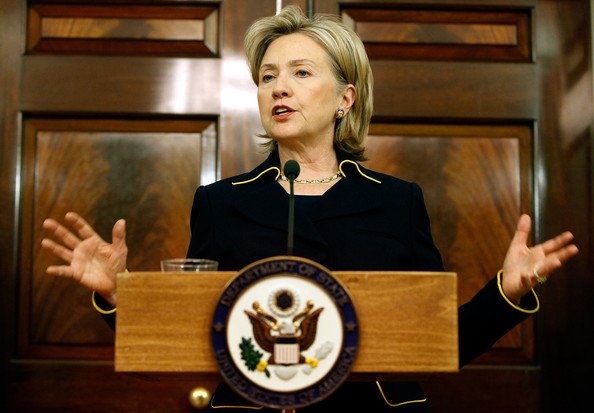
Selling weapons to Saudi Arabia is bad enough, but celebrating it is even worse. (Photo: Zimbio)
Saudi airstrikes on Yemen, which have killed more than 2,800 civilians thus far and, incidentally, devastated three Doctors Without Borders facilities, are led by F-15s made by Boeing. The Intercept posted a short, discomfiting article by Lee Fang, in which he writes:
A few years earlier, as secretary of state, Hillary Clinton made weapons transfer to the Saudi government a “top priority,” according to her closest military aide.
And now, newly released emails show that her aides kept her well-informed of the approval process for a $29.4 billion sale in 2011 of up to 84 advanced F-15SA fighters, manufactured by Boeing, along with upgrades to the pre-existing Saudi fleet of 70 F-15 aircraft and munitions, spare parts, training, maintenance, and logistics.
The deal was finalized on Christmas Eve 2011. Afterward, Jake Sullivan, then Clinton’s deputy chief of staff and now a senior policy adviser on her presidential campaign, sent her a celebratory email string topped with the chipper message: “FYI — good news.”
Hillary Clinton supporters might instinctively say, “How could she know those fighters would be used to decimate Yemen?” The answer would be the same as when she voted for the Authorization for the Use of Military Force in Iraq in 2003: It was her job to know.
This piece was reprinted from Foreign Policy In Focus by RINF Alternative News with permission.
Libertarians’ False Assumptions About Economics

Eric Zuesse
We’ll start with a typical example of libertarians’ big misconception:
Here was the libertarian white Texan Alex Jones, in a riff for the racist white populist billionaire Republican U.S. Presidential candidate Donald Trump, the day after Trump had declined to condemn on CNN a KKK endorsement. Jones says in that clip (1:03-): “There’s a lot of good people supportin’ [the progressive U.S. Presidential candidate Bernie] Sanders and I’ve probably been too mean to him, and I know how bad socialism is, but some of them are just helpless and want somethin’ free; that’s not how the world works, but he [Sanders] is obviously better than Hillary [Clinton, the extremely aggressive and corrupt Democratic candidate].”
The libertarian Jones was wrong about Sanders and his supporters (though he was correct about Clinton). What Jones calls “socialism” includes the dictatorial form, communism, and that misrepresents what Sanders specifically stands for. Sanders calls his ideology “democratic socialism,” though it’s actually also democratic capitalism, because the nordic nations that Sanders cites as being examples of “democratic socialism” are “mixed economies,” neither only “socialist” nor only “capitalist.” Libertarians equate that democratic ideology (“democratic socialism”) with communism, and this is one of their crudest misrepresentations: for example: Sweden isn’t at all like the USSR was. They’re fundamentally different systems. Libertarians are deceived to equate them — to imply that a proponent of the Scandinavian system is at all a proponent of the Soviet system.
Also false is the idea that progressives “are just helpless and want somethin’ free.” They’re instead people who want the most-thriving economy, in which the most wealth is being produced, and in which the degree of economic inequality is reduced by governmental policies that reverse the existing governmental policy-direction, of concentrating wealth in a very few people. Progressives want governmental policies that spread wealth more evenly. That’s an essential part of progressivism. Regardless of whether one calls it “democratic socialism” or “democratic capitalism,” it’s not only about more-even wealth; it’s also about higher per-capita wealth. And in economic reality, increased equality goes with, instead of against, increased wealth. Our existing governmental policies, which encourage ever-increasing inequality of wealth, actually reduce economic output.
For example: in a society where health-care is a right that’s available to all, instead of a privilege that’s available only to people who can pay for it — such as to pay to keep one’s teeth, or to buy a prosthetic — all citizens are employable; they can all be productive because their health is maintained; but, in a society like ours, many people can’t work because they can’t even pay the costs to be healthy; those people are being economically wasted. Also in a society where education is a privilege based on ability-to-pay instead of a right based on ability-to-learn, lots of people get shortchanged on learning, because they’ve not got the money, and so their aptitudes become wasted. The higher the amount of privatization, the more of the nation’s human-capital-base will become wasted.
In democratic-socialist-capitalist countries, a larger percentage of the nation’s human-capital-base gets developed. In our country, lots of that human-capital-base gets simply wasted — lots of people end up in prisons rather than in universities and then productive employment.
What Jones and other libertarians get wrong is their believing in the economic falsehood that there exists an essential trade-off between prosperity and equality — the idea that more economic equality will mean less economic productivity. Libertarians such as he believe the existing false microeconomic theory, which advises against any and all concerns about the distribution of wealth, and which says that only the per-capita mean wealth matters in an economy. Per-capita mean wealth is the society’s total wealth divided by the number of people. Even if all of the wealth belongs to the king and everyone else owns nothing, the per-capita mean wealth can still be the same as in a society where the wealth is more equally distributed; and libertarians say that the distribution should simply be ignored. Libertarians start with the false assumption that the distribution of wealth is irrelevant. They start with the assumption that the distribution of wealth is either irrelevant to the society’s per-capita mean wealth, or else that increased equality produces decreased wealth. That assumption, in either form, is empirically false, as will be documented here. Instead, in order to increase per-capita mean wealth, the distribution needs to be made more-equal not less-equal (such as it is in our present system, the system which concentrates wealth).
Another false libertarian assumption is that the lower the percentage of national economic output that goes to government, or the more of it that’s private, the higher the economic output will be — the belief that government is necessarily more wasteful than is privatization. Typically, libertarians say that any huge inequality of wealth ‘doesn’t exist but for government causing it.’ They ignore the fact that no economy exists without there being a government: government is an essential part of an economy, it sets the rules and laws by which trading can occur. They think that less government means more and better economy — that there’s a trade-off between the economy and the government — as if the government is intrinsically waste, instead of its being the prerequisite to the very existence of any economy at all. They misunderstand the basic relationship between the government and the economy.
To the exact contrary of these libertarian beliefs, the highest mean per-capita wealth results from a government whose policies are specifically designed so as to reduce inequality of wealth. (Some people, such as Sanders, call that type of government ‘socialistic,’ indicating democratic socialism; others call is “progressive”; but, regardless of the name, it’s the best.) It produces higher total wealth than does existing capitalism (a government that ignores the wealth-distribution), not lesser.
There are numerous empirical economic studies that clearly show these things to be the case: progressivism, or democratic-socialism-capitalism, produces not only a more-even spread of wealth, but also a higher amount of wealth.
Here are some of those studies (and they’re the core of what I’m saying here):
An important IMF study, from IMF economists Andrew G. Berg and Jonathan D. Ostry, was published on 8 April 2011, providing empirical evidence that even regarding economic growth, the most effective way forward is through increasing equality, not inequality. This study was titled “Inequality and Unsustainable Growth: Two Sides of the Same Coin?” It found that, “Longer growth spells are robustly associated with more equality in the income distribution,” and that, “Countries with more equal income distributions tend to have significantly longer growth spells.” Moreover, even the conservative economist Robert Barro buried in his study for the Asian Development Bank in January 2008, titled “Inequality and Growth Revisited” (in “Figure 2” and “Figure 3”), his finding (from 2007 U.N. figures) that in all but the wealthiest countries, the “Effect of Income Inequality on Economic Growth” was clearly “negative”; in fact, “the impact of inequality on growth” was so “negative” that even though there was no correlation at all for the wealthiest countries, the findings for all countries was that: “a one-standard-deviation increase in the Gini coefficient [a measure of economic inequality] reduces the growth rate on impact by about 0.4% per year.” (And Barro, being a conservative, did all he could to hide this finding there.) Consequently, the common assumption by economists, that there is a “trade-off” between equality and growth, not only is false, but it is the exact opposite of the truth – there is actually a net-long-term-pro-growth association with low Gini (high equality).
Then, in February 2014, Ostry and Berg were joined by C.G.Tsangarides, in the IMF Staff Discussion Note, “Redistribution, Inequality, and Growth,” which asked (and answered), “So what does the historical evidence say? This paper is the first to take advantage of a recently-compiled cross-country dataset that … allows us to calculate redistributive transfers for a large number of country-year observations. Our main findings are: First, more unequal societies tend to redistribute more. … Second, lower net inequality is robustly correlated with faster and more durable growth, for a given level of redistribution. … And Third, redistribution appears generally benign in terms of its impact on growth.”
Additionally, on 30 October 2012, Ozlem Onaran and Giorgos Galanis authored for the International Labor Office in Geneva, “Is Aggregate Demand Wage-Led or Profit-Led? National and Global Effects,” and they noted: “To the best of our knowledge, this paper is the first in the theoretical, as well as the empirical literature to develop a model of the global effects of changes in income distribution as opposed to focusing on isolated single country effects.” Their study found that, whereas in some countries the GDP and income-inequality rose and fell together, this situation was the global exception instead of the global rule (they vary inversely); and, moreover, that even in the countries where they rose and fell together, this was driving down the global GDP by exacerbating the pressures in other countries to reduce their trade. “The world economy in aggregate is wage-led” – percolate-up, not trickle-down. For the first time ever, a study had been performed of the global impact of the “race to the bottom” in wages, and this study showed that the impact was decreased production. Whereas the aristocrats who skimmed the benefits from the race to the bottom in workers’ wages had made trillions from it, the world-at-large had suffered from it.
But that’s not all. In December 2009, was published The Spirit Level, by Kate Pickett and Richard Wilkinson, documenting that both across nations and intranationally, the illnesses that are commonest amongst the poor increase to the extent that Gini — a measure of inequality — increases. Of course, this finding would naturally tend to occur simply because when nations or states that are at a given level of per-capita (or mean) income and/or wealth have high Gini (inequality), a greater proportion of its populace are poor, and a smaller proportion of them are wealthy, which implies that the median person is relatively poor, so the typical conditions of poverty are relatively common in such a place; whereas if a nation with that same per-capita income and/or wealth has low Gini (high equality), the median person is considerably wealthier and so the common conditions of poverty are relatively uncommon. It’s just basic mathematics. However, the aristocracy were outraged that such a book was published; and, thus, on 13 August 2010, Britain’s Guardian headlined “The Spirit Level: How ‘Ideas Wreckers’ Turned Book Into Political Punchbag,” and Richard Booth reported that, “This summer, … a posse of rightwing institutes has laid into the work.” The aristocracy’s chief attack was expressed by one think tank director saying, “On almost no measure does the central claim of The Spirit Level, that income inequality decreases life expectancy, stand up to scrutiny,” and by another saying, “Their causal argument is full of holes.” These critics were saying that the authors had assumed that correlation equated with causation. However, inasmuch as – for the mathematical reason just stated here – it’s merely natural that, at any given level of per-capita income and/or wealth, higher inequality (higher Gini) will lower the median income and/or wealth, and will therefore increase the diseases of poverty; and, so, what those conservative propagandists were saying wasn’t merely false; it was mathematically stupid.
Within the United States, James Gilligan in 2011 issued Why Some Politicians Are More Dangerous Than Others, which documented that during the period 1900-2007, all Republican presidencies experienced increasing rates of unemployment, poverty, suicides, and homicides, whereas all Democratic presidencies saw decreasing rates of each of those four. Democrats tend to employ Keynesian macroeconomic theory, whereas Republicans use macro-theory that’s based upon microeconomic theory (which is overwhelmingly prove false by the empirical economic data).
Furthermore, also concerning the U.S. economy, a team of economists – David Autor, David Dorn, and Gordon Hanson – came forth in 2013 with an empirical analysis of data regarding the anti-mercantilist, pro-free-trade, theory that Adam Smith became so famous for having introduced, in his Wealth of Nations. They found that the empirical evidence they examined indicated it to be a false theory, even within its central focus, of free trade. Their article in the September 2013 American Economic Review was titled “The China Syndrome: Local Labor Market Effects of Import Competition in the United States.” It reported that:
“Rising imports cause higher unemployment, lower labor force participation, and reduced wages in local labor markets, … [and] contemporaneous aggregate decline in U.S. manufacturing employment. Transfer benefits payments for unemployment, disability, retirement, and healthcare also rise sharply in more trade-exposed labor markets. … Reductions in both employment and wage levels lead to a steep drop in the average earnings of households. These changes contribute to rising transfer payments through multiple federal and state programs, revealing an important margin of adjustment to trade that the literature has largely overlooked. … The largest transfer increases are for federal disability, retirement and in-kind medical payments. Unemployment insurance and income assistance play a significant but secondary role.”
Finally, in June 2015, Era Dabla-Norris and four other IMF economists issued “Causes and Consequences of Income Inequality: A Global Perspective.” This decisive empirical study found that existing microeconomic theory is trash. It summarized:
“We find an inverse relationship between the income share accruing to the rich (top 20 percent) and economic growth. If the income share of the top 20 percent increases by 1 percentage point, GDP growth is actually 0.08 percentage point lower in the following five years, suggesting that the benefits do not trickle down. Instead, a similar increase in the income share of the bottom 20 percent (the poor) is associated with 0.38 percentage point higher growth. This positive relationship between disposable income shares and higher growth continues to hold for the second and third quintiles (the middle class). This result survives a variety of robustness checks, and is in line with recent findings for a smaller sample of advanced economies (OECD 2014).”
When Alex Jones said, “I know how bad socialism is, but some of them are just helpless and want somethin’ free; that’s not how the world works,” he was expressing what’s in microeconomic theory, but within recent decades enough empirical economic data has now become scientifically analyzed in order to test that theory out, and all of the studies show, consistently, that Sanders’ basic ideology (what he calls “democratic socialism”) is true, and that libertarianism (the theory — microeconomic theory — to which Jones and other libertarians subscribe) is false.
That’s just an empirical fact by now. It is a scientifically established reality, notwithstanding the common misconceptions that have been taught in the microeconomics textbooks. Microeconomic theory is false; libertarianism is false. It is scientifically false. Democratic-socialism-capitalism is the optimum political system, even from the standpoint of wealth-creation. Even if there weren’t added value from the wealth-redistribution, it’s the best system in terms of wealth-creation — the criterion that microeconomic theory (libertarianism) claims to maximize (but consistently fails to maximize).
There also exists overwhelming empirical evidence that the increase in equality of wealth produces, in itself, a happier and more peaceful society. But the point of the present article is that libertarianism, microeconomic theory, is false, even on its own narrow area of focus, which is wealth-generation, economic growth. In other words: libertarianism, or belief in microeconomic theory, is even worse than has been documented here. What has been described here is only part of the hoax, not all of it.
PS: One libertarian’s reader-comment to this said (and the entire exchange between “iseeitfx” and me “cettel” is shown here):
iseeitfx •
“Libertarian economics”?
LOL…
Come on Eric, you can do better than that.
Austrian economics would be the boogie man of reference if one should choose to take that school on?
Good luck…..
I do generally respect your thoughts however and encourage you to keep sharing.
Reply
cettel iseeitfx •
Austrian economics is based upon micro-economic theory. In that regard, it’s like all other except Keynesian microeconomic theory, because only the Keynesian tradition avoids microeconomics entirely. Neo-Keynesian economics tries to accommodate Keynes’s macro-theory to existing micro-theory; but, otherwise, all of economics is based upon the existing micro-theory.
When you talk about “Austrian economics,” it’s like talking about the difference, for example, between Protestants and Catholics. They both believe in the Bible.
Reply
iseeitfx cettel • 7 hours ago
With all due respect, I suggest that you are misinformed regarding Austrian economics.
If you would like to remedy this situation, the two links below would be great places to begin.
http://www.economicpolicyjourn…
Reply
cettel iseeitfx •
Those links aren’t even relevant to what I said. And in no way do they provide evidence to the contrary of my allegation that Austrian economic theory, going all the way back to its founder, Bohm-Bawerk, accepts microeconomic theory, as it had been introduced by Adam Smith and others.
—————
Investigative historian Eric Zuesse is the author, most recently, of They’re Not Even Close: The Democratic vs. Republican Economic Records, 1910-2010, and of CHRIST’S VENTRILOQUISTS: The Event that Created Christianity.
Obama and Netanyahu Intend Undermining Ceasefire in Syria

Stephen Lendman
(RINF) – Washington and Israel jointly instigated and manipulated early 2011 anti-government demonstrations in Syria – used as a pretext for Obama’s war to follow.
Netanyahu wants a regional rival eliminated, Iran isolated ahead of undermining its sovereignty – part of a grand US/Israeli scheme to redraw the Middle East map, creating powerless, easily exploited, mini-states.
Russia’s effective anti-terrorism campaign foiled US/Israeli plans. Western and Israeli news reports about Netanyahu welcoming ceasefire in Syria are pure rubbish.
In remarks before his weekly cabinet meeting, he lied saying “(a)nything that stops the terrible killing there is important, especially from a humanitarian standpoint.”
He’s a world-class thug, a notorious Arab-hater, waging terror-war on defenseless Palestinians, murdering them in cold blood, torturing them in confinement, wanting all valued parts of Judea and Samaria exclusively for Jews – including expanding Israel’s undefined borders to include more Syrian territory than already.
He blasted Iran irresponsibly, earlier threatening war, on Sunday saying “any agreement in Syria must include a halt to Iran’s (nonexistent) aggression toward Israel from Syrian territory.”
“We will not agree to the supply of advanced weaponry to Hezbollah from Syria and Lebanon. We will not agree to the creation of a (nonexistent) second terror front on the Golan Heights. These are the red lines that we have set and they remain the red lines of the State of Israel.”
His regime is the region’s leading menace, its agenda making peace and stability unachievable. Iran hasn’t attacked another country in centuries. It threatens none now.
It’s Israel’s main regional rival. Lunatics in Tel Aviv want unchallenged control. Iranian sovereign independence prevents it.
The road to Tehran runs through Damascus. US/Israeli-instigated war on Syria wants one rival eliminated before targeting another.
Plans of both countries remain firm. Ceasefire is pure illusion, dead on arrival before implemented. So are peace talks if begun.
Washington and Israel want war. Expect ceasefire and conflict resolution efforts to be systematically undermined, Moscow and Damascus wrongfully blamed, a recklessly dangerous strategy if implemented.
Russia’s war on terrorism in Syria includes forcefully addressing any threat to its personnel and aerial campaign. If attacked or endangered, it’ll respond appropriately. Challenging it risks direct confrontation.
What dirty strategies and tactics Washington and Israel intend next remain to be seen – peace and stability for sure off the table.
Stephen Lendman lives in Chicago. He can be reached at lendmanstephen@sbcglobal.net.
His new book as editor and contributor is titled “Flashpoint in Ukraine: US Drive for Hegemony Risks WW III.”
http://www.claritypress.com/LendmanIII.html
Visit his blog site at sjlendman.blogspot.com.
Listen to cutting-edge discussions with distinguished guests on the Progressive Radio News Hour on the Progressive Radio Network.
Trial by Fire: Prosecutors Sending Juveniles to Adult Courts

Beginning in the 1990s, in response to an increase in juvenile crime, influential criminologists filled the airwaves with predictions of a coming wave of “superpredators.” As reported in a New York Times Retro Report, “The Superpredator Scare,” these criminologists mistakenly believed crime would keep climbing, and fostered a myth that demonized youth, in particular young people of color. These experts believed that we would soon see “radically impulsive, brutally remorseless” kids, many “who pack guns instead of lunches” and “have absolutely no respect for human life.”
Most states reacted to these now famously false predictions by enacting so-called reforms to make it easier to prosecute juveniles as adults. The trend was to expand the “transfer” of youth from juvenile to adult courts, a policy we are still paying for today with harsher penalties and an increase – not a decrease – in recidivism. According to Al Jazeera America, currently in the United States, about 250,000 juveniles are “tried, sentenced or incarcerated each year as adults,” – a truly staggering number.
There are well-known negatives to sending kids to adult prisons. Truthout’s research has found that there are fewer resources vital to teen development in adult facilities, as well as a high risk of assault, rape and suicide. Such dangers for juveniles have led to the criticism of juvenile transfer policies from numerous organizations and researchers according to the well-respected national initiative, the Campaign for Youth Justice.
Hillary’s Secret Letter And The Whole Matter Of Endless War And The Almost Complete Corruption Of America’s Government

John Chuckman
(RINF) – An almost perfect measure of the decay of democratic values in American politics is found in a letter from Hillary Clinton to Haim Saban, a wealthy American-Israeli and a major contributor to the Democrats. It is a letter whose only purpose is to elicit funds, ingratiating its author to the recipient by condemning the perfectly legitimate right of free people to choose boycotting Israel over its appalling behaviors. The letter is disturbing in some of its views and characterizations, but it has been reviewed and remarked upon by many, as here
<http://www.huffingtonpost.com/stephen-zunes/the-troubling-implication_b_7772936.html>.
We were not supposed to know this, but there are actually two letters. The first letter was released by its recipient, but the second letter was intended only for its recipient’s eyes. Somehow, it managed to be leaked to *The Guardian*, although in searching the Internet to discover just what happened it seems Google has done a pretty good job of sweeping over the trail.
It is the second letter, the one we were not supposed to see, which goes beyond being disturbing.
I am not exaggerating when I characterize it as something comparable to words which might have been written by… well, choose the name of any grisly dictator, but Adolph Hitler’s would have to be the one jumping to the minds of most people. This second letter’s words are absolutely chilling. If you think I’m exaggerating, here are Hillary’s words:
*“Quite frankly, Israel didn’t teach Hamas a harsh enough lesson last year.
True to form, Obama was too hard on our democratic ally, and too soft on
our Islamofascist foe.*
*“As president, I will give the Jewish state all the necessary military,
diplomatic, economic and moral support it needs to truly vanquish Hamas –
and if that means killing 200,000 Gazans, then so be it.*
*“We realist Democrats understand that collateral damage is an unavoidable
by-product of the War on Terror, and me being a mother, grandmother and
tireless children’s rights advocate does not mean that I will flinch even
one iota in allowing Israel to obliterate every last school-cum-rocket
launching pad in Gaza. Those who allow their children to be used as human
shields for terrorists deserve to see them buried under one-ton bombs.”*
Let’s just analyze a few of the more unacceptable and repugnant statements
in this letter.
*“Israel didn’t teach Hamas a harsh enough lesson…”*
In 2014, Israel killed over 500 children plus another 1,700 adults in Gaza,
and that came after another invasion, 2008, and a series of operations
beginning in 2006, which saw Israel kill more than another 1,500
Palestinians. It should be noted that the Palestinian population is a young
one, so a disproportion of children is always at risk in any attack. We had
reliable reports that Israeli soldiers grabbed Palestinian children to hold
in front of them in a number of instances. We also had first-hand reports
of families being targeted.
Over this period, Israel has maintained a brutal blockade of Gaza, which in
its first inception included an actual calorie count for the amount of food
which could just keep a person alive, an idea we might want to credit to
Himmler. International pressure brought an end to that aspect of the
blockade, but even today the Palestinians cannot get cement to repair their
sanitation and homes. Israel also launched its infamous Gaza flotilla raid
in 2010, seizing half a dozen ships attempting to bring aid to Gaza and
killing 10 crew members, all of them unarmed.
I remind readers just what Gaza is. It is essentially a huge refugee camp,
a place where Palestinians huddled for protection from Israel’s 1948 terror
campaign against residents of ancient villages long since bulldozed out of
existence. Today, surrounded by fences and guards and towers with
automated, radar-operated machine-guns, Gaza resembles a vast outdoor
prison, or, if you will, a Bantustan or concentration camp. Even its
fishermen are allowed to go only a short distance into the sea before being
attacked by Israeli gun boats. Periodically, Israel does dirty work like
cut its power or foul its water. Recently, a huge swath of land around its
perimeter was sprayed with herbicides, cutting food supplies and insuring
future malformation of children, just as we see in Vietnam as a result of
America’s use of Agent Orange.
*“…our democratic ally…”*
Israel is certainly one of the world’s strangest “democracies.” About half
the people living under its rule do not want to live under its rule, have
no votes, have absolutely no rights, and are treated in the most abusive
manner. Even their homes are not their own with Israel periodically seizing
them for its own purposes.
Then we have the fact that only Jews are supposed to live in “the Jewish
state.” Only Jews are welcomed. Indeed only Jews are accepted. Other kinds
of refugees are turned away. There is a government program underway right
now to clean out the Knesset, Israel’s legislature, of its few Arab
members. These are the representatives of Arabs trapped in what became
Israel in 1948 and reluctantly granted citizenship, although in daily
practice and in many laws, Arab citizens are not deemed as full citizens,
identity papers are stamped and they are subjected to hearing regular
demagogic demands that they all be pushed across the Jordan River and out
of the country.
If you consider Israel a genuine democracy, then you must also view the
American Confederacy or South Africa under the National Party as
democracies. They both held elections and had legislatures and the dress-up
appearances of democracy. It was just that huge numbers of those countries’
people could not vote and could not own certain property and had no rights.
Israel’s so-called democracy has other serious impairments, including a
structure for the role of money in politics that much resembles America’s.
It is at best a plutocracy. Millions pour in to favored candidates like
Netanyahu from sources like American billionaire Sheldon Adelson.
Israel has another highly undemocratic characteristic, and that is its
aversion to democracy in countries or groups anywhere near it. It always
has supported happily tyrants like Mubarak in Egypt and has worked
assiduously to get what was a democratic organization like Hamas declared
and treated as some kind of terrorists.
If Israel is, as Israelis like to say, the Middle East’s only democracy, I
think we can be glad there are not more such democracies.
*“…our Islamofascist foe…”*
Since when are the Palestinians – who, as is often ignored, include both
Islamic and Christian people – “our foe”? I don’t recall them threatening
or attacking anyone? Women and children and hard-working men on farms and
in shops are our foe? People without even the semblance of a military?
Since when are they “Islamofascists”? They are just people driven out of
their own ancient homes and farms by groups of well-armed newcomers from
Europe and America. And what is an “Islamofascist,” beyond a slur term
coined in Israel for people who are resented, hated, and abused merely for
the fact of their very existence? We did briefly see in the last assault on
Gaza how ugly things get in Israel, something generally kept from our eyes,
with video of Israelis in lawn chairs on the heights watching homes being
bombed and cheering as though it were the home team scoring a goal at a
football match.
*“I will give the Jewish state all the necessary military, diplomatic,
economic and moral support it needs to truly vanquish Hamas…”*
What in God’s name does that mean? America literally pours military,
security, and technical assistance into Israel. There is continuous typhoon
of it hitting Israel’s shores. And how would more help “truly vanquish
Hamas”? What would be the shape of that? A couple of thermonuclear weapons
lobbed into Gaza? But Israel already has its own thermonuclear weapons,
albeit through lying and deceit and even theft and against the intent of
all international law and organization, although with the secret
contrivance and acceptance of a couple of generations of politicians like
Hillary.
Why should Hamas be vanquished? It was elected to office in a clean
election, likely cleaner than most American and Israeli elections. But I
forget, Israel hates having democracies anywhere near its borders. It
prefers dealing with – when it deigns even to speak to its neighbors – men
like Mahmoud Abbas, who last legally held office in 2009 and has
unilaterally extended his own term as President ever since, and who is
completely ineffectual in his relations with Israel.
We shouldn’t forget that after Hamas’s internationally-supervised election,
Israeli troops raced into Gaza and illegally arrested many of its elected
officials. It also publicly threatened the leader’s assassination. Funny,
but I don’t recall things going the other way from this supposedly
terrorist organization. After all, it earned the “official” designation as
terrorist from politicians like Hillary Clinton or Newt Gingrich or Dick
Armey working to keep those pro-Israeli campaign funds flowing in.
All of the horrors of invasions, bombardments, and blockades came after
that simple election. Israel hates Hamas because it does not do exactly as
it is ordered to do. Always the excuse is used that Hamas won’t recognize
Israel as “the Jewish state,” but that view deliberately hides many
legitimate issues. In conflict or disagreement, countries typically do not
extend formal recognition. The United States has done this countless times,
including for the last half century with Cuba. It did it for years with the
Soviet Union.
But Israel’s case is not just a matter of formal recognition. There is a
subtle but immensely important difference. It wants recognition as “the
Jewish state.” What would happen to those million or so Palestinians who
hold Israeli passports and are now at least nominally Israelis? Forced
marches across the Jordan River? What happens to the many important
Palestinian claims on Israel? What claims do you think a non-Jew can have
in “a Jewish state” under purely Jewish courts and laws? What happens to
the entire West Bank, which exists under Israeli occupation and is
regularly predated by sudden demands for non-Jewish properties? This is no
simple issue as Israel repeatedly and tiresomely insists that it is.
You are not a terrorist because you refuse to accept Israel’s terms: you
are a people looking out for your own interests, something all people have
the right and need to do. Israel always insists that this acceptance come
before any other matters can be dealt with, and it then turns to the press
and says, “See, I told you, they are terrorists.” Simply absurd, expecting
people to just lie down and let you do whatever you want to them!
*“…and if that means killing 200,000 Gazans, then so be it…”*
Only a person so exceedingly biased towards Israel as to be effectively
blind would fail to recognize the tone of those words. They could easily
have been written by Adolph Hitler or one his charming goons such as
Heinrich Himmler or Joseph Goebbels.
In the churches and schools where I was brought up, such speech could never
be countenanced, yet here it is, written by a woman who was Secretary of
State now wants to be President. She obviously knows enough to keep this
morally-filthy language secret, hence her method of the second letter. So,
even in her, maybe there is some little remaining sense of shame? But I
doubt it because she is writing these ghastly words for what purpose? To
ask for a large amount of money.
Now, if you wrote words like that in Israel or in a number of countries,
only changing the name of who are to be killed in mass, you would most
certainly go to prison, besides being labelled a terrorist for life.
Apparently, when Hillary learned that this letter leaked, she made the
excuse that there had been a typo, that it should have read “20,000.” Her
moral and ethical organs are so charred and twisted that she actually
thinks 20,00 people killed sounds okay, just fine, maybe ten times as good
as killing 200,000?
But of course, Hillary is grotesquely lying even in this excuse, as she has
lied innumerable times over her adult life, an ongoing stage play we have
all enjoyed in the news: watching her defend her predatory husband for the
sake of future political success, watching her politically-motivated
statement of being shot at in Bosnia in 1996, a claim almost instantly
proved fraudulent by the press, watching her squirm and lie about what
really happened during the murderous events at Benghazi, and watching her
lie as she is investigated about using her private server for top secret
material as Secretary of State.
*“Those who allow their children to be used as human shields for terrorists
deserve to see them buried under one-ton bombs”*
This statement is so sick and twisted, it is frightening. It begs the whole
genuine issue of whether any Palestinian ever did this, while we know from
witnesses that Israeli soldiers did. Just what is it here that we are
talking about where children are said to have been used as shields? A
full-fledged invasion by heavily-armed troops, supported with tanks and
artillery and fighter planes into a densely-crowded civilian area, often
aptly described as an open-air prison for a million and a half souls. How
could children avoid becoming targets? In the poor places of the Middle
East with their high birth rates, children are a greater portion of the
population than in advanced countries. Only a genuine monster would launch
such an invasion, and only an equal monster would defend it.
To my mind, this damnable behavior of Israel’s could be compared to, say,
the Detroit Police Department, supported by the Michigan National Guard,
invading the ghettos of Detroit to capture a few criminals and killing
literally thousands of innocent people in the process and leaving the place
a pile of rubble. The whole world would be appalled. But even that
comparison is inadequate. Israel was not chasing criminals. What Israel was
really hoping to do was murder the leaders of Hamas, a legitimate political
party. But even if Hamas were not a legitimate party, Israel’s act is
comparable to Detroit’s police and National Guard killing thousands to try
getting a few members of the Black Panther Party in the 1970s.
We’ve surmised that things like this letter go on in private because we see
our politicians countenancing mass murder and we see the entire Middle East
in flames owing to the same cause. But having the paper in hand is another
matter. For instance, we know Newt Gingrich received the best part of $20
million for his last nomination campaign from billionaire Sheldon Adelson
and proceeded to make campaign speeches about there being “no such thing as
a Palestinian.”
We know former House Majority Leader Dick Armey, a man whose career was
well financed by special interests, actually said in the late part of his
career that Israel should just sweep all the Palestinians out of the
country.
We know that former Secretary of State Madeleine Albright said in response
to a question about 500,000 deaths of children in Iraq, “We think the price
is worth it,” and does anyone wonder why Albright not only strongly
supports Hillary but recently spoke of “a special place in hell for women”
who didn’t support Hillary?
It tells us a great deal of the lengths to which an American politician
will go to secure large sources of funds. It tells us too something about
her relationship with the recipient that Hillary believed she could freely
address him in such an appalling fashion. Finally, it confirms everyone’s
worst fears about the Israel Lobby and the extremes to which its supporters
are prepared to go.
We all know there is a huge amount of behind-the-scenes, dirty dealing in
American politics, but not just in politics, in foreign affairs. There is
no other explanation for the murky, bloody swamp into which America’s
government has towed the country. America has been continuously at war for
a quarter century. It has killed great numbers of people and destroyed
whole societies. And none of those people threatened the United States, not
even the Taleban who were arbitrarily and without proof held responsible
for the events of 9/11.
Virtually all of it relates directly or indirectly to Israel and making the
Middle East comfortable for a state which itself never hesitates to
threaten, attack, kill, imprison, torture to gain its objectives, its
objectives being to enlarge itself far beyond its original accepted
boundaries, to reduce the native Palestinian population of millions to such
miserable discomfort that they flee their homes, and to assure itself of
hegemony throughout the region, seeing independent-minded leaders like
Assad or Gadhafi literally murdered and their countries torn apart.
It is a program which parallels closely historical examples which none of
us has been taught to admire or approve, historical examples which have
caused great wars and massive human misery. We have established some of our
greatest international institutions precisely out of the wreckage of
history with the aim of not letting it happen again, but today every one of
these institutions is compromised by American pressure on Israel’s behalf,
the work of corrupt politicians like Hillary Clinton.
So it is happening again, although on a smaller scale – though I wouldn’t
want the job of explaining to the people of Syria, Iraq, Libya, Egypt, and
a number of other places that their desolation and misery are on a smaller
scale.
The present Secretary General doesn’t even peep at America’s many appalling
acts. Past Secretaries General who managed to get elected despite their
opposition to American imperialism – an example was Boutros Boutros-Ghali –
were removed in behind-the-scenes plots. Madeleine Albright for example won
her State Department spurs arranging just that kind of thing. Combinations
of threats and bribes do the job nicely, and, of course, the UN hasn’t
forgotten the long period of time the United States simply refused to pay
its treaty-required dues, a quarter of the institution’s budget.
But ordinary Americans and others rarely get even a peek at any of the
details going into the shaping of their world. Here is one small instance
where they do, and it is a telling one.
Protecting al-Qaeda

In the weeks leading up to the agreed upon cessation-of-hostilities (CoH) agreement
between the US and Russia, it was John Kerry’s diplomacy that was instrumental
in “downgrading” the truce from a more forceful and legally binding “ceasefire”
agreement to the less intensive “cessation-of-hostilities” now taking effect.
As described by
Kerry: “So, a ceasefire has a great many legal prerogatives and requirements.
A cessation of hostilities does not. A ceasefire in the minds of many of the
participants in this particular moment connotes something far more permanent
and far more reflective of sort of an end of conflict, if you will. And it
is distinctly not that. This is a pause dependent on the process going forward.”
So why the insistence on non-permanence? Especially if, as Kerry says, the ultimate objective is to “obtain
a durable, long-term ceasefire” at some point in time?
According to the 29-year career diplomat in the Indian Foreign Service, India’s
former ambassador to Uzbekistan and Turkey M.
K. Bhadrakumar, it is
plainly because “the Russian military operations have met with devastating success
lately in strengthening the Syrian regime and scattering the Syrian rebel groups,”
leading “the US and its regional allies” to “stare at defeat.” Therefore, they
“forthwith need an end to the Russian operations so that they can think up a
Plan B. The Geneva talks will not have the desired outcome of President Bashar
Al-Assad’s ouster unless the tide of war is reversed.” Therefore, “a cessation
of hostilities in Syria is urgently needed.”(1)
Judging by the fact that top US officials began announcing that Russia would
break the deal immediately after it was agreed upon while calling for further
measures to “inflict
real pain on the Russians”, Bhadrakumar’s assessment that a pause, and not
a permanent halt, was sought in order to regroup and eventually reverse the
tide of war seems to be quite apt. As well there has been an almost ubiquitous
media campaign in the US to prime the public for accusations of a Russian infraction,
from which a breakdown of the deal would follow; the narrative portrayed is
filled with “doubts” and “worries” and “statements from US officials” about
how Russia isn’t serious and will likely break the agreement.
Criminal charges against TEPCO executives a step forward for Fukushima victims

The decision to indict executives of Tokyo Electric Power Company (TEPCO) today for their failure to take protective measures preventing the meltdown of the three reactors at Fukushima Daiichi is a major step forward for the people of Japan and a warning that Japan should phase out nuclear entirely.
“The people of Fukushima and Japan deserve justice. The court proceedings that will now follow should reveal the true extent of TEPCO’s and the Japanese regulatory system’s enormous failure to protect the people of Japan,” said Hisayo Takada, Deputy Program Director, Greenpeace Japan. “TEPCO and the Japanese regulator continue to ignore demands to disclose key details of what they know about the causes of the accident. The hundred thousand people who still can’t return home deserve to have all the facts.”
TEPCO failed to take any action to protect the Fukushima Daiichi plant from the predicted higher maximum tsunami before the March 2011 accident, despite knowing the reactor site was vulnerable. In July 2015, the Tokyo No. 5 Committee for the Inquest of Prosecution announced its decision that former Tokyo Electric Power Co. Chairman Tsunehisa Katsumata and two other former company executives “should be indicted” in connection with the Fukushima Daiichi accident. The court decided at the time that TEPCO should have seen the risks.
In 2008, TEPCO produced an internal report that predicted a maximum credible tsunami of 15.7 metres. However, they continued to insist publicly that the maximum height of a tsunami would be eight meters above sea level and therefore a tsunami would not reach the nuclear plant. The Fukushima nuclear power plant sits at a height of 10 metres above sea level, while cooling pumps for the reactors were located at four metres above sea level.
“Five years since the Fukushima accident began, Japan’s nuclear regulator is repeating the same kind of mistakes that led to the Fukushima nuclear disaster. Last week, the plutonium-fueled Takahama 4 reactor was restarted, just days after a radioactive leak in the primary coolant system,” said Kendra Ulrich, Senior Global Energy Campaigner at Greenpeace Japan.
“Japan’s nuclear regulator continues to look the other way on major safety issues. The government continues to press ahead with nuclear restarts despite unresolved safety problems that put the public at risk. It’s time to break free from nuclear and embrace the only safe and clean technology that can meet Japan’s needs – renewable energy.”
In addition to this latest leak in the primary coolant loop, there are multiple other outstanding safety issues at both the Takahama 3 and 4 reactors. In January the Nuclear Regulatory Authority admitted that it did not know if critical safety-related electric cabling met fire safety standards – an issue that can pose a significant risk for reactor core meltdown.
A Greenpeace Japan radiation survey team is currently operating in the Pacific Ocean off the coast of Fukushima to investigate the impacts of radiation on the marine environment.
This piece was reprinted by RINF Alternative News with permission or license.
Spy continues to work at GCHQ despite rape allegations

A GCHQ spy accused of rape by two women is still working at the secretive security agency because the police “did not properly investigate” the women’s claims, one of the alleged victims has said.
The first alleged victim, who met the 28-year-old security officer through the dating website Plenty of Fish in 2010, said police ignored her claims twice, even after a second victim, a woman who worked with him at the GCHQ offices in Gloucestershire, came forward in 2013, the Mirror reports.
The first woman, who bore a child by the intelligence worker, told the Sunday Mirror: “It seems like this man is untouchable because he works for GCHQ. I don’t feel any of the claims against him have ever been properly investigated by the police.”
In both cases of alleged rape, the man was let off with a harassment warning.
In December 2015, after finding out about the second alleged rape, the first accuser lodged a complaint to the Independent Police Complaints Commission (IPCC) about the failure of Gloucestershire Police to follow up on her allegations.
“I had no idea it would take four years for them to finally listen to me,” the woman told the IPCC in a video recorded statement.
During a civil court meeting between the alleged first victim and the accused, it emerged that he had been fired by GCHQ after child pornography was found on his computer. However, he was reinstated three months later after police dropped the case in December 2010.
Gloucestershire Police confirmed to the Mirror that the women’s claims were now being investigated.
Via RT. This piece was reprinted by RINF Alternative News with permission or license.
US a racist nation based on slavery, genocide: Researcher

The United States is a racist country that was based on slavery and genocide and where African Americans and the indigenous people continue to face “persecution” and “genocide,” a researcher and historian in Washington says.
“This persecution of poor and black, brown and other people is very much part of American society because it is a large white settler colony,” said Dr. Randy Short, who has a Ph.D in African studies.
“It’s like a metastasized state of Israel” that “oppresses and steals,” Dr. Short told Press TV on Tuesday.
“A society that is based on white supremacy and oppression,” he added. “You see a very, very sick genocidal society.”
Despite its scientific advances, the US “lacks civilization,” the researcher noted. “This is why you see so much drug abuse, so much murder, so much abortions, so much mass incarceration because it’s not a real organic society.”
Police in the United States killed over 1,150 people in 2015, with the largest police departments disproportionately killing at least 321 African Americans, according to data compiled by an activist group that runs the Mapping Police Violence project.
UK troops to fight Daesh infiltration into Tunisia: MoD

Britain says it will send troops to Tunisia to help fight any Daesh (ISIL) infiltration from neighboring Libya.
The British defense minister has said, “A training team of some 20 troops from the 4th Infantry Brigade is now moving to Tunisia to help to counter illegal cross-border movement from Libya in support of the Tunisian authorities.”
Michael Fallon told parliament on Monday, “I … am extremely concerned about the proliferation of Daesh along the Libyan coastline, which is why we have been urgently assisting the formation of a new Libyan government.”
The move comes after growing concern that ISIL wants Libya as a base to carry out attacks.
Last June, 30 British holidaymakers were killed in an attack by an ISIL-affiliated gunman on a beach at a hotel on Tunisia’s Mediterranean coast.
After the downfall of Libya’s former dictator Muammar Gaddafi in 2011, militant groups have taken advantage of political chaos to expand their presence in the North African country, and insurgents loyal to ISIL have taken control of the coastal city of Sirte.
Guantanamo Travesty: A Consequence Of Unconstitutional War
Daniel McAdams
President Obama has made his final effort to fulfill a campaign promise to close down the US detention facility at the Guantanamo naval base in Cuba, sending Congress a plan that would see a new facility constructed in the US to house those of the 91 remaining prisoners who were not cleared for release. The plan is dead in the water in Congress, however, as Republicans in charge of the House and Senate have signaled a refusal to even work with the president on the issue. But this political tussle over the facility is in reality just a sideshow. Neither side wants to bring up the flawed and anti-American nature of Guantanamo and the undeclared and vague “war on terror” that prompted its creation. On the Liberty Report, however, that is precisely what we are interested in:
Reprinted from The Ron Paul Institute for Peace & Prosperity.
Monsanto’s War on Mother Nature

Joseph Sanders
(RINF) – A perfect example of how insane the system actually is.. Monsanto Company is ranked number 52 among over 30 million US companies in Newsweek Magazine 2015 Global Green rankings. The honour is based on corporate sustainability and environmental impact.
Monsanto does makes $5 billion annually, however, these are profits from glyphosate, trade name Roundup, a herbicide the company began marketing in 1974. The product went off patent in 2000 and is now used globally by farmers for crop management. However, the short term study results are being challenged by the effects of long term usage.
Presently the Netherlands, France and several other European countries are banning use of the herbicide. Three countries in Latin America and Sri Lanka are also rethinking the weed killers’ value. Beyond its documented adverse effect on humans, one can only hope that this deadly toxin can be stopped before entire generations of animals become extinct.
The Monarch butterfly is one example. These beauties counted weather as their only enemy until Monsanto saturated farming fields, grasslands, and lawns with its Roundup. The equation is simple, Monarch larvae food source is milkweed and Roundup Ready genetically engineered crops and pest control formula kills milkweed. Scientists believe the population of these beautiful creatures has decreased by over 90%. Yet Monsanto continues to be lauded for its profitability and business model a ad-nauseam.
The same people who developed Agent Orange with complete disregard for all its consequences, are now turning on the lowly earthworm. Another essential part of nature, these creatures are valued for their soil ecosystem services and functions. They recycle organic materials, their tunneling unlocks soil nutrients, and are also part of an important food chain. Monsanto’s herbicides reduce both the activity and reproduction of this hard working specimen. Use of the chemical disrupts the ecosystem and affects the belowground interactions between earthworms and symbiotic mycorrhizal fungi, which helps plants absorb nutrients and fight off predators. Monsanto is eliminating safeguards that nature put in place without a thought to the future of the planet. It is truly earning its reputation as “the most evil company in the world”.
Birds are included on Monsanto hit list because of glyphosate residue contamination in rivers, ditches and streams. These species are also unable to feed on Monsanto’s genetically altered crop seeds or the insects that ingest the weed killer. Skylarks and corn bunting’s populations have declined over the past 30 years largely due to agricultural practices that suppress weeds.
The only “green” concern that Monsanto should receive an award for is cash. The Company and its formulas have contributed to cancer rates in humans and blamed third parties. Therefore, we hardly expect the environment to be given any consideration. They will stay true to form with influential supporters of its DARK (Deny Americans the Right to Know) Act and other actions. Detroit, Michigan’s March against Monsanto this May should have a global impact, accelerating the protest against this irresponsibility.
Sources:
The Complete History of Monsanto, “The World’s Most Evil Corporation”
http://npic.orst.edu/reports/NPIC11AR.pdf
http://www.theatlantic.com/health/archive/2015/07/no-one-is-denying-a-right-to-know-whats-in-my-food/399536/
Brexit : Heads you lose, tails you lose

The 1% are worried that their cartel, built up over the years, reaching its rapacious crest in 2008 and continuing its relentless quest for financial and political domination is potentially under threat with Britain’s EU referendum vote. They are ganging up just as they did with the Scottish referendum – just much worse. After all, the stakes are much, much higher.
Personally, I can’t stand the constant political flip-flopping of people like Boris Johnson, Theresa May and David Cameron. It’s a circus and only serves to confuse. Perhaps deliberately. I also despise in equal abundance the corporations threatening the country – as if much of their activities have not damaged society enough already.
Career conviction politician Jeremy Corbyn has been as equally useless.
As Leave.EU spokesman put it; “Jeremy Corbyn voted to leave the EEC in 1975 and against the Maastricht Treaty which transformed it into the EU, saying it took powers to set economic policy away from Parliament and handed them ‘to an unelected set of bankers’.
“It’s extremely sad to see that Jeremy, for all his faults a conviction politician and lifelong opponent of the EU, has been gagged by the clapped out Blairites his electors rejected in the Labour leadership contest.”
Lord Owen, former Foreign Secretary states that staying in the EU is a threat to national security. Theresa May, the current Home Secretary says the opposite.
Read More..
David Cameron and the one party state dream that is becoming reality

“The best way to take control over a people and control them utterly is to take a little of their freedom at a time, to erode rights by a thousand tiny and almost imperceptible reductions. In this way, the people will not see those rights and freedoms being removed until past the point at which these changes cannot be reversed.”
The Guardian reports that “David Cameron is leading a government with a “worryingly authoritarian streak” that is seeking to undermine the Labour party’s funding arrangements through the trade union bill.” It’s a pretty damning statement coming from Baron Kerslake, former Head of the Home Civil Service but its one that is becoming all too familiar in British politics today.
In essence, Kerslake’s furious attack confirms what many believe; that David Cameron, George Osborne & Co are effectively rigging the system to ensure that the balance of power is firmly tipped in their favour.
In early January, a confidential Labour party document affirmed that the party was facing an expected and quite sudden £6m drop in its annual income as a result of the changes to the political levy being introduced in the Conservative’s Trade Union Bill, making it impossible for it to maintain its current structure, staffing or offices. Income from affiliation fees could fall to as low as £1million.
In reality it means that Labour will lose around £35 million in funding over the lifetime of a parliament and the Bill has been described “as the most unfair alteration to political parties’ funding since the second world war and marks an end to a long-standing convention that issues of party funding are agreed on a cross-party basis. In reality it represents the most agregious abuse of power in office as it clearly sets out to stifle competition and create a one party state. Democracy is threatened.
Read More..
Video: Former CIA Director Says Military May Defy a President Trump

Col. Lawrence Wilkerson says the US military has the right to refuse illegal orders from the commander in chief.
Via Youtube
Video: Back to basics: Tents & bonfires return to Maidan on coup anniversary

About 100 nationalist activists set up tents on Maidan Square in Kiev, Sunday, calling for the removal of the Ukrainian government that came to power in 2014 …
Via Youtube
Video: Iranian Elections: A Blow to Hardliners As New Fault Lines in Iranian Politics Emerge

National Iranian American Council president Trita Parsi says it’s s no longer reformists versus conservatives as much as it is moderates with President Rouhani, …
Via Youtube
Video: AKs & Shotguns: Heavily armed anti-refugee protesters gather outside Dallas mosque

A group of heavily armed anti-Islam protesters gathered outside a Mosque in the Irving suburb of Dallas, Texas, on Saturday, to oppose the announcement that …
Via Youtube
Meaning Behind the Republican Bile
There has been little inspirational about the U.S. presidential race, especially on the Republican side where insults have replaced argument and bigotry has become a cheap currency for winning over voters, but there are also significant lessons in this debased debate, writes Lawrence Davidson.
By Lawrence Davidson
As the Republican primary plays itself out, cruelty has become a campaign come-on to voters who say they are frustrated and angry with traditional politics. Frustrated and angry feelings short-circuit critical thinking and create a yearning for the quick emotional release that comes with vengeful speech and acts. Donald Trump has become a master manipulator of this situation.
Trump has the type of personality that lends itself to using such an approach. He is a bully acting out. You can see this when he denigrates his opponents as losers. On the other hand, he is self-aggrandizing, always describing himself as a winner. And, apparently, he has little capacity for self-reflection about his own speech and actions.

Billionaire and Republican presidential candidate Donald Trump.
Some have described Trump as a textbook case of narcissistic personality disorder. Whether or not that is how you want to label him, he certainly has no problem publicly promoting cruelty. And, a subset of the American population responds positively to his abusive behavior. Here are a few examples:
Trump tolerates and indeed supports physical attacks on opponents who show up at his rallies. He sometimes encourages his supporters to violence by saying that he would like to punch protesters in the face. In the summer of 2015 he promised that if members of Black Lives Matter showed up at his rallies, “they would have a fight on their hands. I don’t know if I’ll do the fighting myself, or if other people will.”
That prediction came true in Birmingham, Alabama, in November of last year, when a Black Lives Matter protester who simply shouted “black lives matter” was roughed up and insulted during a Trump rally.
The next day Trump justified the actions of his supporters. “He [the protester] was so obnoxious and so loud” that “maybe he should have been roughed up.”
At…
Video: Belgian port fears Calais-style asylum inflow as migrants flood in

A Belgium port just a few kilometers from the medieval town of Bruges, could soon see its normal way of life turned on its head. And it’s all because of its location …
Via Youtube
The [Redacted] Truth: How the CIA Lies to Its Own Employees


(Anonymous9000 / Flickr)
It’s no secret that the CIA isn’t always up front with the public about its operations. You may even be kept in the dark if you’re an elected official. But did you know the agency even lies to its own employees?
That’s the subject of a recent Washington Post report on a heretofore unknown practice at the CIA called “eyewashing.”
Before moving to the substance of the article, however, I owe my readers an explanation: The Central Intelligence Agency must approve of everything I write about intelligence, the CIA, foreign policy, diplomacy, the military, and national security — for the rest of my life.
They didn’t like this column, even though the source material is freely available to anybody who reads the Post. The CIA consented to let me run it, but only if I redacted a few important sections.
I’ve decided to show you the CIA’s cuts, rather than engage in a protracted negotiation.
Now, back to eyewashing. Eyewashing, simply put, is a way that the CIA deceives its own employees.
According to the Post, CIA veterans described eyewashing as an “important security measure” and a “means of protecting vital secrets by inserting fake communications into routine cable traffic.” But these lies eventually are passed to Congress, too.
And when documents are finally declassified, the lies make their way to historians and to the American people. Here’s how eyewashing works.
Let’s say a CIA officer is working on a sensitive operation in the field. He’s reporting his progress to headquarters, and the operation becomes even more sensitive.XXXXXXXXXXXXXXXXXXXXXXXXXXXXXXXXXXXXXXXXXXXXXXXXXXXXXXXXXX XXXXXXXXXXXXXXXXXXXXXXXXXXXXXXXXXXXXXXXXXXXXXXXXXXXXXXXXXX XXXXXXXXXXXXXXXXXXXXXXXXXXXXXXXXXXXXXXXXXXXXXXXXXXXXXXXXXX XXXXXXXXXXXXXXXXXXXXXXXXXXXXXXXXXXXXXXXXXXXXXXXXXXXXXXXXXX XXXXXXXXXXXXXXXXXXXXXXXXXXXXXXXXXXXXXXXXXXXXXXXXXXXXXXXXXX XXXXXXXXXXXXXXXXXXXXXXXXXXXXXXXXXX.
Investigators from the Senate Intelligence Committee found at least two instances where the CIA turned over eyewashed cables for the committee’s report on torture. Both related to Abu Zubaydah, an alleged al-Qaeda operative the CIA believed — incorrectly — XXXXXXXXXXX XXXXXXXXXXXXXXXXXXXXXXXXXXXXXXXXXXXXXXXXXXXXXXXXXXXXXXXXXXX XXXXXXXXXXXXXXXXXXXXXXXXXXXXXXXXXXXXXXXXXXXXXXXXXX.
This practice is ripe for abuse.
What happens when an officer decides to issue a deceptive “eyewash” cable to his coworkers because the source — or the officer — is doing something illegal or unethical? With the eyewash cable in place, congressional oversight committees would have no idea.
Interestingly, the Post article said that most former senior CIA officers interviewed, including attorneys, had never heard of the practice.
That means it wasn’t passed through the chain of command. No legal opinions were issued. The inspector general didn’t know it was happening. While those who did know about the practice claimed it didn’t get out of hand, you’ll just have to take their word for it. Plainly, there’s no adult supervision in the CIA.
Imagine what can happen if we accept that our public servants can simply lie. Why not eyewash a torture program? Why not eyewash a secret prison system? Where does it end? And more importantly, how can it end at all if nobody except the perpetrators knows it’s happening in the first place?
The CIA may tell you that eyewash cables are important to protecting sources and operations. What I would tell you is that it’s forbidden by federal law.
Indeed, it’s a criminal offense to “conceal, cover up, falsify, or make a false entry” into an official record. It’s called “making a false statement,” and it’s punishable by five years imprisonment. There’s no legal exemption for the CIA.
It’s in the CIA’s nature to lie, even to its congressional overseers. But that doesn’t mean the American people should stand for it.
This piece was reprinted from Foreign Policy In Focus by RINF Alternative News with permission.
Video: RAW: Dozens dead as multiple blasts rock Damascus, ISIS claims responsibility

Several explosions have rocked the Sayeda Zeinab district in the southern part of Syria’s capital Damascus, Syrian state television reported. READ MORE: …
Via Youtube
Bedroom tax ‘punishes poor & powerless,’ Supreme Court hears

Disabled people are unfairly impacted by the Tories’ ‘bedroom tax,’ lawyers for five appeal cases told the Supreme Court on Monday.
Campaigners for disability rights and women’s groups gathered outside the Supreme Court as judges heard five appeals that claim the subsidy discriminates against vulnerable citizens.
The cases previously failed in both the High Court and the Court of Appeal.
One of the claimants, Charlotte Carmichael, suffers from spina bifida, which means she is forced to sleep in a fixed position in a hospital bed. Living in a two-bedroom house in Manchester, Carmichael and her husband do not have enough space in one bedroom for two beds. She therefore relies on the extra room. They are nevertheless lumbered with a 14 percent tax on their benefits.
The bedroom tax, also called ‘under-occupancy’ or the ‘spare room subsidy,’ is a change to housing benefits that targets benefit claimants with spare bedrooms. Having one unused bedroom results in a 14 percent cut in housing benefit, while having two or more spare bedrooms results in a 25 percent cut.
Activist John Ingleson, who launched a petition against the tax that has gained more than 15,000 signatures, called on Prime Minister David Cameron to stop “punishing the poor and powerless.”
“Don’t make the poor pay with their homes to subsidize tax breaks for the rich. If the billions lost to corporate tax dodgers and very rich individuals were collected instead of cutting tax-collectors’ jobs then we could take care of the sick and vulnerable, easily!
“The housing crisis is not the fault of the poor. By encouraging more house-building the government could boost employment and ease the housing shortage.
“Curb rich landlords’ profits on poor housing and thereby reduce the welfare bill if need be but stop punishing powerless people with the cynical ‘Bedroom Tax.’”
Labour Party leader Jeremy Corbyn voted against the tax in 2011 and has recently referred to it as “cruel, unjust and illegal.”
However, Cameron argues: “It’s unfair to subsidize spare rooms in the social rented sector when you don’t subsidize them in the private sector.”
Via RT. This piece was reprinted by RINF Alternative News with permission or license.
Scalia’s final junket linked to aristocratic hunting society
Tom Carter
While the media continues to eulogize the late Supreme Court Justice Antonin Scalia as a “towering legal figure and a “brilliant intellectual,” it has emerged that his death on February 13 occurred during a junket with an exclusive aristocratic hunting society.
The International Order of St. Hubertus, a European knightly order dating from 17th century Bohemia, is dedicated to preserving hunting as a ritual pastime of the nobility. Members of the exclusive men-only society, founded in 1695 by Count Franz Anton von Sporck, wear green ceremonial robes decorated with a large Christian cross. They use the Latin motto “Deum Diligite Animalia Diligentes” (honoring God by honoring his creatures).
On February 24, the Washington Post reported that John Poindexter, the owner of the exclusive Cibolo Creek Ranch in Texas, where Scalia was visiting at the time of his death, is a leading member of the order. Scalia traveled to the ranch on a private plane with C. Allen Foster, a prominent Washington lawyer who is a secretary and “knight grand officer” of the order. Other high-ranking members of the order took private flights around the same time. Scalia declined the protection of the US Marshals Service, which would otherwise provide his security, for his trip to the ranch.
In 2006, the Washington Post reported that Scalia’s friend Foster marked his 65th birthday with a six-day celebration in the Czech Republic. “He flew his family and 40 Washington friends there to stay in Moravia’s Zidlochovice, a baroque castle and hunting park,” the newspaper explained. “The birthday bash included tours of the Czech countryside, wine tasting, wild boar and mouflon (wild sheep) hunts, classic dance instruction and a masked costume ball.”
Foster’s list of former clients includes the Republican Party, tobacco advertisers, the director of the failed Washington National Bank, companies accused of civil rights violations, the mercenary company Blackwater Security Consulting and the right-wing Cato Institute. Foster is also the director of the Young Women’s Christian Association and a companion of the Order of St. John of Jerusalem.
The Washington Post reported that in 2010, “Poindexter hosted a group of 53 members of the Houston chapter of the International Order of St. Hubertus at the Cibolo Creek Ranch, according to a Houston society publication.”
“The International Order of St. Hubertus,” says the society’s web site, “is a true knightly order in the historical tradition.” The web site continues: “The Order is under the Royal Protection of His Majesty Juan Carlos of Spain, the Grand Master Emeritus His Imperial and Royal Highness Archduke Andreas Salvator of Austria and our Grand Master is His Imperial and Royal Highness Istvan von Habsburg Lothringen, Archduke of Austria, Prince of Hungary.”
The identification of the order with the old establishment of Europe is underscored by the fact that in 1938, after Austria was absorbed into the German Reich, “Herman Göring demanded membership in the Order and executed the Grand Prior when he was denied.” (Adolf Hitler appointed Göring as Reich master of the hunt in 1933 and master of the German forests in 1934. An avid hunter, Göring built two aristocratic hunting lodges.)
“In March of 2013,” the web site continues, “HIH [His Imperial Highness] Archduke Istvan von Habsburg-Lothringen became the fifth Grand Master of the Order… Archduke Andreas assumed the office of Grand Master Emeritus and King [of Spain] Juan Carlos continues to offer the order his protection.”
Officers of the Order of St. Hubertus receive titles like “grand master” and “knight grand officer,” and members apparently refer to themselves as “knights.” The American chapter of the order was founded in 1968. “The first Investiture of American Knights took place at the Bohemian Club in San Francisco. The ceremony was presided over by then Grand Master Karl Messany,” the order’s web site explains.
The American chapter of the order is comprised of approximately 250 people, according to 2013 financial filings, and brought in $160,000 in donations. Membership in the order requires an $800 application fee and “sponsorship.” Formal investiture involves a medieval ceremony in which an old dagger is used to “knight” the subject.
Scalia’s furtive association with such an outfit underscores the fundamentally reactionary and anti-democratic character not just of one right-wing justice, but of the Supreme Court as an institution and the capitalist state as a whole. Scalia’s fascistic inclinations were well known, but he was not only tolerated, he was generally celebrated by the political and media establishment, including its spineless so-called “liberal” wing. This is despite his role in the infamous “Bush v. Gore” ruling in February of 2000 that halted vote-counting in Florida and handed the White House to the loser of the presidential election, and his open defense of torture, racial discrimination and state repression.
Scalia’s theory of constitutional jurisprudence, “originalism,” purported to involve ascertaining the original meaning of the American Constitution. In practice, Scalia’s application of this doctrine was entirely tendentious and arbitrary. Notwithstanding his “originalism,” Scalia’s relations with the Order of St. Hubertus may have violated the text of the Constitution.
Article I, Section 9, Clause 8 (the “Titles of Nobility Clause”) of the Constitution, which was ratified in 1788, provides: “No title of nobility shall be granted by the United States: and no person holding any office of profit or trust under them, shall, without the consent of the Congress, accept of any present, emolument, office, or title, of any kind whatever, from any king, prince, or foreign state.”
Scalia’s affiliation with such figures as Poindexter and Foster is entirely consistent with his judicial legacy, which includes the promotion of authoritarian executive powers and backwardness and bigotry on every social question. As a judge who was vigorously opposed to the principle of separation of church and state, it is not entirely surprising to find Scalia in the company of wealthy would-be aristocrats with Crusader-like crosses emblazoned on their medieval costumes.
Whatever the details of Scalia’s relations with the Order of St. Hubertus, the circumstances of his trip highlight the corrupt relations between justices on America’s highest court and the rest of the ruling class. Scalia was not the only Supreme Court justice to have traveled on privately paid trips. In fact, it is a common practice among the supposedly “liberal” justices as well.
The Center for Responsive Politics published the following statistics on the Supreme Court justices for the years 2004 to 2014: Scalia took 258 trips in 11 years (23.5 trips per year), Stephen Breyer took 185 trips in 11 years (16.8 trips per year), Sonia Sotomayor took 67 trips in 5 years (13.4 trips per year), Anthony Kennedy took 132 trips in 11 years (12.0 trips per year), Ruth Bader Ginsburg took 117 trips in 11 years (10.6 trips per year), Samuel Alito took 83 trips in 9 years (10.1 trips per year), Elena Kagan took 33 trips in 4 years (8.3 trips per year), Clarence Thomas took 86 trips in 11 years (7.8 trips per year) and Chief Justice John Roberts took 48 trips in 10 years (4.8 trips per year).
These private trips to exclusive and luxurious resorts around the world often coincided with cases before the Supreme Court. Poindexter, who hosted Scalia’s final junket, owned a company that was accused of age discrimination in a lawsuit that came before the Supreme Court last year. The Supreme Court denied review of the case.
Before participating in the infamous Citizens United decision in 2010 that struck down limits on corporate campaign finance bribes in elections, Scalia and Thomas both attended a retreat in California sponsored by the right-wing financier Charles G. Koch. Scalia infamously went on a hunting trip with then-Vice President Dick Cheney while a case involving Cheney was before the Supreme Court.
In a recent report entitled Antonin Scalia: The Billion-Dollar Supreme Court Justice, David Dayen of the Intercept noted that Dow Chemical has settled a $1.06 billion adverse class-action antitrust ruling for $835 million. The company had appealed the decision to the Supreme Court, but decided to pay substantially all of the judgment after Scalia’s death rather than allowing the case to come before the high court minus its leading reactionary.
Via WSWS. This piece was reprinted by RINF Alternative News with permission or license.
Video: ‘We want to get rid of terrorists asap’ – Syrians graduating from militia training

A total of 686 people graduated from a militia training course in a rural area in west Damascus, capital of Syria, on Sunday, indicating that they were ready to …
Via Youtube
Video: Jose Antonio Vargas: GOP Debate on Immigration Marked by Misinformation & Lack of Empathy

http://democracynow.org – Florida Senator Marco Rubio went on the offensive against Republican presidential front-runner Donald Trump during a spirited …
Via Youtube
Video: Erdogan: Turkey has right to conduct anti-terror ops in Syria

Turkey has the right to carry out military operations not only in Syria, but in any other country, which is hosting terror groups that threaten the Turkish state, …
Via Youtube
Video: Melissa Harris-Perry and the Fall of the “Negro Whisperers”

Political writer and founder of BreakingBrown.com Yvette Carnell joined us to discuss the phenomenon she has dubbed the, “Negro Whisperer” and the end of …
Via Youtube
Video: Top U.S. & World Headlines — February 29, 2016

Visit http://democracynow.org to watch the full independent, global news hour, read the transcript, search our archive and to make a donation to support us.
Via Youtube
Clinton-Bush Hardliner Attacks Congress for Blocking Invasion of Syria

Eric Zuesse, originally posted at strategic-culture.org
In a Huffington Post interview on February 23rd, the Clinton-Bush former head of the NSA and CIA, and defender of their use of waterboarding, and of their violating the 4th Amendment to the U.S. Constitution (both of which types of legal violations he says are necessary in order to keep Americans safe), accused Congress of being gutless: “Congress didn’t step up and authorize the use of military force” to invade Syria.
Michael Hayden said this in a video clip at Huffington Post Live, where the context of what he was saying was left ambiguous, but it concerned only the treatment of prisoners at Guantanamo Bay, so his comment there was gratuitous: he asserted (at 23:00 in the complete interview) that the prisoners at Guantanamo Bay are prisoners of war and thus can legally be kept imprisoned for the rest of their lives without there being any need at all for them (and there were 775 of them) to be heard in any court — he said they’re prisoners of war and not prisoners of any legal system at all; and, so, even if they were actually captured in error (as many of them were found to have been), they’ve got no legal rights at all. Innocence or guilt is legally irrelevant to their continued imprisonment, says this former chief of America’s CIA and of the NSA.
Bill Clinton and George W. Bush hired people like that to run U.S. intelligence. Are America’s CIA and NSA merely the U.S. version of the Soviet Union’s KGB? What, in principle, differentiates the two dictatorships?
The only scientific study of whether the U.S. has been a dictatorship, or instead a democracy, in the period from 1980 onward, found that it’s a dictatorship — an “oligarchy” controlled by only the very wealthiest Americans, not a national government that reflects the policy-preferences and priorities of the citizens who economically are in the lower 99% of the population, but instead the preferences of the people who are in some stratum within the top 1%, if not within the top 0.1% or even higher. The study finds that this government is actually a dictatorship — that the desires of the lower 99% don’t affect its policies unless those desires are consistent with the desires of the billionaires.
Michael Hayden reflects this oligarch-directed culture. However, within the U.S. national-security Establishment, especially the CIA and NSA, this aristocratic or “oligarchic” control has been operating at least ever since the CIA overthrew the democratically elected and progressive President of Iran, Mohammed Mossadegh, in 1953. Furthermore, even Britain’s own BBC documented in a classic TV documentary, the creation of the oligarchic CIA, from the moment that Dwight Eisenhower became President in 1953. The CIA was clearly pro-fascist ever since Eisenhower appointed Allen Dulles to lead it.
What Michael Hayden is, is a recent example of the Republican Party’s tradition in this matter, but something that’s even worse — its becoming trans-partisan, a reflection now of both of America’s political Parties. This is now a bi-partisan oligarchy, in which the billionaires are so remote from the voting-public whose minds they control, that — at least within our national-security circles — the oligarchs are free to ignore the public’s desires and values, ignore them altogether. This government is theirs. The U.S. Constitution now holds sway only to the extent that they want it to.
But even worse than that: as the BBC documentary shows, this is an international oligarchy. Though the CIA has been the chief global center of its enforcement-operation, it entails aristocrats from all of the NATO countries.
Hayden’s testimony displays the dropping-away of the ‘democratic’ restraints upon the oligarchy’s operations. It’s less and less necessary to keep up the pretense that we live in a ‘democracy’: now, we live in a society that ‘does what it must to keep the people safe.’
Here is how ‘safe’ they have been keeping us.
It didn’t start with 9/11. It merely has intensified since then.
This is basically a 1984 world.
—————
Investigative historian Eric Zuesse is the author, most recently, of They’re Not Even Close: The Democratic vs. Republican Economic Records, 1910-2010, and of CHRIST’S VENTRILOQUISTS: The Event that Created Christianity.
WaPo Factcheck Adds Confusion, Not Clarity, on Social Security
 Glenn Kessler, the Washington Post’s Fact Checker, gave former Secretary of State Hillary Clinton three Pinocchios —“mostly false” or “very misleading”—for saying that the Republicans wanted to turn Social Security money over to Wall Street. I am afraid that I see this one a bit differently.
First, as a small point, the piece comments:
We have explained before that “privatization” is one of those pejorative political labels used by opponents of the Bush plan…
That’s not how I remember the story. In the 1990s, many conservatives openly talked about their plans to “privatize” Social Security. At some point, they apparently ran focus groups and discovered that the term “privatization” did not poll well. At that point, they switched directions and starting talking about “personal accounts” rather than privatizing Social Security. While the advocates of a policy certainly have the right to assign whatever name they like to the policy, it seems a bit extreme to criticize its opponents for using the term that advocates themselves had used in the recent past.
The piece then notes that President Bill Clinton had openly advocated investing Social Security money in a stock index fund, therefore:
One could certainly say that the first president who wanted to “give the Social Security trust fund to Wall Street” was Bill Clinton.
It is worth making an important distinction between the possible meanings of turning Social Security over to Wall Street. On the one hand, there is the possibility of directly investing some of the trust fund in the stock market. On the other hand, there are proposals to turn over the administration of individuals’ Social Security to private financial firms. These routes have very different meanings and implications.
The former proposal, which was the one advocated by President Clinton, would have relatively little value to Wall Street. While the sums would be substantial, these were funds that otherwise would have gone into government bonds. The effect of the shift would be to push up stock prices (which reduces future returns) and to push down bond prices (which raises future returns). It would be expected that private investors would respond by shifting money out of the stock market and into the bond market.[1]
The net effect would likely be a modest one-time rise in stocks, lower future returns for holders of stock and higher future returns for holders of government bonds. This would not be in any obvious way a major boon to Wall Street.
By contrast, turning over the management of individuals’ Social Security money to Wall Street would likely mean a large amount of money for Wall Street firms. President George W. Bush’s Social Security commission estimated that the cost of these accounts would be 0.3 percent of the money placed in them. If we assumed that the annual payouts are roughly 1/20th of the stock of assets, then the annual cost would be 6.0 percent of the money paid out as benefits each year. By comparison, the administrative costs of Social Security are roughly 0.5 percent of benefits. In a program that pays out over $700 billion in benefits each year, if 6.0 percent of this money went to administrative fees, it would mean over $40 billion a year for financial intermediaries.
In fact, the bonanza for Wall Street from individual accounts could prove even larger in the long term. While the commission was looking at centrally managed funds, which would limit costs, it was considering letting workers with large accumulations pull their money out of these centralized funds and put them into standard 401(k) type accounts. These have costs that average close to 1.0 percent annually, more than triple the cost of a centralized fund.
There also is a huge bonanza in the annuitization of these funds when people retire. The cost of annuitizing a sum of money is in the neighborhood of 5–10 percent of the account. In a mature system, if $500 billion of the money in these accounts were annuitized annually, it would translate into another $25 billion to $50 billion a year in revenue for the financial industry. (These calculations all are assuming the whole of the trust fund was turned into private accounts. The proposals for these accounts mostly had between 2 and 5 percentage points of the 12.4 percentage point tax put into individual accounts. The revenues would have to be adjusted for the actual portion of the tax that went into these accounts.)
In short, President Bush’s proposal for replacing a portion of the traditional Social Security system did offer a substantial bonanza for Wall Street in a way that was not true of President Clinton’s proposal for investing the trust fund. Secretary Clinton was not wrong to make this distinction, even if some of her comments were not entirely accurate, as Kessler points out.
[1] It is worth noting that President Clinton’s ostensible motivation for putting Social Security money in the stock market was to get a higher rate of return. His economic team assumed that the return on money invested in the stock market would average 7.0 percent above the rate of inflation. In fact, the real return on S&P 500 since 1999 has been roughly 2.0 percent, less than what Social Security received from investing in government bonds.
While Bill Clinton’s plans for Social Security did not go anywhere, the absurdly optimistic assumptions about future returns in a stock market in the midst of a huge bubble reinforced ridiculous expectations of returns. This undoubtedly encouraged many individuals to put their savings in the stock market. It also reinforced the overly optimistic assumptions being made by pension funds at the time. This is a major part of the story of the problems facing many pension funds today: Because of these absurd return assumptions, they got in the habit of contributing little or nothing to their pensions. When the market crashed and the economy went into recession in 2001, they continued the pattern of not contributing, with the hope the market would somehow bounce back to its bubble levels.
Economist Dean Baker is co-director of the Center for Economic and Policy Research in Washington, DC. A version of this post originally appeared on CEPR’s blog Beat the Press (10/1/15).
Messages can be sent to the Washington Post at letters@washpost.com, or via Twitter @washingtonpost. Please remember that respectful communication is the most effective.
This piece was reprinted by RINF Alternative News with permission from FAIR.
Video: ISIS use of children for suicide missions skyrocketing – report

Islamic State has been increasingly resorting to suicide attacks, using many of its youngest recruits – according to the latest Pentagon-backed report.
Via Youtube
Video: Groundings With Our Sisters: Incorporating Black Feminist Lenses

Morgan State University professors Drs. Anika Simpson and Jennifer Williams discuss their varied Black feminist approaches looking specifically at the work of …
Via Youtube
Video: Did Bernie Sanders Run a White, “Northern Liberal” Campaign in South Carolina?

http://democracynow.org – As voters went to the polls Saturday for South Carolina’s Democratic primary, presidential candidate Hillary Clinton crushed rival Bernie …
Via Youtube
Video: Huge blaze rips through planned refugee center in Bautzen, Germany

A planned refugee center in Bautzen in the German state of Saxony was badly damaged after a huge fire ripped through the building much to the delight of …
Via Youtube
Video: Were the Clinton Years Good for Poor People?

PERI’s Robert Pollin says the poverty rate decreased under President Clinton but his support of Wall Street deregulation set up a massive transfer of wealth from …
Via Youtube
Video: “Making America Great for White Males”: Activist Responds as Trump Refuses to Disavow KKK Support

http://democracynow.org – Over the weekend, Republican presidential front-runner Donald Trump refused to condemn endorsements from David Duke, …
Via Youtube
Video: CrossTalk: Bullhorn Effect

On this edition of CrossTalk we go beyond western mainstream media spin and focus on reality. Is Turkey turning itself into a global pariah? Is Washington …
Via Youtube
Video: 16 States Face New Voting Restrictions in First Election in 50 Years Without Full Voting Rights Act

http://democracynow.org – As 12 states head to the polls on Super Tuesday, we look at how voting rights could become a pivotal issue in the 2016 race.
Via Youtube
Video: 90 days on hunger strike: Palestinian journalist on brink of death, loses ability to speak & hear

Warning: you might find the following footage disturbing. Today, is the 90th day of journalist Mohammed al-Qeq’s hunger strike. Mohammed is a Palestinian who …
Via Youtube
Video: Social Media, News and Government Collude For Hillary 2016
In this video Luke Rudkowski breaks down the latest manipulation of the 2016 elections to get Hillary Clinton in office. We go over the recent censorship by …
source
Video: New York Man Fights One-Man War to Rid His County of Red Light Cameras
Read story here. https://photographyisnotacrime.com/2016/02/26/new-york-man-proves-suffolk-county-red-light-camera-program-tricks-drivers-into-citations/
Via Youtube
Video: Cynthia McKinney On The Truth About Donald Trump & Being Moved To Tears By David Icke!
Please Support The Show – http://richieallen.co.uk/ https://www.facebook.com/therichieallenshow http://www.youtube.com/RichieAllenShowMedia Tune in at …
Via Youtube
First They Came for the iPhones…
The FBI tells us that its demand for a back door into the iPhone is all about
fighting terrorism, and that it is essential to break in just this one time
to find out more about the San Bernardino attack last December. But the truth
is they had long sought a way to break Apple’s iPhone encryption and, like
9/11 and the PATRIOT Act, a mass murder provided just the pretext needed. After
all, they say, if we are going to be protected from terrorism we have to give
up a little of our privacy and liberty. Never mind that government spying on
us has not prevented one terrorist attack.
Apple has so far stood up to a federal government’s demand that it force its
employees to write a computer program to break into its own product. No doubt
Apple CEO Tim Cook understands the damage it would do to his company for the
world to know that the US government has a key to supposedly secure iPhones.
But the principles at stake are even higher. We have a fundamental right to
privacy. We have a fundamental right to go about our daily life without the
threat of government surveillance of our activities. We are not East Germany.
Let’s not forget that this new, more secure iPhone was developed partly
in response to Ed Snowden’s revelations that the federal government was
illegally spying on us. The federal government was caught breaking the law but
instead of ending its illegal spying is demanding that private companies make
it easier for it to continue.
Last week we also learned that Congress is planning to join the fight against
Apple – and us. Members are rushing to set up yet another governmental commission
to study how our privacy can be violated for false promises of security. Of
course they won’t put it that way, but we can be sure that will be the
result. Some in Congress are seeking to pass legislation regulating how companies
can or cannot encrypt their products. This will suppress the development of
new technology and will have a chilling effect on our right to be protected
from an intrusive government. Any legislation Congress writes limiting encryption
will likely be unconstitutional, but unfortunately Congress seldom heeds the
Constitution anyway.
Only In America: An Indiscreet Selfie Can Put A Kid In Prison

Paul Craig Roberts
(RINF) Did you know that if you are an American under 18 years old and you use your cell phone to send a nude “selfie” of yourself to a friend, you can be convicted of manufacturing and distributing “child pornography” and sent to prison? In case you are too old to be in the loop, a “selfie” is a photo that one makes of oneself.
This is how expansively prosecutors, whose main purpose in life is to ruin as many people as possible, interpret laws passed to protect children from sexual exploitation.
Sexting—the exchange of nude photographs—is now a big thing among the 14-17 year old set, especially among females. They have transitioned from children to women and find the extraordinary change in their bodies an interesting phenomenon. Under the expansive interpretation of child pornography laws, for an under 18-year old to even possess a nude photo of herself or himself is a violation of the law. Thanks to the illegal, unconstitutional surveillence of every communication of every American sanctioned by the US government and the corrupt Supreme Court that serves the government and not the Constitution, a naked photo sent by an under-18 year-old can be intercepted and the sender prosecuted for possessing, manufacturing, and distributing child pornography.
Teenagers can have their life ruined by the government “protecting” them.
In the state of New Mexico, awareness that kids faced the prospect of being ruined by sending explicit images of themselves to one another got the attention of New Mexico state senator George Munoz, a Democrat, and Steven Robert Allen of the American Civil Liberties Union. They got a bill passed that exempts consensual photograph sharing from prosecution. However the Republican Governor Susana Martinez and the state attorney general, Hector Balderas, oppose the new law.
When I was in high school, the female age of sexual consent was 14 years old, regardless of the age of her sexual partner. Today to engage in consensual sex with a 14 year-old male or female is a felony. In some states if both sexual partners are underaged, it is a misdemeanor.
I don’t know when the age of consent was raised from 14 to 18 and whether it progressed upward in stages or happened all at once. I suspect it was the product of conservatives who objected to welfare payments to unmarried black female teenagers for whom liberals made it possible to escape parental control via childbirth and possession of an apartment of their own. I think that US Senator Patrick Moynihan’s study published in the 1960s is correct that liberal welfare destroyed the black family. In the 1950s black families were as stable as white families.
People are born into their time. As they grow and mature they have no awareness of what it was like living in previous times. Whatever they are born into is their normal. If their society has descended from liberty into tyranny, they don’t know it. They never experienced liberty.
In my lifetime I have experienced an enormous intrusion into personal life by the state. If the laws of today had applied to the generation during the 1950s practically the entire generation would have been imprisoned. As children were routinely spanked, today an act of “child abuse,” an entire generation would have grown up in Child Protective Custody while their parents rotted in prison.
Moreover, in the 1950s people controlled their lives in ways that they are no longer permitted to do. Cars didn’t beep. Construction sites didn’t beep. Quiet was normal, not a luxury. Cars with manual transmissions would start without having to push in the clutch pedal. Fights between boys were normal, and no police were called. The Parent-Teacher Association (PTA) provided parental input into the school system. Teachers and parents handled the problems that now become jail records. There was the occasional bully with a badge, but overall police were courteous and helpful to the public. People did not fear the police as every sensible person does today. Regulated natural monopolies gave good service at low prices. Children could be out of sight all day without danger or parental concern for children’s safety or concern that the parents would be investigated for child neglect.
Communities had neighborhood schools. You went to school with your own class. In the South you were segregated by economic class. Parents and teachers cooperated in producing educated students aware of citizenship responsibilities, which included holding public officials accountable, not worshipping at their feet.
It was a different world, and a better one.
Today’s culture is totally different. Today childhood hardly exists. It has been compressed into a few years. At an early age females are enculturated into projecting a sexual persona. Makeup comes at an early age. Girls dress provocatively. They are constantly exposed to sexual images. They see the attention that scantily attired women and porn stars receive. They learn that this is the way to get attention. They sexually mature at an earlier age today than in the 1950s. Yet the age of sexual consent has been raised to 18. This is an absurdity. The stupidity of legislators discredits democracy and paves the way for the emerging dictatorship.
I used to believe in progress, in improvements in society and its care, as that is what I initially experienced. But change set in. What I see now is re-enserfment of the bulk of the population. Reforms during the 1930s that made capitalism functional have been repealed.
The opposition to re-enserfment is weak. In place of revolutionary leaders and thoughts, there is acceptance of domination by the state. It is called Patriotism. And Patriotism means support of the oppressive government. Anyone who choses the Constitution over the government is an unpatriotic anti-American, an incipient domestic extremist if not a terrortist.
The best way to get beat up or murdered by the police is to assert your constitutional rights. Like prosecutors and the executive branch, the last thing police want to hear is that there are limits on their power. Thus the objection of the New Mexico governor and attorney general to the legislation that protects teenagers from expansive interpretation of child pornography laws.
Dr. Paul Craig Roberts was Assistant Secretary of the Treasury for Economic Policy and associate editor of the Wall Street Journal. He was columnist for Business Week, Scripps Howard News Service, and Creators Syndicate. He has had many university appointments. His internet columns have attracted a worldwide following. Roberts’ latest books are The Failure of Laissez Faire Capitalism and Economic Dissolution of the West, How America Was Lost, and The Neoconservative Threat to World Order.
UK’s newest sub test-fires torpedo days after #StopTrident demo

The Royal Navy’s newest Astute-class hunter killer submarine, Artful, has test-fired a torpedo using the £50 million UK-built and designed Common Combat System (CCS) days after a mass anti-nuke protest swept through London.
Artful is the first Astute-class sub to use CCS, which will eventually be rolled out across every Astute-class, Vanguard-class and Successor-class submarine.
Rear Admiral Keith Beckett explained that the CCS “allows the Royal Navy to detect and track the quietest adversaries. It is a huge improvement in terms of resilience and flexibility and we’re at the early stages of exploring the system’s huge potential.”
Minister for Defense Procurement Philip Dunne said, “this command and control system, designed as part of an innovative partnership between Defense and UK industry, will allow British submarines to adapt more quickly to changing mission requirements, making operations even safer and more efficient.
“It is a next generation system, both highly capable and cost-effective, which can be installed right across the Royal Navy’s submarine fleets, thereby guaranteeing the best capability for the Royal Navy and the best value for money for the taxpayer.”
Built by defense giant BAE Systems, the Artful, a nuclear powered submarine formally handed over to the Royal Navy last December, is undergoing final sea trials before its maiden deployment. The sub is to be commissioned in mid-March.
The Artful’s latest torpedo test comes just days after the largest anti-Trident rally in decades swept through London on Saturday. Labour leader Jeremy Corbyn, a lifelong opponent of nuclear weapons, addressed the thousands-strong crowd urging against Trident renewal, which will be up for a vote later this year.
Concerns over the safety and security of the Trident system have also recently grabbed headlines. Former Defense Secretary Lord Browne warned on Sunday that the subs will be vulnerable to cyber-attacks and underwater drones in the future, making them a source of “instability.”
Speaking to the BBC, the Labour peer called on supporters of Trident to admit that the world has “grown out” of nuclear weapons systems due to technological advancements.
Submarine engineer-turned-whistleblower William McNeilly, who served three months on board one of the Vanguard submarines, exposed a slew of safety and security failures last May. Speaking to RT ahead of Saturday’s mass protest, McNeilly said he never intended to discredit the royal navy.”
“I released my report because safety and security [at the Trident base] is not being taken seriously. Because it’s a risk to the people and a risk to the land,” he said
Via RT. This piece was reprinted by RINF Alternative News with permission or license.
Video: ‘Total Robo-carnage’ Battle bots in Moscow
The clang of metal, breathtaking speed and tons of adrenaline! Watch a futuristic video of battle robots in ultimate fighting in Moscow. The iron warriors are …
Via Youtube
Video: How bad was Snowden revelation for US govt? Activists ask defense intelligence agency
In 2013, America was thrown into damage control mode after National Security Agency contractor Edward Snowden revealed the US was snooping on its …
Via Youtube
Video: Firefighters ‘build bridge’ to save drunk from Chinese mud-bath
Firefighters rescued a drunk man from a deep mire in Chinese village. Local police received report that the drunk man was submerged up to his chest in mud …
Via Youtube
Video: UK accused of whitewashing campaign to improve Bahraini image in UN
Human rights groups have condemned the UK government after diplomatic sources told the Observer that Britain had lobbied to protect Bahrain from harsh …
Via Youtube
Behind FBI’s Data-Access Fight with Apple
FBI Director James Comey gained his reputation for integrity by standing up to George W. Bush’s White House on a domestic spying issue but the fight was more tactical than principled, raising doubts about his current dispute with Apple over government accessing encrypted phone data, writes ex-FBI official Coleen Rowley.
By Coleen Rowley
Knowing even a little of James Comey’s post 9/11 background, it becomes rather hard to believe the FBI Director is sincerely leveling with the American public in his latest quest to compel Apple (and other encrypted communication companies) to create a mechanism for government access, that he is solely motivated by his desire to “look the (San Bernardino) survivors in the eye” and tell them the FBI has followed up on all investigative leads.
It should be recalled that Comey gained his reputation for legal integrity based on one dramatic night (in March 2004), during his 20 months as deputy attorney general, confronting Bush Administration officials in Attorney General John Ashcroft’s hospital room. Even though almost no one understood “what the Ashcroft ‘hospital showdown’ on NSA spying was all about” until a couple weeks after Comey was confirmed as FBI Director in July 2013 — see this article that seems to finally piece it all together — it was known that no Justice Department official, including Comey, generally opposed the illegal warrantless monitoring program that went into effect just days after the 9/11 attacks.

FBI Director James Comey
Except for a few whistleblowers, the only internal debate that developed was how to do it. In addition to the illegal “Presidential Program” monitoring of Americans, Comey supported and signed off on the George W. Bush Administration’s torture tactics as well as years-long indefinite detentions that denied some American citizens their right to counsel and other constitutional rights.
But Comey’s reputation as a man of law, albeit mostly false, preceded him. Other than some grilling about the torture he had approved of, almost none of the hard questions I suggested in this New York Times opinion piece for Judiciary Committee senators were asked of Comey during…
Video: Association Leak: Media spills Dutch govt plans on EU – Ukraine deal
Dutch journalists have leaked government plans on dealing with an upcoming referendum on a controversial treaty between the EU and Ukraine.
Via Youtube
It’s Not Only the U.S. That Israel Resents


Many Israeli politicians admire Russian President Vladimir Putin. (Image: Donkey Hotey / Flickr Commons)
Israel is becoming more and more of an authoritarian state, in the mold of Russia or China. In an article in the London Review of Books titled Israel’s Putinisation, Adam Shatz writes:
Israeli politicians have made no secret of their admiration for Putin, a tough, ruthless leader whose resolve – and preference for military solutions – stands in sharp contrast to the caution and indecision of Barack Obama. Putin is also, in Israeli eyes, refreshingly indifferent to human rights. As relations with the Obama administration have cooled … Israel has increasingly turned to Russia, as well as to China, from which it now imports more than it does from the US.
… Writing in 2003, at a time of high Euro-optimism, Tony Judt described Israel as a ‘characteristically late 19th-century separatist project’ in ‘a world that has moved on, a world of individual rights, open frontiers and international law … Israel, in short, is an anachronism.’ Today, it is Judt’s cheerfully Hegelian description of ‘a world that has moved on’ that seems out of step with the neo-tribal spirit of the times. Israel does not seem like such an outlier in a world reshaped by the drive towards ethnic and religious separatism, the militarised policing of frontiers, and the emergence of authoritarian populist governments.
In keeping with the increasing authoritarianism, Shatz points out something curious about Israel which you may not have heard. (I know I hadn’t.)
There has always been a deep strain of contempt in Zionism for the Yiddish-speaking Jews of Eastern Europe, who lacked the will, or the muscle, to defend themselves against anti-Semitic violence. The veneration of the state and the worship of force that are the pillars of Jewish identity in Israel, as much as Judaism itself, grew out of an effort to wash away [this] shame. … But the cult of state and army was always tempered … by a nostalgic attachment to liberal European values, an attachment that was particularly strong among Jews of German origin. … But their power, their numbers and their cultural authority have declined over the years: they are an old elite, and viewed with the disdain and resentment that old elites tend to provoke. … It is no wonder that, as Asher Schechter recently observed in Haaretz, ‘Israel is increasingly turning its back on Europe.’
This piece was reprinted from Foreign Policy In Focus by RINF Alternative News with permission.
Video: Ceasefire Agreement: Syrian proposal to begin at midnight on Feb. 27th
The US and Russia have adopted “Terms for a Cessation of Hostilities in Syria” and propose that a ceasefire start on February 27 at 00:00 (Damascus time), …
Via Youtube
Video: Only thing we expect from our US ally is to support Turkey with no ‘ifs or buts’ – Turkish PM
Turkey has the right to carry out military operations in Syria and expects US to fully support its’ actions, no questions asked. RT LIVE http://rt.com/on-air …
Via Youtube
Video: ’Enough is enough’: Will Turkey submit in order to bring end to bloodshed in Syria
Former CIA officer Ray McGovern speaks on ceasefire in Syria which is to start February 27. The Key to success is for two major powers – US and Russia to …
Via Youtube
Video: Syria accepts US-Russia brokered ceasefire deal
The Syrian government has accepted the terms of a ceasefire deal announced by the US and Russia, a Foreign Ministry source said, as cited by Sana news …
Via Youtube
Video: Afghan refugee charged with rape of female worker at Belgian asylum center
The 16-year old Afghan refugee reportedly assaulted the girl despite previously attending classes for migrants explaining how to respect women.
Via Youtube
Video: Keiser Report: Cash King gives out to Card Queen (E879)
Check Keiser Report website for more: http://www.maxkeiser.com/ In this episode of the Keiser Report from Amsterdam, Max Keiser and Stacy Herbert discuss …
Via Youtube
Video: Is Mexico a Democracy?
John Ackerman speaks about political violence, corruption, what has made democracy so dysfunctional and how the Obama administration’s policies towards …
Via Youtube
Video: Passenger train hits crane, derails in Netherlands
At least one person has been killed and several injured after a passenger train derailed after hitting a hydraulic crane on a crossing in the Netherlands, officials …
Via Youtube
Video: Road bridge collapses in Russia’s Far East, commuters escape
Commuters in Primorsky Krai had a lucky escape on Tuesday after a bridge connecting Vladivostok and Nakhodka partially collapsed. COURTESY: RT’s …
Via Youtube
Video: ‘Apartheid is Great Britain’ Authorities remove pro-Palestine posters from London tube
Israeli Prime Minister, Benjamin Netanyahu has demanded the removal of posters placed by a pro-Palestinian group on the London underground. Campaigners …
Via Youtube
Video: Boris for PM? Brexit-backing mayor is bookies’ favorite to replace Cameron
Britain’s Prime Minister is struggling to contain what seems to be a mutiny in his own Conservative party – over the UK’s deal with the EU. London Mayor Boris …
Via Youtube
Faulting Sanders for Lacking Experts
Frontrunner Hillary Clinton, who has the backing of nearly the entire Democratic foreign policy establishment, taunts Bernie Sanders about his lack of a similar roster, but ex-CIA analyst Paul R. Pillar says what’s more important is the judgment of the potential president.
By Paul R. Pillar
Bernie Sanders has become a primary focus of a common quadrennial subject for foreign policy wonks and presidential campaign watchers: the “teams” of advisers who affiliate with different campaigns. Ostensibly these advisers provide their respective candidates with wisdom and expertise that are inputs to coherent positions that the candidate takes on relevant issues during the campaign and, if their candidate wins, to coherent and sound policies while in office.
Sanders has drawn criticism for being thin on foreign policy advisers. It is a news item when he finally takes steps to assemble a foreign policy “team.” Contrasts are drawn with the army of foreign policy advisers, numbering in the hundreds, who are listed as affiliated with Hillary Clinton’s campaign.
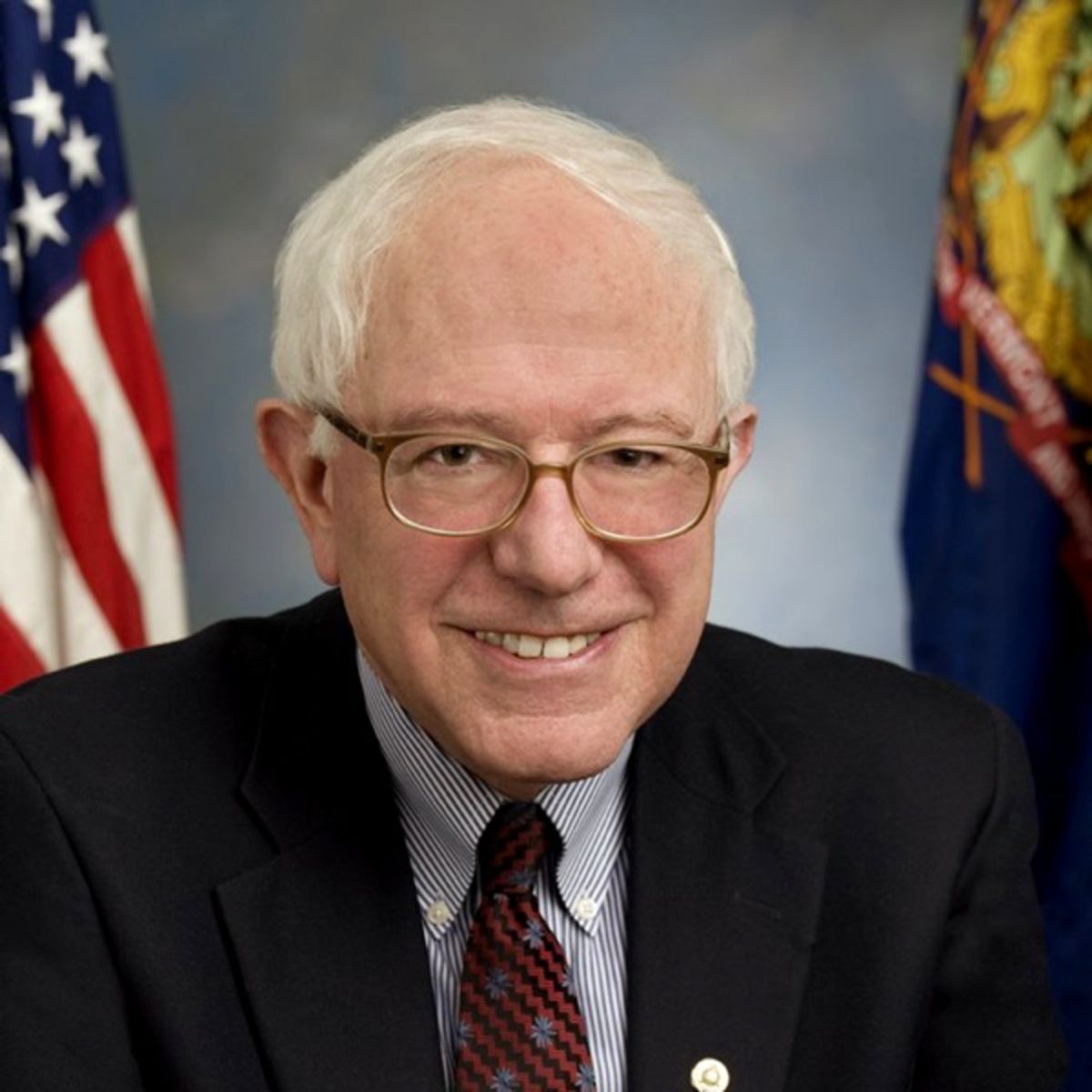
Sen. Bernie Sanders, I-Vermont, who is seeking the Democratic presidential nomination.
Sanders’s campaign may warrant criticism for thinness on foreign policy, but not on any scale measured by the number of advisers who have been signed up. Rather, it is a matter of relatively small attention to foreign policy in the candidate’s own speeches in contrast to his heavy emphasis on the primarily domestic economic matters that he has made into his leitmotif.
This relative inattention may be a matter of discomfort to many who like much of what they hear from Sanders on those domestic issues but realize that foreign policy is a very large and important part of any presidency. The situation may also discomfort those who expect that a Sanders foreign policy probably would be more to their liking (or at least less objectionable) than what any of the other candidates in either party would be apt to offer but would like to hear more from Sanders to be confident about that.
The American Conservative magazine, in a report card that grades all seven remaining major party presidential candidates according to how much…
Video: Flower beds, chairs and even clock: Iraqi man recycles old tires into furniture
A tyre repairer in Iraq is recycling tyres destined for the rubbish dump and transforming them into colorful pieces of furniture. Not only are Ahmed Hameed …
Via Youtube
Video: Crane Collapse: Firefighters battle blaze in Melbourne
A giant crane collapsed after catching fire on Melbourne’s St Kilda Road. No injuries were reported following the incident. Footage of the scene filmed from a …
Via Youtube
A Cemetery of Life Vests But Not Lives


Syrian refugees arriving at Lesbos
Unlike islands elsewhere, Lesbos discards thousands of life vests every day. They litter its eastern and northern shores, coloring the beaches or floating aimlessly on the azure waters. For months now, they have been routinely collected by municipal workers and volunteers and unceremoniously discarded in a municipal dumpsite near the town of Molyvos. Each life vest was worn by one of the more than 450,000 refugees, asylum seekers, and migrants in 2015 alone who made the sea crossing from Turkey to this Greek island. Each tells a different story, but almost inevitably, it is a story of fear.
Although only 8-15 kilometers of water separate Lesbos from Turkey, the crossing is not without danger. I spent three days on the island in mid-December. Two small inflatable dinghies carrying dozens of migrants capsized in that short period due to the choppy seas and the fragile armature of the boats. Two members of Iraq’s Yezidi minority, an elderly man and an 8-month-old baby girl, drowned on the second day, and several others had to be treated for hypothermia, shock, bruises and injuries.
Anna, a Yezidi woman en route to join her husband in Germany, was on one of the capsized boats, along with her four children and granddaughter. The morning after, we spoke with her in one of the tents set up by UNHCR, the United Nations refugee agency, at Kara Tepe, where the authorities register new arrivals. The family had just been reunited after a harrowing night rescue from the cold and dark straits. The smugglers on the opposite shore cram more people onto the boats than they can safely carry, trying to maximize profit as the inflatable boats cannot muster a return trip. Like the life vests, they too are discarded on the shore.
As I first stood in shock before this cemetery of life vests, I saw nothing but the enormity of the refugee crisis. But soon I noticed the different hues of purple and orange, sizes and shapes of the randomly piled life vests and other flotation devices. Instead of one morass, I started to recognize the individuality of each and appreciate the fact that each had kept a refugee alive. The initial shock soon gave way to anger and despair that, so many months into this crisis, so little has been done to provide safe and legal alternative avenues to asylum and refuge in Europe and elsewhere.
Open Arms, Not Closed Borders
Instead of putting fact and law aside to ride populist or nationalist sentiment and become pawns to political brinkmanship, EU politicians need to put reason and rights center-stage to inform the debate, not inflame it. Some were raised on the grimmer side of the Iron Curtain – Hungary in 1956, Czechoslovakia in 1968, Poland in 1981 or all of Eastern Europe in 1989, or in the right-wing dictatorships of Greece, Portugal, or Spain in the 1960s and 70s. And yet they need to be reminded, time and time again, that they were greeted with open arms in time of need, not with fences and closures. They were embraced as victims claiming long lost liberties, not rejected on the fear that they were Communist or Fascist agents, agitators, or infiltrators.
Many who were raised on the brighter side of the Iron Curtain need to be reminded, time and time again, that the EU is a project of peace and tolerance that arose from the horrors and lessons of two traumatic wars and intolerant ideologies. It is unconscionable that a project of its scope and size cannot fathom how to rationally and securely resettle refugees currently encamped in Jordan, Lebanon or Turkey. Henry Kissinger is said to have once asked whom to call to get in touch with Europe. With more deaths piling on top of the over 3,770 of people who drowned or were reported missing in the Mediterranean in 2015, the EU needs to collectively answer the call of the refugees.
Asylum seekers and migrants pay anywhere from 500 to 1,500 euros per person for the crossing. But the passengers have to fend for themselves on the straits, steering the often-faulty outboard engines as best they can against the strong currents and winds. Most do not know how to swim, and often lifejackets purchased in Turkey are fake.
Most leave under cover of night to avoid interception by the coastguard patrols. Adding to their fear, word has spread that masked, armed men in black on unidentified speedboats puncture, swamp, or capsize some of the boats.
Yet fear of the treachery of smugglers, the predations of masked men, and the fury of choppy seas is nothing compared to the overwhelming physical fear that has forced many of the asylum seekers to the western shores of Turkey and beyond in search of safety.
Voices from Lesbos
In Lesbos, I met Fatima, 39, a Sunni from Baghdad, who was fleeing with her three children the vengeful sectarian violence that Shia militias had unleashed against the Sunnis in Iraq. The family only made it to Lesbos after two failed crossings. She left her husband behind in hiding with the hope that he will eventually join them in Germany, where she intends to apply for asylum. “I pray for his safety every day and look forward to the day when we will be together again,” she told me.
Mahmoud, 26, along with his wife and daughter, had first suffered the barrel bombs dropped by the Bashar al-Assad regime on rebel-held areas of Aleppo (Syria). They managed to cross the frontlines to the state-held zone, where their new dwelling miraculously remained standing after indiscriminate mortar attacks by the rebels had hollowed out the adjoining buildings. “We were surrounded by bombed buildings and were no longer willing to tempt fate,” he said, describing why they finally left.
Despite countless EU meetings and several summits, it is not the member states but non-state actors who are still manning the straits. Smugglers and a host of other profiteers control the departure side. Meanwhile, on the arrivals side, are selfless volunteers, island locals, and nongovernmental groups like the International Rescue Committee and Médecins sans Frontières.
In the absence of coordinated policy and shared responsibility in addressing the plight of the refugees, the EU has facilitated criminal and informal organizations to strike it rich in the land of Croesus. As well as making the crossing dangerous and onerous for the refugees, it runs against Europe’s own best interests and security.
What the EU Should Do
It is high time for the EU to coherently address this humanitarian crisis at its borders while ensuring the rights of those arriving on its shores. Instead of squabbling over sharing responsibility or conflating the refugees with terrorists, EU member states should understand that the orderly crossing, screening, and processing of refugees is a win-win solution.
The EU and other traditional resettlement countries like Australia, Canada, and the United States should be offering refugee resettlement and humanitarian visas from Turkey, as well as Jordan and Lebanon and other countries where refugees are first congregating and a real crisis of numbers exists. If they did, fewer people would opt for dangerous sea crossings, and it would allow for the orderly and early screening and processing of refugees in close coordination with UNHCR.
The next step will be convincing Russia and the Gulf States to demonstrate solidarity and to join the resettlement effort, particularly given the guns and bombs they have poured into Syria, contributing to this humanitarian disaster and its massive displacement.
In the meantime, more assistance for Greece is urgently required to improve reception conditions on Lesbos and the other islands. The activation in December of the EU Civil Protection Mechanism, a disaster relief program, is a step in the right direction. But more needs to be done to overcome the squalor and disorder surrounding the EU/Greece hotspot.
As I hear of forthcoming EU meetings and summits, I trust that the cemetery will be one of life vests only, and not one of more dashed hopes and lost lives due to the continued absence of shared policy and responsibility within the EU in addressing the plight of fear-stricken refugees. Maybe an EU summit in Lesbos instead of the sanitized realities at EU headquarters in Brussels could at long last move the EU to answer the call of the refugees.
This piece was reprinted from Foreign Policy In Focus by RINF Alternative News with permission.
Video: Firework Display: Moscow celebrates Defender of the Fatherland
Men (And their families) turned out to Victory Park in Moscow to celebrate Defender of the Fatherland. The spectators were treated to a spectacular firework …
Via Youtube
Video: Clinton supporters exhilarated over South Carolina win
Supporters for Democratic presidential candidate Hillary Clinton hope her massive win against Bernie Sanders in South Carolina will help solidify her as the …
Via Youtube
Video: Obama’s Guantanamo closure plan: ’This is about closing a chapter in our history’
President Obama’s final year in office marks the Guantanamo Bay detention facility’s 15th year in operation. After delivering his closure plan to Congress, Obama …
Via Youtube
Video: Partition of Syria part of ’Plan B’ if ceasefire fails – Kerry
The Syrian government has accepted the terms of a ceasefire deal announced by the US and Russia. In case it fails US has ‘Plan B’. RT LIVE http://rt.com/on-air …
Via Youtube
Donald Trump and the KKK

Eric Zuesse
Donald Trump’s statement about the KKK and David Duke on 14 February 2000: “Mr. Trump painted a fairly dark picture of the Reform Party in his statement, noting the role of Mr. Buchanan, along with the roles of David Duke, a former leader of the Ku Klux Klan, and Lenora Fulani, the former standard-bearer of the New Alliance Party and an advocate of Marxist-Leninist politics. ‘The Reform Party now includes a Klansman, Mr. Duke, a neo-Nazi, Mr. Buchanan, and a communist, Ms. Fulani,’ he said in his statement. ‘This is not company I wish to keep.’” (New York Times)
Donald Trump’s statement about the KKK and David Duke on 26 February 2016: “I didn’t even know that he endorsed me. David Duke endorsed me? Okay, allright: I disavow.” (The Weekly Standard)
Donald Trump’s statement about the KKK and David Duke on 28 February 2016:
Will you unequivocally condemn David Duke and say that you don’t want his vote or that of other white supremacists in this election?
TRUMP: Well, just so you understand, I don’t know anything about David Duke. OK? I don’t know anything about what you’re even talking about with white supremacy or white supremacists. So, I don’t know. I don’t know, did he endorse me or what’s going on, because, you know, I know nothing about David Duke. I know nothing about white supremacists. And so you’re asking me a question that I’m supposed to be talking about people that I know nothing about.
TAPPER: But I guess the question from the Anti-Defamation League is, even if you don’t know about their endorsement, there are these groups and individuals endorsing you. Would you just say unequivocally you condemn them and you don’t want their support?
TRUMP: Well, I have to look at the group. I mean, I don’t know what group you’re talking about. You wouldn’t want me to condemn a group that I know nothing about. I would have to look. If you would send me a list of the groups, I will do research on them. And, certainly, I would disavow if I thought there was something wrong.
TAPPER: The Ku Klux Klan?
TRUMP: But you may have groups in there that are totally fine, and it would be very unfair. So, give me a list of the groups, and I will let you know. … I don’t know any — honestly, I don’t know David Duke. I don’t believe I have ever met him. I’m pretty sure I didn’t meet him. And I just don’t know anything about him.
(CNN)
Does he, or doesn’t he — even care? (To most Republicans, it makes no difference, they’re that callous — they care no more than Democrats do about Hillary Clinton’s corruption and “government policies for sale.”)
This is how an oligarchy functions. By the time things have gotten this rotten, democracy has already ended, even if it had previously existed.
The only candidate who’s against all of this is Bernie Sanders — and he was rejected by 74% of SC’s Democrats.
Is America in a terminal condition?
—————
Investigative historian Eric Zuesse is the author, most recently, of They’re Not Even Close: The Democratic vs. Republican Economic Records, 1910-2010, and of CHRIST’S VENTRILOQUISTS: The Event that Created Christianity.
Video: CrossTalk: Truce in Syria?
Is it for real this time? Moscow and Washington have announced a date for the cessation of hostilities of Syria’s 5-year civil war. This does not include the Syrian …
Via Youtube
Video: Thousands of Afghan refugees stranded in Greece after Macedonia border closure
The bottleneck at the Macedonian border began when Skopje started only allowing refugees from Iraq and Syria through, leaving thousands of others stranded …
Via Youtube
Video: First major LGBT refugee center opens in Berlin
An LGBT-only refugee center in the Treptow-Köpenick borough of Berlin is set to accommodate some 140 gay, lesbian and transgender refugees following its …
Via Youtube
Video: BBC Jimmy Savile 2016 whitewash report – managers knew but took no action
2016 BBC Jimmy Savile report PROOF of a criminal elite BBC paedophile cover-up Tony Gosling & Pippa Jones Talk Radio Europe Fri26Feb16 Dame Janet …
Via Youtube
Video: Detroit Police Kill Dog on Chain, Pay $100,000 Legal Settlement (GRAPHIC: POLICE BRUTALITY)
Story: https://photographyisnotacrime.com/2016/02/28/watch-detroit-police-shot-mans-chained-dog-in-video-pay-100000-settlement/ Detroit police spent …
Via Youtube
Video: Jennifer Tichy & Sallie Elkordy on Fighting To Wake The World Up To Vaccine Injury!
Please Support The Show – http://richieallen.co.uk/ https://www.facebook.com/therichieallenshow http://www.youtube.com/RichieAllenShowMedia Tune in at …
Via Youtube
Video: ‘Mexican Pompeii’ Lava-engulfed Paricutin cathedral (drone footage)
Rare Ruptly footage shows the remains of the village of San Juan Parangaricutiro, in Mexico. Its iconic church is the only construction not covered by the lava …
Via Youtube
Video: ‘Partition of Syria is leap into unknown, could lead to further instability’ – British MP
According to Kerry, the partition of Syria becomes an option if the planned ceasefire – due to come into force on February 27th – fails to hold – or if a shift to a …
Via Youtube
A ‘Blistering Critique’ With a ‘Great New Metaphor for Hippie-Punching’

Dollars & Sense chart (11-12/15) projecting increased employment under Bernie Sanders’ proposed policies.
Dave Lindorff of This Can’t Be Happening! (2/19/16) cited FAIR (2/17/16) on New York Times reporter Jackie Calmes’ slam of Sandersnomics (2/15/16):
The so-called “left-leaning” economists quoted by her, however, included not one genuine left or even left-leaning economist. Rather, they were a bunch of mainstream economists who, while “not working for Hillary Clinton,” as Calmes notes, have in fact worked for either the administration of Barack Obama or of Bill Clinton (a point she largely fails to note). As media critic Doug Henwood of Fairness & Accuracy In Reporting (FAIR) pointed out in a blistering critique of the Times article, referring to the economists quoted in the piece, “So slight is their leftward lean that it would require very sensitive equipment to measure.”
Dollars & Sense (2/19/16) also included Henwood’s piece for FAIR on a reading list on the controversy over projections of increased growth and employment under Sanders’ proposed economic policies. It describes the FAIR piece as “a very good critique of the Calmes NYT piece, plus a great new metaphor for hippie-punching–the ‘unicorn hunt.’”
This piece was reprinted by RINF Alternative News with permission from FAIR.
Hillary Clinton’s Little Red Riding Hood Problem


The post Hillary Clinton’s Little Red Riding Hood Problem appeared first on OtherWords.
This piece was reprinted from Other Words by RINF Alternative News with permission.
Video: Triumph Trump: Republican candidate wins Nevada with 45% of votes
Polls favoring a Donald Trump victory in Nevada proved to be correct, according to first results. With 30 delegates at stake, the second Republican caucuses …
Via Youtube
Testing Out Repression in Israel
Jeff Halper, co-founder of the Israeli Committee Against House Demolitions, sees the brutal practice of destroying Palestinian homes and similar tactics as part of an experiment in social repression that can have broader implications as income inequality spreads across the globe, as he told Dennis J Bernstein.
By Dennis J Bernstein
Israeli author and human rights activist Jeff Halper who has challenged the Israeli practice of destroying Palestinian homes (usually for simply building after being denied a permit) attempts to answer the question why the world continues to accept such repeated brutalities perpetrated by the Israelis against a million-plus locked-down, very poor Palestinians.
Halper detects a quid pro quo, a violent marriage of convenience in which “Israel offers its expertise in helping governments pursue their various wars against the people and, in return, they permit it to expand its settlements and control throughout the Palestinian territory.”

Peace and human rights activist Jeff Halper.
Halper’s latest book, War Against the People: Israel, the Palestinians and Global Pacification, focuses on a “global Palestine,” and “how Israel exports its Occupation – its weaponry, its models and tactics of control and its security and surveillance systems, all developed and perfected on the Palestinians – to countries around the world engaged in asymmetrical warfare, or domestic securitization, both forms of ‘war against the people.’”
He contextualizes Israel’s globalization of Palestine “within the capitalist world system. Inherently unequal, exploitative, violent and increasingly unsustainable, Capitalism must pursue innumerable wars against the people if it is to enforce its global hegemony. These are precisely the types of wars – counterinsurgency, asymmetrical warfare, counter-terrorism, urban warfare and the overall securitization of societies, including those of the Global North – in which Israel specializes.”
Halper, whose activism also includes work for over a decade as a community organizer in the working-class Mizrahi (Middle Eastern) Jewish neighborhoods of Jerusalem, is a coordinator of the Wars Against the People…
Video: ‘Terror belt’: Turkish PM accuses Russia, Syria, Kurds of illegal actions on its borders
The Turkish Prime Minister claims a belt of terror is being created – along his country’s border with Syria. But he doesn’t only mean Islamic State. RT LIVE …
Via Youtube
Poland’s Tea Party Movement


(Photo: Wikimedia Commons)
On a rainy day in April 1990, I journeyed to the outskirts of Warsaw to one of those functional Communist-era apartment building complexes to meet with Antoni Macierewicz. The opposition leader’s apartment contrasted sharply with its grim institutional surroundings. It was an aristocratic enclave full of books, antiques, and prints on the wall. Macierewicz himself exuded an Old World kind of charm that Polish intellectuals worked so hard to preserve during difficult times.
A long-time dissident, Macierewicz had been something of a leftist in the 1970s, supporting the Revolutionary Left Movement in Chile and protesting the U.S. war in Vietnam. He was a key figure, with Jacek Kuron and Adam Michnik, in the creation of the Committee for the Defense of Workers (KOR) in 1976 and then Solidarity in 1980.
Over the years, however, he’d moved steadily rightward until he’d become, by 1990, a leading figure in a coalition of conservative Christian groups. These groups had cooperated with Solidarity during the 1980s. But now that Poland had put the Communist era behind it, Macierewicz was staking out a distinct political terrain for his version of clerical anti-Communism.
Government policy, he told me that afternoon in 1990, should follow Church teachings, and so should instruction in public schools. The economic reforms that Poland was then undertaking were not, he argued, sufficiently anti-state, for they did not guarantee access to capital and ownership to the largest number of Poles. And the new Polish state, stripped down to its minimal functions, should make a clean break with the past to eliminate any lingering influence from former Communist functionaries.
Perhaps naively, I didn’t see much of a future for Macierewicz and his Catholic nationalists. The last thing I imagined Poles wanted after 1989 was to swap one variety of political intolerance for another. Poles were overwhelmingly Catholic, of course. But church attendance was far from universal — 53 percent in 1987 — and religious zealotry was a distinctly minority passion.
Meanwhile, most Polish voters were gravitating toward the middle of the political spectrum. Solidarity politicians were establishing a set of center-right parties, and the former Communists were struggling to rebrand themselves as a center-left party (though “left” and “right” meant something quite different in terms of actual policies in Poland at that time). And indeed, in the next parliamentary elections in 1991, Macierewicz’s forces in Catholic Election Action managed a mere 8.7 percent of the vote for the Sejm (though the coalition captured a bit more, 17.4 percent, for the Senate).
But Macierewicz himself vaulted into the position of minister of internal affairs in 1991. The following year he released the infamous Macierewicz List, which identified 64 members of the Polish government and parliament as former secret Communist agents. Even more controversially, he accused then-president Lech Walesa of also being an informer.
These claims produced immediate outrage — from those who believed that the government was unacceptably compromised as well as those who were appalled that such unvetted accusations were made public. A successful no-confidence vote in parliament led to the resignation of the government and the abrupt end of Macierewicz’s term in office. A subsequent parliamentary inquiry concluded that only six of the 64 had signed any agreements with the secret police, and Macierewicz also had to face charges of publishing state secrets.
Macierewicz had established a reputation as Poland’s Ted Cruz — a firebrand willing to take down his political opponents even at the cost of his own position.
But it gets worse than that.
Macierewicz never met a conspiracy theory he didn’t like. In the 2000s, he was still convinced that a majority of Polish diplomats were former Communist informers, earning him a skeptical appraisal in a U.S. diplomatic cable. He believed that the Russians were behind the 2010 airplane crash in Smolensk that killed then-Polish President Lech Kaczynski and many other prominent Poles on their way to a commemoration of the Katyn massacre. And, in an infamous interview with the right-wing Catholic Radio Maryja, he put in a good word for the Protocols of the Elders of Zion, adding that “Polish experience, especially in recent years, shows that there are such groups in Jewish circles who think in a cunning way and act deliberately to the detriment of, for example, Poland.”
It would be nice to report that Macierewicz remains at the fringes of Polish politics, that his past actions and rhetoric have disqualified him from serving in high positions. But that would be wishful thinking.
As of last December, Antoni Macierewicz is Poland’s minister of defense.
Reading the Tea Leaves
Poland is frequently held up as the success story of Central Europe’s transition from Communism. It has experienced relatively steady economic growth, even during the financial crisis of 2007-8. It has implemented a successful political decentralization plan. It continues to boast a thriving civil society.
But in the parliamentary elections last year, the right-wing Law and Justice Party (PiS) capitalized on widespread resentment and anger not only to come in first, but also to secure the country’s first parliamentary majority in the democratic era. As with the victory of Viktor Orban’s right-wing Fidesz party in Hungary, PiS has set about to transform the country into what Orban has famously called an “illiberal democracy.”
The appointment of Macierewicz as defense minister is only the tip of the spear. Poland expert David Ost, writing in The Nation, argues that Poland’s PiS is pursuing
an uncompromising revolution from above that abandons the institutions of liberal democracy and any ethos of compromise in favor of an unchallenged monopoly of power. The new authorities call for a “strong” state instead of a “lawful” state, to be guided by “Polish values” and “Christian traditions,” deeply hostile to any political opposition, and imagining itself in a historic battle with a Europe committed to “totalitarian” ideas like gender equality and resettling refugees.
Jaroslaw Kaczynski, the twin brother of Lech who died in the Smolensk air disaster, is the force behind PiS. He has remained in parliament to control the party while elevating the more diplomatic Beata Szydlo as prime minister and getting his attack dog, the Cruz-like Macierewicz, appointed as defense minister. Together, they are presiding over a transformation in Poland not unlike what the Tea Party would dearly like to accomplish in the United States.
Let’s begin with Macierewicz and his obsessions. As an opposition politician, Macierewicz refused to accept the official version of the Smolensk air disaster, holding hearings in parliament that featured “experts” who relied on Internet photos rather than site visits. Macierewicz rejected the notion that some combination of fog and pilot error caused the Tupolev 154 plane to crash, the conclusion of the official investigations of both Poland and Russia. Instead, like something out of House of Cards or Madame Secretary, he has insisted that an explosion caused the crash and the Russians were behind it.
Macierewicz’s determination to reopen an official inquiry into Smolensk is sure to aggravate the already dicey relations between Moscow and Warsaw. As importantly, it will polarize what is already a deeply divided Polish society. “Smolensk” has all the hallmarks of the “birther” movement in which facts count for a lot less than insinuation. Just as only one-third of Republican voters believe that President Obama was born in the United States, nearly one-third of Poles believe that Lech Kaczynski was assassinated. The Russians are not the only evil-doers in this drama. If the official Polish inquiry was flawed, the previous government of Donald Tusk and the Civic Platform (PO) — the chief political opposition to PiS — emerge as dangerous co-conspirators.
The enemy within is the real focus of Poland’s Tea Party. For instance, Macierewicz has undertaken a purge of the military as if it were populated by Communist-era appointees rather than officials designated by the previous center-right government. The purge included the rector of the National Defense University. The new government even went so far as to conduct a raid on NATO’s Counter-Intelligence Center of Excellence, which is based in Warsaw, to replace its head. This is how coup leaders, not democratically elected governments, go about the business of cleaning house.
On military issues more generally, Macierewicz wants to nearly double the size of the Polish army, and he’d trade participation in the coalition bombings in Syria for the stationing of NATO units in Poland. If the reopening of the Smolensk inquiry doesn’t deepsix relations with Moscow, this buildup on Poland’s eastern borders will do the trick. After seething over various official efforts over the last couple decades to repair relations with Russia, Macierewicz is after nothing less than a revival of the age-old hostility between the two countries.
Kaczynski Settles Scores
In the early 1990s, the politics of revenge in Central Europe were clear-cut. The new political elite took aim at the former Communists, lustrating them out of government, stripping the party of its assets, and throwing a couple of the top leaders in jail (or attempting to). But as opposition coalitions fragmented into a kaleidoscope of parties, the politics of revenge in the region became increasingly complicated.
Jaroslaw Kaczynski and PiS have broadened their campaign of revenge far beyond Communism. They have scores to settle with former allies as well.
Take, for instance, the campaign against Lech Walesa. The august Polish leader has always been firmly on the right side of the political spectrum. But he and the Kaczynski brothers crossed swords in the 1990s. It’s no surprise, then, that new charges of Walesa as a Communist collaborator surfaced just this month. Kaczynski and company maintain that the Solidarity movement unnecessarily compromised with the Communist Party during the transition period — keeping General Wojciech Jaruzelski as president rather than throwing him in prison, for instance, and allowing the nomenklatura to cash in on the new capitalist economy. Walesa’s collaboration in the 1970s is supposed to represent the fatal flaw of the accommodationist wing of Solidarity.
The historical revisionism of PiS is part of what the Germans call kulturkampf, or cultural struggle. Their goal is to “purify” the country of Poles of the “worst sort,” as Kaczynski has described his opponents.
In uglier days, the “worst sort” of Poles might have been Jews, who were accused of being Communists or rapacious capitalists or simply disloyal “outsiders.” Today, the enemy is a motley collection of liberals, secularists, critical intellectuals, and cosmopolitans. Poland’s Foreign Minister Witold Waszczykowski has warned against “a new mixing of cultures and races, a world made up of bicyclists and vegetarians, who … fight all forms of religion.” With the Communist bogeyman gone, the best that PiS can come up with is bicyclists and vegetarians?
To combat these threats to Polish society, PiS began to ram through legislation in a top-down effort to remake Polish society. Like Fidesz in Hungary, PiS has first targeted the constitutional court, which represented an obstacle to its revolutionary program. PiS doesn’t have a large enough parliamentary majority to easily change the Polish constitution. So it pursued two strategies — to pack the court with its appointees and slow down its functioning by requiring two-thirds majority rulings rather than a simple majority as before.
Other legislation has included a law giving the government greater surveillance powers as well as the authority to appoint the heads of public media. It’s as if Viktor Orban and Fidesz have served as unofficial advisors because PiS is following virtually the same playbook. No surprise, then, that Kacyznski met with Orban for six hours in January. And five years ago, the Polish politician declared: “Viktor Orban gave us an example of how we can win. The day will come when we will succeed, and we will have Budapest in Warsaw.”
That day has come. And this time the European Union is reacting. Writes Jan-Werner Muller in The New York Review of Books:
Unlike in the case of Hungary, the European Union has reacted quickly. Leading EU figures declared that fundamental democratic values were threatened by Warsaw. And on January 13, the European Commission was sufficiently concerned to open a “probe” into the workings of the rule of law in Poland, a step that is unprecedented in EU history.
It’s not just Poland’s internal politics that worries the EU. The Union has encountered considerable pushback from Central European countries, including Poland, about accepting their fair share of refugees coming from the Middle East. Poland, with a miniscule immigrant population, has also seen a large outflow of population over the last two decades. In other words, there’s plenty of room for newcomers.
But Kaczynski has made clear that refugees are not welcome. “There are already signs of emergence of diseases that are highly dangerous and have not been seen in Europe for a long time: cholera on the Greek islands, dysentery in Vienna,” he said during the 2015 election campaign. “There is also talk about other, even more severe diseases.” This rhetoric echoes Nazi descriptions of Jews as carriers to disease. The more moderate of the anti-refugee politicians in Poland have, like Donald Trump, argued that only the Christians among the asylum-seekers should be allowed in.
The success of PiS is not simply a function of the failures of the previous center-right government of Donald Tusk, who decamped in late 2014 to become the president of the European Council. Rather, as in Hungary, the Kaczynski crowd has benefited from the collapse of the left in Poland.
When it was in charge, the left embraced a pro-West platform of austerity economic reforms, accession to NATO and the EU, and a (relatively) tolerant set of cultural policies. The support for “shock therapy” cost the mainstream left its base among those who have not benefitted from economic reforms. This opened up a vast opportunity for right-wing parties that have fed on anger and resentment of the “losers of transition” — farmers, industrial workers, pensioners — by offering, like the Tea Party, vaguely populist economic policies.
In this Polish culture war, however, the “worst sort” of Poles are fighting back. Demonstrations have again become commonplace in Warsaw, and the liberal left is banding together in the face of the new threat.
Macierewicz and the other Mad Hatters of the Polish “Tea Party” movement will no doubt do a lot of damage during their tenure in power. But perhaps, as in 1992, they will overreach and be overwhelmed by a backlash that will prove powerful enough, finally, to push Poland kicking and screaming into 21st-century Europe.
This piece was reprinted from Foreign Policy In Focus by RINF Alternative News with permission.
Video: Happy Happy Hippos: Newborn baby splashes with mom at Prague zoo
Czech zoo presented its newest inhabitant on Wednesday: a baby hippo. It was born on 28 January and it now lives in its enclosure in Prague with its mother, …
Via Youtube
Video: Towson Student Fights Back After his Poem Deemed “Anti-Police”
Towson High senior class president Marcus Shaw reads his poem “Believe Me,” for The Real News after the school’s principal initially banned it from a talent …
Via Youtube
Video: ‘No’ or ‘Yes’? Hungary to hold referendum on EU migrant quotas
Hungarian Prime Minister Viktor Orban says his country will hold a referendum on EU migrant quotas. RT LIVE http://rt.com/on-air Subscribe to RT!
Via Youtube
Video: Brazil’s Embattled Government Faces Yet More Challenges
With yet another corruption scandal unraveling near President Rousseff and more bad economic news, Alfredo Saad Filho examines the prospects of Brazil’s PT …
Via Youtube
Video: Das Spyware! Germany approves ‘Trojan Horse’ to monitor suspects
Germany’s government has approved the use of a so called “trojan horse” software bug to monitor the computers and smartphones of police suspects. RT LIVE …
Via Youtube
Mitch McConnell Is a Supreme Hypocrite

Antonin Scalia is gone. The nastiest and noisiest of right wingers on the Supreme Court is dead.
But in a blatantly partisan ploy to prevent President Barack Obama from nominating a successor to Scalia, Senate Republican leader Mitch McConnell has cited a brand new historical precedent dictating that presidents in the last year of their term don’t name new justices to the high court.
“Therefore,” McConnell babbled, “this vacancy should not be filled until we have a new president.”

Gage Skidmore/Flickr
What a silly old squirrel McConnell is. Article II of the U.S. Constitution plainly states that the president, with the “advice and consent of the Senate, shall appoint ambassadors, other public ministers and consuls, [and] judges of the Supreme Court.”
Note that the Constitution says the president “shall” do this — as a duty to the nation.
Nothing in the founding document suggests that this responsibility is voided in an election year. In fact, every single election-year vacancy in the last 116 years has been filled. McConnell’s assertion is bogus — and silly. History and the Constitution clearly back Obama.
Ironically, Scalia himself would have nailed McConnell for such a slapstick political perversion of plain language in our founding document. He practiced what he called “originalism” in his official judgments, insisting that the Constitution must be interpreted only by the words in it — and only by the original meaning those words had for the founders when they wrote them.
McConnell’s squirrelly stalling is as ridiculous as it is shameful. It’s also totally hypocritical, since the Kentucky Republican himself voted in February 1988 to confirm a Supreme Court nominee put forth by Ronald Reagan — in the last year of his presidency.
The post Mitch McConnell Is a Supreme Hypocrite appeared first on OtherWords.
This piece was reprinted from Other Words by RINF Alternative News with permission.
NYT Contributor Has Multiple Motives for Denying Drone Crimes

New York Times illustration (by Mike McQuade) depicts drone strikes literally as pinpoint attacks.
Retired Air Force Gen. Michael Hayden, former director of both the NSA and CIA, began his New York Times op-ed (2/21/16) with 24 paragraphs of dialogue illustrating how carefully the US government chooses drone targets so as not to put the innocent at risk:
The decision maker asks if there are civilians nearby.
“The family is in the main building. The guys we want are in the big guesthouse here.”
“They’re not very far apart.”
“Far enough.”…
He asks the probability of killing the targets if they use a GBU-12, a powerful 500-pound, laser-guided bomb.
“These guys are sure dead,” comes the reply. “We think the family’s OK.”
“You think they’re OK?”
“They should be.” But the analyst confesses it is impossible to be sure.
The “decision maker” opts for using smaller Hellfire missiles, with which “the family’s safe, but the bad guys might survive.” Then he goes with the 500-pound GBU, after learning that the targets are “big AQ operators. We’ve been trying to track them forever. They’re really careful. They’ve been hard to find. They’re the first team.”
Only after bringing this elaborate story to a happy ending—“The two targets are dead. The civilians have fled the compound. All are alive”—does Hayden reveal that the whole story is fiction (emphasis added):
The dialogue above, representative of many such missions, shows how hard the commanders and analysts work to get it right.

Former CIA Director Michael Hayden
Well, no—since the dialogue is made up for an op-ed, it illustrates how far a former “decision maker” will go to convince the public that his hands are relatively free of innocent blood. Independent analysts, actually, say that a large number of civilians have been killed by the decisions Hayden made as CIA chief, as he acknowledges:
Critics assert that a high percentage of the people killed in drone strikes are civilians—a claim totally at odds with the intelligence I have reviewed—and that the strikes have turned the Muslim world against the United States, fueling terrorist recruitment.
Yes, “critics”—that is to say, people who have actually investigated the results of drone strikes, like the Bureau of Investigative Journalism—have found that at least 10 percent, and perhaps 24 percent or more, of people killed in Pakistan by US drones since 2004 were civilians. US drones have killed at least 172 Pakistani children, the BIJ found.
By contrast, the “intelligence” finds that drone strikes have killed almost no civilians because intelligence officials take the Orwellian position that “military-age males” in the vicinity of a drone strike are by definition not civilians, a grim fact that the New York Times (5/29/12) has reported before:
Mr. Obama embraced a disputed method for counting civilian casualties that did little to box him in. It in effect counts all military-age males in a strike zone as combatants, according to several administration officials, unless there is explicit intelligence posthumously proving them innocent.
Counterterrorism officials insist this approach is one of simple logic: People in an area of known terrorist activity, or found with a top Qaeda operative, are probably up to no good. “Al Qaeda is an insular, paranoid organization — innocent neighbors don’t hitchhike rides in the back of trucks headed for the border with guns and bombs,” said one official, who requested anonymity to speak about what is still a classified program.
This counting method may partly explain the official claims of extraordinarily low collateral deaths.
You think?

Human Rights Watch’s report on the US’s 2013 attack on a Yemeni wedding party.
Hayden painted a picture of US intelligence officials who anguish over the death of a child whose “grandfather had a garage full of dangerous chemicals, and he intended to use them, perhaps on Americans”—suggesting that drone strikes are a scalpel that occasionally and unavoidably nicks an innocent while surgically removing supervillains. That picture is belied by incidents like the December 12, 2013, drone strike on Aqabat Z’aj, Yemen, which killed 12 people—all members of a wedding party transporting a bride from her home village to that of her groom (Human Rights Watch, 2/14).
Such attacks result from the use of “signature strikes”—targeting unknown people whom the US deems to be acting suspiciously (like traveling in an armed convoy through the desert, which is not actually unusual behavior in Yemen). Wrote Hayden:
Critics said these so-called signature strikes were indiscriminate. They were not. Intelligence for signature strikes always had multiple threads and deep history. The data was near encyclopedic.
Here’s a suggestion: If your encyclopedia is telling you to bomb wedding parties, it’s time to get a new encyclopedia.
But killing civilians because they didn’t know who they were bombing is not the worst thing that the drone program had done. Hayden writes that a review of video following a “successful strike” showed that the attack had killed
a frightened woman responding to another weapon that had just detonated…. We realized, once our after-action review was done, that we needed to put even more eyes on targets as they were being struck to try to avoid any future civilian casualties.
Actually, the drone program has deliberately targeted people like that—civilians responding to drone strikes—using a technique known as a “double tap,” when a lethal attack is followed shortly by a second strike to kill those who come to the scene to help. “The CIA’s drone campaign in Pakistan has killed dozens of civilians who had gone to help rescue victims or were attending funerals,” the BIJ (2/4/12) reported.
Hayden’s op-ed is long on fictional accounts of ultra-scrupulous drone planners worrying about striking civilians and completely lacking the real-life incidents where the US has mistakenly targeted weddings and deliberately hit funerals. That’s to be expected when you ask someone who has carried out what the United Nations and other international law experts have called illegal attacks to justify what they’ve done: They’re unlikely to confess to how many innocent lives their criminal actions have lost.

Little Sis‘s graphic (2/22/16) showing Michael Hayden’s official and financial ties to the drone program.
It’s especially unlikely when that person continues to benefit personally from the illegal program, as Hayden does. As the government transparency project Little Sis (2/22/16) noted after the op-ed was published, Hayden sits on the board of Motorola Solutions, which last year “made a strategic investment in CyPhy Works, a leading developer of advanced unmanned aerial vehicles (UAVs), also known as drones,” as a press release (3/16/15) from the company declared. Motorola Solutions paid Hayden $240,125 for his services last year, Little Sis noted.
The muckraking site also pointed out that Hayden served from 2010 until 2015 on the board of Alion, a company that in 2012 “was awarded a $24 million contract to develop the US Navy’s unmanned and automatic weapons systems.” Alion is not required to disclose compensation for its board members.
The New York Times did not disclose Hayden’s conflict—though the Times‘ ethics rules would seem to prohibit outside contributors advocating on behalf of industries that they have a direct financial stake in. Why such rules would be broken or bent to allow a writer to make self-serving claims that have been disproved by the Times‘ own reporting is a question that op-editors ought to answer.
Jim Naureckas is the editor of FAIR.org. Follow him on Twitter at @JNaureckas.
You can send a message to the New York Times at letters@nytimes.com, or write to (outgoing) public editor Margaret Sullivan at public@nytimes.com (Twitter:@NYTimes or @Sulliview). Please remember that respectful communication is the most effective.
This piece was reprinted by RINF Alternative News with permission from FAIR.
Video: ‘We hope Kerry’s ‘plan B’ aimed against terrorism’ – Assad Adviser
The US is discussing “Plan B” options should the Syrian ceasefire and political transition fail, Secretary of State John Kerry told a Senate committee, while …
Via Youtube
Video: ‘Secret war’: France reportedly engaged in military ops against ISIS in Libya
France is using its special forces and commandos to wage covert military operations against Islamic State (IS, formerly ISIL/ISIS) in Libya, the country’s media …
Via Youtube
Video: Inside South Carolina Barbershops Ahead of the South Carolina Primary
Rapper Killer Mike & former Ohio State Senator Nina Turner attempt to persuade South Carolina black voters to support Sanders for President saying his goals …
Via Youtube
Video: Kerry: Libya may become ‘failed state’ if conflict continues
Libya risks becoming ‘a failed state’ if the UN-brokered unity government flops, US Secretary John Kerry has said. While Libya remains broke and insecure five …
Via Youtube
Video: Feeling the Bern Become a Flame
Jacobin founder Bhaskar Sunkara discusses the strategies needed to keep the energy of the Sanders campaign thriving beyond presidential politics.
Via Youtube
Video: Prominent Wall Street Whistleblowers Announce New Initiative (Part 4)
Bank Whistleblowers United held a kick-off conference Thursday where former high ranking bankers outlined a proposal they would like to see each presidential …
Via Youtube
Video: End of Calais ‘Jungle’? Migrants in panic & despair over camp relocation plan
Thousands of migrants in the French port town of Calais are facing eviction from the tent camp known as the ‘Jungle’. The government plans to bulldoze it and …
Via Youtube
Video: New Law Would Track International Movement to Boycott Israel
Josh Ruebner says fears over the impact of the new law are overblown but many more anti-BDS measures are being considered nationwide.
Via Youtube
Walling off Common Sense

Jill Richardson
“We’re going to do the wall,” Donald Trump told a cheering crowd of supporters in a victory speech following the South Carolina Republican primary. He was reiterating his fanciful promise to wall off the entire U.S.-Mexico border — and force Mexico to pay for it.
Never mind whether even Trump believes there’s a chance this cornerstone of his stump speech will happen. It’s the thinking behind it that’s majorly flawed.
This simplistic, right-wing logic turns the victims of social problems into the perpetrators. It seeks to inflict punishment even when it won’t fix anything.
Take, for example, the issue of undocumented immigration.
To Trump and his supporters, the problem is the people who cross the U.S.-Mexico border without papers. The solution is a wall. The end result, they say, will be more jobs for Americans.

US Department of Agriculture / Flickr
Sorry, it’s not that simple.
First of all, Mexicans make up a little under half of undocumented immigrants — a number that’s actually declining. More Mexicans are leaving the United States than entering these days.
Second, two out of five undocumented immigrants came here legally as visitors and then overstayed their visas. A wall won’t keep them out.
Finally, consider the jobs that undocumented workers do: They’re farmworkers, slaughterhouse workers, dishwashers, house cleaners, landscapers, and so on.
For each low-wage, exploitative job, there are winners and losers.
The loser is often the immigrant doing backbreaking work for below minimum wage and without legally required labor protections. The winners are those who profit: employers, their shareholders, and consumers who buy cheap goods produced by workers paid low wages.
If you eat food in this country — unless you grow it yourself or you’re on a first-name basis with the farmer who does — you’ve personally benefited from undocumented immigrant labor.
Americans pay a lower share of our disposable income for food than any other nation on earth. One reason for that is the exploitation of undocumented labor on farms and in slaughterhouses.
In fact, when Georgia and Alabama enacted strict anti-immigrant measures a few years ago, farmers in both states ended up with crops rotting in their fields because there was no one to harvest them. Georgia turned to prison labor to fill the labor gap left by immigrants.
In other words, when undocumented labor was out of the picture, legal U.S. residents were unwilling to voluntarily take the farm jobs that were left vacant. Not for the working conditions and the wages being offered.
Is there a problem here? You bet. Will a wall fix it? Not a chance. And is the cause of the problem undocumented immigrants? Hardly.
Undocumented immigrants are simply pawns in a larger system. We all are. Like everyone else, they’re looking for jobs so they can raise their families and improve their lives.
Why do they come here illegally? For one thing, our immigration laws are fundamentally unrealistic. For Mexicans, coming to the United States legally can mean waiting for upwards of 20 years.
Moreover, Trump’s “plan” (if you can call it that) won’t address what’s driving people out of Mexico itself, such as historically high rates of murder, extortion, kidnapping, and other crimes tied to drug trafficking.
Can we change our trade and drug policies in ways that make life easier in Mexico? Can we change our laws so employers become more apt to provide good jobs to immigrants and non-immigrants alike?
Maybe. But we can’t do any of that with a wall.
The question shouldn’t be “Who are the bad guys and how can we punish them?” It must be “What’s the problem and how can we solve it?”
The post Walling off Common Sense appeared first on OtherWords.
This piece was reprinted from Other Words by RINF Alternative News with permission.
Video: Damascus Offensive: Fighting continues before ceasefire
With a ceasefire in Syria, brokered by Moscow and Washington just days away, fierce fighting is still ongoing in a Damascus suburb. The Syrian army says …
Via Youtube
Video: Prominent Wall Street Whistleblowers Announce New Initiative (Part 3)
Bank Whistleblowers United held a kick-off conference Thursday where former high ranking bankers outlined a proposal they would like to see each presidential …
Via Youtube
NYT Used to Report Delegate Count as if It Was Voters Who Mattered

New York Times delegate graphic. Note that not only are superdelegates added into pledged delegates as though they were the same thing, but the graphic includes Clinton’s Nevada victory twice–mistakenly giving the impression that she’s won 50 percent more contests than she has. UPDATE: The Times has removed the extra victory from Clinton’s column.
After Bernie Sanders lost the Nevada caucuses to Hillary Clinton, 47 percent to 53 percent, the New York Times (2/21/16) declared the 2016 primary race all but over:
Senator Bernie Sanders vowed on Sunday to fight on after losing the Nevada caucuses, predicting that he would pull off a historic political upset by this summer’s party convention.
But the often overlooked delegate count in the Democratic primary shows Mr. Sanders slipping significantly behind Hillary Clinton in the race for the nomination, and the odds of his overtaking her growing increasingly remote.
Mrs. Clinton has 502 delegates to Mr. Sanders’s 70; 2,383 are needed to win the nomination. These numbers include delegates won in state contests and superdelegates, who can support any candidate.
At the end of the tenth paragraph, the Times‘ Patrick Healy includes some information relevant to the question of whether Sanders is “slipping significantly behind” Clinton:
A New York Times analysis found that Mrs. Clinton and Mr. Sanders are tied in the pledged delegate count, at 51 each.
In other words, as far as voters are concerned, Sanders and Clinton are exactly tied so far. It’s only when you count the intentions of superdelegates—party insiders who by virtue of their position get to weigh in on the nominee—that Clinton has any sort of delegate lead, insurmountable or otherwise.
There are good reasons to treat the pledged delegate count as the delegate count. For one thing, the unpledged superdelegates can only indicate who they intend to vote for, which is not necessarily who they will actually vote for; they can and in the past have changed their minds. Counting them the same as pledged delegates is a bit like counting delegates from states that haven’t voted yet because voters in those states tell pollsters they intend to vote for one candidate or the other. They may or may not feel differently when the time comes.
Further, it’s doubtful that superdelegates would choose to overturn the will of Democratic voters to pick a nominee that they had rejected in the voting booth; that seems like an ideal strategy for keeping Democrats home on Election Day, not only giving up control of the White House but—perhaps more importantly to superdelegates, many of whom are in Congress—also putting otherwise safe legislative seats in jeopardy. As Daily Kos blogger Tausendberg (8/30/15) put it last year:
If, in 2016, the Democratic base was told that their opinion had been overridden and made irrelevant, the psychological impact would be so catastrophic on Election Day 2016 that we would need to make up new words to describe it.
Finally, one could argue that media outlets should emphasize the delegate count that reflects the will of the people, rather than an alternative count that disguises that will, because election coverage is supposed to be about facilitating democracy, right?
Arguments like these must have been persuasive to the New York Times at some point, because in 2008—the last time there was a contested Democratic primary—the Times did the count the other way, treating the count of pledged delegates chosen by voters as the real count. As the Times‘ Patrick Healy put it in a February 2008 news article (2/7/08), “The Times counts only delegates that have been officially selected and are bound by their preferences.” (That’s the same Patrick Healy who now puts the pledged delegate count at the end of the tenth paragraph.)
This approach affected how the Times covered the 2008 race, as when the paper’s Adam Nagourney (2/14/08) reported after primaries in Virginia, Maryland and DC:
Senator Barack Obama emerged from Tuesday’s primaries leading Senator Hillary Rodham Clinton by more than 100 delegates, a small but significant advantage that Democrats said would be difficult for Mrs. Clinton to make up in the remaining contests in the presidential nomination battle.
Note that Obama’s critical 100-delegate lead was in pledged delegates; that was apparently considered so obvious that it went without saying. The Times rightly noted that only after voters had had their say would superdelegates’ preferences come into play:
Neither candidate is expected to win the 2,025 pledged delegates needed to claim the nomination by the time the voting ends in June. But Mr. Obama’s campaign began making a case in earnest on Wednesday that if he maintained his edge in delegates won in primaries and caucuses, he would have the strongest claim to the backing of the 796 elected Democrats and party leaders known as superdelegates who are free to vote as they choose and who now stand to determine the outcome.
At that time, whether superdelegates had the right to make a choice independent of what voters wanted was an open question—with Clinton and Obama taking opposite sides:
Mrs. Clinton’s aides said the delegates should make their decision based on who they thought would be the stronger candidate and president. Mr. Obama argues that they should follow the will of the Democratic Party as expressed in the primary and caucuses—meaning the candidate with the most delegates from the voting.
Of course, in 2008, it was the Times‘ stated view (1/25/08) that the Democrats had “two powerful main contenders” who “would both help restore America’s global image…. On the major issues, there is no real gulf separating the two.” So while the paper endorsed Clinton over Obama, it was safe to leave the decision in the hands of the voters.
This year, the Times (1/30/16) endorsed Clinton over an opponent who is “a self-described Democratic Socialist,” who “does not have the breadth of experience or policy ideas that Mrs. Clinton offers,” and whose plans “to break up the banks and to start all over on healthcare reform…aren’t realistic.” This time around, then, the favored candidate could use a little help by including her establishment supporters in the count alongside delegates chosen by voters—so you might call attention to the “often overlooked delegate count” to portray her chances of being beaten as “growing increasingly remote.”
Jim Naureckas is the editor of FAIR.org. Follow him on Twitter at @JNaureckas.
You can send a message to the New York Times at letters@nytimes.com, or write to (outgoing) public editor Margaret Sullivan at public@nytimes.com (Twitter:@NYTimes or @Sulliview). Please remember that respectful communication is the most effective.
This piece was reprinted by RINF Alternative News with permission from FAIR.
Video: ‘Not acceptable!’: Greece mulling blocking EU decision on migrants
Greece has started to remove refugees from its border with Macedonia on Tuesday, after the former Yugoslav republic closed its frontier at the weekend. Greece …
Via Youtube
Video: Prominent Wall Street Whistleblowers Announce New Initiative (Part 2)
Bank Whistleblowers United held a kick-off conference Thursday where former high ranking bankers outlined a proposal they would like to see each presidential …
Via Youtube
Video: ‘Intervening is necessary’: Anonymous exposes personal data of cops after police killing
After releasing a threatening video, the notorious hacking group Anonymous exposed personal information of 52 Cincinnati Police Department officers in …
Via Youtube
Video: Prominent Wall Street Whistleblowers Announce New Initiative
Bank Whistleblowers United held a kick-off conference Thursday where former high ranking bankers outlined a proposal they would like to see each presidential …
Via Youtube
Video: Top U.S. & World Headlines — February 22, 2016
Visit http://democracynow.org to watch the full independent, global news hour, read the transcript, search our archive and to make a donation to support us.
Via Youtube
How Bernie Sanders Hopes to Sway Superdelegates

Eric Zuesse
There will be 715 superdelegates at the Democratic Convention selecting the Party’s Presidential nominee, and none of them will have been voted there by any of the state primaries. In their capacity as a superdelegate, they don’t actually represent the people of their state; they represent instead the Democratic Party (and the meaning of that will become clear in this article).
On February 23rd, CNN’s Political Commentator, Sally Kohn, headlined, “Democratic Party Superdelegates Are Undemocratic,” but that’s a narrow and perhaps overall false characterization of the matter; and here is why:
Hillary Clinton won the South Carolina Democratic primary on February 27th by an enormous 76% to 24% margin over Bernie Sanders, but that’s a state which is certain to be 100% (all of its Electoral College votes) for the Republican nominee in the Electoral College: all of its Electoral College votes will be going to the Republican nominee; so, the relative attractiveness of any Democratic candidate in SC is actually meaningless in the ultimate election, which will be the general election in November. That primary, SC, is therefore meaningless to Democrats’ ability to win the White House in November. It’s a throw-away, purely-show, ‘primary.’
By contrast, Sanders won 60% of the votes in New Hampshire’s Democratic primary, and Clinton won only 38% of them, and that primary does mean something in helping to determine whether the ultimate Democratic nominee will win the White House, because NH is a state that’s not a predetermined win for either of the two Parties on Election Day — it’s a state that will actually be in play, it could go either way. During the 2000 election, it was so close that if Ralph Nader hadn’t drawn more votes from Gore than he did from Bush, NH would have gone (and clearly gone) to Gore in the Electoral College, and, “Had Gore won in New Hampshire, he would have therefore won the presidency,” and there would never even have been any possibility of the Supreme Court case, “Bush v. Gore.” This year, too, New Hampshire could go either way, Republican or Democratic, in the November Presidential Election. So: that primary (NH) does really count; it’s not purely for show. (Likewise, Iowa counts as a real contest, and so does Nevada, and both of those went, though just barely, for Clinton.)
Each one of the 715 superdelegates will be focused, above all, on doing whatever he or she can to maximize the probability that the next President will be a Democrat, not a Republican. If the next President is a Republican, then each one of those 715 people will be considerably less powerful during the following four years than if the next President is a Democrat — any Democrat. Those 715 people are there at the Convention for only one reason: to maximize the probability of the Party’s winning in the Electoral College.
If CNN’s headline hadn’t been “Democratic Party Superdelegates Are Undemocratic,” but instead “The Electoral College Is Undemocratic,” then it would have been correct, not false. But the superdelegates are an intelligent accommodation to that undemocratic feature of the U.S. Constitution: the Electoral College.
So: what Sanders is trying to do is to perform better than Clinton does in the states that could go either way in the November general election. He’s virtually ignoring the states that everyone knows will be overwhelmingly likely to be in the Republican column on Election Day, no matter who the two Parties’ nominees are. He knows, for example, that Wyoming will vote for the Republican Presidential nominee, and that Massachussetts will vote for the Democratic Presidential nominee, no matter what, in the general election. So: those states have mainly show-value for him, not real value.
Success, for him, will be beating Clinton in the toss-up states, because those will be the states that will determine which Party will win the White House — in the Electoral College.
If he succeeds at that goal, then here is what he’ll be telling each one of those 715 superdelegates: Don’t you want to be powerful not weak during the coming four years? I am the candidate who increases those odds for you; Clinton is the candidate who decreases those odds for you.
Everyone knows that if Clinton beats Sanders in the toss-up states, then she will have earned the Democratic Party’s nomination. But the same is true for Sanders: If he beats Clinton in the toss-up states, then he will have earned the Party’s nomination.
And the purpose of the 715 superdelegates is simply to maximize the probability that the next President will be a Democrat — their purpose is to measure each of those two candidates’ relative performances in the toss-up states, and to represent THE DEMOCRATIC PARTY — not any particular one state. Their function is purely a national one, and purely a Party one.
Here’s a rational way to think of those superdelegates: they exist for the sole purpose of maximizing the probability of a Democrat winning the White House in November.
Almost all of those superdelegates started out thinking that Clinton would have the strongest likelihood of being able to win in the Electoral College. (So, they are nominally Clinton superdelegates.) Senator Sanders is trying to persuade them that that original belief was wrong, and that he has the higher likelihood of winning the White House for the Party. His basic argument will be: look at the performance by me and by Clinton in the toss-up states, and then make your choice on the basis of your own self-interest during the coming four years. Go with the winner — of the toss-up states.
If Sanders fails to beat Clinton in the toss-up sates, then he won’t have any case to present to those superdelegates — and he knows it. They’ll then stay with their original choice.
Here are the toss-up states — the states where the Presidential primaries are for real, not merely for show:
Nevada, Colorado, Iowa, Wisconsin, Ohio, Pennsylvania, New Hampshire, Virginia, North Carolina, Florida.
Only those 10 states are holding meaningful Presidential primary elections; all the other 40 state Presidential primaries are for show. And the reason for those 715 superdelegates is to put that truth into practice when they cast their votes at the Democratic National Convention. And, of course, if there is no clear winner of the toss-up states, then the decisions that those superdelegates will be making will be decided by factors other than the main factor (which factor is to increase the likelihood of the Party winning the Presidency), and personal preferences will instead sway, and the likelihood that the superdelegates will have unity as a bloc at the Convention will then diminish proportionately. That could produce a brokered Convention.
And, so: this is how to keep score with the primaries.
—————
Investigative historian Eric Zuesse is the author, most recently, of They’re Not Even Close: The Democratic vs. Republican Economic Records, 1910-2010, and of CHRIST’S VENTRILOQUISTS: The Event that Created Christianity.
Mystery of the Civil War’s Camp Casey
From the Archive: U.S. history is distorted by the prism of race, even the Civil War, which was fought over slavery but then enshrined white heroes when Jim Crow racism quickly asserted itself, a reality relevant to Black History Month and to Chelsea Gilmour’s investigation into the mystery of Camp Casey.
By Chelsea Gilmour (Originally published on Feb. 26, 2015)
As much as Virginia loves its Civil War history – chronicling and commemorating almost every detail – Camp Casey isn’t one of the places that gets glorified or even remembered. Located somewhere in what’s now Arlington County, just miles from the White House and U.S. Capitol, Camp Casey was where regiments of African-American troops were trained to fight the Confederacy to end slavery.
While not the largest Union base for training U.S. Colored Troops (USCT), Camp Casey was one of the few located within the boundaries of a Confederate state. Yet, despite its historical significance, or perhaps because of it, Camp Casey has been largely lost to history.

A U.S. Colored Troop soldier in the Civil War.
In the decades after the war, as the white power structure reasserted itself across the South including in Virginia, the narrative of the Blue and the Grey took hold, two white armies battling heroically over conflicting interpretations of federal authority, brother against brother. Though slavery was surely an issue, African-Americans were pushed into the background, almost as bystanders.
In Richmond, the capital of the Confederacy, statues of Southern heroes were erected seemingly everywhere. One city street called Monument Avenue is lined with statues starting with one to Gen. Robert E. Lee (erected in 1890) and then (between 1900 and 1925) others to Gen. J.E.B. Stuart, Gen. Thomas “Stonewall” Jackson, Navy Lt. Matthew Fontaine Maury and President Jefferson Davis.
If you drive north toward Washington along I-95, you see a gigantic Confederate battle flag flying next to the highway near Fredericksburg, the site of a Confederate victory in 1862, as well as frequent historical markers remembering not only battles but skirmishes. Across Virginia, there are eight national parks dedicated to…
Video: Ruins of War: Iraqi army retakes major part of Ramadi from ISIS
Abandoned houses, shelled vehicles, and ruins everywhere were the desolate remains of cities and towns that an RT crew witnessed while flying over areas …
Via Youtube
Video: Democracy Now! Turns 20: A Freewheeling Look Back at Two Decades of Independent, Unembedded News
http://democracynow.org – Twenty years ago today, Democracy Now! went on the air on the eve of the New Hampshire primary. The date was February 19, 1996.
Via Youtube
How a Little Pink Flower Defeated the World’s Sole Superpower


(ResoluteSupportMedia / Flickr)
After fighting the longest war in its history, the United States stands at the brink of defeat in Afghanistan. How can this be possible?
How could the world’s sole superpower have battled continuously for 15 years, deploying 100,000 of its finest troops, sacrificing the lives of 2,200 of those soldiers, spending more than a trillion dollars on its military operations, lavishing a record hundred billion more on “nation-building” and “reconstruction,” helping raise, fund, equip, and train an army of 350,000 Afghan allies, and still not be able to pacify one of the world’s most impoverished nations? So dismal is the prospect for stability in Afghanistan in 2016 that the Obama White House has recently cancelled a planned further withdrawal of its forces and will leave an estimated 10,000 troops in the country indefinitely.
Were you to cut through the Gordian knot of complexity that is the Afghan War, you would find that in the American failure there lies the greatest policy paradox of the century: Washington’s massive military juggernaut has been stopped dead in its steel tracks by a pink flower, the opium poppy.
For more than three decades in Afghanistan, Washington’s military operations have succeeded only when they fit reasonably comfortably into Central Asia’s illicit traffic in opium, and suffered when they failed to complement it. The first U.S. intervention there began in 1979. It succeeded in part because the surrogate war the CIA launched to expel the Soviets from that country coincided with the way its Afghan allies used the country’s swelling drug traffic to sustain their decade-long struggle.
On the other hand, in the almost 15 years of continuous combat since the U.S. invasion of 2001, pacification efforts have failed to curtail the Taliban insurgency largely because the U.S. could not control the swelling surplus from the county’s heroin trade. As opium production surged from a minimal 180 tons to a monumental 8,200 in the first five years of U.S. occupation, Afghanistan’s soil seemed to have been sown with the dragon’s teeth of ancient Greek myth. Every poppy harvest yielded a new crop of teenaged fighters for the Taliban’s growing guerrilla army.
At each stage in Afghanistan’s tragic, tumultuous history over the past 40 years — the covert war of the 1980s, the civil war of the 1990s, and the U.S. occupation since 2001 — opium played a surprisingly significant role in shaping the country’s destiny. In one of history’s bitter twists of fate, the way Afghanistan’s unique ecology converged with American military technology transformed this remote, landlocked nation into the world’s first true narco-state — a country where illicit drugs dominate the economy, define political choices, and determine the fate of foreign interventions.
Covert Warfare (1979-1992)
The CIA’s secret war against the Soviet occupation of Afghanistan during the 1980s helped transform the lawless Afghan-Pakistani borderlands into the seedbed for a sustained expansion of the global heroin trade. “In the tribal area,” the State Department would report in 1986, “there is no police force. There are no courts. There is no taxation. No weapon is illegal… Hashish and opium are often on display.” By then, the process had long been underway. Instead of forming its own coalition of resistance leaders, the Agency relied on Pakistan’s crucial Inter Service Intelligence (ISI) and its Afghan clients who soon became principals in the burgeoning cross-border opium traffic.
Not surprisingly, the Agency looked the other way while Afghanistan’s opium production grew unchecked from about 100 tons annually in the 1970s to 2,000 tons by 1991. In 1979 and 1980, just as the CIA effort was beginning to ramp up, a network of heroin laboratories opened along the Afghan-Pakistan frontier. That region soon became the world’s largest heroin producer. By 1984, it supplied a staggering 60 percent of the U.S. market and 80 percent of the European one. Inside Pakistan, the number of heroin addicts went from near zero (yes, zero) in 1979 to 5,000 in 1980 and 1,300,000 by 1985 — a rate of addiction so high the U.N. called it “particularly shocking.”
According to the 1986 State Department report, opium “is an ideal crop in a war-torn country since it requires little capital investment, is fast growing, and is easily transported and traded.” Moreover, Afghanistan’s climate was well suited to this temperate crop, with average yields two to three times higher than in Southeast Asia’s Golden Triangle region, the previous capital of the opium trade. As relentless warfare between CIA and Soviet surrogates generated at least three million refugees and disrupted food production, Afghan farmers began to turn to opium “in desperation” since it produced such easy “high profits” which could cover rising food prices. At the same time, resistance elements, according to the State Department, engaged in opium production and trafficking “to provide staples for [the] population under their control and to fund weapons purchases.”
As the mujahedeen resistance gained strength and began to create liberated zones inside Afghanistan in the early 1980s, it helped fund its operations by collecting taxes from peasants producing lucrative opium poppies, particularly in the fertile Helmand Valley, once the breadbasket of southern Afghanistan. Caravans carrying CIA arms into that region for the resistance often returned to Pakistan loaded down with opium — sometimes, the New York Times reported, ”with the assent of Pakistani or American intelligence officers who supported the resistance.”
Once the mujahedeen fighters brought the opium across the border, they sold it to Pakistani heroin refiners operating in the country’s North-West Frontier Province, a covert-war zone administered by the CIA’s close ally General Fazle Haq. By 1988, there were an estimated 100 to 200 heroin refineries in the province’s Khyber district alone. Further south in the Koh-i-Soltan district of Baluchistan Province, Gulbuddin Hekmatyar, the CIA’s favored Afghan asset, controlled six refineries that processed much of the opium harvest from the Helmand Valley into heroin. Trucks of the Pakistani army’s National Logistics Cell, arriving in these borderlands from the port of Karachi with crates of weaponry from the CIA, left with cargos of heroin for ports and airports where it would be exported to world markets.
In May 1990, as this covert operation was ending, the Washington Post reported that the CIA’s chief asset Hekmatyar was also the rebels’ leading heroin trafficker. American officials, the Post claimed, had long refused to investigate charges of heroin dealing by Hekmatyar, as well as Pakistan’s ISI, largely “because U.S. narcotics policy in Afghanistan has been subordinated to the war against Soviet influence there.”
Indeed, Charles Cogan, former director of the CIA’s Afghan operation, later spoke frankly about his Agency’s choices. “Our main mission was to do as much damage as possible to the Soviets,” he told Australian television in 1995. “We didn’t really have the resources or the time to devote to an investigation of the drug trade. I don’t think that we need to apologize for this… There was fallout in term of drugs, yes. But the main objective was accomplished. The Soviets left Afghanistan.”
The Afghan Civil War and the Rise of the Taliban (1989-2001)
Over the longer term, such a “clandestine” intervention (so openly written and bragged about) produced a black hole of geopolitical instability never sealed or healed thereafter.
Lying at the northern reaches of the seasonal monsoon, where rain clouds arrive already squeezed dry, arid Afghanistan never recovered from the unprecedented devastation it suffered in the years of the first American intervention. Other than irrigated areas like the Helmand Valley, the country’s semi-arid highlands were already a fragile ecosystem straining to sustain sizeable populations when war first broke out in 1979. As that war wound down between 1989 and 1992, the Washington-led alliance essentially abandoned the country, failing either to sponsor a peace settlement or finance reconstruction.
Washington simply turned elsewhere as a vicious civil war broke out in a country with 1.5 million dead, three million refugees, a ravaged economy, and a bevy of well-armed warlords primed to fight for power. During the years of vicious civil strife that followed, Afghan farmers raised the only crop that ensured instant profits, the opium poppy. The opium harvest, having multiplied twentyfold to 2,000 tons during the covert-war era of the 1980s, would double during the civil war of the 1990s.
In this period of turmoil, opium’s ascent should be seen as a response to the severe damage two decades of warfare had inflicted. With the return of those three million refugees to a war-ravaged land, the opium fields were an employment godsend, since they required nine times as many laborers to cultivate as wheat, the country’s traditional staple. In addition, opium merchants alone were capable of accumulating capital rapidly enough to be able to provide much-needed cash advances to poor poppy farmers that equaled more than half their annual income. That credit would prove critical to the survival of many poor villagers.
In the civil war’s first phase from 1992 to 1994, ruthless local warlords combined arms and opium in a countrywide struggle for power. Determined to install its Pashtun allies in Kabul, the Afghan capital, Pakistan worked through the ISI to deliver arms and funds to its chief client Hekmatyar. By now, he was the nominal prime minister of a fractious coalition whose troops would spend two years shelling and rocketing Kabul in fighting that left the city in ruins and some 50,000 more Afghans dead. When he nonetheless failed to take the capital, Pakistan threw its backing behind a newly arisen Pashtun force, the Taliban, a fundamentalist movement that had emerged from militant Islamic schools.
After seizing Kabul in 1996 and taking control of much of the country, the Taliban regime encouraged local opium cultivation, offering government protection to the export trade and collecting much needed taxes on both the opium produced and the heroin manufactured from it. U.N. opium surveys showed that, during their first three years in power, the Taliban raised the country’s opium crop to 4,600 tons, or 75 percent percent of world production at that moment.
In July 2000, however, as a devastating drought entered its second year and mass starvation spread across Afghanistan, the Taliban government suddenly ordered a ban on all opium cultivation in an apparent appeal for international recognition and aid. A subsequent U.N. crop survey of 10,030 villages found that this prohibition had reduced the harvest by 94 percent to a mere 185 tons.
Three months later, the Taliban sent a delegation headed by its deputy foreign minister, Abdur Rahman Zahid, to U.N. headquarters in New York to barter a continuing drug prohibition for diplomatic recognition. That body instead imposed new sanctions on the regime for protecting Osama bin Laden. The U.S., on the other hand, actually rewarded the Taliban with $43 million in humanitarian aid, even as it seconded U.N. criticism over bin Laden. Announcing this aid in May 2001, Secretary of State Colin Powell praised “the ban on poppy cultivation, a decision by the Taliban that we welcome” and urged the regime to “act on a number of fundamental issues that separate us: their support for terrorism; their violation of internationally recognized human rights standards, especially their treatment of women and girls.”
The War on Terror (2001-2016)
After a decade of ignoring Afghanistan, Washington rediscovered the place with a vengeance in the aftermath of the 9/11 attacks. Only weeks later, in October 2001, the U.S. began bombing the country and then launched an “invasion” spearheaded by local warlords. The Taliban regime collapsed, in the words of veteran New York Times reporter R.W. Apple, with a speed “so sudden and so unexpected that government officials and commentators on strategy… are finding it hard to explain.” Although the U.S. air attacks did considerable physical and psychological damage, many other societies have withstood far more massive bombardments without collapsing in this fashion. In retrospect, it seems likely that the opium prohibition had economically eviscerated the Taliban, leaving its theocracy a hollow shell that shattered with the first American bombs.
To an extent not generally appreciated, for the previous two decades Afghanistan had devoted a growing share of its resources — capital, land, water, and labor — to the production of opium and heroin. By the time the Taliban outlawed cultivation, the country had become, agriculturally, little more than an opium monocrop. The drug trade accounted for most of its tax revenues, almost all its export income, and much of its employment. In this context, opium eradication proved to be an act of economic suicide that brought an already weakened society to the brink of collapse. Indeed, a 2001 U.N. survey found that the ban had “resulted in a severe loss of income for an estimated 3.3 million people,” 15 percent of the population, including 80,000 farmers, 480,000 itinerant laborers, and their millions of dependents.
While the U.S. bombing campaign raged throughout October 2001, the CIA spent $70 million “in direct cash outlays on the ground” to mobilize its old coalition of tribal warlords to take down the Taliban, an expenditure President George W. Bush would later hail as one of history’s biggest “bargains.” To capture Kabul and other key cities, the CIA put its money behind the leaders of the Northern Alliance, which the Taliban had never fully defeated. They, in turn, had long dominated the drug traffic in the area of northeastern Afghanistan they controlled in the Taliban years. In the meantime, the CIA also turned to a group of rising Pashtun warlords who had been active as drug smugglers in the southeastern part of the country. As a result, when the Taliban went down, the groundwork had already been laid for the resumption of opium cultivation and the drug trade on a major scale.
Once Kabul and the provincial capitals were taken, the CIA quickly ceded operational control to uniformed allied forces and civilian officials whose inept drug suppression programs in the years to come would, in the end, leave the heroin traffic’s growing profits first to those warlords and, in later years, largely to the Taliban guerrillas. In the first year of U.S. occupation, before that movement had even reconstituted itself, the opium harvest surged to 3,400 tons. In a development without historical precedent, illicit drugs would be responsible for an extraordinary 62 percent percent of the country’s gross domestic product (GDP) in 2003. For the first few years of the U.S. occupation, Defense Secretary Donald Rumsfeld ”dismissed growing signs that drug money was being funneled to the Taliban,” while the CIA and the U.S. military “turned a blind eye to drug-related activities by prominent warlords.”
In late 2004, after nearly two years in which it showed next to no interest in the subject, outsourcing opium control to its British allies and police training to the Germans, the White House was suddenly confronted with troubling CIA intelligence suggesting that the escalating drug trade was fueling a revival of the Taliban. Backed by President Bush, Secretary of State Powell then urged an aggressive counter-narcotics strategy, including a Vietnam-style aerial defoliation of parts of rural Afghanistan. But U.S. Ambassador Zalmay Khalilzad resisted this approach, seconded by his local ally Ashraf Ghani, then the country’s finance minister (and now its president), who warned that such an eradication program would mean “widespread impoverishment” in the country without $20 billion in foreign aid to create “genuine alternative livelihood[s].”
As a compromise, Washington came to rely on private contractors like DynCorp to train Afghan manual eradication teams. However, by 2005, according to New York Times correspondent Carlotta Gall, that approach had already become “something of a joke.” Two years later, as the Taliban insurgency and opium cultivation both spread in what seemed to be a synergistic fashion, the U.S. Embassy again pressed Kabul to accept the kind of aerial defoliation the U.S. had sponsored in Colombia. President Hamid Karzai refused, leaving this critical problem unresolved.
The U.N.’s Afghanistan Opium Survey 2007 found that the annual harvest was up 24 percent to a record 8,200 tons, which translated into 53 percent of the country’s GDP and 93 percent of the world’s illicit heroin supply. Significantly, the U.N. stated that Taliban guerrillas had “started to extract from the drug economy resources for arms, logistics, and militia pay.” A study for the U.S. Institute of Peace concluded that, by 2008, the movement had 50 heroin labs in its territory and controlled 98 percent of the country’s poppy fields. That year, it reportedly collected $425 million in “taxes” levied on opium traffic, and with every harvest, it gained the necessary funds to recruit a new crop of young fighters from the villages. Each of those prospective guerrillas could count on monthly payments of $300, far above the wages they would have made as agricultural laborers.
In mid-2008, to contain the spreading insurgency, Washington decided to commit 40,000 more American combat troops to the country, raising allied forces to 70,000. Recognizing the crucial role of opium revenues in Taliban recruitment practices, the U.S. Treasury also formed the Afghan Threat Finance Cell and embedded 60 of its analysts in combat units charged with launching strategic strikes against the drug trade.
Using quantitative methods of “social network analysis” and “influence network modeling,” those instant civilian experts would often, according to one veteran analyst, “point to hawala brokers [rural creditors] as critical nodes within an insurgent group’s network,” prompting U.S. combat soldiers to take “kinetic courses of action — quite literally, kicking down the door of the hawala office and shutting down the operation.” Such “highly controversial” acts might “temporarily degrade the financial network of an insurgent group,” but those gains came “at the cost of upsetting an entire village” dependent on the lender for legitimate credit that was the “vast majority of the hawalador’s business.” In this way, once again, support for the Taliban grew.
By 2009, the guerrillas were expanding so rapidly that the new Obama administration opted for a “surge” in U.S. troop strength to 102,000 in a bid to cripple the Taliban. After months of rising troop deployments, President Obama’s new war strategy was officially launched on February 13, 2010, in Marja, a remote market town in Helmand Province. As waves of helicopters descended on its outskirts spitting up clouds of dust, hundreds of Marines sprinted through fields of sprouting opium poppies toward the town’s mud-walled compounds. Though their target was the local Taliban guerrillas, the Marines were in fact occupying the capital of the global heroin trade. Forty percent of the world’s illicit opium supply was grown in the surrounding districts and much of that crop was traded in Marja.
A week later, U.S. Commander General Stanley McChrystal choppered into town with Karim Khalili, Afghanistan’s vice president, for the media rollout of a new-look counterinsurgency strategy that, he told reporters, was rock-solid certain to pacify villages like Marja. Only it would never be so because the opium trade would spoil the party. “If they come with tractors,” one Afghan widow announced to a chorus of supportive shouts from her fellow farmers, “they will have to roll over me and kill me before they can kill my poppy.” Speaking by satellite telephone from the region’s opium fields, a U.S. Embassy official told me: “You can’t win this war without taking on drug production in Helmand Province.”
Watching these events unfold nearly six years ago, I wrote an essay for TomDispatch warning of a defeat foretold. “So the choice is clear enough,” I said at the time. “We can continue to fertilize this deadly soil with yet more blood in a brutal war with an uncertain outcome… or we can help renew this ancient, arid land by re-planting the orchards, replenishing the flocks, and rebuilding the farming destroyed in decades of war… until food crops become a viable alternative to opium. To put it simply, so simply that even Washington might understand, we can only pacify a narco-state when it is no longer a narco-state.”
By attacking the guerrillas but ignoring the opium harvest that funded new insurgents every spring, Obama’s surge soon suffered that defeat foretold. As 2012 ended, the Taliban guerrillas had, according to the New York Times, “weathered the biggest push the American-led coalition is going to make against them.” Amid the rapid drawdown of allied forces to meet President Obama’s December 2014 deadline for “ending” U.S. combat operations, reduced air operations allowed the Taliban to launch mass-formation attacks in the north, northeast, and south, killing record numbers of Afghan army troops and police.
At the time, John Sopko, the U.S. special inspector for Afghanistan, offered a telling explanation for the Taliban’s survival. Despite the expenditure of a staggering $7.6 billion on “drug eradication” programs during the previous decade, he concluded that, “by every conceivable metric, we’ve failed. Production and cultivation are up, interdiction and eradication are down, financial support to the insurgency is up, and addiction and abuse are at unprecedented levels in Afghanistan.”
Indeed, the 2013 opium crop covered a record 209,000 hectares, raising the harvest by 50 percent to 5,500 tons. That massive harvest generated some $3 billion in illicit income, of which the Taliban’s tax took an estimated $320 million, well over half its revenues. The U.S. Embassy corroborated this dismal assessment, calling the illicit income “a windfall for the insurgency, which profits from the drug trade at almost every level.”
As the 2014 opium crop was harvested, fresh U.N. figures suggested that the dismal trend only continued, with the areas under cultivation rising to a record 224,000 hectares and production at 6,400 tons remaining near historic highs. In May 2015, having watched this flood of drugs enter the global market as U.S. counter-narcotics spending climbed to $8.4 billion, Sopko tried to translate what was happening into a single all-American image. “Afghanistan,” he said, “has roughly 500,000 acres, or about 780 square miles, devoted to growing opium poppy. That’s equivalent to more than 400,000 U.S. football fields — including the end zones.”
In the fighting season of 2015, the Taliban decisively seized the combat initiative and opium seemed ever more deeply embedded in its operations. The New York Times reported that the movement’s new leader, Mullah Akhtar Mansour, was “among the first major Taliban officials to be linked to the drug trade… and later became the Taliban’s main tax collector for the narcotics trade — creating immense profits.” After months of relentless pressure on government forces in three northern provinces, the group’s first major operation under his command was the two-week seizure of the strategic city of Kunduz, which just happened to be located on “the country’s most lucrative drug routes… moving opium from the poppy prolific provinces in the south to Tajikistan… and to Russia and Europe.” Washington felt forced to slam down the brakes on planned further withdrawals of its combat forces.
Amid a rushed evacuation of its regional offices in the threatened northern provinces, the U.N. released a map in October showing that the Taliban had “high” or “extreme” control in more than half the country’s rural districts, including many where they had not previously been a significant presence. Within a month, the Taliban unleashed offensives countrywide that aimed at seizing and holding territory, threatening military bases in northern Faryab Province and encircling entire districts in western Herat.
Not surprisingly, the strongest attacks came in the poppy heartland of Helmand Province, where half the country’s opium crop was then grown and, said the New York Times, “the lucrative opium trade made it crucial to the insurgents’ economic designs.” By mid-December, after overrunning checkpoints, winning back much of the province, and setting government security forces back on their heels, the guerrillas came close to capturing that heart of the heroin trade, Marja, the very site of President Obama’s media-saturated surge rollout in 2010. Had U.S. Special Operations forces and the U.S. Air Force not intervened to relieve “demoralized” Afghan forces, the town and the province would undoubtedly have fallen. By early 2016, 14-plus years after Afghanistan was “liberated” by a U.S. invasion, and in a significant reversal of Obama administration drawdown policies, the U.S. was reportedly dispatching ”hundreds” of new U.S. troops in a mini-surge into Helmand Province to shore up the government’s faltering forces and deny the insurgents the “economic prize” of the world’s most productive poppy fields.
After a disastrous 2015 fighting season that inflicted what U.S. officials have termed “unsustainable” casualties on the Afghan army and what the UN called the “real horror” of record civilian losses, the long, harsh winter that has settled across the country is offering no respite. As cold and snow slowed combat in the countryside, the Taliban shifted operations to the cities, with five massive bombings in Kabul and other key urban areas in the first week of January, followed by a suicide attack on a police complex in the capital that killed 20 officers.
Meanwhile, as the 2015 harvest ended, the country’s opium cultivation, after six years of sustained growth, slipped by 18 percent to 183,000 hectares and the crop yield dropped steeply to 3,300 tons. While U.N. officials attributed much of the decline to drought and the spread of a poppy fungus, conditions that might not continue into 2016, long-term trends are still an unclear mix of positive and negative news. Buried in the mass of data published in the U.N.’s drug reports is one significant statistic: as Afghanistan’s economy grew from years of international aid, opium’s share of GDP dropped steadily from a daunting 63 percent in 2003 to a far more manageable 13 percent in 2014. Even so, the U.N. says, “dependency on the opiate economy at the farmer level in many rural communities is still high.”
At that local level in Helmand Province, “Afghan government officials have also become directly involved in the opium trade,” the New York Times recently reported. In doing so, they expanded “their competition with the Taliban… into a struggle for control of the drug traffic,” while imposing “a tax on farmers practically identical to the one the Taliban uses,” and kicking a portion of their illicit profits “up the chain, all the way to officials in Kabul… ensuring that the local authorities maintain support from higher-ups and keeping the opium growing.”
Simultaneously, a recent U.N. Security Council investigation found that the Taliban has systematically tapped “into the supply chain at each stage of the narcotics trade,” collecting a 10 percent user tax on opium cultivation in Helmand, fighting for control of heroin laboratories, and acting as “the major guarantors for the trafficking of raw opium and heroin out of Afghanistan.” No longer simply taxing the traffic, the Taliban is now so deeply and directly involved that, adds the Times, it “has become difficult to distinguish the group from a dedicated drug cartel.” Whatever the long-term trends might be, for the foreseeable future opium remains deeply entangled with the rural economy, the Taliban insurgency, and government corruption whose sum is the Afghan conundrum.
With ample revenues from past bumper crops, the Taliban will undoubtedly be ready for the new fighting season that will come with the start of spring. As snow melts from the mountain slopes and poppy shoots spring from the soil, there will be, as in the past 40 years, a new crop of teenaged recruits ready to fight for the rebel forces.
Cutting the Afghan Gordian Knot
For most people globally, economic activity, the production and exchange of goods, is the prime point of contact with government, as is manifest in the coins and currency stamped by the state that everyone carries in their pockets. But when a country’s most significant commodity is illegal, then political loyalties naturally shift to the clandestine networks that move that product safely from fields to foreign markets, providing finance, loans, and employment every step of the way. “The narcotics trade poisons the Afghan financial sector and fuels a growing illicit economy,” John Sopko explains. “This, in turn, undermines the Afghan state’s legitimacy by stoking corruption, nourishing criminal networks, and providing significant financial support to the Taliban and other insurgent groups.”
After 15 years of continuous warfare in Afghanistan, Washington is faced with the same choice it had five years ago when Obama’s generals heli-lifted those Marines into Marja to start its surge. Just as it has been over the past decade and a half, the U.S. can remain trapped in the same endless cycle, fighting each new crop of village warriors who annually seem to spring fully armed from that country’s poppy fields. At this point, history tells us one thing: in this land sown with dragon’s teeth, there will be a new crop of guerrillas this year, next year, and the year after that.
Even in troubled Afghanistan, however, there are alternatives whose sum could potentially slice through this Gordian knot of a policy problem. As a first and fundamental step, maybe it’s time to stop talking about the next sets of boots on the ground and for President Obama to complete his planned troop withdrawal.
Next, investing even a small portion of all that misspent military funding in rural Afghanistan could produce economic alternatives for the millions of farmers who depend upon the opium crop for employment. Such money could help rebuild that land’s ruined orchards, ravaged flocks, wasted seed stocks, and wrecked snowmelt irrigation systems that, before these decades of war, sustained a diverse agriculture. If the international community can continue to nudge the country’s dependence on illicit opium down from the current 13 percent of GDP through such sustained rural development, then perhaps Afghanistan will cease to be the planet’s leading narco-state and just maybe that annual cycle can at long last be broken.
This piece was reprinted from Foreign Policy In Focus by RINF Alternative News with permission.
Video: ‘Cheaper to import’: UK to cut 90% of North Sea oil industry investment in 2016
Britain’s offshore oil and gas industry expects investment in the North sea to drop by nearly 90 per cent this year, because of declining crude prices. RT LIVE …
Via Youtube
Video: Top U.S. & World Headlines — February 19, 2016
Visit http://democracynow.org to watch the full independent, global news hour, read the transcript, search our archive and to make a donation to support us.
Via Youtube
America’s Killer Prisons

John Kiriakou
I get a lot of letters from people who’ve been incarcerated, or are now behind bars.
Legally I can’t respond directly, because I’m an ex-con myself: I was locked up after blowing the whistle on the CIA’s illegal and immoral torture program. Direct contact with current and former prisoners would be “consorting with known felons” — which is banned under the terms of my probation — so I keep my distance.
Most of the letters I receive are complaints about prison conditions and requests for help. In most cases, these folks just want somebody to vent to. I wish I could help them. In most cases I can’t.
But I do have this column. And I can tell you about some of the horrors that land in my mailbox.

tomirish7 / Flickr
I received a letter recently from a female inmate in a state prison in Arizona. She wrote about some of the same things I complained about when I was incarcerated.
It’s too hot in the summer and too cold in the winter, she said. It’s overcrowded. There aren’t enough jobs, and even if you get one, you make a slave’s wage — often just 10 cents an hour. There’s no money for training programs, prisoners are never actually “rehabilitated,” and the food is inedible.
None of these were surprising to me. The American prison system is broken. I know that from first-hand experience.
But one issue the writer raised was especially concerning. I’ve written before, including in my blog posts from prison, about medical care there. I sometimes wondered if things were any better in women’s prisons. Apparently they’re not.
“The health care here is horrible,“ the writer said. “Check to see how many women have died here in the last two years because of improper health care. Women who complain of chest pains are sent back to their cell and told there is nothing wrong, to drink water, and to take an aspirin.”
I believe her. My prison bunkmate complained of chest pains for months and was told to take an aspirin. He finally had a massive heart attack. After a month spent chained to a bed in a local hospital, he was transferred to a prison hospital 11 hours away from his family. He’ll never make it to the end of his sentence.
The woman who wrote me this letter had seen the same thing.
There was a woman there, she wrote, who “was bleeding for months.” The inmate “kept putting in requests to see a doctor and was told repeatedly that there was nothing wrong. Finally, eight months later, she was sent to an outside specialist and told that she had cervical cancer that was so far progressed that all they could do was to put her in chemo to slow it down.”
The prognosis? “The doctor said her time is limited. She’s going to die.”
The real tragedy of this situation is that it’s so common. Prisoners across America die every day from substandard medical care.
If the people running prisons know there’s a problem and do nothing about it, is that not manslaughter? Is that not depraved indifference? A person who should be alive is not — all because of the incompetence or apathy of prison administrators.
This isn’t an issue of who did what or who broke what law. Every American deserves decent health care. That includes our prisoners.
If we can’t say that much for the most vulnerable among us, we can’t expect any better for the rest of us.
The post America’s Killer Prisons appeared first on OtherWords.
This piece was reprinted from Other Words by RINF Alternative News with permission.
Twisted Science, Altered Truth: Inside the Church of Pro-GMO Activism

Last year on Twitter, Monsanto Vice President Robert Fraley provided a link to an article that implied those who are suspicious of genetically modified organisms (GMOs), among other things, are confused, motivated by ideology or misinformed as a result of access to the ‘university of Google’, or they are simply conspiracy theorists. Fraley asked why people doubted science and seemed to be taking a swipe at critics of GMOs, who the GM sector and its mouthpieces like to depict as dealing in fear mongering and relying on ‘pseudo-science’.
The industry and its assortment of pro-GM activists in science and the media have a view of the world that requires the public to bow to some kind of scientific priesthood whose knowledge and opinions should never be questioned (listen to this recent presentation from the Oxford Real Farming Conference – from 17:00). They require us to have unquestioned belief in science’s ability to solve humanity’s problems. Deference and faith are key to the creed.
The problem is that rich corporations and individuals have manipulated the idea of science and have been able to distort scientific research. They have translated their vast financial influence into political clout and the control of science and scientific institutions. The result is that science institutes, research programmes and practitioners now too often willingly serve the interests of powerful corporations. Far from liberating humankind, science and scientific research have become tools of deception.
The reason why so many people doubt science is because they can see how science is corrupted and manipulated by powerful corporations. It is because they regard these large corporations as unaccountable and their activities and products not properly regulated by governments.
Sociologist Robert Merton highlighted the underlying norms of science as involving research that is not warped by vested interests, adhering to the common ownership of scientific discoveries (intellectual property), promoting collective collaboration and subjecting findings to organised, rigorous critical scrutiny within the scientific community. Secrecy, dogma and vested interest thus have no place.
The reality is, however, careers, reputations, commercial interests and funding issues all serve to undermine these norms.
Twisted science, altered truth
In 2014, US Agriculture Secretary Tom Vilsack called for “sound science” to underpin food trade between the US and the EU. Consumer rights groups in the US are pushing for the labelling of GMO foods, but Vilsack said that putting a label on a foodstuff containing a GM product “risks sending a wrong impression that this was a safety issue.”
Despite what Vilsack would have us believe, many scientific studies show that GMOs are indeed a big safety issue and what’s more are also having grave environmental, social and economic consequences (for example, see this about GM and pesticides in Argentina, this on how GM agriculture is drive ecocide and death in South America and this about the overall efficacy and impacts of GM).
By not wanting to respond to widespread consumer demands to know what they are eating and risk ‘sending a wrong impression’ (doublespeak to English translation: sending out the right impression about GM being a fundamentally flawed and corrupt endeavour), Vislack is trying to close down debate about issues that his corporate backers find unpalatable: labelling would allow consumers to reject the GMOs being fed to them. By attempting to side-line any genuine open discussion of GM in this way, the aim is to conveniently shut down any criticism of this technology and suppress scientific, political and public debate about it.
And have little doubt that the term ‘corporate backers’ applies in this case: big agribusiness has captured, or at the very least seriously compromised, key policy and regulatory bodies in the US, Europe, India and in fact on a global level (see this regarding control of the WTO).
The concept of ‘sound science’ is being manipulated to deceive and disguise the underlying agenda: GM as a strategy by global agribusiness to control intellectual property and global supply chains.
At the same time that Vilsack and others refer to some high-minded notion of ‘sound science’, they are actively striving to debase it along with its actual practice. The industry carries out inadequate, short-term studies and conceals the data produced by its research under the guise of ‘commercial confidentiality’, while there is enough research that highlights the dangers and potential harmful effects of its products (see this and this). It has also engaged in fakery in India, bribery in Indonesia and smears and intimidation against those who challenge its interests, as well as the distortion and the censorship of science (see this and this).
With its aim to modify organisms to create patents that will secure ever greater control over seeds, markets and the food supply, the GM sector is only concerned with a certain type of science which supports these aims. If science is held in such high regard by these corporations, why in the US don’t they label foods containing GMOs and throw open their studies open to public scrutiny, instead of veiling them with secrecy, restricting independent research on their products or resorting to unsavoury tactics?
If science is held in such high regard by the GM sector, why in the US did policy makers release GM food onto the commercial market without proper long-term tests? The argument used to justify this is GM food is ‘substantially equivalent’ to ordinary food. This is wrong (see this as well). Substantial equivalence is a trade strategy on behalf of the GM sector that neatly serves to remove its GMOs from the type of scrutiny usually applied to potentially toxic or harmful substances.
The reason why no labelling or testing has taken place in the US is not due to ‘sound science’ having been applied but comes down to the power and political influence of the GMO sector and because a sound scientific approach has not been applied.
The sector cannot win the scientific debate (although its PR likes to tell the world it has) so it resorts to co-opting key public bodies or individuals to propagate various falsehoods and deceptions. Part of the deception is based on emotional blackmail: the world needs GMOs to feed the hungry, both now and in the future. This myth has been taken apart (see this, this and this). In fact, in the second of those three links, the organisation GRAIN highlights that GM crops that have been planted thus far have actually contributed to food insecurity.
Research, peer review and vested interests
People’s faith in science is being shaken on many levels, not least because big corporations have secured access to policy makers and governments and are increasingly funding research and setting research agendas.
“As Andrew Neighbour, former administrator at Washington University in St. Louis, who managed the university’s multiyear and multimillion dollar relationship with Monsanto, admits, “There’s no question that industry money comes with strings. It limits what you can do, when you can do it, who it has to be approved by”.” Kamalakar Duvvuru
The reality is Monsanto is funding the research not for the benefit of either the farmer or the public, but for its own commercial interests.
Ultimately, it is not science itself that people have doubts about but science that is pressed into the service of immensely powerful private corporations and regulatory bodies that are effectively co-opted and adopt a ‘don’t look, don’t find approach’ to studies and products (see this and this) or are simply being pressured by the GM industry to come up with findings that it finds acceptable; or in the case of releasing GMOs onto the commercial market in the US, bypassing proper scientific procedures and engaging in doublespeak about ‘substantial equivalence’ then hypocritically calling for ‘sound science’ to inform debates.
We need look no further than the report Seedy Business to see how science is swayed, bought or biased by agribusiness. This is done by, for example, suppressing adverse findings, harming the careers of scientists who produce such findings, controlling the funding that shapes what research is conducted, the lack of independent US-based testing of health and environmental risks of GMOs and tainting scientific reviews of GMOs by conflicts of interest.
This is a point that Claire Robinson develops:
“It’s no surprise that many public scientists and organizations ally themselves with the GMO industry, as they rely heavily on industry funding. GMO companies have representatives on university boards and fund research, buildings and departments. Monsanto has donated at least a million dollars to the University of Florida Foundation. Many US universities that do crop research are beholden to Monsanto. Some academic scientists own GMO patents and are involved in spin-off companies that develop GM crops… Universities have become businesses and scientists have become entrepreneurs and sales people.”
The same interests are moreover undermining the peer-review process itself and the ability of certain scientists to get published in journals – traditionally, the benchmark of scientific credibility. Powerful interests increasingly hold sway over funding, career progression as a scientist, journals and peer review (see this and this, which question the reliability of peer review in the area of GMOs).
Consider what The Lancet Editor in Chief Richard Horton said in 2015:
“The case against science is straightforward: much of the scientific literature, perhaps half, may simply be untrue. Afflicted by studies with small sample sizes, tiny effects, invalid exploratory analyses, and flagrant conflicts of interest, together with an obsession for pursuing fashionable trends of dubious importance, science has taken a turn towards darkness.”
Peer-review is often referred to as the ‘gold standard’ by with which we should measure the validity of knowledge. As a result, non-peer-reviewed articles, reports or research is too often cast aside in favour of a process that, despite what some would like us to believe, is massively distorted by commercial and career-related interests.
As already noted, powerful corporations fund research programmes and institutions and, by implication, provide a mapped-out career progression for individual scientists.
Through funding, they can shape the research agenda: which issues are to be examined and which are not, as well as how research is to be carried out. They are also able to divert funds to certain scientists and can suppress certain findings and bring pressure to bear on institutions and individual scientists. Corporations may also fund or hold sway over journals, as the Seralini affair showed, and peer reviewers themselves often have career or funding interests and have a stake in pushing a certain technology and thus side-lining certain findings or individual academics.
Scientist as priest: uninformed personal opinion masquerades as fact
Scientists do themselves or science no justice when they spout rhetoric in support of GM. Although they may be respected within their own particular discipline and are highly qualified, they seem to think it is therefore legitimate for them to offer uniformed personal opinion on virtually any other issue – and to be regarded as expert sources.
Regardless of the fact that scientists may know about genetic manipulation and the impacts on a particular organism in a laboratory, we should hold them to account when they say that Greenpeace should be held accountable for crimes against humanity because it is resisting GM technology. We should hold them to account when they attack agencies or individuals on the basis that they are acting like totalitarian political regimes that were responsible for the deaths of millions merely because they disagree with GM and offer credible arguments and science to support their claims about the negative impacts of this technology.
Since when did having a PhD in molecular biology or an associated field make someone an expert on political systems or the history of Cambodia, the USSR or some other country, which they are implicitly referring to when making such a ridiculous statement?
Since when did a molecular biologist become an expert in political economy and, more specifically, on trade and development, commodity markets, debt repayment, land speculation, export-oriented oil-dependent agriculture, sustainable agriculture, the dynamics of structural inequality and poverty or any of the other issues that impact on global and regional food security and create food deficit areas?
When they talk about feeding the world and attack critics of GM in the way they do, they want to promote the notion that a bogus and flawed techno quick-fix GMO solution is paramount and will suffice. Or perhaps it is highly convenient for them to overlook all of the above issues, which in reality, not in the fantasy world of the pro-GMO scientist, determine humanity’s ability for feeding itself effectively and properly.
The reality is that this rhetoric is an attempt to shut down any criticism. It is also designed to side-line legitimate analyses of the root causes of hunger and poverty, genuine solutions for productive, sustainable agriculture that can feed humanity and those who argue for them.
Readers might want to peruse this entertaining take-down of pro-GMO activist-scientists who seem to think they are experts on everything. The author states:
“… they are in fact not scientists at all but corporate propagandists. They do nothing but knowingly tell lies, claim knowledge where they have none, and… confuse the nature of every issue. All the while they sanctimoniously insist that anyone who lacks formal scientific credentials is unqualified to speak about GMOs. (This of course… doesn’t apply to corporate executives or pro-GMO politicians and media flacks.) The best proof of this… is that literally none of them… stays within the bounds of their own disciplines when pontificating about GMOs… every credentialed pro-GM activist evidently feels free to spew the most ignorant, idiotic opinions on any subject imaginable, no matter how unqualified they are according to their own credentialist standard.”
Although the flamboyant style is done to maximise impact, the writer is making some key, valid points. For example, see this for a more sober account of Kevin Folta’s utterances on issues beyond his expertise.
And yet, people like Richard John Roberts, Anthony Trewavas, Shanthu Shantharam and others like pro-corporate/GM media mouthpiece Jon Entine (‘The Chemical Industry’s Master Messenger‘) or pro-corporate/GM political mouthpieces like the UK’s Owen ‘Green Blob‘ Paterson seem to think some emotive talk about critics of GM engaging in crimes against humanity, stealing food from the poor, engaging in pseudo-science or some other sound bite designed for public consumption is fine.
If there is one thing these pro-GMO activists are truly expert at is passing off ill-informed rhetoric for expert opinion, while hiding behind a science PhD. This is nothing but spin that is designed to blur the lines between fact and fiction, science and propaganda.
Some people seem quite incredulous that people could doubt science.
Perhaps Robert Fraley should try to convince us why we should not. And while he’s at it, he might want to contemplate why we should take anything he or his company says, does or promotes as ‘science’ given its decades-long history of deceptions, cover ups and criminality.
Colin Todhunter is an independent writer
Video: ‘Thrive on fear’: Anti-migrant ‘Soldiers of Odin’ march in Estonia
A torch-light parade was held in the Estonian capital on Wednesday – led by a far-right group called the “Soldiers of Odin”. The activists are calling on the country …
Via Youtube
Video: Part 2: Albert Woodfox of Angola 3, Freed After 43 Years in Solitary Confinement
http://democracynow.org – After more than 43 years in solitary confinement, Albert Woodfox is a free man and joins us today for his first broadcast interview.
Via Youtube
Video: EU Commissioner: 10 days until EU migration system breaks
The European migration system could collapse entirely in 10 days, according to the block’s migration commissioner. Dimitris Avramopoulos says the EU needs …
Via Youtube
Video: Part 1: Albert Woodfox of Angola 3, Freed After 43 Years in Solitary Confinement
http://democracynow.org – After more than 43 years in solitary confinement, Albert Woodfox is a free man and joins us today for his first broadcast interview.
Via Youtube
Why Did It Take an Activist to Bring ‘Superpredators’ Into the Campaign?

Hillary Clinton in 1996: “They are often the kinds of kids that are called ‘superpredators.’… We have to bring them to heel.” (C-SPAN, 1/28/96)
The fact that it took Black Lives Matter activist Ashley Williams to bring “superpredators” into 2016 presidential campaign coverage (AlterNet, 2/24/16) truly demonstrates the malfeasance of the corporate press.
At a private fundraiser in Charleston, South Carolina, on February 24, Williams confronted Hillary Clinton about a January 25, 1996, speech she gave at New Hampshire’s Keene State College, in which she said (Buzzfeed, 5/8/15):
We also have to have an organized effort against gangs…. They are not just gangs of kids anymore. They are often the kinds of kids that are called superpredators. No conscience, no empathy. We can talk about why they ended up that way, but first we have to bring them to heel, and the president has asked the FBI to launch a very concerted effort against gangs everywhere.
Her reference to “superpredators” was an invocation of a prominent political and media trope at the time: the idea that the US was about to be overwhelmed by a wave of remorseless killer kids. (Mike Males and Robin Templeton wrote about this for FAIR at the time—see Extra!, 3–4/96, 1–2/98.) The phrase was introduced by Rupert Murdoch’s neoconservative opinion magazine, the Weekly Standard, in a piece (11/27/95) by right-wing criminologist John DiIulio.
What’s striking, rereading DiIulio’s article today, is how feeble its argument is. He warned of “elementary school youngsters who pack guns instead of lunches” and “kids who have absolutely no respect for human life and no sense of the future… big trouble that hasn’t yet begun to crest,” because “all of the research indicates that Americans are sitting atop a demographic crime bomb…. What is really frightening everyone…is not what’s happening now but what’s just around the corner—namely, a sharp increase in the number of super crime-prone young males.”
How so?
Nationally, there are now about 40 million children under the age of 10, the largest number in decades. By simple math, in a decade today’s 4-to-7-year-olds will become 14-to-17-year-olds. By 2005, the number of males in this age group will have risen about 25 percent overall and 50 percent for blacks.
To some extent, it’s just that simple: More boys begets more bad boys…. James Q. Wilson and other leading crime doctors can predict with confidence that the additional 500,000 boys who will be 14 to 17 years old in the year 2000 will mean at least 30,000 more murderers, rapists and muggers on the streets than we have today.
More boys—and, crucially, a higher percentage of black boys. To some extent, it’s just that simple!
All that DiIulio really added to this formula is the “important and well-replicated finding that…each generation of crime-prone boys (the ‘6 percent’) has been about three times as dangerous as the one before it.” By way of illustration, he notes that the fictional “Sharks and Jets of West Side Story fame” were not as bad as the real-life—and mostly African-American—”Bloods and Crips of Los Angeles County”!
Perhaps sensing that brandishing this “well-replicated finding”—sort of a Moore’s Law for juvenile delinquency—and pointing to a Broadway musical wasn’t particularly convincing, DiIulio offered this capstone:
How can one be certain that the demographic bulge of the next ten years will unleash an army of young male predatory street criminals who will make even the leaders of the Bloods and Crips—known as O.G.s, for “original gangsters”—look tame by comparison?… The Bloods and Crips were so much more violent, on average, than their ’50s counterparts, and the next class of juvenile offenders will be even worse, because in recent decades each generation of youth criminals in this country has grown up in more extreme conditions of moral poverty than the one before it.
This is not demonstrated, merely asserted. Isn’t it self-evident that kids are going to hell in a handbasket? Look at the Bloods and Crips!
And this demographic nightmare would soon be coming to a neighborhood near you, all you frightened white people everywhere:
While the trouble will be greatest in black inner-city neighborhoods, other places are also certain to have burgeoning youth-crime problems that will spill over into upscale central-city districts, inner-ring suburbs, and even the rural heartland.
This patently racist nonsense was somehow convincing to Hillary Clinton, then 48 years old—perhaps because DiIulio delivered it directly to the White House:
Earlier this year, I was among a dozen guests invited to a working White House dinner on juvenile crime. Over gourmet Szechwan wonton and lamb, the meeting dragged on for three-and-a-half hours. President Clinton took copious notes and asked lots of questions, but nothing was accomplished.
Something was accomplished, though: Hillary Clinton got a new talking point that she could use to depict her husband as tough on crime as she stumped for his re-election in New Hampshire.

In reality, the wave of youth crime associated with the crack epidemic—itself a product of the influx of cheap cocaine from Latin America, but that’s another story—had already peaked in 1994, and by 1996, when Hillary issued her warning, juvenile crime rates were in freefall. Far from unleashing a conscienceless, empathy-free reign of terror on the nation, teens a decade later were committing crimes at roughly one-half to one-third the rate of their older siblings.
The fact that as this remarkable decline in youth crime was happening, Clinton was warning that many “kids” were now “superpredators” whom “we have to bring…to heel” is surely relevant in a campaign in which Black Lives Matter has brought criminal justice issues to the forefront, and media constantly refer to African-Americans as Clinton’s “firewall” against the insurgent campaign of Bernie Sanders. Despite this, in the nine months after Buzzfeed‘s Andrew Kaczynski and Christopher Massie first unearthed the speech, there’s been a virtual blackout of Clinton’s “superpredator” quote in US newspapers.
According to a broad search of US newspapers and wires in the Nexis news database for stories containing the words “Hillary Clinton” and either “superpredator,” “super predator” or “super-predator,” there were only four stories that referenced the quote before Ashley Williams’ intervention—all from February 2016. The first was in a college paper, the Miami Student of Ohio’s Miami University, where Brett Milan (2/2/16) wrote of Clinton:
For starters, she helped perpetuate the racist myth of the super predator in 1996 and supported the 1994 crime bill, the worst crime bill in American history.
Next was Walt Rubel, managing editor of the Las Cruces, New Mexico, Sun-News (2/14/16), who wrote:
As a member of Congress, Bernie Sanders voted for the Violent Crime Control and Law Enforcement Act and the Omnibus Crime Bill. Hillary Clinton was not in Congress at the time. But as first lady, she was an enthusiastic supporter of the legislation, at one point referring to youthful offenders as “super-predators.”
The Nashville Pride (2/19/16), an African-American paper in Tennessee, published an interview (credited to the Trice Edney News Wire) with former NAACP chief Ben Jealous , in which he explained his endorsement of Sanders:
Jealous detailed how Clinton, on one hand, built the Children’s Defense Fund; but on the other hand, “championed the super predator theory which said that a child at age six months could be a sociopath beyond redemption. And it’s only used to explain the actions of young black men.”
Finally, the only US paper on Nexis to have published any version of the actual quote prior to Williams’ protest was the Minneapolis Star Tribune (2/21/16), where commentary editor D.J. Tice recalled the Keane State College speech:
The “challenge,” Clinton declared, “is to take back our streets from crime, gangs and drugs.” Boasting of the administration’s putting more cops on America’s mean streets, she called for “an organized effort against gangs, just as in a previous generation we had an organized effort against the mob. We need to take these people on…. They are not just gangs of kids anymore. They are often the kinds of kids that are called superpredators. No conscience. No empathy. We can talk about why they ended up that way, but first we have to bring them to heel.”
The Star Tribune, by far the largest of the four papers that noted Clinton’s advancement of the superpredator theory, is the 19th-largest paper in the country. Where were all the political reporters at all the bigger papers? Did none of them know about the quote, even though a college journalist in Ohio did? Or, more likely, did they know about it and decide that it wasn’t necessary to report, even though—or maybe because—the conventional wisdom was that the African-American vote would determine the Democratic nominee for president?
It’s hard to say which option is more damning.

Black Lives Matter’s Ashley Williams confronts Hillary Clinton at a fundraiser over her “superpredator” remarks. (via AlterNet)
When Williams finally forced the major papers to cover the story, they downplayed it in a way that suggests their earlier silence was intentional. The New York Times ran an AP story (2/25/16) under the campaign-friendly headline “Clinton Emphasizing Gun Laws Ahead of South Carolina Primary,” in which the exchange was buried in the 11th through 14th paragraphs. Though Clinton’s “superpredators” line was quoted, no context was provided for the language.
That might have been better, though, than the fake context provided by the Washington Post columnist Jonathan Capehart (2/25/16), who acknowledged that, “sure, her words sting in the light of 2016,” but tried to put the best possible spin on them:
This isn’t the broad brush Clinton’s critics today are accusing her of using 20 years ago. Despite Williams’s assertion that “I know you called black youth ‘superpredators,’” Clinton was clearly talking about a narrow band of young people who would not have included the admirably assertive Williams or the vast majority of African-American youths then and now. And in light of the overarching fear of crime across the United States back in the 1990s, Clinton’s going out of her way to define “superpredator” as a kid with “no conscience, no empathy” is noteworthy.
So in Capehart’s interpretation, Clinton’s assertion that young people in gangs are “often” superpredators becomes almost a compliment to all but “a narrow band of young people.” (The government estimated that there were about 850,000 gang members in the United States in 1996—not too narrow a band.) And Clinton’s description of these kids as inhuman sociopaths—which comes straight from DiIulio’s article, with its talk of “the ever-growing numbers of hardened, remorseless juveniles…who place zero value on the lives of their victims”—is apparently somehow a challenge to “the overarching fear of crime across the United States back in the 1990s”?
Rather than having to write such apologetics, one can see why political journalists instead tried to ignore the “superpredator” quote as long as they could.
New York Daily News columnist Shaun King (2/25/16)—himself an activist associated with Black Lives Matter—took a less dismissive approach, pointing out that “the notion that any children were superpredators without conscience was a dangerous lie designed to justify the mass incarceration complex.” He zeroed in on the most striking part of Clinton’s brief response to Williams:
You know what, nobody’s ever asked me before…. You’re the first person to ask me and I’m happy to address it, but you are the first person to ask me.
King noted:
Her comments 20 years ago calling young black children “superpredators” have been widely discussed, publicly, among progressive thought leaders and activists throughout this entire campaign…. So, if it is true that Williams is the first person to ask Hillary Clinton about this, it says something about the type of people Hillary is surrounding herself with.
It also says something about the kind of people who cover presidential elections.
Jim Naureckas is the editor of FAIR.org. Follow him on Twitter at @JNaureckas.
This piece was reprinted by RINF Alternative News with permission from FAIR.
Video: Keiser Report: Extinction Is Rule, Survival Is Exception (E 880)
Check Keiser Report website for more: http://www.maxkeiser.com/ In this episode of the Keiser Report from Amsterdam, Max Keiser and Stacy Herbert discuss …
Via Youtube
Video: Will the “Terrorists” Adhere to the Russia-US Brokered Truce in Syria?
Patrick Cockburn, journalist with the The Independent, says the de-escalation of the conflict will be difficult to implement because it must apply to those who are …
Via Youtube
Video: Part 3: Albert Woodfox of Angola 3, Freed After 43 Years in Solitary Confinement
http://democracynow.org – After more than 43 years in solitary confinement, Albert Woodfox is a free man and joins us today for his first broadcast interview.
Via Youtube
Video: Mixed Messages: Kerry, top US generals have different opinions on Russia
Different opinions: Kerry does not see Russia as the biggest threat to US, unlike top military officials RT LIVE http://rt.com/on-air Subscribe to RT!
Via Youtube
Video: Extended Interview with Albert Woodfox, Survivor of Longest-Ever U.S. Solitary Confinement Term
http://democracynow.org – Extended interview with Albert Woodfox. On Friday, he was released after more than 43 years in solitary confinement. The former …
Via Youtube
Video: Aleppo’s countless frontlines: Exclusive report from divided Syrian city
The ceasefire deadline in Syria is fast approaching and the government and the opposition have pledged to lay down arms. But as RT’s Lizzie Phelan reports …
Via Youtube
Video: Col. Wilkerson: All War Games Between China and US Lead to Nuclear Attacks
Discussing the tension in the South China Sea, former Bush administration official Larry Wilkerson says the US should ratify the UN Convention of the Law of the …
Via Youtube
Video: “GOP – Get Out of My Panties”: Former OH State Sen. Nina Turner on Gov. Kasich’s Anti-Choice Record
http://democracynow.org – Republican presidential hopeful and Ohio Governor John Kasich on Sunday signed a bill that aims to strip funding from Planned …
Via Youtube
A Greener Leap Year

What if an extra hour somehow slipped into your day?
Aside from most Arizonans and all Hawaiians, Americans get to ponder this question in early November as Daylight Savings Time gets underway.
I usually fill this gap with some combination of reading, cooking, and (weather permitting) riding my bicycle on Arlington, Virginia’s trails. The borrowed time feels like a small luxury.
How about spending a whole extra day with your family, swatting items off your to-do list, or hanging out with friends? This being a leap year, it’s a reasonable question.

Tim J Keegan / Flickr
The climate justice movement, however, won’t take this 366th day for granted.
Those activists are spending those extra 24 hours — and then some — brainstorming how the world might move on from a corporate-controlled and fossil-fueled economy toward a greener and more equitable way of life that does a better job of taking care of human needs.
Given the speed with which the planet is heating up and many fossil-fuel companies are melting down, there’s no time to waste. To convey the urgency, these folks want to make 2016 the year we figure out how to leap to a new economy that’s fairer to everyone, more peaceful, and doesn’t foster climate chaos.
This concept is also known as a “just transition.” Leap might prove catchier. Whatever you call this framework, dream big. What should change as the world weans itself off oil, gas, and coal?
For example, picture a future with most Americans traveling on public transit powered by renewable energy instead of individually owned gasoline-burning vehicles. Then contemplate what that would mean in your community.
Imagine all the new parks, playgrounds, and community centers that could replace car dealerships, gas stations, and parking lots. Ponder the conversion of surplus lanes on super-wide highways into corridors designed for cyclists, roller-bladers, and runners.
Try to calculate the money you’d save if you didn’t need to buy a vehicle or pay for auto insurance, car repairs, and fuel to keep it road-worthy. Or the new jobs that people could do as we reinvent our economy.
This Changes Everything author and organizer Naomi Klein, who lives in Canada, came up with the catchy metaphor and its implicit deadline. Mobilizing around this concept is farthest along in her country. But following a big February 29 event in Toronto, the leap talk will keep percolating worldwide — including here in the United States — for the rest of this leap year.
Some two-thirds of Americans are concerned enough about climate change to support national efforts to do something about it. What if even a small share of us joined the brainstorming?
Whatever you do, don’t rush. Devoting even a few of those 24 bonus hours we get from having a 366th day in 2016 to picturing a green leap forward is bound to feel extravagant.
The post A Greener Leap Year appeared first on OtherWords.
This piece was reprinted from Other Words by RINF Alternative News with permission.
Video: ‘Messi loves me’: Afghan ‘plastic bag jersey’ boy gets superstar’s shirt
Murtaza Ahmadi, a young Afghan Lionel Messi superfan who was too poor to afford a replica football shirt of his idol has received a very special surprise – a …
Via Youtube
Video: Some Major Oil Producers Freeze Production, But Glut Will Keep Prices Low
Analyst Michael Klare says though Saudi Arabia, Russia, Venezuela and Qatar have agreed to freeze oil production, global production levels will maintain low …
Via Youtube
Video: Nina Turner on Switching from Clinton to Sanders: He’s Been a “Constant Champion” of Civil Rights
http://democracynow.org – As Hillary Clinton and Bernie Sanders campaign ahead of the South Carolina primary, we speak to former Ohio state Senator Nina …
Via Youtube
Video: The Brother Of “Making A Murderer’s” Brendan Dassey Is Confident He Will Be Out Soon!
Please Support The Show – http://richieallen.co.uk/ https://www.facebook.com/therichieallenshow http://www.youtube.com/RichieAllenShowMedia Tune in at …
Via Youtube
Video: CrossTalk: Partitioning Syria
Even before the agreed Syria ceasefire deal goes into effect Secretary Kerry is talking about the possible partition of Syria. The implications of which are crucially …
Via Youtube
Video: “A Great Partnership”: Former OH Democratic Lawmaker Praises Kasich’s Police Reforms After Killings
http://democracynow.org – While former Ohio state Senator Nina Turner disagrees with Republican presidential candidate and Ohio Governor John Kasich on …
Via Youtube
Video: Need a TOW? Text me on WhatsApp! Syrian rebels sell US arms on social nets – report
If you thought Facebook was just about connecting with friends, apparently you were wrong. Someone has attempted to use it as a marketplace to buy, sell, and …
Via Youtube
Video: Top U.S. & World Headlines — February 23, 2016
Visit http://democracynow.org to watch the full independent, global news hour, read the transcript, search our archive and to make a donation to support us.
Via Youtube
Article on Sanders’ Complaints About Journalism Demonstrates Why Sanders Complains About Journalism

The New York Times caps its attempt to refute Sanders’ media critique with a photo proving that Sanders is sometimes on TV. (photo: Lexey Swall/NYT)
If the New York Times really were what the New York Times pretends to be, when it or its industry was criticized, it would bend over backwards to make sure it was being fair to the critics. That’s the true test of “objectivity,” isn’t it—how you act when it’s your own ox being gored?
Instead, the Times typically reacts to criticism the way a cat typically reacts to being given a bath.
Take, for example, a piece in the New York Times (2/23/16) that addresses presidential candidate Bernie Sanders’ criticism of corporate media—or “the ‘corporate media,’ as he refers to it,” as the Times’ Jason Horowitz refers to it.
The first thing the Times wants you to know about Sanders’ media criticism is that it’s wrong: “As News Media Changes, Bernie Sanders’ Critique Remains Constant,” is the headline. Horowitz’s piece elaborates on this theme of Sanders’ failure to appreciate the brave new media world:
Despite the advent of the Internet, the diminishing of traditional news media companies and the emergence of new media Goliaths like Facebook that have helped fuel his rise, Mr. Sanders remains orthodox in his mass media doctrine….
As Mr. Sanders sees it, the profit-hungry billionaire owners of news media companies serve up lowest-common-denominator coverage, purposefully avoid the income-inequality issues he prioritizes and mute alternative voices as they take over more and more outlets.
Is that wrong? For example, aren’t news media owners mostly billionaires with a keen interest in profit? The largest stockholder of the New York Times is Mexican telecom mogul Carlos Slim, who’s a billionaire 77 times over; he didn’t get to be the second-richest person in the world without a healthy appetite for return on investment.

Source: Pew
Horowitz attempts to set Sanders straight by asserting that
there has been a proliferation of new media offering alternative voices, and traditional news sources have shrunk in an Internet age of diminishing advertising revenue.
Here’s a chart of the top 10 online news sources, courtesy of Pew Research Center. One thing you should notice is that most of them are traditional news sources, now dominating online news. Of the ones that aren’t, Yahoo is partnered with ABC News (which is why they share a slot on the chart); Huffington Post is owned by AOL, which in turn is owned by Verizon; and Buzzfeed sold a $200 million equity stake to NBCUniversal, which is to say Comcast. When people think of “alternative voices,” they’re not generally thinking of giant cable and telecom companies. (Where’s Facebook? Facebook and other social media are not content producers; they direct content generated elsewhere, and if those were largely “alternative voices,” they’d be showing up on this chart.)
Far from shrinking the reach of traditional media, the internet has allowed them to reach vast new audiences. The Times is getting 57 million unique visitors a month—compare that to its peak daily print circulation of 1.2 million. So maybe warnings about the power of corporate media aren’t so out of date after all?
And does corporate media, as Sanders says, avoid issues of income inequality? FAIR has studied this repeatedly, and while a content analysis can’t discern whether it’s on purpose or not, corporate media outlets do show a persistent lack of interest in inequality and poverty. One FAIR study (Extra!, 9-10/07) found that over a 38-month period, the three major nightly newscasts did fewer stories on poverty than on Michael Jackson’s legal travails (58 vs. 69). Another study (Extra!, 5/12) found a short, sharp increase in interest in inequality in 2011, coinciding with Occupy Wall Street, that quickly subsided to the prior level of neglect. According to our analysis of 2012 campaign coverage (Extra!, 9/12), “just 17 of the 10,489 campaign stories studied (0.2 percent) addressed poverty in a substantive way.” Our most recent study of the issue (Extra!, 6/14) noted that four times as many network news stories mentioned billionaires (of whom there were 482 in the US at the time) as addressed the 50 million Americans living in poverty.
But the real point of the Times article is to respond to Sanders’ complaints about his own coverage, and his relationship with the journalists who follow his campaign—his “antagonism” toward the press, which goes beyond “the standard posture for politicians” and is actually “a pillar of his anti-establishment, socialist worldview.”
So what are his anti-establishment, socialist complaints?
In December, his campaign demanded that the “corporate network news” grant him as much coverage as it does Mrs. Clinton (the “Bernie blackout,” they called it).
Sanders was referring to the study by the Tyndall Report (cited in Washington Post, 12/7/15), the standard resource on how much time the networks spend covering what. Tyndall found that in the first 11 months of 2015, Sanders had gotten roughly one-twentieth the coverage of Donald Trump, one-tenth the coverage of Hillary Clinton and one-fifth the campaign coverage of Joe Biden, who wasn’t even running. (FAIR noted this phenomenon as well—and documented it in print publications like the Times as well as on TV.)
But rather than mentioning the rather persuasive data that Sanders was pointing at, Horowitz ran a dismissive quote from Sanders’ primary opposition:
The Clinton campaign, however, argues that Mr. Sanders has benefited from the superficial horse-race journalism he scorns, and that coverage has largely focused on his avuncular style and cross-generational appeal rather than thorough inspections of his proposals or record.
It’s not clear where Clinton’s spokesperson saw evidence of this focus on Sanders’ avuncular appeal. Was it the New York Times news story (5/31/15) that reported that Sanders’ platform “may eventually persuade Democrats that he is unelectable in a general election”? Or the one (1/31/16) that lumped Sanders in with Donald Trump and Ted Cruz as “candidates on the ideological fringes” and “idol-smashing outsiders.” Or maybe it was the news article (2/15/16) that quoted economists associated with the Democratic establishment—misidentified as “liberal-leaning economists who share his goals”—comparing Sanders’ agenda to “magic flying puppies with winning Lotto tickets tied to their collars.”
Here’s a thought: Maybe Sanders’ media critique remains constant because media like the New York Times constantly need criticism?
Jim Naureckas is the editor of FAIR.org. Follow him on Twitter at @JNaureckas.
You can send a message to the New York Times at letters@nytimes.com, or write to (outgoing) public editor Margaret Sullivan at public@nytimes.com (Twitter:@NYTimes or @Sulliview). Please remember that respectful communication is the most effective.
This piece was reprinted by RINF Alternative News with permission from FAIR.
Video: Ceasefire deadline looming: Syrian opposition groups agree to respect truce
By midday in Syria all groups must agree to the ceasefire. Damascus has already said it will observe the truce. The main opposition alliance have also promised …
Via Youtube
Video: Coalition of Immokalee Workers Targets Wendy’s for Rejecting Fairer Standards for Farmworkers
http://democracynow.org – Student groups, faith communities and labor organizers are calling for Wendy’s to join the Fair Food Program and respect the rights of …
Via Youtube
A Coherent Explanation of Obama’s Foreign Policy

Eric Zuesse
Foreign policy is both economic and military. An interpretation of U.S. President Barack Obama’s foreign policy will be presented here that explains both his economic and his military decisions to-date, and that shows he’s been carrying out the policies of his predecessors in office.
On economic matters, he has turned out to be the most ambitious ‘free-trader’ of any U.S. President: he has proposed three gigantic international-trade treaties, two with North Atlantic countries (TTIP for products and TISA for services), and one with Pacific countries (TPP), not only in order to serve America’s aristocracy at the public’s expense (an international “race-to-the-bottom” in terms of workers’ wages, and race to the top in terms of stockholders’ profits and executive pay) (like NAFTA on steroids), but in order to extend the NATO military alliance against Russia, to include now these trade treaties as a companion economic alliance against Russia (to reduce Russian trade with Russia’s biggest market, which is Europe).
Obama’s economic initiative with North Atlantic countries is even more intensive than his one with Pacific countries, because his TTIP & TISA would be economic treaties that would extend the North Atlantic Treaty, or NATO, directly from the military realm into the economic realm. With his TTIP & TISA, Obama is pursuing, essentially, a NATO economic alliance to complement the military one — virtually the same members as NATO. TPP is less important, because that treaty attempts to isolate China, not Russia — and Russia is to be conquered before a conquest of China can be even seriously considered (in some future U.S. Presidency, though Obama is also ratcheting-up the military hostility against China).
NATO was formed in the 1949 North Atlantic Treaty as being nominally an anti-communist mutual-defense treaty against the Soviet Union. But when the Soviet Union and its communism, and that communist group’s equivalent of the NATO mutual-defense treaty, their Warsaw Pact, all disbanded in 1991, NATO continued on, now as being a purely anti-Russian military alliance. In 1990, the representatives of U.S. President George Herbert Walker Bush had told Mikhail Gorbachev of the Soviet Union that NATO wouldn’t expand eastward toward Russia, wouldn’t try to do to Russia what Nikita Khrushchev had tried to do to the U.S. in the Cuban Missile Crisis in 1962 (place nuclear missiles right next door), and Gorbachev accepted those assurances and disbanded the Soviet Union and its Warsaw Pact on that basis, but GHW Bush had actually lied there, and NATO not only continued on, it went right up to the very borders of Russia — exactly what the GHWB Administration had promised that the U.S. would never do.
U.S. President Bill Clinton continued this GHWB policy of conquering Russia bit-by-bit by bringing into NATO the Czech Republic, Hungary, and Poland — a direct violation of Bush’s verbal promise to Gorbachev. However, Bush had actually intended this violation: Bush had told both Helmut Kohl of Germany and Francois Mitterrand of France that the promise made to Gorbachev was only a lie, and that as far as fulfilling it, “To hell with that — we prevailed, they didn’t!” Clinton — and his successors — merely followed through on Bush’s lie. Bush’s son George, in 2004, brought into NATO: Bulgaria, Estonia, Latvia, Lithuania, Romania, Slovakia, and Slovenia.
And that brought us to Obama’s Presidency, which is increasing this assault and threat against Russia to reach now a red-hot, no longer merely Cold, War. The bloody battlefields in this war so far have been in the countries that had been allied with Russia: Libya, Syria, and Ukraine. But the Cold War against Russia became hot in Ukraine first. That’s where Obama crossed Vladimir Putin’s red line.
Russian leader Putin had long set as his red line that the U.S. mustn’t extend its NATO to include Ukraine, which has the longest border with Russia of any European country: 1,576 kilometers. If the U.S. is going to attempt a blitz-attack against Russia from next door, then Ukraine would be the most-dangerous country from which to launch it, and NATO membership for Ukraine would be the key to such success.
In February 2014, Obama arranged a coup that overthrew the Russia-friendly and democratically elected President of Ukraine and replaced his government by one that’s headed by the rabidly anti-Russian Arseniy Yatsenyuk. Obama’s operative who selected Yatsenyuk, Victoria Nuland, during the buildup to the coup, explained that, “Since 1991 [the breakup of the Soviet Union] .. we’ve invested over five billion dollars to assist Ukraine” to “build democratic skills and institutions” (which Ukraine already had, and which Obama — via her — was now tearing down). When she mentioned “1991,” she was thereby acknowledging that GHWB had actually begun the overthrow of Ukraine. It was an exceedingly bloody coup d’etat in Ukraine, and Putin had always said that if Ukraine were to be added to NATO, that would be totally unacceptable — but now it was already in the process of happening.
Immediately, the nuclear-arms race was resumed. This was very good for America’s ‘defense’ contractors such as Lockheed Martin, but not only for them. Right behind Nuland on the platform when she spoke of “1991” (see that video) was the “Chevron” sign; and Chevron was the American oil-and-gas company that bought the rights to explore for oil and gas in western Ukraine — the area of Ukraine that had voted the most strongly against the man whom Obama overthrew. (Chevron thus bought the safest gas-rights. The locals there were happy to have a U.S. company exploring there.) Subsequently, a son of U.S. Vice President Joe Biden became appointed by the Ukrainian owner of Ukraine’s largest gas-exploration company in eastern Ukraine, to become a board-member. (That area was extremely hostile towards the United States, angry against the overthrow, and the residents there demonstrated against that company’s fracking and wanted to shut them down.) The American VP didn’t object that his son might become a billionaire from America’s Ukrainian coup — this was considered acceptable by the Obama regime and the aristocracy that it served (most of the U.S. public were never even informed of the now-booming Ukrainian-U.S. corruption).
The overthrow of Ukraine’s democratically elected President (who had been corrupt himself, just as all of Ukraine’s post-Soviet leaders had been) was an effort by Obama not only to take over Ukraine but to further isolate Russia, virtually all of whose former Warsaw Pact allies were by now firmly in the anti-Russian NATO camp.
However, Obama had actually been preparing for a renewed war against (now) Russia (no longer against the Soviet Union and communism), ever since he first became President in 2009, when his Administration responded to Syria’s drought-provoked 2008 request for food-aid not with food but with scheming to overthrow also that ally of Russia. And, then, Obama dusted off an old CIA plan from 1957, which had been drawn up by the mastermind of the successful 1953 overthrow of Iran’s freely and democratically elected progressive President Mohammed Mossadegh (replacing him with the brutal Shah); and, in this 1957 plan for Syria, the secular Ba’athist Party that ruled Syria was to become replaced by Saudi-allied Sunni fundamentalists — but this plan was placed on-hold until an appropriate time, which finally arrived during the Obama regime, when the widespread ‘Arab Spring’ demonstrations added fuel to the fires of Syria’s drought.
That 1957 plan was itself a part of a longstanding CIA program.
After Putin responded to those recent foreign invasions of Syria by Saudi-backed jihadists, by Russia’s starting on 30 September 2015 an all-out bombing-campaign against those tens of thousands of foreign invaders, Saudi Arabia and its fundamentalist-Sunni ally Turkey tried to draw the United States directly into an all-out invasion of Syria against both the Assad government and its now-committed Russian ally.
In response, the Saud family teamed up with their Sunni-fundamentalist ally-and-NATO-member Turkey, to seek Obama’s support for an all-out ‘Western’ invasion of Syria to defeat both Assad and Russia, as well as to defeat two other allies of Assad: Iran and its Hezbollah ally in Lebanon.
President Obama then reached out to the leaders of various European NATO member-nations, to seek at least one of them to join with the U.S. in making this not only a fundamentalist-Sunni invasion to overthrow and replace Syria’s Ba’athist government — the only remaining secular government in the Mideast. Thus far, Obama has failed to find any; and he seems unwilling to join the Sunni-Islamic countries as the only non-Islamic invader. However, Obama’s Secretary of State, John Kerry, is threatening to complete the 1957 CIA plan without Europe’s participation, if there’s no other way to do it. And the aristocracy’s Council on Foreign Relations recently headlined, “Divide and Conquer in Syria and Iraq; Why the West Should Plan for a Partition.” That ‘partition’ or breakup of Syria is the 1957 CIA plan. But that threat seems likely to be pure bluff from Kerry. After all, Kerry himself also says, “What do you want me to do? Go to war with Russia? Is that what you want?” He doesn’t want that. And he wasn’t bluffing when he said that he doesn’t. And Obama seems to recognize that the U.S. and NATO need at least several more years in order to have all the pieces in place for it to be launched.
As regards Ukraine, Obama seems to have given up there, too. Ukraine is being left to rot, into perhaps sequences of regime-replacements and spiraling chaos: it’s a wrecked country.
The end-result of Obama’s foreign policies, thus far, is to turn Russia’s allied nations into failed states. Whether his successor as the U.S. President will be satisfied with that (after all: it does hurt Russia), or else will ‘go for the gold’ (as Obama has thus far unsuccessfully tried to do) and resume the active quest to conquer Russia, might depend upon whether Obama can get his ‘trade’ deals passed and implemented; because, if that effort fails, then one would be hard-pressed to see any way in which the 1990-Bush-initiated war against Russia will be won, short of some sort of desperate nuclear invasion, for which Russia might be sufficiently well prepared so that whomever the survivors of that war would be (including even the top stockholders in firms such as Lockheed Martin) would wish they weren’t survivors. After all: what would any currency be worth then? Maybe enough to buy a gun and bullet to finish oneself off. Even for those corporate CEOs, their golf-days would be over, and only grim days would remain. But that’s when the true stature of such American Presidents as GHWB, Clinton, GWB, and Obama, would likewise become clear — to those survivors, or at least to the ones that don’t have the gun, or the bullet, or otherwise haven’t yet expired. It’s like the recognition-of-truth that people such as Palestinians, or Auschwitz-victims, or ISIS-victims, might have in their final moments. But here it would be happening even to the few aristocrats who cause such things to occur. Wouldn’t that be “a refreshing change”? After everything is said and done, and no one is around to enjoy it? But, anyway: it would be a change, and it would also be ironic. However, no one would be around to enjoy even the irony of it.
Obama has been carrying out a bipartisan Republican-and-Democratic foreign policy; it’s the policy of America’s aristocracy. Its results have been horrible for the world, but they’ll be even worse if it succeeds. Not only will there then no longer be democracy (but instead a global government by international corporations), but if it succeeds all the way, there won’t even be much of anything except universal misery and mass-death. It is, unquestionably, an extremely ambitious foreign policy. Thus far, it seems to be entirely in accord with the foreign policy of the Saud family. However, that may be about to change: perhaps Obama, and the United States, will simply quit its alliance with the Sauds, and separate from them. But, will Europe separate from NATO? If not, then the anti-Russia policy will continue even if the Sauds’ alliance with the U.S. comes to an end.
—————
Investigative historian Eric Zuesse is the author, most recently, of They’re Not Even Close: The Democratic vs. Republican Economic Records, 1910-2010, and of CHRIST’S VENTRILOQUISTS: The Event that Created Christianity.
Scrapping Trident and Transitioning to a Nuclear-Free World
As geopolitical tensions escalate in the Middle East and the world teeters on the brink of a new Cold War, it’s clear that the only way to eliminate the threat of nuclear warfare is for governments to fulfill their long-held commitment to the “general and complete disarmament” of nuclear weapons – permanently. A bold and essential step towards this crucial goal is to decommission Trident, the UK’s ineffective, unusable and costly nuclear deterrent submarines. Renewing Trident would not only undermine international disarmament efforts for years to come, it will reinforce the hazardous belief that maintaining a functional nuclear arsenal is essential for any nation seeking to wield power on the world stage.
Needless to say, modern nuclear bombs are many times more destructive than those dropped on Japan at the end of the Second World War, and would result in a host of immeasurably devastating impacts on the natural world and human life if they were deployed today. The extent to which nuclear weapons currently proliferate the globe is therefore alarming and underscores the need for radical action on this critical issue. According to the Stockholm International Peace Research Institute, nine countries (the United States, Russia, the United Kingdom, France, China, India, Pakistan, Israel and North Korea) possess a total of 16,000 nuclear weapons, of which 4,300 are deployed with operational forces and 1,800 are “kept in a state of high operational alert” – which means they can be launched within a 5 to 15-minute timeframe if necessary.
However, these figures don’t tell the full story. According to the International Campaign to Abolish Nuclear Weapons, five other European nations host US nuclear weapons on their territory as part of a NATO agreement, and 23 additional countries rely on US nuclear capabilities for their national security. Furthermore, the spread of nuclear technology and the illicit trade in nuclear weapons means that any state can potentially develop or purchase nuclear-grade weapons, which confirms the widely held view that a number of other nations unofficially harbour nuclear warheads, and many more could do so in the years ahead.
Nine pregnant women tested positive for Zika in US
Nine pregnant women have been tested positive for the mosquito-borne Zika virus in the United States, with one of them giving birth to a baby with a rare birth defect, health officials have confirmed.
The US Centers for Disease Control and Prevention (CDC) said on Friday that among the women, one gave birth to a baby with severe microcephaly, a defect associated with undersized heads and developmental problems.
The Zika virus is suspected to cause microcephaly in children born to women with the viral infection.
Of the other women; two had miscarriages, two had abortions and two apparently gave birth to healthy babies. Two others are still pregnant.
All of the women had traveled to a country, where Zika is circulating, according to the agency.
“We did not expect to see these brain abnormalities in this small case series of US pregnant travelers,” said Denise Jamieson, a birth defects expert.
Video: TOW missile v T-90, direct hit: Probably first-ever footage from Syrian battleground
A video published online by a Syrian rebel group shows what appears to be a direct hit by a US-made BGM-71 TOW on the turret of a Russia-supplied T-90 tank …
Via Youtube
Video: How People’s Movements Fueled the Sanders Candidacy
Prof. Frances Fox Piven says movements bring up issues that politicians left to themselves would ignore – and it’s the movements like Fight for 15 and Black …
Via Youtube
Video: Could the 2016 Election Be Stolen with Help from Electronic Voting Machines?
http://democracynow.org – Harvey Wasserman of Columbus, Ohio, has been a vocal critic of electronic voting machines. He co-wrote the book, “What Happened …
Via Youtube
How US Helps Al Qaeda in Yemen
Exclusive: The Obama administration, eager to assuage Saudi Arabia’s anger over the Iran nuclear deal and the failure to achieve “regime change” in Syria, has turned a blind eye to Riyadh’s savaging of Yemen, even though that is helping Al Qaeda militants expand their territory, writes Jonathan Marshall.
By Jonathan Marshall
For nearly a year, the Obama administration has turned a blind eye to the humanitarian catastrophe in Yemen since Saudi Arabia invaded in March 2015 to crush an Iranian-supported insurgency and restore a discredited former president to power. But Washington cannot so easily ignore the rapid resurgence of a dangerous branch of Al Qaeda that is thriving on the chaos to take control of much of southern Yemen.
The war between indigenous Houthi rebels and Saudi-backed supporters of former President Abd Rabbuh Mansur Hadi has cost more than 6,000 lives and caused more than 35,000 casualties.

King Salman the President and First Lady to a reception room at Erga Palace during a state visit to Saudi Arabia on Jan. 27, 2015. (Official White House Photo by Pete Souza)
What a United Nations report called “widespread and systematic” attacks against civilians by Saudi and Gulf emirate pilots, armed with U.S.-made aircraft and cluster bombs that are banned by international treaty, account for the bulk of civilian deaths and for the wholesale destruction of ancient cities and cultural centers.
In addition, a Saudi-imposed blockade on Yemen, supported by Washington, has allowed only a trickle of relief supplies to reach the country, putting millions of people at risk of starvation.
In the midst of this Hobbesian nightmare, militant followers of Al Qaeda in the Arabian Peninsula (AQAP) militants are making a rapid comeback after being crippled in 2012.
Recently seizing numerous towns, including two provincial capitals, AQAP now dominates much of three provinces. And a new report suggests that AQAP insurgents are fighting alongside pro-Saudi forces in a savage battle for control of the large city of Taiz, northwest of the port of Aden.
As Jane’s Intelligence Weekly reported to its clients recently, “Exploiting a persistent security vacuum and the…
The Unelectibility Winning Streak
To use a phrase that doesn’t come readily to my lips: “Well I’ll be danged.”
New Hampshire, that bastion of sensible conservatism and rectitude, gave us not one unelectable candidate, but two — Donald Trump and Bernie Sanders. Trumpmentum has only edged up since then while the Bern has started to flicker.
How anyone expects either one of these guys to be elected president is beyond me.
We’ve had some real eight-balls in the Oval Office, I’ll grant you. Warren Harding comes to mind, as does James Buchanan. I’d even throw George W. Bush in there.
But we’ve never had a foul-mouthed ignoramus who insults, women, Latinos, Muslims, war heroes, the disabled, and poor, downtrodden journalists.

Hillary Clinton’s Little Red Riding Hood Problem, an OtherWords cartoon by Khalil Bendib
That’s Trump. That’s presidential?
Well, I guess so. Veteran observers of the political scene, who are hardly ever wrong (ha), say that his smashing first-place finishes in New Hampshire, South Carolina, and Nevada have put him on a trajectory that will be tough to interrupt.
Personally, I don’t still see Trump winning the nomination. I know, I’ve said that before, but I’m doubling down on that bet.
The reason Trump is leading in the polls is that he’s got so many opponents running against him. As more of them drop out, the opposition may finally begin to unite behind an anti-Trump. At that point, his support base, however enthusiastic, might not be formidable enough.
Unfortunately, none of those opponents looks quite up to the task. Ted Cruz is apparently as disliked by his colleagues as everyone says he is. Marco Rubio has turned out to be a toy poodle rather than an attack dog. John Kasich does well when he can sit next to you in a diner and ask about your grandkids, but this country is too big for that kind of campaigning.
Which would seem to leave he field wide open for Hillary Clinton, a reasonable candidate despite her disastrous performance in the New Hampshire primary. (Have I told you it was a disaster? It really was.)
Her problem is that she carries more baggage than a Victorian dowager on an around-the-world cruise.
The FBI is investigating her rather cavalier approach to her email correspondence when she was secretary of state. Reporters are hounding her to release the transcripts of those $225,000-a-pop speeches that she gave to Wall Street fat cats when she was between jobs. And then there’s Benghazi.
All of that makes for a truly entertaining (and utterly terrifying) election in the fall.
The post The Unelectibility Winning Streak appeared first on OtherWords.
This piece was reprinted from Other Words by RINF Alternative News with permission.
Video: Swan disrupts traffic in Prague, refuses to move
Swan stops rush-hour traffic on a bridge in Prague. The swan sat in a car lane of the road and tram bridge and caused a long tail-back after it refused to move.
Via Youtube
Video: Will the ECB Freeze of Printing Large Currency Help End Corruption and Tax Evasion?
Economist James Henry says the European Central Bank is 16 years too late.
Via Youtube
Video: Prisons for Profit: Under Kasich, Ohio Becomes Laboratory for Privatizing Public Jails
http://democracynow.org – Ohio holds the distinction of being the first state to sell off a public prison to a private corporation. This happened in 2011 when …
Via Youtube
HEALTH WARNING: Statins found to double the risk of diabetes… are you still taking these poison pills?
New science reveals that statin drugs DOUBLE the risk of diabetes. This is in addition to the extreme harm they cause to the body in other ways, including:
• Accelerating aging.
• Causing chronic muscle fatigue.
• Compromising cognitive function.
• Causing early dementia and possibly Alzheimer’s.
Yet, despite all these toxic side effects, drug-pushing doctors wanted to drip statin drugs into the public water supply! (Alongside fluoride, of course, which is another toxic chemical that harms children and damages health…) Now we know they were all just pushing POISON and calling it “medicine.”
The arrogance, ignorance and health illiteracy of the conventional medical system is nothing short of staggering. It has transformed intelligent doctors into total morons when it comes to preventing disease and promoting health.
Learn the shocking truth about statin drugs and the extreme harm they can cause in this powerful podcast.
Click here to listen or check it out below:
Reprinted on RINF Alternative News with permission from
Natural News.
Tunisia on Fire (Part 1)


If not for repeated intervention by its youth, civil rights organizations, and labor unions, Tunisia would be in even worse shape than it already is. (Photo: Dennis Jarvis / Flickr)
Cross-posted from View from the Left Bank.
1.
Five years after the onset of the sociopolitical explosion, “the Arab Spring,” Tunisia, the country where it began, is bogged down in a deepening socio-economic crisis, lack of political vision (this despite a highly educated, sophisticated and politically savvy population) and an ongoing guerrilla war against Islamic radicals in the western and southern regions of the country that the government has not been able to extinguish, nor even bring under control. Although put forth as a kind of poster child for what might be considered the one “Arab Spring success story,” in fact, Tunisia is a country where disillusionment at successive governments’ paralysis to address the crisis runs deep. If not for the repeated intervention of Tunisia’s civil society – its youth, civil rights organizations, labor unions – to push the government to act, the situation would most probably be even worse that it currently is.
It should not come as much of a surprise then that, five brief and tumultuous years after the start of the Arab Spring, it would once again explode. That “it” – a spontaneous uprising in the country’s interior that spread to a number of towns and cities – shook Tunisian ruling circles to their very core is beyond doubt. For a moment it appeared that, as they have in the past, both more recently and less so, the angry protests started in the Tunisian interior town of Kasserine and quickly ignited elsewhere (Gafsa, Jendouba, Tozeur, Gabes, Medenine).
While Tunisia’s official unemployment rate stands at 15%, in Kasserine it stands at double that. A protesting youth holds a poster in the center of Kasserine that says it all. “We are hungry and very, very angry.” The Kasserine protest which has been going on for months, took on a new urgency when on January 16 of this year, Ridha Yahyaoui, a young, unemployed college graduate climbed a telephone pole in downtown Kassserine, threatening to commit suicide. It appears he accidentally touched a high tension wire; electrocuted, he fell to his death. The event triggered protests across Tunisia with thousands of youths taking to the streets to demand jobs. Nervously, the official response in Tunis was an announcement by the Council of Ministers to immediately create 5,000 jobs in the Kasserine region. But only the next day, the decision was reversed after angry demonstrations nationwide demanded the same thing elsewhere in the country.
But then Ridha Yahyaoui is only the last of a growing number of Tunisians – youth or otherwise – who have committed suicide, many of the through immolation. In fact, while Yahyaoui’s tragic death was noted by the media, both in Tunisian beyond, so many others have not drawn any attention at all. An indication of the disillusionment sweeping the country is a new phenomenon: suicide and suicide by fire. Seems to be the route to the great beyond taken by more and more Tunisians who look into the future and see….nothing.
Recall how in late 2010 Mohammed Bouazizi immolated himself in the interior town of Sidi Bouzid, his death sparking the nationwide demonstrations that changed the face of the country at that time. But immolation hasn’t ended. If anything it has spread like a social cancer. In fact according to one report, more than 500 Tunisians attempted suicide in 2015 alone; of those 302 succeeded and of those who succeeded 105 chose suicide by fire, immolation as the way to end their lives. Add to that number the 56 that have killed themselves since Jan. 1, 2016 (of which 22 are immolations).
In this most recent uprising, clashes between the police and demonstrators left one policeman dead and hundreds of protesters arrested. The great fear was that they could spread from there to the coastal cities of Tunis, Sfax, Souuse and Bizerte, triggering the kind of national uprising that forced former Tunisian President Zine Ben Ali, his extended family and that of his rapacious wife, Leila Trabelsi, to flee from the country (after a quick stop at the country’s national bank to carry off all the gold they could carry). This time the uprising was crushed and the country’s 88-year-old president, Beji Caid Essebsi, blamed the protests on outside forces rather than seeing them for what they were: an angry response to the unfulfilled legacy and promise of January 2011.
In fact the pattern of rural rebellions that overflow into coastal urban areas in Tunisia is as old as the hills, described in some detail by 14th century scholar, Ibn Khaldun, in his thoroughly modern and still readable “The Muqaddimah” (The Introduction, or Prologue – in English). Building in many ways on Ibn Khaldun’s work, modern political philosophers like Immanuel Wallerstein, refer to the same processes as “the revolt of the periphery” of the modern world system, in which the poorer, heavily exploited “periphery” that produces mostly basic raw materials and foodstuffs rebels against the inequities imposed upon it by “the core” – or urban areas.
Under the weight of government repression and the failure of the more heavily populated coastal cities to join the interior, this time the movement fizzled – although weeks later there were still peaceful protests throughout the country. But still, it was “a warning shot” so to speak – a shot across the bow of the Tunisian ship of state, that the movement which swept the Ben Alis from power a mere five years ago, could do this same to the current government headed up by Beji Caid Essebsi. But if the uprising was contained, still, it once again shook the foundations of the Tunisian political class and ripped the mask off the illusion, popular in Europe and North America, that Tunisia, its Nobel Peace Prize aside, represents something of the Arab Spring’s only “success stories.”
In fact, a more sober picture emerges. Since Ben Ali’s demise, an event celebrated throughout the country and beyond, Tunisia has been frozen in its tracks, the economy sputtering along in near cryonic suspension, kept afloat by infusions of foreign aid with the usual strings attached, the political system in turmoil despite the success of crafting a new constitution, and the government failing to reign in the country’s radical Islamic faction, fed in part by the collapse of Libya, but also by post-Ben Ali religious political factionalism. Ironically – or perhaps the better adjective here would be “sadly” enough, the same themes raised before Ben Ali fled five years ago are being repeated in 2016: work, freedom, dignity. Although “the transition” as it is called continues, it has proceeded at a snail’s pace.
As former French correspondent for the Financial Times, Francois Ghiles noted in an online article at Open-Democracy:
This is a country whose government seems unwilling or incapable of conducting desperately needed reforms, and whose economy is flat; where living conditions for the majority have deteriorated since they overthrew their erstwhile dictator, Ben Ali, five years ago. Two of the three engines of growth, tourism and the phosphate/fertilizer industry, have stalled and unemployment among the young in Kasserine, one of the towns which revolted in 2011 has increased to nearly 25% among young men and 38% among young women. This is a country where neither major party, the Islamist Ennahda party that governed from 2012 to 2014 and the lay coalition Nidaa Tounes currently in power, dares to take bold economic decisions. Foreign debt meanwhile is piling up at an alarming rate.
What is missing in all this is both a long-term vision of how the country’s economic future might be shaped, and more short- and medium-term programs to get the country’s economy even headed in a new direction. This has been the problem since the new constellation of political forces came to power after January 2011.
The situation would be even worse if not from the repeated “voice of the people” – Tunisia’s civil society – its youth especially, but also its trade unions, intelligentsia, its long-established moderate Islamic institutions and traditions. It is possible that without the continued intervention – through mass demonstrations, activism of Tunisian civil society – which remains a genuine force for positive change and deserving of the Nobel Peace prize – that Tunisia easily could have gone the sorry route of Syria and Libya.
The different elements of civil society have come together again and again these past five years – whether it was to oppose the assassinations of its moral leadership (Chokri Belaid and Mohammed Brahmi), to challenge the no-nothing policies and religious factionalism of its post Ennahda- led political party, to oppose the vicious terrorist attacks in at the Tunis Bardo Museum and on the beaches of Sousse or now, to press the government of Beji Caid Essebsi to be responsive to the mounting socio-economic needs of the Tunisian people.
2.
In late 2010, just prior to what was the national uprising which triggered Ben Ali’s overthrow, “the action” so to speak centered around the interior town of Gafsa, deep inside Tunisia’s interior, 198 Km (124 miles) from the coastal city of Sfax. The main issue was unemployment as the country’s phosphate mining industry had gone from employing 20,000 workers to a mere 8,000 over the course of prior twenty years or so. No economic development program to absorb the unemployed labor had been seriously considered. When a number of community and labor leaders were arrested for demonstrating for jobs, the region, and soon thereafter, the entire country exploded.
The Tunisian events of 2010-2011 not only rocked Tunisia but set in motion“the Arab Spring” (the announcement of death of which, this author believes, was entirely premature) – nothing short of a Middle East, North Africa (MENA) region-wide rebellion that shook, and continues to shake, the world. As with the rest of the region, the Tunisian Revolution – if one can call it that – remains an unfinished work. Some, but not all of the past, has been swept away, what might be called, the surface gunk. Looking back on historic moment five years on, a number of themes emerge.
- Religion played virtually no role in the events. That the slogans, if one likes, the program of the uprising, what motivated almost an entire nation to take to the streets, for many to risk and give their lives, were seemingly forgotten by many within months after the Ben Ali’s had fled the country. It had three essential goals – greater economic prosperity for a greater percentage of the population, greater democracy (including freedom of speech) in a country that had become increasingly totalitarian and an end to the pervasive corruption, greed and repression that were the hallmarks of the Ben Ali-Trabelsi period.
Put another way, this was a revolt about “bread and roses” and if it triggered a region-wide movement in its wake it is because the problems of Tunisia were by no means unique to this small North African country wedged between the two oil-giant neighbors, Algeria and Libya. What stood out at the time was the degree to which how little religion was a moving factor in the uprising. Indeed, it is no exaggeration to say that it played no role at all at the time. Questions which would nag at the nation soon after such as “what kind of Muslim are you” – were irrelevant, in large measure because the nation has long been overwhelmingly Sunni Muslim (with its own North African brand that recognized what are referred to as marabouts). No, it was all about the economic and political system which had been in turmoil for decades.
This begs the question, that if religion, the kind of Islam to be practiced in the country and its relationship to the national identity, played no role in the uprising – and the religious parties – the Salafists, the Ennahda Party were not significant factors in the revolt, how is it that religious issues came to the fore with such force soon thereafter and that a political party like Ennahda, essentially the Muslim Brotherhood chapter in Tunisia closely coordinating its politics with like elements in Turkey, Egypt and Qatar, was able to dominate the Tunisian political scene?
- Those who “made the revolution” were not those who came to power afterwards. In fact, for the most part, “they” were almost immediately sidelined and those who were able to maintain influence, did so only for a short time. Who were “they”? Well, most of the country, but with unemployed youth playing a major role…soon joined by civil society organizations, labor (at first locally and then nationally), small business …and even some very wealthy elements in Tunisian society whose prosperity was being sidelined or stolen by the Ben Ali and Trabelsi clans.
But what stands out about them, was that while had the force to expel Ben Ali, that they were not organized into a political force with a program and a vision. I would also point out here that there has been a global tendency going back to the movement in the Philippines to unseat the Marcos to rid a country of a dictator…but not change, or hardly change, the system. As with the movements in Eastern Europe and the USSR to overthrow communism, those elements that actually triggered the changes, who organized and sacrificed to bring down the system, were, like the Tunisian radicals, quickly sidelined and neutralized. To what degree was this “planned” by “outside forces” is difficult to prove, although there is no doubt, that in the Tunisian case, “outside forces” – both in the Middle East and beyond were actively and openly involved.
- It is startling, looking at Tunisia today, from an institutional view-point, how little has changed from the Ben Ali period. And here I would like to elaborate in a bit more detail.
a. What hasn’t changed at all – is the economic model. Tunisia remains a semi-peripheral export-oriented economy whose two major markets – thus its economic survival – being France and Italy. It remains committed, as it was during the Ben Ali period to IMF-World Bank structural adjustment arrangements – with all they entail – as conditional to receiving needed economic aid without which, it is highly possible the country’s economy would collapse. Such policies, if giving short term relief, have done little to nothing to put the country on a new, different, dearly needed path, and worse. Rhetoric aside, there has been no – literally nothing – in terms of infrastructural, economic development plans for the country’s interior and southern regions. If anything the unemployment level is even higher today than it was in January 2011.
When one remembers, that the 2011 uprising was primarily triggered by economic and social disparities and that now those disparities are not only growing, but that nothing has been done to narrow the gap, it suggests that social explosions will inevitably continue.
b. Very little changes in the country’s main institutions – the Ministry of Interior, the banking and financial sectors, the political and economic players in the country (minus the Ben Alis) have remained largely intact. Ennahda did add a new element…but essentially made its agreements with the old Ben Ali-installed order. That a figure as stale (as well as undemocratic, and essentially something approaching senile) as Beji Caid Essebsi could emerge as the country’s leading political figure is a powerful indication of how little things have changed. Essebsi has brought with him a good many people active in the economy and politics from Ben Ali era. Essebsi’s Nidaa Tounes party includes many members of Ben Ali’s old Rassemblement Constitutionnel Démocratique (RCD) party.There is so much just plain circulated of old blood in the new order, which is in fact, the old order with a new, and often not even that new, vocabulary.
Where is it all headed? Can the positive momentum, hope for the future outpace the looming social shadows hanging over the country?
This piece was reprinted from Foreign Policy In Focus by RINF Alternative News with permission.
Video: FSB Batmobile? Putin inspects Security Service special op vehicles
Putin inspects Security Service special op vehicles – among them armored truck and ATV. RT LIVE http://rt.com/on-air Subscribe to RT!
Via Youtube
Video: EU Parliament Adopts a Call for an Arms Embargo Against Saudi Arabia
Arms expert Willian Hartung says a more concerted effort by global actors will be needed to stop Saudi aggression.
Via Youtube
Video: Top U.S. & World Headlines — February 24, 2016
Visit http://democracynow.org to watch the full independent, global news hour, read the transcript, search our archive and to make a donation to support us.
Via Youtube
Beyond the Middle Class: Bernie Walks the Talk for Working Class People Like Me

Donna Smith
Bernie Sanders is an American hero. For me and millions of other people, Bernie stands his ground—our ground—at moments when it really matters. This campaign for president of these United States is a natural and fitting progression for Bernie and for working class people like me.
“When I hear other candidates say they will fight for the middle class, that leaves an ever increasing number of Americans in the working class out of the dialogue.”I make a distinction between the working class and what used to be known as the middle class. What I see is a huge—yes, “Yuge”—class of people like me working two or three (or more) jobs trying to piece together enough income to pay the bills. In pre-Reagan years, people like me might have been homeowners, but today many of us pay so much for other necessities of life, like health insurance, that owning a home is out of the question. There is no money for a down payment. There is no way to be a part of a shrinking class of people who can still afford those things often associated with being in the middle class.
When I hear other candidates say they will fight for the middle class, that leaves an ever increasing number of Americans in the working class out of the dialogue. That was the case until Bernie announced he would run for president. The power behind Bernie’s message is built upon years of direct advocacy for the workers and the working class who have been the new and growing “silent majority” until now. Bernie’s dedication to us did not start in 2015 or 2016. He has been living his life in service to us in ways few others would have the courage to do.
I was lucky enough to live and work in DC for several years that included the debates and passage of the Affordable Care Act. I witnessed the exchange Bernie had on the Senate floor as he presented his amendment in favor of a Medicare for all, single-payer system. I was in the Senate gallery — quite literally all alone — as Bernie secured billions more in funding for community health clinics. And I witnessed the vitriol aimed at him surrounding his stand on Medicare He could have simply thrown his support behind the ACA, but he made sure more people would be able to access care.
Another time, I was working with a registered nurse who wanted to spend a few days meeting with Congressional members to urge them to support several measures aimed at making life better for working class people. She knew Bernie from their time living near one another in Vermont. We went to his Senate office and asked if we could meet with his staff, and we mentioned that Barbara knew him. Within moments we were sitting in the Senator’s office. Bernie came in, warmly greeted us, and spent the next 30 minutes chatting with us and recalling days when neighbors and friends were together in Burlington. This was a side of the powerful, influential Senator I had never seen before — and an interaction the likes of which I never saw again while I was in DC.
There are so many more examples I could offer about Bernie and his humanity and decency, but that’s not why I am recounting these stories. What became abundantly clear to me was that I was but one of thousands of people this Senator speaks to, and each of us probably has our own memories of moments when as working class Americans we stood as equals with one of the most powerful elected officials in our democracy. That matters to me. And it drives my passion to see us elect this extraordinary man to be my President.
Via Common Dreams. This piece was reprinted by RINF Alternative News with permission or license.
UK sex abuse inquiry highlights ‘serious failings’ at BBC

Two damming reports into sexual abuse cases of former BBC TV presenter and radio hosts, Jimmy Savile and James Stuart Hall criticize the media corporation for its failure to prevent such occurrences.
“Serious failings at the BBC allowed Savile and Hall to sexually abuse nearly 100 people for decades”, said the reports published by an independent inquiry on Thursday.
In October 2012, the BBC set up a review under Dame Janet Smith in order to carry out an impartial investigation of the corporation’s culture and practices during 1964 and 2007, the years it employed Savile.
The inquiry criticizes the BBC for failing to examine the personality of Savile and Hall critically despite wide range of rumors. It found that a majority of victims were worried about reporting potential abuse by the ones considered as stars.
“An atmosphere of fear still exists today in the BBC possibly because obtaining work in the BBC is highly competitive and many people no longer have the security on an employment contract,” Smith, a former court of appeal judge concluded in the reports.
She found BBC staff “more worried about reputation than the safety of children”.
Pentagon inflates “China threat” to justify massive build-up in Asia
Peter Symonds
Top US defence officials made a series of inflammatory statements this week about China’s activities in the South China Sea, in order to justify the Pentagon’s accelerating military build-up in the Indo-Pacific and to push for an expanded defence budget. The only conclusion that can be drawn is that advanced preparations are being made for war with China.
Speaking at the House Appropriations Committee on Thursday, Defence Secretary Ashton Carter accused China of increasing the risk of “miscalculation or conflict” between regional countries by its military presence in the South China Sea. “Chinese behaviour is having the effect of self-isolation, and it’s also galvanising others to take action against it,” he declared, noting that allies and partners were increasingly working with the US.
The South China Sea has been a central focus of the Obama administration’s “pivot to Asia” since US Secretary of State Hillary Clinton declared in mid-2010 that the US had a “national interest” in ensuring “freedom of navigation” through the contested waters. Washington has deliberately stoked up tensions and exploited longstanding maritime disputes to drive a wedge between Beijing and rival claimants, especially Vietnam and the Philippines.
Carter claimed that the US was “not out to keep China down” but “we don’t look for anyone to dominate the region and certainly not for anybody to push the United States out.” The purpose of the “pivot,” however, is precisely to ensure the ongoing hegemony of US imperialism in Asia. That requires the subordination of China to Washington’s interests. “We are a Pacific power. We are there to stay,” he declared emphatically.
Carter’s message was reinforced by General Joe Dunford, chairman of the joint chiefs of staff, who told the committee that China was developing capabilities that “are intended to limit our ability to move into the Pacific or to operate freely within the Pacific.” He insisted that the US had to maintain its “competitive advantage versus China” which was why “we are fielding the most modern capabilities of the [Defence] Department to the Pacific first.”
As part of the “pivot,” the Pentagon is planning to station 60 percent of its air and naval assets to the Indo-Pacific by 2020. The US military build-up is already well underway, including the forging of new basing arrangements with Australia, the Philippines and Singapore, as well as the restructuring of US bases in Japan, South Korea and Guam. Under the guise of countering the threat posed by North Korea, the Pentagon is preparing to base “strategic assets”—that is, nuclear-capable aircraft and anti-ballistic missile systems—on the Korean Peninsula.
Admiral Harry Harris, commander of the US Pacific Command (PACOM), made by far the most bellicose comments in testimony to the Senate and House Armed Services Committees, on Tuesday and Wednesday respectively, and during a press conference at the Pentagon on Thursday.
Harris, who took over as PACOM chief last May, has aggressively pressed for supposed “freedom of navigation” operations to directly challenge Chinese territorial claims in the South China Sea. Last October and again in January, US warships deliberately intruded within the 12-nautical-mile territorial limit surrounding Chinese-controlled islets.
At his Pentagon press conference, Harris grossly inflated the “threat” posed by Chinese activities in the South China Sea, declaring: “I’m of the opinion they’re militarising the South China Sea. They have reclaimed almost 3,000 acres of military bases in the South China Sea.” While China has engaged in extensive land reclamation on a handful of reefs in the Spratlys, to claim that it has “3,000 acres of military bases” is absurd.
A week of congressional testimony was accompanied by what, in all likelihood, were planted articles in the American media highlighting two missile batteries and fighter aircraft on Woody Island, China’s administrative centre in the Paracels, as well as the possible construction of radar installations in the Spratlys. Even these much-hyped stories fall well short of Harris’s hyperbole.
To counter China, Harris called for more frequent “freedom of navigation” challenges to its territorial claims. He urged other “like-minded” nations to do the same. At present, the Australian government is under considerable pressure from Washington, as well as the opposition Labor Party and internally, to stage its own such operations.
Harris also claimed that China would declare an Air Defence Identification Zone (ADIZ) in the South China Sea, which he branded as “destabilising and provocative.” In another calculated affront to Beijing, he added: “We would ignore it, just like we’ve ignored the ADIZ that they’ve put in place in the East China Sea.” When China announced an ADIZ in the East China Sea in late 2013, the Pentagon sent two B-52 strategic bombers into the zone unannounced, deliberately risking a confrontation.
Harris explicitly raised the necessity to prepare for war with China, in order to ensure that it does not undermine US military predominance in the Asia Pacific. “If China continues to arm all of the bases they have claimed in the South China Sea, they will change the operational landscape in the region. Short of war with the United States, China will exercise de facto control of the South China Sea,” he said.
Not surprisingly, Beijing reacted sharply to Harris’s remarks. Chinese foreign ministry spokesman Hong Lei declared that the admiral intended “to smear China’s legitimate and reasonable actions in the South China Sea and [is] sowing discord,” adding: “He is finding an excuse for US maritime hegemony and muscle-flexing on the sea.”
The Chinese regime is well aware that the Pentagon’s AirSea Battle strategy for war on China is premised on US military dominance in the South China Sea that would enable a massive air and missile attack on the Chinese mainland, supplemented by a naval blockade. However, there is nothing progressive about Beijing’s response. It involves, on the one hand, seeking an accommodation with Washington while, on the other, engaging in an arms race that only provides the US with a pretext for its massive build-up.
Testifying at the Senate Armed Services Committee on Tuesday, Harris was quite open about his demands for a greater military arsenal in the Indo-Pacific. He cited the comments of Defence Secretary Carter: “We must have, and be seen to have, the ability to impose unacceptable costs on an advance aggressor that will either dissuade them from taking provocative action or make them deeply regret it if they do.”
Harris insisted that PACOM needed “increased lethality, specifically ships and aircraft equipped with faster, more lethal, and more survivable weapons systems. We must have longer-range offensive weapons on every platform. Finally we must have a networked force that provides greater options for action or response.”
The admiral specifically complained that the US navy was only providing him with about 62 percent of the attack submarine patrols that he needed. “Critical munitions shortfalls are a top priority and concern,” he said. “Munitions are a major component of combat readiness. USPACOM forces need improvements in munitions technologies, production, and pre-positioning, but fiscal pressures places this at risk.”
Pressing his case before the House Armed Services Committee on Wednesday, Harris made no bones about the purpose of his demands for greater weaponry and funds. “I’m comfortable where we are today, but today we’re not at war, and I think [that is] an important point,” he said. In other words, a war with China is precisely what is being prepared.
Via WSWS. This piece was reprinted by RINF Alternative News with permission or license.
Republicans Rebuked for Utter ‘Perversion of Constitutional Duties’

Groups say GOP blocking Supreme Court justice nominee ‘would cause a constitutional crisis that would shake the very foundation of our democracy’
Andrea Germanos
Scores of organizations representing a wide range of interests have denounced Republican obstructionism on a Supreme Court nominee, writing to the Senate Judiciary Committee’s Republican members on Friday that their “unprecedented and destructive” decision represents “a dereliction of constitutional duty.”
The letter (pdf) to committee chair Charles Grassley (R-Iowa) and the other GOP members follows the body’s letter earlier this week declaring, “This committee will not hold hearings on any Supreme Court nominee until after our next president is sworn in on Jan. 20, 2017,” and stating that doing so was executing their “constitutional authority.”
But such a claim, the 82 groups, which include Common Cause, Defenders of Wildlife, Disability Rights Education & Defense Fund, Planned Parenthood Federation of America, and the NAACP, write, “is a clear perversion of your constitutional duties as understood by almost every scholarly authority on the topic and by most Americans.”
Their letter points to Article II, Section 2 of the U.S. Constitution, and states, “The Senate’s duty is to evaluate a nominee’s fitness and qualifications, not to pick the President making the nomination.”
“It is a dereliction of your constitutional duty to handcuff the Supreme Court for two terms,” the letter continues. “Your proposed course of action would cause a constitutional crisis that would shake the very foundation of our democracy.”
“We condemn this unprecedented overreach, and call on you to uphold the Constitution by giving fair consideration, including timely hearings and votes, to the next nominee to the Supreme Court.”
Expressing a similar reaction is Geoffrey R. Stone, Edward H. Levi Distinguished Service Professor of Law at the University of Chicago. He writes that the Republican decision not to consider any justice nominee is “unconscionable.”
“If they carry through on this threat, it will be directly incompatible with their solemn responsibilities under the United States Constitution. It would be an action morally and legally on a par with the Southern Manifesto,” Stone argues.
Common Cause this week also launched a website, senatedoyourjob.org, to let users see where their senators stand on allowing Obama to appoint a nominee since the death of Justice Antonin Scalia left the nation’s highest court evenly split.
Presidential hopefuls Bernie Sanders and Hillary Clinton have also expressed outrage over the Republican efforts to block a nominee.
Via Common Dreams. This piece was reprinted by RINF Alternative News with permission or license.
War, Human Rights and the Politics of Personalism
There is a familiar aphorism that says “violence begets violence”;
from the origin of one destructive act stems more and different forms of brutality,
provoking an unremitting cycle of suffering. The phrase is rooted in biblical
scripture – the Gospel of Matthew, to be more specific – but has seen contemporary
adoption by renowned humanists like Dr. Martin Luther King Jr. His message of
nonviolence and compassion inspired the philosophical underpinnings of the Civil
Rights Act of 1964 and ended segregation in the United States.
“The ultimate weakness of violence,” he said, “is that it is a
descending spiral begetting the very thing it seeks to destroy. Instead of diminishing
evil, it multiplies it. Through violence you may murder the liar, but you cannot
murder the lie, nor establish the truth.”
Though the Civil Rights Movement was punctuated by violence, it
was shaped by an understanding of shared history and brotherhood, tolerance
and compassion. King may have been a pious man, but he was a trained philosopher
and humanist first. He advocated the separation of church and state, and denounced
organized religion for its support of war. Inevitably, he thought, the cycle
of racial violence in America could by broken only by an acceptance of love – that
enduring feature which pulls us together as a common species.
The intellectual and philosophical framework of King was greatly
influenced by his study of personalism at
Boston University. He rejected a materialistic view of man who placed money
and property above people. Personalists believe human beings, their experience,
reality and dignity, should be the starting point of any philosophical inquiry.
In the words of Warren Steinkraus, King
believed “abstract laws, the state, property, and other institutions are all
to be judged in light of their effect on persons.”
Indeed, King recognized that “person-centered” thinking could reorder the set
of values used to justify racism, poverty and militarism in Western society.
He maintained the government must depend more on its moral than military power.
Violent action against one group on behalf of another, therefore, perpetuates
a culture of violence and wanton retribution. Destructive means cannot bring
about constructive ends; humanity and justice are indivisible.
Jose Antonio Vargas: GOP Debate on Immigration Marked by Misinformation and Lack of Empathy
Florida Senator Marco Rubio went on the offensive against Republican presidential front-runner Donald Trump during a spirited debate last night in Houston, Texas. It was the final showdown for the five remaining Republican candidates before Super Tuesday, when about a dozen states will hold contests to choose a nominee. The debate came just days after business mogul Donald Trump won the Nevada caucuses in his third consecutive victory. With former Florida Governor Jeb Bush no longer on stage, the five remaining candidates were Trump, Rubio, Texas Senator Ted Cruz, Ohio Governor John Kasich and retired neurosurgeon Ben Carson. Much of the debate focused on immigration. We play highlights from the fiery debate and get reaction. “You look at the two Hispanic candidates for president who are trying to out-Trump Trump. … Given their own immigration history in this country, where is compassion? Where is empathy? Where is a sense of humanity when it comes to talking about this issue?” says Jose Antonio Vargas, Pulitzer Prize-winning journalist, founder and editor of #EmergingUS and founder of Define American. Vargas is also critical of the job moderators and reporters have done covering immigration in the 2016 election. “I just don’t understand … when it comes to an issue like immigration, which has been central to this campaign, why a lot of journalists don’t know the facts and don’t call out the candidates for not knowing the facts.”
Video: Avalanches of smoke: Apocalyptic scenes as Indonesian Sinabung volcano erupts
Indonesian Sinabung volcano erupts twice on Friday, sending avalanches of smoke as high as 3000 m (9843 ft). RT LIVE http://rt.com/on-air Subscribe to RT!
Via Youtube
Video: As Super Tuesday Approaches, Democratic Candidates Emphasis Racial Justice
Phd student Robert Greene argues that there are a lot of major fights going on in the state and local level that progressives have to be a part of, because the …
Via Youtube
Video: Part 1: Will Obama’s Guantánamo Plan Close the Prison or Just Relocate It to a New ZIP Code?
http://democracynow.org – President Obama has submitted a plan to Congress to close Guantánamo Bay military prison. Despite Obama’s pledge to close the …
Via Youtube