Larry Wilkerson examines the pitfalls of Scalia’s theory of originalism and how this creates a tendency of disunion rather than cohesion when interpreting the …
Via Youtube
Video: The Roots of Scalia’s Originalism
Video: Days of Revolt: The Problem
In this episode of teleSUR’s Days of Revolt, Chris Hedges and Green Party candidate Jill Stein diagnose the problems plaguing US politics, highlighting the …
Via Youtube
Britain’s new era of government state secrecy challenges democracy

David Cameron nobly declared in 2010 that; “It is our ambition to be one of the most transparent governments in the world” and “Greater transparency across government is at the heart of our shared commitment to enable the public to hold politicians and public bodies to account; to reduce the deficit and deliver better value for money in public spending; and to realise significant economic benefits by enabling businesses and non-profit organisations to build innovative applications and websites using public data” and – “…we will extend transparency to every area of public life.”
The Cabinet Office still has these pledges posted on its website today. It was clear in 2010 that Cameron’s Government was going dismantle state secrecy in favour of accountability.
Cameron cleverly used transparency and visibility because public confidence in politicians and politics more widely had been so severely dented that just 15 percent of the population trusted anything they said or said they would do. This was an all-time low ever recorded and came on the back of the expenses scandal in 2009 that ended with the infamous “Rotten Parliament” label being firmly etched into the history books of British politics.
Cameron vowed to open up the books of central and local government spending, along with other commitments including a Public Transparency Board headed by leading experts. He also specifically included the strengthening of the Freedom Of Information Act, publishing government department datasets on the basis of public demand, with the Ministry of Justice to support the public’s Right to Data.
In reality, Ministers talked in dark corners of how journalists prized open the expenses scandal in 2009 that embarrassed them so. Freedom of information enlightened the public on just how much secret data the government and their agencies were holding on British citizens, what police knew about child sexual exploitation, details of tax avoiding party political donors and Russian oligarchs that the Conservative party is so beholden for their survival.
Setting new standards is something the Conservatives are doing, just not as we were led to believe. As an example, the Freedom of Information Act 2000 is to be diluted by making it harder to get information, described by journalist as “an attack on democracy“. Once redrawn, the FoI Act will be more a charter for cover-ups of ministerial and departmental malfeasance.
Video: Top U.S. & World Headlines — February 15, 2016
Visit http://democracynow.org to watch the full independent, global news hour, read the transcript, search our archive and to make a donation to support us.
Via Youtube
Video: Who is on President Obama’s Shortlist to Replace Antonin Scalia?
http://democracynow.org – Nearly 30 years ago, Antonin Scalia was approved by the Senate in a unanimous vote. Analysts are projecting a much tougher road …
Via Youtube
Video: Scalia’s Death Leaves Split Court to Decide Major Abortion, Labor, Voting Rights, Immigration Cases
http://democracynow.org – With Saturday’s death of Justice Antonin Scalia, the most important conservative voice on the Supreme Court in decades, the nation …
Via Youtube
Video: “The War in Iraq was a Big, Fat Mistake”: Trump & Bush Spar over War & 9/11
http://democracynow.org – At Saturday’s Republican debate in Greenville, South Carolina, Donald Trump and Jeb Bush had a tense exchange over former …
Via Youtube
Video: Kimberlé Crenshaw: Scalia “Bludgeoned” the Constitution That Gave Us Desegregation, Women’s Rights
http://democracynow.org – We talk about the legacy of Supreme Court Justice Antonin Scalia, the leading conservative voice on the Supreme Court for decades.
Via Youtube
Video: Stop Hate, Dump Trump: New Campaign Aims to Derail Presidential Bid Built on Racism & Xenophobia
http://democracynow.org – A coalition of union presidents, activists, actors, professors and others have launched the “Stop Hate, Dump Trump” campaign “to end …
Via Youtube
Obama’s Most Momentous Decision
Exclusive: President Obama must decide if he will let the Syrian civil war come to an end with Russian-backed President Assad still in power or if he will escalate by supporting a Turkish-Saudi invasion, which could push the world to the brink of nuclear war, writes Joe Lauria.
By Joe Lauria
With the Russian-backed Syrian army encircling Aleppo, cutting off Turkish supplies to rebels and advancing on the Islamic State’s capital of Raqqa, a panicked Saudi Arabia and Turkey have set up a joint headquarters to direct an invasion of Syria that could lead to a vast escalation of the war. And there’s only one man who could stop them: President Barack Obama.
It is probably the most important decision Obama will make in his eight years in office since a Turkish-Saudi invasion risks a direct showdown between Russia and NATO, since Turkey is a member of the alliance.
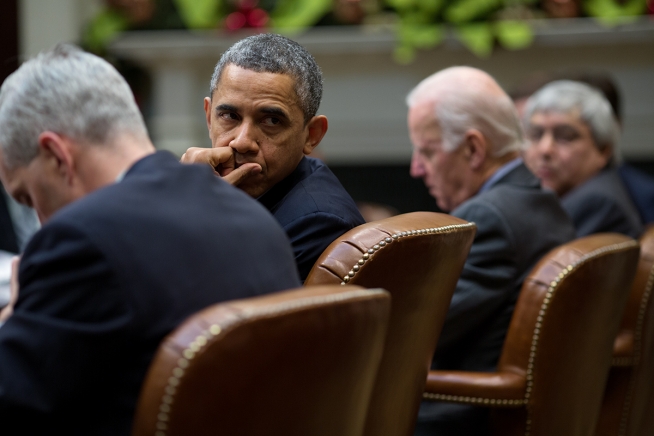
President Barack Obama, with Vice President Joe Biden, attends a meeting in the Roosevelt Room of the White House, Dec. 12, 2013. (Official White House Photo by Pete Souza)
The U.S. traditionally has held tremendous power over client states like Turkey and Saudi Arabia. So, an order from Washington is usually enough to get such governments to back down. But Ankara and Riyadh are being led by reckless men whose continued existence in power might well depend on stopping a Syrian government victory – helped by Russia, Iran and the Kurds – and a humiliating defeat of the Turkish-Saudi-backed Syrian rebels, who include some radical jihadist groups.
Turkish President Recep Tayyip Erdoğan and Prince Mohammad bin Salman have shown increasing defiance of Washington. Neither man is the legal ruler of his respective country. But both have seized power nonetheless.
Erdoğan is technically in a symbolic post, a presidency without power. Prime Minister Ahmet Davutoğlu should be leading the country the way Erdoğan did when he was prime minister, but Davutoğlu is still letting Erdoğan call the shots.
Erdoğan is campaigning for a referendum that would make Turkey a presidential system to legalize the power he already has. But that hasn’t happened yet. So, he is simply acting as a de facto executive leader while…
World War 3 Could Start This Month: 350,000 Soldiers In Saudi Arabia Stand Ready To Invade Syria

Michael Snyder
(RINF) – 350,000 soldiers, 20,000 tanks, 2,450 warplanes and 460 military helicopters are massing in northern Saudi Arabia for a military exercise that is being called “Northern Thunder”. According to the official announcement, forces are being contributed by Saudi Arabia, the United Arab Emirates, Egypt, Jordan, Bahrain, Sudan, Kuwait, Morocco, Pakistan, Tunisia, Oman, Qatar, Malaysia and several other nations. This exercise will reportedly last for 18 days, and during that time the airspace over northern Saudi Arabia will be closed to air traffic. This will be the largest military exercise in the history of the region, and it comes amid rumors that Saudi Arabia and Turkey are preparing for a massive ground invasion of Syria.
If you were going to gather forces for an invasion, this is precisely how you would do it. Governments never come out and publicly admit that forces are moving into position for an invasion ahead of time, so “military exercises” are a common excuse that gets used for this sort of thing.
If these exercises are actually being used as an excuse to mass forces near the northern Saudi border, then we should expect an invasion to begin within the next couple of weeks. If it happens, we should expect to see the Saudi coalition storm through western Iraq and into Syria from the south, and it is likely that Turkey will come in from the north.
The goal would be to take out the Assad regime before Russia, Iran and Hezbollah could react. For the past couple of years, Saudi Arabia, Turkey and their allies have been funding the Sunni insurgency in Syria, and they were counting on those insurgents to be able to take down the Assad regime by themselves.
You see, the truth is that ISIS was never supposed to lose in Syria. Saudi Arabia and her allies have been funneling massive amounts of money to ISIS, and hundreds of millions of dollars of ISIS oil has been shipped into Turkey where it is sold to the rest of the world.
The major Sunni nations wanted ISIS and the other Sunni insurgent groups to take down Assad. In the aftermath, Saudi Arabia and her allies intended to transform Syria into a full-blown Sunni nation.
But then Russia, Iran and Hezbollah stepped forward to assist the Assad regime. Russian air support completely turned the tide of the war, and now the Sunni insurgents are on the brink of losing.
Aleppo was once the largest city in Syria, and Sunni insurgents have controlled it since 2012. But now relentless Russian airstrikes have made it possible for Syrian, Iranian and Hezbollah ground forces to surround the city, and it is about to fall back into the hands of the Syrian government.
If this happens, the war will essentially be over.
Saudi Arabia, Turkey and their allies have invested massive amounts of time, money and effort into overthrowing Assad, and they aren’t about to walk away now.
If the war was to end right at this moment, a weakened Assad regime would remain in power, and Iran and Hezbollah would be the dominant powers in the country for years to come. And once Assad died, it would be inevitable that Iran and Hezbollah would attempt to transform Syria into a full-blown Shiite nation. This is something that Saudi Arabia and Turkey want to avoid at all costs.
So they are actually considering what was once absolutely unthinkable – a massive ground invasion of Syria.
But if Saudi Arabia, Turkey and their allies go in, they run the risk of a full-blown war with Russia, Iran and Hezbollah. Just consider some of the comments that we have seen in recent days…
Reacting to a potential troop deployment, Syrian Foreign Minister Walid al-Muallem said Saturday, “Let no one think they can attack Syria or violate its sovereignty because I assure you any aggressor will return to their country in a wooden coffin.”
Pavel Krasheninnikov, a deputy of Russia’s State Duma, has warned Saudi Arabia that any military ground operation in Syria without Damascus’ consent would amount to a declaration of war, Press TV reported.
We could literally be looking at the spark that sets off World War 3. I can’t believe that Saudi Arabia and Turkey are actually considering this.
And if it does happen, you can rest assured that Barack Obama gave them the green light to go in.
Unfortunately, it sounds like the decision may have already been made. Just consider what Turkish Foreign Minister Mevlut Cavusoglu is saying…
“If we have such a strategy, then Turkey and Saudi Arabia may launch a ground operation,” he added, fueling concerns that a foreign troop invasion may soon further complicate the already turbulent situation in the war-torn country.
Earlier, Saudi Arabia, Bahrain and the UAE voiced their readiness to contribute troops for a ground operation in Syria on the condition that the US would lead the intervention. Damascus and its key regional ally, Iran, warned that such a foreign force would face strong resistance.
And in addition to all of the forces massing in northern Saudi Arabia, the London Independent is reporting that the Saudis have sent troops and aircraft to a military base in Turkey…
Saudi Arabia is sending troops and fighter jets to Turkey’s Incirlik military base ahead of a possible ground invasion of Syria.
The Turkish foreign minister, Mevlut Cavusoglu, confirmed the deployment in a statement to the Yeni Şafak newspaper on Saturday, days before a temporary ceasefire is due to come into force.
There are reports that Saudi officials are saying that the decision to send in ground troops is “irreversible”, and Reuters is reporting that the Syrian government claims that some Turkish troops have already entered the country…
The Syrian government says Turkish forces were believed to be among 100 gunmen it said entered Syria on Saturday accompanied by 12 pick-up trucks mounted with heavy machine guns, in an ongoing supply operation to insurgents fighting Damascus.
“The operation of supplying ammunition and weapons is continuing via the Bab al-Salama crossing to the Syrian area of Azaz,” the Syrian foreign ministry said in a letter to the U.N. Security Council published by state news agency SANA.
Of course the Turkish government is not going to confirm that report, but what we do know is that Turkey is shelling Kurdish forces on the Syrian side of the border. The funny thing is that these Kurdish forces are actually being supported and supplied by the U.S. government.
So the Turks are not supposed to be doing this, but according to Reuters they have been doing it for two days in a row anyway…
The Turkish army shelled positions held by Kurdish-backed militia in northern Syria for a second day on Sunday, killing two fighters, the Syrian Observatory for Human Rights monitoring group said.
Turkey on Saturday demanded the powerful Syrian Kurdish YPG militia withdraw from areas that it had captured in the northern Aleppo region in recent days from insurgents in Syria, including the Menagh air base. The shelling has targeted those areas.
The hostility between Turkey and the Kurds goes back a long, long way. The Syrian Kurds are not threatening Turkey in any way right now, but Turkey is using the instability in the region as an excuse to lob artillery shells at a hated enemy. It is an act of naked aggression that the Obama administration should be loudly denouncing.
In addition, it is being reported that Syrian government forces have also been getting shelled by the Turkish military…
Anatolia news agency reported that the Turkish military hit Syrian government forces on Saturday, adding that the shelling had been in response to fire inflicted on a Turkish military guard post in Turkey’s southern Hatay region.
Turkish artillery targeted Syrian forces again late on Saturday, according to a military source quoted by RIA Novosti. The attack targeted the town of Deir Jamal in the Aleppo Governorate.
Needless to say, the Russians are quite alarmed by all of this.
In fact, Russian Prime Minister Dmitry Medvedev is warning about what could happen if things spiral out of control…
In the wake of Saudi Arabia’s proposal to send in ground troops on Thursday, the Russian Prime Minister claimed the move could spark a new world war.
“A ground operation draws everyone taking part in it into a war,” he told the Handelsblatt newspaper.
“The Americans and our Arab partners must consider whether or not they want a permanent war.”
If Saudi Arabia, Turkey and their allies launch an invasion and make a mad dash to take out the Assad regime in Damascus, the Russians will inevitably respond.
And if tactical nuclear weapons are necessary to keep the invading forces out of Damascus, the Russians will not be shy about using them.
I don’t know if I have ever seen a scenario which was more likely to initiate World War 3 than the one that we are watching unfold right now.
So what has the mainstream media been saying about all of this?
Incredibly, they have been almost entirely silent. When he went looking for news about these events, James Bailey could find almost nothing on either Fox News or CNN…
I just visited the home page for Foxnews.com and found not one single mention of the insane events now unfolding in the Middle East. I could not believe it, so I used my Find tool to search for Syria and Saudi Arabia. Not one mention!
Of course that could change at any moment, but nothing there when I checked. Their stories were all about the meaningless Presidential election, which has already been decided regardless of what we think about it, and other stories about entertainment, sports, Congressional political theater, etc.
So I went to CNN and found just about the same thing with one news story about the Syrian cease fire, but when I read it there was no mention of any of the big events that have developed this week. This is truly an amazing media blackout!
But Fox News does have space to run headlines like these…
–Spanish man skipped work for 6 years, still got paid
–48 people rescued from stuck tram cars at New Hampshire ski resort
–Lovelorn elephant takes out his rage on more than a dozen cars
And CNN apparently thinks that these news stories are more important than the potential beginning of World War 3…
–Kanye West drops album, says he’s $53 million in debt
–Dutch cops train eagles to hunt drones
–Teen hands out 900 flowers to girls at school
If Saudi Arabia, Turkey and their allies are going to conduct an invasion of Syria, the most likely time for this to happen will be by the end of this month during these military exercises.
If we can get to March 1st and no invasion has happened yet, perhaps we can breathe a little sigh of relief.
But if it does happen, and the Russians and the Iranians decide to shoot back, it really could be the start of World War 3.
If you have not been paying attention up until now, you need to start, because this could literally change everything.
Video: U.S NATO New World Order vs Eurasian World Order
In this video Luke Rudkowski makes a critically important report about the creation of a global Eurasian world order that will directly compete with U.S hegemony …
source
Video: Don Jeffries On The Hidden History Of Conspiracies & Coverups in US Politics!
Please Support The Show – http://richieallen.co.uk/ Don Jeffries Book – http://www.amazon.co.uk/Donald-Jeffries/e/B004T6NFAS …
Via Youtube
How TTIP Threatens UK’s Ability to Enforce Fair Taxes on Corporations
Corporations are regularly using secretive corporate courts to undermine the ability of countries to pass effective tax legislation, according to a new report, Taxes on trial: How trade deals threaten tax justice. The report warns that if the free trade deal being proposed between the EU and the USA were to come into force, it would massively increase the ability of corporations to sue member states of the EU over measures such as windfall taxes on exceptional profits, or use of taxation as a policy instrument such as a possible ‘sugar tax’.
The report, published by Global Justice Now and the Transnational Institute, shows that corporations have used the ‘investor protection’ provisions of a variety of different trade deals to sue at least 24 countries from India to Romania over 40 tax-related disputes, and in some cases been able to successfully challenge and lower their tax bills. This investor protection is controversially an integral part of current free trade deals being negotiated between the EU and the USA (TTIP) and the EU and Canada (CETA) and is formally known as investor- state dispute settlement (ISDS).
Corporate tax evasion has become a growing public concern with media revelations of the tiny payments made by multinational giants such as Facebook and Google. Tax breaks cost developing countries as much as $138bn a year, money needed for healthcare and other critical public services. The report argues that under TTIP, if the UK or other member states of the EU, tried to introduce tax practices with social or environmental benefits that meant that companies had to pay more, they could be subjected to a law suit in a closed door ‘corporate court’ that could result in damages of billions of pounds being awarded to the company.
The report examines a number of case studies in more detail:
- Vodafone, which has been involved in various tax scandals in the UK, has launched an arbitration claim against India that is still ongoing, after it was ordered to pay tax on an $11bn deal when it acquired a controlling interest in a major Indian phone company. Vodaphone had paid no capital gains tax on the deal because the transaction used a number of offshore companies.
- Food and drink corporate investors sued Romania successfully, winning a $250m award, over early termination of tax breaks, which had been specifically demanded by the European Commission for Romania to join the EU.
- US agribusiness giants Cargill and Archer Daniels Midland have successfully sued Mexico for introducing a ‘sugar tax’ on the sales of soft drinks containing high-fructose corn syrup.
The report also shows that supposed tax ‘carve-outs’, written into a trade or investment treaties, have not succeeded in stopping taxes being challenged and defeated.
The report is being released just before the next round of TTIP negotiations are due to begin in Brussels (22 – 26 February) when the negotiations on the investment chapter are officially due to resume. ISDS continues to be the most controversial aspect of the trade deal, to the point where the European Commission have been forced to propose an alternative system, which has been met with disdain from the US negotiators and business lobby. The biggest professional body of German judges recently said that there was “no need, nor legal basis” for the Commission’s proposal.
A number of civil society groups have written to prime minister David Cameron expressing similar concerns to those raised in the report and asking him to halt the TTIP negotiations.
Nick Dearden, the director of Global Justice Now said:
“Despite the enormous public outcry over companies like Google and Amazon paying ridiculously small amounts of tax in the UK, the government is trying to sign us up to a trade deal that could effectively prevent us from bringing about laws that could address tax injustice. The ability to enact effective and fair tax systems to finance vital public services is one of the defining features of sovereignty. The fact that multinational companies would be able to challenge and undermine that under TTIP is testament to the terrifying extent of the corporate grab embedded in this toxic trade deal.”
Cecilia Olivet from the Transnational Institute said:
“The evidence of the dangers of these investment deals continues to mount. Not only do they affect health and the environment and cost taxpayers millions in legal fees, this report shows they also affect the ability of governments to tax corporations effectively. This is yet more money lining the pockets of corporate executives stolen from the public taxpayer. New trade deals such as TTIP and CETA have to be stopped and the public interest defended.”
The troubled history of ISDS
###
Via Common Dreams. This piece was reprinted by RINF Alternative News with permission or license.
Dwindling UK sovereignty may push attorney general to back Brexit

Britain’s Attorney General Jeremy Wright may vote for a Brexit amid mounting concern that European courts are whittling away the UK’s sovereignty, it has emerged.
Wright, who is Britain’s most senior legal officer, is considering backing the campaign for the UK to leave the EU over concerns that Prime Minister David Cameron’s deal with Brussels will not go far enough.
The attorney general is one of a group of Cabinet Office ministers who are fearful about the agreement’s lack of robustness. He is said to be particularly worried about the growing influence of European courts and the increasing impact of human rights laws. His position is intriguing because his role as attorney general requires him to offer advice to Cameron over the legal impact of any deal secured.
The PM is demanding a number of key reforms as part of the EU deal. Among these are an opt-out clause for Britain that will ensure the UK is never forced to join a European superstate, and the scrapping of legislation that frames the Euro as the bloc’s official currency.
Attorney General Jeremy Wright said to be close to backing #Brexit In the words of Ms Doolittle ‘Wouldn’t it be luvverly?’
— Alison Parr (@Uptotherewithit) February 15, 2016
Cameron is also lobbying for the repatriation of powers from Brussels to Britain, which would give the UK’s parliament greater autonomy, while eroding the influence of EU law on domestic affairs. Work has already begun in this regard, and EU officials are reportedly considering the introduction of a “red card” system to empower parliaments to block newly introduced EU directives.
Cameron will also call for structural reforms that would stop Eurozone states from forcing new regulations on the nine other EU member countries such as Britain that do not partake in the single currency. To date, new proposals that would secure protections for the City of London have already been drafted in Paris and Germany.
Speaking to the Telegraph on Sunday, one Cabinet Office minister said Britain’s attorney general would vote for a Brexit if he doesn’t feel the agreement Cameron strikes is comprehensive enough. “It is perfectly feasible that this is a legally enforceable agreement but doesn’t go far enough. If he [the attorney general] doesn’t think it’s a good enough deal, he will vote to leave,” he said.
“At the moment he is undecided, he is conscious that this is not the final deal yet and major changes one way or another could swing his decision. He is 50/ 50.
“He also has significant concerns about the influence of the European courts. There is a question of whether Britain needs to pull out of the European Convention on Human Rights entirely.”
Wright declined to comment when probed on the issue. His unwillingness to declare his voting intentions mirrors that of Britain’s Justice Secretary Michael Gove and Mayor of London Boris Johnson. While Gove is unsure about which way to vote, Johnson said on Saturday he will “come off the fence with deafening éclat” when Cameron’s negotiations are complete.
Cameron will announce plans to scrap the Human Rights Act and replace it with a British Bill of Rights after the finalized EU agreement is published. However, Wright is reportedly worried that the bill may not be tough enough to thwart the influence of European courts in Britain.
Earlier this month, Gove said that the new bill will still be “subject to the primacy of European law.” Wright had previously said that Britain might have to abandon the European Convention on Human Rights if the government fails to secure significant concessions from Brussels.
Europe’s worsening refugee crisis will dominate discussions at an EU summit scheduled to begin on Thursday. German Chancellor Angela Merkel faces particular pressure to strike a deal with Turkey to take in a greater number of Syrians in the EU.
Five leading Cabinet ministers are preparing to back the out campaign, including Work and Pensions Secretary Iain Duncan Smith, Commons leader Chris Grayling and Employment Minister Priti Patel. Euroskeptic Cabinet ministers have grown frustrated in recent times at Cameron’s refusal to allow them to air their views ahead of Britain’s in/out EU referendum.
Downing Street has explicitly warned ministers they must wait until a special Cabinet Office meeting to speak out against the government’s pro-EU stance. However, Euroskeptics say they are prepared to ignore Cameron’s order to remain silent if an emergency Cabinet meeting is not called a day after this week’s EU summit comes to a close.
Via RT. This piece was reprinted by RINF Alternative News with permission or license.
HSBC keeps HQ in London

Europe’s biggest bank HSBC announced on Monday that it has decided to keep its headquarters in London.
The bank through a unanimous vote by its board has also rejected the option of shifting its centre of gravity back to main profit-generating hub Hong Kong after a 10-month review.
This has now given a boost to London’s status as a global financial centre.
Nevertheless, HSBC CEO Stuart Gulliver has warned that the bank could not stick with the status quo were Britain to vote in favour of leaving the European Union in a promised referendum.
Gulliver said around 1,000 employees will be moved from London to Paris if Britain votes to leave the EU.
The decision to stay in London comes after a tumultuous period for European banks, whose shares have tumbled on fears of a global economic slowdown and the impact on earnings from a prolonged period of low or negative interest rates.
US-Saudi military ties violate many international laws: Academic

US support of Saudi Arabia’s war against Yemen is a violation of international laws and aimed at boosting the profits of the US military–industrial complex, an American writer and retired professor says.
“The US [military] relationship with Saudi Arabia violates many international laws,” said James Petras, a professor emeritus of sociology at Binghamton University in Binghamton, New York, and adjunct professor at Saint Mary’s University in Halifax, Nova Scotia in Canada.
“The Saudi monarchy is an absolutist dictatorship, Saudi Arabia is violating all international norms by attacking Yemen and bombing civilian sites,” Petras told Press TV on Monday.
“Saudi Arabia has been funding Wahhabi extremists in Syria who have engaged in atrocities throughout the past four years,” he added.
Australian government-union conspiracy to sack “underperforming” teachers
Richard Phillips
Teachers’ unions in New South Wales and Victoria have been actively working with education authorities and school principals over the past 18 months to fast-track the sacking of teachers accused of “inefficiency” or “underperformance.”
The process, which goes under the Orwellian designation of “teacher improvement,” was negotiated by the New South Wales Teachers Federation (NSWTF) and the Australian Education Union (AEU) in Victoria and initially imposed on more than 120,000 teachers through enterprise agreements in 2013. Under these arrangements, public school teachers can be rapidly dismissed—within 12 weeks in NSW and 13 weeks in Victoria—if they fail to improve after being judged “inefficient” by principals or senior teachers.
During the 1960s and 70s, school teachers waged bitter struggles to defend their security of tenure and prevent victimisation by inspectors and education administrators. The unions have now torn up these hard-won gains by helping to devise, and now police, the new methods to discipline and sack numbers of teachers. The NSWTF and its Victorian counterpart cynically claim that the streamlined sacking processes represent a “gain” for their members. This is a patent lie.
Victoria’s dismissal procedures were developed in response to the former state Liberal government’s “New Directions” policy, which called for the removal of “the lowest performing 5 percent of teachers.” The NSW measures came after the NSWTF publicly demanded new processes to slash the time it took to dismiss “inefficient” teachers. NSW union officials began negotiations with the former state Labor government and finalised their so-called Teacher Improvement Program with the state Liberal government in December 2013.
NSW education minister Adrian Piccoli went out of his way to heap praise on the union for helping to halve the length of the disciplinary process and give “more authority” to principals. “I would like to thank the NSW Teachers’ Federation for their cooperation during the negotiations,” he declared.
The following year, Piccoli said it was necessary to maintain an “unrelenting focus on the quality and capacity of our teaching workforce.” Improving teaching standards, he insisted, was the focus of the state government, “not dumping more teachers in the system.”
In other words, the government was intent on extracting increased productivity from already overworked teachers in seriously under-resourced state schools. Herein lies the purpose of the Teacher Improvement Program. Those who fail to submit, or attempt to resist these demands, which directly contradict and impede the development of enlightened and progressive educational methods, are to be disciplined or sacked.
Under the NSW agreement, all state school teachers must present an annual Performance and Development Plan (PDP) and participate in 100 hours of professional development every five years to retain their teaching accreditation.
According to the new guidelines, PDPs “must be constructed to align with policies, aims and strategic directions of the Department and school plan.” Teacher “inefficiency” is determined on the basis of these performance plans. This means no divergence will be tolerated from NAPLAN (National Assessment Program—Literacy and Numeracy), the notorious annual reading, writing, spelling and numeracy testing of students, upon which all schools and teachers throughout the country are constantly judged.
If teachers fail to reach the agreed targets and standards they can be placed on a 10-week program and subjected to intense and constant monitoring by principals or senior teachers. If they fail to “improve” during this period they face dismissal.
The union is completely integrated into the whole procedure. It does not defend teachers but operates on behalf of the education department, steering individuals through the “improvement program” whilst attempting to sow the illusion of fairness to what is nothing but a kangaroo court proceeding.
A teacher has no rights within the process. If he or she disputes any aspect of the procedure they must raise their grievance with the principal and the NSWTF representative. If the union does not back the objection, it automatically fails.
If a local union representative endorses the objection and it is not resolved within three days of talks with the principal, the complaint moves to the education department’s deputy secretary of corporate services and the NSWTF general secretary. If the NSWTF general secretary does not support the teacher’s objection, it fails and the “improvement program” resumes.
If the teacher does not “improve” and is sacked, their only other option is to mount an unfair dismissal case in the NSW Industrial Relations Commission. But under conditions where the union has not backed his or her previous objections, the individual teacher would be forced to fund the legal action. In other words, the union, which helped devise the process, determines the fate of every objection and every teacher.
The most anti-democratic component of this Kafkaesque process is the stipulation that accused teachers cannot alert their fellow teachers, or anyone else, to the fact that they have been placed on the “improvement program.”
The procedure states: “It is the responsibility of all teachers involved to maintain confidentiality, to uphold the professional standing of individuals and ensure dignity and respect in the workplace.”
This claim is a total farce. The confidentiality requirement has nothing to do with “dignity and respect.” Its purpose is to isolate victimised teachers and prevent them from defending themselves by turning to their colleagues, throughout the state and nationally, and unifying in a fight against these oppressive measures.
A conspiracy of silence, in fact, surrounds every aspect of the Teacher Improvement Program. The education departments, along with the teacher unions, have provided little or no information about the number of teachers forced out or any details of their cases.
Contacted by the World Socialist Web Site last week, the NSW Teachers’ Federation refused to release any statistics on how many had been dismissed, let alone the numbers accused of “underperformance” or “inefficiency.” NSWTF spokesman Cameron Malcher told the WSWS that the union “only deals with those that reach out for support and we are not prepared to give to you any information about this.”
The Victorian state government publishes no statistics on “underperformers” and the only figures available from the New South Wales (NSW) Department of Education are from 2008 to 2014. Over that period, 72 NSW teachers were sacked, 12 of them in 2014, for being “inefficient” and placed on the education department’s “not to be employed” list.
Anecdotal evidence indicates, however, that the number of teachers dismissed for “inefficiency” or pushed into “performance management processes” has increased since the current enterprise agreements were imposed.
The witch-hunting of state-school teachers is an integral part of an ongoing campaign by federal and state governments—Liberal-National and Labor alike—to slash public education spending and undermine teachers’ working conditions. The result has been larger classes, longer hours and a growing mountain of paperwork associated with NAPLAN testing and other data collection systems.
The defence of victimised teachers can only be challenged as part of a unified struggle of teachers, students and parents in a political rebellion against the teacher unions, which function as the industrial police force for both state and federal governments. A necessary step in this process is for teachers to begin speaking out.
The WSWS urges teachers throughout Australia, including those who have been accused of “underperformance,” to contact the Socialist Equality Party in order to open up a discussion on how to develop a unified fight against the ever-escalating assault on teachers, students and public education as a whole.
Via WSWS. This piece was reprinted by RINF Alternative News with permission or license.
VIP pedophile allegations in Operation Midland lack evidence – reports

The investigation conducted by police to investigate claims of sexual abuse by high-profile establishment figures does not have enough evidence to prosecute any of the alleged offenders, the Guardian reports.
However, the operation still believes that its central witness, known only as ‘Nick’, is still credible and says it has found evidence to back up his claims, the newspaper states.
Nick’s testimony relates to the years between 1975 and 1984, and has implicated well-known members of the establishment, including Lords Bramall and Brittan, who were not charged but whose reputations suffered from being part of the scandal.
Information given to the police by Nick, who sparked an investigation almost 15 months ago, still has the potential to trigger new investigations, detectives say, and they believe more witnesses could come forward to help verify the claims.
But critics of the investigation say the police have been taken in by fantasist whose claims are baseless.
The lack of prosecutions by the Metropolitan police has also jeopardized the position of police commissioner Sir Bernard Hogan-Howe, whose contract was under threat after Brittan and Bramall were not convicted.
The Crown Prosecution Service is unlikely to be asked to examine any charges unless new evidence comes to light.
Last month Bramall was told that he would face no further charges, after his home was searched and he was interviewed by police. Hogan-Howe faced calls to apologize to the shamed lord, but said last week that an apology would be difficult, citing a necessary police investigation.
Brittan died in January last year before he knew that charges against him had been dropped. Police, however, have apologized for the handling of the investigation into Brittan, who was a suspect for a rape case in 1967. Hogan-Howe is expected to meet his widow later this week.
When they first emerged, the police said Nick’s claims were both credible and true.
“Nick has been spoken to by experienced officers from the child abuse team and experienced officers from the murder investigation team. They and I believe what Nick is saying is credible and true.” Detective Superintendent Kenny McDonald said in December 2014.
Via RT. This piece was reprinted by RINF Alternative News with permission or license.
Shkreli, America’s most ‘hated’ man, loses $15M in Bitcoin with Kanye album scam

Get out your tiny violins. Martin Shkreli, the man America loves to hate, appears to have lost $15 million in bitcoins after he tried to buy the rights to Kanye West’s new album.
The now-ex-CEO of Turing Pharmaceuticals, who hiked the price of HIV medication by 5,000 percent, was trying to buy Kanye West’s album from his record label so he could sell it on to his fans.
In an outcome that proves karma can be a b*tch sometimes, Shkreli got scammed into virtually handing over thousands of bitcoins to someone pretending to be “Kanye’s boy”.
WHO THE FUCK HAS MY FIFTEEN MILLION DOLLARS ?????????????????????????????????????
— Martin Shkreli (@MartinShkreli) February 14, 2016
SOMEONE NAMED DAQUAN SAID HE WAS KANYES BOY AND I SIGND THE DEAL TO BUY PALBO AND SENT THE BITCOIN. CALL THE POLICE THIS IS BULSHIT
— Martin Shkreli (@MartinShkreli) February 14, 2016
On Sunday, Shkreli tweeted that he had sent the payment to someone called Daquan and didn’t receive anything in return. Shreli proceeded to lose his s**t, throwing a Twitter tantrum.
In the midst of his angry tweets, he even said, “I quit rap.”
I hope you all enjoy this stupid music SO much and the fact it has brought me so much pain and suffering. I quit rap.
— Martin Shkreli (@MartinShkreli) February 14, 2016
If he follows through on that threat, it would be great news for fans and artists of the genre who were outraged when he bought the only copy of Wu Tang Clan’s single Once Upon a Time in Shaolin for $2 million.
The album won’t be available for public release for at least 88 years, to which Wu Tang rapper Method Man responded, “That sh*t is f*ckin’ stupid”, according to Pitchfork.
Shkreli threatened to destroy the copy, and even made a video dissing Ghost Face Killah, threatening to erase him, all while surrounded by three men wearing masks.
US is triggering new global arms race: American scholar

The United States by threatening to deploy anti-missile systems close to the borders of both China and Russia is propelling the world towards a new and dangerous arms race, says Professor Dennis Etler, an American political analyst who has a decades-long interest in international affairs.
The US military announced last week that it will start formal talks with South Korea on placing the Terminal High Altitude Area Defense System (THAAD) on the North Korea’s doorstep.
THAAD is designed to shoot down ballistic missiles in their terminal phase using a hit-to-kill approach. The Pentagon made the announcement after North Korea launched a long-range rocket carrying what it called a satellite.
Washington says it wants to deploy the anti-missile system THAAD to the Korean Peninsula as a deterrent against North Korea’s ballistic missile program.
Meanwhile, China says the possible US deployment of the anti-missile system to the Korean Peninsula is a threat to China’s strategic interests, and Beijing will not allow its “national security interests to be damaged.”
As Candidates Vie for the ‘Anti-Establishment’ Label, Real Establishment Lives On
This presidential election, every candidate both left and right seems allergic to the word “establishment.” This is a little bizarre since they are all desperate to be elected to the most establishment job in the world. But I get it: if the electorate is in an anti-establishment mood, presidential candidates will hide their resumes, instead of touting them, if that will bring home the win.
As an epithet, “establishment” has a useful plasticity which allows governors to lob it at senators and for the senators to lob it right back. But this does give us a moment to think about what “establishment” really means in the context of elections and political power in the US.
One measure of how engrained you are in the establishment is longevity. After the 22nd Amendment and the experience of the four-term presidency of Franklin Roosevelt, presidents are term-limited at eight years and so too are most governors. In a few states governors can only serve a single four-year term at a time. So the leaders of executive branches are perhaps the most temporary fixtures on the establishment spectrum.
Congress, by contrast, has no term limits. Attempts by certain states to impose term limits on their congressional delegations failed judicial review including at the Supreme Court, so at least in temporal terms, a popular legislator can get reelected for decades. For instance, Sen. Thad Cochran (R-Miss.) has been in office for 38 continuous years, and he only ranks third in seniority. And even Bernie Sanders has served in Congress for 26 years.
But we should not lose sight of the larger context as candidates throw insults at each other like a half-chewed chicken wing at a cafeteria food fight. The bigger context is most elections in America are privately financed. Even compared to a successful multi-decade career of a Senator, the private interests lobbying and financing elections have an even longer time line.Take for example, the US Chamber of Commerce which was founded in 1912: giving it…
US calls on Russia, Turkey to avoid ‘escalation’ over Syria

The United States has called on Turkey and Russia to avoid any further escalation over the Syrian crisis after the two countries traded accusations.
“It is important that the Russians and Turks speak directly, and take measures to prevent escalation,” a State Department spokesperson told AFP on Monday.
Russia has been conducting airstrikes on Daesh and other terrorist groups in Syria since September last year.
The Russian bombing campaign has turned the tables in favor of the government of President Bashar al-Assad whom Turkey opposes.
Turkey along with Saudi Arabia, Qatar, the US and some European states have been sponsoring terrorists in Syria to oust Assad since 2011.
Turkish Prime Minister Ahmet Davutoglu on Monday accused Russia of acting like a “terrorist organization” in Syria, and vowed to deliver a robust response.
UK: Second undercover police officer exposed infiltrating Socialist Party
Trevor Johnson and Chris Marsden
A joint investigation by BBC Newsnight and the Guardian has uncovered a second undercover police officer, known as “Carlo Neri” who infiltrated the Socialist Party of England and Wales between 2001 and 2006.
The first such undercover operative was Peter Francis, who infiltrated Militant Labour and one of its offshoots, Youth against Racism in Europe (YRE). Francis became branch secretary of the Hackney Militant Labour branch during the early 1990s.
The latest exposure relates to the activities of the Special Demonstration Squad (SDS), who had carried out criminal activity including having extended sexual relationships with at least eight female activists who in some instances had children by the undercover officers involved. The Metropolitan Police were forced to pay millions in compensation and the government established the Pitchford Inquiry into undercover policing.
In Newsnight’s January 18 broadcast, an anonymous woman is interviewed with whom Neri shared an apartment with for 18 months. She is now suing the Metropolitan Police, accusing them of “abusive, cold-hearted, psychological torture”. She also reveals that Neri claimed to be a locksmith and as such was trusted with keys by those taken in by him.
The response to the revelations by the Socialist Party has been characterized by light-minded indifference.
The SP issued a press statement on Neri that it is mainly composed of pat phrases from two of its members.
Lois Austin is the previous chair of YRE and a core participant for the SP in the Pitchford Inquiry. She writes blithely, “There was no purpose to infiltrating YRE or Militant Labour. Far from being secretive we publicly advertised our events—the police could have read our leaflets and newspapers, or attended our public meetings, to find out what was going on.”
The purpose of infiltrating the SP was to obtain information on its internal functioning, to collect names, addresses, personal information, not only of its members but all those that it came into contact with and to disrupt its activities and carry out provocations. The SDS would pass this information to MI5 and Special Branch.
Austin’s assurances of the open, democratic and lawful character of the SP only covers for the unlawful, anti-democratic and illegal offensive waged by the police on behalf of their capitalist paymasters.
This is made plain by the statement citing leading SP member Dave Nellist, a former Labour MP, who calls for the police to be made “democratically accountable.”
As Friedrich Engels, the co-founder of scientific socialism established, far from being a neutral arbiter that can be made to operate above class interests, the police are part of the state’s “special bodies of armed men” assigned the task of keeping the capitalist class in power and the working class oppressed.
They can no more be reformed or made democratically accountable than capitalism itself. Rather the fight for genuine democracy and social equality requires the political overthrow of the state apparatus and its replacement with a workers government.
Nellist closes by making a series of demands on the Pitchford Inquiry and for “the labour and trade union movement” to set up an inquiry “alongside Pitchford.”
Near the end of the statement, he says rhetorically, “We demand to know what today’s ‘Carlo Neris’ are doing.”
This begs the question, what does the SP intend to do about the revelations of state infiltration of its branches? Why has the SP refused, since the exposure of Francis in 2013, to carry out even the most cursory investigation of how he and now Neri penetrated the SP, who they spied upon and who might they have collaborated with. Based on Neri’s claims to be a locksmith, for example, on how many occasions was he given access to the homes of SP members or its own premises?
The response of the SP to Neri comes two year after it took a similar stance regarding Francis. On June 26, 2013, an editorial asserted that “Nothing was gained by the state from infiltrating YRE or the Militant [forerunner of the SP], other than, it seems, opening Peter Francis’s eyes to the reality of police brutality, and particularly deaths in police custody, which he says appalled him.”
“Nor was it possible,” it continued, “for police infiltrators to derail the movement against racism”—even though “Peter Francis did, at least in part, attempt to do so, acting to some degree as an ‘agent provocateur’, encouraging YRE activists to take part in individual vigilante actions” against the British National Party.
The editorial then turned to a general statement on the function of the police, asking, “In whose interests do the police and other forces of the state act?”
It claims, “In reality the police play a dual role. When workers suffer crime they turn to the police. As Neville Lawrence put it, while not completely trusting the police because of racism his family had no choice but to rely on them to investigate their son’s murder, no other possibility existed.”
“However, the police are also part of a state machine, which has the role, ultimately, of maintaining and defending the dominant interests of the capitalists.”
Ignoring the fact that the police investigation of Stephen’s murderers became an occasion to disrupt and discredit his family’s support campaign, the editorial continues regarding the supposed “dual rule” of the police that attempts by the Conservative government to impose “austerity on police as on other public sector workers” makes them potential allies of the working class:
“It is very significant that a majority of the Police Federation voted for the right to strike. Socialists should encourage these nascent class splits in the police force, which will strengthen the hand of the workers’ movement in the battles to come.”
The SP then argues for “a programme for democratic control of the police” to make them “accountable to local committees,” and for “The right of the police to an independent, democratic trade union organisation with the right to strike.”
Flying in the face of all they have just written, the SP then declares, “This does not mean that it is possible to gradually democratise the state, so that it becomes a genuinely neutral tool of society as a whole.”
This is a case of swallowing camels and straining at gnats, especially given that the possibility of “encouraging nascent class splits” in the police includes winning over agents that have been tasked with infiltrating and disrupting your organisation. Indeed Hanna Sell wrote on September 4 that the observations of “Peter Francis (known to us as Pete Daley), one of the ten-strong SDS squad…” were primarily of note because they “indirectly confirm the correct approach YRE took on a number of issues.”
“Clearly, the brutality of the police against anti-racist activists shocked Francis,” who they quote without criticism as stating, “I became genuinely anti-police.”
She goes on to state that this “genuinely anti-police” police spy “did do serious damage to anti-racist activists” and that “Francis estimates that Special Branch already had around 100 files on members of Militant Labour and YRE, and that he opened another 25.” This resulted in one member, Frank Smith, a construction worker, being blacklisted.
The Socialist Party cite Marxist sources on the state only in order to provide a sweetener for the poisonous reformist nostrums they peddle to the working class. In doing so they endanger not only their own members, but anyone who associates with them or looks to them for political leadership.
Via WSWS. This piece was reprinted by RINF Alternative News with permission or license.
Pro-War GOP Boos Donald Trump
His bigoted comments about Mexicans and Muslims aside, billionaire Donald Trump actually makes some common sense when he talks about working with Russia, Iran and other powers to bring the Mideast wars to an end, rather than pushing for endless “regime change,” Sam Husseini notes.
By Sam Husseini
At first I thought it hopeful (albeit ironic) that Saturday’s Republican presidential debate happened in the “Peace Center” in Greenville, South Carolina. I thought perhaps the location would have a positive effect. But no – as witnessed by the raucous booing of Donald Trump’s few comments about the folly of the Iraq War and about ways to bring other conflicts to an end. [video and transcript]
Though people say Trump is loud and bombastic, the discerning listener also might note that Trump actually has been critical of U.S. militarism for some time, regarding Russia, Syria, Iraq and North Korea. On those topics, I don’t think Trump has been loud and bombastic enough.

Billionaire businessman and Republican presidential candidate Donald Trump.
But Trump’s anti-war moments – though only half of what is needed – have not escaped the angry attention of the Republican Party’s one-percent donors who filled the Peace Center and booed Trump whenever he suggested some war restraint and meaningful cooperation against terrorism.
Trump: “You fight ISIS first. Right now you have Russia, you have Iran, you have them with Assad and you have them with Syria. You have to knock out ISIS. … You can’t fight two wars at one time.”
But, of course, to some of the U.S. Establishment, two wars at a time is slacking off. They want more than two wars at once.
Trump continued: “We shoulda never been in Iraq. We have destabilized the Middle East. They said there were weapons of mass destruction. There were none. And they knew there were none. … The World Trade Center came down (BOOING) during the reign [of President George W. Bush]. He kept us safe?”
And, if anyone noticed, even as the auditorium packed of moneyed interests booed Trump, the tracker at the bottom of the screen went up for him. Trump’s rivals met his truth-telling with more ridiculousness and…
‘Dogs of war’: Profiteering military contractors must be regulated, warns charity

Private firms based in Britain are reaping huge profits by exploiting conflict and instability around the world in the absence of proper regulation, a British charity has warned.
The remarks were made by War on Want, following the charity’s release of a report examining the devastating impact of private military and security companies (PMSCs) around the globe.
Writing on War on Want’s website, the charity’s communications chief, Ross Hemingway, called for an “end to the privatization of war.”
Via RT.
Economists warn about Brexit

An overwhelming majority of economists warn that Britain’s economy would be worse off if voters decide the country should leave the European Union.
According to the economists polled by Reuters all but one of 28 economists in the poll taken this week said the Britain would take a hit if the vote – which could take place by June – meant exiting the EU.
Supporters of Britain leaving the EU say companies would be less bound by red tape, the country would be able to strike its own free trade deals and its existing EU partners would not want to hurt bilateral trade.
Analysts at some of the world’s biggest banks said an exit could shrink Britain’s economy by as much as 2 percent over the next couple of years and could take as much as 10 percentage points off GDP over the next decade.
Power outage plunges NY’s Grand Central into darkness

Commuters going through Grand Central had to find their way in the dark, after a broken water pipe left New York’s iconic railway terminal without power on Monday morning.
The station was quieter than usual due to Presidents Day when the outage happened shortly after 9am, with machines, shops and hallways of the terminal’s lower level left without power. One employee at the station described the moment as being like a scene from the film The Purge.
Train service continued but with some delays during the outage. No issues were reported with witnesses describing the outage as calm and without incident. A few commuters used the opportunity to take a unique selfie at the usually crowded station.
Due to the holiday the station was operating on a weekend schedule.
Some of the entrances to the station as well as shops have been closed until full power is returned. The cause of the outage was reported to have been a water pipe break.
UPDATE: Due to power outage, all stores and Lex Ave entrances closed until further notice. Metro-North train service is unaffected.
— GrandCentralTerminal (@GrandCentralNYC) February 15, 2016
Let’s hope the lights are back on in time for Hollywood to shoot another iconic sequence at the station.
This piece was reprinted by RINF Alternative News with permission or license.
Via RT.
3D bioprinter creates made-to-order body parts with living cells

Scientists have used 3D-printing technology to create first-of-their-kind structures made of living tissue. The bioprinter breakthrough has shown promise with cartilage, bone and muscle, opening the prospect of creating replacement human body parts.
Researchers using a bioprinter, described Monday in Nature Biotechnology, say that they’ve found a way to manufacture living muscle, bone and cartilage. They say that this technology can make unprecedented advances in the healing of battlefield injuries by using a combination of living cells and a plastic-like material.
While printed tissue has been accomplished before, scientists have not figured out a way to nourish the tissues by allowing blood vessels to colonize them after they are transplanted.
“Cells simply cannot survive without a blood vessel supply that’s smaller than 200 microns [0.07 inches], which is extremely small,” Atala told Gizmodo. “That’s the maximum distance. And that’s not just for printing, that’s nature.”
So far, the manufactured body parts have only been tested on laboratory animals, but the transplants were stable enough to be considered successful in those tests.
“It can fabricate stable, human-scale tissue of any shape,” Anthony Atala, director of the Wake Forest Institute for Regenerative Medicine in North Carolina, said in a statement. “With further development, this technology could potentially be used to print living tissue and organ structures for surgical implantation.”
Via RT.
The Department of Defense Is the Third Largest Polluter of US Waterways

Aerial of the Pentagon, the Department of Defense headquarters in Arlington, Virginia. (Photo: Pentagon building via Shutterstock)
Advocacy group Environment America has “crunched the numbers” in an effort to reveal who the largest polluters of American waterways are. The culprits that crack the top-15 list may very well surprise you.
If you ask people on the street who America’s biggest water polluter is, for many, oil Goliaths like Exxon or Chevron might be first to come to mind – but not by a long shot would either of those be the correct answer.
AK Steel Holding Corp took the slimy grimy first-place prize, with transnational mega meat marketer Tyson Foods coming in a very close second. Two oil companies, Phillips 66 and ExxonMobil, did make the top-15 – but only in 13th and 15th places respectively.
Interestingly, nearly half the entities on the list were food and meat producers, but it’s the third-place finisher that’s been raising some eyebrows as well.
According to the analysis, the US government, and specifically the Department of Defense (DOD), is the third largest water polluter in America, having dumped some 63,335,653 pounds of poison into waterways from 2010-2014.
The data was compiled using numbers from the Environmental Protection Agency’s (EPA) Toxic Release Inventory (TRI) program. According to EPA’s website, “TRI tracks the management of certain toxic chemicals that may pose a threat to human health and the environment. US facilities in different industry sectors must report annually how much of each chemical is released to the environment.”
 Environment America Analysis of EPA Toxic Inventory Release Program.
Insurers’ Push to Restrict Special Enrollment Periods Would Block Uninsured People
Insurers are pressing the Administration to put burdensome new restrictions on special enrollment periods (SEPs) – times during which people who’ve experienced major life changes such as having a child, getting married, moving, or losing other coverage can enroll in marketplace coverage outside the regular open enrollment period.[1] That’s a bad idea.
Some insurers want the Administration to bar uninsured people from using certain SEPs. Insurers also want to restrict people with coverage from switching plans when they qualify for certain SEPs. Insurers claim that people with higher-than-average costs are taking advantage of SEPs to enroll only when they need health care, driving up insurers’ costs.
The reality is that too few eligible people are taking advantage of SEPs and that this low enrollment is likely a big reason why SEP enrollees tend to have higher costs. Those who are healthier are sitting out.[2]
Not everyone can enroll or choose the right plan during open enrollment. People’s situations change over the course of a year, and many of these changes warrant allowing them to enroll in coverage or change plans. SEPs are especially important because only marketplace enrollees can receive federal premium and cost-sharing subsidies to help make coverage affordable for low- and moderate-income people. (People who become eligible for premium tax credits during the year because their incomes change don’t get an SEP to newly enroll in a marketplace plan if they missed open enrollment.)
Former Los Angeles County sheriff pleads guilty in jail scandal
Tom Carter
Former Los Angeles County Sheriff Lee Baca pled guilty on Wednesday to allegations that he lied during a federal investigation into the abuse of inmates in the massive Los Angeles jail system. Under the plea agreement he may be sentenced to no more than six months in custody.
The Los Angeles Sheriff’s Department (LASD) is the largest in a country. Bloated with “war on terror” funding, it enjoys a $2.5 billion budget and employs 18,000 officers and other personnel. The Los Angeles jail system has a reputation for being one of most brutal and overcrowded in the country.
The ongoing federal investigation into conditions in the jails reveals levels of corruption and gangsterism that would make an old-fashioned mafia don blush. While the media promotes the police as “America’s finest,” in reality the country’s law enforcement agencies function essentially as organized criminal enterprises, where murder, mayhem and perjury are standard operating procedure.
The federal investigation has its origins in a lawsuit filed by the American Civil Liberties Union in 1975, which documented inhuman conditions in the jails and resulted in closer federal oversight. In September 2011, the ACLU submitted 70 sworn declarations in court, which described an ongoing “reign of terror,” with guards beating, torturing and humiliating inmates with impunity.
Subsequently, the Federal Bureau of Investigation (FBI) recruited a prisoner to be a confidential informant. This informant was able to bribe a prison guard with $1,500 to obtain a cell phone, which he used to provide information to the FBI. When prison guards discovered the cellphone, they caused the inmate to “disappear” in order to prevent the FBI from meeting with him. A sordid game of hide-and-seek followed, during which the LASD secretly moved the inmate from place to place while the FBI tried to locate him.
In one of the most outrageous moments of the investigation, LASD deputies turned up at the home of an FBI agent and tried to intimidate and threaten her. The FBI responded by arresting the deputies.
Baca’s guilty plea “demonstrates that the illegal behavior in the Sheriff’s Department went to the very top of this organization,” federal prosecutor Eileen Decker said. “More importantly, it illustrates that those who foster and then try to hide a corrupt culture will be held accountable.”
“During this interview, Sheriff Baca lied,” Decker continued. “He lied when he stated that he did not know that members of the Sheriff’s Department had approached an FBI agent outside her home, and he lied when he stated he was unaware of efforts within the Sheriff’s Department to keep the FBI informant away from the FBI.”
In the final analysis, the prosecution of Baca likely had more to do with a turf war between the FBI and the LASD than the decades of LASD corruption and brutality. However, the episode provides a rare glimpse into the real conditions inside American law enforcement agencies, behind the puffed-up image promoted by Hollywood television dramas and the establishment media.
Hailed as a “reformer” and champion of progressive “community policing,” Baca held the position of sheriff from 1998 to 2014. In 2013, he was named “Sheriff of the Year” by the National Sheriffs’ Association, which represents about 2,700 sheriffs’ departments throughout the country.
In naming Baca “Sheriff of the Year,” Fred Wilson, the director of operations for the National Association of Sheriffs, said the award “looks at what the sheriff has done in their community but also what the sheriff has done to advance the office of sheriff nationally. Sheriff Baca certainly embodies that. He is an exemplary sheriff.”
Baca was elected in 1998 when his opponent, the incumbent Sheriff Sherman Block, died shortly before the election. Under Block’s administration, violent criminal gangs flourished within the Los Angeles Sheriff’s Department, including, in perhaps the most infamous case, the “Lynwood Vikings,” which a federal district judge labeled a “neo-Nazi, white-supremacist gang.” Baca failed to curtail the gangs, and even promoted Paul Tanaka, who founded the Vikings as a watch lieutenant in Lynwood, to the rank of Undersheriff.
Tanaka is presently under federal indictment, and Baca may be called as a witness to testify against his former second in command.
New deputy gangs emerged during Baca’s tenure, including the Jump Out Boys, exposed in 2012 as a secret society of deputy sheriffs who awarded themselves morbid tattoos to “celebrate” shooting civilians.
A recruiting pamphlet for the Jump Out Boys reads, “We are alpha dogs who think and act like the wolf, but never become the wolf,” and “We are not afraid to get our hands dirty without any disgrace, dishonor or hesitation … sometimes (members) need to do the things they don’t want to in order to get where they want to be.”
Frederick Engels described the police as belonging to the category of “special bodies of armed men” that constitute the coercive power of the state, the essential function of which are to uphold the capitalist system by force. “This public power exists in every state,” Engels explained; “it consists not merely of armed men but also of material adjuncts, prisons and institutions of coercion of all kinds.” The essential function of the police in capitalist society remains the same in the 21st century.
As social tensions rise, the police in American cities—armed to the teeth, militarized, dehumanized, and steeped in a thuggish culture that celebrates brutality—are poised to unleash violence against the population at the slightest provocation. This is why the capitalist political establishment, behind public displays of handwringing, is unwilling and unable to undertake any substantial measures to stem the tide of police violence.
Law enforcement officers in Los Angeles County kill an average of one person per week. A 2014 report by the Los Angeles Youth Justice Coalition documented the deaths of at least 589 people since the year 2000.
One of those deaths, by way of example, was Carlos Oliva Sola, who was shot by LASD deputies Nicolas Castellanos and Anthony Forlano in September 2013. It subsequently emerged that this represented Forlano’s seventh shooting. The 23-year-old’s family alleged that the police planted a gun at the scene in order to try to cover up the shooting. An eyewitness reported that the youth had said, “No! No!” in a tearful voice before he was shot in the back.
A well-known phrase employed by LASD when an unarmed person is shot is that the person was “reaching for his waistband,” as if reaching for a gun, thus supposedly justifying the shooting. According to a 2011 study, almost half the people LASD sheriff’s deputies shot at after they allegedly “reached toward their waistbands” were unarmed.
Baca is a prominent and well-connected figure in the military-intelligence-political apparatus. In 2010, he testified before the Subcommittee on Intelligence, Information Sharing, And Terrorism Risk Assessment of the Committee on Homeland Security in the House of Representatives, then controlled by the Democratic Party.
Most of Baca’s testimony was dedicated to the importance of establishing networks of informants to detect “radicalization,” a subject in which he claimed to be an expert. “To maintain a safe and free society of terrorist attacks, police need to establish public-trust policing techniques that lead to appropriate channels of communication and participation by the public,” Baca said.
Baca returned to the theme in a statement in 2011. “All of these agencies recognize that you cannot arrest or enforce your way out of the radicalization issue. Outreach to community members and the building of relationships will lead to a trusted network for sharing of information and contacts. These relationships are crucial to mitigate a threat, or more importantly, recognize the threat at a stage where a person, or a group, on the wrong path can be righted.”
The sheriff in neighboring Orange County, Mike Carona, was indicted on corruption charges in 2007, together with his wife and his alleged longtime mistress. He resigned in 2008 and was convicted on one count of witness tampering. He was sentenced to 66 months in prison, but actually served four years.
Baca resigned as Sheriff in January 2014. According to The Los Angeles Times, Baca’s guilty plea will not affect his $328,000 annual pension.
Via WSWS. This piece was reprinted by RINF Alternative News with permission or license.
To the Dustbin of History
We read on Wikipedia:
The phrase “ash heap of history” (or “dustbin of history”) figuratively refers to the place to where persons, events, artifacts, ideologies, etc., are relegated upon losing currency and value as history. A notable usage was that of the Russian revolutionary Leon Trotsky referring to the Mensheviks: “You are pitiful, isolated individuals! You are bankrupts. Your role is played out. Go where you belong from now on — into the dustbin of history!” in response to the Menshevik faction walking out of the All-Russian Congress of Soviets (25 October 1917) in Petrograd, which allowed the Bolshevik faction to dominate the party. In a speech to the British House of Commons (8 June 1982), U.S. President Ronald Reagan said that “freedom and democracy will leave Marxism and Leninism on the ash heap of history.”
It is now the Keynesians’ turn to join the losers of history.
They do not see it. Their critics do not see it. But it is a fact.
Allow me to shift metaphors away from the ashcan of history.
One of the most inspiring stories in the Bible is the story of the final night of the rule of the Babylonian Empire.
The Bible does not tell us what had happened. We know from secular history what happened. The general in command of the Medo-Persian forces had ordered his troops to redirect the Euphrates River to bypass the city. This left the river’s entry point into the city undefended. The Army streamed into these undefended points and conquered the city.
The rulers of the city had not seen it coming. They should have seen it, but they didn’t. They undoubtedly had reconnaissance information on the fact that the Medo-Persian army was at work up the river to redirect the river. But they did not respond fast enough. They did not see what was coming.
We may see this in retrospect as abnormal, but it is normal. Rulers at the end of the dynasty or an empire think it will go on forever. It may not last the night.
We are told that the King of Babylon invited the prophet Daniel to assess the situation. There follows one of the most famous incidents in the Bible.
At a banquet, a holy ghostly hand had written words on the wall. This terrified the king and his guests. He called in Daniel to explain. He had previously ignored Daniel.
25 And this is the writing that was written, Mene, Mene, Tekel, Upharsin.26 This is the interpretation of the thing: Mene; God hath numbered thy kingdom, and finished it.
27 Tekel; Thou art weighed in the balances, and art found wanting.
28 Peres; Thy kingdom is divided, and given to the Medes and Persians.
29 Then commanded Belshazzar, and they clothed Daniel with scarlet, and put a chain of gold about his neck, and made a proclamation concerning him, that he should be the third ruler in the kingdom.
30 In that night was Belshazzar the king of the Chaldeans slain.
31 And Darius the Median took the kingdom, being about threescore and two years old.
From this, we get the saying: “The handwriting is on the wall.”
The handwriting is on the wall for Keynesianism.
THE POWER OF COMPOUNDING
In his remarkable 2001 article, “The Law of Accelerating Returns,” Raymond Kurzweil described the decline in the cost of information, beginning in 1890, and extending to the year 2000. If he had taken it back to 1844, he could’ve made an even stronger case, but the data are less clear. He began with the census of 1890, which was the first census to use punch cards.
He said that the cost of information fell by 50% every three years from 1890 to about 1950. Then, with the development of vacuum tube technologies in computers, it fell by 50% every two years. Then, sometime around 1965, with the development of transistor technology, it began to fall by 50% every 18 months. He said in 2001 that he believed that it was falling by 50% every 12 months.
Nothing like this has ever happened in the history of man. There has been no compounding process that continued for this long a period. This process is now approaching what some people call a tipping point. Others call it an inflection point. Kurzweil called it the upward move of the exponential curve. Whatever we call it, we are now in the middle of it.
In a follow-up article in 2003, Kurzweil made a fundamental point that has not been recognized by free-market economists, Keynesians, or social theorist in general. The rate of change, meaning the compound decline in the cost of information, was in no way slowed during the Great Depression. The world economy stopped growing for a decade, but the compound decline in the cost of information continued throughout the decade. He said this also applied in both world wars.
We don’t absolutely know what the future will bring, and if you look at the models, they’re absolutely linear. We don’t take into account this law of accelerating returns, which is absolutely a factor.If you look at the economy as a whole, either per capita or just the total economy, it is growing exponentially. But the various recessions, even the Great Depression, are relatively minor features that you really see in this chart that is a big exponential. And what’s interesting is that when the recession is over, including the Great Depression, it starts back to where it would have been had that never occurred in the first place. It does not represent even a permanent slowing down or delay in the underlying exponential.
The really pervasive phenomena is the exponential growth. We have exponential growth in productivity. Even that is understated because we’re measuring the value in dollars of what can be accomplished. But what can be accomplished for a dollar today is far greater than what could be accomplished for a dollar 10 years ago.
Computation is not the only technology that is growing exponentially. Communications, bandwidth, speed and price performance–both wireless and wired–are also doubling every year. Biological technologies, the price performance of base pair scanning, for example, have doubled every year.
George Orwell was correct: we find it difficult to see what is under our noses. let me briefly mention what has been under my nose ever since I read this article over a decade ago. It means that, with respect to the most important transformation of modern times, the exponential declining cost of digital technologies, Keynesianism has not been able to deflect the spread of these technologies.
Keynesianism can affect which special-interest groups benefit and lose as a result of these technologies because Keynesianism can control the allocation of physical resources. But Keynesianism cannot control the spread of information itself. This means that, at the core of the economic system, Keynesianism is impotent.
As bad as Keynesianism is, and as bad as regulation is, it can only marginally affect the transformations that are taking place today. These regulations can have major affect when they apply to individuals who are caught in the web of regulation. These regulations can affect the supply and quality of goods that are produced through large-scale physical production systems. The regulators can squeeze large companies. They can put small companies out of business. But what they cannot do is in any way retard the compound growth effects of information technology.
‘Shakespeare’s Bastard’: Did British bard’s illegitimate son become Poet Laureate?

Famous playwright William Shakespeare could have had an illegitimate son, a new biography of the bard claims, but academics at the time shunned the theory because it would have tainted Shakespeare’s reputation.
Author Simon Andrew Stirling alleges that William Davenant was the biological son of Shakespeare in a new biography titled “Shakespeare’s Bastard,” but that Shakespeare became known as the boy’s godfather to prevent damage to his image.
Stirling claims that the playwright, who was married and had three children with Anne Hathaway, had an affair with Jane Davenant, a tavern mistress.
Hathaway lived in Stratford-upon-Avon, where she raised the three Shakespeare children – Hamnet, Susanna and Judith – but Shakespeare himself lived and worked in London. Stirling suggests that while the bard was commuting between London and Stratford, he would stop off at Jane Davenant’s tavern in Oxford for more than a pie and a pint.
Rumors about Shakespeare’s illegitimate child originally spread throughout society by John Aubrey (1626-97), who was a friend of the Davenants.
“I have heard Parson Robert say that Mr W Shakespeare haz (sic) given him a hundred kisses,” he once wrote.
Novelist Samuel Butter (1835-1902) said that Davenant, who also became a prominent literary figure, “writ with the very same spirit that Shakespeare [did], and seemed content enough, to be called his son.”
Davenant was appointed Poet Laureate in 1638 and his career spanned numerous decades, during which time he wrote plays and poetry and managed theaters, as well as taking the Royalist side in the 1640s Civil War.
Davenant died in 1668 and was buried in Poet’s Corner, in Westminster Abbey.
In Stirling’s book, he claims that Shakespeare’s Sonnet 126 is not a homoerotic sonnet about the Earl of Southampton, as it has been presumed by other academics, but rather it is written for a young child.
Stirling says that the Earl of Southampton and Shakespeare were no longer in communication when Sonnet 126 was written.
“Coming so soon after two sonnets composed in 1604, it would be rash to presume that the ‘lovely Boy’ of Sonnet 126 was the mature Earl of Southampton.
“The poem appears to have been written to a very young child, whose birth caused his mother’s full-moon belly to wane.”
Via RT. This piece was reprinted by RINF Alternative News with permission or license.
Shock treatments give hope to people left speechless due to mystery brain disorder

Researchers are making inroads in how to diagnose and treat a rare, mysterious brain disorder that robs patients of their words. Current diagnostics commonly mistake it for Alzheimer’s or age-related dementia, though it affects speech and not memory.
Primary progressive aphasia (PPA) is a neurological syndrome that begins gradually, often before age 65, and worsens over time, according to the Mayo Clinic. Patients will have trouble expressing thoughts, as well as a understanding or finding words. In time they lose their ability to speak and write and, eventually, to understand written or spoken language.
“I’m using a speech device to talk to you,” Robert Voogt, a 66-year-old who was diagnosed with PPA a decade ago, ‘said’ by playing a recording from a phone-sized assistive device at a meeting of the American Association for the Advancement of Science on Sunday. “I have trouble speaking, but I can understand you.”
PPA patients are often able to continue caring for themselves and participate in daily activities for several years after symptoms begin. Families don’t seek treatment after that because they assume that the increasingly garbled attempts to communicate are because of age-related dementia, Dr. Argye Elizabeth Hillis of Johns Hopkins University told AP.
“Nobody’s talking to them, nobody’s involving them. It’s very sad,” Dr. Margaret Rogers of the American Speech-Language-Hearing Association told the wire service. Yet for many, “they can handle their own finances, they can drive, they can appreciate music. There’s a lot that still works for them.”
The symptoms are similar to those of stroke or brain injury victims, but PPA is a degeneration of the brain regions that control language caused by disease, rather than a specific trauma to the organ.
Those doctors who are aware of the rare form of aphasia use special MRI scans to tell the difference between PPA and other neurological problems, Hillis said. They are also used to help identify patients whose aphasia will worsen faster, as well as who has a subtype that can morph into a condition similar to Alzheimer’s, where the patients eventually do lose memory and their ability to understand language.
Hillis’ team at Hopkins is testing to see whether a a kind of brain stimulation that sends electrical signals through the skull can increase the effects of the standard PPA treatment of language therapy, which has patients match pictures to the correct word. The goal of the treatment is to keep the brain ‘wiring’ involved with communication as active as possible.
Two months after receiving the electrical stimulation, the first 19 patients in the study performed better at retrieving the rights words compared to getting a placebo “zap,” Hillis said. The PPA sufferers were able to name more objects they hadn’t practiced with, and brain scans showed better connectivity in the affected region.
The research is still preliminary, and the Hopkins team still needs to study whether the treatment produces long-term effects, she noted.
Richard Tsai at the University of California, San Francisco is also studying how to better diagnose PPA and similar diseases through PET imaging. He focuses on tau mutation carriers, and studied three with a clinical diagnosis of the nonfluent variant of primary progressive aphasia (nfvPPA) among a larger sample of similar brain diseases.
He found that, while the distribution and strength of the tau signal varied, by and large the ligand bound to regions affected by each specific disease, Tsai told Alzforum. On top of that, the imaging brought out subtle differences among each person that fit with their individual pathologies.
Among the three nfvPPA patients, PET imaging correlated with subtle differences, such as the tracer bound predominantly on the left side of the brain for the two right-handed volunteers, while the lefty had a more even distribution between the two hemispheres of the brain.
Via RT. This piece was reprinted by RINF Alternative News with permission or license.
Turkey ‘shocked’ by US stance on ‘terrorist’ Kurds
Ankara is “shocked” by the United States stance on Syrian Kurdish troops that have been battling Takfiri terrorists of Daesh.
Last week, US State Department spokesman John Kirby dismissed the idea that Syria’s Kurdish Democratic Union Party (PYD) is a terrorist group, which made the Turkish government summon the US envoy in Ankara.
“To tell you the truth, we are shocked by Kirby’s statements putting Turkey and the terrorist organization in the same basket,” Turkish Foreign Ministry spokesman Tanju Bilgic said at a weekly briefing in the capital on Monday.
Ankara considers the group as an ally of the Kurdistan Workers Party (PKK), which it has been battling for months, but to the US, PYD is seen as part of the fight against the Daesh terrorists.
Responding to a question regarding the difference between the two states, Kirby said last Monday that “This is not a new concern, as I said, that the Turks have proffered. And we don’t, as you know, recognize the PYD as a terrorist organization.”
Sanders’ Media Critics Should Concede That Fixing the US Is a Foreign Policy

Sen. Bernie Sanders speaks to a crowd of more than 10,000 during a campaign rally in Madison, Wisconsin, on July 1, 2015. (Photo: Juli Hansen / Shutterstock.com)
“Where are Bernie Sanders’ foreign policy advisors?” screams the establishment media in chorus.
Sanders himself provided one important answer: not Henry Kissinger. As Dan Froomkin pointed out at The Intercept, where someone stands on Henry Kissinger tells us a great deal about where they stand on other things.
Foreign Policy provided another answer: several hundred members of the Washington foreign policy establishment are already signed up as “advisors” to the Clinton campaign:
One expert said the system helped ensure loyalty for Clinton by creating “the illusion of inclusion.”
“Even though you’re one of hundreds, you feel like you’re part of the team,” said one prominent think tank scholar.
It’s the type of dynamic that can make an outside expert think twice before tweeting a snarky reaction to a Clinton gaffe or offering a less-than-flattering quote to a reporter. The end goal for many experts is to parlay a stint on an advisory group into a plum job in a future Clinton administration.
Larry Korb provided another answer:
[W]hat matters is not who advises you, but what positions you take. Obama gave his ‘dumb war’ speech about Iraq while he was a state senator, without a cadre of foreign policy advisers…
It is hard to know what challenges the next president might face. That’s why, ultimately, judgment matters more than experience for a potential president. The presidents I have advised – Reagan and Obama, as well as George HW Bush and Secretary of State John Kerry – all showed great judgment in considering, but not bowing to, the advice of the foreign policy establishment…
UK considering British Gitmo for extremists: Report
The United Kingdom is said to be considering plans for the opening of its own version of the notorious US military prison, Guantanamo, for what it calls ‘Muslim extremists.’
A review by Justice Secretary Michael Gove, due to be published in March, is examining how ‘convicted extremists’ behave in prison.
According to the Telegraph, the proposal to hold extremists separately was reportedly raised in discussions as part of a review into radicalization in jails.
The prospect of putting scores of extremists in one place and separating them from other inmates, such as the special secure unit at Belmarsh, was hinted at by the UK prime minister this week.
David Cameron said that about 1,000 prisoners have been identified as extremists or vulnerable to extremism and that some were preying on the weak.
“I am prepared to consider major changes: from the imams we allow to preach in our prisons to changing locations and methods for dealing with prisoners convicted of terrorism offences, if that is what is required,” Cameron said.
Video: SOS: Sold Out Slaves. Kenya’s growing child prostitution crisis (RT Documentary)
According to a 2006 UNICEF report, one Kenyan child in three is involved in underage prostitution. It is a drastic situation caused by incredibly poor living …
Via Youtube
Video: Jay-Z’s Black Lives Matter Philanthropy
Taureen “Tory” Russell, co-founder and director of the Hands Up United Coalition, discusses his group’s inclusion in Jay-Z’s funding, the work of their coalition, …
Via Youtube
Video: Turkish troops shell airport and village held by Kurds inside Syria
The Turkish army has shelled Kurdish targets near the city of Azaz in northwest Syria, including an air base recently retaken from Islamist rebels, with a massive …
Via Youtube
Video: Mummy for Museum: 2,500yo ‘Altay princess’ not to be reburied though locals insist, believe in curse
A judge in Russia’s southeastern Altay republic has ruled that the mummy of a 2500 year-old “Altay princess,” which is currently being exhibited at a museum, …
Via Youtube
British public being sold down the river in democracy deception

The longest-running set of polls ever undertaken in the UK, which has been ongoing for over thirty years has been on trust in key professions with Ipsos MORI conducting surveys on the subject since 1983. Their surveys consistently show that public trust in politicians has always been low: at no point since 1983 have more than a quarter of the public ever trusted politicians to tell the truth. The lowest trust score was recorded in 2009 in the wake of the expenses scandal, when only 13% said they trusted politicians. Clearly, there must be a deception going on in our democracy.
Last year, trust in politicians was 16% and this year there is a rise to 21%. In other words, this particular survey says that 79% of the population take the view that politicians lie to us all the time.
In 2002, half of the British public thought that Britain was America’s lapdog. Back then just 13% of the public thought Blair was right in attacking Iraq. One third of Britain’s public thought that America was the greatest threat to world peace and 59% thought the reason for the attack on Iraq was the more about the threat to US control and influence in the Middle East. On those accounts the public have proven to be right and the politicians proven so emphatically misguided and/or wrong. It appears that the government of 2015-20 will do exactly the same, that is; implement policies unpopular to the electorate.
Out of 37,000 Independent readers, 79% were against British bombing of Syria, and that was just eight weeks ago. Even the right-wing Daily Mail stated that over half its readers were against Britain bombing a nation where Cameron inconceivably concluded that “We face a fundamental threat to our security.” David Cameron also lied to parliament with his 70,000 ‘moderate troops’ ready to attack ISIS in his bid to join the coalition so as to not endure more embarrassment for failing to carry out Washington’s wishes.
TTIP is one of the most dangerous policies to be backed by the government. Over 150,000 voters on people action website 38 Degrees were asked about TTIP with 98% stating they would help to protest against TTIP being adopted in Britain. This was echoed by an EU Commission survey of 150,000 residents of the 28 nation bloc – the largest survey ever undertaken by the EU. Unsurprisingly, 97% were firmly against TTIP being imposed across Europe. The EU commission has since disregarded its own report and rejected action groups consisting of millions of people dissenting all across Europe. David Cameron is aggressively pushing for TTIP in Britain as are the unelected bureaucrats of the EU Commission amid strong protest by the public, Britain included.
Video: ‘Bionic Kid’: 7yo girl feels no pain, hunger & fatigue due to rare genetic disorder
RT LIVE http://rt.com/on-air Subscribe to RT! http://www.youtube.com/subscription_center?add_user=RussiaToday Like us on Facebook …
Via Youtube
Hillary Clinton Puts Space Between Her and Neocons With Whom She’s Identified

Clinton boasts of foreign-policy experience without owning up to how rich in failures and disastrous wars U.S. foreign policy has been in recent years. (Photo: Zimbio)
Sanders called it a “low blow.” Clinton has suddenly laid claim to the Obama legacy and chastised Bernie because he sometimes has taken issue with the President.
Aside from the injustice to Bernie, who has supported Obama while exercising the right to voice disagreements, Hillary has turned matters upside down. It is no secret that the former Secretary of State has been hawkish on foreign and military policy, that she along with the neocons has regarded Obama as “weak.” That’s why the current chief neocon advocate, Robert Kagan, who bitterly opposes any Obama/Kerry effort to try diplomacy instead of greater military force, can say of Clinton: “I feel comfortable with her on foreign policy.” (Kagan’s wife is Victoria Nuland, Hillary Clinton’s Assistant Secretary of European and Eurasian Affairs, who famously said “Fuck the EU” in her eagerness to manipulate “regime change” in the Ukraine.)
As the primary campaigns unfold, candidates take stock and adapt to the unexpected. Hillary has insisted that the US should set up a “no fly zone” in Syria, a proposal that Obama has opposed as irresponsible and dangerous. Instead, Kerry and Russia’s Lavrov have agreed to take joint steps to relieve the extreme humanitarian crisis and are in difficult negotiations for a ceasefire and an end to the civil war. Now Hillary expresses support, even takes credit, for that agreement as well as for the P+1 (UN Security Council and Germany) agreement with Iran. At least that puts space between her and the neocons, the GOP buffoons, and — though she’s unlikely to acknowledge it — her friend Netanyahu.
In the Sanders-Clinton debates, foreign and military policy is the weakest area. Clinton boasts long experience, but ignores the fact that decades of US foreign policy experience are rich in failures and disastrous wars. Surely Sanders has a point in stressing judgement, opposition to the Iraq War as well as to the whole “regime change” hubris of US policy. The Sanders legions are beginning to shake up US politics because they dare to challenge Wall Street and the billionaire class. Not surprisingly, there’s a lot more boldness on the domestic consequences of the power of the 1% than on its relevance to fateful issues of war and peace. There is a crying need for new thinking and direction to avoid repeating catastrophes of the last century. So far Clinton offers no change of course, and voices for a more realistic and peaceful foreign policy are relatively subdued.
In a climate of conformity to assumptions of American “exceptionalism” (supremacy), it can be intimidating to speak some truths. On some issues, the US can stand almost alone in its denial of what’s plain to see. Cases in point are US total commitment to supporting the governments of Saudi Arabia and Israel. Everyone sees that Israel has lurched to the right, that the illegal occupation is expanding, that democracy is being destroyed by racist extremists within and beyond the government. Many Jews, perhaps most, are appalled. It is as if Trump, Cruz or Rubio were to become President of the USA. Yet Clinton repeats with pride her ritual pledge of loyalty to Netanyahu, and seems to dare anyone to take the slightest exception.
On another issue, when Sanders is pressed on how his programs would be paid for, it’s disappointing that he hesitates to challenge our extreme military spending other than to mention waste within the Pentagon — testimony again to a climate of intimidation fostered by those who profit from military adventurism and imperialism all over the world.
Looking ahead, peace depends on the same courage and passion of millions, especially a young generation, beginning to say that this land and our lives belong to us. “Enough is enough.”
This piece was reprinted from Foreign Policy In Focus by RINF Alternative News with permission.
Video: Love is cruel: Elephant smashes cars after getting ‘dumped’ in China
It’s never easy getting rejected just before Valentine’s Day, but it’s harder to swipe your frustrations away on Tinder or drown your sorrows in a bottle of whiskey …
Via Youtube
More cover-ups? British gov’t plans to restrict cabinet papers going to national archive

This is in large part a speech by MP Richard Burgon (Leeds East – Labour) about historical cabinet papers, secrecy of the government, its supporting institutions, the hiding of previous socially toxic policies and plans to water down the Freedom of Information Act. The full recording can be read HERE with this particular speech recorded at 10.58 hrs. The establishment press has not published this, or raised the subject matter i.e. the restriction of government generated documents to the public.
I am delighted that this important debate has been called today, as it gets to the heart of this Government’s record on transparency and accountability.
The relationship between those we elect to govern us and ordinary people does not have to be built upon unbroken, uninterrupted trust. In fact, a healthy scepticism that challenges, scrutinises and protests is the hallmark of a democracy in good health. In order to do that, however, the scales needs to be as evenly weighted as possible between the people and the Government and between the institutions of the state and those who use them.
We have seen in communities up and down the land the consequences of secrecy, cover-ups and a breakdown in trust—put simply, the consequences of too much power in the hands of too few. In Liverpool, an entire community was shouting alone for justice for nearly two decades against institutions and a police force that felt that it was not for scousers to be questioning its version of events—a version of events that has been proven to be falsified, in order to protect the police at the expense of the truth.
Or take what happened on 18 June 1984 at Orgreave and the charges of police brutality, perverting the course of justice and misconduct in a public office—among the most serious offences that can be found in a country that upholds the rule of law, and yet they have still not been properly investigated to this very day. When secrecy in Government institutions prevails, the health of our democracy and the rights of our citizens pay the price. I am sorry to say that this Government’s record on transparency and accountability has been anything but exemplary.
Plans to water down the Freedom of Information Act 2000 have been cloaked in the grizzled words of Ministers, who talk darkly about journalists unacceptably abusing the Act to generate stories—something that many of us call journalism. Last year alone, such journalism uncovered remarkable details of hundreds of dangerous criminals on the run, how many times our data have been breached online, what police knew about child sexual exploitation, and details of Conservative party donors making millions in housing benefit. Those were not fanciful, frivolous requests, but stories very definitely in the public interest.
Video: Greek police use tear gas at protest against refugee screening centre
Kos is a tourist hub that found itself on the frontline of Europe’s migrant crisis last year. Locals fear that migrants will deter holiday makers from visiting the island.
Via Youtube
Video: Car bomb explodes at police checkpoint in Dagestan, Russia
COURTESY: chernovik.net https://www.youtube.com/channel/UCmzlk4RnB6shb9f1kbItmxw A car bomb has exploded 15km from the city of Derbent, …
Via Youtube
‘Preserving the Balance’ by Maintaining a Conservative Supreme Court

Bob Woodward: Everyone will miss Scalia.
On CNN‘s State of the Union today (2/14/16), Washington Post associate editor Bob Woodward laid out the “potential minefield” posed by a liberal Supreme Court appointment to “everyone, including Hillary Clinton and the Obama White House.”
Because Scalia was a conservative, said Woodward,
the Democrats will say, “Gee, we’re going to put a fifth liberal on the Supreme Court.” The Republican nominee can go out and say, “We’re going to preserve the balance.”
This is a unique understanding of the term “balance,” meaning a court with a conservative majority. (Don’t get me started on the assumption that the other four are liberal….) Though framed as a GOP view, this was clearly embraced by Woodard, who explained how most undecideds and independents would view the appointment of anyone but a conservative as a “radical” move:
In the world now of real voters, I think it is the persuadable voter or the independent who’s likely, in a positive way, to respond to the idea that, “Yeah, let’s preserve the balance, let’s not do anything radical.”
Woodward closed the segment citing a 1970s Washington Star headline on the occasion of Justice William O. Douglas’ death, which he claimed said that everyone, “left, right and center, is going to miss Justice Douglas.” “I think it’s the same for Justice Scalia,” said Woodward.
Presenting the views of the power elite as those of the public, no matter how detached those views are from actual public sentiment and opinion, is what the national media are about. This largely explains why dullards and fantasists like Woodward thrive in it.
Steve Rendall is a FAIR contributing writer.
This piece was reprinted by RINF Alternative News with permission from FAIR.
New GOP Plans for Torture
President Obama’s failure to prosecute Bush-era torturers created an impunity that has encouraged some Republican presidential candidates to tout new plans for more torture if they reach the White House, a grotesque example of “American exceptionalism,” as Nat Parry explains.
By Nat Parry
Troubling comments within the Republican presidential field over whether to reinstate torture and implement other war crimes have been drawing criticism lately, with the 2008 Republican presidential nominee, Arizona Senator John McCain, even feeling compelled to weigh in last week by calling out the “loose talk” in the Republican primaries.
On Feb. 9, McCain took to the Senate floor to condemn remarks by his Republican colleagues regarding the use of torture, saying that “these statements must not go unanswered because they mislead the American people about the realities of interrogation, how to gather intelligence, what it takes to defend our security and at the most fundamental level, what we are fighting for as a nation and what kind of nation we are.”

Barack Obama, then President-elect, and President George W. Bush at the White House during the 2008 transition.
McCain’s remarks were a welcome breath of sanity in a Republican presidential race that has recently been dominated by discourse that sounds much like a warped competition to see who would be the most brutal and lawless in the treatment of suspected terrorists. The televised debate on Feb. 6, for example, featured candidates Marco Rubio, Ted Cruz and Donald Trump vying for the “tough guy” vote, each expressing varied levels of support for waterboarding and other discredited “enhanced interrogation techniques.”
While Cruz said he would support waterboarding in limited circumstances, Trump pledged to not only reintroduce the technique in a widespread way, but also introduce even more draconian torture practices if elected: “I would bring back waterboarding, and I would bring back a hell of a lot worse than waterboarding,” he said.
Rubio also reiterated his support for waterboarding, saying that terrorism cases should not be held to the same humane legal standards of traditional law…
Video: Media Sexual Assaults The Truth
In this video Luke Rudkowski talks to documentary filmmaker and journalist Tim Pool about a number of issues that has been recently conflated in the media.
source
Video: Hitler learns PINAC is going out of business
It’s true. PINAC is going out of business, but you can help us stay in business by making a tax-deductible donation. www.paypal.me/thepinacfund.
Via Youtube
Video: Dr. Richard Sauder On The Hidden History Of Secret Underground Bases & Their Sinister Uses.
Please Support The Show – http://richieallen.co.uk/ Richard’s website – http://EventHorizonChronicle.Blogspot.co.uk …
Via Youtube
Justice Scalia’s ‘Originalist’ Hypocrisy
From the Archive: The death of U.S. Supreme Court Justice Scalia has prompted fawning eulogies about his legal brilliance and his heart-felt faith in constitutional “originalism,” but the reality is that he twisted the Framers’ thoughts into whatever was political convenient, as Robert Parry noted in 2011.
By Robert Parry (Originally published on Jan. 5, 2011)
U.S. Supreme Court Justice Antonin Scalia unintentionally revealed the hypocrisy of the Right’s rhetoric about “originalist” interpretations of the U.S. Constitution with his comments about how the Fourteenth Amendment’s guarantee of “equal protection under the law” doesn’t mean equal rights for women.
“In 1868, when the 39th Congress was debating and ultimately proposing the 14th Amendment, I don’t think anybody would have thought that equal protection applied to sex discrimination, or certainly not to sexual orientation,” Scalia said in an interview with the legal magazine California Lawyer.

U.S. Supreme Court Justice Antonin Scalia on CNN, July 18, 2012. (Photo credit: CNN.com)
“So does that mean that we’ve gone off in error by applying the Fourteenth Amendment to both? Yes, yes. Sorry, to tell you that.”
However, if the “original intent” of the amendment’s drafters was so determinative – that the Fourteenth Amendment supposedly was only meant to apply to black men at the end of slavery – it might be safe to assume that the drafters weren’t thinking about protecting a white man like George W. Bush from possibly losing an election in Florida in 2000.
Yet, the Fourteenth Amendment was precisely what Scalia and four other partisan Republicans on the Supreme Court cited to justify shutting down the Florida recount and handing the White House to Bush, despite the fact that he lost the national popular vote and apparently would have come out on the short end of the Florida recount if all legally cast ballots were counted.
To justify their ruling, the five Republican justices cited the Fourteenth Amendment’s “equal protection” clause in claiming that Florida’s electoral precincts had failed to apply common standards for counting votes. Then, rather than giving…
Supreme Court Contention: It Didn’t Start With Bork

Antonin Scalia was confirmed unanimously by the Senate in 1986. (cc photo: Steven Masker/Wikimedia)
In his obituary (2/13/16) for Supreme Court Justice Antonin Scalia, New York Times Supreme Court correspondent Adam Liptak wrote:
Though his conservative views were well known, he was confirmed by the Senate by a vote of 98 to 0. He may have benefited from the fact that the liberal opposition was focused on the nomination of Justice William H. Rehnquist, who was already on the court, to succeed Chief Justice Burger….
The lopsided vote for Justice Scalia also reflected a different era, one in which presidents were thought to have wide latitude in naming judges. That era seemed to come to an end in 1987, with the defeat of the nomination of Justice Scalia’s former colleague on the DC Circuit, Judge Bork.
It’s true that there was an era when the Senate almost always gave near-complete deference to presidents’ judgment in naming Supreme Court justices; from William McKinley through John F. Kennedy, almost all nominees were confirmed, generally by voice vote. When there was a recorded vote, margins of confirmation were typically wide, as with FDR’s William Douglas (confirmed 62–4) or Eisenhower’s John Harlan (71–11). The only nominee to be rejected during this seven-decade era was Herbert Hoover’s choice of Judge John Parker in 1930, whom the NAACP lobbied against because of his opposition to African-American suffrage. (Parker was also seen as anti-labor.)

Abe Fortas: blocked as chief justice by a coalition of conservative Republicans and Southern Democrats (photo: Frank Wolfe/LBJ Library)
That era came to an end not in 1987 with Bork, but in 1968 with Lyndon Johnson’s nomination of Abe Fortas, already a member of the Supreme Court, to be chief justice after the announced resignation of Earl Warren. Fortas was viewed as a liberal member of the court—he was in the 5–4 majority for the decision that gave us Miranda rights, and authored Tinker v. Des Moines, which affirmed that high school students are protected by the First Amendment—and was accordingly opposed by a coalition of conservative Republicans and Southern Democrats who resented the Supreme Court’s repeated rejection of segregation. Fortas’ nomination was successfully filibustered; the fact that 1968 was an election year and Republicans looked likely to retake the White House factored in to political calculations.
After Richard Nixon did in fact become president in 1969, he pressured Fortas to resign, threatening to have him impeached over outside income he received as a justice. In part as a reaction to this high-handed behavior, Nixon’s choice as a replacement, Clement Haynsworth, received strict scrutiny for his anti-integration rulings, as well as for a conflict of interest in an anti-union ruling. Haynsworth was rejected, 45–55. Nixon’s subsequent spite nomination of segregationist G. Harrold Carswell—famously defended by one senator with, “Even if he is mediocre, there are a lot of mediocre judges and people and lawyers, and they are entitled to a little representation, aren’t they?”—also went down, 45–51.
Nixon’s third-time’s-the-charm nomination of Harry Blackmun sailed through 94–0. Significantly, this was the first time since 1874 in which a recorded Senate vote on a Supreme Court nominee didn’t include a single negative vote. That was the precedent that was generally followed with the nominees between Blackmun and Scalia, with virtually unanimous confirmation for Nixon’s Lewis Powell (89–1), Ford’s John Paul Stevens (98–0) and Reagan’s Sandra Day O’Connor (99–0). Only William Rehnquist—another opponent of civil rights and minority voting—received significant opposition during this period, in his nominations to the Supreme Court (68–26) and as chief justice (65–33). So Scalia was the beneficiary of a tradition that dated back to 1969.

Robert Bork: rejected by the Senate for good cause
There’s a lot of mythology about the Bork nomination: that it was unfairly torpedoed by liberal interest groups (FAIR Media Advisory, 7/21/05), that he was a victim of slanted press coverage (Extra!, 8/09), even that overzealous Democrats had tried to subpoena his video rental records (Extra! Update, 4/99). None of this is true; in fact, Bork was rejected because of his extreme and rather bizarre interpretations of the Constitution, as exemplified by his assertion that “constitutional protection should be accorded only to speech that is explicitly political” (Indiana Law Journal, Fall/71).
The new tradition of going along with the president’s choice unless there is a serious fight didn’t end with Bork; Anthony Kennedy, who eventually replaced him as Reagan’s final Supreme Court pick, was confirmed without opposition, 97–0. With the exception of Clarence Thomas, who squeaked in 52–48, the nominees of George Bush Sr. and Bill Clinton—David Souter (90–9), Ruth Bader Ginsburg (96–3) and Stephen Breyer (87–9)—each had less than 10 percent of the Senate voting against them. (Thomas, of course, was opposed for numerous legitimate reasons.)
Only in the post-Gore v. Bush era, after the Supreme Court’s conservative majority took it upon itself to select the president of the United States, has it become routine for Supreme Court nominees to face significant opposition based on ideology—with John Roberts (78–22), Samuel Alito (58–42), Sonia Sotomayor (68–31) and Elena Kagan (63–37) each having one-fifth to two-fifths of the Senate voting against them. That’s the “different era” that began quite a while after Scalia was confirmed unanimously—and which will likely give whoever Barack Obama nominates to replace Scalia a tough road to confirmation.
Jim Naureckas is the editor of FAIR.org. Follow him on Twitter: @JNaureckas.
This piece was reprinted by RINF Alternative News with permission from FAIR.
Video: Democratic Debate: Sanders Attacks Clinton-Kissinger Vision for Perpetual War
Clinton favors war and regime change over negotiations and diplomacy says Phyllis Bennis, author of “Understanding ISIS and the New Global War on Terror: A …
Via Youtube
How Scalia Distorts the Framers
From the Archive: The late Supreme Court Justice Scalia put his right-wing ideology above any respect for the Constitution’s Framers, even resorting to a made-up view attributed to Alexander Hamilton in Scalia’s dissent to the landmark upholding of the Affordable Care Act, wrote Robert Parry in 2012.
By Robert Parry (Originally published on July 4, 2012)
Antonin Scalia and the three other right-wing justices who sought to strike down health-care reform cited no less an authority on the Constitution than one of its key Framers, Alexander Hamilton, as supporting their concern about the overreach of Congress in regulating commerce.
In their angry dissent on June 28, 2012, the four wrote: “If Congress can reach out and command even those furthest removed from an interstate market to participate in the market, then the Commerce Clause becomes a font of unlimited power, or in Hamilton’s words, ‘the hideous monster whose devouring jaws . . . spare neither sex nor age, nor high nor low, nor sacred nor profane.’” They footnoted Hamilton’s Federalist Paper No. 33.

U.S. Supreme Court Justice Antonin Scalia.
That sounds pretty authoritative, doesn’t it? Here’s Hamilton, one of the strongest advocates for the Constitution, offering a prescient warning about “Obamacare” from the distant past of 1788. Except that Scalia and his cohorts are misleading you. In effect, they turned Hamilton’s observation inside out.
In Federalist Paper No. 33, Hamilton was not writing about the Commerce Clause. He was referring to clauses in the Constitution that grant Congress the power to make laws that are “necessary and proper” for executing its powers and that establish federal law as “the supreme law of the land.”
Hamilton also wasn’t condemning those powers, as Scalia and his friends would have you believe. Hamilton was defending the two clauses by poking fun at the Anti-Federalist alarmists who had stirred up opposition to the Constitution with warnings about how it would trample America’s liberties. In the cited section of No. 33, Hamilton is saying the two clauses had been unfairly targeted by “virulent invective and petulant declamation.”
It…
President Obama Fights for Global Warming Even While Talking Against It

Eric Zuesse
In some small ways, U.S. President Barack Obama has tried to act against climate-change, such as his Administration’s regulatory action — snubbed recently by the five Republicans on the U.S. Supreme Court (they’re even more troglodyte than he is) — to limit CO2 emissions from coal-powered electric power plants; and such as his rejection of the proposed Keystone XL Pipeline which would be used to export ultra-dirty Canadian tar-sands oil to Europe and Latin America. None of those Administration actions, even if carried through, will have any significant impact on climate-change, though they would help a little.
What will, however, have an enormous impact upon climate-change, and which President Obama has been working ardently for, behind the scenes, ever since he first became President, is to block the future ability of nations to legislate new and tougher regulations against dirty-power sources, such as against coal, and tar-sands oil. Obama is fighting ferociously to block any such new regulations or legislation, by means of his proposed ‘trade’ treaties TTIP with Europe, and TPP with Asia. These treaties, if they do become law, will prohibit increases in regulations that reduce CO2 emissions. Only the TPP has been published thus far, and its text makes no exceptions whatsoever to protect the ability of the signatory nations to increase regulations in order to combat climate change (global warming):
That was a comment from Public Citizen when the proposed TPP treaty was recently published.
Like all other regulatory issues, under Obama’s ‘trade’ deals, environmental regulations won’t be able to be increased no matter what the latest available science on the subject might happen to show. And that’ll be true not only in the U.S. but in all of the signatory nations. On global warming, it will be catastrophic: to increase regulations would be blocked over most of the global economy. If the scientific knowledge in ten years time will indicate that a given regulation needs to be increased, then that will just be tough luck, because it won’t be able to happen, under these treaties.
What this fact, of blocking any regulatory increase, means, is that any increase in regulation or legislation to reduce global warming will become practically impossible after the treaty comes into force. This blockage pertains only to the countries such as the U.S., Canada, and the other Pacific Ocean nations, that would be signatories to TPP.
The TPP — like the (still secret) TTIP with Europe — includes a provision, called “Investor State Dispute Settlement” (ISDS), which allows any international corporation to sue any signatory nation to the treaty if the corporation believes that any increase in regulations or legislation, to reduce global warming, or for any other purpose — such as to reduce the lead levels in consumer products, or to accommodate any new scientific finding that a particular drug is far more dangerous than was previously known — has reduced the corporation’s profits. The corporation’s case wouldn’t be judged by any nation’s courts and laws, but instead by a panel of three ‘arbitrators,’ one of whom is appointed by the sued nation, but all of whom would be beholden to international corporations for the given arbitrator’s future economic career success. The arbitrators don’t need to have certification to practice law anywhere, because they aren’t obliged to adhere to any law.
Here is an example of a similar case, in which the U.S. itself is already being sued under an ISDS action by a Canadian corporation, against U.S. taxpayers, an action that’s based upon the ISDS system in the 1994 NAFTA treaty; it concerns the very same proposed Keystone XL Pipeline that Obama had just recently turned down for political reasons during a Presidential election campaign year:
The corporation that’s proposing and that would own the Keystone XL dirty-oil pipeline recently sued the U.S. Government for having turned down the Pipeline. They’re demanding $15 billion, as their projected loss of profit from Obama’s turn-down of it. This wouldn’t even be possible without the NAFTA, which includes a similar ISDS prohibition against increased regulations. TransCanada is using the ISDS in NAFTA to gouge Obama’s U.S. even while Obama is doing everything he can to boil the world.
CBC reported on 6 January 2016, “‘TransCanada has been unjustly deprived of the value of its multibillion-dollar investment by the U.S. administration’s action,’ said the company in a release.The firm says it will be looking to recover $15 billion US in costs and damages as a result of what it says is a breach of obligations under Chapter 11 of NAFTA.”
On January 7th, I headlined “TransCanada’s $15B Lawsuit Against U.S. on Keystone XL Presents Strong Case,” and explained why I believe that their case will likely win: Basically, it’s because both Canada and the U.S. are signatories to NAFTA. The U.S. signed that document, and it allows any member-nation to be sued and penalized by any corporation that can persuade a majority of three arbitrators that a corporation which is based in one signatory nation has suffered a loss in any other signatory nation for an action by that other signatory nation which produces financial losses for the corporation that’s suing. The fine is paid by the taxpayers of the given sued nation to the stockholders of the given suing corporation.
These ‘trade’ deals (which are actually far more than that; they’re about sovereignty — transferring it to international corporations — not merely trade) don’t allow any counter-suit by a defending nation’s government; these wealth-transfers are only one-way: from taxpayers to stockholders. Only stockholders are sovereign in the coming new world order.
Tim Dickenson headlined at Rolling Stone on 3 February 2014, “How the U.S. Exports Global Warming” and he reported that Obama’s old Harvard Law School friend Michael Froman (who had introduced Obama to the Citibank and Goldman top executive and Clinton Administration U.S. Treasurer Robert Rubin and so helped to organize the funding for Obama’s political career) whom Obama had placed in charge of negotiating international-trade treaties, was doing all he could to cripple legislation that would reduce global warming:
In backroom negotiations, Froman has worked to undermine new European Union fuel standards intended to lower the continent’s carbon emissions. The European standards would work, in part, by grading the carbon toxicity of various crude oils. They logically propose placing polluting tar-sands oil in a carbon class all by itself; on its path from a pit mine to the filling station, a gallon of tar-sands gas is responsible for 81 percent more climate pollution than the average gallon of regular. But instead of respecting the EU’s commitment to slow global warming, Froman has worked to force North America’s dirtiest petrol into the tanks of Europe’s Volkswagens, Peugeots and lorries.
His hardball tactics were revealed in obscure written congressional testimony last year. In a question to Froman, Rep. Kevin Brady, an oil-friendly Texas Republican, slammed the European proposal as a “discriminatory, environmentally unjustified” trade barrier. Froman responded, “I share your concerns,” and described his work to “press the Commission to take the views of . . . U.S. refiners under consideration.” He explained how he had turned the standards into a point of contention in negotiations of the Transatlantic Trade and Investment Partnership – a major free-trade pact being hammered out between the U.S. and the EU. Last October, Froman’s team even went before the World Trade Organization to demand that all globally traded petroleum products be treated “without discrimination.”
This is typical for the type of people that now run the U.S. Government: they run it on behalf of the major international corporations.
Under ISDS, all regulations and laws to increase protection of food-safety, car-safety, honesty in the sale of stocks and other investment products, the environment, workers’ rights, etc., is increasingly becoming crippled by the reasonable fear that signatory nations will have, if they increase a regulation or deny a request that wouldn’t have been denied at the time when the treaty was signed — the fear that the nation will be fined billions for having thereby violated the ‘rights’ of that corporation’s owners-stockholders, simply by increasing that regulation.
ISDS is an international anti-regulatory powerhouse, and no previous U.S. President has been trying as hard as Obama is to spread it throughout the world.
Under this regimen, ISDS, which Obama is expanding to a historically unprecedented extent, greatly surpassing even NAFTA, the world is heading toward a situation where the largest international corporations will, in effect, constitute a global government that possesses sovereignty above and beyond that of any nation. Under such a circumstance, not only will the planet become burnt to hell, but, on the way there, democracy will have become a thing of the past; only the billionaires who control large international corporations will have any real influence in political matters. Government for the people will become crippled. It’ll be a global oligarchy or aristocracy of a few mega-billionaires: everybody else will be essentially their slaves, so enormous will be the power of that few.
One can, at the present time, only wonder about how well those masters will, after Obama’s Presidency ends, be paying Obama and his descendants. Some of the world’s future mega-billionaires are likely to be among them — they’ll then be controlling people such as Obama himself is today. Maybe it will be the ultimate, and last, aristocracy, which won’t end until all humans do, the global aristocracy over a burnt-out planet.
Perhaps that entire world will turn out to be Obama’s real Presidential legacy — a world of mass impoverishment, misery, dictatorship, and desperation.
—————
Investigative historian Eric Zuesse is the author, most recently, of They’re Not Even Close: The Democratic vs. Republican Economic Records, 1910-2010, and of CHRIST’S VENTRILOQUISTS: The Event that Created Christianity.
Video: Crowds of Greek farmers protest austerity in Athens (Live record)
Greek farmers are protesting against austerity measures in Athens’ Syntagma Square. READ MORE: http://on.rt.com/74cz RT LIVE http://rt.com/on-air Subscribe …
Via Youtube
Video: Because Democracy! How Bernie beat Hillary but lost New Hampshire
A look into how Bernie beat Hillary but lost New Hampshire and why supercandidates are superimportant. Tired of reading news? RT Play gets it! We value your …
Via Youtube
Video: First time in history: Patriarch Kirill meets Pope Francis (LIVE RECORD)
The head of the Russian Orthodox Church, Patriarch Kirill, is meeting with the head of the Roman Catholic Church, Pope Francis, in Havana, Cuba. The historic …
Via Youtube
Video: RAW: Blasts, huge blaze rip through high-rise in Kazakhstan
A huge blaze ripped through an 88-storey high-rise in Astana in the early hours of Saturday. The block, known as the Abu Dhabi Plaza, was still under …
Via Youtube
Video: Fingerless pianist playing ‘River Flows in You’ wins Internet hearts
Alexei Romanov, fingerless pianist from Kazan, recently became popular in Russian segment of Internet after uploading a video on YouTube of himself playing a …
Via Youtube
Video: Keiser Report: Bail-ins more dangerous than ISIS (E875)
In this episode of the Keiser Report, Max Keiser and Stacy Herbert discuss what Uncle Fester might say about the fact that the bad, toxic, complicated and hybrid …
Via Youtube
Video: Scalia: Hero of the Far-Right Dead at 79
Attorney Kamau Franklin says Justice Antonin Scalia participated in some of the most reactionary rulings affecting blacks, women, gays and workers in Supreme …
Via Youtube
Video: Turkey & Saudi Arabia ready to launch ground operation in Syria
Saudi Arabia is ready to send troops and fighter jets to a Turkish military base and for a possible incursion into Syria. That’s been confirmed by Turkey’s foreign …
Via Youtube
Bungling the New World Order
By relying on NATO interventions and other military strategies, the U.S. is bleeding itself economically and crippling its ability to cooperate with Russia, China and other emerging forces in the multi-polar world that is taking shape, a grave geopolitical mistake, says ex-CIA official Graham E. Fuller.
By Graham E. Fuller
On the world scene, America is a declining power. This decline is in part domestic and self-inflicted, reflecting a certain weariness and neglect of our social order. No amount of huffing and puffing from politicians will significantly change this decline.
But the decline is also relative, relative to the rise of new world powers. China, India, Brazil, even the return of a more active Russia; all now severely affect America’s former ability to dominate the global scene.

A U.S. soldier in Afghanistan fires an MA-2, .50-caliber machine gun, in a training exercise at the U.S. base in Afghanistan’s Farah province on Sept. 22, 2012. (Photo credit: U.S. Defense Department)
Numerous historical examples abound of imperial exhaustion, loss of spirit and decline. Yet, with our ambitions more modestly set, there is no reason why America cannot comfortably live within the framework of the newly emerging world order. Indeed, President Obama, to his credit, (partially) does grasp the already serious costs of imperial overreach — even if his key strategists do not.
American strategy seems fundamentally stuck in defensive mode against rising powers. Such powers indeed do challenge American aspirations for continued hegemony. But a defensive posture robs us of our vision and spirit; it represents a basically negative orientation, like King Canute on the beach trying to stop the encroaching tide.
Worse, American military power — and the budget keeps rising — seems to have become the default U.S. response to most foreign challenges. The Pentagon has put the State Department out of business. NATO today particularly symbolizes that myopic and defensive orientation.
So while Washington focuses on building defensive military structures, bases and arrangements overseas against Russia and China, we are being rapidly outflanked by a whole array of new economic…
Video: ‘Is it 2016 or 1962?’ PM Medvedev urges Russia & West end ‘Cold War’ amid terror rise
The relationships between NATO and Russia have slid down toward a new Cold War, Prime Minister Dmitry Medvedev said at a panel discussion during the …
Via Youtube
Video: The Empire Files: The Black Radical Tradition
Featuring interviews with Cornel West and others, and speeches from legends like Mumia Abu-Jamal and Angela Davis, Abby Martin provides a snapshot from …
Via Youtube
President Kennedy and His Brother Robert Kennedy Were Murdered By The Military-Security Complex

Paul Craig Roberts
(RINF) – Presstitute Media, such as the UK Telegraph, spend a lot of energy debunking exposes of government conspiracies. For example, the thousands of highrise architects, structural engineers, physicists, nano-chemists, demolition experts, first responders, military and civilian pilots, and former government officials who have provided vast evidence that the official story of 9/11 is a made-up fairy tale at odds with all evidence and the laws of physics are dismissed by presstitutes as “conspiracy theorists.”
Similarly, those, such as James W. Douglass, who have proven beyond all doubt that President John F. Kennedy was not assassinated by Oswald but by his own paranoid anti-communist military-security complex, are dismissed as conspiracy theorists.
The 9/11 Commission Report and the Warren Commission Report were cover-ups. VP Dick Cheney and the neoconservatives he sponsored needed a “new Pearl Harbor” in order to begin their military assaults on the Middle Eastern countries that had independent foreign policies instead of being US/Israeli vassals. 9/11 was their orchestrated “new Pearl Harbor,” and this fact had to be covered up when 9/11 families persisted in their demands for an investigation and could not be bought off for large sums of money.
Similarly, the Warren Commission had no choice but to cover up that a popular American president, John F. Kennedy, had been murdered by the Joint Chiefs of Staff, the CIA, and the Secret Service, because he was believed by paranoid anti-communists to be “soft on communism” and thereby a threat to the security of the United States. The cold war was on, and the Warren Commission could not hold those responsible accountable without destroying the public’s confidence in the American military and security services.
Nevertheless everyone aware of the forged case against Oswald knew what had happened. One of these people was Attorney General Robert Kennedy, JFK’s brother.
Bobby Kennedy understood the situation. He knew that as a member of a cover-up administration he could do nothing about it. However, he knew that if he won the presidency, he could hold accountable those security elements responsible. His brother had told him that after his reelection he was going to “break the CIA into a thousand pieces.” When the Vietnam war destroyed President Lyndon Johnson, Bobby Kennedy emerged as the next president of the US.
Bobby Kennedy was assassinated the evening that he won the California Democratic primary. Sirhan Sirhan was blamed. He was standing in front of Kennedy. He had an eight shot low caliber pistol, which he fired. He did hit Paul Shrade, who was standing next to Kennedy. But he did not hit Kennedy. Kennedy, according to the medical evidence and eye witnesses was killed from shots to his back and to the back of his head.
This was confirmed to me years ago by a distinguished journalist and documentary film maker who was standing just behind Robert Kennedy when he was shot. He told me that he felt the bullet that hit Kennedy go by his ear and saw its impact. He wrote a full report for the FBI and despite his credentials was never contacted by the investigation.
Now, last Wednesday, 48 years later, Paul Shrade has presented ironclad evidence at the parole hearing of the now 71 year old Sirhan Sirhan that Robert Kennedy was shot by someone else from the rear, not from the front where Sirhan Sirhan was standing.
You can read Paul Shrade’s statement here:http://www.informationclearinghouse.info/article44184.htm
Of course, the presstitute media will say that Paul Shrade, who was himself shot when Kennedy was assassinated, is a “conspiracy theorist.” Remember: a conspiracy theorist is anyone who on the basis of hard evidence challenges a government that blames its crime on an innocent third party.
At the time of Robert Kennedy’s assassination, the CIA was conducing mind control experiments. Experts think that Sirhan Sirhan was one of those under the CIA’s control. This would explain why Sirhan Sirhan has no memory of the event.
President John F. Kennedy had experienced in the Joint Chiefs of Staff under Chairman Lyman Lemnitzer a high level of insubordination. Lemnitzer showed in White House meetings contempt for the president. When Lemnitzer brought Kennedy the Northwoods Project to shoot down American citizens in the streets of America and to blow American airliners out of the sky in order to place the blame on Castro so that the US could invade and achieve “regime change,” a popular term of the George W. Bush regime, in Cuba, President Kennedy removed Lemnitzer as chairman and sent him to Europe as head of NATO.
Kennedy did not know about Operation Gladio, an assassination program in Europe run by NATO and the CIA. Communists were blamed for Operation Gladio’s bombings of civilians in train stations in order to erode communist political influence, especially in Italy. Thus, Kennedy’s way of getting rid of Lemnitzer put Lemnitzer in charge of this program and gave Lemnitzer a way to get rid of John Kennedy.
Anyone who thinks that democratic governments would not kill their own citizens is uninformed beyond belief. If, dear reader, you are one of these gullible people, please go to the Internet and become familiar, for example, with Operation Northwoods and Operation Gladio.
Dr. Paul Craig Roberts was Assistant Secretary of the Treasury for Economic Policy and associate editor of the Wall Street Journal. He was columnist for Business Week, Scripps Howard News Service, and Creators Syndicate. He has had many university appointments. His internet columns have attracted a worldwide following. Roberts’ latest books are The Failure of Laissez Faire Capitalism and Economic Dissolution of the West, How America Was Lost, and The Neoconservative Threat to World Order.
Video: The History of State Repression Against Radical Social Movements
In this episode of imixwhatilike! TRNN Journalist Jared Ball speaks with Former U.S. Political Prisoner Eddie Conway about his book The Greatest Threat: The …
Via Youtube
Video: Congressional Black Caucus PAC Puts Up a Firewall for Clinton (1/2)
Kamau Franklin says the Clintons have played a major role in destabilizing black communities through the welfare reform act, crime legislation, and economic …
Via Youtube
Video: Saudi Arabia Threatens Full Out Invasion Of Syria
In this video Luke Rudkowski documents the latest and shocking news of Saudi Arabia mulling over the full scale invasion of Syria. Russia has answered back …
source
Video: The Richie Allen TV Show Season 2, Episode 12 In Association With DavidIcke.com & BeyondVision.tv
Please Support The Show – http://richieallen.co.uk/ https://www.facebook.com/therichieallenshow http://www.youtube.com/RichieAllenShowMedia Tune in at …
Via Youtube
Video: Latest Agreement in Syria Could Lead to Further Escalation
Phyllis Bennis says the war in Syria is being fought by outside powers to the last Syrian.
Via Youtube
NATO’s Provocative Anti-Russian Moves
Official Washington’s demonization of Vladimir Putin and the neocon “group think” about “Russian aggression” have fueled a reckless drive to move NATO forces up to Russia’s border, thus heightening risks of nuclear war and not serving real U.S. national interests, writes Jonathan Marshall.
By Jonathan Marshall
Twenty-seven years after the fall of the Berlin Wall, NATO is back flexing its muscles as if nothing had changed since the days of the Soviet Union. Defense ministers from the enlarged, 28-member organization agreed recently to strengthen the alliance’s “forward presence” in Eastern Europe. If their new policy is endorsed at a summit in Poland this summer, NATO will begin deploying thousands of troops in Poland and the Baltic states, right up against Russia’s borders.
In other words, the Western alliance will redouble its military commitment to a Polish government whose right-wing, anti-Russian, and autocratic policies are so egregious that even the stanchly neo-conservative editorial page of the Washington Post saw fit to condemn the new leaders’ encroachments on democracy and the rule of law.
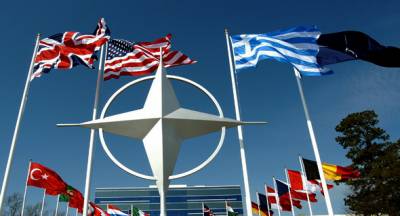
NATO headquarters in Brussels, Belgium.
Worse yet, NATO’s provocative commitment will include a potential threat to start World War III on behalf of that government. Most Americans are unaware that NATO’s policies — reaffirmed by the Obama administration — view nuclear weapons as a “core component” of the alliance’s capacity to repel even a conventional attack on one of its member states.
An accidental clash of forces, perhaps triggered by military exercises gone awry, could potentially lead NATO to use its nuclear weapons against Russian troops on Poland’s borders. Or, just as catastrophically, it could prompt Russian forces to attack NATO’s nuclear stockpiles preemptively.
Either scenario could trigger a much wider nuclear war. The British television channel BBC Two explored such a scenario, involving Latvia, in a chilling “war game” film that aired earlier this month.
Rather than let small, distant countries put U.S. national security at risk, the United States should, as an interim step short of disbanding NATO, demand…
Video: Top U.S. & World Headlines — February 12, 2016
Visit http://democracynow.org to watch the full independent, global news hour, read the transcript, search our archive and to make a donation to support us.
Via Youtube
Video: War on Wall Street or Wall Street’s Wars? Clinton and Sanders Debate in Wisconsin
http://democracynow.org – Democratic presidential candidates Vermont Senator Bernie Sanders and former Secretary of State Hillary Clinton faced off Thursday …
Via Youtube
Video: Sanders Slams Clinton’s Admiration for “Destructive” Former U.S. Secretary of State Henry Kissinger
http://democracynow.org – During Thursday’s Democratic debate, Bernie Sanders picked up on a point that Hillary Clinton made during last week’s face-off in …
Via Youtube
Video: Who Endorsed Hillary Clinton? The Congressional Black Caucus or Its PAC Filled with Lobbyists?
http://democracynow.org – This week’s endorsement of former Secretary of State Hillary Clinton for president by the Congressional Black Caucus political action …
Via Youtube
Video: ‘Choose your side’: Erdogan accuses US of creating ‘sea of blood’ in the Middle East
Erdogan accuses US of creating ‘sea of blood’ in the Middle East, by supporting Syrian Kurds, as Washington insists it’s still a close ally with Ankara. RT LIVE …
Via Youtube
Video: Ta-Nehisi Coates: The Ideal Presidential Candidate Would Have “Greater Acknowledgment of History”
http://democracynow.org – Acclaimed writer Ta-Nehisi Coates made headlines this week when he said on Democracy Now! that he would be voting for …
Via Youtube
Video: Booming business: Record gun store sales in Germany amid sex assaults scandal
Business is booming in Germany’s weapons stores. With every story about crime committed by refugees comes more fear amongst Germans that they can no …
Via Youtube
Video: ‘What F-35 will do to ya’: Air Force general faints at briefing on plane budget
Air Force Maj. Gen. James F. Martin Jr. fainted at the rostrum during a media briefing when he was talking about the F-35 plane in Pentagon on Wednesday.
Via Youtube
Video: US A-10s bomb Aleppo, blame Moscow – Russian Defense Ministry
Two US Air Force A-10 Thunderbolt II assault warplanes carried out airstrikes on Aleppo Wednesday, destroying nine facilities, Russia’s Defense Ministry …
Via Youtube
Video: Congressional Black Caucus PAC Puts Up a Firewall for Clinton (2/2)
Kamau Franklin says the Clintons have played a major role in destabilizing black communities through the welfare reform act, crime legislation, and economic …
Via Youtube
Aviva Chomsky on Immigrant Workers & the Newspaper Business
Play
Stop
X
MP3jPLAYLISTS.MI_0 = [
name: “1. CounterSpin Aviva Chomsky Full Show “, formats: [“mp3”], mp3: “aHR0cDovL3d3dy5mYWlyLm9yZy9hdWRpby9jb3VudGVyc3Bpbi9Db3VudGVyU3BpbjE2MDIxMi5tcDM=”, counterpart:””, artist: “”, image: “true”, imgurl: “”
];
MP3jPLAYERS[0] = list:MP3jPLAYLISTS.MI_0, tr:0, type:’MI’, lstate:true, loop:false, play_txt:’Play’, pause_txt:’Pause’, pp_title:’FAIR’, autoplay:false, download:true, vol:80, height:71, cssclass:’ ‘, popout_css: enabled:true, colours: [“#fff”, “rgba(201,207,232,0.35)”, “rgb(241,241,241)”, “rgba(245,5,5,0.7)”, “rgba(92,201,255,0.8)”, “transparent”, “transparent”, “#525252”, “#525252”, “#768D99”, “#47ACDE”, “”, 600, 200 ],
cssInterface: “color”: “#525252” ,
cssTitle: “left”: “16px”, “right”:”16px”, “top”:”8px” ,
cssImage: “overflow”: “hidden”, “width”:”auto”, “height”:”71px” ,
cssFontSize: “title”: “16px”, “caption”: “11.2px”, “list”: “12px” ,
classes: interface:’ verdana-mjp’, title:’ left-mjp norm-mjp plain-mjp childNorm-mjp childPlain-mjp’, image:’ Himg right-mjp’, poscol:”, ul:’ darken1-mjp verdana-mjp med-mjp childNorm-mjp childPlain-mjp left-mjp’ ;
 This week on CounterSpin: US politicians and media talk about immigration all the time, but unless Thomas Friedman meets a chatty cab driver, we don’t very often hear from immigrants themselves—and rarely at any length or with much substance. That’s a problem in its own right, but the invisibility also makes it much easier to demonize immigrants, particularly the undocumented, and to tell stories about the role of immigration in US history that simply aren’t true.
This set of issues was forced into the daylight at the Boston Globe recently, when a labor disruption by the paper’s deliverers—yes, lots of people still get the physical newspaper—broached the dividing wall between reporters and the people whose difficult and undercompensated labor brings those reporters’ work to much of the public.
The story was recounted by Professor Aviva Chomsky; she teaches history and is coordinator of Latin American studies at Salem State University in Massachusetts. Chomsky is author of the books Undocumented: How Immigration Became Illegal and “They Take Our Jobs!” and 20 Other Myths About Immigration. Her article, “All The News That’s Fit to Print: How Media Hide Undocumented Workers,” appeared on TomDispatch.com.
Play
Stop
X
MP3jPLAYLISTS.MI_1 = [
name: “1. CounterSpin Aviva Chomsky “, formats: [“mp3”], mp3: “aHR0cDovL3d3dy5mYWlyLm9yZy9hdWRpby9jb3VudGVyc3Bpbi9Db3VudGVyU3BpbjE2MDIxMkNob21za3kubXAz”, counterpart:””, artist: “”, image: “true”, imgurl: “”
];
MP3jPLAYERS[1] = list:MP3jPLAYLISTS.MI_1, tr:0, type:’MI’, lstate:true, loop:false, play_txt:’Play’, pause_txt:’Pause’, pp_title:’FAIR’, autoplay:false, download:true, vol:80, height:71, cssclass:’ ‘, popout_css: enabled:true, colours: [“#fff”, “rgba(201,207,232,0.35)”, “rgb(241,241,241)”, “rgba(245,5,5,0.7)”, “rgba(92,201,255,0.8)”, “transparent”, “transparent”, “#525252”, “#525252”, “#768D99”, “#47ACDE”, “”, 600, 200 ],
cssInterface: “color”: “#525252” ,
cssTitle: “left”: “16px”, “right”:”16px”, “top”:”8px” ,
cssImage: “overflow”: “hidden”, “width”:”auto”, “height”:”71px” ,
cssFontSize: “title”: “16px”, “caption”: “11.2px”, “list”: “12px” ,
classes: interface:’ verdana-mjp’, title:’ left-mjp norm-mjp plain-mjp childNorm-mjp childPlain-mjp’, image:’ Himg right-mjp’, poscol:”, ul:’ darken1-mjp verdana-mjp med-mjp childNorm-mjp childPlain-mjp left-mjp’ ;
The show begins with our regular look back at recent press, including the primaries and America’s problems, GMO coverage’s conflicts of interest and Time Warner Cable trying to get even bigger.
Play
Stop
X
MP3jPLAYLISTS.MI_2 = [
name: “1. CounterSpin Banter “, formats: [“mp3”], mp3: “aHR0cDovL3d3dy5mYWlyLm9yZy9hdWRpby9jb3VudGVyc3Bpbi9Db3VudGVyU3BpbjE2MDIxMkJhbnRlci5tcDM=”, counterpart:””, artist: “”, image: “true”, imgurl: “”
];
MP3jPLAYERS[2] = list:MP3jPLAYLISTS.MI_2, tr:0, type:’MI’, lstate:true, loop:false, play_txt:’Play’, pause_txt:’Pause’, pp_title:’FAIR’, autoplay:false, download:true, vol:80, height:71, cssclass:’ ‘, popout_css: enabled:true, colours: [“#fff”, “rgba(201,207,232,0.35)”, “rgb(241,241,241)”, “rgba(245,5,5,0.7)”, “rgba(92,201,255,0.8)”, “transparent”, “transparent”, “#525252”, “#525252”, “#768D99”, “#47ACDE”, “”, 600, 200 ],
cssInterface: “color”: “#525252” ,
cssTitle: “left”: “16px”, “right”:”16px”, “top”:”8px” ,
cssImage: “overflow”: “hidden”, “width”:”auto”, “height”:”71px” ,
cssFontSize: “title”: “16px”, “caption”: “11.2px”, “list”: “12px” ,
classes: interface:’ verdana-mjp’, title:’ left-mjp norm-mjp plain-mjp childNorm-mjp childPlain-mjp’, image:’ Himg right-mjp’, poscol:”, ul:’ darken1-mjp verdana-mjp med-mjp childNorm-mjp childPlain-mjp left-mjp’ ;
SOURCE LINK:
- “A Newspaper’s Crisis Reveals Unreported Worlds,” by Aviva Chomsky (TomDispatch, 2/4/16)
This piece was reprinted by RINF Alternative News with permission from FAIR.
Video: More NATO troops in E Europe: ‘Increasing tension to justify existence’
NATO’s Secretary General has welcomed the United States’ growing military presence in Europe… saying the alliance is ready to deploy as many troops as …
Via Youtube
On Hillary Clinton, Sexism, and U.S. Foreign Policy


Then Secretary of State Hillary Clinton at CSIS. (Photo: Flickr/CSIS)
After the strong early primary showings by Senator Bernie Sanders, a few high-profile supporters of his Democratic rival Hillary Clinton have seized upon an explanation: sexism — and not only by men. Sanders’ high level of support from young women in particular, they say, reflects the naiveté of younger self-identified feminists.
Feminist icon Gloria Steinem, for example, claimed that younger women backing Sanders simply wanted the attention of young men on the Sanders campaign: “When you’re young, you’re thinking, where are the boys?” Steinem said. “The boys are with Bernie.”
Huffington Post blogger Kathleen Reardon, for her part, claims that young women prefer Sanders because they’re at a phase in their careers where “when mentors aren’t hard to find, colleagues (including men) are often helpful, and the world seems like a place where hard work will surely enable them to grasp the brass ring.” They won’t recognize the severity of institutionalized sexism, Reardon suggests, until they’re no longer “cute and little.”
Amy Chozik and Yamiche Alcindor piled on in the New York Times, insisting that younger women just don’t “get” sexism like older women. They only support Sanders, the authors seem to say, because they’re not engaged enough.
At worst, these critics accuse their younger counterparts of betrayal. There’s a “special place in hell,” former secretary of state Madeline Albright warned, for women who don’t back the leading female presidential contender.
While Hillary Clinton has overcome a great deal of sexism in her professional life, disingenuous charges like these ignore the many ways in which her positions on key issues — particularly regarding foreign policy — have been deleterious for women.
Dana Bolger, an editor for Feministing, counters that for many young women who support Sanders, “their rejection of Clinton is informed and deeply political. Many of them have suffered violence, discrimination, and rampant unemployment. They have drawn upon their feminist commitments, alongside their lived experience, to evaluate and reject Clinton’s hawkish foreign policy, her expansion of drone warfare, gutting of welfare, (continuing) defense of a burgeoning surveillance state, and more — all of which have hurt women in the U.S. and abroad.”
There’s growing pushback from young feminist supporters of Bernie Sanders against the condescending criticism of older Clinton supporters, noting that they’re indeed quite aware of institutionalized sexism, but prefer to choose candidates based on the issues. They’ve seen friends and family members killed, maimed, and psychologically damaged by being sent to fight in an illegal and unnecessary war in Iraq, which Hillary Clinton enthusiastically supported. They see how the enormous financial costs of that war and its aftermath have taken money away from education, jobs, and other programs that impact women. And they’re attracted to Sanders’ desire to help build a more just and equitable economic system.
The generational divide is borne out in the early voting results. Sanders won a solid majority of women who voted in the New Hampshire Democratic primary. Exit polls showed 69 percent of women under 45 backed Sanders — a figure that rose to 82 percent of those under 30 — while Clinton won the votes of 56 percent of women 45 and older.
All of which raises two important questions: Why do older women prefer Clinton? And what’s the appropriate response for feminist critics of her foreign policy?
Why Support Hillary?
It may be disappointing to see some politically left-leaning women offering their support to Clinton, despite her militaristic foreign policy positions and pro-corporate economic agenda. But many of us who share that view — perhaps especially those of us who are men — underestimate the powerful allure of electing a female president in a pervasively sexist society.
Clinton has personally endured an endless slew of gendered attacks — from demeaning depictions in political cartoons to questions regarding her temperament to commentaries about her hair, clothes, voice, marriage, and whatever else — along with pseudo-scandals over Benghazi and her emails. These sexist attacks have put millions of women on the defensive, even those who would otherwise not be prone to support her based upon her policy positions. There’s an understandable fear that if Clinton is again denied the nomination, in part as a result of sexism, it would discourage other women from running for president any time in the near future.
That would be a major setback in the struggle for women’s rights indeed. But that doesn’t change the fact that several things about Clinton’s record would make her an unusual standard bearer for that cause.
Historically, it’s uncommon for women voters — who statistically tend to be more dovish on foreign policy matters than men — to support the most hawkish candidate in the Democratic primaries. Indeed, Clinton is the only one of the six original and two remaining Democratic candidates for the 2016 presidential nomination to have supported the invasion of Iraq.
Still, some female Clinton supporters may hold on to the belief that she’s more progressive than she’s letting on — and that she simply has to appear tough on foreign policy to overcome sexist attitudes about having a female commander-in-chief in a time of war. This belief may be naïve, but anecdotal evidence suggests it’s widely held among liberal and progressive Democrats of all demographics — and particularly among women middle-aged and older.
All that’s to say, a major reason for the strong support Clinton enjoys among older progressive women may simply be a reaction to the omnipresent sexism in American society. Indeed, older women have likely experienced more institutionalized sexism in the workplace and elsewhere than their younger counterparts. To the extent that their support for Clinton is based on identity politics, that’s no big surprise in a nation that’s had nothing but male leaders at the helm for its entire 240-year history.
Women and War
But the subject is murkier when it comes to examining the actual impacts Clinton’s policies have had on women — an impact that’s arguably felt more deeply abroad than in the United States.
Feminists with an interest in foreign policy are divided on the prospects of a Hillary Clinton presidency. Many rightly applaud her advocacy for global feminist concerns, like education and reproductive health, as secretary of state. The question is: Do these issues make up for her more problematic foreign policy positions — particularly as compared to the more progressive foreign policy agenda of Senator Bernie Sanders?
For example, the Iraq War, made possible in part through Clinton’s vote to authorize the invasion, has been a disaster for Iraqi women. The secular regime overthrown by U.S. forces was replaced by Islamist fundamentalists, and the ensuing sectarian civil war has produced horrific cases of sexual violence — including not least the enslavement of women by extremist groups like the Islamic State. Clinton also backed Israel’s massive 2006 assault on Lebanon, as well as the 2009 and 2014 wars on the Gaza Strip, which killed many hundreds of female non-combatants.
Given that modern warfare results in far more civilian than military casualties, women are often its primary victims. Despite Clinton’s strong record of supporting women’s rights in the United States and in certain overseas programs, her militaristic disposition has arguably made life worse for millions of women outside of her constituency.
Bad Company
It’s not even just the wars: As secretary of state, Clinton spearheaded the U.S. embrace of a number of deeply problematic regimes abroad.
For example, she supported the 2009 coup in Honduras, which resulted in a dramatic upsurge in violence against women, with prominent female peasant leaders, union organizers, and indigenous rights advocates among the victims. She’s called for closer strategic ties with Saudi Arabia, the most misogynist government on the planet. She supported Bahrain’s brutal crackdown on its pro-democracy movement, including prominent women leaders. And Yemeni human rights activist Tawakkol Karman, who was awarded the 2011 Nobel Peace Prize for her leadership in the country’s pro-democracy movement, has spoken out against then-Secretary Clinton’s lack of support in the struggle against the U.S.-backed autocratic regime of Ali Abdullah Saleh.
A particularly egregious case of Hillary Clinton’s selective support for the rights of women is her strong support for the autocratic monarchy in Morocco.
For example, in 2012 — during the height of a local campaign to repeal an article of the Moroccan penal code that absolves a male rapist if he consents to marry his victim — Clinton praised the Moroccan government for having “protected and expanded” women’s rights. Just weeks after Clinton commended the regime, Amina Filali — a 16-year old Moroccan girl who’d been raped at the age of 15 and forced to marry her rapist, who subsequently battered and abused her — burned herself to death.
Similarly, it was not long after a previous visit to Morocco, where she also praised the autocratic monarchy’s human rights record, that the regime illegally expelled Aminatou Haidar — known to some as the “Saharan Gandhi” — for her leadership in the nonviolent resistance struggle against the illegal Moroccan occupation of Western Sahara.
Haidar — a winner of the Robert F. Kennedy Human Rights Award who’d previously spent years being tortured in Moroccan prisons — went on a month-long hunger strike, which almost killed her, before Morocco relented to international pressure and allowed her to return. Amnesty International has accused the Moroccan government of systematically engaging in sexual torture and other abuse against female Saharawi political prisoners in the occupied territory.
Global Feminism in an Imperialist Context
It’s no secret that patriarchal men have inflicted enormous damage on the world. But a quick look at a few of the more prominent women who’ve taken leadership roles in U.S. foreign affairs — Jeanne Kirkpatrick, Madeleine Albright, and Condoleezza Rice, for instance — suggests that women can also be forceful advocates for U.S. imperialism. And, as Margaret Thatcher in Great Britain demonstrated, electing a female head of government doesn’t guarantee a more compassionate foreign policy either.
Clinton supporters counter that Thatcher — unlike Clinton — never had much support from feminists in her country, and didn’t have a history of supporting women’s rights in general. Since Clinton has such a stronger base among women and a more robust record in support of women’s rights domestically, they say, there’s reason for hope. But it’s hard to imagine how Clinton would find a way to pay for many programs to help women at home or abroad, given how much she wants to increase military spending and expand U.S. hegemony.
In fact, given Clinton’s history of backing neoliberal economic policies and war-making by the United States and its allies, her advocacy of women’s rights overseas — within what is widely seen outside this country as an imperialist context — could actually set back indigenous feminist movements, just as U.S. support for dictatorial regimes in the Middle East gave little credibility to President George W. Bush’s pro-democracy rhetoric.
For instance, would a President Hillary Clinton’s call for greater respect for women’s rights in the Arab world have much credibility while U.S.-manufactured ordnance is blowing up women in Lebanon, Gaza, Syria, Yemen, Libya, and Iraq? The question is especially salient given Clinton’s refusal to accept moral responsibility for the humanitarian, fiscal, and strategic disaster that resulted from her support for the Bush administration’s 2003 invasion of Iraq — an ongoing stumbling block I examined in a recent column, “The Five Lamest Excuses for Hillary Clinton’s Vote to Invade Iraq.”
Challenging Sexism and Imperialism
I’ve long considered myself a feminist: One of my earliest presidential campaigns was in 1972 on behalf of New York Congresswoman Shirley Chisholm, who was — quite unlike Clinton — the most progressive Democrat in the race for the nomination that year.
But I also understand that it’s difficult for me, as someone who identifies as both feminist and male, to criticize the feminist credentials of a candidate who could very well become the first woman to lead our country. Indeed, as a result of my personal opposition to Clinton’s candidacy — particularly her militaristic foreign policy agenda — I’ve been repeatedly accused of being sexist.
I want to emphasize that my disagreements with Clinton are purely over policy. And I condemn outright the sexist attacks lobbed at her from the left as well as the right. But it’s important to understand where this critique comes from.
As a result of the vehemence of the anger and distrust many of us direct at Hillary Clinton — for her support for the Iraq war, her support for Israeli Prime Minister Benjamin Netanyahu and numerous Arab dictators, her poor record on human rights, and her indifference to international humanitarian law, among other issues — it can be easy for male critics especially to forget just how serious the misogynist attacks against Clinton have been. For millions of women, it must look all too familiar to the sexist mistreatment they’ve experienced personally. Like the fear of walking alone at night and the constant harassment of catcalls, there are certain fears and experiences about being a woman in a sexist society that I’ll never be able to appreciate fully.
Indeed, I’ve begun to recognize that I sometimes “forget” that Hillary Clinton is a woman as well as a policymaker. That’s not a sign of a lack of sexism on my part: It’s a lack of awareness that contributes to the climate of sexism that’s permeated the campaign.
This doesn’t mean that antiwar voters shouldn’t criticize Clinton. It means we need to recognize that not all Clinton supporters — particularly those motivated by a reaction to right-wing sexism — embrace her militaristic foreign policy agenda.
These supporters don’t need to hear lectures on Clinton’s feminist credentials, especially not from men. But if we want to dispel the denial of just how far to the right Clinton’s international agenda is, those of us on the left need to acknowledge how serious a problem sexism remains in American society — and how it’s manifesting itself in the personal attacks against Hillary Clinton. We must listen, listen, and listen some more to women who raise these concerns, and challenge such sexism whenever and wherever we come across it.
And we must remember that the issues that face us today — from sexism to imperialism — are much greater than anything that can be resolved by electing a new president alone.
This piece was reprinted from Foreign Policy In Focus by RINF Alternative News with permission.
Video: RAW: North Korea missile test backstage video, Kim full of joy
North Korea has claimed that it successfully deployed an earth observation satellite into orbit, after its “long-range missile test” on Sunday (Feb 7) was widely …
Via Youtube
End NATO Now

Eric Zuesse, originally posted at strategic-culture.org
The continuation of NATO, after its counterpart the Warsaw Pact ended in 1991, is an insanity that’s driving the world inexorably toward World War III.
The trigger for that war is now being set by NATO member Turkey, which wants to invade neighboring Syria, and which has the support of the Gulf Cooperation Council (including the world’s biggest buyer of U.S. weapons, Saudi Arabia) who are massing troops and weapons on Syria’s northern border, in preparation for an invasion southward into Syria.
Once they invade Syria from Turkish territory, it won’t be enough for the Syrian army and its Russian ally to wage war against them inside Syrian territory, because the invaders will then need to be counter-attacked in order to be defeated, and so there will be an invasion of NATO-member Turkey — a counter-invasion, in defence against Syria’s invaders — a counter-invasion which, however morally necessary it will be, will trigger nuclear war, for this reason:
The NATO Treaty in its Article Five, “Collective Defence,” asserts (as summarized by NATO): “Collective defence means that an attack against one Ally is considered as an attack against all Allies.” In other words, when Syria and Russia respond to Turkey’s aggression by counter-invading Turkey, the entire NATO alliance are automatically Treaty-obligated to ‘defend’ Turkey from that justified invasion of Turkey by Syria and by Syria’s Russian ally.
Either Russia would instead abandon its ally there, which would mean for Russia to capitulate to NATO’s invasion of its ally, or else Russia would do its moral duty to its ally, and there would then be World War III, between Russia and all NATO nations, which would be an all-out nuclear war, which will end civilization and make all continued life on this planet intolerable.
This is the — after the dissolution of the Warsaw Pact in 1991 — entirely unnecessary danger, and the blatant evil (to be quite frank about it), of NATO’s having been continued beyond the time when it should have terminated (when and as the Warsaw Pact did in 1991).
America’s President at that time in 1990, George Herbert Walker Bush, said privately to other NATO members, contradicting the message and assurances that he and his agents had verbally given to Mikhail Gorbachev saying that the Cold War was now at an end, “To hell with that! We prevailed, they didn’t.” Bush was secretly committed to a military ‘victory’ over Russia, even though communism, which was the alleged cause of the Cold War, had ended. Bush wanted conquest; all subsequent U.S. Presidents have followed along with that evil intent.
Every moment of NATO’s continued existence after that moment has been a continuation of Bush’s lie. It has become a fatal lie now, because every subsequent U.S. President has not only continued NATO, but increased its membership, has expanded NATO all the way to Russia’s borders, and President Obama wants the next U.S. President to culminate this, when he made clear (via his ‘Defense’ Secretary Ash Carter) recently, that the U.S. will quadruple American weaponry and troops on Russia’s border in a process that’s to be completed by 2017.
Turkey can’t wait. The insanity and evil that have reigned in the West since 1991 are now set on a Turkish hair-trigger. That gun — NATO — is pointed actually against everyone on this planet, even if a Turkish madman doesn’t pull its trigger immediately.
End NATO Now. Before it’s too late.
—————
Investigative historian Eric Zuesse is the author, most recently, of They’re Not Even Close: The Democratic vs. Republican Economic Records, 1910-2010, and of CHRIST’S VENTRILOQUISTS: The Event that Created Christianity.
Video: Gravitational waves discovery sets scientific world abuzz, 100 yrs after Einstein’s theory
Scientists are buzzing (again!) about gravitational waves and what a big deal they are. Wait! Don’t be embarrassed if it all leaves you confused and you just can’t …
Via Youtube
Video: Horrors of war: Aleppo before and after Syrian conflict
The Munich talks are to start amid intense battles to retake the Syrian city of Aleppo. Murad Gazdiev went to the war zone near the city and told RT how the …
Via Youtube
Video: Clinton Could Still Win NH: Why Does Our Electoral System Allow For That?
Journalist Ashley Smith explains how Democrats in the 1970s managed to reform their electoral system into something that looks democratic, but ultimately lets …
Via Youtube
Netanyahu’s Fortress Israel
Ignoring Israel’s founding ideals about justice and compassion, Prime Minister Netanyahu and other leaders are guiding the nation into the inevitable direction of a racist apartheid state, building walls against the Arab “wild beasts,” a tragedy that Alon Ben-Meir examines.
By Alon Ben-Meir
The demagoguery of Israeli Prime Minister Benjamin Netanyahu seems to have no limit — demagoguery in a sense that he says and acts on anything to buttress Israel’s hold on the West Bank in the name of national security.
This time around, Netanyahu came up with another absurd idea, proposing, as he stated, a “multi-year plan to surround Israel with security fences to protect ourselves in the current and projected Middle East.” Netanyahu went on to say that: “In our neighborhood, we need to protect ourselves from wild beasts.”

A section of the barrier — erected by Israeli officials to prevent the passage of Palestinians — with graffiti using President John F. Kennedy’s famous quote when facing the Berlin Wall, “Ich bin ein Berliner.” (Photo credit: Marc Venezia)
Knowing Netanyahu and his sentiment toward the Palestinians, using inflammatory language is customary for him, as he views every Palestinian as a would-be beastly terrorist. It is obvious from everything we know that the purpose of building such a fence, which runs through a significant portion of Palestinian territory, is to make the expropriation of Palestinian land permanent.
At the same time, he continues to expand settlements in the West Bank and more than likely will build new ones while providing more than 10,000 soldiers to protect the settlers, ensuring that Palestinians will never establish (under his watch) their own state; of course, all of this is in the name of national security.
Netanyahu knows only too well that no fence, however high and regardless of the material it is made of, will prevent a determined terrorist from finding a way to penetrate it. True, he will introduce the newest technology to detect any attempt to pierce through the wall; however, he seems to ignore the fact that Palestinian militants have perfected the art of building tunnels through which insurgents can…
Video: US airbase pollutes Okinawa waters for years, new documents reveal
US military stationed on the Japanese island of Okinawa may be polluting the local drinking water supply. That’s according to new documents released under …
Via Youtube
Video: Civil Disobedience and Free Speech Tested by Prayer in Ferguson
Rev. Sekou, arrested while in protest and prayer after Michael Brown was shot and kIlled in Ferguson, was found not guilty of failing to obey police orders.
Via Youtube
ACTION ALERT: Stop Mega-Cable Merger to Avoid a Second Comcast
 Americans are divided in many ways, but there are some points of convergence—one of which seems to be hatred of the cable company Comcast. Notoriously terrible customer service, a pricing system described as “absurd” and a stranglehold on internet speeds garner the cable behemoth a remarkable amount of dislike and distrust, which played a role in the quashing of its recent effort to merge with perennial runner-up for worst company in America, Time Warner Cable.
You’d think it would be bigger news, therefore, that Americans who hate Comcast largely for reasons related to its very bigness are now facing the possibility of, essentially, another Comcast. The harms from a possible merger between Time Warner, Charter Communications and Bright House Networks were detailed in a piece for BillMoyers.com (2/4/16) by Michael Copps.

Former FCC chair calls the proposed TWC/Charter merger an “affront to the public interest.”
Not a stranger to the issue but the former chair of the FCC, Copps notes that this new mega-company would control about a third of the nation’s cable and cable-broadband markets; would also own programming, including regional sports networks; and would dominate some of the biggest media markets, like New York and Los Angeles.
Worse, since the new company wouldn’t share any markets with Comcast, they’d have no incentive to compete, but every incentive to coordinate against joint competitors, including those offering independent and diverse voices.
Least surprising, the deal would start the new company off with some $27 billion in debt, a time-honored incentive to raise prices and cut services—and why not? Where else will people go?
ACTION:
There’s still time to speak out against the TWC/Charter merger. One place to file comments with the FCC is NoMoreMergers.com.
Janine Jackson is the program director of FAIR and the host of CounterSpin.
This piece was reprinted by RINF Alternative News with permission from FAIR.
Video: How The Establishment Elite Are Rigging The Presidential Election
In this video Luke Rudkowski documents how the mainstream media and establishment are manipulating you and rigging the 2016 Presidential election. We go …
source
Video: Tony Gosling reviews The Big Short (2015) & The Story Of Money (1965)
The Big Short (2015) Paramount Pictures The Story Of Money (1965) by Ned Seidler Reviews – www.DialectRadio.co.uk Wednesday 10th February 2015 Tony …
Via Youtube
Video: ‘We have detected gravitational waves!’, breakthrough discovery confirmed (FULL PRESSER)
Scientists at Washington’s National Science Foundation and Moscow State University have confirmed the discovery of Albert Einstein’s gravitational waves.
Via Youtube
Video: Zika Linked to Deforestation (2/3)
Evolutionary biologist Robert G. Wallace says Zika we are seeing the reemergence of mosquito-borne viruses such as dengue, yellow fever and malaria.
Via Youtube
Video: The Richie Allen Show – Sunday View 31st January 2016
Please Support The Show – http://richieallen.co.uk/ https://www.facebook.com/therichieallenshow http://www.youtube.com/RichieAllenShowMedia Tune in at …
Via Youtube
Video: Keiser Report: Conditions for Anger (E874)
Check Keiser Report website for more: http://www.maxkeiser.com/ In this episode of the Keiser Report, Max Keiser and Stacy Herbert discuss the reason that …
Via Youtube
Video: Zika Linked to Deforestation (3/3)
Evolutionary biologist Robert G. Wallace says Zika we are seeing the reemergence of mosquito-borne viruses such as dengue, yellow fever and malaria.
Via Youtube
Video: EXCLUSIVE: LIGO Physicist Kip Thorne speaks to RT on gravitational waves discovery
Scientists at Washington’s National Science Foundation and Moscow State University have confirmed the discovery of Albert Einstein’s gravitational waves.
Via Youtube
Video: Zika Linked to Deforestation (1/3)
Evolutionary biologist Robert G. Wallace says Zika we are seeing the reemergence of mosquito-borne viruses such as dengue, yellow fever and malaria.
Via Youtube
Deconstructing America’s ‘Deep State’
Americans perceive what has happened to their democratic Republic only dimly, tricked by rightists who call all collective government actions bad and by neoliberals who make “markets” a new-age god. But ex-congressional budget official Mike Lofgren shows how this “Deep State” really works, writes Chuck Spinney.
By Chuck Spinney
Just about everyone knows something is dangerously wrong with our nation’s political system. There is a growing awareness that the United States is drifting blindly into a state of greater inequality, stagnation, oligarchy and perpetual war, with a ruling establishment that neither responds to the will of the people nor to the problems our nation faces.
For evidence of this pervasive sense of unease, look no further than the 2016 presidential election, where a bombastic celebrity billionaire and a crusty grandfatherly democratic socialist are claiming the political system is rigged and are driving the scions of the status quo into the rubber room — at least for now.

In his most recent book, The Deep State, Mike Lofgren has written a timely exegesis of that status quo and its staying power. He makes it easier for any concerned citizen to understand the realities of the political and constitutional crises now facing the United States — and perhaps even improve the reader’s sense for the madness and anger that now characterizes 2016 presidential election.
Before reading further, be advised, I am biased: the author, Mike Lofgren, is a long-time colleague and close friend. Lofgren worked on Capitol Hill while I worked in the Pentagon. Over the years, beginning in the late 1980s, we discussed and tried to understand the many hidden connections that had evolved insensibly over time to disconnect the money-siphoning operations of the Military-Industrial-Congressional Complex from the system of checks and balances designed by the Framers of the Constitution.
Lofgren’s book goes much further. It grew out of a stunning essay – “Anatomy of the Deep State” (February 2014) — that Lofgren produced at the request of journalist Bill Moyers. Lofgren has written a tour de force that takes the reader on a wild ride through a…
Can the New Left Govern Europe?


Irish water protesters rally carry banners against the country’s austerity regime. (Photo: Brian Fitzpatrick)
Over the past year, left and center-left parties have taken control of two European countries and hold the balance of power in a third. Elections in Greece, Portugal, and Spain saw right-wing parties take a beating and tens of millions of voters reject the economic austerity policies of the European Union.
But what can these left parties accomplish? Can they really roll back regressive taxes and restore funding for education, health care, and social services? Can they bypass austerity programs to jumpstart economies weighted down by staggering jobless numbers? Or are they trapped in a game with loaded dice and marked cards?
And, for that matter, who is the left?
Center vs. Left
Socialist and social democratic parties in France and Germany haven’t lifted a finger to support left-led anti-austerity campaigns in Greece, Spain, Ireland, or Portugal, and many of them helped institute — or went along with — neoliberal policies they now say they oppose. Established socialist parties all over Europe tend to campaign from the left, but govern from the center.
Last year’s electoral earthquakes were triggered not by the traditional socialist parties — those parties did poorly in Greece, Spain, and Portugal — but by activist left parties, like Syriza in Greece, Podemos in Spain, and the Left Bloc in Portugal.
With the exception of Ireland’s Sinn Fein, all of these parties were either birthed by, or became prominent during, the financial meltdown of 2008 that plunged Europe into economic crisis. Podemos came directly out of the massive plaza demonstrations by the Indignados — the “Indignant Ones” — in Spain’s major cities in 2011.
Syriza and the Left Bloc predated the 2011 uprising, but they were politically marginal until the EU instituted a draconian austerity program that generated massive unemployment, homelessness, poverty, and economic inequality.
Resistance to the austerity policies of the “troika” — the European Commission, the European Central Bank, and the International Monetary Fund — vaulted these left parties from the periphery to the center. Syriza became the largest party in Greece and assumed power in 2015. Podemos was the only left party that gained votes in the recent Spanish election, and it holds the balance of power in the formation of a new government. And Portugal’s Left Bloc, along with the Communist-Green Alliance, has formed a coalition government with the country’s Socialist Workers Party.
But with success has come headaches.
Syriza won the Greek elections on a platform of resisting the troika’s austerity policies, only to have to swallow more of them. In Portugal the Left Bloc and the Communist-Green Alliance are unhappy with the Socialist Party’s commitment to re-pay Portugal’s quite unpayable debt. Spain’s Podemos proposed a united front with the Socialist Party, only to find there are some in that organization who would rather bed down with Spain’s right-wing Popular Party than break bread with Podemos.
Big vs. Small
Lessons learned?
It is still too early to draw any firm conclusions about what the 2015 earthquake accomplished — and Ireland’s election has yet to happen — but there are some obvious lessons.
First, austerity is unpopular. As Italy’s prime minister, Matteo Renzi, put it after the Spanish election: “Governments which apply rigid austerity measures are destined to lose their majorities.”
Second, if you’re a small economy, taking the power of capital head on is likely to get you trampled. The troika didn’t just force Syriza to institute more austerity: It made the austerity more onerous — a not very subtle message to voters in Portugal and Spain. But people in both countries didn’t buy it, in large part because after four years of misery, their economies are still not back to where they were in 2008.
The troika can crush Greece — Portugal as well — but Spain is another matter. It’s the 14th largest economy in the world and the fifth largest in the EU. And now Italy — the fourth largest economy in the union — is growing increasingly restive with the tight budget policies of the EU that have kept the jobless rate high.
But can these anti-austerity coalitions force the troika to back off?
A major part of the problem is the EU itself, and in particular the Eurozone — the 19 countries that use the euro as a common currency. The euro is controlled by the European Central Bank, which in practice means Germany. In an economic crisis, most countries manipulate their currencies — the United States, the United Kingdom, and China come to mind — as part of a strategy to pay down debt and re-start their economies. The members of the eurozone don’t have that power.
Germany pursues policies that favor its industrial, export-driven economy, but that model is nothing like the economies of Greece, Portugal, Spain, or even Italy. Nor are any of those countries likely to reproduce the German model, because they don’t have the resources (or history) to do so.
Inside vs. Outside
Complicating matters are political divisions among the troika’s left opponents.
For instance, Syriza is under attack from its left flank for not exiting the eurozone. Former Syriza chief economic advisor Jannis Milios charges that Syriza has abandoned its activist roots and become just another political party more interested in power than principles. There are similar tensions in Spain and Portugal.
But what to do next isn’t so obvious.
Withdrawing from the eurozone can be perilous. In Greece’s case, the European Central Bank threatened to shut off the country’s money supply, making it almost impossible for Athens to pay for food, medical, and energy imports, or finance its own exports. In short, they threatened Greece with economic collapse and possible social chaos.
But following the policies of the troika sentences countries to permanent debt, rising poverty rates, and a growing wealth gap. Portugal has one of the highest inequality rates in Europe, and Spain’s national unemployment rate is 21 percent — and double that among the young. Greece’s figures are far higher.
The left coalitions are far from powerless, however. Portugal’s coalition government just introduced a budget that will lift the minimum wage, reverse public sector wage cuts, roll back many tax increases, halt privatization of education and transportation, and put more money into schools and medical care.
Which doesn’t mean everything is smooth sailing. The coalition has already fallen out over a bank bailout, and it disagrees on the debt. But so far the parties are still working together. Jeremy Corbyn, the newly elected left leader of the British Labor Party, hails the Portugal alliance as the beginning of an “anti-austerity coalition” across the continent.
Bridging the Divides
Interesting developments in Spain address the tensions between street activism and political parties. Emily Achtenberg, a long-time housing expert from Boston and an analyst for NACLA, has studied Barcelona’s “Platform of People Affected by Mortgages,” or PAH.
PAH came out of Spain’s catastrophic housing crisis brought on by the financial meltdown of 2008. Some 650,000 homes are in foreclosure, and 400,000 families have been evicted. Worse still, Spanish homeowners are responsible for debts even after declaring bankruptcy — debts that can block them from renting an apartment, buying a home, or purchasing a car.
At the same time, according to the 2013 census, 34 million homes and apartments — 14 percent of the country’s housing stock — are vacant, most of them owned by banks. And since Barcelona has become one of Europe’s tourist magnets, “tens of thousands of once-affordable apartments are marketed to tourists through on-line platforms like Airbnb,” says Achtenberg, exacerbating the situation.
With the help of Podemos, progressive activists linked to CAH and other groups won control of the big cities of Madrid, Barcelona, Cadiz, and Zaragoza last year. Ada Colau, the mayor of Barcelona, is a founder of PAH. She and her allies on the city council have slowed down the evictions, cracked down on unlicensed Airbnb owners, and leaned on the banks to free up vacant homes and apartments.
PAH now has some 200 chapters all over the country and is planning to press the national parliament to end Spain’s “debt for life” law, which traps bankrupt people with crushing debt from their homes. While allied with Podemos, PAH has maintained its political independence, working both sides of the street: sit-ins and protests, and running for office.
“A perennial question,” says Achtenberg, “is whether the impetus for progressive change comes from inside the institution, or from the streets. In Barcelona today, it seems that both strategies are needed, and are working.” As Colau says, for progressive movements, “both are indispensible. For real democracy to exist, there should always be an organized citizenry keeping an eye on government — no matter who is in charge.”
Between Change and Co-optation
Putting people in apartments and raising minimum wages doesn’t overthrow capitalism, but many activists argue that such victories are essential for convincing people that change is possible and that the troika isn’t all-powerful.
They also play to the left’s strong suit: building a humanistic society.
Finding that fine line between change and co-optation isn’t easy, and one formula doesn’t fit all circumstances. Spain has more breathing room than Portugal and Greece simply because it’s bigger. Yet the Portuguese may find their path a bit easier simply because they have allies in the eurozone. As Greek Prime Minister Alexis Tsipras says, “I think it is not so easy to change Europe when you are alone.”
In the end the path may be like that old peace song: “If two and two and 50 make a million, we’ll see that day come ‘round.”
This piece was reprinted from Foreign Policy In Focus by RINF Alternative News with permission.
Video: Munich: Lavrov, Kerry and de Mistura speak on Syrian crisis
Russian Foreign Minister Sergey Lavrov, US Secretary of State John Kerry, and the UN Special Envoy for Syria Staffan de Mistura are holding a news …
Via Youtube
Video: The Left, Bernie Sanders and Reparations (1/2)
University of Pennsylvania political scientist Adolph Reed discusses his support for Bernie Sanders, his previous lack of support for Barack Obama and his …
Via Youtube
Video: Russian troops in hell-of-a combat drill action: Go-Pro, drones, snipers & more
Up to 8500 personnel, some 900 units of military equipment, about 50 combat ships, as well as up to 200 aircraft and helicopters, taking part in the drills …
Via Youtube
Video: The Left, Bernie Sanders and Reparations (2/2)
University of Pennsylvania political scientist Adolph Reed discusses his support for Bernie Sanders, his previous lack of support for Barack Obama and his …
Via Youtube
Police and Media Agree: Cops Just Need to Be Nicer

A Washington Post photo (5/7/15) illustrating how “a community-policing ethos builds ties between officers and residents” (photo: Washington Post/Carl Costas)
Two months after the 2014 police shooting death of Michael Brown in Ferguson, Missouri, NPR‘s All Things Considered (10/14/14) aired a story about an inspiring LAPD cop pushing “community policing” on his beat in the Skid Row section of Los Angeles:
As he talks stats, he interrupts himself to say hi to people on the street—something that happens regularly as he walks his beat up and down San Pedro Street. “I’ve been here so long that it’s like, they’re like family. I spend more time with these folks than my own family,” says Joseph, who is married and has three children.
A few months later, Skid Row—a famous refuge for the homeless that has been a battleground for civil liberties in the past—would be at the center of yet another explosive case of police brutality. Video footage of Charly “Africa” Keaunang being shot to death by police officers became national news. Police accounts of what happened conflicted with some video evidence, while footage from police-worn body cameras of the police officers involved was never released.
Africa’s death highlighted the problems between police and the homeless on Skid Row—which had never abated, despite the story about Officer Joseph. Outrage and protest followed. People wanted changes. No protesters had been calling for just nicer cops in LA—or, for that matter, in Ferguson after Michael Brown’s death, or in New York City after the killing of Eric Garner.
While some protesters had called for body cameras, others had concerns with that approach. Others called for an end to aggressive policing methods, like the “broken windows” theory that holds that cracking down on petty offenses can prevent more serious crimes. Most in the Black Lives Matter movement agreed that, for starters, cops who kill or brutalize unarmed citizens should be fired and punished.
But the police reform conversation, pushed into the national consciousness through mass protests and acts of civil disobedience by everyday people, was steered toward the theme of “community policing” by establishment figures—with the help of the media.
President Barack Obama’s Task Force on 21st Century Policing, co-chaired by a police official and directed by a former cop, serves to “build trust” and “strengthen community policing”—referencing “community policing” 64 times in their report. This year, when a protester crashed a conference of mayors this year demanding that Chicago Mayor Rahm Emanuel resign for his role in the cover-up of the police shooting death of Laquan McDonald, Emanuel—Obama’s former chief of staff—was at the conference to promote (what else) “community policing.” Democratic presidential candidates Hillary Clinton and Bernie Sanders have each made “community policing” a centerpiece of their proposals for criminal justice reform.
Clinton’s husband, former President Bill Clinton, signed into law a historic omnibus crime bill that funded hundreds of thousands of extra cops and built prisons across the country—and also pushed forward “community policing” as far back as 1994.
In all of the posturing around what to do about law enforcement’s stubborn refusal to stop shooting unarmed people, disproportionately black, community policing is the key establishment-validated “reform.” It sounds nice and slathers onto the contentious issue of “policing” a much more agreeable word: “community.”
The three major broadcast TV networks (ABC, NBC and CBS) locked onto the community-policing talking points, mentioning it 26 times after the killing of Brown and the resulting protests. That’s about twice as many times as they’d brought it up in the 10 years prior. Major newspapers did their part as well, producing thousands of stories post-Ferguson that referred to that pleasant-sounding policing model.

The New York Times (1/25/16) attributed the rescue of a kitten to NYPD officers’ training “in counterterrorism tactics and ‘advanced disorder control.’” (Photo: NYPD)
In that time, you can find stories about cops giving out hugs (Washington Post, 8/14/14) and practicing the “community policing ethos” (Washington Post, 5/7/15). You can find others discussing “training” and “tone” (USA Today, 12/29/15) and even cops saving kittens (New York Times, 1/25/16). There’s also the softly paternal feel-good stories of police tying kids’ shoes (CNN, 12/2/15) or playing basketball with black youth (CNN, 1/24/16). Sometimes certain police departments are looked to as models of reform (Huffington Post, 1/28/16) or as social workers for drug addicts—as opposed to the drug-war soldiers they’ve largely been (Vice, 6/9/15).
In his 2009 book Illusion of Order, Columbia professor Bernard Harcourt sums up the role of “community policing” in police/community relations:
The variations on the theme of community policing are wide…. The truth is, however, that the popularity and success of community policing is attributable in large part to the vagueness of the definition, to the national decline in crime beginning in the early 1990s, and to the fact that the expression “community policing” is far more effective for public relations than other terms such as “aggressive misdemeanor arrests,” “stop and frisk” or “mass building searches.”
That “vagueness” is huge hit with police officials. In theory, community policing advocates better collaboration between cops and the neighborhoods they patrol. In practice, it simply means more police, oftimes using them to coax information out of one group of people that can be useful in arresting another. Police can, for example, take their cue to conduct more “quality-of-life policing” (arresting beggars, street performers or teenagers standing on a corner) from a concerned community member. It also frames police as community problem-solvers in lieu of actual problem-solvers, like social workers, school counselors, etc.
As UCLA and Columbia law professor Kimberlé Crenshaw (The Intercept, 1/25/16) points out, “Cooperation in conditions of extreme disparities in power is what is otherwise known as occupation and oppression.” She described the community policing approach as: “We’re not going to look at the broader context in which police have a sort of unmitigated power here. What we’re going to do here is say, are there ways in which we can get along better in this context?”
The two principle functions of community policing today are to provide better PR at a time when public approval of the police is dwindling and, more practically, to secure more resources for police (i.e., the ’94 omnibus bill). Before his dismissal in Baltimore in the aftermath of protests over the police custody death of Freddie Grey, ex-police commissioner Anthony Batts made his name as a police chief in California who established “community policing.” In New York, Bill Bratton, the godfather of stop and frisk and perhaps the most famous police official in the US, enjoyed the benefits of “community policing” as it led to the addition of over 1,000 extra cops for the department not even a year after Eric Garner was choked to death by a plainclothes NYPD detective.
Marking the anniversary of LA’s Watts Riots, a tense six-day confrontation in 1965 between residents and cops (and the National Guard) sparked by a fight between cops and residents, NBC Nightly News‘ Lester Holt (7/7/15) walked the beat with LAPD chief Charlie Beck. Remarking on how much better police/community relations were today, Holt and Beck talked about how cops were embedding themselves into public housing and how “community policing” was working wonders in LA—confirmed by B-roll footage of cops walking around hugging and greeting locals.
While corporate media have rarely shown a dedication to voices other than those in power, its alignment with police chiefs and politicians who have presided over an unending parade of police brutality incidents makes invisible the grassroots demands being formulated in the trenches of protest by people of color. Instead, they’ve peddling an old policing buzzword that means little in the way of fundamental change, and actually produces more and more boots on the ground for a war we’re all tired of seeing play out on our streets.
Josmar Trujillo, a former Extra! columnist, is a writer and activist involved with New Yorkers Against Bratton.
This piece was reprinted by RINF Alternative News with permission from FAIR.
Video: RAW: Greek farmer protesters brutally attack police, storm Agriculture Ministry
Police in Athens have used tear gas to disperse a rally of farmers protesting pension austerity measures as they pelted the Agriculture Ministry with stones.
Via Youtube
Video: Elections, Reparations and Beyonce: Class Politics in Black America
Founder of BreakingBrown.com Yvette Carnell and BlackAgendaReport.com columnist Pascal Robert joined us for a rousing round table discussion of leading …
Via Youtube
Neocon Freak-out over Syria
Neocon-dominated Official Washington is in freak-out mode about the success of the Russian-backed Syrian army around Aleppo, reviving long-discredited claims about “moderate” rebels and ignoring Al Qaeda’s key presence. This neocon frenzy also demands a new Cold War, as ex-CIA analyst Paul R. Pillar notes.
By Paul R. Pillar
There is no shortage of certitude in American commentary about what Russia is trying to do in Syria. For example, the Washington Post editorial page, unrelentingly hawkish on everything involving Syria, declares that “it has long been obvious to almost everyone that the regime of Vladimir Putin is seeking a military victory over Western-backed rebels, not a truce.”
Right after that editorial appeared, Moscow made a fresh proposal, currently the subject of international talks, for a cease-fire to begin in less than three weeks.
Dennis Ross, who has served as a senior U.S. emissary in the Middle East.
Also abundant in the commentary is the presumption that to oppose everything Russia is doing in Syria is the right thing to do, and anything that involves cooperation with the Russians there is a mistake. Dennis Ross of the Washington Institute for Near East Policy laments that “rather than being opposed to the Russian efforts, we look to be in league with them.”
Much of this commentary is straight out of the early and middle years of the Cold War, when events in the Middle East were assessed in large part in terms of which of the two superpowers was gaining influence in a particular capital by winning the friendship of the local strongman or through a coup that installed some new strongman.
The Cold War scorecard for the region was kept in terms of how many security agreements and arms deals there were with the United States and the USSR respectively. Old habits evidently die hard, even though the Cold War is over. Much of the current discourse about Russia in the Middle East and specifically Syria portrays issues as even more zero-sum than they were during the Cold War, and certainly more than they are now.
For example, James Jeffrey, also of the Washington Institute, explicitly places discussion of Syria in the context of…
Video: Munich wrap-up: Syria peace plan in 2 minutes
An ambitious plan to end hostilities in Syria with verifiable results within a week, revive the Geneva-3 peace talks, and immediately begin delivering …
Via Youtube
Video: Elizabeth Embry: We’re Wasting Time Arresting Addicts
TRNN’s in-depth discussions with mayoral candidates continues with Elizabeth Embry who says she will open up city hall, exert top down control of the city’s …
Via Youtube
Video: Creating buffer zone? Turkey sets up refugee camps inside Syria
Turkey has begun constructing a refugee camp not far from the Turkish-Syrian border but actually ON Syrian territory. That’s according to the Turkish Prime …
Via Youtube
Video: Guilt Abounds: Democrats and Republicans Struggle to Clean Up Their Image Over Flint’s Dirty Water
Executive editor and founder of BlackAgendaReport.com was back with his Ford Report discussing the political calamity that is Flint Michigan’s water crisis.
Via Youtube
Video: CrossTalk on Syria: Assad Will Win
What a difference a few months can make! Not long ago Washington and its Middle East allies repeatedly predicted the demise of the Damascus government.
Via Youtube
Russian Bombing in Syria May Ensure Decades More Rule by Assad


If Russia prevails in shoring up Assad, Putin will leverage that success elsewhere.
(Photo: Thierry Ehrmann / Flickr Commons )
With regards to the ceasefire talks that never got off the ground in Geneva last week, AlJazeera’s Luke Coffey writes that “Syrian President Bashar al-Assad was never serious about a ceasefire, and neither was his partner in crime Vladimir Putin, the Russian president.”
… the recapture of Aleppo would make it highly unlikely that Assad and his cronies would return to the negotiating table. In Putin’s eyes the world is a zero-sum game and in Syria he is winning … not negotiating.
However …
If Assad chooses to negotiate, he will be doing so from a position of strength. For Assad personally, regaining Aleppo will serve as a major propaganda coup and shore up his support among those still supporting the regime in Damascus.
Syria has become as much about Russian President Vladimir Putin as it is about Assad.
Russia’s help in recapturing Aleppo is only the beginning, not the pinnacle, of Moscow’s support for the Assad regime. It is true that the Russians have helped the Syrian military to recapture smaller and less significant parts of the country from rebel forces, but Aleppo is different.
… Russia’s intervention in Syria should not be viewed in isolation. The capture of Aleppo means that Moscow will have many more bargaining chips when it comes to dealing with the West over issues such as Ukraine or Georgia.
For the Kremlin, pressing issues such as ending the economic sanctions over Ukraine, getting the West to turn a blind eye to the annexation of Crimea, or stopping NATO bases in Eastern Europe can be directly linked to a ceasefire in Syria.
In other words:
The more resources and focus [by the U.S.] that is placed on Syria, the less is given to places such as the Baltics, Ukraine, or Georgia.
This piece was reprinted from Foreign Policy In Focus by RINF Alternative News with permission.
Video: Top U.S. & World Headlines — February 11, 2016
Visit http://democracynow.org to watch the full independent, global news hour, read the transcript, search our archive and to make a donation to support us.
Via Youtube
Satanic Pedophilia Network Exposed in Australia (Just like in the USA)
The Satanic Pedophilia Network which underlies the New World Order was again exposed in the last few months by another brave whistleblower. Australian woman Fiona Barrett showed a ton of courage in going public at a Sydney press conference in October 2015 and naming names. Fiona, a former victim of Satanic ritual abuse and part of an international VIP pedophile ring, not only exposed the existence of the Satanic pedophilia network and its international child trafficking ring, but actually named 3 former Australian Prime Ministers and 1 former US President as perpetrators. She reveals that this network, composed of famous actors, celebrities, judges, politicians and other high-flyers, has infiltrated all the key organizations and institutions in Australia – just as it has in the US and Britain.
Warning: what follows is graphic and requires a great deal of maturity to swallow, but if you’re interested in the real truth of what’s going on in the world, read on. Fiona saw it all – Satanic ritual, rape, torture and murder – but actually says “the way I’ve been treated for reporting the crimes I’ve witnessed and experienced has been far worse than my original abuse experiences.” That speaks volumes about people’s collective denial and amnesia, doesn’t it?
Pedophiles Running Rampant Down Under
Fiona proclaims that Australia is a pedophile haven. She explains how Australia took in a large number of Nazi war criminals, including her own step-grandparents. She was introduced by her own family to an international child trafficking pedophile ring based in Sydney. Some victims are kidnapped off the street, some are “bred” for it (without ever getting birth certificates – more on this later) and some are brought into it through multi-generational abuse. These latter ones are trained and expected to become the perpetrators and future administrators of it.
Fiona has had flashbacks to being abused as young as the age of 2. Later on, when she still a little girl, she was dropped off at VIP parties, instructed to say “the starchild is here”, then watch as famous politicians, actors and celebrities snorted cocaine, raped her, had sex with each other, then pretended to drown her in pool. She wasn’t just sexually abused and raped; she also sufferedSatanic ritual abuse in the form of torture (e.g. suffering cattle prodding electroshock to cause disassociation). She reveals how this pedophile ring goes to the highest levels, and included orgies at Parliament House (in Canberra) itself.
Naming the Names
Fiona names the names of the people who sexually assaulted, raped and tortured her:
– Antony Kidman (actress Nicole Kidman’s father) (Nicole Kidman is a victim of the ring too, but was nasty towards fellow victim Fiona);
– Dr. John Gittinger (Lithuanian Nazi concentration camp guard and CIA agent);
– Former US President Richard Nixon;
– Former Australian Prime Minister Gough Whitlam;
– Former Australian Prime Minister Bob Hawke;
– Former Australian Prime Minister Paul Keating;
– Former Australian Opposition Leader Kim Beazley;
– Former NSW Premier Bob Carr;
– US Evangelist Pastor Billy Graham;
– Ted Turner (CNN).
Barrett also mentions the brave Aussie politician Franca Arena, who got up in Parliament under parliamentary privilege and said there is a large pedophile ring involving politicians, judges, doctors and media moguls. He named Kerry Packer, Bob Carr, Bob Hawke, Paul Keating, Robert Menzies, Alan Jones (radio announcer), Bernard King (cook), Molly Meldrum (TV presenter), Elton John (musician), John Kerr (Whitlam and Kerr were homosexual lovers) and Justice Lionel Murphy.
Fiona has drawn her abuse pictures here.
She also recalls being at Bohemian Grove. On one occasion she was in a pink bubble room and raped. On another occasion she had to participate in “Teddy Bear’s Picnic” a child rape hunt party, where children were hunted like animals and raped (as also happened to Kathy Collins and Cathy O’Brien).
Witness at a Satanic Ritual in Bathurst, NSW, Australia, 1985
In this video (embedded above), Barrett talks about being present at a real Satanic ritual with some of Australia’s famous people – Kim Beazley (later to become Australian Labour Party and Opposition leader) and Richie Benaud (famous Australian cricket captain and sports commentator). She reveals how Beazley and Benaud started the ritual by worshipping their Satanic gods, chanting “Baal”, “Lucifer”, “Satan”, “Son of the Morning” and other such appellations. She then witnessed them ceremoniously killing a pregnant mother (a “breeder” to the Satanists) in the center of the circle. After that, they pulled out the unborn child, chopped it up with a knife, put it on a gold platter, and proceed to do a type of dark communion or Eucharist. (Barrett mentions here that the Catholic Church communion is based on this older Satanic version of a communion – in line with my article Are Parts of Organized Religion Satanic?)
After that, she states that several hypnotized children came forward like robots, who were probably mind controlled or completely dazed. Benaud came forward with a samurai sword and sliced off the head of each child. Then, the entire crowd of Satanists, who were sexually aroused by everything that had just taken place, broke out into a bloody orgy. They had whipped everyone up into a frenzy, and then they drunk the adrenalized blood of the woman and child. (Satanists are addicted to and get high from adrenaline in human blood.) Lastly, Beazley forced her to take a bite of one of the decapitated heads …
Why the Satanic Pedophilia Network?
Some may wondering at this point why I and many others are calling this the “Satanic Pedophilia Network” and not just the “Pedophilia Network“. The answer is simple: Satanism is most definitely involved in it – in fact, it is the driving force behind it. Fiona herself mentions in this interview that some of the criminals who abused and raped her were “just” pedophiles, and she puts former Aussie PM Gough Whitlam in this category. Others, however, worship a dark religion called Satanism which involves the summoning ofdark forces (most probably the Reptilians and/or Archons, but that is the subject of other articles) through channeling and twisted rituals, allowing these dark forces to overtake them and use them. Then, filled with this Satanic energy (such as during rituals at Bohemian Grove), these adherents commit all sorts of perverted acts such as rape, necrophilia, torture, murder, sacrifice and cannibalism.
The Satanic Hierarchy
Fiona explains how the Satanic hierarchical pyramid works. Roughly speaking, at the lowest level, you have street gangs; next, you have organized crime and the mafia; next, you have recruits into the elite club; then, above that, you have “just” pedophiles (those who rape children but who have no Satanic connection); finally, at the very top, you have the elite VIPs who are full-fledged Satanists.
Fiona states that only bloodliners can make it to the top. These people come from the 13 or so Illumanti bloodlines (as exposed by Fritz Springmeier, David Icke and other researchers). These bloodlines are revered as demigods; and the roughly 300 bloodlines or so below that can never make it to the top echelon. (Probably because they don’t have pure blood, i.e. “royal” or reptilian DNA, but again, subject for another article.)
The OTO, the Freemasons, Scientology, Catholic Church, the CIA, the Australian military and many many others are all branches of the same Satanic Pedophilia Network. It lies at the heart of the international child trafficking ring and the New World Order.
The World is Run by a Satanic Cult
It’s a tough and bitter pill to swallow, but we have to face the cold hard truth:the world is run by a Satanic cult, whose members have infiltrated the top layers and power centers of Australian, American and British society (and those of numerous other countries). They are inter-related, and they are bound together by bloodlines and Satanism – with pedophilia, rape, murder, war and genocide to follow. Fiona warns that every organization in Australia has been infiltrated, including hospitals, psychiatry, politics, child advocacy groups – everything. The Satanists have even created a False Memory Foundation, a fake organization set up by pedophiles, to stop true victims from coming forward with their stories, by convincing people they didn’t really experience what they experienced.
Only when enough of us truly grasp the enormity, horror and shock of this fundamental truth – now exposed by a mountain of evidence and a ton of whistleblowers and victims – can we hope to heal it by bringing these psychopaths to justice and restoring some semblance of honesty, peace and freedom to our world.
*****
Want the latest commentary and analysis on Conspiracy, Natural Health, Sovereignty, Consciousness and more? Sign up for free blog updates!
Makia Freeman is the editor of The Freedom Articles and senior researcher at ToolsForFreedom.com (FaceBook here), writing on many aspects of truth and freedom, from exposing aspects of the worldwide conspiracy to suggesting solutions for how humanity can create a new system of peace and abundance.
Sources:
*https://www.youtube.com/watch?v=87lRjfLg2Sk
*https://www.youtube.com/watch?v=zln_Nq-1C0c
*https://www.youtube.com/watch?v=rWx3nWQyLqQ
Video: Justice Dept. Sues Ferguson, Missouri, to Force Police Reforms
http://democracynow.org – The Department of Justice said Wednesday that it would sue the city of Ferguson, Missouri, to force the city to adopt police reforms …
Via Youtube
BBC Imagines World War III
Believing their own propaganda about “Russian aggression,” Western leaders are building up NATO forces in the Baltic states, which treat ethnic Russians as second-class citizens, possibly provoking a nuclear showdown that no one wants and that a searing BBC documentary imagines, writes Gilbert Doctorow.
By Gilbert Doctorow
The documentary film “World War Three: Inside the War Room” was described in advance by the BBC as a “war game” detailing the minute-by-minute deliberations of the country’s highest former defense and security officials facing an evolving crisis involving Russia.
What gave unusual realism and relevance to their participation is that they were speaking their own thoughts, producing their own argumentation, not reading out lines handed to them by television script writers.

Russian President Vladimir Putin during a state visit to Austria on June 24, 2014. (Official Russian government photo)
The mock crisis to which they were reacting occurs in Latvia as the Kremlin’s intervention on behalf of Russian speakers in the south of this Baltic country develops along lines of events in the Donbas as from summer 2014. When the provincial capital of Daugavpils and more than 20 towns in the surrounding region bordering Russia are taken by pro-Russian separatists, the United States calls upon its NATO allies to deliver an ultimatum to the Russians to pull back their troops within 72 hours or be pushed out by force.
This coalition of the willing only attracts the British. After the deadline passes, the Russians “accidentally” launch a tactical nuclear strike against British and American vessels in the Baltic Sea, destroying two ships with the loss of 1,200 Marines and crew on the British side. Washington then calls for like-for-like nuclear attack on a military installation in Russia, which, as we understand, leads to full nuclear war.
The show was aired on Feb. 3 by BBC Two, meaning it was directed at a domestic audience, not the wider world. However, in the days since its broadcast, it has attracted a great deal of attention outside the United Kingdom, more in fact than within Britain. The Russians, in particular, adopted a posture of…
Billionaire vs. Billionaire

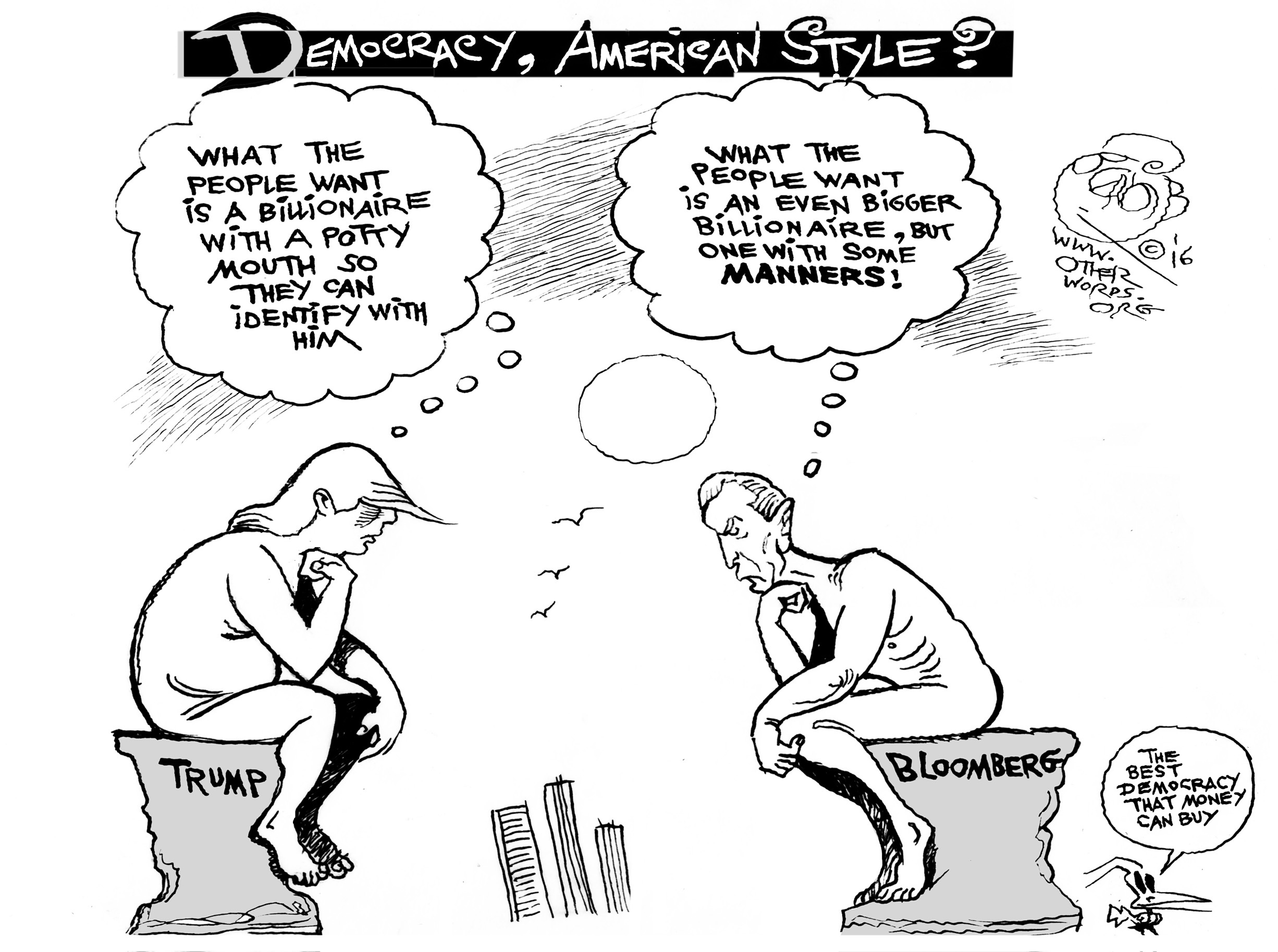
The post Billionaire vs. Billionaire appeared first on OtherWords.
This piece was reprinted from Other Words by RINF Alternative News with permission.
Hillary Clinton’s Pay-for-Play Reality
Whatever one thinks about Hillary Clinton’s sincerity when she professes progressive values, the undeniable reality is that she has immersed herself for decades in the corrupting sludge of Official Washington and its sleazy pay-for-play schemes with Wall Street and other power centers, as JP Sottile explains.
By JP Sottile
It was supposed to be a feel-good moment. The Chairman and CEO of the world’s most powerful financial institution dropped by CNBC’s Squawk Box to crow a bit about his recovery from cancer. But it didn’t quite go the way Lloyd Blankfein — or Hillary Clinton — might’ve wanted.
First, the recently-minted billionaire boss of Goldman Sachs compared his 600 hours of chemotherapy to dropping “napalm” on the Islamic State (“You get ISIS, but you also get some of the Kurds and Iraqis and everybody else”). Lloyd went on to tell Andrew Ross Sorkin that unlike another notable, newly-minted billionaire — fellow cancer survivor and comparably-connected JPMorgan Chase CEO Jamie Dimon — his brush with mortality didn’t really inspire circumspection about his life or about his crucial role in the profitable business of giving other people the business (“I must be so thick, I missed that whole thing”).

Lloyd Blankfein, Chairman and Chief Executive Officer of Goldman Sachs. (Photo credit: Goldman Sachs)
And then Lloyd revealed that Hillary Clinton isn’t the only one “feeling the Bern.” The remarkably unreflective Blankfein said the anti-Wall Street sentiment fueling Sen. Bernie Sanders’s insurgent campaign represented a “dangerous moment” for Wall Street and, by extension, for America. In that revealing moment of truth, Blankfein’s blurb not only encapsulated Wall Street’s growing discomfort with the surging candidacy of, as Blankfein put it, “another kid from Brooklyn,” but it also exposed Wall Street’s lingering detachment from the costly outcomes of its free-wheeling actions.
And it didn’t do Hillary any favors — which is something new for Goldman Sachs. Lloyd unintentionally poured gasoline into an already white-hot news cycle that’s raced out of Hillary’s control. And it further…
Video: Foreign Policy, Trump Style
Col. Larry Wilkerson says he’s amused by Trump’s understanding of foreign policy, though sounding like he understands those issues better than other …
Via Youtube
Video: TRNN in Hampshire: Unions, the Iraq War, and Healthcare
Former President of the New Hampshire AFL-CIO Mark Mckenzie discusses his enthusiasm for Sanders, and mayor of Miami Beach Philip explains why he is …
Via Youtube
Video: What Every Twitter User Needs To Know
In this video Luke Rudkowski talks about the shocking and sad news with twitter’s new algorithm and trust and safety council that will be used to censor any …
source
Video: Jail CIA MI6 not Street Dealers! 2008: banks suck in billions in cash from drug cartels
In 2009 the US Office on Drugs and Crime reported billions in cash had flowed into banks from drug cartels to keep them from going bankrupt Arresting street …
Via Youtube
Video: David Icke Reflects On That 1991 Interview With The Late Sir Terry Wogan
Please Support The Show – http://richieallen.co.uk/ https://www.facebook.com/therichieallenshow http://www.youtube.com/RichieAllenShowMedia Tune in at …
Via Youtube
Stomping on Our Constitutional Rights

Imagine the outcry by tea party Republicans if state legislators were passing laws banning the use of video cameras in banks to capture images of robbers.
Yet those very same tea partiers have been passing laws in various states to ban the recording of inhumane, immoral, and disgusting abuses of turkeys, hogs, and other animals by giant factory farm operators like Tyson.
The only reason the public knows about chickens being stomped to death and pregnant sows being driven insane because they’re caged so tightly they can’t even turn around is that courageous whistleblowers have secretly recorded videos of the intolerable violence inside these animal concentration camps.

Farm Sanctuary/Flickr
In response to the exposés, however, eight states run by shameless, corporate-hugging Republicans have rushed to protect the worst abusers, making it illegal to release such videos to the media or the public.
North Carolina’s corrupt legislature, for example, has decreed that videographers who cause bad publicity for corporate animal torturers can be sued by the corporation and fined $5,000 for each day abuses are recorded. To add to the Kafkaesque absurdity of this “ag gag law,” the state legislature’s corporate servants mandated that releasing videos of abuses in nursing home chains, day care centers, and veterans’ facilities is now also banned.
In their eagerness to please corporate lobbyists and get campaign donations from these abusive profiteers, tea party Republicans across the country are stomping on our constitutional rights to free speech and freedom of the press, just as callously as the animal abusers stomp chickens to death.
For information and action tips on stopping this disgraceful industry-legislative cabal, go to www.aspca.org/OpenTheBarns.
The post Stomping on Our Constitutional Rights appeared first on OtherWords.
This piece was reprinted from Other Words by RINF Alternative News with permission.
Video: TRNN in New Hampshire: Parties Facing Potential Crisis of Young Voter Base
Ellen Ratner of Talk Media News say we could soon begin to see the destruction of the two dominant parties.
Via Youtube
Video: TRNN in New Hampshire: Socialism in the Public Conversation
Jonathan Tahini, author of “The Essential Bernie Sanders,” says Bernie Sanders has helped open up the public conversation about socialism and demystified it …
Via Youtube
Who Would Dr. King Endorse?
Hillary Clinton won endorsements from Congressional Black Caucus members while civil rights legend Harry Belafonte came out for Bernie Sanders. But another question is who would Martin Luther King Jr. have supported since he – like Sanders – advocated for “democratic socialism,” as Jeff Cohen recalls.
By Jeff Cohen
Corporate mainstream media have sanitized and distorted the life and teachings of Martin Luther King Jr., putting him in the category of a “civil rights leader” who focused narrowly on racial discrimination; end of story. Missing from the story is that Dr. King was also a tough-minded critic of our capitalist economic structure, much like Bernie Sanders is today.
The reality is that King himself supported democratic socialism – and that civil rights activists and socialists have walked arm-in-arm for more than a century.

Martin Luther King Jr.
The same news outlets that omit such facts keep telling us that the mass of African-American voters in South Carolina and elsewhere are diehard devotees of Hillary (and Bill) Clinton – implying that blacks are somehow wary of Bernie Sanders and his “democratic socialism.”
Here are some key historical facts and quotes that get almost no attention in mainstream media:
1909: Many socialists – both blacks and whites – were involved in forming the National Association for the Advancement of Colored People (NAACP), our country’s oldest civil rights group. Among them was renowned black intellectual W.E.B. Dubois.
1925: Prominent African-American socialist A. Philip Randolph became the first president of the Brotherhood of Sleeping Car Porters, a union that played a major role in activism for civil and economic rights (including the 1963 “March on Washington for Jobs and Freedom”).
1952: In a fascinating letter to Coretta Scott, the woman he would marry a year later, Martin King wrote: “I imagine you already know that I am much more socialistic in my economic theory than capitalistic. . . . Today capitalism has out-lived its usefulness.”
1965: King wrote an essay in Pageant magazine, “The Bravest Man I Ever Knew,” extolling Norman Thomas as “America’s foremost socialist” and…
Video: TRNN in Hampshire: Social Security
Patrick Carroll of National Committee to Preserve Social Security and Medicare discusses where the candidates lie on the issue.
Via Youtube
Video: What does the Supreme Court EPA Ruling Mean for Ohio?
Energy analyst Cathy Kunkle and Daniel Sawmiller of Sierra Club analyze the $7 billion utility hike and regulatory challenges facing Ohio residents.
Via Youtube
Video: Giant sinkhole swallows car with family still inside in Peru
People rushed to help a family of three get out of their car after it was swallowed up by a five metre (16.4 feet) sinkhole in the north-western Peruvian city of …
Via Youtube
Video: Women’s Issues and the Democratic Campaigns
Former NH Representative Sylvia Gale and a supporter of the Sanders campaigns weigh in on how women are approaching the Sanders and Clinton …
Via Youtube
The Blind Spots of Dead White Men

As the rest of the nation celebrates Black History Month this February, I’m taking a graduate level course I call “Dead White Men.”
It’s actually a classic theory class that covers a number of influential thinkers, like free market theorist Adam Smith and the famous French observer of American democracy, Alexis de Tocqueville.
It’s a good class. But the thinkers we’re studying are all dead white men.
In fact, they weren’t just white and male. They were all members of an elite that was rich and formally educated.
There’s nothing inherently wrong with that: They were all great thinkers, and their contributions to human knowledge are indisputable. But their views of the world were developed based on their unique positions in society. As a result, they had some easy-to-recognize blind spots.

Sharon Mollerus / Flickr
What’s missing in the canon of classic literature taught in the United States are the views of everyone else who built our nation: African Americans, Native Americans, Latinos, Asian Americans, and so on.
How would the theories we use to understand our economy, government, and society differ if we’d recorded the thoughts of marginalized people along the way?
For example, in The Wealth of Nations — the seminal book that defines capitalism — Adam Smith asserts that the poor factory workers living in England during the Industrial Revolution had better lives under capitalism than even a wealthy African prince.
Those factory workers, however, were living in squalor, in utter misery. From his vantage point, not experiencing it himself, Smith didn’t seem to think it was that bad.
Smith goes on to describe how individuals each act in their own self-interest. Without any mastermind in control, that lets the free market work as though it were steered by an “invisible hand.” The role of government in aiding the capitalist economy, according to Smith, is minimal.
Here, he misses the enormous role of the British Empire.
During the Industrial Revolution, Great Britain exported wheat from its colony India even during famines, causing millions of Indians to starve to death. Cotton came from the United States and sugar from colonies in the Caribbean, nearly all of it produced by enslaved Africans and their descendants. Not to mention that the original inhabitants of the New World that produced this bounty were largely driven off their land by colonial governments.
Some “invisible hand.”
That doesn’t necessarily nullify the conclusions Smith made, but it shows a hole in his theory that’s never accounted for. We tend to accept Smith’s ideas as they are, without noting this flaw or analyzing how it might make his ideas inaccurate in any way.
What if instead, the United States elevated the perspectives of the non-white peoples who were marginalized, enslaved, and exploited to the same prestige enjoyed by white writers like Smith? Wouldn’t we all better understand how the world works — and how to make it work better?
To some extent, of course, this is impossible. Many black and Native American contemporaries of Smith, or even poor whites, were illiterate, and they’re now long dead. But surely we can begin to recognize and correct our mistakes now.
Relegating black history to just one month of the year — and treating it as if it’s something separate from American history more broadly — does a disservice to us all. It reinforces the wrongheaded idea that we’re a white nation, and that the history of other people is only a part of our own insomuch as it affects whites.
It’s great to have a month highlighting black history and the achievements of African Americans. But if any of us, regardless of race, wish to fully understand our own history as a people, then black history must be included on a level playing field with white history — all year long.
The post The Blind Spots of Dead White Men appeared first on OtherWords.
This piece was reprinted from Other Words by RINF Alternative News with permission.
‘This “Independent” Academic Is Promoting Public Policy Issues for a Private Corporation’
Janine Jackson interviewed Carey Gillam on the conflicts of interest of food science experts for the February 5, 2016, CounterSpin. This is a lightly edited transcript.

Carey Gillam: “What you see through these emails is that it was all very coordinated and very crafted by Monsanto and Monsanto PR operatives.”
Play
Stop
X
MP3jPLAYLISTS.MI_0 = [
name: “1. CounterSpin Carey Gillam “, formats: [“mp3”], mp3: “aHR0cDovL3d3dy5mYWlyLm9yZy9hdWRpby9jb3VudGVyc3Bpbi9Db3VudGVyU3BpbjE2MDIwNUdpbGxhbS5tcDM=”, counterpart:””, artist: “”, image: “true”, imgurl: “”
];
MP3jPLAYERS[0] = list:MP3jPLAYLISTS.MI_0, tr:0, type:’MI’, lstate:true, loop:false, play_txt:’Play’, pause_txt:’Pause’, pp_title:’FAIR’, autoplay:false, download:true, vol:80, height:71, cssclass:’ ‘, popout_css: enabled:true, colours: [“#fff”, “rgba(201,207,232,0.35)”, “rgb(241,241,241)”, “rgba(245,5,5,0.7)”, “rgba(92,201,255,0.8)”, “transparent”, “transparent”, “#525252”, “#525252”, “#768D99”, “#47ACDE”, “”, 600, 200 ],
cssInterface: “color”: “#525252” ,
cssTitle: “left”: “16px”, “right”:”16px”, “top”:”8px” ,
cssImage: “overflow”: “hidden”, “width”:”auto”, “height”:”71px” ,
cssFontSize: “title”: “16px”, “caption”: “11.2px”, “list”: “12px” ,
classes: interface:’ verdana-mjp’, title:’ left-mjp norm-mjp plain-mjp childNorm-mjp childPlain-mjp’, image:’ Himg right-mjp’, poscol:”, ul:’ darken1-mjp verdana-mjp med-mjp childNorm-mjp childPlain-mjp left-mjp’ ;
Janine Jackson: On many issues, Americans are happy to leave it to the experts. But when it comes to food, many people care very deeply. But wanting to make informed choices about what they eat and how it’s produced sometimes leads people to ask questions that food industries would rather not answer. That’s why journalism is so important, and why it matters so much who appears in stories as an authority that we should listen to and believe. Our next guest brings a case study that shows why we are right to be mindful. A longtime food and agriculture journalist, Carey Gillam is now research director at US Right to Know. She joins us by phone from Kansas.
Welcome to CounterSpin, Carey Gillam.
Carey Gillam: Thank you. Thank you very much for having me.
JJ: First of all, the Freedom of Information Act turns 50 this year, and I think it’s hard to overstate its value to journalists and to the public. And I understand that FOIA played a role in the story that we’re going to talk about. So before we get into what was revealed about former food science professor and media source Bruce Chassy, what do we know about how the information came to light?
CG: Yeah. What we did at US Right to Know was do Freedom of Information Act requests, and actually at several different universities. And it’s been a bit of a struggle to actually get those returned, but we have thousands of them. And we’ve been going through them to find out just exactly how closely are certain academics at publicly funded universities, how are they really working and aligning themselves, if they are, with private corporations that are trying to push certain political agendas and lobby for public policy matters. We wanted to see, really, what that relationship is, where’s the money flowing, what are the connections. Because we’re getting the information that things weren’t being revealed to the public that we thought were pretty important.

Bruce Chassy (photo: Academics Review)
JJ: Well, when we talk about conflicts of interest between, for example, an academic and an industry with a particular set of ideas and policies that they want to promote and other ideas that they want to discourage, sometimes we’re talking about maybe expensive dinners, or perhaps travel that was covered to go to a conference. And these are things that, even if they might seem to point to a kind of unseemly culture, they don’t really, for many people, constitute a smoking gun. They don’t seem like evidence of a quid pro quo. But when we talk about Bruce Chassy, who was a food science professor at the University of Illinois and at NIH for many years, that situation which you’ve written about just recently, it seems much more stark than that.
CG: Well, yeah, now I would agree with that. I have to admit that my jaw was dropped and hanging open most of the time I was reading these emails. It seems unbelievable to me that this is OK, that what we found doesn’t seem to violate specific policies or ethics rules at the university. But it doesn’t.
But what the emails do show is that this particular professor—and he’s one of many, but he’s a very good example—this particular professor has a long track record, highly esteemed, and he and Monsanto company in particular became very close and collaborated on a regular basis about a range of things, presentations that Chassy would make supporting genetically modified crop technology that Monsanto relies on, that Monsanto makes its $15 billion a year in revenues on.
As you probably know, GMOs are pretty controversial right now. GMO labeling is at the forefront in Washington, DC, for new legislation. Mandatory labeling is set to take effect in Vermont in July. The food industry is fighting that desperately. Monsanto has spent millions of dollars lobbying against state mandatory labeling measures across the country. So to have an academic who appears to be independent coming out and writing reports and making presentations and speeches, and saying that consumers are wrong and GMOs are safe and we need them to feed the world and it’s very sustainable and there’s no safety issue and the pesticides that go with them are not a problem, you know, to have an independent academic standing up and saying all this, is a wonderful thing for Monsanto.
But what you see through these emails is that it was all very coordinated and very crafted by Monsanto and Monsanto PR operatives. Public relations firms are helping Chassy edit videos that he can put out, you know, giving him slides for presentations; they’re helping him set up a website where he can write negative, critical articles about people who are raising concerns about GMOs. And there’s a lot of money flowing back and forth—or actually one way, a lot of money flowing into accounts at the university for Chassy to use.
JJ: Yeah, and I would direct people to the web site, to USRTK.org, to see examples from the emails that we’re talking about. But we’re talking about real direct stuff. You mentioned that presentation: Chassy is going to make a presentation in China, and there are emails that show him basically submitting what he’s going to say to Monsanto, and them making changes to it. And him saying, all right, Monsanto will shape what I’m going to say about this set of issues. And then, also, on the other side there’s the money. There are the emails that connect it to a financial relationship between, in this case, the University of Illinois and, in this case, Monsanto?
CG: Right. Yeah, there are accounts set up where unrestricted funds, grants, donations, gifts, can be sent from Monsanto, and Chassy can then access those funds and use them in different ways and for different projects. And there’s no real problem with that, I guess, from the university.
Now, Chassy, on his behalf, he says, hey, I believe GMOs are safe, you know? I’m a fan of GMOs, and so I’m not doing anything unethical, I’m not being bought, I’m not selling my integrity. But what you see in the emails is something that goes much deeper, I think. He’s not going to Monsanto and saying, hey, I’m going to make a presentation, I want to check the science on this and make sure I’m accurate. This is an active back-and-forth: How do we promote this?
They talk about how to spin some information that’s come out of the US Geological Survey. Chassy’s offering how Monsanto might spin that, because it doesn’t, on its face, necessarily look too good. He’s helping them figure out how to lobby the EPA to try to roll back regulations on biotech crops. He’s asking for help getting first class plane fare to go to India, because he sure doesn’t want to fly coach. I mean, there’s a lot that we weren’t able to put into our article, but it certainly shows a very hand-in-glove situation, where this “independent” academic is very much promoting public policy issues for a private corporation.
JJ: Hiding the strings is important, and I think that’s kind of where journalists come in. Because there’s a quote that you have from Monsanto’s chief of global scientific affairs, Eric Sachs, in which he says, “The key will be keeping Monsanto in the background so as not to harm the credibility of the information.” In other words, they’re explicit about the fact that they want these views to get out into the media and to public opinion, but to not seem to be tied to Monsanto.
CG: Exactly.
JJ: So, again, that’s where journalism comes in. And, unfortunately, you find that journalists quoting Bruce Chassy in this case don’t often do a great job of illuminating those connections.
CG: Journalists don’t. He’s been quoted widely in many reputable newspapers, very large news outlets. And so are several others, there are several others around the country who journalists reach out to, to ask for quotes on these very timely, hot-button political issues. And I don’t think it occurs to journalists—you know, I’ve been a journalist 25 years—it doesn’t often occur to you, if you’re calling up to say, hey, talk to me about weed resistance and what’s going on with glyphosate, let’s talk about the safety of GMOs. It doesn’t often occur to you to say, hey, by the way, have you been emailing with Monsanto for the last two years and getting tens of thousands of dollars and unrestricted grants from them, as I ask you your opinion on this subject?
You know, it’s not something you typically do as a journalist. You will do that if you’re writing about a particular study per se; you want to know who funded the study or who funded the research. But I think to me, what all of this that we’re seeing and we’re finding tells me as a journalist is that we just need to be a lot more diligent.

Kevin Folta (photo: University of Florida/Tyler Jones)
We need to really think about, is there something going on behind the scenes here? And even if we don’t know, or even if we don’t think they’re going to tell us, we need to ask the question and get them on the record—yes, there is a connection, [or] no. Because we had Kevin Folta, emails from him, [he’s at] the University of Florida; he specifically said he had no relationship with Monsanto, wasn’t taking money from Monsanto. And, in fact, he got a $25,000 unrestricted grant and told Monsanto he was willing to write whatever they wanted him to write. But he sure wasn’t telling the public that.
JJ: Exactly. It really is about the right to know. I mean, just as people want labels on GMO foods because different people feel differently about eating them, we need, if you will, labels on our experts, not so that we can denounce them but just so that we can know.
CG: Exactly. You know, there may be some people who think that Bruce Chassy is that much more of an authority because he is so close with Monsanto. Maybe they would respect his opinion more. Granted, there are a lot of people in this society who probably wouldn’t trust the information. But without knowing those connections, without the disclosure and the transparency—and, again, this is a man who is working for a public university, a taxpayer-funded university. We’re all paying for that university, we’re paying for these professors, and we should know the connections to private corporations, and we should be able to understand those collaborations. There should be transparency.
JJ: We’ve been speaking with Carey Gillam of US Right to Know. You can find them and their work online at USRTK.org. Carey Gillam, thank you so much for joining us this week on CounterSpin.
CG: Thank you for having me.
This piece was reprinted by RINF Alternative News with permission from FAIR.
The US Military Suffers From Affluenza: Showering the Pentagon With Money and Praise

 (Image: Jared Rodriguez / Truthout)The word “affluenza” is much in vogue. Lately, it’s been linked to a Texas teenager, Ethan Couch, who in 2013 killed four people in a car accident while driving drunk. During the trial, a defense witness argued that Couch should not be held responsible for his destructive acts.
His parents had showered him with so much money and praise that he was completely self-centered; he was, in other words, a victim of affluenza, overwhelmed by a sense of entitlement that rendered him incapable of distinguishing right from wrong. Indeed, the judge at his trial sentenced him only to probation, not jail, despite the deaths of those four innocents.
Experts quickly dismissed “affluenza” as a false diagnosis, a form of quackery, and indeed the condition is not recognized by the American Psychiatric Association. Yet the word caught on big time, perhaps because it speaks to something in the human condition, and it got me to thinking. During Ethan Couch’s destructive lifetime, has there been an American institution similarly showered with money and praise that has been responsible for the deaths of innocents and inadequately called to account? Is there one that suffers from the institutional version of affluenza (however fuzzy or imprecise that word may be) so much that it has had immense difficulty shouldering the blame for its failures and wrongdoing?
The answer is hidden in plain sight: the US military. Unlike Couch, however, that military has never faced trial or probation; it hasn’t felt the need to abscond to Mexico or been forcibly returned to the homeland to face the music.
Spoiling the Pentagon
First, a caveat. When I talk about spoiling the Pentagon, I’m not talking about your brother or daughter or best friend who serves honorably. Anyone who’s braving enemy fire while humping mountains in Afghanistan or choking on sand in Iraq is not spoiled.
I’m talking about the US military as an institution. Think of the Pentagon and the top brass; think of…
Video: ‘He screams every night’: Mother of raped 10yo Austrian boy ‘regrets welcoming migrants’
The mother of a ten year old boy raped by an Iraqi refugee at a Vienna swimming pool has been speaking about his ordeal. She says her son may never fully …
Via Youtube
Video: TRNN in New Hampshire: Why The Real News Went to the Primary
Senior editor Paul Jay says its important to deconstruct what the candidates say in terms of the interests of working people.
Via Youtube
Could Unelected Superdelegates Give Clinton the Nomination Even If Sanders Wins the Primaries?
With Bernie Sanders’ double-digit victory over Hillary Clinton in Tuesday’s New Hampshire primary and near tie with her in last week’s Iowa caucuses, it would seem that the race for the Democratic nomination would be neck and neck. But that is not the case.
In New Hampshire, Sanders trounced Clinton 60 to 38 percent – but they split the delegates evenly thanks to unelected superdelegates siding with the former secretary of state. Overall, Clinton sits far ahead of Sanders when you factor in these superdelegates – the congressmen, senators, governors and other elected officials who often represent the Democratic Party elite.
We speak to Duke professor David Rohde and Matt Karp, assistant professor of history at Princeton University and contributing editor at JacobinMag.com.
Report points to growing epidemic of drug abuse in Pennsylvania
Douglas Lyons
A recent report adds more evidence of the opioid epidemic in Pennsylvania. Overdoses of pain medication have increased 225 percent from 2000 to 2014 while hospitalizations for heroin overdoses have increased by 162 percent during the same period.
The report, Hospitalizations for Overdose of Pain Medication and Heroin, was published by the Pennsylvania Health Care Cost Containment Council (PHC4). It culled data from hospitals whose patients were admitted for the principal reason of overdosing from either pain medication such as OxyContin and Oxycodone or heroin, during the years 2000 to 2014, and focusing on Pennsylvania residents age 15 and older.
The report, as noted by the authors, excludes overdoses that did not result in hospital admission, but were limited to a visit to the emergency room, or were entirely outside the hospital. Adding such overdoses would have reinforced some of the points the authors have made.
In the case of the hospitalizations for pain medication abuse, these peaked in 2011 at 1,142, with a decrease to 929 in 2014. The opposite is the case for heroin hospitalizations: the largest increases happened between 2010 and 2014, evidencing the fact that more and more people are turning to cheaper and more potent forms of opioids.
Among those admitted to the hospital for overdosing on pain medication, the largest group, 28 percent, were aged 50-59, while 40 percent of those who were admitted for heroin overdose were aged 20-29.
The report distinguishes between urban counties—Allegheny, Beaver, Berks, Bucks, Chester, Cumberland, Dauphin, Delaware, Erie, Lackawanna, Lancaster, Lebanon, Lehigh, Luzerne, Montgomery, Northampton, Philadelphia, Westmoreland, and York—and rural ones. Rising hospitalizations for pain medication and heroin overdoses were found in both urban and rural counties, but rural counties had a much higher increase in both: pain medication overdoses increased 285 percent, heroin overdoses by 315 percent; in urban counties, pain medication overdoses rose 208 percent, and heroin overdoses rose 143 percent.
According to a recent story in the New York Times, analyzing death certificates across the US among young white adults, ages 25-34, “[t]he drug overdose numbers were stark. In 2014, the overdose death rate for whites ages 25 to 34 was five times its level in 1999, and the rate for 35- to 44-year-old whites tripled during that period. The numbers cover both illegal and prescription drugs.”
Similarly, the Centers for Disease Control and Prevention (CDC) issued a report detailing the deaths of tens of thousands of people from overdosing on drugs, particularly opioids. The year 2014, it reported, saw 48,000 drug overdose deaths, the most of the current epidemic. Opioid overdose deaths rose by 14 percent from 2013 to 2014.
Communities within Appalachia and the Rust Belt region are particularly hit hard by it, where the obliteration of decent-paying jobs in manufacturing and mining has been very pronounced. Most of the states with the highest rates or sharp increases in drug overdoses are found in this area: West Virginia, Kentucky, Ohio, Illinois, Indiana, Pennsylvania, and Michigan.
The global slump continues to affect Pennsylvania. Southwestern Energy, a large natural gas producer, has announced that it will lay off more than 100 gas workers in northeastern Pennsylvania. GE Transportation has already let go 1,500 workers at a locomotive manufacturing plant in Erie, Pennsylvania last year and has decided that more workers will be laid off this year. Joblessness is one of the main drivers of the growing epidemic of drug abuse.
Pennsylvania, meanwhile, is still trying to pass a long overdue budget, in which Democratic Governor Tom Wolf has signaled his support for the complete destruction of pensions for newly hired state workers and the privatization of the state-owned wine and liquor stores.
Via WSWS. This piece was reprinted by RINF Alternative News with permission or license.
How Crimeans See Ukraine Crisis
Two years ago, the Maidan uprising ousted Ukraine’s elected president, prompting resistance in Crimea and eastern Ukraine, with Crimeans voting overwhelmingly to reunify with Russia, a move that then sparked a new cold war. As propaganda enveloped this issue, Natylie Baldwin went to see for herself last fall.
By Natylie Baldwin
We had boarded the bus that would transport us from the gates of Moscow’s Vnukovo airport to the plane waiting on the tarmac to fly us to Simferopol, Crimea, when a friendly blonde in her late 30’s asked us in accented English if we were from “The States”?
When we answered that we were, she told us she currently lived in Texas but was going to visit relatives in Crimea. As we chatted more and my travel mate and I explained our reason for going there – to see Crimea for ourselves and find out from the people living there what they thought about the Ukraine war and the peninsula’s reunification with Russia – it became apparent that this lady had a few things she wanted to get off her chest.

A map showing Crimea (in beige) and its proximity to both the Ukrainian mainland and Russia.
“You cannot separate Ukraine from Russia, there is too much culture and history together,” she said. Choking up on her words, she continued, “American people are good people – I have many friends in the U.S. – but their government leaders are not because they interfere too much in other places. I worry about Hillary [Clinton], you know. When [Libyan leader Muammar] Gaddafi was killed, she said ‘We came, we saw, he died. Ha ha.’ What kind of leader is that? Is she going to be the next president?”
She felt that, due to the violence on the Maidan and Washington’s interference in the form of Assistant Secretary of State for European Affairs Victoria Nuland’s manipulations, Putin’s intervention in Crimea was correct: “Putin did the right thing for Crimea, he is a good leader.”
When we landed in Simferopol, it was clear that the small airport had been recently renovated as everything was clean and freshly painted. After haggling down the price to something reasonable with the proprietor of a taxi service, we loaded…
Police still abusing stop and search powers, regulator finds

Police in Britain are still abusing their stop and search powers despite the fact rules have been put in place to prevent such misconduct, a damning new report reveals.
The study, which was published on Thursday by Her Majesty’s Inspectorate of Constabulary (HMIC), found that 14 percent of stops could be illegal, despite pledges by police chiefs to tackle the problem.
The 13 forces that posed the greatest concern failed to meet 60 percent of the requirements laid out under the government’s stop and search reform scheme.
Each of these 13 forces was suspended by Home Secretary Theresa May and faces an emergency inspection in three months’ time. The forces reprimanded include Cambridgeshire, Cheshire, Cumbria, Gloucestershire, Lancashire, Leicestershire, Lincolnshire, Northumbria, South Wales, Staffordshire, Warwickshire, West Mercia and Wiltshire.
A further 19 forces were told to improve their practices or also risk public shaming.
When the government’s scheme to improve stop and search was launched, all 43 forces across England and Wales signed up. The powers have sparked multiple concerns, rarely leading to arrest and often disproportionately used against innocent ethnic minority Britons. HMIC’s report revealed that officers across the UK are failing to use it lawfully, with some 15 percent of stops examined appearing to lack reasonable suspicion of criminality.
May has previously threatened to introduce new laws forcing police to use their stop and search powers in a proportionate fashion. However, since HMIC’s study was published her officials have warned that such legal changes are likely.
Steve Otter, who was the lead inspector working on the HMIC report, said the forces’ failings were “inexcusable.” He told the Guardian that officers’ breach of existing rules undermines public order and police legitimacy.
“Every single major report into disorder in this country since 1970 places stop and search as one of, if not the most important contributing factor, and those lessons need to be learned,” he said.
May called upon forces who are signed up to the scheme to deliver on their promises.
“It is unacceptable that 13 forces have been identified by HMIC as failing to comply with three or more requirements,” she said.
“I have suspended them from the scheme with immediate effect.”
Via RT. This piece was reprinted by RINF Alternative News with permission or license.
Video: Several dead, 150+ injured after 2 passenger trains collide head-on in Germany
Two Meridian passenger trains collided head-on near the town of Bad Aibling in Bavaria, Germany. One train reportedly derailed as a result of the collision.
Via Youtube
Video: Historian Says Additional Baltimore Confederate Statues Should be Removed
James W. Loewen argues confederate monument commission which recommended to remove two statues did not go far enough, and even overlooked …
Via Youtube
Jeffrey Sachs Blames Hillary Clinton for Our National Security Woes


Yes, neocons are still around and may have an inside track to the White House once again. (Photo: Wikimedia)
It’s almost unfathomable how much money Hillary and Bill Clinton have made from giving speeches, mostly to financial companies. While that $153 million (according to CNN) was earned since Bill Clinton’s second presidential term ended, it now almost makes more sense to view Hillary Clinton in the class of tycoons who become politicians, such as Donald Trump and Mike Bloomberg.
But it’s not just Hillary Clinton’s speeches to and affiliations with Wall Street that have become a rising crescendo of alarm. At Huffington Post, Jeffrey Sachs, authority on economic development and world poverty, continues to tack left.
There’s no doubt that Hillary is the candidate of Wall Street. Even more dangerous, though, is that she is the candidate of the military-industrial complex. The idea that she is bad on the corporate issues but good on national security has it wrong. Her so-called foreign policy “experience” has been to support every war demanded by the US deep security state run by the military and the CIA.
Sachs elaborates:
… Yet Hillary’s connections with the military-industrial complex are … alarming. It is often believed that the Republicans are the neocons and the Democrats act as restraints on the warmongering. This is not correct. Both parties are divided between neocon hawks and cautious realists who don’t want the US in unending war. Hillary is a staunch neocon whose record of favoring American war adventures explains much of our current security danger.
Did you see what he did there? He casts neocons, who consider themselves models of realpolitik, as the opposite of realists. Very clever casting them as the true radicals (which they are). I know: hard to believe after they were discredited by Iraq War that they are still around and, even worse, still have a pipeline to the presidency.
Even more dramatically, Sachs places the blame squarely at Hillary Clinton’s feet when he writes that her record “explains much of our current security danger.”
Also, as I have, he points out that the word “experience” is value-neutral. (Or worse — pejorative.)
Hillary’s record as Secretary of State is among the most militaristic, and disastrous, of modern US history. Some experience.
Maybe it’s not Sachs tacking far left, but an acknowledgment of how far right Clinton is when it comes to foreign policy.
This piece was reprinted from Foreign Policy In Focus by RINF Alternative News with permission.
Video: Casual Hero: Passerby aids UK police chase by tripping fleeing suspect
Kingston police force labelled a man a ‘hero’ after he tripped over a 17-year-old who was fleeing while being chased by two police officers, who suspected him …
Via Youtube
Video: TRNN in New Hampshire: Can Change Come From Within the Democratic Party?
TRNN’s Paul Jay and journalist Chris Hedges debate the significance of Bernie Sanders’ campaign in the 2016 presidential race.
Via Youtube
Video: ‘We won’t agree on everything’: US responds to Erdogan’s ultimatum on Kurds
Riled by a meeting between a US official and the Kurdish People’s Protection Units (YPG), which controls the Syrian town of Kobani, Turkish President Recep …
Via Youtube
Video: ‘We won’t agree on everything’: US responds to Erdogan’s ultimatum on Kurds
Riled by a meeting between a US official and the Kurdish People’s Protection Units (YPG), which controls the Syrian town of Kobani, Turkish President Recep …
Via Youtube
Hillary Sanders? Clinton singing Bernie’s tune on banks, campaign finance

Hillary Clinton lost the New Hampshire primary vote, but her concession speech sounded like that of a winner, specifically the one who had just defeated her: Bernie Sanders. On the issues of big banks and campaign finance reform, the echo was clear.
“Senator Sanders and I both want to get secret unaccountable money out of politics,” Clinton told supporters on Tuesday night after results showed her coming in at a distant second place.
“We also agree that Wall Street can never be allowed to once again threaten Main Street,” she added before proclaiming herself to be the only one who “know[s] how to do it.”
New Hampshire polls consistently showed Senator Sanders leading the former State Department secretary by 15 points, and as primary election day neared, a consensus became apparent among some Clinton supporters and political pundits that if she could only lose by single digits, that could be considered a relative victory.
In the end, Sanders improved upon his lead in the polls, beating Clinton by a margin of 22 percent. Her concession speech took the next logical step, tacitly acknowledging tougher talk on big banks and campaign finance reform as the winning message.
“No bank can be too big to fail, and no executive too powerful to jail,” Clinton said to cheers, following up with a shift to money in politics. “You’re not going to find anybody more committed to aggressive campaign finance reform than me.”
S/o to Hilary Clinton for trying to sound like Bernie Sanders more and more each speech.
— Wade (@wking44) February 10, 2016
The thing I like most about Hillary Clinton is how much she’s starting to sound like Bernie Sanders. #FeelTheBern
— B. Micelf (@kenekted1) February 10, 2016
The speech did not simply represent a change in tone for Clinton, but a fundamental change in priorities on the issues. Only a week earlier, after a virtual tie in Iowa Caucus votes, Clinton’s victory speech was front loaded with her positions on universal health care, climate change, education, and gun control.
Even as recently as the February 4 New Hampshire Democratic debate, Clinton espoused views that she ultimately deviated from in the concession speech.
“You will not find that I ever changed a view or a vote because of any donation that I ever received,” Clinton said in response to Sanders alluding to her campaign’s acceptance of Wall Street money. There was no talk from Clinton of “aggressive campaign finance reform” during the debate, but there was after the primary results were announced.
One element of her Tuesday night speech that remained consistent with her debate remarks was her claim to be the most reliable guarantor of progress.
“Now, people have every right to be angry, but they’re also hungry,” Clinton told supporters in her concession speech. “They’re hungry for solutions. What are we going to do? That is the fight we’re taking to the country. What is the best way to change people’s lives, so we can all grow together? Who is the best changemaker?”
That was not the message Clinton brought to New Hampshire back in September, when the state Democratic Party convention was held. There, she harkened back to her husband Bill Clinton’s presidency, when she said incomes of all levels had risen. She also praised President Barack Obama, who “curbed Wall Street abuses,” without going into any details on what regulations should be imposed next.
Sanders, meanwhile, is not likely to let voters forget that Clinton favored bank bailouts before she campaigned against them.
Back in 2008 at the height of the financial crisis, Clinton, running for the Democratic presidential nomination against then-Senator Obama, couched her support for impending bank bailouts in criticism directed towards the Bush administration.
“I believe that such an intervention demands that we fundamentally alter the priorities and policies of our nation under the Bush administration that allowed this crisis to take place and escalate,” she said at the time. “Corporations that will benefit must be held accountable not only to large shareholders but also to the American people.
In contrast, Sanders voted against the bank bailouts, also citing accountability to the American taxpayer.
Clinton also went further Tuesday night, not shying away from racially charged issues. As Black Lives Matter supporters have splintered their support, mostly going for Sanders, if for any candidate, Clinton promised to “break through the barriers of bigotry.”
“African-American parents shouldn’t have to worry that their children will be harassed, humiliated, even shot because of the color of their skin,” she said, following up with denunciations of alleged institutional challenges facing immigrants, the LGBT community, and working women.
“I know I have some work to do, particularly with young people,” Clinton said. “Even if they are not supporting me now, I support them, because I know I have had a blessed life, but I also know what it’s like to stumble and fall.”
Clinton went on to express gratitude to the “more than 700,000 people” who donated to her campaign online, thanking “the vast majority giving less than $100,” another similar talking point to what is heard in Sanders’ stump speeches.
“I know that doesn’t fit with the narrative,” Clinton told her supporters.
Via RT. This piece was reprinted by RINF Alternative News with permission or license.
‘Not Your Firewall’: Minority Voters Refuse To Be Token in Clinton Strategy Map

Pointing to Clinton’s historic support for policies that expanded mass incarceration, author Michelle Alexander writes, “there is such a thing as a lesser evil, and Hillary is not it.”
Lauren McCauley
Hillary Clinton’s allegedly formidable advantage among minority voters in South Carolina, Nevada, and elsewhere is being questioned—and tested—as people of color are increasingly coming forth to reject being treated as a political “firewall” for her campaign.
Following Clinton’s significant loss to rival Bernie Sanders in New Hampshire on Tuesday night, campaign manager Robby Mook sent a memo to supporters suggesting that Clinton’s “high levels of support in the African American and Hispanic communities” should all but guarantee her the Democratic nomination.
“It will be very difficult, if not impossible, for a Democrat to win the nomination without strong levels of support among African American and Hispanic voters,” Mook wrote. “Hillary’s high levels of support in the African American and Hispanic communities are well known. She has maintained a wide double digit lead over Sen. Sanders among minority voters in national surveys and in states where African American and Hispanic voters make up a large share of the electorate. That type of support was not created overnight; it has been forged over more than 40 years of fighting for and alongside communities of color. They know her, trust her and are excited about her candidacy.”
The release of the memo spurred wide rebuke from voters, including New York Daily News columnist and Black Lives Matter activist Shaun King, who wrote online: “Hey Black & Latino voters, Did YOU get the Hillary memo asking you to save her campaign?”
King, who openly supports Sanders, has previously said that he “fundamentally reject[s]” the notion of an African American firewall and finds it “insulting on its face.”
As the Huffington Post pointed out, others swiftly followed suit, specifically highlighting the former secretary of state’s support of the 1994 crime bill passed during husband Bill Clinton’s presidency.
@politicoroger you tell Robby Mook this black voter is not excited about her candidacy or her campaign. #feelthebern
— Tori Griffin (@torigriffin) February 10, 2016
@politicoroger tell hillary we are not her firewall we know it’s not about Obama legacy it 3rd term Clinton presidency
— richdoll (@richdoll54) February 10, 2016
@politicoroger Please convey to Robbie Mook that we are not her firewall. No more #PrisonIndustrialComplex.
— JadeinNM (@Jadeinnm) February 10, 2016
Meanwhile, Michelle Alexander, author of the groundbreaking book “The New Jim Crow,” published a column in The Nation on Wednesday—titled Why Hillary Clinton Doesn’t Deserve the Black Vote—which directly questions the assumption that the black vote is “in her back pocket” as the primary season moves forward.
Pointing to Clinton’s historic tough-on-crime stances as well as her support for policies that expanded mass incarceration, escalated the War on Drugs, and crippled the welfare system, Alexander writes that it seems black voters “are eager to get played again.”
“If you listen closely here, you’ll notice that Hillary Clinton is still singing the same old tune in a slightly different key,” she continues. “She is arguing that we ought not be seduced by Bernie’s rhetoric because we must be ‘pragmatic,’ ‘face political realities,’ and not get tempted to believe that we can fight for economic justice and win. When politicians start telling you that it is “unrealistic” to support candidates who want to build a movement for greater equality, fair wages, universal healthcare, and an end to corporate control of our political system, it’s probably best to leave the room.”
Alexander notes that “this is not an endorsement for Bernie Sanders,” however, she adds that “there is such a thing as a lesser evil, and Hillary is not it.”
On Wednesday, Sanders had breakfast with Rev. Al Sharpton, a leading figure in the African American community. The Daily Beast‘s Goldie Taylor notes that “by meeting with Sharpton at Sylvia’s Restaurant—the very place then-Sen. Barack Obama sat down with the preacher in 2008—Sanders is sending a message to Clinton forces: Don’t sleep.”
In South Carolina, where as of January 21, Clinton held a 63 to 33 percent lead over Sanders, the senator from Vermont senator has proved himself increasingly capable of winning support from the state’s sizable and influential black electorate.
What’s more, as the Boston Globe reported this week, “He is airing ads on black radio stations about his record of fighting racism, from his college years to his career in the Senate, and in favor of criminal justice reform. His campaign is paying more than 100 black organizers $15 an hour—the national minimum wage he is advocating for—to go door to door. Half of his South Carolina team had previously worked on Barack Obama’s 2008 and 2012 campaigns.”
Longtime state legislator Gilda Cobb-Hunter said, “What Sanders is doing here has forced the Clinton campaign to step up their game and understand that they cannot take the voters of this state for granted.”
Via Common Dreams. This piece was reprinted by RINF Alternative News with permission or license.
Federal report criticizes lack of regulation and safety in West, Texas fertilizer plant explosion
Stuart Winter
More than 1,300 facilities nationwide store the type of agricultural chemical—fertilizer-grade ammonium nitrate—that set off an explosion in the central Texas town of West on April 17, 2013 at a fertilizer production plant. Fifteen people were killed, more than 160 were injured, with more than 150 buildings damaged or destroyed.
A federal report released recently by the US Chemical Safety Board criticized both state and federal officials for having failed to issue regulations governing such facilities. Fertilizer-grade ammonium nitrate is not categorized as an explosive or hazardous material. In the case of the West facility, the fertilizer was stored at the plant in a wooden warehouse in wooden bins, in a building without a sprinkler system.
The report makes note of the fact that Texas has no statewide fire code and state law actually prohibits most smaller rural counties from adopting a fire code.
According to the report: “Not only were the warehouse and bins combustible, but the building also contained significant amounts of combustible seeds, which likely contributed to the intensity of the fire.”
It also notes that: “Industry has developed other forms of ammonium nitrate that are reported to reduce or eliminate the risk of accidental detonation. For example, compounding the ammonium nitrate with calcium carbonate (limestone) practically eliminates any risk of explosion in its storage, transportation, and handling, while preserving the AN’s nutritive value.”
Ammonium nitrate is predominantly used in industrial agriculture as a high-nitrogen fertilizer. It consists of 34 percent nitrogen.
The explosion at the West Fertilizer Company plant was one of the deadliest industrial disasters in Texas history. The explosion occurred while emergency services personnel were responding to a fire at the facility. Those living in and around the site reported that the blast felt like an earthquake.
The US Chemical Safety Board released its report January 28, 2016 in Waco, Texas, 20 miles south of West. The report calls into question the West plant’s handling of the fertilizer and the training of the firefighters who responded to the initial blaze.
Proximity of homes and schools to the plant in West also contributed to the widespread damage, death and injury caused by the blast, and a lack of regulations has put other communities at risk of a similar disaster. As one example of the dangers, the West Intermediate School is located about 200 feet from the property line of the plant.
The report issued warnings concerning the dangerous locations of many other fertilizer plants both in Texas and around the US. In the case of West, most of those injured were within 1,500 feet of the explosion. The report noted that “risk to the public from a catastrophic incident exists at least within the state of Texas, if not more broadly.”
Recommendations issued by the Chemical Safety Board include revision of a federal chemical-safety program to include fertilizer-grade ammonium nitrate and requiring automatic fire-sprinkler systems for indoor storage of the chemical.
The CSB concludes its findings by noting an exemption from hazardous chemical reporting for “fertilizer held for sale by a retailer to the ultimate customer.”
“West reported the presence of up to 270 tons of ammonium nitrate, as well as anhydrous ammonia, at the site… There is no indication that West’s filing with local authorities resulted in an effort to plan for an ammonium nitrate emergency.”
Explosions and disasters involving ammonium nitrate are not unprecedented events in the state of Texas. In 1947 a French vessel docked in the port of Texas City with a cargo of approximately 2,300 tons of ammonium nitrate. It detonated, killing over 500 people in a series of chain reaction explosions.
The nitrogen fixation process that produces high nitrogen agricultural fertilizer goes back to the work of German chemists Fritz Haber and Carl Bosch, who developed it in the first half of the 20th century. During World War I it provided Germany with a source of ammonia for the production of explosives. This ammonia is the base of the synthetic nitrogen fertilizers widely used around the world today.
The major source of the hydrogen used as part of the production is methane from natural gas. The Haber process now produces about 450 million tons of nitrogen fertilizer per year.
In 1921 an explosion at a BASF ammonium nitrate factory in Oppau, Germany killed between 500 and 600 people and injured 2,000.
The Haber process and the resulting high-nitrogen fertilizers have also been criticized by many agricultural and soil scientists for producing serious imbalances to the nitrogen cycle of the soil as well as its requirement for high fossil fuel energy inputs. It has also been shown, when used as a sole source for soil nitrogen, to have negative effects on soil organisms and soil organic matter, which feeds food plants intended for human and animal consumption.
Excess runoff from the fertilizers’ production has polluted rivers and caused ocean “dead zones.”
Via WSWS. This piece was reprinted by RINF Alternative News with permission or license.
All US presidential candidates to continue policy of perpetual war

All of the US presidential candidates from both major political parties will continue the policy of perpetual war and mass destruction unleashed by the current and former presidents, an American researcher and political analyst says.
Democratic contender Hillary Clinton, however, is the worst of the lot and would be a disaster for the US people and the people of the world if elected,” said Dennis Etler, a professor of Anthropology at Cabrillo College in Aptos, California.
“Of all the candidates Hillary Clinton, as recently noted by Wikileaks founder Julian Assange, is perhaps the most odious. With a smirk and a cackle, she chortled about the murder of former Libyan President Gaddafi and would assuredly do the same if a similar fate befell Syrian President Bashar al-Assad. Candidate Clinton has no moral center and will be a willing and aggressive promoter of US intervention and war throughout her presidency if the US electorate is so foolish as to elect her. She is the worst of the lot and would be a disaster for the US people and the people of the world if elected,” Etler told Press TV on Thursday.
New Docs Link Polluted Drinking Water Supply to Massive US Military Base

Reports obtained by Japan Times show repeated accidents at base that released toxic chemicals into waterways
Internal documents obtained by the Japan Times offer evidence that the contamination of local drinking water sources near a massive U.S. airbase in Japan is the result of years of repeated mishaps and “lax safety standards” by U.S. military forces.
The reports, obtained under the Freedom of Information Act, “expose a spate of accidents at the [Kadena Air Base in Okinawa] during the past 15 years that have involved at least 21,000 liters of fire extinguishing agents—some of them toxic.”
The reporting cites several such instances, including a three-day period in 2001 when 17,000 liters of fire extinguishing agents were released and “attributed by base officials to mechanical and electronic malfunctions.”
It also cites an incident in 2015 when “a drunk U.S. Marine activated a firefighting system. It filled a hangar with more than 1,500 liters of JET-X 2.75 percent—a foam classified by the U.S. government as hazardous. It contains chemicals known to cause cancer, and neurological and reproductive disorders.” That foam made its way to local waterways, but the base did not notify Japanese authorities.
The U.S. Pacific Air Forces issued a statement in January that—despite the detection of toxic substance in the drinking water sources— the water was safe because it is adequately treated before consumer use.
“The base continues to comply with current Japanese Environmental Governing Standards [JEGS], which are equivalent to the U.S. Safe Drinking Water Act that is enforced by the [Environmental Protection Agency]. Be assured that your drinking water is safe,” Stars and Stripes reports the statement as saying.
The newly obtained documents, the Japan Times reports, highlight the flaws in the JEGS:
While JEGS requires the U.S. military to notify the Japanese government immediately when “a significant spill . . . threatens the local Japanese drinking water resource,” the decision on whether to categorize a spill as ‘significant’ is often left to the discretion of the U.S. military.”
Controversy surrounding the city-sized “Little America” of a base is not new, nor limited to water pollution, as Jon Letman wrote for Al Jazeera America:
the Kadena Air Base occupies over 80 percent of Kadena town and includes a 6,000-acre ammunition storage area.
The enormous base, built on land seized after World War II, contains the Air Force’s largest combat air wing, with two squadrons of F-15 fighters and an array of military aircraft that includes fighter jets, transport planes, refueling aircraft, helicopters, Ospreys, reconnaissance aircraft and anti-submarine patrol planes. According to the U.S. military, it is the “hub of airpower in the Pacific,” home to more than 9,000 U.S. service members and their families and contributes an estimated $700 million annually to the local economy.
The military lauds Kadena for promoting “regional peace and stability,” but many Okinawans see the base as a source of constant noise, pollution and tension.
The Washington Post reports this week on the ongoing protests that locals are staging to stop the planned expansion of a U.S. Marine Corps base on Okinawa, and notes that “the roar of jets” from the Kadena base “is constant and deafening.”
Via Common Dreams. This piece was reprinted by RINF Alternative News with permission or license.
Tory MP on £74k moves back in with mum because he ‘can’t afford’ to buy a house

Tory MP William Wragg has moved back into his mum’s house, citing problems getting onto the property ladder despite being paid £74,000 ($106,000) a year – three times the national average.
The former schoolteacher claims he is part of the “boomerang generation” who leave home but later have to return due to financial difficulties.
The Member of Parliament for Hazel Grove in Manchester said he had been forced to stay at his parents’ house in order to save up for a deposit on a mortgage.
More accurately, William Wragg can’t afford a house somewhere that doesn’t have poor people living near it.
— Not My Horse (@AndyGilder) February 10, 2016
While acknowledging he was “paid extremely well” during a debate on ITV, the 28-year-old said: “I am part of that ‘boomerang generation’ myself.”
“In a few years hopefully I will have saved up enough for a deposit. I know exactly what it is like. I have complete empathy with people in that position.
“There is no getting away from the fact we face a severe challenge on housing in this country,” he added.
Not everyone was sympathetic to Wragg’s plight.
“If Mr Wragg thinks things are tough for him, he should spare a thought for the millions of aspiring homeowners earning far less than he is,” Shadow Housing Minister John Healey told the Morning Star newspaper.
Healey encouraged Wragg to join him in pressuring the government to address its record on housing.
Via RT.
A Brutal Assessment of US Elections from Abroad
It’s come to my attention that André Vltchek, writing in Pravda, has demystified the entire US presidential election scam in a piece titled “Please do not poison my brain with the US elections.” Americans should understand how our elections are seen by people abroad.
To my American friends I feel your pain, political phone calls will disrupt everything you do until the election in November, when you will be asked to step into a polling booth to vote for a lesser evil, which often seems like a choice between Hitler and Satan. You will hold your nose and wretch, finally writing in the name of a person who has no chance, because that person has a heart and integrity.
To my friends abroad, I feel your pain, suffering through another phony election for president of the USA. Unlike most citizens of The Empire, you have an understanding that the winner of the election will be a regent for the true rulers, the international bankers and their supportive capitalist apparatus that have so much influence over your life.
I read the foreign press daily to view opinions which do not get into the controlled US mainstream press. Having traveled abroad in Europe and Asia I’ve got to know people who, after learning that I was open to criticism of my country, leveled with me about how the USA is seen by the common people of the world. It’s not a pretty picture.
Hershey introduces GMO-free chocolate after dropping transgenic sugar beets from ingredients

Citing consumer discomfort with genetically modified organisms (GMOs), Hershey has begun to transition its sugar sourcing away from GMO sugar beets, and toward non-GMO sugarcane.
“More than three-quarters of the sugar we are using today is cane sugar – and as we get into 2016, our expectation is to be at or near 100 percent,” Hershey communications director Jeff Beckman said.
The decision to stop buying sugar from sugar beets was made in February 2015, along with several other large policy changes. The company made it clear that the reason for the decision was not a philosophic opposition to GMOs, but rather a recognition that consumers are increasingly choosing GMO-free products.
The company did not announce any plans to change the labels of its products, and intends to declare just “sugar” on its ingredients lists.
Disaster for GMO sugar beet industry?
Hershey’s quiet policy change has made big waves in the sugar beet industry, which supplies more than half of U.S. sugar. Nearly 100 percent of sugar beets planted are now genetically modified.
Hershey is a giant in the candy industry – it sold $7.4 billion worth of 80 separate candy brands worldwide in 2014 – and thus a major customer for sugar beet growers. The company’s announcement sparked worried discussions at two separate sugar beet cooperative shareholder meetings in 2015. At the meeting of the Minn-Dak Farmers Cooperative in Wahpeton, N.D., co-op president and CEO Kurt Wickstrom, called anti-GMO activist groups a major threat to the industry.
David Berg, president and CEO of the largest sugar beet cooperative in the United States, American Crystal Sugar, struck a similar note, calling the anti-GMO movement one of the biggest challenges for the industry.
GMO sugar beets have only been grown in the United States since 2005; though they were first approved by the USDA in 1999, candy companies initially refused to purchase GMO sugar for fear of consumer backlash. Now history seems to be repeating itself, but the sugar beet industry has planted itself into a corner; there is no feasible way for them to go non-GMO without taking massive financial losses. It’s now almost impossible to find non-GMO seed, and would take years to build up a new supply.
“The supply of seed that is not genetically modified is extremely outdated and just not a viable option at all for raising sugar beets today,” Berg said.
Companies are feeling the pressure
Hershey’s decision takes place in a larger context of more and more food giants turning away from GMOs, even as the U.S. fights over the culture of GMO labeling.
The candy giant made its decision following a pressure campaign by a coalition called GMO Inside. The same group successfully pressured General Mills into making Cheerios GMO-free, by sourcing only sugarcane and by dropping corn starch as an ingredient. GMO Inside is now urging General Mills to make the same move with Honey Nut Cheerios, which contain nine times as much sugar as the original flavor.
Another recent anti-GMO move came from Campbell’s soup, which in January announced that it will soon be the first U.S. company to label GMO ingredients in its products. The company also announced its support for federal mandatory labeling of GMO ingredients.
Vermont recently passed a state law requiring labeling of GMOs, and the industry is fighting back hard. In July, the House passed H.R. 1599, popularly known as the Deny Americans the Right to Know (DARK) Act, to ban any labeling of foods as GMO-free – even by voluntary third-party labeling efforts! The USDA is jumping on the anti-labeling bandwagon, planning a voluntary “labeling” measure in which companies pay the USDA to certify their products GMO free, and GMO peddlers continue to pay nothing.
The Senate has yet to vote on the DARK Act.
Sources for this article include:
Reprinted on RINF Alternative News with permission from
Natural News.
E-mails show Michigan state officials knew of Legionnaires’ outbreak in Flint in early 2015
James Brewer
More e-mails have been made public showing that a year ago health officials were worried that the spike in cases of Legionnaires’ disease in Flint was connected to the use of the Flint River as a water source. When those concerns were communicated to Michigan environmental and health authorities, their response was to quash any public announcement that the city’s water was the source of the increase.
 The Flint River was used as the city’s water source from April, 2014 to October, 2015
Growing tensions between Genesee County health officials and the Michigan Department of Environmental Quality (MDEQ) were illustrated by e-mail communications. In addition to e-mails publicized last week by liberal nonprofit Progress Michigan, the Detroit Free Press acquired thousand of pages of e-mails from Genesee County, also through Freedom of Information Act (FOIA) requests.
When the number of cases of Legionnaires’ disease spiked to 42 in 2014, from a normal yearly occurrence of between 6 and 13 in the county, Genesee health officials sought the collaboration of the MDEQ to investigate. The health officials were concerned that the spike would be compounded in the coming summer months, when the Legionella bacteria, which cause the disease, are the biggest threat.
The disease is a type of pneumonia that is transmitted through inhaling the airborne bacteria that grow in the water of air conditioning systems.
Shurooq Hasan, a Genesee County Health Department epidemiologist, wrote in a February 10, 2015, e-mail, “We have investigated a hospital as a potential source for the disease, but have expanded our investigation to include the city water supply.
“Of our 47 cases, 25 cases have occurred within the city water supply distribution system. No common links have been found between the cases. The majority of our cases are home bound immune-comprised individuals who have not traveled and are not readily mobile.”
Due to lack of cooperation from the MDEQ, Genesee County officials contacted the Centers for Disease Control and Prevention (CDC), a federal agency. On April 27, 2015, the CDC’s Laurel Garrison wrote, “We are very concerned about this Legionnaires’ disease outbreak. It’s very large, one of the largest we know of in the past decade, and community-wide, and in our opinion and experience it needs a comprehensive investigation.”
Garrison added, “I know you’ve run into issues getting information you’ve requested from the city water authority and the MI Dept of Environmental Quality. Again, not knowing the full extent of your investigation it’s difficult to make recommendations, and it may be difficult for us to provide the kind of detailed input needed for such an extensive outbreak from afar.”
In an example of the stranglehold put on local health officials, Michigan Department of Health and Human Services’ (MDHHS’s) Jim Collins e-mailed county health officials on June 8, 2015, taking them to task for communicating with the CDC without the state’s prior approval: “Relative to communications around the investigation, I believe that CDC is in agreement that their involvement really should be at the request of the state, rather than the local health department. To be clear, we do value the skills and resources of our CDC colleagues, but we also recognize that their involvement needs to have some structure. I want to reinforce the necessity that investigation communications from the Genesee County Health Department need to be directed to staff at the MDHHS.”
This, after months of stonewalling by Michigan health officials.
It was not until January 13, 2016—two months after finally switching back to Detroit water—that Governor Rick Snyder publicly revealed the Legionnaires’ outbreak. By that time, 10 people had died of the total of 87 cases of the disease recorded since the switch to Flint River water.
After the City of Flint ended its 50-year connection to Detroit’s water pipeline and switched to the polluted Flint River on April 30, 2014, public outcry over the foul water was almost immediate. Despite months-long violations of the federal Safe Drinking Water Act due to E. coli contamination and then to high levels of trihalomethanes, a by-product of overtreatment with chlorine, residents were told that their complaints of the smell, coloration and taste of the water were “cosmetic” and the water was safe to drink.
Since late 2015, a series of forced resignations and firings have occurred among high-level officials for their roles in covering up the public health dangers of the water from the Flint River. Evidence of unsafe levels of lead in the water emerged as early as February 2015.
Liane Shekter-Smith, the head of the Office of Drinking Water and Municipal Assistance for the MDEQ, was fired on February 5 of this year. She, along with Steve Busch, also of that division, had been suspended in October 2015, after the toxicity of Flint water was publicly admitted by Snyder.
On August 4, Shekter-Smith infamously bragged to Flint residents LeeAnne Walters and Melissa Mays in a meeting, that “Mr. Del Toral has been handled,” referring to the federal Environmental Protection Agency (EPA) Region 5 water expert who sought to bring the unsafe lead levels to the attention of higher-ups in the EPA. Also in attendance in the meeting were Steve Busch and Brad Wurfel of the MDEQ, who resigned last December.
The latest batch of e-mails adds further fuel to the political flames. There are continued calls for the resignation of Snyder and his aide Harvey Hollins, who was aware of the Legionnaires’ crisis almost a year ago. The Michigan state attorney general’s office announced Tuesday that its investigation may result in involuntary manslaughter charges against officials who carried out “misconduct in office.”
Meanwhile, the Detroit Free Press revealed on Tuesday that the CEO of the Karegnondi Water Authority (KWA), Jeff Wright, who is also Genesee County’s drain commissioner, served as an FBI state’s witness in a sting operation against Detroit Democratic Party operative Sam Riddle. According to the FBI, Riddle extorted “millions of dollars” in bribes while serving as Detroit City Council President Monica Conyers’s chief of staff from 2008 to 2009.
Wright hired Riddle to help get an “in” with the Detroit water system in order to purchase an unused portion of Detroit’s permit to pump water from Lake Huron, paying him $2,000 a month in consulting fees. At the same time, he was recording conversations between himself and Riddle for the FBI.
Usually, state’s witnesses are recruited in exchange for leniency or for dropping charges on prior offenses. In 2005, federal agents confiscated Wright’s financial documents for his 2000 campaign for drain commissioner as part of a money-laundering investigation. According to the Free Press, former Genesee County prosecutor Arthur Busch said he was unable to charge Wright with money laundering because of the federal statute of limitations.
The murky beginnings of the KWA project, which eventually garnered the approval of the Flint City Council, are an indication of the reactionary motivations of local officials to sever relations with the Detroit water system. On the face of it, the KWA pipeline project was irrational, as the pipeline from Detroit had more than enough capacity to continue delivering clean water to Flint.
The decision to make the switch was finalized during the 2013-2014 bankruptcy of Detroit, which was also used to restructure the city in the interests of the wealthy and tear up pension obligations for city retirees.
Via WSWS. This piece was reprinted by RINF Alternative News with permission or license.
CBI reduces Britain’s GDP forecast for next two years

The Confederation of British Industry (CBI) has downgraded the UK economic growth forecast saying the prospects have dimmed ever since a vibrant autumn statement by the Chancellor of Exchequer, some three months ago.
The CBI which is the UK’s leading employers’ organization has cut the forecasts for the next two years, blaming it on “a less rosy outlook for household spending, trade and investment.” It has critically assessed the pay hikes which it says was very modest compared to the household spending.
According to the CBI, the poorer growth prospects are the reason, the Bank of England is keeping its interest rates on hold at 0.5%.
“The UK is likely to remain among the fastest-growing advanced economies, with strong fundamentals, though our forecast recognizes growing overseas risks”, Carolyn Fairbairn, the CBI’s director general was quoted by the daily Guardian.
“And despite domestic demand remaining healthy, it’s clear that increasing productivity remains a priority as a means of achieving sustainable wage growth.”
Chancellor George Osborne’s autumn statement had predicted 2.4% and 2.5% growth respectively for this year and the next. The employers’ body has, however, downed the November forecast for the gross domestic product (GDP) growth to a further 0.3 percentage point to at 2.3% in 2016 and 2.1% in 2017.
Amnesty: Gitmo detainee possibly sodomized in CIA custody

Amnesty International has asked US authorities to take better care of one of the alleged ringleaders of the September 11, 2001, attacks whose health is rapidly deteriorating at the Guantanamo Bay military prison.
In a letter made public on Wednesday, Amnesty International said Mustafa al-Hawsawi is suffering “painful and humiliating” rectal problems, which are result of CIA torture.
Amnesty said Hawsawi’s problems “may well be the result of torture by US government personnel: namely sodomy with a foreign object while in CIA custody.”
The rights group called on the Pentagon health affairs chief to provide better care for the Saudi detainee — one of the “9/11 Five” accused of plotting attacks that killed thousands of people.
Amnesty said the suspect is in desperate need of medical care since he is suffering from immense physical pain.
10 CIA Concentration Camps
The US Central Intelligence Agency has, according to multiple investigative reports from both mainstream media outlets and human rights organizations, operated numerous “black sites” across the world. These locations, according to the reports, are secret prisons used to house “ghost prisoners.” Those sent to these places are held captive without being charged with any crime and are not allowed any form of legal defense.
Ghost prisoners are subject to what the CIA calls “enhanced interrogation tactics”; most others call it torture. The CIA and their operatives’ methods allegedly include waterboarding, sleep deprivation, humiliation, physical beatings, electric shocks, and worse.
These secret prisons, dotted all over the world, might just be the most terrifying places on Earth.
10 Diego Garcia – Indian Ocean

Photo via Wikimedia
Diego Garcia is an atoll in the Indian Ocean located around 1,600 kilometers (1,000 mi) south of India and 3,200 kilometers (2,000 mi) east of Tanzania. The locale is claimed by the United Kingdom as part of their British Indian Ocean Territory.
In the 1960s and 1970s, the UK deported the native people of the atoll to Mauritius and the Seychelles in order to allow the United States to construct a large naval and military base now known as Camp Thunder Cove. The installation is currently home to roughly 4,000 military personnel and independent contractors.
Although the UK has long claimed that “ghost prisoners” haven’t been held at Diego Garcia, in a 2015 interview with Vice News, Lawrence Wilkerson (US Secretary of State Colin Powell’s former chief of staff) revealed that terrorism suspects were abducted and brought to the ocean base for special interrogations. Wilkerson stated that this was done by the CIA in the immediate aftermath of 9/11.
9 Temara Interrogation Centre – Morocco
The Temara Interrogation Centre can be found in a forest 14 kilometers (9 mi) outside of Rabat, Morocco. The facility is operated by a Moroccan government unit known as the Directorate for the Surveillance of the Territory (DST).
In 2003, Morocco was examined by the UN Committee against Torture. The UN considered evidence presented by the Moroccan government as well as by Amnesty International. Their findings were that, although human rights had generally improved in Morocco over recent years, there was also an increase in reported torture cases in the North African nation.
UK Parliament Report Rejects Encryption Backdoors, Other Parts of Sweeping Surveillance Bill
Today, the UK Parliament’s Draft Investigatory Powers Bill Joint Committee — a group of Members of Parliament charged with assessing a draft of sweeping new surveillance legislation — issued an important report recommending significant changes to the proposed law. The Committee’s report explicitly opposes any government effort to require encryption backdoors, urges the adoption of clearer definitions of key terms, recommends that the new body that would authorize UK surveillance be more independent, and calls out provisions for supposedly “targeted” surveillance that could be abused by authorities who wish to spy on large numbers of people.
“The Joint Committee is absolutely right to oppose encryption backdoors and to tell the UK government it shouldn’t try to get away with using ‘targeted’ surveillance to monitor large groups of people who have no meaningful connection to any wrongdoing,” said Sarah St.Vincent, Human Rights and Surveillance Legal Fellow at the Center for Democracy & Technology (CDT). “The Committee clearly understands the ways in which the government can and very well may exploit any loopholes in the law. The Home Secretary and Parliament should take the Committee’s recommendations to close those loopholes very seriously.”
“The Committee’s report is far from perfect, and we disagree with a number of its recommendations, including some of those concerning equipment interference and data retention,” St.Vincent added. “However, the Committee’s frank recognition of the ways these powers can threaten privacy rights, as well as its clear concern about government overreach, are on the right track.”
“Everyone in the UK — in fact, everyone around the world, given the global extent of many of the powers the UK government would have under the Bill — needs to be worried about this legislation. This report strongly reinforces that point,” St.Vincent concluded.
The UK Home Secretary released a draft of the Investigatory Powers Bill, which covers surveillance issues ranging from the interception of the content of communications to the retention of metadata and government hacking of systems and devices, in November. CDT has criticized the draft Bill and submitted comments to the Joint Committee that are quoted in several important sections of the report. The Home Secretary is expected to introduce the Bill formally to Parliament later this year.
CDT will continue to advocate for major reforms to the Bill and will also have additional analysis of the report available at cdt.org.
###
Via Center for Democracy & Technology. This piece was reprinted by RINF Alternative News with permission or license.
‘Snoopers’ charter’ still allows bulk data collection – ex-Deputy PM

(RT) –
Spy agencies will still be permitted to exercise bulk data collection under the Investigatory Powers Bill, dubbed the “snoopers’ charter,” former Deputy Prime Minister Nick Clegg has warned, as MPs slam the draft legislation.
Clegg, who led the Liberal Democrats in the 2010-15 coalition government with the Tories, told the BBC the proposed bill had created “a great congregation of concern” throughout all the major parties. He called the legislation “disproportionate.”
The bill will allow security agencies to access the internet browsing history of every UK citizen and store it for up to 12 months, as well laying out permission to track phone calls and web use.
Read more

He told BBC Radio 4’s Today program: “Why there is this great congregation of concern from all wings of political opinion is because what the Home Office is in essence proposing is that in order to be able to surveil and analyze something they are saying they want to collect everything on everyone. That is a dragnet approach which I have always felt is disproportionate.”
Clegg’s comments come as the Investigatory Powers Bill Joint Committee publishes a damning report on the proposed legislation, stating that Home Secretary Theresa May has not yet presented a persuasive argument for the bill.
Clegg, who persuaded the Tories to abandon their original surveillance bill in 2012, added: “I know the needle-haystack argument and it is a comforting analogy. But the reality is a little different. Why, for instance, is there no other European or Commonwealth country that I know that pursues this dragnet approach?”
The joint committee report is the third report criticizing the bill in as many weeks, and will force May to reconsider many aspects of the proposed legislation. The bill was initially introduced to improve transparency in the wake of NSA whistleblower Edward Snowden’s revelations of mass surveillance.
The report makes 86 recommendations for the Home Secretary, which focus on making sure the spying powers are workable and understood by those affected, as well as making sure there are appropriate safeguards.
Chair of the committee Lord Murphy said the bill was “flawed.”
“The fact that we have made 86 recommendations shows that we think that part of the bill is flawed and needs to be looked at in greater detail. There is a lot of room for improvement.”
Dominic Grieve MP, a former attorney general who chairs the Intelligence and Security Committee, said that the bill was not thorough enough.
“It is … disappointing that the draft bill does not cover all the agencies’ intrusive capabilities – as the committee recommended last year. This means that the various powers and authorizations remain scattered throughout different pieces of legislation and, as a result, the draft bill is limited in the extent to which it can provide a comprehensive legal framework. In our view it is a missed opportunity.”
This piece was reprinted by RINF Alternative News with permission or license.
Video: US first primary vote kicks off: Sanders, Trump expected to lead race
Just after 2am in New Hampshire and the first towns have already opened their polls for the starting presidential primary in the US. RT LIVE http://rt.com/on-air …
Via Youtube
Trump’s Impeachable Offense

For anyone who cares deeply about being informed, watching Republican presidential debates can feel like a form of torture. But the program becomes more terrifying altogether when their ignorance is hitched to an endorsement of actual torture.
At the latest GOP debate in New Hampshire, Donald Trump heartily endorsed waterboarding and other forms of torture, which he promised to reinstitute in national security interrogations if he wins the election. “I would bring back waterboarding, and I would bring back a hell of a lot worse than waterboarding,” Trump vowed.
Trump’s position was condemned immediately by Republican Senator John McCain, who knows a thing or two about torture. McCain, who was brutally beaten as a prisoner of war in Vietnam, accused his fellow Republicans of “sacrificing our respect for human dignity” with their “loose talk” about instituting human rights abuses.

Fibonacci Blue / Flickr
McCain reminded Trump — and Republican presidential candidates Ted Cruz, Marco Rubio, and Carly Fiorina, who also seem to be enamored of torture — that the torture techniques employed by the Bush administration after 9/11 were unreliable. They produced no actionable intelligence, disrupted no terrorist attacks, and saved no American lives.
These conclusions were documented by investigators for the Senate Intelligence Committee, who examined raw CIA documents. In other words, they came directly from the horse’s mouth.
But torture isn’t just bad policy. It’s against the law.
First, the federal Torture Act stipulates that if an American soldier, CIA officer, or anybody else acting on behalf of the government waterboards a prisoner, he risks up to 20 years imprisonment. The McCain-Feinstein Amendment Congress passed last year reiterated the ban on torture, including waterboarding.
Second, our country is a signatory to the United Nations Convention Against Torture. Waterboarding a prisoner is against international law and could subject the torturer — or the person ordering or approving the torture — to international sanctions, including prosecution in international courts.
In the early part of the last decade, torture fans in the George W. Bush Justice Department — most infamously in a legal opinion by attorneys John Yoo and Jay Bybee — twisted the law itself into contortions to argue that certain forms of torture were permissible. Al-Qaeda, they said, was a “non-state actor,” not a country. As such, its members should receive none of the protections of international law.
That argument was specious on its face. Absolutely nothing in U.S. law says that there are two sets of rules — one for countries and one for terrorist groups. The law is the law, whether we like it or not — including international conventions adopted by the United States.
What Trump and his cronies are advocating is illegal, immoral, and unconstitutional. In fact, it’s an impeachable offense. No president can order anybody to commit torture. Anyone who does should be hauled before a judge.
Personally, I have trouble taking any candidate who knows so little about the law and the Constitution seriously. But deep down, I almost want one of them to win, just so Congress, the Supreme Court, and the American people can make an example of him or her.
Maybe that’s what it will take to finally put this torture issue to rest.
The post Trump’s Impeachable Offense appeared first on OtherWords.
This piece was reprinted from Other Words by RINF Alternative News with permission.
Sanders a Bourgeois Deviationist, Washington Post Declares

Comrades! Commissar Milbank has exposed Bernie Sanders as a false revolutionary! (image: Reuters video accompanying Dana Milbank’s column)
The day before the New Hampshire primary, the Washington Post (2/8/16) ran a column headlined:
Bernie Sanders Is No Revolutionary
—written by Dana Milbank, that noted expert on revolutionary movements.
“For a guy running against the establishment, Bernie Sanders sure seems to crave its approval,” wrote Milbank. “Sanders portrays himself as an iconoclast, an anti-politician. But he behaves in many ways like a conventional pol.”
Exhibit A for this supposedly conventional behavior:
In New Hampshire last week, the Democratic presidential candidate put out an ad touting his endorsements that gave the false impression that two local newspapers—the Nashua Telegraph and the Valley News—had endorsed him.
Actually, the ad clearly distinguishes between the endorsements it cites—using the word “endorsed” or “endorses” in narration and displaying an onscreen “Endorsed By” label—and the positive quotes from newspapers that didn’t formally endorse Sanders, which are prefaced by “declares” or “says” instead. (An earlier version of the ad, never broadcast and quickly pulled from YouTube, did label the newspaper quotes “Endorsed By”—a mistake, the campaign said.)
Milbank appears to be cribbing from FactCheck.org—or maybe great minds just think alike. FactCheck (2/4/16) wrote that the ad “misappropriates the credibility of two New Hampshire newspapers” and “leaves the misleading impression that the Nashua Telegraph and the Valley News endorsed him.” It’s a shabby trick of pseudo-factcheckers to put words in someone’s mouth and then declare those words to be false.
As another example of how Sanders’ actions are not those of a revolutionary, Milbank notes:
Sanders has often boasted that he doesn’t have a super PAC. But, as the Post’s Matea Gold has noted, an ad hoc network working to elect Sanders “is also employing professional political tactics, such as the use of entities that can raise and spend unlimited sums.”
If you follow that link, you find an important caveat in Gold’s story:
Although these entities can accept massive checks from individuals and corporations—a practice Sanders abhors—they do not appear to be doing so, relying instead on small donations from grass-roots supporters.

Dana Milbank adores Bernie Sanders, honest. (photo: Matthew Bradley)
A few short weeks ago, Milbank (1/26/16) was professing to “adore Bernie Sanders,” and to “share his outrage over inequality and corporate abuses.” That must have come as a surprise to longtime readers of his columns, who remembered him redbaiting the Progressive Caucus, mocking left-wing critics of Obama (whom he portrayed as “their spiritual leader”) and accusing Elizabeth Warren of launching a “left-wing analogue to the Tea Party” to go after Democrats who are “inadequately doctrinaire.”
Despite his newly proclaimed radical sympathies, however, Milbank still wrote in his January piece that “Democrats would be insane to nominate” Sanders as their presidential candidate. Why? Because he’s a democratic socialist, basically:
I doubt Democrats will make an anti-immigrant bigot the president by nominating a socialist to run against him…. He embraces the “socialist” label…. Republicans will…portray Sanders as one who wants the government to own and control major industries and the means of production and distribution of goods…. Socialists don’t win national elections in the United States…. Are Democrats ready to accept ownership of socialism, massive tax increases and a dramatic expansion of government? If so, they will lose.
Of course, that was last month, before Sanders nearly tied Hillary Clinton in Iowa and beat her by 22 percentage points in New Hampshire—which clearly has Milbank worried that maybe Democrats are insane enough to nominate a socialist, after all. So now Sanders’ problem isn’t that he’s too radical; it’s that he’s not radical enough.
Whatever works, eh, Comrade Milbank?
Jim Naureckas is the editor of FAIR.org. Follow him on Twitter: @JNaureckas.
Messages can be sent to the Washington Post at letters@washpost.com, or via Twitter @washingtonpost. Please remember that respectful communication is the most effective.
This piece was reprinted by RINF Alternative News with permission from FAIR.
Video: Helping Bei Bei: Mother panda ‘coaches’ cub down from tree
The Smithsonian National Zoo’s latest panda cub, Bei Bei, had his first taste of climbing a tree. The giant panda cub had some help from his mother, Mei Xiang, …
Via Youtube
Video: SCOTUS Blocks Obama Clean Power Plan, Hinders Future of Environmental Legislation
Robert Pollin says legally halting executive order on power-plants poses possible “disaster” for future emissions reduction.
Via Youtube
Video: “This Man Will Almost Certainly Die”: The Secret Deaths of Dozens at Privatized Immigrant-Only Jails
http://democracynow.org – A shocking new investigation about private prisons has revealed dozens of men have died in disturbing circumstances inside these …
Via Youtube
Video: Keiser Report: Efficacy of Capitalism (E873)
Check Keiser Report websitefor more: http://www.maxkeiser.com/ In this episode of the Keiser Report, Max Keiser and Stacy Herbert discuss the efficacy of …
Via Youtube
Video: TRNN in New Hampshire: Voices of the Voters
Registered Democrats and Republicans explain why they cast their vote for the candidate of their choice – from TRNN’s live coverage of the New Hampshire …
Via Youtube
Video: Top U.S. & World Headlines — February 10, 2016
Visit http://democracynow.org to watch the full independent, global news hour, read the transcript, search our archive and to make a donation to support us.
Via Youtube
Video: Robo Show: China Lunar New Year festival with 500+ synchronized dancers
The dancing robots at China’s Spring Festival impressed audience deeply on Sunday. This dancing group, consisting of 540 robots and 29 unmanned aerial …
Via Youtube
Video: Ta-Nehisi Coates Is Voting for Bernie Sanders Despite the Senator’s Opposition to Reparations
http://democracynow.org – The acclaimed writer Ta-Nehisi Coates, author of “Between the World and Me,” has written some of the most discussed articles on the …
Via Youtube
The Art of Dissidence and Diplomacy


(Photo: Ai WeiWei)
The position of the body is the same. The figure is prone on the beach, near the water’s edge. The head is face down in the sand, and the face is just visible. One arm is close to the body, palm upward. The knees are bent, the feet together.
This is not Alan Kurdi (initially misreported as Aylan), the three-year-old Syrian child whose body washed up on shore in Turkey. It is the Chinese artist Ai Weiwei, who staged a photographic reenactment for the newspaper India Today. He is not dressed in toddler clothing, nor has he shaved his beard to make himself appear younger. He is not after verisimilitude. He is paying homage.
At one level, the artist is simply expressing solidarity with the refugees that are pouring out of the warzones of the Middle East.
Last month, Ai set up a studio on the Greek island of Lesbos, which has been an entryway into Europe for many of the refugees. He has shared photos of life in the refugee camps with his many social media followers. He withdrew his art from two museums in Denmark after the Danish parliament passed a law allowing the government to seize property from asylum-seekers. He is planning a memorial to the refugees who have perished during the crossing. It’s made out of 14,000 of the poorly made lifejackets that surviving migrants discarded on arriving in Lesbos.
At another level, Ai Weiwei is making a bold statement about iconic representations.
The initial photo of Alan Kurdi shocked many people into recognizing the enormous cruelty of the refugee exodus. But after the photo was reproduced so often, it could not help but lose its initial capacity to arouse outrage. Can Ai Weiwei use his own iconic status to somehow refocus international attention on the continuing plight of the migrants?
Some of that attention has necessarily turned toward the artist himself, and not in a positive way.
“In his bizarre beach-lying ego trip, Ai also demonstrates what can happen when artists blunder too unthinkingly into big political issues,” writes Tim Teeman in The Daily Beast. “Instead of highlighting their cause, in their effort to shock, they can undermine it. Indeed, this is the biggest problem with Ai’s beach picture: it is all about him, and not about refugees, or the refugee crisis. It’s a pretty picture, whereas the picture of poor Aylan Kurdi — and all it stood for — was anything but.”
Teeman has reduced art, at least in this case, to little more than ego plus aestheticism. Ai Weiwei, he is arguing, is fundamentally irresponsible — for not thinking more and inserting himself less. It’s a strange criticism coming from Teeman. As a journalist who doesn’t generally cover politics — he writes mostly about popular culture — he is doing precisely what he faults Ai Weiwei for doing: foregrounding his own opinion (as opposed to sticking to the facts like a journalist) and wading into “big political issues” without thinking very deeply about them. Moreover, just like the Chinese artist, Teeman is aiming to provoke.
Well, we often criticize that which we fear, deep down, applies to ourselves as well. Still, Teeman inadvertently raises some important questions. What role can artists play in not only addressing political issues, but also helping to resolve political problems? As provocateurs, can artists do more harm than good? Is all art inherently political — or are politics and art antithetical?
I’ll explore these questions not only in this column but also in a new initiative at the Institute for Policy Studies that we’re calling Epicenter. Our new effort explores the intersection of politics and culture, precisely the territory that Ai Weiwei inhabits.
More on that, however, after a word from Madame President.
Madame President
The United States and the Arab World share this in common: Neither has had a female leader in the modern era. American voters might overturn the patriarchal status quo in the November elections. Arabs, meanwhile, will have to content themselves with the virtual reality of a female president.
In a new TV drama Madame President, the imaginary Arab country of Jabalein has just lost its leader to a heart attack. Noura Saad, the minister of planning and development, ascends to the presidency, but only for a year until the next elections. During this short tenure, she faces the usual problems of the region: water shortages, unemployment, civil unrest, political intrigue. On top of that, she must address concerns from colleagues and citizens alike that a woman is somehow not fit to be president.
Though it draws some musical and visual motifs from House of Cards, this production by Search for Common Ground and a Jordanian multimedia company relies more heavily on Tia Leoni’s Madam Secretary for inspiration: similar rise to power, nearly identical family make-up, and comparable conspiratorial backstory.
What it lacks in humor and fast-paced storytelling, Madame President makes up for in earnestness. It wants to address issues that are often off-limits in public debate in Arab countries: the status of women, the limits of civic protest, the prevalence of corruption. In the first episode, the new president decides not to crack down on young protestors upset over rising prices and unemployment. Instead, she meets face to face with them, listens to their demands, and releases their detained compatriots. Crisis averted!
Search for Common Ground has pursued this popular culture strategy in several parts of the world — a children’s TV show in Macedonia promoting intercultural understanding, a soap opera about social issues in Guinea, and a multi-nation TV show about footballers called The Team.
Here the artists are not simply raising provocative issues. They’re modeling the solutions: compassionate leaders committed to non-violence, football players from different socio-cultural backgrounds working together, soap opera characters providing information about public health issues. If Ai Weiwei is the provocateur activist, Search for Common Ground offers public service announcements wrapped up in the garb of popular entertainment. While the activist artist deploys the astringency of vinegar, the public service artist offers the honey of homey narrative.
You might argue that soap operas are not art. You might also argue that art should not be in the business of answering questions, only asking them.
These are legitimate challenges. But instead of this dualism of art/not-art, I prefer to imagine a spectrum that runs from more provocative to less provocative. On one end of the spectrum, the artist-dissident is throwing a pie in the face of convention: wake up! At the other end of the spectrum, the artist-diplomat is offering us the same pie as reconciliation and sustenance: eat up!
Epicenter
Our new program at IPS, Epicenter, is devoted to lifting up the work of artists as both dissidents and as diplomats — those who help to provoke conflict where the status quo is unjust and those who hope to resolve conflict where the status quo is violent. We’ll be focusing on the Middle East for the next year, with a particular emphasis on Iran. The nuclear deal — signed in July and implemented in January — offers a tremendous opportunity to improve U.S.-Iranian relations and pave the way for the resolution of key conflicts in the region: in Syria, Iraq, and even Israel-Palestine.
Since the United States and Iran don’t have formal diplomatic relations, much of the work of reconciliation must take place indirectly — through third parties, in second-track diplomacy, and by people-to-people contacts. One of the more successful examples of this kind of public diplomacy has been in sports. Like soap operas, athletic contests can often reach more people than exchanges in the fine arts.
This week, for instance, I write about the extraordinary case of “wrestling diplomacy” between Iran and the United States. Iranian wrestlers participated in the “Rumble on the Rails” in Grand Central Station in 2013. The next year, a U.S. team participated in the World Cup of Greco-Roman wrestling in 2014. What makes these exchanges so important is that, first of all, Iranian wrestlers are so much better than their U.S. counterparts — so a certain respect for Iranian culture and traditions is implicit in the exchange.
Also, as Bahman Baktiari, the executive director of the International Foundation for Civil Society, explains, “Wrestling appeals to conservative elements. Iranians start matches with prayers. Most of the logos in the arena are from the Koran. We are connecting to an important segment of Iranian civil society that we were not reaching before.”
Epicenter will tell these stories of the peacemaking component of culture. But it will also tell stories about the provocateurs.
“Art and culture is a great way to ensure accountability,” Manal Omar of the U.S. Institute of Peace told an audience at a session on “Art in Response to Conflict” sponsored by the Middle East Institute last week in Washington, DC. She pointed out that in a perverse way, artists are accorded more power and status in authoritarian countries. “The jails in the Middle East are filled with artists, poets, playwrights. They are the risks. They are the people who are inspiring the people. The authoritarian regimes have figured this out. Why haven’t we?”
Epicenter will amplify the efforts of organizations working with both the dissidents and the diplomats. Follow us on our Facebook page to read articles, see videos, and learn of events that are changing the face of the Middle East. Foreign policy is too important to leave to the “professionals.” Through art and culture, we can all work to make the world a better place.
This piece was reprinted from Foreign Policy In Focus by RINF Alternative News with permission.
Video: ‘Let’s not underestimate tragedy of Syrian civilians’ – Russian UN envoy
The UN has released a report saying all sides in the Syrian war have systematically committed war crimes. RT spoke to Russia’s Ambassador to the UN about …
Via Youtube
Video: Bernie Sanders on NH Victory: “Tonight We Served Notice to the Political and Economic Establishment”
http://democracynow.org – In the Democratic New Hampshire primary, Senator Bernie Sanders beat former Secretary of State Hillary Clinton by a margin of 60 to …
Via Youtube
Video: ‘EU is disintegrating, there’s only one solution’: Varoufakis launches new leftist party
Greek politician, Yanis Varoufakis, has launched a new left-wing political party called The Democracy in Europe Movement 2025, or Diem 25. RT LIVE …
Via Youtube
Video: After Running Xenophobic & Racist Campaign, Donald Trump Wins Easily in New Hampshire
http://democracynow.org – In the Republican race, Donald Trump soared to a commanding victory in the New Hampshire primaries Tuesday, winning 35 percent …
Via Youtube
Natural Gas Becomes a Fracking Mess

Until late last year, Laura Gideon’s family lived in Porter Ranch on the outskirts of Los Angeles. “We didn’t ever want to leave,” Gideon told the Associated Press. It’s “a nice gated community.”
What uprooted them from one of LA’s wealthiest pockets? They became climate refugees when the nearby Aliso Canyon natural gas storage well sprang a nasty leak.
Clouds of gas have billowed from the faulty well, which lacked a subsurface shutoff valve, for three and a half months. After inhaling nonstop plumes of methane, benzene, and other toxic chemicals, local residents began to suffer nausea, vomiting, headaches, and nosebleeds. The disaster has also smacked local businesses hard and eroded real estate values.

Earthworks / Flickr
Erin Brockovich, the activist and legal researcher made famous by an Academy-award winning film depicting her against-all-odds victory against another California utility, lives only 30 miles away. Now working with a law firm to help the locals file claims, she calls the Aliso Canyon leak a “BP oil spill, just on land” — because of its magnitude, duration, and climate impact.
And that’s why this incident imperils more than the people who live there and the bottom line of Southern California Gas Co., the local utility that ran the well.
Just as the Gulf Coast disaster invigorated opposition to offshore oil drilling, the Porter Ranch debacle may sap the natural gas industry’s popularity. Above all, it’s exposing the fuel’s persistent reputation as “clean” and climate-friendly as a complete lie.
Environmentalists, backed by ample research, have struggled to debunk that narrative for years.
Although burning natural gas releases less carbon dioxide than coal or diesel, extracting and distributing it releases methane into the atmosphere. And so do storage accidents like this one.
And methane is between 86 and 105 times as powerful as CO₂ at disrupting the climate over a 20-year period. The now common practice of hydraulic fracturing, or fracking, to obtain natural gas also pollutes waterways and squanders water — a big problem for parched California.
Environmental Defense Fund is tracking the climate damage wrought by the broken well, which is located in a vacant oil field about a mile and a half underground. The group calculates that the roughly 100,000 metric tons of natural gas that escaped is the equivalent of burning nearly 900 million gallons of gasoline.
This big climate footprint is particularly troubling because thanks to record production levels, natural gas will soon become the nation’s top power source, eclipsing coal. Natural gas supplies have grown so fast that U.S. prices are crashing due to oversupply. The industry wants to fix this imbalance through exports.
Shipping the stuff overseas requires condensing natural gas into liquid form at very high heat, using expensive infrastructure. More production will trigger more pollution and potential leaks.
Exporting liquefied natural gas, or LNG, also depends on persuading foreigners to buy it. But where are the customers?
Selling to Europe means competing with Russian producers. And the Russians stand ready to block this competition by slashing their own prices. At the same time, liquefied natural gas prices in Asia have fallen. Experts say they could plunge further as supplies outweigh demand.
In other words, the natural gas business has turned into a money-losing venture at the same time that the fossil fuel’s real costs to people and the planet are becoming clearer.
Capping the failed well won’t stop all the physical, emotional, and financial distress experienced by Laura Gideon and thousands of other Southern Californians. As she told the AP: “We’re in mourning now.”
The natural gas industry probably is too. It’s a fracking mess.
The post Natural Gas Becomes a Fracking Mess appeared first on OtherWords.
This piece was reprinted from Other Words by RINF Alternative News with permission.
Video: Cracks in coalition: Turkey summons US envoy over America’s refusal to call Kurds terrorists
Kurdish fighters are known to have been closely coordinating their actions with U.S. forces in the fight against ISIS – in both Iraq and Syria. RT’s Gayane …
Via Youtube
Video: “An Earthshaking Moment”: Sanders Win Reveals Deep Divide Between Voters & Democratic Party Leaders
http://democracynow.org – For response to Tuesday’s primary, we go to Manchester, New Hampshire, to speak with Arnie Arnesen, longtime radio and TV host in …
Via Youtube
Video: ‘Almost over for Hillary’ – Frmr Clinton WH counselor
The former White House counselor to Hillary’s husband, Bill, has published an article claiming that Sanders ‘ended her coronation’. RT LIVE http://rt.com/on-air …
Via Youtube
Video: Part 2: Seth Freed Wessler on Uncovering the Deaths of Dozens at Privatized Immigrant-Only Jails
http://democracynow.org – A shocking new investigation about private prisons has revealed dozens of men have died in disturbing circumstances inside these …
Via Youtube
Video: #IceChallengePutin: Max Keiser challenges Putin, reveals new RT Plugin app
RT has launched its own community app – RT Plugin – giving the audience a chance to integrate with the network’s biggest stars and create their own content …
Via Youtube
Video: Part 2: Ta-Nehisi Coates on Moving to Paris, #BlackLivesMatter, Bill Cosby, #OscarsSoWhite & More
http://democracynow.org – Part 2 of our discussion with acclaimed writer Ta-Nehisi Coates, national correspondent at The Atlantic and author of the National …
Via Youtube
Saudis Goad Obama to Invade Syria
Exclusive: Syrian rebels, including dominant jihadist elements, torpedoed Geneva peace talks by setting preconditions to come to the table. But the maneuver also renewed pressure on President Obama to commit to a “regime-change” invasion of Syria alongside Saudi and other Sunni armies, as Joe Lauria explains.
By Joe Lauria
The Russian-backed Syrian Army’s encirclement of Aleppo, the battle that could determine the outcome of the five-year-old war, has sparked a Saudi plan with allied Arab nations to hold a war maneuver next month of 150,000 men to prepare for an invasion of Syria.
Saudi Arabia’s desire to intervene (under the cover of fighting Islamic State terrorists but really aimed at ousting Syrian President Bashar al-Assad) has been welcomed by Washington but dismissed by the Iranian Revolutionary Guards commander and some Western analysts as a ruse.

King Salman greets the President and First Lady during a state visit to Saudi Arabia on Jan. 27, 2015. (Official White House Photo by Pete Souza)
Iranian Maj. Gen. Ali Jafari told reporters in Tehran, “They claim they will send troops, but I don’t think they will dare do so. They have a classic army and history tells us such armies stand no chance in fighting irregular resistance forces.”
“The Saudi plan to send ground troops into Syria appears to be just a ruse,” wrote analyst Finian Cunningham on RT’s website. “In short, it’s a bluff aimed at pressuring Syria and Russia to accommodate … ceasefire demands.”
But I don’t believe it is a bluff or a ruse and here’s why: It appears instead to be a challenge by the Saudis to get President Barack Obama to commit U.S. ground troops to lead the invasion. The Saudis made it clear they would only intervene as part of a U.S.-led operation.
After meeting Secretary of State John Kerry in Washington on Monday, Saudi Foreign Minister Adel al-Jubeir said: “The coalition will operate the way it has operated in the past, as an international coalition, even when there is a ground-force contingent in Syria. There would be no international coalition against ISIS [an acronym for the Islamic State] in Syria if the U.S. did not lead this effort.”
Riyadh…
Video: Race to Washington: Trump & Sanders win first primary vote in US presidential race
Billionaire Donald Trump and Senator Bernie Sanders easily swept to victory in the New Hampshire primaries, buoyed by voters clamoring for change in …
Via Youtube
Video: Secret cargo: US Space intel launches Delta 4 rocket with classified payload
United Launch Alliance has successfully launched Delta 4 rocket with classified NROL-45 payload for the US National Reconnaissance Office. The liftoff was …
Via Youtube
Cracking Down on Abusive Debt Collectors

Have you ever picked up your phone to find an aggressive voice on the other end demanding payments on a debt you know nothing about? You’re far from alone.
Once you’re in the sights of a debt collector, the impact on your life can be devastating: Your wages can be garnished and your credit ruined. You might lose your driver’s license, or even your job.
And it could happen over a debt you don’t even owe.
In a recent analysis of 75,000 complaints about debt collection practices submitted to the Consumer Financial Protection Bureau — just a sample of the total number — this was the most common complaint by far. Over 40 percent of people being harassed by collectors said they didn’t owe the debt in the first place.
Other complaints charged that the collectors made false statements or threats to coerce people to pay.

Wikipedia
The government created the Consumer Financial Protection Bureau — or CFPB — to address abusive financial practices after the 2008 financial crash. This year, the bureau is considering strengthening rules to protect consumers from deceptive and aggressive collection practices.
Abusive collection tactics impact people with all kinds of debt — including credit card debt, medical debt, payday loans, student loans, mortgages, and automobile loans. Collectors often strike when people are most vulnerable, such as when they’re recovering from illness or desperately seeking work. They aggressively target the poor, immigrants, and people of color.
About 77 million people — or 35 percent of adults in the United States with a credit file — have a report of debt in collections. That alone makes a compelling case for the bureau to crack down on abusive tactics.
When my organization, the Alliance for a Just Society, analyzed the complaints for our new report — Unfair, Deceptive, & Abusive: Debt Collectors Profit from Aggressive Tactics — we tallied the complaints in the database and built a list of the 15 companies with the most complaints.
The list is topped by heavy-hitting debt buyers like Encore Capital Group and PRA Group, whose business models hinge on buying portfolios of consumer debts for pennies on the dollar and then wringing payments out of alleged debtors. Both of these companies more than doubled their profits from 2010 to 2014.
Major student loan servicer Navient (formerly Sallie Mae) also makes the top 15 list for complaints about its debt collection tactics.
But it’s particularly worth noting that six out of the top 15 offenders on this list are original creditors, not third-party collectors. They include Citibank, JPMorgan Chase, Capital One, Wells Fargo, Bank of America, and Synchrony Financial (the largest issuer of private label credit cards).
This is important, because the primary protection most consumers have against unfair collection tactics — the federal Fair Debt Collection Practices Act — applies only to third parties, not original creditors. This is a troubling double standard.
The new rules must also to apply to the original creditors — including payday lenders, credit card companies, and big banks — along with third-party collectors and debt buyers.
The rules should limit phone calls to prevent harassment and require collectors to have complete documentation before attempting to collect. The rules should prohibit selling, purchasing, and attempting to collect old, paid, or expired “zombie” debt.
Finally, the bureau should toughen the penalties for collectors breaking the rules.
Living with debt isn’t a personal failing — it’s a national crisis. The bureau needs to stand up for everyday people and put a stop to abusive collection tactics.
The post Cracking Down on Abusive Debt Collectors appeared first on OtherWords.
This piece was reprinted from Other Words by RINF Alternative News with permission.
A Real ‘Political Revolution’ Would End the War in Iraq


(Photo: Michael Vladon / Flickr)
These days, Bernie Sanders doesn’t say much about the Middle East. But if you’ve heard him say nothing else on the subject, he’s probably reminded you that he — unlike a certain former secretary of state — had the foresight to vote against the Iraq War when it came before Congress back in 2002.
In fact, sometimes it seems like the only talking point on the broader Middle East Sanders feels comfortable delivering. “Not only did I vote against that war, I helped lead the opposition,” Sanders said in response to a recent debate question about fighting the Islamic State, or ISIS. “It gives me no pleasure to tell you that much of what I feared would happen the day after Saddam Hussein was overthrown [did].” It was a reminder he reiterated, to loud applause, in his victory speech after winning the New Hampshire primary.
At one level, that’s perfectly understandable. It really can’t be repeated enough that the Iraq War was the most disastrous U.S. foreign policy decision of at least the last generation. The invasion and subsequent occupation cost thousands of U.S. lives and trillions of U.S. dollars, and it left anywhere from a few hundred thousand to over a million Iraqi civilians dead. It destabilized the region, exploded sectarian tensions, and led directly to the rise of ISIS.
Not to mention, of course, it was based entirely on lies.
When she was a senator from New York, Hillary Clinton didn’t just vote for that war. As Foreign Policy In Focus columnist Stephen Zunes noted recently, she proved an eager propagandist for the Bush administration’s false claims about Saddam Hussein’s weapons of mass destruction in her own right. And, most perplexingly, she was still defending her vote for the war as late as 2007 — years after the claims were disproved for good.
So Clinton is vulnerable on the subject, and for good reason. But on another level, she wasn’t wrong when she retorted, “A vote in 2002 is not a plan to defeat ISIS.”
Maybe she just meant to burnish her own hawkish credentials. But the fact remains that whoever’s elected this year is nearly guaranteed to inherit the war on ISIS that President Obama launched back in 2014. He or she will be the fifth consecutive U.S. president to preside over some variety of military intervention in Iraq — a dour chapter that’s already continued for at least 25 years, dating back to the Gulf War. (And that’s not even counting the U.S. role in the bloody Iran-Iraq war before that.)
The good news is that Sanders sent some promising signals about his judgment on the last U.S. invasion before it was even launched — in fact, probably even more so than he’s usually credited for. But the bad news is that his statements on the latest iteration of the conflict have been all over the map. In his bumbling calls for a “Muslim coalition” to stop ISIS, he’s shown none of the acumen that so distinguished him over 13 years ago.
Without a plan to resolve the ISIS war responsibly, the U.S. war in Iraq could reverberate through yet another generation. If Sanders is elected, that’ll be a grim asterisk to his “political revolution” indeed.
Getting It Right…
First, it’s worth looking at what Sanders got right last time. For one thing, he didn’t just vote no: He also gave a fairly remarkable floor speech explaining why, which a group backing his presidential campaign now features prominently on its website.
Some of the speech will look familiar to anyone who remembers the back-and-forth over the claims about Saddam Hussein’s arsenal the Bush administration used to justify the war. Sanders made clear he didn’t really buy it. Even if Hussein did have the weapons, Sanders argued — a big if — there was no reason to presume a unilateral U.S. war was going to make anyone safer.
Other parts of the address will look familiar to anyone who’s followed Sanders himself — including a very Sanders-esque aside about how the push for war was distracting Congress from “some of the most pressing economic issues affecting the well-being of ordinary Americans.”
All that’s fine: It was certainly beyond the reasoning of Hillary Clinton and all the other Democrats and Republicans who fell in line behind the war. But Sanders didn’t stop there. He raised first and foremost the prospect that the war could exact a devastating human cost, particularly against civilians:
I have not heard any estimates of how many young American men and women might die in such a war or how many tens of thousands of women and children in Iraq might also be killed. As a caring nation, we should do everything we can to prevent the horrible suffering that a war will cause.
On this issue, Sanders was right beyond measure, and not only about the sectarian bloodletting that characterized the middle years of the war. Even today, ISIS is terrorizing huge swaths of Iraq’s western and northern reaches, uprooting Shiites and ancient communities of Christians, Yazidis, and Turkmen. The Shiite militias arrayed against it, meanwhile, have been accused of carrying out ethnic cleansing in the heavily Sunni areas where ISIS has taken hold.
Somewhat more exceptional, though — at least in Washington — was the Vermont representative’s explicit argument that the war was illegal, regardless of whatever Congress authorized that day. It’s almost quaint to remember now, but the Bush administration’s doctrine of “pre-emptive war” was really just a slightly different phrasing of the “wars of aggression” expressly banned by the UN Charter, which is supposed to be binding for member countries. Here’s how Sanders put it:
I am deeply concerned about the precedent that a unilateral invasion of Iraq could establish in terms of international law and the role of the United Nations. If President Bush believes that the U.S. can go to war at any time against any nation, what moral or legal objection could our government raise if another country chose to do the same thing?
Indeed, these norms exist for a reason. On what legal basis can Washington argue that Russia’s involvement in Ukraine, for example, is any more egregious than U.S. actions in Iraq, among other places?
Importantly, Sanders also showed that he understood — or at least that he was listening to people who understood — that the Bush administration’s rosy predictions about what would happen in postwar Iraq were nonsense. Here were his surprisingly prescient questions about what would follow an invasion of Iraq:
I am concerned about the problems of so-called unintended consequences. Who will govern Iraq when Saddam Hussein is removed, and what role will the U.S. play in an ensuing civil war that could develop in that country? Will moderate governments in the region who have large Islamic fundamentalist populations be overthrown and replaced by extremists?
Those are questions the war’s planners clearly didn’t bother to consider. Through boneheaded policies like purging Baath party members from government jobs, disbanding the Sunni-dominated Iraqi army, and providing unyielding support to Iraq’s increasingly sectarian Shiite-dominated postwar government, U.S. occupation authorities and their counterparts in Washington didn’t just fail to contain sectarian fallout — they helped to stoke it.
And now, thanks to a corresponding breakdown in neighboring Syria, the leading component of the Sunni insurgency in Iraq — the Islamic State — poses a mortal threat to several governments in the region.

(Photo: Phil Roeder | Flickr)
… And Getting It Wrong
All that’s to say, Bernie’s position on Iraq was a great deal more prescient than a simple “vote in 2002.” It was canny and compassionate to boot. But what, then, should we make of his current proposal for how to fight ISIS?
Here’s how he summed it up in the same New Hampshire debate:
[Let me] mention what the king of Jordan said. What he said is essentially the war against ISIS is a war for the soul of Islam, and it must be Muslim troops on the ground that will destroy ISIS with the support of a coalition of major powers — [the] U.S., U.K., France, Germany, and Russia.
So our job is to provide them the military equipment that they need; the air support they need; special forces when appropriate. But at the end of the day for a dozen different reasons, not the least of which is that ISIS would like American combat troops on the ground so they could reach out to the Muslim world and say, “Look, we’re taking on those terrible Americans.”
The combat on the ground must be done by Muslim troops with our support. We must not get involved in perpetual warfare in the Middle East.
There’s a lot to unpack here, and not all of it’s encouraging.
On the plus side, Sanders is absolutely right that ISIS would love nothing more than to draw the United States into a protracted war in the Middle East — the group has said as much in its own publications. That’s as fine a reason as any to decline the invitation to send ground troops — and that includes “special forces when appropriate.”
But if part of the goal is to avoid letting ISIS use combat with the United States as a recruiting tool — as al-Qaeda in Iraq did before it, and as the Taliban has done before and since — it’s not terribly clear how launching thousands upon thousands of airstrikes and pumping millions of dollars’ worth of weapons to various anti-ISIS factions wouldn’t have the same impact.
And what would the Sanders of 2002 say about the possibility of those airstrikes causing civilian casualties? USA Today reported recently that civilian deaths in Syria and Iraq may far outpace what the U.S. government has admitted. Indeed, civilian casualties aren’t just tragic in their own right — they’re part of what’s making the region ungovernable today, for the simple reason that millions of Syrians and Iraqis have decided they can no longer live there safely. Who can blame them?
Sanders also isn’t wrong that the “Muslim countries” of the Middle East — including the people of Iraq and Syria, whatever their faith — should bear ultimate responsibility for the outcome, because they’re the ones who have to live there. But this idea for a coalition of “Muslim troops” is dangerously wrongheaded.
After all, who would supply them? Turkey, perhaps, or Saudi Arabia and the Gulf states? To varying degrees each of those countries is already deeply enmeshed in the greater Syrian conflict. They’ve already funneled untold quantities of cash and materiel to a hodgepodge of Syrian rebel groups — many of whom may be opposed to ISIS but also happen to be Islamic extremists in their own right. Those governments are implacably opposed to the decidedly secular (if deeply compromised) Syrian regime, while the Turks are openly at war with the Kurds — perhaps the most reliable anti-ISIS fighters in the whole region. Escalating their involvement is hardly a recipe for stability.
What about Iran? The Shiite Iranians are surely enemies of ISIS, which considers Shiites apostates and has viciously purged them from its territory. But Iran has also been a key pillar of support for the Syrian government of Bashar al-Assad, a member of the Shiite-linked Alawite sect, as well as of various militias in Iraq that have been likened to anti-Sunni death squads. With ISIS thriving in the Sunni heartlands of both Iraq and Syria, increased Iranian military involvement — while potentially helpful against ISIS itself — is only going to deepen the political crisis that’s enabled the group to thrive on both sides of the Iraqi-Syrian border.
And those “great powers”?
Sanders of all people should know that hundreds of thousands of U.S. troops succeeded only in breaking Iraq, perhaps irreparably — after all, he predicted it. There’s no reason to expect a more modest contingent of air strikes and special forces to exact a more favorable outcome. And there’s precious little to prevent the arms that Washington’s peddling to the Iraqi government and Syrian rebel groups from falling into the hands of extremists — indeed, that’s already happened, to the tune of millions of dollars’ worth of heavy weaponry.
Meanwhile, Russia’s backing Assad, and its own anti-ISIS air campaign has targeted plenty of Syrian opposition groups that aren’t actually ISIS — including many of the same ones propped up by those Muslim countries that Sanders believes belong in the coalition. And they’re racking up a disheartening toll of civilian lives while they’re at it.
And as far as Western European countries are concerned, the example from Afghanistan — a war Sanders did support, unfortunately — should be instructive: After more than a decade of grinding counterinsurgency operations failed to dislodge the Taliban or improve governance in war-torn Afghanistan, the U.S. and European-led NATO coalition quietly disbanded in 2014, leaving mostly Americans left to run out the clock. It was an abject failure, and there’s no reason to expect a laundry list of coalition partners against ISIS to be any more successful.
Perpetual War
In short, Sanders learned the wrong lessons from Iraq. The unilateralism of the war may have been a problem in its own right, but there’s simply no reason to believe a multilateral coalition — one spearheaded by either Muslim countries or the West — will be any more successful if its fundamental strategy is flawed.
The simple fact is that there’s a huge population of Sunni Arabs in particular who’ve been totally abandoned by the political regimes of Mesopotamia. In Iraq, Shiites have consolidated power in Baghdad, while Alawites and other Syrian minorities have hunkered down in the regime-controlled portions of Syria. Meanwhile Kurds on both sides of the border have coalesced into their own quasi-autonomous regions.

(Photo: Joseph Holmes / Flickr)
Along with a smattering of Syrian rebel fighters, all of these groups are fighting ISIS where it’s encroaching on their respective enclaves. But they have neither the means nor the will to expunge ISIS from the Sunni Arab heartlands of Iraq and Syria. In the stark sectarian aftermath of the Iraq War that Sanders rightly anticipated, those Sunnis simply don’t factor into the political programs of their better-organized neighbors. So for now they’re left with ISIS.
Even in the extremely unlikely event that an international coalition overcomes its internal contradictions and eradicates the Islamic State by force, there will always be some new force to fill that gaping political wound — just as ISIS is doing now, and just as al-Qaeda in Iraq and the broader Iraqi Sunni insurgency did before it. Before we know it, we’ll be back to debating just what new combination of airstrikes, ground troops, and arms shipments will fit the bill this time.
If Sanders had simply inveighed against America playing “world policeman,” or even explicitly endorsed leaving the region to its own devices, that might have sounded callous. But one could’ve read between the lines and perhaps found a reasonably compelling call for the United States to stop salting the wounds it opened in Iraq and beyond.
Yet that’s not what he did. In conceding demands for yet more airstrikes and arms shipments, Sanders called for an end to America’s “perpetual warfare in the Middle East” while simultaneously endorsing our participation in it.
Bad Company
In the end, Sanders’ approach to the “ISIS crisis” isn’t so different from Hillary Clinton’s — he just happened to vote against the war that sparked it. But here’s a clue for Bernie: If Hillary got it wrong about Iraq last time — and she did, catastrophically — there’s a good chance she’s getting it wrong now. That’s not the company you want to keep.
Actually solving the ISIS problem could prove remarkably vexing, given the incredible complexity of the Syrian civil war, the sectarian balance in Iraq, and the broader regional politics at play. But the main ingredient is simple enough: Both sides of the Iraqi-Syrian border need political systems that make space for everyone who lives there — especially the Sunnis whose heartland ISIS has been gobbling up.
So forget military intervention: These are fundamentally diplomatic challenges. They may be tricky to execute, but given the guaranteed failure of perpetual war, the diplomatic route is the only viable one available. Taking it would let Sanders get back to the business he started in 2002 — making space between himself and Hillary Clinton on the Middle East.
In Iraq, that means negotiating greater political space for Sunnis in a Shiite-dominated establishment — a process that could entail making concessions to Iran (which is influential in Baghdad), conditioning all forms of U.S. assistance on political reforms, or even providing payouts to the Sunni tribes of the west that were virtually abandoned by the central government. An impending referendum on independence for Iraqi Kurdistan could help impel some urgency along these lines, since Baghdad will be hard pressed to retake large cities like Mosul from ISIS without Kurdish help.
In Syria, it means negotiating a ceasefire at least between Assad and the more mainline Syrian rebels. Neither side has shown much interest in making the necessary concessions, but that’s because they can both count on the support of regional allies and funders to keep them fighting. So the first order of business has to be an international arms embargo on the parties fueling the war.
The U.S. has some leverage here if it wishes to use it: Washington has longstanding arms-peddling relationships with Saudi Arabia and the Gulf states; Turkey is a NATO ally; Russia shares an interest in combating Islamic extremism; and diplomatic relations are improving with Iran. Finally, Bernie says he’s proud of fighting the military-industrial complex, at least when they’re not building stuff in his state. So turning off the arms spigot from Washington should be plenty appealing to him.
All these things will take time — but perpetual war takes forever.
In the absence of a political solution, meanwhile, the one thing we can accomplish right now is to make life a little less miserable for the millions of innocent people impacted by the war. That means ramping up U.S. assistance for badly underfunded UN appeals to feed and protect the war’s refugees, and accepting many thousands more refugees here in the United States.
A Real Political Revolution
I understand that none of these ideas is sexy on the level of single-payer healthcare, free higher education, or taking America back from the billionaires. Those are worthy causes in their own right, and the voters fueling Sanders’ “revolution” respond well to them. If that’s where Bernie sees his path to the White House, fine.
But the fact is, the lives of millions of people in the Middle East ride on this election just as much as ours do — and perhaps more immediately. If there’s anything left of the Sanders who voted against this war in 2002 — and who preaches against perpetual war now — he’ll recognize that their fate is tied up inextricably with our own.
“As a caring nation,” Sanders said back then, “we should do everything we can to prevent the horrible suffering that a war will cause.” And here let’s add a recent statement by Canadian Prime Minister Justin Trudeau, who just announced plans to end Canada’s involvement in the ISIS air war: “The people terrorized by ISIS every day don’t need our vengeance. They need our help.”
It would be nice to hear some similar words from Sanders today — followed by a real plan to end the war he so presciently opposed. Because a real political revolution doesn’t just mean taking our economic policy back from the billionaires. It means taking our foreign policy back from the carpet bombers.
This piece was reprinted from Foreign Policy In Focus by RINF Alternative News with permission.
Video: CrossTalk: Rumors of War
Wars and rumors of wars: The Pentagon has requested an unprecedented budget. What threatens the United States and its allies the most? Is Russia one of …
Via Youtube
Turkey’s Revival of a Dirty ‘Deep State’
Exclusive: NATO keeps backing Turkey, one of its members, despite its aid to the Islamic State and other jihadists fighting Syria’s secular government — and even though Turkey’s erratic President Erdogan may be leading NATO into a risky showdown with Syria’s Russian allies, writes Jonathan Marshall.
By Jonathan Marshall
Turkey’s embattled President Recep Tayyip Erdogan is resurrecting the “deep state” alliance of secret intelligence operatives and extreme rightists that he so notably challenged just a few years ago while putting hundreds of military officers and other opponents on trial for conspiring against Turkish democracy. In a remarkable about-face, Erdogan is now emulating the ruthless tactics of previous authoritarian rulers at the expense of Turkey’s evolution as a liberal state.
Like many of his secular predecessors, Erdogan has reverted to waging an all-out war against radical Kurdish separatists, the PKK. He is dramatically expanding the once discredited National Intelligence Agency, which in years past recruited Mafia criminals and right-wing terrorists to murder Kurdish leaders, left-wing activists and intellectuals. And he appears to be forging an alliance with ultranationalist members of the National Action Party (MHP), who supplied many of the ruthless killers for those murderous operations.

Turkish President Recep Erdogan.
These developments should alarm U.S. and European leaders. They are ominously anti-democratic trends in a country that once promised to meld the best of Western and Near Eastern traditions. They are also helping to drive Turkey’s secret alliances with Islamist extremists in Syria and its violent opposition to Kurdish groups that are leading the resistance to ISIS in that country.
Erdogan successfully cultivated a democratic image after his moderate Islamic party, the Justice and Development Party (AKP), gained a two-thirds parliamentary majority in the November 2002 elections. Then in 2008, with public support for his party sagging, Erdogan oversaw the mass indictment of more than 200 former military officers, academics, journalists, businessmen and other opponents of the AKP.
The 2,455-page indictment…
Video: Furry ward: Pet squirrel literally inseparable from its human best friend
Squirrel named Pitek becomes Polish man’s best friend after he saved the critter from certain death. RT LIVE http://rt.com/on-air Subscribe to RT!
Via Youtube
Video: Live from NH: Ambassador Elizabeth Bagley
Former advisor to Hillary Clinton says she exhibits “smart power” despite mistakes.
Via Youtube
Video: TRNN in Hampshire: Sanders Supporter Challenges ‘Electability’ Argument
Former NH State Senator Burt Cohen explains why he is endorsing Bernie Sanders – from TRNN’s live coverage of the New Hampshire primary.
Via Youtube
Video: David Shurter: “Thousands Of Children Are Murdered In Satanic Rituals, Every Year!”
Please Support The Show – http://richieallen.co.uk/ David Shurter’s Website – http://DavidShurter.com/ https://www.facebook.com/therichieallenshow …
Via Youtube
Video: Immigration, deaths & rapes: Katie Hopkins vs Mo Ansar
UK columnist Katie Hopkins and political commentator Mo Ansar engage in a war of words on RT, discussing whether the huge influx of migrants is good for …
Via Youtube
Video: TRNN in New Hampshire: Debating Hillary Clinton’s Record on Finance
Former NH Congressman Paul Hodes, who voted against the bank bailout, explains why he supports Hillary Clinton based on her policies toward finance – from …
Via Youtube
Betting the Farm on Free Trade

From her home in Berks County, Pennsylvania, Karen Feridun is helping stage a growing citizen pushback against the expansion of natural gas extraction. But a far-reaching global deal recently signed halfway around the world may make her job much harder.
Feridun got involved in this fight over concerns that fracking waste laden with toxic chemicals could end up in the sewage sludge that some Pennsylvania towns spread on local farm fields.
Figuring her best bet for keeping the state’s water, food, and communities safe was putting a stop to fracking, Feridun founded Berks Gas Truth. The group is now part of a statewide coalition calling for a halt to fracking in Pennsylvania.

AFGE / Flickr
The campaign got a boost when the Pennsylvania Supreme Court, after hearing a case brought by the Delaware Riverkeeper Network, ruled that local governments have the right to protect the public trust. The court also found that oil and gas companies must abide by municipal zoning and planning laws.
The decision was celebrated as a huge victory for local control. But, Feridun told me, “the Trans-Pacific Partnership could turn over the apple cart entirely.”
The day after we spoke, U.S. Trade Representative Michael Frohman joined top officials from eleven other Pacific Rim nations in a New Zealand casino to sign the Trans-Pacific Partnership (TPP) — a sweeping “free trade” agreement aimed at opening national borders to the flow of goods, services, and finance.
The location couldn’t have been more symbolic. By entering into this deal, the Obama administration is playing roulette with America’s future.
The White House hopes to win greater access to raw materials, cheap labor, and burgeoning consumer markets in Asia for U.S. companies. What do we stand to lose? Nothing less than the ability to set rules and regulations that protect our families’ health, our jobs, and our environment.
The provision at the heart of this wager is something called an “investor-state” clause. It would let companies based in TPP partner countries sue governments over laws or regulations that curtail their profit-making potential.
It’s a risky bet. Here’s the White House’s simplistic calculus: The U.S. government has never lost an investor-state case.
The more we win, it seems, the bigger our next gamble. The TPP would be the largest free trade agreement in history, covering about 40 percent of the global economy and giving additional countries the option to “dock” to the treaty later. It also adds thousands of companies that could potentially sue the United States in trade court.
Back in Berks County, the demand from newly opened overseas markets for U.S. gas may increase local pressure to frack. The TPP’s investor-state provisions would let foreign-owned gas companies challenge any statewide limits on the practice standing in their way.
If this sounds unlikely, look no further than our neighbors to the north. U.S. oil and gas company Lone Pine Resources is suing Canada using a similar clause in the North American Free Trade Agreement (NAFTA) when Quebec passed a moratorium to halt fracking under the St. Lawrence River.
Now, TransCanada — the Canadian company behind the hugely unpopular Keystone XL pipeline — is bringing a $15 billion claim against the United States for denying permits to build it. That’s exactly the kind of legal action that makes people like Karen Feridun fighting oil and gas projects nervous.
Even if Washington wins the TransCanada suit under NAFTA, the fear of spending millions of dollars fending off litigation under the much larger TPP could have a chilling effect on future efforts to keep oil, gas, and coal in the ground.
Luckily, as Feridun and her neighbors know, Congress hasn’t approved the Trans-Pacific Partnership yet. If lawmakers care about protecting good jobs, clean skies, safe water, and a stable climate in this hotly contested election year, they’d be wise not to gamble against the public interest.
The post Betting the Farm on Free Trade appeared first on OtherWords.
This piece was reprinted from Other Words by RINF Alternative News with permission.
‘Cases Are Sometimes Stuck in Limbo for a Very Long Time’
Janine Jackson interviewed Talia Buford on the Environmental Protection Agency’s enforcement of laws against environmental racism for the February 5, 2016, CounterSpin. This is a lightly edited transcript.

Talia Buford: “What we see in Flint is a failure on a number of different levels, a failure from the city level to the state level to the federal level.”
Play
Stop
X
MP3jPLAYLISTS.MI_0 = [
name: “1. CounterSpin Talia Buford “, formats: [“mp3”], mp3: “aHR0cDovL3d3dy5mYWlyLm9yZy9hdWRpby9jb3VudGVyc3Bpbi9Db3VudGVyU3BpbjE2MDIwNUJ1Zm9yZC5tcDM=”, counterpart:””, artist: “”, image: “true”, imgurl: “”
];
MP3jPLAYERS[0] = list:MP3jPLAYLISTS.MI_0, tr:0, type:’MI’, lstate:true, loop:false, play_txt:’Play’, pause_txt:’Pause’, pp_title:’FAIR’, autoplay:false, download:true, vol:80, height:71, cssclass:’ ‘, popout_css: enabled:true, colours: [“#fff”, “rgba(201,207,232,0.35)”, “rgb(241,241,241)”, “rgba(245,5,5,0.7)”, “rgba(92,201,255,0.8)”, “transparent”, “transparent”, “#525252”, “#525252”, “#768D99”, “#47ACDE”, “”, 600, 200 ],
cssInterface: “color”: “#525252” ,
cssTitle: “left”: “16px”, “right”:”16px”, “top”:”8px” ,
cssImage: “overflow”: “hidden”, “width”:”auto”, “height”:”71px” ,
cssFontSize: “title”: “16px”, “caption”: “11.2px”, “list”: “12px” ,
classes: interface:’ verdana-mjp’, title:’ left-mjp norm-mjp plain-mjp childNorm-mjp childPlain-mjp’, image:’ Himg right-mjp’, poscol:”, ul:’ darken1-mjp verdana-mjp med-mjp childNorm-mjp childPlain-mjp left-mjp’ ;
Janine Jackson: It was lost on few that Flint, Michigan, is a predominantly African-American and predominantly poor community. Some say that had nothing to do with the series of decisions that led to the poisoning with lead of Flint’s water. But the work of our next guest explores the undeniable reality that across the country, there are environmental problems that disproportionately affect communities of color. Talia Buford is a reporter on the environment and labor team at the Center for Public Integrity. They are producing a series called “Environmental Justice, Denied.” She joins us now by phone from Washington, DC.
Welcome to CounterSpin, Talia Buford.
Talia Buford: Thank you.
JJ: When news came out about the crisis of lead in the water in Flint, maybe not the first question, but the third or fourth question for many people was, where was the EPA? You know, where was the public advocate, if you will, in terms of preventing this situation, or responding to it? What, in theory, would be the role of the EPA? Would they even have a role in such a situation as what we saw in Flint?
TB: I think that what we see in Flint is a failure on a number of different levels, a failure from the city level to the state level to the federal level. EPA had a role, of course, as an overseer of the Michigan Environmental Agency. The Michigan department should be probably the one that has a bigger responsibility than the federal agency, since they are working in conjunction with the state, but I think that everyone here had something that they did where they fell off the job.
Our series specifically looked at the EPA Office of Civil Rights, and that’s a very specific program within the agency that looks at cases of environmental discrimination under Title VI of the Civil Rights Act. They really are called into action when a complaint is filed to them. So for them, they almost have to wait—they don’t have to, they can wait until someone raises their hand and says, hey, there’s a problem here, you should look into this. But that doesn’t mean that there shouldn’t have been someone else, at either EPA or at the Michigan Environmental Agency, saying, hey, these people are raising concerns, we should at the very minimum look into them.
JJ: A headline of a piece that you co-wrote recently was “Environmental Racism Persists and the EPA Is One Reason Why.” Well, those are strong words. You’ve talked about the Office of Civil Rights. What did your investigation turn up about the actual track record of that office?

Environmental racism complaints filed at the EPA (Center for Public Integrity, 8/3/15)
TB: In our investigation, we looked at more than 15 years of complaints that citizens had filed to the EPA Office of Civil Rights. These are minority communities, often low-income but not always, who are saying, we live next to a sewage plant that makes it horrible for us to sit outside on our porches, or there are pesticides being sprayed on the fields next to our schools. So what we found is that over the 22-year history of the office, the agency had only had about 300 complaints, and they’ve never made a formal finding of a Title VI violation. They’ve made one preliminary finding and there have been some investigations, but they’ve never come out and said, Texas or Indiana or, you know, whatever state, you are violating Title VI of the Civil Rights Act.
And that struck us as something—especially over a decades-long history—that you can’t find one bad actor, when we know that there are so many of these cases; we hear about them all the time. To hear that there’s been no wrongdoing, it struck us as kind of odd. So in our investigation, what we also found is that only 12 of those cases that the EPA has found, they’ve closed with any actual official action. That means they’ve either negotiated or had some sort of informal settlement. The rest of them were all resolved among the complainants or the agencies or dismissed. And that even beyond that, there are several cases, almost 20, that have been just waiting in limbo, waiting for EPA to act in some way. In some cases, they’ve been waiting more than a decade.
JJ: On one level, it’s a story of red tape, you know, blah blah, but on the hand, it really is having real-world effects on people.
TB: Sure, definitely. And I think that part of the problem becomes that it’s very hard sometimes to prove a direct link between the cancer you get five years from now and the plant you lived next to when you were a kid, or the facility that you worked at when you were just out of high school. That’s one of the challenges of the environmental justice movement, having that scientific base and being able to prove that direct link between some of those health effects and the environmental factors that are surrounding, really, all of us.
JJ: Yeah, or being able to change the conversation towards one of a precautionary principle, you know? Maybe you shouldn’t have to wait until 20 years later and people have carcinomas, you know? Maybe we should kind of get out in front of it. And it’s interesting, because the EPA, it’s not that they don’t talk the talk. They do talk about, as you found, environmental racism, and that is out of keeping with their actual inaction on the issue.
TB: Well, I think that, to be fair to EPA, they have made some changes in response to our series, and then also just kind of on their own examination. The director there, Velvetta Golightly-Howell, the director of the Office of Civil Rights, she’s released a strategic plan that says, hey, we have this new case management system to track complaints and investigations, and here is how we’re going to investigate claims and here’s a timeline we have for stepping up proactive reviews.
On that same token, though, not all of the changes that they’re proposing are welcome. Advocates are really worried about a rule that EPA is proposing—or may propose, rather—that would eliminate a lot of the deadlines for responding to cases. And obviously one of the problems that we have here is that cases are sometimes stuck in limbo for a very long time. And a lot of the advocates are concerned that if you remove the one statutory stick that citizens have to move the EPA into action, that it won’t necessarily mean that the agency will be more nimble or more responsive, but that it just will cause more delay.
From our interviews with people who are in the EPA or recently left, the people who work there, I don’t think any of us doubted their actual sincerity, or their commitment. I think that it’s really a matter of the structure that they have to work within, just being in the agency and in this political climate. I mean, EPA isn’t necessarily a popular agency within the administration.
JJ: And I doubt that the Office of Civil Rights within the EPA is the most popular entity in the government, or the best resourced or supported.
TB: One thing the EPA has said is that they want to make sure that environmental justice is not just relegated to the Office of Civil Rights or the Office of Environmental Justice, and that it really should be an agency-wide priority. And I think that that’s a valid point. You really need buy-in from all levels of the administration, of state regulators, of everyone from top to bottom, to really make the system work.
JJ: Your thoughts on journalistic coverage of this.
TB: I’m thinking about it kind of in the context of Flint, and I think that a lot of the local news media is paying attention, and there’s been some amazing reporting and watchdogging that’s been coming out of the Detroit Free Press and the Flint Journal. But a lot of this really comes down to people not being listened to—either by state officials and, in some cases, by the national media.
There is so much information that’s just out there if you look for it. Our series was built on data that we pulled from the EPA that was publicly available. We were able to get it through a FOIA request. We actually created a database and made it public on our website so that people can tell their own stories using our data as well.
So I think that these stories like Flint or other stories out of the Office of Civil Rights can be a jumping off point for us to just start asking more about our communities and asking more about the world that we live in, and looking for the data to back those questions up.
JJ: We’ve been speaking with Talia Buford. You can find her work and that of the whole “Environmental Justice Denied” series at the Center for Public Integrity’s website, which is PublicIntegrity.org. Talia Buford, thank you so much for joining us this week on CounterSpin.
TB: Thank you.
This piece was reprinted by RINF Alternative News with permission from FAIR.
Video: ‘Oil prices will be choppy & volatile in 2016’ – BP Chief at Intl Petroleum Week
As the oil industry’s annual conference takes place in London, predicting the price of oil remains a difficult task. After crude oil prices hit a 12-year low, they …
Via Youtube
Video: TRNN in New Hampshire: Sanders Campaign Inspiring Movement Beyond the Election
Filmmaker Annabel Park says the people in support of Sanders are developing their own leadership and must start challenging superdelegates instead of …
Via Youtube
Hillary Clinton’s Very Bad Night
Exclusive: The magnitude of Hillary Clinton’s New Hampshire drubbing has establishment Democrats wringing their hands as it dawns on them that no candidate in modern U.S. political history has bounced back from a 22-point loss in that first-in-the-nation primary to win the White House, reports Robert Parry.
By Robert Parry
Former Secretary of State Hillary Clinton’s stunning 22-point loss to Sen. Bernie Sanders in New Hampshire is even more devastating when looked at in the context of the modern history of this first-in-the-nation primary: No one has ever lost by such a margin and gone on to win the presidency.
Among Democrats, no one who lost by even half that margin in New Hampshire has recovered to win the party’s nomination. In 2008, Barack Obama lost to Hillary Clinton by 2.6 percentage points; in 1992, Bill Clinton lost to Paul Tsongas by 8.4 percentage points; in 1984, Walter Mondale lost to Gary Hart by 9.4 percentage points; in 1972, George McGovern lost to Edmund Muskie by 9.3 percentage points.
Former Secretary of State Hillary Clinton.
In two of those cases, New Hampshire did favor neighboring politicians – Sen. Tsongas from Massachusetts and Sen. Muskie from Maine – but Tuesday’s 22-point margin for Vermont Sen. Sanders cannot be explained simply by making the “nearby-favorite-son” argument. Sanders swept nearly every demographic group, including women, losing only to Clinton among New Hampshire’s senior citizens and the state’s small number of non-white voters. Sanders’s margin among young voters was particularly impressive, 82 percent, roughly the same proportion as the Iowa caucuses last week.
If Hillary Clinton hopes to overcome her New Hampshire drubbing, she would have to look for encouragement from the legacy of Republican George W. Bush who lost the 2000 New Hampshire primary to Sen. John McCain by a margin of 49 percent to 30.2 percent, but even Bush’s landslide loss represented a smaller margin of defeat than Clinton suffered on Tuesday.
A Worried Establishment
Clinton’s failure to generate momentum or much enthusiasm in her pursuit of the Democratic presidential nomination presents the Democratic Party establishment…
Video: Russian combat drone footage: Military anti-tank multicopter in action
Russia’s Ministry of Defence released footage Wednesday, of United Instrument Manufacturing Corporation’s latest military drone, as the aerial bot went on show …
Via Youtube
Video: jabdulmumit0210prisoners
Jihad Abdulmumit, co-coordinator of the National Jericho Movement, joined us for his Facing Reality political prisoner report for an update on the refusal of …
Via Youtube
Why a New Trade Deal Has Put Genetically Modified Crop Concerns in the Spotlight

Civil society groups have been voicing concerns about the upcoming Euro-American trade deal the Transatlantic Trade and Investment Partnership (TTIP) since it was announced three years ago.
The list of worries includes companies being able to constrain public policy; the potential for weaker consumer and health and safety standards; and the secrecy around the negotiations. Genetically modified (GM) products are one subject on the table, since they fall within TTIP’s broader remit to tackle areas where the US and EU approaches are furthest apart and have therefore been ignored by previous efforts to harmonise regulations. Not surprisingly, perhaps, the potential effect on how GM is regulated is of serious concern.
In the US, the share of GM crops, particularly maize and soybeans, has grown steadily over the years – even though support for the technology is not universal. The US has no specific legislation over GM crops, but approves them either through the Food and Drug Administration or via national environmental policy processes, depending on the variety and purpose.
Approvals use a science-based risk assessment, which focuses on whether scientists have identified sufficient risks to justify a ban. Although the federal authorities are the most important in this area, municipal authorities also have jurisdiction over GM to some extent, and some Californian municipalities have banned cultivation, for example. On the other hand, attempts at both federal and state level to force consumer products to carry GM labels have failed.
Netanyahu Wants Fence Around Israel to Keep Out ‘Wild Beasts’

‘In the environment in which we live we must defend ourselves from the wild beasts,’ Prime Minister says.
Andrea Germanos
Israeli Prime Minister Benjamin Netanyahu has proposed a plan to encircle his entire country with a fence as protection against “wild beasts,” referring to those in neighboring Arab states.
He made the comments Tuesday while visiting an 18-mile stretch of fence already under construction on the Israel-Jordan border.
“At the end of the day, in the State of Israel as I see it, there will be a fence like this one surrounding its entirety,” he said, according to a statement on the Prime Minister’s website.
“They tell me: Is this what you want to do, defend the villa? The answer is yes. What, are we going to surround the entire State of Israel with a fence, a barrier? The answer is yes, unequivocally. In the environment in which we live we must defend ourselves from the wild beasts.”
He added that it would be a multi-year project, multi-million dollar project.
“Perhaps the most notorious of Israel’s walls built for ‘security purposes’ runs within the occupied West Bank,” as Al Jazeera reports. It was deemed illegal by the International Court of Justice in 2004.
Haaretz columnist Asher Schechter argues that “Israel is already not even trying to function like a democracy,” and writes that Netanyahu’s statement is “a display of everything wrong with Israel under his leadership. Israel circa 2016 is fearful, hateful, and paranoid, self-involved to a degree even Donald Trump would find distasteful, and soon it might have big walls surrounding it from every which way, quarantining it, and a political system where only Jews need apply.
On Wednesday Netanyahu also spoke to the Israeli parliament and referred to the existing fence along the border with Egypt, saying that it prevented Israel from being “overrun” with migrants.
Via Common Dreams. This piece was reprinted by RINF Alternative News with permission or license.
6 Reasons Not to Reboot the Cold War


(Image: IoSonoUnaFotoCamera / Flickr)
The Pentagon budget the Obama administration unveiled this week calls for quadrupling spending on efforts to counter Russia.
The money would move more troops, tanks, and artillery into position near the Russia border. This last Obama budget would also fund another installment in a $1 trillion and 30-year plan to “modernize” our nuclear arsenal with new land-based missiles, bombers, and submarines.
If Congress supports the White House’s request, this budget would have our country spending more, adjusting for inflation, than we did during most of the Cold War. The Republican-controlled Congress wants to add even more.
Sounds like we’re gearing up for a reboot of that war, doesn’t it? Here are six reasons why this is a big mistake.
1. It’s what Putin wants.
As the Russian economy squeezes the lives of Russian citizens ever tighter, Russian President Vladimir Putin is doing what Russia’s strongmen leaders have always done: Distract them with dreams of a return to their imperial past. Appeal to their centuries-old sense of insecurity about external threats, whose only cure is militarism. What plays into this narrative best? The U.S. and NATO amassing troops on their border.
2. It’s what Pentagon contractors want.
Twenty-five years after the Soviet empire collapsed, the U.S. military remains built for confrontations with “great powers.” As the Pentagon conceives it, the fight against ISIS is relatively cheap, and requires flexibility that doesn’t fit well with the nice long procurement cycles the contractors favor. ISIS has no fighter jets, a fact that complicates the sales pitch for the $1.5 trillion dollar F-35 fighter jet program. A new Cold War would make that job a lot easier.
3. Contrary to popular belief, the Reagan military build-up didn’t bring the Soviet Union to its knees.
The idea that it did is one of the big myths of the late 20th century. It’s refuted by the guy who would actually know: the last Soviet leader, who presided over its military stand-down. Mikhail Gorbachev has said repeatedly in retirement that the buildup made it harder to convince his hardliners that they didn’t need to respond in kind, but could negotiate reductions in the nuclear arsenal. It prolonged, rather than ended, the Cold War.
4. We can’t afford it.
We’re now spending more than the next 13 countries put together, more than three times as much as China, and nine times as much as Russia. Meanwhile the water crisis in Flint, Michigan points to the consequences of our neglect of our country’s infrastructure. According to the National Priorities Project, foregoing the cost of beefing up our nuclear arsenal for one year would enable the U.S. to send nearly 600,000 more students to college for four years. Instead we want to spend more to rekindle the Cold War?
5. It’ll undermine the most significant diplomatic success in recent years.
The international agreement preventing Iran from building a nuclear weapon for years to come would not have been possible without Russia’s support. It was one of the rare bright spots in U.S.-Russian relations. It’s something to build on. Putting troops and artillery back on the Russian border will threaten this tenuous progress.
6. It could trigger a nuclear holocaust.
Following the end of the Cold War — which we may soon have to call the first Cold War — the United States and Russia negotiated steep cuts in each country’s nuclear arsenal, though there are still enough on both sides to destroy the world many times over. As signatories to the Nuclear Nonproliferation Treaty, they committed to getting to zero. They also cooperated for years on securing stockpiles of nuclear materials around the world to keep them out of terrorist hands. That progress is now stalled, as Washington pursues its “modernization.”
No other fact threatens our very existence the way this one does. Do we really want to return to the days when these weapons were on hair-trigger alert, and the countries possessing them considered themselves at war? President Barack Obama, who won the Nobel Peace Prize on the strength of his commitment to nuclear disarmament, should know better.
This piece was reprinted from Foreign Policy In Focus by RINF Alternative News with permission.
Video: Trump’s Senior Policy Advisor Defends Curbing Immigration To Boost US Economy
Stephen Miller argues that wall blocking immigrants is the best option for American workers and defends Trump as an anti-interventionist.
Via Youtube
Trojan Horse Arguments and the GMO Issue: Indian Food and Agriculture Under Attack

In 2013, India’s former Agriculture Minister Sharad Pawar accused US companies of derailing the nation’s oilseeds production programme. Similar claims had been made before. For instance, we could revisit the 1998 mustard oil tragedy. At the time, Rajasthan Oil Industries Association claimed that a “conspiracy” was being hatched to undermine the mustard oil trade and charged that the “invisible hands of the multinationals” were involved (see the article ‘Monsanto and the Mustard Seed’).
India was almost self-sufficient in edible oils by the mid-1990s. Its farmers met 97% of domestic need. However, its edible oil import bill has increased dramatically since then. By 2013, India was the world’s second biggest importer of edible oils. Food and trade policy analyst Devinder Sharma notes that between 2006-07 and 2011-12 alone edible oil imports rose by 380%.
Sharma asserts self-sufficiency was not palatable to international financial institutions, and that, under pressure from the World Bank, India began to reduce the import tariffs on edible oils and imports then began to increase. The impact has been felt by millions of farmers. Instead of paying Indonesian, Malaysian, American and Brazilian farmers from where India imports edible oils, he argues the effort should be to support domestic farmers.
India meets more than half its cooking oil requirements through imports, with palm oil shipped from Indonesia and Malaysia and soybean oil from the US, Brazil and Argentina. Notwithstanding the environmental damage resulting from industrial-size mono-crop plantations (see this on palm oil in Indonesia and this on soy in Brazil), soybean imports are expected to grow even more and further threaten domestic cultivation.
In an editorial piece for Kisan Ki Awaaz (National Voice of the Farmers) in November 2015, Krishan Bir Chaudhary highlights the trend to undermine indigenous production by noting the move to completely wipe out India’s soybean cultivation. The large-scale import of soybean meal is being contemplated at cheap prices from South America, China and USA, which would flood the Indian market. This is despite there being a more than adequate quantity of soybean meal available from locally produced soybean.
Currently, the import of soybean meal is freely permitted, with a low customs duty. Soybean prices in the exporting countries are between 30% to 40% lower because of huge subsidies. This could leave few outlets for indigenous production.
Although current laws do not permit the import of any GMO-based food or feed item into India, the fear is importers may ship in GMO soybean and soybean meal at cheap rates, which will get cleared at ports without testing for the presence of GMOs.
Chaudhary notes India’s soybean farmers are under pressure due to: the import of GM cheap soybean meal; a clamour for the import of soybean itself; the discouragement of soy cultivation by political leaders; and the active involvement of foreign seed and pesticide companies in promoting GM Soy cultivation.
He calls for an immediate ban on soybean imports as well as for customs officers to uphold the law of the land with regard to prohibiting the import of GMOs by carrying out proper checks in government laboratories.
With risks of GM entering India via imports clear, we are also currently witnessing the push to get GM mustard (and other crops) commercialised and grown in Indian fields. The justification being put forward for this if that GM mustard is a high-yielding crop, but, more importantly, it would diminish the reliance on edible oil imports.
These arguments are little more than smokescreens to divert attention from 1) the actual reality of increased import costs and the associated running down of indigenous agriculture, which stem from trade policies driven by the vested interests of global agribusiness, and 2) myths about the efficacy of GM. Such Trojan horse logic is being used to ease the entry of GMOs into India.
And such entry is at risk of being done by by-passing proper processes and procedures in what Aruna Rodrigues calls a case of “unremitting fraud” and by side-lining four high-level reports advising against the adoption of these crops in India (the ‘Jairam Ramesh Report’ of February 2010, imposing an indefinite moratorium on Bt Brinjal; the ‘Sopory Committee Report’ [August 2012]; the ‘Parliamentary Standing Committee’ [PSC] Report on GM crops [August 2012]; and the ‘Technical Expert Committee [TEC] Final Report’ [June-July 2013]).
As for as the claim GM producing better yields, Devinder Sharma points out that in the US, crop yields of GM soy have been found 4% to 20% less than non-GM varieties. Whether it concerns soy, mustard or just about any other GM crop, the claims that GM produces increased yields is a myth.
“If GM cannot increase yields even in the US, where high-input, irrigated, heavily subsidized commodity farming is the norm, it is irresponsible to assume that it would improve yields in the Global South, where farmers may literally bet their farms and livelihoods on a crop.”
The above quote is from the report GMO Myths and Truths, which provides evidence in support of Sharma’s claims.
And farmers have indeed ‘bet’ their farms and livelihoods on a crop – and have lost (see this report from India’s The Statesman newspaper) or are being taken for a ride (see this on GM cotton, illegal royalties and financial distress).
Where, therefore, is the logic in promoting GM varieties which produce less than existing improved varieties that are not genetically modified?
Improving production should not be based on a supposed GM techno quick-fix, which the pro-GMO lobby would like us to believe in. The answer lies in adopting appropriate trade policies that favour indigenous production and local farmers and which, as Devinder Sharma notes, provides assured procurement and assured prices to farmers.
The fact that GM is not wanted or required, leads us to question why GMOs are being forced into the country (and are in fact already being consumed in terms of cotton seed oil). But it doesn’t take a genius as to why this might be.
Rajesh Krishnan, Convenor of Coalition for a GM-Free India argues that GM mustard is a backdoor entry for various other GM crops in the regulatory pipeline.
He adds:
“GM mustard hybrid has been created mainly to facilitate the seed production work of seed manufacturers whereas farmers already have a choice of non-GM mustard hybrids in the market, in addition to high yielding non hybrid mustard varieties. There are non-GM agro-ecological options like System of Mustard Intensification yielding far higher production than the claimed yields of this GM mustard… This is clearly one more GMO that is unwanted and unneeded and is being thrust on citizens in violation of our right to choices, as farmers and consumers.”
Little wonder then that most state governments have been unwilling to take up field trials.
From research institutes, regulatory agencies and decision-making bodies riddled with conflicts of interests to strings-attached trade deals and nuclear agreements and pressure from the World Bank, the answer to why India is trying to pursue the global agribusiness-backed GM route is plain to see.
Colin Todhunter is an independent writer. His website is here
4,000 people calling for trial of ‘war criminal’ Obama

More than 4,000 people have so far signed an online petition on the White House website, demanding the prosecution of US President Barack Obama for committing war crimes.
“We demand conviction of a war criminal Barack Obama and trial in the International Criminal Court in [The] Hague. He is guilty of crimes not only against the USA citizens, but against the whole world,” the petition reads.
The president’s failure to deliver on his 2008 campaign promise of closing down the notorious military prison in Guantanamo Bay, Cuba, is cited in the petition as another reason for holding Obama accountable.
Described in the petition as “one of the most dreadful prisons in history,” Guantanamo was established by former President George W. Bush’s administration in 2002 as a prison for alleged foreign terrorism suspects following the September 11, 2001, attacks.
Obama had promised to close the Guantanamo Bay prison in his 2008 election campaign, saying it is damaging America’s reputation abroad. However, he has so far failed to deliver on that pledge due to stiff opposition from Congress.
Video: Fire in the Belly: Black Arts in Baltimore with Rosiland Cauthen
Artist and educator Rosiland Cauthen of the Kuumba Collective in Baltimore, MD talks about her work, the politics of art, and the continuing impact of the Black …
Via Youtube
Bernie’s Call to Rein in Wall Street, Artfully Clear

Donna Smith
At the heart of the matter is Bernie calling out the way Wall Street money has corrupted our democracy and perhaps most especially our election process. So when I went looking for ways to illustrate how that might have come into play on issues of deep concern to me, I found something that was instructive.
Bernie’s direct statements about the demands Wall Street makes on elected officials are not part of any “artful smear” campaign, as has been suggested.
The issue of medical debt and bankruptcy has been a part of my life since I first discovered how many Americans are driven into bankruptcy by our for-profit healthcare system. On July 17, 2007, I testified on a witness panel for the U.S. House Judiciary Committee as an American who went bankrupt while insured. Sitting next to me on that witness panel was then Harvard Law Professor Elizabeth Warren, who was one of the co-authors of a groundbreaking study on medical debt and bankruptcy. Neither one of us knew each other nor did we have any way to know we would follow our respective paths into this election cycle. Despite a few subtle hints, U.S. Senator Elizabeth Warren (D-Mass.) has stayed out of the endorsement game so far.
Two years later, I would appear on Bill Moyers Journal where they were able to retrieve a bit of that congressional testimony about 10.34 minutes into this segment that aired on May 22, 2009. From that momentous point in my life forward, I have kept up with Sen. Warren’s career, especially on the topics of interest to me. So when I recalled another time I heard Sen. Warren discuss issues related to bankruptcy law, I was taken by her clarity about what happens when representing Wall Street interests becomes more important than doing what is right for large numbers of Americans who have been devastated financially by health crises, medical debt and bankruptcy.
During Elizabeth Warren’s own appearance on Bill Moyers Journal, she describes in vivid detail one time when Wall Street influence appeared to have caused Bernie’s primary opponent, then Sen. Hillary Clinton, to change her position on bankruptcy law in a very significant way. Before she was a U.S. senator representing New York, Hillary knew the bankruptcy law would hurt people like me and millions of Americans. Hillary changed her mind after being elected to the Senate. If the influence of the financial service industry wasn’t a factor in that change of position, then perhaps another explanation will be forthcoming. Let me be very clear, this appearance by Warren was years ago and well before anyone could have envisioned a Bernie run at the presidency. The video seems to confirm the sort of influence peddling Wall Street does and just how accurate Bernie’s reflections are in 2016 about and what is at stake.
Via Common Dreams.
Or your money back: Monsanto execs return $4mn in bonuses after SEC settlement

Two Monsanto executives returned their lavish bonuses, amounting to nearly $4 million, after the agribusiness giant agreed to pay federal regulators $80 million as part of a settlement over accounting violations.
Monsanto agreed with the Securities Exchange Commission on Tuesday to pay the sum, settling claims that the company had insufficient accounting controls to track millions of dollars in rebates it offered to retailers and distributors of Roundup, one of Monsanto’s most profitable products. The rebate campaign was a response to fierce competition from generic version of the herbicide.
The promotion paid off, giving Monsanto a boost in revenue in from 2009 to 2011. However, the St. Louis-based company did not recognize the associated costs that came along with rebates, leading to misstated profits over a three-year period.
“As a result of the improper accounting, Monsanto met consensus earnings-per-share analyst estimates for fiscal year 2009,” according to the SEC filing on the case.
What is strange about the settlement is that Monsanto’s top executives have voluntarily agreed to give their generous bonuses back to the company. Longtime CEO Hugh Grant – no relation to the famous actor – agreed to return $3,165,852 in cash bonuses as well as stock awards to Monsanto, and former chief financial officer Carl Casale will give back $728,843.
Neither man was ever accused of any wrongdoing by the SEC, which makes their decision to return the bonuses not just strange, but unheard of. Under the Sarbanes-Oxley Act of 2002, the SEC does have the power to go after executive bonuses, but this is unlikely to happen unless the executives are being accused of misconduct, according to The Washington Post.
Some Monsanto bosses were actually forced to give up money as part of the settlement. Three accounting and sales executives will pay penalties totaling $185,000, with the accountants agreeing to be temporarily suspended from SEC practice.
In a statement, Monsanto said that it saved up the entirety of the $80 million for the penalty in fiscal year 2015. Unsurprisingly, the company did not admit wrongdoing as part of the settlement.
“The company is pleased to put this matter behind it and remains focused on building value for its shareowners,” the company said in a statement.
The settlement is part of the SEC’s push to focus on corporate accounting abuses since Mary Jo White took over as chairman of the agency in 2013. Investigations into accounting fraud have more than doubled since, going from 53 in 2013 to 114 through September 2015, according to The New York Times.
“Corporations must be truthful in their earnings releases to investors and have sufficient internal accounting controls in place to prevent misleading statements,” White said on Tuesday.
Via RT. This piece was reprinted by RINF Alternative News with permission or license.
Video: Sanders Supporters Celebrate Sweeping Success
TRNN speaks with Sanders supporters in NH and asks whether his campaign should adopt a more aggressive approach when challenging Clinton’s record.
Via Youtube
In OtherWords: February 10, 2016

This week in OtherWords, Janet Redman highlights how the Trans-Pacific Partnership could make it harder for Americans to safeguard our communities and I explain why the natural gas industry is in big trouble.
If you haven’t already subscribed, please ensure that you don’t miss the latest from OtherWords by signing up for our free weekly newsletter. If you’re on Twitter, why not follow us? Our handle is @OTWords.
And if you’d like to see these bold opinion pieces delivered to more newspapers and new media outlets, please consider making a tax-deductible donation today.
Billionaire vs. Billionaire, an OtherWords cartoon by Khalil Bendib
- Betting the Farm on Free Trade / Janet Redman
The White House is gambling with our health, jobs, and environment by embracing the Trans-Pacific Partnership. - Cracking Down on Abusive Debt Collectors / LeeAnn Hall
The Consumer Financial Protection Bureau must stop this national crisis. - Natural Gas Becomes a Fracking Mess / Emily Schwartz Greco
The Porter Ranch disaster may erase the industry’s undeserved reputation as a clean energy source. - Trump’s Impeachable Offense / John Kiriakou
GOP presidential candidates are endorsing torture, again. - The Blind Spots of Dead White Men / Jill Richardson
Black history must be remembered all year long. - Stomping on Our Constitutional Rights / Jim Hightower
Several states have made it a crime to record corporate animal abusers in the act. - Billionaire vs. Billionaire / Khalil Bendib cartoon
The post In OtherWords: February 10, 2016 appeared first on OtherWords.
This piece was reprinted from Other Words by RINF Alternative News with permission.
Missing the Days When Candidates Pretended We Had No Big Problems

A big thing David Brooks will miss about Barack Obama will be his not being Bernie Sanders. (photo: Doug Mills/NYT)
“I miss Barack Obama,” writes David Brooks (2/9/16)—which is a tough thing to admit when your job is being the voice of sensible Republicanism on the New York Times op-ed page, and on the PBS NewsHour and NPR as well. But watching the 2016 primary campaigns, he can’t help but feel that “many of the traits of character and leadership that Obama possesses…have suddenly gone missing or are in short supply.”
In part, Brooks is trying to say that the Republicans running are creeping him out without actually saying so. One of the Obama traits he’s feeling a lack of is “a sense of basic humanity”—as exemplified in its absence by Donald Trump “vowing to block Muslim immigration” and Ted Cruz being, well, Ted Cruz.
But to me the more interesting points are the things Brooks sees in Obama that he misses in Bernie Sanders—because they’re revealing of the criteria establishment media use to place politicians either inside or out of the club.
The first is “a soundness in his decision-making process”: “Obama’s basic approach is to promote his values as much as he can within the limits of the situation.” Sanders, on the other hand, is “so blinded by his values that the reality of the situation does not seem to penetrate his mind.” He doesn’t understand that “a polarized Washington and…a country deeply suspicious of government” make it impossible to bring about fundamental change.
And Sanders, like Cruz, Donald Trump and Ben Carson, “wallow[s] in the pornography of pessimism.” Listening to these candidates, you’d
conclude that this country is on the verge of complete collapse. That’s simply not true. We have problems, but they are less serious than those faced by just about any other nation on Earth.
“Less serious than those faced by just about any other nation on Earth.” Really? When you think of the United States’ problems, what do you think of—gun deaths, maybe? Here’s a graph of gun-related homicides from the Washington Post–does this look like just about every other nation’s problems with guns are more serious?

Source: Washington Post (12/14/12)
Or, to take a subset of this problem, there were 990 people fatally shot by police last year in the United States, according to the Washington Post. By comparison, there was one fatal police shooting in England and Wales from April 2014 to March 2015–to name just one place where the police shooting problem is not more serious than in the US.
Perhaps, like Sanders, you think income inequality is a problem—if you do, it’s worse here in the US than in any other wealthy nation:

Source: An Economic Sense (1/14/14)
The US’s trade deficit is also far and away the largest in the world. As a percentage of GDP, it’s more in the middle of the pack—but no other country would have to shift such a large percentage of the world’s trade to balance its exports and imports.
Or take healthcare, an issue on which Brooks accuses Sanders of living in “intellectual fairyland” because his proposals would mean “epic social disruption.” Most European countries have universal or near-universal coverage, in the 99–100 percent range; a few are lower down in the 90s, like Hungary (96 percent) and Estonia (93.7 percent). Even post-Obamacare, the US trails behind with 89.6 percent; the only other developed nation that doesn’t insure at least 90 percent of its people is Greece, which used to have universal coverage but due to its economic crisis dropped to 79 percent. If Brooks had told Americans we shouldn’t despair because our problems are less severe than those faced by Greece, he’d have a better case.
But US infant mortality, at 5.87 per thousand live births, is still higher than in Greece—and higher than in French Polynesia, Hungary, Slovakia, Latvia, Guam, Bosnia and Croatia as well. Countries where infant mortality is less than half what it is in the United States include Hong Kong, the Czech Republic, Sweden, Finland, Norway, Singapore, Japan and Iceland.
The US doesn’t do particularly well on life expectancy, either, coming in behind 36 countries (including Lebanon, Chile and, yes, Greece). More alarmingly, for a significant demographic sector, life expectancy is moving in the wrong direction, with death rates rising for middle-aged white Americans—largely due to increases in suicide, opiate overdoses and cirrhosis. No other country seems to have this problem.
You get the idea. But David Brooks is a writer who wrote a piece about a luxury world tour headlined “My $120,000 Vacation” (T, 11/13/15) in which he dithered about taking a “superfluous” second bottle of Champagne and whether the tour budgeted enough time for an epiphany at the Hermitage. “Sometimes it is the structure of things that you shall be pampered and you have no choice but to sit back and accept that fact,” was his takeaway.
He also wrote a Times column (9/22/14) arguing that our era lacks “a civilization-threatening crisis like World War I”—climate change? never heard of it, apparently—and that all our problems are “eminently solvable” with a little leadership, which we can cultivate by not buying luxury cars for our college-age children.
If that’s your idea of the kind of problems you face, then resigning yourself to the “limits of the situation” makes sense. If, on the other hand, you’re in the large majority that’s gotten the short end of the stick on income inequality, if you have one of the working-class jobs that’s been subject to being shipped overseas, if your health insurance is unaffordable or nonexistent, if you’re part of a community that’s subject to being shot by police or driven to an early grave by despair—then maybe a little “epic social disruption” doesn’t sound so unappealing.
Jim Naureckas is the editor of FAIR.org. Follow him on Twitter at @JNaureckas.
You can send a message to the New York Times at letters@nytimes.com, or write to public editor Margaret Sullivan at public@nytimes.com (Twitter:@NYTimes or @Sulliview). Please remember that respectful communication is the most effective.
This piece was reprinted by RINF Alternative News with permission from FAIR.
Inventing the Right’s ‘Metanarrative’
For decades, the Koch Brothers have funded a massive propaganda operation to disparage what democracy can do when a society pulls together and to glorify a “greed is good” narrative promising great benefits if capitalism reigns free. But the results have been good only for a privileged few, as Michael Winship describes.
By Michael Winship
Gather round for the word of the day: metanarrative. Definitions vary but let’s say it’s one big narrative that connects the meaning of events to a belief thought to be an essential truth, the storytelling equivalent of the unified field theory in physics.
Now use it to define what’s being done to America today — our Big Story. Journalist and activist Naomi Klein did just that a couple of weeks ago when she and I talked at Finger Lakes Community College in upstate New York about the Koch brothers’ resistance to the reality of climate change.

Oil billionaires David and Charles Koch.
“The Charles Koch metanarrative — and he’s said it explicitly — is that he is challenging collectivism, he is challenging the idea that when people get together they can do good,” she said. “And he is putting forward the worldview that we’re all very familiar with that if you free the individual to pursue their self-interest that will actually benefit the majority. So you need to attack everything that is collective, whether it’s labor rights or whether it’s public health care or whether it’s regulatory action. All of this falls under the metanarrative of an attack on collectivism.”
In other words, Koch and his brother David and the extraordinary machine they have built in cahoots with fellow billionaires and others, have spent hundreds and hundreds of millions to get their way — “the great wealth grab” in the words of Richard Eskow — all part of one long story told in pursuit of a specific end: to make the needs of the very, very few our nation’s top priority and to thwart or destroy any group effort among the poor and middle class to do or say otherwise.
The Kochs have spun their tale with a singular, laser-like focus, carefully taking their time to make sure they get it right. Jane Mayer, author of Dark…
Bernie’s Real Bro Highlights Crucial Populist Rise of Sanders and Corbyn

“Anybody who wants to say that these ideas can’t fly is wrong,” says Larry Sanders
Jon Queally
In reality, there’s only one “Bernie Bro.” And his name is Larry.
And Larry Sanders, the 80-year-old elder brother of the U.S. presidential candidate who just won a practically unprecedented victory over Democratic rival Hillary Clinton in New Hampshire on Tuesday night, says that what his younger sibling is now achieving in the U.S. is part of a much larger global phenomenon that is also playing out in his home country, the UK.
The Guardian reports:
Larry Sanders, who stood in last year’s general election as the Green party candidate for Oxford West and Abingdon, said the massive transfer of wealth from the poor and middle classes to the ultra-rich had become a pressing issue for voters on both sides of the Atlantic.
Speaking after his brother Bernie’s 20-point win in the New Hampshire primary on Tuesday night, Larry Sanders told BBC Radio 4’s Today programme that there were similarities between his brother’s anti-austerity policies and the leftward turn of Labour heralded by the election of Jeremy Corbyn as leader.
“I knew that he would make a huge splash and the reason really is the issue that he’s tackling: the growth of inequality, the distribution of money from the bulk of the population to the very rich is true and when somebody says it they resonate to that,” said Larry Sanders in the BBC interview.
Though there’s a world, or at least an ocean, of difference between how U.S. and British political campaigns are run, Larry says that both his brother and Corbyn have touched a very deep nerve among the populations of their respective countries.
“There are similarities,” Larry said. “Jeremy Corbyn is anti-austerity, and I must say the Green party’s policies are in the same direction and they speak to the same issues. It’s not quite as unequal [in the UK] as America, but it’s pretty bad.”
As Jeremy Corbyn waged his takeover of the UK Labour Party last year, he received the same kind of rebuke from the British political and media establishment as Sanders has experienced in the U.S.
As the Guardian notes:
Just as political commentators in Britain have warned that Corbyn’s rise has left Labour unelectable, there are fears in the US that a nomination win for Bernie Sanders would give the Republicans an open door to the White House. But Larry Sanders has faith in his brother’s chances.
“It will be a difficult campaign winning the nomination but against the Republicans it will not be very difficult because they have been part of a kind of conservatism of saying small state, do away with benefits, do away with all the things that help people get on in life,” he said.
“When you have someone as vigorous as Bernard saying look, that’s you, that’s your parents whose social pension you are talking about, they will be whipped.”
In a separate interview with the Press Association, the elder Sanders said his brother’s landslide victory in New Hampshire should be a great boost as the campaign season now goes into an even higher gear. “The great thing about winning is that he will be on the front pages and blasting out of televisions and the radios,” he said. “More people will then have to think about him, so it might well do the trick.”
In his discussion with BBC, Sanders rejected the idea that his brother’s win in New Hampshire—where he won by more than 22 points and captured the support of nearly all demographics—could be explained by the fact that Bernie’s home state Vermont is right next door. “The business about him being from a neighbouring state is just Hillary Clinton spin,” Larry Sanders said. “He didn’t win it because he lives next door. He won it because the people of the state approved of what he was saying.”
The national trend which shows Bernie Sanders’ popularity surging explosively has been “amazing and magical” to watch his older brother told the Press Association. Larry now thinks that Bernie’s “chances are very good” to win the nomination and then the presidency. Though clearly proud of what his younger brother has achieved, he also said the possibility of such a victory “is hard to absorb.”
In a recent interview with Slate, asked if he was surprsied by his brother’s presidential run, Larry Sanders offerd insights into the campaign and the ability of its message to perform so well:
He was mulling it over for at least a year, whether to go in or not, whether he should run as an independent or a Democrat, all that stuff. He didn’t have to do this. He had a job he loved, and he could get re-elected forever. If somebody else—Elizabeth Warren perhaps, or somebody else with similar politics—had gone in, Bernard would not have run.
The two big things were first whether somebody else would come in, and secondly whether he could do well enough. Because while he felt he could live with being humiliated if he was beaten badly—it had happened before, it could happen again, and he’d still be a senator—if somebody with his ideas was beaten badly, that would allow all the others to say, “See, somebody with those ideas can’t win,” and all the people who needed those ideas would lose out. That is what he didn’t want to happen.
But so far the campaign has shown that these ideas are not seen as extreme by large numbers of people, so anybody who wants to say that these ideas can’t fly is wrong.
Increasingly, it seems, these ideas appear to be flying well in places where those in power said they could not.
Via Common Dreams. This piece was reprinted by RINF Alternative News with permission or license.
The Kochs Are Ghostwriting the United States’ Story

 Progressives need to fight back with their own “metanarrative” against the tall tales of the right-wing. (Image: Jared Rodriguez / Truthout)Gather round for the word of the day: metanarrative. Definitions vary but let’s say it’s one big narrative that connects the meaning of events to a belief thought to be an essential truth, the storytelling equivalent of the unified field theory in physics.
Now use it to define what’s being done to America today – our Big Story. Journalist and activist Naomi Klein did just that a couple of weeks ago when she and I talked at Finger Lakes Community College in upstate New York about the Koch brothers’ resistance to the reality of climate change.
“…The Charles Koch metanarrative – and he’s said it explicitly – is that he is challenging collectivism, he is challenging the idea that when people get together they can do good,” she said. “And he is putting forward the worldview that we’re all very familiar with that if you free the individual to pursue their self-interest that will actually benefit the majority. So you need to attack everything that is collective, whether it’s labor rights or whether it’s public health care or whether it’s regulatory action. All of this falls under the metanarrative of an attack on collectivism.”
UK deports child refugees to war zones

New figures reveal that Britain has returned more than 2,700 young asylum seekers to war-torn countries in the Middle East over the past nine years.
The figures released by the UK immigration minister is two times higher than those originally claimed by the government last week.
“While most of the young people were sent back to Afghanistan, hundreds were returned to Iraq, Libya and Syria,” Immigration Minister James Brokenshire said this week.
The revised figures reveal that 60 teenagers have been deported to Iraq since 2014, the year that the Takfiri group of ISIL took control of large parts of the country.
The revelations come in response to questions from Labour MP Louise Haigh and the Bureau of Investigative Journalism (TBIJ).
Media reports say, Brokenshire was forced to issue a correction to figures released by the Home Office last fall that underestimated the scale of the deportations by 250 percent.
US warning about terrorism is to justify funding military industrial complex: Analyst

The latest warning by the top US intelligence official about Daesh (ISIL) inspired extremists threatening the United States is a deceptive scheme to exaggerate the threats facing the US and continue funding the military and intelligence budget, a former American intelligence linguist says.
On Tuesday, James Clapper, the Director of National Intelligence, claimed that attacks by “homegrown” extremists by are among the most imminent security threats facing the United States in 2016.
Clapper made the remarks during a testimony before the Senate Armed Services and Intelligence Committees as part of an assessment of threats facing the country.
Clapper’s warning about ISIL-inspired homegrown extremists in the US threatening the country is “incredibly exaggerated because it’s being done in order to justify an unnecessary budget required to continue the real horrid spending by the military-industrial complex and their accomplices in the intelligence community,” Scott Rickard told Press TV on Wednesday.
“What’s very interesting is the way James Clapper continues to create this facade of dangers that Americans are basically being threatened with such as cyber warfare or any type of threats coming from Daesh or ISIL and homegrown extremists and those kinds of things,” Rickard said.
Video: How Campaign Contributions Shape Candidates
Journalist Doug Henwood responds to the claim that Hillary Clinton is not influenced by big donors.
Via Youtube
Australian establishment condemns government’s retreat over increased consumption tax
James Cogan
Prime Minister Malcolm Turnbull pulled back over the weekend from any move by his Liberal-National Party Coalition government to raise the rate of Australia’s consumption-based Goods and Services Tax (GST). Turnbull, a former Goldman Sachs investment banker, told the Australian Broadcasting Corporation’s “Insiders” current affairs program on Sunday that, despite various big business “reform” summits and government-sponsored tax reviews calling for a GST increase, he remained “to be convinced or to be persuaded.”
Lifting the GST from 10 percent to 15 percent is viewed in corporate circles as the most rapid means of shifting more of the tax burden onto the working class, by transferring most of the estimated $46 billion in additional revenue to business and the wealthy via cuts to company and income tax rates. The inherently regressive character of such a measure lies behind the broad popular hostility toward the GST. With an election due this year, the opposition Labor Party had recognised a political opportunity and vowed to place any attempt to raise the rate at the centre of its campaign to unseat the government.
On Sunday, Turnbull declared that his verdict on the GST was “not going to be a political decision.” This has been ridiculed in an outpouring of accusations by business and media figures that the prime minister has capitulated to short-term electoral calculations. Turnbull faced pressure to rule out changes to the tax from parliamentarians within both the National Party and his own Liberal Party, who feared losing their seats.
Editor-at-large of the Australian, Paul Kelly, headlined a comment: “Politics over policy as PM loses taste for this battle.” Australian Financial Review (AFR) columnist Jennifer Hewett warned: “Turnbull himself now risks looking like a political leader without the courage of his convictions. Or worse, no convictions at all.” Business Council of Australia head Jennifer Westacott wrote in the AFR: “Tax reform runs the risk of being the latest victim of Australia’s dysfunctional political debate.”
Turnbull has been prime minister for barely five months, since his victory in the Liberal Party inner-party coup that ousted Tony Abbott as leader. The chorus of recriminations against Abbott’s leadership, which preceded his removal, developed alongside the ever-worsening position of Australian capitalism. The global collapse in the price of major commodity exports, such as iron ore and coal, has led to a sharp decline in the Australian dollar, a slump in corporate tax revenue and a blow-out in the country’s current account and budget deficits. The key corporate demands are for lower taxes, financed at the expense of the working class, and “industrial relations reform”—a euphemism for further major reductions in workers’ wages and working conditions. Under Abbott, the prospect for action on both fronts had faded.
Turnbull’s challenge for the prime ministership was backed within the government, big business and the media due to his pledge that he would push through controversial taxation and legislative changes that Abbott and his inner circle had deemed too politically difficult. The former merchant banker marketed himself as “socially progressive” who, unlike the conservative and populist Abbott, could “explain” the necessity for reactionary free market measures such as budget cuts, tax increases and attacks on working conditions. The Sydney Morning Herald wrote at the time: “Australians will accept pain in return for gain if it is explained clearly.” Turnbull in other words, could navigate the opposition from those who suffered the “pain”—workers, the unemployed, social welfare recipients and pensioners—and deliver gains to corporations and high-income earners.
Five months later, Tuesday’s editorial in the AFR lambasted Turnbull not only for his GST retreat, but for his failure to address economic reform and “reframe the industrial relations debate.” The voice of finance asserted that business was “shocked, dismayed and puzzled,” and complained that, even if Turnbull won re-election, he “may have no mandate to pursue reforms that, sooner or later, Australia will have to make.” The editorial concluded: “In the meantime, the question will be asked: what is the point of Mr Turnbull’s government?”
Such commentary underscores the crisis of the longstanding two-party, Labor and Liberal-National Coalition political system. Both parties represent the interests of the Australian ruling class, but neither has been prepared, to this point, to risk the social backlash and potential electoral annihilation that will follow any attempt to implement the full agenda being demanded by finance and industrial capital. While the Greens-backed Gillard Labor government made draconian changes to eligibility for single parent and disability welfare in 2012, and the Abbott government reduced funding for long-term health and education in 2014, the budget deficit has continued to burgeon and tax cuts have failed to materialise.
On January 28, Treasury secretary John Fraser made an open political intervention into the increasingly vitriolic GST debate, insisting that tax changes were not the solution and that the government needed to focus on slashing spending on “programs like aged care, disability care and help for the unemployed and sick.” Australia, Fraser declared, was “far more at the mercy of international financial and economic pressures.”
On February 3, former Labor Prime Minister Paul Keating, who presided over sweeping free market deregulation in the 1980s and 1990s, followed Fraser’s pronouncements, denouncing GST-type consumption taxes as “a socialist tax” used to finance unsustainable spending. “The big falls in commodity prices mean that Australia’s income has been cut,” he wrote in the Melbourne Age. “The world has trimmed us down—we now have to trim ourselves down. Trim our spending and not accommodate more of it by ever more taxation.”
On Tuesday, the editorial of the Australian reluctantly accepted that any prospect of tax cuts financed by a GST increase appeared to be off the agenda. Turnbull and his treasurer Scott Morrison, however, had “raised expectations about meaningful reforms.” The Australian declared: “Without a GST rise there is only one way to find the tens of billions of dollars needed to pay for useful income tax cuts—that is, doing what both Peter Costello [former Liberal treasurer, 1996–2007] and Paul Keating have recommended, and cutting expenditure.”
The Turnbull government’s first budget in May, and the measures proposed by both the Coalition and Labor during the forthcoming federal election campaign (due by the end of this year) will be subjected to close scrutiny in ruling circles. If both parties avoid committing to the tens of billions in austerity cutbacks being demanded by the finance houses and major corporations, it will be taken as a sign that new and more ruthless political mechanisms will be required to act in their interests.
Via WSWS. This piece was reprinted by RINF Alternative News with permission or license.
Broken Promises: Smaller Middle Class Has Less Room for Families
After Gabriel Cardenas graduated from high school, he seemed on track to join America’s middle class. He worked at Google in Silicon Valley, enrolled in classes at San Jose’s Evergreen Valley College and took a second job.
But seven years after graduation, Cardenas is no closer to a middle class that has been shrinking for decades. Instead, his career reflects a common storyline in the modern economy. Cardenas was not an employee at the high-tech firm. Instead, he worked there as a contractor, spending his days unloading crates of bottled water, pet food and other goods for the company’s new delivery service, Google Express.
He has not earned a college degree either, since he could only afford to take a few community college courses on the $17 an hour he earned as a contractor at Google. When Cardenas turned 25, he moved back home.
Cardenas isn’t alone. Last year, the middle class shrunk to its lowest share of the U.S. population in four decades, with only 50 percent of Americans living in middle-income homes, down from 61 percent in 1971, according to a new report from the Pew Research Center, “The American Middle Class Is Losing Ground.”
While the middle class was shrinking, two other segments of the American population were growing: the poorest and the wealthiest. Last year, 20 percent of U.S. adults were on the lowest rung of the economic ladder, earning less than half of the national median income or roughly $31,000 or less in 2014, an increase from 16 percent in 1971, Pew researchers reported. In 2015, 9 percent of Americans were at the top, they earned three times the median or more than $188,000 for a family of three, up from 4 percent in 1971.
British junior doctors strike over pay

Junior doctors in England have taken part in a second 24-hour strike over pay and conditions halting nearly 3,000 operations.
Check-ups, appointments and tests are also set to be disrupted as a result of the strike. It came after talks broke down in January between junior doctors and governments over their demands.
During the strike, the junior doctors provide only emergency medical care. It’s their second strike of the year — the work stoppage in January was the first such strike in 40 years.
Now there is mounting speculation ministers may soon seek to impose a new contract, potentially inflaming the row further.
One of the key sticking points is a disagreement over payment for weekend shifts and whether Saturday should be treated as a normal working day.
How Corporate Bamboozlers Intend to Widen Inequality in America

The basic problem facing the corporate and political powers that want you and me to swallow their Trans-Pacific Partnership deal is that they can’t make chicken salad out of chicken manure.
But that reality hasn’t stopped their PR campaign, pitching their “salad” as good and good for you! For example, a recent article touted a study blaring the happy news that TPP will increase real incomes in the U.S. by $133 billion a year. Even if that were true (and plenty of other studies show that it’s not), it’s a statistic meant to dazzle rather than enlighten, for it skates around the real bottom line for the American public: An increase in income for whom?
In the past 15 years or so, and especially since 2008, it’s been made perfectly clear to the workaday majority of people that the corporate mantra of “income growth” benefitting everyone is a deliberate lie. Practically all of the massive annual increases in U.S. income, which every worker helps produce, now gushes up to the richest 1 percent, with millionaires and billionaires (the richest 10 percent of 1-percenters) grabbing the bulk of it.
Economists have a technical term for this: “stealing.” TPP is written specifically to sanction and increase the robbery of the many by the world’s moneyed few, including provisions that give additional incentives to U.S. manufacturers to ship more of our middle-class jobs to places such as Vietnam with wages under $1.23 an hour (or around $155 a month).
The article opened with this sunny headline: “Trade Pack Would Lift US Incomes, Study Says.” Sounds like a dandy deal! But wait, a study by whom? Four paragraphs down into the story, we’re finally told that this analysis of TPP’s impact comes from the Washington-based Peterson Institute for International Economics.
Right to privacy should form ‘backbone’ of mass surveillance laws – MPs
Tory Home Secretary Theresa May’s draft Investigatory Powers Bill fails to provide sufficient protections for the right to privacy, a senior parliamentary committee has warned in a highly critical report.
The Intelligence and Security Committee (ISC), which is tasked with overseeing the country’s spy agencies, concluded the Conservative government’s proposed anti-terror legislation offers a “piecemeal approach” to privacy protections and provides security agencies with too much unchecked power to conduct mass surveillance.
“Privacy protections should form the backbone of the draft legislation, around which the exceptional powers are then built,” the report reads.
The report urges the government to add a new section to the bill which would ensure that privacy considerations are not treated as an “add on” to the legislation, but rather form an “integral part” of the bill.
If passed, the bill would legitimize mass data collection and require telecommunications agencies to hand over information on their users to security services.
Theresa May, champion of the bill, says it will be essential in preventing terrorism and catching criminals.
Committee chairman Dominic Grieve MP said: “We had expected to find universal privacy protections applied consistently throughout … Instead, the draft bill adopts a rather piecemeal approach, which lacks clarity and undermines the importance of the safeguards associated with these powers.
“Taken as a whole, the draft bill fails to deliver the clarity that is so badly needed in this area.
“Whilst recent terrorist attacks have shown the importance of the work the agencies do in protecting us, this cannot be used as an excuse to ignore such underlying principles or unnecessarily override them.”
Prime Minister David Cameron’s spokeswoman said: “This is about making sure our police and our intelligence agencies can continue to keep people safe in Britain, whether that’s tackling organized crime [or] tackling terrorism. We need to make sure they have the powers they need for the digital age.”
The ISC report comes on the heels of a withering publication by the Science and Technology Select Committee last week, which slammed the bill for lacking clarity and engendering confusion.
The spate of criticism comes as a blow to the government’s hopes of smoothly passing the legislation into law this spring. The bill is the second incarnation of the Communications Data Bill, which was rejected by the last parliament.
Via RT. This piece was reprinted by RINF Alternative News with permission or license.
In the 2016 Campaign, US Foreign Policy Establishment Not Faring Well Either
After months of reality-show media coverage of the 2016 presidential campaign,
the voting process is thankfully starting. As the voters begin to speak, perhaps
the coverage will have more actual reality in it. In recent years, it is no
secret that media coverage of elections virtually ignores where the candidates
stand on major issues, in favor of the “horse race” involving candidates’
political strategies and tactics, and now has even become merely celebrity gossip.
One cynical analyst once said that politics is just Hollywood for ugly people.
So it should be no secret that Donald Trump, one of the kings of “reality”
TV, has done much better than anyone ever thought he would. Outsiders in both
parties seem to have performed better in this circus, because voters seem to
be angry that, for decades, they have been repeatedly promised a fix to Washington’s
dysfunction – the most recent billed as “hope and change” – only to see
the same old shenanigans continue there.
Similar public frustration with U.S. foreign policy is not reported much in
the media – because it does not boost ratings or numbers of subscribers as much
as sensational coverage of minor terrorist attacks. Although out of this excessive
media-induced fear, a slim majority of Americans want something done militarily
about ISIS, the brutal Islamist terrorist group, they don’t want another long
Iraq – or Afghanistan – like quagmire in the greater Middle East involving American
boots on the ground. Unfortunately, one cannot eradicate ISIS military without
ground forces; using local ground forces is the best option, but in Iraq and
Syria, where the ISIS “caliphate” exists, friendly local forces are
either unreliable, meager, or virtually nonexistent. Attacks from the air – the
major thrust of current US policy – inadvertently kill civilians, which enrages
the population and likely only creates more terrorists than it kills.
TSA busts people concealing bladed weapons at LaGuardia, Newark airports

Two passengers at LaGuardia airport in New York City tried to board a flight with several “artfully concealed” bladed weapons hidden in their clothes and baggage, TSA officials said. Interceptions of concealed weapons reached a record high last year.
A man and the woman people, both from the Bronx, were detained by the Transportation Authority Administration (TSA) around 5:30 and 5:45 respectively on Monday. Both were arrested on fourth-degree criminal possession of a weapon charges by the Port Authority Police Department, Newsday reported.
Miguel Rosario Munoz, 40, had a straight-edged razor hidden in the removable sole of his shoe and a blade hidden in a bottle of cologne.
Lizbeth Esteras, 18, had a razor blade tucked behind the band of her baseball cap hidden near the label.
Both had booked tickets for American Airlines flight to Miami on Monday morning.
On Tuesday morning, at nearby Newark Liberty International Airport in New Jersey, a TSA spokeswoman posted a tweet saying that the TSA stopped a man from bringing a knife he was wearing on his neck onto a plane.
Interceptions of weapons at airports are becoming more common. In 2015, the TSA found 2,653 guns in carry-on bags at airport checkpoints. Perhaps even more worrying is the fact that 83 percent of those confiscated guns were found to be loaded, according to the agency’s official blog.
Confiscation numbers have increased by 20 percent from 2014, and more than 300 percent from a decade earlier: only 660 firearms were intercepted in 2005.
The agency used the hashtag #TSAGoodCatch to post pictures of weapons that they confiscate, ranging from the mundane to strange and exotic items like throwing stars or “batarangs.”
Via RT. This piece was reprinted by RINF Alternative News with permission or license.
US Policy Adapts to Russian-Backed Syrian Gains
The major developments on the Syrian battlefield in recent months have brought
a corresponding shift in the Obama administration’s Syrian policy.
Since the Russian military intervention in Syria upended the military balance
created by the victories of the al-Qaeda affiliate al-Nusra Front and its allies
last year, the Obama administration has quietly retreated from its former position
that “Assad must go”.
These political and military changes have obvious implications for the UN-sponsored
Geneva peace negotiations. The Assad regime and its supporters are now well
positioned to exploit the talks politically, while the armed opposition is likely
to boycott them for the foreseeable future.
Supporters of the armed opposition are already expressing anger over what they
regard as an Obama administration “betrayal”
of the fight against Assad. But the Obama policy shift on Syria must be understood,
like most of the administration’s Middle East policy decisions, as a response
to external events that is mediated by domestic political considerations.
The initial Obama administration’s public stance on the Russian air campaign
in Syria last October and early November suggested that the United States was
merely waiting for Russia’s intervention to fail.
For weeks the political response to the Russian intervention revolved around
the theme that the Russians were seeking to bolster their client regime in Syria
and not to defeat ISIS, but that it would fail. The administration appeared
bent on insisting that Russia give into the demand of the US and its allies
for the departure of President Bashar al-Assad from power.
Bangladesh tea estate workers oppose government’s land seizures
Wimal Perera
Over 15,000 tea estate employees in northeastern Bangladesh’s Habiganj district are fighting government’s moves to seize land on which they cultivate paddy rice. The Awami League-led government wants the land to set up more low-wage Economic Zones (EZs) for foreign and local investors. The Habiganj district authorities have already taken over about 512 acres at the Chandpur tea garden.
The estate workers, who formed a “Land Protection Committee” on December 1, began holding protests on December 11. Local government authorities ignored the widespread opposition and the next day marked out the land to be seized at the Chandpur tea garden.
On December 13, thousands of angry employees from the Chandpur, Ramgonga, Joalbhanga and Begum Khan tea estates began taking industrial action and occupied the land. Workers from 23 tea estates in the nearby Laskarpur Valley joined them in solidarity on December 19 and held a rally on January 9. A demonstration was organised on January 22 by the Jatiya Mukti Council, which warned the government there would “tougher measures” unless it stopped taking over estate land.
For generations, tea plantation workers have been allowed to cultivate paddy rice on surplus land in the estates as a compensation for their poverty-level wages. The estate workers’ forefathers—mainly impoverished landless Dalits who are considered the “lowest” in the reactionary Hindu caste system—were sent to these areas in the 1850s by then British colonial rulers of India.
Tea estate workers are paid only 69 taka (89 US cents) per day. If they work 30 full days, their monthly wage is 2,017 taka ($27), which is just 39 percent of average minimum wage of a garment worker. Estate workers receive a subsidised ration of 3.5 kilograms of wheat a day per family. They survive only by growing their own food on estate land.
As 54-year-old Atit Bakti explained to the media: “For four generations we have lived on this land and this is the first time we are facing this uncertainty … We will starve to death if this land is taken from us.”
All the establishment political parties are working desperately to keep workers’ opposition trapped within safe political channels and prevent it from challenging the government’s big business program.
Bangladesh Workers Party general secretary Anisur Rahman Mallik, for instance, fostered the illusion that the government could be pressured to reverse its policy by declaring that he would raise the land acquisition policy in parliament. The Bangladesh Workers Party is part of the ruling coalition that is implementing the seizures.
The Stalinist Communist Party of Bangladesh and the Socialist Party of Bangladesh, which posture as opponents of the government, issued a statement declaring their “solidarity with the protesting tea workers.” But the statement covers up for the government’s plans to create Economic Zones in the region and attributes responsibility for the land seizures to unknown “vested interests.”
The statement declared: “This is a conspiracy against the tea workers who have worked on infertile land for more than 150 years and turned it into arable land. Now a group of vested interests wants to take away the workers’ only source of livelihood.” It called on the government to “allot some other, infertile land for the economic zone,” but expressed no fundamental differences with the plan to establish cheap labour zones for big business investors.
The government has mobilised Awami League members in the Habiganj district to intimidate and terrorise workers, while deploying police to suppress protests and strikes.
On January 16, Chunarughat municipal mayor Abu Taher, an Awami League member, and the Jubo League, the party’s student wing, convened a rally against the protesting estate workers. They were joined by local members of the opposition Bangladesh Nationalist Party, Jatiya Party and fundamentalist Jamaat-e-Islami. The Bangladesh Tea Labourers Union reported that unknown thugs assaulted two tea estate workers in Chunarughat.
Workers took whatever they could find to defend themselves—including arrows, bows and bamboo sticks—and chanted slogans such as, “My land, my mother, we shall not let them snatch it away.”
Bangladesh Economic Zones Authority executive chairman Paban Chowdhury told the media the government would do whatever was necessary to impose the government’s program. “There are some challenges in developing EZs, such as acquisition of land, but we are making all-out efforts to overcome those,” he said.
Prime Minister Sheik Hasina declared: “Our duty is to create a business-friendly environment, which we’re doing. Massive reforms have been carried out in infrastructures and rules and regulations. We’ve undertaken all types of initiatives to create an investment-friendly environment.”
The government plans to establishment 100 EZs over the next 15 years and wants to increase annual export earnings this year to $40 billion, up from $31 billion in the 2014–2015 financial year. More than 30 sites have already been selected for EZs, with Hasina expected to lay the foundations for 10 EZs this month.
On January 25, the Dhaka Tribune reported that Hasina assured the Bangladesh Investment and Policy Summit 2016 her government had the “highest level of commitment” to local and foreign investors. According to the newspaper, the prime minister told the summit that the “security and profitability of investments are guaranteed in Bangladesh” and “you will never find another country like this anywhere else.”
Via WSWS. This piece was reprinted by RINF Alternative News with permission or license.
You Too Can Have a Future in Nuclear Destruction


The nuclear-weapons establishment has never flagged when it comes to fanning the flames of deterrence theory. (Photo: Steve Jurveston / Wikimedia Commons)
Recent years have seen a string of scandals among those who command and man nuclear missiles silos. Among them have been cheating on tests and drug use. They are considered symptoms of low morale among those working in a branch of military that is seen as having little to actually do and with no future. Of course, for the rest of us, that’s a plus because it means they are not lighting off their ICBMs (the intercontinental ballistic missiles housed in the silos).
Presumably, in part to combat that, in August of last year, the Air Force Global Strike Command, which presides over nuclear weapons, inaugurated the School for Advanced Nuclear Deterrence Studies (SANDS) at Kirtland Air Force Base, New Mexico. Its press release at the time reads:
It will consist of AFGSC officers, civilians, and joint officers who seek to become masters of the nuclear enterprise–all learning and working from the same capstone education. The curriculum stands as a consolidation of all things assurance and deterrence.
Master of the nuclear enterprise? Sure to be met with quizzical stares by friends and family wondering what you have been studying. As part of the program, said Dr. Adam Lowther, SANDS’ director:
“They will also be expected to complete a ‘Great Books in Deterrence’ reading program, and complete several professional courses from Defense Threat Reduction University, the Air Force Nuclear Weapons College and Sandia National Labs.”
‘Great Books in Deterrence’ is obviously intended to be a nod to the Great Books Program, originally offered by Columbia University in the early part of the 20th century and later by the University of Chicago. But it was intended to give students a comprehensive grounding in civilization, not the destruction of civilization.
Meanwhile, a SANDS press release (courtesy of Greg Mello, executive director of the Los Alamos Study Group) from last week describes a panel discussion (by invitation only) on “why the United States has a nuclear arsenal and how it contributes to the nation’s security.” Dr. Lowther again:
“When it [the panel discussion] is over, attendees should be able to explain to their mother in Des Moines why the United States has a nuclear arsenal and how it contributes to the nation’s security,”…
Yes, she had been waiting to find out with bated breath. At this point, it seems appropriate to trot out Paul Brians’ quote:
Nuclear war must be the most carefully avoided topic of general significance in the contemporary world. People are not curious about the details. . . . almost everyone seems to feel adequately informed by reading one book about nuclear war.
Fortunately, great books have been written about nuclear war.
This piece was reprinted from Foreign Policy In Focus by RINF Alternative News with permission.
Video: MD Senate Restores Ex-Felon’s Right to Vote
TRNN’S Eddie Conway covers the historic push to override Governor Larry Hogan’s veto of a law that will restore the right to vote upon release For more videos, …
Via Youtube
Video: Top U.S. & World Headlines — February 9, 2016
Visit http://democracynow.org to watch the full independent, global news hour, read the transcript, search our archive and to make a donation to support us.
Via Youtube
Video: Former Vermont Governor Madeleine Kunin on Running Against Sanders in ’86 & Endorsing Clinton in ’16
http://democracynow.org – Voting has begun across New Hampshire for the first primary in the country. A half-million voters are expected to cast ballots. Just after …
Via Youtube
Video: Hillary Clinton & the “Mass Incarceration Machine”: A Debate on Her Support of 1994 Crime Bill
http://democracynow.org – Scholar Michelle Alexander made headlines last week when she wrote a critical post about Hillary Clinton’s record on criminal justice …
Via Youtube
Video: We Endorse No One: Black Lives Matter & the 2016 Presidential Race
http://democracynow.org – Earlier in the presidential campaign, Black Lives Matter activists made headlines disrupting campaign events by Bernie Sanders, …
Via Youtube
Video: Ex-NAACP Head Ben Jealous: Sanders is Most Consistent Candidate Tackling Racism, Militarism & Greed
http://democracynow.org – Likening him to Jesse Jackson in the 1980s, former NAACP President Benjamin Jealous praises Vermont Senator Bernie Sanders for …
Via Youtube
Video: Bernie Hasn’t Changed His Tune: Ex-Vermont Gov. Says Sanders’ Message Resonates, But Isn’t Realistic
http://democracynow.org – In 1986, Bernie Sanders, then mayor of Burlington, challenged sitting Vermont Governor Madeleine Kunin. Sanders largely ran on a …
Via Youtube
Video: Search and rescue op in Tainan, Taiwan after deadly quake (drone footage)
Emergency services continued to search for survivors in the southern Taiwanese city of Tainan, Sunday, after a deadly 6.4 magnitude earthquake struck the city …
Via Youtube
Video: The Richie Allen Show February 2nd 2016
Please Support The Show – http://richieallen.co.uk/ https://www.facebook.com/therichieallenshow http://www.youtube.com/RichieAllenShowMedia Tune in at …
Via Youtube
Video: Tiger Escape! Decides to take a stroll in Russian park
Rescue teams corner and capture escaped tiger that was spotted roaming a park in Voronezh, Russia RT LIVE http://rt.com/on-air Subscribe to RT!
Via Youtube
Sorry, but the Super Bowl Promotes War

David Swanson
Super Bowl 50 was the first National Football League championship to happen since it was reported that much of the pro-military hoopla at football games — the honoring of troops and glorifying of wars that most people had assumed was voluntary or part of a marketing scheme for the NFL — has actually been a money-making scheme for the NFL.
According to a story that broke last year, the U.S. military has been dumping millions of our tax dollars — a fraction of its recruitment and advertising budget, which runs into the billions — into paying the NFL to publicly display love for soldiers and weaponry.
Of course, the NFL may in fact really truly love the military, just as it may love the singers it permits to sing at the Super Bowl halftime show. But it makes them pay for the privilege too.
And why shouldn’t the military pay the football league to hype its heroism? It pays damn near everybody else. At $2.8 billion a year on recruiting some 240,000 “volunteers,” that’s roughly $11,600 per recruit. That’s not, of course, the trillion with a T kind of spending it takes to run the military for a year; that’s just the spending to gently persuade each “volunteer” to join up.
The biggest military “service” ad buyer in the sports world is the National Guard. Its ads often depict humanitarian rescue missions. Recruiters often tell tall tales of “non-deployment” positions followed by free college. But it seems to me that the $11,600 spent on military recruiting could have gone a long way toward paying for a year in college directly! And, in fact, people who have that money for college in the first place are far less likely to be recruited.
Despite showing zero interest in signing up for wars, and despite the permanent presence of wars to sign up for, 44 percent of Americans tell the Gallup polling company that they “would” fight in a war, yet don’t. That’s at least 100 million new recruits. Luckily for them and the world, telling a pollster something doesn’t require follow through, but it might suggest why football fans tolerate and even celebrate military national anthems and troop-hyping hoopla at every turn. They think of themselves as willing warriors who just happen to be too busy at the moment. As they identify with their NFL team, making remarks such as “We just scored” while firmly seated on their most precious assets, football fans also identify with their team on the imagined battlefield of war.
The NFL website explains: “For decades the NFL and the military have had a close relationship at the Super Bowl, the most watched program year-to-year throughout the United States. In front of more than 160 million viewers, the NFL salutes the military with a unique array of in-game celebrations including the presentation of colors, on-field guests, pre-game ceremonies and stadium flyovers. During Super Bowl XLIX week [last year], the Pat Tillman Foundation and the Wounded Warriors Project invited veterans to attend the Salute to Service: Officiating 101 Clinic at NFL Experience Engineered by GMC [double payment? ka-ching!] in Arizona. …”
Pat Tillman, the eponym of the Pat Tillman Foundation who is still promoted on the NFL website, is of course the one NFL player who gave up a giant football contract to join the military. What the Foundation won’t tell you is that Tillman, as is quite common, ceased believing what the ads and recruiters had told him.
On September 25, 2005, the San Francisco Chronicle reported that Tillman had become critical of the Iraq war and had scheduled a meeting with the prominent war critic Noam Chomsky to take place when he returned from Afghanistan — all information that Tillman’s mother and Chomsky later confirmed. Tillman couldn’t confirm it because he died in Afghanistan in 2004 from three bullets to the forehead at short range, bullets shot by an American.
The White House and the military knew Tillman had died from so-called friendly fire, but they falsely told the media he’d died in a hostile exchange. Senior Army commanders knew the facts and yet approved awarding Tillman a Silver Star, a Purple Heart, and a posthumous promotion, all based on his having died fighting the “enemy.” Clearly the military wants a connection to football and is willing to lie as well as to pay for it. The Pat Tillman Foundation mis-uses a dead man’s name to play on and prey on the mutual interest of football and the military in being connected to each other.
Those on whom the military’s advertising succeeds will not typically die from friendly fire. Nor will they die from enemy fire. The number one killer of members of the U.S. military, reported yet again for another year, is suicide. And that’s not even counting later suicides by veterans. Every TV pundit and presidential debate moderator, and perhaps even a Super Bowl 50 announcer or two, tends to talk about the military’s answer for ISIS. What is its answer for people being stupidly ordered into such horrific hell that they won’t want to live anymore?
It’s in the ads
At least as big a focus of the Super Bowl as the game itself is the advertising.
One particularly disturbing ad pitched for Super Bowl 50 was an ad for a war video game. The U.S. military has long funded war video games and viewed them as recruiting tools. In this ad Arnold Schwarzenegger shows what fun it is to shoot people and blow up buildings on the game, while outside of the game people are tackling him more or less as in a football game. Nothing here is remotely warlike in a realistic sense. For that I recommend playing with PTSD Action Man instead. But it does advance the equation of sport with war — something both the NFL and the military clearly desire.
An ad last year from Northrop Grumman, which has its own “Military Bowl,” was no less disturbing. Two years ago an ad that appeared to be for the military until the final seconds turned out to be for Jeeps. There was another ad that year for Budweiser beer, with which one commentator found legal concerns:
First, there’s a violation of the military’s ethics regulations, which explicitly state that Department of Defense personnel cannot “suggest official endorsement or preferential treatment” of any “non-Federal entity, event, product, service, or enterprise.” … Under this regulation, the Army cannot legally endorse Budweiser, nor allow its active-duty personnel to participate in their ads (let alone wear their uniforms), any more than the Army can endorse Gatorade or Nike.
Two serious issues with this. One: the military routinely endorses and promotes the NFL. Two: despite my deep-seated opposition to the very existence of an institution of mass murder, and my clear understanding of what it wants out of advertisements (whether by itself or by a car or beer company), I can’t help getting sucked into the emotion.
The technique of this sort of propaganda (here’s another ad) is very high level. The rising music. The facial expressions. The gestures. The build up of tension. The outpouring of simulated love. You’d have to be a monster not to fall for this poison. And it permeates the world of millions of wonderful young people who deserve better.
It’s in the stadium
If you get past the commercials, there’s the problem of the stadium for Super Bowl 50, unlike most stadiums for most sports events, being conspicuously “protected” by the military and militarized police, including with military helicopters and jets that promised to shoot down any drones and “intercept” any planes. Ruining the pretense that this was actually for the purpose of protecting anyone, military jets showed off by flying over the stadium. In past years, they’ve even done it over stadiums covered by domes.
The idea that there is anything questionable about coating a sporting event in military promotion is the furthest thing from the minds of most viewers of the Super Bowl. That the military’s purpose is to kill and destroy, that it’s recent major wars have eventually been opposed as bad decisions from the start by a majority of Americans, just doesn’t enter into it. On the contrary, the military publicly questions whether it should be associating with a sports league whose players hit their wives and girlfriends too much.
The progressive view of the Super Bowl in the United States questions the racism directed at a black quarterback, the concussions of a violent sport that damages the brains of too many of its players (and perhaps even the recruitment of new players from the far reaches of the empire to take their place), sexist treatment of cheerleaders or women in commercials, and perhaps even the disgusting materialism of some of the commercials. But not the militarism. The announcers thank “the troops” for watching from “over 175 countries” and nobody pauses, sets down their beer and dead animal flesh, and asks whether 175 countries might be too many to have U.S. troops in right now.
The idea the Super Bowl promotes is that war is more or less like football, only better. I was happy to help get a TV show canceled that turned war into a reality game. There is still some resistance to that idea that can be tapped in the U.S. public. But I suspect it’s eroding.
The NFL doesn’t just want the military’s (our) money. It wants the patriotism, the nationalism, the fervent blind loyalty, the unthinking passion, the personal identification, a love for the players to match love of troops — and with similar willingness to throw them under a bus.
The military doesn’t just want the sheer numbers of viewers attracted to the Super Bowl. It wants wars imagined as sporting events between teams, rather than horrific crimes perpetrated on people in their homes and villages. It wants us thinking of Afghanistan not as a 15-year disaster, murder-spree, or counter-productive SNAFU, but as a competition gone into double quadruple overtime despite the visiting team being down 84 points and attempting an impossible comeback.
The military wants chants of “USA!” that fill a stadium. It wants role models and heroes and local connections to potential recruits. It wants kids who can’t make it to the pros in football or another sport to think they’ve got the inside track to something even better and more meaningful.
I really wish they did.
This piece was reprinted from Foreign Policy In Focus by RINF Alternative News with permission.
Video: Happy Lunar New Year! Fireworks over Beijing
Bells ring, Fireworks dazzle as China rings in Lunar New Year RT LIVE http://rt.com/on-air Subscribe to RT!
Via Youtube
Video: ‘Reckless gamble’: Indian daredevils take part in Rural Olympics
The Kila Raipur Rural Olympics took place in the Ludhiana region of India, Sunday, with participants undertaking a range of bizarre and dangerous contests.
Via Youtube
6 Reasons Not to Reboot the Cold War

The Pentagon budget unveiled this week calls for quadrupling spending on efforts to counter Russia. The money would move more troops, tanks, and artillery into position near the Russia border. This last Obama budget would also fund another installment in a $1 trillion and 30-year plan to “modernize” our nuclear arsenal with new land-based missiles, bombers and submarines.

lindsayloveshermac/flickr
If Congress supports the White House’s request, this budget would have our country spending more, adjusting for inflation, than we did during most of the Cold War. The Republican-controlled Congress wants to add even more. Sounds like we’re gearing up for a reboot of that war, doesn’t it? Here are six reasons why this is a big mistake.
- It’s what Putin wants.
As the Russian economy squeezes the lives of Russian citizens ever tighter, Putin is doing what Russia’s strongmen leaders have always done: Distract them with dreams of a return to their imperial past. Appeal to their centuries-old sense of insecurity about external threats, whose only cure is militarism. What plays into this narrative best? The U.S. and NATO amassing troops on their border. - It’s what Pentagon contractors want.
Twenty-five years after the Soviet empire collapsed, the U.S. military remains built for confrontations with “great powers.” As the Pentagon conceives it, the fight against ISIS is relatively cheap, and requires flexibility that doesn’t fit well with the nice long procurement cycles the contractors favor. ISIS has no fighter jets, a fact that complicates the sales pitch for the $1.5 trillion dollar F-35 fighter jet program. A new Cold War would make that job a lot easier. - Contrary to popular belief, the Reagan military build-up didn’t bring the Soviet Union to its knees.
The idea that it did is one of the big myths of the late 20th century. It’s refuted by the guy who would actually know: the last Soviet leader, who presided over its military stand-down. Mikhail Gorbachev has said repeatedly in retirement that the buildup made it harder to convince his hardliners that they didn’t need to respond in kind, but could negotiate reductions in the nuclear arsenal. It prolonged, rather than ended, the Cold War. - We can’t afford it.
We’re now spending more than the next 13 countries put together, and more than three times as much as China. Nine times as much as Russia. Meanwhile the water crisis in Flint, Michigan points to the consequences of our neglect of our country’s infrastructure. According to the National Priorities Project, foregoing the cost of beefing up our nuclear arsenal for one year would enable U.S. to send nearly 600,000 more students to college for four years. Instead we want to spend more to rekindle the Cold War? - It’ll undermine the most significant diplomatic success in recent years.
The international agreement preventing Iran from building a nuclear weapon for years to come would not have been possible without Russia’s support. It was one of the rare bright spots in U.S.-Russian relations. Something to build on. Putting troops and artillery back on the Russian border will threaten this tenuous progress. - It could trigger a nuclear holocaust.
Following the end of the (what we may soon have to call the first) Cold War, the United States and Russia negotiated steep cuts in each country’s nuclear arsenal, though there are still enough on both sides to destroy the world many times over. As signatories to the Nuclear Nonproliferation Treaty, they committed to getting to zero. They also cooperated for years on securing stockpiles of nuclear materials around the world to keep them out of terrorist hands. That progress is now stalled, as Washington pursues its “modernization.” No other fact threatens our very existence the way this one does. Do we really want to return to the days when these weapons were on hair-trigger alert, and the countries possessing them considered themselves at war? President Barack Obama, who won the Nobel Peace Prize on the strength of his commitment to nuclear disarmament, should know better.
The post 6 Reasons Not to Reboot the Cold War appeared first on OtherWords.
This piece was reprinted from Other Words by RINF Alternative News with permission.
Video: Northern Fleet riflemen conduct military drills in Murmansk region, Russia
Riflemen from the Independent Motor Rifle Brigade of the Russian Navy’s Northern Fleet took part in planned training exercises in the Murmansk Region, Russia …
Via Youtube
Video: ‘Sexual emergency’ Iraqi refugee raped 10yo boy at swimming pool in Austria
Austrian police have confirmed that an Iraqi refugee was arrested over the rape of a 10 year-old boy at a swimming pool in Vienna in December. He told police …
Via Youtube
Video: Leopard breaks into school in India, attacks 6
A wild leopard entered a school in Bangalore, India and attacked several people. The staff managed to tranquilize the leopard after 10 hours of hunt only.
Via Youtube
Deaths in UK jails hit record highs

UK Prison Officers Association has warned that vulnerable prisoners face fatal risk due to deep prison funding cuts.
According to the association, the deep spending cuts to prison funding have already left prisons badly understaffed.
Not much can be done to divert people with mental health problems away from prison, said Steve Gillan, general secretary of the Prison Officers Association.
“We’ve been saying for some time that there has been a large increase in deaths in custody and we put it down to a lack of resources, a lack of training,” Gillan said.
“Prisoners who have mental health issues are not being diverted from prison and we don’t have adequate resources or training. Bear in mind there are 7,000 fewer prison officers now than there were in 2010 due to budget cuts and a record number of prisoners…Due to a lack of budget, not enough prison officers spend time talking to prisoners and seeing the signs that they are stressed. We used to pride ourselves on the fact that we were able to talk prisoners out of self-harm,” he added.
Squatter’s Rights: Supreme Court Hears Arguments in Fight Over Omaha Tribal Land
“The White man made us many promises, and he kept but one. He promised to take our land and he took it.” – Red Cloud
The United States Supreme Court heard oral arguments in Nebraska v. Parker, a case that will ultimately determine if the geographic boundaries of Indian reservations can be redrawn by judicial fiat, rather than by treaties that were enacted by Congress. Court observers say the case has grave implications for hundreds of tribes across the country in areas where non-Indians have taken up residence on their reservations.
Tribal leaders say a decision in favor of the non-Indian settlers bringing this suit could set the stage for the continued diminishment of Indian lands.
The case began in 2004, when the Omaha Tribe of Nebraska enacted an alcohol beverage control ordinance regulating and taxing the sale of alcohol on its reservation-for which it had obtained federal approval. The Omaha Indian Reservation is mostly in Thurston County, but also has sections in four other counties. Prior to this ordinance, said Omaha Tribal Chairman Vernon Miller, the tribe had passed several sales taxes with no complaint.
In 2006, the tribe notified the seven liquor stores in the town of Pender (population: 1,000) that they would have to pay tribal licensing fees and a 10 percent liquor tax to continue to operate on the reservation.
US spy chief warns of new Cold War between US, Russia

The US intelligence chief has warned that tensions between the United States and Russia are spiraling into a new Cold War.
Director of National Intelligence James Clapper said Tuesday that the Russians remained committed to an “assertive foreign policy,” including efforts to hamper “Ukraine’s attempts to integrate with Western institutions.”
“They’re greatly concerned about being contained,” Clapper said in his testimony before the Senate Armed Services Committee.
“Events in Ukraine raised Moscow’s perceived stakes for increasing its presence in the region to prevent future regime change in the former Soviet republics and for accelerating a shift to a multi-polar world in which Russia is the uncontested regional hegemon in Eurasia,” the spy master added.
Clapper said that Russia was increasingly “paranoid” about NATO’s installation of a missile system in Europe.
“So, a lot of these aggressive things that the Russians are doing, for a number of reasons — great power status, to create the image of being co-equal with the United States etc — I think could probably… go on, and we could be into another Cold War-like spiral here,” he added.
Psy Ops – Even More Sinister Than You Thought
Psychological Operations » (Psy Ops) are « tricks of war », like the Trojan Horse. Under the influence of General Edward Lansdale, the United States equipped their armies and the CIA with these special Psy Ops units, first of all in the Philippines, in Vietnam and against Cuba, then as permanent fixtures [1].
Psychological Operations are far more complex than propaganda, which is aimed only at deforming the perception of reality. For example, during the war against Syria in 2011, allied propaganda consisted of convincing the population that President el-Assad was going to abdicate, as President Ben Ali of Tunisia had done earlier. The Syrians therefore had to prepare themselves for a new régime. But in early 2012, a psychological operation planned on substituting false programmes on national TV channels which purported to show the fall of the Syrian Arab Republic, so that the population would offer no resistance [2].
Just as today, there exist mercenary armies like Blackwater-Academi, DynCorp or CACI, there also exist private companies specialised in psychological operations, like the British company SCL (Strategic Communications Laboratories) and its US subsidiary Cambridge Analytica. In the strictest secret, they have helped the CIA to organise the « colour revolutions » and are now branching out into the manipulation of the electoral public. Since 2005, they have been participating in the British Defense Systems & Equipment International (DSEI) exhibition, and sell their services to the highest bidder [3]. Concerning Syria, SCL worked in early 2011 in Lebanon, where it studied the the possibilities of manipulating the population community by communuity.
‘Artful Smear’ Attack Backfires as Clinton Accused of Denying Impact of Big Money

‘Clinton, like our Supreme Court, ignores thousands of years of human experience in how money corrupts politics.’
Lauren McCauley
Hillary Clinton is under fire for defending the millions of dollars she has collected from Wall Street and other monied interests, as critics charge that her rationalization of those contributions ignores the dangers of a pay-for-play political system and amounts to an acceptance—if not a “tacit embrace”—of the role of money in politics.
Since last week’s Democratic debate, Clinton has repeatedly accused rival Sen. Bernie Sanders of attempting to ‘smear’ her with insinuations that she’s been bought through political donations, speaking fees, and other payments.
“What the Sanders campaign is trying to do is link donations to my political campaign or really donations to anyone’s political campaign, with undue influence with changing people’s views and votes,” the former secretary of state told CBS’ Face the Nation on Sunday, repeating statements made during Thursday’s debate. “I’ve never ever done that and I really do resent the implication or as I said the other night the insinuation.”
Kurt Walters, a campaign manager with the anti-corruption group Rootstrikers, told Huffington Post‘s Zach Carter that he understands how this “might be an appealing defense,” given how this charge has resonated with voters and considering Sanders’ recent gains on the frontrunner.
“But just like the Citizens United line of thinking,” Walters adds, “it ignores all of the other ways that money influences politics beyond the explicit exchange of cash for a vote.”
“Clinton, like our Supreme Court, ignores thousands of years of human experience in how money corrupts politics not just through quid pro quos, but also by shaping attitudes,” agreed Pulitzer Prize-winning economics writer David Cay Johnston.
Carter reports:
Like Clinton, the [sic] Citizens United relies on a narrow definition of corruption as straightforward bribery—a literal trade of money for votes. Previous Supreme Court decisions, like McConnell v. Federal Election Commission, had applied a broader standard than Citizens United—one in which money can exercise an “undue influence” over policymaking, even absent explicit quid pro quo deals.
And while Democrats have long acknowledged that a check from a big donor might not result in a politician switching her position on an issue, they have argued that campaign contributions can buy a phone call or a meeting in which a donor can make his case—opportunities unavailable to mere voters.
As Carter notes, Clinton’s defense of those contributions directly contradicts the goals of the Democratic party to reform campaign finance laws, as well as the agenda laid out by Clinton herself, which includes everything from public financing for elections, enhanced corporate disclosure rules, to supporting an amendment to overturn Citizens United.
According to a Washington Post analysis of the most recent FEC filings, “Through the end of December, donors at hedge funds, banks, insurance companies and other financial services firms had given at least $21.4 million to support Clinton’s 2016 presidential run” amounting to $44.1 million collected by Clinton’s campaign and allied super PACS from the financial sector.
What’s more, a recent analysis found that Clinton and her husband, former president Bill Clinton, collected a total of $7.7 million for at least 39 speeches given to Wall Street banks.
“There’s never been a politician in history who said, ‘That money influences me,'” Sanders told CBS on Sunday, responding to the accusations. “I think, you know, the American people know better,” he added.
And as Salon columnist David Weisberg noted on Tuesday, “It is not only relevant whether our leaders’ voting records are affected by the fees they accept—but it is also important, in both appearance and with regard to ethical measure, where those speaking fees come from at all.”
Weisberg explains:
Hillary Clinton accepted speaking fees from Goldman Sachs for three engagements between June and October of 2013 totaling $675,000. Regardless of the content of those presentations (and Clinton should absolutely and without hesitation agree to release those transcripts), those engagements occurred after it was clear that Goldman Sachs had contributed not only to a national economic meltdown but also to the financial devastation of countless investors – individuals, families and organizations – through the investment banking giant’s fraudulent sale of doomed-to-fail investments.
What was $675,000 in pocket change for Goldman Sachs is $675,000 in lost savings and lost homes for bilked investors– $675,000 that went into the pockets of an already incredibly wealthy Hillary Clinton.
Clearly on the defense, Clinton has tried to flip the script, accusing Sanders on Monday of also accepting Wall Street cash through the Democratic Senatorial Campaign Committee, which raises money for senate races.
Noting that those funds “come from millions of Americans’ individual contributions, labor organizations, environmental groups, women’s organizations and others,” the Sanders campaign called those charges “false and absurd.”
“To say that every nickel that Bernie received came from Wall Street is beyond preposterous,” campaign manager Jeff Weaver said in a statement. “It is laughable and suggests the kind of disarray that the Clinton campaign finds itself in today.”
The two Democratic candidates face off Tuesday in the New Hampshire primaries where the latest polls showed Sanders holding a substantial lead.
Via Common Dreams. This piece was reprinted by RINF Alternative News with permission or license.
Video: ‘Pretext to involve US’: UAE joins Gulf monarchies ready to send troops to Syria
Following in the footsteps of Saudi Arabia and Bahrain, The United Arab Emirates (UAE) stated on Sunday that it was ready to ground troops to Syria to fight …
Via Youtube
Video: The Wilting UK Economy
Dr. Graham Gudgin and Jo Michell of Economists for Rational Economic Policies challenge the prediction that the UK will remain the fastest growing economy in …
Via Youtube
UK Internet bill fails to protect privacy

Concerns about the consequences of the UK government’s internet bill have spread to the parliament of the country.
British lawmakers in charge of scrutinizing the intelligence agencies say there are not enough privacy safeguards in plans to strengthen the government’s powers to spy on the Internet.
The members of the Intelligence and Security Committee say the draft Investigatory Powers Bill takes a “piecemeal” approach to protecting privacy.
The committee says privacy should be an integral part of the legislation rather than an add-on. It also called for restraints on spy agencies’ powers to scoop up bulk data from computer and mobile-phone users.
A London-based commentator Chris Bambery says the bill has already received a large amount of criticism from different parts of the society.
How Washington’s New Rich Live
The twin explosions of post-9/11 national security extravagance and Citizens United political spending bonanza have reshaped Washington — not only in its political outlook but physically, with this New Class preferring lavish McMansions to show off their newfound wealth, as Mike Lofgren describes.
By Mike Lofgren
In 1927, H.L. Mencken rode by train through the Pennsylvania coal country. The houses he saw along the way were so hideous, at least in his eyes, that he was moved to pen his famous essay, “The Libido for the Ugly.” Mencken was writing about towns inhabited by coal miners and railroad brakemen, but what would he say if he were to visit present-day Washington, DC and take a stroll in its surrounding suburbs?
I’d bet the Sage of Baltimore would direct his limitless venom at the spanking-new particle-board McMansions of Washington’s New Class: the K Street lawyers, political consultants, Beltway fixers and war on terrorism profiteers who run a permanent shadow government in the nation’s capital.

A McMansion in McLean, Virginia, offered for $12.5 million in 2014. [Photo credit: MRIS]
This group does not include federal employees or most elected officials. With their statutorily limited salaries, they cannot afford the bloated monstrosities favored by the New Class. Modest developments like Fairlington or the humble cape cods, ramblers and four-squares of Arlington were built for them in the early post-World War II heyday of the federal bureaucrat.
There is talk of a Georgetown elite, but ever since Pamela Harriman’s death in 1997, that crowd has been as defunct as the Romanov dynasty. Georgetown has elegant but cramped townhouses with creaky floorboards, inadequate wiring and an aura of ever-so-slightly shabby gentility. Who needs that when you can buy a brand-new 12,000 square foot McMansion with cast stone lions guarding the front gate, a two-and-a-half story tall great room and a home cinema with built-in FSB ports?
If that sounds more like the jumped-up suburb of a Sunbelt city like Houston or Atlanta than the traditional, old-money atmosphere of Beacon Hill or the Philadelphia Mainline, it is because that is precisely what the neighborhoods…
Italy hit by banking crisis
Marianne Arens
Sharp turbulence on the Milan stock exchange in January focused attention on Italy’s deep economic and financial crisis. At the same time, the conflict between the Italian government and the European Union (EU) Commission has intensified. Prime Minister Matteo Renzi (Democratic Party–PD) has responded with new, stepped-up attacks on the working class.
Stock markets across the world experienced a sharp downturn at the beginning of 2016, with the stock exchange in Milan affected particularly severely. Although all European economies suffered as a result of the slowdown of growth in China and the decline of oil prices, “apart from Athens, the Milan stock exchange was … by far the worst affected,” as the Swiss Neue Zürcher Zeitung wrote on January 21.
In mid-January, the stocks of many major banks and corporations fell steeply. The worst losses were to the stocks of Fiat, UniCredit bank, Monte dei Paschi di Siena bank, and Cariger bank.
The value of Monte dei Paschi di Siena (MPS) bank, the oldest bank in the world (founded 1472), fell temporarily by half, and its share price dropped to just 50 cents. The bank had to be removed from trading. On January 24, the government decided to protect the bank from bankruptcy with a guarantee from the Economics and Finance ministry.
The MPS is one of six Italian banks that reportedly hold large quantities of toxic assets. With net wealth of €10 billion, the value of bad loans allegedly totals €24 billion. As the European Central Bank confirmed in a data analysis at the end of last year, there are more than €200 billion worth of toxic assets on the books of Italian banks.
The figures reflect the weakness of the Italian economy after five years of recession. Seventeen percent of loans held by Italian banks today are, according to EU figures, in danger of turning bad. By contrast, according to figures from the Royal Bank of Scotland, in Germany the figure is 2 percent and in France 7 percent.
The following comparison brings out the state of crisis in the Italian economy: while six years ago small and medium-sized businesses had the possibility of paying back 90 percent of their loans, today it is only 72 percent.
Already in November 2015, four smaller banks fell into crisis: Banca Popolare dell’Etruria in Arezzo, Banca Marche in Ancona and two local savings banks in Chieti and Ferrara. The Italian government did not step in to support the crisis-ridden institutions with state loans, because the EU has since banned state help for failed banks.
New EU competition regulations prevent the kind of state assistance financed by taxpayers’ money that was carried out in almost every country after the 2008 financial crisis. In place of the “bailouts,” a so-called bail-in has been established, which means that bank customers must support the bank with their assets.
The New EU regulations, which were allegedly intended to prevent taxpayers’ money being used to finance failed banks, have been exposed as a new claim on the funds of small savers and pensioners. In the case of the four failed banks, 12,500 savers lost their funds.
The bankers have used a provision of the new regulations, according to which not only savers with deposits of over €100,000 could be made liable for a bank in crisis, but also holders of sub-prime bonds. Such junk bonds were evidently sold in large quantities to unsuspecting small savers.
At the end of 2015, as the banking crisis became acute, many of these savers lost everything. Dramatic stories resulted: a 68-year-old pensioner hung himself in Civitavecchia, when he, a former employee of the state energy firm ENEL, realised his savings at the Banca Popolare dell’Etruria had vanished. This case and similar incidents affecting hundreds of savers, mainly pensioners, provoked a wave of protests.
Finally the government—with a view to upcoming municipal elections—established a “solidarity fund” of €100 million for those small savers affected, although this came nowhere near covering all the losses. But this measure by the finance minister intensified the conflict with the EU.
For months, a bitter dispute has played out between the government of Matteo Renzi and the EU. Under the leadership of Germany, the EU has pressured weaker countries like Greece, Spain and Italy to implement a brutal austerity programme.
In the case of the steel firm Ilva, the EU Commission accused Renzi of using too much state aid and thus breaking EU competition law. On the issue of an Italian “bad bank,” which Italy has wanted to establish for some time to allow the banks to dump their bad assets, the EU responded only when the stock market crisis was in full swing.
On January 26, EU competition commissioner Margrethe Westagar finally permitted the Italian government to create a “bad bank.” The agreement signed by Finance Minister Pier Carlo Padoan in Brussels was coupled with such stringent conditions that it proved unable to calm the alarm on the stock market. Bloomberg cited a representative of the investors as saying, “The agreement can help the banks to get rid of part of their dubious outstanding debts, but it will not solve the problem, especially for the weakest finance houses, which without doubt require fresh capital.”
On February 2, the Italian Central Bank issued a record 30-year bond worth €9 billion. This was “the largest issuing Italy had ever done, and the most important over a 30-year period ever undertaken by a European sovereign,” explained Frédéric Gabizon from HSBC. But just two days later, on February 4, the Milan stock exchange fell sharply once again.
Italy’s state debt rose to 132.2 percent of GDP in 2015, well above €2 trillion. Only Greece has a higher level of state debt.
Under pressure from the EU, the Renzi government therefore intensified the severe austerity measures it has been imposing for two years, announcing wide-ranging cuts in the public sector. A new law, which is supposedly to launch a struggle against the “Fannulloni,” the slackers in the public sector, makes it easier for the state to implement layoffs that have already been planned.
The attacks already carried out on pensioners and workers have resulted in a massive polarisation and increased social tensions. The major increase in the retirement age left millions of seniors in poverty. Although the liberalisation of the labour market has slightly reduced unemployment figures, two of every three newly created jobs are temporary and precarious, short-term contracts or low-paying positions.
The official unemployment rate is 11.5 percent, and youth unemployment is 38 percent. But in reality, unemployment is much higher, since more than 36 percent of all working-age Italians are absent from the statistics. They are considered “inactive” because they could not prove they had actively looked and applied for work in the last month. This means that for those aged 15 to 24, a much higher percentage is without work or training.
The bare numbers conceal a development with explosive social consequences. Conflicts are taking place daily between the police and homeless people over occupied houses, and with youth and workers determined to fight for their jobs and futures. One example is the workers at Ilva, who briefly occupied Genoa town hall in early January. Conditions in Italy differ little from those in Greece.
Via WSWS. This piece was reprinted by RINF Alternative News with permission or license.
Hacker dumps data on nearly 30K federal agents ‘for Palestine’

An anonymous hacker has released the details of 20,000 FBI employees and 9,000 Department of Homeland Security (DHS) personnel online.
The so-called cybercriminal had earlier threatened to take the measure, Motherboard, which had received a copy of the data, reported Monday.
“Long Live Palestine, Long Live Gaza,“ reads a message at the top of the dump, which also included the hashtag “#FreePalestine.“
The hacker, who claims s/he obtained the data from the US Department of Justice computers, initially released details of DHS personnel and later those of FBI agents.
US officials have downplayed the role of the breach.
The Totalitarian Rip-Off
A recent look at some headlines, all less than two months old, gives us a scary view as to what is coming:
- Bring On the Cashless Future – Bloomberg
- China buyers go virtually cashless – The Star
- Norway’s Biggest Bank Calls For Country To Stop Using Cash – Int’l Business Times
- Cashless future underway as Canadian consumers have more credit, debit and app options than ever – CBC
- In Sweden, a Cash-Free Future Nears – NY Times
- Germany proposes new cash ban and capital controls as Europe rushes towards NIRP – Examiner
With the Western World and China in danger of going into deflation, major banks have already started to charge negative interest rates.
Denmark’s central bank was a pioneer when it first cut its deposit rate below zero in 2012, and the trend has now spread to the eurozone and Japan. The Danish deposit rate now stands at minus 0.65 per cent. – Financial Times
Sweden has followed suit. The USA is set to follow. Major Bankers are calling for an abolition of money. It may the only fix left, now that quantitative easing is failing. But no one is going to put their money in banks! Not if it means negative interest rates.
Don’t worry. Governments will rise to the occasion and soon will be making cash illegal. People will be forced to put their money in banks or the market, thus rescuing the central governments and the central banks that are incestuously intertwined with them.
Israel can’t get a better military aid from Sanders or Trump

Israel’s refusal to seal a military deal with the administration of US President Barack Obama in hope of getting a better deal with the next American leader will probably fail, says a Washington-based investigative journalist.
As the US presidential candidates were preparing for the New Hampshire caucuses on Tuesday, Israeli Prime Minister Benjamin Netanyahu said at a Sunday cabinet meeting that if Israel’s security needs were not met, he would not sign a deal and instead wait for the next US president to take office in January 2017.
With American billionaire Donald Trump and Vermont Senator Bernie Sanders leading the polls in the key state, that is unlikely, Wayne Madsen told Press TV in a phone interview Monday.
Madsen said he was “glad” that the Obama administration had “decided to pressure Israel” over the new military aid package, ruling out the idea that the next president would be easier for Israel to deal with.
Sanders is “no fan of Netanyahu” and, as the president, he will “allow the anti-Netanyahu Jewish lobby group, J Street, to… determine the US policy” towards Tal Aviv, Madsen said.
Trump, on the other hand, will go against the will of the Israelis, Madsen argued, quoting statements by the real estate mogul about a “certain” country in the Middle East.
Video: CrossTalk: Bullhorns Spin The Spin
On this edition of the program we have a look at how Western media spins its spin. Pause in Syria peace talks – who is at fault? ‘Masks of the Revolution’ – a …
Via Youtube
John Kiriakou: Let’s End Torture in US Prisons
Solitary confinement is exactly what it sounds like.
A prisoner is kept in a small cell – usually 6 feet by 10 – alone, for 23 hours a day.
For one hour a day, he or she may be taken into a small cage outside, with the opportunity to walk in circles before being taken back in. Even the outdoor cage can usually be opened and closed remotely.
The idea is to keep the prisoner from having any human interaction. Those who’ve been through it call it a “living death.” The United Nations calls it torture.
The practice is widespread in the United States. And until recently, it was applied even to juveniles in the federal prison.
In January, President Barack Obama banned solitary confinement for federal inmates under the age of 18. He also ordered new limits on the amount of time prisoners of any age can be caged up alone.
These are great steps forward for human rights in the federal prison system. But they won’t help most of the prisoners currently in solitary, who languish in lower jurisdictions.
Video: Days of Revolt: Company Town
In this episode of teleSUR’s Days of Revolt, Chris Hedges discusses the corporate takeover of Salinas, CA by a multi-billion dollar agricultural industry, and the …
Via Youtube
US using Pyongyang nuclear tests as pretext for pivoting more towards Asia

UN sanctions imposed on North Korea over the past decade have failed to prevent Pyongyang from expanding its nuclear and missile programs, a UN panel of experts says, while the US has used the North’s activities as a pretext for expanding its military build-up in Asia.
“There are serious questions about the efficacy of the current United Nations sanctions regime,” the experts said in a Monday report.
The report came at a time that the UN Security Council is working on a new sanctions resolution to punish North Korea for its January nuclear test and a Sunday rocket launch, which some believe was a disguised ballistic missile test.
“Sanctions have not prevented the Democratic People’s Republic of Korea from gradually improving and expanding its nuclear and ballistic missile capabilities,” said the report, using the official name of North Korea.
The Security Council has imposed four rounds of sanctions on Pyongyang since its first nuclear test in 2006, but the experts said they found “no indications that the country intends to abandon its nuclear and ballistic missile programs.”
U.S. Needs to Think Twice Before Reprising the Cold War


Spurred by tensions over Ukraine, President Obama announced plans to add $3.4 billion to this year’s military budget request for Europe. (Photo: Public domain)
Not long after World War II, newspaper maps began showing Eastern Europe entirely colored in red, and political cartoons showed the red spreading across western Europe. Those who remembered those days were bound to have flashbacks last week. On February 2, President Obama announced plans to add $3.4 billion to this year’s military budget request for Europe, more than quadrupling the $789 million currently budgeted for Europe. According to the New York Times, the West will eventually spend a whopping $40 billion on building up Ukraine’s defenses against possible threats from Russia.
Administration officials said the decision reflects “a new situation, where Russia has become a more difficult actor.” That situation apparently consists of Russia’s annexation of Crimea two years ago, and its support for pro-Russian separatists in Ukraine. Both regions had longstanding ties to Russia, including a common language. There is no evidence that Russia intends to invade others of its neighbors, yet the same fear mongering that once prompted warnings of the Soviet Union’s intent to take over all of Europe has returned. Ukraine is seemingly the first line of defense.
In January 2013, Ukraine’s pro-Russian president, Viktor Yanukovych was overthrown and replaced by Petro Poroshenko in a coup carried out by an unlikely combination of pro-democracy and neo-fascist factions. It was undoubtedly no coincidence that Assistant Secretary of State for Europe Victoria Nuland had made three trips to Ukraine in the five weeks preceding the coup. Yanukovych had earlier elected to join Russia’s Common Union, and as Nuland later reported, during her visits she had urged him “to turn away from Russia and get back into Europe. He had apparently declined to cooperate.
The additional military spending by the U.S. will go toward deploying weapons, tanks, and other military equipment in Hungary, Rumania, and the Baltic states, and to adding a fully armored combat brigade to existing NATO forces in the region. Administration officials said the new deployments would not violate the NATO-Russia Founding Act under which both sides pledged not to station large numbers of troops along their borders. How the Russians will view them is another matter.
It is only too easy to imagine what the American reaction would be if a large number of Russian troops were stationed in northern Mexico or Toronto. It’s seems only logical that what one side regards as a defensive action, the other will see as preparation for an offensive move. As Evelyn N. Farkas, until recently the Pentagon’s top official on Russia, commented, “The Russians are going to have a cow.”
Meanwhile the former Soviet republic that NATO is defending from Russia shows signs of imploding, as those who hope to reform a deeply corrupt system clash with backers of a tacit agreement to cooperate with businessmen in exchange for their support against pro-Russian forces. On February 3 Ukraine’s economics minister, Aivaras Abromavicius, resigned in protest against pressure on his ministry from powerful business interests with ties to Poroshenko. The corrupt insiders whose domination of the economy inspired mass protests in Ukraine two years ago are again members of the government.
At one point the tensions between reformers and supporters of the oligarchs erupted into a water fight. At a cabinet meeting on February 3, Interior minister Arsen B. Avakov, who is also a banker and businessman, was delivering a speech about privatizing state assets when the reformist governor of the Odessa region, Mikheil Saakashvili, broke in and accused Avakov of being a thief. “Blah, blah, blah,” Avakov responded. “Blah, blah, blah,” Saakashvili replied, and repeated his charge of thievery. With that, Avakov hurled a glass of water at Saakashvili — by mistake hitting the Ukrainian foreign minister instead.
It would be difficult to defend Russian president Vladimir Putin, whose dedication to democracy and justice is highly doubtful, but as the U.S. again allies itself with questionable partners, and builds up military bases close to Russia’s borders, Putin has a legitimate reason to worry. More ominously, he has reason to undertake his own defensive action. Whatever form it takes, tensions between the two powers threaten to return us to the bad old days, when the two countries waged surrogate wars in Africa and South America and fears of a global war ran high.
Obama’s recent decision to modernize and add to America’s nuclear stockpile can only add to those fears. The decision may turn out to be either a gigantic waste of money or a forecast that the renewed Cold War will not have as peaceful an ending as the first. Putin is not the only one with reason to worry.
This piece was reprinted from Foreign Policy In Focus by RINF Alternative News with permission.
‘CIA Eyewashing’ and the Lost Political Wisdom of Hunter S. Thompson
The Washington Post “revealed” today, as their headline read: ‘Eyewash’: How the CIA deceives its own workforce about operations. This would not come as news to anyone who pays attention to CIA pronouncements and reads Antiwar.com or Consortiumnews.com. But it begs the question of why the Post limited their article to the CIA and did not mention the many other so-called “national security” agencies who routinely engage in “eyewashing” with their every pronouncement? “Common sense” should tell us that the CIA isn’t the only national security agency which engages in deception, either of their own workforce, their Congressional “watchdogs,” or of the public.
“Eyewashing” agencies include the DOD and its subordinate branches of the military, particularly the NSA and the Special Operations Commands, the FBI, Homeland Security, and the many other agencies, known and perhaps unknown, engaged in “protecting” the U.S. But the greater blame for failing to keep the public informed so they can, hopefully, override disastrous and self-damaging policies cooked up in the hothouses of national security agencies might better be placed upon the journalists, lawyers, etc. who were intended by the framers to form a part of the system of checks and balances as obstacles to policies pursued by incompetent, negligent, derelict, and/or odious officials.
So I would suggest a better model than the obsequious commentators and “experts” of today who fawn over “national security” officials of whatever administration and further disseminate their lies would be the deceased journalist Hunter S. Thompson. Thompson wrote the only insightful analyses of the 1972 Presidential campaign, as published in Fear and Loathing On the Campaign Trail ’72. McGovern’s campaign manager would later note, the book represented “the least factual, most accurate account” of the election. It is required reading for anyone paying attention to American politics today, with the proviso that anything Thompson wrote then, must be amplified at least 100-fold with political changes since that time.
Saudi protesters executed with British weapons? Foreign Office remains tightlipped

Responding to inquiries by members of parliament, the Foreign Office neither confirmed nor denied whether British weapons had been used in the mass execution of protesters in Saudi Arabia last month.
The Gulf Kingdom executed 47 people, including Shiite cleric Nimr-al-Nimr and dozens of anti-government protesters, in early January. After hundreds of Shiites took to the streets of Iran in protest over the executions, Riyadh responded by severing diplomatic ties with the country.
In a letter on January 4 to Prime Minister David Cameron, Liberal Democrat MP Tom Brake called on the PM for “assurances that no weapons or any other materials made in the United Kingdom were used to prepare or carry out the executions.”
In its response to Brake in late January, the Foreign Office failed to address whether British weapons were used or not. Foreign Office Minister Tobias Ellwood said the British government opposed the death penalty and that it had raised concerns with the Saudi authorities on January 2, and again on January 25.
Ellwood defended the UK’s arms deals with Saudi Arabia, saying there is a “robust system of licensing and security.”
He said the government is “satisfied that extant licenses for Saudi Arabia are compliant with the UK’s export licensing criteria. We have in place a robust system of licensing and scrutiny. Each license application is carefully scrutinized to ensure the exports are compliant with our national and international obligations. Risks around human rights violations are a key part of our assessment against the Consolidated Criteria.”
Fundamental questions need to be asked about the UK Government’s relationship with #SaudiArabia
— Tom Brake MP (@thomasbrake) January 5, 2016
Speaking to BuzzFeed News, Brake said: “Again the government is showing that they believe that it is fine to secure large arms contracts with a nation with an appalling human rights record. What makes this response even more concerning is that our government is unable to confirm that no weapons or any other materials made in the United Kingdom were used to execute 47 prisoners in Saudi Arabia.”
In 2015, Riyadh executed 157 people, according the human rights group Reprieve, the highest number since 1995.
Rights campaigners have criticized what they perceive as the UK’s close-knit relationship with Saudi Arabia, accusing the UK of prioritizing its arms trade over human rights. The UK has sold some £5.6 billion in arms, fighter jets and other military hardware to Saudi Arabia since 2010, according to Campaign Against the Arms Trade (CAAT).
Via RT. This piece was reprinted by RINF Alternative News with permission or license.
WikiLeaks’ Assange may be interviewed in London by Swedish prosecutor

Swedish prosecutors investigating rape allegations against WikiLeaks chief Julian Assange have announced plans to interview the fugitive in London at the Ecuadorian embassy.
The announcement comes after a UN committee ruled that Assange had been “arbitrarily detained” in the embassy, where he has sought refuge for three-and-a-half years amid fears he would be extradited to the US by Swedish authorities once handed over by Britain.
It could spell the end of the impasse as Sweden’s efforts to interview him have previously been rejected.
“The prosecutor responsible for the case, director of public prosecution Marianne Ny, is currently working on a renewed request to interview Julian Assange at Ecuador’s embassy in London,” the Swedish Prosecution Authority said in a statement on Tuesday.
“A former request was rejected in January by the Prosecutor-General of Ecuador.”
The report released by the UN last week found that Assange was being held without sound reason and had been deprived of his basic human rights by dint of his stay at the embassy. Assange complains that living there has been detrimental to his health.
However, Ny’s spokeswoman said the report would not affect the Swedish investigation.
“Concerning the report that was issued last week, I would like to state that it does not change my earlier assessments in the investigation,” she said.
The allegations against Assange include the rape of a woman known as SW, aged 26 at the time, and other sexual offences against a woman known as AA, 31 at the time, in Sweden in 2010.
All cases except the rape charge have now lapsed due to Swedish statute of limitations, which dictates the maximum time given for criminal charges to be brought against an offender. The rape allegation is not due to expire until 2020.
Assange has always denied the allegations.
Via RT. This piece was reprinted by RINF Alternative News with permission or license.
There Are 72 DHS Employees on Terrorist Watch List
So you can read this one one of two ways:
Either the terror watch list is complete bull, or the Department of Homeland Security has a big problem. Come to think about it, maybe you can read it both ways.
At least 72 employees at the Department of Homeland Security are listed on the U.S. terrorist watch list, according to Representative Stephen Lynch (D., MA).
It is entirely possible Representative Stephen Lynch just demonstrated there is little to no actual threat from terrorists.
“Back in August, we did an investigation — the inspector general did — of the Department of Homeland Security, and they had 72 individuals that were on the terrorist watch list that were actually working at the Department of Homeland Security. The former DHS director had to resign because of that.”
London man sets himself on fire outside Kensington Palace

A man has died after setting himself on fire outside one of London’s Royal Palaces early on Tuesday morning, police have said.
The man, believed to have been in his 40s, was found alight next to the walls of Kensington Palace, situated in the center of the capital. It is home to the Duke and Duchess of Cambridge.
Paramedics and firefighters were called to the palace at around 03:00 GMT. They attempted to extinguish the flames and give the man first aid. He was pronounced dead at the scene.
Police have not identified the man, but revealed that hours before self-immolating he had left a hospital in London. He had been admitted over concerns about his mental health.
Tourists and walkers in the park were met with the scene on Tuesday morning, where a tent had been erected and a police cordon sealed off the area by the palace orangerie.
“It’s such a perfect park and to think that this has happened outside the palace is horrible. I love the royals and I am so sorry this has happened on their doorstep,” Australian tourist Naomi Bridges, 30, said.
A police spokesperson said they intended to tell the man’s family on Tuesday.
“Officers in Westminster were called by a central London hospital at 12:06am today after a man in their care had failed to return,” the spokesperson said.
“Police carried out inquiries to trace this missing man at his home address and two associated addresses but the man, aged in his forties, was not present.
“Subsequently, police in Kensington and Chelsea were called to an area near the locked parks of Kensington Palace, W8 at 3:06am following reports of a man behaving suspiciously. Officers attended and found a man ablaze.
“At this early stage, no other persons are believed to be involved. This incident is not being treated as suspicious,” the spokesperson added.
Police will also examine whether enough was done to trace the man after he left the hospital on Monday evening.
Via RT. This piece was reprinted by RINF Alternative News with permission or license.
New York Times vents recriminations over Syria debacle
Bill Van Auken
The offensive of Syrian government forces, backed by Russian air strikes, has cut off the main supply route for Western-backed “rebels” and is apparently poised to deal them a decisive blow in Aleppo, Syria’s largest city. This situation is provoking increasingly bitter recriminations within Washington and its vast military and intelligence apparatus over the debacle of the US regime-change operation.
The anger and mutual finger-pointing going on within the Pentagon and the CIA, as well as on Capitol Hill and in the White House, have found a particularly hysterical expression in a February 8 New York Times column by the newspaper’s international affairs columnist Roger Cohen, entitled “America’s Syrian Shame.”
Cohen denounces the Obama administration for pursuing a policy in Syria that amounts to “fecklessness and purposelessness,” together with “feeble evasions masquerading as strategy” and “awkward acquiescence to Moscow’s end game.”
The Times columnist continues: “Syria is now the Obama administration’s shame, a debacle of such dimensions that it may overshadow the president’s domestic achievements.”
The “shame,” according to Cohen, is not that Washington’s instigation of a sectarian civil war, in which it and its regional allies—Saudi Arabia, Turkey and Qatar—financed and armed Al Qaeda-linked Salafist jihadi militias, has plunged Syria into a bloodbath. Rather, his criticism is that US imperialism failed to pursue a sufficiently aggressive policy.
He writes: “The president and his aides have hidden at various times behind the notions that Syria is marginal to core American national interests; that they have thought through the downsides of intervention better than others; that the diverse actors on the ground are incomprehensible or untrustworthy; that there is no domestic or congressional support for taking action to stop the war or shape its outcome; that there is no legal basis for establishing ‘safe areas’ or taking out Assad’s air power; that Afghanistan and Iraq are lessons in the futility of projecting American power in the 21st century…”
All of this is anathema to Cohen, who, for at least the last quarter-century, has never met a US war of aggression or imperialist intervention that he did not like, from the dismemberment of Yugoslavia onward. He was a prominent advocate for the US war against Iraq, promoting, along with other Times reporters and columnists such as Judith Miller and Thomas Friedman, the lies that the government of Saddam Hussein had “weapons of mass destruction” and ties to Al Qaeda. As late as 2009, with the number of Iraqi lives lost estimated at 1 million and the country devastated, he wrote, “I still believe Iraq’s freedom outweighs its terrible price.”
He likewise promoted the 2011 US-NATO war against Libya as a humanitarian necessity. After the fall of Tripoli, he penned a triumphalist column entitled “Score One for Interventionism.” Nearly five years later, Libya is wracked by war between rival militias, its social infrastructure destroyed and millions of its people forced into exile.
It is worth considering Cohen’s indictment of Obama for his alleged failings. The US president is charged with believing that the “diverse actors on the ground” in Syria are “incomprehensible or untrustworthy.” In point of fact, the composition of the so-called rebels backed by Washington and its Middle Eastern allies is quite comprehensible. They are dominated by outfits like ISIS and the al-Nusra Front, Al Qaeda’s Syrian affiliate. That this presents certain tactical challenges is hardly a surprise.
He accuses the Obama administration of concern over the lack of any “domestic or congressional support for taking action.” This exaggerates the administration’s “concern,” given its launching of the US-NATO war in Libya, the return of US troops to Iraq and the initiation of the regime-change operation in Syria, followed by the dispatch there of Special Forces troops, all in the face of popular hostility and in the absence of any congressional vote. However, widespread opposition to war combined with the UK parliament’s vote against British action in Syria did play a role in the 2013 decision to back away from a bombing campaign.
He goes on to chide the Obama White House for worrying about irrelevancies like the absence of any legal basis for “establishing ‘safe areas’ or taking out Assad’s air power.” Why should the United States be concerned with international law now? It did not stop it from illegally invading Iraq.
That creating “safe areas” or “taking out” Syrian government aircraft would inevitably lead to a clash between the US and Russia, two nuclear-armed powers, is not a concern for Cohen. Indeed, one suspects he would welcome such a development.
Cohen traces the downfall of US policy in Syria to Obama’s 2013 failure to carry through on his threat to treat the use of chemical weapons as a “red line” that would be answered with a US bombing campaign. That the case against the Assad regime fell apart rapidly amid evidence that the chemical attack on suburbs of Damascus had been the work of a “rebel” faction seeking to provoke just such an American intervention is of no consequence to Cohen. His charge is that Obama let a perfectly serviceable, albeit false, pretext for direct US intervention go unused.
Cohen’s denunciations of Obama’s policies reach their frenzied high point with the charge that “Obama’s Syrian agonizing, his constant what-ifs and recurrent ‘what then?’ have also lead [sic] to the slaughter in Paris and San Bernardino.”
Really? Bombing Damascus, the imposition of a no-fly zone or the successful toppling of the Assad regime would have dissuaded the attackers in France and California?
The reality is that both of these attacks—like the horrors in Syria itself—are the product not of Washington’s supposed inaction, but of the succession of crimes carried out by US imperialism in the Middle East over the course of decades.
Assad did not send the killers into the streets of Paris or San Bernardino. In France, it was manifestly a case of “blowback” from Western support for the Islamist “rebels” in Syria. The facilitation of thousands of youth going there to fight in the Western-backed war for regime-change, some of whom joined ISIS—Washington’s Frankenstein’s monster—and similar organizations, inevitably led to the return of a section of Islamist fighters, bringing the mayhem back with them.
As for the couple who carried out the killings in San Bernardino, by all accounts their supposed radicalization began as a result of traveling to Saudi Arabia, Washington’s closest ally in the Syrian intervention, and developed through contact with al-Nusra, one of the principal fighting forces in the war against the Assad government.
While adopting the tone of an outraged liberal interventionist, concerned for the fate of the Syrians and devastated by Syria having become “the bloody graveyard of American conviction,” Cohen really speaks for an entirely different constituency. There are few, if any, journalists working in the US media today who function so directly and openly as a mouthpiece for CIA conspiracies, Black Op interventions and US wars of aggression.
In the case of Syria, the operation has gone sour. The CIA was heavily invested in its outcome, literally. According to the Washington Post, it allocated fully 10 percent of its budget to support for the Islamist “rebels.”
There are powerful factions within the American state who are angry over the lack of any apparent return on this investment. Cohen’s column serves as a warning that the repercussions will be enduring and will undoubtedly find expression in new and far bloodier explosions of US military aggression.
Via WSWS. This piece was reprinted by RINF Alternative News with permission or license.
The Failed Record of the Establishment: Why Talk Is Cheap in 2016

Peter Bloom
The 2016 election is defying traditional political expectations. On the Democratic side the once inevitable frontrunner Hillary Clinton is fighting off a surging Bernie Sanders while Donald Trump has emerged as an unexpected and dangerous frontrunner for the Republicans. It appears that this is the year “anti-establishment” politics has become mainstream. Indeed both Sanders and Trump are favorites to comfortably win the upcoming New Hampshire primary.
The media and electoral prognosticators are scrambling to make sense of this new political reality. Such fringe candidates are expected to fade, it is assumed, long before the first caucuses and primaries. Yet what is sending shockwaves through the status quo, however, goes beyond frontrunners being potentially unseated. It is that their challengers are espousing ideas—socialism and explicit xenophobia, respectively—that until recently were far outside the bounds of acceptable political debate.
It is tempting, therefore, to explain these developments as driven by a potent mixture of emotion and ideology. The dominant narrative that has emerged is that people are angry and turning to extreme beliefs. For the Right this means falling prey to Trump’s anti-immigrant and anti-Muslim crusade. For the Left, it means embracing Sander’s inspiring message of democratic socialism.
Based on this assumption, so-called moderates are renewing their efforts to paint these candidates and their ideas as either ideologically threatening or politically naive. Those within the Liberal establishment, in particular, have recently begun rallying around the cause of Hillary Clinton’s pragmatism and reform agenda. As Paul Krugman ominously warned recently warned his readers: “Sorry, but there’s nothing noble about seeing your values defeated because you preferred happy dreams to hard thinking about means and ends. Don’t let idealism veer into destructive self-indulgence.”
Not surprisingly, though, even mainstream politicians are being pulled in by this radical tide. Republicans are competing seemingly nightly to see who can be the most extreme Conservative – ranging from increasingly blatant Islamophobia to false claims against women health providers to the continued demonization of the LGTB community, to name only a few.
Clinton, meanwhile, has zigzagged sharply to the Left to try to tap into the energy of Sanders. She has positioned herself famously as a “progressive who likes to get things done” and been touting herself as the true change candidate. While her legislative record and evolving policy positions clearly belie this claim, she has even recently attempted to paint Sanders as more part of the political establishment than herself.
Yet these efforts miss a key element of this radical surge. It is not just or even primarily about ideology. Nor is it being fueled by unreasonable emotion. It is instead a matter of trust. Voters are increasingly mistrustful of mainstream candidates in a system that appears to be bought and sold by corporations at the expense of every day citizens.
These feelings were captured at the recent Democratic Iowa townhall forum where Hillary Clinton was asked directly by a member remarked “I don’t see the same enthusiasm from younger people for you. In fact, what I have heard from quite a few people my age is that they think you are dishonest.” Her answer that “I was on the frontline of change and politics since I was your age” was perhaps convincing in the moment but it only takes a quick internet search to reveal that her career is marked less by a consistent commitment to progressive causes and more to one of centrism and at times even down Conservatism.
Recent polls reinforce this public mistrust. As Professor Jerome Karabel has recently noted,
Beneath Secretary Clinton’s problematic favorability ratings lies a deep reservoir of public mistrust. When prospective voters are asked whether or not she is “honest and trustworthy,” their response is sobering; her rating on this dimension is a net negative 24 points, with 60 percent answering no and 36 percent answering yes. The contrast with Senator Sanders is striking in that it is precisely the opposite: anet positive of 24 percent, with 55 percent responding yes and 24 percent no.
Underpinning this distrust is a deeper issue – one that establishment candidates cannot easily escape or explain away. It is that the rhetoric of politicians matters considerably less than who is funding them. Their ideology, in this respect, is a smokescreen for the elite interests who are their real puppet masters.
For Clinton, these charges are especially damning. The public – especially the younger generation and lower income voters – has thus far remained skeptical about her claims that she will “take on” Wall Street given her close financial ties to the financial industry. Questions of whether she will release the transcript, for instance, of speeches she gave to Goldman Sachs persist and seem to be growing stronger. It would appear that for many voters, in the face of rising inequality and oligarchy – while the 1% is willing to pay top dollar to hear Clinton speak for the other 99% her talk is cheap when compared to her record.
It is exactly this reason why Sanders and Trump are so respectively popular. Sanders’ is not accepting any corporate money and has a long track record of rejection corporate support in favor of fighting for progressive causes. Trump, by contrast, is almost entirely self-funding his campaign – giving him credibility (whether legitimate or not) as someone who is immune to the pull of special interests. Quoting one cable news commentator, “I think the difference here between Trump and Sanders is Trump can’t be bought (he doesn’t need ’em) and people love that. Bernie Sanders won’t be bought. He won’t be bought. He’s been around for a long time, he has proven that.”
This election is shaping up to be a referendum on the country’s corrupt political system.
Sen. Elizabeth Warren articulated these feelings well in a recent Senate speech, declaring, “A new presidential election is upon us…Anyone who shrugs and claims that change is just too hard has crawled into bed with the billionaires who want to run this country like some private club.”
The implications of this election, nonetheless, could be ideologically monumental. At stake is which political ideology can best mobilize and direct voter’s anger linked to this profound feeling of democratic powerlessness. Bernie Sander’s political revolution appears most poised to provide the country with a progressive alternative that more than simply expands the government would fundamentally reform it.
Present is the potential dawn of new politics where interest is as—if not more—important than stated ideology. For the average voter, a candidate’s rhetoric increasingly pales in comparison to where they get their money. Only time will tell whether this will lead to a more accountable and less oligarchic democracy.
Via Common Dreams. This piece was reprinted by RINF Alternative News with permission or license.
‘UK nukes could be hacked’

A newly-published report has cast serious doubts about the security of the UK’s nuclear weapons.
A study for think tank the European Leadership Network (ELN) suggests that Britain’s nuclear weapons can never be fully protected against a cyber attack.
According to the report, there is evidence hackers have sought to compromise radio communications used to send launch approval messages, in an attempt to attack the nuclear submarines.
“By far the biggest fear and worst-case scenario is that hackers somehow compromise or sabotage the submarine or the weapons it carries,” Andrew Futter, senior lecturer in international politics at the University of Leicester wrote in an article for the ELN.
“UK submarines receive regular radio transmissions from ashore that could theoretically be attacked, such as weather updates needed for targeting and the regular FamilyGram…This will almost certainly involve malware introduced during the procurement phase while the submarine/missiles/warheads are being built, or when the submarine is in port for maintenance, refurbishment and software updates,” Dr Futter added.
Flint Whistleblowers Who Exposed Their Poisoned Water: We’re Just Getting Started
The actions of a small group of dedicated activists in the Coalition for Clean Water led to the revelation that Flint, Michigan, residents were being poisoned by lead-contaminated water. The activists had been living with the yellow, brown, and red water flowing from their taps even as government officials denied it and the same poisoned water flowed from the taps at government buildings.
The activists, whose different organizations came together to form the coalition, organized, strategized, did water research and testing to expose the government’s lies. Coalition activists included Flint residents Rev. Alfred Harris of the Concerned Pastors for Social Action; Melissa Mays, a mother of three who co-founded the group Water You Fighting For; and Trachelle Young, a former Flint city attorney.
“After the switch to Flint River water, members of my congregation experienced dirty water, hair loss, and rashes,” says Harris, pastor of Flint’s Saints of God Church. “As a concerned pastor, I contacted city and state officials. I was told the water was OK according to these [federal] guidelines. But it was irrefutably true that the water was having an adverse affect on the people of Flint.”
That truth kept the members of the coalition fighting for justice. Now the whole world knows that lead-contaminated water poisoned people in the community of 100,000 where more than 60 percent are minorities and 40 percent live below the poverty level.
It started April 25, 2014, when the city switched from Lake Huron water treated by the Detroit Water and Sewerage Department to Flint River water treated at the Flint water treatment plant as a cost-saving measure. However, the Flint treatment plant did not add an anticorrosion chemical that would have kept the pipes from leaching lead into the water.
Video: Damascus Steel: Putin, Bahrain king exchange gifts
Russian President Vladimir Putin has met Bahraini King Hamad bin Isa Khalifa at the Bocharov Ruchei presidential residence in Sochi. During the meeting the …
Via Youtube
Treasury officials wined & dined by arms giants & ‘rogue banks’

Treasury officials regularly accepted invitations to lavish dinners with lobbyists for banks that were being investigated for market rigging, a new report has found.
The explosive research, which was conducted by the National Audit Office (NAO), was published on Tuesday.
It reveals that banking lobby the British Bankers’ Association was a frequent provider of hospitality to senior Treasury officials, despite the fact some of its members were being investigated by UK authorities for market rigging.
Arms manufacturer BAE Systems and auditing giants Deloitte and PricewaterhouseCoopers (PwC) were also frequent providers of gifts and hospitality. Because each of these organizations supply services to government, the NAO said such patterns of gift giving could create conflicts of interest.
Evidence of arms companies entertaining state officials over cozy dinners will likely anger anti-arms campaigners, who are calling on the government to suspend all arms sales to Saudi Arabia.
Amid mounting concerns that UK-made weapons have been used to bomb schools, hospitals, markets and other civilian targets in Yemen, pressure on Prime Minister David Cameron to halt arms sales to the Gulf kingdom is at an all-time high. Nevertheless, Britain’s arms trade with Saudi Arabia remains unfettered.
Conflict of interest?
The NAO’s study revealed that civil servants accepted 3,413 corporate gifts between April 2012 and March 2015. State officials in 17 departments reportedly accepting hospitality from a total of 1,495 different organizations over the same period.
The most frequent donors were the City of London Corporation, BAE Systems, PwC, the Confederation of British Industry and Deloitte.
As part of its probe, the NAO examined records maintained by the Department for Defence, Equipment and Support (DE&S), the Department for Business, Innovation and Skills (BIS) and Her Majesty’s Revenue and Customs (HMRC).
Between April 2012 and March 2015, 17 percent of DE&S officials accepted gifts and hospitality worth an estimated £100,000. Two percent of BIS officials accepted gifts and hospitality worth an estimated £35,000. And just 1 percent of HMRC officials accept gifts and hospitality worth £19,000.
BIS officials were found to have accepted hospitality from 580 separate organizations, many of which have a direct interest in the department’s policy aims.
DE&S officials accepted hospitality from 600 organizations, 97 percent of which came from arms company BAE Systems. And officials from HMRC were found to accept hospitality from 400 separate organizations, most frequently from foreign governments.
‘Weaknesses in oversight’
The government operates a principles-based approach for accepting hospitality and gifts whereby state officials who are gifted are expected to exercise their personal judgment. The NAO’s report found that in the majority of cases, gifts and hospitality offered to state officials were reasonable.
However, it said that in a number of cases, such offerings were not consistent with Cabinet Office principles. Luxuries that were deemed excessive or unacceptable included tickets to sports and cultural events, bottles of champagne, wine and iPads.
The NAO concluded its research uncovered distinct weaknesses in the monitoring and regulation of gift giving to certain state officials. It called upon the government to address these shortcomings.
National Audit Office chief Amyas Morse said a culture of gift giving is to be expected, but can lead to a risk of conflicts of interest.
“Public officials are sometimes offered gifts and hospitality by external stakeholders which it is reasonable for them to accept. This can, however, present a risk of actual or perceived conflicts of interest, and undermine value for money or affect government’s reputation,” he said.
“While most, but not all, cases declared by officials appear on the face of it to be justifiable in the normal course of business, we found some weaknesses in the oversight and control of gifts and hospitality. This needs to be addressed by the Cabinet Office and departments.”
Via RT. This piece was reprinted by RINF Alternative News with permission or license.
Dot-Com Bubble 2.0 Is Bursting: Tech Stocks Are Already Down Half A Trillion Dollars Since Mid-2015

Michael Snyder
(RINF) – Do you remember how much stocks went down when the first dot-com bubble burst? Well, it is happening again, and tech stocks are already down more than half a trillion dollars since the middle of 2015. On Friday, the tech-heavy Nasdaq dropped to its lowest level in more than 15 months, and it has now fallen more than 16 percent from the peak of the market. But of course some of the biggest names have fallen much more than that. Netflix is down 37 percent, Yahoo is down 39 percent, LinkedIn is down 60 percent, and Twitter is down more than 70 percent. If you go back through my previous articles, you will find that I specifically warned about Twitter again and again. Irrational financial bubbles like this always burst eventually, and many investors that got in at the very top are now losing extraordinary amounts of money.
On Friday, tech stocks got absolutely slammed as the bursting of dot-com bubble 2.0 accelerated once again. The following is how CNBC summarized the carnage…
The Nasdaq composite fell 3.25 percent, as Apple and the iShares Nasdaq Biotechnology ETF (IBB) dropped 2.67 percent and 3.19 percent, respectively.
Also weighing on the index were Amazon and Facebook, which closed down 6.36 percent and 5.81 percent, respectively.
LinkedIn shares also tanked 43.63 percent after posting weak guidance on their quarterly results.
Overall, LinkedIn is now down a total of 60 percent from the peak of the market. But they are far from the only ones that have already seen their bubble burst.
Many of the biggest names in the tech world have gotten mercilessly hammered over the past six months of so. Just look at some of the famous brands that have already lost between 20 and 40 percent of their market caps…
Yahoo (YHOO) shares are off 39%, and Netflix (NFLX), the best-performing stock in the S&P 500 last year, is now off by 37% from its 52-week high.
Likewise, Priceline.com (PCLN) is off 31% and eBay (EBAY), 22%.
But there are other very big tech companies that have seen stock collapses that completely dwarf those numbers. Here are some more absolutely stunning statistics from USA Today…
Twitter and Groupon are the biggest dogs of this boom, both off 70% from 52-week highs and well below their IPO prices.
FitBit shares have collapsed 70%, while Yelp’s valuation has shrunk by two-thirds.
Box, which has the distinction of posting quarterly net losses in excess of revenue, is down by half.
Match.com, the holding company for dating sites owned by parent Interactive Corp. that went public late last year, is down 39% from its high.
When your stock loses 70 percent of its value, that is a complete and utter collapse.
In the past, I have specifically singled out Twitter, Yelp and LinkedIn as tech stocks that were irrationally priced.
Hopefully people listened to those warnings and got out while the getting was good.
At the top of this article, I mentioned that tech stocks have already fallen in value by more than 500 billion dollars. The financial crisis that began in the middle of last year is now greatly accelerating, and Wall Street is starting to panic.
As stocks crash, many hedge funds are being absolutely pummeled. The following are just a few of the high profile names that are experiencing massive losses right now…
Some of the biggest names to get trounced include:
►Pershing Square Capital Management, the publicly traded investment vehicle of billionaire hedgie Bill Ackman, fell 11% last month following a 20% decline last year, data from the web site shows.
►Larry Robbins’ Glenview Capital, famous for picking stocks that could benefit from Obamacare, dropped 13.65% in January following a decline of 18% last year, according to data from HSBC’s Hedge Weekly report, a copy of which was obtained by USA TODAY.
►Marcato International, a well-known activist fund run by Ackman protege Mick McGuire, fell 12.1% last month following a 9% loss last year, according to HSBC.
When you lose more than 10 percent of your money in a single month, that is not good.
And if I am right, this is just the beginning of our troubles.
And of course I am far from the only one warning that big problems are on the horizon. In fact, analysts at Citigroup just made international headlines by warning that the global economy was now trapped in a “death spiral”…
Some analysts — including those at Citi — have turned bearish on the world economy this year, following an equity rout in January and weaker economic data out of China and the U.S.
“The world appears to be trapped in a circular reference death spiral,” Citi strategists led by Jonathan Stubbs said in a report on Thursday.
“Stronger U.S. dollar, weaker oil/commodity prices, weaker world trade/petrodollar liquidity, weaker EM (and global growth)… and repeat. Ad infinitum, this would lead to Oilmageddon, a ‘significant and synchronized’ global recession and a proper modern-day equity bear market.”
Signs of a significant economic downturn are all around us, and so many of the exact same patterns that played out during the last two stock market crashes are happening again, and yet most people continue to refuse to acknowledge what is taking place.
If you are waiting for this new dot-com bubble to crash, you can stop waiting, because it has already happened.
When your stock falls by 50, 60 or 70 percent, the game is already over.
But just like 2001 and 2008, many people out there will end up being paralyzed by indecision. Once again the mainstream media is insisting that there is no reason for panic and that everything will be just fine, and once again millions upon millions of ordinary Americans will be wiped out as the financial markets implode.
This is now the third time this has happened since the turn of the century.
How clueless have we become? The exact same thing keeps happening to us over and over and yet we still don’t get it.
Only this time around there isn’t going to be any sort of a “recovery” afterwards.
This is essentially our “third strike”, and the years ahead are going to be extremely bitter and painful for most people.
But if you want to believe that one of these politicians is going to come along and save America, you go ahead and keep on believing that.
Most people believe what they want to believe, and the capacity that many Americans have demonstrated for self-delusion is absolutely remarkable.
British Father Marks 600 Days of Illegal Ethiopian Detention
A British man who was kidnapped and rendered to Ethiopia will this Saturday mark 600 days of illegal detention.
Andargachew ‘Andy’ Tsege, a father of three from London who turns 61 today, has been held by Ethiopian security forces since his disappearance on 23rd June 2014, when he was forcibly taken from an airport in Yemen to Ethiopia. Mr Tsege is a prominent member of the Ethiopian opposition, and is held under a sentence of death imposed in absentia in 2009 in relation to his political activities.
Today Mr Tsege’s partner and three children will deliver to 10 Downing Street a petition signed by nearly 130,000 people, calling on the Prime Minister to intervene to secure his release.
The Ethiopian authorities have refused to say whether Mr Tsege’s death sentence will be carried out or not, and have not permitted him to see a lawyer or his British family. During recent visits to him by the British ambassador, Mr Tsege has indicated that he is not being held as a regular prisoner, and has not been told by the authorities what will happen to him.
Torture and mistreatment is common in Ethiopian prisons, and there are fears for Mr Tsege’s mental and physical health.
Harriet McCulloch, a deputy director at human rights organization Reprieve, which is assisting Mr Tsege, said: “It is deeply disappointing that, nearly 600 days on from his kidnap, Andy Tsege is no closer to freedom. Andy has been subjected to an appalling ordeal – including rendition, illegal detention and an in absentia death sentence – as punishment for his political activism. There are now serious concerns for his mental and physical health. It’s clear the Foreign Office views Ethiopia’s actions as totally unacceptable – the government must do more to secure his release.”
###
Reprieve is a UK-based human rights organization that uses the law to enforce the human rights of prisoners, from death row to Guantánamo Bay.
This piece was reprinted by RINF Alternative News with permission or license.
Ron Paul: Obama Caves To Neocons – Military Spending To Skyrocket
It looks like the neocons and the Beltway military-industrial complex are going to get their way, as President Obama’s plan to scale back a few weapons systems has hit a brick wall in Congress. Meanwhile, citing the “Russian threat,” the Pentagon announced that it would be quadrupling its military spending in Europe next year and that NATO would be stationing 40,000 troops on the Russian border. What is the relationship between the neocon think tanks, the mainstream media, the military-industrial complex, and Congress? They all conspire to create constant new threats to justify enormous military spending that is running the economy into the ground. They are ripping us off. More on this today in the Liberty Report:
Reprinted from The Ron Paul Institute for Peace & Prosperity.