Iran short to vie in German Filmfest

0

Iranian short screen production Emergency Exit directed by Mehdi Jafari is set to compete at the 9th International Short Film Festival (ISFF) Detmold, Germany.

Jafariâ„¢s Emergency Exit tells the story of a little boy who escapes the first day of school and depicts the consequent incidents.

Produced by Iranâ„¢s House of Art, the film has been screened in many international events so far.

The movie along with some other productions represented Iran at the 2013 International Children’s Film Festival in the Indian city of Lucknow.

Emergency Exit was also presented in Short Shorts Film Festival and Asia (SSFF & ASIA) in the Japanese capital, Tokyo.

Short Film Festival Detmold is annually held to host different film genres including fiction, experimental, animation, documentary and music clips.

The 2013 International Short Film Festival Detmold is scheduled to take place from May 31 to June 9.

FGP/FGP

This article originally appeared on: Press TV

‘UK must scrap useless, costly nukes’

0

Former United Nations weapons inspector Hans Blix says Britain should end its Trident nuclear weapons program as he does not see how the £100bn plan can help the country better protect itself.

The Swede told an audience of some 1,600 at the Hay literary festival that even the US is not pursuing such a Å“costly rearmament” and questioned whether Trident is Å“required to protect UK independence or UK pride”.

He also said Å“it would be a big gain” if Britain gets rid of its whole nuclear stockpile.

“I know that the British military are not very keen on it. I don’t think Britain would be more protected by [Trident] and Germany and Japan seem to be managing without them [nuclear weapons],” he added.

Blix also warned about the persisting Å“risk of armed intervention” in other countries including North Korea and Syria stressing Å“there is astonishing little attention paid to the legality of armed intervention”.

Britain and its western allies have kept threatening Syria with a military attack, but Blix warned that any intervention will be hugely costly in terms of lives and resources.

AMR/HE

This article originally appeared on: Press TV

US-led forces attacked in Afghanistan

0

The Taliban militants say they have attacked a convoy of US-led forces in Afghanistanâ„¢s western province of Farah and five Italian soldiers have been killed in the assault, Press TV reports.

There are conflicting reports on the casualties of the attack, which was carried out on Monday when a bomber blew up his explosive-laden car near a convoy of the foreign troops in Bala Buluk District.

The International Security Assistance Force (ISAF) has also confirmed the attack, but it says only two Italian soldiers have been wounded.

Meanwhile, locals said two civilians were wounded in the bomb blast.

More than 3,000 Italian troops are stationed in Afghanistan.

On Sunday, a US-led soldier was killed in an attack by militants in eastern Afghanistan.

According to official figures released by the website icasualties.org, a total of 66 US-led troops have been killed in Afghanistan so far in 2013. A total of 402 foreign soldiers were killed in the country last year, but 2010 remains the deadliest year for the casualties, with a death toll of 711.

The United States and its allies invaded Afghanistan in 2001 as part of Washingtonâ„¢s so-called war on terror. The offensive removed the Taliban from power, but insecurity remains across the country despite the presence of thousands of foreign troops.

DB/HSN

This article originally appeared on: Press TV

Iran to host over 40 states in Syria forum

0

Officials and representatives from over 30 countries pose for a photo during a day-long international consultative meeting on Syria, Tehran, August, 2012.

An Iranian deputy foreign minister says more than 40 countries are expected to participate in the upcoming Friends of Syria Conference in Tehran, which aims to work out a peaceful settlement to the unrest in Syria.

During the conference, which will be held under the banner of Å“Political Solution – Regional Stability” on May 29, the representative of former UN Secretary General Kofi Annan will submit Annanâ„¢s message to the participants, Hossein Amir-Abdollahian said in a Sunday interview with Iranian Arabic-language satellite TV channel al-Alam.

Amir-Abdollahian, Iran’s deputy foreign minister for Arab and African affairs, added that the meeting seeks to find a political solution to the crisis in Syria.

He further expressed hoped that a later conference due to be held in Geneva on Syria would also contribute to the fulfillment of the expectations of the Syrian people.

On May 7, Russia and the United States agreed in Moscow to convene an international conference on Syria, which will serve as a follow-up to an earlier Geneva meeting held in June 2012. The upcoming meeting will reportedly be held in June.

Amir-Abdollahian said, Å“What we in Tehran and international parties in Geneva 2 [conference] will do should be such as to provide the opportunity for the Syrian people to determine their own future.”

Å“In Tehran no one will make decisions for the Syrian people and neither is anyone in Geneva in a position to decide for this people,” he added.

Iran has previously played host to meetings aimed at finding a peaceful resolution to the crisis in Syria and has repeatedly expressed its opposition to any foreign intervention in Syria’s internal affairs, stressing that inclusive dialog and national reconciliation as well as free elections are the key to resolving the unrest.

The Syria unrest erupted over two years ago and many people, including large numbers of Syrian soldiers and security personnel, have been killed in the violence.

YH/NN/HMV

This article originally appeared on: Press TV

Australia cardinal admits to sex scandal

0

George Pell, the top-ranking cardinal in Australia, has admitted to a cover-up of the Ëœhorrendousâ„¢ issue of child sex abuse allegations within the Catholic Church.

The top-ranking cardinal in Australia has admitted to the cover-up of a Ëœhorrendous widespread messâ„¢ regarding child sex abuse within the Catholic Church.

George Pell, an advisor to Pope Francis on Vatican reforms, said on Monday that fear of scandal had prompted the Catholic Church to cover up allegations of sexual abuse.

The cardinal made the remarks in response to an inquiry by the Parliament of Victoria into cases of pedophilia by priests in Victoria State.

Å“I am fully apologetic, and absolutely sorry,” Pell told Victoria lawmakers on the final day of the inquiry.

Å“The primary motivation would have been to respect the reputation of the church,” he said, adding, Å“There was a fear of scandal.”

The clergyman, who is one of eight cardinals selected by Pope Francis to advise him on reforming the Catholic Church, also said the church had been aware of the emerging issue of sex abuse from the late 1980s, but had failed to realize the scale of the issue.

Å“If weâ„¢d been gossips, which we werenâ„¢t… we would have realized earlier just how widespread this business was.”

Å“I donâ„¢t think many, if any, persons in the leadership of the Catholic Church knew what a horrendous widespread mess we were sitting on,” Pell stated.

Last week, Melbourne Archbishop Denis Hart told the inquiry that the church had been Å“slow to address the anguish of the victims and dealt with it very imperfectly.”

Some 620 children as young as seven are said to have been raped by priests in Australia since the 1930s. Some of the victims have recounted their ordeals at the hearing.

Another special commission of inquiry has also been formed in New South Wales to investigate similar allegations of abuse in the Hunter Valley north of Sydney.

Australian Prime Minister Julia Gillard has set up a Royal Commission to probe how churches, government bodies and other organizations have dealt with cases of child sex abuse in the country.

DB/HSN

This article originally appeared on: Press TV

‘UK media censor Sweden riots’

0

The British media have suspiciously censored the ongoing unrest in Sweden and the situation of the immigrants in the European country, a British political analyst has told Press TV.

Riots have ripped through Swedish cities since a week ago when the police shot dead a 69-year-old man who had locked himself up in an apartment building in western Stockholm.

The incident outraged youths from immigrant backgrounds who say the government discriminates against them despite Sweden priding itself on being an emblem of social justice.

Carol Gould said in an interview with Press TV that Å“there has been virtually no coverage whatsoever in Great Britain on any of the networks of whatâ„¢s going on in Sweden”.

Gould said the reason may be that Sweden has a huge population of immigrants just like Britain and the rioters are unhappy because they are facing social discrimination just like immigrants in Britain.

He added the British officials apparently Å“donâ„¢t want to generate even more unrest amongst an already unhappy immigrant population in UK” as the Swedish situation suggests that there is Å“a very strong social divide”, which could be also the case in Britain.

Gould also stressed that Å“there are parallels to be drawn” between Sweden and Britain as both of them have lowered taxes for the rich and cut the welfare benefits, Å“so, there are a lot of economic inequities in Sweden that are getting bigger and bigger, wider and wider,” that is also the case in Britain.

AMR/HE

This article originally appeared on: Press TV

Qalibaf faults Iran's administrative system

0

Iranian presidential candidate Mohammad Baqer Qalibaf has partly blamed the financial and administrative corruption in the country on its outdated administrative system.

Å“Part of the financial and administrative corruption is blamed on this outmoded and dilapidated administrative system,” Qalibaf said in a stump speech in the central Iranian province of Yazd.

Å“We inherited this system several decades ago, before the revolution, and we have never overhauled it,” said Qalibaf, who is also Tehranâ„¢s Mayor.

The presidential candidate vowed to update the countryâ„¢s administrative and executive system.

Having a plan is a sine qua non, but not adequate per se, for running the country, he said, adding that candidates should have a good performance record as it guarantees the implementation of their plans.

Å“A plan should come with a guarantee, and the guarantee is the individualâ„¢s [good performance] record. This is important,” he stated.

The Tehran mayor is facing seven rivals in the upcoming election. Former Foreign Minister Ali-Akbar Velayati, lawmaker Gholam-Ali Haddad-Adel, Secretary of the Supreme National Security Council Saeed Jalili, Secretary of the Expediency Council Mohsen Rezaei, President of the Strategic Research Center of the Expediency Council Hassan Rohani, former First Vice President Mohammad Reza Aref, and former Telecommunications Minister Mohammad Gharazi are also running for president.

The president of Iran is elected for a four-year term in a national election.

MYA/NN/HMV

This article originally appeared on: Press TV

Shell to invest $30bn in Australia, demands better tax regime

0

Royal Dutch Shell, Europe’s largest oil company, plans to invest $30 billion in Australia over the next five years, CEO Peter Voser has confirmed.

Shell announced the plan earlier this month, but has delayed
going ahead with the project due to high inflation in the
country.

During his opening remarks at the Australian Petroleum
Production and Exploration Association conference in Brisbane
today, Voser reaffirmed his company’s intention to invest in
Australia, but warned the country needs to adopt friendlier tax
policies.

“Rising costs have become a significant challenge for
companies doing business here,”
said Voser, The
Australian
reported. 

Most importantly Australia must enact “the right regulatory
and tax policies to drive innovation and investment,” he
added.

Voser warned Australia risks losing $100 billion in potential
new investments from Europe, the US, and Africa if it doesn’t find
a way to regularize its tax regime and make itself more business
friendly.

The lion’s share of Shell’s new investment will be in liquefied
natural gas (LNG), which it already has two ongoing projects in
Australia.Royal Dutch Shell is a partner in Chevron Corporations’
LNG project and Woodside Petroleum Limited’s’ LNG venture, and is
also developing their own LNG project in Australia called
Prelude.

Prelude is a $12 billion floating gas rig currently under
construction in South Korea. When it is completed, it is expected
to be the largest offshore floating facility in the world and could
drill eight production wells. It is targeted to begin
drilling in 2013 200 km off the west coast of Australia.

The fields are expected to produce 3.6 million tonnes of LNG a
year, offshoretechnology.com reported. According to Royal Dutch
Shell, global demand in LNG is set to rise as much as five-fold to
500 million tons a year in 2025.

The Prelude project will add about $43 billion ($45 AUD) to
Australia’s gross domestic product and more than $12 AUD billion to
tax revenue, Voser has said. The company also plans to provide LNG
to Australia’s demanding ground transport industry.

Voser, who rebranded the company into a leader in LNG under his
tenure, has announced he will retire in the first half of 2014.
Voser was appointed CEO in July 2009 and has played an active role
in cutting costs and expanding projects.

Shell announced another sudden restructuring strategy in Africa
on Monday.

Royal Dutch Shell’s East African discovery efforts have flopped,
and they are now cancelling plans with Anadarko Petroleum Corp to
explore coastal zones near Mozambique. Instead, Shell plans to deep
water drill off the coast of Benin and Gabon in West Africa,
believing it will drive more shareholder revenue. 
Anadarko is trying to sell as much as 10% in stake in Mozambique
territories, which are estimated to hold as much as 1.84 trillion
cubic meters of gas.

This article originally appeared on: RT

Syrian TV reporter killed near al-Qusayr

0

[unable to retrieve full-text content]A reporter with Syria’s state-run television network has been killed in the strategic town of al-Qusayr as heavy clashes continue between foreign-sponsored militants and government soldiers, Press TV reports.

This article originally appeared on: Press TV

Sixteen die in Mexico bus crash

0

Rescue workers stand by the site of a bus accident in Mexicoâ„¢s central state of Hidalgo, May 26, 2013.

Sixteen people have died and nearly 20 other have been injured in a bus accident in Mexicoâ„¢s Hidalgo State.

Fernando Hidalgo, a spokesman for the state attorney general, said the accident occurred on Sunday near the Hidalgo state capital, Pachuca, after a tire blowout caused the driver to lose control of the vehicle.

The bus carrying tourists was returning to Mexico City after a weekend at the thermal baths in the town of Santa Maria Amajac in Hidalgo.

According to witnesses, the bus hit a guardrail and flipped.

The attorney general added that the dead included seven men, seven women and two children.

The vehicle was reportedly of an older model from the 1970s and in poor condition.

The Sunday accident was the second fatal crash in less than a week in the central state of Hidalgo.

On May 23, a passenger van fell off a cliff of 300 meters in the town of Tianguistengo. Eleven people died and ten others sustained injuries.

CAH/HSN

This article originally appeared on: Press TV

'Five Italian troops killed in Taliban attack'

0

[unable to retrieve full-text content]The Taliban militant group claims to have killed five Italian soldiers in an attack in Afghanistan’s western province of Farah, Press TV reports.

This article originally appeared on: Press TV

Take two: Lavrov, Kerry working to broker redo of Syria peace conference

0

During their meeting in France, US Secretary of State John Kerry and Russian Foreign Minister Sergey Lavrov are expected to tackle the specifics of the upcoming ‘Geneva conference 2,’ an international push to find a peaceful solution to the Syrian crisis.

So far, neither Russia nor the US has specified an exact date
for the conference. After their previous meeting, Lavrov and Kerry
announced that the conference could take place by the end of May,
but that date was later pushed back to at least mid-June, according
to diplomatic sources.

The proposed conference would be a followup to an international
meeting in Geneva last year that drafted a peace plan for
Syria.

Lavrov and Kerry will meet on Monday in France for the sixth
time since the beginning of this year, and the Syrian crisis will
once again be one of the main topics on the agenda. The main
challenges are to determine the list of participants, and to ensure
that representatives of the Syrian opposition join the talks.

Washington and Moscow have agreed that Russia will negotiate
with Damascus, Tehran and Beijing, while the US will discuss the
issue with Qatar and Saudi Arabia, RIA Novosti reported.

Lavrov has pointed to a second issue with the talks: Ensuring
that key regional players, especially Syria’s neighbors, are
present in order to broker an effective and lasting solution to the
crisis.

Damascus indicated that it is prepared to participate. Syrian
Foreign Minister Walid al-Moallem said on Sunday that the
government always believed that “dialogue among the Syrian
people is the solution to this crisis,”
adding that “nobody
and no force in the world that can make decisions on behalf of the
Syrian people, as they alone have the right to do that.”

Some Syrian opposition organizations expressed willingness to
send representatives to the talks. However, various Syrian rebel
factions gathered for two separate meetings in Istanbul and Madrid
last week and failed to agree to take part in the negotiations
without preconditions.

This article originally appeared on: RT

Triangular Cooperation and the New Great Game

0

Millions Against Monsanto

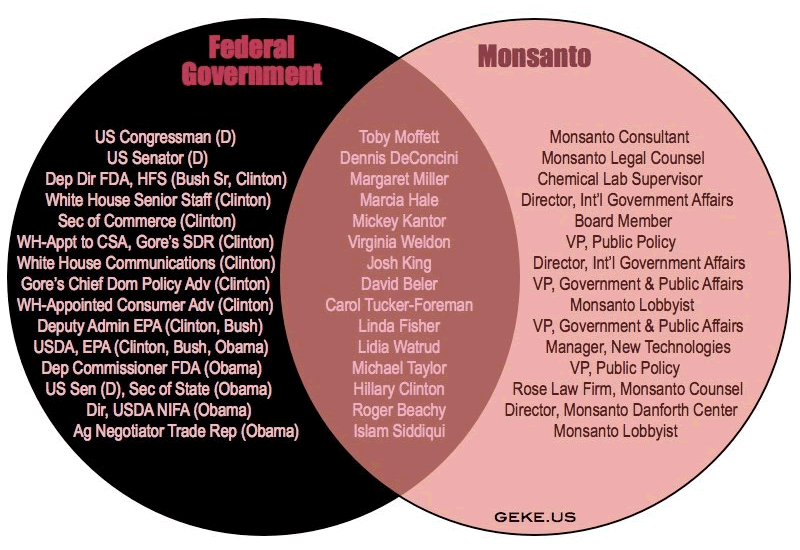
The global March Against Monsanto took place in more than 50 countries last Saturday, with more than 430 simultaneous protests chanting down the walls of the 1%. The numbers are staggering: an estimated two million protestors turned out world-wide. Las Vegas saw over 2,500 protestors coursing through its arid streets. Five hundred marched in Anchorage, Alaska; thousands thronged the state capitol of California; rallies broke out throughout the US, raising the voice of dissent: “No more lies! No more greed! We don’t want your toxic seed!” From Vancouver to Buenos Aires; Durban to Stockholm; exuberant protestors danced and shouted for the downfall of Monsanto’s global empire.

The current round of protests in the US are linked to the recent “Monsanto Protection Act,” which makes it legal for Monsanto to sell potentially unsafe seeds in spite of judicial injunctions. But internationally, Monsanto is generating attention for increasing its stake in global agro-development. Monsanto has inserted itself into the new Scramble for Africa like a knife in the back of the starving poor. Its seeds have become the continent’s new blood diamonds.

The Knife in the Back

The latest Scramble for Africa began in the wake of the global food crisis of 2007, as international investors began to sink their capital into increasing amounts of agricultural land. The ensuing land grab would lead to enhanced dispossession, mass insurrection (including a revolution in Madagascar), and another food crisis in 2010. Since then, revolt against food prices has characterized a new trend in African life.

Arab Spring broke out in 2011 largely due to rising food prices. In two of the major global events of recent times, starvation in the Sahel brought the conflict between the Tuareg and the Malian government to a violent head, while in Kenya a protest movement surrounding inflation and food prices grew to become what is known as the Unga revolution.

At last year’s G8 Summit in Camp David, the next step in the contemporary Scramble for Africa was taken. The G8 inaugurated a new system of structural change in the global economy towards “a new Green Revolution in Africa.” For the newly minted New Alliance for Food Security and Nutrition in Africa, the G8 pulled together the usual suspects: the World Bank, USAID, and other international financial institutions, along with Monsanto, Cargill, and a host of elite multinational corporations. The New Alliance involves six countries–Ghana, Burkina Faso, Côte d’Ivoire, Tanzania, Ethiopia, and Mozambique–with plans to incorporate 20 African countries in coming years. Each of the six present member states have recent histories of hunger and food riots, with Ghana and Ethiopia counting among the top five countries hardest hit by land grabs. Yet the model generated by the New Alliance presents a turn in global trade policy that threatens to deepen the crisis rather than better conditions for local farmers.

A Green Revolution for Africa

As an “additive” to the L’Aquila commitments of 2009, which were in turn built on the 2005 G8 meeting in Gleneagles, the New Alliance marks a huge step towards public-private partnerships. Entities such as the Bill Gates-driven Alliance for a Green Revolution in Africa, as well as the inter-African Comprehensive Africa Agriculture Development Programme (CAADP), work with local governments to increase funding to agriculture, while inviting multinational investment and involvement. For instance, the CAADP met in March to address the objective, initially stated in 2003, of “[requiring] African countries to commit at least 10 percent of their national budgets to agricultural development.” But development is not reduced to an increase in farms.

The CAADP runs a biosceinces network, funded by the Bill and Melinda Gates Foundation with central infrastructure in Burkina Faso, to research crops and livestock. To promote mass cultivation of food, CAADP leads a Fertilizer Support Programme that will facilitate a “substantial increase in the use of fertilizer in Africa by 2015.” The CAADP also encourages new fisheries to combat food insecurity, a structural adjustment that brought many serious problems in India.

Apropos Monsanto, the intention of the New Alliance is stated clearly in a recent document released by the G8 on the New Alliance’s objectives in Tanzania: the New Alliance focuses on “implementing domestic seed policies that encourage increased private sector involvement in this area.” With Monsanto standing in for the private sector, there is every indication that these domestic seed policies will favor GMO crops, as well as the creation of new GMO hybrids. In India, such policies led to the notorious patenting of Basmati rice and the devastation of traditional seed-saving practices.

Neoliberalism with Southern Characteristics

According to one document released recently from the G8 called The “New Alliance for Food Security and Nutrition” in Tanzania, “Tanzania is a showcase for public-private partnership in agricultural growth.” Indications, such as the farmers riot that exploded as recent as April 25 of this year over the fluctuation of commodity prices, suggest that this model is already faltering. Since L’Aquila in 2009, the investment strategies that form the framework of the New Alliance have been implemented to no avail. In many cases, conditions of food security have deteriorated even more.

Calling for “increased stability,” the Tanzania document demands “alternatives to [the] export ban [of food]… in order to strengthen response to food emergencies while minimizing disruptions in the market.” Private-public partnerships will enable multinational investors to produce food solely for export. This privileging of the private sector stands in stark contrast to the strengthening of local governance systems vis-à-vis the “growth with equity” model developed by former President Julius Nyerere, which is largely credited with bringing Tanzania a relatively tranquil status quo. The “openness” to global trade poses Neoliberalism with Southern Characteristics against Nyerere’s legacy, as public money goes to private interests while state control over exports is reduced significantly.

To gain “improved incentives for the private sector,” the New Alliance calls not only for reduced taxes to the corporate sector, but also for “secure certificate of land rights (granted or customary) for small holders.”

Insisting on “secure certificate of land rights” is the diplomatic way of saying, “papers, please.” In the language of political action, it means that informal landholders will be evicted in favor of large agricultural complexes.

37 percent of Ghana’s farmland has been grabbed by major multinational investors in the past five years, 25 percent in Sierra Leone, and the numbers continue like this throughout much of Africa. In Ethiopia, massive “green” development projects, such as the Gibe III hydroelectric dam funded by hundreds of millions of UK pounds sterling, have brought about the dispossession of hundreds of thousands of people through intimidation, beatings, rape, and torture. The transformation of the geography of Ethiopia, beginning with the flooding of the historic Omo river valley, is the ballast of the New Alliance’s drive towards the conversion of traditional farmlands into monocrop plantations. Another such project is the massive Grand Inga dam in the Democratic Republic of Congo, which is projected to be the largest dam in the world and expected to flood domestic farmland in the Congo’s Bundy Valley causing massive methane emissions and even impacting the mid Atlantic Plume.

You Can’t Eat an Export

The New Alliance includes precisely the ingredients leading to the monumental failures of the Green Revolution in India, with two major exceptions: cash crops and debt. The disaster of the Green Revolution in India, where every half hour a farmer commits suicide because of onerous debt, was based largely on a shift towards cash crops, which the New Alliance does not entail; however, cash crops remain a critical aspect of the African Green Revolution, amounting to even more acreage than food. Thus, what the New Alliance portends is increased dependency on food exports in a time of draught while multinational corporations use land that could be dedicated to domestic food production for the export of cash crops. Pinning Africa’s food security hopes on food exports in such conditions may lead to a fate worse than debt.

Less frequently observed is the North Atlantic countries’ plan to forward the aims of private corporations through public partnerships with groups like the CAADP involving less debt than in previous Green Revolution arrangements.

Instead, investment comes by way of “donations.” Dependency comes not from debt, but from monopoly control over the food supply, as multinationals seize control over natural resources and trade infrastructure (Tanzania has been the site, even in the past week, of a resistance movement against a natural gas pipeline).

Agro-development for export does not mean economic growth, and it certainly does not mean food security. In 2010, food comprised already more than 75 percent of Ethiopia’s merchandise exports, yet the food crisis has worsened with the driest season since 1950 gripping East Africa occurring in 2011. For Ghana, the figure was closer to 60 percent, but there is strong public debate about the potential of crisis due to the draught in the Sahel that covers neighboring Burkina Faso, as well as Mali, Niger, Nigeria, Senegal, and Mauritania, where the current crisis is three times worse than the 2010 crisis. Food exports may bring some short cash, but they do not cope with problems of climate change, which make the practice of monocrop farming tenuous at best.

Recent reports show that 25 percent of US Americans cannot afford to feed themselves on their own income, although the US wastes enough food to feed 150 million people–the approximate size of the starving children of Africa.

Instead of conceiving a model of food production that would serve its own people better, the US appears to believe that a burgeoning export-oriented monocrop industry bringing cheap food from Africa primarily to US and European markets will actually bring food security or economic development back to Africa. In reality, increased food exports from Africa will not increase food security. It will lead to the enriching of wealthy elites who are struggling to hold onto their land grabs at the cost of dispossession and further ecological devastation of Africa.

Empire and Triangle Cooperation

The North’s direct investment into development areas like “food security” appears to be a gesture toward a new economic balance: while the Global South works through neoliberalism with Southern characteristics, it appears that the North Atlantic paves the way towards a Southern-style developmentalism with Northern Characteristics. Rather than placing an onus on debt and austerity in the South, the North is involving its own national economies in austerity programs while directly investing in Africa’s public-private partnerships, which clearly transgress the line of “free markets.” Many within African countries involved in the New Alliance reject the implications of “triangular cooperation,” and the navigation between South-South Cooperation, South-North.

Cooperation, and Northern neoliberalism

In Mozambique, which was hit by food riots in 2008 and 2010, the globally admired organization, Academic Action for the Development of Rural Communities, put forward a damning case against the new agro-development model: “The New Alliance will enable the most abusive and aggressive exploitation of Mozambique by mercantilist corporations, concealed under the philanthropic premise that it will liberate Africa from famine and misery, ignoring the failure of several similar initiatives carried out by the same multilateral agencies and imperialist powers in the past.” According to AADRC, the New Alliance will allow investors to grab land in undeveloped, resource-rich areas while blocking agricultural policies that serve peasants by privatizing increasing areas of land.

The dangers of the new Green Revolution should be obvious from the examples set over the past three decades. Yet “triangular cooperation” disguises the new Great Game. The Nutrition for Growth conference to take place in London about a week in advance of the G8 conference in Lough Erne pledges to protect young children from growth stunting caused by malnutrition. There is no mention of Monsanto in its pages, although the motives of Monsanto remain transparently in lock-step with those of the G8. The world marched last Saturday to crush Monsanto underfoot, and will continue to mobilize against the G8 in hopes that a better future is possible.

Sasha Ross lives in Portland, Oregon where he directs the Cascadia Field Office of the Earth First! Journal, and works at local bio-diversity group, Bark. He is currently editing an anthology about the Global Land Grab and his recent work can be found in Life During Wartime (AK Press 2013). This article is also being published at the Earth First! Newswire (newswire.earthfirstjournal.org).

This article originally appeared on: Counterpunch

Peals of Spring Thunder

0

They have been considered one of India’s most pressing threats, and the recent attack by the Naxalites that ambushed a convoy of the Congress Party went that much further. The ambush took place over the weekend in Sukma on the Maharashtra, Andra Pradesh and Chhattisgarh border. Reports suggest that there were as many as 200 Maoist rebels who inflicted heavy losses — 28 killed and 24 others wounded — before fleeing.

The attacks have shaken the establishment. Among the dead were four state party leaders including Mahendra Karma of Chhattisgarh, and five police officers. For BJP spokesperson Prakash Javadekar, “This new aggressive strategy of the Naxalities is a real threat to the Constitution and the rule of law. It is a challenge to sovereignty” (Times of India, May 26). Former police chief of Punjab state KPS Gill is pessimistic about the new surge — the government of the day did not “have the political will and bureaucratic and police set-up to prevent such attacks” (Dhaka Tribune, May 26).

How the Naxalites have been treated has varied. In 1967, when the movement first made its presence felt in the West Bengal village of Naxalbari, the Home Minister Y. B. Chavan treated the matter as a case of “lawlessness” in action. The mistake was classic but fatal. During the 1970s, the state authorities moved in on the movement hoping to crush it with repressive enthusiasm. As usual with such measures, the quotient of extra-judicial killings and corrupt practices accompanied the operations. Legislation was passed to enable various state authorities to take measures — the attempt, for example, by the N.T. Rama Rao government to free up arms licensing in Andra Pradesh in 1983 for individuals to protect themselves against the Naxals.

However brutal any reaction against the Naxal movement has been, the authorities have been incapable of getting away from the socio-economic problems its followers capitalise on. The West Bengal State Secretariat, when conducting an enquiry into the uprising, found that, “Behind the peasant unrest in Naxalbari lies a deep social malady — malafide transfers, evictions and other anti-people actions of tea gardeners and jotedars.” They gain political traction in areas of horrendous poverty — regions such as Warangal, Adilabad and Karimnagar.

The agrarian revolution of the Indian state may well have been pushed with enthusiasm, but economic disparities were not going away in the development drive. Tribal populations were being displaced. Corporate and government malfeasance was rampant. The Naxalites, for all their brutal measures, can count among their constituency tenant farmers and the dirt poor tribes peoples they claim to represent.

Today, they remain one of the last formidable Maoist movements, having a formidable presence in 20 of India’s 28 states. The Indian Home Ministry claims there are thousands of fighters whose leaders refuse to negotiate with the government till paramilitary soldiers are withdrawn. State authorities have been in the habit of arming local vigilantes. The country also persists in employing that great imperial shackle — the sedition law. Civil rights tend to be shredded.

Governments have pondered what model of “integration” to best employ, but these have not been successful. Corporate misappropriation and exploitation — be it from mining and energy firms — remains a stark problem in states such as Chhattisgarh. In 2010, a defense analyst Raman Dixit would write in the Journal of Defence Studies that “social integration” would be the best move against the problem. Exploitation of the poor and scheduled casts would have to be rectified. The right over forest produce would have to be assured.

The rhetoric of the bullet is, however, a powerful one. Old formulas are hard to abandon. Painful realities are easy to ignore. Prakash has urged for a “unified strategy” in dealing with Naxalism, one that blithely ignores the social context of the rebellion. “It is not a development issue. It is about the Maoist belief to change power through violence” (Times of India, May 26).

But the power of the bullet will be futile in the face of a movement that will remain powerful as long as the social conditions exist to sustain it. Naxalism’s success is a direct attribution to the failings of governance. Far from being a cancer, a mutation that says little of the Indian political tapestry, it says everything about it — development that is uneven, inequities that persist with painful relevance.

The best work of revolutionaries is, of course, done by the establishment of the day. It is they, more so than the Naxalites, who will change. Till that happens, the Maoist group shall remain what China’s People’s Daily (Jul 5, 1967) once described as: “a peal of spring thunder”.

Binoy Kampmark was a Commonwealth Scholar at Selwyn College, Cambridge. He currently lectures in politics and law at RMIT University, Melbourne. Email: bkampmark@gmail.com

This article originally appeared on: Counterpunch

US man kills grandparents, rapes infant

0

Jerry Andrew Active has been charged in US State of Alaska with murder of great-grandparents and rape of the great-grandmother and infant great-granddaughter.

A US man that beat to death an elderly couple and sexually assaulted their 2-year-old great-granddaughter in the Anchorage capital of State of Alaska has come under arrest by local police.

Anchorage law enforcement authorities announced Sunday that they detained the 24-year-old suspect that fled the scene Saturday night after raping the 73-year-old great-grandmother, then beating her and her 71-year-old husband to death and sexually assaulting the toddler that they were babysitting.

The parents of the toddler discovered the dead bodies of their grandparents when they returned home from a movie theatre with their 4-year-old son and then found the suspect naked in a bedroom with their infant daughter.

The shocked couple reportedly tried to detain the intruder but he managed to escape the scene.

Authorities said they arrested the suspect, identified as Jerry Andrew Active, Saturday night and jailed him without bail at Anchorage jail on charges of first and second-degree murder, sexual assault and burglary in the deaths of Sorn Sreap and his wife, Touch Chea.

According to police, both Sreap and Chea had suffered Å“significant blunt force object injuries” and that Chea had been raped.

Meanwhile, police department spokeswoman Anita Shell emphasized that law-enforcement investigators on the crime scene were greatly affected by the brutality of the crime and the ages of the victims.

“They said this was the worst thing they had ever seen in their lives, and these are seasoned detectives,” Shell said.

Police further elaborated that the toddler was found with Å“sexual assault injuries” and was taken to an Anchorage hospital and underwent surgery.

MFB/MFB

This article originally appeared on: Press TV

Iran film to compete in Poland Filmfest

0

[unable to retrieve full-text content]Iranian filmmaker Arash Lahouti’s documentary Trucker and the Fox has been selected to vie at the Krakow Film Festival (KFF) in Poland.

This article originally appeared on: Press TV

EU talks Syria, army gains more ground

0

The Syrian army has conducted successful operations against the militant groups over the past several days. (File photo)

The foreign ministers of the European Union discuss providing arms to militants in Syria as the Syrian army continues with its successful operations in the strategic town of Qusayr.

The EU foreign ministers have convened in Brussels to decide whether to supply weaponry to the foreign-backed militants fighting against the government of Syrian President Bashar al-Assad.

They will examine calls by France and the UK to ease an EU arms embargo on Syria.

Several EU member states including Sweden, Austria and Finland have expressed strong opposition to the measure, but a number of others remain hesitant.

Meanwhile, the Syrian army has tightened its hold on Qusayr, located about 164 kilometers (100 miles) north of the capital, Damascus.

A source close to the Lebanese resistance movement Hezbollah has said that the Syrian soldiers – backed by a group of Hezbollah forces – now control 80 percent of the town, a former militant stronghold in the central province of Homs.

On May 25, Hezbollah Secretary-General Seyyed Hassan Nasrallah defended the resistance movementâ„¢s decision to fight the militants in Qusayr near the Lebanese border.

The source, speaking on condition of anonymity, has also said the main road between the town of Baalbek in southern Lebanon and the Syrian city of Homs has been secured.

On Sunday, Syrian forces managed to retake control of a media center and Ahli Hospital, which was being used by the militants as a field hospital.

The army also cleared al-Hamidiyeh town, in al-Qusayr countryside.

Syrian troops have retaken control of Qusayrâ„¢s military airport as well as several key districts and buildings, including the headquarters of the Baâ„¢ath Party.

The Syrian army entered Qusayr from several directions on May 19 after weeks of clashes with militants.

Syria has been gripped by unrest for over two years, and many people, including large numbers of Syrian soldiers and security personnel, have been killed in the foreign-sponsored militancy.

President Assad said on May 18 that militants from 29 different countries were fighting against the government in different parts of the country.

MP/HSN

This article originally appeared on: Press TV

Chill on the Peninsula: Seoul shuns N. Korea's efforts to soothe tensions

0

North Korea’s apparent attempts to reduce tensions with its southern neighbor found no welcome in Seoul, which has slammed the North’s proposed negotiations and a “two-faced” invitation to commemorate a key 2000 peace conference.

A landmark diplomatic summit
in June 2000 inched the Korean Peninsula towards reconciliation
after the then-leaders of the two Koreas — Seoul’s Kim Dae-jung and
Pyongyang’s Kim Jong-il — signed a five-point plan to promote
reintegration through economic and cultural ties. The summit gave
birth to a tourist visit program for Mount Kumgang and the jointly
operated Kaesong industrial zone.

The Northern office that promotes the implementation of the June
2000 plan faxed its Southern counterpart an invitation last
Wednesday to celebrate the anniversary on Mount Kumgang, or in
Kaesong. On Monday, South Korea’s Unification Ministry criticized
the invitation, calling it a “two-faced” attempt to split public
opinion in the country.

“If the North genuinely wants dialogue, the first step should
be responding to our repeated call for working-level governmental
talks on the Kaesong industrial complex,”
ministry spokesperson
Kim Hyung-seok said.

Seoul indicated earlier that it would likely decline the North’s
proposal: “It’s not an easy decision,” a government official
told Yonhap News Agency. “A lot of South Koreans may have to
travel to the North, and it may entail many issues, including a
safety guarantee.”

Tourist travel to the Mount Kumgang border region was suspended
in 2008, after a South Korean tourist was shot and killed upon
entering a military area. The Kaesong industrial zone was closed in
April of this year — the latest project from the rapprochement era
to be buried by tensions since conservatives took power in Seoul in
2008.

This file photo taken on June 14, 2000 shows South Korean President Kim Dae-Jung (L) shaking hands with North Korean leader Kim Jong-Il (R) in Pyongyang during their historic summit between the two rival nations (AFP Photo)

Kim also reiterated Seoul’s skepticism over Pyongyang’s recent
proposal to renew six-party talks on the nuclear status of the
Korean Peninsula: “Actions are more important than
words.”

Pyongyang’s proposal to restart the six-party talks, which have
been stalled since 2009, was delivered by envoy Choe Ryong-hae
during a visit to China. The talks — involving the two Koreas, the
US, China, Russia and Japan — are aimed at brokering a peaceful
resolution to the debate over Pyongyang’s nuclear program.

China, Russia and Japan hailed the move, saying that it
indicates North Korea’s readiness to reduce the heightened tensions
in the region. But Seoul said it was skeptical because only China,
not North Korea itself, had used the word “denuclearization” in
describing the talks.

South Korea and the US have maintained that the North must show
commitment to scrapping its nuclear program as a precondition to
any formal multilateral talks. Pyongyang has said on a number of
occasions recently that it will not dismantle its nuclear arsenal,
in order to protect its national sovereignty from the US and its
allies in the region.

This article originally appeared on: RT

Bomb blast rocks market in Bangkok

0

Thai security forces are seen at the site of a bomb attack in Bangkok on May 27, 2013.

A bomb explosion has rocked a busy suburban shopping area in the Thai capital, Bangkok, injuring seven people.

Bangkok police colonel Narongrit Promsawan said on Monday that a home-made bomb hidden near trash containers went off at about 9:00 p.m. local time (1400 GMT) on Sunday in Ramkhamhaeng District.

Promsawan added that police had launched an investigation into the incident to see what caused the explosion and who were involved.

Å“A preliminary investigation of the scene found many nails were part of the device,” Promsawan stated, adding that the victims had not sustained life-threatening injuries.

No group has claimed responsibility for the bombing.

Meanwhile, deputy government spokeswoman Sunisa Lertpakawat said, Å“It is now under investigation, which may take time, but not too long because security for Thais and foreigners is a very important matter for this government.”

DB/HSN

This article originally appeared on: Press TV

How to Build a New Labor Movement, One Step at a Time

0

May 22, 2013
 |

Like this article?

Join our email list:

Stay up to date with the latest headlines via email.

The following article first appeared in the American Prospect. 

Earlier this month, labor-rights group Working America launched FixMyJob.com. The text of the site reads a bit like an infomercial: “Tough day at work? Are you feeling overworked, underpaid, unsafe or disrespected by your boss?” But instead of selling a new set of knives, the writers are hawking organizing skills. “Our tool can help you identify problems in your workplace and give you info about what others have done in similar situations.” The famous raised fist of labor is sideways, holding a wrench. The website is yet another attempt by the country’s once-powerful union movement to connect to workers in an increasingly hostile national workplace.

“We also are trying to find new ways for workers to have representation on the job,” writes Working America spokesperson Aruna Jain in an email. “We want to train and educate people on how to self-organize, and to learn collective action–the single most effective way of improving their working conditions. This is one way we can start that process.”

The site, which is being rolled out slowly and in stages, is meant to give workers the resources they need to organize themselves and demand changes–regardless of whether or not an actual union comes together. It tells visitors how to contact the Occupational Safety and Health Administration (OSHA) for safety issues in the work place. It gives tips and strategies for how best to present a case to the boss or how to convince coworkers to get involved.

“We’re trying something new here–an experiment,” writes Jain. “It’s never been done before. We don’t know what will work and what won’t, but we are trying to provide information, resources to create a fertile environment where organizing can happen.” The website doesn’t charge dues and while the term “organizing” is used extensively, “collective bargaining”–a staple of the labor movement–is nowhere to be found.

Dues-paying members sustained the labor movement for decades, and in return, the unions helped negotiate better pay and better hours. But that relationship has been deteriorating rapidly.  For the last several decades, unions and the tools they offered seem far removed from the vast majority of workplace experiences. Around one-fourth of American workers are “contingent workers”–freelancers, independent contractors, part-timers, and temp workers–people with more tenuous relationships to their employers. Meanwhile conservatives have found ways to exploit weaknesses in the National Labor Relations Act, meaning the main legislative defense for unions is increasingly toothless. Labor conditions have gotten dramatically worse as unions have lost power–real wages have stagnated, wealth is increasingly concentrated–but no one seems to know how to connect the old-style of collective bargaining with the new economy. Some held out hope that the Obama administration–coupled with the worst economic crisis in decades–would help resuscitate things.

So when the Employee Free Choice Act failed in 2010, it seemed like a death knell for the American labor movement. The bill, which would have made it easier for workers to collectively bargain and increased the penalties on employers that fired people for trying to organize, was the number one piece in the labor agenda. Unions had poured resources into the 2008 elections, putting in hundreds of millions of dollars and mobilizing thousands of volunteers, and their efforts helped elect a Democratic president, and Democratic majorities in the Senate and House. But despite the concerted effort from labor leaders to push through this key piece of legislation, they simply didn’t have the power. It never got through the Senate.

Faced with the very real threat of extinction, unions have largely put collective bargaining on the back burner, and instead must try to remind American workers of the basic concept of worker solidarity. “We start from the point of view that, because so few people are in unions these days, very few people have personal experience with collective power,” explains Karen Nussbaum, the executive director of Working America. The group is the AFL-CIO’s answer to the “labor problem.” Rather than organizing workers into unions, Working America, an AFL-CIO affiliate, focuses on engaging non-union workers on a number of policy issues, from unemployment insurance and banking reform to education funding and campaign finance. The group uses the same door-to-door, grassroots strategies that have long been the hallmarks of labor organizers. But rather than emphasize relations between workers and their employers, the group focuses largely on policy changes. Members don’t have to pay dues, instead, at meetings and on sites like FixMyJob, they just have to sign up.

This article originally appeared on: AlterNet

5 Controversial Cases Where Supreme Court Is Poised to Roll Back Civil Rights

0

May 22, 2013
 |

Like this article?

Join our email list:

Stay up to date with the latest headlines via email.

There’s a reason the U.S. Senate has stonewalled many of President Obama’s federal court nominees. Republicans know that stacking the courts is the most powerful way to allow or impede progress on the most controversial issues–especially when Congress is tied up in dysfunctional knots. 

That brings us to the current U.S. Supreme Court term, which is poised to start issuing decisions on a handful of big cases that are near and dear to progressives’ hearts: affirmative action in college admissions, same-sex marriage, minority voting rights, patenting human genes, and police power to take a suspect’s DNA, to name a few.

Let’s go through a half-dozen cases where the high court majority, justices appointed by Republican presidents, is likely to stop or slow down the social evolution that began in the 1950s civil rights movement and also grant corporate America and the police more power over the genes in our bodies.

1. Rolling back affirmative action. The first big civil rights case concerns affirmative action in higher education. The case, coming six decades after an entirely different Court ordered the integration of public schools in Brown v. Board of Education, revolves around a young white woman who did not get into the University of Texas at Austin. A decade ago, the Court held that there was a compelling interest in considering race in university admissions, but today’s Court is perceived by civil rights groups as being openly hostile to affirmative action in academia. Justices Antonin Scalia and Clarence Thomas have been called out by scholars for their hypocrisy on affirmative action; however, that’s not likely to stop them from rolling back civil rights. 

2. Upholding some gay rights but not others. There are two big same-sex marrage cases on the docket, and it appears that the Court will uphold some rights for same-sex couples, but also slow down the legal clock for marriage equality. The first case concerns the federal Defense of Marriage Act, where a majority of justices seem ready to strike down a section of the federal law that denies government benefits to same sex couples–because it does not treat people equally under the law. However, the Court also heard a case involving a California ballot measure that banned gay marriage but was overturned by a lower court. There, the justices seemed inclined to make as narrow a ruling as possible, meaning there would be no federal right to marriage equality. Same-sex marriage would then be subjected to state-by-state fights for years, until another case came before the Court. That’s a big right-wing victory.

3. Undermining minority voting rights. Waving the states’ rights flag is an old ploy for reactionaries who want to restrict voting rights. The way it’s playing out today is in Republican claims that the federal govermment no longer needs to act to prevent race-based discrimination in voting. Republicans in Texas, which has one of the worst recent records on voting rights, have sued to overturn the sections of the 1965 Voting Rights Act that give the Justice Department power to block changes in state election practices. During the Court’s hearing, Scalia was visibly hostile to the VRA, calling it a “ race-based entitlement.” The GOP’s numerous nasty race-based tactics in the 2012 election were ignored, suggesting that the Court will gut one of America’s most important civil rights laws.

4. Human genes will become private property. The case before the Court concerns a biotech company, Myriad Genetics, that has two patents on the human genetic code that determines if a woman is likely to develop breast cancer or ovarian cancer. The firm is the only one that tests women for these two diseases, because of the patents, and also controls related research on these genes. That stops women from getting second medical opinions and scientists from developing less expensive tests. The justices had reservations about Myriad’s monopoly, but also seemed inclined to find a compromise preserving biotech patents. (There are now 40,000 patents on human genetic material.) Earlier this year, the Court validated Monsanto’s patent rights to modify genes in seeds. It’s likely its pro-corporate majority will find a way to keep privatizing advances that hold the key to the health of tens of millions of people.

This article originally appeared on: AlterNet

IRS, DOJ, SEC: Three-Letter Abbreviations For ‘Federal Bully’

0

Photo Credit: Shutterstock.com/Carlos Yudica

May 23, 2013
 |

Like this article?

Join our email list:

Stay up to date with the latest headlines via email.

Government entities that use three-letter abbreviations, like the Internal Revenue Service (IRS), Department of Justice (DOJ) and Securities and Exchange Commission (SEC) increasingly embody all the truant characteristics of playground bullies.

First, there’s the DOJ probing journalists for national “security” reasons while ceasing investigations into various banks and CEOs for their role in effectively embezzling trillions of dollars from the rest of the world. To them, banks are too big to bully.

Then we have the latest (publicly revealed, anyway) IRS maneuver of battening down on non-profit groups that utilize the wrong words in their name (given the relatively small size of these groups, this is a glaring perspective problem, whether they represent the Tea Party or the communist party) instead of the hundreds of billions of dollars stashed in the offshore tax havens that President Obama campaigned he’d do something about.

And now, the SEC has fallen further into bully territory. Enter Kathleen Furey, a 10-year veteran SEC staff attorney. Furey officially blew an internal whistle on the director of the SEC’s New York office after he refused to bring cases against investment management companies under the Investment Advisers Act of 1940 and Investment Company Act of 1940, 15 months before we were media-slammed by the poster-boy of the Ponzi school of investment management, Bernard Madoff.

Furey’s official complaint reminds us exactly why her case is in the public interest. A section in Title 17 of the US Code of Federal Regulations states, “Members of the Securities and Exchange Commission are entrusted” with “powers and duties of great social and economic significance to the American people” and is tasked by Congress with ensuring that the “private enterprise system serves the welfare of all citizens.” If only.

Furey’s Fight for the Financial Safety of Americans

Furey’s saga began when she took this notion of entrustment seriously. And vocally. Between January 2002 to December 2008, Furey alerted her boss, an assistant director at the NY Regional Office (NYRO) of the SEC about  the possibility of shady dealings going on at some investment management companies. Her boss responded “We do not follow IM (investment management) cases.”

Not satisfied with that brush-off, in late 2007, Furey stepped up the ladder and informed her superiors about his stance. Rather than do anything about the substance of her concerns, Furey’s superiors told her to take the matter up to the Inspector General. When she did just that, she suffered the kind of reprisals designed to shut her up, like the ways a bully might gut-punch a small kid at recess time implicitly (or explicitly) threatening worse if the kid tells on him.

Furey was no slacker. She had received three years of straight promotions, raises and other monetary awards between September 2004 and 2006 for her exemplary work — before she blew the whistle. Right afterward, all that stopped.

And yet, her workload increased, reflective of a higher-grade level within the SEC grid, just not with the pay or title that work entailed. Her career trajectory halted in the tracks of the SEC’s desire to cover its own ass even as the Bernie Madoff case publicly erupted, as per her earlier warnings. When Furey asked why she was getting less than someone below her share of duties, given that her fears had proven prescient and accurate, her high performance scores from June to September 2010 were altered as later exhibits revealed — after she had signed them. Some of her higher marks were actually whited-out and replaced with lower ones.

So on January 30, 2012, Furey filed an official complaint with the US Office of Special Counsel (OSC). As with other federal employee whistleblower cases, the OSC doesn’t decide the case, but decides whether to bring it before the Merit System Protection Board. Furey also made requests to the SEC under FOIA and the Privacy Act to obtain her personnel records, supervisors’ communications about her, and other supportive information for her claims. Mostly, the SEC refused to produce those records.

This article originally appeared on: AlterNet

Paranoia About Fats Is Driven by Junk Science

0

Photo Credit: Kritchanut/ Shutterstock.com

May 23, 2013
 |

Like this article?

Join our email list:

Stay up to date with the latest headlines via email.

You’ve heard about omega-3s. You probably know you need to eat them. You’ve likely heard that they’re found in fish. But odds are, there’s a lot more you need to know about this family of healthy fats.

Over the last century, Americans have become increasingly confused about fats. Travel back to the Little House on the Prairie, and you’d find Americans happily adding lard, cream and butter to their food. In the 20th century, these saturated animal fats went out of vogue, and “healthier” products like margarine graced American tables instead. Today, no healthy eater would touch the trans-fats in margarine — although they might opt for a trans-fat-free margarine made with palm oil instead.

What’s the right answer? And where do omega-3s fit in? As you’ll see, while we need omega-3 rich foods in our diet, the bottom line is that we must eat less of another kind of fat, omega-6s, to get the benefit of the omega-3s.

We Don’t Need Fat…Do We?

To understand Americans’ troubled relationship with fat, one must begin when scientists first identified that food was made from protein, carbohydrates and fat. Our bodies can turn carbs into fat, they figured, so we don’t actually need fat to survive. Wrong! But it wasn’t easy to prove this, at least until modern medicine perfected intravenous feeding (total parenteral nutrition, in hospital-speak).

After scientist Ralph Holman’s mother fell ill and ultimately died after a long period receiving fat-free intravenous nutrition, Holman researched the role of fat in human nutrition. He was convinced that certain fats — essential fatty acids — are needed for humans to survive. But he had not been able to prove it.

“Holman watched helplessly as [his mother] died of the very deficiency that he was working to prevent,” wrote Susan Allport in The Queen of Fats: Why Omega-3s Were Removed From the Western Diet and What We Can Do To Replace Them. Holman lost his mother, but with her death, he proved humans must eat certain fats to survive.

Bad Science Gets Popularized

Careful scientists often assume that there is still plenty we do not know, refraining from making public recommendations until all of the facts are in. (For an example of this, see the recent Michael Pollan article about microbes’ role in human health; he emphasizes that the science is so new there aren’t many concrete recommendations yet.) But every now and again, a charismatic and arrogant scientist will popularize a current working theory, right or wrong.

Such was the case with Ancel Keys, nicknamed “Monsieur Cholesterol” for popularizing the term and pontificating against it. President Eisenhower had a heart attack in 1955, and suddenly the entire nation was interested in cardiovascular health. Keys had the answer: don’t eat fat. He later amended this to an also overly simplified mantra of “saturated fat, bad; unsaturated fat, good.”

An obedient nation swapped out butter and lard for unsaturated vegetable oils, especially soybean oil. (Soybean oil is often labeled “vegetable oil” at the store.) But unsaturated vegetable oils are not all equal. They might be monounsaturated or polyunsaturated. Within the polyunsaturated fats, there are omega-6s and omega-3s. And even within those categories, there are different fats with different properties. (You may have heard of the highly sought-after omega-3s EPA and DHA.)

Fat Chemistry 101

Fats are easier to understand once you have a very basic idea of their chemical structure. To grossly oversimplify, fats are basically long chains of carbons connected mostly by single bonds. Scientists classify fats by the number of carbons in the chain, the number of double bonds between the carbons, and the placement of these double bonds.

This article originally appeared on: AlterNet

Inside Mind-Tripping, Soul-Changing, Ground-Shifting, 21st Century Psychedelic Therapy

0

Photo Credit: Shutterstock.com/agsandrew

May 23, 2013
 |

Like this article?

Join our email list:

Stay up to date with the latest headlines via email.

This article first appeared in Spirituality & Health magazine under the title “The Second Coming of Psychedelics.” You can enjoy future articles in Spirituality & Health by signing up for a subscription or our newsletter.

Ric Godfrey had the shakes. At night, his body temperature would drop and he’d start to tremble. During the day, he was jumpy. He was always looking around, always on edge. His vibe scared the people around him. He couldn’t hang on to a job.

He started drinking and drugging, anything to numb out.

Years passed before a Department of Veterans Affairs counselor told him he had severe posttraumatic stress disorder, or PTSD. The former Marine had spent the early 1990s interrogating prisoners in Kuwait. Years later, he was still playing out the Persian Gulf War.

Counseling helped a little, but the symptoms continued. He went to rehab for his substance abuse, then tried Alcoholics Anonymous. “That went on for 10 years,” he said. “I don’t know how many times I hit rock bottom.”

Then one of his Seattle neighbors–a woman who also suffered from PTSD–told him about a group of veterans who were going down to Peru to try a psychedelic drug called ayahuasca, a jungle vine that is brewed into a tea. Indigenous Peruvians called it “sacred medicine.” A wealthy veteran had started a healing center in South America and would pay all his expenses.

The next thing Ric knew, he was crawling into a tent on a platform out in the middle of the Amazon jungle. The sun went down. The shaman gave him the tea, a blessing, and a pail in which to vomit.

“Your body will not keep it in you,” Ric recalled. “At first, it’s the worst thing you’ve ever done in your life. Then all of a sudden you blink your eyes and you are not there anymore. You get out of your body and look back and see what is wrong with you. I saw the shell of the person I didn’t want to be and stepped out of it. It was the most amazing thing. I’ve taken lots of drugs before, but I never remembered. I think this is the key. You actually gain knowledge from this. I don’t even consider it a drug. It’s an eye-opener. It makes you think about stuff. Your deepest, darkest secrets, stuff you have been holding on to since you were eight years old–it washes out of you, and you feel like a totally different person. People look at you differently. Your whole world changes before your eyes.”

Three years later, Ric Godfrey says he hasn’t had a single symptom of the shakes or night terror since he came back from the jungle. He’s relaxed and holding down a great job.

“I’ve always been afraid that someone was out to get me, but I don’t have that fear anymore,” he says. “I still like to sit with my back to the wall. I still have certain military idiosyncrasies, but I’m not afraid anymore.”

Psychedelic drugs are back. Not that they ever really went away. You could always find them on the street, in the psychedelic underground, and along the more enlightened edges of the drug culture. What’s new is that these powerful mind-altering substances are coming out of the drug counterculture and back into the mainstream laboratories of some of the world’s leading universities and medical centers. Research projects and pilot studies at Johns Hopkins, Harvard, Purdue University, and the University of California, Los Angeles, are probing their mind-altering mysteries and healing powers. Psychedelic drugs like psilocybin and Ecstasy are still illegal for street use and cannot be legally prescribed by doctors, but university administrators, government regulatory agencies, and private donors are once again giving the stamp of approval–and the money needed–for research into beneficial uses for this “sacred medicine.”

This article originally appeared on: AlterNet

Obama Admin's Fox News Spying Scandal Is a Dangerous Step Toward Criminalizing Journalism

0

May 25, 2013
 |

Like this article?

Join our email list:

Stay up to date with the latest headlines via email.

Addressing reporters Tuesday, White House Press Secretary Jay Carney said, “If you are asking me whether the president believes that journalists should be prosecuted for doing their jobs, the answer is no.” The comment came in light of revelations that in 2010 an FBI agent had described Fox News correspondent James Rosen as a possible “co-conspirator” in a crime for the journalistic act of obtaining leaked information from a State Department source.

Even if we are to take Carney at his word, his remark comes as little assurance. The president may believe that journalists should never be prosecuted for doing their job. What’s at stake, then, is what this administration considers the job of a journalist. In the context of the ongoing war on leaks and an administration invested in the tight control of information, the presidential view on protected journalistic activity seems a far cry from a robust Fourth Estate.

Whether there was ever any intention of prosecuting Rosen, or whether the “co-conspirator” claim was simply a means to get a search warrant for the reporter’s emails, is unknown. Both scenarios are troubling. In either scenario too, we have a government agency framing acts of journalism as potential crimes worthy of investigation and intensive surveillance. It’s for this reason that civil liberties advocates and legal experts – often with no love for Fox News – are viewing the Rosen case as more serious even than the Justice Department’s AP spying scandal.

“The administration’s draconian crackdown on disclosures of information to the media was already unprecedented. Now, it has crossed over a sacred line,” Elizabeth Goitein, co-director of the Brennan Center for Justice’s Liberty and National Security Program, told Salon. Goitein, who has worked extensively on the issue of government secrecy and document classification, sees the explicit targeting of a journalist for receiving leaked information as a dangerous new turn in the government’s war on whistleblowers, with disturbing lessons about the government’s respect for First Amendment protections. She told Salon over the phone why, in her view, the Rosen case is a new brand of troubling:

The fundamental premise of national security reporting is that reporters have a First Amendment right to report information — to obtain information and report it, and they are just in a fundamentally different position from government officials who sign on to keep these secrets… There is and there should be a big difference between someone who has signed a non-disclosure agreement being penalized for leaking information and someone being penalized for receiving information or further publishing information when that person arguably isn’t under any legal obligation and in fact has a first Amendment right to receive and spread that information.

Those first amendment protections apply also to regular members of the public and private individuals. Now the justice department has special rules when it comes to subpoena’ing journalists for their sources because they understand that there’s special sensitivity in terms of the media’s right to report, but in fact it would be just as wrong for the administration to target Julian Assange or any individual who discloses information that that individual receives when that person has made no pledge and is under no obligation legally to keep that information within the government.

The targeting of journalists under the Espionage Act, whether it’s through the warrant application or an actual prosecution — I mean, that really spells the death knell for free reporting in this country, if that were to be permitted to continue. And so I think the crackdown on whistleblowers has been shameful in this administration but we’re in new territory now, and there’s an urgent, urgent need for action to stop this train before it gets out of the station.

This article originally appeared on: AlterNet

Why Democrats Can't Be Trusted to Control Wall Street

0

Photo Credit: Shutterstock

May 25, 2013
 |

Like this article?

Join our email list:

Stay up to date with the latest headlines via email.

Who needs Republicans when Wall Street has the Democrats? With the help of congressional Democrats, the Street is rolling back financial reforms enacted after its near meltdown.

According to the New York Times, a bill that’s already moved through the House Financial Services Committee, allowing more of the very kind of derivatives trading (bets on bets) that got the Street into trouble, was drafted by Citigroup — whose recommended language was copied nearly word for word in 70 lines of the 85-line bill.

Where were House Democrats? Right behind it. Rep. Sean Patrick Maloney, Democrat of New York, a major recipient of the Street’s political largesse, co-sponsored it. Most of the Democrats on the Committee, also receiving generous donations from the big banks, voted for it. Rep. Jim Himes, another proponent of the bill and a former banker at Goldman Sachs, now leads the Democrat’s fund-raising effort in the House.

Bob Rubin — co-chair of Goldman before he joined the Clinton White House, and chair of Citigroup’s management committee after he left it — is still influential in the Party, and his protégés are all over the Obama administration. I like Bob personally but I battled his Street-centric views the whole time I served, and soon after I left the administration he persuaded Clinton to support a repeal of the Glass-Steagall Act.

Jack Lew, Obama’s current Treasury Secretary, was chief operating officer of Citigroup’s Alternative Investments unit, a proprietary trading group, from 2006 to 2008, before he joined the Obama administration. Peter Orszag, Obama’s Director of the Office of Management and Budget, left the Obama Administration to become Citigroup’s vice chairman of corporate and investment banking, and chairman of the financial strategy and solutions group.

All these men are honorable. None has broken any law. But they and their ilk in congress — the Democrats who are now rolling back Dodd-Frank — don’t seem to appreciate the extent to which Wall Street has harmed, and continues to harm, America.

It’s not entirely coincidental that the Obama administration never put tough conditions on banks receiving bailout money, never prosecuted a single top Wall Street executive for the excesses that led to the near meltdown, and still refuses to support a tiny tax on financial transactions that would bring in tens of billions of dollars as well as discourage program trading.

Democrats can’t be trusted to control Wall Street. If there were ever an issue ripe for a third party, the Street would be it.

Robert Reich is professor of public policy at the Richard and Rhoda Goldman School of Public Policy at the University of California, Berkeley. He was secretary of labor in the Clinton administration.

This article originally appeared on: AlterNet

Going to Jail to Save the Wild from Oil and Gas Drilling

0

May 26, 2013
 |

Like this article?

Join our email list:

Stay up to date with the latest headlines via email.

So if we now have representative government in name only, and are governed instead by corporations and their lobbyists, what’s to be done? Tim DeChristopher wrestled with that reality and decided what he would do.

As a result, he spent almost two years in prison. He’s out now, and you can learn the whole story in the new documentary, Bidder 70.

In December 2008, as the Bush administration was coming to an end, this environmental activist, then 27 years old, went to an auction of gas and oil drilling rights on more than 150,000 acres of Utah wilderness, all of it public land. It was a sale DeChristopher believed to be illegal.

TIM DECHRISTOPHER in BIDDER 70: Instead of getting dragged out they said “Hi. Are you here for the auction?”

And I said, “Yes, I am.” And they said, “Are you here to be a bidder?” And I said, “Well, yes, I am”.

AUCTIONEER in BIDDER 70: I have two and a quarter in the back and now to two and a half…

TIM DECHRISTOPHER in BIDDER 70: I saw right away with that bid card they’d given me, I could really disrupt this process. I had all these visions of my future and all the catastrophic effects of climate change, but if I start to bid on this there’s a decent chance I could go to prison. Could I live with that? And I thought, well, yeah. It’d suck, but I could live with it.

AUCTIONEER in BIDDER 70: Three fifths and four and five…

TIM DECHRISTOPHER in BIDDER 70: And I finally took that step, and jumped all the way in and started winning parcels. I started winning all the parcels.

AUCTIONEER in BIDDER 70: And five, are you all in? Are you all done? At fifty dollars, sold fifty dollars to Bidder number 70, Bidder 70[…]

REPORTER 1 in BIDDER 70: An environmentalist threw a controversial oil and gas lease auction into turmoil today.

REPORTER 2 in BIDDER 70: Well Tim DeChristopher says he’s willing to go to jail, and it’s possible that’s where he’ll wind up.

REPORTER 3 in BIDDER 70: A college student may face federal criminal charges for disrupting that auction with bogus bids.

BILL MOYERS: The federal government indicted Tim DeChristopher on two felony counts, even though the oil and gas auction had been quickly declared null and void by the new Obama administration and its Interior Secretary Ken Salazar.

KEN SALAZAR in BIDDER 70: Because of the need to review these parcels, and because of their proximity to landscapes of national significance, I have directed the Bureau of Land Management not to accept the bids on the 77 parcels.

TIM DECHRISTOPHER in BIDDER 70: To see this land and this view, there’s no way that I could ever regret what I did. To see that the land looks like this, that it’s this beautiful, and to know it’s going to keep looking like this, it’s still going to look this way, and there’s not going to be an oil rig in the way. There’s not going to be a road cut right through the middle of it. That’s really reaffirming, and I think really justifies my actions.

BILL MOYERS: The legal process dragged on. Tim DeChristopher held out for a trial by jury, despite government attempts to make a deal.

TIM DECHRISTOPHER in BIDDER 70: I’ve been offered a couple informal plea bargains. The one formal one was for as little as thirty days in jail. My lawyers said they do really want you to serve some time to set an example that discourages other people from doing this and I said that’s exactly why I’m not going to take this deal, because I have the opposite motivation, and it’s really rubbed me the wrong way about any kind of solution that doesn’t involve a jury.

This article originally appeared on: AlterNet

'Greed Is Good': Top 7 Most Piggish Commencement Speeches

0

Photo Credit: Shutterstock.com

May 26, 2013
 |

Like this article?

Join our email list:

Stay up to date with the latest headlines via email.

It’s that time of year. The sun is shining, the flowers are in bloom and all across America, graduating students are forced to endure that dreaded rite of passage, the commencement speech. Often boring, typically clichéd and frequently self-aggrandizing, commencement speeches form their own subgenre of fatuous prose.

Get out the barf bag! Here are a few choice orations from some of America’s most illustrious jerks.

1. Ivan Boesky at Berkeley, 1986

Ivan Boesky was a big-time stock trader who hustled his way to riches betting on corporate takeovers. On May 18, 1986 at the University of California, Berkeley, he shared these lustrous pearls of wisdom with business school students:

“Greed is all right, by the way. I want you to know that. I think greed is healthy. You can be greedy and still feel good about yourself.”

Boesky clearly felt very good about himself at the time. But not for long. Several months after the address, Boesky was nabbed by the SEC when it found that his stock manipulations were often based on tips from corporate insiders which is —oopsie! — illegal. Mr. Greed soon found himself in possession of a nice prison cell.

Oliver Stone used Boesky’s speech as the inspiration for one given by the ethically challenged corporate raider Gordon Gekko in the 1987 film Wall Street. “Greed is good” became the catchphrase for Wall Street callousness and excess.

2. Jamie Dimon at Syracuse, 2010

Just two years after the Wall Street-driven crisis left many Americans itching to grab the nearest pitchfork, the JPMorgan Chase honcho was invited to speak to Syracuse students, despite a wave of protests. His speech pretty much alternates between insisting that he’s not like the rest of those banker a-holes and finding new ways to praise himself. He also makes a stab at humor:

“Graduating today means you are through with…the cold sweat of sleepless nights preparing to answer seemingly impossible questions. Well, that’s a feeling we banking executives know pretty well these days — we call it ‘testifying before Congress.’”

Haha! LOL! In 2012, Dimon demonstrated his coolness under pressure by calmly lying to Congress when questioned about the infamous London Whale fiasco in which billions of dollars went missing from his bank.

Which is interesting when you consider how much lip service he gave to the subject of honesty in his speech, including this gem: “One must be honest with one’s self to be accountable. Shakespeare said it best: ‘To thine own self be true.’” (Dimon evidently skipped English 101 in college, or he would have known that Shakespeare was being sarcastic.) It must be said that Dimon honestly likes being really rich, so in that sense he has remained remarkably true to himself.

3. Lance Armstrong at Tufts, 2006

The cyclist and doper extraordinaire gave the commencement speech at Tufts in 2006, where he was also awarded an honorary doctorate (since rescinded). The subject of Armstrong’s oratory was the need for students to follow his shining example and become actively engaged citizens. At one point he describes his cancer doctor speaking to him of the need to fight for the cure:

“I, of course, loved the idea that he wanted to talk to me about something that even mentioned the word ‘cure,’ thinking he might want to tell me he snuck me the secret stuff that works every time.”

Turns out Armstrong knew all about the secret stuff that works every time. Too bad for the millions of kids, sports fans and cancer patients who looked up to him.

This article originally appeared on: AlterNet

The Real Numbers: Half of America in Poverty — and It's Creeping toward 75%

0

May 26, 2013
 |

Like this article?

Join our email list:

Stay up to date with the latest headlines via email.

The Census Bureau has reported that one out of six Americans lives in poverty. A shocking figure. But it’s actually much worse. Inequality is spreading like a shadowy disease through our country, infecting more and more households, and leaving a shrinking number of financially secure families to maintain the charade of prosperity.

1. Almost half of Americans had NO assets in 2009

Analysis of Economic Policy Institute data shows that Mitt Romney’s famous 47 percent, the alleged ‘takers,’ have taken nothing. Their debt exceeded their assets in 2009.

2. It’s Even Worse 3 Years Later

Since the recession, the disparities have continued to grow. An OECD report states that “inequality has increased by more over the past three years to the end of 2010 than in the previous twelve,” with the U.S. experiencing one of the widest gaps among OECD countries. The 30-year decline in wages has worsened since the recession, as low-wage jobs have replaced formerly secure middle-income positions.

3. Based on wage figures, over half of Americans are now IN poverty.

According to IRS data, the average household in the bottom 50% brings in about $18,000 per year. That’s less than the poverty line for a family of three ($19,000) or a family of four ($23,000).

Census income figures are about 25% higher, because they include unemployment compensation, workers’ compensation, Social Security, Supplemental Security Income, public assistance, veterans’ payments, and various other monetary sources. Based on this supplemental income, the average household in the bottom 50% brings in about $25,000, which is just above the $23,000 poverty line for a family of four.

4. Based on wage figures, 75% of Americans are NEAR poverty.

According to IRS data, the average household in the bottom 75% earns about $31,000 per year. To be eligible for food assistance, a family can earn up to 130% of the federal poverty line, or about $30,000 for a family of four.

Again, Census income figures are about 25% higher because of SNAP reporting requirements, bringing average household income for the bottom 75% to about $39,000.

Incredibly, Congress is trying to cut food assistance. Republican Congressman Stephen Fincher of Tennessee referred to food stamps as “stealing.” He added a Biblical quote: “The one who is unwilling to work shall not eat.” A recent jobs hearing in Washington was attended by one Congressman.

5. Putting it in Perspective

Inequality is at its ugliest for the hungriest people. While food support was being targeted for cuts, just 20 rich Americans made as much from their 2012 investments as the entire 2012 SNAP (food assistance) budget, which serves 47 million people.

And as Congress continues to cut life-sustaining programs, its members should note that their 400 friends on the Forbes list made more from their stock market gains last year than the total amount of the food, housing, and education budgets combined.

Mr. Fincher should think about the tax breaks that allow this to happen, and then tell us who’s stealing from whom.

This article originally appeared on: AlterNet

7 Filipino commandos killed in Cagayan

0

Philippine police commandos man a machine gun mounted on a truck deployed in Manila. (File photo)

Seven Philippine police commandos have been killed in an ambush blamed on communist militants fighting the government forces.

Regional police spokesman Cesar Orlanes told reporters that the incident took place on Monday when the members of New Peopleâ„¢s Army (NPA) attacked the commandos near a police station in the remote farming town of Allacapan in the northern province of Cagayan.

Seven commandos were also injured in the assault, which was the latest in a series of attacks carried out by the communist militants against the government forces so far in 2013. Dozens of people have died in the attacks.

The seven dead commandos were all members of the elite Special Action Forces trained to fight militant groups such as the NPA, which is believed to have about 4,000 members.

In January, Maoist rebels ambushed security forces and killed nine members. The rebels also killed two members of President Benigno Aquinoâ„¢s Liberal Party last month.

A government estimate says at least 30,000 have been killed in the Maoist armed campaign waged by the NPA in the Philippines over the past 44 years.

DB/HSN

This article originally appeared on: Press TV

US probe into IRS scandal may broaden

0

The recent US scandal over efforts by the nationâ„¢s taxing authority, the Internal Revenue Service (IRS), in targeting right-wing groups and individuals that supported President Barack Obamaâ„¢s Republican opponent in the 2012 presidential election appears to gain new dimensions, Press TV reports.

At the urging of Republican lawmakers and conservative groups, more individual Americans and organizations are stepping forward across the country, claiming that they have been targeted by IRS bullying measures based on their political party affiliation.

Since the news broke out that IRS agents deliberately targeted a number of conservative and Tea Party organizations applying for tax-exempt status, there has been growing reports of such partisan bullying practice by the widely-feared federal tax agency.

Republican lawmakers across the US are currently receiving complaints from their constituents on what appears to be a much broader IRS intimidation, which reportedly goes beyond the agency’s targeting of conservative groups.

Members of the US House of Representatives and Senate report that they have received further complaints on yet other instances of intimidation by the IRS since the taxing authority formally apologized for targeting ultra-conservative Tea Party groups.

Although Obama denounced the IRS measures as “outrageous,” the controversy is certainly dogging the Democratic president and his administration.

As Republican lawmakers continue to encourage their constituents to report further complaints of IRS bullying tactics, the question many are pondering is whether the White House was aware of or perhaps involved in the discriminatory practice.

According to recent press reports in Washington, individuals opposed to Obamaâ„¢s reelection were systematically persecuted prior to November 2012â„¢s nationwide presidential and congressional elections.

Businessmen and donors to Obamaâ„¢s Republican challenger Mitt Romney were reportedly audited and fined by the IRS.

The acting commissioner of the agency was forced to resign over the scandal and Republican House Speaker John Boehner has suggested that criminal charges may be filed over the issue.

The development comes, however, despite the broad knowledge among pundits that both dominant political parties in the US have persistently manipulated loop holes in the nationâ„¢s tax system to raise billions of dollars in campaign funds for their respective candidates for political office.

US observers believe the IRS action under a Democratic administration is sure to trigger yet another major political battle between liberal and conservative politicians across the nation.

Meanwhile, the Obama administration is currently fighting off three controversies at once, from the IRS scandal, to the Justice Departmentâ„¢s seizure of journalistsâ„¢ phone records and to the September 11, 2012 Benghazi incident at US Consulate that left four Americans dead, including its Libya ambassador.

MFB/MFB

This article originally appeared on: Press TV

Iran tops WorldSkills logo contest

0

Iranian graphic designer Iraj Asadi has been selected as the winner of Best Designed Logo of the 42nd WorldSkills Competition in Leipzig, Germany.

Asadiâ„¢s winning logo was used on the website of the competition. It is also slated to be considered as main symbol of all correspondence and programs of the 42nd WorldSkills Competition.

Over its 60 years history, WorldSkills International (formerly known as the Skill Olympics) has come to symbolize the pinnacle of excellence in vocational training.

The participants represent the best of their peers drawn from regional and national skill competitions at the fair.

Some 1000 competitors along with 2000 experts from about 61 countries are programmed to take part in this yearâ„¢s event.

The 42nd WorldSkills International Competition will be held in Leipzig, Germany at the Leipzig Fair Exhibition Centre from July 2 to 7, 2013.

FGP/FGP

This article originally appeared on: Press TV

‘Jordan lets Israel move against Syria’

0

Jordanâ„¢s King Abdullah II (R) meets with Israeli Prime Minister Benjamin Netanyahu in Amman. (File photo)

Jordan has allowed the Israeli regime to fly its drones over the Jordanian airspace in order to monitor the situation in Syria, a report says.

A high-ranking Jordanian official, close to King Abdullah II, told the London-based newspaper Jewish Chronicle that Amman and Tel Aviv were Å“working as one over Syria.”

The official, whose name was not mentioned in the report, stated that Jordan would Å“of course… allow Israel to use Jordanian air space for another attack on Syria” if the need arose.

On May 5, Syria said the Israeli regime had carried out an airstrike targeting a research center in a suburb of Damascus, following heavy losses inflicted upon al-Qaeda-affiliated groups by the Syrian army. According to Syrian media reports, the strike hit the Jamraya Research Center. The Jamraya facility had been targeted in another Israeli airstrike in January.

Å“Syria is a crisis whatever happens. Assad is no longer a force for stability… The Israelis donâ„¢t mess about and thatâ„¢s what we need. We are working as one over Syria,” the Jordanian official said, referring to Syrian President Bashar al-Assad.

Syria has been gripped by unrest for over two years, and many people, including large numbers of Syrian soldiers and security personnel, have been killed in the foreign-sponsored militancy.

The Syrian army has conducted successful operations against the militant groups over the past several days.

On May 25, Hezbollah Secretary-General Seyyed Hassan Nasrallah defended the Lebanese resistance movementâ„¢s decision to fight the militants in Syriaâ„¢s town of Qusayr near the Lebanese border.

The Syrian government maintains that the chaos in the country is being orchestrated from outside.

President Assad said on May 18 that militants from 29 different countries were fighting against the government in different parts of the country.

MP/HSN

This article originally appeared on: Press TV

Market Buzz: No movement as US, UK floors closed for holiday

0

Last week’s losses on Russian floors are expected to continue on Monday. Still, Russian stocks opened higher despite the neutral international outlook and lack of expected financial news. US markets are on holiday on Monday.

The London Stock Exchange
will be closed on Monday for a May bank holiday, and US floors will
be closed for Memorial Day. 

Investors are awaiting the Wednesday release of the Federal
Reserve’s minutes, particularly Fed chief Ben Bernanke’s testimony
on the US economic outlook and monetary policy. A Bank of Japan
policy meeting on Wednesday and eurozone data on manufacturing and
service sector activity are also expected to be key drivers this
week.

Russian stocks posted losses on May 24: The MICEX closed down
1.18 percent at 1380.88 and the RTS ended 0.88 percent lower at
1388.52.

European floors also closed in the red last Friday: London’s
FTSE 100 dropped 0.63 percent to 6,654.34, Germany’s DAX 30 fell
0.56 percent to 8,305.32 and the French CAC 40 slid 0.26 percent to
3,956.79.

On Friday, investors seemed unsure whether Thursday’s
sell-offs were a flash crash or signs of a deeper correction on the
way. Major European indicators dropped more than 2.0 percent after
the Nikkei plunged due to weak China flash PMI data, as well as
signs that the US Fed may soon draw down its massive stimulus
program.

US stocks traded flat Friday, apparently gun-shy after the
Nikkei’s 7.3-percent dive on Thursday. The Dow Jones Industrial
Average closed up 0.06 percent at 15,303.10, the S&P 500 slid
0.06 percent to 1,649.60 and the Nasdaq fell 0.01 percent to
3,459.14.  

Asian stocks traded mixed Monday, with Japan’s Nikkei down
3.11 percent following Thursday’s slump and comments from Chinese
leader Xi Jinping raising concerns about the slowing Chinese
economy. Hong Kong’s Heng Seng climbed 0.22 percent, the Shanghai
Composite traded flat, South Korea’s Kospi rose 0.32 percent and
Australia’s S&P/ASX 200 fell 0.63 percent.

The Bank of Japan will release the minutes of its most recent
monetary policy meeting on Tuesday, which are expected to offer the
bank’s perspective on worldwide economic conditions.

Oil prices are lower Monday, with Brent losing 0.3 percent and
WTI down

This article originally appeared on: RT

61 nabbed in Swiss anti-capitalism rally

0

Swiss police spraying tear gas toward participants in a street parade in Bern, May 25, 2013.

Swiss police say they have arrested over 60 people in the capital Bern after a street parade turned into a protest against capitalism and police brutality.

Authorities said 10,000 people turned up at the event, protesting against neo-liberal economics and commercialism.

The march had started peacefully late on Saturday, but later clashes broke out between the police and dozens of protesters, with the security forces using tear gas and a water canon to disperse crowds.

The Police released a statement on Sunday, saying that 61 people had been taken into custody.

The protesters also opposed the gentrification of parts of Bern, which they claim has driven up property prices.

Prior to the rally, extensive riot police had been deployed with barricades being set up around Parliament Square.

Organizers issued a statement on Sunday, condemning the measures taken by authorities, saying many of the participants had acted in self-defense and the officials had conducted a smear campaign.

“The state made its intentions clear. The protection of parliament was more important than that of thousands of people,” said the organizers.

The parade, held for the third consecutive year, was organized on social networking websites.

CAH/HMV

This article originally appeared on: Press TV

Chris Hedges Will Return Next Week

0

http://www.truthdig.com/report/item/chris_hedges_will_return_next_week_20130526/

Posted on May 26, 2013

This article originally appeared on: TruthDig

Woolwich case alibi to suppress Muslims

0

The British government is mulling new restrictions on Muslims by setting up a new anti-terrorism task force which it claims will tackle radical preachers and extremism, amid fears that the government is exploiting the recent murder of a soldier to suppresse Muslims.

British Home Secretary Theresa May said the group will review powers and laws to crack down on what she described as extremist Muslim hate-preachers.

May told the BBC the moves include pre-emptive censorship of Islamic websites, easing regulations to ban more Islamic groups, putting pressure on universities and mosques to dismiss the so-called hate preachers and closing the so-called unregulated Islamic schools.

May, who made no reference to hate-preaching by anti-Muslim extremists including the English Defense League, also claimed the move aims at preventing the threat of Muslimsâ„¢ radicalization.

The Muslim Council of Britain later expressed concerns about her remarks saying the discussions about Å“what constitutes extremism” are hugely Å“muddled” as the government can easily interpret what it deems as a threat as extremism.

Å“A muddled discussion about what constitutes extremism over, say, social conservatism, or disagreement of foreign policy, will not assist us in our end goal: the prevention of future attacks,” MCBâ„¢s secretary general Farooq Murad said.

Murad also reminded the government that Å“any Task Force must examine extremism from all quarters” rather than focusing on Muslims.

This comes as the British government has refused to condemn anti-Muslims extremism especially in the aftermath of the murder of the British soldier Lee Rigby in London.

According to anti-extremism charity Faith Matters, more than 160 incidents against Muslims have been reported since the attack on Wednesday while the average number previously stood at four to eight a day.

Along with the incidents reported by Faith Matters, there have been several arson and pain bomb attacks on mosques and a handful of racist demonstrations by far-right groups specially the English Defense League.

AMR/HE

This article originally appeared on: Press TV

‘Saudi Arabia faces growing challenges’

0

Saudi protesters chant slogans during a demonstration in the Qatif region of Eastern Province. (File photo)

A senior associate at the Carnegie Endowment for International Peace says Saudi Arabia faces a growing number of challenges as more youths demand change and the economic instability is coming into sight in the kingdom.

Frederic Wehrey, senior associate in the Middle East Program at the Carnegie Endowment for International Peace, stated in a recent article that the problem of increasing sectarianism also contributes to the tensions Saudi Arabia is now facing.

Wehrey underlined that the strategy of repression being exercised by the ruling Al Saud regime in order to cling to power would not succeed in the long run, and the people would not give up demands for real political reforms.

The expert further noted that youths played a key role in the anti-regime demonstrations in Saudi Arabia by organizing rallies on the streets through social networks.

Wehrey said the protests are mainly seen in Saudi Arabiaâ„¢s Eastern Province.

Protesters have held demonstrations on an almost regular basis in Saudi Arabia, mainly in Eastern Province, since February 2011. Their primary demands were the release of all political prisoners, freedom of expression and assembly, and an end to widespread discrimination.

However, the demonstrations turned into protests against the repressive Al Saud regime, especially after November 2011, when Saudi security forces killed five protesters and injured many others in the province.

Wehrey stated that youths in Saudi Arabia, specifically in eastern parts, have access to information that shows the regimeâ„¢s incapability of administration.

Saudi Arabia is the worldâ„¢s largest oil exporter, with the black gold accounting for 90 percent of its exports.

However, corruption is so ingrained in the Al Saud family that despite the countryâ„¢s enormous oil money, it struggles with problems such as poverty and unemployment.

Job growth and welfare programs in Saudi Arabia have failed to keep pace with a booming population that has soared from six million in 1970 to about 28 million today, according to a report published by the Washington Post in December 2012.

The Post added that in Saudi Arabia Å“poverty and anger over corruption continue to grow” and that Å“vast sums of money end up in the pockets of the royal family through a web of nepotism, corruption and cozy government contracts.”

MP/HSN

This article originally appeared on: Press TV

‘Past’ actress wins at Cannes Filmfest

0

Argentine-French actress Berenice Bejo has been awarded top prize at the 2013 Cannes Film Festival for her turn in Iranian director Asghar Farhadi’s drama The Past.

Bejo, 36, received the Best Actress award at the 66th edition of Cannes film festival during a ceremony held on Sunday, May 26, 2013.

This yearâ„¢s competition jury announced the festival’s most prestigious award Palme d’Or to the French movie Blue Is the Warmest Color directed by Abdellatif Kechiche.

The 2013 Cannes Grand Prize also went to the American drama film Inside Llewyn Davis directed by Ethan and Joel Coen.

Academy Award-winning director Asghar Farhadiâ„¢s Paris-set tale drama The Past (Le Passé) was nominated for the Palme d’Or at this yearâ„¢s Cannes festival.

The movie was also named winner of the Prize of the Ecumenical Jury at the 2013 Cannes International Film Festival.

The Prize of the Ecumenical Jury (prix du Jury “cuménique) was conferred on Farhadi for his filmâ„¢s moral values, according to the statement of the jury.

The movie has received warm critical acclaim by both French movie goers during its short public screening in the countryâ„¢s movie theaters (since last week) and those ones who followed the film in its premier at Cannes film festival.

Farhadiâ„¢s immigrant romantic drama depicts the story of an Iranian man who deserts his French wife and two children to return to his homeland. When he comes back to Paris upon his wife’s request for a divorce encounters with a complicated situation of the family there.

French actor of Algerian origin, Tahar Rahim and the acclaimed Iranian director and actor Ali Mosaffa also star in the movie.

The Past is Farhadiâ„¢s sixth directorial experience and first one in a foreign country that was shot in the French capital, Paris.

Asghar Farhadiâ„¢s 2012 drama A Separation scooped the Best Foreign Film Award at the 84th edition of Academy Awards.

The 66th Cannes International Film Festival that kicked off on May 15 wrapped up during a closing ceremony held on May 26, 2013.

FGP/FGP

This article originally appeared on: Press TV

Iran denies French claims on role in Syria

0

Fire fighters extinguish burning cars after a car bomb exploded in the western neighborhood of Mazzeh in the Syrian capital, Damascus, April 29, 2013.

Tehran has dismissed allegations by French Foreign Minister Laurent Fabius about Iran’s involvement in the crisis in Syria as an attempt to divert attention from Franceâ„¢s meddling in the Arab country.

Å“The comments by Mr. Fabius are not true and aimed at covering up Franceâ„¢s all-out interference in Syria’s affairs, which has inflicted huge human and material losses on the Syrian people,” Iranâ„¢s Foreign Ministry Spokesman Abbas Araqchi said on Sunday.

On Saturday, Fabius had expressed opposition to Iranâ„¢s presence at the Geneva conference in June on the crisis in Syria, claiming that Iran Å“is not after a political solution” in Syria and is Å“directly” involved in the conflict in the Arab country.

Araqchi, however, denied the allegations, saying Å“The Islamic Republic of Iran has always supported the cessation of violence and [implementation of] reforms in Syria, and considers national dialog within the framework of Syrian-Syrian negotiations as the solution to the countryâ„¢s crisis.”

He further said the countries sending weapons to armed groups in Syria are to blame for the growing insecurity in Syria.

The crisis in Syria began in March 2011, and many people, including large numbers of soldiers and security personnel, have been killed in the violence.

The Syrian government says the chaos is being orchestrated from outside the country, and there are reports that very large numbers of the militants fighting in Syria are foreign nationals.

According to a report published in French daily Le Monde, around 200 French nationals have traveled to Syria over the past year to join foreign-backed militants fighting Assadâ„¢s government.

On May 18, Assad said militants from as many as 29 different countries are fighting against the government in different parts of the country.

MYA/NN/HMV

This article originally appeared on: Press TV

UK police probe arson attack on mosque

0

The British police are investigating an arson attack on a mosque in Grimsby, Lincolnshire, amid a surge of Islamophobic moves following the murder of a British soldier in Woolwich, London.

The police said they have arrested two people in connection with the blaze that was reportedly caused by petrol bombs thrown inside the building of the Islamic cultural center last night.

Following the attack on a British soldier in Woolwich, far-right and racist groups have unleashed a wave of malicious anti-Islam propaganda on the internet while targeting Muslims and mosques.

The police said they are treating the Grimsby attack as an arson after they discovered a number of messages on social networking websites that encouraged people to cause trouble in the area.

“Those people should be aware that we are monitoring these sites in Humberside and we will take action against those intent on attempting to incite violence or post messages of a racial nature,” the police said.

According to anti-extremism charity Faith Matters, more than 160 incidents against Muslims have been reported since the attack on Lee Rigby in Woolwich.

This is while, Faith Matters recorded an average of four to eight cases a day before Rigbyâ„¢s murder.

AMR/HE

This article originally appeared on: Press TV

1 killed, 5 injured in Texas shooting

0

A potential gun buyer inspects a handgun at a US gun show (file photo).

In another US shooting, a man in US state of Texas kills one and injures five, including a police official, while firing randomly from his pick-up truck.

The shooter, only identified as a 23-year-old from the state of North Carolina, was eventually killed in a shootout with local law enforcement officers after driving around and randomly targeting people at multiple scenes early Sunday morning.

Police authorities recovered Å“an assault rifle, a handgun and hundreds of rounds of ammunition” from the shooting suspect, according to a statement issues by the Texas Department of Public Safety.

The shootings began in the in the central Texas city of Eden in Concho County, where half of its population of nearly 2,800 are prison inmates in the cityâ„¢s privately-owned detention center.

The suspect then reportedly wounded two more people a short time later as they sat in their vehicle outside a convenience store in the nearby city of Brady. He then returned to Eden, where he fired on another vehicle and wounded another person.

The person killed in the shooting spree was identified as 41-year-old Alicia Torres, who was found shot to death in her vehicle.

Shooting incidents across the US continue unabated as the nationâ„¢s lawmakers have refused to consider legislation to better control guns and even enforce stricter background checks for gun buyers following last Decemberâ„¢s shooting massacre of 20 children and 7 adults at a Connecticut Elementary School.

Every year, more than 30,000 people are shot and killed in the US.

The United States averages 87 shooting deaths per day as the result of gun violence, with an average of 183 injured, according to the University of Chicago Crime Lab and the Centers for Disease Control.

MFB/MFB

This article originally appeared on: Press TV

Afghanistan wants its Gitmo inmates out

0

Afghanistan has once again renewed its call on the United States to close the notorious Guantanamo prison and immediately hand over the Afghan prisoners there to the government in Kabul, Press TV reports.

Afghan President Hamid Karzai made the appeal during a meeting with a US congressional delegation in the Afghan capital on Sunday.

Karzai also welcomed a recent announcement by US President Barack Obama to shut down Guantanamo.

Over 160 prisoners including Afghans are still held in the prison.

In a major policy speech at Washingtonâ„¢s National Defense University on May 23, Obama called Guantanamo a Å“symbol around the world for an America that flouts the rule of law.”

During the speech, Obama was heckled by a member of the audience over the failure of his administration to close the prison.

The Guantanamo prison was initially established on January 11, 2002, under former US President George W. Bush to hold suspects captured in Afghanistan and elsewhere after the attacks of September 11, 2001.

Obama promised in early 2009 to close the prison within 12 months, but four years on, the controversial prison remains open. The US president has put the blame on the Congress for his failure to make good on his promise.

DB/HSN

This article originally appeared on: Press TV

French police clash with protesters

0

French police carry one protester as other officers fire tear gas at anti-gay marriage demonstrators in Paris, May 26, 2013.

French police have clashed with hundreds of protesters at the end of a major demonstration in Paris against the new gay marriage law.

The Sunday rally in the capital was initially held peacefully without incidents, but at the end police clashed with up to 500 people, using tear gas to scatter the crowd.

Police also arrested over 290 people, of which 231 were held in detention pending investigation late Sunday.

The protest, which consisted of four separate processions, gathered 150,000 people, according to police.

However, organizers of the demonstration reported that one million protesters had participated in the event. The demonstrators say the same-sex marriage legislation is against family and religious values.

Prior to the rally, Franceâ„¢s Interior Minister Manuel Valls warned that far-right nationalists were expected to participate in the protest to cause unrest.

Å“We keep hearing about a far-right movement, I can see only families here,” said one protester.

French President Francois Hollande signed into law the gay marriage bill on May 18, a day after the Constitutional Council approved the bill, rejecting a challenge by the right-wing opposition.

The protest rallies, which began last fall when the gay marriage bill was adopted by the cabinet, have been held at regular intervals across France during the legislative process.

French churches have condemned the measure, calling gay marriages Å“a sham” that would Å“shake one of the foundations of our society.”

France is now the 14th country in the world to accept gay marriage, a divisive topic that has caused strong opinions in many other countries too.

In Poland, some 10,000 people marched Sunday in solidarity with the French to defend the traditional family structure.

Also in Brazil, tens of thousands of protesters marched in Rio de Janeiro on May 25 protesting a recent legal ruling allowing same-sex couples in the country to marry.

CAH/HSN

This article originally appeared on: Press TV

Washington, DC health firm buyout leaves thousands without medical coverage

0


By
Nick Barrickman

27 May 2013

Chartered Health Plan, the District of Columbia’s largest health management firm, has been bought out after spending the greater part of the past year in financial difficulty. The collapse of Chartered Health, which funds Medicaid payments for more than 100,000 low-income Washington, DC city residents, has left many clinics and hospitals without roughly $60 million in reimbursements.

The buyout, awarded to the Philadelphia-based AmeriHealth-Caritas, would see the acquiring firm taking over just $5 million of the floundering company’s most valuable assets. The government of the District of Columbia, headed by Democratic Mayor Vincent C. Gray, has vowed to step into the breach left by the selloff; however, pending negotiations with Medicaid officials there is no guarantee that city clinics which administer care to the poor will be made whole.

Many clinics and hospitals have been placed in a difficult financial position. Some have instituted pay-freezes in order to sustain themselves. Others have stopped taking Medicaid patients altogether, citing massive operating budget deficits which have appeared in the immediate wake of Chartered’s collapse. “If something is not done soon, some will have to take drastic measures in order to survive,” stated Robert Malson of the D.C. Hospital’s Association. Representatives of the firm complain that the city of Washington, DC has failed to properly compensate it for services rendered, citing “illegally low” Medicaid payments.

At over $350 million awarded by the Gray administration in 2011 alone, Chartered Health had been the owner of the city’s most lucrative government contract deal.

In the autumn of 2012, the firm was taken into receivership by the city, with auditors citing “irregularities” and un-cited transfers of funds from the contractor’s accounts. At the time, Wayne Turnage, the city’s health care finance director, sought to ease worries about the firm’s solvency, saying “[t]hose contracts will stand. The process for submitting, processing and paying claims have not changed. We have informed providers there is no reason they should not be paid.”

Thompson had been permitted to maintain personal ownership of the firm at the time.

The firm first began experiencing major financial difficulties upon the revelations that its then-owner, the wealthy contractor and influence-peddler Jeffrey E. Thompson, had secretly bankrolled a substantial portion of the 2010 political campaign of DC’s current Democratic mayor, Vincent C. Gray.

A federal investigation found that Thompson had donated more than $650,000 to a secret slush fund overseen by aids of the Gray campaign. Much of the spending in this fund went to boosting the mayor’s chances in neighborhoods in the impoverished southeast section of the city, where many low-income residents relying on Medicaid and other such government programs would reside.

In 2008, Chartered was prosecuted for forming various business links to other firms also owned by Thompson as a means to conceal sums of money as operating fees and other such gimmicks, gouging the city’s residents by over-inflating its expenses. In this light, the subsequent awarding to Thompson of the 2010 health contract and its complaints of “illegally low” Medicaid reimbursements is contemptible.

The level of corruption seen in the Gray Administration is far from an anomaly. A recent report issued by America University Radio’s WAMU 88.5 entitled “Deals for Developers, Cash for Campaigns,” dealing with subsidies handed out to private contractors for making large donations to city candidates, found that in the past decade just ten developers had received $641 million in contracts, nearly a third of all such contracting deals given out in the period as a whole.

“This is… pay to play politics in gory detail,” commented Stanford University political science professor Bruce Cain of the revelations. “I doubt that anyone was so stupid as to be explicit about what was being traded…More likely [the trading] is done with quiet understanding about what is expected of people who want a subsidy.”


‘
];
var html = htmlArray.join(”);
var pCount = $(‘#content’).children(‘p’).length;
var position = Math.floor(pCount*0.1);
$(‘#content’).children(‘p’).eq(position).before(html);
$(‘#inline-appeal’).children(‘form’).children(‘.more-options’).children(‘a’).click(function() {
$(‘#inline-appeal’).children(‘.initially-hidden’).show();
$(this).parent().hide();
return false;
});
}
}

function appendBottomAppeal() {
if (!$(‘#content’).is(‘.width72,.category’)) {
var htmlArray = [
‘

‘
];
var html = htmlArray.join(”);
if ($(‘#article-tools’).length > 0) {
$(‘#article-tools’).before(html);
} else {
$(‘#content’).append(html);
}
$(‘#inline-appeal’).children(‘form’).children(‘.more-options’).children(‘a’).click(function() {
$(‘#inline-appeal’).children(‘.initially-hidden’).show();
$(this).parent().hide();
return false;
});
}
}
$(document).ready(function(){
appendInlineAppeal();
appendBottomAppeal();
});

This article originally appeared on: World Socialist Web Site

US, EU poised to escalate intervention as Syrian war spreads to Lebanon

0


By
Thomas Gaist

27 May 2013

Escalating fighting in Lebanon along with growing efforts by the US and the European powers to arm the Syrian rebels are raising the risk of a region-wide war. Lebanon, having served as a corridor for arms shipments to US-backed Sunni opposition forces inside Syria, is itself becoming a war theater.

Fighting raged last week between Alawites aligned with Bashar al-Assad and Sunni oppositionists in the Lebanese city of Tripoli, killing at least 23 and wounding 170. As of Sunday night, the Lebanese Daily Star reported that clashes were set to continue today, for the eighth straight day. Significantly, fighting has spread to the Lebanese capital, Beirut. On Sunday, rockets struck Hezbollah—held areas of Beirut, including a residential building and car showroom, leaving at least three wounded. A Syrian rebel, Ammar al-Wawi, stated that the rocket attacks were launched in retaliation for Hezbollah’s support of Assad.

“In coming days we will do more than this,” he threatened. “This is a warning to Hezbollah and the Lebanese government to keep Hezbollah’s hands off Syria.”

Hezbollah leader Hasan Nasrallah declared that his movement will not back away from its support for Assad. “We will continue to the end of the road. We accept this responsibility and will accept all sacrifices and expected consequences of this position,” Nasrallah said in the speech Saturday.

The fighting in Lebanon demonstrates the explosive repercussions of Washington’s policy of stoking sectarian conflict to advance its strategic aims. As the Washington Post wrote last week, “the two-year Syrian conflict has become a regional war and a de facto US proxy fight with Iran.” Iran, which is aligned with Assad and with Hezbollah, has allegedly been flying weapons to the regime in Syria with the support of the Shi’ite majority regime in Iraq.

Fawaz Gerges of the London School of Economics told CNN’s Fareed Zakaria that Iran, as well as Hezbollah, “have made it very clear, Assad is a red line.” The situation points to a massive, region-wide conflict.

While peace talks are scheduled, dubbed Geneva 2, the US and its regional allies are using the occasion to prepare for war. The US is using the possibility of talks to consolidate its “coalition of the willing,” which includes Britain, Turkey, Egypt, Saudi Arabia, Qatar and the United Arab Emirates.

US and opposition representatives have made clear that they will accept a negotiated solution only on condition that Assad be removed and that the remains of his regime subordinate themselves to a deal with Washington’s Sunni Islamist proxies.

The imperialist powers are preparing to ramp up their indirect interventions in Syria. European leaders are meeting in Brussels on Monday, where British representatives will make the case for ending the arms embargo against Syria, opening the way for European efforts to arm the opposition.

Last week, the Senate Foreign Relations Committee voted 15-3 to allow Washington to arm the rebel militias. Senators Robert Menendez and Bob Corker sponsored the bill, which gives the green light for “critical support to the Syrian opposition through provision of military assistance, training, and additional humanitarian support.”

“The time to act and turn the tide against Assad is now,” Senator Menendez stated at the hearing on the bill. “The United States must play a role in tipping the scales toward opposition groups and working to build a free and democratic Syria.”

Leading Democrats supported the bill, while claiming that Obama has acted too timidly in Syria. “We’ve all been frustrated that our country hasn’t done enough to be responsive,” said Sen. Bob Casey. “I think it’s in our national-security interests to address this”——that is, arming the rebels.

Republican Senator Marco Rubio said, “I believe it’s in the national interest of the United States to ensure that the strongest, best-organized, and best-funded elements in a post-Assad Syria and even before his fall are interests that are aligned with us.”

Republican Senator Rand Paul criticized the vote, saying: “This is an important moment. You will be funding, today, the allies of Al Qaeda.” In fact, Washington, both the major US parties, and Washington’s Middle East allies have been backing Al Qaeda-linked forces throughout the US proxy war in Syria, which began in 2011.

Opposition representatives have emphasized their unwillingness to accept any settlement that leaves Assad in power despite Assad’s agreement “in principle” to attend talks.

“We are ready to enter into negotiations that are aimed towards transferring power to the people, towards a democratic transition. And that of course means Assad cannot be a part of Syria in the future,” stated Louay Safi of the opposition Syrian National Coalition. Should the regime reject such demands, as appears likely, the failure of the talks would serve as a pretext for military escalation.

“We do not have too much illusion,” said Ahmed Kamel, another opposition representative. “We know the regime, we know Assad, and we know that he would never quit power without force.”

“The international community says that they can remove Assad from power; so does the US,” Mr. Kamel added.

The Geneva talks come against the backdrop of serious defeats of the US-backed opposition at the hands of Assad’s forces. The opposition, in a sign of its precarious position, is now calling for a “humanitarian corridor” centered on the strategic town of Qusayr, which regime forces seized on May 19, in a major blow to the opposition.

Despite its supposedly “humanitarian” character, such a corridor would be carved out by means of US airstrikes and ground operations, and will serve as a safe-zone, allowing rebel militias to regroup without fear of attack by Assad’s forces. The creation of such a safe-zone would require major deployments by the US and its allies. As usual, the language of humanitarianism is being applied to cover a full-scale military incursion by the US.


‘
];
var html = htmlArray.join(”);
var pCount = $(‘#content’).children(‘p’).length;
var position = Math.floor(pCount*0.1);
$(‘#content’).children(‘p’).eq(position).before(html);
$(‘#inline-appeal’).children(‘form’).children(‘.more-options’).children(‘a’).click(function() {
$(‘#inline-appeal’).children(‘.initially-hidden’).show();
$(this).parent().hide();
return false;
});
}
}

function appendBottomAppeal() {
if (!$(‘#content’).is(‘.width72,.category’)) {
var htmlArray = [
‘

‘
];
var html = htmlArray.join(”);
if ($(‘#article-tools’).length > 0) {
$(‘#article-tools’).before(html);
} else {
$(‘#content’).append(html);
}
$(‘#inline-appeal’).children(‘form’).children(‘.more-options’).children(‘a’).click(function() {
$(‘#inline-appeal’).children(‘.initially-hidden’).show();
$(this).parent().hide();
return false;
});
}
}
$(document).ready(function(){
appendInlineAppeal();
appendBottomAppeal();
});

This article originally appeared on: World Socialist Web Site

US farm bill proposals include huge cuts to food assistance

0


By
Ruby Rankin

27 May 2013

On May 15, the House Agricultural Committee passed its 2013 farm bill called the Federal Agriculture Reform and Risk Management Act of 2013. The bill includes almost $21 billion in cuts to the Supplemental Nutrition Assistance Program (SNAP) program over the next ten years. Close to two million low-income people will be cut off altogether the food assistance program formerly known as food stamps. An estimated $39.7 billion would be cut from the entire farm bill. Over half of those cuts come from SNAP. This will mean a loss of an average of $25 of monthly SNAP benefits for a family of four.

The SNAP program, upon which 48 million people depended last year for their survival, half of them children, is the principal remaining assistance offered to the poorest in America.

The farm bill is the generic name for the large bundle of legislation that governs the USDA (United States Department of Agriculture) and food and fiber production and distribution in the US. Because the scope of the USDA is wide-ranging, covering farming, agriculture, forestry and food, it is hotly debated with big business, and many powerful interests invest millions to lobby for favorable provisions for their special interest.

Over the past 50 years farm bills have been re-argued, reconfigured and renamed approximately every five years. The last farm bill, called the Food, Conservation and Energy Act of 2008, expired September 30, 2012 without a new farm bill being negotiated through Congress. A nine-month extension was cobbled together in January 2013, leaving mostly intact the farm subsidies, while cutting $110 million from Supplemental Nutrition Assistance Program (SNAP) Education programs and funding to programs promoting local food production and organic farm practices.

The farm bill covers a vast array of programs: farm subsidies, income protection insurance for farm owners, research and development in agriculture, rejuvenation and conservation of fragile and significant country and wetlands, support for local and regional food production and distribution, research into organic food production, and trials of healthy school lunch and snack programs.

Both houses of the US Congress are working on farm bills in an effort to pass legislation in the next few months that will make the biggest cuts to welfare since Bill Clinton’s 1996, “end of welfare as we know it” legislation that dismantled Aid to Families with Dependant Children.

With record numbers of people on food stamps due to the economic crisis, the discussion between the Republicans and Democrats is purely on the level of how much will be cut. The fact that tens of millions of Americans routinely go hungry is simply not an issue. The Senate Agriculture Committee chair Debbie Stabenow (D-Michigan) offers the “kinder-gentler” position of a $400 million annual cut from food stamps, but the final vote will not take place until next week. Welfare recipients are vilified in the media and by politicians as dependent, fraudsters, lazy and from minority backgrounds, spending taxpayers’ money on sugary carbonated beverages and other junk on the one hand or exotic gourmet food on the other. By some bizarre reasoning, food stamps become the cause of obesity. These accusations are then used to demand cuts that will deprive people of their only source of sustenance; rather than address the underlying causes of unemployment, under-employment and low wages as well as the growing incidence of food deserts–neighborhoods that only have markets selling junk food and fast food outlets.

The truth is that the majority receiving SNAP benefits have a worker in the home. The largest single group receiving it is white. African Americans and Hispanics are the second and third largest groups. “Households typically include a child, an elderly person or a disabled person, and a gross income of $744 a month,” according to thefoodjournal.com.

The use of food stamps occurs all across the US, but there are areas of higher concentration. Washington DC is one of the highest with 23 percent of the population on food stamps last year. About 1,000 active members of the US military also rely on food stamps.

Since 2008 there has been exponential growth in the need for SNAP–over 15 million people were added in one year. Even so, the social safety net in the US is meager, to say the least. A family of 3 must have less than $23,800 per year to qualify for a $4.50 per day benefit or $300 per month.

Either version of the farm bill cuts will be achieved by many more hundreds of thousands going hungry–half of them children. And it is not only the Republican right that claim food stamps are too expensive and the US must take food from its poorest citizens. In financial year 2012, the US allocated $74.6 billion to SNAP to reduce the suffering of the most oppressed Americans. The US military spent that amount every 9 days or so through 2012.

Along with the cuts, provisions are proposed that will monitor what people are buying with food stamps and where–in the name of fighting obesity and fraud. These proposals have proponents from diverse groups from the far right to anti-hunger campaigners. The issues are complex. SNAP is distributed by plastic card similar to a credit card. It can only be used in stores which can process this card. This means that the big retailers like Walmart get a huge benefit from food stamps while farmers markets get none.

Information on where food stamps are spent and on will only be used to make further spending cuts or other attacks on the working class. US farm subsidy programs originated from the Great Depression and FDR’s New Deal to aid struggling farmers through tough times, whether made tough by over-production and low prices or by dust bowl weather conditions. In 1933 the federal government bought excess grain from struggling farmers and distributed it to charities to feed the hungry–a pragmatic solution to a crisis of over-production of agricultural commodities. This is why welfare and farm subsidies are historically linked in legislation. Because they are in the same bill and SNAP is by far the largest component, some sense of proportionality is claimed in the present debate to make it necessary to cut food stamps, pitting nutrition against production. In the House bill nearly half the proposed cuts come from nutrition.

Over the course of the 2008 farm bill, $314 billion went to SNAP, that is over 70 percent of the whole $412 billion, five-year expenditure. $60 billion went to farm subsidies and insurance schemes. $22 billion on conservation programs and the rest, $15 billion, was divided among many other programs, agricultural research, rural infrastructure and economic development, specialty crop development (i.e., vegetables, fruits, nuts–whatever is not one of the commodity grains covered by farm subsidies), overseas food aid, WTO obligations, forestry, livestock, dairy, organic food production, the school lunch and snack programs, to name a few.

The second largest component, the farm subsidy and income protection insurance schemes are also the target of cuts in this farm bill. Many struggling farmers survive because of the farm subsidy and insurance programs; however, not surprisingly, the vast majority of farm support goes to the big end of town–literally.

The urban areas of Manhattan, Los Angeles, Chicago, Dallas, Washington DC and San Francisco is where the USDA pays the majority of the farm subsidy and insurance schemes, i.e., not to farmers but to the owners of large agricultural operations.

Five commodity crops: corn, wheat, soybean, rice and cotton receive about 75 percent of the benefits of farm subsidies. (Tobacco got almost $200 million in 2011.) Vegetables, fruit and nuts are called “specialty” crops and do not get subsidized. This is the principle mechanism by which 62 percent of US farmers get no USDA support (they may get insurance and apply for disaster relief) and the richest 10 percent of farm owners get 74 percent of the subsidies.

According to The Environmental Working Group, “The top 20 percent of subsidy recipients collected almost 80 percent of all insurance funding. By contrast, the bottom 80 percent of premium subsidy recipients [389,494 operations], collected, on average, about $5,000.”

Direct payment subsidy to farmers, about $5 billion a year, is cut out of both House and Senate farm bills, although the House version phases it out over some years for the cotton growers. New insurance schemes are being proposed in both bills that will claw back much of what is lost in direct payments, especially for corn, soybean, rice and peanut farmers.

$600 million a year is the proposed cut to vital conservation programs that moderate the effects of agricultural sources of water pollution, protect top soil from erosion (avoiding another dust bowl) and preserving endangered flora and fauna by protecting habitat.

Whatever the eventual outcome of the farm bill in 2013, one can have every confidence that the interests of big business will be well taken care of, while the most vulnerable in society will be made to suffer even more loss. There has been some fanfare around adding a food for needy kids program, but shamefully, funding for the new program comes by reducing by 10 percent per person other SNAP benefits.

The author also recommends:

US food assistance benefits face cut in November

[12 February 2013]

US food stamp use swells to a record 47.8 million

[29 March 2013]


‘
];
var html = htmlArray.join(”);
var pCount = $(‘#content’).children(‘p’).length;
var position = Math.floor(pCount*0.1);
$(‘#content’).children(‘p’).eq(position).before(html);
$(‘#inline-appeal’).children(‘form’).children(‘.more-options’).children(‘a’).click(function() {
$(‘#inline-appeal’).children(‘.initially-hidden’).show();
$(this).parent().hide();
return false;
});
}
}

function appendBottomAppeal() {
if (!$(‘#content’).is(‘.width72,.category’)) {
var htmlArray = [
‘

‘
];
var html = htmlArray.join(”);
if ($(‘#article-tools’).length > 0) {
$(‘#article-tools’).before(html);
} else {
$(‘#content’).append(html);
}
$(‘#inline-appeal’).children(‘form’).children(‘.more-options’).children(‘a’).click(function() {
$(‘#inline-appeal’).children(‘.initially-hidden’).show();
$(this).parent().hide();
return false;
});
}
}
$(document).ready(function(){
appendInlineAppeal();
appendBottomAppeal();
});

This article originally appeared on: World Socialist Web Site

Taliban mounts “spring offensive” in Afghanistan

0


By
Deepal Jayasekera

27 May 2013

A wave of attacks in Afghanistan last Friday and over the weekend followed the Taliban’s announcement last month that it was preparing a “spring offensive.” These bombings have demonstrated the weakness of the Afghan regime, against which Taliban forces can launch attacks at will.

Early Saturday, a suicide bomber blew himself up in Kabul, and yesterday a US soldier was reportedly killed in eastern Afghanistan.

Above all, last Friday’s Taliban attack in a heavily-fortified area of Kabul showed that the US puppet regime of Afghan President Hamid Karzai cannot even protect the capital city itself.

At about 4 p.m., a group of attackers with suicide vests, guns and grenade launchers blasted their way into a residential compound of the International Organization for Migration (IOM), a UN-affiliated agency. The gun battle between the Taliban team and hundreds of Afghan police officers lasted more than six hours.

All the attackers and four others, including an Afghan policeman and Nepalese Gurkha guard who apparently served at the IOM compound, were killed.

The IOM compound is close to the UN’s main premises in Kabul, and also to guesthouses and offices used by employees and officials of international organisations, a post of the Afghan Public Protection Force, and a hospital for the National Intelligence Service.

Claiming the responsibility for the attack, Taliban spokesman Zabiullah Mujahid told the media over the phone that the building they targeted was a CIA training centre. Afghan police denied this. However, the CIA normally does not publicly acknowledge the location of their training centres.

Other bombings, by Taliban and other insurgent groups, have targeted US forces and international organisations in recent months. Just eight days before the Friday assault, a suicide car bomb attack, claimed by another Islamist group, Hezb-e-Islami, on a US military convoy killed two US soldiers, four American contractors and nine Afghan bystanders. Dozens were injured.

Over the previous week, the Taliban mounted bomb attacks in Kandahar, Ghazni and Baghlan provinces, killing dozens, including the head of the Baghlan Provincial Council.

Later on Friday, another blast in the east killed 12 people at a mosque during evening prayers. According to the Ghazni provincial authorities, explosives transported by suspected Taliban cadres accidentally detonated while they stopped at the mosque.

Despite the official deadline of end of 2014 for the withdrawal of its forces, Washington has repeatedly indicated it will keep large numbers of troops in Afghanistan indefinitely, ostensibly to train the Afghan military at the “request” of the Afghan government. In a speech delivered at Kabul University on May 9, Karzai himself revealed that US wants to maintain nine of its military bases in Afghanistan after the 2014 deadline.

The attacks by Taliban and other Islamist insurgents highlight the deep political crisis of the Karzai government, which is despised as a US puppet regime. Tensions between his regime and neighbouring Pakistan have also escalated, with a series of recent border clashes. Under those circumstances, Karzai has turned for support to India, seeking military collaboration to fight Islamist insurgency and to counter pressure from Pakistan.

These developments show how bitter conflicts between the regional powers are now becoming inextricably linked to the bloodshed NATO has unleashed in its attempt to crush Afghan popular opposition to imperialist occupation.

During his three-day Indian visit last week, Karzai mainly sought to strengthen military collaboration with New Delhi to bolster his corrupt regime against the insurgency.

During Taliban rule in Afghanistan, India was completely cut off from that country–while Pakistan, as the Taliban’s main patron, enjoyed influence there. The ousting of Taliban in the US-led war in late 2001 and the installation of the Karzai regime allowed India to re-establish direct ties to Kabul.

Talking to the media before his departure on May 22, Karzai said he submitted a “wish list” to the Indian government, but refused to reveal its contents. Quoting an anonymous senior official, the Business Standard reported that during his meeting with Indian Prime Minister Manmohan Singh, Karzai sought an arms deal–including purchases of military weaponry such as aircraft, missiles and field guns–under the Strategic Partnership Agreement (SPA) signed between two countries in 2011.

Because of the sensitive nature of the issue India’s military collaboration with Afghanistan and the tense geo-political situation in the region, particularly the rivalry between India and Pakistan, both sides decided not to reveal the content of discussions–what Karzai requested or what New Delhi agreed to provide.

However, according to media reports, India’s offers fell short of Karzai’s expectations. Unnamed Indian officials suggested that New Delhi is ready to send transport helicopters as well as trucks and “non-lethal” equipment. India is currently involved in training Afghan security personnel in Indian defence training centres and supplying limited military equipment, including small arms and vehicles.

Pakistan sees the growing ties between Kabul and New Delhi, and particularly any military collaboration, as a threat. Responding to reports that Karzai was seeking more Indian military aid, Pakistani Foreign Secretary Jalil Abbas Jillani told a media briefing on Friday: “As a sovereign country Afghanistan can pursue its own policies, but we hope that it would mind the overall peace and security situation.”

Exploiting conditions favourable to its interests following the fall of Taliban rule, India has been working to develop its ties with Kabul and counterattack Pakistani influence in Afghanistan.

India has invested more than $US2 billion in Afghanistan in various sectors, including highways, roads, ports, hospitals and rural electricity. Facing Islamabad’s refusal to provide transit facilities for Indian exports to Afghanistan, New Dehli has held talks with Iran and Afghanistan to develop Chahbahar port in Iran and various road and rail linkages to by-pass Pakistan.

While working to expand its ties with Karzai, India did not fully commit itself to supporting his regime, whose future is increasingly uncertain due to massive popular opposition to the US occupation and to Karzai as a US puppet. New Delhi is also attempting to keep the option of working with any other regime following elections to be held in next year, and also with various regional warlords who emerge from a collapse of Karzai regime.


‘
];
var html = htmlArray.join(”);
var pCount = $(‘#content’).children(‘p’).length;
var position = Math.floor(pCount*0.1);
$(‘#content’).children(‘p’).eq(position).before(html);
$(‘#inline-appeal’).children(‘form’).children(‘.more-options’).children(‘a’).click(function() {
$(‘#inline-appeal’).children(‘.initially-hidden’).show();
$(this).parent().hide();
return false;
});
}
}

function appendBottomAppeal() {
if (!$(‘#content’).is(‘.width72,.category’)) {
var htmlArray = [
‘

‘
];
var html = htmlArray.join(”);
if ($(‘#article-tools’).length > 0) {
$(‘#article-tools’).before(html);
} else {
$(‘#content’).append(html);
}
$(‘#inline-appeal’).children(‘form’).children(‘.more-options’).children(‘a’).click(function() {
$(‘#inline-appeal’).children(‘.initially-hidden’).show();
$(this).parent().hide();
return false;
});
}
}
$(document).ready(function(){
appendInlineAppeal();
appendBottomAppeal();
});

This article originally appeared on: World Socialist Web Site

Senators forgive Penny Pritzker’s $80 million “mistake”

0


By
Zac Corrigan

27 May 2013

On the eve of her confirmation hearing, President Obama’s nominee for commerce secretary, Penny Pritzker, admitted that she had underreported her 2012 income to the tune of $80 million, blaming a clerical error. Pritzker is worth an estimated $1.85 billion and would become the wealthiest US cabinet member in history. Her nomination underscores the increasingly plutocratic character of the Obama administration and the US government at large.

The $80 million in earnings that had been omitted were related to Pritzker’s role managing trust funds–financial instruments used by wealthy families to control vast sums of money across generations–and $54 million of it was related to an offshore fund based in the Bahamas. This admission comes in the wake of a recent study showing that as of 2012, wealthy Americans are hoarding up to $32 trillion in offshore accounts to avoid paying taxes.

Pritzker has played an important role in the Democratic Party’s own finances for years. She was the chair of Obama’s 2008 campaign finance team, which raised over $778 million, a record at the time. She went on to co-chair–along with Chicago Mayor and former Obama chief of staff Rahm Emanuel–the president’s 2012 re-election campaign, which raised over $1 billion. She contributed $250,000 to Obama’s 2013 inauguration festivities. She is also a member of Obama’s Jobs Council, which advises the president on economic matters.

Pritzker’s record shows that Obama could hardly have picked someone more versed in the intricacies of modern financial swindling, nor more deeply immersed in the opulent world of the global elite, to “foster, promote, and develop the foreign and domestic commerce”–such is the stated mission of the US Department of Commerce which she will head, pending congressional approval.

To begin with, Pritzker’s family is one of the wealthiest in Chicago. She is heiress to the Hyatt hotels fortune. She is a director of Hyatt Hotels Corp, which operates the luxury hotel chain and nursing homes, and whose profits are based on low-wage service work. A 53-year-old Hyatt hotel housekeeper who attended the hearing told the Chicago Tribune that she cleans 16 rooms a day for $14.60 an hour with no paid lunch break, and is working under an expired contract.

Especially scandalous is Pritzker’s involvement in the 2001 collapse of Superior Bank of Chicago, where as CEO she pioneered the predatory subprime lending practices that would lead to the financial crash of 2008. In May of 2001, Pritzker told bank employees in a written letter, “Our commitment to subprime lending has never been stronger and we are fully expecting to participate in restoring the bank’s presence.”

Two months later, Superior was closed and its $1.1 billion in paper assets were sold for $52 million to Charter One Financial, Inc. Depositors collectively lost millions of dollars that will never be repaid, while Pritzker and family nonetheless pocketed close to $200 million during their ownership of the bank.

When Senator John Thune (R-South Dakota) broached the subject of Superior at Thursday’s confirmation hearing, Pritzker’s crocodile tears seemed to satisfy. “I regret the failure of Superior Bank,” she said, calling it a situation she felt “very badly about.” Thune later commented, “I’m very impressed with her qualifications,” and told reporters he expected the committee to vote in favor of her nomination.

Pritzker was treated with kid gloves by senators at the hearing. When Illinois senators Dick Durbin (D) and Mark Kirk (R ) introduced her to the committee before the hearing, Kirk called her “a vibrant part of the Jewish world,” and Durbin noted admiringly that not only had she “inherited a few dollars,” but also she had “made a few dollars in her life.” Other senators who praised Pritzker during and after the hearing include Ted Cruz (R-Texas) who called her an “enthusiastic and unapologetic advocate of free trade,” and Roy Blunt (R-Missouri) who told the hotel heiress, “You know more about [foreign tourism] than most anyone else in this room.”

It is no mystery why senators from both parties are so enamored. Over half of them are millionaires, some many times over. In 2011, the median net worth of the Senate was $2.63 million. The chair of the Senate committee reviewing her nomination is Jay Rockefeller (D-West Virginia), great-grandson of Standard Oil tycoon John D. Rockefeller, net worth $86 million. John Kerry, who left the senate in February to become Obama’s new secretary of state, is worth many hundreds of millions through his wife’s inheritance of the Heinz Foods fortune.

This is a government of and for the rich. In an epoch of historic and ever-increasing levels of social inequality, profit is more and more acquired through risky financial speculation increasingly divorced from the production of real value. In politics, the ruling elite no longer feels it necessary to give lip service to government “of, by and for the people,” and multimillionaires and billionaires take on direct responsibility for running the government, setting policy and making and enforcing regulations.

If confirmed, Pritzker will join a cabinet that includes Kerry and Treasury Secretary Jacob Lew, who earned millions of dollars as an executive at Citigroup by betting against the housing market as it collapsed. Mary Jo White, Obama’s chairman of the Security and Exchange Commission (SEC)–the federal agency tasked with regulating the exchange of stocks and other securities–made millions as an attorney for banks including Bank of America and JP Morgan during the financial crash.


‘
];
var html = htmlArray.join(”);
var pCount = $(‘#content’).children(‘p’).length;
var position = Math.floor(pCount*0.1);
$(‘#content’).children(‘p’).eq(position).before(html);
$(‘#inline-appeal’).children(‘form’).children(‘.more-options’).children(‘a’).click(function() {
$(‘#inline-appeal’).children(‘.initially-hidden’).show();
$(this).parent().hide();
return false;
});
}
}

function appendBottomAppeal() {
if (!$(‘#content’).is(‘.width72,.category’)) {
var htmlArray = [
‘

‘
];
var html = htmlArray.join(”);
if ($(‘#article-tools’).length > 0) {
$(‘#article-tools’).before(html);
} else {
$(‘#content’).append(html);
}
$(‘#inline-appeal’).children(‘form’).children(‘.more-options’).children(‘a’).click(function() {
$(‘#inline-appeal’).children(‘.initially-hidden’).show();
$(this).parent().hide();
return false;
});
}
}
$(document).ready(function(){
appendInlineAppeal();
appendBottomAppeal();
});

This article originally appeared on: World Socialist Web Site

New Zealand budget drives deepening austerity

0


By
John Braddock

27 May 2013

New Zealand’s National Party-led government handed down its 2013 budget on May 16. While presented by media commentators as a moderate, “steady-as-she-goes” budget, it received a positive reception from the financial markets. It entrenches the ruling elite’s austerity agenda and initiates the next phase of asset sales.

After two years of “zero” budgets, total spending this year will increase by just $NZ900 million. Finance Minister Bill English insists he will return a surplus in 2014-15, despite a looming $40 billion cost for rebuilding the earthquake-ruined city of Christchurch. The surplus will be achieved by a deepening assault on social spending and living standards. The austerity drive has no end. Once the books are in the black, the next target is getting debt down to 20 percent of gross domestic product (GDP) by 2020.

The reduction of the budget deficit, in line with the austerity measures dictated by global financial institutions, has already produced massive cuts to government expenditure and public services, along with thousands of job losses over the past four years. Government debt levels are not high by international comparisons, with gross debt at 40 percent of GDP and net debt 28 percent. Nevertheless, a recent International Monetary Fund report praised the government’s fiscal policy as striking “the right balance between backing economic growth and limiting growth in public debt.”

As in Europe and the US, the corporate elite is seeking to create a low-wage workforce attractive to sections of global capital, particularly in tourism, agriculture, fisheries, film production, finance and IT. After decades in which living standards have been driven down by successive governments and most manufacturing wiped out, a social counter-revolution is being waged to shatter what remains of the post-World War II social gains of the working class, particularly public education, health services and welfare “safety nets.”

Prime Minister John Key’s government has increased the Goods and Services Tax (GST), reduced the minimum wage for under-20-year-olds and sacked over 5,000 public servants. It is partially privatising state-owned power companies. Plans are in place to “save” $NZ1.6 billion ($US1.4 billion) by 2016—17 by cutting welfare beneficiary numbers by 44,000–about 13 percent of the 339,000 people who currently rely on welfare payments. Unemployment dropped in the last quarter from 6.8 to 6.2 percent, but only because of the Christchurch rebuild. No jobs are being created in any other region. Youth unemployment is over 20 percent.

According to a survey reported in the Dominion Post in April, half the population is surviving from one payday to the next. Family Budgeting Services says the number of people seeking financial advice has jumped by 60 percent in the past two years and is still rising, with wage earners becoming “the new poor.” Thousands of Christchurch residents are entering their third winter in dire conditions, made worse by official indifference from the state-owned Earthquake Commission and private insurers.

National will introduce extraordinary measures to reduce public spending. These include cutting by $200 million the amount of new spending in 2014, and withholding contributions to the Government Superannuation Fund until at least 2020, threatening its future viability. Cuts to the Accident Compensation Corporation (ACC), including a 40 percent reduction in ACC levies for employers, represent a large tax cut for business. While the government asserts that the health sector will receive a third of all new spending in the budget, District Health Boards still face an almost $200 million shortfall.

An extra $188.6 million has been devoted to implementing welfare “reforms,” which include funding private contractors and extra staff to police a draconian “work obligations” regime. This will increase work testing from 50,000 people currently on the dole to 129,000. English said the government was putting a significant amount of money into resourcing the reforms, because they would save money in the long term by getting people off benefits.

A fundamental overhaul of state housing is proposed, shifting funding to non-government social housing providers, such as the Salvation Army. State house tenants will have their tenancies reviewed. Many will be forced to move once their “circumstances” are deemed to change–a step expected to see 3,000 tenants evicted by 2017. Private landlords are likely to profit from housing those declared in need, while developers are in line for some of the $15 billion state housing stock.

Student allowances and loans will be cut by $29.6 million through further restrictions on eligibility. Last year, protests erupted over increases in the student loan repayment rate, and removal of student allowances for postgraduate study, which immediately led to a sharp reduction in the number of post-graduate students. This year, repayment thresholds are being increased for overseas-based student loan holders, and fixed repayment obligations introduced.

In the schools sector, $19 million has been earmarked to fund the first charter schools in 2014. Charter schools, a product of a coalition deal with the far-right ACT Party, are being established in working-class areas, and will be used to attack teachers’ conditions and employment rights.

On the pretext of dealing with soaring house prices, councils may be stripped of responsibility for issuing resource consents if they cannot agree on special areas where house development will be sped up.

Defence spending rises from $318 million to $583 million as the government moves to cement its expanding military ties with the US. The 2013 allocation provides for increases across land combat forces, naval patrol and support forces and fixed-wing transport forces. In the pipeline are upgrades to ANZAC-class frigates, replacement parts for Seasprite helicopters and new medium and heavy trucks.

Meridian Energy is next in line in the government’s asset sales program. Up to 49 percent of shares in the energy company will be offered for sale this year, and the government expects to reap more than $3 billion. It follows the partial sale of Mighty River Power (MRP), which raised $1.7 billion in its initial public offer this month. Despite government claims that the sales would see “mum and dad investors” flock to the share market, the MRP shares went to a narrow layer of private and institutional investors.

The “opposition” parties, Labour and the Greens, have no fundamental disagreement with the program of social reversal. Both are committed to keeping National’s GST increase and called for the retirement age to be raised to at least 67 years. Their recently announced scheme for a single government electricity purchaser to regulate power prices is an admission that they accept the privatisation program.

On TV1’s “Q&A” program, Labour’s finance spokesman David Parker and Greens co-leader Russell Norman emphatically agreed with returning surpluses in 2014–differing only about how this should be achieved. Parker denied that the budget was about austerity. Norman attacked the government from the right, arguing that National’s funding cuts are totally inadequate. Pointing to high levels of private sector debt and a ballooning current account deficit–forecast to reach 80.9 percent of GDP in 2017–he declared that if it were a private business, “New Zealand Inc.” would be bankrupt.


‘
];
var html = htmlArray.join(”);
var pCount = $(‘#content’).children(‘p’).length;
var position = Math.floor(pCount*0.1);
$(‘#content’).children(‘p’).eq(position).before(html);
$(‘#inline-appeal’).children(‘form’).children(‘.more-options’).children(‘a’).click(function() {
$(‘#inline-appeal’).children(‘.initially-hidden’).show();
$(this).parent().hide();
return false;
});
}
}

function appendBottomAppeal() {
if (!$(‘#content’).is(‘.width72,.category’)) {
var htmlArray = [
‘

‘
];
var html = htmlArray.join(”);
if ($(‘#article-tools’).length > 0) {
$(‘#article-tools’).before(html);
} else {
$(‘#content’).append(html);
}
$(‘#inline-appeal’).children(‘form’).children(‘.more-options’).children(‘a’).click(function() {
$(‘#inline-appeal’).children(‘.initially-hidden’).show();
$(this).parent().hide();
return false;
});
}
}
$(document).ready(function(){
appendInlineAppeal();
appendBottomAppeal();
});

This article originally appeared on: World Socialist Web Site

Muskegon Heights charter schools fail to meet state standards

0


By
David Brown

27 May 2013

Muskegon Heights Public School Academy System (MHPSA), America’s first all-charter public school district, has been found out of compliance on over a dozen issues relating to its special education program. The educational crisis of the entire district is a resounding condemnation of the emergency manager system.

In investigating two complaints filed by parents, the Michigan Department of Education determined that MHPSA failed to deliver a host of services. In just 1 of 14 points it was found noncompliant in providing speech, occupational, and physical therapy.

The charter system also failed to provide teacher consultant services for autism and a variety of physical disabilities. The investigations found that teachers were instructed not to recommend students for social work services regardless of need, because “no related service providers were available.”

A former special education teacher of 15 years, Norm Kittleson, told Michigan Radio “In my opinion this was probably the worst delivery of special education services I’ve seen in my career.”

Ultimately, failure to provide mandatory special education services is only part of the broader issues surrounding the decision to privately run a public school district.

The MHPSA was formed last year by emergency manager Donald Weatherspoon as a method of controlling the $12.4 million of debt that the former district, Muskegon Heights Public Schools had accrued. Every school was removed from the old district and it maintained an existence solely as a vehicle for receiving property taxes and making payments to banks.

In the old district’s place a new one was created, privately run by Mosaica Education. All the teachers and staff that had worked for the public school district were fired and new staff was hired within 60 days of the classes starting last fall.

This drastic measure was taken as part of a broader reaction to the economic crisis. There are now six Michigan cities and three different school districts under emergency managers, including Detroit. The emergency managers are given a free hand to abrogate contracts and fire employees without any oversight.

Mosaica is an international for-profit company running schools primarily in the United States and Britain. At the time their bid was accepted, they were already running several schools in Michigan.

Since charter schools must be run by non-profits, it requires a bit of a shell game for companies to turn a profit. Educational management organizations like Mosaica accomplish this by setting up a non-profit board of directors that then hires their for-profit company as management.

Michigan has the highest rate of for-profit charter schools in the country at 80 percent of all charters, which has strong effects on the delivery of special education.

Between 2000 and 2010 per-pupil inflation-adjusted funding for special education in Michigan grew 17 percent in comparison to 1.4 percent for students overall. At this point the state provides about 50 percent more funding for a special education student.

Michigan’s charter schools have certainly taken note. In 2000, 5.4 percent of charter school students were special education, but that number grew to 9.7 percent in 2010. As with all for-profit companies, charter schools have been chasing the biggest profit.

In the case of MHPSA, the state funding was given but the services weren’t provided. Instead, while Mosaica continued to make money from managing MHPSA, students went a school year without receiving the support they needed.

The problems at MHPSA are far from being limited to special education. Since the beginning of the school year, there has been one scandal after another.

There has been a huge turnover of staff, with Muskegon High now on its third principal. Within the first half of the year, an investigation show]ed that eight teachers lacked credentials, and could not legally allowed teach. A further quarter of the school’s teachers had quit.

Two of the teachers who quit, including one who had worked in the old district, told Michigan Radio that a lack of clear “work expectations and the right supplies,” contributed to their decision to leave. Base pay for teachers in the district is only $35,000.

With such a high turnover rate and lack of stable environment, it is no surprise that weekly attendance rate for students at Muskegon High is around 60 percent.

The lack of services and chaotic environment are not just an indictment against budget cuts to education, but the entire process of replacing public schools with charter schools.

The process is becoming a routine one. First the local, state, and federal governments make cuts to education, reducing programs, increasing class sizes, setting the school up to fail. Then test scores come in low so the teachers and staff are fired and the school is handed over to a private company.

Nothing improves for the students, but the teachers are now underpaid and overworked, while a company like Mosaica gets to make a profit out of public funds.


‘
];
var html = htmlArray.join(”);
var pCount = $(‘#content’).children(‘p’).length;
var position = Math.floor(pCount*0.1);
$(‘#content’).children(‘p’).eq(position).before(html);
$(‘#inline-appeal’).children(‘form’).children(‘.more-options’).children(‘a’).click(function() {
$(‘#inline-appeal’).children(‘.initially-hidden’).show();
$(this).parent().hide();
return false;
});
}
}

function appendBottomAppeal() {
if (!$(‘#content’).is(‘.width72,.category’)) {
var htmlArray = [
‘

‘
];
var html = htmlArray.join(”);
if ($(‘#article-tools’).length > 0) {
$(‘#article-tools’).before(html);
} else {
$(‘#content’).append(html);
}
$(‘#inline-appeal’).children(‘form’).children(‘.more-options’).children(‘a’).click(function() {
$(‘#inline-appeal’).children(‘.initially-hidden’).show();
$(this).parent().hide();
return false;
});
}
}
$(document).ready(function(){
appendInlineAppeal();
appendBottomAppeal();
});

This article originally appeared on: World Socialist Web Site

Japanese share sell-off a sign of growing financial instability

0


27 May 2013

The sharp drop in Japan’s Nikkei stock market index last Thursday and subsequent global share sell-off have highlighted mounting instability in world financial markets.

The Nikkei went down by 7 percent and then showed considerably volatility on Friday, before ending the day marginally higher. In the United States, markets posted their first weekly loss after a month of record highs. While one of the factors in the Japanese plunge was a fall in manufacturing in China, a key element was fear of a major crisis if the US Federal Reserve Board ceases or significantly cuts back its “quantitative easing” program, which is pumping $85 billion per month into financial markets.

On Wednesday, Federal Reserve chairman Ben Bernanke indicated that if economic conditions in the US improved, the Fed may consider a “step down” in its asset-purchasing program. There was no definite commitment and no date was set, but such is the dependence of financial markets on the injections of cheap money from the Fed and other central banks that the mere suggestion that supplies could be cut back triggered a market slide.

Commenting on the sell-off in the Financial Times, HSBC chief economist Stephen King pointed to the widening gap between “financial hope and economic reality.” He commented: “At the beginning of the year, there were high hopes that the world economy would be dragged out of its torpor thanks to the copious use of monetary drugs, recovery in the US and strength in China. Monetary drugs, however, appear to have hallucinatory effects.”

The turbulence in Japan is particularly significant because the program initiated by Prime Minister Shinzo Abe’s government and the Bank of Japan (BoJ)–doubling the country’s money supply within the space of two years–represents the most extreme form of “quantitative easing.”

It is estimated that since the program started at the beginning of April, the BoJ is buying the equivalent of 70 percent of newly-issued government bonds. The stated aim of the policy is to lower interest rates, stimulate inflation and increase economic activity.

One of its unstated aims is to undermine Japan’s trade rivals in Korea, China and beyond, by devaluing the yen against their currencies and thereby boosting Japanese exports. This is fuelling sharp tensions between the major powers, as each power attempts to gain advantage at the others’ expense through competitive devaluation. Such tensions aggravate the dangerous strategic situation in East Asia, with the Obama administration encouraging Japan’s aggressive posture against China over regional territorial disputes.

The Abe government also aims to utilise its quantitative easing program to help finance and push through economic restructuring plans to attack the working class–such as pension cuts, value-added tax increases, industrial restructuring, and other reactionary measures. This is in line with policies in the US and Europe, where quantitative easing has been combined with deep social cuts, mass layoffs, and deep wage cuts and productivity speed-up.

The immediate impact of the Japanese central bank’s program has been a rapid rise in stock prices. This has raised fears that the BoJ’s policy, rather than providing a means to revive the Japanese economy, is creating the conditions for a major financial crisis.

One objective of the policy is to increase the price of government bonds through central bank purchases, resulting in lower interest rates. But instead of falling as was expected, bond yields have increased over the past month, indicating that large-scale investors may be trying to reduce their exposure to government debt, fearing a major downturn in the bond market in the future. If this move to the exits increases, then it could spark a major financial crisis.

Japanese government debt, equivalent to around 245 percent of gross domestic product (GDP), has been financed by investment houses and domestic savings. But this may not continue. A government panel’s draft report has reportedly warned that there is “absolutely no guarantee” that domestic investors will keep financing government debt.

In a speech to a symposium on Sunday, BoJ governor Haruhiko Kuroda warned that if there was no improvement in economic conditions while interest rates continued to rise because of concerns over the state of government finances, then major financial institutions would suffer losses on their bond holdings. The BoJ has calculated that a rise in interest rates of just 1 percentage point would lead to market losses equivalent to 10 percent of their core capital for the major banks, and 20 percent for the smaller regional banks.

While claiming that banks would be able to cope with rising interest rates once the economy improved, Kuroda’s voicing of concerns over government debt had a definite political purpose. Japanese and international finance capital are insisting that debt levels have become unsustainable and the government must start an austerity program directed against the working class.

However, the Abe government’s policies have attracted one prominent international supporter. New York Times columnist Paul Krugman has hailed the measures as an antidote to the “economic defeatism” that taken over the Western world.

“If Abenomics works, it will service a dual purpose, giving Japan itself a much-needed boost and the rest of us an even more-needed antidote to policy lethargy,” he wrote.

Krugman’s enthusiasm for the Abe government’s quantitative easing program is a striking demonstration of the utter bankruptcy of the school of liberal Keynesian economics which he represents and which holds that the economic crisis can be resolved if only there is more enlightened government policy.

In the first place, so-called Abenomics cannot be separated from his government’s political agenda: an ever-more aggressive foreign policy based on the assertion of the Japanese ruling elite’s interests in the region and deepening attacks on the working class at home.

The gyrations on the share markets point to the fact that far from providing a “model” for the United States or the rest of the world, Abenomics is another expression of the deepening crisis of the global capitalist system as a whole.

Nick Beams


‘
];
var html = htmlArray.join(”);
var pCount = $(‘#content’).children(‘p’).length;
var position = Math.floor(pCount*0.1);
$(‘#content’).children(‘p’).eq(position).before(html);
$(‘#inline-appeal’).children(‘form’).children(‘.more-options’).children(‘a’).click(function() {
$(‘#inline-appeal’).children(‘.initially-hidden’).show();
$(this).parent().hide();
return false;
});
}
}

function appendBottomAppeal() {
if (!$(‘#content’).is(‘.width72,.category’)) {
var htmlArray = [
‘

‘
];
var html = htmlArray.join(”);
if ($(‘#article-tools’).length > 0) {
$(‘#article-tools’).before(html);
} else {
$(‘#content’).append(html);
}
$(‘#inline-appeal’).children(‘form’).children(‘.more-options’).children(‘a’).click(function() {
$(‘#inline-appeal’).children(‘.initially-hidden’).show();
$(this).parent().hide();
return false;
});
}
}
$(document).ready(function(){
appendInlineAppeal();
appendBottomAppeal();
});

This article originally appeared on: World Socialist Web Site

IMF to have power over Irish healthcare spending

0


By
Jordan Shilton

27 May 2013

In the wake of Ireland’s ninth review under its €85 billion [$US 110 billion] bailout programme completed in early April, the International Monetary Fund (IMF) is to dictate health spending.

According to a leaked document from the European Union (EU) commission, the government in Dublin will now have to report monthly on healthcare spending to the “troika” of the EU, IMF and European Central Bank (ECB).

The move deepens the assault on basic social services in Ireland, which have already been subject to drastic cuts since 2008. It will effectively hand all power to the IMF to determine spending on the health service, including where and how savings are to be made.

Health has been one of the areas worst impacted by more than €28 billion in budget cutting since the onset of the crisis. In 2010 alone, overall spending on health in Ireland fell by 7.9 percent, according to the Organisation for Economic Co-operation and Development (OECD).

Last year, an emergency package of additional savings aimed at slashing a further €500 million on top of the cuts made in the 2012 budget was rushed through by the Irish government after the IMF identified health spending as unacceptably high. Nonetheless, the government still recorded an “overspend” of €300 million in the health budget, according to troika calculations.

Like all public sector workers, those in healthcare have been subject to pay reductions, longer working hours and staff cuts. Reports have surfaced of increased suicide rates among doctors and other health workers due to the mounting tensions under which they work.

In discussions on their new monitoring strategy, IMF officials were explicit in noting the need for deeper attacks on health budgets. Addressing the National Healthcare Conference in Dublin, IMF divisional chief Benedict Clements complained that Irish healthcare workers were “relatively well paid” compared to those in other countries, and that this was the main source of the government’s budgetary problems in that area.

Turning to the measures necessary to drive down costs, Clements noted that “increasing competition and choice,” i.e., widespread privatisation, were the most effective means of accomplishing this. He suggested that steps should be taken to limit the number of hospitals operating and restrict the ability of students to study medicine and related subjects. Such measures would result in a deterioration in healthcare for broad layers of the population, who would confront an increase in healthcare costs that could only be afforded by the wealthy.

In regard to the troika’s latest review of government spending, concluded May 2, an IMF statement warned, “The strict implementation of Budget 2013 measures, including in the health sector, is essential to meet the Government’s commitment to a 2013 deficit ceiling of 7.5 percent of GDP.”

The troika’s model for Ireland’s healthcare system is Greece, where a functioning healthcare system barely exists. If a patient is fortunate enough to find a Greek hospital with the staff and equipment able to provide treatment, he or she must pay the full cost of medications upfront, as health corporations have refused to grant medical supplies to hospitals on credit due to the state’s financial crisis. As a consequence, diseases long ago eradicated have re-emerged in Greece, including malaria.

The IMF report commented that the implementation of a monthly review of the health budget “should allow early detection of any slippage and timely corrective action.” It went on to warn, “This is a first step in the right direction and should improve the chances of consolidation measures.”

Such practices will not remain confined to the health sector. Increased monitoring of spending on all social services and welfare will be used to slash public spending after five years of austerity. During a visit to Dublin in March, IMF head Christine Lagarde noted that her organisation would continue strict monitoring of state spending until 2021.

Recent reports from the IMF and EU commission noted that even though the government had broadly implemented the originally agreed consolidation measures, the deepening economic slump could necessitate further cutbacks. The IMF estimated that if economic growth in Ireland remained at one percent, an optimistic figure given the contraction expected for the euro zone this year, state debt could rise to 140 percent of GDP by 2021, which the IMF described as “unsustainable.”

Another area of concern in the report was the large quantity of bad property loans held by the banks. The IMF is urging the government to create specialist repossession judges, who would be tasked with approving a “potentially larger volume of repossession cases in an expedited manner.”

According to the most recent figures, more than 25 percent of all Irish mortgage holders are in some form of arrears.

The Fine Gael-Labour coalition, like their Fianna Fáil-Green Party predecessors, have proven to be willing accomplices in the austerity drive. By 2015, they have committed to reducing the budget deficit from its current level of 7.6 percent to less than 3 percent, a cut of almost 5 percent in two years. Taking into account only the austerity measures currently planned and those that have already been imposed, a total of €33 billion of spending cuts and tax hikes will have been implemented by 2015, equivalent to fully 21 percent of the Irish economy.

The latest stage in this drive is the attempt to impose a further €1 billion in savings from the public sector pay bill over the next three years. Government officials are in talks with the trade unions on a revised package, after the initial proposal was decisively rejected by public sector workers last month. Troika officials are undoubtedly playing a direct role in these discussions, having arrived in Dublin only a week after the first deal was voted down to begin work on Ireland’s tenth bailout review.

Pressure is mounting on the government from financial circles to reach a final decision on how the pay cuts are to be enforced. As a recent Bloomberg wire service article put it, “[Prime Minister Enda] Kenny has to decide on his next move. So far, he has said little beyond expressing disappointment with the result and maintaining savings still have to be found.”

Commentators are discussing the need for a second bailout if a revised version of the Croke Park Agreement with the unions and the employers to cut wages, curb strikes and impose cuts cannot be implemented.


‘
];
var html = htmlArray.join(”);
var pCount = $(‘#content’).children(‘p’).length;
var position = Math.floor(pCount*0.1);
$(‘#content’).children(‘p’).eq(position).before(html);
$(‘#inline-appeal’).children(‘form’).children(‘.more-options’).children(‘a’).click(function() {
$(‘#inline-appeal’).children(‘.initially-hidden’).show();
$(this).parent().hide();
return false;
});
}
}

function appendBottomAppeal() {
if (!$(‘#content’).is(‘.width72,.category’)) {
var htmlArray = [
‘

‘
];
var html = htmlArray.join(”);
if ($(‘#article-tools’).length > 0) {
$(‘#article-tools’).before(html);
} else {
$(‘#content’).append(html);
}
$(‘#inline-appeal’).children(‘form’).children(‘.more-options’).children(‘a’).click(function() {
$(‘#inline-appeal’).children(‘.initially-hidden’).show();
$(this).parent().hide();
return false;
});
}
}
$(document).ready(function(){
appendInlineAppeal();
appendBottomAppeal();
});

This article originally appeared on: World Socialist Web Site

Federal, state officials stonewall investigation of West, Texas plant explosion

0


By
Matthew MacEgan

27 May 2013

A month after an explosion at a fertilizer plant in the city of West, Texas killed 15 people, injured more than 200 others, and destroyed 37 blocks, the Bureau of Alcohol, Tobacco, Firearms and Explosives (ATF) and the State Fire Marshall’s Office (SFMO) have virtually shut out investigators from the explosion site, hampering any kind of investigation.

Rafael Moure-Eraso, chairman of the US Chemical Safety Board (CSB) has stated that “to date, the CSB has experienced significant obstacles that potentially compromise and delay our ability to complete the comprehensive investigation.” The statement was included as part of an appeal to Senator Barbara Boxer of California, who has stated that she intends to conduct hearings on the West explosion. No response to media inquiries from either the ATF or the SFMO has been delivered.

Moure-Eraso also included in his letter to Boxer more details about the obstacles which confront the CSB. A team of 18 investigators had been dispatched along with other experts to the scene of the explosion within 24 hours of the April 17 blast. Concurrently, the ATF mobilized its national response team which “assumed essential exclusive control of the incident site” along with the SFMO.

The problem is not merely the fact that these agencies have exclusively occupied the premises for an entire month, but that they have altered or removed almost all relevant physical evidence at the site. Further, “the ATF and SFMO consistently expressed the position that the CSB was not permitted to conduct separate interviews, prepare expert analysis, or author its own independent report.” They justify this by considering this an exclusively “criminal” investigation with only one “version” of what occurred to report.

The CSB investigators were reportedly initially barred entrance to the site, and were only provided very limited access several days after the explosion. By this time, the site had been massively altered by ATF personnel with the use of cranes, bulldozers, and other excavation machines, in their unsuccessful search to find the ignition source of the original fire. The ATF also delayed the CSB from interviewing first hand witnesses until three weeks after the explosion, “a completely unprecedented delay,” according to Moure-Eraso.

The ATF and SFMO have not attributed a specific cause to the fire which ignited the blast, but have yet to rule out arson, electrical wiring problems, or a battery-powered golf cart kept near ammonium nitrate.

The obstacles being presented to a comprehensive investigation have become even more controversial as more information about weaknesses in emergency planning at the plant have come to the surface. According to the Waco Tribune-Herald, the stockpile of ammonium nitrate was well known to both farmers and firefighters in West. In fact, the explosive potential of that resource has been known to experts for decades, codified in national fire standards.

However, at no time in the years preceding this explosion has that stockpile been reported in local emergency plans. Following the blast, gaps have been revealed in the federally mandated system for planning hazardous materials incidents, a system that passes the burden of identifying such materials to the lowest jurisdictional level, often to volunteer fire departments such as that in West.

The Emergency Planning Right-to-Know Act of 1986 requires there to be “community response plans” which identify harmful chemicals in each county and which model how a disaster such as this would affect nearby populations. The Local Emergency Planning Committee (LEPC) in McLennan County, where West resides, has not met since 2011 and its plan for hazardous materials has little information about site-specific chemical risks. In fact, concerning the West Fertilizer Company, it only refers to tanks of anhydrous ammonia, which actually survived the explosion. A map created in 2005 does not even include the plant, which has previously been cited by the EPA for failing to apply for a permit for the anhydrous ammonia.

Mayor Tommy Muska, a member of the volunteer fire department in West, explained that “everybody knew what was there. We knew there were explosives there, that fire and fertilizer don’t mix.” He even stated that fire volunteers had previously toured the West Fertilizer plant to familiarize themselves with the hazards there.

Fred Millar, a well-known emergency planning advocate based in Virginia, has stated that many small volunteer fire departments simply do not have the resources to conduct hazardous materials risk analysis. He places more importance on the county level LEPC to work with such departments. Millar calls McLennan’s map, which pinpoints “extremely hazardous” materials sites with circles identifying one and two-mile radius zones where people might be affected, “very rudimentary” and “lazy.” According to Millar, some chemical spills could affect populations as far as 15 miles away.

Millar chastised the local authorities further: “The people who dominate these LEPC’s are almost entirely local government and industry, and their one core value is, ‘Let’s not alarm the public.’” He continued, “Like most places in the country, they’ve been lowballing the risks.”


‘
];
var html = htmlArray.join(”);
var pCount = $(‘#content’).children(‘p’).length;
var position = Math.floor(pCount*0.1);
$(‘#content’).children(‘p’).eq(position).before(html);
$(‘#inline-appeal’).children(‘form’).children(‘.more-options’).children(‘a’).click(function() {
$(‘#inline-appeal’).children(‘.initially-hidden’).show();
$(this).parent().hide();
return false;
});
}
}

function appendBottomAppeal() {
if (!$(‘#content’).is(‘.width72,.category’)) {
var htmlArray = [
‘

‘
];
var html = htmlArray.join(”);
if ($(‘#article-tools’).length > 0) {
$(‘#article-tools’).before(html);
} else {
$(‘#content’).append(html);
}
$(‘#inline-appeal’).children(‘form’).children(‘.more-options’).children(‘a’).click(function() {
$(‘#inline-appeal’).children(‘.initially-hidden’).show();
$(this).parent().hide();
return false;
});
}
}
$(document).ready(function(){
appendInlineAppeal();
appendBottomAppeal();
});

This article originally appeared on: World Socialist Web Site

How To Freak Out Anti-Gunners: Build Your Own Untraceable AK-47! *Video*

0


Build Your Own AK-47As local, state and federal governments look to enact legislation to restrict the ownership, transfer and sale of semi-automatic weapons and accessories, pro-second amendment supporters are coming up with new and innovative ways to skirt a system hellbent on destroying their ability to protect themselves and their families.

In the following video, produced by liberal-leaning internet mouthpiece Mother Jones, reporter Brian Schatz goes inside (and deep undercover) to a southern California “build party” to expose how — gasp — anyone with the desire to do so can produce their own full functioning, untraceable semi-automatic AK-47.

In his opening statement, Schatz implies that the rifle itself is single handedly responsible for the violence and murder happening all over the world, leaving no question in his mind that the activities of gun build party goers are and have contributed to the abhorrent actions of psychopathic dictators, terrorists and criminals throughout history.

AK-47′s are the most widely distributed guns on the planet and the general weapon of choice in most genocides, proxy wars, uprisings, mass shootings and other varieties of violence.

And now, you too can own one by simply purchasing a “parts kit” available online, at gun shows, or from private sales.

Who needs 3-D guns when you can have the real thing?

The AK-47, perhaps the world’s best-known gun, is so easy to make and so hard to break that the Soviet-designed original has spawned countless variants, updated and modified versions churned out by factories all over the globe.

Although US customs laws ban importing the weapons, parts kits–which include most original components of a Kalashnikov variant–are legal. So is reassembling them, as long as no more than 10 foreign-made components are used and they are mounted on a new receiver, the box-shaped central frame that holds the gun’s key mechanics.

There are no fussy irritations like, say, passing a background check to buy a kit. And because we’re assembling the guns for our own “personal use,” whatever that may entail, we’re not required to stamp in serial numbers.

These rifles are totally untraceable, and even under California’s stringent assault weapons ban, that’s perfectly within the law.

Watch how you can build your own AK-47 (or other semi-automatic self defense rifle) without the government ever knowing you did it:

(Video via BeforeItsNews; Watch at Youtube)

As restrictive gun legislation, such as banning accessories or requiring registration of ammunition, is attempted across the nation, more Americans will turn to “underground” methods of making sure they have the means necessary to defend themselves from personal harm and the ever-looming possibility of a tyrannical overthrow of our country.

They can push.

But liberty minded Americans, many of whom still believe the right to bear arms is a fundamental tenet that no government can ever take away, will continue to push back.

Please Spread The Word And Share This Post


Author:
Mac Slavo
Views:
Read by 78 people
Date: May 26th, 2013
Website: www.SHTFplan.com


Copyright Information: Copyright SHTFplan and Mac Slavo. This content may be freely reproduced in full or in part in digital form with full attribution to the author and a link to www.shtfplan.com. Please contact us for permission to reproduce this content in other media formats.

This article originally appeared on: SHTF Plan

Millions Rally around the World in March Against Monsanto

0

Photos from Austin, Texas

Millions around the world rallied against Monsanto today, marching in person in nearly 300 cities and spreading the message of food freedom across websites, Facebook and Twitter.

In Austin, Texas, at least a thousand people took part in an upbeat, passionate celebration of food freedom, farm freedom and labeling or eliminating GMOs from the food supply.

Although the day was rainy (which is rare for Austin), people and families showed up in huge numbers to support the message of protecting our food supply from Monsanto and the biotech industry.

Protest signs included language like:

“GMO? OMG! WTF?”

“BANISH MONSATAN”

“WILL WORK FOR GMO-FREE FOOD”

“MONSANTO IS EVIL SEED OF CORPORATE GREED”

Here are some of the photos taken by Natural News staffers during the event. It is especially interesting to note that there were no reporters present from the mainstream media. They acted like this huge rally never even took place…

Disclaimer: The contents of this article are of sole responsibility of the author(s). The Centre for Research on Globalization will not be responsible for any inaccurate or incorrect statement in this article. The Center of Research on Globalization grants permission to cross-post original Global Research articles on community internet sites as long as the text & title are not modified. The source and the author’s copyright must be displayed. For publication of Global Research articles in print or other forms including commercial internet sites, contact: publications@globalresearch.ca

www.globalresearch.ca contains copyrighted material the use of which has not always been specifically authorized by the copyright owner. We are making such material available to our readers under the provisions of “fair use” in an effort to advance a better understanding of political, economic and social issues. The material on this site is distributed without profit to those who have expressed a prior interest in receiving it for research and educational purposes. If you wish to use copyrighted material for purposes other than “fair use” you must request permission from the
copyright owner.

For media inquiries: publications@globalresearch.ca

This article originally appeared on: Global Research

Taiwan rallies against 'unfair' nuclear power plant referendum (PHOTOS, VIDEO)

0

Hundreds of anti-nuke protesters rallied in the Taiwanese capital Taipei calling to vote down a referendum bill and terminate the launch of the island’s fourth nuclear power plant, amid mounting concerns since the Fukushima nuclear disaster.

The demonstrators stood to spell the word “STOP,” with
yellow and black signs in front of the building of the Taiwanese
parliament and chanted slogans like “Stop dangerous nuclear
power!”

The demonstration came a few days ahead the ruling Kuomintang
party’s plans to push through a bill to hold a nationwide
referendum and decide the fate of the nearly-completed nuclear
plant.

The construction of the fourth nuclear plant will only be
stopped, if the referendum achieves a voter turnout of over 50
percent, which is unlikely in Taiwan, according to the China
Post.

“Since so many people have spoken against the risky power
plant, the government should scrap the project instead,”
said
Liu Hui-min, a spokeswoman for the protest, referring to several
public surveys which indicated around 70 percent of respondents
opposed the plant, according to AFP.

Earlier this year in February Premier Jiang Yi-huah proposed
holding a referendum concerning the country’s fourth nuclear
facility which is 90 percent completed and due to start operating
in 2015, according to its operator the state-owned Taiwan Power
Company (Taipower). Yi-huah promised that the government would do
everything possible to ensure the safety of the plant.

Amid the growing fears of the islanders, Taipower says the state
will face power shortages without a new nuclear plant. The three
existing nuclear plants supply about 20 percent of Taiwan’s
electricity, however two of them are planned to be closed in the
near future.

There have been concerns about the Taiwan’s nuclear power plants
since the March 2011 Fukushima nuclear disaster in 
Japan, which resulted in a massive release of radiation after a
tsunami caused by an strong quake hit the island. 

Taiwan island is located near the junction of two tectonic
plates and their continuous movement results in frequent
earthquakes. The deadliest in the island’s recent history was a
7.6-magnitude quake that killed around 2,400 people in September
1999.

A little boy wearing hat with a yellow protest sign is seen at a demonstration against Taiwan's controversial fourth nuclear power plant at a gathering in Taipei on May 26, 2013 .(AFP Photo / Mandy Cheng)

This article originally appeared on: RT

‘Foreign forces to stay in Afghanistan’

0

Foreign forces to stay in Afghanistan for long time: Retired US General John Allen

Retired US General John Allen has said that foreign forces will stay in Afghanistan Ëœfor a long time.â„¢ The file photo shows a group of US soldiers in the war-torn country.

The former commander of the US-led forces in Afghanistan says there will be an international military presence in the country Ëœfor a long time.â„¢

General John R. Allen said in an interview with ABC News on Sunday, Å“Weâ„¢ve seen success by the Afghan national security forces… Eventually our numbers will come down pretty significantly, but thereâ„¢s going to be an international military presence in Afghanistan for a long time.”

Responding to a question whether it was Å“absolutely necessary” for the US to maintain military presence in Afghanistan, Allen said there was Å“no question,” adding, Å“Our forces will continue to train the Afghan forces well after 2014.”

On January 2, the New York Times reported that General Allen had submitted three plans to the then US Defense Secretary Leon Panetta with troop levels ranging between 6,000 and 20,000.

On February 12, US President Barack Obama announced that 34,000 troops would come back from Afghanistan by mid-February 2014, reducing the force to about 32,000.

The United States currently has about 66,000 troops in Afghanistan, down from about 100,000 in 2010.

On May 4, after signing a bilateral security agreement, Afghan President Hamid Karzai announced that Kabul would allow the US forces to remain inside Afghanistan beyond the 2014 withdrawal deadline.

Washington and Kabul signed a deal on May 2, 2012, that authorized the presence of US troops for a period of 10 years after 2014, which was the original date agreed earlier for the departure of all foreign combat troops from Afghanistan. The Afghan parliament approved the pact on May 26.

The United States and its allies invaded Afghanistan in 2001 as part of Washingtonâ„¢s so-called war on terror. The offensive removed the Taliban from power, but insecurity remains across the country despite the presence of thousands of foreign troops.

MR/HSN

This article originally appeared on: Press TV

President’s Obama’s Promise: Global War on Terror to Continue, with Fresh Makeup. Assassinating People Prevents Them From Attacking Us

0

The United States uses Predator and Reaper drones to kill people at a distance, sometimes at random, sometimes Americans or children, and after a decade of this practice, in the face of scattered popular protest, President Obama gave a speech about it on May 23 that was preceded by waves of advance media buzz that the President was going to change some of the policy in the global war on terrorism.

Who in a sane state of mind would expect any change of policy when the president gives a speech about counter-terrorism at the National Defense University?

In effect, two American administrations have followed the same pre-emptive killing policy that can be summed up simply: “Assassinating people prevents them from attacking us, whether they want to or not, and it’s not up to us to figure out what they want.”

No administration official since 2001 has put it quite that way, of course, but it is a fair summary of the country’s fear-based endless war against an abstraction, terrorism, that is made more palpable by the very actions taken to fight it.

Another way to summarize a dozen years of pre-emptive war is that the United States is within its rights to defend itself against all enemies, real and imagined.

What Do You Call It When One Man Decides Who Lives or Dies?

Since American terror policy is contradictory and semi-secret, it appears incoherent. In March 2012 on CNN, Attorney General Eris Holder expressed the administration’s point of view in a manner suitable to Humpty Dumpty in Lewis Carroll’s “Through the Looking Glass.” Here, rendered in the quasi-poetic form it deserves, is Holder’s explanation of lethal drone strikes:

Some have called such operations ‘assassinations.’

They are not. And the use of that loaded term is misplaced.

‘Assassinations’ are ‘unlawful killings.’

Here, for the reasons that I have given,  

the US Government’s use of lethal force

in self-defense against a leader of al Qaeda

or an associated force

who presents an imminent threat of violent attack

would not be unlawful

and therefore would not violate

the executive order banning assassination….

In Holderworld, it is somehow not an assassination to commit a killing that fits the widely accepted definition of “assassination” as “the murder of a prominent person or political figure by a surprise attack, usually for payment or political reasons….  An assassination may be prompted by religious, ideological, political, or military motives….”

You Don’t Need Law When There’s No Political Challenge

As Holder well knows, as does Obama, both being lawyers, there is no clear constitutional, statutory, court precedent, or other legal grounding for assassination by drone. The only basis in law is untested legal argument, some if which remains secret. But as both men know, the assassination policy has solid grounding in both politics and psychology.

And so the President framed his counter-terrorism speech with 9/11, which is as logical and useful as it is exceptional and misleading, telling his audience falsely but with Humpty Dumpty mastery of words, “And so our nation went to war.”

That has been the delusional national consensus since 2001, even though it’s not war in any constitutional, historic, or honest sense.

But war justifies everything, at least for awhile. And that may be the meaning behind Obama’s speech, a sense that time may be running out on the “nation at war” meme, and perhaps it’s time for the clever leader to get ahead of the politics and the psychology by at least seeming to change course a little.

The President acknowledges much of the damage our self-chosen wars have done to us at home and abroad. He ticks off government surveillance, torture, secret prisons — but not renditions. He says, “And in some cases, I believe we compromised our basic values.”

Then he tried to sell us an inherent contradiction: “we stepped up the war against al Qaeda, but also sought to change its course,” by which he seemed to mean we stopped torturing as may people and generally tried to break fewer domestic and international laws.

But on the other hand, we should still be afraid: “our nation is still threatened by terrorists. From Benghazi to Boston….” He did not clarify when Benghazi became part of “our nation.”

At a Crossroads and Choosing to go in All Four Directions? 

 The President rambled on in this contradictory fashion, warning the nation that, “America is at a crossroads” and quoting Madison that “No nation could preserve its freedom in the midst of continual warfare” — then assuring us that our war on terrorism would continue.”

“We must make decisions based not no fear,” the President said, suggesting that we need to understand the threat we face. Then a short while later he added, “that the scale of this threat closely resembles the types of attacks we faced before 9/11.”

“Most, though not all, of the terrorism we face is fueled by a common ideology,” Obama said, echoing the recent words of South Carolina Senator Lindsey Graham: “the war against radical Islam, or terror, or whatever description you like.” Contrary to a good many of his fellow Americans, the President went on to assert that “the United States is not at war with Islam.”

Then he used the magic language, defining the enemy as “al Qaeda and its associated forces.” Given the limitations of the 2001 Authorization to Use Military Force against the perpetrators of the 9/11 attacks, the Pentagon has been using the catch-all “and its associated forces” to argue the legality of doing whatever they want to whomever they want, or just not interfering with the free hand of the CIA or other clandestine forces.

Obama suggested that “we must define our effort not as a boundless ‘global war on terror,’” and went on to offer no boundaries to our willingness to attack whomever we define as an enemy in any part of the world.

Assassination by Drone to Remain Presidential Prerogative

With regard to assassination by drone, the President claimed “our actions are effective…. These strikes have saved lives.” He offered no serious evidence to support either claim, neither of which appears to be provable.

Amidst much vague reassurance about how drone strikes would be fewer, and kill fewer innocents, he also made an unsupported claim that strains credulity: “For me, and those in my chain of command, these deaths will haunt us as long as we live, just as we are haunted by the civilian casualties that have occurred through conventional fighting in Afghanistan and Iraq.”

To dispel the haunting, the President immediately played the fear card again: “To do nothing in the face of terrorist networks would invite far more civilian casualties….”

Earlier in the day, the Obama Administration admitted to killing four American citizens, and unnumbered others, without any legal due process. Yet in his speech he said, “For the record, I do not believe it would be constitutional for the government to target and kill any U.S. citizen – with a drone, or a shotgun – without due process.”

The President went on to discuss engaging with the Muslim American community, being troubled intimidating reporters, modifying the legal basis for continued war-making, and mitigating the horrors of Guantanamo. All these are issues he could have addressed at any time during his presidency, and he offered no pressing reason for addressing any of them now. Nor did he outline any clear new direction on any of them.

Boiled down, the President’s speech signaled that he had noticed that there were problems waging global war, that he would try to make it neater and prettier, but that it would continue — be afraid.

The one apparent exception to the contradictory verbal soft talk was a fleeting comment about three-quarters of the way through. Without offering any analysis, or even any means of doing this, he said: “We must strengthen the opposition in Syria, while isolating extremist elements – because the end of a tyrant must not give way to the tyranny of terrorism.”

This echoed Secretary of State John Kerry’s comment in Jordan on May 22: “In the event that we can’t find that way forward, in the event that the Assad regime is unwilling to negotiate Geneva 1 in good faith, we will also talk about our continued support and growing support for the opposition in order to permit them to continue to be able to fight for the freedom of their country.”

Now there’s something to be afraid of.

This article originally appeared on: Global Research

Texas gunman kills 1, injures at least 5

0

[unable to retrieve full-text content]Firing randomly from his pickup truck, a gunman in the US state of Texas kills one and injures at least five others before being killed by the police.

This article originally appeared on: Press TV

Death of FBI agents creates controversy

0

Two well-trained Federal Bureau of Investigation (FBI) agents who were involved in the killing of a Boston bombing suspect have suspiciously died.

The FBI said in a statement that 41-year-old Christopher Lorek and 40-year-old Stephen Shaw were killed on May 17 as they fell out of a helicopter into water during a training mission off the coast of Virginia Beach.

US officials have blamed bad weather for the tragedy but some have questioned the credibility of the official account, considering it a cover-up.

They say the agentsâ„¢ death adds to the suspicious death of a friend of the Boston bombing suspect, Ibragim Todashev, who was killed in his own apartment by an FBI agent.

Lorek and Shaw were part of the bureau’s Critical Incident Response Group and were both member of the team investigating the Boston Marathon bombings in mid-April.

Å“You could always take it as one of an endless group of coincidences. We have so many [of them], when you look at the Boston investigation that these two individuals were involved in, everything had the stamp of CIA and FBI on it, from the first steps,” Gordon Duff, senior editor of Veterans Today, told Press TV.

Å“What we have in the US is that we donâ„¢t report, we donâ„¢t have the least free press here. There are powerful dissident elements within our military, intelligence services and government that are under the control of… Iâ„¢ll call them organized crime on a worldwide basis. If you refer to hundreds of billions of dollars worth of narcotics and trillions of dollars worth of financial crimes, it is simply organized crime, it is the understatement of all time,” he added.

The incident has reminded many of the dramatic death of top US commandos in Afghanistan, who lost their lives three months after their involvement in the alleged killing of al-Qaeda leader Osama bin Laden in 2011.

On August 6, 2011, the helicopter of the Navy SEAL Team VI was shot down in Afghanistan.

The families of Navy SEAL members have blamed the government for the tragedy, saying the shooting down of the helicopter and the subsequent cover-up was planned by the government.

They said that US President Barack Obama turned the SEALs group into a Taliban target after the administration revealed they had conducted the bin Laden raid.

The families also claimed Taliban militants had received leaked information from the US government regarding the landing site of the commandosâ„¢ helicopter.

Moreover, the SEAL Team VI members were reportedly flown to the landing site with a Vietnam-era Chinook helicopter rather than with their customary Special Forces choppers.

Å“There is absolutely nothing that is credible about that; this is not a mission they would have been on, this is not a helicopter they would have been on,” Duff pointed out.

MN/AS

This article originally appeared on: Press TV

FARC, Colombia agree on land reform

0

Colombian government negotiator Humberto de la Calle greets the FARC delegation in Havana on May 26, 2013.

The Revolutionary Armed Forces of Colombia (FARC) and the government of Colombia have come to an agreement over land reform.

The two sides published a joint statement in the Cuban capital of Havana on Sunday, saying they reached a deal, which calls for economic and social development of rural areas.

“This agreement will be the start of a radical transformation of rural Colombia,” the statement read.

“Today we have a real opportunity to attain peace through dialogue,™™ said Colombian government negotiator Humberto de la Calle at a press conference, adding, “To support this process is to believe in Colombia.”

Havana negotiations, which kicked off in November 2012, focused almost entirely on land reform, which is on top of the five items in the agenda.

Colombian President Juan Manuel Santos welcomed the agreement on Twitter after it was announced.

“We celebrate, really, this fundamental step in Havana… to end half a century of conflict… We will continue the (peace) process with care and responsibility,” the Colombian president stated.

At the end of the last round of talks on March 21, both sides claimed progress had been made toward an agreement to end half a century of insurgency in the South American nation.

FARC is Latin America’s oldest insurgent group and has been fighting the government since 1964.

Bogota estimates that 600,000 people have been killed, and some three million others have been internally displaced by the fighting.

The rebel organization is thought to have around 8,000 fighters operating across a large swathe of the eastern jungles of the Andean nation.

NT/AS

This article originally appeared on: Press TV

“Like Listening to the Crudest Form of Propaganda from Soviet Russia or Nazi Germany”

0

Thomas DiLorenzo
lewrockwell.com
May 26, 2013

That’s how emailer John D. describes the Marc Levin (“The Grate One”) radio show Friday night during which he “played nationalistic and patriotic music nonstop” during the third hour, motivating “a weeping veteran” to call in to say “thank you for all you do, Mark.” One envisions a “weeping veteran” who lost both legs or an arm or two in Iraq calling in to thank the neocon propagandist/shill for the military-industrial complex for making it all possible. It’s kind of like those old pictures of legless veterans with their new iron “legs” jogging with President Dub-Yuh and smiling away at the “honor”he bestowed on them. Get ready for all the chubby chickenhawk neocons like Levin and Limbaugh, who never even tried on a military uniform, to produce an explosion of war propaganda tomorrow.

<!–

–>

This article was posted: Sunday, May 26, 2013 at 7:59 pm

Tags: ,


<!– this is where we need to show the related articles

–>

This article originally appeared on: Infowars

Jalili urges Islamic dialog, participation

0

Iranian presidential candidate Saeed Jalili has called for Islamic thought and dialog along with public participation.

Jalili, who is also the secretary of Iranâ„¢s Supreme National Security Council, made the remarks in a televised speech in capital Tehran on Sunday.

Å“I assume that what has brought about our success has been caused by two factors. One is religious thought and the dialogue of the Islamic Republic, while the other is the peopleâ„¢s participation in this thought and the realization of this thought,” Jalili said.

Å“The more we distance ourselves from these two factors, the more our strength is reduced and our weakness grows,” he added.

Iranians will go to the polls in the nationâ„¢s 11th presidential election on June 14. The 4th city and rural council elections are also scheduled to be held concurrent with the countryâ„¢s presidential race.

On Tuesday, the Iranian Interior Ministry announced the list of candidates approved by the Guardian Council to run in the countryâ„¢s presidential election.

The eight political figures approved by the Guardian Council are MP Gholam-Ali Haddad-Adel, former Foreign Minister Ali-Akbar Velayati, Supreme National Security Council Secretary Saeed Jalili, Expediency Council Secretary Mohsen Rezaei, Hassan Rohani, the director of the Strategic Research Center of the Expediency Council, former First Vice President Mohammad-Reza Aref, Tehran Mayor Mohammad-Baqer Qalibaf, and former Telecommunications Minister Mohammad Gharazi. The eight candidates were approved after a 10-day vetting process.

The president of Iran is elected for a four-year term in a national election, and the Guardian Council vets the candidates.

NT/AS

This article originally appeared on: Press TV

Saudi coronavirus death toll hits 18

0

The World Health Organization says it is closely monitoring the novel coronavirus.

A Saudi woman has died from a SARS-like virus coronavirus, raising the death toll in the kingdom to 18, the Saudi Arabian Health Ministry has announced.

“An 81-year-old woman who was suffering from kidney failure as well as other chronic illnesses has died” in the eastern Al-Ahsaa region after contracting coronavirus, which is related to the Severe Acute Respiratory Syndrome (SARS), the ministry said in a statement issued on Sunday.

On Tuesday, a foreigner also died of the virus in Saudi Arabia, it said.

On May 14, the ministry said that a total of 30 people were infected by the deadly coronavirus in Saudi Arabia, and 15 of them died.

The novel coronavirus, also known as nCoV-EMC, is a cousin of SARS. The virus first emerged in the Middle East, and was discovered on September 2012 in a Qatari man who had recently traveled to Saudi Arabia.

Cases have been reported in Saudi Arabia, Jordan, the UAE, Qatar, Britain and Germany, and health officials have said the virus has likely already spread between people in some circumstances.

Health authorities are trying to find out how humans are contracting and spreading the virus and what is the best remedy to treat it.

According to the reports, most patients diagnosed with the virus are elderly men.

It does not appear to be as contagious as SARS, which killed some 800 people in a 2003 epidemic.

The novel coronavirus is most closely related to a bat virus. Scientists are considering whether bats or other animals like goats or camels are a possible source of infection.

The World Health Organization (WHO) has advised countries to test any people with unexplained pneumonia.

Last week, WHO officials said at least 22 people have died from coronavirus worldwide out of 44 cases.

GJH/AS

This article originally appeared on: Press TV

The Obama Riddle

0

http://www.truthdig.com/report/item/the_obama_riddle_20130526/

Posted on May 26, 2013

This article originally appeared on: TruthDig

Bahrain justice: Charges upheld against protesters, but cops acquitted of murder

0

A Bahraini appeals court acquitted two policemen and reduced a jail term for another accused of killing anti-regime protesters in 2011. However, it confirmed jail sentences to protesters charged with attacking police forces.

The two acquitted police officers faced charges of shooting dead
an anti-regime protester in November 2011, AFP reported.

In a separate case the court cut a 7 year prison sentence of
another officer to six months. The policeman was sentenced in
January for beating to death a Shiite protester.

A number of policemen are on trial for allegedly torturing
hundreds of detained Shiite protesters after crushing rallies
against the Sunni-led government in March 2011.

In addition the court confirmed 5 year jail terms of 19 Shiite
anti-regime protesters, which were charged each with attacking
police forces.

This comes in the wake of clashes on Friday between police
forces and thousands of Shiites in the village of Diraz, west of
the capital Manama.

The protesters threw stones at hundreds of riot police who fired
tear gas and water cannons, a witness said as cited by Reuters. The
violence continued for about an hour before the police dispersed
the crowd.

The protests were prompted by an unauthorized raid by security
forces on a home of a top Shiite cleric Ayatollah Sheikh Issa
Qassim on May 17.

Following the incident the main Bahraini opposition group
Al-Wefaq announced on Wednesday that it would withdraw from
reconciliation talks with the government for two weeks.

Bahraini protestors shout slogans and hold up pictures of Bahraini top senior shiite cleric, Sheikh Isa Qassim, during an anti-government rally to support Qassim in the village of Diraz, west of the capital Manama, on May 24, 2013.(AFP Photo / Mohammed Al-Shaikh)

However police officials say that the raid occurred during a
security operation in the same neighborhood and that the cleric’s
home was not targeted.

The demonstrators at the anti-regime rally on Friday, called by
the Al-Wefaq and authorized by the government, waved Bahraini flags
and held up images of the Shiite cleric Sheikh Issa.

Bahrain has been witnessing mass protests led by the kingdom’s
majority Shiites against the minority Sunni-led government for two
years. The Shiite demonstrators call for a transfer to a democratic
system, complaining of discrimination in jobs and government. Their
loyalty is in turn questioned by the Al Khalifa ruling family who
has been in power for decades.

The government has been trying to suppress the uprising by
introducing stricter penalties and making it illegal to insult the
Gulf state’s King Hamad bin Issa al Khalifa or national symbols.
Earlier this month six tweeters were jailed for allegedly offensive
comments about King Hamad which were regarded as ‘abusing
freedom of expression.’

One of the best-known cases of human rights abuses in Bahrain is
that of activist Nabeel Rajab, who was sentenced to three years in
jail in August 2012 for openly criticizing the regime on RT for
Julian Assange’s show The World Tomorrow.

According to Human Rights Watch more than 80 people have been
killed by security forces since the uprisings begun in February
2011. The authorities say they are implementing the recommendations
of an independent commission of enquiry appointed by the king that
confirmed allegations of excessive use of force by security forces.
However the kingdom has repeatedly canceled the visit of the UN’s
special rapporteur on torture, Juan Mendez, who was to probe police
abuses of power.

Bahraini women hold up placards and wave the national flag during an anti-government protests in the village of Jidhafs, west of Manama, on May 10, 2013.(AFP Photo / Mohammed Al-Shaikh)

This article originally appeared on: RT

‘US officer killed in apparent ambush’

0

A police officer in the US southern state of Kentucky has been shot and killed in an apparent ambush, a report says.

Police Officer Jason Ellis, 33, was found dead on an exit ramp in north central Kentucky early Saturday morning, the Courier-Journal daily reported on Sunday.

According to the Kentucky State Police, Ellis was fatally shot when he had stopped to remove debris deliberately placed on the roadway.

Kentucky State Police spokesperson, Master Trooper Norman Chaffins said at a press conference, Å“Someone planned this, and someone planned to shoot someone at that spot and at that time.”

The 33-year-old was found lying outside his police cruiser after the police received a call about an accident involving a Bardstown police officer on the ramp.

The emergency lights of Ellisâ„¢s vehicle were still on and when a trooper arrived at the scene he Å“quickly noticed that this was no traffic accident,” Chaffins said.

He went on to note that it is still unknown if Ellis was the target of the deadly shooting, or just happened to stop at the wrong place at the wrong time.

Å“Weâ„¢re looking at the possibility of one, possibly two or three persons involved with this,” Chaffins said.

Every year, more than 30,000 people are shot and killed in the US.

The US averages 87 gun deaths each day as a function of gun violence, with an average of 183 injured, according to the University of Chicago Crime Lab and the Centers for Disease Control.

About 4.5 million firearms are sold annually in the United States at a cost of 2 to 3 billion dollars.

MR/HN

This article originally appeared on: Press TV

Aref vows effort towards progress

0

[unable to retrieve full-text content]Iranian presidential candidate Mohammad Reza Aref says he will do his best for the progress of the Islamic Republic if elected in the country’s upcoming presidential election.

This article originally appeared on: Press TV

DOJ probed and grilled NYT government sources

0

To uncover the source behind the New York Times article that exposed Obama’s order of cyber-attacks on Iran, the FBI seized phone and email logs from the White House, defense department and intelligence agencies, the paper revealed.

New York Times journalist, David E. Sanger, was at the center of
an investigation by the domestic security service to find out who
leaked information to the press when he published a June 2012
article entitled ‘Obama Order Sped Up Wave of Cyberattacks Against
Iran,’ which explored US attacks on Iranian nuclear enrichment
facilities.

Although he wasn’t the primary focus of the official
investigations, as with recent Associated Press and Fox News cases,
agents subjected officials to interrogation who had contact with
him prior to the article’s publication, two people familiar with
the investigation told the newspaper.

These ‘unprecedented’ levels of investigation have led to six
prosecutions and many more aggressive inquiries, according to the
paper.

“For every reporter that is dealing with this, there are
hundreds of national security officials who feel under siege –
without benefit of a corporate legal department or a media
megaphone for support,”
a former Obama administration official
told NYT.

After a security agency comes by information in the news that
they consider could only come from official sources, a “Crimes
Report” is filed by officials, after which FBI agents set off to
find the leaker, aided by recent technological developments in the
distribution and access of information.

This exposure shortly follows two scandals exposing the extent
of scrutiny US journalists are put under. Within the last week it
emerged that James Rosen, Fox News’s chief Washington
correspondent, had a 44-page application for a search warrant filed
against him, including for his personal emails, after publishing a
report based on leaked security information in June 2009.

This news itself had caused a stir as it had been exposed in the
fallout of a scandal surrounding the US Department of Justice’s
wiretapping of Associated Press journalists, seizing two month
worth of telephone records. AP’s president, Gary Pruitt, called the
ongoing monitoring a “massive and unprecedented intrusion,”
in a letter of protest to the US attorney general. 

He later underscored the impact that the investigations were
beginning to have on journalists’ abilities to report
effectively.

“Officials that would normally talk to us and people we talk
to in the normal course of news-gathering are already saying to us
that they are a little reluctant to talk to us. They fear that they
will be monitored by the government,”
he said.

Of additional concern is the fact that the “latest
revelations indicate that reporters’ communications are now fair
game,”
Steven Aftergood, who directs a project on government
secrecy for the Federation of American Scientists, told the
paper.

Responding to the accusations that government violates
journalists’ constitutional rights, President Obama during his
speech on counter-terrorism policy on Thursday said that he is
“troubled by the possibility that leak investigations may chill the
investigative journalism that holds government
accountable.”

This article originally appeared on: RT

China repeats assertions regarding Syria

0

China has once again called for a political solution to the ongoing unrest in Syria and urged the international community to help with finding the solution.

“The Chinese side is open and actively disposed towards all possible political solution which can be accepted by all Syrian sides,” AFP quoted Chinese Premier Li Keqiang as saying at a joint press conference with German Chancellor Angela Merkel on Sunday.

Describing the situation in Syria as “very complex and also serious,” Li said that the international community should together play an “active and constructive role” in finding a solution in Syria.

Chinese premier, who is on a three-day visit to Germany, made the comments on the same day that Damascus announced it will take part in a Geneva conference in June, which is aimed at ending the crisis in the Arab country.

“We think … that the international conference represents a good opportunity for a political solution to the crisis in Syria,” Syria Foreign Minister Walid Muallem told a news conference in Baghdad on Sunday.

Muallem arrived in Baghdad earlier on Sunday and held talks with Iraqi Foreign Minister Hoshyar Zebari and Prime Minister Nouri al-Maliki. Baghdad says it welcomes Syriaâ„¢s decision to attend the conference known as Geneva 2.

Syria’s opposition National Coalition (SNC) has yet to announce whether or not it will participate in the upcoming talks. The divided SNC has been holding meetings in the Turkish city of Istanbul since May 23 to work out its stance on the conference.

On May 7, Russia and the United States agreed in Moscow to convene an international conference on Syria, which will serve as a follow-up to an earlier Geneva meeting held in June 2012.

The first Geneva conference, which was held under the chairmanship of former UN-Arab League Special Envoy to Syria Kofi Annan, called for a political solution to Syria crisis.

The crisis in Syria began in March 2011, and many people, including large numbers of soldiers and security personnel, have been killed in the violence.

Syrian President Bashar al-Assad said on May 23, Å“Syria is determined to tackle terrorism and those who support it regionally and globally, and to find a political solution to the crisis.”

MN/HN

This article originally appeared on: Press TV

Velayati says will improve foreign ties

0

Iranian presidential candidate Ali Akbar Velayati says he will improve the Islamic Republicâ„¢s relations with the world if elected.

The Iranian former foreign minister made the remarks in a televised interview in Tehran on Saturday.

Å“Our foreign policy needs to be changed so that Iran can build up better relations with other countries. As president, I will use my 16 years of experience as Iranâ„¢s top diplomat to make this happen,” Velayati said.

He added that that he would report about his administration every one hundred days for the people to know if his campaign pledges have been fulfilled.

Velayati, who is currently serving as an advisor to the Leader of the Islamic Revolution Ayatollah Seyyed Ali Khamenei, also stated that the main task the next administration should accomplish is to restore the people’s trust and to work effectively with the Parliament.

Velayati will be contending against lawmaker Gholam-Ali Haddad-Adel, Secretary of Supreme National Security Council Saeed Jalili, Expediency Council Secretary Mohsen Rezaei, President of the Strategic Research Center of the Expediency Council Hassan Rohani, former First Vice President Mohammad Reza Aref, Tehran Mayor Mohammad Baqer Qalibaf, and former Telecommunications Minister Mohammad Gharazi.

Iranians will go to the polls in the nationâ„¢s 11th presidential election on June 14. The 4th city and rural council elections are also scheduled to be held on the same day.

The president of Iran is elected for a four-year term in a national election, and the Guardian Council vets the candidates.

NT/HN

This article originally appeared on: Press TV

SNC repeats call for regime change

0

SNC spokesman Louay Safi addresses a news conference in Istanbul on May 26, 2013.

The spokesman of the so-called Syrian National Coalition (SNC) has repeated his call for the overthrow of the legitimate government of Syrian President Bashar al-Assad.

“We are ready to enter into negotiations that are aimed towards transferring power to the people, towards a democratic transition. And that of course means Assad cannot be a part of Syria in the future,” Louay Safi said on Sunday in the Turkish city of Istanbul.

Safi also accused the Syrian government of not being serious about an international peace conference on the Syrian crisis that is likely to take place in Geneva in June.

Earlier in the day, Syrian Foreign Minister Walid al-Moallem said Assadâ„¢s government will participate in the Geneva conference, calling it a “good opportunity for a political solution” to the two-year crisis.

Meeting in Istanbul since Thursday, the deeply divided SNC has so far failed to reach a consensus on whether to participate in the US-Russian peace initiative dubbed Geneva 2.

Salem al-Meslet, an SNC member, said Damascus’s intention to attend the conference is not enough.

A similar reaction also came from Farah Attasi, who is a political adviser to the foreign-backed opposition.

She said there were more pressing questions that needed to be answered than participating in such international talks.

Russia and the United States reached an agreement in Moscow on May 7 to convene an international conference on Syria, which would serve as a follow-up to an earlier Geneva meeting held in June 2012.

Some reports say the meeting will be held on June 10, but Russian Foreign Ministry spokesman Alexander Lukashevich said on Friday that such reports Å“cannot be taken seriously” since the ranks of the Syrian opposition groups remain so divided.

On May 13, the US and Britain said they had found common ground with Russia on how to proceed on Syria.

At a meeting in Washington, US President Barack Obama and UK Prime Minister David Cameron said the two sides would make diplomatic efforts to find a political solution to the turmoil in Syria.

The crisis in Syria began in March 2011, and many people, including large numbers of soldiers and security personnel, have been killed in the violence.

Syrian President Bashar al-Assad said on May 23, Å“Syria is determined to tackle terrorism and those who support it regionally and globally, and to find a political solution to the crisis.”

GJH/HN

This article originally appeared on: Press TV

Mo. Gov. May Allow Gun Control Nullification to Pass Without His Signature

0

In less than two weeks, Missouri could join Kansas in enacting a state law refusing to enforce federal gun control measures.

On May 22, the Second Amendment Preservation Act (HB 436) was sent to Governor Jay Nixon. As of this writing, Nixon, a Democrat, has not indicated whether he plans to veto or sign the bill.

Earlier this month, both houses of the Republican-controlled state legislature passed the bill by an overwhelming majority.

When asked about Governor Nixon’s intention, a source inside his office told The New American that in an effort to avoid multiplying the several scandals already plaguing his administration, Nixon would likely let the bill sit on his desk without signing or vetoing it, thus allowing the measure to become law without his participation.

According to Article III, Section 31 of the Missouri state constitution:

Every bill which shall have passed the house of representatives and the senate shall be presented to and considered by the governor, and, within fifteen days after presentment, he shall return such bill to the house in which it originated endorsed with his approval or accompanied by his objections. If the bill be approved by the governor it shall become a law. When the general assembly adjourns, or recesses for a period of thirty days or more, the governor shall return within forty-five days any bill to the office of the secretary of state with his approval or reasons for disapproval. If any bill shall not be returned by the governor within the time limits prescribed by this section it shall become law in like manner as if the governor had signed it.

Therefore, the Missouri gun control nullification bill could become law on June 6 without the governor’s signature.

Should he decide to sign the bill, however, Governor Nixon would join Governor Sam Brownback of Kansas, who recently enacted a similar measure passed with overwhelming support by the Kansas state legislature.

While there are similarities between the Kansas and Missouri measures, the text of the Missouri bill goes much farther in its bold opposition to attempts by the federal government to infringe on the right of Missourians to keep and bear arms as guaranteed by the Second Amendment.

The text of the Missouri bill declares that the state’s General Assembly is “firmly resolved to support and defend the United States Constitution against every aggression, either foreign or domestic.”

Section 2 of the bill goes on to affirm that the state legislature possesses not only the right to check federal overreaching, but that “the general assembly is duty bound to watch over and oppose every infraction of those principles which constitute the basis of the Union of the States, because only a faithful observance of those principles can secure the nation’s existence and the public happiness.”

The bill opens with a brief recitation of the history of the creation of the federal government, a recounting that resounds with a firm grasp on the proper, constitutional relationship between state and federal governments, as well as the legal basis for nullification:

Acting through the United States Constitution, the people of the several states created the federal government to be their agent in the exercise of a few defined powers, while reserving to the state governments the power to legislate on matters which concern the lives, liberties, and properties of citizens in the ordinary course of affairs;

The limitation of the federal government’s power is affirmed under the Tenth Amendment to the United States Constitution, which defines the total scope of federal power as being that which has been delegated by the people of the several states to the federal government, and all power not delegated to the federal government in the Constitution of the United States is reserved to the states respectively, or to the people themselves;

Whenever the federal government assumes powers that the people did not grant it in the Constitution, its acts are unauthoritative, void, and of no force;

The several states of the United States of America are not united on the principle of unlimited submission to their federal government. If the government created by the compact among the states were the exclusive or final judge of the extent of the powers granted to it by the Constitution, the federal government’s discretion, and not the Constitution, would be the measure of those powers.

Specifically, the bill denies to the federal government the authority to enact any statutes, rules, regulations, or executive orders “which restrict or prohibit the manufacture, ownership, and use of firearms, firearm accessories, or ammunition exclusively within the borders of Missouri.”

Laudably, the bill as amended by the state Senate does not back down from a fight with the federal government over the Second Amendment. Section 3 of the bill boldly asserts:

All federal acts, laws, orders, rules, and regulations, whether past, present, or future, which infringe on the people’s right to keep and bear arms as guaranteed by the Second Amendment to the United States Constitution and Article I, Section 23 of the Missouri Constitution shall be invalid in this state, shall not be recognized by this state, shall be specifically rejected by this state, and shall be considered null and void and of no effect in this state.

That final phrase echoes a similar statement made by Alexander Hamilton in The Federalist, No. 33:

If a number of political societies enter into a larger political society, the laws which the latter may enact, pursuant to the powers intrusted [sic] to it by its constitution, must necessarily be supreme over those societies and the individuals of whom they are composed…. But it will not follow from this doctrine that acts of the larger society which are not pursuant to its constitutional powers, but which are invasions of the residuary authorities of the smaller societies, will become the supreme law of the land. These will be merely acts of usurpation, and will deserve to be treated as such. [Emphasis in original.]

Passage by the state legislature of the Second Amendment Preservation Act comes at a very tense time in the relationship between the Obama administration and state governments determined to thwart the former’s intent to place greater restriction on the individual’s right to buy, sell, trade, transfer, or own firearms, ammunition, or component parts of weapons.

As The New American has reported, after Governor Sam Brownback signed into law a bill passed by the Kansas legislature excluding Kansas-made and owned weapons from federal regulations, U.S. Attorney General Eric Holder fired off a threatening letter to Brownback warning him that the Obama administration would “take all appropriate actions” to enforce federal gun control laws, calling the Kansas statute “unconstitutional.”

To his credit, Brownback told Holder that Kansas was within its rights to protect its citizens’ right to keep and bear arms as guaranteed by the Second Amendment.

Something Governor Brownback and lawmakers in Kansas and Missouri understand is that the federal government is the creature, not the creator. The states ceded a portion of their sovereignty to the federal government and they specifically enumerated that authority in the Constitution.

Federal exercise of power, as understood by Madison, Jefferson, et al., is legitimate only if those powers were granted to the national government by the people and listed specifically in the Constitution.

Madison described any attempt by the federal government to act outside the boundaries of its constitutional powers as a “dangerous exercise,” and reminded state legislatures that they were “duty bound, to interpose for arresting the progress of the evil.”

Considering, then, that the Second Amendment to the Constitution explicitly forbids the federal government from infringing on the right of citizens to keep and bear arms, any movement by Congress or the White House in that direction certainly passes Madisonian muster for state nullification.

Photo of Gov. Jay Nixon: AP Images

Joe A. Wolverton, II, J.D. is a correspondent for The New American and travels frequently nationwide speaking on topics of nullification, the NDAA, and the surveillance state. He can be reached at
This email address is being protected from spambots. You need JavaScript enabled to view it.
.

This article originally appeared on: The New American

’US accused of ’military provocation’’

0

North Korea has denounced the United States recent ballistic missile test as a Å“military provocation” which justifies Pyongyangâ„¢s military buildup, a report says.

On May 22, the US Air Force launched the Minuteman 3 intercontinental ballistic from Vandenberg Air Force Base in California. The missile test was initially planned for mid-April, but it delayed due to tensions with North Korea.

According to a Sunday report by South Korean Yonhap news agency, North Korea’s Rodong Sinmun daily said in an editorial, Å“Today’s reality on the Korean Peninsula desperately urges our republic to strengthen our defense capacity with every means.”

Å“We do not hide the fact that we are developing (ballistic) missiles in order to secure final victory in an all-out war against the US,” the daily added.

North Korean Pyongyang Broadcasting Station radio has also slammed the test and said it shows a double standard applied by Washington.

Tensions have risen between Washington and Pyongyang after North Korea conducted its third nuclear test in February. Pyongyang had previously launched a long-range rocket on December 12, 2012.

The Korean Peninsula has been locked in a cycle of escalating military rhetoric following the participation of nuclear-capable US B-52 and B-2 stealth bombers in the joint military exercises with South Korea that ended on April 30.

The move prompted the North Korean government to step up its war rhetoric and authorize its army to launch Å“preemptive nuclear strikes” on the United States.

Pyongyang has also said its military should be prepared to attack “all US military bases in the Asia-Pacific region, including the US mainland, Hawaii, and Guam.”

On May 2, North Koreaâ„¢s official Korean Central News Agency (KCNA) stated in a commentary that the escalating tension on the Korean Peninsula is attributable to the US Ëœheinous hostile policyâ„¢ toward North Korea.

MR/HN

This article originally appeared on: Press TV

OPT to host Ecuador diplomatic mission

0

Palestinians celebrate in Ramallah on November 29, 2012 after the upgrade of Palestineâ„¢s status at the United Nations by the UN General Assembly.

Ecuador has decided to open a diplomatic mission in the Occupied Palestinian Territories, more than two years after the South American country recognized Palestinian an independent state.

Quito announced the plan on Sunday, a day after a meeting between Ecuador’s Foreign Minister Ricardo Patino and his Palestinian counterpart, Riyad al-Malki, AFP reported.

Palestinian Authority will also have a diplomatic mission in Quito.

Al-Malki had traveled to Quito to attend the inauguration of President Rafael Correa on Friday.

He expressed gratitude “to the Ecuadoran people… for the support, brotherhood, friendship and sincere and honest solidarity to the Palestinian people’s cause.”

Ecuador formally recognized Palestinian an independent state in December of 2011 and supported its application for UN membership.

“We recognize the claim, the historical struggle of the Palestinian people and their right to participate in the United Nations,” President Rafael Correa said at the time.

MN/HN

This article originally appeared on: Press TV

6 killed after bomb blast in Damascus

0

At least six people have been killed and 15 others injured when a booby-trap car bomb exploded in a southern suburb of the Syrian capital Damascus.

The blast occurred in the area of al-Kiswa on Sunday night, the official SANA news agency reported.

The dead also included a mother and her child.

No group has claimed responsibility for the blast, but such attacks bear the hallmarks of al-Qaeda-linked al-Nusra Front, which seek to destabilize the Syrian government.

The bombing comes as the Syrian army made more gains in its fight against foreign-backed militants in the strategic town of al-Qusayr, a former militant stronghold in the western province of Homs.

According to Syrian sources, government troops on Sunday managed to retake control of a media center and Ahli Hospital, which was being used by the militants as a field hospital.

The army also cleared al-Hamidiyeh town, in al-Qusayr countryside, of militants fighting against the government. Scores of militants are reported to be killed in the clashes.

The Syria crisis began in March 2011, and many people, including large numbers of soldiers and security personnel, have been killed in the violence.

The Syrian government says that the chaos is being orchestrated from outside the country, and there are reports that a very large number of the militants are foreign nationals.

Syrian President Bashar al-Assad said on May 23, Å“Syria is determined to tackle terrorism and those who support it regionally and globally, and to find a political solution to the crisis.”

GJH/HN

This article originally appeared on: Press TV

Six Facts Lost in the IRS Scandal

0

http://www.truthdig.com/report/item/six_facts_lost_in_the_irs_scandal_20130526/

Posted on May 26, 2013

This article originally appeared on: TruthDig

The Network of Global Corporate Control: A Giant Bow-tie Structure, A Tightly-knit Core of Financial Institutions

0

by Stefania Vitali, James B. Glattfelder, Stefano Battiston

The structure of the control network of transnational corporations affects global market competition and financial stability. So far, only small national samples were studied and there was no appropriate methodology to assess control globally. We present the first investigation of the architecture of the international ownership network, along with the computation of the control held by each global player.

We find that transnational corporations form a giant bow-tie structure and that a large portion of control flows to a small tightly-knit core of financial institutions. This core can be seen as an economic “super-entity” that raises new important issues both for researchers and policy makers.

Introduction

A common intuition among scholars and in the media sees the global economy as being dominated by a handful of powerful transnational corporations (TNCs). However, this has not been confirmed or rejected with explicit numbers. A quantitative investigation is not a trivial task because firms may exert control over other firms via a web of direct and indirect ownership relations which extends over many countries.

Therefore, a complex network analysis [1] is needed in order to uncover the structure of control and its implications. Recently, economic networks have attracted growing attention [2], e.g., networks of trade [3], products [4], credit [5], [6], stock prices [7] and boards of directors [8], [9].

This literature has also analyzed ownership networks [10], [11], but has neglected the structure of control at a global level. Even the corporate governance literature has only studied small national business groups [12]. Certainly, it is intuitive that every large corporation has a pyramid of subsidiaries below and a number of shareholders above. However, economic theory does not offer models that predict how TNCs globally connect to each other. Three alternative hypotheses can be formulated. TNCs may remain isolated, cluster in separated coalitions, or form a giant connected component, possibly with a core-periphery structure. So far, this issue has remained unaddressed, notwithstanding its important implications for policy making. Indeed, mutual ownership relations among firms within the same sector can, in some cases, jeopardize market competition [13], [14]. Moreover, linkages among financial institutions have been recognized to have ambiguous effects on their financial fragility [15], [16]. Verifying to what extent these implications hold true in the global economy is per se an unexplored field of research and is beyond the scope of this article. However, a necessary precondition to such investigations is to uncover the worldwide structure of corporate control. This was never performed before and it is the aim of the present work.

Methods

Ownership refers to a person or a firm owning another firm entirely or partially. Let denote the ownership matrix, where the component is the percentage of ownership that the owner (or shareholder) holds in firm . This corresponds to a directed weighted graph with firms represented as nodes and ownership ties as links. If, in turn, firm owns shares of firm , then firm has an indirect ownership of firm (Figure 1 A). In the simplest case, this amounts trivially to the product of the shares of direct ownership . If we now consider the economic value of firms (e.g., operating revenue in USD), an amount is associated to in the direct case, and in the indirect case. This computation can be extended to a generic graph, with some important caveats [17], Appendix S1, Sections 3.1 and 3.2

Each shareholder has the right to a fraction of the firm revenue (dividend) and to a voice in the decision making process (e.g., voting rights at the shareholder meetings). Thus the larger the ownership share in a firm, the larger is the associated control over it, denoted as . Intuitively, control corresponds to the chances of seeing one’s own interest prevailing in the business strategy of the firm. Control is usually computed from ownership with a simple threshold rule: the majority shareholder has full control. In the example of Figure 1 C, D, this yields in the direct case and in the indirect case. As a robustness check, we tested also more conservative models where minorities keep some control (see Appendix S1, Section 3.1). In analogy to ownership, the extension to a generic graph is the notion of network control: . This sums up the value controlled by through its shares in , plus the value controlled indirectly via the network control of . Thus, network control has the meaning of the total amount of economic value over which has an influence (e.g. in Figure 1 D).

Because of indirect links, control flows upstream from many firms and can result in some shareholders becoming very powerful. However, especially in graphs with many cycles (see Figures 1 Band S4 in Appendix S1), the computation of , in the basic formulation detailed above, severely overestimates the control assigned to actors in two cases: firms that are part of cycles (or cross-shareholding structures), and shareholders that are upstream of these structures. An illustration of the problem on a simple network example, together with the details of the method are provided in Appendix S1, Sections 3.2—3.4. A partial solution for small networks was provided in [18]. Previous work on large control networks used a different network construction method and neglected this issue entirely [11], Appendix S1, Sections 2 and 3.5. In this paper, by building on [11], we develop a new methodology to overcome the problem of control overestimation, which can be employed to compute control in large networks.

Results

We start from a list of 43060 TNCs identified according to the OECD definition, taken from a sample of about 30 million economic actors contained in the Orbis 2007 database (see Appendix S1, Section 2). We then apply a recursive search (Figure S1 and Section 2 in Appendix S1) which singles out, for the first time to our knowledge, the network of all the ownership pathways originating from and pointing to TNCs (Figure S2 in Appendix S1). The resulting TNC network includes 600508 nodes and 1006987 ownership ties.

Notice that this data set fundamentally differs from the ones analyzed in [11] (which considered only listed companies in separate countries and their direct shareholders). Here we are interested in the true global ownership network and many TNCs are not listed companies (see also Appendix S1, Section 2).

Network Topology

The computation of control requires a prior analysis of the topology. In terms of connectivity, the network consists of many small connected components, but the largest one (3/4 of all nodes) contains all the top TNCs by economic value, accounting for 94.2% of the total TNC operating revenue (Table 1). Besides the usual network statistics (Figures S5 and S6 in Appendix S1), two topological properties are the most relevant to the focus of this work. The first is the abundance of cycles of length two (mutual cross-shareholdings) or greater (Figure S7 and Section 7 in Appendix S1), which are well studied motifs in corporate governance [19]. A generalization is a strongly connected component (SCC), i.e., a set of firms in which every member owns directly and/or indirectly shares in every other member. This kind of structures, so far observed only in small samples, has explanations such as anti-takeover strategies, reduction of transaction costs, risk sharing, increasing trust and groups of interest [20]. No matter its origin, however, it weakens market competition [13], [14]. The second characteristics is that the largest connect component contains only one dominant strongly connected component (1347 nodes). Thus, similar to the WWW, the TNC network has a bow-tie structure [21] (see Figure 2 A and Appendix S1, Section 6). Its peculiarity is that the strongly connected component, or core, is very small compared to the other sections of the bow-tie, and that the out-section is significantly larger than the in-section and the tubes and tendrils (Figure 2 B and Table 1). The core is also very densely connected, with members having, on average, ties to 20 other members (Figure 2 C, D). As a result, about 3/4 of the ownership of firms in the core remains in the hands of firms of the core itself. In other words, this is a tightly-knit group of corporations that cumulatively hold the majority share of each other.

Figure 2. Network topology.

(A) A bow-tie consists of in-section (IN), out-section (OUT), strongly connected component or core (SCC), and tubes and tendrils (T&T). (B) Bow-tie structure of the largest connected component (LCC) and other connected components (OCC). Each section volume scales logarithmically with the share of its TNCs operating revenue. In parenthesis, percentage of operating revenue and number of TNCs, cfr. Table 1. (C) SCC layout of the SCC (1318 nodes and 12191 links). Node size scales logarithmically with operation revenue, node color with network control (from yellow to red). Link color scales with weight. (D) Zoom on some major TNCs in the financial sector. Some cycles are highlighted.

doi:10.1371/journal.pone.0025995.g002

Table 1. Bow-tie statistics.

doi:10.1371/journal.pone.0025995.t001

Notice that the cross-country analysis of [11] found that only a few of the national ownership networks are bow-ties, and, importantly, for the Anglo-Saxon countries, the main strongly connected components are big compared to the network size.

Concentration of Control

The topological analysis carried out so far does not consider the diverse economic value of firms. We thus compute the network control that economic actors (including TNCs) gain over the TNCs’ value (operating revenue) and we address the question of how much this control is concentrated and who are the top control holders. See Figure S3 in Appendix S1 for the distribution of control and operating revenue.

It should be noticed that, although scholars have long measured the concentration of wealth and income [22], there is no prior quantitative estimation for control. Constructing a Lorenz-like curve (Figure 3) allows one to identify the fraction of top holders holding cumulatively of the total network control. Thus, the smaller this fraction, the higher the concentration. In principle, one could expect inequality of control to be comparable to inequality of income across households and firms, since shares of most corporations are publicly accessible in stock markets. In contrast, we find that only top holders accumulate of the control over the value of all TNCs (see also the list of the top holders in Table S1 of Appendix S1). The corresponding level of concentration is , to be compared with for operating revenue. Other sensible comparisons include: income distribution in developed countries with [22] and corporate revenue in Fortune1000 ( in 2009). This means that network control is much more unequally distributed than wealth. In particular, the top ranked actors hold a control ten times bigger than what could be expected based on their wealth. The results are robust with respect to the models used to estimate control, see Figure 3 and Tables S2 and S3 in Appendix S1.

Discussion

The fact that control is highly concentrated in the hands of few top holders does not determine if and how they are interconnected. It is only by combining topology with control ranking that we obtain a full characterization of the structure of control. A first question we are now able to answer is where the top actors are located in the bow-tie. As the reader may by now suspect, powerful actors tend to belong to the core. In fact, the location of a TNC in the network does matter. For instance, a randomly chosen TNC in the core has about chance of also being among the top holders, compared to, e.g., for the in-section (Table S4 in Appendix S1). A second question concerns what share of total control each component of the bow-tie holds. We find that, despite its small size, the core holds collectively a large fraction of the total network control. In detail, nearly of the control over the economic value of TNCs in the world is held, via a complicated web of ownership relations, by a group of TNCs in the core, which has almost full control over itself. The top holders within the core can thus be thought of as an economic “super-entity” in the global network of corporations. A relevant additional fact at this point is that of the core are financial intermediaries. Figure 2 D shows a small subset of well-known financial players and their links, providing an idea of the level of entanglement of the entire core.

This remarkable finding raises at least two questions that are fundamental to the understanding of the functioning of the global economy. Firstly, what are the implication for global financial stability? It is known that financial institutions establish financial contracts, such as lending or credit derivatives, with several other institutions. This allows them to diversify risk, but, at the same time, it also exposes them to contagion [15]. Unfortunately, information on these contracts is usually not disclosed due to strategic reasons. However, in various countries, the existence of such financial ties is correlated with the existence of ownership relations [23]. Thus, in the hypothesis that the structure of the ownership network is a good proxy for that of the financial network, this implies that the global financial network is also very intricate. Recent works have shown that when a financial network is very densely connected it is prone to systemic risk [16], [24]. Indeed, while in good times the network is seemingly robust, in bad times firms go into distress simultaneously. This knife-edge property [25], [26] was witnessed during the recent financial turmoil.

Secondly, what are the implications for market competition? Since many TNCs in the core have overlapping domains of activity, the fact that they are connected by ownership relations could facilitate the formation of blocs, which would hamper market competition [14]. Remarkably, the existence of such a core in the global market was never documented before and thus, so far, no scientific study demonstrates or excludes that this international “super-entity” has ever acted as a bloc. However, some examples suggest that this is not an unlikely scenario. For instance, previous studies have shown how even small cross-shareholding structures, at a national level, can affect market competition in sectors such as airline, automobile and steel, as well as the financial one [13], [14]. At the same time, antitrust institutions around the world (e.g., the UK Office of Fair Trade) closely monitor complex ownership structures within their national borders. The fact that international data sets as well as methods to handle large networks became available only very recently, may explain how this finding could go unnoticed for so long.

Two issues are worth being addressed here. One may question the idea of putting together data of ownership across countries with diverse legal settings. However, previous empirical work shows that of all possible determinants affecting ownership relations in different countries (e.g., tax rules, level of corruption, institutional settings, etc.), only the level of investor protection is statistically relevant [27]. In any case, it is remarkable that our results on concentration are robust with respect to three very different models used to infer control from ownership. The second issue concerns the control that financial institutions effectively exert. According to some theoretical arguments, in general, financial institutions do not invest in equity shares in order to exert control. However, there is also empirical evidence of the opposite [23], Appendix S1, Section 8.1. Our results show that, globally, top holders are at least in the position to exert considerable control, either formally (e.g., voting in shareholder and board meetings) or via informal negotiations.

Beyond the relevance of these results for economics and policy making, our methodology can be applied to identify key nodes in any real-world network in which a scalar quantity (e.g., resources or energy) flows along directed weighted links. From an empirical point of view, a bow-tie structure with a very small and influential core is a new observation in the study of complex networks. We conjecture that it may be present in other types of networks where “rich-get-richer” mechanisms are at work (although a degree preferential-attachment [1] alone does not produce a bow-tie). However, the fact that the core is so densely connected could be seen as a generalization of the “rich-club phenomenon” with control in the role of degree [3], [28], Appendix S1, Section 8.2. These related open issues could be possibly understood by introducing control in a “fitness model” [29] of network evolution.

Supporting Information

Appendix_S1.pdf

Supporting material: Acronyms and abbreviations, Data and TNC Network Detection, Network Control, Degree and Strength Distribution Analysis, Connected Components Analysis, Bow-Tie Component Size, Strongly Connected Component Analysis, Network Control Concentration, Additional Tables.

Appendix S1.

Supporting material: Acronyms and abbreviations, Data and TNC Network Detection, Network Control, Degree and Strength Distribution Analysis, Connected Components Analysis, Bow-Tie Component Size, Strongly Connected Component Analysis, Network Control Concentration, Additional Tables.

doi:10.1371/journal.pone.0025995.s001

(PDF)

Acknowledgments

Authors acknowledge F. Schweitzer and C. Tessone for valuable feedback, D. Garcia for generating the 3D figures, and the program Cuttlefish used for networks layout.

Author ContributionsConceived and designed the experiments: SB. Analyzed the data: SV JBG. Wrote the paper: SB SV JBG.

References

1. Barabási A, Albert R (1999) Emergence of scaling in random networks. Science 286: 509. doi: 10.1126/science.286.5439.509.

2. Schweitzer F, Fagiolo G, Sornette D, Vega-Redondo F, Vespignani A, et al. (2009) Economic networks: The new challenges. Science 325: 422—425.

3. Fagiolo G, Reyes J, Schiavo S (2009) World-trade web: Topological properties, dynamics, and evolution. Phys Rev E 79: 36115. doi: 10.1103/PhysRevE.79.036115.

4. Hidalgo C, Hausmann R (2009) The building blocks of economic complexity. Proc Natl Acad Sci 106: 10570.

5. Boss M, Elsinger H, Summer M, Thurner S (2004) Network topology of the interbank market. Quant Financ 4: 677—684. doi: 10.1080/14697680400020325.

6. Iori G, De Masi G, Precup O, Gabbi G, Caldarelli G (2008) A network analysis of the Italian overnight money market. J Econ Dyn Control 32: 259—278.

7. Bonanno G, Caldarelli G, Lillo F, Mantegna RN (2003) Topology of correlation-based minimal spanning trees in real and model markets. Phys Rev E 68: 046130. doi: 10.1103/PhysRevE.68.046130.

8. Strogatz S (2001) Exploring complex networks. Nature 410: 268—276. doi: 10.1038/35065725.

9. Battiston S, Catanzaro M (2004) Statistical properties of corporate board and director networks. Eur Phys J B 38: 345—352. doi: 10.1140/epjb/e2004-00127-8.

10. Kogut B, Walker G (2001) The small world of germany and the durability of national networks. Amer Sociol Rev 66: 317—335. doi: 10.2307/3088882.

11. Glattfelder JB, Battiston S (2009) Backbone of complex networks of corporations: The flow of control. Phys Rev E 80: doi: 10.1103/PhysRevE.80.036104. 12. Granovetter M (1995) Ind. Corp. Change, Oxford University Press, chapter Coase Revisited: Business Groups in the Modern Economy.

13. O’Brien D, Salop S (1999) Competitive Effects of Partial Ownership: Financial Interest and Corporate Control. Antitrust Law J 67: 559.

14. Gilo D, Moshe Y, Spiegel Y (2006) Partial cross ownership and tacit collusion. RAND J Econ 37: 81—99. doi: 10.1111/j.1756-2171.2006.tb00005.x.

15. Allen F, Gale D (2000) Financial contagion. J Polit Econ 108: 1—33. 16. Stiglitz JE (2010) Risk and global economic architecture: Why full financial integration may be undesirable. Working Paper 15718, NBER. URL http://www.nber.org/papers/w15718.

17. Brioschi F, Buzzacchi L, Colombo M (1989) Risk capital financing and the separation of ownership and control in business groups. J Bank Financ 13: 747—772. doi: 10.1016/0378-4266(89)90040-X.

18. Baldone S, Brioschi F, Paleari S (1998) Ownership Measures Among Firms Connected by Cross-Shareholdings and a Further Analogy with Input-Output Theory. 4th JAFEE International Conference on Investment and Derivatives.

19. Dietzenbacher E, Temurshoev U (2008) Ownership relations in the presence of cross-shareholding. J Econ 95: 189—212. doi: 10.1007/s00712-008-0018-y. 20. Williamson O (1975) Markets and hierarchies, analysis and antitrust implications: a study in the economics of internal organization. Free Press, New York.

21. Broder A, Kumar R, Maghoul F, Raghavan P, Rajagopalan S, et al. (2000) Graph structure in the Web. Comput Netw 33: 309—320.

22. Atkinson A, Bourguignon F (2000) Handbook of income distribution. Elsevier.

23. Santos J, Rumble A (2006) The American keiretsu and universal banks: Investing, voting and sitting on nonfinancials’ corporate boards. J Finan Econ 80: 419—454. doi: 10.1016/j.jfineco.2005.03.011. 24. Battiston S, Delli Gatti D, Gallegati M, Greenwald B, Stiglitz J (2009) Liaisons dangereuses: Increasing connectivity, risk sharing and systemic risk. Working Paper 15611, NBER.

25. Alesandri P, Haldane A (2009) Banking on the state. Speech given at the Bank of England. Available at http://www.bankofengland.co.uk/publications/speeches/2009/speech409.pdf.
26. May R, Levin S, Sugihara G (2008) Ecology for bankers. Nature 451: 893—895. doi: 10.1038/451893a.

27. La Porta R, de Silanes FL, Shleifer A (1999) Corporate ownership around the world. J Finance 54: 471—517. doi: 10.1111/0022-1082.00115.

28. Colizza V, Flammini A, Serrano M, Vespignani A (2006) Detecting rich-club ordering in complex networks. Nat Phy 2: 110—115. doi: 10.1038/nphys209.

29. Garlaschelli D, Capocci A, Caldarelli G (2007) Self-organized network evolution coupled to extremal dynamics. Nat Phys 3: 813—817. doi: 10.1038/nphys729.

This article originally appeared on: Global Research

Malaysia Supported UN General Assembly Resolution on Syria

0

It is disappointing that Malaysia chose to support the UN General Assembly resolution on Syria on 15 May 2013. Even if we did not want to vote against it – which is what 12 governments did, including Russia, China, Iran and Cuba – we could have at least abstained, together with countries such as Indonesia, India, South Africa, Brazil and 55 other sovereign states.

There is no need to reiterate that the resolution sponsored by Qatar, Saudi Arabia, the US and France, among others, was terribly biased and one-sided. While it condemned the Syrian government for its “increased use of heavy weapons”, its use of “chemical weapons” and its “widespread and systematic gross violations of human rights and fundamental freedoms,” the resolution had hardly anything to say about the brutal violence of the militants fighting Bashar al-Assad or their human rights abuses.

The UN resolution also revealed its bias by recognising the Syrian National Coalition “as the effective interlocutor needed for a political transition.” That the SNC is just one of many groups in a highly fragmented opposition and commands very little support within Syria itself is conveniently glossed over. Imposing the SNC upon the Syrian people in this manner is a clumsy attempt to effect a regime change of sorts.

More than the contents of the resolution, Malaysia should have taken cognisance of certain critical developments in Syria and the region in the last few months which should have persuaded us to adopt a different stand. After all, a number of other UN member states appear to have been influenced by these developments as reflected in the voting pattern on the resolution.

One, the horrendous violence perpetrated by the militants which has reached unspeakable proportions. It is not just the massacres they have committed in residential suburbs, markets, schools, universities and media centres that have shocked the world. The cruelty and barbarity of their violence has been an even greater shock. The video that has gone viral depicting a militant eating the liver of a murdered Syrian army soldier is a case in point. Even on the question of chemical weapons, it is the militants, according to UN investigator, Carla Del Ponte, who had resorted to sarin nerve gas attacks.

Two, it is now acknowledged even by the UN-Arab League mediator, Lakhdar Brahimi, that there are thousands of Muslim foreign fighters in Syria. According to some sources, they come from as many as 30 countries. Their involvement lends credence to the view that radical militants are being sponsored and supported by foreign governments and external agencies determined to oust the Bashar government by force.

Three, in the last few months it has become clear that a powerful hidden hand in the Syrian upheaval is now openly aggressing against the Syrian state. This is Israel which has conducted two bombing raids inside Syria. The direct involvement of the US, France and Britain in undermining the Syrian government through political and logistical support for the militants is also more obvious now than it was a year ago. Qatar, Saudi Arabia and Turkey provide more massive material assistance to the armed and unarmed opposition to Bashar than ever before.

Four, it is because the mortal threat to Syrian sovereignty from foreign fighters and foreign aggressors and manipulators is so stark that President Bashar’s support among his people has also increased significantly. Add to this the legitimate fear that the majority of Syrians harbour about bigoted, often violent interpretations of Islam which many of the militants from abroad subscribe to and one can understand why the people are now rallying around their President. This is a factor that anyone voting on the UN resolution should have also taken into account.

The Syrian people’s support for Bashar does not mean that the UN member states should ignore his excessive use of force in the course of defending his state from the threats it is facing. Neither should one downplay the tortures committed by his secret police against protesters and dissidents. Nonetheless, they should be evaluated in the context of the larger scenario that impacts upon Syria and the entire region.

 It is because a number of UN member states were cognisant of the larger scenario that they chose NOT to support the lopsided resolution of 15th May 2013. It is significant that compared to August 2012 when 133 states voted for a similar resolution, this time the figure had dropped to 107. The number of abstentions had also increased substantially to 59, up from 31 nine months ago.

Malaysia should have made it 60.

Dr. Chandra Muzaffar is President of the International Movement for a Just World (JUST).

This article originally appeared on: Global Research

Hobby Lobby Takes Contraception Mandate to Appeals Court

0

The Christian owners of Hobby Lobby and Mardel Christian book retailer have taken their case against the Obama Administration’s contraception mandate to a federal appeals court, asking to be exempted from the rule requiring businesses to provide free birth control to their employees – including “morning after” pills that are known to cause abortion.

Last September Hobby Lobby’s CEO, David Green, filed a lawsuit to halt implementation of the mandate. Two-months later, a two-judge panel of the 10th Circuit U.S. Court of Appeals rejected the company’s request for a temporary injunction against the mandate as litigation in the case proceeded. That ruling prompted Green to announce that his companies, which have a combined total of over 14,000 employees, would defy the mandate, an action that could cost an estimated $1.3 million in federal fines per day. “The government is forcing us to choose between following our faith and following the law,” explained Green. “I say that’s a choice no American and no American business should have to make.”

While Hobby Lobby’s owners say they have no problem with offering their employees contraceptives as part of their health coverage, they have refused to spring for the Plan B-type abortifacient drugs. Kyle Duncan of the Becket Fund for Religious Liberty, which is representing the companies, said that the Hobby Lobby/Mardel group would “continue to provide health insurance to all qualified employees. To remain true to their faith, it is not their intention, as a company, to pay for abortion-inducing drugs.”

On May 23 Duncan took the Hobby Lobby/Mardel case before the full 10th U.S. Court of Appeals, arguing that the as Christians, the companies’ owners run the business using Christian values, and so should enjoy the same exemption from the mandate as churches. The stores are a “profit-making company, yes, but also a ministry,” Duncan told the eight judges.

“When the government threatens to ruin a family’s business unless they renounce their faith, the pressure placed on them is unmistakable,” Hobby Lobby’s lawyers wrote in a brief filed in the case. “In other words, ‘Your business or your religion’ is just as effective a threat as ‘Your money or your life.’ ”

World Magazine noted that the latest court appearance for Hobby Lobby “marks the third time the company has made its case in the courts. If it loses this round of its religious liberty fight, it will appeal to the U.S. Supreme Court.”

Arguing against Hobby Lobby, the federal government insisted giving Hobby Lobby a pass on the mandate would mean that Green would be imposing his religious beliefs on his employees. “If you make an exemption for the employer, it comes at the expense of the employee,” argued federal attorney Alisa Klein.

But Duncan refuted that notion, telling the Catholic News Agency that “the idea Hobby Lobby is oppressing its employees or denying them a significant amount of benefits really doesn’t measure up to the facts. Let’s remember, Hobby Lobby provides generous wages well above the minimum wage, and generous benefits to its employees.”
 He noted that the company “isn’t violating the rights of its employees. Its employees are perfectly free to buy and use these drugs, even to use the generous wages Hobby Lobby gave them, to buy the drugs, so we think the government has the rights question really quite backwards.” Duncan added that the coverage the the company has balked at is for “a very small number of drugs [within its] otherwise extraordinarily generous comprehensive health benefits.”


World Magazine noted that this is “the same argument government lawyers have made in other cases, with mixed results. Fourteen for-profit businesses have won temporary injunctions against the mandate on grounds it violates their religious freedom. Only six businesses have lost their cases. But the mixed rulings from across the country virtually guarantee the issue will end up before the U.S. Supreme Court.”

Hobby Lobby is one of some 60 private businesses, colleges, schools, hospitals, and other non-profit groups which have filed suit to halt implementation of the mandate. On May 6 one of the companies, Tyndale House Bible publishers, won a major victory in its efforts against the mandate, when, at the request of the Department of Justice, a federal appellate court dismissed an Obama administration appeal of an order that had halted enforcement of the mandate against Tyndale. The retreat by the administration marked the first complete appellate victory on a preliminary injunction in any of the cases against the mandate.

The Illinois-based publisher is the world’s largest privately held publisher of Bibles and Christian books, and funnels over 95 percent of its profits to religious non-profit groups and causes around the world. The company filed its suit against the mandate last October, objecting – as has Hobby Lobby and the majority of other groups filing suit – to being forced to provide “morning after” contraceptives that can also act as abortifacients. The Obama administration’s Department of Health and Human Services (HHS), which administers the mandate, had tried to rule that Tyndale was not a sufficiently religious entity to qualify for the exemption bestowed upon churches and a select few non-profits.

Photo: AP Images

This article originally appeared on: The New American

Rocket fired at Israel from south Lebanon

0


A rocket has been fired from the Lebanese town of Marjayoun in the direction of a northern Israeli settlement.

It was not clear where the rocket landed and there were no
immediate reports of damage and casualties, Reuters
reports.

The rocket launch could be heard from an area about 10
kilometers from the Israeli border, Lebanese residents and security
sources said.

The attack has prompted the Lebanese army and UN peacekeepers to
intensify patrols in the region, Jerusalem post reports. The IDF
has started a search of the area for a potential rocket impact
site.

This article originally appeared on: RT

‘S Arabia strikes arms deal with Turkey‘

0

A prototype of Anka, Turkeyâ„¢s domestic unmanned aerial vehicle, undergoes tests.

Saudi Arabia has struck an arms imports deal with Turkey worth one billion dollars during a recent visit of Crown Prince Salman bin Abdulaziz Al Saud to Turkey, reports say.

Crown Prince Salman, who also acts as deputy premier and minister of defense, agreed last week with Turkish officials to order unmanned aerial vehicles (UAVs) of type Anka, including the type of Anka-B, which can fire air-to-ground missiles.

Turkish Aerospace Industries (TAI) produces Anka UAV variants.

The Saudi crown prince visited Turkey on May 21 and 22 upon the invitation of the Turkish president.

Salman met with Turkish Defense Minister Ismet Yilmaz.

According to the Saudi Press Agency, both officials “reviewed military cooperation relations between the two countries and ways of enhancing them and discussed the latest developments at the regional and international arenas”.

The Saudi official also held talks with Turkish President Abdullah Gul, Prime Minister Recep Tayyip Erdogan, Foreign Minister Ahmet Davutoglu, and other senior officials.

Since 2010, the Saudis have also held talks with US companies to buy nearly 60 billion dollars worth of arms, including 84 new F-15 fighter jets and 178 combat helicopters.

GJH/HN

This article originally appeared on: Press TV

World Bank Insider Blows Whistle on Corruption, Federal Reserve

0

A former insider at the World Bank, ex-Senior Counsel Karen Hudes, says the global financial system is dominated by a small group of corrupt, power-hungry figures centered around the privately owned U.S. Federal Reserve.

The network has seized control of the media to cover up its crimes, too, she explained. In an interview with The New American, Hudes said that when she tried to blow the whistle on multiple problems at the World Bank, she was fired for her efforts. Now, along with a network of fellow whistleblowers, Hudes is determined to expose and end the corruption. And she is confident of success.  

Citing an explosive 2011 Swiss study published in the PLOS ONE journal on the “network of global corporate control,” Hudes pointed out that a small group of entities – mostly financial institutions and especially central banks – exert a massive amount of influence over the international economy from behind the scenes. “What is really going on is that the world’s resources are being dominated by this group,” she explained, adding that the “corrupt power grabbers” have managed to dominate the media as well. “They’re being allowed to do it.”

According to the peer-reviewed paper, which presented the first global investigation of ownership architecture in the international economy, transnational corporations form a “giant bow-tie structure.” A large portion of control, meanwhile, “flows to a small tightly-knit core of financial institutions.” The researchers described the core as an “economic ‘super-entity’” that raises important issues for policymakers and researchers. Of course, the implications are enormous for citizens as well.

Hudes, an attorney who spent some two decades working in the World Bank’s legal department, has observed the machinations of the network up close. “I realized we were now dealing with something known as state capture, which is where the institutions of government are co-opted by the group that’s corrupt,” she told The New American in a phone interview. “The pillars of the U.S. government – some of them – are dysfunctional because of state capture; this is a big story, this is a big cover up.”

At the heart of the network, Hudes said, are 147 financial institutions and central banks – especially the Federal Reserve, which was created by Congress but is owned by essentially a cartel of private banks. “This is a story about how the international financial system was secretly gamed, mostly by central banks – they’re the ones we are talking about,” she explained. “The central bankers have been gaming the system. I would say that this is a power grab.”

The Fed in particular is at the very center of the network and the coverup, Hudes continued, citing a policy and oversight body that includes top government and Fed officials. Central bankers have also been manipulating gold prices, she added, echoing widespread concerns that The New American has documented extensively. Indeed, even the inaccurate World Bank financial statements that Hudes has been trying to expose are linked to the U.S. central bank, she said.

“The group that we’re talking about from the Zurich study – that’s the Federal Reserve; it has some other pieces to it, but that’s the Federal Reserve,” Hudes explained. “So the Federal Reserve secretly dominated the world economy using secret, interlocking corporate directorates, and terrorizing anybody who managed to figure out that they were having any kind of role, and putting people in very important positions so that they could get a free pass.”

The shadowy but immensely powerful Bank for International Settlements serves as “the club of these private central bankers,” Hudes continued. “Now, are people going to want interest on their country’s debts to continue to be paid to that group when they find out the secret tricks that that group has been doing? Don’t forget how they’ve enriched themselves extraordinarily and how they’ve taken taxpayer money for the bailout.”

As far as intervening in the gold price, Hudes said it was an effort by the powerful network and its central banks to “hold onto its paper currency” – a suspicion shared by many analysts and even senior government officials. The World Bank whistleblower also said that contrary to official claims, she did not believe there was any gold being held in Fort Knox. Even congressmen and foreign governments have tried to find out if the precious metals were still there, but they met with little success. Hudes, however, believes the scam will eventually come undone.

“This is like crooks trying to figure out where they can go hide. It’s a mafia,” she said. “These culprits that have grabbed all this economic power have succeeded in infiltrating both sides of the issue, so you will find people who are supposedly trying to fight corruption who are just there to spread disinformation and as a placeholder to trip up anybody who manages to get their act together.… Those thugs think that if they can keep the world ignorant, they can bleed it longer.”

Of course, the major corruption at the highest levels of government and business is not a new phenomenon. Georgetown University historian and Professor Carroll Quigley, who served as President Bill Clinton’s mentor, for example, wrote about the scheme in his 1966 book Tragedy And Hope: A History Of The World In Our Time. The heavyweight academic, who was allowed to review documents belonging to the top echelons of the global establishment, even explained how the corrupt system would work – remarkably similar to what Hudes describes.

“The powers of financial capitalism had a far-reaching aim, nothing less than to create a world system of financial control in private hands able to dominate the political system of each country and the economy of the world as a whole,” wrote Prof. Quigley, who agreed with the goals but not the secrecy. “This system was to be controlled in a feudalist fashion by the central banks of the world acting in concert by secret agreements arrived at in frequent private meetings and conferences. The apex of the system was to be the Bank for International Settlements in Basel, Switzerland, a private bank owned and controlled by the world’s central banks which were themselves private corporations.”

But it is not going to happen, Hudes said – at least not if she has something do to with it. While the media are dominated by the “power grabber” network, Hudes has been working with foreign governments, reporters, U.S. officials, state governments, and a broad coalition of fellow whistleblowers to blow the entire scam wide open. There has been quite a bit of interest, too, particularly among foreign governments and state officials in the United States.

Citing the wisdom of America’s Founding Fathers in creating a federal system of government with multiple layers of checks and balances, Hudes said she was confident that the network would eventually be exposed and subjected to the rule of law, stopping the secret corruption. If and when that happens – even if it may be disorderly – Hudes says precious metals will once again play a role in imposing discipline on the monetary system. The rule of law would also be restored, she said, and the public will demand a proper press to stay informed.

“We’re going to have a cleaned-up financial system, that’s where it is going, but in the meantime, people who didn’t know how the system was gamed are going to find out,” she said. “We’re going to have a different kind of international financial system…. It’ll be a new kind of world where people know what’s going on – no more backroom deals; that’s not going to keep happening. We’re going to have a different kind of media if people don’t want to be dominated and controlled, which I don’t think they do.”

While Hudes sounded upbeat, she recognizes that the world is facing serious danger right now – there are even plans in place to impose martial law in the United States, she said. The next steps will be critical for humanity. As such, Hudes argues, it is crucial that the people of the world find out about the lawlessness, corruption, and thievery that are going on at the highest levels – and put a stop to it once and for all. The consequences of inaction would be disastrous.

Alex Newman, a foreign correspondent for The New American, is currently based in Europe. He can be reached atanewman@thenewamerican.com.

This article originally appeared on: Global Research

March against Monsanto: Rallying for our Future

0
<!–Eric Draitser–>

Eric Draitser is an independent geopolitical analyst based in New York City and the founder of StopImperialism.com.

The worldwide March Against Monsanto this past Saturday was no mere political demonstration. Rather, it was a worldwide mobilization against corporate greed, the assault on our health and environment, and the oppression of small farmers.

As the diverse crowd gathered in New York City’s Union Square on
an unseasonably cold and rainy Memorial Day weekend — just as they
did in hundreds of cities around the world — it was clear that
Monsanto and the issue of health and food sovereignty transcends
political ideology. People from all walks of life joined together
to reject Monsanto and its pesticides, Genetically Modified
Organisms (GMOs), and socially and environmentally destructive
business practices.

However, some might wonder, why such focus on Monsanto? After
all, isn’t Monsanto merely one of many multinational corporations
that damage our political, economic, environmental, and physical
well-being?

Photo by Eric Draitser

It’s true that Monsanto is not alone in promoting destructive
technologies such as pesticides, herbicides, and GMOs — DuPont,
Dow, Bayer, Syngenta, and others are also culprits.

However, due to its global dominance and ubiquity, Monsanto has
become the rallying cry, the symbol for all that is wrong with our
agricultural, political, and economic systems.

Monsanto Means Physical and Environmental Damage

In recent years, the
harmful effects of pesticides, herbicides, and
GMOs have become well known. However, in that same time, Monsanto
and its corporate brothers-in-arms have only increased their power
and profits. In order to understand the extent of the problem and
the role of corporations in creating and exacerbating it, one must
first examine precisely how Monsanto’s products are harmful
to humanity.

One of the most troubling aspects of this issue is the myriad
ways in which pesticides, herbicides, and GMOs are harmful to our
health. Countless
studies
have been conducted over the years showing a definitive
link between pesticides and cancer, Parkinson’s, Alzheimer’s and
other diseases. As reported
by Natural Health Magazine, “Glyphosphate (RoundUp) is found in
weed killers and may cause cardiovascular, gastrointestinal, nerve,
and respiratory damage.
” These dangerous effects of pesticides
and herbicides are not always immediately apparent, often taking
decades to fully develop. Therefore, despite the wealth of
research, the extent of the problem is still very much
underestimated.

Photo by Eric Draitser

However, the problem is much greater in scope than simply the
visible health effects.

Pesticides and herbicides, the most popular of which is the
Monsanto-manufactured RoundUp, often can contaminate
groundwater
, negatively affecting livestock and agriculture
that depend on clean water for survival. Additionally, the use of
pesticides has been definitively linked to the growing
epidemic
of bee colony collapse, a troubling new trend that, if
it persists, will have deadly ramifications for all of us as bees
are responsible for pollinating at least one third of all the food
humans consume.

Perhaps the most controversial aspect of Monsanto and the other
big Agribusiness corporations’ work is the production of
genetically modified seeds. These seeds, either engineered to be
resistant to pesticides such as RoundUp or to produce their own
pesticides, are seen by many as a physical and environmental
threat. As Jeffrey Smith of the Institute for Responsible
Technology has explained:

“The genetic engineering process creates massive collateral
damage, causing mutations in hundreds or thousands of locations
throughout the plant’s DNA. Natural genes can be deleted or
permanently turned on or off, and hundreds may change their
behavior. Even the inserted gene can be damaged or rearranged, and
may create proteins that can trigger allergies or promote
disease.”

The negative effect of GMOs on our health is a subject that,
despite having been studied extensively, still requires more
research.

However, millions of concerned citizens, farmers and scientists
agree that, in light of what we do know about GMOs, we should err
on the side of caution, not on the side of profits for
multinational corporations.

Monsanto and the Oppression of Small Farmers

Beyond the environmental and physical damage caused by Monsanto
and its corporate co-conspirators, there is the fact that small
farmers all over the world are being forced or otherwise coerced
into a submissive and servile position in relation to the corporate
bullies on the block.

One way in which Monsanto, DuPont, et al dominate small
farmers is through the monopolization of the seed supply. Using
their teams of lawyers, these corporations have managed to patent
the seeds and genetic codes within those seeds and, by introducing
them into the seed supply, force farmers to buy their seeds season
after season, or risk facing crippling litigation.

Photo by Eric Draitser

The Center for Food Safety recently issued a report entitled
“Seed Giants vs US Farmers”
in which it documented that Monsanto alone has “has alleged seed
patent infringement in 144 lawsuits against 410 farmers and 56
small farm businesses in at least 27 US states as of January of
2013
.”These lawsuits, and the crippling
fear of more lawsuits, has forced small farmers who could never
afford to challenge Monsanto in the courts to simply acquiesce to
their demands.

Moreover, many of these farmers might be “infringing” on patents
through no fault of their own as the genetically modified seeds
penetrate the fields of the non-GMO farmers through natural
processes such as wind. Essentially then, what Monsanto has created
is a closed system wherein they and their corporate cousins control
most agricultural production either through the seeds or by
extracting income from farmers who are unable to defend
themselves.

It should be noted that many of the small farmers who fall
victim to this kind of extortion are in the Global South.

Rural peasants in India and South Africa, Brazil and Mexico, and
many other parts of the developing world, are being forced into
this deadly corporate system. Without the means to defend
themselves, and with governments that often act as willing
executors of the demands of powerful corporations such as Monsanto
and others, the rural peasant class has no choice but to use the
GMO seeds. The health and environmental impact of this shift, along
with the destruction of traditional indigenous methods of
agriculture, is being painfully expressed throughout the world.

Resisting Monsanto, Defending Humanity

This weekend’s marches against Monsanto were a wonderful
demonstration of the popular anger over the monopolization of
agriculture by corporate interests.

Hundreds of thousands marched through the streets of hundreds of
cities around the world demanding an end to the poisoning of our
bodies, our children, and our environment. In New York, for
example, the march was punctuated by chants of “Hey hey, ho
ho…GMOs have got to go
” and “Hell no G-M-O…hell no
G-M-O
”, as men, women, and children marched in a long, unbroken
line of citizens unwilling to swallow the lies and poisons they’re
being fed.

Photo by Eric Draitser

However, what is missing from many of the articles being written
by concerned journalists and bloggers the world over is the fact
that the fight against Monsanto and corporate control over the
global food system is not relegated to one day of demonstrations.
Rather, this resistance struggle has been ongoing and, for small
farmers, this is an existential struggle. Organizations such as
La Via Campesina have
been working tirelessly to advocate the rights of peasants around
the world. As the organization wrote in its
recent report
entitled “Combatting Monsanto”:

“With the current economic and environmental crises,
global resistance against transnational corporations has become an
urgent necessity.A fair society organized to address the people’s
needs and guarantee their rights cannot be built in co-existence
with corporations that grab power and finite resources. We are
calling for collective action from all of those who share our
vision of a sustainable world. There has never been a more
important time to globalize our struggles and globalize
hope.”

La Via Campesina, which represents more than 200 million
farmers, workers, and activists all over the world, is a powerful
symbol of resistance against Monsanto and the domination of
agricultural production by the interests of industrial and finance
capital.

More to the point, this organization and others like it,
give voice to the voiceless masses toiling in the fields the world
over. For the millions of small farmers who reject GM seeds and
pesticides in favor of traditional organic farming methods, this
resistance struggle is in fact a struggle for their very
survival.

The real power of the March Against Monsanto this past
Saturday May 25 cannot be measured in the turnout or the media
coverage. Instead, the significance could be understood in the face
of a young boy kneeling on the cold, wet concrete in Union Square,
New York City holding a sign that read “We want to live”, with his
father next to him clutching a sign reading “The right to feed your
children well.” The young boy’s sister, on the other side of her
father, gripping her placard that conveyed the simple yet powerful
message, “Greed kills”. As I marched along with my fellow New
Yorkers against the overwhelming power of Monsanto and the
seemingly immutable force of multinational corporations, I couldn’t
help but feel that, by all of us uniting, we are winning… that
together we can defeat them.

The statements, views and opinions expressed in this column are solely those of the author and do not necessarily represent those of RT.

This article originally appeared on: RT

Slave Labor, Wal-Mart and Wahhabism: Bangladesh in turbulence

0
<!–Nile Bowie–>

Nile Bowie is a political analyst and photographer currently residing in Kuala Lumpur, Malaysia.

The Bangladeshi elite are facing tough decisions in the wake of the Rana Plaza factory to curb the rampant abuse of the work force. Support for the government has been weakening and there has been a disturbing rise in radical Islam.

The streets of Dhaka have been awash with protests, violence,
and killing in recent times as the Bangladeshi public expresses its
resentment to the exploitation of garment workers in the aftermath
of the country’s worst industrial disaster in its history, and the
rising tide of Islamists demanding an end to the nation’s secular
identity. The public relations departments of major retail
transnationals like H&M, Gap, Wal-Mart, and Benetton have been
in full defensive mode following the late-April collapse of Rana
Plaza, a shoddily constructed building where sweatshop laborers
toiled producing all the latest western fashions for export. The
collapse took the lives of a shocking 1,127 workers, and still,
Wal-Mart and Gap remain opposed to introducing broad agreements
that would improve fire and safety regulations in factories, in
fear of becoming entangled in legal liabilities; some corporations
have refused to pay direct compensation to family members of the
victims. Cost-benefit analysis yielded few benefits for the dead,
unsurprisingly.

Activists of Magic Movement lie on the ground wearing traditional Muslim death robes as they stage a protest in front of Bangladesh Garment Manufacturers and Exporters Association (BGMEA) building in Dhaka November 29, 2012 (Reuters / Andrew Biraj)

Tens of thousands of protesting Bangladeshi garment workers
attempted to make their voices heard in the Ashulia industrial belt
on the outskirts of the capital; worker demands for a fairer wage
and safe working conditions were met with rubber bullets, stoking
opposition and resentment against the ruling Awami League party,
which is increasingly seen as a kleptocratic purveyor of the
‘Poverty Industrial Complex’ that promotes retail multinationals
setting up shop in the dusty slums of Dhaka. Most garment workers
make a miserable $38 per month, hourly wages between 17 and 26 cents. Anyone who has browsed the
hangers of H&M or Benetton knows that a single piece of
merchandise can pay the monthly wage of a Bangladeshi worker two or
three times over. Behind the slick marketing campaigns of these
retail giants, and the well-oiled cleavage and abdomens on their
billboards, it is impoverished people that bear the burden of vapid
consumerism and globalization.

Injustice is stitched into every fiber of the shirts on our
backs, and the consumer looking to offset this abuse is faced with
few choices. Three million workers are employed in Bangladesh’s
garment industry, constituting about 80 percent of the country’s
exports. In the face of massive boycotts or retail giants closing
their operations, workers would lose their jobs; if they come to
work, they are exploited as 21st century slave labor. For the
Bangladeshi worker and the Third World man, it is a lose-lose
situation. As multinationals rush to damage control after every
disaster that interrupts their miserable production lines
half-a-world away, it is the retail giants themselves that
perpetuate extreme low-wage systems that brutally suppress the
collective action of workers aiming to improve their conditions.
Wal-Mart, Calvin Klein, Tesco, and their like operate by seeking
out the cheapest possible means of production available, often with
no safety standards or regulatory oversight, made possible through
the politics-business nexus agreeable to the Bangladeshi ruling
class.

The Bangladeshi elite found themselves in several ‘Let them eat
cake’ moments following the Rana incident; Finance Minister Abul
Maal Abdul Muhith remarked that the disaster wasn’t “really serious”. Sohel Rana, the owner of the
Rana Plaza illegally extended the five-storey building to a total
of eight storeys without proper consent from the authorities
concerned, an act ignored due to Rana’s alleged political connections to the ruling Awami
League. The public is now calling for Rana’s execution as reports
surface that he ignored the warnings of engineers who examined the
building and concluded that it was unsafe. Following the Rana Plaza
incident, and the deadly fire at the Tazreen Fashions complex in
November 2012, Prime Minister Sheikh Hasina can’t help but look
severely out of touch,
as she claims that Bangladesh has good
conditions for investment. The conditions she is referring to are
only ‘good’ for investors and shareholders, reflecting a
development orthodoxy that incentivizes global retailers to take
advantage of lax safety standards and other sweatshop
conditions.

The opposition coalition, the Bangladesh National Party, has
tightened alliances with hardcore Islamist groups, Jamaat-e-Islami,
and its radical offshoot, Hefajat-e-Islam, presenting a notable
challenge to the ruling Awami League in elections expected to be
held by Janurary 2014. When Bangladesh isn’t making international
headlines over industrial disasters, it is attracting worldwide
attention for its controversial war crimes tribunal, which has
charged leading members of the Jamaat-e-Islami with committing
atrocities during the 1971 war for independence, and subsequent
civil war. Activists who support the Jamaat-e-Islami party hurled
stones and handmade bombs at security forces after verdicts
condemning top party leaders to death by hanging were announced.
Opposition supporters call this a politically motivated trial, and
it’s easy to see why, several of the individuals charged on a list
drafted by the Awami League were between 4 and 8 years old during
the war in 1971, severely weakening the credibility of the charges
against them. 

A rescue worker tries to find the remains of the garment workers, who died inside the rubble of the collapsed Rana Plaza building, in Savar, 30 km (19 miles) outside Dhaka April 25, 2013.(Reuters / Stringer)

Although the opposition may have legitimate grievances, they
represent a backwards program that would roll back the equal
standing of women, make Islamic education mandatory, ban women from
mixing with men, and essentially redress Bangladesh in the clothing
of Wahhabism, a reactionary and medieval interpretation of Islam
championed by Saudi Arabian missionaries throughout the developing
world. In 2013, Jamaat demanded that the government pass a 13-point
charter that would fundamentally dismantle the secular system
promoted by the Awami League, met with pro-secular counter-protests
calling the war crimes tribunal too lenient, and a ban on the
Jamaat-e-Islami party. The Awami League is facing political
pressure from opposing directions in a politically fragmented
country, as one group of protesters call for a clamping down on
fundamentalist groups, and the other accuses the government of
manipulating the tribunal to ensure convictions of prominent
opposition leaders.

The Islamists no doubt enjoy notable public support, as tens of
thousands take part in mass rallies in support of their causes,
putting Dhaka in regular deadlock. Hifazat-e-Islam, considered even
more radical, is headquartered in Chittagong, a port city home to
hundreds of madrassas that promote the Wahhabi worldview espoused
by many of the militants and foreign jihadists active in Syria. The
group calls for the introduction of a new blasphemy law that will
execute ‘atheist’ bloggers whom they accuse of having insulted the
Prophet Mohammed. The Bangladesh National Party’s coalition
also includes an Islamist party, the Islamiya Okiyya Jote, which
allegedly has connections to Al-Qaeda and the Taliban in
Afghanistan. In the current climate of deepening religious and
political polarization, the ruling party is carefully attempting to
put across its pro-Islam credentials, which has resulted in the
arrests of four atheist bloggers, but their efforts are ultimately
seen as cosmetic to those pro-sharia Islamists who parrot painfully
unoriginal political programs better suited to 14th century Arabia.
The Awami League’s crackdown on dissent has alienated both
secularists and Islamists, especially in the impoverished working
classes.

Rescue workers carry the remains of a garment worker retrieved from the rubble of the collapsed Rana Plaza building in Savar, 30 km (19 miles) outside Dhaka May 5, 2013.(Reuters / Stringer)

Bangladesh’s slow morphing into a Caliphate promises uncertainty
for the Hindu minority, who have been victimized by radicals that have burned
down temples and destroyed deities, as well as the non-Islamist
segments of the population who advocate greater modernity.
Unfortunately for Bangladesh, both the ruling and opposition
political forces fail to offer platforms that would significantly
contribute to the furtherance of progressive measures to protect
workers’ rights and advance the nation’s economic standing. In the
run-up to the general elections, louder and angrier protests are on
the cards, especially if Jamaat-e-Islami leaders are executed. The
hawks of global retail have shed their crocodile tears and paid lip
service to safety standards and pledges to enact across-the-board
improvements as they did after the Tazreen fires, only to witness
Bangladesh’s worst industrial disaster in the space of less than a
year. Fortunately for global retailers, most people tend to forget
these disasters in days, and little, if any, dent is made in their
profit margins. It’s no surprise that garment workers continue
their protests despite heavy-handed police suppression, they have
nothing to lose but their chains.

Supporters of the political and religious party Jamaat-e-Islami listen to the speeches of their leaders during an election campaign rally in Karachi May 5, 2013.(Reuters / Akhtar Soomro)

The statements, views and opinions expressed in this column are solely those of the author and do not necessarily represent those of RT.

This article originally appeared on: RT

Massive Anti-Gay Marriage Protest Hits Paris

0

Anti-gay marriage protesters in Paris on Sunday. (Photo: ANFAD/cc/flickr)Tens of thousands of protesters marched in Paris on Sunday against France’s newly signed law that allows same sex couples to marry and adopt.

Reuters reports:

The historic Esplanade des Invalides was a sea of protesters waving trademark pink and blue flags, while far-right demonstrators hung a banner on the ruling Socialist Party headquarters calling for President Francois Hollande to quit.

The protests, which began as a grass roots campaign strongly backed by the Roman Catholic Church, have morphed into a wider movement with opposition politicians and far-right militants airing discontent with the unpopular Hollande.

BBC reports that French police put the number of protesters at around 150,000, though march organizers say the number is closer to one million.

___________________________

This work is licensed under a Creative Commons Attribution-Share Alike 3.0 License

This article originally appeared on: Common Dreams

Gas Industry Successfully Overturns Colorado Fracking Ban

0

The townspeople in Fort Collins were greeted with some unfortunate news earlier this week, as their city council decided to overturn a ban on hydraulic fracturing that had been in place for only a few short months. The decision to overturn the ban was based solely on the threat of a lawsuit from the oil and gas industry.

The mere threat of a lawsuit from the only fracking company in town — Prospect Energy — was enough to send the city council cowering in submission, placing the entire town at risk of the negative health impacts associated with fracking.

The gas industry was aided in their efforts by Colorado’s Democratic Governor John Hickenlooper, who warned the town of Fort Collins that if the ban were to remain in place, they could face legal intervention from the state itself.

Hickenlooper’s announcement is less than surprising. He has received more than $45,000 from the energy industry during his campaigns, along with another $104,000 from the real estate industry (a sector that stands to gain a lot with the leasing of property to fracking.)

Prospect Energy was aided in their efforts by the industry front group Energy in Depth. After the ban was lifted, EID issued a press release saying the following:

The debate in Boulder County should focus on the facts, and the robust and responsible regulations that are already enforced by the state of Colorado, not reckless claims by ideologically motivated activist groups.

But the city council’s decision to allow the ban to expire only sped up the process for the dirty energy industry. The ban would have eventually been overturned by the court system in Colorado. At least two challenges to fracking bans have been brought before the Colorado Supreme Court, and in both instances, the Court sided with the dirty energy industry. This set the precedent for future challenges to be handled swiftly and soundly in the lower courts.

But this raises another important issue, and that is the importance of the American judiciary, the forgotten branch of government. While a few states actually elect their judges, most states (and the federal government) rely on appointments from governors and presidents. If a governor, like Hickenlooper, has received tens of thousands of dollars from the energy industry, it is fairly safe to assume that he’s going to appoint judges who the industry approves, regardless of their party affiliation. As the politician goes, so goes the court.

The town of Fort Collins needs to lawyer up themselves. The second that any toxic fracking fluids leak into their water supply, they need to file suit. 

Unfortunately, given the reactionary nature of our country, we only address problems after they occur, but having a team of skilled environmental attorneys on hand will be a necessity for Fort Collins once the fracking begins.

This article originally appeared on: Common Dreams

Paris sees huge anti-gay marriage rally

0

Tens of thousands of people demonstrate in Paris against France’s gay marriage law that allows homosexual couples to marry and adopt children on March 26, 2013.

Tens of thousands of people have staged a huge rally in Paris to denounce a controversial French law that legalizes same-sex marriage and allows gay couples to adopt children.

On Sunday, the protesters flocked to central Paris under tight police security to show their fury at the new law — the key social reform of the unpopular Socialist President Francois Hollande, AFP reported.

The protesters, waving pink and blue flags, crisscrossed Paris in three separate processions and converged on the historic Esplanade des Invalides just across the Champs-Elysees.

Some far-right activists hung a banner on the ruling Socialist Party headquarters urging President Hollande to resign.

Police estimated about 50,000 people participated in the march but organizers put the figure close to one million.

Some 4,500 security forces were deployed for Sunday’s demonstration.

Police said they arrested 96 protesters for refusing to disperse or occupying private property when the rally ended. The interior ministry later said the 96 had been detained for possessing suspicious items.

On Saturday, 50 people were arrested during an anti-gay marriage protest on the busy Champs-Elysees avenue.

Hollande signed into law the gay marriage bill on May 18, a day after the Constitutional Council approved the bill, rejecting a challenge by the right-wing opposition.

The approval came despite months of large demonstrations and political wrangling against the legalization.

French churches have also condemned the bill, calling gay marriages Å“a sham” that would Å“shake one of the foundations of our society.”

France is now the ninth country in Europe and fourteenth in the world to legalize same-sex wedding. The issue has deeply divided the overwhelmingly Catholic nation.

MN/AS

This article originally appeared on: Press TV

US-led soldier killed in E Afghanistan

0

A US-led soldier has been killed in an attack by militants in eastern Afghanistan as foreign fatalities continue to rise across the country.

The US-led forces have confirmed the casualty, but the nationality of the soldier and the exact location of the attack have not been disclosed.

According to official figures released by the website icasualties.org, a total of 66 US-led troops have lost their lives in the war-battered Afghanistan so far in 2013.

A total of 402 US-led soldiers lost their lives in Afghanistan in 2012. However, 2010 remains the deadliest year for US-led military casualties, with a death toll of 711.

The United States and its allies entered the war in Afghanistan in October 2001 as part of Washingtonâ„¢s so-called war on terror. The offensive removed the Taliban from power, but after more than a decade, the foreign troops have still not been able to establish security in the country.

The US-led war in Afghanistan, which has caused record-high civilian and military casualties, has become the longest military conflict in the American history.

MR/AS

This article originally appeared on: Press TV

'Corporate Colonialism' Runs Wild as 'Growth' Bulldozes Forests

0

“Growth.” (Photo: Rainforest Action Network/flickr)“Corporate colonialism” is bringing farmer deaths, poverty, human rights violations and ecological catastrophe to Indonesia with little recourse for the local communities who suffer the effects of projects touted as “growth,” the Guardian‘s John Vidal reports.

In the match between corporate power and the poor in the archipelago, the number of conflicts is on the rise. Vidal reports that

More than 600 were recorded in 2011, with 22 deaths and hundreds of injuries. The true number is probably far greater, say watchdog groups.

“The scale of the conflicts is growing. Every day new ones are reported. More and more police are now in the plantations. Government is trying to clamp down on mass protests,” Vidal reports Abetnego Tarigan, director of Friends of the Earth Indonesia in Jakarta, as saying.

“Who controls the land in Indonesia controls the politics. Corruption is massive around natural resources. We are seeing a new corporate colonialism. In the Suharto era you were sent to prison for talking about the government. Now you can be sent there for talking about corporations,” says Tarigan.

Here, as in so much of the world, corporate power trumps all.

“These developments are classed as ‘growth’ but what we are seeing is the collapse of communities of fisherfolk or farmers and increasing poverty,” he continues. “We are exchanging biodiversity for monocultures, local economies for global ones, small-scale producers are becoming labourers and community land is becoming corporate. This is the direction we are going.”

One problem for communities is the growing number of palm oil plantations, which, Henry Sarigih, founder of the Indonesian Peasant Union, says “has spawned a new poverty and is triggering a crisis of landlessness and hunger.”

The table below from the non-profit organization GRAIN shows hundreds of thousands of hectares seized in reported land grabs in Indonesia between 2002 and 2012 where the stated intention of the investors is the production of biofuels:

Another name behind the Indonesian land grabs is the Minneapolis-based BigAgriculture giant Cargill.

As environmental group Rainforest Action Network (RAN), which has campaigned extensively on stopping the ecologically damaging palm oil expansions, has noted, the company has “recently announced its plan to expand their Indonesian palm oil plantations.” This is pushing the Sumatran orangutan close to extinction as well as contributing to massive carbon dioxide-emitting slash-and-burn practices.

“It’s a perfect storm of human rights abuses and social conflict on the one hand and the destruction of some of the most biologically diverse forests in the world on the other,” said Laurel Sutherlin, communications director for RAN.

Ultimately, saving the Indonesian forests will save all of us.

“Of course, it’s not just local communities and wildlife that need to be protected from bulldozers and forest fires,” writes RAN’s Gemma Tillack. “Indonesia’s rainforests are a valuable carbon sink–destroying them would make our climate problem that much worse, imperiling the future of everyone on this planet just to enrich a few well-connected businessmen.”

_________________________

This work is licensed under a Creative Commons Attribution-Share Alike 3.0 License

This article originally appeared on: Common Dreams

Bomb kills 6, injures 10 near Damascus

0

[unable to retrieve full-text content]At least six people have been killed and 10 others injured when a booby-trap car bomb exploded in a southern suburb of the Syrian capital Damascus.

This article originally appeared on: Press TV

Iran top cleric urges high voter turnout

0

Senior Iranian cleric Grand Ayatollah Hossein Nouri-Hamedani has called for a high voter turnout in the countryâ„¢s forthcoming presidential and council elections.

Ayatollah Nouri-Hamedani said on Sunday that everyone, including the elite, is duty-bound to participate in the presidential poll as well as in the city and village council elections.

The senior religious figure further stated that a massive participation of people in the votes could play a major role in strengthening the Islamic Republicâ„¢s foundations, creating yet another political epic as advised by Leader of the Islamic Revolution Ayatollah Seyyed Ali Khamenei.

Iranians go to the polls in the nationâ„¢s 11th presidential election on June 14. The 4th city and rural council elections are also scheduled to be held concurrent with the countryâ„¢s presidential race.

On Tuesday, the Iranian Interior Ministry announced the list of candidates approved by the Guardian Council to run in the countryâ„¢s presidential election.

The eight political figures approved by the Guardian Council are MP Gholam-Ali Haddad-Adel, former Foreign Minister Ali-Akbar Velayati, Supreme National Security Council Secretary Saeed Jalili, Expediency Council Secretary Mohsen Rezaei, Hassan Rohani, the director of the Strategic Research Center of the Expediency Council, former First Vice President Mohammad-Reza Aref, Tehran Mayor Mohammad-Baqer Qalibaf, and former Telecommunications Minister Mohammad Gharazi. The eight candidates were approved after a 10-day vetting process.

The president of Iran is elected for a four-year term in a national election, and the Guardian Council vets the candidates.

MKA/AS

This article originally appeared on: Press TV

'US-led soldier killed in E Afghanistan'

0

[unable to retrieve full-text content]A US-led soldier has been killed in an attack by militants in eastern Afghanistan, the International Security Assistance Force (ISAF) says.

This article originally appeared on: Press TV

PM Medvedev: Endless government dismissal rumors don't bother me

0

Russian Prime Minister Dmitry Medvedev said he was “unconcerned” by persistent rumors that his government will be dismissed amid slowing economic growth and a failure to implement Vladimir Putin’s pre-election promises.

“The government will surely get dismissed, there’s no doubt
about that. It certainly will, it’s just the question of time. This
is an issue which will be always stirring our political sphere
while the president and the prime minister represent two different
branches of power,
” Medvedev said as quoted by Interfax, adding
that there will always be grounds for such rumors as “we live in
the new era
.”

“Endless talks of the government dismissal don’t help… but
as for me they do not bother me because otherwise I would not be
able to work at all
,” he stressed.

Medvedev, who took charge of the government a year ago, conceded
that the pressure has made it “

more difficult ” for some of
the ministers “

who have not been toughened up as much.” “I’ve told my team, don’t worry, sooner or later you are all
going to lose your jobs. That’s life
,” said the former
President on Russian channel NTV.

“But you can still achieve plenty of good if you work well.
And if you wind yourselves up over your job security, our work will
become impossible.”

Russia’s GDP growth forecast was revised downwards to 2.4 percent
for 2013, the smallest increase since the world financial crisis in
2009.

Earlier this month Vladimir Putin scolded the government for
failing to fulfil a series of ambitious plans, issued after his
re-election for a third term in the Kremlin, that have been dubbed
the May Edicts. The plans, formulated for the entire 6-year
presidential term in 2012, charted a series of massive reforms that
would lead to a better standard of living, the creation of a
favorable investment climate, and more efficient governance.

The man responsible for carrying out the Edicts, Vice Premier
Vladislav Surkov (considered an ally of Medvedev) has voluntarily
left his post, which many believe he would have been fired
from.

Medvedev has defended his government, and says that despite
public reproaches, his relationship with Putin has not been
damaged.

“As in the past, relations between me and the President
remain friendly. If it weren’t so, you would have probably had a
different government by now,”
said Medvedev.

The media have touted respected former Finance Minister Aleksey
Kudrin as a potential replacement. Kudrin left the government two
years ago, and has since consistently criticized the government for
failing to carry out economic and political reforms, saying that
Russia has entered a period of stagnation. He recently dismissed
the government’s record as “unsatisfactory”, and refused to comment
on whether he would return to the fold.

Experts say that even if he manages to stay in his post,
Medvedev faces a rough ride.

“Considering the current economic situation, there is no way
to carry out the May Edicts, however much the President demands
it,”
Aleksey Makarkin, from the Centre of Political
Technologies, told Mail.ru news portal.

“Instead the government will have to take responsibility for
difficult reforms. It is doomed to be an unpopular
government.”

Mikhail Remizov from the Institute of National strategies
believes that the “reins of power are held exclusively by
Vladimir Putin
”, and Medvedev is a “technocratic” Prime
Minister, who holds no power of his own.

Remizov believes that Medvedev is likely to preserve his
position, as the Prime Minister is both loyal, and can easily be
made into a scapegoat if the economic situation continues to
worsen.

In the worst case scenarios predicted by economic experts,
Russia could slide into a recession latter part of 2013,
particularly if demand for Russian energy does not increase in
crisis-stricken Europe.

This article originally appeared on: RT

Lawsuit to be Filed Against IRS to Stop Targeting of Tea Party Groups

0

Following Lois Lerner’s Fifth Amendment plea on May 23 before the House Oversight Committee, Jay Sekulow of the American Center for Law & Justice (ACLJ) announced that he is going to file a lawsuit against the Internal Revenue Service in order to stop the targeting of Tea Party groups and in the process of discovery determine where the targeting orders originated.

The time line of those orders and some of the IRS officials involved are already known. Lerner’s Fifth Amendment plea only heightens the suspicion that those targeting orders came from higher up, probably much higher up. Wrote Sekulow:

We now know through her own testimony and from the Inspector General’s report that Lerner was briefed about this unlawful targeting scheme in June 2011. But nine months later, beginning in March 2012, she sent cover letters to many of our clients, demanding additional information.

At the time Lerner was reporting directly to Sarah Hall Ingram, who in turn reported directly to IRS Commissioner Douglas Shulman. Ingram now runs the IRS’s ObamaCare enforcement department, while Shulman conveniently retired from the IRS last December, just in time to miss the unfolding of the scandal that was taking place on his watch. Shulman also was the one who denied any wrongdoing back in March 2012 when he said “there is absolutely no targeting” of Tea Party or other patriotic groups filing for tax-exempt status. He’s also the one who told Senator John Cornyn (R-Texas) earlier this month that “I am certainly not responsible for making a list that had inappropriate criteria on it,” referring to the BOLO (Be On the Look Out) spreadsheet that the Inspector General revealed in his report.

Another link leading to Lerner was Cindy Thomas, who directed the activities of at least six IRS agents assigned to target Tea Party groups for special attention. Thomas reported to Holly Paz, who reported to Lerner.

One of those agents, Joseph Herr, sent a letter to the Ohio Liberty Council on January 26, 2012 that asked the BOLO “list” of intrusive questions and contained two pages of additional requested information supposedly needed to consider the group’s request for tax-exempt status that was filed 18 months earlier. The letter, which required compliance within 20 days, asked for:

1. A print out of the Ohio Liberty Council’s website.

2. A list of all other social media outlets with print outs.

3. A narrative description of all activities since June 30, 2010, including who conducts the activities and their qualifications, when and where the activities were conducted, how significant each activity is in relation to the total activities of the group, how many participated at each event, how were participants selected, the fee schedule, if any, of the event, and a description of how the activity furthered your exempt purpose.

4. A description of the “associate group members” (the 70 or so local Tea Party groups in Ohio that are affiliated with the Ohio Liberty Council), how the Ohio Liberty Council solicits their membership, what questions they are asked as potential members, what the selection criteria for approval are, whether or not membership is limited to groups that are already exempt under section 501 (c) (4), and the names, Employer Identification numbers, and addresses of all the associate group members.

5. A detailed narrative of every public event “conducted or planned” by the Ohio Liberty Council, including copies of all speeches delivered at these events.

6. A detailed narrative of every candidate forum ever conducted by the Ohio Liberty Council, including copies of all handouts distributed.

7. A detailed narrative of every attempt by the Ohio Liberty council “to influence the outcome of specific legislation,” including copies of “all communications, pamphlets, advertisements, and other materials distributed by the organization regarding the legislation,” as well as copies of all television, radio, or internet ads.

8. Copies of all written communication between the Ohio Liberty Council and members of any legislative body.

Sekulow said last week that he is planning to file the suit this week and is adding additional plaintiffs to the suit, noting: “We … believe that suing the IRS is the only way this unlawful abuse will stop, and the only way we will find out the role of Lois Lerner and others in this widening scandal.”

What is also likely to come out during the discovery process as this suit proceeds is that those targeting orders came directly from the White House, perhaps even from the president himself. If that is the case, then Sekulow’s lawsuit could be one of the hinges that opens the door to the possibility of impeachment of the president, or at least his early retirement. Big doors sometimes swing on such little hinges.  

A graduate of Cornell University and a former investment advisor, Bob is a regular contributor to The New American magazine and blogs frequently at www.LightFromTheRight.com, primarily on economics and politics. He can be reached at
This email address is being protected from spambots. You need JavaScript enabled to view it.
.

This article originally appeared on: The New American

British Students Asked If They Will Shoot Protesters

0

Kurt Nimmo
Infowar.com
May 26, 2013

Killing protesters described as “necessary” and “moral.”

Students at British Prime Minister David Cameron’s alma mater, Eton College, were asked if they would shoot protesters.

The question was posed as part of an exam to win one of fourteen King’s Scholarships at the prestigious boarding school in 2011.

In addition to Cameron, past alumni include generations of British and foreign aristocracy and members of the Royal family, most recently Prince William and his brother Prince Harry.

Other former pupils at Eon include nineteen former prime ministers spanning from Sir Robert Walpole to Harold Macmillan.

Eton was founded in 1440 by King Henry VI. The college is situated next to Windsor Castle, the longest-occupied palace in Europe, built by William the Conqueror in the decade after the Norman conquest of 1066

The exam question appeared as follows:

According to Huffington Post, the exam topic concerned “cruelty and clemency, and whether it is better to be loved than feared.”

“The question starts with that well-known section from Machiavelli’s The Prince about whether it is better to be feared than loved as a ruler, and then asks candidates to imagine a situation where law and order is breaking down, oil crisis, troops on the streets have killed protestors,” Tony Little, headmaster of Eton College, told the Huffington Post.

Earlier this year, a 2009 Nobel Peace Prize nominee, Jim Garrow, was told by a top military veteran that the Obama administration’s “litmus test” for new military leaders is whether or not they will obey an order to fire on U.S. citizens.

<!–

–>

This article was posted: Sunday, May 26, 2013 at 1:23 pm

Tags: ,


<!– this is where we need to show the related articles

–>

This article originally appeared on: Infowars

Beavis & Butthead Save The World: Documentary

0

Infowars.com
May 26, 2013

Mike Judge invited Alex Jones to his Austin Tx home for a one on one interview. Mike covered the current IRS scandal, Alex’s epic interview on Piers Morgan, and The 2nd Amendment Debate. He gave insights into his groundbreaking animation, movies and style of satire that is now proving to be prophetic. He discloses the origins of Beavis and Butthead, Dale Gribble, and behind the scenes of the movie that Hollywood tried to kill Idiocracy. Mike’s Twitter is https://twitter.com/MikeJudge

Iconic animator Mike Judge, the man behind Beavis & Butt-Head and King of the Hill, told Infowars in an exclusive interview that his 2006 movie Idiocracy, which depicted a dystopic futuristic society populated by morons, is already unfolding, as well as sounding off on a number of different issues including gun control and Hollywood.

Judge told Alex Jones that his parents raised him to be a liberal but he doesn’t feel comfortable describing himself as a Democrat or a Republican because the two extremes of partisanship resemble a “religion”. Judge added that he had become “interested in smaller government kind of thinking” since he began building his own projects and was getting “penalized left and right” by the system as a result. by Paul Joseph Watson http://www.infowars.com/animator-mike…

<!–

–>

This article was posted: Sunday, May 26, 2013 at 12:12 pm

Tags: ,


<!– this is where we need to show the related articles

–>

This article originally appeared on: Infowars

Exposed: Japanese Officials Upped Radiation Yardsticks to Dodge Compensation Costs

0

Japanese officials raised the level of acceptable radiation doses for evacuees of the Fukushima nuclear disaster to avoid increasing costs for compensation, Japan’s Asahi Shimbun reported on Saturday.

Watching radiation levels increase on a drive from Fukushima City to Iitate Village.
(Photo: Haruhiko Okumura/cc/flickr)
A 5-millisieverts per year dose, the same level of exposure used as a yardstick to relocate residents after the Chernobyl nuclear disaster, was proposed at an unofficial meeting of ministers in October of 2011, seven months after the disaster began, they report.

But just weeks later, the yardstick was upped to 20 millisieverts per year.

… at a meeting on Oct. 28, joined by Chief Cabinet Secretary Osamu Fujimura and Tatsuo Kawabata, internal affairs minister, participants appeared reluctant to approve a yardstick other than 20 millisieverts. […]

“The prefectural government could not function with population drain under the 5-millisievert scenario,” said a state minister who attended the meeting. “In addition, there were concerns that more compensation money will be needed, with an increase in the number of evacuees.” […]

The Abe administration in March decided to release by the end of this year a set of protection measures for evacuees returning to areas with doses of up to 20 millisieverts.

The move is apparently aimed at setting the stage for return of evacuees even if decontamination operation fails to achieve the target of 1 millisievert. […]

The Japan Times reported that

At least 157,000 people fled their homes in Fukushima because of the 2011 nuclear disaster, tsunami, and earthquake. Some 32,000 of them now live in temporary housing developments in the prefecture. Around 59,000 more live in subsidized apartments there. Rent is free but utilities are not.

This arrangement was originally supposed to last for two years. But more than two years have passed and final compensation settlements from Tepco have not been decided; permanent housing for displaced people has not been built; and much of the evacuation zone – which includes eleven towns and extends up to 45 km from the plant – remains uninhabitable. The government now plans to extend the amount of time residents can stay in the temporary houses to four years.

An earlier investigation by Asahi Shimbun revealed that 60 percent of Fukushima evacuees, roughly 54,000 people, would still be unable to return home by 2017.

The evacuees from the nuclear disaster aren’t limited to Fukushima prefecture. 

Some residents from Hippo district in Miyagi prefecture, just outside of Fukushima, have said that some radiation levels in their area exceed some of those in Fukushima, and are demanding the same compensation, the Associated Press reported. Lack of compensation for these people, critics say, is another effort to avoid costs.

“Damages from the nuclear accident do not stop at the border. We hope that the compensation program is carried out in a way that reflects the reality of people’s lives,” said Koji Otani, a lawyer representing the Hippo residents

_________________________

This work is licensed under a Creative Commons Attribution-Share Alike 3.0 License

This article originally appeared on: Common Dreams

Mississippi considers prosecuting women for stillbirths and miscarriages

1

The Supreme Court of Mississippi is currently considering a case that could lead to charges of manslaughter for women who suffer miscarriages or stillbirths.

Nina Buckhalter was indicted for manslaughter in 2009 after
giving birth to a stillborn baby girl named Hayley 31 weeks into
her pregnancy.

According to a Mother Jones report, those charges were based on
the detection of methamphetamines in Buckhalter’s system, which led
a grand jury in Mississippi to declare that the defendant
“did willfully, unlawfully,
feloniously, kill Hayley Jade Buckhalter, a human being, by
culpable negligence.”

Now the court is set to rule on whether the prosecution can move
forward after hearing oral arguments on the case on April
2.

According to Farah Diaz-Tello, an attorney with National
Advocates for Pregnant Women and part of Buckhalter’s legal
defense, if her case goes forward it could well lead to a spate of
similar prosecutions in Mississippi and other US states.

The fear now is setting a precedent that “unintentional pregnancy loss can be treated
as a form of homicide,”
says Farah Diaz-Tello.

Mississippi’s manslaughter laws were never intended to apply in
cases of stillbirths and miscarriages, according to reporting by
Mother Jones. However, Mississippi prosecutors believe that two
state laws allow them to charge Buckhalter. One law defines
manslaughter as the “killing of a human being, by the act,
procurement or culpable negligence of another
”, while the
second includes “an unborn child at every stage of gestation
from conception until live birth
” as the state’s definition of
human beings.

Mississippi is widely considered one of the most socially
conservative states in the US, and as recently as 2011 a state
ballot measure had sought to grant full rights to fertilized eggs,
effectively making abortion illegal.

Lawmakers are also actively looking to shut down the state’s
sole women’s health clinic that performed abortions.

Reuters / Kim Kyung-Hoon

Diaz-Tello believes that the underlying motivation behind
Buckhalter’s case is an attempt to establish “personhood”
for fetuses, a central issue in the contentious arguments for
banning abortions which rely on a legal definition of an unborn
child’s “viability” or rather the state’s definition of
life.

The definition of “personhood” could, in turn, allow the
introduction of further laws regulating or banning the use of
emergency contraceptives such as Plan B, or be used in further
arguments in restricting access to abortion services.

Robert McDuff, a Mississippi civil rights lawyer also
representing Buckhalter, argued to the state Supreme Court that the
state’s law defining homicide as including the killing of a child
includes an exemption for women seeking a legal abortion.

McDuff argues that, if women in Mississippi can legally
terminate unwanted pregnancies, this should carry over to
unintentionally ending a wanted pregnancy.

At least a dozen medical and public health groups have filed a
friend-of-the-court brief in the Buckhalter case, including the
American Medical Association, the American Academy of Pediatrics
and the American College of Obstetricians.

In that brief the group argues that threat of prosecution might
actually lead to more abortions by women dealing with drug or
alcohol addiction, or could raise the risk of miscarriage or
stillbirth by women who fear they may be reported by medical
professionals to the state.

Earlier in the year the state of Alabama set a precedent for
prosecuting pregnant women for drug use when it upheld convictions
against Amanda Kimbrough and Hope Ankrom for “chemical
endangerment”
of a child. As Mother Jones notes, that 2006 law
was aimed to punish individuals who expose children rather than
fetuses to illegal drugs, and as in the case of Buckhalter seems to
have further defined “personhood.”

This article originally appeared on: RT

Farhadi wins Ecumenical Jury award

0

The Argentine-French actress Bérénice Bejo (L) and Iranian actor Ali Mosaffa in a screen shot of ˜The Past™

Academy Award-winning director Asghar Farhadiâ„¢s new smash hit drama The Past has won the Prize of the Ecumenical Jury at the 2013 Cannes International Film Festival.

The Prize of the Ecumenical Jury (prix du Jury “cuménique) was conferred on Farhadi for his filmâ„¢s moral values, according to the statement of the jury.

Established in 1974, the Prize of the Ecumenical Jury is an independent film award for feature films at the Cannes Film Festival that was created by Christian film makers, film critics and other film professionals.

The award is dedicated to “honor works of artistic quality which witnesses to the power of film to reveal the mysterious depths of human beings through what concerns them, their hurts and failings as well as their hopes.”

Farhadiâ„¢s Paris-set tale film The Past has taken part in the Competition section of the 66th Cannes Film Festival to contend for this yearâ„¢s Palm D’Or.

The movie has received warm critical acclaim by both French movie goers during its short public screening in the countryâ„¢s movie theaters (since last week) and those ones who followed the film in its premier at Cannes film festival.

Farhadiâ„¢s immigrant romantic drama depicts the story of an Iranian man who deserts his French wife and two children to return to his homeland. When he comes back to Paris upon his wife’s request for a divorce encounters with a complicated situation of the family there.

The Artist™s Argentine-French actress Bérénice Bejo who replaced former candidate Marion Cotillard along with the French actor of Algerian origin, Tahar Rahim and the acclaimed Iranian actor Ali Mosaffa star in the movie.

The Past is Farhadiâ„¢s sixth directorial experience and first one in a foreign country that was shot in the French capital, Paris.

After screening in Cannes film festival, the movie has been invited to be showcased during a particular program at the 2013 Sidney International Film festival in Australia.

The Past, which shares some similarities with Farhadiâ„¢s Oscar-winning picture A Separation, is currently being prepared for presenting with Persian subtitle to hit the Iranian movie theaters in next two weeks.

FGP/FGP

This article originally appeared on: Press TV

'Saudi Arabia’s king clinically dead'

0

Saudi Arabiaâ„¢s King Abdullah bin Abdulaziz is reported to be clinically dead as the monarch is not recently seen in the public.

A Saudi journalist working for London-Based Asharq Alawsat says the Saudi monarch has been clinically dead since Wednesday.

He also quoted medical sources in Saudi Arabia as saying that the kingâ„¢s vital organs, including his heart, kidneys and lungs, have stopped functioning.

Doctors are said to have used a defibrillator on him several times. He is also reported to be alive with the help of a ventilator.

The Royal Court has yet to comment on the report of King’s death. The aging Saudi monarch has not recently appeared in the public and the country’s crown prince is attending official meetings on behalf of him.

It is the second time in the past months that Asharq Alawsat reports the death of King Abdullah.

In November 2012, the daily reported that Saudi king has slipped into coma and was clinically dead nearly a week after he underwent a 14-hour-long back surgery in a hospital in the Saudi capital, Riyadh.

The report was later rejected by the Royal Court.

The 89-year-old kingâ„¢s health has declined over the past few years, during which he has been hospitalized several times.

Failing health, old age as well as the death of the kingâ„¢s half-brothers have raised concerns about the future of the oil-rich country in the face of anti-government demonstrations.

HM/PR

This article originally appeared on: Press TV

Maoist ambush 'devastates' Sonia Gandhi

0

Congress party chief Sonia Gandhi (C) and Prime Minister Manmohan Singh (R) attend a meeting in New Delhi. (File photo)

The head of India’s ruling Congress Party, Sonia Gandhi, says she has been “devastated” by a recent Maoist attack on her party officials in central India.

Gandhi described the Saturday’s attack in the central state of Chhattisgarh as “shocking.”

“Naturally, we are devastated,” she told reporters in New Delhi on Sunday. “It is despicable that ordinary people engaged in political activity were attacked.”

The remarks come a day after Indian Maoist rebels launched a deadly attack on a convoy of cars carrying local leaders and supporters of the ruling Congress Party. At least 28 people died and several others sustained severe injuries in the deadly ambush.

Local sources in the central state of Chhattisgarh say the assailants blocked the road, set off a mine and began firing at the convoy.

The rebels, who are supported by tribal groups and landless farmers, have fought against state and central government for many years. Thousands of people have died in the Maoist-related clashes over the past three decades.

The Maoist militancy has now spread to 20 of the 28 Indian states.

India’s Prime Minister Manmohan Singh considers the Maoists as the gravest threat to the country’s internal security.

JR/PR

This article originally appeared on: Press TV

Saudis slam Riyadh presence in Bahrain

0

In Saudi Arabia, protesters have taken to the streets in the countryâ„¢s oil-rich Eastern Provinceâ„¢s, calling on Riyadh to withdraw its security forces from Bahrain.

The demonstrators accused Saudi officials of committing crimes against pro-democracy protesters in Bahrain.

They slammed Saudi Arabia for supporting and helping Manama in its violent crackdown on the Bahrainis. They called for the release of political prisoners.

The demonstrators also called on international rights groups to speak out against the continuous torture and abuse of Saudi Arabian prisons.

On May 23, huge crowds of women protesters gathered in Qatif, chanting anti-regime slogans and expressing solidarity with the Bahrainis.

Back in April, Riyadh sent more tanks and weapons for its forces in Bahrain during the Formula One Grand Prix auto race in Manama.

The Bahraini revolution began two years ago, when the people, inspired by the popular revolutions that toppled the dictators of Tunisia and Egypt, started holding massive demonstrations.

On March 14, 2011, troops from Saudi Arabia and the United Arab Emirates invaded the country, upon Manama’s request, to help the Bahraini regime quash the uprising.

Saudi Arabia and Bahrain both have been witnessing anti-regime protests since 2011.

SZH/PR

This article originally appeared on: Press TV

‘No ambiguity in Iran nuclear dossier’

0

Iranian presidential candidate Gholam-Ali Haddad-Adel says there are no ambiguities in Tehranâ„¢s nuclear dossier.

Haddad-Adel, who is also a Majlis lawmaker, said on Saturday that US officials are well-aware that Iranâ„¢s nuclear energy program pursues peaceful purposes, but they act as if it is otherwise.

The principlist candidate further stated that the Coalition of Three is still going strong and the group might soon choose a frontrunner for the upcoming election based on opinion polls.

Haddad-Adel is on the coalitionâ„¢s list along with Tehran Mayor Mohammad Baqer Qalibaf and Ali Akbar Velayati, a senior advisor to Leader of the Islamic Revolution Ayatollah Seyyed Ali Khamenei.

In Iranâ„¢s June 14 election, Haddad-Adel will be facing seven rivals including Tehran Mayor Mohammad Baqer Qalibaf, former Foreign Minister Ali Akbar Velayati, Secretary of Supreme National Security Council Saeed Jalili, Expediency Council Secretary Mohsen Rezaei, President of the Strategic Research Center of the Expediency Council Hassan Rohani, former First Vice President Mohammad Reza Aref and former Telecommunications Minister Mohammad Gharazi.

The United States, Israel, and some of their allies have repeatedly accused Iran of pursuing non-civilian objectives in its nuclear energy program with the US and the EU using that unfounded allegation as pretext to impose illegal unilateral sanctions against the Islamic Republic.

Tehran rejects the allegation maintaining that as a committed signatory to the Non-Proliferation Treaty and a member of the International Atomic Energy Agency, it has the right to use nuclear technology for peaceful purposes.

MKA/HGH/SS

This article originally appeared on: Press TV

‘[P]GCC influenced by negative policies’

0

Iran Foreign Ministry Spokesman Abbas Araqchi rejects allegations leveled by the [Persian] Gulf Cooperation Council ([P]GCC) in its annual report, saying the body is still affected by Å“negative and unconstructive” policies.

Å“This report, itself, is a clear indication that the [Persian] Gulf Cooperation Council after 32 years and the failure of many of its policies on important regional and international issues is [still] unable to recognize realities,” Araqchi said on Sunday.

”Despite well-wishing calls from the Islamic Republic of Iran and certain members of the council, the [P]GCC is still under the influence of negative and unconstructive policies,” the Iranian spokesperson pointed out.

He added that the repetition of the councilâ„¢s meddlesome position on the three Iranian islands of Abu Musa, Greater Tunb and Lesser Tunb has no impact on legal and historical realities and will never have an impact in future.

Araqchi reiterated that the three islands are inseparable parts of Iran’s territory and all measures taken on those islands have been in line with the Islamic Republicâ„¢s sovereign rights.

The Greater Tunb, Lesser Tunb and Abu Musa have historically been part of Iran, the proof of which can be found in and corroborated by countless historical, legal and geographical documents in Iran and other parts of the world. However, the United Arab Emirates has repeatedly laid claim to the islands.

The spokesman further expressed regret that the [P]GCC made allegations about Iranâ„¢s negotiations with the P5+1 group of world powers, saying such claims indicate the lack of information and ill intentions of certain members of the council to peacefully settle important regional and international issues.

Iran and the P5+1 group of world powers – Russia, China, France, Britain, and the US plus Germany – have so far held several rounds of talks with the main focus being on Iran nuclear energy program.

The United States, Israel, and some of their allies have repeatedly accused Iran of pursuing non-civilian objectives in its nuclear energy program with the US and the EU using that unfounded allegation as pretext to impose illegal unilateral sanctions against the Islamic Republic.

Tehran rejects the allegation maintaining that as a committed signatory to the Non-Proliferation Treaty and a member of the International Atomic Energy Agency, it has the right to use nuclear technology for peaceful purposes.

SF/HGH/SS

This article originally appeared on: Press TV

Rohani urges real political competition

0

Iran presidential candidate Hassan Rohani has urged the promotion of real and proper political competition, saying all groups and factions should put aside their differences.

In a speech in Tehran on Sunday, Rohani said every Iranian is obliged to participate in the election.

Å“All of us should participate in the election to determine our fate. Obviously being indifferent toward this issue and encouraging people not to vote are goals that enemies of the [Islamic] establishment have pursued and will always pursue,” he stated.

He called on all political factions to hold talks and join forces for the countryâ„¢s development.

The presidential candidate added that at this sensitive juncture, harsh criticism will only escalate the situation and cause disappointment among Iranians.

Rohani, who is president of the Expediency Council’s Center for Strategic Research, said presidential candidates should raise hope among people without using empty slogans.

Iranâ„¢s former chief nuclear negotiator vowed to form a coalition administration in case of achieving victory in the June 14 presidential race, saying his Å“administration of foresight and hope” would include all groups in the management of the country.

Rohani is facing seven rivals in the upcoming election. Tehran Mayor Mohammad-Baqer Qalibaf, Former Foreign Minister Ali Akbar Velayati, lawmaker Gholam-Ali Haddad-Adel, Secretary of the Supreme National Security Council Saeed Jalili, Secretary of Expediency Council Mohsen Rezaei, former First Vice President Mohammad Reza Aref, and former Telecommunications Minister Mohammad Gharazi are also running for president.

SF/HGH/SS

This article originally appeared on: Press TV

Rand Paul: Senate Is Arming Al-Qaeda and Rushing to War in Syria

0

Joe Wolverton, II, J.D.
thenewamerican.com
May 26, 2013

“This is an important moment. You will be funding, today, the allies of al Qaeda.”

That was the declaration Senator Rand Paul (R-Ky.; pictured) made on May 21 during a hearing of the Senate Foreign Relations Committee. Paul’s comments were directed at his colleagues, nearly all of whom voted to send arms to Syrian rebels.

Senators Robert Menendez (D-N.J.) and Bob Corker (R-Tenn.) co-sponsored the bill that authorizes “critical support to the Syrian opposition through provision of military assistance, training, and additional humanitarian support.”

Read more

<!–

–>

This article was posted: Sunday, May 26, 2013 at 10:28 am

Tags: , ,


<!– this is where we need to show the related articles

–>

This article originally appeared on: Infowars

Ibragim Todashev’s Father: My Son Was Innocent

0

Anna Nemtsova
thedailybeast.com
May 26, 2013

The pain for those connected with America’s Chechen community just keeps growing. In the latest development, F.B.I. agents shot Ibragim Todashev, a 27-year-old Chechen green-card holder during questioning in his apartment in Orlando, Florida. F.B.I. investigators said that during the questioning Todashev confessed that, together with Tamerlan Tsarnaev, he murdered three people in 2011. Investigators said that Todashev tried to attack them with a knife and they shot him before he had time to sign his confession.

Back in Chechnya, Todashev’s father, Abdul-Baki Todashev, is heartbroken. He cannot understand how F.B.I. agents couldn’t handle one man without shooting him. He is furious with the F.B.I. for killing his “innocent” son in cold blood. “My son could never commit a crime, I know my son too well. He worked helping disabled people in America and did sports, coached other sportsmen. The F.B.I. made up their accusations,” Todashev said in a phone interview from Chechnya. The father learned about the death of the oldest of his 11 children from the Internet. “My son’s friend Husein was with Ibragim during the first few hours of questioning. But then the F.B.I. asked him to leave,” the father said. “My son was in full cooperation with the F.B.I. but they just murdered him after an almost 8-hour-long questioning.”

Abdul-Baki Todashev claimed that his son had never been friends with Tsarnaev, but that they met about a year ago in Boston, where they both went to the same gym, to boxing classes. Todashev’s parents had big plans for this summer. Last time they spoke on the phone, Ibrahim said he had a ticket to Moscow for May 24, and planned to spend the summer with his family in Chechnya. “He also mentioned that F.B.I. had questioned him about Tsarnaevs; I told him he should not be worried, if one of his acquaintances turns out to be a criminal, it does not mean that he is a criminal,” the father said. His son was planning to visit his home earlier, but officials did not let him leave the US. “For some reason the F.B.I. really wanted to present my son as Tsarnaev’s friend, but that was not true,” Todashev said.

Read more

<!–

–>

This article was posted: Sunday, May 26, 2013 at 10:23 am

Tags: , ,


<!– this is where we need to show the related articles

–>

This article originally appeared on: Infowars

Kerry defends US use of killer drones

2

US Secretary of State John Kerry has defended Washingtonâ„¢s use of assassination drones, which has already led to massive civilian casualties in different countries around the world.

During a trip to the Ethiopian capital city of Addis Ababa on Sunday, Kerry said the drones were needed to hunt down Å“terrorists” and that each attack was carried out after Å“a great deal of vetting.”

He also said the drone program was one of the most “accountable” of programs.

According to Kerry, the unmanned aerial vehicles are used against Å“confirmed terrorist targets at the highest levels.”

Many independent reports, in particular those on drone strikes in Pakistan, show a high level of civilian deaths as a result of US assassination drone strikes.

Islamabad has repeatedly said the drone attacks are counterproductive, undermine the countryâ„¢s sovereignty, and lead to civilian casualties.

During a speech at Washingtonâ„¢s National Defense University on May 23, US President Barack Obama defended his countryâ„¢s use of terror drones as legal, effective, and just.

The United States has used assassination drones in several Muslim countries, including Yemen, Pakistan, and Somalia. Washington claims that they target Å“terrorists,” but according to witnesses, the attacks have mostly led to massive civilian casualties.

SZH/PR/SS

This article originally appeared on: Press TV

Wheat Belly

0

 Standard Podcast Hide Player | Play in Popup | Download

William Davis, MD, talks to Lew Rockwell about the government crop that’s making Americans fat and sick.


‘Iran role vital in settling Syrian crisis’

0

File photo shows damages caused by an Israeli airstrike near Damascus on May 5, 2013.

An Iranian lawmaker says the Islamic Republic plays an important role in resolving the crisis in Syria, stressing that the Syria issue will not be settled without Iranâ„¢s contribution.

Å“As a main and fundamental parameter and factor in the region and in the world, Iran is instrumental in the Syrian issue and all parties acknowledge that such issues will not be settled without Iran,” member of the Majlis National Security and Foreign Policy Committee Hadi Shoushtari said on Sunday.

Turmoil has gripped Syria since March 2011, and many people, including large numbers of Syrian security forces, have been killed in the unrest.

The Iranian lawmaker emphasized that political reforms in Syria should be carried out from within the country.

Å“Such reforms should be carried out while safeguarding [Syriaâ„¢s] independence, security and territorial integrity,” Shoushtari said.

He further highlighted the significance of a conference slated to be held in Tehran in the coming days on the unrest in Syria and reiterated that Iran plays an important role in all equations and meetings.

The Friends of Syria Conference will be held in the Iranian capital, Tehran, on May 29, under the banner of Å“Political Solution, Regional Stability.” Iran held two other meetings on the crisis in the Arab country in November and August 2012.

SF/HGH/SS

This article originally appeared on: Press TV

‘Germany to send ballistic vests to Syria’

0

A report says that Germany plans to send several hundred bulletproof vests to militants fighting against the government of Syrian President Bashar al-Assad.

According to the report due to be published in Der Spiegel magazine on Monday, German Chancellor Angela Merkel’s government also plans to send medical supplies, known as Å“Medipacks,” to the foreign-backed militants.

This comes after the head of Germanyâ„¢s Federal Intelligence Service (BND), Gerhard Schindler, visited Syria to discuss the presence of German extremists in the Arab country.

On May 10, Schindler met with the chief of the Syrian national security agency, Ali Mamluk, and other Syrian officials in Damascus.

The visit comes after Berlin expressed concerns about the return of German extremists who have been fighting against the government of President Bashar al-Assad along with foreign-backed militants including the terrorist al-Qaeda-linked al-Nusra Front.

On April 29, German Interior Minister Hans-Peter Friedrich confirmed that some German-born gunmen had teamed up with the militants inside Syria.

German security officials have expressed concern about the experience the German extremists have gained in Syria and the contacts they have made there.

Syria has been gripped by unrest since March 2011, and many people, including large numbers of government forces, have been killed in the violence.

MAM/PR

This article originally appeared on: Press TV

Thousands flood central Paris protesting same-sex marriage and adoption legislation (PHOTOS, VIDEO)

0


Published time: May 26, 2013 16:53

Embed

Code

The French capital saw another day of anti-LGBT protests as thousands flocked to central Paris to protest legislation signed on May 18 by President Francoise Holland allowing same-sex marriages. Prior to the rally, police arrested over 50 protesters.

Nearly 5,000 police took up positions across Paris on Sunday, as
up to 200,000 people are expected to demonstrate in city’s center
in four different simultaneous protest marches.

Three rallies are headed by the anti-same-sex-marriage movement,
while the fourth is led by the traditionalist Catholic lobby group,
Civitas. By late afternoon, the protesters were beginning to fill
the Invalides esplanade just across the Seine River from the Champs
Elysees.

The protesters are heading from the three points around the city,
and the march has reportedly been largely peaceful. Prior to
Sunday’s protest, 50 demonstrators were arrested Saturday evening
after chaining themselves to metal barriers in the middle of the
Champs Elysées and firing smoke canisters. Police also seized a van
carrying masks, banners and smoke bombs.

Among those expected to participate in the demonstration are
members of a radical new movement called French Spring, which
French Interior Ministry may ban over its “call for
violence.”

A general view taken on May 26, 2013 partially shows thousands of anti-gay marriage demonstrators gathering at the Invalides square in Paris during a mass protest against a gay marriage law (AFP Photo / Thomas Samson)

This comes after the group released a statement threatening to
target “the government and all its appendices, the collaborating
political parties and lobbies where the ideological programmers are
developed and the organs which spread it.”

This is the first such rally in Paris since France officially
became the 14th country in the world and the ninth in EU to
legalize same-sex marriage after President Francois Hollande signed
a law on May 18. The rally was planned long before the government
voted on the law earlier than expected.

It also comes just three days before the first same-sex marriage
is held in Montpellier in southern France on May 29, Reuters
reported.

France has seen months of street protests, bitter political
debates, clashes between police and demonstrators, and even a rise
in homophobic attacks, prompting President Hollande’s government to
call for an end to the violence and issue threats of severe
punishment for such crimes.

The situation escalated Tuesday when far-right writer Dominique
Venner, who is linked to a far-right French nationalist party,
shot and killed himself inside Paris’ Notre Dame
Cathedral. He had called for “spectacular” action to protect
France’s identity, and was denouncing same-sex marriage law.

A general view taken on May 26, 2013 shows thousands of anti-gay marriage demonstrators gathering at the Invalides square in Paris during a mass protest against a gay marriage law (AFP Photo / Thomas Samson)

This article originally appeared on: RT

Jalili questions US electoral System

0

Iranian presidential candidate Saeed Jalili has called into question the electoral system in the United States, saying the country is administered by a two-party system.

The principlist candidate said on Saturday that either a Republican or a Democrat turns out to be the winner in the US presidential race.

Jalili, who is also secretary of Iran’s Supreme National Security Council (SNSC), further stated that Washington needs to support its claims of democracy before accusing other nations.

He made the remarks after US Secretary of State John Kerry criticized the Guardian Council, Iranâ„¢s highest electoral supervisory body, for not approving hundreds of candidates during a visit to Israel on May 24.

Kerry also accused the Guardian Council of choosing candidates that represent the interests of the Iranian establishment.

On Saturday, Iranian Foreign Minister Ali-Akbar Salehi also criticized Kerry and other US officials for their meddlesome remarks about the Islamic Republicâ„¢s upcoming presidential election.

Salehi said Washington has agreed not to meddle in Iranâ„¢s internal affairs under the Algiers Accords, which were signed in 1981.

MKA/HGH/SS

This article originally appeared on: Press TV

UK Home Secretary proposes further snooping powers in light of Woolwich attack

0

UK Home Secretary Theresa May said on Sunday that it is “essential” to grant intelligence agencies the capacity to access communications data, despite overwhelming opposition to the Draft Communications Data Bill, first published last year.

The bill — widely known as the ‘snooper’s charter’— is making a
comeback, alongside tighter controls on extremist groups, after a
proposed stepping-up of Internet surveillance following the
Woolwich murder.

Deputy Prime Minister Nick Clegg withdrew his support from the bill
in April on the grounds that it was an invasion of privacy.

This ‘snooper’s charter’ would have given agencies, including
police and intelligence services, access to information and data
collection by Internet service providers, including details of
individuals’ web browsing history, social media messages and
internet gaming, storing them all for 12 months.  

“Intelligence agencies need access,”
May told the BBC’s Andrew
Marr Show, going on to confirm that she was pressuring for the
passage of the charter in the wake of the vicious attack that
killed off-duty soldier Lee Rigby in Woolwich.

UK Privacy campaigners have reacted with fury to the proposed
measures.

“It is remarkable for politicians to be jumping to legislation to
monitor the entire country when all the evidence to date shows this
horrific attack would not have been prevented by the communications
data bill,”
said Emma Carr of the UK’s Big Brother Watch in a
statement released on Sunday.

Carr added that the law would hinder, rather than enhance
anti-terror operations: It “would divert resources from focused
surveillance operations at a time when the agencies are already
struggling to cope with the volume of information available,”

she said.

One parliamentary researcher seemed to agree, tweeting that:
“Security Services say they struggle to monitor 4,000 leads; how
would giving them access to 60m help?”

Michael Adebolajo, the primary murder suspect in the killing of
25-year-old British Army drummer Lee Rigby on a busy east London
street, stated to a phone camera shortly following the event that
the attack was a case of“an eye for an eye.”

“We swear by almighty Allah we will never stop fighting you until
you leave us alone. Your people will never be safe. The only reason
we have done this is because Muslims are dying by British soldiers
every day,” he said.

He and the second Woolwich attack suspect, the younger Michael
Adebowale, were both known to MI5 but not assessed as being a
potential

“threat to life.” Adebolajo had reportedly handed out a
wealth of extremist literature and made “rambling and
intense”
lectures on London’s streets. He was later found to
have appeared in a court in Mombassa, Kenya, in 2010 and
subsequently deported to Britain.

It emerged on Sunday that he had been arrested in Kenya and
appeared in court after being detained on the Somalia border. He
was suspected of involvement in leading a group of Islamists to
join up with terrorists in Somalia.

One of Adebolajo’s childhood friends later claimed that MI5 had
attempted to recruit him.

The idea that the case was a lone wolf attack was later
dismissed, as a further three men, aged 21, 24 and 28, were
arrested in southeast London under suspicion of involvement in the
killing. However, details of the case were not revealed on account
of the sensitivity of the investigation. On Sunday,
counter-terrorism officers arrested another 22-year-old man in
relation to the killing.

Michael Adebolajo, 28 and Michael Adebowale, 22, are both in
hospital accompanied by guards following their shooting and
arrest.

In her interview, May also proposed measures banning groups
preaching hate, suggesting that the threshold for defining such a
group should be set much lower.

“We need to look… at the question of whether perhaps we need
to have banning orders, to ban organizations that don’t meet the
threshold for proscription. We need to look at organizations
outside government as well as what government is doing. Whether
we’ve got the right processes, the right rules in place in relation
to what is being beamed into people’s homes,”
she told the
BBC.

The setting up of a new group on Sunday was announced by UK
Prime Minister David Cameron’s office, stating that it would aim to
fighting radicalism in schools and mosques, tighten checks on
Internet material deemed inflammatory, and disrupt any “poisonous
narrative” of hardline clerics, according to Reuters.

“It will assess the range of strategies to disrupt
individuals who may be influential in fostering extremism. It needs
to confront those religious leaders who promote violence head
on,”
the office said in a statement, echoing May’s claim that
“thousands” are at risk of being radicalized through the
dissemination of information deemed extremist.

May suggested measures such as the use of court orders to block
some websites, using the justification that people are able to
watch things online “that can lead to
radicalization.”

A British religious campaign group, Faith Matters, said that
Rigby’s death had led to a leap in reports of attacks on Muslims,
while a government-backed hotline reported a tenfold increase in
Islamophobic hate crimes. Attacks on Mosques and anti-Muslim
graffiti were among the offenses reported.

The British National Party (BNP) held a protest in Woolwich on
Saturday, ‘United against Muslim terror,’ and English Defence
League marches in Newcastle over the weekend drew somewhere between
1,500 and 2,000 people.

Marchers were heard to be shouting “Whose streets? Our streets”
and “RIP Lee Rigby.”
The EDL has a central London demonstration
planned for Monday as well.  

Eleven people in total have been arrested across the UK for making
racist or anti-religious comments on social media, according to the
Daily Mail. Nearly two thirds of Britons believe there will be a
clash between the Muslim population of the UK and the white
non-Muslim population, according to a YouGov poll published on
Saturday. Expectations of a serious clash have risen nine points to
59 percent, according to the poll.

The percentage of respondents believing that Muslims pose a serious
threat to democracy is up to 34 percent, from 30 percent in
November 2012. However, two-thirds of YouGov poll respondents
declared that they felt negatively about protests led by the two
bodies, with a full 84 percent saying that they would never join
the EDL.

The Woolwich brutality could lead to long-lasting community
relations damage, Deputy Prime Minister Nick Clegg said in a speech
on Saturday. “Fear is an extraordinarily powerful emotion and
when it takes root,”
he said.

This article originally appeared on: RT

Velayati to focus on economic woes

0

Presidential candidate Ali Akbar Velayati says he will focus on Iranâ„¢s economic challenges should he become president.

Addressing a gathering at a mosque in Tehran on Saturday evening, Velayati said he will tackle the runaway inflation and jobless rate.

Å“Anyone you ask about their problems, they will go straight to inflation and high prices. Everyone complains about skyrocketing prices. [Another challenge is] unemployment among youths,” he said.

He added, Å“According to the Central Bank of Iran, the countryâ„¢s month-on-month inflation rate stands at 40 percent and the year-on-year inflation rate is at 30 percent. The jobless rate is 24 percent.”

Velayati emphasized that economists should be consulted for economic plans.

Å“Any economic plan should be decided upon by economists and the president should not interfere with financial or monetary policies. The president should only handle management tasks,” Velayati stated.

Velayati is currently serving as advisor to Leader of the Islamic Revolution Ayatollah Seyyed Ali Khamenei on international affairs.

He is facing seven rivals in the June 14 election. Velayati will be facing lawmaker Gholam-Ali Haddad-Adel, Secretary of Supreme National Security Council Saeed Jalili, Expediency Council Secretary Mohsen Rezaei, President of the Strategic Research Center of the Expediency Council Hassan Rohani, former First Vice President Mohammad Reza Aref, Tehran Mayor Mohammad Baqer Qalibaf, and former Telecommunications Minister Mohammad Gharazi.

KA/HGH/SS

This article originally appeared on: Press TV

Syria army makes gains in al-Qusayr

0

The Syrian army has made more gains in its fight against foreign-backed militants in the strategic city of al-Qusayr, a former militant stronghold in the western province of Homs.

According to Syrian sources, government forces on Sunday managed to retake control of a media center and Ahli Hospital, which was being used by the militants as a field hospital.

The army also cleared al-Hamidiyeh town, in al-Qusayr countryside, of militants fighting against the government. Scores of militants are reported to be killed in the clashes.

Syrian troops entered al-Qusayr from several directions on May 19 after weeks of clashes with militants. The Syrian army has kicked off the second phase of its operation in the town after successfully concluding the first phase of the battle.

On Saturday, Syrian troops managed to retake control of al-Qusayrâ„¢s military airport as well as several key districts and buildings, including the headquarters of the Baâ„¢ath Party.

The Syrian army says it is in control of more than 70 percent of the strategic city, which connects the capital city of Damascus to the Mediterranean port of Tartous.

HM/PR/SS

This article originally appeared on: Press TV

France hunting for soldier attacker

0

Police officers stand at the cordoned-off spot where a French soldier was stabbed in the busy commercial district of La Defense, outside Paris, on May 25, 2013.

Police in France are searching for a man who has stabbed a uniformed French soldier while on an anti-terrorism patrol in western Paris.

The soldier was patrolling with two other soldiers in the business district of Paris on Saturday when a man approached him from behind and stabbed him with a knife or a box-cutter.

The assailant quickly fled the scene after the attack, which occurred at 6:00 p.m. local time.

The 23-year-old soldier, identified as Cedric Cordier, was sent to a nearby hospital for medical treatment.

According to a senior police officer who spoke on condition of anonymity on Sunday afternoon, Cordierâ„¢s injuries are not life-threatening.

The victim has lost a large amount of blood but he Å“would survive,” the officer added.

The soldier, who was from the 4th Regiment of Gap Chasseurs, was patrolling as part of the Vigipirate anti-terrorist plan.

Following the incident, a spokesman for the police union Christophe Crepin said that there were similarities between the attack and another assault that took place earlier this week in London.

Å“I think this person wanted to imitate what happened in London,” Crepin said.

On May 22, Lee Rigby, a 25-year-old British soldier, was run over by a car in London and then stabbed to death.

This is while French President Francois Hollande issued a statement saying that Å“At this stage no link was established with the murder of the British soldier. But, we must study all the assumptions.”

MAM/PR

This article originally appeared on: Press TV

Why Democrats Can’t be Trusted to Control Wall Street

0

http://www.truthdig.com/report/item/why_democrats_cant_be_trusted_to_control_wall_street_20130526/

Posted on May 26, 2013

This article originally appeared on: TruthDig

'No world power can counter Iran'

0

No world power can counter, harm Iran: IRGC cmdr.

Iran Defense Ministry hands over a large number of long-range surface-to-surface missile launchers to the Islamic Revolution Guards Corps on May 26, 2013.

A senior Iranian military commander says Iran is currently at the peak of its deterrence might, stressing that no power in the world is capable of countering Iran or inflicting harm on the country.

Commander of the Aerospace Division of the Islamic Revolution Guards Corps (IRGC) Brigadier General Amir-Ali Hajizadeh made the remarks on Sunday on the sidelines of a ceremony held to hand over a large number of long-range surface-to-surface missile launchers by Iranâ„¢s Defense Ministry to the IRGC.

The commander urged Iranian Armed Forces to further improve their military preparedness to counter possible threats posed by enemies against the Islamic Revolution.

Å“Threats by enemies of the Islamic Revolution have taught us a good lesson about how to appear strong in the face of enemies and defend the [Iranian] nation and the achievements of the Islamic Revolution,” Hajizadeh said.

He emphasized that Iran has been greatly successful in producing different types of missiles and their accessories by drawing on the valuable experiences gained during the eight-year Iraqi imposed war on Iran.

Over the past years, Iran has made important breakthroughs in its defense sector and attained self-sufficiency in producing important military equipment and systems.

The Islamic Republic has repeatedly assured other nations, especially its neighbors, that its military might poses no threat to other countries, insisting that its defense doctrine is based on deterrence.

SF/HGH/SS

This article originally appeared on: Press TV

‘Iran, India set to boost energy ties’

0

Iranian Oil Minister Rostam Qasemi says the Islamic Republic and India are set to boost bilateral relations in the field of energy and other economic sectors.

On Sunday, the Iranian minister arrived in New Delhi at the invitation of his Indian counterpart, M. Veerappa Moily, for three days of talks with high-ranking Indian officials over the expansion of bilateral ties in different sectors, including energy.

Upon his arrival in India, Qasemi said Tehran and New Delhi are willing to expand their cooperation in the energy sector.

Å“India is a large country and has very good capabilities in different fields to provide Iran with its needs in agriculture and industrial commodities…” Qasemi said.

He added that the Islamic Republic, with its strong energy capacity, is also a major energy supplier to India.

According to Iranian oil minister, the two sides will also discuss bilateral investments, including Indiaâ„¢s willingness to invest in Iranâ„¢s southern Chabahar Port.

Iranâ„¢s Chabahar Port, in Sistan and Baluchestan Province, lies 72 kilometers West of Pakistan’s Gwadar Port, and is connected to the city of Zaranj in Afghanistan’s southwestern province of Nimruz.

MKA/HGH/SS

This article originally appeared on: Press TV

Tokyo residents rally to slam Korean article justifying atomic bombing (PHOTOS)

0

[unable to retrieve full-text content]A protest was held in Tokyo after an article in a South Korean newspaper said the atomic bombings of Hiroshima and Nagasaki were “divine punishment” for war crimes Japan committed against its Asian neighbors during World War II.

This article originally appeared on: RT

French singer urged to boycott Israel

0

British activists call on French singer Julien Clerc to cancel his concert in apartheid Israel.

British campaigners have called on French Singer Julien Clerc to consider the plight of Palestinians and cancel his upcoming concert in apartheid Israel.

In a press release on its official website, the Innovative Minds (inminds) campaign group said activists picketed Clercâ„¢s London concert on May 8, asking him to respect the Palestiniansâ„¢ call for artists to boycott the Israeli regime and cancel his performance in Tel Aviv scheduled for July 7.

They also asked Clerc, as a Goodwill Ambassador for the United Nations Refugee Agency (UNHCR), to stand with the 5 million Palestinian refugees and oppose the Israeli regimeâ„¢s racist policies.

British campaigners were holding placards reading, Å“Julien donâ„¢t lend apartheid Israel your good name” and Å“Julien respect the Palestinian call to boycott Israel.”

Earlier this month, hundreds of pro-Palestine activists marched on the Union of European Football Associations (UEFA) annual congress in London, demanding the relocation of European under-21s championships in Israel.

They said the European footballâ„¢s governing body should prevent the regime from hosting the sports event on June 5-18.

SSM/PR/HE

This article originally appeared on: Press TV

World Bank Insider Blows Whistle on Corruption, Federal Reserve

0

Alex Newman
thenewamerican.com
May 26, 2013

A former insider at the World Bank, ex-Senior Counsel Karen Hudes, says the global financial system is dominated by a small group of corrupt, power-hungry figures centered around the privately owned U.S. Federal Reserve. The network has seized control of the media to cover up its crimes, too, she explained. In an interview with The New American, Hudes said that when she tried to blow the whistle on multiple problems at the World Bank, she was fired for her efforts. Now, along with a network of fellow whistleblowers, Hudes is determined to expose and end the corruption. And she is confident of success.

Citing an explosive 2011 Swiss study published in the PLOS ONE journal on the “network of global corporate control,” Hudes pointed out that a small group of entities – mostly financial institutions and especially central banks – exert a massive amount of influence over the international economy from behind the scenes. “What is really going on is that the world’s resources are being dominated by this group,” she explained, adding that the “corrupt power grabbers” have managed to dominate the media as well. “They’re being allowed to do it.”

According to the peer-reviewed paper, which presented the first global investigation of ownership architecture in the international economy, transnational corporations form a “giant bow-tie structure.” A large portion of control, meanwhile, “flows to a small tightly-knit core of financial institutions.” The researchers described the core as an “economic ‘super-entity’” that raises important issues for policymakers and researchers. Of course, the implications are enormous for citizens as well.

Read more

Knife attack on soldier in Paris treated as terrorism

0

bbc.co.uk
May 26, 2013

French anti-terrorist investigators are handling the case of a soldier stabbed while on duty near Paris on Saturday evening, prosecutors have confirmed.

The soldier was wounded while on patrol in La Defense, a business district west of the French capital.

Private First Class Cedric Cordier was approached from behind and stabbed in the neck with a small-bladed knife.

Defence Minister Jean Yves Le Drian told reporters that he had been targeted because of his profession.

Read more

<!–

–>

This article was posted: Sunday, May 26, 2013 at 9:21 am


<!– this is where we need to show the related articles

–>

This article originally appeared on: Infowars

Iran begins ‘massive’ deployment of long-range missile launchers

0

rt.com
May 26, 2013

As the Islamic Republic of Iran prepares for presidential elections next month it is fielding a “massive” number of new long-range missile launchers, Iranian media reported on Sunday.

Defense Minister Gen. Ahmad Vahidi was quoted as saying the new weapon systems give Iranian forces the ability to “crush the enemy” with the simultaneous launching of long-range surface-to-surface missiles, according to Fars, the semi-official Iranian news agency.

The report did not specify the type of missile that would be fired, or provide details on the number of launchers allegedly deployed.

Iran’s military does possess surface-to-surface missiles that are capable of traveling over 2,000 kilometers (1,200 miles), able to reach of targets inside Israel and US bases in the region.

Vahidi did not specify who was the “enemy,” and emphasized that Iran would never start a war.

Although Tehran occasionally announces military achievements that cannot be independently verified — like the claim it developed a state-of-the-art stealth drone capable of evading enemy radar — they come in the face of relentless external pressure.

Only last year, as the United Nations slapped Tehran with another round of harsh sanctions, Iran threatened to shut down the Strait of Hormuz, through which 18 million barrels of oil flows every day — roughly 35 percent of the world’s total. Any disruption of this supply route would have a huge impact on oil prices, and by extension the global economy.

  • A d v e r t i s e m e n t

The stand-off resulted in a tense military parade as the US sent three full US carrier groups, each accompanied by dozens of support vessels and carrying more aircraft than the entire Iranian air force, to participate in the Hormuz exercises. Tehran watched with apprehension as the fleet came and went.

Earlier this month, another US-led naval drill began in the Persian Gulf in a second such display of maritime strength in less than a year. The exercises involved 35 ships, 18 unmanned submarines and unmanned aircraft.

At the same time, Washington has been engaged in constructing a European missile defense system that it says will protect Europe from a “rogue state” missile attack.

In September, Israeli Prime Minister Benjamin Netanyahu exhorted the UN General Assembly to draw “a clear red line” to prevent Iran from developing nuclear weapons.

The hawkish government of Likud leader Netanyahu has said in the past that “all of the options are on the table” — a thinly disguised remark suggesting military action — in order to halt Iran’s nuclear research.

These fears are shared by the US and EU who have imposed severe sanctions targeting Iran’s oil sectors against the Persian country, and by many other nations across the globe.

Tehran has rejected the allegations, arguing that it is developing its nuclear capabilities for purely civilian purposes, and demanding that the world acknowledge its right to peaceful nuclear research.

<!–

–>

This article was posted: Sunday, May 26, 2013 at 10:10 am

Tags: , ,


<!– this is where we need to show the related articles

–>

This article originally appeared on: Infowars

Consumers Will Soon Have Devices In Their Hands To Detect GMO and Toxic Foods

0

Marco Torres
preventdisease.com
May 26, 2013

In the not too distant future, consumers will be able to run on-the-spot tests for environmental toxins, GMOs, pesticides, food safety and more with their smartphones and other hand-held devices.

Every human being on every developed nation on Earth, whether living in a rural or isolated area, in the middle of a large city, or near an industrialized area, now contains at least 700 contaminants in their body including pesticides, pthalates, benzenes, parabens, xylenes and many other carcinogenic and endrocrine disrupting chemicals.

We are being bombarded on a daily basis by an astronomical level of toxicity, all controlled by chemical terrorists on behalf of the food industry. Morever, many of these toxins affect our fertility and those of successive generations.

It’s time for people to know exactly what they are putting in their bodies and technology is coming to the rescue. University of Illinois at Urbana-Champaign researchers have developed a cradle and app that uses a phone’s built-in camera and processing power as a biosensor to detect toxins, proteins, bacteria, viruses and other molecules.

“We’re interested in biodetection that needs to be performed outside of the laboratory,” said team leader Brian Cunningham, a professor of electrical and computer engineering and of bioengineering at Illinois. “Smartphones are making a big impact on our society – the way we get our information, the way we communicate. And they have really powerful computing capability and imaging. A lot of medical conditions might be monitored very inexpensively and non-invasively using mobile platforms like phones. They can detect molecular things, like pathogens, disease biomarkers or DNA, things that are currently only done in big diagnostic labs with lots of expense and large volumes of blood.”

“Modern biological research is also allowing an extension of laboratory devices on to small computer chips to detect biological information within DNA sequences,” said biotech specialist Dr. Marek Banaszewski. “Bioinformatic algorithms within programs will aid the identification of transgenes, promoters, and other functional elements of DNA making detection of genetically modified foods on-the-spot and real-time without transportation to a laboratory.”

The wedge-shaped cradle created by Cunningham’s team contains a series of optical components – lenses and filters – found in much larger and more expensive laboratory devices. The cradle holds the phone’s camera in alignment with the optical components.

  • A d v e r t i s e m e n t

At the heart of the biosensor is a photonic crystal. A photonic crystal is like a mirror that only reflects one wavelength of light while the rest of the spectrum passes through. When anything biological attaches to the photonic crystal – such as protein, cells, pathogens or DNA – the reflected color will shift from a shorter wavelength to a longer wavelength.

The entire test takes only a few minutes; the app walks the user through the process step by step. Although the cradle holds only about $200 of optical components, it performs as accurately as a large $50,000 spectrophotometer in the laboratory. So now, the device is not only portable, but also affordable for fieldwork in developing nations.

In a paper published in the journal Lab on a Chip, the team demonstrated sensing of an immune system protein, but the slide could be primed for any type of biological molecule or cell type. The researchers are working to improve the manufacturing process for the iPhone cradle and are working on a cradle for Android phones as well. They hope to begin making the cradles available next year.

In addition, Cunningham’s team is working on biosensing tests that could be performed in the field to detect toxins in harvested corn and soybeans, and to detect pathogens in food and water.

Researchers at the Fraunhofer Research Institution for Modular Solid State Technologies EMFT in Regensburg have also engineered an ingenius solution to detecting toxins — a glove that recognizes if toxic substances are present in the surrounding air.

The protective glove is equipped with custom-made sensor materials and indicates the presence of toxic substances by changing colors. In this regard, the scientists adapted the materials to the corresponding analytes, and thus, the application. The color change – from colorless (no toxic substance) to blue (toxic substance detected). The researchers also envision other potential applications for the glove in the food industry.

Other handheld devices currently in development are portable chemiluminescence detectors, but based on enzyme-catalyzed reactions emitting light. The detection devices for nucleic acids, biotin associated with the target DNA provides the handle for the chemiluminescent detection. The non-radioactive DNA detection chemistry will be able to readily identify single-copy genes in transgenic plants making them suitable for GMO detection.
Marco Torres is a research specialist, writer and consumer advocate for healthy lifestyles. He holds degrees in Public Health and Environmental Science and is a professional speaker on topics such as disease prevention, environmental toxins and health policy.

<!–

–>

This article was posted: Sunday, May 26, 2013 at 9:35 am

Tags: , , , ,


<!– this is where we need to show the related articles

–>

This article originally appeared on: Infowars

Iran arms IRGC with missile launchers

0

Iran arms the Aerospace Division of IRGC with a large number of long-range missile launchers on May 26, 2013.

Iranâ„¢s Islamic Revolutionary Guards Corps Aerospace Force (IRGC AF) has been equipped with a large number of long-range surface-to surface missile launchers.

Iranian Defense Minister Brigadier General Ahmad Vahidi said during a Sunday ceremony that the missile launchers have been jointly developed by Iranâ„¢s Defense Ministry and the Aerospace Division of IRGC.

The event was also attended by Commander of the Aerospace Division of IRGC Brigadier General Amir-Ali Hajizadeh.

Vahidi further stated that the Islamic Republicâ„¢s missile might is merely part of Iranâ„¢s defensive capabilities used to safeguard peace and achieve deterrence.

Å“Today, the Defense Ministry, with the key strategy of self-confidence, hard work and self-sufficiency, designs and manufactures different weapons and military systems in aerospace, naval, aerial, ground, electronic and optic fields,” the Iranian minister said.

Å“Iran does not want war with any country and will not be the initiator of any war or conflict, but will also not allow any aggression or hostile act [against the country],” Vahidi added.

The Islamic Republic will give a crushing response to any act of aggression by enemies, making them regret their actions, the Iranian minister added.

Over the past years, Iran has made important breakthroughs in its defense sector and attained self-sufficiency in producing important military equipment and systems.

The Islamic Republic has repeatedly assured other nations, particularly its neighbors, that its military might poses no threat to other countries, insisting that its defense doctrine is based on deterrence.

MKA/HGH/SS

This article originally appeared on: Press TV

US fast food workers protest low salary

1

Protesters stage a demonstration outside a Wendy’s restaurant on May 18, 2013 in New York City.

Protesting fast-food employees in New York City have rallied to demand better working conditions and a rise in salaries.

The protests came a week after New York Attorney General Eric Schneiderman announced a probe into wage theft claims in the fast-food industry.

Demonstrators stood outside the Sofitel Hotel in midtown Manhattan, where the executives of fast-food restaurant Wendyâ„¢s had gathered for an annual meeting.

The protests were organized by labor rights groups Fast Food Forward and the Coalition of Immokalee Workers (CIW).

Wendyâ„¢s has about 5,900 locations across the country with thousands of hourly workers receiving between USD 7.25 per hour. This is while reports say the federal minimum wage is USD 7.45 per hour.

CIW has also called on Wendyâ„¢s to join Taco Bell, McDonaldâ„¢s, Burger King, Subway, and Chipotle to pay Florida farm workers supplying the fast food chains with tomatoes higher wages.

Fast food workers have been protesting since last week. Similar protests were earlier seen in Detroit, Chicago, St. Louis, and Washington.

Reports show that 84 percent of New York fast food workers have been victim of wage theft, at some point.

In the US, an average fast food worker earns only USD 11,300 annually, an income below the poverty line.

SZH/PR

This article originally appeared on: Press TV

British peers plan gay marriage revolt

0

British Lords are planning to block the governmentâ„¢s proposed gay marriage bill.

Members of Britainâ„¢s House of Lords are preparing to block the coalition governmentâ„¢s proposed bill to legalize gay marriage in the UK, local media report.

Senior Tory peer Baroness Warsi has refused to lead the draft legislation through the House of Lords when asked to by British Prime Minister David Cameron, the Sunday Telegraph reported.

Former head of the British army Lord Dannatt, ex-Conservative party chairman Lord Lothian, former Home Secretary Lord Waddington, former minister Lord Luce and Lord Singh of Wimbledon are amongst those set to criticize the bill in next Mondayâ„¢s session.

Some critics of same-sex marriage legislation regard it as a distraction from the UKâ„¢s current economic woes while others oppose the policy, saying it undermines the institution of marriage.

Å“Of those who said they would speak about [in the Lordsâ„¢ debate] half seem to be opposed. I really think the vote will be too close to call,” said Lord Dear, the retired chief constable of West Midlands Police and crossbench peer.

Earlier on May 21, the House of Commons voted to allow gay marriage in England and Wales despite fierce opposition from the majority of Conservative MPs.

SSM/PR/HE

This article originally appeared on: Press TV

Afghanistan begins voter registration

0

IEC staff with Afghans at a voter registration centre in Jalalabad on May 26, 2013.

Afghan Independent Election Commission (IEC) says the registration of new voters for next year’s presidential election has kicked off across the country.

“Today we are happy to have launched the voter registration process,” Fazel Ahmad Manawi, the head of the IEC, said at a registration centre in Kabul.

Afghan officials say all citizens who have turned 18 or had previously not registered or lost their voter cards are included. Nearly 16 million voters have already signed up, and four million names are expected to be added to the list.

Registration will continue until two weeks before the Election Day, slated for April 5, 2014, the commission said. The presidential vote is set to be held on April 5, next year.

President Hamid Karzai will not be eligible to run in the race due to term limits.

However, there are fears over insecurity despite the presence of US-led forces that invaded the country in 2001 under the pretext of fighting terrorism.

JR/PR

This article originally appeared on: Press TV

UK group raps Israeli dates mislabeling

0

Palestine Solidarity Campaign (PSC) has called for an investigation into a British supermarket chainâ„¢s complicity in the sale of dates illegaly produced in the occupied territories.

The UK-based independent organization said it is concerned that Morrisonâ„¢s, the fourth largest chain of supermarkets in the UK, may have imported dates produced in the illegal settlements but mislabeled as Israeli products to bypass agricultural boycott on the regime.

In 2009, the British government introduced voluntary labeling guidelines to give consumers information about whether goods were grown in the occupied Palestinian lands.

Major supermarket chains, including Morrisonâ„¢s, signed up to the labeling policy.

However, in January 2013, Corporate Watch researchers obtained labels for Morrisonâ„¢s own brand Medjoul dates from the illegal Israeli settlement of Tomer.

In July last year, British solidarity movements with Palestine called for a boycott of Israeli dates produced in the illegal settlements after an increase in the regimesâ„¢ exports to European countries in the holy month of Ramadan.

Earlier this month, British Pro-Palestine activists also gathered outside the High Street Kensington branches of Whole Foods and John Lewis supermarket chains in protest at the sale of Israeli settlement-made product SodaStream.

Moves to tighten a boycott grip on the Israeli regime gained momentum in the UK since April 2012, when Britainâ„¢s fifth-largest food retailer, the Co-operative Group, extended a boycott of goods from illegal settlements that have been produced in the occupied Palestinian territories in the West Bank.

SSM/PR/HE

This article originally appeared on: Press TV

Man arrested 'in relation to murder' of British soldier in Woolwich

0


Counter-terrorism officers have arrested a 22-year-old man in connection to the recent murder of off-duty soldier Lee Rigby in London, Scotland Yard said.

DETAILS TO FOLLOW

This article originally appeared on: RT

Turkey to host medieval poets confab

0

Many Iranian and Turkish literary scholars are to attend the second round of conference on Persian poet Saâ„¢adi and Turkish mystic Yunus Emre in Ankara.

Turkish organizer, Yunus Emre Cultural Center, has programmed to host the meetingâ„¢s participants in Ankara University on May 30 and 31, 2013.

The program will focus on the life and works of Persian poet Saâ„¢adi and Turkish mystic and poet Yunus Emre.

The literary delegation is also slated to visit Persian mystic and poet Mowlaviâ„¢s mausoleum in Konya and then will attend several cultural programs in Istanbul.

The first round of the meeting was held in two Iranian cities of Tehran and Saâ„¢adiâ„¢s hometown Shiraz.

Organized by Tehranâ„¢s Book City Institute, the programs in Iran were held on April 16 and 17 as well as a particular program that was presented on National Saâ„¢adi Day on April 21, 2013.

Turkish scholars including Hicabi Kirlangic of Ankara University and Mustafa Cicekler of Istanbul University were among the foreign guests

Å“The great classical Persian poet Saâ„¢adi and the renowned Turkish literary master Emre have many similarities in the style and form of their works,” Deputy Director of Book City Institute Ali Asghar Mohammad Khani had earlier said in an interview.

Born in Shiraz in 1194 CE, Sa’adi is best-known for his books Boustan and Golestan which present a peculiar blend of human kindness and cynicism, humor, and resignation in the form of stories and personal anecdotes.

Sa’adi is known world-wide for one of his aphorisms, which adorns the entrance to the Hall of Nations of the United Nations building in New York.

Andre du Ryer was the first European who presented Saâ„¢adi to the West by means of a partial French translation of the Golestan (The Rose Gaden) in 1634.

FGP/FGP

This article originally appeared on: Press TV

America’s “Permanent War”: The “Authorization to Use Military Force” Forever?

0

The Militant American Empire Doesn’t Need Any More AUMF

On September 14, 2001, the Congress authorized the President to wage unfettered, permanent war against pretty much anyone the President, in his sole discretion, deemed related to the 9/11 attacks and any future attacks. On September 18, 2001, President Bush signed this authorization into law.

The United States has been in a permanent state of war ever since. And on May 16, 2013, the Obama Administration’s Pentagon officials testified to the Senate Armed Services Committee that they expected this permanent state of war to last another 10 to 20 years.

This came as an apparent surprise to some senators, including John McCain, the Arizona Republican who voted for the initial authorization: “This authority … has grown way out of proportion and is no longer applicable to the conditions that prevailed, that motivated the United States Congress to pass the authorization for the use of military force that we did in 2001.”   

Also expressing surprise was Harvard law professor Jack Goldsmith, who joined the Bush administration in the summer of 2002, serving in the Defense Department’s General Counsel office and later in the Justice Department, where his work in the Office of Legal Counsel contributed to, but failed to mitigate the administration’s “legalization” of torture. This failure contributed to his resignation in June 2004.

After the Armed Services Committee hearing, Goldsmith commented: “I learned more in this hearing about the scope of the AUMF than in all of my study in the last four or five years….I thought I knew what the application [of the AUMF] meant, but I’m less confident now.”

Is the AUMF an Authorization to Use Military Force Forever? 

The AUMF referred to by Goldsmith is the Authorization to Use Military Force (AUMF) that Congress passes in 2001. While Goldsmith was in the Bush Administration, the AUMF served as the basis for legitimating the American attack on Afghanistan, among others (not Iraq).

The AUMF is a relatively brief document [the full text appears at the end of this article] that expresses the post-9/11 fear and panic, as well as a desire to give the President the flexibility to protect the country against any further attacks.

The operative section of the AUMF says, in its entirety:

(a) IN GENERAL- That the President is authorized to use all necessary and appropriate force against those nations, organizations, or persons he determines planned, authorized, committed, or aided the terrorist attacks that occurred on September 11, 2001, or harbored such organizations or persons, in order to prevent any future acts of international terrorism against the United States by such nations, organizations or persons.

The only other operative section gives the President pre-clearance with regard to the requirements of the War Powers Act.

 On its face, the AUMF imposes no specific restrictions on the President’s freedom to wage war in any way he chooses, by any means he chooses, on any entity or person he chooses. Arguably, there is an implied limitation on the targets, but there is no definition of “aided” the terrorist arracks, creating a loophole big enough for any decent White House lawyer to waltz through with a herd of elephants.

And that loophole is rendered meaningless by the stated purpose of the law — “to prevent any future acts of international terrorism” — since “preventing future acts” is a concept that has no meaning unless it has no limitation.

In September 2001, it was no mystery to anyone who thought clearly about the AUMF — even Sen. McCain — that the AUMF was an anti-constitutional blank check for Presidential war making, freed by design from any check by Congress’s constitutional war-making authority.

In 2001, Authorizing Permanent War Was Bi-Partisan

Given this blatant abdication of constitutional responsibility by Congress, one might assume its passage was controversial and fraught with high-minded argument. It was not. It passed both houses easily, without meaningful debate.

In the house, 420 Representatives voted for the AUMF, co-sponsored by Republican Richard Armey and Democrat Richard Gephardt, and ten (five of each party) did not vote.  The identical Senate version of the AUMF, co-sponsored by Democrat Thomas Daschle and Republican Trent Lott, passed 98-0 with two Republicans not voting.

The only principled vote on the AUMF — the lone vote against it in the House — was cast by California Democrat Barbara Lee. Like the rest of her colleagues, Lee was ready to authorize the President to strike back against those who had attacked us. As she wrote in part at the time:

“Last week, filled with grief and sorrow for those killed and injured and with anger at those who had done this, I confronted the solemn responsibility of voting to authorize the nation to go to war. Some believe this resolution was only symbolic, designed to show national resolve. But I could not ignore that it provided explicit authority, under the War Powers Resolution and the Constitution, to go to war.

 “It was a blank check to the president to attack anyone involved in the Sept. 11 events – anywhere, in any country, without regard to our nation’s long-term foreign policy, economic and national security interests, and without time limit. In granting these overly broad powers, the Congress failed its responsibility to understand the dimensions of its declaration. I could not support such a grant of war-making authority to the president; I believe it would put more innocent lives at risk.”

And so it has, thousands of innocent lives in at least half a dozen countries. Lee’s warning was Cassandra-like in its futility: “The Congress should have waited for the facts to be presented and then acted with fuller knowledge of the consequences of our action.”

Her courage and wisdom, while approved by her Congressional constituents, nevertheless brought a wave of vilification, angry charges of treason, and enough death threats that the Capitol Police assigned her and her family round-the-clock plainclothes bodyguards.

A Bill to Repeal the AUMF Has Been Introduced — Again

On April 24, 2013, Rep. Lee called for the AUMF to be repealed: “I’m convinced that if we do not repeal this authorization to use force that I voted against in 2001, we are going to see this state of perpetual war forever…. The use of drones in many instances creates more hatred, more anger, more hostility toward our country….”  

On January 4, 2013, Rep. Lee introduced House Bill H.R. 198, to repeal the AUMF of 2001. She introduced a repeal bill it the previous Congress, but it was not acted on. The bill currently has 12 co-sponsors, all Democrats, and was referred to the House Committee on Foreign Affairs.

The Senate Armed Services Committee hearing on May 16 was not about repealing the AUMF, but about its “status,” as committee chair Sen. Carl Levin, Democrat of Michigan, put it. Since the status of the AUMF is the uncontested law of the land, Levin, who voted for it in 2001, was presumably referring to its continued relevance or applicability.

Among the questions he raised in his opening statement were “the continuing vitality” of the AUMF, its application to organizations unrelated to 9/11, the legal basis for U.S. war-making in Yemen of Somalia, the legal basis for drone strikes, and “How will we know when the current conflict is over?”

Sen. Graham Supports President’s Unfettered, Global, Endless War Power

The Endless Global War on Terror

For Sen. Lindsey Graham, South Carolina Republican, none of this was a problem. With a series of leading questions, the former military lawyer elicited the answers he wanted from the military panel that included two generals:

Ø that the “war against radical Islam, or terror, whatever description you like” will last another 10 t0m20 years;

Ø that the military has “all of the authorization and legal authorities necessary to conduct a drone strike;”

Ø that the President has the “authority to put boots on the ground in Yemen” or in the Congo, or anywhere in the world, because “when it comes to international terrorism, we’re talking about a worldwide struggle.”

Only Independent Senator Angus King of Maine expressed strong reservations about the AUMF, asking at one point, “How do you possibly square this [AUMF] with the requirement of the Constitution that the Congress has the power to declare war?”

Later he said: “Now, I’m just a little, old lawyer from Brunswick, Maine, but I don’t see how you can possibly read this [AUMF] to be in comport with the Constitution and authorize any acts by the president. You had testified to Senator Graham that you believe that you could put boots on the ground in Yemen now under this–under this document. That makes the war powers a nullity.”

After a non-response response from a Pentagon spokesman, Sen. King reiterated his argument, concluding in reference to the AUMF: “… the way you read it, there’s no limit. But that’s not what the Constitution contemplates.”

By William Boardman   panthers007@comcast.net


 ANNEX

Authorization for Use of Military Force Against Terrorists

Joint Resolution

 To authorize the use of United States Armed Forces against those responsible for the recent attacks launched against the United States.

Whereas, on September 11, 2001, acts of treacherous violence were committed against the United States and its citizens; and

Whereas, such acts render it both necessary and appropriate that the United States exercise its rights to self-defense and to protect United States citizens both at home and abroad; and

Whereas, in light of the threat to the national security and foreign policy of the United States posed by these grave acts of violence; and

Whereas, such acts continue to pose an unusual and extraordinary threat to the national security and foreign policy of the United States; and

Whereas, the President has authority under the Constitution to take action to deter and prevent acts of international terrorism against the United States: Now, therefore, be it

Resolved by the Senate and House of Representatives of the United States of America in Congress assembled,

 Section 1 — Short Title [edit]

This joint resolution may be cited as the ‘Authorization for Use of Military Force’.

Section 2 — Authorization For Use of United States Armed Forces [edit]

(a) IN GENERAL- That the President is authorized to use all necessary and appropriate force against those nations, organizations, or persons he determines planned, authorized, committed, or aided the terrorist attacks that occurred on September 11, 2001, or harbored such organizations or persons, in order to prevent any future acts of international terrorism against the United States by such nations, organizations or persons.

(b) War Powers Resolution Requirements-

(1) SPECIFIC STATUTORY AUTHORIZATION- Consistent with section 8(a)(1) of the War Powers Resolution, the Congress declares that this section is intended to constitute specific statutory authorization within the meaning of section 5(b) of the War Powers Resolution.

(2) APPLICABILITY OF OTHER REQUIREMENTS- Nothing in this resolution supersedes any requirement of the War Powers Resolution.

http://www.govtrack.us/congress/bills/107/sjres23

 http://en.wikipedia.org/wiki/Authorization_for_Use_of_Military_Force_Against_Terrorists

This article originally appeared on: Global Research

France home crisis tied to econ. slump

0

French housing crisis, which affects millions of people, is largely linked to Europeâ„¢s economic downturn, Press TV reports.

In a bid to ward off economic woes, a growing number of people in France are investing in the housing sector. However, houses are proving hard to come by as the country is already in a recession and the number of the homeless keeps rising.

For years, French banks have refused to give housing loans, forcing people to spend their money on homes in other crisis-ridden countries such as Portugal.

In recent years, the number of homeless people has soared sharply in France.

Over 130000 people sleep rough in the European country, a rate that is almost 50000 more than the figures from the early 2000.

Figures by the French National Institute of Statistics and Economic Studies (INSEE) indicate some 3 million people in France live in extremely unhygienic conditions.

Meanwhile, charities put the figure at some 10 million people.

Despite promises of change, housing shortage continues to be one of the biggest failures of successive French governments. This has led to demonstrations across the country.

Franceâ„¢s economy, which was last in recession at the beginning of 2012, has not experienced a significant growth in over a year.

Meanwhile, a recent Ifop poll showed that President Francois Hollandeâ„¢s approval rating has plunged to as low as 25 percent, making him the most unpopular leader in modern French history.

Analysts say the reason for the low rating comes as Hollande has not tackled unemployment, which stands on a 16-year high, with almost 3.2 million people being jobless.

MAM/PR

This article originally appeared on: Press TV

'Secret deal with Israel': UK newspaper claims Russia cancels alleged S-300 sales to Syria

0

The media hype around Russia’s alleged sale of S-300 missiles to Syria is still mounting, with UK press claiming Moscow shelved its agreement with Damascus because of a “deal” with Tel Aviv. Israeli media has shrugged off the report as “a fairytale.”

The Sunday Times claimed that Russia agreed not to supply the
S-300 long-range surface-to-air missiles under a contract with
Syria after a meeting between Russian President Vladimir Putin and
Israeli Prime Minister Benjamin Netanyahu last week.

The newspaper said the two leaders struck a secret deal in which
Russia cancels the delivery of the advanced hardware to Syria and
Israel refrains from committing further airstrikes in the war-torn
country. The report cited an anonymous senior Russian official as
its source who quoted “the large Russian community in
Israel
” as “a major factor in our attitude to
Israel
”.

The claim was met with skepticism in Tel Aviv, which opposes the
sale of S-300s to Syria. The Israeli government’s response was also
made through anonymous sources.

“This story is detached from reality. A fairytale. There was
no agreement or understanding achieved between Putin and Netanyahu.
That’s another piece of fantasizing,”
a government official
told Ynet on condition of anonymity.

Recently, speculation over Russia’s sale to Damascus of S-300
anti-missile systems emerged in reports in the Wall Street Journal
and then the New York Times in early May.

Russian Foreign Minister Sergey Lavrov said he doesn’t
understand the media hype
surrounding the rumors
:

“We do not conceal it that we supply weapons to Syria
according to signed contracts, violating neither any international
agreements, nor our own weapon export control legislation, one of
the strictest in the world.”

Russia maintains that current arms sales to Syria are conducted
under
existing contracts
, many of which are Soviet-era, that the
weapons sold are for missile defense, and that no new deals are
planned after the contracts are completed.

S-300 air defense system (RIA Novosti)

Israel has expressed concerns that any advanced weaponry
deployed in Syria may fall into the hands of non-government actors
and be used against the Jewish state. This was the rationale for
three recent airstrikes the Israeli Air Force allegedly carried out
in Syria.

While not officially admitting its involvement, Israel made it
clear that it targeted weapons Syria allegedly bound for Lebanese
Hezbollah militants. Syria said that at least one of the strikes
targeted a Hezbollah troop barracks, and accused Tel Aviv of aiding
the Syrian rebels with its attacks.

Israeli military officials believe the country’s Air Force would
be able to overwhelm the batteries that Syria plans to deploy.

This article originally appeared on: RT

‘Monsanto is the metaphor for genetic manipulation, food chain control’

0

In order to take full control of the global food chain the world’s largest owner of patents on seeds Monsanto is lobbying, bribing, suing small farmers out of business and altering scientific research, geopolitical analyst F. William Engdahl told RT.

Hundreds of thousands around the world gathered on Saturday in a global move dubbed ‘March Against Monsanto’.

Activists are calling for labeling of food containing GMOs and further scientific research of the effects of GMO crops that while banned in several countries over alleged health threats still remain legal in many others.

Protesters all across the US joined the march calling for a boycott of Monsanto products, following the Senate’s decision to turn down a bill which requires the labeling of GM food.

RT: What’s wrong with GM food?

William Engdahl: The fundamental problem with GM food that it’s genetically and biologically unstable. There’s no genetic modification known to science and this I have from some of top scientists in the world on this question that’s stable — it’s always mutating. And No.2, all the GM products that are in the human and animal food chain over the last 20 years are modified primarily to do one thing — 80 per cent of all the GM is modified to accept chemicals, the pesticides. Monsanto Roundup being the most prominent of them, which are highly, highly toxic and they’re modified to be resistant to that deadly chemical so that it kills everything inside, except the Monsanto corn or the Monsanto soy beans or what will you. All those chemicals are equally as dangerous to the human food chain as the GMO seeds themselves.

  • A d v e r t i s e m e n t

RT: Why have so many people in different countries taken to the streets to demonstrate against this US company now?

WE: I think for one very simple reason Monsanto is the company. They are the world’s largest owner of seeds. They’ve bought up all those small seed companies to control those seed varieties of wheat, of rice, of corn and soy beans and so forth. No.2 Monsanto bought up a company that gives Monsanto a patent on what are called terminator seeds, which self-destruct, the seeds commit suicide after one harvest season. So, farmers are unable to take part of their seeds and replant them for the next harvest season — something that never in history has been possible before this Monsanto development. But Monsanto is the metaphor for genetic manipulation of the food chain and they are by far the largest — of course, you have other companies like Syngenta in Switzerland, you have BASF, which is a partner of Monsanto in Germany. You have Dow and DuPont Chemical. But Monsanto is really the giant of the four horsemen of the GMO Apocalypse.

RT: Why is the US government so keen to protect the interests of Monsanto?

WE: I think this is the strategic interest of the US agribusiness lobby, the lobby of Bush senior as president in 1992. Monsanto went to the White House and had a closed-door meeting with Bush, and got him to agree to make sure there are no government tests whatsoever on the health and safety of GMO products before they were released to the commercial public. That was called the doctrine of ‘substantial equivalence’— it’s a fraudulent doctrine if you just analyze the name, it’s by no means scientifically rigorous. So there have been up until recently no long-term tests beyond what ninety day short-term studies Monsanto gave to the government to say ‘everything is hunky-dory.’ It turns out evidence has been uncovered by whistleblowers who say we were forced to alter the scientific data for Monsanto so it showed that the results were positive. You have the fox guarding the chicken house here with Monsanto verifying the health and safety of its own products. But it’s the idea of monopoly on seeds, a patent on monopoly on seeds worldwide that makes the whole question of Monsanto and GMO question so extremely important in so many countries. They are trying everything to bribe and influence the European commission in Brussels. A study came out in France at the Caen university September last year, it was published in the PEW review , a serious scientific journal of toxicology , by Dr Seralini and his French colleagues, showing that rats fed with GMO Monsanto rice , or corn rather, had huge incidents of cancer tumors compared with non GMO rats. They had enormous organ damage and death rates five times that of normal rats. The study was suppressed by the EU food safety administration. It turns out that most of the scientists on the panel had ties to Monsanto. So it’s just the corruption that Monsanto tries to infiltrate its way, they try to block labeling in California, because that would damage their whole product situation in America. People are beginning to wake up. I think there is change going on not only against the Monsanto but biological engineering of our food chain.

This article originally appeared on: Infowars

Woolwich attack: soldier’s ‘killer’ in dock on terror link three years ago

0

Zoe Flood in Nairobi, Tom Whitehead, David Barrett
London Telegraph
May 26, 2013

The Sunday Telegraph can disclose that Michael Adebolajo was held by police close to the Somali border with a band of “radicalised” Muslim youths who wanted to join the notorious al-Shabaab group.

He was deported to Britain after he appeared in court in Mombasa in November 2010.

Two months previously the head of MI5 had warned that Britons were training in Somalia and it was “only a matter of time before we see terrorism on our streets inspired by those who are today fighting alongside al-Shabaab”. It also emerged that the other suspect in the soldier’s murder, Michael Adebowale, 22, was detained by police in London two months ago after shopkeepers complained about a group of Muslim activists.

The disclosures raise further questions about the monitoring by the security services of Adebowale and Adebolajo, 28, whom sources have said was known to MI5 but not assessed as a “threat to life”.

Full article here

<!–

–>

This article was posted: Sunday, May 26, 2013 at 6:17 am

Tags:


<!– this is where we need to show the related articles

–>

This article originally appeared on: Infowars

Rep. Chaffetz: Administration covering up on Benghazi terror attack

0

Bernie Becker
The Hill
May 26, 2013

Rep. Jason Chaffetz (R-Utah) charged Friday that the administration was covering up what happened during last year’s deadly terrorist attack in Benghazi, Libya.

Chaffetz, a senior member of the House Oversight Committee, said that the White House and the State Department were making it difficult for his committee to conduct interviews and obtain documents for their investigation.

“We still have major questions that haven’t been answered. We have terrorists that have not been captured or killed. We have four dead Americans,” Chaffetz said on Fox News.

“We have more questions than ever and we have an administration that will not live up to the president’s promise of openness and transparency. That is not happening and it leads me to the conclusion that this is indeed a cover-up.”

Full article here

<!–

–>

This article was posted: Sunday, May 26, 2013 at 6:18 am

Tags: ,


<!– this is where we need to show the related articles

–>

This article originally appeared on: Infowars

IRS’s Lerner Signed Tea Party Letters

0

ELIZABETH SHELD
Breitbart
May 26, 2013

Lois Lerner, the IRS Director of Exempt Organizations,signed letters that were sent to targeted groups asking them to turn over an extensive amount of information to the IRS.  Earlier this week Lerner refused to testify before the House Oversight and Government Reform Committee, but not before proclaiming that she had “done nothing wrong” or “broken any laws.”

Lerner has been placed on administrative leave, reportedly after she refused to resign from the agency.

American Center for Law and Justice chief counsel Jay Sekulow, who represents more that a dozen Tea Party groups, released a sample of the IRS letters sent to Tea Party type groups.

“It appears Lerner did nothing to stop the abusive conduct. And our evidence suggests she was actively participating in the improper targeting in March 2012,” he said in a statement.

The Inspector General’s timeline shows that Lerner was briefed in June of 2011.  According to the IG report, Lerner had ordered the criteria to be changed in June 2011 but it was  ”then broadened, but somehow it was changed again in January 2012 ‘without executive approval.’ ”

Full article here

<!–

–>

This article was posted: Sunday, May 26, 2013 at 6:18 am

Tags:


<!– this is where we need to show the related articles

–>

This article originally appeared on: Infowars

Facebook censors pictures of children rallying against GMOs

0

Mike Adams
Natural News
May 26, 2013

In one of the most devastating acts of destruction of its own credibility, Facebook engaged in yet more censorship of Free Speech with the suspending of an account that posted a photo of children rallying against Monsanto during today’s global March Against Monsanto.

The picture shows two children of Natural News reader Andrea Lalama. They are carrying hand-drawn signs that read:

“ORGANIC FOOD It’s My Medicine — Label GMOs — Say NO to GMO”

and

“BIOPESTICIDES = AUTISM — SAY NO TO GMO”

After this picture was shared on Facebook by Natural News, Andrea’s account was immediately suspended. Facebook displayed a message on her account which read (see screen capture, below):

“FACEBOOK: You have been restricted from Interacting With Pages until Saturday, June 8, 2013 at 6:47pm.”

  • A d v e r t i s e m e n t

At this point, Andrea can only re-post other people’s content but is disallowed from posting her own content. Why? Because children with signs are obviously very, very dangerous to the establishment.

See the photo of two children that Facebook says is “abusive”

Here’s the photo of the children that caused Facebook to suspend her account:

And here’s the account suspension notice screen capture:

Here’s a link to Andrea’s Facebook page, which remains suspended:

http://www.facebook.com/andreacausa

Another woman, Georgia Gallucci, was also censored by Facebook

As the following screen capture shows, another FB user named Georgia Gallucci also had her account suspended by Facebook after “reposting a friend’s photo from the Monsanto March.”

Yet another account called “Reversing Autism” was also suspended by Facebook for posting Monsanto march photos. The following screen capture shows the Reversing Autism account being labeled by Facebook as posting content that is “abusive.”

Astonishingly, Facebook believes that a corporation growing corn engineered to contain a deadly poison is not abusive, but talking about it IS abusive!

Facebook previously censored Natural News for posting a quote from Gandhi

Remember, Facebook previously censored a Gandhi quote infographic, claiming it violated its “community guidelines.” Facebook hit Natural News with a “final warning” and threatening to permanently delete the Natural News account.

Facebook has also been caught in the outrageous abuse of Free Speech through the censorship of people who have all sorts of non-mainstream views, including people who believe in the Bill of Rights and the U.S. Constitution.

So this Facebook censorship is nothing new, and in light of recent revelations that the U.S. government engaged in an outrageous abuse of power to threaten, intimidate and silence certain groups through the IRS, many people are now questioning whether Facebook actually is part of the government surveillance grid that intentionally suppresses information the government doesn’t want to be seen.

More reporting to follow on Natural News…

<!–

–>

This article was posted: Sunday, May 26, 2013 at 6:19 am

Tags: , ,


<!– this is where we need to show the related articles

–>

This article originally appeared on: Infowars

Controversial Tweeter reveals DUI checkpoint locations

0

Richard Allyn
CBS8.com
May 26, 2013

As Memorial Day weekend gets underway, law enforcement is out in full force to crack down on drunk driving.

But SDSU grad Sennett Devermont, better known as “MrCheckpoint,” is also working overtime, publicizing through social media the locations and times of DUI checkpoints throughout San Diego and the rest of Southern California, including Orange, Riverside and Los Angeles counties.

Devermont uses Twitter, Facebook, his own website and text messages to get the word out to his tens of thousands of followers.

Full article here

<!–

–>

This article was posted: Sunday, May 26, 2013 at 6:16 am

Tags:


<!– this is where we need to show the related articles

–>

This article originally appeared on: Infowars

Alternative media forcing real issues into national news coverage

0

Jeffrey Phelps
examiner.com
May 26, 2013

MSNBC’s Maddow is strangely and ironically begging the GOP to stop listening to Alex Jones and the alternative media, as if this not only threatens the GOP, but also as if she actually cares about the Republican party. Who’s twisted? Credits: Rachel Maddow / Facebook

Rachel Maddow’s continued coverage of Alex Jones and the weather weapons issue is further proof the so-called “alternative” media is winning the info-war.

It used to be so easy for the national media to pretend government conspiracies, in large part, didn’t exist. Even when the vast amount of high-level conspiracies, that have occurred throughout the years, played out in front of news audiences in the US, on a routine bases, skilled teleprompter programmers and those who read the teleprompters in front of the public, like Rachel Maddow, or her (alleged opposite) counterpart Bill O’Reilly and their predecessors, were somehow able to fool the masses into believing they were all generally anomalies that almost never occurred, or didn’t occur at all.

The same way Americans in the early 1900s would have never expected the government to give private banking families control over the US economy and allow them to slowly steal all the wealth through the implementation of the Fed and the dollar, is the same way they would have never imagined the government would have had prior knowledge, yet still allow the attack on Pearl Harbor to occur, or pull off a false flag attack in the Gulf of Tonkin, as excuses for war.

People in the US have, in large part, long suffered from the “it can’t happen here” syndrome, largely thanks to newscasters and those who read the copy, which has allowed people in positions of authority to get away with far more than they ever should have throughout the years.

Prior to the age of the widespread internet, that even some of the poorest in America and around the world now have regular access to, it was much easier to make the public at large assume, through careful use of language and the way in which the news was structured, politicians and the types of individuals seeking power were generally the types of people one could trust, even with the most sensitive aspects of the constitution and the rule of law.

Despite the obvious historical reality individuals seeking power regularly prove to be the type of people that cannot be trusted with the vast power they assume in government, one of the most important and regularly stated warnings given by the founders and for obvious reasons, the national media has turned out to be a weapon of disinformation for the establishment and the power elite and acts as though the vast majority of the power-hungry are almost infallible and generally free of the need for constant scrutiny. When the opposite is glaringly true.

As time keeps ticking into the future and more people start seeking alternatives to what used to be relatively very few sources for news and information, such as the alternative media’s top-ranked “The Alex Jones Show,” proving again necessity is the mother of invention, people are beginning to realize there are views, growing increasingly credible, that are in stark contrast to those portrayed as accurate on establishment and corporate controlled media, on either side of the always pro-establishment “two” party ideology.

As those so-called alternative sources continue to steal ratings and trust away from the corporate (dinosaur) media, threatening the stranglehold of information control they’ve had for many decades, rather than merely pretending alternative views don’t exist or are lacking in credibility, those very teleprompter readers have been forced to more regularly voice the issues and topics their programmers would much rather ignore, in large part due to a fear of losing credibility and viewership altogether.

One of the best examples of just how desperate the establishment media has become, in attempting to discredit the rising alternative media, is not only the constant use of the term conspiracy “theory” to describe the alternative media’s views, regardless of the accuracy of those views, but just how often alternative views have been forced into the national spotlight as a result. Within that paradigm, there is perhaps no better example than MSNBC’s “The Rachel Maddow Show.”

Over the past couple years, Maddow’s producers and programmers, although not exclusive to MSNBC or Rachel’s Show, have been doing everything they can to attempt regaining some of that lost viewership and ratings decline, by ironically trying to discredit the alternative views they’re being forced to cover.

More recently, Maddow’s attention has turned toward The Alex Jones Show, rather than directing that scrutiny toward a current administration that is much more worthy of that type of attention… In much the same way she gave past-due attention to the lies told by the Bush administration, during the run-up to the War on Terror, with her recent documentary “Hubris: Selling the Iraq War.” (Another actual conspiracy.)

But of course, none of that type of investigative “journalism” would ever be needed for a “progressive” Obama administration, as far as Maddow, or anyone else on MSNBC is concerned. The overarching assertion is, that would be ridiculous to assume… Why even bother? The very same way FOX News acted while the Bush administration was in office and thus the cycle continues.

Once serious questions about the validity of the official Aurora theater shooting narrative turned into just as serious questions about the official Sandy Hook school shooting narrative in the alternative media, both turning out to possess all the classical signs of being false flag terrorism ops for political purposes, complete with a growing portion of the public turning toward a much more credible alternative media for the information you can’t get on liberal entertainment outlets like MSNBC, the folks there must have realized they had no other choice but to engage in an info-war with the alternative media, they were likely hoping they would never have to fight.

But it was after the Boston Marathon bombing when things really started to heat up for Maddow’s producers. Once one of Alex’s reporters made national headlines, after blowing up multiple post-bombing press conferences, with questions officials were hoping never got asked on national TV, such as whether or not the bombing was “a staged, false flag operation to trick the American people into giving up even more of their liberties” than they already have, Alex’s InfoWars.com web traffic spiked to all-time highs… As did the internet search query “false flag,” prompting another Maddow rant that is still used as a heroic liberal talking point on the internet, despite the question’s actual validity.

All that may pale in comparison however to this week’s Maddow rant, after Alex’s take on the possibility Monday’s Oklahoma tornado, tearing apart a large portion of Moore, OK and killing at least 24 people, may have also been the work of a rogue government operation, timed to distract attention away from the growing scandals rocking the Obama administration and threatening his public reputation. A distraction even the mainstream press admitted welcoming.

The problem here, at least for Maddow, her teleprompter programmers and ultimately her viewers, is how they twisted and distorted what Alex actually said, in order for the statements made on her show to sound legitimate and attempt to do the most possible damage to Alex’s growing reputation, while doing everything they can to avoid the issue at hand.

Rather than digging into why Alex would make such accusations, or if this type of weather manipulation was even possible, in the same way “Maddow” dug into the War on Terror lies told by the Neocons (as if she actually made the documentary herself), Maddow’s show instead engaged in the kind of child-like personal character attacks, typically seen on shows like hers, when the national news industry embarks on a mission to distract viewers’ attention from why these well-researched assertions, referred to as conspiracy “theories,” are being made in the first place.

Despite the knowledge weather modification and manipulation programs (PDF) have existed for decades, and growing more technologically advanced with every passing year, her teleprompter programmers decided to treat their waning audience like a class of grade-schoolers, unworthy of being afforded the respect of an intelligent debate. The reason for that is, the very same reason she’s even talking about Jones and the alternative media in the first place, they have no choice.

But therein lies the irony of the circumstances. As they continue treating their audience like a bunch of morons, while being forced to cover the alternative media and the issues they would much rather ignore, she and others like her continue alienating and disenfranchising their viewers, as evidenced in the comments sections of the articles that once housed almost nothing but praise for her own brand of hubris.

If, in fact, people like Alex Jones and Rand Paul are actually doing damage to the GOP, as her teleprompter programmers forced her to say during the show’s most recent Alex Jones conspiracy related episode segment, why then would she even bother to cover it? Wouldn’t that be something she and her “progressive” constituency would have been praying for all along, alleged “nut-jobs” ultimately ruining the Republican Party? Does anyone else find it particularly odd, or revealing, she would be begging conservatives and republicans in Washington to stop listening to the alternative media and people like Alex Jones?

Maybe the better question asked is whether or not it’s time to stop tuning in and listening to people like Rachel Maddow, altogether.

Additional Info:

Google: “weather modification programs”

Secretary of Defense William S. Cohen (1997): “Others are engaging even in an eco- type of terrorism whereby they can alter the climate, set off earthquakes, volcanoes remotely through the use of electromagnetic waves. So there are plenty of ingenious minds out there that are at work finding ways in which they can wreak terror upon other nations. It’s real, and that’s the reason why we have to intensify our efforts, and that’s why this is so important.”

1978 Convention Treaty on the Prohibition of Military or Any Other Hostile Use of Environmental Modification Techniques

Al Gore admits “chemtrails” are used as a form of “preventing global warming.”

theguradian: Bill Gates backs climate scientists lobbying for large-scale geoengineering

AmericanDream: Solid Proof That Weather Modification Projects Are Being Conducted All Over the United States

(YouTube) RE: Rachel Maddow DENIES Weather Modification = Serious Misinformation

Subscribe to: Automatic Conspiracy Examiner updates

Visit, like and follow these related pages:

Facebook Facebook II Twitter Twitter II YouTube YouTube II Mirror

<!–

–>

This article was posted: Sunday, May 26, 2013 at 8:41 am

Tags:


<!– this is where we need to show the related articles

–>

This article originally appeared on: Infowars

Two Bahrain policemen cleared of killing

0

Bahraini policewomen use pepper spray as they arrest an anti-regime protester during a march west of Manama. (File photo)

A Bahraini court has cleared two police officers, who were accused of killing an anti-regime demonstrator, of all charges in another act of injustice against protesters.

According to a judicial source, an appeals court in Bahrain on Sunday acquitted the two officers of shooting dead a demonstrator in November 2011, AFP reported.

In a separate case, the court also reduced to six months a seven-year jail term given to a police officer in January for killing a protester.

The officer was accused of beating an anti-regime demonstrator to death in 2011.

A number of Bahraini police officers are being investigated or are on trial for torturing detainees after hundreds of protesters were arrested when security forces crushed the protests in March that year.

The authorities say they are implementing the recommendations of an independent commission of inquiry appointed by the king that confirmed allegations of excessive use of force by security forces during the unrest.

Bahrain, which is home to the US Navyâ„¢s Fifth Fleet, has been the scene of anti-regime protests since February 2011, and scores of people have been killed and hundreds more injured in the regime crackdown.

The protesters, however, say they will continue holding demonstrations against the Al Khalifa regime until their demands for the establishment of a democratically-elected government and an end to rights violations are met.

HM/SS

This article originally appeared on: Press TV

20 injured, 61 arrested as Swiss street parade turns violent (PHOTOS)

0

Twenty Swiss police were injured and over 60 were arrested when a politically-tinged techno parade in Bern turned ugly. Riot police fired teargas and water cannons at Black Bloc anarchists who wreaked havoc during the unauthorized rally.

This year’s Tanz Dich Frei (‘Dance Yourself Free’) parade, the
largest street party in Switzerland in over 20 years, ended with
scuffle between security forces and protesters after dozens of
masked Black Bloc members tried to break through barricades
surrounding the Parliament building.

Later in the night, clashes between police and rioters moved to the
station, where garbage cans and ATMs were vandalized. Police
estimated the damage caused by vandalism and looting to be several
hundred thousand Swiss francs.
Sixty-one protesters were arrested, and some police officers were
hospitalized.

A police spokesperson declined to give immediate details on the
arrests. However, those detained were apparently a fraction of what
police estimated to be a 7,000-strong turnout for the parade, which
was organized by an anonymous collective.

Participants organized the event on social networks, particularly
Facebook, where 13,000 people said they would attend.

The rally’s message was quasi-political, with protesters
carrying banners with slogans like “Fight for freedom, don’t
just dance.”
They also pushed an anti-capitalist message,
blasting neoliberal economics, commercialism and police brutality,
AFP reported.

A statement was posted on the event’s Facebook page warning
troublemakers not to attend: “Help one another, keep your
alcohol or drug use under control and organize your fights
somewhere else. That way, we’ll show the police and the authorities
we can organize a successful event without them.”

Despite the violence, by pre-dawn Sunday many youths were still
dancing in the street, local press reported.

“It’s too bad that the event could not be celebrated, but
still ended peacefully,”
the organizers wrote on Facebook.

The rally, now in its third year, is tolerated by the authorities,
but just like a year ago when 10,000 participated, it was not given
official permission to take place.

Like last year’s parade, hardliners managed to spray graffiti on
parliament, leading authorities to take extra precautions. 
Bern’s Old Town was locked down on the eve of the event, with
extensive riot police deployments and barricades erected around
Parliament Square.

A man lights a flare on May 25, 2013 in the center of Bern (AFP Photo / Fabrice Coffrini)

This article originally appeared on: RT

Huge demo underway in France

0

The French hold flags as they demonstrate during a mass protest in the capital Paris against a newly-approved law that allows same-sex marriage, on May 26, 2013.

A huge demonstration is underway in the French capital, Paris, against a newly-approved law that allows same-sex marriage.

The Sunday protest has been called by pro-family groups.

According to reports, thousands of people are joining the massive demonstration.

This is the first major demonstration against the law since French President Francois Hollande signed the bill earlier this month.

This protest comes after French police arrested 50 anti-gay marriage activists in the capital during a demonstration along Champs-Elysees Avenue on Saturday against the week-old law, which legalizes same-sex marriage and gay adoption.

Some of the protesters chained themselves to metal barriers they placed in the middle of the busy avenue.

French President Francois Hollande signed into law the gay marriage bill on May 18, a day after the Constitutional Council approved the bill, rejecting a challenge by the right-wing opposition.

The approval came despite months of large demonstrations and political wrangling against the legalization.

French churches have also condemned the bill, calling gay marriages Å“a sham” that would Å“shake one of the foundations of our society.”

Hollande had promised to throw his weight behind the bill, as the proposed legislation was one of his presidential campaign promises.

MAM/SS

This article originally appeared on: Press TV

Huge demo underway in France

0

[unable to retrieve full-text content]A huge demonstration is underway in the French capital, Paris, against a newly-approved law that allows same-sex marriage.

This article originally appeared on: Press TV

Iran begins 'massive' deployment of long-range missile launchers

0

As the Islamic Republic of Iran prepares for presidential elections next month it is fielding a “massive” number of new long-range missile launchers, Iranian media reported on Sunday.

Defense Minister Gen. Ahmad Vahidi was quoted as saying the new
weapon systems give Iranian forces the ability to “crush the
enemy”
with the simultaneous launching of long-range
surface-to-surface missiles, according to Fars, the semi-official
Iranian news agency.

The report did not specify the type of missile that would be
fired, or provide details on the number of launchers allegedly
deployed.

Iran’s military does possess surface-to-surface missiles that
are capable of traveling over 2,000 kilometers (1,200 miles), able
to reach of targets inside Israel and US bases in the
region.

Vahidi did not specify who was the “enemy,” and emphasized that
Iran would never start a war.

Although Tehran occasionally announces military achievements
that cannot be independently verified — like the claim it developed
a state-of-the-art stealth drone capable of evading enemy radar —
they come in the face of relentless external pressure.

Only last year, as the United Nations slapped Tehran with
another round of harsh sanctions, Iran threatened to shut down the
Strait of Hormuz, through which 18 million barrels of oil flows
every day — roughly 35 percent of the world’s total. Any disruption
of this supply route would have a huge impact on oil prices, and by
extension the global economy.

The stand-off resulted in a tense military parade as the US sent
three full US carrier groups, each accompanied by dozens of support
vessels and carrying more aircraft than the entire Iranian air
force, to participate in the Hormuz exercises. Tehran watched with
apprehension as the fleet came and went. 

Earlier this month, another US-led naval drill began in the Persian Gulf in a
second such display of maritime strength in less than a year. The
exercises involved 35 ships, 18 unmanned submarines and unmanned
aircraft.

At the same time, Washington has been engaged in constructing a
European missile defense system that it says will protect
Europe from a “rogue state” missile attack.

In September, Israeli Prime Minister Benjamin Netanyahu exhorted
the UN General Assembly to draw “a clear red line” to prevent Iran
from developing nuclear weapons.

The hawkish government of Likud leader Netanyahu has said in the
past that “all of the options are on the table” — a thinly
disguised remark suggesting military action — in order to halt
Iran’s nuclear research.

These fears are shared by the US and EU who have imposed severe
sanctions targeting Iran’s oil sectors against the Persian country,
and by many other nations across the globe.

Tehran has rejected the allegations, arguing that it is
developing its nuclear capabilities for purely civilian purposes,
and demanding that the world acknowledge its right to peaceful
nuclear research.

This article originally appeared on: RT

Emergency shutdown at Russia's Kursk nuclear plant

0

The first turbine generator of Russia’s Kursk Nuclear Power Plant, about 500 km south of Moscow, has been brought to a halt due to an emergency protection system alarm. The system reacted to a short-circuit in the stator, preliminary reports said.

With the turbine generator switched off, the first
power-generating unit of the plant is running at half throttle.

Following the protection system malfunction, the radiation
environment around the facility — which feeds the grid for central
Kursk and 19 other regions — is reportedly normal.

“The unit is operating. One of the electric sensors went off, so
did the protection system. The turbine generator has been currently
working at 50 percent of its capacity. There have been no
radioactive risks whatsoever safety-wise. Normal functioning of the
automatic system,”
Kursk NPP representative Aleksey Suzdalev
told RIA Novosti.

Kursk NPP is one of Russia’s three biggest nuclear power plants and
four biggest electricity producers. It is situated 40 km west of
Kursk, a city with a population of 415,000, on the bank of the Seim
River near the satellite city Kurchatov, located 3 km from the
facility with a population of 42,000.

The NPP is a one-circuit plant: The steam supplied to the turbines
is produced inside the reactor by the boiling coolant, and for
condensing the steam the plant uses water from a 21.5-square-meter
cooling pond.

The plant operates four RBMK-1000 reactors launched between 1976
and 1985. In total, since going online in 1976, Kursk NPP has
produced over 745 billion kWh of energy, according to Russian
nuclear monopoly Rosatom.

This article originally appeared on: RT

'Africa will soon regain grandeur, glory’

0

Iranian Foreign Minister Ali Akbar Salehi says the African continent will soon regain the glory and grandeur it deserves.

In a message released on Saturday on the occasion of the 50th African Union anniversary, Salehi said this day marks the resolve of African nations to free themselves from colonialism.

Å“The great African continent enjoys numerous potentials and opportunities. It has relied on its spiritual and material capacities, and managed to take great strides to liberate itself from the yoke of colonial rule,” part of the message read.

Despite all cultural, ethnic, language and racial differences in Africa, African nations have taken praiseworthy measures to realize their common ideals, Salehi pointed out.

The Iranian foreign minister stated that the African continent established itself in global power equations during the second half of the 20th century and African courtiers are now considered pioneers of the struggle against global arrogance and a source of inspiration for other oppressed nations.

Å“African nations have paid a heavy price for their independence. Iran as the (rotating) president of the Non-Aligned Movement will spare no effort to help Africaâ„¢s development and progress,” the Iranian foreign minister added.

On May 25, dozens of the African Union leaders met in the Ethiopian capital city of Addis Ababa to mark the 50th year since the founding of continent-wide organization.

The celebrations will be followed by a two-day summit which is expected to discuss the ongoing conflict in Mali and find backers for the cash-strapped African Union.

MP/HGH/SS

This article originally appeared on: Press TV

US teen set to bomb school arrested

0

File photo shows West Albany High School in the US State of Oregon.

A teenager who allegedly planned to blow up his school in the US State of Oregon has been arrested and is to be charged with attempted aggravated murder, officials say.

Benton County District Attorney John Haroldson said on Saturday that six bombs were found in the bedroom of Grant Acord, who allegedly planned to use the explosives to blow up West Albany High School.

According to Haroldson, the 17-year-old planned to attack his school in a plot Å“forged and inspired” by the 1999 deadly shooting at Columbine High School in Colorado.

Acord will be charged as an adult and faces six counts of manufacturing and possessing a destructive device. Officials say Acord will likely be charged on Tuesday.

The explosives, including pipe bombs, Molotov cocktails, a Drano bomb, and a napalm bomb, were found in a hidden compartment in his bedroom.

Acord had even produced a written plan, a checklist, and a timeline for the attack.

The teenager was taken to juvenile jail on Thursday after police officials received information that the 17-year-old was in the process of making a bomb planned to be used at his school.

“In any case that you have a young person that in essence plans to take a video game approach to killing people at school, you have to take a close look at the mental health issues,” Haroldson added.

SZH/SS

This article originally appeared on: Press TV

Afghan students continue hunger strike

0

Students of Kabul University during a hunger strike for the third consecutive day in front of parliament on May 22, 2013.

Hundreds of Afghan students have gone on hunger strike for the seventh consecutive day in a rare move to demand reforms at Kabul University.

The angry students began their protest seven days ago in front of the parliament building in Kabul.

They are particularly angry about racial discrimination at the Faculty of Social Sciences. One of their key demands is the dismissal of the faculty dean.

The protesters say they will continue their hunger strike until they get what they want.

“We will continue our protests until our demands are accepted,” Abdul Rahman, University student said.

The students say the hunger strike should be called a civil move for improving the life in the university.

A number of civil rights activists have voiced their support for the hunger strikers.

Several protesters have so far been hospitalized due to weakness. So far, there has been no reaction from Afghan education authorities.

JR/SS

This article originally appeared on: Press TV

From Agent Orange to Pesticides and Genetically Engineered Crops. Why Not to Trust Monsanto

0

The Monsanto Corporation is among the largest pesticide and biotechnical corporations in the world today.

Their products are used in most sectors of agriculture, public land upkeep, landscaping/gardening and can be found in most markets across the United States. Monsanto is a multi-billion dollar company with a diverse product base and is among the largest producers of genetically engineered crops.

As a company, Monsanto promises to be the creator of new, safer, pesticides as well as stronger bio-engineered crops. Unfortunately, the reality of what Monsanto will deliver to the world is likely very different from what they promise, or what we, as a society, desire.

© Josh Sager — June 2012

(Image Credit: Rasa13)

Monsanto has produced many products, from new types of pesticide to genetically engineered crops, and has been the center of several severe controversies. In numerous cases, the Monsanto Corporation produced and marketed products which they knew to be potentially toxic, yet they still sold them in order to reap a profit. While not illegal, largely due to Monsanto’s massive lobbying efforts aimed at reducing safety standards (Monsanto Spent $6.3 million dollars in lobbying during the 2011 fiscal year alone — Follow this link for more information on Monsanto’s lobbying), the sale of toxic chemicals for a corporate profit is both highly immoral and very relevant to those in society who wish to assess the use of Monsanto products. Put plainly: Monsanto’s history of selling poison, labeled as a useful product, casts doubt on whether any product that they sell should be trusted.

During its early years, Monsanto produced PCBs (Polychlorinated biphenyl) to be used in various industrial applications. PCBs, while very stable and good at acting as a liquid insulator, are extremely toxic to virtually all forms of life — they are carcinogenic, highly toxic, and corrosive upon contact with skin or mucus membranes. Even as evidence mounted of the toxicity of PCBs, Monsanto continued to produce them until they were forced to stop when the government banned all domestic production of PCBs in 1977.

The Monsanto Corporation has a long and sometimes unfortunate history of creating new and powerful pesticides. The infamous “Agent Orange”, used in Vietnam to destroy jungles, and the powerful pesticide DDT were two of the primary pesticides produced by Monsanto during its early years. While Agent Orange and DDT are now outlawed due to the massive damage they cause human life as well as the environment, Monsanto continued producing them for as long as the law allowed. The gigantic costs to human health and to the environment caused by the sale of Monsanto pesticides, even once they were deemed too dangerous to use, resulted in many ruined lives and destroyed ecosystems for society, but huge profits for Monsanto.

Currently, Monsanto is the producer of “Roundup”, a powerful and supposedly safe agricultural pesticide that has been the most common wide-spectrum herbicide for the past several decades. The major active ingredient in Roundup is a glyphosate salt, which makes it highly toxic for most common types of weeds. For added effectiveness, Monsanto has marketed a brand of “Roundup Ready” genetically engineered plants, which are immune to glyphosate salt poisoning, and allow for the use of pesticides during the growing process.

While not as dangerous as “agent orange” or DDT, there are several serious problems associated with glyphosate pesticide use. Glyphosate pesticides have the potential to breed “super-weeds”, in the same way that antibiotics breed “super-germs”. The pesticide kills all but the strongest pests, leaving the hardiest members of the population to repopulate the area. Eventually, once the weaker pests are culled from the gene pool, “super-weeds” are all that remain; at this point, modern pesticides will become nearly useless and far stronger (and more toxic) ones will need to be employed.

In addition to their potential to create super-weeds, some studies link glyphosate pesticides to damage to human cells, particularly in fetuses. Glyphosate is considered relatively safe by the FDA (Toxic Class III), but studies have shown that it can be damaging to embryonic and placental cells even if very dilute formulations. The potential danger glyphosate poses to fetuses is particularly worrying when one considers the wide use of the pesticide and the low concentrations necessary to cause harm. In addition to harming certain types of cells in the human body, glyphosate pesticide additives (Ex. the “inactive” ingredients of Roundup) have been shown to accumulate and cause genetic damage on lab rats. While the pesticide additive must be applied in large dosages for it to cause such damage, this raises questions about whether such damage is possible in other mammals, like humans.

A large portion of Monsanto’s business is currently in the field of “genetically modified organisms” (GMOs) This simply means that they alter the genetic structures of crops in order to hopefully make them more resistant to disease, easier to grow, higher yield, or less susceptible to predation by pests. Unfortunately, GMOs are often plagued by unintended consequences and side effects of genetic modification, which make them risky for human consumption. Monsanto has been embroiled in several serious controversies surrounding the safety of their GMO products — namely GE corn and recombinant bovine growth hormone — yet they have consistently continued to sell their goods.

Just recently, a study published in the International Journal of Biological Sciences seems to indicate a link between the consumption of Monsanto genetically engineered corn and organ damage in the liver and kidneys. This damage is consistent with the genetically engineered pesticide utilized by the corn, and seems to refute Monsanto’s claim that the pesticide will degrade long before it is consumed. Despite evidence that Monsanto’s GM corn may cause organ damage in its consumers, they have refused to recall their products. The refusal to recall their potentially toxic corn, in combination with their history of damaging their consumers for a profit, sheds considerable doubt upon their care for the health of those who consume their goods.

The doubts surrounding the safety of Monsanto’s genetically engineered corn are particularly important considering the fact that high fructose corn syrup is a staple ingredient in most processed foods. Monsanto GE “roundup Ready” corn is a primary source for most American high fructose corn syrup, thus any potential harm caused by this corn would likely be enormous.

Monsanto’s corporate behavior, both historically and currently, demonstrates a prioritization of profits over the safety of their consumers. It is evident that Monsanto will sell products, regardless of whether they may be toxic, for as long as they are legally able to sell them.

Not only does Monsanto have a pattern of selling toxic goods, but they lobby to prevent these goods from becoming illegal even after determining their toxicity, thus compounding the harm that they cause society. Monsanto spends millions of dollars a year in lobbying and is a very prolific user of the Washington DC “revolving door” (industry professionals becoming regulators and vice versa).

Some Monsanto goods may be exactly what they are marketed as — clean and safe agricultural goods — but, given their history of selling dangerous goods, there is little reason for the public to trust in their products. The Monsanto Corporation has proven numerous times that it will sell poison for a personal profit, regardless of the harm which their products inflict upon society. In the absence of regulators sanctioning Monsanto for its negligence, it is up to the public to stand up to Monsanto and call them out for their bad acts.

The next time you hear the name Monsanto in relation to a good which you are thinking of buying, please reconsider your purchase. It is entirely possible that the food is safe, or even of higher quality than other food. But there is also the very real likelihood that this food will damage your body. Why gamble with your or your family’s health when there are so many other alternatives to the potentially toxic goods of Monsanto?

This article originally appeared on: Global Research

Tehran museum exhibits war photos

0

A collection of photos displaying Iranâ„¢s sacred defense in 1980s imposed war has been showcased at Tehranâ„¢s Palestine Museum of Contemporary Art.

Some 40 pictures taken by Saeed Hajikhani have been exhibited at the museum during an opening ceremony held on May 24, 2013.

The photos depict the bravery of Iranian soldiers during the war and their daily routines such as reading books, praying and watching films, according to the director of the Islamic Revolution and Sacred Defense Society Mohammad Hossein Heidari.

The exhibited photos along with a number of some other photographersâ„¢ war pictures are slated to be published in a book, Hajikhani noted.

A number of those soldiers whose photos are on show were invited to the opening ceremony to renew their old memories.

Iraq’s executed dictator Saddam Hussein invaded Iran on September 22, 1980 in a war that dragged on for eight years.

The brave Iranian soldiers fought in the 1980-1988 Iraqi-imposed war and defended their country from enemy aggressions.

The war photo exhibition is scheduled to run until one month.

FGP/FGP

This article originally appeared on: Press TV

'Support for extremists fuels ME tension'

0

Iran Majlis Speaker Ali Larijani has criticized the Turkish foreign ministerâ„¢s remarks about Tehran, saying supporting extremists only fuels tension in the region and intensifies the Syria crisis.

Larijani said on Sunday that Ahmet Davutogluâ„¢s accusations against Iran were Å“untrue and wrong.”

Å“Despite the unfounded allegations, no Iranian military forces or advisors are present in Syria, but, unfortunately, certain regional countries are interfering in Syriaâ„¢s internal affairs and fanning the flames of the conflict in the country by sending arms for extremist and terrorist groups,” Iranian ambassador to the United Nations Mohammad Khazaei said on Saturday.

The crisis in Syria began in March 2011, and many people, including large numbers of soldiers and security personnel, have been killed in the violence.

According to a report published in French daily Le Monde, around 200 French nationals have traveled to Syria in the past year to join foreign-backed militants fighting the government of Syrian president Bashar al-Assad.

On May 18, Assad said militants from 29 different countries are fighting against the government in different parts of the country.

Å“From the beginning, the Islamic Republic believed that the Syria issue must be resolved through political negotiations. Sending arms and helping extremists is merely a form of warmongering in the region that fuels the crisis,” Larijani added.

The Iranian official said after causing a great deal of financial and human cost, today the world has reached the same conclusion, adding that those who did not analyze the situation correctly should now change their course instead of accusing others.

MYA/HGH/SS

This article originally appeared on: Press TV

Damascus to attend Geneva conference

0

Syrian Foreign Minister Walid Muallem speaks during a press conference in the Iraqi capital Baghdad on May 26, 2013.

Damascus says it will take part in the forthcoming international conference in Geneva, describing the talks as a “good opportunity for finding a political solution” to end the unrest in Syria.

Syria Foreign Minister Walid Muallem told a news conference in the Iraqi capital, Baghdad, on Sunday that the Damascus government has agreed “in principle” to take part in Geneva conference in June, which is aimed at ending the crisis in the Arab country.

“We think … that the international conference represents a good opportunity for a political solution to the crisis in Syria,” Muallem said in a joint news conference with his Iraqi counterpart, Hoshyar Zebari.

Muallem arrived in Baghdad earlier on Sunday and has held talks with Iraqi foreign minister and Prime Minister Nouri al-Maliki. Baghdad says it welcomes Syriaâ„¢s decision to attend the conference known as Geneva 2.

Syria’s opposition National Coalition (SNC) has yet to announce whether or not it will participate in the upcoming talks. The divided SNC has been holding meetings in the Turkish city of Istanbul since May 23 to work out its stance on the conference.

On the first day of the talks, SNC spokesman Khaled Saleh said he would not attend the conference without indications that Syriaâ„¢s President Bashar al-Assad is stepping down.

The top commander of foreign-backed militants in Syria, Brigadier General Salim Idris, has also said that he would not attend Geneva 2 unless the United States and its allies provided the militants in Syria with anti-tank and anti-aircraft missiles.

On May 7, Russia and the United States agreed in Moscow to convene an international conference on Syria, which will serve as a follow-up to an earlier Geneva meeting held in June 2012.

The first Geneva conference, which was held under the chairmanship of former UN-Arab League Special Envoy to Syria Kofi Annan, called for a political solution to Syria crisis.

HM/SS

This article originally appeared on: Press TV

Monsanto Controls both the White House and the US Congress

0

This incisive article by Josh Sager published one month before the November 2012 presidential Elections carefully documents how Monsanto has cornered the US political system. Whoever gets in Monsanto’s interests will be served. 

by Josh Sager 

In the 2012 presidential election, the American people will have to choose between incumbent President Barack Obama (D) and Mitt Romney (R). With this choice, the American public will determine who sets the tone for national policy and is given power over the executive branch of our government. There are many ways to look at the prospective presidential candidates, but one is to look at their past actions and affiliations in order to predict how they will act in the future; in this article, I will discuss the past actions of both current President Barack Obama and candidate Mitt Romney in relation to the agro-giant Monsanto Corporation.

As Obama has already served a term as president, there is little guessing required to predict what he will do in regard to Monsanto if he is given a second term–his actions speak louder than any speeches. A politician may rhetorically support one thing during speaking engagements, but what truly matters are their actual policy choices rather than scripted comments. Throughout his first term, President Obama has presided over the passage of several Monsanto-friendly legislative initiatives and has appointed numerous people associated with Monsanto to high-level positions.

Monsanto-Friendly Legislation
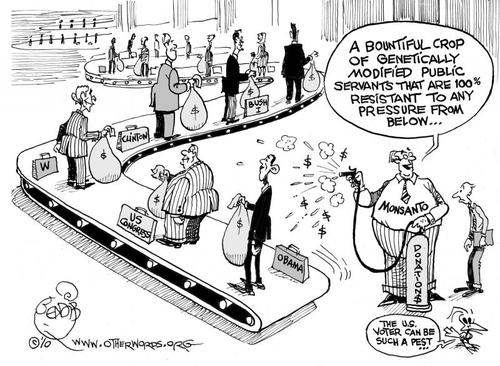
During Obama’s four years as president, the federal government had several opportunities to pass legislation and executive initiatives which affect Monsanto. Of these federal initiatives, the 2010 African hunger plan and the 2012 Farm Bill present the most important examples of the Obama administration’s friendly attitude towards Monsanto.

In 2010, the Obama administration pushed a humanitarian initiative focused upon increasing the food supply of poor areas of Africa–while the ideals of this program are admirable, the execution presents an incredible opportunity to agro-business conglomerates like Monsanto. In order to solve the hunger problem in Africa, the Obama administration has partnered with large industrial farming and GMO operations, under the aegis that these organizations can produce large amounts of food quickly.

By giving several billion dollars to agro-businesses, one of which is Monsanto, the “Southern Africa FY 2010 Implementation Plan” intends to promote the expansion of these businesses into the provision of food for Africa. In focusing on promoting industrial, mono-crop farming and genetically modified goods rather than investing in local farms, the Obama administration created a situation where Monsanto is able to increase its profits. As a partner in the Obama administration’s Africa program, Monsanto will be given subsidies to expand into the African farming market. This expansion is aimed at increasing food supplies in Africa, but it will have the unintended consequence of promoting Monsanto’s takeover of the African food markets.

Once Monsanto gains a foothold in the African food market–which is likely given the level of subsidies offered by the US government–they will be able to crowd out local farmers and capture the truly massive African food market; Monsanto is able to supply far more crops than any local farmer and at a lower price, thus it will likely reduce the competitiveness of local farmers. This capturing of the African food market by Monsanto means that more food will be available, but it will be supplied by Monsanto rather than small African farms and the local farmers of Africa will gradually begin to go out of business. Put plainly, Monsanto will crowd local African farmers out of the market and will make a profit that would be more beneficial in the hands of local African farmers and in the local African economy.

It is clear that Monsanto sees the Africa hunger plan as beneficial to its business, as Hugh Grant–the current Monsanto CEO–said this in response to the Africa initiative: “I’m delighted to be here taking part in this conversation as I believe public and private sector commitment is necessary and able to support a transformation in African agriculture.” The transformation that Grant envisions is one where large-scale industrial farming takes over from smaller, local farms, and provides mass-produced crops. In such a situation, hunger decreases, but it is multi-national corporations rather than local farmers which do this farming and garner most of the profits.

On the issue of GMO labeling, Obama is rhetorically supportive of mandating GMO products to be labeled, but his administration has been largely silent on the issue. During the creation of the 2012 Farm Bill, there was a fight over mandating that genetically modified foods be labeled. Despite Obama’s supposed support for such labeling, his administration was essentially silent on the issue during this fight and, as a result, no mandate was passed. Currently, there is no federal regulation that ensures that all GMOs are labeled, and there doesn’t appear to be any possibility that such regulation is going to be passed in the immediate future.

The aforementioned “Farm Bill” includes several policy changes which are immensely advantageous to Monsanto. While this is an issue that primarily involves the legislature rather than the Obama administration, it bears mentioning that the Obama Administration has been essentially silent on the proposed policy changes and appears unlikely to veto the bill if it passes the legislature. The Farm Bill would be an immense boon to Monsanto, as it would streamline the approval process of its GMO crops and would limit the ability of the federal government to regulate its commerce to the Department of Agriculture.

In totality, legislation passed under the Obama administration has been beneficial to large agro-businesses, one of which is Monsanto. Very little has been done to increase regulation on GMO producers and several laws have been passed that directly benefit such corporations.

Government Appointment of Monsanto Associates

Monsanto is a very large business and has control over a significant amount of the agro-business and genetically modified organism markets. Both the agricultural and GMO markets involve large public safety concerns (ex. food safety), thus Monsanto is heavily affected upon federal regulations (or potential regulations) on its business–the largest of which come from the United States Department of Agriculture [USDA] and the Food and Drug Administration. If regulations and labeling requirements are increased, Monsanto’s profits are directly impacted; conversely, if, such regulations are kept low, then corporations like Monsanto make a larger profit.

Due to the vested interest that Monsanto has in controlling regulation that affects its business, it has both donated to politicians and promoted the appointment of people who work for them to positions within the American government. As of yet, Monsanto has been successful in keeping its regulatory burdens low and getting its representatives into positions within the US government. The infiltration of regulatory agencies by corporate actors that is referred to here is called the “regulatory revolving door”. Individuals who work for industry go to work for the government, make public regulations, and then return to the private sector after leaving the public service. The following info-graphic gives a few examples of the revolving door between Monsanto and the United States government:
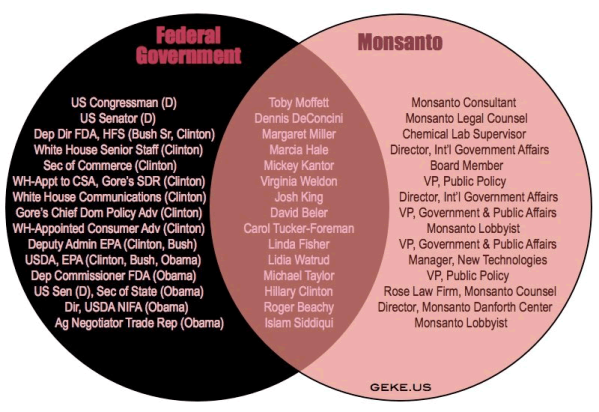
All Credit for this Venn diagram goes to Geke.us

While there are numerous points of overlap between Monsanto and the United States Government under the Obama administration, the three most important connections are that of Michael Taylor, Roger, Beachy, and Islam Siddiqui–all three of these Monsanto affiliates were appointed to high level positions within the government by the Obama administration.

The Obama administration appointed Michael Taylor, the previous vice president of Monsanto and a current Monsanto lobbyist, to a high level advisory role at the Food and Drug Administration [FDA]. It is virtually inarguable that this appointment constitutes a massive boon for Monsanto and an undeniable conflict of interest for Taylor. Given the fact that Taylor is a lobbyist for Monsanto and is being paid by the agro-giant, it is reasonable to assume that his advice to the FDA is focused upon helping his employer reduce its regulatory burden and improve its profitability. It isn’t a secret who Taylor worked for and we can assume that the Obama administration knew who they were appointing when they did it.

Roger Beachy, the Director of the Danforth Plant Science Center (a Monsanto organization), was appointed by the Obama administration as the Director of the USDA’s National Institute of Food and Agriculture. NIFA is a department of the USDA which focuses on funding research and innovation in the field of agriculture as well developing more efficient ways to produce food. As the major grant-writing division of the USDA, the NIFA department has the ability to grant or reject agricultural research grants. By giving Beachy the Directorship of the NIFA, the Obama administration gave a Monsanto associate the most powerful position in the organization which allocates agricultural research grants. Needless to say, this appointment is a great boon for Monsanto and bad news for any group which disagrees with the agri-business giant.

Islam Siddiqui, a Monsanto lobbyist, was appointed to the post of Agriculture Trade Representative by the Obama administration. Trade representative are tasked with promoting trade of goods within their appointed field (ex. Agricultural trade reps promote the export of American crops). As Monsanto has a controlling interest in American corn production, the appointment of a Monsanto lobbyist to the position of trade representative is a large boon for the corporation. Siddiqui’s government job is to promote the export of American crops and his Monsanto job is to promote the sale of Monsanto crops–it is undeniable that these two jobs present a conflict of interest and will only lead to Siddiqui representing Monsanto’s interests as though they are the interests of the United States.

Appointment of Elena Kagen

The justices that a president appoints to the Supreme Court is one of their most enduring and important contributions to the United States that every president gives the country. During his first term, President Obama appointed two Justices, one of whom was Elena Kagan, the former Solicitor General of the United States. During her time as the Solicitor General, Kagan filed a brief in support of Monsanto.

In 2007, Monsanto was brought to court by growers of alfalfa in California–these growers alleged that their crops were being cross-pollinated with, and thus contaminated by, Monsanto’s GMO crops. After winning an initial legal victory and securing an injunction on Monsanto’s planting of its modified alfalfa, Monsanto appealed the ruling and the case eventually reached the Supreme Court. Despite the fact that the United States government had no interest in the Monsanto alfalfa case, Kagan, the solicitor general wrote an “amicus” brief in favor of Monsanto’s position.

Nobody knows why the Solicitor General’s office decided to get involved in the Monsanto alfalfa case, but it was an unusual act by a supposedly neutral body; there was no rational reason for the US government to get involved in this case. While we don’t know the reason for this brief, it does make many believe that Kagan may be sympathetic to Monsanto’s corporate interests.

Candidate Mitt Romney has a very long history with Monsanto and has shown a willingness to work with the agro-conglomerate if elected president. Throughout much of his business career, Romney was heavily involved with the internal operations of the Monsanto Corporation. During Romney’s private sector experience at Bain Capital, he worked for and had a significant amount of influence upon the activities of the Monsanto Corporation. In addition to the business connection between Romney and Monsanto, several officers of the Monsanto corporation have held private relationships with Romney and have contributed to his political aspirations.

Romney’s Business Connections with Monsanto

In 1977, Bain Capital–the company that Romney ran, and in which he made most of his money–was starting out as a corporate consulting firm; Monsanto was among the first major clients of Bain. The multi-million dollar relationship between Bain Capital and Monsanto lasted from 1977 to 1985 and had significant effects on both corporations. Bain Capital, and its officers, made large amounts of money through its relationship with Monsanto and gained a significant client with which to base its consulting practice upon. Monsanto was given business advice by Bain and the corporation’s recent successes in GMO produce are traceable back to the suggestions that Romney made to Monsanto administrators.

According to Dr. Earl Beaver, Monsanto’s Waste Director during much of the 1970s and 80s, Romney was one of the major proponents of Monsanto’s shift into the biotechnical and bioengineering industry. In response to the massive scandal surrounding Monsanto’s part in the creation of “Agent Orange” (a powerful chemical weapon that was used during the Vietnam War), Romney suggested to Monsanto Administrators that they focus on businesses that had lower levels of controversy surrounding them then the creation of chemical weapons–this shift would reduce the negative press received by the company and would help improve the public perception of the company (thus helping them make more money). The creation of bioengineered organisms was a developing industry during the late 20th century and Monsanto–partly on Romney’s advice–began to invest in their GMO production divisions as a new industry.

Patrick Graham, a founding member of Bain Capital, said the following about Romney’s work with Monsanto: “The most important contribution Bain made to Monsanto was concluding that the biggest opportunity was to bring an entirely new value product, namely biotech and herbicides, to the whole farming industry in America, soybeans and stuff.”

If the officers who worked at Monsanto are to be believed, Romney had significant influence on the corporate decision-making for Monsanto and it is his advice that convinced the company’s leadership deciding to focus on GMO creation rather than simply pesticides. Romney saw a move into GMOs as a way to move away from the controversies of Agent Orange and DDT, thus improving the perception of the company.

While there are many ways that people could look at Romney’s history (those who dislike GMOs will blame him for helping create the largest GMO creator, while those who worked with Monsanto would likely thank him for the profitable business advice), there are two things that one can be reasonably certain about a Romney presidency and Monsanto:

  1. Romney suggested that Monsanto shift its industry to GMO creation, thus it is undeniable that he sees GMOs as a good investment; if he didn’t see GMO’s as a good way to make money he would never have suggested that Monsanto enter into GMO creation during his tenure as a consultant. Romney’s private sector support for GMOs will shade all of Romney’s policies in favor of GMOs and will make it very difficult to convince him to support any anti-GMO bills.
  2. Romney worked for Monsanto for years and has numerous contacts within the company. If Romney is elected, Monsanto will get unprecedented access to the president, if only due to the fact that Romney’s experience in agriculture was shaped by his work at Monsanto with Bain (his agriculture experience comes solely from Monsanto and not from working around other farming organizations). We see this access already, in the selection of several high-level Monsanto agents for advisory posts in the Romney campaign.

Monsanto Connections Within the Romney Campaign

Romney and his campaign have had significant contact with the Monsanto Corporation and have received support from Monsanto officers. While Romney has yet to hold a national office (his governorship in MA didn’t expose him to lobbying by many agri-business groups), his campaign for president has shown high levels of cooperation with the agri-business industry as well as the corn lobby.

Arguably the most significant aspect of the Romney campaign’s involvement with Monsanto comes from his appointments to his “Agricultural Advisory” committee. This committee, which is tasked with advising Mitt Romney on all issues relating to agriculture and agri-business, is staffed by “experts” on the field. The experts who staff Romney’s advisory committee come directly from the agro-business industry and represent a huge level of cooperation between Romney and big agri-business.

Randy Russell, a top lobbyist for Monsanto Co., has been appointed to this committee and will likely remain on if Romney wins the election. Russell’s involvement in Romney’s agricultural advisory committee represents a direct line between the Romney campaign (and thus his presidency) and the Monsanto Corporation. The simple fact that the top lobbyist for Monsanto has been given an advisory job with the Romney campaign is not unprecedented, but it does pose the worrying question: Where does the Romney agricultural policy begin and the lobbying efforts of Monsanto end?

In addition to Russell, the Agricultural advisory Committee is staffed with numerous other agri-business supporters:

Chuck Connor — The former leader of the Corn Refiners Association; this is the largest interest group for ethanol and corn syrup producers within the United States.

Bill Even — The former head of the DuPont Chemical “high-tech seed” division, which manages DuPont’s GMO seed business.

Chris Policinski — The CEO of “Land O Lakes” and a party to the 2007 GMO alfalfa case in California.

Tom Nassif — The leader of the Western Growers Association who has been the recipient of thousands of dollars in donations from the Monsanto Fund.

Tom Johanns — A senator from Nebraska who has taken nearly $10,000 in campaign contributions from Monsanto and who advocated in favor of blocking GMO labeling during the early 2000s push by the EU to mandate disclosure.

Partisanship and Money

The presidential election is important, but it does not exist in a vacuum–the views of a candidates’ party are extremely important to the eventual policy that they will push for in the legislature. The modern Republican Party has become focused upon the policies of reducing corporate taxes and reducing regulations on industry. Tax cuts and deregulation of industry standards are both immensely beneficial to large corporations, such as Monsanto. While it has significant control over regulators through its revolving-door appointees, Monsanto is still vulnerable to regulations on its business.

Of the two major American political parties, the Republicans promote deregulation, while the Democrats support regulatory increases (or sometimes simply retention of current regulations). If elected, it is virtually certain that Romney will sign off on his party’s platform of deregulation and tax cuts. Nothing in his history has indicated that Romney will buck his party on issues of legislation, and it appears that a Romney presidency would allow the Republican legislature to pass pro-corporate legislation without fear of veto.

In the last electoral cycle, the Republicans in the legislature have taken $226,000 from Monsanto Co., while Democrats have taken only $90,500 (for a full list, sorted by candidate, follow this link). It is clear that the Republicans, as a party, are friendlier to Monsanto’s interests than the Democrats and would likely have more favorable policy outcomes if the Republicans had control over policy.

Conclusion

When all things have been considered, it is undeniable that Monsanto has significant influence over both major parties in the United States–the only real difference between the candidates is how deep this influence goes. Regardless of whether it is Obama or Romney who becomes the next president, it appears that Monsanto will continue to have significant power in Washington politics and will retain a very high level of lobbying influence.

Opinion Based Conclusions

Past this point, the article focuses on my analysis of Romney and Obama’s involvement with Monsanto and is largely opinion.

When all things are taken into account, a Romney presidency is likely better for Monsanto than an Obama presidency: Obama has shown an unwillingness to confront Monsanto, but Romney appears to have a much deeper connections to Monsanto and be more willing to promote things that will actively benefit the company. Here are a few areas of comparison between the Romney and Obama presidencies in regard to Monsanto:

Donations: While it is often difficult to unravel the massive web of political money, much of which has been filtered through SuperPACs, we know that Romney has taken significantly more money from agro-businesses than Obama. According to OpenSecrets.org, Mitt Romney has taken $4,075,531 in campaign contributions from America agribusinesses, while Barack Obama has only taken $1,377,503 from these interests. As you can see, both candidates are in bed with agribusiness corporations to some degree, but Romney has taken nearly 3X the money that Obama has from this particular industry. It is important to note that these numbers are likely far lower than the actual amounts donated because a majority of the money which is spent by SuperPACs is dark money, where there is no source disclosure. The massive disparity in agribusiness fundraising between the candidates points to the preference of these corporations that Romney get the presidency. As corporations donate money to politicians as an investment and to sway policy in their favor, it is clear that they prefer the Romney vision to the Obama vision.

Partisanship: The president is important, but the legislature is where policy is made; as such, the party affiliations of the presidential candidates can be extremely determinative of the policy that will be passed. Romney is a Republican and Obama is a democrat, and the winner of the presidency will likely be able to sway the national agenda in favor of their party. In the last electoral cycle, the Republicans in the legislature have taken $226,000 from Monsanto Co., while Democrats have taken only $90,500 (for a full list, listed by candidate, follow this link). The Republican Party is based in the center of the country and the south, much of which is dependent upon farming for its primary industry–due to this dependency upon agricultural interest, the Republicans are far more politically friendly towards agribusiness than the Democrats and more likely to support companies like Monsanto.

In addition to the partisan funding disparity, it bears mention that the Republican Party is unified around the ideals of lowering taxes and reducing regulations. Reducing corporate taxes and removing regulations (ex. FDA rules), benefits large corporations and their owners, thus these corporations tend to support Republicans more than Democrats.

A Romney presidency will allow the Republicans to pass corporate friendly legislation without fear of veto. This streamlining of the legislative process reduces the difficulty of passing laws (and removing regulations) that benefit Monsanto, and will lead to more favorable outcomes for the corporation–It appears that Monsanto knows this, and has invested its political contributions accordingly.

Regulation: Neither Obama nor Romney appears to be willing to take on agribusiness interests in order to increase regulations, but there is a key difference in their stances: Obama is largely neutral in his actions towards regulations on Monsanto, while Romney is actively invested on deregulating the industry.

Appointments: Both Obama and Romney have shown their willingness to appoint corporate agents to high level advising positions within the government–Obama appointed Michael Taylor to the FDA and Romney has named several Monsanto lobbyists as his agricultural advisory board. At this point, we don’t know who would be worse in regard to appointments, but neither choice is particularly encouraging.

This article originally appeared on: Global Research

US and Allies Step Up War Preparations against Syria, Lebanon, Iran

0

The United States and its allies continue to escalate their military aggression against Syria, behind the smokescreen of a proposed international peace conference scheduled for June in Geneva.

In official public discourse, the conference is seeking a political solution to end Syria’s civil war, involving a negotiated settlement between the Ba’athist regime and the Islamist-dominated opposition forces that are funded and armed by the US, Turkey and the Gulf States.

Russia’s foreign ministry has endorsed the conference and has persuaded the Syrian government, “in principle”, to attend in the hope of shaping the outcome in its interests.

Based on the final communiqué of the United Nations-backed Action Group for Syria meeting in Switzerland in June 2012, the stated aim of “Geneva II” is to secure a ceasefire, paving the way for a transitional regime charged with ensuring a “democratic and pluralist” Syria in which the “people” will “determine the future of the country.”

All of which is transparent nonsense.

Some leading representatives of the Syrian regime are being offered a place in a new political constellation that includes Islamist and other bourgeois opposition groups and which will be dictated and determined by Washington and its allies and to some extent by Moscow. The alternative to doing so–as has been made abundantly clear–is stepped up aggression up to and including direct military intervention.

Of the two options, a negotiated agreement is by far the least likely. Every day brings fresh indications of preparations for war against not only Syria, but also Lebanon and Iran, threatening a region-wide conflagration that could yet involve Russia and China.

On Thursday, the National Coalition for Syrian Revolutionary and Opposition Forces began a three day meeting in Istanbul, Turkey, to discuss its possible participation in the Geneva conference. Much was made of a proposal for a transition tabled by the coalition’s previous leader, Sheik Moaz al-Khatib.

Its 16 points included absolving all combatants in “legal military action” from prosecution and allowing Assad, 500 people of his choosing and their families to seek refuge in any country willing to welcome them. Assad would hand power to Vice President Farouk al-Sharaa or Prime Minister Wael al-Halqi within 30 days of accepting the plan. The current government would then continue to govern for 100 days, restructure the security and military apparatus, and release political prisoners.

However, there is little or no support for this proposal in the fractured opposition group, let alone more broadly in Syria.

A better indication of what is planned was provided by the attendance of the conference’s most important guest, US Secretary of State John Kerry. He threatened Thursday that if Assad was not prepared to make “a commitment to find peace in his country,” Washington and its allies would consider increasing backing for his opponents.

The US has been arming the opposition from the start, channelling weapons and money through Saudi Arabia, Turkey, Qatar and other regional allies. The US and the European Union have in addition stationed Patriot anti-ballistic missiles in Turkey. But what Kerry is threatening is something far bigger, as indicated by the decision of the Senate Foreign Relations Committee to support directly arming opposition militias. In line with this decision, Kerry has spent the past week lobbying for escalating military involvement in Syria by Europe and the Middle East powers.

On Wednesday, May 22, the Friends of Syria group held a meeting in Amman, Jordan again attended by Kerry. Britain’s Foreign Secretary William Hague was particularly bellicose in Amman, but only because he was acting as a frontman for Kerry. Speaking at a press conference Tuesday with his Jordanian counterpart Nasser Judeh, he warned: “we must make clear that if the regime does not negotiate seriously at the Geneva conference, no option is off the table.”

Iran and Hezbollah were “propping up” Assad and thereby “increasing the threat to regional stability,” he added, calling on the European Union to put Hezbollah’s armed wing on its list of terrorist organisations.

A spokesman for German Foreign Minister Guido Westerwelle publicly stated support for the proposal.

The Friends of Syria meeting formally backed the call for a transitional government, but opposed any negotiation with Assad unless it was about him giving up power.

Immediately after the meeting, the 11-member Arab Ministerial Committee on Syria decided to assign the current head of the Arab League, Qatari Prime Minister Sheikh Hamad Bin Jassim, to represent it at the mooted Geneva conference. Qatar is among the states most implicated in militarily backing Islamist fighters and will represent the foreign ministers of Qatar, Algeria, Egypt, Sudan, Oman, Iraq, Kuwait, United Arab Emirates, Bahrain and Saudi Arabia. The foreign ministers denounced Iran and Hezbollah’s support for the Assad regime as a threat to regional stability.

In Europe, Kerry has been lobbying hard for European states to drop their opposition to Britain and France’s plan to lift legal restrictions on arming the opposition. So far, Italy and Spain have backed the lifting of the arms embargo, while Germany has effectively done so, taking a “neutral” stand.

Spain’s Foreign Minister Jose Manuel Garcia Margallo spoke cynically of allowing the delivery of “defence material for people’s protection” that apparently includes arms and anti-aircraft batteries. He even spoke at a joint press conference with Mouaz al-Khatib.

A decision will be taken on lifting the embargo on Monday, May 27.

Israel too is becoming increasingly involved in the conflict, with three direct strikes on Syria so far this month.

The Israeli media has been discussing the advisability of establishing a new buffer zone on the Syrian side of the 43-mile cease-fire line established in 1973, following an attack on an Israeli military vehicle that had crossed the line in the disputed Golan Heights. To do so would require a full-scale invasion. There are also reports of efforts to establish a proxy force, based upon the minority Druze population near the border.

On May 23, Major General Amir Eshel, commander of the air force, warned that unrest in the Middle East could result in Israel becoming involved in a “surprise war” with Syria. He cited the possibility of Islamist forces gaining control of chemical and other weapons as a casus beli for “having to act on a very broad scale.”

War with both Syria and Lebanon could be imminent, he said. “It’s not as if we can say we have two weeks to prepare. I am not sure we have two weeks to prepare,” he added, given that advanced Russian S-300 anti-aircraft missiles are on their way to Syria.

The previous day, Israeli Chief of Staff Lt. Gen. Benny Gantz warned Assad that he would “bear the consequences” in the event of further attacks on Israeli forces. “If Assad destabilizes the Golan Heights, he will pay a heavy price,” he said. “He needs to know that we will know how to defend ourselves and we will respond should the need arise.”

Paralleling the denunciations of the Assad regime, a key aide to Prime Minister Binyamin Netanyahu, Minister Yuval Steinitz, warned that Iran’s nuclear industry was “many times larger than that of either North Korea or Pakistan.” He said that Tehran was intent on becoming a “nuclear superpower.”

This article originally appeared on: Global Research

Who Calls the Shots in Washington? Government Of, By, and “For The Banks”

0

Five years since the 2008 financial meltdown, the speculation and fraud that caused the crash are back in full force in the United States. Flush with the $85 billion in cash printed up and handed to the banks every month by the Federal Reserve, business at the Wall Street casino is booming. Stock values are at record levels and so are bank profits, amidst declining wages and mass poverty.

Under these conditions, the banks have been pushing to rip up even the very modest restrictions on financial speculation, while broadening the scope of government bailout laws. The aim is simple: to give banks the maximum ability to speculate without constraint, while getting the maximum possible government assistance if and when the bubble collapses.

So close is the bankers’ grip on the reins of government that, no longer content to let their bought-and-paid-for politicians write laws, the banks have taken to doing the work themselves.

This was the case with a bill that passed the House Financial Services Committee this month, HR 992, which significantly expands the number of financial institutions eligible for coverage by the Federal Deposit Insurance Corporation (FDIC). The bill, which passed with majority support by both Democrats and Republicans, amends an earlier law that prevented financial institutions that trade swaps–a set of dangerous and largely unregulated derivatives–from coverage by the FDIC.

The New York Times reported Friday that, according to emails the newspaper examined, 70 out of the bill’s 85 lines were based on the recommendations of Citigroup, one of the largest US banks. Two paragraphs were inserted nearly word-for-word from an email written to lawmakers by the bank.

The bill restricts provisions in the Dodd—Frank Wall Street Reform and Consumer Protection Act, signed on July 21, 2010. This law was largely a publicity measure by the Obama administration, made to appear as a crackdown on financial speculation while in reality allowing the banks to go on with business as usual.

Instead of creating regulations, the Dodd-Frank bill merely mandated that a series of regulations be implemented at some point in the future by regulators. Nearly three years after the bill’s passage, the vast majority of these regulations have not been implemented.

Out of 135 bank regulatory rules mandated by the Dodd-Frank bill, only 40 have been put into effect. The act’s much-vaunted mandate for the creation of a “Volcker rule,” preventing deposit-taking institutions from carrying out financial speculation, remains a dead letter.

Moreover, many of the provisions of the Dodd-Frank bill, toothless as they were, are being scaled back by subsequent acts of Congress, such as HR 992, described above.

Even those regulations that have been implemented have been even further weakened by regulators to comply with the demands of the banks. Last week, the Commodity Futures Trading Commission voted to implement regulations on derivatives–speculative financial products based on other asset values–that were significantly weakened from those that were proposed under Dodd-Frank.

The Commission had initially proposed that the purchasers of derivatives be required to contact five banks when seeking to set the price of a contract. Under the new law, purchasers are only required to contact two banks, further tightening the monopoly of a handful of institutions that dominate the largely unregulated multitrillion-dollar derivatives market.

The bill likewise originally proposed that derivatives be traded on electronic exchanges similar to stock markets, so that buyers would have a better understanding of prices across the market, making price gouging by issuers more difficult. But the final rules allow for much of derivatives trading to take place over the phone, making it nearly impossible to regulate.

Despite a mountain of evidence–including a voluminous 2011 report by the Senate Permanent Subcommittee on Investigations–that the 2008 financial crash was directly linked to rampant lawbreaking by Wall Street, not a single executive at a major bank has been criminally prosecuted, much less gone to jail.

The Wall Street giants emerged from the financial crisis larger and more powerful than ever, and, as shown by government inquiries into JPMorgan’s $6 billion trading loss last year, their activities are just as speculative and parasitic as before the crash.

These factors, combined with the vast amounts of money being pumped into the financial markets by central banks make a new financial crash all but inevitable.

Throughout all this, the role of the government has been to cover up and facilitate the banks’ crimes, seeking to create the appearance of regulation, while allowing Wall Street to operate with impunity.

The main nexus between the banks and government is the Obama administration itself, which, with every new appointment, becomes ever more a government of, by, and for the financial oligarchy.

In January Obama appointed as treasury secretary Jacob Lew, who earned millions of dollars as the chief operating officer of Citigroup’s Alternative Investments unit, which made bets against the housing market as it collapsed.

This month Obama appointed Penny Pritzker, a hotel heiress and private equity firm operator, as commerce secretary. With a net worth of $1.85 billion, Pritzker is the wealthiest person in US history to serve in the president’s cabinet.

These developments demonstrate the impossibility of reining in the financial criminals within the confines of the present political system. The government and both parties serve as little more than errand boys for the bankers, who exercise a dictatorship over political life in the United States.

This article originally appeared on: Global Research

Australia harassing left-wing activists

0

The Australian Security Intelligence Organization (ASIO) has been accused of harassing left-wing activists under the pretext of national security concerns, Press TV reports.

The Australian rights campaigners say the spy agency has deliberately targeted small left-wing groups and their members in recent months.

Sources say ASIO agents have also raided homes of several Palestinian activists and questioned them about their political activities and affiliations.

Patrick Harrison, a pro-Palestinian activist has recently published his encounter with spy agents in the socialist newspaper, GreenLeft Weekly.

Human Rights groups say the Left in Australia is small and doesnâ„¢t pose any security risk.

Last week, the federal government announced possible plans to scale back some of ASIO’s powers, including detaining suspected terrorists for up to a week without charge and revoking penalties for praising acts of terrorism.

This comes after two independent reports said the detaining period was a gross violation of civil liberties.

ASIO is primarily responsible for protecting Australian citizens and the country itself from domestic security threats, such as terrorism, sabotage, and espionage.

JR/SS

This article originally appeared on: Press TV

‘Next pres. must restore public trust’

0

Iran presidential candidate Ali Akbar Velayati says the next administration must feel obligated to restore public trust.

Velayati, a former foreign minister, said the priorities of the next administration will be to improve public welfare, restruct the national economy and reform the foreign policy.

He also pledged to pay special attention to national unity, cooperation and teamwork in the event of his victory in the June 14 election.

Velayati is currently serving as advisor to Leader of the Islamic Revolution Ayatollah Seyyed Ali Khamenei on international affairs.

He is facing seven rivals in the upcoming election. Velayati will be facing lawmaker Gholam-Ali Haddad-Adel, Secretary of Supreme National Security Council Saeed Jalili, Expediency Council Secretary Mohsen Rezaei, President of the Strategic Research Center of the Expediency Council Hassan Rohani, former First Vice President Mohammad Reza Aref, Tehran Mayor Mohammad Baqer Qalibaf, and former Telecommunications Minister Mohammad Gharazi.

KA/HGH/SS

This article originally appeared on: Press TV

‘Iran economy needs management’

0

Presidential candidate Mohsen Rezaei says resourceful management is the missing link in the Iranian economy.

Addressing a crowd of supporters in the northwestern city of Malekan, the independent candidate reiterated his pledge to tackle sanctions, and curb inflation and unemployment through a federal economic model.

He attributed the depreciation of Iranâ„¢s national currency, rial, to the incumbent administrationâ„¢s failure to save extra oil revenue.

Rezaei, who is secretary of the Expediency Council, criticized those who downplay the US-led sanctions, saying Iranians are no longer willing to pay for such slogans.

He added that Iran can strengthen its international influence on the back of a strong economy.

Rezaei is facing seven rivals in the upcoming election including former Foreign Minister Ali Akbar Velayati, lawmaker Gholam-Ali Haddad-Adel, Secretary of Supreme National Security Council Saeed Jalili, Tehran Mayor Mohammad Baqer Qalibaf, President of the Strategic Research Center of the Expediency Council Hassan Rohani, former First Vice President Mohammad Reza Aref, and former Telecommunications Minister Mohammad Gharazi.

KA/HGH/SS

This article originally appeared on: Press TV

Syrian Army Continues Crackdown on Terrorists in al-Qseir and Other Areas

0

SANA reporter quoted a source in the province as saying that units of the armed forces tightened their grip on both sides of Homs-Baalbek road which runs in the middle of al-Qseir city and destroyed terrorists’ gatherings in the western and southwestern neighborhoods of the city

The source added that army units killed numbers of terrorists and destroyed their dens and equipment, including weapons and ammunition, in the northern and central neighborhoods of al-Qseir city. Other members of terrorist groups surrendered to the army units.

An army unit clashed with armed terrorist groups in the northwestern neighborhood of the city, inflicting heavy losses upon their members, according to the source.

Several roadblocks and tunnels were destroyed in the framework of the operations in those neighborhoods, in addition to the dismantling of mines and explosive devices planted on the main roads and houses in the city.

In the countryside of al-Qseir, an army unit killed a number of terrorists, arrested three others and confiscated amounts of weapons, ammunition, cars, bulldozers, motorcycles, forfeited money and masks during storming a den for a terrorist group between al-Husseiniyeh and al-Hamra.

A military source said that the army destroyed terrorists’ gatherings and hideouts in al-Qseir city and targeted their communications and supply and evacuation roads.

The source added that scores of terrorists were killed and injured during the operations, adding that among the injured terrorist was Abu Oday, leader of a terrorist group.

Meanwhile, an army unit clashed with an armed terrorist group near a salt factory on Homs-Damascus that was trying to enter al-Qseir city to help the terrorists who are receiving severe strikes by the army.

Most of the terrorist group’s members were killed, while others were arrested in the clashes.

Army units destroyed a number of heavy machineguns and a 23 mm caliber anti-aircraft gun and several terrorists’ dens and gatherings in the villages of al-Dab’eh and al-Hamidieh.

The army units also tightened control over the northern and western parts of Tal al-Safineh near al-Hamidiyeh village in the countryside of al-Qseir.

Army units killed many terrorists and injured others, in addition to destroying their weapons in the framework of the continuous military operations against their dens in al-Qseir city in Homs Province.

An official source told SANA reporter in Homs that the bodies of terrorists Mohammad Yousef Jabour, from Lebanon, Ghazi Kleib, Bashar Raad, Mones Idres,Mahmoud Raad, Ahmad al-Itr, Mohannad Shehada, Mou’aoya Zohouri and Mohammad Jakhdam were identified among the dead.

The source added that an army unit destroyed a number of terrorists’ hideouts along with their weapons in several neighborhoods in al-Qseir.

Another army unit devastated terrorists’ gatherings al-in Hawadid village in al-Mokharram countryside.

The Army Continues Operations in Damascus and Its Countryside

In the same context, the armed forces carried out several operations in many areas in Damascus Countryside which resulted in killing and injuring numbers of terrorists and arresting others.

An official source told SANA reporter that the army units killed terrorists in Joubar neighborhood and arrested others, while other units continued hunting and killing terrorists in Barzeh neighborhood and the farms surrounding it. Other terrorists were injured to southeast of Tishreen Hospital.

The source noted that the operations resulted in seizing the terrorists’ weapons, including advanced sniper rifles.

In the meantime, an official source told SANA reporter that an army unit killed two leaders of the so-called “Fatah al-Islam Brigades” and “Maghawir al-Ghouta” in the city of Harasta in Damascus Countryside and those are Khalid Hamid and Safwan Hamzeh.

Another army unit, the source added, killed and injured a number of terrorists in Bastareh farms on the outskirts of Douma city. Terrorists Ahmad Hijazi and Naser Sisan were identified among the dead.

In another context, the source affirmed that the army units extended their control over the cereal silos and mills in Adra area in Damascus Countryside after having killed and injured many terrorists who were stationed in the mills. Among those killed were Hussein Alaya and Ismael Eyoun.

The source also told SANA reporter that the army units killed Suheib Karkoush and Bassel Habash, leaders of terrorist groups in the farms surrounding the towns of al-Qasimiyeh and al-Zamaniyeh.

The army units carried out special operations in the towns of Zamalka and Erbin in which they killed many terrorists and injured others and destroyed their weapons and ammunition. Anas al-Nan and Bassam Karnabeh were among the killed terrorists.

Another army unit dens used by the terrorists for hiding weapons and ammunition in al-Ziyabiyeh town and killed numbers of terrorists, including Walid al-Bashawat and Mohammad al-Tanf.

An official source told SANA reporter that the army clashed with an armed terrorist group in the area of Rankous, killing scores of the group’s members, including the leader, Attaf Hindyeh.

The army also carried out several operations against the armed terrorist groups in Daraya, killing scores of terrorists, destroying a bulldozer used by terrorists in setting up barricades and seizing amounts of weapons and ammunition.

Among the killed terrorists were Abdul-Aleem and Abdullah (Abu Hussam).

A military source said that the army units targeted terrorists’ gatherings in the area of al-Zabadani, inflicting heavy losses upon them and destroying a DShK-equipped vehicle.

An army unit targeted an armed terrorist group east of Deir Atyeh and killed and injured scores of terrorists, including snipers, and destroyed a Mortar and a DShK-equipped vehicle.

Terrorists, including Snipers, Killed in Daraa

Meanwhile, a military source said in a statement to SANA reporter that an army unit repelled an armed terrorist group that tried to attack a military post in al-Harak town in the countryside of Daraa.

The source stressed that most of the terrorist group’s members were killed and injured, including snipers. The terrorists’ vehicles and heavy machineguns were destroyed.

Among the killed terrorists were Mohammad al-Qadah and Naser Mohammad al-Qadah from a terrorist group that calls itself “Freedom’s Martyrs Brigade”.

The army units’ operations continued in al-Harak and other towns and villages including Jassem and Um al-Mizan. Numbers of terrorists were killed and injured and their equipment were destroyed.

The Army Inflicts Heavy Losses upon Terrorists’ Dens and Gatherings in Aleppo 

The army operations continued in Aleppo and its countryside in which several dens for terrorist groups were destroyed in different areas.

SANA reporter quoted an official source in the province as saying that units of the armed forces killed and injured a number of terrorists near the glass and al-Saif factories in the surrounding of the Central Prison of Aleppo.

The terrorists’ dens were destroyed along with all the weapons and ammunition inside.

The source added that an army unit clashed with terrorists affiliated to Jabhat al-Nusra in al-Ziyareh village near Minnegh town, inflicting heavy losses upon them.

Another army unit destroyed a number of vehicles loaded with weapons and ammunition on Daret Izzeh road in the countryside of Aleppo. Similar vehicles were destroyed in Kuweiris area.

Several members of armed terrorist groups were killed near Toyota showroom, al-Tahan restaurant, the ice cream factory and al-Qadah gas station on Aleppo-Idleb road.

Army units also clashed with a armed terrorist groups at al-Haidariyeh roundabout in the city of Aleppo, killing and injuring most of their members and destroying two vehicles they were driving.

Military Operations against Terrorists in Deir Ezzor and Its Countryside

An army unit clashed with armed terrorist groups in the neighborhoods of al-Sina’a, al-Hwaiqa and al-Jbeileh in Deir Ezzor city, inflicting heavy losses upon them.

An official source told SANA that numbers of terrorists were killed and their weapons destroyed in the clashes.

The source added that the army unit destroyed a pick-up car loaded with terrorists, weapons and ammunition on al-Siyassieh Bridge in Deir Ezzor city, while another unit killed 14 terrorists in al-Mreieh village.

The source indicated that the competent authorities caught three terrorists from Jabhat al-Nusra in al-Masrab village and confiscated a car equipped with a heavy machinegun, RPG launcher and other weapons.

A number of terrorists were killed in a car bomb they were preparing in al-Bouderbas area in Mohasan city in Deir Ezzor countryside. Mazen Battah was identified among the dead.

Non-Syrian Terrorists Eliminated in Idleb Countryside

Armed Forces units targeted a base for terrorist groups on the Aleppo-Saraqeb road in Idleb countryside, eliminating large numbers of terrorists, some of them non-Syrians.

Among the terrorists killed in that base were two Jordanians; Mohammad Alaa Ismael al-Saleh and Adel al-Shebani, in addition to a Saudi called Mohammad Haljawi, an Afghan called Sheban Mustafa, and an Iraqi called Saddam Khlaikhel.

Armed Forces Eliminate Terrorists in Lattakia Countryside

An Armed Forces unit targeted a gathering of terrorists from Jabhat al-Nusra in the village of al-Shmaiseh in Lattaka countryside, resulting in the killing of a number of terrorists and the injuring of others.

Two Citizens Injured By Terrorists’ Mortars on al-Dweila, Damascus

Two citizens were injured when terrorists fired two mortar shells on al-Dweila area in Damascus on Saturday.

An official source told SANA reporter that the wounded persons were admitted to hospitals, adding that the terrorists attack caused material damage in the area.

Woman Martyred by Terrorists Mortars on Harasta

A woman was martyred by mortar shells launched by terrorists on residential areas in Harasta in Damascus Countryside.

An official source told SANA reporter that a mortar shell fell on the southern suburb of Harasta, claiming the life of a woman and causing material damage to the nearby buildings.

The source said that another two shells fell on the area. No human or material damage was reported. English Bulletin

This article originally appeared on: Global Research

Monsanto’s Contributions to US House and Senate Candidates

0
House
Total to Democrats: $72,000
Total to Republicans: $190,500
Barrow, John (D-GA) $2,500
Bishop, Sanford (D-GA) $5,000
Boehner, John (R-OH) $10,000
Braley, Bruce (D-IA) $5,000
Camp, Dave (R-MI) $5,000
Cantor, Eric (R-VA) $10,000
Clay, William L Jr (D-MO) $10,000
Cleaver, Emanuel (D-MO) $5,000
Conaway, Mike (R-TX) $2,000
Courtney, Joe (D-CT) $4,500
Crawford, Rick (R-AR) $2,500
Fincher, Steve (R-TN) $8,000
Gardner, Cory (R-CO) $7,500
Goodlatte, Bob (R-VA) $4,500
Graves, Sam (R-MO) $5,000
Griffin, Tim (R-AR) $1,000
Guthrie, Brett (R-KY) $1,000
Hanabusa, Colleen (D-HI) $5,000
Hannemann, Mufi (D-HI) $1,000
Hartzler, Vicky (R-MO) $3,000
Holden, Tim (D-PA) $1,000
Huelskamp, Tim (R-KS) $2,500
Hultgren, Randy (R-IL) $2,500
Jenkins, Lynn (R-KS) $2,500
Johnson, Timothy (R-IL) $3,000
King, Steven A (R-IA) $2,500
Kingston, Jack (R-GA) $7,000
Kinzinger, Adam (R-IL) $3,500
Kissell, Larry (D-NC) $5,000
Labrador, Raul (R-ID) $2,000
LaMalfa, Doug (R-CA) $1,000
Landry, Jeff (R-LA) $1,000
Latham, Tom (R-IA) $10,000
Loebsack, David (D-IA) $5,000
Long, Billy (R-MO) $2,500
Lucas, Frank D (R-OK) $10,000
Luetkemeyer, Blaine (R-MO) $5,000
Lungren, Dan (R-CA) $1,000
McIntyre, Mike (D-NC) $1,000
Neugebauer, Randy (R-TX) $1,000
Noem, Kristi (R-SD) $1,000
Nunes, Devin (R-CA) $3,500
Owens, Bill (D-NY) $2,000
Peterson, Collin (D-MN) $10,000
Rogers, Hal (R-KY) $7,500
Rokita, Todd (R-IN) $5,000
Roskam, Peter (R-IL) $1,000
Schilling, Bobby (R-IL) $3,000
Schock, Aaron (R-IL) $5,000
Shimkus, John M (R-IL) $5,000
Simpson, Mike (R-ID) $10,000
Smith, Adrian (R-NE) $5,000
Stutzman, Marlin (R-IN) $5,000
Thompson, Bennie G (D-MS) $10,000
Thompson, Glenn (R-PA) $1,000
Upton, Fred (R-MI) $5,000
Valadao, David (R-CA) $2,500
Wagner, Ann L (R-MO) $10,000
Walden, Greg (R-OR) $1,000
Walorski, Jackie (R-IN) $2,500
Womack, Steve (R-AR) $1,000
Senate
Total to Democrats: $37,500
Total to Republicans: $85,000
Akin, Todd (R-MO) $3,500
Baucus, Max (D-MT) $1,000
Berg, Rick (R-ND) $10,000
Blunt, Roy (R-MO) $10,000
Boozman, John (R-AR) $5,000
Casey, Bob (D-PA) $2,500
Chambliss, Saxby (R-GA) $5,000
Fischer, Deb (R-NE) $5,000
Gillibrand, Kirsten (D-NY) $1,000
Grassley, Chuck (R-IA) $2,000
Hatch, Orrin G (R-UT) $5,000
Hirono, Mazie K (D-HI) $1,000
Johanns, Mike (R-NE) $1,000
Klobuchar, Amy (D-MN) $5,000
Landrieu, Mary L (D-LA) $1,000
Lugar, Richard G (R-IN) $3,000
McCaskill, Claire (D-MO) $5,000
McConnell, Mitch (R-KY) $10,000
Moran, Jerry (R-KS) $2,500
Nelson, Ben (D-NE) $13,000
Rehberg, Denny (R-MT) $2,000
Risch, James E (R-ID) $3,500
Roberts, Pat (R-KS) $9,000
Stabenow, Debbie (D-MI) $8,000
Thompson, Tommy G (R-WI) $5,000
Wicker, Roger (R-MS) $1,000
Wilson, Heather A (R-NM) $2,500

Based on data released by the FEC on March 25, 2013.

Related content:

Disclaimer: The contents of this article are of sole responsibility of the author(s). The Centre for Research on Globalization will not be responsible for any inaccurate or incorrect statement in this article. The Center of Research on Globalization grants permission to cross-post original Global Research articles on community internet sites as long as the text & title are not modified. The source and the author’s copyright must be displayed. For publication of Global Research articles in print or other forms including commercial internet sites, contact: publications@globalresearch.ca

www.globalresearch.ca contains copyrighted material the use of which has not always been specifically authorized by the copyright owner. We are making such material available to our readers under the provisions of “fair use” in an effort to advance a better understanding of political, economic and social issues. The material on this site is distributed without profit to those who have expressed a prior interest in receiving it for research and educational purposes. If you wish to use copyrighted material for purposes other than “fair use” you must request permission from the
copyright owner.

For media inquiries: publications@globalresearch.ca

This article originally appeared on: Global Research

Massacre in Central Burma: Muslim Students Terrorized and Killed in Meiktila

0

by Holly G. Atkinson, MD, FACP and Richard Sollom, MA, MPH

Read the report (pdf)

This report details the results of a PHR investigation into the March 20 and 21, 2013, attacks on Muslim students, teachers, and residents in the Mingalar Zayyone quarter of Meiktila, a small town in central Burma.

A two-person team from PHR conducted 33 interviews about the attacks, which resulted in the deaths of at least 20 children and four teachers. The report details the attacks by the Buddhist mobs, provides evidence that local police officers were complicit in the crimes, and lists policy recommendations for the Burmese government and the international community.

The below map, which includes photographs of the destroyed mosques and Islamic schools in Meiktila, is also in the report. A second map, showing locations of the anti-Muslim violence, also follows.

>> Read the Executive Summary (pdf)

Map 1: PHR-Verified Destruction of Mosques and Islamic Schools in the City of Meiktila, Burma, 20-23 March, 2013. This map contains original PHR photos; clicking on each point will reveal a photo of the damaged structure.

 
Map 2: Anti-Muslim Violence in Burma, March—April 2013. This map was produced using information from publicly available media sources.

Conflict in Myanmar March-April Topo

This article originally appeared on: Global Research

Oregon teen to be charged with attempted murder over 'conspiring to top Columbine massacre'

0

An Oregon high school student has been accused of building at least six bombs in preparation an attack modeled after the notorious 1999 Columbine school shooting.

Grant Acord, 17, was arrested late Thursday at his Albany home
and taken to a juvenile jail. He is suspected of manufacturing and
possessing explosive devices, which he stored in a secret
compartment under the floor of his bedroom, according to
authorities.

He will also be charged with attempted aggravated murder in an
adult court, Benton County District Attorney John Haroldson said
Saturday.

“The charge of attempted aggravated murder requires that we
prove that a substantial step was taken toward the completion of
the crime,”
the attorney said. “In this case, we would be
relying upon evidence of plan. Diagrams, checklists, a plan to use
explosive devices and firearms to carry out a plan specifically
modeled after the Columbine shootings.”

Haroldson said the police found pipe bombs, Molotov cocktails,
napalm bombs and explosives made from drain cleaner. He would not
say when the alleged attack was planned to take place, but said
that police had found a timeline.

He said that Acord chose the West Albany High School, where he
was a student, because it was a “target-rich environment,”
and that the suspect did not appear to have targeted any specific
person at the school.

The attorney said he was not aware of any problems Acord may
have had, but that further investigation was needed.

“In any case that you have a young person that in essence
plans to take a video game approach to killing people at school,
you have to take a close look at the mental health issues,”

Haroldson said. “And the process will certainly provide for that
once he’s represented by counsel.”

Albany Police Department said they had been altered to the case
by a tip. No explosives were found during a search of the school,
the statement said. Charges against Acord will be formally filed
Tuesday morning, since Monday is Memorial Day, a national holiday
in the US.

The Columbine High School shooting in April 1999 was one of
worst mass killings at a US school. It involved a firebomb that
diverted firefighters and emergency personnel, a botched attempt to
bomb a cafeteria, and a number of pipe bombs used during the
shooting. The two perpetrators killed 12 students and one teacher
before committing suicide.

This article originally appeared on: RT

BNritain’s Elite School Justifies Shooting Protesters Dead

0

BNritain’s Elite School Justifies Shooting Protesters Dead

Eton college’s exam asks boys to justify army shooting protesters dead

Britain’s elite school Eton, where Prime Minister David Cameron went to school, has asked 13-year old boys to pretend to be Prime Minister and justify the army shooting dead 25 protesters in a speech to win a scholarship, British media reported.

“The year is 2040. There have been riots in the streets of London after Britain has run out of petrol because of an oil crisis in the Middle East. Protesters have attacked public buildings. Several policemen have died. Consequently, the government has deployed the army to curb the protests. After two days the protests have stopped but 25 protestors have been killed by the army,” the question reads.


Candidates are then asked to imagine that they were the Prime Minister and to write a speech for broadcast to the nation on why the decision to deploy the army against violent protests was both necessary and morally right.

The headmaster of Eton College, Tony Little, emailed the US paper the Huffington Post saying the question has been taken out of context and that Eton School does not favor any particular political viewpoint.

“We are looking for candidates who can see both sides of an idea and express them clearly. High ability candidates at this level are often asked to put themselves in someone else’s shoes,” he wrote.

Disclaimer: The contents of this article are of sole responsibility of the author(s). The Centre for Research on Globalization will not be responsible for any inaccurate or incorrect statement in this article. The Center of Research on Globalization grants permission to cross-post original Global Research articles on community internet sites as long as the text & title are not modified. The source and the author’s copyright must be displayed. For publication of Global Research articles in print or other forms including commercial internet sites, contact: publications@globalresearch.ca

www.globalresearch.ca contains copyrighted material the use of which has not always been specifically authorized by the copyright owner. We are making such material available to our readers under the provisions of “fair use” in an effort to advance a better understanding of political, economic and social issues. The material on this site is distributed without profit to those who have expressed a prior interest in receiving it for research and educational purposes. If you wish to use copyrighted material for purposes other than “fair use” you must request permission from the
copyright owner.

For media inquiries: publications@globalresearch.ca

This article originally appeared on: Global Research

Qalibaf vows to bring prosperity to Iran

0

Tehran Mayor Mohammad Baqer Qalibaf, who is running for president in the June 14 election, has pledged to make optimum use of Iranâ„¢s abundant resources to bring prosperity to the nation.

Addressing a group of religious figures and supporters in the central city of Yazd on Sunday, Qalibaf said Iran should not be faring worse than countries that lack such abundant resources.

He added that social problems emerge when progress slows down and inequality dominates.

Qalibaf noted that channeling Iranâ„¢s national resources into development programs is not a difficult task.

Tehran mayor is facing seven rivals in the upcoming election. Former Foreign Minister Ali-Akbar Velayati, lawmaker Gholam-Ali Haddad-Adel, Secretary of the Supreme National Security Council Saeed Jalili, Secretary of Expediency Council Mohsen Rezaei, President of the Strategic Research Center of the Expediency Council Hassan Rohani, former First Vice President Mohammad Reza Aref, and former Telecommunications Minister Mohammad Gharazi are also running for president.

KA/HGH/SS

This article originally appeared on: Press TV

Monsanto’s GMO Killer Seeds: Profits Above Human Health

0

On May 25, more than two million people marched against Monsanto Worldwide. They did so in dozens of countries worldwide. They had good reason.They want consumer protections enacted. They want safe food to eat. They want governments assuring it. They want GMO foods and ingredients labeled.

“March Against Monsanto” (MAM) headlined “Why Do We March?”

Independent research shows GMO foods and ingredients cause “serious health conditions such as the development of cancer tumors, infertility and birth defects.”

Former Monsanto executives run the Food and Drug Administration (FDA). An obvious conflict of interest exists.

Provisions of the March 2013 Monsanto Protection Act include “ban(ning) courts from halting the sale of Monsanto’s genetically-modified seeds.”

“For too long, Monsanto has been the benefactor of corporate subsidies and political favoritism.”

“Organic and small farmers suffer losses while Monsanto continues to forge its monopoly over the world’s food supply, including exclusive patenting rights over seeds and genetic makeup.”

“Monsanto’s GM seeds are harmful to the environment; for example, scientists have indicated they have contributed to Colony Collapse Disorder among the world’s bee population.”

MAM advocates:

  • boycotting Monsanto-owned companies;
  • repealing Monsanto Protection Act harmful provisions;
  • more independent research on the effects of GMOs on human health;
  • holding Monsanto officials and complicit politicians accountable;
  • informing the public about “Monsanto’s secrets;” and
  • “taking to the streets to show the world and Monsanto that we won’t take these injustices quietly.”

“We will not stand for cronyism. We will not stand for poison. That’s why we March Against Monsanto.”

In 1906, Upton Sinclair’s muckraking novel “The Jungle” aroused the public. It exposed monopoly capitalist excesses, worker exploitation, and unsanitary practices in slaughterhouses and meatpacking plants.

Food hazardous to human health was produced. Nothing was done to stop it. Unsuspecting consumers ate it.

Jack London said Sinclair’s book “depict(ed) what our country really is, the home of oppression and injustice, a nightmare of misery, an inferno of suffering, a human hell, a jungle of wild beasts.”

Theodore Roosevelt was president. Public outcry got results. The 1906 Pure Food Food and Drug Act became law. It fell short of full protection. It helped by prohibiting some of the worst abuses.

Yesteryear’s reforms are gone. They no longer exist. Deregulation ended them. Profits alone matter. What corporate America wants it gets. It runs the country. Agribusiness and other industry sectors occupy Washington.

They decide policy. They write laws Congress passes. Ordinary people have no say. Politicians are bought like toothpaste. Public health and environmental sanity are ignored. Corporate greed alone matters.

Business officials run the Food and Drug Administration (FDA), Department of Health and Human Services (DHS), Occupational Safety and Health Administration (OSHA), Environmental Protection Agency (EPA), and other government agencies.

America’s food supply suffers. Genetically modified ones proliferate. They’re unsafe to eat. They’re hazardous to human health. Independent studies prove it.

Monsanto’s the world’s leading GMO seed producer. It’s profiting at the expense of human health. It wants all animal and vegetable life forms patented. It wants global food control.

It wants labeling prohibited. It wants reliable science buried. It wants issues of food safety ignored. It wants consumers to have no say.

It wants critics silenced. It wants them discredited. It has enormous influence in Washington. It gets its own way. It’s long past time that ended. Ordinary people must demand it. Food safety is too vital to ignore.

“The World According to Monsanto” chronicles its controversial history. It’s a powerful film. It explains some of the most toxic products ever sold.

Monsanto deception, pressure, collusion and bribery are standard tactics to do so.

Secret documents are exposed. Firsthand accounts are presented. Victims, scientists, politicians and others tell their own stories.

The film explains why Monsanto’s the world’s poster child for manipulating governments to permit hazardous products vital to prohibit. It’s a wakeup call for mass action.

Monsanto’s history includes some of the most hazardous products ever produced. They include Agent Orange, DDT, recombinant bovine growth hormone, polychlorinated biphenyl (PCB), aspartame, and Roundup herbicide among others.

Jeffrey Smith’s Institute for Responsible Technology calls Monsanto’s history “Deception, Deception, Deception.” It’s why the company “can’t be trusted,” he says.

Its own documents later made public reveal Monsanto knew straightaway that many of its products are hazardous to human health. A company memo justified selling them. “We can’t afford to lose one dollar of business,” it said.

In December 2011, the Natural Society called Monsanto the “Worst Company of 2011.” It did so for “threatening both human health and the environment.”

It controls 90% of the US GMO seed market. Its Roundup herbicide contaminates 120 million hectares in America, Europe, South America, Australia and South Africa. Its other biopesticides increase contamination.

Corporate Accountability International conducts an annual poll. “(W)e ask you,” it says, to (choose) the worst of worst and induct the ‘winner’ into our Corporate Hall of Shame.”

In 2012, Monsanto was chosen. It was “(f)or mass producing toxic chemicals, aggressively running small farms out of business, and recklessly promoting (hazardous GMO) seeds that (harm human health and) exacerbate food scarcity globally — again.”

Food & Water Watch says “Monsanto’s control over seeds harms farmers, the environment and the global economy.”

Its food system reach is “formidable.” Its seeds are responsible for about 86% of corn and around 93% of soybeans. Most processed foods include them.

Monsanto wants GMOs proliferated globally. Washington actively promotes it. The State Department acts as an agribusiness biotechnology ambassador.

It lobbies and pressures governments to permit GMO proliferation. It conducts public relations on behalf of industry giants. It ignores food safety issues. It opposes GMO labeling.

US embassies are aggressively involved. Darcy O’Callaghan is Food & Water Watch’s international policy director. She was interviewed on The Real News Network.

She discussed 926 diplomatic cables. WikiLeaks published them. They revealed active State Department biotech promotion. It’s done deceptively.

False GMO seed claims are made. Governments are pressured. Food & Water Watch’s executive director Wenonah Hauter said “(t)he US State Department is selling seeds instead of democracy. It campaigns on behalf of biotech giants.”

“The State Department should not be flexing its diplomatic muscle to impose biotech crops on the developing world.”

“Today, the US government is secretly negotiating major trade deals with Europe and the countries of the Pacific Rim that would force skeptical and unwilling countries to accept biotech imports, commercialize biotech crops and prevent the labeling of GE foods.”

“This madness must stop. The US government should not be a shill for the largest biotech seed companies.”

According to National Family Farm Coalition president Ben Burkett:

“An overwhelming number of farmers in the developing world reject biotech crops as a path to sustainable agricultural development or food sovereignty.”

“The biotech agriculture model using costly seeds and agrichemicals forces farmers onto a debt treadmill that is neither economically nor environmentally viable.”

Organic Consumers Association executive director Ronnie Cummins added:

“It’s not surprising that Monsanto, DuPont, Syngenta, Bayer and Dow want to maintain and expand their control of the $15 billion global biotech seed market, but it’s appalling that the State Department is complicit in supporting their goals despite public and government opposition in several countries.”

“American taxpayer’s money should not be spent advancing the goals of a few giant biotech companies.”

Food & Water Watch wants both kept safe, accessible, affordable, and sustainably produced. “Take Action,” it urges. Everyone has a right to know what they’re eating.

GMO foods and ingredients harm human health. Jeffrey Smith’s investigative research links GMOs to “toxic and allergic reactions, infertility, and damage to virtually every internal organ studied in lab animals.”

Monsanto and other biotech giants mislead governments. They put profits above human health and environmental sanity. Staying healthy begins with not ingesting harmful substances.

Independent research reveals compelling evidence. GMOs harm human health. Monsanto’s the world’s largest seed producer. It’s history reflects irresponsible behavior.

According to Smith, it includes “extensive bribery, highjacking of regulatory agencies, and suppressing negative information about its products.”

It threatens journalists and scientists who dare report them. It long ago proved it can’t be trusted.

On May 25, tens of thousands worldwide marched against Monsanto. They want governments assuring they get safe food. They want GMOs labeled.

Not in America any time soon. On May 23, the Senate voted overwhelmingly against it.

A Farm Bill amendment was defeated by a 71 — 27 vote. It lost despite the vast majority of Americans wanting labeling.

People have a right to know. Consumer advocates demand it. What Monsanto wants it gets. Washington works that way.

Stephen Lendman lives in Chicago. He can be reached at lendmanstephen@sbcglobal.net.

His new book is titled “Banker Occupation: Waging Financial War on Humanity.”

http://www.claritypress.com/LendmanII.html

Visit his blog site at sjlendman.blogspot.com.

Listen to cutting-edge discussions with distinguished guests on the Progressive Radio News Hour on the Progressive Radio Network.

It airs Fridays at 10AM US Central time and Saturdays and Sundays at noon. All programs are archived for easy listening.

http://www.progressiveradionetwork.com/the-progressive-news-hour

http://www.dailycensored.com/monsanto-profits-above-human-health/

This article originally appeared on: Global Research

Genetic Engineering: Two Million People In 52 Countries March Against Monsanto

0

 Monsanto’s Arguments Debunked

2 million people in 52 countries protested against Monsanto today. (Pictures here.)

In response to the protest, Monsanto’s spokesperson said:

Among the challenges facing agriculture are producing food for our growing population and reducing agriculture’s footprint on the environment. While we respect each individual’s right to express their point of view on these topics, we believe we are making a contribution to improving agriculture by helping farmers produce more from their land while conserving natural resources such as water and energy.

Is this true?

The Independent noted in 2008:

Genetic modification actually cuts the productivity of crops, an authoritative new study shows, undermining repeated claims that a switch to the controversial technology is needed to solve the growing world food crisis.

The study — carried out over the past three years at the University of Kansas in the US grain belt — has found that GM soya produces about 10 per cent less food than its conventional equivalent, contradicting assertions by advocates of the technology that it increases yields.

Professor Barney Gordon, of the university’s department of agronomy, said he started the research — reported in the journal Better Crops — because many farmers who had changed over to the GM crop had “noticed that yields are not as high as expected even under optimal conditions”. He added: “People were asking the question ‘how come I don’t get as high a yield as I used to?’”

***

The new study confirms earlier research at the University of Nebraska, which found that another Monsanto GM soya produced 6 per cent less than its closest conventional relative, and 11 per cent less than the best non-GM soya available.

***

A similar situation seems to have happened with GM cotton in the US, where the total US crop declined even as GM technology took over.

***

Last week the biggest study of its kind ever conducted — the International Assessment of Agricultural Science and Technology for Development — concluded that GM was not the answer to world hunger.

Professor Bob Watson, the director of the study and chief scientist at the Department for Environment, Food and Rural Affairs, when asked if GM could solve world hunger, said: “The simple answer is no.”

Scientific American reported in 2009:

Proponents argue that GM crops  can help feed the world. And given ever increasing demands for food, animal feed, fiber and now even biofuels, the world needs all the help it can get.

Unfortunately, it looks like GM corn and soybeans won’t help, after all.

The Union of Concerned Scientists wrote the same year:

For years the biotechnology industry has trumpeted that it will feed the world, promising that its genetically engineered crops will produce higher yields.

***

That promise has proven to be empty …. [A UCS report] reviewed two dozen academic studies of corn and soybeans, the two primary genetically engineered food and feed crops grown in the United States. Based on those studies, the UCS report concludes that genetically engineering herbicide-tolerant soybeans and herbicide-tolerant corn has not increased yields. Insect-resistant corn, meanwhile, has improved yields only marginally. The increase in yields for both crops over the last 13 years, the report finds, was largely due to traditional breeding or improvements in agricultural practices.

***

The report does not discount the possibility of genetic engineering eventually contributing to increase crop yields. It does, however, suggest that it makes little sense to support genetic engineering at the expense of technologies that have proven to substantially increase yields, especially in many developing countries. In addition, recent studies have shown that organic and similar farming methods that minimize the use of pesticides and synthetic fertilizers can more than double crop yields at little cost to poor farmers in such developing regions as Sub-Saharan Africa.

The report recommends that the U.S. Department of Agriculture, state agricultural agencies, and universities increase research and development for proven approaches to boost crop yields. Those approaches should include modern conventional plant breeding methods, sustainable and organic farming, and other sophisticated farming practices that do not require farmers to pay significant upfront costs. The report also recommends that U.S. food aid organizations make these more promising and affordable alternatives available to farmers in developing countries.

“If we are going to make headway in combating hunger due to overpopulation and climate change, we will need to increase crop yields,” said Gurian-Sherman. “Traditional breeding outperforms genetic engineering hands down.”

Mother Jones pointed out in February:

Washington State University researcher Charles Benbrook has demonstrated that the net effect of GMOs in the United States has been an increase in use of toxic chemical inputs.

***

And in a new paper (PDF) funded by the US Department of Agriculture, University of Wisconsin researchers have essentially negated the “more food” argument as well. The researchers looked at data from UW test plots that compared crop yields from various varieties of hybrid corn, some genetically modified and some not, between 1990 and 2010. While some GM varieties delivered small yield gains, others did not. Several even showed lower yields than non-GM counterparts. With the exception of one commonly used trait–a Bt type designed to kill the European corn borer–the authors conclude, “we were surprised not to find strongly positive transgenic yield effects.” Both the glyphosate-tolerant (Roundup Ready) and the Bt trait for corn rootworm caused yields to drop.

Then there’s the question of so-called “stacked-trait” crops–that is, say, corn engineered to contain multiple added genes–for example, Monsanto’s “Smart Stax” product, which contains both herbicide-tolerant and pesticide-expressing genes. The authors detected what they call “gene interaction” in these crops–genes inserted into them interact with each other in ways that affect yield, often negatively. If multiple genes added to a variety didn’t interact, “the [yield] effect of stacked genes would be equal to the sum of the corresponding single gene effects,” the authors write. Instead, the stacked-trait crops were all over the map. “We found strong evidence of gene interactions among transgenic traits when they are stacked,” they write. Most of those effects were negative–i.e., yield was reduced.

Overall, the report uncovers evidence of what is known as “yield drag”–the idea that manipulating the genome of a plant variety causes unintended changes in the way it grows, causing it to be less productive.

***

Here’s how the authors of a major paper published in Nature [one of the world’s leading science jounrals] last year put it:

Soils managed with organic methods have shown better water-holding capacity and water infiltration rates and have produced higher yields than conventional systems under drought conditions and excessive rainfall.

Genetically engineered foods have also allegedly been linked to obesity, cancer, liver failure, infertility and all sorts of other diseases. Brief, must-watch videos here and here.

Postscript: This is a bipartisan movement. After all, polls show that a large majority of Americans want strong food safety rules, and want genetically modified foods to be labeled.

And yet Congress is — yet again — handing a big funder unlimited power.

This article originally appeared on: Global Research

Three more arrests over London murder

0

UK police detectives have detained three more suspects, allegedly linked to the Woolwich murder.

British police detectives have detained three more suspects, who are allegedly linked to the recent brutal killing of British soldier Lee Rigby in London.

Three men, aged 24, 28 and 21 were arrested in the south-east London area on Saturday, on suspicion of conspiracy to commit murder in addresses near where Rigby was hacked to death.

The police were backed by specialist firearms officers and used Tasers against two of the detainees.

The arrests come as the British government confirmed the launch of a new crackdown on extremism, which includes a focus on the so-called radical preachers, who allegedly recruit people in mosques, prisons, schools and colleges.

British Prime Minister David Cameron has said that the parliamentary Intelligence and Security Committee (ISC) will begin an investigation, following the revelation that Rigbyâ„¢s killers were known to spy agency MI5.

Sources said earlier this week that Rigbyâ„¢s attackers named as Micheal Adebolajo and his accomplice Michael Oluwatobi Adebowale, were not known to be planning the kill.

Adebolajo and Adebowale are said to be in a stable condition in hospital after being shot by police in Woolwich after the murder.

BGH/AMR/HE

This article originally appeared on: Press TV

Central India attack death toll hits 28

0

The file photo shows Maoists rebels.

The death toll from a violent ambush by Maoist rebels in central India has climbed to 28, police say.

Senior police officer M. Gupta said the Saturday assault took place in the Sukma area, about 345 kilometers (215 miles) south of Raipur, the capital of Chhattisgarh State.

About 200 Maoist rebels attacked a convoy of vehicles carrying local leaders and supporters of Indiaâ„¢s ruling Congress Party as the Congress members were coming back to the state capital after attending a party rally.

According to state police officer R.K. Vij, five police officers were among the dead. More than 20 others were injured in the offensive.

On Sunday, police discovered 11 more bodies near the scene of the ambush, which brought the death toll to 28. A local Congress leader and his son who were earlier thought to have been kidnapped by the assailants were among the dead, police officer Alok Nath said.

Congress Party President Sonia Gandhi condemned the Å“dastardly attack.”

Indiaâ„¢s Prime Minister Manmohan Singh said New Delhi would take decisive action against the perpetrators.

According to police officials and media reports, the attackers closed the road by felling trees and detonated a bomb that blew up one of the vehicles in the convoy. The rebels then fired indiscriminately at the Indian National Congress leaders and their supporters.

The Maoist rebels, who are known as Naxalites, have been fighting against New Delhi for more than 40 years, demanding land and jobs for landless peasants and the poor.

The rebel movement, which was inspired by Chinese leader Mao Zedong, began in 1967 in the West Bengal village of Naxalbari.

MR/HSN

This article originally appeared on: Press TV

'Kiev is not Sodom': First-ever LGBT rally in Ukraine met by anti-gay protest (PHOTOS, VIDEO)

0


Published time: May 26, 2013 10:07

Embed

Code

Up to 100 LGBT rights activists took part in Ukraine’s first gay rally in Kiev, while anti-gay demonstrators shouted, “Ukraine is not America. Kiev is not Sodom.” Police arrested 13 people for trying to break up the march.

The march was held away from the central Kiev and lasted only 40
minutes, but was hailed as a breakthrough. The rally gained
worldwide support after Amnesty International asked Kiev
authorities to approve the gay march and protect its activists.

The event had been threatened with a ban by a local court.
Nevertheless, it went forward on Saturday amid heightened security,
with 500 policemen guarding the protesters.

The rally was backed by the US Embassy to Ukraine and the EU
Delegation, which called on police to “effectively ensure that
all persons can exercise their rights to freedom of peaceful
assembly without putting their personal safety at risk.”

Last year, LGBT activists canceled a similar protest in Kiev
over reported threats of violence. One of the organizers was
allegedly beaten up by a group of men.

“This event will go down in the history of Ukraine as one of
the key developments in the fight for equal human rights,”

protest organizer Olena Semenova told Reuters.

Activists carry a rainbow flag during a Gay Parade in Kiev on May 25, 2013 (AFP Photo / Sergey Supinsky)

Orthodox Christian activists who protested against the rally
said they came to “protect family values.”

“We want to protect our children from homosexual propaganda.
This parade popularizes homosexuality. It can influence our
children for their whole life,”
Ioksana Keresten said.

Last year, the Ukrainian parliament dismissed a second reading
of a bill that would have outlawed the “promotion of
homosexuality.” Proposed legislation to criminalize discrimination
against homosexuals has also been postponed.

Earlier this month, protesters broke up pro-LGBT rallies in
Georgia and Russia.

German activists carry a placard reading

This article originally appeared on: RT

Local elections begin in Italy

0

Italians have begun voting in local elections. (File photo)

Italians have begun voting in local elections seen as a test of popularity for political parties, a month after the start of a fragile coalition government.

Polling stations opened on Sunday and the voting will focus on the capital, Rome, where Prime Minister Enrico Lettaâ„¢s center-left party is fighting former Prime Minister Silvio Berlusconiâ„¢s center-right party.

The voting will also test the support for Beppe Grilloâ„¢s anti-establishment Five Star Movement party, which won a quarter of the vote in the national elections.

The elections affect 564 local authorities, including the cities of Rome, Ancona and Pisa, which are all facing problems such as traffic-clogged streets, waste disposal crisis and tourism drop due to the ongoing recession.

Polling stations are to reopen on Monday for a second day of ballots. The preliminary results are expected later in the day.

Analysts predict that the Rome mayoral race will not have a clear winner, and that there would be a need for a second round of runoff votes to be held on June 9 to 10.

A coalition government was sworn in on April 28, consisting of Lettaâ„¢s Democratic Party and Berlusconiâ„¢s People of Freedom Party. The alliance broke a two-month political deadlock following inconclusive elections in February.

CAH/HSN

This article originally appeared on: Press TV

Gharazi set to curb inflation, create jobs

0

Iranian presidential candidate Mohammad Gharazi says he will form an anti-inflationary administration to improve the countryâ„¢s economy if he wins the June 14 vote.

Speaking in a Question and Answer program broadcast on Iranâ„¢s satellite Jaam-e Jam television network on Saturday evening, Gharazi said the country has been suffering from rising unemployment and declining domestic production.

Å“Over the past 100 years, every administration that has taken office in Iran has managed the country while facing inflation. Managing a country that faces inflation has many hardships; there is youth unemployment; production isn’t possible,” he stated.

The former oil minister stressed that job creation can turn the tide of runaway inflation in Iran.

Å“My method of managing the country, based on past experience, is to create jobs, [and] adopt measures to cease the [growth of] inflation and to – God Willing, and with the [active] presence of the nation – turn it negative,” Gharazi commented.

The presidential candidate also stated that the Iranian economy has been hit hard by the devaluation of the national currency.

Gharazi blamed the incumbent administration for the current state of the economy, adding the nation has been grappling with a decline in purchasing power in recent years.

œIt is impossible to increase resistance when the people™s lives are under the impact of daily prices.

Å“The [local] currency must be valuable for the lady who goes shopping for the family; the currency must not fluctuate overnight so that she can manage her children and her husband and her family,” he said.

Gharazi also criticized rising imports in Iran at the expense of domestic production.

Å“They run contrary to the [national] sovereignty. They are outrageous. What is the solution? The solution is to stabilize the national currency,” he said.

In addition to Gharazi, the other political figures approved by the Guardian Council are MP Gholam-Ali Haddad-Adel, former Foreign Minister Ali-Akbar Velayati, Supreme National Security Council Secretary Saeed Jalili, the director of the Strategic Research Center of the Expediency Council Hassan Rohani, Secretary of the Expediency Council Mohsen Rezaei, former First Vice President Mohammad-Reza Aref, and Tehran Mayor Mohammad-Baqer Qalibaf.

The eight candidates were approved after a 10-day vetting process. The president of Iran is elected for a four-year term in a national election, and the Guardian Council vets the candidates.

Iranians go to the polls in the nationâ„¢s 11th presidential election on June 14. Over 66,000 polling stations will be set up across the country. Expatriates will also be able to cast ballots at 285 polling stations that will be set up in foreign countries.

NN/MP/AS/HMV

This article originally appeared on: Press TV

No to racism rally planned in London

0

British activists are to rally in London in protest to the exploitation of the recent murder of British soldier Lee Rigby to whip up racism and hatred toward Muslims.

Å“We reject the attempt by fascist organizations such as the English Defence League and British National Party to exploit the murder of Lee Rigby to whip up racism and direct hatred towards all Muslims,” Unite Against Fascism said in a press release on its website.

The rally, called by United Against Fascism and is backed by the Stop the War Coalition, will be held outside the Prime Ministerâ„¢s office in London at around 2pm on Monday.

The rally is planned ahead of the EDL mobilization and will be attended by trade unionists, faith representatives and community groups.

Unite Against Fascism is also to release a statement on religious hatred following Rigbyâ„¢s murder.

Å“Together with all anti-racists, those of different communities, cultures and faiths, trade unions and others we, now more than ever, must stand up to Islamophobia wherever it raises its head,” it said.

The EDL and other far-right groups have exploited the murder in Woolwich by alleged Muslim assailants to step up their anti-Islam hate-preaching.

The Muslim Council of Britain, the Islamic Society of Britain and more than 100 mosques in the country have condemned the murder as a Å“truly barbaric” and Å“unforgivable” act.

AMR/HE

This article originally appeared on: Press TV

India urges civil nuclear deal with Japan

0

Indian Prime Minister Manmohan Singh has called for an early civil nuclear cooperation accord with Japan as well as more Tokyo investment in India.

Singh made the remarks in an interview with Japanese media in the capital New Delhi on Saturday ahead of an official visit to Japan for talks with his counterpart Shinzo Abe.

The Indian premier said that he would Å“use this visit to strengthen our strategic and global partnership, which also includes trying to reach an agreement with regard to civil nuclear energy cooperation.”

Negotiations on a civil nuclear energy deal between Tokyo and New Delhi were suspended after a powerful earthquake and tsunami in March 2011 triggered a nuclear crisis in Japan.

Indian Foreign Secretary Ranjan Mathai has said that the two sides should go through a number of stages before signing an agreement, adding, Å“I cannot put a date on it… We hope to make more progress in this field by the end of this year.”

Singh further urged Japanese industries to increase their investments in India and described his countryâ„¢s insufficient infrastructure as Å“a big bottleneck.”

Å“I see an enormous role for Japanese industry to contribute not only to infrastructure development of India, but also to accelerate the tempo of the manufacturing sector,” he said.

Singh will travel to Tokyo on May 27 for a four-day visit. He will also meet with Emperor Akihito and Empress Michiko.

His visit to Japan was set to take place on November 2012, but it was postponed after Japanâ„¢s former Prime Minister Yoshihiko Noda called elections in December, which led to his ouster.

Earlier in May, Japan and the United Arab Emirates inked a nuclear cooperation agreement during a visit by Abe.

MR/HMV

This article originally appeared on: Press TV

Bolivia urges enhanced ties with Iran

0

Bolivian President Evo Morales has stressed the need for further cooperation between his country and Iran, particularly in the joint struggle against global hegemony.

In a meeting with Iranian Vice President for International Affairs Ali Saeedlou in Kito on the sidelines of the swearing-in ceremony of the Ecuadorian President Rafael Correa on Saturday, Morales expressed gratitude for Iranâ„¢s assistance to the Bolivian government and nation, and called for the all-out promotion of ties between La Paz and Tehran in regional and international arenas.

Å“We should endeavor to develop and enhance these ties especially in the field of the joint struggle against global imperialism and hegemonic powers,” the Bolivian leader stated.

He also called for Iranâ„¢s help with the economic development and progress of his country.

Commenting on the Syrian crisis, Morales strongly opposed foreign intervention in Syriaâ„¢s domestic affairs and praised Iranâ„¢s stance regarding the peaceful resolution of differences in Syria.

He also underlined the need for cooperation among independent states to neutralize plots hatched by colonial powers to aggravate the bloodshed in Syria.

Turmoil has gripped Syria since March 2011, and many people, including large numbers of Syrian security forces, have been killed in the unrest.

Saeedlou, for his part, called for the promotion of relations between Iran and Bolivia in all fields, particularly in the area of bilateral trade.

He hoped that Morales would win the upcoming presidential elections in his country, which is scheduled to be held next year.

Saeedlou further noted that Iranâ„¢s technical, economic, cultural and agricultural assistance to Bolivia would continue in the future.

He concluded that a Syrian-Syrian dialogue is the only peaceful solution to the conflict in Syria.

MP/HJL

This article originally appeared on: Press TV

Amnesty slams Spain on rights record

0

Spanish police stranglehold a protester during a general strike in the capital, Madrid. (File photo)

Amnesty International has criticized the Spanish government, calling on Madrid to improve its human rights record and address the issue of the Ëœexcessive use of forceâ„¢ by the police amid the financial crisis in the country.

The human rights organization released an annual report recently in which it addresses a number of measures as key concerns in Spain, including police brutality and the manner in which people are forced to give up their homes due to the financial crisis.

In the report, Amnesty urged the government of Spanish Prime Minister Mariano Rajoy to analyze whether social reforms have threatened the human rights issues in the country.

The organization criticized the Spanish police for not having visible ID numbers on the uniforms of officers in order to facilitate the identification and prosecution of those officers who have been involved in violent incidents at protests.

Several incidents involving officers shooting with rubber bullets at protesters were brought up in the Amnesty report including an incident where journalist Paloma Aznar was injured by a bullet, and a protest in the capital, Madrid, in September 2012, where officers shot at peaceful protesters.

Amnesty also suggested in the report that the Spanish government should draw up a legal framework to protect the rights of people who are evicted from their homes and claims that current forced evictions are far from meeting international legal guarantees.

The report continued by saying there has been no progress in this area in the two years since the organization first revealed that hundreds of thousands of families in the country were at risk of becoming homeless and nine million citizens were living in poverty.

Other concerns brought up in the report include difficulties for religious minorities to worship, domestic violence against women, lack of access to health care for immigrants, the inability to investigate historical crimes and failure to apply international law in counterterrorist operations.

Spainâ„¢s economy collapsed into recession in the second half of 2008.

CAH/HSN

This article originally appeared on: Press TV

Night 7 in Sweden: Cars ablaze, police attacked as nation debates immigrant policy

0


Published time: May 26, 2013 08:49

Police officers of the Swedish riot police search young men in the Malarhojden suburb of Stockholm, Sweden on early Saturday morning of May 25, 2013, the sixth straight night of unrest that flared in Stockholm’s immigrant-dominated suburbs (AFP Photo)

Embed

Code

Automobiles were torched and police confronted stone-wielding youths in Stockholm’s suburbs early Sunday as riots, which erupted following reports that police had killed an elderly immigrant, enter their first week.

Pockets of violence and vandalism continue to pose a challenge
to police in Stockholm, the Swedish capital that is home to an
increasingly diverse 2 million residents. “When it comes to car
fires, there have been a few, spread out in various locations, but
not as many as in recent days,”
Stockholm police spokesperson
Lars Bystroem told Swedish Radio.

In Vaarberg, a suburb south of Stockholm, police were attacked by
stone-throwing youths, while in Jordbro, another southern
neighborhood, police resorted to teargas as they met resistance
while attempting to arrest several individuals, AFP reported.

Violence has broken out in other parts of the country as well. In
Orebro, a town in central Sweden, some two dozen masked youths set
fire to three cars and a school and attempted to torch a police
station, Reuters reported, citing police. About 200 km (124 miles)
to the southwest in the city of Linkoping, several vehicles were
set alight and youths tried to torch a school and a
kindergarten.

Police reinforcements arrived in the capital on Friday from
Sweden’s second- and third-biggest cities, Gothenburg and Malmo. At
the same time, neighborhood volunteer groups have been patrolling
the streets in a display of vigilance against the rioters.

These initiatives have helped reduce the intensity of the riots in
recent nights, Stockholm police spokesperson Kjell Lindgren said:
“With the strong presence on the streets of the good forces, and
the police reinforcements, I think we are well on our way towards
calmer times in the coming days.”

The riots began one week ago in Husby, a predominantly immigrant
suburb of Stockholm, following the fatal police shooting of an
elderly man who police said was brandishing a machete in his
home.

Analysts believe the shooting ignited deep-seated frustration among
disenfranchised youths — many of whom have not assimilated into
Swedish society and are unemployed — who claim to have suffered
from police brutality and racism.

Sweden has long been heralded as a model of egalitarianism and
fairness. But the recent civil disturbances have sparked a heated
debate among Swedes over the government’s policy on immigrants, who
are flocking to the country due to its attractive social
programs.

The Scandinavian country is ranked as one of Europe’s most popular
destinations for immigrants, both in absolute numbers and relative
to its size, but critics say the new arrivals are failing to learn
even the basic language skills necessary to find employment, and
despite free government assistance programs.

Ingrid Carlqvist, editor-in-chief of Dispatch International, told
RT that Sweden is an attractive destination for immigrants because
the government gives them “money for nothing.”

“For the last 20 years or so, we have seen so many immigrants
coming to Sweden [who] really don’t like Sweden,”
Carlqvist
said. “They don’t want to integrate, they don’t want to live in
this society — working and paying taxes, and so on — they come here
because they know Sweden will give them money for nothing.”

Carlqvist also suggested that the Swedish police were not being
tough enough on the rioters: “[The police] could use water
cannons, they could [enforce curfews]; there are so many things
they could do within the law, but they don’t do it.”

The change in Sweden’s domestic dynamics comes at a time when
far-right groups are commanding attention across the EU, with many
residents furious over austerity measures, high unemployment and
the general consensus that the individuals most responsible for
triggering the collapse of the global economy have escaped
responsibility.

“We have tried harder than any other European country to
integrate, spending billions on a welfare system that is designed
to help jobless immigrants and guarantee them a good quality of
life,”
Marc Abramsson, leader of the National Democrats Party,
told the Telegraph. “Yet we have areas where there are ethnic
groups that just don’t identify with Swedish society. They see the
police and even the fire brigade as part of the state, and they
attack them.

Multiculturalism does not recognize how humans actually function,
Abramsson added, emphasizing that such a stance should not be
confused with racism.

According to the OECD, Sweden still ranks among the nine most equal
member-states of the organization, but inequality rates surged by
one-third between 1985 and 2008 — the largest increase among OECD
countries, the organization said in a report released earlier this
year.

This article originally appeared on: RT

'Next admin must fulfill economy plans'

0

Iranian presidential candidate Saeed Jalili (L) speaking about his administrative plans during an interview with IRIB Channel 2 news program

Iranian presidential candidate Saeed Jalili says the next administration in the Islamic Republic should implement the countryâ„¢s major economic policies.

Å“We have many upstream documents… Today, we have the 20-year Perspective, the Establishmentâ„¢s General Policies, and the Five-Year Development Plan, two more years of which remain,” Jalili said on Saturday.

The presidential candidate, who is also the secretary of Iranâ„¢s Supreme National Security Council, added that the next president of the country should well define his administrative plan for implementing these policies.

Jalili added that one of the most important tasks of the future president, as well as one of the most important expectations of the Iranian people, is resolving economic issues.

Å“One of our arguments is that, in the field of economy, there shouldnâ„¢t be various outlooks taking shape every single day. What has been turned into law, into the general policy of the establishment and the upstream document must today be well implemented,” Jalili added.

In addition to Jalili, other individuals approved by the Guardian Council include lawmaker Gholam-Ali Haddad-Adel; former Foreign Minister Ali Akbar Velayati; former Telecommunications Minister Mohammad Gharazi; the director of the Strategic Research Center of the Expediency Council, Hassan Rohani; Secretary of the Expediency Council Mohsen Rezaei; former First Vice President Mohammad-Reza Aref and Tehran Mayor Mohammad-Baqer Qalibaf.

The eight candidates were approved after a 10-day vetting process. The president of Iran is elected for a four-year term in a national election.

Iranians will go to the polls in the nationâ„¢s 11th presidential election on June 14. Over 66,000 polling stations will be set up across the country. Expatriates will also be able to cast ballots at 285 polling stations that will be set up in foreign countries.

MYA/HJL/HMV

This article originally appeared on: Press TV

‘Jordan to host major 18-nation drill’

0

US soldiers sit in a tank as a helicopter hovers over during the Eager Lion 2012 joint military exercise near the Jordan“Saudi border, 260 km south of Amman, on May 24, 2012.

Jordan plans to host a major military drill with the participation of more than 15,000 soldiers from 18 different countries, including the United States, a Jordanian military official says.

Citing an official speaking on condition of anonymity, Jordanâ„¢s Petra news agency reported on Saturday that troops from countries including the US, Britain, Bahrain, Canada, the Czech Republic, Egypt, France, Iraq, Italy, Lebanon, Pakistan, Poland, Qatar, Turkey, the United Arab Emirates, Saudi Arabia and Yemen will take part in the military exercise, dubbed Å“Eager Lion 2013.”

The official added that troops from Å“friendly countries” will come to Jordan in the coming weeks to participate in the war games.

He noted that the maneuver, which will last for two weeks, would follow a Å“successful” similar drill in 2012.

On May 14, Jordanâ„¢s Chairman of the Joint Chiefs of Staff Lieutenant General Mishal Mohammed Zabin met with the army chiefs of the US, France and Turkey as well as the deputy secretary-general of the NATO, Alexander Vershbow, to discuss Å“preparations underway for the Eager Lion exercise.”

Jordan has received bulky aid from the US in recent years. Washington has granted USD 2.4 billion (EUR 1.85 billion) in aid to Amman in the past five years, according to official figures.

DB/HJL

This article originally appeared on: Press TV

Penis Cakes, Penis Straws … Penis Piñatas? Why the Modern Bachelorette Party Is Filled With Male Genitalia

0

Photo Credit: Shutterstock.com/Danomyte

May 22, 2013
 |

Like this article?

Join our email list:

Stay up to date with the latest headlines via email.

The following article first appeared in Bitch Magazine. 

A few weeks ago, I attended a friend’s bachelorette party. In the days preceding, my kitchen morphed into a workshop dedicated to constructing penis-shaped objects to eat and to hit. Resting atop my kitchen table like a prize pig at a state fair was a large pink papier-mâché penis piñata stuffed with condoms, chocolates, and individually wrapped packets of lube. Meanwhile, a large, thickly frosted phallic cake occupied the lower half of my refrigerator.

It wasn’t until later (one slice of penis cake down, and the remnants of a bashed piñata safely deposited in the garbage can) that I realized how odd it is that the modern bachelorette party–by and large, a gender-segregated event–is festooned with facsimiles of male genitalia. It seems there is an entire industry devoted to shoving genitals–penis whistles, penis pasta, penis straws, and of course, penis cake–into a bride’s face. (Vagina whistles, pasta, piñatas, and cakes are hard to come by.) Ask anyone to spot the bridal party at a crowded bar, and he or she will inevitably point to the group of women sucking on penis-shaped lollipops (“cocksuckers,” get it?) and ordering rounds of Sex on the Beach (it’s sex–on a beach!). The use of gag gifts at bachelorette parties has become so ingrained in our culture that to have a party that does not in some way feature phallic objects is almost blasphemous.

But the penis-prop industry is a relatively new addition to bachelorette parties, events originally intended to give the bride an opportunity to participate in prewedding festivities and express her sexual freedom. Early bachelorette parties emerged sometime during the sexual revolution of the 1960s and were loosely modeled after the bachelor party. These male-oriented celebrations have roots that stretch much deeper than that of the bachelorette party. They began in the fifth century BC, when Spartan soldiers held a dinner for the groom and a toast to his honor. Over time, the parties grew more rowdy, and the celebratory activities were perceived as more lewd and sexual in nature. Emily Post’s Wedding Etiquette describes the bachelor party as “a sodden good-bye to old bachelor days, an event where the groom and his ushers share an evening of abandonment a night or two before the wedding that usually includes a great deal of drinking.”

Later, pop culture lauded the bachelor party as a night of pure debauchery before the heavy cuffs of marriage end a groom’s days of sexual freedom. Bachelor Party (1984) was the first film to focus on the exploits of the eponymous event, with Tom Hanks starring as the perennial party-animal-turned-fiancé. His friends, incredulous at his interest in settling down, throw him a wild party complete with a donkey snorting cocaine, an orgy, and his fiancée eventually questioning his fidelity. (The bride and her friends also hit the town in retaliation for the bachelor party’s perceived debauchery. It is, however, never explicitly called a “bachelorette party.”)

Then there’s arguably the most famous film in the bachelors-gone-wild genre, 2009’s The Hangover, in which four friends head to Vegas for a night of revelry before the wedding. In the course of the evening, they lose the groom, collect a baby, engage in infidelity (a member of the wedding party drunkenly marries a stripper), and steal a tiger from Mike Tyson. The message of these films is that the bachelor party is simply a glorification of men behaving badly.

Prior to the 1960s, women didn’t celebrate the “end” of their sexual freedom in ritualized parties like men because it was believed that women weren’t actually giving anything up in marriage. Women were not expected to feel sad about their impending nuptials, nor were they expected to lament the end of their single days in drunken bacchanalia–marriage was the aspirational end point. Bachelorette parties emerged only when attitudes about sexuality and marital roles shifted; specifically, when the brides-to-be were no longer assumed to be virgins on their wedding night.

Instead of bachelorette parties, brides were given showers in which they were given gifts–usually housewares and cooking utensils–to prepare them for married life. The shower remains a pillar of prewedding ritual (according to TheKnot.com and WeddingChannel.com’s 2012 Real Weddings Study, 83 percent of brides have showers) and a time in which married women pass on advice and secrets to successful marriage. Many bridal-shower themes focus on the traditional domestic role of women, such as cooking or garden parties. These parties are ruled by etiquette, and they tend to romanticize marriage as the pinnacle of a woman’s aspirations. Jaclyn Geller, author of the 2001 book Here Comes the Bride, points out that “as opposed to the raunchy bachelor party, the female shower is mawkishly sentimental and marriage oriented.” Though once it may have served to socialize the young bride to sex through advice and gifts of racy lingerie, the shower was rarely overtly sexual in nature.

Early bachelorette parties typically followed the more formal bridal shower, and included guests outside of wedding attendants, but there is little research on them detailing what actually took place. Beth Montemurro, a sociologist who studies bridal events, suggests that early parties sought to provide “the bride with an unforgettable last weekend where she would be able to realize the magnitude of the transition from single to married.”

According to Montemurro, through the 1980s bachelorette parties did not explicitly mimic bachelor parties in their perceived sexual deviance. Instead, they were events that sought to reaffirm friendship before marriage without the formality of other prewedding rituals. In other words, the bachelorette party was more about celebrating friendship in a relaxed setting than participating in debauched or sexualized antics.

It wasn’t until the 1980s that the bachelorette party was even given a name, and the late ’90s before it was widely discussed in media (including women’s and bridal magazines) or studied in academia. (Cosmo’s first article about bachelorette parties appeared in 1998 and suggested that activities should be tailored to the bride’s tastes, even if “you know your pal secretly wants to rub oil on the gun of a scantily clad ‘police officer.’”) The 1980s brought a subtle shift in tone to the parties–they were usually planned in advance and began to shadow the male version in activity. The first newspaper article to explain what a bachelorette party entailed appeared in 1988, and in it the male author, Richard Roeper (yes, of Ebert & Roeper fame) exclaims conspiratorially, “Guys, you’re not going to like this, but my research indicates that on the Bawdy Meter, the typical bachelorette party easily tops its male counterpart.”

This shift marked the end of the staid bachelorette soiree, one in which friendship above all else was celebrated, and the beginning of the move toward a manufactured mimicry of the male version. Geller maintains that the bachelorette party is “a gesture of retaliation rather than a real sensual adventure…[answering] an imagined insult, responding to the bachelor party’s text (lewd sexuality) rather than its subtext (lamenting lost friendship).”

Several factors contributed to the rise of the penis-centric modern bachelorette party. Montemurro notes that “throughout the late 1990s and into the first few years of the 21st century, there was a boom in print media coverage of bachelorette parties, reflecting the increase in the popularity of the parties themselves.” Descriptions of rowdy women commandeering bars and salivating over the chiseled pectorals of male strippers became salacious fodder for women’s and wedding magazines. Additionally, women began taking bachelorette activities outside of private homes and into the public sphere. Bars, clubs, and restaurants became popular venues for bachelorette festivities, and because women were celebrating in public, it was easy to witness (and comment on) their rowdy behavior.

According to the 2012 Real Weddings Survey, 77 percent of brides have a bachelorette party. Activities are designed to pantomime naughtiness without creeping past the boundaries of acceptable behavior. After all, a penis straw is too quirky to be salacious, right? But bawdy bachelorette culture is a manufactured construct that grew from the hushed urgings of big business. Between 1990 and 2002, the average cost of a wedding grew by almost 50 percent. There are nearly 2.1 million new marriages each year, and in 2012 couples spent an average of $28,427 on their wedding and the flurry of ritualized events that precede it. From the engagement party and bridal shower to the rehearsal dinner and bachelor and bachelorette parties, getting married is more expensive than ever. Weddings and prewedding rituals have become lavish affairs that barely resemble past traditions. In her 2007 book One Perfect Day: The Selling of the American Wedding, Rebecca Mead points out that in the first decade of 2000, bridal magazines conveyed the message that a wedding is “a consumer rite of passage, in which the taking up of a new role in life is given material substance through the acquisition of products and services for both the wedding itself and for the marriage that is to follow.”

The bachelorette party has become its own consumer rite of passage, and as the parties gained popularity, new rituals were introduced. Embarrassing the bride became a central focus, with bachelorettes instructed to wear fancy sashes, veils, or hats to distinguish them from their friends, and it’s customary to shove various symbols of genitalia into their blushing faces. An article on TheKnot.com lists the seven “must-have” party props for modern bachelorettes. The author advises women to “add a hint of hooker to the bachelorette’s outfit to make her feel dangerous, daring, and fabulously embarrassed,” and to “make a beeline for the penis sipper (a.k.a. ‘dickie sippie’) and straws…these two items make the most sense, provide a constant laugh, and allow everyone to get in on the phallic fun.”

The forced use of phallic symbols at bachelorette parties suggests that the role of women in heterosexual marriages is simply to penis-please and that an evening of female bonding must include a reminder of the men they’re leaving at home. During the bride’s last night to express her sexuality, she is instead encouraged to worship and covet cutesy symbols of the penis. It’s unlikely that a woman would be seen carrying around a penis straw at a Sunday luncheon, but within the confines of the prescribed hypersexual bachelorette party it seems only normal.

The use of penis props also mocks the supposed sexual purity of a bride (after all, she’ll likely be wearing white on her wedding day to symbolize her virginity) by insinuating that she’ll be horrified or embarrassed by all the cocks around her. These props are emblematic of the contradictory roles the bride is forced to play: Within hours of the bachelorette party ending, she’ll morph from bawdy bachelorette to blushing, virginal bride.

The rise of queer marriage has already shifted the conversation about the sacred institution, and it will no doubt shift the traditions surrounding it as well. Steven Petrow, author of Steven Petrow’s Complete Gay & Lesbian Manners, notes that same-sex couples are creating their own wedding rituals, ones that often leave gender-essentialist rituals by the wayside. These changing traditions will inevitably trickle down into prewedding events, either queering bachelor and bachelorette parties or perhaps speeding toward the end of such festivities entirely.

The business of being a bride-to-be mandates a wild party, contrived sexual deviance (within the boundaries of acceptable behavior), and a set of rituals that have strayed far from their original intent. Though bachelorette festivities still celebrate female friendships, the ritual of bonding is often overshadowed by the manufactured naughtiness of the penis-prop culture. I wonder how bachelorette parties will change in coming years as they become institutionalized rituals of weddings. I wonder if the traditions created by queer marriages will usher in a new era of celebratory activities. And I can only hope that when it comes time for my own bachelorette party, it’s devoid of penis propaganda.

This article originally appeared on: AlterNet

How America's Retirement Crisis Is Crushing the Hopes of a Generation of Young People

0

Photo Credit: Shutterstock.com

May 22, 2013
 |

Like this article?

Join our email list:

Stay up to date with the latest headlines via email.

The crucially important but largely missing context of today’s debate over so-called “entitlement reform” (read: slashing Social Security benefits and shifting more healthcare costs onto seniors) is that we stand at the early stages of what’s shaping up to be a massively painful retirement crisis.

And while there has been a longterm project among granny-bashing “entitlement reformers” to fuel a sort of intergenerational class warfare by accusing “greedy geezers” of hurting young people’s prospects, the reality is that this growing retirement crisis is hurting not only older workers and retirees, but also the newest entrants into the workforce, a generation of young Americans whose prospects are far bleaker than those enjoyed by their parents.

If you’re nearing retirement age — or have a parent or grandparent nearing retirement age — you’re no doubt aware of how 40 years of stagnant middle-class wages and the disastrous shift from traditional pensions to 401(k)-type plans has made a dignified retirement all but impossible for all but the very well-to-do. According to the Bureau of Labor Statistics, the share of private sector workers responsible for their own retirement savings increased nearly four-fold between 1980 and 2008 ( PDF).

This trend has been an integral part of what Yale political scientist Jacob Hacker called the “ great risk-shift,” in which the burden of paying for education, healthcare and retirement has been increasingly shifted from corporations and the government onto the backs of individuals and families. This graphic from the Center for Budget and Policy Priorities tells the tale:


Wall Street, and its allies in Washington, swore that this transition to private accounts would harness the awesome power of the market to make us all wealthy in our golden years. In Forbes, Edward Seidle writes, “as a former mutual fund legal counsel, when I recall some of the outrageous sales materials the industry came up with to peddle funds to workers, particularly in the 1980s, it’s almost laughable–if the results weren’t so tragic.”

There was the “Dial Your Own Return” cardboard wheel of fortune that showed investors which mutual funds they should select for any given level of return. Looking for 12%? Load up on our government plus or option income funds! It was that easy to get the level of income needed in retirement, investors were told.

Like so many promises of the vaunted “new economy” popularized by Ronald Reagan and supported by both parties since, this was a scam with disastrous consequences. According to Teresa Ghilarducci, a professor of economics at the New School for Social Research, “seventy-five percent of Americans nearing retirement age in 2010 had less than $30,000 in their retirement accounts.” She adds: “The specter of downward mobility in retirement is a looming reality for both middle- and higher-income workers. Almost half of middle-class workers, 49 percent, will be poor or near poor in retirement, living on a food budget of about $5 a day.”

Today, two-thirds of retirees rely on Social Security for more than half of their retirement income, and for more than a third, those benefits make up at least 90 percent of their income. The average benefit in 2012 was just $14,760, and while talk of decreasing the cost-of-living adjustment has been all the rage in Washington, the reality, according to the Congressional Budget Office, is that the cost of living for seniors has increased faster than Social Security benefits, meaning that their real value has been falling even as people increasingly rely on them to get by.

How does this hurt younger workers? As it becomes more and more difficult to retire after busting one’s ass in the American workforce for 40 years, an increasing number of older people have no choice but to remain in the workforce. Some work part-time; because of age discrimination, others take whatever jobs they can get, even if they’re wildly overqualified. According to the Social Security Administration, “the labor force participation rates of men and women aged 62—79 have notably increased since the mid-1990s.”

This article originally appeared on: AlterNet

Venezuela’s top court rejects vote fraud

0

Venezuelaâ„¢s Supreme Court has rejected one of the six lawsuits on allegations of fraud during the presidential election of April 14.

The court ruled that the filed lawsuit, which also alleged government interference in the election process, lacked details and contained Å“value judgments without the justification required under the law.”

The lawsuit was filed by Venezuelans living abroad.

The court is to address the remaining five lawsuits filed by civic organizations and the united opposition front, which refuses to accept that President Nicolas Maduroâ„¢s rival Henrique Capriles was defeated in the election.

On April 28, Venezuelaâ„¢s National Electoral Council dismissed the oppositionâ„¢s various allegations of voting irregularities. The council said Capriles had failed to present any compelling proof that there were irregularities.

Maduro was elected president on April 14 after defeating Capriles by receiving 50.7 percent of the vote against 49.1 percent, with a difference of 235,000 ballots.

CAH/HSN

This article originally appeared on: Press TV

How Corporations Are Subverting Attempts to Rein in Their Power

0

Photo Credit: Shutterstock.com

May 23, 2013
 |

Like this article?

Join our email list:

Stay up to date with the latest headlines via email.

In 2009, when the government of El Salvador refused to issue an environmental permit to a Canadian mining corporation, community activists in Las Cabañas rejoiced. For years they had been fighting a pitched battle against the efforts of the company, Pacific Rim, to mine for gold in their region – plans that included the dumping of toxic arsenic in their rivers. It was not a campaign without risk. Four Salvadoran anti-mining activists have been assassinated in the course of their courageous efforts. That victory, however, may well prove to carry a high cost for the people of El Salvador. In a legal assault filed in a World Bank trade court, Pacific Rim is now demanding $315 million in compensation payments from the Salvadoran government, an amount equal to one third of the country’s annual education budget.

That is just one example among many where citizens have fought for and won an important policy victory only to find that victory undermined by corporations using the growing web of international investment rules and arbitration courts. There are many others. Public health campaigners in Uruguay won a huge victory in 2010 when the national government passed new health laws to discourage tobacco consumption. Even though those new laws (including aggressive new warnings on cigarette packages) directly mirrored the guidelines of the World Health Organization, the U.S. corporate tobacco giant Philip Morris retaliated with a $2 billion legal action against the government.

Nowhere is this muscle-flexing by multinational corporations a greater threat than on issues related to sustainable development. The result is a little known but enormous legal obstacle planted directly in the policy path toward a sustainable future. The Democracy Center has just documented that threat in an important new report released this week: Unfair, Unsustainable and Under the Radar: How Corporations Use Global Investment Rules to Undermine a Sustainable Future.

For many this system of corporate-driven investment rules and “dispute resolution” burst into public view a decade ago when Bechtel, the San Francisco-based engineering conglomerate, sued the people of Bolivia for $50 million following the now-famous Cochabamba Water Revolt, after investing just $1 million in the country. A global citizen campaign aimed at the corporation ultimately forced Bechtel to drop that case for a token payment of 30 cents. Yet in the years since, the pile of corporate cases has only grown ever higher.

Another typical current case features dangerous exposure to lead in Peru. When the national government there revoked the operating license for a smelter plant in La Oroyo (operated by Doe Run Peru) in July 2010, the health of the local population and the surrounding environment got some badly needed respite. The village, located high in the Peruvian Andes, has been declared one of the most polluted sites on earth, and in 2007 99% of the children under seven in the neighborhood closest to the town’s smelter had dangerously high levels of lead in their blood. The government deemed that Doe Run Peru’s failure to meet environmental cleanup commitments at the site constituted a breach of the country’s environmental legal standards. However Doe Run’s parent company, the Renco group, has other ideas. The corporation, owned by US billionaire Ira Rennert, has hit back with an $800 million damages claim, enough money to pay the yearly salaries of almost 15,000 Peruvian school teachers (or nearly 6,000 Peruvian health workers).

The world today is covered by an expanding web of over three thousand bilateral and multilateral trade and investment agreements. These agreements grant rights to corporations and allow them to sue governments for policy initiatives that they claim interfere with their profits. The resulting legal cases, despite their far-reaching local consequences, are settled far away and behind closed doors by a small group of unaccountable private lawyers in international dispute arbitration tribunals. Flying in the face of democratic principles and judicial independence, these tribunals operate with little or no public scrutiny and where the communities directly affected are denied a voice.

This article originally appeared on: AlterNet

Biblical Medicine? How Religious Corporations Are Gobbling Up Healthcare Facilities

0

Photo Credit: Shutterstock.com/alessandro0770

May 23, 2013
 |

Like this article?

Join our email list:

Stay up to date with the latest headlines via email.

When it comes to matters of individual conscience, Washington State voters have a don’t-mess-with-us attitude that makes Texans look like cattle–and it goes way back.

In 2012 Washington voters flexed their muscle by legalizing recreational marijuana use and marriage for same-sex couples. In 2008, death with dignity passed some counties by as much as 75 percent. In 2006, Washington lawmakers outlawed discrimination based on sexual orientation and gender identity. In 1991 a citizen initiative established that “every individual has the fundamental right to choose or refuse birth control” and “every woman has the fundamental right to choose or refuse abortion.” It also guaranteed an absolute right to privacy around mental health and reproductive issues for teens aged 13 and up. Washington state’s constitution includes an Equal Rights Amendment and (from the get-go) a stronger wall of separation between church and state than the U.S. Constitution.

In other words, west of Moscow, Idaho, and north of Portland, any bishops who want to control what they think of as their sacramental turf –birth, coming of age, sex, marriage, trippy transcendent experiences, and death–haven’t got a chance in hell at the ballot box. Washington even has extended statutes of limitations on child sex abuse–something Archbishop Timothy Dolan successfully fended off in New York and Pennsylvania. The Archdiocese of Spokane declared bankruptcy. 

But the Vatican hasn’t survived for 1,500 years by being stupid. And as my devout family members like to say, “Where God closes a door, he opens a window.” The window the bishops found open in Washington takes the form of independent hospitals with financial problems.  

Thanks to changes in healthcare delivery, more and more independent hospitals are being forced to merge with large healthcare corporations. The pressures include expensive equipment, complex electronic record keeping technologies, and an Obamacare-driven push for greater administrative efficiency. Rather like mom-and-pop hardware stores that survived by becoming Ace franchisees with standardized, streamlined supply and distribution systems, independent health facilities are surviving through acquisitions and mergers with other hospitals and healthcare corporations.

Of the largest healthcare corporations in the country, five of six are administered by the Catholic Church including the famously conservative Catholic Health Initiatives which operates the Franciscan brand and has $15 billion in assets. By the end of 2013, if all proposed mergers go through, 45 percent of Washington hospital beds will be religiously affiliated. In 10 counties, 100 percent of hospital facilities will be accountable to religious corporations, which are rapidly buying up outpatient clinics, laboratories and physician practices as well.

In the words of the U.S. Conference of Bishops, Catholic hospitals and healthcare corporations are “ healthcare ministries” and “opportunities:”

New partnerships can be viewed as opportunities for Catholic healthcare institutions and services to witness to their religious and ethical commitments and so influence the healing profession. . . . For example, new partnerships can help to implement the Church’s social teaching.

Here is the diabolical stroke of genius. In any merger between a secular and Catholic care system, fiscal health comes with a poison pill. One condition of the merger is that the whole system becomes subject to a set of theological agreements call the “ Ethical and Religious Directives for Catholic Health Care Services” or ERDs. Rather than care being dictated by medical science and patient preference, a set of religious doctrines place restrictions on what treatment options can be offered to (or even discussed with) patients.

Under these agreements, the patient-doctor relationship becomes a patient-doctor-church relationship: “The Church’s moral teaching on healthcare nurtures a truly interpersonal professional-patient relationship. This professional-patient relationship is never separated, then, from the Catholic identity of the healthcare institution.” Furthermore providers who work in these systems are required to sign binding contractual agreements to adhere to the religious directives, whether or not they are Catholic: “Catholic healthcare services must adopt these Directives as policy, require adherence to them within the institution as a condition for medical privileges and employment, and provide appropriate instruction regarding the Directives . . . .”

This article originally appeared on: AlterNet

How You Can Help Create a Better Farm Bill

0

Photo Credit: sima/ Shutterstock.com

May 23, 2013
 |

Like this article?

Join our email list:

Stay up to date with the latest headlines via email.

Have you noticed that when it comes to food policy, the U.S. Congress isn’t always an unflinching champion of the public interest?

Today, you have an opportunity to do something about that.

Sen. Barbara Boxer has introduced an amendment to the 2013 farm bill that would, for the first time ever, demonstrate Senate support for labeling of foods with genetically engineered (GE) ingredients. More than 90 percent of the American public supports labeling of GE foods. Might it be time for the U.S. Congress to respond to the demands of the American people?

You can send a message now by clicking here, telling your senators that you stand with Senator Boxer’s amendment, and you hope they will, too

And there’s more you can do.

Every five years, the U.S. Congress allocates nearly a trillion dollars in food stamp (SNAP) spending and agribusiness subsidies through the massive “Farm Bill.”

Today, you have an opportunity to impact where all that money goes.

Do you want to stop your tax dollars from subsidizing factory farms and genetically engineered high fructose corn syrup? Do you want to see local, organic farmers and natural foods have a fighting chance in the marketplace?

The U.S. Senate is debating amendments to the draft Farm Bill this week. It’s a complicated and bureaucratic process, and predictably, all of the lobbyists for Monsanto and big agribusiness are out in full force.

But if you are from the United States, there is one simple action you can take today, that will have a big impact.

Call your senator’s office. Tell them that you are a constituent and you want them to support amendments that are currently up for discussion in the U.S. Senate.

You might get them to support the Shaheen-Toomey payment limit amendment #926 that would place long-overdue limits of $50,000 on crop insurance premium subsidies for America’s wealthiest large-scale farmers. Or ask them to support the Coburn-Durbin amendment #953 that would reduce crop insurance premium subsidies for farmers with incomes over $750,000/year.

Why support these amendments? At a time of record farm incomes and stark fiscal realities, now is the time to ask the wealthiest farmers to pay a little more of their fair share of the costs of doing business.

Find your senator’s name and number here. Or if you already know their name, you can just call them at the Capitol switchboard: (202) 224-3121. A switchboard operator will connect you directly with the Senate office you request.

There’s a lot more at stake in the Farm Bill, including support for organic agriculture, investments in local and sustainable food systems, critical conservation efforts that help farmers protect our air, soil, and water, and dozens of other amendments. If you want to take further action, go to National Sustainable Agriculture Coalition’s continually updated “take action” page and sign up for action alerts, by clicking here.

The impact of the choices made in Washington this week will have profound impact on millions of lives.

They say that all that it takes for the forces of evil to triumph, is for the forces of good to do nothing. If you want to be a force for good in the world of food policy, this is a great time to take action.

This story first appeared on the Huffington Post.

This article originally appeared on: AlterNet

Reefer Madness Started in Mexico

0

Photo Credit: University of North Carolina Press

May 23, 2013
 |

Like this article?

Join our email list:

Stay up to date with the latest headlines via email.

The following excerpt from Home Grown: Marijuana and the Origins of Mexico’s War on Drugs, by Isaac Campos. It is a summary the author’s thesis at the University of Cincinnati, first printed as the introduction to Home Grown . (University of North Carolina Press, Chapel Hill, 2012).

The Conventional Wisdom is that marijuana prohibition was first imposed early in the 20th century by sheriffs in southwestern states seeking to increase their power over Mexican immigrants who had brought the herb from south of the border, where smoking it was part of the culture, no big deal. Then, the Conventional Wisdom continues, Hearst newspapers and Harry Anslinger’s Federal Bureau of Narcotics concocted and publicized stories of marijuana use causing violence and insanity, which led to Congress imposing a federal ban in 1937.

Around the year 1530, a conquistador named Pedro Quadrado left his small village near Seville and traveled to the New World. After actively participating in the ongoing conquest of Mexico, Quadrado received a coveted encomienda, or royal tribute and labor grant, to undertake the cultivation of cannabis there. He thus became the first person to cultivate this species in the Americas.

That, anyway, is what he himself claimed, and probably with justification, for it was not until June 1545 that the Spanish Crown first ordered its subjects to sow cannabis in the New World.

For the Spanish, cannabis was first and foremost a fiber plant. They called it cáñamo. Tall, green, and gangly, of round seeds and “abominable smell,” this was an extraordinarily common cultivar whose strong fibers, or hemp, made clothing, rope, and the broad and sturdy sails that powered the greatest sea-borne empire the world had ever known. Thus began the long journey of cannabis through Mexican history, one that would eventually see its meaning and identity radically transformed.

The first signs of that transformation appeared in the 1770s. By then, cannabis had found its way into local medical-religious practice, and its seeds and leaves were sold by herb dealers under the name pipiltzintzintlis, or “the most noble princes.”

Though still cherished by Spanish officials as an industrial fiber, there were growing rumors that, for Indians, it also facilitated visions, communion with the devil, and sometimes madness. Prohibitionist edicts briefly raised the profile of these noble princes, but the name pipiltzintzintlis would soon fade into obscurity, as would (temporarily) the drug use of cannabis in Mexico.

A new generation of nationalist botanists would rediscover cannabis drugs during the 1850s. These men become interested in cataloging Mexico’s “indigenous” natural wonders, and in the process they noted that “certain Mexicans” had begun smoking the stuff. The word pipiltzintzintlis was no longer in use, but two other local designations, both of which helped to reinforce the plant’s apparent indigeneity, had emerged: rosa maría and mariguana.

The former would also soon disappear, leaving the word mariguana, o r marihuana–or as it is now spelled in English, “marijuana”–to conquer the lexica of most of the Western Hemisphere.

Though these nationalist botanists saw potential value in this “local” drug plant, their writings would soon be overwhelmed by the view that this was a quintessentially indigenous “narcotic” causing madness, violence, and mayhem. In 1886, for example, a Mexican medical student delivered a thesis in the field of legal medicine on marijuana and the insanity defense, concluding that “the criminal responsibility of an individual in a state of acute marijuana intoxication should be exactly the same as that of the maniac,” namely none.

By 1898, Mexico City’s leading daily could claim that “for years the press has described horrifying crimes, criminal eccentricities and suicides, which place before the court of public opinion individuals whose type oscillates between furious madmen and criminals worthy of being placed before the firing squad, and one after another case demonstrates that the murderer, the rapist, the insubordinate, the presumed suicide, and the scandalous acted under the influence of marihuana.”

This article originally appeared on: AlterNet

6 Key Facts That Have Been Lost in the IRS Scandal

0

May 25, 2013
 |

Like this article?

Join our email list:

Stay up to date with the latest headlines via email.

This originally appeared on ProPublica.

In the furious fallout from the revelation that the IRS flagged applications from conservative nonprofits for extra review because of their political activity, some points about the big picture — and big donors — have fallen through the cracks.

Consider this our Top 6 list of need-to-know facts on social welfare nonprofits, also known as dark money groups because they don’t have to disclose their donors. The groups poured more than $256 million into the 2012 federal elections.

1. Social welfare nonprofits are supposed to have social welfare, and not politics, as their “primary” purpose.

A century ago, Congress created a tax exemption for social welfare nonprofits. The statute defining the groups says they are supposed to be “operated exclusively for the promotion of social welfare.” But in 1959, the regulators interpreted the “exclusively” part of the statute to mean groups had to be “primarily” engaged in enhancing social welfare. This later opened the door to political spending.

So what does “primarily” mean?  It’s not clear. The IRS has said it uses a “facts and circumstances” test to say whether a group mostly works to benefit the community or not. In short: If a group walks and talks like a social welfare nonprofit, then it’s a social welfare nonprofit.

This deliberate vagueness has led some groups to say that “primarily” simply means they must spend 51 percent of their money on a social welfare idea — say, on something as vague as “education,” which could also include issue ads criticizing certain politicians. And then, the reasoning goes, a group can spend as much as 49 percent of its expenditures on ads directly advocating the election or defeat of a candidate for office.

Nowhere in tax regulations or rulings does it mention 49 percent, though. Some nonprofit lawyers have argued that the IRS should set hard limits for social welfare nonprofits — setting out, for instance, that they cannot spend more than 20 percent of their money on election ads or even limiting spending to a fixed amount, like no more than $250,000.

So far, the IRS has avoided clarifying any limits.

2. Donors to social welfare nonprofits are anonymous for a reason.

Unlike donors who give directly to politicians or even to super PACs, donors who give to social welfare nonprofits can stay secret. In large part, this is because of an attempt by Alabama to force the NAACP, then a social welfare nonprofit, to disclose its donors in the 1950s. In 1958, the Supreme Court sided with the NAACP, saying that public identification of its members made them at risk of reprisal and threats.

The ACLU, which is itself a social welfare nonprofit, has long made similar arguments. So has Karl Rove, the GOP strategist and brains behind Crossroads GPS, which has spent more money on elections than any other social welfare nonprofit. In early April 2012, Rove invoked the NAACP in defending his organization against attempts to reveal donors.

The Federal Election Commission could in theory push for some disclosure from social welfare nonprofits — for their election ads, at least. But the FEC has been paralyzed by a 3-3 partisan split, and its interpretations of older court decisions have given nonprofits wiggle room to avoid saying who donated money, as long as a donation wasn’t specifically made for a political ad.

New rulings indicate that higher courts, including the Supreme Court, favor disclosure for political ads, and states are also stepping into the fray. During the 2012 elections, courts in two states — Montana and Idaho — ruled that two nonprofits engaged in state campaigns needed to disclose donors.

This article originally appeared on: AlterNet

How's Obamacare Turning Out? Great If You Live in a Blue State, and 'Screw You' If You Have a Republican Governor

0

Photo Credit: Andy Dean Photography/ Shutterstock.com

May 25, 2013
 |

Like this article?

Join our email list:

Stay up to date with the latest headlines via email.

Obamacare implementation is becoming the latest dividing line between blue- and red-state America, with Democrat-led states making progress to expand healthcare to the uninsured and the poor–and Republican-led states saying “screw you” to millions of their most vulnerable and needy residents.

The latest sign of the Republican Party’s increasingly secessionist tendencies comes as Obamacare passed a major milestone in California, which late last week announced lower-than-expected healthcare premiums for its 5.3 million uninsured, less than many small businesses now pay in group plans.

“Covered California’s Silver Plan… offers premiums that can be 29 percent lower than comparable plans provided on today’s small group market,” the state’s new insurance exchange announced Thursday, referring to the least-expensive option of four state-administered plans and posting this price comparison chart.

In contrast, the refusal by red-state America to create these health exchanges, which would be more local control–a supposed Republican value–and to accept federal funds to expand state-run Medicaid programs for the poor, means that about half the states are turning their backs on their residents, especially millions of the poorest people.

The federal government plans to step in later this summer and offer uninsured people in recalcitrant red states the option of buying plans via federally run heath care exchanges. But the poorest people can’t afford that, meaning the refusal to expand Medicaid programs will leave them in the cold. They will see ads selling new federal healthcare options that will be unaffordable for them.

TheNew York Times reports that local healthcare advocates in red states are predicting a backlash once Obamacare is rolled out and the poor realize that they cannot take advantage of it because Republicans are blocking it. However, that does not change the bottom line in state-run Medicaid programs: the GOP is again penalizing the poor.

Progress in Blue States

Meanwhile, in blue states, there have been surprising developments in the cost of Obamacare for those people who currently are uninsured. There, the bottom line is insurance premiums are hundreds of dollars a month lower than what employers are now paying for their workers under existing group plans.

California, with 5.3 million uninsured adults, is the biggest state to release cost estimates for Obamacare. Its lower-than-expected estimates are in line with announcements in Washington, Oregon, Maryland and Vermont. The actual prices will be known after insurers file rate documents in coming weeks.

These estimates are a bright spot in what’s otherwise been a season of dire and all-too-partisan predictions about Obamacare implementation. Even without the political smears, there still are plenty of unknowns about the law, including in the blue states where it is on track. The biggest concern is how will it affect current healthcare costs across the economic spectrum, as the law is designed to cost less for people and small businesses via tax credits to offset its expense. This chart shows how it is expected to affect various age and income groups.

Unlike the red-state retreat from taking responsibility for its residents, California has taken an aggressive approach to building benefit plans. Its new insurance exchange told insurers what coverage their plans had to include, prompting some of the largest national health insurance companies to skip the Obamacare rollout. However, enough firms are participating to offer real options.

As important, California is one of 15 states where its insurance regulators cannot reject premium increases. That means the companies can jack up prices with impunity, even if the public protests. “As important as this progress [on cost estimates] is, there’s still more work to be done,” said Dave Jones, California Insurance Commissioner. “I remain very concerned that there is no legal authority to reject unreasonable and excessive rate hikes.”

This article originally appeared on: AlterNet

Big Backlash in Bangladesh: Workers Escalate Demands for Better Working Conditions

0

May 25, 2013
 |

Like this article?

Join our email list:

Stay up to date with the latest headlines via email.

Violence has erupted in Bangladesh, following the world’s worst garment industry disaster last month, as thousands of workers gathered in the country’s capital on Monday demanding better pay conditions. Police charged batons and fired rubber bullets and tear gas as angry protesters demonstrated outside the capital’s main factory district, blocking the main highway in the Ashulia industrial area, home to the world’s largest manufacturing factories such as Walmart.

Up to 20,000 people took part in the protests, with more than 50 people injured by police intervention. Ashulia chief police Badrul Alam defended the action, arguing that workers had attacked police, throwing stones and striking police vehicles.

“They were demanding higher wages. We fired rubber bullets and tear gas to disperse them after they became violent and occupied a road,” he told the AFP.

The demonstration is part of a rising string of protests over the past month. Since the April tragedy, a million people have signed petitions calling on global corporations like Gap and Walmart to end unsafe labor practices in Bangladesh, with hundreds protesting at stores across the country.

Members from United Students Against Sweatshops and Jobs with Justice were arrested at demonstrations at the Gap shareholder meeting in San Francisco where they were calling upon the company to sign the Accord on Fire and Building Safety in Bangladesh aimed at improving worker safety conditions.

The Gap and Walmart, two of the major producers in Bangladesh, have resisted signing any agreement that is legally enforceable to date. Instead, Walmart said last week that it will conduct its own investigations into its supplier factories. This is a questionable move that raises much concern particularly in light of yesterday’s Reuters report that a Bangladesh factory where Walmart inspectors spotted cracks in the wall this month, is still making Wrangler shirts for the world’s largest apparel maker, US-based VF Corp.

The incident highlights an increasing need for policy makers to step in and harden their stance on international manufacturing practices.  Moreover, there is a lack of government accountability and impetus to act to respond to tragedies despite their continual occurrence.

According to Elizabeth Cline, author of Overdressed: The Shockingly High Cost of Fashion, increasing wages and conditions for workers would not only improve labor conditions in developing countries like Bangladesh, but also allow the United States an opportunity to once again compete in the garment industry.

Over the last 20 years, the amount of clothing imports into the US has risen exponentially with the US now only making about two per cent of its clothing domestically, Cline states. Not only does this feed the exploitation of cheap labor in countries like Bangladesh, but it also impacts upon the US job market.

Without the political will to promote fair-priced labor conditions in the US and implement laws aimed at protecting workers from unfair buying practices, workers at both ends of the spectrum continue to suffer.

While media coverage of the April disaster undoubtedly placed Bangladesh and its contentious labor practices under scrutiny, the tragedy was not the first of its kind; over 1,800 workers have been killed in factory fires and building collapses in Bangladesh since 2005. Despite such figures, it is now considered the second largest clothing manufacturer in the world with 80% of its annual exports deriving from a $20 billion industry.

Furthermore, with a population of approximately 150 million people living in a radius the size of Iowa state, the country is one of the most densely populated on the globe. While this has contributed to many of its social and economic problems, Bangladesh continues to remain economically resilient.

This article originally appeared on: AlterNet

18 Year-Old Facing Felony Charges for Same-Sex Relationship with 14 Year-Old Refuses Plea Deal, Heads to Court

0

May 25, 2013
 |

Like this article?

Join our email list:

Stay up to date with the latest headlines via email.

Kaitlyn Hunt, the 18-year-old high school senior facing felony charges over a same-sex relationship with a 14-year-old freshman classmate, has refused a plea deal that would have labeled her a sex offender and placed her under house arrest for two years. Hunt’s parents, citing that the relationship was consensual, had requested Florida prosecutors reduce the charges to a misdemeanor, but their request was denied by the state.

Hunt’s lawyer Julia Graves explained the decision to go to court in a statement: “This is a situation of two teenagers who happen to be of the same sex involved in a relationship. If this case involved a boy and girl, there would be no media attention to this case … If this incident occurred 108 days earlier when she was 17, we wouldn’t even be here.”

The case has generated considerable public attention, with many advocates arguing that anti-gay bias is fueling the charges. On Friday, Slate’s Emily Bazelon acknowledged why the parents of a 14-year-old would be wary of an 18-year-old partner while also recognizing the apparent role of homophobia in the case. She went on to note how Hunt’s ordeal raises additional legal and ethical questions about defining consent between high school students and the selective enforcement of statutory rape statutes more broadly:

Compare Hunt to Genarlow Wilson, convicted at 17 of child molestation for having oral sex with a 15-year-old girl at a New Year’s party. Or consider the case of Marcus Dwayne Dixon, prosecuted when he was an 18-year-old high school football star for raping a 15-year-old girl who said he’d forced her to lose her virginity. The jury found Dixon not guilty of rape, but convicted him of statutory rape: The girl was underage, and she and Dixon had sex. Both Wilson and Dixon got mandatory 10-year sentences, and each served two years before the Georgia Supreme Court struck down the punishment as “grossly disproportionate” to the crime.

Does it matter that Wilson and Dixon are black? That the girl in Dixon’s case was white? That after their convictions, the Georgia legislature made consensual sex between teenagers a misdemeanor? My point is that it’s so hard to know which older teenagers are predatory and which are in love, or at least fond of each other, with younger teenagers who love or like them back. Kaitlyn Hunt’s parents are understandably complaining about selective prosecution. They are absolutely right that most of the time no one calls the cops when a high school senior has sex with a freshman. But if the uneven enforcement of statutory rape laws is a problem, then it’s also a problem for the rare boy who gets caught in a prosecutor’s web.

This article originally appeared on: AlterNet

‘UK plots to break up Sudan’

0

Sudanâ„¢s Islamic Constitution Front (ICF) says Britain, the US and the Zionist Israeli regime are hatching a joint plot to divide up the African country into several hostile areas.

According to the Sudanese coalition, the plot aims at overthrowing the Islamic Sharia law and imposing a secular system of government in the country, Fars News Agency cited the Egyptian Youm7 news website as saying.

ICF, which was formed in February 2012 with the stated aims of helping make Sudanâ„¢s constitution based on Islamic principles, attacked both the Sudanese government and the opposition saying the opposition is not serving national ends while the government is failing to address economic issues and other internal and external problems facing Sudan.

ICF Secretary-General Nasir Al-Sayed said in a statement published in Sudanese press that the issue of the Islamic law is not debatable, stressing the need for cohesion of the internal front and national unity against foreign conspiracies being hatched against the country.

The ICF official added the plot to break up Sudan into conflicting entities goes back as far as the 19th century, highlighting that Britain and its allies are now using internal puppets to realize the scheme.

In July 2011, South Sudan voted to break away from Sudan following a two-decade civil war that killed about two million people in the East African country.

But the new oil-rich nation, which is one of the least-developed countries in the world, has had to confront ethnic tensions and rebellions of its own.

Britain was one of the first countries to recognize South Sudan as a new state and the ICF warning suggests the plot to further break up the former British colony is well underway, even now.

AMR/HE

This article originally appeared on: Press TV

Two rockets hit Lebanese capital

0

People gather at the site of a rocket attack in Beirut, Lebanon, May 26, 2013.

Two rockets have hit the southern district of Zahyieh in Lebanonâ„¢s capital, Beirut, Press TV reports.

Several people were wounded in the incident that took place on Sunday, according to Lebanese security sources. Some vehicles and homes were also damaged.

The security sources said 107-mm rockets were used in the attack.

There has been no claim of responsibility for the rocket attack so far.

Lebanonâ„¢s caretaker Interior Minister Marwan Charbel, who visited at the site of the rocket attack, said it was an Å“act of sabotage.”

Å“The rockets were fired from a secluded area, southeast of the scene of the incident,” he stated.

Å“I believe this was an act of sabotage,” Charbel added, when asked about the motive for the attack. Å“I hope what is happening in Syria will not happen in Lebanon.”

The rocket incident in Beirut comes amid recent clashes between supporters and opponents of the Syrian government in Lebanonâ„¢s northern city of Tripoli, which have led to the death of more than two dozen people.

DB/HSN

This article originally appeared on: Press TV

Iran hits back at France's election claims

0

Iran has lashed out at French Foreign Ministry spokesman Philippe Lalliot over his recent remarks on the forthcoming presidential election in the Islamic Republic.

In a statement released on Saturday, Iranian Foreign Ministry Spokesman Seyyed Abbas Araqchi called on French authorities to avoid interfering in the internal affairs of other countries and urged them to address their own domestic problems instead.

He also pointed to the legal vetting process of presidential hopefuls by Iran’s Guardian Council – the highest electoral supervisory body according to the country’s Constitution – as well as the presidential election process in the Islamic Republic, noting that elections in Iran are free, transparent and based on the Constitution.

Araqchi later touched on the high voter turnout in all previous Iranian elections, and said such a trend indicates the Å“deep-rooted” status of democracy in Iran.

He stressed that the meddlesome remarks by French officials or those from other countries will have no impact on the strong determination of the Iranian nation.

On May 22, Lalliot criticized the Guardian Councilâ„¢s vetting process, saying the Iranian people should be allowed to Å“freely choose” their leaders.

This came after Iranian Interior Ministry published a list of eight candidates that the Guardian Council had approved to run in the countryâ„¢s 11th presidential election. A total of 686 hopefuls had registered for the poll.

The candidates approved to run for president are Secretary of the Supreme National Security Council Saeed Jalili; former Telecommunications Minister Mohammad Gharazi; President of the Center for Strategic Research of the Expediency Council Hassan Rohani; former Foreign Minister Ali Akbar Velayati; former First Vice President Mohammad Reza Aref; Secretary of the Expediency Council Mohsen Rezaei; Iranian lawmaker Gholam-Ali Haddad-Adel and Tehran Mayor Mohammad-Baqer Qalibaf.

The Council did not approve, among others, former President Ali Akbar Hashemi Rafsanjani, former Foreign Minister Manouchehr Mottaki, and a close aide to President Mahmoud Ahmadinejad, Esfandiyar Rahim Mashaei.

The Iranian Constitution stipulates that presidential candidates must be religious and political figures, be Iranian by origin, have Iranian citizenship, possess administrative skills, have no criminal record, be trustworthy and pious, and have firm belief in the fundamental principles of the Islamic Republic of Iran and the countryâ„¢s official religion.

MP/HJL/HMV

This article originally appeared on: Press TV

Death toll from Tripoli clashes grows to 30

0

A gunman in the district of Bab al-Tabbaneh in the Lebanese city of Tripoli fires at a target, May 25, 2013.

The death toll from week-long fighting in Lebanon’s northern city of Tripoli has risen to 30, security sources say.

According to the sources, four people from Bab al-Tibbaneh neighborhood died on Friday night. Another three people, including a soldier, lost their lives in Jabal Mohsen neighborhood.

The new deaths came as the Lebanese army increased its presence across the neighborhoods of Bab al-Tibbaneh and Jabal Mohsen on Friday to prevent further clashes that have erupted between the supporters and opponents of the Syrian government.

At least 204 people have also been injured in the fighting that hit Tripoli since May 19.

Rocket-propelled grenades, mortars and machineguns have been fired during the clashes in the port city. Despite a cautious calm on Saturday, snipers were still operating in both districts.

While residents in Bab al-Tibbaneh support the militants operating in Syria, the people of Jabal Mohsen are loyal to Syrian President Bashar al-Assad.

Many homes have been damaged due to the unrest in the two neighborhoods.

DB/HJL

This article originally appeared on: Press TV

Scourge of sex abuse must end: Hagel

0

US Secretary of Defense Chuck Hagel hands out diplomas at the United States Military Academy at West Point, May 25, 2013.

US Defense Secretary Chuck Hagel has denounced the growing number of sexual assault cases in the US military as a Å“scourge” that must end.

Å“Sexual harassment and sexual assault in the military are a profound betrayal – a profound betrayal – of sacred oaths and sacred trusts,” Hagel said in a Saturday address to the graduates of the US Military Academy at West Point (USMA).

Å“This scourge must be stamped out,” he added.

The remarks came a day after US President Barack Obama said during the US Naval Academy graduation ceremony that the problem of sexual assaults is undermining trust in the US military.

Å“Those who commit sexual assault are not only committing a crime, they threaten the trust and discipline that makes our military strong,” Obama said at the Navy-Marine Corps Memorial Stadium in Annapolis, Maryland, on May 24.

Obama went on to note that the misconduct by US army soldiers has the potential to damage other parts of the society.

Washington is facing a crisis due to the rising number of sexual assaults in the US armed forces.

According to a recent report by the Pentagon, almost three sexual assaults, including rapes, occur every hour, making up the alarming level of almost 70 cases per day in the US military.

The report indicated that unwanted sexual contact complaints involving military personnel jumped to 26,000 cases in 2012 from 19,000 a year before. The figure shows a 37-percent increase.

The overall rate of sexual assault in the US military may be higher, as many victims fail to report abuse out of fear of vengeance or lack of justice under the militaryâ„¢s system of prosecution, the report added.

Many high-ranking US military commanders have recently been convicted and relieved of duties for multiple sexual offenses and corruption over the years.

About one out of five military women said they had been the victims of unwanted sexual assault by another service member since joining the military, according to a survey conducted in 2011.

MR/HJL

This article originally appeared on: Press TV

More cars torched amid Sweden protests

0

[unable to retrieve full-text content]The suburbs of Sweden’s capital continue to witness angry protests as more cars have been torched and clashes have been reported between police and demonstrators.

This article originally appeared on: Press TV

Iran condemns terrorist attacks in Niger

0

Simultaneous attacks were carried out against a Nigerien military installation in the town of Agadez and French-run Areva SA (AREVA) uranium mine in Arlit on May 23, 2013. (File photo)

Iranâ„¢s Foreign Ministry Spokesman Abbas Araqchi has condemned the recent terrorist attacks in Niger, which led to the death and injury of tens of people.

Å“Carrying out suicide and terrorist attacks that target innocent people has no place in Islam,” Araqchi said on Saturday.

The Iranian official slammed the attacks as a plot designed by the enemies of Islam and the enemies of the Muslim nation of Niger.

On Thursday, simultaneous attacks were carried out against a Nigerien military installation in the town of Agadez and French-run Areva SA (AREVA) uranium mine in Arlit in the northwest of the country.

Nigerâ„¢s President Mahamadou Issoufou said on Saturday that 35 people, including 24 soldiers, one employee of the French nuclear giant, and 10 terrorists, had been killed in the attacks.

Issoufou said terrorists had infiltrated the country from Libya.

According to Nigerien Defense Minister Mahamadou Karidjo, terrorists had driven an explosives-laden car into the military base in Agadez and detonated the bomb. At least 50 people were injured in the attack on the base.

The so-called Movement for Unity and Jihad in West Africa has claimed responsibility for the attack.

These are the first such attacks in Niger since the country helped France as part of a West African force to battle fighters in neighboring Mali.

France launched the war on Mali on January 11 under the pretext of halting the advance of fighters in the country. The war has caused a serious humanitarian crisis in the northern areas of Mali and has displaced thousands of people, who now live in deplorable conditions.

MYA/HJL/HMV

This article originally appeared on: Press TV

Ecuador Pres: Malvinas are Argentine

0

The newly-reelected Ecuadorian president Rafael Correa has blasted London for claiming sovereignty over the disputed Malvinas Islands in South Atlantic.

Correa said during his inauguration speech on Friday that issues like the US sanctions on Cuba and the Malvinas, which have been the subject of bitter disputes between Britain and Argentina over the past years, unite Latin America against outsiders.

Å“The Malvinas are Argentine, are Latin American (…) the blockade of Cuba by the United States blatantly violates the charter of the Organization of American States (OAS),” Correa said.

The Ecuadorian president added that the Latin American states should be unified against the British colonialism of the islands, which are located some 11 thousand kilometers off its coasts.

Britain illegally occupied the Malvinas in the 1830â„¢s and has since kept the islands, which it calls the Falklands, under its control.

Argentinaâ„¢s sovereignty claim to the territory is backed by the Union of South American Nations (UNASUR).

Argentina wants Britain to come to the negotiating table over the sovereignty issue, but London says any such talks should be attended by the Falklands government representatives, which Argentina does not recognize.

The United Nations lists the Malvinas as one of the territories that should be decolonized and has in several resolutions since 1965 called on Britain to resolve the issue at the negotiating table.

AMR/HE

This article originally appeared on: Press TV

Truthdigger of the Week: Medea Benjamin

0

http://www.truthdig.com/report/item/truthdigger_of_the_week_medea_benjamin_20130525/

Posted on May 25, 2013

This article originally appeared on: TruthDig

Beirut twin blasts injure at least 5 in Lebanon's capital – reports

0


Two explosion in the southern part of the Lebanese capital have injured at least five people, state news reported.

The blasts came after two rockets were launched in Beirut early
in the morning, witnesses said. The attack struck near a car
dealership, the Daily Star newspaper reported.

DETAILS TO FOLLOW

This article originally appeared on: RT

Two die in San Antonio flash floods

0

A man surveys floodwaters caused by heavy rains in San Antonio, United States, May 25, 2013.

Two people have died in flash floods triggered by heavy rains in the US city of San Antonio.

According to police, a 29-year-old woman died on Saturday after her car was washed into a creek when she tried to drive across a bridge. Her body was later discovered against a fence.

Another woman, in her 60s, was killed when the rising waters swept away her car as firefighters were trying to pull her from the vehicle.

Å“They were in the midst of getting her out when the currents changed and washed that vehicle away,” San Antonio Fire Chief Charles Hood said.

Authorities say more than 100 people had been rescued before the floodwaters started to subside.

Priscilla Ingle, the vice president of the cityâ„¢s Via Metro Transit said the rescue teams pulled a city bus driver and three passengers to safety, adding that bus service would not work until the water reached safer levels.

Å“The bus was driving down the street when water got under its tires. This forced the bus off the street as the water rose,” Ingle said.

Meanwhile, Mayor Julian Castro urged people to keep off the roads and stay home.

Å“Many roads throughout the city continue to be impassable and dangerous,” the mayor said in a statement. Å“Just because itâ„¢s not raining at the moment, does not mean that the threat has passed.”

Flash-flood warnings were in place across south-central Texas, including in San Antonio, through Sunday morning.

By Saturday afternoon, the San Antonio International Airport had recorded almost 10 inches of rain since midnight.

MR/HSN

This article originally appeared on: Press TV

French police arrest 50 in Paris demo

0

French police walk up the Champs-Elysees Avenue in central Paris, May 25, 2013.

French police have arrested 50 anti-gay marriage activists in the capital, Paris, ahead of a major rally against a newly approved law that allows same-sex marriage.

The arrests were made during a demonstration along the Champs-Elysees Avenue on Saturday against the week-old law, which legalizes same-sex marriage and gay adoption.

Some of the protesters chained themselves to metal barriers they placed in the middle of the busy avenue.

On Sunday, a major protest rally is expected to be held against the law. Police say around 200,000 people may attend the demonstration.

French President Francois Hollande signed into law the gay marriage bill on May 18, a day after the Constitutional Council approved the bill, rejecting a challenge by the right-wing opposition.

The approval came despite months of large demonstrations and political wrangling against the legalization.

French churches have also condemned the bill, calling gay marriages Å“a sham” that would Å“shake one of the foundations of our society.”

Hollande had promised to throw his weight behind the bill, as the proposed legislation was one of his presidential campaign promises.

France joined a group of 14 countries, including Canada, Brazil, Spain, Sweden, Portugal, and South Africa, which accept same-sex marriage.

CAH/HSN

This article originally appeared on: Press TV

Two rockets hit Lebanese capital

0

[unable to retrieve full-text content]Two rockets have hit the southern district of Zahyieh in Lebanon’s capital, Beirut, Press TV reports.

This article originally appeared on: Press TV

Israelis hold demo in Tel Aviv

0

Israelis hold an anti-austerity demonstration in Tel Aviv, May 18, 2013.

Hundreds of Israelis have held a demonstration in Tel Aviv to protest against the ailing economy.

Israeli security officers used force to disperse the protesters, who had gathered in front of the residences of Prime Minister Benjamin Netanyahu and Energy and Water Minister Silvan Shalom on Saturday night.

The demonstrators shouted slogans against the economic policies of the regime of Netanyahu.

The protesters surrounded the governor of Bank of Israel, Stanley Fischer, who was present at the scene, crying out, Å“Whereâ„¢s our money?” Police officers escorted Fischer into his car.

The Israeli protesters also expressed discontent with a plan by the Tel Aviv regime to export gas. They say such decisions should be taken by the Knesset (parliament) and not the cabinet.

Last week, thousands of Israelis took to the streets in protest against the austerity measures imposed by the Tel Aviv regime.

According to the International Monetary Fund, Israelis face high rates of poverty.

DB/HSN

This article originally appeared on: Press TV

Watch: The Fiat End Game: “Our Nation Is In Crisis” (Micro-Documentary)

0


Our fiat currency system is terminal, nations around the world are dropping the U.S. dollar as a medium of exchange, central banks are buying gold, and Americans are seeing price inflation during an economic downturn.

The Fiat End Game explains how we got here and our only way out.

This is all leading to a collapse in our global fiat currency system.

The first nation to return to a gold standard, or change their laws to allow competing currencies, will lead the way to a thriving sustainable recovery.

Just as the Founders started the Declaration of Independence with “We the People,” we need to demand from our Congress and President that we the people want honest money, not worthless paper currency created by the Federal Reserve that has an inherent value of zero.

The waste, fraud, and abuse starts with an endless supply of money going to D.C.

If we don’t make the necessary changes now, the alternative will be disastrous.

Produced by The Sound Money Campaign:

(Watch at Youtube)

Please Spread The Word And Share This Post


Author:
Mac Slavo
Views:
Read by 200 people
Date: May 25th, 2013
Website: www.SHTFplan.com


Copyright Information: Copyright SHTFplan and Mac Slavo. This content may be freely reproduced in full or in part in digital form with full attribution to the author and a link to www.shtfplan.com. Please contact us for permission to reproduce this content in other media formats.

This article originally appeared on: SHTF Plan

Hezbollah leader vows to win Syrian war

0

The Hezbollah movement will remain involved in the Syrian conflict till the very end and will achieve victory against the United States and Israel, the party leader Sayyed Hasan Nasrallah stated.

“I have always promised you a victory and now I pledge to you
a new one in Syria,”
Nasrallah said on Saturday, on the 13th
anniversary of Israel’s withdrawal from Lebanon.

Syria is a crucial ally for Hezbollah and the “backbone” of
the resistance, the party leader said as cited by Naharnet. “If
Syria falls in the hands of the Takfiris and the US, the resistance
will become under a siege and Israel will enter Lebanon.”

“If Syria falls, the Palestinian cause will be lost,” he
added.

Some neighboring countries are ready to do everything, including
the full destruction of Syria, in order to depose current regime,
but Syria “has true friends in the region” as well, and they will
not allow Syria to “fall into the hands of the United States and
Israel,”
Nasrallah said.

Thousands of Hezbollah fighters went to battle for Syria willingly
and “aspire to take part in the resistance.”

“You will find tens of thousands of fighters that are ready to take
all fronts and participate in the battles,” he assured. “No one is
forced into the war.”

Lebanese Shiite Muslim Hezbollah militants ride on a vehicle. (AFP Photo / Mahmoud Zayyat)

But in the end, political dialogue is the only way to reach
reform in Syria, which is required as the current government
“has its positives and negatives,” Nasrallah believes.

“Several suggestions and settlements that were accepted by
the Syrian regime were rejected by regional countries because they
do not want Assad’s regime to stay in power.”
While part of the
Syrian opposition “has a vision and is ready for dialogue”
others work “under the Pentagon’s orders” and reject any
suggestion of peace talks, he noted.

“The events in the last couple of years have proved that
there is an axis lead by the United States while the rest are
working under its orders. Everyone knows this axis is supported by
Israel while al-Qaida and other Takfiri organizations from around
the world were paid to take part in it,”
Nasrallah
explained.

The Syrian Observatory for Human Rights announced on Thursday
that 104 Hezbollah members have been killed in Syria since last
autumn although Hezbollah denies this, saying that only 57 have
been killed since the start of the war. Hezbollah had initially
denied the involvement of its fighters in Syria but he has admitted
they were there since a televised address last month where
Nasrallah paid homage to them.

Meanwhile, the Syrian opposition talks in Istanbul have so far
failed to unite liberal leaders and Islamists of the opposition
Syrian National Council, who demand President Assad and his
government’s resignation before they will come to the negotiating
table.

Members of the National Coalition of Syrian revolution and opposition forces, attend a meeting on May 23, 2013, in Istanbul. (AFP Photo / Bulent Kilic)

During the meeting Syrian National Council president George
Sabra criticized Hezbollah’s involvement in the conflict.

“Some of the Lebanese people are being sent as invaders, they
are being sent to kill Syrians. And we are sending them back in
coffins,”
Sabra said. “Syria used to be a safe haven for
them whenever they faced a crisis. We say to those who were once in
the resistance: ‘You are heading to the wrong direction’”.

The Friends of Syria gathering declared it is seeking a political
solution to the Syrian crisis welcoming the Russian-American
initiative to conduct a peace conference between the government and
all factions of the opposition. However in a joint declaration, the
group’s member states maintained that Syrian President Bashar Assad
should play no role in the country’s future.

This article originally appeared on: RT

‘Victorious decade’: Argentina marks ten years of Kirchner family rule (PHOTOS)

0

Argentine President Cristina Fernandez rallied a huge crowd celebrating a decade of the government she and her late husband Nestor Kirchner began in 2003 and suggesting that she may not be stand for another term.

She called the 10 year period a victorious decade, “won not
by a government but by the people,”
which led the country out
of an economic crisis to a period of growth.

This year Argentina is to have an election that will determine
whether Fernandez will extend her rule beyond 2015. If she gains
enough support in congress she will have the opportunity to change
the constitutional term limits.

Though she suggested that she won’t try to run for the next term
saying “I’m not eternal, nor do I want to be.”

Argentine President Cristina Fernandez de Kirchner gestures to supporters at Plaza de Mayo square in Buenos Aires on May 25, 2013. (AFP Photo / Alejandro Pagni)

After her husband Nestor Kirchner died of a heart attack in
2010, Fernandez has intensified her government’s control over the
economy and diverted billions of dollars more to subsidizing the
poor.

“Equality is the grand symbol of this decade and of those to
come,”
she commented during the celebrations.
She succeeded her husband in 2007, taking over a flagging economy
that now appears threatened by high inflation rate, at around 20
percent and among the highest in Latin America according to
AFP.

“This decade represents a tremendous missed opportunity,
which you can see by looking at what other countries in the region
have done with similar possibilities and limitations,”
said
sociologist and attorney Roberto Gargarella.

Supporters of Argentine President Cristina Fernandez de Kirchner gather at Plaza de Mayo square in Buenos Aires on May 25, 2013. (AFP Photo / Juan Mabromata)

However the Kirchners have been praised for policies enabling
the prosecution of military officials for human rights abuses
committed during the 1976-1983 dictatorship in Argentina. 

“It was extraordinary what they did in human rights and
economics,”
said sociologist Jorge Giacobbe. It is reported by
AFP.

Political and economic tensions ignited mass protests in the
past years and led to a historic default on its $132 billion
foreign debt. These tensions “are evidence that the end of a
cycle has arrived,”
noted Giacobbe.

Supporters of Argentine President Cristina Fernandez de Kirchner gather at Plaza de Mayo square in Buenos Aires on May 25, 2013. (AFP Photo / Juan Mabromata)

An acrobat performs at Plaza de Mayo square in Buenos Aires on May 25, 2013. (AFP Photo / Alejandro Pagni)

Supporters of Argentine President Cristina Fernandez de Kirchner gather at Plaza de Mayo square in Buenos Aires on May 25, 2013. (AFP Photo / Juan Mabromata)

This article originally appeared on: RT

Canada premier moves to address scandal

0

Canadian Prime Minister Stephen Harper has promised to toughen the expense rules of the Senate of Canada following a scandal that led to the resignation of his chief of staff.

Harper also called for the prevention of any loops in the law on Tuesday morning before leaving for South America.

Å“I don’t think any of you are going to be very surprised to hear that I’m not happy. I’m very upset about some conduct we have witnessed, the conduct of some parliamentarians and the conduct of my own office,” Harper said, referring to the scandal.

On May 19, Nigel Wright, Harper’s chief o f staff, announced resignation after it was revealed on May 14 that he had secretly given a check of 90,000 Canadian dollars (about USD 87,000) to conservative Senator Mike Duffy.

Wright said in a statement that he had decided to quit Å“in light of the controversy surrounding my handling of matters involving Senator Duffy.”

Duffy and another senator, Pamela Wallin, resigned from the Conservative Party on Thursday and on Friday respectively. Wallin is involved in a controversy regarding her travel expenses. The Canadian senator awaits the outcome of an audit into her own travel expenses, which is claimed to have been USD 321,000 since September 2010.

NT/HJL

This article originally appeared on: Press TV

SNC divided on Geneva talks on Syria

0

The foreign-backed ËœSyrian National Coalitionâ„¢ (SNC) has failed to reach a consensus on whether to participate in an international conference on the crisis in Syria that is expected to take place in Geneva in June.

Å“We are exchanging opinions, we are yet to make a decision,” SNC official Khaled Saleh said on Saturday in Istanbul.

The SNC has been holding meetings in the Turkish city since May 23 to work out its stance about the Geneva conference.

On Friday, the SNC accused the Syrian government of not being serious about the Geneva II meeting.

Russia said on the same day that the Syrian government had agreed to attend the event.

Å“We note with satisfaction that we have received an agreement in principle from Damascus to attend the international conference, in the interest of Syrians themselves finding a political path to resolve the conflict, which is ruinous for the nation and region,” Russian Foreign Ministry spokesman Alexander Lukashevich stated.

Russia and the United States reached an agreement in Moscow on May 7 to convene an international conference on Syria, which would serve as a follow-up to an earlier Geneva meeting held in June 2012.

Some reports say the meeting will be held on June 10, but Lukashevich said such reports Å“cannot be taken seriously” since the ranks of the Syrian opposition groups remain so divided.

On May 13, the US and Britain said they had found common ground with Russia on how to proceed on Syria.

At a meeting in Washington, US President Barack Obama and UK Prime Minister David Cameron said the two sides would make diplomatic efforts to find a political solution to the turmoil in Syria.

The crisis began in Syria began in March 2011, and many people, including large numbers of soldiers and security personnel, have been killed in the violence.

Syrian President Bashar al-Assad said on May 23, Å“Syria is determined to tackle terrorism and those who support it regionally and globally, and to find a political solution to the crisis.”

GJH/HSN

This article originally appeared on: Press TV

Quantitative Easing: Three Reasons Why Stocks Have Skyrocketed Over the Past Couple of Years

0

Stocks have soared since 2009 because the Fed’s quantitative easing has — intentionally — pumped them up.

NBC News reports on a third major reason that stocks took off … corporate buybacks:

It’s the narcissist rally.

***

You may want to spare a thought, and a healthy dose of worry, for what is one of the biggest, and least appreciated, reasons for the rally: buybacks.

Flush with cash and a world of opportunity at their doorstep, companies have decided there’s nothing more attractive than themselves. So, they’re offering big money to buy back their own stock. This year, big U.S. companies have given the go-ahead for $286 billion of buybacks, up 88 percent from the same period last year, according to Birinyi Associates, a market research firm. If the pace continues for the rest of the year, the tally will exceed the record set in 2007.

Every manner of company is caught up in the buying binge, including home-improvement chains, makers of farm equipment and jet engines, airlines, sellers of soft drinks and of hard liquor alike. Not one to miss a hot trend, Apple recently authorized as much as $50 billion of buybacks.

Investors like buybacks because they suggest companies think their stock is cheap. They also help reduce the number of shares outstanding, which automatically increases earnings per share. And higher earnings per share often, though not always, lead to rising stock prices.

But buybacks are also crucial to the rally for a reason that’s not widely known. Companies are one of the few big stock purchasers nowadays. Nearly every other big player in the stock market has been selling more than they’ve been buying.

Pension funds have been selling. Local and state governments have been selling. Investment brokerages have been selling. And, yes, until recently, even Main Street investors.

You can see this in the data released by the Federal Reserve each quarter, and it’s a sea of red – save for corporate buying, that is, buybacks plus purchases of other companies. In total, U.S. companies, not counting banks and other financial firms, have bought more than $1 trillion of stock in the five years through 2012, net of stocks they’ve issued.

***

However much they spend, each dollar of buybacks appears to be having a greater effect on raising the prices of certain stocks. That’s because fewer shares are changing hands each day. On Wall Street, it’s referred to as a “drying up” of liquidity. And like in any market, a purchase or sale when fewer people are trading can push prices up and down much more.

DirecTV bought $1.4 billion of its own shares in the first quarter, or 7.8 percent of all trades in the company’s stock, according to data from Birinyi Associates. DirecTV rose 12.8 percent in the same period, two points more than the Standard and Poor’s 500. IBM bought $2.6 billion of its shares in the first quarter, or 5.6 percent of what was traded. It rose 11.8 percent.

***

Companies that do buy back their own stock are seeing prices soar, and almost immediately.

On Friday, Northrup Grumman jumped 4 percent after announcing it had authorized $4 billion of buybacks. The military contractor said it expects buybacks will cut its shares outstanding by 25 percent by the end of 2015.

Another big share buyer, Home Depot, rose 5.7 percent on Feb. 26 after it announced a $17 billion buyback program. The S&P 500 rose 0.6 percent that day. If the retailer spends all the authorized in its plan, it will remove 18 percent of the shares outstanding at current prices, which will make the impact of a next round of purchases even more powerful.

Stocks of companies that have authorized the 10 biggest buybacks so far this year have risen 2.2 points more than the S&P 500 in the week after their announcements….

Gregory Milano, CEO of consultancy Fortuna Advisors, has run studies showing that companies that spend the most on buying back their own stock tend to underperform because they don’t spend enough on opening new factories, research or otherwise building their business for the long term.

Andrew Smithers, who runs a London-based investment consultancy, thinks buybacks have pushed stocks more than 40 percent higher than they’re worth. In his book “The Great Deformation,” former U.S. budget director David Stockman says Corporate America is drunk on buybacks and that they’ve helped push stocks up too far, too.

***

Forty percent of the increase in the earnings per share of S&P 500 companies in the past 12 months came from reducing the number of shares through buybacks, estimates Barry Knapp, chief U.S. stock strategist at Barclays Capital.

Postscript: Max Keiser points out that quantitative easing and corporate buybacks are related.

Specifically, the Fed’s easy monetary policy means that big corporations can borrow cheaply … and then use the money to buy back their own stock.

This article originally appeared on: Global Research

Guns Versus Trade: U.S. and China Rivalry over Africa’s Riches

0

 In my report on France’s invasion of Mali published in the March issue of The Monitor, I wrote that, “According to U.K. journalist John Pilger, ‘A full-scale invasion of Africa is under way. The United States is deploying troops in 35 African countries, beginning with Libya, Sudan, Algeria, and Niger. The invasion has almost nothing to do with ‘Islamism,’ and almost everything to do with the acquisition of resources, notably minerals, and an accelerating rivalry with China. Unlike China, the U.S. and its allies are prepared to use a degree of violence demonstrated in Iraq, Afghanistan, Pakistan, Yemen, and Palestine.    

The U.S. African Command (AFRICOM) has built a network of compliant African regimes ‘eager for American bribes and armaments.’ In 2012, Africom staged Operation African Endeavour, with the armies of 34 African nations taking part, commanded by the U.S. military. As Middle East specialist Tony Cartulucci explains,

‘It is no coincidence that, as the Libyan conflict was drawing to a conclusion, conflict erupted in northern Mali. It is part of a premeditated geopolitical reordering that began with toppling Libya, and since then using it as a springboard for invading other targeted nations, including Mali and Syria, with heavily armed, NATO-funded and aided terrorists.

“The economically weak imperialist Western alliance has now staked its future on an endlessly expanding world war for resources that entails its re-colonization of the Global South [especially Africa]. This is a level and scale of violence that could result in a nuclear confrontation with the main countries that this resource war is aimed at: China, India, and Russia.”

According to Dr. J. Peter Pham, an advisor to the U.S. Defence and State Departments, a main objective of AFRICOM is

“protecting access to hydrocarbons and other strategic resources which Africa has in abundance – a task which includes ensuring against the vulnerability of those natural riches and ensuring that no other interested third parties, such as China, India, Japan, or Russia, obtain monopolies or preferential treatment.”

Andrei Akulov, writing on the Global Research website, adds that

“It’s an open secret that AFRICOM was created to counter the growing presence of China in Africa… Stiff competition for strategic resources like oil, gas, uranium, gold, or iron is the specific feature of the situation in Africa… The mission of AFRICOM is to push China and other rivals – like Russia, for instance – out of the continent or at least to cripple their access to the resources.”

China’s economic involvement in Africa has expanded enormously in the last decade. Beijing has focused on obtaining long-term agreements that guarantee it access to African resources in exchange for generous Chinese aid, credits, and soft loans for African countries, along with China’s construction of roads, schools, housing, hospitals, and railways, among other infrastructure in Africa.

China imports half of its oil requirements (2.6 million barrels per day) and one-third of this comes from African countries. China’s trade with Africa was worth $166.3 billion in 2011, with African exports to China increasing massively to $93.2 billion from $5.6 billion over the last 10 years. Beijing offered African countries $20 billion in loans in July 2012 for the 2012-2015 period, twice the amount it had given in the previous three years.

In 2008, China announced a $3 billion program in preferential loans and expanded aid for Africa, which was in addition to $3 billion in loans and $2 billion in export credits provided by Beijing earlier. According to Akulov, China’s soft loans and credits are “greatly appreciated by African countries… Chinese aid [to Africa] is rendered with no strings attached and usually spent on infrastructure projects that raise grassroots living standards. The most frequently cited example is Sinopec, China’s state oil company. It has acquired oil concessions in Angola and is rebuilding the country’s transport infrastructure, hospitals, and state buildings. China is now viewed by most African countries as a more attractive economic partner than the U.S. or any other Western country.”

It is not hard to outshine the West in Africa, given the horrifying record of Western nations there. As I have documented in my Monitor article “The Ravaging of Africa” (October 2002) and the radio documentary of the same title (2007), U.S. imperial strategy towards Africa has devastated the continent. The strategy has aimed at creating an unstable, war-wracked, poverty-stricken continent in order to ensure a stable and prosperous West.

The U.S. has concentrated on extracting the maximum amount of wealth from Africa at the lowest cost. This has been achieved through the perpetration of a virtual holocaust created by the fomentation of 14 wars and World Bank and International Monetary Fund (IMF) structural adjustment programs (SAPs) imposed on 36 countries. The wars have killed more than 8.5 million Africans and the SAPs have led to an estimated 21 million deaths by systematically demolishing African economies and their health and education services. This military and economic assault has exposed Africa to the looting of its resources by Western multinational corporations. The wars, SAPs, and corporate plunder have resulted in the transfer of hundreds of billions of dollars from Africa to North American and European nations.

Most African exports to the West take the form of raw materials, and the wars have helped keep their price artificially low since the armies need to sell these minerals for whatever money they can get in order to buy weapons. A considerable number of the weapons are also bought from Western arms manufacturers.

The SAPs imposed by the U.S.-dominated World Bank and IMF have transferred more than $229 billion in debt payments from sub-Saharan Africa to the West since 1980. This is four times the region’s 1980 debt. Like the wars, SAPs also help keep raw material prices low by enforcing the expansion of such exports to the West. The value of primary African exports has fallen by about half since 1980.

This latest U.S.-imposed economic and military holocaust follows the 400 years of ravage and blight unleashed by the brutal slave trade carried out by Britain, Portugal, France, and the United States, as well as the century of ruthless Western colonialism in Africa, both of which helped build the U.S. and European economies at the expense of the lives of up to 500 million Africans.

This is the proper context to use when comparing the current activities of the West and China in Africa. Unlike the U.S. and European nations, China has inflicted no such horrors on Africa and has usually compensated African countries fairly for their raw materials. A particular case in point is the Democratic Republic of the Congo (DRC). The U.S. instigated the invasion of the DRC by Rwanda and Uganda in 1998 and the subsequent slaughter of more than six million Congolese, while the SAPs imposed on the DRC have impoverished the country. The Congo is the richest country in Africa in terms of mineral resources, and the invasion has opened these to looting by Western mining companies.

In contrast, China signed a deal with the government of the DRC in 2007 committing $20 billion for desperately needed infrastructure and development projects in exchange for access to Congo’s resources. This is the biggest single Chinese investment in Africa.

The China-DRC agreement was reached between La Générale des Carrières des Mines (Gécamines), the DRC’s state-owned mining company, and several Chinese state enterprises. These include China’s Eximbank, the China Railway Engineering Company (CREC), and Sinohydro.

The agreement creates a mining joint-venture between Gécamines, CREC, and Sinohydro, to be called Socomin, in which the Chinese hold 68% of the shares and Gécamines 32%. Eximbank has invested $9 billion in Socomin including $3.25 billion in mining investment and $6 billion for infrastructural development.

The $9 billion is part of a $20 billion package of loans to be made available over 2011-2014. Of the $9 billion, a third will go to develop the DRC’s mines. The remaining $6 billion is a soft loan (backed by the DRC’s mineral deposits) to finance new roads, railways, 32 hospitals, 145 health centres, two universities, hydro-electric dams, airports, and vocational training centres. In return, China gets 10 million tonnes of copper and 400,000 tonnes of cobalt. As the BBC puts it, “It’s a barter deal – what the Chinese side loves to call ‘win-win’. Not aid with strings attached, like Western powers have given DR Congo over the years.”

Adds Congolese journalist Antoine Riger Lokongo, writing on Pambazuka News, the most prominent website for African political affairs: “The Chinese deal is an ‘infrastructure development resources-backed finance (IDRF)’ deal, a kind of barter/trade which will not leave the DRC saddled with debts… How can you kick-start the development of the DRC after 15 years of a war of aggression without basic infrastructures? Clearly, this is where you start. China is ready to put a larger amount of money into the DRC than any other country… China will help the DRC break free from the stranglehold of neocolonialism.”

So, summing up, to plunder the DRC’s resources the U.S. arranged the killing of six million of its people and the impoverishment of the rest, whereas to gain access to the same resources China has offered the country $20 billion. There is no doubt that the Chinese role in Africa is an incredible improvement over 500 years of Western slavery, genocide, and plunder.

Not surprisingly, the World Bank and Western governments have opposed the China-DRC deal. As Albrecht Conze, the German Ambassador to Zimbabwe, explained: “It is like the West being the Congo’s foster parents… The rising world power China could cause trouble, too — by providing billions of dollars in loans without imposing conditions or controls in return for access to the country’s valuable natural resources. Beijing has already used this method in neighbouring Angola, where it now controls much of the oil production.”

In Angola, the U.S. fomented a vicious 27-year long civil war (Africa’s longest war) which ended in April 2002. The conflict killed 500,000 people and shattered the country. Three and a half million Angolans (a third of the population) were displaced by the war and up to 15 million land mines covered Angola’s arable land, making agriculture hazardous. As a result, fertile Angola has had to import half its food requirements and 82% of Angolans lived in poverty. Like the Congo, Angola is rich in mineral wealth, being Africa’s second largest oil producer.

As Indira Campos and Alex Vines, researchers at the conservative think-tank Chatham House based in London (U.K.), describe it: “Angola has enjoyed a period of sustained peace since April 2002. From having one of the most protracted conflicts in Africa, Angola has within five years become one of the most successful economies in sub-Saharan Africa. Fuelled by record-high international oil prices, Angola has experienced exceptionally high growth rates in recent years. Rapid post-conflict reconstruction has become the government’s priority. China has in particular played an important role in assisting these efforts. Chinese financial and technical assistance has kick-started over 100 projects in the areas of energy, water, health, education, telecommunications, fisheries, and public works.”

Since 2002, China has given Angola $15 billion in soft loans for hundreds of projects, leading to an “impressive resurgence of the country’s economy and infrastructure” after 27 years of U.S.-instigated civil war. Angola is China’s biggest trading partner in Africa and its largest source of foreign oil imports.

Asad Ismi is the CCPA Monitor’s international affairs correspondent. He is author of the highly acclaimed radio documentary “The Ravaging of Africa” which has been aired to an audience of about 30 million people. For his publications, visit www.asadismi.ws

This article originally appeared on: Global Research

Iran censures US for meddling remarks

0

Tehran has criticized Secretary of State John Kerry and other US officials for their interfering remarks about Iranâ„¢s upcoming presidential election.

Iranian Foreign Minister Ali Akbar Salehi said on Saturday that according to the Algiers Accords, the United States has agreed not to meddle in Iranâ„¢s internal affairs.

The United Statesâ„¢ support of democracy is just a subterfuge and is all a show, he added.

It would be in Washingtonâ„¢s interest to abide by international law and to stop interfering in the internal affairs of other countries, he observed.

But unfortunately, US officials know very little about Iranâ„¢s electoral process, the Iranian foreign minister stated.

He went on to say that the US should accept that every country has its own electoral process, which is based on the countryâ„¢s laws.

The Iranian foreign minister also questioned the legitimacy of the US Supreme Court, which ruled in favor of former US President George W. Bush after the 2000 presidential election.

He also cast doubt on the fairness of the US Electoral College, which allows about one fourth of the states, which are the most populous, to determine the outcome of presidential elections.

Salehiâ„¢s comments came a day after Kerry criticized the Guardian Council, Iranâ„¢s highest electoral supervisory body according to the Constitution, for not approving hundreds of candidates.

The US secretary of state made the remarks during a visit to Israel on Friday.

Kerry also accused the Guardian Council of choosing candidates that represent the interests of the Iranian establishment.

Last Wednesday, Iranian Foreign Ministry Spokesman Seyyed Abbas Araqchi censured Washington for making Å“baseless remarks” about Iranâ„¢s electoral process and interfering in its internal affairs.

Araqchi was responding to US State Department spokesman Patrick Ventrell, who had criticized Iranâ„¢s Guardian Council over its vetting process, in which hundreds of presidential hopefuls were not approved.

NN/HGL

This article originally appeared on: Press TV

Colombia, FARC near deal on land reform

0

The Revolutionary Armed Forces of Colombia (FARC) says the rebel group is close to reaching a deal on land reform with the government of Colombia.

FARC negotiator Andres Paris made the remarks at a press conference held at the entrance of the Havana Convention Center in the Cuban capital on Saturday, AFP reported.

“Yes, it should be finished tomorrow, and a joint document will be presented, signed by both sides,” Paris said.

Havana negotiations have focused almost entirely on land reform, which is on top of the five items in the agenda.

Laura Villa, another FARC delegate, also read out a communiqué, saying, the group welcomes “a partial agreement on the first item of the agenda.”

Villa added that the struggle between the FARC and Bogota over land reform is among the “profound changes that the country needs to achieve the genuine democracy and social justice.”

At the end of the last round of talks on March 21, both sides claimed progress had been made toward an agreement to end half a century of insurgency in the South American nation. The conflict has claimed tens of thousands of lives and displaced millions of people.

FARC is Latin America’s oldest insurgent group and has been fighting the government since 1964.

The rebel organization has more than 9,000 fighters operating across a large swathe of the eastern jungles of the Andean nation.

NT/AS

This article originally appeared on: Press TV

Eton school exam justifies UK killings

1

Britainâ„¢s elite school Eton, where Prime Minister David Cameron went to school, has asked 13-year old boys to pretend to be Prime Minister and justify the army shooting dead 25 protesters in a speech to win a scholarship, British media reported.

The question, which was put to students applying for the Kingâ„¢s Scholarship, worth one tenth of Etonâ„¢s £32,000 a year fees, is entitled Å“Concerning Cruelty, Clemency and Whether It Is better To Be Loved than Feared”, and follows a passage from Machiavelli.

Å“The year is 2040. There have been riots in the streets of London after Britain has run out of petrol because of an oil crisis in the Middle East. Protesters have attacked public buildings. Several policemen have died. Consequently, the government has deployed the army to curb the protests. After two days the protests have stopped but 25 protestors have been killed by the army,” the question reads.

Candidates are then asked to imagine that they were the Prime Minister and to write a speech for broadcast to the nation on why the decision to deploy the army against violent protests was both necessary and morally right.

The headmaster of Eton College, Tony Little, emailed the US paper the Huffington Post saying the question has been taken out of context and that Eton School does not favor any particular political viewpoint.

Å“We are looking for candidates who can see both sides of an idea and express them clearly. High ability candidates at this level are often asked to put themselves in someone elseâ„¢s shoes,” he wrote.

MOL/HE

This article originally appeared on: Press TV

‘Azeri tortured at Israeli Embassy’

0

Azeri security forces arrest a protester during an anti-government rally in downtown Baku. (file photo)

A jailed Azeri journalist says he was arrested in May 2012 and then transferred to the Israeli Embassy in Baku, where he was tortured by Israeli guards.

Nejat Aliyev, the editor-in-chief of the independent news website Azadxeber, was arrested in downtown Baku on charges of possession of weapons and illegal drugs.

His lawyer, Anar Gasimli, said Aliyev recounted his ordeal in the Israeli Embassy during his trial, which was held behind closed doors.

Aliyev described how he was severely beaten at the local police station before being taken to the Israeli Embassy, where one of the staffers asked if he was Osama bin Laden.

Aliyev’s colleagues disputed the charges, saying they were leveled in retaliation for his journalism and noting that Azadxeberâ„¢s critical reporting on the government’s religious policies could also have been a factor.

Gasimli said his client had been tortured in custody to force him to say he had drugs in his possession, and added that the police had threatened to plant illicit drugs in the journalistâ„¢s apartment and press “more serious” charges against him.

The Israeli Embassy in Baku later issued a statement denying the allegations and saying the embassy had nothing to do with the detention of an Azeri journalist.

Baku established close relations and cooperation with Tel Aviv in 1992, becoming one of the few Muslim majority countries to forge bilateral, strategic, and economic relations with the Israeli regime.

MRS/HGL

This article originally appeared on: Press TV

Thousands hold demo in Portugal

0

Portuguese demonstrators protest against austerity measures in Lisbon on May 25, 2013.

Thousands of people have taken to streets of the Portuguese capital to protest against austerity measures imposed by the government.

The Portuguese protesters also called for the resignation of the government as they marched from central Lisbon towards the presidential palace in the district of Belem on Saturday.

However, the demonstrators were prevented from reaching the palace and instead gathered outside the nearby Monastery of the Jeronimos.

They shouted slogans against Troika, which is comprised of the International Monetary Fund (IMF), European Central Bank (ECB) and European Commission (EC).

The demo had been organized by the General Confederation of Portuguese Workers (CGTP), the largest Portuguese union group, which has some 600,000 members.

“Government out,” and “Against exploitation and impoverishment,” the demonstrators shouted.

“They (the government) are robbing us. It’s enough, enough. Out with the government. This is a government of national treason that gives us nothing, instead they’re taking it all from the people,” one of the protesters said.

In early May, Portugal announced a new austerity plan, under which the retirement age will be delayed to 66 years from 65, some 30,000 civil service jobs will be lost, and working hours for civil servants will increase to 40 hours a week from 35 hours now.

The decision on the new austerity measures was made in order to keep the small debt-ridden eurozone member eligible for another slice of its much-needed bailout.

“It’s fundamental that the people come out onto the streets to express what they are feeling at the moment – and that is a feeling of impoverishment. They (the government) talk and talk but they don’t take a single measure against the situation and they don’t better the lives of the Portuguese people. This can’t go on,” said another protester.

Portugal is grappling with its worst recession since the 1970s, and the Portuguese economy is forecast to shrink by 2.3 percent this year, with unemployment expected to exceed the all-time high of 18 percent.

Last month, the government was forced to revise its 2013 austerity plans when the country’s Constitutional Court rejected several proposed cuts.

Portugalâ„¢s UGT labor confederation says unions will reject any cuts that affect wages, pensions, or public sector jobs.

NT/AS

This article originally appeared on: Press TV

Gharazi set to curb inflation, create jobs

0

Iranian presidential candidate Mohammad Gharazi says top of his agenda will be to form an anti-inflation government if he wins the upcoming election.

In a televised Q-and-A session with Iranians overseas, Gharazi said the country has been suffering from rising unemployment and declining domestic production.

The former oil minister stressed that job creation can turn the tide of runaway inflation in Iran.

The country has been hit hard by the devaluation of the national currency, said the presidential candidate, criticizing rising imports at the expense of domestic production.

He blamed the incumbent administration for the current state of the economy, adding the nation has been grappling with a decline in purchasing power in recent years.

In addition to Gharazi, the other political figures approved by the Guardian Council are MP Gholam-Ali Haddad-Adel, former Foreign Minister Ali-Akbar Velayati, Supreme National Security Council Secretary Saeed Jalili, the director of the Strategic Research Center of the Expediency Council Hassan Rohani, Secretary of the Expediency Council Mohsen Rezaei, former First Vice President Mohammad-Reza Aref, and Tehran Mayor Mohammad-Baqer Qalibaf.

The eight candidates were approved after a 10-day vetting process. The president of Iran is elected for a four-year term in a national election, and the Guardian Council vets the candidates.

Iranians go to the polls in the nationâ„¢s 11th presidential election on June 14. Over 66,000 polling stations will be set up across the country. Expatriates will also be able to cast ballots at 285 polling stations that will be set up in foreign countries.

NN/AS

This article originally appeared on: Press TV

Tehran decries Iraq terror bombing

0

[unable to retrieve full-text content]Tehran has roundly condemned a terror bombing in the Iraqi capital, Baghdad, which left a number of Iranian pilgrims dead and several others wounded.

This article originally appeared on: Press TV

Maoists ambush Congress convoy, kill 17

0

Indian Maoists ready their weapons as they take part in a training camp in a forested area of Bijapur District in the central Indian state of Chhattisgarh on July 8, 2012.

Maoist rebels have ambushed a convoy of vehicles carrying local leaders and supporters of Indiaâ„¢s ruling Congress party in a tribal belt of central India, killing at least 17 people and injuring dozens others.

“We can confirm 17 deaths. Among those who have been killed are five policemen. The rest are all leaders of the state Congress unit,” Rajinder Kumar Vij, the chief of anti-Maoist operations of Chhattisgarh state, said on Saturday.

Vij added that Chhattisgarh state Congress chief Nand Kumar Patel and his son were abducted during the attack, which was carried out in a densely forested area of Jagdalpur district, 284 kilometers from the state capital, Raipur.

Vidya Charan Shukla, a former cabinet minister, was critically injured in the attack. He is fighting for his life in hospital.

According to police officials and media reports, the attackers blocked the road by felling trees and detonated a bomb that blew up one of the vehicles in the convoy. The rebels then fired indiscriminately at the Indian National Congress leaders and their supporters.

The Maoist rebels, who are known as Naxalites, have been fighting against New Delhi for over four decades, demanding land and jobs for landless peasants and the poor.

The rebel movement, which was inspired by Chinese leader Mao Zedong, began in 1967 in the West Bengal village of Naxalbari. The rebels take their name from Naxalbari.

President of the Indian National Congress Sonia Gandhi condemned the “shocking” incident.

“Naturally we are devastated… It is despicable that ordinary people engaged in political activity were attacked,” she told a news conference in New Delhi after holding an emergency meeting with Prime Minister Manmohan Singh.

GJH/AS

This article originally appeared on: Press TV

France says will keep troops in Mali

0

France has planned to keep a military presence in Mali beyond 2014, the countryâ„¢s defense minister has announced.

Å“Today, there are 3,700 French soldiers in Mali. We said, and the French president repeated it yesterday (Friday) that we will maintain our soldiers in Mali even after the end of this year,” Defense Minister Jean-Yves Le Drian said on Saturday.

Å“It will be a limited number (of soldiers) because United Nations force will be installed, after the 1st of July, the force that we are calling MINUSMA. But France will stay in Mali with 1,000 soldiers and with the capacity to support (actions) in N’djamena, Niamey and Ouagadougou,” Le Drian added.

This comes days after Le Drian said in London that France would keep 1,000 troops in the West African country for an “undetermined period.”

Meanwhile, French media have reported that France will purchase two medium-altitude Reaper drones from the United States, for use in Mali.

France launched a war in its former colony on January 11, 2013 under the pretext of halting the advance of rebel fighters in the country.

The French-led war in Mali has caused a serious humanitarian crisis in the northern areas of the country and has displaced thousands of people, who now live in deplorable conditions.

On February 1, Amnesty International said Å“serious human rights breaches” — including the killing of children — were occurring in the French war in Mali.

Some political analysts believe that Maliâ„¢s abandoned natural resources, including gold and uranium reserves, could be one of the reasons behind the French war.

GJH/

This article originally appeared on: Press TV

‘UK govt. flagship projects at risk’

0

A new report warns that tens of the UK government’s flagship projects are at risk of failure.

Tens of the British government’s flagship schemes are at risk of never coming off, according to an official Whitehall review.

The government’s Major Projects Authority (MPA) has given 32 out of the coalitionâ„¢s 191 spending projects a red or amber/red rating, meaning that they are unachievable or in doubt.

According to the report released on Friday, red projects include the construction of two £7 billion aircraft carriers and the £5 billion West Coast Main Line scheme.

Meanwhile, many of Work and Pensions Secretary Iain Duncan Smithâ„¢s welfare reforms, such as the Universal Credit scheme and reforms to the Disability Living Allowance, benefit cap and child maintenance, were among amber/red schemes.

The High Speed 2 (HS2) rail network and Universal Credit, were also given amber/red ratings, meaning that urgent action is required.

Å“We are pleased that this long overdue report has been put into the public domain. It confirms our fears that there are far too many badly managed major projects in Whitehall. What is a particular worry is that key political priorities are in a mess right across government,” said Margaret Hodge MP, the chairman of the Public Accounts Committee.

SSM/MOL/HE

This article originally appeared on: Press TV

French soldier stabbed in Paris

0

French President Francois Hollande (C) lays a wreath at the grave of an unknown soldier. (file photo)

A uniformed French soldier has been stabbed in the neck while on an anti-terrorism patrol in western Paris.

The soldier was patrolling with two other soldiers in the business district of Paris on Saturday when someone approached him from behind and stabbed him with a knife or a box-cutter.

The assailant quickly fled the scene after the attack, which occurred at 6:00 p.m. local time.

Later in the day, French President Francois Hollande took time out during his trip to the African Union summit in Addis Ababa, Ethiopia to comment on the incident, saying that the man is on the run and the police are conducting an investigation.

“We still do not know the exact circumstances of the attack or the identity of the attacker, but we are exploring all options,” the French president said.

On May 22, Lee Rigby, a 25-year-old British soldier, was run over by a car in London and then stabbed to death.

“At this stage no link was established with the murder of the British soldier. But, we must study all the assumptions,” Hollande said.

French Interior Minister Manuel Valls noted the similarity between the two attacks, saying the assailant meant to kill his victim.

“Let’s be prudent for now… Everything is being done to arrest this individual,” the French interior minister said.

The soldier, who was from the 4th Regiment of Gap Chasseurs, was patrolling as part of the Vigipirate anti-terrorist plan.

NT/HGL

This article originally appeared on: Press TV

Mass. Senate Race: Gomez Name-Calls After Markey Attack Ad

0

The special election for U.S. Senate in Massachusetts has turned ugly, with Republican Gabriel Gomez (photo: right) calling Democrat Ed Markey “pond scum” after a Markey TV ad featuring a split screen with Gomez and the late al-Qaeda leader Osama bin Laden. The Markey campaign has also run an ad ripping Gomez for opposing a ban on large-capacity gun magazines.

“And Gomez is against banning high-capacity magazines like the ones used in the Newtown shooting,” the narrator said in the Markey commercial, referring to the shooter at the Sandy Hook elementary school in Newtown, Connecticut, who killed 20 students six adults last December.

Gomez, a political newcomer, and Markey, a U.S. representative for the 7th District, now in his 37th year in Congress, are battling for the Senate seat vacated earlier this year when Democrat John Kerry retired from the Senate to become secretary of state. Neither candidate is pulling any punches in a campaign that doesn’t promise to get any prettier between now and the June 25 election.  

“Comparing him to bin Laden?” said the voice-over in a Gomez ad. “Now Markey actually blames Gomez for the Newtown school shooting. Disgusting. 37 years in Congress. Dirty Ed Markey.”

“He is dirty Ed Markey,” Gomez insisted in an interview aired Thursday on National Public Radio. “And for him to be as dirty and low, pond scum, like to put me up next to bin Laden, he’s just gotta be called what he is. It’s that simple.”

The Markey ad focused on the role Gomez, a former Navy SEAL, played as a spokesman for Special Operations OPSEC Education Team, a group of former military and intelligence services personnel who say their mission is to stop politicians from “politically capitalizing on U.S. national security operations and secrets.” During last year’s presidential election campaign, the OPSEC (for Operations Security) team released a 22-minute video entitled Dishonorable Disclosures: How leaks and politics threaten our national security. The video is harshly critical of President Obama, accusing him of compromising security in order to glorify his role in ordering the May 1, 2011 raid that killed bin Laden.

“Mr. President, you did not kill Osama bin Laden; America did,” Navy SEAL Ben Smith says in the video. “The work that the American military has done killed Osama bin Laden.” Jamie Williamson, a retired Special Forces colonel, said the cover name, actual name, and location of a special mission unit were revealed, compromising tactics, techniques, and procedures. The president created an “intelligence disaster,” OPSEC claimed, by releasing information that enabled Pakistan officials to find the doctor who helped U.S. troops, by briefing Hollywood filmmakers on the raid, and by using the successful attack on bin Laden in a campaign ad. The video ends by advising Obama to “shut up.”

Gomez appeared on MSNBC as an OPSEC spokesman to talk about the video. He praised the president for authorizing the raid, but accused him of taking too much credit for it. “The only time that … Lincoln and Eisenhower and other wartime presidents ever used the word ‘I’ was when they said ‘I thank you’ to the troops,” Gomez said. “The point of the video is to highlight the difference between the current administration and how they viewed giving credit as opposed to other wartime presidents that have given credit in a different way.”

The Obama campaign accused OPSEC of trying to “Swift Boat” the president, a reference to the Swift Boat Veterans of America campaign against John Kerry and his record of military service when the Massachusetts Democrat was his party’s nominee for president in 2004.

Markey’s campaign ad used a split screen to show an image of Gomez on the MSNBC program next to a picture of bin Laden. In politics as in sporting events, it is often the retaliatory hit that gets flagged. Gomez was widely criticized for his “pond scum” remark, while the Markey ad seemed to pass as, more or less, politics as usual.

“What dirty ad?” asked Democratic consultant Michael Goldman in an interview with National Public Radio. Gomez is just desperate to draw attention to himself and his campaign, Goldman said, adding: “That kind of language has no place in public life. He is basically lowering the level of discussion here.”

“We expect rough and tumble campaigns, but Gomez has crossed the line,” said Tuft University political science professor Jeffery Berry. “The language is inappropriate and makes him look immature.”

Gomez, 47, is a California native and the son of Columbia immigrants. He is a graduate of the U.S. Naval Academy and received his MBA from Harvard Business School. A private equity investor, Gomez is making his first political race, having won a three-way primary race against opponents with longer ties to the state Republican Party. Polls have shown the rookie candidate trailing Markey by anywhere from four to 10 points, but Republicans are hoping lightning will strike twice in the same state. In January 2010, little known state Senator Scott Brown scored an upset victory over Attorney General Martha Coakley in a special election to fill the U.S. Senate seat made vacant by the death of Sen. Edward M. Kennedy. Brown lost the seat last year to Elizabeth Warren.

Social conservatives among heavily outnumbered Massachusetts Republicans might find little reason to promote the candidacy of Gomez, who bills himself as a “new type of Republican,” supporting same-sex marriage and immigration reform. He describes himself as a Catholic who is opposed to abortion, but would not want to change any laws protecting abortion “rights.” 

In Massachusetts, there’s not a lot of difference between a “new type of Republican” and a standard-issue Democrat.

Photos of Ed Markey and Gabriel Gomez: AP Images

This article originally appeared on: The New American

Obama Updates Drone War Policy, Due Process Still Not Included

0

In a foreign policy speech at the National Defense University on May 23, President Obama set out his “comprehensive counterterrorism strategy,” including a plan for the future development of the deadly drone war being waged throughout the Middle East and North Africa.

Pakistani media described the president’s promises to rein in the rain of missiles fired from U.S. drones as too little too late.

The same could be said about Attorney General Eric Holder’s admission that four Americans have been assassinated on the order of the president.

In his address, the president reported that the United States has been “at war for over a decade.” This is an odd statement from a purported law professor who should know that only Congress can declare war and no such declaration has been made since the beginning of World War II.

Undaunted by his lack of constitutional understanding, President Obama went on to admit: “From our use of drones to the detention of terrorist suspects, the decisions that we are making now will define the type of nation – and world – that we leave to our children.”

This statement certainly qualifies as too little too late and begs the question: What of the decisions of the past twelve years? What message have our decisions sent to our children and to the world? As the president sits in the Oval Office with his advisors and looks over names of people deciding whether or not to order their summary execution, will the rising generation somehow come to view such lethal autocracy as unacceptable? Have the missiles fired from drones killing thousands – regardless of their nationality – made the world safer?

The answer to both questions is no.

Blowback is a very real consequence of the way consecutive presidential administrations have executed the “War on Terror.”

As The New American has chronicled, the methods to the mayhem that is the drone war have bred far more enemies than they have eliminated. In fact, the thirst for vengeance created by the viciousness of the use of this deadly remote control force poses a threat not only a clear and present danger, but will likely prove to be a self-perpetuating, multi-generational menace to the safety of many liberty-seeking people worldwide.

President Obama insists that if the United States does not continue to “dismantle networks that pose a direct danger to us” then these groups will gain new ground “in countries like Libya and Syria.”

Beyond those foreign outposts of America haters, the president warns of the threat of homegrown terrorists, as well. The president said:

Whether it’s a shooter at a Sikh Temple in Wisconsin, a plane flying into a building in Texas, or the extremists who killed 168 people at the Federal Building in Oklahoma City, America has confronted many forms of violent extremism in our history. Deranged or alienated individuals – often U.S. citizens or legal residents – can do enormous damage, particularly when inspired by larger notions of violent jihad. And that pull towards extremism appears to have led to the shooting at Fort Hood and the bombing of the Boston Marathon.In every instance, the response to these purported threats has failed to pass constitutional muster. Ultimately, this will be President Obama’s legacy, regardless of the rhetoric.

In that regard, though, much of the major media attention to the speech has focused on the shift of responsibility for carrying out the kill orders from the CIA to the Defense Department. That type of coverage amounts to little more than picking the low-hanging fruit of this poisonous tree, when more good could be done by hacking relentlessly at its unconstitutional roots.

It matters less who pulls the trigger than why the trigger was ordered pulled in the first place. In the case of the United States of America, the Fifth Amendment to the Constitution mandates that “no person shall be deprived of life, liberty, or property without due process of law.”

This amendment is a protection of a timeless principle of liberty and justice. In fact, due process as a check on monarchical power was included in the Magna Carta of 1215. This list of grievances and demands codified the king’s obligation to obey written laws or be punished by his subjects. Article 39 of the Magna Carta says: “No freemen shall be taken or imprisoned or disseised [dispossessed] or exiled or in any way destroyed, nor will we go upon him nor send upon him, except by the lawful judgment of his peers or by the law of the land.”


Over the years, the Magna Carta was occasionally revised and amended. In 1354, the phrase “due process of law” appeared for the first time. The Magna Carta as amended in 1354 says: “No man of what state or condition he be, shall be put out of his lands or tenements nor taken, nor disinherited, nor put to death, without he be brought to answer by due process of law.”

 This fundamental restraint on the royal presumption of the power to lop off heads on command was incorporated by our Founders in the Bill of Rights, particularly in the Fifth Amendment.

President Obama’s nearly daily approval of drone-delivered assassinations is an effrontery to over 650 years of our Anglo-American law’s protection from autocratic decrees of death without due process of law. When any president usurps the power to place names on a kill list and then have those people summarily executed without due process, he places our Republic on a trajectory toward tyranny and government-sponsored terrorism.


Of course, it would be another matter if those targeted and executed by the president were armed enemy combatants – they were not. Were these suspected “militants” enemy soldiers captured during wartime, they would be necessarily afforded certain rights granted to POWs.

Those slated for assassination are not allowed any rights – neither the due process rights given to those accused of crimes nor the rights of fair treatment given to enemies captured on the battlefield. The White House has assumed all power over life and death and created ex nihilo a new category of individual – one deprived of all rights altogether.

In a memo released earlier this year by the Obama administration, the Justice Department insists that such life or death decisions will be handled by “an informed, high-level official of the U.S. government.”

In his response to the president’s policy speech, Senator Rand Paul (R-Ky.) referenced this process. “I’m glad the President finally acknowledged that American citizens deserve some form of due process. But I still have concerns over whether flash cards and PowerPoint presentations represent due process; my preference would be to try accused U.S. citizens for treason in a court of law,” Paul said.

The American Civil Liberties Union echoed that concern when it wrote in its own response, “We continue to disagree fundamentally with the idea that due process requirements can be satisfied without any form of judicial oversight by regular federal courts.”

Both statements recognize that meetings in the White House – regardless of how “high-level” the attendees – are hardly sufficient to protect the due process rights of Americans. Due process requires that the suspected terrorist “co-belligerent” be charged with a crime, allowed to answer those charges, and defend himself against those charges before an unbiased judge in court.

The memo argues that such constitutional procedures must be by-passed in the name of national security, arguing that the safety of America is more important than the constitutionally protected rights of one individual. Furthermore, the memo claims that only those who pose an “imminent threat of violent attack against the United States” will be targeted.

When White House Press Secretary Jay Carney was asked by a reporter to explain how 16-year-old Abdulrahman al-Awlaki qualified for government-sanctioned murder according to the guidelines set forth in the memo, Carney was stumped. “I’m not going to talk about individual operations that may or may not have occurred,” he responded.

Now that the White House has admitted to killing the young al-Awlaki, what clever words will hid this perfidy now?

Abdulrahman al-Awlaki was killed in October 2011, and to date the Obama administration has never informed the country of any wrongdoing by this teenager, other than being related to a man (his father, Anwar al-Awlaki) who posted on the Internet anti-American videos that allegedly influenced others to commit crimes. A government-sanctioned assassination of such an individual is repugnant to all those who cherish life, liberty, and the due process that protects them.

An additional denial of due process came from the fact that no known attempt was ever made to capture this young man and take him into U.S. custody.

Of course, that could be because he might actually have ended up in a court of law if he had been apprehended; and President Obama, a former lawyer, knows that trials can be long, messy, and unpredictable. It is much quicker and cleaner just to launch a missile and kill someone without going through the hassle of due process.

Curiously, however, and without a hint of irony or sarcasm, President Obama said in his May 23 speech that he has a “strong preference for the detention and prosecution of terrorists.”

Certainly half of that statement is true. The president does have an abiding determination to detain prisoners. The prison at Guantanamo Bay, Cuba remains open despite his pre-election 2008 promise to shudder it should he become president.

As for the second half of his sentence, however, the president has repeatedly – whether himself or through surrogates – fought to keep accused terrorists out of U.S. courtrooms. And, regardless of his words, his actions testify of his preference for putting names on a kill list then ordering drone strikes to carry out the fatal fiat.

Finally, at the end of his address, President Obama eloquently called for a “refutation of fear.” Ironically, again, it is the very specter of harm from nameless, faceless “extremists” – whether “homegrown” or foreign – that he uses to justify the denial of due process.

Over and over, President Obama plays the fear card, believing that it trumps our dedication to honoring the Constitution and the timeless principles of liberty and justice that it is meant to preserve.

When it comes to reaffirming the fundamental right of due process and proclaiming an unswerving commitment to upholding our constitutional values regardless of the threat,  President Obama’s speech was full of sound and fury signifying nothing.

Photo of President Obama at the National Defense University: AP Images

Joe A. Wolverton, II, J.D. is a correspondent for The New American and travels frequently nationwide speaking on topics of nullification, the NDAA, and the surveillance state. He can be reached at
This email address is being protected from spambots. You need JavaScript enabled to view it.
.

This article originally appeared on: The New American

Rand Paul: Senate Is Arming Al-Qaeda and Rushing to War in Syria

0

“This is an important moment. You will be funding, today, the allies of al Qaeda.”

That was the declaration Senator Rand Paul (R-Ky.; pictured) made on May 21 during a hearing of the Senate Foreign Relations Committee. Paul’s comments were directed at his colleagues, nearly all of whom voted to send arms to Syrian rebels.

Senators Robert Menendez (D-N.J.) and Bob Corker (R-Tenn.) co-sponsored the bill that authorizes “critical support to the Syrian opposition through provision of military assistance, training, and additional humanitarian support.”

The bill sailed through the committee, passing with bipartisan support by a vote of 15-3.

Senator Paul offered two amendments to the bill – officially styled the Syria Transition Support Act – one that would have forbidden the transfer of weapons to the rebel forces fighting to oust the government of current Syrian president Bashar al-Asad, and another that would have prevented the use of U.S. military armed forces in Syria.

Both of Paul’s amendments were rejected by the committee.

Apart from supplying lethal and non-lethal weaponry to Syrian opposition forces, the Menendez-Corker bill contains several other regime-toppling provisions, all of which are boastfully reported by Mendendez on his website. They include:

– “Creation of a $250 million transition fund each year through FY2015 drawn from funds otherwise appropriated for regional transition support”;

– “Sanctions on arms and oil sales to Assad: Targeting any person that the President of the United States determines has knowingly participated in or facilitated a transaction related to the sale or transfer of military equipment, arms, petroleum, or petroleum products to the Assad regime.”; and

– “Amendment to the Syria Accountability Act: To allow for sanctions removal once a transitional government is in place and certain terrorism and WMD criteria have been met.”

Neither Paul’s warnings nor his amendments were enough to counteract the powerful politicians pushing to arm the Syrian rebels. A cadre of lawmakers from seemingly distinct bands of the political spectrum lined up behind the move to add Syria to the list of Middle Eastern countries with U.S.-approved ruling parties. As in the case of Iraq and Afghanistan, these dictators-in-waiting will walk a path to power paved with American money and likely covered in the blood of American soldiers.

Rubio, described by many as a Tea Party favorite, chastised Senator Paul, refuting his allegation that a vote for arming the Syrian rebels was tantamount to giving guns to al-Qaeda.

“I don’t think any member of this committee would vote for anything we thought was going to arm al Qaeda,” said Rubio.

Mendendez piled on, saying, “Al Qaeda, unfortunately, is well-armed. That is the present reality in Syria.”

Senator Corker tried striking a less hostile tone, arguing that arming rebels vetted by Congress – as called for in his bill – would prevent U.S. weaponry from being funneled into more radical segments of the coalition of anti-Asad armed forces.

Seing through Corker’s false dilemma, Paul responded, saying, “It’s impossible to know who our friends are.” He later said that the vote was nothing more than a “rush to war.”

In an exclusive interview with The New American, Senator Paul pointed out the irony in the fact that the original Authorization for the Use of Military Force (AUMF) enacted after September 11, 2001 called for finding and destroying al-Qaeda, while the legislation passed on May 21 by the Senate Foreign Relations Committee would arm known associates of that very organization.

“These people [Syrian rebels] will say they love America knowing that that’s how to get weapons. They lie to us and then shoot us in the back,” Paul explained.

Another bit of irony apparently lost on 15 members of the Senate Foreign Relations Committee is the fact that the United States has walked this road before. In the 1980s, Congress voted to arm militant Islamic forces under the pretext that the enemy of our enemy was our friend. Then, within 20 years, the very beneficiaries of U.S. military largesse in Afghanistan seized control of that country and reportedly sheltered and trained the men who carried out the attacks of September 11.

One wonders how (or if) the Senate fails to appreciate the destruction that will surely come from once again sowing the wind and reaping the whirlwind that comes from arming those who would do us harm. Some senators, however, seemed determined to deploy troops in every corner of the planet, regardless of the fact these young men and women could be killed by militants armed with weapons supplied by their very own government.

Never one to miss a chance to take his turn banging on the war drum, Senator John McCain mocked an amendment offered by Senator Tom Udall (D-N.M.) that would have placed more stringent controls on the type of weapon shipped to Syrian rebels.

“The senator from New Mexico wants to use shotguns against SCUD missiles,” McCain said.

Rand Paul has been banging another drum, however. During the hearings on the attack on the American mission in Benghazi, Libya, Paul brought up the possibility that the Obama administration was covering up the existence of a gun running pipeline running throughout the Middle East.

Paul, in fact, tried to get answers to these questions from then-Secretary of State Hillary Clinton during the Senate’s investigation of the Benghazi raid that left four people dead, including U.S. Ambassador J. Christopher Stevens. Addressing Secretary Clinton, Paul asked directly, “Is the U. S. involved with any procuring of weapons, transfer of weapons, buying, selling, anyhow transferring weapons to Turkey out of Libya?”

Clinton demurred, claiming that she’d never heard about that allegation.

Undaunted, Paul continued, “It’s been in news reports that ships have been leaving from Libya and that may have weapons, and what I’d like to know is the annex that was close by, were they involved with procuring, buying, selling, obtaining weapons, and were any of these weapons being transferred to other countries, any countries, Turkey included?”

Always the savvy politician, Clinton responded, “Well, Senator, you’ll have to direct that question to the agency that ran the annex. I will see what information is available.”

“You’re saying you don’t know?” asked Paul.

“I do not know,” Clinton said. “I don’t have any information on that.”

Americans have a right to know, however, who’s receiving millions in tax dollars taken from them.

A Reuters article from last August, which detailed a secret order signed by President Obama providing support to Syrian rebel forces opposing the regime of Bashar al-Assad, noted, “Recent news reports from the region have suggested that the influence and numbers of Islamist militants, some of them connected to al Qaeda or its affiliates, have been growing among Assad’s opponents.”

Later, The New American covered the same story, writing that “Western governments, brutal Sunni-Arab dictatorships, an assortment of terror groups including al-Qaeda, and other powerful interests have all been backing the uprising since long before violence even broke out last year.”

In a story covering the violence of the Syrian uprising, the BBC added credibility to the accusations:

The al-Qaeda-styled group in Syria is Jabhat al-Nusra li-Ahl al-Sham (the Front for the Protection of the Syrian People).

Like other al-Qaeda affiliated groups, al-Nusra’s statements and videos are usually issued by its own media group, al-Manara al-Baida (the White Minaret) in Syria.

Al-Nusra has claimed responsibility for several attacks against the Syrian army, security and shabiha (state-sponsored thugs) since it announced its formation early this year.

Finally, under a headline reading “Al-Qaida turns tide for rebels in battle for eastern Syria,” the Guardian (U.K.) reported:

They try to hide their presence. “Some people are worried about carrying the [black] flags,” said Abu Khuder. “They fear America will come and fight us. So we fight in secret. Why give Bashar and the west a pretext?” But their existence is common knowledge in Mohassen. Even passers-by joke with the men about car bombs and IEDs [improvised explosive devices].

According to Abu Khuder, his men are working closely with the military council that commands the Free Syrian Army brigades in the region. “We meet almost every day,” he said. “We have clear instructions from our [al-Qaida] leadership that if the FSA need our help we should give it. We help them with IEDs and car bombs. Our main talent is in the bombing operations.” Abu Khuder’s men had a lot of experience in bomb-making from Iraq and elsewhere, he added.

Regardless of Rand Paul’s efforts to keep the U.S. from running headlong into an armed conflict in Syria and his accurate depiction of the duplicity of those Syrian opposition forces waiting for the shipment of weapons from the United States, the Senate is speedily moving toward awarding al-Qaeda with crates of technologically advanced U.S. weaponry.

The Menendez-Corker bill will now move to Senate floor for debate by the entire body. A member of the staff of Senate Majority Leader Harry Reid (D-Nev.) told The New American that he was unsure when the bill would be put on the calendar.

Photo of Sen. Rand Paul: AP Images

Joe A. Wolverton, II, J.D. is a correspondent for The New American and travels frequently nationwide speaking on topics of nullification, the NDAA, and the surveillance state. He can be reached at
This email address is being protected from spambots. You need JavaScript enabled to view it.
.

This article originally appeared on: The New American

UK must hold separate inquiries into each Iraqi civilian deaths, high сourt rules

0

The British high court has ruled that 161 killings by the British military should be subject to hearings modeled on a coroner’s inquest. The ground breaking judgment may decide how the British military is able to carry out operations in the future.

In practice a series of hearings, possibly amounting to more
than 100, are likely to be held as a result of the judgment; the
consequence of a three year legal battle by the families of dead
Iraqis.

The court ruled that each hearing must involve a “full, fair
and fearless investigation accessible to the victim’s families and
to the public”
and must not only involve the immediate
circumstances surrounding each death but other circumstances.

The court ruled that the defense secretary, Phillip Hammond,
must announce within six weeks if any of the 161 deaths will result
in prosecutions.

After years of judicial review proceedings the court concluded
that coroner’s inquests were the best way for the British
authorities to meet their obligations under Article 2 of the
European convention on human rights (ECHR), which protects the
right to life.

Throughout the proceedings the Ministry of Defense appeared
anxious to control any investigative process, it was reported by
the Guardian.

However, the court also rejected calls for a single public
inquiry to look at interrogation practices during British military
detention over the six year-long occupation of south east Iraq. It
ruled that such an inquiry would take too long and cost too
much.

11 cases will be heard in the first of the public hearings where
civilians died in military custody. These will then be followed by
public examinations of other incidents where civilians died in
unclear or disputed circumstances where British personal allegedly
used unlawful force.

British troops race to secure the area in the southern city of Basra, 550 kms south of Baghdad. (AFP Photo / Essam Al-Sudani)

Once Article 2 hearings are completed — the court ruled —
further hearings should be established to meet the UK’s obligations
under Article 3 of the ECHR. Article 3 will look into allegations
of torture and other mistreatment of individuals who were detained
by British soldiers in Iraq. There are 700 cases in which such
allegations have been made.

14 million in compensation was paid out by the MoD to 205 Iraqis
who alleged unlawful imprisonment and mistreatment in past
trials.

Court stops short of ordering public inquiry

The new hearings are expected to shed light on the Joint Forward
Interrogation Team, whose personnel appear to have actually
received training in the abuse of prisoners, including teenagers
who allegedly drowned after being pushed into canals, according to
the Guardian.

The newspaper’s investigation found that the MoD may have
interfered with a probe by the Royal Air Force (RAF) police into a
man who was a allegedly kicked to death while on an RAF helicopter
and a number of other prisoners who were taken to a secret
interrogation center, which was concealed from both the Red Cross
and British army lawyers.

Iraqis bury one of the body of people killed in an alleged US and Britain attack in the village of Tel Afr, 45 kilometers (28 miles) west of Mosul. (AFP Photo / Azdin Hussein)

The judgment from Sir John Thomas the President of the Queen’s
Bench Division of the High Court of Justice and Mr Justice Silber,
the high court judges who presided over the hearings, said that
there was evidence that some of the abuse had been systematic and
also highlighted poor training and a failure to promptly
investigate by senior officers and the government.

In another case, a woman was shot in November 2006 when troops
raided her home; her body was then dumped on the side of the road
in a British army body bag.

Other victims died after being interrogated and are alleged to
have been beaten to death in the same way that Baha Mousa, a hotel
receptionist from Basra was murdered by British soldiers in
September 2006. Baha Mousa’s death was subject to a separate public
inquiry, which ruled that in future detainees must be handled more
humanely.

The allegations involved “murder, manslaughter, the
infliction of serious bodily injury, sexual indignities, cruel
inhuman and degrading treatment and large scale violation of
international humanitarian law,”
the court ruled.

The body which investigated the cases is known as the Iraq
Historic Allegations Team (IHAT). It is regarded as independent and
is made up of civilian detectives and service police, which then
answered to an MoD panel. However, the court ruled that IHAT was
not capable of examining how troops were trained, instructed and
supervised.

A lawyer for the Iraqis, Phil Shiner, said that he hoped these
cases will lead to reform in the UK military.

“My clients welcome, at last, the opportunities for
accountability flowing from the judgment. The secretary of state
must ensure that UK forces abroad respect and apply the rule of
law”,
he said in a statement.

A spokesman from the Ministry of Defense said: “We welcome
the courts finding that IHAT is independent and carries out its
duties with competence and integrity. We are also pleased that the
secretary of state was justified in concluding that a single
comprehensive public inquiry into allegations of abuse in Iraq
should not be established.”

A full scale public inquiry was not opened because of the
expense and the delay in reaching a verdict, the high court said.
However unlike a public inquiry inquests do not include written
recommendations, which often demand certain practices be
changed.

This article originally appeared on: RT

Monsanto Expands in the Caribbean: Puerto Rico is the Testing Ground

0

Monsanto is the global multinational corporation that has been expanding its operation in the Caribbean nation of Puerto Rico.  It has been using Puerto Rico as an experiment for its Genetically Modified Seeds (GMOs).

According to a 2011 report called “El experimento Caribeno de Monsanto” (Monsanto’s Caribbean Experiment) by the journalist Eliván Martínez for the Center of Investigative Journalism of Puerto Rico:

There is a situation in the works here that the government is hiding and supporting: the island is an important center for eight companies, seven of them multinationals, who develop the first generations of genetically modified seeds to distribute to the United States and around the world. The possessions of these corporations include public and private farms, mostly on the best cultivable lands on the south of the island, where in the last century the empire of his majesty, the sugarcane, was in charge, held up by great landowners who wanted the land for themselves.

The majority of these lands take up more than the limit of 500 acres, which is the maximum permitted by the Constitution of Puerto Rico, while they receive attractive benefits from the government and they enjoy the Ley de Promocion y Desarrollo de Empresas de Biotecnologia Agricola de 2009 (Law for the Promotion and Development of Agricultural Biotechnology Companies, 2009) [es], custom-made to favor them.

The Colonial government of Puerto Rico supports the project as they do with every project that involves the United States government. Monsanto is a major corporation involved in producing genetically modified foods or genetically modified organisms (GMO). They have been the targeted for good reason because it is one of the most dangerous corporations in the world that poses a threat to our health, environment and for our future concerning our food supply. Doctors, researchers, activists, environmentalists, governments (Poland and Hungary) and international organizations have been battling Monsanto since its creation.  Monsanto has produced products including Agent Orange, dioxin and genetically modified seeds (GMO’s). According to Dr. Joseph M. Mercola of the alternative medicine website Mercola.comwrote an article titled “Banned in Germany, But You’re Probably Still Eating It.” He wrote:

Why GM Foods should be Labeled with a Skull and Crossbones

Monsanto wants you to simply trust them because they’re “experts” and because their industry-funded studies “prove” their GM foods are safe. But these same experts also told you PCB’s, Agent Orange, and DDT was safe, and we now know those claims were far from accurate.

Of course, in terms of reliability, there’s a big difference between corporate science, which tends to primarily favor and support corporate interests, and independent science, performed without preconceived bias. Scientists have, in fact, discovered a number of health problems related to genetically modified foods, including:

  • An analysis of 19 animal studies revealed that nearly 10 percent of blood, urine, organ and other parameters tested were significantly influenced by GMOs, with the livers and kidneys faring the worst.
  • A 2009 Brazilian study discovered that female rats fed GM soy for 15 months showed significant changes in their uterus and reproductive cycle, compared to rats fed organic soy or those raised without soy.
  • A study performed by Irina Ermakova with the Russian National Academy of Sciences reported that more than half the babies from mother rats fed GM soy died within three weeks, while the death rate in the non-GM soy group was only 10 percent. Additionally, the babies in the GM group were smaller, and, worst of all, could not reproduce. In a telling coincidence, after Ermakova’s feeding trials were completed, her laboratory started feeding all the rats in the facility a commercial rat chow using GM soy. Within two months, the infant mortality facility-wide reached 55 percent.
  • Milk treated with the Monsanto-developed genetically engineered bovine growth hormone (rBGH) contains higher levels of insulin-like growth factor (IGF-1), a hormone linked to breast, prostate and colon cancers in humans.

Dr. Mercola is one of the main physicians currently battling Monsanto along with GMO expert Jeffrey Smith of the Institute for Responsible Technology and many others that has produced evidence that GMO seeds are a threat to the human species. Puerto Rico is the new target for Monsanto. In a 2011 McClatchy article titled “Puerto Rico Will Get Boost from Monsanto Expansion” reported that:

“Monsanto, the agricultural technology company, plans to announce on Wednesday a $4.3 million expansion of its research and development labs in Puerto Rico, a boost to the island’s economy.   

Monsanto executives plan to expand one of the company’s two Puerto Rico work sites, constructing a 20,000-square-foot home for new research and development laboratories. Monsanto’s research on the island focuses on corn and cotton, and it also grows corn and soybean seeds for the mainland United States”

The propaganda orchestrated by Monsanto is disingenuous to say the least. The Puerto Rican government and Monsanto’s claim that the island’s economy not only will grow due to its expansion but will be used as a testing ground with new research facilities. Yes, it does create jobs, but at the cost of the Puerto Rican people health. Dr. Mercola’s article just mentioned stated the facts on Monsanto’s so-called “benefits” to the local food supply:

Virtually all of the claims of benefit of GM crops — increased yields, more food production, controlled pests and weeds, reductions in chemical use in agriculture, drought-tolerant seeds — have not materialized.

The Global Citizens Report on the State of GMOs states:

  • Contrary to the claim of feeding the world, genetic engineering has not increased the yield of a single crop.
  • Herbicide tolerant (Roundup Ready) crops were supposed to control weeds and Bt crops were intended to control pests. Instead of controlling weeds and pests, GE crops have led to the emergence of super weeds and super pests … Herbicide resistant crops such as Roundup Ready cotton can create the risk of herbicide resistant “superweeds” by transferring the herbicide resistance to weeds.
  • Despite claims that genetically modified organisms (GMOs) will lower the levels of chemicals (pesticides and herbicides) used, quite the opposite has occurred, with 1.6 billion pounds of glyphosate (the active in ingredient in Roundup) being applied to American soil in 2007 alone. This is of great concern both because of the negative impacts of these chemicals on ecosystems and humans, and because there is the danger that increased chemical use will cause pests and weeds to develop resistance, requiring even more chemicals in order to manage them.
  • Monsanto has been claiming that through genetic engineering it can breed crops for drought tolerance and other climate-resilient traits. This is a false promise.
  • Among the false claims made by Monsanto and the Biotechnology industry is that GE foods are safe. However, there are enough independent studies to show that GE foods can cause severe health damage.

Thanks to glyphosate, the active ingredient in Monsanto’s non-selective, broad-spectrum herbicide Roundup, that is sprayed on massive acreages of GM Roundup Ready soybeans, cotton, and corn grown in the United States each and every year, super weeds are growing at an alarming rate. It’s estimated that more than 130 types of weeds spanning 40 U.S. states are now herbicide-resistant, and the superweeds are showing no signs of stopping. In fact, the situation is getting progressively worse.

In a Brazilian study in 2009 found that female rats that were fed GM soy for 15 months saw changes in their uterus and reproductive cycle compared to rats fed organic soy or not were led to reproductive disorders. In Jeffrey Smith’s article “Don’t Eat These Beans If You’re Thinking of Having Children” stated the facts clearly back in 2010. Smith wrote:

The changes in the rat uterus and ovulation cycle are by no means a smoking gun. But they are now part of a pattern of multiple reproductive disorders found in GMO feeding studies.                                                                                                                                                                                                                                        

Professor Vyvyan Howard, a toxico-pathologist of the University of Ulster, says, “Several new hazards can now be identified.” The growing body of research showing problems, he says, “provides ample evidence that the producers of GMO crops are not performing risk assessments for some of the hazards that independent scientists are identifying and testing.”

Dr. Howard, who specializes in the effects of toxins on the fetus and infants, asks, “What will be the effect on the fetus in the womb of women eating these foods? This needs to be tested.”

The few tests that have been done on animals are more than sobering. In April 2010, researchers at Russia’s Institute of Ecology and Evolution of the Russian Academy of Sciences and the National Association for Gene Security found that after feeding hamsters GM soy for two years over three generations, by the third generation most lost the ability to have babies.

They also suffered slower growth, a high mortality rate among the pups, and a high incidence of a rare phenomenon of hair growing inside their mouths.

At the Institute of Ecology and Evolution of the Russian Academy of Sciences and the National Association for Gene Security study proved the fact that Genetically Modified Soy has contributed to sterilization of hamsters unable to produce babies over future generations that were steadily fed GM Soy over a long period of time. It is a significant study that only proves GM soy and other related products can cause sterilization. Jeffrey Smith continued his analysis:

Central Iowa Farmer Jerry Rosman also had trouble with pigs and cows becoming sterile. Some of his pigs even had false pregnancies or gave birth to bags of water. After months of investigations and testing, he finally traced the problem to GM corn feed.

Every time a newspaper, magazine, or TV show reported Jerry’s problems, he would receive calls from more farmers complaining of livestock sterility on their farm, linked to GM corn.

Researchers at Baylor College of Medicine accidentally discovered that rats raised on corncob bedding “neither breed nor exhibit reproductive behavior.” Tests on the corn material revealed two compounds that stopped the sexual cycle in females “at concentrations approximately two-hundredfold lower than classical phytoestrogens.”

One compound also curtailed male sexual behavior and both substances contributed to the growth of breast and prostate cancer cell cultures. Researchers found that the amount of the substances varied with GM corn varieties. The crushed corncob used at Baylor was likely shipped from central Iowa, near the farm of Jerry Rosman and others complaining of sterile livestock.

In Haryana, India, a team of investigating veterinarians report that buffalo consuming GM cottonseed suffer from infertility, as well as frequent abortions, premature deliveries, and prolapsed uteruses. Many adult and young buffalo have also died mysteriously.

Biotech advocates usually deny or try to discredit the evidence, and often attack scientists who discover it. But they rarely call for follow-up studies. With little or no money to follow up on these findings, we won’t know for sure if GMOs are the cause, or if it is glyphosate, or something else. But numerous medical doctors aren’t waiting for more research. They are telling their patients, especially those pregnant or planning to have kids, just say no to GMOs.

So if you were still eating GMOs before you read this, perhaps it’s time to take the doctors’ advice.

Jeffrey Smith’s advice should not be taken lightly. Companies such as Monsanto poses a danger to Puerto Rico’s food supply and its people in more ways than one tends to think. It contributes to numerous health problems that include genetically engineered bovine growth hormone (rBGH) that actually contains high levels of a substance called “insulin-like growth factor” or IGF-1. Keep in mind that IGF-1 is a hormone that has been linked to breast, colon and prostate cancers. GMO tests also conclude that the team of investigating veterinarians report mentioned earlier that buffalo’s who consumed GM cottonseed suffered from infertility, abortions, premature deliveries and problems with their uteruses. Many buffalos have also died without any formal explanations.  GMOs have created changes that have led to reproductive disorders in rat uterus and ovulation cycles. It does not lower the levels of dangerous chemicals such as pesticides and herbicides.

In the economic sense, it does not produce crops in case of a major drought or a natural disaster was to occur. Herbicide tolerant or Roundup Ready crops are supposed to control weeds and Bt crops. It is intended to control pests but it has led to the growth of super weeds and super pests instead creating more problems for farmers. Monsanto is now in operation in Puerto Rico contributing to more health problems that includes sterilization, infertility, cancers and chemicals that would destroy the remaining farms that produce crops for local and US markets that would put a strain on its already fragile economy.

Monsanto creates two main problems for the Puerto Rican people; first it contributes to more health problems that would jeopardize population growth and secondly, it would destroy whatever is left of the agricultural industry because its seed-and-herbicide business forces farmers into a system of economic dependence.  Farmers will also not be able to return to traditional farming after their farmland has been infected and destroyed with Monsanto’s “Roundup Ready”.

Protests in Puerto Rico and around the world are taking place  with such organizations as ‘Puerto Rican Organization of Eco-Organic Agriculture’ who is allied with the’Campesina/Coordinadora Latinoamericana de Organizaciones de Campo’ (Latin American Coordinator of Field Organizations) against Monsanto.

This article originally appeared on: Global Research

Judge Tells Lesbian Couple to Separate – or Lose Kids

0

May 25, 2013
 |

Like this article?

Join our email list:

Stay up to date with the latest headlines via email.

A few weeks ago, Dallas Judge John Roach told Page Price she had to move out of her partner’s house in 30 days – or else that partner of three years, Carolyn Compton, would lose custody of her children. The judge’s reasoning? They aren’t married.

Compton’s ex-husband, Joshua, who had once been charged with stalking her (he pleaded guilty to a lesser charge) had asked for enforcement of a “morality clause” in the couple’s original divorce decree, which bars overnight guests who aren’t related by blood or marriage while the children are there. Of course, as a lesbian couple in Texas, they can’t be married. Never mind the fact that their children “are all happy and well adjusted,” according to Price.

Faced with the choice between Compton’s children and sharing a home, the couple has said they will reluctantly follow the order, though they believe it to be unconstitutional.

They aren’t alone in their predicament. So-called morality or paramour clauses aren’t explicitly limited to LGBT people, though courts once considered the mere fact of homosexuality reason enough to separate parents from children. For years, and as recently as the past few months, multiple courts, usually in red states, have ruled that unmarried sexual relationships, regardless of the genders involved, are grounds for denying custody, regardless of whether there’s evidence of harm to children.

Of course, straight couples in that situation can legally marry – that’s what a Plano, Texas, man described by the Dallas Morning News did after a family court refused to sanction his unmarried relationship under his divorce’s morality clause. And as gay rights activists have long pointed out, since gays and lesbians still can’t get married in most states – including and especially, for the foreseeable future, Texas – this amounts to particular discrimination against them. Meanwhile, the places with the highest percentages of same-sex couples with kids also happen to be the ones with the laws most hostile to them – from Mississippi to Salt Lake City, according to a recent analysis by the Williams Institute – often because those parents had prior heterosexual relationships.

LGBT parents have been fighting discrimination in custody proceedings at least since the 1970s, when the court’s reasoning often assumed that gay people were molesters. (One judge worried that a man’s pubescent sons would be victims of their own father’s “overt or covert homosexual seduction.”) The most famous case was the Bottoms case in 1991, in which a Virginia grandmother who was “sickened” by her daughter’s lesbian relationship was granted custody of a 2-year-old boy, despite the fact that the daughter, Sharon Bottoms, testified that her mother’s live-in (male) companion had molested her hundreds of times as a child. Nevertheless, Sharon Bottoms was ruled to be an unfit mother after the judge “forced Sharon to explain on the witness stand what lesbians do in bed,” according to the Advocate. “Sodomy” was illegal in Virginia at the time.

Nor are such cases relics of the past, though the language used might now be different. In 2012, a Kentucky judge awarded custody to the ex-husband of a lesbian mom, because she was “seeking to live an unconventional life-style that has not been fully embraced by society at large regardless of whether or not same-sex relationships should or should not be considered sexual misconduct.  Like it or not, this decision will impact her children in ways that she may not have fully considered and most will be unfavorable.” Happily, a higher court shot that down: “Legally, we conclude that being a member of a same-sex partnership alone does not meet the criterion for sexual misconduct.”

This article originally appeared on: AlterNet

British MP: UK govt. fuels extremism

0

George Galloway blames UK govt. for extremist acts inside Britain

British MP George Galloway says the UK government has fueled extremism by supporting Israeli regimeâ„¢s occupations and partaking in U.S.-led invasion of Muslim countries.

In an interview with the state-run Russian TV, Russia Today, George Galloway expounded on his earlier remarks in which he compared the Woolwich attackers to UK-sponsored terrorists in Syria.

The British MP from Respect Party condemned the Woolwich murder as a Å“grotesque and sickening act of murder involving either an attempt of successful beheading of someone by fanatic extremists”.

He said however that Å“this is the sort of thing that happens in Syria every day, except sometimes they even cut out the heart and the liver of the deceased and eat it on video for the entertainment of their brothers in the barracks afterwards. And Britain is helping to pay for that sickening barbarism in Syria. But when it comes close to home, happens on our own streets by the same kind of people, these people influenced by the al-Qaeda mindset are exactly the same kind of people that we are paying for, arming, giving all kinds of war material and agitating to give them more in Syria”.

Å“So I simply ask David Cameron as I asked him before in Parliament if he would adumbrate the key differences between the hand-chopping throat-cutting fanatics that we saw in Woolwich yesterday and the hand-chopping throat-cutting fanatics we are giving money and weapons to in Syria”, added George Galloway.

The British MP roundly and categorically dismissed the idea that Islam pushes people to do such extremists acts.

He said: Å“I donâ„¢t accept that at all anymore than the butchery of Franco the Spanish Fascist dictator had anything to do with Jesus Christ even if the people doing the torturing and the butchering were wearing the cross on their sleeves. George W. Bush was a fanatic, born again Christian he said. But again that had nothing to do with Jesus. So I donâ„¢t accept that at all”.

MOL/HE

This article originally appeared on: Press TV

Things To Consider Before Bugging Out

0

The following article has been contributed by TheSurvivalistBlog.net. To find more articles, resources, and tips check out MD Creekmore’s top posts on surviving the coming collapse.

pic-wildernessA year or so ago, I became interested in preparing for a disaster, so I went to the Internet to see what other folks are doing to prepare. I was surprised to learn the number of people who have been preparing for quite some time, and also at the level of their preparations; purchasing remote properties, building up a personal arsenal, and buying and storing food stocks for their families.

I figured I needed to ‘get on board’ and start my own preparations. I had a lot to do and a lot to consider; food stocks, weapons and ammunition, off-the-grid living, communications, tools, skills, bug out bag, get home bag, maps, cash, precious metals, and much more. Whew!

I am a planning-type person, and I don’t usually do anything without careful consideration and a solid plan. I like to think through what I will do, what I might need in the way of tools, parts, etc., and what my desired results are before I begin a project. Like all my projects, whether they be a family vacation, changing the brakes on my car, or preparing for a disaster, I feel a need to plan.

I decided to work on my preparedness tasks in parallel. As I was building up my food stocks, I also built up my weapons and ammo stock, and continued to read and learn about preparedness and survival. When I began to tackle a bug out plan, I found the task quite difficult as I thought through the three elements of how I tackle projects:

  1. What is the task or tasks involved?
  2. What items and tools will I need?
  3. What are my desired results?

Right away, I knew the answer to question three. In a bug out situation, I desired to stay alive and have the best quality of life possible for the situation. Answering questions one and two were not so easy. The planning gene in my head caused me to think about what actually is involved with pre and post “bugging out” in order to answer the first two questions. As I thought about making my plan, a sound solution to bugging out became quite murky.

There are many websites, blogs, and videos available via the Internet that provide information, ideas, and examples of bug out situations, bug out equipment, and bug out strategies, and I eagerly studied as much as a I could. I initially thought bugging out was a mighty fine idea when the SHTF. After careful consideration, though, I have concluded that bugging out should be my last resort, my “plan Z”, and only after I’ve tried every possible way to avoid it. I offer these bug out cons for your consideration:

The Plan

Everyone should have a plan and equipment for bugging out for those extreme situations when your back is to the wall, or marauding gangs are torching every house on your street. If you must bug out, have a pre-planned destination, and you must get there before your supplies run out. Essential to your bug out plan is to clearly define the condition(s) that would trigger your “got to bug out” alarm.

Remember, though, you’ll be quitting your job, abandoning your house, and your bills will pile up in your overflowing mailbox and remain unpaid. When a crisis occurs, you will not have time to make a successful bug out plan, so you must make your plan now. Anyone can make a plan, but it takes careful thought and consideration to make a successful plan.

Quality of Life

The notion of bugging out is quite simple; grab your stuff and go. However, after bugging out and arriving “somewhere”, then what? What will you do and what will be your quality of life? When you are at home, all your equipment, food stocks, weapons, and gear are basically within easy reach.

If you have prepared and planned well, you can stay indoors for quite some time and enjoy a high quality of life. You can continue to sleep in your bed, have a bathroom down the hall, and even keep up with current events and what’s happening in your neighborhood.

The act of bugging out brings on its own set of potentially dangerous problems that you will have to deal with and suffer through “on the fly.” In all of my Internet travels, I have yet to see a bug out bag that was stocked and equipped as well my home. Bug out bags usually provide basic survival-type equipment and rations for up to 7 days.

The prospect that my situation would become that much more precarious after my rations ran out is none too appealing. Can I really depend upon hunting, fishing, and berry scavenging?

Land Mines

You are much safer in your own home in most situations. With adequate planning and supplies, you can hunker down and survive through chemical and even biological gas clouds. You can still call the police who might be able to assist you. You and your neighbors might band together to improve your collective security. Think long and hard before you engage in bugging out.

On your way to your pre-determined bug out destination, you need to avoid being ambushed, injured, robbed, or worse. You will not know who is friend or foe, and you must remain as inconspicuous and “normal” as possible.

I think it is unwise to assume you can and will homestead in the forest, hunting and fishing like Daniel Boone until “someone” gives an “all clear” and you can return home. You will not be the only person in the forest, and any food that is available will quickly be hunted or scared away. Your forest will soon be overrun with survivalist who claim hunting territories, and battles will ensue. Gangs will form and if you’re a loner, you will not survive.

Under such conditions, it would be nearly impossible for you to rest or sleep. You’d have to be on your guard 24/7. You couldn’t leave your camp to hunt or fish for fear of coming back to nothing, or a pack of squatters who have taken over your camp and everything you depend upon.

If you knew or sensed that others were in your forest, having a camp fire would be a bad idea because it would give away your location. How would you stay warm, or cook your kill? What if someone off in the distance sees smoke and calls 911 to report a forest fire? What about the winter cold or the summer mosquitos?

What would you do? Remember, you took only your bug out bag which did not have a sleeping bag or multi-season clothing. Sure, you have your big bowie-knife, your .22 rifle, and your length of para cord, but what about those other hundred items you need now that are back home?

Remote Hideaway

If you are one of the fortunate individuals who has some land in a remote location that you have already set up to be your bugged out location, great! The difficult task for you is to know when to bug out and before the crisis or disaster occurs. Timing will be critical. Bugging out after the crisis only increases your chances that you’ll be stuck in gridlock traffic, apprehended, robbed, or again, even worse.

Predicting when and where a disaster or crisis will occur is anyone’s guess. If you guess wrong, then you would have bugged out for nothing, and increased your chances of coming home to a looted and ransacked house.

Abort! Abort!

If you decide to return home, your immediate task would be to navigate your way through or around newly formed gangs and other non-friendlies you might encounter. If you bugged out with your get home bag, it is safe to say that any food you had in your get home bag would have already been eaten a long time ago.

You might arrive home only to find that your house has been looted, and all the food, gear, weapons, and supplies you didn’t take with you when you bugged out are gone. Your windows are broken, your electronics have disappeared, and you quickly discover thieves stole all the copper wires and pipes in your house, along with your refrigerator.

We all know that thieves are not a considerate lot. Since they took your copper pipes and left the water turned on, your house is now flooded, and your water bill is over $1,000. To add insult to injury, every thread of clothing, shoes, tools, and anything of any value that you had is now gone. Was it bugging out or going home that was the wrong decision?

Conclusion

I am unable to convince myself that I, after being so dependent upon grocery stores, utilities on demand, and sound shelter for decades, could just set up camp in the forest for an unknown length of time with only a bug out bag. You know, I am not the MacGyver type.

What do you think is “bugging out” a better plan than “bugging in”?

Find more information on surviving the coming collapse at The Survivalist Blog.

Image courtesy JB Foster

This article originally appeared on: SHTF Plan

Rand Paul: Senate Is Arming Al-Qaeda and Rushing to War in Syria

0

“This is an important moment. You will be funding, today, the allies of al Qaeda.”

That was the declaration Senator Rand Paul (R-Ky.; pictured) made on May 21 during a hearing of the Senate Foreign Relations Committee. Paul’s comments were directed at his colleagues, nearly all of whom voted to send arms to Syrian rebels.

Senators Robert Menendez (D-N.J.) and Bob Corker (R-Tenn.) co-sponsored the bill that authorizes “critical support to the Syrian opposition through provision of military assistance, training, and additional humanitarian support.”

The bill sailed through the committee, passing with bipartisan support by a vote of 15-3.

Senator Paul offered two amendments to the bill – officially styled the Syria Transition Support Act – one that would have forbidden the transfer of weapons to the rebel forces fighting to oust the government of current Syrian president Bashar al-Asad, and another that would have prevented the use of U.S. military armed forces in Syria.

Both of Paul’s amendments were rejected by the committee.

Apart from supplying lethal and non-lethal weaponry to Syrian opposition forces, the Menendez-Corker bill contains several other regime-toppling provisions, all of which are boastfully reported by Mendendez on his website. They include:

– “Creation of a $250 million transition fund each year through FY2015 drawn from funds otherwise appropriated for regional transition support”;

– “Sanctions on arms and oil sales to Assad: Targeting any person that the President of the United States determines has knowingly participated in or facilitated a transaction related to the sale or transfer of military equipment, arms, petroleum, or petroleum products to the Assad regime.”; and

– “Amendment to the Syria Accountability Act: To allow for sanctions removal once a transitional government is in place and certain terrorism and WMD criteria have been met.”

Neither Paul’s warnings nor his amendments were enough to counteract the powerful politicians pushing to arm the Syrian rebels. A cadre of lawmakers from seemingly distinct bands of the political spectrum lined up behind the move to add Syria to the list of Middle Eastern countries with U.S.-approved ruling parties. As in the case of Iraq and Afghanistan, these dictators-in-waiting will walk a path to power paved with American money and likely covered in the blood of American soldiers.

Rubio, described by many as a Tea Party favorite, chastised Senator Paul, refuting his allegation that a vote for arming the Syrian rebels was tantamount to giving guns to al-Qaeda.

“I don’t think any member of this committee would vote for anything we thought was going to arm al Qaeda,” said Rubio.

Mendendez piled on, saying, “Al Qaeda, unfortunately, is well-armed. That is the present reality in Syria.”

Senator Corker tried striking a less hostile tone, arguing that arming rebels vetted by Congress – as called for in his bill – would prevent U.S. weaponry from being funneled into more radical segments of the coalition of anti-Asad armed forces.

Seing through Corker’s false dilemma, Paul responded, saying, “It’s impossible to know who our friends are.” He later said that the vote was nothing more than a “rush to war.”

In an exclusive interview with The New American, Senator Paul pointed out the irony in the fact that the original Authorization for the Use of Military Force (AUMF) enacted after September 11, 2001 called for finding and destroying al-Qaeda, while the legislation passed on May 21 by the Senate Foreign Relations Committee would arm known associates of that very organization.

“These people [Syrian rebels] will say they love America knowing that that’s how to get weapons. They lie to us and then shoot us in the back,” Paul explained.

Another bit of irony apparently lost on 15 members of the Senate Foreign Relations Committee is the fact that the United States has walked this road before. In the 1980s, Congress voted to arm militant Islamic forces under the pretext that the enemy of our enemy was our friend. Then, within 20 years, the very beneficiaries of U.S. military largesse in Afghanistan seized control of that country and reportedly sheltered and trained the men who carried out the attacks of September 11.

One wonders how (or if) the Senate fails to appreciate the destruction that will surely come from once again sowing the wind and reaping the whirlwind that comes from arming those who would do us harm. Some senators, however, seemed determined to deploy troops in every corner of the planet, regardless of the fact these young men and women could be killed by militants armed with weapons supplied by their very own government.

Never one to miss a chance to take his turn banging on the war drum, Senator John McCain mocked an amendment offered by Senator Tom Udall (D-N.M.) that would have placed more stringent controls on the type of weapon shipped to Syrian rebels.

“The senator from New Mexico wants to use shotguns against SCUD missiles,” McCain said.

Rand Paul has been banging another drum, however. During the hearings on the attack on the American mission in Benghazi, Libya, Paul brought up the possibility that the Obama administration was covering up the existence of a gun running pipeline running throughout the Middle East.

Paul, in fact, tried to get answers to these questions from then-Secretary of State Hillary Clinton during the Senate’s investigation of the Benghazi raid that left four people dead, including U.S. Ambassador J. Christopher Stevens. Addressing Secretary Clinton, Paul asked directly, “Is the U. S. involved with any procuring of weapons, transfer of weapons, buying, selling, anyhow transferring weapons to Turkey out of Libya?”

Clinton demurred, claiming that she’d never heard about that allegation.

Undaunted, Paul continued, “It’s been in news reports that ships have been leaving from Libya and that may have weapons, and what I’d like to know is the annex that was close by, were they involved with procuring, buying, selling, obtaining weapons, and were any of these weapons being transferred to other countries, any countries, Turkey included?”

Always the savvy politician, Clinton responded, “Well, Senator, you’ll have to direct that question to the agency that ran the annex. I will see what information is available.”

“You’re saying you don’t know?” asked Paul.

“I do not know,” Clinton said. “I don’t have any information on that.”

Americans have a right to know, however, who’s receiving millions in tax dollars taken from them.

A Reuters article from last August, which detailed a secret order signed by President Obama providing support to Syrian rebel forces opposing the regime of Bashar al-Assad, noted, “Recent news reports from the region have suggested that the influence and numbers of Islamist militants, some of them connected to al Qaeda or its affiliates, have been growing among Assad’s opponents.”

Later, The New American covered the same story, writing that “Western governments, brutal Sunni-Arab dictatorships, an assortment of terror groups including al-Qaeda, and other powerful interests have all been backing the uprising since long before violence even broke out last year.”

In a story covering the violence of the Syrian uprising, the BBC added credibility to the accusations:

The al-Qaeda-styled group in Syria is Jabhat al-Nusra li-Ahl al-Sham (the Front for the Protection of the Syrian People).

Like other al-Qaeda affiliated groups, al-Nusra’s statements and videos are usually issued by its own media group, al-Manara al-Baida (the White Minaret) in Syria.

Al-Nusra has claimed responsibility for several attacks against the Syrian army, security and shabiha (state-sponsored thugs) since it announced its formation early this year.

Finally, under a headline reading “Al-Qaida turns tide for rebels in battle for eastern Syria,” the Guardian (U.K.) reported:

They try to hide their presence. “Some people are worried about carrying the [black] flags,” said Abu Khuder. “They fear America will come and fight us. So we fight in secret. Why give Bashar and the west a pretext?” But their existence is common knowledge in Mohassen. Even passers-by joke with the men about car bombs and IEDs [improvised explosive devices].

According to Abu Khuder, his men are working closely with the military council that commands the Free Syrian Army brigades in the region. “We meet almost every day,” he said. “We have clear instructions from our [al-Qaida] leadership that if the FSA need our help we should give it. We help them with IEDs and car bombs. Our main talent is in the bombing operations.” Abu Khuder’s men had a lot of experience in bomb-making from Iraq and elsewhere, he added.

Regardless of Rand Paul’s efforts to keep the U.S. from running headlong into an armed conflict in Syria and his accurate depiction of the duplicity of those Syrian opposition forces waiting for the shipment of weapons from the United States, the Senate is speedily moving toward awarding al-Qaeda with crates of technologically advanced U.S. weaponry.

The Menendez-Corker bill will now move to Senate floor for debate by the entire body. A member of the staff of Senate Majority Leader Harry Reid (D-Nev.) told The New American that he was unsure when the bill would be put on the calendar.

Photo of Sen. Rand Paul: AP Images

Joe A. Wolverton, II, J.D. is a correspondent for The New American and travels frequently nationwide speaking on topics of nullification, the NDAA, and the surveillance state. He can be reached at
This email address is being protected from spambots. You need JavaScript enabled to view it.
.

This article originally appeared on: The New American

Global march challenges Monsanto's dominance: LIVE UPDATES

0

The March Against Monsanto will see hundreds of thousands in 40 countries unite to challenge biotechnology corporations and protest against genetically modified foods, which despite bans in some countries due to health hazards remain legal in many others.

Read RT’s
breakdown of the March Against Monsanto here:

22:37 GMT: In order to take full control of the global
food chain the world’s largest owner of patents on seeds Monsanto
is lobbying, bribing, suing small farmers out of business and
altering scientific research, geopolitical analyst F. William Engdahl told
RT
.

22:02 GMT: Hundreds flooded the streets of Florida
calling on the US government to stop lobbying for biotechnology
giants.

The March Against Monsanto, Miami. (Image from twitter user@sbstarchaser)

21:37 GMT: Over 500 people marched through downtown
Anchorage, Alaska, bearing signs with slogans like “I’m not a
scientific experiment” and “Demand GMO Labels.”

The March Against Monsanto, Anchorage, Alaska. (Image from facebook.com / photo by Betty Nuggs)

21:12 GMT: Chile has joined the protest against the
agricultural giant with marches and other events taking place in in
Santiago and several other cities.

Local organizer of the “March Against Monsanto”, Tami Monroe Canal,
told The Santiago Times that she started the movement to protect
her two little daughters.

“As a parent I just can’t stand by and not do anything to
protect my children as well as their friends and the generation
they are a part of,”
she said. “I just really worry about my
kids’ future. Their health, their longevity, their
fertility.”

Monsanto first began its operations in Chile in 2005 by purchasing
Seminis Vegetable Seeds, a company that sold some 3,500 seed
varieties to more than 150 countries. Currently Monsanto owns seed
production and packaging plants in Melipilla, Viluco and Paine and
experimental plants in Arica, Santa Julia, Rancagua and Temuco.

Demonstrators hold banners during a rally against U.S.-based Monsanto Co. and genetically modified organisms (GMO), in Valparaiso city May 25, 2013. (Reuters / Eliseo Fernandez)

20:39 GMT: Thousands protested near the Sacramento State
Capitol in California. The event featured magnificent traditional
Aztec dances.

20:27 GMT: Dozens have gathered in front of Monsanto
office in Buenos Aires, Argentina, dancing and protesting GMO
crops. Monsanto’s largest factory in Latin America is located in
Argentina, and the company invests millions into new “experimental
facilities.”

The March Against Monsanto, Buenos Aires, Argentina. (Image from twitter user@Ignacio_RT)

20:11 GMT: Over a hundred of activists gathered in Dallas
chanting “No more lies! No more greed! We don’t want your toxic
seed!”

The March Against Monsanto, Dallas. (Image from twitter user@reneefranks)

20:05 GMT: The Vancouver March Against Monsanto is part
of an international movement that aims to raise awareness about the
impacts of genetically modified organisms in food.

Marchers gathered at the Vancouver Art Gallery beginning at 11 a.m.
local time before making their way through the city.

Fearing the massive effect genetic engineering has both on the
environment and health, marchers have demanded that companies be
forced to label foods containing GMOs.

“There’s a growing body of evidence indicating that genetically
modified crops are not benign; they affect both our health and the
environment,”
Global BC cites Greenpeace Vancouver Local Group
member, Zac Hambrook, as saying in a statement.

19:58 GMT: “What do we want? Labels! When do we want em’?
Now!” The March Against Monsanto making its way through downtown
Cincinnati Ohio. 

19:50 GMT: From the East Bay to California’s largest city
San Diego, anti-Monsanto protests have swept through the Golden
State.

The March Against Monsanto, San Diego. (Image from facebook.com)

19:40 GMT: Hundreds gather in San Francisco’s Union
Square to take part in the nationwide as well as global march
against Monsanto. 

19:30 GMT: Activists in Olympia, Washington organized a
march to the state capitol and onward to help take back control of
their food supply. Alliance for Global Justice, an organizer behind
the march, said 888 people had initially signed up to attend the
poor weather conditions might have dissuaded many from turning
out.


19:00 GMT: RT’s Anastasia Churkina is following the
protests from New York.

18:55 GMT: Environmental groups across America have
blamed companies like Monsanto for the drastic decline in the honey
bee population over recent years, saying the pesticides they
produce have killed off millions of the vital insect in recent
years. Monsanto plans to host a “Bee Summit” in June to
discuss solutions to the bee’s North American demise. “Everybody
is concerned by it,”
Monsanto Chief Technology Officer Robert
Fraley told Reuters.


18:45 GMT: Several thousand protesters marched through
the streets of Vienna, Austria to rally against the US seed giant
and GMO products. 

18:18 GMT: Several hundred protesters have amassed
outside the White House to demand the Obama administration
change its policy towards Monsanto. In March, President Obama
signed the so-called Monsanto Protection Act, which “effectively bars
federal courts from being able to halt the sale or planting of GMO
or GE crops and seeds, no matter what health consequences from the
consumption of these products may come to light in the future.”

17:58 GMT: Protesters in Los Angeles have evoked the
sweeping horrors of the French Revolution to show their disapproval
for Monsanto’s practices. 


17:50 GMT:  Farmers form the Consortium for the
Defense of Sicilian Agriculture have pulled out all of the
stops…and a tractor to protest the destructive impact of Monsanto
on their livelihood and the world’s food supply.

Video:
/files/news/1f/32/00/00/original_506345_monsanto_italy.mxf

17:40 GMT: #MarchAgainstMonsanto is surging on Twitter
despite the virtual mainstream media blackout on the global day of
action.

17:37 GMT: Several dozens protesters have come out in
Wichita, Kansas to take part in the worldwide call to “take back
our food.”


17:28GMT: Protesters are starting to fill up Chicago’s
Federal Plaza, which is home to a regular farmers market, to take
part in one of many anti-Monsanto protests being held throughout
the United States.


17:10 GMT: Dozens of demonstrators have gathered in Novi
Sad, Serbia’s second largest city, to take part in the global
action against Monsanto.

17:00 GMT: A small
group of protesters have gathered outside of the Central Academic
Theatre of the Russian Army on Suvorov Square to demand a “Russia
without GMO!”


16:00 GMT: Several hundred people gathered in Paris for a
peaceful protest against the US agrochemical giant Monsanto. A sit
in demonstration was held on the Place du Trocadéro square, across
the Seine from the Eifel Tower. Protesters could be seen waving
signs claiming “”Monsanto plunders and kills the farmers and the
planet.”

Anti-genetically modified organism (GMO) activists gather on the Trocadero square near the Eiffel tower during a demonstration against GMOs and US chemical giant Monsanto on May 25, 2013 in Paris (AFP Photo / Fred Dufour)

Anti-genetically modified organism (GMO) activists gather on the Trocadero square near the Eiffel tower during a demonstration against GMOs and US chemical giant Monsanto on May 25, 2013 in Paris (AFP Photo / Fred Dufour)

15:40 GMT: Japanese protesters earlier gathered outside
Monsanto’s headquarters in Tokyo to chant down the company’s
influence on the world’s food supply. 


Anti-genetically modified organism (GMO) activists gather on the Trocadero square near the Eiffel tower during a demonstration against GMOs and US chemical giant Monsanto on May 25, 2013 in Paris (AFP Photo / Fred Dufour)

Anti-genetically modified organism (GMO) activists gather on the Trocadero square near the Eiffel tower during a demonstration against GMOs and US chemical giant Monsanto on May 25, 2013 in Paris (AFP Photo / Fred Dufour)


15:39 GMT: The March Against Monsanto attracted a sizable
crowd on Amsterdam’s central Dam Square.

14:40 GMT: Demonstrators gathered at Eastern Market in
Detroit, Michigan to “Demand GMO Labeling” and join the worldwide
protest against Monsanto. The “March Against Monstanto” is being
held in a dozen cities across Michigan, including
Detroit, Kalamazoo, Grand Rapids, Traverse City and Sault St.
Marie. Tia Lebherz, a local organizer for Food and Water Watch,
said companies like Monsanto are “squeezing out our small
farmers.”

14:10 GMT: “’At Monsanto, we are committed to
sustainable agriculture and to continuously improve ways in which
we contribute. We are pleased that this honor recognizes that
commitment,’
said Jerry Steiner, executive vice president,
sustainability and corporate affairs at Monsanto. ‘This recognition
reflects the thousands of Monsanto employees who are working
together with farmers and partners around the world to improve
agriculture and improve lives.'” 

“First published in 1999, the ‘100 Best Corporate Citizens’ list
ranks large-cap Russell 1000 companies based on publicly available
information in seven key categories: climate change, employee
relations, environmental, financial, governance, human rights and
philanthropy.”


13:50 GMT: Around 300 people have come out for the London
March Against Monsanto, calling for better food labeling of
products that use ingredients grown with Monsanto seeds. London
Organizer Courtney Smith says the issue at heart is that Monsanto
is spending millions of dollars to lobby against GMO labeling on
foods.The protesters met in Victoria Park at 2:00 p.m. local time
and can be seen taking up positions around Parliament.

13:45 GMT: The March Against Monsanto attracted a
sizeable crowd on Amsterdam’s central Dam Square. 

13:40 GMT: People take to the streets of Amsterdam by
bike and by foot to protest against Monsanto.

13:30
GMT:
Demonstrators marching through the streets of Munich,
Germany to call for the ban of genetically Engineered and
Genetically Modified Organisms. Similar protests are being held in
a half a dozen cities throughout the country.

image by Christian Chapman


13:10 GMT: Protesters marching through the streets of
Cape Town, South Africa demanding that Monsanto get out of
Africa.


13:00 GMT: Members of Occupy Food Australia are currently
blocking roads in Melbourne, Australia to make their presence
against Monsanto felt.

12:50 GMT: Activists in Hawaii have “made a #MAM light
brigade”, adorning a wall with a popular March Against Monsanto
hashtag fashioned from a string of lights.

11:17 GMT: The Japanese are participating in the
anti-Monsanto rallies across the country, locals report on
Twitter.

image by @mkimpo_kid

image by @mkimpo_kid

11:10 GMT: Across South Africa, hundreds have taken to
the streets to protest against Monsanto’s policies.

image from Revolution News's Photos facebook page

image from Revolution News's Photos facebook page

10:36 GMT: Hundreds of New Zealanders gathered around the
country today to protest against genetically modified food.

image from Revolution News's Photos facebook page


10:03 GMT:


9:00 GMT: Anti-Monsanto activists are claiming a
mainstream media blackout on coverage of the protest
marches.

8:20 GMT: Anti-Monsanto campaigners across the UK will
march as part of a global day of protest against the GMO giant.
Rallies are set to take place in London, Bristol, Glasgow,
Manchester, Douglas, Torquay and Nottingham.

6:50 GMT: Sarah Saunders, an organizer of the event, said
she was leading the march to “help protect the future health and
food supply for my children. The long term health effects of GMOs
are up for debate and I would rather my children not be science
experiments.”

image from Revolution News's Photos facebook page


6:20 GMT: Hundreds gathered in Brisbane, Australia, to
join the global protest against Monsanto.

5:40 GMT: Pictures from Melbourne, Australia, show crowds
continuing their protest against Monsanto’s practices.

Over a thousand people take to streets in Melbourne for the March Against Monsanto (image from Revolution News's Photos facebook page)

image by @nrcars

4:21 GMT: Over 1,000 protesters gathered in
Melbourne.

3:37 GMT: Activists gearing up for a protest in Albany,
Australia.


3:00 GMT: Watch RT’s Anastasia Churkina report on the
upcoming global protest.

Video:
/files/news/1f/32/00/00/original_monsanto-guest-churkina.asf

2:44 GMT: Activists begin gathering for Sydney protest
hours before the scheduled time.

2:14 GMT: Nick Bernabe, a social media director for March
Against Monsanto, told RT that in some parts of the world,
Monsanto’s tactics are leading farmers to suicide.

“If you look at what happened in India… I mean there was an
epidemic of suicides of the farmers,” Bernabe said. “Monsanto sold
them a kind of seed that they promised would do a certain thing and
then those seeds didn’t perform how they were supposed to. And it
drove a lot of those Indian farmers into sheer poverty – and they
ended up committing suicide by the hundreds and thousands
even.”

Meanwhile in the United States, Monsanto is known for litigating
small farmers out of business, Bernabe added.

“There are a lot of small farmers they are putting out business
because they have a genetic migration into crops that were not
supposed to be GMO, but they are getting cross-pollinated,”
he
explained. “And then Monsanto comes in, they use their
government cronies to go in and shut down small farmers because the
genetics from the seeds they’ve patented have slowly crept into the
genetics of non-GMO seeds.”

Bernabe says that activists “want to spread awareness and we
want to start from the ground up.”

“The easiest thing you can do to know what’s in your food is
to grow your own food,” he said. “We start there. At the very top
we want labeling and a ban, but I think we should work from the
ground up to have the best results.”

2:20 GMT: Hundreds of people gathered for an event in
Bellingen, New South Wales, Australia.


1:51 GMT: 

1:48 GMT:

1:36 GMT: On the eve of the global protest against GMO,
the US Senate overwhelmingly rejected a bill that would allow states to decide if
genetically modified food products should be labeled.

Since the FDA has not made scientific conclusions, the opponents
of the measure argued, GMOs should not be labeled.

“I believe we must rely on the FDA’s science-based
examination before we make conclusions about food ingredients
derived from genetically modified foods,”
said Sen. Debbie
Stabenow (D-Mich.), who chairs the Agriculture Committee.

1:00 GMT: We are beginning our extensive coverage of the
global protest organized by the ‘March Against
Monsanto’ movement. An estimated 200,000 activists are expected
participate in the massive campaign spanning six continents, 40
nations, and at least 48 US states.

Video:
/files/news/1f/32/00/00/original_monst250513_503025_1.mp4

This article originally appeared on: RT

Suicide bombing strikes near Interior Ministry in southern Russia's Dagestan

0


Published time: May 25, 2013 08:27
Edited time: May 25, 2013 16:55

RIA Novosti / Gulnara Alieva

Embed

Code

A suicide bombing struck near a building of the Russian Interior Affairs Ministry in Dagestan, North Caucasus on Saturday, injuring 13 people, including two children, officials said.

The suicide bomber, reportedly female, died on the spot, with
five police officers and eight civilians receiving injuries in the
attack.

They were taken to hospitals across the city of Makhachkala, where
one of the victims, a woman, passed away due to receiving heavy
shrapnel wounds.

According to the Interior Ministry, two police officers, who were
the closest to the suicide bomber, remain in critical
condition.

A preliminary investigation identified the attacker as Madina
Aliyeva, a missing person who was previously married to two
Islamist militants.

Police said Aliyeva carried the bomb in a bag, and “it was
detonated by the terrorist herself”.

The bomb, which consisted of an F1 hand grenade and five grenade
shells filled with striking elements, had an explosive force equal
to 500 grams of TNT.

The blast was reportedly so powerful that a shockwave was felt a
great distance from the explosion. Police are currently searching
the area for more explosives, fearing a second blast might
follow.

On May 20, two bombs were detonated outside the headquarters of the
court bailiff in Dagestan’s capital Makhachkala, killing four
people and injuring 46.

The second blast in Makhachkala was more powerful than the first,
coming after police arrived at the scene of the initial
explosion.

Such double blasts are frequently used by terrorists in the North
Caucasus to target police and raise the death tolls of their
attacks.

This article originally appeared on: RT

MI5 ‘tried to recruit’ Woolwich murder suspect

0

UK intelligence service MI5 approached Woolwich killing suspect Michael Adebolajo to offer him a job, a friend of the alleged murderer claimed in a BBC interview. Meanwhile police have arrested three more people suspected of plotting the brutal killing.

Abu Nusaybah, who claims to be a close friend of Adebolajo, was
promptly arrested on BBC premises following an interview regarding
the brutal killing in Woolwich on Wednesday. During the interview,
Nusayaba stated that Adebolajo told him MI5 had “harassed” him for
information on repeated occasions, and had even attempted to
recruit him.

“But after him saying that he didn’t know these individuals,
what he said was they asked him if he would be interested in
working for them. He was explicit in that he refused to work for
them but he did confirm he didn’t know the individuals,”

Nusayaba said.

The Metropolitan Police said in a statement on Friday that a
31-year-old man had been detained in London under the Terrorism
Act. Police said the arrest was not directly related to Wednesday’s
murder.

Meanwhile, British police announced on Saturday evening three
more arrests in the notorious Woolwich case. Three men believed to
be in their 20s were apprehended on suspicion of conspiracy to
commit murder.

A police forensics officer investigates a crime scene where one man was killed in Woolwich, southeast London May 22, 2013 (Reuters / Stefan Wermuth)

MI5 acknowledged on Thursday that Adebolajo had been known to
them for eight years, prompting criticism that they could have
taken steps to prevent the murder of 25-year-old Army Drummer Lee
Rigby.

Michael Adebolajo and Michael Adebowale are suspected of hacking
Rigby to death in broad daylight on Wednesday. The two suspects
were shot by police during their arrest, and are now in hospital
awaiting police questioning. Footage of Adebolajo surfaced showing
him brandishing a bloody cleaver, claiming the attack was an
“eye-for-an-eye” act to avenge Muslims killed abroad by UK
troops.

Nusayaba claimed that when he became acquainted with Adebolajo,
the murder suspect did not exhibit any extremist Islamist
tendencies. However, following a trip to Kenya last year where
Adebolajo was allegedly taken into custody by the Kenyan military
and was tortured and sexually abused, Nusayaba said he changed.

“He was not his bubbly self,” Nasayaba said, adding that
he became less talkative following the trip.

A picture of victim Drummer Lee Rigby, of the British Army's 2nd Battalion The Royal Regiment of Fusiliers is displayed with flowers left by mourners outside an army barracks near the scene of his killing in Woolwich, southeast London May 23, 2013 (Reuters / Toby Melville)

Relatively little is known about the two suspects who committed
the atrocity in Woolwich on Wednesday, which was condemned in the
UK press as “Baghdad-style violence.” It was confirmed that
Adebolajo and Adebolawe are UK citizens from devout Christian
families of Nigerian descent, who later converted to Islam.

He was also known to hand out radical Islamist leaflets that
decried UK military involvement in Iraq and Afghanistan.

Police raided Adebolajo’s family home in Lincolnshire following
the killing. The family reportedly moved away from London over
concerns their son was becoming more radicalized.

There have been a number of arrests in London in connection with
Wednesday’s murder. Detectives took a 29-year-old woman at a
residential address in south London into custody on suspicion of
conspiracy to commit murder on Thursday. A 29-year-old male was
also arrested on suspicion of conspiracy to commit murder.

This article originally appeared on: RT

Judge rules office of 'America’s toughest sheriff' racially profiled Latinos

0

A federal judge has ruled that an Arizona sheriff infamous for his tough approach to immigration law enforcement and his office’s deputies violated the rights of Latinos by profiling them based on their ethnicity.

Maricopa County Sheriff Joe Arpaio — who styles himself as
‘America’s toughest sheriff’ and is known for questioning the
authenticity of President Barack Obama’s birth certificate — was
defeated in court on Friday when a federal judge ruled that his
crackdown on undocumented immigrants violated the civil rights of
Latino residents.

The case against Arpaio was initiated by Manuel de Jesus Ortega
Melendres, a Mexican national with a US tourist visa, who claimed
he was detained illegally by deputies from Arpaio’s office in 2007
after he was stopped in a car near a gathering of Mexican day
laborers.

People call for immigration reform outside the U.S. Immigration and Customs Enforcement (ICE), office in Phoenix, Arizona (John Moore / Getty Images / AFP)

Four other plaintiffs — all drivers of Latin origin who believe
they were stopped on the basis of their ethnicity and treated worse
than other motorists — testified in the case. No monetary
retribution was sought in the suit; the plaintiffs called for an
end to Arpaio’s discriminatory practices.

“The great weight of the evidence is that all types of
saturation patrols at issue in this case incorporated race as a
consideration into their operations ,” Judge G. Murray Snow of the
US District Court wrote in his 142-page ruling, Reuters
reported.

Judge Murray has prohibited the Sheriff’s Office from racial
profiling. Its 800 deputies have been forbidden from stopping a car
because Latinos are passengers, and from arresting people without
substantial evidence a law has been broken.

Immigration detainees finish lunch at the Immigration and Customs Enforcement (ICE), detention facility in Florence, Arizona (John Moore / Getty Images / AFP)

Human rights activists hailed the ruling: “This is a victory for
everyone. Singling people out for traffic stops and detentions
because they are Latino is unconstitutional and just plain
un-American ,” American Civil Liberties Union (ACLU) director
Cecillia Wang said.

Tim Casey, the lawyer for the Maricopa County Sheriff’s Office,
vowed to appeal the case and denied that the organization he
defended had engaged in racial profiling. He also assured the
Sheriff’s Office would “comply with the letter and spirit of the
court’s decision .”

The ruling against Sheriff Arpaio is seen by many as landmark
decision — Arizona, a US state on the border of Mexico, has long
been at the forefront for the immigration debate, with local
authorities frequently enacting harsh measures to curb illegal
immigration.

But federal immigration policy may soon be changing, as a US
Senate panel has recently approved a sweeping immigration reform
bill, which lays out a 13-year path to citizenship for the
country’s 11 million illegal immigrants.

This article originally appeared on: RT

16 Pakistani schoolchildren killed in bus blast (PHOTOS, VIDEO)

0


Published time: May 25, 2013 11:01

Embed

Code

A gas cylinder blast on a Pakistani school bus has killed 16 children and their teacher in the center of the country. The ensuing fire, which injured another seven children, completely destroyed the vehicle.

The wounded children are now being treated at a nearby hospital,
and five of them are currently in critical condition.

The minivan was taking the children to a private school in
Gurjat, around 112 kilometers north of the eastern city of Lahore.
The children on board are believed to have been between the ages of
5 and 15. “The fire erupted in the vehicle when the children were
only a few kilometers from their school,” local police chief Dar
Ali Khattak told AFP.

A man displays a burnt book to the media near a burnt-out school bus on the outskirts of Gujrat, 100 miles (170 km) southeast of Islamabad, May 25, 2013 (Reuters / Stringer)

An initial assessment of the accident indicates a short circuit
near a leaking gasoline tank was triggered when the dual-fuel
vehicle switched from gas to petrol.

It is relatively commonplace in Pakistan for a vehicle to run on
a mixture of petrol and natural gas. The gas is stored in
pressurized containers, leaving it prone to explosions.

Men stand around a burnt-out school bus, after a gas cylinder on it exploded killing seventeen children, on the outskirts of Gujrat, 100 miles (170 km) southeast of Islamabad, May 25, 2013 (Reuters / Stringer)

Burnt schoolbooks are seen near a school bus, on which a gas cylinder exploded, killing seventeen children, on the outskirts of Gujrat, 100 miles (170 km) southeast of Islamabad, May 25, 2013 (Reuters / Stringer)

This article originally appeared on: RT

At least 28 dead, 250 wounded in Sunni-Alawite clashes in Tripoli (PHOTOS, VIDEO)

0


Published time: May 25, 2013 14:41

Embed

Code

At least 28 people were killed and 250 wounded in weeklong clashes between Sunni and Alawite Muslims in Tripoli, Lebanon, according to security officials. The violence is another sign of the Syrian conflict spilling over to Lebanon.

Last night, four Sunnis and one Alawite died in clashes, the
Daily Star reported. The casualties raised this week’s death toll
to 28.

Fierce fighting has raged in Tripoli since last Sunday, with
assailants firing rocket-propelled grenades, mortars and machine
guns. The violence is seen as a spillover from the recently
intensified fighting between rebels and government forces in
Qusayr, Syria, near the border with Lebanon.

A damaged building is seen through a hole in a wall in the Sunni district of Bab al-Tabbaneh following overnight clashes with the Alawite neighbourhood of Jabal Mohsen in the northern Lebanese port city of Tripoli, on May 25, 2013 (AFP Photo / Ghassan Sweidan)

Most of the clashes in Tripoli were between residents of the
Sunni-majority Bab el-Tebbaneh district and the Alawite-majority
Jabal Mohsen district. A third party in the conflict is the
Lebanese Army, which has so far failed to quell the unrest.

Although the clashes subsided in the morning, the area is still
reportedly controlled by snipers.

The week-long conflict brought life to a halt in Tripoli, home
to 500,000 residents, with schools and shops closed because of the
violence.

This is not the first time Tripoli has witnessed an outbreak of
violence between Sunnis supporting the Syrian rebels and pro-regime
Alawites, the religious branch of Shia Islam to which Syrian
President Bashar Assad belongs. The Lebanese Army deployed in the
city last October to broker a ceasefire.

A Lebanese gunmen stands guard behind a barricade in the Sunni district of Bab al-Tabbaneh following overnight clashes with the Alawite neighbourhood of Jabal Mohsen in the northern Lebanese port city of Tripoli, on May 25, 2013 (AFP Photo / Ghassan Sweidan)

People inspect the damage after overnight clashes in Al-Koubbeh, in Tripoli May 23, 2013 (Reuters / Omar Ibrahim)

Lebanese army soldiers patrol the Sunni Muslim Bab al-Tebbaneh neighbourhood after being deployed to tighten security, following clashes between Sunni Muslims and Alawites in the port city of Tripoli, northern Lebanon May 21, 2013 (Reuters / Omar Ibrahim)

A Lebanese army soldier walks with his weapon on a patrol after being deployed to tighten security, following clashes between Sunni Muslims and Alawites in the northern port city of Tripoli May 21, 2013 (Reuters / Omar Ibrahim)

This article originally appeared on: RT

French soldier on duty stabbed by man 'of North African origin' in Paris, manhunt ongoing

0

A French soldier patrolling a business area of western Paris was stabbed in the neck on Saturday by a man who quickly fled the scene and was still being sought, a police source said.

The soldier was patrolling in uniform with two other men as part
of France’s Vigipirate anti-terrorist surveillance plan when he was
approached from behind and stabbed in the neck, with a knife or a
box-cutter, Reuters reports.

French daily Le Parisien cited police sources as saying the
suspected attacker was a bearded man of North African origin about
30 years old, and was wearing an Arab-style garment under his
jacket.

“We still don’t know the exact circumstances of the attack or the
identity of the attacker, but we are exploring all options,”

French president, Francois Hollande, said of the incident.

Hollande refused to make a connection between the incident in Paris
and the brutal murder of British military drummer, Lee Rigby, who
was beheaded in Woolwich, South East London by two men, acting out
of revenge for the UK’s involvement in Afghan and Iraqi wars.
 
The Police Prefect for Paris’s Hauts-de-Seine area, Pierre-Andre
Peyvel, said that despite losing a considerable amount of blood,
the injured soldier would survive and was being treated in
hospital. .

“The wound appears to be quite serious, but it’s not
life-threatening,”
he told iTele news television.

Peyvel said the attacker was able to flee into a crowded shopping
area in the La Defense business neighborhood before the two other
patrolling soldiers, were able to react.

However, Peyvel declined to confirm or deny the description of the
perpetrator, which appeared in Le Parisien, saying that further
details about his identity would follow.

France is currently on high alert for attacks by Islamist militants
following its military operation in Mali this January, which
prompted threats against French interests from the North African
wing of Al-Qaeda.

Without a clear motive and reasoning for such attacks, there are
two basic explanations that people tend to believe, activist and
journalist Sukant Chandan told RT.

“People either take the French government or the British
government are lying on things like Woolwich the other day, or
what’s happening in Paris today, or they say it’s all about the
foreign policy of France or Britain,”
he said. “I think that
these positions don’t hold enough substance as an
explanation.”

This article originally appeared on: RT

Syrian opposition talks in stalemate as Geneva peace conference looms

0

Syrian opposition talks in Istanbul have so far failed to unite liberal leaders and Islamists of the Syrian National Council. The opposition risks being unable to present a coherent front at the forthcoming Geneva conference, making it irrelevant.

The two opening days of negotiations of the Syrian opposition
have been fruitless as the Islamist-dominated Syrian National
Coalition refused to admit liberal opposition leaders into its
ranks.

Also, the opposition failed to elect a new leader of the coalition,
which remains without a chief since the resignation of Moaz
al-Khatib, a former Damascus religious leader, in March.

“We are back to square one,”
a source in the Syrian National
Coalition (SNC) told Reuters before the start of the third day of
negotiations.

The source said the participants in the talks would now focus on
international demands for a broadening of the Islamist-dominated
group, leaving leadership issues for later.

Still, Syrian National Council representatives believe they could
take part in the peace conference — if their central demand for
President Bashar Assad to leave power is satisfied, Al Arabiya
reports.

Still, the leaders of the Syrian National Council believe they
could take part in the peace conference — if their central demand
for President Bashar Assad to leave power is satisfied, Al Arabiya
reports.

A member of the National Coalition of Syrian revolution and opposition forces, Ahmed Moaz al-Khatib attends a meeting on May 23, 2013, in Istanbul. (AFP Photo / Bulent Kilic)

In an interview to British BBC the Syrian National Coalition’s
spokesman Louay Safi declared that President Assad and his
associates must leave the scene. He says only this condition will
be enough to make opposition participate in a peace conference.

“If the government will agree to the framework, yes [we will
participate]. We have welcomed the Geneva agreement from day one.
We would like to find a political solution. But we don’t want to be
deceived again by this regime, which has deceived us many
times,”
Louay Safi said.

The spokesman has not specified, though, who would represent
lawful authorities of Syria at a peace conference in that case.

Earlier Moscow informed the international community that
Damascus had in principle agreed to take part in a peace conference
in Geneva.

Another conference, the ‘Friends of Syria’ gathering that took
place in Jordan’s Amman recently has brought nothing constructive
to the peace process in the war-torn Syria either.

Representational assembly attended by eleven top diplomats from
Britain, Egypt, France, Germany, Italy, Jordan, Qatar, Saudi
Arabia, Turkey, the United Arab Emirates and the US issued a number
of mutually exclusive statements.

On one hand the gathering declared it is seeking a political
solution and a diplomatic breakthrough to solve the Syrian crisis.
‘Friends of Syria’ welcomed the Russian-American initiative to
conduct new peace conference on Syria.

Diplomats pose after their Friends of Syria alliance meeting in Amman May 22, 2013 (Reuters / Muhammad Hamed)

Yet in a joint declaration on May 22, the 11 participant
countries maintained that Syrian President Bashar Assad will play
no role in the country’s future. The declaration also stressed to
bolster support for the armed opposition until a transitional
government is formed.

“The participants (of the ‘Friends of Syria’ meeting), who
have declared themselves spokesperson for the Syrian people, have
blocked the way to the international conference by saying that they
were going to boost support to the Syrian opposition,”
Syria’s
SANA news agency commented.

“Right now we see this process is making a negative contribution
to the [Geneva] decisions,” Russian Foreign Minister Sergey Lavrov
told reporters in Istanbul.

“When one party (Assad) is isolated in any mechanism set up
to deal with a conflict, we miss the ground for dialogue,”
he
added.

After the ‘Friends of Syria’ gathering in Amman and opposition
meeting in Istanbul both have failed to propose any constructive
ideas how to put an end to the Syrian crisis, all eyes now are on
the US Secretary of State John Kerry and Russian Foreign Minister
Sergey Lavrov who are going to discuss peace talks in Syria next
Monday in Paris.

Russian diplomats, though, have voiced concerns that an
international conference on Syria in Geneva cannot be conducted
immediately because of the current status of the Syrian
opposition.

“The demands to urgently set a concrete date for the
conference in the absence of clarity regarding who and with what
powers will speak on behalf of the [Syrian] opposition just cannot
be treated seriously,”
said Russian Foreign Ministry spokesman
Aleksandr Lukashevich at a press briefing in Moscow.

When Russian FM will meet his American counterpart next week,
they will have to coordinate the list of participants of the future
peace conference. However the question now is who among the Syrian
opposition ranks would have authority to speak on behalf of all
variegated opposition groups.

This article originally appeared on: RT

From Alaska to Florida: Americans take to streets against Monsanto and GMOs

0


Published time: May 25, 2013 19:56
Edited time: May 25, 2013 22:36

People hold signs during a demonstration against agribusiness giant Monsanto and genetically modified organisms (GMO) in front of the White House in Washington on May 25, 2013. (AFP Photo / Nicholas Kamm)

Embed

Code

Protesters across the US are joining the worldwide rally against biotech giant Monsanto and genetically engineered crops. The mass protest comes shortly after the Senate turned down a bill that would allow states to require the labeling of GM foods.

People hold signs during a demonstration against agribusiness giant Monsanto and genetically modified organisms (GMO) in front of the White House in Washington on May 25, 2013. (AFP Photo / Nicholas Kamm)

Organizers of the major rally that swept through dozens of nations around the globe on
Saturday, urge a repeal of the so-called Monsanto Protection Act, and call for a boycott of
Monsanto products.

Participants in the March Against Monsanto were also demanding
the right to know what they’re paying for and what their children
eat. The protesters called for labeling of GM foods, which they say
could pose a danger to human health, and demand further scientific
research of such products.

Follow RT’s
LIVE UPDATES on the March Against Monsanto campaign

The March Against Monsanto, New York, May 25, 2013. (Photo by Anastasia Churkina, RT)

RT covers the protest which is getting a mainstream media
blackout, with RT’s Anastasia Churkina – who as at the heart of the
protest march in New York City — one of dozens of American cities
that are staging protests against Monsanto.

“According to our estimates there are over 2,000
here
,” she said. “All these people have gathered here today
to speak out against this giant biotech corporation that for years
has been accused of manipulating and corrupting farmers throughout
the world and monopolizing the agriculture
industry.
”

In Washington DC, a crowd of marchers gathered in front of the
White House waving banners and posters.

A crowd of marchers gathered in front of the White House. (Image from twitter user@@gmo917)

Meanwhile, the US-based seed giant maintains that its seeds
improve agriculture since it helps farmers to produce more from
their land while saving resources such as water and energy. At the
same time, Monsanto said on Saturday, they respect people’s rights
to express their opinion on the matter, AP reported.

Initially a small movement, the March Against Monsanto campaign
turned into a global event with an hundreds of thousands of
participants in over 40 countries thanks to the efforts of
activists and social networking services.

We got RT America here outside of the WhiteHouse. (Image from twitter user@@gmo917)

Over 500 people marched through downtown Anchorage, Alaska,
bearing signs with slogans like “I’m not a scientific experiment”
and “Demand GMO Labels.”

The March Against Monsanto, Anchorage, Alaska. (Image from facebook.com / photo by Betty Nuggs)

Hundreds flooded the streets of Florida calling on the US
government to stop lobbying for biotechnology giants.

The People are speaking. Are you listening? #Miami #MarchAgainstMonsanto
twitter.com/OccupyMIA/stat…

– Occupy Miami (@OccupyMIA) May 25,
2013

The March Against Monsanto, Miami. (Image from twitter user@sbstarchaser)

Thousands protested near the Sacramento State Capitol in
California. The event featured magnificent traditional Aztec
dances.

Meanwhile several hundred of activists gathered in Dallas
chanting “No more lies! No more greed! We don’t want your toxic
seed!”

The March Against Monsanto, Dallas. (Image from twitter user@reneefranks)

This article originally appeared on: RT

‘Monsanto is the metaphor for genetic manipulation, food chain control’

0
<!–William Engdahl–>

William Engdahl is an award-winning geopolitical analyst and strategic risk consultant whose internationally best-selling books have been translated into thirteen foreign languages.


Published time: May 25, 2013 22:26

People hold signs during a demonstration against agribusiness giant Monsanto and genetically modified organisms (GMO) in front of the White House in Washington on May 25, 2013. (AFP Photo / Nicholas Kamm)

Embed

Code

In order to take full control of the global food chain the world’s largest owner of patents on seeds Monsanto is lobbying, bribing, suing small farmers out of business and altering scientific research, geopolitical analyst F. William Engdahl told RT.

Hundreds of thousands around the world gathered on Saturday in a
global move dubbed ‘March Against Monsanto’.

Follow RT’s
LIVE UPDATES on the March Against Monsanto campaign

Activists are calling for labeling of food containing GMOs and
further scientific research of the effects of GMO crops that while
banned in several countries over alleged health threats still
remain legal in many others.

Protesters all across the US
joined
the march calling for a boycott of Monsanto products,
following the Senate’s decision to turn down a bill which requires
the labeling of GM food.

RT: What’s wrong with GM food?

William Engdahl: The fundamental problem with GM food
that it’s genetically and biologically unstable. There’s no genetic
modification known to science and this I have from some of top
scientists in the world on this question that’s stable — it’s
always mutating. And No.2, all the GM products that are in the
human and animal food chain over the last 20 years are modified
primarily to do one thing — 80 per cent of all the GM is modified
to accept chemicals, the pesticides. Monsanto Roundup being the
most prominent of them, which are highly, highly toxic and they’re
modified to be resistant to that deadly chemical so that it kills
everything inside, except the Monsanto corn or the Monsanto soy
beans or what will you. All those chemicals are equally as
dangerous to the human food chain as the GMO seeds themselves.

Children hold signs during a demonstration against agribusiness giant Monsanto and genetically modified organisms (GMO) in front of the White House in Washington on May 25, 2013. (AFP Photo / Nicholas Kamm)

RT: Why have so many people in different countries
taken to the streets to demonstrate against this US company
now?

WE: I think for one very simple reason Monsanto is the
company. They are the world’s largest owner of seeds. They’ve
bought up all those small seed companies to control those seed
varieties of wheat, of rice, of corn and soy beans and so forth.
No.2 Monsanto bought up a company that gives Monsanto a patent on
what are called terminator seeds, which self-destruct, the seeds
commit suicide after one harvest season. So, farmers are unable to
take part of their seeds and replant them for the next harvest
season — something that never in history has been possible before
this Monsanto development. But Monsanto is the metaphor for genetic
manipulation of the food chain and they are by far the largest — of
course, you have other companies like Syngenta in Switzerland, you
have BASF, which is a partner of Monsanto in Germany. You have Dow
and DuPont Chemical. But Monsanto is really the giant of the four
horsemen of the GMO Apocalypse.

RT: Why is the US government so keen to protect the
interests of Monsanto?

WE: I think this is the strategic interest of the US
agribusiness lobby, the lobby of Bush senior as president in 1992.
Monsanto went to the White House and had a closed-door meeting with
Bush, and got him to agree to make sure there are no government
tests whatsoever on the health and safety of GMO products before
they were released to the commercial public. That was called the
doctrine of ‘substantial equivalence’— it’s a fraudulent doctrine
if you just analyze the name, it’s by no means scientifically
rigorous. So there have been up until recently no long-term tests
beyond what ninety day short-term studies Monsanto gave to the
government to say ‘everything is hunky-dory.’ It turns
out evidence has been uncovered by whistleblowers who say we were
forced to alter the scientific data for Monsanto so it showed that
the results were positive. You have the fox guarding the chicken
house here with Monsanto verifying the health and safety of
its own products. But it’s the idea of monopoly on seeds, a patent
on monopoly on seeds worldwide that makes the whole question of
Monsanto and GMO question so extremely important in so many
countries. They are trying everything to bribe and influence the
European commission in Brussels. A study came out in France at the
Caen university September last year, it was published in the PEW
review , a serious scientific journal of toxicology , by Dr
Seralini and his French colleagues, showing that rats fed with GMO
Monsanto rice , or corn rather, had huge incidents of cancer tumors
compared with non GMO rats. They had enormous organ damage and
death rates five times that of normal rats. The study was
suppressed by the EU food safety administration. It turns out that
most of the scientists on the panel had ties to Monsanto. So it’s
just the corruption that Monsanto tries to infiltrate its way, they
try to block labeling in California, because that would damage
their whole product situation in America. People are beginning to
wake up. I think there is change going on not only against the
Monsanto but biological engineering of our food chain.

The statements, views and opinions expressed in this column are solely those of the author and do not necessarily represent those of RT.

This article originally appeared on: RT

M23 clashes with phantom Congo army

0

Congolese rebels say they have repelled a dawn offensive by the army and a group of Rwandan Hutu fighters in the east of the Democratic Republic of Congo.

“The army and the Democratic Forces for the Liberation of Rwanda (FDLR) attacked the M23’s position in Kibumba and Kanyamahoro. Our forces repelled the enemy,” March 23 movement (M23) spokesman Vianney Kazarama said in a statement issued on Saturday.

However, the Armed Forces of the Democratic Republic of Congo (FARDC) denied that there had been any new fighting since the visit of UN Secretary General Ban Ki-moon, who toured the flashpoint city of Goma on Thursday.

“Maybe they were fighting among themselves or with other armed groups,” FARDC spokesman for North Kivu province Olivier Hamuli said.

“Since the arrival of Ban Ki-moon, we haven’t fought,” he added.

“The army is not in Kibumba, it’s a zone entirely under M23 control. We’re staying on our side.”

Several armed groups, including the M23 rebels, are active in the east of the DRC and fighting for control of the countryâ„¢s vast mineral resources, such as gold, the main tin ore cassiterite, and coltan (columbite-tantalite), which is used to make many electronic devices, including cell phones.

The M23 rebels seized Goma on November 20 after UN peacekeepers gave up the battle for the frontier city of one million people. M23 fighters withdrew from the city on December 1 under a ceasefire accord.

The M23 rebels defected from the Congolese army in April 2012 in protest over alleged mistreatment in the FARDC. They had previously been integrated into the Congolese army under a peace deal signed in 2009.

Since early May 2012, nearly 3 million people have fled their homes in the eastern Congo. About 2.5 million have resettled in Congo, but more than 460,000 have crossed into neighboring Rwanda and Uganda.

Congo has faced numerous problems over the pas11t few decades, such as grinding poverty, crumbling infrastructure, and a war in the east of the country that has dragged on since 1998 and left over 5.5 million people dead.

In February, 11 African countries signed a UN-mediated peace agreement to end the crisis in the east of the DRC, which led to the establishment of a special brigade of UN peacekeepers with a mandate to attack rebel groups.

On Friday, the UN secretary general said in Kigali that Rwanda is the key to ensuring peace and stability in the east of the DRC.

Ban started a visit to the Great Lakes region of Africa on Thursday to promote the deal to end the long-running conflict in eastern Congo.

GJH/HGL

This article originally appeared on: Press TV

‘Monsanto is the metaphor for genetic manipulation, food chain control’

0
<!–William Engdahl–>

William Engdahl is an award-winning geopolitical analyst and strategic risk consultant whose internationally best-selling books have been translated into thirteen foreign languages.


Published time: May 25, 2013 22:26

People hold signs during a demonstration against agribusiness giant Monsanto and genetically modified organisms (GMO) in front of the White House in Washington on May 25, 2013. (AFP Photo / Nicholas Kamm)

Embed

Code

In order to take full control of the global food chain the world’s largest owner of patents on seeds Monsanto is lobbying, bribing, suing small farmers out of business and altering scientific research, geopolitical analyst F. William Engdahl told RT.

Hundreds of thousands around the world gathered on Saturday in a
global move dubbed ‘March Against Monsanto’.

Follow RT’s
LIVE UPDATES on the March Against Monsanto campaign

Activists are calling for labeling of food containing GMOs and
further scientific research of the effects of GMO crops that while
banned in several countries over alleged health threats still
remain legal in many others.

Protesters all across the US
joined
the march calling for a boycott of Monsanto products,
following the Senate’s decision to turn down a bill which requires
the labeling of GM food.

RT: What’s wrong with GM food?

William Engdahl: The fundamental problem with GM food
that it’s genetically and biologically unstable. There’s no genetic
modification known to science and this I have from some of top
scientists in the world on this question that’s stable — it’s
always mutating. And No.2, all the GM products that are in the
human and animal food chain over the last 20 years are modified
primarily to do one thing — 80 per cent of all the GM is modified
to accept chemicals, the pesticides. Monsanto Roundup being the
most prominent of them, which are highly, highly toxic and they’re
modified to be resistant to that deadly chemical so that it kills
everything inside, except the Monsanto corn or the Monsanto soy
beans or what will you. All those chemicals are equally as
dangerous to the human food chain as the GMO seeds themselves.

Children hold signs during a demonstration against agribusiness giant Monsanto and genetically modified organisms (GMO) in front of the White House in Washington on May 25, 2013. (AFP Photo / Nicholas Kamm)

RT: Why have so many people in different countries
taken to the streets to demonstrate against this US company
now?

WE: I think for one very simple reason Monsanto is the
company. They are the world’s largest owner of seeds. They’ve
bought up all those small seed companies to control those seed
varieties of wheat, of rice, of corn and soy beans and so forth.
No.2 Monsanto bought up a company that gives Monsanto a patent on
what are called terminator seeds, which self-destruct, the seeds
commit suicide after one harvest season. So, farmers are unable to
take part of their seeds and replant them for the next harvest
season — something that never in history has been possible before
this Monsanto development. But Monsanto is the metaphor for genetic
manipulation of the food chain and they are by far the largest — of
course, you have other companies like Syngenta in Switzerland, you
have BASF, which is a partner of Monsanto in Germany. You have Dow
and DuPont Chemical. But Monsanto is really the giant of the four
horsemen of the GMO Apocalypse.

RT: Why is the US government so keen to protect the
interests of Monsanto?

WE: I think this is the strategic interest of the US
agribusiness lobby, the lobby of Bush senior as president in 1992.
Monsanto went to the White House and had a closed-door meeting with
Bush, and got him to agree to make sure there are no government
tests whatsoever on the health and safety of GMO products before
they were released to the commercial public. That was called the
doctrine of ‘substantial equivalence’— it’s a fraudulent doctrine
if you just analyze the name, it’s by no means scientifically
rigorous. So there have been up until recently no long-term tests
beyond what ninety day short-term studies Monsanto gave to the
government to say ‘everything is hunky-dory.’ It turns
out evidence has been uncovered by whistleblowers who say we were
forced to alter the scientific data for Monsanto so it showed that
the results were positive. You have the fox guarding the chicken
house here with Monsanto verifying the health and safety of
its own products. But it’s the idea of monopoly on seeds, a patent
on monopoly on seeds worldwide that makes the whole question of
Monsanto and GMO question so extremely important in so many
countries. They are trying everything to bribe and influence the
European commission in Brussels. A study came out in France at the
Caen university September last year, it was published in the PEW
review , a serious scientific journal of toxicology , by Dr
Seralini and his French colleagues, showing that rats fed with GMO
Monsanto rice , or corn rather, had huge incidents of cancer tumors
compared with non GMO rats. They had enormous organ damage and
death rates five times that of normal rats. The study was
suppressed by the EU food safety administration. It turns out that
most of the scientists on the panel had ties to Monsanto. So it’s
just the corruption that Monsanto tries to infiltrate its way, they
try to block labeling in California, because that would damage
their whole product situation in America. People are beginning to
wake up. I think there is change going on not only against the
Monsanto but biological engineering of our food chain.

The statements, views and opinions expressed in this column are solely those of the author and do not necessarily represent those of RT.

This article originally appeared on: RT

Everyone should vote, reformists say

0

[unable to retrieve full-text content]Iranian reformist groups and factions have called on the nation, and particularly their supporters, to vote in next month’s presidential and city council elections.

This article originally appeared on: Press TV

‘US seeks to buy time in nuclear talks’

0

[unable to retrieve full-text content]Iranian presidential candidate Mohsen Rezaei says the United States is trying to buy time in its dealings with Iran, especially in the talks over Iran’s nuclear energy program.

This article originally appeared on: Press TV

‘200 Frenchmen join militants in Syria’

0

[unable to retrieve full-text content]A new report says around 200 French nationals have traveled to Syria in the past year to join foreign-backed militants fighting to topple Syrian President Bashar al-Assad.

This article originally appeared on: Press TV

EU urged to protect Palestinian land

0

[unable to retrieve full-text content]A group of 80 international aid agencies has urged the European Union to act upon pledges it had made last year to protect Palestinian lands from Israeli settlement expansion.

This article originally appeared on: Press TV

‘Britain lacks capacity to stop terror’

0

[unable to retrieve full-text content]A former head of Britain’s foreign spying apparatus (MI6) has acknowledged that the security forces lack the required capability to prevent atrocities like the Woolwich murder.

This article originally appeared on: Press TV

Obama Updates Drone War Policy, Due Process Still Not Included

0

In a foreign policy speech at the National Defense University on May 23, President Obama set out his “comprehensive counterterrorism strategy,” including a plan for the future development of the deadly drone war being waged throughout the Middle East and North Africa.

Pakistani media described the president’s promises to rein in the rain of missiles fired from U.S. drones as too little too late.

The same could be said about Attorney General Eric Holder’s admission that four Americans have been assassinated on the order of the president.

In his address, the president reported that the United States has been “at war for over a decade.” This is an odd statement from a purported law professor who should know that only Congress can declare war and no such declaration has been made since the beginning of World War II.

Undaunted by his lack of constitutional understanding, President Obama went on to admit: “From our use of drones to the detention of terrorist suspects, the decisions that we are making now will define the type of nation – and world – that we leave to our children.”

This statement certainly qualifies as too little too late and begs the question: What of the decisions of the past twelve years? What message have our decisions sent to our children and to the world? As the president sits in the Oval Office with his advisors and looks over names of people deciding whether or not to order their summary execution, will the rising generation somehow come to view such lethal autocracy as unacceptable? Have the missiles fired from drones killing thousands – regardless of their nationality – made the world safer?

The answer to both questions is no.

Blowback is a very real consequence of the way consecutive presidential administrations have executed the “War on Terror.”

As The New American has chronicled, the methods to the mayhem that is the drone war have bred far more enemies than they have eliminated. In fact, the thirst for vengeance created by the viciousness of the use of this deadly remote control force poses a threat not only a clear and present danger, but will likely prove to be a self-perpetuating, multi-generational menace to the safety of many liberty-seeking people worldwide.

President Obama insists that if the United States does not continue to “dismantle networks that pose a direct danger to us” then these groups will gain new ground “in countries like Libya and Syria.”

Beyond those foreign outposts of America haters, the president warns of the threat of homegrown terrorists, as well. The president said:

Whether it’s a shooter at a Sikh Temple in Wisconsin, a plane flying into a building in Texas, or the extremists who killed 168 people at the Federal Building in Oklahoma City, America has confronted many forms of violent extremism in our history. Deranged or alienated individuals – often U.S. citizens or legal residents – can do enormous damage, particularly when inspired by larger notions of violent jihad. And that pull towards extremism appears to have led to the shooting at Fort Hood and the bombing of the Boston Marathon.In every instance, the response to these purported threats has failed to pass constitutional muster. Ultimately, this will be President Obama’s legacy, regardless of the rhetoric.

In that regard, though, much of the major media attention to the speech has focused on the shift of responsibility for carrying out the kill orders from the CIA to the Defense Department. That type of coverage amounts to little more than picking the low-hanging fruit of this poisonous tree, when more good could be done by hacking relentlessly at its unconstitutional roots.

It matters less who pulls the trigger than why the trigger was ordered pulled in the first place. In the case of the United States of America, the Fifth Amendment to the Constitution mandates that “no person shall be deprived of life, liberty, or property without due process of law.”

This amendment is a protection of a timeless principle of liberty and justice. In fact, due process as a check on monarchical power was included in the Magna Carta of 1215. This list of grievances and demands codified the king’s obligation to obey written laws or be punished by his subjects. Article 39 of the Magna Carta says: “No freemen shall be taken or imprisoned or disseised [dispossessed] or exiled or in any way destroyed, nor will we go upon him nor send upon him, except by the lawful judgment of his peers or by the law of the land.”


Over the years, the Magna Carta was occasionally revised and amended. In 1354, the phrase “due process of law” appeared for the first time. The Magna Carta as amended in 1354 says: “No man of what state or condition he be, shall be put out of his lands or tenements nor taken, nor disinherited, nor put to death, without he be brought to answer by due process of law.”

 This fundamental restraint on the royal presumption of the power to lop off heads on command was incorporated by our Founders in the Bill of Rights, particularly in the Fifth Amendment.

President Obama’s nearly daily approval of drone-delivered assassinations is an effrontery to over 650 years of our Anglo-American law’s protection from autocratic decrees of death without due process of law. When any president usurps the power to place names on a kill list and then have those people summarily executed without due process, he places our Republic on a trajectory toward tyranny and government-sponsored terrorism.


Of course, it would be another matter if those targeted and executed by the president were armed enemy combatants – they were not. Were these suspected “militants” enemy soldiers captured during wartime, they would be necessarily afforded certain rights granted to POWs.

Those slated for assassination are not allowed any rights – neither the due process rights given to those accused of crimes nor the rights of fair treatment given to enemies captured on the battlefield. The White House has assumed all power over life and death and created ex nihilo a new category of individual – one deprived of all rights altogether.

In a memo released earlier this year by the Obama administration, the Justice Department insists that such life or death decisions will be handled by “an informed, high-level official of the U.S. government.”

In his response to the president’s policy speech, Senator Rand Paul (R-Ky.) referenced this process. “I’m glad the President finally acknowledged that American citizens deserve some form of due process. But I still have concerns over whether flash cards and PowerPoint presentations represent due process; my preference would be to try accused U.S. citizens for treason in a court of law,” Paul said.

The American Civil Liberties Union echoed that concern when it wrote in its own response, “We continue to disagree fundamentally with the idea that due process requirements can be satisfied without any form of judicial oversight by regular federal courts.”

Both statements recognize that meetings in the White House – regardless of how “high-level” the attendees – are hardly sufficient to protect the due process rights of Americans. Due process requires that the suspected terrorist “co-belligerent” be charged with a crime, allowed to answer those charges, and defend himself against those charges before an unbiased judge in court.

The memo argues that such constitutional procedures must be by-passed in the name of national security, arguing that the safety of America is more important than the constitutionally protected rights of one individual. Furthermore, the memo claims that only those who pose an “imminent threat of violent attack against the United States” will be targeted.

When White House Press Secretary Jay Carney was asked by a reporter to explain how 16-year-old Abdulrahman al-Awlaki qualified for government-sanctioned murder according to the guidelines set forth in the memo, Carney was stumped. “I’m not going to talk about individual operations that may or may not have occurred,” he responded.

Now that the White House has admitted to killing the young al-Awlaki, what clever words will hid this perfidy now?

Abdulrahman al-Awlaki was killed in October 2011, and to date the Obama administration has never informed the country of any wrongdoing by this teenager, other than being related to a man (his father, Anwar al-Awlaki) who posted on the Internet anti-American videos that allegedly influenced others to commit crimes. A government-sanctioned assassination of such an individual is repugnant to all those who cherish life, liberty, and the due process that protects them.

An additional denial of due process came from the fact that no known attempt was ever made to capture this young man and take him into U.S. custody.

Of course, that could be because he might actually have ended up in a court of law if he had been apprehended; and President Obama, a former lawyer, knows that trials can be long, messy, and unpredictable. It is much quicker and cleaner just to launch a missile and kill someone without going through the hassle of due process.

Curiously, however, and without a hint of irony or sarcasm, President Obama said in his May 23 speech that he has a “strong preference for the detention and prosecution of terrorists.”

Certainly half of that statement is true. The president does have an abiding determination to detain prisoners. The prison at Guantanamo Bay, Cuba remains open despite his pre-election 2008 promise to shudder it should he become president.

As for the second half of his sentence, however, the president has repeatedly – whether himself or through surrogates – fought to keep accused terrorists out of U.S. courtrooms. And, regardless of his words, his actions testify of his preference for putting names on a kill list then ordering drone strikes to carry out the fatal fiat.

Finally, at the end of his address, President Obama eloquently called for a “refutation of fear.” Ironically, again, it is the very specter of harm from nameless, faceless “extremists” – whether “homegrown” or foreign – that he uses to justify the denial of due process.

Over and over, President Obama plays the fear card, believing that it trumps our dedication to honoring the Constitution and the timeless principles of liberty and justice that it is meant to preserve.

When it comes to reaffirming the fundamental right of due process and proclaiming an unswerving commitment to upholding our constitutional values regardless of the threat,  President Obama’s speech was full of sound and fury signifying nothing.

Photo of President Obama at the National Defense University: AP Images

Joe A. Wolverton, II, J.D. is a correspondent for The New American and travels frequently nationwide speaking on topics of nullification, the NDAA, and the surveillance state. He can be reached at
This email address is being protected from spambots. You need JavaScript enabled to view it.
.

This article originally appeared on: The New American

Mass. Senate Race: Gomez Name-Calls After Markey Attack Ad

0

The special election for U.S. Senate in Massachusetts has turned ugly, with Republican Gabriel Gomez (photo: right) calling Democrat Ed Markey “pond scum” after a Markey TV ad featuring a split screen with Gomez and the late al-Qaeda leader Osama bin Laden. The Markey campaign has also run an ad ripping Gomez for opposing a ban on large-capacity gun magazines.

“And Gomez is against banning high-capacity magazines like the ones used in the Newtown shooting,” the narrator said in the Markey commercial, referring to the shooter at the Sandy Hook elementary school in Newtown, Connecticut, who killed 20 students six adults last December.

Gomez, a political newcomer, and Markey, a U.S. representative for the 7th District, now in his 37th year in Congress, are battling for the Senate seat vacated earlier this year when Democrat John Kerry retired from the Senate to become secretary of state. Neither candidate is pulling any punches in a campaign that doesn’t promise to get any prettier between now and the June 25 election.  

“Comparing him to bin Laden?” said the voice-over in a Gomez ad. “Now Markey actually blames Gomez for the Newtown school shooting. Disgusting. 37 years in Congress. Dirty Ed Markey.”

“He is dirty Ed Markey,” Gomez insisted in an interview aired Thursday on National Public Radio. “And for him to be as dirty and low, pond scum, like to put me up next to bin Laden, he’s just gotta be called what he is. It’s that simple.”

The Markey ad focused on the role Gomez, a former Navy SEAL, played as a spokesman for Special Operations OPSEC Education Team, a group of former military and intelligence services personnel who say their mission is to stop politicians from “politically capitalizing on U.S. national security operations and secrets.” During last year’s presidential election campaign, the OPSEC (for Operations Security) team released a 22-minute video entitled Dishonorable Disclosures: How leaks and politics threaten our national security. The video is harshly critical of President Obama, accusing him of compromising security in order to glorify his role in ordering the May 1, 2011 raid that killed bin Laden.

“Mr. President, you did not kill Osama bin Laden; America did,” Navy SEAL Ben Smith says in the video. “The work that the American military has done killed Osama bin Laden.” Jamie Williamson, a retired Special Forces colonel, said the cover name, actual name, and location of a special mission unit were revealed, compromising tactics, techniques, and procedures. The president created an “intelligence disaster,” OPSEC claimed, by releasing information that enabled Pakistan officials to find the doctor who helped U.S. troops, by briefing Hollywood filmmakers on the raid, and by using the successful attack on bin Laden in a campaign ad. The video ends by advising Obama to “shut up.”

Gomez appeared on MSNBC as an OPSEC spokesman to talk about the video. He praised the president for authorizing the raid, but accused him of taking too much credit for it. “The only time that … Lincoln and Eisenhower and other wartime presidents ever used the word ‘I’ was when they said ‘I thank you’ to the troops,” Gomez said. “The point of the video is to highlight the difference between the current administration and how they viewed giving credit as opposed to other wartime presidents that have given credit in a different way.”

The Obama campaign accused OPSEC of trying to “Swift Boat” the president, a reference to the Swift Boat Veterans of America campaign against John Kerry and his record of military service when the Massachusetts Democrat was his party’s nominee for president in 2004.

Markey’s campaign ad used a split screen to show an image of Gomez on the MSNBC program next to a picture of bin Laden. In politics as in sporting events, it is often the retaliatory hit that gets flagged. Gomez was widely criticized for his “pond scum” remark, while the Markey ad seemed to pass as, more or less, politics as usual.

“What dirty ad?” asked Democratic consultant Michael Goldman in an interview with National Public Radio. Gomez is just desperate to draw attention to himself and his campaign, Goldman said, adding: “That kind of language has no place in public life. He is basically lowering the level of discussion here.”

“We expect rough and tumble campaigns, but Gomez has crossed the line,” said Tuft University political science professor Jeffery Berry. “The language is inappropriate and makes him look immature.”

Gomez, 47, is a California native and the son of Columbia immigrants. He is a graduate of the U.S. Naval Academy and received his MBA from Harvard Business School. A private equity investor, Gomez is making his first political race, having won a three-way primary race against opponents with longer ties to the state Republican Party. Polls have shown the rookie candidate trailing Markey by anywhere from four to 10 points, but Republicans are hoping lightning will strike twice in the same state. In January 2010, little known state Senator Scott Brown scored an upset victory over Attorney General Martha Coakley in a special election to fill the U.S. Senate seat made vacant by the death of Sen. Edward M. Kennedy. Brown lost the seat last year to Elizabeth Warren.

Social conservatives among heavily outnumbered Massachusetts Republicans might find little reason to promote the candidacy of Gomez, who bills himself as a “new type of Republican,” supporting same-sex marriage and immigration reform. He describes himself as a Catholic who is opposed to abortion, but would not want to change any laws protecting abortion “rights.” 

In Massachusetts, there’s not a lot of difference between a “new type of Republican” and a standard-issue Democrat.

Photos of Ed Markey and Gabriel Gomez: AP Images

This article originally appeared on: The New American

From Alaska to Florida: Americans take to streets against Monsanto and GMOs

0


Published time: May 25, 2013 19:56

The March Against Monsanto, New York, May 25, 2013. (Image from twitter user@NastiaChurkina)

Embed

Code

Protesters across the US are joining the worldwide rally against biotech giant Monsanto and genetically engineered crops. The mass protest comes shortly after the Senate turned down a bill that would allow states to require the labeling of GM foods.

Organizers of the major rally that swept through dozens of nations around the globe on
Saturday, urge a repeal of the so-called Monsanto Protection Act, and call for a boycott of
Monsanto products.

Participants in the March Against Monsanto were also demanding
the right to know what they’re paying for and what their children
eat. The protesters called for labeling of GM foods, which they say
could pose a danger to human health, and demand further scientific
research of such products.

RT covers the protest which is getting a mainstream media
blackout, with RT’s Anastasia Churkina – who as at the heart of the
protest march in New York City — one of dozens of American cities
that are staging protests against Monsanto.

“According to our estimates there are over 2,000
here
,” she said. “All these people have gathered here today
to speak out against this giant biotech corporation that for years
has been accused of manipulating and corrupting farmers throughout
the world and monopolizing the agriculture
industry.
”

In Washington DC, a crowd of marchers gathered in front of the
White House waving banners and posters.

A crowd of marchers gathered in front of the White House. (Image from twitter user@@gmo917)

Meanwhile, the US-based seed giant maintains that its seeds
improve agriculture since it helps farmers to produce more from
their land while saving resources such as water and energy. At the
same time, Monsanto said on Saturday, they respect people’s rights
to express their opinion on the matter, AP reported.

Initially a small movement, the March Against Monsanto campaign
turned into a global event with an estimated 200,000 participants
in over 40 countries thanks to the efforts of activists and social
networking services.

We got RT America here outside of the WhiteHouse. (Image from twitter user@@gmo917)

This article originally appeared on: RT

Global Voices Reject Genetically Modified Seed Giant in March Against Monsanto

0

(Photo: Nature’s Path Foods via Twitter)People are hitting the streets in hundreds of cities on Saturday in a global March Against Monsanto to reject the genetically modified seed giant.

The march, ecofeminist Dr. Vandana Shiva has said, “is inspired by the love for freedom and democracy, the love for the Earth, the soil, the seed.”

It “is a call to end the dictatorship over seeds, over life, over food and over our freedom.”

Specifically, the organizers explain, they are marching because:

  • Research studies have shown that Monsanto’s genetically-modified foods can lead to serious health conditions such as the development of cancer tumors, infertility and birth defects.
  • In the United States, the FDA, the agency tasked with ensuring food safety for the population, is steered by ex-Monsanto executives, and we feel that’s a questionable conflict of interests and explains the lack of government-led research on the long-term effects of GM products.
  • Recently, the U.S. Congress and president collectively passed the nicknamed “Monsanto Protection Act” that, among other things, bans courts from halting the sale of Monsanto’s genetically-modified seeds.
  • For too long, Monsanto has been the benefactor of corporate subsidies and political favoritism. Organic and small farmers suffer losses while Monsanto continues to forge its monopoly over the world’s food supply, including exclusive patenting rights over seeds and genetic makeup.
  • Monsanto’s GM seeds are harmful to the environment; for example, scientists have indicated they have contributed to Colony Collapse Disorder among the world’s bee population.

“For the sake of ourselves and future generations we need to reclaim our food supply,” offers another take of ‘Why #MarchAgainstMonsanto.’ “We need to start a grassroots revolution against destructive and voracious agribusiness. The seed for this has already been planted. All around, people are rallying to save biodiversity, to practice agriculture with respect for people and nature, to develop technologies that don’t rely on poison or genetic engineering.”

Josh Castro, a march organizer for Quito, Ecuador, says his country “is such a beautiful place, with the richest biodiversity in the world. We will not allow this Garden of Eden to be compromised by evil multinational corporations like Monsanto. Biotechnology is not the solution to world hunger. Agroecology is.”

(Photo: @AuroraJohnsonsj via Twitter)

_________________________

This work is licensed under a Creative Commons Attribution-Share Alike 3.0 License

This article originally appeared on: Common Dreams

Five Undercover Police Cars Sent To Arrest Single Alleged Movie Pirate

0

newsforage.com
May 25, 2013

Police assisted by the Federation Against Copyright Theft showed up in large numbers to arrest an alleged movie pirate in the UK this week. Armed with an emergency search warrant issued out of hours by a judge, five undercover police vehicles containing detectives and FACT officers were deployed to arrest a 24-year-old said to have recorded the movie Fast and Furious 6.

The MPAA-backed Federation Against Copyright Theft is well known for its anti-piracy actions around the UK, tracking down alleged movie pirates with the help of the police and hauling them, if at all possible, through the court system.

What remains remarkable about FACT operations is how they are able to persuade the police to invest significant resources towards detaining individuals for non-violent crimes. This week witnessed yet another example of that ability.

Read more

Alex Jones on the True Nature of Evil

0

Infowars.com
May 25, 2013

Alex continues his coverage of the IRS effort to attack the establishment’s political opposition, Obama’s Attorney General signing off on seizing reporter emails, and Google CEO Eric Schmidt’s prediction that the company will be capable of developing artificial intelligence for its programs that will be indistinguishable from a human being within 5-10 years.

<!–

–>

This article was posted: Saturday, May 25, 2013 at 1:35 pm

Tags: , ,


<!– this is where we need to show the related articles

–>

This article originally appeared on: Infowars

Student shot in US state of Florida

0

A US student is taken by a helicopter to Miami Childrenâ„¢s Hospital after he was shot at school in Miami on May 24, 2013.

A student has been shot at a school in Miami in the US State of Florida as gun violence continues to plague the country.

According to police officials, the student was shot in the leg at Miami-Dade School on Friday and was sent to Miami Childrenâ„¢s Hospital by a helicopter.

Subsequent reports said the victim was in stable condition.

Following the incident, Miami-Dade County Public Schools Spokesman John Schuster issued a statement saying that the gun may have been fired accidentally.

The statement added that Miami-Dade Schools Police were questioning an 11-year-old student who allegedly hid the firearm inside his backpack and brought it to the school.

Pablo Sanchez, a 12-year-old witness, said the incident happened after the boy in a history class dropped his book bag.

The United States has for many years been plagued with shooting incidents, many of them in schools and universities.

On December 14, 2012, the 20-year-old Adam Lanza fatally shot twenty children and six adult staff members in a mass murder at Sandy Hook Elementary School in Newtown, Connecticut.

The incident was the second deadliest mass shooting by a single person in American history, after the 2007 Virginia Tech massacre.

In 2007, Seung-Hui Cho, a senior at Virginia Tech, shot and killed 32 people and wounded 17 others in two separate attacks, approximately two hours apart, before committing suicide.

MAM/SS

This article originally appeared on: Press TV

9-Year-Old Challenges Fast Food Giant CEO

0

Stop tricking kids into eating your food all the time, a 9-year-old girl told Don Thompson, McDonald’s Corp. CEO, at the company’s annual shareholder meeting on Thursday.

Hannah Robertson. (Photo: Today I Ate a Rainbow) At the corporate headquarters in the Chicago suburb of Oak Brook, Ill., Hannah Robertson of Kelowna, British Columbia challenged the company’s marketing practices, noting how it uses toys and cartoon characters.

“Something that I don’t think is fair is when big companies try to trick kids into eating food that isn’t good for them by using toys and cartoon characters,” Hannah said. “If parents haven’t taught their kids about healthy eating then the kids probably believe that junk food is good for them because it might taste good.”

“It would be nice if you stopped trying to trick kids into wanting to eat your food all the time.”

The fourth-grader is no stranger to nutrition information; her mom, Kia Robertson, created the Today I Ate A Rainbow kit, which encourages kids to make healthy food choices, and works with Corporate Accountability International‘s “Moms Are Not Lovin’ It” campaign, which challenges the fast food giant’s “predatory marketing to kids.”

“I make cooking videos with my mom that show kids that eating healthy can be fun and yummy,” said Hannah. “We teach them that eating a rainbow of fruits and veggies makes kids healthier, smarter and happier because that is the truth.”

“Mr. Thompson, don’t you want kids to be healthy so they can live a long and happy life?” concluded Hannah.

Thompson’s response may come as a surprise to anyone who’s seen a McDonald’s menu.

“First off, we don’t sell junk food, Hannah,” the CEO said, and pointed out that the company sells apple slices and salads.

Ahead of their trip to the meeting, Kia Robertson wrote on her blog:

I know how sensitive the subject of feeding kids can be, so just as I did in my #MomsNotLovinIt blog post, I want to say again that this campaign is not about making parents feel bad about feeding their kids McDonald’s food. No one is a bad parent based on whether their kids eat happy meals and everyone has the right to feed their children whatever they like, so by no means is this meant as a negative judgement.  We are talking about big corporations that are going out of their way to get around parents (they call them gatekeepers) to undermine the healthy eating habits they are trying to set for their children.  We are asking that they stop going after our kids so that parents can raise and feed their children without having to deal with the Pester Power that companies like McDonald’s love to encourage.  Did you know that approximately 75% of parents say they have bought a product for the first time because their child asked for it? That’s pester power in action!  If something seems easier, faster, cheaper and will get your kids to eat it’s no wonder fast food is so popular.  […]

We can’t avoid looking at the sad statistics of the growing rates of childhood obesity, diabetes and other diseases. The bad news is that much of this is related to the food our children are eating…the good news is that much of this is related to the food children are eating which means we have the power to turn this around!!!!! As you know our mission is to get kids hooked on healthy eating by focusing on eating a rainbow every day, so that is why we are thrilled to have the opportunity to go to the McDonald’s shareholders meeting and tell them that this generation of kids doesn’t need their junk food or their marketing…they need to Eat Rainbows, Play Outside and have Fun with their Family and Friends!

___________________________

This work is licensed under a Creative Commons Attribution-Share Alike 3.0 License

This article originally appeared on: Common Dreams

Walking Activist Fights to Reverse Our Love Affair With Cars

0

(Photo: Freaktography/cc/flickr)In Toronto’s wars over traffic and transit, Dylan Reid is a foot soldier.

The 45 year-old walking activist is fighting to reverse our century-long love affair with the car and to return us to our natural mode of transportation.

Reid says he’s doing it because, first, it’s healthy for people, the city and the environment and second because it can be fun and social. By walking, you can de-stress, bump into friends and neighbours, get to know your local merchants as well as attract more amenities to the area because you’re not speeding past them on your way to work or the mall.

All this is why this year he co-founded Walk Toronto with fellow alumni of the city’s now-defunct Toronto Pedestrian Committee which he used to co-chair. Along with walking advocates Roger Brook and Sean Marshall, as well as cycling activist Michael Black, Reid held the first meeting, attended by nearly 100, at Metro Hall in February.

One of the first things on their agenda? Ensuring that sidewalks are navigable after storms that too often leave people slipping, falling or climbing over snowbanks at the curb.

Over tea in a Danforth café not far from his Riverdale home, he shares his enthusiasm for walking: “When you go to a city, any city, as a tourist, what are you going to do? How are you going to get to know a city? You’re going to walk around.

“If it’s a great place to walk around, you’re going to have a really great impression of it. And if it’s not a great place to walk around, you’re not going to have a great impression. That really is the gold standard for a city. It’s how you experience a city. If you drive through a city, you don’t really know it. You might see little bits of it but you don’t see how those bits connect. Walking is how you connect to a city.”

That’s the main reason why Reid doesn’t want anybody to think that hoofing it is a pedestrian concern, not worthy of ranking up with more high profile battles over cars, bike lanes and trains. There are many issues connected with walking, everything from safety because of bad lighting or deadly driving to sidewalk width (assuming there are sidewalks!) to street furniture that obstructs walkers.

“Sometimes people have good reasons for not walking,” he admits. “The stores nearby may be walkable in terms of distance but it’s a really ugly walk or there are spots that are dangerous. So what you want to do is get the city to a place where people want to walk, where there’s an invitation to walk. It’s sort of a virtuous circle, so that once people start walking and proving that it’s OK to walk, then more people walk.”

Reid says he was always a walker, although he either mostly bikes or takes the subway to his job at the University of Toronto’s law school where he is the faculty’s web communications officer.

Born in Scarborough, he spent part of his childhood in Paris, where everybody walks everywhere.

“Maybe that’s where I began to love walking,” he muses.

That love became political a decade ago when he co-founded Spacing, the multi-award-winning magazine and website dedicated to Canadian urbanism and public spaces. For its second issue Everyone is a Pedestrian – subtitled “It took us millions of years to learn how to walk and only 100 to forget” – Reid wrote “The Right Foot Forward,” in which he examined what it would take to make the GTA a great pedestrian city.

Not only did he outline problems faced by downtown walkers, he also worried about the suburbs. Originally built for two-car families, they are now increasingly home to lower-income and newer-immigrant households which may not be able to afford the wheels needed to get groceries or get to work. People there rely on walking and transit, but are poorly served.

“It’s an equity issue,” he insists, pointing to health studies that show alarming rates of diabetes in these areas. That’s one reason why one of Walk Toronto’s aims is to get more sidewalks built in places where there are none.

Reid, in making walking an urban issue, has long been ahead of the curve.

Now an increasing number of people want to live within walking distance of their work and play. An estimated 45 per cent of those who live in the Toronto core already do walk and, with every new condo built, that percentage will increase.

In fact, a big selling point in local real estate listings – at least in the more walkable parts of town – is the “walk score,” a grading system devised by a Seattle-based web company which allows users to enter an address and see how it rates for access to stores, schools and transit.

“The concept is great; it’s a sign of what people want now,” Reid says. “In the 10 years that I have been thinking about walking issues and advocating for walking there’s been a huge change.

“All across North America, people are walking and people are realizing that better walkability is the way to go. In 2004, I was really trying to get this into people’s heads. Now everybody accepts it.”

© Copyright Toronto Star Newspapers Ltd

This article originally appeared on: Common Dreams

Syrian opposition talks in stalemate as Geneva peace conference looms

0

Syrian opposition talks in Istanbul have so far failed to unite liberal leaders and Islamists of the Syrian National Council. The opposition risks being unable to present a coherent front at the forthcoming Geneva conference, making it irrelevant.

The two opening days of negotiations of the Syrian opposition
have been fruitless as the Islamist-dominated Syrian National
Coalition refused to admit liberal opposition leaders into its
ranks.

Also, the opposition failed to elect a new leader of the coalition,
which remains without a chief since the resignation of Moaz
al-Khatib, a former Damascus religious leader, in March.

“We are back to square one,”
a source in the Syrian National
Coalition (SNC) told Reuters before the start of the third day of
negotiations.

The source said the participants in the talks would now focus on
international demands for a broadening of the Islamist-dominated
group, leaving leadership issues for later.

Still, Syrian National Council representatives believe they could
take part in the peace conference — if their central demand for
President Bashar Assad to leave power is satisfied, Al Arabiya
reports.

Still, the leaders of the Syrian National Council believe they
could take part in the peace conference — if their central demand
for President Bashar Assad to leave power is satisfied, Al Arabiya
reports.

A member of the National Coalition of Syrian revolution and opposition forces, Ahmed Moaz al-Khatib attends a meeting on May 23, 2013, in Istanbul. (AFP Photo / Bulent Kilic)

In an interview to British BBC the Syrian National Coalition’s
spokesman Louay Safi declared that President Assad and his
associates must leave the scene. He says only this condition will
be enough to make opposition participate in a peace conference.

“If the government will agree to the framework, yes [we will
participate]. We have welcomed the Geneva agreement from day one.
We would like to find a political solution. But we don’t want to be
deceived again by this regime, which has deceived us many
times,”
Louay Safi said.

The spokesman has not specified, though, who would represent
lawful authorities of Syria at a peace conference in that case.

Earlier Moscow informed the international community that
Damascus had in principle agreed to take part in a peace conference
in Geneva.

Another conference, the ‘Friends of Syria’ gathering that took
place in Jordan’s Amman recently has brought nothing constructive
to the peace process in the war-torn Syria either.

Representational assembly attended by eleven top diplomats from
Britain, Egypt, France, Germany, Italy, Jordan, Qatar, Saudi
Arabia, Turkey, the United Arab Emirates and the US issued a number
of mutually exclusive statements.

On one hand the gathering declared it is seeking a political
solution and a diplomatic breakthrough to solve the Syrian crisis.
‘Friends of Syria’ welcomed the Russian-American initiative to
conduct new peace conference on Syria.

Diplomats pose after their Friends of Syria alliance meeting in Amman May 22, 2013 (Reuters / Muhammad Hamed)

Yet in a joint declaration on May 22, the 11 participant
countries maintained that Syrian President Bashar Assad will play
no role in the country’s future. The declaration also stressed to
bolster support for the armed opposition until a transitional
government is formed.

“The participants (of the ‘Friends of Syria’ meeting), who
have declared themselves spokesperson for the Syrian people, have
blocked the way to the international conference by saying that they
were going to boost support to the Syrian opposition,”
Syria’s
SANA news agency commented.

“Right now we see this process is making a negative contribution
to the [Geneva] decisions,” Russian Foreign Minister Sergey Lavrov
told reporters in Istanbul.

“When one party (Assad) is isolated in any mechanism set up
to deal with a conflict, we miss the ground for dialogue,”
he
added.

After the ‘Friends of Syria’ gathering in Amman and opposition
meeting in Istanbul both have failed to propose any constructive
ideas how to put an end to the Syrian crisis, all eyes now are on
the US Secretary of State John Kerry and Russian Foreign Minister
Sergey Lavrov who are going to discuss peace talks in Syria next
Monday in Paris.

Russian diplomats, though, have voiced concerns that an
international conference on Syria in Geneva cannot be conducted
immediately because of the current status of the Syrian
opposition.

“The demands to urgently set a concrete date for the
conference in the absence of clarity regarding who and with what
powers will speak on behalf of the [Syrian] opposition just cannot
be treated seriously,”
said Russian Foreign Ministry spokesman
Aleksandr Lukashevich at a press briefing in Moscow.

When Russian FM will meet his American counterpart next week,
they will have to coordinate the list of participants of the future
peace conference. However the question now is who among the Syrian
opposition ranks would have authority to speak on behalf of all
variegated opposition groups.

This article originally appeared on: RT

‘Iran equipped with anti-armor missiles’

0

Iran equipped with new anti-armor missiles: Cmdr.

This file photo shows an indigenous Iranian missile.

Commander of the Iranian Army’s Ground Forces Brigadier General Ahmad-Reza Pourdastan says the country has been equipped with new domestically-produced anti-armor missiles.

In recent years, Iran has made great achievements in its defense sector and attained self-sufficiency in producing essential military equipment and systems.

Å“The Ground Forces have recently received new anti-armor missiles that feature high capabilities and are specifically used to [target] tanks equipped with reactive armor and are therefore resistant to usual missiles,” he said.

The commander said that the Ground Forces have also received recently-produced military equipment, including ground surveillance radar systems as well as two types of tactical vehicles, which have significantly increased the countryâ„¢s defense capabilities.

Pourdastan added that a number of the latest military equipment, including personnel carriers, was also tested during the recent Beit-ul-Muqaddas 25 drills held in the central province of Isfahan.

The Islamic Republic has held several military drills to enhance the defense capabilities of its armed forces and to test modern military tactics and equipment.

Iran has repeatedly said its military might poses no threat to other countries, insisting that its defense doctrine is based on deterrence.

AR/HGH

This article originally appeared on: Press TV

French soldier on duty stabbed by man 'of North African origin' in Paris, manhunt ongoing

0


A French soldier patrolling a business area of western Paris was stabbed in the neck on Saturday by a man who quickly fled the scene and was still being sought, a police source said.

The soldier, patrolling as part of France’s Vigipirate
anti-terrorist surveillance plan, was injured in the stabbing
around 1800 p.m. but would survive, the source said.

French daily Le Parisien cited police sources as saying the
suspected attacker was a bearded man of North African origin about
30 years old, and was wearing an Arab-style garment under his
jacket.

DETAILS TO FOLLOW

This article originally appeared on: RT

Nasrallah backs fighting Syria extremists

0

Hezbollah Secretary-General Seyyed Hassan Nasrallah gives an address on May 25, 2013 during a ceremony marking the 13th anniversary of withdrawal of Israeli troops from southern Lebanon.

Hezbollah Secretary-General Seyyed Hassan Nasrallah has defended the Lebanese resistance movementâ„¢s decision to fight foreign-backed militants in the Syrian border town of al-Qusayr.

Nasrallah made the remarks on Saturday during a ceremony marking the 13th anniversary of the withdrawal of Israeli troops from southern Lebanon, known as the Liberation Day.

The Hezbollah leader said if foreign-backed militants win the war on Syria, they will turn their weapons on Lebanon.

Nasrallah further pointed out that the extremist Salafist groups form the backbone of the unrest in Syria, adding that the US-backed armed groups are also a threat to all Lebanese communities.

The Syrian army pressed ahead to liberate al-Qusayr in Homs Province fully from the foreign-backed militants on Saturday, seizing al-Dabaâ„¢a military airport north of the town.

The army also regained control of the Baâ„¢ath Party headquarters in the strategic town that borders Lebanon, killing large numbers of foreign-backed militants. The government forces have inflicted losses on the militants and destroyed their weaponry and equipment.

Nasrallah said the ongoing war in Syria is part of an American project to change the balance of power in the region in favor of the Israeli regime.

He, however, promised victory against the Salafist groups in Syria.

“I say to all the honorable people, to the Mujahedeen, to the heroes: I have always promised you a victory and now I pledge to you a new one” in Syria, he said.

“We will continue along the road … bear the responsibilities and the sacrifices. This battle is ours … and I promise you victory,” he said.

The leader of the resistance movement also dismissed accusations that Hezbollah is a sectarian movement.

SAB/SS

This article originally appeared on: Press TV

'Hezbollah supports anti-Israel Syrians'

0

The Deputy Secretary General of Hezbollah Sheikh Naim Qassem says that the Lebanese movement supports those in Syria backing resistance against Israel.

The Lebanese resistance official made the remarks during an interview with Beirutâ„¢s al-Mayadeen news channel.

Sheikh Naim Qassem reiterated that political dialogue is the only way to resolve the current crisis in the Arab nation.

He also said that Hezbollah was playing a supportive role in Syria.

The Hezbollah figure further warned that Western powers and some Arab states such as Qatar and Saudi Arabia are provoking a backlash in their own countries through their stance on Damascus.

Earlier in May, Sheikh Qassem said that Tel Aviv was aiming to boost the morale of foreign-backed militants fighting in Syria by its recent airstrikes against the country.

Å“An aggression by Israel against Syria has taken place which means that Syria represents an obstacle in the face of Israel. But Syria is unwavering in the face of [Israel],” he added.

Israel has carried out at least airstrikes in Syria so far this year.

On May 22, Israeli Major General Amir Eshel said that Israel was prepared to attack Syria the moment the government of Bashar al-Assad collapses.

The unrest in Syria has dragged on for over two years, and many people, including large numbers of Syrian soldiers and security personnel, have been killed in the foreign-sponsored militancy.

SZH/HGH

This article originally appeared on: Press TV

Four Indian soldiers killed in Kashmir

0

Four Indian soldiers have been killed in an ambush by militants in the Indian-administered Kashmir region, officials say.

Lieutenant Colonel Ankur Vashist, an army spokesman, said the soldiers were searching for militants in the village of Hardu Buchoo, located 40 kilometers (25 miles) south of the city of Srinagar, on Friday when they came under attack.

“The militants fired at the soldiers from outside the village, when the cordon was laid. Four of our soldiers were killed,” Vashist said.

Militants later fled into a nearby forest. Extra security forces were sent to the area to track down the gunmen.

Police officer Abdul Gani Mir said one militant was killed in the fighting. He added that security forces are ascertaining his identity.

The ambush came a day after Indian forces killed a top militant from the Pakistan-based Lashkar-e-Taiba terrorist group.

Kashmir lies at the heart of more than 60 years of hostility between India and Pakistan. Both countries claim the region in full but each only has control over a section of the territory.

Over the past two decades, the conflict in Kashmir has left over 47,000 people dead by the official count, although other sources say the death toll could be as high as 90,000.

MP/SS

This article originally appeared on: Press TV

EX-UK PM Thatcher betrayed Iran

0

[unable to retrieve full-text content]Former British Prime Minister Margaret Thatcher betrayed the Iranian nation and government during her 11 years in office by aiding enemies of Iran throughout her reign.

This article originally appeared on: Press TV

Collapse: Does Washington Bridge Expose the Crumbling of a Nation?

0

(Photo: Harley Soltes / Special to The Seattle Times)As the nation continues to follow the slash and burn economic policies of the austerity hawks in Washington, will a dramatic bridge collapse in Washington state renew talk of America’s eroding infrastructure?

On Thursday night, a truck hit a support beam on Interstate-5 near Seattle and caused a complete section of the Skagit River Bridge to collapse, sending vehicles and their passengers into the frigid water below.

The local Stagit Valley Herald called the collapse a “disaster, but no tragedy” and described how a “large flatbed truck passed under the bridge, hitting several of the steel trusses on its way,” ultimately coming to a stop “about 100 yards away from the structure on its south side.” It was the other cars and trucks on the bridge that went with it as the main section fell into the river.

Speaking with local reporters, witness Romero Ortiz said, “I just find it shocking that a bridge like that would fall without any bomb going off or anything.”

“…repairing roads and rail, building modern airports, keeping our broadband and energy grid at world class standards, making sure the sewers don’t leak, strengthening the sinews for the extreme weather that is upon us — this isn’t an ideological question. It is just common sense.” -Robert Borosage, Campaign for America’s Future

Though all involved in the collapse survived, questions on Friday are centered around how a bridge–even one categorized as by the state as “functionally obsolete”–could so easily collapse and whether or not the incident in Washington tells a larger story about the conditions of US roads and bridges.

As The Seattle Times reports:

The bridge, built in 1955, was inspected twice last year and repairs were made, according to state Transportation Secretary Lynn Peterson.

The bridge is classified as a “fracture critical” bridge by the National Bridge Inventory.

That means one major structural part can ruin the entire bridge, as compared with a bridge that has redundant features that allow one member to fail without destroying the entire structure.

The bridge is used by an average of about 70,000 vehicles per day, 12 percent of which are trucks.

Those vehicles will now have to find another route.

And reporting by Bloomberg added:A portion of the Interstate 5 bridge is submerged after it collapsed into the Skagit River in Mount Vernon on May 23, 2013. Images on local television station websites showed at least two vehicles in the river, including one with a man sitting atop his vehicle’s roof. There were no reports on the number of people involved or any deaths or injuries. (Photographer: Frank Varga/Skagit Valley Herald/ AP Photo)

The bridge’s collapse put a new focus on the nation’s failing infrastructure, an issue that President Barack Obama has highlighted in his second-term agenda. It came almost six years after a highway span fell in Minnesota at rush hour, killing 13 people and injuring 145. Last week, Obama ordered a 50 percent cut in the time it takes executive-branch agencies to start major road and bridge projects.

The president cited “an aging infrastructure badly in need of repair” during his February State of the Union speech and called for $50 billion in new spending on repairs. He described a “Fix It First” program to deal with the most urgent needs.

“We have some work to do on our bridges,” Washington Governor Jay Inslee told reporters at the wrecked span, amid floodlights that lit up twisted, half-submerged pieces. “We have maintenance needs that are significant across our state.”

In 2007, the I-35W Saint Anthony Falls Bridge in Minneapolis collapsed, killing thirteen people and injuring nearly 150. Following that incident and the public outcry it generated, promises were made to improve infrastructure spending nationwide.

Yet, in the aftermath of the 2008 financial collapse caused by Wall Street and despite economists’ repeated calls for government stimulus spending that would both improve public services and create much needed jobs, little has been in done in Washington as purveyors of austerity–who argue (without evidence) for the wisdom of cuts to government spending–continue to dominate the debate and obstruct progress.

Ironically, just hours before the I-5 bridge collapse in Washington on Thursday, Robert Borosage, director of the Campaign for American’s Future, tackled this exact subject by writing:

There is an idiocy about our current national politics that is simply stupefying. We are sitting idly, watching, and suffering, as our nation disintegrates into a run-down backwater. Our airports are a global disgrace. Our railroads, broadband, energy grid are all outmoded by international standards. A bridge falls every other day. Our sewage systems are overwhelmed by normal use, and collapse in the extreme weather that has become the national norm. Sinkholes now are becoming a life-threatening peril.

At the same time, over 20 million people are in need of full-time work. The construction industry has still not recovered from the housing collapse. The federal government can borrow money at interest rates near zero. Yet instead of grabbing this opportunity to rebuild the country, Washington is focused on cutting budgets, an austerity that clearly costs jobs and impedes the recovery.

And concluded:

…repairing roads and rail, building modern airports, keeping our broadband and energy grid at world class standards, making sure the sewers don’t leak, strengthening the sinews for the extreme weather that is upon us — this isn’t an ideological question. It is just common sense.

That this isn’t getting done now reveals exactly how extreme, how corrupt, and how destructive our current politics are.

________________________________________________________

This work is licensed under a Creative Commons Attribution-Share Alike 3.0 License

This article originally appeared on: Common Dreams

Over a Million Signatures in Support for Sen. Warren's Student Loan Bill

0

Senator Elizabeth Warren’s (D-Mass.) call to lower student loan interest rates to the same “discounted rates” given to big banks has received an “outpouring of support” as organizations and institutions of higher education are lining up to endorse the measure.

Senator Warren and Congressman Tierney, earlier this week, discussed their student loan bill at a Student Loan Reform Roundtable. (Photo via warren.senate.gov) The Bank on Students Loan Fairness Act (pdf), the first introduced by the rookie Senator, allows students to borrow at the same low rate–currently set at 0.75 percent–that banks borrow from the Federal Reserve for a year, “providing a window for Congress to find a fair, long term solution on student loan interest rates.”

Unless action is taken, the rate of subsidized student loans is set to double from 3.4 to 6.8 percent on July 1.

Congressman John Tierney (D-Mass.) has introduced a corresponding House version of the bill.

“Students are being squeezed… Incomes are down, and tuition is going up.” – Joseph Stiglitz, Nobel economist

According to a statement on Warren’s site which lists the endorsing institutions, the senator “has received an outpouring of support from students and their families, colleges and universities, and independent groups.”

Petitions in support of the legislation by groups such as Democracy for America and Move On have gathered a total of over a million signatures.

Both Warren and Congressman Tierney have been meeting with the groups to discuss “the moral obligation of investing in students and providing them with the same cheap access to credit that we provide big banks.”

“These students and their families have worked hard, saved what they could, and borrowed what they need to pay for higher education,” writes Warren in a Boston Globe op-ed earlier this week. “Rather than reward their efforts, the government plans to add to their burden.” 

She continues:

Some people say that we can’t afford low interest rates for students. But the federal government offers far lower rates on loans every single day –they just don’t do it for everyone. Right now, a bank can get a loan through the Federal Reserve discount window at a rate of less than one percent. The same big banks that destroyed millions of jobs and broke our economy can borrow at about 0.75 percent, while our students will be paying nine times as much as of July 1.

This is not fair. […]

We should not be profiting from students who are drowning in debt while we are giving great deals to big banks.

Unlike big banks, students do not have armies of lobbyists and lawyers. They’re banking on us to do what’s right. Let’s bank on students by investing in their futures and giving them a break on student loan interest.

Another voice that has come out in support of the measure is Nobel Prize laureate Joseph Stiglitz, who says that American students are “more dependent on the income and education of their parents than in other industrial countries.”

USA Today reports:

“Students are being squeezed,” says Stiglitz, who won the 2001 Nobel Prize in economics. “Incomes are down, and tuition is going up.” Those who go to public colleges are getting hit the hardest, he says, because of state budget cuts.

Most other industrialized nations make paying for college easier, Stiglitz says. For example, Australia’s loan program caps payments as a percentage of income, essentially enabling most people to pay for college without going bankrupt. Many European countries directly subsidize college, although those subsidies have fallen due to the financial crisis.

But saddling students with payments they can’t make — or limiting their ability to attend college at all — means the U.S. could fall behind foreign competitors. “There is a real risk that this will impede long-term economic growth,” Stiglitz says.

This bill is currently assigned to a congressional committee that will consider it before possibly sending it on to the House or Senate as a whole.

_____________________

This work is licensed under a Creative Commons Attribution-Share Alike 3.0 License

This article originally appeared on: Common Dreams

Pakistan Not Soothed by Obama's "Reformed" Drone Program

0

Pakistan officials criticized President Obama’s speech on Thursday for not announcing an immediate moratorium on all drone strikes in the country, insisting that any drone attack on Pakistan’s soil is illegal and constitutes an assault on Pakistan’s sovereignty.

Pakistani men protest against drone strikes (Photo: SS Mirza/AFP/Getty Images) “The government of Pakistan has consistently maintained that the drone strikes are counter-productive, entail loss of innocent civilian lives, have human rights and humanitarian implications and violate the principles of national sovereignty, territorial integrity and international law,” Pakistan’s Ministry of Foreign Affairs said in a statement, while conceding that Obama’s speech contained mention of some positive reforms.

In the speech, given at the National Defense University in Washington, Obama said some reforms to the drone program were needed, claiming the U.S. would not perform an assassination if a target can be “reasonably” captured; that strikes can only be used against targets that poses an “imminent” threat; and that drone strikes will increasingly be initiated by the the U.S. military rather than the CIA (even though the CIA will continue to operate drones in Pakistan).

However, Obama continued to defend the use of drones overall, framing their use as a necessary evil in the “global war on terror.”

To many human rights groups, however, Obama’s proclamations did not go nearly far enough in the right direction. As their comments indicate, the speech certainly did not put officials in Pakistan at ease.

According to The Bureau of Investigative Journalism, Pakistan has experienced hundreds of CIA drone attacks inside its borders that have killed up to 3,587 people since 2004, with up to 884 of them civilians.

“Obama has finally responded to the popular sentiment in this country, which is fiercely against the drones, and I think that shows a certain sensitivity,” said Mushahid Hussain, chairman of the defense committee in Pakistan’s Senate. “But for the people of Pakistan that is not good enough unless there is a cessation of drone attacks.”

_______________________

This work is licensed under a Creative Commons Attribution-Share Alike 3.0 License

This article originally appeared on: Common Dreams

Radioactive Cesium Recorded at 10 Spots in Pacific Ocean After Fukushima

0

Radioactive cesium from the Fukushima plant was found at 10 points in the Pacific Ocean, including a location as far as 1300 miles from the plant, less than a year after Fukushima nuclear disaster began, scientists revealed on Tuesday.

(Photo: thierry ehrmann/cc/flickr) The Japan Times and Kyodo News reported that the findings were announced by researchers with the Japan Agency for Marine Earth Science and Technology at the Japan Geoscience Union meeting.

At each of the 10 points, located between Japan’s Hokkaido island and Guam, cesium 134 and cesium 137 were detected in the plankton and seawater samples taken by the scientists between January and February 2012, the news agencies report.

The researchers found the highest density of cesium in seawater around latitude 36 to 40 degrees north, while plankton with the highest concentrations of cesium were found around 25 degrees north and 150 degrees east.

“Plankton are thought to play a key role in the dispersion of the cesium because they are eaten by bigger fish. We want to study further what is influencing the accumulation of radioactive cesium,” The Japan Times reports Minoru Kitamura, a marine ecologist and senior researcher at the Japan Agency for Marine Earth Science and Technology, as saying.

The high levels cesium found in the plankton around 25 degrees north presented a “concern,” Kitamura added, saying, “we don’t know why the level got high around that area.”

____________________

This work is licensed under a Creative Commons Attribution-Share Alike 3.0 License

This article originally appeared on: Common Dreams

Groups Slam Environmental Defense Fund for Fracking "Greenwash"

0

Environmental groups and activists slammed the Environmental Defense Fund (EDF) this week for partnering with a coalition of Big Energy companies and pro-fracking groups, saying there is “nothing sustainable about shale oil or shale gas.”

More than 70 environmental groups and activists sent a letter to EDF President Fred Krupp accusing him of “greenwashing” a pro-fracking group. (Photo: fotdmike/ Flickr) “Greenwashing” is what the groups called the move, following the disclosure that the Executive Director of EDF, Fred Krupp, had joined the board of directors of the Center for Sustainable Shale Development (CSSD).

“The very use of the word sustainable in the name is misleading, because there is nothing sustainable about shale oil or shale gas,” they wrote in a letter addressed to Krupp (pdf) and signed by more than 70 environmental groups and activists including Friends of the Earth, Greenpeace, Beyond Nuclear, numerous local anti-fracking organizations, Robert F. Kennedy Jr., Mark Ruffalo, and Gasland director Josh Fox.

Based in Pittsburgh, Penn., CSSD claims to provide a forum “for a diverse group of stakeholders” to discuss “innovative practices” and “share expertise” for shale oil and gas development. Other partners include the presidents of CONSOL Energy and Chevron Appalachia as well as the president of The Heinz Endowments, of which Secretary of State John Kerry’s wife, Teresa, is chairman.

“[O]ur goals as a nation are not, and cannot, be the same as those of Chevron, CONSOL Energy, EQT Corporation, and Shell, all partners in CSSD,” writes the group.

The letter continues:

These are fossil fuels, and their extraction and consumption will inevitably degrade our environment and contribute to climate change. Hydraulic fracturing, the method used to extract them, will permanently remove huge quantities of water from the hydrological cycle, pollute the air, contaminate drinking water, and release high levels of methane into the atmosphere. It should be eminently clear to everyone that an economy based on fossil fuels is unsustainable. […]

These corporations are interested in extracting as much shale gas and oil as possible, and at a low cost. We are interested in minimizing the extraction and consumption of fossil fuels and in facilitating a rapid transition to the real sustainable energy sources–the sun, the wind, and hydropower.

The group cites the “glaring faults” of the CSSD’s alleged “performance standards” for hydraulic fracturing, or fracking, and says the “whole notion of expanding oil and gas drilling” is problematic when one considers the destruction caused by the practice.

“It is doubtful that the tens of millions of Americans who live ‘on the shale’ would approve of open waste pits or the underground injection of undisclosed toxic chemicals in the vicinity of their water wells,” they add.

“While EDF is free to partner with the gas industry in CSSD, we feel it is important that the press and the public clearly understand that neither EDF nor CSSD represents the environmental and public health communities on the subject of shale oil and gas extraction,” the group concludes.

_____________________

This work is licensed under a Creative Commons Attribution-Share Alike 3.0 License

This article originally appeared on: Common Dreams

WikiLeaks Leaks Transcript of "Anti-WikiLeaks Documentary"

0

WikiLeaks leaked an annotated transcript of the documentary “We Steal Secrets: The Story of WikiLeaks,” on Thursday, the eve of its opening, in an effort to “reveal errors and sleight of hand by the director Alex Gibney,” the group writes.

Image: WikiLeaks.org In an introductory note to the transcript, WikiLeaks slams Gibney’s film as an “anti-WikiLeaks documentary” that “is filled with factual errors and speculation.”

“The film implies — erroneously and when evidence is to the contrary — that Assange may be guilty of ‘conspiring’ with Bradley Manning,” they continue. “This not only factually incorrect, but also buys into the current US government position that journalists and publishers can be prosecuted as co-conspirators with their alleged sources or with whistleblowers who communicate information to them. This is a dangerous proposition for all journalists and media organizations – not just WikiLeaks.“

The criticism begins with the title of the film, which the groups says is “false” and “directly implies that WikiLeaks steals secrets. In fact, the statement is made by former CIA/NSA director Michael Hayden in relation to the activities of US government spies, not in relation to WikiLeaks. This an irresponsible libel. Not even critics in the film say that WikiLeaks steals secrets.”

Further on, Wikileaks also criticizes the characterization of whistleblower Bradley Manning, who faces possible life in prison.

“Gibney establishes Manning’s character in the context of an alleged gender confusion. This context is reinforced through constant repetition over the next few minutes of the film, in order to leave a lasting impression on the audience. This is Gibney’s frame for Manning’s alleged acts throughout the entire documentary: that his alleged acts represent a failure of character, rather than a triumph of conscience,” WikiLeaks writes in the annotated transcript.

The filmmaker and WikiLeaks have been engaged in a back-and-forth on Twitter since the transcript leak, with the media organization repeatedly including the phrase “Facts matter” to counter Gibney’s take. Gibney tweeted several times that the WikiLeaks transcript was incomplete, missing Bradley Manning’s words.

“Neither Julian Assange nor anyone associated with WikiLeaks agreed to participate” in Gibney’s film, they also point out, though they did cooperate with other documentaries set to be out this year, one by filmmaker Laura Poitras and another co-produced with Ken Loach’s 16 Films.

___________________________

This work is licensed under a Creative Commons Attribution-Share Alike 3.0 License

This article originally appeared on: Common Dreams

Evacuation Ordered as Melting Ice Cracks Beneath Arctic Research Station

0

A Russian Arctic research station has been forced to evacuate following the discovery that the ice was melting beneath it.

A Russian deep-diving miniature submarine is lowered from the research vessel Akademik Fyodorov moments before performing a dive in the Arctic Ocean beneath the ice at the North Pole in August 2007. (Vladimir Chistyakov/AP/File) The Russian Arctic research station was expected to last until September, depending on usual ice melting patterns. However, the ice floe on which the research station sat began melting at a faster rate than expected.

Russian Natural Resources and Ecology Minister Sergei Donskoi set a three-day deadline to draft a plan to evacuate the North Pole-40 floating research station, the ministry said in a statement.

“The ice is disintegrating,” a ministry spokeswoman told Agence France-Presse. “Cracks appeared in the floe.”

“It’s getting harder and harder to find a proper block of ice to sustain one of these stations,” said Viktor Boyarsky, a former polar explorer and current director of the Russian State Museum of the Arctic and Antarctic in St. Petersburg.

“There are fewer suitable ice locations, and they are much more mobile than in the past. The SP-40 expedition [being evacuated] lasted barely 9 months, and there are no proper ice floes in the area that they can move to. We’ll go on sending these expeditions, but it’s going to be much more costly. The best idea is to have a station that lasts for two or three years, but that’s probably a thing of the past,” Boyarsky stated.

The spreading cracks in the ice under the station are yet another sign of the record breaking pace at which the Arctic ice sheet continues to melt. The year 2012 kept up pace with the 9 previous years of warming. The past 10 years have been the warmest on record.

According to the U.S. National Oceanic and Atmospheric Administration, the extent of sea ice last September was the lowest on record.

“It’s a huge loss for us, and for science,” Vladimir Sokolov, director of the expedition, said in a telephone interview with the Washington Post. “For us, it is very important to get information about the climate system in the high-latitude Arctic”–a task that will be increasingly difficult given the lack of places for researchers to stand.

_______________________

This work is licensed under a Creative Commons Attribution-Share Alike 3.0 License

This article originally appeared on: Common Dreams

German Brewers Declare: "Don't Frack With Our Beer!"

0

German brewers are warning officials that the country’s highly prized beer industry may be in jeopardy if the practice of fracking becomes widespread.

(Photo: grittttty/ Flickr) The Association of German Breweries, which represents companies including Anheuser-Busch and Bitburger Braugruppe, rejected a government proposal for a law that would set parameters on the practice of hydraulic fracturing, allegedly protecting certain areas.

“The water has to be pure and more than half Germany’s brewers have their own wells which are situated outside areas that could be protected under the government’s current planned legislation on fracking,” said an association spokesman.

“You cannot be sure that the water won’t be polluted by chemicals so we have urged the government to carry out more research before it goes ahead with a fracking law,” he added.

The high possibility of groundwater pollution as a result of fracking threatens the country’s 500-year-old industry rule on water purity. Under the “Reinheitsgebot,” brewers have to produce beer using only malt, hops, yeast and water.

According to reports, the association has sent a letter voicing its concerns to six Cabinet ministers including Environment Minister Peter Altmaier.

_____________________

This work is licensed under a Creative Commons Attribution-Share Alike 3.0 License

This article originally appeared on: Common Dreams

Does New 'Drone Rulebook' Show Obama 'Overstated' Reform?

0

Clarity from the White House (Photo: Michael Baird/ Flickr)Two of the most controversial aspects of the US covert drone campaign — CIA control of strikes in Pakistan, and the use of so-called signature strikes — look set to continue until at least 2014, papers released by the White House indicate.

In the wake of President Obama’s Thursday speech on counter-terrorism policy, White House national security officials have released two key documents. The first, US Policy Standards and Procedures for the Use of Force in Counterterrorism, lays out the standards now being used to decide whether to deploy ‘lethal force’ outside the battlefield.

The White House has also released the transcript of a background briefing for journalists, in which anonymous senior administration officials offer their interpretation of the new guidance.

Between them, the two documents offer significant insights into how the US targeted killing programme is governed.

Related story — Obama frames covert drone war as necessary evil

Officials have also provided the most comprehensive understanding yet of how the US government defines a civilian — or ‘non-combatant’ — in places such as Pakistan and Yemen.

But claims that the US has ended controversial ‘signature strikes’ — and will transfer all covert drones from the CIA to the Pentagon — appear to have been overstated. As one official puts it, ‘you’ll see also a lot of continuity in the way in which we approach these things that are basically being codified in the guidance that’s been issued.’

Rule Book
Building on President Obama’s counter terrorism speech at National Defense University on Thursday, officials have laid out ‘certain key elements’ of the standards and procedures governing the US targeted killing programme.

Noting that the US has a preference where possible ‘to capture a terrorism suspect’, guidance notes then lay out the circumstances in which a lethal covert drone strike or other form of targeted killing can take place.

All proposed killings outside the conventional battlefield must have a ‘legal basis’; must not be an act of punishment; and must only be used if the target represents ‘a continuing, imminent threat to US persons’, according to the document.

But it goes on to make clear: ‘It is simply not the case that all terrorists pose a continuing, imminent threat to US persons; if a terrorist does not pose such a threat, the United States will not use lethal force.’

You’ll see also a lot of continuity in the way in which we approach these things that are basically being codified in the guidance that’s been issued.’ Senior US administration official

In recent months, some senior administration figures including CIA Director John Brennan have pushed for a far looser definition of imminence. That effort appears to have failed.

The White House then presents five rules which it says must now be followed before a targeted killing can take place:

1) Near certainty that the terrorist target is present;

2) Near certainty that non-combatants will not be injured or killed;

3) An assessment that capture is not feasible at the time of the operation;

4) An assessment that the relevant governmental authorities in the country where action is contemplated cannot or will not effectively address the threat to US persons

5) An assessment that no other reasonable alternatives exist to effectively address the threat to US persons.

‘Non-combatants’
In a key move, national security officials also offer an explanation of how civilians — or ‘non-combatants’ — are being defined in the context of targeted killings outside the battlefield.

‘Non-combatants are individuals who may not be made the object of attack under applicable international law,’ the document notes.

‘The term “non-combatant” does not include an individual who is part of a belligerent party to an armed conflict, an individual who is taking a direct part in hostilities, or an individual who is targetable in the exercise of national self defense. Males of military age may be non-combatants; it is not the case that all military-aged males in the vicinity of a target are deemed to be combatants.’

That final point — that military-aged males are not automatically classed as combatants in countries such as Pakistan and Yemen, may mark a major sea-change. A story in the New York Times generated huge controversy in 2012 when it reported that the US ‘counts all military-age males in a strike zone as combatants, according to several administration officials, unless there is explicit intelligence posthumously proving them innocent’.

The list of rules issued by the White House concludes with an assertion that the US ‘respects’ national sovereignty and international law:

Non-combatants are individuals who may not be made the object of attack under applicable international law’ US Policy Standards and Procedures for the Use of Force in Counterterrorism

‘Whenever the United States uses force in foreign territories, international legal principles, including respect for sovereignty and the law of armed conflict, impose important constraints on the ability of the United States to act unilaterally — and on the way in which the United States can use force. The United States respects national sovereignty and international law,’ the document notes.

Ben Emmerson QC, the UN investigator currently looking into drone strikes, said he welcomed the Obama administration’s publication of its rule book.

Describing it as ‘a significant step towards increased transparency and accountability,’ he added that ‘it also disposes of a number of myths, including the suggestion that the US is entitled to regard all military-aged males as combatants, and therefore as legitimate targets.’

Background briefing
In advance of President Obama’s major speech, journalists also took part in a background briefing with anonymous senior administration officials on Thursday, which has now been published.

Much of that briefing focused on the proposed closure of Guantanamo, and whether the War on Terror is drawing down. But officials also offered their interpretation of the new targeted killing guidelines.

Claims by some that all US covert drone strikes will pass from the CIA to the Pentagon appear overstated, based on the comments of two officials.

One notes that there is an ‘expressed preference’ for the US military to have the lead in carrying out targeted killings, ‘given their traditional role and given the transparency [that] can be associated with actions by the United States military’. But he added that the US continues to ‘pursue a range of counter-terrorism operations around the world,’ indicating that the CIA might retain a role.

The New York Times has since cited US officials who indicate  that the CIA will not transfer control of drone strikes in Pakistan to the US military until ‘the withdrawal of combat units from Afghanistan at the end of 2014′.

In another exchange with journalists, officials at Thursday’s briefing addressed whether the three US citizens killed in covert drone strikes who had not been intentionally targeted were being classed by the Administration ‘as collateral damage or guilty by association?’

‘There are times when there are individuals who are present at al Qaeda and associated forces facilities, and in that regard they are subject to the lethal action that we take,’ a senior official responded. ‘There are other instances when there are tragic cases of civilian casualties and people that the United States does not in any way intend to target.’

Signature strikes
There was further confusion on the question of whether signature strikes have now ended.

There are times when there are individuals who are present at al Qaeda and associated forces facilities, and in that regard they are subject to the lethal action that we take.’
Senior US administration official

An editorial in today’s The New York Times claims that ’From now on, the Central Intelligence Agency and the military will no longer target individuals or groups of people in countries like Pakistan based merely on the suspicion that their location or actions link them to al Qaeda or other groups allied with the terrorist network.’

Yet when asked, ‘Will signature strikes explicitly be prohibited now?’, an official at the briefing framed his response in the context of the war in Afghanistan, noting the need to ‘take action against forces that are massing to support attacks on our troops and on coalition forces in Afghanistan.’

The official then noted that ‘by the end of 2014, as we wind down the war in Afghanistan, we will not have the same need for force protection and those types of strikes that are designed to protect our forces in Afghanistan. Furthermore, we believe that the core of al Qaeda has been greatly diminished so, therefore, that will reduce the need for unmanned strikes against the core of al Qaeda as well.’

In short, officials appear to be indicating that signature strikes, along with CIA control of strikes inside Pakistan, will remain a reality at least until troops withdraw from Afghanistan next year.

![cdata[>

US Policy Standards and Procedures for the Use of Force in Counterterrorism Operations Outside the United States and Areas of Active Hostilities (PDF) 

US Policy Standards and Procedures for the Use of Force in Counterterrorism Operations Outside the United States and Areas of Active Hostilities (Text)

© 2013 The Bureau of Investigative Journalism

This article originally appeared on: Common Dreams

'Victory': Court Rules Notorious Sheriff Violated Constitution

0

Notorious Arizona Sheriff Joe Arpaio engaged in racial profiling and violated drivers’ constitutional rights, a federal district court ruled on Friday.

Sheriff Joe Arpaio. (Photo: Gage Skidmore/cc/flickr) “This is a victory for everyone,” said Cecillia Wang, director of the ACLU Immigrants’ Rights Project.

Reuters reports:

The ruling against the Maricopa County sheriff came in response to a class-action lawsuit brought by Hispanic drivers that tested whether police can target [undocumented] immigrants without racially profiling U.S. citizens and legal residents of Hispanic origin.

U.S. District Court Judge Murray Snow ruled that the sheriff’s policies violated the drivers’ constitutional rights and ordered Arpaio’s office to cease using race or ancestry as a grounds to stop, detain or hold occupants of vehicles – some of them in crime sweeps dubbed “saturation patrols.”

“The great weight of the evidence is that all types of saturation patrols at issue in this case incorporated race as a consideration into their operations,” Snow said in a written ruling.

He added that race had factored into which vehicles the deputies decided to stop, and into who they decided to investigate for immigration violations.

The Associated Press adds that

The ruling marks a thorough repudiation of the immigration patrols that have made Joe Arpaio, the sheriff of Maricopa County in Arizona, a national political figure. It backs up allegations that critics have made for years that Arpaio’s officers violate the constitutional rights of Latinos by relying on race in their immigration enforcement.

“Singling people out for traffic stops and detentions because they are Latino is unconstitutional and just plain un-American. Let this be a warning to any agency trying to enforce the ‘show me your papers’ provision of SB 1070 and similar laws – there is no exception in the Constitution for immigration enforcement,” said Wang.

“Today’s decision vindicates the rights of Latinos in Maricopa County who’ve been terrorized by discriminatory MCSO practices and have had their communities torn apart,” added Dan Pochoda, legal director of the ACLU of Arizona. “The court recognized that racial profiling within the Maricopa County Sheriff’s Office is a pervasive and widespread problem that can only be addressed through substantive, meaningful changes to eradicate this egregious practice and begin rebuilding public trust.”

The Toronto Star offers a look at on what Arpaio’s kind of justice looks like:

… down on the desert floor along West Durango Street, hundreds of his prisoners huddle in the heat beneath tents in America’s most famous jail, the open-air sprawl known as Tent City.

There, temperatures routinely soar past 38 degrees and occasionally reach 60. [100-140 degrees Fahrenheit]

That’s the way “Sheriff Joe” likes it too.

“If you are going to violate the law,” he says gruffly, “you shouldn’t live better than those who are living with (hotel magnate) Conrad Hilton.” […]

Here, Arpaio’s law prevails.

Opened in August 1993 at a cost of $111,000 – the sheriff says a traditional facility would have cost $11 million – it inspired controversy and criticism from Day 1.

“Fully sentenced” inmates, those serving fewer than 365 days, have landed here for drunk driving, unpaid child support, minor assaults and petty thefts.

For these crimes, prisoners must work either on or off-site – which can include chain-gang assignments.

Jailers point out that chain gang work can sometimes reduce a prisoner’s sentence.

Arpaio takes offence when opponents say he “reintroduced” chain gangs to Maricopa County. He claims he “initiated” them – for both men and women.

“I don’t think we ever had them,” he says. As for his introduction of female chain gangs in 1996, he says, “I’m an equal opportunity guy.”

Nor are the gangs hidden from view. Arpaio likes to parade them, putting them on display to act as deterrents for others.

And it is “free labour,” he points out, a bonus the sheriff claims saves taxpayers about $35,000 per year.

Every Thursday, for example, the gangs bury anywhere from three to 10 deceased paupers in a local cemetery.

“If you don’t want to work, you can’t be here,” says Sgt. R.T. Jones, sporting a khaki-coloured uniform, shades and a holstered sidearm as he walks the site. “You have to be groomed, you can’t grow a beard and you have to keep your hair cut in a conservative manner.”

And if prisoners refuse work?

“We’ll put you in a hard facility.”

That means “disciplinary segregation,” better known as “the hole,” a 2.4-metre-by-3.4-metre cell, where prisoners are kept for 23 hours per day. One way out is to “volunteer” for chain gang work. […]

Tents typically have 11 double bunks or 22 beds, each with two blankets but no pillows.

“There’s a fan. There’s lights. And that’s it,” says Jones.

And there’s heat.

“In the summer, Joe likes us to come out and do temperature checks. He likes to brag about how hot it gets in the tents. So we’ll come out and do both lower and upper bunk checks.

“I’ve seen it get up to 140-something degrees,” he says.

Why the stripes and pink underwear?

“The stripes are a kind of old-timey thing. I think he just likes the look. The pink underwear? It’s just a deal where, before, they were trying to steal the underwear. He felt if they made ’em pink, they wouldn’t lose as many.”

____________________

This work is licensed under a Creative Commons Attribution-Share Alike 3.0 License

This article originally appeared on: Common Dreams

Sri Lanka Filmfest to host Iran director

0

The 2013 edition of SAARC International Film Festival in Sri Lanka has selected Iranian filmmaker Abbas Rafei to attend this yearâ„¢s jury panel.

Rafei has been invited to judge at the festival along with some other jurors from Russia and Singapore.

The participated films are to compete in different categories including feature, short and documentary films.

The filmmakers and cineastes are also slated to attend a workshop that will be held on the sideline of the event.

The South Asian Association for Regional Cooperation (SAARC) was established by India, Pakistan, Sri Lanka, Nepal, Bhutan, Bangladesh and Maldives in 1985, while later, Afghanistan joined the organization in 2007.

The SAARC Film Festival has become forum for people interaction, as well as understanding and savoring of culture through the medium of cinema.

This yearâ„¢s festival is scheduled to take place from May 26 to 31 at the National Film Corporation Cinema Hall in Colombo, Sri Lanka.

FGP/FGP

This article originally appeared on: Press TV

A Cooler Century? Wait And See

0

http://www.truthdig.com/report/item/a_cooler_century_wait_and_see_20130525/

Posted on May 25, 2013

This article originally appeared on: TruthDig

Adventurism not in Rezaei foreign policy

0

Iranian presidential candidate Mohsen Rezaei says his future government will not seek adventurism in its foreign policy, but it will defend the nationâ„¢s interests if he wins the election.

Å“In our foreign policy we do not seek adventurism and we are not after a military expedition, but we will defend our interests,” the secretary of Iranâ„¢s Expediency Council said in a speech to his supporters as he kicked off his campaign in Tehranâ„¢s Park Laleh on Thursday.

Commenting on Iranâ„¢s nuclear issue, Rezaei said that the Iranians as a logical and peaceful nation and expect the international community to recognize their right to a peaceful nuclear program.

Å“I announce here that we are a logical nation we have never sought war. The Iranian nation from the beginning of the Revolution until now has never attacked another country and has never sought expansionism,” he said.

Å“But we expect the American, Europeans and … the international community to not over look the Iranian nationâ„¢s right. The Iranian nation is not one that can be ignored in the region… therefore it would be better for them to tread a peaceful and logical path and allow the Iranian nation its right…,” Rezaei added.

The candidate noted that the Iranian nation has to continue its resistance against imperialist powers, while making economic and cultural advancements.

Å“We will continue resistance… and continue [safeguarding] revolutionary values, but this is not enough we must on the one hand have logical resistance… and on the other hand have cultural and economic progress. If there is only resistance and no cultural and economic advancements our job is unfinished … and if some people think that the world will lets us make cultural and economic progress and our [political approaches] will be left alone they are wrong. We should avoid extremisms,” Rezaei said.

The United States, Israel, and some of their allies have repeatedly accused Iran of pursuing non-civilian objectives in its nuclear energy program.

Using the unfounded allegation as pretext, the US and the EU have imposed illegal unilateral sanctions against the Islamic Republic.

The president of Iran is elected for a four-year term in a national election.

PG/HGH

This article originally appeared on: Press TV

Lebanese mark Liberation Day

0

People in Lebanon have marked the 13th anniversary of the withdrawal of Israeli troops from the countryâ„¢s south after 22 years of occupation, Press TV reports.

Lebanese celebrated the Liberation Day on Saturday to commemorate Israelâ„¢s pullout as a clear military defeat for Tel Aviv.

On May 22, 2000, the Israeli regime began to pull out its forces from south Lebanon and the Western Bekaa area after more than two decades of occupation. During the next three days, the regime increased the speed of withdrawal as they came under the fire of Hezbollahâ„¢s resistance movement.

A seminar was held in Lebanonâ„¢s state university as part of the celebration, with one of the Lebanese top Christian leaders stressing that the day was the beginning of victories which would continue to this day.

Å“We stressed that today we are with the resistance, and a year ago we were with the resistance, and we will be with the resistance, and even after 100 years we will be with the resistance, which will continue to be victorious,” Lebanese MP, Suleiman Frangieh, said at the seminar.

The liberation was seen by all Lebanese as a proof of years of popular resistance against Israeli occupation which began in 1978.

Hezbollahâ„¢s protracted war of attrition against Israeli occupiers had put Israeli authorities under great pressure to leave Lebanon.

People consider May 25 as a beginning of dramatic changes in the region.

The Lebanese have commemorated the day as a national holiday and seen it as a transformation that changed the regional equations for good, and put an end to the invincibility myth of the Israeli army.

SAB/SS

This article originally appeared on: Press TV

The United States Is In Fact An Orwellian Tyranny

0

Obama statements at the National Defense University

Lt. William J. Lawler II
libertycrier.com
May 25, 2013

The United States is in fact an Orwellian Tyranny that merely chooses not to implement full tyrannical measures. It only makes this decision because it does not yet have sufficient power to completely control the masses, i.e. we have not been made sufficiently docile, nor sufficiently dumbed down, fattened, sickened, and disarmed. When the government does have that power, and it will soon enough, it may then be too late to effectively resist.

During a speech on May 23 at the National Defense University at Ft. McNair in Washington D.C. in which Barrack Hussein Obama was called to the carpet by Medea Benjamin, one of his employers, for his actions relating to men who are illegally imprisoned by the United States Government, he stated: “Now, even after we take these steps one issue will remain, just how to deal with those Gitmo detainees who we know have participated in dangerous plots or attacks but who cannot be prosecuted, for example, because the evidence against them has been compromised or is not admissible in a court of law. But once we commit to a process of closing Gitmo I am confident that this legacy problem can be resolved consistent with our commitment to the rule of law.”

Think about this, the man who claims to be the President of the United States has just admitted that he is refusing to order the immediate release of prisoners that the government admits it has no evidence against. Yet in the same breath Obama states that the government “knows” the men committed crimes! How can the government know that somebody has committed a crime yet simultaneously have no evidence against him?! And worse yet, how can it continue to unlawfully imprison that person?! How can Obama announce that these men are guilty when they have never been found guilty in a court of law?! Barrack Hussein Obama has just announced to the world that he has the authority to unilaterally declare that someone is or is not guilty of a crime. The executive branch of government has now officially partially assumed the proper and constitutionally delegated role of the judicial branch. Also notice the Orwellian Double Speak as he claims that it is possible to “deal” with this issue consistent with the rule of law, while simultaneously violating the rule of law! The two practices are mutually exclusive and completely incompatible, yet he states that they work together. This is a whole new level of new speak and double speak. Non-evidence is actually evidence, tainted evidence is reliable evidence, illegal evidence is legal evidence, violating the law is upholding the law, and usurping the Constitution is adhering to the rule of law! This is the definitive definition of new speak and tyranny!

Also, let us not gloss over the fact that Obama refers to this situation as a “legacy problem” in a clear attempt to insinuate that he holds no responsibility for and is in no way accountable for this unlawful practice. Indeed, George W. Bush implemented this unconstitutional practice, but Obama continued it despite his crystal clear campaign promises to the contrary. From the moment that Obama took office and failed to order the immediate civilian trial or the release of every prisoner, he not only proved himself to not be a man of his word, he also immediately assumed culpability and responsibility for the actions of his predecessor and for every day thereafter that those human beings are denied their inalienable and God-given rights. In legal parlance this is called conspiracy after the fact, and it is a criminal offense.

At this moment all doubts as to the Orwellian and tyrannical nature of this dictator and of the United States Federal Government have been evaporated! There is now no room for doubt on where we stand! Who among us will idly stand by as men, against whom there is no evidence, rot in prison? How many American Citizens does this include? How long until this new legal standard is incorporated into and utilized in domestic criminal courts at the local, state, and federal levels? Or has it already been introduced and continues to be so incrementally? A close examination of the criminal justice system clearly demonstrates that this is indeed the case at every level of government, from traffic courts, to tax courts, to criminal courts, and “adjudicated hearings” conducted by the likes of the EPA, the NLRB, et al.

The judicial tyrants on the Supreme Court and other federal courts have bent over backwards to allow every form of illegally, unlawfully, and unconstitutionally obtained evidence by police and other government agents to be admissible in courts and used against the accused, essentially eviscerating the Fourth Amendment. They have also steadily chipped away at the right to a speedy trial, the right to confront you accuser, and the right to present evidence on your own behalf, while simultaneously increasing the so-called right of government law breakers to be immune from criminal and civil prosecution for their criminality, brutality, and lawlessness. No wonder so many people in government are afraid of an armed citizenry. An armed man is a citizen whereas an unarmed man is a subject. Or put another way, an armed citizenry will get to the point where they won’t take this abuse anymore and agents of the state will find that engaging in immoral and unconstitutional actions will more likely than not result in them being shot and killed by those whom they are oppressing, whereas an unarmed citizenry that finally gets to the point where they can’t take it anymore will have no choice but to roll over and take it-hard. History and the current world are replete with these kinds of societies.

All the while the one party system in Congress not only allows this to happen, but actively funds it with your money. Think about it. You spend on average 33% of every hour you work, every day you work, every week you work, every month you work, and every year you work, working to support these policies and practices. And when you are not working you are paying compound taxes that amount to an average of 33% of the costs for the goods and services that you consume and utilize every day. Essentially, the government says that it owns one-third of your life, whether you like it or not. At one time that figure was 0%, 1%, 5%, etc. One day it will be well over 50% and perhaps even 90%-100%. And there won’t be a damn thing you can do about it because by then you will have been fattened up, dumbed down, and disarmed. Perhaps we are getting what we deserve for allowing our government to do what it does to the sovereign peoples of foreign lands.

Keep in mind that the fact that most of these men are foreigners is not ok. The rights to habeas corpus, trial by jury, and due process are universal human rights that apply to all men. Remember that the Constitution does not grant these rights to Americans, it merely recognizes these preexisting rights which apply to all men by the nature of their very existence. As such, our government is obligated to apply these rights to all human beings with whom it interacts or comes into contact. If you have not yet attained a post-conventional stage of intellectual and moral development where just doing the right thing for the sake of doing what is right, is enough for you; then allow me to appeal to your selfish pre-conventional stage of intellectual and moral development and point out that it is also in your own best interest to oppose this tyranny because there is a direct inverse relationship between a government’s exertion of power over foreigners and foreign lands, and the amount of domestic freedom at home. As the exertion of foreign power increases, freedom at home decreases. This is because policies, procedures, practices, techniques, and technologies are invariably directed inward as opposed to exclusively outward. Proof of this is found throughout history but more recently is found in both of the Patriot Acts, both of the Military Commissions Acts, the NDAA, the de facto nullifications of the Posse Comitatus Act and of the Fourth and Fifth Amendments, the actions of C.I.A. personnel within the United States, as well as the events at Ruby Ridge, Waco, and Boston, and the general militarization of local and civilian law enforcement.

And what will become of the prisoners that Obama has found guilty by public proclamation? My guess is a combination of the following: Secret Star Chamber type trials that invariably find everyone guilty, executive orders finding them guilty-this would merely formalize Obama’s public pronouncements of guilt, life in prison, death, handing over to third parties that will agree to do what we tell them to do to the prisoners-including murdering them. People like me will soon follow.

“Freedom is not bestowed upon by other men, but a right that belongs to us by the laws of God and nature.” -Benjamin Franklin.

“All that is necessary for the triumph of evil is that good men do nothing.” -Lord Acton.

“A Republic, if you can keep it.” -Benjamin Franklin.

What are you waiting for? How much more of a clarion call do you require before you wake up and before you take action? Must you literally find yourself, a loved one, or a friend, dead, nearly beaten to death, about to die, or unjustly imprisoned, before you are ready to take action, and then wishing that you had already done so because at that point it will be too late?

<!–

–>

This article was posted: Saturday, May 25, 2013 at 9:23 am

Tags:


<!– this is where we need to show the related articles

–>

This article originally appeared on: Infowars

Obama’s Legacy

0

Shahid Buttar
firedoglake.com
May 25, 2013

President Obama’s speech, presenting his vision of a comprehensive counter-terrorism strategy, included welcome rhetoric about the importance of constitutional principles, including Due Process and rights to dissent. It may represent the high watermark for civil liberties since his inauguration five years ago.

It is disappointing, given his thoughtful words, that he ignored so many inconvenient truths. From extrajudicial assassination to free speech and freedom of the press, from the need to address root causes of terrorism to partnership with American Muslims, the president promoted important principles but papered over reality.

The reaction by Republican senators was even worse. Senator Saxby Chambliss (R-GA) foolishly suggested that “The president’s speech today will be viewed by terrorists as a victory,” and suggested doubling down on many of the same failed Bush-era policies from which President Obama finally signaled long overdue independence yesterday.

Due Process: Gitmo

The president forcefully spoke about the need to close Guantánamo Bay, and also lifted his moratorium on releasing Yemeni detainees whom the government has cleared for release, despite the clamor among conservative lawmakers who prefer to indefinitely detain anyone accused of terror without trial.

Yet the president’s words reflected important principles that his own administration has routinely violated. Col. Morris D. Davis, the former chief military prosecutor at Guantánamo who resigned his position to challenge torture (and serves on the BORDC advisory board), agreed that “It’s great rhetoric. But now is the reality going to live up to the rhetoric?”

The president criticized restrictions on resettling detainees cleared for release imposed by Congress early in his administration. But he has the authority to resettle those detainees through a separate process, if he were willing to certify the release of particular individuals–which he has avoided in order to avoid the political risk.

Due Process: Drone strikes

President Obama also pledged more congressional oversight of drone strikes, responding to sustained controversy and reiterating a promise from his State of the Union address in January that he has yet to fill.

Noting the 2014 drawdown of US troops in Afghanistan, he also suggested the diminishing need for force protection. That, in turn, could lead to a reduction in “signature strikes,” untethered attacks in which the CIA essentially kills at random based on nothing more than suspicious activity and inflames anti-US sentiment. If nothing else, the president explained a preference to shift drone strikes from the unaccountable and secret CIA to the (also secret, though at least somewhat accountable) Pentagon.

Most importantly, the president acknowledged for the first time in public that civilian casualties–which he predictably downplayed–run the risk of creating new enemies.

On the one hand, he claimed that drone strikes are less lethal, and less prone to civilian casualties, than conventional warfare.

On the other hand, according to an independent study, only 5% of deaths from drone strikes were actually senior terror leaders, suggesting that what the press conveniently calls “targeted killings” are in fact essentially random. Signature strikes, in particular, reveal the rose tint in the president glasses: these are the antithesis of targeted killings, but rather knee-jerk assassinations based on mere suspicion. The CIA often doesn’t even know who it kills, let alone whether they are actually involved in terrorism.

Perhaps most revealing were the president’s comments about assassinating US citizens without trial. This particular subject sparked widespread controversy earlier this year, when Senator Rand Paul (R-KY) mounted a filibuster specifically to force the administration to resign the authority to kill Americans at home using drones.

Now, as then, the response is rhetorically welcome but substantively empty. Just as Attorney General Eric Holder’s letter to Sen. Paul made promises that ultimately appear implausible in light of the actual facts, President Obama’s assurances that drone strikes are closely targeted belies the competing fact that four US citizens have died in drone strikes, while only one was reportedly targeted. If the CIA has killed four times the number of US citizens than it has intended, how can we maintain the pretense that drone strikes avoid collateral casualties?

At root is a surprising willingness to redefine Due Process to exclude a right to judicial review. A canard–that the executive branch can provide Due Process without judicial review–pervades the drone program. But that view makes a mockery of over 800 years of legal precedent establishing the need for judges to check and balance executive detention orders. For a constitutional law professor to advance so revolutionary claim should disturb any observer, regardless of political perspective.

The First Amendment: freedom of the press

President Obama also reiterated his recent call for a reporter shield law to enable the press to do its job without interference from prosecutors. This suggestion lends itself to criticism on the grounds of both hypocrisy and insufficiency.

A reporter shield law is important, but the president’s speech ignored both his own administration’s attacks on the press (which he needed no legislation to have curtailed), as well as its vindictive, predatory, and authoritarian crackdown on government whistleblowers (like Thomas Drake, or Bradley Manning, or John Kiriakou) who have resigned their careers to inform the public about government abuses.

The First Amendment: rights to dissent, assembly, and speech

President Obama also recognized that the ham-fisted security measures for which he and his predecessor are both known run the risk of “alter[ing] our country in troubling ways,” before pledging a “proud commitment to civil liberties for all who call America home.”

As a seeming illustration, he allowed an extended (and quite thoughtful) interruption from the audience, noting that the opportunity for a citizen to challenge her president reflects the vitality of liberty in America.

But his rhetorical respect for dissent stands in sharp contrast with the actual actions of federal agencies. Recent investigations have documented a vicious crackdown on dissent executed by the FBI, in partnership with police agencies around the country, to violently suppress the Occupy and peace movements.

At the same time, the IRS was discriminatorily auditing conservative groups, as well as transpartisan constitutionalist groups, including the organization I lead, the Bill of Rights Defense Committee.

Letting a heckler interrupt a speech is no substitute for respecting the public’s rights to assembly, speech, and the press. Words are welcome, but they are far from enough.

Praising American Muslims while abusing us

President Obama’s comments regarding American Muslims were also welcome, but again, ignored the harsh reality on the ground.

He reiterated that the US is not at war with Islam, praised the support of American Muslims for US counterterrorism operations, and indeed, play a key role in winning the battle for hearts & minds abroad. He even reminded listeners that terrorism in America has been instigated by anti-government Christians more often than by Muslims.

Yet during the president’s tenure, the FBI has infiltrated mosques around the country, lied to communities–and courts–about it, recorded sexual encounters to enable blackmail, and bribed unsophisticated Muslims of all races into government-initiated plots in order to inflate both its own institutional reputation and the threat of domestic terrorism (while conspicuously ignoring real plots, like the Boston marathon bombings).

Restoring First Amendment rights–for the press, dissidents, and religious minorities–will require wide-ranging changes at the FBI that few in Washington have discussed.

Real counter-terrorism

Perhaps most remarkably, the president explained that “Force alone cannot make us safe,” before noting the overwhelming and untenable costs of war, and the greater opportunity to achieve lasting security by winning not just battlefields, but also hearts & minds.

But the president–like his predecessor–has long ignored many of those opportunities. On the one hand, he explained how building roads, schools, and hospitals can undermine terrorist recruitment, in sharp contrast to the torture and drone strikes that encourage it.

But giving weapons to dictators, protecting American textile manufactures through discriminatory tariffs, enabling terror networks to fund themselves through the black market opportunities created by the failed war on drugs, and destabilizing global food markets by encouraging domestic agricultural overproduction through corporate subsidies, all play an enormous roles in enabling terrorism. Yet none of these subjects are even discussed in these terms in Washington.

If his rhetoric matched reality, the president’s speech would have been world historical, repudiating a decade of lawlessness and restoring the best in America. And it was excellent, even if occasionally duplicitous. The question now is whether it was anything more than words, and whether the Administration will convert the president’s welcome rhetoric into long overdue action.

That, in turn, depends in part on whether Congress grows more assertive in asserting its checks & balances on executive power. Fortunately, we can each encourage that result.

<!–

–>

This article was posted: Saturday, May 25, 2013 at 8:57 am

Tags: , , , , ,


<!– this is where we need to show the related articles

–>

This article originally appeared on: Infowars

Another Day Another Scandal: GOP Widens Sebelius Probe

0

Elise Viebeck
political-conservatives.blogspot.com
May 25, 2014

House Republicans have widened their probe of Health and Human Services Secretary Kathleen Sebelius by asking the country’s largest health insurers for information on her fundraising for a nonprofit group promoting ObamaCare.

Leaders on the Energy and Commerce Committee said Friday they have written to 15 insurance companies and other groups asking whether Sebelius had contacted them to solicit funds for ObamaCare’s implementation.

Companies should hand over any internal communications that document conversations with Sebelius or discussions about her request, including emails, lawmakers wrote.
The Sebelius probe began when news broke that she was petitioning major healthcare players to contribute to Enroll America, a group tasked with educating the public about its new health coverage options under healthcare reform.

Republicans have denounced the effort as a “shakedown” that will line the pockets of Obama supporters and former administration officials now working to promote the Affordable Care Act.

The White House and the Department of Health and Human Services (HHS) have defended Sebelius’s actions as legal and consistent with efforts to support Medicare Part D during the George W. Bush administration.

On Friday, Energy and Commerce Committee Chairman Fred Upton (R-Mich.) suggested a conflict of interest when he wrote that “HHS regulation of the health insurance industry will only grow under [healthcare reform], including by approving health insurers to participate in the exchanges.”

Upton is also part of a push for government investigators to probe the legality of Sebelius’s actions.

  • A d v e r t i s e m e n t

He and other Republicans wrote to Aetna, Blue Shield of California, Cigna, Coventry Health Care, H&R Block, HCSC Group, Highmark, Humana, Independence Blue Cross, Kaiser Permanente, United Healthcare, WellPoint, America’s Health Insurance Plans, BlueCross BlueShield Association, and CareFirst BlueCross BlueShield.

Twelve of the groups must respond by Monday, the lawmakers wrote, adding that the other three groups must respond by June 11.

<!–

–>

This article was posted: Saturday, May 25, 2013 at 9:12 am


<!– this is where we need to show the related articles

–>

This article originally appeared on: Infowars

One killed in Dagestan bombing

0

The site of a bomb explosion in Makhachkala. (File photo)

At least one police officer has been killed and 14 others injured after a bomb explosion in the southern Russian region of Dagestan.

The Saturday blast took place near the headquarters of Dagestanâ„¢s Interior Ministry in the provincial capital Makhachkala.

Police sources say two children and five officers are among the injured.

According to police spokesman Vyacheslav Gasanov, the attack was carried out by a female bomber, who was also killed in the blast.

On May 20, eight people were killed after two car bombs went off at the headquarters of the court bailiffs’ service in Makhachkala.

On May 1, at least two people were killed and two others were wounded by an explosion near a shopping center in the capital.

Moscow has been fighting militants since the mid-1990s in its North Caucasus region, where the republics of Chechnya, Dagestan, and Ingushetia have been the scene of sporadic attacks and militant clashes.

Violence first broke out in Chechnya in 1994, when 250,000 people were forced to flee to neighboring territories because of a war between Chechen separatists and the Russian army.

An estimated 100,000 people have been killed and thousands more displaced in the conflict.

Widespread unemployment, especially among young adults, is a major problem that has been attributed to an increased recruitment of people by separatist militants.

SZH/HGH

This article originally appeared on: Press TV

1 in 9 US bridges deficient: Report

0

File photo shows the Interstate 5 bridge in the US State of Washington which collapsed into the Skagit River, north of Seattle, on May 23, 2013.

A newly-released report shows that one in every nine bridges in the United States is structurally deficient.

According to the report released by the American Society of Engineers earlier this week, the Midwestern State of Missouri received a C- for its bridges.

The report said some 14.5 percent of bridges in the State of Missouri, or Å“3,528 of the 24,334 bridges are considered structurally deficient.”

It gave Illinois a C+ for its bridges saying, Å“2,311 of the 26,514 bridges in Illinois (8.7%) are considered structurally deficient.”

Also, 1,976 of the bridges in Illinois or 7.5% of them are considered Å“functionally obsolete” which is a category meaning the bridgesâ„¢ design is outdated such as having narrow shoulders and low clearance underneath.

The northwestern Washington State, was given a C- for its bridges since more than a quarter of the state’s 7,840 bridges are considered structurally deficient.

The report came after a major bridge, listed as being “functionally obsolete” in the report, collapsed in the State of Washington and sent vehicles and people into the river below.

Authorities said the Thursday evening collapse of the heavily travelled Interstate 5 bridge over the Skagit River north of the city of Seattle did not appear to involve any fatalities.

According to officials, the steel truss bridge, built in 1955, was knocked down by a truck that crashed into one of its girders.

MAM/SS

This article originally appeared on: Press TV

African Union celebrates 50th anniv.

0

A general view shows delegates attending the 50th African Union Aniversary Summit in Addis Ababa on May 25, 2013.

Dozens of the African Union (AU) leaders are meeting in the Ethiopian capital city of Addis Ababa to mark the 50th year since the founding of continent-wide organization.

Media reports say representatives from 54 African Union member states have gathered to mark Africaâ„¢s independence from colonial rule which swept the continent in 1963.

In his opening speech, AU Chairman and Ethiopian Prime Minister Hailemariam Desalegn said the gathering will look forward to creating an Africa free from poverty and conflict.

“This historic day marks not only a great leap forward in the Pan-Africanist quest for freedom, independence and unity, but also the beginning of our collective endeavor for the realization of Africa’s socio-economic emancipation,” Desalegn said.

“The major responsibility of the current and future generations of Africans is to create a continent free from poverty and conflict and an Africa whose citizens would enjoy middle-income status,” he added.

A delegation from Iran, UN Chief Ban Ki-moon, Brazilian President Dilma Rousseff and US Secretary of State John Kerry are present at the event.

The celebrations will be followed by a two-day summit which is expected to discuss the ongoing conflict in Mali and find backers for the cash-strapped African Union.

JR/SS

This article originally appeared on: Press TV

‘Obama commits war crimes as pres.’

0

A political analyst tells Press TV that US President Barack Obama is committing war crimes by defending his administration’s use of drones in a number of countries.

In a major policy speech at Washington’s National Defense University on May 23, President Obama defended his policy of using drones, saying it was aimed at protecting the American nation against terrorists.

Scott Rickard, former intelligence linguist from Florida, said in an interview with Press TV that attacking other countries with drones was Å“an international war crime.”

Å“Obama is once again proving to speak through the size of his mouth. He has obviously committed war crimes as the president of the United States throughout the Middle East and across Africa,” he said.

He added that the West, spearheaded by the US, wages wars through their mercenaries in countries like Libya and then they launch their attacks on the war-ravaged countries under the pretext of fighting against militants.

Å“On one point they are recruiting mercenaries to attack Libya and Syria and on the other point they are saying they are fighting mercenaries because those countries cannot control it,” he said.

The commentator said that the US would not stop launching drone attacks as the military business was highly lucrative.

”There is a lot of money being made every time a drone flies and every time a drone drops. There is a lot of money being made every time somebody shoots the cruise missile … Boeing is a very profitable company in the United States and they have hundreds and hundreds of lobbyists,” he stressed.

He described the military industry as Å“a killing machine business” which contributed to the imperialist policies of major powers.

Å“It is a business and it is a horrific business, it is a killing machine business and it is highly imperialist,” he noted.

The US has employed drones in Afghanistan, Pakistan, Libya, Iraq, Somalia and Yemen to launch aerial bombings.

Washington claims the airstrikes target militants, though most such attacks have resulted in civilian casualties.

AR/HGH

This article originally appeared on: Press TV

5 Iran pilgrims dead in Iraq bomb attack

0

Iraqi policemen inspect the site of a car bomb attack. (File photo)

At least five Iranian pilgrims have been killed and 20 others injured after a car bomb hit their bus in north of the Iraqi capital, Baghdad.

The bomb exploded on Saturday on the highway from Balad to Samarra, a provincial police source said.

The attack occurred when a booby-trapped car hit the bus near the city of Samarra, some 110 km north of Baghdad.

This is the second blast against pilgrims travelling the same route this week as a car bomb went off on Monday, killing 14 people and wounding at least 15.

More than 400 people have been killed and hundreds more injured in bombings and others acts of violence in Iraq since the start of May.

This comes as the United Nations Assistance Mission for Iraq (UNAMI) said on May 2 that April was the deadliest month in Iraq since 2008 as terrorist attacks killed over 700 people and injured more than 1,600 others across the country.

UNAMI also stated that Baghdad was the worst affected governorate, with a total of 211 killed and nearly 500 injured.

AR/SS

This article originally appeared on: Press TV

Arrests made in UK over racist comments

0

Hundreds of British anti-fascists march in Cambridge on February 23, 2013, as part of a counter-protest against the far-right group EDL.

British police have arrested at least three men for making racist comments on social networking sites, following an attack in London, in which British soldier Lee Rigby was beheaded by two assailants.

Northumbria Police announced that two people from Gateshead and a third from Stockton, Teesside, were held ahead of a demonstration planned by the far-right group, the English Defence League (EDL), in Newcastle on Saturday.

The three men have been charged on suspicion of making malicious and offensive comments on Facebook and Twitter about the murder of Lee Rigby in Woolwich, south-east London, on Wednesday.

Attacker Micheal Adebolajo, who is British-born and of Nigerian descent, was found to have been linked to an organization banned from allegedly professing extremist views.

Anti-fascist activists in Newcastle are also expected to turn out to counter the EDL protest on May 25.

Meanwhile, the heads of almost 100 mosques said in an open letter that they shared the Å“absolute horror” felt by the British society at the crime committed Å“in the name of our religion”.

Muslim leaders also accused far-right extremists in the UK of trying to fuel racial hatred after the Woolwich attack.

SSM/HE

This article originally appeared on: Press TV

Iraqi troops strike al-Qaeda militants

0

Iraqi policemen stand guard at a checkpoint on al-Saadun street in central Baghdad on November 29, 2012.

Iraqi troops have launched a massive operation in the countryâ„¢s western desert in an effort to clear the area of al-Qaeda militants.

Some 20,000 forces took part in the operation on Saturday and attacked al-Qaeda hideouts in the area.

The operation came amid confirmed reports that western Iraq is being used by militants for infiltrating into neighboring Syria to join the foreign-backed militants in their fight against the government of Syrian President Bashar al-Assad.

“The operation is large and backed by the Air Force. It has resulted in the arrest of several al-Qaeda members and the destruction of some of their strongholds,” said Staff General Ali Ghaidan Majeed, the commander of ground forces.

The Iraqi general also said that two senior commanders in al-Qaedaâ„¢s offshoot in Iraq were among those killed during the operation.

SAB/SS

This article originally appeared on: Press TV