South African miners battle with police as unions negotiate with mine bosses

0


By
Thomas Gaist

18 June 2013

South African police fired on striking Anglo American Platinum (Amplats) miners with rubber bullets, stun grenades, teargas, and water cannons Monday morning after the workers defied an ultimatum to return to work.

Amplats had demanded that 12,000 miners at the site in Rustenburg, who had been suspended earlier in the month in retaliation for participating in a wildcat strike, return to work or face permanent sacking, as part of a deal negotiated by the National Union of Mineworkers (NUM) and two other unions.

Instead, the miners launched a wildcat strike, which quickly took on an insurgent character, according to an AFP report. “We are six weeks on strike, we can’t go back to work empty-handed,” workers’ representative Siphamandla Makhanya told AFP.

The striking miners fought running battles with police forces and torched a power station near the Amplats mine in Rustenburg. Hundreds of workers set up barricades to block government attempts to regain control of the mining site.

“It seems as if it’s a war between the employees and the police,” said Lazarus Khosa, a striking worker.

South Africa’s mining sector has been rocked by a series of wildcat strikes over the past months. The Associated Mineworkers and Construction Union (AMCU) and NUM have played the crucial role in ending the strikes and demobilizing the workers.

In May, security forces fired rubber bullets at striking chromium miners employed by Lanxess Mining Ltd., also in Rustenburg, sending at least 10 to the hospital. The NUM quickly issued a statement defending the police crackdown, with NUM coordinator Mxhasi Sithethi stating: “There is a court order in terms of where strikes are supposed to stop…. They crossed the line, and came closer to the entrance at the mine and the mine security reacted by firing rubber bullets.”

Another wildcat strike at Lonmin in mid-May lasted for two days before the AMCU organized a return to work. “There are channels to be followed … go back to work,” Mathunjwa told the workers, adding that his “journey will be determined by Jesus Christ.”

Last week, Zuma promised aggressive measures to clamp down on labor militancy in the mining sector. President Jacob Zuma and the African National Congress (ANC) have worked relentlessly with the mining companies and the union bureaucracies to maintain the poverty level wages of the miners.

“Our law-enforcement agencies have been instructed not to tolerate those who commit crime in the name of labor relations,” Zuma said, speaking in Cape Town. “They will face the full might of the law.”

“It is not in the interest of the country to have a tense labor relations environment which is characterized by a weakening of collective bargaining mechanisms, illegal wildcat strikes, violent protests and loss of life,” Zuma added.

As the class struggle intensifies in South Africa, the country’s ruling elite is seeking arrangements to block the development of an independent political movement of the working class.

On Friday, business, government, and union leaders, including the CEO of Anglo American Platinum and representatives from the NUM and AMCU, met to hammer out a “sustainable mining framework,” which they aim to ratify by June 26 under the supervision of Zuma’s deputy president, Kgalema Motlanthe.

The mining framework lays out a strategic plan to neutralize and strangle any effective resistance in the working class to the domination of big business and the unions. “We as government, labor and business will work together to ensure the sustainability of the mining sector for the future of our country and our people,” the document reads.

The document emphasizes the need for the unions to cooperate in maintaining “stability” and “rule of law,” and calls for regular meeting between government, organized labor, and business to coordinate their strategy and “to address blockages and new issues as they arise.”

The framework demands the cooperation of unions with government repression against wildcat strikes, stating that unions must “respect the rights of employers to take the necessary steps, within the confines of the law, against workers involved in unprotected strike action, violence and intimidation.”

In other words, the unions will once again stand together with the state when it becomes necessary to crush “illegal” wildcat strikes with violent repression. This is the real content of the framework’s plan to “improve internal security measures and consistently implement them at workplaces.”

As was clearly demonstrated at Marikana in August of 2012, when Zuma’s ANC government slaughtered 34 impoverished miners for daring to demand a modest wage increase, the South African state and the unions are the true purveyors of violence and intimation in the country.

The supposedly “militant” AMCU attended the June 14 sustainable framework talks, and is preparing its own contributions to the framework for June 26, when ratification will likely occur. The breakaway union, which has gained a following as a result of its opposition to the NUM, has proven itself a loyal defender of the blood-drenched Zuma regime and the profit interests of the mining corporations.

According to a Reuters report of June 10, AMCU leader Joseph Mathunjwa said recently after meeting with a slate of financiers that, “investors should not fear him.”

“What they [the investors] have read in the papers portrays AMCU as a monster. After that meeting they came out with different thoughts,” Mathunjwa said.


‘
];
var html = htmlArray.join(”);
var pCount = $(‘#content’).children(‘p’).length;
var position = Math.floor(pCount*0.1);
$(‘#content’).children(‘p’).eq(position).before(html);
$(‘#inline-appeal’).children(‘form’).children(‘.more-options’).children(‘a’).click(function() {
$(‘#inline-appeal’).children(‘.initially-hidden’).show();
$(this).parent().hide();
return false;
});
}
}

function appendBottomAppeal() {
if (!$(‘#content’).is(‘.width72,.category’)) {
var htmlArray = [
‘

‘
];
var html = htmlArray.join(”);
if ($(‘#article-tools’).length > 0) {
$(‘#article-tools’).before(html);
} else {
$(‘#content’).append(html);
}
$(‘#inline-appeal’).children(‘form’).children(‘.more-options’).children(‘a’).click(function() {
$(‘#inline-appeal’).children(‘.initially-hidden’).show();
$(this).parent().hide();
return false;
});
}
}
$(document).ready(function(){
appendInlineAppeal();
appendBottomAppeal();
});

This article originally appeared on: World Socialist Web Site

No to war in Syria!

0


18 June 2013

The World Socialist Web Site categorically condemns the Obama administration’s decision to directly arm the right-wing Islamist mercenaries conducting the Western-backed war for regime-change in Syria.

We denounce the meeting of the leaders of the G-8 major powers in Northern Ireland as a gathering of criminal warmongers to plot Syria’s dismemberment. As in Libya, Iraq and Afghanistan before it, the Syrian intervention is a violent and predatory war to subjugate a former colonial country to the strategic and profit interests of imperialism.

The unrestrained lying by the Obama White House and the corporate media about the government of Syrian President Bashar al-Assad employing chemical weapons in the country’s civil war convinces no one. It is an unmistakable echo of the discredited “weapons of mass destruction” propaganda manufactured as a pretext for invading Iraq a decade ago.

Yet there is a difference. In 2003, the Bush administration made its false charges of weapons of mass destruction and ties between Baghdad and Al Qaeda to manufacture a case that the US was threatened with attack and compelled to carry out a preemptive strike in self-defense.

Today, there is not even a suggestion that Syria poses a threat to the US. In fact–and it is no credit to the reactionary regime in Damascus–the Syrian government collaborated with the US in its “war on terror.” US intervention is driven solely by Washington’s strategic interests and is, therefore, under every doctrine of international law, a wholly criminal act of aggression.

The official explanations for the intervention are beset by howling contradictions. The US is supposedly defending “democracy” in alliance with the government of Turkey, which is in the midst of savagely repressing popular protest. And while justifying interventions in the name of a “war on terror,” Washington is intervening in Syria to further a US-instigated insurgency that is spearheaded by Al Qaeda elements.

The US is utilizing right-wing Sunni forces as its proxies in the Middle East. It is collaborating closely with the Islamist regimes in Turkey and Egypt and the reactionary Sunni monarchies of Saudi Arabia and the Gulf oil Emirates in promoting what amounts to a jihad against the Shia population of the region.

Stirring up savage sectarian divisions, this strategy has the potential of turning the Syrian intervention into a full-scale ethno-religious genocide, should the forces Washington is backing come to power.

This is not a new policy. During the postwar period, Washington cultivated right-wing Islamists to counter the growth of left-nationalist and socialist influences in the Middle East. In Indonesia, it used these forces as its shock troops in the 1965 CIA-backed coup that ended in the slaughter of half a million people.

In implementing its policy of military aggression against Syria, the Obama administration is pursuing plans that have been elaborated within US military, intelligence and political circles–and by Washington’s principal NATO allies, Britain and France–for well over a decade.

As early as 1997, the Project for a New American Century (PNAC), the Washington think tank established by Dick Cheney, Donald Rumsfeld and other figures who would play leading roles in the US war of aggression against Iraq, called for “regime-change” in Syria as well.

In early 2004, Congress passed the Syria Accountability Act, imposing punishing economic sanctions on the country, whose government it declared an “extraordinary threat to the national security, foreign policy, and economy of the United States.”

That same year, Washington Quarterly, the journal of the Center for Strategic and International Studies (CSIS), a national security think tank that has close ties to the US military and intelligence agencies, published an article entitled “Bashar Al-Assad: In or Out of the New World Order?” While acknowledging Syrian collaboration with Washington in the so-called “war on terror,” it predicted that Assad would not be able to “overcome his deteriorating relations with the United States, which has come to see the Syrian regime as an antithesis to all that it is trying to achieve in the Middle East.”

The US was “trying to achieve” the violent imposition of US hegemony over the strategically vital and oil-rich regions of the Middle East and Central Asia. It demanded that the Syrian regime break its ties with Moscow, Iran and the Hezbollah movement in Lebanon, give its unconditional support to the US war in Iraq, and capitulate to Israel’s drive to annex the Golan Heights and south Lebanon. In other words, that it agree to turn Syria into a US semi-colonial protectorate. Assad could not meet these demands without committing political–and literal–suicide.

More recently, former French Foreign Minister Roland Dumas, during an interview with the French Parliamentary TV network, LCP, recounted that he was in Britain on other matters before the outbreak of violence in Syria. “I met with top British officials, who confessed to me that they were preparing something big in Syria,” he said.

He continued, “This was in Britain, not in America. Britain was organizing an invasion of rebels into Syria.”

Anthony Cordesman, one of the most ruthless US strategists on the Middle East, bluntly spelled out the real motives of US intervention in a June 14 article posted on the CSIS think tank’s web site.

Cordesman argued that a war was necessary to inflict a defeat upon Syria’s ally and Washington’s regional rival, Iran, and reverse a perception in the Middle East that, after the debacle in Iraq and confronted with “a weak US economy and a national fiscal crisis, war fatigue and defense cuts,” Washington was “losing” and Iran was “gaining.” A major bloodletting in Syria was needed to pursue “a far broader power struggle that now ties the Levant and Gulf together,” he wrote.

As Cordesman makes clear, direct shipment of arms is only the first step, to be followed by the deployment of the CIA and Special Forces inside Syria, the imposition of a “no-fly zone” in Syrian airspace, and the transformation of the country into a “no-move zone” for pro-government forces–measures that entail a relentless bombing campaign and a vast increase in casualties.

What is outlined here is a massive war crime, similar in its planning and execution to the kind of aggressive war waged by the Nazis nearly three quarters of a century ago.

Make no mistake about it. The intervention in Syria will prove to be only the antechamber of far larger and more catastrophic wars, in the first instance for regime-change in Iran. It will serve as preparation for the fomenting of ethnic chauvinism in Russia. Moscow is in Washington’s crosshairs, and whatever concessions are extracted from Putin at the G8 meeting will only help prepare more effective aggression against Russia tomorrow.

For the fourth time in little more than a decade, the US is embarking on a new war. It is not just about the pursuit of global interests. Rather, unending war has become a crucial means of maintaining capitalist rule within the US itself by turning the immensely explosive contradictions of American society outward in the form of military violence. This policy is entirely bipartisan, with no significant opposition from any section of either party.

This crime is being facilitated by a layer of pseudo-left groups–such as the International Socialist Organization (ISO) in the US, the Socialist Workers Party (SWP) in Britain, the New Anti-capitalist Party (NPA) in France, and the Left Party in Germany. The attempts by these organizations to portray the violence of US-backed Islamists as a “revolution” is nothing short of obscene. These groups and their shadowy leaders serve as conduits for state propaganda to sell an illegal war organized by the Pentagon and the CIA.

American working people are overwhelmingly hostile to this war, as are workers all over the world. We call on all those who oppose the US intervention in Syria to join us in building a powerful movement against war.

Bill Van Auken


‘
];
var html = htmlArray.join(”);
var pCount = $(‘#content’).children(‘p’).length;
var position = Math.floor(pCount*0.1);
$(‘#content’).children(‘p’).eq(position).before(html);
$(‘#inline-appeal’).children(‘form’).children(‘.more-options’).children(‘a’).click(function() {
$(‘#inline-appeal’).children(‘.initially-hidden’).show();
$(this).parent().hide();
return false;
});
}
}

function appendBottomAppeal() {
if (!$(‘#content’).is(‘.width72,.category’)) {
var htmlArray = [
‘

‘
];
var html = htmlArray.join(”);
if ($(‘#article-tools’).length > 0) {
$(‘#article-tools’).before(html);
} else {
$(‘#content’).append(html);
}
$(‘#inline-appeal’).children(‘form’).children(‘.more-options’).children(‘a’).click(function() {
$(‘#inline-appeal’).children(‘.initially-hidden’).show();
$(this).parent().hide();
return false;
});
}
}
$(document).ready(function(){
appendInlineAppeal();
appendBottomAppeal();
});

This article originally appeared on: World Socialist Web Site

G8 summit rent by divisions over Syria

0


By
Chris Marsden

18 June 2013

Efforts by the United States, Britain and France to push for military intervention in Syria have led to acute tensions with Russia and divisions between and within the European powers.

Syria has already descended into a bloody civil war and is now shaping up as an all-out proxy war between the US and Russia. As a result, British Prime Minister David Cameron, who is hosting the G8 summit at Lough Erne, Northern Ireland, has been left floundering in his efforts to secure some form of accommodation between Washington and Moscow.

Attending the two-day summit are US President Barack Obama, Russian President Vladimir Putin, German Chancellor Angela Merkel, French President Francois Hollande, Canadian Premier Stephen Harper, Italian Prime Minister Enrico Letta and Japanese Prime Minister Shinzo Abe.

Formal talks will focus on the global economy, but a “working dinner” last night discussed the situations in Syria and Libya.

Relations between Russia and Britain became overtly hostile Sunday, with Russia making clear that its response to the US arming the Syrian opposition would be to continue arming the regime of Syrian President Bashar al-Assad.

Putin held a press conference with Cameron at Downing Street Sunday. After being asked whether he had “the blood of Syrian children on his hands”–a reference to comments Cameron made at the United Nations–Putin replied, “The blood is on the hands of both parties. There is always a question as to who is to blame.”

“One should hardly back those who kill enemies and eat their organs,” he added, referring to a video of a leader of the Free Syrian Army eating the heart of a government soldier.

Opposing demands that he suspend arms shipments to Syria, he said, “If we speak calmly in cold blood, in a businesslike fashion, let me draw your attention to the fact that Russia supplies arms to the legitimate government of Syria in full compliance with the norms of international law.”

Cameron attempted to downplay the level of disagreement, but a spokesman for Putin told the Independent “that the two sides remained as far apart as ever.”

On Monday, Foreign Ministry spokesman Alexander Lukashevich declared that Russia would not allow the creation of a no-fly zone over Syria. He was responding to reports in the Washington Post that the Obama administration is making preparations for an air exclusion zone, following the Pentagon’s announcement that it will leave behind a squadron of F-16 fighters and a battery of Patriot missiles at the end of joint US-Jordan military drills this week.

“We will not allow this scenario,” said Lukashevich. “Such manoeuvres and arguments are a direct consequence of disrespect for international law. We saw with the example of Libya how such a zone is introduced and how such decisions are implemented. We do not want a repeat of this in respect to the Syria conflict. I think that we will not permit in principle such a scenario.”

Put on the defensive, Cameron has taken to describing the G8 as a “peace conference.” He declared, “There’s clearly a big difference between the Russian position and the position of Britain, France and America and many others.”

Germany was omitted from Cameron’s list of supporters of the US course of action. Although Berlin acceded to the dropping of the European Union arms embargo, Chancellor Merkel declared prior to the summit, “Under no circumstances will we participate in supplying weapons… It is important that a political process gets underway.”

“If we don’t work with the Syrian opposition, then we shouldn’t be surprised when the only parts of the Syrian opposition that are proving effective are the most extreme and the most dangerous,” Cameron told the media. “The Syrian opposition have committed to a democratic, pluralistic Syria that will respect minorities, including Christians.”

Cameron’s problem in taking a hard line with Russia is made worse by the fact that there is no agreement within Britain’s ruling circles on whether the opposition should be armed, let alone on the creation of a no-fly zone or all-out war. Few believe assurances that weapons will go to anyone other than Al Qaeda-linked elements such as the Al Nusra Front.

Conservative London Mayor Boris Johnson, who is shaping up as Cameron’s biggest challenger for leadership of the Tory Party, wrote in a column for the Daily Telegraph, “This is not the moment to send more arms… We can’t use Syria as an arena for geopolitical point-scoring or muscle-flexing, and we won’t get a ceasefire by pressing weapons into the hands of maniacs.”

“This is the moment for a total ceasefire, an end to the madness,” he continued. “It is time for the US, Russia, the EU, Turkey, Iran, Saudi Arabia and all the players to convene an inter-governmental conference to try to halt the carnage.”

According to informed sources, Johnson is speaking for at least 80 MPs and possibly even half the parliamentary party, backed up by five cabinet members. Conservative MP Julian Lewis warned, “I have little doubt that the prime minister would struggle to get [arming the opposition] approved by Parliament because so many of us think it’s not in the British national interest to get involved with this snake pit.”

Nick Clegg, deputy prime minister and leader of the Tories’ coalition partner, the Liberal Democrats, told the BBC’s Andrew Marr, “At this point we’re not providing arms. If we wanted to, we would do it. We clearly don’t think it is the right thing to do now or else we would have decided to do it… We need to work in concert with our allies but we do not need to do the identical thing.”

The British military is also concerned that war against Syria will swing rapidly out of control and result in devastating levels of “blowback.” Former head of the Army, General Sir Richard Dannatt, has said he is “very much in the camp of those who would not wish to be involved and intervene in any shape or form” in Syria.

Major General Julian Thompson, who commanded British forces in the Falklands War in 1982, said, “The thought of getting involved with something else before we finish what we are trying to do in Afghanistan would certainly not be good for morale.”

The Royal Air Force has warned the prime minister it risks losing up to 50 percent of its fighter jets if they are deployed to enforce a no-fly zone because of Syria’s extensive and efficient air defence system.

The pro-Tory Daily Mail notes that “an Internet video” has shown that “a stockpile of surface-to-air missiles” has already “fallen into the hands of jihadists fighting in Syria.” It cites reports that up to 3,000 surface-to-air missiles have gone missing in Libya since the NATO-led war to depose Colonel Muammar Gaddafi.

“More than one million tonnes of weapons belonging to Colonel Gaddafi were looted from arms dumps after the dictator was toppled in October 2011,” it reports. “MI6 agents fear large numbers of weapons–which included 22,000 shoulder-launched missiles capable of bringing down an aircraft–have been smuggled out of Libya to groups linked to Al Qaeda. It is understood MI6 estimates there are now more weapons in Libya than the entire arsenal of the British Army–and much of it is unsecured.”


‘
];
var html = htmlArray.join(”);
var pCount = $(‘#content’).children(‘p’).length;
var position = Math.floor(pCount*0.1);
$(‘#content’).children(‘p’).eq(position).before(html);
$(‘#inline-appeal’).children(‘form’).children(‘.more-options’).children(‘a’).click(function() {
$(‘#inline-appeal’).children(‘.initially-hidden’).show();
$(this).parent().hide();
return false;
});
}
}

function appendBottomAppeal() {
if (!$(‘#content’).is(‘.width72,.category’)) {
var htmlArray = [
‘

‘
];
var html = htmlArray.join(”);
if ($(‘#article-tools’).length > 0) {
$(‘#article-tools’).before(html);
} else {
$(‘#content’).append(html);
}
$(‘#inline-appeal’).children(‘form’).children(‘.more-options’).children(‘a’).click(function() {
$(‘#inline-appeal’).children(‘.initially-hidden’).show();
$(this).parent().hide();
return false;
});
}
}
$(document).ready(function(){
appendInlineAppeal();
appendBottomAppeal();
});

This article originally appeared on: World Socialist Web Site

Demo held in Berlin ahead of Obama visit

0

Hundreds of people have demonstrated against Washingtonâ„¢s policies in the German capital Berlin on the eve of a visit by US President Barack Obama to the European country.

On Monday, around 400 demonstrators rallied in Berlin in protest against Washington’s use of its assassination drones, which have killed thousands of people in Afghanistan and around the world.

The protest was organized by the German Movement for Peace.

Demonstrators also protested the US governmentâ„¢s National Security Agency (NSA), days after released classified documents exposed electronic surveillance programs collecting internet and phone data on millions of American people.

The US president is scheduled to speak before 4,000 people at the Brandenburg Gate, on Wednesday. The visit also marks the 50th anniversary of former US President John F. Kennedyâ„¢s famous Å“Ich bin ein Berliner” speech.

In a guest editorial for Spiegel Online on June 11, German Justice Minister Sabine Leutheusser-Schnarrenberger said reports that the United States could access and track virtually all forms of Internet communication were “deeply disconcerting” and potentially dangerous.

Reports say German Chancellor Angela Merkel is expected to raise the NSA spying issue with Obama on Wednesday.

The protesters in the German capital also demanded the immediate shutdown of the notorious US-run Guantanamo prison in Cuba and the release of prisoners held there.

The closure of the Guantanamo Bay prison was one of the first vows of the US president when he took office five years ago. Prisoners have complained of abuse and torture, and rights activists and international observers have censured the US government’s use of the detention center.

Most of the prison’s 166 detainees have been on a hunger strike for more than 100 days in protest against their long confinement without charge or trial, as well as the horrible and degrading conditions at the jail.

MN/SZH/

This article originally appeared on: Press TV

World Socialist Web Site launches daily audio podcast

0


18 June 2013

The World Socialist Web Site is pleased to announce that it is officially launching a daily audio podcast edition, which features a voice recording of the lead and the perspective.

Readers of the WSWS can now access a portion of the daily content of the website in audio format, which you can stream on your computer, phone or portable MP3 player. This will enable you to listen to the WSWS while traveling, driving, or working.

The daily podcast is available through several web syndication services. By subscribing to one of these services, you can have the audio edition of the WSWS automatically downloaded to your computer or other device.

If you use iTunes, you can subscribe by clicking here, or you can search for “World Socialist Web Site” within iTunes.

The podcast is available via Stitcher here and Blubrry here.

A comprehensive list of various podcatchers–programs for downloading and streaming podcasts–is available at Wikipedia. Readers can download the podcatcher appropriate for their computer, phone or other device, and then subscribe to the podcast feed: http://www.wsws.org/en/podcast.xml Those who wish to listen to the podcast through their web browser can also use the same link to access the feed directly. Most browsers–Firefox, Internet Explorer, Safari, Opera–will easily display the XML feed. Chrome requires an add-on (available here) to display the feed.

As with all WSWS content, the audio recordings are available free of charge. The production of the podcast, however, requires significant resources. We ask our readers to make a sacrifice and donate to the WSWS to help us continue to produce new content and expand our technology. To donate today, click here.


‘
];
var html = htmlArray.join(”);
var pCount = $(‘#content’).children(‘p’).length;
var position = Math.floor(pCount*0.1);
$(‘#content’).children(‘p’).eq(position).before(html);
$(‘#inline-appeal’).children(‘form’).children(‘.more-options’).children(‘a’).click(function() {
$(‘#inline-appeal’).children(‘.initially-hidden’).show();
$(this).parent().hide();
return false;
});
}
}

function appendBottomAppeal() {
if (!$(‘#content’).is(‘.width72,.category’)) {
var htmlArray = [
‘

‘
];
var html = htmlArray.join(”);
if ($(‘#article-tools’).length > 0) {
$(‘#article-tools’).before(html);
} else {
$(‘#content’).append(html);
}
$(‘#inline-appeal’).children(‘form’).children(‘.more-options’).children(‘a’).click(function() {
$(‘#inline-appeal’).children(‘.initially-hidden’).show();
$(this).parent().hide();
return false;
});
}
}
$(document).ready(function(){
appendInlineAppeal();
appendBottomAppeal();
});

This article originally appeared on: World Socialist Web Site

Workers Struggles: The Americas

0


18 June 2013

Latin America

Mexican teachers march to commemorate 2006 protests, evictions

On June 14, tens of thousands of teachers marched through Oaxaca, capital of the southern Mexican state of the same name, to commemorate the protests–and repression–that took place there in 2006.

On June 14 of that year, the state’s governor, Ulises Ruiz Ortiz, sent in over 3,000 police to dislodge the teachers who had occupied the main square or Zócalo as part of their demands for better pay, respect for their labor rights, more funding for education and other demands. The violent repression and the resistance to it continued for months, resulting in dozens of deaths, some disappearances and hundreds of injuries and arrests. Since then teachers, led primarily by section 22 of the SNTE teachers union, have commemorated the events with protest marches.

As they marched through the city toward the Zócalo, teachers tore down posters and leaflets advertising candidates for state elections July 7 in line with their call for a boycott of local elections. A few hooded men threw eggs and three teachers, injured by rock throwers, had to be hospitalized.

At the assembly in the Zócalo speakers called for the arrest and punishment of Ortiz Ruiz and those who committed the violence, guarantees of labor rights and the end of the education reform agenda begun by previous PAN president Felipe Calderón and continued by current PRI president Peña Nieto. Section 22 director Rubén Núñez Ginez called for a “Single Struggle Front with the objective of insisting on the freedom of political prisoners and the presentation, alive, of the disappeared.”

Mexican bus drivers strike over discrepancies in ticket counts

Bus drivers in Mazatlán, a coastal city in the Mexican state of Sinaloa, stopped work June 13 to protest alleged inaccuracies in ticket counts.

The bus owners association, Alianza de Camiones Urbanas (Urban Bus Alliance), recently installed electronic sensors that count the numbers of passengers boarding and leaving the Alianza’s 505 buses. The owners deducted a percentage of the fares based on the count. The tolerance for discrepancies was two tickets per hundred.

From day one, problems were reported with the system. Bus drivers claimed that the daily counts had shown discrepancies of up to 50 fares. In addition, they complained that the sensors counted every time the drivers themselves boarded or got off the buses.

In many cases, after the ticket count deduction, drivers ended their day without being paid.

The striking drivers demonstrated at the Alianza headquarters, where bus drivers’ union leader Javier Betancourt Vargas told reporters that they were not opposed to modernization, but that they considered the bus owners’ actions “an abuse.”

The drivers returned to work on the morning of June 15, after the union and the owners signed an agreement that changed the tolerance from two to five.

Venezuelan government sends National Guard to end iron miners’ strike

A strike begun June 5 by workers at Venezuela’s state-owned Ferrominera Orinoco (FMO) iron mine was ended June 14 after National Guard troops occupied the facility. It was the fourth strike at FMO this year.

The workers, members of the Sintraferrominera union, struck over a number of longstanding issues, including delays in the payment of the remaining 50 percent of Sunday wages dating from 2006 to 2012, payments of benefits, contributions to the savings bank, funds for housing and management corruption and intransigence.

A previous tripartite meeting between the union, FMO’s new head and the president of the CVG mineral conglomerate had already failed.

The government took a carrot-and-stick approach to the strike, with the stick playing the main role. Authorities arrested the former FMO executive, Radwan Sabbagh, whom the workers had accused of corruption and stonewalling, and on June 12, Venezuelan president Nicolás Maduro, addressing the strikers as “my beloved comrades, brother workers,” said, “with this public socialist enterprise what must be done is work to produce and count on me to combat corruption, the wrongdoing and pending affairs … let’s discuss them while producing.”

“Nonetheless,” alianzasidicalindependiente.blogspot.com reported, “the call to work concealed the decision to militarize the enterprise. At 3:00 in the afternoon, various contingents of the National Guard took control of the factory.” Members of the Bolivarian militia also participated in the takeover.

Sintraferrominera secretary general Rubén González complained, “They ordered a convoy to intimidate the workers, they are using all the power of the state. They are treating us like vulgar criminals.”

The pro-government Workers Socialist Central (CST) federation announced that “after the application of a contingency plan, workers could enter the operative areas of the enterprise to begin production,” as reported by El Mundo. The CST also submitted a document to Maduro requesting that he address the issues and establish a negotiating board.

Minister of Industries Ricardo Menéndez, who characterized the strike as “blackmail,” praised “the leadership of Nicolás Maduro as a fundamental element of the struggle against corruption.”

Chilean supermarket chain workers strike over wages, working conditions

Some 1,700 supermarket workers in Chile’s Coquimbo region walked off the job June 14 after their employer, specialty chain Unimarc, refused to agree to their demands. The workers’ union, Sindicato Zona Norte, had requested a salary raise, better vacation bonuses, equalization of wages across regions and other demands.

Unimarc is known for paying the lowest wages in the supermarket sector, and its offer of a 4 percent raise amounts to a pittance. According to union director Marina Espíndola, almost 37 percent of the Unimarc workforce makes the minimum wage, 193,000 pesos, or US$390 per month. The union is calling for an across-the-board raise of 30,000 pesos (US$60).

The union also objects to Unimarc’s benefit increase offers, which differ between new and veteran employees. “We don’t want divisions,” explained Espíndola.

Jamaican air traffic controllers vote for industrial action to press wage demand

The Jamaica Air Traffic Controllers Association (JATCA) announced June 11 that its members voted to take industrial action to press their demands for a raise. The JATCA had called a meeting June 10 following the latest in a number of meetings with the Jamaica Civil Aviation Authority (JCAA), which had stalemated.

The JATCA, which represents about 94 percent of Jamaica’s air traffic controllers, had submitted its wage claim for the 2012-2014 contract period more than a year ago, but the parties have yet to reach an agreement. Meanwhile, rising costs have made living conditions more difficult for the controllers and their families.

Despite the statement by JATCA president Kurt Solomon that the time for talk is over, and that protest action would take place in the latter part of the week, the union tops have not announced or called for any actions yet. Solomon did tell RJR News that “we will be unveiling a course of action for a few days. In order to have our story told; in order to get the focus right that this is a group that requires immediate attention. We want the decision makers in the room to speak with us and to speak with us with respect. And if that is not the case we will just have to do what we have to do. Again, we are asking our members in the meantime to continue working safe, to maintain those safety margins.”

Meanwhile, JCAA management “has disclosed that it has a contingency plan in place as air traffic controllers prepare to take industrial action,” reports the News. United States

Minnesota non-union janitors hold 48-hour strike

Some two dozen non-union janitors in Minneapolis and St. Paul, Minnesota carried through a 48-hour strike June 11-12 to protest unfair labor practices by Twin Cities cleaning contractors who staff large retailers such as Target and Home Depot. CTUL (Centro de Trabajadores Unidos en Lucha) an organization supported by churches and the Service Employees International Union, has been campaigning to convince large retailers to bring pressure on the contractors to allow janitors to organize without retaliation.

The largely immigrant workforce has been laboring under poor working conditions, low wages and retaliations for voicing concerns. Janitors at the Target stores earn as little as $8.50 an hour while unionized janitors who clean Target’s corporate offices earn $13.97 an hour. CTUL held picket lines at Target’s stores in downtown Minneapolis and St. Paul to call attention to the plight of the janitors.

So far, only one contractor, Anisca Floor Maintenance of Rochester, Minnesota, has signed an agreement with the union not to interfere with a unionization campaign. Other contractors have refused to participate. The major retailers, who dictate economic terms to the contractors, have sought to shield themselves from the poverty conditions of janitors maintaining, “None of these housekeepers are actually Target employees.”

Washington state college service workers contract ratified

Student service workers at Evergreen State College in Olympia, Washington, ratified their first-ever contract June 13 by a 52-2 vote. Workers organized under the Washington Federation of State Employees launched a one-day strike back on May 28 after 16 months of bargaining that failed to produce an agreement.

The new two-year contract includes a 3 percent pay increase July 1 and another 1 percent increase the following year. The agreement also includes step pay increases, but workers will not be eligible for them until they have accumulated 12 years seniority.

One motivating issue among workers was the demand for contract language that would require “just cause” in the event of disciplinary actions by management and provide for an “independent” review board as opposed to leaving the decision entirely in the hands of administration’s managers. But the new agreement provides for a labor-management committee, a three-step grievance procedure and binding arbitration under the American Arbitration Association, which can serve to isolate workers facing victimizations. Canada

Quebec construction workers set to strike

As many as 170,000 construction workers across the province of Quebec who have been in a legal strike position since the beginning of the month are set to go on strike after negotiations collapsed last week.

Workers in five unions negotiating as the Construction Union Alliance are in talks with the organization representing employers, L’association de la construction du Québec (ACQ). The unions affected cover most residential, commercial and industrial construction work in the province.

The union alliance says the ACQ is demanding a 14-hour workday and a six-day workweek, to be paid at regular wages. The ACQ says they are only asking for more flexibility from the union for longer hours and adjusted shifts. In addition, workers are opposing attacks on working conditions and travel expenses by employers as well cuts to insurance and pensions.

Locked-out Ikea workers in British Columbia face employer threats

Over 300 workers who were locked out on May 13 at Ikea’s Vancouver outlet have received letters from the store manager threatening massive cuts in their employment terms as well as other cutbacks if they do not return to work.

The locked out workers, who are members of the Teamsters union, already face concession demands, including a tiered wage system and cuts to benefits, work hours, and job classifications. The letter sent out last week threatens to accelerate these cuts week over week until workers return to the their jobs.

On June 5, the provincial Labour Relations Board thwarted a company move to bring in replacement workers from out of province, ordering management to cease and desist from using non-union workers to keep the store operating during the dispute.

B.C. civic workers strike

Forty-five civic workers employed by the town of Sechelt, British Columbia, north of Vancouver, went on strike last week after delivering an overwhelming strike mandate to their union, the BC Government and Service Employees Union.

Main issues in the dispute include work hours and wages and the union says there has been no movement in negotiations since the strike deadline passed on June 14.


‘
];
var html = htmlArray.join(”);
var pCount = $(‘#content’).children(‘p’).length;
var position = Math.floor(pCount*0.1);
$(‘#content’).children(‘p’).eq(position).before(html);
$(‘#inline-appeal’).children(‘form’).children(‘.more-options’).children(‘a’).click(function() {
$(‘#inline-appeal’).children(‘.initially-hidden’).show();
$(this).parent().hide();
return false;
});
}
}

function appendBottomAppeal() {
if (!$(‘#content’).is(‘.width72,.category’)) {
var htmlArray = [
‘

‘
];
var html = htmlArray.join(”);
if ($(‘#article-tools’).length > 0) {
$(‘#article-tools’).before(html);
} else {
$(‘#content’).append(html);
}
$(‘#inline-appeal’).children(‘form’).children(‘.more-options’).children(‘a’).click(function() {
$(‘#inline-appeal’).children(‘.initially-hidden’).show();
$(this).parent().hide();
return false;
});
}
}
$(document).ready(function(){
appendInlineAppeal();
appendBottomAppeal();
});

This article originally appeared on: World Socialist Web Site

Turkish minister threatens to mobilize the army against protests

0


By
Stefan Steinberg

18 June 2013

In a further escalation of the state repression of ongoing protests, the Turkish government threatened on Monday to mobilize the army against demonstrators.

The Turkish police “will use all their powers” to end social unrest, Deputy Prime Minister Bulent Arinc declared in a televised interview. “If this is not enough we can even utilize the Turkish armed forces in cities,” he added.

Arinc’s threat was made as police used tear gas and water cannons to disperse demonstrators Monday morning from re-entering Taksim Square in central Istanbul.

In response to a huge riot police mobilization that drove demonstrators out of Taksim Square on Sunday, five trade unions announced on Sunday they would stage a one-day nationwide strike on Monday.

The Confederation of Public Workers’ Unions (KESK), which has some 240,000 members in 11 unions, the Confederation of Revolutionary Trade Unions (DİSK), the Turkish Doctors’ Union (TTB) and the Turkish Union of Engineers and Architects’ Chambers (TMMOB) announced the strike in a joint statement.

In the event, only an estimated 5,000 took part in the trade demonstration in Istanbul. Turkey’s unions are largely discredited, due to their numerous overtures to the ruling class. Representatives from both KESK and DISK were members of the Taksim Solidarity Committee, which met with Prime Minister Recep Tayyip Erdogan late last Thursday.

Following the meeting, leaders of the solidarity committee indicated that the government was prepared to back down and declared that Erdogan would accept a plebiscite to decide the fate of Gezi Park.

Instead of backing down, however, Erdogan went on the offensive. Just two days later, thousands of police were mobilized to forcibly clear Taksim Square and nearby Gezi Park following instructions from Erdogan. Mothers with children mingling with peaceful protesters were violently swept out of the square. Police detained 441 people in connection with clashes in Istanbul on Sunday, and 56 in the capital Ankara.

Since the protests began three weeks ago, five people have been killed and around 5,000 injured, with ten having lost an eye due to rubber bullets, according to the Turkish Medical Association. On Saturday, one pregnant woman taking part in the protests lost her child due to the police violence.

As police moved against demonstrators on Sunday Turkey’s minister for European affairs, Egemen Bagis, said any civilians entering Taksim Square would be treated as terrorists. Istanbul’s governor, Huseyin Avni Mutlu, warned that no one would be allowed to return to the park to protest.

The government also declared that it would treat Monday’s strike as illegal. Interior Minister Muammer Guler told reporters in Ankara. “I want to state that it will not be permitted.”

In a further act of intimidation, the Turkish health ministry has issued threats to prosecute any doctors who treated protesters hurt in the Gezi Park protests. Press photos show police arresting doctors working at the Ramada Hotel who had assisted victims of the police brutality.

In parliament Prime Minister Erdogan condemned peaceful protesters as “terrorists” working on behalf of “outsiders” who are seeking to wreck the Turkish economy. He compared protesters to the heads of military which have conducted a number of putsches against the Turkish government in the past. He also denounced and threatened to close down social networks such as Twitter, which he claims have been used to slander his government.

In the name of “the defense of democracy and human rights,” the US and its imperialist allies are currently preparing military action for regime change in Syria and Iran but turn a blind eye to Erdogan’s bloody repression of peaceful protests that could interfere with their war plans.

The Obama administration is backing the repression of the protests by the Turkish regime, which it views as a key ally in its war in Syria.

At the daily US State Department briefing yesterday, spokeswoman Jen Psaki explained: “The Secretary [of State John Kerry] spoke with [Turkish] Foreign Minister Davutoglu on Saturday. As you all know, they speak regularly. Often the thrust of their conversations is about Syria and their close cooperation, our close coordination on that issue. That was the same with this call as well.”

Asked if she was “disappointed with the reaction of the Turkish government” to the protests, Psaki declined to comment on the question, but added: “We remain a close ally of Turkey, of course.”

European officials, for their part, made mild, pro forma criticisms of the crackdown in Turkey. European Union Enlargement Commissioner Stefan Fuele expressed his concern about developments in Turkey, pleading for “de-escalation and dialogue.”

German Chancellor Angela Merkel made no reference to Erdogan, only declaring, “What’s happening in Turkey at the moment is not in line with our idea of the freedom to demonstrate or freedom of speech.”

Washington’s support for Erdogan’s crackdown exposes the ruthlessness and hypocrisy with which the United States government and its European allies pursue their imperialist interests in the Middle East. Washington has portrayed its proxy war in Syria as a humanitarian war to stop an armed crackdown against US-backed protesters in Syria. However, when it is a pro-US regime that is threatening to mobilize the army against protesters, there are no complaints from Washington.

Meanwhile, shocked at the extent of popular opposition to the Erdogan government, investors are pulling out of the Turkish lira. The currency has hit a three-year low.

The Turkish Central Bank has already announced that it plans to intervene directly in the currency markets to stabilize the lira and calm the markets.


‘
];
var html = htmlArray.join(”);
var pCount = $(‘#content’).children(‘p’).length;
var position = Math.floor(pCount*0.1);
$(‘#content’).children(‘p’).eq(position).before(html);
$(‘#inline-appeal’).children(‘form’).children(‘.more-options’).children(‘a’).click(function() {
$(‘#inline-appeal’).children(‘.initially-hidden’).show();
$(this).parent().hide();
return false;
});
}
}

function appendBottomAppeal() {
if (!$(‘#content’).is(‘.width72,.category’)) {
var htmlArray = [
‘

‘
];
var html = htmlArray.join(”);
if ($(‘#article-tools’).length > 0) {
$(‘#article-tools’).before(html);
} else {
$(‘#content’).append(html);
}
$(‘#inline-appeal’).children(‘form’).children(‘.more-options’).children(‘a’).click(function() {
$(‘#inline-appeal’).children(‘.initially-hidden’).show();
$(this).parent().hide();
return false;
});
}
}
$(document).ready(function(){
appendInlineAppeal();
appendBottomAppeal();
});

This article originally appeared on: World Socialist Web Site

Sri Lanka: Kidney disease takes at least two lives a day

0


By
Darshana Medis

18 June 2013

Chronic kidney disease (CKD), the causes of which have not been fully unidentified, is taking at least two lives a day in Sri Lanka’s North Central and Uva provinces. It has already killed more than 20,000 people, mainly from poor farming families, over the past two decades.

Currently over 200,000 patients, including children as young as 10, suffer from the disease. At least 15 percent of the population in the 15—70 age group in the two provinces has been affected. The situation appears to be worsening, with the disease spreading to the North Western and Southern provinces.

In one of the worst-affected areas, Padavi-Sripura in North Central Province, 500 residents have died from the disease. At the local secondary school, Palugaswanguwa Maha Vidyalaya, about 50 students have lost one or both of their parents.

Like previous governments, President Mahinda Rajapakse’s administration has done nothing to prevent the disease or minimise its toll, apart from appointing committees from time to time. Patients need costly kidney dialysis, but for many that is not available. They die waiting for beds in over-stretched state hospitals, because public health spending has been slashed by successive governments.

Angered by callous official indifference, the villagers in Dehiattakandiya in eastern Ampara district have named a local road “Wakugadu Mawatha” (Kidney Road). There is at least one CKD patient in every house.

Doctors say that men involved in farming for more than 10 years are at a higher risk of developing the disease, but the absence of clinical symptoms until its late stages makes diagnosis and treatment difficult.

The World Health Organisation (WHO) launched a research project several years ago but has been unable to definitely identify the disease’s causes. Last year, the WHO stated that multiple causes, including exposure to arsenic and cadmium, might be responsible. Approximately 88 percent of CKD patients had arsenic and/or cadmium in their urine. The water sources used by the patients were 99 percent hard. Hardness of water is known to reflect heavy metal toxicity.

Researchers from two universities, Kelaniya and Rajarata (collectively known as KRRT), concluded that the prime cause of disease is metalloid arsenic. Their study found that arsenic compounds accumulated in the kidney because food supplies (especially drinking water and rice) were contaminated with arsenic, due to the use of agro-chemicals containing the toxin.

The researchers said they found high quantities of arsenic in the soil, groundwater, rice and pesticides. Not only rice, but also corn, vegetables and plants grown in the area, positively tested for arsenic, as well as mercury.

Dr. Channa Jayasumana from the Department of Pharmacology at the Rajarata University Faculty of Medicine warned: “While there is a relation between arsenic in water and the high prevalence of CKD in some parts of Sri Lanka’s dry zone, the spread of ailments associated with arsenic poisoning, such as, cancers, ischemic heart diseases, cerebro-vascular diseases and diabetes mellitus, could mean that such poisoning is placing the whole nation at a risk.”

Jayasumana explained the research findings: “The presence of arsenic was determined in samples of rice collected from the affected areas, in the urine, blood, body parts and hair samples of CKD patients, in water samples from paddy fields and in the soil.”

Another team member, Dr. Chinthaka Wijewardena of Padavi-Sripura Hospital, said: “We found higher proportions of arsenic content in body parts. It was over 10—15 percent higher than the WHO recommended levels.”

Unlike some other countries such as Bangladesh where heavy metal water contamination is a major problem, Sri Lanka’s soil and groundwater is not considered to naturally contain arsenic, cadmium and mercury in hazardous amounts. Therefore, if arsenic or mercury is detected in water and/or rice, agro-chemicals are the most obvious source of contamination.

The importation of pesticides containing arsenic in any form is banned under the Pesticide Control Act. There are no permissible levels for arsenic, either as an active ingredient, inert material or impurity/contaminant. But importers and local distributors of agro-chemicals have been selling pesticides and fertilisers with banned substances for years, protected by governments.

The Rajapakse government initially rejected the KRRT study because of emerging public panic about the dangers of eating rice, and pressure from agro-chemical importers. Agrarian Services Minister S.M. Chandrasena asked sarcastically: “We were told to promote rice over bread and now they say rice has arsenic. What do they want us to eat? Grass?” Agriculture Minister Mahinda Yapa Abeywardena said: “Arsenic is contained even in chocolates in permissible levels. It is not harmful.”

However, nationally- and internationally-accredited laboratories found arsenic in some imported pesticides, leaving the government no option but to accept the KRRT findings. Instead of taking remedial action, however, the government is trying to use the research to justify cutting fertiliser subsidies to farmers, saying that it is harmful.

As early as October 2011, the WHO stated in its Mission Report that the cumulative nature of heavy metal exposure and the increasing incidence of CKD, for which there is no known cure, demanded urgent action to ensure the safe use of agro-chemicals.

The widespread incidence of CKD in Sri Lanka underscores the indifference of successive governments, despite boasting of safeguarding farmers. For two decades, they have failed to bring to bear the necessary medical knowledge and technological advances to identify and eliminate the causes of the disease.


‘
];
var html = htmlArray.join(”);
var pCount = $(‘#content’).children(‘p’).length;
var position = Math.floor(pCount*0.1);
$(‘#content’).children(‘p’).eq(position).before(html);
$(‘#inline-appeal’).children(‘form’).children(‘.more-options’).children(‘a’).click(function() {
$(‘#inline-appeal’).children(‘.initially-hidden’).show();
$(this).parent().hide();
return false;
});
}
}

function appendBottomAppeal() {
if (!$(‘#content’).is(‘.width72,.category’)) {
var htmlArray = [
‘

‘
];
var html = htmlArray.join(”);
if ($(‘#article-tools’).length > 0) {
$(‘#article-tools’).before(html);
} else {
$(‘#content’).append(html);
}
$(‘#inline-appeal’).children(‘form’).children(‘.more-options’).children(‘a’).click(function() {
$(‘#inline-appeal’).children(‘.initially-hidden’).show();
$(this).parent().hide();
return false;
});
}
}
$(document).ready(function(){
appendInlineAppeal();
appendBottomAppeal();
});

This article originally appeared on: World Socialist Web Site

Russian Parliament passes anti-homosexual laws

0


By
Clara Weiss

18 June 2013

On June 11 the Russian parliament adopted–by 436 votes to nil, with one abstention–two civil rights laws, making it a punishable offence to openly practise homosexual relationships, defend homosexuals or “insult religious sentiments”.

Both laws have yet to be approved by the parliament’s upper chamber and signed by President Vladimir Putin. Putin has already publicly declared his support for both laws.

The two laws constitute an assault on basic democratic rights. They are part of a campaign by the Kremlin, which is increasingly responding to growing social unrest and political instability by appealing to nationalist sentiment and exploiting right-wing forces such as the Russian Orthodox Church.

The new anti-gay legislation provides for penalties of up to €100 (US$135) for individuals and €23,000 (US$30,000) for organisations that “promote non-traditional sexual relationships”. Defending the basic democratic right of social equality for homosexuals is therefore made illegal.

Foreigners are not exempt from the laws. Convicted of an offence under the new statutes, they face a fine of €2,300, as well as possible detention for up to 15 days and forced deportation. The distribution of “homosexual propaganda” has already been criminalised in several regions, including St. Petersburg, since last year.

More than 20 people protesting against the laws were arrested at a demonstration in front of the parliament in Moscow. The demonstrators were also violently assaulted by supporters of the Russian Orthodox Church, pelted with eggs and doused with urine, without drawing any intervention from the police.

Arguing for the anti-gay legislation before parliament, Yelena Mizulina, a co-author of the law, declared: “Traditional sexual relationships are relationships between a man and a woman … which is the basis for the preservation and advancement of the multi-ethnic Russian people. It is precisely these relationships that need special protection from the state”.

President Putin has also repeatedly criticised homosexuals for not contributing to population growth in Russia.

In recent years, the Kremlin has deliberately been encouraging reactionary prejudices and sentiments. According to surveys, the proportion of the population supporting the law increased from 40 to 47 percent last year. Homosexuals are often victims of violent attacks.

A recent survey revealed that 15 percent of the country’s lesbians and gay men had been physically assaulted in the past 10 months. By fomenting this reactionary mood, the Kremlin is building on the legacy of Stalinism, which for decades propagated “traditional family values” and national chauvinism as part of the political reaction to the October Revolution.

The second law passed by the parliament on Tuesday enables the Kremlin to continue blurring the boundaries between church and state. The law makes “insulting religious feelings” a punishable offence. Fines of up to €7,500 can be imposed and “desecration of religious temples” is punishable by up to five years in prison. The “public abuse” of icons and religious literature such as the Bible or the Koran can incur heavy fines.

The Kremlin is thereby siding with the court verdict against three singers of the feminist punk band, Pussy Riot, who were sentenced to several years in prison following a show trial last summer, because they had sung an anti-Putin “punk prayer” in Moscow’s Cathedral of Christ the Saviour. The Kremlin exploited the case to launch a massive nationalist and religious propaganda campaign to divert attention from the economic and social crisis.

The two laws signal the Kremlin’s further shift to the right and closer alignment with the Russian Orthodox Church, a refuge of ultra-nationalist and fascist tendencies.

The Russian Orthodox Church, whose leaders shamelessly enriched themselves during the restoration of capitalism, have played an important role in politics since the collapse of the Soviet Union. Church and state have moved closer together particularly under Putin’s premiership. Confronted with mass protests from urban middle-class layers and growing social discontent, the Kremlin again last year significantly intensified its religious campaign in the press and fanned national tensions.

The Kremlin is currently enforcing brutal austerity measures against a largely impoverished population. More than a third of all universities and many medical facilities are being privatised or closed. Further pension cuts are also under discussion. This week, President Putin announced even more savage cuts and mass layoffs among state employees. These social attacks are bound to provoke opposition from the working population. The ruling elites are introducing repressive laws and the bolstering the authoritarian state in order to prepare for an open confrontation with the working class.

Under the duplicitous pretext of defending “democracy and human rights”, the imperialist powers and the liberal opposition are using the authoritarian laws to put pressure on the Putin regime.

Michael McFaul, the US ambassador to Russia, condemned the anti-gay law that violates “the spirit of a democratic society”. At the outset of the protest movement against Putin in December 2011, former US Secretary of State Hillary Clinton and President Barack Obama had stressed that the US regarded the defence of the rights of homosexuals as an essential part of the “struggle for human rights”.

The German government’s response to the legislation was particularly sharp. Instructed by Foreign Minister Guido Westerwelle, the German foreign office tightened travel restrictions for Russian citizens. Government spokesman Steffen Seibert said that Chancellor Angela Merkel expected a reversal of the law.

The campaign by imperialist powers is completely dishonest. They react brutally to any social opposition in their own countries, set up vast networks for monitoring the population, and ride roughshod over basic democratic rights such as the right to freedom of expression and privacy.

For years, they have been supporting the liberal opposition and pseudo-left forces in Russia, both of which maintain close links to the extreme right. Fascist forces also play an important role in the Western-backed opposition movement. In reality, the imperialist campaign in defence of “democracy and human rights” aims to increase pressure on the Putin regime, which is particularly opposed to the NATO powers’ Middle East war plans against Syria and Iran.

It is the task of the working class to defend democratic rights as part of the struggle for a socialist programme, directed against the Putin regime and capitalism.


‘
];
var html = htmlArray.join(”);
var pCount = $(‘#content’).children(‘p’).length;
var position = Math.floor(pCount*0.1);
$(‘#content’).children(‘p’).eq(position).before(html);
$(‘#inline-appeal’).children(‘form’).children(‘.more-options’).children(‘a’).click(function() {
$(‘#inline-appeal’).children(‘.initially-hidden’).show();
$(this).parent().hide();
return false;
});
}
}

function appendBottomAppeal() {
if (!$(‘#content’).is(‘.width72,.category’)) {
var htmlArray = [
‘

‘
];
var html = htmlArray.join(”);
if ($(‘#article-tools’).length > 0) {
$(‘#article-tools’).before(html);
} else {
$(‘#content’).append(html);
}
$(‘#inline-appeal’).children(‘form’).children(‘.more-options’).children(‘a’).click(function() {
$(‘#inline-appeal’).children(‘.initially-hidden’).show();
$(this).parent().hide();
return false;
});
}
}
$(document).ready(function(){
appendInlineAppeal();
appendBottomAppeal();
});

This article originally appeared on: World Socialist Web Site

New York school bus workers denounce layoffs

0


By
Dan Brennan

18 June 2013

As the last day of classes approaches, bus drivers and attendants across the New York City public school system will say goodbye to their students. It’s a familiar ritual, often tinged with sadness, given the bonds built up over the previous 10 months.

This year is different, however. For approximately 2,000 of the nearly 9,000 drivers and matrons, the goodbye is not for merely two months. It will likely be permanent, as bus companies lay off nearly a quarter of their workforce. And the sadness of year-end goodbyes will be overwhelmed by the devastation of job losses and financial ruin for thousands of families.

Adewole, a Queens bus driver with 12 years of experience summed up the situation: “These layoffs are a disaster and a shame. This will destroy families.”

His fellow driver Carlos, whose salary supports three children and a wife who just underwent back surgery, explained: “It is hard to survive in New York City. I had my house for six years. The economy went down. I had to return my house to the bank. The government gave money to the banks. They wash their hands of what is happening. They just force the people to go on welfare. I worked 26 years in this country. I never went on welfare.”

“The Board of Education and Bloomberg put people in the streets,” Mirando, a 13 year veteran said. “This country has money. The city doesn’t give the money. So some companies look to pay $10 per hour. They think they are smart. This could be civil war again.”

The mass layoffs come as New York City issues new contracts for bus routes without longstanding job and wage guarantees for current workers. Existing contracts for approximately 1,100 routes expire at the end of this school year on June 26. The city is currently requesting bids for another 3,100 routes, forging ahead with its cost cutting following the isolation and betrayal of the month-long school bus workers strike by the Amalgamated Transit Union Local 1181 last February.

As current contracts expire and companies seek to compete for the lowest bid on future contracts, some bus companies like Citywide, Rainbow and All-American have issued layoff notices to their entire workforce, offering to rehire drivers at a fraction of their previous wages. Luis, a driver in Astoria explained, “The pay is not just being cut down to $13 for some, but they want to hire for just $10 flat, and no overtime. The union can’t do anything because they don’t have a contract. It is not fair. I have been here for nine years. I am speechless when it comes to this kind of situation. You have a family, and the rent keeps going up.”

Similarly, Logan Transportation sent dismissal letters to all of its employees at its Bronx yard. Rosie, a driver at Logan, explained, “Many older workers are leaving. The company wanted to get rid of them. Many other workers have transferred. I am happy for a friend who managed to get a job driving for Coca-Cola. But this has been discouraging for us as workers.”

Even for those workers not facing layoffs this month, the transformed working conditions are leading to ruin. The bus companies, declaring negotiations are at an impasse, unilaterally imposed a new contract that cuts hourly wages, eliminates holiday pay and increases health costs, amounting in all to around a 20 percent pay cut.

The union appealed the impasse declaration to the National Labor Relations Board, arguing they are more than willing to continue negotiations with the companies. To the extent that the union is successful, it will be because they are able to convince the NLRB of their willingness to collaborate on the sought-after concessions. The case is set to go before an Administrative Law Judge for a hearing on July 9. By then, thousands already will have been laid off.

In the face of mass job losses and cuts, anger is mounting towards the well paid bureaucrats in ATU Local 1181. Workers in the Queens and Bronx bus yards denounced the union, which is completely subservient to the Democratic politicians, as “worthless” and “capable of saying anything.” Mark, a Queens-based driver, commented, “The union sold out the people. We have no choice. We have no voice. Everybody gets laid off after the 26th.”

Adewole, a driver from the same yard, added, “You go to these union meetings and it is a waste of time. The last union meeting had about 50 people. People are disgusted and disenchanted with the union.” He continued, “The Democratic politicians told us to go back to work because they said that they would look at the contract [after the November election], but that could mean anything. The Democrats and Republicans are playing a game. They are working for the bosses.”

The game continued earlier this month at a “heated” City Council committee hearing with schools chancellor Dennis Walcott. A few council members questioned Walcott, who refused to testify under oath, about the city’s legal filings contradicting his statements during the strike about the legality of employee protections. The issue has always been a red herring, with the city lobbying the state not to clarify the issue in legislation prior to the strike.

Most remarkable, however, was the challenge to Walcott on the grounds there is no proof that eliminating employee protections would actually achieve any cost savings. This claim was echoed by Local 1181 president Michael Cordiello in testimony the following day.

This claim is ridiculous on its face, as if cutting bus workers salaries by up to two thirds will have no effect on the cost of contracts. Companies paying $10 an hour for drivers on a part time basis with little or no benefits will naturally be able to underbid any rival maintaining the previous pay rates.

More importantly, implicit in this argument is the acceptance of the lie that there is no funding for vital public services, that all the social gains of the past are justifiably on the chopping block, that the costs of maintaining public education and transportation services are all unacceptable drains on profit and can no longer be tolerated under conditions of an economic crisis.

The chair of the education committee and Democratic candidate for Manhattan borough president, Robert Jackson, spoke for everyone present at the committee meeting–the politicians and the union bureaucrats. “Let me be clear,” he told Walcott in reference to the potential savings from bus contracts, which are directly extracted out of workers’ pockets, “no one to my knowledge is opposed to saving money.”

The WSWS and Socialist Equality Party has consistently warned against illusions in the Democratic Party and the union. As mass layoffs become a reality, it is more critical than ever to draw the lessons from the strike and its aftermath, to build a political movement of the working class independent from and in opposition to these forces. We urge school bus workers to contact the Socialist Equality Party.


‘
];
var html = htmlArray.join(”);
var pCount = $(‘#content’).children(‘p’).length;
var position = Math.floor(pCount*0.1);
$(‘#content’).children(‘p’).eq(position).before(html);
$(‘#inline-appeal’).children(‘form’).children(‘.more-options’).children(‘a’).click(function() {
$(‘#inline-appeal’).children(‘.initially-hidden’).show();
$(this).parent().hide();
return false;
});
}
}

function appendBottomAppeal() {
if (!$(‘#content’).is(‘.width72,.category’)) {
var htmlArray = [
‘

‘
];
var html = htmlArray.join(”);
if ($(‘#article-tools’).length > 0) {
$(‘#article-tools’).before(html);
} else {
$(‘#content’).append(html);
}
$(‘#inline-appeal’).children(‘form’).children(‘.more-options’).children(‘a’).click(function() {
$(‘#inline-appeal’).children(‘.initially-hidden’).show();
$(this).parent().hide();
return false;
});
}
}
$(document).ready(function(){
appendInlineAppeal();
appendBottomAppeal();
});

This article originally appeared on: World Socialist Web Site

NSA whistleblower Snowden issues defiant response to government threats and media lies

0


”Truth is coming and it cannot be stopped”

By
Eric London

18 June 2013

Whistleblower Edward Snowden spoke publicly yesterday for the first time in a week and issued a defiant response to denunciations of his actions by both corporate-controlled parties in the US. He declared, “All I can say right now is the US government is not going to be able to cover this up by jailing or murdering me. Truth is coming and it cannot be stopped.”

Since releasing documents exposing secret spying programs targeting Americans and non-Americans alike, Snowden has been the target of an increasingly vicious campaign in the media and from government officials. The Obama administration is preparing criminal charges, and Democrats and Republicans have denounced him as a “traitor.” Meanwhile, polls show broad public support for the 29-year-old former contractor for the National Security Agency (NSA).

In comments posted Monday on the web site of the British Guardian newspaper, Snowden maintained that he is not deterred by the political establishment’s slanderous campaign or the fact that he could be targeted for assassination by US intelligence agencies.

Snowden issued a stinging response to accusations from former Vice President Dick Cheney and others that he is a “traitor.” He said, “[I]t’s important to bear in mind that I’m being called a traitor by men like former Vice President Dick Cheney. This is a man who gave us the warrantless wiretapping scheme as a kind of atrocity warm-up on the way to deceitfully engineering a conflict that has killed over 4,400 and maimed nearly 32,000 Americans, as well as leaving over 100,000 Iraqis dead.

“Being called a traitor by Dick Cheney is the highest honor you can give an American, and the more panicked talk we hear from people like him, [Democratic Senator Dianne] Feinstein, and [Republican Representative Peter] King, the better off we all are. If they had taught a class on how to be the kind of citizen Dick Cheney worries about, I would have finished high school.”

Denouncing the role of the press, Snowden noted that the “mainstream media now seems far more interested in what I said when I was 17 or what my girlfriend looks like rather than, say, the largest program of suspicionless surveillance in human history.”

Asked whether analysts can listen to the content of calls without a warrant, Snowden refuted the lying denials of administration and intelligence officials and indicated that he has proof to the contrary.

“More detail on how direct NSA’s accesses are is coming, but, in general, the reality is this: if an NSA, FBI, CIA, DIA, etc. analyst has access to query raw SIGINT databases, they can enter and get results for anything they want. Phone number, email, user ID, cell phone handset ID (IMEI), and so on. It’s all the same…

“The reality is that due to the FISA Amendments Act and its section 702 authorities, Americans’ communications are collected and viewed on a daily basis on the certification of an analyst rather than a warrant. They excuse this as ‘incidental’ collection, but at the end of the day, someone at NSA still has the content of your communications.”

He added: “Even in the event of ‘warranted’ intercept, it’s important to understand the intelligence community doesn’t always deal with what you would consider a ‘real’ warrant like a police department would have to. The ‘warrant’ is more of a templated form they fill out and send to a reliable judge with a rubber stamp.”

Snowden sought to refute government attempts to downplay the profound illegality of the spying operation, as exemplified by President Obama’s interview yesterday with the Public Broadcasting System’s Charlie Rose. Obama claimed once again that if US intelligence agencies want to wiretap a phone, they have to “go to the FISA court with probable cause and ask for a warrant.” He made the absurd claim that the program as a whole “is transparent” because “we set up the FISA court”–a secret court that last year approved every surveillance request submitted by the government.

Obama’s dishonest, meandering words cannot diminish the significance of Snowden’s courageous and powerful statements.

The spying operations revealed by Snowden are global in scope, with hundreds of millions of people swept up in an international dragnet that involves the complicity of other intelligence agencies. As Snowden pointed out, the claim that the programs target only non-US persons–a false assertion–is “a distraction from the power and danger of this system.” He added, “Suspicionless surveillance does not become okay simply because it’s only victimizing 95 percent of the world instead of 100 percent. Our founders did not write, ‘We hold these truths to be self-evident, that all US persons are created equal.’”

Snowden wrote that with the campaign of denunciations against him, the US government has “immediately and predictably destroyed any possibility of a fair trial at home, openly declaring me guilty of treason, and that the disclosure of secret, criminal and even unconstitutional acts is an unforgivable crime.”

Responding to claims that the leaks had undermined the “war on terror,” Snowden replied: “Bathtub falls and police officers kill more Americans than terrorism…yet we’ve been asked to sacrifice our most sacred rights for fear of falling victim to it.”

Responding to an online question about the timing of the leaks, Snowden explained that he chose to wait to release the information because “Obama’s campaign promises and election gave me faith that he would lead us toward fixing the problems he outlined in his quest for votes.”

He continued: “Many Americans felt similarly. Unfortunately, shortly after assuming power, he closed the door on investigating systemic violations of law, deepened and expanded several abusive programs, and refused to spend the political capital to end the kind of human rights violations like we see in Guantanamo, where men still sit without charge.”

The hysterical lies of the ruling class over the past two weeks reflect its growing nervousness over the prospect of an entire generation of young people forming similar political conclusions.

Edward Snowden has dispensed more truth in a few paragraphs than the corporate media has in decades of twenty-four hour news cycles. His actions and words serve as a powerful refutation of the geyser of mud, endless lies and vacuity of the entire political and media apparatus.


‘
];
var html = htmlArray.join(”);
var pCount = $(‘#content’).children(‘p’).length;
var position = Math.floor(pCount*0.1);
$(‘#content’).children(‘p’).eq(position).before(html);
$(‘#inline-appeal’).children(‘form’).children(‘.more-options’).children(‘a’).click(function() {
$(‘#inline-appeal’).children(‘.initially-hidden’).show();
$(this).parent().hide();
return false;
});
}
}

function appendBottomAppeal() {
if (!$(‘#content’).is(‘.width72,.category’)) {
var htmlArray = [
‘

‘
];
var html = htmlArray.join(”);
if ($(‘#article-tools’).length > 0) {
$(‘#article-tools’).before(html);
} else {
$(‘#content’).append(html);
}
$(‘#inline-appeal’).children(‘form’).children(‘.more-options’).children(‘a’).click(function() {
$(‘#inline-appeal’).children(‘.initially-hidden’).show();
$(this).parent().hide();
return false;
});
}
}
$(document).ready(function(){
appendInlineAppeal();
appendBottomAppeal();
});

This article originally appeared on: World Socialist Web Site

Collier speaks with Detroiters opposing high school privatization plan

0


By
our team of reporters

18 June 2013

D’Artagnan Collier, the Socialist Equality Party’s candidate for Detroit mayor spoke to protestors from Detroit’s Northwestern High School Alumni Association on Saturday. They were opposing Detroit Public Schools Emergency Manager Roy Roberts’s plan to turn the 100-year-old public high school into a “self-governing school” called the Detroit Collegiate Preparatory Academy at Northwestern (DCPA).

DCPA was originally supposed to take over space at Northwestern High School for only two years until officials found a more suitable location. Now the DPS emergency manager has decided to replace the former public school with what is essentially a privately run charter school.

Celebrating 100 years of teaching at the start of the 2014 academic year, Northwestern has been home to many accomplished figures, including Norman Whitfield, a songwriter and producer who cofounded Motown Records, and Henry Carr, a two-time Olympic gold medal sprinter.

Roy Roberts, a former executive at General Motors and director of a private equity firm, wields dictatorial powers granted by the state legislature and authorized by Governor Rick Snyder to void labor agreements and impose drastic cuts.

Last year, Roberts said Northwestern would be one of the 10 public high schools he would turn into a self-governing school. These schools will be run along business lines, with leading figures from area corporations taking a direct role in hiring and shaping the curriculum. Members appointed to the councils running the school will be chosen by Roberts and administered by the Detroit Public Schools Office of Charter Schools.

The governing council will include Kevin L. Bell from Chrysler Group LLC, Penny Bailer of City Year Detroit (a corporate-backed promoter of “social entrepreneurship” in the schools) and Gail Spencer from the American Federation of Teachers Michigan. The latter is particularly significant since the AFT and its Detroit affiliate have been crucial partners in the attack on public education in Detroit, which is now third in the nation–at 37 percent–in the portion of students attending charter schools.

Roberts’s so-called school reforms include the closing down of McKenzie, Northern, Chadsey, Kettering and Southwestern high schools and transferring 15 schools into the so-called Education Achievement Schools district. Teachers dumped into the EAS have had their wages and benefits slashed and lost their pensions. Out of the 600 teaching positions that were available, inexperienced and low-qualified teachers, many from Teach for America, filled 200 positions.

D’Artagnan Collier joined the Workers League, the forerunner of the Socialist Equality Party, in 1984, when he was a 16-year-old student in Detroit’s Osborn High School. He explained the correlation between what is happening at Northwestern and Detroit in general with the Obama administration’s attacks on public education across the nation. “Obama has overseen the shutdown of more than 4,000 schools and the destruction of 300,000 teachers’ jobs. This is an assault on public education and the only way forward is to break with both big-business parties and fight for socialism.”

Anita, a physician and medical director, detailed how draconian cuts have impacted the high school. “We had a school clinic, a strong music program, kids would come all over to visit the planetarium–and they cut all of it.

“We raised $100,000 for brand new band uniforms for the students through the Alumni Association, and now they won’t be able to wear it because the school is changing colors.”

When asked about the support the protestors have received from students, parents, and others, Anita responded, “We are trying to do this the right way, we have a petition and are peacefully protesting. The school lets the students out the back door so they won’t see us. However, we have the support of all the parents and the students.”

Jessie, one of the protestors who has worked for the city for 30 years, expressed her concerns: “In the fall, the emergency manager will take over this school and it will lose all of its tradition, the name along with the mascot and the colors will be changed. Northwestern will no longer be representing red and grey.”

One of the issues raised among the protestors is that DPCA is an application school. For the first two years, current students will be covered under the grandfather clause, but will still need to be required to fill out an application. Because it is an application school, after two years it can legally deny students from attending, forcing students to attend schools farther away.

The protestors also had three letters written by students and parents expressing alarm over the new school. As one letter questioned about the application process, “Once NWHS becomes an application school many of our children will not be accepted into it after the grandfather period. Where will they go then?”

Another letter expressed similar concerns: “The school that welcomed immigrants, southerners and racial diversity helped to make Detroit [an] economic engine… It’s loving environment and culture is helping to uplift the current residents of this neighborhood with its open door policy. All this will be lost when you terminate ‘my school of choice.’”


‘
];
var html = htmlArray.join(”);
var pCount = $(‘#content’).children(‘p’).length;
var position = Math.floor(pCount*0.1);
$(‘#content’).children(‘p’).eq(position).before(html);
$(‘#inline-appeal’).children(‘form’).children(‘.more-options’).children(‘a’).click(function() {
$(‘#inline-appeal’).children(‘.initially-hidden’).show();
$(this).parent().hide();
return false;
});
}
}

function appendBottomAppeal() {
if (!$(‘#content’).is(‘.width72,.category’)) {
var htmlArray = [
‘

‘
];
var html = htmlArray.join(”);
if ($(‘#article-tools’).length > 0) {
$(‘#article-tools’).before(html);
} else {
$(‘#content’).append(html);
}
$(‘#inline-appeal’).children(‘form’).children(‘.more-options’).children(‘a’).click(function() {
$(‘#inline-appeal’).children(‘.initially-hidden’).show();
$(this).parent().hide();
return false;
});
}
}
$(document).ready(function(){
appendInlineAppeal();
appendBottomAppeal();
});

This article originally appeared on: World Socialist Web Site

Britain’s spying against international leaders disclosed

0


By
Julie Hyland

18 June 2013

Confidential documents obtained by the Guardian reveal that Britain’s spy centre, the Government Communications Headquarters (GCHQ), intercepted foreign politicians’ communications at international summits, working closely with America’s National Security Agency (NSA).

The documents relate to surveillance conducted on diplomats attending two G20 summits in London in April and September 2009. They were supplied by the former NSA contractor Edward Snowden. Snowden is in hiding in Hong Kong, after he revealed himself as the source of leaks exposing the NSA’s extensive illegal interception of electronic communications data against US citizens and across the globe. The Obama administration is seeking Snowden’s extradition on charges of treason, with former Vice President Dick Cheney denouncing the young whistleblower as a “traitor” and a Chinese spy.

The US authorities have perversely claimed that Snowden’s disclosure of its unconstitutional activities is a threat to the “American people” and a blow in the fight against “terrorism” and “serious crime”. But the Guardian’s latest disclosure makes clear that the US and Britain are spying on anyone and everyone.

The documents–some of which were posted redacted on the Guardian web site–were published just as the UK hosts G8 leaders for a summit in Northern Ireland.

One refers to GCHQ’s use of “ground-breaking intelligence capabilities” to intercept the communications of foreign diplomats.

These included creating Internet cafes for summit delegates that were monitored by GCHQ using email interception programmes and key-logging software to spy on their communications. Referring to the Internet cafes, a document boasts Britain’s security services “were able to extract key logging info, providing creds for delegates, meaning we have sustained intelligence options against them even after conference has finished.”

Delegates’ BlackBerrys were also hacked to monitor messages and phone calls. A document records: “New converged events capabilities against BlackBerry provided advance copies of G20 briefings to ministers… Diplomatic targets from all nations have an MO of using smartphones. Exploited this use at the G20 meetings last year.”

The information extracted was supplied to 45 analysts, providing real-time coverage of delegates’ discussions and contacts.

The Guardian reports that the documents it received “suggest that the operation was sanctioned in principle at a senior level in the government of the then prime minister, Gordon Brown, and that intelligence, including briefings for visiting delegates, was passed to British ministers.”

The April 2, 2009 summit was to discuss the global fallout of the 2008 financial crisis. Its run-up was marked by tensions between Washington and Europe, most especially France and Germany, who were opposed to US demands to implement even larger bank bailouts.

One of the documents leaked is a briefing paper dated January 20, 2009, setting out the advice of GCHQ’s director, Sir Iain Lobban, to his officials for British aims for the summit.

It states: “The GCHQ intent is to ensure that intelligence relevant to HMG’s desired outcomes for its presidency of the G20 reaches customers at the right time and in a form which allows them to make full use of it.”

Two documents explicitly refer to the intelligence product being passed to “ministers,” the newspaper reports.

The means through which this was to be achieved was by intercepting the communications of the summit’s participants.

Among those targeted was then Russian President Dmitry Medvedev, who is now prime minister. An NSA briefing is entitled “Russian Leadership Communications in support of President Dmitry Medvedev at the G20 summit in London–Intercept at Menwith Hill station.”

RAF Menwith Hill in North Yorkshire is the largest surveillance facility in the world. Essentially an area of US territory in England, it is home to hundreds of US spies working in tandem with GCHQ.

Medvedev’s communications were intercepted from the moment he arrived in the UK on April 1, and were shared with senior officials from Britain, Australia, Canada and New Zealand, the newspaper reports.

The communications of South African diplomats were also a focus, with a document reporting that files “including briefings for South African delegates to G20 and G8 meetings” had been “retrieved”.

At the G20 finance ministers meeting in September, Turkey’s Finance Minister Mehmet Simsek and 15 others in his party were targeted. A document states that the aim was “to establish Turkey’s position on agreements from the April London summit” and their “willingness (or not) to co-operate with the rest of the G20 nations.”

The Guardian states that the September summit was “also the subject of a new technique to provide a live report on any telephone call made by delegates and to display all of the activity on a graphic which was projected on to the 15-sq-metre video wall of GCHQ’s operations centre as well as on to the screens of 45 specialist analysts who were monitoring the delegates.”

It quotes an internal review that, “For the first time, analysts had a live picture of who was talking to who that updated constantly and automatically.”

It is suggested that this information was being relayed to British officials in the meeting. A supplementary review states, “In a live situation such as this, intelligence received may be used to influence events on the ground taking place just minutes or hours later. This means that it is not sufficient to mine call records afterwards–real-time tip-off is essential.”

The disclosures met a hostile response from Turkey and Russia.

The British ambassador to Ankara was summoned to Turkey’s Foreign Ministry for what was described as a “furious reaction.” An official statement recorded, “The allegations in the Guardian are very worrying… If these allegations are true, this is going to be scandalous for the UK. At a time when international co-operation depends on mutual trust, respect and transparency, such behaviour by an allied country is unacceptable.”

A spokesperson for Russia’s Medvedev declined to comment. But Senator Igor Morozov said the revelations would deepen mistrust between the US and Russia.

“2009 was the year the Russian-American ‘reset’ was announced,” he said. “At the same time US special services were listening to Dmitry Medvedev’s phone calls. In this situation, how can we trust today’s announcements by Barack Obama that he wants a new ‘reset’? Won’t the US special services now start spying on Vladimir Putin, rather than correcting their actions?”

British officials have refused to comment on the revelations, but they have added their weight to US efforts to hunt down Snowden, warning airlines not to allow him to board flights to the UK. Associated Press reported that the Home Office had issued an alert, with Snowden’s photograph and passport details, along with the warning that “If this individual attempts to travel to the UK: Carriers should deny boarding.”

It is highly unlikely that Snowden would want to enter the UK, which continues to seek to extradite WikiLeaks founder Julian Assange to Sweden, forcing him to take asylum at the Ecuadorian Embassy in London. Assange has fought extradition to Sweden because he would then be sent on to the US, where he has been branded a traitor and a criminal for leaking classified documents revealing Washington’s criminal conspiracies internationally. US army Private Bradley Manning is currently before a court martial, charged with passing the files to WikiLeaks and faces a potential sentence of life imprisonment, if not the death penalty.

On Monday, Ecuador’s Foreign Minister Ricardo Patino said the embassy would continue to provide asylum for Assange. Proposals that Assange be allowed safe conduct to Ecuador were reportedly rejected in talks between Patino and his UK counterpart William Hague.


‘
];
var html = htmlArray.join(”);
var pCount = $(‘#content’).children(‘p’).length;
var position = Math.floor(pCount*0.1);
$(‘#content’).children(‘p’).eq(position).before(html);
$(‘#inline-appeal’).children(‘form’).children(‘.more-options’).children(‘a’).click(function() {
$(‘#inline-appeal’).children(‘.initially-hidden’).show();
$(this).parent().hide();
return false;
});
}
}

function appendBottomAppeal() {
if (!$(‘#content’).is(‘.width72,.category’)) {
var htmlArray = [
‘

‘
];
var html = htmlArray.join(”);
if ($(‘#article-tools’).length > 0) {
$(‘#article-tools’).before(html);
} else {
$(‘#content’).append(html);
}
$(‘#inline-appeal’).children(‘form’).children(‘.more-options’).children(‘a’).click(function() {
$(‘#inline-appeal’).children(‘.initially-hidden’).show();
$(this).parent().hide();
return false;
});
}
}
$(document).ready(function(){
appendInlineAppeal();
appendBottomAppeal();
});

This article originally appeared on: World Socialist Web Site

100s protest Yemenis detention at Gitmo

0

Yemenis protest against the detention of Yemeni nationals at Guantanamo Bay prison outside the US embassy in Sanaâ„¢a on June 17, 2013.

Hundreds of people have gathered outside the US embassy in the Yemeni capital Sanaâ„¢a in protest at the detention of several Yemenis at the notorious Guantanamo Bay prison.

The protesters, many of whom were the relatives of Guantanamo inmates, demonstrated outside the US mission on Monday, calling on the US President Barack Obama to free the detainees.

“Freedom, freedom for the detainees!,” shouted the protesters, some dressed in orange clothes similar to detainees’ jumpsuits.

Some American activists also took part in the demonstration.

Eighty-four Yemenis are held in Guantanamo, representing the majority of 166 inmates in the US-run facility in Cuba. Fifty-six Yemeni detainees have been cleared for release.

The majority of Guantanamo prisoners have been held for over a decade without charge, with many experts saying the drop in prosecutions means they will stay in indefinite detention.

On June 7, the White House chief of staff Denis McDonough, Senator Dianne Feinstein, who chairs the Senate Intelligence Committee, as well as Senator John McCain said in a joint statement that they would take the required measures to close the military prison.

Prisoners have complained of abuse and torture, and rights activists and international observers have censured the US government’s use of the detention center.

Over 100 of detainees have been on a hunger strike for more than 100 days in protest against their long confinement without charge or trial, as well as the horrible and degrading conditions at the jail.

Reports say some of the prisoners on hunger strike were being force-fed via tubes snaked up their nose and into their stomach, and five had been hospitalized.

The International Committee of the Red Cross (ICRC) has also urged US President Barack Obama’s administration to mend the situation in Guantanamo that has compelled prisoners to starve themselves, saying that the act of force-feeding is akin to torture.

SAB/HN

This article originally appeared on: Press TV

NSA leaker dismisses China agent claim

0

American technical contractor and former CIA employee Edward Snowden (file photo)

Edward Snowden, the former CIA employee behind the biggest intelligence leaks in the history of the National Security Agency (NSA), has dismissed allegations that he is a traitor or a Chinese agent.

In an interview with Fox New, Former US Vice President Dick Cheney said that Snowden was a ‘traitor’ who may have had connection with China.

“I’m suspicious because he went to China. That’s not a place where you would ordinarily want to go if you are interested in freedom, liberty and so forth,” Cheney said, adding “It raises questions whether or not he had that kind of connection before he did this.”

In an online question-and-answer session hosted by The Guardian newspaper on Monday, Snowden called the speculation that he might give secrets to China in exchange for asylum “a predictable smear … intended to distract from the issue of US government misconduct.”

“If I were a Chinese spy, why wouldn’t I have flown directly into Beijing? I could be living in a palace petting a phoenix by now,” the 29-year-old former contractor for the NSA wrote.

“Being called a traitor by Dick Cheney is the highest honor you can give an American,” he added.

He also said that more leaks were on the way, declaring “Truth is coming and it cannot be stopped.”

The whistleblower said that he led the US because he did not believe he had a chance of a fair trial at home.

“The US government, just as they did with other whistleblowers, immediately and predictably destroyed any possibility of a fair trial at home, openly declaring me guilty of treason and that the disclosure of secret, criminal, and even unconstitutional acts is an unforgivable crime. That’s not justice, and it would be foolish to volunteer yourself to it if you can do more good outside of prison than in it,” Snowden said.

Snowden reportedly flew to Hong Kong last month from Hawaii, where he worked for an NSA facility, carrying a trove of documents about top-secret telephone and Internet surveillance programs.

Meanwhile, China’s foreign ministry dismissed allegation that Snowden might have spied for Beijing as “completely groundless.”

Spokeswoman Hua Chunying, speaking at a regular press briefing on Monday, also urged the US to “pay attention to the international community’s concerns and demands and give … the necessary explanation” of its surveillance activities.

On June 12, Snowden told the South China Morning Post that the NSA had led more than 61,000 hacking operations worldwide, including many in Hong Kong and mainland China.

On June 9, Snowden admitted his role in the leaks in a 12-minute video recorded interview published by The Guardian.

In the interview, he denounced what he described as systematic surveillance of innocent US citizens, saying his “sole motive is to inform the public as to that which is done in their name and that which is done against them.”

Snowden, who works for the consulting firm Booz Allen Hamilton, said he was willing to sacrifice a comfortable life because he cannot Å“in good conscience allow the US government to destroy privacy, internet freedom and basic liberties for people around the world with this massive surveillance machine they’re secretly building.”

The Guardian revealed on June 6 that a top secret US court order allows the NSA to collect data on millions of Americans who are customers of the major US phone company, Verizon.

According to the order, Verizon should Å“on a daily basis” give the NSA data, including phone numbers, location, and duration of all phone calls in its systems, both in the US and between the US and other countries.

On the same day, The Washington Post also reported that the NSA had direct access to Internet servers, saying their source, a career intelligence officer, was horrified of the capabilities of the systems used by the top US spy agency.

Internet giants like Apple and Facebook, however, have denied claims that they opened their doors to US spy agencies.

The new revelation comes as the administration of US President Barack Obama has already come under fire for secretly obtaining the phone records of the Associated Press journalists as well as the emails and phone records of a Fox News Channel reporter.

MN/HN

This article originally appeared on: Press TV

Putin: US, Russia push Syria peace talks

0

Russian President Vladimir Putin has said Russia and the United States have decided to encourage all parties involved in the Syria conflict to hold peace talks in Geneva.

Putin made the remarks on Monday after bilateral talks with US President Barack Obama at the G8 summit in County Fermanagh, Northern Ireland. He said, “Of course our opinions do not converge, but all of us have the intention to stop the violence in Syria.”

“We agreed to push the parties to the negotiating table,” he added.

Obama said that the US and Russia have “different perspectives” with regard to Syria.

“But we share an interest in reducing the violence, securing chemical weapons, and ensuring that they are neither used nor are they subject to proliferation, and that we want to try to resolve the issue through political means if possible,” he added.

“So we will instruct our teams to continue to work on the potential of a Geneva follow-up,” he said.

Obama and Putin also issued a joint statement saying that they will hold talks in Moscow on September 3 and 4, ahead of the September 5-6 G20 summit in St. Petersburg.

On May 7, Russia and the United States agreed to convene an international conference on Syria, which would serve as a follow-up to an earlier Geneva meeting held in June 2012.

UN-Arab League Special Representative for Syria Lakhdar Brahimi said on June 7 that the meeting might be held in July. The talks had originally been scheduled to be held in June.

The Syria crisis began in March 2011, and many people, including large numbers of government forces, have been killed.

Damascus says the chaos is being orchestrated from outside the country, and there are reports that a very large number of the militants are foreign nationals.

The Syrian government says the West and its regional allies — especially Qatar, Saudi Arabia, and Turkey — are supporting the militants.

In addition, several international human rights organizations say the militants operating in Syria have committed war crimes.

IA/HG

This article originally appeared on: Press TV

Ahmadinejad summoned to court

0

Iranian President Mahmoud Ahmadinejad has been summoned to appear before a criminal court in regard to a complaint lodged by Majlis Speaker Ali Larijani and others.

On Monday, Branch 76 of the Criminal Court of Tehran Province issued the summons, stating that Ahmadinejad would face the unnamed charges in November.

Ahmadinejad is scheduled to hand over the presidency to Hassan Rohani in early August, when the latter is sworn in.

Nearly 50.5 million Iranians, including more than 1.6 million first-time voters, were eligible to participate in the presidential election. The Interior Ministry put voter turnout at 72.7 percent.

Rohani won 18,613,329 votes or 50.7 percent to secure an outright victory. In the Iranian system, if no presidential candidate receives 50 percent of the vote, the two top candidates must face off in a run-off election.

Rohani currently represents Leader of the Islamic Revolution Ayatollah Seyyed Khamenei in the Supreme National Security Council and is a member of the Expediency Council and the Assembly of Experts. He is also director of the Expediency Council’s Center for Strategic Research.

MP Mohammad Ali Pour-Mokhtar, the chairman of the Majlis Article 90 Committee, and Yaghoub Khalilnejad have joined Larijani in the legal action against the outgoing Iranian president.

Iran’s official news agency IRNA says there have been several other subpoenas issued previously to Ahmadinejad.

Ahmadinejad engaged in a dispute with Larijani during the impeachment session for Cooperatives, Labor, and Social Welfare Minister Abdolreza Sheikholeslami in early February.

In his speech in defense of Sheikholeslami, the Iranian president leveled certain allegations against Larijaniâ„¢s brother Fazel, who is the president of the Science and Research Branch of Islamic Azad University in the northern city of Amol.

The Majlis speaker strongly criticized Ahmadinejad for raising an issue irrelevant to the impeachment.

MP/HGL

This article originally appeared on: Press TV

Iran-Oman trade transactions hit $250mn

0

File photo shows a cargo ship belonging to the Islamic Republic of Iran Shipping Lines (IRISL).

A senior Iranian business official says the volume of trade transactions between Tehran and Muscat stands at $250 million.

Director of Iran Trade Promotion Organization for Persian Gulf, Farzad Piltan, said on Sunday that Iranâ„¢s exports to the Persian Gulf kingdom are valued at $170 million, while imports from the Arab state are worth $80 million.

He also lauded the current level of Iran-Oman trade ties, calling on businessmen and trade companies to make efforts and further enhance economic relations between the two countries.

Piltan further noted that Iranian companies are currently active in various infrastructural projects in Oman, including construction of power plants and refineries, road construction, construction of airport runways as well as construction of water supply and sewage networks.

He pointed out that Iranian firms are fully prepared to transfer their expertise in the fields of mining along with oil and gas industries to Oman.

Iran and Oman commemorated the 40th anniversary of the establishment of bilateral relations during a ceremony at the Iranian Foreign Ministry in Tehran on May 28.

Iranian Foreign Minister Ali Akbar Salehi, Under-Secretary of the Omani Foreign Ministry for Diplomatic Affairs Ahmed bin Yousef bin Obaid al-Harthy, Iranian Deputy Foreign Minister for Arab and African Affairs Hossein Amir-Abdollahian, and a number of other Iranian and Omani officials attended the event.

In a speech during the ceremony, Salehi said that 14 rounds of meetings between members of the Iran-Oman joint economic commission, meetings of joint committees on military, political, and scientific affairs, and the exchange of visits by officials of the two countries showed good relations between Tehran and Muscat.

He also hailed the convergent policies adopted toward regional issues by Iran and Oman.

Elsewhere in his remarks, Salehi stated that the implementation of a project to transport gas from Iran to Oman would help enhance the level of economic cooperation.

The Omani official, for his part, said that relations between the two countries are based on mutual trust, noting that the Persian Gulf kingdom was determined to strengthen ties with the Islamic Republic.

MP/AS

This article originally appeared on: Press TV

Tajikistan congratulates Rohani

0

Tajik President Emomali Rahmon has congratulated Hassan Rohani over his victory in Iran’s June 14 presidential election.

In his message, which was issued on Monday, Rahmon wished the president-elect success.

He praised the relations between Dushanbe and Tehran and expressed hope that the two countries with cultural, historical, and linguistic affinities would expand their ties in various areas during the new Iranian presidentâ„¢s term in office.

Italian President Giorgio Napolitano also congratulated Rohani over his election victory on Monday and said efforts should be made to strengthen Iran-Italy relations.

In addition, on Monday, Organization of Islamic Cooperation Secretary General Ekmeleddin Ihsanoglu congratulated Rohani on his victory in the June 14 presidential poll and wished him success.

He expressed optimism that ties between the 57-member organization and Iran would improve under President-elect Hassan Rohani and that Tehran would begin to play a more active and influential role in the OIC.

Å“Iran is one of the OICâ„¢s founding members and an active member of the organization,” Ihsanoglu stated.

Leaders of Persian Gulf Arab countries have also issued separate messages congratulating Rohani on his victory in the election.

Nearly 50.5 million Iranians, including more than 1.6 million first-time voters, were eligible to participate in the June 14 presidential election. The Interior Ministry put the voter turnout at 72.7 percent.

Rohani won 50.7 percent of the vote to secure an outright victory. In the Iranian system, if no presidential candidate receives 50 percent of the vote, the two top candidates must face off in a run-off election.

Rohani currently represents Leader of the Islamic Revolution Ayatollah Seyyed Ali Khamenei in the Supreme National Security Council and is also a member of the Expediency Council and the Assembly of Experts. He is also the director of the Expediency Council’s Center for Strategic Research.

MP/HGL

This article originally appeared on: Press TV

UN urges Iraqi leaders to ‘sit together’

0

United Nations Secretary-General Ban Ki-moonâ„¢s Special Representative for Iraq Martin Kobler

United Nations Secretary-General Ban Ki-moonâ„¢s Special Representative for Iraq Martin Kobler has called on the Iraqi leaders to “sit together” to address the countryâ„¢s problems, including car bomb attacks throughout the country.

On Monday, deputy UN spokesman Eduardo del Buey said Kobler urged political leaders to “sit together with good faith and determination to address all pending problems that the country continues to face.”

“Martin Kobler, the Secretary-General’s Special Representative for Iraq, has strongly condemned the latest wave of car bomb attacks that targeted crowded areas in several Iraqi cities during rush hour, killing and injuring dozens more innocent people,” del Buey said .

“Nothing can justify such despicable and heinous crimes targeting innocent people going about their daily business,” del Buey quoted the top UN official in Iraq as saying.

There has recently been an upsurge in violence across Iraq, and the authorities say Qatar and Saudi Arabia have had a hand in some of the deadly incidents.

The United Nations says a total of 1,045 people were killed and nearly 2,400 were injured in violent incidents in Iraq in the month of May.

On May 30, Kobler warned that Å“systemic violence is ready to explode at any moment.”

He also urged Iraqâ„¢s political leaders to Å“engage immediately to pull the country out of this mayhem.”

Iraqi Prime Minister Nouri al-Maliki has said that militant groups and the remnants of the former Baâ„¢athist regime are responsible for the latest wave of violence.

IA/AS

This article originally appeared on: Press TV

UN concerned about insecurity in Congo

0

Insecurity in the copper-rich Katanga province of the Democratic Republic of Congo (DRC) is a “serious concern,” the outgoing head of the UN peacekeeping mission has said.

“It’s a quite significant problem, and I think it has all the prospects of becoming worse,” Reuters quoted Roger Meece as saying on Monday.

Meece, who is the head of the UN’s peacekeeping mission in Congo, known as MONUSCO, called for a political solution for the problem.

“One can do what is possible militarily and or with a police force but … the real solutions have to be found in these political factors,” he said.

On June 10, UN Secretary-General Ban Ki-moon appointed former German diplomat Martin Kobler to succeed Meece as his special envoy to DRC.

Meece completes his assignment in the African country in July.

Katanga province, in the southeast of the vast DRC, sits on some of the world’s largest copper reserves. The province exported 600,000 tons of copper last year.

Katanga is the native province of President Joseph Kabila and has long had a fractious relationship with the central government in Kinshasa. It tried to secede directly after DRC’s independence from Belgium in 1960.

In March, the Mai Mai Bakata-Katanga rebels attacked Katangese capital of Lubumbashi, marching through city streets and then fighting with the army close to the governor’s offices. The official casualty toll was 23 dead.

Congo has faced numerous problems over the past few decades, such as grinding poverty, crumbling infrastructure, and a war in the east of the country that has dragged on since 1998 and left over 5.5 million people dead.

MN/AS

This article originally appeared on: Press TV

11 die in militant attacks in NE Nigeria

0

Suspected members of the Nigerian militant group Boko Haram have launched attacks on a school and a military checkpoint in the northeast of the country that have left 11 people dead.

The militants stormed a school in the town of Damaturu, the capital of the state of Yobe, on Sunday, killing seven students and two teachers, Reuters reported.

Two militants were also killed, according to the military.

“Two teachers and two insurgents were killed when Boko Haram terrorists attacked the Government Secondary School… Also seven innocent students lost their lives,” Yobe state military spokesman Eli Lazarus said in a statement issued on Monday.

The militants also attacked a military checkpoint in Damaturu and wounded three soldiers, Lazarus said, adding that three militants had been captured in that attack.

The sequence of events was unclear, including whether the shootout occurred around the school or at the checkpoint.

On May 15, the Nigerian army launched an offensive against Boko Haram, a day after President Goodluck Jonathan declared a state of emergency in the three northeastern states of Borno, Yobe, and Adamawa.

Boko Haram — whose name means Å“Western education is forbidden” — says its goal is to overthrow the Nigerian government.

The group has claimed responsibility for a number of deadly gun and bomb attacks in various parts of Nigeria since 2009.

Over the past four years, violence in the north of Africaâ„¢s most populous country has claimed the lives of 3,600 people, including killings by the security forces.

MN/HGL

This article originally appeared on: Press TV

4 more die from MERS in Saudi Arabia

0

The picture shows Middle East Respiratory Syndrome Coronavirus (MERS-CoV) seen under an electron microscope.

Saudi Arabiaâ„¢s Ministry of Health says four more people have died from the Middle East Respiratory Syndrome (MERS) virus, raising the death toll from the Severe Acute Respiratory Syndrome (SARS)-like virus in the country to 32.

The ministry said on its website that the MERS virus claimed the lives of two people in the western city of Taif and the other two died in Eastern Province.

It also announced three more confirmed cases of infected people in Eastern Province, the capital Riyadh, and the western city of Jeddah.

The ministry stated that a total number of 49 cases of MERS infections have been reported in the kingdom since September 2012.

Cases have been also reported in Jordan, Qatar, the United Arab Emirates, Germany, France, Italy, Tunisia, and the United Kingdom.

Health officials are trying to find out how humans are contracting the virus in a bid to find the best remedy to it.

MERS is a cousin of SARS. The virus first emerged in the Middle East, and was discovered on September 2012 in a Qatari man who had recently traveled to Saudi Arabia.

It does not appear to be as contagious as SARS, which killed some 800 people in a 2003 epidemic.

MERS is most closely related to a bat virus. Scientists are considering whether bats or other animals like goats or camels are a possible source of infection.

The WHO has advised countries to test any people with unexplained pneumonia.

IA/AS

This article originally appeared on: Press TV

US seeks Iraq scenario for Syria: Paul

0

Former Republican Congressman Rom Paul says the administration of President Barack Obama has launched Å“a deception campaign” by claiming that the Syrian government has used chemical weapons against the militant and crossed the US red lines.

Å“The process was identical to the massive deception campaign that led us into the Iraq war,” Paul wrote in his weekly column in The Washington Times on Monday.

Referring to the reports by the UK and US intelligence agencies about Iraqâ„¢s then-ruler Saddam Husseinâ„¢s purported possession of weapons of mass destruction and setting that as an excuse for waging the war, Paul said, Å“That is exactly what the Obama Administration is doing with Syria: fixing the intelligence and facts around the already determined policy.”

Paul accused Obama of failing to have a consistent policy regarding the fight against terrorism, saying it is ironic that the White House plans to send weapons to the militants, many of whom have pledged loyalty to the al-Qaeda.

President Obama on Friday ordered the CIA to supply weapons to the militants, days after the US intelligence community claimed the Syrian government had used chemical arms against the militants.

This is while a recent poll has found that broad majorities in the US are opposed to America and its allies sending weapons and military equipment to militants in Syria

The survey, conducted by the Pew Research Center from June 12 to 16 among 1,512 adults, indicated that 70 percent of the respondents opposed arming the Syria militants.

MA/AS

This article originally appeared on: Press TV

Most in US oppose arming Syria militants

0

Syrian militants outside a church in the town of Ras al-Ain near the border with Turkey on November 16, 2012

Broad majorities in the US are opposed to America and its allies sending weapons and military equipment to militants in Syria, a poll finds.

The survey, conducted by the Pew Research Center from June 12 to 16 among 1,512 adults, indicated that 70 percent of the respondents opposed arming the Syria militants, The Hill reported on Monday.

The poll also showed that support for sending arms to the militants in Syria has fallen to 20 from 29 percent compared to a similar survey in March. Even the supporters of the idea have their own concerns with 56 percent of them saying the US military is Å“too overcommitted to get involved in another conflict.”

President Barack Obama on Friday ordered the CIA to supply weapons to the militants, days after the US intelligence community claimed the Syrian government had used chemical arms against the militants and thus crossed Washingtonâ„¢s Å“red line.”

On May 28, European Union foreign ministers said they would not renew an arms embargo on Syria in order to prepare the ground for sending weapons to the militants.

The move drew strong opposition from Germany and Austria. “The EU should hold the line. We are a peace movement and not a war movement,” Austrian Foreign Minister Michael Spindelegger said.

In the latest reaction against the EU decision, Syrian President Bashar al-Assad said European countries will “pay the price” if they send weapons to militants.

“If the Europeans deliver weapons, then Europe’s backyard will become terrorist-like, and Europe will pay the price for it,” Assad was quoted as saying by German daily Frankfurter Allgemeine Zeitung on Monday.

MA/AS

This article originally appeared on: Press TV

14-Year-Old Faces Year In Jail Over Pro-Gun T-Shirt

0

Paul Joseph Watson

June 17th, 2013
Infowars.com

Read by 65 people


14-year-old Jared Marcum faces a year in jail after he was arrested by police in Logan County, West Virginia for refusing to remove a pro-Second Amendment t-shirt.

The incident began at Lincoln Middle School on April 18 when Marcum was asked by a teacher to remove the NRA shirt, which features the words “protect your right” above an image of a hunting rifle, or be suspended, despite the fact that the shirt did not violate the school’s dress code which bars images featuring “profanity, violence, discriminatory messages or sexually suggestive phrases.”

After Marcum refused to take off the shirt, calmly attempting to explain to school administrators that he was exercising his first amendment right, cops were called solely, “Because I would not take this shirt off, because I believe that I should have a right to wear this,” according to Marcum.

When Marcum refused to be silent, he was arrested and charged with “disturbing the education process” and obstruction of a police officer. On Friday, Judge Eric O’Brien bizarrely sided with police and allowed the prosecution to proceed with the case.

Police initially claimed Marcum made “terroristic threats” for daring to exercise his first amendment, but later backed down from that charge.

Both police and prosecuting attorney Michael White refused to speak to the media about the case. Marcum faces a year in jail when he returns to court on July 11, unless his attorney can get the charges dropped in the meantime.

“Every aspect of this is just totally wrong,” said Marcum’s step father Allen Lardieri, pointing out that Marcum doesn’t have a criminal background.

“Me – I’m more of a fighter, and so is Jared. And eventually we’re going to get through this,” he added. “I don’t think it should have ever gotten this far.”

The case has garnered national attention as it underscores how both authorities and the education system treat the first and second amendments as nuisances to be frowned upon and discouraged.

Since the Sandy Hook shootings last year, there have been innumerable instances where schools have reacted with outright panic and hysteria to toy guns, objects shaped like guns or even the mere discussion of guns by students.

Back in February, another 14-year-old boy was asked by administrators at Genoa-Kingston Middle School to remove a t-shirt which featured the word “Marines” above an image of two interlocking rifles.

*********************

Paul Joseph Watson is the editor and writer for Infowars.com and Prison Planet.com. He is the author of Order Out Of Chaos. Watson is also a host for Infowars Nightly News.

Please Spread The Word And Share This Post


Author:
Paul Joseph Watson
Views:
Read by 65 people
Date: June 17th, 2013
Website: http://www.infowars.com/


Copyright Information: This content has been contributed to SHTFplan by a third-party or has been republished with permission from the author. Please contact the author directly for republishing information.

This article originally appeared on: SHTF Plan

Henry Kissinger And The 9/11 Commission

0

Infowars.com
June 17, 2013

9/11 Commission was a slap in the face to the families who lost someone that day, and to the people of the world.


Watch the video here: Infowars

Graham says GOP block of Amnesty bill would add to party’s ‘death spiral’

0

foxnews.com
June 17, 2013

The top Republican crafting the Senate’s sweeping immigration-reform legislation acknowledged Sunday the bill still has flaws, while a fellow GOP senator said their party blocking its passage will only add to their “demographic death spiral.”

Florida Republican Sen. Marco Rubio, the son of Cuban immigrants and potential 2016 presidential candidate, said roughly 95 percent of the bill is in “perfect shape” and that the full chamber debates are off to a good start.

However, he expressed concerns about whether the legislation ensures adequate border security and said Americans have “valid issues” about the matter.

Read more

<!–

–>

This article was posted: Monday, June 17, 2013 at 4:17 pm

Tags:


<!– this is where we need to show the related articles

–>

This article originally appeared on: Infowars

9/11 and the Military-Intelligence-Security Machine: Towards a Permanent State of Emergency in America

0

The US government is a criminal syndicate, openly committing atrocities on a global scale. The rule of law is a memory, buried in the rubble left by the false flag terror attack of 9/11, the manufactured “war on terrorism”, and the monstrosity of the Patriot Act.

 The legacy of the 9/11 crime–the greatest intelligence success in history (not an intelligence “failure”)–is a permanent state of emergency, a criminal military-intelligence-war apparatus (exemplified by the CIA, the NSA) of unimaginable scope and unlimited power, and endless war.

This genuine evil is aided and abetted by the illiterate, willfully ignorant and acquiescent American majority.

The average American is uninformed, uninvolved, and well-conditioned to support wars abroad, and enthusiastically welcome their own oppression. They applaud the security forces that commit atrocities, asking no questions but begging these same forces to be “make them safe”. 

A majority of Americans believe the original 9/11 lie, and enthusiastically approve of police state mobilizations within US borders. The unprecedented lockdown of Boston in the wake of the highly questionable Boston Marathon bombing incident was a dress rehearsal.

A majority of Americans approve of being under surveillance, monitored and tracked, their privacy willingly surrendered.“Big Brother” now openly proudly and promotes a police state. Washington’s leaders bray about the greatness of militant fascism, and win votes for it.

A majority of Americans, their brains addled with us-versus-them science fiction/monster movies and pro-CIA entertainment propaganda,still cling to the fantasy that they are “the good guys”, who are endlessly “under attack”.

So brazen, so certain that the passive US populace does not care, USofficials and the CIA are not even bothering to tell halfway believable lies. They know, based on its success with 9/11, that questions in the wake of any “terror” incident will not be asked by the majority, no matter how many suspicious facts are left hanging.

Today, they can even openly admit their criminality and feel confident that there will be no consequences.

The US government now openly supports and arms Al-Qaeda all over the world. As written by Michel Chossudovsky, “those who lead the ‘Global War on Terrorism’ in the same of ‘Democracy’ are those who are supporting and financing terrorist organization, which they themselves created.

Yet Americans do not care, and scarcely notice, that the official fairy tale has been routinely flipped this way and that, that way and this. The original 9/11 myth is so embedded into the brain synapses that subsequent distortions of the Big Lie, no matter how outrageous or obvious, do not even register.

Washington’s war machine, foaming at the mouth to topple Syria, shipping yet more chemical weapons to Al-Qaeda–is accusing the Syrian government of using chemical weapons, while it rains chemical weapons on Syrian government forces defending their nation from toppling. And Obama and Netanyahu accuse Syria of “crossing red lines”. This would be a comedy, if not for the apocalyptic realities.

War criminal and former president Bill Clinton is calling Obama a “wuss” and a “total fool”if he does not take “decisive action” in Syria to assist the “rebels”–the Al-Nusra/Al-Qaeda terrorists. The fact that Clinton is calling for the massacre to escalate does not register in the American psyche. The American public loves Bill Clinton, and know little if anything about the large scale war crimes he committed as president.

 Adding to the spectacle, witness those who are running interference for the war/security apparatus, and laying waste to the illusion that there is no bipartisan cooperation on Capitol Hill.

 Senator Dianne Feinstein, in the most loathsome and truculent fashion, defends the NSA’s domestic spying, pounding the podium and proclaiming “It’s called protecting America”. She is a liar, and a war monger, and she damned well knows it. Her loyal liberal supporters do not.

Robert Mueller, who was intimately involved with 9/11,has declared that 9/11 itself would have been prevented, had domestic spying been pervasive prior to 9/11/01.

Perhaps the key mastermind of 9/11, Dick Cheney himself,  has repeated the same talking point lies as Mueller: that 9/11 would have been prevented, had the US been a total surveillance state on his watch.

 Mueller and the malignant Cheney damned well know that the only way 9/11 “would have been prevented” is if they, George W. Bush, and their intelligence cut-outs had not planned and executed the operation.

 They know damned well that America was already a total surveillance state well before 9/11, and that today, the spying power of the intelligence apparatus is even greater.

As fully detailed in numerous books authored by James Bamford, the NSA has had overwhelming surveillance power for decades.As Michael C. Ruppert detailed in Crossing the Rubicon, the US government has used its otherworldly technological advantages (PROMIS software, for example) to commit untold crimes. 9/11 simply opened the pandora’s box for even greater applications.

 The Edward Snowden affair (whether it is genuine whistle blowing, ora set-up designed tofurther manipulate the American populace) is but the tip of this horrifying iceberg.

Surveillance, like war crimes and “terror”, will simply become even more pervasive and all-encompassing. To most Americans, it is like having new Facebook friends listening in.

American ignorance is the intelligence-war machine’s ultimate fuel.

Obama is the ultimate political monster. America continues to approve of him. Under his direct orders, the Bush/Cheney agenda has been expanded exponentially. Now in his second term, even less concerned about re-election or public image, Obama’s barbarity is out of the closet. He is confident that his cult of personality–those in his huge delusional fan base–cannot see past his dark skin and slick public persona. They will support his every act, no matter how callous or lawless.

And here is the most telling sign of American times: George W. Bush is now a popular figure. A majority of Americans view him favorably.

His crimes and enduring legacy of destruction and terror, has already been forgotten.Similarly, his father, George H.W. Bush, the CIA godfather and venom-spitting mass murderer, is now viewed by most Americans as a kindly old harmless grandpa. And it will certainly not be long before the Bush crime family takes back (or is handed back) the reins of world criminal power again. Jeb Bush is angling for the presidency. The next generation, George P. Bush,is moving up the ranks in Congress, a nightmarish Bush scion of politically useful Latin descent.

The post-9/11 Bush/Cheney/Obama dystopiais worsening.

These are the fruits of 9/11.

The military-intelligence-security machine marches on. With hearty American approval.


This article originally appeared on: Global Research

Italy, OIC, Venezuela felicitate Rohani

0

Iranian President-elect Hassan Rohani during a press conference in Tehran on June 17, 2013

Italy, the Organization of Islamic Cooperation (OIC), and Venezuela have felicitated Hassan Rohani on his landslide victory in Iran’s presidential election in separate congratulatory messages.

In a message on Monday, Italian President Giorgio Napolitano extended his most sincere congratulations to Rohani and called for stronger relations between Rome and Tehran.

Also, OIC Secretary General Ekmeleddin Ihsanoglu congratulated Rohani on his victory in the June 14 presidential poll, and wished him success in administering Iranâ„¢s affairs.

He expressed optimism that ties between the 57-member organization and Iran would further improve under President-elect Rohani, and that Tehran plays a more active and influential role in the international body.

Å“Iran is one of OICâ„¢s founding members and an active member of the organization,” Ihsanoglu stated.

Meanwhile, Venezuelan President Nicolas Maduro has offered his felicitations on Rohaniâ„¢s victory.

He praised bilateral relations between Venezuela and Iran, and called for further enhancement of cordial ties between the two countries in the future.

In addition, leaders of Persian Gulf Arab countries have issued separate messages, congratulating Rohani on his election as Iranâ„¢s next president.

Nearly 50.5 million Iranians, including more than 1.6 million first-time voters, were eligible to participate in the June 14 presidential election. The Interior Ministry put the voter turnout at 72.7 percent.

Rohani won 50.7 percent of the vote to secure an outright victory.

Rohani currently represents Leader of the Islamic Revolution Ayatollah Khamenei in the Supreme National Security Council, and is a member of the Expediency Council and the Assembly of Experts. He is also the director of the Expediency Council’s Center for Strategic Research.

MP/AS

This article originally appeared on: Press TV

‘Saudis send missiles to Syria militants’

0

Saudi Arabia has been purchasing missiles from suppliers in France and Belgium since two months ago and has sent them to militants in Syria, a report says.

France has paid for the transport of the shoulder-fired anti-aircraft missiles, which were intended for the leader of the so-called Free Syrian Army (FSA) Salim Idriss, Riyadhâ„¢s Å“point man” in anti-Syria armed groups, Reuters reported on Monday.

A day earlier, German news weekly Der Spiegel said the German foreign intelligence service had received a report which showed Riyadh was trying to obtain European-made mistral-class man-portable air-defense systems for the militants in Syria.

Idriss called on the West on Friday to provide the militants with anti-aircraft and anti-tank missiles, saying the armed groups could defeat the Syrian army within six months if they received enough and proper weapons.

The FSAâ„¢s political coordinator Louay Meqdad has also said the group will ask for tanks, warplanes, and other heavy weapons during an upcoming meeting with US and Western officials in Turkey.

The European Union recently ended its arms embargo on Syria to pave the way for sending weapons to the militants.

On June 14, US President Barack Obama ordered his administration to provide the militants in Syria with weapons, which include assault rifles, shoulder-fired rocket-propelled grenades, and anti-tank missiles.

Western powers and their Middle Eastern allies are also seeking to impose a no-fly zone over parts of Syria, a plan that has drawn strong criticism from Russia.

Å“I think that we will not permit in principle such a scenario,” Russiaâ„¢s Foreign Ministry spokesman Alexander Lukashevich said on Monday.

“We saw with the example of Libya how such a zone is introduced and how such decisions are implemented. We do not want a repeat of this in respect to the Syria conflict,” he added.

The Syrian army, supported by Hezbollah forces, has managed to push back the militants from the strategic town of Qusayr and the Syrian troopsâ„¢ massive assault on the militants in the northern city of Aleppo.

MA/AS

This article originally appeared on: Press TV

Chinese Pro-Life Dissident Chen Booted From New York University

0

Chinese pro-life activist Chen Guangcheng, who was released by Beijing’s communist government a year ago and allowed to re-locate to the United States, is leaving New York University, and Chen claims the school is being pressured by China’s regime to boot him out. Chen escaped to the U.S. Embassy in Beijing last year after suffering years of abuse and imprisonment at the hands of the Chinese government over his efforts to expose the government’s repressive one-child policy that includes forced late-term abortions for women and forced sterilization for couples who challenge the system. He was later granted political amnesty in the United States and was invited to relocate to NYU and continue his law studies.

According to the BBC, NYU announced that Chen would leave this summer and that his tenure at the school was never meant to be open-ended. “We were pleased to offer Mr Chen and his family a place to come and study and support his transition to the U.S. when he first left China,” NYU spokesman John Beckman was quoted by BBC as saying. He added that “NYU and Mr Chen had discussions beginning last fall that NYU could not support him indefinitely.”

But the New York Times reported Sunday, June 16, that Chen accused NYU of bowing to pressure from the Chinese government to force him to leave. “In a statement released Sunday, Mr. Chen said university officials were worried that his outspoken criticism of the Chinese government might threaten academic cooperation,” reported the Times. “NYU recently opened a campus in Shanghai, and a number of professors are involved in programs and research projects here that could be harmed if they were denied Chinese visas.”

In his statement Chen said that the “work of the Chinese Communists within academic circles in the United States is far greater than what people imagine, and some scholars have no option but to hold themselves back. Academic independence and academic freedom in the United States are being greatly threatened by a totalitarian regime.”

Beckman said that NYU officials were “very discouraged to learn of Mr. Chen’s statement, which contains a number of speculations about the role of the Chinese government in NYU’s decision-making that are both false and contradicted by the well-established facts.” He added that the university was “puzzled and saddened” by Chen’s charges, but would continue to help him and his family transition to a new location and school.

Dr. Jerome Cohen, a NYU law professor who had helped secure Chen’s fellowship at the school, told BBC that NYU officials had always considered the arrangement a temporary one designed to help Chen and his family “get their feet on the ground and transition to a more permanent position.” Cohen insisted that “no political refugee, even Albert Einstein, has received better treatment by an American academic institution than that received by Mr. Chen from NYU.”

The New York Post, which first broke the story June 13 of Chen’s impending expulsion from NYU, reported that, according to an anonymous source, “Chen’s presence at the school didn’t sit well with the Chinese bureaucrats who signed off on the permits for NYU’s expansion there. ‘The big problem is that NYU is very compromised by the fact they are working very closely with the Chinese to establish a university [in China],’ according to one New York-based professor familiar with Chen’s situation, who spoke on the condition of anonymity. ‘That’s their liability,’ the source said. ‘Otherwise, they would be much less constrained on issues like freedom of speech.’”

But NYU spokesman Beckman countered, insisting to the Post that “if there were outside pressure, why would we have taken him in the first place when his plight was on every front page in the world?” Beckman claimed that the university got approval from the communist Chinese government for a NYU branch in Shanghai several months after Chen arrived in the U.S.

According to the Post, however, “insiders said NYU has felt itself increasingly vulnerable to pressure from China as the Shanghai campus project moves forward. ‘Apart from the initial press hoopla, [Chen] really hasn’t had any kind of profile at NYU this year,’ said Andrew Ross, an NYU professor of social and cultural studies. Ordinarily, he noted, Chen ‘would have done seminars, he would have done panel discussions.’” But over the past year, noted the Post, the pro-life dissident “has had little communication with NYU President John Sexton, who has been spearheading the school’s expansion into Shanghai and Abu Dhabi, a source said.”

If what Chen alleges is true, he may have trouble transferring to a major U.S. university to continue his law studies. According to the New York Times, “many colleges have grown increasingly reliant on the tuition from the 194,000 Chinese students who enrolled at American universities last year, a 23 percent increase over the previous year. A number of universities, including Johns Hopkins, Yale, and Duke, have programs or satellite campuses in China or are planning them.”

Universities that have such partnerships with the communist regime may be reluctant to invite Chen, whose research into China’s forced abortion and one-child policies reaped revelations that have led to sullen, angry responses from a clearly embarrassed Chinese government.

Bob Fu of the Texas-based ChinaAid, a Christian groups which has supported Chen and helped to increase exposure of his charges concerning the regime’s repressive abortion policies, “recounted a conversation in which Mr. Chen lamented what he perceived to be the Chinese government’s growing influence in the United States,” reported the Times. “’He felt a tremendous sadness knowing how academia was kowtowing to the Chinese government,’ Mr. Fu said.”

In a statement Fu said that “U.S. universities are out chasing the China dollar and are very reluctant to work with dissidents who have a strong voice in China. It does not always have to be direct pressure from Beijing. There is also self-censorship, particularly if a college president believes their China campus or the future enrollment of Chinese students will be sabotaged.”

Among the research that Chen has done over the past several years is a particularly damning report which documents at least 7,000 forced abortions by the Chinese regime, complete with the names and addresses of the women who were victimized under the government’s horrific one-child policy. Reggie Littlejohn, president of the organization Women’s Rights Without Frontiers, has released an English translation of Chen’s field notes documenting the horrors, which, noted LifeNews.com, “are shocking, even for those familiar with the forced abortion abuses that take place as a result of China’s one-child policy.”

Fox News reported that that since his relocation to the United States, Chen “has complained that Chinese authorities have reneged on assurances made to U.S. diplomats that his relatives would be treated according to the law. His nephew, Chen Kegui, was sentenced to 39 months in jail after he clashed with local officials who stormed into his parents’ house in the wake of the activist’s escape. Chen family supporters say the prosecution and sentence were retribution for the embarrassment the case has caused Chinese officials.”

And in May, continued the Fox report, Chen’s oldest brother “complained that he and his family were subject to constant harassment by local thugs who beat him, distributed flyers with insulting language, and tossed dead animals into the family yard.”

Photo of Chen Guangcheng: AP Images

This article originally appeared on: The New American

U.S. and Russia in Showdown Over Syria?

0

The civil war in Syria is a growing source of tension between the United States and Russia, a subject President Obama is expect to broach with his Russian counterpart, Vladimir Putin, during this week’s Group of Eight summit in Northern Ireland. As the United States prepares to send arms and ammunition to the rebel forces, Russia has disputed the claims of Western nations that the Syrian government has used chemical weapons, and Moscow appears unlikely to yield to U.S. urging that it cease its support of the Assad regime in Damascus.

“It’s in Russia’s interest to join us in applying pressure on Bashar al-Assad to come to the table in a way that relinquishes his power and his standing in Syria, because we don’t see any scenario where he restores his legitimacy to lead the country,” Deputy National Security Advisor Ben Rhodes told reporters at the White House.

The insistence that the Syrian president abdicate his office does not leave Assad much room for negotiation, however, and he is not likely to surrender at the conference table what he has not lost on the battlefield. The Russians clearly do not see it as in their interest to abandon a strategic ally in the Middle East. And while Moscow has not gone as far as the Syrian foreign ministry has in accusing Washington of issuing “a statement full of lies regarding the use of chemical weapons in Syria,” Putin’s foreign policy advisor, Yuri Ushakov, was quite blunt in calling the evidence unconvincing.

“I will say frankly that what was presented to us by the Americans does not look convincing,” Ushakov said.”It would be hard even to call them facts.”

The Obama administration announced last Thursday that evidence, including victims’ symptoms and intelligence reports, has confirmed the use of the poison gas sarin by the Syrian government. That crossing of the “red line” that Obama said last August would bring “enormous consequences” to the Assad regime is what triggered the decision to send arms to the rebels, according to the statement issued by Rhodes. It did not say what kind of weapons would be sent, but a number of reports, quoting anonymous White House and Defense Department sources, have said it would be small arms and ammunition. Military officials say no consideration is being given to sending U.S. ground forces into Syria, though some American troops are now in Jordan for a multinational military exercise in Jordan, and are likely to remain there to provide Syrian rebel units with combat training. That’s not enough, said Sen. John McCain (R-Ariz.), who has long advocated the creation and enforcement of a “no-fly” zone against the Syrian air force and a “safe zone” for the rebels.

“I know that we have the military capability to impose a ‘no-fly’ zone, to crater their runways and their fixed installations where fuel and parts are, and establish a ‘no-fly’ zone with Patriot missiles,” McCain said. “And if we can’t do that, then the question ought to be asked to the American taxpayer – to the Pentagon, ‘What in the world are we wasting tens of billions of dollars for defense for if we can’t even take care of this situation?'” South Carolina Republican Lindsey Graham joined his Arizona colleague in the call for a “no-fly” zone.

“The goal is to end the war. And the only way this war is going to end quickly and on our terms is to neutralize the air assets that Assad enjoys,” Graham said on the Senate floor last week. “There are four air bases he uses. We can stop the planes from flying. We can shoot planes down without having one boot on the ground.”

That would be more difficult than it might seem. According to Joseph Holliday, a fellow at the Institute for the Study of War, Syria has “one of the densest air defense systems in the world,” including 200 combat-capable aircraft and 650 surface-to-air missiles. At the end of May, Assad announced the arrival of S-300 anti-aircaft rockets from Russia, each with a range of 125 miles and the ability to track and target multiple objects simultaneously. Putin recently endorsed a Russian navy plan to maintain a fleet of 16 ships in the Mediterranean that will visit ports in Syria. The fleet will be the first permanent Russian military presence in the Mediterranean since the breakup of the Soviet Union, Bloomberg reported, and it will be modeled after the Soviet fleet stationed in the region during the Cold War, according to the Russian defense ministry. Syria is also host to the only Russian military base outside the old Soviet Union.

McCain, Graham, and other critics of Obama’s decision to arm the Syrian rebels say it’s a case of doing too little, too late, though they have failed to explain how intervening in Syria’s civil war at all enhances or protects the national security interests of the United States. Given the affiliation of many of the rebel units with al-Qaeda and other militant, anti-Western organizations, it seems possible, even likely, that the Obama administration will be supplying weapons used in future attacks on American people and institutions. It is also unclear how the United States, and possibly its NATO allies, would maintain a “safe zone” for rebels without the use of troops to defend it.

McCain and Graham apparently expect the Russians to sit passively on the sidelines while we bomb air fields, “crater their runways” and shoot down the planes of their ally in a country with whom we are not at war, absent a declaration of the same from Congress as the Constitution requires. A shooting war with Russia in the Mediterranean is a risk they seem willing to take. But even if their bold actions were to succeed, what would be the “up” side of replacing Assad’s dictatorship with one run by the kind of militant extremists who attacked the U.S. diplomatic outpost in Benghazi last September 11 or the twin towers and the Pentagon in 2001?

This article originally appeared on: The New American

Say Goodbye to Medical Privacy Under ObamaCare

0

If you’re planning on buying health insurance on an ObamaCare exchange next year, be forewarned: Your personal health information (PHI) will be made available to a variety of government agencies, quite possibly including the Internal Revenue Service (IRS).

According to the Washington Examiner, a proposed Department of Health and Human Services (HHS) regulation “requires state, federal and local agencies as well as health insurers to swap the protected personal health information of anybody seeking” insurance on an exchange. “PHI includes an individual’s medical history, test and laboratory results, insurance information and other data,” the paper explains.

Beginning in January, Americans not obtaining coverage via their employers will be required to purchase it on the individual market or pay a tax penalty. The exchanges – some run by the states, others by the federal government – are supposed to provide marketplaces for individuals to shop for the ObamaCare-compliant insurance that best suits their needs. Depending on their household income, individuals buying insurance on an exchange may be eligible for premium-assistance subsidies. They will also, under the new rule, find their medical history subject to bureaucrats’ – and possibly others’ – prying eyes.

If an individual applies for insurance on an exchange, says the rule, “the exchange would submit specific identifying information to HHS and HHS would verify applicant information with information from the federal and state agencies or programs that provide eligibility and enrollment information regarding minimum essential coverage.”

“HHS will work with the appropriate federal and state agencies to complete the appropriate computer matching agreements, data use agreements, and information exchange agreements which will comply with all appropriate federal privacy and security laws and regulations,” the rule adds. “The information obtained from federal and state agencies will be used and re-disclosed by HHS as part of the eligibility determination and information verification process.”

In other words, in order to obtain insurance on an exchange, an individual must surrender his PHI to the exchange, which will forward that information to HHS, which will then share it with other state and federal agencies. (The Examiner notes that the rule “does not mention any requirement that applicants first OK the release of their PHI.”) Since income is the main criterion for subsidy eligibility, this information will almost certainly be shared with the IRS, which is also tasked with enforcing the individual mandate.

The IRS’ enforcement role is cause for grave concern even for those not buying insurance on an exchange. Americans for Tax Reform has warned that every taxpayer will have to submit a new form with his annual income-tax return to prove that he is complying with the individual mandate. “This new tax information document,” the group argues, “must, at a minimum, contain: the name and health insurance identification number of the taxpayer; the name and tax identification number of the health insurance company; the number of months the taxpayer was covered by this insurance plan; and whether or not the plan was purchased in one of Obamacare’s ‘exchanges.’” From there, it would be child’s play for an IRS agent – perhaps at the behest of the party in control of the executive branch – to obtain anyone’s medical history and use it against him.

With Americans’ PHI traveling around computer networks, it would also be relatively simple for hackers to get hold of it and employ it for their own nefarious purposes, others have cautioned.

“Hackers stole millions of medical records from the Veterans Administration, and patients were at risk for identity theft,” observed Elizabeth Lee Vliet of the Association of American Physicians and Surgeons. “David Blumenthal, M.D., the President’s former ‘health information czar,’ admitted that ‘no infrastructure exists in most areas of the country for secure health information exchange among providers and between providers and consumers.’”

“Free” healthcare, it appears, comes at a price: the confidentiality of one’s medical records. How many Americans will be willing to make that trade?

This article originally appeared on: The New American

Hunger Strike Against Mass Philadelphia School Firings

0

[unable to retrieve full-text content]

Philadelphia public school parents and lunchroom staff launched a hunger strike today in protest of city plans to gut the public school system by shuttering 23 schools and canning nearly 4,000 school workers.

[field_image_caption-raw]

read more

This article originally appeared on: Common Dreams

President Bashar Al-Assad: Fighting Terrorism in Syria. Rebuilding in the Wake of the Crisis. Interview

0

President Bashar al-Assad gave the following interview to the German Frankfurter Allgemeine Zeitung newspaper:

Interviewer: Mr President, how do you view the situation in your country? The Syrian Army has lost control over large parts of Syria, in other words those areas are outside the control of central government. What’s your take on the situation?

President Assad: Your question requires us to put things into their proper context: this is not a conventional war with two armies fighting to control or liberate particular areas or parts of land. What we are in fact dealing with is a form of guerrilla warfare.

As for the Syrian Army, there has not been any instance where our Armed Forces have planned to enter a particular location and have not succeeded. Having said this, the Army is not present — and should not be present — in every corner of Syria. What is more significant than controlling areas of land, is striking terrorists. We are confident that we can successfully fight terrorism in Syria, but the bigger issue is the ensuing damage and its cost. The crisis has already had a heavy toll but our biggest challenges will come once the crisis is over.

Foreign element seeks politically and militarily to prolong crisis

Interviewer: In your recent interview with Al-Manar it appeared as though you were preparing the Syrian public for a protracted struggle. Was that your intention?

President Assad: No, this was not specific to Al-Manar. From the early days of the crisis, whenever I was asked, I have stated that this crisis is likely to be prolonged due to foreign interference. Any internal crisis can go in one of two ways: either it is resolved or it escalates into a civil war. Neither has been the case for Syria because of the foreign component, which seeks to extend the duration of the crisis both politically and militarily; I think its fair to say that my predictions were right.

Genuine re-construction is reconstructing mentalities, ideologies and conceptions

Interviewer: Mr President, how do you expect to overcome the large-scale destruction that has been inflicted in Syria?

President Assad: In the same way you, in Germany, overcame the devastation after World War II, and in the same way many other nations have progressed and been rebuilt after their wars. I am confident Syria will follow the same path. As long as we have resilient people, we can rebuild the country. We have done this before and we can do it again, learning from all we have been through.

 In terms of funding, we have been a self-sufficient country for a very long time. Of course we will need to be more productive than before as a result of the situation. Friendly countries have helped us in the past and continue to offer their support, maybe in the form of loans in the future. It may take a long time, but with our determination, our strength and our solidarity, we can rebuild the country.

 However, the more arduous challenge lies in rebuilding, socially and psychologically, those who have been affected by the crisis. It will not be easy to eliminate the social effects of the crisis, especially extremist ideologies. Real reconstruction is about developing minds, ideologies and values. Infrastructure is valuable, but not as valuable as human beings; reconstruction is about perpetuating both.

 Re-drawing map of region will be map of wars in the Middle East

Interviewer: Mr President, during the crisis some areas of the country have become either more self-reliant or more reliant on external support. Do you think this could potentially lead to the re-drawing of borders?

President Assad: Do you mean within Syria or the region in general?

Interviewer: The region — one hundred years after the Sykes-Picot Agreement.

President Assad: One hundred years after Sykes-Picot, when we talk about re-drawing the borders in our region, we can use an analogy from architecture. Syria is like the keystone in the old architectural arches; by removing or tampering with the keystone, the arch will collapse. If we apply this to the region, to the world, — any tampering with the borders of this region will result in re-drawing the maps of distant regions because this will have a domino effect which nobody can control. One of the superpowers may be able to initiate the process, but nobody — including that superpower, will be able to stop it; particularly since there are new social borders in the Middle East today that didn’t exist during Sykes-Picot. These new sectarian, ethnic and political borders make the situation much more complicated. Nobody can know what the Middle East will look like should there be an attempt to re-draw the map of the region. However, most likely that map will be one of multiple wars, which would transcend the Middle East spanning the Atlantic to the Pacific, which nobody can stop.

Interviewer: Mr President, in your opinion what will the region look like in the future?

President Assad: If we rule out the destructive scenario of division in your last question, I can envisage a completely different and more positive future, but it will depend on how we act as nations and societies. This scenario involves a number of challenges, first of which is restoring security and stability; our second challenge is the rebuilding process. However, our biggest and most important challenge lies in facing extremism.

It has become extremely clear that there has been a shift in the societies of our region away from moderation, especially religious moderation. The question is: can we restore these societies to their natural order? Can our diverse societies still coexist together as one natural whole? On this point allow me to clarify certain terms. The words tolerance and coexistence are often used to define our societies. However, the more precise and appropriate definition, of how our societies used to be — and how they should be, is harmonious. Contrary to perception, the issue is neither about tolerance — since there will come a day when you are not tolerant, nor is the issue about coexistence — since you co-exist with your adversaries, but rather it is about harmony. What used to characterize us in the region was our harmony. You cannot say that your hand will coexist with or tolerate your foot because one compliments the other and both are a part of a harmonious whole.

 Another challenge is political reform and the question of which political system would keep our society coherent: be it presidential, semi-presidential or parliamentary, as well as deciding the most appropriate legislation to govern political parties. In Germany, for example, you have the Christian Democratic Party. In Syria we could not have religious parties, neither Christian nor Muslim, because for us religion is for preaching and not for political practice. There are many other details, but the essence is in accepting others. If we cannot accept each other we cannot be democratic, even with the best constitution or the best legislations.

we are a secular state that essentially treats its citizens equally

Interviewer: Mr President, where do you see secularism in the midst of the rising Islamic current in the region?

President Assad: This is a very important question; many in the region do not understand this relationship. The Middle East is a hub of different ideologies. Arab society is primarily based on two pillars: Pan-Arabism and Islam. Other ideologies do exist, such as communism, liberalism, Syrian nationalism, but these are not nearly as popular. Many people understand secularism as synonymous with communism in the past, in that it is against religion. In fact it is the complete opposite; for us in Syria secularism is about the freedom of confession including Christianity, Islam and Judaism, and the multiple diverse sects within these religions. Secularism is crucial to our national unity and sense of belonging. Therefore we have no choice but to strengthen secularism because religion is already strong in our region, and I stress here that this is very healthy. What is not healthy is extremism because it ultimately leads to terrorism; not every extremist is a terrorist, but every terrorist is definitely an extremist.

So in response to your question, we are a secular state that essentially treats its citizens equally, irrespective of religion, sect or ethnicity. All our citizens enjoy equal opportunities regardless of religious belief.

Syria is passing through most difficult circumstances, definitely not a spring

Interviewer: Mr President, how do you view the two-and-a-half years since the so-called ‘Arab Spring?’

This is a misconception. Spring does not include bloodshed, killing, extremism, destroying schools or preventing children from going to their schools, or preventing women from choosing what to wear and what is appropriate for them. Spring is the most beautiful season whilst we are going through the direst circumstances; it is definitely not Spring. Is Spring compatible with what is happening in Syria — the killing, the slaughtering, the beheading, the cannibalism, I leave it to you to decide.

Interviewer: What are the issues that the so-called “Arab Spring” is supposed to resolve?

President Assad: The solution doesn’t lie in the ‘Spring’ or in anything else, the solution lies in us. We are the ones who should provide the solutions, by being proactive instead of reactive. When we address our problems proactively we ensure that we get the right solutions. Solutions imposed reactively by the ‘Spring’ will only lead to deformed results.

Like many countries in the Middle East, we have numerous problems that we are aware of and view objectively. This is how these problems should be solved, in that the solutions are internally manufactured and not externally administered, as the latter would produce a distorted or stillborn solution. It is for this very reason that when we call for dialogue or solutions, they need to be home-grown in order to ensure that they lead to the Syria we aspire to.

what is happening in Iraq now, and in Lebanon previously, are repercussions of the situation in Syria

Interviewer: Mr President, you have rejected any form of foreign intervention and have warned that this would extend the battle to wider areas, have you reached this?

President Assad: Let’s be clear about this, there are two types of foreign intervention: indirect through proxies or agents, and direct intervention through a conventional war. We are experiencing the former. At the beginning of the crisis I warned that intervention in Syria — even indirectly, is similar to tampering with a fault line, it would lead to shockwaves throughout the region. At the time, many people — especially in the media, understood this as President Assad threatening to extend the crisis beyond Syria’s borders. Clearly they did not understand what I meant at the time, but this is exactly what is happening now.

If we look at the reality in front of us, we can see clearly that what is happening in Iraq now, and in Lebanon previously, are repercussions of the situation in Syria, and this will only extend further and further. We are seeing these ramifications and the intervention is still indirect, so imagine the consequences of military intervention? The situation will, of course, be much worse and then we will witness the domino effect of widespread extremism, chaos and fragmentation.

Relations with Russia and Iran are cooperation guaranteed by international law

Interviewer: You criticise countries including Saudi Arabia, Qatar, Turkey and Britain for their interference in the Syria crisis, isn’t it true that Russia and Iran are also involved?

President Assad: There is a significant difference between the co-cooperation of states as opposed to the destabilisation of a certain country and interference in its internal affairs. Cooperation between countries is conceived on the concept of mutual will, in a way that preserves their sovereignty, independence, stability and self-determination. Our relationship with Russia, Iran and other countries that support Syria are cooperative relations certified under international law.

The countries you mentioned, have adopted policies that meddle in Syria’s internal affairs, which is a flagrant violation of international law and our national sovereignty. The difference therefore, is that cooperation between countries is intended to preserve stability and perpetuate the prosperity of these nations, whilst foreign interference seeks to destabilise countries, spread chaos and perpetuate ignorance.

Interviewer: Sir, you have discussed the repercussions of the Syrian crisis on Iraq and Lebanon whose societies are based on what one might call a sectarian system. Do you think that such a system with Sunni and Shiite pillars could be established in Syria?

President Assad: Undoubtedly, sectarian systems in neighbouring countries, sectarian unrest or civil wars — as in Lebanon 30 years ago, will inevitably affect Syria. That is why Syria intervened in Lebanon in 1976 — to protect itself and to safeguard Lebanon. It is for this reason that we are observing carefully the unfolding events in Iraq — they will affect us directly. This was also for this reason that we adamantly opposed the war on Iraq, despite a mixture of American temptations and threats at the time. We rejected losing our stability in return for appeasing the Americans. Sectarian systems are dangerous and that is why we insist on the secular model where all citizens are equal regardless of religion.

Jabhat al-Nusra is a branch of al-Qaeda, they uphold the same ideology

Interviewer: Mr President, you are fighting “Jabhat Al-Nusra.” Can you tell us about it, what is this organization, who supports them, who supplies them with money and weapons?

 President Assad: Jabhat Al-Nusra is an Al-Qaeda affiliated group with an identical ideology whose members live in Syria, Iraq, Lebanon and Jordan as well as other Arab and Muslim countries; they are very well financed and have plenty of arms. It is difficult to trace their sources due to the fact that their support resides in a covert manner through wealthy individuals and organisations that adopt the same ideology.

Their primary aim is to establish an Islamic State in accordance to their interpretation of Islam. Central to their political thought is the Wahhabi doctrine — comparable to Al-Qaeda’s in Afghanistan. This ideology is administered wherever they are present, especially on women. They claim to be applying Sharia Law and the Islamic Religion; however, in reality their actions are a complete distortion of the real religion of Islam. We have seen examples of their brutality on our satellite channels taken from footage they publish on purpose on YouTube in order to spread their ideology; a recent example was the beheading of an innocent man, which was aired on Belgian TV.

Interviewer: What is the motivation for Saudi Arabia and Qatar to assist and arm the terrorists against you, what do they seek to achieve?

President Assad: Firstly, I believe that this is a question they should be answering. I will respond by raising a few questions. Do they support the armed gangs because of their vehement belief in freedom and democracy as they claim in their media outlets? Do they harbour any form of democracy in their own countries, in order to properly support democracy in Syria. Do they have elected parliaments or constitutions voted on by their people? Have their populations decided at any time during the previous decades on what type of governing system they want — be it monarchy, presidency, principality or any other form? So, things are clear: they should first pay attention to their own nations and then answer your question.

France and Britain look for puppets to carry out their interests

Interviewer: In this quagmire, why do Britain and France delegate leadership to Saudi Arabia and Qatar? What do they hope to achieve?

President Assad: I also cannot answer on behalf of Britain or France, but I can give you the general impression here. I believe that France and Britain have an issue with the ‘annoying’ Syrian role in the region — as they see it. These countries, like the United States, are looking for puppets and dummies to do their bidding and serve their interests without question. We have consistently rejected this; we will always be independent and free. It seems as though France and Britain have not forgotten their colonial history and persist in attempting to manipulate the region albeit through proxies. Indeed, Britain and France can direct Saudi Arabia and Qatar on what they should do, but we must also not forget that the policies and economies of France and Britain are also dependent on petrodollars.

What happened in Syria was an opportunity for all these countries to get rid of Syria — this insubordinate state, and replace the president with a “yes man.” This will never happen neither now nor in the future.

Interviewer: The European Union has not renewed the arms embargo imposed on Syria and yet it has not approved arming the opposition. What is your assessment of this step?

President Assad: Clearly there is a split within the European Union on this issue. I cannot state that the EU is supportive of the Syrian government; there are countries, especially Britain and France, who are particularly hostile to Syria. On the other hand, there are countries — Germany in particular, which are raising logical questions about the future consequences of arming the terrorists. Well firstly, that would perpetuate the destruction in Syria, forcing the Syrian people to pay an even heavier price. Secondly, by supplying arms, they are effectively arming terrorists, and the Europeans are well informed that these are terrorists groups. Some are repeating the American rhetoric of “good fighters and bad fighters,” exactly as they did a few years ago with the “good Taliban and bad Taliban, good Al-Qaeda and bad Al-Qaeda.” Today there is a new term of “good terrorists and bad terrorists” being promoted. Is this logical?

When terrorism prevails, it will spread towards Europe

They are aware that weapons sent to the region will end up in the hands of terrorists, which will have two consequences. First, Europe’s back garden will become a hub for terrorism and chaos, which leads to deprivation and poverty; Europe will pay the price and forfeit an important market. Second, terrorism will not stop here — it will spread to your countries. It will export itself through illegal immigration or through the same terrorists who returned to their original countries after being indoctrinated and trained more potently. These pressing issues in my opinion are creating a considerable split or disagreement within the European Union; they may not like it, but they have no other choice than to cooperate with the Syrian government, even if they disagree with it.

 Interviewer: Your Excellency has stated that if European countries were to send weapons to Syria, they would effectively be arming terrorists. Do you consider all armed militants as terrorists?

 President Assad: As a European or German citizen I will pose the following question: does your country allow you to carry arms, intimidate or kill innocent people, vandalise and loot? Any individual or group excluding the army and police who carries arms, kills people, threatens and intimidates public safety are by definition terrorists, this is a norm in every country. Regardless of their background, be it extremists, criminals or convicted felons, those who are carrying weapons in Syria are essentially committing these acts. Therefore, they are terrorists. We differentiate between terrorists and conventional opposition groups, since the latter is a political entity and has a political agenda. Killing and slaughtering is terrorism and plunges the country back years into regression.

Interviewer: So Mr President, you see the future as being against terrorism?

President Assad: This is the logical conclusion; however in Europe you have many illogical, unrealistic and irresponsible politicians who are applying their negative sentiments instead of their reason. Politics should not be fuelled by love or hatred, but by interests. As a German citizen, you should ask yourself what do you stand to gain from what is happening in our region? Basically, what is happening now is against your national interests, your genuine interest lies in fighting terrorism.

Interviewer: Some view Hezbollah as a terrorist organization; we know that it has fought alongside Syrian troops in al-Quseir. We have also heard that there are fighters from the Iranian Revolutionary Guard fighting with you. Do you really need these forces?

President Assad: The media is trying to portray Hezbollah as the main fighting force on the ground and the Syrian Army as weak and unable to achieve victory. In reality, over the last months we have achieved significant victories on the ground in different parts of Syria; in all of these victories, some of which were more important than al-Quseir, the Syrian army fought alone. None of this is highlighted in the media. One of the reasons for these victories is the National Defence Forces — local citizens fighting alongside the army to defend their communities and regions. Al-Quseir received more international attention because of statements by western officials projecting it as a strategic town, to the extent that even some United Nation’s officials claim to understand the situation in al-Quseir! There was a lot of exaggeration, but there were also a large number of arms and militants. These terrorists started attacking the bordering towns loyal to Hezbollah, which warranted their intervention alongside the Syrian army in order to restore stability.

The Syrian Army is a large army capable of accomplishing its missions across Syria, with the support of the local communities. If we were in need of such assistance, why not use these forces in the rural parts of Damascus, close to the capital? Damascus is certainly more important than al-Quseir, as is Aleppo and all the other major cities; it doesn’t make any sense. But as I said at the beginning, the aim of this frenzy is to reflect an image of Hezbollah as the main fighting force and to provoke Western and International public opinion against Hezbollah.

 Interviewer: How strong and large are the Hezbollah brigades currently in Syria?

President Assad: There are no brigades. They have sent fighters who have aided the Syrian army in cleaning areas on the Lebanese borders that were infiltrated by terrorists. They did not deploy forces into Syria. As you are aware, Hezbollah forces are positioned towards Israel and cannot depart Southern Lebanon. Additionally, if Hezbollah wanted to send fighters into Syria, how many could they send? A few hundred? The Syrian Army has deployed hundreds of thousands of troops across the country. Several hundred would make a difference in one area, but it would not conceivably constitute enough to tip the balance across all of Syria.

Interviewer: Mr President, Britain and France claim to have clear evidence that chemical weapons have been used. The White House has stated that it possess information to ascertain this claim, which consequently led to the death of 100 to 150 people in one year, in addition to that you have denied the UN investigators access to areas in Syria except for Aleppo. How do you explain the situation?

President Assad: Let’s begin with the statement from the White House regarding the 150 casualties. Militarily speaking, it is a well-understood notion that during wars, conventional weapons can cause these number of deaths, or even higher, in a single day, not in a year. Weapons of mass destruction generally kill thousands of people at one given time; this high death toll is a primary reason for its use. It is counterintuitive to use chemical weapons to create a death toll that you could potentially reach by using conventional weapons.

 America, France, Britain and some European officials claimed that we have used chemical weapons in a number of areas. Regardless of whether such weapons exist or not, we have never confirmed or denied the possession of these weapons.

Had they obtained a single strand of evidence that we had used chemical weapons, do you not think they would have made a song and dance about it to the whole world?, then where is the chain of custody that led them to a such result?

These allegations are ludicrous. The terrorist groups used chemical weapons in Aleppo; subsequently we sent an official letter to the United Nations requesting a formal investigation into the incident. Britain and France blocked this investigation because it would have proven the chemical attacks were carried out by terrorist groups and hence provided conclusive evidence that they (Britain and France) were lying. We invited them to investigate the incident, but instead they wanted the inspectors to have unconditional access to locations across Syria, parallel to what inspectors did in Iraq and delved into other unrelated issues. We are a sovereign state; we have an army and all matters considered classified will never be accessible neither to the UN, nor Britain, nor France. They will only be allowed access to investigate the incident that occurred in Aleppo.

Therefore, all the claims relating to the use of chemical weapons is an extension of the continuous American and Western fabrication of the actual situation in Syria. Its sole aim is to justify their policies to their public opinion and use the claim as a pretext for more military intervention and bloodshed in Syria.

 Interviewer: The protests started in Syria peacefully before they turned into an armed struggle. Your critics claim that you could have dealt with the protests through political reforms, which makes you partly responsible for the destruction in Syria. What is your take on this?

President Assad: We started the reforms from the first days of the crisis and, perhaps even to your surprise, they were initiated years before the crisis. We issued a number of new legislations, lifted the emergency law and even changed the constitution through a referendum. This is a well-known fact to the West; yet what the West refuses to see is that from the first weeks of the protests we had policemen killed, so how could such protests have been peaceful? How could those who claim that the protests were peaceful explain the death of these policemen in the first week? Could the chants of protesters actually kill a policeman?

From the beginning of the crisis, we have always reiterated that there were armed militants infiltrating protesters and shooting at the police. On other occasions, these armed militants were in areas close to the protests and shot at both protesters and police forces to lead each side into-believing that they were shot at by the other. This was proven through investigations and confessions, which were publicised on a large scale in the media.

 Interviewer: Mr President, it is reported that the Syrian Army has bombarded certain areas. Was there no other option?

President Assad: We are pursuing terrorists who repeatedly infiltrate populated areas. If we take Al-Qseir as an example, there was a western media frenzy claiming that there were 50,000 civilians, which is more than the town’s original population. In fact, when the terrorists entered the area, the inhabitants consequently fled; when we entered we did not find civilians. Usually wherever the terrorists infiltrate, civilians flee and battles occur afterwards. The evidence clearly shows that most of the casualties in Syria are from the armed forces. Civilians mostly die in suicide bombings. They also die when terrorists enter an area, proceed to carry out executions and use them as human shields. The rest of the causalities are either foreign or Syrian terrorists.

 Interviewer: After the momentum you have achieved in Al-Qseir, do you feel it is now time to extend a hand to the opposition and consider reconciliation?

President Assad: From day one we have extended a hand to all those who believe in dialogue; this position has not changed. At the start of the crisis, we held a national dialogue conference whilst simultaneously fighting terrorists. But when we talk about the opposition, we should not put them all into one basket; it is imperative to differentiate between terrorists and politicians. In Germany, you have an opposition but they are not armed. Opposition is a political act, and so when we refer to the opposition, we mean the politicians to whom we are always committed to dialogue, regardless of what happened in Al-Qseir.

As to national reconciliation, I do not think that it can be accurately applied to Syria. It implies a scenario of civil war, as was the case in Lebanon, or the conflict between black and white in South Africa. In our case it is about a national dialogue to determine a way out of the crisis and for the terrorists to put down their weapons. In any case, we are awaiting the Geneva conference, which essentially aims at the same political solution. However there are external impediments; Turkey, Qatar, Saudi Arabia, France and Britain, continue to exert all their efforts at sabotaging dialogue in order to prolong the Syrian crisis and prevent a political resolution.

Interviewer: How would you define the legitimate political opposition?

President Assad: Essentially, any opposition party that does not support terrorism, does not carry weapons, and has a clear political agenda. But opposition groups are also linked to elections; their clout will depend on how well they fare in local administration elections and more importantly, in parliamentary elections. We are dealing with many groups who call themselves opposition, their success will be determined by two important questions: what is their popular base? And what is their political manifesto? We will then act accordingly.

 Interviewer: Segments of the opposition claim that you have not taken steps to form a united front with them against foreign intervention. Is this true Mr President?

 President Assad: On the contrary, in the national dialogue conference in 2011, there was an open invitation to all those who considered themselves in the opposition to come forward. Some chose to participate whilst others chose to boycott and blame us for not taking steps towards a solution. But we must ask ourselves, what do they mean by making advances towards them? What should we be offering? Ministerial positions in the government? The opposition in the current government has won hard-fought seats in parliament. When an opposition, made up of hundreds, does not have any seats in parliament how does one ascertain who deserves to be part of the government? We need clear criteria; it should not be haphazard.

 To put it another way, the government is not owned by the President for him to bestow gifts upon others in the form of ministries. It requires national dialogue and a political process through which the electorate can choose among other things their government and the constitution.

Interviewer: What are your set criteria for dialogue between you and the opposition, could this include foreign-based opposition?

President Assad: We have no issues with autonomous opposition groups who serve a national agenda. With regards to the foreign-based opposition, we need to be very clear; its members live abroad and report to western foreign ministries and intelligence agencies. They are based outside their country and are in essence manipulated by the states that provide their flow of finance. They are best described as a “proxy opposition.” As far was we are concerned, genuine Syrian opposition means representing the Syrian people — not foreign countries, it means being based in Syria and sharing the burdens and concerns of the Syrian people. Such an opposition would inevitably be part of any political process.

Interviewer: Fighting terrorism has become the priority now. In reference to your recent interview most probably on Al-Manar television, you stated that if you were to engage in a dialogue, you would rather do so with the master than the slave. To what extent are you prepared for dialogue with these entities in the future once you have effectively fought terrorism?

 President Assad: It is for this precise reason that we will attend the Geneva conference. I used the notion of the master and the slave to explain what we know will happen in reality. Negotiating with those who have no autonomy over their own decisions essentially means that you are in fact negotiating with the decision makers who dictate to them how to act, what to accept and what to reject. You will have seen on television recently footage of the French Ambassador to Syria giving the external opposition orders and insulting them, or the American Ambassador to Syria shouting and insulting them. Therefore in reality, we are negotiating with the United States, Britain, France and their regional instruments, Turkey, Qatar and Saudi Arabia. Those groups who call themselves external opposition are mere employees; hence the masters and the slaves.

We hope that the Geneva conference will push forward the dialogue process in Syria

Interviewer: What are your expectations from the conference? Will it be followed by progress or a continued stalemate?

President Assad: We hope that the Geneva conference will push forward the dialogue process in Syria especially since, earlier this year we presented a vision for a political solution based on the Geneva I communiqué. However, even though we will attend the conference with this understanding, we should be clear on the facts. First, the same countries I mentioned earlier that are supporting the terrorists in Syria have a vested interest in the talks failing. The logical question is: what is the relationship between the Geneva conference and terrorism on the ground? Simply, if the Geneva conference is successful — as is our hope, in preventing the smuggling of weapons and terrorists — there are over 29 different nationalities documented to be in Syria, then this would be a catalyst for resolving the Syrian crisis.

 However if the smuggling of weapons and terrorists continues, there is no value for any political solution. We hope that the Geneva conference will make this its starting point; it is the single most important element in the Geneva talks, which would ultimately determine its success or failure.

 Interviewer: If Geneva II fails, what are the consequences?

President Assad: The countries I mentioned previously would continue to support the terrorists. Failing to solve the Syrian crisis will make it spread to other countries and things will only get worse. Logically speaking therefore, all parties have a vested interest in its success. As to the external opposition, if Geneva succeeds they will lose their funding; if you don’t have money and you don’t have popular support, you end up with nothing.

Interviewer: Could Geneva II propose a government from different political entities?

President Assad: This is what we have suggested in our political initiative. We proposed the formation of an extended government from diverse political entities that would prepare for parliamentary elections; the winners of these elections would have a role in the future. This is an approach that we have been open to from the beginning.

Interviewer: Mr President, some of your critics claim that much blood has been shed in Syria; they blame the leadership and see it as an obstacle standing in the way of Syria’s future. Would you consider stepping down in order to bring about a new Syria?

President Assad: The president has a mandate in accordance with the constitution; my current term ends in 2014. When the country is in a crisis, the president is expected to shoulder the burden of responsibility and resolve the situation, not abandon his duties and leave. I often use the analogy of a captain navigating a ship hit by a storm; just imagine the captain jumping ship and escaping in the lifeboat! If I decide to leave now, I would be committing treason. If on the other hand, the public decided I should step down, that would be another issue. And this can only be determined through elections or a referendum. As an example, in the previous referendum on the constitution, there was a 58% turnout — which is pretty good in the circumstances, and the constitution was approved by 89.4%.

The issue was never about the president, however they tried to project it as such in order to force the president to sell out to those countries backing the opposition, in order to install a puppet president.

Interviewer: Mr President, you live with your family in Damascus. How much public support do you and your family enjoy?

 President Assad: When numerous neighbouring and regional countries as well as the West are all opposing you, you couldn’t possibly continue without popular public support. The Syrian people are highly aware of what is happening and have understood the dynamics of the crisis early on; hence their support for their government and their army.

 Interviewer: Next year there will be presidential elections, how do you see these elections playing out?

 President Assad: They will follow the new constitution, in other words multi-candidate elections. It will be a new experience, which we cannot predict at this point.

 Interviewer: Mr President, what is your vision for Syria in the next five years?

President Assad: I reiterate that our biggest challenge is extremism. If we can fight it, with better education, new ideas and culture, then we can move towards a healthy democratic state. Democracy, as we see it in Syria, is not an objective in itself, but rather a means to an end — to stability and to prosperity. Legislations and constitutions are also only tools, necessary tools to develop and advance societies. However, for democracy to thrive, it needs to become a way of life — a part of our culture, and this cannot happen when so many social taboos are imposed by extremist ideologies.

 In addition to this, there is of course the reconstruction process, reinvigorating our national industries and restoring and opening up our economy. We will continue to be open in Syria, continue to learn and benefit from the lessons of this crisis. One of these lessons is that ignorance is the worst enemy of societies and forms the basis for extremism; we hope that Europe has also learned from these lessons.

Interviewer: Mr President, thank you very much. I have been greatly influenced by your personality and your vision; I hope Europe and the West will benefit from this interview and look at you and your country differently.

President Assad: Thank you very much and welcome again to Syria.

Link to the original interview in German:

Syriens Machthaber Assad im F.A.Z.-Gespräch „Europa wird den Preis für Waffenlieferungen zahlen“

Von Rainer Hermann, Frankfurter Allgemeine Zeitung, 17 Juni 2013

This article originally appeared on: Global Research

North Korea wants to hold high-level talks with U.S.

0

Jane Chung and Roberta Rampton
Reuters
June 17, 2013

North Korea on Sunday offered high-level talks with the United States to ease tensions on the Korean peninsula, but the White House said that any talks must involve Pyongyang taking action to show it is moving toward scrapping its nuclear weapons.

The offer came only days after North Korea abruptly canceled planned official talks with South Korea, the first planned talks in more two years. The North blamed the South for scuttling discussions that sought to mend estranged ties between the rival Koreas.

The North Korea National Defence Commission in a statement carried by KCNA news agency on Sunday said Washington can pick a date and place for talks and the two sides can discuss a range of issues, but no preconditions should be attached.

Read full article

<!–

–>

This article was posted: Monday, June 17, 2013 at 2:53 pm

Tags:


<!– this is where we need to show the related articles

–>

This article originally appeared on: Infowars

Accident Rates Rise At Intersections With Speed Cameras

0

Donna Anderson
Infowars.com
June 17, 2013

They’ll tell you that those speed cameras help make the roadways safer but states and counties across the nation are reporting an increase in accident rates, instead. The only thing those speed cameras are really good for is raising revenue — and they’re not even very good at that.

In her June 6 report for InfoWars.com, GiGi Erneta said, “Judge Robert R. Ruehlman of Hamilton, Ohio said that the Elmwood Place speed cameras were ‘just a case of three-card Monte, or a sham,’ and in Baltimore “one of these dependable speed cameras gave a speeding ticket to a motionless car.”

Speed cameras are generally installed at dangerous high-traffic intersections. As a way to pass the legislation and fund the project, lawmakers claim they’ll help reduce accidents because knowing there’s a camera in the intersection will cause people to stop, instead of speeding through the intersection before the light changes.

However, a study conducted by the New Jersey Department of Transportation shows that accident rates actually increase in intersections with cameras. Drivers are forced to make a split-second decision: speed up and hope the light doesn’t change before they make it through the intersection, or slam on the brakes and risk being rear-ended. Either way, there’s an accident just waiting to happen.

“Red light cameras are just another way for counties and cities to steal millions from citizens while denying due process of law,” says Erneta. But, according to reports, the cities aren’t even doing that well.

Due to poor-quality photos and fake tickets, counties and cities using speed cameras aren’t bringing in as much money as you might think. In 2009, Pinal County, Arizona reported that its two cameras were activated 11,416 times from September 2007 to 2009, resulting in 7,290 citations. Only 3,711 were paid, totaling $124,199.42 in fines collected. After administrative fees it left the county a net profit of only $12,391.58 which lawmakers considered a “paltry” sum.

Just this month, speed cameras in Sugar Land, Texas, brought in $175,996 in revenue during the first quarter of 2012-13. After $13,694 in expenditures, the remaining revenue was $162,302, representing less than 1 percent of the city’s budget.

So it sounds like the only ones who really profit from the speed cameras are the insurance companies who get to raise your rates when you’re rear-ended at the traffic light, and the speed camera company itself, Redflex, who is currently being investigated for allegedly bribing City Hall officials in Chicago and issuing fake tickets to increase their revenue.

<!–

–>

This article was posted: Monday, June 17, 2013 at 2:55 pm

Tags: , ,


<!– this is where we need to show the related articles

–>

This article originally appeared on: Infowars

9 Ways the Right’s Ayn Randian Experiment Screws Over the Young

0

June 17, 2013
 |

Like this article?

Join our email list:

Stay up to date with the latest headlines via email.

Conservatives keep claiming liberals want a “cradle-to-grave nanny state.” That rhetoric has distracted us from the real social re-engineering taking place all around us. The right, along with its “centrist” collaborators, is transforming our nation into a bloodless and soulless Randian State.

Their decades-long assault on our core social values is on the verge of consuming its first complete generation of Americans. Born at the dawn of the Reagan era, Millennials were the first to be fully subjected to this all-out attack on the idea that we take care of each other in this country, and they’ll pay for it from the cradle to the grave.

Some of us are the parents of Millennials. Who’ll fight with them, and for them?

The Psychosis

The Simpsons made a running joke out of Springfield’s “ Ayn Rand School for Tots,” where toddlers fend for themselves in playrooms whose signs say things like “Helping is Futile.” That’s very funny. What is happening to our country isn’t.

A successful social contract has bound us together since the FDR era. The Randian State is an effort to dismantle it, replacing our nation’s web of mutual trust and support with a lifelong helplessness and dependence on the whims and generosity of corporations and ultra-wealthy individuals.

The Randian State is built in the morally depraved mold of right-wing Ã¼ber-heroine Rand, who reviled the less fortunate — and even those who tried to help them — as “ parasites,” while at the same time idolizing sociopathic killers.

That last statement isn’t rhetoric. It’s reporting. “He has the true, innate psychology of a Superman,” Rand wrote admiringly of child murderer and dismemberer William Edward Hickman. “He can never realize and feel ‘other people.’”

As Mark Ames points out, this echoes Rand’s description of her hero in The Fountainhead: “He was born without the ability to consider others.”

Hickman’s actions were certainly not those of a “nanny.” But, while most conservatives undoubtedly disapprove of his deeds, the glorification of sociopathic selfishness represents the mentality with which the Administration is perpetually seeking “compromise.” It has infected everything from the Beltway’s “bipartisan” consensus to the content of our national media.

Where’s Julia?

Conservatives went into rhetorical overdrive last year after the Obama campaign released an “infographic” ad called “The Life of Julia,” depicting ways Obama’s policies help women throughout their lives.

A typical reaction came from self-declared moralizer, former Reagan official, and chronic excessive gambler William Bennett. Bennett intoned that “Julia’s entire life is defined by her interactions with the state … Notably absent in her story is any relationship with a husband, family, church or community … Instead, the state has taken their place and is her primary relationship.”

That’s deceptive, of course. The presentation focused on government because it wasabout government. The Obama campaign wasn’t proposing to marry her or drive her to church. But reason rarely intrudes on such arguments. The Romney campaign quickly prepared a counter-slide show and the “socialist” debate was on.

Obama won.

Curiously, “Julia’s” story seems to have disappeared from the BarackObama.Com and Organizing For Action websites now that victory’s been achieved. Old links to it are dead, and attempts to click on this introduction only lead back to the site’s main page.

Anti-Social.

Bennett’s phrasing was drawn from conservative avatar Margaret Thatcher. Thatcher represented a radically un-American vision of life which lacks either our sense of community or our bonds of mutual trust, and which denies even the existence of society itself.

“Who is society?” demanded Thatcher. “There is no such thing! There are individual men and women and there are families …”

This article originally appeared on: AlterNet

Texas Jailers Ran a 'Rape Camp' Behind Bars, Women Claim

0

June 17, 2013
 |

Like this article?

Join our email list:

Stay up to date with the latest headlines via email.

CORPUS CHRISTI, Texas (CN) – Texas jailers ran a “rape camp” where they “repeatedly raped and humiliated female inmates,” and forced them to masturbate and sodomize male guards, and one another, two women claim in court.

J.A.S. and J.M.N. sued Live Oak County and its former jailers Vincent Aguilar, Israel Charles Jr. and Jaime E. Smith, in Federal Court.

All three guards were arrested in August 2010 and charged with sexual assault, the Beeville Bee-Picayune reported at the time. The newspaper did not identify the victims.

Smith and Aguilar are in Texas state prisons today, according to the complaint, which says defendant Charles is living in Bee County.

Live Oak is a sparsely settled county in south central Texas. Its seat is George West.

“Beginning sometime in 2007 to at least August of 2010 the Live Oak County Sheriff’s office ran a ‘rape camp’ known as the Live Oak County Jail,” the complaint states. “In this facility, numerous jailers, all employed by the Live Oak County Sheriff’s Office, repeatedly raped and humiliated female inmates over an extended period of time. These forced acts of lasciviousness included, but are not limited to, forcing female inmates to repeatedly perform oral sex on male guards, forcing female inmates to repeatedly masturbate the male guards, the male guards masturbating in view of the female inmates, male guards forcing digital penetrative sex acts in the female inmates’, forcing female inmates to engage in sexual sex acts with other female inmates, including but not limited to forcing female inmates to have oral sex with each other, among other things.

“In addition to the repeated sexual assaults, numerous female inmates were sexually harassed. Certain male guards would strip the female inmates of their clothing and provide only shaving cream to conceal their genitalia. Certain male guards would sometimes force the female inmates to shower in front of them while instructing them to shave their vaginas. In other instances, while detailing their degenerate sexual fantasies, the jailers would pin the girls against a wall, grope their persons, verbally berate them, digitally rape their vagina and/or anus, then force them to perform oral sex.

“In order to facilitate their carnal impulses, these guards would withhold food and water, engage in physical abuse, restrict privileges and verbally and emotionally abuse the women – even threaten to kill them in order to compel their compliance.”

J.A.S. says she was arrested on marijuana possession charges in July 2010, and transferred to the Live Oak County Jail after a brief stay at the Jim Wells County Jail.

“Not long after she was transferred, she was approached by a jailer known to her only as ‘Jesse,'” the complaint states. “He warned plaintiff to stay away from defendants Aguilar and Smith. Naively, she asked why and he emphasized, ‘trust me, stay away from them. I can’t tell you why, I’d lose my job.’

“Sometime later, while waiting at the facility nurses’ station, defendant Aguilar approached plaintiff and touched her on her shoulder and back. The nurse on duty observed this happening and told defendant Aguilar to stop. In fact, the abuse was so widespread and pervasive that defendant Aguilar felt comfortable enough to ask Ms. Smith if he could touch her vagina, right in front of the jail nurse.

“Another incident occurred later involving both defendant Smith and defendant

Aguilar. Both men forcibly and inappropriately touched plaintiff. During the incident, defendant Aguilar kissed plaintiff and attempted to penetrate her. Only when plaintiff defended herself by slapping defendant Aguilar’s face did he relent.”

This article originally appeared on: AlterNet

Edward Snowden Q and A: The US Government Destroyed Any Possibility of a Fair Trial at Home

0

<!–

MailChimp RSS-Email Widget

–>

The whistleblower behind the biggest intelligence leak in NSA history answered questions about the NSA surveillance revelations.

This image recorded on June 6, 2013 and released to AFP on June 10, 2013 shows Edward Snowden. He dismissed claims that he was working as a Chinese agent.

June 17, 2013
 |

Like this article?

Join our email list:

Stay up to date with the latest headlines via email.

It is the interview the world’s media organisations have been chasing for more than a week, but instead Edward Snowden is giving Guardian readers the exclusive.

The 29-year-old former NSA contractor and source of the Guardian’s NSA files coverage will — with the help of Glenn Greenwald — take your questions today on why he revealed the NSA’s top-secret surveillance of US citizens, the international storm that has ensued, and the uncertain future he now faces. Ask him anything.

Snowden, who has fled the US, told the Guardian he “does not expect to see home again”, but where he’ll end up has yet to be determined.

He will be online today from 11am ET/4pm BST today. An important caveat: the live chat is subject to Snowden’s security concerns and also his access to a secure internet connection. It is possible that he will appear and disappear intermittently, so if it takes him a while to get through the questions, please be patient.

To participate, post your question below and recommend your favorites. As he makes his way through the thread, we’ll embed his replies as posts in the live blog. You can also follow along on Twitter using the hashtag # AskSnowden.

We expect the site to experience high demand so we’ll re-publish the Q&A in full after the live chat has finished.


11.07am ET

Question:

Answer:

1) First, the US Government, just as they did with other whistleblowers, immediately and predictably destroyed any possibility of a fair trial at home, openly declaring me guilty of treason and that the disclosure of secret, criminal, and even unconstitutional acts is an unforgivable crime. That’s not justice, and it would be foolish to volunteer yourself to it if you can do more good outside of prison than in it.

Second, let’s be clear: I did not reveal any US operations against legitimate military targets. I pointed out where the NSA has hacked civilian infrastructure such as universities, hospitals, and private businesses because it is dangerous. These nakedly, aggressively criminal acts are wrong no matter the target. Not only that, when NSA makes a technical mistake during an exploitation operation, critical systems crash. Congress hasn’t declared war on the countries – the majority of them are our allies – but without asking for public permission, NSA is running network operations against them that affect millions of innocent people. And for what? So we can have secret access to a computer in a country we’re not even fighting? So we can potentially reveal a potential terrorist with the potential to kill fewer Americans than our own Police? No, the public needs to know the kinds of things a government does in its name, or the “consent of the governed” is meaningless.

2) All I can say right now is the US Government is not going to be able to cover this up by jailing or murdering me. Truth is coming, and it cannot be stopped.

Liked this article? Join our email list
Stay up to date with the latest headlines via email

Like Alternet on Facebook

‘;
jQuery(‘#root_subfooter’).before( html );

var slide_top_offset = calculate_slide_div_top_offset();
var slide_left_offset = calculate_slide_div_left_offset();

jQuery(‘#like_alternet_on_fb’)
.css(‘position’,’fixed’)
.css(‘top’,’-100px’)
.css(‘width’,’450px’)
.css(‘height’,’105px’)
.css(‘background’,’#E8E8FB’)
.css(‘border’,’10px solid #223BBE’)
.css(‘border-right’,’0px’);

toggle();

}

function resize_slide_div(){

var slide_top_offset = calculate_slide_div_top_offset();
var slide_left_offset = calculate_slide_div_left_offset();

jQuery(‘#like_alternet_on_fb’)
.css(‘top’,slide_top_offset)
.css(‘left’,slide_left_offset);

}

/* HOOK SCRIPT INTO EVENTS */

var paging = String( getUrlVars()[“page”] );

if( paging == ‘off’ ){
var is_paging_off = true;
} else {
var is_paging_off = false;
}

//console.log( ‘Is paging off ? [‘ + is_paging_off + ‘] ‘ + getUrlVars()[“paging”] );

var page = String( getUrlVars()[“page”] );

if( page == ‘undefined’ ){
var is_first_page = true;
} else {
var is_first_page = false;
}

//console.log( ‘Is first page ? [‘ + is_first_page + ‘] ‘ + page );

jQuery(window).scroll(function() {

var scrollYpos = jQuery(document).scrollTop();

if( scrollYpos >= pop_in_yPos && on_off_toggle == ‘off’ ){
toggle();
}

if( scrollYpos

‘;
jQuery(‘div.media-image’).each( function(index){
src = String(jQuery(this).children(‘img.media-image’).attr(‘src’));
if( src != ” && src != ‘undefined’ ){
parts = src.split(‘/’);
if( parts[parts.length-2] == ‘slideshow’ ){ new_src = ‘/files/slideshow/’+parts[parts.length-1]; }
else if( parts[parts.length-2] == ‘AFP’ ){ new_src = ‘/files/images/AFP/’+parts[parts.length-1]; }
else if( parts[parts.length-2] == ‘public’ ){ new_src = ‘/files/’+parts[parts.length-1]; }
else if( parts[parts.length-3] == ‘public’ ){ new_src = ‘/files/’+parts[parts.length-2]+’/’+parts[parts.length-1]; }
else { new_src = false; }
if( new_src ){ jQuery(this).html(‘‘+jQuery(this).html()+enlarge_html+’‘); }
}
});

var slideshowdiv; var new_html; var img_obj; var sourcediv; var titlediv; var captiondiv; var title; var caption;

jQuery(‘div.slideshow-body div.slideshow div.field-item’).each( function(index){

slideshowdiv = jQuery(this).find(‘div.altslideshow-embedded-gallery’);
img_obj = slideshowdiv.find(‘img’);
src = img_obj.attr(‘src’);

title = slideshowdiv.children(‘div.altslideshow-title’).html();
if( title == null ){ title = ”; }

caption = slideshowdiv.children(‘div.altslideshow-caption’).html();
if( caption == null ){ caption = ”; }

if( src != ” && src != ‘undefined’ ){
// alert( ‘SRC: ‘+src );
parts = src.split(‘/’);
if( parts[parts.length-2] == ‘slideshow’ ){ new_src = ‘/files/slideshow/’+parts[parts.length-1]; }
else if( parts[parts.length-2] == ‘AFP’ ){ new_src = ‘/files/images/AFP/’+parts[parts.length-1]; }
else if( parts[parts.length-2] == ‘public’ ){ new_src = ‘/files/’+parts[parts.length-1]; }
else if( parts[parts.length-3] == ‘public’ ){ new_src = ‘/files/’+parts[parts.length-2]+’/’+parts[parts.length-1]; }
else { new_src = false; }
// alert( ‘New SRC: ‘+new_src );
if( new_src ){
img_obj.parent().attr(‘href’,new_src).attr(‘rel’,’lightbox[slides]’).attr(‘title’,title+’
‘+caption).append(‘

Click to enlarge.

‘);
}
}

//sourcediv = jQuery(this).find(‘div.altslideshow-source’);
//titlediv = jQuery(this).find(‘div.altslideshow-title’);
//captiondiv = jQuery(this).find(‘div.altslideshow-caption’);
//sourcediv.after( titlediv ).after( captiondiv );

});


This article originally appeared on: AlterNet

Erdogan slams EU as 'anti-democratic'

0

Turkish Prime Minister Recep Tayyip Erdogan has denounced the European Union as Å“anti-democratic” over the blocâ„¢s criticism of the Turkish government about the policeâ„¢s heavy-handed response to the protests in the country.

Erdogan made the remarks on Monday, several days after the European Parliament issued a resolution condemning Ankaraâ„¢s excessive use of force against the Å“peaceful” protesters.

Å“Do you have the right to take such a decision [on Turkey]? You stay silent about whatâ„¢s happening in France, in England and elsewhere in Europe, and you dare to take a decision on our security forces, who are exercising their duty of law enforcement against those demonstrators. You are anti-democratic,” Erdogan said at a meeting in Ankara.

The Turkish premier said he would no longer recognize the European Parliament. In his previous broadside against the bloc, he accused some Å“world powers” of complicity with Å“internal plotters” to undermine his government.

Earlier in the day, German Chancellor Angela Merkel criticized the Turkish government for its handling of the demonstrations. “There were horrible images in which one could see that the approach was much too harsh in my view,” Merkel told German broadcaster RTL.

Calls on Turkey to put an end to the crackdown have fallen on deaf ears. Erdoganâ„¢s deputy Bulent Arinc said in a televised interview on Monday that police “will use all their powers” to end the protests, adding “If this is not enough, we can even utilize the Turkish armed forces in cities.”

MA/AS

This article originally appeared on: Press TV

Fake WMD Intelligence and Orwellian Double-speak : Washington Is Insane

0

In the 21st century the two hundred year-old propaganda that the American people control their government has been completely shattered. Both the Bush and Obama regimes have made it unmistakenly clear that the American people don’t even influence, much less control, the government. As far as Washington is concerned, the people are nothing but chaff in the wind.

Polls demonstrate that 65% of the US population opposes US intervention in Syria. Despite this clear indication of the people’s will, the Obama regime is ramping up a propaganda case for more arming of Washington’s mercenaries sent to overthrow the secular Syrian government and for a “no-fly zone” over Syria, which, if Libya is the example, means US or NATO aircraft attacking the Syrian army on the ground, thus serving as the air force of Washington’s imported mercenaries, euphemistically called “the Syrian rebels.”

Washington declared some time ago that the “red line” that would bring Syria under Washington’s military attack was the Assad government’s use of chemical weapons of mass destruction against Washington’s mercenaries. Once this announcement was made, everyone with a brain immediately knew that Washington would fabricate false intelligence that Assad had used chemical weapons, just as Washington presented to the United Nations the intentional lie via Secretary of State Colin Powell that Saddam Hussein in Iraq had dangerous weapons of mass destruction.

Remember National Security Advisor Condi Rice’s image of a “mushroom cloud over American cities?” Propagandistic lies were Washington’s orders of the day.

And they still are. Now Washington has fabricated the false intelligence, and president obama has announced it with a straight face, that Syria’s Assad has used sarin gas on several occasions and that between 100 and 150 “of his own people,” a euphemism for the US supplied foreign mercenaries, have been killed by the weapon of mass destruction.

Think about that for a minute. As unfortunate as is any death from war, is 100-150 deaths “mass destruction?” According to low-ball estimates, the US-sponsored foreign mercenary invasion of Syria has cost 93,000 lives, of which 150 deaths amounts to0.0016%. If we round up, Washington’s 150 deaths comes to two-thousands of one percent.

In other words, 99.998% of the deaths did not cross the “red line.” But the 0.002 (rounded up) percent did.

Yes, I know. Washington’s position makes no sense. But when has it ever made any sense?

Let’s stretch our minds just a tiny bit farther. Assad knows about Washington’s “red line.” It has been repeated over and over in order to create in the minds of the distracted American public that there is a real, valid reason for attacking Syria. Why would Assad use the proscribed weapons of mass destruction in order to kill a measly 100-150 mercenaries when his army is mopping up the US mercenaries without the use of gas and when Assad knows that the use of gas brings in the US military against him?

As the Russian government made clear, Washington’s accusation is not believable. No informed person could possibly believe it. No doubt, many Americans wearing patriotism on their sleeves will fall for Washington’s latest lie, but no one else in the world will. Even Washington’s NATO puppets calling for attacking Syria know that the justification for the attack is a lie. For the NATO puppets, Washington’s money overwhelms integrity, for which the rewards are low.

The Russians certainly know that Washington is lying. The Russian Foreign Minister Larov said:

“The [Assad] government, as the opposition is saying openly, is enjoying military success on the ground. The [Assad] regime isn’t driven to the wall. What sense is there for the regime to use chemical arms—especially in such small amounts.” 

Larov is a relatively civilized person in the role of Russia’s main diplomat. However, other Russian officials can be more pointed in their dismissal of Washington’s latest blatant lies. Yury Ushakov, an aide to Russian President Putin said: “The Americans tried to present us with information on the use of chemical weapons by the [Assad] regime, but frankly we thought that it was not convincing. We wouldn’t like to invoke references to [the infamous lies o] Secretary of State Powell [at the UN alleging Iraqi WMD], but the facts don’t look convincing in our eyes.” Aleksey Pushkov, the chairman of the Russian Duma’s Foreign Affairs Committee, cut to the chase.

“The data about Assad’s use of chemical weapons is fabricated by the same facility that made up the lies about Saddam Hussein’s weapons of mass destruction. Obama is walking George W. Bush’s path.”

Here in America no one will ever hear straight talk like this from the US presstitutes.

Orwellian double-speak is now the language of the United States government. Secretary of State john kerry condemned Assad for harming “peace talks” while the US arms its Syrian mercenaries.  

Washington’s double-speak is now obvious to the world. Not only Assad, but also the Russians, Chinese, Iranians, and every US puppet state which includes all of NATO and Japan, are fully aware that Washington is again lying through its teeth. The Russians, Chinese, and Iranians are trying to avoid confrontation with Washington, as war with the modern nuclear weapons would destroy all life on planet earth. What is striking is that despite 24/7 brainwashing by the presstitutes, a large majority of the American population opposes obama’s war on Syria.

This is good news. It means more Americans are developing the ability to think independently of the lies Washington feeds to them.

What the neocon nazis, the bush/obama regime, and the presstitute media have made clear is that Washington is going to push its agenda of world hegemony to the point of starting World War III, which, of course, means the end of life on earth.

Russia and China, either one of which can destroy the United States, have learned that the US government is a liar and cannot be trusted. The Libyan “no-fly” policy

to which Russia and China agreed turned out to be a NATO air attack on the Libyan army so that the CIA-sponsored mercenaries could prevail.  

Russia and China, having learned their lesson, are protesting Washington’s assault on Syria that Washington pretends is a “civil war.” If Syria falls, Russia and China know that Iran is next.

Iran is Russia’s underbelly, and for China Iran is 20% of its energy imports. Both Russian and Chinese governments know that after Iran falls, they are next. There is no other explanation for Washington surrounding Russia with missile bases and surrounding China with naval and air bases.  

Both Russia and China are now preparing for the war that they see as inevitable. Washington’s crazed, demented drive for world hegemony is bringing unsuspecting Americans up against two countries with hydrogen bombs whose combined population is five times the US population. In such a conflict everyone dies. 

Considering the utterly insane government ruling in Washington, if human life exists in 2020, it will be a miracle. All the worry about future Medicare and Social Security deficits is meaningless. There will be no one here to collect the benefits.

This article originally appeared on: Global Research

Detroit Creditors’ Haircut: 90 Percent

0

At the conclusion of Friday’s two-hour meeting of more than 180 of Detroit’s creditors, unions, and pension trustees, Emergency Manager Kevyn Orr’s plan to rescue the city from bankruptcy was met with predictable responses: lawsuits and strikes.

It was an altar call to accept reality, but denial, anger, and threats were the response of many. One unnamed bond holder said, “It’s just too much. It is an unprecedented amount to ask.” Mike Mulholland, secretary of American Federation of State, County and Municipal Employees (AFSCME) Local #207, was equally blunt: “When you’re backed into a corner, the only thing you can do is fight and the only way we can fight is to strike.”

Orr was ready for them. In his 134-page proposal, he blamed “financial mismanagement, a shrinking population, [and] a dwindling tax base … over the past 45 years [which] have brought Detroit to the brink of financial and operational ruin.” Indeed, his proposal spelled out the denial of reality that Mayor Dave Bing and his city council had been enjoying for years when it showed that Bing’s people thought that the annual deficit for the city for Fiscal Year 2013 was just $47 million when the actual deficit is more than twice that, and for FY 2014 is estimated to approach $200 million. It’s no wonder that Michigan Governor Rick Snyder declared a financial emergency and appointed bankruptcy attorney Kevyn Orr to take over from the city council in March.

The task facing Orr is horrifying. Faced with more than $18 billion in debts and just $68 million in the bank, Orr started off the meeting by announcing that the city would not make a $40 million payment due that day on a $2.5 billion certificate of participation (COP). He announced further that the city wouldn’t be making $104 million in pension contributions that are currently due either. In addition, retirees hoping that the city would be providing them with healthcare and full payouts of their pension benefits also received the bad news: They too would be forced to rely on the state’s insurance exchanges to obtain health coverage under ObamaCare or Medicare, and could expect significant reductions in their retirement checks as well, approaching $800 a month in many cases. 

Orr’s report was equally blunt for those hoping for a miracle: “The City is Insolvent” (Page 7): “the city is not paying its bills,” the city’s infrastructure is deteriorating, “costs associated with unoccupied property” continue to mount, the city’s credit ratings were borderline “bankrupt” by all three agencies, and “Priority One” police response times had increased in just one year from 30 minutes in 2012 to 58 minutes in 2013. In 2012 Detroit “had the highest rate of violent crime of any U.S. city having a population over 200,000 [Detroit’s population is just over 700,000, 40 percent of what it was 1950], five times the national average.”

There are “approximately 78,000 abandoned and blighted structures in the City, nearly half of which are considered ‘dangerous’ [while there are] 66,000 blighted and vacant lots within the City limits.” There are between 11,000 and 12,000 fires in Detroit every year, most of them occurring in those blighted and abandoned buildings.

Orr’s plan, on the surface, is simple: If the creditors – pension trustees, unions, bond holders, and retirees – will sit still for these massive haircuts, then the city can, under a newly created facility, borrow $2 billion to pay off the $11 billion in unsecured creditors. Orr said that translates, after other demands on that new money, to about 10 cents on every dollar owed. Secured creditors will be slightly better off but they will be asked to take a haircut as well. If the proposal is accepted, lawsuits and strikes notwithstanding, then Orr can take this to court as a pre-packaged bankruptcy, giving him the power to enforce the agreement.

On the other hand, if his proposal can’t get sufficient agreement in the next 30 days from all interested (and now properly chastened) creditors, then he’ll ask the court to grant Detroit bankruptcy protection with himself as trustee. In essence, Orr is dealing from strength: Go along with me now and get the best deal possible, or push me and you’ll get less, it’ll cost more, and it’ll take longer. Said Orr: “I have a very powerful statute. I have an even more powerful Chapter 9. I don’t want to use it, but I am going to accomplish this job. That will happen.”

There’s a constitutional issue here as well. Under the Tenth Amendment, “powers not delegated to the federal government by the Constitution … are reserved to the states,” which means that guarantees in Michigan’s state constitution that protect pension and retirement benefits from federal bankruptcy rulings could be put at risk in a court battle. If a high court rules that federal bankruptcy laws override state protections, then every pension plan in the country thinking it has state protection will be affected negatively, with national and perhaps even international ramifications. The municipal bond market is nearly $4 trillion in size, and such a ruling could, at the very least, unnerve that market, raising the cost of borrowing significantly, forcing other cities bordering on bankruptcy over the edge.

Michael Sweet, an attorney at law firm Fox Rothschild who helped the city of Redmond, California, restructure its finances in order to avoid bankruptcy, noted: “The last thing [union pension funds] may want is for a judge to rule on that … because if the judge ruled on that against them, it would open the floodgates” for similar cases. 

Photo of Detroit skyline: AP Images

A graduate of Cornell University and a former investment advisor, Bob is a regular contributor to The New American magazine and blogs frequently at www.LightFromTheRight.com, primarily on economics and politics. He can be reached at
This email address is being protected from spambots. You need JavaScript enabled to view it.

This article originally appeared on: The New American

Supreme Court Strikes Down Arizona Voter ID Law

0

The Supreme Court ruled on Monday that an Arizona law requiring proof of citizenship for voters is illegal. According to the court’s decision, states cannot require voters to prove they are American citizens because it violates a 1993 federal law that allows people to register to vote through a single form accepted by all states in which voter’s “swear” they are citizens of the United States.

By a 7-2 vote, the justices determined that Arizona’s voter requirement that prospective voters document their United States citizenship in order to use the registration form under the federal “Motor Voter” voter registration law is illegal.

Fox News explains the issue at the heart of the case:

The federal “motor voter” law, enacted in 1993 to expand voter registration, requires states to offer voter registration when a resident applies for a driver’s license or certain benefits. Another provision of that law – the one at issue before the court – requires states to allow would-be voters to fill out mail-in registration cards and swear they are citizens under penalty of perjury, but it doesn’t require them to show proof. Under Proposition 200, Arizona officials require an Arizona driver’s license issued after 1996, a U.S. birth certificate, a passport or other similar document, or the state will reject the federal registration application form.

The court determined that while Arizona may ask the federal government to include extra documents as a state-specific requirement, the state cannot make such changes to voter laws on their own.

Federal law “precludes Arizona from requiring a federal form applicant to submit information beyond that required by the form itself,” Justice Antonin Scalia wrote for the court’s majority.

Arizona had appealed to the Supreme Court after the Ninth Circuit Court of Appeals had determined that the National Voter Registration Act of 1993 trumps Arizona’s 2004 Proposition 200, which required voters to document their citizenship.

Justices Clarence Thomas and Samuel Alito were the only two dissenters.

In his dissent, Thomas wrote that the Constitution “authorizes states to determine the qualifications of voters in federal elections, which necessarily includes the related power to determine whether those qualifications are satisfied.”

But those opposed to the law assert it is an assault on minority groups.

Following the Supreme Court ruling, Mexican American Legal Defense and Educational Fund vice president Nina Perales issued a celebratory declaration.

“Today’s decision sends a strong message that states cannot block their citizens from registering to vote by superimposing burdensome paperwork requirements on top of federal law,” said Perales, who served as the lead counsel in the challenge against Proposition 200. “The Supreme Court has affirmed that all U.S. citizens have the right to register to vote using the national postcard, regardless of the state in which they live.”

Barbara Arnwine, president and executive director of the Lawyer’s Committee for Civil Rights Under Law, contends, “The court has reaffirmed the essential American right to register to vote for federal election without the burdens of state voter suppression measures.”

But Arizona officials assert that states should be permitted to pass laws that would stop illegal immigrants from appearing on voting rolls.

Thomas Horne, a lawyer for Arizona, told the justices that the state has a right to ask for more information beyond the federal form, which Horne calls “extremely inadequate” because it virtually operates on an “honor system.”

As noted by Fox News, the ruling has implications for several other states – Alabama, Georgia, Kansas, and Tennessee – all of which have similar requirements. And twelve other states are in the process of considering similar legislation.

But Arizona retains the option of asking the federal government to include extra document as a state-specific requirement, as was recently seen in Louisiana, where the Election Assistance Commission approved that Louisiana may require applicants who do not have a Louisiana driver’s license, ID card, or social security number to attach additional documentation.

In the majority opinion, Scalia agreed that the federal form wherein voters “swear” that they are in fact legal citizens does not properly serve as proof, but instead is a mere statement. He encouraged Arizona to pursue a state-specific requirement in order to assess voter eligibility.

Photo of U.S. Supreme Court

This article originally appeared on: The New American

Eurozone inflation rate increases in May: Eurostat

0

Press TV
June 17, 2013

The data released by EU statistics office Eurostat on Friday indicated that the eurozone inflation rose to 1.4 percent in May from 1.2 percent in April.

Estonia and the Netherlands had the highest inflation rates of 3.6 percent and 3.1 percent respectively, the report said.

The figure is, however, far below the 2.4-percent inflation rate for the same period last year.

Read more

<!–

–>

This article was posted: Monday, June 17, 2013 at 2:26 pm

Tags: , ,


<!– this is where we need to show the related articles

–>

This article originally appeared on: Infowars

Multiple New Polls Show Americans Reject Wholesale NSA Domestic Spying

0

In the 1950s and 60s, the NSA spied on all telegrams entering and exiting the country. The egregious actions were only uncovered after Congress set up an independent investgation called the Church Committee in the 1970s after Watergate. When the American public learned about NSA’s actions, they demanded change. And the Church Committee delivered it by providing more information about the programs and by curtailing the spying.

Protesters rally against the NSA’s recently detailed surveillance programs outside the U.S. Capitol on June 13 (Photo by Win McNamee/Getty Images) Just like the American public in the 1970s, Americans in the 2010s know that when the government amasses dossiers on citizens, it’s neither good for security nor for privacy. And a wide range of polls this week show widespread concern among the American people over the new revelations about NSA domestic spying.

Yesterday, the Guardian released a comprehensive poll showing widespread concern about NSA spying. Two-thirds of Americans think the NSA’s role should be reviewed. The poll also showed Americans demanding accountability and more information from public officials–two key points of our recently launched stopwatching.us campaign.

But there’s more. So far, Gallup has one of the better-worded questions, finding that 53% of Americans disapprove of the NSA spying. A CBS poll also showed that a majority–at 58%–of Americans disapprove of the government “collecting phone records of ordinary Americans.” And Rasmussen–though sometimes known for push polling–also recently conducted a poll showing that 59% of Americans are opposed to the current NSA spying.

The only poll showing less than a majority on the side of government overreach was Pew Research Center, which asked Americans whether it was acceptable that the NSA obtained “secret court orders to track the calls of millions of Americans to investigate terrorism.” Pew reported that 56% of Americans said it was “acceptable.” But the question is poorly worded. It doesn’t mention the widespread, dragnet nature of the spying. It also neglects to describe the “information” being given–metadata, which is far more sensitive and can provide far more information than just the ability to “track the calls” of Americans. And it was conducted early on in the scandal, before it was revealed that the NSA doesn’t even have to obtain court orders to search already collected information.

Despite the aggregate numbers, many of the polls took place at the same time Americans were finding out new facts about the program. More questions must be asked. And if history is any indication, the American people will be finding out much more. Indeed, just today the Guardian reported that its working on a whole new series with even more NSA revelations about spying.

One thing is definitely clear: the American public is demanding answers and needs more information. That’s why Congress must create a special investigatory committee to reveal the full extent of the programs. Democracy demands it. Go here to take action.

This work is licensed under a Creative Commons Attribution-Share Alike 3.0 License

This article originally appeared on: Common Dreams

NSA Scandal Goes Global: British Government Spied on G20 Delegates

0

New revelations exposed Sunday show that British government hosts of the 2009 G20 summit spied on the internet and phone communications of foreign delegates and politicians and went so far as luring officials to fake internet cafes where their email and computer use was monitored.

(Photo: NSA Whistle Blower Edward Snowden/ABC News) The latest developments, exposed by NSA whistleblower Edward Snowden and reported by The Guardian, comes as the G8 summit launches its first day of meetings, again hosted by the British government.

Britain’s Government Communications Headquarters (GCHQ)–a close ally of the NSA–is coming under widespread criticism as the NSA spying scandal goes global.

The Guardian reveals broad and extensive spying on the 2009 G20 delegates, focusing on those from Turkey and South Africa, including:

- Setting up internet cafes where they used an email interception programme and key-logging software to spy on delegates’ use of computers;

- Penetrating the security on delegates’ BlackBerrys to monitor their email messages and phone calls;

- Supplying 45 analysts with a live round-the-clock summary of who was phoning who at the summit;

- Targeting the Turkish finance minister and possibly 15 others in his party;

–  Receiving reports from an NSA attempt to eavesdrop on the Russian leader, Dmitry Medvedev, as his phone calls passed through satellite links to Moscow.

President Obama has vowed to fiercely defend NSA spying to global superpowers at the upcoming summit. While the Obama Administration has received some blowback from European Union politicians, including last week’s note of concern about the NSA Prism spying program, the latest revelation shows the the spying scandal beyond the U.S. government extends.

_____________________

This work is licensed under a Creative Commons Attribution-Share Alike 3.0 License

This article originally appeared on: Common Dreams

Happening Now: Live Q&A With NSA Leaker, Edward Snowden

0

The NSA leaker, Edward Snowden, pictured in a Hong Kong hotel. (Photo: The Guardian)

At 11 AM EST today, The Guardian hosted a live question and answer session with the Edward Snowden, the 29-year-old former National Security Administrator contractor.

The transcript follows:

Glenn Greenwald
11:07am ET

Let’s begin with these:

1) Why did you choose Hong Kong to go to and then tell them about US hacking on their research facilities and universities?

2) How many sets of the documents you disclosed did you make, and how many different people have them? If anything happens to you, do they still exist?

Snowden’s Answer:

1) First, the US Government, just as they did with other whistleblowers, immediately and predictably destroyed any possibility of a fair trial at home, openly declaring me guilty of treason and that the disclosure of secret, criminal, and even unconstitutional acts is an unforgivable crime. That’s not justice, and it would be foolish to volunteer yourself to it if you can do more good outside of prison than in it.

Second, let’s be clear: I did not reveal any US operations against legitimate military targets. I pointed out where the NSA has hacked civilian infrastructure such as universities, hospitals, and private businesses because it is dangerous. These nakedly, aggressively criminal acts are wrong no matter the target. Not only that, when NSA makes a technical mistake during an exploitation operation, critical systems crash. Congress hasn’t declared war on the countries – the majority of them are our allies – but without asking for public permission, NSA is running network operations against them that affect millions of innocent people. And for what? So we can have secret access to a computer in a country we’re not even fighting? So we can potentially reveal a potential terrorist with the potential to kill fewer Americans than our own Police? No, the public needs to know the kinds of things a government does in its name, or the “consent of the governed” is meaningless.

2) All I can say right now is the US Government is not going to be able to cover this up by jailing or murdering me. Truth is coming, and it cannot be stopped.

* * *

Ewen Macaskill
11:13am ET

I should have asked you this when I saw you but never got round to it……..Why did you just not fly direct to Iceland if that is your preferred country for asylum?

Snowden’s Answer:

Leaving the US was an incredible risk, as NSA employees must declare their foreign travel 30 days in advance and are monitored. There was a distinct possibility I would be interdicted en route, so I had to travel with no advance booking to a country with the cultural and legal framework to allow me to work without being immediately detained. Hong Kong provided that. Iceland could be pushed harder, quicker, before the public could have a chance to make their feelings known, and I would not put that past the current US administration.

* * *

ActivistGal
11:17am ET

You have said HERE that you admire both Ellsberg and Manning, but have argued that there is one important distinction between yourself and the army private…

“I carefully evaluated every single document I disclosed to ensure that each was legitimately in the public interest,” he said. “There are all sorts of documents that would have made a big impact that I didn’t turn over, because harming people isn’t my goal. Transparency is.”

Are you suggesting that Manning indiscriminately dumped secrets into the hands of Wikileaks and that he intended to harm people?

Snowden’s Answer:

No, I’m not. Wikileaks is a legitimate journalistic outlet and they carefully redacted all of their releases in accordance with a judgment of public interest. The unredacted release of cables was due to the failure of a partner journalist to control a passphrase. However, I understand that many media outlets used the argument that “documents were dumped” to smear Manning, and want to make it clear that it is not a valid assertion here.

* * *

D. Aram Mushegian II
11:20am

Did you lie about your salary? What is the issue there? Why did you tell Glenn Greenwald that your salary was $200,000 a year, when it was only $122,000 (according to the firm that fired you.)

Snowden’s Answer:

I was debriefed by Glenn and his peers over a number of days, and not all of those conversations were recorded. The statement I made about earnings was that $200,000 was my “career high” salary. I had to take pay cuts in the course of pursuing specific work. Booz was not the most I’ve been paid.

* * *

Gabrielaweb
11:23am ET

Why did you wait to release the documents if you said you wanted to tell the world about the NSA programs since before Obama became president?

Snowden’s Answer:

Obama’s campaign promises and election gave me faith that he would lead us toward fixing the problems he outlined in his quest for votes. Many Americans felt similarly. Unfortunately, shortly after assuming power, he closed the door on investigating systemic violations of law, deepened and expanded several abusive programs, and refused to spend the political capital to end the kind of human rights violations like we see in Guantanamo, where men still sit without charge.

* * *

Anthony De Rosa
11:27am ET

1.) Define in as much detail as you can what “direct access” means.

2.) Can analysts listen to content of domestic calls without a warrant?

Snowden’s Answer:

1.) More detail on how direct NSA’s accesses are is coming, but in general, the reality is this: if an NSA, FBI, CIA, DIA, etc analyst has access to query raw SIGINT databases, they can enter and get results for anything they want. Phone number, email, user id, cell phone handset id (IMEI), and so on – it’s all the same. The restrictions against this are policy based, not technically based, and can change at any time. Additionally, audits are cursory, incomplete, and easily fooled by fake justifications. For at least GCHQ, the number of audited queries is only 5% of those performed.

2.) NSA likes to use “domestic” as a weasel word here for a number of reasons. The reality is that due to the FISA Amendments Act and its section 702 authorities, Americans’ communications are collected and viewed on a daily basis on the certification of an analyst rather than a warrant. They excuse this as “incidental” collection, but at the end of the day, someone at NSA still has the content of your communications. Even in the event of “warranted” intercept, it’s important to understand the intelligence community doesn’t always deal with what you would consider a “real” warrant like a Police department would have to, the “warrant” is more of a templated form they fill out and send to a reliable judge with a rubber stamp.

* * *

Glenn Greenwald follow-up:

When you say “someone at NSA still has the content of your communications” – what do you mean? Do you mean they have a record of it, or the actual content?

Snowden’s Answer:

Both. If I target for example an email address, for example under FAA 702, and that email address sent something to you, Joe America, the analyst gets it. All of it. IPs, raw data, content, headers, attachments, everything. And it gets saved for a very long time – and can be extended further with waivers rather than warrants.

* * *

HaraldK
11:41am ET

What are your thoughts on Google’s and Facebook’s denials? Do you think that they’re honestly in the dark about PRISM, or do you think they’re compelled to lie?

Perhaps this is a better question to a lawyer like Greenwald, but: If you’re presented with a secret order that you’re forbidding to reveal the existence of, what will they actually do if you simply refuse to comply (without revealing the order)?

Snowden’s Answer:

Their denials went through several revisions as it become more and more clear they were misleading and included identical, specific language across companies. As a result of these disclosures and the clout of these companies, we’re finally beginning to see more transparency and better details about these programs for the first time since their inception.

They are legally compelled to comply and maintain their silence in regard to specifics of the program, but that does not comply them from ethical obligation. If for example Facebook, Google, Microsoft, and Apple refused to provide this cooperation with the Intelligence Community, what do you think the government would do? Shut them down?

* * *

MonaHol
11:55am ET

Ed Snowden, I thank you for your brave service to our country.

Some skepticism exists about certain of your claims, including this:

I, sitting at my desk, certainly had the authorities to wiretap anyone, from you, or your accountant, to a federal judge, to even the President if I had a personal email.

Do you stand by that, and if so, could you elaborate?

Snowden’s Answer:

Yes, I stand by it. US Persons do enjoy limited policy protections (and again, it’s important to understand that policy protection is no protection – policy is a one-way ratchet that only loosens) and one very weak technical protection – a near-the-front-end filter at our ingestion points. The filter is constantly out of date, is set at what is euphemistically referred to as the “widest allowable aperture,” and can be stripped out at any time. Even with the filter, US comms get ingested, and even more so as soon as they leave the border. Your protected communications shouldn’t stop being protected communications just because of the IP they’re tagged with.

More fundamentally, the “US Persons” protection in general is a distraction from the power and danger of this system. Suspicion-less surveillance does not become okay simply because it’s only victimizing 95% of the world instead of 100%. Our founders did not write that “We hold these Truths to be self-evident, that all US Persons are created equal.”

* * *

Spencer Ackerman
12:04pm ET

Edward, there is rampant speculation, outpacing facts, that you have or will provide classified US information to the Chinese or other governments in exchange for asylum. Have/will you?

Snowden’s Answer:

This is a predictable smear that I anticipated before going public, as the US media has a knee-jerk “RED CHINA!” reaction to anything involving HK or the PRC, and is intended to distract from the issue of US government misconduct. Ask yourself: if I were a Chinese spy, why wouldn’t I have flown directly into Beijing? I could be living in a palace petting a phoenix by now.

* * *

12:10pm ET

Snowden’s Answer:

US officials say this every time there’s a public discussion that could limit their authority. US officials also provide misleading or directly false assertions about the value of these programs, as they did just recently with the Zazi case, which court documents clearly show was not unveiled by PRISM.

Journalists should ask a specific question: since these programs began operation shortly after September 11th, how many terrorist attacks were prevented SOLELY by information derived from this suspicionless surveillance that could not be gained via any other source? Then ask how many individual communications were ingested to achieve that, and ask yourself if it was worth it. Bathtub falls and police officers kill more Americans than terrorism, yet we’ve been asked to sacrifice our most sacred rights for fear of falling victim to it.

* * *

Mathius1
12:12pm ET

Is encrypting my email any good at defeating the NSA surveillance? Id my data protected by standard encryption?

Snowden’s Answer:

Encryption works. Properly implemented strong crypto systems are one of the few things that you can rely on. Unfortunately, endpoint security is so terrifically weak that NSA can frequently find ways around it.

* * *

12:24PM ET

Snowden’s Answer:

Binney, Drake, Kiriakou, and Manning are all examples of how overly-harsh responses to public-interest whistle-blowing only escalate the scale, scope, and skill involved in future disclosures. Citizens with a conscience are not going to ignore wrong-doing simply because they’ll be destroyed for it: the conscience forbids it. Instead, these draconian responses simply build better whistleblowers. If the Obama administration responds with an even harsher hand against me, they can be assured that they’ll soon find themselves facing an equally harsh public response.

This disclosure provides Obama an opportunity to appeal for a return to sanity, constitutional policy, and the rule of law rather than men. He still has plenty of time to go down in history as the President who looked into the abyss and stepped back, rather than leaping forward into it. I would advise he personally call for a special committee to review these interception programs, repudiate the dangerous “State Secrets” privilege, and, upon preparing to leave office, begin a tradition for all Presidents forthwith to demonstrate their respect for the law by appointing a special investigator to review the policies of their years in office for any wrongdoing. There can be no faith in government if our highest offices are excused from scrutiny – they should be setting the example of transparency.

* * *

Ryan Latvaitis
12:28pm ET

What would you say to others who are in a position to leak classified information that could improve public understanding of the intelligence apparatus of the USA and its effect on civil liberties?

What evidence do you have that refutes the assertion that the NSA is unable to listen to the content of telephone calls without an explicit and defined court order from FISC?

Snowden’s Answer:

This country is worth dying for.

* * *

AhBrightWings
12:34pm ET

My question: given the enormity of what you are facing now in terms of repercussions, can you describe the exact moment when you knew you absolutely were going to do this, no matter the fallout, and what it now feels like to be living in a post-revelation world? Or was it a series of moments that culminated in action? I think it might help other people contemplating becoming whistleblowers if they knew what the ah-ha moment was like. Again, thanks for your courage and heroism.

Snowden’s Answer:

I imagine everyone’s experience is different, but for me, there was no single moment. It was seeing a continuing litany of lies from senior officials to Congress – and therefore the American people – and the realization that that Congress, specifically the Gang of Eight, wholly supported the lies that compelled me to act. Seeing someone in the position of James Clapper – the Director of National Intelligence – baldly lying to the public without repercussion is the evidence of a subverted democracy. The consent of the governed is not consent if it is not informed.

* * *

Follow-up from the Guardian’s Spencer Ackerman:
12:37pm ET

Regarding whether you have secretly given classified information to the Chinese government, some are saying you didn’t answer clearly – can you give a flat no?

Snowden’s Answer:

No. I have had no contact with the Chinese government. Just like with the Guardian and the Washington Post, I only work with journalists.

* * *

Question:
12:41pm ET

So far are things going the way you thought they would regarding a public debate? — tikkamasala

Snowden’s Answer:

Initially I was very encouraged. Unfortunately, the mainstream media now seems far more interested in what I said when I was 17 or what my girlfriend looks like rather than, say, the largest program of suspicion-less surveillance in human history.

* * *

Final question from Glenn Greenwald:
12:43pm ET

Anything else you’d like to add?

Snowden’s Answer:

Thanks to everyone for their support, and remember that just because you are not the target of a surveillance program does not make it okay. The US Person / foreigner distinction is not a reasonable substitute for individualized suspicion, and is only applied to improve support for the program. This is the precise reason that NSA provides Congress with a special immunity to its surveillance.

# # #

“It is the interview the world’s media organizations have been chasing,” writes the Guardian, “but instead Edward Snowden is giving Guardian readers the exclusive.”

Beginning at 11 AM EST, the news outlet is hosting a live question and answer session with the 29-year-old former National Security Administrator contractor, giving readers the opportunity to “ask him anything,” including why he revealed the NSA’s top-secret surveillance of US citizens, the international storm that has ensued, and the uncertain future he now faces.

An important caveat, they note:

[T]he live chat is subject to Snowden’s security concerns and also his access to a secure internet connection. It is possible that he will appear and disappear intermittently, so if it takes him a while to get through the questions, please be patient.

To participate, post your question in the Guardian’s live blog comments section and recommend your favorites. As he makes his way through the thread, they will embed his replies as posts. You can also follow along on Twitter using the hashtag #AskSnowden.

_____________________

This article originally appeared on: Common Dreams

A Civil Liberty 'Victory': Controversial Voter ID Law Rejected

0

(Photo: via Think Progress)The Supreme Court has struck down a controversial Voter ID law in Arizona, an action the ACLU has declared as a “victory.”

The law, known as Proposition 200, extended beyond federal policies by requiring applicants to provide proof of citizenship when they register to vote. Alabama, Georgia, and Kansas have similar laws.

NBC News reports that civil rights groups see the proposition as an effort to deter legal immigrants from voting. Groups also note that the law would require people to register in person instead of by mail, limiting people’s access. Those in favor of the law maintain that it reduces voter fraud.

Brennan Center for Justice Democracy Program Director Wendy Weiser commented in a press release:

Voters scored a huge victory today. We applaud the Supreme Court for confirming Congress’s power to protect the right to vote in federal elections. Congress recognized that voter registration must be made more accessible when it passed the National Voter Registration Act, and the Court also affirmed that today.

Weiser concluded her statement by emphasizing all the work that remains to be done to eliminate voting barriers, expressing concern about a potential challenge by the Supreme Court to the Voting Rights Act.

The decision in Arizona v. Inter Tribal Council is one of many highly anticipated rulings to be issued this week.

Lucia Brown is a summer editorial intern at Common Dreams.

_____________________

‬

This work is licensed under a Creative Commons Attribution-Share Alike 3.0 License

This article originally appeared on: Common Dreams

Fracking Puts Squeeze on Drought-Striken Farmers

0

The fracking industry is putting the squeeze on water-strapped farmers in the central United States according to a new analysis released Monday by the Associated Press.

Through an examination of industry-compiled fracking data and the US Department of Agriculture’s official drought designations, AP reveals that by driving up the price of water and burdening already depleted aquifers and rivers, the high-polluting and water-intensive shale oil and gas removal process is placing an increasing threat on states currently suffering from ongoing drought.

“There is a new player for water, which is oil and gas. And certainly they are in a position to pay a whole lot more than we are,” said fourth-generation farmer Kent Pepper of Mead, Colo., who has been forced to leave a number of his corn fields fallow this year because he cannot afford irrigation.

This news follows a recent study which found that nearly half of the country’s fracking wells are located in water-stressed regions and 92 percent of wells located in extremely high-water-stress regions, leading to the inevitable escalation of what Grist refers to as “the West’s water wars.”

The states highlighted in the study–including Arkansas, Colorado, New Mexico, Oklahoma, Texas, Utah and Wyoming–fall within regions labeled by the most recent US Drought Monitor as suffering from “extreme” and “exceptional” drought conditions.

“The oil industry is doing the big fracks and pumping a substantial amount of water around here,” said Ed Walker, general manager of the Wintergarden Groundwater Conservation District, which manages an aquifer that serves as the main water source for farmers and about 29,000 people in three counties.

“When you have a big problem like the drought and you add other […] problems to it like all the fracking, then it only makes things worse,” he continued.

AP continues:

In a normal year, Peppler said he would pay anywhere from $9 to $100 for an acre-foot of water in auctions held by cities with excess supplies. But these days, energy companies are paying some cities $1,200 to $2,900 per acre-foot. The Denver suburb of Aurora made a $9.5 million, five-year deal last summer to provide the oil company Anadarko 2.4 billion gallons of excess treated sewer water.

In South Texas, where drought has forced cotton farmers to scale back, local water officials said drillers are contributing to a drop in the water table in several areas.

For example, as much as 15,000 acre-feet of water are drawn each year from the Carrizo-Wilcox Aquifer to frack wells in the southern half of the Eagle Ford Shale, one of the nation’s most profitable oil and gas fields.

That’s equal to about half of the water recharged annually into the southern portion of the aquifer, which spans five counties that are home to about 330,000 people, said Ron Green, a scientist with the nonprofit Southwest Research Institute in San Antonio.

According to estimates by government and trade associations, the amount of water needed to “frack” a well varies greatly by region. In Texas, for instance, the average well requires up to 6 million gallons of water, while in California each well requires 80,000 to 300,000 gallons.

And depending on state and local water laws, this water is either drawn for free from underground aquifers or rivers, or is bought or leased from water districts, cities and farmers.

_____________________

This work is licensed under a Creative Commons Attribution-Share Alike 3.0 License

This article originally appeared on: Common Dreams

Australian Scientists Sound Warning on Climate Change: Fossil Fuels Must Stay in the Earth

0

A majority of Australia’s remaining fossil fuels ‘must be left in the ground and cannot be burned’ if society is to have any hope of curbing the existential threat posed by climate change, Australian scientists declare in a chilling government report released today.

(Photo: Hourann Bosci/Creative Commons/Oil Refinery in Victoria, Australia) “Unless effective action is taken, the global climate may be so irreversibly altered we will struggle to maintain our present way of life,” report authors assert. “The choices we make this decade will shape the long-term climate future for our children and grandchildren.”

The report finds that most of Australia’s vast fossil fuel reserves must remain untouched in a country that ranks as the world’s second largest exporter of coal, with shipments continuing to rise.

From today until 2050 we can emit no more than 600 billion tonnes of carbon dioxide to have a good chance of staying within the 2°C limit,” deliver the authors in a sobering assessment.

This would require reversing the rise in Australian emissions within the next two years if there is to be any hope of stemming the crisis.

Put simply, time is running out.

The Climate Commission that drafted the report was formed by the Australian government in 2011 to provide scientific information about climate change.

Their non-binding findings put them at loggerheads with Australia’s powerful oil and coal industries, as well as the rising conservative opposition, expected to win elections in September. Opposition leader Tony Abbott, who declared climate change is ‘absolute crap’, has vowed to do away with the climate commission if elected.

Report authors warn, in what could be their final report given Australia’s political climate, that the situation is dire: people across the world are already seeing the effects of climate change:

It is clear that the climate system has already shifted, changing conditions for all weather. While extreme weather events have always occurred naturally, the global climate system is hotter and wetter than it was 50 years ago. This has loaded the dice toward more frequent and forceful extreme weather events.

Severe weather events are a hot topic in the United States as firefighters continue to battle the largest fire in Colorado history.

_____________________

This work is licensed under a Creative Commons Attribution-Share Alike 3.0 License

This article originally appeared on: Common Dreams

Brazil Protests Crescendo as Tens of Thousands Take to the Streets

0

Tens of thousands will march in Sao Paulo later Monday as protests against rising bus fares, soaring poverty, and scant public services in Brazil reach fever pitch.

(Photo: BBC) This marks the latest crescendo in weeks of escalating protests, touched off by a March spike in Porto Alegre bus fares that sent protesters into the streets. The demonstrations have spread to over 100 towns and cities facing nationwide fare increases, and mass police crackdowns with tear gas, pepper spray, and rubber bullets, have led to scores of injuries.

The Huffington Post reports on opinions on-the-ground:

“It’s about much more than those 10 cents. It’s about a society that is sick of corrupt politicians not making good on their promises to make improvements,” said Bruno Bisaglia, 24, who was gathering video testimony about the protests. “We want decent education, health care and transportation. That’s what this fight is all about.”

Protests at Rio de Janeiro’s Confederations Cup football tournament continue into their second day as protesters assail high government spending on sports infrastructure while public services vanquish. The demonstrators were met by riot police who repeatedly fired tear gas into the crowd, Reuters reports.

Sao Paulo protests last week grew to tens of thousands strong, and violent police repression that left over 100 protesters injured and 230 detained captured global headlines.

The Free Fare Movement, one of the forces behind the uprisings, calls for “free public transport and quality without turnstiles and without charge,” according to the group’s Facebook page.

The issue of fares is a touchstone for broad discontent among the workers, students, and anti-poverty campaigners taking to Brazil’ streets, The Rio Times reports:

“O Rio pra quem?” (A Rio for whom?) protesters asked, expressing their frustration over the city’s repeated decisions to favor developing tourism, promoting the city’s international image and business, as opposed to serving the people and improving services provided to them.

The mobilizations have been termed the ‘salad uprisings’ after a Brazilian journalist was arrested for allegedly carrying vinegar, which is believed to be a partial protection against teargas.

While economic growth for Brazil’s wealthy has made this nation the darling of international lenders like the International Monetary Fund, reports suggest that growth under a trade liberalization framework and the gutting of social services have exacerbated social inequalities.

_____________________

This work is licensed under a Creative Commons Attribution-Share Alike 3.0 License

This article originally appeared on: Common Dreams

Chinese Media Calls Snowden's Potential Extradition a 'Betrayal'

0

One of China’s leading newspapers is asking NSA whistleblower Edward Snowden not to be returned to the US, calling his potential extradition a “betrayal” in a statement Monday which has garnered considerable attention, providing further evidence of the overwhelming global support of Snowden and his actions.

(Photo: Mario Tama/Getty Images) Discussing the potential of Snowden being turned over to U.S. officials, The Global Times writes:

It would be a face-losing outcome for both the Hong Kong SAR government and the Chinese Central government if Snowden is extradited back to the US. Unlike a common criminal, Snowden did not hurt anybody. His “crime” is that he blew the whistle on the US government’s violation of civil rights. His action supported “human rights” as defined in the UN Charter, and has been applauded worldwide. 

Snowden believes in the democracy and freedom of Hong Kong. His whistle-blowing is in the global public interest. Therefore, extraditing Snowden back to the US would not only be a betrayal of Snowden’s trust, but a disappointment for expectations around the world. The image of Hong Kong would be forever tarnished.

As the AFP reports, Snowden “has exposed not only US cyber-espionage but also political fault lines in Hong Kong that are deepening as the territory, a proud bastion of free speech and protest, chafes under Chinese rule.”

“…extraditing Snowden back to the US would not only be a betrayal of Snowden’s trust, but a disappointment for expectations around the world.”- The Global Times

According to experts, the incident provides a significant test of civil liberties, saying that it will “set a landmark on whether the city can govern itself without interference from Beijing.”

Chief Executive of Hong Kong Leung Chun-ying has said that the government will handle the case “in accordance with the laws and established procedures of Hong Kong.”

In the op-ed, The Global Times references a poll by the South China Morning Post that reveals that the majority of Hong Kong residents oppose extraditing Snowden to the US.

As for a potential obligation for China to aid the US, the unspecified author concludes, “the Chinese government has no responsibility to help the US quench the fire.”

Lucia Brown is a summer editorial intern at Common Dreams.

_____________________

‬

This work is licensed under a Creative Commons Attribution-Share Alike 3.0 License

This article originally appeared on: Common Dreams

"I Voted For Change": Over 20 Arrested as KXL Protests Target Obama

0

Over 20 anti-Keystone protesters were arrested Monday morning for blockading the doors to a Chicago federal building as part of newly launched call to action that declares “if you don’t act, I will.”

22 protesters were arrested Monday morning in Chicago for blockading the city’s Metcalfe Federal Building. It was the first demonstration in a series of civil disobedience actions organized by the group NoKXL.org. (Photo: @whitjones via Twitter) The demonstration was the first action organized by the group No KXL who are launching a civil disobedience campaign aimed directly at President Obama and his pending decision to permit construction of TransCanada’s Keystone XL tar sands pipeline–a deal that former NASA scientist James Hansen declared would spell ‘game over’ for the planet.

A total of 22 protesters were arrested Monday in front of Chicago’s Metcalfe Federal Building including political director for political action group CREDO mobile, Becky Bond, as well as a number of former Obama For America campaign staff. 

The demonstrators sat cross-legged in front of the building entrance holding signs that read, “President Obama, I oppose the KXL pipeline because Game Over is not the change I hoped for,” and “President Obama, I oppose the KXL pipeline because I voted for change.”

According to the NOKXL website, over 60,000 activists have pledged to participate in similar actions intended to pressure Obama into blocking the pipeline.

“If tens of thousands of people stand up as President Obama mulls his final decision, and commit to participate in civil disobedience if necessary, we can convince the White House that it will be politically unfeasible to go forward,” says the pledge, which was written by representatives from a spectrum of anti-Keystone groups including Bold Nebraska, CREDO Action, The Other 98%, the Hip Hop Caucus, the Rainforest Action Network, 350.org and Oil Change International.

The pledge continues:

Here’s exactly what we have in mind: The State Department is now considering the more than one million comments on its sham assessment opposing Keystone XL – including a very critical comment from the EPA. While we wait for the Administration to finalize its environmental assessment we will petition, rally, make phone calls, and comment through official channels. But that may not be enough.

The release of the final SEIS will start a 90 day National Interest Determination, which we expect to finish sometime in the fall. That is the moment of truth. If the Obama administration issues a Draft National Interest Determination finding that Keystone XL is in our national interest, that will trigger action on our pledge to resist.

“The people who knocked on doors, donated to his campaign and helped put him in the White House are watching to see if President Obama will side with a foreign oil company or keep his promise and take real action to fight climate change, starting with rejecting Keystone XL,” said Bond in a conference call last week.

_____________________

This work is licensed under a Creative Commons Attribution-Share Alike 3.0 License

This article originally appeared on: Common Dreams

They Know: Billionaires Are Quietly And Rapidly Dumping Millions of Shares of Stock

0

After the massive crash that rocked global markets in 2008, as Congress, central bankers and major financial institutions met in secret to mitigate the crisis, billionaires like Warren Buffet were buying up shares of some of the hardest hit companies.

At the time, the world was literally on the brink of an unprecedented economic collapse. It was so serious, in fact, that members of Congress were told that should they fail to come to an agreement the fallout would leave the United States in such a state of disarray that martial law would be declared and tanks would be deployed to major American cities.

In the midst of it all, as if they had a private pipeline into the bailout meetings, the big boys were positioning themselves to profit. And profit they did, as the stock market rose from 6500 points in late 2008 to record highs as recently as last month. They made billions of dollars on the backs of bailouts funded by taxpayers who were themselves struggling to pay their mortgages and put food on the table.

They knew then what their friends at the Federal Reserve, Treasury and investment banks were planning to do. And they took the opportunity to make a killing.

Now, with the stock market indicating to the masses that the promised recovery has taken hold, and with mainstream analysts arguing that happy days are here again, those same moguls of finance who were undoubtedly tipped off in 2008, are making some very big moves yet again.

But these particular moves are  exactly the opposite of what you might expect given that we’re at the beginning of a supposed recovery:

Despite the 6.5% stock market rally over the last three months, a handful of billionaires are quietly dumping their American stocks . . . and fast.

Warren Buffett, who has been a cheerleader for U.S. stocks for quite some time, is dumping shares at an alarming rate. He recently complained of “disappointing performance” in dyed-in-the-wool American companies like Johnson & Johnson, Procter & Gamble, and Kraft Foods.

In the latest filing for Buffett’s holding company Berkshire Hathaway, Buffett has been drastically reducing his exposure to stocks that depend on consumer purchasing habits. Berkshire sold roughly 19 million shares of Johnson & Johnson, and reduced his overall stake in “consumer product stocks” by 21%. Berkshire Hathaway also sold its entire stake in California-based computer parts supplier Intel.

With 70% of the U.S. economy dependent on consumer spending, Buffett’s apparent lack of faith in these companies’ future prospects is worrisome.

Unfortunately Buffett isn’t alone.

Fellow billionaire John Paulson, who made a fortune betting on the subprime mortgage meltdown, is clearing out of U.S. stocks too. During the second quarter of the year, Paulson’s hedge fund, Paulson & Co., dumped 14 million shares of JPMorgan Chase. The fund also dumped its entire position in discount retailer Family Dollar and consumer-goods maker Sara Lee.

Finally, billionaire George Soros recently sold nearly all of his bank stocks, including shares of JPMorgan Chase, Citigroup, and Goldman Sachs. Between the three banks, Soros sold more than a million shares.

So why are these billionaires dumping their shares of U.S. companies?

From Money News via StanDeyo.com

The simple answer is… they know.

They know that this market has been propped up by trillion dollar infusions from the Federal Reserve.

They know that Americans have lost 55% of their wealth since this crisis started.

They know nearly 25% of Americans are out of work (as opposed to the official 7.5% figures from the BLS) and that no meaningful jobs are being created.

They know that half of American households require government assistance, 100 million people are on welfare and nearly a quarter of them need nutritional assistance to put food on the table..

They know that the economic growth rates being disseminated to the people are completely bogus because they fail to account for the inflationary impact of the Fed’s monetary expansion.

They know this is wholly unsustainable, and they are getting out of Dodge before the next phase of this crisis takes hold and hammers the world yet again.

Ben Bernanke’s magic show will soon come to an end, and all of his tricks will be exposed for the statistical illusions they really are.

Billionaires know this and they are preparing for the inevitable. The government, likewise, is preparing for financial collapse and the potential for widespread violence that will follow.

You should be doing the same.

This article originally appeared on: SHTF Plan

The Palestinian Struggle is a Black Struggle

0

One of the pillars of my trip to Gaza with the Palestine Literature Festival turned out to be an ongoing discussion regarding the essential blackness of the Palestinian struggle and the need to form greater ties with our “natural allies” from Africa and South America in particular.

At one event, a man in the audience questioned the usefulness of seeking alliances or help from Africa, where, he said, people are “hungry and poor and in need of help themselves.”

I pointed out that the image he holds of African peoples was planted in his mind by those who also plant the same image of us around the world. We, too, are viewed as helpless, hungry and needy. We, too, are seen as less human somehow, as savages, terrorists. The various layers and tempers of our and their intellectual, cultural, social and historical lives are ignored, or worse, intentionally obscured. Instead, the challenges of our societies are highlighted as all-encompassing truths.

But a better answer came from Ayman, a gentle soul who is trying to start up a film program in Gaza to help children cope with the violent realities of their lives. He said, simply, “So what? What does hunger and poverty have to do with dignity, anyway?”

Sameeha, a brilliant Palestinian writer in Gaza, noted that such reductive stereotypes are precisely the things that hinder badly-needed alliances among oppressed peoples. She, along with Rana, the indefatigable, ever-smiling and warm organizer of PalFest in Gaza, also pointed out that too often, when we speak of engaging “the world,” what we mean is Europe and the US, because someone convinced us somewhere along the line that these were the only places that mattered. That somehow our freedom can only come from the same nations that facilitated and cheered on the destruction of our society.

That, of course, is far from the truth. But understanding this requires that we reorient the Palestinian struggle to align with indigenous struggles – struggles of the marginalized and voiceless – which I consider to be spiritually and politically black because there is no equivalent to the savagery inflicted on the black body over centuries by white supremacy.

To me, blackness is what has been and is the recipient of colonialism and supremacy, with all that this entails in clashing forces of internalization of inferiority, resistance, black power and black empowerment.

Natural allies

In Black Skin, White Masks, Frantz Fanon describes the narcissism of inferiority that results from white colonization and enslavement of blacks. He said: “Black men want to prove to white men, at all costs, the richness of their thought, the equal value of their intellect.” This single sentence describes the Anglocentric nature of Palestinian discourse with “the world.”

The conversation we have with Europe and white America is one in which we are always trying to prove our humanity. One in which we beg for acceptance and solidarity, and one from which we accept the various sympathies of a white man’s burden as if it were true solidarity, or something of a slice of bread that comes with an admonition that we have not behaved well.

This is not to say that true solidarity has not come from white individuals. I would not deny the love and sacrifices of men and women like Rachel Corrie, Tom Hurndall,Vittorio Arrigoni and many more. I do not deny the kind of solidarity that transcends ethnicity. But there is an undeniable difference in the way peoples of different ethnicities relate to us.

With Africans, including American descendants of those who were enslaved, there is no need to preface our words. There is never a sense that we need to prove our worth or the righteousness of our struggle for liberation. This is what I mean by “natural allies.” They are people who know, viscerally, what it means to be regarded as vermin by most of the world. Those who know what it is to be the “wretched of the earth.”

There are still some Jews who remember that, perhaps. They too are our natural allies. But to continue to knock on European and white American doors, including Israeli doors, begging, “Please help me, please look at me, I am human as you,” is not helpful. It is not helpful to continue to accept conditional handouts that are turning our once proud people into a nation of beggars, willing to dance for butter. It is humiliating, weakening and, more importantly, unnecessary.

That any Palestinian should entertain the notion of “negotiations” with Israel for the basic dignity of freedom and home is a screaming example of the narcissism of learned inferiority. This is the essential blackness of our fight. In this way, our struggle for liberation is spiritually and politically black in nature.

One of the features of this negative narcissism is the aspiration to all that the oppressor entails, while simultaneously hating him. Fanon describes this aspiration to whiteness more eloquently than I ever could. In the Palestinian case, I will add that there is another layer to our condition, which can be described as the narcissism of victimhood.

I remember the first time I heard Edward Said speak in person. It was at an Al-AwdaRight to Return rally, I think the first one we held, in 2000. He said that “we [Palestinians] should remember the solidarity shown to us here and everywhere.”

I think of those words often because I don’t think we do enough to honor the spirit of what he said. We don’t recognize the origin of the solidarity shown to us. We are so immersed in our own pain and suffering – however understandably so – that we regard our victimhood to the exclusion of other suffering, much as (although not quite with the same worship) our oppressors have done.

Black solidarity with Palestine

The fact is that there is a tremendous amount of unsolicited solidarity coming from peoples who are themselves victims of colonization, exploitation, rapacious capitalism and institutional racism.

A few years ago, I had the privilege of being invited to the Federación Democrática Internacional de Mujeres (Women’s International Democratic Federation) in Caracas,Venezuela. This was a gathering of women from all over Latin America, from Mexico to Chile and Argentina and everywhere in between. It was a forum to address the ills facing their societies: sexism, capitalism, ageism, homophobia, racism, land theft, exploitation, environmental destruction, indigenous rights, patriarchy, classism and so on.

They invited only two delegations outside of Latin America. One was a delegation of Palestinian women from Palestine and the other was a delegation of North American women, mostly women of color, including myself, a Palestinian.

Two weeks ago, the Organization of Women Writers of Africa held their a conference in Ghana. With all the ills that Africa – this continent that still reels from the legacies of centuries of white supremacy, exploitation, enslavement and so much more – faces, the conference still thought it important to feature discussions of Palestine.

In South Africa, at Time of the Writer, a literature festival sponsored by the University ofKwazulu-Natal, the only invited non-African writer was Palestinian. It was a profound expression of solidarity with Palestine, born of an inherent comprehension that we and they are of the same fabric. The same pain and the same struggle.

Our most vocal and vociferous champions have been Africans and African Americans, from Desmond Tutu to Angela Davis, Alice Walker and Cynthia McKinney. No one would blame Tutu if he focused his fight for justice solely on the economic apartheid that still festers in his country. No one could blame Davis or Walker if they spent their energies combating the great social and economic injustices that are the enduring and bitter legacy of centuries of enslavement in the US.

I could fill pages with examples of solidarity coming to us from communities and individuals who could so easily ignore us and immerse themselves in their own difficult struggles. Rarely will any of these examples be from our Arab brethren, particularly those in oil-rich nations, who have within their power the ability to affect real and significant change.

I know that we, too, do emerge from the yoke of Israeli oppression and ethnic cleansing to show solidarity, whether with tsunami victims, the Rohingyas in Burma, or exploited factory workers in Bangladesh. But I think we can and should do more to give solidarity where it is needed, even if we have nothing to offer but heartfelt words written and broadcast from the ghettos of Bantustans and refugee camps. Because such is an essential beauty of being human.

Because there is a kind of liberation that can only come from being a part of the liberation of others. And because fostering reciprocal human solidarity, is how we break an oppressors imposed isolation, such as the siege of Gaza.

Because the United States and the European Union are not our friends. They have never been our friends.

Susan Abulhawa is the author of the international bestseller Mornings in Jenin and founder of Playgrounds for Palestine.

This article originally appeared on: Global Research

Google’s deep CIA and NSA connections

0

Eric Sommer
Pravda.ru
June 17, 2013

The Western media is currently full of articles reporting Google’s denial that it cooperated in a government program to massively spy on American and foreign citizens by accessing data from Google’s servers and those of other U.S. software companies.

The mainstream media has, however, almost completely failed to report that Google’s denial, and its surface concern over ‘human rights’, is historically belied by their deep involvement with some of the worst human rights abuses on the planet:

Google is, in fact, a key participant in U.S. military and CIA intelligence operations involving torture; subversion of foreign governments; illegal wars of aggression; and military occupations of countries which have never attacked the U.S. and which have cost hundreds of thousands of lives in Afghanistan, Iraq, Pakistan, and elsewhere.

To begin with, as reported previously in the Washington Post and elsewhere, Google is the supplier of the customized core search technology for ‘Intellipedia, a highly-secured online system where 37,000 U.S. spies and related personnel share information and collaborate on their devious errands.

Agencies such as the so-called ‘National Security Agency’, or NSA, which is implicated in the current ‘spying on Americans’ scandal, have also purchased servers using Google-supplied search technology which processes information gathered by U.S. spies operating all over the planet.

In addition, Google is linked to the U.S. spy and military systems through its Google Earth software venture. The technology behind this software was originally developed by Keyhole Inc., a company funded by Q-Tel http://www.iqt.org/, a venture capital firm which is in turn openly funded and operated on behalf of the CIA.

Google acquired Keyhole Inc. in 2004. The same base technology is currently employed by U.S. military and intelligence systems in their quest, in their own words, for “full-spectrum dominance” of the planet.

  • A d v e r t i s e m e n t

Moreover, Google’s connection with the CIA and its venture capital firm extends to sharing at least one key member of personnel. In 2004, the Director of Technology Assessment at In-Q-Tel, Rob Painter, moved from his old job directly serving the CIA to become ‘Senior Federal Manager’ at Google.

As Robert Steele, a former CIA case officer has put it: Google is “in bed with” the CIA.

Google’s Friends spy on millions of Internet Users

Given Google’s supposed concern with ‘human rights’ and with user-privacy, it’s worth noting that Wired magazine reported some time ago that Google’s friends at In-Q-Tel, the investment arm of the CIA, invested in Visible Technologies, a software firm specialized in ‘monitoring social media’.

The ‘Visible’ technology can automatically examine more than a million discussions and posts on blogs, online forums, Flickr, YouTube, Twitter, Amazon, and so forth each day. The technology also ‘scores’ each online item, assigning it a positive, negative or mixed or neutral status, based on parameters and terms set by the technology operators. The information, thus boiled down, can then be more effectively scanned and read by human operators.

The CIA venture capitalists at In-Q-Tel previously said they will use the technology to monitor social media operating in other countries and give U.S. spies early-warning detection on how issues are playing internationally, according to spokesperson Donald Tighe. There is every possibility that the technology can also be used by the U.S. intelligence operatives to spy on domestic social movements and individuals inside the U.S.

Finally, Obama during his recent meeting with Chinese president Xi, again more-or-less accused China of cyber intrusions into U.S. government computers. There has, however, been a curious absence from the statements emanating from Google, from U.S. government sources, and from U.S. media reports of truly substantive evidence linking the Chinese government with the alleged break-in attempts. Words like ‘sophisticated’ and ‘suspicion’ have appeared in the media to suggest that the Chinese government is responsible for the break-ins. That may be so. But it is striking that the media has seemingly asked no tough questions as to what the evidence behind the ‘suspicions’ might be.

It should be noted that the U.S. government and its intelligence agencies have a long history of rogue operations intended to discredit governments or social movements with whom they happen to disagree. To see how far this can go, one need only recall the sordid history of disinformation, lies, and deceit used to frighten people into supporting the Iraq war.

Whether the past attacks on U.S. government systems, Google email, et al originated from the Chinese government, from the U.S. intelligence operatives, or from elsewhere, one thing is clear: A company that supplies the CIA with key intelligence technology; supplies mapping software which can be used for barbarous wars of aggression and drone attacks which kill huge numbers of innocent civilians; and which in general is deeply intertwined with the CIA and the U.S. military machines, which spy on millions, the company cannot be motivated by real concern for the human rights and lives of the people in the U.S. and on the planet.

<!–

–>

This article was posted: Monday, June 17, 2013 at 2:22 pm

Tags: ,


<!– this is where we need to show the related articles

–>

This article originally appeared on: Infowars

Washington Is Insane – Paul Craig Roberts

Washington Is Insane

Paul Craig Roberts

In the 21st century the two hundred year-old propaganda that the American people control their government has been completely shattered. Both the Bush and Obama regimes have made it unmistakenly clear that the American people don’t even influence, much less control, the government. As far as Washington is concerned, the people are nothing but chaff in the wind.

Polls demonstrate that 65% of the US population opposes US intervention in Syria. Despite this clear indication of the people’s will, the Obama regime is ramping up a propaganda case for more arming of Washington’s mercenaries sent to overthrow the secular Syrian government and for a “no-fly zone” over Syria, which, if Libya is the example, means US or NATO aircraft attacking the Syrian army on the ground, thus serving as the air force of Washington’s imported mercenaries, euphemistically called “the Syrian rebels.”

Washington declared some time ago that the “red line” that would bring Syria under Washington’s military attack was the Assad government’s use of chemical weapons of mass destruction against Washington’s mercenaries. Once this announcement was made, everyone with a brain immediately knew that Washington would fabricate false intelligence that Assad had used chemical weapons, just as Washington presented to the United Nations the intentional lie via Secretary of State Colin Powell that Saddam Hussein in Iraq had dangerous weapons of mass destruction. Remember National Security Advisor Condi Rice’s image of a “mushroom cloud over American cities?” Propagandistic lies were Washington’s orders of the day.

And they still are. Now Washington has fabricated the false intelligence, and president obama has announced it with a straight face, that Syria’s Assad has used sarin gas on several occasions and that between 100 and 150 “of his own people,” a euphemism for the US supplied foreign mercenaries, have been killed by the weapon of mass destruction.

Think about that for a minute. As unfortunate as is any death from war, is 100-150 deaths “mass destruction?” According to low-ball estimates, the US-sponsored foreign mercenary invasion of Syria has cost 93,000 lives, of which 150 deaths amounts to 0.0016 or sixteen hundredths of one percent.

In other words, 92,850 of the deaths did not cross the “red line.” But 150 did, allegedly.

Yes, I know. Washington’s position makes no sense. But when has it ever made any sense?

Let’s stretch our minds just a tiny bit farther. Assad knows about Washington’s “red line.” It has been repeated over and over in order to create in the minds of the distracted American public that there is a real, valid reason for attacking Syria. Why would Assad use the proscribed weapons of mass destruction in order to kill a measly 100-150 mercenaries when his army is mopping up the US mercenaries without the use of gas and when Assad knows that the use of gas brings in the US military against him?

As the Russian government made clear, Washington’s accusation is not believable. No informed person could possibly believe it. No doubt, many Americans wearing patriotism on their sleeves will fall for Washington’s latest lie, but no one else in the world will. Even Washington’s NATO puppets calling for attacking Syria know that the justification for the attack is a lie. For the NATO puppets, Washington’s money overwhelms integrity, for which the rewards are low.

The Russians certainly know that Washington is lying. The Russian Foreign Minister Lavrov said: “The [Assad] government, as the opposition is saying openly, is enjoying military success on the ground. The [Assad] regime isn’t driven to the wall. What sense is there for the regime to use chemical arms–especially in such small amounts.”

Lavrov is a relatively civilized person in the role of Russia’s main diplomat. However, other Russian officials can be more pointed in their dismissal of Washington’s latest blatant lies. Yury Ushakov, an aide to Russian President Putin said: “The Americans tried to present us with information on the use of chemical weapons by the [Assad] regime, but frankly we thought that it was not convincing. We wouldn’t like to invoke references to [the infamous lies of] Secretary of State Powell [at the UN alleging Iraqi WMD], but the facts don’t look convincing in our eyes.” Aleksey Pushkov, the chairman of the Russian Duma’s Foreign Affairs Committee, cut to the chase. “The data about Assad’s use of chemical weapons is fabricated by the same facility that made up the lies about Saddam Hussein’s weapons of mass destruction. Obama is walking George W. Bush’s path.”

Here in America no one will ever hear straight talk like this from the US presstitutes.

Orwellian double-speak is now the language of the United States government. Secretary of State john kerry condemned Assad for harming “peace talks” while the US arms its Syrian mercenaries.

Washington’s double-speak is now obvious to the world. Not only Assad, but also the Russians, Chinese, Iranians, and every US puppet state which includes all of NATO and Japan, are fully aware that Washington is again lying through its teeth. The Russians, Chinese, and Iranians are trying to avoid confrontation with Washington, as war with the modern nuclear weapons would destroy all life on planet earth. What is striking is that despite 24/7 brainwashing by the presstitutes, a large majority of the American population opposes obama’s war on Syria.

This is good news. It means more Americans are developing the ability to think independently of the lies Washington feeds to them.

What the neocon nazis, the bush/obama regime, and the presstitute media have made
clear is that Washington is going to push its agenda of world hegemony to the point of
starting World War III, which, of course, means the end of life on earth.

Russia and China, either one of which can destroy the United States, have learned that the US government is a liar and cannot be trusted. The Libyan “no-fly” policy to which Russia and China agreed turned out to be a NATO air attack on the Libyan army so that the CIA-sponsored mercenaries could prevail.

Russia and China, having learned their lesson, are protesting Washington’s assault on Syria that Washington pretends is a “civil war.” If Syria falls, Russia and China know that Iran is next.

Iran is Russia’s underbelly, and for China Iran is 20% of its energy imports. Both Russian and Chinese governments know that after Iran falls, they are next. There is no other explanation for Washington surrounding Russia with missile bases and surrounding China with naval and air bases.

Both Russia and China are now preparing for the war that they see as inevitable. Washington’s crazed, demented drive for world hegemony is bringing unsuspecting Americans up against two countries with hydrogen bombs whose combined population is five times the US population. In such a conflict everyone dies.

Considering the utterly insane government ruling in Washington, if human life exists in 2020, it will be a miracle. All the worry about future Medicare and Social Security deficits is meaningless. There will be no one here to collect the benefits.

Addendum: If the report below from RT is accurate, it seems obvious that the ignorant and evil denizens of Washington, D.C., are driving the world to World War III. http://rt.com/news/iran-troop-deployment-syria-782/

Addendum: Russia says it will not allow Syria no-fly zones. http://www.informationclearinghouse.info/article35318.htm

Addendum: Once again Washington demonstrates that it is home to the most stupid people on earth: http://www.independent.co.uk/news/world/middle-east/iran-to-send-4000-troops-to-aid-president-assad-forces-in-syria-8660358.html?printService=print

About Dr. Paul Craig Roberts

Paul Craig Roberts was Assistant Secretary of the Treasury for Economic Policy and associate editor of the Wall Street Journal. He was columnist for Business Week, Scripps Howard News Service, and Creators Syndicate. He has had many university appointments. His internet columns have attracted a worldwide following. His latest book, The Failure of Laissez Faire Capitalism and Economic Dissolution of the West is now available.

The post Washington Is Insane — Paul Craig Roberts appeared first on PaulCraigRoberts.org.

State photo-ID databases become troves for police

0

Craig Timberg & Ellen Nakashima
Washington Post
June 17, 2013

The faces of more than 120 million people are in searchable photo databases that state officials assembled to prevent driver’s-license fraud but that increasingly are used by police to identify suspects, accomplices and even innocent bystanders in a wide range of criminal investigations.

The facial databases have grown rapidly in recent years and generally operate with few legal safeguards beyond the requirement that searches are conducted for “law enforcement purposes.” Amid rising concern about the National Security Agency’s high-tech surveillance aimed at foreigners, it is these state-level facial-recognition programs that more typically involve American citizens.

The most widely used systems were honed on the battlefields of Afghanistan and Iraq as soldiers sought to identify insurgents. The increasingly widespread deployment of the technology in the United States has helped police find murderers, bank robbers and drug dealers, many of whom leave behind images on surveillance videos or social-media sites that can be compared against official photo databases.

Read more

Nanny Mike Strikes Again: Plans to Force Citizens to Compost

0

Kurt Nimmo
Infowars.com
June 17, 2013

San Francisco’s bins for mandatory recycling. Photo: Kenneth Lu

New York Mayor Michael Bloomberg has announced a plan to penalize New Yorkers who do not compost food waste.

Nanny Mike, who has outlawed consumption of large soft drinks and smoking outdoors, has an ambitious plan to handle 100,000 tons of food scraps a year and convert residential food waste into biogas for electricity generation, according to the New York Times.

Biogas is a trendy alternative to conventional fuel used to generate electricity. In addition to the inefficiency of biogas, it is more expensive than other biofuels.

Moreover, sanitation officials in America’s largest city consider New York too dense and vertically structured for such a policy to succeed.

For now, Bloomberg’s program will be voluntary. New York, however, eventually plans to make it mandatory. Cities around the country, including San Francisco and Seattle, are currently mandating citizen participation in food recycling programs.

San Francisco’s Mandatory Recycling and Composting Ordinance fines building owners if they do not provide blue, green, and black bins and information on their proper use, according to the SFEnviroment web page.

Michael Bloomberg’s nanny state initiative has increased momentum recently. In addition to soft drinks and smoking, New York City’s bureaucrats are attempting to restrict pain medication, purportedly in response to a national epidemic of prescription drug abuse.

“Michael Bloomberg believes the government and its sprawling and ineffectual bureaucracy is far better suited to make patient decisions than doctors and medical professionals,” we reported in January. “Bloomberg’s soda ban and his vendetta against law-abiding firearms owners once again reveals the insatiable drive of government to micromanage and control all aspects of human behavior and further extend its reach into the private affairs of citizen-subjects.”

In May, Bloomberg moved to restrict consumption decisions of citizens.

<!–

–>

This article was posted: Monday, June 17, 2013 at 1:52 pm

Tags: ,


<!– this is where we need to show the related articles

–>

This article originally appeared on: Infowars

Congressmen Call to Gut PATRIOT Act

0

Bob Kinzel
Vermont Public Radio
June 17, 2013

Recently, it was revealed that the National Security Agency has compiled phone records of tens of millions of Americans as part of the effort to find links to terrorist operations. The surveillance activities are legal under the renewal of the Patriot Act that was passed in 2011.

Senator Bernie Sanders says the Act gives the government too much authority and he wants the federal government to prove that the records of a specific individual deserve to be examined:

Read more

<!–

–>

This article was posted: Monday, June 17, 2013 at 1:42 pm

Tags: , , , , ,


<!– this is where we need to show the related articles

–>

This article originally appeared on: Infowars

Obama, ‘War on Terror’ Captive

0

Lawrence Davidson
Consortium News
June 17, 2013

Context One: It is 1971 and the United States is mired in a losing war in Vietnam. Thousands of young American soldiers are coming back to the U.S. in coffins or physically and psychologically maimed. Scenes of war can be witnessed nightly on the evening news.

In the midst of this mayhem the American military analyst Daniel Ellsberg gives the New York Times a copy of a classified analysis of the war entitled, “United States — Vietnam Relations, 1945-1967” aka the “Pentagon Papers.” The Nixon administration then sought to prevent the publication of this report through a court injunction. Ultimately the Supreme Court overturned the injunction in a 6-3 ruling that favored the public’s right to know.

The government also attempted to prosecute Ellsberg under the 1917 Espionage Act for releasing classified information to the public. That was thrown out of court because in making their case, government agents had gathered information through an illegal wiretap.

Read more

<!–

–>

This article was posted: Monday, June 17, 2013 at 1:24 pm

Tags: , , ,


<!– this is where we need to show the related articles

–>

This article originally appeared on: Infowars

Hollywood Legend Ed Asner: Snowden is a Hero

0

Infowars.com
June 17, 2013

Legendary Hollywood film star and voice actor Ed Asner called in to the Alex Jones Show near the end of Sunday’s broadcast, publicly voicing his support for NSA whistleblower Edward Snowden.

“Why do I get a call from you?!” a pleasantly surprised Jones asked Asner.

“It’s been a long time,” Asner stated. “I’m still an admirer of all you do and I guess you’re one of the last voices left standing in this so-called democracy.”

Members of the Infowars crew in California were able to locate and interview the staunch supporter of the 9/11 truth movement, convincing him to call in to Alex’s Sunday show.

“What do you make of the NSA spying coming out and funding Al Qaeda to attack Syria, sir?” Alex quizzed the 83-year-old television, film and stage actor.

“I think they’re looking to stir up things and perhaps create the genesis for World War III,” Asner replied, correctly accusing the military industrial complex of perpetuating endless wars to justify its existence and funding. “It furthers the control of the corporate business over the people of our country. It further makes us all sheep.”

Asner also weighed in on NSA whistleblower Edward Snowden’s plight after leaking sensitive data the U.S. government says could have undermined national security.

“Isn’t it good news the NSA stuff is coming out?” Jones postulated. “Or is it too little too late?”

“Well, I think what we’ll have to find out is: What are they going to do with him?” responded Asner. “If they leave him alone, then there is still democratic principles at work in this country. If they try to crucify him like they did Manning — or still are attempting to crucify Manning — then…”

“That’s right, I think Snowden’s a hero. What do you say?” Alex inquired.

“I do, too… and [if] press, media doesn’t rise up and try to defend him as openly as possible, then the government will truly be labeled, ‘fascist,’” Asner said.

Alex also asked Asner to divulge his favorite acting role. “Well I can’t deny the extent I identified with the character in Rich Man, Poor Man,” the former president of the Screen Actors Guild said of his representation of father Axel Jordache in the 1976 American television miniseries.

<!–

–>

This article was posted: Monday, June 17, 2013 at 1:24 pm

Tags: , ,


<!– this is where we need to show the related articles

–>

This article originally appeared on: Infowars

"I Voted For Change": Over 20 Arrested as KXL Protests Target Obama

0

Over 20 anti-Keystone protesters were arrested Monday morning for blockading the doors to a Chicago federal building as part of newly launched call to action that declares “if you don’t act, I will.”

22 protesters were arrested Monday morning in Chicago for blockading the city’s Metcalfe Federal Building. It was the first demonstration in a series of civil disobedience actions organized by the group NoKXL.org. (Photo: @whitjones via Twitter) The demonstration was the first action organized by the group No KXL who are launching a civil disobedience campaign aimed directly at President Obama and his pending decision to permit construction of TransCanada’s Keystone XL tar sands pipeline–a deal that former NASA scientist James Hansen declared would spell ‘game over’ for the planet.

A total of 22 protesters were arrested Monday in front of Chicago’s Metcalfe Federal Building including political director for political action group CREDO mobile, Becky Bond, as well as a number of former Obama For America campaign staff. 

The demonstrators sat cross-legged in front of the building entrance holding signs that read, “President Obama, I oppose the KXL pipeline because Game Over is not the change I hoped for,” and “President Obama, I oppose the KXL pipeline because I voted for change.”

According to the NOKXL website, over 60,000 activists have pledged to participate in similar actions intended to pressure Obama into blocking the pipeline.

“If tens of thousands of people stand up as President Obama mulls his final decision, and commit to participate in civil disobedience if necessary, we can convince the White House that it will be politically unfeasible to go forward,” says the pledge, which was written by representatives from a spectrum of anti-Keystone groups including Bold Nebraska, CREDO Action, The Other 98%, the Hip Hop Caucus, the Rainforest Action Network, 350.org and Oil Change International.

The pledge continues:

Here’s exactly what we have in mind: The State Department is now considering the more than one million comments on its sham assessment opposing Keystone XL – including a very critical comment from the EPA. While we wait for the Administration to finalize its environmental assessment we will petition, rally, make phone calls, and comment through official channels. But that may not be enough.

The release of the final SEIS will start a 90 day National Interest Determination, which we expect to finish sometime in the fall. That is the moment of truth. If the Obama administration issues a Draft National Interest Determination finding that Keystone XL is in our national interest, that will trigger action on our pledge to resist.

“The people who knocked on doors, donated to his campaign and helped put him in the White House are watching to see if President Obama will side with a foreign oil company or keep his promise and take real action to fight climate change, starting with rejecting Keystone XL,” said Bond in a conference call last week.

_____________________

This work is licensed under a Creative Commons Attribution-Share Alike 3.0 License

This article originally appeared on: Common Dreams

Hague seeking to deceive UK public

0

British Foreign Secretary William Hague is plotting to deceive a skeptical British public over plans to arms foreign-backed terrorists in Syria, moaning that it can be done in a containable way.

Trying to sell the idea, William Hague reiterated that arming the Syrian rebels could be done in a containable way that prevented military equipment falling into the hands of extremist elements.

Both Hague and Prime Minister David Cameron are fighting a three-way battle to win over skeptics in their own party, the coalition government and G8 leaders and persuade them that further steps are necessary to help the terrorists in Syria.

“We are currently sending equipment that saves lives and who are we sending that to? Well, we are sending it to those more moderate, more sensible elements of the opposition. Obviously, we’re not sending it to extremist groups, to groups that we’re very concerned about, that could become a terrorist threat”, Hague claimed.

The mayor of London, Boris Johnson, dismissed the claims, warning in an article that Britain will have no means of preventing UK weapons ending up in the hands of “al-Qaeda-affiliated thugs” if it supplies arms to the Syrian rebels.

Boris Johnson described elements of the Syrian opposition as maniacs. He said some fighting the Syrian government were “odious, twisted, hate-filled thugs; arrogant and inadequate creeps, intoxicated by the pathetic illusion of power that comes with guns”.

“They are fighting not for freedom but for a terrifying state in which they would have the whip hand – and yet there is no dodging or fudging the matter: these are among the Syrian rebels who are hoping now to benefit from the flow of western arms.

“We can’t use Syria as an arena for geopolitical point-scoring or muscle-flexing, and we won’t get a ceasefire by pressing weapons into the hands of maniacs”, added Johnson.

MOL/HE

This article originally appeared on: Press TV

Fighting Terrorism by Arming Terrorists

0

W. James Antle III
The American Conservative
June 17, 2013

The Obama administration appears to be moving toward arming rebels in Syria, though the White House has only publicly confirmed an increase in the “scope and scale” of its military support.

By one estimate, seven of nine key rebel combatant groups are Islamist. “As the civil war has dragged on, the rebels have become more Islamist and extreme,” the Economist reports. Thus the administration’s decision to arm only the non-Islamist rebels may soon resemble O.J. Simpson’s search for the “real killers.”

Arms shipments approved by the Obama administration have already ended up in the hands of jihadists in Libya. “The weapons and money from Qatar strengthened militant groups in Libya,” reported the New York Times, “allowing them to become a destabilizing force since the fall of the Qaddafi government.”

Read more

<!–

–>

This article was posted: Monday, June 17, 2013 at 1:07 pm

Tags: , , ,


<!– this is where we need to show the related articles

–>

This article originally appeared on: Infowars

GE Ex-CEO: IRS Revelations Support My Concerns About Unemployment Data

0

Washington Free Beacon
June 17, 2013

Former GE CEO Jack Welch said a big government bias among federal employees who have to make “subjective decisions” influences the actions and data output at federal agencies Tuesday on “Squawk Box.”

Welch noted the latest unemployment figures from the Bureau of Labor & Statistics seemed to be perfectly adjusted to reflect a recovering economy in spite of underlying weaknesses he still sees.

Read more

<!–

–>

This article was posted: Monday, June 17, 2013 at 12:50 pm

Tags: ,


<!– this is where we need to show the related articles

–>

This article originally appeared on: Infowars

Ex-McDonald’s worker sues franchise that required fee-based payroll debit cards

0

cpapracticeadvisor.com
June 17, 2013

She spent her days serving up Happy Meals, but when it came time to get paid, Natalie Gunshannon says a local McDonald’s franchisee gave her an unhappy deal.

The Shavertown, Pennsylvania, McDonald’s forces workers to be paid only one way: with a payroll debit card that burdens workers with hefty fees to obtain their hard-earned cash, according to a lawsuit filed Thursday on behalf of Gunshannon and other McDonald’s workers.

Gunshannon and an untold number of current and former employees had no option to receive a traditional paycheck or get paid by direct deposit, she and her attorneys said in the class-action against franchise owners Albert and Carol Mueller of Clarks Summit.

Summit.

“I’m looking for the pay I am owed and for them to understand there has to be an option,” Gunshannon, 27, said Thursday outside her Dallas Township residence.

Gunshannon, who worked at the Shavertown McDonald’s for a month after being hired April 24, refused to activate the payroll card after reviewing the fee structure, quit the job and reached out to an attorney to see if the practice was legal.

Attorney Michael J. Cefalo of West Pittston and his law firm then drafted a class-action lawsuit against the Muellers, who own 15 other McDonald’s locations throughout Northeastern Pennsylvania.

Filed in Luzerne County Court, the suit accused the Muellers and their limited partnership of violating the Pennsylvania Wage Payment and Collection Act and unlawfully boosting profits with the payroll card “scheme.”

The suit seeks an unspecified amount of monetary damages on behalf of employees and asks a judge to award punitive damages against the company for its “ill-gotten gains contrary to justice, equity, good conscience and Pennsylvania law.”

Beth Dal Santo, a spokeswoman for an association of McDonald’s franchisees in the region, said the Muellers had not been served with the lawsuit Thursday and would not comment.

The couple, who immigrated to the U.S. from Germany separately in the 1950s, were honored by the Salvation Army in 2011 for their support of that organization and the Ronald McDonald House in Scranton. Their business practices, Gunshannon said, were much less charitable.

Gunshannon said the manager of the Muellers’ Shavertown location refused to issue her a paper paycheck or pay via direct deposit, saying, “We only pay on the card.” An executive working for the Muellers, she said, gave her an ultimatum: “If you don’t activate the card, there is no way for us to pay you. You can activate the card or we can’t pay you.”

The J.P. Morgan Chase payroll card carries fees for nearly every type of transaction, according to the lawsuit, including a $1.50 charge for ATM withdrawals, $5 for over-the-counter cash withdrawals, $1 to check the balance, 75 cents per online bill payment and $10 per month if the card is left inactive for more than three months.

A spokeswoman for the McDonald’s Corp., which is not named as a defendant in the lawsuit, did not respond to a telephone message and emailed questions Thursday about the company’s guidelines for how its franchisees should pay employees.

Cefalo said they filed the lawsuit on behalf of all current and former employees who were paid with payroll cards without being given the option of receiving their wages in cash or via a check. State law, he said, requires wages be paid in “lawful money” or with a check.

Read more

Brazil Protests Crescendo as Tens of Thousands Take to the Streets

0

[unable to retrieve full-text content]

Tens of thousands will march in Sao Paulo later today as protests against rising bus fares, soaring poverty, and scant public services in Brazil reach fever pitch.

[field_image_caption-raw]

read more

This article originally appeared on: Common Dreams

Chinese Media Calls Snowden's Potential Extradition a 'Betrayal'

0

Protesters march to the American consulate during a protest in support of whistleblower Edward Snowden. (Photo: Philippe Lopez/ AFP)One of China’s leading newspapers is asking NSA whistleblower Edward Snowden not to be returned to the US, calling his potential extradition a “betrayal” in a statement Monday which has garnered considerable attention, providing further evidence of the overwhelming global support of Snowden and his actions.

“…extraditing Snowden back to the US would not only be a betrayal of Snowden’s trust, but a disappointment for expectations around the world.”- The Global Times

Discussing the potential of Snowden being turned over to U.S. officials, The Global Times writes:

It would be a face-losing outcome for both the Hong Kong SAR government and the Chinese Central government if Snowden is extradited back to the US. Unlike a common criminal, Snowden did not hurt anybody. His “crime” is that he blew the whistle on the US government’s violation of civil rights. His action supported “human rights” as defined in the UN Charter, and has been applauded worldwide. 

Snowden believes in the democracy and freedom of Hong Kong. His whistle-blowing is in the global public interest. Therefore, extraditing Snowden back to the US would not only be a betrayal of Snowden’s trust, but a disappointment for expectations around the world. The image of Hong Kong would be forever tarnished.

As the AFP reports, Snowden “has exposed not only US cyber-espionage but also political fault lines in Hong Kong that are deepening as the territory, a proud bastion of free speech and protest, chafes under Chinese rule.”

According to experts, the incident provides a significant test of civil liberties, saying that it will “set a landmark on whether the city can govern itself without interference from Beijing.”

Chief Executive of Hong Kong Leung Chun-ying has said that the government will handle the case “in accordance with the laws and established procedures of Hong Kong.”

In the op-ed, The Global Times references a poll by the South China Morning Post that reveals that the majority of Hong Kong residents oppose extraditing Snowden to the US.

As for a potential obligation for China to aid the US, the unspecified author concludes, “the Chinese government has no responsibility to help the US quench the fire.”

Lucia Brown is a summer editorial intern at Common Dreams.

_____________________

‬

This work is licensed under a Creative Commons Attribution-Share Alike 3.0 License

This article originally appeared on: Common Dreams

Turkey raps UK spying claims as scandal

0

Turkey has described as Å“scandal” reports that the UK government spied on foreign governments participating in G20 meetings in London in 2009.

The Turkish Foreign Ministry called for explanations from Britain over reports Turkish delegates were among those who had their computers monitored and phones intercepted.

“The claims published in today’s edition of the Guardian that phone conversations of our Minister of Finance Mehmet Simsek and his delegation were tapped during their visit to the United Kingdom in 2009, on the occasion of the G20 meeting, are alarming”, it said in a statement.

“If there is even the slightest truth to any of these claims contained in this news report, this will evidently constitute a scandal, primarily for the country concerned”, the statement said.

“In an environment where mutual trust, respect and transparency should be essential for international co-operation, such act by an allied country would clearly be deemed unacceptable, should the news report turn out to be true”, it added.

“The British authorities are expected to present an official and satisfactory explanation on this issue. As a matter of fact, necessary diplomatic initiatives have been taken in this regard.”

The UK Foreign Office (FCO) said Turkey had raised the claims with Britain’s ambassador to the country, Sir David Reddaway.

The claims, reported by the Guardian newspaper, are that GCHQ – Britain’s electronic eavesdropping agency – spied on foreign politicians and officials attending two G20 summit meetings in April and September 2009.

UK intelligence agencies were said to have set up internet cafes specifically to enable them to read the emails of those taking part in the summit, the paper quoted the leaked documents as saying.

It alleged that the operation was sanctioned at a senior level in the government of then prime minister Gordon Brown and the intelligence obtained was passed to ministers.

The Turkish, South African and Russian delegates are said to have been among those targeted.

The reports are based on documents obtained by American whistleblower Edward Snowden.

MOL/HE

This article originally appeared on: Press TV

Sesame Street Says ‘P’ is for ‘Prison’ And That’s OK

0

Infowars.com
June 17, 2013

A new series of videos created by the folks on Sesame Street is a propaganda program designed to help children accept the fact that daddy is in jail. It’s OK kiddies, it’s almost inevitable given that 3 percent of the American population is currently under some type of correctional supervision. Just write him a letter and you’ll feel fine.

In the first video, “What is Incarceration,” young Alex, whose father has been incarcerated, is told that laws are “grown-up rules” and if someone breaks the rules they have to go to prison or jail.

In the second video, “Alex’s Big Feelings,” Alex explains that sometimes he’s OK, but other times he gets angry. “I get really upset but I just miss him so much. I just hurts inside. Sometimes I feel like I just want to pound on a pillow and scream as loud as I can.”

Sophia, the adult human who’s schooling Alex on the acceptability of having a father who’s broken the ‘grown-up’ rules and been incarcerated, explains to Alex that it’s OK to feel angry or confused because that’s exactly how she felt when her father was incarcerated.

“When my dad was incarcerated I was really confused about all the different feelings I was having. So I talked to my mom about it. She let me know that it was OK to have lots of big feelings, and that I could always talk to her and talking made me feel better.”

According to Sophia, all you have to do is talk about your feelings, draw a few pictures, write letters to your dad, and toddle off to visit him in jail every now and then and everything will be all rainbows and lollipops.

“I like to draw so sometimes I drew pictures of the way I was feeling. That helped, too. It also helped to keep in touch with my dad. My mom would help me write letters to him. We’d send him photos and we’d visit him whenever we could. And sometimes we even got a letter back from my dad. It made me feel good to know that he was OK and that he was thinking of me, and even though we had to be apart I knew mom was here for me to help me feel better.”

In October 2012, Mitt Romney made headlines during the first presidential debate when he said one of the things he’d do to bring down the deficit was cut funding for PBS. Millions of Americans took to Twitter and thrashed Romney for threatening to kill Big Bird, but they didn’t listen to the whole statement. What Romney really said was:

“I will eliminate all programs by this test: Is the program so critical it’s worth borrowing money from China to finance it? …I’m gonna stop the subsidy to PBS, I’m gonna stop the subsidy to other things. I Like PBS, I love Big Bird… but I’m not going to keep spending money on things to borrow money from China to pay for it.”

After Romney’s “Death to Big Bird” speech, American Thinker asked why, Elmo, Bert & Ernie, and Big Bird should continue to receive more than $7 million annually in federal subsidies when, according to the tax forms, Sesame Street was paved in gold.

“[T]he President of Sesame Workshop, Gary Knell, received in 2008 a salary of $956,513. In that sense, Big Bird and Sen. Harry Reid embody the same mystifying phenomenon: they’ve been in “public service” their entire lives and have somehow wound up as multimillionaires.”

“[T]he 990 also revealed that Sesame Workshop received $44,984,003 in royalties last year, which includes sales of Sesame Street brand merchandise like “Tickle Me Elmo” dolls. That means Big Bird made five times in merchandise sales than what he received in government grants.”

So why the need for a government subsidy for a street full of already uber-rich puppets? Because the creators of Sesame Street are doing the government’s work so they deserve a piece of the government pie.

The Sesame Street incarceration videos are designed to desensitize Americans of all ages and help us to feel comfortable with the idea that prison is an inevitability for most. But the fact is, prison is Big Business these days and we need to keep the machine well-oiled.

The daily news is splattered with reports of serial killers, child molesters, and random atrocities but in reality most of the “criminals” locked up in our jails and prisons are poor people who’ve committed small, nonviolent crimes in order to put food on the table. According to Global Research, “Violence occurs in less than 14% of all reported crime, and injuries occur in just 3%.”

Using those big crimes to create an atmosphere of fear allows lawmakers to implement legislation for tougher penalties and to criminalize even more mundane acts, like the 14-year-old who’s facing jail time for wearing a pro-NRA t-shirt.

But what it really does is allow them to push through funding for more and more prisons so they can house more and more prisoners and use them as free labor.

According to Global Research:

For private business, prison labor is like a pot of gold. No strikes. No union organizing. No unemployment insurance or workers’ compensation to pay. No language problem, as in a foreign country. New leviathan prisons are being built with thousands of eerie acres of factories inside the walls. Prisoners do data entry for Chevron, make telephone reservations for TWA, raise hogs, shovel manure, make circuit boards, limousines, waterbeds, and lingerie for Victoria’s Secret. All at a fraction of the cost of “free labor.”

Prisoners can be forced to work for pennies because they have no rights. Even the 14th Amendment to the Constitution which abolished slavery, excludes prisoners from its protections.

And, more and more, prisons are charging inmates for basic necessities from medical care, to toilet paper, to use of the law library. Many states are now charging “room and board.” Berks County prison in Pennsylvania is charging inmates $10 per day to be there. California has similar legislation pending. So, while government cannot (yet) actually require inmates to work at private industry jobs for less than minimum wage, they are forced to by necessity.

Prison industries are often directly competing with private industry. Small furniture manufacturers around the country complain that they are being driven out of business by UNICOR which pays 23 cents/hour and has the inside track on government contracts. In another case, U.S. Technologies sold its electronics plant in Austin, Texas, leaving its 150 workers unemployed. Six week later, the electronics plant reopened in a nearby prison.

Use government handouts to keep Americans poor and down-trodden, then criminalize every minute behavior such as riding a bicycle on the sidewalk or wearing a hoodie and walking in the wrong neighborhood, and of course daddy’s going to inevitably end up in jail where he can “pay” for his crimes.

<!–

–>

This article was posted: Monday, June 17, 2013 at 12:45 pm

Tags: ,


<!– this is where we need to show the related articles

–>

This article originally appeared on: Infowars

Ron Paul: Obama’s Syria Policy Looks a Lot Like Bush’s Iraq Policy

0

Ron Paul
Infowars.com
June 17, 2013

President Obama announced late last week that the US intelligence community had just determined that the Syrian government had used poison gas on a small scale, killing some 100 people in a civil conflict that has claimed an estimated 100,000 lives. Because of this use of gas, the president claimed, Syria had crossed his “red line” and the US must begin to arm the rebels fighting to overthrow the Syrian government.

War Cemetery Oosterbeek, photo by FaceMePLS

Setting aside the question of why 100 killed by gas is somehow more important than 99,900 killed by other means, the fact is his above explanation is full of holes. The Washington Post reported this week that the decision to overtly arm the Syrian rebels was made “weeks ago” — in other words, it was made at a time when the intelligence community did not believe “with high confidence” that the Syrian government had used chemical weapons.

Further, this plan to transfer weapons to the Syrian rebels had become policy much earlier than that, as the Washington Post reported that the CIA had expanded over the past year its secret bases in Jordan to prepare for the transfer of weapons to the rebels in Syria.

The process was identical to the massive deception campaign that led us into the Iraq war. Remember the famous quote from the leaked “Downing Street Memo,” where representatives of British Prime Minister Tony Blair’s administration discussed Washington’s push for war on Iraq?

Here the head of British intelligence was reporting back to his government after a trip to Washington in the summer of 2002:

“Military action was now seen as inevitable. Bush wanted to remove Saddam, through military action, justified by the conjunction of terrorism and WMD. But the intelligence and facts were being fixed around the policy.”

That is exactly what the Obama Administration is doing with Syria: fixing the intelligence and facts around the already determined policy. And Congress just goes along, just as they did the last time.

We found out shortly after the Iraq war started that the facts and intelligence being fixed around the policy were nothing but lies put forth by the neo-con warmongers and the paid informants, like the infamous and admitted liar known as “Curveball.” But we seem to have learned nothing from being fooled before.

So Obama now plans to send even more weapons to the Syrian rebels even though his administration is aware that the main rebel factions have pledged their loyalty to al-Qaeda. Does anyone else see the irony? After 12 years of the “war on terror” and the struggle against al-Qaeda, the US decided to provide weapons to the allies of al-Qaeda. Does anyone really think this is a good idea?

The Obama administration promises us that this is to be a very limited operation, providing small arms only, with no plans for a no-fly zone or American boots on the ground. That sounds an awful lot like how Vietnam started. Just a few advisors. When these few small arms do not achieve the pre-determined US policy of regime change in Syria what is the administration going to do? Admit failure and pull the troops out, or escalate? History suggests the answer and it now appears to be repeating itself once again.

The president has opened a can of worms that will destroy his presidency and possibly destroy this country. Another multi-billion dollar war has begun.

Former Congressman Paul’s article first appeared at the-free-foundation.org, the temporary home for his weekly column until his personal web page is up and running.

<!–

–>

This article was posted: Monday, June 17, 2013 at 12:28 pm

Tags: , , ,


<!– this is where we need to show the related articles

–>

This article originally appeared on: Infowars

Pakistan shuts university after attacks

0

Pakistani police officers and volunteers gather at the wreckage of a bus destroyed in a bomb blast in Quetta on June 15, 2013.

Pakistan’s education authorities have shut down a women’s university at the center of recent deadly twin attacks in the troubled southwestern Pakistani city of Quetta.

The education authorities said in a statement on Monday that Sardar Bahadur Khan University would remain closed for an indefinite period, Pakistan’s Geo TV network reported.

The university is the only all-female university in the volatile southwestern Balochistan Province.

Meanwhile, the Balochistan Bar Council has also announced boycott of court proceedings across the region over the unprecedented tragedy.

The developments came after heavily armed militants bombed a bus carrying female university students in Quetta, the capital of the Balochistan Province, on Saturday afternoon, leaving 14 students dead and 19 others wounded.

About 90 minutes later, the militants attacked the hospital in the city treating survivors from the bus bombing, killing 11 more citizens and injuring 17 people.

Nurses, hospital security personnel and a senior city official were among those killed in the standoff between the attackers and security forces at Quettaâ„¢s Bolan Medical Complex.

The outlawed Pakistani terrorist group Lashkar-e-Jhangvi claimed responsibility for Saturdayâ„¢s massacre in Quetta.

In January at least 81 people, mainly Shia Muslims, were killed in a bomb attack in the lawless city.

Thousands of Pakistanis have lost their lives in bombings and other militant attacks since 2001, when Pakistan entered an alliance with the US in the so-called war on terror.

Thousands more have been displaced by the wave of violence and militancy sweeping across the country.

JR/SS

This article originally appeared on: Press TV

Obama's job approval rating plummets

0

A new poll shows that US President Barack Obama’s job approval rating has plunged to 45 percent, amid a series of compounding controversies.

The poll results, released by CNN on Monday, also showed that 54 percent of Americans disapprove of the way Obama has done his job, up from 45 percent over the past month.

Obamaâ„¢s disapproval rate regarding the state of the economy steadily increased from 51 percent in January to 54 percent in April to 57 percent in June, the survey found.

The results are in line with several other recent polls that show the presidentâ„¢s electoral honeymoon is all but over.

This is while the Obama administration is left battered by a series of controversies, including the NSA surveillance scandal, allegations of misconduct among Internal Revenue Service officials, and government spying on reporters.

The survey, conducted for CNN by ORC International on June 11 to 13, was based on nationwide telephone interviews with 1,014 American adults.

GMA/SS

This article originally appeared on: Press TV

Pakistan shuts university after attacks

0

Pakistani police officers and volunteers gather at the wreckage of a bus destroyed in a bomb blast in Quetta on June 15, 2013.

Pakistan’s education authorities have shut down a women’s university at the center of recent deadly twin attacks in the troubled southwestern Pakistani city of Quetta.

The education authorities said in a statement on Monday that Sardar Bahadur Khan University would remain closed for an indefinite period, Pakistan’s Geo TV network reported.

The university is the only all-female university in the volatile southwestern Balochistan Province.

Meanwhile, the Balochistan Bar Council has also announced boycott of court proceedings across the region over the unprecedented tragedy.

The developments came after heavily armed militants bombed a bus carrying female university students in Quetta, the capital of the Balochistan Province, on Saturday afternoon, leaving 14 students dead and 19 others wounded.

About 90 minutes later, the militants attacked the hospital in the city treating survivors from the bus bombing, killing 11 more citizens and injuring 17 people.

Nurses, hospital security personnel and a senior city official were among those killed in the standoff between the attackers and security forces at Quettaâ„¢s Bolan Medical Complex.

The outlawed Pakistani terrorist group Lashkar-e-Jhangvi claimed responsibility for Saturdayâ„¢s massacre in Quetta.

In January at least 81 people, mainly Shia Muslims, were killed in a bomb attack in the lawless city.

Thousands of Pakistanis have lost their lives in bombings and other militant attacks since 2001, when Pakistan entered an alliance with the US in the so-called war on terror.

Thousands more have been displaced by the wave of violence and militancy sweeping across the country.

JR/SS

This article originally appeared on: Press TV

Russia slams Egypt bid to cut Syria ties

0

Russiaâ„¢s Foreign Ministry spokesman has criticized the Egyptian government over its new decision to cut off diplomatic relations with Syria.

Å“This quite unexpected decision of the Egyptian leadership would unlikely demonstrate Egypt’s positive role in the regional efforts to settle the Syrian problem,” Alexander Lukashevich told reporters on Monday.

Lukashevich denounced Egyptâ„¢s decision as a strange move.

The Russian top diplomat noted that Moscow awaits clarifications from Cairo over the decision.

Addressing a public rally in Cairo on Saturday, Egyptian President Mohamed Morsi announced, “We decided today to entirely break off relations with Syria and with the current Syrian” government.

He said that his government would close the Syrian Embassy in Cairo, adding that it would also recall the Egyptian charge d’affaires from Damascus.

Syria has condemned Egyptâ„¢s move, saying the Egyptian government has joined the Israeli-US club, which is conspiring against the government of President Bashar al-Assad.

Earlier on Sunday, Russian Foreign Minister Sergei Lavrov warned against any effort by the United States and its allies to impose a no-fly zone over Syria, saying the move would be a Ëœviolation of international law.â„¢

Western media have reported that US F-16 warplanes and Patriot anti-aircraft missiles in Jordan might be used in creating a no-fly zone over Syria.

The turmoil in Syria erupted in March 2011, and many people, including large numbers of Syrian soldiers and security personnel, have been killed so far.

In May, Assad said militants from as many as 29 different countries are fighting against the government in different parts of the country.

ASH/SS

This article originally appeared on: Press TV

Are the Boston Marathon Bombings Tied to a New American Campaign into the Caucasus?

0

Many questions remain unanswered about the Boston Marathon Bombings that took place on April 15, 2013. Three people were killed and two hundred and sixty-four others were injured during the tragedy. Originally, the mainstream media reported that an arrest had been made and that «a dark skinned man» (ignorantly assumed by many to be of Arab background) was the suspected perpetrator of the attacks in Boston. John King from the Cable News Network (CNN) would insist that he was personally told that «a dark skinned man» was the one. Then reports that a suspected had been caught and arrested began. Journalists and interested people would gather around Boston’s federal courthouse with the hopes of finding out more and getting a glimpse of the detained suspect. In a case of odd timing, after the media reports about an arrest began, a bomb threat was called into Boston’s federal courthouse and the journalists around the building, as well as most people, were forced to evacuate the area.

The Federal Bureau of Investigation (FBI) would then release photographs of the Tsarnaev brothers and publicly state that they were the suspects behind the bombings at the Boston Marathon. Soon after, the Tsarnaev brothers would allegedly kill a university policeman at the Massachusetts Institute of Technology (MIT) and then carjack a Mercedes sports utility vehicle (SUV). Reports that they robbed a 7-Eleven convenience store would also surface, but be denied by the 7-Eleven franchise as wrong. It would later be reported that a shootout between the two brothers and the pursuing police in the suburb of Watertown, which is part of Greater Boston, would take place.
It was reported that during the fighting a law enforcement officer from the Massachusetts Bay Transportation Authority (MBTA) Police would be injured and Tamerlan, the older of the Tsarnaev brothers, would be killed by police fire. Tamerlan’s aunt and family, however, say that this is not true because they identified seeing him «naked, cuffed, clearly alive and well detainee seen in video aired by CNN» to Dan Dicks of Press For Truth. The multiple bullet wounds on Tamerlan’s body have also led to many questions. Furthermore, it would later be reported that Tamerlan Tsarnaev actually died under police custody and not while fighting police.

The police reported that Dzhokhar, the younger of the two brothers, escaped with injuries during the shootout. Hours later, Dzhokhar was found hiding inside a boat without any weapons and taken to the hospital under armed guard. Because he was shot in the throat, he could not talk or disclose anything. It was surprising that the teenager could survive and function normally on his own for such a long length of time after he took a bullet to the throat. Others questioned how he became unconscious (for a period of days) only after police arrested him and how he seemed unaffected in police footage of him inside the boat. It was also later reported that Dzhokhar shot himself in the throat in a botched suicide attempt during his last stand with the police.

Domestic Firing Squads?

There are many strange twists and turns tied to the Boston Marathon Bombings that give rise to more questions. The strange features in the event include the suspect’s background and the odd chain of happenings after the arrest of the Tsarnaevs. What the parents of the Tsarnaev brothers in Russia, which adamantly say their two sons were framed, have disclosed has also added to suspicions.

Then there is the string of deaths after the arrest of Dzhokhar Tsarnaev. The FBI’s Special Agent Christopher Lorek and Special Agent Stephen Shaw, who arrested Dzhokhar, were mysteriously killed on May 17, 2013. In a case of strange timing, during what is presented as a freak accident, the two FBI agents where killed during a training mission when they were reported to have fallen out of their helicopter off the Atlantic coast of Virginia. Officially, bad weather was reported to be the cause of their deaths.

The death of the FBI special agents can be compared to the death of the team of US Navy SEALs who allegedly killed Osama bin Laden on May 2, 2011. The story of Osama bin Laden’s death is another story full of inconsistencies. The Obama Administration was caught being deceitful about watching the killing live and then there is the case of Osama’s missing body that was supposedly and clumsily justified by the wrong claim that it was dumped into the ocean to respect Muslim customs. The British Broadcasting Corporation (BBC) also released a short interview with a Pakistani resident living near the home saying that the man who was killed was not Osama bin Laden. Nor were any pictures of Osama bin Laden ever provided.

The irregularities did not end there. The group of US Navy SEALs involved with the operation would all end up dying on August 6, 2011 when their helicopter was shot down in NATO-garrisoned Afghanistan. SEAL Team VI, which was the unit’s name, actually had their identities and area of operations in Afghanistan revealed by the Obama Administration while they were serving, which is believed to have made them targets. SEAL Team VI was also oddly put into an old and vulnerable Chinook helicopter on the day that they were killed. As a result of this, the families of the dead Navy SEAL commandos have blamed the US federal government for their deaths, saying that the shooting of the helicopter was planned by the US government as part of a cover-up for its own lies.

Moving on, the death of the two FBI special agents adds to the suspicion around the death of a friend of Tamerlan Tsarnaev named Ibragim Todashev. Todashev was killed in his own apartment while under police supervision by the FBI in Orlando, Florida. He was killed by police fire after being interrogated for days about the Boston Marathon Bombings. He was also «unarmed» and killed by a shot to the centre of the head, or by a «kill shot.» His friend, Khusen Taramov, said that Todashev was planning on returning to Russia, but voluntarily stayed to cooperate with investigators because the FBI had asked him to stay in Florida.

It was originally claimed by the FBI that Todashev’s death happened when he «flipped out» and attacked the police with a knife during the interview. This, however, contradicts character statements about him and the fact that he was voluntarily cooperating with US authorities. His father, Abdulbaki Todashev, would hold a press conference in Moscow shortly after his shooting to tell the world that his son was shot six times in the torso and once in his head. Todashev’s father would accuse US authorities of executing his son.

The Plot Thickens in Canada and Western Europe

The Boston Marathon Bombings were followed by other peculiar events outside the United States. The Royal Canadian Mounted Police (RCMP) in Canada would declare that it had stopped a terrorist attack from taking place on Canadian soil by arresting two men on April 22. The RCMP would keenly point out that the suspects were linked to a branch of Al-Qaeda oddly working inside of Iran of all places. The timing of the arrests, after the Boston Marathon Bombings, was announced in a high-profile RCMP press conference which virtually refused to comment on anything because it said that the investigation was inconclusive and ongoing.

In London, a British soldier from the Royal Regiment of Fusiliers would be hit by a car and publicly lacerated and stabbed to death with knives on the street outside the Royal Artillery Barracks by Michael Adebolajo and Michael Adebowale on May 22. Britain’s Prime Minister David Cameron was in France, across the English Channel, during the savage murder. It just so happened that a French soldier was also stabbed at around the same time, but French authorities made statements saying that there seemed to be no connection between the two attacks.

Both the British and French cases have been linked to British and French militarism and foreign policy either directly or indirectly. In the case of Britain the attackers talked about Britain’s roles in the wars in Afghanistan and Iraq. In the case of France, the attack on the French soldier was speculated to be the result of France’s military intervention in Mali. The effects of these attacks, however, merit more attention than the actual causes.

Militarization of the So-Called Democracies?

Because of the Boston Marathon Bombing the city of Boston was placed under martial law and civil liberties were suspended as a manhunt was conducted. This is an important dimension of the dangerous ramifications that the event has had for decisive and unconstitutional domestic security measure being taken inside the United States. It comes at a time when the Department of Homeland Security has been assembling a massive weapons arsenal and all checks and balances on domestic spying have been destroyed.

The Associated Press has reported that Homeland Security has been stockpiling ammunition by buying more than 1.6 billion rounds of ammunition. The same AP report has also said that Homeland Security has already bought a staggering 1.5 billion rounds of ammunition in 2012. This amount of ammunition amount to more bullets than the Pentagon has used collectively in all the wars that the US has been involved in the last decade.

Aside from martial law in Boston, the US federal government also considered taking the illegal step of charging Dzhokhar Tsarnaev as an enemy combatant in front of a military tribunal. This quickly scared civil liberties organizations in the United States, because they understood what it could lead towards. Such a move would equate to the suspension of the rights of American citizens and putting them on trial in virtual secrecy. This would set a very dangerous precedent. It should be added that this is part of the same pattern of developments that has seen the US government use killer drones to kill its own citizens overseas illegally without any due process to determine their guilt legally.

After the ridiculousness of the assertions that Al-Qaeda was working inside Iran was pointed out in Canada, it was posited that it could have been the terrorist group Jundallah that was guiding the perpetrators against the Canadian province of Ontario’s V IA Rail train line going to New York in the United States. Jundallah has been linked to Al-Qaeda and this has been used to explain the inconsistency in the claims that put Iran into the picture. Very importantly, it should be pointed out that Jundallah is a US-supported terrorist organization that has been working to destabilize Iran from the borders of Pakistan and Afghanistan with US assistance. In this context, the trail leads back to the US government itself. Moreover, the Canadian government has opportunistically used the event to harden its policing and surveillance programs, which allow it to violate the civil liberties of Canadians.

In the case of Britian, Michael Adebolajo it would turn out had a connection to the British secret services. Adebolajo had been approached turn six months earlier to work for MI5, but refused. A friend of his, Abu Nusaybah, wrote the following on his Twitter account: «Did u know­ Woolwich suspect Michael Adebolajo was approached by MI5 Just over 6months [sic.] ago to work as a Spy, He refused?» The BBC would interview Adebolajo’s friend on Newsnight where he would make the same comments about MI5. Abu Nusaybah would then be arrested for revealing that MI5 had been trying to recruit Michael Adebolajo afterwards and charged under the UK’s Terrorism Act. Moreover, the British government has used the event to expand its internal policing and surveillance programs like Canada.

There is a major political context tied to all these events. In both Boston and London we now see that charges of terrorism are being introduced in a way that sidelines civil rights in an Orwellian sense. The crude homemade bomb used in Boston was labeled a weapon of mass destruction (WMD) on par with chemical and nuclear weapons. A disgusting act of murder was labeled as an act of terrorism In the United Kingdom when in reality a charge of homicide should have been pressed. The label of terrorism is now being used to give the US government and its allies a licensee to act outside of their laws and dramatically expand their domestic and overseas screening programs.

Blaming Russia: America Intending to Start a New Fire in the Caucasus?

Indirectly Russia is being blamed for the Boston Marathon Bombings. The Tsarnaev brothers, who are half ethnic Chechen and half ethnic Avar, are being identified with Russia even though they spent a great deal of their lives outside the Russian Federation and are US citizens. Dzhokhar was born in Kyrgyzstan, where he spent his childhood years.

In some ways the string of events following the Boston Marathon Bombings are making Russia and Iran look like countries that cannot control their own borders. Russia has being presented as a breeding ground for terrorists and militants, while Iran has been portrayed as a new base for Al-Qaeda. Neither of these portrayals is accurate. Little is mentioned about the role of the US in destabilizing the border regions of either country.

Zubeidat Tsarnaeva, the mother of the two Tsarnaev brothers, told the world that she believed that her sons were set up by the US government. She has challenged the official narrative about the terrorist attack in Boston. She has let it be known that her family knew that the FBI was always watching them and that her sons were under constant police surveillance. She even said that the police use to come to their home in the US all the time to talk to them and that her sons were under «police control».

What Zubeidat Tsarnaeva said about her sons being under police surveillance was true. Tamerlan Tsarnaev had been on a US federal government database of potential terrorism suspects. According to US officials, they were twice warned by Russia that he may have been tied toCaucasian militants. In 2011, Russians security officials requested that the US investigate Tamerlan’s activities. The FBI would make a brief investigation and then close the case leading to unsatisfied Russian security officials making the same request in four months later in September 2011. Tamerlan was actually being watched by the Russian secret services whenever he visited the Russian Federation.

The possibility exists that Tamerlan Tsarnaev may well have been working for US interests to destabilize Russia and the Caucasus. According to Russian sources he attended an anti-Russian workshop in the Caucasus called the Fund of the Caucasus that was supported by Georgia and the United States. All the small details that have come up about him show that he had been interacting with US authorities and that he was suspected of espionage in Russia.

The arrest of the CIA’s station head, Ryan C. Fogle, in Moscow adds an additional layer to the story. Fogle, the third secretary of the Political Section of the US Embassy in Moscow and a career diplomat, was arrested while he was trying to recruit an agent of the Russian Federal Security Service (FSB) who worked on the North Caucasus. Fogle’s espionage effort was portrayed in the US as an effort to learn more about the Boston Marathon Bombings. Benjamin Dillon, another third secretary at the US Embassy in Moscow, was expelled for trying to recruit Russian security officials prior to Fogle’s expulsion from Russia as a spy. According to Russia’s FSB, even earlier several other CIA agents were caught doing the same thing, but left voluntarily.

The murder of Russia’s Muslim leaders in the North Caucasus coincides with notions that the United States is planning to destabilize Russia’s North Caucasus. After Syria, in fact, there are strong fears that Russia’s North Caucasus, along with Lebanon and Iraq, will be the next targets of anti-government militants in Syria. Furthermore, there has been a steady campaign to demonize Russia in the US mainstream media as an undemocratic global supporter of authoritarianism and genocide. In the last few years there have been terrorist attacks that have targeted Muslim spiritual leaders in the Caucasus, particularly Dagestan. All these leaders have called for harmony and co-existence among Russia’s Muslim and Christian populations; they have opposed militarism and violence. While the Tsarnaev case may have direct ramifications for civil liberties inside the United States, it is also tied to longstanding US encroachment on the Caucasus that seeks to destabilize the Russian Federation.

Mahdi Darius Nazemroaya is a social scientist, award-winning writer, columnist, and researcher. His works have been carried internationally in a broad series of publications and have been translated into more than twenty languages including German, Arabic, Italian, Russian, Turkish, Spanish, Portuguese, Chinese, Korean, Polish, Armenian, Persian, Dutch and Romanian. His work in geopolitical sciences and strategic studies has been used by various academic and defense establishments in their papers and defense colleges for military officers. He is also a frequent guest on international news networks as a geopolitical analyst and expert on the Middle East.

This article originally appeared on: Global Research

Israeli min. dismisses Palestine state

0

A general view of an illegal Israeli settlement in the occupied Palestinian lands in al-Quds. (File photo)

Israeli Economy Minister Naftali Bennett says that the idea of establishing an independent Palestinian state has reached a dead end.

“The idea that a Palestinian state will be founded within … Israel has reached a dead end,” Bennett said on Monday.

Bennett, who heads the hardline nationalist Jewish Home Party, said the most important thing Israel should do is to build more settler units.

The Israeli minister has consistently voiced opposition to the two-state solution backed by key Israeli ally Washington and the rest of the international community.

Following Bennettâ„¢s remarks, Chief Palestinian Authority Negotiator Saeb Erekat accused Israel of officially declaring the death of the two-state solution.

“Several high-ranking Israeli officials have made clear statements regarding their position to actively work against the internationally endorsed two-state solution on the 1967 borders,” Erakat said.

Erekat says the comments by high-ranking Israeli officials against the two-state solution are not isolated events, but a reaffirmation of political platforms and radical beliefs.

A report released last month revealed that the Israeli regime confiscated 1,977 acres of the Palestinian lands in the occupied West Bank for its settlement activity during 2012.

The settlements, which cover an area roughly equal to 1,035 soccer fields and twice as big as New York’s Central Park, were approved by Å“military order,” the Israeli daily Haaretz reported on May 27.

More than half a million Israelis live in over 120 illegal settlements built since Israelâ„¢s occupation of the Palestinian territories of the West Bank and East al-Quds in 1967.

PG/SS

This article originally appeared on: Press TV

Japan urges ‘serious dialog’ from Rohani

0

Japan has called on president-elect Hassan Rohani to engage in Å“serious dialogue” with the international community to resolve Iranâ„¢s nuclear energy issue.

“For its nuclear issue to be peacefully resolved, we hope that Iran, under president-elect Rohani, will hold serious dialogue with the international community,” Japanâ„¢s Chief Cabinet Secretary Yoshihide Suga said on Monday.

He said that his country would call on Iran to address the nuclear issue Å“in an appropriate manner” based on Å“amiable relations.”

The United States, Israel and some of their allies falsely claim that Iran is pursuing non-civilian objectives in its nuclear energy program, with the US and the European Union using the claim as a pretext to impose illegal sanctions against Iran.

Tehran rejects the allegation over its nuclear energy activities, maintaining that as a committed signatory to the Non-Proliferation Treaty and a member of the IAEA, it has the right to use nuclear technology for peaceful purposes.

Suga further underscored Iranâ„¢s influence in the Middle East region, saying Tehran should Å“play an important role in peace and stability in the Middle East.”

Rohani won Iranâ„¢s June 14 presidential election with an outright victory, gaining 18,613,329 votes, or 50.7 percent of a total of 36,704,156 ballots.

Nearly 50.5 million Iranians, including more than 1.6 million first-time voters, were eligible to participate in the presidential election. The Interior Ministry put the voter turnout at 72.7 percent.

SF/HGH

This article originally appeared on: Press TV

Fracking Puts Squeeze on Drought-Striken Farmers

0

The fracking industry is putting the squeeze on water-strapped farmers in the central United States according to a new analysis released Monday by the Associated Press.

Through an examination of industry-compiled fracking data and the US Department of Agriculture’s official drought designations, AP reveals that by driving up the price of water and burdening already depleted aquifers and rivers, the high-polluting and water-intensive shale oil and gas removal process is placing an increasing threat on states currently suffering from ongoing drought.

“There is a new player for water, which is oil and gas. And certainly they are in a position to pay a whole lot more than we are,” said fourth-generation farmer Kent Pepper of Mead, Colo., who has been forced to leave a number of his corn fields fallow this year because he cannot afford irrigation.

This news follows a recent study which found that nearly half of the country’s fracking wells are located in water-stressed regions and 92 percent of wells located in extremely high-water-stress regions, leading to the inevitable escalation of what Grist refers to as “the West’s water wars.”

The states highlighted in the study–including Arkansas, Colorado, New Mexico, Oklahoma, Texas, Utah and Wyoming–fall within regions labeled by the most recent US Drought Monitor as suffering from “extreme” and “exceptional” drought conditions.

“The oil industry is doing the big fracks and pumping a substantial amount of water around here,” said Ed Walker, general manager of the Wintergarden Groundwater Conservation District, which manages an aquifer that serves as the main water source for farmers and about 29,000 people in three counties.

“When you have a big problem like the drought and you add other […] problems to it like all the fracking, then it only makes things worse,” he continued.

AP continues:

In a normal year, Peppler said he would pay anywhere from $9 to $100 for an acre-foot of water in auctions held by cities with excess supplies. But these days, energy companies are paying some cities $1,200 to $2,900 per acre-foot. The Denver suburb of Aurora made a $9.5 million, five-year deal last summer to provide the oil company Anadarko 2.4 billion gallons of excess treated sewer water.

In South Texas, where drought has forced cotton farmers to scale back, local water officials said drillers are contributing to a drop in the water table in several areas.

For example, as much as 15,000 acre-feet of water are drawn each year from the Carrizo-Wilcox Aquifer to frack wells in the southern half of the Eagle Ford Shale, one of the nation’s most profitable oil and gas fields.

That’s equal to about half of the water recharged annually into the southern portion of the aquifer, which spans five counties that are home to about 330,000 people, said Ron Green, a scientist with the nonprofit Southwest Research Institute in San Antonio.

According to estimates by government and trade associations, the amount of water needed to “frack” a well varies greatly by region. In Texas, for instance, the average well requires up to 6 million gallons of water, while in California each well requires 80,000 to 300,000 gallons.

And depending on state and local water laws, this water is either drawn for free from underground aquifers or rivers, or is bought or leased from water districts, cities and farmers.

_____________________

This work is licensed under a Creative Commons Attribution-Share Alike 3.0 License

This article originally appeared on: Common Dreams

Chicago schools lay off 850 employees

0

Over the past decade, at least 70 cities in the US have closed down public schools, averaging 11 per district, according to the National Education Association.

A major city in the US State of Illinois has decided to fire nearly 850 school employees from a public school system plagued with a substantial budget deficit.

About 550 teachers from public schools that are closing and struggling academically throughout the US city of Chicago, along with teacher assistants, bus aides, custodians and others were issued layoff notices on Friday, officials said.

The job cuts were announced just moments after city officials said they were eliminating almost 100 central office positions and adopting more efficient building maintenance procedures in a bid to help close an estimated USD 1 billion deficit in the coming fiscal year.

On May 22, the Chicago Board of Education in the US state of Illinois voted to close 50 public schools including about 10 percent of all elementary schools, and to transfer thousands of children to new classroom settings.

Officials said Mayor Rahm Emanuelâ„¢s sweeping school reforms may help save the district USD 867 million over the next 10 years.

Meanwhile, the Chicago Teachers Union (CTU) and other advocates criticized the move, saying school closures in the United States are synonymous with an increase in the dropout rate and the incidence of street violence.

This is while, the Philadelphia school system in the US State of Pennsylvania has announced it will lay off 3,783 employees including 676 teachers, 283 counselors, 127 assistant principals and 1,202 aides starting on July 1.

Over the past decade, at least 70 cities in the US have closed down public schools, averaging 11 per district, according to the National Education Association.

GMA

This article originally appeared on: Press TV

‘Iran verbally invited to Geneva confab’

0

Iranâ„¢s Foreign Minister Ali Akbar Salehi says the Islamic Republic has been verbally invited to the Geneva conference on Syria aimed at discussing the crisis in the Arab country.

Å“Iran has received a verbal invitation to attend the Geneva 2 Conference,” Salehi said in an interview with the Lebanese channel al-Mayadeen on Monday.

Å“Whether Tehran participates in the conference or not, it will, nevertheless, continue efforts to help the peaceful settlement of the Syria crisis and we will not allow conditions to be forced on the Syrian nation,” he added.

The top Iranian diplomat said that based on the obtained information, the US is not opposed to Iranâ„¢s participation in the conference but certain regional countries seek to prevent Tehranâ„¢s attendance.

Salehi stressed that no practical solution to regional issues could be achieved without Iran as the Islamic Republic is the most powerful country in the region.

The unrest in Syria erupted over two years ago and many people, including large numbers of Syrian soldiers and security personnel, have been killed in the violence.

On May 7, Russia and the United States agreed in Moscow to convene an international conference on Syria, which will serve as a follow-up to an earlier Geneva meeting held in June 2012.

UN-Arab League Special Representative for Syria Lakhdar Brahimi said on June 7 that the event might be held in July. The talks had originally been planned to be held in June.

Iran has repeatedly expressed its opposition to any foreign intervention in Syria’s internal affairs, stressing that inclusive dialog and national reconciliation as well as free elections are the keys to resolving the unrest in the Arab country.

AR/HGH

This article originally appeared on: Press TV

Turkey summons UK envoy over spying

0

Turkey has summoned British charge d’affaires over a report that Britain spied on the Turkish finance minister’s emails and phone calls during a G20 meeting in 2009.

In the absence of the ambassador, the ministry summoned the charge d’affaires “to express our concerns over the allegations,” a Foreign Ministry diplomat said on condition of anonymity on Monday, adding that Ankara was expecting an “official and satisfying explanation” from British authorities.

The move came after revelation by the British newspaper the Guardian that UK spied on foreign delegates including Turkey’s Mehmet Simsek at G20 meetings in London four years ago

The paper said it has seen documents from Britain’s signal spying body, the Government Communications Headquarters (GCHQ), that shows British spies persuaded members of foreign delegates to use specially prepared Internet cafes to be able to monitor their communications including emails and phone calls.

The documents have been among those revealed by the US whistleblower and former CIA members Edward Snowden.

Earlier, Turkey’s Foreign Ministry said if the report was true, “such an action by an ally country is unacceptable,” adding, “This will constitute a scandal in terms of relations between the two countries if any truth is found in the allegations.”

Snowden reportedly flew to Hong Kong last month from Hawaii, where he worked for an NSA facility, carrying a trove of documents about top-secret telephone and Internet surveillance programs.

He has further revealed that the United States had tapped into the computer systems of China and numerous other countries.

PG/SS

This article originally appeared on: Press TV

Merkel shocked at Turkey crackdown

0

Protesters take cover from water cannon as they clash with police during an anti-government demonstration in Ankara on June 16, 2013.

German Chancellor Angela Merkel has expressed shock at Turkish police violent crackdown on anti-government protesters, saying Ankara should respect democratic freedoms.

“There were horrible images in which one could see that the approach was much too harsh in my view,” Merkel told German broadcaster RTL on Monday.

“What is happening in Turkey at the moment does not meet with our ideas of freedom of assembly, (or) freedom of expression. I am in any case shocked,” she also said.

Turkish police arrested 500 people during anti-government protests in the capital, Ankara, and Istanbul on Sunday and continued to spray tear gas and water at clusters of demonstrators.

“That is part of a developed society,” the Chancellor also said, adding she hoped those against Prime Minister Recep Tayyip Erdogan would Å“find their place in a Turkey that is moving into the 21st century.”

She called for a dialogue between the two sides but refused to respond to a question on whether Turkeyâ„¢s ambition to become a member of the EU could be affected by the governmentâ„¢s response to demonstrations.

Two of Turkey’s main trade unions began a nationwide strike on Monday in protest at a police raid on a protester camp in Istanbul’s Gezi Park.

The strike by Turkish union confederations, DISK and KESK, comes a day after Erdogan defended his crackdown on an Istanbul park protest.

The unrest in Turkey erupted after police broke up a sit-in staged at Taksim Square on May 31 to protest against a government plan for the redevelopment of Gezi Park.

Five people, including a police officer, have reportedly died in the clashes and nearly 7,500 have been injured.

SAB/SS

This article originally appeared on: Press TV

Man Charged After Corralling Suspected Vandals In Closet

0

Sean Carroll
ABC News
June 17th, 2013

A Wayne County man is now facing four charges for Endangering the Welfare of a Child after he interrupted an act of vandalism at a home he was renovating for his father-in-law.

The incident unfolded around 9 p.m. Saturday when Jesse Daniels said he told his wife to call 911 after he heard loud noises coming from the home next door and saw an individual striking a wall with a hammer.

Daniels tells 13WHAM News he ran next door and found four children, ages eight and ten, doing damage to the property. Daniels said he took a hammer from one of the kids and corralled them into a closet while he waited for police to arrive. Daniels estimated that the damage to his father-in-law’s property exceeds $40,000.

Read more

<!–

–>

This article was posted: Monday, June 17, 2013 at 12:01 pm

Tags: , , ,


<!– this is where we need to show the related articles

–>

This article originally appeared on: Infowars

US bids $23b for cybersecurity expansion

0

the US government has created a secret list of foreign targets called the Offensive Cyber Effects Operations.

The US Department of Defense is embarking on a colossal expansion of its cybersecurity program, planning to inject almost $23 billion in the sector for the next five years, a report says.

According to documents recently obtained by Bloomberg, the Pentagonâ„¢s five-year Å“cyber-expense” budget outlines the need for additional funds – $4.65 billion in the fiscal year beginning October, $4.72 billion in 2015, $4.61 billion in 2016, $4.45 billion in 2017, and $4.53 billion in 2018.

The package aims at safeguarding computer networks as well as creating offensive capabilities, which would also benefit defense contractors.

Å“Increased investment will be made in protecting critical infrastructures…for use against our adversaries and enhancing overall security of DoD [Department of Defense] networks and systems,” said Harry Raduege, with Deloitte Center for Cyber Innovation.

The Presidential Policy Directive 20 says the US government has created a secret list of foreign targets called the Offensive Cyber Effects Operations (OCEO), and can launch attacks Å“with little or no warning,” and with Å“potential effects ranging from subtle to severely damaging.”

The document does not specify if the attacks are only carried out in reprisal for similar operations by another country, and only implies that the US can employ the tool in a first-use rule as long as it advances Washingtonâ„¢s national interests worldwide. It clarifies how both offensive and defensive cyber operations are instrumental in US strategy.

This is while US intelligence officials believe China and Russia are the sources of a significant number of cyber attacks on American companies and government agencies.

On May 30, Chinaâ„¢s Defense Ministry condemned a US report that alleged Chinese hackers had gained access to designs of over two dozen major US weapons systems.

GMA/SS

This article originally appeared on: Press TV

Big Government Is Watching the Watchdogs

0

The role of a free press, it is often said, is to act as a watchdog over public officials and to sound the alarm over abuses of power. The recent news that government officials seized rec­ords of two months of phone calls from Associated Press lines raises serious questions about who is watching whom in a legal house of mirrors.

In what the news service’s top executive called a “massive and unprecedented intrusion” into news-gathering activities, the AP learned on May 10 that Justice Department officials had seized the phone records of both office and personal phone numbers of individual reporters, and of general AP office numbers in New York; Washington; and Hartford, Conn.; in addition to the main number for the AP in the House of Representatives press gallery. Records for more than 20 different phone lines assigned to the AP and its journalists were seized for the months of April and May 2012. More than 100 journalists work in the offices where the phone lines were targeted, the news agency said.

In a letter of protest sent to Attorney General Eric Holder, AP President and Chief Executive Officer Gary Pruitt demanded the return of the phone records and the destruction of all copies.

“There can be no possible justification for such an overbroad collection of the telephone communications of The Associated Press and its reporters,” Pruitt wrote. “These records potentially reveal communications with confidential sources across all of the newsgathering activities undertaken by the AP during a two-month period, provide a road map to AP’s newsgathering operations and disclose information about AP’s activities and operations that the government has no conceivable right to know.”

Only days later Pruitt said there had already been evidence of the intimidating effect that news of the government inspection of AP’s phone records was having on news sources.

“Officials that would normally talk to us and people we talk to in the normal course of newsgathering are already saying to us that they’re a little reluctant to talk to us,” Pruitt said on CBS’s Face the Nation. “They fear that they will be monitored by the government.”

Endangering Security – or Spoiling a Press Conference?

The Associated Press learned about the action after the fact by a letter to the news agency from Ronald Machen, the U.S. attorney in Washington, D.C. The call records were obtained through Justice Department subpoenas, though it was not clear if a judge or grand jury authorized the subpoenas, the AP reported. The letter did not say why the search was made, but government officials had previously said publicly that the U.S. attorney in Washington was conducting a criminal investigation into who may have provided information for a May 7, 2012, AP story about a foiled terrorist plot to detonate a bomb on an airplane bound for the United States. Five reporters and an editor who worked on that story were among those whose phone records were seized, the AP said.

John Brennan, then the president’s counterterrorism advisor and currently head of the CIA, said in written testimony to the Senate that an “irresponsible and damaging leak of classified information was made … when someone informed The Associated Press that the U.S. government had intercepted an IED (improvised explosive device) that was supposed to be used in an attack and that the U.S. government currently had that IED in its possession and was analyzing it.”

Yet the secrecy of the undercover operation may have been compromised most critically by Brennan himself, according to a Reuters news account of a private teleconference the president’s advisor held with former counterterrorism officials who are frequent commentators on TV new shows. According to “five people familiar with the call,” Reuters reported, Brennan stressed that plot was never a threat to the United States or to air safety because Washington had “inside control” over it.

Richard Clarke, a counterterrorism official in the Clinton administration, said on ABC’s Nightline: “The U.S. government is saying it [the plot] never came close because they had insider information, insider control, which implies that they had somebody on the inside who wasn’t going to let it happen.” That “somebody on the inside” may have been a CIA agent posing as one of the plotters, a group known as the al-Qaeda of the Arabian Peninsula. Reuters reported, based on its own counterterrorism sources, that the British domestic and foreign intelligence services MI-5 and MI-6 were working with the CIA in penetrating the al-Qaeda group and foiling the plot. What was supposed to be a continuing covert operation had to shut down because of the leaks, officials said.

Yet the original AP story said nothing about an undercover informant or the “control” of the operation from inside the ranks of the terrorists, saying only that the fate of the would-be suicide bomber was unknown. AP said it held back on publishing the story at the request of government officials who said it might put the agents involved in danger. Once officials said that danger was passed, AP published the story, despite a request from the Obama administration to withhold publication until the administration could make an official announcement.

There remain a number of unanswered questions about the government’s response to the AP story. How were the U.S. and British agents able to apprehend or otherwise stop the alleged bomber carrying out the plot without giving themselves away as double agents? What did the May 7 news story reveal that the administration would not itself have said in its planned official announcement? And was the AP’s offense revealing state secrets, or spoiling a planned press conference?

Pruitt’s contention that the secret taking of the phone records was “overbroad” raises a constitutional issue that has at least as much to do with the Fourth Amendment ban on “unreasonable searches and seizures” as with the First Amendment guarantee of the freedom of the press. A lawful search is supposed to be supported by a warrant “particularly describing the place to be searched and the person or things to be seized.” Obtaining all the phone records from four news outlets and 20 phones for a two-month period sounds more like the type of fishing expedition commonly carried out under King George’s Writs of Assistance – the type of search the Fourth Amendment was written to prevent.

News of the search brought expected condemnations from various news organizations. The seizure of phone records is “a disturbing affront to a free press,” said Arnie Robbins, executive editor of the American Society of News Editors. “It’s also troubling because it is consistent with perhaps the most aggressive administration ever against reporters doing their jobs – providing information that citizens need to know about our government.” The Newspaper Association of America issued a statement saying the Justice Department actions “shock the American conscience and violate the critical freedom of the press protected by the U.S. Constitution and the Bill of Rights.”

E-mails Under Surveillance

A few days after the AP learned of the seizure of its phone records, the Washington Post reported the FBI had been reading the e-mails and tracking the movements of Fox News chief Washington correspondent James Rosen in connection with a criminal investigation into a 2009 news leak. Rosen had reported that intelligence officials expected North Korea to respond to a UN security council resolution condemning its nuclear and ballistic missile testing by launching another missile. The government has indicted the alleged source of the leak, government advisor Stephen Jin Woo Kim, for revealing classified national defense information, but has not charged Rosen with a crime. The FBI, however, in seeking a warrant to search Rosen’s e-mail account, described the reporter as “at the very least, either as an aider, abettor and/or co-conspirator.”

Here again, it’s not clear what secrets Rosen’s story violated. Certainly it was no surprise to North Korea that they were planning to conduct a missile test. “In Rosen’s case,” wrote Fred Kaplan in Slate, “the alarm bells went off not because he reported that North Korea was about to conduct a nuclear-weapons test but because he reported that the CIA learned of this fact from a source inside North Korea.” That couldn’t have been much of a surprise, either. How else would the CIA have obtained that information? It’s not the kind of news that agents would likely stumble across in a press release from Pyongyang.

The government has often investigated reporters in an effort to identify the source of news leaks, but allegations of criminal conduct have in the past been limited to charges against the leaker rather than the journalist reporting the story. The FBI hardly bolstered its charge against Rosen by accusing the reporter of “employing flattery and playing to Mr. Kim’s vanity and ego.” That’s standard practice for a journalist trying to elicit information from a potential source. Michael Clemente, executive vice president of Fox News, called it “downright chilling” that Rosen “was named a criminal co-conspirator for simply doing his job as a reporter.” Bruce Brown, the executive director of the Reporters Committee for Freedom of the Press, said treating “routine news-gathering efforts as evidence of criminality is extremely troubling and corrodes time-honored understandings between the public and the government about the role of the free press.”

Ironically, it was only a year ago that the Obama administration itself was accused of leaking classified national security information in order to enhance the president’s election-year stature in prosecuting the war against terrorism. Last June, 31 Republican senators, led by Obama’s 2008 opponent John McCain, signed a letter calling on Attorney General Eric Holder to appoint a special prosecutor to investigate the leaks. “This administration cannot be trusted to investigate itself,” Texas Sen. John Cornyn said at a news conference.

In August a group of former military and intelligence personnel, called the Special Operations OPSEC (for Operation Secrecy) Education Team, released a video accusing the president of leaking security secrets for the purpose of “politically capitalizing on U.S. national security operations and secrets.” The group claimed the administration turned the May 1, 2011 raid that killed Osama bin Laden into a “national security disaster” by releasing information that enabled Pakistani officials to find the doctor that helped U.S. troops, by briefing Hollywood filmmakers about the raid, and by using the raid as the subject of a campaign ad. The Obama campaign denied the charges and accused the OPSEC team of “swiftboating” the president, a reference to another group – Swiftboat Veterans of America – that attacked the military record of John Kerry when the Massachusetts Senator was the Democratic nominee for president in 2004.

Espionage Act Revisited

Yet the current administration might be the most aggressive ever in efforts to stop news leaks and silence whistleblowers. It has prosecuted six cases under the 1917 Espionage Act, twice as many as all previous administrations combined. Enacted just two months after the United States entered World War I, the Espionage Act made it a crime to turn over classified information to someone not authorized to receive it or to assist in that transaction. A year later Congress met President Woodrow Wilson’s request for censorship power by passing the Sedition Act, criminalizing, among other things, “abusive language” about the government.

Socialist newspapers were barred from the U.S. mails. A filmmaker went to prison for making a movie about the Revolutionary War that was deemed to be offensive to our British allies. The Wilson administration even prosecuted a minister for claiming Jesus was a pacifist. Libraries banned German-language books, and German language newspapers were forced out of business. Eugene Debs received nearly a million votes as the Socialist Party candidate for president in 1920, while sitting in a federal prison in Atlanta for a speech he had made opposing the war. Charles Schenk went to prison for helping to print leaflets urging young men to resist the draft, and newspaperman Jacob Frohwerk was behind bars for accusing the government of committing murder for sending American troops to France.

Like the Alien and Sedition Acts of 1798, the 1918 version was written to shield the incumbent administration from criticism and was scheduled to expire in the year following the next election. A Republican Congress under President Warren Harding allowed the Sedition Act to expire in 1921, but the Espionage Act is still on the books. It was invoked by the Nixon administration in 1971 in an effort to prevent the New York Times from publishing documents about the Vietnam War that came to be known as the Pentagon Papers.

The United States was still fighting in Vietnam at the time, but the memos, classified “Top Secret,” that the Times received from an anonymous source (later revealed to be former Defense Department analyst Daniel Ellsburg) did not involve current troop locations or battle plans. What they did reveal was a history of behind-the-scenes decisions to send thousands of American foot soldiers and hundreds of pilots into combat under the guise of advisors to the South Vietnamese Army, plans for escalating the war, and the fact that neither the Johnson nor the Nixon administration had any plan or hope of winning the war, despite all public statements to the contrary.

Restraining the Press

The Times began publishing the memos in serial form, on June 13, 1971. A second installment followed the next day. On the evening of June 14, publisher Arthur Ochs Sulzberger received a telegram from Attorney General John Mitchell advising the publisher of the top-secret classification of the material.

“As such, publication of this information is directly prohibited by the provisions of the Espionage Law, title 18, United State Code, Section 793,” Mitchell said in requesting that the Times stop publishing the documents. The section cited by the attorney general states that not only the transmitter of the classified document, but anyone who “willfully retains the same and fails to deliver it to the officer or employee of the United States entitled to receive it … shall be fined not more than $10,000 or imprisoned not more than ten years, or both.”

The Times responded with a statement saying it would “respectfully decline” the attorney general’s request and continue publishing the series. A third installment appeared the next day. The Justice Department responded with a motion in the U.S. District Court for the Southern District of New York for a temporary restraining order and injunction against further publication. The court granted the restraining order and a preliminary injunction, pending further review. The Times complied with the order.

In arguing the case in District Court, attorney Alexander Bickel, representing the Times, noted that none of the documents in the newspaper’s possession was less than three years old and said there was no danger that their publication would result in a foreign government breaking a U.S. military code. “It is common knowledge that the security of codes is insured by their being changed with extreme rapidity in very short order,” he said. To the government’s argument that the publication violated the confidentiality of diplomatic exchanges and could further damage negotiations over the Vietnam War and other matters, Bickel argued there is no constitutional authority to prevent publication of information on the grounds that “the government may be discomfited” and “may be put in an unfavorable light with a foreign government as a result of internal political discussion.” That, he said, would be “a flagrant violation of the First Amendment, in our view.”

Judge Murray Gurfein left the case in limbo, refusing the government’s request for a permanent injunction, but also declining to lift the temporary restraining order on the Times. Meanwhile the Washington Post began publishing sections of the same documents the Times had been publishing and soon found itself under a restraining order from the Court of Appeals for the D.C. Circuit. Soon other newspapers around the country were publishing excerpts from the documents, while the Times and the Post were appealing their cases to the U.S. Supreme Court. The court consolidated the two appeals in New York Times v. United States.

“What the Founders Hoped … ”

Because of the urgency of the matter, the court met in a rare Saturday session to hear the oral arguments. Solicitor General Erwin Griswold said publication of the documents posed an immediate, grave danger to the security of the United States and further claimed it involved “the question of the integrity of the institution of the Presidency, whether that institution, one of the three great powers under the separation of powers, can function effectively.”

Attorney William Glendon, representing the Washington Post, noted that on some occasions the executive branch tries to defend the integrity of its classified information by preventing its disclosure. “On other occasions,” Glendon said, “the Government itself engages in leaks, because some official will feel that in the public interest it is well for the public to know, and that overrides any particular judgment of security or classification.”

The following Wednesday, June 30, 1971, the court announced its decision. By a vote of 6-3, the justices denied the government’s request for a permanent injunction and lifted the restraining orders on both newspapers. Chief Justice Warren Burger, along with Justices John Harlan and Harry Blackmun, dissented, deferring to the authority of the president to prevent the disclosure of confidential material affecting foreign policy. Justices Potter Stewart, William Brennan, and Byron White found nothing in the documents that posed a threat to the nation’s security or its armed forces. Justices Hugo Black, William Douglas, and Thurgood Marshall held that the First Amendment trumped the government’s security claims. Wrote Black:

Paramount among the responsibilities of a free press is the duty to prevent any part of the government from deceiving the people and sending them off to foreign lands to die of foreign fever and foreign shot and shell…. The New York Times, the Washington Post, and other newspapers should be commended for serving the purpose that the founding Fathers saw so clearly. In revealing the workings of government that led to the Vietnam War, the newspapers nobly did what the founders hoped and trusted they would do.

But the intention of the Founders appears less important to those in power than the ability to control the flow of information that reaches the American people. “From a civil-liberties perspective, Obama has carried forward nearly every one of the war-on-terror powers that led liberals to denounce George W. Bush as a goose-stepping fascist, and in fact has made many of them worse,” wrote A. Barton Hinkle on reason.com. Recalling that Obama once taught courses in constitutional law, Hinkle added: “When he retires from public life, perhaps he will return to teaching the Constitution. That should be much easier work – given how little of it there will be left.”

– Photo: AP Images

This article is an example of the exclusive content that’s only available by subscribing to our print magazine. Twice a month get in-depth features covering the political gamut: education, candidate profiles, immigration, healthcare, foreign policy, guns, etc. Digital as well as print options are available!

This article originally appeared on: The New American

Glyphosate Weedkiller in Our Food and Water?

0

Colin Todhunter
Infowars.com
June 17, 2013

Historians may look back and write about how willing we are to sacrifice our children and jeopardize future generations with a massive experiment that is based on false promises and flawed science just to benefit the bottom line of a commercial enterprise.” So said Don Huber in referring to the use of glyphosate and genetically modified crops. Huber was speaking at Organic Connections conference in Regina, Canada, late 2012.

Huber is an emeritus professor in plant pathology at Purdue University in the US and has worked with the Department of Homeland Security to reduce the impact of plant disease outbreaks. His words are well worth bearing in mind given that a new study commissioned by Friends of the Earth Europe (FoE) and GM Freeze has found that people in 18 countries across Europe have been found to have traces of glyphosate in their urine (1).

Friends of the Earth Europe commissioned laboratory tests on urine samples from volunteers in 18 countries across Europe and found that on average 44 percent of samples contained glyphosate. The proportion of positive samples varied between countries, with Malta, Germany, the UK and Poland having the most positive tests, and lower levels detected in Macedonia and Switzerland. All the volunteers who provided samples live in cities, and none had handled or used glyphosate products in the run-up to the tests.

The Influence of the Biotech Sector on Safety and Regulation

Although ‘weedkiller in urine’ sounds alarming, Tom Sanders, head of the nutritional sciences research division at King’s College London, says the levels found are unlikely to be of any significance to health because they are 300 times lower than the level which might cause concern. Alison Haughton, head of the Pollination Ecology Group at Rothamsted Research, said that if FoE and GM Freeze want their work to have scientific credibility and provide a genuine contribution to the debate on pesticide residues, they should submit their work for publication in a peer-reviewed journal.

Valid points, you might think. But FoE believes that there is sufficient evidence to suggest environmental and health impacts from glyphosate warrant concern. It wants to know how the glyphosate found in human urine samples has entered the body, what the impacts of persistent exposure to low levels of glyphosate might be and what happens to the glyphosate that remains in the body. New research published in the journal Entropy sheds disturbing light on such concerns (discussed later in this article).

In 2011, Earth Open Source said that official approval of glyphosate had been rash, problematic and deeply flawed. A comprehensive review of existing data released in June 2011 by Earth Open Source suggested that industry regulators in Europe had known for years that glyphosate causes birth defects in the embryos of laboratory animals. Questions were raised about the role of the powerful agro-industry in rigging data pertaining to product safety and its undue influence on regulatory bodies (2).

In the same vein, FoE says there is currently very little testing for glyphosate by public authorities, despite its widespread use, and authorities in Europe do not test for glyphosate in humans and tests on food are infrequent. Glyphosate was approved for EU-wide use in 2002, but FoE argues that the European regulatory agencies did not carry out their own safety testing, relying instead on data provided by the manufacturers.

Of course there are certain scientists (usually with links to the agro-industry) who always seem to be strident in calling for peer-reviewed evidence when people are critical of the biotech sector, but then rubbish it and smear or intimidate the scientists involved when that occurs, as has been the case with Dr Arsad Pusztai in the UK or Professor Seralini in France. It is therefore quite revealing that most of the data pertaining to glyphosate safety came from industry studies, not from peer-reviewed science, and the original data are not available for independent scrutiny.

Increasing Use

With references to a raft of peer-reviewed studies, FoE also brings attention to the often disturbing health and environmental dangers and impacts of glyphosate-based herbicides throughout the world (1). The FoE study also highlights concerns around the increasing levels of exposure to glyphosate-based weed killers, particularly as the use of glyphosate is predicted to rise further if more genetically modified (GM) crops are grown. It is after all good for business. And the biggest producer of glyphosate is Monsanto, which sells it under the brand name ‘Roundup’.

“The figures don’t lie; GMOs drive glyphosate sales.” (3)

Despite its widespread use, there is currently little monitoring of glyphosate in food, water or the wider environment. The FoE commissioned study is the first time monitoring has been carried out across Europe for the presence of the weed killer in human bodies. FoE Europe’s spokesperson Adrian Bebb argues that there is a serious lack of action by public authorities and indicates that this weed killer is being widely overused.

This certainly needs to be addressed not least because the prediction concerning increasing exposure to glyphosate is not without substance. The introduction of Roundup Ready crops has already resulted in an increase of glyphosate use. Using official US government data, Dr Charles Benbrook, research professor at the Center for Sustaining Agriculture and Natural Resources at Washington State University, states that since 1996 the glysophate rate of application per crop year has tripled on cotton farms, doubled in the case of soybeans and risen 39 percent on corn (4). The average annual increase in the pounds of glyphosate applied to cotton, soybeans, and corn has been 18.2 percent, 9.8 percent, and 4.3 percent, respectively, since herbicide tolerant crops were introduced.

Glyphosate is used on many genetically modified crops. 14 new GM crops designed to be cultivated with glyphosate are currently waiting for approval to be grown in Europe. Approval of these crops would inevitably lead to a further increase of glysphosate spraying. In the US, biotech crops, including corn, soybeans, canola and sugarbeets, are planted on millions of acres annually.

Increasing Dangers

Evidence suggests that Roundup could be linked to a range of health problems and diseases, including Parkinson’s, infertility and cancers, according to a new peer-reviewed report, published recently in the scientific journal Entropy (5). The study also concluded that residues of glyphosate have been found in food.

These residues enhance the damaging effects of other food-borne chemical residues and toxins in the environment to disrupt normal body functions and induce disease, according to the report, authored by Stephanie Seneff, a research scientist at the Massachusetts Institute of Technology, and Anthony Samsel, a science consultant. The study says that negative impact on the body is insidious and manifests slowly over time as inflammation damages cellular systems throughout the body.

In 2010, the provincial government of Chaco province in Argentina issued a report on health statistics from the town La Leonesa. The report showed that from 2000 to 2009, following the expansion of genetically-modified soy and rice crops in the region (and the use of glyphosate), the childhood cancer rate tripled in La Leonesa and the rate of birth defects increased nearly fourfold over the entire province (6).

Professor Huber also notes the health risks associated with the (increasing) use of glyphosate. He says a number of plant pathogens are emerging, which when consumed could impact human health. Based on research that he alludes to (he refuses to make his research public or identify his fellow researchers, who he claims could suffer substantial professional backlash from academic employers who received research funding from the biotechnology industry), Huber notes that the use of glyphosate changes the soil ecology, killing many bacteria, while giving other bacteria a competitive advantage. This makes plants highly susceptible to soil borne diseases. At the same time, glyphosate has a negative effect on a number of beneficial soil organisms (7).

Huber’s concerns about the impact of long term use of glyphosate on soil sterility are similar to concerns expressed by Elaine Ingham, a soil ecologist with the Rodale Institute, and also research carried out in by Navdanya in India (8).

As for GM crops, Huber says they have lower water use efficiency, tend to be nutrient deficient, have increased bud and fruit abortion and are predisposed to infectious diseases and insect damage. He suggests that Roundup Ready crops, treated with glyphosate, have higher levels of mycotoxins and lower nutrient levels than conventional crops.

“… you could say that what you’re doing with glyphosate is you’re giving the plant a bad case of AIDS. You’ve shut down the immune system or the defense system.” Professor Ron Huber (7)

He concludes that, when consumed, the GM crops were more likely to cause disease, infertility, birth defects, cancer and allergic reactions than conventional crops.

Huber claims that consumption of food or feed that was genetically modified could bring the altered genes in contact with the microbes in the guts of the livestock or people who eat them. He feels this increases diseases, such as celiac disease, allergies, asthma, chronic fatigue syndrome, diabetes, gluten intolerance, irritable bowel disease, miscarriage, obesity and sudden infant death syndrome.

While none of these findings conclusively prove that plant (or animal) diseases are caused by the glyphosate, Huber feels safety evaluations have been inadequate, suggesting that previous (GM sector) research was substandard and extremely misleading in its interpretation of results — or worse.

With some hugely powerful players involved here, many of whom have successfully infiltrated important government and official bodies (9), much of the science and the ensuing debate surrounding glyphosate is being manipulated and hijacked by vested interests for commercial gain.

“… publishing in this area can also be difficult. I know from the International Symposium on Glyphosate that they had to find a journal publisher outside this country (the US) to publish the research data and symposium proceedings. It’s pretty hard to get it published in the States. There are also some hazards to publishing if you’re a young researcher doing research that runs counter to the current popular concepts. A lot of research on safety of genetic engineering is done outside of this country because it’s difficult to gain access to the materials, or the statements you have to sign to have access to those materials stating that you won’t publish without permission of the supplier. I think the 26 entomologists who sent their letter to EPA in 2009 stated it aptly when they said that objective data wasn’t available to the EPA because the materials haven’t been available to them or that they’re denied the opportunity to publish their data.” Professor Ron Huber (7)

Notes

1) http://www.foeeurope.org/sites/default/files/press_releases/foee_media_briefing_glyphosate.pdf
2) http://www.huffingtonpost.com/2011/06/24/roundup-scientists-birth-defects_n_883578.html
3) http://www.globalresearch.ca/genetic-engineering-and-corporate-agribusiness-gmos-and-the-impacts-of-glyphosate-herbicide/5337096
4) http://www.organic-center.org/reportfiles/13Years20091126_FullReport.pdf
5) http://www.nationofchange.org/study-links-monsanto-s-roundup-autism-parkinson-s-and-alzheimer-s-1367764115
6) http://www.pagina12.com.ar/diario/elpais/1-147561-2010-06-14.html
7) http://farmandranchfreedom.org/wp-content/uploads/2013/01/don-huber-may2011-acres.pdf
8) http://www.i-sis.org.uk/BtCottonKillsSoilandFarmers.php
9) http://rense.com/general33/fd.htm

This original originally appeared at GlobalResearch.

<!–

–>

This article was posted: Monday, June 17, 2013 at 11:42 am

Tags: , , , ,


<!– this is where we need to show the related articles

–>

This article originally appeared on: Infowars

15-Year-Old Girl Humiliated By TSA Officer Who Told Her to 'Cover Yourself'

0

A passenger is scanned by a TSA agent at Seattle-Tacoma International Airport on February 05, 2009.
Photo Credit: Carolina K. Smith MD / Shutterstock.com

June 17, 2013
 |

Like this article?

Join our email list:

Stay up to date with the latest headlines via email.

The daughter of the founder of the website Boing Boing was “shamed” and “humiliated” by a Transportation Security Agency (TSA) officer who told her to “cover” herself up. Now, the TSA is investigating the incident.

Mark Frauenfelder detailed the story of his daughter’s experience with the TSA yesterday evening. The account comes from his 15-year-old daughter’s text messages.

He wrote that while she was at the Los Angeles airport with other high school students going on a college tour, an officer glared at her. Then, after his daughter saw that he was mumbling, she said: “Excuse me?” The officer replied harshly: “You’re only 15, COVER YOURSELF!” (The daughter was not wearing anything that would warrant the outburst, though Frauenfelder notes: “It doesn’t matter what she was wearing, though, because it’s none of his business to tell girls what they should or should not wear. His creepy thoughts are his own problem, and he shouldn’t use his position of authority as an excuse to humiliate a girl and blame her for his sick attitude.”)

Maureen Herman, one of Frauenfelder’s friends and a women’s rights activist, wrote a blog post lambasting the TSA’s behavior. “Things like this need to matter, because they inject shame (or try to) in a young woman who is just living her life, going to check out colleges, and throws on the first of what will unfortunately be many layers of sexism she will encounter in her life,” she wrote on the website of A Is For…, an organization that works to protect reproductive rights.

This article originally appeared on: AlterNet

Afghans welcome US-led troops pullout

0

Several prominent Afghan political figures in the western province of Herat have welcomed a planned partial withdrawal of US-led foreign forces from their war-ravaged country next year.

Dozens of regional leaders and tribal elders told a political gathering in Shindand town that the Afghan national forces were ready to provide the security and defend their country.

The summit comes after the US-led NATO countries announced that they will partially withdraw their troops from Afghanistan in 2014. British Prime Minister David Cameron has also recently announced that London will withdraw almost half of the country’s 9,000 troops from Afghanistan in 2014.

However, the partial pullout contradicts agreement that calls for the full departure of foreign forces from Afghanistan by the end of next year.

According to the latest figures released by the website icasualties.org, 3,335 foreign soldiers have been killed in Afghanistan since the US-led war began in October 2001.

The increasing number of military casualties in Afghanistan has caused widespread anger in the US and other NATO member states, undermining public support for the Afghan war.

The US-led war in Afghanistan removed the Taliban from power, but insecurity continues to rise across the country, despite the presence of thousands of US-led troops.

JR/SS

This article originally appeared on: Press TV

Keiser: The Collapse of the Current Bankster Regime is Upon Us

0

Max Keiser
Infowars.com
June 17, 2013

We’re in a post-capitalist, post-socialism world. I have just come back from the G8 protests in Belfast and it occurred to me — at this point; we’re post both capitalism and socialism — and this point needs to be made clear, but we also see some vestiges of both systems in a new, emerging economy that has yet to be named.

Photo by Guillaume Paumier, via Flickr

I agree with the G8 protesters in Belfast that capitalism — as it’s been iterated in the West in the post WWII era has run its course. The main cause for its demise, as I see it, is that during the 1980’s; thanks to deregulation, futures and options speculation and leverage migrated over to the burgeoning field of ‘financial futures’ and the price discovery mechanism associated with supply and demand and the ‘invisible hand’ — over the ensuing few decades — completely broke down. Money itself lost any anchor to value as futures traders speculated with virtually no risk on contracts worth many billions that had been willed into existence by financial engineers not by dint of any underlying economic activity.

And there’s no going back now. You see, financial futures are trading on prices that are based — not on any underlying economic reality — but rather a series of assumptions based on academically-concatenated theories and theorems which in turn generate a new set of prices. The result is that capital flows into destabilizing ‘malinvestments’ all hidden by the outsized returns of intermediaries like hedge funds who make billions mining what has become essentially a broken system of monetizing fraud.

Since the rising unemployment and social unrest these financially engineered malinvestments produce is ignored, because hedge funds have been making lots of money, nobody is willing to step forward and suggest that making money at the expense of a sound market might be a bad thing. The fake prices are never questioned and the fraudulently garnered riches are always celebrated.

Prices for all commodities and securities have permanently lost their connection to a functioning economy. Once a pickle, never a cucumber. Financialized capitalism is now in its death throes.

What about socialism?

As that term is generally understood — it has also burnt out. Central planning, hierarchical governments, and doctrines guaranteeing ‘fairness’ simply don’t work; primarily because all centrally planned systems of markets and governments fail the ‘naturalness’ test. Nothing in nature works for long that is so rigid and unadaptable as man made experiments in central planning except for a few parasites and cancer.

  • A d v e r t i s e m e n t

Today we have hybrid models that contain bits from the previous schools that are racing ahead to fill the vacuum left by collapse of both capitalism and socialism.

Crowdfunding is an emergent idea. It owes a debt of gratitude to socialism. It’s part of ‘social networking,’ a phenomenon of leveraging the ‘the whole is greater than the sum of the parts’ idea. Keep in mind that Google’s multi-billion dollar valuation is driven by billions of individuals donating their time and creativity to the collective. So too for ‘open-source’ software and p2p file swapping. But there is also a necessary component of competition associated with free market capitalism in crowdfunding. A platform like Kickstarter allows for ideas to compete in a free market — where the funds flow where the market goes; not where a central planner wants funds to go.

Bitcoin is also a post capitalism/socialism hybrid. It’s growth is driven by a hard coded, centrally imagined algorithm while it’s adoption is possible via the free market activities of users who are rejecting centrally planned, bogus fiat currencies like Pounds, Dollars, and Yen and using Bitcoin instead.

The collapse of the current bankster regime is upon us. This means a whole new set of winners and losers. The point is that it’s not all grim. The future is being imagined and implemented as we speak.

Special for Infowars from Max Keiser, host of Russia Today’s Keiser Report, a no holds barred look at the shocking scandals behind the global financial headlines. See his latest report discussing the price holograms in a simulated economy.

<!–

–>

This article was posted: Monday, June 17, 2013 at 11:26 am

Tags: , , ,


<!– this is where we need to show the related articles

–>

This article originally appeared on: Infowars

Did Israel Attack Syria Again?

0

Strike on advanced weapons shipment threatens huge escalation of conflict

Paul Joseph Watson
Infowars.com
June 17, 2013

The IDF is refusing to comment on reports that Israel attacked the Al-Miza military airbase near Damascus last night, which if true could lead to a Syrian response and a massive escalation of the 27 month conflict.

Image: Wikimedia Commons

A Syrian television station sympathetic to anti-Assad rebels reported that Israel was responsible for the strike on a facility west of Damascus, which targeted advanced weapons and radar systems.

“Eyewitnesses said that the explosions were large and that neither the Assad regime nor the rebels had the capability to create explosions of such a magnitude,” reports the Jerusalem Post.

Israel’s policy after it carried out previous attacks on Syria is to neither confirm or deny involvement.

If Israel’s complicity in the attack is confirmed, it could prompt a Syrian response that would serve to pour fuel on the fire of a conflict already rocked by news last week that the United States will formally seek to arm opposition rebels despite their close ties with Al-Qaeda.

Following attacks on several facilities in Syria last month, President Bashar Al-Assad vowed to “respond in kind” to any future acts of Israeli aggression, after criticism that his reaction had been muted.

Days prior to this threat, Defence Minister Moshe Yaalon warned that the Israeli military was prepared to strike shipments of advanced Russian weapons sent to Damascus, commenting, “If God forbid they do reach Syria, we will know what to do.”

Analysts have warned that an escalation of the conflict could ignite World War 3.

Israel has offered tacit support to opposition militants despite their jihadist creed, setting up field hospitals to aid injured rebels while also sending military vehicles into Syria to pick up wounded fighters before patching them up and sending them back into battle.

A huge Israeli air strike on the Jamraya military facility on May 5 was coordinated with opposition rebels, according to Egyptian and Jordanian intelligence sources.

With the Syrian Army scoring key battlefield victories in recent weeks, Israel and the United States’ efforts to destabilize the Assad regime are expected to accelerate.

Last week, the Obama administration announced that it would seek to arm the Syrian rebels after claiming President Assad’s forces had used chemical weapons, crossing a so-called “red line”.

In pledging to increase military support for Syrian rebels while also preparing a no fly zone, the Obama administration is openly aiding terrorists who have sworn allegiance to Al-Qaeda.

By launching attacks that weaken and distract Damascus from its focus on defeating western-backed insurgents, Israel is aiding the very same rebels who have burned Israeli flags in public and vowed to crush the Zionist regime once they are finished toppling Assad.

*********************

Paul Joseph Watson is the editor and writer for Infowars.com and Prison Planet.com. He is the author of Order Out Of Chaos. Watson is also a host for Infowars Nightly News.

<!–

–>

This article was posted: Monday, June 17, 2013 at 11:27 am

Tags: ,


<!– this is where we need to show the related articles

–>

This article originally appeared on: Infowars

Russia hopes for more Iran cooperation

0

Russian Foreign Ministry spokesman Alexander Lukashevich says Moscow hopes to continue cooperation with Iran after Hassan Rohani becomes president to ensure international security.

Speaking to reporters on Monday, Lukashevich added that the Iranian nationâ„¢s voting in the June 14 election was Å“very active” as nearly 73 percent of eligible Iranians participated in the polls.

Rohani won a Å“convincing victory” by a wide margin, he stated.

Å“We respect the choice of the Iranian people, we proceed from the principles of time-tested relations of friendship and cooperation”, the Russian spokesperson said.

He further noted that Russian President Vladimir Putin expressed his congratulations to the newly-elected Iranian president.

On Sunday, the Russian president congratulated Rohani on his victory in the country’s 11th presidential election, announcing readiness to expand bilateral relations with Tehran.

“Putin expressed confidence that Hassan Rohani’s work on this high post will promote the flourishing of (Russiaâ„¢s) friend Iran and further strengthen Russian-Iranian relations,” a Kremlin message to Iranâ„¢s president-elect said.

Nearly 50.5 million Iranians, including more than 1.6 million first-time voters, were eligible to participate in the June 14 presidential, and city and village council elections. The Interior Ministry put the voter turnout at 72.7 percent.

Rohani won Iranâ„¢s 11th presidential election by securing 18,613,329 votes, or 50.70 percent, of a total of 36,704,156 ballots counted.

Rohani currently represents Ayatollah Khamenei in the Supreme National Security Council, and is a member of the Expediency Council and the Assembly of Experts. He is also the president of the Expediency Council’s Center for Strategic Research.

SF/HGH

This article originally appeared on: Press TV

Pakistan, Iraq felicitate Rohani victory

0

Pakistani Prime Minister Nawaz Sharif and Iraqi Iraqi Vice President Khazir al-Khazai have congratulated president-elect Hassan Rohani on his victory in Iranâ„¢s 11th presidential election.

In his message released on Monday, Sharif extended his most sincere congratulations to Rohani and Iranians.

Sharif said Iran-Pakistan relations are rooted in their shared history, stressing that close, friendly and brotherly ties were based on mutual respect and trust.

The premier said that the two neighboring countries had the same goals for the realization of peace and stability in the region as well as progress and welfare for the two nations. He also called for the expansion of ties with the Islamic Republic.

In his congratulatory message, al-Khazai, too, felicitated Rohani on his victory and expressed hope that Iran-Iraq ties would further develop to help provide the interests of the two countries.

We strongly call for the reinforcement of historical commonalities between Iran and Iraq and we hope that the ties between the two countries will ensure an outstanding rise in all fields, the Iraqi official added.

Rohani won Iranâ„¢s June 14 presidential election with an outright victory, gaining 18,613,329 votes, or 50.7 percent of a total of 36,704,156 ballots.

Nearly 50.5 million Iranians, including more than 1.6 million first-time voters, were eligible to participate in the presidential election. The Interior Ministry put the voter turnout at 72.7 percent.

AR/HGH

This article originally appeared on: Press TV

Snowden: Truth is coming, and it cannot be stopped

0

Doug Stanglin
USA Today
June 17, 2013

NSA leaker Edward Snowden, answering questions in a live blog on his revelations about the top-secret agency, said Monday that he will release more details on the NSA’s “direct access” to the servers of tech companies.

“Truth is coming, and it cannot be stopped,” Snowden wrote, according to The Guardian, which held the live blog on its website.

He said the U.S. government “is not going to be able to cover this up by jailing or murdering me.”

Snowden, who took immediate refuge in Hong Kong, also denied any plans to give information to China in exchange for asylum.

Snowden, a former NSA contractor who fled the U.S. after revealing top-secret details on the government’s collection of Americans’ phone and Internet records, has said he “does not expect to see home again.”

He did not elaborate on when he would reveal more information, but said, “the reality is this: if an NSA, FBI, CIA, DIA, etc analyst has access to query raw SIGINT databases, they can enter and get results for anything they want. Phone number, email, user id, cell phone handset id (IMEI), and so on — it’s all the same.”

SIGINT refers to “Signals Intelligence,” or the collected communciations data.

He said the restrictions to getting such data is “policy based, not technically based, and can change at any time.”

In response to a question as to why he fled to Hong Kong enclave, Snowden said, the U.S. government “immediately and predictably destroyed any possibility of a fair trial at home…”

He said the U.S. government openly declared him guilty of treason and claimed his actions were “an unforgivable crime.”

“That’s not justice, and it would be foolish to volunteer yourself to it if you can do more good outside of prison than in it,” he wrote.

He also suggested that it was easier to go to Hong Kong rather than risk being interdicted on the way to Iceland, which also appeared to be a likely haven.

Snowden was dismissive of charges that he has or will exchange U.S. information to China in exchange for asylum.

He called the charge a “predictable smear” from a U.S. media with a “knee-jerk’RED CHINA!’ reaction” to anything involving Hong Kong or or China.

” Ask yourself: if I were a Chinese spy, why wouldn’t I have flown directly into Beijing? I could be living in a palace petting a phoenix by now,” he said.

Snowden also insisted that he did not reveal any U.S.operations against military targets.

“I pointed out where the NSA has hacked civilian infrastructure such as universities, hospitals, and private businesses because it is dangerous,” he wrote. “These nakedly, aggressively criminal acts are wrong no matter the target.”

3 NSA veterans: ‘We told you so’

Snowden said he did not release the documents during the prior administration because Barack Obama’s campaign promises and election “gave me faith that he would lead us toward fixing the problems he outlined in his quest for votes.”

“Unfortunately, shortly after assuming power, he closed the door on investigating systemic violations of law, deepened and expanded several abusive programs, and refused to spend the political capital to end the kind of human rights violations like we see in Guantanamo, where men still sit without charge.” Snowden wrote.

Snowden also said that Google, Facebook and other tech companies had been “misleading” in their denials of a giant government surveillance program called PRISM.

“They are legally compelled to comply and maintain their silence in regard to specifics of the program, but that does not comply them from ethical obligation,” he said. “If for example Facebook, Google, Microsoft, and Apple refused to provide this cooperation with the Intelligence Community, what do you think the government would do? Shut them down?”

The British newspaper had asked readers to post their questions to Snowden and recommend their favorites.

The blog was monitored by reporter Glenn Greenwald, who broke the NSA story two weeks ago based on Snowden leaks.

Underscoring Snowden’s delicate situation in taking on the NSA, the newspaper included what it called “an important caveat”:

“(The) live chat is subject to Snowden’s security concerns and also his access to a secure internet connection. It is possible that he will appear and disappear intermittently, so if it takes him a while to get through the questions, please be patient.”

The Syrian Target

0

Syria is close to following Afghanistan, Iraq and Libya as the target of a major Western military intervention. It certainly looks that way after the American decision last week to send weapons to the rebels in a move that can only deepen the conflict.

The supposed aim of the United States arms supply is to “tip the balance” in favour of the insurgents and force Bashar al-Assad’s government to negotiate its departure from power. But Assad holds all but one of Syria’s cities and large towns, so, to transform the military situation on the ground the US, Britain and France would have to become the main fighting force of the rebels and engage in a full-scale war.

Such a war would be similar to what happened in Afghanistan in 2001 when the cutting edge of the anti-Taliban offensive was strategic and tactical American air support. The anti-Taliban militiamen led by the Tajik, Uzbek and Hazara warlords of the Northern Alliance were few in number — I kept running into the same small units on the road from Kabul to Kandahar — and acted essentially as a mopping-up force that did little real fighting.

In northern Iraq in 2003 the Kurdish Peshmerga were careful not to advance anywhere until the Iraqi army facing them had been pummelled by US bombers. One Kurdish commander told me that his men could not advance an inch without US permission because “we have to co-operate with American air support”. Much the same happened in Libya in 2011 when, for all the laudatory media coverage of the rebels, they would not have survived for more than a few days without Nato Special Forces on the ground and air power overhead.

Of course, the Western intervention in Libya started off with the declared humanitarian purpose of preventing Gaddafi capturing Benghazi and massacring its people. The reality was that Nato leaders were determined to overthrow the regime. The main role of Libyan militiamen on the road south of Benghazi was to appear on foreign television. One of the more amusing sights at the time was to watch cameramen asking other members of the media to stand to one side so viewers would not see that journalists were more numerous than Libyan fighters in the front line.

The message of these three wars is that if the US and its Western allies do intervene in Syria it is they who will be the main players while the rebels will have only bit-parts or be there to give a Syrian gloss to foreign intervention. There are already signs of this happening. Brigadier Salim Idris, the chief of staff of the Supreme Military Council of the Free Syrian Army (FSA), appears to spend more of his time giving interviews to foreign journalists than commanding his troops. Not that these are numerous since even his own aides admit privately that he can give orders to a maximum of 10 per cent of the insurgent brigades in Syria.

There is a disconnect between the rebels as they really are and as presented by Western politicians such as David Cameron. Suddenly there is international concern about what will happen in Aleppo if the Assad forces launch a counter-attack to drive the rebels out of the parts of the city they hold. The rhetoric is similar to that used by then president Nicolas Sarkozy and David Cameron over the need to save the people of Benghazi from massacre in 2011. It is a measure of British and French cynicism that they hardly seemed to notice when, 10 days ago, militiamen in Benghazi, whom they formerly supported, shot dead 31 Libyans protesting against militia rule.

Britain and France speak as if the struggle was between an overwhelmingly popular insurgency and a hated dictatorship. But it was a rebel commander, Abu Ahmed, in the al-Tawheed Brigade that is part of the FSA in Aleppo, who volunteered to a reporter earlier this year that 70 per cent of people in Aleppo support Assad. “They don’t have a revolutionary mindset,” the rebel officer lamented, blaming this on the FSA’s oppression, and corruption caused by “parasites” who had infiltrated its ranks. Inured to horrors though Syrians have become, they were appalled last week to see pictures on Twitter of the mangled head of a 14-year-old boy selling coffee in the street in Aleppo. He had been shot twice in the face by rebels after they accused him of speaking ill of the Prophet. Also last week, rebels massacred 60 people in a Shia village in Deir Ezzor province in the east of the country.

The volume of propaganda justifying Western military intervention in Syria is so high because leaders advocating it know that polls show that such intervention is highly unpopular at home. Hence the White House’s claim that it decided to arm the rebels when it finally became convinced that the Assad regime had crossed a red line by using chemical weapons including sarin gas. Anthony Cordesman of the Centre for Strategic Studies in Washington, while arguing for full-scale US intervention in Syria, says “the ‘discovery’ that Syria used chemical weapons may well be a political ploy. It seems very likely that the administration has had virtually all the evidence for weeks, if not months.”

In fact, the evidence smells very like that for Saddam Hussein’s weapons of mass destruction in 2003. It begs the question of why Assad should use small quantities of sarin gas knowing it would be used to justify Western military intervention when his forces are not short of artillery and every other weapon if they want to kill people. One curious aspect of the sarin gas story is that, at the end of May, the Turkish security forces said they had arrested in Turkey militants of the Syrian rebel al-Nusra Front, affiliated to al-Qa’ida, who had in their possession a 2kg cylinder filled with sarin. This is far more substantial evidence for the possession of poison gas than anything alleged against Assad’s forces, but the US, Britain and France showed no interest.

At the G8 meeting in Enniskillen tomorrow it may become clearer how far the US and its allies distinguish between propaganda and reality in relation to Syria. Do Britain and France really imagine that a mix of bluff, threats and a limited supply of infantry weapons will have a decisive impact on the battlefield? Cordesman argues for a no-fly zone that should be rapidly transformed into “a de facto no-move zone”. This is the most effective way to allow the rebels to defeat Assad if they can. In other words, only an all-out war by the West will work against Assad; anything else will be like being “half-pregnant”.

Cordesman is probably right in his military assessment but surely wrong, as we have seen in Afghanistan, Iraq and Libya, that this will end the fighting. Better by far for the G8 leaders to compel all parties in Syria to go to Geneva, agree a ceasefire, establish a UN mission in Syria to monitor it, and then seek to negotiate long-term solutions.

PATRICK COCKBURN is the author of “Muqtada: Muqtada Al-Sadr, the Shia Revival, and the Struggle for Iraq.

This article originally appeared on: Counterpunch

Sudan agrees to end tension with South

0

South Sudanese soldiers stand on April 23, 2012 at a base near Bentiu.

Sudan Foreign Ministry spokesman has announced the countryâ„¢s agreement with the proposals tabled by the African Union (AU) to resolve tensions with South Sudan.

Å“The government has officially agreed on the proposals presented by the AU High-Level Implementation Panel on Sudan (AUHIP) concerning the relationship with South Sudan,” said Abu Bakr al-Siddiq on Sunday.

According to Siddiq, the proposals include mandating the AU border program to form a consultative team to delineate the zero line for a demilitarized zone based on the date incorporated in the map presented by the AUHIP for both neighboring states.

The AU package also stipulates that the process must begin on June 18 and last for six weeks, the Sudanese diplomat pointed out.

The team will then discuss the outcomes of its work with the two countriesâ„¢ joint security and political committee, he added.

Tensions escalated between Sudan and South Sudan after Sudanese President Omar Hassan al-Bashir ordered the stoppage of oil transfers through Sudanese territory from South Sudan, saying the government of President Salva Kiir is supporting rebels in Sudan.

Juba denies Khartoumâ„¢s accusations of supporting insurgents in Sudan, and in turn accuses Khartoum of propping up rebels in southern regions.

In March, Sudan and South Sudan struck a deal to resume the flow of southern oil exports through pipelines in the north. The pipelines, which are South Sudan’s only route to international market, carry oil from the landlocked South through Sudan to a port on the Red Sea.

Two neighbors also agreed to withdraw their troops from contested border areas to ease tensions and facilitate the resumption of oil exports.

South Sudan seceded from the Republic of Sudan on July 9, 2011, after decades of conflict with Khartoum. The new oil-rich nation is one of the least-developed countries in the world with one in seven children dying before the age of five.

ASH/SS

This article originally appeared on: Press TV

Greek coalition to meet on ERT closure

0

Greek Prime Minister Antonis Samaras awaits the arrival of his Luxembourg counterpart in Athens on June 11, 2013.

Greek Prime Minister Antonis Samaras is to hold crisis talks with his coalition partners over the governmentâ„¢s decision to shut down the state broadcaster, ERT.

Samaras called for a meeting at 1600 GMT Monday with the leaders of the socialist and moderate leftist parties in his coalition, who were angry about the governmentâ„¢s sudden decision and demanded immediate restoration.

The premierâ„¢s allies have warned him to reverse the decision as the coalition could collapse if he carried on with the closure of the broadcaster that led to nationwide protests in Greece and international condemnations.

Samaras, however, accused his coalition partners of “hypocrisy” and said the job cuts were part of austerity measures needed to keep access to the countryâ„¢s bailout loans.

“The elimination of 2,000 public sector jobs between now and June was signed up to by all the heads of the three parties of the governing coalition,” he said on Sunday, adding, “From where should we cut these jobs apart from the undeserving ERT … one of the bastions of obscurity and privileges?”

On Friday, the Prime Minister offered to partially reinstate the broadcaster with Å“a small number of (ERT) employees,” but his coalition partners rejected the offer.

The broadcaster’s television and radio stations were suddenly shut down late on June 11. The move, which is part of the Greek government’s unpopular austerity measures, left ERTâ„¢s nearly 2,700 staff suspended.

The Greek government claimed ERT had become a Å“haven of waste.”

ERT began broadcasting in 1938, running three domestic TV channels, four national radio stations, as well as regional radio stations and an external service, Voice of Greece.

SAB/SS

This article originally appeared on: Press TV

Turkey summons UK envoy over spying

0

[unable to retrieve full-text content]Turkey has summoned British charge d’affaires over reports that Britain spied on the Turkish finance minister’s emails and phone calls during a G20 meeting in 2009.

This article originally appeared on: Press TV

Supreme Court Strikes Down Arizona Voting Rules

0

Jess Bravin
Wall Street Journal
June 17, 2013

Arizona violated the federal “Motor Voter” law when it added a proof-of-citizenship requirement to standard voter-registration forms intended for use nationwide, the Supreme Court held Monday.

The ruling comes a year after the Supreme Court struck down most of another Arizona law designed to punish illegal immigrants seeking work.

Writing for the court, Justice Antonin Scalia said that federal law required states to “accept and use” the streamlined form provided by the 1993 National Voter Registration Act, as the Motor Voter law is formally named.

Read more

<!–

–>

This article was posted: Monday, June 17, 2013 at 10:43 am

Tags: ,


<!– this is where we need to show the related articles

–>

This article originally appeared on: Infowars

Journalist: TSA Shamed My Teenage Daughter

0

Claims agent Told 15-year-old girl to “cover up”

Steve Watson
Infowars.com
June 17, 2013

Source: BoingBoing.net

The co-founder of the popular news blog Boing Boing has claimed that a TSA officer humiliated his fifteen year old daughter by aggressively telling her “COVER YOURSELF!”, after glaring at her t-shirt.

Mark Frauenfelder, also editor in chief of Make magazine, notes that the incident took place Sunday, writing “…a TSA officer at LAX humiliated and shamed my 15-year-old daughter.”

“She is traveling with a group of high school students on a college tour and we were not with her when he verbally abused her.” Frauenfelder adds, saying that he received details from his daughter by text message.

“…she was at the station where the TSA checks IDs. She said the officer was “glaring” at her and mumbling. She said, “Excuse me?” and he said, “You’re only 15, COVER YOURSELF!” in a hostile tone. She said she was shaken up by his abusive manner.” Frauenfelder explains, including the photo of his daughter’s rather normal looking outfit, consisting of a pair of long black leggings and a tank top with a flannel shirt over it.

” It doesn’t matter what she was wearing, though, because it’s none of his business to tell girls what they should or should not wear.” the blogger added.

“His creepy thoughts are his own problem, and he shouldn’t use his position of authority as an excuse to humiliate a girl and blame her for his sick attitude.”

Boing Boing routinely posts stories relating to TSA abuses and has extensively promoted opt out events and other protests against both the TSA enhance pat-down policy, and the agency’s use of revealing and irradiating body scanners.

Frauenfelder claims that that TSA are investigating the incident, which they are ‘taking seriously’.

This latest account comes just weeks after an incident in which activist Ashley Jessica was filmed being inappropriately touched by a TSA agent.

Jessica, who led the Infowars Opt Out & Film the TSA campaign last Thanksgiving, was shown in the clip undergoing an invasive pat down having exercised her right to refuse to go through a body scanner machine.

Jessica recoiled when the agent touched both her breasts and her vagina. The video went viral on the internet and received international news coverage.

Earlier this month, upon attempting to enter the UK to cover the Bilderberg meeting for Infowars, Jessica was detained for 24 hours and sent back to the US.

The latest incident is hardly surprising, given that it is no exaggeration to say that the TSA is manned by an army of perverts and sexual deviants. The agency has been found to consistently hire sexual deviants and even pedophiles. The amount of stories that have emerged documenting this phenomenon is staggering.

–––––––––––––––––––––-

Steve Watson is the London based writer and editor for Alex Jones’ Infowars.com, and Prisonplanet.com. He has a Masters Degree in International Relations from the School of Politics at The University of Nottingham, and a Bachelor Of Arts Degree in Literature and Creative Writing from Nottingham Trent University.

This article originally appeared on: Infowars

U.S. Troops, Missiles at Syrian Border

0

A task force of 300 U.S. Marines and a Patriot anti-aircraft missile system have been deployed along Syria’s border with Jordan as the United States prepares to ship weapons to rebel forces in the two-year-old civil war in Syria that has so far taken an estimated 93,000 lives. The missile system and as many as eight F-16 fighter jets will likely remain in Jordan following the multi-national military exercise now underway in Jordan, military officials told NBC News. Meanwhile, speculation continues over the possible establishment of a no-fly zone over Syria to thwart aerial attacks on the rebels by the Bashar al-Assad regime. U.S. officials appeared to be downplaying that possibility, while at the same time not ruling it out.

“We have been clear that we are not excluding options, but at this stage no decision has been taken,” Susan Rice, the U.S. ambassador to the United Nations and President Obama’s incoming national security adviser, told the Reuters news service.

The United States and Great Britain imposed a no-fly zone against the air force of Saddam Hussein during the 12 years between the two Iraq wars, and a U.S. and NATO air defense of rebel factions in Libya helped topple the regime of Moammar Gadhafi in 2011. But Deputy National Security Adviser Benjamin Rhodes said Thursday that a similar effort in Syria would face greater obstacles, including “open-ended costs for the United States and the international community.” “It’s far more complex to undertake the type of effort, for instance, in Syria than it was in Libya,” Rhodes said. U.S. planes over Syria would be up against sophisticated anti-aircraft systems from Russia, a major supplier of weapons to the Damascus government.

Russia condemned the decision to provide weapons to the rebels, along with the military exercise, called Eager Lion, taking place within 75 miles of the Syrian border in northern Jordan. About 5,000 U.S. troops are among the 8,000 military personnel from Western and Arab nations taking part in the three-week exercise that began June 9. It will end with “a massive display of sea-land capabilities, June 18-20,” the U.S. Army News Service announced. 

“This is happening very close to Syria, where for more than two years the flames of a devastating conflict are burning that Russia and its American partners are trying to stop by proposing to hold an international peace conference as soon as possible,” Russian Foreign Ministry spokesman Aleksandr Lukashevich protested.

Obama administration officials said the decision to ship light arms and ammunitions to the Syrian rebels is the result of a White House determination that Syrian government forces have been using chemical weapons, including the poison gas sarin, that have killed an estimated 100 to 150 people. Obama said last August that the use of chemical weapons by the Assad regime would cross a “red line” and result in significant consequences. Both sides have accused the other of using the weapons and in April, White House legal adviser Michael Rodriguez said the U.S. intelligence community had assessed “with varying degrees of confidence” that the Syrian government had recently used sarin against the insurgents. In a letter to Sen. John McCain (R-Ariz.), senior Republican on the Armed Services Committee, and Carl Levin (D-Mich.), the committee chairman, Rodriguez said the “chain of custody” of the weapons was not clear, “so we cannot confirm how the exposure occurred or under what conditions.” In what appears to have been a reference to erroneous intelligence assessments about chemical and nuclear weapons that led to a nine-year war with Iraq, Rodriguez said:

Given the stakes involved, and what we have learned from our previous experience, intelligence estimates alone are not sufficient – only credible and corroborated facts that will provide us with some degree of certainty will guide our decision-making and strengthen our leadership of the international community.

In early May, Carla Del Ponte, a member of a United Nations commission of inquiry into the chemical weapons allegations, said in an interview on Swiss-Italian television that while there was no “incontrovertible truth” that sarin had been used in the fighting, evidence from interviewing victims and doctors at field hospitals pointed toward its use.

“This was use on the part of the opposition, the rebels, not by the government authorities,” said Del Ponte, a former attorney general of Switzerland who served as prosecutor for the International Criminal Tribunal judging war crimes in the former Yugoslavia.

In his statement announcing President Obama’s decision Thursday, Rhodes did not directly address the “chain of custody” question raised in the Rodriguez letter, but said: “We have no reliable, corroborated reporting to indicate that the opposition in Syria has acquired or used chemical weapons.” The refusal by the Damascus government to allow a UN fact-finding mission “immediate and unfettered access” to chemical weapons sites “has prevented a comprehensive investigation as called for by the international community,” Rhodes said. Laboratory analysis of blood samples taken from victims and intelligence reports of plans by the Syrian government to use chemical weapons led to the “high confidence” assessment that it is the government and not the rebel units that has been using the sarin, Rhodes said.

Obama administration policy had been to supply “non-lethal aid,” starting with food and medicine, to the rebels. By February of this year, the U.S. had spent $117 million in that effort, but in April, Secretary of State John Kerry announced another $123 million in aid, saying it might include armored vehicles, night-vision goggles, and advanced communications equipment. Meanwhile, the CIA, starting in early 2012, was assisting the rebels in arranging purchases of weapons from Turkey, Croatia, and Arab governments, delivered to rebel strongholds in Syria on military cargo flights from Jordan, Saudi Arabia, and Qatar.

The question of arming the rebels has become a contentious issue, with Obama’s domestic opponents arguing the move will draw us deeper into Middle East military conflicts, while critics both here and abroad point to growing reports of al-Qaeda affiliates becoming a dominant force among the rebel groups fighting the Assad regime. The al-Nusra Front, an al-Qaeda ally that fought American and coalition forces in Iraq, is playing a leading role in the fighting and has become the “group of choice for foreign groups pouring into Syria,” the New York Times reported. While the units are reportedly “vetted” by the CIA to assure the weapons do not end up in “the wrong hands,” there remain grounds for concern that the arms supplied to rebels in Syria today may be turned on Americans tomorrow.

“There are fake Free Syrian Army brigades claiming to be revolutionaries,” rebel commander Hassan Aboud told the Times, “and when they get the weapons they sell them in trade.”

Photo of U.S. Marine training in Middle East

This article originally appeared on: The New American

Texas Governor Signs Bill to Protect Christmas Celebration in Public Schools

0

Texas Governor Rick Perry signed a bill June 13 that will protect the rights of individuals to offer greetings and display religious symbols on school property during Christmas and other holiday seasons. The new law is designed to protect individuals and groups from legal challenges to what the bill’s author, State Rep. Wayne Bohac, says is a First Amendment protected right to religious expression. Bohac introduced H.B. 308, dubbed the “Merry Christmas Bill,” after his son’s school displayed a “holiday tree” rather than a Christmas tree because school officials feared a lawsuit from one of the secular grievance groups known for attacking communities and school districts over contrived First Amendment concerns.

“I am proud to have authored the ‘Merry Christmas Bill’ which allows students, parents, teachers, and administrators the freedom to acknowledge traditional winter holidays like Christmas and Hanukkah in Texas public schools without fear of litigation or punishment,” Bohac said in a statement. “Teachers and [school districts] have enough on their plate, and worrying about openly celebrating a Federal holiday and getting sued or reprimanded should not be one of them.”

Bohac recalled that “when I picked up my six-year-old first grader from school and found out school districts and teachers felt pressured by political correctness to change the way they referred to ‘Christmas trees’ and Santa and holiday music, I had enough. H.B. 308 protects schools and teachers from ridiculous litigation and restores common sense by placing Supreme Court precedent into Texas Law.”

Gov. Perry, who signed the bill in a high-profile ceremony that included sleigh bell-ringing Santas and other Christmas motifs, told those assembled for the event that “I realize it’s only June, but it’s a good June and the holidays are coming early this year. It’s a shame a bill like this one I’m signing today is even required, but I’m glad that we’re standing up for religious freedom in this state.”

In a prepared statement Perry said that “freedom of religion doesn’t mean freedom from religion, and people of faith often feel like they can’t express that faith publicly. H.B. 308 works to address that by ensuring that people of all faiths are free to use traditional holiday greetings, and display religious scenes and symbols, even on school property. It ensures freedom of expression where – for many students, teachers, and administrators – it’s most important.”

Among those in attendance at the bill signing were cheerleaders from Kountze High School in East Texas, who in 2012 were barred by their school district from displaying banners with Bible verses at football games. In May of this year a state district judge officially overturned the school district’s policy, ruling that no law “prohibits cheerleaders from using religious-themed banners at school sporting events.”

The American Civil Liberties Union, one of the secular groups known for assaulting schools and communities over religious expression cases, indicated that it would be watching Texas to see if there might be an opportunity to challenge the law. “We will be monitoring this very closely,” Tom Hargins, director of communications for the ACLU of Texas, told the New York Daily News. “We hope that school administrators will remain mindful that it is up to parents to introduce and teach their kids about religion, not the public schools.”

Bohac noted that since passage of the bill he has been inundated with phone calls, e-mails, and letters from teachers, school officials, and parents thanking him for authoring the measure. He added that he has also been contacted by individuals in other states who hope their legislators will consider sponsoring such a bill in their states. “Thanks to overwhelming support from my colleagues in the Texas Legislature, Governor Perry, and the people of Texas, the Merry Christmas Bill is now the law of the land in the Lone Star State,” Bohac said in a statement. “I encourage our friends in our neighboring 49 states to take a look at what we’ve done with the Merry Christmas Bill here in Texas, and challenge them to join us in passing similar legislation to protect our freedom and sacred American traditions.”

This article originally appeared on: The New American

Australian Scientists Sound Warning on Climate Change: Fossil Fuels Must Stay in the Earth

0

A majority of Australia’s remaining fossil fuels ‘must be left in the ground and cannot be burned’ if society is to have any hope of curbing the existential threat posed by climate change, Australian scientists declare in a chilling government report released today.

(Photo: Hourann Bosci/Creative Commons/Oil Refinery in Victoria, Australia) “Unless effective action is taken, the global climate may be so irreversibly altered we will struggle to maintain our present way of life,” report authors assert. “The choices we make this decade will shape the long-term climate future for our children and grandchildren.”

The report finds that most of Australia’s vast fossil fuel reserves must remain untouched in a country that ranks as the world’s second largest exporter of coal, with shipments continuing to rise.

From today until 2050 we can emit no more than 600 billion tonnes of carbon dioxide to have a good chance of staying within the 2°C limit,” deliver the authors in a sobering assessment.

This would require reversing the rise in Australian emissions within the next two years if there is to be any hope of stemming the crisis.

Put simply, time is running out.

The Climate Commission that drafted the report was formed by the Australian government in 2011 to provide scientific information about climate change.

Their non-binding findings put them at loggerheads with Australia’s powerful oil and coal industries, as well as the rising conservative opposition, expected to win elections in September. Opposition leader Tony Abbott, who declared climate change is ‘absolute crap’, has vowed to do away with the climate commission if elected.

Report authors warn, in what could be their final report given Australia’s political climate, that the situation is dire: people across the world are already seeing the effects of climate change:

It is clear that the climate system has already shifted, changing conditions for all weather. While extreme weather events have always occurred naturally, the global climate system is hotter and wetter than it was 50 years ago. This has loaded the dice toward more frequent and forceful extreme weather events.

_____________________

This work is licensed under a Creative Commons Attribution-Share Alike 3.0 License

This article originally appeared on: Common Dreams

Mr. Obama, Tear Down That Wall!

0

The word trust is linked to belief. It is almost impossible to trust a person if you do not believe him. The negation of trust is a lie that evokes a sense of betrayal.  In personal relationships, you can love a person, but if you do not believe him, you don’t trust him, so there is no basis for a relationship.

The erosion of trust takes time; it does not happen overnight. Many historical upheavals have come about from the erosion of trust.

For example, the Black Death Plague of the 14th century caused the death of an estimated 30 to 60 percent of Europe’s population. As with most crises, society found scapegoats. In this case, it was the Jews who the rioters massacred by the thousands.

Often the rioters were agitated by the Church Fathers. You can get the sense of this fear by watching the docudrama CANOA (1975) about the 1968 lynching of students in San Miguel Canoa in Puebla.

In the end, the Plague undermined the authority of the Catholic Church. Losing almost their entire families many lost trust in the Church’s ability to intercede with God; their prayers and their faith were of no help; and they felt betrayed. Once the trust eroded the working class was not blinded by faith, and they saw that Church supported the aristocrats in keeping their wages down even at a time when there was a scarcity of labor.

In my last essay I raised the question of foreclosures, and how government was in collusion with the bankers and the hedge fund managers to capitalize on the misfortune caused by the real estate bubbles that brought on the Depression of 2008. Instead of blaming the bankers, many blamed homeowners for accepting the usurious loans.

We believe we live in a democracy, and that we can correct imperfections. However, in order to do this we have to put aside myths such as that our government is the best of all governments.

We cannot ignore Gore v. Bush (2000) where the Supreme Court stole the election from Gore. We cannot ignore Citizens United (2010) that once again made corporations people, and increased the likelihood of the superrich buying electoral races.  Whether we want to believe it or not, Congress is in the pay of the one percent of the population.

The system is destroying itself. Washington was come to a standstill. Yet there are still those who believe they are equal to the one percent. Maybe they still believe in Santa Claus. I wonder if they are as trusting as of their partners.  But that is why we have the word pendejo in our vocabulary.

It is disturbing to listen or to read the news. Barack Obama is trying to cater to McCain’s vision of this nation, and is preparing to lead the country into yet another war. Similar to Bush and Cheney, President Obama is using the redline argument of the Weapons of Mass Destruction —his proof is his word.

How far can we trust President Obama? I am sorry but I am concerned about the erosion of our constitutional rights via the tapping of telephone records and the internet.  It is not okay just because it supposedly makes us feel more secure. For me, Edward Snowden, the 29-year-old whistleblower who leaked the history of the NSA (National Security Agency) and its spying operation is a hero. If and when they catch him, Snowden is going to do hard time for protecting us against ourselves.

I feel betrayed by the government on the issue of GMOs. I rely on the government to make certain that my family’s food is safe.

Western Europe has banned GMO foods produced by corporate giants like Monsanto. I am concerned that Congress just passed a law that was signed by President Obama. The Monsanto Protection Act or HR 993 forces the USDA to approve any new GMO seeds, and shields Monsanto and other GMO/biotech companies from liability if the seeds turn out to be harmful.

Was I paranoid when President Barack Obama appointed former Monsanto VP and head lobbyist Michael Taylor as Deputy Commissioner to head the FDA? The board regulates Monsanto.

And, I am concerned about the growing inequality and lack of opportunity for Latinos and other Americans. We fought hard to gain access to the colleges and universities. Today this access has been severely limited by the rising cost of tuition, housing and books —to the point that it threatens the gains of past 40 years.

The Arizona betrayal killed any trust that I had that government could or would correct the inequalities there. The Tucson schools have been under a desegregation order for 40 years. Mexican Americans have fought courageously to end segregation. However, even if we win, those years will never be returned to the students who have suffered the effects of racism and unequal schools.

The State of Arizona with the complicity of the Tucson Unified School District destroyed a Mexican American Studies program that had produced proven results. After three years the federal courts finally intervened, and has ordered that culturally relevant classes be implemented. However, we who have been involved in constructing MAS programs —know that MAS is more than a collection of courses —it is a pedagogy. This makes us doubt whether Humpty Dumpty will ever be put back together again.

It is another instance of money wasted, time lost, and lives destroyed. Can this be fixed? Can the playing field be leveled? I don’t want to sound cynical, but “I don’t think so!”

Arizona has been taken over by special interests, and is ahead of the nation in the privatization of the public sector, ranging from the prisons to the schools. Like the nation as a whole, Arizona is run by feudal lords.

The United States has entered a twilight zone. While courts in the past sometimes supervised the gerrymandering of congressional districts to equalize voting rights, today they are getting rid of voting rights enforcement, and replacing it with districts designed to protect Republican Party rule. Congressional Districts are being redrawn to make certain that incumbents are elected.

Even in California, Latinos have allied themselves with Republicans to preserve their districts. But, the truth be told, the abuse has been most glaring in Red states. The result is that a small sectarian group is in control of Congress whose members are in the pay of lobbyists.

Compounding this inequality the red states hold the larger states hostage; no matter that the blue states pay for the cost government and fight the nation’s wars. It would take a constitutional amendment to restructure government, and correct this flaw. But, as many have frequently pointed out, the Supremes are products of the ivy leagues and hardly independent.  Judges Scalia, Thomas and their gaggle of right wing judges thrive on honorariums and favors from Wall Street.

The only hope is a Black Plague scenario that will force the masses to revolt. We must remember that the Berlin Wall did not come down because President Ronald Reagan in 1987 yelled ” Mr. Gorbachev, tear down this wall.”

The Wall came down and the Soviet Union imploded because of a universal loss of trust. The people felt betrayed by their government.

There is intelligent capitalism and just plain stupid capitalism. Henry Ford made the decision to pay his workers $5 a day in wages. Ford realized that if he wanted to sell his products that he should pay the workers so they could afford to buy cars. In other words, Ford had to create a middle-class–the same middle class that Wall Street is wiping out

Today’s capitalists are stupid because they do not history, and as we speak are killing the goose that laid the golden egg.

My only hope is that the proverb, “No hay mal que dure cien anos, ni cuerpo que lo aguante, (there is no harm that lasts a hundred years, nor a human body that will resist them) proves prophetic.

RODOLFO ACUÑA, a professor emeritus at California State University Northridge, has published 20 books and over 200 public and scholarly articles. He is the founding chair of the first Chicano Studies Dept which today offers 166 sections per semester in Chicano Studies. His history book Occupied America has been banned in Arizona. In solidarity with Mexican Americans in Tucson, he has organized fundraisers and support groups to ground zero and written over two dozen articles exposing efforts there to nullify the U.S. Constitution.

This article originally appeared on: Counterpunch

Veteran BBC presenter abused teen girls

2

Veteran BBC presenter, Stuart Hall is jailed for indecent assault on teenage girls.

A veteran BBC presenter has been sentenced to a 15 months jail term after admitting 14 counts of indecent assault on girls, one as young as nine-years-old.

Former broadcaster, Stuart Hall, 83, was jailed after Preston crown court heard in graphic detail the range of offences Hall had carried out between 1967 and 1987.

The court heard that he had given one victim champagne and offered others elocution lessons before sexually assaulting his victims. One victim described the assault as a “frenzied maul”.

Judge Anthony Russell QC, said Hall was known to the public for his “genial personality” but there was “a darker side” to him.

Later on Monday, the Attorney General said he would look into Hall’s sentence after his office received a number of complaints that it was too low.

Meanwhile, the court heard how Hall had initially told police that there was a “vendetta against people in the public eye” and accused his victims of lying when he was arrested in December last year. He described one of the complainants as “a complete and utter liar”, another as “unstable” and suggested collusion was taking place.

Prosecutors had branded Hall an “opportunistic predator” following his guilty pleas last month.

Before sentencing, Hall’s lawyer Crispin Aylett QC said the accused was “a frightened and bewildered 83-year-old man”. At previous hearings, he said Hall was “only too aware his disgrace is complete”.

MOL/HE

This article originally appeared on: Press TV

66% Believe Obama Administration ‘Right’ to Analyze and Collect Internet Data

0

Daniel Halper
Weekly Standard
June 17, 2013

A new CNN poll finds that 66 percent of American adults believe that it’s “right” for the Obama administration to analyze and collect Internet data. Only 33 percent believe the action is “wrong,” and 1 percent have “No opinion.”

“[F]or the past few years the Obama administration has reportedly been gathering and analyzing information from major internet companies about audio and video chats, photographs, e-mails and documents involving people in other countries in an attempt to locate suspected terrorists. The government reportedly does not target internet usage by U.S. citizens and if such data is collected, it is kept under strict controls,” reads the poll question. “Do you think the Obama administration was right or wrong in gathering and analyzing that internet data?”

On phone call information, the public is a little less enthusiastic, but still supportive. Fifty-one percent believe the Obama administration is “right,” 48 percent believe the administration is “wrong,” and 1 percent have “No opinion.”

Read more

<!–

–>

This article was posted: Monday, June 17, 2013 at 10:18 am

Tags: , , , ,


<!– this is where we need to show the related articles

–>

This article originally appeared on: Infowars

The NSA revelations and Obama’s “pivot to Asia”

0


By
John Chan

17 June 2013

Edward Snowden’s revelations about the vast and illegal American electronic surveillance and spying operations inside the US and internationally have punctured the propaganda propagated by the Obama administration to justify its aggressive “pivot to Asia” aimed against China.

The US cynically presents itself as a force for regional stability, peace and “human rights” and the leader of Asian democracies–Japan, India and Australia–against the bullying of autocratic China. Under this guise, Washington has waged a determined offensive throughout the region to strengthen strategic alliances, build up military forces and consolidate trade ties in a bid to undermine Beijing’s influence.

In the lead-up to the recent summit with Chinese President Xi Jinping, the Obama administration mounted a concerted campaign aimed at branding China as the number one “cyber threat” to the US and the world. A Pentagon report last month directly accused the Chinese government and military of large-scale cyber intrusions into American government, military and corporate computer networks. During the summit, Obama provocatively declared that alleged Chinese cyber espionage was the “direct theft of US property.”

In reality, as Snowden’s exposure of NSA operations confirms, the US military and intelligence apparatus has built up the world’s largest and most advanced cyber warfare machine, which it aggressively uses against the American people and any country regarded as a current or potential threat to the interests of American imperialism.

As Beijing has repeatedly alleged, China is a prime target. Snowden presented specific evidence to the South China Morning Post in Hong Kong last week that the NSA had hacked into hundreds of civilian computers in Hong Kong and China since 2009, including Hong Kong’s Internet Exchange, which handles all of the city’s web traffic. Having gained access to network backbones, the agency could gather information from hundreds of thousands of computers.

“The primary issue of public importance to Hong Kong and mainland China should be that the NSA is illegally seizing the communications of tens of millions of individuals without any individualised suspicion of wrongdoing. They simply steal everything so they can search for any topics of interest,” Snowden warned.

American intelligence expert Matthew Aid provided further confirmation of the NSA’s massive cyber operations against China in an article last week in Foreign Policy. He revealed that the US has been engaged in large-scale hacking of Chinese computer and telecommunications networks for the past 15 years.

Aid also exposed the existence of a highly secretive unit within the NSA’s Signal Intelligence Directorate known as the Office of Tailored Access Operations (TAO). The TAO, he said, employs 1,000 military and civilian hackers, analysts and engineers. Not only has it produced “some of the best and most reliable intelligence” about China, he stated, but it has been tasked with assembling the information needed for the US “to destroy or damage foreign computers and telecommunications systems with a cyber-attack.”

These revelations expose the Obama administration’s lies that the NSA spying is to protect the US from terrorist attack. The criminality of the American cyber operations against China is rooted in the imperialist character of the entire policy of the “pivot to Asia.” The US is determined to use its military might to prevent any challenge from China’s economic rise to its dominance in Asia since the end of World War II.

The NSA’s massive cyber operations are intimately bound up with US preparations for war against China. High-level US intelligence sharing with close allies in Asia goes hand in hand with establishing new military basing arrangements with Australia, Singapore and the Philippines, restructuring and reinforcing existing US bases in Japan, South Korea and Guam, and building up anti-ballistic missile systems in the region as part of Washington’s nuclear war plans.

The US has encouraged allies such as Japan and the Philippines to take a more assertive stance against China, heightening tensions in maritime disputes in the East China Sea, South China Sea and other regional flashpoints. By elevating the alleged cyber threat posed by China, Washington is preparing the pretext for a provocative cyber attack that risks escalating into a wider conflict. The Obama administration has already claimed the right to launch pre-emptive cyber attacks–as it has already done against Iran’s nuclear program.

In the wake of the NSA revelations, the American media and political establishment have launched an all-out campaign to vilify Snowden for exposing the NSA’s criminal operations at home and abroad. The latest lie that he might be a double-agent working for the Chinese government is particularly sinister, given the Obama administration’s history of targeted assassinations of US citizens.

The fact that Snowden fled to Hong Kong, a Chinese territory, is not evidence that he is a spy, but rather of the collapse of basic legal and democratic norms in the United States and all of its allies in Europe, Asia and around the world. As the illegal NSA spying on US citizens demonstrates, the differences between American “democracy” and the Chinese police state are rapidly narrowing. The class logic is the same. Just as the Chinese government is preoccupied with suppressing social unrest, so the US financial oligarchy regards the American people as a threat to its vast wealth and privileges.

The defence of Edward Snowden is an urgent issue not only for workers in America, but in Asia and internationally. He is being targeted for exposing the extent of the intelligence apparatus that has been established by the US to prosecute war against its international rivals and suppress domestic opposition to its austerity agenda at home.

The drive towards war and dictatorial forms of rule is rooted in the breakdown of the profit system, which has produced sharpening geo-political tensions between rival capitalist powers and growing opposition and resistance in every country to the relentless assault on the social position of the working class. The defence of democratic rights can be realised only through a unified socialist movement of the international working class to abolish capitalism. This means the building of sections of the International Committee of Fourth International, the world Trotskyist movement, throughout Asia and around the world.


‘
];
var html = htmlArray.join(”);
var pCount = $(‘#content’).children(‘p’).length;
var position = Math.floor(pCount*0.1);
$(‘#content’).children(‘p’).eq(position).before(html);
$(‘#inline-appeal’).children(‘form’).children(‘.more-options’).children(‘a’).click(function() {
$(‘#inline-appeal’).children(‘.initially-hidden’).show();
$(this).parent().hide();
return false;
});
}
}

function appendBottomAppeal() {
if (!$(‘#content’).is(‘.width72,.category’)) {
var htmlArray = [
‘

‘
];
var html = htmlArray.join(”);
if ($(‘#article-tools’).length > 0) {
$(‘#article-tools’).before(html);
} else {
$(‘#content’).append(html);
}
$(‘#inline-appeal’).children(‘form’).children(‘.more-options’).children(‘a’).click(function() {
$(‘#inline-appeal’).children(‘.initially-hidden’).show();
$(this).parent().hide();
return false;
});
}
}
$(document).ready(function(){
appendInlineAppeal();
appendBottomAppeal();
});

This article originally appeared on: World Socialist Web Site

Terrorists Without a Cause

0

Moshe Gammer, a history professor at Tel Aviv University died a day after the 15 April bombing of the Boston marathon. He had been an early scholar of the history of the North Caucasus, its societies and culture, which academics usually passed by. He had written books and journalism on the North Caucasus, especially Chechnya. His last book, The Lone Wolf and the Bear: Three Centuries of Chechen Defiance (1), is a history of the Chechens’ struggle against the advance of their powerful neighbour, Russia. Gammer discussed the transformation of the Chechen independence movement, which had started after the collapse of the Soviet Union, when Chechnya moved from secular nationalism to more religious ideologies. The book had been on Tamerlan Tsarnaev’s Amazon wish list: Tamerlan (who died in a Boston police shoot-out on 18 April) and his brother Dzhokhar were the only suspects in the bombing, and both were Chechen by birth: the country suddenly became a hot topic.

Though Boston led the US media to write about Islamisation in the North Caucasus, the Tsarnaevs seem to have acted as lone wolves, although not in the sense of the Chechen wolf (borz), which is a national symbol of those who seek independence, and the emblem on their flag. In terrorism studies a lone wolf pursues terrorist goals solo (or with just a few close comrades), “either driven by personal reasons or their belief that they are part of an ideological group” (2). In Norway, the far-right Anders Breivik, who murdered 77 people in 2011, was a clear example of this sort of terrorist. In a recent book (3) Jeffrey Simon highlights attacks by lone wolves back to the early 20th century in US history.

There are many lone wolves inspired by Salafi jihadism or Al-Qaida ideology, especially in western countries. Some jihadist leaders urge young Muslims to such attacks in the name of al-jihad al-fardi (individual jihad), following the words of Osama bin Laden: “Do not consult anybody about killing Americans.”

According to US officials, Dzhokhar Tsarnaev has told FBI agents that he and Tamerlan were influenced by the online sermons of Anwar al-Awlaki, the US preacher killed in Yemen in 2011 by a CIA drone (4). This suggests that both were lone wolves, though not Chechen ones. Despite unconfirmed reports that Tamerlan met insurgents in the North Caucasus on visits in 2012, it seems he was not radicalised in the context of Caucasian jihadism.

Jihadis flock to Chechnya

There was an influx of jihadis into Chechnya at the beginning of the first Chechen war against the Russians in 1994, when Arab fighters began to move there from Afghanistan, looking for a new battlefield after the defeat of the Soviets. Some, including the Saudi Khattab (Samir Saleh Abdullah al-Suwailem), had been in Tajikistan helping Islamists in the 1992-94 civil war.

However, during Chechnya’s first war, the jihadis did not create a separate movement, but agreed to rally under the nationalist banner of President Dzhokar Dudayev, the first independent leader of Chechnya after the collapse of the Soviet Union. After the Russian army was defeated in that first war, a peace treaty was signed in 1997 that Boris Yeltsin, then Russian president, described as a “deal of historic dimensions, ending 400 years of history [of conflict between Russia and Chechnya].” In 1996 Dudayev had been assassinated by a laser-guided missile while he used a satellite phone to speak to King Hassan of Morocco, an intermediary between the parties.

After an internationally endorsed democratic election, Aslan Maskhadov was elected as Chechnya’s new president. But Russia did not honour its commitments to fund Chechnya’s rebuilding. Maskhadov, who like Dudayev was a military man and a secular nationalist, had always believed in a political solution for the Chechen conflict. Russia’s policies pressured him and created the opportunity for jihadis inside Chechnya.

Well-funded jihadis helped local Islamists expand their presence in Chechnya by attracting young from Chechnya and the neighbouring republics, building sharia courts, Islamising society and opening training camps for new Arab fighters. Between 1997 and 1999 the number of jihadis from Arab countries increased: 45% of Arab fighters went to Chechnya during this period (against 30% during the previous war). The alliance between jihadis and the Chechen hardline nationalists led by warlord Shamil Basayev was based on a mutually beneficial exchange, but became the catalyst for the reinvasion of Chechnya in 1999 after this alliance tried to help Islamists in the neighbouring republic of Dagestan when Russian forces attempted to block the establishment of an Islamic state.

The second Chechen war began a new phase of clandestine jihadi activity in the North Caucasus. Even though the jihadis’ Islamising policies were not popular among the Chechen population, the 9/11 attacks allowed the Russian authorities to justify a brutal military campaign as part of the “war on terror”. The smokescreen meant that widescale human rights violations, under former KGB officer Vladimir Putin, escaped the gaze of the international media.

A quarter of the Chechen population was killed or displaced during the two wars and, after 2003, Arab fighters started to leave Chechnya, some to go to the new jihadi battlefield of Iraq. The Russians consecrated their victory by assassinating the moderate president Maskhadov on 8 March 2005 and installing a pro-Russian government, which greatly weakened the nationalist movement.

Local grievances

However, the Chechen insurgency spilled into neighbouring republics. And in 2007 the establishment of the Islamic Emirate of the Caucasus (IEC) marked a more explicit Islamic ideology for the North Caucasian armed groups operating in Dagestan, Ingushetia and Kabardino-Balkaria. Local grievances, including Russian policies, were the major motivation for a new generation of Caucasus insurgents: they were not involved in global jihad, only attacks against Russia. The IEC claimed responsibility for the Domodedovo Airport suicide bombing in January 2010 and the suicide attacks in the Moscow metro in March 2010. It denied any involvement in the Boston bombings.

While North Caucasus jihadis previously relied on ideologues from abroad, the region also generated its own local ideologues, such as Said Buryatsky, Anzor Astemirov and Abu Dujanah. On the other hand global jihadis became increasingly interested in the North Caucasus, and translated much of their literature into Russian, the main language of many locals. Jihadi web forums have endless material on the IEC. Yet up till now the North Caucasian jihadis failed to give Russia much trouble.

The Tsarnaev brothers were clearly fonder of their maternal homeland, Dagestan, than the country that welcomed their father, the US. Dagestan has recently become pivotal to North Caucasus jihadism, with 300 terrorist incidents in 2010. Yet the Tsarnaevs never tried to link the Boston bombs to any cause in the region. Chechen historian Mairbek Vatchagaev asks: “Why did Tamerlan Tsarnaev … not demand an end to the bloodshed in Dagestan, but was interested in what happened in Afghanistan and Iraq?” (5). The answer may be that his radicalisation was in no way linked to the North Caucasus.

The North Caucasus jihadis are mainly motivated by the local grievances of poverty, unemployment, corruption, violations of human rights and the hegemony of the Russian authorities. The enemy is Russia. The Tsarnaev brothers were lone wolves, but certainly not Chechen wolves.

Murad Batal al-Shishani is a London-based political analyst specialising in Islamic groups, the Middle East and the North Caucasus.

Notes.

(1) Moshe Gammer, The Lone Wolf and the Bear: Three Centuries of Chechen Defiance — A History, C Hurst & Co Publishers, 2005.

(2) Raffaello Pantucci, “A Typology of Lone Wolves: Preliminary Analysis of Lone Islamist Terrorists”, the International Centre for the Study of Radicalisation and Political Violence (ICSR), King’s College (London), March 2011.

(3) Jeffrey D Simon, Lone Wolf Terrorism: Understanding the Growing Threat, Prometheus Books, Amherst, 2013.

(4) See Daniel Klaidman, “Exclusive: The Awlaki/Tsarnaev Connection”, The Daily Beast, 26 April 2013. Awlaki’s fluent English speeches, widely posted on jihadist websites, attracted many lone wolf jihadists in the West.

(5) Mairbek Vatchagaev, “Why Tamerlan Tsarnaev Is Outside of Chechen Mentality”, Eurasia Daily Monitor, The Jamestown Foundation, vol 10, issue 83, 2 May 2013.

This article appears in the excellent Le Monde Diplomatique, whose English language edition can be found at mondediplo.com. This full text appears by agreement with Le Monde Diplomatique. CounterPunch features two or three articles from LMD every month.

This article originally appeared on: Counterpunch

9 Ways the Right’s Ayn Randian Experiment Screws Over the Young

0

June 17, 2013
 |

Like this article?

Join our email list:

Stay up to date with the latest headlines via email.

Conservatives keep claiming liberals want a “cradle-to-grave nanny state.” That rhetoric has distracted us from the real social re-engineering taking place all around us. The right, along with its “centrist” collaborators, is transforming our nation into a bloodless and soulless Randian State.

Their decades-long assault on our core social values is on the verge of consuming its first complete generation of Americans. Born at the dawn of the Reagan era, Millennials were the first to be fully subjected to this all-out attack on the idea that we take care of each other in this country, and they’ll pay for it from the cradle to the grave.

Some of us are the parents of Millennials. Who’ll fight with them, and for them?

The Psychosis

The Simpsons made a running joke out of Springfield’s “ Ayn Rand School for Tots,” where toddlers fend for themselves in playrooms whose signs say things like “Helping is Futile.” That’s very funny. What is happening to our country isn’t.

A successful social contract has bound us together since the FDR era. The Randian State is an effort to dismantle it, replacing our nation’s web of mutual trust and support with a lifelong helplessness and dependence on the whims and generosity of corporations and ultra-wealthy individuals.

The Randian State is built in the morally depraved mold of right-wing Ã¼ber-heroine Rand, who reviled the less fortunate — and even those who tried to help them — as “ parasites,” while at the same time idolizing sociopathic killers.

That last statement isn’t rhetoric. It’s reporting. “He has the true, innate psychology of a Superman,” Rand wrote admiringly of child murderer and dismemberer William Edward Hickman. “He can never realize and feel ‘other people.’”

As Mark Ames points out, this echoes Rand’s description of her hero in The Fountainhead: “He was born without the ability to consider others.”

Hickman’s actions were certainly not those of a “nanny.” But, while most conservatives undoubtedly disapprove of his deeds, the glorification of sociopathic selfishness represents the mentality with which the Administration is perpetually seeking “compromise.” It has infected everything from the Beltway’s “bipartisan” consensus to the content of our national media.

Where’s Julia?

Conservatives went into rhetorical overdrive last year after the Obama campaign released an “infographic” ad called “The Life of Julia,” depicting ways Obama’s policies help women throughout their lives.

A typical reaction came from self-declared moralizer, former Reagan official, and chronic excessive gambler William Bennett. Bennett intoned that “Julia’s entire life is defined by her interactions with the state … Notably absent in her story is any relationship with a husband, family, church or community … Instead, the state has taken their place and is her primary relationship.”

That’s deceptive, of course. The presentation focused on government because it wasabout government. The Obama campaign wasn’t proposing to marry her or drive her to church. But reason rarely intrudes on such arguments. The Romney campaign quickly prepared a counter-slide show and the “socialist” debate was on.

Obama won.

Curiously, “Julia’s” story seems to have disappeared from the BarackObama.Com and Organizing For Action websites now that victory’s been achieved. Old links to it are dead, and attempts to click on this introduction only lead back to the site’s main page.

Anti-Social.

Bennett’s phrasing was drawn from conservative avatar Margaret Thatcher. Thatcher represented a radically un-American vision of life which lacks either our sense of community or our bonds of mutual trust, and which denies even the existence of society itself.

“Who is society?” demanded Thatcher. “There is no such thing! There are individual men and women and there are families …”

This article originally appeared on: AlterNet

US Inflames Sectarian Tensions to Escalate War in Syria

0

In the run-up to today’s G8 summit in Enniskillen, Northern Ireland, which is expected to focus on the Syrian war, US and European officials are calling for an escalation of the imperialist drive for regime-change. With US-backed Sunni Islamist opposition forces facing defeat within the country, Washington is seeking to inflame Sunni-Shiite tensions throughout the region.

British Prime Minister David Cameron met yesterday in London with Russian President Vladimir Putin, the main international backer, together with Iran, of Syrian President Bashar al-Assad. He made clear that Washington and its allies would move to attack Syria with or without Russian support–doing an end run around the United Nations to launch a war in open violation of international law.

Cameron admitted that the Syrian opposition included elements “that are deeply unsavory, that are very dangerous, very extremist,” but said Moscow did not have a “veto” against moves to further arm them.

White House Chief of Staff Denis McDonough pledged yesterday that the “scope and scale” of US involvement would expand. US lawmakers also called for intensified military action, including the imposition of a no-fly-zone, which would entail a massive bombing campaign aimed at destroying Syria’s air defenses.

“We need to create a no-fly-zone. We cannot take air power out of the equation,” said Senator Lindsey Graham (Republican of South Carolina). He also called for arming opposition fighters in Syria with heavy weapons. “The whole region is about to blow up,” he said. “If we don’t do more than add AK-47s into the mix, [Assad] will continue to win. And the King of Jordan will be toast.”

The rapid move towards a full-scale war in Syria is shattering the pretenses that the war is a humanitarian exercise to install a democratic government. Instead, Washington is moving to stoke up a sectarian civil war throughout the Middle East.

It aims to rally right-wing Sunni Islamist regimes throughout the region for a war aimed firstly at the Alawite-led Syrian regime, but aimed ultimately at the destruction of all of Assad’s allies in the region–including the Lebanese Shiite militia Hezbollah and the Shiite regime in Iran.

The US-backed Islamist regime in Egypt announced that it would break off all diplomatic relations with Syria on Saturday. Addressing a “Support for Syria” meeting called by Sunni Islamist clerics in Cairo, Egyptian President Mohamed Mursi also stated that he would back a no-fly zone against Syria. Denouncing Hezbollah, he said Egypt would “materially and morally” support the Syrian opposition, adding that “the Egyptian nation, its leadership and its army will not abandon the Syrian people until it achieves its rights and dignity.”

This week, Mursi’s Muslim Brotherhood (MB) echoed calls from Sunni Islamist organizations to join “jihad” in Syria. A Mursi aide stated that the Egyptian government would not stop Egyptians who seek to join the fighting in Syria.

An official Syrian source replied that “Mohammad Morsi, by cutting off all ties with Syria yesterday, had joined the Israel-US-led band of conspirators. It called Egypt’s decisions “irresponsible,” accusing Mursi of fueling sectarian conflict in Syria and throughout the region.

Since Mursi became Egypt’s new president last summer, he has served as a reliable US stooge, working in close consultation with Washington. After supporting the Israeli onslaught against Gaza last autumn, Mursi now seeks to strengthen his ties to Washington by supporting another imperialist war in the Middle East.

On Thursday, a conference of 70 Sunni religious organizations in Cairo issued a statement calling for “jihad with mind, money, weapons–all forms of jihad.” Muslim Brotherhood-linked preacher Youssef al-Qaradawi had already issued appeals for Sunni fighters to travel to fight in Syria.

Over the weekend, US troops were engaged in Eager Lion military exercises in Jordan, near the Syrian border, and left behind F-16 jets and Patriot missiles that will be permanently stationed in Jordan. That country has already been proposed as a base from which Washington could launch ground attacks into Syria. (See: US deploys troops to Jordan, prepares to invade Syria ). Besides the US and its NATO allies, Sunni Islamist regimes including Turkey, Qatar, the United Arab Emirates, Saudi Arabia, Bahrain, Yemen, Lebanon and Egypt participated in the exercises.

Yesterday, Germany’s Der Spiegel reported that France is helping Saudi Arabia provide portable “Mistral” anti-aircraft missiles to Syrian opposition fighters.

In a recent piece entitled “Syria: The Need for Decisive US Action,” Anthony Cordesman, the leading strategist at the Center for Strategic and International Studies (CSIS) think tank, laid out the imperialist interests driving Washington’s policy of stoking up sectarian conflict in the Middle East.

He began by noting that “the ‘discovery’ that Syria used chemical weapons may well be a political ploy.” He thereby all but acknowledged that US allegations of Syrian chemical weapons use, which are being used as a pretext to escalate the war, are fabrications.

Cordesman nonetheless defended the war as critical to Washington’s strategic interests and necessary to prevent a dramatic erosion of US influence in the Middle East. He wrote: “Our friends in the Arab world–and many in Israel and outside the Middle East–see the United States as having been defeated in Iraq and having to ‘retrograde’ from Afghanistan.”

He continued: “The grim reality is that the Syrian civil war is part of a far broader power struggle that now ties the Levant and the [Persian] Gulf together, can greatly aid Iran, can further divide Islam between Sunnis and minorities like Shiites and Alawites, and affects every US friend and ally in the region. This does not in any way eliminate the risks in supporting and arming the Syrian rebels or guarantee that Assad’s fall will end every aspect of the broader humanitarian crisis in Syria. But this set of worst cases is now far more acceptable than an Assad victory.”

This comment reflects the ruthlessness and consummate cynicism with which US strategists pursue Washington’s imperialist interests in the region. Among themselves, they place no importance on allegations of Syrian chemical weapons use, or the risk of causing hundreds of thousands of Syrian casualties–which they see as a perfectly acceptable method to pursue their policies.

They are also well aware of the bloody consequences of supporting Al Qaeda-linked groups that dominate the Syrian opposition’s armed forces, including the fact that Syria would likely dissolve into sectarian civil war if these forces toppled Assad. Such bloodshed is “far more acceptable” to US imperialism than the blow to its prestige which the Assad regime’s survival would entail.

Elements of the European bourgeoisie are also pressing for an aggressive US policy. On Saturday, Germany’s Süddeutsche Zeitung wrote that Obama’s current policy “leaves a dramatic impression of weakness. Governments around the world, America’s friends as well as its enemies, will register these weaknesses–with either joy or horror.”

This article originally appeared on: Global Research

Media, Government Denounce Snowden as “Traitor” and “Chinese Spy”

0

Representatives of the national security apparatus, including former Vice President Dick Cheney, appeared on the Sunday morning news programs to denounce Edward Snowden as a traitor and a Chinese spy.

“I think he’s a traitor,” Dick Cheney said on Fox News Sunday. “I think he has committed crimes, in fact, by violating agreements given the position he had… I think it’s one of the worst occasions in my memory of somebody with access to classified information doing enormous damage to the national security interests of the United States.”

The program host, Chris Wallace, then asked Cheney: “Do you think he was a spy all along for the Chinese? Do you think he’s using this information to try to buy asylum from the Chinese?”

Cheney replied, “I’m deeply suspicious, obviously, because he went to China… So this raises questions whether or not he had that kind of connection before he did this. The other concern I have is whether or not he had help from inside the [National Security] Agency, that is to say, was there somebody else in NSA who had access to a lot of this stuff and passed it to him?”

The liberal wing of the corporate media repeated these baseless claims. On NBC’s “Meet the Press” program, host David Gregory asked Republican Senator Saxby Chambliss, “Is [Snowden] a traitor? Should he be tried as a traitor?”

Chambliss replied, “If he is not a traitor, then he’s pretty darn close to it… He needs to look an American jury in the eye and explain why he has disclosed sources and methods that are going to put American lives in danger. We know now that because of his disclosures, that the terrorists, the bad guys around the world are taking some different tactics. They know a little bit more about how we are gathering the information on them, and I think it’s important that we bring him to justice.”

Earlier in the show, Gregory had posed a similar question to Republican Senator Lindsey Graham. “Edward Snowden, is he a traitor in your mind, and what would you like to see the administration do at this point to get him back to face justice?”

Graham replied: “Bring him to justice, and let a prosecutor make that decision, not a politician. But I think what he did compromised our national security. And I’ve got a very simple view of the world, and you can blame me for being simple in complex times… We need this program, and he’s compromised it, and he should be held accountable.”

The statements of Chambliss, the ranking minority member of the Senate Select Committee on Intelligence, and Graham, a member of the Senate Committee on Armed Services, are part of a bipartisan campaign to denounce Snowden for “treason,” in his efforts to provide information to the American people about the extent of the antidemocratic and illegal actions of the US government.

The Obama administration is preparing criminal charges against Snowden, and leading Democrats have denounced him for “treason.”

On the same program, “Meet the Press,” co-host Andrea Mitchell took up the task of character assassination of the young whistleblower.

“He had a lot of very provocative, sarcastic, sardonic comments about the PATRIOT Act,” she said disparagingly. “Hard to tell when you’re reading [online] message boards, but you could tell that this was a very edgy guy.”

Former NSA and CIA head Michael Hayden appeared apoplectic. When asked by Gregory if it was problematic that private contractors had access to the surveillance programs, Hayden responded with visible anger: “No. No. That’s not the issue. It’s people of this personality type having access to this issue. So let me point out facts: Snowden is wrong.”

The obsequious role of David Gregory is especially notable. Throughout the show, he made certain that the conversation did not stray from the talking points that were likely provided by the White House.

At one point, the host said, “You know, but it’s very interesting, because as some commentators this week have pointed out, those who are concerned with civil liberties, imagine their reaction if there was another 9/11 style attack. And what the American public would support in quashing civil liberties.”

In an attempt to justify the blatantly unconstitutional surveillance programs, Gregory gave a word-for-word reading of a document that the administration is using to justify laying the foundations of the police state. The document, “Joint Inquiry into Intelligence Community Activities Before and After 9/11,” is from December 2002.

“Prior to September 11th,” Gregory read as the text appeared in a full-screen graphic, “the Intelligence Community’s ability to produce significant and timely signals intelligence on counterterrorism was limited by NSA’s failure to address modern communications technology aggressively, continuing conflict between Intelligence Community agencies, NSA’s cautious approach to any collection of intelligence relating to activities in the United States, and insufficient collaboration between the NSA and FBI regarding the potential terrorist attacks within the United States.”

“So,” Gregory said, “the NSA after 9/11 was criticized for being too cautious, which is why we got these programs in the first place, isn’t that true, Senator Chambliss?”

Later, during a roundtable discussion, Gregory broke apart a discussion to state categorically, “We are a country where we shouldn’t be comfortable with a 29-year-old disaffected contractor who is personally offended by a program, and takes it upon himself to leak government secrets and compromise what the government in three branches thinks is important.”

There is little doubt that hosts like Gregory, Wallace and their ilk are reading questions and documents from memos provided by the White House and the national security apparatus.

But attempts by these “journalists” and their military and government guests to sway international public opinion against Edward Snowden are falling short.

Despite ubiquitous condemnations from the media and the entire political establishment, a Time Magazine poll found that 54 percent of Americans believe that Snowden did a “good thing” by releasing information about the government surveillance plans, opposed to a mere 30 percent who said the information leak was a “bad thing.”

A poll conducted by British pollster Opinium/Observer found even wider support amongst the population of Great Britain. Forty-three percent of Britons believed that Snowden is “brave and should be heard, not prosecuted.” Only 23 percent disagreed.

Support for Snowden is strongest in Hong Kong. Nearly 50 percent of respondents to a South China Morning Post poll said they oppose or strongly oppose Snowden’s extradition to the United States, with approximately one in six saying they support extradition.

Of additional significance were comments made Sunday morning by author and New York Times columnist James Risen on “Meet the Press.” His comments denote the true purpose behind the Obama administration’s domestic surveillance programs.

“You’ve created something that never existed in American history before, and that is a surveillance state,” Risen said. “The infrastructure, basically using software technology and data mining and eavesdropping, very sophisticated technology, to create an infrastructure that a police state would love, and that is what really should concern Americans, because we haven’t had a full national debate about the creation of a massive surveillance state and surveillance infrastructure, that if we had some radical change in our politics, could lead to a police state ” (emphasis added).

The comment was passed over by program host Gregory and the other roundtable guests, but its meaning is clear: the ruling class is preparing the foundations of the police state in anticipation of widespread opposition to the attack on the living conditions of the working class.

The target of the PRISM, metadata, and other unknown surveillance programs is not Al Qaeda, which will soon begin receiving weapons from the CIA in Syria. Rather, the principal objects of surveillance are workers and youth whose hostility to imperialist wars and social counterrevolution makes them a threat to the maintenance of the privileges of the ruling class.

This article originally appeared on: Global Research

IRS Supervisor Admits Scrutinizing Tea Party, Contradicts Previous Spin

0

CBS DC
June 17, 2013

An Internal Revenue Service supervisor in Washington says she was personally involved in scrutinizing some of the earliest applications from Tea Party groups seeking tax-exempt status, including some requests that languished for more than a year without action.

Holly Paz, who until recently was a top deputy in the division that handles applications for tax-exempt status, told congressional investigators she reviewed 20 to 30 applications. Her assertion contradicts initial claims by the agency that a small group of agents working in an office in Cincinnati were solely responsible for mishandling the applications.

Paz, however, provided no evidence that senior IRS officials ordered agents to target conservative groups or that anyone in the Obama administration outside the IRS was involved.

Read more

<!–

–>

This article was posted: Monday, June 17, 2013 at 10:04 am

Tags: ,


<!– this is where we need to show the related articles

–>

This article originally appeared on: Infowars

An Insight Into Palestinian Resilience in Gaza

0

In the eyes of many Westerners, Gaza is a dangerous and war torn place. Even activists, including myself, often imagine Gaza primarily as a place of suffering, and one that has unfairly come to eclipse the affliction of all of Palestine. But while Israel’s wars of aggression against the people of Gaza, as well as its brutal siege, have cost many lives and inflicted countless casualties, Gaza today is a remarkably calm, protected and beautiful place where everyday lives go on, despite the continued suffering of its people. Indeed, Gaza is a place where the heart and soul flourish even if the body is ailing; where people and community are so alive and resilient that it rekindles one’s hope in humanity.

I only know this now because I traveled to Gaza earlier this month to participate in the second annual Global March to Jerusalem (GMJ) on Friday, 7th June 2013, when thousands of Palestinians and international activists mobilized in peaceful demonstrations around the world to draw attention to Israel’s continued violations against Jerusalem and its people. Although Israeli police violently suppressed GMJ demonstrations in Jerusalem and throughout the West Bank, peaceful mass demonstrations did successfully take place in Gaza and the neighboring countries of Jordan and Egypt, as well as in Tunisia, Mauritania, Morocco, Yemen, Malaysia, and Turkey. In addition, there were demonstrations in solidarity with the GMJ all around the world, including several major cities across Europe and North America.

On Friday, 7th June I was fortunate enough to join Palestinians and a group of international activists in a peaceful mass rally in Beit Hanoun, the nearest point possible to Jerusalem in Gaza. Many thousands attended the rally, and during my address I promised to carry their voices back home with me to the US in order to communicate their struggle to live under the footprint of a racist occupying power that my government funds and arms. Of course, the few days I spent in Gaza are hardly enough to fulfill this promise. There are too many voices that I was not able to hear, both because there was not enough time and because of my identity as an American woman. But I am hoping that what I can offer begins to communicate the complex life stories of a people resisting against horrific injustices, while at the same time encouraging other Westerners to travel to Gaza in order to do the same.

My entry into Gaza was made possible by the Miles of Smiles convoy organized by the International Committee for Breaking the Siege on Gaza (ICBSG). While there have been many international convoys entering Gaza in recent years, all of which bring much needed aid to the besieged people of Gaza, the Miles of Smiles convoy offers something unique by focusing on development aid. The first Miles of Smiles convoy reached Gaza in November 2009, and since then the ICBSG has successfully organized twenty additional convoys into Gaza. Our convoy included activists from Jordan, Egypt, Tunisia, Libya, Yemen, Saudi Arabia, Bahrain, Malaysia, South Africa, the UK, and the USA.

Miles of Smiles works closely with Partners for Peace and Development for Palestinians (PPDP) to sponsor projects that empower Palestinians to develop the means to live dignified lives on their own terms. The PPDP is a UK-based organization that works with a dedicated team of Palestinian employees and volunteers in Gaza to offer interest-free loans and small grants to Palestinians, helping them to establish family businesses and development projects. One example of this is a small bakery that we visited during the first night we spent in Gaza, which thanks to a PPDP loan generates employment for an entire family.

PPDP’s Palestinian employees and volunteers in Gaza coordinated our program, which included many different activities that allowed us access to a diverse array of Palestinian voices and experiences. For example, our second day in Gaza we met with the children and spouses of Palestinians who are currently imprisoned by the occupation authorities, often without any formal charges ever being brought against them. And even when Palestinians are tried, it is in military courts — an apartheid system of justice that separates Palestinian children from their fathers, mothers, brothers, and sisters.

Earlier that day we also visited a government hospital that specializes in caring for children. We asked one of the doctors there what the needs of the hospital are, and his answer was a lack of resources — a problem that more international activists could easily help alleviate if the US and Europe did not impose such draconian penalties for working with Hamas, the ruling party of the government in Gaza that Israel and its Western allies label as a terrorist organization because of its resistance activities against the occupation. The doctor explained to us that they have many doctors, in fact too many to employ. Even during Israel’s recent war against Gaza in November of last year they had a sea of volunteers to help. However the hospital still needed equipment and medication to meet the needs of their patients. Indeed according to the human rights organization B’Tselem, Israeli forces killed 167 Palestinians during last November’s military operation, at least 87 of them civilians and more than one third under the age of 18. As we visited some of the sick children I felt so helpless and angry because as an American I am unable to contribute anything to the important work of this hospital, which saves innocent children’s lives. Fortunately, those in Arab countries are able to donate without fear of prosecution, and their contributions help keep the hospital running.

On our fourth day we visited Islamic University, the best university in Gaza (there are seven in total) and ranked among the top 250 universities around the world. Founded in 1978, the university’s campus is modern and beautiful, servicing around 20,000 students each year. The university offers many degrees across the arts and sciences, with Islamic values guiding the behavior of the students as well as the curriculum, which is in line with international scientific standards. But even this university has suffered unjustly under the occupation. During Israel’s December 2008 war against Gaza, occupation forces destroyed 74 of the university’s laboratories, as well as a library, a collective punishment against the entire population. Lest anybody think that this was collateral damage, Israel deliberately bombed the university in six separate air strikes. When I think of violent acts that would terrorize me as a teacher and a scholar, this ranks among the worst. And yet this terrorism is exactly what my government is uncritically supporting.

During our time in Gaza, we also met with Prime Minister Ismael Haniyeh, and distributed aid to orphans as well as to needy families thanks to the generosity of our Libyan delegation (as well as my own friends and colleagues who kindly donated money so that I could distribute toys to children). But most of us will never really know what it is like to live under a violent occupation. What it is like to be cruelly besieged by your neighbor and demonized by Western countries for fighting back. We spoke to some graduates of Islamic University who are involved in the Gaza student community, to try and learn more about their own experiences.

One member of the convoy, an American filmmaker of Pakistani origin, remarked how surprising it was that the Palestinians working with us were not more angry. One young man responded that, in fact, they are very angry, but that they still have to live. He explained that he holds his pain and suffering deep inside himself, as do other Palestinians in Gaza. It has to be contained for fear that if expressed it could destroy their lives. And even though he spoke these words calmly and quietly, the inner anguish distorted his face and the grief filled his wide eyes. He told us that he lost seven friends in the last war against his people. On his way to sit his university exams he also saw bombs destroy the buildings around him. His exams were postponed. But what really made the suffering intolerable was getting through the cold nights during that war.

I can only conclude that this coldness is symbolic of a world where an occupying power can terrorize and ethnically cleanse a native population with impunity. Because if there were any warmth left in our hearts, then we would all be doing everything that we possibly could do to stop Israel’s crimes against the Palestinian people. Convoys like Miles for Smiles help, as do solidarity activities like the GMJ, but considering the extent of their suffering, the Palestinians deserve more from all of us.

Sarah Marusek earned her PhD in social science from the Maxwell School of Syracuse University and is currently a traveling faculty member with SIT Study Abroad. She is also a member of the International Executive Committee of the Global March to Jerusalem.

This article originally appeared on: Counterpunch

Lindsey Graham: GOP in a Death Spiral

0

June 17, 2013
 |

Like this article?

Join our email list:

Stay up to date with the latest headlines via email.

Immigration reform sure has Republicans in a bind. After all, Sen. Lindsey Graham was not wrong when he said, on Sunday’s Meet the Press, that:

“… if we don’t pass immigration reform, if we don’t get it off the table in a reasonable, practical way, it doesn’t matter who you run in 2016. We’re in a demographic death spiral as a party and the only way we can get back in good graces with the Hispanic community in my view is pass comprehensive immigration reform. If you don’t do that, it really doesn’t matter who we run in my view.”

He’s sure not wrong that the GOP can’t continue to be the party of white men, to hell with brown people, and succeed. So you’d think it would be an obvious choice to any Republican who could read polls and demographic data. Yet Sen. Marco Rubio demonstrates the other side of the Republican bind on immigration as he continues doing the will-he-or-won’t-he danceon the immigration reform bill he helped write.

“I think 95, 96 percent of the bill is in perfect shape and ready to go. But there are elements that need to be improved,” said Rubio, refusing to say if he’ll vote for the measure he helped write unless changes are made.

Who knows, maybe Rubio is holding out for the 98 percent of what he wanted that John Boehner got on the debt limit deal that created sequestration. But either way, his very public ambivalence highlights the fact that it’s only going to get harder for Republicans to win elections in a lot of key swing states if they can’t appeal to Latino and Asian voters–but for now, Republicans with personal, short-term ambition know that their party’s primary-voting base will punish them for not scapegoating brown people enough.

And this dilemma couldn’t happen to a more deserving party or set of politicians.

Laura Clawson is the Labor editor at Daily Kos Labor, and a contributing editor at Daily Kos.

This article originally appeared on: AlterNet

Sanctions not affecting Iran N-program

0

[unable to retrieve full-text content]International Atomic Energy Agency (IAEA) says international sanctions imposed on Iran have failed to affect the country’s nuclear energy program, Reuters reports.

This article originally appeared on: Press TV

Poll: Confidence in newspapers at near-record lows

0

UPI
June 17, 2013

Fewer than a fourth of Americans have confidence in newspapers, the lowest level in five years, a Gallup poll has indicated.

The poll found only 23 percent of those surveyed had a “great deal” or “quite a lot” of confidence about what they read in newspapers, Gallup reported Monday.

That’s a drop from 25 percent in 2012 and 28 percent in 2011.

The poll, which began in 1974, recorded its lowest level of confidence, 22 percent, in 2008.

The highest level of confidence, 51 percent, was reached in 1979.

Out of 16 “societal institutions,” only big business, organized labor, health maintenance organizations and Congress rated lower in the poll, which was conducted June 1-4.

Conservatives, at 15 percent, had the least confidence in newspapers. Trust by moderates continued its slide, to 25 percent. About 31 percent of liberals had confidence in newspapers.

Democrats were the most confident (33 percent) while only 19 percent of independents and 16 percent of conservatives expressed confidence.

The poll noted the rise of the Internet and social media sites and the increasingly partisan nature of cable news as factors in the declining confidence.

The survey was conducted with 1,529 adults and had a margin of error of 3 percent.

IRS Supervisor Admits Scrutinizing Tea Party, Contradicts Previous Spin

0

CBS DC
June 17, 2013

An Internal Revenue Service supervisor in Washington says she was personally involved in scrutinizing some of the earliest applications from Tea Party groups seeking tax-exempt status, including some requests that languished for more than a year without action.

Holly Paz, who until recently was a top deputy in the division that handles applications for tax-exempt status, told congressional investigators she reviewed 20 to 30 applications. Her assertion contradicts initial claims by the agency that a small group of agents working in an office in Cincinnati were solely responsible for mishandling the applications.

Paz, however, provided no evidence that senior IRS officials ordered agents to target conservative groups or that anyone in the Obama administration outside the IRS was involved.

Read more

<!–

–>

This article was posted: Monday, June 17, 2013 at 10:04 am

Tags: ,


<!– this is where we need to show the related articles

–>

This article originally appeared on: Infowars

An Insight Into Palestinian Resilience in Gaza

0

In the eyes of many Westerners, Gaza is a dangerous and war torn place. Even activists, including myself, often imagine Gaza primarily as a place of suffering, and one that has unfairly come to eclipse the affliction of all of Palestine. But while Israel’s wars of aggression against the people of Gaza, as well as its brutal siege, have cost many lives and inflicted countless casualties, Gaza today is a remarkably calm, protected and beautiful place where everyday lives go on, despite the continued suffering of its people. Indeed, Gaza is a place where the heart and soul flourish even if the body is ailing; where people and community are so alive and resilient that it rekindles one’s hope in humanity.

I only know this now because I traveled to Gaza earlier this month to participate in the second annual Global March to Jerusalem (GMJ) on Friday, 7th June 2013, when thousands of Palestinians and international activists mobilized in peaceful demonstrations around the world to draw attention to Israel’s continued violations against Jerusalem and its people. Although Israeli police violently suppressed GMJ demonstrations in Jerusalem and throughout the West Bank, peaceful mass demonstrations did successfully take place in Gaza and the neighboring countries of Jordan and Egypt, as well as in Tunisia, Mauritania, Morocco, Yemen, Malaysia, and Turkey. In addition, there were demonstrations in solidarity with the GMJ all around the world, including several major cities across Europe and North America.

On Friday, 7th June I was fortunate enough to join Palestinians and a group of international activists in a peaceful mass rally in Beit Hanoun, the nearest point possible to Jerusalem in Gaza. Many thousands attended the rally, and during my address I promised to carry their voices back home with me to the US in order to communicate their struggle to live under the footprint of a racist occupying power that my government funds and arms. Of course, the few days I spent in Gaza are hardly enough to fulfill this promise. There are too many voices that I was not able to hear, both because there was not enough time and because of my identity as an American woman. But I am hoping that what I can offer begins to communicate the complex life stories of a people resisting against horrific injustices, while at the same time encouraging other Westerners to travel to Gaza in order to do the same.

My entry into Gaza was made possible by the Miles of Smiles convoy organized by the International Committee for Breaking the Siege on Gaza (ICBSG). While there have been many international convoys entering Gaza in recent years, all of which bring much needed aid to the besieged people of Gaza, the Miles of Smiles convoy offers something unique by focusing on development aid. The first Miles of Smiles convoy reached Gaza in November 2009, and since then the ICBSG has successfully organized twenty additional convoys into Gaza. Our convoy included activists from Jordan, Egypt, Tunisia, Libya, Yemen, Saudi Arabia, Bahrain, Malaysia, South Africa, the UK, and the USA.

Miles of Smiles works closely with Partners for Peace and Development for Palestinians (PPDP) to sponsor projects that empower Palestinians to develop the means to live dignified lives on their own terms. The PPDP is a UK-based organization that works with a dedicated team of Palestinian employees and volunteers in Gaza to offer interest-free loans and small grants to Palestinians, helping them to establish family businesses and development projects. One example of this is a small bakery that we visited during the first night we spent in Gaza, which thanks to a PPDP loan generates employment for an entire family.

PPDP’s Palestinian employees and volunteers in Gaza coordinated our program, which included many different activities that allowed us access to a diverse array of Palestinian voices and experiences. For example, our second day in Gaza we met with the children and spouses of Palestinians who are currently imprisoned by the occupation authorities, often without any formal charges ever being brought against them. And even when Palestinians are tried, it is in military courts — an apartheid system of justice that separates Palestinian children from their fathers, mothers, brothers, and sisters.

Earlier that day we also visited a government hospital that specializes in caring for children. We asked one of the doctors there what the needs of the hospital are, and his answer was a lack of resources — a problem that more international activists could easily help alleviate if the US and Europe did not impose such draconian penalties for working with Hamas, the ruling party of the government in Gaza that Israel and its Western allies label as a terrorist organization because of its resistance activities against the occupation. The doctor explained to us that they have many doctors, in fact too many to employ. Even during Israel’s recent war against Gaza in November of last year they had a sea of volunteers to help. However the hospital still needed equipment and medication to meet the needs of their patients. Indeed according to the human rights organization B’Tselem, Israeli forces killed 167 Palestinians during last November’s military operation, at least 87 of them civilians and more than one third under the age of 18. As we visited some of the sick children I felt so helpless and angry because as an American I am unable to contribute anything to the important work of this hospital, which saves innocent children’s lives. Fortunately, those in Arab countries are able to donate without fear of prosecution, and their contributions help keep the hospital running.

On our fourth day we visited Islamic University, the best university in Gaza (there are seven in total) and ranked among the top 250 universities around the world. Founded in 1978, the university’s campus is modern and beautiful, servicing around 20,000 students each year. The university offers many degrees across the arts and sciences, with Islamic values guiding the behavior of the students as well as the curriculum, which is in line with international scientific standards. But even this university has suffered unjustly under the occupation. During Israel’s December 2008 war against Gaza, occupation forces destroyed 74 of the university’s laboratories, as well as a library, a collective punishment against the entire population. Lest anybody think that this was collateral damage, Israel deliberately bombed the university in six separate air strikes. When I think of violent acts that would terrorize me as a teacher and a scholar, this ranks among the worst. And yet this terrorism is exactly what my government is uncritically supporting.

During our time in Gaza, we also met with Prime Minister Ismael Haniyeh, and distributed aid to orphans as well as to needy families thanks to the generosity of our Libyan delegation (as well as my own friends and colleagues who kindly donated money so that I could distribute toys to children). But most of us will never really know what it is like to live under a violent occupation. What it is like to be cruelly besieged by your neighbor and demonized by Western countries for fighting back. We spoke to some graduates of Islamic University who are involved in the Gaza student community, to try and learn more about their own experiences.

One member of the convoy, an American filmmaker of Pakistani origin, remarked how surprising it was that the Palestinians working with us were not more angry. One young man responded that, in fact, they are very angry, but that they still have to live. He explained that he holds his pain and suffering deep inside himself, as do other Palestinians in Gaza. It has to be contained for fear that if expressed it could destroy their lives. And even though he spoke these words calmly and quietly, the inner anguish distorted his face and the grief filled his wide eyes. He told us that he lost seven friends in the last war against his people. On his way to sit his university exams he also saw bombs destroy the buildings around him. His exams were postponed. But what really made the suffering intolerable was getting through the cold nights during that war.

I can only conclude that this coldness is symbolic of a world where an occupying power can terrorize and ethnically cleanse a native population with impunity. Because if there were any warmth left in our hearts, then we would all be doing everything that we possibly could do to stop Israel’s crimes against the Palestinian people. Convoys like Miles for Smiles help, as do solidarity activities like the GMJ, but considering the extent of their suffering, the Palestinians deserve more from all of us.

Sarah Marusek earned her PhD in social science from the Maxwell School of Syracuse University and is currently a traveling faculty member with SIT Study Abroad. She is also a member of the International Executive Committee of the Global March to Jerusalem.

This article originally appeared on: Counterpunch

Christian College Expels Student Over Lesbian Relationship–And Then Demands $6,000 in Tuition

0

At Grace University, a conservative Christian college in Nebraska, students are not allowed to even give prolonged hugs. So when 24-year-old Danielle Powell fell in love with a woman, it meant trouble for her.

Powell now says she was expelled because of the same-sex relationship. But that’s not all: she was also sent a $6,000 bill the school said she owed in federal loans and grants because she didn’t finish the semester, the Associated Press reports, and copies of her transcript weren’t given when initially requested.  She is being asked to pay even after she went through counseling and mentoring over to the lesbian relationship she was in. The school says the payment is required by federal law, but the U.S. Department of Education contradicted that claim.

The school had initially re-admitted Powell after she was suspended because Powell went through the required counseling. But the school quickly went back on that, and she was kicked out permanently.

Powell is now battling Grace over the bill. She says her school costs were covered by a scholarship.

Powell’s wife has started a Change.org petition in protest of the tuition bill.

“I shouldn’t have this debt hanging over me from a school that clearly didn’t want me,” Powell told the AP.

A staffer at the gay rights organization Lamba Legal told the AP that Powell’s case was unique because the school wanted money back. Usually, Christian universities are just glad to be rid of students like Powell.

The U.S. Department of Education told the news outlet that the money issue is between Powell and her school, but not because of federal law. Some Christian schools like Grace are not required to adhere to all federal guidelines if it conflicts with their faith.

“Grace and other private colleges that accept federal student aid – sometimes called Title IV funding – must abide by the Civil Rights Act that forbids discrimination on the basis of race, national origin, sex, age or physical handicap. But sexual orientation is not included in that list,” the Associated Press notes.

This article originally appeared on: AlterNet

Controversial Voter ID Law Rejected

0

[unable to retrieve full-text content]

The Supreme Court has struck down a controversial Voter ID law in Arizona.

The law, known as Proposition 200, extended beyond federal policies by requiring applicants to provide proof of citizenship when they register to vote. Alabama, Georgia, and Kansas have similar laws.

[field_image_caption-raw]

read more

This article originally appeared on: Common Dreams

Dilemma for the Warfare- Surveillance State: NSA and CIA Cannot be Sure that its Personnel “Will Obey the Rules”

2

Edward Snowden’s disclosures, the New York Times reported on Sunday, “have renewed a longstanding concern: that young Internet aficionados whose skills the agencies need for counterterrorism and cyberdefense sometimes bring an anti-authority spirit that does not fit the security bureaucracy.”

Agencies like the NSA and CIA – and private contractors like Booz Allen – can’t be sure that all employees will obey the rules without interference from their own idealism. This is a basic dilemma for the warfare/surveillance state, which must hire and retain a huge pool of young talent to service the digital innards of a growing Big Brother.

With private firms scrambling to recruit workers for top-secret government contracts, the current situation was foreshadowed by novelist John Hersey in his 1960 book The Child Buyer. When the vice president of a contractor named United Lymphomilloid, “in charge of materials procurement,” goes shopping for a very bright ten-year-old, he explains that “my duties have an extremely high national-defense rating.” And he adds: “When a commodity that you need falls in short supply, you have to get out and hustle. I buy brains.”

That’s what Booz Allen and similar outfits do. They buy brains. And obedience.

But despite the best efforts of those contractors and government agencies, the brains still belong to people. And, as the Times put it, an “anti-authority spirit” might not fit “the security bureaucracy.”

In the long run, Edward Snowden didn’t fit. Neither did Bradley Manning. They both had brains that seemed useful to authority. But they also had principles and decided to act on them.

Like the NSA and its contractors, the U.S. military is in constant need of personnel. “According to his superiors . . . Manning was not working out as a soldier, and they discussed keeping him back when his unit was deployed to Iraq,” biographer Chase Madar writes in The Passion of Bradley Manning. “However, in the fall of 2009, the occupation was desperate for intelligence analysts with computer skills, and Private Bradley Manning, his superiors hurriedly concluded, showed signs of improvement as a workable soldier. This is how, on October 10, 2009, Private First Class Bradley Manning was deployed . . . to Iraq as an intelligence analyst.”

In their own ways, with very different backgrounds and circumstances, Bradley Manning and Edward Snowden have confounded the best-laid plans of the warfare/surveillance state. They worked for “the security bureaucracy,” but as time went on they found a higher calling than just following orders. They leaked information that we all have a right to know.

This month, not only with words but also with actions, Edward Snowden is transcending the moral limits of authority and insisting that we can fully defend the Bill of Rights, emphatically including the Fourth Amendment.

What a contrast with New York Times columnists David Brooks, Thomas Friedman and Bill Keller, who have responded to Snowden’s revelations by siding with the violators of civil liberties at the top of the U.S. government.

Brooks denounced Snowden as “a traitor” during a June 14 appearance on the PBS NewsHour, saying indignantly: “He betrayed his oath, which was given to him and which he took implicitly and explicitly. He betrayed his company, the people who gave him a job, the people who trusted him. . . . He betrayed the democratic process. It’s not up to a lone 29-year-old to decide what’s private and public. We have – actually have procedures for that set down in the Constitution and established by tradition.”

Enthralled with lockstep compliance, Brooks preached the conformist gospel: “When you work for an institution, any institution, a company, a faculty, you don’t get to violate the rules of that institution and decide for your own self what you’re going to do in a unilateral way that no one else can reverse. And that’s exactly what he did. So he betrayed the trust of the institution. He betrayed what creates a government, which is being a civil servant, being a servant to a larger cause, and not going off on some unilateral thing because it makes you feel grandiose.”

In sync with such bombast, Tom Friedman and former Times executive editor Bill Keller have promoted a notably gutless argument for embracing the NSA’s newly revealed surveillance programs. Friedman wrote (on June 12) and Keller agreed (June 17) that our government is correct to curtail privacy rights against surveillance – because if we fully retained those rights and then a big terrorist attack happened, the damage to civil liberties would be worse.

What a contrast between big-name journalists craven enough to toss the Fourth Amendment overboard and whistleblowers courageous enough to risk their lives for civil liberties.

Norman Solomon is co-founder of RootsAction.org and founding director of the Institute for Public Accuracy. His books include “War Made Easy: How Presidents and Pundits Keep Spinning Us to Death.”

This article originally appeared on: Global Research

Judge assassinated in eastern Libya

0

Libyans stand next to the scene of a blast after a bomb exploded outside police station in Benghazi May 10, 2013.

Militants have shot and killed a Judge in the eastern Libyan city of Derna a few weeks after courts resumed their activities in the militancy stronghold.

Mohammed Houidi was assassinated outside a court in Derna on Sunday.

Å“A car just stopped in front and gunmen fired at him…. He died immediately,” said Mansour al-Hasadi, a member of Libya’s National Assembly.

The assassination took place a few weeks after the courts of law resumed their work in Derna following a long cessation since the 2011 unrest.

The Mediterranean coastal city is considered as a major recruitment center for militants who join the wars in Iraq, Afghanistan and Syria.

Violence has flared up in Libya in recent weeks, as the government stepped up its campaign against increasing militancy across the country.

On Saturday, at least six Libyan soldiers were killed in the eastern city of Benghazi, where Libyan special forces have clashed with armed protesters after the demonstrators attacked army and police buildings.

Since the overthrow of long-time dictator Muammar Gaddafi in 2011, the Libyan government has been struggling to tackle the presence of armed militias.

Libyans rose up against Gaddafiâ„¢s four-decade rule in February 2011 and deposed him in August 2011. He was slain on October 20 of the same year.

ASH/SS

This article originally appeared on: Press TV

Global Systemic Economic Crisis: Devastating Financial Explosion and Social Outburst on a Worldwide Scale

0

If the months of April-May, with a great deal of media hype, seem to agree with the US-UK-Japanese method of monetary easing (to put it mildly) against the Euroland method of reasoned austerity, for several weeks now the champions of all-finance have had a little more difficulty in claiming victory. The IMF, terrified by the global impact of the economic slowdown in Europe, doesn’t know what else to come up with to force Europeans to continue spending and make deficits explode again: even empty boutique World must continue to give the impression that it’s still in business, and Europe isn’t playing the game.But the toxic effects of central bank operations in Japan, the United States and the United Kingdom now demolish the argument (or rather propaganda) touting the success of the “other method”, supposed to allow recovery in Japan, the US and the United Kingdom (incidentally, the latter has never even been mentioned).

The currently developing second crisis could have been avoided if the world had taken note that the United States, structurally incapable of reforming itself, was unable to implement other methods than those which had led to the 2008 crisis. Like the irresponsible “too big to fail” banks, the “systemically” irresponsible countries should have been placed under supervision from 2009 as suggested from the GEAB n° 28 (October 2008). Unfortunately the institutions of global governance have proved to be completely ineffective and powerless in managing the crisis. Only regional good sense has been able to put it in place; the international arena producing nothing, everyone began to settle their problems in their part of the world.

The other crucial reform advocated (11) since 2009 by the LEAP/E2020 team focused on taking a completely new look at the international monetary system. In 40 years of US trade imbalances and the volatility of its currency, the dollar as the pillar of the international monetary system has been the carrier of all the United States’ colds to the rest of the world, and this destabilising pillar is now at the heart of the global problem because the United States is no longer suffering from a cold but bubonic plague.

Absent having reformed the international monetary system in 2009, a second crisis is coming. With it comes a new window of opportunity to reform the international monetary system at the G20 in September (12) and one almost hopes that the shock happens by then to force an agreement on this subject, otherwise the summit risks taking place too soon to gain everyone’s support.

Notes:

(1) Source: The New York Times, 08/06/2013.

(2) Source: The Sydney Morning Herald, 05/06/2013. Read also Mish’s Global Economic, 10/06/2013.

(3) Source: CNBC, 12/06/2013.

(4) Source: The Guardian, 12/06/2013.

(5) Read Sweden’s riots, a blazing surprise, The Economist, 01/06/2013.

(6) Source: BBC News, 06/06/2013.

(7) Read Economic dominos falling one by one, MarketWatch, 12/06/2013.

(8) A bubble in current market conditions; normally this would be considered a thrill. Market Oracle, 10/06/2013.

(9) On the consequences of worldwide QE in India: Reuters, 13/06/2013.

(10) The return of financial products at the origin of the 2008 crisis is not insignificant. Source : Le Monde, 11/06/2013.

(11) Cf. GEAB n°29, November 2008.

(12) Source: Ria Novosti, 14/06/2013.

This article originally appeared on: Global Research

Snowden’s Constitution, Obama’s Constitution, and Criminal Law

0

Edward Snowden is not a constitutional lawyer. But his public statement explaining his decision to blow the whistle on what he and Congress both know to be only the “tip of the iceberg” of state snooping secrets expresses his belief that, in a democracy, the people — not his defense contractor employers or the government that hires them — should ultimately determine whether mass surveillance interfering with everyone’s privacy is reasonable.

Some have tried to minimize the snooping exposed by Snowden on the grounds that the government is just storing the information, and has not yet searched it. The Fourth Amendment of the Constitution prohibits “unreasonable searches and seizures.” Seizure — the taking of private information — is what the government has now been forced to admit. Whether or not the state ever chooses to “search” the seized information, the universal, non-consensual seizure itself of what used to be called “pen register” data grossly invades individual privacy and vastly empowers government, all in violation of the Constitution if “unreasonable.”

The Supreme Court reads the Fourth Amendment’s “unreasonable” test to mean not ”objectively reasonable,” United States v. Leon, 468 U.S. 897, 922 (1984). This would mean “reasonable” as viewed by ordinary citizens — like Snowden. By definition, the people cannot deem reasonable what they do not know about. Snowden uniquely did know. So like a digital era Paul Revere he decided to share his knowledge with his fellow citizens to test his hypothesis that they would not consider dragnet surveillance of their private electronic communications any more reasonable than he did, and like him, as citizens, they might choose to act upon that knowledge.

A strong case can be made that Snowden is right. According to the Supreme Court, “[i]t remains a cardinal principle that searches conducted outside the judicial process, without prior approval by judge or magistrate, are per se unreasonable under the Fourth Amendment – subject only to a few specifically established and well-delineated exceptions.” California v. Acevedo, 500 U.S. 565 (1991) (quoting Katz v. US,). The scope and duration of the seizures make them inherently non-judicial, as discussed below. Any exception to the Fourth Amendment “right of the people to be secure in their persons, houses. papers, and effects” in the absence of showing individualized probable cause — or even reasonable suspicion — that a crime is being committed places it outside the judicial process and imposes a heavy burden on the state to prove that its search was otherwise “reasonable.”

This burden is more difficult to carry in that the Constitution was designed to prohibit in every conceivable way known to its framers just the kind of authoritarian intrusion represented by the Obama administration’s power-grabbing, privacy-invading snooping on innocent citizens. Constitutional provisions in addition to the Fourth Amendment should also restrain such encroachments.

Since the “war” against terrorism is not a war in any traditional meaning of the term, but rather law enforcement by military means, and the NSA is a military spy agency, the Third Amendment command that “No solider shall, in time of peace be quartered in any house” may be dusted off for modern application to this extreme case of state intrusion. This is a time of peace because Congress has not declared war in any traditional notion of the term. Electronic communications capacity is an inherent feature of any modern dwelling house. Yet every electronic communication originated and sent from private houses is being seized by the military. Such permanent residence by Big Brother military spies within one’s private stream of communications could be seen as an updated form of unconstitutional “quartering,” the same kind of abuse of power by the state that the founders detested.

In Federalist #47, Madison explained the separation of powers principle: “The accumulation of all powers legislative, executive and judiciary, in the same hands … may justly be pronounced the very definition of tyranny.” The dual sovereignty of the federal system was intended to further divide those separated powers between what is truly of national concern and what is of local concern.

With respect to federalism, the general police power to enforce criminal law resides in the states, not in the federal government. Most of what the federal government targets as part of its domestic “war on terrorism” in fact constitutes the local common law crimes traditionally described as “riot” or “mayhem.” The federal government has no generalized power to enforce state criminal law. It therefore has an initial burden to prove that its invasion of the privacy of every target of its dragnet surveillance program was “necessary and proper” to carry out some specific federal power enumerated in the Constitution.  This proof has been alleged but, if it exists at all, it remains hidden under a blanket assertion of state secrecy. What the people can see before their eyes is the most expensive security state in the history of the world incompetent to prevent several atrocious crimes having varying degrees of international provenance, other than those attempts resulting primarily from its own entrapments.

The question as to separation of powers is: which branch of the state, if any, can be trusted to make the judgment as to the reasonableness of a permanent and universal regime of search and seizure of private communications? Since the subject restrained by the Fourth Amendment is the state acting in its executive capacity, the contours of the restraint on its powers cannot be left to the state itself to determine subjectively. Allowing the executive branch to decide the issue of “reasonableness” of its own actions would defeat the clear purpose of the Fourth Amendment to restrain state power.

The judicial power under Article III of the Constitution extends only to the application of law in individual cases. Like stories, cases have a beginning, a middle and an end; they are not permanent. The state does not have the power to initiate and courts do not have the power to hear an ongoing case without end against the whole population of the United States, or even against the subset of all the customers of Verizon. Only a police state takes such an adversarial posture against its own people. Where the government diffusely suspects and secretly snoops on the whole people, in a democracy, it is the government itself that proves itself illegitimately unrepresentative and in violation of its oath to support the Constitution.

The power to make rules that affect everyone into the indefinite future is a legislative power. A court that violates the separation of powers by exercising legislative powers in order to make rules empowering the executive defines tyranny, in Madison’s terms. No judge or magistrate or secret FISA court exercising judicial power has authority to authorize such a universal and unending search or seizure of private communications. Any such “search and seizure” takes place inherently “outside the judicial process,” as stated in Acevedo and Katz quoted above. It is therefore presumed “per se unreasonable under the Fourth Amendment.”

A legislature authentically representative of the people might determine that such a generalized search is a reasonable and necessary exception to this per se rule under some “specifically established and well-delineated” circumstance “that society is prepared to recognize as `reasonable,’” Katz at 361. That has obviously not been done when few in Congress were even aware of the scope of the snooping being conducted by the Obama administration under the authority of advisory opinions from a nominal court in fact acting as a secret unelected legislature.

What makes a Paul Revere like Snowden necessary is that even Congress itself cannot be trusted to represent the will of the people in these corrupt times. Polls consistently show confidence in Congress declining to around 10%, while about 80% of voters consider the government to be illegitimate, lacking the “consent of the governed.” Of likely voters, 69% think Congress will “break the rules” for their contributors. Other polls express the country’s universal understanding that big money invests in politics for the large financial returns it earns by controlling government.

Such polls indicate a widespread understanding that Congress does not represent the people in any real sense. Its members and leadership are instead beholden to money. No politician wins office without that money, certainly not a governing majority. Even aside from the lucrative government surveillance contracts that money secures from Congress in “America’s last growth industry,” the plutocrats who buy politicians and policy feel more secure when the people are stripped of their liberties. Without civil liberties, the people of the United States cannot sustain a democracy dependent upon that “consent of the governed” engraved on its foundation stone, when laid in 1776, as essential for any government’s legitimacy. Without civil liberty, money can continue to rule, and profit from policy. What the overwhelming majority of people may consider reasonable is now irrelevant to Congress, whether the subject is weapon background checks or anything else opposed by the plutocrat class. See Martin Gilens, Affluence & Influence: Economic Inequality and Political Power in America (2012).

A Washington Post poll (question #8) taken after the Boston Marathon bombing suggests that most Americans with an opinion would worry that mass surveillance in the name of fighting terrorism would be unreasonable (i.e. “go too far”):

“Which worries you more: that the government (will not go far enough to investigate terrorism because of concerns about constitutional rights), or that it (will go too far in compromising constitutional rights in order to investigate terrorism)?

Will not go  Will go  Neither    No

far enough   too far   (vol.)  opinion

41          48       5        6

A Pew poll taken after the Snowden revelations confirmed that a similar majority finds mass surveillance unreasonable. They answered “no” by 52-45% to the question: “Should the gov’t be able to monitor everyone’s email to prevent possible terrorism?”

When such a majority, or even a substantial minority, opposes government snooping in everyone’s electronic communications, that should be conclusive as to whether such a search and seizure is unreasonable.  If reasonable people can differ on the question, then such a search and seizure cannot be held to be reasonable. Since, as one scholar recently observed, “the actual course that Internet surveillance law will take remains extremely difficult to predict,” it is important for the public to step in now by formulating and expressing views on reasonableness in order to determine this course. The judicial appraisal of reasonableness that has taken place largely outside of public view is only a single data-point for the public to consider in reaching its own assessment of reasonableness.

The term “reasonable” appears nowhere in the Constitution but the Fourth Amendment, although it is a concept well-known to law. For example, legal negligence is a breach of what a jury determines a “reasonable man” would do in the same circumstances. A similar standard has been imported into Fourth Amendment determinations. The Supreme Court long ago said that “probable cause for a search exists when the facts and circumstances within the police officer’s knowledge provide a reasonably trustworthy basis for a man of reasonable caution to believe that a criminal offense has been committed or is about to take place.” Carroll v. United States, 267 U.S. 132 (1925). According to the Snowden revelations the Obama administration has violated this rule. A valid warrant could not have been issued under this rule when no reasonable person could believe that universal crime is or is about to take place, no matter how much irrational fear the state and its propagandists are able to drum up.

Those who would rely upon Smith v. Maryland (1979) for a rule that pen registers are exempt from the Fourth Amendment, due to the court-determined lack of public “expectation” of privacy with regard to dialed telephone numbers, ignore the Court’s important proviso that swallows this rule. The five-judge majority held that such attributed “expectations” would not govern, and “a normative inquiry would be proper … [f]or example, if the Government were suddenly to announce on nationwide television that all homes henceforth would be subject to warrantless entry.”  442 U.S. 740-741, n. 5.  In other words, it is not actually what the public cynically “expects” from a tyrannical and intrusive government, but what the public “normatively” considers reasonable which governs application of the Fourth Amendment. The people are entitle to “expect” what they thinks is reasonable conduct from their government eve if that is not what they get, and they know it. Otherwise, as Justice Marshall wrote, reliance solely on expectations “would allow the government to define the scope of Fourth Amendment protections.”

The Smith dissenters Marshall and Brennan, expressly, and Stewart, implicitly, thought the “normative” exception should have governed the Smith case itself. Smith was a case where the pen register targeted the phone of a specific suspect of a crime involving use of the telephone. Thus Smith provides no support for the idea that the public would either expect or consider “normatively” reasonable the indiscriminate maintenance of pen registers for all the electronic communications of persons who are not suspected of any crime involving those communications. Justice Marshall also cogently attacked the foundations of Smith by pointing out that because persons may release private information to a third party for one purpose “it does not follow that they expect this information to be made available to the public in general or the government in particular. Privacy is not a discrete commodity, possessed absolutely or not at all.“  The public would likely find far more reasonable Justice Marshall’s view that “[t]hose who disclose certain facts to a bank or phone company for a limited business purpose need not assume that this information will be released to other persons for other purposes.“ Whether in holding the contrary the Smith majority was unreasonable is for the public to decide.

The standard remedy against the state for making an unreasonable search or seizure is a damages claim against the officials involved where a jury would determine reasonableness. At the time of the Constitution this was the practice for protection of citizens from state intrusion. “An officer who searched or seized without a warrant did so at his own risk; he would be liable for trespass, including exemplary [punitive] damages, unless the jury found that his action was “reasonable.” … [T]he Framers endeavored to preserve the jury’s role in regulating searches and seizures.”  500 U. S. 581-2 (Scalia. J., concurring). A jury is fairly representative of, and a legitimate disinterested proxy for, informed public opinion — what society at large considers reasonable.

The problem is that courts have invented official immunities to protect government officials from juries. E.g. Safford Unified Sch. Dist. No. 1 v. Redding, 557 U.S. 364 (2009). This tends to remove the question of reasonableness from the jury where the Constitution placed it, and delegate that decision right back to those very officials who cannot be trusted to guard the chicken-coop, and to the judges who invent defenses subversive of the Constitution to protect them. Aside from judge-made official immunities, new judge-made “standing to sue” rules prevent victims of unconstitutional secret surveillance from seeking any remedy in court anymore. E.g. ACLU v. NSA

The justices on the Supreme Court appointed through an increasingly corrupt and unrepresentative political process (three justices of the Smith majority were Nixon appointees) cannot be trusted to reflect the public’s objective view of what may be a reasonable sacrifice of privacy in exchange for comparable enhancements to legitimate law enforcement capacity. The current five Judge majority’s sense of rationality cannot be trusted whenever the infrastructure of plutocracy is involved. An infamous example is their irrational holding in Citizens United that the unlimited money which five judges allow to support or oppose politicians’ election campaigns in the form of “independent expenditures, including those made by corporations, do not give rise to corruption or the appearance of corruption.” As mentioned above, this defies the views of 95% of Americans that corporations and others invest in politics for the very purpose of buying profitable policies which would not otherwise be adopted. In such defining cases as Citizens United these five justices, the Roberts 5, are at least as unrepresentative of public opinion and beholden to plutocratic opinion as is Congress itself.

If the state has the power to decide Fourth Amendment reasonableness in the current environment of its independence from the will of the people, it will inevitably use that power to cancel the people’s civil liberties, as it has already done in secret. The remaining forum where the public may express its judgment about the reasonableness of mass surveillance is a criminal jury trial. Bradley Manning was denied his constitutional right to such a trial because of the paradoxical notion that the US Military, which is uniformly sworn “to support this Constitution,” as required by its Article VI (cl. 3), instead operates a Constitution-free zone in its prosecution of soldiers like Manning.

The Supreme Court has held that “the constitutional grant of power to Congress to regulate the armed forces … itself does not empower Congress to deprive people of trials under Bill of Rights safeguards, and we are not willing to hold that power to circumvent those safeguards should be inferred through the Necessary and Proper Clause.” So far that broad principle has been applied only to honorably discharged soldiers, Toth v Quarles, 350 U.S. 11, 21-22 (1955), as well as, fortunately for Snowden, any civilian, even if tried abroad, Kinsella v. U.S. ex rel. Singleton, 361 U.S. 234 (1960), including the military’s civilian employees like Snowden. Grisham v. Hagan, 361 U.S. 278 (1960); McElroy v. Guagliardo, 361 U.S. 281 (1960). It remains for a soldier like Manning to expose the military’s violation of its oath to support the Constitution by winning application of the Bill of Rights to at least those cases involving other than uniquely military crimes like desertion, see Dynes v. Hoover, 61 U.S. 20 How. 65 65 (1857), or cases which are not conducted under the exigencies of the battlefield.

Snowden, if he chooses to return to the United States to face trial or is forced to do so — notwithstanding that he has a compelling claim to political refugee status — will present a difficult target for the mass media to demonize, though they are trying. Unlike in the case of Manning the government would have to give Snowden a public constitutional trial by jury. From the evidence of his well-articulated public statement, Snowden would seem to have the makings of a good witness and a capable match for tyrants on a level playing field.

In any criminal trial of Snowden, a profoundly important — even defining — issue will be weighed in the balance. If Snowden caught the state massively violating its Fourth Amendment obligations in the view of even a significant minority of the public, then the interests in maintaining the secrecy of police-state surveillance methods cannot constitutionally receive any legal support whatsoever from a justice system operating under the Constitution.  A number even smaller than the majority that polls now show generally agree with Snowden would be sufficient to predictably prevent a representative jury of 12 peers from unanimously finding the state’s search reasonable, Obama’s aspiring police-state’s whole project would then fall as unconstitutional. The indiscriminate snooping, the secrecy of the snooping, and the effort to punish one blowing the whistle on this unconstitutional project would all be profoundly illegal. Other whistle blowers might be encouraged to similarly inform the public about its government’s violations.

A criminal jury’s handling of this question of reasonableness would seem definitive of whether the US is a police state or still possesses sufficient civil liberties to peacefully reclaim its democracy. Surely every citizen who has information about a crime is obliged to provide that information in accordance with legal processes. But neither pervasive government secrecy nor enduring mass surveillance is consistent with democracy. In any Snowden trial the preservation of the original constitutional protection against creation of a police state will require that a fairly impaneled and informed jury decide this question of reasonableness without interference from the state apparatus of secret courts and secret laws that belie any notion of due process.

Since the US justice system under the current leadership of the Roberts 5 cannot be trusted as a matter of course to provide constitutional due process, Snowden would need to negotiate the rules of the game before consenting to face a US jury. He has some strong cards to play in such negotiations, if he can stay alive. If he plays those cards to draw a judge not blackmailed by or otherwise secretly dependent upon the national security state, to get a fair jury impaneled, and then to fairly place before that jury the question whether the government’s snooping was unreasonable and hence a violation of the Fourth Amendment, he need not remain a fugitive from US injustice. Such a trial would constitute a fair test, and a useful one, of whether he was guilty of anything other than defending the Constitution in the noble spirit of ’76, whether Obama is guilty of impeachable wholesale violation of the Constitution, and whether the US has retained sufficient liberty that it can still be counted as a democracy.

Given the highly politicized US judiciary, Snowden is wisely playing for time and a stronger hand by first seeking justice in a political asylum process or extradition hearing in Hong Kong. British standards of justice there have not been entirely eradicated under its current Chinese rulers and, unlike the US, the Chinese government has no apparent ax of its own to grind in the Snowden affair.

By international standards, the US and its judiciary rank below Hong Kong on a 2012-13 rule of law index.  Hong Kong ranks #8 and #9 respectively on absence of corruption and quality of its criminal justice system, well ahead of the US’s #18 and #26 rankings. The World Economic Forum ranks Hong Kong #12 in its 2012-13 index on judicial independence. That is substantially higher than the appallingly low US ranking of #38, which is proportionately not that far ahead of China’s #66 ranking. Snowden is clearly no fool in choosing sanctuary in Hong Kong, though he is fully aware of the coercive and corrupting power that the US can and does bring to bear on virtually any country. China may be better situated than most to resist such pressure.

If Snowden is ultimately forced to return to the US by such coercion, his trial will determine how much of the 1791 Constitution remains in force in one of the great civil liberties contests in American history. The jury — and the American people — would then choose between Snowden’s Constitution which empowers an informed people to protect themselves against tyrannical state intrusions on their liberty, or Obama’s Constitution, which insulates the state — and those who buy its politicians in order to exploit state powers for profit— from the consent of the governed. Such a trial would be comparable to the celebrated John Peter ZengerTrial in colonial times. Though, as then, the judiciary presides over what amounts to a colony of an illegitimate ruling class that the judiciary serves, a fairly selected and instructed jury, supported by the people, could nevertheless stand on behalf of the people against that class.

Rob Hager is a public interest litigator who filed an amicus brief in the Montana sequel to Citizens United for Essential Information, an organization founded by Ralph Nader

This article originally appeared on: Counterpunch

Happening Now: Live Q&A With NSA Leaker, Edward Snowden

0

“It is the interview the world’s media organizations have been chasing,” writes the Guardian, “but instead Edward Snowden is giving Guardian readers the exclusive.”

Beginning at 11 AM EST, the news outlet is hosting a live question and answer session with the 29-year-old former National Security Administrator contractor, giving readers the opportunity to “ask him anything,” including why he revealed the NSA’s top-secret surveillance of US citizens, the international storm that has ensued, and the uncertain future he now faces.

An important caveat, they note:

[T]he live chat is subject to Snowden’s security concerns and also his access to a secure internet connection. It is possible that he will appear and disappear intermittently, so if it takes him a while to get through the questions, please be patient.

To participate, post your question in the Guardian’s live blog comments section and recommend your favorites. As he makes his way through the thread, they will embed his replies as posts. You can also follow along on Twitter using the hashtag #AskSnowden.

_____________________

This work is licensed under a Creative Commons Attribution-Share Alike 3.0 License

This article originally appeared on: Common Dreams

‘Russia not to allow Syria no-fly zone’

0

Russia will not permit the enforcement of a no-fly zone over Syria, Foreign Ministry spokesman says following reports that US and its allies are planning such a move.

Å“I think that we will not permit in principle such a scenario,” Alexander Lukashevich said at a news briefing on Monday.

“We saw with the example of Libya how such a zone is introduced and how such decisions are implemented. We do not want a repeat of this in respect to the Syria conflict,” he added.

Reports that the US government was preparing to impose a no-fly zone over Syria were fuelled after Pentagon confirmed on Saturday that the US will keep its F-16 warplanes and Patriot anti-aircraft missiles in Jordan after the end of the joint drill this month.

“All these maneuvers about no-fly zones and humanitarian corridors are a direct consequence of a lack of respect for international law,” Lukashevich added.

The remarks came ahead of planned talks between US President Barack Obama and his Russian counterpart Vladimir Putin about the Syria crisis on the sidelines of G8 summit in Northern Ireland.

On Saturday, Russian Foreign Minister Sergei Lavrov warned against any effort to impose a no-fly zone over Syria.

Å“You donâ„¢t have to be a great expert to understand that this will still violate international law, and we really hope that our American colleagues will align their actions in accordance with the approach of the Russian-American initiative in preparation for the conference (on Syria),” he said.

On June 14, Obama ordered his administration to provide the militants with weapons, a day after the US claimed that the Syrian government has used chemical weapons against the militants and thus crossed Washingtonâ„¢s Å“red line.” Damascus has rejected the allegation as Å“lies.”

The delivery of the weapons, which include assault rifles, shoulder-fired rocket-propelled grenades and antitank missiles, would be carried out through the CIA, reports say.

Last week, a US defense official also stated that Washington would keep a unit of US Marines on amphibious ships off the Red Sea coast after consultations with Jordan.

The US-based Wall Street Journal had earlier reported that the no-fly zone could be implemented from Jordan.

SAB/SS

This article originally appeared on: Press TV

7 dead, 39 hurt in weekend IL shootings

0

Every year, more than 30,000 people are shot and killed in the US.

At least seven people have been killed and more than three dozen injured in separate gun-related incidents in Chicago during the cityâ„¢s most violent weekend of the year, a report says.

From Saturday afternoon to Father’s Day Sunday, at least six people were killed and 27 others wounded by firearms in the US State of Illinoisâ„¢ largest city, matching similar results during a bloody weekend last year when 53 people were shot – nine fatally, the Chicago Sun-Times reported on Monday.

Shootings which occurred from Friday afternoon into Saturday left another person dead with 12 others wounded, bringing the total number of shootings in the US third largest city to 46 over the weekend.

The youngest person to be killed from gun violence during the weekend was 16 years old.

This is while a new Bloomberg assessment revealed that gun-related violence in Chicago costs the United States approximately $2.5 billion a year – roughly $2,500 on average for each and every Chicago household.

The high rate of murder and gun crime in Chicago has often sparked protest rallies in the city.

On February 2, a rally was held in the city where protesters demanded that President Barack Obama come to his hometown to discuss gun violence which reached a record high of 506 murders in 2012.

Shooting incidents across the US continue unabated as the nationâ„¢s lawmakers have refused to consider legislation to better control guns and enforce stricter background checks for gun buyers following last Decemberâ„¢s shooting massacre of 20 children and seven adults at a Connecticut elementary school.

Every year, more than 30,000 people are shot and killed in the US, which averages 87 deaths each day, and another 183 are injured daily according to the University of Chicago Crime Lab and the Centers for Disease Control.

GMA/SS

This article originally appeared on: Press TV

Poll: Obama’s Approval Rating Nosedives

0

Tal Kopan
Politico
June 17, 2013

President Barack Obama’s approval and trust numbers have dropped sharply in the last month, a new poll found on Monday.

The president’s approval was down 8 points from May, to 45 percent from 53 percent, according to a new CNN/ORC International poll. Fifty-four percent of those surveyed disapproved, up 9 points from CNN’s polling in May.

For the first time in his presidency, the poll also found less than half of respondents believed Obama was honest. Forty-nine percent of those surveyed said he was honest and trustworthy, a drop of 9 points from last month.

Read more

<!–

–>

This article was posted: Monday, June 17, 2013 at 9:20 am


<!– this is where we need to show the related articles

–>

This article originally appeared on: Infowars

Google plans to wipe child porn from the Web

0

Dara Kerr
CNet
June 17, 2013

The search giant is creating a database of images depicting child exploitation – to be shared with tech companies, law enforcement, and charities – in order to scrub the images from the Internet.

Photos and videos of child pornography on the Web have multiplied at an alarming rate over the past few years. In 2011, the National Center for Missing and Exploited Children said it received 17.3 million images and videos of suspected child abuse, which is four times more than 2007.

Google has announced that it wants to help curb this proliferation of child pornography. In fact, the Web giant plans to take it even a step further – it wants to completely eradicate child porn from the Internet.

Read full article

<!–

–>

This article was posted: Monday, June 17, 2013 at 9:15 am

Tags: ,


<!– this is where we need to show the related articles

–>

This article originally appeared on: Infowars

What Future Leakers Can Learn from Snowden

0

Edward Snowden’s leak of top-secret information on the NSA was undoubtedly an act of extreme bravery, which has already brought more transparency to our government. For this we should all be thankful for his sacrifice. Unfortunately, Snowden has made mistakes that have damaged his ability to avoid extradition to the U.S., and future leakers would do well to learn from Snowden’s missteps.

Snowden’s mistakes are due to some fundamental misunderstandings. One of the things Snowden doesn’t understand is how government transparency fits into democracy.

It should be obvious that if people are going to be in control of their government, then people will have to know what it is their government is doing. Yet in Snowden’s interview with Glenn Greenwald he states the reason he revealed his name is because:

“I think the public is owed an explanation of the motivations [of ] the people who make these disclosures that are outside of the democratic model. When you subvert the power of government that is a fundamentally dangerous thing to democracy”

Snowden is right that leaking is outside of what’s called the “democratic model”, namely the government, but polls show that most Americans “see their leaders in Washington as overpaid agents of wealthy individuals and corporations who are largely disconnected from the concerns of average Americans.”

Snowden demonstrates that he believes that exposing a government’s lies and forcing its actions to be known to the public are dangerous to democracy, but this the opposite of true. The burden of proof is on the government to demonstrate that something should be hidden from the public. Secrecy is not a right of government by assumption. Noam Chomsky makes another important point about government secrecy. He states:

“If you look at the record of declassified documents, they are mostly concerned with keeping what the government does secret from its own population. It’s mostly defense of the power system from its own population. Very little is authentic security.”

Snowden’s mistaken notion that leaks threaten democracy is part of the reason he felt the need to out himself to the world. I believe Snowden should have taken one of two options, which would have put him in a much better position.

His first option would be to leak to Wikileaks. Wikileaks requires that their organization doesn’t know the identity of their source, and they use Tor encryption that basically guarantees anonymity online. This would have protected Snowden’s safety, and made it unnecessary for him to become a martyr.

Snowden went to Laura Poitras and Glenn Greenwald rather than Wikileaks because he trusted them and trusted their judgment about what should remain private. Yet Greenwald made a number of mistakes throughout the leak and Poitras’ Washington Post contact, Barton Gellman, refused to guarantee to publish all PRISM slides. In fact, both The Guardian and The Washington Post published only 5 of 41 slides on the PRISM leak.

Wikileaks, on the other hand, would have been much more likely to publish all the slides. This is because the organization is not constrained by the same forces as the traditional media. Here Snowden’s choice of where to leak his information undercut his own goal of government transparency.

Snowden’s second option would be to go some place safe, leak the documents, and release his name if he feels he is ethically obligated to do so. Unfortunately, Hong Kong may not be a safe place for Snowden. Despite Chinese state-backed media voicing some support for Snowden, the case will likely be handled through the Hong Kong court system. In fact, sources as varied as Peter Bouckaert from Human Rights Watch, to Hong Kong Human Rights Monitor Law Yuk-kai, to Michele Martinez Campbell, a former U.S. federal prosecutor, to Kevin Egan, a lawyer who deals with extradition cases in Hong Kong, all state Snowden will probably not be safe in Hong Kong

Snowden states, “People who think I made a mistake in picking Hong Kong misunderstand my intentions. I’m not here [in Hong Kong] to hide from justice; I’m here to reveal criminality.”

Yet simply because something has been decided on by a court does not mean that justice has been done. There are innumerable unjust laws in countless countries, and it is profoundly unjust for someone who reveals criminal behavior to be declared a criminal as punishment. This is true regardless of whether or not this is done by a court or any other institution.

If Snowden believes he’s done nothing wrong as he has said, then he shouldn’t put himself at the mercy of a legal system that will likely extradite him. He should have gone to a place that would allow him to live life without punishment for his actions. There is no reason why Snowden couldn’t “reveal criminality” from some place safer.

There are a number of places that may have been better choices: Russia, France, Iceland, Venezuela, or Ecuador, which granted Julian Assange asylum. The Pink Tide governments of Latin America are somewhat antagonistic with the U.S. and would likely be Snowden’s best bet. In fact, even Syrian president Bashar Assad was considering trying to receive amnesty in Latin America should he be forced out of Syria.

I draw attention to the mistakes that Snowden has made not to try to convince people that he’s not a hero, or that he’s not smart, but to remind us that when he decided to leak this information he most likely did it totally alone. It would have been very dangerous to contact anyone for advice. This fact pared with his serious misunderstandings lead to severe mistakes.

We’re all indebted to leakers for putting their lives on the line to empower us with the ability to better understand centers of power. But leakers shouldn’t have to choose between accepting the criminal actions of their government, or leaking the information and having their lives destroyed. The safer it is to leak, then the more people will be willing to leak information. It’s the job of the left in the U.S. to try to build a movement that can protect leakers and sway public opinion in their favor.

I truly hope Snowden doesn’t end up like Bradley Manning, but because of how he leaked his information he is in serious danger. It’s important to remember there are ways that people can get away with leaking. Bradley Manning only got caught because he talked about his disclosures to a “friend” online who later sold him out. I hope a great deal more information is leaked soon and that the next leaker realizes Snowden’s mistakes and doesn’t repeat them.

Paul Gottinger is a writer from Madison, WI where he edits the left issues journal whiterosereader.org. He can be reached at paul.gottinger@gmail.com

This article originally appeared on: Counterpunch

Assad warns Europe on rebels arms

0

[unable to retrieve full-text content]Syrian President Bashar al-Assad says European powers will “pay the price” if they send weapons to foreign-backed militants in the Arab country.

This article originally appeared on: Press TV

Public Enemy Number One: the Public

0

It’s important, when listening to the official shapers of opinion in the media, to ask ourselves what they really mean by the words they use. As Orwell pointed out in “Politics and the English Language,” those in power use language to obscure meaning more often than to convey it.

A good example is the recurrence of phrases like “endangered our national security” and “aided the enemy,” from people like Eric Holder, Peter King and Lindsey Graham, in reference to leaks by people like Bradley Manning and Edward Snowden. Now, they certainly intend to evoke certain associations in the minds of listeners with their word choices. If you’re not careful, you may find yourself responding in just the way the users intend – allowing their words to conjure up in your mind homes, families, neighbors, churches, a whole way of life, threatened with invasion and destruction by a nameless, faceless enemy – in the words of Orwell’s Two-Minute Hate, “the dark armies … barbarians whose only honour is atrocity.”

But if you look behind the words, their actual meaning is something entirely different. To the kinds of people who throw around such words, “national security” is a corporate-state world order enforced by the United States, run by people like themselves, which enabling global corporations to extract resources and labor from the people of the world and live off unearned rents. “The enemy” is you. And the danger is that you might figure out what’s going on and disturb their cozy little setup.

Alex Carey, historian of propaganda, argues that the central pillar of elite rule in mass democracies is the engineering of consent. In the late 19th century two phenomena emerged simultaneously: First, the giant corporation and the power nexus between corporation and state; and second, the threat to that power nexus from universal literacy and universal suffrage. Hence the importance of propaganda, of managing public opinion, in formally representative political systems.

Samuel Huntington wrote in The Crisis of Democracy, in 1974, that the United States in the two decades after WWII had been the “hegemonic power in a system of world order” – a state of affairs possible only because of a domestic power structure in which the country “was governed by the president acting with the support and cooperation of key individuals and groups in the Executive office, the federal bureaucracy, Congress, and the more important businesses, banks, law firms, foundations, and media, which constitute the private establishment.” And this, in turn, was possible only because of the acquiescence, the passivity, of the American people, and their acceptance of it as a natural, inevitable, and perfectly legitimate state of affairs.

The Sixties, as you might expect, scared the crap out of these people. Until then the “New Deal social contract” had worked fairly well (at least for middle class whites): We’ll give you a suburban home, a TV, a new car every five years, and a secure union job with benefits and periodic pay raises. In return, you’ll show up for work in between contract renewal times and let us manage the factories as we see fit without bothering your pretty little heads about it. And you’ll let us manage the world in the interests of GE, GM and United Fruit Company, and look the other way when we install genocidal fascist regimes or fund death squads in Indonesia, Nigeria and Latin America.

The 1960s was the first time since WWII when it seemed to dawn on a significant portion of the public that “another world is possible.”

Since then, management of public opinion to engineer consent has been doubly important to them. That’s why the “national security” community engages in psychological operations to manage public perceptions, the same way they’d manage the perceptions of a wartime enemy – in both cases,  the goalbeing to manipulate the desired reaction out of us.

See, we really are the enemy. Every once in a while one of them slips up and reveals that all that stuff about government representing the sovereign will of the people is so much buncombe. For example, former Clinton Press Secretary Sandy Berger’s statement in 2004: “We have too much at stake in Iraq to lose the American people.”

That’s why they get so bent out of shape when people like Manning and Snowden tell the enemy – people like you and me – the ugly truth about how their sausage is made. Their power depends on keeping us – the enemy – in the dark.

Kevin Carson is a senior fellow of the Center for a Stateless Society (c4ss.org) and holds the Center’s Karl Hess Chair in Social Theory.

This article originally appeared on: Counterpunch

Washington’s Battle Over Syrian Foreign Policy: Will Hawks Or Doves Prevail?

0

Like Putin’s policy in Russia, Obama’s Syrian policy is being tugged strenuously in Washington, both by hawks and by doves. On June 13, Obama handed two limited but ominous victories to the hawks: a finding of fact that the troops of Syria’s president Bashar al-Assad “have used chemical weapons [i.e. sarin] against rebel forces,” and a consequent decision “to begin supplying the rebels for the first time with small arms and ammunition.”1

Both announcements sound very strange, if not dishonest, to anyone who has been following the Syrian crisis. Deputy National Security Adviser Benjamin Rhodes, one of Obama’s top foreign policy advisers, was quoted by the New York Times as saying that “there was no reason to think that the resistance has access to chemical weapons.” Thus, like most of the mainstream U.S. media, Rhodes simply ignored the reports last May in the British media that “U.N. human rights investigators have gathered testimony from casualties of Syria’s civil war and medical staff indicating that rebel forces have used the nerve agent sarin.”2 Three weeks later there were additional disputed reports that a 2kg cylinder with sarin gas had been seized from Syrian rebel forces in Turkey.3 We thus see another U.S. case, as a decade ago in Iraq, of policy steering intelligence, rather than vice versa.

The second announcement, that the U.S. would “begin supplying the rebels,” is also hard to reconcile with reality. As the Times itself revealed three months ago, the CIA since early 2012 has helped facilitate an airlift of 3500 tons or more of arms to the rebels from Saudi Arabia and Qatar.4

The role of Saudi Arabia and Qatar as cutouts reprises a pattern seen in Bosnia in 2003 and especially Libya in 2011; and this history tells us that although Washington would prefer that the arms not reach Salafist jihadis, it will be difficult or impossible to stop this from happening.5 What is clear is that the new weapons will add to the slaughter without ending it — a slaughter that is ever more directed against civilians on all sides.6

With these small moves Obama has granted the hawks, like Republican Senator John McCain, far less than they wish. In the same announcement, Benjamin Rhodes “all but ruled out the option of a no-fly zone,” the no-boots-on-the-ground strategy that ousted Gaddafi in Iraq. By ruling out a no-fly zone, Obama may still hope to forestall a Russian move to supply Assad with advanced anti-aircraft missiles, a step almost certain to provoke Israeli involvement and perhaps a further expansion of the conflict into Lebanon and Iraq.

With the support of an Op-Ed in the New York Times,7 U.S. Secretary of State John Kerry met in early May with his Russian counterpart Sergei Lavrov, and the two agreed to reconvene an international conference by late May to deal with the Syrian crisis (at a time when an EU arms embargo was due to expire). The conference was, however, postponed and is still in doubt, largely because the west’s preferred clients in the uprising, the Free Syrian Army, refuse to participate while they are currently losing.

Kerry and Lavrov met again in Paris in late May, and the outcome this time was more ominous. Russian media still reported, with guarded optimism, about a prospective but delayed conference.8 American media however ignored or downplayed the conference notion. Instead they quoted a State Department spokesman Patrick Ventrell, who rebuked Moscow for announcing it would deliver an advanced guided S-300 anti-aircraft missile system to Syria; and he added that America would now support the easing of the EU arms embargo.9

Two features of Obama’s Syrian policy, mutually offsetting, have been visible since he first took office. The first has been his extreme caution, and his refusal to rush into commitments like the one that has America currently bogged down in Afghanistan. The second has been a tendency to justify his delaying tactics by abstract policy statements fit only for headlines, as when in August 2011 he said categorically that Assad must “step aside.” He thus left himself with a policy position that Russia will not agree to, and no policy to make it happen.

Meanwhile, numerous informed American and international analyses of the Syrian crisis warn that the conflict, already a proxy war pitting Turkey and the Arabian peninsula countries against Iran, could become still larger and more dangerous.10 However, these reports tend to ignore the brute petroleum realities which are likely to determine Assad’s downfall, if they are not directly confronted and rebutted.

Syria’s petroleum reserves were estimated in 2010 at 2,500,000,000 barrels. More importantly, Syria is the most obvious land route for any pipelines to export oil and gas from the Persian Gulf, including Iran, to the energy-hungry nations of western Europe. But the Kirkuk—Baniyas crude oil pipeline, from the Kirkuk oil field in Iraq to the Mediterranean, was destroyed by U.S. air strikes in 2003 and never reopened.

In 2009 Qatar and Turkey began negotiating a new natural gas pipeline across Saudi Arabia and Syria to Turkey, to link up with the proposed Nabucco pipeline across Turkey from Azerbaijan.11 A route through Iraq seemed increasingly problematic, however, with the increasing conflicts there. Meanwhile, according to Oilprice.com, Saudi Arabia denied Qatar the use of its territory, leaving a route through southern Iraq and Syria for Qatar to “secure a new source of income. Pipelines are in place already in Turkey to receive the gas. Only Al-Assad is in the way.”12

The Financial Times has since reported that

The tiny gas-rich state of Qatar has spent as much as $3bn over the past two years supporting the rebellion in Syria, far exceeding any other government…. its financial support for the revolution that has turned into a vicious civil war dramatically overshadows western backing for the opposition.13

The informed website ZeroHedge.com has commented that this considerable investment is “as so often happens in the middle east,… once again all about the natural resources.”14

Qatar’s North Dome gas field, in the middle of the Persian Gulf, is one with Iran’s South Pars field, and together they constitute the largest gas field in the world. In 2011 Assad rejected an ultimatum from Qatar and instead agreed with Iran and Iraq to build a new Iran-Syria pipeline which would transfer natural gas to the Mediterranean from Iran’s South Pars natural gas field rather than Qatar’s North Dome.15 (We should recall that similar challenges to American petrodollar hegemony were made by Saddam Hussein and Muammar Gaddafi, with fatal consequences to them and their regimes.)16

As Pepe Escobar has commented,

The key (unstated) reason for Qatar to be so obsessed by regime change in Syria is to kill the $10 billion Iran-Iraq-Syria [natural gas] pipeline, which was agreed upon in July 2011. The same applies to Turkey, because this pipeline would bypass Ankara, which always bills itself as the key energy crossroads between East and West.

It’s crucial to remember that the Iran-Iraq-Syria pipeline is … anathema to Washington…. The difference is that Washington in this case can count on its allies Qatar and Turkey to sabotage the whole deal.17

One of the great downsides of covert foreign policies is that crucial world-changing decisions are entrusted to gung-ho cowboys with little oversight and still less interest in the long-term consequences of their disruptive actions. We saw this two decades ago when the CIA, overriding the State Department, helped Pakistan’s ISI, in collusion with the Salafist jihadi Hekmatyar, overthrow the relatively moderate Najibullah government in Afghanistan that had been left behind when the Soviets withdrew.18

Former Ambassador Peter Tomsen has written an eloquent memoir, The Wars of Afghanistan, about this under-acknowledged tragedy, out of which grew both 9/11 and a war America is still fighting:

Under Secretary for Political Affairs Robert Kimmitt and I tried to close the gap between the State Department and the CIA’s Directorate of Operations on Afghan policy. I met twice with Deputy CIA Director Richard Kerr to resolve differences. But the agency persisted in backing the ISI’s military attacks on Kabul aimed at replacing Najib[ullah] with Hekmatyar…. Separately, the State Department and the CIA were operating at cross purposes. That was a certain recipe for paralysis and ultimate policy failure.19

Unless there is a significant change, we can anticipate the same tragedy again in Syria – with the CIA, in collusion with Saudi Arabia and Qatar, facilitating arms to similar Sunni jihadis, while the State Department officials seek, with their Russian counterparts, a peaceful resolution to this crisis.

The alternative would be a timely reconvening of an international Geneva Conference, with or without the various rebel factions, and certainly with the participation of Qatar and two other countries excluded from the last such conference: Iran and Saudi Arabia. All these nations are already part of the conflict, and all these nations, like the rest of the world, have legitimate interests that would be better served by peace.20

Peter Dale Scott, a former Canadian diplomat and English Professor at the University of California, Berkeley, is the author of Drugs Oil and War, The Road to 9/11, and The War Conspiracy: JFK, 9/11, and the Deep Politics of War. His most recent book is American War Machine: Deep Politics, the CIA Global Drug Connection and the Road to Afghanistan. His website, which contains a wealth of his writings, is here.

Recommended citation: Peter Dale Scott, “Washington’s Battle Over Syrian Foreign Policy: Will Hawks Or Doves Prevail?” The Asia-Pacific Journal, Volume 11, Issue 24, No. 1, June 17, 2013.

Articles on related subjects

– Peter Dale Scott, Systemic Destabilization in Recent American History: 9/11, the JFK Assassination and the Oklahoma City Bombing as a Strategy of Tension

– Peter Dale Scott, Why Americans Must End America’s Self-Generating Wars

– Jeremy Kuzmarov, Police Training, “Nation Building” and Political Repression in Postcolonial South Korea

– Peter Dale Scott, The NATO Afghanistan War and US-Russian Relations: Drugs, Oil, and War

– Peter Dale Scott, The Doomsday Project and Deep Events: JFK, Watergate, Iran-Contra, and 9/11

– Peter Dale Scott, Norway’s Terror as Systemic Destabilization: Breivik, the Arms-for-Drugs Milieu, and Global Shadow Elites

– Tim Shorrock, Reading the Egyptian Revolution Through the Lens of US Policy in South Korea Circa 1980: Revelations in US Declassified Documents

Notes

1 “U.S. Is Said To Plan To Send Weapons to Syrian Rebels,” New York Times, June 14, 2013.

2 “U.N. has testimony that Syrian rebels used sarin gas: investigator,” Reuters, May 5, 2013. Cf. BBC, May 6, 2013,. At the time White House spokesman Jay Carney commented that, “We are highly sceptical of any suggestions that the opposition used chemical weapons,” (Guardian [London], May 6. 2013).

3 “Turkey finds sarin gas in homes of suspected Syrian Islamists — reports,” RT, May 30, 2013, http://rt.com/news/sarin-gas-turkey-al-nusra-021/.

4 C.J. Chivers and Eric Schmitt, “Arms Airlift to Syria Rebels Expands, With Aid From C.I.A.,” New York Times, March 24, 2013.

5 Peter Dale Scott, “”Bosnia, Kosovo, and Now Libya: The Human Costs of Washington’s On-Going Collusion with Terrorists,” Asian-Pacific Journal: Japan Focus, July 29, 2011. Cf. Jason M. Breslow, “Can the U.S. Keep Its Weapons From Extremists in Syria?” FRONTLINE, PBS, June 14, 2013: “As FRONTLINE reported in The Battle for Syria, rebels in the country have grown increasingly Islamist and extreme, prompting concern within the administration that U.S. weapons could fall into the wrong hands.The challenge ahead will be preventing such a scenario, a task most experts believe will be difficult if not impossible.”

6 Dana El Baltaji, “Syria Rebels Threaten to Wipe Out Shiite, Alawite Towns,” Bloomberg.com, May 21, 2013: “Communities inhabited by Shiite Muslims and President Bashar al-Assad’s Alawite minority will be ‘wiped off the map’ if the strategic city of Al-Qusair in central Syria falls to government troops, rebel forces said. ‘We don’t want this to happen, but it will be a reality imposed on everyone,’ Colonel Abdel-Hamid Zakaria, a spokesman for the Free Syrian Army in Turkey [the faction which Senator McCain met last month], told Al-Arabiya television yesterday. ‘It’s going to be an open, sectarian, bloody war to the end.’”

7 [Former Ambassador] Daniel C. Kurtzer, “Obama Can’t Go It Alone in Syria,” New York Times, May 2, 2013: “Constructing an international coalition of willing states – especially Russia, Egypt, Saudi Arabia and Qatar – is the only strategically wise option for the United States. Without such a coalition, intervention won’t work. And without such a coalition, America must reject unilateral military intervention in Syria.”

8 “Take two: Lavrov, Kerry working to broker redo of Syria peace conference,”

RT, May 27, 2013.

9 US supports EU easing of Syria arms embargo,” AFP, May 28, 2013; UPI, May 29, 2013.

10 E.g. David Bromwich, “Stay Out of Syria!” New York Review of Books, June 20, 2013. M K Bhadrakumar poses the issue more starkly, with an eye toward U.S.-Russian conflict. “All in all, Obama’s momentous decision on military intervention in Syria, which could well launch a new Cold War, is a desperate diversionary move when his administration is caught up deep in the cesspool over the Snowden controversy.

The entire moral edifice on which Obama built up his presidency and the values he espoused at the core of his “audacity of hope” when he began his long march to the White House five years ago — transparency, accountability, legitimacy, multilateralism, consensus — lie exposed today as a pack of lies.”“Obama’s Monica Moment,” Asia Times June 14, 2013,

11 “Qatar seeks gas pipeline to Turkey,” TheNational.ae, August 26, 2009 Cf. PipelinesInternational.com, March 2010: “Turkey is in negotiations to discuss the development of the Qatar — Turkey pipeline. The pipeline would run from Doha to Istanbul, a distance of approximately 2,500 km. The pipeline would carry Qatari gas to the Mediterranean Sea, crossing Saudi Arabia, Jordan and Syria, and may link to the proposed Nabucco gas pipeline.”

12 Felix Imonti, “Qatar: Rich and Dangerous,” Oilprice.com, September 17, 2012.

13 Financial Times, May 16, 2013.

14 “Mystery Sponsor Of Weapons And Money To Syrian Mercenary “Rebels” Revealed,” ZeroHedge.com, May 16, 2013.

15 “Islamic Pipeline States Meet in Baghdad,” Tehran Times, June 14, 2013.

16 Peter Dale Scott, “The Libyan War, American Power and the Decline of the Petrodollar System,” Asian-Pacific Journal: Japan Focus, April 27, 2011.

17 Pepe Escobar, “Iran, Pakistan, Syria, Qatar: Pipelineistan at work,” RT, April 14, 2013.

18 A horror story: see Steve Coll, Ghost Wars, 173-214.

19 Peter Tomsen, The Wars of Afghanistan, 422.

20 Zbigniew Brzezinski has sensibly proposed that other nations with energy interests in the Persian Gulf, notably China and Japan, should also be invited to participate in the conference (PBS News, June 14, 2013).

This article originally appeared on: Global Research

Britain eyes arms sales to Saudi Arabia

0

The UK government has been seeking to boost its weapons sales to oil-rich Arab states of the Persian Gulf region with Defence Secretary Philip Hammond talking military ties in Saudi Arabia, local media reported.

Philip Hammond discussed strengthening military and security ties with Saudi Arabia with top authorities in the kingdom last week, said a report by the Saudi state-run SPA news agency.

Hammond met Crown Prince and Defence Minister Prince Salman bin Abdul Aziz in the port city of Jeddah, and they discussed ways to bolster cooperation as well as regional and international developments, SPA said.

No more details were provided on the talks, but Britain is trying to boost arms sales to Arab states in the Persian Gulf region, as it is plotting to ignite another war in Syria as part of the global arroganceâ„¢s expansionist policies.

In December, British weapons manufacturer group BAE Systems said discussions would continue on an agreement to sell fighter jets to Saudi Arabia.

BAE had warned that the lucrative deal was facing unresolved “issues” five years after the agreement was struck between the two sides.

Both sides signed a 4.5-billion-pound deal in 2007 to supply 72 Eurofighter Typhoon warplanes to Riyadh.

MOL/HE

This article originally appeared on: Press TV

Military Escalation? Sapping Assad’s Strength. Israel “Stirs the Pot” in Syria

0

For much of the past two years Israel stood sphinx-like on the sidelines of Syria’s civil war. Did it want Bashar al-Assad’s regime toppled? Did it favour military intervention to help opposition forces? And what did it think of the increasing visibility of Islamist groups in Syria? It was difficult to guess.

In recent weeks, however, Israel has moved from relative inaction to a deepening involvement in Syrian affairs. It launched two air strikes on Syrian positions last month, and at the same time fomented claims that Damascus had used chemical weapons, in what looked suspiciously like an attempt to corner Washington into direct intervention.

Last week, based on renewed accusations of the use of the nerve agent sarin by Syria, the US said it would start giving military aid directly to the opposition.

With suspicions of Israeli meddling growing, prime minister Benjamin Netanyahu was finally forced last week to deny as ”nonsense” evidence that Israeli forces are operating secretly over the border.

Nonetheless, the aura of inscrutability has hardly lifted, stoked by a series of leaks from Israeli officials. Their statements have tacked wildly between threats to oust Assad one moment and denials that Israel has any interest in his departure the next.

Is Israel sending out contradictory signals to sow confusion, or is it simply confused itself?

The answer can be deduced in the unappealing outcomes before Israel whoever emerges triumphant. Israel stands to lose strategically if either Assad or the opposition wins decisively.

Assad, and before him his father, Hafez, ensured that for decades the so-called separation of forces line between Syria and Israel, after the latter occupied the Golan Heights in 1967, remained the quietest of all Israel’s borders.

A taste of what might happen should the Syrian regime fall was provided in 2011 when more than 1,000 Palestinians massed in the no man’s land next to the Golan, while Assad’s attention was directed to repressing popular demonstrations elsewhere. At least 100 Palestinians crossed into the Heights, with one even reaching Tel Aviv.

Last week, following intensified fighting between the rebels and the Syrian army over Quneitra, a town next to the only crossing between Israel and Syria, UN peacekeepers from Austria started pulling out because of the dangers.

Briefly the opposition forces captured Quneitra, offering a reminder that any void there would likely suck in Palestinian militants and jihadists keen to settle scores with Israel. That point was underlined by one Israeli official, who told the Times of London: “Better the devil we know than the demons we can only imagine if Syria falls into chaos, and the extremists from across the Arab world gain a foothold there.”

For that reason, the Israeli military is reported to considering two responses familiar from Lebanon: invading to establish a security zone on the other side of the demarcation line, or covertly training and arming Syrian proxies inside the same area.

Neither approach turned out well for Israel in Lebanon, but there are indications — despite Netanyahu’s denial — that Israel is already pursuing the second track.

According to the New York Times, Israel is working with Syrian villagers not allied to Assad or the opposition and offering “humanitarian aid” and “maintaining intense intelligence activity”. In an interview with the Argentinian media last month, Assad accused Israel of having gone further, “directly supporting” opposition groups inside Syria with “logistical support”, intelligence on potential targets and plans for attacking them.

If the future looks bleak for Israel with Assad gone, it looks no brighter if he entrenches his rule.

A strong Assad means Syria will continue to play a pivotal role in maintaining a military front opposed to Israeli hegemony in the Middle East. That in turn means a strong Iran and a strong Hizbullah, the Shia militia in Lebanon.

Hizbullah’s formidable record in guerrilla warfare is the main reason Israel no longer occupies south Lebanon. Similarly, Hizbullah’s arsenal of rockets is a genuine restraint on greater Israeli aggression towards not only Lebanon but Syria and Iran too.

Israel’s air strikes in early May appear to have targeted shipments through Syria of more sophisticated weaponry for Hizbullah, probably supplied by Iran. Longer range missiles and anti-aircraft systems are seen as “game-changing” by Israel precisely because they would further limit its room for offensive manoeuvres.

Israel will be equally stymied if Assad stays in power and upgrades his anti-aircraft defences with the S-300 system promised by Russia.

Either way, Israel’s much vaunted ambition to engineer an attack on Iran to prevent what it claims is Tehran’s goal of developing a nuclear bomb — joining Israel in the club of Middle Eastern nuclear-armed states — would probably come at too high a price to be feasible.

So what does Israel consider in its interests if neither Assad’s survival nor his removal is appealing?

According to some well-placed Israeli commentators, the best Israel can hope for is that Assad holds on but only just. That would keep the regime in place, or boxed into its heartland, but sapped of the energy to concern itself with anything other than immediate matters of survival. It would be unable to offer help to Hizbullah, isolating the militia in Lebanon and cutting off its supply line to Iran.

In closed-door discussions, analyst Ben Caspit has noted, the Israeli army has put forward as its “optimal scenario” Syria breaking up into three separate states, with Assad confined to an Alawite canton in Damascus and along the coast.

A long war of attrition between Assad and the opposition has additional benefits for Israel following the decision by Hizbullah’s leader, Hassan Nasrallah, to draft thousands of fighters to assist the Syrian army. Protacted losses could deplete Hizbullah’s ranks and morale, while fighting is likely to spill over from Syria into Lebanon, tying up the militia on multiple fronts.

But there is a risk here too. If Hizbullah performs well, as it did in defeating the rebels this month at the town of Qusayr, its position in Lebanon could be strengthened rather than weakened. And in that situation Assad’s debt to Hizbullah would only deepen.

Such calculations are doubtless exercising Israeli military minds.

The greatest danger of all is that yet more parties get drawn in, turning the conflict into a regional one. That would be the likely outcome if Israel chooses to increase its interference, or if the US comes good with its recent threats to increase military aid to the opposition or impose a no-fly zone over parts or all of Syria.

Either way, Israel might see the transformation of Syria in to a new mini-cold war theatre as advantageous.

However, the Israeli sphinx isn’t offering any answers quite yet.

Jonathan Cook won the Martha Gellhorn Special Prize for Journalism. His latest books are “Israel and the Clash of Civilisations: Iraq, Iran and the Plan to Remake the Middle East” (Pluto Press) and “Disappearing Palestine: Israel’s Experiments in Human Despair” (Zed Books). His new website is www.jonathan-cook.net.

A version of this article first appeared in The National, Abu Dhabi

This article originally appeared on: Global Research

School district scanned children’s eyes for bus program without permission

0

Fox News
June 17, 2013

A series of behind-the-scenes mistakes by educators in a Florida school district led to children’s biometric information being culled without their parents’ permission, TheLedger.com reported.

In May, parents of students in the Polk County School District received a letter stating a pilot program would track bus riders using each child’s iris.

Parents could opt out, but by the time they learned about the program, the company charged with gathering the information had already captured images of about 750 children’s eyes.

Read full article

<!–

–>

This article was posted: Monday, June 17, 2013 at 9:07 am

Tags: , , ,


<!– this is where we need to show the related articles

–>

This article originally appeared on: Infowars

Obamacare will share personal health info with federal, state agencies

0

Paul Bedard
Washington Examiner
June 17, 2013

A new rule issued late Friday requires state, federal and local agencies as well as health insurers to swap the protected personal health information of anybody seeking to join the new health care program that will be enforced by the Internal Revenue Service.

Personal health information, or PHI, is highly protected under federal law, but the latest ruling from the Department of Health and Human Services allows agencies to trade the information to verify that Obamacare applicants are getting the minimum amount of health insurance coverage they need from the health “exchanges.”

The ruling, explained on pages 72-73 of the book-thick guidance, does not mention any requirement that applicants first OK the release of their PHI. HHS already allows some exchange of PHI without an individual’s pre-approval, especially when for a “government program providing public benefits.” Officials said the swapping of information is simply meant to help figure the best insurance coverage of Obamacare users.

Read more

<!–

–>

This article was posted: Monday, June 17, 2013 at 9:01 am

Tags: ,


<!– this is where we need to show the related articles

–>

This article originally appeared on: Infowars

The Chemical Weapons Pretext for War on Syria

0

In the wake of having its illegal domestic surveillance dragnet exposed, laying bare (yet again) the utter duplicity and criminality of the U.S. ruling class, Washington is once again digging deep to conjure up a pretext for yet another war of aggression in the Middle East.

Using the tired menace of weapons of mass destruction, the White House Thursday claimed with “high confidence” that the Syrian regime of Bashar al-Assad had used chemical weapons, specifically the nerve agent sarin, against rebel fighters.

Washington’s announcement of “credible evidence” of chemical weapons use by Syrian forces, coming despite a dearth of actual hard evidence revealed, is now being used as the justification for providing direct U.S. military aid to the Syrian rebels.

The decision to wade further into the Syrian morass, however, came well before the supposed crossing of President Obama’s “red line.”

As the Washington Post reported, “the determination to send weapons had been made weeks ago.” Moreover, it has long been known that the CIA was overseeing the arming of opposition groups inside Syria. The debate in Washington over Syria has thus really been over the degree and overtness of U.S. military intervention. And while the typical Republican hawks (John McCain and Lindsey Graham) have used the latest chemical weapons scare to resume the calls for a “no-fly zone,” prominent Democrats continue to come around to supporting a “no-fly zone” as well. But then again, American politics has long stopped at water’s edge.

With such bipartisan war drums beating louder, it’s little surprise to learn that the Pentagon is working on plans for establishing a “limited no-fly zone” in order to carve out a buffer zone of up to 25 miles along the Jordan-Syria border.

This “no-fly zone,” the Wall Street Journal reports, would “be enforced using aircraft flown from Jordanian bases and flying inside the kingdom.” And on cue, the Pentagon has confirmed that it will indeed be keeping a contingent of F-16s and Patriot missiles in Jordan following scheduled war games there next week. (NATO already has Patriot missile batteries stationed along the Turkey-Syria border.)

The very notion of a “limited no-fly zone,” though, stands as but the latest addition to Washington’s growing newspeak. One may add it to the likes of “collateral damage,” “surgical strikes,” and “protecting civilians.” Indeed, as former Secretary of Defense Robert Gates remarked prior to the NATO assault on Libya in 2011, “Let’s just call a spade a spade. A no-fly zone begins with an attack on Libya to destroy the air defenses. That’s the way you do a no-fly zone.” Syria would be no different.

Of course, the latest impetus used for directly arming the Syrian rebels and reviving the talk of bombing the country–the supposed crossing of President Obama’s “red line” on chemical weapons–is on its very face tenuous, at best.

According to Foreign Policy’s “The Cable” blog, despite their “high confidence,” American intelligence officials have still not been able to determine a chain of custody for the blood samples supplied by Syrian rebels that reportedly tested positive for sarin. That is, they have not been able to establish who exactly handled the principal piece of evidence establishing “proof” of chemical weapons use by the regime. A rather remarkable admission given that it took two full weeks for the blood samples to reach Western intelligence agencies from rebel hands.

Faced with such flimsy evidence from U.S. officials, Yuri Ushakov, senior foreign policy adviser to Russian President Vladimir Putin, commented that, “what was presented to us by the Americans does not look convincing.”

“It would be hard even to call them facts,” Ushakov added.

Indeed, as McClatchy reported, independent chemical weapons experts maintain that “they’ve yet to see the telltale signs of a sarin gas attack, despite months of scrutiny.”

“Ultimately, without more information, we are left with the need to trust the integrity of the U.S. intelligence community in arriving at its ‘high confidence’ judgment,” Greg Thielmann, a senior fellow at the Washington-based Arms Control Association told McClatchy.

And what a leap of faith to place one’s trust in the integrity of the U.S. intelligence community! After all, that would be the very same intelligence community which claimed it a “slam dunk” that Iraq possessed weapons of mass destruction; the very same intelligence apparatus now snooping on the communications of virtually every American.

Given such an abundant recent history of brazen illegality from Washington, it’s no wonder the American public simply isn’t buying another war in the Middle East. In fact, just 15 percent in a recent NBC/Wall Street Journal poll favor U.S. military intervention into Syria. Only 11 percent favor arming the opposition.

Yet, in a revealing look into the anti-democratic impulse of the U.S. ruling elite who now cynically champion democracy in Syria, former President Bill Clinton publicly advised President Obama last week to disregard the firm public opposition to U.S. military intervention into Syria. As Clinton remarked, “any president risks looking like ‘a total fool’ if they listen too closely to opinion polls.”

And thus not wanting to look a fool, President Obama has set the American war machine on the grinding path toward deeper intervention into the Syrian conflict. The threat of a global confrontation ensnaring the likes of Iran and global powers Russia and China is evidently but the price of saving face. Or as former Obama State Department official Anne-Marie Slaughter more tactfully put it, it’s but the price of saving “U.S. credibility.”

The American working class, let alone working people globally, have nothing to gain from saving Washington’s credibility and satiating its imperial blood lust. In fact, those at real risk of looking like fools are those still listening to the deceitful claims of the war-hungry elite. For amid deepening internal economic and political crises, all the American ruling class has on offer is but further imperial aggression to be sold on little more than a pack of lies.

Ben Schreiner is a freelance writer living in Oregon. He may be reached via his website or at bnschreiner@gmail.com.

This article originally appeared on: Counterpunch

The NSA and the Rest of Us

0

Context One: It is 1971 and the United States is mired in a losing war in Vietnam. Thousands of young American soldiers are coming back to the U.S. in coffins or physically and psychologically maimed. Scenes of war can be witnessed nightly on the evening news. In the midst of this mayhem the American military analyst Daniel Ellsberg gives the New York Times a copy of a classified analysis of the war entitled, “United States — Vietnam Relations, 1945-1967” aka the “Pentagon Papers.” The Nixon administration then sought to prevent the publication of this report through a court injunction. Ultimately the Supreme Court overturned the injunction in a 6-3 ruling that favored the public’s right to know. The government also attempted to prosecute Ellsberg under the 1917 Espionage Act for releasing classified information to the public. That was thrown out of court because in making their case, government agents had gathered information through an illegal wiretap. Subsequently, the media widely covered the Pentagon Papers and its demoralizing description of how the U.S. was fighting the war. It can be argued that this reporting helped turn the tide of public opinion against the slaughter in Vietnam.

Context Two: It is 2012-2013 and the United States is waging a “War on Terror.” This is the result of highly destructive terrorist attacks that occurred a dozen years earlier on September 11, 2001. Both these attacks, the lies and misplaced aggression of the Bush administration that followed, and the skewed media coverage over the intervening years, have sensitized the country to the issue of security. In this environment the government was able to put in place legislation such as the Patriot Act that allows it to, among other things, broadly increase its powers of surveillance both of American citizens and foreigners, and to develop (with the aid of Israeli companies) a secret, massive information gathering program, code named PRISM, and operated by the National Security Agency (NSA). It is also within this environment that a series of whistleblowers revealed to the public both the brutal nature of U.S. warfare in Iraq, Afghanistan and elsewhere, and the widespread spying regime evolved by the American government. Many of these whistleblowers have been charged with felonies and labeled traitors.

The Whistleblowers Aim: Making the Citizens Aware

Between 1971 and 2012-2013 a lot has changed.  However, the seminal difference is that in 1971 a good number of American citizens were being traumatized by the death and maiming of their relatives in a losing war that was publicized in a relatively objective way. In 2012-2013 that factor is missing because the “War on Terror” does not entail a military draft, has resulted in relatively few U.S. casualties, and is brought to the American people by a managed media. This allows the public to assume what is, in truth, its “normal” default position:  an everyday indifference to national government behavior. The general citizenry is at once uninterested in what the federal government is doing as long as they feel no immediate negative impact (this is particularly true of foreign policy), and naively ready to accept the government’s protestations that it is acting in their best interests.

Thus, it is no doubt true that heroes (and indeed they are heroes) such as Pvt. Bradley Manning and NSA employee Edward Snowden, decided to release massive amounts of secret government data in order “to make their fellow citizens aware of what their government is doing in the dark.” However, what the historical record suggests is that, under most circumstances, only a minority of the general population will care. Thus, in the case of the United States, the effectiveness of whistleblowers may be more successfully tested in the law courts wherein meaningful judgment can be rendered on the behavior of the other branches of government, than in the court of public opinion. However, this judicial arena is also problematic because it depends on the changing mix of politics and ideology of those sitting in judgment rather than any consistent adherence to principles.  In 1971 judicial judgment went for Ellsberg. In 2013, men like Manning and Snowden probably do not have a snowball’s chance in hell.

The Government’s Aim: Maintain the Bureaucratic Rules

The existence of men like Manning, Snowden and a handful of others demonstrates that there are employees of the government who have a superior sense of morality as well as the courage to act on their principles. However, the numbers are very small and they are invariably considered as dangerous mistakes within the system. What of the rest of the government’s personnel?

It is important to understand that the vast majority of government employees do not act, except in the most abstract and idealistic way, as citizens of the United States. They are much more immediately, if you will, citizens of the bureaucracies within which they are embedded. This is not an unusual situation. People tend to identify with their local community and for some this may include a strong identification with their place of employment. Also, bureaucracies are notable for setting their own rules and enforcing them as if they were forms of law. Employees are regularly “oriented” to their bureaucracy’s institutional worldview. At one time the union movement provided a potential check to this process because class identity was a viable competitor to bureaucratic identity. But the union movement within the United States is very weak. Particularly within secretive organizations such as the CIA or the NSA, competitive points of view are carefully weeded out. Simultaneously, the value set on loyalty to the organization and its rules is very high. Such organizations come first, even before family and friends.

Even most elected politicians are fated to become “organization men or women” wherein their first loyalty lies not with the electorate or the Constitution, but to their political parties. If they are part of the “select” group of Senators and Congresspersons associated with the intelligence agencies they will absorb their secretive orientation as well. Take Senator Diane Feinstein (D-CA) who is head of the Senate Intelligence Committee.  She has insisted on the need and the worth of massive spying by the NSA whereby the “megadata” of almost everything that goes through the internet, and a lot that goes through the phone lines, is collected and stored, placing all content in a state of ready availability to the government if it chooses to look at it. She, and others like NSA Director James Clapper, claim that this enormous gathering up of personal data has helped “foil multiple terrorist plots” against Americans and others. Those who have made public this secret process are, according to Feinstein, “traitors.”

In a real sense, Feinstein has metamorphosed into the loyal citizen of a bureaucracy that has relegated to itself the right to define both security and the public’s need to know. It does not appear to concern Feinstein that this bureaucracy is determined to function in a way that will allow no viable accountability to anyone beyond its own community.

In contrast to Feinstein, William Binney, former head of the NSA’s global digital data program, claims that having such a huge data base has meant the information overwhelms the analysts, causing the secret PRISM program to become “dysfunctional.” Perhaps that is why a few in the Senate, like Mark Udall of Colorado, say that they are not “convinced that the collection of this vast trove of data has led to disruption of plots against the U.S.” Thus the “protecting the American people” justification is debatable.

Even if it turns out that this information orgy has assisted in foiling a limited number of plots, it is not a practicable approach to threat prevention. What is?  Changing the policies and behaviors that have caused much of the terrorist threats in the first place. Do that, and you won’t need to stockpile everyone’s communications from now to the end of time.

The President  

One of the best examples of the conversion of an American from a servant of the citizenry to a servant of the government bureaucracy is President Barak Obama.  As Glenn Greenwald points out, during President Obama’s 2008 campaign “openness and transparency” were central issues. Obama denounced President Bush’s regime as “one of the most secretive administrations in our nation’s history,” and added “it is no coincidence” that such a secrecy-obsessed presidency “has favored special interests and pursued policies that could not stand up to the sunlight.” He vowed: “as president, I’m going to change that.” To that end he pledged to protect whistleblowers and called them, “the best source of information about waste, fraud, and abuse in government,” saying that “such acts of courage and patriotism . . . should be encouraged rather than stifled.”

Then he won the 2008 election.  All of a sudden his constituents ceased to be the voters and became instead institutionalized aspects of the government system: the bureaucracy, the Democratic Party and a host of special interests. Thus, it did not take long for his tone to change.  Surrounded now by bureaucrats and party men whose devotion was to something other than the Constitution, the massive invasion of privacy represented by the vacuuming up of all information available on web became “necessary for national security and well within the bounds of the law.” That is, the Bush era laws that Obama once deplored. Now Obama is prosecuting the whistleblowers and protecting the George W. Bush era criminals.

This metamorphosis into participants in an amoral system seems to be the fate of most men and women elected to national office. They join an organization assumed wiser then the citizenry because it knows more than they do and, more often than not, it does its learning in secret, clandestine ways. Notions such as transparency and the behaviors of whistleblowers, which sounded so right on the campaign trail, now take on opposite connotations in the environment of bureaucracy. Principles that once were worthy of protection now must be “balanced” against procedures and policies too valuable to be exposed to daylight.

This is a standard scenario for the erosion of the rights, ideals and principles that make a democracy worthy of its name. As Thomas Drake, another whistleblower, recently put it “What does the NSA need with a 100 million phone records? We are losing the foundation of innocence until proven guilty. The assumption of innocence no longer exists in a surveillance state.” Neither does a Constitution with a Fourth Amendment. Neither does habeas corpus or due process. All of those are things of value in the world of democratic men and women. In the world of the National Security Agency, they are all conditional to the needs of a system with very different rules.

Lawrence Davidson is professor of history at West Chester University in West Chester PA.

This article originally appeared on: Counterpunch

Egypt MPs resend rights bill to court

0

Upper House of Egypt Parliament has decided to resend a bill on political rights to the countryâ„¢s Supreme Constitutional Court (SCC) after including a series of amendments in the bill.

Å“The Shura Council approved the remarks of the constitutional court and decided to send the bill back to the court to determine whether it conforms to them,” Shura Council Speaker Ahmed Fahmi said on Sunday.

The amendments were included in the bill in line with the SCCâ„¢s views.

On May 25, the SCC said nine articles of the bill were Å“unconstitutional.”

The provisions of the articles in question were mainly about the use of religious slogans in the course of election campaigns and the rights of Egyptian security personnel.

On December 25, 2012, Egyptian President Mohamed Morsi signed into law the countryâ„¢s newly-approved constitution that is based on Islamic law.

Egyptians launched a revolution against the pro-Israeli regime in January 2011, which eventually brought an end to the 30-year dictatorship of former President Hosni Mubarak in February 2011.

ASH/SS

This article originally appeared on: Press TV

Turkey may use army to quell unrest

0

[unable to retrieve full-text content]The government of Turkey says it may bring in the army to end the nationwide anti-government protests as tension between the riot police and demonstrators escalates.

This article originally appeared on: Press TV

Supply trucks attacked in Afghanistan

0

An Afghan police stands near a destroyed NATO oil tanker on April 6, 2012.

Taliban militants have attacked two trucks in Afghanistan’s eastern province of Laghman, killing three drivers and injuring several civilians

Local officials say Taliban fired rocket-propelled grenades and heavy machine guns at the convoy that was carrying goods to the capital Kabul.

Officials have not confirmed whether the convoy was carrying supplies to US-led military forces stationed in the war-ravaged country, but have said that no foreign troops or military vehicles were in the convoy.

This is common for the Taliban to attack supply trucks coming to Kabul, in order to disrupt the flow of military supplies.

Afghan security forces have cordoned off the site of the attack, and an investigation into the incident has begun.

Hundreds of NATO tankers, logistic convoys, and oil containers have been attacked in different parts of Afghanistan in recent years.

The Taliban spring offensive is in full swing in Afghanistan. Thatâ„¢s a period when attacks by militants on foreign and Afghan forces hit their peak.

The United States and its allies invaded Afghanistan in 2001 as part of Washingtonâ„¢s so-called war on terror.

The offensive removed the Taliban from power, but years into the invasion insecurity continues to rise across the country despite the presence of thousands of foreign troops.

JR/SS

This article originally appeared on: Press TV

Israel Stirs the Pot in Syria

0

Nazareth.

For much of the past two years Israel stood sphinx-like on the sidelines of Syria’s civil war. Did it want Bashar al-Assad’s regime toppled? Did it favour military intervention to help opposition forces? And what did it think of the increasing visibility of Islamist groups in Syria? It was difficult to guess.

In recent weeks, however, Israel has moved from relative inaction to a deepening involvement in Syrian affairs. It launched two air strikes on Syrian positions last month, and at the same time fomented claims that Damascus had used chemical weapons, in what looked suspiciously like an attempt to corner Washington into direct intervention.

Last week, based on renewed accusations of the use of the nerve agent sarin by Syria, the US said it would start giving military aid directly to the opposition.

With suspicions of Israeli meddling growing, prime minister Benjamin Netanyahu was finally forced last week to deny as ”nonsense” evidence that Israeli forces are operating secretly over the border.

Nonetheless, the aura of inscrutability has hardly lifted, stoked by a series of leaks from Israeli officials. Their statements have tacked wildly between threats to oust Assad one moment and denials that Israel has any interest in his departure the next.

Is Israel sending out contradictory signals to sow confusion, or is it simply confused itself?

The answer can be deduced in the unappealing outcomes before Israel whoever emerges triumphant. Israel stands to lose strategically if either Assad or the opposition wins decisively.

Assad, and before him his father, Hafez, ensured that for decades the so-called separation of forces line between Syria and Israel, after the latter occupied the Golan Heights in 1967, remained the quietest of all Israel’s borders.

A taste of what might happen should the Syrian regime fall was provided in 2011 when more than 1,000 Palestinians massed in the no man’s land next to the Golan, while Assad’s attention was directed to repressing popular demonstrations elsewhere. At least 100 Palestinians crossed into the Heights, with one even reaching Tel Aviv.

Last week, following intensified fighting between the rebels and the Syrian army over Quneitra, a town next to the only crossing between Israel and Syria, UN peacekeepers from Austria started pulling out because of the dangers.

Briefly the opposition forces captured Quneitra, offering a reminder that any void there would likely suck in Palestinian militants and jihadists keen to settle scores with Israel. That point was underlined by one Israeli official, who told the Times of London: “Better the devil we know than the demons we can only imagine if Syria falls into chaos, and the extremists from across the Arab world gain a foothold there.”

For that reason, the Israeli military is reported to considering two responses familiar from Lebanon: invading to establish a security zone on the other side of the demarcation line, or covertly training and arming Syrian proxies inside the same area.

Neither approach turned out well for Israel in Lebanon, but there are indications — despite Netanyahu’s denial — that Israel is already pursuing the second track.

According to the New York Times, Israel is working with Syrian villagers not allied to Assad or the opposition and offering “humanitarian aid” and “maintaining intense intelligence activity”. In an interview with the Argentinian media last month, Assad accused Israel of having gone further, “directly supporting” opposition groups inside Syria with “logistical support”, intelligence on potential targets and plans for attacking them.

If the future looks bleak for Israel with Assad gone, it looks no brighter if he entrenches his rule.

A strong Assad means Syria will continue to play a pivotal role in maintaining a military front opposed to Israeli hegemony in the Middle East. That in turn means a strong Iran and a strong Hizbullah, the Shia militia in Lebanon.

Hizbullah’s formidable record in guerrilla warfare is the main reason Israel no longer occupies south Lebanon. Similarly, Hizbullah’s arsenal of rockets is a genuine restraint on greater Israeli aggression towards not only Lebanon but Syria and Iran too.

Israel’s air strikes in early May appear to have targeted shipments through Syria of more sophisticated weaponry for Hizbullah, probably supplied by Iran. Longer range missiles and anti-aircraft systems are seen as “game-changing” by Israel precisely because they would further limit its room for offensive manoeuvres.

Israel will be equally stymied if Assad stays in power and upgrades his anti-aircraft defences with the S-300 system promised by Russia.

Either way, Israel’s much vaunted ambition to engineer an attack on Iran to prevent what it claims is Tehran’s goal of developing a nuclear bomb — joining Israel in the club of Middle Eastern nuclear-armed states — would probably come at too high a price to be feasible.

So what does Israel consider in its interests if neither Assad’s survival nor his removal is appealing?

According to some well-placed Israeli commentators, the best Israel can hope for is that Assad holds on but only just. That would keep the regime in place, or boxed into its heartland, but sapped of the energy to concern itself with anything other than immediate matters of survival. It would be unable to offer help to Hizbullah, isolating the militia in Lebanon and cutting off its supply line to Iran.

In closed-door discussions, analyst Ben Caspit has noted, the Israeli army has put forward as its “optimal scenario” Syria breaking up into three separate states, with Assad confined to an Alawite canton in Damascus and along the coast.

A long war of attrition between Assad and the opposition has additional benefits for Israel following the decision by Hizbullah’s leader, Hassan Nasrallah, to draft thousands of fighters to assist the Syrian army. Protacted losses could deplete Hizbullah’s ranks and morale, while fighting is likely to spill over from Syria into Lebanon, tying up the militia on multiple fronts.

But there is a risk here too. If Hizbullah performs well, as it did in defeating the rebels this month at the town of Qusayr, its position in Lebanon could be strengthened rather than weakened. And in that situation Assad’s debt to Hizbullah would only deepen.

Such calculations are doubtless exercising Israeli military minds.

The greatest danger of all is that yet more parties get drawn in, turning the conflict into a regional one. That would be the likely outcome if Israel chooses to increase its interference, or if the US comes good with its recent threats to increase military aid to the opposition or impose a no-fly zone over parts or all of Syria.

Either way, Israel might see the transformation of Syria in to a new mini-cold war theatre as advantageous.

However, the Israeli sphinx isn’t offering any answers quite yet.

Jonathan Cook won the Martha Gellhorn Special Prize for Journalism. His latest books are “Israel and the Clash of Civilisations: Iraq, Iran and the Plan to Remake the Middle East” (Pluto Press) and “Disappearing Palestine: Israel’s Experiments in Human Despair” (Zed Books).  His new website is www.jonathan-cook.net.

A version of this article first appeared in The National, Abu Dhabi.

This article originally appeared on: Counterpunch

U.S. Troops, Missiles at Syrian Border

0

A task force of 300 U.S. Marines and a Patriot anti-aircraft missile system have been deployed along Syria’s border with Jordan as the United States prepares to ship weapons to rebel forces in the two-year-old civil war in Syria that has so far taken an estimated 93,000 lives. The missile system and as many as eight F-16 fighter jets will likely remain in Jordan following the multi-national military exercise now underway in Jordan, military officials told NBC News. Meanwhile, speculation continues over the possible establishment of a no-fly zone over Syria to thwart aerial attacks on the rebels by the Bashar al-Assad regime. U.S. officials appeared to be downplaying that possibility, while at the same time not ruling it out.

“We have been clear that we are not excluding options, but at this stage no decision has been taken,” Susan Rice, the U.S. ambassador to the United Nations and President Obama’s incoming national security adviser, told the Reuters news service.

The United States and Great Britain imposed a no-fly zone against the air force of Saddam Hussein during the 12 years between the two Iraq wars, and a U.S. and NATO air defense of rebel factions in Libya helped topple the regime of Moammar Gadhafi in 2011. But Deputy National Security Adviser Benjamin Rhodes said Thursday that a similar effort in Syria would face greater obstacles, including “open-ended costs for the United States and the international community.” “It’s far more complex to undertake the type of effort, for instance, in Syria than it was in Libya,” Rhodes said. U.S. planes over Syria would be up against sophisticated anti-aircraft systems from Russia, a major supplier of weapons to the Damascus government.

Russia condemned the decision to provide weapons to the rebels, along with the military exercise, called Eager Lion, taking place within 75 miles of the Syrian border in northern Jordan. About 5,000 U.S. troops are among the 8,000 military personnel from Western and Arab nations taking part in the three-week exercise that began June 9. It will end with “a massive display of sea-land capabilities, June 18-20,” the U.S. Army News Service announced. 

“This is happening very close to Syria, where for more than two years the flames of a devastating conflict are burning that Russia and its American partners are trying to stop by proposing to hold an international peace conference as soon as possible,” Russian Foreign Ministry spokesman Aleksandr Lukashevich protested.

Obama administration officials said the decision to ship light arms and ammunitions to the Syrian rebels is the result of a White House determination that Syrian government forces have been using chemical weapons, including the poison gas sarin, that have killed an estimated 100 to 150 people. Obama said last August that the use of chemical weapons by the Assad regime would cross a “red line” and result in significant consequences. Both sides have accused the other of using the weapons and in April, White House legal adviser Michael Rodriguez said the U.S. intelligence community had assessed “with varying degrees of confidence” that the Syrian government had recently used sarin against the insurgents. In a letter to Sen. John McCain (R-Ariz.), senior Republican on the Armed Services Committee, and Carl Levin (D-Mich.), the committee chairman, Rodriguez said the “chain of custody” of the weapons was not clear, “so we cannot confirm how the exposure occurred or under what conditions.” In what appears to have been a reference to erroneous intelligence assessments about chemical and nuclear weapons that led to a nine-year war with Iraq, Rodriguez said:

Given the stakes involved, and what we have learned from our previous experience, intelligence estimates alone are not sufficient – only credible and corroborated facts that will provide us with some degree of certainty will guide our decision-making and strengthen our leadership of the international community.

In early May, Carla Del Ponte, a member of a United Nations commission of inquiry into the chemical weapons allegations, said in an interview on Swiss-Italian television that while there was no “incontrovertible truth” that sarin had been used in the fighting, evidence from interviewing victims and doctors at field hospitals pointed toward its use.

“This was use on the part of the opposition, the rebels, not by the government authorities,” said Del Ponte, a former attorney general of Switzerland who served as prosecutor for the International Criminal Tribunal judging war crimes in the former Yugoslavia.

In his statement announcing President Obama’s decision Thursday, Rhodes did not directly address the “chain of custody” question raised in the Rodriguez letter, but said: “We have no reliable, corroborated reporting to indicate that the opposition in Syria has acquired or used chemical weapons.” The refusal by the Damascus government to allow a UN fact-finding mission “immediate and unfettered access” to chemical weapons sites “has prevented a comprehensive investigation as called for by the international community,” Rhodes said. Laboratory analysis of blood samples taken from victims and intelligence reports of plans by the Syrian government to use chemical weapons led to the “high confidence” assessment that it is the government and not the rebel units that has been using the sarin, Rhodes said.

Obama administration policy had been to supply “non-lethal aid,” starting with food and medicine, to the rebels. By February of this year, the U.S. had spent $117 million in that effort, but in April, Secretary of State John Kerry announced another $123 million in aid, saying it might include armored vehicles, night-vision goggles, and advanced communications equipment. Meanwhile, the CIA, starting in early 2012, was assisting the rebels in arranging purchases of weapons from Turkey, Croatia, and Arab governments, delivered to rebel strongholds in Syria on military cargo flights from Jordan, Saudi Arabia, and Qatar.

The question of arming the rebels has become a contentious issue, with Obama’s domestic opponents arguing the move will draw us deeper into Middle East military conflicts, while critics both here and abroad point to growing reports of al-Qaeda affiliates becoming a dominant force among the rebel groups fighting the Assad regime. The al-Nusra Front, an al-Qaeda ally that fought American and coalition forces in Iraq, is playing a leading role in the fighting and has become the “group of choice for foreign groups pouring into Syria,” the New York Times reported. While the units are reportedly “vetted” by the CIA to assure the weapons do not end up in “the wrong hands,” there remain grounds for concern that the arms supplied to rebels in Syria today may be turned on Americans tomorrow.

“There are fake Free Syrian Army brigades claiming to be revolutionaries,” rebel commander Hassan Aboud told the Times, “and when they get the weapons they sell them in trade.”

Photo of U.S. Marine training in Middle East

This article originally appeared on: The New American

Texas Governor Signs Bill to Protect Christmas Celebration in Public Schools

0

Texas Governor Rick Perry signed a bill June 13 that will protect the rights of individuals to offer greetings and display religious symbols on school property during Christmas and other holiday seasons. The new law is designed to protect individuals and groups from legal challenges to what the bill’s author, State Rep. Wayne Bohac, says is a First Amendment protected right to religious expression. Bohac introduced H.B. 308, dubbed the “Merry Christmas Bill,” after his son’s school displayed a “holiday tree” rather than a Christmas tree because school officials feared a lawsuit from one of the secular grievance groups known for attacking communities and school districts over contrived First Amendment concerns.

“I am proud to have authored the ‘Merry Christmas Bill’ which allows students, parents, teachers, and administrators the freedom to acknowledge traditional winter holidays like Christmas and Hanukkah in Texas public schools without fear of litigation or punishment,” Bohac said in a statement. “Teachers and [school districts] have enough on their plate, and worrying about openly celebrating a Federal holiday and getting sued or reprimanded should not be one of them.”

Bohac recalled that “when I picked up my six-year-old first grader from school and found out school districts and teachers felt pressured by political correctness to change the way they referred to ‘Christmas trees’ and Santa and holiday music, I had enough. H.B. 308 protects schools and teachers from ridiculous litigation and restores common sense by placing Supreme Court precedent into Texas Law.”

Gov. Perry, who signed the bill in a high-profile ceremony that included sleigh bell-ringing Santas and other Christmas motifs, told those assembled for the event that “I realize it’s only June, but it’s a good June and the holidays are coming early this year. It’s a shame a bill like this one I’m signing today is even required, but I’m glad that we’re standing up for religious freedom in this state”

In a prepared statement Perry said that “freedom of religion doesn’t mean freedom from religion, and people of faith often feel like they can’t express that faith publicly. H.B. 308 works to address that by ensuring that people of all faiths are free to use traditional holiday greetings, and display religious scenes and symbols, even on school property. It ensures freedom of expression where – for many students, teachers, and administrators – it’s most important.”

Among those in attendance at the bill signing were cheerleaders from Kountze High School in East Texas, who in 2012 were barred by their school district from displaying banners with Bible verses at football games. In May of this year a state district judge officially overturned the school district’s policy, ruling that no law “prohibits cheerleaders from using religious-themed banners at school sporting events.”

The American Civil Liberties Union, one of the secular groups known for assaulting schools and communities over religious expression cases, indicated that it would be watching Texas to see if there might be an opportunity to challenge the law. “We will be monitoring this very closely,” Tom Hargins, director of communications for the ACLU of Texas, told the New York Daily News. “We hope that school administrators will remain mindful that it is up to parents to introduce and teach their kids about religion, not the public schools.”

Bohac noted that since passage of the bill he has been inundated with phone calls, e-mails, and letters from teachers, school officials, and parents thanking him for authoring the measure. He added that he has also been contacted by individuals in other states who hope their legislators will consider sponsoring such a bill in their states. “Thanks to overwhelming support from my colleagues in the Texas Legislature, Governor Perry, and the people of Texas, the Merry Christmas Bill is now the law of the land in the Lone Star State,” Bohac said in a statement. “I encourage our friends in our neighboring 49 states to take a look at what we’ve done with the Merry Christmas Bill here in Texas, and challenge them to join us in passing similar legislation to protect our freedom and sacred American traditions.”

This article originally appeared on: The New American

Russian Tycoon Predicts Immortality Within 25 Years

0

Human minds to be transferred into computers by 2035

Paul Joseph Watson
Infowars.com
June 17, 2013

Russian multimillionaire Dmitry Itskov predicts that the human race will achieve immortality within 25 years as a result of minds being transferred into computers, and that robot bodies capable of housing human brains could even be available by 2025.

A number of neuroscience experts gathered at Itskov’s Global Future 2045 conference this past weekend in New York City to debate the fundamental question being posed by futurists across the world — when will man achieve technological singularity and be able to cheat death by merging with machine?

According to Itskov, within the next 10 years humans will be able to control robots using their brains. By 2025, dying bodies could be replaced by robot vassals housing human brains. By 2035, human minds will be transferred into computers, eliminating the need for a body altogether. By 2045, artificial brains will control hologram entities.

Itskov is calling on governments and the United Nations to help him realize the goal of immortality within 25 years, but experts like Archbishop Lazar Puhalo of the Orthodox Church in America warn that just because technology could allow such accomplishments to be achieved doesn’t necessarily mean they should be pursued.

“I’m not too fond of the idea of immortality, because I think it will be deathly boring,” he said, adding, “There’s a lot of stuff in them (human bodies) that makes us human. I’m not sure they can be built into machines.”

“We are really at the time when technology can affect human evolution,” Itskov responded. “I want us to shape the future, bring it up for public discussion, and avoid any scenario that could damage humanity.”

In an interview with CNBC, Itskov expands on his vision of mass producing “lifelike, low cost avatars that can be uploaded with the contents of a human brain” to provide humanity with “eternal life”.

Itskov is working on producing an avatar of his own head similar to but more advanced than Professor Hiroshi Ishiguro’s robot clone as part of the “gradual” transition towards a new type of human being that will not be susceptible to aging or disease.

Venture capitalists, hedge funds and banks are all interested in funding the project, which Itskov predicts will form an industry that will be “much bigger than the Internet”. ‘Avatar B’ — a beta version of the project — will be ready within 10 years, according to Itskov.

Itskov’s predictions closely match those of inventor and futurist Ray Kurzweil, who is renowned for accurately forecasting the invention of the iPhone, the iPad, Google Glass, iTunes, You Tube and on demand services like Netflix as well as the Kindle in his 1999 book The Age of Spiritual Machines.

By 2029, Kurzweil predicts that the vast majority of humans will have augmented their bodies with cybernetic implants and those who refuse or are unable to do so will form a “human underclass” that is not productively engaged in the economy. The wider trend of the elite seeing humans as completely expendable as their roles are taken up by machines unfolds after 2029 when, “There is almost no human employment in production, agriculture, and transportation,” writes Kurzweil.

This future vision — a utopia to some, a dystopia to others — is also supported by the likes of Google CEO Eric Schmidt, who recently predicted that his company will be capable of developing artificial intelligence for its programs that will be indistinguishable from a human being within 5-10 years. Schmidt routinely speaks of his desire to swallow nano-bots every morning that would regulate the functioning of his body, as well as sending his robotic clone to social functions.

Those opposed to the vision of man merging with machine make the point that such technology is only likely to be available to a wealthy elite and that it will be deployed to the detriment of the rest of the population, who will increasingly be demonized as worthless and parasitical.

One such opponent was Theodore Kaczynski — the Unabomber — who is widely quoted by futurists like Ray Kurzweil and Bill Joy as succinctly outlining the dangers of the technological singularity despite his murderous actions.

“Due to improved techniques the elite will have greater control over the masses; and because human work will no longer be necessary the masses will be superfluous, a useless burden on the system. If the elite is ruthless they may simply decide to exterminate the mass of humanity. If they are humane they may use propaganda or other psychological or biological techniques to reduce the birth rate until the mass of humanity becomes extinct, leaving the world to the elite,” wrote Kaczynski in his manifesto.

*********************

Paul Joseph Watson is the editor and writer for Infowars.com and Prison Planet.com. He is the author of Order Out Of Chaos. Watson is also a host for Infowars Nightly News.

<!–

–>

This article was posted: Monday, June 17, 2013 at 8:36 am

Tags: ,


<!– this is where we need to show the related articles

–>

This article originally appeared on: Infowars

Montreal mayor arrested on corruption

0

The Mayor of Montreal Michael Applebaum has been arrested by the Canadian provinceâ„¢s anti-corruption police as part of its investigation in a corruption case, reports say.

Applebaum was arrested at his home on Monday morning and is to be questioned by Quebec™s anti-corruption unit, UPAC, later in the day, UPAC spokeswoman Anne-Frédérick Laurence said.

Montrealâ„¢s former councilor, Saulie Zajdel, from Cote des Neiges-Notre Dame de Grace borough, and the borough’s former director of permits, Jean-Yves Bisson, were also arrested.

The arrests came amid a wider investigation into corruption scandals in the province that led the previous mayor to resign last November.

In February, UPAC officials raided Montreal city hall as well as eight other locations including offices of various boroughs in search of incriminating documents against the Union Montreal political party.

The Union Montreal has been under investigation over corruption allegations since 2010.

The former mayor of Montreal, Gerald Tremblay, stepped down in November 2012, after published reports claimed that his party had received kickbacks from construction companies and that he was aware of illegal party financing and campaign spending.

SAB/SS

This article originally appeared on: Press TV

Jordan MPs clinch UK extradition deal

0

Abu Qatada is a Jordanian British resident wanted by Amman on terror charges.

Members of Jordan Parliament have ratified a deal with the UK government based on which the two countries agreed to extradite suspects wanted by Amman, local media reported.

The agreement includes radical cleric Abu Qatada who has resisted extradition to Jordan for the past decade, an MP has said.

“Parliament [has] approved a treaty with Britain to help Jordan extradite suspects from Britain,” said deputy house speaker Khalil Attieh. “The agreement does not specifically mention Abu Qatada but it includes him and others.”

The accord needs King Abdullah II’s approval before it becomes a law.

Abu Qatada has been in and out of British prisons since 2002 as he fights successive government attempts to deport him to Jordan, where he has been convicted of terror charges in his absence.

The 52-year-old cleric, who has been residing in Britain since claiming asylum in 1993, is likely to face a retrial if he is returned to Jordan.

On April 24, British Home Secretary Theresa May announced that London has signed a legal treaty with Amman giving guarantees that Abu Qatada would face a fair trial if deported.

“The agreement also includes a number of fair trial guarantees… I believe these guarantees will provide the courts with the assurance that Qatada will not face evidence that might have been obtained by torture in a retrial in Jordan,” she said.

May made the announcement a day after the Court of Appeal in London refused her permission to challenge its ruling that the radical preacher cannot be sent back to Jordan due to rights concerns.

“The Jordanian parliament approved the agreement without demanding any amendments,” Attieh said.

The British government has repeatedly sought fresh assurances from Jordan about Abu Qatada’s treatment, but a Special Immigration Appeals Commission judge in November ruled again that he could not be sent back, a decision upheld by the Court of Appeal in March.

Britain’s legal fight to deport Abu Qatada has cost more than £1.7 million since 2005, the interior minister said Friday.

The Home Secretary said the £1,716,306 total includes more than £1 million in Home Office costs and nearly £650,000 in the cleric’s legal fees.

MOL/HE

This article originally appeared on: Press TV

President of International War Crimes Tribunal may have worked to Shield Israelis from Prosecution

0

The New York Times reports that an Israeli diplomat turned U.S. citizen — and now president of the war crimes tribunal at the Hague — has been pressuring the court to acquit officials accused of war crimes.

The Times says that the Israeli-American judge, Theodor Meron, “… has led a push for raising the bar for conviction in such cases, prosecutors say, to the point where a conviction has become nearly impossible.”

Some analysts feel that Meron’s motivation may be to protect Israeli political and military leaders from prosecutions that could place them in legal jeopardy.

International attorney and analyst John Whitbeck comments that both Israel and the United States are “world leaders in the commission of war crimes, crimes against humanity and crimes against peace,” and that their officials “would prefer to see the bar for criminal convictions raised to a level which offers them continued impunity.”

Theodor Meron, President of the United National War Crimes Tribunal in the Hague

Theodor Meron, President of the United National War Crimes Tribunal in the Hague

However, Whitbeck points out that the risk to American leaders is relatively insignificant, since the U.S. government would be able to use its UN Security Council veto to protect its leaders.

The situation for Israeli officials, on the other hand, is quite different. According to Whitbeck: “The threat of accountability is potentially imminent and urgent for Israel and Israelis.”

Before immigrating to the U.S., Meron was a member of the Israeli Foreign Service and served as Israeli Ambassador to Canada and to the United Nations in Geneva. He also served as Legal Counsel to the Israeli Ministry of Foreign Affairs.

In 1967 Meron wrote a secret memorandum of law to Israeli Prime Minister Levi Eshkol stating that creating Israeli settlements on occupied territory would be a violation of the Fourth Geneva Convention, contrary to international law and, hence, a war crime.

The Israeli government ignored this memo (which neither the government nor Meron made public), and have been creating illegal settlements ever since. In January a UN panel stated that the settlements “contravened the Fourth Geneva Convention forbidding the transfer of civilian populations into occupied territory and could amount to war crimes that fall under the jurisdiction of the International Criminal Court (ICC).”


Below is the New York Times article about the discomfort felt by Meron’s fellow judges about his actions as head of the international tribunal and their efforts to replace him:

Hague Judge Faults Acquittals of Serb and Croat Commanders

By MARLISE SIMONS
Published: June 14, 2013

PARIS — A judge at the United Nations war crimes tribunal in The Hague has exposed a deep rift at the highest levels of the court in a blistering letter suggesting that the court’s president, an American, pressured other judges into approving the recent acquittals of top Serb and Croat commanders.

The letter from the judge, Frederik Harhoff of Denmark, raised serious questions about the credibility of the court, which was created in 1993 to address the atrocities committed in the wars in the former Yugoslavia.

Even before Judge Harhoff’s letter was made public Thursday, in the Danish newspaper Berlingske, the recent acquittals had provoked a storm of complaints from international lawyers, human rights groups and other judges at the court, who claimed in private that the rulings had abruptly rewritten legal standards that had been applied in earlier cases.

Experts say they see a shift in the court toward protecting the interests of the military. “A decade ago, there was a very strong humanitarian message coming out of the tribunal, very concerned with the protection of civilians,” said William Schabas, who teaches law at Middlesex University in London. “It was not concerned with the prerogatives of the military and the police. This message has now been weakened, there is less protection for civilians and human rights.”

Other lawyers agreed that the tribunal, which has pioneered new laws, is sending a new message to other armies: they do not need to be as frightened of international justice as they might have been four or five years ago.

But until now, no judge at the tribunal had openly attributed the apparent change to the court’s current president, Theodor Meron, 83, a longtime legal scholar and judge.

Judge Harhoff’s letter, dated June 6, was e-mailed to 56 lawyers, friends and associates; the newspaper did not say how it obtained a copy. In his letter, Judge Harhoff, 64, who has been on the tribunal since 2007, said that in two cases Judge Meron, a United States citizen who was formerly an Israeli diplomat, applied “tenacious pressure” on his fellow judges in such a way that it “makes you think he was determined to achieve an acquittal.”

“Have any American or Israeli officials ever exerted pressure on the American presiding judge (the presiding judge for the court that is) to ensure a change of direction?” Judge Harhoff asked. “We will probably never know.”

A spokesman at the court declined to comment on the letter. Other judges and lawyers were willing to speak, provided that their names were not used.

By their accounts, a mini-rebellion has been brewing against Judge Meron, prompting some of the 18 judges of the International Criminal Tribunal for the Former Yugoslavia to group around an alternative candidate for the scheduled election for tribunal president this fall. Until now, Judge Meron had been expected to be re-elected.

“I’d say about half the judges are feeling very uncomfortable and prefer to turn to a different candidate,” said a senior court official. The official said he did not believe that American officials had pressured Judge Meron to rule a certain way in any case, “But I believe he wants to cooperate with his government,” the official said. “He’s putting on a lot of pressure and imposing internal deadlines that do not exist.”

The legal dispute that is the focus of Judge Harhoff’s letter and that has led to sharp language in dissents is the degree of responsibility that senior military leaders should bear for war crimes committed by their subordinates.

In earlier cases before the tribunal, a number of military or police officers and politicians were convicted of massacres and other war crimes committed by followers or subordinates on the principle that they had been members of a “joint criminal enterprise.”

In contrast, three Serbian leaders and two Croatian generals who played key roles during the war were acquitted recently because judges argued that the men had not specifically ordered or approved war crimes committed by subordinates.

Judge Meron has led a push for raising the bar for conviction in such cases, prosecutors say, to the point where a conviction has become nearly impossible. Critics say he misjudged the crucial roles played by the high-level accused and has set legal precedents that will protect military commanders in the future.

The United Nations Security Council created the tribunal, a costly endeavor, and has been pressing it for years to speed up work and wind down, with the United States and Russia at the forefront of those efforts.

By early this year, 68 suspects had been sentenced and 18 had been acquitted. But some of the highest ranking wartime leaders have been judged at a time when the tribunal is short-staffed and under continuing pressure to close down.

Today, as the tribunal winds down it work, pressure over time is among the complaints heard from judges’ chambers. Several senior court officials, while declining to discuss individual cases, said judges had been perturbed by unacceptable pressures from Judge Meron to deliver judgments before they were ready.

After the only session to deliberate the acquittal that Judge Meron had drafted in the case of the two Croatian generals, one official said, the judge abruptly declined a request by two dissenting judges for further debate.

In his letter, Judge Harhoff also said that Judge Michele Picard of France was recently rushed unduly and given only four days to write her dissent against the majority decision to acquit two Serbian police chiefs, Jovica Stanisic and Frank Simatovic.

“She was very taken aback by the acquittal and deeply upset about the fast way it had to be handled,” said an official close to the case.

Judge Harhoff’s letter, which echoes protests by many international experts, seems likely to add a fresh bruise to the tribunal’s reputation.

“The latest judgments here have brought before me a deep professional and moral dilemma not previously faced,” he wrote in conclusion. “The worst is the suspicion that some of my colleagues have been behind a shortsighted political pressure that completely changes the premises of my work in my service to wisdom and the law.”

This article originally appeared on: Global Research

Hassan Rohani: Iran’s President-Elect

0

It’s official. Iran’s Interior Minister Mostafa Mohammad-Najjar announced it. Rohani won 50.7% of 36.7 million votes cast.

Six candidates competed. Principlist Mohammad-Baqer Qalibaf finished second. He received one-third of Rohani’s total.

Rohani won decisively. He’ll serve four years. He’s limited to two terms. He’s head of state. On October 24, 1979, Iranians adopted their Constitution. They did so democratically by national referendum.

On December 3, it took effect. On July 28, 1989, it was amended. It’s called a “hybrid (of) theocratic and democratic elements.”

Articles One and Two vest sovereign power in God. Article Six “mandates popular elections for president and parliament (the Majlis). Chapter Eight includes Supreme Leader and Guardian Council powers.

Chapter Nine, Section One explains presidential powers and responsibilities.

He’s Iran’s highest elected official. He’s responsible “for implementing the Constitution and acting as the head of the executive, except in matters directly concerned with (the office of) the Leadership.”

Qualifications for president include “Iranian origin; Iranian nationality; administrative capacity and resourcefulness; a good past-record; trustworthiness and piety; convinced belief in the fundamental principles of the Islamic Republic of Iran and the official religion of the country.”

Elections “must take place no later than one month before the end of the term of the outgoing President.”

Presidents are “responsible to the people, the Leader and the Islamic Consultative Assembly.”

Presidential duties include “authority to sign treaties, protocols, contracts, and agreements concluded by the Iranian government with other governments, as well as agreements pertaining to international organizations, after obtaining the approval of the Islamic Consultative Assembly.”

They’re “responsible for national planning and budget and state employment affairs and may entrust the administration of these to others.”

“In case of death, dismissal, resignation, absence, or illness lasting longer than two months of the President, or when his term in office has ended and a new president has not been elected due to some impediments, or similar other circumstances, his first deputy shall assume, with the approval of the Leader, the powers and functions of the President.”

“The Council, consisting of the Speaker of the Islamic Consultative Assembly, head of the judicial power, and the first deputy of the President, is obliged to arrange for a new President to be elected within a maximum period of fifty days.”

“In case of death of the first deputy to the President, or other matters which prevent him to perform his duties, or when the President does not have a first deputy, the Leader shall appoint another person in his place.”

June 14 was Iran’s 11th presidential election. On August 3, Rohani will be inaugurated. He’s Iran’s seventh president. He faces enormous challenges. More on him below.

US policy remains unchanged. Regime change is prioritized.

Washington demands subservience. Independent governments aren’t tolerated. Rohani’s election won’t change things.

A White House statement stopped short of congratulating him. It’s disrespectful and unprincipled. It reflects longstanding anti-Iranian policy. It’s typically American, saying:

“We have seen the announcement by the Government of the Islamic Republic of Iran that Hojjatoleslam Doctor Hassan Rouhani has been declared the winner of Iran’s presidential election.”

“We respect the vote of the Iranian people and congratulate them for their participation in the political process, and their courage in making their voices heard.”

“Yesterday’s election took place against the backdrop of a lack of transparency, censorship of the media, Internet, and text messages, and an intimidating security environment that limited freedom of expression and assembly.”

“However, despite these government obstacles and limitations, the Iranian people were determined to act to shape their future.”

“It is our hope that the Iranian government will heed the will of the Iranian people and make responsible choices that create a better future for all Iranians.”

“The United States remains ready to engage the Iranian government directly in order to reach a diplomatic solution that will fully address the international community’s concerns about Iran’s nuclear program.”

Fact check

Obama failed to congratulate Rohani. Doing so directly is called for. No personalized public statement was issued. No congratulatory phone call was made. No suggestion of normalizing relations was offered. Business as usual persists.

Iranian elections are open, free and fair. They shame America’s sham process. Iranians choose winners and losers. Their choice is respected. Monied interests have no say.

Iranian media report information people need to know. They do so responsibly. America’s media serve corporate and imperial interests. Managed news misinformation substitutes for truth and full disclosure.

So-called US “responsible choices” mean bowing to Washington’s will. Iranians overwhelmingly reject doing so. They want their sovereignty respected. They deserve that much and more.

Washington demands subservience. It’s the American way. It threatens world peace. It menaces humanity. Rohani faces enormous challenges. US policy won’t change. It’s lawless, unprincipled and unrelenting.

Israel’s no different. It menaces world peace. It reacted as expected. Foreign Ministry spokesman Yigal Palmor said:

“The President elect in Iran had been shortlisted by the Ayatollah Khamenei, who has disqualified and removed candidates who did not conform to his extremist views.”

“After the elections, Iran will continue to be judged by its actions, in the nuclear sphere as well as on the issue of terror.”

“Iran must abide by the demands of the international community to stop its nuclear program and cease the dissemination of terror throughout the world.”

Netanyahu was typically hardline and unprincipled. He urged Western leaders to maintain relentless pressure, saying:

“We won’t fool ourselves, (and) the international community shouldn’t be tempted into wishful thinking and weaken the pressure on Iran regarding their nuclear program.”

“The greater the pressure on Iran the greater the chances of stopping the Iranian nuclear program, which remains the greatest threat to world peace.”

“Iran will be tested by its deeds: If it continues with its nuclear program it must be stopped by any means possible.”

His message leaves no ambiguity. State terrorism is official Israeli policy. Its electoral process mocks legitimacy. Voters have little choice. Ideological extremists run things. Rhetoric alone separates candidates. Policies are hardline.

Hypocrisy substitutes for democracy. Israeli Arabs are enfranchised in name only. They may seek office and serve if elected. They have no policymaking authority. They’re little more than potted plants.

Israel’s government is its most extremist ever. Dominant parties support belligerence, war on humanity, occupation ruthlessness, settlement expansions, and neoliberal harshness. Palestinians and Arab citizens suffer most.

Ayatollah Seyyed Ali Khamenei congratulated Iranians. He thanked them for voting en masse. Turnout was 72.7%.

Long queues kept polls open for five extra hours. It was done to accommodate everyone wishing to vote. America shows no such respect. Its electoral process mocks legitimacy.

Iranians vote freely. Their will’s respected. Their message reflects resistance to “hundreds of political, economic and security ploys” meant to undermine public trust in government and the Islamic system, Khamenei said.

“The real winner of (Friday’s) election is the great Iranian nation which…prudently and tactfully confronted the war of nerves launched by the lackeys of (global) hegemony.”

Khamenei called the election a “political epic.”

“The elected president is the president of the entire nation. Everyone must help and sincerely cooperate with the president and his colleagues in the government to accomplish the great causes, which they are responsible to realize.”

Defeated candidates sent Rohani congratulatory messages. They did so respectfully.

Rohani represents the Supreme Leader in the Supreme National Security Council. He’s an Expediency Council and Assembly of Experts member. He’s President of the Expediency Council’s Center for Strategic Research.

At campaign rallies, he pledged to seek “constructive interaction with the world….We won’t let the past eight years be continued,” he said.

With clear reference to Washington and complicit Western allies, he added:

“They brought sanctions for the country. Yet they are proud of it. I’ll pursue a policy of reconciliation and peace. We will also reconcile with the world.”

He campaigned on a platform of unlocking solutions for Iran. He stressed his “government of deliberation and hope.”

As a teenager, he pursued religious studies. He was outspoken against Mohammad Shah Pahlavi repression. He studied law at Tehran University. He completed graduate work at Glasgow University.

Throughout his political and diplomatic career, he’s held numerous high-level positions. In 1980, he won election to parliament. He served five terms for 20 years. He did so in various capacities. He was Speaker during his last two terms.

In terms one and two, he was a member of and then headed Iran’s Supreme Defense Council. He was a High Council for Supporting War member. From 1986 — 1988, he led its Executive Committee.

From 1983 — 1985, he was deputy commander of war. From 1985 — 1988, he served as Khatam-ol-Anbiya Operation Center commander.

From 1986 — 1991, he was Iran Air Defense Force commander. From 1988 — 1991, he served as Deputy Commander-in-Chief of the Armed Forces.

At war’s end, he was awarded the second-grade Fath (Victory) Medal. He also received the Nasr Medal.

In terms four and five, he was Foreign Policy Committee chairman. From 1989 — 2005, he was Supreme National Security Council first secretary. Throughout most of the period, he was a national security presidential advisor.

From 1991 to today, he’s been an Expediency Council member. He heads its Political, Defense and Security Committee. In 2000, he was elected Semnan Province Assembly of Experts representative.

From 2006 to today, he served in the same capacity for Tehran Province. He heads the Assembly of Experts Political and Social Committee. He’s a Presiding Board member.

From 2006 — 2008, he headed the Secretariat of the Assembly’s Tehran office. From 2003 — 2005, he was Iran’s chief nuclear negotiator.

Besides political positions, he’s been involved in scientific activities. From 1995 — 1999, he was a Tehran University and North Region board of trustees member. Since 1991, he headed the Center for Strategic Research.

He’s managing editor of three scientific and research quarterlies. They include Rahbord (Strategy), Foreign Relations, and the Iranian Review of Foreign Affairs.

Rohani combines diplomacy, politics and scholarship. He’s known as the “Diplomat Sheikh.” He’s written many books, articles and research papers. They’re published in Farsi, Arabic and English.

They include “Islamic Revolution: Roots and Challenges,” “National Security and Economic System of Iran,” “National Security and Nuclear Diplomacy,” “National Security and Foreign Policy,” “National Security and Environment,” as well as several volumes of personal memoirs and Islamic political thought.

Rohani urges peace and reconciliation. He promised “government of hope and prudence”. He pledged “constructive interaction with the world.” He wants a “civil rights charter” enacted.

Iranians celebrated his victory. His main challenges lie in Washington and Tel Aviv. Pressure will remain unrelenting. It remains to be seen what follows.

Stephen Lendman lives in Chicago. He can be reached at lendmanstephen@sbcglobal.net.

His new book is titled “Banker Occupation: Waging Financial War on Humanity.”

http://www.claritypress.com/LendmanII.html

Visit his blog site at sjlendman.blogspot.com.

Listen to cutting-edge discussions with distinguished guests on the Progressive Radio News Hour on the Progressive Radio Network.

It airs Fridays at 10AM US Central time and Saturdays and Sundays at noon. All programs are archived for easy listening.

http://www.progressiveradionetwork.com/the-progressive-news-hour

This article originally appeared on: Global Research

British Government Spied on G20 Delegates: NSA Scandal Goes Global

0

[unable to retrieve full-text content]

British government hosts of the 2009 G20 summit spied on internet and phone communications of foreign delegates and politicians, including luring officials to fake internet cafes where their email and computer use was monitored.

[field_image_caption-raw]

read more

This article originally appeared on: Common Dreams

Police States, Theirs and Ours

0

Anyone who’s shocked by NSA contractor Edward Snowden’s revelations that the US state is spying on its citizens shouldn’t be. Liberal democracies have routinely spied on their own citizens, long before Google, Microsoft, Verizon and the iPhone made the job easier. And they’ve done so while denouncing official enemies like the Soviet Union and East Germany–and today Cuba and North Korea–as police states. Indeed, what’s changed isn’t the fact of state surveillance, but its scope and reach.

Writing about Canada, political scientist Reg Whitaker and historians Gregory Kealey and Andrew Parnaby note that “the police showed quite remarkable energy and zeal in spying on large numbers of citizens. (An official) commission (of inquiry) discovered in 1977 that the RCMP security service maintained a name index with 1,300,000 entries, representing 800,000 files on individuals” [1] at a time the country had a population of only 24 million!

Interestingly, Whitaker et al don’t call the RCMP’s security service a “secret police,” or Canada a “police state,” though a secret police force that maintained dossiers on three percent of its country’s population might be termed such by someone not so concerned about stepping lightly around the myth that liberal democracies are bastions of political freedom. (They are bastions of political freedom, but of a certain type: that which leaves private ownership of the economy firmly in place and the owners firmly in charge.)

Among the Canadians that Canada’s police state spied on was Tommy Douglas, a leader of the mildly left-leaning New Democratic Party, who served as the premier of one of Canada’s provinces. Douglas, grandfather of TV spook Kiefer Sutherland, and who is credited with pioneering Canada’s state-run health insurance program, died almost 30 years ago. All the same, the Canadian government refuses to make public its file on the prairie preacher turned social democrat politician.

Disclosure, the Canadian police state insists, may reveal the names of informants, some of whom may still be alive, while deterring others from working with the political police, for fear their names may come to light in the future as informants. [2] Stasi informers who spied on their neighbors, workmates and acquaintances are reviled, but enmity isn’t heaped upon your neighbors, co-workers and acquaintances who are informers for Western police states. At least Stasi informers were defending a more egalitarian and humane society than the one it replaced and that has taken its place. Western secret police informers defend states that preside over growing inequality, intolerably high unemployment, a war on unions and wages, and which pursue predatory wars on foreign countries that refuse to allow the rape of their natural resources, labor and markets by the Western states’ ruling classes.

Canada’s NSA equivalent, the Communications Security Establishment Canada (CSEC), has, like its better known counterpart south of the border, been scooping up “billions of bits of information transmitted around the world in cyberspace or on airwaves.” [3] Canada, along with the US, Britain, Australia and New Zealand, is part of a signals intelligence community, called the Five Eyes, which spies on the other partners’ citizens and then shares the data with them to circumvent laws prohibiting domestic spying.

These laws allow the major English-speaking capitalist democracies to back up their rhetoric about political freedom, while the cozy sharing arrangement among their electronic surveillance agencies frees them from the inconvenience of actually having to live up to it. And like the NSA, CSEC collects ‘meta-data,’ information on the date, duration, location and recipients of phone calls, e-mails, and text messages transmitted in Canada. Today, rather than having files on only 800,000 of its citizens, the Canadian police state has the raw material to assemble files on the vast majority of them.

Whitaker et al call state surveillance of citizens in liberal democracies political policing, which seems far more legitimate (legitimizing) than the name used to describe (discredit) the same behaviour in communist countries. When Cuban or North Korean officials place their citizens under surveillance, they’re accused of totalitarianism and police state repression, though it seems very unlikely, in light of the Snowden and other revelations, that either state can match the scope of snooping that liberal democracies can use to police their own citizens’ political behaviour.

The term “political policing” in lieu of “police state repression” sanitizes the practice when it happens in liberal capitalist states, and is sanitized again when it is acknowledged that “policing politics….has been done and continues to be done” in every liberal democracy, but that it “is inherently anomalous in liberal democracies.” [4] This, of course, is an oxymoron. Spying on citizens and disrupting the activities of those who challenge the established order can’t be inherently anomalous in liberal democracies if it is done in every one of them. It must, instead, be an invariable trait of liberal democracies.

But then, so too is political policing an invariable trait of every other kind of state. Whether it’s North Korea or Cuba spying on its own citizens, or the United States, Britain and Canada doing the same, in all cases, political policing serves a conservative function of defending the established order against those who would challenge it. “[T]he political police,” argue Whitker et al, “are always on the side of the political/economic status quo…. [5]

The difference is that political policing in liberal democracies is “an activist conservatism on behalf of capital against its perceived enemies.” [6] Political policing in East Germany, the Soviet Union, or today in Cuba and North Korea, is likewise an active conservatism, though not on behalf of capital, but against it, and on behalf of capital’s enemies.

It’s naive, then, for anyone in a liberal democracy who poses a serious threat to the established order to believe the state is going to let them be, free to exercise political freedoms that exist largely as a rhetorical contrivance. Challenging the established order is like going to war, and anyone who goes to war and is shocked to discover that the enemy fights back is seriously deluded about war, the state, and the nature of the enemy. All states are police states, including those most attached to rhetoric about political freedom.

In contrast, people who present no serious challenge to the state are typically indifferent to the state panopticon. They reason correctly that since they have nothing to hide, and that they identify with the state and have no inclination to challenge the class that dominates it, that the political police won’t trouble them.

Alternatively, there are people who, while they are not against the state, are in favour of reforms which would restrain the class that dominates the state from pursuing its interests to the fullest. From the perspective of the political police, these people must sometimes be subjected to surveillance to discover whether their quest for reforms is in reality a veiled challenge to the established order, and if not, to provide early warning if it metamorphoses into one. It is these people who are typically the most agitated by political policing, for inasmuch as they conscientiously keep their opposition within legal bounds and are not actively hostile to the state, they believe their privacy should be inviolable. In their view, their activities are “legitimate” (within bounds that do not seriously challenge the established order) and therefore are not fair game for surveillance. Hence, those who seriously threaten the established order know the state will spy on them, and accept surveillance as a reality of war; the apolitical are indifferent, because they know the state has no reason to disrupt their activities; while the reformers are agitated, because they’ve discovered the state isn’t neutral and may indeed disrupt activities they believed to be legitimate and legal.

British Labour MP Chris Mullen’s thought experiment, the novel A Very British Coup, explores the question of whether the British state would allow a leftist government to pursue far-reaching socialist reforms even if the government played by the formal rules. His conclusion: no. The political police, working with the United States, would orchestrate the government’s overthrow. It has typically been the case that left-wing movements that have come to power in liberal democracies either quickly abandon their agenda or actively pursue it and are replaced, as a consequence, by a military dictatorship or fascist coup. Under threat, capital shares none of the reverence for liberal democracy that moderate socialists so ardently display and believe in, to their detriment. Even Venezuela’s Hugo Chavez, whose challenge to the established order within his own country was partial at best, was briefly toppled in a coup, and remained menaced throughout his tenure as president by the efforts of the United States and owners of the country’s private productive assets to disrupt his government–a government that scrupulously operated within the boundaries of liberal democracy.

Likewise, it’s naive to think that the state in communist countries will not spy on, and try to disrupt, the activities of those who seriously threaten the established socialist order, and who seek to bring about a return to a society of exploitation, or subordination to foreign tyranny, or both. To object to this practice would be to elevate abstract ideas about political freedom above freedom from exploitation, oppression, hunger, and insecurity; to make the freedom to politically organize for the creation of conditions of exploitation senior to freedom from exploitation. Objecting to the Cuban state spying on citizens who want to return to the days of Batista and US domination is like objecting to the machine-gunning of an advancing Waffen SS column. It may not be pretty, but is necessary to defend something better than the alternative.

To sum up, police state measures–the stock in trade of all states, whether of exploiters or the previously exploited–are neither intrinsically objectionable nor inherently desirable, any more than nuclear technology is. So long as societies are divided by class, there will be states, and so long as there are states, there will be political police. Political policing, like nuclear technology, can be used for good or ill, to protect or destroy, to advance or hold back. We should be for it when it’s used for good and to advance; against it when it’s not. And we should be clear too that as much as the states they revile, liberal democracies are police states, and will always be, so long as the parasitism of capitalist society produces a determined opposition to the parasites.

Notes

1. Reg Whitaker, Gregory S. Kealey and Andrew Parnaby. Secret Service: Political Policing in Canada from the Fenians to Fortress America. University of Toronto Press. 2012. p. 9.
2. Colin Freeze, “CSIS fights to keep Tommy Douglas spying file under wraps,” The Globe and Mail (Toronto), February 10, 2010.
3. Michelle Shephard, “Web snooping vital, spy agency boss says”, The Toronto Star, October 23, 2005.
4. Whitaker et al, p. 10.
5. Whitaker et al, p. 11.
6. Whitaker et al, p. 12.

This article originally appeared on: Global Research

Say No To Surveillance UAVs and Drone Warfare

0

Surveillance Drones at the G-8 Summit in Northern Ireland

For the first time it is reported that a unit of surveillance drones will be used in Northern Ireland during the G-8 summit of world leaders to keep tabs on protest marches and scan the countryside for terrorist threats.

Germany cancels order for drones

The German armed forces, which have one prototype Euro Hawk, which are built by US Northrop Grumman and European aerospace combine EADS, and were considering buying four more, heard that the defence minister had cancelled a €660m contract last month to develop five Euro Hawk reconnaissance drones based on US technology because of a “fundamental misunderstanding” over certification requirements”. He feared aviation authorities in Europe would not certify the controversial aircraft to fly over the continent because it lacks the anti-collision system.The order sparked protests caused by the memory of footage of an out-of-control drone narrowly missing an Afghan passenger plane carrying 100 people, nine years ago.The video, filmed from onboard the unmanned German Luna drone as it flew over Afghanistan, showed it missing the plane by about two metres. The German ‘Luna’ drone was caught in air turbulence created by the Ariana passenger plane, before losing control and crash landing near the Afghan capital, Kabul. German magazine Der Spiegel believe that the drone flew less than two metres away from the Airbus A300, putting 100 lives at risk.

However the money machine grinds on 

Business Week reported yesterday that European Aeronautic, Defence & Space Co. is joining forces with Dassault Aviation SA (AM) and Italy’s Finmeccanica SpA (FNC) to urge European states to back a drone effort and end reliance on U.S. and Israeli suppliers.Regulators want to sleep at night — say no to UAVs
The FT reported yesterday, ‘Stephen McKeever, Oklahoma’s secretary of state for science and technology, says the privacy issue has delayed until the end of this year the federal decision over which states will get the coveted right to open slivers of their airspace to test UAVs. Oklahoma is one of those vying for the chance. “The safest way to not have an unmanned aerial vehicle crash with a manned aircraft is not to have UAVs fly at all.

Regulators want to sleep at night and the easiest way to do that is to say no, not yes,” he says.’

Disclaimer: The contents of this article are of sole responsibility of the author(s). The Centre for Research on Globalization will not be responsible for any inaccurate or incorrect statement in this article. The Center of Research on Globalization grants permission to cross-post original Global Research articles on community internet sites as long as the text & title are not modified. The source and the author’s copyright must be displayed. For publication of Global Research articles in print or other forms including commercial internet sites, contact: publications@globalresearch.ca

www.globalresearch.ca contains copyrighted material the use of which has not always been specifically authorized by the copyright owner. We are making such material available to our readers under the provisions of “fair use” in an effort to advance a better understanding of political, economic and social issues. The material on this site is distributed without profit to those who have expressed a prior interest in receiving it for research and educational purposes. If you wish to use copyrighted material for purposes other than “fair use” you must request permission from the
copyright owner.

For media inquiries: publications@globalresearch.ca

This article originally appeared on: Global Research

The Chemical Weapons Pretext for War on Syria: A Pack of Lies

0

In the wake of having its illegal domestic surveillance dragnet exposed, laying bare (yet again) the utter duplicity and criminality of the U.S. ruling class, Washington is once again digging deep to conjure up a pretext for yet another war of aggression in the Middle East.   

Using the tired menace of weapons of mass destruction, the White House Thursday claimed with “high confidence” that the Syrian regime of Bashar al-Assad had used chemical weapons, specifically the nerve agent sarin, against rebel fighters.

Washington’s announcement of “credible evidence” of chemical weapons use by Syrian forces, coming despite a dearth of actual hard evidence revealed, is now being used as the justification for providing direct U.S. military aid to the Syrian rebels.

The decision to wade further into the Syrian morass, however, came well before the supposed crossing of President Obama’s “red line.”

As the Washington Post reported, “the determination to send weapons had been made weeks ago.” Moreover, it has long been known that the CIA was overseeing the arming of opposition groups inside Syria. The debate in Washington over Syria has thus really been over the degree and overtness of U.S. military intervention. And while the typical Republican hawks (John McCain and Lindsey Graham) have used the latest chemical weapons scare to resume the calls for a “no-fly zone,” prominent Democrats continue to come around to supporting a “no-fly zone” as well. But then again, American politics has long stopped at water’s edge.

With such bipartisan war drums beating louder, it’s little surprise to learn that the Pentagon is working on plans for establishing a “limited no-fly zone” in order to carve out a buffer zone of up to 25 miles along the Jordan-Syria border.

This “no-fly zone,” the Wall Street Journal reports, would “be enforced using aircraft flown from Jordanian bases and flying inside the kingdom.” And on cue, the Pentagon has confirmed that it will indeed be keeping a contingent of F-16s and Patriot missiles in Jordan following scheduled war games there next week. (NATO already has Patriot missile batteries stationed along the Turkey-Syria border.)

The very notion of a “limited no-fly zone,” though, stands as but the latest addition to Washington’s growing newspeak. One may add it to the likes of “collateral damage,” “surgical strikes,” and “protecting civilians.” Indeed, as former Secretary of Defense Robert Gates remarked prior to the NATO assault on Libya in 2011, “Let’s just call a spade a spade. A no-fly zone begins with an attack on Libya to destroy the air defenses. That’s the way you do a no-fly zone.” Syria would be no different.

Of course, the latest impetus used for directly arming the Syrian rebels and reviving the talk of bombing the country–the supposed crossing of President Obama’s “red line” on chemical weapons–is on its very face tenuous, at best.

According to Foreign Policy’s “The Cable” blog, despite their “high confidence,” American intelligence officials have still not been able to determine a chain of custody for the blood samples supplied by Syrian rebels that reportedly tested positive for sarin. That is, they have not been able to establish who exactly handled the principal piece of evidence establishing “proof” of chemical weapons use by the regime. A rather remarkable admission given that it took two full weeks for the blood samples to reach Western intelligence agencies from rebel hands.

Faced with such flimsy evidence from U.S. officials, Yuri Ushakov, senior foreign policy adviser to Russian President Vladimir Putin, commented that, “what was presented to us by the Americans does not look convincing.”

“It would be hard even to call them facts,” Ushakov added.

Indeed, as McClatchy reported, independent chemical weapons experts maintain that “they’ve yet to see the telltale signs of a sarin gas attack, despite months of scrutiny.”

“Ultimately, without more information, we are left with the need to trust the integrity of the U.S. intelligence community in arriving at its ‘high confidence’ judgment,” Greg Thielmann, a senior fellow at the Washington-based Arms Control Association told McClatchy.

And what a leap of faith to place one’s trust in the integrity of the U.S. intelligence community! After all, that would be the very same intelligence community which claimed it a “slam dunk” that Iraq possessed weapons of mass destruction; the very same intelligence apparatus now snooping on the communications of virtually every American.

Given such an abundant recent history of brazen illegality from Washington, it’s no wonder the American public simply isn’t buying another war in the Middle East. In fact, just 15 percent in a recent NBC/Wall Street Journal poll favor U.S. military intervention into Syria. Only 11 percent favor arming the opposition.

Yet, in a revealing look into the anti-democratic impulse of the U.S. ruling elite who now cynically champion democracy in Syria, former President Bill Clinton publicly advised President Obama last week to disregard the firm public opposition to U.S. military intervention into Syria. As Clinton remarked, “any president risks looking like ‘a total fool’ if they listen too closely to opinion polls.”

And thus not wanting to look a fool, President Obama has set the American war machine on the grinding path toward deeper intervention into the Syrian conflict. The threat of a global confrontation ensnaring the likes of Iran and global powers Russia and China is evidently but the price of saving face. Or as former Obama State Department official Anne-Marie Slaughter more tactfully put it, it’s but the price of saving “U.S. credibility.”

The American working class, let alone working people globally, have nothing to gain from saving Washington’s credibility and satiating its imperial blood lust. In fact, those at real risk of looking like fools are those still listening to the deceitful claims of the war-hungry elite. For amid deepening internal economic and political crises, all the American ruling class has on offer is but further imperial aggression to be sold on little more than a pack of lies.

Ben Schreiner is a freelance writer living in Oregon. He may be reached via his website or at bnschreiner@gmail.com.

This article originally appeared on: Global Research

Turkey says union strike illegal

0

Turkish interior min. says union strike Ëœillegalâ„¢

Turkish soldiers wait at the entrance of Bosphorus bridge on Anatolian side in Istanbul, on June 16, 2013.

Turkish interior minister says the ongoing nationwide strike by unions in protest at police violence against anti-government demonstrators is “illegal.”

“There is an attempt to bring people on to the streets through illegal protests like a strike,” Turkish Interior Minister Muammer Guler said on Monday.

Å“I want to state that it will not be permitted,” he added.

Guler warned that police will confront any anti-government protesters who come out to the streets as part of the strike.

Two of Turkey’s main trade unions began a nationwide strike on Monday in protest at a police raid on a protester camp in Istanbul’s Gezi Park.

The strike by Turkish union confederations, DISK and KESK, comes a day after Prime Minister Recep Tayyip Erdogan defended his crackdown on an Istanbul protest park.

“Our demand is for police violence to end immediately,” Baki Cina, a spokesman for KESK said on Sunday.

The unions represent hundreds of thousand of workers and the stoppage is likely to affect schools, hospitals and public offices across the country.

Three other groups representing doctors, engineers and dentists said they will also join the action.

On Saturday night, police stormed the protest camp in the park, firing tear gas and using water cannons to disperse thousands of protesters defying Prime Minister Recep Tayyip Erdoganâ„¢s order to leave.

On Sunday, Erdogan said it was his “duty” to order riot police to evict protesters staying at Gezi Park.

The unrest in Turkey erupted after police broke up a sit-in staged at Taksim Square on May 31 to protest against a government plan for the redevelopment of Gezi Park.

Five people, including a police officer, have reportedly died in the clashes and more than 5,000 protesters and 600 police officers have been wounded.

PG/SS

This article originally appeared on: Press TV

Rohani vows “constructive interaction”

0

Iran president-elect Hassan Rohani talks to domestic and foreign reporters in his first press conference following June 14 presidential poll, in Tehran, June 17, 2013.

Iranâ„¢s president-elect Hassan Rohani says he will seek Å“constructive interaction” with the world through a moderate policy after he takes the oath of office in early August.

Rohani, who was speaking in his first press conference on Monday, said his administration of Å“Foresight and Hope” will follow a Å“moderate” policy line in serving national objectives.

Å“Your administration, i.e. the Administration of Foresight and Hope, will deliver on his promises in saving the economy, reviving ethics and interacting constructively with the world through a moderate policy,” Rohani noted.

Rohani said his administration will take steps to ease Å“cruel sanctions” which have been imposed against Iran.

Å“The Iranian nation has not done any wrong action to deserve these sanctions. Sanctions are an outdated instrument and they will harm the West more than Iran due to their economic turmoil,” he added.

Rohani, a former chief nuclear negotiator, said Iran will manage to have the sanctions eased by showing Å“more transparency” and trying to Å“build confidence” with the world.

He noted that Iran has been transparent in its nuclear energy program.

The United States, Israel, and some of their allies have repeatedly accused Iran of pursuing non-civilian objectives in its nuclear energy program, with the US and European Union using the unfounded accusation as a pretext to impose illegal sanctions against the Islamic Republic.

Iran rejects the allegations, arguing that as a committed signatory to the Non-Proliferation Treaty (NPT) and a member of the International Atomic Energy Agency (IAEA) it has the right to use nuclear technology for peaceful purposes.

KA/SS

This article originally appeared on: Press TV

Unlikely alliance: Prokhorov pledges support for heavy metal rocker in Moscow mayor elections

0

Billionaire and media mogul Mikhail Prokhorov has promised to back one of the most bizarre figures of Russian politics, whose program includes introducing a visa regime in Moscow and replacing migrant workers with robots.

After announcing last week that he did not plan to participate
personally in the September 8 mayoral race, Prokhorov said on the
talk show ‘Iron Ladies’, aired by NTV, that his personal
sympathies lie with the frontman of a heavy metal band, Sergey
Troitsky, aka ‘the Spider’.

Prokhorov called the current campaign “elections without a
choice
” and said that he wanted to support Spider purely in
order to make the elections more interesting. He added that some
time ago he was a fan of heavy metal music.

The Spider’s program is certainly interesting. He has announced
that he would introduce visa regime in the city, remove all
restrictions on smoking and replace migrant workers by
specially-designed robots made to look like characters from
children’s cartoons.

Before registering as a candidate in the Moscow mayoral race,
Sergey Troitsky ran in elections in two suburban towns — Khimki
and Zhukovsky. His platforms were equally bizarre and included,
for example, building huge oxygen generators to solve ecological
problems
. He lost in both polls, garnering only a miniscule
number of votes.

Apart from promising to back the Spider, Prokhorov also ruled out
his support of popular anti-corruption activist Aleksey Navalny,
saying that while he was very successful as a whistleblower, it
takes a much more constructive approach to be a good mayor.
Besides, Prokhorov noted that he did not share Navalny’s harsh
nationalist stance.

Navalny is running for the opposition Russian
Republican Party (RPR-PARNAS)
. He is currently on trial over
a major graft case, but can still take part in the poll if he is
not convicted before it is run. Navalny claims that the process
against him is politically motivated.

Prokhorov’s own potential participation in the Moscow mayoral
elections was possibly the hottest topic of Russian politics
after incumbent Mayor Sergey Sobyanin submitted his early
resignation, necessitating the poll.

With Prokhorov’s participation yet unannounced, politicians and
observers discussed how the billionaire would deal with his
numerous foreign assets, as Russia has recently introduced a law
that forbids top-level politicians from possessing foreign
securities or holding accounts in foreign banks.

Some expected that Prokhorov would put forward his sister Irina,
who is known for her charity projects and an intellectual program
on her brother’s TV channel RBC, as a mayoral candidate.

However, Prokhorov said that his party would participate in next
year’s elections to the Moscow City legislature with the slogan
“The mayor is yours, but the Duma is ours.” He reiterated
this intent in the weekend TV show.

“I will not go anywhere, I will fight for my Moscow and I will
prove it during the Moscow Duma poll,” Prokhorov stated.

At present there are nine registered candidates in the mayoral
race. Five of them are independents and four are backed by
political parties. Acting Mayor Sobyanin on Monday registered as
an independent, despite his membership in the parliamentary
majority United Russia party.

This article originally appeared on: RT

The ‘Man of Steel’ is just more propaganda from a protected racket

0
There’s a video making the rounds in the ‘Liberty,’ ‘Libertarian,’ and ‘Freedom’ circles that asks ‘what if’ Superman was a member of a union? Would the ‘Man of Steel’ ever be able to save people if he were tied down by the socialist conspiracy of unions?

The message of the video is, ‘No.’

‘Man of Steel’ is a good place to start unpacking some of the
faulty assumptions of this video.

The steel industry in America and virtually the entire American
industrial heartland has been ripped out by racketeers and
‘banksters’ who got powerful, in part, by vilifying unions,
organized labor, and the idea of decent wages (and with it, the
idea of decent families; increasingly torn apart by debts imposed
by these ‘banksters’ resulting in children having to resort to
drug dealing and prostitution to avoid starvation).

The movie industry itself; the actors, the directors, and writers
are all protected by powerful unions. This absurdity is writ
large with gasbags like FoxNews’ Bill O’Reilly or Rush Limbaugh
railing against unions even though they are in unions themselves.

Additionally, the movie industry – the propaganda arm of
America’s Pentagon – is protected by powerful lobbyists like the
MPAA. Chris Dodd, the current MPAA chair is part of the
government that was characterized recently by Aaron Swartz’ father:
“Aaron did not commit suicide but was killed by the
government. Someone who made the world a better place was pushed
to his death by the government
.” Reading between the
lines and it’s clear: Mr. Swartz is calling Chris Dodd a murderer
and who can blame him; threatening his son with 35 years in a
Federal penitentiary for exercising his Constitutionally
protected ‘fair use’ rights.

Screenshot from 'Man of Steel' movie

Hollywood is the only industry to get a law passed protecting it
from ‘banksters’. The 2010 Dodd-Frank Act outlaws ‘box office
futures contracts’ meaning that Hollywood, unlike the food,
manufacturing, banking, and virtually every other industry in
America is immune from the monetization, securitization and
hyper-leveraged speculative chicanery that has gutted these
industries and hollowed them out unmercifully – with only a
foreign buyer left to save the little equity (and jobs) squirming
about at the bottom of America’s economic barrel.

As I’ve argued before, I’m all for free speech and anyone (no
matter how conflicted) can argue against wages and unions in the
name of what they call free markets (read: protected rackets) but
what about the other side? What is their recourse?

Workers (and unions) can get back in the game by demanding wages
tied – not to cooked CPI (inflation) numbers but to money supply.
If workers had their wages tied to money supply they would
already be enjoying triple their current wages – and the US
economy would be in ascent instead of falling out of bed trying
to service the trillions of debt racked up by the protected
rackets of Hollywood, Bloviating news anchors, copyright
extremists and foes of actual free markets and honest workers in
the US.

Security guards stand at the entrance of the Warner Bros beach (Reuters / Eric Gaillard)

After decades of living off the fat of their rackets –
American/Pentagon shysters have completely lost touch with work
and how a true capitalist economy works, with workers making
money that in turn is ‘saved’ which in turn is invested. What we
have now are propagandists from Hollywood/Pentagon advocating
borrowing, spending and when the money runs out invading and
terrorizing. The latest case being Syria. All so that Americans
can avoid ever working for a living again.

The statements, views and opinions expressed in this column are solely those of the author and do not necessarily represent those of RT.

This article originally appeared on: RT

Russian privatization changes to keep Rosneft state-owned

0

The Russian government plans to hold back on the privatization of several major state enterprises and to retain control of the Rosneft oil company, according to the Vedomosti business daily.

The government now intends to divest itself of only 19.5% in
Rosneft despite earlier plans for a higher percentage. The daily
quotes the new government privatization program until 2016 and
several sources close to the matter.

The head of Rosneft Igor Sechin has repeatedly spoken out against
the privatization of the company. In December 2011 while Deputy
Prime Minister Sechin warned Prime Minister Vladimir Putin that
if privatized Rosneft would not be able to work on the Arctic
shelf and will pay less taxes, the paper reports.

The Russian government owns more than 75 percent of Rosneft, and
Britain’s BP owns 19 percent. 

The previous privatization plan which ends this year saw the
government completely privatize 12 large state-owned companies,
including Rosneft, and a reduction of its share in seven others.

According to the new plan the government will retain control of
RusHydro and Zarubezhneft, that were planned to be privatized by
2016.

Privatisation of banks have also been revised. The state will
relinquish its stake in VTB as previously thought. The sale of
the Agricultural Bank and Rosagroleasing, will be transformed
into development institutions, Vedomosti reports.

The privatization of a quarter of Russian Railways will be
postponed for two years from 2014 to 2016. The government has
also decided to privatize only about 25 percent of the United
Shipbuilding Corporation instead of initially planned half of the
company, the business daily reports.

Plans to sell Transneft and Inter RAO remained unchanged. The new
assets offered for privatization include Vnukovo airport and
landline provider Rostelecom.

This article originally appeared on: RT

Airbus and Boeing to dominate orders at the Paris airshow

0

Competition between the European manufacturer Airbus and its key rival – America’s Boeing – is set to grab center stage at the Le Bourget airshow in Paris. The two giants are battling it out to win market share in long — haul jets.

Before the show Airbus managed to place itself a step ahead of
Boeing, as the maiden flight of its new A350 long-haul plane
proved a success. With the introduction of the fuel—efficient
A350 Airbus seeks to dominate the long-haul sector, after the
company grabbed more than 50% of the market for medium-haul and
single-aisle planes. With the presentation of its plane in the
end of this week, Airbus hopes to massively add to the confirmed
orders with some of the world’s top customers – Qatar Airways,
British Airways and Hong Kong’s Cathay Pacific.

Boeing is also entering the show on the upbeat note, hoping to
improve the image of its trouble-prone 787 Dreamliner.

Technical problems such as overheating batteries have tarnished
the Dreamliner’s reputation after the planes were grounded
world-wide.

Boeing will launch the 787-10X, a longer version of the original
Dreamliner, with the accommodation for up to 330 passengers.

The competition between the two companies is going to be great,
but the airlines will “benefit from the fact that both
companies are going to have a good wide-body product
line,”
 as Deutsche Welle quote Boeing boss Ray Conner.

“I think we have the better products and at the end of the
day, hopefully the better product wins,”
Conner added.

However, the final outcome remains uncertain, according to Tom
Enders, boss of Airbus parent company EADS.

“It’s premature to draw any conclusion and it’s not
necessarily the one who has more products who is also better
positioned on the market,”
he said.

Experts warn that Boeing’s recent technical troubles
may damage the company’s performance at the show.

“Airbus can, and will, argue that Boeing’s ability to execute
is questionable and that the A350 is a better bet in terms of
timing and availability,”
NDTV quotes Richard Aboulafia, a
US-based aviation expert.

However, at Britain’s Farnborough show last year Boeing
outpaced its European rival. The US firm secured $35.5 billion in
contracts, almost twice as much as Airbus did.

This article originally appeared on: RT

Tax evasion priority number one at G8 summit

0

As the leaders of the world’s most powerful and wealthiest nations convene in Northern Ireland, taxes, transparency, and trade will top the agenda.

British Prime Minister David Cameron has made his agenda clear in
a nicely packaged alliteration- the “three T’s” will be the focus
of day one at Belfast Waterfront Hall.

“Making sure we have more trade deals so we keep prices down,
making sure we have greater transparency so we can help
developing countries get the tax and revenue that they need, and
this issue of taxation, making sure we crack down on tax evasion
and aggressive tax avoidance, so right across the world,
countries get the tax revenue they need to keep taxes down for
hard-working people,”
Cameron said Monday morning, outlining
his agenda for the day.

Though terrorism and the Syria crisis will undoubtedly arise, but
the UK, the host, is determined to focus on global economic
issues and put into place measures to bring about global economic
recovery.

In an effort to boost growth on both sides of the pond, the
summit will mark the start of trade talks between the EU and US.
European trade ministers have already ironed out the details and
on Friday put forward a free trade agreement, so the negotiations
today should run smoothly.

The talks could lead to deal within 12 to 18 months, and could be
bring an additional $15.7 million (£10bn) to the UK economy, or
on average, $600 (£380) per household, The Guardian
reported after a briefing at the summit.

“This is a real example of where meetings like this make a
genuine difference to families in Britain,”
the spokesman
said.

Before all the leaders gather at the summit, David Cameron, US
President Obama, French President Holland, German Chancellor
Merkel, Italian Prime Minister Letta, as well as Presidents of
the European Commission and European Council, will convene to
discuss EU-US trade.

The EU press conference is schedules to begin at 12:00pm local
time.

The world’s top economies are losing steam – the eurozone is
stuck in double-dip recession, Chinese manufacturing data is
weak, the Japanese trade deficit continues to expand, and the US
is only slowly showing signs of economic recovery.

An estimated $8.5 trillion sits in offshore accounts, which
doesn’t draw tax revenue back to the source of the wealth, and
has come under attack from politicians as the economic crisis
deepens.

Companies, most
notably Apple,
use creative tax schemes to shelve profits and
avoid taxes, a practice which is currently not a criminal
offense.

Leaders of the G8 will discuss multinational cooperative tactics
to put a halt on tax evaders.

Oxfam charity volunteers wear masks depicting the G8 leaders around a large cauldron during a photo call to draw attention to the issue of world hunger outside City Hall in Belfast, Northern Ireland, on June 16, 2013 (AFP Photo / Peter Muhly)

In order to track down the tax evaders, the US and the UK have
called for an open information exchange on the bank accounts of
individuals and multinational companies.

Oxfam, a UK-based charity, estimates that some $18.47 trillion is being held by individuals in tax
havens around the world. Of this some $7.18 trillion is in
accounts situated in British Overseas Territories and Crown
Dependencies.

The same study found that the UK lost out in over $156 billion in
tax revenue from those individuals who dodge mainland taxes by
keeping their assets offshore.

David Cameron can call for commitment to clamp down on tax evasion, but it is clear he will
need to start at home.

The tax evasion topic spills into the transparency theme, which
focuses on developing countries and commodities.

Transparency in the natural resources industry would force
industries to disclose more information about payments, taxes,
and operations in countries where they extract gold, palladium,
diamonds, oil and gas, and other precious metals.

David Cameron will hold his first bilateral meeting with Japanese Prime Minister Abe before the
conference, at 11:30am local time.

At 13:45 Cameron will welcome the leaders into the Lough Erne
conference center, and at 19:00 bilateral meetings with leaders
are scheduled to take place.

Leaders will reconvene on Tuesday.

This article originally appeared on: RT

Garbage and gas: Inside Turkey's protest

0
<!–Nadezhda Kevorkova–>

Nadezhda Kevorkova is a war correspondent who has covered the events of the Arab Spring, military and religious conflicts around the world, and the anti-globalization movement.

On Saturday night Gezi Park was flooded with people playing guitars and singing songs: the protest was clearly stagnating.

I was there with a local Muslim man who had come to the park for
the first time in two weeks to see what was going on, and
he met lots of his friends from the neighborhood. Most of them
had little to do with the protest itself: they just wanted to
have a look.

At the same time Prime Minister Erdogan gathered a few hundred
thousand of his supporters in Ankara, and the rally was broadcast
by most TV channels. Some people were even upset that all the
media were talking about Gezi Park and no one said a single word
about the international Turkish language contest attended by
40,000 Turks from across the world.

At sunset, street vendors flooded Taksim Square, offering food,
helmets and gas masks. These people clearly have an incredible
flair for making money! But there is no price boosting: pastry,
kebabs and cherries in Taksim Square are no more expensive than
elsewhere.

The weekend demand for a snack was clearly higher than for a gas
mask.

One could hardly spot a policeman on the square — they were all
strolling around the back streets, posing for photos as the
locals and tourists. The general atmosphere was nothing if not
peaceful.

I had spent the whole day talking to social scientists and
political analysts, all keen to discuss what stands behind the
Taksim uprising. And no one acknowledged there were long-standing
problems that finally came to a head and spurred a reasonable
protest. But was it reasonable at all?

A protester faces a police water canon during clashes with riot police at a demonstration in Ankara on June 16, 2013 (AFP Photo / Adem Altan)

The protest slogans range from telling Erdogan to step down to
cheering a café owner, ‘Hold on there, kebab!’ in the
middle of a gas-covered street.

Erdogan’s supporters call the unrest a problem.

Erdogan’s opponents call him a dictator, however, citing few
arguments.

Intellectuals speculate that foreign-funded organizations engage
in scheming and intriguing to undermine Turkey because the West
envies its economic growth.

The future scenarios were simple and straightforward. Some
believed the police would raid Gezi Park from time to time — only
to see it full of protesters again the very next morning. Others
said it would slowly fade away in eight months — when the
elections will start. Many hoped the protest would die a natural
death, as Erdogan enjoys obviously stable ratings of at least
62%. The Erdogan elite often recalls a poll conducted by a
pro-American institute, which ranked Erdogan as the most popular
leader in the world today, who left behind even President Obama
and David Cameron. The idea of a massive violent crackdown by the
security forces on the protester’s tent camp was not even
considered. 

By 9 pm, the idle bystanders had gone. Young people started
pouring into Istiqlal and the adjacent streets in groups of
twenty to thirty. For about an hour and a half they kept yelling
‘Erdogan must go!’ and throwing garbage at the policemen.
Then the security forces arrived and chased the protesters away,
firing tear gas at the tent camp. It took them two hours to clear
protesters out of the place.

Even if you are not in the thick of the events, you quickly learn
what is going on: your skin and eyes itch, and then you have gas
coming in through the windows. If you don’t close them, you are
going to have a tough time.

Turkish tear gas is different from other substances I have been
exposed to covering other protests. If you use a wet cloth to
breathe, like you would do in any other gas attack, it makes your
face burn. So do the tears. But it’s a perfect ‘Hollywood’
gas, coming out in puffs from a small box and carried away by the
wind — a very cinematic picture. If you have a gas mask on and
the wind blows in the right direction, you can put together a
wonderful snapshot portfolio. Every third protester was carrying
a professional camera. I’d never seen so many well-equipped media
in Iraq, Lebanon, Palestine or Syria.

Protesters escape from a water cannon as they clash with police during an anti-government demonstration in Ankara on June 16, 2013 (AFP Photo / Adem Altan)

Tear gas streaming down the face is not the only hurdle if you
want to make your way through the streets. To get to my hotel, I
was to cross the street and walk some 500 meters. I put on a hood
and the people told me, you look so much like the protesters that
the police will target you. I put on a headscarf and the people
told me, you look like a Muslim woman, protesters may hit you.
They told me a terrifying story of how the protesters attacked a
young mother, the sister-in-law of a local official, who was
waiting for her husband in the street. They stopped short of
beating her to death, calling her ‘Erdogan’s whore’.  

The young guys who hurled stones tried to work out an escape
strategy for me. They told my companion, ‘Take her by
the hand, pretend you two are in love and walk in front of the
police. Hopefully they will let you go safely.’
Unfortunately
the plan wouldn’t work: I had left my gloves in the hotel, and a
gloveless woman cannot touch a Muslim man who is not her husband.
My companion was keeping strictly to Muslim rules.

Then came another gas attack, so we ran to the nearest hotel. The
owner was so kind as to offer free rooms for a while to those who
were carrying no money. I had some cash on me, so they gave me a
single room where I stayed alone.

Meanwhile, the protesters weren’t going anywhere. When the gas
and dust settled down, they would yell again, ‘Erdogan must
quit!’
The closer they came and the more garbage they hurled,
the faster the security forces would respond with tear gas.

Finally at 4 in the morning, the streets went quiet. At dawn,
trucks were already collecting refuse at Istiqlal. Taksim was
fully cordoned off by the police. The pink tractor, symbol of the
unrest, had gone, and so had the protesters. We saw CNN
journalists reporting live from the empty square in Istanbul,
which would host a rally of Erdogan’s supporters later that day.

The statements, views and opinions expressed in this column are solely those of the author and do not necessarily represent those of RT.

This article originally appeared on: RT

Apple received 5,000 data requests from US govt in 6 months

1

Apple received thousands of requests from US authorities for user info, but was unaware of Washington’s PRISM program, the company said. It joins internet giants Facebook, Google and Microsoft, which all disclosed data at the behest of the authorities.

Following similar statements by Google and Facebook, Apple said
that it had consented to give customer information to the
American authorities.


“We have asked the US government for permission to report how
many requests we receive related to national security and how we
handle them. We have been authorized to share some of that
data,”
Apple said in a press release.

From December 1, 2012, to May 2013, Apple received between 4,000
and 5,000 such requests. Most of these orders pertained to
criminal investigations and matters of national security, such as
“searching for missing children, trying to locate a patient
with Alzheimer’s disease or hoping to prevent a suicide.”

The release stresses, however, that every request undergoes
careful consideration by Apples legal department to evaluate its
validity. It also noted that conversations over iMessage and
FaceTime were encrypted and impossible to tap.


“We will continue to work hard to strike the right balance
between fulfilling our legal responsibilities and protecting our
customers’ privacy as they expect and deserve,”
concluded the
release.

Since classified documents were leaked showing that PRISM
software, operational since 2007, was collecting private
information through the servers of the internet giants Google,
Facebook and Microsoft, the companies have been adamant they were
ignorant of its existence.

“From time to time, people allege that we have created a
government ‘backdoor’ into our systems, but Google does not have
a ‘backdoor’ for the government to access private user data,”

said Google via statement last week.

The whistleblower Edward Snowden, who divulged the information to
The Guardian, has taken refuge in Hong Kong and has said he will
fight any order to extradite him.

US President Barack Obama has defended the measures as necessary
and justified in the interests of national security. He stressed
that Washington struck a balance between personal privacy and
security interests.

This article originally appeared on: RT

14-Year-Old Faces Year In Jail For Wearing Pro-Gun T-Shirt

0

Police arrest 8th grader for exercising first amendment right

Paul Joseph Watson
Infowars.com
June 17, 2013

14-year-old Jared Marcum faces a year in jail after he was arrested by police in Logan County, West Virginia for refusing to remove a pro-Second Amendment t-shirt.

The incident began at Lincoln Middle School on April 18 when Marcum was asked by a teacher to remove the NRA shirt, which features the words “protect your right” above an image of a hunting rifle, or be suspended, despite the fact that the shirt did not violate the school’s dress code which bars images featuring “profanity, violence, discriminatory messages or sexually suggestive phrases.”

After Marcum refused to take off the shirt, calmly attempting to explain to school administrators that he was exercising his first amendment right, cops were called solely, “Because I would not take this shirt off, because I believe that I should have a right to wear this,” according to Marcum.

When Marcum refused to be silent, he was arrested and charged with “disturbing the education process” and obstruction of a police officer. On Friday, Judge Eric O’Brien bizarrely sided with police and allowed the prosecution to proceed with the case.

Police initially claimed Marcum made “terroristic threats” for daring to exercise his first amendment, but later backed down from that charge.

Both police and prosecuting attorney Michael White refused to speak to the media about the case. Marcum faces a year in jail when he returns to court on July 11, unless his attorney can get the charges dropped in the meantime.

“Every aspect of this is just totally wrong,” said Marcum’s step father Allen Lardieri, pointing out that Marcum doesn’t have a criminal background.

“Me – I’m more of a fighter, and so is Jared. And eventually we’re going to get through this,” he added. “I don’t think it should have ever gotten this far.”

The case has garnered national attention as it underscores how both authorities and the education system treat the first and second amendments as nuisances to be frowned upon and discouraged.

Since the Sandy Hook shootings last year, there have been innumerable instances where schools have reacted with outright panic and hysteria to toy guns, objects shaped like guns or even the mere discussion of guns by students.

Back in February, another 14-year-old boy was asked by administrators at Genoa-Kingston Middle School to remove a t-shirt which featured the word “Marines” above an image of two interlocking rifles.

*********************

Paul Joseph Watson is the editor and writer for Infowars.com and Prison Planet.com. He is the author of Order Out Of Chaos. Watson is also a host for Infowars Nightly News.

This article originally appeared on: Infowars

Osteoporosis drug curbs breast cancer

0

A new research has demonstrated that drug bazedoxifene packs can cut the growth of breast cancer cells, even in resistant tumors.

The findings show that medicines prescribed for osteoporosis cut growth both in estrogen-dependent breast cancer cells and in cells that had developed resistance to current targeted therapies, according to a Duke Cancer Institute study.

“We found bazedoxifene binds to the estrogen receptor and interferes with its activity, but the surprising thing we then found was that it also degrades the receptor; it gets rid of it,” said senior author Donald McDonnell, PhD, chair of Duke’s Department of Pharmacology and Cancer Biology.

Bazedoxifene belongs to a group of medicines known as specific estrogen receptor modulators (SERMs). The pills have the ability to act like estrogen in some tissues, while significantly blocking estrogenâ„¢s role in other parts.

“Because the drug is removing the estrogen receptor as a target by degradation, it is less likely the cancer cell can develop a resistance mechanism because you are removing the target,” said lead author Suzanne Wardell, PhD, a research scientist working in McDonnell’s lab.

In treatment for osteoporosis, bazedoxifene imitates the action of estrogen in bone tissue and protect it from destruction.

FGP/FGP

This article originally appeared on: Press TV

NSA whistleblower, Chinese spy: Cheney

0

Former US Vice President Dick Cheney has accused the young NSA spy agency employee that exposed massive American electronic surveillance programs in the country and abroad as a Chinese spy.

Appearing in a Sunday interview with US-based Fox News, the hawkish vice president in the George W. Bushâ„¢s administration asserted that Edward Snowden, a former contract network administrator at the National Security Agency (NSA) had violated US laws and might be a Chinese spy.

Å“Iâ„¢m suspicious because he went to China,” said Cheney, who reportedly flew to Washington from his home in Jackson Hole, Wyoming to appear on the Fox News program. Å“Thatâ„¢s not a place where you would ordinarily want to go if you are interested in freedom, liberty and so forth. It raises questions whether or not he had that kind of connection before he did this.”

The former top US official further defended the newly disclosed electronic spying programs conducted by the government and described Snowden as a Å“criminal” and a Å“traitor.”

Cheney insisted that Snowden had severely undermined the United Statesâ„¢ intelligence capabilities.

Å“I think itâ„¢s one of the worst occasions in my memory of somebody with access to classified information doing enormous damage to the national security interests of the United States,” said Cheney, who was a strong advocate for the classified programs when he was in office.

Snowden reportedly flew to Hong Kong last month from Hawaii, where he worked for an NSA facility, carrying a trove of documents about top-secret telephone and Internet surveillance programs.

He has further revealed that the United States had tapped into the computer systems of China and numerous other countries.

Cheney said he was concerned that Snowden had more damaging information. He said the Chinese authorities might welcome the opportunity to provide him sanctuary from American law enforcement officials who are likely to seek his extradition to face charges in the United States.

Meanwhile, Republican Congressman Mike Rogers of Michigan, who is the chairman of the House Intelligence Committee, also defended the US surveillance programs on Sunday, saying that they were tightly monitored by Congress, the courts and the executive branch.

MFB/MFB

This article originally appeared on: Press TV

The Next NSA Spying Shoe to Drop: “Pre-Crime” Artificial Intelligence

0

Washington’s Blog
June 17, 2013

NSA spying whistleblower Edward Snowden’s statements have been verified.   Reporter Glenn Greenwald has promised numerous additional disclosures from Snowden.

What other revelations are coming?

We reported in 2008:

A new article by investigative reporter Christopher Ketcham reveals, a governmental unit operating in secret and with no oversight whatsoever is gathering massive amounts of data on every American and running artificial intelligence software to predict each American’s behavior, including “what the target will do, where the target will go, who it will turn to for help”.

The same governmental unit is responsible for suspending the Constitution and implementing martial law in the event that anything is deemed by the White House in its sole discretion to constitute a threat to the United States. (this is formally known as implementing “Continuity of Government” plans). [Background here.]

As Ketcham’s article makes clear, these same folks and their predecessors have been been busy dreaming up plans to imprison countless “trouble-making” Americans without trial in case of any real or imagined emergency. What kind of Americans? Ketcham describes it this way:

“Dissidents and activists of various stripes, political and tax protestors, lawyers and professors, publishers and journalists, gun owners, illegal aliens, foreign nationals, and a great many other harmless, average people.”

Do we want the same small group of folks who have the power to suspend the Constitution, implement martial law, and imprison normal citizens to also be gathering information on all Americans and running AI programs to be able to predict where American citizens will go for help and what they will do in case of an emergency? Don’t we want the government to – um, I don’t know – help us in case of an emergency?

Bear in mind that the Pentagon is also running an AI program to see how people will react to propaganda and to government-inflicted terror. The program is called Sentient World Simulation:

“U.S defense, intel and homeland security officials are constructing a parallel world, on a computer, which the agencies will use to test propaganda messages and military strategies.Called the Sentient World Simulation, the program uses AI routines based upon the psychological theories of Marty Seligman, among others. (Seligman introduced the theory of ‘learned helplessness’ in the 1960s, after shocking beagles until they cowered, urinating, on the bottom of their cages.)

Yank a country’s water supply. Stage a military coup. SWS will tell you what happens next.

The sim will feature an AR avatar for each person in the real world, based upon data collected about us from government records and the internet.”

The continuity of government folks’ AI program and the Pentagon’s AI program may or may not be linked, but they both indicate massive spying and artificial intelligence in order to manipulate the American public, to concentrate power, to take away the liberties and freedoms of average Americans, and – worst of all – to induce chaos in order to achieve these ends.

PBS Nova reported in 2009:

The National Security Agency (NSA) is developing a tool that George Orwell’s Thought Police might have found useful: an artificial intelligence system designed to gain insight into what people are thinking.

With the entire Internet and thousands of databases for a brain, the device will be able to respond almost instantaneously to complex questions posed by intelligence analysts. As more and more data is collected–through phone calls, credit card receipts, social networks like Facebook and MySpace, GPS tracks, cell phone geolocation, Internet searches, Amazon book purchases, even E-Z Pass toll records–it may one day be possible to know not just where people are and what they are doing, but what and how they think.

The system is so potentially intrusive that at least one researcher has quit, citing concerns over the dangers in placing such a powerful weapon in the hands of a top-secret agency with little accountability.

Known as Aquaint, which stands for “Advanced QUestion Answering for INTelligence” [which is run by the Intelligence Advanced Research Projects Activity (IARPA)], part of the new M Square Research Park in College Park, Maryland. A mammoth two million-square-foot, 128-acre complex, it is operated in collaboration with the University of Maryland. “Their budget is classified, but I understand it’s very well funded,” said Brian Darmody, the University of Maryland’s assistant vice president of research and economic development, referring to IARPA. “They’ll be in their own building here, and they’re going to grow. Their mission is expanding.”

***

In a 2004 pilot project, a mass of data was gathered from news stories taken from theNew York Times, the AP news wire, and the English portion of the Chinese Xinhua news wire covering 1998 to 2000. Then, 13 U.S. military intelligence analysts searched the data and came up with a number of scenarios based on the material. Finally, using those scenarios, an NSA analyst developed 50 topics, and in each of those topics created a series of questions for Aquaint’s computerized brain to answer. “Will the Japanese use force to defend the Senkakus?” was one. “What types of disputes or conflict between the PLA [People’s Liberation Army] and Hong Kong residents have been reported?” was another. And “Who were the participants in this spy ring, and how are they related to each other?” was a third. Since then, the NSA has attempted to build both on the complexity of the system–more essay-like answers rather than yes or no–and on attacking greater volumes of data.

“The technology behaves like a robot, understanding and answering complex questions,” said a former Aquaint researcher. “Think of 2001: A Space Odyssey and the most memorable character, HAL 9000, having a conversation with David. We are essentially building this system. We are building HAL.” A naturalized U.S. citizen who received her Ph.D. from Columbia, the researcher worked on the program for several years but eventually left due to moral concerns. “The system can answer the question, ‘What does X think about Y?’” she said. “Working for the government is great, but I don’t like looking into other people’s secrets.

A supersmart search engine, capable of answering complex questions such as “What were the major issues in the last 10 presidential elections?” would be very useful for the public. But that same capability in the hands of an agency like the NSA–absolutely secret, often above the law, resistant to oversight, and with access to petabytes of private information about Americans–could be a privacy and civil liberties nightmare. “We must not forget that the ultimate goal is to transfer research results into operational use,” said Aquaint project leader John Prange, in charge of information exploitation for IARPA.

Once up and running, the database of old newspapers could quickly be expanded to include an inland sea of personal information scooped up by the agency’s warrantless data suction hoses. Unregulated, they could ask it to determine which Americans might likely pose a security risk–or have sympathies toward a particular cause, such as the antiwar movement, as was done during the 1960s and 1970s. The Aquaint robospy might then base its decision on the type of books a person purchased online, or chat room talk, or websites visited–or a similar combination of data. Such a system would have an enormous chilling effect on everyone’s everyday activities–what will the Aquaint computer think if I buy this book, or go to that website, or make this comment? Will I be suspected of being a terrorist or a spy or a subversive?

World Net Daily’s Aaron Klein reported earlier this month:

In February, the Sydney Morning Herald reported the Massachusetts-based multinational corporation, Raytheon — the world’s fifth largest defense contractor — had developed a “Google for Spies” operation.

Herald reporter Ryan Gallagher wrote that Raytheon had “secretly developed software capable of tracking people’s movements and predicting future behavior by mining data from social networking websites” like Facebook, Twitter, and Foursquare.

The software is called RIOT, or Rapid Information Overlay Technology.

Raytheon told the Herald it has not sold RIOT to any clients but admitted that, in 2010, it had shared the program’s software technology with the U.S. government as part of a “joint research and development effort … to help build a national security system capable of analyzing ‘trillions of entities’ from cyberspace.”

In April, RIOT was reportedly showcased at a U.S. government and industry national security conference for secretive, classified innovations, where it was listed under the category “big data — analytics, algorithms.”

Jay Stanley, senior policy analyst for the ACLU Speech, Privacy and Technology Project,argued …  that among the many problems with government large-scale analytics of social network information “is the prospect that government agencies will blunderingly use these techniques to tag, target and watchlist people coughed up by programs such as RIOT, or to target them for further invasions of privacy based on incorrect inferences.”

“The chilling effects of such activities,” he concluded, “while perhaps gradual, would be tremendous.”

Ginger McCall, attorney and director of the Electronic Privacy Information Center’s Open Government program, told NBC in February, “This sort of software allows the government to surveil everyone.

“It scoops up a bunch of information about totally innocent people. There seems to be no legitimate reason to get this, other than that they can.”

As for RIOT’s ability to help catch terrorists, McCall called it “a lot of white noise.” [True … Big data doesn’t work to keep us safe.]

The London Guardian further obtained a four-minute video that shows how the RIOT software uses photographs on social networks. The images, sometimes containing latitude and longitude details, are “automatically embedded by smartphones within so-called ‘exif header data.’

RIOT pulls out this information, analyzing not only the photographs posted by individuals, but also the location where these images were taken,” the Guardian reported.
Such sweeping data collection and analysis to predict future activity may further explain some of what the government is doing with the phone records of millions of Verizon customers. [Background here.]

***

“In the increasingly popular language of network theory, individuals are “nodes,” and relationships and interactions form the “links” binding them together; by mapping those connections, network scientists try to expose patterns that might not otherwise be apparent,” reported the Times. [Background here.]

In February 2006, more than a year after Obama was sworn as a U.S. senator, it was revealed the “supposedly defunct” Total Information Awareness data-mining and profiling program had been acquired by the NSA.

The Total Information Awareness program was first announced in 2002 as an early effort to mine large volumes of data for hidden connections.

Aaron Klein reported last week that Snowden might have worked at the NSA’s artificial intelligence unit at the University of Maryland:

Edward Snowden, the whistleblower behind the NSA surveillance revelations, told the London Guardian newspaper that he previously worked as a security guard for what the publication carefully described as “one of the agency’s covert facilities at the University of Maryland.”

***

Brian Ullmann, the university’s assistant vice president for marketing and communications, was asked for comment. He would not address the query, posed twice to his department by KleinOnline, about whether the NSA operates covert facilities in conjunction with the university.

Ullmann’s only comment was to affirm that Snowden was employed as a security guard at the university’s Center for the Advanced Study of Languages in 2005.

This is especially concerning given that the people who created the NSA spying program in the first place say that information gained through spying will be used to frame Americans that the government takes a dislike to.

<!–

–>

This article was posted: Monday, June 17, 2013 at 5:18 am

Tags: , , , ,


<!– this is where we need to show the related articles

–>

This article originally appeared on: Infowars

G20 summits: GCHQ intercepted foreign politicians’ communications

0

London Guardian
June 17, 2013

Foreign politicians and officials who took part in two G20 summit meetings in London in 2009 had their computers monitored and their phone calls intercepted on the instructions of their British government hosts, according to documents seen by the Guardian. Some delegates were tricked into using internet cafes which had been set up by British intelligence agencies to read their email traffic.

The revelation comes as Britain prepares to host another summit on Monday — for the G8 nations, all of whom attended the 2009 meetings which were the object of the systematic spying. It is likely to lead to some tension among visiting delegates who will want the prime minister to explain whether they were targets in 2009 and whether the exercise is to be repeated this week.

The disclosure raises new questions about the boundaries of surveillance by GCHQ and its American sister organisation, the National Security Agency, whose access to phone records and internet data has been defended as necessary in the fight against terrorism and serious crime. The G20 spying appears to have been organised for the more mundane purpose of securing an advantage in meetings. Named targets include long-standing allies such as South Africa and Turkey.

Full article here

<!–

–>

This article was posted: Monday, June 17, 2013 at 5:18 am

Tags: , ,


<!– this is where we need to show the related articles

–>

This article originally appeared on: Infowars

Toxic shock: California allows up to one thousand times more glyphosate in drinking water than needed to cause breast cancer in women

Mike Adams
Natural News
June 17, 2013

Late last week, a story broke that revealed glyphosate – the chemical name of Roundup herbicide – multiplies the proliferation of breast cancer cells by 500% to 1300%… even at exposures of just a few parts per trillion (ppt).

The study, published in Food and Chemical Toxicology, is entitled, “Glyphosate induces human breast cancer cells growth via estrogen receptors.” You can read the abstract here.

There’s a whole lot more to this story, however, but to follow it, you need to understand these terms:

ppm = parts per million = 10 (-6) = number of parts out of a million

ppb = parts per billion = 10 (-9), which is 1,000 times smaller than ppm

ppt = parts per trillion = 10 (-12), which is 1,000 times smaller than ppb and 1,000,000 times smaller than ppm

The study found that breast cancer cell proliferation is accelerated by glyphosate in extremely low concentrations: ppt to ppb. The greatest effect was observed in the ppb range, including single-digit ppb such as 1 ppb.

This news, all by itself, sent shockwaves across the ‘net all weekend. Women were asking things like: “You mean to tell me that glyphosate residues on crops in just ppt or ppb concentrations can give me breast cancer?” It doesn’t exactly translate like that. It depends on how much you eat vs. your body mass (nanograms of glyphosate per kilogram of body weight). But with ridiculously small amounts of this chemical now being correlated to cancer cell proliferation, you don’t have to eat much at all in order to put yourself at risk.

But it’s not just eating glyphosate that’s the problem. You’re also DRINKING it.

California allows 1,000 ppb of glyphosate in drinking water

In December of 1997, California released its Glyphosate in Drinking Water California Public Health Goal (PHG) document. You can view the document yourself at:
http://oehha.ca.gov/water/phg/pdf/glypho_c.pdf

The document openly admits:

Glyphosate is a non-selective systemic herbicide used in agriculture, rights-of-way and aquatic systems. Exposure to glyphosate may occur from its normal use due to drift, residues in food crops and from runoff into potential drinking water sources.

It then goes on to state something borrowed straight from Monsanto’s quack science team: “Glyphosate is not mutagenic or teratogenic and there is no evidence for reproductive toxicity in multigeneration studies in rats.”

Based on this blatant lie, California set an upper limit of “1.0 mg/L (1,000 ppb) for glyphosate in drinking water.”

Yes, that’s 1,000 times higher than the amount now shown to cause a 500% to 1300% increase in cancer cell proliferation.

What’s even more shocking is that California’s allowable exposure level was nearly 50% HIGHER than the federal (EPA) level – 700 ppb.

Yes, California – the state where more people are concerned about GMOs than seemingly anywhere else – actually used Monsanto-sounding language in its “official” report that set a higher water contamination level than the federal government!

Glyphosate carcinotoxicity was documented years earlier

Even though California released this document in 1997, the state was already willfully ignoring a growing body of scientific evidence documenting glyphosate toxicity. For example, a study published two years earlier – in 1995 – in the Journal of Pesticide Reform (Volume 15, Number 3, Fall 1995) written by Caroline Cox concluded:

Glyphosate-containing products are acutely toxic to animals, including humans. …In animal studies, feeding of glyphosate for three months caused reduced weight gain, diarrhea, and salivary gland lesions. Lifetime feeding of glyphosate caused excess growth and death of liver cells, cataracts and lens degeneration, and increases in the frequency of thyroid, pancreas, and liver tumors.

Glyphosate-containing products have caused genetic damage in human blood cells… reduced sperm counts in male rats… an increase in fetal loss…

In other words, California knew – or should have known – that glyphosate was harmful to humans. But the California government willfully ignored this evidence and seemingly went out of its way to incorporate deceptive Monsanto spin into its “Public Health Goal” documents, thereby allowing 1,000 times higher levels of glyphosate in drinking water than we now know to cause cancer cell proliferation.

Ten years later, California lowers its level by just 10%

Fast forward to 2007. After a public comment period which was no doubt dominated by disinfo-spewing Monsanto trolls, the state of California issued an updated Public Health Goal (PHG) document.

You can view that document here:
http://oehha.ca.gov/water/phg/pdf/080406dglyphosate.pdf

It concludes that the allowable glyphosate exposure for all Californians should be lowered to 900 ppb – still nine hundred times higher than the amount needed to accelerate cancer cell growth as we see in the study released last week.

This 2007 document from the California government also borrows language that sounds like it’s right out of Monsanto’s P.R. department: “Based on the genotoxicity and carcinogenicity study results, glyphosate is not likely to pose a cancer hazard to humans,” it says.

Now the evidence is becoming clear: Monsanto’s chemicals are killing women

Now it’s 2013. We’ve seen the horrific results of the GMO rat study revealing the growth of massive tumors in rats exposed to GMOs and Roundup (glyphosate). We’ve also now seen the “parts per trillion” study showing cancer cell proliferation being caused by ultra-low concentrations of glyphosate.

We also know the biotech industry has gone to ridiculous lengths to spread disinfo on all this – to try to discredit scientists who speak out against GMOs and glyphosate, to get scientists blackballed from the industry, and to buy off politicians and members of the press to make sure there is no coverage granted to any scientific studies reporting the dangers of genetically modified crops (and their related chemical herbicides).

Glyphosate is the new DDT

Based on what we’re seeing now, I believe glyphosate is the most toxic chemical that has ever been widely deployed across our food supply. Glyphosate is the new DDT, and it’s contaminating our waterways, soils, food and bodies.

Furthermore, the California government has clearly been complicit in allowing extremely high levels of glyphosate to contaminate the public drink water, thereby causing tens of millions of Californians to be poisoned with concentrations of glyphosate that promote cancer cell growth.

And what will the California government tell you now that the truth has come out? Now that they’ve allowed their own population to be exposed to a thousand times the concentration needed to accelerate the growth of cancer tumors?

“Run for the cure!” And don’t label GMOs, either, because you don’t have a right to know whether you’re eating deadly poison in your food.

Join the Monsanto Video Revolt, July 24, 2013

Take part in the global video revolt against Monsanto. Learn more at:
www.MonsantoVideoRevolt.com

Rotting, Decaying And Bankrupt — If You Want To See The Future Of America Just Look At Detroit

0

Michael Snyder
Economic Collapse
June 17, 2013

Eventually the money runs out. Much of America was shocked when the city of Detroit defaulted on a$39.7 million debt payment and announced that it was suspending payments on $2.5 billion of unsecured debt, but those who visitmy site on a regular basis were probably not too surprised. Anyone with half a brain and a calculator could see this coming from a mile away. But people kept foolishly lending money to the city of Detroit, and now many of them are going to get hit really hard. Detroit Emergency Manager Kevyn Orr has submitted a proposal that would pay unsecured creditors about 10 cents on the dollar. Similar haircuts would be made to underfunded pension and health benefits for retirees. Orr is hoping that the creditors and the unions that he will be negotiating with will accept this package, but he concedes that there is still a “50-50 chance” that the city of Detroit will be forced to formally file for bankruptcy. But what Detroit is facing is not really that unique. In fact, Detroit is a perfect example of what the future of America is going to look like. We live in a nation that is rotting, decaying, drowning in debt and racing toward insolvency. Already there are dozens of other cities across the nation that are poverty-ridden, crime-infested hellholes just like Detroit is, and hundreds of other communities are rapidly heading in that direction. So don’t look down on Detroit. They just got there before the rest of us.

The following are some facts about Detroit that are absolutely mind-blowing…

1 — Detroit was once the fourth-largest city in the United States, and in 1960 Detroit had the highest per-capita income in the entire nation.

2 — Over the past 60 years, the population of Detroit has fallen by 63 percent.

3 — At this point, approximately 40 percent of all the streetlights in the city don’t work.

4 — Some ambulances in the city of Detroit have been used for so long that they have more than 250,000 miles on them.

5 — 210 of the 317 public parks in the city of Detroit have beenpermanently closed down.

6 — According to the New York Times, there are now approximately 70,000 abandoned buildings in Detroit.

7 — Approximately one-third of Detroit’s 140 square miles is either vacant or derelict.

8 – Less than half of the residents of Detroit over the age of 16 are working at this point.

9 — If you can believe it, 60 percent of all children in the city of Detroit are living in poverty.

10 — According to one very shocking report, 47 percent of the residents of Detroit are functionally illiterate.

11 — Today, police solve less than 10 percent of the crimes that are committed in Detroit.

12 — Ten years ago, there were approximately 5,000 police officers in the city of Detroit. Today, there are only about 2,500 and another 100 are scheduled to be eliminated from the force soon.

13 — Due to budget cutbacks, most police stations in Detroit are now closed to the public for 16 hours a day.

14 — The murder rate in Detroit is 11 times higher than it is in New York City.

15 — Crime has gotten so bad in Detroit that even the police are telling people to “enter Detroit at your own risk“.

16 — Right now, the city of Detroit is facing $20 billion in debt and unfunded liabilities. That breaks down to more than $25,000 per resident.

As Detroit Emergency Manager Kevyn Orr noted last week, it took a very long time for Detroit to get into this condition…

“What the average Detroiter needs to understand is that where we are right now is a culmination of years and years and years of kicking the can down the road,” said Orr, adding that his proposal should not be seen as a “hostile act” but as a step in the right direction.

Does that sound familiar?

It should.

U.S. politicians have also been kicking the can down the road for “years and years and years”.

But eventually you can’t kick the can down the road anymore.

Sometimes it is helpful to step back and look at what we have done to ourselves over the past several decades.

For example, back in 1980 the U.S. national debt was less than one trillion dollars. Today, it is rapidly approaching 17 trillion dollars.

And our debt binge has greatly accelerated under Barack Obama.

During Barack Obama’s first term, the federal government accumulated more debt than it did under the first 42 U.S presidents combined.

Isn’t that insane?

In fact, if you started paying off just the new debt that the U.S. has accumulated during the Obama administration at the rate of one dollar per second, it would take more than 184,000 years to pay it off.

The following are a lot more facts about our exploding national debt from one of my previous articles entitled “55 Facts About The Debt And U.S. Government Finances That Every American Voter Should Know“…

#1 While Barack Obama has been president, the U.S. government has spent about 11 dollars for every 7 dollars of revenue that it has actually brought in.

#2 During the fiscal year that just ended, the U.S. government took in2.449 trillion dollars but it spent 3.538 trillion dollars.

#3 During fiscal year 2011, over a trillion dollars of government money was spent on 83 different welfare programs, and those numbers do not even include Social Security or Medicare.

#4 Over the past four years, welfare spending has increased by 32 percent. In inflation-adjusted dollars, spending on those programs has risen by 378 percent over the past 30 years. At this point, more than100 million Americans are enrolled in at least one welfare program run by the federal government. Once again, these figures do not even include Social Security or Medicare.

#5 Over the past year, the number of Americans getting a free cell phone from the federal government has grown by 43 percent. Now more than 16 million Americans are enjoying what has come to be known as an “Obamaphone”.

#6 When Barack Obama first entered the White House, about 32 million Americans were on food stamps. Now, 47 million Americans are on food stamps. And this has happened during what Obama refers to as “an economic recovery”.

#7 The U.S. government recently spent 27 million dollars on pottery classes in Morocco.

#8 The U.S. Department of Agriculture recently spent $300,000 to encourage Americans to eat caviar at a time when more families than ever are having a really hard time just trying to put any food on the table at all.

#9 During 2012, the National Science Foundation spent $516,000 to support the creation of a video game called “Prom Week”, which apparently simulates “all the social interactions of the event.”

#10 The U.S. Department of Agriculture gave the largest snack food maker in the world (PepsiCo Inc.) a total of 1.3 million dollars in corporate welfare that was used to help build “a Greek yogurt factory in New York.”

#11 The National Science Foundation recently gave researchers at Purdue University $350,000. They used part of that money to help fund a study that discovered that if golfers imagine that a hole is bigger it will help them with their putting.

#12 If you can believe it, $10,000 from the federal government was actually used to purchase talking urinal cakes up in Michigan.

#13 The National Science Foundation recently gave a whopping$697,177 to a New York City-based theater company to produce a musical about climate change.

#14 The National Institutes of Health recently gave $666,905 to a group of researchers that is studying the benefits of watching reruns on television.

#15 The National Science Foundation has given 1.2 million dollars to a team of “scientists” that is spending part of that money on a study that is seeking to determine whether elderly Americans would benefit from playing World of Warcraft or not.

#16 The National Institutes of Health recently gave $548,731 to a team of researchers that concluded that those that drink heavily in their thirties also tend to feel more immature.

#17 The National Science Foundation recently spent $30,000 on a study to determine if “gaydar” actually exists. This is the conclusion that the researchers reached at the end of the study…

“Gaydar is indeed real and… its accuracy is driven by sensitivity to individual facial features”

#18 Back in 2011, the National Institutes of Health spent $592,527 on a study that sought to figure out once and for all why chimpanzees throw poop.

#19 The U.S. government spends more on the military than China, Russia, Japan, India, and the rest of NATO combined. In fact, the United States accounts for 41.0% of all military spending on the planet. China is next with only 8.2%.

#20 In a previous article, I noted that close to 500,000 federal employees now make at least $100,000 a year.

#21 In 2006, only 12 percent of all federal workers made $100,000 or more per year. Now, approximately 22 percent of all federal workers do.

#22 If you can believe it, there are 77,000 federal workers that make more than the governors of their own states do.

#23 During 2010, the average federal employee in the Washington D.C. area received total compensation worth more than $126,000.

#24 The U.S. Department of Defense had just nine civilians earning $170,000 or more back in 2005. When Barack Obama became president, the U.S. Department of Defense had 214 civilians earning $170,000 or more. By June 2010, the U.S. Department of Defense had994 civilians earning $170,000 or more.

#25 During 2010, compensation for federal employees came to a grand total of approximately 447 billion dollars.

#26 If you can believe it, close to 15,000 retired federal employees are currently collecting federal pensions for life worth at least $100,000 annually. That list includes such names as Newt Gingrich, Bob Dole, Trent Lott, Dick Gephardt and Dick Cheney.

#27 During 2010, the federal government spent $33,387 on the hair care needs of U.S. Senators.

#28 During 2010, U.S. Senators pulled $72,370 out of the “Senate Restaurant Fund”.

#29 During 2010, an average of $4,005,900 of U.S. taxpayer money was spent on “personal” and “office” expenses per Senator.

#30 In 2013, 3.7 million dollars will be spent to support the lavish lifestyles of former presidents such as George W. Bush and Bill Clinton.

#31 During 2011, the federal government spent a total of 1.4 BILLION dollars just on the Obamas.

#32 When you combine all federal government spending, all state government spending and all local government spending, it comes toapproximately 41 percent of U.S. GDP. But don’t worry, all of our politicians insist that this is not socialism.

#33 As I have written about previously, less than 30 percent of all Americans lived in a home where at least one person received financial assistance from the federal government back in 1983. Today, that number is sitting at an all-time high of 49 percent.

#34 Back in 1990, the federal government accounted for just 32 percent of all health care spending in America. This year, it is being projected that the federal government will account for more than 50 percent of all health care spending in the United States.

#35 The number of Americans on Medicaid soared from 34 million in 2000 to 54 million in 2011, and it is being projected that Obamacare will add 16 million more Americans to the Medicaid rolls.

#36 In one of my previous articles, I discussed how it is being projected that the number of Americans on Medicare will grow from 50.7 million in 2012 to 73.2 million in 2025.

#37 If you can believe it, Medicare is facing unfunded liabilities of more than 38 trillion dollars over the next 75 years. That comes to approximately $328,404 for each and every household in the United States.

#38 In the United States today, more than 61 million Americansreceive some form of Social Security benefits. By 2035, that number is projected to soar to a whopping 91 million.

#39 Overall, the Social Security system is facing a 134 trillion dollar shortfall over the next 75 years.

#40 When Barack Obama first took office, the U.S. national debt was about 10.6 trillion dollars. Now it is about 16.7 trillion dollars. That is an increase of 6.1 trillion dollars in a little more than 4 years.

#41 The federal government has now run a budget deficit of more than a trillion dollars for four years in a row.

#42 If right this moment you went out and started spending one dollar every single second, it would take you more than 31,000 years to spend one trillion dollars.

#43 If you were alive when Jesus Christ was born and you spent one million dollars every single day since that point, you still would not have spent one trillion dollars by now.

#44 Some suggest that “taxing the rich” is the answer. Well, if Bill Gates gave every single penny of his entire fortune to the U.S. government, it would only cover the U.S. budget deficit for 15 days.

#45 If the federal government used GAAP accounting standards like publicly traded corporations do, the real federal budget deficit for 2011 would have been 5 trillion dollars instead of 1.3 trillion dollars.

#46 The United States already has more government debt per capitathan Greece, Portugal, Italy, Ireland or Spain does.

#47 At this point, the United States government is responsible for more than a third of all the government debt in the entire world.

#48 The amount of U.S. government debt held by foreigners is about 5 times larger than it was just a decade ago.

#49 Between 2007 and 2010, U.S. GDP grew by only 4.26%, but the U.S. national debt soared by 61% during that same time period.

#50 The U.S. national debt is now more than 37 times larger than it was when Richard Nixon took us off the gold standard.

#51 The U.S. national debt is now more than 5000 times larger than it was when the Federal Reserve was first created.

#52 The U.S. national debt jumped more on the very first day of fiscal year 2013 than it did from 1776 to 1941 combined.

#53 Historically, the interest rate on 10 year U.S. Treasuries has averaged 6.68 percent. If the average interest rate on U.S. government debt rose to that level today, the U.S. government would find itself spending more than a trillion dollars per year just on interest on the national debt.

#54 A recently revised IMF policy paper entitled “An Analysis of U.S. Fiscal and Generational Imbalances: Who Will Pay and How?” projects that U.S. government debt will rise to about 400 percent of GDP by the year 2050.

#55 Boston University economist Laurence Kotlikoff is warning that the U.S. government is facing a gigantic tsunami of unfunded liabilities in the coming years that we are counting on our children and our grandchildren to pay. Kotlikoff speaks of a “fiscal gap” which he defines as “the present value difference between projected future spending and revenue”. His calculations have led him to the conclusion that the federal government is facing a fiscal gap of 222 trillion dollars in the years ahead.

Please share this article with as many people as you can. We are in the process of committing national financial suicide and time is rapidly running out to do anything about it.

Just like Detroit, a day is rapidly approaching when America will not be able to kick the can down the road anymore.

Sadly, our politicians don’t seem inclined to do anything about it and most of the population seems to think that our exploding national debt is not a significant problem.

By the time it becomes clear how wrong they were, it will be far too late to do anything about it.

Secret Service Invades Home Of Obama Critic Over Twitter Followers

0

Tara Dodrill
Off The Grid News
June 17, 2013

I am sick and tired of looking out the window to see if Old Glory is still flying to reaffirm my shaky belief that I still reside in America. Francois never threatened the president; he simply lambasts and lampoons his actions, facial expressions, and unconstitutional policies. The most thin-skinned president in the history of the Republic has proven once again that he has nothing but disdain for the First Amendment.

The Secret Service agents arrived at the home of Tom Francois and asked if they could come inside and take a look around. Noting that he had nothing to hide and not wanting to see his things tossed about if the agents were forced to wait for a warrant, the avid political cartoon creator let the men inside. Francois maintains that while he loathes Barack Obama’s policies, he has never threatened his being in any way, shape, or form. I scanned hundreds of Francois’ tweets (which were the cited reasons for the Secret Service agents arriving on the blogger’s porch), and saw nothing violent–just the same angst felt by millions of Constitution-loving patriots.

Francois was reportedly told by the Secret Service agents that his largeTwitter following was a concern. While Tom does have a sizeable number of followers, his numbers do not make him anywhere near a household name — perhaps that is what President Obama was trying to prevent.

The Secret Service agents asked Francois to sign an Authorization to Review Medical and Mental Health Records form after a search premises document was signed. Tom signed the forms simply to facilitate matters so future visits would not be necessary. While the decision was both pragmatic and understandable, an American citizen should not feel compelled to share their medical and mental health records with the government simply because they exercised their First Amendment rights in front of 11,692 Twitter followers.

While the blogger’s signature was still drying on the intrusive documents, he was asked if he ever left his home state or traveled to Washington, D.C. The next question will not come as a shocker considering the current political climate. Secret Service agents asked Tom Francois is he owned any guns. President Obama apparently does not like either the First Amendment or theSecond Amendment, and would probably be thrilled if we could just throw out the entire Constitution. A multitude of liberals feel the text the greatest nation in the world was founded upon is merely an outdated document anyway, so why would a Socialist-leaning president even bother to follow the freedom-ensuring dictates?

The True Christian Heritage and Christian Ideals That Are Woven Into The Very Fabric Of The Constitution…

According to Tom Francois, Secret Service agents asked him if he had any intentions of “whacking” President Obama. The political cartoonist had this to say in response and during an Examiner interview:

  • A d v e r t i s e m e n t

“Of course not. I wish him no harm. I disagree with his policies and actions and I make no bones about it. It’s my First Amendment right and I intend to exercise it. I flat out told them I have never threatened Obama’s life! Yes, I despise him as you can plainly see, but I have that right! They actually admitted and agreed with me that I hadn’t threatened Obama. Yes, I am extremely critical of Obama in my posts, but I never cross the line and threaten his being. Ever. It’s just the idea of Obama’s Secret Service intruding on my life when they knew I wasn’t really a threat.”

The FBI reportedly compiled a thick file comprised of screenshots of Tom Francois’ Twitter posts. The agents also wanted to see the gun which a background check had already revealed Tom owned. When asked if they were loaded, Francois gave the same answer that any gun owner would utter, “What good are guns if they aren’t loaded?”

According to Tom, the Secret Service had this to say when he asked about why he was being harassed:

“They were concerned that since I have a large Twitter following, the things I said could be acted upon by some nut case out there! What the hell? They turned my life upside down for that?”

Francois also maintains that one Secret Service agent told him to be mindful of his actions, that “stepping over the line” means they will be back for his guns. Despite how much I loathe everything President Obama stands for, I would agree that any person who threatens the life of the president deserves to be in jail and have their world turned upside down — but only when such a violent threat has been made. A sarcastic cartoon posted on Twitter does not even come close to reaching a warrantless search or gun confiscation warning threshold.

The consent to search form Secret Service agents presented to Tom Francois allowed the men to search his computers, software, hardware, cell phones, date storage, and recording devices. The NSA could have saved the president’s men some time and just handed over all of Francois’ communications, since they have a massive facility filled with nearly all the same information on every single American citizen.

The privacy intrusion and trampling on the First Amendment did not end at Tom’s home. The Secret Service agents also paid a visit to his 22-year-old daughter’s house. The young woman was reportedly terrified about, not just what was unfolding in front of her, but for the safety of her father. The political cartoonist’s daughter stated that the agents told her that all the information would be turned over to Eric Holder, because he has the final word on what to do–if anything.

Yes boys and girls, if you or any other Americans listen to or view your non-threatening anti-Obama sentiments, you too could have Secret Service agents pounding on your front door. I hate, literally hate, that President Obama’s actions and policies have forced me to write (on numerous occasions) articles which can cast dedicated heroes like the Secret Service and police officers in a negative light. These brave men and women should never be ordered to undertake unconstitutional endeavors which put them at odds with their oath and the American people. The land of the free is becoming a tyrannical police state under the watchful guidance of the Obama administration.

<!–

–>

This article was posted: Monday, June 17, 2013 at 5:11 am

Tags: , , , , ,


<!– this is where we need to show the related articles

–>

This article originally appeared on: Infowars

Huge fire at US recycling plant injures 4

0

Firefighters struggling to contain a major blaze at an Indianapolis recycling plant.

A fire at a US recycling plant has destroyed the facility, injuring four firefighters and prompting evacuation of 100 homes near the major city of Indianapolis in the countryâ„¢s mid-west region.

The Saturday fire took eight hours to control as more than two-dozen 30-gallon propane tanks continually exploded, sending up a pungent cloud that could be observed over the city from miles away, local authorities said as cited in Sunday press reports.

The injuries incurred by the firefighter, however, were reportedly not serious, and the evacuated residents were allowed to return to their homes on Sunday.

Meanwhile, the Indianapolis Fire Department announced in a Sunday statement that the fire was expected to continue smoldering for “several days,” as the department was experiencing difficulty extinguishing an 85,000-square-foot collection area for tires that had caught fire.

The fire reportedly began early Saturday afternoon at the plant just southwest of Indianapolis’ downtown. Firefighters said they averted a huge explosion from a 500-gallon propane tank inside the building by keeping it hosed with water as the fire burned.

This is while buildings and dumpsters in the vicinity momentarily caught fire as strong winds blew the embers from the blaze to the surrounding area.

The industrial area, according to local officials, was not adequately covered by fire hydrants.

The cause of the huge blaze has not yet been determined by authorities.

In November, a home explosion in Indianapolis destroyed more than 30 homes and killed two people in what authorities described as an attempted insurance fraud.

MFB/MFB

This article originally appeared on: Press TV

Majlis set to help Rohani execute plans

0

Iranian lawmakers have congratulated the countryâ„¢s president-elect on his victory in the June 14 election, saying they are ready to fully cooperate with Hassan Rohani to help carry out his plans.

In a Monday statement signed by 225 parliamentarians, the MPs thanked the Iranian nation for their huge turnout in the election and congratulated them on Rohaniâ„¢s win.

Å“A new chapter has opened to build the country based on rationality, knowledge and using the potential of all moderate political elements,” read the statement.

”We declare our readiness to cooperate with the president-elect in line with the promises he made to the people during the election [campaign],” the statement added.

On Sunday, Rohani and Majlis Speaker Ali Larijani exchanged views on leading issues and problems that Iran is currently grappling with, including unemployment and inflation.

Rohani emerged victorious in Iran’s 11th presidential election by winning 50.7 percent of the vote.

The Interior Ministry put the voter turnout at 72.7 percent.

On Saturday, Rohaniâ„¢s jubilant fans packed the streets of Tehran and a number of other cities, cheering, chanting slogans in his support, and setting off fireworks to celebrate his victory.

Rohani currently represents Leader of the Islamic Revolution Ayatollah Khamenei in the Supreme National Security Council, and is a member of the Expediency Council and the Assembly of Experts. He is also director of the Expediency Council’s Center for Strategic Research.

MYA/NN/HMV

This article originally appeared on: Press TV

Byzantine church unearthed in Jordan

0

[unable to retrieve full-text content]Ancient mosaic floor belonged to Byzantine-era church has been discovered by some looters near the Roman city of Jerash in Jordan.

This article originally appeared on: Press TV

Azeri president congratulates Rohani

0

Azeri President Ilham Aliyev has congratulated Iranâ„¢s President-elect Hassan Rohani on his victory in the countryâ„¢s 11th presidential election, expressing optimism that bilateral ties would further improve.

“These relations are based on the will of our peoples, who historically have lived in an atmosphere of good neighborhood and friendship. Our peoples are bound together by shared spiritual values and traditions, as well as mutual trust and confidence, which have stood the test of time,” Aliyev said in his message to Rohani on Sunday.

Å“I am confident that we will further make joint efforts to successfully continue our intergovernmental relations, which were established on solid foundations, and bilateral and multilateral cooperation in the best interests of our countries and peoples,” the message read.

Meanwhile, Azeri Foreign Ministry Spokesman Elman Abdullayev praised bilateral relations between Iran and Azerbaijan, calling for further enhancement of cordial ties between the two countries in the future.

Stressing Bakuâ„¢s resolve to expand relations with Iran, Abdullayev said Iran and Azerbaijan are two neighboring countries whose cultural and historical similarities bind them together.

Nearly 50.5 million Iranians, including more than 1.6 million first-time voters, were eligible to participate in the June 14 presidential election. The Interior Ministry put the voter turnout at 72.7 percent.

Rohani won 50.7 percent of the vote to secure an outright victory.

Rohani currently represents Leader of the Islamic Revolution Ayatollah Khamenei in the Supreme National Security Council, and is a member of the Expediency Council and the Assembly of Experts. He is also director of the Expediency Council’s Center for Strategic Research.

MYA/NN/HMV

This article originally appeared on: Press TV

Iran to announce councils polls results

0

Iranâ„¢s Central Supervisory Board for City and Rural Council Elections says the complete results of the June 14 city and rural councils polls are set to be announced.

The results will be announced by June 18, said Mohammad-Javad Kolivand, spokesman for the board, on Sunday.

After the announcement of the vote tally, he said, the candidates would have two days to lodge any complaints with the relevant executive bodies.

Some 200,000 candidates ran in the 4th city and rural council elections on June 14 concurrent with Iranâ„¢s 11th presidential poll.

The city and rural Islamic councils are local establishments that are elected by public vote in all cities and villages across the country. Council members in each city or village are elected for a four-year term.

The councils are tasked with helping the Islamic Republicâ„¢s social, economic, cultural and educational advancement by encouraging public cooperation.

YH/NN/HMV

This article originally appeared on: Press TV

10 die in another day of carnage in Iraq

0

An Iraqi police officer stands at the site of a bomb attack in Basra, June 16, 2013.

Ten people have been killed and several others wounded in two bomb attacks in Iraq, police and medical sources say.

The first attack was carried out in the town of Taji, about 20 kilometers (12 miles) north of the capital Baghdad, on Monday, when a bomb went off in a restaurant. Seven people including two women and a 12-year-old child died in the bombing.

In Fallujah, west of Baghdad, three people were killed in another bomb attack. Nineteen people were wounded.

On Sunday, over 50 people lost their lives and dozens more sustained injuries in a day of carnage across Iraq.

Other attacks were carried out in the cities of Hillah, Madian, Aziziyah, Mahmudiyah, Nasiriyah, Tuz Khurmatu, Najaf, Mosul, Basra and the neighborhood of al-Ameen in southeastern Baghdad. Reports said most of the bombings hit mainly Shia populated areas.

No group immediately claimed responsibility for the bombings, but al-Qaeda-linked militant groups, which seek to destabilize the central government of Iraq, frequently carry out such coordinated attacks.

There has recently been an upsurge in violence across Iraq, and the authorities say Qatar and Saudi Arabia have had a hand in some of the deadly incidents.

The United Nations says a total of 1,045 people were killed and nearly 2,400 were injured in violent incidents in Iraq in the month of May.

On May 30, UN Ambassador to Iraq Martin Kobler warned that Å“systemic violence is ready to explode at any moment.”

He also urged Iraqi political leaders to Å“engage immediately to pull the country out of this mayhem.”

Iraqi Prime Minister Nouri al-Maliki has said that militant groups and the remnants of the former Baâ„¢athist regime are responsible for the latest wave of violence.

DB/HSN

This article originally appeared on: Press TV

Turkish police arrest 500 protesters

0

Turkish police arrest a protester during clashes with demonstrators in Ankara. (File photo)

Turkish police have arrested 500 people during anti-government protests in the capital city of Ankara and Istanbul, amid calls for a nationwide strike, Press TV reports.

The arrests were made on Sunday as part of a crackdown on protests that have gripped the country for some three weeks.

Meanwhile, two of Turkeyâ„¢s main trade unions have called a one-day nationwide strike in protest against police violence against anti-government demonstrators.

Union confederations DISK and KESK have stated that they will go on strike on Monday in protest at a police raid on a protest camp in Istanbulâ„¢s iconic Gezi Park.

The unions represent hundreds of thousands of workers and the stoppage is likely to affect schools, hospitals and public offices across the country.

Three other groups representing doctors, engineers and dentists said they will also join the action.

On Sunday, Turkish police once again fired tear gas canisters and used pepper spray and water cannons to disperse crowds of protesters trying to converge on Taksim Square.

On the same day, Turkish Prime Minister Recep Tayyip Erdogan said it was his Å“duty” to order the police to evict protesters staying at the park.

On June 15, police attacked anti-government protesters at Taksim, shortly after Erdogan ordered the demonstrators to evacuate the area.

The unrest in Turkey erupted after police broke up a sit-in staged at Taksim Square on May 31 to protest against a government plan for the redevelopment of Gezi Park.

The Turkish prime minister has faced international condemnation for his handling of the crisis. Turkish police have also been strongly criticized for using excessive force against the peaceful protests.

Five people, including a police officer, have reportedly died in the clashes and more than 5,000 protesters and 600 police officers have been wounded.

MP/HSN

This article originally appeared on: Press TV

Pilot dies in UAE warplane crash

0

An Emirati military jet has crashed during a routine training mission in the Persian Gulf country, and the pilot has died in the incident.

The United Arab Emirates Armed Forces General Headquarters said in a statement that the aircraft went down on Monday, and aviation authorities are inspecting the scene to investigate the causes of the accident.

In early May, a US-made F-15E Strike Eagle fighter jet crashed during a training mission in the United Arab Emirates, but both pilots ejected from the plane safely.

Another warplane operated by the United Arab Emirates air force also crashed during a training mission in July 2011. The pilot died in the incident.

In November 2010, a UAE air force jet crashed in the northern emirate of Ras al-Khaimah. The pilot, who also died in the crash, had been on a training mission when his Hawk aircraft came down.

MP/HSN

This article originally appeared on: Press TV

US contemplating Syria no-fly zone

0

Syrian army troops have inflicted major defeats on the foreign-backed insurgents in the country prompting calls for a no-fly zone by Syria’s enemies (file photo).

The US may reportedly be preparing to impose a no-fly zone over Syria amid support for the move expressed by Jordanâ„¢s king Abudullah II and Egyptian President Mohamed Morsi and major US weapons deployed in Jordan.

Morsiâ„¢s call for the no-fly zone over Syria and Abdullahâ„¢s pledge to take all Å“necessary measures” to protect his country after a Pentagon announcement that it will leave behind a squadron of F-16 fighters and a battery of Patriot missiles at the end of joint US-Jordan military drills this week, has prompted Å“speculation that a no-fly zone [over Syria] is being prepared,” The Washington Post states in a Monday report.

The development comes just days after US officials announced plans to extend direct military aid to foreign-backed insurgents in Syria under the pretext of its widely discredited claim that Syrian Government forces have used chemical agents against the foreign-sponsored militants in the country.

The claims of chemical weapon use by Syrian forces have reportedly been fabricated by the Israeli regime, France and Britain, in addition to Washington, following a report months ago by the Syrian government that the insurgents have used chemical agents against the countryâ„¢s civilian population and military forces.

The daily, however, reports that defected Syrian general Salim Idriss, who heads the Supreme Military Council of the anti-Damascus militants and has recently met with US officials in Turkey to submit his list of weapon requirements, has stated in an interview that the American officials who met with him recently in Ankara told him that a no-fly zone would be Å“very difficult” to impose over Syria.

The US authorities, according to Idriss, indicated that they Å“were not prepared to contemplate imposing” the no-fly zone.

This is while the talks between Idriss and American officials reportedly came before statements of support by the leaders of Egypt and Jordan.

Idriss, meanwhile, stated that he gave the visiting US delegation Å“a list of items the rebels need, including ammunition and guns, as well as the antitank and anti-aircraft weapons” that the foreign-sponsored militants under him have long sought to turn back Syrian military advances.

Å“It is very simple,” Idriss is cited in the report as telling the US officials. Å“Just help us and we can end this very quickly. Just give us weapons and we will take care of everything.”

This is while Russian Foreign Minister Sergei Lavrov warned Washington on Saturday against any effort by the US or its allies to impose a no-fly zone over Syria, insisting that the move be in violation of international law.

Å“You donâ„¢t have to be a great expert to understand that this will still violate international law, and we really hope that our American colleagues will align their actions in accordance with the approach of the Russian-American initiative in preparation for the conference (on Syria),” Lavrov added.

MFB/MFB

This article originally appeared on: Press TV

Qatar, Israel mull arming Syria rebels

0

An Israeli regimeâ„¢s coordinator has met Qatari officials in London to discuss arms deliveries to Syrian foreign-backed militants, Iranâ„¢s Fars News Agency reported.

The report cited unnamed Qatari government security sources as saying that the regimeâ„¢s Coordinator on Syrian Affairs Afif Shavit and Qatari officials agreed during their meeting in London late in May to cooperate to arm the Syrian militants.

“The 4-hour meeting was held in a house in Braum House in London belonging to Khalid a-Abeed, a Qatari citizen residing in Britain, on May 20,” FNA quoted the source, who reportedly requested anonymity for fear of his life, as saying.

“During the meeting, It was decided that Israel prepare and supply the weapons needed by the terrorists in Syria and enter negotiations with European arms manufacturing companies on arms purchases and money transfer methods, and the Qatari side cover the funds and needed budget for purchases,” the source added.

The European Union failed to extend an arms embargo on Syria back in May, effectively giving the green light to individual governments, including London and Tel Aviv, to send arms to Syrian militants.

The EU also gave the go-ahead to the European banks to help the Syrian militants by opening branches and accounts there.

This comes as, the Financial Times revealed back in May that Qatar has funneled billions of dollars to Syrian terrorists over the past two years in an attempt to overthrow the Syrian government.

“Qatar has spent about three billion dollars in the past two years to support the opposition in Syria, which far exceeds what provided by any other government. However, Saudi Arabia competes now in leading the bodies providing Syrian opposition with weapons,” the paper said.

Britain has also been at the heart of efforts to send arms to Syrian militants and was the key force, alongside France, to persuade the EU not to extend its arms embargo on Syrian terrorists.

British Prime Minister David Cameron said on Sunday that it is vital to send arms to foreign-backed militants in Syria.

AMR/HE

This article originally appeared on: Press TV

‘Don’t arm maniacs’: London’s mayor opposes weapon support for Syrian rebels

0

Arming the Syrian rebels would be “pressing weapons into the hands of maniacs and Al-Qaeda thugs,” London’s mayor has warned. His is the latest call in a wave of rhetoric urging the UK prime minister not to provide the Syrian rebels with weapons.

Writing for British publication The Telegraph, Boris Johnson
wrote that the UK must not use Syria as “an arena for muscle
flexing.”

“We can’t use Syria as an arena for geopolitical point-scoring
or muscle-flexing, and we won’t get a ceasefire by pressing
weapons into the hands of maniacs,”
wrote Johnson.

He joins a number of prominent British political and social
figures in an attempt to dissuade Prime Minister David Cameron
from sending arms to the Syrian opposition.

Mayor of London Boris Johnson (AFP Photo / Miguel Medina)

“This is the moment for a total ceasefire, an end to the
madness,”
Johnson writes. “It is time for the US, Russia,
the EU, Turkey, Iran, Saudi and all the players to convene an
intergovernmental conference to try to halt the carnage.”

Deputy PM Nick Clegg also warned Cameron of the dangers of
supplying the opposition with weapons. He reasoned that the UK
government had not deemed it necessary to send weapons before and
saw no reason to change this policy.

There has been speculation that Cameron is in favor of supporting
Washington and sending weapons aid to rebels in Syria. The Obama
Administration announced last week that the Syrian regime had
crossed “a red line,” citing evidence that government
forces had used the chemical weapon sarin in the conflict.

Reuters / Goran Tomasevic

The “intelligence community assesses that the Assad regime has
used chemical weapons on a small scale against the opposition
multiple times in the last year,”
said Deputy National
Security Adviser for Strategic Communications Ben Rhodes said in
a statement.

Russia spoke out against the US plan to aid the rebels, saying
the Kremlin was “unconvinced” by the US evidence that
Syrian President Bashar Assad’s forces were using chemical
weapons.

The Syrian issue dominated bilateral talks between Moscow and
London last week. Russian President Vladimir Putin met with
Cameron last Monday, insisting that supplying the opposition with
weapons would only serve to destabilize Syria further. Russia
believes the conflict will only be brought to an end through
negotiations.


“I think you will not deny that one does not really need to
support the people who not only kill their enemies, but open up
their bodies, eat their intestines in front of the public and
cameras,”
Putin said, referring to a video footage on the
internet of a rebel fighter apparently eating the heart of a
government soldier.

David Cameron, however, remains steadfast in his opinion that the
root cause of the conflict is Assad.

The “new evidence makes that clearer than ever,” said
Cameron, citing the US’ claims of government forces using sarin
gas.

Washington is also reviewing the possibility of setting up a
no-fly zone in Syria, US officials told Reuters. The no-fly zone
would extend 40km into Syrian territory and would be used as a
safe haven for refugees and a platform to train rebels.

This article originally appeared on: RT

UK PM less popular than London Mayor

0

British Prime Minister David Cameron is less popular than the Mayor of London, Boris Johnson, a poll for The Independent has revealed.

The survey, carried out by ComRes is predicted to fuel rivalry between the two Conservatives as the London Mayor enjoys a favorability rating of 44 percent compared with the Prime Ministerâ„¢s 23 percent.

The popularity poll also puts the Conservative Party on their lowest-ever rating for ComRes at 26 percent, bringing them down 3 points from last month.

The poll also showed that opposition Labour leader Ed Milibandâ„¢s popularity is fragile as only 20 percent support him compared to the 28 percent who are positive toward the party itself.

The UK Independence Party (UKIP) is the third most popular party in Britain, holding on to the 19-percent public backing it gained last month with Liberal Democrats up two points at 10 percent.

Meanwhile, only 14 percent support the conservative Chancellor, George Osborne against 52 percent who frown on his performance.

Furthermore, half of the British public believe Cameron is wrong in claiming Å“we are making progress at getting our country into shape”.

BGH/AMR/HE

This article originally appeared on: Press TV

Lebanese speaker congratulates Rohani

0

Lebanese Parliament Speaker Nabih Berri has congratulated Hassan Rohani over his victory in Iranâ„¢s 11th presidential election.

In a message on Sunday, Berri extended his and Lebanese lawmakersâ„¢ congratulations to Rohani on his landslide victory in the June 14 poll.

Berri described the Iranian nationâ„¢s vote of confidence in Rohani as Å“valuable”.

The Lebanese official wished Rohani success in carrying out his duties to further boost national development and growth and consolidate unity among world Muslims.

Also on Sunday, Nigerian President Goodluck Jonathan congratulated Iranâ„¢s President-elect on his victory, hailing the successful and peaceful presidential election.

Jonathan voiced readiness to cooperate with Iranâ„¢s incoming administration to expand existing bilateral ties.

Nearly 50.5 million Iranians, including more than 1.6 million first-time voters, were eligible to participate in the June 14 presidential election. The Interior Ministry put the voter turnout at 72.7 percent.

Rohani won 50.7 percent of the vote to win the election outright.

Rohani currently represents Leader of the Islamic Revolution Ayatollah Khamenei in the Supreme National Security Council, and is a member of the Expediency Council and the Assembly of Experts. He is also director of the Expediency Council’s Center for Strategic Research.

YH/MYA/HMV

This article originally appeared on: Press TV

Saudi political inmates on hunger strike

0

Anti-regime protesters in Saudi Arabiaâ„¢s eastern region of Qatif demand the release of political prisoners held without charge or trial. (File photo)

Political prisoners have gone on a hunger strike in Saudi Arabia to protest against their imprisonment without charge or trial, and the horrible jail conditions, Press TV reports.

Activists say more than 70 inmates have stopped eating in a bid to draw international attention to the inhuman prison conditions in Saudi Arabia.

They hope that their protest would prompt an immediate action to stop the gross violation of human rights in Saudi jails.

Saudi activists say there are more than 40,000 political prisoners, mostly prisoners of conscience, in jails across the kingdom.

According to the activists, most of the detained political prisoners are being held by the government without trial or legitimate charges.

Some of the detainees are reported to have been held without trial for more than 16 years. Attempting to incite the public against the ruling regime and the allegiance to foreign entities are usually the ready-made charges against political dissidents in Saudi Arabia.

Families and relatives of political prisoners have held several public gatherings in major cities, including Riyadh, Mecca, Medina and Buraidah. However, their protests have failed to bear any results.

Since February 2011, protesters have held demonstrations on an almost regular basis in Saudi Arabia, mainly in the Qatif region and the town of Awamiyah in Eastern Province, primarily calling for the release of all political prisoners, freedom of expression and assembly, and an end to widespread discrimination.

However, the demonstrations turned into protests against the repressive Al Saud regime, especially after November 2011, when Saudi security forces killed five protesters and injured many others in the province.

According to Human Rights Watch, the Saudi regime Å“routinely represses expression critical of the government.”

MP/HSN

This article originally appeared on: Press TV

Afghan police chief survives bombing

0

Afghan policemen inspect the site of a car bomb attack in Lashkar Gah, capital of Helmand Province, June 17, 2013.

The police chief of Afghanistanâ„¢s volatile Helmand Province has survived a car bomb attack in the provincial capital city of Lashkar Gah, Press TV reports.

Officials say the attack was carried out early Monday, when a car bomber targeted a police convoy in Lashkar Gah.

Provincial spokesman Ummar Zawaq said Nabi Elham and three other police officers sustained injuries in the attack.

No group has claimed responsibility for the attack, but Afghan officials often blame the Taliban militant group for such deadly attacks on officials.

In May alone, at least 400 Afghan police and army personnel as well as 21 US-led soldiers were killed in attacks carried out by the militants in the country.

The Taliban said in April that it had begun its Ëœspring offensiveâ„¢ against the US-led foreign forces and Afghan troops in the country.

The United States and its allies invaded Afghanistan in 2001 as part of the so-called war on terror. The offensive removed the Taliban from power, but insecurity remains across the country.

AZA/DB/HSN

This article originally appeared on: Press TV

Is Naomi Wolf working for the NSA?

0

I hate to do this, but I feel obligated to share, as the story unfolds, my creeping concern that the writer Naomi Wolf is not whom she purports to be, and that her motive in writing an article on her public Facebook page speculating about whether National Security Agency leaker Edward Snowden might actually be still working for the NSA, could be to support the government’s effort to destroy him.

After all, with Snowden under vicious attack by both the government and the corporate media, being wrongly accused of treason, or portrayed as a drop-out slacker, a narcissist, a loser hoping to gain fame and even a “cross-dressing” weirdo, what defender of liberty would pile on with publication of a work of absolutely fact-free speculation as to whether he might also be a kind of “double agent” put out there by the NSA in order to discourage real potential whistleblowers from even considering leaking information about government spying on Americans.

Because that is exactly what Wolf has done on her website (the first clause at the opening of this article is a direct quote from the lead in Wolf’s Facebook piece, but with her name substituted for Snowden’s).

What basis does she offer for her wild-eyed speculation that Snowden is perhaps “not who he purports to be”?

Well, first of all she notes darkly that US spy agencies “create false identities, build fake companies, influence real media with fake stories, create distractions or demonizations in the local news that advance US policies, bug (technologically) and harass the opposition, disrupt and infiltrate the meetings and communications of factions that the US does not wish to see in power.” This, she says, touting her own now rather dated 2007 book The End of America, is “something you can’t not see if you spend time around people who are senior in both the political establishment and the intelligence and state department establishments. You also can’t avoid seeing it if you interview principled defectors from those systems, as I have done…”

Then, after having assuring us of how well-connected she is, she raises what she calls “red flags” about Snowden:

“I was concerned about the way Snowden conveys his message. He is not struggling for words, or thinking hard, as even bright, articulate whistleblowers under stress will do. Rather he appears to be transmitting whole paragraphs smoothly, without stumbling. To me this reads as someone who has learned his talking points – again the way that political campaigns train surrogates to transmit talking points.”

“He keeps saying things like, ‘If you are a journalist and they think you are the transmission point of this info, they will certainly kill you.’ Or: ‘I fully expect to be prosecuted under the Espionage Act.’ He also keeps stressing what he will lose: his $200,000 salary, his girlfriend, his house in Hawaii. These are the kinds of messages that the police state would LIKE journalists to take away.” In case we miss the point, she adds, implying rather strongly that she is concluding Snowden is a fake, “A real whistleblower also does not put out potential legal penalties as options, and almost always by this point has a lawyer by his/her side who would PROHIBIT him/her from saying, ‘come get me under the Espionage Act.’ Finally in my experience, real whistleblowers are completely focused on their act of public service and trying to manage the jeopardy to themselves and their loved ones; they don’t tend ever to call attention to their own self-sacrifice.”

“It is actually in the Police State’s interest to let everyone know that everything you write or say everywhere is being surveilled, and that awful things happen to people who challenge this. Which is why I am not surprised that now he is on UK no-fly lists — I assume the end of this story is that we will all have a lesson in terrible things that happen to whistleblowers.” She adds, in a further indictment of Snowden, “That could be because he is a real guy who gets in trouble; but it would be as useful to the police state if he is a fake guy who gets in ‘trouble.’”

She says he talks about the beautiful “pole-dancer” girlfriend he abandoned (actually he did that for her safety, Naomi), implying his repetition process might be so that the media have a justification to keep showing her sexy photo (as though our prurient media needs a justification to do such a thing).

The media keep saying he is in a “safe house” in Hong Kong, which according to Wolf cannot exist in the former British colony, now a part of China, “Unless you are with the one organization that can still get off the surveillance grid, because that org created it.”

He’s not surrounded by an army of attorneys the way Wikileaks’ Julian Assange was when he traveled (and by the way, I recall that for a long time, after Wikileaks ran the Bradley Manning documents, including the horrific “Collateral Damage” war crime video, there were conspiracy theorists out there claiming baselessly that he was actually probably a Mossad asset – this on the basis that he had not been sufficiently leaking damaging information about Israel’s actions against Palestinians).

That’s it, folks! All sheer wild speculation about Snowden, with not even one shred of actual evidence against him to suggest he’s anything but what he says he is: a young man who was hired to do some really dirty work spying on Americans en masse, who decided that what was happening was the creation of a totalitarian system, and who had the courage of, instead of walking away from it, putting his life in jeopardy by publicly blowing the whistle.

I have nothing against trying to uncover conspiracies, particularly those orchestrated by a government like our own which we know has manufactured from whole cloth faked evidence to justify a war in Iraq that killed hundreds of thousands of innocent people, even to the point of torturing captives to get them to make up tales that would justify that fake evidence. But when someone with Wolf’s reputation on the left sinks to this level of baseless and libelous accusations against a brave person who is under attack by that government, it cannot be allowed to pass.

Of course, I don’t really think that Wolf is acting as an agent for the government (I could only speculate about that, and I won’t). And if she were just thinking these idle thoughts, and maybe raising them in a playful discussion at home with a few friends over dinner, I would see nothing wrong in the exercise. But as a highly media-savvy public person, she’s publishing them intentionally where they will be widely circulated: on her publicly accessible Facebook page. I have to conclude she has allowed her instinct for self-promotion and grandstanding in this case to let her do something truly treacherous and unconscionable: baselessly defaming and attacking the credibility of a brave whistleblower who is under official under attack.

As a long-time investigative reporter, I also dispute Wolf’s self-serving claim that her own experience in dealing with whistleblowers shows them to be uniformly disorganized and inarticulate. In my experience, some are very disorganized and hard to follow because of their focus on the trees in their personal forest, but some whistleblowers are intensely organized and know exactly what they want to tell you as a journalist. They are also apt, organized or not, contrary to what Wolf says, to highlight the danger they are in, and that they may be putting the reporter in. Sometimes this may be simply to make sure you are interested and recognize the seriousness of what they have to say, and sometimes it is out of genuine fear for themselves and concern for the journalist’s safety, and perhaps also to make sure you fully understand what you’re getting into and that you will not cave and reveal their identity the moment you are put under pressure yourself.

Wolf, who always makes a point of mentioning she’s a Yale grad and a Rhodes Scholar who studied at Oxford, should take care in assuming that someone with only a high school diploma speaking in whole sentences or paragraphs is probably reciting “talking points” from a script. Her assumption reeks of class-based stereotyping. I have met car mechanics, who besides working miracles on my old cars, can speak in multiple paragraphs about politics, often with more wisdom and insight than most of the ivy-league pundits on the tube.

As for Wolf’s claim of there being “no safe houses” in Hong Kong, I just have to laugh. Having lived in Hong Kong for five years, I can assure her that there are myriad urban warrens all over Hong Kong where one could hide for decades undetected, as well as vast stretches of tropical wilderness in the New Territories where people can become lost for days, even with professional rescue teams looking for them. Wolf should stick to things she has actual knowledge about, instead of trashing good people on the basis of ignorant speculation and pretend savvy.

Unless and until someone comes up with a single hard fact seriously suggesting that Snowden is a fake, this kind of fantasizing should halt. Wolf should apologize for her self-aggrandizing tripe and make a generous donation from her book sales to the Snowden defense fund – unless of course she has evidence that the Progressive Change Campaign Committee is an NSA or CIA front group.

DAVE LINDORFF is a founding member of ThisCantBeHappening!, an online newspaper collective, and is a contributor to Hopeless: Barack Obama and the Politics of Illusion (AK Press).

This article originally appeared on: Counterpunch

Genome study reveals clues to leprosy

0

Scientists have gained achievements about long lasting puzzle on sudden decline of medieval common disease leprosy by decoding bacterium genomes.

An international team of biologists and archaeologists analyzed five strains of the responsible bacterium known as Mycobacterium leprae, according to the paper published in Science Express.

They first exhumed remains of humans buried in medieval graves then reconstructed the bacterium genomes by using a newly developed method.

“We were able to reconstruct the genome without using any contemporary strains as a basis,” says the study co-author Pushpendra Singh who did the research in collaboration with Johannes Kraus and colleagues at the Tubingen University, Germany.

The result unraveled that medieval genomes were nearly identical to the contemporary (modern day) genomes, and even their mode of spreading is the same.

First steps of the study led the researchers to look for other causes for sudden historical decline of the disease.

Å“The decline during the 16th century may have been a result of disease resistance within the human population,” researchers suggest.

Leprosy which is also known as Hansen’s disease, has been known since biblical times. It causes skin sores, nerve damage, and muscle weakness that gets worse over time.

The disease often strikes during the peak reproductive years, but it develops very slowly, and can take 25 to 30 years for symptoms to appear.

Leprosy still affects more than 200,000 people worldwide each year.

FGP/FGP

This article originally appeared on: Press TV

The Chemical Weapons Pretext for War on Syria

0

In the wake of having its illegal domestic surveillance dragnet exposed, laying bare (yet again) the utter duplicity and criminality of the U.S. ruling class, Washington is once again digging deep to conjure up a pretext for yet another war of aggression in the Middle East.

Using the tired menace of weapons of mass destruction, the White House Thursday claimed with “high confidence” that the Syrian regime of Bashar al-Assad had used chemical weapons, specifically the nerve agent sarin, against rebel fighters.

Washington’s announcement of “credible evidence” of chemical weapons use by Syrian forces, coming despite a dearth of actual hard evidence revealed, is now being used as the justification for providing direct U.S. military aid to the Syrian rebels.

The decision to wade further into the Syrian morass, however, came well before the supposed crossing of President Obama’s “red line.”

As the Washington Post reported, “the determination to send weapons had been made weeks ago.” Moreover, it has long been known that the CIA was overseeing the arming of opposition groups inside Syria.  The debate in Washington over Syria has thus really been over the degree and overtness of U.S. military intervention. And while the typical Republican hawks (John McCain and Lindsey Graham) have used the latest chemical weapons scare to resume the calls for a “no-fly zone,” prominent Democrats continue to come around to supporting a “no-fly zone”as well. But then again, American politics has long stopped at water’s edge.

With such bipartisan war drums beating louder, it’s little surprise to learn that the Pentagon is working on plans for establishing a “limited no-fly zone” in order to carve out a buffer zone of up to 25 miles along the Jordan-Syria border.

This “no-fly zone,” the Wall Street Journal reports, would “be enforced using aircraft flown from Jordanian bases and flying inside the kingdom.” And on cue, the Pentagon has confirmed that it will indeed be keeping a contingent of F-16s and Patriot missiles in Jordan following scheduled war games there next week. (NATO already has Patriot missile batteries stationed along the Turkey-Syria border.)

The very notion of a “limited no-fly zone,” though, stands as but the latest addition to Washington’s growing newspeak. One may add it to the likes of “collateral damage,” “surgical strikes,” and “protecting civilians.” Indeed, as former Secretary of Defense Robert Gates remarked prior to the NATO assault on Libya in 2011, “Let’s just call a spade a spade. A no-fly zone begins with an attack on Libya to destroy the air defenses. That’s the way you do a no-fly zone.” Syria would be no different.

Of course, the latest impetus used for directly arming the Syrian rebels and reviving the talk of bombing the country–the supposed crossing of President Obama’s “red line” on chemical weapons–is on its very face tenuous, at best.

According to Foreign Policy’s “The Cable” blog, despite their “high confidence,” American intelligence officials have still not been able to determine a chain of custody for the blood samples supplied by Syrian rebels that reportedly tested positive for sarin. That is, they have not been able to establish who exactly handled the principal piece of evidence establishing “proof” of chemical weapons use by the regime. A rather remarkable admission given that it took two full weeks for the blood samples to reach Western intelligence agencies from rebel hands.

Faced with such flimsy evidence from U.S. officials, Yuri Ushakov, senior foreign policy adviser to Russian President Vladimir Putin, commented that, “what was presented to us by the Americans does not look convincing.”

“It would be hard even to call them facts,” Ushakov added.

Indeed, as McClatchy reported, independent chemical weapons experts maintain that “they’ve yet to see the telltale signs of a sarin gas attack, despite months of scrutiny.”

“Ultimately, without more information, we are left with the need to trust the integrity of the U.S. intelligence community in arriving at its ‘high confidence’ judgment,” Greg Thielmann, a senior fellow at the Washington-based Arms Control Association told McClatchy.

And what a leap of faith to place one’s trust in the integrity of the U.S. intelligence community! After all, that would be the very same intelligence community which claimed it a “slam dunk” that Iraq possessed weapons of mass destruction; the very same intelligence apparatus now snooping on the communications of virtually every American.

Given such an abundant recent history of brazen illegality from Washington, it’s no wonder the American public simply isn’t buying another war in the Middle East. In fact, just 15 percent in a recent NBC/Wall Street Journal poll favor U.S. military intervention into Syria. Only 11 percent favor arming the opposition.

Yet, in a revealing look into the anti-democratic impulse of the U.S. ruling elite who now cynically champion democracy in Syria, former President Bill Clinton publicly advised President Obama last week to disregard the firm public opposition to U.S. military intervention into Syria. As Clinton remarked, “any president risks looking like ‘a total fool’ if they listen too closely to opinion polls.”

And thus not wanting to look a fool, President Obama has set the American war machine on the grinding path toward deeper intervention into the Syrian conflict. The threat of a global confrontation ensnaring the likes of Iran and global powers Russia and China is evidently but the price of saving face.  Or as former Obama State Department official Anne-Marie Slaughter more tactfully put it, it’s but the price of saving “U.S. credibility.”

The American working class, let alone working people globally, have nothing to gain from saving Washington’s credibility and satiating its imperial blood lust. In fact, those at real risk of looking like fools are those still listening to the deceitful claims of the war-hungry elite. For amid deepening internal economic and political crises, all the American ruling class has on offer is but further imperial aggression to be sold on little more than a pack of lies.

Ben Schreiner is a freelance writer based in Oregon. He may be reached at bnschreiner@gmail.com or via his website.

This article originally appeared on: Counterpunch

Syrian army kills Saudi militants

0

Syrian army forces have killed a large number of Saudi militants during mop-up operations against armed groups in the strategic city of Aleppo.

On Sunday, a number of Saudi gunmen were killed during intense clashes with Syrian troops in the Kafr Hamra district of Aleppo, situated about 310 kilometers (193 miles) northwest of the capital, Damascus, the official SANA news agency reported.

The development comes as the bodies of 70 Saudi nationals fighting against the Syrian government have been returned to Saudi Arabia.

A Saudi source, speaking on condition of anonymity, said the bodies were delivered to the country at King Fahad International Airport in the city of Dammam.

The source said the Saudi regime had sent a number of diplomats to Turkey in order to facilitate the transfer process.

He also said there are currently about 8,000 Saudi nationals in Syria fighting against the government of Syrian President Bashar al-Assad.

Additionally, Syrian troops clashed with militants affiliated to the terrorist group al-Nusra Front near Aleppoâ„¢s Kilikia Association, Maaret al-Artik and Einjara School. Dozens of gunmen were killed in the heavy exchange of fire. Two 23mm anti-aircraft guns and a number of heavy machineguns were destroyed.

A terrorist hideout was also raided by the Syrian forces in the village of Daret Azza, and several gunmen were killed.

Meanwhile, Syrian troops inflicted heavy losses on terrorists during offensives on the outskirts of Damascus.

Syrian troops clashed with militants in the town of al-Ahmadia, killing and injuring a number of them.

Government forces also stormed a terrorist hideout in the city of Douma, located about 10 kilometers (six miles) northeast of Damascus, and shot dead scores of militants.

In clashes between the Syrian troops and militants in the city of al-Zabadani, a Takfiri militant commander, identified as Suleiman Tinawi, was killed.

A unit of the Syrian army also attacked gunmen in the town of Babila, where a large amount of arms and munitions was destroyed, and the leader of a local militant group, Amer Rashwan, was killed.

Syrian troops also engaged al-Nusra militants in the town of al-Hajar al-Aswad.

Syria has been gripped by a deadly unrest since March 2011, and many people, including large numbers of Syrian soldiers, have been killed in the violence.

On June 14, Louay Meqdad, a representative of the so-called Free Syrian Army, said the terrorist group will ask for tanks, warplanes and other heavy weapons during an upcoming meeting with US and Western officials in Turkey.

Å“We are going to ask them directly and clearly that we need tanks and the air jets, all weapons that they can offer us,” the representative stated.

President Assad said in May that militants from as many as 29 different countries were fighting against the government in different parts of the country.

MP/HSN

This article originally appeared on: Press TV

Flood kills 13 in northern India

0

Local buses are stranded in a flooded road in Mumbai, India, June 16, 2013.

Seasonal rains have triggered massive flooding that has killed over a dozen people in Indiaâ„¢s northern hill state of Uttarakhand.

The monsoon rains have also caused heavy damage to houses, roads, bridges and farms in the flood-hit state.

Reports said on Monday that at least 13 people died and over 50 more went missing.

The incident came as heavy downpours have been reported in vast parts of northern and western India, with Uttarakhand and Haryana among the worst-hit states.

At least 30,000 pilgrims have also been stranded in Hindu pilgrimage spots in Kedarnath Valley.

Army helicopters have been sent to Haryana State to rescue people stranded in remote villages.

The monsoon season, lasting from June to October, cause floods with widespread destruction. This year, Indiaâ„¢s monsoon rains are a month ahead of schedule.

DB/HSN

This article originally appeared on: Press TV

Market Buzz: US Fed’s policy meeting to set course

0

Russian floors opened Monday with gains on mixed sentiment on the foreign markets and anticipation of signals from the US.

On Friday June 14 Russian stocks closed higher. MICEX added 1.38
percent on its way to the psychological barrier of 1,300 points,
RTS advanced 2.56 percent to end at 1,293.88.

Europe ended June 14 with gains on easing fears over Fed’s
upcoming decision on its monetary policy, however for the week
the European stocks have posted the fourth-straight weekly drop.

The Stoxx Europe 600 index added 0.2percent to close at 291.13,
partly rebounding after four days of losses.

London’s FTSE 100 index of leading shares ended up 0.06 percent
at 6,308.26 points. In Frankfurt the DAX 30 added 0.4 percent to
close at 8,127.96 points, while in Paris the CAC 40 rose 0.19
percent to end at 3,805.16.

US stocks ended lower Friday on weak economic reports and caution
ahead of the forthcoming Federal Reserve policy meeting. A flat
reading on US industrial production in May and a drop in the
University of Michigan consumer sentiment index cooled the trade.

The Dow Jones Industrial Average closed down 105 points, or 0.70
percent, at 15,070. The S&P 500 lost 9 points or 0.59 percent
at 1,626, while the NASDAQ fell 21 points, or 0.63 percent, to
3,423.

However, the negative data cheered foreign investors. Also Friday
the IMF said the Fed will keep in place its bond-buying program
through the end of the year and the phase-out would be “very
gradual.”

The closely-watched Federal Reserve two-day policy meeting will
start Tuesday. Markets have been under pressure of the Fed’s
upcoming decision since late May when Fed Chairman Ben Bernanke
said the US central bank might pull back on its stimulus if
indicators, especially the job market, steadily improve.

On Monday the US is to publish the Empire state manufacturing
index.

Also Monday, finance ministers and central bankers from the G8
group are to hold the first day of a two-day summit in Northern
Ireland.

Asian stocks climbed Monday on hopes that the US Fed will hold on
to its bond purchases.

In Japan the Nikkei 225 advanced 2.2 percent to 12,960.81,
extending Friday’s 2.4 percent gain. Hong Kong’s Hang Seng added
1.3 percent to 21,251.17. Australia’s S&P/ASX 200 added 0.3
percent to 4,905.90. South Korea’s Kospi slipped 0.1 percent to
1,887.08. Benchmarks in mainland China, Singapore and Taiwan also
rose while Thailand’s SET fell.

Brent oil is currently trading higher 0.03 percent up to almost
$106. WTI is currently down, losing 0.04 percent to $98.

This article originally appeared on: RT

'Iran election, remarkably free and fair'

0

Rejecting the Western allegations against Iran’s electoral process, a political commentator has hailed the country’s presidential election as remarkable, free and fair, Press TV reports.

Å“This was really a remarkable election. I think no one can doubt that amongst the six candidates this was a free and fair election,” William Beeman, professor at the University of Minnesota, told Press TV on Monday.

Å“Mr. Rohani made a very strong showing. I should tell you that reviewing the events of the election, I should say that Mr. Rohani was a very astute politician,” Beeman added.

Rohani emerged victorious in Iran’s 11th presidential election by winning 50.7 percent of the vote.

The Interior Ministry put the voter turnout in the June 14 election at 72.7 percent.

Refuting the Western allegations against Iran’s election over the Guardian Councilâ„¢s vetting of the hopefuls, Beeman described the electoral process as legal and defensible.

Å“I have to oftentimes point out to people that Iran is simply following its own Constitution, and following it quite exactly. And when you have more than 660 candidates presenting themselves for the presidency, then there needs to be some method of selection,” Beeman said.

In every democracy there is a method of selecting candidates for the leadership of the country,” he added.

As many as 686 individuals had registered from May 7 to 11 for the June 14 presidential election. The Guardian Council, Iran’s top electoral supervisory body, narrowed down the list to eight candidates.

US Secretary of State John Kerry in late May called into question the credibility of Iran’s presidential election, criticizing the Guardian Council for not approving hundreds of those who had signed up for the race.

Beeman further pointed to the Å“indirect election” processes in Western countries, such as France, Spain and Britain, where Å“people donâ„¢t even vote for candidates,” and can only elect parties and party officials choose their leaders.

Å“And I should point out that in the United States we also have a two-party system and largely without party support. Without the support of the leaders of your party, you arenâ„¢t going to get elected. And it also is true that youâ„¢re not going to get elected without spending a huge amount of money, billions of dollars really,” Beeman said.

Å“Iranâ„¢s shortened election is in many ways more humane for the candidates and for the population.”

MYA/YH/NN/HMV

This article originally appeared on: Press TV

Massive clashes as Brazilians protest over World Cup spending

0

Thirty-nine people were injured and 30 others detained in clashes as around a thousand Brazilians demonstrated outside the national stadium in the capital, Brasilia. The crowds voiced their anger against the amount of money spent on next year’s World Cup.

Police used tear gas, pepper spray and reportedly rubber bullets,
as demonstrators staged their rally before the game, which ended
in Brazil beating Japan 3-0.

Protesters held posters reading “We don’t need the World
Cup”
and “We need money for hospitals and education.”

The demonstrators also chanted slogans such as “FIFA go
away!”
referring to the Federation of International Football
Associations, which awarded the hosting rights to Brazil.

Protests took place across Brazil, with hundreds holding a rally
near Maracana Stadium in the country’s biggest city, Rio de
Janeiro.

The rally turned violent, as it did in Brasilia, with police
firing tear gas and rubber bullets before the start of another
Confederations Cup match, which ended in a tie between Italy and
Mexico.

Riot police clash with protestors outside of Maracana stadium during the FIFA 2013 Confederation Cup football match between Mexico and Italy in Rio de Janeiro, Brazil on June 16, 2013 (AFP Photo / Tasso Marcelo)

Demonstrators voiced their anger over the transport fare hikes,
as well as the amount of money spent on the 2014 World Cup.

Protesters all across Brazil also posted messages on social media
urging visitors from abroad not to come for the World Cup.

On Facebook, the message reads, “Our governors have wasted
billions building stadiums that should cost half [what they have]
and won’t bring any improvement for the quality of life of the
population. Meanwhile, people are dying in the hospital lines due
to lack of infrastructure.”

The message ends with the following, “Brazilians are sick of
it. This World Cup is gonna be messy, tourist-deceiving and
dangerous, not to mention disrespectful to our people.”

Protestors clash with riot police outside of Maracana stadium during the FIFA 2013 Confederation Cup football match between Mexico and Italy in Rio de Janeiro, Brazil on June 16, 2013 (AFP Photo / Tasso Marcelo)

Initially, in 2007, the government stressed the money spent on
the organization of the World Cup would be private money, but
eventually, over 90 percent of the money being spent on football
stadiums has ended up being public money, local media reported.

The Confederations Cup is considered a rehearsal for the next
year’s World Cup, with the stadium in Brasilia one of the most
expensive in the country, at an estimated cost of around $600
million.

Brazil has been swept with protest rallies recently, with
thousands taking to the streets, speaking out against a transport
fare increase, crime rates and inflation.

Protestors march outside of Maracana stadium during the FIFA 2013 Confederation Cup football match between Mexico and Italy in Rio de Janeiro, Brazil on June 16, 2013 (AFP Photo / Tasso Marcelo)

This article originally appeared on: RT

US to aid Syria rebels through Idriss

0

US Republican Senator John McCain (center left) briefly slipped into Syria in May to meet with defected Syrian general Salim Idriss, who heads the insurgentsâ„¢ Supreme Military Council (file photo).

The Obama administration has picked defected Syrian General Salim Idriss as the sole conduit of direct US military assistance to anti-Damascus insurgents as well as the weapons already being supplied by allies such as Saudi Arabia and Qatar.

The US, however, has still Å“not committed to providing any weaponry,” said the 56-year-old general that heads the Supreme Military Council of the so-called ËœFree Syrian Army,â„¢ cited in a Washington Post report on Monday.

Idrissâ„¢s remarks came in a phone interview from the Turkish capital of Ankara, following Å“two days of talks with US officials over what form the unspecified military assistance announced last week would take,” the daily states, adding that he urged the Americans to Å“move swiftly” on delivering weapons to the foreign-backed militants under his command before they suffer further defeats at the hands of the Syrian Army.

Å“We need help. I can tell you very clearly, very urgently, we need it as soon as possible,” Idriss said during the interview before returning to his headquarters in the northern Syrian province of Idlib.

Citing the support the Lebanese Islamic resistance movement Hezbollah has provided for the Syrian Army, Idriss added, Å“We need to make a balance, and we need the help of our friends.”

Syrian government, he said, Å“is supported by its friends, but our friends have been waiting. It makes the situation very difficult.”

The report further cites US officials as expressing hope that channeling American weapons through Idriss would Å“help reverse” the surging influence of al-Qaeda-linked extremist militants, who have Å“benefited from private donations by wealthy Arabs” in the Persian Gulf in return for following their radical agendas.

The daily then goes on to describe Idriss as Å“a moderate” who speaks English, German and Arabic and has won Å“the trust of the West” and recently met secretly in Syrian territory with hawkish US Republican Senator John McCain, who said in a statement following the meeting that Å“General Idriss and his fighters share many of our interests and values.”

Idriss, according to the report, claims that 80,000 rebels are under his command and that he had Å“given assurances to US officials” that any American military aid channeled through him Å“would not find its way to extremists.”

Å“There is no danger the weapons we may receive from our friends will go to the wrong groups,” he is further cited as saying.

The report, however, expressed doubt about how much Å“real authority” Idriss actually wields over the Å“chaotic rebel force, which consists of hundreds of loosely organized fighting units that answer to no one other than their local commanders.”

It also cites Elizabeth Oâ„¢Bagy of the Institute for the Study of War, who arranged McCainâ„¢s secret meeting with Idriss last month, that the defected Syrian general was picked to lead the Supreme Military Council Å“due to his ability to serve as a Ëœdiplomatâ„¢ for the council… not because of his command of significant ground forces or operational effectiveness.”

Oâ„¢bagy has reportedly been heavily involved in promoting US assistance to the foreign-backed insurgents in Syria and even accompanied McCain in his clandestine intrusion into Syrian territory to meet with Idriss.

MFB/MFB

This article originally appeared on: Press TV

Four people stabbed at mosque in UK

0

The British police have arrested a man for attempted murder after four men were stabbed at a mosque in Britainâ„¢s second largest city.

The four, including a police officer, remain in hospital in Å“stable” conditions.

The officer was injured after he arrived at the crime scene, responding to reports that three men were slashed at the mosque.

“Police were called at 11pm on Saturday night to a mosque in Washwood Heath Road, Ward End, to reports of three men with stab wounds,” West Midlands police spokeswoman said.

“Officers arrived at the incident and whilst the man was being detained, one police officer also suffered a stab wound,” she added.

The attack follows a series of anti-Muslim assaults in the wake of the murder of British soldier Lee Rigby in Woolwich, London, last month.

The police said they are investigating the matter to find out whether the attack in Birmingham was another hate crime.

“We don’t know at the moment, it’s very early stages in the inquiry. We can’t rule anything out at the moment,” the spokeswoman said.

Earlier this month, the London police said the number of Islamophobic incidents in the city had jumped eight-fold after Rigbyâ„¢s death.

Meanwhile, Several British mosques have been attacked since Rigbyâ„¢s murder including a Somali community center, which was burnt to the ground, and the Grimsby Islamic Cultural Centrem which was targeted by petrol bombs.

AMR/HE

This article originally appeared on: Press TV

French socialists shamed in by-election

0

French socialist candidate Bernard Barral cast his vote in the by-election in Villeneuve-sur-Lot on June 16, 2013.

Franceâ„¢s socialist government has suffered a humiliating first round exit in a parliamentary by-election to replace disgraced budget minister Jerome Cahuzac.

In Sundayâ„¢s poll in Villeneuve-sur-Lot in southwest France, socialist candidate Bernard Barral was eliminated after ending up in third place.

The winner of the by-election was Jean-Louis Costes from the center-right Union for a Popular Movement (UMP). Etienne Bousquet-Cassagne from the far-right National Front (FN) placed second.

The two candidates will meet in a second-round run-off on June 23.

After the results were released, President Francois Hollande acknowledged that the defeat was due to the scandal around Cahuzac, who was forced to resign in March after it was revealed that he held a foreign bank account.

The Sunday result was the third loss in by-elections for Hollandeâ„¢s party in over a week.

The Socialist Party now has 292 deputies in Franceâ„¢s National Assembly – only three seats more than the 289 necessary to ensure an absolute majority.

Recent polls show that Hollandeâ„¢s popularity has nose-dived as the government is struggling with a worsening economy and record high unemployment rate.

On May 15, France fell back into recession after its gross domestic product dropped 0.2 percent in the first quarter of 2013.

In April, the countryâ„¢s unemployment hit a record high of 3.26 million people, marking the 24th consecutive monthly rise.

CAH/HSN

This article originally appeared on: Press TV

911 Callers Who Report Overdoses Shouldn't Get Hit with Drug Charges

0

Photo Credit: Shutterstock.com/deepblue-photographer

June 13, 2013
 |

Like this article?

Join our email list:

Stay up to date with the latest headlines via email.

Most people wouldn’t hesitate to call 911 if a loved one was having a heart attack. During those moments of panic and fear, it’s comforting to reach for the phone where a calm voice on the other end assures us help is on the way.

Unfortunately, when it comes to America’s fastest growing public health crisis, drug overdose, calling for help is not always a viable option. Because many, though not all, overdoses involve illicit substances or mis-used prescription medications, seeking help can result in the arrest of both caller and victim for possession of drugs and paraphernalia. Studies show that fewer than half of overdose witnesses call 911 for fear of legal repercussions, and those who do often pay the price behind bars. Many choose not to seek help, hoping the victim will recover without aid. It’s a dangerous game of Russian roulette, one with tens of thousands of casualties annually.

Drug overdose now claims 36,000 lives a year in the United States (more than car accidents and murder combined), and people are beginning to recognize the implications of a dilemma in which the risk of a friend’s death must be weighed against the instinct for self-preservation. In response, 12 states and the District of Columbia have enacted 911 Good Samaritan laws, legislation that grants limited immunity from some drug crimes to people who experience an overdose or call for help. New Mexico blazed the first trail in 2007, followed by a swift succession of laws passed in California, Colorado, Connecticut, Florida, Illinois, Massachusetts, New York, Rhode Island, and Washington. The laws vary in terms of immunities, but the message is the same: saving lives is more important than making arrests.

This year nearly a dozen more states introduced bills; legislation in North Carolina, New Jersey and Vermont emerged victorious, while other bills were strangled by partisan bickering (Missouri, Mississippi and North Dakota), killed in committee (New Hampshire and West Virginia), or simply ran out of time (Hawaii and Texas). Maine’s bill was vetoed by the Governor.

Although the demise of many promising bills is unfortunate, proponents of 911 Good Samaritan laws have collected valuable lessons for future advocacy; namely, build a strong coalition, be ready when the legislative session starts, be strategic about choosing a sponsor, know your opposition and be present at legislative hearings and committees.

Perhaps no state demonstrated strong coalition-building more than New Jersey. Roseanne Scotti, state director of the New Jersey division of the Drug Policy Alliance, headed the efforts to pass a 911 Good Samaritan law in her state. Before introducing a bill in January 2012, Scotti and her team built up a large coalition of drug treatment providers, overdose prevention groups, public health organizations, law enforcement, medical providers, and parents who had lost children to a drug overdose. Each of these groups played a critical role in educating legislators, whether to reassure them that a 911 Good Samaritan bill would not encourage drug use, to demonstrate law enforcement support, or to provide heartbreaking stories of personal loss and a plea that other families be spared such pain. With broad bipartisan support, the bill rolled smoothly through the legislature to the governor’s desk, where it was promptly vetoed.

“We were shocked at Governor Christie’s veto,” says Roseanne Scotti. “He’d never voiced opposition before. He said something about not wanting to give a free pass to drug dealers, but that’s not what this bill is about.”

Disappointed but determined to press on, the coalition launched campaigns in local municipalities urging the governor to reconsider and begged the legislature to override the veto. Over the next few months, letters poured into the capital pleading for a change of heart and parents flooded the state house, passing out red roses with the names of their lost children to stunned legislators.

This article originally appeared on: AlterNet

Fracking Is Already Straining U.S. Water Supplies

0

As the level of hydraulic fracturing of oil and gas wells in the United States has intensified in recent years, much of the mounting public concern has centered on fears that underground water supplies could be contaminated with the toxic chemicals used in the well-stimulation technique that cracks rock formations and releases trapped oil and gas. But in some parts of the country, worries are also growing about fracking’s effect on water supply, as the water-intensive process stirs competition for the resources already stretched thin by drought or other factors.

Every fracking job requires 2 million to 4 million gallons of water, according to the Groundwater Protection Council. The Environmental Protection Agency, or EPA, has estimated that the 35,000 oil and gas wells used for fracking consume between 70 billion and 140 billion gallons of water each year. That’s about equal, EPA says, to the water use in 40 to 80 cities with populations of 50,000 people, or one to two cities with a population of 2.5 million each.

Some of the most intensive oil and gas development in the nation is occurring in regions where water is already at a premium. A paper published last month by Ceres, a nonprofit that works on sustainability issues, looked at 25,000 shale oil and shale gas wells in operation and monitored by an industry-tied reporting website called FracFocus.

Ceres found that 47 percent of these wells were in areas “with high or extremely high water stress” because of large withdrawals for use by industry, agriculture, and municipalities. In Colorado, for example, 92 percent of the wells were in extremely high water-stress areas, and in Texas more than half were in high or extremely high water-stress areas.

“Given projected sharp increases in production in the coming years and the potentially intense nature of local water demands, competition and conflicts over water should be a growing concern for companies, policymakers and investors,” the Ceres report concluded. It goes on to say that:

Prolonged drought conditions in many parts of Texas and Colorado last summer created increased competition and conflict between farmers, communities and energy developers, which is only likely to continue. … Even in wetter regions of the northeast United States, dozens of water permits granted to operators had to be withdrawn last summer due to low levels in environmentally vulnerable headwater streams.

Another recent study by the University of Texas looked at past and projected water use for fracking in the Barnett, Eagle Ford, and Haynesville shale plays in Texas, and found that fracking in 2011 was using more than twice as much water in the state as it was three years earlier. In Dimmit County, home to the Eagle Ford shale development in South Texas, fracking accounted for nearly a quarter of overall water consumption in 2011 and is expected to grow to a third in a few years, according to the study.

Moreover, an April report by the Western Organization of Resource Councils found that fracking is using 7 billion gallons of water a year in four western states: Wyoming, Colorado, Montana, and North Dakota. “Fracking’s growing demand for water can threaten availability of water for agriculture and western rural communities,” said Bob Leresche, a Wyoming resident and board member of the group.

The national oil and gas trade association, American Petroleum Institute, correctly notes that the “industry’s water use is small when compared to other industrial and recreational activities.” But even though hydraulic fracturing usually accounts for just 1 percent or 2 percent of states’ overall water use, the Ceres study notes that “it can be much higher at the local level, increasing competition for scarce supplies.”

This article originally appeared on: AlterNet

If We Can’t Stop Corporations from Hiding in Cayman Islands to Avoid Taxes, We All Need to Become Pirates

1

Artist Paolo Cirio’s introductory video to Loophole4All.com teaches everyday people how to pursue tax loopholes by becoming a pirate and hijacking an offshore company.

With leaders from eight of the world’s wealthiest countries discussing economic policies that will affect citizens worldwide, the G8, always a symbol of undemocratic governance, is particularly contradictory this year. British Prime Minister David Cameron, host of the summit in Northern Ireland, is calling for a crackdown on widespread global tax evasion. But he might as well be called prime minister of major tax havens for his role overseeing London and the Crown Dependencies.

As usual, G8 members will advance measures aimed at maintaining, rather than resolving, these contradictions. Their proposals will not contain any changes that might distress corporate interests.

A mere 100 miles southeast of the summit, Dublin serves as a tax haven and a center of massive tax evasion for many of the wealthiest corporations. American companies like Cisco and Apple set up subsidiaries in Dublin to evade U.S. taxes, since corporate tax rates are roughly three times lower in Ireland than in the United States. Apple’s Irish affiliate actually paid no taxes on $30 billion in profit over the last four years. Corporate CEOs defend such tax evasions by presenting themselves as job creators acting for the benefit of the economy as a whole, but they leave out the data showing the decline of the middle class and consequent increases in poverty and homelessness. Ireland is not such a great place for normal people, with its severe austerity and outrageously high unemployment.

If corporations don’t pay taxes, then it follows that when people buy iPhones, search on Google or order items on Amazon, everyone loses hospitals, schools, road maintenance and eventually pensions. Meanwhile, the lucky employees of untaxed companies get higher wages that directly produce unaffordable living costs for people employed by local and public businesses. Only those who work for the regime of major firms can survive.

People who raise their voices against the injustice of this situation by taking to the streets outside G8 summits have met escalating violence from security forces. In my twenties, I joined several anti-G8 protests across Europe, facing riot police that regularly employed tear gas, water cannons and clubs against peaceful demonstrators. At the Genoa summit in 2001, I dodged the massacre at the Diaz school out of pure luck. I have not always had the same fortune, and violent repression and mass arrests have become ordinary in the decade since.

Although street protests are crucial in manifesting dissent, we need to supplement public demonstrations with new, creative strategies of subversion. For instance, with the project Loophole4All.com, I managed to unsettle corrupt Cayman Islands authorities and international accounting firms by creating a caricature of the Certificate of Incorporation used by shell companies set up in the Caymans. At the same time, I drew attention to thousands of fraudulent companies, engaging the public in an unusual form of civil disobedience that threatens the offshore financial system.

Political innovation should be considered an art form that challenges brutal repression and creates solutions for global governance. I believe that artists can create legislative and financial models for the complex needs of the 21st century, incorporating humor, beauty and interactivity into new forms of social organization. Just as creativity and concrete social goals come together in architecture, contemporary artists should intervene in proposing policies that work for our times, while guiding us in interpreting and unveiling the invisible truths of our world.

The absurdity of the unsolved legality of offshore business helps to expose to everyone the disorder of our times and the need for radical change. The vast exploitation of discrepancies among legal jurisdictions undermines the notions of law and national borders that are central to contemporary civilization. Globalization has outstripped the power of governments, businesses and citizens; each is left powerless against the other.

This article originally appeared on: AlterNet

Obama and His Allies Say the Govt Doesn't Listen to Your Phone Calls — But the FBI Begs to Differ

0

Photo Credit: Flickr (cc)

June 16, 2013
 |

Like this article?

Join our email list:

Stay up to date with the latest headlines via email.

Today, House Intelligence Committee Chairman Mike Rogers (R-Michigan) insisted the NSA has not been recording Americans’ phone calls under any surveillance program, and that any claim to the contrary was “misinformation.” Rogers’ comments countered remarks from Rep. Jerrold Nadler (D-NY), who said he was told in a House Judiciary Committee briefing by FBI Director Robert Mueller that private firms contracted by the NSA could listen to phone calls made by American citizens.

Since Nadler’s comments were reported by CNET, he has issued a subsequent statement backtracking on his original remarks: “I am pleased that the administration has reiterated that, as I have always believed, the NSA cannot listen to the content of Americans’ phone calls without a specific warrant.”

The full transcript of Nadler’s exchange with Mueller shows the FBI director claiming that “a particularized order from the FISA court directed at that particular phone and that particular individual” is required for the FBI to retrieve the content of any American’s call.

However, in a May 1 interview with CNN’s Erin Burnett— well before the scandal over NSA spying sent the White House and its allies into damage control mode — a former FBI agent named Tim Clemente made a startling revelation. According to Clemente, an April 18 phone call between Boston bombing perpetrator Tamerlan Tsarnaev and his wife was retrieved by the FBI as part of its surveillance of bulk US telecom data.

Here is the relevant section of Burnett and Clemente’s exchange:

BURNETT: Tim, is there any way, obviously, there is a voice mail they can try to get the phone companies to give that up at this point. It’s not a voice mail. It’s just a conversation. There’s no way they actually can find out what happened, right, unless she tells them?


CLEMENTE: No, there is a way. We certainly have ways in national security investigations to find out exactly what was said in that conversation. It’s not necessarily something that the FBI is going to want to present in court, but it may help lead the investigation and/or lead to questioning of her. We certainly can find that out.


BURNETT: So they can actually get that? People are saying, look, that is incredible.


CLEMENTE: No, welcome to America. All of that stuff is being captured as we speak whether we know it or like it or not.

Clemente’s comments completely undermine Rep. Rogers’ claim that the government is not recording Americans’ phone calls, and seem to contradict Mueller’s claim that any surveillance that exists is “particularized” according to court orders. Unfortunately, the remarkable statement was buried under the Boston bombings media frenzy, and seems to have been forgotten amidst the latest revelations of NSA domestic spying.

During a March 11, 2011 briefing to the Senate Judiciary Committee, the FBI’s Mueller offered another clue that his bureau was seeking broad access to American phone records. Towards the end of his testimony, Mueller complained that, “our investigations can be stymied by the records preservations practices of private communications providers. Current law does not require telephone companies and Internet service providers to retain customer subscriber information and source and destination data for any set period of time.”

A year later, the FBI formally requested that Congress expand the 1994 Communications for Law Enforcement Assistance Act (CLEA) to ensure that instant messaging, VoIP, and email servers were “ wiretap friendly.” FBI general counsel Andrew Weissman began the process by drafting legislation requiring online servers to add extra coding to their programs providing the FBI a backdoor into consumer data, including emails and online chats.

This article originally appeared on: AlterNet

White Suburban Soccer Moms Love NSA Surveillance

0

Photo Credit: Flickr (cc)

June 16, 2013
 |

Like this article?

Join our email list:

Stay up to date with the latest headlines via email.

A frequent response of those untroubled by the revelations of the National Security Agency program is: “If you have nothing to hide, you have nothing to fear.” Perhaps we need to translate that phrase, along with the relative colorblindness through which the entire series of revelations has been scrutinized, as: “If your last name isn’t Khan, and you have no family in Pakistan/India/Iran, etc., you have nothing to fear.”

The revelations of NSA’s collection of “metadata” – as cybersecurity expert Susan Landau explained on “Democracy Now” – is, in fact, even more invasive than actual content collection. She gives an example of how that can be the case: Even if all the NSA does is trace the one or more calls from your home to your doctor on a day when you would normally be at work, followed by one or more calls from your phone that is now located at the doctor’s office to your family, that information strongly suggests that the content of the call was bad news.

Similarly then, if the NSA collects metadata of all calls and online traffic in the U.S., they are probably much less interested in a person living in New Paltz, N.Y., who calls Barcelona eight times a week than they are in biweekly calls from an Indo-Pak restaurant owner in Edison, N.J., to a “terrorist-heavy” locale in Pakistan – say, Waziristan. Clearly, in both cases, the pattern reveals the obvious: that both the New York and New Jersey residents have some connection to folks in the receiving nation. But what does it tell the NSA about who they are? To judge from the NSA’s data-mining project, the intensity of NSA surveillance is heavier in Pakistan than in Europe. Thus, even if the calls from New Paltz are to a terrorist cell in Barcelona, it seems more likely that the calls to Waziristan (say, to the restaurant owner’s mother and brother, and his family) will be more suspicious – of course due to the U.S.’s framing of where the War on Terror must be waged. Still, the latter would be, as Marcy Wheeler discusses in a related issue, “ false positives.”

What is the starting framework that informs the NSA to target your call? That folks with close/frequent connections to Pakistan should have their calls monitored? That these same folks have an increased likelihood of being terrorists/sympathizers? Or, alternately, that if one is an Iranian migrant, from a family that left sometime around the Revolution, yet retains close friends who work for the Iranian state (even as low-level civil servants), then their calls should be the subject of targeting (because as Dianne Feinstein has now announced, Iran is a terrorist state)? Or, as she has also stated, it allows the state to keep records of people who become terrorists later (à la “Minority Report”)?

I can hear the liberals now: “Of course, there she goes, making it all about race again.” Um, no. The NSA is making it about race/religion/ethnicity — as these are uniquely combined in the conceptual category of “Muslim Terrorists.” Other branches of the state have long established that terrorism is a unique category that, while defined race-neutrally as having to do with international or domestic political violence targeted against the U.S. government or its citizens, is almost uniquely and singularly applied to Muslims. We’ve seen evidence of this at other levels of government, as in the case of the NYPD’s surveillance of Muslims (in New York, Connecticut, Pennsylvania, New Jersey and internationally). Most recently, we saw this with the immediate rush to assume that a Saudi national that fled the Boston bomb blasts must have been the person who set them – before he was cleared the next day.

This article originally appeared on: AlterNet

How Corporate Greed Is Starving Our Public School System

0

We hear a lot about corporations avoiding federal taxes. Less well known is their non-payment of state taxes, which along with local taxes make up 90% of U.S. education funding.

Pay Up Now just completed a review of 2011—12 tax data from the SEC filings of 155 of the largest U.S. corporations. The results show that the total cost of K-12 educational cutbacks in recent years is approximately equal to the amount of state taxes left unpaid by these companies.

Corporations Neglect Their State Tax Responsibilities

For 2011 and 2012, the 155 companies paid just 1.8 percent of their total income in state taxes, and 3.6 percent of their declared U.S. income. The average required rate for the 50 states is 6.56 percent.

Similar results were found in a Citizens for Tax Justice (CTJ) report on 2008—10 state taxes. In their evaluation of 265 large companies, CTJ determined that an average of 3% was paid in state taxes, less than half the average state tax rate. The results are summarized at Pay Up Now.

How much money is this? The 2011—12 underpayment, for just 155 top-earning companies, is about $14 billion per year. In the 2008—10 study, CTJ noted that “these 265 companies avoided a total of $42.7 billion in state corporate income taxes over the three years.” That’s also about $14 billion per year.

Unpaid State Taxes Are More Than ALL the K-12 Cuts

A comparison of the above results with educational cutbacks shows the devastating impact of tax avoidance on our children. A Center on Budget and Policy Priorities (CBPP) report revealed that total K-12 education cuts for fiscal 2012 were about $12.7 billion. A separate analysis of CBPP data shows total 2008—12 cutbacks of about $20 billion. According to the Census Bureau, K-12 funding rose about 5% a year from 1998 to 2008, after which it leveled off and began to decline.

More stunningly, higher education experienced a nearly $17 billion state appropriations cut in 2012—13, in comparison to 2007—8. Much of the shortfall was made up by tuition increases. As noted by the CBPP, “The entire increase in tuition at public colleges and universities over the last 25 years has gone to make up for declining state and local revenue.” Tuition has risen almost 600% over those 25 years.

Games Corporations Play to Take Our State Funds

Maddening as this is, a look at behind-the-scenes corporate subterfuge makes it even worse. A Good Jobs First report describes how companies play one state against another, holding their home states hostage for tax breaks under the threat of bolting to other states, with the whole process masked in inspirational language: “business recruitment” and “retention incentives” instead of the more accurate description of transferring jobs to the state that offers the most generous subsidies. The report notes that “This is a net loss game, with footloose companies shrinking the tax base necessary for the education and infrastructure investments that benefit all employers.”

Good Jobs First also reported on the personal income tax (PIT) subsidy, through which employers simply take the state tax paid by their workers. States are pressured into such agreements to keep corporations from moving out. Employees, as a result, are effectively “paying taxes to their boss.”

The Impact on All of Us

The end result of this hostage-taking is a breakdown in public services, most notably in education. Schools are deemed to be “not working,” and a frantic rush toward privatization leads to even more tax cuts for the business interests charged with the responsibility of “fixing” the broken system. But rarely are we informed that it’s our self-serving business and political leaders who broke the system.

This article originally appeared on: AlterNet

Minors Who Commit Sex Crimes Shouldn't Be Branded for Life as Sex Offenders

0

Photo Credit: Minnesota Public Radio

June 16, 2013
 |

Like this article?

Join our email list:

Stay up to date with the latest headlines via email.

Two high school football players will be labelled as sex offenders in an Ohio courtroom this week.

Seventeen-year-old Trent Mays and 16-year-old Ma’Lik Richmond of Steubenville, Ohio — both convicted of raping a 16-year-old girl last year — will be classified as sex offenders during their hearing on 14 June. The judge who tried their case in juvenile court will place the teens at one of three sex offender levels. Unlike adult sex offenders, the teenagers’ names will not be put on publicly accessible websites. Nevertheless, the teens will still become registered sex offenders.

Rulings like these often restore our faith in the American legal system — not only should we punish those who commit heinous crimes against children, but we should also make their crimes known as a way of protecting others who could unknowingly become their next victim. Then again, it’s imperative to remember that — regardless of the crime they committed — these two are still minors themselves.

That’s not to say these teenagers shouldn’t be punished. They should. Rightly so, their cases were tried in a juvenile courtroom. But now, the two face a transfer from a state juvenile detention centre to a facility that works with sex offenders — setting up a dirty past that will likely follow them.

In 2006, the Adam Walsh Child Protection and Safety Act was signed into law, forcing states to amp up registration systems to track those who commit crimes against children. It was a positive step toward cracking down on criminals who are often considered the worst of the worst.

But let’s not forget: children who commit sex crimes almost always do so with or against other children. Human Rights Watch released a report last month that spells out the harm public registration laws — which apply for decades or even a lifetime — can cause for juvenile sex offenders. The classification restricts where kids can go to school, where they can work and even where they can build a life. Offenders are prohibited from living near parks, playgrounds, schools or areas where children gather.

Federal and state registration laws have their place and are needed; but too often, the punishment doesn’t fit the offender — or the crime. Yes, many juveniles who have been forced to register as sex offenders were convicted of grave crimes such as rape. But some were convicted of consensual sex with other kids. Others were convicted of public nudity — an offence many children can claim. It’s time to look at these laws and establish clear guidelines regarding their application.

In 2011, there were about 747,000 registered sex offenders in the US, according to Human Rights Watch. Depending on the state, that number could include a drunken frat boy who got caught urinating in public where children were present, or two teenagers who can’t keep their hands off each other. Most shocking, in some states, kids who are caught “sexting” each other, or sending nude photos via text message, could be considered guilty of distributing child pornography, especially in states that have not addressed sexting in the laws. That means that teenagers who “sext” could potentially be labelled sex offenders.

For example, a 15-year-old Pennsylvania girl was charged with manufacturing and disseminating child pornography in 2004 for posting nude photos of herself on the internet. She was charged as an adult and now faces registration for life as of last year, according to Human Rights Watch.

Should instances like these be legal? Of course not. But let the punishment fit the crime. Holding youthful offenders to the same, or even a similar, standard as adults can cause irreversible harm — ranging from public humiliation to emotional and psychological damage. Secondarily, it often causes severe educational disadvantages since the presence of young sex offenders in a traditional school setting is typically forbidden.

This article originally appeared on: AlterNet

Yemen Houthis slam Shia killings

0

Thousands of Houthi demonstrators have taken to the streets in the Yemeni capital of Sanaâ„¢a to demand the prosecution of those responsible for the killing of more than a dozen Shia Muslims, Press TV reports.

On Sunday, the protesters gathered outside Yemenâ„¢s National Security Intelligence Agency headquarters under a rally called, Loyalty to the Blood of Our Martyrs.

The demonstrators urged Yemeni officials to exercise their rights and prosecute the culprits.

Å“We came out in support of our martyrs and to say that these demonstrations will be victorious because we will not let the blood of our martyrs go to waste. This is the message that we want to send to the criminals responsible for the killings,” a demonstrator said on condition of anonymity.

Another protester said, Å“We came out today to send the message that we will not let the pure blood of our martyrs and the lives they sacrificed be lost in vain.”

The demonstrators also chanted slogans in condemnation of the National Security Intelligence, and stated that the agency serves the interests of foreign nations rather than those of Yemenis.

Å“The National Security Intelligence in Yemen does not seek to protect the nation or Yemeni people. Rather, it only pursues to safeguard the interests of other nations. It does not protect our nation from the relapsing foreign intervention. Such an entity has only proven to work against the Yemeni people,” a protester said.

Meanwhile, members of the Yemeni National Dialogue Conference have expressed outrage over the latest deaths of Shia Muslims in the country, and staged a series of sit-ins during the dialogue discussions.

They pressed for justice to be served against the National Security Intelligence Agency.

On June 9, Yemeni forces killed 13 Shia protesters and wounded 100 others during a demonstration outside the headquarters of the National Security Intelligence Agency in Sanaâ„¢a.

The protesters were demanding the dismantling of the agency services because of its involvement in suppression of political activists under ousted dictator Ali Abdullah Saleh.

The protesters were also demanding the release of the Houthis being held by the authorities.

Human Rights Watch has demanded an investigation into the killings.

Yemenâ„¢s Zaidi population, also known as Houthis, have long been protesting about what they call oppression and discrimination by Yemenâ„¢s Saudi-backed government.

The Houthi movement draws its name from the tribe of its founding leader Hussein Badreddin al-Houthi.

MP/HSN

This article originally appeared on: Press TV

Brazil police clash with protesters

0

Brazilian police block protesters from entering Maracana soccer stadium in Rio on June 16, 2013.

Brazilian police have fired tear gas and rubber bullets to disperse a crowd of about 3,000 people protesting outside Rio de Janeiroâ„¢s Maracana stadium before a Confederation Cup soccer game.

The rally took place on Sunday in protest against the vast sums of public money spent on the organization of the tournament.

The protesters also opposed the huge cost of preparations to host next yearâ„¢s World Cup, which is expected to reach USD 15 billion (about 11 billion euros).

Å“I donâ„¢t care about the World Cup – I want health and education!” shouted the protesters.

Initially, police stood in line as a barricade outside of the stadium.

However, as the crowd of protesters tried to pass the blockade riot police charged towards the group.

On June 15, police clashed with protesters in a similar demonstration during the opening of the Confederations Cup in the capital, Brasilia.

The clashes ended with 39 people injured after police fired tear gas and rubber bullets to disperse the crowd.

CAH/HSN

This article originally appeared on: Press TV

Egypt congratulates Iran on Rohani win

0

Iranâ„¢s Foreign Minister Ali-Akbar Salehi (R) and his Egyptian counterpart Mohamed Kamel Amr (file photo)

The Egyptian foreign minister has hailed the presidential election in Iran as successful, and offered his felicitations on President-elect Hassan Rohaniâ„¢s victory.

Mohamed Kamel Amr conveyed the congratulations in a phone conversation with his Iranian counterpart Ali Akbar Salehi on Sunday.

Rohani secured over half of the total votes to win Iran’s 11th presidential election held on June 14th.

The Interior Ministry put voter the turnout at 72.7 percent.

Salehi and Kamel Amr also discussed the relations between Iran and Egypt.

Salehi welcomed Egyptâ„¢s initiative to hold a quadrilateral meeting aimed at resolving the ongoing crisis in Syria.

The Iranian and Egyptian foreign ministers also underlined efforts to facilitate national dialog between the Syrian government and opposition.

On May 4, Salehi called on Egypt to hold urgent quartet talks to find a solution to the crisis in Syria, voicing Tehranâ„¢s readiness to host or attend the negotiations in any country and at any level.

During a summit of the Organization of Islamic Cooperation (OIC) in Mecca in August 2012, Egyptâ„¢s President Mohamed Morsi presented an initiative to establish a contact group on Syria comprising Iran, Egypt, Turkey, and Saudi Arabia.

A high-level meeting of the quartet group was held on September 17, 2012 about a week after preparatory talks in Cairo by lower-ranking officials from the four countries.

The Iranian, Egyptian, and Turkish presidents also met in Cairo on February 6 and called for an immediate solution to the crisis in Syria and an end to the bloodshed.

The crisis in Syria began in March 2011, and many people, including large numbers of soldiers and security personnel, have been killed in the violence.

The Syrian government says the chaos is being orchestrated from outside the country. Many people, including large numbers of Syrian army and security personnel, have been killed in the unrest.

MYA/NN/HMV

This article originally appeared on: Press TV

India’s premier to reshuffle cabinet

0

Indian Prime Minister Manmohan Singh is reportedly to reshuffle his government in an attempt to energize the ruling Congress Party ahead of elections in 2014.

Media reports say Singh will bring at least eight new ministers to the government.

The recent resignation of two Indian ministers has sparked speculation of a cabinet reshuffle in the Asian country.

While Housing and Urban Poverty Alleviation Minister Ajay Maken resigned on June 15, Railway Minister C.P. Joshi quit on Sunday morning following directives from the party.

The new ministers will be sworn in later on Monday, a spokesman with Delhiâ„¢s presidential palace, or Rashtrapati Bhavan, said on Sunday.

Last month, two key Indian ministers resigned over corruption scandals that have engulfed the government, led by the Congress Party.

On May 11, former Railway Minister Pawan Kumar Bansal and Law Minister Ashwani Kumar submitted their resignations to Singh.

The Congress Party, a dominating force in Indian politics for almost all of the past 66 years, has been tainted by allegations of corruption and the mis-selling of national assets since its re-election in 2009.

DB/HSN

This article originally appeared on: Press TV

UNESCO to assess 2 Iran properties

0

The 37th session of UNESCO World Heritage Committee is to assess Iranâ„¢s two suggested files for a possible inscription on the World Heritage list.

The United Nations Educational, Scientific and Cultural Organization is slated to review the files of Iranâ„¢s Golestan Palace and Meymand Cave Village along with 32 other submitted sites from around the world.

This yearâ„¢s summit is also to review the conflict situations of 102 registered spots in the world among which Iranâ„¢s three sites named to be in critical conditions.

Imam Square and Friday Mosque in Isfahan and Bam ancient citadel in Kerman are in UNESCOâ„¢s list to be examined for their current situations.

The occurred natural disaster in Bam threatened the site to be one of high profile examples of the vulnerability of cultural heritage worldwide.

The World Heritage Committee inscribed Iranâ„¢s Friday Mosque and Gonbad-e Qabus Tower during its 36th session held in St. Petersburg, Russia, from June 24 to July 6, 2012.

Armenian monastic ensembles of Iran, Bam and its cultural landscape, Bisotoun, Naqsh-e Jahan Square, Pasargadae, Persepolis, Sheikh Safi al-din shrine, Shoushtar historical hydraulic system, Soltaniyeh, Tabriz historic bazaar complex, Takht-e Soleiman, Tchogha Zanbil and the Persian garden are the other Iranian historical heritage inscribed on UNESCOâ„¢s World Heritage List.

World Heritage site is a title that is given to the locations, which have “outstanding universal value” to all of humanity, according to the UNESCO description.

The 37th session of the World Heritage Committee will be held from June 16 to 27, 2013 in Phnom Penh, Cambodia.

FGP/FGP

This article originally appeared on: Press TV

UK spied on G20 leaders in 2009

0

Britain and the US have spied on leaders of the G20 countries, including the then-Russian president Dmitry Medvedev, during summits in London back in 2009, new revelations show.

In potentially explosive disclosures ahead of the G8 summit in Northern Ireland, The Guardian revealed Britain monitored communications between officials, especially those from Russia, Turkey and South Africa, during the two G20 meetings in April and September of 2009.

The paper said it has seen documents from Britain’s signal spying body, the Government Communications Headquarters (GCHQ), that demonstrate British spies persuaded members of foreign delegates to use specially prepared Internet cafes to be able to monitor their communications including emails and phone calls.

According to the report, at the time the Turkish finance minister, the whole South African delegate and the Russian president were intercepted with the latter being targeted by the US National Security Agency, with the knowledge of GCHQ, when Medvedev made call to Moscow.

The spying was reportedly done under orders from a senior official of the government of the then British Prime Minister Gordon Brown with the tapped information sent directly to his ministers.

The documents have been among those revealed by the US whistleblower and former CIA members Edward Snowden.

Snowdenâ„¢s evidence showed the US government, especially the National Security Agency, has been conducting huge illegal surveillance globally.

The revelations about the G20 can be a great embarrassment to the British government, which is hosting a G8 summit within a few hours.

AMR/HE

This article originally appeared on: Press TV

2,000 protesters expected at G8 summit

0

Anti-G8 protesters march in Belfast on June 15, 2013.

The British police expect 2,000 protesters at the G8 summit in Northern Ireland tonight as leaders of the group meet in the border town of Enniskillen to discuss the Syrian situation, free US-European Union trade and tax evasion.

Police commanders in Northern Ireland said they expect the number of officers at the lakeside town to outnumber the protesters by thousands as around 8,000 officers remain high on alert in the area.

The two-day summit will begin in a few hours in a golf resort peninsula near the town and the police have already banned all boats from entering the six-mile vicinity of the location.

A range of anti-war, anti-capitalist, anti-globalization and anti-tax evasion groups plan to march from the town of Enniskillen to the imposing four-mile steel fence surrounding the Lough Erne golf resort on Monday night.

The fence is further enclosed by several miles of razor wire while the vicinity of the golf resort will also be patrolled by boast-based police units.

The police had initially estimated that the summit will face around 10,000 demonstrators but Assistant Chief Constable Alistair Finlay, who is leading the G8 security operation, said t he figure is now cut to around 2,000.

The police have also deployed several mobile water cannons around the summit venue while they have made 260 extra prison cells available in the nearby city of Omagh and in the Northern Irish capital of Belfast to contain a likely surge in detentions.

Meanwhile, sixteen judges will be on standby during the summit to hold summary hearings for arrested demonstrators.

AMR/HE

This article originally appeared on: Press TV

Syria militants ask for tanks, warplanes

0

A representative of the so-called Free Syrian Army (FSA) says the terrorist group will ask for tanks, warplanes and other heavy weapons during an upcoming meeting with US and western officials in Turkey.

Å“We are going to ask them directly and clearly that we need tanks and the air jets, all weapons that they can offer us,” FSA political coordinator Louay Meqdad said during an interview with Reuters on Friday.

Å“International community should use all their power because we need help.”

Meqdad did not reveal the date of the planned meeting.

On June 14, US President Barack Obama ordered his administration to provide the militants in Syria with weapons, which include assault rifles, shoulder-fired rocket-propelled grenades and anti-tank missiles.

The delivery of the weapons would be carried out through the CIA spy agency, reports say.

The transfer will be conducted via confidential military bases in Turkey and Jordan – centers initially intended to give non-military aid to Syrians.

Russia and the United Nations have criticized the US decision to arm the militants in Syria. Moscow has warned that the move Å“risks escalating (violence) in the region.”

The United States has also claimed that the Syrian government has used chemical weapons against the militants, but Damascus has categorically rejected the allegation as Å“lies.”

In recent weeks, the foreign-backed Takfiri militants have suffered heavy losses and lost control of the strategic town of Qusayr, which was brought under the control of the Syrian army with the help of Lebanonâ„¢s Hezbollah forces.

Syrian forces have also started an all-out operation to regain full control of the northwestern city of Aleppo.

President Obama has been under pressure to increase the US involvement in the conflict inside Syria.

On June 11, Former US President Bill Clinton said Washingtonâ„¢s failure to intervene in the conflict in Syria would be Å“a bad mistake.”

Foreign-sponsored militancy in Syria has taken its toll on the lives of many people, including large numbers of Syrian soldiers and security personnel, since the turmoil erupted in March 2011.

In May, Syrian President Bashar al-Assad said militants from as many as 29 different countries were fighting against the government in different parts of the country.

DB/HSN

This article originally appeared on: Press TV

Bulgarian PM rejects calls to resign

0

The Bulgarian prime minister has rejected calls to resign after a massive protest was held against his controversial appointment of a top security chief.

Plamen Oresharskiâ„¢s announcement came on Sunday after about 15,000 Bulgarians had staged a protest outside the government headquarters in the capital of Sofia, demanding his resignation and a new election.

Å“This government was put forward as a technocrat one. We expected change. And now itâ„¢s the same old faces selling us the same old tricks. This last DANS chief nomination was just disgusting,” said Georgy Milanov, a protester.

The protest began on June 14 after the two-week-old Socialist-led government quickly approved Oresharskiâ„¢s nomination of media mogul Delyan Peevski as the chief of Bulgariaâ„¢s National Security Agency (DANS).

Shortly after the approval, President Rosen Plevneliev said he had lost confidence in the government and demanded an immediate review of the controversial appointment.

On June 15, Peevski resigned as the DANS chief, but the protesters were not satisfied with the resignation.

Å“The government is inadequate and must go. How could they even think they can put somebody like Peevski – with his total control of most Bulgarian media and his dirty money – as top security chief?” said another protester.

Bulgariaâ„¢s previous conservative-led government was forced to resign in February after massive protests were held against high-energy bills and low salaries in the poorest EU member state.

CAH/HSN

This article originally appeared on: Press TV

US picks new envoy to oversee Guantanamo closure

0

The US State Department is expected on Monday to announce the appointment of a new lawyer to oversee the closure of the infamous Guantanamo Bay prison.

Cliff Sloan, a Washington lawyer, will take on the post,
according to sources familiar with the decision.

Secretary of State John Kerry told reporters that Sloan possessed
“the intellect and skill as a negotiator respected across
party lines,”
adding “Cliff and I share the president’s
conviction that Guantanamo’s continued operation isn’t in our
security interests.”

Sloan has previously served with all three branches of the
government and worked on cases in both state and federal courts.

The Guantanamo prison was set up during the Bush administration
to try suspected Al Qaeda members and other terrorists. But it
turned into a prolonged affair, with evidence on inmates often
lacking and the methods chosen for interrogation coming under
fire from human rights advocates around the world, who often
called them “torture.”

Lawyers weren’t given access to their clients, just as UN
inspectors could not adequately make an assessment when they
weren’t allowed to talk to inmates of their choosing
individually. On top of this, the US would sometimes release
pictures to show just how well the prisoners had it, but that
always contrasted sharply with the testimonies of ex-prisoners
and the health condition of current ones, many of whom spend 22
out of 24 hours in solitary confinement.

Despite having lost favor both with members of the public and the
government, the prison remains open. The administration of
President Barack Obama has been promising to close it since his
presidential victory in 2008, but has often said that Congress
stands in its way.

AFP Photo / Jim Watson

Attorney David Remes, who represents 17 Gitmo detainees, spoke to
RT more than a month ago, sharing his predictions and arguing
that Obama offered the “same empty promises” everyone
heard before.

“He continues to defend indefinite detention, he is going to
appoint an envoy who has no power to do anything beyond what
Obama allows him to do, and he keeps blaming Congress for the
problem when he has the authority to transfer men,”
Remes
told RT. “My fear is that people will conclude, from listening
to this speech, that there is forward motion, that the problem is
solved, Guantanamo is closed, and everybody can go on to other
things.”

The uncertain nature of the prisoners’ futures after a decade of
detention (often without charge or evidence) has driven them to
desperate measures with a collective hunger strike, now involving
104 out of 166 prisoners. This has led to the harrowing ordeal of
force-feeding — something that was later discovered to be a very
temporary option that could not sustain a person’s life in a
healthy way. That is not to mention the argument that many
thought that depriving a person of their right to peaceful
protest goes against the international principles of human
rights.

With the new envoy being announced on Monday, it remains to be
seen what precise action will be taken on the matter.

The previous holder of the special envoy post Sloan is to inherit
was Daniel Fried. He had been reassigned in January, but has not
been replaced. Part of his duties was to persuade countries to
take in the inmates that have been approved for release.

John Kerry summarized the administration’s reasons for wanting
the facility shut down, and praised the new envoy for his skills
and expertise.

“Our fidelity to the rule of law likewise compels us also to
end the long, uncertain detention of the detainees at Guantanamo…
We can do it in a way that makes us more secure, not less. It
will not be easy, but if anyone can effectively navigate the
space between agencies and branches of government, it’s
Cliff.”

This article originally appeared on: RT

Chris Hedges Will Be Back

0

http://www.truthdig.com/report/item/chris_hedges_will_be_back_20130616/

Posted on Jun 16, 2013

This article originally appeared on: TruthDig

“Moderate” cleric wins Iranian presidential election

0


By
Peter Symonds

17 June 2013

Amid deepening social and economic crisis, Hassan Rouhani won Iran’s presidential election last Friday with an outright majority of 50.7 percent, avoiding the need for a second round run-off. Rouhani, a cleric, had the backing of key figures of the so-called reformist faction of the regime–former presidents Akbar Hashemi Rafsanjani and Mohammad Khatami.

Rouhani issued a statement declaring his win a victory of “moderation” and “progress” over “extremism and bad behaviour.” During the campaign, he criticised President Mahmoud Ahmadinjad for failing to prevent the imposition of harsh US-led economic sanctions over Iran’s nuclear program and called for “dialogue and interaction with the world.”

Rouhani was able to capitalise on the widespread public hostility to incumbent President Mahmoud Ahmadinejad, who won a clear majority in first round of the 2009 election with populist promises to improve living standards, but proceeded to implement far-reaching cuts to price subsidies that contributed to soaring inflation.

While detailed electoral results are not yet available, sections of the working class and rural poor clearly voted for Rouhani in the hope that he will alleviate the worsening social disaster. Following the imposition of an embargo on Iranian oil exports last year, the value of the currency has plummeted by 50 percent, and annual inflation has hit 30 percent. The minimum national wage has fallen in US dollar terms from $275 a month (300 rials) in 2010 to $134 (487 rials).

The official unemployment rate is 14 percent and over 20 percent for 15—29 year-olds, but is widely believed to be far higher. The working class has been hard hit by factory closures resulting from sanctions which the US extended this month to the country’s auto industry, as well as tightening bans on financial transactions.

Rouhani also benefited from divisions in the regime’s so-called conservative faction, which fielded five of the six approved candidates, and the side-lining of candidates linked to Ahmadinejad. Having served two terms as president, Ahmadinejad was prevented from standing, and his protégé, Esfandiar Rahim Mashaei, was excluded by the Guardian Council that vets candidates.

After the 2009 election, differences emerged between the “Principlist” faction, aligned on Supreme Leader Ayatollah Ali Khamenei, and Ahmadinejad–over Ahmadinejad’s veiled criticisms of the clerical establishment and his populist economic policies.

The runner-up to Rouhani, Tehran mayor Mohamad Baghir Ghalibaf, won only 16.6 percent of the overall votes, followed by 11.3 percent for the country’s top nuclear negotiator Saeed Jalali. Mohsen Rezai, former head of the Iranian Revolutionary Guard Corps, secured 10.5 percent, former Foreign Minister Akbar Velayati 7.3 percent; and Mohammad Gharzai at just 1.2 percent.

All of the candidates, and the factions that back them, are tied to the state apparatus that emerged following the suppression of the working class that launched the 1979 revolution that ousted Shah Reza Pahlavi. Their differences reflect the interests of rival sections of the Iranian bourgeoisie that have been greatly exacerbated as a result of the international economic blockade and escalating economic crisis.

Rouhani is closely aligned with Rafsanjani, the billionaire businessman who served as president between 1989 and 1997. Rouhani served as Rafsanjani’s national security adviser, continuing in that role under “reformist” president Mohammad Khatami. He was also the country’s top nuclear negotiator in talks with European powers between 2003 and 2005.

The US and its European allies have quickly called on the Iranian government to re-enter talks over the country’s nuclear program.

In 2009, Washington backed the right-wing Green Movement based on privileged sections of the urban upper middle class to challenge Ahmadinejad’s victory. The US reaction to Rouhani’s victory has been quite different.

In the lead-up to last Friday’s election, Under Secretary of State Wendy Sherman branded the poll as “unfair, unjust and unrepresentative.” Following Rouhani’s win, the White House changed its tune, pledging to “respect the vote of the Iranian people” and announcing its readiness to engage in talks with the new government.

The Obama administration will undoubtedly seek to use the situation to extract whatever concessions it can from Tehran, while offering little or nothing in return. Since 2003, the US has fanned unsubstantiated allegations that Iran is building nuclear weapons as the pretext for an aggressive campaign of economic sanctions and threats of war. Having crippled the Iranian economy with sanctions, the US will accept nothing less than complete capitulation from Tehran–with an end to Iranian support for the Syrian regime of President Bashar al-Assad and to Iran’s nuclear programs as starters.

While Rouhani may seek to compromise with the US, neither of these demands is acceptable to any section of the Iranian regime, which has already experienced repeated rebuffs to its overtures to the US for some form of rapprochement. Most notably in the early 2000s, under President Khatami, Iran privately supported the US-led invasions of Afghanistan and Iraq, only to confront mounting pressure from the Bush administration over its nuclear program. Bush branded Iran as part of an “axis of evil” with Iraq and North Korea.

Rouhani, as Iran’s top nuclear negotiator, was directly involved in talks with Britain, France and Germany, the so-called EU-3–agreeing, with the backing of Supreme Leader Khamenei, to temporarily suspend uranium enrichment. Without US support, European promises of a comprehensive package of economic and diplomatic measures proved to be a disappointment, contributing to the victory of Ahmadinejad and his hard-line stance in the 2005 election.

The other factor that led to Ahmadinejad’s win in 2005 was profound hostility in the working class and among the rural poor to the pro-market restructuring policies of the Rafsanjani and Khatami administrations, which produced a deepening social gulf between rich and poor. Ahmadinejad defeated Rafsanjani in the second round in large measure because he promised to use the wealth generated by rising oil prices to alleviate poverty.

In the recent election campaign, all six candidates blamed Ahmadinejad for the country’s economic crisis. Their accusations of “economic mismanagement” were directed at what they regarded as his failure to go far enough in slashing public spending and imposing new burdens on working people. Ahmadinejad abolished price subsidies in line with IMF demands, but was heavily criticised for replacing them with limited hand-outs to the poorest layers of the population.

The new Iranian administration will seek to moderate the US-led economic blockade, but above all it will accelerate the austerity agenda begun under Ahmadinejad, leading to a rapid emergence of new political crises.


‘
];
var html = htmlArray.join(”);
var pCount = $(‘#content’).children(‘p’).length;
var position = Math.floor(pCount*0.1);
$(‘#content’).children(‘p’).eq(position).before(html);
$(‘#inline-appeal’).children(‘form’).children(‘.more-options’).children(‘a’).click(function() {
$(‘#inline-appeal’).children(‘.initially-hidden’).show();
$(this).parent().hide();
return false;
});
}
}

function appendBottomAppeal() {
if (!$(‘#content’).is(‘.width72,.category’)) {
var htmlArray = [
‘

‘
];
var html = htmlArray.join(”);
if ($(‘#article-tools’).length > 0) {
$(‘#article-tools’).before(html);
} else {
$(‘#content’).append(html);
}
$(‘#inline-appeal’).children(‘form’).children(‘.more-options’).children(‘a’).click(function() {
$(‘#inline-appeal’).children(‘.initially-hidden’).show();
$(this).parent().hide();
return false;
});
}
}
$(document).ready(function(){
appendInlineAppeal();
appendBottomAppeal();
});

This article originally appeared on: World Socialist Web Site

US inflames sectarian tensions to escalate war in Syria

0


By
Johannes Stern and Alex Lantier

17 June 2013

In the run-up to today’s G8 summit in Enniskillen, Northern Ireland, which is expected to focus on the Syrian war, US and European officials are calling for an escalation of the imperialist drive for regime-change. With US-backed Sunni Islamist opposition forces facing defeat within the country, Washington is seeking to inflame Sunni-Shiite tensions throughout the region.

British Prime Minister David Cameron met yesterday in London with Russian President Vladimir Putin, the main international backer, together with Iran, of Syrian President Bashar al-Assad. He made clear that Washington and its allies would move to attack Syria with or without Russian support–doing an end run around the United Nations to launch a war in open violation of international law.

Cameron admitted that the Syrian opposition included elements “that are deeply unsavory, that are very dangerous, very extremist,” but said Moscow did not have a “veto” against moves to further arm them.

White House Chief of Staff Denis McDonough pledged yesterday that the “scope and scale” of US involvement would expand. US lawmakers also called for intensified military action, including the imposition of a no-fly-zone, which would entail a massive bombing campaign aimed at destroying Syria’s air defenses.

“We need to create a no-fly-zone. We cannot take air power out of the equation,” said Senator Lindsey Graham (Republican of South Carolina). He also called for arming opposition fighters in Syria with heavy weapons. “The whole region is about to blow up,” he said. “If we don’t do more than add AK-47s into the mix, [Assad] will continue to win. And the King of Jordan will be toast.”

The rapid move towards a full-scale war in Syria is shattering the pretenses that the war is a humanitarian exercise to install a democratic government. Instead, Washington is moving to stoke up a sectarian civil war throughout the Middle East.

It aims to rally right-wing Sunni Islamist regimes throughout the region for a war aimed firstly at the Alawite-led Syrian regime, but aimed ultimately at the destruction of all of Assad’s allies in the region–including the Lebanese Shiite militia Hezbollah and the Shiite regime in Iran.

The US-backed Islamist regime in Egypt announced that it would break off all diplomatic relations with Syria on Saturday. Addressing a “Support for Syria” meeting called by Sunni Islamist clerics in Cairo, Egyptian President Mohamed Mursi also stated that he would back a no-fly zone against Syria. Denouncing Hezbollah, he said Egypt would “materially and morally” support the Syrian opposition, adding that “the Egyptian nation, its leadership and its army will not abandon the Syrian people until it achieves its rights and dignity.”

This week, Mursi’s Muslim Brotherhood (MB) echoed calls from Sunni Islamist organizations to join “jihad” in Syria. A Mursi aide stated that the Egyptian government would not stop Egyptians who seek to join the fighting in Syria.

An official Syrian source replied that “Mohammad Morsi, by cutting off all ties with Syria yesterday, had joined the Israel-US-led band of conspirators. It called Egypt’s decisions “irresponsible,” accusing Mursi of fueling sectarian conflict in Syria and throughout the region.

Since Mursi became Egypt’s new president last summer, he has served as a reliable US stooge, working in close consultation with Washington. After supporting the Israeli onslaught against Gaza last autumn, Mursi now seeks to strengthen his ties to Washington by supporting another imperialist war in the Middle East.

On Thursday, a conference of 70 Sunni religious organizations in Cairo issued a statement calling for “jihad with mind, money, weapons–all forms of jihad.” Muslim Brotherhood-linked preacher Youssef al-Qaradawi had already issued appeals for Sunni fighters to travel to fight in Syria.

Over the weekend, US troops were engaged in Eager Lion military exercises in Jordan, near the Syrian border, and left behind F-16 jets and Patriot missiles that will be permanently stationed in Jordan. That country has already been proposed as a base from which Washington could launch ground attacks into Syria. (See: US deploys troops to Jordan, prepares to invade Syria ). Besides the US and its NATO allies, Sunni Islamist regimes including Turkey, Qatar, the United Arab Emirates, Saudi Arabia, Bahrain, Yemen, Lebanon and Egypt participated in the exercises.

Yesterday, Germany’s Der Spiegel reported that France is helping Saudi Arabia provide portable “Mistral” anti-aircraft missiles to Syrian opposition fighters.

In a recent piece entitled “Syria: The Need for Decisive US Action,” Anthony Cordesman, the leading strategist at the Center for Strategic and International Studies (CSIS) think tank, laid out the imperialist interests driving Washington’s policy of stoking up sectarian conflict in the Middle East.

He began by noting that “the ‘discovery’ that Syria used chemical weapons may well be a political ploy.” He thereby all but acknowledged that US allegations of Syrian chemical weapons use, which are being used as a pretext to escalate the war, are fabrications.

Cordesman nonetheless defended the war as critical to Washington’s strategic interests and necessary to prevent a dramatic erosion of US influence in the Middle East. He wrote: “Our friends in the Arab world–and many in Israel and outside the Middle East–see the United States as having been defeated in Iraq and having to ‘retrograde’ from Afghanistan.”

He continued: “The grim reality is that the Syrian civil war is part of a far broader power struggle that now ties the Levant and the [Persian] Gulf together, can greatly aid Iran, can further divide Islam between Sunnis and minorities like Shiites and Alawites, and affects every US friend and ally in the region. This does not in any way eliminate the risks in supporting and arming the Syrian rebels or guarantee that Assad’s fall will end every aspect of the broader humanitarian crisis in Syria. But this set of worst cases is now far more acceptable than an Assad victory.”

This comment reflects the ruthlessness and consummate cynicism with which US strategists pursue Washington’s imperialist interests in the region. Among themselves, they place no importance on allegations of Syrian chemical weapons use, or the risk of causing hundreds of thousands of Syrian casualties–which they see as a perfectly acceptable method to pursue their policies.

They are also well aware of the bloody consequences of supporting Al Qaeda-linked groups that dominate the Syrian opposition’s armed forces, including the fact that Syria would likely dissolve into sectarian civil war if these forces toppled Assad. Such bloodshed is “far more acceptable” to US imperialism than the blow to its prestige which the Assad regime’s survival would entail.

Elements of the European bourgeoisie are also pressing for an aggressive US policy. On Saturday, Germany’s Süddeutsche Zeitung wrote that Obama’s current policy “leaves a dramatic impression of weakness. Governments around the world, America’s friends as well as its enemies, will register these weaknesses–with either joy or horror.”


‘
];
var html = htmlArray.join(”);
var pCount = $(‘#content’).children(‘p’).length;
var position = Math.floor(pCount*0.1);
$(‘#content’).children(‘p’).eq(position).before(html);
$(‘#inline-appeal’).children(‘form’).children(‘.more-options’).children(‘a’).click(function() {
$(‘#inline-appeal’).children(‘.initially-hidden’).show();
$(this).parent().hide();
return false;
});
}
}

function appendBottomAppeal() {
if (!$(‘#content’).is(‘.width72,.category’)) {
var htmlArray = [
‘

‘
];
var html = htmlArray.join(”);
if ($(‘#article-tools’).length > 0) {
$(‘#article-tools’).before(html);
} else {
$(‘#content’).append(html);
}
$(‘#inline-appeal’).children(‘form’).children(‘.more-options’).children(‘a’).click(function() {
$(‘#inline-appeal’).children(‘.initially-hidden’).show();
$(this).parent().hide();
return false;
});
}
}
$(document).ready(function(){
appendInlineAppeal();
appendBottomAppeal();
});

This article originally appeared on: World Socialist Web Site

Turkish PM Erdogan mobilizes supporters and violently clears Gezi Park

0


By
our correspondents

17 June 2013

Prime Minister Recep Tayip Erdogan has sought to end the protests against his government with a mixture of duplicity and brutality. He is being aided and abetted by the leaders of the protests, who are playing into his hands.

The mass demonstrations against Erdogan’s Islamist Justice and Development Party (AKP) government began in Gezi Park in Istanbul in opposition to government plans to bulldoze the park and replace with a retail centre. The park has since been occupied by protesters.

On Friday, Erdogan delivered a speech to regional AKP functionaries, saying he was awaiting a court decision on the fate of the park. If the ruling was positive, he said, the Istanbul authorities would hold a referendum on the park.

He called on the protesters to leave Taksim Square and Gezi Park. “You young people have remained as long as you were able,” he said. “If it is about Taksim Square and Gezi Park, your message has been received and will be taken into account.”

At the same time, he repeated his warnings about foreign secret services and illegal organisations exploiting the protests.

He had previously met in the capital, Ankara, accompanied by high-ranking government officials, with several artists and members of the architectural and engineering professional organizations, who were designated as representatives of the protesters.

The main result of the meeting was a statement that the prime minister would respect the decision of the court regarding the construction plans. What should be a matter of course in a state based on the rule of law was presented by the media and the delegation representing the demonstrators as a concession. The negotiators for the protesters declared in the early hours of Saturday, after the meeting, that Erdogan’s pledge not to push ahead with plans to develop Gezi Park until the court had issued its ruling was a positive sign.

On Saturday, Erdogan spoke before hundreds of thousands of his supporters in Ankara. He attacked the protesters once again as conspirators, traitors and hooligans. To whip up his supporters, he did not shrink from lying, telling them that the demonstrators had forced their way into a mosque wearing shoes and drinking beer and had daubed slogans on the walls. In reality, some of those injured by the police had been allowed into a mosque with the permission of the Imam in order to receive treatment.

On Sunday, Erdogan issued an ultimatum to the protesters. “Tomorrow, we will hold our meeting in Istanbul,” he told jubilant AKP supporters. “I am saying clearly: Taksim Square must be cleared, otherwise the security forces of this country will know what to do.” He added that his forces would speak to the protesters “in a language they understand.”

Police and security forces moved in Saturday evening, when many families and children were present. Turkish media reported Sunday that the government had sent armed gendarme units to reinforce the police on the streets of Istanbul.

Virtually without warning, the police deployed water cannon and tear gas, firing directly at protesters. They also used truncheons and rubber bullets. The city authorities cleared the protest camp and tore down tents.

Tens of thousands turned out in a spontaneous show of opposition to these attacks. There were clashes with the police throughout the night.

The police did not hesitate to use tear gas inside hospitals and hotels where the injured had been taken. Doctors and lawyers spoke of hundreds of seriously injured. Doctors providing first aid sent warnings via Twitter that a chemical had been added to the liquid in the water cannons, leading to first degree burns.

New demonstrations broke out throughout Turkey on Sunday, against which tear gas and water cannon were again deployed. Both supporters and opponents of Erdogan plan to hold large-scale demonstrations in Istanbul.

The AKP government is emboldened in its arrogance and brutality by its support from the US and other imperialist powers. The Islamist regime is a favorite of international capital and is seen as an outpost of Western imperialism.

With sinister allusions and anti-Semitic undertones, Erdogan accused the demonstrators of being part of an international “interest lobby” that is seeking to damage the Turkish economy. In reality, Turkey’s economic growth, to which the government continuously points with pride, is based mainly on an inflow of international, mostly speculative, capital. In the long run, this cannot be maintained without massive attacks on the Turkish working class.

The aggression against Syria is mainly organized from Turkish territory, against the will of the great majority of the population, including AKP voters. With the latest escalation, signaled by Washington’s decision to openly arm the so-called “rebels,” the geo-strategic importance of Turkey for the US and its allies has risen even more.

The political forces dominating the protest movement are an obstacle to developing serious opposition to the Erdogan government. Organizations such as the Freedom and Solidarity party (ÖDP) and the Labour Party (EMEP) support the Kurdish nationalists of the Peace and Democracy Party (BDP) and Kurdistan Workers’ Party (PKK), who do not wish to endanger their accord with the AKP government. Mustafa Karasu, a leader of the Kurdish Communities Union (KCK), a political front for the PKK, declared that a majority of the population of Turkey was “infected with chauvinism and hostility to the Kurds.”

The Kemalist Republican People’s Party (CHP), the largest opposition party, its members in the professional bodies, and Stalinist groups like the Communist Party of Turkey (TKP) and the Workers’ Party (IP) all spread secular Turkish nationalism. “Left” trade unions such as the Confederation of Revolutionary Trade Unions of Turkey (DISK) and the Confederation of Public Workers’ Unions (KESK) have also done their part in isolating the protesters from the Turkish working class.

Only when the working class intervenes into events as an independent force will the conditions emerge for a serious offensive against the regime. This requires a break with Turkish and Kurdish nationalism and the pseudo-left groups and trade unions, and the building of a new party.


‘
];
var html = htmlArray.join(”);
var pCount = $(‘#content’).children(‘p’).length;
var position = Math.floor(pCount*0.1);
$(‘#content’).children(‘p’).eq(position).before(html);
$(‘#inline-appeal’).children(‘form’).children(‘.more-options’).children(‘a’).click(function() {
$(‘#inline-appeal’).children(‘.initially-hidden’).show();
$(this).parent().hide();
return false;
});
}
}

function appendBottomAppeal() {
if (!$(‘#content’).is(‘.width72,.category’)) {
var htmlArray = [
‘

‘
];
var html = htmlArray.join(”);
if ($(‘#article-tools’).length > 0) {
$(‘#article-tools’).before(html);
} else {
$(‘#content’).append(html);
}
$(‘#inline-appeal’).children(‘form’).children(‘.more-options’).children(‘a’).click(function() {
$(‘#inline-appeal’).children(‘.initially-hidden’).show();
$(this).parent().hide();
return false;
});
}
}
$(document).ready(function(){
appendInlineAppeal();
appendBottomAppeal();
});

This article originally appeared on: World Socialist Web Site

Social counterrevolution in Detroit

0


17 June 2013

Detroit Emergency Manager Kevyn Orr announced a plan Friday to wipe out the pensions and health benefits of all current and retired city workers, condemning nearly 20,000 retirees and their families to poverty and poor health. The de facto dictator of Detroit is calling for the elimination of $9 billion in workers’ benefits at one stroke.

Orr outlined an attack on the working class unprecedented in modern history. Not even the Greek government, acting as the instrument of the European Union and the banks in imposing brutal austerity measures, has proposed such a sweeping attack on basic health and retirement benefits.

The move marks a new stage in the drive by the American ruling elite to utilize the economic crisis that erupted in 2008 and the resulting mass unemployment to destroy all of the gains won by workers in a century of struggles. This, as the World Socialist Web Site has insisted, is nothing short of a social counterrevolution. Detroit is to set a precedent for similar attacks in cities across the US and internationally.

Orr, a bankruptcy lawyer appointed–not elected–to his post, made the proposal to pay less than 10 cents on the dollar for retiree benefits in a plan submitted to the city’s creditors Friday. Under his scheme, the city will drop health care coverage for current and retired employees, forcing them to enroll in the federal Medicare program or purchase coverage on the private health care exchanges to be set up under President Obama’s health care “reform.”

This will mean drastic cuts in health coverage for workers, retirees and their families and huge increases in out-of-pocket costs. Pension benefits will be gutted.

In addition to the cuts in workers’ benefits, the city’s trash collection system is to be privatized and the public lighting department handed over to the utility giant DTE, which is responsible for shutting off the utilities of thousands of Detroit residents, resulting in dozens of deaths from house fires and other disasters. Nearly half of the city’s streetlights are to be removed.

The water and sewerage treatment department, which creates significant revenues for the city, is to be spun off to a regional authority and the entire workforce laid off and replaced by workers making far lower wages.

Even with these draconian cuts, Orr said he is still considering selling off the artwork at the Detroit Institute of Arts, as well as the animals at the Detroit Zoo. If the city’s creditors do not agree to the proposal, Orr is threatening to drag the city into bankruptcy, with himself as the sole representative of the city before the bankruptcy judge.

The Constitution of the state of Michigan protects the pensions of government employees, but Orr is insisting this is irrelevant. No constitutions or contractual rights of employees will be allowed to stand in the way of the drive by the city’s bank and hedge fund creditors to plunder the city’s treasury and make the working class pay the price.

Orr has sought to present his proposal as a call for “shared sacrifice” from the city’s creditors and workers alike. This is a lie. The largest creditors are insured and will take only minimal losses, while tens of thousands of workers and their families will be thrown into poverty and robbed of benefits for which they have worked all their lives.

The entire political establishment of Detroit–the Democratic Party, the media, the unions, the “civil rights” leaders–is lining up behind Orr’s proposals.

The local press and broadcast media are praising his “tough” approach to “turning around” the city. The unchallenged premise is that the working class must pay so that the financial criminals who created the economic crisis can further enrich themselves.

Orr feels able to propose such cruel attacks because he knows the unions will do nothing to oppose him. These organizations will accept anything Orr proposes, provided their institutional interests and ability to collect dues are protected.

“He’s asking everyone to help, not just unions who have nothing left to give,” Carl Anderson, president of Utility Workers Union of America Local 488, representing workers in the water department, told the Detroit Free Press. The newspaper paraphrased Anderson as saying, “Orr is playing it straight, and the cuts will be one time and final.”

Who are the people who are demanding that Detroit workers return to conditions last seen in the 1930s?

Orr, a wealthy Wall Street lawyer, is well connected to the Democratic Party and the Obama administration. In the 2009 restructuring of the auto industry carried out by Obama, he played a key role in the destruction of the wages and benefits of auto workers, representing Chrysler in bankruptcy court. Orr speaks for the hyenas of Wall Street who see a dollar spent on a worker’s health care or retirement as a dollar stolen from their pockets.

The rape of Detroit is of a piece with the Obama administration’s nationwide assault on the working class. Orr’s move to dump city workers onto Obama’s cut-rate medical exchanges underscores the reactionary and anti-working class character of his health care overhaul, which includes incentives for employers to end their health insurance programs.

Orr’s attack on workers’ benefits is an expression of the dictatorship exercised by the financial oligarchy in the United States over all aspects of life. Neither the needs of society, nor public opinion, nor the law have any impact on their drive to enrich themselves.

Workers cannot stand by while they are robbed of all they have! The Socialist Equality Party and its mayoral candidate, D’Artagnan Collier, are fighting to build a mass movement of the working class in opposition to the attack on jobs and living standards.

Collier is calling for workers to mobilize to drive Orr out and end the bankers’ dictatorship. He is calling as well for replacing the corrupt, corporate-controlled City Council with a Council of Workers.

The claim that there is no money for health care, retirement benefits or decent wages is a lie. The SEP calls for the seizure of the ill-gotten wealth of the Wall Street swindlers and the allocation of trillions of dollars to rebuild Detroit and other cities throughout the country.

Collier’s socialist program includes the nationalization of the banks and corporations and their transformation into publicly owned and democratically controlled institutions. Only in this way can a decent life–including the right to housing, health care, education, a secure retirement and culture–be guaranteed for all.

We urge all those who support this fight to contact the Socialist Equality Party and become active in the mayoral campaign of D’Artagnan Collier.

Andre Damon


‘
];
var html = htmlArray.join(”);
var pCount = $(‘#content’).children(‘p’).length;
var position = Math.floor(pCount*0.1);
$(‘#content’).children(‘p’).eq(position).before(html);
$(‘#inline-appeal’).children(‘form’).children(‘.more-options’).children(‘a’).click(function() {
$(‘#inline-appeal’).children(‘.initially-hidden’).show();
$(this).parent().hide();
return false;
});
}
}

function appendBottomAppeal() {
if (!$(‘#content’).is(‘.width72,.category’)) {
var htmlArray = [
‘

‘
];
var html = htmlArray.join(”);
if ($(‘#article-tools’).length > 0) {
$(‘#article-tools’).before(html);
} else {
$(‘#content’).append(html);
}
$(‘#inline-appeal’).children(‘form’).children(‘.more-options’).children(‘a’).click(function() {
$(‘#inline-appeal’).children(‘.initially-hidden’).show();
$(this).parent().hide();
return false;
});
}
}
$(document).ready(function(){
appendInlineAppeal();
appendBottomAppeal();
});

This article originally appeared on: World Socialist Web Site

New reports detail vast scale of NSA “mega data collection”

0


By
Thomas Gaist

17 June 2013

New reports indicate that the NSA engages in warrantless wiretapping of the audio content of telephone communications of Americans, and records and archives virtually all internet usage, everywhere.

The primary concern of the Obama administration, congressional leaders and top intelligence officials is to lie and obfuscate in order to conceal the true nature and extent of the spying.

The rapid pace of new revelations has been catching leading representatives of the American state in one blatant lie after another. On almost a daily basis, new information surfaces illustrating the vast, all-pervading scale of the NSA surveillance apparatus.

Bush administration officials and leading congressmen have repeatedly asserted that the American government does not monitor the content of telephone and other communications without a warrant. During a House Judiciary hearing on Thursday, however, Representative Jerrold Nadler cited a secret briefing with US intelligence officials exposing these assertions as lies.

When FBI director Robert Mueller claimed that the NSA required “a special, particularized order from the FISA court direct at that particular phone of that particular individual” in order to monitor communication content, Nadler responded, “We heard precisely the opposite at the briefing the other day. We heard precisely that you could get the specific information from that telephone simply based on an analyst deciding that…In other words, what just said is incorrect. So there’s a conflict.”

Nadler’s comment corroborate Snowden’s assertion that, working as a low level analyst in Hawaii, he was able to “wiretap anyone from you or your accountant to a federal judge to even the president.”

Tim Clemente, Former FBI counterterrorism agent, told CNN last month that the FBI has the capacity to access the content of previously made telephone calls when they are considered relevant to national security. “All of that stuff is being captured as we speak whether we know it or like it or not,” said Clemente.

The Washington Post reported on Saturday that an NSA program dubbed NUCLEON “intercepts telephone calls and routes the spoken words” into permanent storage, and that the Obama administration has “resolutely refused to offer an estimate of the number of Americans whose calls or emails have thus made their way into content databases such as NUCLEON.”

William Binney, a former NSA technical director heavily involved in setting up the agency’s eavesdropping system, told the Daily Caller that at least 500,000 to 1 million people have been placed on a “target list” and have all their phone calls recorded. “They look through these phone numbers and they target those, and that’s what they record,” Binney said.

In its article, the Post wrote that despite legal language specifying that STELLARWIND and its successor programs, including one called RAGTIME, should target foreigners, “the programs are structured broadly enough that they touch nearly every American household in some way.”

While the NSA is technically forbidden by law from monitoring internet communications within he US, President George W Bush first authorized the agency to tap into the internet’s backbone of fiber optic cables in the wake of 9/11. The PRISM program, first revealed on June 6 in the Guardian and the Washington Post, has systematized and perfected these efforts, sucking up staggering quantities of data from numerous companies including Yahoo, Microsoft, and Google.

The NSA has been tapping into the “backbone” of the Internet since then, as part of a practice of “mega data collection.” According to a report in the Associated Press, by plugging into these “backbone” cables, the NSA collects staggering volumes of email, financial, internet, and other types of data.

According to the AP, “[I]nterviews with more than a dozen current and former government and technology officials and outside experts show that, while Prism has attracted the recent attention, the program actually is a relatively small part of a much more expansive and intrusive eavesdropping effort.” The NSA effort, the AP reported, “snatches data as it passes through the fiber optic cables that make up the Internet’s backbone” and “copies Internet traffic as it enters and leaves the United States, then routes it to the NSA for analysis.”

The NSA retains all data gathered, including from Americans, in case it becomes relevant to a “national security investigation” at some point in the future. The agency is currently developing a new center in Utah for storing the gargantuan quantities of data accumulated through this method.

Wolf Ruzicka, CEO of EastBanc Technologies, said of spying capacity detailed in the AP report: “I’m much more frightened and concerned about real-time monitoring on the Internet backbone. I cannot think of anything, outside of a face-to-face conversation, that they could not have access to.”

“You have to assume everything is being collected,” said Bruce Schneier, an expert of computer security and cryptography told the AP.

Commenting on the flurry of denials and evasions issuing from top officials in response to the revelations of surveillance, Schneier said, “Everyone is playing word games. No one is telling the truth.”

According to the AP, “With PRISM, the government gets a user’s entire email inbox. Every email, including contacts with American citizens, becomes government property. Once the NSA has an inbox, it can search its huge archives for information about everyone with whom the target communicated. All those people can be investigated, too.”

In a passage which struck at the heart of the matter, that the surveillance programs are in fact directed against the American people, the AP wrote: “The US someday will have a new enemy. Two decades from now, the government could have a trove of American emails and phone records it can tap to investigate whatever Congress declares a threat to national security.”


‘
];
var html = htmlArray.join(”);
var pCount = $(‘#content’).children(‘p’).length;
var position = Math.floor(pCount*0.1);
$(‘#content’).children(‘p’).eq(position).before(html);
$(‘#inline-appeal’).children(‘form’).children(‘.more-options’).children(‘a’).click(function() {
$(‘#inline-appeal’).children(‘.initially-hidden’).show();
$(this).parent().hide();
return false;
});
}
}

function appendBottomAppeal() {
if (!$(‘#content’).is(‘.width72,.category’)) {
var htmlArray = [
‘

‘
];
var html = htmlArray.join(”);
if ($(‘#article-tools’).length > 0) {
$(‘#article-tools’).before(html);
} else {
$(‘#content’).append(html);
}
$(‘#inline-appeal’).children(‘form’).children(‘.more-options’).children(‘a’).click(function() {
$(‘#inline-appeal’).children(‘.initially-hidden’).show();
$(this).parent().hide();
return false;
});
}
}
$(document).ready(function(){
appendInlineAppeal();
appendBottomAppeal();
});

This article originally appeared on: World Socialist Web Site

Mounting deaths of Nigerian children from lead poisoning

0


By
Trevor Johnson

17 June 2013

More than 460 children have died in the northern Nigerian state of Zamfara due to the effects of lead poisoning since 2009. Thousands of people have suffered from lead poisoning, with many facing long-term and serious medical conditions such as paralysis, deafness and brain damage.

People in many villages make their living by extracting gold using artisanal methods. The rocks that contain the gold also contain large amounts of lead compounds, which build up in the environment. Some of the contaminated soil examined in the area was found to comprise more than 10 percent lead.

Lead poisoning causes severe problems with bodily processes. It causes damage to many organs and tissues including the heart, bones, intestines and kidneys, as well as the reproductive and nervous systems. Its severe impact on the development of the nervous system makes it especially toxic to children, for whom it can cause permanent learning and behaviour disorders if it is not fatal.

Unlike many other poisons, there is no safe level of exposure to lead.

In 2009, over 400 children were found to have died in Zamfara state according to official figures, but the government was slow to act in tackling the crisis. Four years later, the tragedy continues.

Lead compounds are still in the soil of several villages, and children are still dying as a result of lead poisoning. Although the scale of the problem has been reduced, children are growing up with the chronic effects of lead poisoning in their bodies.

External help was given to seven Zamfara villages before the “International Congress on Lead Poisoning” held in May 2012, but others have yet to be treated. Although it is possible to provide medical help to individuals to reduce the amount of lead in their bodies, the effect of this is minimal unless lead levels in their environment are reduced.

Most of the help provided to those affected has been provided by the charity Médecins Sans Frontières (MSF, Doctors without Borders). More than 3,000 children have been treated by the organisation. In May 2012, the Nigerian federal government met with concerned organizations, agreeing to provide N850 million naira ($3 million) to begin removing the lead from the villages.

This money for “remediation” (removal of poisons) was repeatedly delayed by the Nigerian government. Facing mounting pressure after years of inaction, the government finally began to release funds in late January of this year.

In April, MSF Project Manager Malam Zakariya Mawattia reported that 100 children had been affected by lead poisoning complications in the Anka and Bukkuyum Local Government Areas in Zamfara in the previous three months. “MSF is very happy to have finally–after three years–begun medical treatment in Bagega,” the most acutely affected area in Zamfara, a statement said. But thousands of children remain at risk, said MSF, because remediation remains unfinished in some area, and the work will need to stop when the rains become too heavy.

“As it is, MSF is afraid that when it finally disengages from the country, there is nobody on ground to manage the lead poisoning disease,” Mawattia said.

MSF stated it is ready to offer its services and expertise to government officials so that they are able to handle cases of lead poisoning.

The director of the Artisanal and Small Scale Mining, Ministry of Mines and Steel Development and Chairman of Safer Mining Projects, Obiorah Azubuike, claimed that a safer mining programme will bring in wet milling machines to be installed in three centres in Zamfara. “They have already been ordered for as they cannot be procured within Nigeria and should arrive about May,” he said.

He did not explain why it has taken many years for the government to order the machines after being made aware of the devastating effect on the local population. His statement referred to artisanal gold mining as “illegal.” This labelling of small-scale mining shows the government’s haughty indifference to the lives of the people they claim to represent. In a country where 70.8 percent of the population live on less than $1 a day and 92.4 percent on less than $2 a day, a well-paid government official condemns those who save their families from poverty and malnutrition by risking their lives mining for gold.

Within two hours, miners can extract as much wealth as they would make from months of work growing millet.

Lead poisoning is not confined to oppressed countries like Nigeria–nor to mines based on artisanal methods of work. In the South Australian town of Port Pirie, it is estimated that more than 3,000 children were subject to lead poisoning in the years 2002 to 2012 due to the effects of the lead smelting plant located close to densely populated areas. Experts stated only last month that children in the town continue to suffer lead poisoning as a result of the plant’s operations. Professor Chris Winder, a professor of toxicology and occupational health and safety at the Australian Catholic University, said, “Port Pirie remains a heavily contaminated city from over 120 years of emissions from its lead smelter.” He added lead emissions from the smelter “fall on all surfaces in the town and the exposure will continue as long as the smelter regards pollution of the environment and the local community as acceptable practice.”

An opinion piece in New Scientist, “The West’s toxic hypocrisy over lead paint,” describes the way that companies increase their profit margins by 1 or 2 percent by using lead additives that are cheaper than lead-free alternatives. The article states that the companies involved, large and small, insist that they will continue to do so unless the practice is made illegal.

The author also recommends:

Lead poisoning kills hundreds of children in Nigeria
[19 October 2010]


‘
];
var html = htmlArray.join(”);
var pCount = $(‘#content’).children(‘p’).length;
var position = Math.floor(pCount*0.1);
$(‘#content’).children(‘p’).eq(position).before(html);
$(‘#inline-appeal’).children(‘form’).children(‘.more-options’).children(‘a’).click(function() {
$(‘#inline-appeal’).children(‘.initially-hidden’).show();
$(this).parent().hide();
return false;
});
}
}

function appendBottomAppeal() {
if (!$(‘#content’).is(‘.width72,.category’)) {
var htmlArray = [
‘

‘
];
var html = htmlArray.join(”);
if ($(‘#article-tools’).length > 0) {
$(‘#article-tools’).before(html);
} else {
$(‘#content’).append(html);
}
$(‘#inline-appeal’).children(‘form’).children(‘.more-options’).children(‘a’).click(function() {
$(‘#inline-appeal’).children(‘.initially-hidden’).show();
$(this).parent().hide();
return false;
});
}
}
$(document).ready(function(){
appendInlineAppeal();
appendBottomAppeal();
});

This article originally appeared on: World Socialist Web Site

Media, government denounce Snowden as “traitor” and “Chinese spy”

0


By
Eric London

17 June 2013

Representatives of the national security apparatus, including former Vice President Dick Cheney, appeared on the Sunday morning news programs to denounce Edward Snowden as a traitor and a Chinese spy.

The programs appeared highly scripted. The ruling class is relying heavily on a barrage of lies in its attempt to cover up the historic nature of the Obama administrations vast domestic surveillance programs, the extent of which grows daily as new details emerge.

“I think he’s a traitor,” Dick Cheney said on Fox News Sunday. “I think he has committed crimes, in fact, by violating agreements given the position he had… I think it’s one of the worst occasions in my memory of somebody with access to classified information doing enormous damage to the national security interests of the United States.”

The program host, Chris Wallace, then asked Cheney: “Do you think he was a spy all along for the Chinese? Do you think he’s using this information to try to buy asylum from the Chinese?”

Cheney replied, “I’m deeply suspicious, obviously, because he went to China… So this raises questions whether or not he had that kind of connection before he did this. The other concern I have is whether or not he had help from inside the [National Security] Agency, that is to say, was there somebody else in NSA who had access to a lot of this stuff and passed it to him?”

The liberal wing of the corporate media repeated these baseless claims. On NBC’s “Meet the Press” program, host David Gregory asked Republican Senator Saxby Chambliss, “Is [Snowden] a traitor? Should he be tried as a traitor?”

Chambliss replied, “If he is not a traitor, then he’s pretty darn close to it… He needs to look an American jury in the eye and explain why he has disclosed sources and methods that are going to put American lives in danger. We know now that because of his disclosures, that the terrorists, the bad guys around the world are taking some different tactics. They know a little bit more about how we are gathering the information on them, and I think it’s important that we bring him to justice.”

Earlier in the show, Gregory had posed a similar question to Republican Senator Lindsey Graham. “Edward Snowden, is he a traitor in your mind, and what would you like to see the administration do at this point to get him back to face justice?”

Graham replied: “Bring him to justice, and let a prosecutor make that decision, not a politician. But I think what he did compromised our national security. And I’ve got a very simple view of the world, and you can blame me for being simple in complex times… We need this program, and he’s compromised it, and he should be held accountable.”

The statements of Chambliss, the ranking minority member of the Senate Select Committee on Intelligence, and Graham, a member of the Senate Committee on Armed Services, are part of a bipartisan campaign to denounce Snowden for “treason,” in his efforts to provide information to the American people about the extent of the antidemocratic and illegal actions of the US government.

The Obama administration is preparing criminal charges against Snowden, and leading Democrats have denounced him for “treason.”

On the same program, “Meet the Press,” co-host Andrea Mitchell took up the task of character assassination of the young whistleblower.

“He had a lot of very provocative, sarcastic, sardonic comments about the PATRIOT Act,” she said disparagingly. “Hard to tell when you’re reading [online] message boards, but you could tell that this was a very edgy guy.”

Former NSA and CIA head Michael Hayden appeared apoplectic. When asked by Gregory if it was problematic that private contractors had access to the surveillance programs, Hayden responded with visible anger: “No. No. That’s not the issue. It’s people of this personality type having access to this issue. So let me point out facts: Snowden is wrong.”

The obsequious role of David Gregory is especially notable. Throughout the show, he made certain that the conversation did not stray from the talking points that were likely provided by the White House.

At one point, the host said, “You know, but it’s very interesting, because as some commentators this week have pointed out, those who are concerned with civil liberties, imagine their reaction if there was another 9/11 style attack. And what the American public would support in quashing civil liberties.”

In an attempt to justify the blatantly unconstitutional surveillance programs, Gregory gave a word-for-word reading of a document that the administration is using to justify laying the foundations of the police state. The document, “Joint Inquiry into Intelligence Community Activities Before and After 9/11,” is from December 2002.

“Prior to September 11th,” Gregory read as the text appeared in a full-screen graphic, “the Intelligence Community’s ability to produce significant and timely signals intelligence on counterterrorism was limited by NSA’s failure to address modern communications technology aggressively, continuing conflict between Intelligence Community agencies, NSA’s cautious approach to any collection of intelligence relating to activities in the United States, and insufficient collaboration between the NSA and FBI regarding the potential terrorist attacks within the United States.”

“So,” Gregory said, “the NSA after 9/11 was criticized for being too cautious, which is why we got these programs in the first place, isn’t that true, Senator Chambliss?”

Later, during a roundtable discussion, Gregory broke apart a discussion to state categorically, “We are a country where we shouldn’t be comfortable with a 29-year-old disaffected contractor who is personally offended by a program, and takes it upon himself to leak government secrets and compromise what the government in three branches thinks is important.”

There is little doubt that hosts like Gregory, Wallace and their ilk are reading questions and documents from memos provided by the White House and the national security apparatus.

But attempts by these “journalists” and their military and government guests to sway international public opinion against Edward Snowden are falling short.

Despite ubiquitous condemnations from the media and the entire political establishment, a Time Magazine poll found that 54 percent of Americans believe that Snowden did a “good thing” by releasing information about the government surveillance plans, opposed to a mere 30 percent who said the information leak was a “bad thing.”

A poll conducted by British pollster Opinium/Observer found even wider support amongst the population of Great Britain. Forty-three percent of Britons believed that Snowden is “brave and should be heard, not prosecuted.” Only 23 percent disagreed.

Support for Snowden is strongest in Hong Kong. Nearly 50 percent of respondents to a South China Morning Post poll said they oppose or strongly oppose Snowden’s extradition to the United States, with approximately one in six saying they support extradition.

Of additional significance were comments made Sunday morning by author and New York Times columnist James Risen on “Meet the Press.” His comments denote the true purpose behind the Obama administration’s domestic surveillance programs.

“You’ve created something that never existed in American history before, and that is a surveillance state,” Risen said. “The infrastructure, basically using software technology and data mining and eavesdropping, very sophisticated technology, to create an infrastructure that a police state would love, and that is what really should concern Americans, because we haven’t had a full national debate about the creation of a massive surveillance state and surveillance infrastructure, that if we had some radical change in our politics, could lead to a police state ” (emphasis added).

The comment was passed over by program host Gregory and the other roundtable guests, but its meaning is clear: the ruling class is preparing the foundations of the police state in anticipation of widespread opposition to the attack on the living conditions of the working class.

The target of the PRISM, metadata, and other unknown surveillance programs is not Al Qaeda, which will soon begin receiving weapons from the CIA in Syria. Rather, the principal objects of surveillance are workers and youth whose hostility to imperialist wars and social counterrevolution makes them a threat to the maintenance of the privileges of the ruling class.


‘
];
var html = htmlArray.join(”);
var pCount = $(‘#content’).children(‘p’).length;
var position = Math.floor(pCount*0.1);
$(‘#content’).children(‘p’).eq(position).before(html);
$(‘#inline-appeal’).children(‘form’).children(‘.more-options’).children(‘a’).click(function() {
$(‘#inline-appeal’).children(‘.initially-hidden’).show();
$(this).parent().hide();
return false;
});
}
}

function appendBottomAppeal() {
if (!$(‘#content’).is(‘.width72,.category’)) {
var htmlArray = [
‘

‘
];
var html = htmlArray.join(”);
if ($(‘#article-tools’).length > 0) {
$(‘#article-tools’).before(html);
} else {
$(‘#content’).append(html);
}
$(‘#inline-appeal’).children(‘form’).children(‘.more-options’).children(‘a’).click(function() {
$(‘#inline-appeal’).children(‘.initially-hidden’).show();
$(this).parent().hide();
return false;
});
}
}
$(document).ready(function(){
appendInlineAppeal();
appendBottomAppeal();
});

This article originally appeared on: World Socialist Web Site

JPMorgan calls for authoritarian regimes in Europe

0


By
Stefan Steinberg

17 June 2013

In a document released at the end of May, the American banking and investment giant JP Morgan Chase calls for the overturning of the bourgeois democratic constitutions established in a series of European countries after the Second World War and the installation of authoritarian regimes.

The 16-page document was produced by the Europe Economic Research group of JP Morgan and titled “The Euro Area Adjustment–About Half-Way There.” The document begins by noting that the crisis in the euro zone has two dimensions.

First, the paper argues, financial measures are necessary to ensure that major investment houses such as JP Morgan can continue to reap huge profits from their speculative activities in Europe. Second, the authors maintain, it is necessary to impose “political reforms” aimed at suppressing opposition to the massively unpopular austerity measures being carried out at the behest of the banks.

The report expresses satisfaction with the implementation of a number of financial mechanisms by the European Union to secure banking interests. In this respect, the study maintains, reform of the euro area is about halfway there. The report does, however, call for more action by the European Central Bank (ECB).

Since the eruption of the global financial crisis in 2008, the ECB has made trillions of euros available to the banks to enable them to wipe out their bad debts and commence a new round of speculation. In the face of mounting pressure from the financial markets, ECB chief Mario Draghi declared last summer that he would do whatever was necessary to shore up the banks.

This, however, is not sufficient as far as the analysts at JPMorgan are concerned. They demand a “more dramatic response” to the crisis from the ECB.

The harshest criticisms in the document, however, are reserved for national governments that have been much too tardy in implementing the type of authoritarian measures necessary to impose austerity. The process of such “political reform,” the study notes, has “hardly even begun.”

Towards the end of the document, the authors explain what they mean by “political reform.” They write: “In the early days of the crisis it was thought that these national legacy problems were largely economic,” but “it has become apparent that there are deep-seated political problems in the periphery, which, in our view, need to change if EMU (the European Monetary Union) is to function in the long run.”

The paper then details problems in the political systems of the peripheral countries of the European Union–Greece, Spain, Portugal and Italy–that have been at the center of the European debt crisis.

The authors write: “The political systems in the periphery were established in the aftermath of dictatorship, and were defined by that experience. Constitutions tend to show a strong socialist influence, reflecting the political strength that left-wing parties gained after the defeat of fascism.

“Political systems around the periphery typically display several of the following features: weak executives; weak central states relative to regions; constitutional protection of labour rights; consensus-building systems which foster political clientalism; and the right to protest if unwelcome changes are made to the political status quo. The shortcomings of this political legacy have been revealed by the crisis. “ Whatever the historical inaccuracies in their analysis, there can not be the slightest doubt that the authors of the JPMorgan report are arguing for governments to adopt dictatorial-type powers to complete the process of social counterrevolution that is already well underway across Europe.

In reality, there was nothing genuinely socialist about the constitutions established across Europe in the postwar period. Such constitutions were aimed at securing bourgeois rule under conditions where the capitalist system and its political agents had been thoroughly compromised by the crimes of Fascist and dictatorial regimes.

The constitutions of European states, including those of Italy, Spain, Greece and Portugal, were elaborated and implemented in collaboration with the country’s respective Socialist and Communist parties, which played the key role in demobilising the working class and permitting the bourgeoisie to maintain its rule.

At the same time, however, Europe’s discredited ruling classes were well aware that the Russian Revolution remained a political beacon for many workers. They felt compelled to make a series of concessions to the working class to prevent revolution–in the form of precisely the social and constitutional protections, including the right to protest, that JPMorgan would now like to see abolished.

To some extent, the bank’s criticism of European governments for their lack of authoritarianism rings hollow. Across Europe, governments have repeatedly resorted in recent years to police state measures to suppress opposition to their policies.

In France, Spain and Greece, emergency decrees and the military have been used to break strikes. The constitution adopted in Greece in 1975, following the fall of the colonels’ dictatorship, has not prevented the Greek government from sacking public workers en masse. And in a number of European countries, ruling parties are encouraging the growth of neofascist parties such as the Golden Dawn movement in Greece.

For JPMorgan, however, this is not enough. In order to avoid social revolution in the coming period, its analysts warn, it is necessary for capitalist governments across Europe to move as quickly as possible to set up dictatorial forms of rule.

At the end of the document, the authors put forward a series of scenarios that they claim could result from the failure of European governments to erect authoritarian systems. These variants include: “1) the collapse of several reform-minded governments in the European south, 2) a collapse in support for the euro or the EU, 3) an outright electoral victory for radical anti-European parties somewhere in the region, or 4) the effective ungovernability of some Member States once social costs (particularly unemployment) pass a particular level.”

This is the unadulterated voice of finance capital speaking. It should be recalled that JPMorgan is deeply implicated in the speculative operations that have devastated the lives of hundreds of millions of workers around the world. In March of this year, a US Senate committee released a 300-page report documenting the criminal practices and fraud carried out by JPMorgan, the largest bank in the US and the world’s biggest dealer in derivatives. Despite the detailed revelations in the report, no action will be taken against the bank’s CEO, Jamie Dimon, who enjoys the personal confidence of the US president.

The same bank now presumes to lecture governments. Seventy years after the assumption of power by Hitler and the Nazis in Germany, with catastrophic consequences for Europe and the world, JPMorgan is leading the call for authoritarian measures to suppress the working class and wipe out its social gains.


‘
];
var html = htmlArray.join(”);
var pCount = $(‘#content’).children(‘p’).length;
var position = Math.floor(pCount*0.1);
$(‘#content’).children(‘p’).eq(position).before(html);
$(‘#inline-appeal’).children(‘form’).children(‘.more-options’).children(‘a’).click(function() {
$(‘#inline-appeal’).children(‘.initially-hidden’).show();
$(this).parent().hide();
return false;
});
}
}

function appendBottomAppeal() {
if (!$(‘#content’).is(‘.width72,.category’)) {
var htmlArray = [
‘

‘
];
var html = htmlArray.join(”);
if ($(‘#article-tools’).length > 0) {
$(‘#article-tools’).before(html);
} else {
$(‘#content’).append(html);
}
$(‘#inline-appeal’).children(‘form’).children(‘.more-options’).children(‘a’).click(function() {
$(‘#inline-appeal’).children(‘.initially-hidden’).show();
$(this).parent().hide();
return false;
});
}
}
$(document).ready(function(){
appendInlineAppeal();
appendBottomAppeal();
});

This article originally appeared on: World Socialist Web Site

Irish government to impose austerity until 2020

0


By
Jordan Shilton

17 June 2013

The Fine Gael-Labour coalition in Dublin is currently discussing a proposal from Finance Minister Michael Noonan, which imposes austerity budgets until 2020.

Although the programme has not yet been published, government officials have made clear that its purpose is to intensify the spending cuts under the bailout agreed with the European Union, European Central Bank and the International Monetary Fund after the programme expires later this year.

Referring to the dictates of the troika, which have ensured the implementation of a large part of the more than €28 billion of austerity measures since 2008, Noonan said, “When we leave the programme we won’t have that kind of discipline within our system any more and I want to make sure that, because of more loose arrangements, that we don’t lose impetus.”

Specific savings are expected to be outlined by the proposal, and fiscal targets will be included. Spending ceilings for the coming three years are to be presented in the 2014 budget, which will be announced in October.

Minister for Jobs Richard Bruton, like Noonan a member of Fine Gael, was explicit that the government’s strategy would be to step up the downward pressure on labour costs in order to build a “competitive economy.”

“There isn’t a crock of gold that you can dip into and create an alternative to building sound enterprises that are oriented to export markets and who sell innovative products,” he proclaimed.

The Labour Party’s Public Sector Reform Minister Brendan Howlin is playing a leading role in slashing government spending. A letter was recently issued by him to each government department, detailing percentages of budgets to be cut in the years 2015 and 2016. These are thought to include annual savings of at least three percent in the budgets of the health and social protection departments. Other departments could face annual targets of five percent.

The state pension fund will be bled dry to offer incentives to foreign investors and private equity firms to come to Ireland. The Financial Times reported that the remaining six billion euros in the National Reserve Pension Fund would be used by the government to create a “co-investment” fund.

There has been hardly any public discussion on these new developments, which will condemn Irish working people to unending austerity for years to come. These policies will worsen the conditions of misery which already prevail, including an unemployment rate standing at 14 percent.

Essential to the enforcement of austerity is the full support of the trade unions, which the government can be assured of. The Irish Congress of Trade Unions (ICTU) has been locked in talks with the coalition since February to reach an agreement to impose the latest round of savings on public sector workers. The successor to the no-strike Croke Park Agreement between government, employers and the unions, which expires next year, aims to save €1 billion by 2016.

The unions are currently trying to force through the Haddington Road Agreement in the face of widespread opposition among workers. In the first vote on the deal in April, a large majority of workers rejected it, including an overwhelming number of teachers, medical staff and emergency service workers.

The bureaucracy then entered new talks on a union-by-union basis in order to divide the emerging opposition. They accepted as good coin the claim from Howlin that the three year agreement would be the last time workers would be asked to sacrifice their wages and working conditions to pay for the collapse of the banks, even as he prepared to outline with Noonan proposals which will see austerity and labour market reforms continue for at least another four years thereafter.

The deal now being voted on by the public sector unions retains all of the cuts demanded by the government. It contains reductions to overtime pay, longer working hours, redeployment measures designed to cut numbers in the public sector, and the freezing of pay increments.

These measures will exacerbate the exploitation of workers who have suffered significant pay cuts since 2008. In the public sector, average wages have fallen by 14 percent, while in other economic areas it is even more. This has been an integral part of the drive by the ruling elite to permanently lower labour costs. According to one study, labour costs in Ireland fell between 2008 and 2012 by 8.4 percent.

On this basis, the Irish stock market is achieving its largest rally since the crisis. Stock values have more than doubled since a low point in early 2009, and companies are predicting that they will secure their biggest profits since that time. One trader bluntly pointed to the source of these renewed gains, telling Bloomberg, “We have to give Ireland credit for actually sticking to the reform programme and taking the levels of painful social adjustment that few countries in Europe have come close to.”

The continued expansion of profits is unsustainable, and there are already clear signs of the danger of another banking collapse. Last week, it was revealed that €3.5 billion of funds loaned to Allied Irish Bank during the near collapse of the banking system in 2008-09 would not be paid back to the state, but would be converted into preferential shares. One press article pointed out that this one move would see the state lose more money than the total savings it had planned in the 2014 budget.

The banks will likely require access to even more financial support from the government, another important factor driving the cuts. Noonan discussed this possibility at his last meeting with the IMF, in the event the banks fail stress tests scheduled for early 2014. The tests, initially planned for autumn 2013, have been pushed back amid concerns over the stability of the banks. Fitch released a report this week stating that “significant risks” still remain in the financial system.

In the absence of agreement within the European Union on allowing the EU’s bailout fund to lend directly to banks, Dublin would be faced with taking even more debt on to the state balance sheet in order to cover the capital requirements of the financial institutions, under conditions in which state debt is already greater than 120 percent of GDP.

In an ominous report released at the end of May which indicates the scale of the developing crisis, Ireland’s Central Bank pointed out that a total of €25.8 billion of mortgages were in arrears by more than 90 days, and small businesses had fallen behind with payments on loans totalling €10.8 billion. The banks have only €9.2 billion in capital to act as a buffer.

While the banks can expect to obtain full access to billions more in state resources, the latest figures point to a sharp rise in severe poverty. One in ten are suffering from food poverty, defined as an inability to afford a meat or vegetarian equivalent meal every other day, or having missed a meal over a period of two weeks because of money problems. The real number of those living under such circumstances is certainly much higher, since the figures from this report were collected in 2010. In a separate study, the Irish League of Credit Unions revealed that almost 50 percent of the population have to borrow money to meet the cost of basic bills.


‘
];
var html = htmlArray.join(”);
var pCount = $(‘#content’).children(‘p’).length;
var position = Math.floor(pCount*0.1);
$(‘#content’).children(‘p’).eq(position).before(html);
$(‘#inline-appeal’).children(‘form’).children(‘.more-options’).children(‘a’).click(function() {
$(‘#inline-appeal’).children(‘.initially-hidden’).show();
$(this).parent().hide();
return false;
});
}
}

function appendBottomAppeal() {
if (!$(‘#content’).is(‘.width72,.category’)) {
var htmlArray = [
‘

‘
];
var html = htmlArray.join(”);
if ($(‘#article-tools’).length > 0) {
$(‘#article-tools’).before(html);
} else {
$(‘#content’).append(html);
}
$(‘#inline-appeal’).children(‘form’).children(‘.more-options’).children(‘a’).click(function() {
$(‘#inline-appeal’).children(‘.initially-hidden’).show();
$(this).parent().hide();
return false;
});
}
}
$(document).ready(function(){
appendInlineAppeal();
appendBottomAppeal();
});

This article originally appeared on: World Socialist Web Site

Australian government ramps up NSA-connected surveillance apparatus

0


By
Patrick O’Connor

17 June 2013

The Labor government has presided over a vast expansion of the Australian intelligence agencies’ surveillance operations, international and domestic, in close collaboration with the US National Security Agency (NSA) and other intelligence bodies.

Canberra is deeply implicated in the NSA’s PRISM program, involving the illegal interception of data on the servers of major Internet companies, including Apple, Google and Facebook.

Following NSA contractor Edward Snowden’s courageous exposure of the scale of illegal US spying operations, the Age reported last Thursday on Australia’s role in the PRISM Internet and other surveillance methods. According to the newspaper, so much American data was forwarded to Australian intelligence officials–described as a “data deluge”–that the government ordered the building of a new facility for the secretive Defence Signals Directorate (DSD), the Australian equivalent of the NSA. The additional infrastructure, still under construction, was needed to process what defence intelligence officials told the Age was “huge volumes” of “immensely valuable” information.

“We are overwhelmingly dependent on intelligence obtained by the NSA and the US intelligence community more broadly,” an unnamed intelligence official told the Age.

Australia is part of the “Five Eyes” group–also involving the US, Britain, Canada and New Zealand–which was formed in the late 1940s to jointly monitor international communications. Australia also hosts key US-operated signals intelligence facilities, including Pine Gap and North West Cape. In 2012, the Labor government awarded the Order of Australia to James Clapper, US Director of National Intelligence, for his “determined advocacy of the United States-Australia intelligence relationship.”

In 2009, the government exempted the new DSD facility, being added to an existing military-intelligence telecommunications centre in Canberra, from review by the Parliamentary Standing Committee on Public Works. The stated reason was that scrutiny “would not be in the public interest.”

The Age article was authored by Philip Dorling, a journalist with close links to the Australian intelligence establishment. Officials told him that NSA-PRISM data had covered issues related to “Australian citizens involved in fighting in Syria” and “Chinese internal political and economic developments.” US signals intelligence was also described as “absolutely critical” to the Australian government’s successful campaign to win a two-year United Nations Security Council seat.

“Without intelligence support, overwhelmingly provided by US capabilities, we would not have won the seat,” a Department of Foreign Affairs and Trade officer reportedly said.

No further details on this issue have emerged–but the question immediately arises, was Kevin Rudd, who launched the UN Security Council bid, and then Julia Gillard, involved in illegal activities as part of the diplomatic campaign? Spying on diplomats is prohibited under international law. Was US intelligence used to win votes via blackmail or to sabotage rival bids?

Unanswered questions remain over the extent of Australian intelligence operations directed against Australian citizens. However, there is no reason to believe that domestic surveillance in Australia is any less extensive than that conducted by the NSA within the United States.

The Age referred to PRISM and “similar capabilities” in relation to Internet service providers at home, without elaborating.

Unnamed officials emphasised to the newspaper that the DSD “complies with legal requirements and ministerial guidelines that limit reporting in relation to Australians, other than those of specific security or foreign intelligence interest.” This remarkable formulation is one to which any fully fledged police state could readily subscribe–surveillance of citizens is subject to laws and guidelines, except for those deemed to be of “security or foreign intelligence interest.”

This category obviously applies to WikiLeaks’ founder Julian Assange, with the Labor government playing a key role in assisting the US-led vendetta against the Australian citizen for his role in publishing classified American state documents proving US war crimes and other violations of international law.

Australian police agencies collect internet and phone metadata at nearly twice the level, per capita, of their American counterparts. Law enforcement bodies, i.e., excluding the domestic spy agency Australian Security Intelligence Organisation (ASIO), issued 293,501 requests for telecommunications data in 2011—12. That was without warrant or judicial oversight, as permitted by the Telecommunications Interception and Access Act.

The government previously attempted to pass legislation compelling Internet service providers to store all on-line data for two years, to allow retrospective data sweeps by intelligence and police officers. It also amended the telecommunications interception laws to allow the intelligence agencies, including the DSD and ASIO, to monitor anyone, including Australian citizens, considered a threat to “national economic well-being,” “security” or “foreign relations.”

The Gillard government has flatly refused to comment on any aspect of the NSA revelations or the collaboration of Australian intelligence agencies. Attorney-General Mark Dreyfus again insisted that he would never talk about “national security” matters, while declaring: “Our intelligence activities and intelligence relationship with close allies, including the United States, protect our country from threats such as terrorism, foreign espionage and cyber intrusions.”

Gillard has not issued any comment. She is aided and abetted by a compliant press corps that has not put a single question to her about Edward Snowden, PRISM or the Age ’s revelations on DSD spying.

Opposition leader Tony Abbott has similarly remained silent, with his shadow communications minister Malcolm Turnbull meeting with US ambassador Jeff Bleich, “to try to get a clearer understanding of exactly what we’re talking about here.”

The Greens, who have played the key role in propping up the minority Labor government for the past three years, are now posturing as opponents of its surveillance operations. They are again promoting draft legislation mandating warrants for domestic data interception–a measure that would do nothing to neither stem Australian collaboration with the PRISM operation, nor pose any obstacle to continued domestic surveillance with a judicial imprimatur. The proposed measures are part of what the Greens communications spokesman Senator Scott Ludlam previously described as the need to reach a “healthy balance” between privacy concerns and “genuine security.”

The vast state surveillance capacities developed under the Gillard government have nothing to do with the security of working people in Australia. As in the US, dictatorial forms of rule have been prepared by the Australian ruling elite in response to the escalating social and economic crisis it confronts. The old parliamentary forms of rule and democratic norms are incompatible with the extreme social polarisation and new period of wars and militarism that has emerged.

The author also recommends:

Australian government proposes sweeping Internet surveillance
[14 July 2012]

Australian government expands spy agency’s powers
[1 June 2011]


‘
];
var html = htmlArray.join(”);
var pCount = $(‘#content’).children(‘p’).length;
var position = Math.floor(pCount*0.1);
$(‘#content’).children(‘p’).eq(position).before(html);
$(‘#inline-appeal’).children(‘form’).children(‘.more-options’).children(‘a’).click(function() {
$(‘#inline-appeal’).children(‘.initially-hidden’).show();
$(this).parent().hide();
return false;
});
}
}

function appendBottomAppeal() {
if (!$(‘#content’).is(‘.width72,.category’)) {
var htmlArray = [
‘

‘
];
var html = htmlArray.join(”);
if ($(‘#article-tools’).length > 0) {
$(‘#article-tools’).before(html);
} else {
$(‘#content’).append(html);
}
$(‘#inline-appeal’).children(‘form’).children(‘.more-options’).children(‘a’).click(function() {
$(‘#inline-appeal’).children(‘.initially-hidden’).show();
$(this).parent().hide();
return false;
});
}
}
$(document).ready(function(){
appendInlineAppeal();
appendBottomAppeal();
});

This article originally appeared on: World Socialist Web Site

5 Ways the Global Security State Can't Stop Itself from Abusing Our Privacy and Destroying People's Lives

0

Photo Credit: Flickr (cc)

June 16, 2013
 |

Like this article?

Join our email list:

Stay up to date with the latest headlines via email.

As happens with so much news these days, the Edward Snowden revelations about National Security Agency (NSA) spying and just how far we’ve come in the building of a surveillance state have swept over us 24/7 — waves of leaks, videos, charges, claims, counterclaims, skullduggery, and government threats. When a flood sweeps you away, it’s always hard to find a little dry land to survey the extent and nature of the damage. Here’s my attempt to look beyond the daily drumbeat of this developing story (which, it is promised, will go on for weeks, if not months) and identify five urges essential to understanding the world Edward Snowden has helped us glimpse.  

1. The Urge to be Global

Corporately speaking, globalization has been ballyhooed since at least the 1990s, but in governmental terms only in the twenty-first century has that globalizing urge fully infected the workings of the American state itself. It’s become common since 9/11 to speak of a “national security state.” But if a week of ongoing revelations about NSA surveillance practices has revealed anything, it’s that the term is already grossly outdated. Based on what we now know, we should be talking about an American global security state.

Much attention has, understandably enough, been lavished on the phone and other metadata about American citizens that the NSA is now sweeping up and about the ways in which such activities may be abrogating the First and Fourth Amendments of the U.S. Constitution. Far less attention has been paid to the ways in which the NSA (and other U.S. intelligence outfits) are sweeping up global data in part via the just-revealed Prism and other surveillance programs.

Sometimes, naming practices are revealing in themselves, and the National Security Agency’s key data mining tool, capable in March 2013 of gathering “97 billion pieces of intelligence from computer networks worldwide,” has been named “boundless informant.” If you want a sense of where the U.S. Intelligence Community imagines itself going, you couldn’t ask for a better hint than that word “boundless.” It seems that for our spooks, there are, conceptually speaking, no limits left on this planet.

Today, that “community” seeks to put not just the U.S., but the world fully under its penetrating gaze. By now, the first “heat map” has been published showing where such information is being sucked up from monthly: Iran tops the list (14 billion pieces of intelligence); then come Pakistan (13.5 billion), Jordan (12.7 billion), Egypt (7.6 billion), and India (6.3 billion).  Whether you realize this or not, even for a superpower that has unprecedented numbers of military bases scattered across the planet and has divided the world into six military commands, this represents something new under the sun. The only question is what?

The twentieth century was the century of “totalitarianisms.” We don’t yet have a name, a term, for the surveillance structures Washington is building in this century, but there can be no question that, whatever the present constraints on the system, “total” has something to do with it and that we are being ushered into a new world. Despite the recent leaks, we still undoubtedly have a very limited picture of just what the present American surveillance world really looks like and what it plans for our future. One thing is clear, however: the ambitions behind it are staggering and global.

In the classic totalitarian regimes of the previous century, a secret police/surveillance force attempted, via every imaginable method, including informers, wire tappers, torture techniques, imprisonment, and so on to take total control of a national environment, to turn every citizen’s life into the equivalent of an open book, or more accurately a closed, secret file lodged somewhere in that police system. The most impressive of these efforts, the most global, was the Soviet one simply because the USSR was an imperial power with a set of disparate almost-states — those SSRs of the Caucasus and Central Asia  — within its borders, and a series of Eastern European satellite states under its control as well. None of the twentieth-century totalitarian regimes, however, ever imagined doing the same thing on a genuinely global basis. There was no way to do so.

This article originally appeared on: AlterNet

Czech PM to step down over scandal

0

Czech Prime Minister Petr Necas has announced his resignation amid a huge corruption and spying scandal which involves his chief of staff.

Å“I will tender my resignation as prime minister tomorrow,” he told reporters on Sunday, adding, Å“The entire government will therefore resign with me.”

His decision to step down came after prosecutors charged his chief of staff Jana Nagyova with corruption and abuse of power on June 14.

Two former lawmakers, an ex-minister and the current and former heads of military intelligence have also been arrested in connection with the scandal.

According to President Milos Zeman the charges, which were brought after police raid on government and private offices on June 12, are Å“serious.”

Nagyova, who has been a close colleague of Necas for almost a decade, is suspected of bribing the former lawmakers with offers of posts in state-owned firms allegedly in exchange for them giving up their parliamentary seats.

Nagyova is also accused of illegally ordering military intelligence to spy on several people, one of whom is reported to be Necas’s wife, Radka Necasova.

However, the prime minister has dismissed all the accusations against Nagyova and the other five accused, saying, Å“I am personally convinced that I did not do anything dishonest and that my colleagues have not done anything dishonest either.”

Earlier, the opposition Social Democrats had warned that they would seek a no-confidence motion in parliament unless Necas resigned. Meanwhile, the two other parties in his center-right coalition had hinted that they could no longer back him.

Necas also announced on Sunday that he would resign as his right-wing Civic Democrat Partyâ„¢s chairman.

MR/AS

This article originally appeared on: Press TV

String of attacks leave 51 dead in Iraq

0

The death toll from a series of bombings and a shooting across Iraq has risen to 51, with many more injured, Iraqi security and hospital sources say.

Sunday’s blasts began with a parked car bomb which exploded in the city of Kut — 60 kilometers southeast of Baghdad. Six people were killed and 15 others wounded in that attack, The Associated Press reported.

The attack was followed by another car bomb outside the city which targeted construction workers, killing five and wounded 12 others, police officials said.

One of the deadliest attacks took place in the Shia-populated neighborhood of al-Ameen in southeastern Baghdad. Police said a bomber blew himself up inside a cafe, killing at least 11 people and wounding 25 others.

A shooting also broke out near the northern city of Mosul, when a gunman attacked police guarding an oil pipeline. At least four people were killed and five others wounded in the incident.

Other attacks were carried out in the cities of Hillah, Madian, Aziziyah, Mahmudiyah, Nasiriyah, Tuz Khurmatu, Najaf, and Basra on Sunday. Reports said that most of the car bombs hit Shia-majority areas.

No group immediately claimed responsibility for the bombings, but al-Qaeda-linked militant groups, which seek to destabilize the central government of Iraq, frequently carry out such coordinated attacks.

There has recently been an upsurge in violence across Iraq, and the authorities say Qatar and Saudi Arabia have had a hand in some of the deadly incidents.

The United Nations says a total of 1,045 people were killed and nearly 2,400 were injured in violent incidents in Iraq in the month of May.

On May 30, UN Ambassador to Iraq Martin Kobler warned that Å“systemic violence is ready to explode at any moment.”

He also urged Iraqâ„¢s political leaders to Å“engage immediately to pull the country out of this mayhem.”

Iraqi Prime Minister Nouri al-Maliki has said that militant groups and the remnants of the former Baâ„¢athist regime are responsible for the latest wave of violence.

MN/AS

This article originally appeared on: Press TV

‘Americans’ privacy not violated’

0

White House Chief of Staff Denis McDonough speaks on a TV show in Washington, DC on June 16, 2013.

White House Chief of Staff Denis McDonough says United States President Barack Obama does not believe that surveillance of phone records and Internet data by National Security Agency (NSA) has violated the US peopleâ„¢s privacy rights.

McDonough made the remarks on a television talk show on Sunday.

In an answer to the question about whether Obama feels his administration has violated the peopleâ„¢s rights to privacy, McDonough replied, “He does not.”

“Authorized by Congress, overseen by Congress, briefed aggressively to every member of Congress, subjected to regular oversight from independent courts… what does that tell you? That tells you that all three branches of government, to include aggressive internal checks inside the administration, from inspectors-general and routine audits, is overseeing how we do these programmers. I think that the American people can feel confident that we have those three branches looking at it,” McDonough said.

Meanwhile, US Senator Mark Udall, a Colorado Democrat, criticized the move on a different TV show, saying, “I just don’t think this is an American approach to a world in which we have great threats. My number one goal is to protect the American people, but we can do it in a way that also respects our civil liberties.”

On June 6, the Guardian revealed that a top secret US court order allows the NSA to collect data on millions of Americans who are customers of the major US phone company, Verizon.

According to the order, Verizon should Å“on a daily basis” give the NSA data, including phone numbers, location, and duration of all phone calls in its systems, both in the US and between the US and other countries.

On the same day, The Washington Post also reported that the NSA had direct access to Internet servers, saying their source, a career intelligence officer, was horrified of the capabilities of the systems used by the top US spy agency.

On Friday, the social networking website Facebook also said it received between 9,000 and 10,000 requests for user data from US government entities in the last six months of 2012.

The new revelation comes as the administration of US President Barack Obama has already come under fire for secretly obtaining the phone records of the Associated Press journalists as well as the emails and phone records of a Fox News Channel reporter.

NT/AS

This article originally appeared on: Press TV

Great Gatsby Economics

0

http://www.truthdig.com/report/item/great_gatsby_economics_20130616/

Posted on Jun 16, 2013

This article originally appeared on: TruthDig

'Germany to expand online surveillance'

0

File photo shows binary code reflected from a computer screen in a woman’s eye.

Germany’s Federal Intelligence Service has a multi-million plan to expand its Internet surveillance, a new report says.

German news weekly Der Spiegel said in a Sunday report that the intelligence agency — known by its German acronym, BND — has planned a 100-million-euro ($130 million) program over the next five years to expand web monitoring.

The program requires up to 100 new staff members on a Å“technical reconnaissance” team, the report said, adding that it will cover 20 percent of all communications between Germany and foreign countries.

The weekly magazine noted that due to technical limitations, the BND currently monitors only five percent of emails, Internet calls, and online chats.

Meanwhile, German Interior Minister Hans-Peter Friedrich told Der Spiegel that Å“Of course our intelligence services must have an Internet presence,”.

Å“We have to balance out a loss of control over the communication of criminals through new legal and technological means,” he added in an effort to justify the Internet surveillance by intelligence agencies.

On June 6, The Guardian revealed a top secret US court order that allows the National Security Agency (NSA) to collect data on millions of Americans who are customers of the major US phone company, Verizon. Edward Snowden, a former technical worker for the CIA, has been revealed as the source of the leaks about US phone and internet surveillance.

According to the order, Verizon should Å“on a daily basis” give the NSA data, including phone numbers, location, and duration of all phone calls in its systems, both in the US and between the US and other countries.

The German weeklyâ„¢s report comes ahead of a visit by US President Barack Obama to Berlin during which Germany intends to take up the controversy over Washingtonâ„¢s surveillance programs.

MR/AS

This article originally appeared on: Press TV

Germany demo supports Turkey protests

0

A large group of anti-government demonstrators gather to protest the demolition of Gezi Park near Taksim Square in Istanbul (file photo)

Thousands of people have staged a demonstration in Germany to voice their support for anti-government protests in Turkey amid violent clashes between demonstrators and the police in the country.

Reports said that around two thousand demonstrators rallied in the capital Berlin on Sunday and chanted slogans in support of the anti-government protesters in Taqsim Square.

Berlin is home to the largest number of Turkish expatriates.

On Saturday night, police stormed the protest camp in Istanbul’s Gezi Park, firing tear gas and using water cannons to disperse thousands of protesters defying Prime Minister Recep Tayyip Erdoganâ„¢s order to leave.

On Sunday, Erdogan said it was his “duty” to order riot police to evict protesters staying at Gezi Park.

“I said we were at an end. That it was unbearable. Yesterday (Saturday) the operation was carried out and it was cleaned up,” Erdogan told a crowd of more than 100,000 supporters in Istanbul.

“It was my duty as prime minister,” the prime minister added.

The unrest in Turkey erupted after police broke up a sit-in staged at Taksim Square on May 31 to protest against a government plan for the redevelopment of Gezi Park.

The Turkish prime minister has faced international condemnation for his handling of the crisis. Turkish police have also been strongly criticized for using excessive force against the peaceful protests.

Five people, including a police officer, have reportedly died in the clashes and more than 5,000 protesters and 600 police officers have been wounded.

MN/HN

This article originally appeared on: Press TV

Syria: Egypt has joined Israeli-US club

0

Egyptian President Mohamed Morsi addresses a rally in Cairo on June 15, 2013.

Syria says by announcing the cutting off of all diplomatic relations with Damascus the Egyptian government has joined the Israeli-US club, which is conspiring against the government of President Bashar al-Assad.

Addressing a public rally in Cairo on Saturday, Egyptian President Mohamed Morsi announced, “We decided today to entirely break off relations with Syria and with the current Syrian” government.

He said that his government would close the Syrian Embassy in Cairo, adding that it would also recall the Egyptian charge d’affaires from Damascus.

“The Syrian Arab Republic condemns this irresponsible position,” the official news agency SANA reported on Sunday quoting an unnamed government official.

Morsi had joined the “conspiracy and incitement led by the United States and Israel against Syria by announcing the cutting of ties yesterday,” the official said.

“Syria is confident that this decision does not represent the will of the Egyptian people,” the official added.

On Saturday, Morsi also called on Western states to enforce a no-fly zone over Syria, and urged the Lebanese resistance movement Hezbollah to withdraw from Syria.

In late May, Hezbollah Secretary General Seyyed Hassan Nasrallah said that members of the resistance movement were battling the anti-government militants alongside Syrian government forces in the strategic border town of al-Qusayr — an important center and supply route for the foreign-sponsored militants.

On June 5, the Syrian army recaptured al-Qusayr after three weeks of fighting.

The Syria crisis began in March 2011, and many people, including large numbers of government forces, have been killed.

Damascus says the chaos is being orchestrated from outside the country, and there are reports that a very large number of the militants are foreign nationals.

The Syrian government says the West and its regional allies — especially Qatar, Saudi Arabia, and Turkey — are supporting the militants.

In addition, several international human rights organizations say the militants operating in Syria have committed war crimes.

GJH/HN

This article originally appeared on: Press TV

Obama urged to impose Syria no-fly zone

0

US lawmakers have urged President Barack Obama to go beyond supplying militants in Syria with lethal aid, urging him to consider imposing a no-fly zone over the Arab country.

South Carolina Republican Senator Lindsey Graham said on Sunday that supplying the militants in Syria with ammunition is not enough and Washington needs to establish a no-fly zone.

Å“We need to create a no-fly zone. We cannot take air power out of the equation,” Graham said.

In addition, Senator Saxby Chambliss, who is a member of the Senate Intelligence Committee said, Å“A no-fly zone may be the ultimate tactic that needs to be taken.”

This comes as on June 14, Obama ordered his administration to provide the militants with weapons, a day after the US claimed that the Syrian government has used chemical weapons against the militants and thus crossed Washingtonâ„¢s Å“red line.” Damascus has rejected the allegation as Å“lies.”

The delivery of the weapons, which include assault rifles, shoulder-fired rocket-propelled grenades and anti-tank missiles, would be carried out through the CIA, reports say.

On the same day, the White House said establishing a no-fly zone over Syria is not within the bounds of possibility as it has faced formidable obstacles not experienced in the implementation of such a measure in Libya in 2011.

Å“It’s dramatically more difficult and dangerous and costly in Syria, for a variety of reasons,” Deputy National Security Advisor Ben Rhodes said.

On June 15, Egyptian President Mohamed Morsi called on the United Nations Security Council (UNSC) to authorize a no-fly zone over Syria.

However, Russian Foreign Minister Sergei Lavrov warned against any effort by the US and its allies to impose a no-fly zone over the Arab state, saying the move would be a Ëœviolation of international law.â„¢

Å“You donâ„¢t have to be a great expert to understand that this will still violate international law, and we really hope that our American colleagues will align their actions in accordance with the approach of the Russian-American initiative in preparation for the conference (on Syria),” Lavrov said on Saturday.

The unrest in Syria erupted in March 2011, and many people, including large numbers of Syrian soldiers and security personnel, have been killed so far.

MR/HN

This article originally appeared on: Press TV

Protest and Resistance against America’s Police State: What’s Your Breaking Point to Take Action?

0

When Edward Snowden reached his breaking point, the world saw the truth about the vast extent of spying by the NSA on Americans and people around the world. In an act of conscience, Snowden released secret information, saying “My sole motive is to inform the public as to that which is done in their name and that which is done against them.”

Snowden sparked protest, lawsuits, criticism of the administration and US intelligence. His action shows the power that comes when someone inside the system break ranks and tells the truth. Successful movements depend on people breaking ranks: questioning, demurring, disobeying, defecting and withdrawing support. As Ken Butigan writes in Waging Nonviolence, the impact can start a metamorphosis for all of us:

“the individual conscientious objector, the abstainer, and the resister – the one who, as Gandhi said, pits ‘one’s whole soul against the will of a tyrant.’ Not only do the Edward Snowdens of the world help the rest of us see more clearly the realities we are up against – in this case, the institutionalization of unfettered, massive data collection on and profiling of the population – they can shock us into realizing that part of our job description as human beings is our obligation to withdraw our passive or active consent from such policies.”

What is your breaking point?

This is the question we must all ask ourselves, especially those who have not yet taken action.

As whistleblower Sibel Edmonds wrote this week, the inaction and apathy of people is our greatest enemy: “Apathy is a must ingredient for any police state, authoritarian regime, dictatorship, for abuses of power, for corruption, national atrocities, genocide. . . .”

This week, we read the sad story of Brandon Bryant, the 27 year old who served as a drone operator from 2006 to 2011 at bases in Nevada, New Mexico and Iraq and who helped to kill 1,626 people. He now suffers from PTSD. Bryant told NBC News “I don’t feel like I can really interact with that average, everyday person. I get too frustrated, because A, they don’t realize what’s going on over there. And B, they don’t care.”

Imagine how better off he would be if he had taken action years ago and told the truth about drone killings then. We hope he will continue to speak out about his experience. He will find that many people do care and may inspire other drone killers to stop what they are doing and help spur an end to US militarism.

One or a few people can make a tremendous difference. Sam Smith, the editor of Progressive Review, reminds us of the unpredictable power of action, recalling: “there was the time in early 1960 when four black college students sat down at a white-only Woolworth’s lunch counter in Greensboro, NC. Within two weeks, there were sit-ins in 15 cities in five southern states and within two months they had spread to 54 cities in nine states. By April the leaders of these protests had come together, heard a moving sermon by Martin Luther King Jr. and formed the Student Non-Violent Coordinating Committee. Four students did something and America changed. Even they, however, couldn’t know what the result would be.”

Just as we are seeing in Turkey, it is often the response to an act of conscience that betrays the regime, shows the regime for what it is, and in a reversal, all of the power of the state boomerangs against itself. Prime Minister Erdogan issued threats followed by extreme police violence, but the result has been more people joining the protests. Yesterday, thousands of lawyers joined the protests and Erdogan issued another threat. And when Erdogan called for parents of children who are protesters to take them home, their mothers formed a human barricade to protect them from the police instead.

Another result has been people joining protests around the world and asking what can I do for Turkey?  In the United States, people crowd sourced the funds for a full-page ad in the New York Times. Photo journalist Jenna Pope tells Acronym TV Turkey is part of a global revolution, “Everything is connected,” Pope says, “people all over the world are fighting against these governments who are only interested in making the very rich even richer.”

We are seeing the same type of solidarity with whistle blowers. Up to a thousand people are expected to protest in support of Snowden in Hong Kong this Saturday, showing that he may have been right in picking Hong Kong. Protests in support of Snowden and against the NSA’s Internet spying and collection of phone records are also being held in the United States. Scores of civil liberties groups, Internet companies and others (including Popular Resistance) are demanding an end to NSA spying. Sign up at StopWatchingUs.org to get involved.

The ACLU has filed suit against the program. But we need to rely more on our own actions than the security-state friendly courts to stop this attack on democracy. And, Snowden also exposed, once again, how the New York Times and other corporate media report from the perspective of the security state.

Another high profile whistle blower, Bradley Manning, is also garnering support from many people. His court martial, which Chris Hedges describes as a ‘judicial lynching,’ began with the perfect symbolism: supporters of Manning wearing a shirt that said “Truth” had to hide that dangerous word on the first day of his trial. They were ordered to turn their shirts inside out.

Though the corporate media continues its inadequate reporting, there is lots of citizen’s media writing about the case and you can keep up with details at www.BradleyManning.org. Many of Bradley’s supporters are veterans who explain their support for exposing the war crimes of US Empire.

Veterans are also among those leading the protests against the Guantanamo Bay prison camp. Three veterans are on a solidarity hunger strike in support of Guantanamo prisoners being held in indefinite detention without trial. We are impressed with many Americans who put their lives on the line to challenge militarism, especially nuclear weapons, and those are seeing through the sham of ‘humanitarian war’ in which military attacks kill innocent people and destroy countries.

This week, we continue to report on the escalation actions of front-line environmentalists who are challenging the extraction economy. The clarity of thought of those on the front lines, compared to the big environmental groups, was evident recently in Illinois. While some applauded the regulation of hydro-fracking, others who are more clear in their thinking said, we need to ban hydro-fracking because it cannot be done safely.

The solidarity of “Fearless Summer” with its epic protests against radical energy extraction is taking shape and promises to help end the silence on dirty energy.  Activists continue to protest at Obama fundraisers. We’ve reported on actions in New York and San Francisco, and now in Los Angeles climate change protesters and immigrants who called for an end to deportation protested Obama.

The reaction of the extraction industry shows their fear of organized militant resistance. TransCanada, the corporation seeking to profit from the tar sands pipeline, is telling the police that protesters should be treated as terrorists. They are calling Nebraska ranchers aggressive and abusive. And, protest also helps people take actions of conscience, a TransCanada whistle blower has come forward to report on the shoddy pipeline practices describing the company as “organized crime” that is “a “culture of noncompliance” and “coercion,” with “deeply entrenched business practices that ignored legally required regulations and codes” and carries “significant public safety risks.”

Another big area of continuing and escalating activism is around labor. The week began with the Walmart shareholders meeting where a Bangladesh activist addressed shareholders about unsafe working conditions and Janet Sparks, a Louisiana worker, pointed out “our CEO Mike Duke made over $20 million last year more than one thousand times the average Walmart associate, with all due respect, I have to say, I don’t think that’s right.” Then she quoted Walmart founder Sam Walton: “Listen to the Associates!” Activists say the campaign is working — building consciousness among workers and consumers; and affecting sales at Walmart which have been stagnant. The number two retailer, Costco is seeing rising sales and rising stock values while paying employees good wages. On the contrary, Walmart workers need government services to get by.

Labor struggles are not only at Walmart. Target contract janitors announced they would be going on strike in Minneapolis. Photographers at the Chicago Sun-Times are picketing the newspaper after it laid them off. Labor leaders are calling for a boycott of Labatt beer as scabs have been working in place of workers on strike since April at the St. John’s brewery. General Motors workers in Colombia have been striking due to unfair working conditions. They literally sewed their mouths closed in hunger strikes and occupied in front of the US embassy as well as bringing their concerns to the Detroit shareholders meeting. More than ever, it is an imperative to rebuild an aggressive labor movement that is independent of the Democrats and stands for working people. In Europe labor unions are rallying on Juneteenth against austerity and for tax justice.

Like many cities, Baltimore has a problem with abandoned homes. In Baltimore, MD there are 40,000 of them. An activist group, Slum Lord Watch, is using an interesting tactic, artwork. They teamed up with an artist, Nether, to beautify the buildings and call out the owners in what they are calling the Wall Hunters: the Slumlord Project. They have 15 murals so far and each includes a QR Code which links people to information about the owner of the vacant building.

Another protest people may want to emulate is the Carnival Against Capitalism. This event began with the WTO protests in 1999, and is being used this year in the run-up to the G8 meeting in London. Activists worked in several sections of the city including taking over an abandoned police station.

More and more people are becoming active. What holds others back? Perhaps their breaking point has not been reached or they do not have the time or resources to understand what is going on. One of our jobs in building a mass movement is to educate people in several areas. We can start by listening and bringing facts to explain their feelings about how bad our situation has become.

Right now an issue that is driving some people is their concern about the security state. Conor Friedersdorf’s article explains that Presidents Bush and Obama have put in place all the infrastructure that a tyrant would need. The author says that his article “is an attempt to grab America by the shoulders, give it a good shake, and say: Yes, it could happen here.”

It also helps to show people that protest and campaigns of resistance work. There are so many examples throughout history.  Harvey Wasserman provides a recent example, showing how the anti-nuclear movement worked to stop nuclear power plants and how the recent closure of San Onofre is part of an ongoing movement in the United States and around the world.  And Bill Moyer wrote about the eight stages of a successful social movement.

Finally, we have to show people that we have a strategy that can win. There are now 100 years of history of civil resistance, so we know what is more likely to work and what is less likely. This week we wrote an article laying out this history and describing a strategy to create a mass movement that can succeed, including what groups in the power structure we need to divide and pull to the movement to build our strength and weaken the status quo.

Carl Gibson, founder of US Uncut, recently spoke to Dennis Trainor, Jr. about the uprising in Iceland as a model for a mass movement in the US. Many of the ingredients are in place in the US such as growing wealth inequality and a government corrupted by big finance. Though it seems we are up against a powerful opponent, we have the information and tools we need to create the society in which we want to live.

Sam Smith reminds us that “The key to both a better future and our own continuous faith in one is the constant, conscious exercise of choice even in the face of absurdity, uncertainty and daunting odds.” He tells us that change starts with action, that each of us has a way to contribute, and that when “we will have thrown every inch and ounce of our being into what we are meant to be doing which is to decide what we are meant to be doing. And then to walk cheerfully over the face of the earth doing it.”

This article is produced in partnership with AlterNet and is based on the weekly newsletter of PopularResistance.org. You can sign up to receive the newsletter here.

 Kevin Zeese, JD and Margaret Flowers, MD co-host  Clearing the FOG on We Act Radio 1480 AM Washington, DC, co-direct  Its Our Economy  and are organizers of thePopularResistance.org. 

This article originally appeared on: Global Research

Pharmaceutical Industry and Government lies about HPV vaccines

0

Pharmaceutical industry and government lies about HPV vaccines

vaccines

I have written so many times about some of the (almost forced) vaccination programmes that our respective governments keep pushing down our throats and once again they have been caught with their trousers down when one of the world’s leading specialist on the HPV vaccine development speaks out!!

One country who has gone overboard in pushing this vaccine is the Australian Government and now we learn that the dangers far out-way the alleged benefits, especially in regard to its main focus of reducing cancer of the cervix in women and so my question still remains why give it at all and certainly it should not be given to boys.

Early tests revealed that this could cause infertility not to mention the other nasty issues relating to this vaccine and many others.

Why is the Australian Government pushing this on boys now as well as girls?

Are they hiding something that we all should know about?

Is it simple a case of mass depopulation via the UN/WHO Agenda 21?

What proof do the Australian Government have that the HPV vaccination is effective or even serves any purpose at all?

hpv-vaccine-boys

Will this make me sterile?

Mommy why is the government forcing this onto me – I don’t even have a cervix?

Coat of Arms

I again put on record to the Australian Prime Minister, Julia Gillard, the Leader of the Opposition, Tony Abbott, the Minister for Health, Tanya Plibersek and all State Premiers and their Ministers for Health that this current programme should be immediately stopped pending an inquiry.

I also wish to put on record the fact that should a class action be taken against those that initiated and approved this vaccination programme that you all will form part of such a case based on your own support for an unproven vaccination programme that does not even have any data to show its effectiveness or success……….that ladies and gentlemen is gross neglect and a crime!!  

Again I challenge all those listed above and all those State Health Directors who wrote those “Smart Arse” responses to my many question to debate this with me on live TV………..”Go one I dare you.”

Your message to the Prime Minister


From
            Prime Minister of Australia
To
Peter Eyre

Thank you for your message to the Prime Minister at www.pm.gov.au.

Below is a copy for your records.

Responses prepared to your message will generally be emailed to you. If you have supplied a postal address, a response may be sent to you via Australia Post. In some cases, your message may be forwarded to other Federal Ministers for their consideration.

This is an automatically generated email. Please do not reply to this email as this address is not monitored. If you have any problems with this service please contact the Web Administrator through the site feedback service at http://www.pm.gov.au/site-feedback
Submitted on Mon, 17 Jun 2013 12:04:22 +1000

Title: Mr
First name: Peter
Family name: Eyre
Email address:
Street address:
Street address:
Town / City:
State:
Postcode:
Country: Australia
Subject:
Comment:
Dear Prime Minister, Leader of the Opposion, Minister for Health, State Premiers and their associated Health Departments.

I would again like to remind you of the dangers associated with your promoted (unproven) HPV vaccine currently being given to both boys and girls of high school age.

The world’s top export on HPV, Dr. Harper, has over a long period of time expressed her deep concerns over this vaccination and has finally come out with those concerns.

When will you all accept that this programme serves no purpose whatsoever other than possible meeting your committemtn to UN/WHO Agenda 21 (Mass Depopulation?

This email is sent to you to put on record that you have all been repeatidly warned of the possible consequences and damage that this programme will have on our young boys and girls and in doing so again shows your total disregard for the well being of our children.

It is your duty of care as civil servants to protect not harm your citizens and accordingly you are in breach of your position and responsibility.

This email is thus sent to you for any class action that may be taken out against you all in allowing the HPV vaccination programme to be initiated without any proven data or facts and is thus recorded.

Peter Eyre – 17/6/2013

——————————-

Despite all the well proven evidence provided to them all and the many article I have written the government continues to blatantly ignore the warnings and so here is yet another one that they can all stick where it hurts!!!!

Nurse Woman Giving a Man a Subcutaneous Injection Vaccine With a Needle in His Butt

——————————–

The Lead Vaccine Developer Comes Clean So She Can “Sleep At Night”: Gardasil and Cervarix Don’t Work, Are Dangerous, and Weren’t Tested

Dr. Diane Harper was the lead researcher in the development of the human papilloma virus vaccines, Gardasil and Cervarix. She is the latest to come forward and question the safety and effectiveness of these vaccines. She made the surprising announcement at the 4th International Public Conference on Vaccination, which took place in Reston, Virginia on Oct. 2nd through 4th, 2009. Her speech was supposed to promote the Gardasil and Cervarix vaccines, but she instead turned on her corporate bosses in a very public way. When questioned about the presentation, audience members remarked that they came away feeling that the vaccines should not be used.

“I came away from the talk with the perception that the risk of adverse side effects is so much greater than the risk of cervical cancer, I couldn’t help but question why we need the vaccine at all.”

— Joan Robinson

Dr. Harper explained in her presentation that the cervical cancer risk in the U.S. is already extremely low, and that vaccinations are unlikely to have any effect upon the rate of cervical cancer in the United States. In fact, 70% of all H.P.V. infections resolve themselves without treatment in a year, and the number rises to well over 90% in two years. Harper also mentioned the safety angle. All trials of the vaccines were done on children aged 15 and above, despite them currently being marketed for 9-year-olds.

So far, 15,037 girls have reported adverse side effects from Gardasil alone to the Vaccine Adverse Event Reporting System (V.A.E.R.S.), and this number only reflects parents who underwent the hurdles required for reporting adverse reactions. At the time of writing, 44 girls are officially known to have died from these vaccines. The reported side effects include Guillian Barré Syndrome (paralysis lasting for years, or permanently – sometimes eventually causing suffocation), lupus, seizures, blood clots, and brain inflammation. Parents are usually not made aware of these risks.

Dr. Harper, the vaccine developer, claimed that she was speaking out, so that she might finally be able to sleep at night.

“About eight in every ten women who have been sexually active will have H.P.V. at some stage of their life. Normally there are no symptoms, and in 98 per cent of cases it clears itself. But in those cases where it doesn’t, and isn’t treated, it can lead to pre-cancerous cells which may develop into cervical cancer.”

— Dr. Diane Harper

One must understand how the establishment’s word games are played to truly understand the meaning of the above quote, and one needs to understand its unique version of “science”. When they report that untreated cases “can” lead to something that “may” lead to cervical cancer, it really means that the relationship is merely a hypothetical conjecture that is profitable if people actually believe it. In other words, there is no demonstrated relationship between the condition being vaccinated for and the rare cancers that the vaccine might prevent, but it is marketed to do that nonetheless. In fact, there is no actual evidence that the vaccine can prevent any cancer.

From the manufacturers own admissions, the vaccine only works on 4 strains out of 40 for a specific venereal disease that dies on its own in a relatively short period, so the chance of it actually helping an individual is about about the same as the chance of him being struck by a meteorite. Why do nine-year-old girls need vaccinations for extremely rare and symptom-less venereal diseases that the immune system usually kills anyway?

End of article

—————————-

I found it most interested to hear Mark Dreyfus QC MP, Australian lawyer, politician and the current Attorney-General of Australia say today that we must all do what is best for our children!!!!!!………..well Mr. Dreyfus why don’t we do just that and stop injecting our children with unproven toxic vaccines?

STOP PRESS

Last week Japan’s Health and Welfare Ministry announced it was no longer going to administer HPV vaccines after they were found to be ineffective at preventing cervical cancer. What the Japanese news reports failed to mention is that investigators found evidence the vaccine was being used to sterilize women and that criminal charges were being prepared against Japan Medical Association and pharmaceutical company executives.

—————————

Further indications would indicate this will eventually spread internationally and back to the WHO and to all those that have implemented this depopulation programme (which clearly fits in with the current Agenda 21), Australia being no exception……..this is truly great news for all those that have opposed this vaccine (myself included).

It is now up to all you Mum’s and Dad’s to take on your government and stop this programme in it’s tracks

Peter Eyre — Broadcaster — Investigative Journalist — Middle East Consultant — Political Analysis —17/6/2013

‘Blast rocks Damascus neighborhood’

0

A powerful explosion has rocked the western Mezzeh neighborhood of Damascus where an elite Syrian military airport is located, reports say.

The Sunday night explosion was caused by “a terrorist attempt to target Mezzeh military airport,” the Syrian al-Ikhbariya television channel reported.

Sources affiliated with foreign-backed Syrian opposition groups said that ambulances were seen heading towards the compound, which is used by the Republican Guards, Special Forces and Air Force Intelligence.

The sources added that it appeared a booby-trapped car had exploded at a road block near the airport.

“There are at least 20 soldiers wounded, there are also some dead but we don’t know how many,” the sources claimed.

The Syria crisis began in March 2011, and many people, including large numbers of government forces, have been killed.

Damascus says the chaos is being orchestrated from outside the country, and there are reports that a very large number of the militants are foreign nationals.

The Syrian government says the West and its regional allies — especially Qatar, Saudi Arabia, and Turkey — are supporting the militants.

In addition, several international human rights organizations say the militants operating in Syria have committed war crimes.

GJH/HN

This article originally appeared on: Press TV

Iran to ‘deploy 4,000-strong force’ to Syria as US military set to stay in Jordan

0


Keep up with the news by installing RT’s extension for Chrome. Never miss a story with this clean and simple app that delivers the latest headlines to you.


Iran will deploy 4,000 Revolutionary Guards to Syria to bolster Damascus against a mostly Sunni-led insurgency, media reported. Meanwhile, US F-16s and Patriots will stay in Jordan — speculatively, to help establish a no-fly zone to aid Syrian rebels.

The deployment of the first several-thousand strong military
contingent was reported by The Independent on Sunday who quoted
Iranian sources tied to the state’s security apparatus. The
sources said the move signals Iran’s intention to drastically
step up its efforts to preserve the government of President
Bashar Assad.

The Islamic Republic’s heightened milit

This article originally appeared on: RT

‘Ecuador will continue supporting Assange’

0

Ecuadorian Foreign Minister Ricardo Patino (R) and Wikileaks founder Julian Assange (L) appear at the window of the Ecuadorian Embassy in London on June 16, 2013.

Ecuadorian Foreign Minister Ricardo Patino says the country will continue supporting WikiLeaks founder Julian Assange.

On Sunday, Patino met Assange in the Ecuadorian Embassy in central London, where he has been living for a year, the state-funded BBC reported.

“I was able to say face to face to him, for the first time, that the government of Ecuador remains firmly committed to protecting his human rights and that we continue to seek cast iron assurances to avoid any onward extradition to a third state,” the Ecuadorian foreign minister said.

Patino said Assange was “in good spirits” despite the “limitations of his accommodations.”

Assange for his part said he was “immensely grateful” for the support from the Ecuadorian president and nation.

On Monday, Patino is expected to meet with British Foreign Secretary William Hague to hold talks over Assangeâ„¢s situation.

The WikiLeaks founder was accused of committing rape and other sexual crimes in Sweden after the whistleblower made US Å“secret” and Å“top secret” documents publicly available on the website, despite intense efforts by US officials to stop him.

In an attempt to avoid extradition to Sweden, Assange sought refuge in the Ecuadorian Embassy in London on June 19, 2012 and applied for political asylum.

Assange had embarked on a marathon round of court battles but finally exhausted all his options under British law in June 2012 when the Supreme Court rejected his appeal against extradition.

Assange has maintained that he is innocent and claims the allegations against him are politically motivated. He says that if he is extradited to Sweden, the authorities there could hand him over to the United States, where he could be prosecuted for his role in leaking classified documents.

Assange gained international prominence in 2010 when WikiLeaks began publishing thousands of confidential US diplomatic cables, which embarrassed the US government. The website has also published hundreds of thousands of classified US documents relating to the conflicts in Iraq and Afghanistan.

NT/HN

This article originally appeared on: Press TV

Turkish unions call nationwide strike

0

Two of Turkey’s main trade unions have called a one-day nationwide strike in protest against police violence against anti-government demonstrators at an Istanbul park.

Turkish union confederations DISK and KESK will go on strike Monday in protest at a police raid on a protester camp in Istanbul’s Gezi Park, a spokesman for KESK said on Sunday, AFP reported.

“We are going on strike tomorrow across the country, with DISK and other vocational organisations,” Baki Cinar said.

“Our demand is for police violence to end immediately,” he added.

The unions represent hundreds of thousand of workers and the stoppage is likely to affect schools, hospitals and public offices across the country.

Three other groups representing doctors, engineers and dentists will also join the action, it said.

On Saturday night, police stormed the protest camp in the park, firing tear gas and using water cannons to disperse thousands of protesters defying Prime Minister Recep Tayyip Erdoganâ„¢s order to leave.

On Sunday, Erdogan said it was his “duty” to order riot police to evict protesters staying at Gezi Park.

“I said we were at an end. That it was unbearable. Yesterday (Saturday) the operation was carried out and it was cleaned up,” Erdogan told a crowd of more than 100,000 supporters in Istanbul.

“It was my duty as prime minister,” the prime minister added.

The unrest in Turkey erupted after police broke up a sit-in staged at Taksim Square on May 31 to protest against a government plan for the redevelopment of Gezi Park.

The Turkish prime minister has faced international condemnation for his handling of the crisis. Turkish police have also been strongly criticized for using excessive force against the peaceful protests.

Five people, including a police officer, have reportedly died in the clashes and more than 5,000 protesters and 600 police officers have been wounded.

MN/HN

This article originally appeared on: Press TV

Rachel Maddow Attacks Republicans, Infowars… Again

0

Infowars.com
June 16, 2013

Once again, Ms. Rachel Maddow was disappointed with Congress when, much to her chagrin, they voted to uphold the U.S. Constitution.

Visit NBCNews.com for breaking news, world news, and news about the economy

On her Friday episode, she took a particularly nasty swipe at Republicans, Infowars.com and World Net Daily in an effort to frame the argument, for her target liberal audience, that a recent Gallup Poll putting Congress’s approval rating at its lowest ever was due to their failure to enact comprehensive gun control legislation following the massacre at Sandy Hook.

“This idea that the U.S. Government is stockpiling ammunition to kill us all was birthed in the usual conspiracy clearinghouses,” Maddow stated, flashing headlines from Infowars.com and WND.

She proceeded to touch on one of her previous fabricated lies about Alex Jones, in addition to inventing completely new ones. “The same people that brought you the Boston Marathon bombing was faked, or maybe it was an inside job and Michelle Obama did it. The same people that said the tornado that hit Moore, Oklahoma, was a government-made weather weapon which president Obama used to shoot tornadoes at Oklahoma on purpose.”

“Those are the same folks who have been predicting an American government arms race against the American people. I mean, why else would American law enforcement want bullets except to enslave us all?” she said.

Using the parents and 20 murdered children of Newtown as fodder in a sick attempt to lay a sadistic, liberal guilt trip on Republicans for voting to uphold citizens’ rights — as if they were personally responsible for Adam Lanza’s murderous rampage — she viciously tore into Congress saying they’re good to “feed the apocalyptic, paranoid, ‘from my cold dead hands,’ war-against-the-government, conspiratorial gun nut base that they thrive on. They can feed that. That’s what they can get done.”

Despite numerous media outlets and military personnel voicing concern at the DHS’s absurd ammunition acquisitions, including Forbes Magazine calling for a national discussion on the topic — and even a period last week where Maddow herself became a “conspiracy theorist,” questioning the shooting of Boston bombing suspect Tamerlan Tsarnaev’s acquaintance Ibragim Todashev — her latest effort to demonize Constitutionalists is more than typical sore-loser behavior, as it sheds light on one of the flagship goals of the establishment as a whole: to nurture and foster an uneducated public and perpetuate a society of unquestioning sheep, in which dissent is frowned upon and dissenters ridiculed, and wherein mainstream media accounts of current events are held up as complete and utter truth, above scrutiny no matter how whitewashed.

<!–

–>

This article was posted: Sunday, June 16, 2013 at 5:51 pm

Tags:


<!– this is where we need to show the related articles

–>

This article originally appeared on: Infowars

Detroit Goes Under: “There Is No Way Out But Collapse”

0


Though most Americans go through their day thinking everything is now returning to normal, the fact of the matter is the situation is anything but stable.

With crime rates skyrocketing, home prices dropping to under $500 for a house, and the local government out of solutions, the city of Detroit is the latest to join the likes of Stockton, California, having just defaulted on its loans from creditors.

Despite promises to the contrary, it should come as no surprise that the city is unable to meet its obligations. And it won’t be the last. City and state governments all over America are in the same boat.

This is a serious occurrence, and one that will not only destroy the financial bottom line of lenders and wipe out retirement promises for tens of thousands of current and former employees, but may well foreshadow events to come throughout the rest of the United States in the near future:

The city of Detroit defaulted on $2.5 billion of its outstanding debt. The creditors are getting what they deserve.

He who lends to government depends on the exploitation of the people to get repaid.

The city’s retired city workers were also warned that significant cuts in pensions and health insurance would take place.

This is the problem all governments face. They promised the moon. Then when those workers retired, they had to be replaced. The cost of government is rising exponentially and this causes higher taxes and it becomes a dog chasing its own tail.

There is NO way out but collapse.

The economic model upon which government has been designed post-WWII is simply braindead. Dumb and Dumber could have done a better job.

The  size of government escalates and this creates a deflationary vortex through which the economy is sucked dry.

There is no surviving this crisis.

Politicians are desperate to cling to power so they buy tanks and guns to defend against the inevitable.

Via Martin Armstrong
(
emphasis added)

Detroit and Stockton are mere microcosms compared to the almost unimaginable debt obligations held by the United States government. We’re talking about tens of trillions of dollars that will never, ever be repaid. There’s so much money that has been borrowed that future generations yet to be born are already indebted.

Detroit, Chicago and other cash-strapped cities are turning into domestic tribal war zones akin to the middle east, with cops outnumbered 500-to-1. Now, with the revelation that they have no money left, people who believed in the benevolence of government and depended on them to pay for their retirements are going to be left high and dry.

We will see the same across the rest of this nation, as the federal government runs into similar funding problems for the one hundred million Americans dependent on monthly disbursement checks. These checks are either going to be cut, or more likely, our money will be inflated away driving prices for essential goods like food and energy to the moon.

It will end in disaster, and as Martin Armstrong notes, will lead to violent confrontations when people who thought they’d be taken care of from cradle to grave realize that no help is coming.

Absolutely plan on the worst case scenario — because you can be assured the government is.

You can prepare and have a chance to survive and thrive. Or, fail to do so and be guaranteed a world of horrific despair and poverty.

Understand this or pay the price: THERE IS NO WAY OUT BUT COLLAPSE.

statue-of-liberty-under-water

Please Spread The Word And Share This Post


Author:
Mac Slavo
Views:
Read by 383 people
Date: June 16th, 2013
Website: www.SHTFplan.com


Copyright Information: Copyright SHTFplan and Mac Slavo. This content may be freely reproduced in full or in part in digital form with full attribution to the author and a link to www.shtfplan.com. Please contact us for permission to reproduce this content in other media formats.

This article originally appeared on: SHTF Plan

The Next NSA Spying Shoe to Drop: “Pre-Crime” Artificial Intelligence

0

NSA Building Big Brother “Pre-Crime” Artificial Intelligence Program

NSA spying whistleblower Edward Snowden’s statements have been verified.   Reporter Glenn Greenwald has promised numerous additional disclosures from Snowden.

What’s next?

We reported in 2008:

A new article by investigative reporter Christopher Ketcham reveals, a governmental unit operating in secret and with no oversight whatsoever is gathering massive amounts of data on every American and running artificial intelligence software to predict each American’s behavior, including “what the target will do, where the target will go, who it will turn to for help”.

The same governmental unit is responsible for suspending the Constitution and implementing martial law in the event that anything is deemed by the White House in its sole discretion to constitute a threat to the United States. (this is formally known as implementing “Continuity of Government” plans).

As Ketcham’s article makes clear, these same folks and their predecessors have been been busy dreaming up plans to imprison countless “trouble-making” Americans without trial in case of any real or imagined emergency. [Background here.] What kind of Americans? Ketcham describes it this way:

“Dissidents and activists of various stripes, political and tax protestors, lawyers and professors, publishers and journalists, gun owners, illegal aliens, foreign nationals, and a great many other harmless, average people.”

Do we want the same small group of folks who have the power to suspend the Constitution, implement martial law, and imprison normal citizens to also be gathering information on all Americans and running AI programs to be able to predict where American citizens will go for help and what they will do in case of an emergency? Don’t we want the government to – um, I don’t know – help us in case of an emergency?

Bear in mind that the Pentagon is also running an AI program to see how people will react to propaganda and to government-inflicted terror. The program is called Sentient World Simulation:

“U.S defense, intel and homeland security officials are constructing a parallel world, on a computer, which the agencies will use to test propaganda messages and military strategies.Called the Sentient World Simulation, the program uses AI routines based upon the psychological theories of Marty Seligman, among others. (Seligman introduced the theory of ‘learned helplessness’ in the 1960s, after shocking beagles until they cowered, urinating, on the bottom of their cages.)

Yank a country’s water supply. Stage a military coup. SWS will tell you what happens next.

The sim will feature an AR avatar for each person in the real world, based upon data collected about us from government records and the internet.”

The continuity of government folks’ AI program and the Pentagon’s AI program may or may not be linked, but they both indicate massive spying and artificial intelligence in order to manipulate the American public, to concentrate power, to take away the liberties and freedoms of average Americans, and – worst of all – to induce chaos in order to achieve these ends.

PBS Nova reported in 2009:

The National Security Agency (NSA) is developing a tool that George Orwell’s Thought Police might have found useful: an artificial intelligence system designed to gain insight into what people are thinking.

With the entire Internet and thousands of databases for a brain, the device will be able to respond almost instantaneously to complex questions posed by intelligence analysts. As more and more data is collected–through phone calls, credit card receipts, social networks like Facebook and MySpace, GPS tracks, cell phone geolocation, Internet searches, Amazon book purchases, even E-Z Pass toll records–it may one day be possible to know not just where people are and what they are doing, but what and how they think.

The system is so potentially intrusive that at least one researcher has quit, citing concerns over the dangers in placing such a powerful weapon in the hands of a top-secret agency with little accountability.

Known as Aquaint, which stands for “Advanced QUestion Answering for INTelligence” [which is run by the Intelligence Advanced Research Projects Activity (IARPA)], part of the new M Square Research Park in College Park, Maryland. A mammoth two million-square-foot, 128-acre complex, it is operated in collaboration with the University of Maryland. “Their budget is classified, but I understand it’s very well funded,” said Brian Darmody, the University of Maryland’s assistant vice president of research and economic development, referring to IARPA. “They’ll be in their own building here, and they’re going to grow. Their mission is expanding.”

***

In a 2004 pilot project, a mass of data was gathered from news stories taken from the New York Times, the AP news wire, and the English portion of the Chinese Xinhua news wire covering 1998 to 2000. Then, 13 U.S. military intelligence analysts searched the data and came up with a number of scenarios based on the material. Finally, using those scenarios, an NSA analyst developed 50 topics, and in each of those topics created a series of questions for Aquaint’s computerized brain to answer. “Will the Japanese use force to defend the Senkakus?” was one. “What types of disputes or conflict between the PLA [People’s Liberation Army] and Hong Kong residents have been reported?” was another. And “Who were the participants in this spy ring, and how are they related to each other?” was a third. Since then, the NSA has attempted to build both on the complexity of the system–more essay-like answers rather than yes or no–and on attacking greater volumes of data.

“The technology behaves like a robot, understanding and answering complex questions,” said a former Aquaint researcher. “Think of 2001: A Space Odyssey and the most memorable character, HAL 9000, having a conversation with David. We are essentially building this system. We are building HAL.” A naturalized U.S. citizen who received her Ph.D. from Columbia, the researcher worked on the program for several years but eventually left due to moral concerns. “The system can answer the question, ‘What does X think about Y?’” she said. “Working for the government is great, but I don’t like looking into other people’s secrets.

A supersmart search engine, capable of answering complex questions such as “What were the major issues in the last 10 presidential elections?” would be very useful for the public. But that same capability in the hands of an agency like the NSA–absolutely secret, often above the law, resistant to oversight, and with access to petabytes of private information about Americans–could be a privacy and civil liberties nightmare. “We must not forget that the ultimate goal is to transfer research results into operational use,” said Aquaint project leader John Prange, in charge of information exploitation for IARPA.

Once up and running, the database of old newspapers could quickly be expanded to include an inland sea of personal information scooped up by the agency’s warrantless data suction hoses. Unregulated, they could ask it to determine which Americans might likely pose a security risk–or have sympathies toward a particular cause, such as the antiwar movement, as was done during the 1960s and 1970s. The Aquaint robospy might then base its decision on the type of books a person purchased online, or chat room talk, or websites visited–or a similar combination of data. Such a system would have an enormous chilling effect on everyone’s everyday activities–what will the Aquaint computer think if I buy this book, or go to that website, or make this comment? Will I be suspected of being a terrorist or a spy or a subversive?

World Net Daily’s Aaron Klein reported earlier this month:

In February, the Sydney Morning Herald reported the Massachusetts-based multinational corporation, Raytheon — the world’s fifth largest defense contractor — had developed a “Google for Spies” operation.

Herald reporter Ryan Gallagher wrote that Raytheon had “secretly developed software capable of tracking people’s movements and predicting future behavior by mining data from social networking websites” like Facebook, Twitter, and Foursquare.

The software is called RIOT, or Rapid Information Overlay Technology.

Raytheon told the Herald it has not sold RIOT to any clients but admitted that, in 2010, it had shared the program’s software technology with the U.S. government as part of a “joint research and development effort … to help build a national security system capable of analyzing ‘trillions of entities’ from cyberspace.”

In April, RIOT was reportedly showcased at a U.S. government and industry national security conference for secretive, classified innovations, where it was listed under the category “big data — analytics, algorithms.”

Jay Stanley, senior policy analyst for the ACLU Speech, Privacy and Technology Project, argued …  that among the many problems with government large-scale analytics of social network information “is the prospect that government agencies will blunderingly use these techniques to tag, target and watchlist people coughed up by programs such as RIOT, or to target them for further invasions of privacy based on incorrect inferences.”

“The chilling effects of such activities,” he concluded, “while perhaps gradual, would be tremendous.”

Ginger McCall, attorney and director of the Electronic Privacy Information Center’s Open Government program, told NBC in February, “This sort of software allows the government to surveil everyone.

“It scoops up a bunch of information about totally innocent people. There seems to be no legitimate reason to get this, other than that they can.”

As for RIOT’s ability to help catch terrorists, McCall called it “a lot of white noise.” [True … Big data doesn’t work to keep us safe.]

The London Guardian further obtained a four-minute video that shows how the RIOT software uses photographs on social networks. The images, sometimes containing latitude and longitude details, are “automatically embedded by smartphones within so-called ‘exif header data.’

RIOT pulls out this information, analyzing not only the photographs posted by individuals, but also the location where these images were taken,” the Guardian reported.
Such sweeping data collection and analysis to predict future activity may further explain some of what the government is doing with the phone records of millions of Verizon customers. [Background here.]

***

“In the increasingly popular language of network theory, individuals are “nodes,” and relationships and interactions form the “links” binding them together; by mapping those connections, network scientists try to expose patterns that might not otherwise be apparent,” reported the Times. [Background here.]

In February 2006, more than a year after Obama was sworn as a U.S. senator, it was revealed the “supposedly defunct” Total Information Awareness data-mining and profiling program had been acquired by the NSA.

The Total Information Awareness program was first announced in 2002 as an early effort to mine large volumes of data for hidden connections.

Aaron Klein reported last week that Snowden might have worked at the NSA’s artificial intelligence unit at the University of Maryland:

Edward Snowden, the whistleblower behind the NSA surveillance revelations, told the London Guardian newspaper that he previously worked as a security guard for what the publication carefully described as “one of the agency’s covert facilities at the University of Maryland.”

***

Brian Ullmann, the university’s assistant vice president for marketing and communications, was asked for comment. He would not address the query, posed twice to his department by KleinOnline, about whether the NSA operates covert facilities in conjunction with the university.

Ullmann’s only comment was to affirm that Snowden was employed as a security guard at the university’s Center for the Advanced Study of Languages in 2005.

This article originally appeared on: Global Research

Everything Americans Think They Know About Drugs Is Wrong: A Scientist Explodes the Myths

0

June 13, 2013
 |

Like this article?

Join our email list:

Stay up to date with the latest headlines via email.

What many Americans, including many scientists, think they know about drugs is turning out to be totally wrong. For decades, drug war propaganda has brainwashed Americans into blaming drugs for problems ranging from crime to economic deprivation. In his new book High Price: A Neuroscientist’s Journey of Self-Discovery That Challenges Everything You Know About Drugs and Society, Carl Hart blows apart the most common myths about drugs and their impact on society, drawing in part on his personal experience growing up in an impoverished Miami neighborhood. Hart has used marijuana and cocaine, carried guns, sold drugs, and participated in other petty crime, like shoplifting. A combination of what he calls choice and chance brought him to the AIr Force and college, and finally made him the first black, tenured professor of sciences at Columbia University.

Intertwined with his story about the struggles of families and communities stressed by lack of capital and power over their surroundings is striking new research on substance use. Hart uses his life and work to reveal that drugs are not nearly as harmful as many think. For example, most people who use the most “addicting” drugs do not develop a problem. Rather, Hart says, drugs are scapegoated for problems related to poverty. The policies that result from this misconception are catastrophically misguided. AlterNet spoke with Hart about his life and research.

Kristen Gynne: What are some of the false conclusions about drugs you are challenging?

Carl Hart: There are multiple false conclusions. There is a belief, for example, that crack cocaine is so addictive it only took one hit to get hooked, and that it is impossible to use heroin without becoming addicted. There was another belief that methamphetamine users are cognitively impaired. All of these are myths that have have been perpetuated primarily by law enforcement, and law enforcement deals with a limited, select group of people–people who are, in many cases, behaving badly. But to generalize that to all drug users is not only shortsighted and naive, it’s also irresponsible. The impact of that irresponsible behavior has been borne primarily by black communities. Nobody really cares about black communities, and that’s why this irresponsible behavior has been allowed to continue.

It’s also true that we’ve missed critical opportunities to challenge our basic assumptions about drugs. If drugs really were as damaging as we are led to believe, a respectable society should do something to address that problem. But the thing is, the very assumptions driving our drug policy are wrong, and must be questioned.   

KG: How does the lack of people of color in academia or research affect our understanding of drugs?

CH: I’d just like to be clear, I don’t say people of color, I say black people, because people of color can mean a number of other [races]. I’m talking about black people who, like me, when we go back to our communities and we ask about people who we grew up with, the response is, “Well, they got caught up with a drug charge, they’re upstate. They’re doing some time” or, “Oh, he’s doing better now that he got out of jail. He can’t really find a good job, but he’s doing his best.”  

It would be nice if we had black scientists, more black people in science, to incorporate these kinds of experiences as they think about the questions they investigate. The problem is it’s so homogenous that critical questions about our community are ignored because they’re not seen as being important.

KG: And the result is that they don’t comprehend environment, or the other variables that are affecting someone’s decisions or behavior, and miss the mark?

This article originally appeared on: AlterNet

The Five Uncontrollable Urges of the Global Security State

0

Photo Credit: Flickr (cc)

June 16, 2013
 |

Like this article?

Join our email list:

Stay up to date with the latest headlines via email.

As happens with so much news these days, the Edward Snowden revelations about National Security Agency (NSA) spying and just how far we’ve come in the building of a surveillance state have swept over us 24/7 — waves of leaks, videos, charges, claims, counterclaims, skullduggery, and government threats. When a flood sweeps you away, it’s always hard to find a little dry land to survey the extent and nature of the damage. Here’s my attempt to look beyond the daily drumbeat of this developing story (which, it is promised, will go on for weeks, if not months) and identify five urges essential to understanding the world Edward Snowden has helped us glimpse.  

1. The Urge to be Global

Corporately speaking, globalization has been ballyhooed since at least the 1990s, but in governmental terms only in the twenty-first century has that globalizing urge fully infected the workings of the American state itself. It’s become common since 9/11 to speak of a “national security state.” But if a week of ongoing revelations about NSA surveillance practices has revealed anything, it’s that the term is already grossly outdated. Based on what we now know, we should be talking about an American global security state.

Much attention has, understandably enough, been lavished on the phone and other metadata about American citizens that the NSA is now sweeping up and about the ways in which such activities may be abrogating the First and Fourth Amendments of the U.S. Constitution. Far less attention has been paid to the ways in which the NSA (and other U.S. intelligence outfits) are sweeping up global data in part via the just-revealed Prism and other surveillance programs.

Sometimes, naming practices are revealing in themselves, and the National Security Agency’s key data mining tool, capable in March 2013 of gathering “97 billion pieces of intelligence from computer networks worldwide,” has been named “boundless informant.” If you want a sense of where the U.S. Intelligence Community imagines itself going, you couldn’t ask for a better hint than that word “boundless.” It seems that for our spooks, there are, conceptually speaking, no limits left on this planet.

Today, that “community” seeks to put not just the U.S., but the world fully under its penetrating gaze. By now, the first “heat map” has been published showing where such information is being sucked up from monthly: Iran tops the list (14 billion pieces of intelligence); then come Pakistan (13.5 billion), Jordan (12.7 billion), Egypt (7.6 billion), and India (6.3 billion).  Whether you realize this or not, even for a superpower that has unprecedented numbers of military bases scattered across the planet and has divided the world into six military commands, this represents something new under the sun. The only question is what?

The twentieth century was the century of “totalitarianisms.” We don’t yet have a name, a term, for the surveillance structures Washington is building in this century, but there can be no question that, whatever the present constraints on the system, “total” has something to do with it and that we are being ushered into a new world. Despite the recent leaks, we still undoubtedly have a very limited picture of just what the present American surveillance world really looks like and what it plans for our future. One thing is clear, however: the ambitions behind it are staggering and global.

In the classic totalitarian regimes of the previous century, a secret police/surveillance force attempted, via every imaginable method, including informers, wire tappers, torture techniques, imprisonment, and so on to take total control of a national environment, to turn every citizen’s life into the equivalent of an open book, or more accurately a closed, secret file lodged somewhere in that police system. The most impressive of these efforts, the most global, was the Soviet one simply because the USSR was an imperial power with a set of disparate almost-states — those SSRs of the Caucasus and Central Asia  — within its borders, and a series of Eastern European satellite states under its control as well. None of the twentieth-century totalitarian regimes, however, ever imagined doing the same thing on a genuinely global basis. There was no way to do so.

This article originally appeared on: AlterNet

Putin tells West not to arm organ-eaters

0

Russian President Vladimir Putin speaks during a joint press conference with British Prime Minister David Cameron (unseen) following a meeting inside 10 Downing Street, central London, on June 16, 2013.

Russian President Vladimir Putin has warned Western states against providing weapons to foreign-backed militants who have committed war crimes and crimes against humanity, saying plans to give them arms contradict basic human values.

Putin made the remarks during a news conference in London on Sunday after holding talks with British Prime Minister David Cameron on the Syrian crisis.

“It is barely worth it (supplying arms) to support people who not only kill their enemies but open up their bodies and eat their internal organs in front of the public and the cameras,” Putin said.

“Do you want to supply these people with arms? In that case this hardly has anything to do with the humanitarian values which have for centuries been preached in Europe,” he added. “At least in Russia we cannot imagine this.”

Putin was referring to video footage surfaced on the Internet last month of a militant eating what appeared to be the heart of a dead Syrian soldier.

In an interview with Time magazine on May 14, the cannibal militant, known by his nom de guerre Abu Sakkar, confirmed that the video is real and that he did indeed take a bite of the soldierâ„¢s lung. Human Rights Watch said it was a war crime.

Putin also said that Moscow had abided by “rules and norms” when providing weapons to the Syrian government, and that the process was Å“in accordance with international law”.

“We are not breaching any rules and norms and we call on all our partners to act in the same fashion,” he said.

The British prime minister, who was standing with Putin, also spoke to reporters, saying there are differences between Britain and Russia over the Syrian issue.

“There are very big differences between the analysis we have of what happened in Syria and who is to blame but where there is common ground is that we both see a humanitarian catastrophe,” Cameron said.

“What I take from our conversation today is that we can overcome these differences if we recognize that we share some fundamental aims: to end the conflict, to stop Syria breaking apart, to let the Syrian people decide who governs them and to take the fight to the extremists and defeat them,” he said.

The Syria crisis began in March 2011, and many people, including large numbers of government forces, have been killed.

Damascus says the chaos is being orchestrated from outside the country, and there are reports that a very large number of the militants are foreign nationals.

The Syrian government says the West and its regional allies — especially Qatar, Saudi Arabia, and Turkey — are supporting the militants.

In addition, several international human rights organizations say the militants operating in Syria have committed war crimes.

GJH/AS

This article originally appeared on: Press TV

Gezi Park Evacuated, Istanbul and Turkey Explode

0

After days of hesitation and negotiation, the government has finally decided to evacuate the Taksim Commune, where thousands camped in Gezi Park and which tens of thousands visited every night.

Police attacked Gezi Park yesterday evening (June 15) and after evacuating it using tear gas and, as a novelty, water cannon apparently supplemented with a special kind of chemical since it burnt the skin of everyone it touched, razed the tents, the infirmary, the kitchens and the library established there to the ground.

One focus of resistance crushed meant a thousand flourished. Immediately, in a series of neighbourhoods of Istanbul and in many cities around the country, people came out in their thousands and sometimes in their tens of thousands spontaneously and started to chant the common slogans of the already fifteen-day old rebellion.

Protests in TurkeyThe most relevant to the occasion was, of course, the widely chanted “Everywhere’s Taksim, everywhere resistance!” Other significant ones were “Shoulder to shoulder against fascism!” (Turkish left-wing tradition calls all kinds of repressive regimes “fascist”) and “Government resign!” Moving from working-class neighbourhoods, tens of thousands occupied circular roads in opposite edges of Istanbul on the Asian and European sides. A group close to one thousand marchers crossed the main bridge over the Bosphorus that connects Asia and Europe. Istanbul has now become an arc of struggle and resistance that extends over 80 kilometres in a city of an estimated population that is 14 million-strong. In the centre of the city, even very posh quarters were the scene of cacerolazos (pots and pans concerts) and marches.

Hotly Contested Spaces

The strategy of the police was simply to protect Taksim and the environs. They made this a question of honour and saved face by not admitting the protesters near this square, which has been hotly contested over the last fortnight. That is why they poured tonnes of pepper gas on those crowds that, like the one we were part of, were several kilometres near the square and were forcing the police barricade, while they were not able to even touch those huge groups that cut the circulation of traffic on major arteries and throughways and marched until sunrise. But even near Taksim there were at times huge crowds. For instance, the one we were part of reached up to the tens of thousands at a certain point. But the choking effect of incessantly thrown tear gas and the bite from the chemically enhanced water played their part and over the hours many people left.

There was, though, at a certain moment an event of utmost significance. Gezi Park has been at the centre of the attention of the whole world throughout these two weeks, with its enjoyment of an atmosphere of freedom and shared life. Rightly so, since this experience implied that tens of thousands of youth were introduced for the first time to the beauties of sharing a common life. But in the process, the world, and many in Turkey as well, ignored that the ignoble line of the Turkish police in handling mass demonstrations was being continued elsewhere. An outstanding example was the Gazi neighbourhood of Istanbul, a working-class district with an Alevi majority (the Alevis are a religious minority that number in the tens of millions, though the exact figure is a mystery). The irony was even embedded in the names of the two places, Gezi and Gazi. The almost ticklish event occurred at the moment when last night our thinning crowd received the support of a crowd of people arriving from Gazi, chanting “Hold tight Taksim, Gazi is coming!” Gazi finally met Gezi in the same vortex of violence!

Elsewhere in Turkey the masses poured out onto the streets as soon as they found out about what had happened at Gezi Park. In Ankara, the capital city, Izmir, the third biggest city on the Aegean coast facing Greece, Adana and Bursa, respectively the centres of the textile and metal industries, and Antalya, the major summer resort centre on the Mediterranean, all saw huge crowds gather on their major squares. Nonetheless, the attitude of law enforcement was very diverse, ranging from total abstention from violence in Izmir and Antalya for example to extreme use of force in Adana.

Soul-Searching in Ruling Circles

There is no doubt that people in high places are meeting frantically in offices in Ankara. The government, the heads of the intelligence and law enforcement bodies and top brass are in all probability weighing the merits of martial law or a state of emergency. Parallel to these official consultations, there is little doubt that the fissures in the ruling class are finding their way into the apex of power. An anti-Erdogan coalition has emerged in the alliance between Abdullah Gul, the president of the republic with roots in the AKP, Bulent Arinc, the deputy prime minister, another heavyweight of the same party, and Kemal Kilicdaroglu, the leader of the self-appointed social democracy of Turkey, which is also the major Kemalist, i.e. secular-nationalist party. This party, a darling of many sectors of the left, is trying to let the steam out of the movement although it claims hypocritically to be siding with it.

Prime Minister Tayyip Erdogan has probably made the biggest mistake of his life. His hubris again pushed him toward making a rash decision. The leadership of the organizations that were handpicked by the government as representatives of the revolt were ready to liquidate the movement. But they had to proceed cautiously lest the rank and file rebelled against their capitulation openly. They only needed one day to size down the whole Taksim Commune and at most a week to dissolve it. But Erdogan had scheduled a rally in Istanbul for Sunday the 16 June, where he wanted to put on a show as a victor. That is probably the major factor behind the timing of the police raid on Gezi Park.

The attitude of sections of the left regarding the continuation or the dissolution of the Gezi Park Commune is instructive. Only a week ago the hand-picked representatives of the movement had put forth a list of demands, many of them incredibly minimal formulations of otherwise legitimate grievances. One example should suffice. Faced with the brutality of the methods of the police forces, including the use of troops without uniforms wielding nailed wooden bats, pretty much in the same vein as the Shabiha of Bashar Assad (in Syria) or the Baltadjis of Hosni Mubarak (In Egypt), the representatives only demanded the removal of some provincial governors, as if it were not the home minister that was responsible for these brutal and shameful policies.

Yet despite the shortcomings of those original seven demands, these proved to be extremely precious when compared with what the representatives agreed to in the end. Erdogan simply proposed a referendum on the future of Gezi Park and an internal investigation of excesses by the police. Given the track record of the Turkish police and armed forces in investigating their own crimes (fully one and a half years after the Uludere/Roboski massacre, where 34 Kurdish peasants were bombarded to death by the Turkish air force, not one single person has been prosecuted), the promise of an internal investigation is a joke! And yet the representatives accepted it and decided to unpack. This was truly incredible, given the fact that not one of their original demands had been granted and the additional fact that the movement had not lost any of its vibrancy.

Taksim Commune

However, in forum after forum held at Gezi Park, the independent youth that formed the backbone of the Taksim Commune characterized the concessions of the government as ludicrous and refused to budge. This led the leadership to opt for a devious method of liquidating the movement. Caught as they were between the devil and the deep blue sea, the leadership manoeuvred and declared they were holding fast, whereas they were simply trying to lay the commune on its deathbed. Even this much of rhetoric proved too rebellious for Erdogan’s taste. War ensued.

The revolt is unprecedented by the breadth of its influence, the depth of the rage out of which it was born, and the self-confidence and courage of the ordinary masses of people, many with scant political experience in the past. If last night’s affluence and combativity continue, not only Erdogan’s but also the whole regime’s future would be put in jeopardy.

A factor of immense importance is the fact that DISK, the most progressive industrial workers’ confederation, and KESK, the most leftward leaning among the public employee confederations, have jointly declared a general strike and appealed to their rank and file to go out on the street and protest. This is a novelty and of critical importance, but we will have to wait and see to what extent this promise will be kept once we get to Monday, which is when any kind of strike would be meaningful.

All in all, the Turkish revolt is entering a new stage in which the struggle may, under certain conditions, bear much more distinctively the stamp of class struggle. It may erupt into a revolution any moment. It may, however, also dwindle into a simple protest movement and gradually die out some time in the coming period.

Even if that is the case, subsequent repercussions on Turkish politics, on the working-class movement and on the left promise to be considerable. –

Sungur Savran is based in Istanbul and is one of the editors of the newspaper Gercek (Truth) and the theoretical journal Devrimci Marksizm (Revolutionary Marxism), both published in Turkish, and of the web site RedMed.

This article originally appeared on: Global Research

Timeline of Events in Turkey: Police Escalate Attacks, Including on Healthcare Workers and Doctors

0

@KBZeese

Shift Wealth: Economic Democracy

Its Our Economy 

Build power and resistance
Popular Resistance

This article originally appeared on: Global Research

‘Ankara should respect protesters’ rights’

0

[unable to retrieve full-text content]Germany has called on Turkey to respect the freedom of expression as anti-government protests continue in the country.

This article originally appeared on: Press TV

The Deeper Meaning of Mass Spying in America: Political and Economic Consequences of “The Spy State”

0

Introduction

           The exposure of the Obama regime’s use of the National Security Agency to secretly spy on the communications of hundreds of millions of US and overseas citizens has provoked world-wide denunciations. In the United States , despite widespread mass media coverage and the opposition of civil liberties organizations, there has not been any mass protest.   Congressional leaders from both the Republican and Democratic Parties, as well as top judges, approved of the unprecedented domestic spy program.. Even worse, when the pervasive spy operations were revealed, top Senate and Congressional leaders repeated their endorsement of each and every intrusion into all electronic and written communication involving American citizens. President Obama and his Attorney General Holder openly and forcefully defended the NSA’s  the universal spy operations.

           The issues raised by this vast secret police apparatus and its penetration into and control over civil society, infringing on the citizens freedom of expression, go far beyond mere ‘violations of privacy’, as raised by many legal experts.

           Most civil libertarians focus on the violations of individual rights, constitutional guarantees and the citizen’s privacy rights. These are important legal issues and the critics are right in raising them.  However, these constitutional—legal critiques do not go far enough; they fail to raise even more fundamental issues; they avoid basic political questions.            

           Why has such a massive police-state apparatus and universal spying become so central to the ruling regime? Why has the entire executive, legislative and judicial leadership come out in public for such a blatant repudiation of all constitutional guarantees? Why do elected leaders defend universal political espionage against the citizenry? What kind of politics requires a police state? What kind of long-term, large scale domestic and foreign policies are illegal and unconstitutional as to require the building of a vast network of domestic spies and a hundred billion dollar corporate-state techno-espionage infrastructure in a time of budget ‘austerity’ with the slashing of social programs?

           The second set of questions arises from the use of the espionage data. So far most critics have questioned the existence of massive state espionage but have avoided the vital issue of what measures are taken by the spymasters once they target individuals, groups, movements? The essential question is: What reprisals and sanctions follow from the ‘information’ that is collected, classified and made operational by these massive domestic spy networks? Now that the ‘secret’ of all-encompassing, state political spying has entered public discussion, the next step should be to reveal the secret operations that follow against those targeted by the spymasters as a ‘risk to national security’.

The Politics behind the Police State

           The fundamental reason for the conversion of the state into a gigantic spy apparatus is the nature of deeply destructive domestic and foreign policies which the government has so forcefully pursued. The vast expansion of the police state apparatus is not a response to the terror attack of 9/11.  The geometrical growth of spies, secret police budgets, and the vast intrusion into all citizen communications coincides with the wars across the globe. The decisions to militarize US global policy requires vast budgetary re-allocation , slashing social spending to fund empire-building; shredding public health and social security to bailout  Wall Street. These are policies which greatly enhance profits for bankers and corporations while imposing regressive taxes on wage and salaried workers

           Prolonged and extended wars abroad have been funded at the expense of citizens’ welfare at home. This policy had led to declining living standards for many tens of millions of citizens and rising dissatisfaction.  The potential of social resistance as evidenced by the brief “ Occupy Wall Street ” movement which was endorsed by over 80% of the population, .The positive response alarmed the state and led to an escalation of police state measures. Mass spying is designed to identify the citizens who oppose both imperial wars and the destruction of domestic welfare; labeling them as ‘security threats’ is a means of controlling them through the use of arbitrary police powers. The expansion of the President’s war powers has been accompanied by the growth and scope of the state spy apparatus: the more the President orders overseas drone attacks, the greater the number of his military interventions, the greater the need for the political elite surrounding the President to increase its policing of citizens in anticipation of a popular backlash. In this context, the policy of mass spying is taken as ‘pre-emptive action’. The greater the police state operations, the greater the fear and insecurity among dissident citizens and activists.

           The assault on the living standards of working and middle class Americans in order to fund the endless series of wars, and not the so-called ‘war on terror’, is the reason  the state has developed massive cyber warfare against the US citizenry. The issue is not only a question of a violation of individual privacy: it is fundamentally an issue of state infringement of the collective rights of organized citizens to freely engage in public opposition to regressive socio-economic policies and question the empire. The proliferation of permanent bureaucratic institutions, with over a million security ‘data collectors’, is accompanied by tens of thousands of ‘field operators’, analysts and inquisitors acting arbitrarily to designate dissident citizens as ‘security risks’ and imposing reprisals according to the political needs of their ruling political bosses. The police state apparatus has its own rules of self-protection and self-perpetuation; it has its own linkages and may occasionally compete with the Pentagon. The police state links up with and protects the masters of Wall Street and the propagandists of the mass media — even as it (must) spy on them!

           The police state is an instrument of the Executive Branch acting as a vehicle for its arbitrary prerogative powers. However on administrative matters, it possesses a degree of ‘autonomy’ to target dissident behavior. What is clear is the high degree of cohesion, vertical discipline and mutual defense, up and down the hierarchy. The fact that one whistle-blower, Edward Snowden, emerged from the hundreds of thousands of citizen spies is the exception, the lone whistle blower, which proves the rule: There are fewer defectors to be found among the million-member US spy network than in all the Mafia families in Europe and North America.

           The domestic spy apparatus operates with impunity because of its network of powerful domestic and overseas allies. The entire bi-partisan Congressional leadership is privy to and complicit with its operations. Related branches of government, like the Internal Revenue Service, cooperate in providing information and pursuing targeted political groups and individuals. Israel is a key overseas ally of the National Security Agency, as has been documented in the Israeli press (Haaretz, June 8, 2013). Two Israeli high tech firms (Verint and Narus) with ties to the Israeli secret police (MOSSAD), have provided the spy software for the  NSA and this, of course, has opened a window for Israeli spying in the US against Americans opposed to the Zionist state.  The writer and critic, Steve Lendman points out that Israeli spymasters via their software “front companies” have long had the ability to ‘steal proprietary commercial and industrial data” with impunity . And because of the power and influence of the Presidents of the 52 Major American Jewish organizations, Justice Department officials have ordered dozens of Israeli espionage cases to be dropped. The tight Israeli ties to the US spy apparatus serves to prevent deeper scrutiny into its operation and political goals — at a very high price in terms of the security of US citizens. In recent years two incidents stand out: Israeli security ‘experts’ were contracted to advise the Pennsylvania Department of Homeland Security in their investigation and  ‘Stasi-like’ repression of government critics and environmental activists (compared to ‘al Queda terrorists’ by the Israelis) — the discovery of which forced the resignation of OHS Director James Powers in 2010.   In 2003, New Jersey governor, Jim McGreevy appointed his lover, an Israeli government operative and former IDF officer, to head that state’s ‘Homeland Security Department and later resigned, denouncing the Israeli, Golan Cipel, for blackmail in late 2004. These examples are a small sample illustrating the depth and scope of Israeli police state tactics intersecting in US domestic repression.

The Political and Economic Consequences of the Spy State

           The denunciations of the mass spy operations are a positive step, as far as they go. But equally important is the question of what follows from the act of spying? We now know that hundreds of millions of Americans are being spied on by the state. We know that mass spying is official policy of the Executive and is approved by Congressional leaders. But we have only fragmented information on the repressive measures resulting from the investigations of “suspect individuals”. We can assume that there is a division of labor among data collectors, data analysts and field operatives following up “risky individuals and groups”, based on the internal criteria known only to the secret police. The key spy operatives are those who devise and apply the criteria for designating someone as a “security risk”. Individuals and groups who express critical views of domestic and foreign policy are “a risk”; those who act to protest are a “higher risk”; those who travel to conflict regions are presumed to be in the “highest risk” category, even if they have violated no law. The question of the lawfulness of a citizen’s views and actions does not enter into the spymasters’ equation; nor do any questions regarding the lawfulness of the acts committed by the spies against citizens. The criteria defining a security risk supersede any constitutional considerations and safeguards.

           We know from a large number of published cases that lawful critics, illegally spied upon , have subsequently been arrested,  tried and jailed — their lives and those of their friends and family members shattered. We know that hundreds of homes, workplaces and offices of suspects have been raided in ‘fishing expeditions’. We know that family members, associates, neighbors, clients, and employers of “suspects” have been interrogated, pressured and intimidated. Above all, we know that tens of millions of law abiding citizens, critical of domestic economic and overseas war policies, have been censored by the very real fear of the massive operations carried out by the police state. In this atmosphere of intimidation, any critical conversation or word spoken in any context or relayed via the media can be interpreted by nameless, faceless spies as a “security threat” — and one’s name can enter into the ever growing secret lists of “potential terrorists”. The very presence and dimensions of the police state is intimidating. While there are citizens who would claim that the police state is necessary to protect them from terrorists — But how many others  feel compelled to embrace their state terrorists just to fend off any suspicion, hoping to stay off the growing lists? How many critical-minded Americans now fear the state and will never voice in public what they whisper at home?

The bigger the secret police, the greater its operations. The more regressive domestic economic policy,  the greater the fear and loathing of the political elite.

           Even as President Obama and his Democratic and Republican partners boast and bluster about their police state and its effective “security function”, the vast majority of Americans are becoming aware that fear instilled at home serves the interest of waging imperial wars abroad; that cowardice in the face of police state threats only encourages further cuts in their living standards.  When will they learn that exposing spying is only the beginning of a solution? When will they recognize that ending the police state is essential to dismantling the costly empire and creating a safe, secure and prosperous America ?

This article originally appeared on: Global Research

Cuba, Estados Unidos e a luta contra o terrorismo

0

Desde 1982, Cuba faz parte da lista das nações que patrocinam o terrorismo internacional, estabelecida pelo Departamento de Estado dos EUA, com a aplicação de sanções como consequência. A administração republicana de Ronald Reagan decidiu incluir a ilha pelo apoio que dava aos movimentos revolucionários da América Latina, em particular em El Salvador. Naquela época, o governo conservador tinha decidido abandonar a política de aproximação a Havana que seu predecessor James Carter havia estabelecido, quando se estava a ponto de normalizar as relações com Cuba.

Em seu último relatório, publicado no dia 30 de maio de 2013, Washington justifica a manutenção de Havana no grupo que inclui Irã, Síria e Sudão, sublinhando que “no passado, alguns membros das FARC (Forças Armadas Revolucionárias da Colômbia) estiveram autorizados a se refugiar em Cuba”. O relatório enfatiza também que “o governo cubano segue protegendo fugitivos procurados nos Estados Unidos. O governo cubano também dá apoio através de casas, bônus alimentares e atenção médica a esses indivíduos”. Por fim, o documento faz alusão à presença de separatistas bascos em Cuba (1).

Ainda assim, Washington deixa de ressaltar vários elementos fundamentais que acabariam com as distintas acusações. Quanto às FARC, Havana acolheu efetivamente alguns de seus elementos no passado. Mas foi porque o governo da Colômbia solicitou ao governo cubano que isso acontecesse, no marco das negociações destinadas a desembocar em um acordo de paz.  Assim, desde novembro de 2012, Cuba é a sede das negociações entre os representantes das FARC e do governo colombiano. O relatório do Departamento de Estado admite que Cuba “abriga um diálogo de paz” entre a guerrilha e o Estado colombiano, e assinala que não há “nenhum indício de que o governo cubano proporcione armas ou treinamento paramilitar para grupos terroristas” (2).

Wayne S. Smith, antigo embaixador estadunidense em Cuba, fez conhecer sua incompreensão depois da publicação do relatório: “O governo colombiano, longe de acusar Cuba de abrigar guerrilheiros, cumprimentou várias vezes Havana por sua contribuição no processo de paz (3)”.

Carlos Latuff

Quando aos membros do ETA, Washington deixa de pontuar também que Havana somente respondeu a uma petição do governo espanhol de Felipe González de acolher alguns dirigentes no marco de negociações de paz com a organização separatista basca.

Jim McGovern, representante republicano do Estado de Massachusetts, também expressou seu desacordo com a decisão do Departamento do Estado. “Não há nenhuma prova de que Cuba dê apoio a grupos terroristas”, apontou, lembrando que a Colômbia tinha cumprimentando amiúde “o papel construtivo” da ilha na busca de um acordo de paz (4).

Anthony Quainton, embaixador da origem da inclusão de Cuba na lista de países terroristas em 1982, também expressou sua desaprovação: “Chegou o tempo de tirar Cuba dessa lista, por nossos interesses mútuos”.

Do mesmo modo, Patrick Ryan, antigo embaixador estadunidense, autor dos informes sobre o terrorismo entre 2007 e 2009, fez um pedido a Washington para por fim à estigmatização de Havana:

“Como antigo diplomata norte-americano, autor dos relatórios sobre o terrorismo entre 2007 e 2009 […], visitei Cuba várias vezes no marco do meu trabalho. Estou convencido de que manter Cuba na lista de países que patrocinam o terrorismo é absurdo e altamente político, particularmente levando em conta as evidentes omissões. Onde está a Coreia do Norte, que lançou ataques contra o sul nos últimos anos — e que ameaçou recentemente lançar um ataque nuclear contra os Estados Unidos? […] Nenhuma fonte crível de informação afirma que Cuba representa atualmente uma ameaça à nossa segurança.

Faz tempo demais que uma pequena minoria de políticos cubano-americanos dita a política exterior dos Estados Unidos para com um dos nossos vizinhos geograficamente mais próximos, e tem utilizado essa lista de países terroristas altamente questionável para justificar a manutenção de um embargo que data da Guerra Fria.

Curiosamente, esses membros do Congresso apoiam a liberdade dos cubanos de viajar aos Estados Unidos, mas não a liberdade dos norte-americanos viajarem a Cuba, e utilizam a justificativa do terrorismo para isso.

Agência Efe (05/06)

Presidente do Parlamento cubano, Ricardo Alarcón (esq.), participa de vídeoconferência com René González (dir.), um dos cinco agentes cubanos, liberto em 2011 sob condicional

O feito de que alguns membros do grupo separatista basco ETA se encontrem na ilha com a benção do governo espanhol, que os membros das FARC se encontrem em Cuba durante as negociações de paz apoiadas pelo governo colombiano e que vários fugitivos da justiça norte-americana — se bem que nenhum deles foi acusado de terrorismo — tenham vivido ali exilados desde os anos 1979, não são argumentos críveis para manter a acusação [….].

É tempo de adotar um novo enfoque porque nossa política atual anacrônica tem fracassado estrepitosamente há mais de meio século”.

Por sua vez, o governo de Havana condenou a instrumentalização da guerra contra o terrorismo para fins políticos. Em uma longa declaração, o Ministério de Relações Exteriores respondeu a Washington:

“Novamente, esta decisão vergonhosa tem sido tomada faltando de maneira deliberada com a verdade e ignorando o amplo consenso e a objeção explícita de numerosos setores da sociedade estadunidense e da comunidade internacional para que se ponha fim a essa injustiça.

O único propósito desde exercício desprestigiado contra Cuba é tentar justificar a manutenção do bloqueio, uma política fracassada que o mundo inteiro condena.

O governo dos Estados Unidos insiste em manter esse desígnio arbitrário e unilateral, apesar do total absurdo das acusações ridículas e dos argumentos inconsistentes que tradicionalmente tem utilizado nos últimos anos como desculpas para isso […].

O território de Cuba nunca foi e nunca será utilizado para abrigar terroristas de origem nenhuma, nem para organizar, financiar ou perpetuar atos de terrorismo contra nenhum país do mundo, incluindo os Estados Unidos. O governo cubano rejeita e condena inequivocamente todo ato de terrorismo em qualquer lugar, sob qualquer circunstância e quaisquer que sejam as motivações alegadas.

Por sua vez, o governo dos Estados Unidos emprega o terrorismo de Estado como uma arma contra países que desafiem seus interesses, provocando mortes da população civil. Usou aviões não tripulados para perpetrar execuções extrajudiciais de supostos terroristas, incluindo estadunidenses, o que resultou na morte de centenas de civis inocentes”. (5)

O governo cubano também acusa Washington de abrigar terroristas de origem cubana responsáveis por  várias centenas de assassinatos, algo que os Estados Unidos não negam. Desde 1959, o terrorismo procedente dos Estados Unidos custou a vida de 3.748 cubanos e 2.099 incapacitados. O caso mais emblemático é de Luis Posada Carriles (foto). Antigo policial sob o regime ditatorial de Fulgencio Batista, Posada foi recrutado pela CIA em 1961 e se transformou em um especialista em explosivos. É responsável por mais de uma centena de assassinatos, entre eles o atentado de 6 de outubro de 1976 que provocou a explosão em pleno voo de um avião civil em Barbados, causando a morte de 73 pessoas, entre elas toda e equipe juvenil de esgrima que tinha acabado de vencer os Jogos Pan-Americanos. Também é autor da onda de atentados terroristas que golpeou a indústria turística cubana entre abril e setembro de 1997 que custou a vida do cidadão italiano Fabio di Celmo e que fez dezenas de vítimas (6).

Não há duvidas sobre a culpa de Luis Posada Carriles. De fato, os relatórios do FBI e da CIA são explícitos a respeito: “Posada e Bosch orquestraram o atentado contra o avião” (7). Do mesmo modo, em sua autobiografia Los caminhos del guerrero, ele reivindica abertamente sua trajetória terrorista. Além disso, em 12 de junho de 1998, Posada Carriles concedeu uma entrevista ao New York Times na qual se vangloriava de ser a pessoa que mais atentados realizou contra Cuba, reivindicando a paternidade intelectual dos atentados de 1997. Segundo ele, o turista italiano “estava no lugar errado na hora errada (8)”.

Frente ao aumento dos atentados nos anos 1990, Cuba infiltrou vários agentes na Flórida para impedir a realização dos projetos terroristas de pequenos grupos de extrema direita de origem cubana. Depois de reunir um voluminoso relatório sobre 64 pessoas envolvidas em atos violentos contra a ilha, Havana transmitiu a informação ao FBI. Em vez de mandar prender os indivíduos que pertenciam a organizações criminosas, Washington prendeu os cinco agentes infiltrados no exílio cubano e os condenou a penas que vão de 15 anos de prisão à prisão perpétua, durante um julgamento que foi denunciado pela Anistia Internacional, pelas Nações Unidas e nada por menos que dez Prêmios Nobel (9).

A instrumentalização para fins políticos de um tema tão grave como o terrorismo prejudica a credibilidade do Departamento de Estado, acusado de calculista e hipócrita.  Por um lado, Washington afirma que está levando a cabo uma guerra contra o terrorismo, e por outro oferece proteção a criminosos como Luis Posada Carriles e sanciona cinco agentes cubanos cujo papel era impedir a realização de atentados contra Cuba. Em nome da guerra econômica e ideológica que Washington leva contra Havana há mais de meio século, os Estados Unidos não vacilam em colocar na lista de países terroristas uma nação cuja principal característica é ser vítima do terrorismo há cinquenta anos.

(1) Unites States Department of State, «Country Reports on Terrorism 2013», maio de 2013. http://www.state. gov/documents/ organization/ 210204.pdf (sitio consultado el 2 de junho de 2013).
(2) Ibid
(3) Latin American Herald Tribune, «U.S. Urged to Drop Cuba from Terror List», 8 de março de 2013.
(4) Ibid
(5) Ministério de Relaciones Exteriores da República de  Cuba, «Cuba no reconoce al Gobierno de EEUU la más mínima autoridad moral para juzgalo», Cubadebate, 30 de naio de 2013.
(6) Salim Lamrani, Cuba, ce que les médias ne vous diront jamais, Paris, Estrella, 2009, p. 135-154.
(7) Federal Bureau of Investigation, «Suspected Bombing of Cubana Airlines DC-8 Near barbados, West Indies, October 6, 1976», 7 de octubre de 1976, Luis Posada Carriles, the Declassified Record, The National Security Archive, George Washington University. http://www.gwu.edu/~nsarchiv/NSAEBB/NSAEBB153/19761008.pdf (sitio consultado el 3 de junho de 2013).
(8) Ann Louise Bardach & Larry Rohter, «Key Cuba Foe Claims Exiles’ Backing», New York Times,12 de julio de 1998.
(9) Salim Lamrani, op. cit.

(*) Doutor en Estudos Ibéricos e Latino-americanos da Universidade Paris Sorbonne-Paris IV, Salim Lamrani é professor-titular da Universidade de la Reunión e jornalista, especialista nas relaciones entre Cuba e Estados Unidos. Seu último livro se chama The Economic War Against Cuba. A Historical and Legal Perspective on the U.S. Blockade, New York, Monthly Review Press, 2013, com prólogo de Wayne S. Smith e prefácio  de Paul Estrade. Contato: lamranisalim@yahoo.fr ; Salim.Lamrani@univ-reunion.fr 
Página no Facebook: https://www.facebook.com/SalimLamraniOfficiel 

This article originally appeared on: Global Research

‘Clearing Gezi Park is my duty’ says Erdogan amid fierce protests (PHOTOS, VIDEO)

0


Published time: June 16, 2013 21:07


Turkish Prime Minister Recep Tayyip Erdogan makes a speach to supporters during a rally on June 16, 2013, in Istanbul (AFP Photo / Ozan Kose)

Download video (7.51 MB)
Embed

Code

Thousands gathered in Istanbul to support the Turkish Prime Minister as he gave his speech at a park not far from Taksim square. Meanwhile police continued to use tear gas and water cannon against protesters across Istanbul.

Follow
RT’s LIVE UPDATES on the protests in Turkey

“Clearing Gezi Park is my duty,” Turkish Prime Minister
Recep Tayyip Erdogan told the cheering crowds of supporters.

The ruling Justice and Development Party (AKP) leader addressed
his supporters at Kazlicesme Square as part of the party‘s
official launch of the local elections campaign, which is set to
be held in March next year.

Turkish Prime Minister Recep Tayyip Erdogan (C) makes a speach to supporters during a rally on June 16, 2013, in Istanbul (AFP Photo / Ozan Kose)

“Those who wonder about what’s going on in Turkey should
better look at Kazlicesme, at Istanbul,
” said Erdogan.

He also slammed the international media for showing a ‘false’
picture of Turkey and called on the Turkish citizens not to
believe ‘lies’ of the foreign media.

“We will determine social media provocateurs one by one,”
the Prime minister also warned with reference to protesters as
quoted by local Anadolu news agency.

Outside the square, police continued to use intense tear gas and
water cannon to disperse protesters trying to gather in
neighborhoods close to Taksim Square.

The protests started almost three weeks ago initially against the
refurbishment of Gezi park. Since then, in the wake of the harsh
police response, the demonstrations grew into
anti-government rallies with protesters accusing Erdogan of
becoming authoritarian during his 10 years in power. 

Dozens of protesters were detained on Sunday, Hurriyet Daily
said. The city line ferries between the Anatolian and Asian sides
of Istanbul have been reportedly partially canceled in compliance
with a direction from the Istanbul Governorate.

People run to avoid tear gas during protests at Kizilay square in central Ankara, June 16, 2013 (Reuters / Dado Ruvic)

“You cannot hold a rally wherever you wish,” said Erdogan
explaining the extensive use of force by the riot police, adding
that the demonstrations must be held “where it is
allowed
.”

As the protests reach almost three weeks of violence, the prime
minister acknowledges that the popular Gezi Park has been
“cleared and handed back to its people” adding “real
environmentalists are now at work in Gezi, planting flowers
”.

This article originally appeared on: RT

‘70 dead Saudi fighters back from Syria’

1

The bodies of 70 Saudi nationals fighting against the Syrian government have been returned to Saudi Arabia.

According to a report by mirataljazeera.net published on Friday, a Saudi source said the bodies were delivered to the country in King Fahad International Airport.

The source said the Saudi regime had sent a number of diplomats to Turkey in order to facilitate the transfer process.

According to the source, the Saudi regime did not dispatch anyone to fight in Syria, and that the 70 people had been fighting on their own will.

The source added that there were four women among the 70 killed. He also said there are currently about 8,000 Saudi nationals fighting against the government of Syrian President Bashar al-Assad in the country.

According to the report, Saudi Arabiaâ„¢s intelligence sources help with transferring fighters to Syria through Jordan.

The Syria crisis began in March 2011, and many people, including large numbers of soldiers and security personnel, have been killed in the violence.

The Syrian government says that the chaos is being orchestrated from outside the country, and there are reports that a very large number of the militants are foreign nationals.

Damascus says the West and its regional allies, such as Qatar, Saudi Arabia, and Turkey, are supporting the militants.

In an interview broadcast on Turkish television in April, Syrian President Bashar al-Assad said that if the militants take power in Syria, they could destabilize the entire Middle East region for decades.

Å“If the unrest in Syria leads to the partitioning of the country, or if the terrorist forces take control… the situation will inevitably spill over into neighboring countries and create a domino effect throughout the Middle East and beyond,” he stated.

NT/AS

This article originally appeared on: Press TV

Sarin Gas Use in Syria. “This Has Tonkin Gulf Written All Over It”: Pat Buchanan

0

Related content:

Disclaimer: The contents of this article are of sole responsibility of the author(s). The Centre for Research on Globalization will not be responsible for any inaccurate or incorrect statement in this article. The Center of Research on Globalization grants permission to cross-post original Global Research articles on community internet sites as long as the text & title are not modified. The source and the author’s copyright must be displayed. For publication of Global Research articles in print or other forms including commercial internet sites, contact: publications@globalresearch.ca

www.globalresearch.ca contains copyrighted material the use of which has not always been specifically authorized by the copyright owner. We are making such material available to our readers under the provisions of “fair use” in an effort to advance a better understanding of political, economic and social issues. The material on this site is distributed without profit to those who have expressed a prior interest in receiving it for research and educational purposes. If you wish to use copyrighted material for purposes other than “fair use” you must request permission from the
copyright owner.

For media inquiries: publications@globalresearch.ca

This article originally appeared on: Global Research

Flashback: Obama Launches Total Takeover of Media System

0

Kurt Nimmo
Infowars.com
June 16, 2013 (republished from February 8, 2011)

RELATED: AT&T to Load iPhones With Emergency Alerts From Obama — That You Can’t Switch Off

Even the Washington Post describes it like something out of Orwell’s 1984. The FCC has approved a presidential alert system. Obama may soon appear on your television or call your cell phone to warn you about the next specious al-Qaeda underwear bombing event.

Commissioners voted last week to require television and radio stations, cable systems and satellite TV providers to participate in a test that would have them receive and transmit a live code that includes an alert message issued by the president. No date has been set for the test, according to the Post.

Once again, the government has imposed an unreasonable and absurd mandate on business and the American people.

“The Federal Communications Commission today took action to help pave the way for the first-ever Presidential alert to be aired across the United States on the Nation’s Emergency Alert System (EAS),” the FCC announced on February 3 in a press release. “The national test will help determine the reliability of the EAS system and its effectiveness in notifying the public of emergencies and potential danger nationwide and regionally.”

[audio:http://static.infowars.com/2011/02/i/general/208573.mp3]
FecderalNewsRadio interviews the FCC about the system.

As Next Generation EAS systems become operational over the next few years, they will complement other public alert and warning systems now being developed, including FEMA’s Integrated Public Alert and Warning System (IPAWS) and the Commercial Mobile Alert System that will enable consumers to receive alerts through a variety of multi-media platforms on their smart-phones, blackberries and other mobile broadband devices.

If implemented, the president will be able to commandeer your smart phone any time he wants and for any reason the government deems necessary.

In November, communications company Alcatel-Lucent announced that it’s creating a Broadcast Message Center that will allow government agencies to send cell phone users specific information in the event of a local, state or national emergency, including those now ubiquitous government warnings about fantastic terror plots that invariably fizzle out or are run by FBI informants and agents provocateurs. It seems not a week or two passes that some gullible Muslim is duped by the agency into a fantastic terror plot (for instance, blowing up Christmas trees).

The Broadcast Message Center is designed to force mobile phone manufacturers to adopt the Federal Communication Commission’s Commercial Mobile Alert System. Under the new system, all phones would receive emergency alerts directly from government bureaucrats.

  • A d v e r t i s e m e n t

Former DHS boss Tom Ridge has admitted that the government exploits terror alerts for political gain. Ridge said he “was pushed to raise the security alert on the eve of President Bush’s re-election, something he saw as politically motivated and worth resigning over.” A specific al-Qaeda terror alert hyped up prior to the election was downgraded by the DHS after Bush beat fellow bonesman Kerry in the election.

Obama’s warnings about a supposed al-Qaeda attack on targets in Europe was exaggerated for political purposes, Pakistani diplomat Shamsul Hasan said in October. “I will not deny the fact that there may be internal political dynamics, including the forthcoming midterm American elections. If the Americans have definite information about terrorists and al-Qaida people, we should be provided [with] that and we could go after them ourselves,” Hasan said.

No terror event occurred. “It was nothing specific, nothing very new,” said Swedish Justice Minister Beatrice Ask after the official warning. “We agree that there is no indication of concrete targets, concrete dates and concrete terror groups,” added German Interior Minister Thomas de Maiziere.

In addition to your cell phone, the government wants to take control of your internet broadband in the event another phony terror attack threatens the homeland.

Lisa Fowlkes, deputy chief of the Public Safety and Homeland Security Bureau of the FCC, told FederalNewsRadio on Monday that the FCC is looking at how wireless broadband could also enhance the EAS as part of a recommendation that was in the FCC’s National Broadband Plan from last year. The idea is to hijack broadband and the internet for emergency alerting propaganda with the “Commercial Mobile Alert System (CMAS) being developed by FEMA and the wireless industry,” according to Fowlkes.

The system would break into your computer or wireless device and broadcast presidential propaganda announcements, FEMA reports, so-called “Imminent Threat Alerts,” and AMBER Alerts.

Government has devised other creative ways to disseminate propaganda. For instance, California introduced a bill last year to commission a study on emerging electronic license plate technology and examine ways that it could introduce new ad revenue streams. In addition to ads, the technology would flash Amber Alerts and other information.

Earlier this month, DHS unveiled a new terror alert system that will hijack social networking sites as one way of informing people of terrorist threat updates. “The new, two-tiered system will provide alerts that are more specific to the threat and even recommend certain actions or suggest that people look for specific suspicious behavior, she said. They also may be limited to a particular audience – such as law enforcement – rather than broadcast to the general public, and also will have a specified end date,” reported Information Week Government.

In December, Department of Homeland Security Secretary Janet Napolitano announced the expansion of the Department’s national “If You See Something, Say Something” campaign to hundreds of Walmart stores across the country – launching a new partnership between DHS and Walmart to help the American public play an active role in informing on each other. Thousands of Wamart stores will have telescreens pumping out government propaganda.

FEMA is also working on a new system that would send emergency alerts as text messages to wireless phone users. The system is still about two years away from full implementation, according to the agency.

CMAS is slated to begin deployment in April 2012.

<!–

–>

This article was posted: Sunday, June 16, 2013 at 3:51 pm


<!– this is where we need to show the related articles

–>

This article originally appeared on: Infowars

‘Saudi princes planned military coup’

0

Saudi Arabia’s King Abdullah bin Abdul Aziz has ordered former deputy Defense Minister Prince Khaled bin Sultan bin Abdul Aziz be put under house arrest.

The monarch apparently issued the order after the countryâ„¢s intelligence services detected suspicious activities by the officers within the ground forces who are close to the former defense minister, mirataljazeera.net reported.

The king ordered the house arrest from Morocco where he was on a visit. The monarch cut short the trip and flew home to deal with the issue.

The investigation was carried out by a committee comprising six different security agencies. It revealed that the officers, in cahoots with the prince and the former governor of the Eastern Province Mohammed bin Fahad bin Abdul Aziz, currently residing in the United States, were planning to stage a coup d’état.

The website also said that the former defense minister is suspected of having a role in the coup.

Prince Khaled was dismissed by royal decree on April 21, 2013. Prince Fahd Abdullah bin Mohammed bin Abdulrahman, who was commander of Saudi naval forces since 2002, succeeded him.

MN/HN

This article originally appeared on: Press TV

Refugees criticize Egypt for Syria move

0

A picture shows the Syrian Embassy in Cairo on June 16, 2013.

Syrian refugees living in Egypt have criticized Egyptian President Mohamed Morsiâ„¢s surprising decision to suspend all diplomatic relations with Damascus.

Addressing a public rally in Cairo on Saturday, Morsi announced, “We decided today to entirely break off relations with Syria and with the current Syrian” government.

He said that his government would close the Syrian Embassy in Cairo, adding that it would also recall the Egyptian charge d’affaires from Damascus.

On Sunday, dozens of Syrians were left stranded in front of the now sealed Syrian Embassy in the Egyptian capital. They censured Morsi over his decision.

“They (the Egyptian government) could cut the diplomatic relations, but why close the embassy?” asked Ibrahim, 27. “They are not helping us.”

According to the United Nations High Commissioner for Refugees, there are about 77,000 Syrian refugees in Egypt.

Another Syrian refugee, 40-year-old teacher, said her passport and those of her four children were stolen in Cairo. She spoke on condition of anonymity.

The teacher said she requested the embassy for new passports, but “I got only three of them. They are telling me to send someone in Syria to get the two others, but I have nobody there anymore.”

She stated, “Morsi’s decision is negatively impacting the Syrian people… You can cut off diplomatic relations, but you need to have some kind of an administration that takes care of our problems.”

On Saturday, Morsi also called on Western states to enforce a no-fly zone over Syria, and urged the Lebanese resistance movement Hezbollah to withdraw from Syria.

In late May, Hezbollah Secretary General Seyyed Hassan Nasrallah said that members of the resistance movement were battling the anti-government militants alongside Syrian government forces in the strategic border town of al-Qusayr — an important center and supply route for the foreign-sponsored militants.

On June 5, the Syrian army recaptured al-Qusayr after three weeks of fighting.

The Syria crisis began in March 2011, and many people, including large numbers of government forces, have been killed.

Damascus says the chaos is being orchestrated from outside the country, and there are reports that a very large number of the militants are foreign nationals.

The Syrian government says the West and its regional allies — especially Qatar, Saudi Arabia, and Turkey — are supporting the militants.

In addition, several international human rights organizations say the militants operating in Syria have committed war crimes.

GJH/HN

This article originally appeared on: Press TV

Ecuador’s FM in UK to talk Assange fate

0

Ecuadorian Foreign Minister Ricardo Patino is in the UK to discuss the future of Julian Assange on the eve of the first anniversary since the WikiLeaks founder has been holed up in the Ecuadorian embassy in London avoiding extradition to Sweden.

Patino met with Assange in the embassy in Kensington, west
London, on Sunday evening and Monday the minister will hold talks
with Foreign Secretary William Hague.  

June 19 will mark exactly a year since Assange, a 41-year-old
whistleblower from Australia, walked into the Ecuadorian embassy
avoiding the extradition to Sweden where he is wanted for alleged
sex crimes against two women — claims that he denies.  

The WikiLeaks founder has been granted political asylum in
Ecuador, but to travel there he would have to leave the embassy.
The UK has refused to grant Assange a safe passage to the South
American republic and he will be arrested the moment he walks out
of the building. British authorities have already spent about $US
4.7 million on police guarding the door of the embassy
around-the-clock.

Assange does not want to go to Sweden as he fears that he would
be extradited to the US for questioning and prosecution over the
publications by WikiLeaks of confidential data.  

Patino said he hoped his visit to the UK would help to move the
situation forward and Hague would show a degree of flexibility.

However, a breakthrough in the deadlock is unlikely with the
Foreign Office saying that it is “committed to seeking a
diplomatic solution to this situation and must also ensure that
our laws are followed
.”

“The UK has a legal obligation to extradite Mr Assange to
Sweden to face questioning over allegations of sexual offences,
and the British police must fulfill this
,” the body’s
spokesperson stated.

For Assange these past 12 months have been like living on a space
station, and physical circumstances of his captivity “are
difficult
,” he told AFP. The former Australian computer
hacker has used a treadmill to get some exercise and a sun lamp —
as a substitute for the lack of natural light. However, he is not
ready to just give up yet and empathized that despite all
difficulties, his mind “is not confined.”

The Wikileaks founder believes that London’s stance is getting
softer and Britain and Ecuador may come to an agreement that will
see him finally leave “within a year.”

“Of course, [the UK] will never publicly humiliate the United
States by offering me safe passage in a manner that doesn’t seem
to be forced
,” he noted. “But there’s lots of ways of
saving the pride of Sweden, Australia, the UK and the United
States,
” Assange added, without clarifying them.

Answering a question about where he will be this time next year,
Assange said “Hopefully Australia, Ecuador, traveling the
world.
”

The founder of WikiLeaks – famous for publishing over 250,000
American diplomatic cables – is also running for a seat in
the Australian senate later this year.

This article originally appeared on: RT

Huge blast rocks Damascus — reports

0


Keep up with the news by installing RT’s extension for Chrome. Never miss a story with this clean and simple app that delivers the latest headlines to you.


A powerful explosion has rocked a military airport in a suburb in the Syrian capital Damascus, according to witness reports and local media.

Syrian state TV has been relating witness testimonies of a huge
blast that was heard throughout most of western Damascus on
Sunday. It took place in the Mezzeh district that is home to
several embassies and the Mezzeh military airport.

The Britain-based Syrian Observatory for Human Rights claimed the
source of the blast to be a car bomb detonated at a checkpoint
near the airport, which is also one of the major government elite
force bases, often used for transporting supplies.

Video footage captured by witnesses allegedly showed smoke and
flames rising from the area.  

DETAILS TO FOLLOW

This article originally appeared on: RT

US spied on Russian President Medvedev at 2009 G20 summit — NSA leaks

0


Keep up with the news by installing RT’s extension for Chrome. Never miss a story with this clean and simple app that delivers the latest headlines to you.


As Britain readies to host the G8 summit, the documents uncovered by NSA whistleblower Edward Snowden have revealed that back in 2009 US spies intercepted top-secret communication of then Russian president, Dmitry Medvedev, during his visit to London.

The shocking news has been broken by The Guardian which has seen
the documents. It also revealed that a UK intelligence agency,
GCHQ, monitored foreign politicians and intercepted their emails
during the G20 summit in 2009. Some delegates were tricked into
using internet cafes which had been set up by UK intelligence
agencies to read their email traffic.

DETAILS TO FOLLOW

This article originally appeared on: RT

Iran barters gas with Armenia electricity

0

Iran has bartered more than 1.5 billion cubic meters of gas with Armeniaâ„¢s electricity over the past six years.

National Iranian Gas Company (NIGC) said on Sunday that around 1.558 billion cubic meters of gas has been traded with Armenian electricity during the period of 2007 and 2012.

Last year, the Islamic Republic exchanged some 481 million cubic meters of gas with the neighboring countryâ„¢s electricity, the largest amount of bartering between Iran and Armenia in six years.

On June 12, the UK-based energy giant, BP, classed Iran as the worldâ„¢s top gas reserves holder with 33.6 trillion cubic meters.

Iran has been trying to boost its gas production by attracting foreign and domestic investments, especially in South Pars gas field.

South Pars is part of a wider gas field that is shared with Qatar. The larger field covers an area of 9,700 square kilometers, 3,700 square kilometers of which are in Iran’s territorial waters (South Pars) in the Persian Gulf. The remaining 6,000 square kilometers, referred to as the North Dome, are in Qatar’s territorial waters.

MKA/AS

This article originally appeared on: Press TV

Loud explosion rocks Syrian capital

0

[unable to retrieve full-text content]A powerful explosion has rocked the al-Mazzah neighborhood in the Syrian capital Damascus, witnesses say.

This article originally appeared on: Press TV

Multiple New Polls Show Americans Reject Wholesale NSA Domestic Spying

0

In the 1950s and 60s, the NSA spied on all telegrams entering and exiting the country. The egregious actions were only uncovered after Congress set up an independent investgation called the Church Committee in the 1970s after Watergate. When the American public learned about NSA’s actions, they demanded change. And the Church Committee delivered it by providing more information about the programs and by curtailing the spying.

Protesters rally against the NSA’s recently detailed surveillance programs outside the U.S. Capitol on June 13 (Photo by Win McNamee/Getty Images) Just like the American public in the 1970s, Americans in the 2010s know that when the government amasses dossiers on citizens, it’s neither good for security nor for privacy. And a wide range of polls this week show widespread concern among the American people over the new revelations about NSA domestic spying.

Yesterday, the Guardian released a comprehensive poll showing widespread concern about NSA spying. Two-thirds of Americans think the NSA’s role should be reviewed. The poll also showed Americans demanding accountability and more information from public officials–two key points of our recently launched stopwatching.us campaign.

But there’s more. So far, Gallup has one of the better-worded questions, finding that 53% of Americans disapprove of the NSA spying. A CBS poll also showed that a majority–at 58%–of Americans disapprove of the government “collecting phone records of ordinary Americans.” And Rasmussen–though sometimes known for push polling–also recently conducted a poll showing that 59% of Americans are opposed to the current NSA spying.

The only poll showing less than a majority on the side of government overreach was Pew Research Center, which asked Americans whether it was acceptable that the NSA obtained “secret court orders to track the calls of millions of Americans to investigate terrorism.” Pew reported that 56% of Americans said it was “acceptable.” But the question is poorly worded. It doesn’t mention the widespread, dragnet nature of the spying. It also neglects to describe the “information” being given–metadata, which is far more sensitive and can provide far more information than just the ability to “track the calls” of Americans. And it was conducted early on in the scandal, before it was revealed that the NSA doesn’t even have to obtain court orders to search already collected information.

Despite the aggregate numbers, many of the polls took place at the same time Americans were finding out new facts about the program. More questions must be asked. And if history is any indication, the American people will be finding out much more. Indeed, just today the Guardian reported that its working on a whole new series with even more NSA revelations about spying.

One thing is definitely clear: the American public is demanding answers and needs more information. That’s why Congress must create a special investigatory committee to reveal the full extent of the programs. Democracy demands it. Go here to take action.

This work is licensed under a Creative Commons Attribution-Share Alike 3.0 License

This article originally appeared on: Common Dreams

Syria fork: Cameron says no decision yet to arm rebels, as Putin defends govt arms supplies

0

Russia and UK still have very different approaches to the Syrian crisis,British PM Cameron said after meeting Putin adding that the decision to arm rebels is yet to be made.Russia’s President stressed that Moscow arms supply to Damascus are totally legal

“Russia supplies arms to the official government of Syria in
accordance with
international laws,” said
Russia’s President Vladimir Putin during the meeting at 10
Downing Street.

He stressed that “the blood is on the hands
of both parties”
of the conflict, not only Bashar Assad’s
government but also the rebels.

“I think you will not deny that one does not really need to
support the people who not only kill their enemies, but open up
their bodies, eat their intestines, in front of the public and
cameras,”
Putin said referring to a video footage on the
Internet of a rebel fighter eating a heart of a government
soldier.

“Is it them who you want to supply with weapons?” he said
adding that it does not correspond with international
humanitarian norms.

Syrian army soldiers standing on an army tank in the village of Buweida, north of Qusayr, in Syria's central Homs province (AFP Photo / Str)

The comments came as the two leaders met ahead of the G8 summit
scheduled to start on Monday in Lough Erne, Northern Ireland.

The President and Prime minister discussed a broad range of
questions including security on Winter Olympics in
Russia’s resort city Sochi, however the civil war in
Syria was the main focus with questions after the
press-conference concentrating on this topic.

PM Cameron, unlike Putin, laid the total responsibility for the
two-year Syrian crisis on President Bashar Assad.

“The responsibility lies with Assad and the onslaught that he
created with his people,”
the PM said. The
“new evidence makes that clearer than ever,” he added
referring to the US claims of finding proof that the Syrian
government had used chemical weapons against the rebels.

The findings were disclosed on Thursday and assessment results
were handed to the Russian Foreign Ministry which found
them “unconvincing”.

The press conference once again showed wide differences between
Moscow’s and London’s approaches to the situation in Syria —
something Cameron admitted straight away. Despite this, leaders
said that the countries have a common goal and the desire to
provide conditions of a diplomatic settlement of the ongoing
Syrian conflict.

“There is common ground in that we both see a humanitarian
catastrophe”,
Cameron said.

Russia’s President agreed that “eventually we will solve the
problem and put all parties at the negotiating table with joint
efforts.”

“This is one of the most appropriate solutions to the problem,
and it can be solved only through political and diplomatic
means,”
Putin said.

This article originally appeared on: RT

Russian President Vladimir Putin talks NSA, Syria, Iran, Drones and Terrorism

0

Russia’s President Vladimir Putin has spoken at length with RT about the world’s burning issues, including war-torn Syria, Iran, US surveillance and terrorism. He exclusively answered questions from RT journalists while paying a visit to the channel.
Margarita Simonyan: Mr. Putin, thanks again for visiting us.

Vladimir Putin: Thanks for inviting me.

Margarita Simonyan: According to the Russian tradition, as hospitable hosts we are always happy to have such guests.

Vladimir Putin: I have to say, it was somewhat unexpected for me that our talk would be on air, not to mention it being live. But I was happy when Margarita just told me about it. I knew that we were having a meeting with journalists but I had no idea that you’d arranged such an ambush as live broadcast of it. Well, it’s all yours.

Margarita Simonyan: Well, we have nothing to hide.

Vladimir Putin: There’s nothing to hide, indeed.

Margarita Simonyan: My first question is a bit immodest — about our channel. What are your impressions of it?

Vladimir Putin: I have good impressions.

When we designed this project back in 2005 we intended introducing another strong player on the world’s scene, a player that wouldn’t just provide an unbiased coverage of the events in Russia but also try, let me stress, I mean — try to break the Anglo-Saxon monopoly on the global information streams. And it seems to me that you’re succeeding in this job.
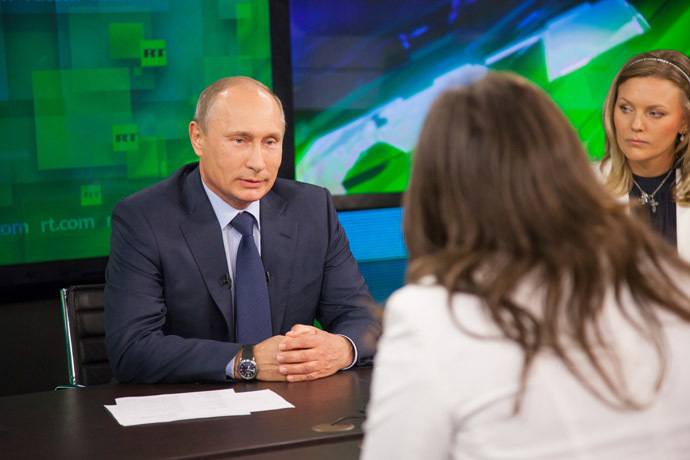
RT photo / Semyon Khorunzhy

RT photo / Semyon Khorunzhy

I’d like to emphasize something of the key importance. We never expected this to be a news agency or a channel which would defend the position of the Russian political line. We wanted to bring an absolutely independent news channel to the news arena.

Certainly the channel is funded by the government, so it cannot help but reflect the Russian government’s official position on the events in our country and in the rest of the world one way or another. But I’d like to underline again that we never intended this channel, RT, as any kind of apologetics for the Russian political line, whether domestic or foreign.

Margarita Simonyan: One issue that at least our viewers are generally excited about today is the Snowden case. A man who is now being dubbed ‘a second Assange’ has exposed total surveillance practices employed by the American government. There are two sides to this story: on the one hand, that was classified information, which makes this man a traitor. But on the other hand, the information he has leaked is of crucial importance, primarily for the American public, and for the world in general. What do you think of that?

Vladimir Putin: He told us nothing we didn’t know before. I think everybody has long been aware that signals intelligence is about surveillance of individuals and organizations. It is becoming a global phenomenon in the context of combatting international terrorism, and such methods are generally practicable. The question is how well those security agencies are controlled by the public. I can tell you that, at least in Russia, you cannot just go and tap into someone’s phone conversation without a warrant issued by court. That’s more or less the way a civilized society should go about fighting terrorism with modern-day technology. As long as it is exercised within the boundaries of the law that regulates intelligence activities, it’s alright. But if it’s unlawful, then it’s bad.

Margarita Simonyan: Mr. Obama said, rather gaudily, that you cannot have hundred-percent security while maintaining hundred-percent privacy…

Vladimir Putin: Yes you can. I’d like to reiterate: you do have to obtain a warrant for specific policing activities domestically, so why shouldn’t this requirement be valid for intelligence agencies as well? It can, and it should.

Margarita Simonyan: As you probably know, it isn’t Snowden, or Syria, or Turkey that’s been top news in Russia this week. It’s your divorce everybody has been talking about. Both yourself and Ms. Lyudmila Putina explained it at length when you spoke to the press after a ballet performance, but a few questions still remain. I wonder about the religious aspects of your divorce, and this is something many people are questioning at the moment.

Vladimir Putin: First of all, I can tell you that Lyudmila and myself agree that it’s much more appropriate to be outspoken about our actual state of relations rather than try to keep it secret.

RT photo / Semyon Khorunzhy

RT photo / Semyon Khorunzhy

Margarita Simonyan: That’s what they say in the press, too, regardless of political affiliation.

Vladimir Putin: Well, thanks for that much. As for the religious aspect of our marriage, there is none, because we never wed in church.

Margarita Simonyan: You didn’t wed?

Vladimir Putin:  No.

Margarita Simonyan: Thank you. The next question will be from Maria Finoshina, who’s sitting right next to you. She is a war correspondent on RT English. She has spent 56 days in a row in war-time Syria recently, isn’t that right?

Maria Finoshina: Almost. It was 54 days.

Margarita Simonyan: She went on air every day without fail.

Vladimir Putin: As RT’s CEO, you should know that this isn’t right.

Maria Finoshina: It was my own initiative, Mr President.

Vladimir Putin:  No, I’m serious here. Some friends of mine, including your colleagues from European countries, professionals who dedicated their life to journalism, believe that. One of them told me that you cannot keep a reporter in a warzone for that long. The reason for that is because people…

Maria Finoshina: Start to lose touch with reality.

Vladimir Putin: Exactly, lose touch with reality and lose the sense of danger.

Maria Finoshina: That’s very true.

Vladimir Putin: You have to pull reporters out.

RT photo / Semyon Khorunzhy

RT photo / Semyon Khorunzhy

Margarita Simonyan: I’ve called you so many times and told you to come back! Honestly.

Maria Finoshina: But I’ve already lost my sense of danger…

Margarita Simonyan: I started calling her on day 20, telling her, “Masha, how are you doing over there? Get back!”, but she said no, she had more stories to shoot.

Vladimir Putin: This is very risky, it’s no joke.

Margarita Simonyan: Of course. Most of us have been to hot spots at some point, and it’s very dangerous. Maria, the floor is yours.

Maria Finoshina: Thank you very much, Margarita. Hello, Mr Putin, we are very happy to see you here, in our new home. Something seemed to be missing here at first, but now it’s become much cozier.

I was introduced as a war correspondent. Some people believe that all correspondents are, in a way, invisible soldiers, so to say. Over the last two years we had to work in warzones, where the war was very real. I’ve spent a lot of time in Syria — 54 days just recently — we travelled across the country, visited practically every town and village. We also went to neighbouring countries, which in majority of cases did not support al-Assad’s regime. The thing that struck me most was that over time more and more people were becoming involved in the conflict. We’ve talked to a huge number of completely different people. Now, two years later, there is no single person standing on the sidelines. One way or another, the conflict affected everyone. The people we talked to were very different, I mean, we talked to, for example, widows of military officers of the Syrian Army and their children, who would maybe prefer not to be involved, but it’s impossible. Their fathers have been killed, and they must seek revenge. Perhaps they don’t want to, but they must — it’s a matter of honour. We also talked to rebels, both Syrian and non-Syrian, who were living in Syria and other places, for example, in Europe, Turkey, and Jordan. They were in very high spirits at first, very optimistic, but then they started complaining that the West had forgotten and betrayed them. They wanted more money and more weapons. As you’ve highlighted yourself, Bashar al-Assad is no angel, and we met with people who openly hated him. I remember seeing this old man in a hotel in Damascus where the UN observers were staying. He was a shoe polisher, and he kept doing his job, mechanically going through the familiar motions, and the only thing he was thinking about is when the happy news that Bashar al-Assad is gone — either dead or no longer president — would reach it. He has been hating al-Assad vigorously ever since 1982, for what his father did to the city of Hama.

In Lebanon we managed to contact arms dealers who ship weaponry into Syria. They told us that they didn’t care in the slightest who got those guns and who got killed as a result. They said, “We are businessmen, we care only about money”. We talked to young boys, about 11-12 years old, who were given these guns — maybe they even came from Lebanon — put in front of cameras in their scarves and made to read aloud the words that someone else wrote. Nasty business. Well, you know, children are being used in this conflict.

RT photo / Semyon Khorunzhy

RT photo / Semyon Khorunzhy

We have seen so much, and during our time there we became part of it. The horrifying part is that it doesn’t matter where any of these people were in March 2011, when it all began. Now it feels like they’ve crossed a critical line of sorts, losing hope and faith — in themselves and other people, perhaps even humankind as a whole, in kindness and justice. And they’ve become angry, really angry at everyone. So, coming to my question — there are people who are really angry at Russia. Some people feel that way because they think Russia is doing nothing in order to stop the bloodshed. Others are angry at Russia for supporting al-Assad and supplying weapons. And everyone’s expecting something from Russia, hoping for something. And it’s not limited to the Syrian conflict, it happens every time — in Serbia, in Kosovo; everyone’s asking where Russia is. The same is true for Iran, where we’ve been just recently, and even in Mali they ask about Russia. So, as the president of this country, I would like to ask you a question on behalf of these people.

Vladimir Putin: You mean me as the president or you as the president?

Maria Finoshina:  No, no (laughter). I meant to say I wanted to ask you, as the president.

Vladimir Putin: Who are these people? (laughter)

Maria Finoshina: What should I tell these people?

Vladimir Putin: That was such a long question, so I’ll try to be concise. First of all, you mentioned I once said that Bashar al-Assad was no angel. I said no such thing, as I try to be very careful about the way I put things. What I did say, however, is that the country was obviously ripe for some kind of change, drastic change. The country’s leadership should have realised this and started implementing the necessary reforms. It’s obvious that had they done that, what we see now in Syria wouldn’t have happened. That was my first point. Secondly, I said that we’re not advocates of the current Syrian government or the country’s current president, Bashar al-Assad. And one more thing — what we wouldn’t want to do is get involved in the conflict among various denominations of Islam, between Sunni and Shia. This is their internal issue. We have very good relations with the Arab world, and we have good relations with Iran and other countries.

So I will tell you what we are concerned about and why we assumed our current stance. Look at the region as a whole. There’s still unrest in Egypt. There’s no stability in Iraq, and there’s no certainty that it will stay united within its current borders in the future. There’s no stability in Yemen, and Tunisia is far from peaceful. Libya is suffering from clashes between various ethnic and tribal groups. So the region as a whole finds itself in a state of, at the very least, uncertainty and conflicts. And now Syria joined the rest.

In my opinion, this is happening because some people from the outside believe that if the region were to be brought in compliance with a certain idea — an idea that some calls democracy — then peace and stability would ensue. That’s not how it works. You can’t ignore this region’s history, traditions and religious beliefs, and you can’t just interfere. Look at what happened in Libya. Whether the regime was good or bad, the living standards in the country were the highest in the region. And what do we have now? There’s fighting over resources, incessant clashes between tribes, and no one knows where that might lead.

We are very concerned that if we try the same thing with Syria, the result will be similar. Is the pocket of uncertainty between Afghanistan and Pakistan not enough? No one is controlling that territory, except militants who set up their bases there. Is that what we want? It’s very close to our borders. So this is our primary concern.

Secondly, we are concerned over the future of all ethnic and religious groups living in Syria. We want this country to have lasting peace and security, with the people’s interests and rights guaranteed. So we believe that first of all the Syrian people are to be given an opportunity to decide how their state should be organized, how their lawful rights, interests and security should be ensured. When there is consensus on these issues, systemic change should take place, not vice versa, when you eliminate some forces and try to establish order, and chaos engulfs the country instead.

There’s a question our Western counterparts fail to answer. One of the main armed opposition groups — specialists in Arab countries will correct me if I’m wrong — is called the Al-Nusra Front. The US State Department dubbed it a terrorist organization connected with Al-Qaeda. The Al-Nusra itself doesn’t make a secret out of it. So these are the people what will make up Syria’s future government? Our Western counterparts say that it will not happen. “How will you get rid of them, then? Chase them away like flies?” I ask. “No,” they say. So what is going to happen? They say they don’t know.
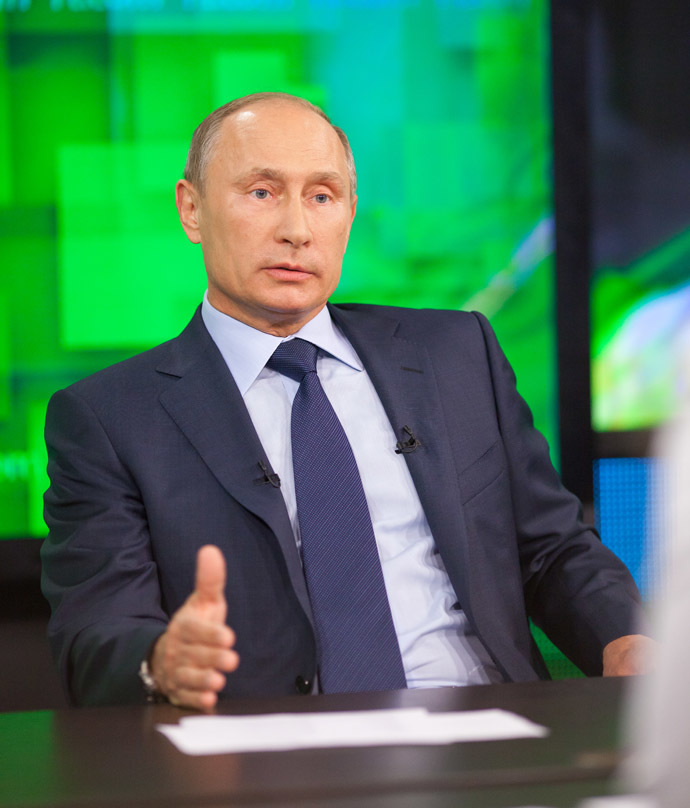
RT photo / Semyon Khorunzhy

RT photo / Semyon Khorunzhy

This is no joke, though, this is very serious. I’ll give you another example. On the one hand, some Western countries support some organizations that are at war with Bashar al-Assad’s regime in Syria, but these same Western countries fight these same organisations in Mali. They’re not even the same organisations — they are the same people. Some have left Syria and come to Mali. The West is fighting them in Mali, but once they cross the border into Syria, they get support from the West. What is the logic in all of this? Where will it take us? You need to understand, this is not just rhetoric.

I very much hope that the current initiatives, such as the one put forward by the Egyptian president — we have recently met in Sochi, and he proposed the countries of the region take a more active part in resolving the conflict — and by the British Prime Minister, who believes the permanent members of the UN Security Council need to be more involved, and the joint initiative of Russia and the United States, that the Russian Foreign Ministry and the US State Department have been working on together, I hope that this will enable us to resolve the Syrian conflict.

Margarita Simonyan: Irina Galushko is a correspondent of RT English, too. She has travelled a lot, and became one of the first in Japan to cover the Fukushima disaster.

Irina Galushko: My question will not be dealing with Fukushima. Recently we have spent a lot of time in Europe, covering all kinds of demonstrations. There are a lot of protests in Europe, and we can say that there are mostly young people on the streets. They take part in demonstrations because they have nothing to do — the have got an education or they are still students, but they can’t find a job. They don’t have any prospects for the future at all, let alone a promising one. So of course they are dissatisfied — they take to the streets and voice their protest against what is going on in their countries. Meanwhile the governments of those European states believe that the only solution is austerity measures — they tighten the screws, especially in terms of the social obligations. They tell those young people to wait for some ten or fifteen years, promising that maybe after that period the situation will probably get better. Do you think this the right approach? If no — then, does Russia have a recipe how to deal with this?

Vladimir Putin: It is a correct approach for them.

Irina Galushko: And what about Russia?

Vladimir Putin: It is incorrect for us — we have got different economies. Russia is a developing economy and a developing market, while Europe mostly consists of well-developed, advanced economies, the state of which is different in each country. The Russian economy is rather healthy, and, I must say, it is unburdened by an external debt the way it is in Europe or the USA.

The average national debt across Europe is about 90 per cent, and the USA is well over 100 per cent. They have a high unemployment rate. All of the budgets are deficit-ridden. So not only do they have a huge national debt, but also a massive budget deficit. Russia’s external debt is 2.5 per cent, our overall debt is 10 per cent. Russia is deficit free, our unemployment rate is 5.6 per cent, whereas in some European countries it reaches 25-26 per cent, and among young people it is up to 40 or sometimes even 60 per cent. It is a disaster. So we are in different situations. Obviously, Russia can use the so-called oil-money and rely on oil and gas exports. But I’d like to note that we don’t use monetary mission — we don’t print more money in reserve currencies the way they do in the Western countries. So it’s not just about Russia having oil and gas reserves, but it’s rather about Russia restricting its spending. The Central Bank of Russia is often criticized for high interest rates — I guess it is about 8 or 8.5 per cent at the moment, or maybe 8.25 per cent. It doesn’t matter — it is still high, while in the USA, for instance, it is 0.25 per cent, if I’m not mistaken. Europe has similar rates, too. Some say Russia should have the same numbers as well, but the Central Bank is keeping its rates this high in order to avoid financial bubbles. Of course, we could provide cheap loans, low-interest credits, which would be used by manufacturers to produce some goods that would not be much in demand later on. So you have a bubble that is about to erupt. The highest performance is finding balance between having a more liberal monetary policy and toughening spending cuts, in a way that would ensure maximum growth. I don’t think we are there yet. I believe we are not that efficient in everything we do as a government. I do hope that following our repeated meetings Russian government will make an effort and come up with some additional proposals to stimulate the economic growth and business activity in Russia.

Speaking of which, one of such measures is something we use constantly, for which we get criticized by our counterparts — liberal economists: that is active support of growth in real income of the population. Last year it was about 4.5-4.6 per cent, and beginning February through April this year it has gone up to over 5 per cent. That is the growth of actual income of the population, which implies an increase in domestic demand. So the conditions we find ourselves in are different. Generally, I do share the viewpoint of some of our European colleagues who suggest we should consolidate budgets and bring discipline to the economy to get out of the crisis. Still, everything has its boundaries, and we can’t shift the entire burden to the shoulders of the population.

RT photo / Semyon Khorunzhy

RT photo / Semyon Khorunzhy

Margarita Simonyan: Daniel Bushell, the presenter of one of our shows in English. Western media such as Foreign Policy and New Statesman often comment that he is too critical of the mainstream view on the world. I think it’s really so. Daniel, the floor is yours.

Daniel Bushell: Mr. Putin, I’d like to hear your opinion on multiculturalism. Not long ago, the leaders of the European Union admitted reluctantly that their experiment with multiculturalism failed. When I lived and studied in England, and then worked in France and Belgium as an RT reporter it was evident that the local residents and immigrants had little in common. Over the last years Russia’s been facing the same issue of mass immigration. I’d like to ask, how can Russia avoid the same mistakes that the EU has made in the issue of immigration?

Vladimir Putin: We have different starting positions with the West. In the Western Europe and, by the way, partially in the United States all these migration problems are, in my view, more severe; they are more explicit and more dangerous. As we know, Western Europe and the United States have to deal with people who come from different countries and who find it difficult to assimilate in their new homeland. They fail to learn the local language, they fail to speak it, and they fail to find their way in the labour market.

One of my Western European counterparts once told me that immigrants from, say, North Africa would live in a new country for ten years and still fail to speak the local language. In that instance he was referring to Spanish. And what about Russian immigrants? I guess they’re doing better now, but those who immigrated to the United States back in 1980s and 1990s… Someone I know once was visiting an area where Russian immigrants have been settling…

Comment: Brighton Beach.

Vladimir Putin: Exactly. So there was an old lady who’s lived there for 15 years, and didn’t speak English. She was telling her guests that tomorrow she would go shopping in New York. She didn’t even realize she was living in New York.

So it is a general problem which is related primarily to the economy and to the need to attract a cheap labour force. Actually the same thing is happening in Russia. But in our country, despite how acute this problem is, it’s still not as severe and dangerous as it is in Europe and in the States. Why?

If we speak about immigrants, i.e. citizens of other countries in Russia, most migrants come here from different parts of the former Soviet Union. This new generation might not be speaking good Russian but their families do one way or another. We still do share a common mentality, a common historic memory. Some of them or perhaps their relatives may have lived in the regions of Russia. These factors make it much easier for these people to integrate in the lives of those ethnic groups where they are resettling for permanent residence.

Nonetheless, even in Russia we should make more efforts in preparing those people who are willing to come and live to Russia. As we’ve said, we should set up Russian language and history classes in those former republics, in those new states — so far we haven’t done a very good job at it. This way we would help people understand each other better from the start.

And of course we need to educate our citizens or those aspiring to become Russian citizens in a sense of responsibility. We have to help them realize that they are in a different country now and so they have to observe our traditions and our laws; they have to respect our culture and our history.

This is an entire separate field of work. It used to be ignored in the past but now we need to pay attention to this matter, and we need to contribute more centralized efforts to it.

As for the domestic migration, it also is a complicated issue. Back in the Soviet Union, there used to be a domicile registration (propiska). Those who violated it were thrown in jail or banished beyond 101 km from large urban centers.

RIA Novosti / Sergey Guneev

RIA Novosti / Sergey Guneev

This situation is much more complicated now. The Russian Constitution delegitimizes propiska, so we need more modern mechanisms to regulate this matter. But let me repeat that we do have an advantage in our country that we are a multiethnic people, and we are an integrated civilization as a whole.   

Margarita Simonyan: Speaking of immigrants… We have an immigrant in our midst — Jelena Milincic. She works on RT Spanish, but she is actually from Serbia.

Jelena Milincic: Yes, I am from Serbia, and I have lived in Russia for 11 years. I can say that Russia has become my second home, but I still don’t have Russian citizenship. And if I file for citizenship now, the process will take at least 5 or 6 years.

But in order to do that, I need to own an apartment, for example. In order to get an apartment, I have to take out mortgage, but I have to be a Russian citizen for that. It is a vicious cycle. So seems that in the West, where this is a more serious issue, like you said…

Vladimir Putin: It’s easier to get citizenship, than in Russia

Jelena Milincic:  That’s why it’s a more serious issue, because it’s easier to get citizenship. Will anything change in Russia in this respect?

Vladimir Putin: We have to be very careful here, making sure we protect the interests of the majority. Our country is Russia, and 85% of our citizens consider themselves Russians. Other people groups living on our territories are closer to us than those living outside Russia. These are our indigenous people. And there are over 120 ethnicities indigenous to Russia. You’ve lived here for 11 years? But it takes 5-6 years to get citizenship you said. You should’ve filed already.

Jelena Milincic: I have to have residence registration for that.

Vladimir Putin: You could’ve bought some basic housing…

Jelena Milincic: But how can I take out mortgage?

Vladimir Putin: I think if you really wanted to become a citizen, you could’ve bought a room in an apartment outside Moscow, just to meet necessary requirements to file for citizenship and observe the formalities.

Jelena Milincic: Isn’t the fact that I have’s lived and worked here for 11 years enough?

Vladimir Putin: It is. I think you are right. We do have to adjust our immigration policies in some cases.
We have to welcome professionals like you. You are a young and beautiful woman. I am sorry, but it is true that you are a woman of childbearing age. Your boss here sets a good example, by the way… Some countries, Canada, for example, have special programs to attract certain categories of people from other countries. Unfortunately, our system is very outdated in this respect. There have been some developments in this area. There are initiatives to make the citizenship procedure easier for certain categories of people from the former Soviet Union. But as a whole, our immigration policy lacks flexibility. It has to protect interests of Russian citizens, but it also needs to allow for an inflow of specialists that our country needs. So you are absolutely right, and like I said, the government is working on that.

Margarita Simonyan (L) and Sophie Shevardnadze (RT photo / Semyon Khorunzhy)

Margarita Simonyan (L) and Sophie Shevardnadze (RT photo / Semyon Khorunzhy)

Margarita Simonyan: Sophie Shevardnadze, presenter and show host on RT English, has Russian citizenship. Authorities were more flexible in her case.

Sophie Shevardnadze:
It didn’t happen right away though.

Margarita Simonyan: Yes, she had to jump through hoops first. Sophie, our presenter and show host.

Sophie Shevardnadze: I have lived here for 8 years. Mr. Putin, I work in Moscow, but I was born in Tbilisi and grew up in Georgia. I wouldn’t be honest if I said that I wasn’t concerned about the relations between Russia and Georgia. This is something that I care about on a deep personal level.

Do you think there is a chance that these relations will return to normal in the near future? As we know, Georgian athletes will come to the Sochi Olympics, and Tbilisi is even ready to help with security issues during the Olympics.

Vladimir Putin:  I have talked about this on many occasions, voicing Russia’s opinion. I think that President Saakashvili made a big mistake. We have discussed it with him several times, so I don’t think he would deny this. I used to tell him, “Mr. Saakashvilli, whatever you do, please make sure there is no bloodshed.” To which he would always respond, “Of course not! We will be patient and try to work things out with Abkhazia and South Ossetia.” Unfortunately, it all ended up in a war.

Many of your colleagues, especially in Europe, the US, and Georgia itself, often blame Russia. But I think any unbiased observer would agree that Russia had nothing to do with this. This ethnic conflict has been going on for decades or even centuries. And people in Georgia are well aware of this. They know about what happened in 1919, in 1921. They know about relationships between people groups.

They had to have patience and political wisdom if they wanted to build relations with South Ossetia and Abkhazia as part of one state. Unfortunately, they failed. Russia reacted to what was going on at the time, and eventually this response led us to recognizing independence of South Ossetia and Abkhazia. I can’t imagine how this could be reversed, it’s simply impossible.

But this is also the red line that Georgia cannot cross. Because for Tbilisi this is a strife to restore its territorial integrity. This is a complicated issue that has to be dealt with very carefully. And it requires not just a competent solution, but there must be a will to solve this issue on the basis of respect towards interests of all people who live on those territories.

Here is what I think. If interests of all people living on those territories are considered and respected, and this respect becomes a basis for solutions, this might become a long-term fix. But it can only be done by people living there, no decision should be imposed from the outside.

As for the new government of Georgia deciding to participate in the Olympics and make other reconciliation steps, it’s not lost on us. We appreciate those steps and respond in the same manner, as you have probably noticed.

Sophie Shevardnadze: Would you be willing to accept the help they offer? I mean security assistance…

Vladimir Putin: Of course, we are ready to work with Georgia. We want to restore relations with Georgia, we like Georgia. We have close ties with Georgians. You live here, you have Russian citizenship. And how many Georgians live in Russia? We are proud of their contribution, we see them as our own people.

Margarita Simonyan: Many.

Vladimir Putin: I won’t go back as far as the War of 1812, we all know which war general I am talking about. Georgians did great things for Russia back then, during the Soviet period, and they are still doing them now… So we are very close culturally and otherwise. Not to mention the religious aspect. I have met with the Catholics…

Sophie Shevardnadze: Ilia II.

Vladimir Putin: Yes, he is a very kind person and a true Georgian. The whole time he kept talking about the interests of Georgians. But there was so much wisdom in what he had to say, and his tone was very gentle and calm.

As you know, we have decided to allow Georgian products back on the Russian market. We understand that this may not be the key issue, but it is still a very important step that will help Georgia’s economy. We will continue developing our relations, but the most important and complicated issues have to be solved by people living there through a dialogue and without any external pressure.

Sophie Shevardnadze: Can I ask a simpler question? It’s about visas. A couple of years ago I asked Dmitry Medvedev this same question. And he basically said that while Saakashvili was in office, there was not going to be any progress in this area.

What needs to happen, so that my relatives, my close ones can freely visit me in Moscow, just like my Russian friends go to Georgia without any visas?

RT photo / Semyon Khorunzhy

RT photo / Semyon Khorunzhy

Vladimir Putin: If we work together fighting crime and terror, it will become possible. I don’t think I will reveal a big secret by saying that terrorists often get to Russia’s Caucasus region from Georgia.

When 6-7 years ago we had to attack Georgian territories, those were not just strikes on Georgia, we targeted militant groups that came very close to Sochi — they were only 30 km away. Do you realize how serious the situation was?

Margarita Simonyan: You mean the Kodori Gorge?

Vladimir Putin: No, the Kodori Gorge was a different situation. In any case, Georgian police vehicles were transporting the militants to the Russian border. So we had to take some pre-emptive measures. And I informed the president about this. We don’t want to see this ever happen again. We want to work with Georgia, want to restore relations. Again, if we begin to work with law enforcement and security agencies, this would be the first step towards cancelling visas.

Margarita Simonyan: Thank you. Salam Adil is Deputy Editor-in-Chief with RT Arabic. Salam, you have the microphone.

Salam Adil: Thank you, Margarita. Actually, I have only occupied my present position for a week. Before that, I spent twenty years working as a reporter. I’ve travelled practically all over the world, including many conflict areas. I haven’t lost my sense of danger in the process, and that’s why I’m still alive.

Vladimir Putin: Thank God.

Salam Adil: Yes, thank God.

Vladimir Putin: God bless you.

Salam Adil: Thank you very much. And my question concerns conflicts, too. I mean to ask you about drones.

Margarita Simonyan: Unmanned aerial vehicles.

Salam Adil: As you know, America employs drones to deliver airstrikes, almost on a daily basis. This happens especially often in Pakistan and a few other countries — you have already mentioned the explosive situation we are seeing at the border between Pakistan and Afghanistan. Drones are arguably a very convenient means of warfare: there is no direct engagement, and no risk for your rank and file. It’s all remote controlled, like a computer game. However, and this is something we see in the news almost every day, this kind of warfare is fraught with massive casualties among civilians. So, on the one hand, drones are efficient in combat, but on the other hand, we are all aware of collateral damage. The public in many countries have found this shocking, and there has already been a motion for imposing an international ban on using drones. I would like to ask you about Russia’s attitude on this issue. Thank you.

Vladimir Putin: Gunpowder was originally invented in China, and no one has managed to keep it from spreading ever since. Then came nuclear arms, and they also started to spread. Modern means of warfare keep evolving, and they always will. I doubt if it’s possible to simply ban it all. But you certainly can — and should — introduce certain rules and exercise control. I’m sure the United States does not target civilians on purpose. And the drone operators you’ve mentioned are people, too, and I think they understand all those things. But you still need to combat terrorism. I know they are currently debating this issue in the United States, and a notion is being advocated increasingly often within the UN framework that you need to put drones under control, you need to lay out certain rules of engagement in order to prevent or minimize collateral casualties. It is extremely important. I don’t know whether our [Western] counterparts will choose this option, but I would suggest it would be in their best interest. However, there are other threats, too. For example, they are presently debating the option of using non-nuclear ballistic missiles in the United States. Can you imagine how potentially dangerous that is? What if such a missile were to launch from somewhere in the middle of an ocean, and get spotted by a nuclear power’s early warning system? How should that nuclear power react to a missile coming its way? How are they supposed to know whether that missile comes with a nuclear warhead or not? What if the missile impacts right next to its border, or inside its territory? Do you realize how perilous that can be? Or take the notion of low-yield nuclear weapons — do you realize how badly it can blur the very notion of using nuclear arms, or how low it might bring down the threshold for authorizing such a strike? Can you imagine the possible implications? Where are the limits for lowering that threshold, and who is setting them? There are many threats in the world of today, and there is only one way to address them efficiently: that is, working together within the boundaries of international law.

RT photo / Semyon Khorunzhy

RT photo / Semyon Khorunzhy

Margarita Simonyan: And now I would like to give the floor to Peter Lavelle, who is the presenter of one of our most popular shows CrossTalk. Peter has worked with RT since its very beginning. He will be speaking in English and I will translate the question for you.

Peter Lavelle: Thank you.

Margarita Simonyan: Shall I translate it for you?

Vladimir Putin: No. Well, every opposition can prove useful. You just mentioned Occupy Wall Street. At a certain point we saw the police cracking down on the Occupy Wall Street activists. I won’t call the actions of police appropriate or inappropriate. My point is that every opposition movement is good and useful if they act within law. If they don’t like the law, they should use democratic ways to change those laws. They should win voters on their side, they should get elected into legislatures so that they have a chance to influence the laws. This is the way to change things on the ground. If there are people who act outside the law, then the state must use legal means to impose law in the interests of majority. That’s the way it’s done in the US, and that’s the way it’s done in Russia.

Truth be told, we are grilled for that, but when the same thing happens in the US, it is considered to be normal. Never mind, these are double standards and we have got accustomed and pay little attention to it.

Margarita Simonyan: When it happens in the US, RT grills America.

Vladimir Putin: Way to go! Everyone must be treated in the same fashion. Because these situations are identical. The only difference is that our diplomatic missions don’t actively cooperate with

Occupy Wall Street, and your diplomatic mission works together and directly supports Russian opposition. I think this is wrong because diplomatic missions must forge ties between states and not meddle with their domestic politics.

Getting back to popular movements. Reckless behavior is not appreciated by people. If these activists are breaking the law, then it’s illegal. If they express their will by legal means, without breaking the law then they are fully entitled to do that. Then it would be beneficial to any state because it’s a way to provide grassroots feedback on state policies — social, domestic or foreign ones.

As for Mr Kudrin, he is my long-standing associate. We see eye-to-eye on many vital issues of Russia’s development. But that’s for an obvious reason — we’ve known each other for a long time now. We worked together back in St. Petersburg, and then he became a member of the cabinet and proved to be one of the most efficient ministers. I have always backed him on key decisions. If I didn’t he wouldn’t have been able to work, to implement those ideas and principles that he promoted. So to a certain extent that was our joint policy. He has his own view on certain things. It so happened that they had a disagreement with Mr Medvedev on a number of issues and since Mr Medvedev was president, he had the right to take the decision that he eventually took.

Today Alexey Kudrin says that he is ready to re-join the executive branch if the authorities were more decisive. But he is quite reluctant to specify what he means by being more decisive when I ask him to. Why? Because ‘more decisive’ means ‘taking tougher steps’, for example, in terms of the pension reform, in terms of raising the retirement age. No-one, including the opposition, wants to speak about to the public. They think it’s the right way but they don’t want to talk loudly about the issue.

Also, taking tougher steps on other issues, like slashing budget expenditures, and social spending, first of all. Many of our liberal economists think that our social expenditures are too high, that we raise salaries and pensions and social benefits too fast. They point out that the growth in real disposable income is unjustified — last year we had a 4.2 percent increase, and it’s been up 5.9 percent during the four months of this year already. They argue that salaries are growing faster that labour efficiency, which is bad and dangerous for the economy. There’s no denying it, and they are absolutely right. But maybe it’s best not to decrease real disposable incomes but rather to improve our labour efficiency? Russians often say that the goal is not to expand the amount of the wealthy people but rather to reduce the amount of the poor. That’s a very hard thing, but the best part of the opposition has admitted that in private and professional meetings with us. But publicly they are afraid to speak about it. And this is wrong. I have told them many times now. If you stick to some idea, you have to be straightforward about it. Don’t be afraid that some part of the nation won’t like it. If we are to rally a bigger support for your ideas, you have to stick to your principles to expand your electoral base. Look at today’s Western Europe. They brought their countries on the precipice of bankruptcy, but whenever they talk of lower salaries, people are up in arms. So it would have made more sense to increase your social spending and debt more gradually. Also, it would have been great for the authorities if there had been someone who could have told them about it. I don’t think our social spending is too high, I don’t think that we increase pensions, salaries and social benefits too much. But generally, Mr Kudrin and the likes of him have a point to make, and we need to listen to them. It’s a very useful thing. So I believe that an opposition that has national interest at heart will be in demand.

RT photo / Semyon Khorunzhy

RT photo / Semyon Khorunzhy

Margarita Simonyan: Next question is from Oksana Boyko, the presenter of our new show. She moved into presenting after several years of reporting for RT, she, too, went to many war zones.

Oksana Boyko: My question is a follow-up to your previous reply, concerning principles and a principled position. I would like, however, to apply these notions to the Iranian issue. Iran will be holding a presidential election soon. I know that Russia doesn’t like to meddle with domestic politics of other countries that’s why my question would be as general as possible. It’s more of a philosophical kind. To me, Iran is a great example of how you can create extreme tension in mutual relations by blowing out of proportion some insignificant differences. The Iranian nuclear issue that everyone’s been talking about for the last decade basically relies only on some vague suspicions which, year after year, have been dismissed even by Americans themselves. But that rhetoric has ignored the fact that Iran has been compliant with the nonproliferation regime by 99 or even 100 percent. The mainstream focus is on suspicions, but at the core, as I see it, is the relationship between the US and Iran. Tehran is partially to blame for the tension buildup, but the root of the problem is the stance of Washington, their signature foreign policy principle — friend and foe divide, meaning that if you are not their ally, you are their enemy. And it seems that the level of tolerance to dissent is quite low, and when it drops too much, we see threats of war based on groundless suspicions, as is the case with Iran, or assistance to war, as is the case with Syria.

Russia has a good record of avoiding tension in relations with other countries. Your public statements indicate that you know the cost of enmity or, rather, open confrontation. However, I believe that Russia and the US have ideological, fundamental differences, on the use of force in particular, that no private meetings can resolve. It all stems from the national idea of the US. They believe they have a higher responsibility, which is actually just a bigger right. So where is this line for you between avoiding an all-out confrontation that could have an impact on Russian security and maintaining our principled position, which could, too, be critical to our security?

Vladimir Putin: I didn’t quite get — was it a punch at the US or Iran?

Margarita Simonyan: She’s our tough guy.

Vladimir Putin: A response to your question could take hours. It’s so complex. I will try to be as concise as possible. First, I have repeatedly voiced Russia’s official stance — Iran has the right for a peaceful nuclear program and it cannot be singled out for discrimination. Second, we need to be aware that Iran is located in a very challenging region. I have told our Iranian partners about that. That’s why Iranian threats made towards neigbouring countries, in particular Israel, threats that Israel can be destroyed, are absolutely unacceptable. This is counterproductive.

Oksana Boyko:  This is not a proper quote of the Iranian president.

Vladimir Putin: It doesn’t quite matter whether it’s a proper quote or not. It means it’s best to avoid a wording that could be improperly quoted or could be interpreted differently. That’s why the focus on Iran does have a reason behind it. I have no doubts that Iran is compliant with the rules, simply because there is no proof of the opposite. According to the latest IAEA report, Iran has been abiding by the commitments it has taken up. True, there are some outstanding issues but with due patience and friendly attitudes, they can be resolved.

I have a great respect to Iran and a great interest in it. This is a great country indeed. You don’t often hear this attribute mentioned in relation to Iran but this is true. This is a country with a great culture, a great history and a great nation. They are very proud of their country, they have their own understanding of their place both in the region and in the world, and that’s something you have to respect. You have grasped the core of the problems. Iranians are very smart and cunning politicians. To a certain degree, they have exploited this confrontation with the United States.

RT photo / Semyon Khorunzhy

RT photo / Semyon Khorunzhy

Oksana Boyko: They are not the only ones. 

Vladimir Putin: They are extremely crafty in this, and they do it to tackle their domestic political issues. When there is an external enemy, it united the nation. But I guess the United States have been employing the same technique. After the collapse of the Soviet Union, there have been no external threats that would allow Washington to dominate in the West. There must be a threat so that the US can protect their allies from it. This position yields political and economic benefits. If everyone relies on one country for protection, then this country is entitled to some preferences. So it’s very important to possess this status of a global defender to be able to resolve issues even beyond the realm of foreign policy and security issues. I think the US has been using Iran for this very purpose, that is to unite their allies in the face of a real or fake threat.

It’s quite a complicated issue but it’s not an issue for Russia. We have been complying with our international commitments, including on Iran’s peaceful nuclear program. As you know, Russia built the Bushehr power plant in Iran, we have completed this project and are prepared for further cooperation. Yet when we proposed to enrich uranium on the Russian territory, our Iranian partners refused, for reasons unknown to us. They argue that they will enrich uranium on their own in line with existing international regulations. And, as I said earlier, if they don’t break any rules, they are fully entitled to do that. We will endorse this right but we will also remain aware of the concerns that other states and the international community has concerning full compliance with these rules.

Oksana Boyko: Can I clarify something? The thing is, I was asking you not only about the US-Iranian relations but also about the US-Russian relations. Would you agree that we have fundamental ideological differences on key issues of international law?

Vladimir Putin: So right on the eve of my meeting with Barack Obama, you are pushing me to make some serious statements…

Oksana Boyko: It is a very important issue. If the country thinks it has more rights that others…

Vladimir Putin: I thought you wouldn’t notice my deviation. But you did. Indeed, you are very persistent. To date, we don’t have any significant ideological differences. But we do have fundamental cultural differences. Individualism lies at the core of the American identity while Russia has been a country of collectivism. One student of Pushkin legacy has formulated this difference very aptly. Take Scarlett O’Hara from ‘Gone with the Wind’ for instance. She says ‘I’ll never be hungry again’. This is the most important thing for her. Russians have different, far loftier ambitions, more of a spiritual kind, it’s more about your relationship with God. We have different visions of life. That’s why it is very difficult to understand each other but it is still possible.

Oksana Boyko: That’s why there is international law to create a level playing field for everyone.

Vladimir Putin: The US is a democratic state, there’s no doubt about that, and it has originally developed as a democratic state. When the first settlers set their foot on this continent, life forced them to forge a relationship and maintain a dialogue with each other to survive. That’s why America was initially conceived as a fundamental democracy. With that in mind, we should not forget that America’s development began with a large-scale ethnic cleansing, unprecedented in human history. I wouldn’t like to delve so deeply into it, but you are forcing me to do it.

When Europeans arrived in America, that was the first thing they did. And you have to be honest about it. There are not so many stories like that in human history. Take the destruction of Carthage by the Roman Empire. The legend has it that Romans plowed over and sowed the city with salt so that nothing will ever grow there. Europeans didn’t use the salt because they used the land for agriculture but they wiped out the indigenous population. Then there was slavery, and that’s something that is deeply ingrained in America. In his memoirs, US Secretary of State Colin Powell revealed how hard it was for him as a black man to grow his way up, how hard it was to live with other people staring at you. It means this mentality has taken root in the hearts and minds of the people, and is likely to be still there.

Now take the Soviet Union. We know a lot about Stalin now. We know him as a dictator and a tyrant. But still I don’t think that in the spring of 1945 Stalin would have used a nuclear bomb against Germany, if he had had one. He could have done it in 1941 or 1942 when it was a matter of life or death. But I really doubt that he would have done it in 1945 when the enemy had almost given up and had absolutely no chance to reverse the trend. I don’t think he would. Now look at the US. They dropped the bomb on Japan, a country that was a non-nuclear state and was very close to defeat.
So there are big differences between us. But it’s quite natural that people with such differences are determined to finding ways to understand each other better. I don’t think there is an alternative. Moreover, it’s not by chance that Russia and the US forged an alliance in the most critical moments of modern history — that was the case in WW1 and WW2. Even if there was fierce confrontation, our countries united in the face of a common threat, which means there is something that unites us. There must be some fundamental interests that bring us together. That’s something we need to focus on first. We need to be aware of our differences but focus on a positive agenda that can improve our cooperation.

Margarita Simonyan: America and Russia’s relations with the US are important issues for our network, largely because Americans make up most of our audience. That explains why you wouldn’t get that many questions about America from any other channel, particularly any Russian channel. If you simply look at our website’s hit statistics, you’ll see that most of our audience comes from America, so anything related to the US is a key topic for us. And here is Anastasia Churkina, who has specially come over from New York for this meeting. She works at our US-based channel, RT America, which caters to an American audience and focuses specifically on American issues. Is that right, Anastasia?

RT photo / Semyon Khorunzhy

RT photo / Semyon Khorunzhy

Anastasia Churkina: Yes, thank you. I’ve lived in New York for the past five years. You have mentioned the fundamental differences as well as the common features that Russia shares with the United States. I would like to go back to our diplomatic relations and the present issues of international law. When I meet American politicians and Russia experts these days, I often hear them acknowledge off-record that the Magnitsky Act has effectively come to replace the Jackson-Vanik amendment, which demonstrates the same outdated approach towards Russia. As we know, when Barack Obama met with Mr. Medvedev during the summit in Seoul last year, he made some hints, saying he would have more flexibility after re-election…

Oksana Boyko: I see you guys just won’t get off their backs, will you?

Peter Lavelle: This always happens.

Anastasia Churkina: This is the last question, I promise. Obama hinted that it would be easier for him to cooperate with Russia. However, that is not what we are seeing today. We’ve already touched upon many of our remaining issues with the US. Why do you think the reset has not worked? And can it ever take place in the first place as an equal, reciprocal process? Or is it that Russia is always expected to sacrifice its national interest?

Vladimir Putin: Any state pursues its national interests, and the US is no exception. What’s unique here is that the collapse of the Soviet Union left America as the world’s single leader. But there was a catch associated with it in that it began to view itself as an empire. But an empire is not only about foreign policy, it’s also about domestic policies. An empire cannot afford to display weakness, and any attempt to strike an agreement on equitable terms is often seen domestically as weakness. But the leadership cannot afford to display weakness due to domestic policy considerations. I think that the current administration realizes that it cannot solve the world’s major issues on its own. But first, they still want to do it, and second, they can only take steps that are fit for an empire. Domestic policy considerations play a huge role. Otherwise you would be accused of weakness. In order to act otherwise you either have to win overwhelming support or there must be a chance in mentality, when people will understand that it’s much more beneficial to look for compromises that to impose your will on everyone. But it certainly takes time to change those patterns of thinking in any country, in this case it’s the US. First and foremost, this change should take place in the minds of the ruling elite in the broad sense of this phrase. I don’t think that it’s impossible. I this we’ve almost come to that point. I very much hope we will reach it soon.

Margarita Simonyan: Thank you very much, Mr. Putin. The issues we have just discussed are the headlines on our air. It is not a classic interview — we wanted to talk to you on those problems that we talk about daily to our audience. Those are very much different from what you can hear in the Russian media — since they have a different audience — and from the interpretation of the Western media as well. We are different — we have different values and views on both Russia’s domestic issues and the world’s system on the whole. But I think it would be right to say that we share one view: there shouldn’t be one leader in the world that is running the show, and it applies to the media, too. And when all the TV channels say with one accord that the main headline of the day is that a NATO drone is shot down in Libya — there should be some other channel that will tell the world about a NATO shell that on the same day killed a family of 13 people there. We actually had such a story, when our coverage was completely different from the coverage of our colleagues. We do that and we are happy to have this opportunity, as that is what we believe in, given all the differences. That’s exactly what we tried to show you today — how and where we do it. Thank you very much for paying a visit.

Vladimir Putin:Thank you for the invitation. I would like to wish you all the best of luck. Thank you very much. Goodbye.

This article originally appeared on: Global Research

Truthdigger of the Week: Daniel Ellsberg

0

http://www.truthdig.com/report/item/truthdigger_of_the_week_daniel_ellsberg_20130615/

Posted on Jun 15, 2013

This article originally appeared on: TruthDig

Walmart Accepted Clothing from Banned Bangladesh Factories

0

http://www.truthdig.com/report/item/walmart_accepted_clothing_from_banned_bangladesh_factories_20130616/

Posted on Jun 16, 2013

This article originally appeared on: TruthDig

Iran to hold 3rd Resistance Art Festival

0

Tehran to present third Intl. Resistance Art Festival

Iran is planning to hold the third edition of International Art Festival of Resistance in Tehran to host a number of Iranian and foreign pieces of art.

Many artists from France, Italy, Belgium, the Middle East, North Africa, and the United States will flock to the festival to introduce the concept of resistance to the world.

The festivalâ„¢s office has received over 1500 entries, mainly including cartoon, painting and poster, from more than 70 countries so far, secretary of the festival Mohammad Habibi announced.

The event will present artworks in the categories of painting, poster, photography, cartoon, sculpture, illustration, animation, drawing and conceptual arts.

Several workshops in various categories are also programmed to be held at the event.

The main goal of this festival is to disseminate the culture of resistance and values of Islamic revolution and holly defense through reviewing the creations of many artists from Iran and across the world, according to the festivalâ„¢s website.

The Visual Arts Association of Islamic Revolution and Holly Defense in collaboration with Ravayat Cultural Foundation organize the event.

The third edition of the International Resistance Arts Festival is scheduled to be held at the Saba Art and Cultural Institute in autumn.

FGP/FGP

This article originally appeared on: Press TV

NSA Letter to Congress Leaves Questions Unanswered

1

In a letter sent to Congress on Saturday the US Intelligence Community officially confirmed the existence of the two far-reaching surveillance programs revealed to the public this month by NSA whistleblower Edward Snowden.

(AP)
Following a series of Senate and House hearings on the issue–some of them behind closed doors–the US intelligence community penned what the Guardian called the “fullest official account yet of how the US gathers domestic telephone data and overseas internet traffic.”

The letter claims that NSA surveillance techniques are covered under the Congress-authorized section 215 of the Patriot Act and section 702 of the FISA Amendments Act, and that phone and internet communications are collected on the basis of “reasonable suspicion based on specific and articulated facts, that an identifier is associated with specific foreign terrorist organizations.”

The letter provides some new technical insights into the programs.

For instance, the letter states:

The [phone call] metadata is segregated and queries against the database are documented and audited. Only a small number of specifically-trained officials may access the data; the Foreign Intelligence Surveillance Court reviews the program every 90 days; and the data must be destroyed within five years.

However, as the Guardian reports, “the briefing document does not address concerns raised by a number of members of Congress as to whether further court approval is required to query the database for these specific records, simply saying officers require ‘reasonable suspicion based on specific and articulated facts, that an identifier is associated with specific foreign terrorist organizations’.”

In other words, it is still unclear whether specific acts of data monitoring actually require the secretive FISA court approvals, including database queries of Americans’ phone records and even call content, as Sen. Dianne Feinstein (D-Calif.) had alluded to earlier in the week.

In a separate instance on Saturday, Rep. Jerrold Nadler, a New York Democrat, who was present at a secret briefing given by intelligence chiefs, as the Guardian reports, “claims he was told that agents did not have to obtain extra approval to listen to the content of [phone] calls.”

Nadler said actual phone call content, not just its “metadata” could be accessed “simply based on an analyst deciding that.”

“I was rather startled,” Nadler told CNET.

As CNET reports:

Rep. Jerrold Nadler, a New York Democrat, disclosed this week that during a secret briefing to members of Congress, he was told that the contents of a phone call could be accessed “simply based on an analyst deciding that.”

If the NSA wants “to listen to the phone,” an analyst’s decision is sufficient, without any other legal authorization required, Nadler said he learned. “I was rather startled,” said Nadler, an attorney and congressman who serves on the House Judiciary committee.

Not only does this disclosure shed more light on how the NSA’s formidable eavesdropping apparatus works domestically, it also suggests the Justice Department has secretly interpreted federal surveillance law to permit thousands of low-ranking analysts to eavesdrop on phone calls.

Because the same legal standards that apply to phone calls also apply to e-mail messages, text messages, and instant messages, Nadler’s disclosure indicates the NSA analysts could also access the contents of Internet communications without going before a court and seeking approval.

Saturday’s letter, marketed as a tell-all revelation, seems mostly to repeat NSA director Keith Alexander’s claims that the NSA’s actions are justified predominantly through “checks” provided through the secretive FISA court system, one which has never actually at any point turned down a request to search or electronically spy on people within the United States, earlier reports have shown.

It similarly repeats Alexander’s claims that the program has successfully snared “potential terrorist plots in the US and more than 20 other countries”–which are claims that have left many, including senators Ron Wyden and Mark Udall, unswayed due to a continued lack of detailed evidence.

“No other new details about the plots or the countries involved were part of the newly declassified information released to Congress on Saturday and made public by the Senate Intelligence Committee,” the Associated Press reports.

_______________________

This work is licensed under a Creative Commons Attribution-Share Alike 3.0 License

This article originally appeared on: Common Dreams

‘Don’t be deluded’: Israeli PM flies in face of intl welcome for Iran's new dawn

0

Israel’s Prime Minister Benjamin Netanyahu urged the international community not to ease pressure on Iran in order to curb its nuclear program. This comes in contrast with the international welcome to the election of a new president, Hassan Rouhani.

“Let us not delude ourselves,” Netanyahu said in a
statement on Sunday. “The international community must not
become caught up in wishes and be tempted to relax the pressure
on Iran to stop its nuclear program.

“It must be remembered that the Iranian ruler, at the outset,
disqualified candidates who did not fit his extremist outlook and
from among those whose candidacies he allowed was elected the
candidate who was seen as less identified with the regime, who
still defines the State of Israel [in an address last year] as
‘the great Zionist Satan.’”

The Prime minister noted that it was Iran’s supreme leader
Ayatollah Ali Khamenei and not the president who laid out the
policy for the country’s nuclear program.

“The more the pressure on Iran increases, the greater the
chance of stopping the Iranian nuclear program, which remains the
greatest threat to world peace,”
he said.

Nevertheless, the international community has welcomed Iran’s
future head of state. Washington has already announced its
willingness to negotiate with Iran on its nuclear program, even
though previously along with Israel, it has refused to rule out
military strikes against Iranian nuclear sites.

Hassan Rohani (AFP Photo / Atta Kenare)

“It is our hope that the Iranian government will heed the will
of the Iranian people and make responsible choices that create a
better future for all Iranians,”
the White House said.

Britain and France welcomed the newly elected president in hope
of coming to a diplomatic solution concerning the nuclear
enrichment program as he is a former chief nuclear negotiator.

The EU has imposed restrictions on cooperation with Iran in
foreign trade, financial services, energy and other sectors after
Iran refused to suspend its enrichment program. The West, Israel
and several other countries fear Tehran is expanding its uranium
enrichment capabilities with the aim of developing nuclear arms,
an accusation Tehran continuously denies.

“Iran has an exclusively peaceful nuclear program,”
Rouhani said in an interview with the Arabic newspaper Asharq Al-
Awsat published on Thursday.

An Iranian woman holds a portrait of moderate presidential candidate Hassan Rouhani as she rides on a motorcycle along Valiasr street in Tehran on June 15, 2013 after he was elected as president (AFP Photo / Behrouz Mehri)

He added that the campaign against Iran “is being fueled and
directed first and foremost by Israel, in order to divert
international attention not only from its own clandestine and
dangerous nuclear weapons program but also from its destabilizing
and inhuman policies and practices in Palestine and the Middle
East.”

Iranian journalist Hamid Reza Emadi told RT that there is hope
that the new president might rebuild the Iranian
negotiating team to re-open talks with the West.

“A lot of people inside and outside Iran believe that tensions
will be eased and the situation will be calmer and Iran’s economy
will flourish,”
he said.

As the victory of the moderate cleric was confirmed, crowds
gathered on the streets of Tehran celebrating Rouhani’s victory.

However, the future head of state told the state news agency
IRNA, “the country’s problems won’t be solved overnight and
this needs to happen gradually and with consultation with
experts,”
adding that his “victory is a victory of wisdom,
a victory of moderation, a victory of growth and awareness and a
victory of commitment over extremism and ill-temper.”

This article originally appeared on: RT

AT&T to Load iPhones With Emergency Alerts From Obama — That You Can’t Switch Off

3

Jim Hoft
Gateway Pundit
June 16, 2013

Just in case you want more Obama in your life…
AT&T is loading iPhones with emergency alerts from Barack Obama…
That you can’t switch off.

Engadget reported:

AT&T has begun rolling out Wireless Emergency Alerts updates for iPhone 4S and 5, so you won’t be the last folks to know if the entire northern hemisphere is about to be covered in ice à la Day After Tomorrow.

You’ll receive a notification from the carrier when your update is ready, but only if you’re using iOS 6.1 or higher.

Once installed, AMBER and Emergency alerts are automatically sent to your phone unless you switch them off via Settings. However, should you be tired of Obama, just know that there’s no way to switch off Presidential alerts.

So now Barack can track your calls and send you messages, too.

The Two Centers of Unaccountable Power in America, and Their Consequences

0

http://www.truthdig.com/report/item/the_two_centers_of_unaccountable_power_in_america_and_their_consequences_20/

Posted on Jun 16, 2013

This article originally appeared on: TruthDig

Turkish police clash with protesters

0

Turkish police have used brutal force against anti-government protesters in Istanbul as the supporters of Prime Minister Recep Tayyip Erdogan gathered in the city.

On Sunday, Turkish riot police once again fired smoke canisters and used pepper spray and water cannons to disperse crowds of protesters trying to converge on Istanbul’s Taksim Square.

This comes while the protesters are preparing for more demonstrations as the supporters of Turkish Prime Minister Recep Tayyip Erdogan are gathering in Istanbul.

Erdogan once again addressed his supporters, a day after a similar rally was held in Ankara.

The Turkish premier said on Sunday in Istanbul that it was his “duty” to order riot police to evict protesters staying at Istanbul’s Gezi Park.

On Saturday night, Turkish police attacked anti-government protesters at Taksim, shortly after Erdogan ordered the demonstrators to evacuate the area.

Å“I say this very clearly: either Taksim Square is cleared, or if it isnâ„¢t cleared, then the security forces of this country will know how to clear it,” the Turkish prime minister said in a speech to his supporters in the Ankara suburb of Sincan.

A number of protesters were also reportedly arrested in the crackdown.

The unrest in Turkey erupted after police broke up a sit-in staged at Taksim Square on May 31 to protest against a government plan for the redevelopment of Gezi Park.

The Turkish prime minister has faced international condemnation for his handling of the crisis. Turkish police have also been strongly criticized for using excessive force against the peaceful protests.

Five people, including a police officer, have reportedly died in the clashes and more than 5,000 protesters and 600 police officers have been wounded.

SZH/PR/SS

This article originally appeared on: Press TV

Gunmen kill four Shias in Lebanon

0

Gunmen have killed at least four Shia Muslims in eastern Lebanonâ„¢s Bekaa valley near the border with Syria, Lebanese security sources say.

“Gunmen killed three members of the Jaafar family and a man from the Amhaz family as they were passing through the Qaa area of the Bekaa,” the unnamed security source said on Sunday.

According to the reports, a fifth man was also seriously injured in the attack.

Although the gunmen remain unidentified, foreign-backed so-called Free Syrian Army militants fighting the Syrian government of Bashar al-Assad have been infiltrating through the border with Syria firing rockets at residents of the heavily Shia populated region.

On Wednesday, the so-called Free Syrian Army (FSA) launched at least four rockets into Bekaa Valley.

Also, on June 5, the foreign-backed militants launched at least twelve Grad rockets on Baalbek, wounding at least one child.

The region is a stronghold of the Lebanese resistance movement, Hezbollah.

On June 15, Lebanese President Michel Sleiman called on the army to pursue the attackers responsible for firing a number of rockets at the border towns and villages of Bekaa Valley.

The Syria crisis began in mid-March 2011. Many people, including large numbers of security personnel, have been killed in the violence.

Several international human rights organizations say the foreign-sponsored militants have committed war crimes.

Damascus says the West and its regional allies including Qatar, Saudi Arabia, and Turkey are supporting the militants.

SZH/PR

This article originally appeared on: Press TV

Syria’s Assad congratulates Rohani

0

Syrian President Bashar al-Assad has congratulated Iranian president-elect, Hassan Rohani, for securing the highest number of votes in the countryâ„¢s 11th presidential election.

In his letter, the Syrian leader offered Å“heartfelt congratulations and best wishes” to Rohani on behalf of the Syrian nation for gaining Å“the trust of millions of the brotherly Iranian people,” Syriaâ„¢s official news agency, SANA, reported.

President Assad further underlined the Arab stateâ„¢s determination to boost bilateral ties and cooperation between the two countries.

He also stressed the need for Å“confronting the plots of hegemony and aggression against the national sovereignty in our region in a way that reflects positively on the peoples of both friendly countries as well as the peoples of the region and the whole world.”

Foreign-backed militancy in Syria, which broke out in March 2011, has claimed the lives of many people, including large numbers of Syrian soldiers.

The Islamic Republic has repeatedly voiced its opposition to any foreign interference in Syria’s internal affairs, calling for inclusive dialog and national reconciliation as well as free elections as keys to the settlement of the crisis in the country.

In a similar congratulatory note, Chairman of the Islamic Supreme Council of Iraq Ammar Hakim also felicitated Iranâ„¢s president-elect, expressing the need for the expansion of bilateral relations between Tehran and Baghdad.

Rohani won Iranâ„¢s June 14 presidential race, gaining 18,613,329 votes, or 50.7 percent of a total of 36,704,156 ballots.

Rohani currently represents Leader of the Islamic Revolution Ayatollah Seyyed Ali Khamenei in the countryâ„¢s Supreme National Security Council, is a member of the Expediency Council and the Assembly of Experts, and is also president of the Expediency Council’s Center for Strategic Research.

MKA/HGH/SS

This article originally appeared on: Press TV

Two health workers killed in NW Pakistan

0

A Pakistani health worker administers polio vaccine drops to a young child in the southern port city of Karachi on January 8, 2013.

At least two health workers have been killed and several others injured after an attack by heavily-armed gunmen against anti-polio workers in the troubled northwestern Pakistan.

The killings happed in the northwestern town of Gadoon, some 120 kilometers (75 miles) east of Peshawar where door-to-door vaccinations were taking place since Saturday.

“Gunmen on a motorcycle shot dead two health workers who were administering anti-polio drops to children in the area,” said a local police official.

Volunteer and social workers have transferred the injured to a nearby local hospital.

Local security officials say they have arrested at least four suspects in connection with the attack.

Several anti- polio workers have been killed in recent months across various regions of the violence-wracked country.

No group has claimed responsibility for the latest incident.

The developments come as Taliban militants in the tribal North Waziristan region ordered a ban on polio vaccination campaigning, saying it could be a cover-up for the US espionage in the country.

The Taliban further said they would not allow the vaccination campaign to be conducted as long as the US continues its killer drone attacks in their region.

Since 2009, there has been a surge in militant attacks in Pakistan and thousands of people have been killed and displaced by the wave of violence in the country.

Supported by the United Nations, nationwide polio campaign was launched in order to eradicate the highly infectious crippling disease in Pakistan.

However, following the latest spate of attacks the United Nations Children’s Fund (UNICEF) and the World Health Organization (WHO) halted work for some time on polio drive across the violence-hit country.

JR/PR

This article originally appeared on: Press TV

NSA Letter to Congress Leaves Questions Unanswered

0

In a letter sent to Congress on Saturday the NSA officially confirmed the existence of the two far-reaching surveillance programs revealed to the public this month by NSA whistleblower Edward Snowden.

(AP)
Following a series of Senate and House hearings on the issue–some of them behind closed doors–the “US intelligence community” penned what the Guardian called the “fullest official account yet of how the US gathers domestic telephone data and overseas internet traffic.”

The letter claims that NSA surveillance techniques are covered under the Congress-authorized section 215 of the Patriot Act and section 702 of the FISA Amendments Act, and that phone and internet communications are collected on the basis of “reasonable suspicion based on specific and articulated facts, that an identifier is associated with specific foreign terrorist organizations.”

The letter provides some new technical insights into the programs.

For instance, the letter states:

The [phone call] metadata is segregated and queries against the database are documented and audited. Only a small number of specifically-trained officials may access the data; the Foreign Intelligence Surveillance Court reviews the program every 90 days; and the data must be destroyed within five years.

However, as the Guardian reports, “the briefing document does not address concerns raised by a number of members of Congress as to whether further court approval is required to query the database for these specific records, simply saying officers require ‘reasonable suspicion based on specific and articulated facts, that an identifier is associated with specific foreign terrorist organizations’.”

In other words, it is still unclear whether specific acts of data monitoring actually require the secretive FISA court approvals, including database queries of Americans’ phone records and even call content, as Sen. Dianne Feinstein (D-Calif.) had alluded to earlier in the week.

In a separate instance on Saturday, Rep. Jerrold Nadler, a New York Democrat, who was present at a secret briefing given by intelligence chiefs, as the Guardian reports, “claims he was told that agents did not have to obtain extra approval to listen to the content of [phone] calls.”

Nadler said actual phone call content, not just its “metadata” could be accessed “simply based on an analyst deciding that.”

“I was rather startled,” Nadler told CNET.

As CNET reports:

Rep. Jerrold Nadler, a New York Democrat, disclosed this week that during a secret briefing to members of Congress, he was told that the contents of a phone call could be accessed “simply based on an analyst deciding that.”

If the NSA wants “to listen to the phone,” an analyst’s decision is sufficient, without any other legal authorization required, Nadler said he learned. “I was rather startled,” said Nadler, an attorney and congressman who serves on the House Judiciary committee.

Not only does this disclosure shed more light on how the NSA’s formidable eavesdropping apparatus works domestically, it also suggests the Justice Department has secretly interpreted federal surveillance law to permit thousands of low-ranking analysts to eavesdrop on phone calls.

Because the same legal standards that apply to phone calls also apply to e-mail messages, text messages, and instant messages, Nadler’s disclosure indicates the NSA analysts could also access the contents of Internet communications without going before a court and seeking approval.

Saturday’s letter, marketed as a tell-all revelation, seems mostly to repeat NSA director Keith Alexander’s claims that the NSA’s actions are justified predominantly through “checks” provided through the secretive FISA court system, and that it has successfully snared “potential terrorist plots in the US and more than 20 other countries”–claims which have left many, including senators Ron Wyden and Mark Udall, unswayed due to a continued lack of detailed evidence.

“No other new details about the plots or the countries involved were part of the newly declassified information released to Congress on Saturday and made public by the Senate Intelligence Committee,” the Associated Press reports.

_______________________

This work is licensed under a Creative Commons Attribution-Share Alike 3.0 License

This article originally appeared on: Common Dreams

‘High turnout improves Iran standing’

0

An Iranian woman casts her ballots in Iranâ„¢s 11th presidential and 4th city and rural council elections on June 14, 2013.

Iran Foreign Ministry Spokesman Abbas Araqchi says the massive voter turnout in the June 14 election will improve Iranâ„¢s regional and international standing.

On Sunday, Araqchi congratulated president-elect Hassan Rohani on his landmark victory in the June 14 election, which was marked by high voter turnout. Rohani won 50.7 percent of a total of 36,704,156 ballots counted.

Nearly 50.5 million Iranians, including more than 1.6 million first-time voters, were eligible to participate in the presidential, and city and village council elections. The Interior Ministry put the voter turnout at 72.7 percent.

Å“What we witnessed on Friday was in fact the power and might of the Islamic Republic of Iran which was put on display for the world … in the form of active political participation and lively presence of the people,” the Iranian spokesperson said.

This popular support and broad-based democracy would improve Iranâ„¢s standing on regional and international levels and would be a very strong source of energy for the Islamic Republicâ„¢s foreign policy, he added.

He further stated that congratulatory messages by officials of different countries to the president-elect show Tehranâ„¢s extensive relations with other countries and once again underline the Islamic Republicâ„¢s legitimacy in the region and across the world.

SF/HGH/SS

This article originally appeared on: Press TV

France raid on Chinese students condemned

0

Chinese students are seen in a classroom in Bordeaux region, France (file photo).

The Embassy of China in France has strongly condemned an assault on six Chinese students in France’s southwestern Gironde Province.

In a statement released on Sunday, the Chinese Embassy condemned the attack which took place late Friday in the village of Hostens, situated some 50 kilometers (30 miles) south of the port city of Bordeaux.

The embassy also called on French officials to bring the perpetrators to justice, saying that the officials should ensure the safety of Chinese students studying in the European country.

Chinese officials were reportedly sent to the village to follow up the incident.

Following the attack, French interior minister Manuel Valls issued a statement saying that the university students were Å“violently acted” early in the morning by three local men at their home.

Valls also condemned the attack, which he described as an act of xenophobia.

One of the students was taken to hospital for treatment after being seriously hurt in the face from a glass bottle, which was thrown at her by one of the assailants.

Police have detained two of the alleged attackers, who are the neighbors of the Chinese students.

Authorities had been sent out to the three suspects on June 14 over the noise they were making.

Afterwards, the alleged attackers reportedly went to the home of the Chinese students, as they believed their neighbors had complained to the police about the racket.

In recent months, there is a growing concern in China over the increasing number of cases of theft and attacks against Chinese tourists in France.

In March, a group of 23 Chinese tourists were robbed in a restaurant shortly after they arrived in Paris.

The incident forced French Tourism Minister Sylvia Pinel to say she would do everything to find the people behind the robbery.

MAM/PR

This article originally appeared on: Press TV

Obama Has Crossed The “Red Line” on Syria: Interview with Michel Chossudovsky

0

Press TV: How do you react to this announcement by Obama’s administration that they are now ready to arm these militants?

Chossudovsky: The US president is accusing Syria, namely the government of Bashar al-Assad, of having crossed the red line. But we have to ask ourselves, who has crossed the red line?

Barak Obama and Secretary of State John Kerry are supporting a terrorist organization, which is on the US State Department list of terrorist organizations.

Following this announcement, the White House spokesman stated that it was the intelligence community, which assessed that the Assad regime was using chemical weapons.

This is a nonsensical statement because all the evidence that we have to date points to the fact that the rebels, namely al-Nusra, which is a terrorist organization, has chemical weapons in its possession.

And I’m referring to several reports: First of all, several months back there was a report, it was on CNN, to the effect that Western military or Special Forces were actually training opposition rebels in the use of chemical weapons in Jordan and Turkey. This was a report on CNN.

Subsequently, and that’s very recent, we had a United Nations Independent Commission, which actually accused the rebels of using chemical weapons.

They said that there was no evidence to the effect that the Syrian government was using chemical weapons against the civilian population, but there was evidence to be confirmed that the rebels had chemical weapons and that they were using them against civilians.

Then you had another statement by the Turkish general directorate of security, namely the Turkish police, and this is nearly a month ago, to the effect that police seized Sarin gas in the possession of al-Qaeda-affiliated terrorists who were believed to be heading for Syria.

So we have a lot of evidence which incriminates the US-NATO-Israeli backed al-Qaeda affiliated rebel forces, namely al-Nusra, which is also on the US State Department list of terrorist organizations.

Press TV: Do you find it interesting that all of this is happening when the Syrian army is actually making significant gains in the country?

Chossudovsky: Precisely. In fact, the rebels, which are largely integrated by al-Qaeda affiliated forces, literally have been decimated and the last stronghold of the rebels in the border city with Lebanon, al-Qusayr, have been defeated and these so-called rebel strongholds have been taken back by Syrian forces.

I think that it would be highly unproductive at this stage to channel weapons to a defeated rebel army.

I should mention that much of this channeling of weapons and money to al-Qaeda in Syria goes through a rather notorious individual, the FSA (Free Syrian Army) Supreme Military Commander General Salim Idris.

This article originally appeared on: Global Research

Multiplying scandals to hide the one scandal that could sink Obama

1

Jon Rappoport
Infowars.com
June 16, 2013

Realize, first of all, that the normal attention span of elite media is about three days. If you can jam your version of data down their throats for that length of time, you’re golden.

Then you’re facing another three days. You start all over again.

You being the White House PR flack machine.

The overall effect you’re looking for is: here today, gone tomorrow (or in three days). Nothing sticks.

Therefore, the public, or that part of it that can still think and reflect at all, is yanked from one fragmentary story to another. Sooner or later, surrender comes.

“Do me. Give me your stories. I’ll buy them. Then I’ll forget them. Then I’ll buy the new ones.”

In this climate, there is no process that can be called reasoning. It doesn’t exist. It’s all about What’s New.

Fast&Furious? Old hat. Benghazi? He said-he said. Who cares? The Feds spying on AP reporters? A yawner.

No traction. That’s the goal of every modern White House press corps.

Of course, along come stories that can’t be slid out of the pan and tossed in the garbage. A war. A mass shooting in a school or a theater.

In that case, the White House quickly develops a message. The theme. The takeaway.

“What’s our agenda here? What do we want to leave people with?”

“Mental health. This Lanza kid was a nutjob. Therefore, America needs a better mental health system. The president will announce a new program to install community mental-health centers across the land.”

“And guns. The kid had access to his mother’s guns. Feeds into taking all the guns away. From everybody.”

White House PR flacks spread these messages to the press and enlist the help of Congresspeople to make supporting statements.

They invent reality for the masses.

Once in a while, a truly ugly scandal rears its head. If it isn’t cut off at the pass, it could damage the White House and take the president into a place he doesn’t want to inhabit. Benghazi, for example.

“Obama stood by and did nothing while Americans were murdered.” That story line has to be stopped.

So he-said he-said gets a heavy workout. Accusations and denials. The pile of nonsense that goes nowhere.

Then there is the suggestion of blame that should go elsewhere. The State Department. The CIA. Put them front and center and deflect responsibility away from the president. Try a presidential “I didn’t know what was going on.”

If all that doesn’t work, it’s a crisis. It might be time to introduce (leak) new scandals. A few of them. A traffic jam.

If this seems improbable and shocking, take a breath and consider that it’s in the age-old war playbook. Sacrifice a battle to win the war.

“We lose here to win there.”

Politicians who gain significant power don’t think like “good people.” They aren’t operating as the PR-fed media tells you they’re operating. They think like Sun Tzu and von Clausewitz.

“Pretend inferiority.” “All war is based on deception.” “When we are able to attack, we must seem unable.” “War is such a dangerous business that mistakes that come from kindness are the very worst.”

Presidents are at war. They’re at war from the moment they step into power. If they’re not, the people behind the curtain, who put the president into office, take up the slack and protect them.

Benghazi could torpedo Obama? Could take him down? The scandal is widening? It’s getting harder to contain? It’s rising to a roar?

Okay. Do the one thing that will appear to be completely counter-intuitive. Leak new scandals. Let a few dupes take the fall. Who cares?

Obscure Benghazi with new shocks. The AP scandal. The IRS scandal. The NSA-Snowden scandal. In each of those, Obama himself can survive. The damage he incurs is far less than what would happen if the Benghazi op explodes.

Aside from Americans being murdered at Benghazi, which is the emotional spark that could ignite the public, there is the matter of the White House and the Pentagon and the CIA arming the very terrorists who killed Christopher Stevens and the Seals. Arming them to make them into “heroic rebels” fighting against the Assad government in Syria.

Rahm Emanuel says, “Never let a crisis go to waste.” The spin off of that is: Expose new crises if you need them.

The media are ready, willing, and able to publicize the new crises. They live for them. Big stories. Commands don’t have to come down from the penthouse to editors and reporters. It’s an easy slam-dunk. Leak a new scandal, and the wolves of the press come to feed.

As you sit here reading this, do you know or remember exactly who first leaked the IRS and AP scandals to the press? And if you’re in the vast minority of people who think they remember, are you correct? Do you really know how the initial leak occurred and who it came from?

In the Snowden/NSA case, we presume it was Snowden himself who did the leaking, because, as an independent voice, he wanted to. He chose the moment to tell The Guardian and the Washington Post to move ahead and blow the whistle.

But, as I’ve argued in prior articles, it’s far more likely Snowden is an agent of forces who want to blast a hole in the NSA for their own un-altruistic reasons. Therefore, the timing of the NSA scandal, as a media story, would have been a choice Snowden’s handlers made.

In the Watergate myth, two rookie reporters for the Washington Post, following up on the Watergate break-in, caught a break. Woodward did. He “knew a guy.” The guy was standing in the shadows of a parking garage. He said, “This story is bigger than the break-in.” And Woodward and Bernstein were off and running.

Someone wanted that story to become a scandal, to take down Nixon. Deep Throat in the garage was fulfilling a higher purpose. I’ve written about this several times. Basically, David Rockefeller, who owned Nixon, was horrified that the president was laying tariffs on goods imported into the US.

It went directly against David’s prime Globalist strategy: “free trade.”

Rockefeller was the real leaker. He was the man who gave the green light to take down the crook, Nixon.

Take a president down. Protect a president. Either way, in times of crisis, the people in power do what’s necessary. They don’t care about Nice or Kind or Moral or Just. That’s fiction. That’s fairy tale.

The job of elite media is to believe and promote the idea that Nice and Kind and Moral and Just are the rule in political life, and scandal is the exception. That’s the myth for the kiddies.

The truth goes like this. “Okay, guys, we’re in the war room. We’ve got Benghazi. This is a bad one. Obama is exposed. His flank is unprotected. If we let this scandal play out, it’s going to drown the president. We can time a few new scandals so people will forget about Benghazi. Let’s bring them into play, one after the other. Hit them hard. Obama will weather the storm. Memory is short…”

Here’s what the National Journal reported on June 13:

“Obama’s job-approval ratings in the Gallup Poll have averaged between 47 percent and 51 percent each week since mid-February. This past week, June 3-9, his approval rating was 48 percent and his disapproval rating was 45 percent. All of the other major polls except for Fox News’s show essentially no change in his standing from a couple of months ago, before renewed attention to Benghazi, the Internal Revenue Service revelations, the Associated Press phone-records flap, and the recent leaks about the National Security Agency’s electronic-surveillance system.”

The president is, in fact, surviving the recent scandals. At least, that’s how the press and the pollsters are presenting it.

The op is working.

Is Obama taking hits? Of course. Has his credibility diminished? Yes. Will the recent scandals affect his ability to “get things done” in his second term? Yes.

But so far, the larger threat, Benghazi, has been deflected.

And the weakening of the dollar, the increasing of government debt, the economic devastation of the country, the true unemployment rate, the continuing war in Afghanistan, the stepping up of the Surveillance State, the militarization of police forces, the corporatizing of agriculture…and all the other crucial indicators of the decline of America as a modern Roman Empire are on track.

On track to what?

A Globalist planet.

A kingdom of controlled Earth, where all nations, including America, are brought down to a level of power that can managed from above.

Obama, like all recent Globalist presidents, is doing his assigned job. His number-one job. He’s winning the war as he sees it and as his controllers see it.

Jon Rappoport
The author of two explosive collections, THE MATRIX REVEALED and EXIT FROM THE MATRIX, Jon was a candidate for a US Congressional seat in the 29th District of California. Nominated for a Pulitzer Prize, he has worked as an investigative reporter for 30 years, writing articles on politics, medicine, and health for CBS Healthwatch, LA Weekly, Spin Magazine, Stern, and other newspapers and magazines in the US and Europe. Jon has delivered lectures and seminars on global politics, health, logic, and creative power to audiences around the world. You can sign up for his free emails at www.nomorefakenews.com

This article originally appeared on: Infowars

Leader gives guidelines to Rohani

0

Leader of the Islamic Revolution Ayatollah Seyyed Ali Khamenei (L) and Iranian president-elect Hassan Rohani meet on June 16, 2013.

Leader of the Islamic Revolution Ayatollah Seyyed Ali Khamenei has given necessary guidelines to the president-elect, Hassan Rohani.

Ayatollah Khamenei and the president-elect held a meeting on Sunday, one day after the official announcement of Rohaniâ„¢s victory.

The Leader wished Rohani success in his new position.

Rohani emerged victorious in Iran’s 11th presidential election, which was marked by high voter turnout, by winning 18,613,329 of a total of 36,704,156 ballots counted.

The Interior Ministry put voter turnout at 72.7 percent.

Rohani currently represents Leader of the Islamic Revolution Ayatollah Seyyed Ali Khamenei in the Supreme National Security Council, and is member of the Expediency Council and the Assembly of Experts. He is also President of the Expediency Council’s Center for Strategic Research.

SF/HGH/SS

This article originally appeared on: Press TV

Rohani, Larijani discuss key Iran issues

0

President-elect Hassan Rohani (R) shakes hands with Majlis Speaker Ali Larijani on June 16, 2013.

President-elect Hassan Rohani and Majlis Speaker Ali Larijani have exchanged views on leading issues and problems that Iran is currently grappling with.

The president-elect and the Majlis speaker held a meeting on Sunday, one day after the official announcement that Rohani won the 11th presidential election following a vote that saw a massive popular turnout on June 14.

Larijani later said that during the meeting, the present situation of the country and the necessity for tackling inflation and unemployment had been discussed.

The Majlis speaker added that the two sides had also discussed the new administration.

Rohani, for his part, said the countryâ„¢s problems would not be resolved overnight and emphasized that difficulties must be gradually settled through consultation with experts.

Å“In this meeting, [we] discussed important issues that we are facing in the country, particularly cooperation between the [new] administration and the Majlis,” the president-elect added.

Rohani stated that post-election celebrations showed that Iranians are hopeful about the future.

Rohani emerged victorious in Iran’s 11th presidential election, which was marked by high voter turnout, by winning 50.7 percent of a total of 36,704,156 valid ballots counted.

The Interior Ministry put voter turnout at 72.7 percent.

On Saturday, Rohaniâ„¢s jubilant fans packed the streets of Tehran and a number of other cities, cheering, chanting slogans in his support, and setting off fireworks to celebrate his victory.

SF/HGH/SS

This article originally appeared on: Press TV

‘Russia wants Iran at Geneva 2 confab’

0

Syrians hold a rally in al-Qusayr to celebrate the restoration of security in the city on June 10, 2013.

Iran Foreign Ministry Spokesman Abbas Araqchi says Russia has been pushing for the Islamic Republicâ„¢s participation in the upcoming Geneva 2 talks on Syria despite opposition from some countries.

Å“Russians believe that Iran must be present in this conference, but some countries oppose [Iranâ„¢s participation],” Araqchi said on Sunday.

Å“There have been many disputes over Iranâ„¢s presence in this conference, but it is for certain that from the start … we have considered a political solution as the only solution to the Syrian crisis and … the Syrian government and nation should solve the problems of Syria together,” the Iranian diplomat said.”

On May 7, Russia and the United States agreed in Moscow to convene an international conference on Syria, which will serve as a follow-up to an earlier Geneva meeting held in June 2012. Russia has underlined Iranâ„¢s presence in the event.

UN-Arab League Special Representative for Syria Lakhdar Brahimi said on June 7 that the event might be held in July. The talks had originally been planned to be held in June.

Araqchi further hailed the Syrian armyâ„¢s recent military gains in its fight against the foreign-backed Takfiri militants particularly in the strategic cities of al-Qusayr and Aleppo.

Å“If this city [Aleppo] is also cleared of terrorists and irresponsible armed groups, an important … development will take place in Syria,” Araqchi stated.

On June 5, Syrian forces managed to fully recapture the western town of al-Qusayr, an important center and supply route for the foreign-sponsored militants fighting against the Arab state, following three weeks of combat.

The Syrian army has also been making major advances against the extremist groups in the flashpoint city of Aleppo over the past days.

The turmoil in Syria erupted in March 2011. Since then, many people, including large numbers of Syrian soldiers and security personnel, have been killed.

MKA/HGH/SS

This article originally appeared on: Press TV

Persian Gulf states congratulate Rohani

0

Supporters of president-elect Hassan Rohani celebrate his victory on June 15, 2013.

A number of Persian Gulf Arab states have congratulated president-elect Hassan Rohani over his victory in Iranâ„¢s 11th presidential election.

On Saturday, the United Arab Emirates President Sheikh Khalifa bin Zayed Al Nahyan sent a congratulatory message to Rohani.

Å“We felicitate you on winning the presidential election … and wish you and the Iranian people further progress and prosperity,” said the UAE president, adding, Å“We look forward to working with you for the good of the region and the peoples of the UAE and Iran. We are keen on maintaining relations with the Islamic Republic of Iran that are based on cooperation.”

Leaders of Qatar, Bahrain and Kuwait also sent similar letters to Iranâ„¢s newly-elected president.

Rohani won Iranâ„¢s 11th presidential election by securing 18,613,329 votes, or 50.70 percent, of a total of 36,704,156 ballots counted.

Rohani currently represents Leader of the Islamic Revolution Ayatollah Seyyed Ali Khamenei in the countryâ„¢s Supreme National Security Council, is a member of the Expediency Council and the Assembly of Experts, and is also president of the Expediency Council’s Center for Strategic Research.

Nearly 50.5 million Iranians, including more than 1.6 million first-time voters, were eligible to participate in the June 14 presidential, and city and village council elections. The Interior Ministry put the voter turnout at 72.7 percent.

MKA/HGH/SS

This article originally appeared on: Press TV

Kiarostami to make Shams Tabrizi opera

0

World renowned Iranian filmmaker Abbas Kiarostami is planning to make an opera on the 13th-century Persian mystic Shams al-Din Mohammad Tabrizi.

The opera dubbed Shamsâ„¢s Encounter with Mowlavi is programmed to be made in three sections, the former head of ECO Cultural Institute Hojatollah Ayyoubi announced.

Sponsored by Shams Tabrizi Foundation, the opera will depict one of the mysterious scenes in the history of oriental culture and mysticism Shamsâ„¢s encounter with Persian poet Mowlavi , Ayyoubi noted.

The first section of the work will feature Shamsâ„¢s seeking for Mowlavi while the second part is to represent Mowlaviâ„¢s passion at the time of his meeting Shams and the third section will project the spiritual unity of Mowlavi and Shams.

Shams Tabrizi (1185-1248) was a mystic and philosopher who became the spiritual instructor of Mowlavi.

A great and professional orchestra is required to make appropriate opera music pieces for this remarkable literary work, Ayyoubi accentuated.

Maestro Iranian-Armenian musician and conductor Loris Cheknavarian (Tjeknavorian) had earlier unveiled a different version of the opera at ECOâ„¢s Cultural-Artistic Festival in Tehran.

Cheknavarian is also to contribute to Kiarostamiâ„¢s new work of Shams opera along with some foreign musicians.

Iranian film director, screenwriter and photographer Abbas Kiarostamiâ„¢s diverse works of art such as painting, photography, poetry and filmmaking have received very positive reviews and acclaim from international critics.

He has also garnered many prestigious awards, including the 1997 Cannes Golden Palm award and the 2008 Glory to the Filmmaker award of the Venice Film Festival.

He has staged Mozart’s opera buffa (comic opera), Cosi Fan Tutte at London’s Coliseum Theater and the 2008 Festival of Lyric Art in Aix-en-provence in France.

FGP/FGP

This article originally appeared on: Press TV

‘West must rethink Iran policies’

0

Iran pres. poll necessitates change in Westâ„¢s Iran policy: Expert

People line up to cast their ballots in Iran’s presidenital election. (File photo)

The Western governments have to reconsider their policies vis-à-vis Iran following the landmark June 14 presidential election, an analyst says.

Å“It is now up to the Western regimes to fundamentally change their policy towards Iran and to treat the Iranian people with the democratic respect that they deserve,” Finian Cunningham wrote in a column for Press TV on Sunday.

He said the Iranian people defeated the Western governmentâ„¢s bullying tactics Å“including the threats of war, to demonstrate that Iran is a democracy of immense civility” through their massive turnout in the 11th presidential election which gave cleric Hassan Rohani a landslide victory.

Å“The main point is that those Western pundits who insinuated that the Iranian people would boycott the election have been proven spectacularly wrong. The Western propaganda is seen to be so far from reality and ineffectual in its purpose,” wrote Cunningham.

After his victory, Rohani called on the West to talk to the Iranian nation fairly and respect the Islamic Republicâ„¢s rights in order to receive an appropriate response.

Rohani emerged victorious in Iran’s 11th presidential election, which was marked by the high voter turnout of 72.7 percent.

Cunningham stated that the Western governments would no longer have any pretext to Å“justify their continuing punishment of the Iranian people with these barbaric sanctions.”

The West, led by the United States, has imposed a series of sanctions on the Islamic Republic on the pretext that Iran may be pursuing a military program under the cover of its nuclear energy activities.

Iran has vehemently rejected the allegations, saying that its nuclear activities are entirely peaceful and that it is entitled to such a program as a signatory to the Non-Proliferation Treaty.

KA/HGH/SS

This article originally appeared on: Press TV

White House defends high bills for Africa trip

0

Dave Boyer
Washington Times
June 16, 2013

The White House Friday defended the first family’s upcoming weeklong trip to Africa, which could cost taxpayers up to $100 million, as “great bang for our buck.”

“There will be a great bang for our buck for being in Africa because when you travel to regions like Africa that don’t get a lot of presidential attention, you tend to have very longstanding and long-running impact from the visit,” said Ben Rhodes, a deputy national security adviser to President Obama.

The Obamas’ trip, at a time of “sequestration” budget cuts, will take them to Senegal, Tanzania and South Africa from June 26 to July 3. Citing a confidential planning document, the Washington Post reported that the trip will cost between $60 million to $100 million.

Read full article

<!–

–>

This article was posted: Sunday, June 16, 2013 at 10:56 am

Tags: , ,


<!– this is where we need to show the related articles

–>

This article originally appeared on: Infowars