Thousands Blockade NATO Route in Protest of US Drone Strikes

Thousands of people demonstrated against U.S. drone strikes in Pakistan on Saturday, blockading a road used as a supply route for NATO trucks heading to Afghanistan.

Popular politician and former cricket star Imran Khan, and his Tehreek-e-Insaf party (PTI), spearheaded the protest in a bid to put added pressure on the government to deny the U.S.’s ability to conduct drone strikes within Pakistan’s boarders.

“We will put pressure on America, and our protest will continue if drone attacks are not stopped,” Khan told the protesters.

A senior police official in Peshawar told Agence France-Presse there were up to 15,000 demonstrators at the scene.

Agence France-Presse reports:

Khan accuses the United States of using a drone strike to kill Taliban chief Hakimullah Mehsud as part of an effort to sabotage potential peace talks in Pakistan.

Mehsud was killed in a drone attack in the North Waziristan tribal area on November 2, sparking outrage in the country.

The Pakistani government said the killing destroyed progress towards talks to end the Taliban’s bloody six-year insurgency that has left thousands of soldiers, police and civilians dead.

The latest drone strike occurred on Thursday and was the first strike in over five years to hit outside Pakistan’s remote tribal regions.

The scene of the strike in the Hangu district of Khyber Pakhtunkhwa comes under the jurisdiction of Khan’s PTI provincial government.

Khan’s party released a statement on Saturday saying they will blockade NATO supply trucks through the province until drone strikes cease, starting Sunday.

_______________________

This work is licensed under a Creative Commons Attribution-Share Alike 3.0 License.

Source: Common Dreams

US Court Sets ‘Dangerous Precedent’ in Pipeline Ruling

0

The ever-wise Yogi Berra once quipped “It’s like déjà vu all over again,” a truism applicable to a recent huge decision handed down by the United States District Court for the District of Columbia. (Photo by Light Brigading / Flickr)

A story covered only by McClatchy News‘ Michael Doyle, Judge Ketanji Brown Jackson shot down Sierra Club and National Wildlife Federation’s (NWF) request for an immediate injunction in constructing Enbridge’s Flanagan South tar sands pipeline in a 60-page ruling.

That 600-mile long, 600,000 barrels per day proposed line runs from Flanagan, Illinois – located in the north central part of the state – down to Cushing, Oklahoma, dubbed the “pipeline crossroads of the world.” The proposed 694-mile, 700,000 barrels per day proposed Transcanada Keystone XL northern half also runs to Cushing from Alberta, Canada and requires U.S. State Department approval, along with President Barack Obama’s approval.

Because Flanagan South is not a border-crossing line, it doesn’t require the State Department or Obama’s approval. If Keystone XL’s northern half’s permit is denied, Flanagan South – along with Enbridge’s proposal to expand its Alberta Clipper pipeline, approved by Obama’s State Department during Congress’ recess in August 2009 – would make up that half of the pipeline’s capacity and then some.

“According to the government’s position, no oil pipeline would ever have to undergo an environmental analysis in the United States, no matter how dangerous the project or how many federal agencies are involved.” – Sierra Club Attorney Doug Hayes

At issue in the District Court was the legality of the U.S. Army Corps of Engineers issuing a Nationwide Permit 12 to shove through the Flanagan South (much like the Appeals Court case covered here on DeSmogBlog just weeks ago with Transcanada’s Keystone XL’s southern half, rebranded the “Gulf Coast Pipeline Project” by Transcanada).

Sierra Club and NWF argued for an injunction – or halt – in constructing and pumping tar sands through Flanagan South until the legality of issuing a Nationwide Permit 12 is decided, an issue still awaiting the decision of Judge Jackson. Like the Keystone XL southern half case, Nationwide Permit 12 was used instead of going through the National Environmental Policy Act (NEPA).

NEPA – unlike the fast-track Nationwide Permit 12 – requires the EPA to issue a full draft Environmental Impact Statement and final Environmental Impact Statement, with 1-2 month public commenting periods following each Statement. EPA must take public comments into account when making its final judgments on pipeline projects.

Use of Nationwide Permit 12 has quickly become a “new normal” for fast-track approval of tar sands pipelines and other controversial domestic energy infrastructure projects.

Corporate Profits vs. Environmental Harms

Judge Jackson – an Obama appointee with a legal background predominantly in corporate law – boiled down the competing parties’ arguments into a “harms” balancing test: Enbridge’s corporate profits vs. irreparable environmental and ecological harms Enbridge’s Flanagan South may cause.

She wasted little time getting to the point, issuing her judgment denying Sierra Club’s and NWF’s injunction request by the second paragraph on the second page of the ruling. She then spent the next 58 pages giving in-depth legal justifications as to why.

“Plaintiffs have significantly overstated the breadth of federal involvement in the pipeline project and have failed to establish sufficiently that applicable federal statutes and regulations would require the extensive environmental review process that Plaintiffs seek,” Jackson wrote. “Moreover, Plaintiffs have fallen short of demonstrating that irreparable harm will result if the current construction proceeds during the pendency of this litigation, and the Court is not convinced that the balance of harms and public interest factors weigh in Plaintiffs’ favor.”

Flanagan Shrouded in Secrecy

One of the major grievances of Sierra Club and NWF had – like Sierra Club had with the Army Corps of Engineers permitting for Keystone XL’s southern half – is that Nationwide Permit 12 generally deals with small projects deemed “single and complete,” usually half an acre in size or less.

“When constructed, the FS Pipeline will cross approximately 1,950 wetlands or waters under the jurisdiction of the Corps—an area that, as noted above, totals 13.68 miles,” Jackson explained in outlining the Plaintiffs’ argument.

Thus, Enbridge received close to 2,000 Nationwide Permit 12’s – all “single and complete projects” – despite the fact it is one single pipeline running from north central Illinois to Cushing, OK.

Sierra Club did a Freedom of Information Act request to learn more about the scope and environmental impacts of Flanagan South, only to see its requests denied by the Army Corps of Engineers, first initially and then again after its appeal. Even though Nationwide Permit 12 doesn’t include public hearings and there were no public hearings for Flanagan South, Jackson argued to the contrary.

“Notably, general permits—including the nationwide permit at issue here— undergo a stringent pre-approval evaluation process that involves a comprehensive environmental assessment under NEPA and also public notice and comment,” she wrote.

Yet it’s the very lack of a public commenting period and lack of a “comprehensive” environmental assessment that’s at the crux of this legal challenge by Sierra Club and NWF to begin with. From day one, Flanagan South has been shrouded in secrecy.

“This project hasn’t been on the public radar because it was permitted behind closed doors without any public notice or process,” explained Sierra Club attorney Doug Hayes in an interview with DeSmogBlog. “Even our repeated FOIA requests for information about the project’s impacts were denied.”

“Most people we’ve talked to along the route have been shocked to learn that a tar sands pipeline is being built in their backyards and there was no NEPA process at all. No agency held any public hearings nor allowed public comment.”

Jackson Admits Fast-Track Name of Game

Even Judge Jackson admitted the whole point of Nationwide Permit 12 is to fast-track construction of pipelines and other related projects, thus contradicting her earlier claims of the review for Flanagan South being “comprehensive.”

“The purpose of the statute that authorizes general permits such as the nationwide permit at issue here is to allow the Corps to designate certain construction projects…with little, if any, delay or paperwork,” Jackson wrote.

“In other words, the requisite comprehensive environmental review is done upfront under the general permitting system precisely to avoid a NEPA environmental review regarding certain projects that fit into categories of activity that have been predetermined to have minimal environmental impact. Therefore, once the Corps’s district engineers verified that the discharges resulting from the FS Pipeline satisfied NWP 12, no additional environmental review was required.”

Jackson: “No Ultimate Environmental Effect”

Jackson made it crystal clear how seriously she takes the potential ecological impacts of Flanagan South: not seriously at all. She went so far as to call the environmental worries of Sierra Club and NWF “bald allegations,” reducing plaintiffs’ environmental worries to fear of harm to “flora and fauna.”

“[N]otwithstanding Plaintiffs’ bald allegations of concrete injury to flora and fauna, the record does not clearly establish that the FS Pipeline construction will have a significant or substantial impact on the wildlife in the pipeline’s path,” opined Jackson.

“[T]he environmental impact of the pipeline construction may be minimal, and the Corps has already verified that the seemingly troublesome water crossings will have little or no ultimate environmental effect…It is also apparent that Plaintiffs have significantly overstated the certainty and imminence of some of the injuries they predict.”

Comparisons to other major tar sands pipeline spills – such as Enbridge’s “dilbit disaster” spill into Michigan’s Kalamazoo River, the recent ExxonMobil Mayflower, Arkansas spill and the 12 Transcanada original Keystone tar sands pipeline spills – all went unmentioned in Jackson’s ruling.

“The Court acknowledges and accepts that some of the people who live in areas near the pipeline project are sincerely worried about the harm that an oil spill might cause,” she wrote. “As genuine as these concerns may be, Plaintiffs have not shown that a damaging oil spill is likely to occur…In other words, the harms that an oil spill might potentially someday cause—however fearsome—are not certain…”

Judge Johnson’s argument flies in the face of the lived existence of one of Enbridge’s Steptoe & Johnson attorneys for the case, David Coburn. He also serves as legal counsel to Enbridge for its clean-up efforts in Michigan, the largest domestic tar sands spill in U.S. history.

Ruling: Corporate Profits Sacrosanct

After spending 55 pages trashing the Sierra Club/NWF legal arguments and dismissing potential environmental impacts of Flanagan South out-of-hand, Jackson then applies the corporate bottom line vs. environmental harms balancing test.

“In the Court’s view, Enbridge…[has] the better of these arguments,” wrote Jackson. “With respect to the balance of harms, the record as it currently stands shows that Enbridge has committed major resources to the FS Pipeline project over the last 18 months, including engaging in an intensive effort to comply with the myriad state and federal environmental regulations that the pipeline project implicates. The evidence of the time and effort that Enbridge has already put in to the project lends credence to Enbridge’s argument that it will suffer harm if the pipeline is indefinitely delayed.”

Jackson then scoffs at the environmental harms caused by the pipeline, not even once mentioning climate change.

“Plaintiffs, by contrast, have failed to demonstrate the harms that they allege with specificity in regard to the FS Pipeline in particular, relying instead on general harms they have identified by analogizing this project to other pipelines,” she wrote. “While the Court is aware of the potential negative environmental consequences that can accrue from the construction and operation of a large oil pipeline, it is also hesitant to weigh these possibilities too heavily without more evidence linking them to this particular pipeline project.”

What’s Next?

Sierra Club and NWF have both yet to decide if they will appeal this injunction ruling while they await a ruling on the legal merits of their Nationwide Permit 12 challenge. If they do appeal it, the U.S. Circuit Court of Appeals for the District of Columbia – often referred to as the “DC Circuit” – will hear the case.

“We are disappointed with the ruling,” remarked Hayes. “According to the government’s position, no oil pipeline would ever have to undergo an environmental analysis in the United States, no matter how dangerous the project or how many federal agencies are involved.”

Debra Michaud – an activist with Tar Sands Free Midwest, a grassroots group developing a campaign to fend off Flanagan South – says this decision will only further embolden area activists moving forward.

“We are outraged. This decision, with its nationwide implications, sets a dangerous precedent and legal justification to ram pipeline projects through without any regard for landowner rights and environmental regulations,” she said. “Activists in the Chicago area are calling for a nationwide campaign to fight this egregious abuse of power.”

_______________________

© 2013 DeSmogBlog.com

Source: Common Dreams

NSA: Not Only Snooping But Infecting Computer Networks Worldwide

Kurt Nimmo

Not only does the NSA snoop your personal communications, the agency also excels at infecting computer networks with malicious software.

Recently discovered Snowden information reveals the NSA infected more than 50,000 computer networks worldwide with malware, the Dutch news outlet NRC.nl reports.

Edward Snowden, the former NSA analyst roundly excoriated by government as a dangerous leaker, has revealed that more than 50,000 computer networks worldwide have been infected. A management presentation shows how the surveillance agency uses “Computer Network Exploitation” (CNE) in more than 50,000 locations. “CNE is the secret infiltration of computer systems achieved by installing malware, malicious software,” reports the Dutch website, NRC.nl.

The NSA has a special department dedicated to malicious hacking. Tailored Access Operation, or TAO, has more than a thousand hackers hired to go after targeted networks.

In August, the Washington Post reported that TAO had installed an estimated 20,000 “implants” beginning in 2008 and by the middle of last year the number had jumped to 50,000. The implants act as “sleeper cells” that are controlled at will.

“Computer hacks are relatively inexpensive and provide the NSA with opportunities to obtain information that they otherwise would not have access to,” write Floor Boon, Steven Derix and Huib Modderkolk. “The NSA-presentation shows their CNE-operations in countries such as Venezuela and Brazil. The malware installed in these countries can remain active for years without being detected.”

NSA referred inquiries about the revelations to the U.S. government. A government spokesperson said the disclosure of classified information endangers U.S. national security.

Source: Infowars

US ‘enslaved to Israel’ since Kennedy

0

The United States government has been �œenslaved” to Israel�™s interests for half a century, although a rift might be starting to develop, a political commentator in Wisconsin says.

�œThe US has been subservient to Israel in its foreign policy for most of the past five decades,” said Dr. Kevin Barrett, a founding member of the Muslim-Jewish-Christian Alliance.

�œThis new era of American enslavement to Israel” began fifty years ago during the presidency of John F. Kennedy who was assassinated on November 22, 1963, he added.

Kennedy firmly believed in the US commitment to Israel and initiated the creation of security ties with Israel. The former president is considered the founder of the US-Israeli military alliance, according to the American Israel Public Affairs Committee (AIPAC).

Kennedy also ended the arms embargo that the Eisenhower and Truman administrations had enforced on Israel.

�œToday, anyone in Washington DC who tries to stand up against the Israelis, is likely to find himself with all sorts of problems, including losing his position, being attacked, there�™s all sorts of kind of espionage that is done against people, their reputation is ruined,” Barrett said.

�œSo the Zionist lobby here in the US is very powerful and for that reason it seems that the US is never going to raise its voice strongly against many of these completely obscene and barbaric practices of Israel.”

Barrett said, �œwe are, however, seeing a moment right now, a historical moment in which the interest of the US and Israel may be beginning to diverge.”

He cited the ongoing nuclear negotiations with Iran and the Israeli construction of illegal settlements on the occupied Palestinian territories as issues that have caused friction between Washington and Tel Aviv.

AHT/HJ

Source: Press TV

Live Stream: Alex Jones from the Grassy Knoll

0
  • Alex Jones Show podcast Prison Planet TV Infowars.com Twitter Alex Jones' Facebook Infowars store

Infowars.com
November 23, 2013

If feeds drop, watch at infowars.com/show.

Live streaming video by Ustream

Live streaming video by Ustream

This article was posted: Saturday, November 23, 2013 at 11:07 am

Tags: ,


Print this page.


Source: Infowars

Crack smoking Toronto mayor Rob Ford ‘more popular than Barack Obama’

0

telegraph.co.uk
November 23, 2013

Rob Ford, the crack-smoking mayor of Toronto, has a higher approval rating than Barack Obama, according to a survey.

A Forum Research survey of 1,049 Toronto voters found that 42 per cent approved of the job Mr Ford has been doing as mayor of Canada’s largest city.

Although it is a two point drop from two weeks ago, it is up from the 39 per cent approval rating he had before he admitted smoking crack cocaine.

The result suggests that Mr Ford could still be competitive in next year’s municipal election, although only 33 per cent of those polled said they would vote for him in 2014.

Mr Ford swept to power in 2010 with a pledge to cut costs at city hall, winning 47 per cent of the vote, as two left-leaning candidates split the rest.

“What we can see from this is that, to his core supporters … who comprise about one third of the voters in Toronto, Rob Ford is a viable candidate for mayor,” Forum President Lorne Bozinoff said in a statement. “Nothing more he can do will surprise them or put them off.”

Mr Ford’s admission that he smoked crack “in one of my drunken stupors” followed police revelations that they have been investigating the mayor as part of a drug investigation.

Mr Ford has also admitted he bought illegal drugs and has driven after drinking.

While Mr Ford’s core supporters remain loyal, the poll showed a strong majority of Torontonians believe he is not fit for office.

Six in 10 said he should resign, and the same number said they approve of recent measures to shift much of his authority to Deputy Mayor Norm Kelly.

US spies on citizens to ‘snuff out’ revolt

0

The US government has used the September 11, 2001 attacks as a pretext to build up a �œmonstrous security network” to keep tabs on Americans and �œsnuff out domestic resistance to their misrule,” says a political analyst.

�œEvery time you hear about a terrorist being caught on American soil, it is an entrapment, for these are not real terrorists but people set up by the American government for propaganda purposes,” said Linh Dinh told Press TV on Saturday.

�œThe main targets of the NSA�™s spying program are not foreign terrorists, but Americans, for this government knows there will be trouble ahead from within its borders,” he noted.

�œInflation and unemployment figures are doctored to disguise the terrible state of this country, but ordinary Americans know how desperate they are. More than a hundred million working aged Americans don�™t have jobs, and even many of the ones who do must rely on food stamps to survive, so this situation is already combustible, but it will only get worse, much worse, in the months ahead,” Dinh added.

�œIn short, the US government is spying on Americans to snuff out domestic resistance to their misrule, and they won�™t stop at spying and arresting, they�™ll also shoot to kill.”

The American Civil Liberties Union (ACLU) has called for an end to National Security Agency spying activities due to the violation of constitutional rights.

Former NSA contractor Edward Snowden began disclosing classified documents to the media in June revealing the extent of the US government�™s spying operations at home and abroad.

AHT/HJ

Source: Press TV

First Prosecutor Jailed for Deliberately Convicting Innocent Man

0

For the first time ever, according to legal experts focused on the subject, a prosecutor who deliberately sent an innocent man to prison by withholding evidence is himself going to be jailed. The case surrounds Michael Morton, a Texas man convicted in 1987 of murdering his wife, and former prosecutor Ken Anderson (shown), the state official responsible for Morton spending 25 years in prison. Anderson withheld crucial evidence in the case as district attorney that could have cleared Morton of the charges.

Of course, experts say the problem is widespread — especially at the federal level — but the fact that there has been a semblance of accountability in this case is being applauded as a “good start.” According to multiple investigations and legal experts, because of official “immunity,” officials who commit deliberate misconduct are virtually never punished. Instead, they tend to get promoted, say lawyers and experts commenting on the issue.

More than two decades after the Texas trial that sent an innocent man to prison for what would have been the rest of his life, the ex-prosecutor who led the effort is finally spending time behind bars. After pleading guilty to intentionally failing to disclose all the facts in the case, Anderson is set to be punished for “criminal contempt.” Critics say the “punishment” — 10 days in jail, 500 hours of community service, a small fine, and the loss of his law license — amounts to little more than a slap on the wrist considering the severity of the crimes.

However, despite the mild consequences, lawyers working to secure justice nonetheless celebrated the historic decision to hold an official responsible. According to court documents and the Innocence Project, which works to free prisoners whom it believes have been wrongfully incarcerated, Anderson withheld crucial evidence in the case that almost certainly would have set Morton free if it had been presented. Among the most important facts that the ex-prosecutor failed to disclose: Statements from the only eyewitness to the murder saying that Morton was not the culprit.

Official documents also show that investigators with the sheriff’s office compiled significant amounts of evidence during the case that suggested Morton was not responsible for his wife’s brutal 1986 murder. Anderson was aware of the information, documents show, but instead decided to curtail further investigations while “ignoring” all of the contradictory evidence. In a move that surprised the lawman involved, then-District Attorney Anderson also refused to call the chief investigator on the case as a witness during the trial.

“What makes today’s plea newsworthy is not that Anderson engaged in misconduct that sent an innocent man to prison,” observed Ohio Innocence Project Director Mark Godsey, a law professor at the University of Cincinnati, in response to Anderson’s pleading guilty. “Indeed, while most prosecutors and police officers are ethical and take their constitutional obligations seriously, government misconduct — including disclosure breaches known as Brady violations — occurs so frequently that it has become one of the chief causes of wrongful conviction.”

According to Godsey, it is actually a worldwide problem that officials responsible for jailing innocent people — not based on honest mistakes, but on malicious intent using ethical and legal violations — are almost never held accountable. In many cases, he wrote in the Huffington Post, the crooked public servants end up being promoted, as was mentioned by others above. In ex-prosecutor Anderson’s case, for example, he eventually became a judge. “What’s newsworthy and novel about today’s plea is that a prosecutor was actually punished in a meaningful way for his transgressions,” Godsey explained.

Driving home the point, Godsey outlined several other examples of cases where government officials, allegedly through misconduct and abuse of power, sent innocent people to prison. A case he worked on in Ohio, for instance, sent an innocent man to prison for 20 years based on official misconduct — with authorities in the case reportedly withholding and manipulating evidence that would have exonerated the man, intimidating defense witnesses, and more. A higher court eventually acknowledged the misconduct and freed the man in question. Instead of accountability for the perpetrators, however, all they received was promotions, Godsey noted.

In Texas, observers and commentators acknowledged the leniency of Anderson’s supposed punishment, but said the fact that he is being held accountable at all is a positive development. “Ten days in jail won’t give Morton those 25 years of his life back. Nothing can,” the Austin American-Statesman said in an editorial about the troubling saga. “The most we can say for Anderson now is he stands as a lesson for other prosecutors who seek convictions at the expense of justice.”

According to official findings in the Texas case, after spending nearly 25 years in prison and losing his young son in the process, Morton was exonerated by the Texas Court of Criminal Appeals based on “findings of actual innocence.” The evidence that ultimately ended up setting him free included the results of DNA testing obtained in 2011, which eventually helped secure the conviction of another man for the brutal beating and murder of Morton’s wife. This year, Mark Norwood was convicted of the murder, and he was recently charged with another, similar murder in Austin.

After being cleared of wrongdoing in the case, though, Morton did not leave it at that. Instead, he filed a report alleging that the prosecutor in question, Anderson, had perpetrated several serious crimes in the case including “tampering with or fabricating evidence,” tampering with government records, and finally, criminal contempt of court. It was the last charge that finally stuck when Anderson pleaded guilty, but only because of a precaution taken by the judge in Morton’s original trial — a court measure that eventually led to Anderson being held accountable.

“Fortunately, there is something very simple that judges across the country can do to eradicate this problem,” wrote Innocence Project Ohio chief Godsey, referring to the fact that officials who engage in misconduct are virtually never held accountable. “All judges, state and federal, should issue the standing ‘ethical rule order’ proposed by the Hon. Nancy Gertner and Innocence Project Co-Founder Barry Scheck. The proposed order requires prosecutors to disclose, pre-trial, all evidence that ‘tends to negate the guilt of the accused or mitigates the offense.’”

According to Godsey, Anderson’s conviction “stands out as an extreme aberration in a society where police and prosecutorial misconduct goes largely unpunished.” Because of their “immunity,” officials involved in such lawless perversions of justice are almost never held to account. However, Anderson’s punishment “is a step in the right direction,” Godsey said, urging more accountability to prevent more tragedies going forward.

“Hopefully, today’s result will deter rogue cops and prosecutors in the future from engaging in similar misconduct,” the law professor and Innocence Project leader concluded. “But this will happen only if judges across the country do what the judge did more than 25 years ago in the Morton case: issue an order requiring that proper disclosure to the defense, or risk criminal contempt proceedings.”

As The New American reported in 2010, the problem of prosecutorial misconduct is hardly an isolated phenomenon. At the federal level, a six-month investigation by USA Today uncovered a pattern of “outrageous” and “flagrant” violations among federal prosecutors, whose abuses resulted in innocent citizens being put in prison, countless wasted tax dollars, and lives destroyed. Judges specifically reported prosecutorial misconduct in hundreds of cases, and most instances are, of course, never discovered.

“Federal prosecutors are supposed to seek justice, not merely score convictions,” explained the hard-hitting newspaper article about the investigation, entitled “Prosecutors’ conduct can tip justice scales.” The paper’s inquiry found that “prosecutors repeatedly have violated that duty in courtrooms across the nation.” Among the problems identified: prosecutors lying to judges and juries, hiding evidence, and breaking plea agreements.

The USA Today investigation discovered a pattern of “serious, glaring misconduct,” according to Pace University law professor and prosecutorial-misconduct expert Bennett Gershman. “It’s systemic now, and the system is not able to control this type of behavior,” he said. “There is no accountability.” Even more alarming, perhaps, Gershman and another high-profile public-defense attorney in New York told USA Today that its findings were merely “the tip of the iceberg.”

Photo of Ken Anderson: AP Images

Alex Newman is a correspondent for The New American, covering economics, politics, and more. He can be reached at This email address is being protected from spambots. You need JavaScript enabled to view it.

Related articles:

Inquiry Exposes “Pattern” of Federal Prosecutorial Misconduct

Zimmerman Prosecutor Threatens to Sue Harvard for Professor’s Criticism

Lawmakers Introduce Articles of Impeachment Targeting AG Holder

Source: The New American

Ron Paul — Yellen More Of The Same, Only Worse

0

Infowars.com
November 23, 2013

“Were more likely to have more QE then tapering with Yellen” said the former congressman from Texas.

This article was posted: Saturday, November 23, 2013 at 10:32 am


<!– this is where we need to show the related articles

–>

Source: Infowars

Corporate media ignores massacre of Christians in Syria

0

presstv.com
Novemb er 23, 2013

Western media outlets have come under criticism from Christians in Syria for turning a blind eye to atrocities carried out by Takfiri terrorist groups against the Christian community in the war-torn country.

A new report by the news service of the Pontifical Mission Societies highlights the massacre of 45 Christians in the village of Sadad, northeast of Damascus.

The killing marks the biggest massacre of Christians in the Syrian conflict which began in March 2011.

The report also blamed the foreign-backed Takfiri militants for the massacre, and denounced the US government and its mainstream media for remaining silent on the mass murder.

More Christians are now fleeing their homes as the persecution is worsening in militant-held territories in the north.

Christians say kidnapping, rape and execution of Christians are being carried out by Takfiri militants and those affiliated with the so-called Free Syrian Army.

Nearly three years of foreign-sponsored militancy in Syria has taken its toll on the lives of more than 100,000 people, according to statistics compiled by the United Nations, which also show that millions have been displaced due to the turmoil.

The UN has repeatedly warned about the humanitarian situation in the country, saying that over nine million people are in need of urgent aid due to the crisis.

This article was posted: Saturday, November 23, 2013 at 10:41 am


Source: Infowars

Nelson Mandela’s Life, Coming To A Big Screen Near You

0

It has been said that this is the year of the black film. Three have stood out as the Oscar buzz begins in earnest.

First, there was The Butler, later Lee Daniels’ The Butler, after a studio pissing-match about who owned the title. The heavily rewritten and sanitized story of a black butler in the White House became a platform for celebration as a cast of Hollywood heavyweights led by TV Queen Oprah Winfrey offered a praise poem to civil rights victories in which they included the election of Barack Obama.

Some critics like one at the Daily Mail felt the film was over the top: “It has been given a rather overly generous dashing, as if by a nervous butler, of dramatic license. Not historic license, though. No, every major development in the civil rights story is ticked off…what you might call the Forrest Gumping of Forest Whitaker.”

The Guardian said it “plays fast and loose with the facts” as the “central character becomes a cipher for the changing fortunes of African Americans in the 20th century.”

The underlying idea: turn civil rights into a feel-good story.

Then, enter British director Steve McQueen with a feel-bad counterpoint, 12 Years A Slave, a retelling of the brutality of slavery. It is a movie about subjugation and victimization. Most of the media loved it except the African-American critic Armond White who was brave but scathing in putting it down, writing:

“Depicting slavery as a horror show, McQueen has made the most unpleasant American movie since William Friedkin’s 1973 The Exorcist. That’s right, 12 Years a Slave belongs to the torture porn genre … but it is being sold (and mistaken) as part of the recent spate of movies that pretend ‘a conversation about race.’ The only conversation this film inspires would contain howls of discomfort.”

Nevertheless, the slavery story has been downplayed over the years — with some recent exceptions, most notably continuing references in Stephen Spielberg’s heroic paean to Lincoln=, and Quentin Tarantino’s mocking Django Unchained that played to the desire for revenge and payback by the ancestors of the victims.

Django became a comic vehicle for laughing at oppressors even as Lincoln aspired to educate Americans about their preferably forgotten tragic past.

Django also plays to the simmering anger and often silent discontent among black Americans who have come to realize how little our first black president has done for their community, plagued as it is by high levels of unemployment, massive foreclosures and pervasive downward mobility.

Now, late in the year, comes Mandela: Long Walk to Freedom, a real-life majestic bio-pic that deals with the headier subject of liberation.

A South African production with powerful American and European distribution, it captures the sweep of Nelson Mandela’s long life from his childhood days in a rural tribal area to his triumph in the presidential election of l994. It deals openly with some of his flaws and role in an armed struggle denounced as terrorism at the time.

So far, most critics embrace it, especially Idris Elba’s sterling performance as Mandela and Naomie Harris as Winnie, although some sneer at it for being “stolid” or “worthy,” because it covers too much and deals with the political choices of Mandela and the ANC..

In many ways, some of these critics seem to believe their duty is to insure that major movies don’t stray from entertainment formulas and avoid serious issues. This is the kind of sniping that usually greets a film sympathetic to political movements; even this one has conformed to Hollywood narrative demands with a centerpiece portraying the ups and downs of the man South Africans called Madiba and his love affair with Winnie Mandela.

This is a film I know something about personally because I directed a multi-hour Making of, and Meaning of, documentary on the set. Some of my research and more than 100 recent interviews are also the basis of my new soon to be released book, Madiba AtoZ: The Many Faces of Nelson Mandela (Seven Stories Press).

It was commissioned by the movie’s producers because they want the rest of the story told too. It is being distributed—so far—in the U.S., South Africa and China.

So, I am partial to the importance of the underlying history of the triumphant fight against a brutal and slave-like apartheid system that was set up to allow a white minority to dominate the black majority on the basis of racism and white supremacy.

Turning Mandela’s story, based on his autobiography first drafted in prison, into a script inevitably requires leaving out a lot to capture the emotional intensity of the story. (Mandela originally asked the Producer who got the rights while he was behind bars if he thought anyone would want to watch a movie about him.

Screenwriter William Nicholson (Gladiator, Sarafina and others) underscores the fact that it is a drama, not a documentary. Happily a documentary was also made.

Making the movie took 15 years of money raising, with more than 50 drafts of the screenplay and a shifting cast of actors and directors. Great attention was paid to historical detail in the sets and the setting, with period costumes made for the production and antique cars chronicling a life that goes back to 1918. It’s the most expensive film ever made in South Africa.

It is also probably the weightiest and best, given the leading South African actors who have also been cast and the passion I saw in the production as well as among the more than 700 extras that worked on a project they could believe in.

The brilliant Justin Chadwick who made the Kenya-based story First Grader that integrated the suppressed story of the Mau rebellion directs. The formidable South African filmmaker, Anant Singh, produces.

It is not often that third world film companies get to tell their own stories, and get them seen in movie theaters globally.

There have been enthusiastic screenings of Long Walk in South Africa and at film festivals beginning with Toronto. It has premiered in LA, and at New York’s Lincoln Center after a President Obama-hosted showing at the White House, and a bi-partisan Kennedy Center screening in Washington with Hilary Clinton, Colin Powell and Senator John McCain. It is also being shown at special community and school events, as part of an educational curriculum

Mandela: Long Walk to Freedom opens in New York and LA at the end of November and then nationwide on Christmas Day. There will be a Royal screening in London and a premiere on January 3, 2014.

For more on the film and the book, see Madibabook.com

News Dissector Danny Schechter blogs at Newsdissector.net and edits News Dissector.net. Comments to dissector@mediachannel.org.

The post Nelson Mandela’s Life, Coming To A Big Screen Near You appeared first on disinformation.

Source: Disinfo

Violent Suppression in Dallas: JFK 50th Anniversary Compilation

0

Staff action report and footage of censorship and violence surrounding the anniversary of a political assassination

Kit Daniels
Infowars.com
November 23, 2013

Dallas Co., Texas sheriff’s deputies, under federal control during special events, violently charged a peaceful crowd who were waiting to be let into the Dealey Plaza when it was promised to be open to the public at 2:30pm on Nov. 22, the 50th anniversary of the JFK assassination.

When the attack began, the official ceremony was already over and Dealey Plaza was practically empty.

One deputy at the scene admitted he was “just following orders from the sheriff’s department.”

The sheriff’s department, on the other hand, was following orders from the Department of Homeland Security, who controlled the entire event.

Infowars is seeking additional footage of the attack. If you recorded video while on the scene at the time, please upload it to YouTube or another video upload site and send us the link to the uploaded film to showtips@infowars.com

WARNING: Strong language and violence

The deputies pushed the protestors back past the Old Red Museum of Dallas County and into the John F. Kennedy Memorial Plaza, which is at least one block away from Dealey Plaza:

Last week, the Coalition of Political Assassinations “struck a deal” with the City of Dallas to allow open, public access to Dealey Plaza at 2:30pm and be “allowed” to leaflet the area around the assassination site.

Basically speaking, the City of Dallas suspended the First Amendment but under threat of lawsuit recognized some, but not all, of our birth rights.

“It was basically a free-speech lockout in the whole city, but we’ve gotten that back,” said COPA director John Judge. “We would like to be where we were for the last 49 years [marking the day with a moment of silence.]”

“Half of my members wanted to go to court, and half wanted to take the mayor’s offer.”

In response, we traveled to Dallas to cover the City of Dallas’ blatant censorship:

While protesting outside the private Federal Reserve Bank in Dallas, the Infowars crew and crowd were threatened with arrest for “violating city ordinances” by handing out flyers within 75 feet of a public road.

Because both sides of a street in Dallas are typically bordered by private property, this city ordinance nullifies our First Amendment rights to distribute flyers during a peaceful assembly in public.

Dallas police in particular talked about how they wanted to “put down” Alex Jones:

Here Lee Ann McAdoo and the rest of the crew interview Dallas locals who took back their First Amendment rights:

This article was posted: Saturday, November 23, 2013 at 10:15 am

Tags: , ,


Source: Infowars

Second Amendment Enables Bad Guys

0

Kurt Nimmo
Infowars.com
November 23, 2013

So says the Brady Campaign in a recently released video. The bad guy, a cartoon character, is shown buying an illegal gun. The video, narrated by a child, insists this sort of behavior will be corrected by background checks.

Background checks do nothing to stop criminals from buying guns on the street. The NRA points to a Bureau of Justice Statistics report that surveyed inmates on how they acquired firearms. It reveals that 79 percent received firearms from a “street/illegal source” or from “friends or family.” In other words, using background checks will do next to nothing to stop criminal use of firearms.

The video insists “40% of gun purchases bypass lifesaving Brady Background Checks because the law doesn’t adequately cover guns sold by private sellers or over the Internet.” This myth has been widely debunked.

Obama and other gun grabbers keep using the figure. It is more than two decades old and is based on flawed data collected from a survey in 1994, the same year that the Brady Act background check law went online. A Washington Post fact checker trashed the study.

The Brady gun grabbers and their political allies like billionaire New York mayor Michael Bloomberg are not going to stop until every gun sale in America is recorded in a database.

Gun grabbers will not be satisfied with merely recording firearm sales. The final and logical step will be gun confiscation.

This article was posted: Saturday, November 23, 2013 at 9:50 am


Source: Infowars

Hillary Clinton: If U.S. Doesn’t Get Act Together, World Will “De-Americanize”

0

realclearpolitics.com
November 23, 2013

HILLARY CLINTON: We were in another one of these dramas in Washington — would we or would we not default on our debt? And all the business leaders wanted to talk to me about was, ‘was the United States going to default on its debt?’ And I kept saying, ‘Oh, of course not. We would never do that.’ And just hoping and praying that I was right.

What I saw, in that incident, was bewilderment. Like, how could the United States do that to itself? Especially countries that believe in our model, really cherish our values, want to be moving more toward our example.

Fast forward, this last time — as I talked to people around the world — there was a sense like, ‘if you guys can’t get your act together, we need to de-Americanize the world.’ Which was a phrase used by a high-ranking Chinese official. That is not good news for us. That is a very unfortunate conclusion.

So we have to pull ourselves together. We have to stand up, solve our problems. Everybody is not going to get everything they want. We have to get back to good old fashioned compromise and we have to make those decisions that reassure America’s leadership at home and abroad.

This article was posted: Saturday, November 23, 2013 at 10:04 am


Source: Infowars

The Dying Dollar: The Federal Reserve and Wall Street “Assassinate the US Dollar”

0

Since 2006, the US dollar has experienced a one-quarter to one-third drop in value to the Chinese yuan, depending on the choice of base.

Now China is going to let the dollar decline further in value. China also says it is considering undermining the petrodollar by pricing oil futures on the Shanghai Futures Exchange in yuan. This on top of the growing avoidance of the dollar to settle trade imbalances means that the dollar’s role as reserve currency is coming to an end, which means the termination of the US as financial bully and financial imperialist. This blow to the dollar in addition to the blows delivered by jobs offshoring and the uncovered bets in the gambling casino created by financial deregulation means that the US economy as we knew it is no more.

The US economy is already in shambles, with bond and stock markets propped up by massive and historically unprecedented Fed money printing pouring liquidity into financial asset prices. This month at the IMF annual conference, former Treasury Secretary Larry Summers said that to achieve full employment in the US economy would require negative real interest rates. Negative real interest rates could only be achieved by eliminating cash, moving to digital money that can only be kept in banks, and penalizing people for saving.

The future is developing precisely as I have been predicting.

As the dollar enters its death throes, the lawless Federal Reserve and the Wall Street criminals will increase their shorting of gold in the paper futures market, thereby driving the remnants of the West’s gold into Asian hands.

PBOC Says No Longer in China’s Interest to Increase Reserves

By Bloomberg News – Nov 20, 2013

The People’s Bank of China said the country does not benefit any more from increases in its foreign-currency holdings, adding to signs policy makers will rein in dollar purchases that limit the yuan’s appreciation.

“It’s no longer in China’s favor to accumulate foreign-exchange reserves,” Yi Gang, a deputy governor at the central bank, said in a speech organized by China Economists 50 Forum at Tsinghua University yesterday. The monetary authority will “basically” end normal intervention in the currency market and broaden the yuan’s daily trading range, Governor Zhou Xiaochuan wrote in an article in a guidebook explaining reforms outlined last week following a Communist Party meeting.

About the author:

Paul Craig Roberts, former Assistant Secretary of the US Treasury and Associate Editor of the Wall Street Journal, has held numerous university appointments. He is a frequent contributor to Global Research.

Disclaimer: The contents of this article are of sole responsibility of the author(s). The Centre for Research on Globalization will not be responsible for any inaccurate or incorrect statement in this article. The Center of Research on Globalization grants permission to cross-post original Global Research articles on community internet sites as long as the text & title are not modified. The source and the author’s copyright must be displayed. For publication of Global Research articles in print or other forms including commercial internet sites, contact: [email protected]

www.globalresearch.ca contains copyrighted material the use of which has not always been specifically authorized by the copyright owner. We are making such material available to our readers under the provisions of “fair use” in an effort to advance a better understanding of political, economic and social issues. The material on this site is distributed without profit to those who have expressed a prior interest in receiving it for research and educational purposes. If you wish to use copyrighted material for purposes other than “fair use” you must request permission from the
copyright owner.

For media inquiries: [email protected]

Source: Global Research

The JFK Assassination: The Impossible “Assassin”. Defending the Gangster State

0

(originally published, 1996, in Parenti’s book, Dirty Truths, lightly edited 2013)

Today in the much vaunted western democracies there exists a great deal of unaccountable state power whose primary function is to maintain the existing politico-economic structure, using surveillance, infiltration, sabotage, judicial harassment, disinformation, trumped-up charges and false arrests, tax harassment, blackmail, and even violence and assassination to make the world safe for those who own it.

“Buffs” and Cover-Ups

There exists a state within the state, known as the national security state, a component of misgovernment centering around top officers in the CIA, DIA, FBI, NSA, the Pentagon, and policymakers in the Executive Office of the White House. These elements have proven themselves capable of perpetrating terrible crimes against dissidents at home and abroad. National security state agencies like the CIA, in the service of dominant economic interests, have enlisted the efforts of mobsters, drug traffickers, assassins, and torturers, systematically targeting peasant leaders, intellectuals, journalists, student leaders, clergy, labor union leaders, workers, and community activists in numerous countries. Hundreds of thousands of people have been murdered to prevent social change, to destroy any government or social movement that manifests an unwillingness to reduce its people to economic fodder for the giant corporations that rule the world’s economy. [1]

Occasionally an incident occurs that reveals in an unusually vivid manner the gangster nature of the state. The assassination of President John Kennedy in November 1963 is such an occasion. The dirty truth is that Kennedy was heartily hated by right-wing forces in this country, including many powerful people in the intelligence organizations. He had betrayed the national interest as they defined it, by refusing to go all out against Cuba, making overtures of rapprochement with Castro, and refusing to escalate the ground war in Vietnam. They also saw him as an anti-business liberal who was taking the country down the wrong path. Whether Kennedy really was all that liberal is another matter. I don’t believe he was. But what the national security rightists saw him to be was what counted.

To know the truth about the assassination of John Kennedy is to call into question the state security system and the entire politico-economic order it protects. This is why for [fifty] years the corporate-owned press and numerous political leaders have suppressed or attacked the many revelations about the murder unearthed by independent investigators like Mark Lane, Carl Oglesby, Harold Weisberg, Anthony Summers, Philip Melanson, Jim Garrison, Cyril Wecht, Jim Marrs, Gaeton Fonzi, James DiEugenio, Peter Dale Scott, Sylvia Meagher, Michael Canfield, Gary Aguilar, and still many others more recently.

These investigators have been described as “assassination buffs.” The term “buff” is a diminishing characterization, describing someone who pursues odd hobbies. For the same reason that we would not refer to “Holocaust buffs,” so should we not refer to these serious investigators as “assassination buffs.” Their efforts reveal a conspiracy to assassinate the president and an even more extensive conspiracy to hide the crime.

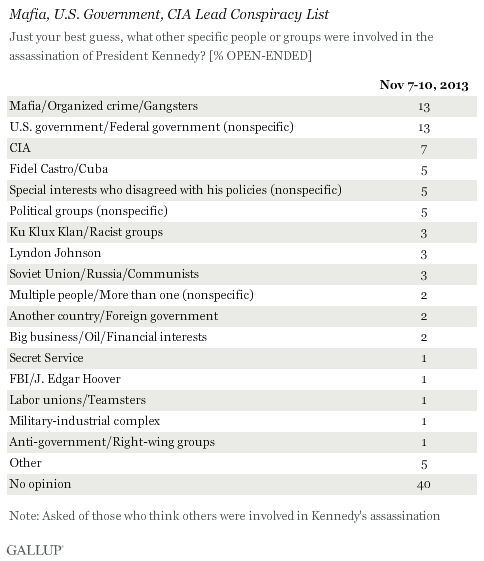
Sociologist David Simone compiled a study of the books published on the Kennedy assassination, some 600 titles, and found that 20 percent of them blamed either a lone assassin or the mafia or the Cubans or Russians. The other 80 percent ascribed the assassination to a conspiracy linked to U.S. intelligence agencies, some of these also saying that mobsters were involved at the operational level. Ignoring this 80 percent of the literature, publications like the New York Times and Washington Post have listed the various theories about the JFK assassination as follows: (a) lone assassin, (b) mafia, (c) Cubans/Soviets, and (d) the “Oliver Stone movie theory.” In other words, they ignore the existence of a vast literature from which the [Oliver Stone movie, JFK] is derived and ascribe the critical theme presented within the film solely to the imagination of a film maker. The mainstream press would have us believe that the notion of a state-sponsored assassination conspiracy and cover-up came out of a movie–when actually the movie was based on a rich and revealing investigative literature.

Like the Warren Commission itself, the press assumed a priori that Oswald was the killer. The only question it asked was: Did Oswald act alone? The answer was a loudly orchestrated YES. Meanwhile, almost every in-depth investigator had a different conclusion: Oswald did not act at all. He was not one of the people who shot Kennedy, although he was involved in another way, as a fall guy, in his own words “just a patsy.”

The U.S. mainstream media have been tireless in their efforts to suppress the truth about the gangster state. In 1978, when a House Select Committee concluded that there was more than one assassin involved in the Kennedy shooting, the Washington Post (1/6/79) editorialized:

“Could it have been some other malcontent who Mr. Oswald met casually? Could not as much as three or four societal outcasts with no ties to any one organization have developed in some spontaneous way a common determination to express their alienation in the killing of President Kennedy? It is possible that two persons acting independently attempted to shoot the President at the very same time.”

It is “possible,” but also most unlikely and barely imaginable. Instead of a conspiracy theory the Post creates a one-in-a-billion ”coincidence theory” that is the most fanciful of all explanations.

Ignored Evidence, Unanswered Questions

David Garrow, author of a biography of Martin Luther King, condescendingly says: “A large majority of the American people do believe in assassination conspiracies. That allows events to have large mysterious causes instead of small idiosyncratic ones.” Contrary to Garrow, the question of whether a conspiracy exists in any particular situation has to be decided by an investigation of evidence, not by patronizing presumptions about the public mind. Investigators who concluded there were conspiracies in the Kennedy and King murders did not fashion “large mysterious causes” but came to their conclusions through painstaking probes of troubling discrepancies, obvious lies, and blatant cover-ups. They have been impelled not by the need to fashion elaborate theories but by the search for particular explanations about some simple and compelling truths.

Many people talk about finding the “smoking gun” behind this or that mystery, the one evidentiary item that dramatically resolves the case and puts to rest all further questions. Unlike fictional mysteries, in real life there usually is no smoking gun. Historians work by a process of accretion, putting piece by piece together until a picture emerges. In the Kennedy murder the pieces make an imposing picture indeed, leaving one with the feeling that while there may not be a smoking gun there is a whole fusillade of impossibilities regarding the flight of bullets, the nature of the wounds, the ignored testimony of eye witnesses, the sudden and mysterious deaths of witnesses, the disappearance and deliberate destruction of evidence, and the repeated acts of official cover-up that continue to this day regarding the release of documents.

Let us focus on just a small part of the immense brief that has been assembled by investigators. Consider the background of Lee Harvey Oswald. Over the decades to this very day, mainstream commentators have been telling us that Oswald was an incompetent “loner” and not very bright. Gerald Posner, transforming himself into an instant psychiatric expert, announced that Oswald “had a very disturbed childhood, and he was a passive-aggressive.” A passive-aggressive assassin? He was also repeatedly labeled a “loner” and a “leftist.” The truth is something else.

Lee Harvey Oswald spent most of his adult life not as a lone drifter but directly linked to the U.S. intelligence community. All of his IQ tests show that he was above average in intelligence and a quick learner. At the age of eighteen in the U.S. Marines he had secret security clearance and was working at Marine Air Control in Atsugi Air Force Base in Japan, a top secret location from which the CIA launched U2 flights and performed other kinds of covert operations in China. The next year he was assigned to El Toro Air Station in California with security clearance to work radar.

Strange things began to happen. While at El Toro, Oswald emerged as a babbling Russophile and a “communist.” He started playing Russian language records at blast level in his barracks and addressing his fellow Marines in Russian, calling them “comrade.” He read Russian books and hailed Soviet Communism as “the best system in the world.” If Oswald was a Soviet or a Cuban spy, as some people now claim, he certainly had a novel way of building a cover.

Philip Melanson, author of Spy Saga, a book about Oswald’s links to intelligence, reminds us that the U.S. Marine Corps in 1958 was not exactly a bastion of liberal tolerance and freethinking. But in this instance, for some strange reason, Oswald’s Marine commanders did not seem to mind having a ranting commie sympathizer in their midst. In fact, he kept his security clearance and retained access to a wealth of sensitive radar information and classified data from secret facilities!

Other odd things happened. In February 1959, Oswald failed the Marine Corps proficiency test in Russian. Six months later he had developed some fluency in that language. In 1974, a document classified by the Warren Commission–and dislodged mostly by Harold Weisberg’s legal efforts–revealed that Oswald had attended the U.S. Army’s School of Languages at Monterey. Monterey is not open to anyone who just happens to have a language hobby. One is sent by the government, for training in a specific language pertaining to a specific assignment. Oswald learned Russian at Monterey.

Another curious thing: Oswald applied for an early dependency discharge from the Marines because his mother had injured her foot–the accident had occurred a year earlier. He was released one week after putting in his request, a decision so swift as to astonish his fellow Marines.

Luxury Defection

Oswald then “defected” to the USSR, but how? Melanson notes that such a trip would have cost at least $1,500 in those days, but Oswald’s bank account showed a balance of $203. And how did he get from London to Helsinki on October 11, 1959, when no available commercial flight could have made it in one day? He must have had some kind of private transportation to Helsinki.

Once in Russia, he went to the U.S. embassy and openly renounced his U.S. citizenship, declaring that he was going to give military secrets to the Soviets. Embassy officials made no effort to detain him. As the KGB files opened in 1991 show, the Soviets kept him under constant surveillance. KGB defector Yuri Nosenko, who had been responsible for investigating every contact Oswald made in the USSR, reported that the young American had never been associated with Soviet intelligence and that the KGB suspected he was connected with U.S. intelligence.

While in Russia Oswald belonged to a gun club at the factory in which he worked, though he showed no interest in guns. He reportedly used to join in rabbit shoots but could never score a hit. Someone would have to stand behind him and shoot the rabbit while he was firing. His performance became something of a joke among his co-workers. His marksmanship in the U.S. Marines had been no better.

U.S. intelligence mysteriously departed from normal procedure and made no damage assessment of Oswald’s “defection,” or so they claimed. Another odd thing: after two-and-a-half years, Oswald’s sudden request to return to the United States was immediately granted by U.S. officials–all this after he had threatened to give away state secrets to the Soviets. Instead of being arrested for treason, Oswald was accepted with open arms by U.S. authorities.

The CIA claimed it had no record of debriefing him and was never near him. Their explanation before the Warren Commission was that there were so many tourists coming in and out and there was nothing particularly unusual about Oswald that would have caught their attention. One might wonder what was needed to catch the CIA’s attention.

Yet, CIA officials claimed they had suspected all along that he was a Soviet spy–which makes it even more curious that they did not debrief him. In fact, they did debrief him in Holland. But being so eager to cover up any association with Oswald, they could not recognize how in this instance the truth would have been a less suspicious cover than the improbable lie they told about never noticing his return.

State Department officials also behaved strangely. They paid all travel and moving expenses back to the United States for Oswald and his wife. Without a moment’s delay they gave him back his passport with full rights to travel anywhere in the world. Another curious thing: his wife was exempted from the usual immigration quotas and granted immediate entry. Years before she had belonged to the Soviet Komsomol, the Communist youth organization, which automatically would have barred her from the United States. Yet in violation of U.S. immigration laws, she was allowed into the country with Oswald.

The FBI/CIA “Leftist”

In Dallas, Lee Harvey Oswald settled under the wing of White Russian emigre’ and former cavalry officer George de Mohrenschildt, an aristocratic reactionary and an associate of oil millionaires H. L. Hunt and Clint Murchinson and other Dallas economic elites. In de Mohrenschildt’s telephone book was found the name of George “Pappy” Bush. A correspondence existed between Bush Sr. and de Mohrenschildt indicating that they were personal acquaintances.

De Mohrenschildt and his wife Jeanne were identified by the Warren Commission as the people closest to Oswald just before the assassination. An investigator for the House Select Committee, Gaeton Fonzi, noted, “Given his background, it seemed strange that de Mohrenschildt would have spontaneously befriended someone with the look of a working-class drifter like Lee Harvey Oswald.” That was not the only strange thing about de Mohrenschildt. He also was part of a network of ex-Nazis contracted by the CIA.

A CIA memorandum written not long after Oswald returned from Russia advised de Mohrenschildt on how to handle the young “defector.” De Mohrenschildt also had a close friendship with J. Walter Moore, who was an agent of the CIA’s Domestic Contacts Division. As de Mohrenschildt told one investigator just before his sudden death, it was Moore who encouraged him to see Oswald. Investigator Jim Marrs observes in his book Crossfire: “The CIA memos, Moore’s closeness, and de Mohrenschildt’s own testimony all confirm that a certain relationship existed between the CIA and the man closest to Oswald in early 1963. While this does not necessarily involve the Agency in a plot to kill Kennedy, it raises questions about what Agency officials might have known regarding such a plot.”

Oswald embarked on a series of short-lived public forays as a “leftist.” He started a one-person Fair Play for Cuba chapter in New Orleans, without ever bothering to recruit another member. He never met with a single member of the Communist Party or any other left organization, although he wrote friendly letters to the Communist Party and to the Socialist Workers Party (two groups that were not even talking to each other) supposedly asking for instructions. Again, all this was a puzzling way for a Soviet agent and would-be assassin to act.

He blazed a highly visible trail as a “leftist” agitator: managing to get exposure on local T.V. in New Orleans after getting involved in some fistfights while leafleting. One of the leaflets he distributed showed that his organization was on Camp Street in the very same building that a former FBI bureau chief, Guy Banister, had his office. Banister retained close working relations with émigré’ Cuban right-wing groups and with Lee Harvey Oswald.

When he wasn’t playing the communist agitator, Oswald spent most of his time with rabid anti-communists, including émigré Cubans and CIA operatives. Besides Banister and de Mohrenschildt, there was David Ferrie. (In his book First Hand Knowledge, Robert Morrow, a conservative businessman and CIA operative, tells how he served as a pilot on CIA missions with Ferrie.) Oswald also knew businessman Clay Shaw who was CIA, as later confirmed by the agency’s director Richard Helms. These were hardly the sort of friends we would expect for a loudmouthed “Marxist revolutionary” just returned from giving away classified secrets in the USSR.

The attorney general of Texas, Waggoner Carr, told the Warren Commission that Oswald was an FBI informant or contract agent, with assigned number S-172 or S-179. For his services, Oswald was paid two hundred dollars a month by the FBI.[2] Orest Pena, a Cuban émigré and FBI informant, told Mark Lane that Oswald worked for the FBI and met with FBI personnel from time to time.

If not paid by security agencies, how did Oswald support himself during his forays into New Orleans and Dallas? He was employed for a brief time in 1962 by a printing company in Dallas that specialized in highly classified government work, including the making of secret maps of the Soviet Union for U.S. Army Intelligence–again hardly the sort of job to assign an openly pro-Soviet communist agitator. Oswald’s overall employment record and income sources remain something of a mystery. To this day, the U.S. government refuses to release his tax returns, with no explanation as to what issue of national security is at stake.

The Impossible “Assassin”

We are asked to believe that Oswald just happened to get a job at the Texas School Book Depository five weeks before the assassination, when it had not yet been publicized that Kennedy’s limousine was going to pass in front of that building. In fact, George de Morenschildt got him the job.

We are asked to believe that Oswald, who could not hit the side of a barn, chose a Mannlicher-Carcano to kill the president, a cheap, poor performance Italian rifle that the Italians jokingly said never killed anyone on purpose and caused them to lose World War II.

We are asked to believe that Oswald would forgo shooting President Kennedy when he had a perfect target of him as he rode right down Houston Street directly toward the Texas School Book Depository. Instead he supposedly waited until the car had turned down Elm Street and was a half-block away. With the President’s head and shoulders barely visible through a tree, Oswald supposedly fired rapidly, getting off three shots in record time, one missing the limousine by twenty-five feet and the other two hitting their target with devastating accuracy and record rapid succession, a feat the best marksmen in the country found impossible to emulate even after much practice and after the sights on the Mannlicher-Carcano were properly reset in a laboratory. [3]

We are asked to believe that Oswald then left his rifle at the window, complete with a perfect palm print and, they now say, his fingerprints (but no fingerprints on the clip or handloaded cartridges), along with three spent shells placed on the floor neatly in a row, in a manner no spent shells would fall.

We are asked to believe that a bullet would go through John Kennedy, pause in mid-air, change direction, and wound Governor Connally in several places–something Connally never believed–and reappear perfectly intact wedged into the flap of a stretcher in Parkland Hospital, supposedly having fallen out of Connally’s body but obviously pushed into the flap by hand. (It became known as the “magic bullet” among skeptics.)

We are asked to believe that only three shots were fired when in fact six bullets were noted: one that entered the president’s throat and remained in his body; the second extracted from Governor Connally’s thigh; a third discovered on the stretcher; a fourth found in fragments in the limousine; a fifth that missed the president’s car by a wide margin, hitting the curb according to several witnesses, and wounding onlooker James Thomas Tague on his face; a sixth found in the grass by Dallas police directly across from where the president’s vehicle had passed.

The Secret Service took possession of the presidential limousine, ignored reports in the St. Louis Post-Dispatch (12/1/63) that there was a bullet hole in the windshield, and rejected all requests to inspect the vehicle. The inside of the limousine, a trove of physical evidence, was then quickly torn out and rebuilt, supposedly with no thought of covering up anything.

We are asked to believe that Kennedy’s autopsy was innocently botched and his brain just accidentally disappeared. The X-ray purporting to be Kennedy’s head now shows a rear entry wound, different from the rear exit wound all the pathologists saw. Someone cropped the jaw out of the picture, so there is no opportunity to determine by dental identification if the X-ray really is the president’s.

We are asked by people like Max Holland, writing in the Nation, to believe that the “infamous picture of Oswald posing with rifle in hand” is not a forgery. Actually there are two pictures, both proven composites, with bodies of different sizes but with the identical head that matches neither body, and with shadows going in incongruous directions. Who fabricated these well publicized photos?

Rubbing Out the Witnesses

The supposedly “lone leftist assassin,” Lee Harvey Oswald, was a friend of Jack Ruby, a gangster with links to Cuban exiles and the FBI. Ruby once worked for Congressman Richard Nixon and the House Un-American Activities Committee in Chicago when his name was still Jack Rubenstein. He also worked for the FBI in Dallas during the years before the JFK assassination. Ruby claimed he was just an ordinary private citizen, moved to kill Oswald in order to avenge the suffering Oswald had inflicted upon the Kennedy family. [4]

While in prison Ruby pleaded with the Warren Commission to be taken to Washington where he could tell the whole story. He feared for his life and claimed “they are killing me here.” Indeed, he died in jail, supposedly of natural causes.

We are asked to believe that when twenty-four persons who had information related to the case met violent deaths, this was a colossal coincidence. [5]

In 1978, after the House Select Committee investigation got underway, Anthony Summers records that another sixteen connected to the case died violently. This too supposedly was just a coincidence. This latter group included George de Mohrenschildt, killed by a gun blast to the head three hours after a House Assassinations Committee Investigator had tried to contact him. De Mohrenschildt had been worried that he would be murdered. His daughter Kressy Keardon believes it “impossible” that he shot himself. The sheriff’s office in Palm County, Florida, found the shooting “very strange.” But it was ruled a suicide. Generally, people who voice fears that they might be killed do not then kill themselves.

William Sullivan, number three man in the FBI, was secretly on the CIA payroll, according to CIA operative Robert Morrow. He was scheduled to appear before the House Select Committee but before he could do so, he was shot outside his home by a man who claimed to have mistaken him for a deer. The killer was charged with a misdemeanor and released in custody of his father, a state policeman.

While under government protection, mobster Sam Giancana was shot dead a day before he was to testify before the House Select Committee about mob and CIA connections. One of the things that emerges from this whole story is the widespread linkages between the CIA and organized crime, between the gangsters and the gangster state.

When the House committee was putting its staff together, it was heavily pressured to employ only persons acceptable to the CIA, the very agency it was supposed to investigate. In his book Plausible Denial, Mark Lane reports that when Bernard Fensterwald, an independent minded Washington lawyer, was offered the job of general counsel, a CIA representative called on him and said that the Agency would hand him “his head on a platter” if he took the assignment. Fensterwald turned it down.

Is the Kennedy assassination conspiracy just a lot of hoopla kicked up by “conspiracy buffs”? Most of the independent investigators I have met seem to be serious politically literate people. Their struggle to arrive at the truth is not impelled by a love of conspiracies but by a concern for the political and historic importance of the case. They seek the truth no matter how dirty it might be. That process of confronting the machinations of the national security state is not a conspiracy hobby. It is an essential part of the struggle for democracy.

Let me end with a summary quotation by John Judge, which he was kind enough to send me by Gmail:

“85% of the American public reject the findings of the Warren Commission report, as did the House Select Committee on Assassinations in 1978, finding instead a “probable conspiracy” in the murders of President Kennedy and Dr. Martin Luther King. No federal investigation or action followed. We are the mainstream, not the dissent. Oswald’s role as a patsy, not a shooter, is supported by all the best evidence that has been released. The real evidence clearly points to a crime and a cover-up that reaches to the highest levels of the U.S. government and military.”

Notes

1 Colonel L. Fletcher Prouty, a military intelligence chief closely connected with the CIA, tells of his visit to “a special ‘village’ in the Mediterranean where a highly select group of stateless ‘mechanics’ in the CIA are hit-men, assassins, and other related specialists. They are absolutely anonymous”; see his introduction to Mark Lane’s Plausible Denial (New York: Thunder’s Mouth Press, 1991). For a further discussion on U.S. repression abroad, see “Making the World Safe for Hypocrisy,” p. ; also my two books Against Empire (San Francisco: City Lights Books, 1995); and The Sword and the Dollar (New York: St. Martin’s Press, 1989).

2 The Warren Commission reacted with extreme alarm toward Carr’s testimony. Its general counsel, J. Lee Rankin said that evidence linking Oswald to the FBI “is very damaging to the agencies that are involved in it, and it must be wiped out insofar as it is possible to do so by this commission.” The “wipe out” consisted of a statement from Hoover reassuring the commission that Oswald never worked for the FBI. In the New York Times edition of the Warren Commission report, Waggoner Carr’s testimony is nowhere to be found.

3 In his political memoirs, Speaker of the House Tip O’Neil writes that Kenneth O’Donnell, a top JFK aide, said he was sure he had heard two shots that came from behind the fence on the grassy knoll. “I told the FBI what I had heard, but they said it couldn’t have happened that way and that I must have been imagining things. So I testified the way they wanted me to.” O’Neil reports that another top Kennedy aide, Dave Powers, who was present when O’Donnell made this statement, said he had the same recollection of the shots.

4 At a Washington, D.C. conference in October 1995, assassination investigator John M. Williams reported on an interview he had with Robert Morrow, March 10, 1994. Morrow said that on the day after JFK’s assassination, Marshall Diggs, the man who recruited Morrow as a CIA operative, confided to him a warning of Oswald’s impending assassination: “He won’t be around to testify for his trial.”

5 See Penn Jones, Jr., Pardon My Grief vols. 1 and 2 for details about the death of these twenty-four.

Source: Global Research

Stakes over Iran Talks on the Rise

0

Catherine Ashton, High Representative of the European Union for Foreign Affairs, in Geneva with Mohammed Javad Zarif, Iranian Minister for Foreign Affairs. Credit: Courtesy of the European CommissionAs Secretary of State John Kerry and foreign ministers of at least four other major powers prepared to join talks with Iran in Geneva Saturday, the stakes over the eventual success or failure of the negotiations seem very much on the rise here.

While nervous Democrats in the Senate held off a last-minute push by Republicans to approve legislation preventing President Barack Obama from easing sanctions against Iran as part of a possible interim deal to curb its nuclear programme, they also warned that, absent an accord in Geneva, new punitive measures are likely to be enacted shortly after Congress returns from its Thanksgiving recess Dec. 9.

Most analysts, including administration officials involved in the negotiation, believe that any new sanctions – or curbs on Obama’s authority to waive existing ones – are likely to drive Iran from the table by bolstering hard-liners in Tehran who have long argued that Obama is either unwilling or unable to deliver what they regard as a minimally acceptable deal.

Such a breakdown in the talks would return the two countries to a path of confrontation, significantly enhancing the chances of war, according to both the White House and most independent analysts.

While diplomats from the so-called P5+1 (U.S., Britain, France, Russia, and China plus Germany) and Iran have been remarkably tight-lipped about the past three days of talks, foes of a likely accord – almost all of whom are associated with the Israel lobby here – have escalated their attacks here.

Even if an interim accord is reached within the coming days, the lobby’s leaders and their backers in Congress have made clear they will not give up on their efforts to derail its implementation. Republican lawmakers, in particular, warned this week that, in addition to seeking new sanctions, they will introduce legislation aimed at reducing Obama’s room for manoeuvre.

A number of prominent neo-conservatives, who have tried to lie relatively low on the Iran issue due to their high-profile championship 10 years ago of the now-highly unpopular Iraq war, have come to the fore in recent days, apparently unable to restrain themselves at such a critical moment.

One leading Iraq hawk and co-founder of the Project for the New American Century and the Emergency Committee for Israel, Bill Kristol, who has been immersed in “Obamacare” and intra-Republican politics for weeks, titled the lead editorial in his Weekly Standard magazine “No Deal”.

“[S]erious people, in Congress and outside, will do their utmost to expose and scuttle Obama’s bad Iran deal. They can expect to be smeared by the Obama administration as reckless warmongers and slandered by Obama’s media epigones as tools of the Israel lobby,” he wrote, calling on lawmakers to resist such intimidation.

Similarly, the Washington Post’s Charles Krauthammer, a leading neo-conservative who has largely neglected Iran in recent months, published a column Friday entitled “A ‘Sucker’s Deal’” – the phrase used by French Foreign Minister Laurent Fabius, who reportedly blew up the last round of Geneva talks at the 11th hour earlier this month – in which he echoed Israeli Prime Minister Benjamin Netanyahu’s argument that any easing of sanctions against Iran as part of an interim accord would be irreversible.

Netanyahu and his supporters here have demanded that Iran be denied any sanctions relief pending verifiable steps leading to the virtually complete dismantlement of its nuclear programme, including any enrichment of uranium which Iran has long claimed is its “right” under the Nuclear Non-Proliferation Treaty (NPT).

According to multiple reports, the current offer by the P5+1 governments for an interim accord – which would eventually be superceded by a comprehensive agreement to be finalised within six months to a year – would permit Tehran to continue enrichment to 3.5 percent, although it would not explicitly recognise a “right to enrich”.

Such an agreement would also require Iran to freeze its 20-percent enrichment programme, as well as the number of centrifuges it is operating; place its current stockpile of 20-percent enriched uranium – which is closer to bomb grade – under international supervision pending its transformation into oxide or less-dangerous forms; and an effective suspension of work on its Arak heavy-water facility, which, when operational, would produce plutonium fuel for its nuclear reactors.

In addition the offer calls for an enhanced inspection regime overseen by the International Atomic Energy Agency (IAEA) to monitor compliance.

In return, the P5+1 would permit Iran access to as much as 10 billion dollars of its foreign exchange reserves that are currently frozen in Western banks and ease sanctions on its trade in gold, other precious metals, petrochemicals, and airplane spare parts, according to the latest reports.

Obama has insisted that such concessions keep core financial and oil sanctions intact.

Netanyahu and his backers, however, disagree, arguing any easing of sanctions will trigger the collapse of the entire international sanctions regime, and thus make it possible for Iran to retain its basic nuclear infrastructure and, with it, the capability to build a bomb.

They thus oppose any interim agreement that does not require Iran to dismantle – rather than simply freeze — Arak and most of the rest of its nuclear facilities and capabilities.

But administration officials consider Israel’s demands as a deal-breaker. Indeed, a senior White House official told a confidential briefing Wednesday of think tank analysts and advocacy groups that favour an accord that Israel’s terms would “close the door on diplomacy” and “essentially lead to war,” according to an account published in the Jewish Telegraphic Agency (JTA).

That kind of warning has infuriated neo-conservatives and Israel lobby leaders, as did an op-ed published this week by the influential New York Times columnist Tom Friedman that blasted both the lobby and lawmakers who oppose an interim accord.

“If Israel kills this U.S.-led deal, then the only option is military,” he wrote. “How many Americans or NATO allies will go for bombing Iran after Netanyahu has blocked the best effort to explore a credible diplomatic alternative?”

“Not many,” he noted.

Indeed, that conclusion was echoed in two polls published this week. Nearly two-thirds of respondents in a Washington Post/ABC poll said they would support an agreement in which “the U.S. and other countries would lift some sanctions against Iran, in exchange for Iran restricting its nuclear programme in a way that makes it harder for it to produce nuclear weapons.”

Fifty-six percent of respondents in a subsequent CNN poll also approved a similarly phrased deal. The latter survey, however, stressed that such a deal would “not end [Iran’s nuclear programme] completely.”

The administration’s strategy gained other influential backers besides Friedman this week. Former national security advisers Brent Scowcroft, who served under President Gerald Ford and George H.W. Bush, and Zbigniew Brzezinski, who served under Jimmy Carter, sent a letter to the Congressional leadership endorsing an interim deal. They were joined by former Secretary of State Madeleine Albright, who served under Bill Clinton.

Brzezinski and Scowcroft were key dissenters in the Iraq war, while Albright initially supported it.

_______________________

© 2013 Inter Press Service

Source: Common Dreams

The Syria Chemical Weapons Attack and the Role of Saudi Intelligence. The Mint News Report

0

Following AP reporter Dale Gavlak’s attempt to disassociate from the Mint Press News report: “Syrians In Ghouta Claim Saudi-Supplied Rebels Behind Chemical Attack” (see previous article for background here) Mint Press Editor in Chief Mnar Muhawesh published a statement in response reiterating her support for, and the credentials of, the two journalists involved, along with the substance of the report they had produced. The report in question included statements from residents and relatives of rebel fighters in Eastern Ghouta, who alleged that Saudi Intelligence Chief, Prince Bandar Bin Sultan, had supplied extremist elements in the region with chemical weapons.

The Muhawesh statement went largely unnoticed in mainstream media, instead, the usual actors produced a variety of baseless lurid smears and conspiracy theories directed at Mint Press and Yahya Ababneh, the reporter on the ground in Ghouta, in transparent efforts to discredit them and the substance of the report.

One particularly vulgar conspiracy crafted by the BuzzFeed “journalist” Rosie Gray – reminiscent of crass attempts to play on orientalist stereotypes of “Iranian deception” abundant in civilised US media and diplomacy-speak – attempted to portray the Mint Press as bias fabricators, on the grounds of the Editors father-in-law being a Shi’a Muslim. In effect casting him and Mint Press as Iranian stooges intent on subverting the western-promoted falsehood that the Assad government ordered the alleged chemical attacks.

In recent weeks, corporate media has largely gone quiet on the whole affair. With the Russian-brokered deal to destroy Syria’s chemical weapons stockpiles thwarting a determined effort by US hawks, Likudniks, and Gulf monarchs to escalate the Syrian war; the push for overt US intervention has subsided, and along with it the incessant parroting of fantasy narratives and dubious “evidence” attempting to blame the Assad government for the alleged chemical attacks on August 21st.

Muhawesh, fearing for the safety of Dale Gavlak and Yahya Ababneh, has remained silent on the issue since the release of the aforementioned communication, but has now released a full statement outlining a timeline of events surrounding the report, which is reprinted in its entirety below, I urge all to read in full:

Dear readers,

I wanted to personally express my appreciation for your continued support and readership following our newsroom’s August 29, 2013 exclusive report titled: “Syrians in Ghouta Claim Saudi-Supplied Rebels Behind Chemical Attack.”

I’ve been silent until today out of concern for the safety of the journalists, Dale Gavlak and Yahya Ababneh, while we worked to bring clarity to their findings and ensuing events. I’m relieved to now be able to share happenings of the past 60 days as Human Rights Watch addresses ongoing threats to co-author Yahya by Jordanian and Saudi actors in Amman, Jordan.

To be clear, my MintPress colleagues and I continue to stand by Dale and Yahya and their reporting. The tragic incident in Ghouta on August 21—and the Syria conflict as a whole—is complex and, as the article stated, some information could not be independently verified. While efforts to discredit the story and our organization have disappointed us, we have been most concerned by the tremendous pressure placed on Dale by the Associated Press and more serious threats faced by Yahya.

Since the article was published, I’ve been in almost daily contact with co-author Yahya in Amman, Jordan. He has related ongoing threats of imprisonment by the Jordanian police for his travel to Syria if he were to continue to report on this story or grant further press interviews. Yahya has also described increasing pressure from Saudi actors to retract his story and the specific allegation by Ghouta residents of a rebel link to Prince Bandar.

In line with Dale’s description of Yahya as “a reputable journalist” to the New York Times, she distanced herself from the article only after stating in emails to MintPress that the Associated Press demanded her name be removed from the byline nearly two days after the article published. She has not informed MintPress of the AP’s reason for this request—nor why they and National Public Radio (NPR), subsequently, suspended her. For background on the situation, here is the timeline of events:


  • Feb 8: Freelance journalist Dale Gavlak—an Associated Press stringer for nearly a decade—joins MintPress News (MPN) as Middle East Correspondent and files her first of 26 weekly articles on regional news and politics.
  • Aug 28: Dale pitches the Ghouta story to her MPN editors. She then conducts research, fact checks with colleagues and Jordanian government officials and writes up article based on interviews her reporter colleague, Yahya Ababneh, conducted a few days prior while on a delegation to Ghouta, Syria. Dale files the story to MPN.
  • Aug 29: Dale emails with readers about the report after it is published at MintPressNews.com with the byline note: “This is a collaborative report by Dale Gavlak and Yahya Ababneh.”
  • Aug 30: Dale notifies MPN by email that editors at the Associated Press are demanding her name be removed from the article byline by end of day.
  • Aug 31: MPN cites editorial transparency for not removing Dale from byline and, instead, adds clarification of her exact role that now appears at top of article.
  • Sept 1: MPN receives letter from Dale’s attorney demanding it remove her name from byline completely.
  • Sept 3: Dale accepts payment from MPN for her role in the article.
  • Sept 12: Yahya informs MPN via Skype of first visit by Saudi actors.
  • Sept 13: Through legal counsel, MPN offers to remove Dale and Yahya’s names both completely from the byline and replace with the statement: “MintPress, in order to protect the authors of this story from any retribution or outside pressure, has removed the authors’ names from this story. MintPress believes in the journalistic efforts produced by all of the parties involved in this story but does not want to see any harm come to any of the parties.”
  • Sept 20: Dale claims MPN “incorrectly used my byline” in a statement to bloggerBrown Moses.
  • Sept 21: Dale shares Aug 29 email to MPN on NY Times “Lede Blog”: “Pls find the Syria story I mentioned uploaded on Google Docs. This should go under Yahya Ababneh’s byline. I helped him write up this story but he should get all the credit for this.” MPN’s Mnar Muhawesh makes her only public statement on the situation.
  • Sept 26: Russian Foreign Minister Sergey Lavrov cites allegations in MPN report as evidence in talks with US Secretary of State John Kerry and in press interviews at the UN General Assembly.
  • Oct 7: Yahya notifies MPN that the United Nations commissioned him to present his witnesses for the UN Report on the Alleged Use of Chemical Weapons in the Ghouta Area of Damascus on 21 August 2013.
  • Oct 14: Yahya informs MPN via email of visit by Jordanian police: “i am ok, and they find two Saudi arabia one of them his name [REDACTED], he is a Salafi, I know him before, he try to find me and give me to KSA police in Saudi, they know an old police man (he retired) they still fellow, they ask me to make a statement which say opisit of the report about Bender”.
  • Oct 28: Yahya describes conversation with Saudi actors in email to MPN: “any way, they ask me to go to Saudi and say sorry, and talk to Saud TV live to tell them that i was under pressure when i was in Syria. they (my tribe) have a pressure too in Suad, they ask them in the borders and airport about me.”

We deeply sympathize with Dale and Yahya as they continue to endure pressures from interests seeking to silence their reporting. Their courage, and that of many reporters before them, has emboldened MintPress to expose these threats to investigative journalism and has served to strengthen our commitment to in-depth reporting on social justice and human rights issues.

As an independent journalism startup that found itself embroiled in an international crisis, we’re grateful for the advice and assistance provided by experts at The Poynter Institute and Knight Foundation as well as International Federation of Journalists and Human Rights Watch.

Again, I appreciate your support and truly value your readership. I welcome any questions about the report, ensuing events and our ongoing coverage of the Syrian conflict.

Best regards,

Mnar A. Muhawesh.

Editor in Chief, MintPress News.

It becomes immediately clear from the above statement that the fantastical conspiracies posited by BuzzFeeds’ Rosie Gray and former Guardian Editor Brian Whitaker, to name but two, were clearly based on nothing more than wild speculation in a vain and somewhat organised attempt to discredit the report; it is no coincidence Gavlaks’ disassociation statement was initially handed to Brian Whitakers eager protegé “Brown Moses”, aka Eliot Higgins, to promote right alongside his lead effort in touting dubious “evidence” pointing the finger at the Syrian army as responsible for Ghouta, much of which has now been thoroughly debunked.

The immediate questions then remain: why so much effort from establishment media players to discredit and smear? Why are elements of Jordanian and Saudi security services threatening Yahya Ababneh and his family, and attempting to force him to retract the statements he gathered in Ghouta if they are merely falsehood, or baseless planted rumour? And why did the AP and NPR suspend Gavlak even though she made (futile) attempts to disassociate from the report to save her career and her colleagues safety?

The logical answer is that those reflected negatively in Yahya Ababneh and Dale Gavlaks’ Ghouta report have something to hide, and are going to great lengths to keep it hidden.

Phil Greaves is a UK based writer/analyst, focusing on UK/US Foreign Policy and conflict analysis in the Middle East post WWII. http://notthemsmdotcom.wordpress.com/

Source: Global Research

Major News Groups Complain of Lack of White House Access

0

Courtney Coren
newsmax.com
November 23, 2013

The White House has increasingly limited the access of photojournalists and cameramen covering President Barack Obama, handicapping their ability to monitor the government, a group of the country’s largest news organizations says in a complaint.

“Journalists are routinely being denied the right to photograph or videotape the president while he is performing his official duties,” says a letter sent to the White House on Thursday by news groups. “As surely as if they were placing a hand over a journalist’s camera lens, officials in this administration are blocking the public from having an independent view of important functions of the executive branch of government.”

McClatchy newspapers reported that the letter was addressed to White House Press Secretary Jay Carney and signed by 38 news organizations, including all major broadcast and cable networks, wire services, Internet news outlets, and newspapers such as The New York Times and Washington Post. The White House Correspondents’ Association and White House News Photographers Association also endorsed the complaint.

This article was posted: Saturday, November 23, 2013 at 9:16 am


Source: Infowars

US media subject to ‘gross’ Israel lobby

0

American investigative journalist Wayne Madsen criticizes the US corporate media for turning a blind eye to �œIsrael�™s gross interference” in US foreign policy especially its relentless lobbying campaign to derail nuclear talks with Iran.

�œThe problem with the US corporate media covering Israel independently is that the media is subject to the same paper pressure from the American Israel Public Affairs Committee (AIPAC) and the Conference of Presidents of Major American Jewish Organizations and other pressure groups like that,” Madsen told Press TV on Saturday.

�œSo what we are seeing is the media coming under the same type of pressure not to cover Israel�™s gross interference in the internal affairs of the United States of America,” he added.

The media blackout on Israeli interference is accentuated by the fact that a large number of media personalities in the United States are pro-Israel, Madsen noted.

Iran and the six world powers – the US, France, Britain, Russia, China and Germany – began their latest round of talks on Wednesday. The talks were scheduled to end on Friday, but were extended into Saturday.

Senior Israeli officials including Prime Minister Benjamin Netanyahu have been hard at work in recent weeks trying to discredit Washington�™s strategy with Tehran.

Multiple members of Congress are also taking their lead from the powerful Israel lobby, rebuffing the Obama administration�™s call to hold off on new sanctions against Iran.

This is while a majority of the American public favors a negotiated settlement with Iran over its nuclear energy program.

The survey conducted by ABC News/Washington Post found out that 64 percent of respondents back a deal that will ease sanctions in exchange for Iran restricting its nuclear program.

HJ/HJ

Source: Press TV

VIDEO: Obamacare signs up a dog

0

gretawire.foxnewsinsider.com
November 23, 2013

Interview with Shane Smith, whose pet dog Baxter was successfully enrolled in ObamaCare.

Watch the latest video at video.insider.foxnews.com

This article was posted: Saturday, November 23, 2013 at 9:07 am


<!– this is where we need to show the related articles

–>

Source: Infowars

Another Obamacare deadline slips

0

Rick Moran
americanthinker.com
November 23, 2013

I’m not sure why the Obama administration thinks it will make a difference if they extend the deadline to sign up for insurance on the exchanges from December 15 to December 23. Whatever gains they believe they’ll make will be illusory. The fact is, only Connecticut is signing up more people on the exchange than are applying for Medicaid. That does not bode well for consumers who may face huge increases in premiums next year because not enough healthy people are signing up for insurance.

CNN:

The Obama administration announced Friday that the Department of Health and Human Services will extend a key Obamacare deadline by one week.

Americans can now sign up through December 23 in order to have health coverage start on January 1, according to Julie Bataille, a spokeswoman for Centers for Medicare and Medicaid Services.

December 15 was the original deadline for coverage beginning January 1.

“We realize that many consumers who are seeking coverage in January may have experienced frustration with the site,” Bataille said in a conference call with reporters.

“In response, HHS intends to extend the date by which consumers need to enroll in a plan in order to get coverage on January 1st … This extension will give consumers more time to review plan options, to talk with their families, providers or enrollment assisters and to enroll in a plan.”

It is not entirely clear how the change will be enacted to enable insurers offering policies on the exchanges to process applications. Bataille said in future months, an application will still have to be completed by the 15th in order to secure insurance by the first of the next month. People buying policies will have to make their first premium payment on or before December 31 in order to be insured on January 1.

Bataille said the administration has been in contact with insurers about the change, but final details would not be spelled out until an official policy announcement could be made in the near future.

The final deadline to purchase insurance or face a penalty is March 31, 2014. There has been no change in that date.

“We think that a six month long open enrollment period is a significant amount of time for consumers,” said Bataille.

But the administration did announce a delay in some deadlines for the 2015 enrollment period, which will now begin November 15 of 2014 instead of October 15. That change, according to Bataille, was made to enable insurers to get a better sense of how their Obamacare programs work during the first coverage year.

Note that HHS announces the policy change and then consults with insurance companies. I’m no expert but shouldn’t it be the other way around?

It doesn’t matter what the insurance companies think. Or consumers, businesses, congress, or anyone else. This is not about “fixing” anything; it’s about political damage control and how to hide the failure of Obamacare from the American people – hopefully until after the 2014 election.

This article was posted: Saturday, November 23, 2013 at 8:54 am


Source: Infowars

US spying straining relations with allies

0

The US government�™s extensive use of technology to carry out widespread surveillance erodes the trust of its allies, according to a panel of experts.

�œWe need a public debate about all these issues… in terms of trust,” said former Secretary of State Madeleine Albright, now chairwoman of the Albright Stonebridge Group.

�œWhat worries me is that there is a disconnect in what is going on,” in terms of what citizens understand about the government�™s surveillance techniques, Albright said.

Albright said the full potential of technology, even for civilian use, is not yet fully understood.

The rapid development of technology outpaces a government�™s ability to figure out how to regulate it, said European Union ambassador to the United States Joao Vale de Almeida of Portugal.

�œWe can basically listen to anyone anywhere at any time,” Vale de Almeida said.

�œThe real issue is political judgment for political leaders about whether the methods of collecting information are worth the risks,” said Ivo Daalder, president of the Chicago Council on Global Affairs.

The American Civil Liberties Union (ACLU) has called for an end to National Security Agency spying activities due to the violation of constitutional rights.

The rights group told a New York court that the agency breached the First and Fourth Amendments as well as exceeding the authority Congress gave to the government through the Patriot Act.

Former NSA contractor Edward Snowden began to disclose classified documents to the media in June revealing the extent of the US government�™s spying operations at home and abroad.

AHT/HJ

Source: Press TV

A Plan To Have Humans Give Birth To Dolphins And Then Eat Them

0

Is this what will give your life meaning? In his project I Wanna Deliver A Dolphin, designer Ai Hasegawa envisions solving food shortages, the endangered species crisis, and our urge to reproduce by having us give birth to dolphins via synthetic placentas…and then consume their meat.

The struggle to raise a child in decent conditions is becoming harder due to gross overpopulation and an increasingly strained global environment. Would a woman consider incubating and giving birth to an endangered species such as a shark, tuna or dolphin?

This project imagines a point in the future, where humans will help this species by the advanced technology of synthetic biology. A ‘dolp-human placenta’ that allows a human female to deliver a dolphin is created, and thus humans can become a surrogate mother to endangered species. Furthermore, gourmets would be able to enjoy the luxury of eating a rare animal: an animal made by their own body.

The post A Plan To Have Humans Give Birth To Dolphins And Then Eat Them appeared first on disinformation.

Source: Disinfo

Israel’s fifth column never sleeps

0

The American Israel Public Affairs Committee (AIPAC) exerts tremendous amount of influence on US foreign policy.

It is hard to believe that even though 64% of the American public favors a negotiated settlement with Iran over its nuclear program fully 37% of those polled also believe that the United States actually needs Israel�™s permission before coming to any kind of agreement.

To paraphrase the late great Mitt Romney, is that a percentage that we will never be able to reach no matter how good the arguments are for “taking responsibility” and restoring American sovereignty in the area of foreign affairs? One has to suspect that the percentage consists mostly of the Christian-Zionists, who lately have been conducting a large scale “action alert” email campaign directed at Congress and the White House to force the cancellation of talks. They are perhaps heeding the demand of Harvard Professor and professional Israel apologist Alan Dershowitz that the “entire pro-Israel community must unite” to stop any agreement.

Tea Party Congressman Louie Gohmert of Texas provided his own explanation for why “a man�™s gotta do what a man�™s gotta do” to the House of Representatives last Wednesday saying “There are many who have been aware of Scripture, and it has often been a guide in our relations with Israel. Some of us believe that the Bible is accurate. Certainly, so many prophesies have been fulfilled, and if that is true, this administration, unless they can find a verse that accurately says that those who betray Israel will be blessed, then this country is being dug in a deeper hole by this administration, and its betrayals of Israel�™s trust and Israel�™s friendship.” Gohmert, for all his sublime ignorance, is unfortunately not alone. By virtue of the evangelism and fine example set by the likes of Michelle Bachmann and Sarah Palin the scripture thumpers have escaped from the Bible Belt and are now to be found everywhere.

Congress is also doing its bit among the national security crowd, taking its lead from American Israel Public Affairs Committee (AIPAC) which supports “…congressional action to adopt legislation to further strengthen sanctions and there will absolutely be no pause, delay or moratorium in our efforts.” Leading Senators named Kirk, Schumer, McCain, Ayotte, Corker, Graham, and Menendez who have long been close to Israel are undercutting White House efforts to develop a formula that would break through the wall of mutual hostility between Tehran and Washington, insisting on new and harsher sanctions that would devastate the already struggling Iranian economy. Lindsey Graham even explained what we should all know about Iranians: “How do you define an Iranian moderate? An Iranian who is out of bullets and out of money.” Mark Kirk, who denounced a Kerry Senate briefing on the talks with Iran as “anti-Israeli,” apparently was briefed in advance by Israeli intelligence before the committee meeting began.

Even the normally somnolent Senate Majority Leader Harry Reid seems to be wavering under pressure from AIPAC, saying “I hope we can work something out with Iran, but I am a person who really believes in the State of Israel.” And Senator Rand Paul also appears to know where his bread is buttered, tweeting last Tuesday that “Amidst the chaos of the Middle East we have always had one friend that never leaves our side – Israel. As an ally, Israel has never wavered.”

AIPAC has sent memos and talking points to every congressional office and intends to buttonhole each congressman prior to the resumption of talks. It is also unleashing its media assets, which should surprise no one, but there is also the presence of senior Israeli officials on Capitol Hill, pressuring legislators and providing false information to discredit the White House. Israeli Ambassador Ron Dremer has been leading the charge, supported by Israeli Economy Minister Naftali Bennet, an extreme right-winger even by Israeli standards. They have been using fabricated numbers to demonstrate to congressmen that Obama is seeking to make significant cuts in Iranian sanctions. One might question why a congressmen like Kirk should be favoring information offered by the Israelis over what is being provided by the US intelligence community and even ask why Israelis should be on Capitol Hill at all lobbying to influence US policy. Also, why is the US mainstream media not reporting the story of direct Israeli interference in our political process?

The White House is trying to push back, urging restraint, but it almost certainly will find itself outnumbered when the Senate votes on two bills that will broaden sanctions and will require the US to support Israel militarily if it chooses to attack Iran. Even Secretary of State John Kerry seems mystified by what is occurring, noting that the United States is fully aware of all the issues involved and is not being “stupid” in its willingness to deal with Iran for the first time in 35 years. Clearly stressed after his repeated hours-long sessions trying to explain things to Israeli Prime Minister Benjamin Netanyahu, he is even asking Israel how it can continue to justify stealing Arab land, a hitherto unthinkable rebuke that might possibly cost him his job. The Israeli government is already anonymously indicating that it has lost confidence in Kerry.

Well, Kerry should know better than anyone that he is confronted by a massive disinformation and influence buying campaign that is coordinated by the Israeli government to preserve its ability to deal with the Palestinians as it wishes while simultaneously creating the conditions that will eventually bring about an American attack on Iran. Here in the US we refer to the Quislings as the Israel Lobby, but something similar exists in many countries including France, Britain, Australia and Canada. It consistently and deliberately puts the perceived interests of the Israeli hard right government first before the interests of the countries that it operates in, though of course it always seeks to convince the audience that Israeli and local interests are identical. This is basically the argument being made and repeated ad nauseam about Iran, that Tehran is developing a nuclear weapon that will threaten the entire world. It matters not that the argument is a fabrication from start to finish.

On November 8th a desperate Netanyahu reportedly made last minute appeals to Britain, France, Germany, and Russia to derail the Geneva talks with Iran, presumably under the not unreasonable assumption that he had leverage with their political leadership. The eventual willingness of the French government to carry water for him is only one indication of the power of France�™s own formidable Israel Lobby. France is home to the largest diaspora Jewish community after the United States. It is wealthy and well educated and has long been prominent in French politics. The French Jewish organization the Conseil representatif des institutions juives de France (CRIF) is comparable to several American Israel Lobby components, to include AIPAC, in that it works actively on behalf of Israeli interests. It has endorsed every military action taken by Israel to include the bombing of Gaza in Operation Cast Lead in 2009 and the attack on the Mavi Marmara in 2010. One of its prominent members is presidential speech writer Paul Bernard and it even has as a Vice President a delegate in the French Chamber of deputies, Meyer Habib elected to represent French citizens living abroad in the Mediterranean region, most of whom are Israelis. Habib, a dual national and former Likud Party spokesman who divides his time between France and Israel, may have played a role in the French torpedoing of the Geneva talks with Iran when he passed on to Foreign Minister Laurent Fabius information he claimed to have received from his contacts in Israel suggesting that Netanyahu would immediately attack Iran if there were any agreement over its nuclear program.

To be sure, the French might also have been thinking of a possible large arms sale to Saudi Arabia, but as is usually the case it appears that the Israel Lobby influence was decisive. There was no genuine French interest that would have been sacrificed in coming to terms with Iran along the lines of a deal that was pretty much worked out and endorsed by the United States and others, but Fabius and President Francois Hollande thought otherwise. Hollande visited Israel on the weekend and addressed the Knesset early this week, promising that France would continue to take a very hard line with Iran, including possible demands that will likely make an agreement impossible.

If you don�™t want to believe that there is something that equates to a coordinated Israeli effort to influence opinion by exploiting Diaspora Jewish communities I would refer you to last week�™s speech by Israeli Prime Minister Benjamin Netanyahu to the Jewish Federations General Assembly, which is a quinquennial gathering of representatives of major Jewish organizations from all over the world. The Jerusalem meeting had in attendance many foreign Jews, including Michael Nutter Mayor of Philadelphia. In his keynote speech Netanyahu repeated over and over again that Israel is the “one and only Jewish State of Israel,” telling his audience that Jewish identity and Israel are one and the same thing, a viewpoint that many Jews would contest. He then went on to trot out his usual arguments about Iran�™s wanting to destroy Israel and how Israel, always the victim of hateful neighbors, wants nothing but peace but has been rebuffed repeatedly by the Palestinians. He said the Jewish community cannot remain “silent on matter relating to our survival…We are charged with defending ourselves and we are charged with speaking up. And it is time now to speak up – all of us. All of us have to stand up now and be counted.”

Netanyahu�™s vision is that world Jewry should and must stand up and support his policies, an interesting prescription that plays into the agenda of genuine anti-Semites who frequently question the loyalties of Diaspora Jews. Israel�™s broader efforts to promote its own version of recent events in the Middle East are also coordinated and sustained by the Netanyahu government, frequently being referred to by the Hebrew word for media management, hasbara. Israel has a section of its foreign ministry that is dedicated to spreading its select narrative about Israel�™s actions and it also encourages Diaspora Jews to support the effort by challenging critics and even disrupting their websites. Those who are most active and have an actual relationship with the Israeli government are referred to as sayanim. The Israeli government has also supported international efforts to tie up critics in court through the employment of Lawfare while also pressuring national and local governments to delegitimize or even declare illegal all criticism of Israeli government actions.

Canada has possibly the world�™s most pro-Israeli government, its Prime Minister Stephen Harper having described Israel as a light that “…burns bright, upheld by the universal principles of all civilized nations – freedom, democracy justice.” He has also said “I will defend Israel whatever the cost,” an interesting proposition though he will likely have to go it alone as Canada has virtually no army and no ability to transport what they do have to the Middle East. The currently active Canadian Parliamentary Coalition to Combat Anti-Semitism is seeking to define the “new anti-Semitism,” which will include any criticism of the �œState of Israel”, and hopes to introduce legislation that will make it a hate crime and prosecutable. One critic has noted that it will soon be possible for Canadians to criticize their own government but not that of Israel.

Most Jews in the United States and elsewhere quite rightly reject being seen as little more than a political pressure group orchestrated by the extremist government of Benjamin Netanyahu, but one sees again and again how Jewish organizations, for whatever reasons, tend to go along with the program. Perhaps the successful effort to stall and possibly eventually derail negotiations with Iran will be a step too far as the role of the various groups working hand-in-hand with Netanyahu has become highly visible, forcing the lobbying to move out of the shadows where it normally operates. That AIPAC and CRIF and their counterparts in other countries are little more than proxies for the Israeli government is apparent and the people of the United States and France and elsewhere should begin to ask why such powerful organizations are able to operate without any restraint in promoting policies that actually harm local and national interests.

HJ/HJ

Source: Press TV

US teen killed while in police custody

5

The teenager was killed while sitting in the back seat of a police car.

A gunshot mysteriously killed a 17-year-old teenager earlier this week while he was in police custody in the US state of North Carolina, police officials said.

The incident occurred Tuesday morning when Jesus Huerta had run away from home to use drugs but had been picked up by police two blocks away from the family apartment.

He was taken to the police station because Huerta had an outstanding warrant for second-degree trespassing.

But when the officer was transporting the teen, he heard a loud noise and got out of the vehicle, which continued to travel and then crashed into a van.

The officer then walked to the vehicle to discover Huerta with a �œgunshot wound” to his head, 911 tapes revealed.

According to a recording of the radio traffic between the officer and dispatch, the officer reported “shots fired” in the parking lot of the police headquarters.

The boy�™s brother said that someone with the State Bureau of Investigation informed his family of Jesus�™ death early Tuesday.

His brother also said �œWe don�™t know if he had a gun. We don�™t know where the gun came from. Why wasn�™t he searched? We don�™t know when we are going to get the body. What was the cause of his death?”

His sister said the police prevented them from seeing the corpse. �œWe don�™t have any answers. We want to make sure it�™s him because we still have that thought, the possibility that it�™s not him, that it was a mistake.”

Since the deadly shooting at an elementary school in Newtown, Connecticut, on December 14 which left 20 first-grade school children and six staff members dead, more than 30,000 people have been killed in gun violence across the US, according to slate.com.

According to the Brady Campaign to Prevent Gun Violence, 32 Americans, on average, are murdered with guns every day and 140 are treated for a gun assault in an emergency room.

AT/ISH

Source: Press TV

US police attack activists on JFK day

0

Dallas police clash with protesters on the 50th anniversary of John F Kennedy’s assassination

Police officers in the US city of Dallas clashed with protesters who gathered around Dealey Plaza to mark the 50th anniversary of US President John F. Kennedy�™s assassination.

Video footage posted on YouTube showed clashes between police and activists on Friday as a somber crowd gather under rainy skies for the first official anniversary of Kennedy�™s assassination in Dallas.

Kennedy was shot as his motorcade was moving through Dallas on November 22, 1963.

After he was pronounced dead at Parkland Hospital, his Vice President Lyndon B. Johnson became the 36th President of the United States and ordered a federal commission to investigate the assassination.

Headed by Supreme Court Chief Justice Earl Warren, the commission became known as the Warren Commission.

The Warren Commission concluded that three shots had been fired, all by a single shooter, Lee Harvey Oswald.

Oswald had been arrested the same day that Kennedy was shot. He was charged with the murder of the president and killing a Dallas police officer approximately 45 minutes after he shot Kennedy.

Two days later on Nov. 24, 1963, as Oswald was being transferred from police headquarters to the country jail, he shot dead Dallas nightclub owner Jack Ruby.

Lee Harvey Oswald was shot dead two days after he was arrested

According to the Warren Commission, Oswald had acted alone and had fired three shots from the sixth floor of a building behind Kennedy�™s Limousine.

However, a video recording of Kennedy�™s assassination, taken by Abraham Zapruder, shows after Kennedy grasps for his throat, his head move violently backwards, a reaction more typical of being shot from the front.

Moreover, other video recordings show many people, including police officers, run not towards the building where the investigation said Oswald fired from but towards a picket fence in front of Kennedy�™s car.

Several people, who were linked to Kennedy�™s assassination or the investigation, were violently killed. According to some counts, over 170 people involved in this case have died suspiciously.

According to private investigator Josiah Thompson, who wrote �œSix Seconds in Dallas: A Micro-Study of the Kennedy Assassination,” four shots were fired at Kennedy and they were fired by three different gunmen from three different places.

Fifty years after the assassination of John F. Kennedy, many Americans still do not believe the Warren Commission�™s version of this dark chapter in American history.

According to a recent Washington Post-ABC News poll, over 60 percent of Americans say the assassination was part of a broader plot not just a lone shooter murdering the US President.

ISH/ISH

Source: Press TV

Subcontractor working on Obamacare site under FBI investigation

0

Michael Volpe
Daily Caller
November 23, 2013

One of the subcontractors working on the Obamacare website is currently under investigation by the Federal Bureau of Investigation.

Client Network Services Incorporated (CNSI) became a sub-contractor on the Obamacare website in 2012, working hand in hand with QSSI, according to its website. QSSI was one of several contractors hauled before Congress to address the sites troubled rollout in October.

According to Department of Health and Human Services (HHS) “war room” notes released in October, CNSI was responsible for assisting with electronic data interchange (EDI) — defined as a system to transfer data between computer systems without human interaction.

Among the plethora of problems with the website rollout, insurance companies have complained that data received on their computers has often been inaccurate, suggesting a problem with the EDI.

Full article here

This article was posted: Saturday, November 23, 2013 at 4:11 am

Tags:


Source: Infowars

Journalists protest White House ban on photographers

1

Twitchy
November 23, 2013

Several groups, including the White House Correspondents’ Association,the American Society of News Editors, the Associated Press Media Editors and the White House News Photographers Association, have signed letters protesting the White House’s ban on photographers during events at which the White House has its own official photographers and videographers present.

“You are, in effect, replacing independent photojournalism with visual press releases,” the groups said in the letter. “The practice is a troubling break from tradition, and belies the president’s vow to be more transparent.”

National Journal’s Ron Fournier on Thursday published a piece entitled “Obama’s Image Machine: Monopolistic Propaganda Funded by You” in which he argues that “unlike media photographers, official White House photographers are paid by taxpayers and report to the president. Their job is to make Obama look good. They are propagandists — in the purest sense of the word.”

“Again, this is propaganda — utterly lacking a skeptical eye,” Fournier continues. “The irony is that Obama is using technology that democratized and flattened the media to centralize and strengthen the powers an institution, The Presidency.”

English school threatens to label kids racist for YEARS unless they attend Islam field trip

Eric Owens
Daily Caller
November 23, 2013

The headmistress at a primary school in a small town in England tried to order parents to send their children to a Nov. 27 workshop focused on Islam or else have the kids permanently labeled as racists for the rest of their academic careers.

On Wednesday, parents of children aged 8 to 11 received the stark warning in the form of a letter from Lynn Small, the headmistress at Littleton Green Community School in Huntington, Staffordshire – just over 20 miles from Birmingham.

The letter describes the field trip as part of a “statutory requirement” for kids “to learn about different cultures.”

“The workshop is at Staffordshire University and will give your child the opportunity to explore other religions,” Small pedantically explains. “Children will be looking at religious artefacts, similar to those that would be on display in a museum. They will not be partaking in any religious practices.”

Small then lays down the hammer for any parents who might be reticent about exposing their own kids to “other religions.”

“Refusal to allow your child to attend this trip will result in a Racial Discrimination note being attached to your child’s education record, which will remain on this file throughout their career.”

The headmistress also promises to investigate any absences closely “for their credibility.” She warns that anyone who skips the field trip had better produce a doctors’ note if they don’t want their kids tarred as racists for the next decade or so.

On top of all that, parents must pony up £5 (about $8) per kid for the Explore Islam trip.

The Daily Mail reports that parents in the Littleton Green Community School community aren’t very happy about Small’s attempts at intimidation.

“How dare they threaten to brand the children racist at such a young age?” asked Gillian Claridge indignantly. “It’s going to make them feel like little criminals.”

Stacy Waldron, the mother of an eight-year-old girl at the school, noted that her daughter would have nothing to do with any decision about going on the field trip.

“This is my choice, not hers,” Waldron told the Mail.

Local Parliament member Gavin Williamson agreed, calling the threat “bonkers.”

“The idea of attaching a ‘racial discrimination note’ to children’s education records saying it will remain on their file for the duration for their school career seems unfair, particularly when it is not the child’s decision whether or not he or she attends,” the MP told the Mail.

The story does end reasonably well. After the intense responses from parents, local government officials intervened and forced Small to apologize for her threatening letter. She has since written a second letter to parents kindly asking them to “disregard” the first missive, notes the Mail.

Alex Jones Makes Historic Stand Against Tyranny at JFK Memorial

0

Infowars.com
November 23, 2013

On this 50th anniversary of John F. Kennedy’s assassination, Alex broadcasts live from the scene of the crime in Dallas as the corporate media converges on Dealey Plaza and puts the establishment’s spin on today’s momentous event.

Alex and the Infowars team defy the wishes of Dallas officialdom that had earlier attempted to suspend the First Amendment by outlawing citizens from engaging in the time-honored American tradition of pamphleteering and displaying banners with political messages.

This article was posted: Saturday, November 23, 2013 at 4:13 am

Tags:


Source: Infowars

US lawmakers: Add Berlin to ‘Five Eyes’

0

The US desires to add Germany to the Five Eyes Club, while it has spied on German Chancellor Angela Merkel.

Congressmen want the US government to add Germany to the list of its four other spying allies, making Berlin a sixth eye in the Five Eyes club.

The club is comprised of the US, Canada, New Zealand, Australia and Britain. The five English-speaking countries have been sharing intelligence for decades.

Republicans Tim Ryan and Charles Dent wrote a letter to President Barack Obama, dated November 6, and demanded the president “essentially enters into negotiations to strike an agreement extending the Five Eyes Intelligence Pact and include Germany”.

Dent said it would be a good sign of friendship should Obama ask for Germany membership in the pact.

“Things like surveilling or spying on leaders of each other’s countries would not be allowed,” the Pennsylvania politician said, noting “but it would just further extend an already strong relationship.”

Even some Democrats have the same opinion, as Massachusetts Representative William Keating has said, “I think it’s something that would be beneficial”.

“I think it would be helpful to be joined with other countries in taking the same kind of approach so that we would know which countries would want to include themselves in the same type of policies,” Keating said.

US lawmakers�™ proposal for including Germany in the Five Eyes club comes as it was revealed last month that Washington has spied on German Chancellor Angela Merkel.

According to a report by German magazine Der Spiegel published on October 26, Merkel�™s cellphone had been listed by the National Security Agency�™s Special Collection Service (SCS) since 2002, and that her cellphone number was still listed in June 2013.

Reports also revealed Washington used the US Embassy in Berlin as a base for surveillance operations.

AT/ISH

Source: Press TV

Israel Wants Walls, not Peace

0

Imagine! Israel has no constitution. It has no declared borders. Its policies reflect racial and ethnic supremacy.

Lawless occupation harshness is longstanding. Belligerence is a way of life. Institutionalized racism is official policy. So is state terror.

Jews are afforded rights denied Muslims. Palestinians are viciously persecuted. Crimes of war, against humanity and slow-motion genocide persist daily.

They’re longstanding. They’re out-of-control. They continue during ongoing so-called peace talks. They’ve been dead on arrival for decades.

They’ll achieve nothing this time like before. Long time Israeli collaborators continue the charade. Sham talks deny reality.

Pretense substitutes for peace. The dirty charade persists. So does the worst of occupation harshness.

Imagine talking peace while prioritizing war. Imagine media scoundrels regurgitating the Big Lie.

Imagine them repeating it every time new talks begin. Imagine deceiving their readers disgracefully.

Israel gets Congress to endorse its ruthlessness. Edward Said once said it’s able to enlist virtual total Senate support in a matter a matter of hours. It’s nearly as strong in the House.

James Petras filled in important blanks. Israel buys influence. It “uses its financial firepower to dictate Congressional policy.” It’s to insure US lawmakers are in lockstep with its interests.

It buys politicians like toothpaste. It gets billions of dollars in US aid annually. It spends pennies on dollars received from all sources to get more.

It’s one of the most surefire rackets ever imagined. US tax dollars and other contributions are spent for greater amounts of them in return. Congressional largesse flows like water. Whatever Israel wants it gets.

Hundreds of congressional members are generously rewarded. Campaign contributions fill their coffers.

One hand washes the other. Influence buying is longstanding policy. It’s “blatant bribery” said Petras.

It should be “subject to felony prosecution and imprisonment for both parties.” In America, it’s business as usual. It’s considered legitimate lobbying.

Congress “resemble(s) a high-price brothel or white slavers’ auction,” said Petras. Wars serving Israel’s interests persist. Millions of lost lives don’t matter. It’s a small price to pay.

“Payola” matters more than peace. Zealots replace outliers. Corruption is deep-seated. Dirty politics persists. Both countries pretend to be democracies. Dark side reality explains otherwise.

Democratic values don’t exist. Rule of law principles are spurned. War on humanity persists. Unchallenged dominance is sought. Persuing it extracts a high price.

Israel is the only nation surrounding itself with walls. It does so to steal land. It does it to enforce repression. It has nothing to do with security. Building them is devastating for affected people.

Israel’s Apartheid Wall will exceed 800 km when completed. Its route is largely within the Green Line. Its aim is stealing around 12% of Palestinian land. It’s doing so with:

34 fortified checkpoints; they include three main terminals, nine commercial ones, and 22 others for cars and workers to control Palestinian movement;

44 tunnels, connecting 22 “small ghettos inside 3 main ghettos (West Bank’s north, central and south);”

634 checkpoints or other military obstructions; they include trenches, roadblocks, and metal gates; and

1,661 km of Jews-only roads; they connect settlements and
accompanying blocs; they complement the Wall.

Combined with settlements, military zones, parks, commercial developments, other closed areas, and open spaces, over 60% of West Bank is being annexed.

It may exceed 75%. Land theft continues unabated. Israel wants all valued Judea and Samaria for Jews alone. It wants Jerusalem as its exclusive capital.

It wants Palestinians ethnically cleansed. It wants them confined to isolated cantons. Ideally it wants them gone.

Villages are being destroyed. Residents are dispossessed. Resources are stolen. Free movement is denied. Viable Palestinian self-determination remains a convenient illusion.

Israel is building a monster. It’s expanding. It’s annexing the entire Jordan Valley. Netanyahu pledged never to relinquish it. He intends maintaining a permanent presence along the Jordan River.

The Wall’s cost may exceed $2.5 billion when complete. Construction involves eight meter-high Wall sections. They’re double the Berlin Wall’s height.

They’re fortified with watchtowers, a 30 – 100 meter-wide buffer zone, electric fences, trenches, cameras, sensors and military patrols.

Other portions consist of razor wire topped fences, patrol roads, sand paths to trace footprints, ditches, and surveillance cameras.

Communities are encircled. They’re isolated. Others are between the Wall and Green Line. They’re in the so-called Seam Zone. Landowners and residents need permits to access homes and farmland.

The effect is devastating. Thousands are separated from property and means of subsistence. Others lose out altogether. They’re dispossessed to facilitate construction.

Dozens of Palestinian communities are affected. US tax dollars given Israel punish them. They’re losing their villages, homes, land and livelihoods.

They’re less able to access healthcare, education, religious sites and other West Bank communities.

They’re totally separated from Gaza. Israel wants Palestine irrevocably divided. It wants both areas denied access to the other.

Israel’s massive land grab persists. Settlement expansions are facilitated. So is other exclusive Jewish development.

Doing so is a war crime. It violates Fourth Geneva provisions. They relate to protecting civilians in time of war.

Israel is an occupying power. It abuses Palestinians grievously. It’s done it for decades. It gets away with murder in the process.

It does so because world powers able to intervene responsibly turn a blind eye. It’s how it’s always been. Palestinians pay an enormous price. They’re on their own to pursue justice.

Settlement expansions continue. Over 600,000 settlers live on confiscated Palestinian land. Many more will follow. Thousands more Palestinians will lose land, homes, livelihoods and futures.

Gaza’s already surrounded by walls and razor wire. They extend 55 km from northwest Beit Lahia to Rafah. A 300 – 600 meter buffer zone is included.

It prohibits Palestinians from accessing valued farmlands. Around 30% of Gaza’s most fertile areas are affected. Thousands of Palestinian farmers can’t access their fields. Anyone trying is shot. Children are vulnerable like adults.

Israel confronts anti-Wall resisters violently. Thousands are injured. Some are killed. Many are arrested. Israel considers self-defense terrorism.

Fortress Israel is walling itself in along its borders. In April 2012, construction of a kilometer long wall began covering part of its border with Lebanon.

A security fence already runs along its entire border. It’s bolstered with a 16 – 23 wall between the Israeli town of Metulla and Lebanon’s Kila village. It supplements southern Lebanon-based UN Blue Helmets.

Israel built a giant security barrier along along its 150 mile Sinai border. It’s over 16 feet high.

Israel’s Southern Command calls it “the Defense Ministry’s most grandiose engineering project since Bar-Lev Line” Suez Canal fortifications.

Steel rods 30 millimeters in diameter are welded in crisscross fashion. They’re topped with razor wire. Barbed wire supplements it.

So does concertina wire fencing. It’s built like a three-story pyramid. It’s equipped with cameras, radar and motion detectors.

It’s overkill. It’s very hard to penetrate. It cost over $400 million. It stretches from Gaza to just north of Eilat.

Fortress Israel perpetuates conflict. Israel needs it to defend the indefensible. It justifies belligerence and occupation harshness. It makes more enemies than friends.

In February, Israel began building what it calls the world’s most advanced border system. It separates Golan from Syria. It’ll cost around $250 million.

It’s equipped with technology able to monitor movement and suspicious activity. Data collected is transmitted to a central control center. It’s analyzed for fast response.

On November 3, Maan News headlined “Maariv: Netanyahu plans to build wall at Jordanian border.” Construction will begin once other walls are completed.

Netanyahu claims they protect Israeli settlements from possible invasion. According to Stop the Wall’s Jamal Juma, they’re “wall(s) of oppression.”

They’re segregation walls. They’re stealing Palestinian land. They’ll remain until people opposing them resist.

“Walls around the world that have been built to suffocate and oppress people have fallen down.”

“Why would the Israeli wall stay? We are not going to settle for it. We are not going to accept the system they are imposing on us,” he said.

“Israel tries all the time to build walls around itself, claiming that people hate them and target them.”

“Israel has harmed the whole region around it. Israel is building a wall around Palestinian areas, claiming it’s for security – but it amounts to apartheid for the Palestinian people.”

“They built a wall around Gaza and turned it into a jail – the biggest prison in the world. We know how devastating the situation in Gaza is.”

“They still occupy parts of Syria, and are now building a wall on occupied land. They want to keep this land and keep themselves as occupiers.”

“To keep building walls is not a solution. (Israel) needs to make peace with the region. In Syria and the Arab world, there are six million Palestinian refugees because of Israel.”

“They have to solve the problem of the refugees, to give them the right to return to their homeland that has been taken from them.”

“Israel cannot build its future at the expense of the people of the region. (W)alls are not going to protect the Israelis. People have rights, and they will keep claiming those rights.”

“We are not going to settle for this. We are not going to accept the system they are imposing on us.”

Abbas spokesman Nabil Abu Rdeina said more walls confirm “the failure of peace talks.”

“Without a Palestinian state with East Jerusalem as its capital, there will be neither peace nor stability in the region, and the leaders of Israel will be responsible,” he said.

Walls don’t prevent conflict. They separate people. They isolate them. They make enemies. They lose friends.

They create problems. They don’t solve them. They prevent peace, reconciliation, equity and justice. Israel builds them for that purpose.

It plans another. It’s a fence, not a wall. It’s 100 meters long. It cuts through four West Bank Palestinian villages.

It’s on privately owned agricultural land. It separates nothing. It can easily be bypassed on foot. It’s part of Israel’s apartheid project.

It serves no other purpose. Not according Central Command head General Nitzan Alon. He calls it “necessary for military purposes.” It’s “to prevent terrorist operations.”

Israeli state-terrorism alone threatens. Palestinian civilians are defenseless against its ruthlessness.

They have seven days to file an official complaint. Doing so won’t help. Israel denies them all rights.

Occupation harshness persists. Militarized cruelty runs things. Collective punishment is official policy.

Stephen Lendman lives in Chicago. He can be reached at lendmanstephen@sbcglobal.net.

His new book is titled “Banker Occupation: Waging Financial War on Humanity.”

http://www.claritypress.com/LendmanII.html

Visit his blog site at sjlendman.blogspot.com.

Listen to cutting-edge discussions with distinguished guests on the Progressive Radio News Hour on the Progressive Radio Network.

It airs Fridays at 10AM US Central time and Saturdays and Sundays at noon. All programs are archived for easy listening.

http://www.progressiveradionetwork.com/the-progressive-news-hour

http://www.dailycensored.com/israel-wants-walls-peace/

No Breakthrough in Geneva

0
No Breakthrough in Geneva
by Stephen Lendman
After two days of nuclear talks, Iranian Deputy Foreign Minister Abbas Araqchi said there’s no point involving P5+1 foreign ministers unless negotiators appear close to a deal.
Asked how things are going, he said: “We haven’t made any progress. (W)e haven’t reached the stage to discuss the text (of a deal) seriously.”
Resolution depends on “the other side show(ing) the necessary flexibility, and we can then reach an agreement on the text rapidly. (E)nrichment is our redline, and will not be stopped at all.”
“No agreement will be accepted in which enrichment doesn’t exist from the very beginning to the end.”
Iran is firm. Enrichment is its legitimate right. Details alone aren’t resolved. Whether it’s possible remains to be seen.
Under Secretary of State for Political Affairs Wendy Sherman represents America. She’s Obama’s chief negotiator. 
She’s militantly anti-Iranian. Her presence poisons Geneva’s atmosphere. Perhaps that’s why she’s there.
She told Senate Foreign Relations Committee members: “We know that deception is part of (Iran’s) DNA.” She lied saying so. Her comment reflects longstanding US anti-Iranian sentiment. It’s unchanged.
Tehran fully complies with Nuclear Non-Proliferation Treaty  provisions. Enrichment is permitted. Sherman lied claiming otherwise. NPT’s Article IV states:
“(N)othing in this Treaty shall be interpreted as affecting the inalienable right of all the Parties to the Treaty to develop research, production and use of nuclear energy for peaceful purposes without discrimination.”
Doing so permits developing fuel-cycle capabilities. At issue only is limiting them to peaceful applications. 
Iran deplores nuclear weapons. It wants them all eliminated. It wants a nuclear free region. It wants a nuclear free world. 
Mushroom shaped cloud finality threatens survival. Nuclear weapons states hold humanity hostage, said Helen Caldicott. 
They maintain “thousands of hydrogen bombs on land and sea-based missiles, on high alert, ready to be launched within minutes leaving us vulnerable to human or computer error, to hackers (domestic and foreign), and to the sheer adrenalin and anxiety of political crisis.”
A real or contrived emergency could produce mass annihilation. The insanity of nuclear weapons demands they all be eliminated.
At least one hydrogen bomb targets most cities with populations over 100,000, said Caldicott. It’s “true in Russia, China, Europe, Canada, and the US.”
A “single failure of nuclear deterrence could end human history. I am sickened that we still play this deadly game of nuclear risk with our fragile planet.”
“There are no national or political goals that justify a war that could terminate human existence.” 
“What terrifying accident or act of aggression must happen to awake people and our leaders to this reality?” 
“This cannot be how we learn if we wish to avoid nuclear armageddon, and nuclear winter. Once initiated, it would take one hour to trigger a swift, sudden end to life on this planet.”
Other issues in Geneva remain unresolved. Araqchi said removing “oil and banking sanctions will be part of the negotiations.”
On Wednesday, Iran’s parliament urged P5+1 negotiators to avoid killing time, saying:
“If they want to turn the negotiations into an attrition and time-killing process, the Iranian parliament will take decisions based on the Iranian nation’s demands and will even reconsider its new cooperation with the International Atomic Energy Agency (IAEA).”
Lawmakers reiterated Iran’s legitimate nuclear rights. Legislation is being considered to protect them. It requires continued development of sites and enrichment facilities.
It includes producing second and third generation centrifuges. They’ll replace first generation ones. It calls doing so important to further nuclear fuel production economic and industrial productivity.
It requires producing enough enriched uranium fuel to power Iran’s nuclear facilities in three years.
Other provisions include enriching uranium up to 20%. Iran’s research reactor uses it to produce radioisotopes for medical purposes and possible trade.
Completing Arak’s heavy water reactor is mandated. So is cooperating with IAEA inspectors.
It calls for Geneva talks not compromising or denying Iran its legitimate NPT rights.
On November 21, AFP headlined “US Senate to move on new Iran sanctions in December.”
Majority Leader Harry Reid (D. NV) said expect them if Geneva produces no resolution.
“The Senate must be prepared to move forward with a new bipartisan Iran sanctions bill when the Senate returns after the Thanksgiving recess,” said Reid. “I’m prepared to do just that.”
“I will support a bill that would broaden the scope of our current petroleum sanctions; place limitations on trade with strategic sectors of the Iranian economy that support its nuclear ambitions, as well as pursue those who divert goods to Iran.”
The canard of an Iranian nuclear threat persists. It’s red herring cover for longstanding US hostility. It persists.
Washington’s game plan may be to prevent resolution in Geneva. Diplomatic mumbo jumbo may mask its real intentions.
According to Tehran University Professor Mohammad Marandi, Israel is going all out to prevent resolution.
“It is in the interest of the Israeli regime to have the problem fester and to continue, just as the Israeli regime’s policy in the region is to keep the region unstable and to keep the region in disorder.”
Disingenuously blaming Iran for Washington’s reneging on a reported November 9 agreement was a breach of trust, Marandi added.
America calls the shots in Geneva. Success or failure depends on Obama’s intentions. His public rhetoric masks them. Longstanding anti-Iranian hostility remains firm.
France is a convenient bad cop. Israeli influence is strong. AIPAC’s power can’t be underestimated.
It bears repeating. What Washington says goes. If Obama wants a deal, they’ll be one. The buck stops with him. He’ll bear full responsibility for failure. 
Whatever happens in Geneva, longstanding US anti-Iranian hostility persists. Nothing substantive will change without ending it.
Note: Reports suggest P5+1 negotiators accepted Iran’s enrichment rights. To what extent isn’t clear. Other issues remain unresolved.
P5+1 foreign ministers few to Geneva. They’ll join ongoing talks.
Their earlier November involvement produced failure. Will this time be different? Will whatever happens matter? 
It bears repeating. Ending longstanding US anti-Iranian hostility matters most. Real change won’t happen without achieving it.
Stephen Lendman lives in Chicago. He can be reached at lendmanstephen@sbcglobal.net. 
His new book is titled “Banker Occupation: Waging Financial War on Humanity.”
http://www.claritypress.com/LendmanII.html
Visit his blog site at sjlendman.blogspot.com. 
Listen to cutting-edge discussions with distinguished guests on the Progressive Radio News Hour on the Progressive Radio Network.
It airs Fridays at 10AM US Central time and Saturdays and Sundays at noon. All programs are archived for easy listening.

http://www.progressiveradionetwork.com/the-progressive-news-hour

What It’s Really Like to Be a Black Student at an Elite Private School

0

A conversation with the makers of the new documentary, ‘American Promise.’


How do race and class affect education in the United States? That’s the question at the heart of American Promise, a documentary that follows two African American boys from their middle-class Brooklyn neighborhood to the prestigious Dalton School, one of Manhattan’s top-tier private academies.

The film, which won a special jury prize at the 2013 Sundance Film Festival, spans a 13-year period, tracking the boys from kindergarten to their graduation from high school. The filmmakers—psychologist Joe Brewster and his wife, Michèle Stephenson, a civil rights attorney—are the parents of Idris, one of the two boys whose journeys are the backbone of this narrative. For over a decade they turned the camera on their own family—and Idris’ friend, Seun’s—to document the challenges the boys and their parents faced as African Americans in an elite institution, as well as the misperceptions and stereotypes that dogged them. Officials at Dalton had promised that the school would mirror the racial makeup of New York City, but that didn’t happen during their time there, and the boys regularly felt targeted and misunderstood. Eventually, Seun would leave Dalton for Benjamin Banneker High School, a predominantly African-American public school in Brooklyn, while Idris remained at Dalton. Both boys started college in 2012.

Brewster and Stephenson have a book coming out early next year calledPromises Kept, about what their journey with Idris taught them about education, the achievement gap, and how parents can best advocate for their children. The couple met with AlterNet recently in San Francisco to talk about the importance of parental support, the bias they encountered (much of it well meaning), and how they made a story out of 800 hours of film.

Emily Wilson: In American Promise, we see scenes of your two families and the boys at school, but there are no education experts on film. Why did you decide not to include them in the movie?

Michèle Stephenson: As filmmakers, the films we like the most are always direct cinema driven: they unfold like a narrative film unfolds. We wanted to push the envelope around that and we wanted people to experience the moment, experience the stories, and not necessarily remove themselves from the intimacy in the film with expert perspectives. This is something we came to pursue as the years went on, because we did interview experts along the way. But we quickly saw it’s very hard to integrate [those interviews] into the kind of story we wanted to have unfold.

We have used those expert interviews—they’re now married to our website, so there’s an expert perspective available on some scenes. That’s what’s nice about being documentary filmmakers now—you can really plumb that material and use it on multiple platforms.

Joe Brewster: We ended up speaking to 55 experts, and one of our experts asked us to write a book, Promises Kept. It unpacks what we learned and failed to learn, and what the experts are thinking about interventions that parents and teachers and the students themselves can put into place. We look at things like implicit bias, learning challenges, code switching, diet, exercise, learning challenges. Even though those interviews didn’t ultimately fit [the film], we were able to repurpose and use them in another arena.

MS: The book picks up where the conversation leaves off, digging down into potential solutions and giving parents more information so they can become better advocates for their children.

EW: What did you think was the most important thing you learned from the experts?

MS: While we know that the social and emotional [aspects of schooling] are important, what I came to realize is that not only are they important, they’recrucial to academic success. Another element we delve into in the book that’s touched on throughout the film is how parenting styles can have an effect on children and their sense of self and resiliency as they face obstacles.

JB: I learned that implicit bias affects us also. So we, African-American parents, have to be vigilant in terms of providing our children with expectations. You know, African-American families, a lot of us are newly middle-class—so when our son wants a television in his room, we want to get it for him. But if you put that television in that child’s room, it’s almost like a death sentence. Parents with good intentions placing that television in the room, the graduation rate plummets close to zero. We want to protect our sons from what we anticipate will be a harder going, and sometimes in doing so we make it more difficult for them.

EW: What is implicit bias? Can you explain?

MS: Our intention when we picked the school was to protect our son from the implicit bias and low expectations we felt existed in the public schools of New York City. We thought that by him having individualized attention, small class size and rigorous expectations around academics, we could protect him from that.

JB: And an environment where they promised that the school would look like the city of New York.

MS: They promised they would diversify, but he ended up being one of three African-American boys of a class of 90. There were experiences for us that raised red flags around unconscious bias, or where the best of intentions had negative racial connotations. One example of that is that both he and Seun were requested to do a tutoring program at school. We and the boys did not realize that they were the only two boys taken aside in that grade to do that tutoring program, and that it was visible to the rest of the grade. That has a negative racial impact. It doesn’t matter if we’re told by the administration that many other kids are being tutored, but they’re being tutored in the privacy of their homes.

JB: If you’re going to do that there has to be some explanation to the kids, so they understand that other kids are being tutored also. The implicit bias, the stereotypes are still in play. [Yet these concerns] weren’t answered or discussed. We were told that if our son were in a public school, he wouldn’t need this. That didn’t help us feel any better or answer our questions. And, in fact, the tutoring was not that good.

MS: So it didn’t really level the playing field either from a self-esteem perspective, or from the content of the tutoring.

JB: So that’s an example where the best intentions were not effective because the school didn’t know who we were or what our needs or anxieties were. But we developed a better understanding over those kinds of issues, and they were frequent. A parent who’s not vigilant and not talking to other parents and drilling down on what these assumptions are is going to be overwhelmed by them.

EW: When Seun went to Benjamin Banneker, the public high school in Brooklyn, did you think about sending your son there as well?

MS: We did a search for high schools. We were going to leave Dalton—that didn’t make the film, but we did search for other places. When the Dalton School found out we were searching, they proactively recruited us to stay.

EW: What made you stay?

MS: We had conversations with Idris, and the way they were pitching the high school we sensed that it was gong to be a different experience—and it was. So, ultimately, he decided to stay. I have to say that with all the difficulties we encountered, every time I would go to parent orientation I would be just blown away by the level of stimulation and intellectual curiosity that they were fostering, and we continued to believe this would prepare him well for college.

JB: Also, we had our own social/emotional support system put in place. That included our dog, Raja, and Idris’ participation in a citywide diversity initiative. He was given as a homeroom teacher and advisor the only African-American male teacher in the school, and that was quite helpful for him. He worked very hard in those classes and seemed to thrive despite the extra rigor.

MS: Also, the high school told us more of his cohorts, more students of color, more students from the outer boroughs were coming in, so his network would widen in terms of the support of peers, and that’s what ended up happening.

JB: That group of black and Latino kids went from four or five in the eighth grade to 20 or so in high school.

EW: How did you start looking though the 13 years of film you had? What were you looking for?

JB: We started looking for signposts: significant events, graduations, term papers. But then we realized that didn’t work, because we had footage on almost any given day that was actually more compelling. So we began to organize around certain events, like Seun going to Benin. We shot 800 hours of film, but almost half of the footage was shot in high school.

EW: What kind of discussion are you hoping to start with this movie?

JB: I like people to understand that they have to be patient, that these boys have their own pace. We’re not just dealing with academics, we’re dealing with moral development and social and emotional strength. All of those things are important, so if the academics suffer a little bit as with Seun, maybe it’s because he needs more time on something else, and he can get back to the academics. And that’s what’s happened with him. He’s at York College, and he’s feeling much stronger. He did well at Banneker, but he had some huge losses—potential loss of his mother and the loss of his brother. He’s only begun to get over those.

What we like to say is these boys, because they’re dealing with a little bit more, may take a little bit longer [to develop], but ultimately they become culturally fluent in a couple of languages, and they’re great assets. These guys are swans being raised in a world of full of ducks. We’re hopeful, and we believe an awareness of the problem and acceptance that it exists is a big part of the solution. When we had a core group of parents who came together and spoke about these issues, it made it easier for us to get through it, and we were not ashamed. That’s part of the reason we made the film—because we believe that the shame is making it worse.

MS: Parents need mentors, too. People talk about how we’re exposing ourselves, but we feel there’s a power to that, and there’s nothing more validating than to encounter people in the audience who have seen it and realize they’re not alone. Certain things we experience as parents, others are experiencing it too, and it breaks down the isolation. I think that helps us become better advocates for our children.

EW: What about the film is most exciting to you?

JB: My father was a preacher and his heroes were the civil rights leaders of his time. That scene when I’m telling Idris that he doesn’t have to be the president but he can be productive–I think that’s what my father would tell me, and I think I’m being productive with the film. [To Stephenson] I think you have the same story with your father, a Haitian immigrant who would preach to you about making a difference.

MS: Yeah, absolutely, yeah.

JB: Not that we’re changing the world; we’re just putting a little to the cause and maybe contributing to the tipping point. But that’s rewarding. Because at the end of the day, when we’re long gone, we just want to have been contributors.

Related Stories

Source: Alternet

“I Never Thought I’d Be Working In My 70s”: Three Distressing Retirement Stories

0

It’s official: America has entered a retirement crisis—according to Forbes, “the greatest retirement crisis in the history of the world.”


It’s official: America has entered a retirement crisis. Or, as Forbes understatedly put it, “the greatest retirement crisis in the history of the world.”

And, while the causes are manifold — the demographic bulge of baby boomers leaving the fulltime workforce; greater worker longevity; the disastrous, 30-year shift from traditional defined benefit pensions to costly 401(k)-style plans — most experts agree that the national retirement implosion has gone critical, with an estimated 75 percent of Americans who are nearing retirement age having less than $27,000 in their retirement accounts.

Even John C. Bogle, the founder of the $2 trillion mutual fund and 401(k) behemoth Vanguard Group, recently admitted that the system of retirement plans that rely on 401(k)s is broken.

“[401(k)s were] designed as a thrift plan, and it doesn’t work as a retirement plan,” Bogle declared.

So it is with some irony that a Texas hedge fund billionaire/former Enron trader and a politically ambitious Northern California mayor have teamed up to cripple one of the few parts of the retirement story that still works — California’s public-sector pension system. Last month San Jose Mayor Chuck Reed filed papers with the state attorney general’s office to begin the qualification process for what Reed called the Pension Reform Act of 2014.

The measure, which was financed with a $200,000 down payment from John Arnold, the Houston billionaire and right-wing libertarian, seeks to rewrite California’s constitution to effectively empower the state and local governments to gut retirement benefits for current employees for the years of work they perform after the changes go into effect, should the measure pass.

Reed and his billionaire backers (including Silicon Valley venture capitalist Michael Moritz) will have to move quickly, however, if they want to make their claims stick about the “unfunded liability” of California’s public pension structure. According to the California Public Employees’ Retirement System (CalPERS), the system was 101 percent funded before the 2008 crash and is today well on its way to a full rebound, even during this sluggish recovery.

The new ballot initiative’s dry run came last year when Reed persuaded 69 percent of San Jose voters to pass Measure B, his municipal pension-cutting measure that forces city workers to cough up an additional 16 percent of their take-home pay into their pensions while paring benefits for new hires — or it will, if the measure can survive a gauntlet of lawsuits challenging its constitutionality.

If Measure B is any indicator, and if Reed’s new effort qualifies for next year’s ballot, California voters can look forward to a barrage of claims from Reed’s anti-pension forces who will employ his voter-tested mix of statistics, distorted bookkeeping and exaggeration about the prodigal lifestyles enjoyed by public pensioners, and the unsustainability of such taxpayer largesse.

These campaign strategies include cherry-picking the six-figure retirement compensation packages of top-tier city and county executives to create poster children for “skyrocketing pension costs.” Yet according to CalPERS, the average pension for state workers is about $25,000 per year and that half of CalPERS retirees receive $18,000 per year or less in benefits.

While Reed and company aren’t explicitly articulating their vision of how the Golden State’s public retirees are supposed to survive on less during their golden years, Frying Pan News recently spoke with some former state, county and municipal workers for a picture of how their retirements have been living up to their expectations.

Norma Anders, Long Beach

Retired career librarian Norma Anders’ eyes light up when she speaks of her 30 years in the City of Los Angeles’ public library system. “We make a big difference,” she declares proudly. “We’re one of the forces that’s giving our country an educated workforce, an informed citizenry. [It’s how] we’re going to be able to keep our [nation] growing and growing.”

Anders is having her morning tea in the well-manicured front yard of the modest clapboard house she shares with her retired husband, David, and her son Lee, who has moved back home while he finishes an accounting degree at Long Beach State. A small, exuberant and cherubic woman of 72, Anders, but for her still-strawberry-blonde hair, is almost the storybook picture of the kindly old grandmother from “Little Red Riding Hood.”

But the wolves that have been showing up at her door are of a breed never dreamed of by the Brothers Grimm.

“Ends don’t meet,” she says flatly. “Our pensions are not keeping up with the cost of living . . . We’re always struggling to keep up with inflation.”

So nearly a decade after retiring, Anders found herself returning to work as a substitute librarian. She isn’t alone. “Every retired librarian I know has returned to substitute work, because the pension we thought would be adequate is not,” she says. “So we go back because it’s not stretching. We go back to help our families. Single moms have never quit. They’ve retired and then went to work as a sub and are still doing so, even though they retired in 2003 or 2004.”

Anders is more fortunate than many. Her gross annual pension is a tidy $49,000, and her husband Dave, who worked for L.A.’s Department of Water and Power, also draws a retirement income.

“At least we have a pension,” she says. “[But] Instead of helping us stay even kind of stable, it is inadequate to maintain where we were before we retired.”

Working in her 70s is a far cry from how Anders pictured the retired life.

“I imagined I’d be doing all these wonderful things,” she says, “including some travelling. I imagined we’d have a motorhome, so we could see the United States together . . . We didn’t travel much during our working years. But I always imagined I would be doing that, and I imagined that we would be able to afford to do that. And that wasn’t true. That did not come true at all.”

The shock of retirement came from routine expenses that she had taken for granted when she and her husband were both working.

“One of the things with retirement,” Anders says, “is you don’t set aside enough to be able to replace your vehicles. So my van is a 2003. David’s is 1999, I think. A little Ford Focus. Lee has a small Ford Ranger, and he just had to have $2,000 of work. I just had to have $700 done. So those are really serious bills, those repair bills that come around.”

Her biggest fear, however, remains her health and stamina.

“How long can I keep doing this before my body gives out?” she wonders. Her goal is to rack up the 40 calendar quarters of employment she needs to qualify for free Medicare. (As city workers, neither she nor her husband paid into Medicare or Social Security.) “Despite rumors to the contrary,” she says, “librarians are on their feet all the time they’re working. I’m 72 — my little body isn’t 40 anymore.”

Jesse Espinoza, Sacramento

Like his father before him, 68-year-old Jesse Espinoza has worked hard all his life. Partly, that’s because he’s had to. Married three times and divorced twice, Espinoza had six kids and three wives to support.

And over that lifetime, he’s mastered a dazzling variety of skills. Need a concrete driveway poured? You called Jesse. Need your house rewired or your kitchen remodeled or your bathroom re-plumbed? Jesse was your man. The same went for upholstery (cars or couches), custom-designed furniture or even welding.

But by the time Jesse was in his mid-50s, it finally sunk in that there might come a day when he couldn’t keep up his physically punishing pace. So in 1999, he jumped at the chance to apply for a position with the state of California. After camping out overnight at a CalWORKS skills center, he got a job as a field maintenance worker for the Sacramento Employment and Training Agency (SETA), which administers the local Head Start program.

And for the next decade, he did his part to keep SETA’s 43 school buildings in good working order. But by 2009 the years and an accident had taken their toll on his legs, so he opted for retirement at 64. “[Working became] kind of hard,” he recalls, “because I had to carry backpacks, and I did a lot of walking and stuff. And [my legs] kind of started to bother me, you know?”

The other reason he took retirement, Espinoza admits, was to spend quality time with his grandkids, get in a little fishing on the Sacramento River and pursue his dream of designing and building fine furniture. In fact, his idea of rest and relaxation continues to be slipping out to his garage workshop and building whatever his current backyard construction project happens to be.

“I’ve always been a designer since I was a little kid,” he says. “I have my own style. That’s what people are looking for.”

But four years after leaving SETA, retirement hasn’t turned out quite as he expected. Despite a monthly pension check of $850 and an additional $1,100 from Social Security, Espinoza says that it’s a struggle just to make certain his health insurance premium gets paid.

“What’s so strange is that I retired and I had these goals and it didn’t happen,” he says. “And when you have all these bills and stuff coming at you, it just kinda takes all that away from you. So basically what I’m doing is working and trying to catch up with those bills.”

Which is why Espinoza recently returned to SETA as an independent contractor, filling in for vacationing or sick workers. That’s when he isn’t taking on some remodeling work to make ends meet.

And that quality time he imagined spending with his grandkids as a retiree? It turns out to be taking them along on a job.

“I had my grandson with me last Saturday,” Espinoza recalls. “Because I used to like to take him fishing or something. And I had him work with me for the whole day. I showed him how to rip out a whole floor, how to replace all the bad wood, and how to put tile on there. And he really enjoyed it. And I told him, I said, ‘You’re going to learn something big that you’re never going to forget.’”

Patricia Everetts, Concord

When Patricia Everetts moved to the Bay Area in 1985 and landed a job with the Contra Costa County Superior Court as an account clerk, she thought she had hit the jackpot as far as providing for her family and her retirement security went. Her husband had recently died, and at age 47 she found herself supporting a disabled son and a grandson.

“I felt that by going into government I would have more of an opportunity to have a better retirement,” she says. “Because I did have some medical problems. And so I thought that it was secure and that I could retire from the courts and make a decent retirement.”

So for 18 years Everetts went to work auditing the administration and bookkeeping departments of Contra Costa’s courthouses, eventually working her way up to the position of grant accountant. She bought a house in Concord and life was good.

But a heart condition eventually caught up with Everetts (she’s had four stents and is about to get her third pacemaker), so in 2003 she was forced to take retirement at age 62.

Everetts quickly discovered, however, that even with the $1,400 a month she gets from Social Security, her $1,680 monthly state pension check meant that she and her family were going to have to do without. Beginning with her house, which she was forced to let go. And paying bills on time. And eating out. Or sometimes even eating at all.

“I never thought, when I was working, that I’d see the day that I couldn’t afford to pay the basics,” she says with frustration. “I have friends who go to the food bank sometimes and get us food. Just the basic necessities. Sometimes I’ve had to ask for assistance in paying my utilities. And that’s the hardest part — having to go to somebody and say, ‘I really can’t pay this. Can I apply and get a lower rate for my utilities?’ Sometimes they do that, sometimes they don’t.”

Not that Everetts ever imagined retirement was going to allow her to live as large as when she was working. But she did think she’d be able to afford her retirement dream of taking trips back to the Midwest to visit family or to splurge on an occasional evening of theater or a movie and a dinner in San Francisco.

Instead, her retirement travels have been more local. “Once in a while,” she admits, “I’ll take a day trip some place on the bus through the senior center — that’s like $36. I don’t go to movies. We very seldom ever go out to eat. I do play canasta, because it only costs me a dollar-and-a-half . . . You know, I don’t do a lot.”

She worries that California’s retired public workers are seen as having life too easy.

“The most anxiety is that they might cut Social Security,” Everetts says. “I know some of the stuff that they say is for the new people coming up, but there’s so much propaganda about it that you’re not sure.”

Related Stories

Source: Alternet

‘Law and Order’ Star’s Dangerous Dalliance with Some of the Most Paranoid Conspiracy Theories in America

0

Actor Richard Belzer is a familiar, good-guy cop to millions of TV-watching Americans — but his personal passions aren’t so healthy.


Actor Richard Belzer is a familiar, good-guy cop to millions of TV-watching Americans after a 20-year career playing Detective John Munch on 11 different shows and series. Best known for depicting Munch for 15 seasons now on the NBC hit “Law and Order: Special Victims Unit,” Belzer appears the archetypical detective personified: an acerbic, slightly paranoid cynic who, since the show focuses on sexual crimes against children and women, often proves disturbingly correct.
In recent years, though, Belzer, 69, has gone far beyond anywhere even the fictional Munch would, into a never-never land of florid political conspiracy theories that are doubtful at best, and frequently without the slightest basis in fact. Starting with a fascination with the assassination of President John F. Kennedy that is shared by millions of Americans, Belzer has now reached the point where he describes the United States as a “fascist state” run by “sociopaths,” regularly makes conspiracist claims about a vast array of alleged plots, and even heartily endorses Alex Jones, arguably the loudest and most unhinged conspiracy theorist in America.
The latest blast from Belzer came this April, with the release of his book Hit List: An In-Depth Investigation into the Mysterious Deaths of Witnesses to the JFK Assassination, co-authored with Bogota, Colombia-based journalist David Wayne. That followed last year’s Dead Wrong: Straight Facts on the Country’s Most Controversial Cover-Ups, which was also co-written with Wayne.
Belzer has been interested in tall tales for a while. But his 1999 debut in the field, a book entitled UFOs, JFK, and Elvis: Conspiracies You Don’t Have to Be Crazy to Believe, was conspiracy lite — footnote-free and sprinkled generously with humorous asides. In contrast, the two new books are more serious in tone and larded with footnotes and descriptions of (mutually contradictory) Byzantine “secret government” cover-up plots. Both have made The New York Times Best-Seller List, though Belzer doesn’t take full credit for that; he attributes much of their success to his recent spate of appearances on Jones’ Austin, Texas-based radio show.
Alex Jones may be the nation’s most vocal promoter of the far-right, antigovernment “Patriot” movement, providing it with an endless series of claims and “documentaries” supported by dubious or nonexistent evidence. He says the government was behind the Oklahoma City bombing, the Al Qaeda attacks on the World Trade Center, and this April’s Boston Marathon bombing. He assures his listeners that the Federal Emergency Management Agency has secretly built a whole complex of concentration camps intended for liberty-loving Americans. He asserts that global corporate elites are planning to depopulate the planet using a variety of poisons, all in service of the coming “New World Order.” When U.S. Rep. Gabrielle Giffords was badly wounded in a 2011 shooting, Jones said it was a government-run “mind control operation” using “geometric psychological-warfare experts.”
None of this bothers Belzer, whose books have been warmly endorsed by Jones and are sold on Jones’ websites. Indeed, they’ve become close comrades in the last year and a half. “Your work has thrilled and astounded me for years. … You’re doing great work, Alex. We’re brothers now,” Belzer assured Jones on his show last year. For his part, Jones makes clear that he’s overjoyed to have Belzer on board — “We’re just flattered to have you here” — and keeps on inviting him back.
All this might not amount to much were it not for Belzer’s celebrity.
Richard Jay Belzer has played the wise-head Munch on almost a dozen TV shows, ranging from “SVU” to such huge successes as “The X-Files,” “30 Rock,” “The Wire,” “Arrested Development” and even “Sesame Street.” That’s a record for any single fictional television character, says an NBC spokeswoman.
“He’s been omnipresent over the past 20 years,” says Robert Thompson, the director of the Bleier Center for Television and Popular Culture at the Newhouse School of Public Communications, Syracuse University. “He’s always Munch. That tends to solidify his identity and makes him seem less fictional as someone who’s got the ability to figure things out.” And that helps him sell his theories to enormous numbers who are inclined toward conspiracist thinking. “He’s got a megaphone, no question about that,” says Thompson. “And, as a mainstream actor, he enhances the credibility of someone like Alex Jones by appearing on his shows.”
Recycled Allegations
Jones, whose show is streamed online five days a week and carried by more than 60 radio stations, is known for his bellowing presentations, infamously melting down on Piers Morgan’s CNN show earlier this year as he literally shouted about gun control. This June, he appeared on the BBC’s “Sunday Politics,” where the normally calm presenter Andrew Neil ended the interview early, telling viewers that Jones was “an idiot” and “the worst person I’ve ever interviewed.”
Belzer cuts quite a contrast with his new friend. Coming across on Jones’ shows as soft-spoken and gentlemanly, he often expresses pride that stores shelve his conspiracy tomes with the history books. But despite their differences in style, Belzer is clearly veering into Jones’ territory with his latest JFK book.
The book purports to offer savvy, “here’s what really happened” post-mortems on the deaths of 50 people, nearly all linked to the assassination of President Kennedy. Although the official causes of death are typically illness, accidents or suicide, Belzer is sure they are part of murderous efforts to cover up the conspiracies that really led to the president’s murder. It is conspiracies plural because there’s a dizzying array of devils cited here — a CIA cabal, FBI plotters, anti-Castro activists hired by the John Birch Society, mob bosses in Chicago and New Orleans, a dirty Chicago cop and Dallas police, among others. Belzer even argues that Lee Harvey Oswald and Dallas patrolman J.D. Tippit, who most people know was shot down by Oswald on a city street, were actually comrades on a military intelligence team attempting to prevent the assassination of the president.
One of the book’s peculiarities is that Belzer and Wayne seem to have no problem floating apparently contradictory stories. That’s no surprise to Gerald Posner, the author of Case Closed: Lee Harvey Oswald and the Assassination of JFK who has spent years debunking bogus JFK conspiracy theories. While most books being published in this 50th anniversary year of the assassination offer single-plot theories, Belzer’s is more like a compendium of older claims. “It’s a blast from the past, a redo of ‘the greatest hits,’” Posner told the Intelligence Report. “They’ve published a rehash of previously unproven and discredited information.”
Still, the book is well written, anchored by abundant footnotes and filled with the words of allegedly impeccable sources all pointing to the conclusion that Oswald could not have been alone. The “mysterious” deaths investigated range from those of Oswald and Jack Ruby to CIA and FBI agents, well-known gangsters, journalists, an X-ray technician said to be aware of purportedly phony autopsy findings, an alleged lover of JFK, and exotic dancers at Ruby’s Dallas nightclub. What they supposedly all had in common was knowledge of the assassination or its cover-up.
Curiouser and Curiouser
But a close look at the book reveals a number of problems.
Take, for example, the authors’ treatment of Jack Ruby, who is depicted as a key conspirator. They never mention the clear testimony that Oswald’s assassin gave to the Warren Commission denying any plot and saying he killed Oswald on impulse to save Jacqueline Kennedy the pain of returning to Dallas for a trial. Or look at how they focus on a man who told the commission that he heard shots coming from a different spot than the book depository where Oswald was ensconced. Although he died after testifying, many others who also thought they heard shots from the grassy knoll lived on for decades. In a similar way, they portray as suspicious the deaths of columnist Dorothy Kilgallen and other journalists skeptical of the official story, but say nothing of many other doubting reporters who lived on unmolested.
One of the long-lived conspiracy theories Belzer and Wayne adopt is the claim that Kennedy’s wounds were surgically altered prior to his autopsy in order to make the bullet tracks support a one-assassin theory of the killing. Citing researcher Allan Eaglesham of Ithaca, N.Y., they suggest that a Navy X-ray technician who was about to blow the whistle was killed and his death made to look like a suicide. But Eaglesham told the Report that he retracted that claim eight years ago, after additional research, and prominently updated his new thinking on the Internet.
Belzer and Wayne seem to have missed that entirely.
The authors repeatedly cite a website, www.spartacus.schoolnet.co.uk, run by British history teacher John Simkin, as authoritative. But in fact the site simply reproduces a host of conspiracy theories that first appeared elsewhere. “It’s very shoddy, not well-sourced,” says Arthur Goldwag, author of Cults, Conspiracies, and Secret Societies and The New Hate: A History of Fear and Loathing on the Populist Right. In fact, many of the books repeatedly cited in footnotes are other conspiracist tracts offering their own speculations — speculations that Belzer and Wayne elevate to ostensible facts by footnoting them as if theirs were an academic thesis.
Other examples of sources that are treated as credible in Hit List are Judyth Baker and William Robert “Tosh” Plumlee. Baker, who attests to a link between Oswald and purported New Orleans conspirators, claims to have had a torrid affair with Oswald and also to have worked on a “rapid cancer”-inducing vaccine intended for Fidel Castro but later used to murder Jack Ruby, who did die of cancer. Baker’s story is so baroque that Marquette University political scientist John McAdams devotes 40 pages to meticulously picking apart its inconsistencies, contradictions and evident impossibilities. The analysis of Baker appears among a rich trove of JFK conspiracy-challenging material on his website, http://mcadams.posc.mu.edu.
McAdams, author of JFK Assassination Logic: How To Think About Claims of Conspiracy, also does a methodical job on Plumlee, a self-identified CIA pilot who claims he flew counter-conspirators into Dallas to try to halt the assassination. Belzer buys his story. But McAdams and others who have looked into it report that nobody can find a shred of credible evidence that such a thing ever happened. Plus, McAdams cites National Archives material on how law enforcement found Plumlee a frequent, unreliable crank who pestered them needlessly, along with FBI records indicating Plumlee had fabricated crime-related information in the past.
Belzer and Wayne repeatedly suggest that certain reported suicides are not plausible because the victims were on an emotional upswing before their deaths. But experts say that is often precisely when depressed people commit suicide — when they regain just enough energy to be able to go through with killing themselves.
Belzer and Wayne suggest that witnesses changed their testimony over time in ways that conformed to the official JFK assassination story for fear of retribution from various conspirators. But recent research suggests a plainer reason: People routinely conflate their memories with accounts, including media reports, after the event. “These new memories become as real as the original one,” Posner told the Report.
Sometimes, these people didn’t even die when Belzer and Wayne say they did. For example, there’s Eddy Benavides, killed in a bar, the authors suggest, because he was mistaken for his look-alike brother, Dom, or in order to intimidate that brother. Dom Benavides, the authors say, “witnessed the escape of the actual killer of Officer J. D. Tippit” and said he wasn’t Oswald. But McAdams points out that Dom Benavides actually testified to the Warren Commission 10 months before Eddy was killed in February 1965, a full year before the date given in Hit List.
The list goes on, but suffice it to say that it seems highly unlikely that conspirators could murder dozens of people to keep their plot secret. “If you’re trying to cover something up and you kill people,” McAdams points out, “then you have to eliminate the people who killed them, or they could spill the beans.”
Folly Legitimized
Richard Belzer declined to speak with the Report about his books or his views. His spokesman, Joel Silverstein, promised to check with Belzer about an interview and phone back within a few days. He did not. Silverstein didn’t respond to several messages left on his cell phone over the following two weeks.
But does any of this rampant conspiracy-stoking really matter? What’s the harm? Michael Shermer, publisher of Skeptic magazine, founder of the Skeptics Society and self-proclaimed second to none in skepticism, worries about “the evil forces, shadow government” genre of conspiracy hyping, without solid facts, that people like Belzer and Jones engage in. It has a terrible impact on our democratic system, poisoning any kind of reasoned democratic discourse, Shermer contends. “It feeds into paranoia that makes you give up, since you can’t have any effect, and not want to participate in public life, government or politics,” he says.
Belzer himself may not see the end-point. He joined “The Alex Jones Show” for its Nov. 6 Election Day broadcast last year and, when Jones intimated that he might not vote, seemed taken aback. Belzer had been talking about the importance of getting involved politically. He didn’t argue with Jones, though.
Belzer does seem to have a grim view of the government that is at least somewhat in line with Jones’. “Our country now, I’m sad to say … by Mussolini’s definition, we are a fascist state,” Belzer opines. As for our leaders, “The cabal of people with power in the U.S., they’re sociopaths,” Belzer told Jones this April.
It’s not only Alex Jones who Belzer helps legitimize. Belzer and Wayne’s publisher, Skyhorse Publishing, is allowing the American Free Press, an anti-Semitic periodical run by long-time Holocaust denier Willis Carto, to sell both Hit List and Dead Wrong to its audiences. In its June 10-17 issue this summer, the periodical even ran an excerpt from Dead Wrong claiming that it is “literally impossible” that Marilyn Monroe died of an overdose of pills, JFK was slain by Oswald, or Sen. Robert Kennedy was killed by Sirhan Bishara Sirhan.
In any event, however Belzer’s theories and opinions are viewed, there’s no doubt that he has the cachet to influence people. The actor is aware of that himself. “Because I’m famous I can put this book out and people will read it that wouldn’t if my name wasn’t on it.” He added on the Jones show, with what seemed to be great sincerity, “I’m cashing in on my celebrity—for unselfish reasons, I hope.”
Like it or not, Richard Belzer does not appear to be turning back. That became obvious in recent appearances on Alex Jones’ show. Already, he said there, he’s now working on a documentary timed to the 50th anniversary of the JFK assassination this November. And he has promised his legions of fans yet another dramatic book — this one a look at the “sociopaths” in government and why we tolerate them.

Related Stories

Source: Alternet

5 Christian Right Delusions and Lies About History

0

They’re not just delusional about science!


The Christian right is most known for their denial of inconvenient science, but in many respects, they’re just as bad when it comes to the facts of history. After all, no matter what the topic, they know they can just make stuff up and their people will believe it. So why not do the same when it comes to political history? Here are five examples.

1. Joe McCarthy was a good guy. A new and extremely toxic myth is beginning to percolate in on the Christian right: Insisting that Sen. Joseph McCarthy, a paranoid alcoholic who saw communist subversives in every corner, was actually an upstanding guy fighting for God and country. In 2003, Ann Coulter published a book she claims vindicates McCarthy, but its impact wasn’t felt until 2010 when the Christian right members who stack the Texas State School Board tried to get the pro-McCarthy theories into Texas school books.

Christian right fanatics attempted to claim that McCarthy had been vindicated by something (wrongly) called the “Verona papers” (they’re actually named the “Venona papers”). There is a Venona project that has reputed historians who show that the Soviets did have spies in the country, but saying that means McCarthy was right is like saying I’m right to call your mother a serial killer because there are serial killers in America. Harvey Klehr, one of the experts working on the Venona project, denounced Christian right efforts to exploit his work to vindicate McCarthy, noting that McCarthy mostly just fingered innocent people in his paranoid haze.

The new information from Russian and American archives does not vindicate McCarthy. He remains a demagogue, whose wild charges actually made the fight against communism more difficult. Like Gresham’s Law, McCarthy’s allegations marginalized the accurate claims. Because his facts were so often wrong, real spies were able to hide behind the cover of being one of his victims and even persuade well-meaning but naïve people that the whole anti-communist cause was based on inaccuracies and hysteria.

That the Soviets spied on the U.S. is neither surprising—not even to liberals—nor indicative that the communist witch hunts were an appropriate response. The Christian right’s interest in rehabilitating McCarthy probably has less to do with readjudicating the anti-communist cause and more to do with their modern-day obsession with promoting paranoid liars in the McCarthy mold to leadership positions. If they can instill the idea that McCarthy was vindicated by history, it will be easier to argue that the current crop of politically powerful right-wing nuts such as Michele Bachmann and Ted Cruz will actually “be proven right by history.” But McCarthy wasn’t and neither will they be.

2. What the Founding Fathers believed. For people who downright deify our Founding Fathers, the religious right is really hostile to accepting them as they actually were, which is not particularly religious, especially by the standards of their time. But David Barton, a revisionist “historian” whose name comes up again and again in these kinds of discussions, has spread the belief far and wide in the Christian right that the Founders were, in fact, fundamentalist Christians who are quite like the ones we have today. Gov. Sam Brownback of Kansas confirms this, saying that Barton “provides the philosophical underpinning for a lot of the Republican effort in the country today.”

Barton has convinced the right to believe in their fervent wish that the Founders were religious and even theocratic with quote-mining and outright lying. He likes to whip out this John Adams quote: “There is no authority, civil or religious — there can be no legitimate government — but what is administered by this Holy Ghost.” Problem? Adams was summarizing the opinion of his opponents; that wasn’t Adams’ view at all.

Barton’s reputation took a hit recently. His most recent book, which tried to portray Thomas Jefferson as a “conventional Christian” who wanted a religious government, was so bad that even his Christian publisher decided to reject it. But according to Politico, that’s just a small setback and Barton is quickly being restored to his position as an authority on history for gullible right-wingers. So that means his lies continue to grow and spread in right-wing circles—such as the completely made-up claim that the Constitution (which only mentions religion to insist the government stay out of it) is based on the Bible.

3. God’s protection. If you believe the lie that the Founders intended this to be a religious nation and that secularism is only a recent development, it’s not much of a leap to decide next that God, in his anger, has turned his back on the United States. And therefore that bad things are happening to us because he doesn’t protect us anymore.

You see this belief throughout the Christian right all the time. Every bad thing that happens is blamed on God removing his “hedge of protection” from the U.S. to punish us for turning our back on God in recent decades.School shootings. Global warming. Hurricanes. 9/11.

The problem with this theory should be obvious: If God is turning away from America because we’re supposedly becoming more secular, then things were better back in the day. But when was this supposed Eden of American life supposed to have happened? During the Civil War? The Gilded Age of abusive labor practices? The Great Depression? WWI? WWII? Bad things are always happening, so the notion that they can only be blamed on God’s irritation with us sinners now makes no sense at all.

4. Roman civilization. The Christian right doesn’t just like to lie about our own history; they lie about other nations, too. A popular theory on the right is that the Roman Empire “collapsed” because growing decadence and liberalism caused people to, I don’t know, be too busy screwing to govern. It’s always a little hazy, but the formula is standard: Romans started having a bunch of sex, stuff fell apart, warning for America. Not a day goes by that you don’t hear this theory floated.

The problem with that theory is it makes no kind of sense. It’s not really right to suggest there was some kind decline in “moral values,” by which the Christian right means sexual prudishness, at all. Romans were pretty uptight.The rumors that they turned all perverted and debauched were made up by Christians trying to smear pagan culture. Rome didn’t really “fall” in the sense the Christian pundits mean, anyway. It was more a gradual decline of centralized power.

Anyway, the decline coincided with the rise of Christianity, which under the “God’s protection” theory means that God was punishing Rome for dropping paganism and adopting monotheism.

5. French revolution. One problem with characterizing the American revolution as Christian instead of secular is that there was another one shortly thereafter, built on the same basic ideals, that was undeniably secular due to the aggressive attacks on Catholic power. If the French were so secular, how could the Americans not be? The answer to the conundrum is to lie and claim there was some kind of gulf between the ideals of the French Revolution and the American Revolution.

Rick Santorum floated this theory at the 2013 Values Voters Summit, where he claimed the French revolutionaries were bad because they believed that rights and democracy stem from the social contract, instead of being handed down from God. Fair enough, though really the “reason” is probably closer to how they would have described it at the time, but where he goes off the rails is to insinuate that they were rejecting the values laid out by their fellow revolutionaries in America when they did this. In reality, the arguments of French and American revolutionaries are nearly identical, echoing philosophers like John Locke who were trying to construct an ideal of rights and freedoms that is frankly secularist in nature.

Related Stories

Source: Alternet

The Surprising Rise of Methamphetamine Use Among Suburban Women

0

Methamphetamine has been called an epidemic — even in the most unexpected quarters, as this excerpt from Boeri’s new book ‘Women on Ice’ explains.


The following is an excerpt from Women on Ice: Methamphetamine Use among Suburban Women by Miriam Boeri (Rutgers University Press, 2013).

Maggie looked like the typical housewife next door in a suburban community. No one but an experienced user might guess she had injected methamphetamine almost every day during the last six months. She looked younger than her forty-seven years, and her easy smile revealed strong white teeth, inconsistent with the pictures of toothless “faces of meth” displayed on highway billboards by anti-meth campaigns. She looked as if she had just stepped out of the beauty salon with her stylish haircut, manicured nails, and just enough makeup to accent her best features. Maggie was very personable, and we quickly developed affinity over common concerns for people with drug problems. Some of the suburban women I met were reluctant to open up about their personal lives because of the social stigma of their drug use, and it took time to develop a trusting relationship with them. I did not have this problem with Maggie. Her frank turns of phrase, amiable demeanor, and candid communication style conveyed a sense of camaraderie that engendered trust. Having already established good rapport with Maggie, I did not think she would be offended when I asked if her beautiful teeth were her own. “Yeah, I got all my own,” she replied, with a smile that reassured me she understood why I had asked. Tooth decay was a common problem among methamphetamine users.

Maggie lived most of her life in the same suburban area where she lives today. She was close to her family, especially the grandmother she cared for until her death. She had three children and was extremely bonded to her family and loved ones. Her otherwise conventional suburban life included dealing cocaine and methamphetamine, which supplemented her husband’s income.

Compared to many drug users, Maggie started her drug career relatively late. Believing the anti-drug warnings she had heard in high school, she never used marijuana, which she called pot — the slang term used by her generation. It was not until she graduated from high school that she tried pot at a party, mainly because she did not like to drink alcohol. She discovered that marijuana did not give her the stomach problems she got from drinking, and it made her feel relaxed and more sociable. She also experimented with a trendy drug at the time, Quaaludes (methaqualone), available in pill form, for much the same reason she used marijuana occasionally — they were a depressant but did not give her a hangover.

Buy the book:

Illegal drugs were used in her social network and offered to her at different points in her life. Typically, drugs held no appeal when she first tried them. For example, Maggie experimented with a homemade type of methamphetamine, known as crank, a few times as a young adult, but she never liked it. The motivational push that led to her continued use of methamphetamine came years later when she was a young mother. Trying to lose weight after having kids, she sought help from a doctor. Like many women who marry, have children, work at home, and live in suburban communities where errands and shopping are done in a car, Maggie had little time or opportunity for physical exercise, and she gained more weight than she wanted. Her plump figure put a damper on what was otherwise the perfect suburban housewife role she adeptly occupied.

In our society, the symbolic wife is expected to keep a clean house, cook delicious and varied meals, help with the children’s schoolwork and extracurricular activities, uphold the family’s social reputation, and contribute to the household income by holding a flexible job with little career opportunity. Beyond this, the postmodern wife is expected to be a ready and prepared sex partner with a model figure at any age. A television show popular early in the twenty-first century, Desperate Housewives, depicts this type of suburban woman with an edgy twist but lacks the “supermom” role most real suburban mothers have to maintain. Maggie’s story was not far removed from the script of this television phenomenon. To help her lose weight, the doctor prescribed diet pills. When she moved and could not find a doctor who would give her a prescription, a friend offered her a drug that was better and cheaper — and that was her first taste of a form of methamphetamine called ice: “At that time a quarter gram was fifty dollars. I was like, wow. And having done crank, I was like, what? Crank was okay, but I didn’t like it. That was really what they call bathtub crank, and I mean it could kill you. It was like lye and acid and all this other stuff. Whereas ice was supposed to be something that you could do one line and be up twelve hours.”

Maggie used ice occasionally to lose weight and keep trim. She started regular use of the drug because it helped relieve her depression. Although typically an extrovert, who described herself as a “social person,” she entered an emotional slump and stopped participating in many social activities after her grandmother’s death, which was followed by the death of another close relative. A doctor prescribed Paxil, but Maggie soon discovered that ice made her feel better: “I was the kind of depressed that a hairbrush would be sitting there and it was just like heavy to pick it up. I couldn’t even pick it up. It was like I didn’t even want to go out. I didn’t want to do nothing. And they put me on Paxil, and it just didn’t seem to be getting it … and I did ice and I started getting up, and I started being social again.” It was easy for Maggie to obtain ice in her suburban neighborhood. Methamphetamine was being called an epidemic by the local the newspaper and police in this southeastern region of the United States, where federal funding for anti-meth campaigns and special law enforcement task forces helped to focus attention on this emerging drug problem.

Maggie started using methamphetamine fairly regularly, but in her mind, ice was a functional drug rather than a recreational one. Her husband worked in hard physical labor and he used ice to help him work even harder and longer hours. Together, he and Maggie managed to start two successful businesses: one legitimately and the other covertly.

Their illegitimate business was not part of their original business plan, but it helped them maintain their middle-class status. Maggie learned that her neighbors were selling cocaine from their house. She tried cocaine a few times, but she never used it regularly. When her neighbors discovered she was good with math, they asked her do the accounting for their underground business. She could use the extra money. Eventually, Maggie and her husband started dealing cocaine to supplement the money he made from their legitimate small home business. “It’s unbelievable what you can do. Because I mean I could break it down by how many quarters or how many sixteenths. … We were dealing so much my husband was like, ‘we could quit work.’ And I was like, ‘no, no.’ He called me at lunch and I said I made five hundred dollars already, and he’s like, ‘what?’ And I’d still have dinner cooked and still be at the PTA. I was mother of the year and volunteer of the year at my daughter’s school. … We banked close to fifty thousand dollars in a few months.” Maggie and her husband were low-key. Unlike the stereotypical drug dealer, who is often depicted as indulging in his newfound wealth, splurging on luxuries, and arousing the suspicion of the police […] Maggie possessed social and cultural capital that not only enabled her to bridge diverse social networks but also provided the skills and understanding needed to maintain her middle-class status. With her strong background in the values, beliefs, and behaviors learned from her middle-class parents and grandparents, she embraced the norms of modern suburban living that developed over the last century throughout the U.S. social landscape. Whereas many of the other drug dealers I had met spent their money on transient pleasures that drained their assets, while simultaneously attracting the attention of drug enforcement officers, Maggie knew better.

Avoiding the trappings of the suburban nouveau riche, Maggie used the extra money made from drug dealing to save for unexpected family expenses, such as hospital bills, and started saving for her daughter’s college fund. Maggie and her husband eventually saved enough to buy a house. Their middle-class dealing activities stayed well under law enforcement radar, and since cocaine was not her drug of choice, she never used up their supply or secretly cut their product to cheat customers and keep more for personal use, which was a common practice according to stories I heard from other suburban drug dealers. Maggie also seemed to be able to control her methamphetamine use behaviors. Even though she used almost daily, she never binged. Her husband did not have an addictive personality: “My husband is the type that can do it once a month, maybe two. I mean if it was just left up to him, he’d never do drugs again.”

Maggie’s peculiar yet tranquil suburban life was shattered when accumulated family tragedies instigated her deep depression. She tried to commit suicide with prescription pills but woke up in the hospital instead. During her fight for life in the intensive care unit (ICU) of the hospital, she saw her deceased relatives in a vision:

They brought my family in to basically say good-bye and I came to, because my youngest daughter was sitting there saying, “Mom,” and they were taking the tubes out of me at the time, and the nurse was, I remember, the nurse hollering for the doctors … and I remember I had blisters from the tubes in my mouth and pneumonia in both my lungs when I came to from the ventilator, you know, the machine doing all my breathing. I remember cause I’d had a conversation earlier that crossed — that experience, it wasn’t the light and all — but I remember having a conversation with my grandmother right before I came in, and I don’t know if it was a dream. I don’t know if it was the actual vision or whatever, but I do remember her telling me to get out of here, “You’re not welcome here. Go. Go. Go!” And I know they were trying to get rid of — trying to make me come back is what I feel like. And my grandmother wouldn’t look at me. She just kept looking down at the ground, but if she [had] looked at me, I think I wouldn’t have come back because I wouldn’t have wanted to.

Maggie revealed that after this vision she realized, “God had a purpose in my life.” But it did not stop her from continuing her use of methamphetamine, which she felt she had under control with her newfound belief in the twelve-step philosophy. The juxtaposition of being an ambassador for twelve-step, an abstinence-only model of drug treatment, while still using methamphetamine was just one of the contradictions she revealed.

Maggie’s attempted suicide changed her life. She went to a residential treatment home after the pill-taking incident that had left her in the emergency room. It was here that she was introduced to the support group recovery model known as the twelve-step program. Maggie had always been a person who bonded easily with strangers and bridged social gaps that often divide those of different social status, and she bonded just as easily with her recovery sponsor while embracing the twelve-step program. She told me about her first twelve-step meeting at the residential recovery program, where she honestly revealed in her matter-of-fact way to all that her entire social network was composed of suburban methamphetamine users:

The first thing that they told me when I walked in was they gave me a sponsor, and she turned around, and I mean I was scared to death. She said, “Tomorrow night I want you to come in here with your phonebook. Bring your phonebook in here.” I was like “okay.” I came in here the next night, she hands me a permanent magic marker and she said, “I want you to take this phone book and I want you to mark everybody in that book that uses.” And I looked at her, and everybody was looking at me, and I threw it on the floor. And she said, “Now we have rules, this is how,” and I said, “Oh no ma’am, I got my sister’s number memorized by heart. Everybody else in the book is all users.” And she said, “You got to be kidding me.” And I said, “No ma’am, everybody else is users.” … And I called every person I know and said, “No, I’m not a narc [undercover drug cop], and no, I didn’t get busted. But I wish you well, and I want you to wish me well. I’m going to try this out [twelve-step]. Remember me telling you I wanted to find out who I am? I’m fixing to try out.” And that’s what I did. And I just — I love it. … Yeah, “My Name is Bill.” Bill’s the one that wrote the book, and actually the whole step. It’s a spiritual program. It’s an awesome program.

Maggie became what could be called a twelve-step zealot. She ceased all her drug use and developed a missionary-like calling to help those less fortunate than herself.

Ironically, although her self-proclaimed spiritual experience roused by the twelve-step program led Maggie to acquire the role of a savior for other addicts, she herself began using methamphetamine again — she relapsed with a peculiar twist. As Maggie described her own recovery path and relapse, and how she “saved” others from self-destruction, her religious fervor caused a change in her previously sincere self-reflective and subdued demeanor. She became visibly energized while she unconscientiously preached the twelve-step philosophy like a convert at a revival meeting. She linked every incident of her own personal story to the story of Bill W, the alcoholic who started the twelve-step program known as Alcoholics Anonymous. For example, when I asked about her relapse, her story was interspersed with twelve-step ideology:

Because when they say you can’t get back around anybody, they really mean, I don’t care how strong we are. It’s like Bill said, “Oh I can go into this bar, and I can sit there and say I don’t have to drink.” Bull! You’re there. Maybe the second time, maybe you think, “Well I’ll just take a sip of it and eat my sandwich.” And the next thing you know you’re drunk, and you’re sitting there, and you’re only fooling yourself … and I thought, well, I can’t go to the school today to help my daughter unless I have some ice. And I know better, but that’s the mind thing of me saying — I’m trying to fool myself is what it is.

I pressed her to describe what was going on in her mind when she relapsed:

Well, I was on the way over there [the house of a friend who was a user] and I wanted to prove to them that I could be — and my husband said, ‘“Don’t go over there.” And I said, ‘“Oh no, I’ve been clean for a year and a half, I’m never going to do ice again. I’ve got sponsors.” I was sponsoring people and I just, I can do this — I’m thinking now that’s what Bill said when he went into that bar — I can do this and be the only one in the world that can do it.

Maggie said she felt guilty after relapsing. Although she did not see a relationship between her guilt and her new role as a missionary for the twelve-step philosophy, the two appeared connected in her narrative. Every mention of her current use was linked to how she was going to quit using by bringing another person into the twelve-step program. For example, Maggie had introduced me to a young woman who was staying at her house. The girl’s tiny body belied her nineteen years, and in contrast to Maggie, she looked eerily like one of the “faces of meth” photos I saw on the highway billboards. Maggie explained her current mission with this young woman:

I mean, see poor old Julia. She’s been through hell, and I gave her an intervention. She actually looks better now. She got raped last week over at a friend’s house. And he left, and she was there by herself. And the guy had a grudge against this other guy and came in and raped her in the process of it … I feel so sorry for her because she is just—she’s alone. Just met her at some friend’s house. I went over there and next thing I know I brought her home … and I kept trying to tell her, “Julia, you are an addict,” and we [twelve-steppers] are not supposed to call each other addicts. And I keep trying to say [to Julia], “I can’t call you an addict but I’m telling you, from experience, that you need to go [to a twelve-step program], and I’ll take you” … I love being clean to be honest with you. I know in my heart I like being clean [drug-free] … I tell Julia all the time. “Shit,” I said, “forget that I’m using.” I tell her all the time, “I’ll go in with you … when you work the program, when you get to step four, all of a sudden you wake up one day and world is just all out there. It’s like God opens miracles for you.” … I keep telling Julia to go clean with me, “Julia, you know, when we get to step four [of the twelve-steps], if you are not seeing miracles happening in your life, I’ll go buy your dope [local slang term for methamphetamine] and we’ll go out and get high again.

Though Maggie’s behavior of using methamphetamine while encouraging others to stop using might seem hypocritical, she was truthful about her use. Some might interpret this behavior as dishonesty or a petty excuse to continue using. Yet the sincerity of her confessional belief in the twelve-step program and her candid portrayal of herself as a recovering “sinner” did not give the impression that she was what some women in twelve-step called a poser. Instead, Maggie appeared to be a woman trying to bridge two worlds that held meaning for her but were, unfortunately, incompatible.

To complicate her recovery further, Maggie bonded easily with members of divergent social networks. Maggie displayed unusual social characteristics that can be both helpful and harmful. She seamlessly wove her intimate primary relationships in suburban middle-class networks with her drug-using relationships that bridge legal and illegal activities. She understood the motivations and needs of disenfranchised drug users while embracing the strictly conventional norms of middle-class society endorsed by the twelve-step practice. Therefore, while Maggie appeared to be firmly grounded in the suburban social landscape, her association with many young methamphetamine users influenced her to engage in behaviors that conflict with middle-class conventions. For example, when revealing that she is a daily injector, she explained that she cannot inject herself and asks someone else to do it. Her reasons for injecting methamphetamine instead of smoking or another route were also unusual:

Because it [methamphetamine] was like dirty and ’cause everything filters through the kidneys and liver and all that. I know all that. And when you get bad dope you get kidney infections, or you get backaches, and that’s your kidney, cause it’s filtering through that. I knew that, and I was like, “There’s got to be another way.” That’s when she [a friend] was like, “Well, let me show you.” And I was okay, and then it was like, wow, I can do it once in the morning and I’m fine all day. A lot of people, they do it all day long. Now I’ll do twenty dollars in the morning and I’ll be good all day. I’ll go to sleep at night, go home and eat dinner.

Most of Maggie’s close friends used methamphetamine, and those she came in contact with who were not close (teachers, PTA parents) could not tell that Maggie was on ice. She looked like every other mother, and her behavior did not give her away.

While Maggie talked, I hardly noticed any behaviors that would indicate methamphetamine use, except for the vast knowledge she recounted of every aspect of a user’s life. She sat calmly in her chair during the two-hour interview, except when recounting her twelve-step stories and advocating its philosophy with slogans and quotes she memorized and repeated with an uncharacteristic display of animation. I attributed this to twelve-step enthusiasm more than the influence of methamphetamine. I had met enough twelvesteppers to recognize that her behavior was learned, but it was her otherwise composed state that was more curious.

Daily methamphetamine users were, if not agitated and unable to sit still for long periods of time, often more frenetic in their behavior than Maggie. I had seen this composed nature before among the few women who had been using methamphetamine regularly for years but not in a bingeing pattern of intense use for days. Some women who used in a controlled manner over years even gained weight and said they had little trouble sleeping, which seems contrary to the physical effects common to methamphetamine use. Typically, as tolerance increases, women increased their dose or frequency, but not Maggie. She had learned her lesson. She told me that previously she had been the type of methamphetamine user who did occasionally binge. She lost weight and was always agitated. She recounted the first time she met an old using friend after her recovery: “I went over to a friend’s house I had not seen for a year and a half, and I’m like, you know, I want them to see the new me, because my sponsor had showed me a picture of myself at one of the meetings on the very first time I came and I was like ‘wow.’ I wonder if I would, I wonder if everybody else would see me that different. And I ran into a girlfriend at a flea market and she said, ‘Oh my God, I can’t believe that’s you. It was like your complexion, everything about you is different.’” Although her former use had taken a toll on her body, by current appearances her looks had been restored. Moreover, the infamous “meth mouth” that so many women feared had not affected Maggie. Her teeth were all her own and pearly white. Her clear complexion was smoother than was to be expected of a woman nearly fifty years old.

An explanation was needed to understand how Maggie could continue using methamphetamine and still maintain a relatively healthy body and a social life unaffected by the well-documented medical consequences of methamphetamine use and unharmed by the harsh legal repercussions that hurled many of the actively using women I interviewed into eventual abject poverty. One explanation is that she learned how to use drugs in a controlled manner, which is a harm-reduction approach that will be further explored in this book.

Maggie’s drug path is not over, and her goal is obviously complete abstinence, but unlike many women I interviewed, she appeared to be comfortable with the fact that she promoted abstinence while still using. Before Maggie left I asked her how long she thought she would she be using methamphetamine. She answered forthrightly, “Every day I wake up and I’ll say — like what I told Julia, I’ll go with you and start over — I’ll stop because I’ll start back at step one. I mean relapse is a part of recovery. I think I’m ready to recover.”

I had heard this from many of the women I interviewed. And knowing the current treatment options and recovery rates for methamphetamine users, I understood why she seemed facetious about relapse. Being a woman on ice was not an easy path to follow, but it was even more difficult to leave. While our knowledge of methamphetamine use and treatment is increasing, little is known regarding its use among residents living in a geographic setting that is traditionally regarded as a haven for law-abiding middle-class families — the U.S. suburb. Yet on closer inspection, the social landscape of the suburbs is a potential breeding ground that fosters attraction to use a drug with the effects provided by methamphetamine — energy, weight loss, and happiness.

Suburban Women

For five years I conducted ethnographic research in the suburbs of a large metropolitan area in the southeastern United States to learn more about suburban use of methamphetamine, a drug also known as ice, speed, crystal, shards, and a variety of other street names. During the last two years of the study, I focused on suburban women exclusively in order to better understand their use of this drug from their own perspectives and changes that occurred in their lives over time. The purpose of this book is to portray the everyday reality of methamphetamine use by suburban women from a diversity of social settings, social classes, race/ethnicities, and age groups. I aim to unravel what being a methamphetamine user, or addict, means to these women by examining the trajectories of their drug use within the context of suburban life.

Maggie was one of the women who seemed to navigate the world of drug users and mainstream suburban middle-class more successfully than others. Some of the women decided to leave the drug-using environment either to avoid various consequences such as loss of family or employment, adverse health effects, involvement with the criminal justice system, or as part of what seemed like a process of “maturing out” of drug use (Winick 1962). Others continued in their drug use despite serious consequences that often left them homeless, abandoned by family and friends, and facing repeated or extensive periods of incarceration. Treatment, whether coerced or voluntary, worked for some but not for others. Many women recited the sayings that I had come to recognize as the philosophy of twelve-step: “Once an addict, always an addict” or “You have to hit rock bottom first.” Yet empirical evidence shows that not all drug abusers remain addicts or recovering addicts for life, and some stop having a problem with alcohol or other drugs before they hit rock bottom (Akers 1991; Boshears, Boeri, and Harbry 2011). However, many of the women I interviewed who had relapsed multiple times repeated the twelve-step phrase I often heard — that they needed to hit rock bottom first. Maggie was unusual in that she expressed a strong belief in the twelve-step model but did not embrace the rock-bottom mandate that was part of twelve-step lore.

Reprinted from Women on Ice: Methamphetamine Use among Suburban Women by Miriam Boeri with permission. Copyright 2013 Rutgers University Press

Miriam Boeri is a professor of sociology. She is the author or coauthor of numerous journal articles and a contributor to i.

Related Stories

Source: Alternet

Healthcare Is So Horrible Here that Thousands Rely on Free Clinics—And You’re Fined if You Don’t Use Prescription Drugs

0

Hey, California, is there a doctor in the house?


Although Coachella Valley in Southern California has become synonymous with music festivals, Goldenvoice, the company that produces those events, also helped sponsor the first massive four-day health clinic this year. Free medical, dental and vision care was provided to nearly 2,500 uninsured patients at the Riverside County Fairgrounds.

According to the California Healthcare Foundation, this state now has the largest number of people without health insurance — 6.9 million –- more than any state in the country. More than 20% of Californians remain uninsured. Employees in businesses of all sizes are more likely to be uninsured in California than any other state. About 60% of the uninsured population are Latino.

Pamela Congdon, president of the Remote Area Medical’s California affiliate (RAM CA) and Volunteer Coordinator, told me:

“The California Association of Oral and Maxillofacial Surgeons (CALAOMS) helps sponsor RAM CA. They allow us to use their office, use our staff, including myself and our Associate Director, without any charges.I work for CALAOMS, and when I asked if they would help us bring RAM in Northern California, they agreed. Stan Brock asked me to start the affiliate — RAM CA –- which ran the clinic in Coachella. Please say that the clinic is run by the greatest group of volunteers.”

Indeed, over 1,200 general and healthcare professionals volunteered to provide more than 10,000 individual services with more than $1,000,000 in value. Over those four days, twelve hours a day, an estimated 600 custom pairs of eyeglasses were cut, 750 medical exams administered, and 1,300 dental patients treated.

There were 615 general volunteers, 395 dental professionals, 60 vision professionals, and 190 medical professionals of all kinds. There were 1,766 dental patients, 1,435 medical, and 798 vision. One patient hadn’t seen a doctor for seventeen years. Of the 2,419 patients, 1796 were Latino. Oh, yes, and 234 stuffed animals were handed out to children.

One patient sent this message:

“My name is Jennifer and I wanted to say thank you from the deepest of my heart! I found out about RAM in Indio at 11 p.m. on Thursday. By 2:30 a.m., I had made my way across the valley, and joined in line with the rest of the people you helped. Not a SINGLE person I interacted with was anything but kind, courteous, and understanding. No one judged us for being there, no one thought we were a burden.

“I had all of my wisdom teeth pulled, something I avoided due to an overbearing phobia of dentists in general. Both my dentist and the dental assistant were comforting, and made the procedure almost painless, and fast. I am almost in tears as I write this email, due to the overwhelming gratitude I have for everyone involved in this amazing project that has changed and saved so many lives, including my own.”

***

I’m writing this in the middle of the Open Enrollment time frame, during which my wife Nancy and I finally signed up for a Medicare Advantage plan. Stemming from an old police beating, I use a cane to walk from room to room, and a walker outside the house. The new healthcare plan includes free access to a gym, and I picture myself using my walker on a treadmill. That image reminds me of a New Yorker cartoon depicting a group of people on stationery bicycles in a park.

In the process of enrolling in the Medicare Advantage plan, we were told that we would have to pay a penalty because we hadn’t joined a Medicare (or any other “creditable”) prescription drug coverage. We were never informed about that requirement, which began in 2006.

Since we’ve always avoided taking prescription drugs, we never felt the need for it. I called the Health Insurance Counseling Advocacy Program and learned that the penalty would be $32 for each of us. That means $64 every month for the rest of our lives. It seems somewhat absurd and unfair that we could be penalized for not taking any prescription drugs.

Ironically, “This penalty is required by law is designed to encourage people to enroll in a Medicare Drug Plan when they are first eligible,” yet we had no way of knowing there was such an option to consider. Another irony is that Medicare doesn’t cover any dental procedures, even though rotten teeth and gums can cause internal illness that Medicare does cover.

I asked RAM CA volunteer Dr. Peter Scheer, a world-renowned oral surgeon, about that. His response: “In regard to Medicare and covering dental needs, it has always been an issue. Medicare stands strong in only providing benefits for services that are deemed medically necessary and has always excluded anything related to dentistry, surgical or restorative.

“Yes, there are situations where a patient may have an atrocious dental infection that can become life-threatening if not treated. The times where this situation really hits a grey area is when the patient also has other medical issues that may be affected by the infection or contributing to it. Unfortunately, most instances we come across are a decrease in the quality of life due to a poor oral condition rather than a life-threatening event.”

However, a research team from Columbia University’s School of Public Health has just released the results of a three-year study of 420 men and women, concluding that the improvement of gum health can help slow the development of atherosclerosis, the build-up of cholesterol-rich plaque along artery walls, which can lead to heart attacks and strokes.

Meanwhile, Goldenvoice has invited RAM CA to return next year. I asked Pamela Congdon, “Will the Affordable Care Act affect that event, or is it too early to tell?” She replied, “The ACA won’t affect the event in terms of people needing service. We are going to have the Borrego Community Health Foundation there to help people sign up for the ACA.” As inspiring as this year’s four-day free clinic has been, in a truly compassionate culture, there would be no need for its existence.

But the insurance industry has a pre-existing condition known in technical terminology as greed. Not to mention the pharmaceutical industry; the annual turnover of revenue for prescription drugs by the top ten companies is estimated to be worth $700-billion dollars. In my new Medicare Advantage Enrollment Kit, there are listed a few thousand prescription drugs, from Abacavir to Zyvox. Okay, now cue that soothing voiceover to recite all their side effects, from anal leakage to zits.

As for me, I owe my longevity to never taking any legal drugs.

Related Stories

Source: Alternet

“We Have to Consume Less”: Scientists Call For Radical Economic Overhaul to Avert Climate Crisis

0

Two scientists are calling for “radical and immediate de-growth strategies in the U.S., EU and other wealthy nations.”


The following originally appeared onDemocracy Now!:

A pair of climate scientists are calling for what some may view as a shocking solution to the global warming crisis: a rethinking of the economic order in the United States and other industrialized nations. Kevin Anderson and Alice Bows-Larkin of the influential Tyndall Centre for Climate Change Research in England say many of the solutions proposed by world leaders to prevent “runaway global warming” will not be enough to address the scale of the crisis. They have called for “radical and immediate de-growth strategies in the United States, EU and other wealthy nations.” Anderson says that to avoid an increase in temperature of two degrees Celsius (3.6 degrees Fahrenheit), the world would require a “revolutionary change to the political and economic hegemony.”

This is a rush transcript. Copy may not be in its final form.

AMY GOODMAN: Yes, we’re broadcasting from the U.N. climate change summit here in Warsaw, Poland, the country of Copernicus and Marie Curie—the first metal she named, polonium, for Poland, and then, of course, radium.

We turn now to a pair of climate scientists who are calling for what some may view as a shocking solution to the climate crisis: a rethinking of the economic order in the United States and other industrialized nations. Their names are Kevin Anderson and Alice Bows-Larkin. They work at the influential Tyndall Centre for Climate Change Research in England, as well as the University of Manchester.

They were featured in a recent widely read article by Naomi Klein headlined “How Science Is Telling Us All to Revolt.” According to Anderson and Bows-Larkin, many of the solutions proposed by world leaders to prevent “runaway global warming” will not be enough to address the scale of the crisis. They have called for, “radical and immediate de-growth strategies in the U.S., EU and other wealthy nations.” Anderson has said that to avoid an increase in temperature of two degrees Celsius—that’s 3.6 degrees Fahrenheit—the world would require a, quote, “revolutionary change to the political and economic hegemony.”

Kevin Anderson and Alice Bows-Larkin are here in Warsaw at the U.N. climate summit. We welcome you both to Democracy Now! It was rare to be able to actually sit across the table from you, because I know you don’t fly. You came here by train, Dr. Anderson.

KEVIN ANDERSON: Yes, that’s the case. We haven’t flown for—I haven’t flown for eight years. And Alice is something similar, I think.

ALICE BOWS-LARKIN: Yeah.

AMY GOODMAN: Because?

KEVIN ANDERSON: Because the carbon dioxide emissions from flying, I mean, it’s sort of emblematic of modern life, for the wealthy few of us, that it symbolizes what we do, day in, day out. We don’t think twice about burning more and more carbon. So it’s important for us to make—it’s a symbolic gesture. But then, hopefully, that catalyzes action with other people to also say, “We, too, can make those sorts of changes.”

AMY GOODMAN: And so, how long did it take you to go from England to Poland by train?

KEVIN ANDERSON: It’s 23 hours from Manchester to arrive in Warsaw. But during that, we got a night’s sleep, and we managed to work the rest of the time on the train and have a meal. So, you know, it’s civilized, comfortable form of travel.

AMY GOODMAN: So, talk about the dire situation we’re in and whether you feel that is expressed here at the U.N. climate summit.

KEVIN ANDERSON: Well, we’ve been in a dire situation now. It’s, I really think, since the late 19—well, the early 1990s, when we started to recognize this is a very severe situation. We’re now 20 years on from the Earth Summit in Rio in 1992. Emissions are 60 to 70 percent higher than they were then. And the situation just gets worse every single year. We’re now at the point where this magical number of two degrees C, or 3.6 degrees Fahrenheit, temperature rise, which really is the threshold between acceptable and dangerous climate change, so going above that temperature we start to see many, many really very, very dire impacts. We’re at the cusp of being able to make those changes. If we don’t do it in the next few years, we’ve literally left it too late. We will have gone beyond that sort of temperature threshold. We’ll have locked the future, our own children’s future, and for the rest of the planet, into high temperature changes, changes in precipitation, changes in weather, that we will not—well, most of us will simply not be able to deal with.

AMY GOODMAN: Dr. Bows-Larkin, tell us what two [degrees] Celsius, or 3.6 degrees Fahrenheit, and four degrees Celsius looks like.

ALICE BOWS-LARKIN: Well, at two degrees, you’re facing the widespread mortality of corals, many more extreme weather events, you know, more flooding, droughts and so on. But the problem is that we’re not on track for two degrees. You’d be forgiven for thinking, listening to the negotiations, that we are on track for two degrees and that’s something that’s reasonably straightforward to attain. The emissions profile, the emissions levels at the moment are more on track with a four degree of warming than a two degree of warming. So that means that much greater impacts is the kind of level or the—that’s where we’re heading for at the moment.

At four degrees, you’re going to be seeing much more devastating consequences, up to things like 30 percent reduction in the wheat yields and rice yields in low latitudes; 80 centimeters of sea-level rise, which will be absolutely devastating for people in coastal, low-lying communities—so much greater impacts at four degrees than two degrees.

And remember, these are global average temperatures, that the sea—the Earth is made up much more of sea than land. Temperatures rise more slowly over the sea. So, on land, those temperatures are higher. So, two degrees, on average, might be three or four degrees when you’re on land. And then, four degrees average temperature—you know, the thing that we really experience are things like heat waves and so on. We experience weather. And so, if you’re in a city and you experience a heat wave, maybe you’re going to be looking at more like eight to 10 degrees warmer in a heat wave on that hottest day of the year than we experience at the moment. So if you’re in New York or Chicago, for example, imagine 10 to 12 degrees or eight to 10 degrees warmer than the hottest days. Very extreme temperatures. And we just can’t—we don’t know we can adapt to that sort of level. And it will be devastating to ecosystems.

AMY GOODMAN: Dr. Anderson, you say we need “radical and immediate de-growth strategies.” What exactly does that mean?

KEVIN ANDERSON: In the short term, the only way we can get our emissions down is to actually reduce the level of energy we consume. Now, we can also put low-carbon energy supply in place, you know, power stations that are renewable—wind, even nuclear, as well. These are all very low-carbon power stations and other energy sources. But they take a long time to put in place. And we now—we’ve squandered the opportunity we had to make those changes. So, we still need to do that, but it’s going to take us 20, 30 years to do that. So what we need to do in the interim is to reduce the amount of energy we consume, and therefore reduce the amount of carbon dioxide that we emit.

And the levels of reduction we now need in carbon dioxide, and therefore energy consumption, are such that for many of us—for the wealthy of us, certainly—we can’t carry on as we’re going now. So we’ll have to consume less. And there’s absolutely no way out of that. The maths are absolutely clear. But it’s worth bearing in mind this is an equity issue, not just between the poorer south and richer north, but actually within our own countries, within the U.S. There will be many people in the U.S., probably the majority of people in the U.S., actually are relatively low carbon emitters, but there will be a small group of us, maybe 20 or 30 people in the U.S. or in the U.K. and in the EU, and our emissions are probably several fold, sometimes maybe even tenfold, the emissions of the average person that are there. So I think that this is not an issue where we all have to see less consumption. It’s those of us that consume well above the average that will have to see significant reductions in the short to medium term, once you put the low-carbon power stations in place.

AMY GOODMAN: Talk specifically, I mean, about what people use—for example, refrigerators, for example.

KEVIN ANDERSON: Well, refrigerator is a good example. Refrigerators are a major energy consumer in our homes. But you look at the size of the refrigerators you have in the U.S. They’re much, much bigger than the ones that we traditionally would use in Europe and the U.K. There’s no real need for that. If the refrigerator is that much bigger, that means it uses that much more energy. So, in that very simple case, you can imagine a quite rapid phase-out of the existing refrigerators for much smaller designs, but also much more efficient designs.

We will have to fly much less often than we do now. We’ll have to think about even some of the issues to do—difficult ones to accept, maybe things like hygiene, where we’ve now normalized showering every day, sometimes twice a day. That means we have to wash—change our clothes every day, and then we have to use more washing machines. So you see this sort of build up, one thing after another, that over the last 10 or 15 years we’ve moved from what were quite high carbon lifestyles to these completely profligate, extraordinarily high carbon lifestyles, and we’ve made them normal, that, actually, what we did 10 or 15 years ago, if we did that now, we’d think we were strange. But, you know, in that time, the emissions have gone up. We have squandered the chance now pretty much to make a gradual, evolutionary change to how we do what we do, and now we’ve left it to the point where we need, you know, radical, almost overnight change, particularly amongst those of us that are actually the major consumers.

AMY GOODMAN: Dr. Bows-Larkin, you said something interesting yesterday at your presentation, that if we don’t do something right now at a global level, that’s when lifestyle changes will be even—will have to further be changed in the future. If people are concerned about changing their lifestyle, if we don’t do it now, it will be more drastic in the future.

ALICE BOWS-LARKIN: Well, one of the problems is that the emissions, they gradually accumulate in the atmosphere. So, you know, if we come up with great new technologies to get where we want to get to in, say, 2050, then we’ll have built up lots of emissions, lots of carbon dioxide emissions, in the meantime. So, that means that the earlier you can actually cut those emissions, the easier it will be to achieve change overall and the more likely it is that we’ll be able to achieve these grand climate goals. But that points to doing things that you can do in the short term. So you can address consumption and behavior and demand-side measures. That’s not saying it’s easy. It’s going to be incredibly challenging. But we don’t have much debate about consumption and about demand. When I go to energy meetings, we talk primarily about energy supply, particularly electricity supply. But to change that takes a long time. You know, we need to be changing it, but it’s going to take a long time.

AMY GOODMAN: Let me ask you, for young women who are listening right now—especially in the United States, women tend not to go into science, though more are—how did you end up becoming a climate scientist at one of the most esteemed climate institutes in the world, the Tyndall Centre?

ALICE BOWS-LARKIN: Well, I started off with a real interest in the stars, actually, so as in astronomy. And I decided to do a physics degree, because I was really interested in that. And then I felt that I—whilst that was very interesting and I really enjoyed the science, I wanted to try to apply my physics to something that was a bit more to do with, you know, some of the big societal problems. And so I ended up being a climate scientist. I did climate modeling for a while at Imperial College down in London. And then I was more interested in the kind of communication side and the policy side, which is why I’m now at the Tyndall Centre for Climate Change Research, where we’re in the Mechanical, Aerospace and Civil Engineering Department, where there are very few women, which is a shame, because I think that we have a lot to offer in science and engineering.

AMY GOODMAN: Dr. Anderson, the issue of equity—how does climate change affect different countries, different populations differently?

KEVIN ANDERSON: Well, if we think about the poor parts of the world, firstly, and very unfortunately, they’re actually geographically more vulnerable to many of the impacts of climate change, the increased sea level rise and so forth, so that they are often actually situated in a place that’s going to suffer the impacts earlier than we will in the wealthier North. Secondly, that we are in the wealthier North, we have the ability and the wherewithal to be able to protect ourselves and adapt to some of the changes that will occur, but the poorer parts in the South simply won’t have that ability. So they’ll be hit by more impacts than we will, and then they will actually have less money to actually be able to deal with those impacts, adaptation and so forth. And then, I think the other problem that goes with all of this, that they face many other problems as it is now. So, this is just one other concern that’s layered on top of the many other challenges that these parts of the world are facing. And the rates of change that we’re talking about now are ones whereby I think many of these communities will simply be unable to survive, even in sometimes the poor state that they are now.

AMY GOODMAN: Last night we went over to the convergence space of young activists.

KEVIN ANDERSON: Yes, yes.

AMY GOODMAN: Many of them were planning the protest, the big walkout that has happened here. Very interesting, as they planned to walk out, they took off their outer clothes, and they were wearing these white T-shirts that said, “Polluters talk, we walk,” and on the back it said, “We will be back.” Well, last night, Democracy Now!’s Amy Littlefield spoke with Ruth Nyambura, a young woman from Kenya, who traveled to Warsaw to demand climate justice here at the U.N. climate summit. She described how climate change is already transforming lives in Kenya.

RUTH NYAMBURA: We already have climate refugees. And especially pastoralist communities are the worst affected by climate change. Just to give a—just to give an example, in Kenya we have two rainy seasons—the long rains and the short rains. And this is one—the short rains, which are supposed to begin late September, early October, one of the most important planting seasons. And the rain delayed ’til 1st of November. And at this particular point, it stopped raining. We already have a drought alert for next year. In Turkana, we already have people who are starving. So, we’re already going into 2014 knowing full well that we’re going to have serious problems with regards to food.

AMY GOODMAN: That was Ruth Nyambura with the African Biodiversity Network from Nairobi, Kenya, speaking to Democracy Now!’s Amy Littlefield. Alice Bows-Larkin, your response, how countries like Kenya, continents like Africa, are being affected?

ALICE BOWS-LARKIN: Yeah, the impacts of climate change are being much more widely felt in places like Africa than in a place like the U.K., for instance, where we have very variable weather, we have high levels of good-quality lifestyles, and so we are less affected by climate change. Unfortunately, many of the parts of the world that are going to see the impacts first are going to be those that are most vulnerable, where people don’t have the wherewithal to be able to adapt to change. And that’s the kind of thing that’s being seen already in Africa and that we will see more and more frequently in the future.

AMY GOODMAN: This issue of loss and damage, what industrialized countries, the traditional polluters, owe to other countries?

KEVIN ANDERSON: Well, that’s certainly how I see it. I see it as reparation, that we have basically said to these parts of the world, “You can’t develop and be successful, as we have—on the same mechanisms that we have in the West.” We’ve used fossil fuels to bring us this wonderful quality of life that we have today, and we’re basically saying that because of climate change, these poor parts of the world can no longer go down that same route. So it’s incumbent on those of us that actually enjoy the benefits of—or have enjoyed significantly the benefits of fossil fuels, now try to help those poor parts of the world. So I say it simply is reparation. It is what we owe them, rightly owe them, to help them develop using slightly more expensive renewable, low-carbon energy systems, so they, too, can live qualities of lives like us. But at the moment, in the West, we are very reluctant to really help them, other than lip service.

AMY GOODMAN: Former U.S. Vice President Al Gore gave a TED Talk in which he discussed ways individuals can help avert climate change. This is a clip of that talk.

AL GORE: It is easier than you think. It really is. A lot of us in here have made that decision, and it is really pretty easy. It means—it means reduce your carbon dioxide emissions with the full range of choices that you make, and then purchase or acquire offsets for the remainder that you have not completely reduced.

AMY GOODMAN: You were just listening to Vice President Al Gore. Alice Bows-Larkin, your response?

ALICE BOWS-LARKIN: I mean, there’s an awful lot that we can do as individuals, and I think those of us who are either in the limelight or in leadership positions should be kind of setting an example. But that’s not to say that that’s necessarily going to do the job. We need bottom-up and top-down action. We need change at all levels. We need leadership from our policymakers.

But when it comes down to individual action, you know, one of the things that actually isn’t going to bring down emissions is the issue of offsets, so carbon offsets. They’re not going to help us reduce our emissions, because at the moment we don’t have a cap on emissions overall. If we did, if we had a cap at a global level, which is what we would all hope for, we could then exchange emissions rights. But we don’t have that. So carbon offsets are not going to reduce emissions.

So we need to be looking at our own actions in the energy we consume, the kind of things that we purchase, all of our different lifestyle choices. But that’s particularly those of us who are being watched, if you like. I think governments need to act. Governments need to start discussing consumption and behavior, and how can you bring in policies that actually get to the people who are emitting the most emissions, which is only a few of us in the world.

AMY GOODMAN: I want to ask about the role of scientists and protest, so that brings us to James Hansen, known as the leading climate scientist in the United States, retired this year as director of NASA’s Goddard Institute for Space Studies so he can be more activist. He has been arrested multiple times in recent years protesting mountaintop removal, coal mining, demanding action on climate change. A few years ago, I talked to him about his arrests at these protests.

JAMES HANSEN: These protests are what we call civil resistance, in the same way that Gandhi did. We’re trying to draw attention to the injustice, because this is really analogous. This is a moral issue, analogous to that faced by Lincoln with slavery or by Churchill with Nazism, because what we have here is a tremendous case of intergenerational injustice, because we are causing the problem, but our children and grandchildren are going to suffer the consequences.

AMY GOODMAN: That’s James Hansen, retired last year as director of NASA’s Goddard Institute for Space Studies, there for many years. Professor Kevin Anderson, that role that you feel scientists should be playing and the role that’s played right here at the COP?

KEVIN ANDERSON: I think we—I think the scientific community has for too long really let the policymakers, and indeed the wider public, down, that we haven’t been as vociferous as we should have been about what our science is telling us. So, our science is telling us, and has told us, to be honest, for 10 to 15 years at least, that—you know, explain the situation that we’re in and that we need these radical levels of change. But we have not—we have not translated that in a language that indicates how important that is. We have used language which is more acceptable to the policymakers. It’s more politically palatable. So we’ve converted, you know, “impossible within the current economic framework” to “a little bit challenging.” Now, that’s not a fair reflection of what our analysis is showing us. So I think, to some extent, though there’s some excellent work that’s been done by the scientists just to show how severe this problem is, the actual language that we’ve used isn’t one that’s demonstrated that severity to the policymakers.

And that’s really evident here. If you sit in to the big plenary sessions, what you hear are these ministers with sort of platitudes and “We must do something about it”—all motherhood and apple pie, and, oh, we can have green—we can have everything; we have our cake, and we can eat it. The science is showing this is completely misguided. But I don’t think we, as scientists, are that vociferous, that vocal in saying, “Hang on, you’re not talking about the issue as we’re understanding it from our own analysis.” So I think we need to be much more engaged. And it is—as James Hansen points out, this is now a moral question. It is not a question that can be resolved with technical solutions. It is now a question that—which is much more embedded in what we do as civil society, in our political structures, in our economic structures, in our attitude towards wealth and well-being of other people in the world, as well as within our own countries. This is now a moral question, not just a scientific question.

AMY GOODMAN: Professor Anderson, talk about the pressure that climate scientists face. I mean, you had the big scandal of the emails at East Anglia being exposed and hacked. You’ve been called the “Ayatollah of the green movement.”

KEVIN ANDERSON: I think—actually, I think for scientists who want to be very honest about their research and communicate it openly and so everyone can hear it, for us, we’re attacked almost from both sides. We’ve got the skeptics on one side, that call us alarmists and so forth; and we’ve got other—other people on the other side, our own colleagues, our own peers, and indeed our own research and funding bodies, who are actually reluctant for us to stand up and be quite as what they would say is being political, as I almost turn that around and say that actually the silence of many scientists I see as being very political, that we have sat by and let our work be misused repeatedly by policymakers—and we’re doing that again at this Conference of the Parties event here in Warsaw—and that by staying quiet, we’re effectively saying we agree with them using our work like this. That is not the role of science or the scientists. Our role as scientists is to stand up for the analysis that we do. And it if is misused, we should be louder and louder and louder about how it is being misused. But at the moment, there is pressure from both sides for us as scientists to stay quite quiet about this, just to say, “Oh, it’s an issue, a problem that we can resolve in the current way of thinking.” You know, that’s all rubbish. The analysis and the maths are really clear about this now. We need radical change.

AMY GOODMAN: I want to ask you about the United States and then China. You visited China, I believe by train, a few years ago, right?

KEVIN ANDERSON: Yes, there and back by train, yes.

AMY GOODMAN: First start talking about the United States.

KEVIN ANDERSON: Well, the United States very clearly has a major historical responsibility—

AMY GOODMAN: Why?

KEVIN ANDERSON: —for the situation we’re in, because of the fossil fuels it’s burned—as, of course, has the U.K. and the EU. So, all of the industrialized countries have a major responsibility, because we have put out the emissions, since we’ve been—since we’ve known about climate change. Remember, we knew about climate change very significantly by the mid-’80s. It became a major political issue by the time of the Earth Summit in 1992. We’re now 21 years later, and we’ve done absolutely nothing about it but watch emissions rise, day in, day out, year in, year out. So we have to have some responsibility. You know, our scientists were telling our policymakers, who were making the right sort of noises 21 years ago, and we’ve done nothing. So we now—in the U.S., in the U.K., in the EU—we have a significant responsibility to get our emissions down and to put the—you know, to put our own house in order. And at the same time, of course, we also have the wherewithal to be able to do that. We’ve got great intellectual skills and inventive skills in the U.S., in the EU and so forth. We have the money to be able to put those into practice. So there are many things that we can actually—we can actually do and deliver within these wealthier parts of the world now.

AMY GOODMAN: China? How long did it take you to get there?

KEVIN ANDERSON: It took me 11 days to get from Manchester to Shanghai. It was the most productive period of my academic career. I managed to write a paper on the way there and another paper on the way back. So it was much more quicker than flying, from a sort of productive point of view.

AMY GOODMAN: Talk about the difference between using train and using a plane, in terms of energy consumption.

KEVIN ANDERSON: Well, a lot of people just ask me that question: Is the train that much better than the plane? Actually, it doesn’t really matter, in terms of the journey, whether it’s better or not, because what happens if you go by train is you don’t go very often. So you immediately curtail about how much you travel. And also, you plan when you get there to spend longer there. So I went to China, and I spent two weeks doing a lecture tour in China, as many of my colleagues flew there to give 20-minute talks and then flew back the following day, and then probably the following week were flying to another venue. So, it’s not the actual emissions from the journey that matter; it’s how it makes you change your life.

Virtually everyone that I’ve spoken to who’s flown here say, “Oh, I flew here and then got a taxi into Warsaw.” So people who fly already do not then use public transport to, say, travel back into the town. It normalizes a whole load of high-carbon activities, that we then—that then become what we do every single day. And, of course, it’s very challenging then to think, “Actually, I—well, actually, I could get to—could get to Warsaw by train from Manchester, yeah.” That would never cross their mind, because it’s only a two-hour flight. And when they fly here, they’re flown here, they’ve got the taxi here. We take the train here, and then we take the bus and the tram, and we go to our hotel. It’s not that challenging.

You know, we manage to engage with scientists around the world using all of the forms of communication that we’re all using here. So there are plenty of virtual forms of communication. There’s expertise all around the world now. We do not have to keep flying around the world in a sort of old-fashioned, colonial style. You know, here’s the great white hope, the great white males from the rich parts of the world, flying around to the poor parts of the world, telling them how they should be living their lives. So I think that we really need to be stepping away from thinking about the world like that.

And when you come to somewhere like China, China has wonderful expertise, good universities, great inventive capacity, and also an ability to put those things in practice much quicker than we can do in the West. It also has many problems, as well. Its emissions now are very, very high indeed. But whilst everyone criticizes China—and certainly there are many things we can criticize it for—it’s building a coal-fired power section roughly every week—but it puts up a wind turbine roughly every hour. It’s brought a lot of its investment spent on renewable power. Solar power around the world is much cheaper now, thanks to the Chinese. So, you know, as in the U.S., there are good things in China, and there are bad things in China. What we need to focus on is trying to improve the things that we can do well, which we have all of that capacity. We have all that ingenuity. And we even have a lot of the public will to make those changes that are necessary. The polls always tell us that people are keen to move to cleaner forms of energy. But, you know, for whatever reasons, politic—we still seem to be stuck in a rut of what we did back in the 20th century. We’re now in the 21st century.

AMY GOODMAN: Do you think the folks were right, Alice Bows-Larkin, to walk out of these talks, saying, “Polluters talk, we walk”?

ALICE BOWS-LARKIN: I think that it’s important that if the scientists and the science is not being adhered to or listened to, and that there is frustration, I think those people who are in those civil society organizations need to make a stand and to raise the profile. I’m a great believer in communication. I worked in science communication for a while myself. And, you know, different parts of this community that are here—the academics, the civil society, the journalists and so on—we all have a different role to play. And civil society are trying to raise the profile, the fact that, you know, this is a huge and an urgent problem. And actually, you would not get that sort of message from the negotiations, that it’s urgent at all. You know, you get the sense that really we can, you know, wait a while, and at some point we will sort some targets out. Well, it’s, frankly, going to be too late. And it’s—you know, not setting any targets before 2015 means it will be too late to avoid a two-degree target, because emissions are supposed to have globally reached a peak by then. Well, of course, they can’t reach a peak if we don’t have a target.

AMY GOODMAN: I want to thank you both very much for being with us. Professor Kevin Anderson is deputy director of the Tyndall Centre for Climate Change Research, and Alice Bows-Larkin is senior research fellow there at the Tyndall Centre. This is Democracy Now!, democracynow.org,The War and Peace Report. We’re broadcasting from the U.N. climate summit in Warsaw, Poland. We’ll be back in a minute.

Related Stories

Source: Alternet

I Was Virginia’s Executioner—Here’s What I Learned

0

I was responsible for putting 62 inmates to death in Virginia and it taught me a lot about our legal system.


Jerry Givens worked for 25 years for Virginia‘s department of corrections. He was the state’s executioner from 1982 to 1999 and administered the death penalty to 62 inmates, some by lethal injection and some by electrocution. For many years, even his own family did not know the truth about his job. Now Jerry campaigns to end capital punishment. He is the author of Another Day Not Promised and is on the board of Virginians for Alternatives to the Death Penalty. Today he opens up on Comment is free about his old job, what caused him to change his mind and the realities of America’s criminal justice system.

[Readers posted questions for Jerry in the comments section on The Guardian’s story page. He responded to as many as he could.]

1. Can you describe what the day was like when you had to perform an execution?

On the day before, we begin what we call a 24-hour “death watch”. Normally I would be there starting at 9pm during the death watch and spend the night at the institution in case something would occur during that period. Everything is reported that happens. We have security guys for the “death team”, a special group of people who simply maintain security for the death chamber. Inmates arrive at Greensville, the institution with the death chamber, 15 days prior to the execution date. For those days, we have to provide security around the clock.

We would test the equipment frequently, whether we had an execution or not. But on the day of an execution or during that week, we would have all sorts of training. We train for the worst. We train for the man to put up resistance. Most would not, but sometimes it would get rough.

On the day of the execution, I could almost tell if the condemned had already accepted that this was it for them or not. Some folks resigned themselves to it. I would try to see if the inmate is at that level and if he’s ready or not. If there’s tension in the building, you could sense it. He would prepare and get things together for last meal and who he wanted to see.

Most of the time, during the actual execution, I’m back behind the partition, behind a curtain with my equipment. I’m alone as the executioner, but we had a crew that would go and escort the inmate and place him on the gurney or in the chair and strap him down and a doctor who would confirm the heart had stopped after.

2. Can you explain the difference between the types of executions you had to perform?

When I first started, it was only death by electrocution. Electrocution consists of 2,400 to 3,000 volts. The condemned receives 45 seconds of a high volt shock and 45 seconds of the low cycle. It takes about 2.5 minutes. Then there is a five minute grace period to let the body cool down. Then a physician goes in the room with a stethoscope to see if there is a heartbeat. Back in the mid-1990s, Virginia decided to go with lethal injection instead. That consists of seven tubes that are injected into the left arm. Three tubes of chemicals and four that are flush. So you administer the first chemical (sodium pentothal), then a flush, then the second chemical (pancuronium), then a flush, then the third chemical (potassium chloride) and then a final flush at the end. You have to keep people who remove the body from being exposed to chemicals.

If I had a choice, I would choose death by electrocution. That’s more like cutting your lights off and on. It’s a button you push once and then the machine runs by itself. It relieves you from being attached to it in some ways. You can’t see the current go through the body. But with chemicals, it takes a while because you’re dealing with three separate chemicals. You are on the other end with a needle in your hand. You can see the reaction of the body. You can see it going down the clear tube. So you can actually see the chemical going down the line and into the arm and see the effects of it. You are more attached to it. I know because I have done it. Death by electrocution in some ways seems more humane.

3. What caused you to change your opinion on the death penalty?

It’s not something that I enjoyed. I never enjoyed none of it. When I accepted the job, there was nobody on death row in Virginia. A person had to be foolish to commit that kind of crime knowing they could be put to death. It’s like volunteer suicide. I never thought that 100-some people would end up on death row. I had no idea that I would actually execute 62 people. I didn’t know that when I signed up.

Even when I was on the job, I was always asking, what can I do to prevent these guys before they get there? I used to bring kids down from schools. I would allow the kids to sit in the chair and explain that I want to see kids get an education and remove themselves from violence or you’ll end up here. I know it helped. I used to get letters. They would write back saying thank you for steering them in the right direction. I also never understood why we would spend money on the death penalty instead of spending money to try to prevent these people from getting in the system in the first place.

When I found out they had some innocent people on death row that came almost hours before I had to take their life, then I knew we had to change. That would be on me for the rest of my life.

I honestly believe God stepped in and said enough is enough. I was subpoenaed to appear before a grand jury. I remember the day because I was supposed to have an execution soon, March 16, 1999. They were after a friend of mine. To make a long story short, the grand jury said I was involved in money laundering and perjury for buying cars for my friend who obtained the money illegally. I told them I thought he had straightened out. But I did 57 months in a federal institution. I knew then that the system wasn’t right. I don’t believe I had a fair trial, so I realized maybe some of the people I executed weren’t given a fair trial.

4. What kind of training did you need to be an executioner?

It was complicated for me. When I was asked, death row was empty in Virginia. I was thinking to myself, I didn’t agree, but I would give it some thought. Then after the first execution in 1982 that I assisted, the guy who did it got sick. He just stopped working and retired. And I took over from there. We had so many executions so close together. After the first one, I did it by myself in 1984. I always said once I get to 100, I was going to stop. I’m glad I never got that far.

I guess I had a reputation in the prison system. I would put my life on the line for a lot of inmates and people. I would go in and fight guys with my bare hands to try to stop the violence. I did my job. I saw it as saving the lives of people, stopping violence. One day I was saving people. Then I was taking lives. I had to transform myself into someone who could go and take the life of another person. It’s not an easy task to do.

When I accepted the job, I never told my wife or kids or anybody. I didn’t want them to go through anything I had to go through. If I told someone, they would tell someone. It would have been like a snowball and gotten bigger and bigger and everyone would know exactly what I was doing.

5. What was your annual salary when working in the Virginia prison system? Were you paid extra to perform executions?

We got roughly $39,000 to $50,000. It depended what pay grade you were at as a correctional officer. When I resigned, it was closer to $50,000. We got benefits, but I did not get any extra pay as the executioner. Sometimes, I think if I hadn’t been selected to be the executioner, then I think that I would have worked my 27 years without any problems and settled for my retirement. But when I was forced to resign, it took away everything. I lost my pension.

If I had known what I had to go through as an executioner, I wouldn’t have done it. You can’t tell me I can take the life of people and go home and be normal.

6. What’s the biggest mistake you’ve ever made while working?

Biggest mistake I ever made was taking the job as an executioner. Life is short. Life only consists of 24 hours a day. Death is going to come to us. We don’t have to kill one another.

Related Stories

Source: Alternet

7 Signs the National Outcry Against Walmart Will Lead to Big Changes

Walmart workers are not backing down in their fight for better working conditions, and the nation is beginning to join them.

“People across the country are starting to see the real Walmart,” said Q Knapp, a Texas Walmart worker who went on strike Wednesday. “And that’s why I will continue to stand up because the time for change is now.”

Indeed. If there were ever a time to make change at the nation’s largest private employer, it’s now. Walmart’s overwhelming contempt for workers, expressed through its continued low wages and poor benefits, its retaliation against workers who organize, and its sole goal of profit – even pushing Black Friday deals up two hours to begin on 6pm Thanksgiving Day – has caused outrage. The outcry against Walmart’s working conditions has been quickly picking up steam, becoming a national topic of conversation right in time for the 1,500 Black Friday protests scheduled across the country, where people will rally in front of stores to demand respect and fair treatment.

Knapp, who has worked at Walmart for 19 years, said she went on strike because she was “tired of being disrespected.” She said that when her brother went to the hospital after having a heart attack, she received Walmart’s approval to spend time in the hospital with him. But when she returned to work, she was disciplined for being absent. Knapp said she has also witnessed a fellow coworker get terminated after fighting for better working conditions.

“Walmart is a bully, and the only way to fight back against a bully is to speak up,” Knapp said. “The message to Walmart is simple: we will not be silent.”

And they haven’t been. The workers are making a lot of noise and sparking a nationwide dialogue. Here are seven signs that their actions are turning the tide on workers’ rights.

1. The NLRB finds Walmart’s retaliation tactics illegal.

In a huge victory for labor, the National Labor Relations Board found that Walmart violated the rights of 117 of its workers. On Monday, the NLRB released a statement affirming that Walmart stores “unlawfully threatened, disciplined, and/or terminated employees” for both “having engaged in legally protected strikes and protests” and “in anticipation of or in response to employees’ other protected concerted activities.”

The NLRB charges finally address Walmart’s longstanding history of intimidating workers who desire better working conditions. In the past, Walmart boasted that it would tell employees who asked about unions that their benefits and vacations “might go away.” These 117 workers may receive back pay, reinstatement and a reversal of disciplinary actions. A Walmart spokesperson has said that the company will defend itself and that its actions were “legal and justified.” If Walmart does not reach settlements with the parties, the NLRB will issue complaints, which would lead to a hearing.

2. The fear is fading, and workers continue to speak out.

Instead of silencing workers, Walmart’s harsh retaliations are actually encouraging more and more workers to speak out. Even several fired employees are continuing the fight and making sure their stories are told and voices are heard. This community of former and current workers, known as OUR Walmart, has been highly courageous. As the saying goes, courage is contagious. Check out OUR Walmart’s video here featuring workers who have been fired. The best part: their rewording of Walmart’s motto “Save Money. Live Better” to “Speak Out. Live Better.”

3. Workers can’t wait for Black Friday.

Empowered more than ever, all this speaking out has led to amped-up action, happening even before the planned Black Friday events. In recent weeks, strikes were reported in Florida, Illinois, Ohio, Texas, and Washington. Perhaps the most notable action was in early November, when more than 50 Walmart workers in Los Angeles were arrested after taking part in the largest act ever of civil disobedience against Walmart. These escalating actions are the leadup to the 1,500 scheduled Black Friday protests around the country.

In addition to striking, some workers have also made sure to stop business as usual for the heads of Walmart. On Tuesday, a group of protesters interrupted a talk between Salesforce CEO Mark Benioff and Yahoo! CEO Marissa Mayer, who is on Walmart’s board of directors. Carrying a sign of Mayer’s face with the caption “Why did I join Walmart’s board?” protesters chanted “Walmart strikers’ revolution” before being removed by security.

On Friday, another group of fired workers rallied in front of Walmart’s home office in Bentonville, AR, demanding to meet with Walmart U.S. CEO Bill Simon and be immediately reinstated.

4. OUR Walmart’s actions received numerous endorsements.

These eager workers are not alone in their desire for change. OUR Walmart has stated that numerous individuals and organizations have announced their support for Walmart workers’ Black Friday actions. They stated:

Individuals and organizations announcing their support for Walmart workers represent millions of Americans from every corner of the country, including members of Congress such as Rep. Jan Schakowsky (D-IL) and Rep. George Miller (D-CA); policy experts and academics such as Demos, the National Employment Law Project and the Economic Policy Institute; women’s groups such as the National Organization for Women and Family Values @ Work; and environmental and consumer protection organizations such as the Sierra Club, the National Consumers League and Food and Water Watch.

5. Walmart food drive takes national spotlight.

With a deep passion and a strong backing, the OUR Walmart campaign was only missing one thing: national media attention highlighting the retailer’s poor working conditions. But one picture changed that this week. The photograph, which shows a sign on a bin reading: “Please donate food items here so Associates in need can enjoy Thanksgiving dinner,” has been given mainstream media coverage. In one image, the photo captured how little Walmart pays its workers, and the company’s attempts to mask that fact. An anonymous Ohio employee sent the photo to OUR Walmart after seeing the food drive for the first time at her store. She described the food drive as “demoralizing” and “kind of depressing.” In response, OUR Walmart has called for “Decent pay, not handouts.”

Stephen Colbert took on the image on “The Colbert Report,” saying:

Now, some critics out there are saying Walmart isn’t doing enough, but they’re wrong because Walmart isn’t doing anything. These bins are for Walmart employees to donate to other employees. And where can Walmart’s low-wage workers find cheap food to donate? Walmart. Anyone can afford food there – except people who work at Walmart.

6. Walmart workers’ struggle reaches celeb-world.

OUR Walmart’s time in the limelight inspired Ashton Kutcher to address Walmart on the matter. In an impressive Twitter battle first reported by Salon, Kutcher called out Walmart (@WalmartNewsroom) for their poor treatment of workers. With his more than 15 million Twitter followers, Kutcher tweeted a link to the news about Walmart’s food drive and wrote: “Walmart is your profit margin so important you can’t Pay Your Employees enough to be above the poverty line?”

Walmart responded to Kutcher, writing: “It’s unfortunate that an act of human kindness has been taken so out of context. We’re proud of our associates in Canton.” Kutcher replied, “You should be proud of your associates but I’m not sure if they should be proud of you.” The exchange ensued, but ended with Kutcher linking to a post on employees’ use of public assistance and calling on Walmart to be a leader in workers’ rights. A recent report found that one Walmart store costs taxpayers $900,000 in federal subsidies.

In the past, critics of Walmart have called on celebrities to stand up for Walmart workers, most effectively by refusing to perform at Walmart’s shareholder meetings.

7. Paying workers more makes sense.

After garnering an outpouring of support, it never hurts to have math behind you. A new report from Demos, a public policy organization, found that Walmart could raise its workers’ wages by $5.83 an hour and not have to raise its prices a single cent. The report, titled “A Higher Wage is Possible: How Walmart Can Invest in Its Workforce Without Costing Customers a Dime,” found that Walmart spent $7.6 billion last year to buy back shares of its own stock. Amy Traub, co-author of the report, called the tactic a “Wall Street financial maneuver that makes stock shares worth more.” She said if Walmart redirected this spending into its workforce, it would have a beneficial effect on the economy overall.

Walmart U.S. CEO Bill Simon said at a conference that 475,000 out of its 1.3 million workers are paid more than $25,000, which has been understood to mean that the other two-thirds of its workforce isn’t. Walmart’s median wage is $8.80 an hour. Meanwhile, Walmart made more than $17 billion in profits last year. The Walton family’s wealth totals nearly $145 billion – equal to the wealth of 42 percent of Americans.

Walmart has been dubbed “America’s real welfare queen” for relying on taxpayers to help its workers in the form of government assistance. As the food drive photo illustrated, wages at Walmart are so low, workers struggle just to afford basic needs. This is most likely what plays a huge role in Walmart’s decreased sales for its third straight quarter. Bill Simon stated that shrinking sales are due to customers’ declining income while costs are increasing. But he failed to grasp that low-paying companies like Walmart cause this decreased income across the board, as it sets the standard.

Robert Reich, former U.S. labor secretary, has said: “Walmart is so huge that a wage boost at Walmart would ripple through the entire economy, putting more money in the pockets of low-wage workers. This would help boost the entire economy – including Walmart’s own sales.”

***

Dorian Warren, associate professor of political science and international and public affairs at Columbia University, said on an OUR Walmart press conference that Walmart workers’ actions are historic. He compared their fight to the fight against General Motors, which, he said, was everything that was wrong with the nation’s economy as the largest private employer more than 60 years ago.

Warren said:

Those courageous workers through 1946 to the early 1950s set standards for the entire American economy. They got all the big companies like GM to raise standards. And as we think about today, and we think about Walmart as the embodiment of what’s wrong with the American economy today, we are seeing yet again the courageousness of workers being willing to take risky actions to risk their livelihoods for all of us. Unlike General Motors, which actually represented the American Dream of upward mobility … Walmart represents the death of the American Dream in the 21st century. … The United States is now the richest democracy on the planet, with the worst levels of social mobility.

Warren concluded, “We owe them all our full support and encouragement.”

To find your local Black Friday protest to support Walmart workers, visit BlackFridayProtests.org.

Source: Alternet

End the 1 Percent’s Free Ride: Taxing Land Would Solve America’s Biggest Problems

0

Want a real overhaul of the tax code? Here’s an elegant way to reduce inequality and mitigate poverty — in one tax.


Appealing to the overwhelming majority of Americans who believe the tax code is so complex that it needs “major changes or a complete overhaul,” Senate Finance Committee Chairman Max Baucus, D-Mont., and House Ways and Means Committee Chairman Dave Camp, R-Mich., have adorably started a joint Twitter handle: @simplertaxes. The bipartisan love fest is no doubt a heartfelt effort, but not very convincing from men who acquired the fancy titles by opening and maintaining loopholes for the ownership class. Baucus’ hot-off-the-presses tax reform proposals predictably simplify the code very little.

At present, neither party advocates the tax code so elegant it can reduce inequality, mitigate poverty, stimulate productivity, prevent asset price bubbles, stem community-shredding gentrification and drain the distended Wall Street cabal of its ill-gotten gains – in just one tax.

Land value. If we want a real overhaul/simplification of the tax code, the way to do it is to tax land value. It might be the only tax we need. No sales tax. No income tax. No payroll tax to fill a Social Security trust fund. No corporate income tax that, as we can plainly see, offshores profits. No need to tax labor and industry at all. Just tax the stuff that humans had nothing to do with creating, and therefore have no basis to claim ownership over at all. You’ll find that almost all of it is “owned” by the fabled 1 percent.

And boy are they sucking a lot of money out of it. By far the most valuable asset form in the U.S. is real estate, and the majority of that is the value of the land, as distinct from the value of the human-made buildings. Economist Michael Hudson has assessed that the land value of New York City alone exceeds that of all of the plant and equipment in the entire country, combined. No one put any enterprise or cost into producing the land’s value – they simply bought it when it was cheap, sold it when it was dear, and waited for the check. “They” are the Finance, Insurance and Real Estate (FIRE) sector, and they capture 40 percent of the United States’ profits, despite the complete passivity of their profit-accumulation method.

Not only would a land value tax (LVT) drastically shrink that Wall Street bloat, it would have prevented the housing bubble in the first place. Land, after all, was the speculative commodity at play, not the houses themselves, which, as “Arrested Development” incisively suggested, were a bunch of crap. With an LVT, the cookie-cutter McMansions in suburban housing developments would only be worth the cost of their cheap paneling, artificial marble and the rest of it. Without one, they were wrongly assessed as being worth the value of the land they stood upon, which speculators bid up and up and up.

An LVT would stimulate urban property development without incurring the socially catastrophic ethnic displacement pattern we call “gentrification.” As that noted far-left rag the Economist notes, “Property developers … would be less inclined to hoard undeveloped land if they had to pay an annual levy on it.” Despite this, the new developments wouldn’t push rents up throughout the rest of the neighborhood, because the increased land value would be taxed. The rest of the apartment buildings in the area didn’t get any nicer. So why should they cost more? Urban land, scarce by definition, is very valuable. There is no reason to let a small group of rich landlords extract its value, when what created the value are parks, subways, local restaurants and other things the landlords didn’t provide.

Nothing could simplify and demystify the taxation experience for Americans like making sure that the vast majority of us who don’t own the resources, who don’t collect rent and capital gains, who have to work to get our paychecks, wouldn’t ever have to mark April 15 on the calendar again.

In contrast to its tiny tax base, the amount of revenue that can be raised by taxing the land is huge. Enough, for example, to support truly liberatory social spending, like a universal basic income, without risking inflation. Or the money could be devoted to starting a sovereign wealth fund to collectivize ownership claims on capital (the dividends to provide a UBI). Or it could go to local public banks capable of investing in the needs of their communities and regions.

If this sounds like it’s a little too far outside the box, the solution is to collapse the box. Capitalism requires pretending that individuals’ private ownership of the land, minerals, gases and oils that nature provided is not a completely ludicrous idea. And as long as our political parties are both capitalist parties, there is little hope for a land value tax. But the day is coming, and soon, when it will no longer be so.

Source: Alternet

Obamacare sign-up deadline delayed

0

HealthCare.gov experienced two unscheduled outages this week alone.

Federal health officials announced a delay Friday for people seeking ObamaCare coverage that starts on Jan. 1, 2014.

Rather than signing up for health insurance by Dec. 15, as previously required, these users will have until Dec. 23 to choose their plans.

The policies will still begin on Jan. 1, said the Department of Health and Human Services (HHS).

Officials at HHS acknowledged that the delay comes in response to ongoing problems with HealthCare.gov, which experienced two unscheduled outages this week alone.

“This extension will allow consumers more time to review plan options, talk with their families … and enroll in a plan,” said Centers for Medicare and Medicaid spokeswoman Julie Bataille.

“We want to give people time to make their decision.”

The news of the delay in sign-ups for Jan. 1 coverage follows a separate announcement from the administration delaying ObamaCare’s second-year enrollment period until after the 2014 elections.

The move, which the White House confirmed on Friday afternoon, will help distance the sign-up period from the Nov. 4 midterms, which Democrats fear will become a referendum on ObamaCare’s botched rollout.

It is possible that most consumers will not know their 2015 ObamaCare premiums until after they go to the polls because of the shift in dates.

The decision could also set the stage for the administration to extend ObamaCare’s current sign-up period amid ongoing problems with the federal enrollment website.

HHS did not mention this possibility on Friday, but confidently predicted that changes made by the end of the month would substantially improve the site’s functioning.

Officials have said many times that work will continue on HealthCare.gov after Nov. 30, the administration’s self-imposed deadline for fixing the system.

Former White House budget director Jeff Zients said his team plans to double the site’s capacity to 800,000 possible visits per day in the next week.

The team will also introduce a “queuing” system to handle spikes in traffic that will tell consumers a better time to come back.

Asked if these changes will allow everyone who needs coverage by Jan. 1 to sign-up by their deadline, Zients said yes.

“We think this gives us the capacity to reach everyone we need to reach across this period time,” Zients said, adding that other paths to enrollment are also undergoing improvements. The Hill

AT/ISH

Source: Press TV

NSA seeking more spying powers: Doc

0

American activists demonstrate against NSA’s spying activities in Washington, D.C. (Oct. 26, 2013)

A top-secret strategy document shows that the US National Security Agency has vowed to expand its spying powers.

The document, dated February 2012, describes the four-year strategy of the US spy agency�™s signals intelligence operations including eavesdropping and communications data collection across the globe, The New York Times reported on Friday.

In the five-page document, which was obtained from former US intelligence contractor Edward Snowden, NSA officials set a goal to �œaggressively pursue legal authorities and a policy framework mapped more fully to the information age.”

The paper says that current US laws should be changed so that new laws would enable the spy agency to keep �œpace with the complexity of the technology and target environments, or the operational expectations levied on N.S.A.�™s mission.”

The US spy agency also says in the disclosed document, titled �œSignit Strategy 2012-2016,” that it would seek to decrypt or bypass codes that keep communications secret by infiltrating �œthe global commercial encryption market through” financial ties.

It is not clear, however, in the NSA document through what legal or policy changes the agency is seeking to expand its spying powers.

These powers are determined by US Congress, executive orders, and the Foreign Intelligence Surveillance Court.

Documents disclosed by Snowden since early June have shown how the US government collects phone records of all American citizens and tracks the use of US-based web servers by all people around the world.

The government�™s collection of Americans�™ phone records come as Department of Justice attorney Stuart Delery said during an open court session on Friday that ordinary American citizens cannot legally challenge the practice.

Other documents leaked by Snowden have also shown that US spy agencies hacked into the computer systems of other countries�™ diplomatic missions and that Washington has been eavesdropping on phone calls of at least 35 world leaders including that of German Chancellor Angela Merkel, one of Europe�™s most influential leaders.

ISH/ISH

Source: Press TV

Implosion of Social Security Disability Ponzi Scheme Accelerates

0

Fresh data just released by the trustees of the Social Security Administration show that the number of people receiving benefits from the Disability Insurance Trust Fund has exploded over the last five years, reducing the surplus in that fund from $216 billion in 2008 to just over $100 billion in 2013. There were 7.4 million recipients in January 2009, but as of October 2013, there are nearly nine million beneficiaries, not including another two million spouses and children of disabled workers who are also receiving benefits.

Simple math illustrates the inevitable: If those receiving benefits for disability (real or faked) continues to increase, the trust fund will be bankrupt in less than three years. This is small potatoes when compared to the Medicare and Social Security programs, but illustrates the inevitability of the ending of all Ponzi schemes, large or small.

When Senator Tom Coburn (R-Okla.) claimed on October 20 that “We have $128 trillion worth of unfunded liabilities … and another $17 trillion worth of debt,” Glenn Kessler at the Washington Post preferred to question the amount rather than the imminent failure of these schemes. He claimed that the real number was perhaps closer to $43 trillion, using numbers from the Social Security trustee themselves, or suggested that perhaps the real number was $84 trillion, relying on the National Center for Policy Analysis for that one.

Kessler finally concluded that, without mentioning the imminent implosion occurring at the Disability Trust Fund, the real number to be concerned about was only $30 trillion — equal to the entire economic output of the United States for two years. He did, however, manage to say that whatever number is correct, that it didn’t really matter anyway:

After all, most of these unfunded liabilities are … benefits that this generation’s children and grandchildren will be receiving, and presumably the generation 100 years from now will be able to figure out the best course for their society in their time.

This is what passes for economic wisdom in the present time: It’s a restatement of the hoary quip: “IBD/YBD” – by that time “I’ll be dead and you’ll be dead.”

Accelerating the implosion of these welfare state programs will be new “enhancements” such as those offered by Massachusetts Senator Elizabeth Warren. In an interview on MSNBC with Rachel Maddow, she said:

This is no time — this is the last time — to be talking about cutting Social Security. This is the moment when we [should] talk about expanding Social Security…

I believe fundamentally [that] we are a people who believe that anyone should be able to retire with dignity. And that’s what Social Security is about. People who work all their lives and pay into it should have a minimum level that they don’t fall beneath. That’s good economics…

Economic reality is vastly different, according to economist Daniel Stelter, author of a report by The Boston Consulting Group (BCG) entitled “Ending the Era of Ponzi Finance.” Wrote Stelter:

It may seem harsh or exaggerated to liken the current troubles of the developed economies to a Ponzi scheme. I do so deliberately to emphasize the scope and seriousness of the problem.

Nearly five years after the financial crisis [began], the leaders of the developed world are far too complacent. Politicians and central bankers have continued to “kick the can down the road,” pursuing policies designed to postpone the day of reckoning and avoid telling the public the truth: that a sizable part of the debt will not be paid back in an orderly way.

Stelter and his three associate authors spent the rest of the 24-page report outlining the problems of welfare state schemes dating back to Otto von Bismarck in Germany in the 1880s and reminding his readers of the inevitable disasters set in motion by Charles Ponzi and Bernie Madoff.

But it’s not too late, said Stelter et al. The measures needed will be harsh and punitive and painful but necessary to keep the present Ponzi schemes of Social Security and Medicare solvent and even successful. They include:

Reducing the national debt severely and immediately through “some combination of write-offs and restructuring, austerity, higher taxes, and sizable inflation…”;

Shrinking those unfunded liabilities by raising the retirement age for benefits, and reducing those benefits when the citizens get there;

Increasing the efficiency of government;

Expanding the labor force to create more taxpayers to help fund the systems: “people will have to work longer,” “grow participation by women in the workforce,” and “encourage family formation”;

Loosening immigration rules but only if they are “highly selective,” attracting only “skilled individuals who will improve the human capital of the country…”;

Investing more money in education;

Rebuilding public infrastructure;

Expanding alternative-energy technologies;

Developing even closer ties between and among global economies and governments; and

“Remov[ing] hurdles to innovation [with] more active anti-trust policies.”

All of which is laughable, according to Gary North, writing in his Remnant Review: “I regard this article as the most sophisticated exercise in terminal naiveté that I have ever read … the article is total poppycock.”

The problem with Ponzi schemes isn’t economics, but psychology. Once an individual is persuaded that he can successfully flout the laws of economics and then becomes dependent upon his certainty that these laws don’t, or won’t, apply to him, there is no amount of reasoning or logic that will cause him to pressure his government to end the fraud before it collapses. Said North:

The essence of the Ponzi scheme is not simply its statistical unsustainability. The essence of the Ponzi scheme is that it is like an addictive drug. Once someone enters into it, he finds it psychologically impossible to face the reality of the unsustainable statistics of the program. He refuses to get out in time. His participation in the scheme fundamentally changes his outlook toward reality. He is no longer capable of being persuaded that he has made a fool of himself…

Once one is covered under these programs, he then claims that because he has paid into Social Security and Medicare for all these years that he has it coming to him. The fact that there is nothing but U.S. Treasury IOUs as assets in each of the trust funds is irrelevant. He says “We paid our Social Security and Medicare taxes; we earned our benefits.”

The only end to these schemes is the complete destruction of them, either through a precipitous collapse where checks start bouncing or through the “salami slicing” of benefits proposed by Stelter: benefit cuts or higher age restrictions before receiving them.

And who is likely to drive such changes as Stelter demands? Where is the political advantage? Notes North: “Unless there are immediate negative sanctions [that result] from continued participation in the Ponzi scheme, which there never [are] until the end, the Ponzi scheme is going to continue until its statistically inevitable demise….”

The news that the Disability Insurance Trust Fund is running out of money ever faster as individuals not only see it as an “income opportunity” but believe it’s necessary to get theirs before it collapses, isn’t really news at all. It’s just another signal that the end of part of one of the Ponzi schemes foisted upon a tired, discouraged, and suffering populace in the 1930s by a socialist government enamored of such Bismarckian schemes is close at hand.

A graduate of Cornell University and a former investment advisor, Bob is a regular contributor to The New American magazine and blogs frequently at www.LightFromTheRight.com, primarily on economics and politics. He can be reached at This email address is being protected from spambots. You need JavaScript enabled to view it.

Source: The New American

ObamaCare and the President’s Broken Promises

0

As the disastrous blunders continue to pile up in the wake of the launch of ObamaCare, Americans are learning that there is far more to be angry about than simply a costly and inefficient website. It is becoming clear as the healthcare measure takes effect that many of the president’s promises made during the campaign for the law are being broken.

During President Obama’s many speeches advocating his healthcare proposal, he constantly assured the American people that those who were happy with their health insurance plans would be permitted to keep them. He also promised that they would be allowed to keep their physicians if they wished.

“No matter how we reform health care,” Obama declared in 2009, “we will keep this promise: if you like your doctor, you will be able to keep your doctor. Period.”

An increasing number of Americans are chagrined to learn, however, that it is not as simple as that.

Time.com reported, “In order to participate in health-insurance exchanges, insurers needed to find a way to tamp down the high costs of premiums. As a result, many will narrow their networks, shrinking the range of doctors that are available to patients under their plan, experts say.”

In fact, experts indicate that this is a consequence that the president and those who wrote the law should have been able to foresee.

“Many people are going to find out that the second part of the promise — that if you like your doctor, you can keep your doctor — just wasn’t true,” asserted Gail Wilensky, who directed the federal Medicare and Medicaid programs under President George H.W. Bush.

According to Wilensky, Obama’s health care advisers, supposedly experts in the field, should have known that some people would need to change doctors. “This is not magic stuff,” she noted.

Likewise, Factcheck.org labelled the president’s promise “misleading,” indicating that while the law does not specify that people would need to pick a new doctor, there is an implicit understanding that a switch may be inevitable for some. “The President simply can’t make this promise to anyone,” the site said.

Time.com observed that shortly after the healthcare law was passed, the Obama administration stopped promising that Americans would be able to keep their physicians.

“If you are looking for, if you want coverage from your doctor, a doctor that you’ve seen in the past, and want that, you can look and see if there’s a plan which that doctor participates in,” said White House Press Secretary Jay Carney. [Emphasis added.]

Wilensky contended that the broken promise about keeping one’s doctor is just one of many. “People better understand that there’s a second shoe to drop,” she said. “[Obama’s] going to have to deal with that, because he has more bad stuff ahead of him.”

Both NBC News and the Wall Street Journal have reported that Obama’s advisers were well aware that the president’s pledges were false, and that in fact many Americans would lose their plans or be forced to change their doctors.

NBC wrote,

Buried in Obamacare regulations from July 2010 is an estimate that because of normal turnover in the individual insurance market, “40 to 67 percent” of customers will not be able to keep their policy. … That means the administration knew that more than 40 to 67 percent of those in the individual market would not be able to keep their plans.

Townshall reported that tens of millions of Americans will be impacted by these broken promises, with as many as 69 percent of employer-based insurance plans losing that protection. An additional 11 million people who bought their own insurance could also lose their plans, totalling as many as 52 million Americans losing their current health coverage.

Forbes provided some explanation for why Obama and his cohorts felt compelled to make promises about keeping one’s health plans and doctors:

Cast your mind back to the ignominious collapse of Hillarycare in 1994. Hillarycare came out of the box in September 1993 to high public support according to the early polls. This was not a surprise. Opinion polls for decades have shown a large majority of Americans support the general idea of universal health coverage. But Hillarycare came apart as the bureaucratic details came out, the most important one being that you couldn’t be sure you’d be able to keep your doctors or select specialists of your choice. The Clintons refused to consider a compromise, but even with large Democratic Senate and House majorities the bill was so dead it was never brought up for a vote.

Learning from this, President Obama misled the American people in his portrayal of the healthcare measure, marketing it as one that simply expands health coverage to the uninsured, while simultaneously allowing the insured to remain unscathed.

Of course, critics of the law spotted the holes in that story. Forbes observed, “The redistributive arithmetic of Obamacare’s architecture could never add up.”

Many elderly patients are now learning that their current doctors will no longer be covered by their insurance companies, and are being forced to find new doctors.

The New York Post reported, “New York State Medical Society President Sam Unterricht is demanding a congressional probe after learning that one health carrier alone, UnitedHealthcare, is terminating contracts with up to 2,100 doctors serving 8,000 Medicare Advantage patients in the New York metro region.”

And a large number of Americans are also beginning to lose their physicians — who by and large are adamantly opposed to the healthcare law — because many in the medical community are either seeking early retirement or moving to a cash-only plan with their patients.

Just 23 percent of 409 doctors surveyed indicated they will be taking patients who have signed up through ObamaCare health exchanges.

In fact, some analysts have asserted that the failures associated with Healthcare.gov are a result of the government’s unwillingness to allow users to see the true costs of ObamaCare, thereby uncovering even more broken promises.

“Healthcare.gov was initially going to include an option to browse before registering,” reported Christopher Weaver and Louise Radnofsky in the Wall Street Journal. “But that tool was delayed, people familiar with the situation said.”

And why was that provision delayed? “An HHS spokeswoman said the agency wanted to ensure that users were aware of their eligibility for subsidies that could help pay for coverage, before they started seeing the prices of policies,”explained the Journal.

According to Forbes, the frustrations associated with shortcomings of the healthcare.gov website are nothing compared to the anger the American people will experience as the president’s broken promises become ever more apparent. The magazine added, “The website is a sideshow. The real action is the number of people and businesses who are losing their health plans or having to pay a lot more. Fixing the website will only delay the inevitable.”

Source: The New American

No right for Americans to confront spying

0

Department of Justice attorney Stuart Delery said ordinary Americans are not in a position to challenge the collection of their call records.

US government lawyers say ordinary American citizens cannot legally challenge spying programs run by the National Security Agency.

During an open court session on Friday, Department of Justice attorney Stuart Delery said ordinary Americans are not in a position to challenge the collection of their phone records.

Citing a 1979 Supreme Court ruling, he said US citizens have no rational expectation of privacy for their phone records, and that only phone companies can protest their collection.

He also claimed that the NSA uses its surveillance programs only for counter-terrorism investigation, adding the data helps the feds “find connections between known and unknown terrorists”.

Delery also asked US District Court Judge William H. Pauley to defer to “national security experts” and refuse to grant an injunction against the NSA’s spying programs.

Jameel Jaffer, a lawyer with the American Civil Liberties Union, said, “If you accept the government’s theory here, you are creating a dramatic expansion of the government’s investigative power.”

The ACLU filed a lawsuit against the NSA in June, a few days after whistleblower Edward Snowden disclosed the agency�™s massive surveillance programs.

During the court session, the ACLU called for an end to the government�™s spying activities due to the violation of constitutional rights.

The rights group told Pauley that the agency breached the first and fourth amendments and exceeded the authority Congress gave to the government through the Patriot Act.

�œThis kind of dragnet surveillance is precisely what the fourth amendment was meant to prohibit,” Jaffer stated.

�œThe constitution does not permit the NSA to place hundreds of millions of innocent people under permanent surveillance because of the possibility that information about some tiny subset of them will become useful to an investigation in the future,” he added.

AT/ISH

Source: Press TV

US expands its drone war on Pakistan

0

By Keith Jones
23 November 2013

A US drone strike on a seminary in the Hangu district of Pakistan’s Khyber Pakhtunkhwa province killed at least six people Thursday, including several civilians.

The three-missile attack was only the second-ever US drone strike in Pakistan outside the Federally Administered Tribal Areas (FATA). The previous such strike occurred in 2008.

Thursday’s attack came just one day after Pakistan Prime Minister Nawaz Sharif’s chief foreign policy advisor, Sartaj Aziz, had told a parliamentary committee that Washington had pledged that it would not mount further drone strikes while Islamabad was holding peace negotiations with the Pakistan-based allies of the Afghan Taliban.

Washington has denied Thursday’s strike targeted a seminary and is boasting that it killed two senior leaders of the Haqqani Network—a Taliban ally reportedly responsible for several of the most daring and successful attacks on US and NATO occupation forces in Afghanistan.

Pakistani officials have disputed Washington’s account of what was, by any measure, a major escalation of the US’s patently illegal practice of violating Pakistan’s sovereignty so as to conduct summary executions. They have confirmed that some insurgents died, but report the killing of at least two seminary students, as well as the wounding of others.

“It has been consistently maintained that drone strikes are counterproductive, entail loss of innocent civilian lives and have human rights and humanitarian implications,” said Pakistan’s Foreign Ministry in a statement issued Thursday. “Such strikes also set dangerous precedents in inter-state relations.”

This protest notwithstanding, high-level meetings of US and Pakistani officials—part of the countries’ recently resumed Strategic Dialogue—proceeded Thursday without a hitch. In Islamabad the “Security, Strategic Stability and Nonproliferation Working Group” discussed nuclear non-proliferation and nuclear energy, while in Washington the “Pakistan-US Defence Consultative Group” discussed US and Pakistani military operations to suppress the Afghan Taliban insurgency over the next 13 months as the US reduces its Afghan troop strength to ten thousand or less.

On Friday, Sharif and several of his aides adopted a more strident tone in opposing the US drone-strike campaign, but this was clearly intended as political cover for Islamabad’s continuing close cooperation with Washington.

Opposition to the AfPak War and outrage over the drone strikes—which have killed thousands in FATA over the last five years and wrought untold psychological damage on villagers who experience buzzing drones hovering overhead daily—were a major factor in the rout of the Pakistan People’s Party (PPP)-led government in last May’s national election.

Interior Minister Chaudhry Nisar Ali Khan said the US could not be trusted and suggested it was seeking to derail Islamabad’s efforts to draw the Pakistani Taliban into formal peace negotiations. He added that he could not understand why Aziz would have publicly repeated “such fairy tales” as the US promise that it was suspending drone strikes.

Nisar Ali Khan had himself pledged a governmental review of Pakistan’s relations with the US, in the aftermath of the November 1 US drone strike that killed Tehrik-i-Taliban Pakistan (TTP) chief Hakimullah Mehsud. That strike threw into disarray a months’ long government effort to persuade the Pakistan Taliban to enter talks.

Sharif, for his part, argued in a speech Friday that his government’s opposition to US drone strikes was “genuine.” He denied the government had any “double-standard” in respect to CIA and Pentagon drone strikes. “The government,” said Sharif, “has always taken a forthright and genuine stance in condemning drone attacks. We condemn these acts from the core of our heart.”

As proof, Pakistan’s Prime Minister noted that he had raised the issue with US President Barak Obama when he visited the White House last month.

Shortly after Sharif’s US visit, and in an obvious response to his complaints and to reports from a UN special rapporteur and human rights groups documenting widespread civilian deaths from US drone strikes, the Washington Post published leaked documents showing the Pakistani government and military have colluded in the US drone war from the outset. Not only have Pakistani authorities sanctioned such attacks, they have frequently helped identify targets.

In response to the November 1 drone strike and Obama’s insistence that the US reserves the right to launch drone missile strikes whenever it deems it in the “national interest,” the rightwing Pakistan Tehreek-e-Insaf (PTI) party called earlier this month for protesters to prevent the US and NATO from using the Khyber Pass as of Saturday, November 23.

Led by former cricket star Imran Khan, the PTI is the third largest party in Pakistan’s parliament and leads the government in Khyber Pakhtunkhwa province.

Following Thursday’s drone attack, Khan and his PTI denounced the national government for its “muted” response and vowed to use their authority over Khyber Pakhtunkhwa to block what is one of the two US-NATO land supply routes through Pakistan.

“We will announce at the protest on Saturday,” said Khan, “that we will permanently block the supply route until they stop drone attacks. If it’s in our hands, we will block it today. Our powers are that we can tell them that NATO supplies can’t pass through our province.”

A spokesman for the PTI Chief Minister of Khyber Pakhtunkhwa pointed to the deep popular anger over the US drone strikes: “I don’t understand why a drone at this time,” said Sheraz Paracha. “This will further incite the people here.”

Khan and his PTI were also-rans in Pakistani politics until they began to speak out against US drone strikes little more than two years ago. The PTI’s ability to capitalize on the popular resentment over the drone strikes and Pakistan’s complicity in the AfPak War is entirely bound up with the political prostration of Pakistan’s official “left”—a collection of Stalinist, Pabloite and other pseudo-left groups that have traditionally orbited around the PPP and continued to do so over the last five years as the PPP-led government gave its full support to the US occupation of Afghanistan and imposed IMF austerity.

For the past twelve years Pakistan has provided a lifeline to the US forces occupying Afghanistan. But NATO appears confident that the Sharif government will not allow the PTI to disrupt their supply routes and that Khan, who has himself repeatedly voiced his eagerness to have closer relations with Washington, means to stage little more than a publicity stunt.

“This protest,” said an e-mail issued by the joint command of the NATO-led International Security Assistance Force and obtained by Bloomberg News, “will be largely symbolic and likely not last more than one day. It should have minimal to no impact on ISAF’s supply mission.”

Source: WSWS

The rise of Europe’s far right

0

23 November 2013

It is widely predicted that Europe’s far-right parties will register significant gains in next May’s European elections, possibly securing 30 percent of the vote and even a majority of seats in the European Parliament.

The rightist parties will campaign primarily on the basis of opposition to the European Union, in most instances posing as opponents of austerity measures imposed by the EU throughout Europe. By shifting somewhat from their usual preoccupation with immigration and Islam, they hope to capitalise on popular hostility to the EU and its austerity agenda.

The “mainstream” political parties—of the official “left” as well as the right—are politically responsible for a situation in which the far right can strike such a pose, since the entire political establishment is implicated in the savage attacks that have been inflicted on Europe’s workers since the financial crash of 2008.

Throughout Europe, social democratic parties—in government and in opposition—have worked to ensure that the working class pay for the crisis of the profit system through mass unemployment, wage cuts and the decimation of social services. As a result, the social democrats have become as unpopular as the EU itself.

The same holds true for the trade unions, which have stifled all opposition to austerity and the EU, despite efforts by workers year after year to fight back, particularly in those countries such as Greece, Spain and Portugal hardest hit by austerity.

The pseudo-left groups have acted as a political brake on the working class, insisting on the sanctity of the EU and opposing any break with the social democratic and trade union bureaucracies. This allows the far right to capitalise on the resulting political paralysis of the working class and channel social discontent along reactionary lines.

Two examples suffice as illustrations.

The most spectacular gains for the far right have taken place in France, due to the broad-based hatred for Francois Hollande’s Socialist Party (PS) government. The National Front (FN) of Marine Le Pen is securing a quarter of the vote in recent polls. It heads a new alliance with Geert Wilders’s Dutch Party for Freedom forged for the purpose of mobilising the anti-EU right on a common platform.

Last month, the FN easily beat the conservative Union for a Popular Movement (UMP) in an election for the canton of Brignoles, after the “left” candidate supported by the PS and the Communist Party (PCF) was wiped out in the first round.

The response of the New Anti-capitalist Party (NPA) to growing popular hatred for Hollande has been to cling all the harder to the Left Front, consisting of the PCF and the Left Party of Jean-Luc Mélenchon, even as the Left Front clings to the PS.

NPA leader Alain Krivine recently wrote that within the Left Front there is “an essential debate that we must participate in: should we simply oppose austerity policies, or build a real left political opposition to a government whose capitulations feed the far right?” Krivine’s claim that one can build a “left political opposition” to the PS together with the Left Front, whose forces have spent decades either inside the PS or in parliamentary alliances with it, is an absurd lie.

The NPA peddles such illusions because it is an ally of the PS. It seeks to disguise its role by promoting the Left Front so as to better demoralize working-class opposition to the PS’s policies.

In Greece, the far right has taken on overtly fascist forms with the emergence of Golden Dawn, which has the support of some ten percent of the electorate.

Alexis Tsipras is the leader of the main opposition party Syriza and the darling of the pseudo-left. He was selected as the candidate of the Party of the European Left for the position of president of the European Commission in the upcoming EU parliamentary election.

Far from advancing an anti-capitalist alternative to austerity, however, Syriza offers its services as the political linchpin of a new government of national unity, should the present coalition led by conservative New Democracy fall as a result of social opposition.

At its last congress in July, Syriza did away with its previous federal structure, which allowed various pseudo-left tendencies to operate as open factions within Syriza. Tsipras declared it was necessary to form a single party “to make Syriza more sound, more efficient, more ready to govern and lead this country.”

The pseudo-left have naturally acceded to this new set-up.

Tsipras made clear that Syriza was appealing for a political alliance stretching from the Greek Communist Party (KKE), to the right-wing Independent Greeks, to members of the social democratic PASOK party, which is currently part of the right-wing coalition government. He specified as his allies “all the people of the Left, whichever party they belong to,” “all democrats and patriots” and “all those who put freedom and national sovereignty before calculation and self-interest… Even to those conservative citizens who today feel offended by the racist propaganda against Greece, by [German Chancellor] Merkel’s gestures, and by the troika’s humiliating drills against our country.”

Syriza’s nationalist rhetoric constitutes a defence of Greek capitalism and an attempt to tie the working class to the bourgeoisie. By insisting that an alternative to austerity is compatible with membership in the EU, providing only that the terms of Greece’s debt repayments are renegotiated, Syriza upholds the European ruling classes’ conspiracy against the working class and the dictates of the global financial oligarchy.

Speaking at a conference at the University of Texas on November 4, Tsipras made clear that his overriding concern is the stability of Greek and European capitalism. “We have an economic union and a common currency, and other available alternatives are worse,” he declared. “An exit will not benefit anyone.”

Not only combating the growth of the far right, but the very fate of the working class depends on breaking the political stranglehold of the social democrats, the trade unions and their fake-left apologists. The NPA and Syriza are led by an affluent middle-class layer that seeks to carve a political niche for itself in government, in the state apparatus and within the trade union bureaucracy in return for suppressing any independent struggle by the working class. Their greatest service to capital is to besmirch socialism by associating it with a slavish defence of the existing order.

The Socialist Equality parties in Germany and Britain stand unambiguously in opposition to the EU and all of its constituent governments. Against the Europe of big business, austerity and political reaction, we advance the perspective of a unified struggle of the continent’s workers, for the formation of workers’ governments and the United Socialist States of Europe. To realise this perspective, new and genuinely socialist parties of the working class must be built as sections of the International Committee of the Fourth International.

Chris Marsden

Please enable JavaScript to view the comments powered by Disqus.

Source: WSWS

OECD report: US life expectancy below international average

0

By Kate Randall
23 November 2013

A new report finds that life expectancy in the United States is now lower than the average in the 34 countries of the Organization for Economic Cooperation and Development (OECD). The OECD report shows that while life expectancy in the US has been growing over the last several decades, it has grown more slowly than in other countries.

The OECD’s Health at a Glance 2013 report points to social and economic factors contributing to the lag in the growth of US life expectancy: a large uninsured population, poor access to physicians, poor health behaviors, social inequality and poverty. For the most part, these factors will be exacerbated, not ameliorated, with the implementation of the Obama administration’s Affordable Care Act (ACA), which keeps the for-profit health care system in place.

The OECD’s report shows that life expectancy in the US has increased by about eight years since 1970, rising to 78.7 years in 2011. Other OECD countries, however, saw an average 10-year gain over the same period. While in previous decades the US achieved better than average gains, it now stands more than a year below the OECD average life expectancy of 80.1 years.

US life expectancy in 2011 ranked below that of every Western European country in the study, and hovered just above Chile, the Czech Republic, Poland, Estonia, the Slovak Republic, Hungary and Turkey. It was below Greece, Portugal, South Korea and Slovenia.

The US fell significantly behind Switzerland, which has a life expectancy of 82.8 years, as well as Japan and Italy, both of which have a life expectancy of 82.7 years.

Mexico, the only other OECD country besides the US without some form of government-sponsored universal or quasi-universal health care system, ranked lowest in 2011, at 74.2 years. The study also included data from Brazil, China, India, Indonesia, the Russian Federation and South Africa. The latter ranked below all of the OECD countries in life expectancy, excluding Mexico.

Although the US spends more by far on health care than any other country—$8,500 per capita, compared to an OECD average of $3,322—this has not translated into improved life expectancy gains. The US also has a higher than average GDP per capita, but still falls short of the majority of its OECD peers when it comes to life expectancy—a key indicator of quality of life.

The high per capita health care spending in the US is not resulting in dramatically improved health care services, but rather in higher profits for the private insurers, giant hospital chains and drug companies. The US GDP per capita disguises conditions of worsening social inequality, in which a tiny minority at the top controls ever more of the wealth, while the vast majority of the people are either treading water or growing poorer.

Access to medical care is one of the main drivers of improved health and life expectancy. The report explains that most OECD countries have government-sponsored coverage of health care costs for a core set of services, usually including doctor consultations, tests and examinations, and surgical and other procedures.

In the US, however, 53 percent of the population was covered solely through private health insurance in 2011. Another 32 percent received their coverage through a government program such as Medicare or Medicaid, leaving a staggering 15 percent of the population uninsured. The best-case scenario under the ACA, according to the Congressional Budget Office, will still leave 31 million Americans, 10 percent of the population, without health insurance.

The United States also ranked above the OECD average for out-of-pocket costs, with the average household spending 2.9 percent of its income on health care.

The report also found that in the US “richer people are significantly more likely to visit doctors” than in other countries. Besides the US, countries showing sharp inequities in doctor visits in line with income were Brazil, Chile and Mexico.

The US fell significantly below the OECD average in the number of practicing doctors per 1,000 population. The average for the 34 member countries stood at 3.2 in 2011. With 2.5 doctors per 1,000, the US trailed Slovenia, Estonia and the Slovak Republic.

The US also ranks lower than the OECD average in the proportion of gynecologists and psychiatrists. When compared to other countries, a lower proportion of US doctors overall are primary care physicians.

The US also had a greater share of doctors over age 55 than the OECD average, and ranked fifth from the bottom in the number of medical graduates per 100,000 population.

The OECD report points to other factors contributing to the poor standing of the US in life expectancy. Suicide rates in the US were above the OECD average in 2011, at 12.5 per 100,000. The obesity rate in the US is the highest of all countries in the OECD and has been rapidly increasing, rising from 30.7 percent in 2000 to 36.5 percent in 2010. The report also notes that the obesity rate in the US “tends to be higher among disadvantaged socio-economic groups, especially in women.”

The US infant mortality rate, 6.1 per 1,000 live births, is significantly higher than in most OECD countries. It compares to rates of 1.6 in Iceland, 2.1 in Sweden and 2.3 in Japan. The US level of low birth weight infants is also higher than the overwhelming majority of OECD states, and increased by 13 percent between 1999 and 2011.

The OECD report is a devastating indictment of the health care system, and social conditions more broadly, in America. The lag in the growth of life expectancy demonstrates that despite the advances in medical technology, income inequality and social distress are having a detrimental impact on the lifespan and quality of life of millions of working people.

Medical care in the US is driven by corporate profit. Under the overhaul of the health care system commonly known as Obamacare, the profit drive will only be intensified.

The key provision of the ACA—the so-called “individual mandate”—is aimed at forcing millions of uninsured people to purchase health coverage from private insurers. There are no government-imposed restrictions on what the insurance companies can charge for their premiums, and people shopping for coverage are discovering that the cheapest policies carry huge out-of-pocket costs, including thousands of dollars in deductibles and other “cost-sharing” expenses.

Instead of expanding coverage, Obamacare will severely restrict the choice of doctors, hospitals and other patient services for millions of Americans. This is in line with the real aim of the health care overhaul, which is to reduce and ration care for the vast majority of the people, while cutting costs for the government and big business and boosting corporate profits.

The prospect of people living longer and enjoying their retirement is seen by the US ruling elite as a negative phenomenon that must be countered by reducing access to health care for millions, limiting “unnecessary” treatments, and slashing health care spending. The OECD report provides an indication of the life-and-death consequences of such policies.

Please enable JavaScript to view the comments powered by Disqus.

Source: WSWS

Job losses mount in UK

0

By Barry Mason
23 November 2013

Even as the UK’s nominal jobless rate fell in the third quarter of this year, prompting proclamations of an economic recovery from the Bank of England and the government, several major corporations announced mass layoffs.

BAE Systems, the British-based multinational defence, security and aerospace company, announced the loss of nearly 1,800 jobs at its shipbuilding yards in England and Scotland on November 6. A total of 940 job losses, the main bulk of the announced job cuts, will be at Portsmouth on the south coast. Portsmouth had been the site for the construction of Royal Navy vessels for the last 500 years.

British shipbuilding has virtually ceased to exist. From a post-war zenith of 192 merchant vessels being built in 1961, it fell to 33 in the year 2000, 4 in 2011 and just 2 last year.

Blockbuster, the DVD and game rental chain, went into administration November 11. The company’s administrators at Moorfields Corporate Recovery stated they had been trying to find a buyer for the business but added, “As part of this process, we are today regretfully announcing the closure of 72 stores across the United Kingdom and the loss of 452 jobs.”

Its online business has also been wound up. In January of this year, the firm had 528 stores and more than 4,000 staff, but the firm collapsed. It was bought up by the private equity group Gordon Brothers Europe in March, reducing the firm to 264 outlets with around 2,000 staff.

Barratts Shoes, the retailer, has been put into financial administration once again, threatening many job losses. It was in administration in 2009 and 2011, but had been able to come up with rescue plans at the last minute. Founded at the beginning of the last century, the Bradford-based company has 75 stores and 23 concessions throughout the United Kingdom and Ireland. It employs around 1,000 people, half of whom are part-time.

Directors had sought a £5 million injection of funds from an investor, but this fell through. Administrators Duff and Phelps stated they were trying to sell the business as a going concern, but added: “At this stage redundancies and/or store closures cannot be ruled out.”

The short-haul airline company Flybe announced it would cut jobs at its Exeter headquarters, close six of its regional bases, make cutbacks at the others. This will result in the loss of around 500 jobs, of which 116 would be at the Exeter headquarters. Currently, Flybe employs nearly 3,000 people. Its new chief executive, Saad Hammad, told the press that without downsizing the business it would not be viable.

Barclays Bank has announced plans to cut around 1,700 jobs from across its branches. The announcement came on top of one made previously to close its call centres in Coventry and Dartford with a loss of 600 jobs. It also announced plans to move four of its branches within giant supermarket Asda stores as part of a pilot scheme.

The cuts in the bank’s retail division are likely to be only a foretaste of further cuts. The Guardian noted on November 14 that Antony Jenkins, who ran the retail division until recently, “has used a number of recent presentations to the City to set out his vision for a greater use of technology at the bank–a move that analysts believe could lead to 40,000 job cuts from the total current workforce of 140,000.”

Further job losses have also been announced in the public sector. On November 12, the National Health Service announced the start of a new redundancy consultation for Primary Care Support services (PCS) with the aim of cutting 885 clerical posts, amounting to around half the workforce. PCS staff manages GP medical records and breast and cervical cytology screening services, among other duties.

This week, London Underground announced that around 750 jobs will be lost due to the closure of all ticket offices from 2015.

Other job losses announced this week include more than 200 workers at the Coupar Angus chicken processing plant of the 2 Sisters Food Group in Scotland. A housing association is set to cut 155 posts.

More than 90 jobs are to go with the planned closure of the Refresco soft drinks bottling plant in Durham, northeast England.

The East Midlands Housing Group, based in Coalville, England, manages 17,000 homes in the region. It is to shed 155 jobs from its 1,165-strong workforce.

Provident Financial is to axe 340 jobs, citing a fall in revenues due to a drop in household budgets. Seventy-eight jobs will go at its head office in Bradford, England, and another 262 field-based managers and clerks will also lose their jobs.

Computer firm Hewlett-Packard is cutting up to half of its 250 staff at the company’s office in Sheffield, England, as part of thousands of redundancies worldwide. The workers provide IT support for the Department for Work and Pensions. The Sheffield Star reported, “The change will involve moving the roles to Cobalt in the north east of England and Erskine, near Glasgow. The Scottish site is in an area where there are incentives for companies to set up.”

Since the Conservatives and Liberal Democrats came into government, nearly two thirds of a million public sector jobs have gone with forecasts that a further 400,000 will go by the 2015 election. A recent GMB trade union report noted that budget reviews by local councils for the next financial year show “accelerating cutbacks,” which will leave communities in the most deprived areas of the country with a “local economy in tatters.”

Middlesbrough council is to cut £67 million from its budget by 2016 with up to 1,200 staff losing their jobs. This week, the Unison trade union said some 600 staff will lose their jobs next year.

The recent drop in the unemployment figures is being used to claim economic recovery is under way, but the official figures do not reflect the real situation. A Trades Union Congress report published in September noted, “Total unemployment in the UK is currently 4.78 million; close to double the headline unemployment figure…. Women are particularly badly affected, with total female unemployment more than double the headline unemployment measure.”

It continued, “A further 2.26 million people in the UK want a job but are not classified as unemployed. In the US members of this group are described as ‘discouraged’ workers or economically inactive people who want to work.”

The number of workers on zero hours contracts, estimated recently by a Unite union survey to be more than 5 million, are not reflected in the unemployment figures. Yet they may experience periods of no work.

There is no evidence to indicate that there will be a sustained long-term increase in the number of jobs. Instead, employers will seek to increase the exploitation of their workforces.

A report issued by the Chartered Institute of Personnel and Development (CIPD), just prior to the latest unemployment figures, indicated there would be no long-term increase in the numbers employed in an economic recovery.

The report noted, “With clear signs of further rises in demands for goods and services, it is unsurprising to see employers intend to take on even more people in the short term. However, our data on medium-term recruitment intensions suggest that stronger economic growth in the next few years will not be accompanied by big rises in employment…. [Employers] seem confident that they will be able to deliver their business objectives without needing to dramatically increase staffing over the medium term…they are focused on the need to raise productivity.”

Source: WSWS

Hidden-camera footage shows police attempt to spy on UK students

0

By Jordan Shilton
23 November 2013

On November 14, the Guardian newspaper published secretly-filmed footage showing an attempt by police to recruit an activist to spy on political organisations and protest groups at Cambridge University.

The footage points to an attempt to “launch a secret operation to spy on the political activities of students at Cambridge University,” according to the Guardian.

The anonymous activist was met by a police officer, part of a covert union, who sought to convince him to become an informant in exchange for cash. The activist used a hidden camera to record the conversation, which he turned over to the Guardian.

The officer asks him to concentrate on “student union type stuff” because “the things they discuss can have an impact on community issues.” But the aim was much more widespread surveillance. The officer went on to ask the student to gather information the leaders of protests, the numbers traveling from the local area to national or regional demonstrations, and the vehicles in which they were going. He also requested details on political groups, including local campaign organizations set up by students to oppose increases in tuition fees and the privatization of education by the government.

The officer made clear that the aim of the operation was to target all political opposition. Explaining the tasks that would be expected of a spy, he told the young man, “It will be a case of you going to meetings… how many people were there, who was the main speaker, who was giving the talks, what was your assessment of the talk, was it a case of—were they trying to cause problems or were they trying to help people, you know, those sort of things.”

As well as detail on the political character of various groups, the activist was told to gather information on plans for protests and who was organizing them. The officer suggested that he use Facebook for this and other social media portals. This removed the need of the police to break the law, he went on, by hacking into students’ accounts.

The police responded to the revelations with a statement implying that students were engaging in criminal behavior. Refusing to divulge the covert unit for which the officer worked, Cambridgeshire police commented, “Officers use covert tactics to gather intelligence, in accordance with the law, to assist in the prevention and detection of criminal activity.”

Cambridgeshire Chief of Police Simon Parr told the BBC that the surveillance was entirely justified in order to “keep the public safe.”

“The only way we know if there are things we need to be interested in is by trying to find out,” he said. On this basis, surveillance against the entire population can be justified. From the point of view of the police, everyone is a suspect.

Over 100 academics issued an open letter to Cambridge University’s Chancellor, in which the police action was described as “chilling.”

“We ask that you issue an official statement condemning such covert practices, which infringe the traditional boundaries of university self-governance,” it read. No response has been forthcoming.

The purpose of such surveillance was starkly illustrated on the same day the story was revealed. At a protest called on the campus of the University of London, police detained the demonstration’s leader Michael Chessum for failing to have notified authorities about the planned route of the action. Chessum was one of the leading organizers of the National Campaign against Fees and Cuts, which seeks to pressure the major parties and the National Union of Students through protest actions. According to his bail terms, Chessum is not permitted to take part in a demonstration on the campus of an educational institution, or anywhere within half a mile of one.

Earlier this year, a female student was arrested by police at the same institution for drawing a slogan in chalk on a wall. University authorities called in the police after the statement appeared, which called for support to be given to workers at the university who were working without fixed contracts and sick pay.

Such actions are part of a concerted drive by the ruling elite to eliminate democratic rights and intimidate all forms of political and social opposition. Successive governments have virtually done away with the right to protest and right of freedom of assembly under the guise of the “war on terror.”

The response from ruling circles to Edward Snowden’s revelations has been to impose new limits on free speech and press freedoms, threatening anyone who speaks out against the vast build-up of a police state apparatus with prosecution.

The uncovered police operation is only the tip of the iceberg. As well as the virtually limitless surveillance carried out by the intelligence services of emails, telephone calls, internet browsing records and any other form of digital communication, police infiltration of political groups is central to the government’s targeting of any opposition to its policies of militarism abroad and intensifying attacks on social programmes and democratic rights at home.

Government representatives sought to strike a pose of concern and surprise at the latest spying revelations. Vince Cable, business secretary in the Conservative-Liberal Democrat coalition, described the actions of the police at Cambridge University as “worrying.” Julian Huppert, the Liberal Democrat MP for Cambridge, stated, “It concerns me greatly that an undercover officer was trying to pit student against student in this way. I cannot see any justification for this.”

Such comments come from a government that oversees one of the most extensive surveillance systems in the world and has stood firm against any attempt to expose its criminal machinations. The scale of the programme indicated by the leaked footage suggests at the very least that the government would have been aware of its existence.

It is clear that the operation in Cambridge is replicated across the country. The officer described the process whereby information passed to him by the prospective informant would be funneled to national authorities in the lead up to major demonstrations or political action. He disingenuously claimed that far from being used by the police to “target people, round them all up and arrest them,” such information would merely be used at demonstrations by officers to “put measures in place to keep them off the road and things.”

The record proves otherwise. For decades, police have used similar covert surveillance techniques to infiltrate political organizations, protest groups and activist networks to gather information on their participants and launch provocations. An investigation launched into police procedures released a report earlier this year revealing that these practices had been in use since 1968, and that the identities of dead children had been used as cover for covert officers. Officers had gone so far as to have personal relationships with members of the organizations they targeted, and in some cases even fathered children. Informants had used their false IDs to testify in court.

Police have also brutally attacked student demonstrations. In 2010, when mass protests developed against the increase in tuition fees, hundreds were arrested in London and others injured as a result of police violence.

The attempts to step up the surveillance of students and young people reflects the fears in ruling circles over the explosive social tensions in Britain today. With record high levels of youth joblessness, skyrocketing student indebtedness and unprecedented levels of social inequality, they are terrified that a political perspective which challenges the existing set-up could win mass support.

The International Youth and Students for Social Equality (IYSSE) in the UK is holding a series of meetings to discuss the assault on democratic rights by the ruling class and the vast surveillance apparatus which has been revealed by Snowden’s exposures. We urge all those looking for a way to combat this danger to make plans to attend.

Source: WSWS

Grand coalition in Austria plans major spending cuts

0

By Markus Salzmann
23 November 2013

Coalition talks in Austria are still in full swing, but the Social Democrats (SPÖ) and the conservative Austrian Peoples’ Party (ÖVP) have already agreed on radical spending cuts under the next government. The spending cuts are above all aimed at stabilising heavily indebted banks in the Alpine republic.

Shortly after the legislative elections on September 29, the SPÖ and ÖVP announced they would continue the grand coalition, which has governed Austria for the last seven years. Each party recorded its worst election result since the Second World War. The popular hostility toward the ruling parties stems from the budget cuts and savings in social spending imposed under SPÖ Chancellor Werner Feymann, as well as tax increases that mainly hit low- and middle-income groups.

Against this background, the SPÖ in particular had promised that no further cuts would be necessary after the election to achieve a balanced budget by 2016. Only a few weeks later, a multi-billion hole was suddenly discovered in the budget. According to experts, the budget shortfall amounts to €40 billion for the period to 2018.

The Austrian media is asserting that finance minister Maria Fekter (ÖVP) deliberately presented incorrect figures before the election, so as to present the work of the previous government in a more favorable light. Fekter has pointed to projections that only became available after the election. However, the daily Standard referred to a report by the parliamentary budget service in May that spoke of similarly dire economic data.

In fact, there is a direct connection between the austerity measures being demanded and the crisis of the Hypo Group Alpe Adria banking firm. The bank, which was nationalised as an emergency measure in 2009, has since become a multi-billion burden whose exact cost remains unknown. To date, €3 billion of taxpayers’ money has been transferred to the financial institution. In September the European Union approved further billions in aide to the bank, which owns toxic assets mainly in Eastern Europe.

The former Carinthian state bank was first supported with taxpayers’ money five years ago. The bank is exposed to risks totalling some €18 billion. In contrast to other European countries where banks have been bailed out, Austria has only calculated a portion of Hypo’s debt as state debt. If the €18 billion of Hypo liabilities were added to the ledger books, state debt would reach the dangerous level of 80 percent of GDP.

Credit rating agency Standard and Poor’s has been exerting increasing pressure on the Austrian government. It has threatened a possible downgrade of the country’s credit rating if state debt rises to the record level of more than 80 percent of GDP. Austria would then have to pay higher interest rates to borrow money on debt markets. Rating agency Moody’s has also threatened a downgrade. “The longer politicians take to find a solution for the Hypo bank, the more likely this scenario is becoming,” commented the daily Die Presse .

According to statements from party spokespeople, each area in the federal budget has been reviewed in the talks between the SPÖ and ÖVP over the past two weeks. There is unanimity in this process on the need to attack the pension system.

Big business and employers’ associations demanded rapid action immediately after the election. The legal retirement age is currently 65 for men and 60 for women, although a gradual increase to 65 for women born after 1963 has already been agreed to.

However, the real retirement age is on average just under 60. “An increase in the retirement age from 58 to 62 would bring €7 billion alone,” stated Austrian Federal Economic Chamber president Christoph Leitl recently. The SPÖ and ÖVP have been trying for some time to reduce Austria’s relatively high pensions. But this has met with strong popular resistance.

In addition, government subsidies are to be cut. Approximately €18 billion in annual funding is currently directed to agriculture and business, as well as in state subsidies for the railways and hospitals, where cuts are now to be focused.

There are also plans to eliminate jobs in the public sector under the slogan of “administrative reform.” The president of Austria’s board of auditors has argued for “massive measures.” Chancellor Feymann intends to hold talks with the heads of the various states [provinces] over this. The governor of Upper Austria, Josef Pühringer of the ÖVP, has already put on record that future reforms be “major.”

Promises made in the election campaign, such as higher benefits for family support, were quickly thrown overboard by the negotiators. This has led to anger among organisations for family support and among young people.

The criticism from opposition parties like the Greens is completely hypocritical. In the municipal council in Vienna, the SPÖ and Greens have also adopted significant spending cuts, placing the debt burden on the backs of the population. The city is targeting a balanced budget by 2016, as provided for in Austria’s “domestic stability” pact.

Due to the economic crisis, the government in Vienna is doing all it can to implement austerity measures that have long been planned. This is playing into the hands of the far right. In the parliamentary elections, more than 30 percent of voters backed extreme right-wing parties.

Source: WSWS

German Grand coalition government is planning austerity budget

0

By Peter Schwarz
23 November 2013

Negotiations on forming a grand coalition in Berlin are coming to a close. According to Chancellor Angela Merkel, the Christian Democratic Union (CDU), Christian Social Union (CSU) and Social Democratic Party (SPD) want to present a full coalition agreement on November 27. If it is agreed to by the various party committees and, in the case of the SPD, by the party membership, the new government could be sworn in before Christmas.

Sixteen working groups with 300 members have been negotiating for almost two months. The grand coalition round-table, with 77 members, including the Chancellor, several ministers and state premiers, the party leaders and general secretaries, met on Thursday for the seventh time. This was mainly for public relations purposes, however.

The real decisions are being made elsewhere: in the Finance working group, headed by Finance Minister Wolfgang Schäuble (CDU) and Hamburg Mayor Olaf Scholz (SPD), and in meetings of the three party leaders. They decide upon the so-called “F-list”, which comprises all projects costing additional money.

This week, the Finance working group agreed on a structurally balanced budget with new debt of a maximum of 0.35 percent of Gross Domestic Product for the coming year, and a budget without any new debt from 2015 onwards. In this way, both the national debt ceiling as well as the EU’s targets will be strictly adhered to. Total debt will fall by the end of 2017 from 80 percent at present to under 70 percent.

Since CSU negotiator Markus Söder has consistently blocked raising any additional revenue by higher taxes or new debts, there is hardly any money available for the many projects other working groups have agreed to. According to calculations by the Finance Ministry, these would cost around €50 billion a year, while less than €10 billion is available in the budget.

“Much of what has been set down in the working groups cannot be realistically assessed. There will be significant cuts in the next week,” CDU-CSU parliamentary leader Volker Kauder (CDU) told TV station n-tv.

The F-list includes mothers’ pensions (€6.5 billion), care reform (€5 billion), the increase in child benefit by €35 (€7.6 billion) and transport investment of €2.7 billion. Decisions on what to cut will be taken by the party leaders—Angela Merkel (CDU), Horst Seehofer (CSU) and Sigmar Gabriel (SPD)meeting in a “night of the long knives”, as one minister said.

Finance Ministry experts sent a message that the recent plans laid out in the coalition talks could cost up to 1.8 million jobs.

The BDI employers’ association has also complained that the working groups’ plans endanger German industry. In a joint interview with Bild am Sonntag, Daimler CEO Dieter Zetsche, BMW boss Norbert Reithofer, VW CEO Martin Winterkorn and Opel CEO Karl-Thomas Neumann warned against any “social largesse” and openly threatened to relocate jobs abroad.

In this way, they support the iron-clad austerity policies of the future government, over which the three coalition partners have long agreed. The ritual is well known from the collective bargaining of the unions and employers. There too, employers regularly complain about the “excessive demands” of the unions, and complain about the threat to Germany as an industrial base, and then in “tough negotiations”, which often last until early in the morning, settle on a “fair compromise” agreed to long before with the unions.

It is increasingly clear that the new government will continue and deepen its predecessors’ attacks on social and democratic rights in Germany and throughout Europe. To suppress resistance against this unpopular policy, they will rely not only on an 80 percent majority in the Bundestag (parliament), but also on the trade unions and the Left Party.

The introduction of a nationwide minimum wage, on which the coalition partners have already agreed, is a mechanism for this purpose.

The SPD is trying to present the minimum wage as a great social achievement. SPD leader Sigmar Gabriel promised the delegates at the party conference last week that he would not sign a coalition agreement that does not contain the introduction of a minimum wage of €8.50. The German Trade Union Federation (DGB) and the Left Party are expending a great deal of effort lobbying for it.

This demand is popular because many see it as promising higher incomes and a reduction in poverty. Polls show 80 percent support for a statutory minimum wage.

In reality, a minimum wage will not meet these expectations. First of all, €8.50 is ridiculously low. With a 39-hour week, it would produce a gross monthly wage of €1,436. That is not enough for a single earner to support a family. The Economic and Social Research Institute (WSI) of the Hans Böckler Foundation has calculated that such a minimum wage, compared to the purchasing power of the minimum wage in other European countries, is really only €7.14 and thus lies far behind the French, Belgian and Irish level, on about the same level as in Britain.

A statutory minimum wage would also do little to change widespread poverty. The Federal Employment Agency has calculated that no more than 300,000 of the 1.3 million who are working and receiving supplementary welfare payments would be affected. The remaining million would still have to apply for supplementary welfare payments in addition to their earnings, either because they have a family or are not employed full time.

Moreover, the minimum wage is not expected to be introduced until 2016, and will contain numerous exceptions. The CDU-CSU wants to leave its determination to an independent commission and allow for regional and sectorial differences.

Even if the minimum wage is legislated, there are numerous opportunities for companies to avoid having to pay it, as an expert from the German Institute for Economic Research told tagesschau.de. This could be through unpaid overtime, piece-work or contracts for services. For example, about a million low wage workers today are not paid by the hour but according to their output, such as the number of newspapers delivered. Taxi drivers too receive a revenue share and not an hourly wage. This model can be easily extended to other jobs.

Above all, the minimum wage will be used to push down wage levels as a whole. This is true not only for industries that have already implemented a legally binding minimum wage, which usually hovers around €10. Experiences from other countries show that the minimum wage is used as a benchmark in collective bargaining.

In France, where there has been a statutory minimum wage since 1950, about 15 percent of all employees work for the legal minimum. The average wage level is closer to the minimum than in any other country. At €9,43 the SMIC, as the minimum wage is called in France, is higher than that currently under discussion for Germany. However, around a fifth of this amount is deducted directly for social insurance payments.

In Britain, the Labour government of Tony Blair introduced a statutory minimum wage in 1999 as part of a comprehensive attack on the rights and gains of the working class. Although it is only £6.31 (€7.57 euros), and is even lower for young people, some 1.3 million work for the legal minimum. 4.8 million earn less than the minimum level of subsistence, the so-called living wage, which is pegged at £8.55 in London and at £7.45 outside the capital.

The most important task in introducing a minimum wage in Germany, however, is to integrate the unions and the Left Party in the grand coalition. They are to be used to enforce the next round of social attacks on the working class. The DGB has already signaled its support. The Left Party is ferociously wooing the SPD, and thereby integrates itself into the grand coalition.

Source: WSWS

China releases sweeping market reform blueprint

0

By John Chan
23 November 2013

In what is being promoted as the most sweeping pro-market reform drive in three decades, the Chinese Communist Party (CCP) has unveiled the main resolution and President Xi Jinping’s explanatory remarks to the third plenum of the 18th Central Committee that concluded last week.

The global financial markets regarded the initial communiqué released on November 15 as disappointing due to the lack of any concrete policy. Stock markets in mainland China and Hong Kong tumbled the next morning. “Then, on the weekend, well ahead of the usual schedule for such announcements”, the New York-based Bloomberg.com noted, “the party released a longer follow-up statement worth getting excited about,” adding that, “It’s radical stuff”.

The market excitement was summed up by American billionaire investor, Jim Rogers, cofounder of the Quantum Fund with Gorge Soros. He announced he was considering migrating to China with his dollars, as “the most important economic event of the next 10 to 20 years is what happened in Beijing.”

The “Decision on Major Issues Concerning Comprehensively Deepening Reforms” is a 60-point blueprint for the next 10 years. It stressed that “the reform of the economic system is the focus of all the efforts to deepen the all-round reform”, which will allow the market to play the “decisive” role in economic life. Some sections of the Chinese press even predicted that the state would be reduced to the status of “night watchman”—a phrase used to describe 19th century “laissez-faire” capitalism of Dickensian Britain.

The blueprint is in line with the demands of Western finance capital outlined in a joint report produced last year by China’s State Council and the World Bank, China 2030. The aim is to intensify the exploitation of the 500-million strong Chinese workforce through production speedup, streamlining and opening up the sections of the Chinese economy previously closed to global capital. It will create greater supplies of cheap labour through sweeping land reform to drive more peasants into the cities, the loosening of the “One Child” policy to boost population growth and a possible increase in the retirement age.

Central to the proposals is financial sector liberalisation that will allow private capital to set up small and medium banks, as well as further moves toward exchange rate flexibility and market-determined interest rates. The ultimate aim is to make the tightly controlled capital account freely convertible. A deposit insurance scheme will be established that will effectively allow financial institutions to go bankrupt, but protect investors. The “Big Four” state-owned commercial banks are poised to become big losers as their current dominant position will be significantly eroded.

Previously state-dominated sectors including finance, petrochemicals, aviation, coal, shipping, electricity and even military industries will be opened up to private and foreign investors. Moreover, the resolution calls for a “hybrid ownership structure” that mixes state, private and other forms of ownership. It will transform state assets into what it calls “state capital” that will invest in enterprises in a similar fashion to various sovereign funds in the global stock markets. Several state asset management companies will be set up for that purpose.

Although the plenum resolution stressed the state will continue to control strategic sectors related to national security, state-ownership will be more like a giant-managed fund exercising influence mainly through majority share-holding, rather than direct administrative control. Corporate executives, rather than party bureaucrats, will be appointed to run these companies which will be accountable to shareholders and the board, not party authorities.

There is no sign, however, that Beijing will fully privatise the 100-plus largest state-owned enterprises amid concerns about national security raised by the US “pivot to Asia”. The revelations of former NSA contractor Edward Snowden that US tech companies have assisted US agencies to gain access to telecom networks have triggered alarm bells in Chinese security circles. Beijing has begun to exclude American corporations such as Cisco and IBM, leading to sharp falls of their recent revenues, and use Chinese companies instead.

Chinese media has highlighted the new austerity that Xi has imposed on the CCP bureaucracy with bans on drinking, fine dining and luxury offices, supposedly to end endemic corruption. In reality, these measures are to discipline and downsize the large state bureaucracy, turning it into a “service” government subordinate to the new Chinese bourgeoisie and the operations of the “free market”.

The government will also deregulate much of the pricing for oil, gas, power, water, transport and telecommunications inevitably leading to higher living costs for the working people, who are already under severe financial strain. As much as 30 percent of the profits of state enterprises will be used to finance “social security”, up from 15 percent at present. The real motive behind this decision is to lessen taxation on private sector firms and further cut the already low levels of state spending on pensions and health care.

Last year China recorded the first decline in its working age population (16-59) in recent decades. In a bid to boost birth rates, the new proposals will loosen the “One Child” policy for the first time since it was enacted in 1979. Couples will be allowed to have two children, if one of the parents was a single child.

The proposed land reform, supposedly to give farmers the right to sell their land, is aimed at driving millions of rural poor into the cities as cheap labour. A market in urban land has existed since the 1990s. But rural land, though no longer farmed collectively since the 1980s, is still collectively owned by farmers at least nominally. In practice, it is controlled by village and township CCP bosses, whose collusion with developers and corrupt practices have often provoked violent protests and clashes.

Now farmers will be allowed to sell their land. In a related decision, the household registration system will be dismantled, ending the formal ban on rural residents living in the cities. The influx of rural labour will vastly heighten the pressure on jobs and social services in the urban areas. Officially, 51 percent of China’s population now lives in the cities, up from 18 percent in 1978. In reality, 270 million “urban” residents, almost of 40 percent of total, still have their household registration in rural areas, and are not entitled to social services in the cities.

The CCP regime is deeply concerned about the prospect of social unrest. Xi announced several cosmetic changes, including the abolition of the widely hated “correction through labour” system which allows police to send minor offenders to labour camps for up to four years without due procedure. In reality, Xi is strengthening the police state apparatus with the establishment of a new powerful National Security Committee that places the military, intelligence, public security and diplomatic apparatus under his direct control.

Xi is being compared to Deng Xiaoping who initiated the process of restoring capitalism in 1978. Professor Xiao Gongqian of Shanghai Normal University summed up the enthusiasm in ruling circles for “a golden age of Chinese neo-authoritarianism” to protect the interests of the wealthy elites as the social divide deepens. “It’s essential to concentrate power now. This period requires a strong man, a very powerful leader, and this powerful leader must have both prestige and also institutionally guaranteed powers,” he declared.

Source: WSWS

American think tank envisages blockading China with missiles

0

By Mark Church
23 November 2013

The Rand Corporation, a US think-tank with close ties to the Pentagon, released a report this month titled “Employing Land-Based Anti-Ship Missiles in the Western Pacific”. The report outlines a plan for the United States and its allies to deploy Anti-Ship Missile (ASM) systems in an arc from Japan to Indonesia to block the vital waterways leading into China.

This report follows similar documents from think tanks and defence commentators which outline strategies and tactics for prosecuting a war between the world’s two largest militaries, which would inevitably engulf the entire Asian region. The document abandons the usual reserved language used to avoid outright mentioning war with China and instead simply declares that the authors “assumed a wartime strategic context”.

The tensions between the two nations have been inflamed by the Obama administration’s “pivot to Asia”, which has seen aggressive US military, intelligence and diplomatic activity in the region to “contain” the rise of China. A key element of the pivot is the military strategy known as AirSea Battle, which involves countering the Chinese ability to control the waters off its mainland by a combination of attacks on its command, naval, missile and air capabilities and a long range blockade of China’s supply routes from the Middle East and Africa by blocking the narrow straits of Malacca, Lombok and Sunda through the Indonesian archipelago.

The Rand Corporation authors set out to concretise the battle plan by recommending that the US and its allies make use of strategically positioned land-based ASMs. The report describes how such systems could be highly effective in destroying Chinese ships, while being very difficult to locate and destroy themselves. With a series of maps, it illustrates how missiles deployed on the Korean peninsula, the Ryuku Islands and Okinawa, the Philippines and in Indonesia and Malaysia would be able to stop the Chinese fleet leaving its home waters as well as preventing its ships from using the sea lanes. It notes that ASMs deployed in Taiwan and Japan could play a “key role” in sinking Chinese ships attempting an amphibious assault to break a blockade.

Far from being a purely hypothetical scenario, the report is another indication of the advanced state of preparations for a US war with China. Not only does the report envisage the possibility of such a conflict in the not too distant future, it notes that most major countries in the region are already stockpiling land-based ASM systems.

The most recent exercise carried out by the Japanese military was a rehearsal for exactly the kind of operation advocated in the Rand report. It involved 34,000 soldiers, six warships and 350 aircraft and centred on the rapid deployment of the Japanese Type-88 ASMs onto islands off Okinawa.

The country identified by Rand as most crucial for a successful land-based ASM strategy is Indonesia. The Malacca, Lombok and Sunda waterways all pass through or near the Indonesian archipelago.

The Rand report reviews the political stance of the Indonesian government. It notes that it has strengthened its military relations with China in recent years and describes its “reluctance” to allow US soldiers or missiles to be deployed on its islands. “In a strategic context short of a direct conflict involving these countries and China, [i.e. war] such assent [to place missiles] may be difficult to attain because it would pose significant risks for the countries that agreed to cooperate,” it states.

It is clear that the authors view the Indonesian government’s potential opposition to a US-China war being fought within its territory as a major stumbling block to their plans. Similar concerns were also raised in the recently released report from the Center for Strategic and Budgetary Assessments (CSBA) titled “Gateway to the Indo-Pacific: Australian Defense Strategy and the Future of the Australia-US Alliance”.

CSBA stated that Australian troops could be deployed to Indonesia and Malaysia to blockade the Malacca, Lombok and Sunda straits with land-based anti-ship and anti-air missiles. It raised concerns, however, that the Australian military might not be granted permission from Jakarta to operate on its territory. In a similar vein to the Rand report, it stated that “due to Indonesia’s history of non-alignment and continued attachment to neutrality, this could probably only occur [the granting of permission] if Chinese actions were perceived as directly impinging upon Indonesia’s sovereignty”.

The strategic importance of Indonesia in the war planning of the US and its allies point to the motives behind the rampant spying in the country by that has been exposed by Edward Snowden, the ex-National Security Agency (NSA) whistleblower. Snowden’s leaks revealed that in 2009, Australian intelligence agencies were monitoring the phone communications of President Susilo Bamgbang Yudhoyono, his wife, and other senior political figures. Other leaks exposed that the Australian embassies in Indonesia, across South East Asia and in China effectively function as NSA listening posts.

The US-directed spying operations are an integral part of war preparations, intended to gather military and strategic information, but also, in the case of Indonesia, vital clues as to the political stance of the government. The US has demonstrated once before its complete ruthlessness in ensuring a compliant regime in Indonesia—the 1965-66 coup that installed the military junta headed by General Suharto who carried out the slaughter of half a million members of the Indonesian Communist Party, workers and peasants.

There is an air of insanity in the reasoning of the Rand Corporation report. It assumes that the US and its allies attacking Chinese shipping and imposing a blockade would compel the Chinese government to negotiate for peace or “create the space for political solutions”. The prospect of Chinese retaliation and escalation, which includes the danger of nuclear conflict, is left unstated. It is another sharp warning to the working class across Asia and the world of the danger of a catastrophic global war.

The author also recommends :

US think tank report: Australia central to American war plans against China
[12 November 2013]

Source: WSWS

Detroit emergency manager hands tens of millions of dollars to consulting firms

0

By Thomas Gaist
23 November 2014

The city of Detroit has already paid at least $23 million to legal, financial and consulting firms, according to figures released by the Detroit Emergency Manager’s office Wednesday. The information was released to the public only in response to a Freedom of Information filing.

In total, existing contracts commit the city to pay at least $62 million to private firms involved in facilitating the bankruptcy process, an increase of some $45 million over original estimates of consulting costs. The final amount is likely to be even higher.

Orr, who wields virtually absolute power unchecked by any elected official, has approved the reallocation of more than $95 million in debt to bondholders and pension obligations to cover expenses associated with his restructuring plan.

As of October 1, $11 million had been paid to Jones Day, Orr’s former law firm. Another $4.6 million had been dispensed to the financial and restructuring consultancy Conway MacKenzie, and $4.2 million to the professional services firm Ernst & Young. The investment banking company Miller Buckfire had by that date received $1.2 million.

Top Jones Day attorneys are currently charging the city as much as $1,000 per hour.

Agreements with other contractors call for: $3.97 million to Plante Moran PLLC; $850,000 to Pepper Hamilton LLP; $750,000 to Miller, Canfield, Paddock and Stone PLC; $621,000 combined to Manhattan Institute for Policy Research and Bratton Group LLC; $332,000 to Milliman Inc.; $250,000 to Christie’s Appraisals Inc.; $186,000 to Duffey Petrosky and Co.; and $120,000 to Abernathy MacGregor Group.

Miller Buckfire, Jones Day and other firms now being rewarded with large payments from the city’s purse were key players in what amounted to a conspiracy to throw Detroit into Chapter 9 bankruptcy. The role played by these consultants is clear from the statements of Kenneth Buckfire, co-founder and co-president of Miller Buckfire, who was previously paid $1.8 million by the city for acting as Detroit’s investment banker.

Buckfire has stressed that the bankruptcy process will necessarily impose harsh sacrifices. “[B]ankruptcy should best be thought of as a dispute resolution tool,” he told the Free Press in July. “It is like going into the arena in the Colosseum with a bunch of lions. Somebody is going to come out, but you don’t know who.”

During hearings at the end of October and beginning of November before federal bankruptcy judge Steven Rhodes, Buckfire made clear that Orr and Michigan Governor Rick Snyder intended to treat city workers’ pension funds like any other “unsecured creditor,” even though the Michigan constitution explicitly protects public employees’ pensions.

He also urged Orr to make good on his threat to sell off art masterpieces at the Detroit Institute of Arts (DIA) to help pay off the banks and major bondholders. “They [the city] should be concerned about doing something about the DIA as soon as possible,” Buckfire testified, adding that he was expecting an appraisal from Christie’s auction house within weeks.

Jones Day, the most highly paid of all the consultants thus far, has a long record of aggressively pursuing the interests of the corporate and financial oligarchy. It oversaw the bankruptcy of Hostess Brands, which involved the destruction of more than 10,000 jobs, as well as the restructuring of Chrysler, which included an across-the-board 50 percent pay cut for new-hires. During the Chicago teachers strike last year, Jones Day argued for declaring the strike illegal.

While Governor Snyder, who appointed Orr, has indirectly supported paying tens of millions of dollars in city funds to bankruptcy consultants, he has declared that the state will provide no more than $5 million to Detroit to cover this expense.

Bill Nowling, spokesman for Orr, arrogantly defended the enormous diversion of city funds to private companies, blandly declaring, “There’s no way we can restructure the city without having professionals work on the restructuring.”

Behind the euphemism “restructuring” is the reality of billions of dollars of resources, including the legally guaranteed pensions of workers, being stolen from the poorest big city in the United States, whose population has been devastated by plant closures, mass unemployment and cuts in federal and state aid. These resources will flow into the bank accounts of millionaires and billionaires.

The entire process is rife with corruption and conflicts of interest. There has been virtually no commentary in the media, which fully supports the bankruptcy and the attacks on the working class, on the fact that Orr has guaranteed a multi-million-dollar windfall to his cronies at Jones Day by selecting his former firm to serve as chief legal counsel in the bankruptcy process.

Please enable JavaScript to view the comments powered by Disqus.

Source: WSWS

US health care system is terrible

0

Hello, did you know the American health-care system is terrible? It is. Don’t let John Boehner tell you otherwise.

If you’re unconvinced, here is a chart that demonstrates its terribleness. It shows, using OECD data, how much money different countries spend on health care per person, charted against life expectancy in each of those countries. As you can see, there is a pretty close relationship between health-care spending and life expectancy. Except for one very, very terrible country. Can you spot it?

Yes, among this group of big countries, the US spends far and away more on health care than any other. And yet it has among the lowest life expectancies of any developed country. People live longer in pretty much every country in Europe, including Greece, where the economy has been wracked by austerity for years.

“What bothers me most is not that we�™re all the way on the right, or even that we are lower than we should be,” Aaron Carroll, professor at the Indiana University School of Medicine wrote on his blog of the chart. “It�™s that we are all alone. We are spending so, so, so much more than everyone else.”

This confirms what we pretty much already knew about the terribleness of US health care. The US ranks 46th among 48 developed economies in health-care efficiency, according to a Bloomberg ranking, below China, Iran, Colombia and, you know, pretty much everybody else.

Why is our system so terrible? Largely because it is built for profit. Unlike many other countries, the government has no role in either providing care or setting prices, and so prices skyrocket. It’s also too complex, which is one reason the Affordable Care Act, President Obama’s signature reform law, has gotten off to such a bad start.

The health care law is supposed to help with the cost problem somewhat. But it is built on the existing privatized system, which means it will probably not make a significant difference. A public option, also known as a “single payer” plan, would help. But that still seems like a pipe dream — although maybe Obamacare’s clumsy rollout will bring it closer to reality.

AT/ISH

Source: Press TV

Love Is Lost — David Bowie

0


Your country’s new, your friends are new
Your house, and even your eyes are new
Your maid is new, and your accent, too

But your fear is as old as the world

The post Love Is Lost – David Bowie appeared first on disinformation.

Source: Disinfo

High-Def Video: Rampaging Feds Attack Free Speech Demonstrators

0

Police violently shoved demonstrators back one city block

Kit Daniels
Infowars.com
November 22, 2013

Dallas Sheriff’s Deputies assaulted peaceful demonstrators almost immediately after arriving at the Dealey Plaza and proceeded to push the free speech activists back at least one block in today’s violent assault initiated by law enforcement.

The Sheriff’s Deputies marched in from behind the non-violent crowd to the very front of the rally, turned around, and opened up their own barricades to begin the assault, which continued from Dealey Plaza to the John F. Kennedy Memorial Plaza at least one full city block away.

Prior to the attack, the protestors stayed behind the barricades and did not attempt to move them.

The intent of the police, apparently under orders by Homeland Security, was to create a “free speech zone,” in other words a zone banning the right to speak freely and assemble peacefully in a public place during the JFK 50th anniversary event.

One demonstrator said that after the deputies arrived in single file, they looked at each other, counted down from three and then charged the crowd.

“They begin to charge, to shove and grab indiscriminately,” J.W. stated. “I screamed at them and said ‘there are children here, there are children here!’”

“What I witnessed here today, I believe, is what happens all throughout history when truth is pushed to the head.”

“As people join the fight, these are the natural effects of our cause,” he added. “However they can be circumvented peacefully, and that’s why we are out here.”

“People think we’re out here to rouse violence. No, we’re out here to educate, to humble and to peacefully assemble as our Founders advised us.”

This article was posted: Friday, November 22, 2013 at 9:32 pm

Tags: ,


Source: Infowars

Manipulation of Economic Figures: Lies used to Justify Detroit Bankruptcy

0

A report issued Wednesday by the New York City-based liberal think tank Demos is a devastating refutation of the arguments used by Emergency Manager Kevyn Orr to throw the city of Detroit into bankruptcy.

The Demos report charges that the financial numbers used by Orr and other advocates of bankruptcy were grossly inflated, and that the real causes of Detroit’s cash flow shortfall were parasitic loans and other financial schemes pushed on the city by the banks and other powerful creditors.

Data assembled in the report adds to the already overwhelming evidence that the city of Detroit’s July 19 Chapter 9 bankruptcy filing was not driven by economic necessity but by political considerations.

Taking into account the Demos findings, it is more obvious than ever that Orr filed for Chapter 9 as part of a strategy to use the bankruptcy courts to gut the pensions of 21,000 retired municipal workers, privatize services and sell off public assets, including the artwork of the Detroit Institute of Arts. The aim is to pay off the same financial institutions chiefly responsible for the city’s crisis and, more generally, the economic crisis that erupted in 2008.

US Judge Steven Rhodes is expected to rule soon on whether the city is eligible for bankruptcy.

The entire political and media establishment in Detroit and around the country have repeated without the slightest challenge the claims by Orr and his co-conspirators that the city is in inescapable financial distress, caused above all by unfunded pension obligations and other “legacy costs”. The Demos report shows that the surge in legacy costs used by to justify the filing “was driven heavily by the city’s complex financial deals, not retiree benefits.”

The real causes of the city’s cash flow problems are not the pensions and benefits owed to workers, but the massive decline in revenue that has taken place under conditions of deindustrialization, mass unemployment, the growth of poverty and huge tax giveaways to corporations.

“Contrary to widely held belief, Detroit does not have a spending problem,” the report states. “Since the onset of the Great Recession, the city’s total expenses have actually decreased by $356.3 million… although its financial expenses have gone up.”

Summing up its main conclusions, Demos writes, “The City of Detroit’s bankruptcy was driven by a severe decline in revenues (and, importantly, not an increase in obligations to fund pensions.) Depopulation and long-term unemployment caused Detroit’s property and income tax revenues to plummet. The state of Michigan exacerbated the problems by slashing revenue it shared with the city. The city’s overall expenses have declined over the last five years, although its financial expenses have increased. In addition, Wall Street sold risky financial instruments to the city, which now threaten the resolution of this crisis.”

The report points to the disastrous social conditions in the wake of the 2008 crash as a primary factor behind the collapse in city revenue. “The number of employed Detroit residents fell by 53 percent from 2000 to 2012. But half of that decline occurred in the single year of 2008 as the Great Recession took hold. There is one inescapable fact: The most significant proximate cause of the cash flow cliff off of which the city fell was the Great Recession.”

Moreover, Detroit lost hundreds of millions of dollars in state revenue sharing as Republican Governor Rick Snyder and his Democratic predecessor—two-term governor Jennifer Granholm—cut more than $700 million in transfer payments from the state government in Lansing to the city. From 2008 to 2013, as the impact of the crisis hit hardest, annual revenue sharing fell 27 percent, from $249.6 million to $182.8 million.

Although the Democratic Party-aligned think tank mentions it only tangentially, federal aid from the Obama administration—particularly in areas of anti-poverty, public education, Head Start and other programs—has also been slashed precipitously since 2009. In addition, the White House and Congress cut funding to cash-strapped states, which in turn reduced funding to cities.

The city’s revenue stream was also depleted by massive tax concessions to powerful corporations. The more than $20 million per year awards to companies included gifts to DTE Energy, Comerica Bank, Quicken Loans, Compuware, the Farbman Group and Detroit Medical Center, the report shows.

The report argues that Orr’s frequently cited figure of $18 billion for the city’s deficit is, from a legal standpoint, irrelevant to a municipal bankruptcy, which is based strictly on immediate cash flow considerations and not on speculative estimates of long-term solvency.

“That figure is irrelevant to an analysis of Detroit’s insolvency and bankruptcy filing, highly inflated, and in large part, simply inaccurate,” the report claimed. “In reality, the city needs to address its cash flow shortfall, which the emergency manager pegs at only $198 million, although that number too may be inflated because it is based on extraordinarily aggressive assumptions of the contributions the city needs to make to its pension funds.”

As Demos notes, far from excessive, irresponsible spending on services, Detroit’s fiscal policy in the wake of the 2008 crash was characterized by brutal cuts in operating expenses. “Between FY 2008 and FY 2013, the city drastically cut operating expenses by $419.1 million. This was accomplished in large part by laying off more than 2,350 workers, cutting worker pay, and reducing future healthcare and future benefit accruals for workers… The city reduced salary expenses by 30 percent between FY 2008 and FY 2013. Total operating expenses have been reduced by nearly 38 percent during that same time.”

While city operating expenditures fell sharply, however, debt servicing and other financing costs shot up. The city entered into complex financial arrangements, including interest rate swap agreements, which produced vast sums for Wall Street but amplified the city’s financial woes. By entering these financial arrangements—first started in the mid-2000s under Democratic Mayor Kwame Kilpatrick—the city effectively placed large bets that interest rates would continue to rise on its outstanding debt. When the Federal Reserve slashed interest rates in the wake of the 2008 crash, the city lost out massively and found itself completely at the mercy of the creditors, who were suddenly able to demand staggering “termination” fees to “unwind” the swap deals.

The case of the Detroit Water and Sewerage Department illustrates the scale of these losses. For fiscal years 2011 and 2012, the city took on more than $1.16 billion in debt to pay for expenses related to the DWSD. Nearly half of this debt total, $547 million, went to cover “swap termination payments” imposed on the city after its credit was downgraded. Orr is now pushing for the city to accept a proposed $350 million loan from the international finance house Barclays to pay off the debts incurred to Bank of America/ Merrill Lynch and UBS as a result of these swaps.

In other words, the debt burden of the city will be exacerbated—and the cuts against the working class made deeper—in order to pay off the criminal and semi-criminal elements that swindled the city into the swaps. “A strong case can be made that the banks that sold these swaps may have breached their ethical, and possibly legal, obligations to the city in executing these deals,” Demos reported.

The so-called “legacy costs” are constantly cited by the corporate-owned press in their attempts to portray pensioners and health care recipients as unaffordable burdens on the city’s finances. But according to the report, the bulk of the increase in legacy costs from 2008 to 2013 was due to financial expenses payable to the banks, which rose by $38.5 million, while actual benefit costs rose by only $24.3 million.

The Demos report, while presenting damning evidence of the conspiracy behind the Detroit bankruptcy, does not challenge the basic political framework of the assault on the working class. It concludes with a series of recommendations for Orr, including proposals for increases in revenue through unspecified means. The think-tank has ties to sections of the Democratic Party as well as the unions, which have opposed the bankruptcy from the standpoint of insisting that the unions should have been brought on board in imposing concessions on the working class and selling off city assets.

While the Demos report was a lead article in the Guardian in the UK, it was ignored by virtually all of the major US media outlets, including the New York Times and Washington Post, and barely reported in Detroit itself. The Detroit Free Press criticized the report, saying it shifted the blame to “outsiders,” when the real problem was an “unwillingness to face fiscal realities, a devotion to expensive benefits, excessive pension bonuses” and a failure to make “tough decisions.”

Source: Global Research

Corporate Profits vs. Environmental Harms: US Court Denies Halt on Pipeline Set to Replace Keystone XL Northern Half

0

The ever-wise Yogi Berra once quipped “It’s like déjà vu all over again,” a truism applicable to a recent huge decision handed down by the United States District Court for the District of Columbia.

A story covered only by McClatchy News‘ Michael Doyle, Judge Ketanji Brown Jackson shot down Sierra Club and National Wildlife Federation’s (NWF) request for an immediate injunction in constructing Enbridge’s Flanagan South tar sands pipeline in a 60-page ruling.

That 600-mile long, 600,000 barrels per day proposed line runs from Flanagan, Illinois – located in the north central part of the state – down to Cushing, Oklahoma, dubbed the “pipeline crossroads of the world.” The proposed 694-mile, 700,000 barrels per day proposed Transcanada Keystone XL northern half also runs to Cushing from Alberta, Canada and requires U.S. State Department approval, along with President Barack Obama’s approval.

Because Flanagan South is not a border-crossing line, it doesn’t require the State Department or Obama’s approval. If Keystone XL’s northern half’s permit is denied, Flanagan South – along with Enbridge’s proposal to expand its Alberta Clipper pipeline, approved by Obama’s State Department during Congress’ recess in August 2009 – would make up that half of the pipeline’s capacity and then some.

At issue in the District Court was the legality of the U.S. Army Corps of Engineers issuing a Nationwide Permit 12 to shove through the Flanagan South (much like the Appeals Court case covered here on DeSmogBlog just weeks ago with Transcanada’s Keystone XL’s southern half, rebranded the “Gulf Coast Pipeline Project” by Transcanada).

Sierra Club and NWF argued for an injunction – or halt – in constructing and pumping tar sands through Flanagan South until the legality of issuing a Nationwide Permit 12 is decided, an issue still awaiting the decision of Judge Jackson. Like the Keystone XL southern half case, Nationwide Permit 12 was used instead of going through the National Environmental Policy Act (NEPA).

NEPA – unlike the fast-track Nationwide Permit 12 – requires the EPA to issue a full draft Environmental Impact Statement and final Environmental Impact Statement, with 1-2 month public commenting periods following each Statement. EPA must take public comments into account when making its final judgments on pipeline projects.

Use of Nationwide Permit 12 has quickly become a “new normal” for fast-track approval of tar sands pipelines and other controversial domestic energy infrastructure projects.

Corporate Profits vs. Environmental Harms

Judge Jackson – an Obama appointee with a legal background predominantly in corporate law – boiled down the competing parties’ arguments into a “harms” balancing test: Enbridge’s corporate profits vs. irreparable environmental and ecological harms Enbridge’s Flanagan South may cause.

Judge Ketanji Brown Jackson; Photo Credit: United States Sentencing Commission

She wasted little time getting to the point, issuing her judgment denying Sierra Club’s and NWF’s injunction request by the second paragraph on the second page of the ruling. She then spent the next 58 pages giving in-depth legal justifications as to why.

“Plaintiffs have significantly overstated the breadth of federal involvement in the pipeline project and have failed to establish sufficiently that applicable federal statutes and regulations would require the extensive environmental review process that Plaintiffs seek,” Jackson wrote. “Moreover, Plaintiffs have fallen short of demonstrating that irreparable harm will result if the current construction proceeds during the pendency of this litigation, and the Court is not convinced that the balance of harms and public interest factors weigh in Plaintiffs’ favor.”

Flanagan Shrouded in Secrecy

One of the major grievances of Sierra Club and NWF had – like Sierra Club had with the Army Corps of Engineers permitting for Keystone XL’s southern half – is that Nationwide Permit 12 generally deals with small projects deemed “single and complete,” usually half an acre in size or less.

“When constructed, the FS Pipeline will cross approximately 1,950 wetlands or waters under the jurisdiction of the Corps—an area that, as noted above, totals 13.68 miles,” Jackson explained in outlining the Plaintiffs’ argument.

Thus, Enbridge received close to 2,000 Nationwide Permit 12′s – all “single and complete projects” – despite the fact it is one single pipeline running from north central Illinois to Cushing, OK.

Sierra Club did a Freedom of Information Act request to learn more about the scope and environmental impacts of Flanagan South, only to see its requests denied by the Army Corps of Engineers, first initially and then again after its appeal. Even though Nationwide Permit 12 doesn’t include public hearings and there were no public hearings for Flanagan South, Jackson argued to the contrary.

“Notably, general permits—including the nationwide permit at issue here— undergo a stringent pre-approval evaluation process that involves a comprehensive environmental assessment under NEPA and also public notice and comment,” she wrote.

Yet it’s the very lack of a public commenting period and lack of a “comprehensive” environmental assessment that’s at the crux of this legal challenge by Sierra Club and NWF to begin with. From day one, Flanagan South has been shrouded in secrecy.

“This project hasn’t been on the public radar because it was permitted behind closed doors without any public notice or process,” explained Sierra Club attorney Doug Hayes in an interview with DeSmogBlog. “Even our repeated FOIA requests for information about the project’s impacts were denied.”

“Most people we’ve talked to along the route have been shocked to learn that a tar sands pipeline is being built in their backyards and there was no NEPA process at all. No agency held any public hearings nor allowed public comment.”

Jackson Admits Fast-Track Name of Game

Even Judge Jackson admitted the whole point of Nationwide Permit 12 is to fast-track construction of pipelines and other related projects, thus contradicting her earlier claims of the review for Flanagan South being “comprehensive.”

“The purpose of the statute that authorizes general permits such as the nationwide permit at issue here is to allow the Corps to designate certain construction projects…with little, if any, delay or paperwork,” Jackson wrote.

“In other words, the requisite comprehensive environmental review is done upfront under the general permitting system precisely to avoid a NEPA environmental review regarding certain projects that fit into categories of activity that have been predetermined to have minimal environmental impact. Therefore, once the Corps’s district engineers verified that the discharges resulting from the FS Pipeline satisfied NWP 12, no additional environmental review was required.”

Jackson: “No Ultimate Environmental Effect”

Jackson made it crystal clear how seriously she takes the potential ecological impacts of Flanagan South: not seriously at all. She went so far as to call the environmental worries of Sierra Club and NWF “bald allegations,” reducing plaintiffs’ environmental worries to fear of harm to “flora and fauna.”

“[N]otwithstanding Plaintiffs’ bald allegations of concrete injury to flora and fauna, the record does not clearly establish that the FS Pipeline construction will have a significant or substantial impact on the wildlife in the pipeline’s path,” opined Jackson.

“[T]he environmental impact of the pipeline construction may be minimal, and the Corps has already verified that the seemingly troublesome water crossings will have little or no ultimate environmental effect…It is also apparent that Plaintiffs have significantly overstated the certainty and imminence of some of the injuries they predict.”

Comparisons to other major tar sands pipeline spills – such as Enbridge’s “dilbit disaster” spill into Michigan’s Kalamazoo River, the recent ExxonMobil Mayflower, Arkansas spill and the 12 Transcanada original Keystone tar sands pipeline spills – all went unmentioned in Jackson’s ruling.

“The Court acknowledges and accepts that some of the people who live in areas near the pipeline project are sincerely worried about the harm that an oil spill might cause,” she wrote. “As genuine as these concerns may be, Plaintiffs have not shown that a damaging oil spill is likely to occur…In other words, the harms that an oil spill might potentially someday cause—however fearsome—are not certain…”

Judge Johnson’s argument flies in the face of the lived existence of one of Enbridge’s Steptoe & Johnson attorneys for the case, David Coburn. He also serves as legal counsel to Enbridge for its clean-up efforts in Michigan, the largest domestic tar sands spill in U.S. history.

Ruling: Corporate Profits Sacrosanct

After spending 55 pages trashing the Sierra Club/NWF legal arguments and dismissing potential environmental impacts of Flanagan South out-of-hand, Jackson then applies the corporate bottom line vs. environmental harms balancing test.

“In the Court’s view, Enbridge…[has] the better of these arguments,” wrote Jackson. “With respect to the balance of harms, the record as it currently stands shows that Enbridge has committed major resources to the FS Pipeline project over the last 18 months, including engaging in an intensive effort to comply with the myriad state and federal environmental regulations that the pipeline project implicates. The evidence of the time and effort that Enbridge has already put in to the project lends credence to Enbridge’s argument that it will suffer harm if the pipeline is indefinitely delayed.”

Jackson then scoffs at the environmental harms caused by the pipeline, not even once mentioning climate change.

“Plaintiffs, by contrast, have failed to demonstrate the harms that they allege with specificity in regard to the FS Pipeline in particular, relying instead on general harms they have identified by analogizing this project to other pipelines,” she wrote. “While the Court is aware of the potential negative environmental consequences that can accrue from the construction and operation of a large oil pipeline, it is also hesitant to weigh these possibilities too heavily without more evidence linking them to this particular pipeline project.”

What’s Next?

Sierra Club and NWF have both yet to decide if they will appeal this injunction ruling while they await a ruling on the legal merits of their Nationwide Permit 12 challenge. If they do appeal it, the U.S. Circuit Court of Appeals for the District of Columbia – often referred to as the “DC Circuit” – will hear the case.

“We are disappointed with the ruling,” remarked Hayes. “According to the government’s position, no oil pipeline would ever have to undergo an environmental analysis in the United States, no matter how dangerous the project or how many federal agencies are involved.”

Debra Michaud – an activist with Tar Sands Free Midwest, a grassroots group developing a campaign to fend off Flanagan South – says this decision will only further embolden area activists moving forward.

“We are outraged. This decision, with its nationwide implications, sets a dangerous precedent and legal justification to ram pipeline projects through without any regard for landowner rights and environmental regulations,” she said. “Activists in the Chicago area are calling for a nationwide campaign to fight this egregious abuse of power.”

Source: Global Research

Government Excuses for Letting the Banksters Off Scot-Free Are Bogus

0

The Failure To Punish Wall Street Criminals Is The Core Cause Of Our Sick Economy

U.S. Attorney General Eric Holder said:

I am concerned that the size of some of these institutions [banks] becomes so large that it does become difficult for us to prosecute them when we are hit with indications that if you do prosecute, if you do bring a criminal charge, it will have a negative impact on the national economy, perhaps even the world economy

As we’ve repeatedly noted, this is wholly untrue.

If the big banks were important to the economy, would so many prominent economists, financial experts and bankers be calling for them to be broken up?

If the big banks generated prosperity for the economy, would they have to be virtually 100% subsidized to keep them afloat?

If the big banks were helpful for an economic recovery, would they be prolonging our economic instability?

In fact, failing to prosecute criminal fraud has been destabilizing the economy since at least 2007 … and will cause huge crashes in the future.

After all, the main driver of economic growth is a strong rule of law.

Nobel prize winning economist Joseph Stiglitz says that we have to prosecute fraud or else the economy won’t recover:

The legal system is supposed to be the codification of our norms and beliefs, things that we need to make our system work. If the legal system is seen as exploitative, then confidence in our whole system starts eroding. And that’s really the problem that’s going on.

***

I think we ought to go do what we did in the S&L [crisis] and actually put many of these guys in prison. Absolutely. These are not just white-collar crimes or little accidents. There were victims. That’s the point. There were victims all over the world.

***

Economists focus on the whole notion of incentives. People have an incentive sometimes to behave badly, because they can make more money if they can cheat. If our economic system is going to work then we have to make sure that what they gain when they cheat is offset by a system of penalties.

Nobel prize winning economist George Akerlof has demonstrated that failure to punish white collar criminals – and instead bailing them out- creates incentives for more economic crimes and further destruction of the economy in the future.

Indeed, professor of law and economics (and chief S&L prosecutor) William Black notes that we’ve known of this dynamic for “hundreds of years”. And see this, this, this and this.

(Review of the data on accounting fraud confirms that fraud goes up as criminal prosecutions go down.)

The Director of the Securities and Exchange Commission’s enforcement division told Congress:

Recovery from the fallout of the financial crisis requires important efforts on various fronts, and vigorous enforcement is an essential component, as aggressive and even-handed enforcement will meet the public’s fair expectation that those whose violations of the law caused severe loss and hardship will be held accountable. And vigorous law enforcement efforts will help vindicate the principles that are fundamental to the fair and proper functioning of our markets: that no one should have an unjust advantage in our markets; that investors have a right to disclosure that complies with the federal securities laws; and that there is a level playing field for all investors.

Paul Zak (Professor of Economics and Department Chair, as well as the founding Director of the Center for Neuroeconomics Studies at Claremont Graduate ; by Text-Enhance” href=”http://www.washingtonsblog.com/2011/03/top-economists-trust-is-necessary-for-a-stable-economy-but-trust-wont-be-restored-until-we-prosecute-wall-street-fraud.html#”>University, Professor of Neurology at Loma Linda University Medical Center, and a senior researcher at UCLA) and Stephen Knack (a Lead Economist in the World Bank’s Research Department and Public Sector Governance Department) wrote a paper called Trust and Growth, showing that enforcing the rule of law – i.e. prosecuting white collar fraud – is necessary for a healthy economy.

One of the leading business schools in America – the Wharton School of Business – published an essay by a psychologist on the causes and solutions to the economic crisis. Wharton points out that restoring trust is the key to recovery, and that trust cannot be restored until wrongdoers are held accountable:

According to David M. Sachs, a training and supervision analyst at the Psychoanalytic Center of Philadelphia, the crisis today is not one of confidence, but one of trust. “Abusive financial practices were unchecked by personal moral controls that prohibit individual criminal behavior, as in the case of [Bernard] Madoff, and by complex financial manipulations, as in the case of AIG.” The public, expecting to be protected from such abuse, has suffered a trauma of loss similar to that after 9/11. “Normal expectations of what is safe and dependable were abruptly shattered,” Sachs noted. “As is typical of post-traumatic states, planning for the future could not be based on old assumptions about what is safe and what is dangerous. A radical reversal of how to be gratified occurred.”

People now feel more gratified saving money than spending it, Sachs suggested. They have trouble trusting promises from the government because they feel the government has let them down.

He framed his argument with a fictional patient named Betty Q. Public, a librarian with two teenage children and a husband, John, who had recently lost his job. “She felt betrayed because she and her husband had invested conservatively and were double-crossed by dishonest, greedy businessmen, and now she distrusted the government that had failed to protect them from corporate dishonesty. Not only that, but she had little trust in things turning around soon enough to enable her and her husband to accomplish their previous goals.

“By no means a sophisticated economist, she knew … that some people had become fantastically wealthy by misusing other people’s money — hers included,” Sachs said. “In short, John and Betty had done everything right and were being punished, while the dishonest people were going unpunished.”

Helping an individual recover from a traumatic experience provides a useful analogy for understanding how to help the economy recover from its own traumatic experience, Sachs pointed out. The public will need to “hold the perpetrators of the economic disaster responsible and take what actions they can to prevent them from harming the economy again.” In addition, the public will have to see proof that government and business leaders can behave responsibly before they will trust them again, he argued.

Note that Sachs urges “hold[ing] the perpetrators of the economic disaster responsible.” In other words, just “looking forward” and promising to do things differently isn’t enough.

Robert Shiller – one of the top housing experts in the United States – says that the mortgage fraud is a lot like the fraud which occurred during the Great ; by Text-Enhance” href=”http://www.washingtonsblog.com/2010/10/fraud-caused-great-depression-and-this.html#”>Depression. As Fortune notes:

Shiller said the danger of foreclosuregate — the scandal in which it has come to light that the biggest banks have routinely mishandled homeownership documents, putting the legality of ; by Text-Enhance” href=”http://www.washingtonsblog.com/2010/10/fraud-caused-great-depression-and-this.html#”>foreclosures and related sales in doubt — is a replay of the 1930s, when Americans lost faith that institutions such as business and government were dealing fairly.

Indeed, it is beyond dispute that bank fraud was one of the main causes of the Great Depression.

Economist James K. Galbraith wrote in the introduction to his father, John Kenneth Galbraith’s, definitive study of the Great Depression, The Great Crash, 1929:

The main relevance of The Great Crash, 1929 to the great crisis of 2008 is surely here. In both cases, the government knew what it should do. Both times, it declined to do it. In the summer of 1929 a few stern words from on high, a rise in the discount rate, a tough investigation into the pyramid schemes of the day, and the house of cards on Wall Street would have tumbled before its fall destroyed the whole economy.

In 2004, the FBI warned publicly of “an epidemic of mortgage fraud.” But the government did nothing, and less than nothing, delivering instead low interest rates, deregulation and clear signals that laws would not be enforced. The signals were not subtle: on one occasion the director of the Office of Thrift Supervision came to a conference with copies of the Federal ; by Text-Enhance” href=”http://www.washingtonsblog.com/2010/10/fraud-caused-great-depression-and-this.html#”>Register and a chainsaw. There followed every manner of scheme to fleece the unsuspecting ….

This was fraud, perpetrated in the first instance by the government on the population, and by the rich on the poor.

***

The government that permits this to happen is complicit in a vast crime.

Galbraith also says:

There will have to be full-scale investigation and cleaning up of the residue of that, before you can have, I think, a return of confidence in the financial sector. And that’s a process which needs to get underway.

Galbraith recently said that “at the root of the crisis we find the largest financial swindle in world history”, where “counterfeit” mortgages were “laundered” by the banks.

As he has repeatedly noted, the economy will not recover until the perpetrators of the frauds which caused our current economic crisis are held accountable, so that trust can be restored. See this, this and this.

No wonder Galbraith has said economists should move into the background, and “criminologists to the forefront.”

The bottom line is that the government has it exactly backwards. By failing to prosecute criminal fraud, the government is destabilizing the economy … and ensuring future crashes.

Earlier this month, a prominent New York Federal Court Judge – and former Chief of the fraud unit for the U.S. Attorney’s Office for the Southern District of New York (Jed Rakoff) – said:

Not a single high level executive has been successfully prosecuted in connection with the recent financial crisis ….

[If] the Great Recession was in material part the product of intentional fraud, the failure to prosecute those responsible must be judged one of the more egregious failures of the criminal justice system in many years.

***

The stated opinion of those government entities asked to examine the financial crisis overall is not that no fraud was committed. Quite the contrary. For example, the Financial Crisis Inquiry Commission, in its final report, uses variants of the word “fraud” no fewer than 157 times in describing what led to the crisis, concluding that there was a “systemic breakdown,” not just in accountability, but also in ethical behavior. As the Commission found, the signs of fraud were everywhere to be seen, with the number of reports of suspected mortgage fraud rising 20-fold between 1998 and 2005 and then doubling again in the next four years. As early as 2004, FBI Assistant Director Chris Swecker, was publicly warning of the “pervasive problem” of mortgage fraud, driven by the voracious demand for mortgage-backed securities. Similar warnings, many from within the financial community, were disregarded, not because they were viewed as inaccurate, but because, as one high level banker put it, “A decision was made that ‘We’re going to have to hold our nose and start buying the product if we want to stay in business.’”

The prevailing view of many government officials (as well as others) was that the crisis was in material respects the product of intentional fraud.

[The Department of Justice doesn’t disagree.] Attorney General Holder himself told Congress that “it does become difficult for us to prosecute them when we are hit with indications that if we do prosecute – if we do bring a criminal charge – it will have a negative impact on the national economy, perhaps even the world economy.”

***

No one that I know of has ever contended that a big financial institution would collapse if one or more of its high level executives were prosecuted, as opposed to the institution itself.

***

The Department of Justice has never taken the position that all the top executives involved in the events leading up to the financial crisis were innocent, but rather has offered one or another excuse for not criminally prosecuting them – excuses that, on inspection, appear unconvincing. So, you might ask, what’s really going on here?

***

[Deferred prosecutions – the current government approach of letting big banks off easy and leaving the individual fraudsters alone – are not the way to go.] Although it is supposedly justified in terms of preventing future crimes, I suggest that the future deterrent value of successfully prosecuting individuals far outweighs the prophylactic benefits of imposing internal compliance measures that are often little more than window-dressing. Just going after the company is also both technically and morally suspect. It is technically suspect because, under the law, you should not indict or threaten to indict a company unless you can prove beyond a reasonable doubt that some managerial agent of the company committed the alleged crime; and if you can prove that, why not indict the manager? And from a moral standpoint, punishing a company and its many innocent employees and shareholders for the crimes committed by some unprosecuted individuals seems contrary to elementary notions of moral responsibility.

These criticisms take on special relevance, however, in the instance of investigations growing out of the financial crisis, because, as noted, the Department of Justice’s position, until at least very, very recently, is that going after the suspect institutions poses too great a risk to the nation’s economic recovery.

Rakoff thoroughly debunks the government’s other lame excuses for failing to prosecute Wall Street criminals as well, such as the “difficulty” of proving “intent” or the “sophistication” of the counter parties.

Unfortunately, the government made it official policy not to prosecute fraud, even though by Text-Enhance” href=”http://www.washingtonsblog.com/2012/12/even-the-mainstream-media-finally-awakens-to-the-fact-that-big-banks-are-criminal-enterprises.html#”>criminal fraud is the main business model adopted by the by Text-Enhance” href=”http://www.washingtonsblog.com/2012/07/11869.html”>giant banks.

Indeed, Judge Rakoff notes that the government had a large hand in creating the fraud in the first place. In fact, the government has done everything it can to cover up fraud, and has been actively encouraging criminal fraud and attacking those trying to blow the whistle.

The failure to punish the fraudsters is the core cause of our sick economy.

Source: Global Research

Part 8, How I put together The Matrix Revealed: psychokinesis

0

Part 8, How I put together The Matrix Revealed: psychokinesis

by Jon Rappoport

November 22, 2013

www.nomorefakenews.com

Here are the nuts and bolts of The Matrix Revealed. It is enormous in scope.

250 megabytes of information.

Over 1100 pages of text.

Ten and a half hours of audio.

The 2 bonuses alone are rather extraordinary:

My complete 18-lesson course, LOGIC AND ANALYSIS, which includes the teacher’s manual and audio to guide you. I was previously selling the course for $375. This is a new way to teach logic, the subject that has been missing from schools for decades. (Click here, for the detailed FAQ and Lesson Plan Outline).

The complete text (331 pages) of AIDS INC., the book that exposed a conspiracy of scientific fraud deep within the medical research establishment. The book has become a sought-after item, since its publication in 1988. It contains material about viruses, medical testing, and the invention of disease that is, now and in the future, vital to our understanding of phony epidemics arising in our midst. I assure you, the revelations in the book will surprise you; they cut much deeper and are more subtle than “virus made in a lab” scenarios.

The heart and soul of this product are the text interviews I conducted with Matrix-insiders, who have first-hand knowledge of how the major illusions of our world are put together:

EILLIS MEDAVOY, master of PR, propaganda, and deception, who worked for key controllers in the medical and political arenas. 28 interviews, 290 pages.

RICHARD BELL, financial analyst and trader, whose profound grasp of market manipulation and economic-rigging is formidable, to say the least. 16 interviews, 132 pages.

JACK TRUE, the most creative hypnotherapist on the face of the planet. Jack’s anti-Matrix understanding of the mind and how to liberate it is unparalleled. His insights are unique, staggering. 43 interviews, 320 pages.

Then there are several more interviews with brilliant analysts of the Matrix. 53 pages.

The ten and a half hours of mp3 audio are my solo presentation, based on these interviews and my own research. Title: The Multi-Dimensional Planetary Chessboard–The Matrix Vs. the Un-Conditioning of the Individual.


Over the past couple of months, I’ve been describing threads that led me to put together The Matrix Revealed.

Here is another one, which came as a bolt from the blue, because it involved science. It demonstrates that true science can expose the ultimate fakery of the Matrix, while fake science bolsters the fraud.

About 12 years ago, I extensively interviewed Dean Radin, the author of a scientific classic, The Conscious Universe.

The interview confirmed and expanded on Radin’s published findings. Here is the most accurate statement I can make about those findings:

Studying the entire history of paranormal lab experiments; selecting from that published literature all well-formed and properly conducted studies; Radin discovered that the overall statistical evidence was clear: paranormal ability was demonstrated beyond the factor of chance or the rules of probability.

Many of these studies tested psychokinesis, the ability to influence matter with mind alone. In such studies, this ability exceeded chance or statistical probability as well.

Radin didn’t stop there. Having done the exhaustive research, and having published his findings, he reviewed the major criticisms leveled at him by other scientists, and he responded to their detailed analysis with convincing analysis of his own.

In a half-sane world, Radin’s book, The Conscious Universe, would have caused a widespread revolution.

That it didn’t merely testifies to the hidebound preconceptions and fears of scientific establishments and media outlets.

But the book did cause a stir with the public, and it most certainly registered with researchers who could keep an open attitude long enough to study Radin’s detailed work.

Here is one type of study that has been performed many times. Volunteers are placed before a case in which there are numerous holes and pegs. From the top, small balls are dropped downward. The volunteer is asked to try to mentally influence the paths of the balls, so more of them end up in holes to the left of center or right of center.

The case is built so that, normally, half the balls would come to rest in holes to the left of center, and half to the right.

Analyzing the entire range of such published studies, Radin concluded that random chance, probability, statistical expectation had been exceeded.

Overall, the efforts of the volunteers to influence matter with their minds had succeeded.

To put it broadly, the limits of reality are not what most people think they are. They extend beyond common consensus on what is possible.

The limits on us are not what most people think they are.

In his groundbreaking and shattering work, Radin met the challenge that many researchers sling at paranormal events: “If they exist at all, they’re not repeatable, so they mean nothing.”

Radin’s method, the meta-analysis of many, many well-performed studies, showed that repeatability was, in fact, present.

Outside the laboratory, there are events and instances of the paranormal all around us. We participate in them. We cause them.

Here is just one type of example. A person experiences some moment of physical discomfort. He then, essentially, “allows it to exist.” He refrains from resisting it. Or he consciously moves into a meditative or relaxed state.

However one wants to describe it, the result is instantaneous or nearly so: the discomfort vanishes.

On the other hand, and he can test this if he wants to suffer, he can fight the discomfort, and it remains or gets worse.

Of course, rank materialists will try to explain all this away by claiming that the cessation of discomfort was actually an automatic physical response of the body.

In truth, it is a voluntary choice.

Matrix propagandists always opt for ironclad reflex explanations. They always look for automatic chemical or biological processes.

What they never acknowledge—because it would topple and destroy the very foundation of their enterprise—is our capacity to direct non-material thought and, therefore, affect material events. Under no circumstances will they ever admit to this.

It’s, among other things, professional suicide.


The Matrix Revealed


Soon after interviewing Dean Radin, I spoke with a medical doctor about Radin’s findings. Naturally, without knowing a thing about it, the doctor rejected the whole field of paranormal inquiry.

So I did a little experiment with him. I asked him to notice, somewhere in his body, a sensation of any kind.

After some back and forth, he relented and told me there was a slight “fizzing sensation” in his leg.

I then told him to fight it, to push against it. Again, we had to discuss this, because the doctor refused to admit he understood what I was asking him to do.

But finally, he went along.

He said, “The fizzing increased.”

Then, I asked him to allow the sensation, to withdraw himself from it, to adopt a “hands-off” attitude.

He said, “It went away.”

I said, “So?”

What followed was a most amusing explanation, delivered from his authoritarian pulpit. He took almost five minutes. The technical jargon lost me almost immediately.

When he finished, I said, “You don’t really believe all that, do you?”

He stared at me like a machine that’s just had its circuits crossed.

“This is silly,” he finally said.

And it was.

A highly educated man, using his education to become an android.

Jon Rappoport

The author of two explosive collections, THE MATRIX REVEALED and EXIT FROM THE MATRIX, Jon was a candidate for a US Congressional seat in the 29th District of California. Nominated for a Pulitzer Prize, he has worked as an investigative reporter for 30 years, writing articles on politics, medicine, and health for CBS Healthwatch, LA Weekly, Spin Magazine, Stern, and other newspapers and magazines in the US and Europe. Jon has delivered lectures and seminars on global politics, health, logic, and creative power to audiences around the world. You can sign up for his free emails at www.nomorefakenews.com

Filed under: Exit From the Matrix, Matrix Revealed

Western Diet and Refined Sweeteners Impair Liver Function

0
liver disease and saturated fats

By Case Adams, Naturopath

Research has now confirmed what many nutritionists and doctors have observed among some of their patients: That the Western diet and refined sugars impair liver function and increase the risk of liver failure.

The new research, led by Dr. François Jornayvaz of Switzerland’s Geneva University Hospital system, looked into the causes and progression of nonalcoholic fatty liver disease — also called steatohepatitis — but unrelated to alcohol and drug intake.

Nonalcoholic fatty liver disease is difficult to diagnose, and often sneaks up on patients and their doctors. One of the most prevalent symptoms is general fatigue.

Fatty liver disease can also produce abdominal pain in the upper right region just below the ribs.

Fatty liver — also called steatosis – may or may not become serious, depending upon the diet and general health of the person. Research has indicated that fatty liver is quite common, especially among the obese and those who eat a Western diet.

But when inflammation occurs with fatty liver, liver tissues can become scarred. This is called fibrosis. Should the fibrosis scarring worsen, cirrhosis may develop. During cirrhosis the liver begins to shut down — often termed liver failure.

While alcohol and prescription medications are commonly involved in the majority of fibrosis and cirrhosis cases, those not involving alcohol or medications have been traced to dietary choices that lead to fatty liver. This can be exasperated by the intake of toxins, including preservatives and other chemicals within foods, as well as many OTC medications such as acetaminophen and others that have proved harmful to the liver.

Comparing diets with liver enzymes

In recent years, the impact of diet upon the liver has been studied by comparing diets with levels of liver enzymes such as ALT (alanine aminotransferase), AST (aspartate transaminase) and GGT (gamma-glutamyl transpeptidase).

Elevated levels of these typically indicate a diseased liver, especially in the case of ALT.

GGT measures the ability of the liver to process glutathione — one of the liver’s key actions to help clear the body of toxins. As such GGT is dramatically increased with alcohol consumption and medication intake, indicating stress on the liver.

Learn about natural remedies for arthritis.

In addition to measuring these liver enzymes, fatty deposits within the liver is also being measured among these studies. Glutathione levels and antioxidant levels also indicate liver function as well.

As patients with fatty liver have been followed with regard to their diet, and measured for these parameters, it has becom¬e increasingly evident that certain types of foods worsen these indicators, and increase the progression of cirrhosis.

Liver disease and fatty acids

The type of fats consumed is a critical element of fatty liver for obvious reasons. Clinicians have tracked the type of fatty acids most consumed among patients with liver disease compared with the diets of healthy control subjects.

For example, a team of Japanese doctors and dieticians followed 28 patients with non-alcoholic fatty liver disease. They compared their diets to matched Japanese healthy adults, and measured the progression of their disease with respect to diet. The research found that the Western diet pattern of high saturated fat intake and reduced long-chain polyunsaturated fat intake was lower among the liver disease patients.

This connection was confirmed by researchers from Portugal’s Institute of Molecular Medicine, who studied 43 patients with non-alcoholic liver disease together with 33 healthy subjects. This study found that consuming more saturated fats and less healthy carbohydrates was linked to greater incidence of fatty liver disease progression.

This study also found that reduced incidence of liver disease was associated with greater consumption of fiber, monounsaturated fatty acids, polyunsaturated fatty acids (specifically omega-3s such as ALA), as well as vitamin E, vitamin C, folate and selenium.

These nutrients are all prevalent among primarily plant-based diets such as the Mediterranean diet. Saturated fats are highest among red meats, lard and whole-fat dairy foods such as butter.

The type and ratio of saturated fats among plant-based foods such as coconuts, palm, nuts and others are not to be confused with these. Plant-based oils and even nuts such as cashews contain little saturated fat as a percentage of total fat.

For example, one of the fattiest nuts are cashews. An ounce of cashews will contain 2.2 grams of saturated fat, but will also contain 2.2 grams of polyunsaturated fat and 7 grams of monounsaturated fat. Meanwhile, an while an ounce (28 grams) of butter — about two tablespoons — will contain 14 grams of saturated fat. Meanwhile, butter will contain less than a gram of polyunsaturated fat and 6 grams of monounsaturated fat, and one gram of trans fat.

While butter can be a healthy food if eaten in moderation, we can see how consuming too much can spike saturated fat levels as a ratio of other fats. This element was discussed in an extensive report and review of research by scientists at the World Health Organization, where they stated:

“The evidence shows that intake of saturated fatty acids is directly related to cardiovascular risk. The traditional target is to restrict the intake of saturated fatty acids to less than 10%, of daily energy intake and less than 7% for high-risk groups.”

Yes, but not all saturated fats are the same

At the same time, we know that saturated fats are not equal. Their effects in the body are governed by their fatty acid content. The five principle fatty acids that are saturated (all the carbon bonds are single not double) include stearic acid, palmitic acid, myristic acid, lauric acid and butyric acid.

Among the saturated fatty acids, palmitic acid and myristic acid are the fatty acids most found to product higher levels of low-density lipoprotein — a cholesterol carrier that oxidizes easily and damages blood vessels. Palmitic acid contains 16 carbons, while myristic acid contains 14 carbons.

This relationship between different fatty acids among saturated fats was discussed specifically in the World Health Report mentioned above, regarding saturated fats:

“If populations are consuming less than 10%, they should not increase that level of intake. Within these limits, intake of foods rich in myristic and palmitic acids should be replaced by fats with a lower content of these particular fatty acids.”

In their review of research, they isolated that the connection between myristic and palmitic fatty acids and artery damage/cardiovascular disease was “convincing.” At the same time, they found the evidence connecting stearic acid with cardiovascular disease as “probable.”

As we examine the foods that have a predominant dietary sources of these three fatty acids, we find butter, cheese, red meats and eggs are greatest sources. These foods all have more than 40% of their fats from myristic acid, palmitic acid and stearic acid — with a predominance of palmitic acid. In comparison, only 18% of the fat in cashews are myristic acid, palmitic acid and stearic acid — and this ratio goes down even further among the other nuts.

Coconut oil lies within a completely different category of saturated fat. Nearly half of the fat in coconut oil is composed of a type of middle-length carbon chain fatty acid called lauric acid. Lauric acid contains 12 carbons.

Lauric acid and coconut oil in particular has been connected to reduced low-density lipoprotein, meaning a reduction in artery damage. Over 6% of breast milk’s fat is also lauric acid, and dairy will contain 3-5% lauric acid, depending upon the type of dairy. However, red meats contain no lauric acid. Lauric acid has been connected with cognition as we’ve reported in Realnatural.

What about polyunsaturated fats and liver damage?

The diets of most of these studies related to high-saturated fat diets relating to the Western diet. They were not relating to coconut oil. In fact, diets rich in coconut oil are related to traditional diets among tropical cultures.

In addition to the The Western diet also contains higher levels of fried foods. Fried foods — even those fried using polyunsaturated fats will produce higher low-density lipoproteins within the body. This is because heating a saturated or polyunsaturated fat at high degrees will oxidize and degrade the fatty acids in the oil.

As many polyunsaturated fats and saturated are heated to high temperatures, the heat will break apart the linkages between the carbons — or in the case of saturates — the triglycerides. This will produce what are called free fatty acids. These fatty acid types are unstable, becoming neutralized by stealing elements from elsewhere.

These unstable fatty acids become candidates for lipid peroxidation within the body. This will damage intestinal tissues, liver tissues and arteries due to the toxic nature of the free radicals released.

Frying fats also produces trans-fats, as the orientation of the fatty acids are switched from cis- configuration to trans- configuration. These also become unstable within the body.

Certainly, lightly frying foods that are antioxidant can neutralize the oxidation produced by the oil. But this does not take place in foods such as French fries and other fried foods where the oil is reused over and over at high heat — degrading the oil further with each fry.

So a person might be thinking that because they consume low levels of saturated fats, they are off the hook when it comes to fats. But an excessive amount of foods fried in polyunsaturated fats has been shown to move the body’s dial towards greater inflammation.

Actually, both elements — high consumption of fats with higher content of myristic and palmitic acids along with an abundance of fried foods fried in either saturated or polyunsaturated fats — are common among the Western diet, and thus are linked here with liver damage.

What does liver damage have to do with LDL?

We should know by now that low-density lipoprotein is linked with cardiovascular disease. This is one of the most accepted associations in medicine. Why? Because LDL oxidizes more easily than HDL. As it oxidizes, it will steal electrons from artery tissues — thereby damaging those arteries, producing plaque.

But what about the liver? Does LDL also hurt the liver? The evidence says yes. Research from the University of Texas studied 824 patients and measured their liver enzymes together with the LDL-to-HDL-c levels.

They found that LDL and large VLDL (most easily oxidized of all LDL) was associated with greater levels of ALT liver enzymes. This of course links LDL to liver damage.

Liver disease linked to refined sweeteners

Multiple studies have also linked non-alcoholic liver disease to the consumption of refined sugars such as refined sucrose and high-fructose corn syrup.

For example, researchers from Denmark’s Aarhus University Hospital studied 47 overweight subjects. They tested the subjects’ increase in liver fat along with various metabolic diagnostics. They found that consuming more sugary soft drinks was directly linked to an increase in liver fat by 32-43%.

In another study, gastroenterology researchers from Duke University followed 427 adults for three months with liver biopsy testing. They found that the consumption of sodas and drinks with high fructose corn syrup or sucrose increased liver fibrosis.

Refined sucrose releases fructose together with glucose, allowing them to be quickly absorbed. Fructose contained within whole fruits is trapped within complex polysaccharides that will slow its release and absorption rate.

Any food with little fiber (especially soft drinks) that contain refined sugar or corn syrup can thus be considered harmful to the liver.

Nonalcoholic fatty liver disease is one of the quietest lethal diseases, as it can sneak up on us with few symptoms. We can safely conclude that taking a proactive look at our diet before symptoms occur is prudent. Especially with the toxins now prevalent in our environment and drinking water.

REFERENCES:

Mohamed Asrih, François R. Jornayvaz. Diets and nonalcoholic fatty liver disease: The good and the bad. Clin nutr. 2013; 11 Nov 2013; DOI: 10.1016/j.clnu.2013.11.003

Toshimitsu K, Matsuura B, Ohkubo I, Niiya T, Furukawa S, Hiasa Y, Kawamura M, Ebihara K, Onji M. Dietary habits and nutrient intake in non-alcoholic steatohepatitis. Nutrition. 2007 Jan;23(1):46-52.

Machado MV, Ravasco P, Jesus L, Marques-Vidal P, Oliveira CR, Proença T, Baldeiras I, Camilo ME, Cortez-Pinto H. Blood oxidative stress markers in non-alcoholic steatohepatitis and how it correlates with diet. Scand J Gastroenterol. 2008 Jan;43(1):95-102.

Musso G, Gambino R, Pacini G, De Michieli F, Cassader M. Prolonged saturated fat-induced, glucose-dependent insulinotropic polypeptide elevation is associated with adipokine imbalance and liver injury in nonalcoholic steatohepatitis: dysregulated enteroadipocyte axis as a novel feature of fatty liver. Am J Clin Nutr. 2009 Feb;89(2):558-67. doi: 10.3945/ajcn.2008.26720.

Choe E, Min DB. Chemistry of deep-fat frying oils. J Food Sci. 2007 Jun;72(5):R77-86.

Goburdhun D, Jhurree B. Effect of deep-fat frying on fat oxidation in soybean oil. Int J Food Sci Nutr. 1995 Nov;46(4):363-71.

Goburdhun D, Jhaumeer-Laulloo SB, Musruck R. Evaluation of soybean oil quality during conventional frying by FTIR and some chemical indexes. Int J Food Sci Nutr. 2001 Jan;52(1):31-42.

Lorenzo C, Hanley AJ, Rewers MJ, Haffner SM. The association of alanine aminotransferase within the normal and mildly elevated range with lipoproteins and apolipoproteins: the Insulin Resistance Atherosclerosis Study. Diabetologia. 2013 Apr;56(4):746-57. doi: 10.1007/s00125-012-2826-4.

Basaranoglu M, Basaranoglu G, Sabuncu T, Sentürk H. Fructose as a key player in the development of fatty liver disease. World J Gastroenterol. 2013 Feb 28;19(8):1166-72. doi: 10.3748/wjg.v19.i8.1166.

Asrih M, Jornayvaz FR. Inflammation as a potential link between nonalcoholic fatty liver disease and insulin resistance. J Endocrinol. 2013 Aug 28;218(3):R25-36. doi: 10.1530/JOE-13-0201.

Maersk M, Belza A, Stødkilde-Jørgensen H, Ringgaard S, Chabanova E, Thomsen H, Pedersen SB, Astrup A, Richelsen B. Sucrose-sweetened beverages increase fat storage in the liver, muscle, and visceral fat depot: a 6-mo randomized intervention study. Am J Clin Nutr. 2012 Feb;95(2):283-9. doi:10.3945/ajcn.111.022533.

Abdelmalek MF, Suzuki A, Guy C, Unalp-Arida A, Colvin R, Johnson RJ, Diehl AM; Nonalcoholic Steatohepatitis Clinical Research Network. Increased fructose consumption is associated with fibrosis severity in patients with nonalcoholic fatty liver disease. Hepatology. 2010 Jun;51(6):1961-71. doi: 10.1002/hep.23535.

Nelson Mandela’s Life: The Film

0

It has been said that this is the year of the black film. Three have stood out as the Oscar buzz begins in earnest.

First, there was The Butler, later Lee Daniels The Butler, after a studio pissing-match about who owned the title. The heavily rewritten and sanitized story of a black butler in the White House became a platform for celebration as a cast of Hollywood heavyweights led by TV Queen Oprah Winfrey offered a praise poem to civil rights victories in which they included the election of Barack Obama.

Some critics like one at the Daily Mail felt the film was over the top: “It has been given a rather overly generous dashing, as if by a nervous butler, of dramatic license. Not historic license, though. No, every majo development in the civil rights story is ticked off…what you might call the Forrest Gumping of Forest Whitaker.”

The Guardian said it “plays fast and loose with the facts” as the “central character becomes a cipher for the changing fortunes of African Americans in the 20th century.”

The underlying idea: turn civil rights into a feel-good story.

Then, enter British director Steve McQueen with a feel-bad counterpoint, 12 Years A Slave, a retelling of the brutality of slavery. It is a movie about subjugation and victimization. Most of the media loved it except the African-American critic Armond White who was brave but scathing in putting it down, writing:

“Depicting slavery as a horror show, McQueen has made the most unpleasant American movie since William Friedkin’s 1973 The Exorcist. That’s right, 12 Years a Slave belongs to the torture porn genre … but it is being sold (and mistaken) as part of the recent spate of movies that pretend ‘a conversation about race.’ The only conversation this film inspires would contain howls of discomfort.”

Nevertheless, the slavery story has been downplayed over the years — with some recent exceptions, most notably continuing references in Stephen Spielberg’s heroic paen to Lincoln=, and Quentin Tarantino’s mocking Django Unchained that played to the desire for revenge and payback by the ancestors of the victims.

Django became a comic vehicle for laughing at oppressors even as Lincoln aspired to educate Americans about their preferably forgotten tragic past.

Django also plays to the simmering anger and often silent discontent among black Americans who have come to realize how little our first black president has done for their community, plagued as it is by high levels of unemployment, massive foreclosures and pervasive downward mobility.

Now, late in the year, comes Mandela Long Walk to Freedom, a real-life majestic bio-pic that deals with the headier subject of liberation.

A South African production with powerful American and European distribution, it captures the sweep of Nelson Mandela’s long life from his childhood days in a rural tribal area to his triumph in the presidential election of l994. It deals openly with some of his flaws and role in an armed struggle denounced as terrorism at the time.

So far, most critics embrace it, especially Idris Elba’s sterling performance as Mandela and Naomie Harris as Winnie, although some sneer at it for being “stolid” or “worthy,” because it covers too much and deals with the political choices of Mandela and the ANC..

In many ways, some of these critics seem to believe their duty is to insure that major movies don’t stray from entertainment formulas and avoid serious issues. This is the kind of sniping that usually greets a film sympathetic to political movements; even this one has conformed to Hollywood narrative demands with a centerpiece portraying the ups and downs of the man South Africans called Madiba and his love affair with Winnie Mandela.

This is a film I know something about personally because I directed a multi-hour Making of, and Meaning of, documentary on the set. Some of my research and more than 100 recent interviews are also the basis of my new soon to be released book, Madiba AtoZ: The Many Faces of Nelson Mandela (Seven Stories Press).

It was commissioned by the movie’s producers because they want the rest of the story told too. It is being distributed—so far—in the U.S., South Africa and China.

So, I am partial to the importance of the underlying history of the triumphant fight against a brutal and slave-like apartheid system that was set up to allow a white minority to dominate the black majority on the basis of racism and white supremacy.

Turning Mandela’s story, based on his autobiography first drafted in prison, into a scipt inevitably requires leaving out a lot to capture the emotional intensity of the story. (Mandela originally asked the Producer who got the rights while he was behind bars if he thought anyone would want to watch a movie about him.

Screenwriter William Nicholson (Gladiator, Sarafina and others) underscores the fact that it is a drama, not a documentary. Happily a documentary was also made.

Making the movie took 15 years of money-raising, with more than 50 drafts of the screenplay and a shifting cast of actors and directors. Great attention was paid to historical detail in the sets and the setting, with period costumes made for the production and antique cars chronicling a life that goes back to 1918. It’s the most expensive film ever made in South Africa.

It is also probably the weightiest and best, given the leading South African actors who have also been cast and the passion I saw in the production as well as among the more than 700 extras that worked on a project they could believe in.

The brilliant Justin Chadwick who made the Kenya-based story First Grader that integrated the suppressed story of the Mau rebellion directs. The formidable South African filmmaker, Anant Singh, produces.

It is not often that third world film companies get to tell their own stories, and get them seen in movie theaters globally.

There have been enthusiastic screenings of Long Walk in South Africa and at film festivals beginning with Toronto. It has premiered in LA, and at New York’s Lincoln Center after a President Obama-hosted screening at the White House, and a bi-partisan Kennedy Center screening in Washington with Hilary Clinton, Colin Powell and Senator John McCain. It is also being shown at special community and school events, as part of an educational curriculum

Mandela Long Walk to Freedom opens in New York and LA at the end of November and then nationwide on Christmas Day. There will be a Royal screening in London and a premiere on January 3, 2014.

For more on the film and the book, see Madibabook.com

News Dissector Danny Schechter blogs at Newsdissector.net and edits News Dissector.net.

Source: Global Research

Stupid Government Policy Is More Dangerous than Terrorism

4

The Shocking Reasons that Americans Are Right to Be More Afraid of Bad Government Policy than Terrorism

Preface: I am not so much anti-government as anti-stupid policy. (Moreover, the problem is not bad government or even corrupt corporations. The real problem is that the two have become intertwined in a malignant, symbiotic relation.)

Multiple polls show that Americans are more afraid of our own government than of terrorists.

Sure, the government – not Al Qaeda – is taking away virtually all of our Constitutional rights. And that includes reserving to itself the right to assassinate or indefinitely detain American citizens.

But stupid government policy is threatening us in other ways, as well.

The Police

For example, we’ve documented that you are 9 times more likely to be killed by a police officer than a terrorist. (Legal experts say you should never talk to the police).

Financial Crisis

The financial crisis will also lead to quite a few early deaths. The government – together with Wall Street – caused the financial crisis … not Al Qaeda. (Indeed, the government and big banks – not Osama – have destroyed free market capitalism in the U.S.)

Suicide

The number of deaths by suicide has skyrocketed recently, and many connect the increase in suicides to the downturn in the economy.

Around 35,000 Americans kill themselves each year. Indeed, Americans are 2,059 times more likely to kill themselves than die at the hand of a terrorist.

And more American soldiers die by suicide than combat (the number of veterans committing suicide is astronomical and under-reported).

The wars that are causing the soldiers so much grief were planned 20 years ago … and are being fought for oil (and here) and gas.

Killer Drugs

According to a 2011 CDC report, poisoning from prescription drugs is one of the leading cause of death. Indeed, the CDC stated in 2011 that – in the majority of states – your prescription meds are more likely to kill you than any other source of injury. So your meds are thousands of times more likely to kill you than Al Qaeda.

After drug companies were busted for using fraudulent data for drug approval, the FDA allowed the potentially dangerous drugs to stay on the market.

And when one of the most respected radiologists in America – the former head of the radiology department at Yale University – attempted to blow the whistle on the fact that the FDA had approved a medical device manufactured by General Electric because it put out massive amounts of radiation, the FDA installed spyware to record his private emails and surfing activities (including installing cameras to snap pictures of his screen), and then used the information to smear him and other whistleblowers.

Contaminated Food

Statistics from the Centers for Disease Control show that Americans are 110 times more likely to die from contaminated food than terrorism. And see this.

Yet the government is working hand-in-glove with the giant good companies to dish up cheap, unhealthy food.

The government’s response to the outbreak of mad cow disease was simple: it stopped testing for mad cow, and prevented cattle ranchers and meat processors from voluntarily testing their own cows (and see this and this).

The EPA recently raised the allowable amount of a dangerous pesticide by 3,000% … pretending that it won’t have adverse health effects.

In response to new studies showing the substantial dangers of genetically modified foods – they’ve already been tentatively linked to obesity, cancer, liver failure and all sorts of other diseases (brief, must-watch videos here and here – the government passed legislation more or less pushing it onto our plates.

When BP – through criminal negligence – blew out the Deepwater Horizon oil well, the government helped cover it up (and here). As just one example, the government approved the massive use of a highly-toxic dispersant to temporarily hide the oil. The government also changed the testing standards for seafood to pretend that higher levels of toxic PAHs in our food was business-as-usual.

Environmental Poisons

In fact, the government has long covered up environmental risks.

For example, the Centers for Disease Control – the lead agency tasked with addressing disease in America – covered up lead poisoning in children in the Washington, D.C. area.

The Bush administration covered up the health risks to New Orleans residents associated with polluted water from hurricane Katrina, and FEMA covered up the cancer risk from the toxic trailers which it provided to refugees of the hurricane.

And then there’s nuclear power. The American government has:

Indeed, the archaic nuclear design used at Fukushima and throughout the United States was chosen solely because it helps to make nuclear bombs.

Sadly, radiation from Fukushima and U.S. reactors will kill some Americans. The National Journal reports:

“Look at what’s going on now: They’re dumping huge amounts of radioactivity into the ocean — no one expected that in 2011,” Daniel Hirsch, a nuclear policy lecturer at the University of California-Santa Cruz, told Global Security Newswire. “We could have large numbers of cancer from ingestion of fish.”

Indeed, one doctor claims that Fukushima had already killed 14,000 Americans 9 months after the accident. We doubt her numbers … but it is clear that even low levels of radiation can damage human health. Whatever the number, this was caused by the government … not Al Qaeda.

(The government also created a computer virus which threatens nuclear plants world-wide.)

Bad Government Policy Is Increasing the Risk of Terrorism

Oh and – by the way – the government’s actions are so idiotic that they are actually increasing the chance of a terrorist attack.

Source: Global Research

One killed, one injured in Ohio standoff

0

A shooting suspect was killed and a SWAT officer was shot and injured in a standoff with police in Ohio.

Police in Ohio said a shooting suspect was killed and a SWAT officer was shot and injured Friday in a standoff with police.

Officers in civilian clothing — responding to reports of a suspect in a shooting last week in the Columbus suburb of Grove City involving a woman and a child — approached the suspect, Danny Thornton, 47, in a shopping center parking lot. Shots were fired and the suspect was shot and killed, a police report said.

The unidentified injured officer was hospitalized for a gunshot wound to the hip, and was in good condition, WCMH-TV, Columbus, reported.

Grove City police reported last Friday a boy, 9, was shot at close range while standing in the doorway of his home, and was hospitalized in critical condition. Police said a woman was shot in a separate but related incident Friday at a dentist’s office.

Both victims are expected to survive, Grove City police said.

An elementary school was placed on lockdown during the incident in the parking lot, WCMH-TV said. UPI

AGB/AGB

Source: Press TV

Fukushima Nuclear Fallout Has Damaged the Thyroids of California Babies

0

A new study of the effects of tiny quantities of radioactive fallout from Fukushima on the health of babies born in California shows a significant excess of hypothyroidism caused by the radioactive contamination travelling 5,000 miles across the Pacific. The article will be published next week in the peer-reviewed journal Open Journal of Pediatrics.
Congenital hypothyroidism is a rare but serious condition normally affecting about one child in 2,000, and one that demands clinical intervention – the growth of children suffering from the condition is affected if they are left untreated. All babies born in California are monitored at birth for Thyroid Stimulating Hormone (TSH) levels in blood, since high levels indicate hypothyroidism.

Joe Mangano and Janette Sherman of the Radiation and Public Health Project in New York, and Christopher Busby, guest researcher at Jacobs University, Bremen, examined congenital hypothyroidism (CH) rates in newborns using data obtained from the State of California over the period of the Fukushima explosions.

Their results are published in their paper Changes in confirmed plus borderline cases of congenital hypothyroidism in California as a function of environmental fallout from the Fukushima nuclear meltdown. The researchers compared data for babies exposed to radioactive Iodine-131 and born between March 17th and Dec 31st 2011 with unexposed babies born in 2011 before the exposures plus those born in 2012.

Confirmed cases of hypothyroidism, defined as those with TSH level greater than 29 units increased by 21% in the group of babies that were exposed to excess radioactive Iodine in the womb [*]. The same group of children had a 27% increase in ‘borderline cases’ [**].

Contrary to many reports, the explosion of the reactors and spent fuel pools at Fukushima produced levels of radioactive contamination which were comparable with the Chernobyl releases in 1986. Using estimates made by the Norwegian Air Laboratory it is possible to estimate that more than 250PBq (200 x 1015) Bq of Iodine-131 (half life 8 days) were released at Fukushima.

This is also predicted by comparing the Caesium-137 estimates with I-131 releases from Chernobyl, quantities which caused the thyroid cancer epidemic in Byelarus, the Ukraine and parts of the Russian Republic.

More on this later. At Fukushima, the winds generally blew the radioactive iodine and other volatile radionuclides out to sea, to the Pacific Ocean. The journey 5,000 miles to the West Coast of the USA leaves a lot of time for dispersal and dilution. Nevertheless, small amounts of I-131 were measured in milk causing widespread concern.

The authorities downplayed any risk on the basis that the “doses” were very low; far lower than the natural background radiation. The University of Berkeley measured I-131 in rainwater from 18th to 28th March 2011 after which levels fell. If we assume that mothers drank 1 litre of rainwater a day for this period (of course they didn’t) the current radiation risk model of the International Commission on Radiological Protection (ICRP) calculates an absorbed dose to the adult thyroid of 23 microSieverts, less than 1/100th the annual background “dose”. The foetus is more sensitive (by a factor of about 10 according to ICRP) but is exposed to less as it is perhaps 100 times smaller.

So this finding is one more instance of the fact that the current radiation risk model, employed by the governments of every nation, is massively insecure for predicting harm from internal radionuclide exposures or explaining the clear observations.

The Fukushima catastrophe has been dismissed as a potential cause of health effects even in Japan, let alone as far away as California. And on what basis? Because the “dose” is too low.

This is the mantra chanted by the International Atomic Energy Agency (IAEA), the World Health Organization (WHO, largely the same outfit), and the United Nations Scientific Committee on the Effects of Atomic Radiation (UNSCEAR). And let’s not forget all the nuclear scientists who swooped down on Fukushima with their International Conferences and placatory soothing presentations.

This chant was heard after Chernobyl, after the nuclear site child leukemias; in the nuclear atmospheric test veterans cases; and in all the other clear situations which in any unbiased scientific arena would long ago have blown away the belief that low level internal exposures are safe.

But this one-size-fits-all concept of “dose” is the nuclear industry’s sinking ship. It provides essential cover for the use of uranium weapons, whether fission bombs or depleted uranium munitions; for the development of nuclear power stations like Hinkley Point; the burying of radioactive waste in landfills in middle England; releases of plutonium to the Irish Sea from Sellafield (where it drifts ashore and causes increases in cancer on the coasts of Wales and Ireland); and most recently, for the British Governments denial of excess cancers among nuclear test veterans.

This new study is not the first to draw attention to the sensitivity of the unborn baby to internal fission products. In 2009 I used data supplied to me when I was a member of the UK government Committee Examining Radiation Risks from Internal Emitters (CERRIE) to carry out a meta-analysis of infant leukemia rates in five countries in Europe: England and Wales, Germany, Greece, and Byelarus.

There had been an unexpected and statistically significant increase in infant leukemia (age 0-1) in those children who were in the womb during the (whole body monitored) increased levels of Caesium-137 from Chernobyl. The beauty of this study (like the TSH study) is that, unlike the Sellafield child leukemias, there is really no possible alternative explanation.
It was the low “dose” of Caesium-137 that caused the leukemias. And the dose response trend was not a straight line: The effect at the very low “dose” was greater than at the very high “dose”. Presumably because at the high doses the babies perished in the womb and could not, therefore, develop leukemia. I published the results and drew attention to the failure of the ICRP model in the International Journal of Environment and Public Health in 2009.

I had published a paper on this infant leukemia proof of the failure of the risk model inEnergy and Environment in 2000, and also presented it in the same year at the World Health Organisation conference in Kiev. It was there that I first really came up against the inversion of science deployed by the chiefs of the IAEA and UNSCEAR. The conference was videofilmed by Wladimir Tchertkoff and you can see his excellent documentary, which made it to Swiss TV, Atomic Lies, re-released in 2004 as Nuclear Controversies (Preview) (link to youtube, 51 minutes).

For what is done by these people is to dismiss any evidence of increased rates of cancer or any other disease by shouting at it: “the doses were too low”. In this way, reality is airbrushed away. What is this quantity “dose”? It is a simple physics-based quantity which represents the absorption of energy from radiation. One Sievert of gamma radiation is one Joule per kilogram of living tissue.

This might work for external radiation. But it doesn’t work for internal exposures to radioactive elements which can produce huge effects on cellular DNA at low average “doses”. It is like comparing warming yourself in front of the fire with eating a hot coal. Or comparing a punch to stabbing. Same dose, same energy. Very different effects.

This “dose” scam has been used to dismiss real effects since it was invented in 1952 to deal with the exposures from nuclear weapons development and testing. For those who want to dig deeper into the science there is a recent book chapter I wrote in the book New Research Directions in DNS Repair.

The most scary instances of the sensitivity of the foetus to radiation are the sex ratio studies of Hagen Scherb, a German biostatician and member of the European Committee on Radiation Risk (ECRR). With his colleague Christina Voigt he has published a series of papers showing a sudden change in the sex ratio of newborns after various radiation exposure incidents.

Sex ratio, the number of boys born to 1,000 girls is a well accepted indicator of genetic damage and perturbations in the normal ratio of 1,050 (boys to 100 girls) are due to the deaths before birth of radiation damaged individuals of one sex or the other depending on whether the father (sperm) or mother (egg) was most exposed.

We found such an effect (more girls) in our study of Fallujah, Iraq, where there was exposure to Uranium weapons. But Scherb and Voigt have looked at the major catastrophes, Chernobyl, the weapons tests fallout, near nuclear sites in data from many countries of the world. Huge datasets.

They estimate that millions have babies have been killed by these subtle internal radiation exposures. The nuclear military project is responsible for an awful lot of deaths. In years to come I believe this will eventually be seen as the greatest public health scandal in human history.

Of course, the exposure to radio-Iodine is associated with thyroid cancer in children. There was a big rise of thyroid cancer in Byelarus, the Ukraine and the Russian Republic after Chernobyl. The situation at Fukushima seems set to echo this, despite the reassurances from the authorities that there will be no effects.

Our paper reports 44 confirmed thyroid cancer cases in 0-18 year olds in Fukushima prefecture in the last six months (a figure that has since risen to 53). In the hypothyroidism paper we discuss the 44 cases relative to the population and calculate that this represents an 80-fold excess based on national data prior to the Fukushima Iodine releases.

This presents a severe challenge to Dr Wolfgang Weiss of the UN and WHO, who stated last year that no thyroid cancers could result from the Fukushima disaster as the “doses were too low”. How does he explain the 80-fold increase in this normally rare condition?

Or rather, when will he admit that the entire scientific model that underpins his views is fraudulent? And that nuclear radiation is – roughly speaking – 1,000 times more dangerous to human health than he is letting on?

Chris Busby is the Scientific Secretary of the European Committee on Radiation Risk. For details and current CV see www.chrisbusbyexposed.org.

For accounts of his work see www.greeenaudit.org, www.llrc.org and www.nuclearjustice.org. This article originally appeared in The Ecologist.

Source: Global Research

Fukushima Nuclear Fuel Removal Procedures

0

The Tokyo Electric Power Company (TEPCO) will begin removing the first of more than 1,500 fuel assemblies from the Fukushima Unit 4 fuel pool that sits about 100 feet above the ground. Each assembly contains 50-70 radioactive fuel rods. If this removal procedure goes seriously awry or the plant is hit by another major earthquake, some scientists say, “It’s bye-bye Japan and everyone on the west coast of North America should evacuate.”

Fukushima is a continuing disaster, and the Japanese haven’t done that great a job keeping it from getting worse, but that’s not the bad news. The bad news is that nobody else in the world has a much better idea about what to do, and even less of an idea of how to do it, and that’s why the stampede of global rescue workers rushing to Japan isn’t happening now and isn’t likely to happen soon.

When all the fulminating and fear-mongering and freak-out fomenting is done, the deteriorating disaster that is Fukushima continues to deteriorate. The only likely effect of the fussing is further deterioration of the ability to think clearly about a situation in which the future is even more unknowable and uncontrollable than the future usually is.

And now it’s turning out that nuclear power will also contribute to climate change, indirectly, at least in the short run, because Japan has announced that it can’t afford to reduce greenhouse gas emissions as much as promised, because taking care of Fukushima is too expensive and has led to a shutdown of all the rest of Japan’s nuclear power plants. In the short term at least, Japan will rely more on electricity produced by coal, oil, and gas-burning power plants.

As a metaphor, Fukushima now has familiar apocalyptic and terrifying implications, but the reality of the place itself is more complicated. After all, if the sky really is falling, what are you going to do about it anyway?

Fukushima will definitely get worse before it gets better, or worse still

When it was hit by an earthquake followed by a tsunami on March 11, 2011, Fukushima was a six-reactor nuclear power station. Units 1, 2, and 3 all melted down; at least 1 and 3 exploded, and an explosion tore off the roof of Unit 4, leaving its fuel pool precariously exposed. Units 5 and 6, although undamaged, have been shut down and pose no immediate threat.

Continuously since 2011, Fukushima has been releasing radioactivity into the air, although that seems now to be minimized. The release of radioactive water into the Pacific Ocean continues at varying intensities that appear to be still increasing, with little possible control in the near future. Groundwater flows into the plant and leaves contaminated. Water used as coolant is contaminated and flows out. And contaminated water that TEPCO collects in huge holding tanks leaks out.

There is broad agreement that the Unit 4 fuel pool is the highest priority for making Fukushima safer, not that it will be actually safe for a long, long time. Even if the fuel removal goes smoothly, it is expected to take more than a year to complete.

In 1982, TEPCO damaged one of the fuel assemblies now in the Unit 4 fuel pool, and a reference to that damage – the assembly is bent almost at a right angle – was included in an August 2013 report. On November 12, Japan Times and Reuters reported this news, along with news from an April 2010 TEPCO report that: “it found two other spent fuel racks in the reactor’s cooling pool had what appeared to be wire trapped in them. Rods in those assemblies have pin-hole cracks and are leaking low-level radioactive gases…. “

TEPCO has the only plan in town

TEPCO knows what it wants to do with the 1500 assemblies in unit 4. The procedure, as described by Reuters, is straight-forward in concept:

“The assemblies must first be lifted from their storage frames in the pool and individually placed in a steel cask – kept all the while under water to prevent overheating. The cask, weighing around 90 tonnes when filled, will then be hoisted by crane from the pool, lowered to ground level and transported by trailer to a common storage pool about 100 metres away.”

No one’s criticizing the TEPCO plan, and no one has come forward claiming to have a better plan. What TEPCO doesn’t know, and no one else knows, is whether they will be able to execute the plan according to plan. And what else TEPCO and everyone else doesn’t know is what will happen if and when the plan hits a glitch. And that’s where the panic-laden extreme scenarios come in: “If something goes wrong this could be a global catastrophe that dwarfs what has happened in Fukushima Daiichi thus far,” says nuclear waste specialist Kevin Kamps with Beyond Nuclear, without suggesting a different approach

Nuclear engineer Arnie Gundersen of Fairewinds told radio station KZYX in September:

“Tokyo Electric has admitted that the boron between these fuel cells — there’s a boron wafer in between the fuel to prevent something called an inadvertent criticality, you can have a nuclear chain reaction in the fuel pool, and that’s not a good thing — but they’ve admitted that all the boron has disintegrated. So the only thing preventing a chain reaction from occurring… in the fuel racks themselves, is the fact they put all sorts of boron in the water. But if the rods get too close to each other, they can still fire up again and create a chain reaction in the nuclear fuel pool.”

TEPCO has confidence, is that reassuring?

TEPCO has produced a reassuring short video describing how the fuel removal process is supposed to go, mixing animation and documentary footage to soothe away any viewer’s worries. Arnie Gunderson calls it a “fantasy cartoon” and provides a 17-minute podcast showing excerpts from the TEPCO production followed by his own explanations of how TEPCO is misleading.

Not surprisingly, TEPCO is counter-alarmist, as Japan Times reported: “Asked if it’s possible for the spent fuel to achieve recriticality, Zengo Aizawa, vice president of Tepco overseeing the Fukushima crisis, said this is highly improbable since the removal process basically deals with one assembly at a time, and the utility has confirmed that one assembly alone cannot cause a nuclear chain reaction.”

The company’s confidence was shared by one of their consultants, Lake Barrett, an American whose four decades of experience in nuclear energy included overseeing much of the clean-up after the accident at Three Mile Island. Barrett visited the Fukushima site on November 13, and told Japan Times he was impressed with TEPCO’s preparations, including the reinforcement and cover at Unit 4 protecting the fuel pool: “Now I feel confident that they can complete this job properly,”

Meanwhile, at nearby Units 1, 2, and 3 – all of which melted down – the status of the molten cores has remained uncertain since 2011. Talking about this on Art Bell’s Dark Matter program in October, Beyond Nuclear’s Paul Gunter said:

“We’ve got 3 reactors, the cores have left the vessel. They’ve burned through the bottom of the vessel. We don’t really know where they are, because the radioactive environment even fries robots that TEPCO’s been trying to send in there. They have been sending very innovative robotic machinery and sensors in there to get a picture, to get a reading, and these things don’t return. We have opened a door to hell that cannot be easily closed — if ever. We’ve got those 3 cores that are melting, they could be somewhere in the concrete base mat burning their way through, they could have already burned through and entered into the ground. They hopefully have formed a huge solid ‘elephant’s foot’ of highly radioactive material.”

Think it’s bad on the outside? Inside it’s instant death.

On November 14, Japanese media reported that, for the first time, a remote-controlled robot had found the locations in Unit 1 where radioactive water was leaking out of the reactor. TEPCO acknowledged that it was unable to do anything about these leaks any time soon, and they suspected there were similar leaks in Units 2 and 3. As long as TEPCO can keep the molten cores cooled, they will remain stable – and the flow of contaminated water into the environment will continue.

According to RT.com:

“The radiation levels in the inspected area were reported at 0.9 to 1.8 sieverts an hour, while a typical release of radiation is generally accepted to be 1 millisievert a year.” In less technical language, a sievert is a unit of measurement for a radiation dose to humans – a dose of more than one sievert in a brief perion will likely cause radiation sickness and possibly death. A millisievert is one one-thousandth of a sievert. In other words, roughly calculated, the radiation level the robot found is about 9 million times greater than the so-called “safe” annual human exposure.

Beyond the confines of the Fukushima plant, in the partly evacuated Fukushima Prefecture, local officials are confirming an increase in thyroid cancer in children. The rate is more than 7 times higher than for the general population and reflects a similar pattern experienced around Chernobyl after the accident there.

The Indian government is meanwhile pressing ahead to complete a nuclear cooperation agreement with Japan that would clear the way for Japaneses nuclear energy companies to do business building nuclear power plants in India.

Source: Global Research

From Warmonger to Peacemaker: Are Obama’s Middle East Peace Talks Sincere?

0

Should we trust Obama to be honest in his peace talks with Iran and Syria? His lightning shift from warmonger to peacemaker surprised everyone, including his closest regional allies — Israel, Saudi Arabia, and Turkey — not to mention the entire U.S. congress, many of whom seem intent on sabotaging the Iran peace talks by imposing more war-provoking sanctions.

Let’s not forget that Obama was minutes away from blasting Syria into the Stone Age, but as he stared into the abyss of war he blinked at the last moment. Obama hid the consequent humiliation behind a hastily agreed upon chemical weapons deal proposed by Russia, which served to buy him time to think about the regional war he damn near started.

And now suddenly Obama is acting uncharacteristically rational. He’s agitating for peace among his anti-Syria coalition of close regional allies, namely Turkey and the Gulf Monarchy Sunni Islam dictatorships (Jordan, Saudi Arabia, Qatar, UAE, etc.). Obama is pressuring them to stop sending money, arms, and Sunni Islamic extremist fighters into Syria to topple Assad, so that peace can be pursued instead, a 180 degree shift in strategy. This has already seemed to have had an effect with Qatar and Turkey.

It’s crucial to remember that Obama could have pursued a peaceful path for well over a year, when Russia and Syria first proposed peace talks. Obama ignored the proposals and John Kerry publicly ridiculed them, so confident they were that the U.S.-backed rebels would topple Assad. This strategy pushed Syrian civilization into barbarism, and peace talks were again proposed last spring — but Obama’s rebels boycotted the talks, since Obama had a plan to help the rebels topple the regime via a Libyan-style U.S. military bombing campaign.

So Syrian blood was allowed to keep flowing. For at least two years Obama oversaw and coordinated — via the CIA — the Syrian “arms trafficking pipeline” — as The New York Times called it — which has helped drive the death count to over 100,000 and made millions more refugees.

Without the massive support from the U.S., its allies, and “private donors” (oil-rich “royalty” from the Gulf state monarchies), this “civil war” would have unquestionably ended long ago.

It was only after Obama decided not to bomb Syria — and shifted towards peace talks — did his prized Syrian rebels agree to go to the negotiating table (keep in mind that Obama’s rebels are mostly talking heads with no real power on the ground; the Islamic extremist rebels dominate the ground and continue to boycott negotiations).

Obama had long insisted that “Assad must go,” but Assad is still in power and stronger than ever, with large sections of the population — though especially the ethnic and religious minorities — choosing him over the Islamic extremist rebels who would come to power in his place — the same rebels who are fighting to transform Syria into a Taliban-era Afghanistan.

The rebels already have a mini-Afghanistan in portions of the “liberated” areas of Syria where Raqqa is considered to be the largest city ever administered by al-Qada-style Islamic extremists. Shockingly, there remain some stubborn holdouts among the political left who consider these extremist-controlled areas to be “liberated” proof of a “revolution” in Syria.

Now, the U.S.-Russia initiated “Geneva II” Syria peace accords appear to be serious negotiations, not only because Obama’s rebels were finally encouraged to participate, but also because Obama’s regional allies are furious, Saudi Arabia and especially Israel, who expressed its anger by using fighter jets to yet again bomb Syria, the fourth time this year.

Ultimately, Obama will have to prove via action that he is sincere in peace talks. It’s entirely possible that the peace talks are a mere tactic intended to engage in a more strategic war.

For example, if the Syrian government can be blamed for the possible failure of the Geneva II peace talks, a new war motive will be ready-made for Obama to sell to the American public, more convincing than the prior chemical weapons attack.

How will we know Obama is pursuing peace talks with good intentions? If he puts forth proposals that are universally accepted as reasonable, as opposed to provocative.

If he makes unreasonable demands on the Syrian government, we’ll know he intends to bait Assad into rejecting the proposal in an attempt to prime the U.S. and European public for war. Identifying such a provocative proposal will be easy: the purpose of such peace negotiations would be to copy the conditions on the battlefield and paste them to a peace treaty; the side winning the war wins the peace.

The Syrian government is in the dominant position on the battlefield, and thus has huge leverage in sincerely conducted peace talks. But if Obama demands that a precondition to any talks is the removal of President Assad, this will be an obvious provocation to ruin the talks. Obama has recently implied that he’s backing off of this proposal that’s popular among the rebels, but it’s still possible that he may make a similarly unrealistic proposal with the intention of provoking a rejection, with the intention to wage war.

It’s possible that Obama recently attempted this aggressive negotiating tactic against Iran during the ongoing nuclear talks. The initial peace deal that was offered — that Iran was willing to accept — was a bad deal for Iran, proving that Iran was overeager for peace and sanctions relief.

It is also possible that by offering such a lousy deal Obama meant to provoke Iran — as Peter Lee recently suggested in an excellent article — but the failure of the talks fell on the French, who at the last minute ruined the deal by making additional unreasonable demands which the Iranians did not accept. This suggests that events didn’t go as Obama intended, since he’d prefer that Iran be blamed for any failure rather than the French.

If Obama is acting honestly about completing peace talks with Iran and Syria, the entire Middle East will have to change as a consequence, since U.S. allies in the region went “all in” against Syria at Obama’s request, upsetting their domestic populations via massive war-immigration flows and fighting that spilled over the borders of Lebanon, Turkey, and Iraq.

Political and social tension rose throughout the Middle East, infecting several countries with heavy doses of religious sectarianism, the main weapon used against the Syrian Government. Even if peace is secured for the moment, the thousands of foreign fighters in Syria will return home as heroes to many, destabilizing their countries as happened after the Afghanistan Jihad that gave birth to al-Qada and the Taliban — also backed by the U.S. and the Gulf monarchies.

Shifting the entire Middle East back to a peaceful status quo won’t be easy; Obama used U.S. foreign power as a lever that pivoted the entire Middle East against Syria and Iran, and pivoting back isn’t so simple. Close allies have lost faith in the promises of the U.S. and will be less willing in the future to follow Obama into wild adventures that destabilize the Middle East with absolutely nothing to show for it, except blood, corpses, and general misery.

Obama’s peace talks could be easily sabotaged — even if he is acting with sincerity. Several recent events in the region were likely conducted with the intention of undermining the talks. The recent terrorist bombing near the Iranian embassy in Lebanon, the continued Israel airstrikes against Syria, and the possibility of more U.S. sanctions against Iran could undermine any potential peace, while strengthening the right wing of Iran, Israel, and the U.S, which would inevitably lead back to yet another pivot, shifting back to the path of war and a resumption of a U.S. bombing campaign against Syria.

Even if talks are successful, the Middle East will remain a turbulent region, as long as competing world powers — the U.S., EU, China, and Russia — are competing for raw materials, markets, and other profitable business activity. In fact, the shift in strategy is only a different means to accomplish the same end: to push Russian and Chinese influence out of the region all the while maintaining U.S. hegemony.

If Obama is serious about peace talks, he must prove it by pressuring his regional allies publicly and privately to do what’s necessary for peace, as well as condemning Israel in front of the world stage if it continues to act provocatively, while also publicly denouncing the Democrats and Republicans if they try to provoke war with fresh sanctions.

Only this kind of consistency is capable of ensuring a temporary peace with Iran and Syria, and anything less will prove that Obama is implicitly pursuing the path of war by other means.

Shamus Cooke is a social service worker, trade unionist, and writer for Workers Action (www.workerscompass.org). He can be reached at [email protected]

Notes

http://swampland.time.com/2013/10/28/white-house-spars-with-congress-over-new-iran-sanctions/

http://www.al-monitor.com/pulse/originals/2013/11/turkey-backs-off-support-syria-rebels-border.html

http://www.aljazeera.com/news/middleeast/2012/12/2012123112025591599.html

http://worldnews.nbcnews.com/_news/2012/03/09/10624518-syria-opposition-chief-rejects-un-peace-talks

http://www.nytimes.com/2013/03/25/world/middleeast/arms-airlift-to-syrian-rebels-expands-with-cia-aid.html

http://english.al-akhbar.com/node/17550


http://www.counterpunch.org/2013/11/19/iran-and-the-axis-of-anxiety/

Source: Global Research

Stupid Government Policy Is More Dangerous than Terrorism

0

The Shocking Reasons that Americans Are Right to Be More Afraid of Bad Government Policy than Terrorism

Preface: I am not so much anti-government as anti-stupid policy. (Moreover, the problem is not solely “bad government” or “corrupt corporations”. The deeper problem is that the two have become intertwined in a malignant, symbiotic relation.)

Multiple polls show that Americans are more afraid of our own government than of terrorists.

Sure, the government – not Al Qaeda – is taking away virtually all of our Constitutional rights. And that includes reserving to itself the right to assassinate or indefinitely detain American citizens.

But stupid government policy is threatening us in other ways, as well.

The Police

You are approximately 9 times more likely to be killed by a police officer than a terrorist.  This is a result of bad policy: the over-the-top militarization of American police forces.

Financial Crisis

The financial crisis will also lead to quite a few early deaths. The government – together with Wall Street – caused the financial crisis … not Al Qaeda.

Government policy has also redistributed wealth from the average American to the super- rich.   (Indeed, the government and big banks – not Osama – have destroyed free market capitalism in the U.S.)

Suicide

The number of deaths by suicide has skyrocketed recently, and many connect the increase in suicides to the downturn in the economy.

Around 35,000 Americans kill themselves each year. Indeed, Americans are 2,059 times more likely to kill themselves than die at the hand of a terrorist.

And more American soldiers die by suicide than combat (the number of veterans committing suicide is astronomical and under-reported).

The wars that are causing the soldiers so much grief were planned 20 years ago … and are being fought for oil (and here) and gas.

Killer Drugs

According to a 2011 CDC report, poisoning from prescription drugs is one of the leading cause of death. Indeed, the CDC stated in 2011 that — in the majority of states — your prescription meds are more likely to kill you than any other source of injury. So your meds are thousands of times more likely to kill you than Al Qaeda.

After drug companies were busted for using fraudulent data for drug approval, the FDA allowed the potentially dangerous drugs to stay on the market.

And when one of the most respected radiologists in America — the former head of the radiology department at Yale University — attempted to blow the whistle on the fact that the FDA had approved a medical device manufactured by General Electric because it put out massive amounts of radiation, the FDA installed spyware to record his private emails and surfing activities (including installing cameras to snap pictures of his screen), and then used the information to smear him and other whistleblowers.

Contaminated Food

Statistics from the Centers for Disease Control show that Americans are 110 times more likely to die from contaminated food than terrorism. And see this.

Yet the government is working hand-in-glove with the giant good companies to dish up cheap, unhealthy food.

The government’s response to the outbreak of mad cow disease was simple: it stopped testing for mad cow, and prevented cattle ranchers and meat processors from voluntarily testing their own cows (and see this and this).

The EPA recently raised the allowable amount of a dangerous pesticide by 3,000% … pretending that it won’t have adverse health effects.

In response to new studies showing the substantial dangers of genetically modified foods – they’ve already been tentatively linked to obesity, cancer, liver failure and all sorts of other diseases (brief, must-watch videos here and here – the government passed legislation more or less pushing it onto our plates.

When BP — through criminal negligence — blew out the Deepwater Horizon oil well, the government helped cover it up (and here). As just one example, the government approved the massive use of a highly-toxic dispersant to temporarily hide the oil. The government also changed the testing standards for seafood to pretend that higher levels of toxic PAHs in our food was business-as-usual.

Environmental Poisons

In fact, the government has long covered up environmental risks.

For example, the Centers for Disease Control — the lead agency tasked with addressing disease in America — covered up lead poisoning in children in the Washington, D.C. area.

The Bush administration covered up the health risks to New Orleans residents associated with polluted water from hurricane Katrina, and FEMA covered up the cancer risk from the toxic trailers which it provided to refugees of the hurricane.

And then there’s nuclear power. The American government has:

Indeed, the archaic nuclear design used at Fukushima and throughout the United States was chosen solely because it helps to make nuclear bombs.

Sadly, radiation from Fukushima and U.S. reactors will kill some Americans. The National Journal reports:

“Look at what’s going on now: They’re dumping huge amounts of radioactivity into the ocean – no one expected that in 2011,” Daniel Hirsch, a nuclear policy lecturer at the University of California-Santa Cruz, told Global Security Newswire. “We could have large numbers of cancer from ingestion of fish.”

Indeed, one doctor claims that Fukushima had already killed 14,000 Americans 9 months after the accident. We doubt her numbers … but it is clear that even low levels of radiation can damage human health. Whatever the number, this was caused by the government … not Al Qaeda.

(The government also created a computer virus which threatens nuclear plants world-wide.)

Bad Government Policy Is Increasing the Risk of Terrorism

Ironically, the government’s actions are so idiotic that they are actually increasing the chance of a terrorist attack.

Stupid Government Policy Is More Dangerous than Terrorism was originally published on Washington's Blog

‘Israel behind Kennedy’s assassination’

0

American political commentator Mark Glenn says Israel was behind the assassination of then-US President John F. Kennedy fifty years ago.

�œThe strong circumstantial evidence points to Israel being the culprit in there of course even the fact that the Israeli lobby has such luck not only on Congress and on the executive branch of the US government but as well within the intelligence services,” Glenn told Press TV on Friday.

�œIt�™s easy to see then why there would be very powerful, very interested parties here who want to make sure that the American people never find out about this particular aspect of President Kennedy�™s foreign policy objectives,” he explained.

On November 22, 1963, Kennedy was killed by sniper Lee Harvey Oswald in Dallas. He was shot as he rode in an open car through the city.

Although official inquiries have determined former Marine Corps veteran Oswald was responsible for the assassination, Kennedy’s murder is still shrouded in mystery.

�œUndoubtedly, there are elements within the United States government who assisted in this terrible act that took place,” Glenn said.

�œThey robbed the American people of probably the last real president that we�™ve had at least in this century, who was willing to look out for American interests,” he added.

�œThe amount of evidence suggesting that Israel was behind the assassination of John F. Kennedy points as well to the assassination of his brother Robert Kennedy,” according to Glenn.

Kennedy was the fourth US president to be killed in office. Many refuse to believe the assassination could be the act of a single man.

AGB/AGB

Source: Press TV

Final Destination 666: The Kennedy Curse (Theatrical Trailer)

0


Final Destination 666: The Kennedy Curse (Theatrical Trailer)

The Kennedy family has long been said to be under a curse, dooming its member to early deaths. Will Joe Fontana be the next Kennedy to go? Looks like we’ll find out when the movie is released… in 3D.

Fore more JoyCamp satire, go here.

The post Final Destination 666: The Kennedy Curse (Theatrical Trailer) appeared first on disinformation.

Source: Disinfo

Be Warned: GovSchools Threaten Parents With Armed, Militarized Raids Unless They Comply

0

SHTFplan Editor’s Note: Nothing could be more terrifying than when agents of the government kick in your door to take your children, especially if you have done nothing wrong. But that’s exactly what school districts across the country are now telling parents is going to be done unless they comply with their requests. As you’ll see from the report below by Daisy Luther of The Organic Prepper, we have now crossed into a very dangerous time in America, and one in which snitches in all walks of life, including our childrens’ classrooms, are using the power of the state to force compliance, even with non-existent regulations. They don’t care about your ideals, your beliefs, or the morality of what they are doing. They simply want total control of every aspect of your life, even your kids. And if you don’t do what they say, they will send armed agents of a militarized government to do their bidding.

Make no mistake. If you fail to comply, they won’t come knocking nicely. The reality is that you will have police cruisers and anti-terrorism teams at your doorstep. They’ll be fully armed and prepared to kill you if you fight back. And they WILL take your children should they decide they want them.

We are living in a police state… that should now be crystal clear.

(Pictured: Militarized Boston police raid homes following the marathon bombing.)


Don’t Make Us Tell Child Welfare: Schools Insist on Forced Medical Exams for Kids
By Daisy Luther via The Daily Sheeple

What would you do if you received a threatening letter from your child’s school, demanding that you take your youngster to a medical doctor and dentist at the whims of the school administrators, or risk being reported to the child welfare authorities?

Parents in at least two states have gotten exactly such letters. Police State USA reports:

Under the auspices of keeping children healthy, the government has usurped the role of “parent” away from actual parents. The state — not legal guardians — is determining when and how children should be subjected to outside business influences.

The provisions establish that the state has taken the final say in parenting matters, undermining parents’ natural role in the child’s life as protector and final decision maker. The provision invades the privacy of the family by giving the government access to private medical results.

Then there is the inherent problem of forcing people into unwanted business contracts, with parties they may not agree with, for services that may not be needed or wanted. The law states that the health certificates may only be signed by medical staff authorized by the state; meaning that parents’ alternatives to fulfill this mandate are limited down to allopathic, pro-pharmaceutical doctors. Families who favor natural and holistic caregivers are undermined by virtue of exclusionary state licensing. (source)

First, the letter from New York:

Then the one from Michigan…

michigan letter

Let me emphasize the most important and terrifying line in this letter:

It is our intention to work with you in this matter to avoid any involvement with child protection services.

This letter is threatening the parents of this youngster with child welfare agencies if they do not comply with the demands of the school. So, potentially, at the very least, the welfare agency could investigate the family, and at the worst, take steps to remove the child from the household, all because a parent might have different ideas about healthcare than those of the school system.

This brings us to some very important questions about privacy and the right to make decisions for your own children.

  • If you are anti-vaccine, will the doctor refuse to sign the letter? What happens then?
  • What if the medical or dental visit is not in the budget at the time the school demands it?
  • What if you choose to treat your child’s concerns with natural substances and diet, but the doctor wants you to medicate with pharmaceuticals?
  • What gives the school the right to tell you that you must take your child to a standard physician instead of a holistic practitioner?
  • What if you refuse to have your child’s teeth treated with toxic fluoride?
  • Will your child be subjected to nosy questions, such as inquiries about firearms in the home?

The US government seems more and more convinced that THEY own YOUR kids. Just this week, a Tennessee dad was arrested for picking up his young children after school instead of allowing them to cross into traffic as the school’s policy demanded. Some schools won’t allow lunches to be sent from home, and if they are, the school insists on supplementing those lunches at extortionistic rates in order to control the situation regardless of parental wishes. This doesn’t even take into account the dumbed down Common Core curriculum, the absurd attempts to be politically correct, and the zero-tolerance insanity that causes kids to be charged with felonies for having loaded fishing tackle boxes in their vehicles or cutlery in their lunch boxes.

If you’re wondering why so many people homeschool, add this to the ever-growing list of reasons.

This article was originally published at The Daily Sheeple.

Daisy Luther is a freelance writer and editor. Her website, The Organic Prepper, offers information on healthy prepping, including premium nutritional choices, general wellness and non-tech solutions. You can follow Daisy on Facebook and Twitter, and you can email her at daisy@theorganicprepper.ca

Source: SHTF Plan

Obama Blasted By 38 Major Media Organizations On Left & Right (Video)

0

Major media is complaining, very publicly, about the lack of access to Barack Obama, the man that promised total transparency before he was elected and are calling the lockdown of the press photographers “unprecedented,” and accusing Obama of staging the photos the WH photographer releases of him. They claim Obama is refusing to allow the public to see him or monitor their elected official, Obama, to which works for we the people.”

In a letter the White House Correspondents’ Association and 37 other news organizations sent to White House press secretary Jay Carney says “As surely as if they were placing a hand over a journalist’s camera lens, officials in this administration are blocking the public from having an independent view of important functions of the Executive Branch of government.”

This makes one wonder, what is Obama hiding?

The two videos below discuss the letter and Obama’s lack of transparency.


Cops Start Fight At JFK Memorial At Behest Of DHS Agents – Alex Jones Punched! (Video)

0

By Susan Duclos


Wearechange publishes the video of cops starting a fight at the JFK 50TH memorial, shown in the first video.

Via the Alex Jones channel, Anthony Gucciardi captured the aftermath of the brutal attack on peaceful protesters Dallas Sheriff Officers directed by federal DHS agents (2nd video).

Via Inforwars:

The barricades were opened and almost out of nowhere, police marched through and forcefully pushed protesters back, with several being violently assaulted, including radio host Alex Jones who was punched in the stomach. 

[…] 

The police were working on behalf of the Sheriff’s office and also appeared to have been coordinated by the Department of Homeland Security. 

Regular police who appeared largely friendly before the incident began seemed surprised when the black-clad Sheriff’s cops arrived to instigate the violence. 

Alex Jones immediately vowed to file lawsuits against both Dallas authorities and individual police officers who took part in the assault.

Cross posted at Before It’s News

Grieving the Bystander

0

According to scholar and journalist Nick Bryant, when, on 22 November 1963, news came that President John F. Kennedy had been assassinated in Dallas, Texas, African-Americans “felt the loss of their president just as strongly as whites, and arguably more so.” He notes that “Of the 300,000 mourners who filed past Kennedy’s casket in the Capitol rotunda, Jet [magazine] estimated a third were black.” According to research surveys “Negroes showed more sorrow, a greater sense of personal loss, and more physical symptoms than white respondents” and as measured on a grief index “the Negro increase was much greater than that of whites.” (Kennedy Assassination and the American Public, Bradley S. Greenberg and Edwin B. Parker, Stanford University Press, 1965)

So ubiquitous was the feeling of a kind of profound loss that “even strident black critics” of Kennedy expressed kind encomiums to the fallen president. James Farmer, leader of the Congress of Racial Equality (CORE) remarked that he expected historians would concur that the Kennedy administration’s civil rights program “was the strongest of any” chief executive in American history. In the past century, according to Farmer, JFK was the only president who looked upon civil rights as “basically a moral issue and one that had to be dealt with quickly. That, I think, was his beautiful legacy.”

For all the sadness felt by African-Americans, however, Kennedy’s funeral contained a powerful message suggesting that, where American race relations were concerned, perhaps less had changed during the thousand days of Camelot than the outpouring of grief by blacks would seem to suggest. The Kennedy family did not invite Roy Wilkins, head of the National Association for the Advancement of Colored People (NAACP), or Whitney Young, head of the National Urban League, to the procession and they only received invitations after Lyndon Johnson became aware of that fact. Martin Luther King, Jr., one of the most influential men in America and generally recognized as the nation’s foremost Civil Rights leader, was not invited to the ceremony at all and watched it from the sidewalk.

In his book The Bystander: John F. Kennedy and the Struggle for Civil Rights (Basic Books, 2006), Nick Bryant argues persuasively that, as president, Kennedy was lukewarm at best to the idea of actively supporting the efforts of civil rights activists and that his concern for the mass of poor and working class African-Americans was minimal. Moreover, with the exception of making the White House, for the first time in American history, a place to which blacks were routinely invited and where they were regularly seen, Kennedy’s accomplishments in the area of civil rights were fairly modest. Thus there would seem to be something of a disconnect between Kennedy’s actual civil rights record and the great esteem in which he was held by African-Americans.

That disconnect is worth examining. Looking at it requires that we know more than we have hitherto about what the reactions of African-Americans were to Kennedy’s murder, for while Bryant is correct to say that blacks felt a great sense of loss, apparently no detailed history of their reactions to the assassination has ever been published. Although more research ought to be done on this subject, a preliminary look here at African-Americans’ reactions to Kennedy’s assassination will, I hope, contribute to forming a firmer ground on which to further our understanding of the social and cultural dynamics that were at work in the matter of how American blacks felt about their president. (Note: There is one facet of the African-American reaction to the Kennedy assassination that has received close attention: the production of songs about Kennedy’s death by black Blues and Gospel artists and singers. At least 59 such songs were recorded. See Guido Van Rijn, Kennedy’s Blues: African-American Blues and Gospel Songs on J. F. K., University Press of Mississippi, 2007).

Background

When Kennedy took office as president, African-Americans seemingly had good reason to be somewhat optimistic about the prospect for substantive enhancements of their civil rights. The Democratic Party Platform of 1960 included a strong Civil Rights section that was largely taken from the “Program for Civil Rights—1960” produced by the Leadership Conference on Civil Rights, an “ad hoc coalition” of civil liberties and civil rights organizations that was established for the purpose of influencing the national political party platforms. It called for voting rights protection, abolition of literacy tests, an end to discriminatory practices in federal housing, a permanent Fair Employment Practices Commission, a permanent commission on Civil Rights, Federal support of the Supreme Court decision regarding the desegregation of schools, and protection of the rights of citizens to travel and engage in business without regard to race. Martin Luther King, Jr. called the Democrats’ civil rights statement “an historic and sweeping … pronouncement.” During the presidential campaign Kennedy had pledged to stop, by executive order, racial discrimination in housing. Late in the campaign, when King was being held at the Georgia state prison, Kennedy endeared himself to many African-Americans when he phoned Coretta King to express his concern and support. In the general election Kennedy received between 70-80 percent of the black vote.

But it was a long time before Kennedy made what could be called a strong stand on civil rights. During his first two years in office his promise to end housing discrimination went unfulfilled and he had not actively sought the development of comprehensive civil rights legislation. While Kennedy’s standing with blacks did not plummet, it did suffer somewhat, and suspicion grew that the president’s interest in African-Americans was mostly limited to manipulating them for their political support. At the time of his death though, Kennedy’s reputation as a civil rights reformer had been burnished by introduction of his long-awaited civil rights bill on 2 April 1963 and by his televised major civil rights speech of 11 June.

Reaction to the Kennedy assassination among blacks in general

In early December, 1963, the Chicago Defender printed a photograph of a 15 year old African-American girl standing in front of an image of John F. Kennedy. The girl, Marion Knox, had also written a letter which was printed next to her photograph. “There are no words,” she wrote “to express the sorrow and grief of the loss of a man and leader so great as John F. Kennedy.” To young Marion, he was “a second Lincoln.” Nine year old Margo Peterson of the Bronx, whose photograph appeared in Jet magazine in mid December, would perhaps have agreed with Marion. In response to the death of this “very special man,” Margo wrote, “We were all sad, as sad as could be / On November 22nd, 1963.”

If not all African-American adults used such strong language to describe their feelings about Kennedy’s murder, many certainly did do so, and the evidence suggests that most others did not hesitate to say that they experienced the assassination as something of a profound loss. A front-page headline in the Los Angeles Sentinel read “Like Being ‘Orphaned’: Minorities Mourn Kennedy.” Jet magazine told of an African-American woman who was journeying from Buffalo to Washington, D.C. in order to watch Kennedy’s funeral procession. The woman “Tearfully” explained that she had been acquainted with Kennedy’s grandfather and that “she ‘loved’” the late President. A man identified as an African-American taxi driver in New York was quoted as saying that “When my father died, I didn’t shed a tear until the funeral was almost over.” After Kennedy was killed, however, “I cried so much I couldn’t drive this cab. … I didn’t know I could love a white man that much.” In the Central Avenue area of Los Angeles, resident Ann Ennis stated that people in the African-American community there were “really depressed”; Pauline Ford described the assassination as the “most awful thing” to occur during her lifetime; and Henry Woods said that he still felt “shock” at the loss of “a great man.” Jet ran an item about an episode in the life of the recently deceased Ernie Davis. The college football star had met President Kennedy in 1961 and described the encounter as “the greatest thrill of my life.” Jacob L. Reddix, president of Jackson State College, remarked that Kennedy’s life “was a sort of reincarnation of all the national virtues that our forefathers would have wished to have preserved in the future leadership of the nation.”

That African-Americans were profoundly affected by the Kennedy assassination can be seen in the results of two opinion polls taken shortly after the event. Among African-Americans, 49 percent, as against 30 percent of respondents overall, thought that “they were more upset” about the assassination than were “’most people.’” About 66 percent of African-Americans, compared to 38 percent of total respondents, concurred with the assertion that “they were ‘so confused and upset, they didn’t know what to feel.’” Moreover, “half of the African-Americans surveyed,” as against one-fifth of respondents overall, worried about how Kennedy’s death might impact their lives and economic security. According to the research summarized by Greenberg and Parker, in the aftermath of the assassination African-Americans “were more concerned than whites about their own lives, jobs, and futures … Many wondered whether anyone was really safe anymore.”

As with the American scene in general, the assassination caused so much shock and grief among blacks that for many people normal routines were momentarily altered to allow for personal and collective grieving. The NAACP sponsored a nationwide memorial service. On 25 November, in Jackson, Mississippi, “more than 2000 mourning Negroes filed silently” into the Lynch Street Masonic Temple for a memorial service. That same day in Georgia, all six colleges of the Atlanta University Center (Spelman, Clark, Morehouse, Morris Brown, Atlanta University, the Interdenominational Theological Center) suspended classes in order to conduct memorials honoring Kennedy. The many sporting events that were cancelled or postponed included the Harlem Globetrotters’ Chicago debut for the 1963-1964 season. Duke Ellington, Count Basie, and Nina Simone all cancelled multiple concert engagements. Upon hearing of the assassination Basie “walked off the set” of the film Sex and the Single Girl in tears. Although he had never met Kennedy, Ellington “admired” him “very much” and felt as though a friend had died. “I simply could not go on” after Kennedy’s murder, Ellington related, and, he went on, “Everybody in the band felt the same way I did.” Jet reported that comedian Dick Gregory “dropped everything … hopped a jet and flew to Washington” for Kennedy’s funeral. Former heavyweight boxing champion Jersey Joe Walcott drove to Washington from Jersey City and stood in line for hours to see the casket of the “great man.”

Many black mourners of the president believed that he had actively promoted their cause. Mrs. Ford asserted that Kennedy was “the only man who was really for the Negro.” Pastor H. H. Brookins told a memorial service audience at the People’s Independent Church in Los Angeles that “Negroes feel a peculiar loss,” because Kennedy “identified with our plight or struggle” and he had been “a gigantic fighter for our cause.” “We lost,” Brookins said, “a member of our family.” Benjamin Mays, president of Morehouse College, related that he believed Kennedy was on a path to “becoming one of America’s greatest Presidents.” Mays thought the late president’s positions on civil rights “were beyond politics” and that he had “fought for civil rights out of real conviction.” No other American president, Mays claimed, had “spoken so courageously and so forthrightly on civil rights as Kennedy. … Negro Americans have lost their best friend in high office.” Broadcast journalist Mal Goode believed Kennedy had “proved his fitness for the kingdom of God with his untiring efforts to erase discrimination and bigotry from our country.” The St. Louis American argued that while all Americans grieved the loss of the president, maybe “the 20 million Negro Americans felt it more keenly because for the first time since Abraham Lincoln” the United States president “was indeed a champion of civil rights.”

The black press

Seemingly universally, African-American newspaper editors and journalists saw the Kennedy assassination as a tragedy that had cut down a “great” and “brilliant” man whom history would judge as one of America’s greatest presidents. Like the one penned by L. M. Meriwether, most tributes to Kennedy in the black press praised the late president for his ostensible commitment to advancing the rights of African-Americans. In an item distributed by the Associated Negro Press (ANP), Enoc Waters wrote that “since Emancipation, only the late Franklin Delano Roosevelt approached the confidence of Negroes … enjoyed by President Kennedy.” By “taking a firmer stand in behalf of civil rights for Negroes by word and by deed” than any of his predecessors, Kennedy had assisted in the shaping of “a climate for the materialization of the Negro revolution.” The Atlanta Daily World, Jet, and Ebony emphasized that Kennedy possessed virtues and talents that had been employed in, and that would be very beneficial to, the African-American struggle for equal rights. In the estimation of the ANP Kennedy had contributed more to the struggle for civil rights than any previous president. Brad Pye, Jr. credited the late president with inspiring the dream of racial justice. Stanley Scott bemoaned the loss of “The Negroes best friend.” Lionel Newsom did as well. For him it was “the darkest hour in American history.”

Civil rights leaders

The reactions of civil rights leaders to the Kennedy assassination matched those of other African-Americans. For A. Philip Randolph, president of the Brotherhood of Sleeping Car Porters, “It is a sad thing for the whole country and the world. It was a shocking tragedy.” Kennedy’s murder “has wounded the hearts of the whole liberal world and the struggle of people for decency, human dignity, and freedom.” NAACP lawyer Constance Motley thought that with Kennedy’s death African-Americans had lost “the greatest presidential advocate” of equal rights to appear in the twentieth century. Charles Evers, leader of the Mississippi NAACP, asserted that Kennedy was “the greatest friend that America ever had … the greatest friend the world ever had.” Reverend R. L. T. Smith, a civil rights leader in Jackson, Mississippi, predicted that Kennedy’s “heroic life” would inspire future generations to agitate for freedom. Art Silvers, recently elected chairman of CORE, directed a public memorial in Los Angeles at which Mahalia Jackson reportedly “spoke movingly” of Kennedy “and his achievements for world peace and racial equality.” Martin Luther King, Jr., released a statement that read in part: “I am shocked and griefstricken (sic).” He expressed high praise for Kennedy, a man of “vision and courage” and a “great” president.

Political figures

There appear to be no noticeable differences between the way African-American politicians and black Americans at large took the news of Kennedy’s murder. At a public memorial in Los Angeles, city councilman Tom Bradley read a mayoral proclamation setting an official day of mourning. Also present at the memorial was California Assemblyman Merv Dymally, who averred that Kennedy was “morally committed” to the philosophy of equal opportunity for everyone. Kennedy “was my personal inspiration,” Dymally said, “I hero-worshipped him.” When asked weeks later about the assassination, Milwaukee councilwoman Vel Phillips, who knew Kennedy, responded that it was still not possible for her to talk about it. Nevertheless, she disclosed that it seemed to her that in Kennedy’s death the world had suffered its greatest loss since the assassination of Abraham Lincoln. In the United States Congress, Representative Robert C. Nix of Pennsylvania maintained that Kennedy was an individual “of heroic stature” destined “for high service to humanity.” His eloquent remarks included the following passage: “Only, it seems, in periods of a hundred years is the mold out of which mankind is fashioned, modified by God and a greater portion of the infinite injected into the soul of a finite being, so it was with John Fitzgerald Kennedy.” Congressman Adam Clayton Powell, Jr. of New York introduced a resolution calling for the printing of a new postage stamp honoring the slain president.

The martyr theme

A somewhat commonly expressed view among African-Americans was that, as the editors of Jet magazine subtly suggested, Kennedy’s murder had something to do with his efforts to expand civil rights. Councilwoman Phillips had implied the same thing. Because the late President was committed to the idea of equality, she thought, like Lincoln he had been made to give “the last full measure of devotion to the cause of freedom.” Journalist Simeon Booker made the exact same point about Kennedy and Lincoln. William A. Fowlkes, managing editor of the Atlanta Daily World, reminded readers that he had recently written “that America would be in a pitiful state indeed, if at this time—the centennial year of the Emancipation Proclamation—extreme forces caused a stoppage in progress for full recognition and protection of human dignity.” Kennedy’s “unfettered stand for total civil rights” for all citizens “was a constant threat to the demagogues and to the racists who lived to ‘see things return to normalcy.’” The St. Louis American took it for granted that Kennedy was “the target of not a small party of men who viciously hated him for advocating the freedom of fellow human beings.” Los Angeles resident H. Claude Hudson, who saw Kennedy’s assassination as “an irreparable loss to our nation and the world,” commented that the fallen president was “a martyr to the cause of brotherhood and human dignity.” Guido Van Rijn notes that reverend C. L. Franklin, Aretha Franklin’s father, opined that “the ‘sniper did not pull the trigger alone’;” segregationist governors George Wallace (Alabama) and Ross Barnett (Mississippi) “’and all the forces of hate and evil’ were ‘as surely in Dallas with the sniper as they were in Jackson when Medgar Evers was felled.’” Al Duckett of the Chicago Defender likened Kennedy’s assassination to the crucifixion of Jesus. Kennedy’s killers, he wrote, “had cried out: ‘We have a law and by our law he ought to die because he has hailed mankind as the children of God and therefore as brothers.’” The Los Angeles Sentinel editorialized that the “great and good” Kennedy was a man “towering in principle” and zealously committed to “the cause of human dignity, equality of opportunity for all Americans,” and brotherhood and justice for all of the world’s people. Consequently, this “courageous” man had “followed the footsteps of Medgar Evers into Eternity as a martyr to the hallowed cause of freedom.” A Philip Randolph spoke of the incomplete “business of American Democracy for which two Presidents have died.” Baseball legend Jackie Robinson, who had voted for Richard Nixon in 1960, wrote that in recent months he had come to see Kennedy as a “noble man” whom he now admired profoundly for his “courage.” And those qualities got Kennedy killed. He had “done more for the civil rights cause than any” previous chief executive, Robinson thought, and he was assassinated “simply because he was a man of courageous conviction.” According to the Jackson [Mississippi] Advocate, African-Americans in all parts of the country viewed Kennedy as “a martyr to their cause, with his assassination … coming directly as a result of his stand for racial equality and civil rights.” AFRO magazine editorialized thusly: “We have lost the youngest President, the finest friend of the poor, the humble, and the disadvantaged this generation has known.” JFK was “a martyr in the cause of human rights—civil, political and social equality of colored people. His fate was the same as the other great President, advocate of freedom and emancipator, Abraham Lincoln.”

Martin Luther King, Jr.

King’s reaction to Kennedy’s assassination differed from mainstream African-American opinion in two notable respects. First, Kennedy’s murder heightened his sense of his own physical vulnerability. At home watching coverage of the assassination as the initial news reports were televised, King said “I don’t think I’m going to live to reach forty.” Such thinking must have in part sprung from, and been reinforced by, King’s close identification with Kennedy. Taylor Branch notes that King studied the president’s public speaking techniques, that he had adopted the code name “JFK” while in Birmingham, and that he “consistently tried to understand the political pressures” to which Kennedy was subject. What is more, according to Branch

King long since had braced himself for the martyr’s fate …and friends still weighed his risks by direct comparison [to Kennedy]. “If they hated him, you know they love you less,” warned his mentor, Benjamin Mays .… King associated with Kennedy so strongly, in fact, that he was wounded when the Kennedy family had not invited him to the funeral mass. On his own initiative, King had stood unattended and unnoticed among the sidewalk crowds that watched the cortege pass by.

Second, King’s thought had a wide social focus that was not evident in most of the black commentary on Kennedy’s murder. This can be seen in the way King explained two different situations. One is the aforementioned foreboding King sensed concerning his own long-term survival. When his wife Coretta protested King’s personal prophecy of doom, he replied “This is what is going to happen to me also. I keep telling you, this is a sick nation. And I don’t think I can survive either.” The other situation relates to how to assign responsibility for the killing of John Kennedy. As we have seen, the culprits were vaguely identified as “extreme forces,” racists, segregationists, demagogues, and the “forces of hate and evil.” But King’s view of culpability for the assassination suggests an organic and holistic perspective on the nature of society that was unorthodox but that enabled him to see a wider and more realistic picture than that of most of his fellows, black and white, of the dynamics involved in American racial apartheid and white resistance and moderation. King rightly saw that hate did not exist in disconnected social boxes. The shots that rang out in Dallas’s Dealy Plaza on 22 November, he wrote

killed not only a man but a complex of illusions. It demolished the myth that hate and violence can be confined in an airtight chamber to be employed against but a few. Suddenly the truth was revealed that hate is a contagion; that it grows and spreads as a disease; that no society is so healthy that it can automatically maintain its immunity. If a smallpox epidemic had been raging in the South, President Kennedy would have been urged to avoid the area. There was a plague afflicting the South, but its perils were not perceived.

King strongly implied that Kennedy’s murder was politically motivated, but if he believed it was prompted by Kennedy’s efforts on behalf of the civil rights movement he did not express that view explicitly. What he chose to emphasize and to talk about was the fact that a society that tolerated segregation, violent oppression, and political killings was by logical extension a profoundly sick one. All Americans, in his view, were implicated in the Kennedy assassination:

We tolerated hate; we tolerated the sick stimulation of violence in all walks of life; and we tolerated the differential application of law, which said that a man’s life was sacred only if we agreed with his views. This may explain the cascading grief that flooded the country in late November. We mourned a man who had become the pride of the nation, but we grieved as well for ourselves because we knew we were sick.

One could object here that, rather than a social pathology, it is more likely that racial injustice and violent oppression were the result of ignorance and the willful meanness and cold-heartedness of many people in the white majority. And an argument could be made that by resorting to talk of social sickness King undermined his own frequent messages concerning the importance of morality. Still, King correctly understood that America’s race crisis was a reflection of problems that were endemic to society as a whole.

The iconoclast

Where the reaction of African-Americans to the Kennedy assassination is concerned, Malcolm X is a whole other story. Kennedy’s death did not deter Malcolm, who had long been in the habit of referring to Kennedy as a “white devil,” from reiterating his belief that during his presidency Kennedy’s relationship to black Americans was basically that of “’prison warden.’” Violating an edict from Nation of Islam leader Elijah Muhammad that proscribed public comments on the Kennedy assassination, Malcolm characterized the killing as an example of “’the chickens coming home to roost.’” Quickly pouring gasoline on his newly lit fire, Malcolm remarked that having been a farm boy in his youth “’chickens coming home to roost never did make me sad, they’ve always made me glad.’”

Muhammad inflected a punishment on Malcolm in the form of a discipline of public silence, to which Malcolm submitted. Muhammad publicized the punishment, which he used as an opportunity to release a statement saying that the nation still grieved over Kennedy’s death. According to Taylor Branch, a cover of Muhammad Speaks displayed a photograph memorializing the late President. When asked by reporters whether these actions represented a change in the Nation’s stance on the merits of white people, Muhammad replied that Kennedy, in Branch’s words, “deserved respect as head of a sovereign nation.” (James Baldwin may also qualify as an iconoclast here. On one hand, he seemed to imply that Kennedy’s assassination was connected to his pro civil rights work, or, that moderates would see it that way. On the other hand, Baldwin’s remarks to Jet magazine say nothing at all to the effect that Kennedy’s death was tragic or that Kennedy was a praiseworthy figure. In his comments to Jet, he is wholly concerned with how Kennedy’s death would affect the African-American. See “Negroes in All Walks of Life,” Jet, 12 Dec. 1963. This matter requires more research.)

There is one similarity in King’s and Malcolm’s reactions to the Kennedy assassination. Each man saw the president’s murder as being of a piece with a larger culture of violence. Malcolm vaguely implied that the assassination constituted a kind of blowback for violent actions the United States had undertaken or supported against brown and black people overseas. After making clear if veiled references to the Birmingham church bombing and the murder of Medgar Evers, King pointed to the similar “ambush” tactic used in the killings of both Evers and Kennedy and urged recognition of “the fact that we are dealing with a social disease” that it would be dangerous to ignore.

Towards an explanation of the high regard for JFK among African-Americans

Kennedy’s achievements in the civil rights arena were quite modest, particularly during his first two years in office. This view apparently is not a point of contention among scholars. That said, how do we account for Kennedy’s enormous popularity among African-Americans? When viewed in the context of a society drenched in Marxian-defined false consciousness, two factors seem like plausible partial explanations.

One explanation has to do with Kennedy’s major civil rights speech of 11 June 1963. In this sometimes eloquent address Kennedy discussed the racial crisis and outlined the reasons why new legislation expanding the rights of African-Americans was necessary. Nick Bryant, generally critical of Kennedy’s handling of civil rights problems, called the speech, which was highly praised by black civil rights leaders, “the most courageous of Kennedy’s presidency.” Bryant writes:

After two years of equivocation … Kennedy had finally sought to mobilize that vast body of Americans, who had long considered segregation immoral, and who were certainly unprepared to countenance the most extreme forms of discrimination. By speaking to the issues in such a forceful manner— something he had never attempted before—he tried, however belatedly, to mold public opinion and to mobilize the pro-civil rights majority behind his bill.

That the speech was televised during prime time probably did much to boost Kennedy’s image as a sincere civil rights proponent among African-Americans. Bryant notes that during the late 1950s television became a powerful shaper of attitudes about the civil rights struggle, as images of anti-black violence and cruelty in the South led to greater awareness and sensitivity among many people. It stands to reason that in 1963 a strong presidential condemnation of injustice and discrimination and appeal to conscience would seem sincere to many people because it looked so real on television.

The other explanation has to do with how the rate of progress was perceived. Kennedy’s achievements were modest related to the range and quantity of reforms and legal remedies that were needed. However, improvements were made, and it may be that, to many African-Americans, they seemed more than a little significant measured against the positive changes that occurred during the Eisenhower years.

A few examples of Kennedy-era changes and interventions, and what African-Americans said about them during the weeks after the assassination, will prove instructive. Kennedy “grew in stature,” according to an Ebony editorial, when he took action that allowed James Meredith, James Hood, Vivian Malone and other young people to enter universities in southern states. Benjamin Mays and F.D. Patterson praised Kennedy for his efforts on behalf of the United Negro College Fund. Three African-Americans were appointed to ambassadorships. When 1200 African-American guests attended the Lincoln Birthday Emancipation reception at the White House, their number exceeded the total number of all African-American guests received at the White House in American history. Jet reported that at his last press conference Kennedy had “confessed serious concern” about the need to expand job opportunities for African-Americans. His Committee on Equal Employment Opportunity, according to the magazine, had pried open doors in the private sector that had been closed to African-Americans “for decades.” Although blocked in Congress, Kennedy had attempted to create an Urban Affairs Department to be headed by Robert C. Weaver, who would have been the first African-American ever to hold a Cabinet position. In 1961, Kennedy ordered the desegregation of the Coast Guard. The following year Samuel Gravely, a Lieutenant Commander in the United States Navy, became the first African-American to be given command of a warship (the radar picket escort ship USS Falgout). Hamilton Bims, Jet associate editor and Peace Corps veteran, proposed changing the Peace Corp’s name to the “Kennedy Peace Corps” to honor the late president for making the organization racially inclusive. In the spring of 1961, Attorney General Robert Kennedy sent hundreds of United States Marshals to Montgomery, Alabama to protect African-Americans from mob violence. Simeon Booker pointed out that at the time of the assassination Kennedy’s inner circle included Andrew T. Hatcher, Associate White House Press Secretary, and Louis Martin, Deputy Chairman of the Democratic National Committee. And when Kennedy was buried, the world saw African-American service-members among the pall bearers, within the honor guard, and in the elite ceremonial guard.

In early 1964, Ebony magazine published a long article by Simeon Booker titled “How JFK surpassed Abraham Lincoln.” Concerning Kennedy, Booker posed the question: “What is his legacy for Negroes?” Booker’s long answer can be summed up here in five statements:

1) By integrating the White House, “More than any other President …Kennedy helped Negroes bolster their identity.”

2) By attempting to eliminate voting obstacles in the South, “he dramatized to Negroes that the privilege of voting” is a crucial right of citizenship.

3) As the first Catholic president, Kennedy “inspired Negroes as an example of a man who crashed a prejudice barrier.”

4) In addition to working to advance civil rights, Kennedy “focused his attention on other areas for Negro achievement—education and employment.”

5) “Perhaps the most important legacy of President Kennedy is that he stimulated Negroes to stand up and fight for first-class citizenship. Not once did he criticize a demonstration or even a freedom ride although some administration officials described such projects as ‘unwise.’”

Elsewhere, Booker told the dead president that he had “brought faith and hope to thousands of my people.” Concluding his Ebony piece, Booker wrote that “Negroes will miss him in tomorrow’s struggle.”

Thus does a president who was mostly indifferent to the tragic plight of an oppressed people come to be seen by most of them, to some extent understandably, as a heroic ally.

David Hoelscher has taught philosophy and history at various colleges. His articles have appeared in Counterpunch,The Human Prospect, The Progressive Populist, and other places. His essay “Religion, Atheism, and Class: A Personal Reflection,” will appear in the forthcoming book Atheists in America (Columbia University Press). He can be reached at commonwealer61@gmail.com.

Source: Counterpunch

From Belfast to Basra: Terrorizing Civilians is What Occupying Forces Do

0

via chycho

The latest no shit story is that “soldiers from an undercover unit used by the British army in Northern Ireland killed unarmed civilians.”

“Before it was disbanded 40 years ago, after 18 months, plain-clothes soldiers carried out round-the-clock patrols of west Belfast – the heartland of the IRA – in unmarked cars.”

Former members of the unit stated that “they also carried out drive-by shootings of nationalists, even though there was no independent evidence any of them were IRA members.”

“We were not there to act like an army unit, we were there to act like a terror group.”


source

This news will, of course, not surprise the Irish nor anyone unfortunate enough to have first-hand experience of living under occupation – or anyone remotely aware of history for that matter.

A more recent occurrence of terrorism by occupying forces was documented in Iraq in 2003. Two SAS soldiers were freed from a jail in Basra by the British military after they were arrested for “shooting at policemen”. The British soldiers were “wearing Arab clothes” and from the car that they were driving, opened “fire on a police checkpoint, killing one. In pursuit, the police surround(ed) and detain the drivers and (found) the vehicle packed with explosives.”

“That’s right — two members of the British Armed forces disguised as Arab civilians killed a member of the Iraqi police while evading capture. When the people of Basra rightfully refused to turn the murderers over to the British government, per Coalition ‘mandate,’ they sent their own men in and released over 100 prisoners in the process.”


source

If this occurred anywhere else in the world and if their targets were our allies, these men would have been charged with terrorism, put on a one way flight to Guantanamo Bay or one of our countless other secret detention centers where they would have been tortured until they revealed the location and identity of their employers. All of that would have been unnecessary of course, since we all know that they were working for the British government to destabilize the region. This is not speculation, this incident is a well-documented conspiracy and it will remain a part of our history.

How many of these operatives, i.e., terrorists, Western governments have unleashed on the civilian populations of world is anyone’s guess. Why they have done, and continue to do such a thing, can only be speculated upon. The only ones who truly know the reasons are our governments and until we demand answers and justice this practice will continue, may it be in Iraq, Afghanistan, Syria, Palestine, Western Sahara, Tibet, or the numerous other occupied territories across the globe (1, 2, 3).

The post From Belfast to Basra: Terrorizing Civilians is What Occupying Forces Do appeared first on disinformation.

Source: Disinfo

Cancer Victim’s Obamacare Nightmare; Denied Coverage By Obama Death Panel

1

Barack Obama has said that the thing he’s best at is killing people. For once, he’s telling the truth. I know this because he has killed me and my wife with the health care legislation that bears his name, no matter how hard the Left is now insisting on calling it the Affordable Care Act instead of Obamacare. Whatever they call it, it’s still a lie; and the provisions therein have ensured that my wife will die a painful, and needless death. And I won’t be far behind.

That’s not hyperbole folks. After trying, and failing, to log in to Obamacare’s joke of a website on October 1st, I went to our family doctor who had one of his employees working as an Obamacare “navigator” and reapplied for the Medicaid that was taken away from me last year when I first reported $200 in income from the show.

Bobby & DeLynn Powell
Not only was my application for Medicaid denied, my wife’s was too even though she was recertified for her Medicaid just two months ago. There is no doubt that her Medicaid was cancelled because I applied for Obamacare! In case you are unfamiliar, she is in the midst of a heroic battle against Stage IV Colo-rectal and Liver cancer. To top it all off, I got a letter last week telling me that my son Adam would no longer be getting free school lunches. GEEZ!

You have to remember that even though I look fairly strong on camera I really AM disabled. I’m in tremendous pain, all of the time. I spend most of the day on the couch in my own homemade traction contraption hooked up to a TENS unit so that I can get on my feet for a few hours a day to film the show without limping and grunting and groaning like a caveman.

Ask Sir Patrick, my beloved friend and TTiV Admin who just happens to live a couple of blocks away. He heard me grunt ALL DAY (UUHHH, AHHHH, DAMN!!!) when I helped him move a couple of weeks ago. LOL! He’s not in much better shape with a messed up knee and other painful afflictions. Between the two of us we make a funny pair of broken-down old farts.

Back to business, I have ongoing medical issues that are fatal if left untreated; and I’m not talking about fatal 20 years from now either. I could literally die at any time.

Oh screw it. I wasn’t going to say anything but I’m not going to be able to hide it much longer anyway. Here goes.

My liver is on the brink of failure due to Hepatitis C that I contracted from a tattoo I got to celebrate my graduation from Advanced Infantry Training at Camp Geiger in 1979. (Thanks a lot Zeke, you ass!) I’m getting sicker all of the time, which is why there was no new show last week. It is taking every bit of strength that I have to take care of DeLynn and the house.

Anyway, I’ve done the standard treatment for Hep C twice since I first found out that I had it in 1994. It was discovered during blood tests taken when I was hospitalized after the chemical leak that robbed me of my ability to read, write, and speak without stuttering to the point of babbling. Let me tell you it is NOT pleasant.

Interferon and Ribavirin were the standard treatment for Hep C when I underwent the first regimen of chemo that, for me, lasted 51 weeks. I completed that year of Hell and was told that I was “virus-free.” Until 1998, when I was told it had returned. So I went through the chemo again, updated to include a drug called “Pegasus,” until I was informed that I was “virus-free” once more.

The last time I had a blood test done, in September of 2012, my Hepatitis C viral load was higher than it had ever been. I need to take the chemotherapy again, but…

The difference between taking the treatment now and taking it then are two-fold. In 1998, DeLynn was healthy. She was, in fact, pregnant with Adam so she was radiantly beautiful! My point is, she was able to take care of me, something that she did without ever having a single thought for herself.

The treatment for Hep C is extremely debilitating. For an entire year she fed me, helped me in and out of bed to go to the bathroom, even bathing me when I was too weak to do it myself. That is exactly what I do for her now. If I were to start chemotherapy too, who would take care of her? I wouldn’t be able to do it. We’d have to have someone come in to take care of both of us.

Even if I were so inclined, I couldn’t afford the treatment. I still have Medicare (for the moment,) but that only pays 80% of hospital expenses, and not a dime on prescriptions. They took away my Medicaid and a third of our disability income – including every penny of food stamps and the $200 monthly Medicare premium that Medicaid had been paying for – once I reported PRE-expenses income of $200.

And then there’s the MS. During a brain scan that I received in 2008, “2-3mm foci” were found scattered throughout my brain, “indicative of Multiple Sclerosis or another demyelinating disease.” Thank God I have been pretty much asymptomatic; so far.

Basically, I’m screwed.

So forget me, let’s focus on my wife. This isn’t right, the way we’re being treated by the government; at ANY level. It was just as IRS employees were being outed for targeting Tea Partiers that I finally got fed up with not getting ANY phone calls returned from Social Services (not one call returned in 6 months) and went down there demanding to speak to her supervisor, threatening to expose their garbage on this program.

So despite the extremely hopeful news that DeLynn’s most recent PET scan revealed, that most of the tumors in her liver are no longer showing any metabolic activity (they have calcified, turned to stone!) my wife is probably going to die anyway without Medicaid to pay for ongoing treatments to kill the rest of the cancer. Our “worker” targeted us because of the content of my show, I’m sure of it. I’m sure because our problems didn’t begin until I told her that I was trying to go back to work and gave her the website address. I was made doubly sure when her supervisor turned DeLynn’s Medicaid back on while I was waiting in the lobby without even talking to me!

When Obamacare rolled out I was hoping that something might have changed, that the new rules would allow me to get my Medicaid back and get what medical care I could. My doctor gave me a prescription for pain killers for my left arm, which at the moment is pretty much useless. I couldn’t get the prescription filled for almost two weeks because even the generic brand cost $30 I didn’t have. It wasn’t until one of you beautiful people sent in a donation that I was able to buy the medicine and get some relief.

One of my doctor’s employees had been assigned as an Obamacare “navigator,” and she told me that my application would be sent right to Grand Rapids, that it would bypass our local office and all of the attending problems altogether, and that I should never have lost my Medicaid in the first place.

We spent an hour and a half going over my income and expenses from the show, my medical history, prognoses, and current medical needs. Then she hit the enter button and shot it off to Grand Rapids just like she said she would.

Then the next week we got a letter from the local office requesting information on every damn thing under the Sun; information that we have provided them half a dozen times this year, information that was included in what we gave the Obamavator.

I’m done… I can’t do any more.

Maybe if Megyn Kelly, Sean Hannity, Greta van Sustren, or Greg Gutfeld picks this story up on one of their shows we’ll finally get some justice. It’s not right for my wife to be needlessly upset all of the time, scared to death that they are going to leave her – and me – to die needlessly and in pain.

Please Tweet the following Tweets and let’s see if we can get the attention of someone who can help us. I need you guys to help us here; then I’d appreciate it greatly if you would ask Father to be with us. We’re really being tested, but my Faith in God is unshakeable and I know that whatever happens He will be here with us; our Rock, our Mighty Fortress, and our High Tower.

Kinda like you guys, my TTiV family.

God bless and Semper Fi,
Bobby

Please just copy/paste these Tweet: PLEASE read Obamacare nightmare of at http://tinyurl.com/mx4gnap. His wife will die w/o your help!

@seanhannity PLEASE read Obamacare nightmare of at http://tinyurl.com/mx4gnap. His wife will die w/o your help!
@greggutfeld @FNTheFive PLEASE read Obamacare nightmare of at http://tinyurl.com/mx4gnap. His wife will die w/o your help!
@gretawire PLEASE read Obamacare nightmare of at http://tinyurl.com/mx4gnap. His wife will die w/o your help!
@JessieJaneDuff Gunny PLEASE read Obamacare nightmare of at http://tinyurl.com/mx4gnap. His wife will die w/o your help!

LRA rebel chief Kony in Centrafrica, wants to surrender

0

AFP UK
November 22, 2013

Ugandan rebel leader Joseph Kony — one of the world’s most elusive war criminals — is currently in the Central African Republic according to the Central African Presidency, which says Kony wants to lay down his arms and surrender. Duration: 01:30

This article was posted: Friday, November 22, 2013 at 5:34 pm

Tags:


Source: Infowars

ACLU: NSA should stop data collection

0

The ACLU says the �˜metadata�™ now known to be collected by the NSA, �œgives the government a comprehensive record of our associations and public movements.”

The American Civil Liberties Union has called for an end to the US National Security Agency�™s spying activities due to the violation of constitutional rights.

The rights group told a New York court that the agency breached the first and fourth amendments as well as exceeding the authority Congress gave to the government through the Patriot Act.

�œThis kind of dragnet surveillance is precisely what the fourth amendment was meant to prohibit,” Jameel Jaffer of the American Civil Liberties Union said on Friday.

�œThe constitution does not permit the NSA to place hundreds of millions of innocent people under permanent surveillance because of the possibility that information about some tiny subset of them will become useful to an investigation in the future,” he added.

Jaffer, ACLU deputy legal director, said that to protect the constitutional rights, the courts should require the collection of phone data to be much more narrow and focused.

“You don’t need all call records in order to do what the government says it want to do,” he said.

However, a government lawyer insisted that counterterrorism investigators wouldn’t find most personal information useful.

Analysis of phone records has become an essential and legal tool to “find connections between known and unknown terrorists,” Stuart Delery said.

US District Court Judge William H. Pauley reserved decision on an ACLU request to halt the NSA surveillance programs pending the outcome of its suit against the Obama administration.

Earlier this year, the ACLU sued after American whistleblower Edward Snowden revealed that the NSA is snooping on millions of telephone and Internet records.

AGB/AGB

Source: Press TV

Government Excuses for Letting the Banksters Off Scot-Free Are Bogus

0

The Failure To Punish Wall Street Criminals Is The Core Cause Of Our Sick Economy

U.S. Attorney General Eric Holder said:

I am concerned that the size of some of these institutions [banks] becomes so large that it does become difficult for us to prosecute them when we are hit with indications that if you do prosecute, if you do bring a criminal charge, it will have a negative impact on the national economy, perhaps even the world economy

As we’ve repeatedly noted, this is wholly untrue.

If the big banks were important to the economy, would so many prominent economists, financial experts and bankers be calling for them to be broken up?

If the big banks generated prosperity for the economy, would they have to be virtually 100% subsidized to keep them afloat?

If the big banks were helpful for an economic recovery, would they be prolonging our economic instability?

In fact, failing to prosecute criminal fraud has been destabilizing the economy since at least 2007 … and will cause huge crashes in the future.

After all, the main driver of economic growth is a strong rule of law.

Nobel prize winning economist Joseph Stiglitz says that we have to prosecute fraud or else the economy won’t recover:

The legal system is supposed to be the codification of our norms and beliefs, things that we need to make our system work. If the legal system is seen as exploitative, then confidence in our whole system starts eroding. And that’s really the problem that’s going on.

***

I think we ought to go do what we did in the S&L [crisis] and actually put many of these guys in prison. Absolutely. These are not just white-collar crimes or little accidents. There were victims. That’s the point. There were victims all over the world.

***

Economists focus on the whole notion of incentives. People have an incentive sometimes to behave badly, because they can make more money if they can cheat. If our economic system is going to work then we have to make sure that what they gain when they cheat is offset by a system of penalties.

Nobel prize winning economist George Akerlof has demonstrated that failure to punish white collar criminals — and instead bailing them out- creates incentives for more economic crimes and further destruction of the economy in the future.

Indeed, professor of law and economics (and chief S&L prosecutor) William Black notes that we’ve known of this dynamic for “hundreds of years”. And see this, this, this and this.

(Review of the data on accounting fraud confirms that fraud goes up as criminal prosecutions go down.)

The Director of the Securities and Exchange Commission’s enforcement division told Congress:

Recovery from the fallout of the financial crisis requires important efforts on various fronts, and vigorous enforcement is an essential component, as aggressive and even-handed enforcement will meet the public’s fair expectation that those whose violations of the law caused severe loss and hardship will be held accountable. And vigorous law enforcement efforts will help vindicate the principles that are fundamental to the fair and proper functioning of our markets: that no one should have an unjust advantage in our markets; that investors have a right to disclosure that complies with the federal securities laws; and that there is a level playing field for all investors.

Paul Zak (Professor of Economics and Department Chair, as well as the founding Director of the Center for Neuroeconomics Studies at Claremont Graduate University, Professor of Neurology at Loma Linda University Medical Center, and a senior researcher at UCLA) and Stephen Knack (a Lead Economist in the World Bank’s Research Department and Public Sector Governance Department) wrote a paper called Trust and Growth, showing that enforcing the rule of law — i.e. prosecuting white collar fraud — is necessary for a healthy economy.

One of the leading business schools in America — the Wharton School of Business — published an essay by a psychologist on the causes and solutions to the economic crisis. Wharton points out that restoring trust is the key to recovery, and that trust cannot be restored until wrongdoers are held accountable:

According to David M. Sachs, a training and supervision analyst at the Psychoanalytic Center of Philadelphia, the crisis today is not one of confidence, but one of trust. “Abusive financial practices were unchecked by personal moral controls that prohibit individual criminal behavior, as in the case of [Bernard] Madoff, and by complex financial manipulations, as in the case of AIG.” The public, expecting to be protected from such abuse, has suffered a trauma of loss similar to that after 9/11. “Normal expectations of what is safe and dependable were abruptly shattered,” Sachs noted. “As is typical of post-traumatic states, planning for the future could not be based on old assumptions about what is safe and what is dangerous. A radical reversal of how to be gratified occurred.”

People now feel more gratified saving money than spending it, Sachs suggested. They have trouble trusting promises from the government because they feel the government has let them down.

He framed his argument with a fictional patient named Betty Q. Public, a librarian with two teenage children and a husband, John, who had recently lost his job. “She felt betrayed because she and her husband had invested conservatively and were double-crossed by dishonest, greedy businessmen, and now she distrusted the government that had failed to protect them from corporate dishonesty. Not only that, but she had little trust in things turning around soon enough to enable her and her husband to accomplish their previous goals.

“By no means a sophisticated economist, she knew … that some people had become fantastically wealthy by misusing other people’s money – hers included,” Sachs said. “In short, John and Betty had done everything right and were being punished, while the dishonest people were going unpunished.”

Helping an individual recover from a traumatic experience provides a useful analogy for understanding how to help the economy recover from its own traumatic experience, Sachs pointed out. The public will need to “hold the perpetrators of the economic disaster responsible and take what actions they can to prevent them from harming the economy again.” In addition, the public will have to see proof that government and business leaders can behave responsibly before they will trust them again, he argued.

Note that Sachs urges “hold[ing] the perpetrators of the economic disaster responsible.” In other words, just “looking forward” and promising to do things differently isn’t enough.

Robert Shiller — one of the top housing experts in the United States — says that the mortgage fraud is a lot like the fraud which occurred during the Great Depression. As Fortune notes:

Shiller said the danger of foreclosuregate – the scandal in which it has come to light that the biggest banks have routinely mishandled homeownership documents, putting the legality of foreclosures and related sales in doubt – is a replay of the 1930s, when Americans lost faith that institutions such as business and government were dealing fairly.

Indeed, it is beyond dispute that bank fraud was one of the main causes of the Great Depression.

Economist James K. Galbraith wrote in the introduction to his father, John Kenneth Galbraith’s, definitive study of the Great Depression, The Great Crash, 1929:

The main relevance of The Great Crash, 1929 to the great crisis of 2008 is surely here. In both cases, the government knew what it should do. Both times, it declined to do it. In the summer of 1929 a few stern words from on high, a rise in the discount rate, a tough investigation into the pyramid schemes of the day, and the house of cards on Wall Street would have tumbled before its fall destroyed the whole economy.

In 2004, the FBI warned publicly of “an epidemic of mortgage fraud.” But the government did nothing, and less than nothing, delivering instead low interest rates, deregulation and clear signals that laws would not be enforced. The signals were not subtle: on one occasion the director of the Office of Thrift Supervision came to a conference with copies of the Federal Register and a chainsaw. There followed every manner of scheme to fleece the unsuspecting ….

This was fraud, perpetrated in the first instance by the government on the population, and by the rich on the poor.

***

The government that permits this to happen is complicit in a vast crime.

Galbraith also says:

There will have to be full-scale investigation and cleaning up of the residue of that, before you can have, I think, a return of confidence in the financial sector. And that’s a process which needs to get underway.

Galbraith recently said that “at the root of the crisis we find the largest financial swindle in world history”, where “counterfeit” mortgages were “laundered” by the banks.

As he has repeatedly noted, the economy will not recover until the perpetrators of the frauds which caused our current economic crisis are held accountable, so that trust can be restored. See this, this and this.

No wonder Galbraith has said economists should move into the background, and “criminologists to the forefront.”

The bottom line is that the government has it exactly backwards. By failing to prosecute criminal fraud, the government is destabilizing the economy … and ensuring future crashes.

Earlier this month, a prominent New York Federal Court Judge – and former Chief of the fraud unit for the U.S. Attorney’s Office for the Southern District of New York (Jed Rakoff) – said:

Not a single high level executive has been successfully prosecuted in connection with the recent financial crisis ….

[If] the Great Recession was in material part the product of intentional fraud, the failure to prosecute those responsible must be judged one of the more egregious failures of the criminal justice system in many years.

***

The stated opinion of those government entities asked to examine the financial crisis overall is not that no fraud was committed. Quite the contrary. For example, the Financial Crisis Inquiry Commission, in its final report, uses variants of the word “fraud” no fewer than 157 times in describing what led to the crisis, concluding that there was a “systemic breakdown,” not just in accountability, but also in ethical behavior. As the Commission found, the signs of fraud were everywhere to be seen, with the number of reports of suspected mortgage fraud rising 20-fold between 1998 and 2005 and then doubling again in the next four years. As early as 2004, FBI Assistant Director Chris Swecker, was publicly warning of the “pervasive problem” of mortgage fraud, driven by the voracious demand for mortgage-backed securities. Similar warnings, many from within the financial community, were disregarded, not because they were viewed as inaccurate, but because, as one high level banker put it, “A decision was made that ‘We’re going to have to hold our nose and start buying the product if we want to stay in business.’”

The prevailing view of many government officials (as well as others) was that the crisis was in material respects the product of intentional fraud.

[The Department of Justice doesn’t disagree.] Attorney General Holder himself told Congress that “it does become difficult for us to prosecute them when we are hit with indications that if we do prosecute – if we do bring a criminal charge – it will have a negative impact on the national economy, perhaps even the world economy.”

***

No one that I know of has ever contended that a big financial institution would collapse if one or more of its high level executives were prosecuted, as opposed to the institution itself.

***

The Department of Justice has never taken the position that all the top executives involved in the events leading up to the financial crisis were innocent, but rather has offered one or another excuse for not criminally prosecuting them — excuses that, on inspection, appear unconvincing. So, you might ask, what’s really going on here?

***

[Deferred prosecutions – the current government approach of letting big banks off easy and leaving the individual fraudsters alone – are not the way to go.] Although it is supposedly justified in terms of preventing future crimes, I suggest that the future deterrent value of successfully prosecuting individuals far outweighs the prophylactic benefits of imposing internal compliance measures that are often little more than window-dressing. Just going after the company is also both technically and morally suspect. It is technically suspect because, under the law, you should not indict or threaten to indict a company unless you can prove beyond a reasonable doubt that some managerial agent of the company committed the alleged crime; and if you can prove that, why not indict the manager? And from a moral standpoint, punishing a company and its many innocent employees and shareholders for the crimes committed by some unprosecuted individuals seems contrary to elementary notions of moral responsibility.

These criticisms take on special relevance, however, in the instance of investigations growing out of the financial crisis, because, as noted, the Department of Justice’s position, until at least very, very recently, is that going after the suspect institutions poses too great a risk to the nation’s economic recovery.

Rakoff thoroughly debunks the government’s other lame excuses for failing to prosecute Wall Street criminals as well, such as the “difficulty” of proving “intent” or the “sophistication” of the counter parties.

Unfortunately, the government made it official policy not to prosecute fraud, even though criminal fraud is the main business model adopted by the giant banks.

Indeed, Judge Rakoff notes that the government had a large hand in creating the fraud in the first place. In fact, the government has done everything it can to cover up fraud, and has been actively encouraging criminal fraud and attacking those trying to blow the whistle.

The failure to punish the fraudsters is the core cause of our sick economy.

Government Excuses for Letting the Banksters Off Scot-Free Are Bogus was originally published on Washington's Blog

Top Judge and Former Head of Fraud Unit: Government Helped Create Epidemic of Fraud

0

“A C.E.O. … Might, With Some Justice, Claim That He Was Only Doing What He Fairly Believed The Government Wanted Him To Do”

We’ve previously documented that the government helped to create the epidemic of fraud which caused the economic crisis.

Earlier this month, a prominent New York Federal Court Judge – and former Chief of the fraud unit for the U.S. Attorney’s Office for the Southern District of New York (Jed Rakoff) – agreed:

The government … had a hand in creating the conditions that encouraged the approval of dubious mortgages. It was the government, in the form of Congress, that repealed Glass-Steagall, thus allowing certain banks that had previously viewed mortgages as a source of interest income to become instead deeply involved in securitizing pools of mortgages in order to obtain the much greater profits available from trading. It was the government, in the form of both the executive and the legislature, that encouraged deregulation, thus weakening the power and oversight not only of the S.E.C. but also of such diverse banking overseers as the O.T.S. and the O.C.C. It was the government, in the form of the Fed, that kept interest rates low in part to encourage mortgages. It was the government, in the form of the executive, that strongly encouraged banks to make loans to low-income persons who might have previously been regarded as too risky to warrant a mortgage. It was the government, in the form of the government-sponsored entities known as Fannie Mae and Freddie Mac, that helped create the for­a-time insatiable market for mortgage-backed securities. And it was the government, pretty much across the board, that acquiesced in the ever greater tendency not to require meaningful documentation as a condition of obtaining a mortgage, often preempting in this regard state regulations designed to assure greater mortgage quality and a borrower’s ability to repay.

The result of all this was the mortgages that later became known as “liars’ loans.”

***

Moreover, the government was also deeply enmeshed in the aftermath of the financial crisis. It was the government that proposed the shotgun marriages of Bank of America with Merrill Lynch, of J.P. Morgan with Bear Stearns, etc. If, in the process, mistakes were made and liabilities not disclosed, was it not partly the government’s fault?

***

The Government was deeply involved, from beginning to end, in helping create the conditions that could lead to such fraud, and that this would give a prudent prosecutor pause in deciding whether to indict a C.E.O. who might, with some justice, claim that he was only doing what he fairly believed the Government wanted him to do.

We are not excusing the ongoing, systematic criminal actions and widespread manipulations of the big banks.

But the government sure didn’t help.

Top Judge and Former Head of Fraud Unit: Government Helped Create Epidemic of Fraud was originally published on Washington's Blog

90 companies worldwide produced fuels driving climate change

2

Neela Banerjee
Los Angeles Times
November 22, 2013

The 90 biggest producers of fuels driving climate change include investor-owned corporations, such as Exxon Mobil and Chevron, and state-owned oil companies, such as Saudi Aramco and Mexico’s Pemex. Above, a plant in Tokyo. (FRANCK ROBICHON, EPA / November 21, 2013)

Just 90 companies worldwide produced fuels that generated two-thirds of industrial greenhouse gas emissions from 1854 to 2010, according to a new study.

The 90 biggest producers of fuels driving climate change include investor-owned corporations, such as Exxon Mobil and Chevron, and state-owned oil companies, such as Saudi Aramco and Mexico’s Pemex.

The study attributes 914 billion metric tons of greenhouse gases to the fuels extracted by the companies, which is 63% of the total 1,450 billion metric tons of emissions estimated since the mid-19th century.

This article was posted: Friday, November 22, 2013 at 5:12 pm

Tags:


Source: Infowars

Fuel rod removal: Fukushima’s most dangerous operation yields first successes

RT

The cask containing 22 fuel rods at the No. 4 reactor building on a trailer, is moved from the reactor building to another building where a common fuel pool is located, at the tsunami-crippled TEPCO’s Fukushima Daiichi nuclear power plant in Fukushima prefecture, in this photo taken by Kyodo November 21, 2013. (Reuters / Kyodo), via RT.com

Workers at the Fukushima nuclear power plant have successfully removed the first nuclear fuel rods from a cooling pool suspended above ground in what is one of the most dangerous operations ever attempted in nuclear history.

Already riddled with problems, the complex process of cleaning up and decommissioning the plant consists of many components. The removal of these rods is of paramount importance for safety and the prevention of another nuclear catastrophe.

Each fuel assembly contains 50 to 70 fuel rods — there are a total of 22 assemblies that have been transported today aboard a trailer to another, newer, storage pool on the final day of an operation that lasted four days, according to a statement by Tokyo Electric Power Co (TEPCO), Reuters reports.

What used to be done by computer will now be an entirely manual process, because of the tilted position of the cooling pools, which was affected by the tsunami and earthquake that battered the power plant in 2011.

The reason is that computers are programmed only to respond to the exact position of a fuel rod. With those positions now offset, the operation is a painstaking manual process. Each time the fuel rods rub together or are subjected to shaking, the workers risk unleashing incredible amounts of radiation.

There are more than 1,500 potentially damaged fuel assemblies located in Reactor No. 4 — the most unstable part of the power plant. It was offline at the time of the 2011 catastrophic earthquake and tsunami, which is why, unlike the other three, its core didn’t go into meltdown. Instead, hydrogen explosions blew the roof off the building and severely damaged the structure — a wholly different problem.

Cask of nuclear fuel rods being transferred from a spent fuel pool of the unit four reactor building of TEPCO’s Fukushima Dai-ichi nuclear plant at Okuma town in Fukushima prefecture on November 21, 2013. (AFP Photo / TEPCO)

Now it is up to the cranes, controlled manually by workers, to do the job.

By TEPCO’s estimates, the reactor alone should take about a year to decommission, but some experts say even that may not be enough time.

And time is the one thing TEPCO may not have. Mini-earthquakes and tremors are frequent in the area, let alone big natural disasters. So with time and accuracy being important, many see the operation as a test of how well the plant operator can handle the entire decommissioning process.

The operation will have to be performed underwater, for even exposure to air — not only breakage — spells trouble, as it could release incredible amounts of radioactive gas into the atmosphere (the combined radioactive yield of all the rods is more than that of the Hiroshima bomb).

Each assembly weighs about 300 kilograms and is approximately 4.5 meters in height.

Arnie Gunderson, a veteran nuclear engineer and the director of Fairwinds Energy Education, told Reuters that the whole operation was akin to pulling cigarettes from a crumpled pack.

The Monday operation had workers slowly control cranes and pulling the assemblies out one by one before they were transferred to a specially built steel cask to shield the plant workers from radiation. That cask was then taken to another cooling pool — possibly the only part of the entire power plant that was not damaged in the quake and tsunami.

However, Reactor No. 4 had it easy. Other reactors that sustained heavy damage and were subject to meltdowns also contain fuel assemblies that will need to undergo similar procedures, but it will all be much more difficult.

As this is taking place, the plant continues to be plagued by the same problems it has suffered since the catastrophe: radioactive water seeping into the ocean, a lack of adequate storage space for it, the risk of tremors or quakes and rising radiation levels.

The cleanup of the plant and the surrounding Fukushima prefecture will cost tens of billions of dollars and is expected to take decades, already causing a huge drain on the government’s resources, which stepped in after it became apparent TEPCO could not handle the costs on its own.

The Anti-Conspiracy Conspiracy

0

Why does the establishment media find the life and death of JFK so darn elusive? It’s been 50 years and they still can’t wrap their heads around it! Lotsa talk about the “myth” and “legend” of Camelot. Lotsa dismissals of “conspiracy theories.” And, not coincidentally, a complete blackout of conspiracy facts. I wonder why people distrust the media…in this piece on Newsvandal.com:

Ironically, the establishment media incessantly theorizes about “what ifs” and groans about conspiracy theories while the people they accuse in absentia of being “theorists” dutifully, often heroically, gather and share conspiracy facts.

Tune into CBS or NBC or ABC or anywhere around the dial, and you do not see James DiEugenio or David Talbot or James Douglass. Instead you get Chris Matthews and Rob Lowe and, most disappointingly of all, Ken Burns. They speak like people who haven’t read. They embrace a theory they haven’t questioned. And they explain away “the people” who believe in conspiracy theories with callow psychobabble.

In spite of all their talk, they literally say nothing.

There is no mention of the House Select Committee on Assassination‘s determination that JFK was likely killed by a conspiracy or the invaluable book by Committee investigator Gaeton Fonzi. There is no mention of the information uncovered by the Assassination Records Review Board or that it was established because Oliver Stone did what many “journalists” and “mainline historians” refused to do. And, perhaps most significantly, completely absent is Jim Garrison’s prosecutorial dismantling of the Warren Commission.

It is as if none of it happened.

Just imagine if the blood, hair and brain tissue splattered and still preserved on Jackie’s pink dress elicited the same scrutiny and attention as did that tiresome little semen stain left on Monica’s blue dress. Perhaps then the New York Times would ask why, if Oswald shot JFK from the rear with a non-exploding bullet, the woman sitting to the left of him was so thoroughly sprayed by the fatal shot.

Alas, after leading with “Let them see what they’ve done”—Mrs. Kennedy’s famous response to the suggestion that she clean up prior to LBJ’s hasty inauguration—the Times’ story blathers on about fashion, archival ethics and, of course, “the rifle used by Lee Harvey Oswald.” The reporter never mentions, if only to dispute it, that it has been shown repeatedly that neither the rifle nor the bullet could have created those “iconic” stains in the first place.

America heard often about Bill Clinton’s crooked member. But it is strictly verboten to mention the Mannlicher-Carcano’s notoriously skewed gun-sight.

Instead, the murder is treated like a moment frozen in time and consecrated by some preternatural force beyond the power of mortal men. On Face the Nation, a recalcitrant and almost fanatical Bob Schieffer pronounces that Kennedy was killed by a “madman.” On This Week with George Stephanopoulos, Rob Lowe compares criticism of the Warren Commission with Charlie Sheen’s belief that the moon is hollow. And the New York Times’ Executive Editor Jill Abramson takes over the Sunday Book Review to declare JFK’s life and death to be “elusive” without mentioning a single book detailing the facts that are, of course, elusive to those who choose to ignore them.

Read the full story here.

The post The Anti-Conspiracy Conspiracy appeared first on disinformation.

Source: Disinfo

The Dying Dollar – Paul Craig Roberts

0

The Dying Dollar
Federal Reserve and Wall Street Assassinate US Dollar

Since 2006, the US dollar has experienced a one-quarter to one-third drop in value to the Chinese yuan, depending on the choice of base.  

Now China is going to let the dollar decline further in value.  China also says it is considering undermining the petrodollar by pricing oil futures on the Shanghai Futures Exchange in yuan. This on top of the growing avoidance of the dollar to settle trade imbalances means that the dollar’s role as reserve currency is coming to an end, which means the termination of the US as financial bully and financial imperialist.  This blow to the dollar in addition to the blows delivered by jobs offshoring and the uncovered bets in the gambling casino created by financial deregulation means that the US economy as we knew it is coming to an end.

The US economy is already in shambles, with bond and stock markets propped up by massive and historically unprecedented Fed money printing pouring liquidity into financial asset prices.  This month at the IMF annual conference, former Treasury Secretary Larry Summers said that to achieve full employment in the US economy would require negative real interest rates.  Negative real interest rates could only be achieved by eliminating cash, moving to digital money that can only be kept in banks, and penalizing people for saving.

The future is developing precisely as I have been predicting.

As the dollar enters its death throes, the lawless Federal Reserve and the Wall Street criminals will increase their shorting of gold in the paper futures market, thereby driving the remnants of the West’s gold into Asian hands.

PBOC Says No Longer in China’s Interest to Increase Reserves
By Bloomberg News – Nov 20, 2013

The People’s Bank of China said the country does not benefit any more from increases in its foreign-currency holdings, adding to signs policymakers will rein in dollar purchases that limit the yuan’s appreciation.

“It’s no longer in China’s favor to accumulate foreign-exchange reserves,” Yi Gang, a deputy governor at the central bank, said in a speech organized by China Economists 50 Forum at Tsinghua University yesterday. The monetary authority will “basically” end normal intervention in the currency market and broaden the yuan’s daily trading range, Governor Zhou Xiaochuan wrote in an article in a guidebook explaining reforms outlined last week following a Communist Party meeting.

About Dr. Paul Craig Roberts

Paul Craig Roberts was Assistant Secretary of the Treasury for Economic Policy and associate editor of the Wall Street Journal. He was columnist for Business Week, Scripps Howard News Service, and Creators Syndicate. He has had many university appointments. His internet columns have attracted a worldwide following. His latest book, The Failure of Laissez Faire Capitalism and Economic Dissolution of the West is now available.

The post The Dying Dollar — Paul Craig Roberts appeared first on PaulCraigRoberts.org.

Major Syrian rebel groups join forces

0

Basma Atassi
aljazeera.com
November 22, 2013

Seven major Islamist rebel groups battling President Bashar al-Assad’s regime in Syria have announced a merger to form an “Islamic Front” and pledged to build an Islamic state in a post-Assad Syria.

Friday’s merger is dubbed as the largest between different groupings and blocs. The new front represents “a full fusion” of groups and not merely a coordination body, rebels told Al Jazeera.

“The Islamic Front is an independent military and social force that is aimed at bringing down Assad’s regime in Syria and at replacing it with a just Islamic state,” the groups said in a statement, published on Friday.

This article was posted: Friday, November 22, 2013 at 4:36 pm

Tags: ,


Source: Infowars

US marks 50th anniversary of JFK death

0

The American people marked the 50th anniversary of the assassination of former President John F Kennedy in the United States.

One ceremony was held in Dallas, Texas on Friday as family members laid a wreath at his grave at Arlington National Cemetery where Kennedy is buried.

Flags across the United States were lowered to half staff in honor of the slain president.

On November 22, 1963, Kennedy was killed by sniper Lee Harvey Oswald in Dallas. He was shot as he rode in an open car through the city.

Although official inquiries have determined Oswald, a former Marine Corps veteran, was responsible for the assassination, Kennedy’s murder is still shrouded in mystery.

The 46-year-old president, who had been in office only for three years, is often ranked among the country�™s most revered presidents.

However, JFK is also remembered for ordering one of the most disastrous parts of the Cold War, the failed Bay of Pigs invasion of Cuba by a CIA-trained paramilitary force of Cuban exiles.

Kennedy was also the only US president, who strongly opposed Israel�™s nuclear weapons program.

In an interview with ABC News, US President Barack Obama said the slain president �œmoved people in a way that still resonates with us today.”

�œI don�™t know of anyone who has had that same impact on a generation and inspired so many people as JFK has,” Obama said.

JFK was the fourth US president to be killed in office. Many refuse to believe the assassination could be the act of a single man.

Conspiracy theories continue to captivate doubters and fuel an industry of books, films and television specials.

AGB/AGB

Source: Press TV

Government Claims Americans Have No Right To Challenge NSA Phone Surveillance

10

huffingtonpost.com
November 22, 2013

After years of secrecy, the National Security Agency’s phone records surveillance program had its day in open court on Friday, as civil liberties lawyers asked a federal judge in New York to shut it down, and government lawyers claimed ordinary Americans cannot legally challenge it.

U.S. District Court Judge William H. Pauley III did not immediately rule on issuing an injunction against the NSA program. But he did push the government on whether it respected Americans’ rights to privacy and freedom of association, and whether Congress was adequately informed about the program.

“Never before has the government attempted a program of dragnet surveillance on this scale,” warned Alexander Abdo, a staff attorney at the American Civil Liberties Union. The group brought its lawsuit against the program in June, just days after NSA leaker Edward Snowden revealed its existence. The ACLU is arguing that the government’s surveillance exceeds both its powers under the Patriot Act, and under the First and Fourth amendments.

Department of Justice attorney Stuart Delery said ordinary Americans have no standing to challenge the collection of their call records. Citing a 1979 Supreme Court ruling, he said Americans have no reasonable expectation of privacy for those records, and that only phone companies can challenge their collection.

No telecommunications firm has ever fought an order from the Foreign Intelligence Surveillance Court, which oversees the NSA program and is closed to the public.

Delery also argued that the program is “carefully calibrated to the purpose for which it is being used” — to map the call networks of those the government suspects are connected to terrorist groups.

Pauley questioned Delery, however, on whether all members of Congress were aware that the Patriot Act was used to support such a far-reaching program. Rep. James Sensenbrenner (R-Wisc.), the original author of the act, claimed in a brief to the courtthat he never envisioned the law as a way to sweep up every phone record. It appears many members of the House of Representatives, meanwhile, were uninformed about the Foreign Intelligence Surveillance Court’s interpretation of the law when they voted on its reauthorization in 2011.

Delery replied that the House and Senate Intelligence committees, which were briefed on the program, “stand in the shoes” of Congress as a whole.

The judge questioned the ACLU about whether it could show that it had actually been harmed by the NSA program.

The ACLU’s lawsuit is one of the most prominent of the legal efforts to stop the call records program, along with a suit by conservative lawyer Larry Klayman in Washington District Court and a request by the Electronic Privacy Information Center to have the Supreme Court consider the program on an emergency basis. The center’s request was turned down Monday.

The government’s position in those cases has been that only the Foreign Intelligence Surveillance Court, which repeatedly reauthorized the call records program, has the jurisdiction to consider its legality.

In the waning weeks of its current session, Congress is also considering various proposals for the call records program that either shut it down or enshrine it in law.

Police assault protestors and journalists in Dallas

0

Alan Jones
washingtontimes.com
November 22, 2013

A fast-moving wall of law enforcement officers assaulted a group of protesters and journalists led by Alex Jones of Infowars inside the fist perimeter of Dealey Plaza in Dallas shortly after the city’s official memorial of the 50th anniversary of the JFK assassination.

The mêlée began around 1:45pm CST shortly after Jones, with the assistance of a bullhorn, spoke out against the mainstream media and the government’s official story about the assassination of JFK.

“It was definitely the Feds” leading the Dallas County sheriffs, said Jones after the chaos subsided, “We’re going to get lawyers, we are going to sue them.” Jones said he was punched in the stomach during the police assault.

Initial witness accounts suggest that the Dallas County Sherriff’s Department, and not the Dallas Police Department, was the agency directly involved in the scuffle. Jones maintains that Dallas Police allowed the group move into the area.

Some officers pushed and shoved the protesters and journalists, while other officers behind them brought in movable metal barricades.

Infowars and Storyleak correspondent Anthony Gucciardi stated during the continuing internet livestream of the event that the sheriff’s department deputies came from the direction of homeland security fusion center command vehicle.

It remains unclear exactly what happened, but numerous video cameras and cell phones likely captured the violence.

“I was scared, I was scared I was going to fall down” said a young boy interviewed by Jones.

Jones claimed earlier during the broadcast that he came to Dallas to protest efforts Mayor Mike Rawlings to suppress free speech in the area.

Jones attempted to make a report to a Dallas police officer concerning the incident but was stonewalled by the officer who quickly walked away.

Whose Side Are You On? Anti-Austerity Cops Face Off Against Riot Police in Portugal

0

An on-duty police officer stand guard outside the Portuguese parliament during a demonstration by national security forces unions in Lisbon on Thursday. (AP)Defending their pensions from the threat of ever-deepening austerity cuts, as many as ten thousand off-duty police officers and state security agents in Portugal found themselves on the other side of the barricades Thursday night as they faced down their on-duty colleagues in riot control gear.

With a march through Lisbon that ended at the steps of parliament, the angry police and security union members broke through security fences, and even briefly occupied the entrance to Parliament before the night was over.

The proposed cuts in public pensions are being demanded by the nation’s creditors in exchange for a government bailout package received in 2011.

As Agence France-Presse reports:

Thousands of Portuguese police officers, paramilitary police and other security officers took to the streets of the capital to protest the government’s latest austerity measures.

Police in plain clothes massed outside parliament, where they broke through a security cordon to briefly occupy the steps leading up to the building.

During an earlier march, they had called for the government to resign, carrying a banner that read “For professional dignity and people’s security.”

Unions said the rally was the biggest ever organised by the country’s police, and warned that budget cuts planned for next year would “destabilise the work of the police” and “deteriorate public security.”

Media reports estimated the number of demonstrators at between 8,000 and 10,000.

“I’ve been with the police for eight years and never got promoted or a pay rise, even though I have a family now and more responsibilities,” complained protester Manuel Ribas, 32.

“Next year, they will take another 100 euros [$135] out of my gross salary, which will leave me with 900 euros a month, just as if I had just left the police academy.”

Following the raucous protest, the police superintendent of the nation’s police Paulo Gomes tendered his resignation

Portuguese police officers gather outside parliament during a protest in Lisbon on November 21, 2013.People march towards the Portuguese parliament during a protest in Lisbon on November 21, 2013. (Press TV)An off-duty office is detained on the steps of parliament. (AP)A demonstrator waves the flag of the Association of Professional Police Officers during a protest against the government’s austerity measures outside Parliament in Lisbon. (Photo: AFP/Francisco Leong)

____________________________________________

This work is licensed under a Creative Commons Attribution-Share Alike 3.0 License.

Source: Common Dreams

UN Official: Israeli Blockade Has Made Gaza ‘Uninhabitable’

A year after Israel ended its 8-day bombardment of Gaza, a UN official has warned that the blockaded territory has become “uninhabitable.”

A street in Gaza City flooded with sewage water on November 14, 2013. (Photo: Reuters/Mohammed Salem) Outgoing Commissioner General of United Nations Relief and Works Agency for Palestine Refugees in the Near East (UNRWA), Filippo Grandi, urged the international community to address the crisis in Gaza, stating Tuesday, “Gaza is quickly becoming uninhabitable, and further conflict is bound, as before, to affect civilians in Gaza and southern Israel, unless its causes are addressed.”

Grandi also stated that regional security necessitates an end to the illegal Israeli blockade and military strikes.

“Perhaps strengthening the human security of the people of Gaza is a better avenue to ensuring regional stability than physical closures, political isolation and military action,” Grandi stated. “To obtain this, first and foremost, the Israeli blockade–which is illegal–must be lifted. Meanwhile, the United Nations must be allowed to at least continue construction projects and provide a few extra jobs to the beleaguered population.”

Oxfam International also issued a warning on the situation in Gaza, stating that the Israeli blockade has meant worsening power shortages that “are restricting the provision of basic services such as healthcare and water, and affecting an already vulnerable economy,” and led to a pumping station spewing out thousand liters of sewage into the streets. “This is the start of a catastrophe and unless the world listens to our cries, a real disaster may hit Gaza and its people,” said Sa’ad El-Deen Al-Tbash of the Gaza City wastewater department.

“Ordinary people in Gaza are struggling to find work and feed their families while the blockade remains in place,” Nishant Pandey, head of Oxfam in the Occupied Palestinian Territory and Israel, said in a statement.

Further, Oxfam states, the ceasefire agreed to 12 months ago has included Israel conducting “over 300 incidents of border and naval fire — half of them against fishermen at sea.”

Al Jazeera adds:

According to a recent report by OCHA, 10,000-20,000 litres of fuel entered Gaza in one week in November, compared to 1 million litres a day six months ago. It warned that basic functions such as providing water, sanitation and health services were increasingly difficult.

“The operation of 291 water and sewage facilities have been severely affected, and access to running water has declined across the Gaza Strip,” the OCHA said.

Food, medicine, computers, cars, livestock and construction materials used to be smuggled through the tunnels, serving a vital role for Gaza’s economy. A recent report by the EuroMid Observer for Human Rights estimates economic losses caused by the closure of the tunnels totalled $460m over the past two months.

Adding to the crisis, Israel has halted almost all construction material from entering through its crossing following the discovery of a tunnel between Gaza and Israel in October.

___________________

This work is licensed under a Creative Commons Attribution-Share Alike 3.0 License.

Source: Common Dreams

Fracking-Friendly Bills Flourish as Industry Donations Skyrocket

0

A fracking site outside of Williston, North Dakota (Photo: Shannon Stapleton/Reuters)A wave of legislation friendly to the fracking industry in the House of Representative appears to be following skyrocketing donations from the fossil fuel industry.

A Citizens for Responsibility and Ethics in Washington report this week reveals that from 2004 to 2012, oil and gas industry contributions to Congressional campaigns climbed 231 percent in fracking states and districts.

Several bills passed in Congress this week suggest these contributions are paying off.

In a landslide 252 to 165 vote, the GOP-controlled House rammed through the fracking industry friendly HR 1900 on Thursday that would fast-track pipeline construction if signed into law.

It follows two other bills passed in the House earlier this week that would make it easier to get fast permits for oil and gas drilling on federal lands and roll back federal fracking regulations.

While none of these bills is expected to advance in the Senate, critics charge they nonetheless reveal a Congress hijacked by the fracking industry.

“This week, House Majority Leadership showed that they’ll sacrifice just about anything for the oil and gas industry, whether it’s the hunters and fishermen who enjoy using our public lands, parents trying to protect their children from the health impacts of fracking, even the rights of property owners along proposed gas pipeline projects,” said Earthjustice Senior Legislative Representative Jessica Ennis.

“The reason for this loyalty? Look no further than a damning report out yesterday showing a 231 percent increase in industry contributions to candidates in areas of fracking activity,” she added.

_____________________

This work is licensed under a Creative Commons Attribution-Share Alike 3.0 License.

Source: Common Dreams

Why isn’t the FTC prosecuting Healthcare.gov for false advertising and consumer fraud?

J.D. Heyes
Natural News
November 22, 2013

Say you were the CEO of a corporation who had spent years pitching a new product in development. Say you promised that the product would do certain things, would not do other things and would work a certain way.

Say you build a website that would serve as the portal for your new product or service. You pitched that for years too, selling it as a one-stop-shop for customers.

Then, say you rolled these products out and, lo and behold, they didn’t perform as promised. They didn’t do what you said they would do. In fact, in many cases, they did precisely the opposite of what you promised, and customers were harmed financially. They were cheated, in essence. Deprived a product or service and sold something else under a false pretense.

Wouldn’t that be against the law?

Absolutely it would. It’s called fraud, and it is prosecutable on the federal level.

There’s no fraud quite like government fraud

In fact, there is an entire division of the Justice Department that is supposedly dedicated to cases just like this — the Federal Trade Commission, or FTC.

Even more, recently passed “financial reform” legislation created yet another federal bureaucracy, the Consumer Financial Protection Bureau, which is also charged with rooting out and prosecuting such cases of fraud.

Unless, of course, the entity doing the defrauding is the government itself. Enter Obamcare.

As reported by Andrew Stiles over at National Review Online:

Conservatives often argue that the federal government should function more like a private business. Obamacare supporters should be grateful it does not, because otherwise HealthCare.gov would almost certainly run afoul of the Federal Trade Commission (FTC), as well as of the recently established Consumer Financial Protection Bureau (CFPB).

Orson Swindle (no, that is not a made-up name), head of the FTC from 1997 to 2005, told the online magazine that, had Healthcare.gov been a private entity, it would be “taken to the shed and horsewhipped” by government regulators.

Most Americans heard President Obama lie repeatedly when he was selling Obamacare before its passage in 2010 when he promised: “If you like your [current healthcare] plan and you like your doctor, you won’t have to do a thing. You keep your plan. You keep your doctor.”

Politics aside, this is something the administration — and the president — knew simply was not true [http://investigations.nbcnews.com]. That is most assuredly a classic example of deceptive advertising that is punishable under Section 5 of the Federal Trade Commission Act.

The law bans “unfair or deceptive acts or practice in or affecting commerce.” That includes a “representation, omission or practice that is likely to mislead the consumer,” in such a way that the consumer would be “likely to have chosen differently but for the deception.”

‘No private entity would be able to get away with this’

Also, other practices that could be considered deceptive include an apparently deliberate decision to withhold information from Healthcare.gov site visitors as to the actual prices of the insurance policies offered through the online exchanges called for in Obamacare [http://www.forbes.com]. The fact is that users aren’t even told how much policies will cost until after they create an account, which requires the disclosure of much personal and financial information.

Furthermore, according to a recent CBS News investigation, Healthcare.gov features a pricing gizmo that tends to “dramatically underestimate” the cost of plans. The site’s “shop and browse” feature places users into a pair of broad categories: “49 and under” and “50 or older.”

More on this from National Review:

Price estimates for the first age group are based on what a 27-year-old could expect to pay, whereas… the latter group’s price estimates are based on what a 50-year-old would pay, a practice that inevitably produces wildly misleading results for individuals significantly older than the base age. In some cases, actual premiums are nearly double the projected amount. In the words of one industry expert, the feature is “incredibly misleading for people that are trying to get a sense of what they’re paying.”

FTC regulations call for companies to provide prospective customers with every possible form of info about their products up front, before they purchase said products. But if private-sector companies did what Healthcare.gov is doing, they would face severe consequences, according to Swindle.

“Businessmen would lose their businesses, salesmen would lose their licenses — that’s the kind of thing we are talking about here,” he told the online magazine. “The bottom line is that no private entity would be allowed to get away with what the Obama administration is trying to get away with.”

Sources:

http://www.nationalreview.com

http://investigations.nbcnews.com

http://www.forbes.com

http://www.cbsnews.com

John Whitehead: A Government Of Wolves

1

John Whitehead (Rutherford Institute) is interview by historian Tom Woods (The Tom Woods Show) regarding his new book “A Government Of Wolves,” which details the rise of the American police state and the expansive deployments of militaristic SWAT teams. http://www.LibertyPen.com


Source: Infowars

FBI, using secretive DITU department, aids NSA’s surveillance work

0

rt.com
November 22, 2013

While much of the American public and international community have expressed alarm at the far-reaching US National Security Agency’s surveillance programs, the FBI has quietly avoided scrutiny while carrying out intelligence programs of its own.

The bureau, using legal rationale that would make former director J. Edgar Hoover proud, has facilitated the data collection method employed by the NSA’s PRISM program and pressed Verizon to turn over the call records belonging to millions of customers.

Much of the FBI’s clandestine activity originates in a shadowy department known as the Data Intercept Technology Unit (DITU). A senior official in the US department of Justice told foreign Policy magazine the NSA would be unable to carry out its responsibilities without DITU, which seems to act as a sort of buffer between the intelligence community and major telecommunication companies, including Verizon, AT&T, and Sprint.

This article was posted: Friday, November 22, 2013 at 3:54 pm

Tags: ,


Source: Infowars

Common chemicals destroying humanity, suggests prominent journalist

Jonathan Benson
Natural News
November 22, 2013

They are literally all around us, yet most people are unaware of their invasive presence: chemicals, and especially the hormone-mimicking variety. Everything from plastic bottles and receipts to clothing and furniture is silently teeming with them, and one prominent New York Times (NYT) journalist suggests that they could be humanity’s undoing.

Also known as endocrine-disrupting chemicals (EDCs), these hormone-mimicking compounds are increasingly turning up in scientific studies as a leading cause of many common conditions, including infertility, diabetes, obesity and cancer. Both males and females throughout the animal kingdom appear to be suffering genital deformities and other sex-related problems because of them, and males in particular are losing, well, their maleness.

While it was previously believed that these and other adverse effects were limited primarily to animals, emerging science continues to show that humans also stand to suffer from EDC exposure. For instance, Philip Landrigan, a professor of pediatrics at the Mount Sinai School of Medicine in New York, told the NYT that he has seen a doubling in cases of hypospadias, a misplacement of the urethra, in newborn boys, which he believes is a result of EDCs.

“Endocrine disruptors are everywhere,” writes Nicholas D. Kristof for the NYT. “They’re in thermal receipts that come out of gas pumps and ATMs. They’re in canned foods, cosmetics, plastics and food packaging. Test your blood or urine, and you’ll surely find them there, as well as in human breast milk and in cord blood of newborn babies.”

Hormonal damage from EDCs can take decades to show up

All of this is highly concerning, yet government regulators have done little to address the problem of EDCs. Besides banning the EDC bisphenol A (BPA) from baby bottles and “sippy cups” last year, the U.S. Food and Drug Administration (FDA) has all but disregarded numerous pleas by prominent members of the scientific community to take swift action against EDCs in defense of public health.

In a letter to the FDA, The Endocrine Society (TES) scolded the agency for failing to look at the full scope of scientific data on EDCs like BPA, which includes studies showing that even very low levels of exposure can cause harm.

“We encourage the FDA to consider the low-dose studies examining important endocrinological endpoints when making policies regarding BPA or other endocrine-disrupting chemicals,” stated Janet E. Hall, M.D., president of TES. “Many of the neglected studies of low-dose effects are well designed, heavily reviewed, NIH-funded work. The results of this research show significant health effects at exposures substantially lower than those deemed safe by the FDA.”

Many have also expressed concerns that the FDA has repeatedly refused to evaluate the long-term effects of EDCs, which can take decades to emerge. The synthetic estrogen drug DES, for instance, which is now banned, was once routinely given to pregnant women to help prevent morning sickness and miscarriage. The drug appeared to cause no harm initially but was later determined to cause both vaginal and breast cancer many years down the road.

The same is true for perfluorooctanoic acid, or PFOA, an EDC commonly added to non-stick cookware, microwaveable popcorn bags and some carpet-cleaning solutions. A 2012 study published in the journal Environmental Health Perspectives (EHP) found that prenatal exposure to PFOA triples the likelihood that an unborn child will grow up to be obese. And the same year, a 78-page analysis of general EDC exposure published in the journal Endocrine Reviews found that low-dose exposure to a variety of EDCs can cause major long-term health problems.

“Fundamental changes in chemical testing and safety determination are needed to protect human health,” says Linda S. Birnhaum, the nation’s chief environmental scientist and toxicologist, in support of the report’s findings.

Sources for this article include:

http://www.nytimes.com

http://ehp.niehs.nih.gov

http://www.environmentalhealthnews.org

http://science.naturalnews.com

Al-Qaeda leaves Yemen for Syria and Egypt

0

voiceofrussia.com
November 22, 2013

Al-Qaeda is becoming less active in Yemen as members of this international terrorist organization have began moving to other unstable countries of the Middle East, Yemeni President Abd Rabbuh Mansour Hadi has said.

“It’s worth mentioning that al-Qaeda is becoming less active in Yemen thanks to the efforts of Saudi Arabia and other Persian Gulf countries in comparison with 2011 and 2012 when al Qaeda members managed to occupy Abyan province and even create their own government there,” Hadi told in an interview to the Asharq Al-Awsat newspaper published on Friday.

According to the Yemeni President, government forces managed to clear Abyan from terrorist group members. However, terrorists changed their tactics and started carrying out separate attacks which occur throughout the country from time to time.

This article was posted: Friday, November 22, 2013 at 3:50 pm

Tags: , ,


Source: Infowars

Don’t Make Us Tell Child Welfare: Schools Insist on Forced Medical Exams for Kids

1

What would you do if you received a threatening letter from your child’s school, demanding that you take your youngster to a medical doctor and dentist at the whims of the school administrators, or risk being reported to the child welfare authorities?

Parents in at least two states have gotten exactly such letters. Police State USA reports:

Under the auspices of keeping children healthy, the government has usurped the role of “parent” away from actual parents. The state – not legal guardians – is determining when and how children should be subjected to outside business influences.

The provisions establish that the state has taken the final say in parenting matters, undermining parents’ natural role in the child’s life as protector and final decision maker. The provision invades the privacy of the family by giving the government access to private medical results.

Then there is the inherent problem of forcing people into unwanted business contracts, with parties they may not agree with, for services that may not be needed or wanted.  The law states that the health certificates may only be signed by medical staff authorized by the state; meaning that parents’ alternatives to fulfill this mandate are limited down to allopathic, pro-pharmaceutical doctors. Families who favor natural and holistic caregivers are undermined by virtue of exclusionary state licensing. (source)

First, the letter from New York:

NYS_DentalExamSchoolReq

Then the one from Michigan…

michigan letter

Let me emphasize the most important and terrifying line in this letter:

It is our intention to work with you in this matter to avoid any involvement with child protection services.

This letter is threatening the parents of this youngster with child welfare agencies if they do not comply with the demands of the school. So, potentially, at the very least, the welfare agency could investigate the family, and at the worst, take steps to remove the child from the household, all because a parent might have different ideas about healthcare than those of the school system.

This brings us to some very important questions about privacy and the right to make decisions for your own children.

  • If you are anti-vaccine, will the doctor refuse to sign the letter? What happens then?
  • What if the medical or dental visit is not in the budget at the time the school demands it?
  • What if you choose to treat your child’s concerns with natural substances and diet, but the doctor wants you to medicate with pharmaceuticals?
  • What gives the school the right to tell you that you must take your child to a standard physician instead of a holistic practitioner?
  • What if you refuse to have your child’s teeth treated with toxic fluoride?
  • Will your child be subjected to nosy questions, such as inquiries about firearms in the home?

The US government seems more and more convinced that THEY own YOUR kids. Just this week, a Tennessee dad was arrested for picking up his young children after school instead of allowing them to cross into traffic as the school’s policy demanded. Some schools won’t allow lunches to be sent from home, and if they are, the school insists on supplementing those lunches at extortionistic rates in order to control the situation regardless of parental wishes. This doesn’t even take into account the dumbed down Common Core curriculum, the absurd attempts to be politically correct, and the zero-tolerance insanity that causes kids to be charged with felonies for having loaded fishing tackle boxes in their vehicles or cutlery in their lunch boxes.

If you’re wondering why so many people homeschool, add this to the ever-growing list of reasons.

U.S. Intel Eyes New Threat: al Qaeda in Lebanon

0

David Kenner
foreignpolicy.com
November 22, 2013

Lebanon celebrated the 70th anniversary of its independence today with a parade of marching soldiers, sword-wielding cavalrymen, and camouflage green tanks in downtown Beirut. But the scene a 15-minute drive away presented a stark reminder of the central government’s limited power. The Iranian embassy remained pockmarked from the Nov. 19 double suicide bombing, which killed 25 people and wounded 147 more, while the façade of the adjacent building was torn to shreds.

The attack was likely the handiwork of al Qaeda-linked militants — just one of the many radical Sunni groups that are viewed as an increasingly dangerous threat by American intelligence officials and mainstream Sunni Lebanese politicians alike. Bolstered by the raging violence in Syria, these jihadist groups pose a mounting danger to the tenuous peace that has prevailed in Lebanon since the beginning of the uprising next door.

Lebanon’s mainstream Sunni leadership, while condemning the Iranian embassy attack, also deplored Hezbollah’s decision to intervene militarily on the side of President Bashar al-Assad’s regime, which has led to an increase in Sunni-Shiite tensions and radicalization that made the bombing possible.

This article was posted: Friday, November 22, 2013 at 3:39 pm


Source: Infowars

Mexican drug cartels exploit asylum system by claiming ‘credible fear’

0

Stephen Dinan
Washington Times
November 22, 2013

The House Judiciary Committee has begun looking at reports that Mexican drug cartel members are abusing the U.S. asylum system to bypass regular immigration checks and get into the country, where some are setting up smuggling operations and others engage in the same violent feuds that caused them to flee Mexico in the first place.

In one instance, a woman made a claim of asylum and three months later was apprehended at a Border Patrol checkpoint with more than $1 million in cocaine, according to a memo obtained by the committee that says criminal gangs are exploiting holes in the asylum system.

The memo, viewed by The Washington Times, also details cartel hit-squad members who won access to the U.S. after claiming they feared violence after they “fell out of grace” with their employers.

In another case listed in the memo, two families involved in drug trafficking came to the U.S. claiming “credible fear” of persecution, then began targeting each other once they were here.

“It’s outrageous that members of Mexican drug cartels and others involved in illicit activity are so easily able to exploit our asylum laws and live in the U.S. virtually undetected,” said Judiciary Committee ChairmanBob Goodlatte, Virginia Republican.

“Our asylum laws are in place to help individuals who are facing truly serious persecution in their country,” he said. “However, dangerous criminals are gaming the system by claiming they have a ‘credible fear’ of persecution when often they’ve been the perpetrators of violence themselves.”

Homeland Security officials say they screen everyone who makes a credible fear claim and try to weed out those who don’t meet the standards, and try to detain those who do but also could be dangers to the community.

The asylum system has come under increasing scrutiny after reports that the number of people making “credible fear” asylum claims at the U.S.-Mexico border has more than doubled in the past year.

The rising violence from drug cartels has spawned many of the cases, with Mexican nationals saying they fear for their lives because of family ties or even because of where they live.

“Credible fear” claims are based on the potential for someone to be tortured or persecuted if they return to their home country. But according to information received by the Judiciary Committee, some cartel members themselves are making such claims based on their time in the violent world of Mexico’s drug wars.

“Intelligence clearly indicates individuals with direct and indirect associations to narcotics trafficking and other illegal activity are now residing in the U.S. under the protective status of [credible fear]. In some cases ongoing actions by these individuals clearly pose a significant threat to the communities in which they now reside,” the memo says.

In the case of the woman caught with $1 million worth of drugs, the memo said she was married to someone involved with a smuggling operation in the El Paso, Texas, area.

A call to the U.S. attorney’s office in the western district of Texas seeking information on the woman, whom the memo didn’t name, wasn’t returned Thursday.

The memo, stamped “For Official Use Only” and dated Oct. 2, says it was written by the Alliance to Combat Transnational Threats command in the El Paso sector of the border. A Judiciary Committee aide said the memo was obtained from a source within the Homeland Security Department and was circulated within the department.

The memo argues that there isn’t enough scrutiny on the front end when someone makes a “credible fear” claim, and said that creates a loophole that can be exploited.

Read more

Illegal alien charged with rape in Idaho

0

Examiner.com
November 22, 2013

booking photo

On Saturday, Ada County deputies arrested Leonardo Medina-Rodriguez, 20, after he reportedly raped a woman earlier in the day.

The victim left a nightclub in the early morning hours with a group of people, one of whom was the accused.

The Idaho Statesman reported:

Medina-Rodriguez and the woman went to a home on McDermott Road, where the victim said he had sex with her without consent. She left the home and drove to a house in Meridian, where a third party called police.

This article was posted: Friday, November 22, 2013 at 3:24 pm

Tags:


Source: Infowars

Zuckerberg: Immigration ‘one of biggest civil rights’ issues of our time

0

Jennifer Martinez
The Hill
November 22, 2013

With the movement on immigration reform at a standstill in Congress, Facebook CEO Mark Zuckerberg and other top Silicon Valley executives joined together on Wednesday to urge lawmakers to press ahead with their work on fixing the country’s immigration system.

Zuckerberg, LinkedIn co-founder Reid Hoffman and Dropbox CEO Andrew Houston were on hand to help kick off a “hackathon” event at LinkedIn’s headquarters, where a group of 20 young immigrants who came to the country illegally as children, often called “Dreamers,” will spend the next 25 hours coding Web tools aimed at advocating for immigration reform.

“I think this is one of the biggest civil rights issues of our time,” Zuckerberg told reporters and the room of young coders from across the U.S. “We’re at a pretty critical moment in the movement right now where it’s really important to keep pushing ahead.”

This article was posted: Friday, November 22, 2013 at 3:13 pm

Tags: ,


Source: Infowars

No Keystone XL? No Problem. Tar Sands Production Moving Full-Steam Ahead

0

President Obama’s approval of the Keystone XL is still uncertain, but that isn’t stopping booming production and flow of Canada’s tar sands.

Tar sands mining. (Photo: Julia Kilpatrick, the Pembina Institute/cc/flickr) Calgary-based Suncor, which touts itself as having “pioneered commercial development of Canada’s oil sands,” announced on Wednesday that it expects its tar sands production to increase over 14 percent in 2014, reaching up to 430,000 barrels per day in 2014.

“With no major turnarounds planned in our oil sands business in 2014 and further debottlenecking opportunities, we’re set for a strong year of continued production growth,” Steve Williams, Suncor president and chief executive officer, said in a media statement.

It’s not just Suncor projecting tar sands growth.

In a report issued Thursday, Canada’s National Energy Board foresees production of oil in the country surging almost 75 percent between now and 2035, going up to 5.8 million barrels per day, with “situ oil sands production mak[ing] up the majority of the increase.”

“Major operating companies have announced expansion plans and foreign entities are investing significant amounts of capital to buy oil sands interests, in many cases forming partnerships with Canadian companies,” the outlook states.

All this crude needs to get to refining facilities, but energy companies aren’t being held up by a decision on TransCanada’s Keystone XL.

Earlier this year, Prime Minister Stephen Harper said, “If we don’t do the [Keystone XL] pipeline, more and more [oil] is going to be coming in via rail.” This shift is also noted in the NEB report:

The pipeline bottlenecks and price differentials described above have encouraged oil shippers to seek alternative methods to move oil to markets.

Shippers in the U.S. and Canada are increasingly transporting oil by railroad. The flexibility provided by rail transportation allows oil to be delivered from regions lacking pipeline capacity to nearly anywhere in North America with a rail unloading facility.

The trend of crude-by-rail is echoed by the New York Times, which reported on Friday that

over the last several months, oil companies have sought to go around the [Keystone XL] dispute by announcing plans for three large rail loading terminals with the combined capacity of transporting 350,000 barrels a day.

The companies are poised to quadruple rail-loading capacity over the next few years to as many as 900,000 barrels a day, whether or not the Keystone pipeline is built.

But environmentalists have cautioned that crude sidestepping the Keystone XL only to be transported by rail is no better alternative, and have said that the debate is not about a false choice of pipeline or rail but rather stopping the addiction to fossil fuels, as the climate crisis demands.

350.org spokesperson Jamie Henn, for example, has said, “Saying we need to consume tar sands via pipeline because rail lines are dangerous is like saying we need to smoke crack because its better than heroin. Pipelines are also prone to disaster, just look at Exxon’s recent spill in the Yellowstone River or the major Enbridge disaster in Kalamazoo.”

“The real way to protect our land, water and climate is to break our addiction, not debate delivery mechanisms for the poison,” said Henn.

____________________

This work is licensed under a Creative Commons Attribution-Share Alike 3.0 License.

Source: Common Dreams

Congress Passes Fracking Friendly Bills as Industry Donations Skyrocket

A flurry of legislation friendly to the fracking industry in the House of Representative appears to be following a skyrocketing rate of donations from the fossil fuel industry.

A Citizens for Responsibility and Ethics in Washington report this week reveals that from 2004 to 2012, oil and gas industry contributions to Congressional campaigns climbed 231 percent in fracking states and districts.

Several bills passed in Congress this week suggest these contributions are paying off.

In a landslide 252 to 165 vote, the GOP-controlled House rammed through the fracking industry friendly HR 1900 on Thursday that would fast-track pipeline construction if signed into law.

It follows two other bills passed in the House earlier this week that would make it easier to get fast permits for oil and gas drilling on federal lands and roll back federal fracking regulations.

While none of these bills are expected to advance in the Senate, critics charge they nonetheless reveal a Congress hijacked by the fracking industry.

As Earthjustice Senior Legislative Representative Jessica Ennis stated in response to the troubling pattern:

This week, House Majority Leadership showed that they’ll sacrifice just about anything for the oil and gas industry, whether it’s the hunters and fishermen who enjoy using our public lands, parents trying to protect their children from the health impacts of fracking, even the rights of property owners along proposed gas pipeline projects.

The reason for this loyalty? Look no further than a damning report out yesterday showing a 231 percent increase in industry contributions to candidates in areas of fracking activity.

In the wake of the government shutdown, Congress may be back to work. But clearly it’s not the American people they’re working for.

_____________________

This work is licensed under a Creative Commons Attribution-Share Alike 3.0 License.

Source: Common Dreams

NASA Sees ‘Watershed’ Cosmic Blast in Unique Detail

NASA.gov
November 22, 2013

On April 27, a blast of light from a dying star in a distant galaxy became the focus of astronomers around the world. The explosion, known as a gamma-ray burst and designated GRB 130427A, tops the charts as one of the brightest ever seen.

A trio of NASA satellites, working in concert with ground-based robotic telescopes, captured never-before-seen details that challenge current theoretical understandings of how gamma-ray bursts work.

This animation shows the most common type of gamma-ray burst, thought to occur when a massive star collapses, forms a black hole, and blasts particle jets outward at nearly the speed of light. Viewing into a jet greatly boosts its apparent brightness. A Fermi image of GRB 130427A ends the sequence. / Image Credit: NASA’s Goddard Space Flight Center

“We expect to see an event like this only once or twice a century, so we’re fortunate it happened when we had the appropriate collection of sensitive space telescopes with complementary capabilities available to see it,” said Paul Hertz, director of NASA’s Astrophysics Division in Washington.

Gamma-ray bursts are the most luminous explosions in the cosmos, thought to be triggered when the core of a massive star runs out of nuclear fuel, collapses under its own weight, and forms a black hole. The black hole then drives jets of particles that drill all the way through the collapsing star and erupt into space at nearly the speed of light.

Gamma-rays are the most energetic form of light. Hot matter surrounding a new black hole and internal shock waves produced by collisions within the jet are thought to emit gamma-rays with energies in the million-electron-volt (MeV) range, or roughly 500,000 times the energy of visible light. The most energetic emission, with billion-electron-volt (GeV) gamma rays, is thought to arise when the jet slams into its surroundings, forming an external shock wave.

The Gamma-ray Burst Monitor (GBM) aboard NASA’s Fermi Gamma-ray Space Telescope captured the initial wave of gamma rays from GRB 130427A shortly after 3:47 a.m. EDT April 27. In its first three seconds alone, the “monster burst” proved brighter than almost any burst previously observed.

In the most common type of gamma-ray burst, illustrated here, a dying massive star forms a black hole (left), which drives a particle jet into space. Light across the spectrum arises from hot gas near the black hole, collisions within the jet, and from the jet’s interaction with its surroundings. / Image Credit: NASA’s Goddard Space Flight Center

“The spectacular results from Fermi GBM show that our widely accepted picture of MeV gamma rays from internal shock waves is woefully inadequate,” said Rob Preece, a Fermi team member at the University of Alabama in Huntsville who led the GBM study.

Swift’s X-Ray Telescope took this 0.1-second exposure of GRB 130427A at 3:50 a.m. EDT on April 27, just moments after Fermi and Swift detected the outburst. The image is 6.5 arcminutes across. / Image Credit: NASA/Swift/Stefan Immler

NASA’s Swift Gamma-ray Burst Mission detected the burst almost simultaneously with the GBM and quickly relayed its position to ground-based observatories.

Telescopes operated by Los Alamos National Laboratory in New Mexico as part of the Rapid Telescopes for Optical Response (RAPTOR) Project quickly turned to the spot. They detected an optical flash that peaked at magnitude 7 on the astronomical brightness scale, easily visible through binoculars. It is the second-brightest flash ever seen from a gamma-ray burst.

Just as the optical flash peaked, Fermi’s Large Area Telescope (LAT) detected a spike in GeV gamma-rays reaching 95 GeV, the most energetic light ever seen from a burst. This relationship between a burst’s optical light and its high-energy gamma-rays defied expectations.

“We thought the visible light for these flashes came from internal shocks, but this burst shows that it must come from the external shock, which produces the most energetic gamma-rays,” said Sylvia Zhu, a Fermi team member at the University of Maryland in College Park.

The LAT detected GRB 130427A for about 20 hours, far longer than any previous burst. For a gamma-ray burst, it was relatively nearby. Its light traveled 3.8 billion years before arriving at Earth, about one-third the travel time for light from typical bursts.

“Detailed observations by Swift and ground-based telescopes clearly show that GRB 130427A has properties more similar to typical distant bursts than to nearby ones,” said Gianpiero Tagliaferri, a Swift team member at Brera Observatory in Merate, Italy.

These maps show the sky at energies above 100 MeV as seen by Fermi's LAT instrument. Left: The sky during a 3-hour interval before GRB 130427A. Right: A 3-hour map ending 30 minutes after the burst. GRB 130427A was located in the constellation Leo, near its border with Ursa Major. / Image Credit: NASA/DOE/Fermi LAT CollaborationThese maps show the sky at energies above 100 MeV as seen by Fermi’s LAT instrument. Left: The sky during a 3-hour interval before GRB 130427A. Right: A 3-hour map ending 30 minutes after the burst. GRB 130427A was located in the constellation Leo, near its border with Ursa Major. / Image Credit: NASA/DOE/Fermi LAT Collaboration

This extraordinary event enabled NASA’s newest X-ray observatory, the Nuclear Spectroscopic Telescope Array (NuSTAR), to make a first-time detection of a burst afterglow in high-energy, or “hard,” X-rays after more than a day. Taken together with Fermi LAT data, these observations challenge long-standing predictions.

GRB 130427A is the subject of five papers published online Nov. 21. Four of these, published by Science Express, highlight contributions by Fermi, Swift and RAPTOR. The NuSTAR study is published in The Astrophysical Journal Letters.

NASA’s Fermi Gamma-ray Space Telescope is an international and multi-agency astrophysics and particle physics partnership managed by NASA’s Goddard Space Flight Center in Greenbelt, Md., and supported by the U.S. Department of Energy’s Office of Science. Goddard also manages NASA’s Swift mission, which is operated in collaboration with Pennsylvania State University in University Park, Pa., and international partners. NASA’s NuSTAR mission is led by the California Institute of Technology and managed by NASA’s Jet Propulsion Laboratory, both in Pasadena, with contributions from international partners.

NASA Releases Comet ISON Images from STEREO

0

NASA.gov
November 22, 2013

Comet ISON appeared in the higher-resolution HI-1 camera on NASA’s STEREO-A spacecraft. Dark “clouds” coming from the right are more dense areas in the solar wind, causing ripples in Comet Encke’s tail. Using comet tails as tracers can provide valuable data about solar wind conditions near the sun.
Image Credit:
Karl Battams/NASA/STEREO/CIOC

Comet ISON entered the field of view of the HI-1 camera on NASA’s Solar Terrestrial Relations Observatory, or STEREO, on Nov. 21, 2013, and the comet shows up clearly, appearing to still be intact.

Comet ISON entered the view of NASA’s Solar Terrestrial Relations Observatory on Nov. 21, 2013, where it can be seen with Earth, Mercury and comet 2P/Encke.
Image Credit:
Karl Battams/NASA/STEREO/CIOC

Officially labeled as Comet C/2012 S1, ISON can be seen in these images along with Earth, Mercury and Comet 2P/Encke. The tails streaking out from behind both comets can be seen moving along with the steady stream of particles – called the solar wind – that flows out from the sun.

This article was posted: Friday, November 22, 2013 at 2:50 pm

Tags:


Source: Infowars

Dallas Police Assault Free Speech Activists, Punch Alex Jones

0

Cops incite violence during peaceful demonstration

Paul Joseph Watson
Infowars.com
November 22, 2013

Dallas Police violently assaulted free speech activists during the JFK 50th anniversary event, punching peaceful protesters including radio host Alex Jones in shocking scenes caught on live streaming video.

Protesters were peacefully assembled outside a barricade in downtown Dallas near the site of the official commemoration of JFK.

The barricades were opened and almost out of nowhere, police marched through and forcefully pushed protesters back, with several being violently assaulted, including radio host Alex Jones who was punched in the stomach.

One of the victims of the violence was a father with his young daughter on his shoulders. The girl began crying, but was pulled to safety by her mother.

The police were working on behalf of the Sheriff’s department and also appeared to have been coordinated by the Department of Homeland Security.

Protesters chanted “shame on you” and began to push back against the police who then held their line.

The activists had been assured, under threat of lawsuit, that they would be given access to the area beyond the barricades after the official ceremony was over.

Regular police who appeared largely friendly before the incident began seemed surprised when the black-clad Sheriff’s cops arrived to instigate the violence.

Alex Jones immediately vowed to file lawsuits against both Dallas authorities and individual police officers who took part in the assault.

Protesters had gathered at the site to peacefully demonstrate against an order by Mayor Mike Rawlings to target individuals who handed out fliers or displayed signs in the area.

More videos and images will be added to this story soon.

Watch the live UStream below.

Live streaming video by Ustream

Live streaming video by Ustream

Facebook @ https://www.facebook.com/paul.j.watson.71
FOLLOW Paul Joseph Watson @ https://twitter.com/PrisonPlanet

*********************

Paul Joseph Watson is the editor and writer for Infowars.com and Prison Planet.com. He is the author of Order Out Of Chaos. Watson is also a host for Infowars Nightly News.

This article was posted: Friday, November 22, 2013 at 2:54 pm

Tags:


Source: Infowars

This Massive Robot Could Soon Join Marines on the Battlefield

0

Alexis Madrigal
defenseone.com
November 22, 2013

The future doesn’t always arrive with a gasp and a boom like Skynet in Terminator. No, sometimes it’s more like Office Space.

At least that’s the idea I get watching this video of the Marines’ testing the Legged Squad Support System. DARPA built the LS3 to act as an autonomous pack horse that “can carry 400 lbs of a squad’s load, follow squad members through rugged terrain and interact with troops in a natural way, similar to a trained animal and its handler.”

Its headless form has always disturbed me in its … headlessness. (Like, did Haruki Murakami design these things in a fever dream? Robots galloping across the plains.)

And yet, in the hands of real Marines, it sounds like they’re testing a new network printer out, or maybe putting the office fob system through its paces.

“The experimentation phase is in full swing right now,” said Brigadier General Kevin Killea with all the emotion of a building manager introducing new trash chutes.

“And we’ll come back and we’ll look at all the data and we’ll get the feedback from all the Marines about how they feel it can support them best.”

One can imagine the questionnaire:

  • On a scale of 1 to 10, how much did you love being followed around the forest by a massive headless pack bot?
  • On a scale of 1 to 10, how many nightmares did you have about the sound of its legs?
  • How likely would you be to recommend the headless pack bot to a friend?

“It’s a great idea. I’m glad they’re coming out,” said Corporal Mitchell Arnold Anderson (as if he was talking about the latest Android operating system).

“It just shows the Marine Corps is changing and times are changing. In 15 or 20 years, stuff like this should be everywhere in the military.”

No biggie.

Just what DARPA calls “the culmination of a decade of research in perception and autonomy with programs like DARPA’s Unmanned Ground Combat Vehicle-Perception for Off-Road Robotics Integration (UPI) program, mobility work with DARPA’s ‘Big Dog’ and significant advances in natural human-robot interface such as voice recognition.”

The Marines and DARPA are working through a two-year refinement and testing period, which will come to an end in summer of 2014.

Canada healthcare better than Obamacare

1

In the United States, a majority �“ many for different reasons �“ oppose Obamacare.

Dear America:

Costly complexity is baked into Obamacare. No health insurance system is without problems but Canadian style single-payer full Medicare for all is simple, affordable, comprehensive and universal.

In the early 1960s, President Lyndon Johnson enrolled 20 million elderly Americans into Medicare in six months. There were no websites. They did it with index cards!

Below please find 21 Ways the Canadian Health Care System is Better than Obamacare.

Repeal Obamacare and replace it with the much more efficient single-payer, everybody in, nobody out, free choice of doctor and hospital.

Love, Canada

Number 21:
In Canada, everyone is covered automatically at birth – everybody in, nobody out.

In the United States, under Obamacare, 31 million Americans will still be uninsured by 2023 and millions more will remain underinsured.

Number 20:
In Canada, the health system is designed to put people, not profits, first.

In the United States, Obamacare will do little to curb insurance industry profits and will actually enhance insurance industry profits.

Number 19:
In Canada, coverage is not tied to a job or dependent on your income – rich and poor are in the same system, the best guaranty of quality.

In the United States, under Obamacare, much still depends on your job or income. Lose your job or lose your income, and you might lose your existing health insurance or have to settle for lesser coverage.

Number 18:
In Canada, health care coverage stays with you for your entire life.

In the United States, under Obamacare, for tens of millions of Americans, health care coverage stays with you for as long as you can afford your share.

Number 17:
In Canada, you can freely choose your doctors and hospitals and keep them. There are no lists of �œin-network” vendors and no extra hidden charges for going �œout of network.”

In the United States, under Obamacare, the in-network list of places where you can get treated is shrinking – thus restricting freedom of choice – and if you want to go out of network, you pay for it.

Number 16:
In Canada, the health care system is funded by income, sales and corporate taxes that, combined, are much lower than what Americans pay in premiums.

In the United States, under Obamacare, for thousands of Americans, it�™s pay or die – if you can�™t pay, you die. That�™s why many thousands will still die every year under Obamacare from lack of health insurance to get diagnosed and treated in time.

Number 15:
In Canada, there are no complex hospital or doctor bills. In fact, usually you don�™t even see a bill.

In the United States, under Obamacare, hospital and doctor bills will still be terribly complex, making it impossible to discover the many costly overcharges.

Number 14:
In Canada, costs are controlled. Canada pays 10 percent of its GDP for its health care system, covering everyone.

In the United States, under Obamacare, costs continue to skyrocket. The U.S. currently pays 18 percent of its GDP and still doesn�™t cover tens of millions of people.

Number 13:
In Canada, it is unheard of for anyone to go bankrupt due to health care costs.

In the United States, under Obamacare, health care driven bankruptcy will continue to plague Americans.

Number 12:
In Canada, simplicity leads to major savings in administrative costs and overhead.

In the United States, under Obamacare, complexity will lead to ratcheting up administrative costs and overhead.

Number 11:
In Canada, when you go to a doctor or hospital the first thing they ask you is: �œWhat�™s wrong?”

In the United States, the first thing they ask you is: �œWhat kind of insurance do you have?”

Number 10:
In Canada, the government negotiates drug prices so they are more affordable.

In the United States, under Obamacare, Congress made it specifically illegal for the government to negotiate drug prices for volume purchases, so they remain unaffordable.

Number 9:
In Canada, the government health care funds are not profitably diverted to the top one percent.

In the United States, under Obamacare, health care funds will continue to flow to the top. In 2012, CEOs at six of the largest insurance companies in the U.S. received a total of $83.3 million in pay, plus benefits.

Number 8:
In Canada, there are no necessary co-pays or deductibles.

In the United States, under Obamacare, the deductibles and co-pays will continue to be unaffordable for many millions of Americans.

Number 7:
In Canada, the health care system contributes to social solidarity and national pride.

In the United States, Obamacare is divisive, with rich and poor in different systems and tens of millions left out or with sorely limited benefits.

Number 6:
In Canada, delays in health care are not due to the cost of insurance.

In the United States, under Obamacare, patients without health insurance or who are underinsured will continue to delay or forgo care and put their lives at risk.

Number 5:
In Canada, nobody dies due to lack of health insurance.

In the United States, under Obamacare, many thousands will continue to die every year due to lack of health insurance.

Number 4:
In Canada, an increasing majority supports their health care system, which costs half as much, per person, as in the United States. And in Canada, everyone is covered.

In the United States, a majority – many for different reasons – oppose Obamacare.

Number 3:
In Canada, the tax payments to fund the health care system are progressive – the lowest 20 percent pays 6 percent of income into the system while the highest 20 percent pays 8 percent.

In the United States, under Obamacare, the poor pay a larger share of their income for health care than the affluent.

Number 2:
In Canada, the administration of the system is simple. You get a health care card when you are born. And you swipe it when you go to a doctor or hospital. End of story.

In the United States, Obamacare�™s 2,500 pages plus regulations (the Canadian Medicare Bill was 13 pages) is so complex that then Speaker of the House Nancy Pelosi said before passage �œwe have to pass the bill so that you can find out what is in it.”

Number 1:
In Canada, the majority of citizens love their health care system.

In the United States, the majority of citizens, physicians, and nurses prefer the Canadian type system – single-payer, free choice of doctor and hospital, everybody in, nobody out.

AGB/AGB

Source: Press TV

Commemorating the Life of C.S. Lewis

0

Fifty years ago today, while John F. Kennedy was aboard Air Force One en route to Dallas, Texas, from nearby Fort Worth, C.S. Lewis died of kidney failure at his home in Oxford, England. Though his death preceded President Kennedy’s by about an hour, C.S. Lewis’ passing was not noted in the papers until several days later, because of coverage of Kennedy’s assassination. This week, however, Great Britain has been observing the 50th anniversary of the death of one of the finest men of letters ever produced on British soil, culminating in a ceremony today with the dedication of a memorial stone in Poet’s Corner in the South Transept of Westminster Abbey.

Clive Staples Lewis, born November 29, 1898 in Belfast, Ireland, was far more than a poet. A precocious student of the humanities, Lewis (who was known to friends and family as “Jack”) developed a fascination for a broad range of topics, including Norse, Irish, and Greek mythology, and nature. A series of elite tutors enabled his literary brilliance, leading to a scholarship offer from Oxford University at age 16.

Arriving at Oxford, Lewis found himself in a foreign but withal intoxicating new environment that seemed a world away from his native Ireland. A loyal subject of the British Empire, Lewis interrupted his university studies to volunteer for military service in 1917. He was sent to the Somme Valley, where he, along with so many luminaries of his generation, experienced the incomparable horrors of trench warfare. Lewis was severely wounded by friendly fire, an errant British shell that killed two of his comrades-in-arms on April 15, 1918, and was assigned to duty back in England for the duration of the war.

With the conclusion of the “War to End All Wars,” Lewis returned to Oxford, where he would remain until 1954. Beginning in 1920, he received several degrees in subjects as far-ranging as Greek and Latin literature, Philosophy, and English. He was soon thereafter appointed a tutor in philosophy, and eventually became one of Oxford’s most distinguished teachers, scholars, and writers.

Raised in what he came to regard as a stifling religious environment, Lewis the young intellectual became an atheist at 15, a posture that found encouragement in the skeptical halls of one of the world’s greatest universities. However, his attitude toward religion and Christianity began to change in 1926, the year he got to know another Oxford polymath, J.R.R. Tolkien. The two became close friends, despite (as Lewis recalled later) warnings from his father in his boyhood never to trust a Catholic or a philologist; Tolkien was both. The two shared an interest in mythology and what is now called “fantasy fiction,” although Lewis always regarded Tolkien’s Middle Earth as too dark and frightening a canvass for the sort of storytelling he was starting to contemplate.

Along with Tolkien, Lewis participated in a long-running, informal discussion group, the “Inklings,” which provided much inspiration for Lewis’ considerable academic output in the area of Medieval studies.

In 1929, thanks largely to Tolkien’s influence, Lewis became a theist; two years later, he became a wholehearted Christian, embracing the Anglican creed until the end of his life.

Among converts to Christianity, Lewis must certainly be ranked with the likes of Augustine of Hippo for his enthusiasm and literary output. Not content to nurture his newfound relationship with the God of the Gospels in private, Lewis embarked upon a decades-long outpouring of apologetic literature that includes among the most lyrical and soul-stirring defenses of Christianity ever produced. C.S. Lewis, living in an increasingly secular age, was able — in classics such as Mere Christianity, Surprised by Joy, and The Problem of Pain — to mesmerize millions of modern sophisticates with his signature restrained erudition mingled with warmth and intimate sincerity.

Nor was his audience confined to his fellow intellectuals and seekers after religious meaning. Although Lewis never had any children of his own, he penned the sublime Chronicles of Narnia series — now being turned into a series of well-received blockbuster films — over the course of six years, beginning in 1950. The seven Narnia books, set in a fantasy alternative world, have rightly taken their place among the greatest classics of children’s and fantasy literature. Beginning with the international bestseller The Lion, the Witch and the Wardrobe, the books follow the adventures of the four Pevensie siblings and several other children, who are magically transported to Narnia from time to time to do battle with forces of evil (as embodied by the witch Jadis and her many epigones) and to become acquainted with Aslan, a magical lion who is also the Christ-figure of the Narnia universe. The Narnia books are not only rollicking adventure tales in the tradition of other great fantasists such as Tolkien, they are also skillfully drawn allegories that have taught Christian beliefs, including the atonement and the afterlife, to generations of readers young and old.

In 1954, Lewis, now a world-renowned scholar and writer, accepted a position at Cambridge University as Chair of Medieval and Renaissance Literature, where he finished his academic career.

Thanks to the movie Shadowlands, the great tragedy of Lewis’ life — the loss of his beloved wife Joy Gresham to cancer after only four years of marriage — is well-known. Lewis began corresponding with Joy, a gifted American writer, Jewish intellectual, and former atheist and convert to Christianity herself, in the 1950s. At the time, Gresham was separated from her alcoholic and abusive husband. After her divorce, Lewis agreed to marry her civilly so that she and her sons David and Douglas could remain in England. She was, as Lewis’ friends observed, the only woman he ever met who could truly engage with him intellectually. When Gresham was diagnosed with cancer in 1957, Lewis, realizing the love he had developed for her, married her a second time and in public in a church.

After their wedding, the cancer went into remission for several years, during which Lewis enjoyed the bliss ordinarily reserved for younger men and women with his aptly named wife. They even travelled to the Aegean together — the only time after World War I that Lewis visited the European continent. But Gresham’s cancer eventually returned, claiming her life in 1960.

Although overwhelmed by grief, Lewis continued to take care of both of Joy’s sons until the end of his own life only a few years later. Both men are still alive, with Douglas keeping the faith of Lewis and Gresham, and David returning to the Jewish faith of his mother’s ancestors.

C.S. Lewis was that rarest of men, a world-class intellectual and scholar who managed to extricate himself from the temptations of secular academic vanity and to pour his prodigious energies and talents into his religious faith. In this respect, he reminds us above all of Saul of Tarsus (although his road to Damascus was not so dramatic, nor his subsequent discipleship so characterized by state persecution) — a man of letters who found no contradiction in becoming also a man of God.

Photos of mural depicting characters from Lewis’ The Lion, the Witch, and the Wardrobe and of C.S. Lewis at age 50

Source: The New American

Is It Even Legal to Not Pay Interns?

0

A new documentary digs into the murky legality of this exploitative industry.


Humiliated, degraded and force to work long hours without any pay. That is the harsh reality for the majority of college-educated, unpaid interns, according to a new documentary, ‘Position: Unpaid’.

The film exposes the hard truths and questionable legality of unpaid internships. In the process, it sheds light on the contractual loopholes that allow employers to mistreat interns and reveals how this whole industry may, in fact, be unlawful.

Watch the documentary and educate yourself.

h/t Upworthy.

Position: Unpaid from Low Card on Vimeo.

Related Stories

Source: Alternet

Tea Party Choice for President Says Snowden a Traitor

0

Kurt Nimmo
Infowars.com
November 22, 2013

It’s no secret Marco Rubio is the reformulated tea party’s choice for president. Earlier this week the junior senator from Florida declared NSA whistleblower Edward Snowden a traitor.

“We must respond to the valid concerns of Americans, who are alarmed by reports regarding their civil liberties,” Rubio told a gaggle of neocons at the American Enterprise Institute. “But we must also distinguish these reasonable concerns from conspiracy theories sparked by Edward Snowden. This man is a traitor who has sought assistance and refuge from some of the world’s most notorious violators of liberty and human rights.”

Rubio went on to say that because al-Qaeda does not use carrier pigeons, the national security state requires a Stasi surveillance apparatus trampling the Constitution he is sworn to uphold.

“Our intelligence programs need to be carefully monitored and controlled. But we do need them, because terrorists don’t use carrier pigeons to communicate,” Rubio argued. “They use cell phones and the Internet, adapting the latest technologies to aid their malign intent. We need to be prepared to intercept the messages of those who mean us harm while not interfering in the affairs of ordinary citizens.”

Apparently 35 leaders of foreign countries also had “malign intent” and that’s why the NSA monitored their phones.

In fact, massive vacuum-approach surveillance has so far not resulted in preventing a single terrorist attack. But then it is not designed to stop Muslim terrorists. It is designed to monitor the American people and ferret out and squash any credible challenge to the status quo. Government designated terrorists live in America, not caves in Afghanistan or tribal regions in Pakistan.

The neocon and corporate dominated Republican party did an admirable job of dismantling a libertarian tea party and reassembling it as a cheering section for the supposed right side of the establishment.

In order to keep up appearances – and make sure no real challenge emerges from the ranks – the political puppeteers have groomed Marco Rubio and others to pose as tea party favorites ready to struggle with their equally groomed and controlled left-side counterparts to capture the teleprompter throne in 2016. Either way, the shadow government remains in control and the globalist agenda rolls onward.

Rubio’s speech is reassurance for the neocon faction dominated by a Straussian intelligentsia. Neocons are highly distrustful of Rand Paul and Ted Cruz. But the young senator from Florida will put them at ease. If selected by the mandarins of the ruling political class, Rubio may also be counted to deliver the Hispanic vote.

This article was posted: Friday, November 22, 2013 at 1:36 pm

Tags:


Source: Infowars

No Keystone XL? No Problem. Tar Sands Production Moving Full-Steam Ahead

0

President Obama’s approval of the Keystone XL is still uncertain, but that isn’t stopping booming production and flow of Canada’s tar sands.

Tar sands mining. (Photo: Julia Kilpatrick, the Pembina Institute/cc/flickr) Calgary-based Suncor, which touts itself as having “pioneered commercial development of Canada’s oil sands,” announced on Wednesday that it expects its tar sands production to increase over 14 percent in 2014, reaching up to 430,000 barrels per day in 2014.

“With no major turnarounds planned in our oil sands business in 2014 and further debottlenecking opportunities, we’re set for a strong year of continued production growth,” Steve Williams, Suncor president and chief executive officer, said in a media statement.

It’s not just Suncor projecting tar sands growth.

In a report issued Thursday, Canada’s National Energy Board foresees production of oil in the country surging almost 75 percent between now and 2035, going up to 5.8 million barrels per day, with “situ oil sands production mak[ing] up the majority of the increase.”

“Major operating companies have announced expansion plans and foreign entities are investing significant amounts of capital to buy oil sands interests, in many cases forming partnerships with Canadian companies,” the outlook states.

All this crude needs to get to refining facilities, but energy companies aren’t being held up by a decision on TransCanada’s Keystone XL.

Earlier this year, Prime Minister Stephen Harper said, “If we don’t do the [Keystone XL] pipeline, more and more [oil] is going to be coming in via rail.” This shift is also noted in the NEB report:

The pipeline bottlenecks and price differentials described above have encouraged oil shippers to seek alternative methods to move oil to markets.

Shippers in the U.S. and Canada are increasingly transporting oil by railroad. The flexibility provided by rail transportation allows oil to be delivered from regions lacking pipeline capacity to nearly anywhere in North America with a rail unloading facility.

The trend of crude-by-rail is echoed by the New York Times, which reported on Friday that

over the last several months, oil companies have sought to go around the [Keystone XL] dispute by announcing plans for three large rail loading terminals with the combined capacity of transporting 350,000 barrels a day.

The companies are poised to quadruple rail-loading capacity over the next few years to as many as 900,000 barrels a day, whether or not the Keystone pipeline is built.

But environmentalists have cautioned that crude sidestepping the Keystone XL only to be transported by rail is no better alternative, and have said that the debate is not about a false choice of pipeline or rail but rather stopping the addiction to fossil fuels, as the climate crisis demands.

350.org spokesperson Jamie Henn, for example, has said, “Saying we need to consume tar sands via pipeline because rail lines are dangerous is like saying we need to smoke crack because its better than heroin. Pipelines are also prone to disaster, just look at Exxon’s recent spill in the Yellowstone River or the major Enbridge disaster in Kalamazoo.”

“The real way to protect our land, water and climate is to break our addiction, not debate delivery mechanisms for the poison,” said Henn.

____________________

This work is licensed under a Creative Commons Attribution-Share Alike 3.0 License.

Source: Common Dreams

International Tribunal to Russia: Free the Arctic 30

0

Greenpeace International activist Ana Paula Alminhana Maciel at a bail hearing at Primorskiy Court in St. Petersburg (Greenpeace)Backing Greenpeace’s fight to free the “Arctic 30” from Russian detention, a UN tribunal ordered Russian authorities on Friday to release the 28 activists and two freelance journalists along with the Greenpeace ship Arctic Sunrise and allow them to return to their home countries upon payment of a 3.6 million euro bond.

After the ruling, Greenpeace International Executive Director Kumi Naidoo stated:

Today is a historic day – a day when the fundamental rights of the Arctic 30 have been upheld by an international court of law. These 30 men and women were detained only because they stood up and courageously took peaceful action against Arctic oil drilling and to halt the devastating impacts of climate change.

The International Tribunal for the Law of the Sea based in Hamburg was set up to rule on maritime disputes under the United Nations Convention on the Law of the Sea. Russia was among the UN countries to ratify the agreement.

However, following the ruling the Russian Foreign Ministry claimed the tribunal does not have jurisdiction over the matter and that it still needs to review the case.

According to Tribunal judge Ruediger Wolfrum, on the other hand, international maritime conventions state governments only have the power to arrest foreign ships in their exclusive economic zones if they are partaking in non-permitted fishing or research, as Reuters reports.

“This was not the case here,” said Wolfrum. “I think we have reached a provisional decision that secures the rights of both sides.”

Although it was still unclear whether Russia is going to comply, Naidoo said the ruling “goes a long way towards rectifying the great injustice against the Arctic 30 and we welcome it with open hearts.”

“Russia is now under an obligation to comply with the order,” the group said in a press release. “The Russian Constitution itself states that international law forms an integral part of the Russian legal system and Russian courts are under an obligation to implement the order. Greenpeace therefore expects Russia to respect UNCLOS and the Tribunal, as it has done in the past.”

Naidoo added, “Now that the Tribunal has ordered their release, I would remind you that President Putin recently said in a letter to the American people: ‘The law is still the law, and we must follow it whether we like it or not.'”

As of Friday, 29 of the 30 detained have been released from detention on bail through the Russian court system, but it has been unclear whether or not the international activists and photo journalists will be allowed to leave the country.

The Tribunal’s ruling would allow their exit and would free the remaining Greenpeace member in prison, Colin Russell of Australia, whose detention was previously extended until February 24.

The group could still face charges of “hooliganism,” which carries a sentence of up to 7 years, for their protest at an offshore drilling platform owned by the state-owned natural gas company Gazprom on September 18.

_______________________

This work is licensed under a Creative Commons Attribution-Share Alike 3.0 License.

Source: Common Dreams

Genetic Analysis Suggests Ancient Humans Interbred Extensively Neanderthals, Denisovans And An “Unknown Population”

4

Nature hints that modern humans have a mysterious X factor ancestor:

Genome analysis suggests there was interbreeding between modern humans, Neanderthals, Denisovans and an unknown archaic population. Updated genome sequences from two extinct relatives of modern humans suggest that these ‘archaic’ groups bred with humans and with each other more extensively than was previously known.

The ancient genomes, one from a Neanderthal and one from a member of an archaic human group called the Denisovans, were presented on 18 November at a meeting on ancient DNA at the Royal Society in London. The results suggest that interbreeding went on between the members of several ancient human-like groups in Europe and Asia more than 30,000 years ago, including an as-yet-unknown human ancestor from Asia.

All modern humans whose ancestry originates outside of Africa owe about 2% of their genome to Neanderthals. Certain populations living in Oceania, such as Papua New Guineans and Australian Aboriginals, share about 4% of their DNA with Denisovans.

The post Genetic Analysis Suggests Ancient Humans Interbred Extensively Neanderthals, Denisovans And An “Unknown Population” appeared first on disinformation.

Source: Disinfo

Dashcam Footage Emerges of Arrest of Open Carry Army Sergeant

0

Adan Salazar
Infowars.com
November 22, 2013

Police dashcam footage of the arrest of Army Master Sergeant CJ Grisham has surfaced, and reveals how dangerously close the decorated veteran came to losing his life in an altercation with Temple, Texas police officers.

The March 16, 2013 footage begins with officer Steve Ermis pulling up behind Grisham and his son, who were hiking down a road minding their own business.

As Grisham later explained, he was wielding an AR-15 rifle (legal to open carry in Texas) and a .45 caliber pistol (also legal with the proper permits) in case they encountered feral hogs, which are native to the Temple region, number in the millions and particularly destructive.

The footage shows Officer Ermis approaching the two hikers cautiously, and telling Grisham, “Don’t be touching it,” even though Grisham’s hands were nowhere near the gun. Ermis asks Grisham what he’s doing and reaches out to grab his rifle, examining it nervously before he asks, “Some reason why you have this?”

“Because I can,” Grisham replies.

The officer mumbles, “Well, okay,” before he reaches towards the stock of Grisham’s gun, startling Grisham, who at this point says, “Hey, don’t disarm me man,” and tries to secure his rifle by placing his hand on it.

Shocked by Grisham’s reaction, the officer draws his sidearm and begins yelling at Grisham to get his hand off the gun.

“Alright, I’m putting this on tape,” Grisham tells Ermis as he’s slammed onto the hood of the squad car.

“I’m being recording, too,” the officer yells.

“You’re trying to disarm me illegally,” the Iraq and Afghanistan war veteran tells the officer.

“I am going to disarm you,” Ermis tells Grisham.

Video taken by Grisham’s son shows him being disarmed and arrested.

The footage then aligns with video Grisham’s son filmed and uploaded of the arrest in April, which went viral for depicting officers unjustly violating Texas firearm laws.

Grisham was arrested essentially for “rudely displaying” his rifle, an impromptu law created on the spot by officers to cater to their specific situation.

Recently, Grisham was found guilty of the misdemeanor charge “of interfering with police duties when he refused to turn over his AR-15 rifle,” according to KXXV News. He served no jail time, but was made to pay a $2,000 fine.

“What this jury just told the people of Bell County is that the police officers around here can walk up to you and take your personal property,” Grisham told his supporters after the verdict was read. “They can take your firearms, and they don’t have to have a reason for it. They don’t have to tell you the reason for it.”

The dashcam video was reportedly acquired by News Channel 25 Thursday after an open records request, and provides the much-needed background context for what many believed to be an illegal arrest.

Grisham’s experience led him to become a national figure and notable gun rights activist. He now heads up Open Carry Texas, “an organization dedicated to the safe and legal carry of firearms openly in the State of Texas.”

Earlier this month, Grisham was arrested in Austin, Texas, on the steps of the capitol for trespassing while wielding a toy gun.

In April, Grisham joined Alex Jones on the Infowars Nightly News to explain the circumstances behind his arrest.

Last month, he also spoke to Jones prior to the open carry march on the Alamo in San Antonio.

This article was posted: Friday, November 22, 2013 at 12:55 pm

Tags: ,


Source: Infowars

Nullification: “Terrifying” and “Stupid”?

0

A bill to refuse to enforce the unconstitutional mandates of ObamaCare will come before the South Carolina legislature when it reconvenes in January.

While such a reaction may seem reasonable in light of the train wreck that the Affordable Care Act has proven to be, there is one citizen of the Palmetto State who thinks it’s time for South Carolina to get out of the shadow of its rebellious past.

Writing in the Charleston City Paper, Corey Hutchins hides behind scholars, historians, and partisan lawmakers to denounce the concept of nullification.

“Yet again, South Carolina reaches for the bottom,” said Gwen Robinson, a Mt. Pleasant attorney, as quoted by Hutchins. “This is stupid,” Robinson reportedly added.

Sliding a little farther down the legal ladder, Hutchins includes the learned opinion of a recent law school graduate, Andrew Patterson, in his diatribe, as well: “You can call this bill what you want,” Patterson told the lawmakers at the hearing last night. “But essentially it is gutting [a federal law] … the idea of nullification is terrifying to me.”

Stupid and terrifying.

Finally, Hutchins decides to quote an actual licensed attorney, Charleston law professor William Merkel. Merkel, as reported by Hutchins, claims, incorrectly,

The purpose behind the Constitution — and [James] Madison, the reputed father of the Constitution spells this out in great detail in his notes he made leading into to the constitutional convention — the principle [sic] purpose was to strip the states of powers and provide the federal government with ample authority.

Try squaring that bald-faced mischaracterization of Madison with the following words from the man himself as written in Federalist 45:

The powers delegated by the proposed Constitution to the Federal Government, are few and defined. Those which are to remain in the State Governments are numerous and indefinite. The former will be exercised principally on external objects, as war, peace, negotiation, and foreign commerce; with which last the power of taxation will for the most part be connected. The powers reserved to the several States will extend to all the objects, which, in the ordinary course of affairs, concern the lives, liberties and properties of the people; and the internal order, improvement, and prosperity of the State.

Merkel then reminds readers that “the phrase nullification doesn’t appear in the Constitution.” Well, true enough, but perhaps Merkel has failed to read the Federalist Papers, or the Bill of Rights. The tenth of those fundamental amendments reads: “The powers not delegated to the United States by the Constitution, nor prohibited by it to the states, are reserved to the states respectively, or to the people.”

This brief protection of the right of states to exercise their “numerous and indefinite” powers would seemingly qualify under the Merkel standard as the musings of “militant states’ rights advocates.”

From beginning to end, Hutchins tries to portray nullification as an embarrassing vestige of South Carolina’s secessionist past and of the Nullification Crisis of the 1830s led by South Carolinian John Calhoun.

“Nearly 200 years later, [John] Calhoun’s ideas are still alive in the S.C. General Assembly,” Hutchins writes, speaking of the anti-ObamaCare legislation that will soon come before that body.

Hutchins isn’t alone in his disdain for nullification — not even in South Carolina.

Earlier this year during debate on an ultimately unsuccessful attempt to nullify ObamaCare in South Carolina, several state newspapers published an article penned by Phil Noble.

In his piece, Noble synopsizes the 19th-century Nullification Crisis and thinks the battle is won. He explains:

Now, some may say that Calhoun and company were nuts when they started all this nullification and secession stuff the first time. I’ll leave it to others to characterize their mental condition. But this I do know: They put in motion a chain of events that led to the death of more than 650,000 of their fellow Americans, and untold suffering for the people of our state — suffering that we haven’t fully overcome yet.

This article won’t wade into the deep water of Civil War causation, for unlike Noble, I admit my lack of proper education when it comes to that complicated issue.

A field I am competent in, however, is the drafting of the Constitution, the federal government established by that document, and the process that led to ratification of the Constitution.

Despite the example set by Noble, there is no need to question the sanity of anyone advocating for the reaffirmation of the right of states to hold as null, void, and of no legal effect any federal act that exceeds the scope of powers granted to it by the states in the Constitution.

Noble believes that the Union victory in the Civil War settled the conflict between states’ rights and federal “supremacy.” Did it?

In a word: No. The Civil War made one thing clear: The federal government believes (and the Confederacy was forced to concede) that might makes right. The Union army defeated the army of the Confederacy; therefore, so the thinking goes, secession is no longer a constitutional remedy available to states. Might makes right.

Only it doesn’t.

Think of it this way: Assume my neighbor and I disagree over the exact location of the boundary line between our properties. One day, while I’m out building a shed that my neighbor believes encroaches on his property, we start arguing and the argument escalates to a full-fledged fist fight, and I knock out my neighbor. Does that mean that the legally binding location of our mutual property line has been settled?

Does the pummeling of my neighbor make my opinion of the location of that line the rightful boundary? Of course not. Might, it seems, does not make right, neither in boundary disputes regarding land nor in similar disagreements over states’ constitutional authority.

Those of us engaged in the struggle to force the federal beast back inside its constitutional cage are not nuts, and we are not feverish. Nullification is no fad and will not fade away.

A growing number of concerned citizens of this Republic are no longer willing to recur to Congress to repeal unconstitutional laws or to file legal complaints in the hope that the courts will strike down offensive measures. They understand that while perhaps commendable, these tactics are futile and offer no guarantee of the restoration of constitutionally ensured freedom. They refuse to wait on this or that president, this or that congressman, or this or that political party to acknowledge their pleas for relief from federal oppression. Instead, they unashamedly will assume their right and their duty to derail the “long train of abuses and usurpations” and “provide new Guards for their future security”: the states and themselves.

Finally, in his nullification of nullification, Hutchins quotes Republican State Senator Ray Cleary, who thinks nullification is a waste of time. Speaking of the bill that would nullify ObamaCare, Cleary explains, as quoted by Hutchins:

If I could nullify it I would — if it would be worthwhile — but, like I told somebody, my high school lost every football game my junior and senior year and on Mondays we had moral victories. I’m not necessarily a believer in moral victories.

Perhaps the victories would be more than “moral” if more state lawmakers would recognize their right and their obligation to hold as null, void, and of no legal effect any act of the federal government that exceeds the “few and defined” powers granted to it in the Constitution.

As Jefferson and Madison explained while reaffirming their “warm attachment to the Union of the States,” state lawmakers’ devotion to the Constitution and to the rule of law should compel them to “watch over and oppose every infraction of those principles which constitute the only basis of that Union, because a faithful observance of them can alone secure its existence and the public happiness.”

Perhaps the victories over federal overreach would multiply were enlightened state legislators and governors to stand up, tear up the federal welfare checks, and assume the “numerous and indefinite” powers they retained upon forming the federal government by way of the Constitution.

Joe A. Wolverton, II, J.D. is a correspondent for The New American and travels frequently nationwide speaking on topics of nullification, the NDAA, and the surveillance state. He is the host of The New American Review radio show that is simulcast on YouTube every Monday. Follow him on Twitter @TNAJoeWolverton and he can be reached at This email address is being protected from spambots. You need JavaScript enabled to view it.

Source: The New American

The Troubled ObamaCare Website: Spinning a Failure

0

“Even with the issues we’ve had, the marketplace is working and people are enrolling,” happily announced Health and Human Services Secretary Kathleen Sebelius on November 13, bizarrely referring to the botched launching of the federal government’s Obamacare website and the official admission that only 26,794 people had managed to sign up for health insurance in October using the troubled HealthCare.gov federal site.

“It is very much up-and-running,” said Sebelius, deceptively referring to the still-malfunctioning federal website.

We’re lucky she’s not a pilot. I can imagine Captain Sebelius’s announcement from the cockpit to a plane load of panicking passengers as she’s crashing a transatlantic flight directly into the ocean. “Hold on folks, we’re just stopping for some really fresh fish while I bang the @#$%& glitches out of these @#$%& instruments!”

Altogether, 106,185 people selected health insurance in October using the federal and state sites — 79,391 using the 15 state-run websites and 26,794 people using the federal site that covers the balance of the states.

October’s total enrollment figure of 106,185 was only about one-fifth of the 500,000 enrollees that the Obama administration predicted would sign up during the first month and only 1.5 percent of the enrollees that the administration predicted would be signed up by March 31.

Additionally, the 106,185 enrollee number “includes those who have selected a plan who either have or have not paid their first month’s premium,” said the Department of Health and Human Services.

Secretary Sebelius told reporters on a conference call that Health and Human Services would be able to tell them by December 15th how many people had paid for their month of October coverage.

Sebelius told reporters that the whole insurance thing is mighty tricky — getting the enrollee numbers right, the no-pays, the glitches, the security holes. “Buying insurance,” she said, “is very different from buying as toaster.”

No reporter responded by pointing out we’d probably never again be able to get a piece of bread that was toasted to precisely the preferred shade of golden brown on both sides if the federal government made toasters.

In any case, the Department of Health and Human Services tried to spin October’s sorry enrollee numbers as a success, deceivingly proclaiming, “The first month enrollment experience in the marketplace exceeds comparable first month enrollment in the Commonwelath Care program in the Massachusetts Health Connector.

Citing comparable enrollment numbers as a victory for the administration, they didn’t mention that the population of Massachusetts is just 2 percent of the population of the United States — the U.S. Census Bureau’s 2013 population number for Massachusetts of 6,646,194 versus the nation’s population of 317,062,164 on the U.S. Population Clock as I’m typing this sentence. In any case, more than 47 million U.S. adults now go without health insurance. Enrolling people at October’s rate of 106,185 per month, and assuming that those who aren’t fully subsidized will get around to paying their premiums, it will take just short of a half-century to get everyone insured.

Except it’s worse than that because an estimated five million people lost their health insurance while the government bureaucracies were signing up 106,185 customers — and more piles of insurance cancellations are in the mail.

All this blew up while they were just trying to get people to shop and buy — the easy part, like going online to buy a car. The real explosion of incompetency is going to occur when they start tearing the product apart.

Ralph R. Reiland is an associate professor of economics at Robert Morris University in Pittsburgh.

Source: The New American

Not Sorry: Washington Will Not Apologize for Destroying Afghanistan

3

A top White House official says Washington does not need to apologize to Afghanistan for over a decade of killing and injuring civilians in the war-torn country.

National Security Advisor Susan Rice made the remarks following reports that US President Barack Obama would apologize for the United States’ mistakes.

Earlier, an Afghan presidential spokesman said that as a part of the Washington-Kabul security pact, the U-S would write a letter admitting the errors it made during its war in Afghanistan. But according to Rice, no letter has been drafted and it is off the table.

Meanwhile, a group of Afghan elders known as the Loya Jirga will discuss the so-called Bilateral Security Agreement between the two countries on Thursday. If confirmed, the strategic partnership deal will allow US troops to stay in the country beyond the 2014 planned pullout and grant them immunity from prosecution in Afghanistan.

For more information PressTV speaks with Richard Becker with the ANSWER Coalition.


Like this video? Visit our YouTube channel and click the “Subscribe” link to get the latest videos from Global Research!

Tune into Global Research TV for the latest video updates from Global Research!

Disclaimer: The contents of this article are of sole responsibility of the author(s). The Centre for Research on Globalization will not be responsible for any inaccurate or incorrect statement in this article. The Center of Research on Globalization grants permission to cross-post original Global Research articles on community internet sites as long as the text & title are not modified. The source and the author’s copyright must be displayed. For publication of Global Research articles in print or other forms including commercial internet sites, contact: [email protected]

www.globalresearch.ca contains copyrighted material the use of which has not always been specifically authorized by the copyright owner. We are making such material available to our readers under the provisions of “fair use” in an effort to advance a better understanding of political, economic and social issues. The material on this site is distributed without profit to those who have expressed a prior interest in receiving it for research and educational purposes. If you wish to use copyrighted material for purposes other than “fair use” you must request permission from the
copyright owner.

For media inquiries: [email protected]

Source: Global Research

JFK Assassination: Majority Of Americans Are “Conspiracy Theorists”

0

Multiple polls on 50th anniversary show only around a third believe the lone gunman theory

Steve Watson
Infowars.com
Nov 21, 2013

Several polls released this week to mark the 50th anniversary of the assassination of president John F. Kennedy reveal that the majority of Americans still do not believe that Lee Harvey Oswald was the lone assassin, and that there was a wider conspiracy that was covered up.

In a Rasmussen poll, only 36 percent of Americans surveyed said that they believe Kennedy was targeted by a lone gunman on this day, November 22, in 1963.

The survey found that just as many, 37 percent, believe JFK was murdered in a larger plot involving other actors. Another large portion of respondents, 27 percent, said they are not sure, emphasizing the mystery that still surrounds the fateful event.

The Rasmussen poll also revealed that those who were alive at the time of the shooting are more likely to believe in a conspiracy than younger respondents, indicating that the questioning of the official story as described by The Warren Commission may be waning as generations pass.

In a new Washington Post-ABC News poll, a large majority of 62 percent believe that Oswald did not act alone, with only 29 percent buying the official line.
The same percentage also believe that a government cover up was perpetrated to prevent the public learning the truth on the assassination.

A Gallup poll found almost the exact same numbers believe in a conspiracy, with 61 percent saying they believe JFK was not killed by a lone gunman and only 30 percent believing that Oswald was the sole assassin.

Clear Majority Of Americans Still Believe JFK Murder Conspiracy dolzvblqn0wqheivhj1k7q

The latter figures are almost identical to ones from a poll conducted one year after the assassination, in November 1963, when just 29 percent said they believed the lone gunman theory.

In the 50 years since JFK’s death, a majority of Americans have ALWAYS believed that their was a wider conspiracy being played out. In 1979, the U.S. House Select Committee on Assassinations even concluded that the assassination was “probably” the result of a conspiracy. This caused public perception of a conspiracy to skyrocket to over 80 percent.

The newest Gallup poll also indicates that most Americans who believe the conspiracy theory suggest that the federal government and/or the CIA assassinated Kennedy.

Clear Majority Of Americans Still Believe JFK Murder Conspiracy tw0uozb0xuqedqhicjwefw

In a Marist poll, 58 percent of Americans believe Oswald did not act alone, with 28 percent believing he did, and 14 percent unsure.

Unlike the findings of the Rasmussen poll, the Marist survey notes that Americans under the age of 30 are more likely than any other age group to say that Kennedy’s assassination was a conspiracy, with 67 percent giving this opinion.

Of those aged 30 to 44, 54 percent believe in a conspiracy, with 57 percent of Americans 45 to 59, and 59 percent of those 60 and older believing there was a larger nefarious plot to kill the president.

After the assassination, 40 witnesses claimed to have seen gunshots or smoke from the infamous grassy knoll in the northwest corner of Dealey Plaza. As detailed in Richard Belzar’s book Hit List, it is also the case that 15 witnesses died prematurely between the years 1963 & 1967 at odds of one hundred thousand trillion to one.

Fifty years later, thousands of JFK assassination documents are still sealed, with many due to be unclassified in 2017, unless the federal government once again deems it a potential security risk to do so.

—————————————————————-

Steve Watson is the London based writer and editor for Alex Jones’ Infowars.com, and Prisonplanet.com. He has a Masters Degree in International Relations from the School of Politics at The University of Nottingham, and a Bachelor Of Arts Degree in Literature and Creative Writing from Nottingham Trent University.

This article was posted: Friday, November 22, 2013 at 12:47 pm

Tags: ,


Source: Infowars

Meet the Top Five Worst Polluters

0

New research reveals which companies are to blame for global warming.


A new study from Climate Accountability Institute has ‘named and shamed’ at least 90 corporations which it says are responsible for almost two-thirds of global greenhouse gas emissions,The Guardianreported.

The companies range from investor-owned firms to state-owned and government-run firms with data collected from public records and the US Department of Energy.

Analyses of the findings confirm that the majority of those responsible are in the business of producing either oil, gas, or coal, with half of the emissions released in the past 25 years.

Climate change experts said the research was the most ambitious so far to hold individual carbon producers responsible, Grist reported. Former Vice President Al Gore welcomed the report and said it was a “crucial step forward.”

So, who are the top 5 corporate offenders?

1. ChevronTexaco

Unsurprisingly, Chervon Texaco is the top emitter of man-made carbon emissions among investor-owned companies. The multinational energy corporation is active in more than 180 countries and is one of the world’s largest corporations.

2. ExxonMobil

Oil and gas corporation ExxonMobil comes in close second among investor-owned companies. In the past, ExxonMobil has been accused of downplaying the global warming threat as well as funding groups that refute climate change.

3. Saudi Aramaco

Third place goes to state-owned Saudi Aramco. Owned by Saudi Arabia, Saudi Aramco holds the world’s largest oil field and is estimated to be one of the world’s most valuable companies.

4. BP

Oil tycoon company BP comes in fourth place. Ironically, the corporation was one of the first to come out and publicly support scientific consensus on climate change.

5. Gazprom

Russia’s Gazprom, a state-owned company, rounds out the top five dirtiest polluters. The company is the one of the largest extractors of natural gas. It most recently was the target of an action by Greenpeace activists protesting Russia’s oil drilling in the Arctic.

Related Stories

Source: Alternet

Police Beat Up College Student for Riding Bicycle on Sidewalk (Video)

3

A new video shows the 20-year-old student screaming in pain after cops attacked him.


Riding a bicycle on a sidewalk — that’s the crime that left 20-year-old City College student D’Paris Williams battered after he was attacked by the San Francisco police.

Last Friday, Williams was riding his bicycle down the sidewalk on the street where he lived. He was coming back from the Make a Wish Foundation’s Bat Kid festivities when two plainsclothes officers approached him. Uptown Almanac, a blog about San Francisco culture, described the scene:

The officers said something to DJ about riding his bicycle on the sidewalk as he was pulling up to his home in the complex. It is unclear whether the officers identified themselves or not, but did proceed to get out of their car, grab DJ from behind as he was entering the home and beat him for no apparent reason. A police search uncovered a cupcake and juice that DJ had just purchased from the corner store. … He was immediately taken to S.F. General Hospital for treatment, and then to the 850 Bryant police station. … Furthermore, three residents came to DJ’s aid when they saw officers beating him up, only to find themselves also under attack by officers. By this time, uniformed backup had arrived on the scene. Including DJ, a total of four individuals were beaten and arrested by officers.

Williams’ family said that Williams could not hear the officers because he was listening to music through his headphones. Williams sister, who was carrying a newborn, witnessed the scene. She was also pushed by officers when she approached the door where her brother was assaulted. After officers shoved Williams’ head in his door, they dragged him to continue the beating.

Williams neighbors poured into the street, and initially, this video was released of the scene. But a new video emerged on Tuesday showing Williams screaming in pain after the cops’ attack:

Uptown Almanac reported that one of the people jailed with Williams said he “looks like he was in a bad car accident.”

The SFPD claimed that after violating a “California vehicle code infraction,” Williams fled from and resisted officers. Then, “reasonable force was used by the officers to effect the arrest.” According to Uptown Almanac,they have denied requests to release the SF Housing Authority’s surveillance footage. It also reports the SFPD brought five charges against Williams, including assault, resistance, and riding his bike on the sidewalk, and set his bail at $143,000.

According to KTVU, San Francisco Prosecutor’s office discharged the case against Williams pending further investigation.

On Tuesday, about 200 people rallied in San Francisco to condemn this act of police brutality. According to the SF Chronicle,Williams’ sister Christina spoke through a megaphone at the rally asserting that police attacked Williams because he is black and lives in what police consider a “ghetto community.” She said, “We are not a ghetto community. … We are just families trying to raise our children.”

Related Stories

Source: Alternet

Ashton Kutcher Battles Wal-Mart In Heated Twitter Face-Off Over Poverty Wages

0

“You should be proud of your associates, but I’m not sure if they should be proud of you,” wrote Kutcher.


Celebrity actor/producer Ashton Kutcher and retail giant Wal-Mart had a spirited Twitter debate Tuesday over Wal-Mart workers’ wages.

Kutcher (@aplusk) kicked off the dust-up by tweeting about the news that an Ohio Wal-Mart took up an employee-to-employee food charity collection “so Associates in Need can enjoy Thanksgiving dinner.” He wrote, “Walmart is your profit margin so important you can’t Pay Your Employees enough to be above the poverty line?”

Fourteen minutes later, the company’s @WalmartNewsroom account, echoing its replies to others on the topic, tweeted back at Kutcher, “It’s unfortunate that an act of human kindness has been taken so out of context. We’re proud of our associates in Canton.” After 10 minutes, Kutcher shot back, “you should be proud of your associates but I’m not sure if they should be proud of you.”

Wal-Mart then offered Kutcher a video on “Opportunity and Benefits at Walmart,” saying, “We know you believe in opportunity like we do & we’d love to talk to you more about it.”

Kutcher quickly countered, “you had 17 billion in profits last year. You’re a 260 billion$ company. What are we missing?”

That set off a trio of tweets from Wal-Mart, starting with, “We think you’re missing a few things,” and then touting that “The majority of our workforce is full-time and makes more than $25,000/year”; that “about 75% of our store management teams started as hourly associates”; and that “every year, we promote about 160,000 people…”

Kutcher told Wal-Mart the company “does a lot of great things but it needs to be a leader on this issue as well.” In its final tweet to Kutcher – so far — Wal-Mart answered, “We know we can always get better as a company. This year we’ve made providing more opportunities for our associates a top priority.”

Kutcher returned to the topic an hour later, linking a blog post on a study estimating the cost of Wal-Mart workers’ use of public assistance, and saying, “Walmart should be the leaders not the low water mark.”

Related Stories

Source: Alternet

Lawmakers Vote to Keep Drone War Deaths Secret

The House Intelligence Committee rejected on Thursday what its supporters called a “modest” proposal to require that the Obama administration publicly report those killed by U.S. drone strikes overseas.

“By blocking transparency the House [committee] denies accountability for the slaughter committed against innocent lives in drone strikes,” said Suraia Sahar of Afghans United for Justice in an interview with Common Dreams. “This is a gross disregard for human life.”

The provision, proposed by Rep. Adam Schiff (D-Calif.), had already passed the Senate Intelligence Committee earlier this month. It would have required that U.S. agencies involved in drone wars produce annual reports in which they account for all deaths in U.S. drone strikes overseas and identify the civilians and alleged combatants killed.

“The production of this report will require minimal resources, but will provide a modest but important measure of transparency and oversight,” said Schiff in a statement released Thursday. While the bill failed along party lines, with Republicans voting “no,” Schiff said he plans to continue efforts to advance the legislation in the House. Supporters say that in order for this bill to move forward, constituents must pressure Republicans both in the House and Senate to get on board.

The bill failed despite a lobbying blitz earlier this week by attendees of a global summit demanding an end to Obama’s ongoing drone wars. Groups including delegates from regions terrorized by U.S. drones, such as Yemen and Pakistan, appealed directly to Congress to end the deadly strikes. At the very least, they groups said, an increase in transparency and oversight for the secretly run programs are needed.

“People complain justifiably that the Obama administration is not being transparent,” said Robert Naiman, policy director for Just Foreign Policy, in an interview with Common Dreams. “But Congress also is not being transparent. Every day this drone policy continues, Congress is voting through its inaction to do nothing.”

While Obama administration officials have been famously secretive about the lives lost in U.S. drone attacks, they have repeated the unverified claim that civilian deaths have been minimal. Yet this is contested by experts and witnesses, including Bureau of Investigative Journalism researchers who have documented high numbers of civilian deaths in both Pakistan and Yemen.

In a war where the drone war operates behind a veil of secrecy, critics charge that any step towards transparency, no matter how small, is a positive one.

“Even this defeat is a victory,” said Naiman. “It is the first time in ten years of drone strike policy that there was any congressional vote on anything. Now we can see who is trying to do something and who is blocking. There has been a dramatic increase in transparency just as a result of this vote.”

_____________________

This work is licensed under a Creative Commons Attribution-Share Alike 3.0 License.

Source: Common Dreams

Someone Just Bought $148 Million Worth Of Bitcoin

0

Rob Wile
businessinsider.com
November 22, 2013

That’s about 195,000 Bitcoins.

We say transacted because there is no way of knowing whether any money actually changed hands. The Bitcoins were transferred from several Blockchain “addresses” to another single address. Addresses are basically routing numbers, and an individual’s Bitcoin wallet can contain multiple addresses.

So barring some kind of deal that would almost certainly be required to be reported to some sort of third party, it’s likely to have just been an individual consolidating accounts.

This article was posted: Friday, November 22, 2013 at 12:23 pm

Tags: ,


Source: Infowars

Cybersecurity Bill Offered Up as Amendment to NDAA

0

Ed Krayewski
reason.com
November 22, 2013

As the Senate Armed Forces Committee works on the latest iteration of the National Defense Authorization Act, Senator Jay Rockefeller (D-W. Va) sees it as a good opportunity to try again to pass cybersecurity legislation. He has submitted the Cybersecurity Act of 2013, legislation passed in the Senate Commerce Committee this summer after the failure of CISPA to gain momentum. Though the legislation failed to pass Congress this summer, the president issued an executive order to implement some of the objectives anyway, or, as the Hill reports:

The measure is far more modest than legislation that Rockefeller and other Senate Democrats backed last year. That bill would have pressured critical infrastructure companies, such as banks and power plants, to meet minimum cybersecurity regulations.

After opposition from Republicans killed last year’s bill, President Obama issued an executive order instructing the Commerce Department’s National Institute of Standards and Technology (NIST) to craft voluntary cybersecurity best-practices for critical infrastructure companies.

Rockefeller’s amendment would codify the executive order into law. It would also boost cybersecurity education, research and development for cyber threats.

The text of the two amendments Rockefeller submitted (among more than 500 NDAA amendments) can be read here and here.

JFK Anniversary: Conspiracy Theorists Left Out of Dallas Commemoration

0

Tom Dart
lewrockwell.com
November 22, 2013

Until this week, X marked the spots. But on Tuesday a steamroller trundled up and down the road near the building best known as the Texas school book depository, smoothing out a brand-new surface with its smart black asphalt and freshly painted straight white lines.

City workers are re-laying the street. “I guess they don’t want any special visitors to see the Xs,” said Robert Groden as he sat on the grassy knoll at a table stacked with copies of his DVD, The Case For Conspiracy.

The New Yorker was a photographic consultant to the House select committee on assassinations in the mid-1970s and also provided input to Oliver Stone’s 1991 movie, JFK. He moved to Dallas two decades ago and comes to Dealey Plaza most days, selling his DVDs and books.

This article was posted: Friday, November 22, 2013 at 12:08 pm

Tags:


Source: Infowars

There’s Always a Class War Going On

0

This is an excerpt from the just released 2nd edition of Noam Chomsky’s OCCUPY: Class War, Rebellion and Solidarity published by Zuccotti Park Press.

Chris Steele: An article that recently came out in Rolling Stone, titled “Gangster Bankers: Too Big to Jail,” by Matt Taibbi, asserts that the government is afraid to prosecute powerful bankers, such as those running HSBC. Taibbi says that there’s “an arrestable class and an unarrestable class.” What is your view on the current state of class war in the U.S.?

Noam Chomsky: Well, there’s always a class war going on. The United States, to an unusual extent, is a business-run society, more so than others. The business classes are very class-conscious—they’re constantly fighting a bitter class war to improve their power and diminish opposition. Occasionally this is recognized.

We don’t use the term “working class” here because it’s a taboo term. You’re supposed to say “middle class,” because it helps diminish the understanding that there’s a class war going on.

It’s true that there was a one-sided class war, and that’s because the other side hadn’t chosen to participate, so the union leadership had for years pursued a policy of making a compact with the corporations, in which their workers, say the autoworkers—would get certain benefits like fairly decent wages, health benefits and so on. But it wouldn’t engage the general class structure. In fact, that’s one of the reasons why Canada has a national health program and the United States doesn’t. The same unions on the other side of the border were calling for health care for everybody. Here they were calling for health care for themselves and they got it. Of course, it’s a compact with corporations that the corporations can break anytime they want, and by the 1970s they were planning to break it and we’ve seen what has happened since.

This is just one part of a long and continuing class war against working people and the poor. It’s a war that is conducted by a highly class-conscious business leadership, and it’s one of the reasons for the unusual history of the U.S. labor movement. In the U.S., organized labor has been repeatedly and extensively crushed, and has endured a very violent history as compared with other countries.

In the late 19th century there was a major union organization, Knights of Labor, and also a radical populist movement based on farmers. It’s hard to believe, but it was based in Texas, and it was quite radical. They wanted their own banks, their own cooperatives, their own control over sales and commerce. It became a huge movement that spread over major farming areas.

The Farmers’ Alliance did try to link up with the Knights of Labor, which would have been a major class-based organization if it had succeeded. But the Knights of Labor were crushed by violence, and the Farmers’ Alliance was dismantled in other ways. As a result, one of the major popular democratic forces in American history was essentially dismantled. There are a lot of reasons for it, one of which was that the Civil War has never really ended. One effect of the Civil War was that the political parties that came out of it were sectarian parties, so the slogan was, “You vote where you shoot,” and that remains the case.

Take a look at the red states and the blue states in the last election: It’s the Civil War. They’ve changed party labels, but other than that, it’s the same: sectarian parties that are not class-based because divisions are along different lines. There are a lot of reasons for it.

The enormous benefits given to the very wealthy, the privileges for the very wealthy here, are way beyond those of other comparable societies and are part of the ongoing class war. Take a look at CEO salaries. CEOs are no more productive or brilliant here than they are in Europe, but the pay, bonuses, and enormous power they get here are out of sight. They’re probably a drain on the economy, and they become even more powerful when they are able to gain control of policy decisions.

That’s why we have a sequester over the deficit and not over jobs, which is what really matters to the population. But it doesn’t matter to the banks, so the heck with it. It also illustrates the consider- able shredding of the whole system of democracy. So, by now, they rank people by income level or wages roughly the same: The bottom 70 percent or so are virtually disenfranchised; they have almost no influence on policy, and as you move up the scale you get more influence. At the very top, you basically run the show.

A good topic to research, if possible, would be “why people don’t vote.” Nonvoting is very high, roughly 50 percent, even in presidential elections—much higher in others. The attitudes of people who don’t vote are studied. First of all, they mostly identify themselves as Democrats. And if you look at their attitudes, they are mostly Social Democratic. They want jobs, they want benefits, they want the government to be involved in social services and so on, but they don’t vote, partly, I suppose, because of the impediments to voting. It’s not a big secret. Republicans try really hard to prevent people from voting, because the more that people vote, the more trouble they are in. There are other reasons why people don’t vote. I suspect, but don’t know how to prove, that part of the reason people don’t vote is they just know their votes don’t make any difference, so why make the effort? So you end up with a kind of plutocracy in which the public opinion doesn’t matter much. It is not unlike other countries in this respect, but more extreme. All along, it’s more extreme. So yes, there is a constant class war going on.

The case of labor is crucial, because it is the base of organization of any popular opposition to the rule of capital, and so it has to be dismantled. There’s a tax on labor all the time. During the 1920s, the labor movement was virtually smashed by Wilson’s Red Scare and other things. In the 1930s, it reconstituted and was the driving force of the New Deal, with the CIO organizing and so on. By the late 1930s, the business classes were organizing to try to react to this. They began, but couldn’t do much during the war, because things were on hold, but
immediately after the war it picked up with the Taft-Hartley Act and huge propaganda campaigns, which had massive effect. Over the years, the effort to undermine the unions and labor generally succeeded. By now, private-sector unionization is very low, partly because, since Reagan, government has pretty much told employers, “You know you can violate the laws, and we’re not going to do anything about it.” Under Clinton, NAFTA offered a method for employers to illegally undermine labor organizing by threatening to move enterprises to Mexico. A number of illegal operations by employers shot up at that time. What’s left are private-sector unions, and they’re under bipartisan attack.

They’ve been protected somewhat because the federal laws did function for the public-sector unions, but now they’re under bipartisan attack. When Obama declares a pay freeze for federal workers, that’s actually a tax on federal workers. It comes to the same thing, and, of course, this is right at the time we say that we can’t raise taxes on the very rich. Take the last tax agreement where the Republicans claimed, “We already gave up tax increases.” Take a look at what happened. Raising the payroll tax, which is a tax on working people, is much more of a tax increase than raising taxes on the super-rich, but that passed quietly because we don’t look at those things.

The same is happening across the board. There are major efforts being made to dismantle Social Security, the public schools, the post office—anything that benefits the population has to be dismantled. Efforts against the U.S. Postal Service are particularly surreal. I’m old enough to remember the Great Depression, a time when the country was quite poor but there were still postal deliveries. Today, post offices, Social Security, and public schools all have to be dismantled because they are seen as being based on a principle that is regarded as extremely dangerous.

If you care about other people, that’s now a very dangerous idea. If you care about other people, you might try to organize to undermine power and authority. That’s not going to happen if you care only about yourself. Maybe you can become rich, but you don’t care whether other people’s kids can go to school, or can afford food to eat, or things like that. In the United States, that’s called “libertarian” for some wild reason. I mean, it’s actually highly authoritarian, but that doctrine is extremely important for power systems as a way of atomizing and undermining the public.

That’s why unions had the slogan, “solidarity,” even though they may not have lived up to it. And that’s what really counts: solidarity, mutual aid, care for one another and so on. And it’s really important for power systems to undermine that ideologically, so huge efforts go into it. Even trying to stimulate consumerism is an effort to undermine it. Having a market society automatically carries with it an undermining of solidarity. For example, in the market system you have a choice: You can buy a Toyota or you can buy a Ford, but you can’t buy a subway because that’s not offered. Market systems don’t offer common goods; they offer private consumption. If you want a subway, you’re going to have to get together with other people and make a collective decision. Otherwise, it’s simply not an option within the market system, and as democracy is increasingly undermined, it’s less and less of an option within the public system. All of these things converge, and they’re all part of general class war.

CS: Can you give some insight on how the labor movement could rebuild in the United States?

NC: Well, it’s been done before. Each time labor has been attacked—and as I said, in the 1920s the labor movement was practically destroyed—popular efforts were able to reconstitute it. That can happen again. It’s not going to be easy. There are institutional barriers, ideological barriers, cultural barriers. One big problem is that the white working class has been pretty much abandoned by the political system. The Democrats don’t even try to organize them anymore. The Republicans claim to do it; they get most of the vote, but they do it on non-economic issues, on non-labor issues. They often try to mobilize them on the grounds of issues steeped in racism and sexism and so on, and here the liberal policies of the 1960s had a harmful effect because of some of the ways in which they were carried out. There are some pretty good studies of this. Take busing to integrate schools. In principle, it made some sense, if you wanted to try to overcome segregated schools. Obviously, it didn’t work. Schools are probably more segregated now for all kinds of reasons, but the way it was originally done undermined class solidarity.

For example, in Boston there was a program for integrating the schools through busing, but the way it worked was restricted to urban Boston, downtown Boston. So black kids were sent to the Irish neighborhoods and conversely, but the suburbs were left out. The suburbs are more affluent, professional and so on, so they were kind of out of it. Well, what happens when you send black kids into an Irish neighborhood? What happens when some Irish telephone linemen who have worked all their lives finally got enough money to buy small houses in a neighborhood where they want to send their kids to the local school and cheer for the local football team and have a community, and so on? All of a sudden, some of their kids are being sent out, and black kids are coming in. How do you think at least some of these guys will feel? At least some end up being racists. The suburbs are out of it, so they can cluck their tongues about how racist everyone is elsewhere, and that kind of pattern was carried out all over the country.

The same has been true of women’s rights. But when you have a working class that’s under real pressure, you know, people are going to say that rights are being undermined, that jobs are being under- mined. Maybe the one thing that the white working man can hang onto is that he runs his home? Now that that’s being taken away and nothing is being offered, he’s not part of the program of advancing women’s rights. That’s fine for college professors, but it has a different effect in working-class areas. It doesn’t have to be that way. It depends on how it’s done, and it was done in a way that simply undermined natural solidarity. There are a lot of factors that play into it, but by this point it’s going to be pretty hard to organize the working class on the grounds that should really concern them: common solidarity, common welfare.

In some ways, it shouldn’t be too hard, because these attitudes are really prized by most of the population. If you look at Tea Party members, the kind that say, “Get the government off my back, I want a small government” and so on, when their attitudes are studied, it turns out that they’re mostly social democratic. You know, people are human after all. So yes, you want more money for health, for help, for people who need it and so on and so forth, but “I don’t want the government, get that off my back” and related attitudes are tricky to overcome.

Some polls are pretty amazing. There was one conducted in the South right before the presidential elections. Just Southern whites, I think, were asked about the economic plans of the two candidates, Barack Obama and Mitt Romney. Southern whites said they preferred Romney’s plan, but when asked about its particular components, they opposed every one. Well, that’s the effect of good propaganda: getting people not to think in terms of their own interests, let alone the interest of communities and the class they’re part of. Overcoming that takes a lot of work. I don’t think it’s impossible, but it’s not going to happen easily.

CS: In a recent article about the Magna Carta and the Charter of the Forest, you discuss Henry Vane, who was beheaded for drafting a petition that called the people’s power “the original from whence all just power arises.” Would you agree the coordinated repression of Occupy was like the beheading of Vane?

NC: Occupy hasn’t been treated nicely, but we shouldn’t exaggerate. Compared with the kind of repression that usually goes on, it wasn’t that severe. Just ask people who were part of the civil rights movement in the early 1960s, in the South, let’s say. It was incomparably worse, as was just showing up at anti-war demonstrations where people were getting maced and beaten and so on. Activist groups get repressed. Power systems don’t pat them on the head. Occupy was treated badly, but not off the spectrum—in fact, in some ways not as bad as others. I wouldn’t draw exaggerated comparisons. It’s not like beheading somebody who says, “Let’s have popular power.”

CS: How does the Charter of the Forest relate to environmental and indigenous resistance to the Keystone XL pipeline?

NC: A lot. The Charter of the Forest, which was half the Magna Carta, has more or less been forgotten. The forest didn’t just mean the woods. It meant common property, the source of food, fuel. It was a common possession, so it was cared for. The forests were cultivated in common and kept functioning, because they were part of people’s common possessions, their source of livelihood, and even a source of dignity. That slowly collapsed in England under the enclosure movements, the state efforts to shift to private ownership and control. In the United States it happened differently, but the privatization is similar. What you end up with is the widely held belief, now standard doctrine, that’s called “the tragedy of the commons” in Garrett Hardin’s phrase. According to this view, if things are held in common and aren’t privately owned, they’re going to be destroyed. His- tory shows the exact opposite: When things were held in common, they were preserved and maintained. But, according to the capitalist ethic, if things aren’t privately owned, they’re going to be ruined, and that’s “the tragedy of the commons.” So, therefore, you have to put everything under private control and take it away from the public, because the public is just going to destroy it.

Now, how does that relate to the environmental problem? Very significantly: the commons are the environment. When they’re a common possession—not owned, but everybody holds them together in a community—they’re preserved, sustained and cultivated for the next generation. If they’re privately owned, they’re going to be destroyed for profit; that’s what private owner- ship is, and that’s exactly what’s happening today.

What you say about the indigenous population is very striking. There’s a major problem that the whole species is facing. A likelihood of serious disaster may be not far off. We are approaching a kind of tipping point, where climate change becomes irreversible. It could be a couple of decades, maybe less, but the predictions are constantly being shown to be too conservative. It is a very serious danger; no sane person can doubt it. The whole species is facing a real threat for the first time in its history of serious disaster, and there are some people trying to do some- thing about it and there are others trying to make it worse. Who are they? Well, the ones who are trying to make it better are the pre-industrial societies, the pre-technological societies, the indigenous societies, the First Nations. All around the world, these are the communities that are trying to preserve the rights of nature.

The rich societies, like the United States and Canada, are acting in ways to bring about disaster as quickly as possible. That’s what it means, for example, when both political parties and the press talk enthusiastically about “a century of energy independence.” “Energy independence” doesn’t mean a damn thing, but put that aside. A century of “energy independence” means that we make sure that every bit of Earth’s fossil fuels comes out of the ground and we burn it. In societies that have large indigenous populations, like, for example, Ecuador, an oil producer, people are trying to get support for keeping the oil in the ground. They want funding so as to keep the oil where it ought to be. We, however, have to get everything out of the ground, including tar sands, then burn it, which makes things as bad as possible as quickly as possible. So you have this odd situation where the educated, “advanced” civilized people are trying to cut everyone’s throats as quickly as possible and the indigenous, less educated, poorer populations are trying to prevent the disaster. If somebody was watching this from Mars, they’d think this species was insane.

NC: As far as a free, democracy-centered society, self- organization seems possible on small scales. Do you think it is possible on a larger scale and with human rights and quality of life as a standard, and if so, what community have you visited that seems closest to an example to what is possible?

CS: Well, there are a lot of things that are possible. I have visited some examples that are pretty large scale, in fact, very large scale. Take Spain, which is in a huge economic crisis. But one part of Spain is doing okay—that’s the Mondragón col- lective. It’s a big conglomerate involving banks, industry, housing, all sorts of things. It’s worker owned, not worker managed, so partial industrial democracy, but it exists in a capitalist economy, so it’s doing all kinds of ugly things like exploiting foreign labor and so on. But economically and socially, it’s flourishing as compared with the rest of the society and other societies. It is very large, and that can be done anywhere. It certainly can be done here. In fact, there are tentative explorations of contacts between the Mondragón and the United Steelworkers, one of the more progressive unions, to think about developing comparable structures here, and it’s being done to an extent.

The one person who has written very well about this is Gar Alperovitz, who is involved in organizing work around enterprises in parts of the old Rust Belt, which are pretty successful and could be spread just as a cooperative could be spread. There are really no limits to it other than willingness to participate, and that is, as always, the problem. If you’re willing to adhere to the task and gauge yourself, there’s no limit.

Actually, there’s a famous sort of paradox posed by David Hume centuries ago. Hume is one of the founders of classical liberalism. He’s an important philosopher and a political philoso- pher. He said that if you take a look at societies around the world—any of them—power is in the hands of the governed, those who are being ruled. Hume asked, why don’t they use that power and overthrow the masters and take control? He says, the answer has to be that, in all societies, the most brutal, the most free, the governed can be controlled by control of opinion. If you can con trol their attitudes and beliefs and separate them from one another and so on, then they won’t rise up and overthrow you.

That does require a qualification. In the more brutal and repressive societies, controlling opinion is less important, because you can beat people with a stick. But as societies become more free, it becomes more of a problem, and we see that historically. The societies that develop the most expansive propaganda systems are also the most free societies.

The most extensive propaganda system in the world is the public relations industry, which developed in Britain and the United States. A century ago, dominant sectors recognized that enough freedom had been won by the population. They reasoned that it’s hard to control people by force, so they had to do it by turning the attitudes and opinions of the population with propaganda and other devices of separation and marginalization, and so on. Western powers have become highly skilled in this.

In the United States, the advertising and public relations industry is huge. Back in the more honest days, they called it propaganda. Now the term doesn’t sound nice, so it’s not used anymore, but it’s basically a huge propaganda system which is designed very extensively for quite specific purposes.

First of all, it has to undermine markets by trying to create irrational, uninformed consumers who will make irrational choices. That’s what advertising is about, the opposite of what a market is supposed to be, and anybody who turns on a television set can see that for themselves. It has to do with monopolization and product differentiation, all sorts of things, but the point is that you have to drive the population to irrational consumption, which does separate them from one another.

As I said, consumption is individual, so it’s not done as an act of solidarity—so you don’t have ads on television saying, “Let’s get together and build a mass transportation system.” Who’s going to fund that? The other thing they need to do is undermine democracy the same way, so they run campaigns, political campaigns mostly run by PR agents. It’s very clear what they have to do. They have to create uninformed voters who will make irrational decisions, and that’s what the campaigns are about. Billions of dollars go into it, and the idea is to shred democracy, restrict markets to service the rich, and make sure the power gets concentrated, that capital gets concentrated and the people are driven to irrational and self-destructive behavior. And it is self-destructive, often dramatically so. For example, one of the first achievements of the U.S. public relations system back in the 1920s was led, incidentally, by a figure honored by Wilson, Roosevelt and Kennedy—liberal progressive Edward Bernays.

His first great success was to induce women to smoke. In the 1920s, women didn’t smoke. So here’s this big population which was not buying cigarettes, so he paid young models to march down New York City’s Fifth Avenue holding cigarettes. His message to women was, “You want to be cool like a model? You should smoke a cigarette.” How many millions of corpses did that create? I’d hate to calculate it. But it was considered an enormous success. The same is true of the murderous character of corporate propaganda with tobacco, asbestos, lead, chemicals, vinyl chloride, across the board. It is just shocking, but PR is a very honored profession, and it does control people and undermine their options of working together. And so that’s Hume’s paradox, but people don’t have to submit to it. You can see through it and struggle against it.

Source: Counterpunch

NSA doing FBI’s spying bidding

0

The Federal Bureau of Investigation (FBI) provides the National Security Agency (NSA) with a technical and legal infrastructure that permits the spying agency to operate on US soil.

The FBI, a domestic US law enforcement agency, runs a clandestine, low profile unit that has become an �œindispensible partner” in the NSA�™s global spying operations especially those carried out within the US borders, the Foreign Policy magazine said in a revealing report.

The FBI collects huge volumes of digital information from at least nine American technology companies as part of the NSA’s PRISM system, it said.

Moreover, the report said that it was the FBI that petitioned the Foreign Intelligence Surveillance Court to order Verizon Business Network Services, one of the nation�™s largest telecom carriers, to hand over the call records of millions of its customers to the NSA �œon an ongoing daily basis.”

In addition to helping the NSA with its spying activities, the FBI carries out its own �œsignals intelligence operations” and is trying to collect huge amounts of email and Internet data from US companies.

The operation, which the NSA once conducted but claims it has abandoned, is run by an obscure organization within the FBI called the Data Intercept Technology Unit, or DITU.

Documents disclosed by former intelligence contractor Edward Snowden, hint at DITU�™s role in the PRISM system and reveal that the unit is in fact the liaison between the NSA and many major technology companies including Google, Facebook, YouTube, and Apple.

The clandestine unit maintains the spying equipment that collects information from US technology companies including archived emails, chat-room sessions, social media posts, and Internet phone calls. The DITU then transmits that data to the NSA for analysis.

Recently, the DITU has helped create data-filtering software that the FBI wants telecom carriers and Internet service providers to install on their networks so that the US government can collect large volumes of data about emails and Internet traffic, the Foreign Policy said.

The DITU is located in an expansive compound at Marine Corps Base Quantico in Virginia, home of the FBI’s training academy and Operational Technology Division which runs all the bureau�™s intelligence collection, processing, and reporting.

HJ/HJ

Source: Press TV

Thousands protest in Japan against new state secrets bill

0

rt.com
November 22, 2013

Thousands of people protested in Tokyo against a bill that would see whistleblowing civil servants jailed for up to 10 years. Activists claim the law would help the government to cover up scandals, and damage the country’s constitution and democracy.

A 3,000-seat outdoor theater in a park in downtown Tokyo, near the parliament, was not enough to contain everyone who came on Thursday to denounce government plans to considerably broaden the definition of classified information.

For more photos of the Tokyo protests, see RT’s Gallery.

According to organizers’ estimates, about 10,000 people crowded shoulder-to-shoulder in the isles of the theater and outside of it, holding banners that read: “Don’t take away our freedom.”

This article was posted: Friday, November 22, 2013 at 12:00 pm

Tags:


Source: Infowars

Obama officials told Pakistan’s Sharif that drone strikes would continue

0

Tom Hussain
mcclatchydc.com
November 22, 2013

Pakistani officials acknowledged this week that the Obama administration had told Pakistan’s prime minister during his recent visit to Washington that there would be no letup in U.S. drone strikes intended to kill key terrorist leaders in Pakistan.

Sartaj Aziz, Pakistan’s de facto foreign minister, told members of the Pakistani Senate on Wednesday that U.S. officials had specifically named Pakistani Taliban leader Hakimullah Mehsud and al Qaida leader Ayman al Zawahiri in their conversations with Prime Minister Nawaz Sharif, who’d used meetings in Washington in October to press for an end to the drone strikes.

Eight days after Sharif met with President Barack Obama, drone-fired missiles killed Mehsud at the gate of his house in Dande Darpakhel in North Waziristan as he was returning from a meeting with other Taliban leaders at a nearby mosque.

This article was posted: Friday, November 22, 2013 at 11:53 am


Source: Infowars

JFK Conspiracy: Did Secret Service Stand Down?

0
  • Alex Jones Show podcast Prison Planet TV Infowars.com Twitter Alex Jones' Facebook Infowars store

Bodyguards ordered to back off moments before shots rang out?

Paul Joseph Watson
Infowars.com
November 22, 2013

Was a pre-planned Secret Service stand down part of the JFK assassination conspiracy?

RELATED: The Video That Proves a Conspiracy to Kill JFK?

RELATED: Gerald Blaine and the Kennedy Detail – Was the Secret Service ‘Stood Down’ in Dallas?

This article was posted: Friday, November 22, 2013 at 12:02 pm

Tags:


Print this page.


Source: Infowars

3,200 jailed for life in nonviolent crimes

0

Thousands of prisoners across the United States are serving life without parole for committing non violent offenses, according to a new report by the American Civil Liberties Union (ACLU.)

The ACLU report titled “A Living Death: Life Without Parole for Nonviolent Offenses” reveals, the failed, and outdated approach of applying extreme sentences to minor property and drug crimes. It warns that the practice has reached absurd, tragic and costly levels.

The study found that at least 3,278 prisoners are serving life sentences for crimes where no one was injured.

Of those prisoners, 79 percent were convicted of nonviolent, drug-related crimes such as possession or distribution, and 20 percent of nonviolent property crimes like theft.

Of those serving life without parole for nonviolent offenses, 65 percent are black, 18 percent are white, and 16 percent are Latino—an evidence of extreme racial disparities in the United States.

A 2013 study by the ACLU determined that a black person in the United States was 3.73 times more likely to be arrested for marijuana possession than a white person, even though both races have similar rates of marijuana use.

Critics have lambasted the United States for incarcerating a large number of non-violent and victimless offenders. In 2005, about a quarter of prisoners in federal and state prisons were convicted on drug charges.

The United States has the highest documented incarceration rate in the world, costing taxpayers tens of billions of dollars each year.

According to the US Bureau of Justice Statistics, 6,977,700 adults were under correctional supervision– probation, parole, jail, or prison– in 2011 – about 2.9 percent of adults in the US resident population.

AHT/HJ

Source: Press TV

Which Side on Your On? Anti-Austerity Cops Face Off Against Riot Police in Portugal

Defending their pensions from the threat of ever-deepening austerity cuts, as many as ten thousand off-duty police officers and state security agents in Portugal found themselves on the other side of the barricades Thursday night as they faced down their on-duty colleagues in riot control gear.

With a march through Lisbon that ended at the steps of parliament, the anger police and security union members broke through security fences, and even briefly occupying the entrance to Parliament before the night was over.

The proposed cuts in public pensions are being demanded by the nation’s creditors in exchange for a government bailout package received in 2011.

As Agence France-Presse reports:

Thousands of Portuguese police officers, paramilitary police and other security officers took to the streets of the capital to protest the government’s latest austerity measures.

Police in plain clothes massed outside parliament, where they broke through a security cordon to briefly occupy the steps leading up to the building.

During an earlier march, they had called for the government to resign, carrying a banner that read “For professional dignity and people’s security.”

Unions said the rally was the biggest ever organised by the country’s police, and warned that budget cuts planned for next year would “destabilise the work of the police” and “deteriorate public security.”

Media reports estimated the number of demonstrators at between 8,000 and 10,000.

“I’ve been with the police for eight years and never got promoted or a pay rise, even though I have a family now and more responsibilities,” complained protester Manuel Ribas, 32.

“Next year, they will take another 100 euros [$135] out of my gross salary, which will leave me with 900 euros a month, just as if I had just left the police academy.”

Following the raucous protest, the police superintendent of the nation’s police Paulo Gomes tendered his resignation

Portuguese police officers gather outside parliament during a protest in Lisbon on November 21, 2013.People march towards the Portuguese parliament during a protest in Lisbon on November 21, 2013. (Press TV)An off-duty office is detained on the steps of parliament. (AP)A demonstrator waves the flag of the Association of Professional Police Officers during a protest against the government’s austerity measures outside Parliament in Lisbon. (Photo: AFP/Francisco Leong)

____________________________________________

This work is licensed under a Creative Commons Attribution-Share Alike 3.0 License.

Source: Common Dreams

World’s First Marijuana Retail License Issued In Colorado

0

Recreational pot shops are expected to open their doors for the first time in history on January 1, 2014.


The world’s first-ever marijuana retail license has been issued in Central City, Colorado this week, according to the marijuana policy project.

The recipient of the license, ‘Annie’s’, a dispensary operating as a medical marijuana center, is yet to receive its state license.

Nonetheless, businesses in localities across Colorado are scheduled to begin selling pot to adults beginning January 1, 2014.

Marijuana Policy Project‘s Mason Tvert, who co-directed the successful campaign, welcomed the historic move:

“Colorado is moving forward and leaving marijuana prohibition behind. For the first time in history, those who sell marijuana are receiving licenses from the state instead of rap sheets. Marijuana will be sold to adults by legitimate, taxpaying businesses instead of drug cartels in the underground market,” he said in a statement.

Earlier in the month, voters approved a 25 percent tax on recreational marijuana sales in the state in which the revenue will be used to fund public school construction and regulation.

“Colorado is proving to the rest of the world that marijuana can be regulated like alcohol. It will not be long before voters and lawmakers in other states decide to adopt similar policies. Marijuana is objectively less harmful than alcohol, and it is finally starting to be treated that way,” Tvert said.

Of course, other countries are also making strides on legalization, most notably Uruguay, which became the first country to fully legalize marijuana this fall.

Related Stories

Source: Alternet

Inequality is literally killing America

0

Blighted row houses in Baltimore, where huge disparity exists between the rich and poor.

Only a few miles separate the Baltimore neighborhoods of Roland Park and Upton Druid Heights. But residents of the two areas can measure the distance between them in years-twenty years, to be exact. That�™s the difference in life expectancy between Roland Park, where people live to be 83 on average, and Upton Druid Heights, where they can expect to die at 63.

Underlying these gaps in life expectancy are vast economic disparities. Roland Park is an affluent neighborhood with an unemployment rate of 3.4 percent, and a median household income above $90,000. More than 17 percent of people in Upton Druid Heights are unemployed, and the median household income is just $13,388.

It�™s no secret that this sort of economic inequality is increasing nationwide; the disparity between America�™s richest and poorest is the widest it�™s been since the Roaring Twenties. Less discussed are the gaps in life expectancy that have widened over the past twenty-five years between America�™s counties, cities and neighborhoods.

While the country as a whole has gotten richer and healthier, the poor have gotten poorer, the middle class has shrunk and Americans without high school diplomas have seen their life expectancy slide back to what it was in the 1950s. Economic inequalities manifest not in numbers, but in sick and dying bodies.

On Wednesday, Senator Bernie Sanders convened a hearing before the Primary Health and Aging subcommittee to examine the connections between material and physiological well-being, and the policy implications. With Congress fixed on historic reforms to the healthcare delivery system, the doctors and public health professionals who testified this morning made it clear that policies outside of the healthcare domain are equally vital for keeping people healthy-namely, those that target poverty and inequality.

�œThe lower people�™s income, the earlier they die and the sicker they live,” testified Dr. Steven Woolf, who directs the Center on Society and Health at Virginia Commonwealth University. In America, people in the top 5 percent of the income gradient live about nine years longer than those in the bottom 10 percent. It isn�™t just access to care that poor Americans lack: first, they are more likely to get sick. Poor Americans are at greater risk for virtually every major cause of death, including cancer, heart disease and diabetes. As Woolf put it, �œEconomic policy is not just economic policy-it�™s health policy.”

Tracing health disparities back to their socioeconomic roots adds context to growing calls for pro-worker policies like raising the minimum wage and providing paid sick leave. Lisa Berkman, director of Harvard�™s Center for Population and Development Studies, presented a range of evidence indicating that policies supporting men and women in the labor force-particularly low-wage and female workers-lead to better health for themselves and their families.

The experts also identified education as a �œkey lever” for improving health outcomes, as education is closely linked with economic mobility and in turn, health. The mortality risk has risen for less educated women in recent years, while diabetes death rates are three times higher among Americans without a high school diploma than those who graduated. With 22 percent of American children living in poverty, several witnesses pointed to the expansion of early childhood education as policy that would have a profound effect on the nation�™s health.

Witnesses also highlighted the importance of the social safety net to shield families from the adverse health effects of poverty. As Republicans and Democrats alike contemplate billions of dollars of cuts to the food stamp program, nearly 50 million people, or nearly one in six Americans, face �œfood insufficiency.” Hunger has particularly severe health effects for children, leading to a higher risk of learning disabilities, conditions like anemia and asthma, and increased hospitalization.

Many other wealthy countries have a more robust buffer for poor families, which helps to explain why America�™s health statistics are so much worse. (The fact that the United States has higher poverty rates and greater inequality than our peers has a lot to do with it, too.) �œOur relative investment in those social programs, social services, is striking,” said Woolf. �œWe are an outlier in the proportion of our dollars we spend on healthcare relative to those social programs, whereas the countries who spend much more on social programs than on health care are the ones that are living longer.”

�œAnd presumably saving money on healthcare as well,” interjected Sanders, raising another important point: the social and economic programs that promote individual health could have profound effects on healthcare spending and the economy overall. �œWhen you hear statistics about low-income people having much higher incidences of diabetes, which is costing this country hundreds millions of dollars, then to my mind the answer is to invest to prevent diabetes, to prevent other illnesses, rather than just spending more than any country on earth trying to treat these illnesses,” Sanders told me after the hearing.

Woolf noted that it is chronic diseases like diabetes, which are correlated with socioeconomic inequality, that are driving up the cost to the government of programs like Medicare and Medicaid. Overall, policymakers underestimate the costs of not prioritizing preventative care, and underestimate the long-term benefits of social spending programs.

�œThe social and economic policies that the government has developed over the years that may be health-promoting, aren�™t counted as being health-promoting,” explained Berkman. �œWe don�™t think about that in the benefits side of the equation. We only think about them in terms of short-term economic turnaround or employment or labor when in fact the spillover to health may be enormous.”

Once it becomes clear that the determinants of health and illness are in neighborhoods, schools and worksites, Berkman pointed out, a wealth of policy solutions present themselves. The problem is in the politics.

�œWith the Republicans controlling the House and wanting to cut virtually every program that advances human health in this country and well-being, it�™s going to be a very tough struggle,” Sanders told me when I asked him about the prospects for advancing policies discussed in the hearing.

�œWhat you heard today was the apex of a great philosophical divide, in that what we are saying is that if you invest in the children, if you invest in the environment, if you invest in education, if you invest in decent housing, not only do you create people who are healthier and happier, but you end up saving money.” The House, he noted, would prefer to cut nutrition and education. �œWe�™re living on different planets in terms of what the debate is about.”

AHT/HJ

Source: Press TV

Democracy under threat from government surveillance, says web founder

0

Matt Warman
telegraph.co.uk
November 22, 2013

Launching his second annual Web Index today, Sir Tim Berners Lee will say that “a growing tide of surveillance and censorship now threatens the future of democracy. Bold steps are needed now to protect our fundamental rights to privacy and freedom of opinion and association online.”

Measuring growth, use and freedom of the internet in 81 countries, the Web Index places Sweden and Norway as the countries benefiting most from the web, ahead of the UK and America in third and forth place respectively.

“One of the most encouraging findings of this year’s Web Index is how the web and social media are increasingly spurring people to organise, take action and try to expose wrongdoing in every region of the world,” Sir Tim will say. He will note, however, the chilling effect that comes because “some governments are threatened by this”.

He credited social media such as Twitter and Facebook with allowing citizens more power to influence Governments. “The Web and social media are leading to real-world change”, the Web Index claims. In four out of five of the countries studied, they had played a role in public mobilisation in the past year, and in half of these cases had been “a major catalyst”.

However even the most developed web countries face threats from increasing state surveillance, Sir Tim claims. He has previously argued that mass surveillance Initiatives such as those from America’s National Security Agency and those emanating from GCHQ in the UK pose a particularly serious risk.

“Targeted censorship of web content by governments is widespread across the globe”, the report claims. It found that moderate to extensive blocking or filtering of politically sensitive content was reported in over 30 per cent of Web Index countries during the past year. Even in the developed world, the report found that legal limits on “government snooping online” urgently need to be reviewed. In 94 per cent of countries surveyed, the standards for checks and balances on government interception of electronic communications that have been defined by the World Wide Web Foundation were not being met.

Some developing countries were praised for seeing the web as a way to improve their economies, and rich countries were not necessarily the least oppressive, the report found. The Philippines, with a per capita income of approximately £3,000 per year, was more than 10 places ahead of Qatar, the world’s richest country, with an average income over 20 times greater. Saudi Arabia was outperformed by 10 of the sub-Saharan African countries in the Index, while Switzerland, the world’s third wealthiest nation, is only one place ahead of Estonia.

Women online fared badly in most countries, with information on domestic violence, family planning and inheritance largely absent online. Barely half of all countries surveyed allocated ‘significant’ resources to computer training programmes targeting women and men equally.

The report also confirmed earlier research indicating a global digital divide. “Unequal access to knowledge and speech online denies millions the necessary tools for free and informed participation in democracy,” the report claims. “Wealthier groups in most countries are increasingly using the web and social media to gain knowledge and amplify their voice in public debate. However, groups such as low-paid workers, smallholder farmers, and women in the developing world are much less likely to be able to access vital information online.”

Education and Philosophy

0

One of the things I love about philosophy is how egalitarian it is. There’s no “beginning” philosophy and no “advanced” philosophy. You can’t do philosophy at all without jumping right in the deep end of the very same questions all philosophers have wrestled with since the time of Plato, questions such as what it means to be just, or whether people really have free will.

This distinguishes philosophy from disciplines such as math or biology where there’s a great deal of technical information that has to be memorized and mastered before students can progress to the point where they can engage with the kinds of issues that preoccupy contemporary mathematicians or biologists. There is thus a trend in higher education to create introductory courses in such disciplines for non-majors, courses that can introduce students to the discipline without requiring they master the basics the way they would have to if they intended to continue their study in that discipline.

Philosophy programs are increasingly coming under pressure to do the same kind of thing with philosophy courses. That is, they are essentially being asked to create dumbed-down versions of standard philosophy classes to accommodate students from other majors. Business majors, for example, are often required to take an ethics course, but business majors, philosophers are told, really do not need to read Aristotle and Kant, so it is unreasonable to ask them to do so.

Yeah, that’s right, after all, they’re not paying approximately 50K a year to get an education. They’re paying for a DEGREE, and the easier we can make that for them, the better! No matter that I had to read Aristotle and Kant in my ethics class when I was in college. My entire undergraduate education at a small liberal arts college in the midwest cost less than one year at comparable institution today. No one should get off that easy. It was appropriate that I should be made to suffer. These kids are suffering enough though. It would be cruel to ask them actually to learn anything on top of the tuition they have to pay.

But I digress. I had meant to talk about how egalitarian philosophy is. Anyone can do it, even today’s purportedly cognitively challenged generation. Just to prove my point, I’ll give you an example from a class I taught yesterday.

We’re reading John Searle’s “psychological determinism” and “voluntary action,” “is that our understanding of these concepts rests on an awareness of a contrast between the cases in which we are genuinely subject to psychological compulsion and those in which we are not” (156).

“What do you think of that statement?” I asked my students. “Is there anything wrong with it?”

“It’s begging the question,” responded one of them matter-of-factly.

“Yes, that’s right,” I said smiling. “Searle is BEGGING THE QUESTION!” Mr. Big deal famous philosopher, John Searle, whose book was published by Oxford University Press, commits a fallacy that is easily identified by an undergraduate student who is not even a philosophy major. That is, the issue Searle examines in that chapter is whether we have free will. He even acknowledges that we sometimes think our actions are free when they clearly are not (the example he gives is of someone acting on a post-hypnotic suggestion, but other examples would be easy enough to produce).

But if we can be mistaken about whether a given action is free, how do we know that any of our actions are free? We assume that at least some of them are free because it sometimes seems to us that our actions are free and other times that they are compelled. But to say that it sometimes seems to us that our actions are free is a very different sort of observation from Searle’s that we are sometimes aware that we are not, in fact, subject to psychological compulsion.

To be fair to Searle, I should acknowledge that he appears to associate “psychological compulsion” with the conscious experience of compulsion, as opposed to what he calls “neurobiological determinism,” which compels action just as effectively as the former, but which is never “experienced” consciously at all. So a charitable reading of the passage above might incline one to the view that Searle was not actually begging the question in that an awareness of an absence of psychological compulsion does not constitute and awareness of freedom.

But alas, Searle has to restate his position in the very next page in a manner that is even more conspicuously question begging. “We understand all of these cases [i.e., various cases of unfree action],” he asserts, “by contrasting them with the standard cases in which we do have free voluntary action” (158, emphasis added).

You can’t get more question begging than that. The whole point is whether any human action is ever really free or voluntary. This move is in the same family with the purported refutation of skepticism that was making the rounds of professional philosophers when I was in graduate school, but which I hope since then has been exposed for the shoddy piece of reasoning that it was.

Back then, philosophers would claim that the classical argument in favor of skepticism rested on cases of perceptual illusion (e.g., Descartes’ stick that appears broken when half of it is submerged under water but which appears unbroken when removed from the water), but that perceptual illusions could be appreciated as such only when compared with what philosophers refer to as “veridical cases” of sense perception. That is, you know the stick is not really broken because removing it from the water reveals that it is not really broken. But if sense experience can reveal the truth about the stick, then the skeptics are mistaken.

But, of course, you don’t need to assume that the latter impression of the stick is veridical in order to doubt that sense experience could ever be veridical. All you need is two conflicting impressions of the same object and the assumption that the same stick cannot be both broken and straight. That is, all you need is two conflicting impressions of the same object and the law of non-contradiction to support skepticism. That seemed glaringly obvious to me when I was still a student, and yet scads of professional philosophers failed to grasp it.

Professional philosophers can be incredibly obtuse, and ordinary undergraduates, even today, with the right sort of help and encouragement, can expose that obtuseness. It’s a real thrill for a student to do that, to stand right up there with the big guys/gals and actually get the better of them in an argument, so to speak. It’s a thrill that is reserved, I believe, for philosophy. That is, it seems unlikely that anything comparable happens in the average calculus or organic chemistry class.

My point here is not to argue that philosophers in general are stupid, or even that Searle, in particular, is stupid. They aren’t, and he isn’t. Despite Searle’s occasional errors in reasoning, he’s one of the most original philosophers writing today. My point is that philosophy, as one of my colleagues put it recently, “is freakin’ hard.” It’s hard even after one has been rigorously schooled in it.

There’s no way to dumb down philosophy and have it still be philosophy. Philosophy is training in thinking clearly. There’s no way to make that easier for people, so why would anyone suggest that there was?

Perhaps it’s because philosophy is the discipline most threatening to the status quo, even more threatening than sociology. Sociology can educate people concerning the injustices that pervade contemporary society, but only training in critical and analytical thinking can arm people against the rhetoric that buttresses those injustices. This country, and indeed the world, would look very different today, if the average citizen back in 2001 had been able to recognize that “Your either with us, or against us” was a false dichotomy.

M.G. Piety teaches philosophy at Drexel University. She is the editor and translator of Soren Kierkegaard’s Repetition and Philosophical Crumbs. Her latest book is: Ways of Knowing: Kierkegaard’s Pluralist Epistemology. She can be reached at: mgpiety@drexel.edu

Source: Counterpunch

Bob Woodward Doesn’t Understand Why Whistleblowers Like Snowden Avoid Journalists Like Him

‘I wish he had come to me.’ Bob Woodward talks Edward Snowden with Larry King. (Screenshot)Septuagenarian Washington Post journalist of Watergate fame Bob Woodward thinks the responsible thing for NSA whistleblower Edward Snowden to have done would have been to entrust the classified documents detailing the agency’s spy programs to him instead of journalists like Laura Poitras, Glenn Greenwald at the Guardian, and his own Post colleague Barton Gellman.

“I wish [Snowden] had come to me instead of others, particularly the Guardian,” Woodward said in an interview on Politicking with Larry King that aired Thursday night. “I would have said to him ‘let’s not reveal who you are. Let’s make you a protected source and give me time with this data and let’s sort it out and present it in a coherent way.'”

Other journalists and critics–including Greenwald and Gelman themselves–were quick to call Woodward out for the swipe, however, noting that since his days as the preeminent investigative journalist in the 1970’s Woodward has come to epitomize, in many respects, the worst kind of “establishment journalism,” relying heavily on official “leaks” of insider information while broadly surrendering his adversarial role or desire to place a strong check on power.

As David Carr, who reports on pop culture for the New York Times, tweeted in response:

And Greenwald, not shy to defend himself, also took to Twitter to push back against Woodward:

And re-tweeted:

Additionally, Greenwald pointed his Twitter audience to Digby’s Hullabaloo blog where she jibed: “Woodward is perfectly willing to publish classified information, he limits it to a very special kind — the kind the government wants you to see.”

But perhaps the strongest retort came from Gellman, who seemed confounded, if not angry, by Woodward’s statements regarding both Snowden and the journalists who have worked so hard to bring the complex stories bound up in the NSA documents to the public’s attention. In remarks sent to the Huffington Post, Gellman wrote:

“I can’t explain why Bob would insult the source who brought us this extraordinary story or the exemplary work of his colleagues in pursuing it.

“The ‘others’ he dismissed include [The Washington Post’s] Greg Miller, Julie Tate, Carol Leonnig, Ellen Nakashima, Craig Whitlock, Craig Timberg, Steven Rich and Ashkan Soltani — all of whom are building on the Snowden archive with me to land scoop after scoop.” […]

“I won’t get into why Snowden came to me or didn’t come to Bob. But the idea of keeping Snowden anonymous, or of waiting for one ‘coherent’ story, suggests that Bob does not understand my source or the world he lived in.”

And the Huffington Post continues:

It’s one thing for Woodward to take a shot at The Guardian, which has extensively covered the surveillance story since June. They’re a competitor. But Woodward’s remarks were striking considering that the Post has also aggressively reported on the NSA documents from the beginning, with Gellman one of the three journalists who communicated early on with Snowden. (Snowden also provided documents to Glenn Greenwald, formerly of The Guardian, and filmmaker Laura Poitras).

Gellman, who won two Pulitzer Prizes with The Washington Post before leaving in 2010, returned on contract to work on the NSA stories. Gellman and Poitras first wrote on the agency’s PRISM program, and the Post has published a number of deeply reported stories related to the Snowden documents, including one detailing the “black budget” that funds U.S. intelligence agencies.

“If Bob has any second thoughts about what he said, he hasn’t told me so,” Gellman added. “As far as I know he hasn’t told anyone else.”

Regarding the suggestion that Woodward would have protected Snowden as a source, Digby both concedes the point and elevates the implications, and perhaps the irony, of his comment by concluding:

[Woodward] does have a reputation for protecting his sources — but then his sources are all very high level government officials who are leaking to him to advance an agenda. It’s unsurprising that someone in Snowden’s position might not think Bob Woodward (or one of the dozens of other journalists who specialize in publishing “authorized leaks”) would be the best person to approach.

______________________________________

This work is licensed under a Creative Commons Attribution-Share Alike 3.0 License.

Source: Common Dreams

China Tests First Stealth Combat Drone: Media

0

Carol Huang
AFP
November 22, 2013

JDUS2020 / YouTubeA screen grab from Chinese TV shows China’s first unmanned stealth drone making its first test flight.

China has tested its first stealth combat drone, state media said Friday, citing online photos of an aircraft resembling a shrunken US B2 bomber and hailing the advance toward Western-level technology.

The test flight of the “Sharp Sword” unmanned aircraft is another step in China’s years-long military build-up, with its defence spending now the second highest in the world and growing by double-digit percentages each year.

It comes weeks after Tokyo said a drone had flown near East China Sea islands claimed by both it and Beijing, ratcheting tensions between the rivals up another notch.

This article was posted: Friday, November 22, 2013 at 11:01 am

Tags: , ,


Source: Infowars

California Town Bans Smoking in Your Own Home

0

UPI
November 22, 2013

A California ordinance that prohibits smoking in residences with shared walls may be the strictest anti-smoking law in the United States, city officials say.

The ban, passed by the city of San Rafael, applies to both owners and renters, ABC News reported Thursday.

It covers any multi-family residence with three or more units, including condominiums, co-ops and apartments. The ban took effect Nov. 14.

This article was posted: Friday, November 22, 2013 at 10:53 am

Tags:


Source: Infowars

Pirating Creativity

0
For years now the Motion Picture Association of America (MPAA) has been trying its best, unsuccessfully, to enforce its “intellectual property” claims upon those who would dare share and distribute media. They are of course not the only ones trying to get IP enforced; we have seen the same trends in music and gaming. Since it has long become clear that they cannot stop the sharing of media on the internet, the MPAA is going for the gold: Get pirates when they are young. In other words, the MPAA has gone to work getting its mission inserted into the public school curriculum.
A nonprofit group called the Center for Copyright Information, supported by the MPAA and other groups, is in the early drafting phases of a school curriculum to teach children the supposed value of copyright. Of course, this whole plan is not without critics. Some argue that Hollywood studios and music labels are simply trying to promote their own biased agendas, while others say that such a curriculum would use up valuable classroom time needed to simply cover the basics.
There are two fundamental things for us to look at here, and they are both highly problematic. These are public education and intellectual property.
Public education is an environment wherein children are taught that there is such a thing as objective authority figures. This may not be overt, especially given how many well meaning and sincere public educators are out there, but the fact remains that public schools are among the first places where children start to be molded into compliant, servile people. There is not a whole lot of room for individuality, and even less room for questioning the teacher’s lesson plans. It is the perfect place to instill far-reaching values, such as statism, when children are at their most intellectually vulnerable.
Intellectual property is a ruse the political class uses to control free market — a clever tool to inhibit competition. There is no logical way to own something like an idea, and there is no logical argument against people sharing information, including media of all kinds. By enforcing claims on “intellectual property,” the political class inhibits competition, innovation and creativity.
But they would have us believe otherwise. They argue that IP protects creativity, that it protects competition, and that it protects the market. But if this is truly the case, then why would so many be fighting to undermine it? They also argue that sharing their supposed intellectual property is hurting the industry and costing people jobs. This of course flies in the face of the billions of dollars the movie industry, the music industry, and the game industry rake in every year. But they would still seek to get these regressive values into the minds of schoolchildren.
The fact of the matter is that sharing information, including media, is a massive check against the mandated market control of these big media groups. In many ways it has actually served to help them due to more people having access. It has also pushed them to innovate and make their products worth more to the general consumer. In other words, real market forces have created arguably better products. For years IP has stifled innovation, and it has been through revolutionary market forces that we have seen some exciting changes in the media industry. One such example is the Steam video game client that, while still a player in IP, has been making more and more quality games available for dirt cheap. In many cases, some will stop pirating because the games they might be interested in are available for so little money.
In short, not only is IP a regressive, anti-freedom framework, but the notion that they are so desperate that they would seek to get into the minds of children means that they are scared. Not to mention that their efforts will most likely meet with derision from the older siblings of these kids and create even more media sharing than before, thereby furthering their own demise.
Simply put: They are losing. Let’s keep it that way.
Travis Eby is a contributing author at the Center for a Stateless Society.

Source: Counterpunch

Fear In A Handful Of Dust

0

From the picture window of our family’s eighth floor apartment, at the intersection of 23rd Street and Avenue C, we have a view of the inhuman currents of the East River and the dehumanizing, vehicular currents of the FDR expressway. The tenor of the river is timeless while the FDR’s voice is mindlessly urgent…an addict on a dope run — evincing the urgency of an errand undertaken to relieve distress but trajectory hurtles towards annihilation.

Like the misnomer known as freeways, wherein one is enslaved to speed and forward motion, the spirit of our age is manic. One reacts; there is no time to reflect. In contrast, the river speaks the language of the deathless heart of creation. The river sings of ensoulment. It does not seek; it is.

Because the spirit of the age is frantic, surface level, and going nowhere — and fast. The soul of the world harbors a quality of sadness. When it speaks, nowadays, it does so in a lament — a dirge for exquisite things lost. Unlike raging spirit, the soul carries the sadness of the veritable bones of the earth.

Take caution when you seek to commune with soul, because you have entered a realm that is not only timeless but one that lacks mercy regarding the self-important constructs we human beings hold, cherish, and enshrine. As one queasy poet (T.S. Eliot) reported, appropriating The Book of Ecclesiastes, the soul will show you “fear in a handful of dust.” Another poet (Pablo Neruda) declared, “I know the earth and I am sad.”

Yesterday, our nine month old required a diaper change, and my wife and I, being on Lexington Avenue in Midtown at the time, slipped into Bloomingdales to use the changing station accommodations within. As we navigated our way through Edward Bernays’ consumer simulacrum, I was gripped and grappled by grief. A sense of alienation descended on me like the arrival of an Old Testament angel, one whose mission was to throw me to the ground and pin me in the dust of my vanity. I feared I might begin to weep outright.

The dark magicians of the consumer age have the heart-usurping hustle down. They have us in the thrall of misappropriated desires as the soul of the world weeps for the carnage attendant to our cupidity.

I held my tears in check. But, this morning, upon first glimpse of the FDR and the East River, I wept outright.

The sicknesses of the soul are mirrored in the disorders of a culture and vice versa. In turn, tracing symptoms is a path to the soul. The symptoms are the soul’s means of attempting to be heard. But, all too often, whether it be the obtuse ego of an individual or the obtuse, egoistical guardians of the status quo will refuse to acknowledge the symptoms. The reigning power structure will attempt to deny, marginalize, and demonize the soul’s message…its plea for attention, its attempt to gain entry into the protected sanctums of power. Its entreaties are dismissed as merely the complains of misfits — or overreacted to as dangerously radical.

Often a collapse, a breakdown, a depression — some sort of unsolvable crisis is required before the soul’s message is heard.

The economy is chronically depressed. Isotopes of Fukushima are carried on currents of wind and wave. The oceans and seas are rising from humankind-created greenhouse gas Climate Change. The world’s oceans are being destroyed. The human element evinces the pathology displayed in psychoanalytic consulting rooms: The economic elite are psychopathic; Tea Party types exhibit paranoid displacement while liberals exhibit neurotic insularity.

Pain and pathology are extant. A crisis is imminent. The sooner the process of listening to soul-borne dispatches begins the sooner the dissonance attendant to the culture’s cacophony of shattered minds and occluded hearts will begin to dissipate. If not, prepare yourself for a dark night of the soul that will seem endless in duration.

By what means do we as a people — who are all too often myopic, self-absorbed, manic in the pursuit of vain agendas, in the thrall of relentless necessity, alienated by the circumstances of a shallow era and buffeted by the machinations of a self-serving political and economic elite whose hubris embodies the criteria of classical tragedy — transform random events into soul-saturated meaning?

One might ask: How is such a thing even possible? Then add: It is sheer fantasy to even suggest that soul exists.

Indeed, it is…for fantasy itself is one of the means by which soul reveals itself. Accordingly: Reveal the yearnings of your heart and be in dialog with your true nature.

To renounce fantasy is sheer fantasy, and a dismal variety of it at that, and one made all the more lamentable by the mindset of self-proclaimed pragmatist types who do not realize that compulsive reductionism is a form of fantasy. We, as a culture, are in the waning years of the cultural fantasy of state capitalism. A clue to the hypertrophy riddling the system is the rise of fascistic elements within the state, for fascism is the vehicle by which capitalism destroys itself, by a form of societal murder/suicide. (The pandemic of mass shootings is the personal microcosm of the cultural macrocosm.)

If the heart, one’s wellspring of dreams, is regarded as a mere pump, then the mind languishes in a soul-desiccated wasteland. Under such dire circumstances, one is advised to dream oneself awake. And that does not translate into lapsing into unconsciousness. Withal, it suggests…reaching down and touching the bones of the earth and a steadfast communion with Anima Mundi i.e., literally, the soul of the world.

The earth is under siege; therefore, the act will be painful. As noted above, her oceans are being destroyed; her fauna and flora are being decimated. When we denude the seas of abundance, our dreams will mirror the cataclysm. How else would one explain the dearth of imagination that is so-called Reality Television and Celebrity Culture?

We must come back to fantasy to keep a grip on reality.

Shortly after the attacks of September 11, 2001, the late James Hillman, the founder of the school of Archetypal Psychology and the man responsible for bringing Neoplatonic Renaissance philosopher Marsilio Ficino’s concept of Anima Mundi (i.e., The Soul of The World) to the modern imagination, visited my friend, writer and Hillman’s official biographer, Dick Russell, in Los Angeles. During the course of a discussion of the event, Hillman averred, “[In the U.S.] the towers haven’t fallen yet.”

Russell related Hillman’s quote, a couple of week ago, last Saturday, at a reading and presentation revolving around his recent biography of Hillman, The Life and Ideas of James Hillman, Volume One: The Making of a Psychologis [Helios Press, Skyhorse Publishing] that I attended at The C.G. Jung Center of New York. Shortly thereafter, during a break for lunch, I slouched into Chipotles (which was the only vegan fare I could locate in the area and was less than a block from the Center) for a lunch of beans and rice, garnished with hot sauce. The fast food eatery’s interior design was a melange of traditional fast-food eatery decor (if there is such a thing) and faux post-modernist industrial design, yet was adorned in Aztec iconography, with the soundscape consisting of a mix of loud pop music, ranging from the 1960s to the present.

There was a violence to the disparate epochs and clashing societal milieus and mythos…as if history and memory had been forced into a massive particle accelerator and smashed to psychical quanta and then reconfigured.

The thought occurred to me: The towers have fallen…but they arose again, not in the form of solid state architecture, but as a veil of culture-wide, consumer age illusion, a collective phantasm that only appears to be solid yet surrounds us as obdurate as stone towers. This edifice of electrons obscures the House of Usher-type decay and dissolution of the age.

Yet there is neither a center to hold nor give way…simply a nexus of never-was. To chronicle our time…is to limn a landscape, eavesdrop on, and hurl invective at phantoms. The soul of the age has simply ceased to be.

Will the excesses and tumult of this era serve as a passage to cultural transformation or simply deliver meaningless tragedy, a witless farce, a cautionary tale for the hopelessly obtuse? As in classical tragedy, will denouement arrive only after the stage is littered with corpses…the avoidable carnage resultant from the hubris of a flawed hero whose vanity and compulsion for upward ascension engender his fall and inflicts torment upon those close to him. Or are there autochthonic forces at work? Is a type of liberation, borne of devastation, coming to the fore? Is there hidden meaning attempting to reveal itself from within the inchoate jumble of events?

Let us consider the redemption inherent to ruin — the manner that a new order that initially appears as a relentless antagonist, an amoral trickster, or an angel of vengeance. How we bray — even to the point of becoming gripped by animal panic — when we are in the midst of being transfigured by ancient forms that arrive in novel guises.

Often what is required is not redemption but re-imagining: simply, the ability to open oneself to the timeless forms of the imagination. At present, we are gripped by the fantasy of perpetual growth but buffeted by incessant images of violence, violation, decay, decline, zombification, emptiness, manic compensation, cynicism, and profound hopelessness. The abyss yawns before us. We lurch in extremis, even as we are ensconced in a void of vanity and avoidance. Under the present neoliberal order, we text, make FaceBook entries and tweet, as we proceed ever closer to the precipice of global ecocide. We careen along when what is called for…is to become frozen in mortification, stopped in our tracks, and then have our souls, personally and collectively, thawed out of deepfreeze by hot, huge tears borne of lamentation.

Over the top? Damn straight. The times call for us to explore the soul’s topography of exaggeration, and this is propitious because it is not possible to exaggerate the peril we face if we cling to the status quo of neo-liberal levied wealth disparity and planet-wide ecocide.

Yet those in power are doing just that — and that fact should summon forth rage. Plangent, ringing rage. Not an anger that inflicts helpless, fist pounding — but an anger that summons forth libido. A societal-wide chorus of focused vehemence that can begin to dismantle the structures of an ossified order.

Phil Rockstroh is a poet, lyricist and philosopher bard living in New York City. He may be contacted at: phil@philrockstroh.com/ And at FaceBook: http://www.facebook.com/phil.rockstroh

Source: Counterpunch

Presenting Assassination Market: The Bounty Killer Crowdfunding Website

0

Forbes on a new site that is aiming to become the Kickstarter of murder:

The website Assassination Market is a crowdfunding service that lets anyone anonymously contribute bitcoins towards a bounty on the head of any government official–a kind of Kickstarter for political assassinations. According to Assassination Market’s rules, if someone on its hit list is killed–and yes, Sanjuro hopes that many targets will be–any hitman who can prove he or she was responsible receives the collected funds. In four months, six targets have been submitted by users, and bounties have been collected ranging from ten bitcoins for the murder of NSA director Keith Alexander and 40 bitcoins to 124.14 bitcoins targeting Ben Bernanke, chairman of the Federal Reserve. At Bitcoin’s current exchange rate, that’s nearly $75,000 for Bernanke’s would-be killer. Sanjuro’s believes that if Assassination Market can persist and gain enough users, it will eventually enable the assassinations of enough politicians that no one would dare to hold office.

The post Presenting Assassination Market: The Bounty Killer Crowdfunding Website appeared first on disinformation.

Source: Disinfo

Roadblocks to Climate Activism

0

On 12 September 2013 I wrote a piece entitled Crisis Today, Catastrophe Tomorrow, through which I joined numerous others warning of the consequences of global warming. The evidence for the evolving dire effects of building CO2 and other greenhouse gases is getting increasingly conclusive. The question is what, if anything, will be done about it?

That question was recently addressed by Paul Krugman in an article, “Gamboling with Civilization,” in which he reviewed economist William Nordhaus’s new book on climate change, The Climate Casino. The article appears in the 7 November 2013 issue of the New York Review of Books. Here are some of the points Krugman makes:

* The scientific consensus laid out in the most recent report of the Intergovernmental Panel on Climate Change projects a global temperature increase of between 1.8 and 4.0 degrees Centigrade (3 and 7.5 degrees Fahrenheit) by the year 2100. According to Nordhaus, in the years following 2100 the temperature rise will continue upward perhaps to a maximum of 6.0 degrees Centigrade (10 degrees Fahrenheit). These increases can be directly tied to human activities.

* If anyone doubts the negative consequences of the heat waves such rising averages will make more frequent, they should consider what happened in Europe a decade ago. In the summer of 2003, with prolonged temperatures hovering around 100 degrees Fahrenheit, an estimated “70,000 citizens of 12 countries died of heat-induced illnesses over a four month period.”

* There are other things to anticipate, including “sea levels will rise … hurricanes will become more intense … [and] the oceans become more acidic.”

* All of this evidence makes an “overwhelming case for action to limit the temperature rise.”

* At the heart of any effort to do this is the need “to sharply reduce emissions from coal-fired electricity generation.”

One point that Krugman does not make, but that is important, is without further regulation the shift to natural gas will not help solve the global warming problem.The use of natural gas has been hailed as a step toward cleaning up the atmosphere because gas-fired generation of electricity releases only half as much CO2 as does coal. Unfortunately, this is only part of the story. In the first two decades after its release into the atmosphere, natural gas (methane) traps heat 72 times better than does CO2. As natural gas is mined (now more than ever with new “hydraulic fracturing technology”) and transported, it leaks into the atmosphere at an estimated 2.4 percent of volume. Only further government-enforced regulation can control this contribution to global warming. By the way, this source of environmental methane outweighs that coming from cows, which were Ronald Reagan’s favorite source of methane gas.

Denial and Real Power

For those who pay attention to the evidence it is not difficult to come to an understanding of what the goal is, nor is it difficult to itemize steps to accomplish the task. For instance, Krugman touches on such policies as taxing emissions of greenhouse gases; “cap and trade” programs such as those now used to limit sulfur emissions that produce acid rain; creating consumer incentives to lower energy usage; and investment in technology that captures CO2 at the plants that burn coal.

The real problem is moving from an understanding of all these varied aspects of the situation to action, to finding, in the USA, “the political will to do what is necessary.” Given what is at stake – and Krugman believes that it is the preservation of civilization as we presently experience it – you would think that taking action is a no-brainer. Yet that is a naive assumption. Krugman goes on to give a partial explanation of why:

* “There’s real power behind the opposition to any kind of climate action.” For instance, the major work asserting that human-generated global warming is a sham, The Greatest Hoax: How the Global Warming Conspiracy Threatens Your Future, was written by Senator James Inhofe. Inhofe just happened to be chairman of the Senate Committee on Environment and Public Works between 2003 and 2007. His book is a sign that those claiming that there is no human-generated global warming have the power, in Krugman’s words, “warp the debate by … denying climate science.”

* The problem of ideology. Inhofe represents an ideological position that appears resistant to “calm, rational argument.” There are two aspects to this ideological resistance. One is economic, an insistence by a subset of capitalists who “imagine themselves as characters in an Ayn Rand novel,” that the free market be allowed to operate no matter what. Unfortunately, as William Nordhaus points out, “there is no genuine ‘free-market solution’ to global warming.” Government intervention must be a part of the answer. The other aspect of ideological resistance is a religiously inspired suspicion of science itself, a “rejection of the scientific method in general,” as Krugman puts it. Many of both sort of ideologues are embedded within the Republican Party and it continues to control half of Congress.

* There is also “naked self-interest.” There are billions of dollars at stake for coal and natural gas companies, and associated businesses, many of whom, according to Krugman, are “subsidizing climate denial.”

The Problem of Natural Localism

All together this adds up to a “huge roadblock to action” and it troubles me to find still further impediments. Krugman only cites special interests groups and ideologues. Beyond these is another problem group – the biggest group of all – the general public.

The problem with the general public is “natural localism.” This is the tendency for most people to focus their activities and interests within a narrow local range. Statistics tend to provide evidence for a geographical form natural localism. As of January 2013 only 39% of Americans have valid passports. And, for most of the rest, travel is normally associated with vacations by car. The average one-way distance for such travel is 314 miles.

However, natural localism is not only geographic. It is also temporal. That is, most people are aware of time through their own experiences and those related to the timespans of close relatives and friends. This usually goes back in time as far as grandparents and forward in time as far as our grandchildren. Beyond that range both the past and the future become nebulous and are often perceived as irrelevant to one’s own present.

What has all this to do with global warming? Natural localism makes it very difficult for the average man or woman to feel personally connected to a process whose worst consequences are projected out one hundred plus years into the future. For most, the shorter-term effects may happen beyond their local geographical sphere, or will accrue slowly enough over time to be ignored. It was to break through this barrier and make global warming a part of local consciousness that the organizers of the 2013 Earth Day events adopted the theme “The Face of Climate Change.” The impact was minimal at best.

Thus, the sort of galvanized citizen concern that might successfully contest the industrial and business lobbies fighting against the legislation and regulation necessary to rein in global warming will most likely not be possible until it is too late.

Krugman points out that the rise of civilization coincides with a period of climatic stability. Civilization itself, in its industrial and post-industrial phases, is now undermining that stability and by doing so puts itself in peril. There are some who say that science will save us. That is, instead of fighting the special interests and the ideologues, its easier to assume that someone will invent ways of reversing global warming in a way that does not require sacrifice. This is really a childish wish and no one should bet on some inventor riding in on a white horse at the last moment to save the day.

So, what is the answer to Krugman’s question? What will we ultimately do about global warming? It might well be that the answer is not nearly enough. We are a species influenced by natural localism, and therefore the majority of Americans, and others in the West as well, are not going to abandon a present full of profit and relative comfort as long as the sky is clear in their own local place and time. As to the future beyond their grandchildren, it simply does not seem real.

Lawrence Davidson is professor of history at West Chester University in West Chester, PA.

Source: Counterpunch

The Town FEMA Turned Down

0

Jonathan V. Last
Weekly Standard

When Sandy swept across the Jersey shore in October 2012, the coastal town of Ocean Grove was spared the worst. Sure, half the town’s boardwalk was destroyed and its pier was swept out to sea. And yes, sand, trees, and concrete benches were carried two blocks inland, while entire buildings were picked up and moved across town. But Ocean Grove’s crown jewel, an ornate and beautiful 6,250-seat auditorium, built in 1894, survived. It only had a third of its roof torn off. The auditorium’s foundation was intact and, most important, its 11,561-pipe organ was unscathed by the wind and rain.

So despite everything, the residents of Ocean Grove counted themselves lucky. That is, until they had to deal with the federal government. Ocean Grove has been denied rebuilding funds from FEMA, the Federal Emergency Management Agency. In one sense, this denial is part of the Obama administration’s quiet campaign against religion in the public square. Yet the story of FEMA’s conflict with Ocean Grove is about more than just Barack Obama. It’s the story of modern America’s rebellion against its religious foundations, rendered in miniature.

In the late 1860s, a Methodist preacher named William Osborn assembled a small group of pastors from around Philadelphia to purchase a patch of land at the shore in central New Jersey. On July 31, 1869, they christened their one square mile of paradise “Ocean Grove.”

At first, it was just a campsite–the preachers and their flocks pitched tents during the summer in order to get away from the bustle of the city. That December they organized a government for the nascent community, setting up the Ocean Grove Camp Meeting Association of the Methodist Episcopal Church. In the Northeast of the 1860s, this was a commonplace: Camp meeting associations stemming from the Second Great Awakening were formed in Martha’s Vineyard, Willimantic, Conn., Merrick, N.Y., and elsewhere.

Ocean Grove’s camp meeting was particularly successful. In 1870 the New Jersey state legislature granted the Camp Meeting Association a charter, giving them the power to hold and maintain their property, establish infrastructure, and even create a police force–all in the name of setting their land aside for “the perpetual worship of Jesus Christ.” It was, as they say, a different time.

Moving beyond simple campsites, the association set about building a town. They mapped a network of streets and plots of land. They dug wells and eventually ran electric lines. In 1894, the Great Auditorium, a grand Victorian building at the center of town, was erected in just 92 days. Throughout this period, Ocean Grove thrived. Before he was elected president, James Garfield summered there. Later, Ulysses Grant would be a frequent visitor, often popping in to see his sister, who lived in town.

One of the peculiar laws the town established was a prohibition against the presence of horses (and later cars) anywhere on the streets, parked or moving, from sundown on Saturday to sundown on Sunday. This ban was absolute. One Sunday in 1875, President Grant arrived by carriage and, upon reaching the gates at the town limits, tethered his horses and walked the remaining half mile to his sister’s house. (Grant was so fond of Ocean Grove that his final public appearance took place at the Great Auditorium, during a reunion of Civil War Army chaplains. As Wayne Bell recounts in his history of the town, Grant was introduced to speak by one Dr. A. J. Palmer, who concluded his remarks by declaring that “no combination of Wall Street sharpers shall tarnish the luster of my old commander’s fame for me.” Bell reports, “Grant was too overcome with emotion to acknowledge the thunderous ovation and retired without a word.”)

In 1879, the state created a new township, called Neptune, and placed Ocean Grove within its boundaries. But while Ocean Grove paid some taxes to Neptune, they continued to provide their own city services and retained independent authority over local laws.

Yet eventually, Ocean Grove was caught in the church-state tensions that were building between elected officials and the judiciary. In 1920, the state legislature incorporated Ocean Grove as a fully independent borough. But a year later, the state court of appeals held that this was unconstitutional because of Ocean Grove’s religiously based ordinances. The municipality was dissolved, and Ocean Grove reverted to being a semi-autonomous part of Neptune township, with the Camp Meeting Association still in charge of governance.

Read more

Jesse Ventura: I still get emotional about the JFK assassination 50 years later

0

Jesse Ventura
theguardian.com
November 22, 2013

What does it matter? It was 50 years ago! What difference does it make now?

A lot of young people – who didn’t live through the 60s, or even the 70s – actually have every right to ask those questions. And they deserve some real answers, too.

To put it bluntly, the assassination of President Kennedy makes all the difference in the world. That tragic day in our history was a determining factor in the type of world we have today.

The founders of this country had a vision of freedom and liberty that they tried to ensure for generations to come. They tried to design a democracy so full of checks and balances that it was bulletproof. So that no matter how many crooks managed to get themselves elected, the republic still prevailed.

This article was posted: Friday, November 22, 2013 at 10:35 am

Tags:


Source: Infowars

EPA power grab? Pols, states claim new water reg could bring feds into your backyard

0

Kelley Vlahos
Fox News
November 22, 2013

A river runs through it — and Uncle Sam isn’t far behind.

That’s what several Republican lawmakers and even state farming groups and local governments are warning, after a draft rule from the Environmental Protection Agency proposed expanding which waterways are federally protected under the Clean Water Act.

The concern is that the move could give the feds authority over virtually any stream or ditch, and hand environmentalists another way to sue property owners. In other words, critics say, the government might soon be able to declare jurisdiction over a seasonal stream in your backyard.

If so, good luck getting a permit to expand building space on your property, or marketing your land to prospective developers.

This article was posted: Friday, November 22, 2013 at 10:25 am

Tags: , , ,


Source: Infowars

Days Before Launch, Obamacare Website Failed to Handle Even 500 Users

0

[unable to retrieve full-text content]Roberta Rampton | HealthCare.gov was unable to consistently handle 500 users at once in the testing.

Source: Infowars

Another Vote on Washington’s Anti-Cuba Policy at the United Nations

0

Annually, a near-ritual unfolds in the Fall Session of the United Nations General Assembly: the assembled states and governments dutifully, in near-unanimous consensus, vote in favor of a Resolution on the “Necessity of Ending the Economic, Commercial, and Financial Embargo by the United States of America Against Cuba.”

It was in 1991 that the revolutionary socialist Cuban government first attempted to bring such a Resolution before the United Nations as a whole. A furious US campaign of threats and blackmail, directed primarily against Latin American governments and other countries who were members of the Movement of Non-Aligned Nations, succeeded that year in getting them to pressure the Cuban UN delegation to withdraw it. (The Cuban delegation produced a communiqué which Washington had dispatched to regional capitals stating: “We urge you to instruct your ambassador in Havana and/or your UN permanent representative to approach the Cubans in an effort to have the resolution withdrawn. The Cubans should understand that their insistence that you support them threatens your good relations with the US and could damage their bilateral relations with your government.”) The next year the Resolution did get to the General Assembly floor with a vote of 59-3 in favor and 71 abstentions.

As an activist in New York fighting against Washington’s economic and political war against Cuba and to free the Cuban Five, I was able to attend this year’s vote on October 29, 2013 which took up several hours before a full house in a large UN facility off 47th Street and 1st Avenue in Manhattan, while the regular General Assembly Hall is undergoing repairs and renovations. Resolution A/68/L.6, sponsored by Cuba, passed this year, for the 22nd year in a row, with Washington once again in humiliating political loneliness. The vote this year was 188-2 in favor, with 3 abstentions.

Washington’s formal political isolation over its anti-Cuba policy can hardly be more complete. Is it possible to imagine any significant political issue in world politics uniting so many disparate entities often in significant conflict with each other — from the semi-feudal ultra-reactionary “Sunni” Kingdom of Saudi Arabia to the “Shi’ite” Islamic Republic of Iran, from India to Pakistan and Syria to Turkey; “North” Korea and “South” Korea; Russia and Georgia, and so on across the spectrum from the most industrialized capitalist ex-colonial powers in Europe and Japan to their most “underdeveloped” ex-subjects in the so-called Third World?

And, it has to be underlined, that this vote was in defense of Cuba — a revolutionary socialist government ruling over a state where capitalist property relations have been overturned since the early 1960s and which has renounced nothing of its revolutionary legacy, heritage, and program even as it maneuvers and navigates in the reality of a disintegrating capitalist world order?

Cornered

Support for Washington in 2013 was technically the lowest ever, with only Israel in its now impossible-to-be-smaller corner. (Notably, Israel has significant two-way economic trade and commercial relations with Cuba and there is fully legal travel from each country to the other. “We assume that at least 10,000 Israelis have already visited Cuba,” said Daniel Faians, president and CEO of Polaris Group, a large travel wholesaler and airline agent based in Tel Aviv. That would be the equivalent, in an Israeli population of just under 8 million, of around 400,000 US visitors. Faians has found no anti-Semitism in Cuba and no personal hostility towards Israelis even though the Cuban government is a strong supporter of Palestinian self-determination and has normal or friendly diplomatic relations with all the Arab countries as well as Iran. Faians emphasized, “And we don’t have any problems with the authorities. If you arrive with an Israeli passport, you get the same treatment as anybody else.” Fifty-six Cuban Jewish athletes participated in the 2013 Maccabiah Games — the so-called Jewish Olympics — in Jerusalem with no incidents or problems. There has been significant Israeli-based capital investment in numerous Cuban projects and industries including irrigation technology, office towers, and agricultural production.)

The only change in the vote tally this year was that the Pacific Islands archipelago of Palau (population 21,000 spread across 250 tiny separate islands) switched its vote from “No” and openly siding with Washington and Tel Aviv, to abstaining, joining its sister Pacific Island countries of the Marshall Islands (population slightly less than 70,000 spread over 1,156 islands and islets) and Micronesia (population slightly over 100,000 spread over 607 islands) in the three abstention votes recorded. All three countries are in what is formally called a “free association” status with the United States. That is, Washington provides “defense,” funding grants, and minimum social services. Washington’s main interest, of course, is military and strategic, particularly in light of its trumpeted “Asian pivot” aimed at strengthening US power against China in the so-called Pacific Rim. A report in the May 2, 2012 online Al-Jazeera by Jon Letman states, “The Republic of the Marshall Islands, along with the Federated States of Micronesia and the Republic of Palau, is party to the Compact of Free Association (COFA), which grants the US military virtually exclusive use of a vast swathe of the Pacific for the transport, training and testing military personnel and weapons.” Despite this position of abject dependence, the best Washington could get from the three was abstentions this year. In years past when Washington’s military invasions produced client regimes in both Afghanistan and Iraq, both governments still managed to conjure up enough dignity or embarrassment-avoidance to vote against Washington (as they did this year as well). It’s a pretty sad state of affairs when even your puppets and charity wards need to take their distance.

Sharp and Frustrated Tone

The next speaker was from Fiji, another Pacific Islands archipelago. He spoke, as was the case for several other diplomats who took the podium, for a distinct bloc or alliance of nations, in this case the “Group of 77 Plus China.” Chile later spoke for the Community of Latin American and Caribbean States; Iran’s representative spoke for the Movement of Non-Aligned Nations; Ethiopia spoke for the “African Group”; Djibouti for the Organization of Islamic Cooperation (OIC); Venezuela for the Latin American-based Common Market of the South (MERCOSUR) as well as specifically for itself; and the island of St. Kitts and Nevis for the Caribbean Community and Common Market (CARICOM). In the course of the debate (ctually the whole proceeding could hardly be called a “debate” since neither the US or Israeli representatives nor the Pacific Island abstainers spoke in the main round) other national representatives would then “associate” themselves with one, several, or all of the various bloc statements.

The tone from many speakers was often sharp and frustrated. And the list of those wanting to speak went way over the allotted time as nearly everyone wanted to get on the record in support of Cuba. The speaker representing the OIC said forcefully that “the prevailing situation is unsustainable!” The Chinese representative said that all the successive Resolutions have “never been effectively implemented by the United Nations.” He further calculated that the “enormous economic and financial losses” for Cuba over the decades of US economic warfare amounted to over one trillion dollars and were a “tremendous obstacle to economic development and Cuba’s efforts to eradicate poverty.” He concluded by saying “the call of the international community is getting louder and louder” for normalized relations and an end to the embargo, that “Cuba has the right to choose its own social model and development path” and that “China’s friendly ties with Cuba are growing.”

The representative from Ecuador spoke of the “incapacity of the United Nations to pursue justice” beyond the annual vote. Brazil’s representative called the US anti-Cuba policies “unacceptable” and voiced Brazil’s “firmest opposition.” He further stated that Cuban-Brazilian “economic and social relations are growing warmer and warmer” and that the Latin American and Caribbean “consensus is that there can be no more Summits in our Hemisphere without Cuba. We cannot see an America without Cuba.” Brazilian capital is currently working closely with Cuba and completing a major project developing the port of Mariel as a fully modern shipping and trade hub that should be a big boost to Cuba’s economic progress.

“Cold War Leftover?”

The Russian representative, who spoke first, called the embargo a “leftover from the Cold War” and an “anachronism.” Such phraseology was echoed by a good number of subsequent speakers. But is US anti-Cuba policy primarily a legacy of the Cold War confrontations between the former Soviet Union, the United States and their allies and so-called “surrogates?” Or has it been more fundamentally in continuity with US foreign policy toward Latin America and the Caribbean and anti-imperialist revolutionary struggles since at least the Spanish-American War of 1898, nineteen years before the Bolshevik Revolution? In any case Washington had unbroken diplomatic relations with the Soviet Union from 1933 until its disintegration in 1991 despite the decades of intense conflict (as well as four years of alliance during World War II). The same normal US relations exist with China and Vietnam today, nations, like Cuba, whose contemporary state power had their origins in socialist revolutions and the overturning of capitalist property relations, and where the ruling parties, again as in Cuba, call themselves “Communist.” There must be something exceptional in Cuba’s domestic and foreign policies that prevents Washington from changing its posture, the longest lasting unchanged foreign policy in US history. (I reject the notion that the lack of normal relations is due to the influence of the Cuban-American community in the United States.)

“International Law”

The Fijian spokesperson expressed “deep concern” for the “unilaterally imposed” embargo which “contravenes the fundamental norms of international law, international humanitarian law, the Charter of the United Nations” as well as “the principles of the sovereign equality of States and of non-intervention and non-interference in each other’s domestic affairs.” (Such references to violations of “international law” were myriad throughout. While these assertions are true enough factually on the face of it and I suppose useful for propaganda purposes and exposing hypocrisies and double standards, their rather impotent repetition served to reinforce my conviction that, as far as the great imperial powers, ruling classes, families, and castes throughout history are concerned, domestic and international law — which may look mighty fine and worthwhile on paper — are primarily a question of power, the relationship of forces and counter-forces, and the political price one might pay for transgressing them in any concrete situation. In any case, domestic “law” in the advanced capitalist “democracies” is generally preserved for use against working people, oppressed nationalities, and the impoverished who fill up their prisons.

These days many international laws register the need to adjudicate, with authority and credibility, the endless trade and commercial conflicts between the ruling classes of different countries and their industrial and financial monopolies. Such things tend to get out of hand and can have unintended and cataclysmic consequences, e.g. Depression, World War, Revolution. In any case violations of stated international laws supposedly governing war crimes, to give an example outside of narrow commercial imperatives, show the essential hypocrisy and mendacity that ultimately reigns. Several African leaders — almost always lackeys of the “Western” capitalist powers in previous political periods, and no doubt formally guilty as charged — have ended up in the Hague war-crimes court. But George W. Bush and Tony Blair, who launched an invasion of Iraq without UN Security Council authorization and on a pretext of blatant falsehoods, leading to tens of thousands (at least) of civilian deaths, millions of invasion-induced refugees, and a permanent hornet’s nest of violent chaos that continues to boil over a full decade later, are free to either stew in Texas –Bush — or make multi-millions in business consulting fees and even be on the UN payroll as a peace envoy for the Middle East –Blair! I’ll save the example of Henry Kissinger for another time.)

“Non-Interference”

Another trope trotted out in this was the question of “non-interference in each other’s domestic affairs.”, and many other occasions . Generally this is just another mirror for naked hypocrisy and mendacity depending on who is the “interfered,” who is “interfering,” and what exactly is being “interfered” about. Regarding Cuba, clearly the US does not limit itself to verbal, political criticisms, but employs a huge apparatus of subversion and intervention aimed at weakening and overturning the revolutionary socialist Cuban government. And it claims its right to do so, sweeping aside with contempt those who stand on the grounds of “non-interference” in another countries “domestic affairs,” citing a “moral” imperative to stand for “human rights” and “democracy” which “transcends” such narrow concerns in a global world. Nevertheless, when, on November 4, 2013, not a week after the UN vote, US Secretary of State John Kerry was asked at a press conference in Riyadh, about the “domestic” policy of US ally Saudi Arabia of not allowing women to drive automobiles in that ultra-reactionary absolutist monarchy. And he replied, “With respect to the issue of women driving here in Saudi Arabia…it’s up to Saudi Arabia to make its own decisions about its own social structure…I think that debate is best left to Saudi Arabia.”

As I watched and listened it struck me that, hovering in the atmosphere of the UN space, was the recent revelations of US National Security Agency (NSA) and CIA blanket surveillance down to the cell phone conversations and email/text correspondences of even the bourgeois leaderships of regimes “allied” and friendly with Washington from Germany to Mexico as well as quasi-social-democratic regimes such as in Brazil. Of course, no one has been subjected to such US covert action, up to and including terrorism launched from US soil, and so on far beyond the tapping of phone conversations and gathering of emails and texts.

“Extraterritoriality”

The “Group of 77 Plus China” statement further raised the “extraterritorial impact” of US sanctions. As opposed to the rhetoric about “international law” and “non-interference” here was a factor of concrete substance insofar as it registered genuine threats and overt action by Washington, codified in US law, against the national sovereignty of other nations commercially engaged with Cuba. “Extraterritoriality” was repeatedly stressed, including by Washington’s imperialist allies in the European Union (EU), who voted as a bloc for the Resolution. In reality the “extraterritoriality” of US anti-Cuba sanctions is central to the effective implementation of Washington’s policy aim of crushing the Cuban government and workers state. Washington’s knee-jerk line is that it’s economic and political war is simply and only a “bilateral” issue between the US and Cuba and everyone else should just butt out. Speaker after speaker referred to the US “Torricelli” and “Helms-Burton” laws which require and mandate US punitive measures and sanctions against other states and private enterprises that carry out trade, financial arrangements, investments, or other economic exchange with Cuba that Washington deems as forbidden. A number of specific examples of this were cited by Cuban Minister of Foreign Affairs Bruno Rodriguez in his compelling and strong remarks.

Cuba’s Internationalism

Cuba’s foreign policy of international solidarity was highlighted by many speakers. Speaking for the “African Group” the representative from Ethiopia said “Cuba has a proud role in Africa that will always be remembered by the people of Africa.” The representative of South Africa said, “Cuba has remained true to the principles of international solidarity. We know because we have benefited.” The Venezuelan representative said that the “illegal blockade has not prevented solidarity from Cuba to other peoples,” and spoke with some passion of the 2000 health agreements between Cuba and Venezuela that have brought great health advances to Venezuelan working people. Speaking for CARICOM the representative of the island state of St. Kitts and Nevis gave a heartfelt and straight-up statement, “This is such a fundamental injustice, especially when viewed in light of Cuba’s generosity and selflessness, it is even more acutely unjust. We are and will be unstinting in our solidarity with Cuba…Cuba has helped all of us with physical education, sports, and health care, and medicine. Cuba has built hospitals and clinics. We are filled with the utmost appreciation.” He went on to single out Cuba’s outstanding role in sustaining the health care system in Haiti and treating the Haitian people before, during, and after earthquake-spurred 2010 human catastrophe that killed over 100,000 people.

Not a Victim, But a Fighter

There was a tone in some remarks almost reducing Cuba to a suffering victim, but more often the emphasis was on the cruelty and arbitrariness of US sanctions. More importantly and accurately several speakers cited Cuba’s heroic resistance (what the Venezuelan speaker called “Cuba’s undeniable political resolve”) and the outstanding social progress and conquests that the Cuban Revolution has registered and sustained in the face of Washington’s hostility and aggression. The Mexican representative registering his government’s “strong opposition to the blockade” which he called the “main impediment to Cuba’s greater development” but that Cuba has made “great progress despite the blockade” and that Cuba and Mexico had “good neighborly relations” and “high-level political dialogue.” He called their vote for the Resolution and “condemning” US policy as “the least we can do.” The Iranian representative spoke of the US sanctions as representing an “era of lawless behavior” and highlighted Cuba’s “great advances in education and health care.” He said the US “has failed to achieve and will never achieve” its aims in Cuba. Referring to the “brave nation” of Cuba the Egyptian representative said the embargo was “morally unjustifiable [and] legally indefensible” and “the damages of the embargo on Cuba are enormous…Despite this undue economic and social hardship, Cubans have continued to make developmental gains, most notably in education, health care, and gender equality. We salute their determination and resilience in the face of adversity.”

Perhaps the most moving and forceful speech was given by the representative of Bolivia, one of the few to depart from his written text. “Cuba provides the example of solidarity in this world…We repudiate as vehemently as possible this open wound that is lacerating the conscience of humanity.” Referring to US President Barack Obama’s recent speech before the General Assembly where he defended and praised US military aggression and its ubiquitous international military and “intelligence presence, on the basis of the “exceptional” character and mission of the US in the world, the Bolivian speaker ended with these words: “[Obama] speaks of the exceptional nature of his country as if the rest of us have not been blessed. This is offensive. This is dangerous. This is a demonstration of pride against humanity. It is sullying the history of mankind. Allow me to break with protocol and say, ‘Up With Cuba!, Viva Cuba!’” The chamber broke out in steady, mounting applause.

The European Union

It is worth a few extra paragraphs to examine the EU Statement which was read by a diplomat from Luxembourg. The EU includes governments, such as Poland and the Czech Republic, which have been quite hostile to Cuba in past years, and a few that are relatively friendly or at least not openly hostile. In any case, all are capitalist governments with varying forms of “parliamentary democracy” and are opposed politically to the domestic and world outlook and policies of the revolutionary socialist Cuban government. The Statement begins with a bow to Washington saying the US “trade policy towards Cuba is fundamentally a bilateral issue.” The next paragraphs then negate that hollow assertion by referring to the extraterritorial measures of the “Torricelli” and “Helms-Burton” legislation. “We cannot accept that unilaterally imposed measures impede our economic and commercial relations with Cuba.” The EU as a whole has a commercial, and therefore diplomatic and political, interest in separating themselves from Washington’s extremely unpopular anti-Cuba policy across the Americas in the ever-more ruthless competition between US-based and EU-based capital for access to markets, raw materials, joint economic ventures, and so on.

The Statement, which was read separately after the vote, quickly turned to clinically attacking Cuba over “human rights” and other “restrictions on rights and freedoms.” “We reiterate our call on the Cuban Government to fully grant its citizens internationally recognized civil, political and economic rights and freedoms, including freedom of assembly, freedom of expression and free access to information…”. This from a political entity which in this ongoing period of economic and social crisis has overseen vicious austerity measures and massive assaults on working people, leading to astonishing levels of general and youth unemployment, all in the defense of private capital and widening social inequality. How many endless pictures and video have we seen of European police — armed to the teeth, dressed like Darth Vadar — clubbing, gassing, beating, sometimes shooting, and sometimes killing — masses of protesting working people and youth fighting to defend their living standards and rights from the same government leaders and bureaucrats who condemn Cuba, where such occurrences never happen despite very difficult economic conditions (conditions which, of course, are of a very different character and which do not include mass unemployment and government policies that put private profit ahead of the rights and living standards of working people).

Washington and the EU condemn Cuba (they are actually attacking Cuban society) for the organization of citizen counter-demonstrations where average Cubans gather — non-violently but militantly — to denounce the handful of so-called “dissidents,” such as “Ladies in White” who march and demonstrate against the Cuban government — opponents of the Revolution who are exercising their right to do so under Cuban law. As has been documented time and time again, all the so-called “pro-democracy opposition” have financial and political ties to the US or EU governments and their subversive programs. (I’d like to know of any exceptions. The US government openly allocates tens of millions of dollars to such manufactured formations in public budgets, aside from secret covert programs and projects.) This conjured up “opposition” represents no real, actual, legitimate, or credible political movement inside Cuba. They have no popular support whatsoever. If they represent anything, it is the US government. There is massive debate, including discontent and contention, over government policies in Cuba today, but the overwhelming majority of it is within the Revolution and within the determination to defend Cuban socialism and Cuban sovereignty.

In a bone or two to Cuba the EU goes on, “The existing restrictions on rights and freedoms undermine and offset the Cuban achievements in healthcare and education.” And that the “economic, commercial, and financial embargo imposed by the United States contributes to the economic problems in Cuba, negatively affecting the living standards of the Cuban people.” (This latter sentence is true enough as a formal assertion. But it begs the decisive political question and context which is the continuity — for over five decades now — of Washington’s determination and actions on every available front, and by any means possible, including violence and military aggression, to overthrow the revolutionary socialist Cuban government.

While it is true that current political conditions preclude direct US military intervention and aggression — much to the chagrin of bloodthirsty US politicians of Cuban origin such as Ileana Ros-Lehtinen, Mario Diaz-Balart, and Robert Menendez — they do include, right now and every day under the Barack Obama Administration, the fully-funded subversion and covert intelligence operations referred to above, which supplement the economic sanctions opposed by the EU and the entire “world community.” It is precisely these programs that are aimed at creating the conditions — economic collapse, social demoralization, and political chaos — for the kind of military intervention that would actually achieve the goal of “regime change” in Cuba. Perhaps, the high-and-mighty, human-rights-loving, ultra-democratic European imperialist powers — whose record of blood soaked colonial wars and wars between themselves for booty and loot is perhaps unmatched in world history in scale and scope, and who are masters of shrouding it all with honeyed language and hypocritical cant, might consider that “the existing restrictions on rights and freedoms” in Cuba might have something to do with the legitimate self-defense of the Cuban Revolution and its undeniable conquests, including the massive expansion of democratic rights and freedoms and direct political participation — among other things made possible by becoming literate and educated, having access to health care, and guaranteed social security — for the vast, previously excluded, majority, that was ushered in by the Cuban Revolution. The fact is that expansions of democratic rights and civil liberties are particularly moving forward in Cuba today as the Revolution shows more strength and confidence and as Washington’s political and economic war shows more weakness and limitations on its ability to strangle Cuba — as the overall political authority and economic hegemony of US imperialism in world politics relatively declines. But Cuba has little choice but to remain vigilant since US policy remains in place, unmoved by world or even US public opinion.

Just Become Capitalist Already!

The real ideological concern of the EU governments and bureaucracy is registered in the Statement’s sentence that read, “[D]omestic Cuban economic policy seriously hampers its own economic development.” Here the EU Statement (with far less huffing and puffing) echoed the official US “Explanation of Vote” which was read after the vote was called but before the actual tabulation. US UN Ambassador Samantha Power fobbed off the job of reading it to Ronald D. Godard, a “Senior U.S. Adviser for Western Hemisphere Affairs.” Godard, looking none-too-happy in his role, read, “Cuba still has one of the most restrictive economic systems in the world. Irrespective of US policy, it is unrealistic to expect the Cuban economy to thrive until the Cuban government opens its state monopolies to private competition, fully empowers Cuban entrepreneurs, respects intellectual property rights, allows unfettered access to the Internet, and adopts the sound macro-economic policies that have contributed to the success of many of Cuba’s neighboring countries in Latin America.” Without breaking down all the doubletalk and mendacity (for one, we can happily compare social indices such as infant mortality, life expectancy, functional literacy and general education, free at all levels, mass access to health care, also free, and athletics as well as pre-eminence of workers rights, and much more, between Cuba and its “neighboring countries in Latin America”) in this paragraph, what is clear is that for both Washington and the EU — demagogy about “Democracy” and “human rights” aside — what is really necessary is for Cuba to just get on with it already and adopt capitalist methods and mechanisms, and reinstate capitalist property relations and capitalist social relations.

There are, of course, and the Cuban government and society are tackling this head on, many distortions and bureaucratic absurdities that have grown over the years as a contradictory byproduct of what were once necessary or unavoidable measures to defend the Cuban Revolution. There were also many errors made from the period where Cuba was perceived, and may have perceived itself, as dependent on the Soviet Union and the Eastern European “socialist camp” for survival and development while the US economic and political war, with its accompanying military threats and violence, that existed and was escalating at a far more intense level than is the case today. These errors involved, as Fidel Castro and other Cuban leaders have spoken of candidly, mechanically copying without thinking certain economic and bureaucratic nostrums and policies independently and developing ipso facto an administrative, top-down mindset that created and institutionalized certain policies and dynamics that are now being — and have been for some time — discarded and transformed.

Cuba and Lincoln

The Cuban Revolution has an utterly remarkable history of unimaginable heroism with a core of great humanity and unmatched internationalist solidarity with oppressed and exploited people’s. But no historical event, no matter how earthshaking and progressive, no matter how much it shapes subsequent history, can escape its own historical context, circumstances, and conditions. So the Cuban Revolution has developed — how could it possibly be otherwise — great contradictions and unresolved problems. It is the worst kind of political demagogy and disingenuous muddle-headedness for the EU in its Statement and policies to downplay or de-emphasize the crucial historical context of Washington’s unremitting economic, political, subversive, intelligence, and in many cases violent war against the socialist island.

It would be like attacking Abraham Lincoln’s (greatly admired in Cuba) Administration for preventing the political assembly, public organization, “freedom of the press,’ and so on of supporters of the US Confederacy — that is the government of the owners of slaves — without pointing out in its proper weight — that is, the fundamental starting point and overwhelming politically decisive context — that these “dissidents” were part of a campaign and real war to subvert and overthrow a government that was at first opposed to the expansion of slavery and eventually became committed to its revolutionary destruction. Or, later during Radical Reconstruction, attacking the “Carpetbagger” Administrations in the formerly slave South for suppressing and repressing the former slave-based planters and their white supremacist allies under a regime that many racist propagandists called a “military dictatorship” — and was in fact based on the military occupation of Union Army troops — but which vastly expanded democratic freedoms and representative democratic forms for the vast majority, ex-slaves as well as poor white farmers and laborers. Of course, all analogies have limits but Cuba is a small nation of less that 12 million people facing the unremitting hostility of the government of the largest military power in the history of the Planet Earth, ninety miles away, with vast resources at the service of a openly stated policy of subversion, regime change, and the destruction of Cuban socialism and its compelling, undeniable social conquests, and, decisively, its example for and solidarity with the world’s working and oppressed people.

Since the triumph of the Cuban Revolution over 3500 Cubans have died from violent assaults and sabotage, assassinations and bombings — all organized from US soil by the US government and/or US-backed Cuban-American counter-revolutionaries

And so it went on at the UN: “unacceptable” “unsustainable” ‘”coercive” “unilateral” “extraterritorial” “unjust” “illegal” “arbitrary” “inhumane.” It is easy, and I did, fall into a political schizophrenia: Is the UN just a talking shop with an unending litany of cliches and boilerplate — and I don’t mean to say that at least some of it is not sincere — but ultimately backed up by nothing? Or are we actually reaching a tipping point where the rhetoric and the accumulation of world public opinion which it is reflecting and registering, may actually also reflect and register the beginning of the end of US sanctions and the first crumbs loosening in the coming crumbling of the policy?

None, or very little of this gets transmitted to US public opinion by the big-business mass media. Not a word — not even a perfunctory paragraph in a “World in Brief” buried in the back pages — made it into the New York Times, Wall Street Journal, USA Today, or Washington Post or, I imagine more local print or online newspapers.

APPENDIX on How Washington’s Economic and Political War Against Will Actually End

The following is the excerpted end of my March 12, 2010 essay “Obama and Cuba: End of an Illusion” written slightly more than a year after Barack Obama’s first Inauguration as US President.

Endgame

There is no question that if Cuba were to drop its revolutionary political orientation and become more responsible to the interests and dominance of world capitalism and imperialism, then Washington would change course and establish full diplomatic relations and end all sanctions in a New York minute. But short of Cuban political capitulation, what will end the US economic and political war against Cuba? There are three factors which can be looked at separately, but which are totally intertwined, playing upon and off each other.

First and foremost is independent mass pressure inside the US, that is, independent of the maneuverings, machinations, and intrigues of the bait and switch game on Capitol Hill. This first factor is weak today, although that can change. And while there is a vibrant, committed core of Cuba solidarity activists in cities across the United States, as a national movement it is decentralized and diffuse. Of course the “Cuba Question” is not at this time a pressing issue in US politics. There is no imminent or clearly building momentum towards direct US aggression. Widespread sentiment against the US embargo in US public opinion exists, and there is even a small but significant layer of US public opinion that is consciously sympathetic to the example, legacy, and historic leadership and of the Cuban Revolution, particularly among Blacks. There is furthermore great, broad interest in Cuba, and the prospects of visiting there, among ordinary US citizens. Preventing people from seeing the actual Cuban reality as opposed to the hell painted by imperialist propaganda is, of course, a major reason US authorities strain to maintain travel restrictions.

Second is Hemispheric and world pressure. In formal diplomatic terms it’s hardly possible for Washington to be more isolated in its Cuba policy, especially in the Western Hemisphere. Nevertheless, among Washington’s imperialist allies who are also its dog-eat-dog competitors on the world capitalist market, opposition to the US embargo at the UN has more to do with antagonism towards US attempts to impose its economic and financial policies extraterritorially than with any sympathy for revolutionary, socialist Cuba. The above-cited EU Parliament vote strongly condemning Cuba is a truer reflection of the class and political antagonism of European imperialism. In the Americas while popular solidarity with Cuba is very widespread and is a big factor weighing on the postures of even conservative governments, it is certain that as social and political polarization deepens in the wake of growing economic crisis, antagonism towards Cuba – the permanent example and inspiration for all Hemispheric forces fighting for social justice – consciously fostered and demanded by Washington, among certain governments and political tendencies is bound to grow. There are many delicious contradictions within the actuality and dynamics of the Cuban Revolution’s place in Latin American history and contemporary politics.

The third factor is divisions within the US ruling class. This factor totally flows from and is dependent on factors one and two. Short of a victorious social revolution inside the United States bringing working people to political power, it is the political representatives of the US “Establishment” that will make the decision to end the five decades of economic and political war against the Cuban Revolution. So far we have only seen tactical divergences from within an utterly united policy of defeating the Cuban Revolution and destroying Cuban socialism.

If Obama and Clinton had any illusions that the Cuban government under Raul Castro would be less inclined to promote revolutionary internationalism and solidarity with the oppressed and exploited overwhelming majority of humanity against the policies of world capital, they have had enough time to shed them.

Despite years of stupid speculation and assertions about splits and divisions between Raul and Fidel Castro, it seems fairly clear that Washington no longer views as serious or real that anything fundamental has changed, or is going to change, in the Cuban leadership and political orientation, either within Cuba or in its foreign policy, under Raul Castro’s Presidency. Cuba remains revolutionary and Marxist. Revolutionary continuity is the reality in Cuba.

Therefore so does continuity remain the reality of US policy under Barack Obama.

Ike Nahem lives in New York.

Source: Counterpunch

Inside Emergency Damascene Shelters

0

Al Zahera neighborhood, south Damascus

This brief update is not focused on the ever deteriorating grave conditions of Palestinians and Syrians displaced and often trapped inside dangerous areas on Damascus, where this observer had been visiting some of the 24 former Damascus public schools currently being used as shelters.

Rather it seeks to highlight the esprit de corps, solidarity, resistance, and good will among Palestinians here is Damascus who were forced from Yarmouk and other camps and how they are huddled and preparing for a harsh winter which one senses these frigid nights it not far off.

This is not to gainsay that every shelter is a very fragile social existence for Internally Displaced Persons (IDP’s) as aid agencies here refer to them. In the former schools there is no mazot (fuel oil) currently available to fire-up the furnaces and the among the needs at all the shelters are for “high-thermal” blankets, food, medicines winters clothe and shoes and knitted caps for the kids trekking early in the morning to government schools in the neighborhoods.

Thanks to the continuing cooperation between the Syrian government, particularly the Ministry of Education (MOE), and the United Nations Relief and Works Agency for Palestine Refugees in the Near East (UNRWA) many former public schools have been made available as emergency shelters. Additionally, the MOE has created double shift in many schools offering youngster a 7 a.m. to noon shift followed by a noon to 5 p.m. shift.

Prior to the armed conflict in Syria, Yarmouk, a suburb just south of Damascus city, was home to over 160,000 Palestine refugees. In December 2012 and in the months since, armed conflict has caused at least 140,000 Palestine refugees to flee their homes in Yarmouk, as armed opposition groups established a presence in the area, with government forces controlling the periphery. Between December 2012 and June 2013, civilians could still access UNRWA assistance at the Zahera entrance to Yarmouk. However, from mid-July 2013, Palestine thousands of refugees have been trapped in the area, with little or no access to shops or freedom of movement.

At among the 4 school-shelters in south Damascus near Yarmouk camp and the 8 in the nearby neighbored of al-Vvahra, some of which this observer visited, “The Fayadeen” elementary public school currently houses 56 families- half of them Palestinians totaling 260 people. At “Fayadeen” there is a clean large make-shift kitchen where approximately half a dozen families use at one time based on a schedule. The Syrian government and some NGO often deliver emergency food packages—most designed to feed a family of five for 15 days. “Fayadeeen” school also has a heavy duty Italian electric washing machine donated by a Palestinian businessman and which is shared by all. There is a high level of sanitation and sheds housing toilet are clean. Three times a week medical teams arrive to administer free government health care. US sanctions have cut off some urgently needed medicines, particularly for cancer patients and cases where weekly doses of medicines are required but often only monthly doses are now available. Shelter rules are enforced. For example, if a family does not enroll their 6-15 year old children in local public schools they are evicted. This observer was briefed at length and shown around by two Syrian professions basketball players on the National team, Hani and Mohamad who have placed their careers and family life on hold to manage four school shelters in a south Damascus.

Several Palestinians in the school shelters have been asking this observer if he has news about their countrymen still trapped inside Yarmouk. There is of increasing concern because their families report that desperately needed humanitarian assistance is still not able to be not delivered nor have repeatedly promised “humanitarian corridors” opened, This despite and despite UNRWA’s numerous appeals and efforts, 32,000 Palestinian civilians and others who remain trapped in Yarmouk have had little or no freedom of movement or access to humanitarian assistance and in addition to facing death and serious injury from the armed conflict, Yarmouk’s civilian residents are exposed to psychological trauma, malnutrition and a lack of health care. The UN Security Council’s Presidential Statement on the humanitarian situation on Syria adopted on 2 October, 2013, among other stipulations called on all parties to grant full humanitarian access and “to comply with their obligations under international humanitarian law.”

Hope among the more than 100,000 refugees displaced from Yarmouk camp rises and sinks with on again off again announcements that militia will leave the camp to civilian Palestinian administration. Just this week a claimed settlement involving intense negotiation mediated by the Palestine Liberation Organization (PLO) to end the fighting in Yarmouk camp suffered collapsed, after opposition fighters close to Hamas insisted that they be included among the groups that will subsequently manage the affairs of the camp. PLO officials had recently arrived at a preliminary agreement with the various Palestinian factions and opposition armed groups that would lead to a ceasefire but excluded Hamas and the PFLP-General Command led by Ahmed Jabril. Within 72 hours another and still showing life signs, another proposal was announced on 11/22/13. Under the terms of this “agreement”

Palestinian Popular Struggle Front Khaled Abdul Majid , that “the armed groups in the Yarmouk camp aka the“Palestinian Resistance Alliance factions” would be withdrawing from the camp “very soon”. In statements to Al-Watan, Abdul Majid said: “What is happening in Yarmouk is that most of the armed factions have reestablished contact with the Popular Front for the Liberation of Palestine – The General Command, as well as the factions of the Palestine Resistance Alliance, after the initiative of the Palestine Liberation Organization (to solve the camp’s crisis) failed. These factions thus expressed their willingness to regulate their situation, handle the issue and withdraw from the camp.” He continued that the discussions with these groups were conducted via mediators, or in some cases through contacts with some of them.

This observer has witnessed the fact that since 11/17/13 almost complete calm has been prevailing over Yarmouk. Services teams from the Palestine Aid Committee have been cleaning the camp’s streets and removing the dirt mounds. This observer has been invited inside Yarmouk to witness this process. Government permission is required and date of entrance is not fixed.

Some refugees from Yarmouk are hopeful but during interviews the past two days most expressed doubt that this latest initiative will succeed any more than the previous dozen. The coming few days will provide the answer.

Palpable fear is also evident because of the fast approaching winter with rumors of severe cold this year, A condition that will be much more severe among the 250 camps in the nearby Lebanese Bekaa valley particularly for the 25 plastic wall and roof make-shift tents in 25 emergency refugee camps that are particularly flood-prone and shared by Syrian and Palestinian refugees.

Our brother and sisters keeper…

Hopefully subsequent updates on the Palestinian condition in Syra will allow for rather more detail regarding many examples of Palestinians helping Palestinians regarding community assistance to their sisters and brothers. But a brief example about a wonderful family is fixed in this observers mind.

It relates to the Khalid al Jrahi family from Haifa now living in “Taher al Jazari” public school shelter. Mr. al Jrahi granted permission to this observer to use his name publicly because he wants friends and relatives with whom he has lost contact since the events of December 17, 2013 which leveled some of his neighborhood in Yarmouk, to know that his family is alive and relatively well.

What a spectacular family. Including five teen-aged and early 20’s girls and two boys. What deeply impressed this observer is the esprit among these sisters, their charisma, charm and dedication to helping others among the approximately 260 refugees sharing the school while eschewing complaints about the own plight. The Al Jrahi family lives in a space probably ten feet wide and 20 feet long. Foam mattresses are neatly stacked along the walls and pillows and clothing stacked in the corners. A clothes line runs along one side of the room which is walled by an UNHCR white and blue lettered plastic tarp separating their neighbors. Shocking? Yes, but inspiring certainly. The girls, whose English is quite good explained why and how they set up a school for pre-K’s in this and one other shelter. How organized it is. They showed me the ‘teaching manual’ they wrote and explained how they run their schools with occasionally donated pencils and crayons and notebooks for thee tots donated by a Palestinian NGO’s or even foreign visitors.

We did not discuss politics but two of the sisters reminded me of Hala, Jane Austen’s character Eleanor, in Sense and Sensibility. Hala is the sensible and reserved eldest of al Jrahi family daughters. She is in charge of the lesson plans for the informal ‘sisters schools’ in the shelter and carefully instructs her younger impetuous Zeina on school rules for the children, trying to keep her attention and her younger sister focused. Hala showed this observer her English grammar notes that she in learning from a tattered UNWRA grammar book. She points to her perfect cursive hand written notes and asks me about “present participles”, “dangling modifiers” and “past perfect tense”! When I last even heard these terms it was half a century ago and I have no idea what the even mean– if I ever did which is questionable.

Her younger sister Zeina is all Austen’s character Marianne, and refuses to check her emotions and dramatically insists that she is ready to return to Yarmouk “despite the dangers even if I am killed going back home!” Her mother Fatima grimaces and Hala is disapproving when Zeina insists that she should teach the children dancing in the street outside the closed in-shelter as well as tree climbing so they “can properly express themselves under the sky.”

Rather wistful and not wanting to leave this family or the shelter, this observer and his companion left the wonderful Al Jrahi family wondering if Ms. Sense or Ms. Sensibility would triumph or if these two remarkable sisters in fact constituted a good balance to one another as they serve their fellow countrymen in emergency shelters.

Franklin Lamb volunteers with the Sabra-Shatila Scholarship Program (SSSP) in Shatila Camp (www.sssp-lb.com) and is reachable c/o fplamb@gmail.com

Source: Counterpunch

Obamacare signup delayed – for 2015

0

Kevin Bohn and Ben Brumfield
cnn.com
November 22, 2013

After the many bumps, ruts and roadblocks the Affordable Care Act has run into, health officials in Washington have decided to delay open enrollment in Obamacare — not this year, but a year down the road.

The Department of Health and Human Services wants to give insurers, consumers and engineers more time to avoid the first go-round’s site crashes, coverage train wrecks and cost surprises.

It has moved the start of next year’s open enrollment from October 15 to November 15 and extended the sign-up period from roughly seven weeks to eight, an HHS official, who spoke on condition of anonymity, told CNN.

This article was posted: Friday, November 22, 2013 at 10:16 am

Tags: ,


Source: Infowars

What Is the Most Common Way People Are Lured into Sex Trafficking? New Study Shows Surprising Trends

0

A national hotline has reported more than 9,000 cases of human trafficking over the past five years.


Human trafficking is a serious problem in the United States that is complex and frequently misunderstood. The sensationalist trafficking narrative commonly depicted in the media and by activists has been fraught with exaggerated data and themes, which has often detracted from potential remedies.

A new report released Wednesday by the Polaris Project helps to humanize the issue by providing a stark look into human trafficking trends in the United States, revealing that modern-day slavery is more prevalent in everyday life than most people realize.

The study reveals that 9,298 cases of human trafficking have been reported to the National Human Trafficking Resource Center (NHTRC), a 24-hour national hotline call center servicing the United States for the last five years.

The data was collected from the NHTRC between Dec. 7, 2007 and Dec. 31, 2012 based on 49,000 substantive hotline calls, 1,735 online tip reports and over 5,000 emails.

According to Bradley Myles, CEO of the Polaris Project, the goal of the report was to identify trends, challenges and practices to respond effectively to this emerging phenomenon.

“It’s a very common challenge in fighting against human trafficking to obtain good data. The field has a constant need for better data. This report is a really important milestone because it is the first time in releasing five years worth of data in the national hotline, which maintains one of the most extensive data sets on the issue of human trafficking in the United States,” he said.

The report also documented a 259 percent increase in calls to the NHTRC between 2008 and 2012 and more than 72,000 interactions. Such extensive growth in the number of calls can be attributed to the increase in public awareness of the issue of human trafficking and of the hotline itself over the last couple of years.

“There has been a coordinated effort from the media, government, entertainment industry, non-profit sector and state-based initiatives to put this hotline number out all over the country so that the power of individual community experiences can be channeled into one place which can function as a central hub to build this centralized data collection and information clearing-house. Our report is a reflection of that recipe,” Myles said.

While many of the calls have been referrals and tips from third parties such as enforcement agencies reporting suspected trafficking cases, 1,488 of the calls came from individual victims of trafficking who contacted the hotline asking for help. Myles says this is a profound development.

“In so many different times of slavery in the past people weren’t able to pick up the phone and say ‘help me,’ but now with cell phones, GPS, smart phones, 4G wireless we can really leverage modern technology and put it to good use by creating lifelines for victims. Fast-forward to the present day and we have seen a major increase in calls from survivors which as of October 31, 2013, stands at 4,833 survivor calls,” he said.

The report unearths some interesting statistics with regard to pimp-controlled sex trafficking situations. Of the 5,932 cases of sex trafficking, 42 percent were in a pimp-controlled situation, with over 40 percent of victims minors or under 18 years of age. Recruitment occurred mostly socially through a friend (32 percent of cases),with homeless shelters, rehab facilities and foster homes the next most common places for recruitment.

The most common methods pimps used to recruit victims was to show romantic interest by acting as a boyfriend or girlfriend or intimate partner (51 percent of cases) or posing as a benefactor and offering necessities such as food (17 percent). While the narrative of abduction is popular in the media, forced abductions only accounted for a small percent of documented trafficking situations.

The breadth of different types of labor trafficking in the United States involving domestic workers forced into labor was astounding. Victims originated from some 74 different countries, illustrating that trafficking is not concentrated in one particular route or centralized.

Other key findings of the report:

  • Of the 9,298 unique case of human trafficking, 44 percent of cases identified “high-level indicators” representing cases, which include elements of force, fraud or coercion and a direct reference to commercial sex or labor trafficking.
  • States with the highest human trafficking levels in descending order are California, Texas, Florida, New York and Illinois.
  • 64 percent of all callers were victims of sex trafficking, while 22 percent were subject to labor trafficking, with 3 percent involving both (statistics non-cumulative).
  • Labor trafficking was most frequently reported in domestic work, restaurants, peddling rings and sales crews.
  • NHTRC also responded to an additional 4,167 reports of exploitive labor practices.
  • 74 percent of child trafficking cases involved sex trafficking.

The mission of the report is to provide human trafficking survivors with access to critical support and services in the hope that unveiling such findings will align public perception with the realities of human trafficking to keep this discussion at the forefront.

“The common narrative we have all been taught is that slavery is abolished and it doesn’t exist anymore in the United States and we have to somehow move past that as a society by correcting that disconnect which is that people are not fully aware of the reality. The analysis shows that we have reports of human trafficking cases in every state across the country and more concrete data about trends and patterns of types of trafficking that is recurring in different places. Instead of looking at a broad single national estimate, we hope to break down the data into its bite-size pieces and strategize how to respond. It’s a human rights issue and as a society we need to be keep talking about it,” Myles said.

The NHTRC hotline number is 1-888-373-7888 and is available to answer calls from anywhere in the country 24 hours a day, 7 days a week, every day of the year.

Related Stories

Source: Alternet

The Warsaw Walkout and the Climate Movement

0

The story is now part of climate history. Yesterday, as climate talks degraded into a sideshow for the coal industry, more than 800 conference participants walked out. Wearing T-shirts adorned with the word, Volverermos (We will return), the activists handed in their registration badges and abandoned the United Nations Climate Change Summit. The conference is sliding into its last day like a baseball player who doesn’t realize he was tagged out at third base. But what difference does it make?

If Oxfam, Greenpeace, and a couple dozen other NGOs and nonprofits walk out of a conference that was obviously farcical to begin with, is anything actually accomplished? One glance at the fossil fuel funders of COP 19 would raise the question: What were these groups really doing there in the first place?

The popular narrative, repeated by credible journalists and activists, points to the Warsaw Walkout as the first of its kind within the broader global climate discussion. By walking out, the groups involved exposed the problems with the process. However, heightened protests both within and outside of the Conference of Parties meetings have gone on for years. At COP 15 in Copenhagen, between 200-500 delegates walked out of the talks as a bike bloc flooded the streets amongst massive “blue” and “green” blocs of protestors penetrated police barricades to join the delegates. Upwards of 100,000 protestors marched in the streets of “Hopenhagen” during COP 15, including campesinos, indigenous peoples, environmentalists, and social justice activists. They were met with brutal police repression—unjustified raids, mass arrests, and border closures.

Lumumba Di-Aping, Chairman of the G77 delegation at COP 15, stated, “it has become clear that the Danish presidency—in the most undemocratic fashion—is advancing the interests of the developed countries at the expense of the balance of obligations between developed and developing countries.” Mainstream media closed out the talks as though Obama had snatched victory from the jaws of defeat after the US and China struck a last-minute agreement. But the deal was defeated by the larger conference, and largely viewed as a power-play. The bamboozled populous was summed up by the disenchanted slogan, “Hopenhagen: What the Fuck!?”

The Long Road to Warsaw

To be absolutely clear, beyond exposing the climate talks as a sham (a task perhaps better executed by simple non-involvement), the COP 15 walk out had little-to-no lasting effect. Like 350.org’s no Keystone XL campaign, it was all sound and fury signifying nothing: large publicity-grabbing actions were held, but when faced with political stagnation, the higher-ups declared victory and the grassroots action was reallocated. The bureaucrats higher up the ladder make the call, and their networks follow in formation.

In the case of climate negotiations, the portentous rift between the protestors and G77 on one hand and the powerful, developed countries on the other was succored back together by stop-gap compromises and lies after Copenhagen. The next year in Cancun, the Conference of Parties talks went surprisingly smoothly. As opposed to Copenhagen, where the entire African Group walked out of the conference to protest economic injustice, COP 16 saw almost total collaboration. Bolivia stood alone in opposition against the general trajectory of the climate talks, as the internal opposition became absorbed into the image of REDD agreements. COP 17 the following year in Durban, South Africa, seemed to continue the sentiments of Cancun.

The next year, at COP 18 in Doha, the Philippines’ negotiator interrupted the log-rolling with a heart rendering plea: “I appeal to the whole world, I appeal to leaders from all over the world, to open our eyes to the stark reality that we face. I appeal to ministers. The outcome of our work is not about what our political masters want. It is about what is demanded of us by 7 billion people.

“I appeal to all, please, no more delays, no more excuses. Please, let Doha be remembered as the place where we found the political will to turn things around. Please, let 2012 be remembered as the year the world found the courage to find the will to take responsibility for the future we want. I ask of all of us here, if not us, then who? If not now, then when? If not here, then where?””

His admonitions fell on deaf ears.

A Broken Movement

Typhoon Haiyan marked the cruel irony of the COP tragicomedy, as proceedings opened in Warsaw to the worst recorded natural disaster in the Philippines’ history. In a significant display, Naderev Sano with the Philippines’ delegation, began a fast after the typhoon to encourage immediate and meaningful steps through COP 19. Circumstances in Poland also hinted at the farcical nature of the conference. Scandalously, the two-day International Coal and Climate Summit convened in Warsaw as the climate talks went underway, and the UNFCCC chief Christiana Figueres gave the keynote speech, prompting Greenpeace activists to drop a banner from the Ministry of Economy stating, “Who rules Poland? Coal industry or the people?”

In a shocking move, Poland’s Prime Minister Donald Tusk waited until immediately after the coal summit was over—right in the middle of the climate summit—to fire the environmental minister of Poland, Marcin Korolec, in an obvious gesture towards increasing resource extraction. Korolec was still expected to chair the climate negotiations in spite of his new career path.

The shambolic display of industrial false solutions and international skullduggery exceeded even Poland’s terrible performance. Australia’s participation in the conference came on the heels of a nation-wide protest, in which an estimated 60,000 protestors jammed public spaces around the country to protest anti-climate policies. Australia remains the worst carbon emitter per capita, and have fought emissions standards tooth-and-nail.

Home of the groundbreaking Kyoto accords, Japan now resides around fifth worst in carbon rankings, and shows no sign of recovery. In fact, Japan received heavy criticism for drastically scaling down its emissions targets just before the climate talks began. Ironically, one of Japan’s heaviest critics was Su Wei, deputy chief of the Chinese delegation to the climate talks, who declared, “I don’t have any words to describe my dismay.”

Coming out of the Warsaw conference, China is liberalizing both its land and environmental regulations, making it easier for markets to “regulate” pollution, and for corporations to grab public lands. China must do something about the environmental conditions, since pollution-caused “group events” involving tens of thousands of raging protestors have reached epidemic proportions throughout the country. While China’s new reforms may cut back on some forms of pollution, the loosening up of old Communist-era land rights, which theoretically grant collective ownership to rural lands, may enhance accumulation of capital at the expense of regional employment by increasing dependency on foreign resources—much like the steady trend of de-employment and “quality of life” projects in the US since the late 1970s (also known as gentrification or accumulation by dispossession).

Picking Up the Pieces

Barring a miracle of contemporary protest organizing, coal will continue to be steady flowing from Australia and New Zealand, as well as the US—if, that is, companies are able to suppress widespread public outcry from the Powder River Basin where the coal is mined in Montana to Coastal Pacific Northwest, where terminals are being proposed. In the meantime, agreements like REDD that pretend to sponsor sustainable forestry policies enable palm oil plantations to spread wings of destruction across Malaysia and Indonesia. The smoke from forest clearances for palm plantations has drawn the ire of Singapore, among other places, who blame the monoculture for their terrible air quality. And the palm plantations are metastasizing throughout the world, speared on by corporations from Scandanavia to the US to South Korea.

By all means, the Warsaw Walkout must be seen as a step in the right direction. It also coincides with other important global actions, like the drafting of the strongly-worded Calabar Statement, signed by 21 important land rights organizations operating in Africa. At the same time, the rift between civil society and the Global South on one hand and the North on the other is becoming more elastic. As the past few years have shown, COP meetings in the Global South meet less resistance, while the meetings held in the North meet higher levels of civil unrest. This is not to say that the North keeps the promises it makes, but perhaps that it is forced to make more promises when playing on the other side’s home turf and then races back to Europe when called to account.

What remains to be seen, however, is how civil society organizations who walked out of the COP 19 will organize beyond climate collaborationism. If their strategy is to sign up for big conferences, and then walk out to expose the fraud, then we’re all doomed. How many of them will go back to the table next year? How long before the symbolic rejection of the industrial status quo moves into systemic and unceasing methods of resistance? It is here that climate activists stand as inheritors of the Warsaw Ghetto uprising—not through some singular action, but as constant rebels against the ongoing Holocaust (literally, Great Fire) that continues to annihilate the world as we know it, as well as the possibility for the survival of humanity into the next generation.

Alexander Reid Ross is a co-founding moderator of the Earth First! Newswire and editor of the forthcoming anthology Grabbing Back: Articles Against the Global Land Grab (AK Press 2014). He is also a contributor to Life During Wartime: Resisting Counterinsurgency (AK Press 2013).

This article is also being published at the Earth First! Newswire.

Source: Counterpunch

WATCH: Daily Show Offers Shopper Tips To Avoid Racial Profiling on Black Friday

Hint: “Don’t be black.”

“It’s hard to take advantage of all the Black Friday steals when you are being accused of stealing,” The Daily Show‘s correspondent Jessica Williams told viewiers on this week’s show.

With Black Friday just around the corner, Williams decided to offer black shoppers some handy tips to avoid racial profiling, particularly in high-end fashion stores. The secret? Don’t be black.

Amongst the satirical suggestions was alerting everyone in the store about your presence: “I intend to buy a pack of gum…[I’m] reaching into my pocket to pull out money, not a gun!” she said.

Other tips included hiring a middle-aged white lady as your personal shopper and put up a hidden camera in a neck brace.

“Everybody knows you’re supposed to bring your white friend when you go to a place like that!” she said.

And if all else fails, “cover your skin,” she exclaimed, as she reached to put on a ski-mask.

Watch the video

Source: Alternet

Regulators Watch Porn and Literally Sleep with Industry They’re Supposed to Rein In … Instead of Protecting the Public

0

They’re Pimps … Selling Out the American People For a Price

The Washington Times reported yesterday that Nuclear Regulatory Commission workers watch porn instead of cracking down on unsafe conditions at nuclear plants.

That’s not an isolated problem …

We noted last year:

Investigators from the Treasury’s Office of the Inspector General found that some of the regulator’s employees surfed erotic websites, hired prostitutes and accepted gifts from bank executives … instead of actually working to help the economy.

Likewise, senior SEC employees spent up to 8 hours a day surfing porn sites instead of cracking down on financial crimes.

The Minerals Management Service — the regulator charged with overseeing BP and other oil companies to ensure that oil spills don’t occur — was riddled with “a culture of substance abuse and promiscuity”, which included “sex with industry contacts”.

The biggest companies own the D.C. politicians. Indeed, the head of the economics department at George Mason University has pointed out that it is unfair to call politicians “prostitutes”. They are in fact pimps … selling out the American people for a price.

Source: Global Research

Human trafficking on the rise in US

0

Many Americans assume human trafficking is a third-world issue.

Human trafficking remains a staggering problem in the United States, with hundreds of thousands of people forced to provide labor or commercial sex to survive, according to a new report.

According to the report released Thursday by the Polaris Project, a nonprofit organization that works to combat and prevent modern-day slavery, more than 9,000 cases of potential human trafficking were recorded in the US between 2007 and 2012.

The National Human Trafficking Resource Center (NHTRC), a program of Polaris Project, has experienced a 259 percent increase in calls reporting trafficking cases since 2008.

The NHTRC received reports of 9,298 unique cases of human trafficking. Of those cases, 64 percent involved sex trafficking, 22 percent involved labor trafficking and nearly 3 percent involved both sex and labor trafficking. An additional 12 percent were unspecified.

�œWith hundreds of thousands of people forced to provide labor or commercial sex right here in the US, we are fundamentally working to preserve and restore freedom to exploited men, women, and children,” said Bradley Myles, CEO of Polaris Project.

Many Americans assume human trafficking is a third-world issue while a largely silent population of people in the US is being exploited, Myles said.

More than 42 percent of reported sex trafficking cases were pimp-controlled prostitution, the most commonly referenced form of sex trafficking, occurring mostly in places like hotels, truck stops and street corners.

According to the FBI, the average age for a girl getting involved in sexual exploitation is 12 to 14, and that some 293,000 American youths are at risk of becoming victims of sex trafficking.

AHT/HJ

Source: Press TV

Fourth Amendment and Foreigners: Does it Apply?

0

The National Security Agency’s (NSA) surveillance of foreign leaders has been well publicized. The phones of politicians from Germany to Brazil, from France to Spain, were tapped and the conversations were monitored and recorded by agents of the government of the United States.

Although President Obama has committed to “curbing” the spooks’ unwarranted and out of control surveillance of ostensibly friendly leaders, no such order has to date been issued.

None of the president’s promised “reforms,” however, addresses the problem of the “vacuuming up” of international data from a Fourth Amendment perspective. When it comes to the surveillance of non-Americans and the protections provided by law against such action, relevant provisions of the Foreign Intelligence Surveillance Act (FISA) are most often cited, not the Fourth Amendment or any other part of the Constitution.

One can assume, therefore, that neither the president nor the heads of the U.S. intelligence agencies believe that the Bill of Rights covers targets residing outside the borders of the United States.

In an opinion piece published in the Washington Post, David Ignatius puts a finer point on the official denial of fundamental rights — in this case, the Fourth Amendment — to foreigners. He writes:

Just considering this question unsettles U.S. intelligence officials, who for years have responded to queries about privacy issues with a bland dismissal. “The Fourth Amendment doesn’t apply to foreigners,” officials will say. The dirty little secret (not so secret anymore) is that the job of spy agencies is to violate other countries’ borders and laws to collect information.

Later, Ignatius draws on the research of a legal scholar regarding the real repercussion of dividing people into various classes: those with rights and those without.

“Are there to be two classes of people in society — those who ‘deserve’ rights, and have them, and those who do not?” asks my friend Garrett Epps, a professor of constitutional law at the University of Baltimore, in discussing the Fourth Amendment in his new book, “American Epic,” which examines line by line what the Constitution actually says.

Ignoring this strictly constitutional approach, other writers who have raised the issue of the Fourth Amendment in the context of the NSA’s foreign surveillance typically arrive at a prohibition on such from a decidedly unconstitutional source.

For example, in a blog post he calls “We are all Foreigners: NSA Spying and the Rights of Others,” Georgetown Law School professor David Cole argues for an end to the overseas monitoring based on the following rationales:

First, “The right to privacy, protected in human rights treaties that the US has signed, such as the International Covenant on Civil and Political Rights, is not limited to the people’s leaders, but is said to be a right of all human beings.”

The agreement Cole cites is a multinational United Nations treaty ratified by the U.S. Senate in 1992, albeit with five reservations. Although the United States is a signatory to the covenant, the UN has expressed concern with the United States’ failure to comply with the terms of the treaty.

Regardless of the explicit unconstitutionality of the International Covenant on Civil and Political Rights, Cole’s reliance on UN treaties is unnecessary.

Unlike the United Nations Declaration of Human Rights referenced in that article, the U.S. Constitution was not written to set out the scope of the rights of citizens. In fact, rights are neither granted nor protected, strictly speaking, by the Constitution. The sole purpose of the Constitution is to limit the powers of government, marking the metes and bounds of the authority of the federal government.

With this understanding, then, one comes to see that the Constitution applies only to actions of officers of the federal government and as such, not only does not “apply” to American citizens, but also does not apply to any individual anywhere not serving in a federal government capacity.

Cole’s second reason for denying to the NSA the power to monitor foreign telephone and Internet traffic is based on what one commentator called a “a global view of government, by which governments are accountable to all humans worldwide.” Cole argues:

The reality is that we are all foreigners from the standpoint of every other nation. And while at the moment the NSA may be at the forefront of technological surveillance capacity, other nations are not likely to be far behind. How would we feel if we had recently learned that France — or China — was collecting data on millions of Americans’ communications, or directly monitoring President Obama’s cell phone? If we extend no protection to other countries’ nationals, why should we expect them to respect our privacy rights? Thus, it’s in our own interest to identify some reciprocal principles to preserve privacy in the digital age.

This could be called Cole’s “Golden Rule” of surveillance (Americans shouldn’t accept their own government spying on foreigners unless they would likewise accept being spied on in the same way by the governments of those foreigners). In response to an opposing blog post written by George Washington University law professor Orin Kerr, Cole likens the possible effect of such unilateral spying to “blowback.” He writes:

If we engage in practices that incur the ire of large swaths of the public in foreign countries, we are much less likely to find the cooperation we need from their governments, or from the people themselves. The people themselves are often the best sources of intelligence. But if the people come to resent the US because it is spying on them without just cause, they are much less likely to provide intelligence. And they are much more likely to object to their governments sharing information with us as well.

While these “do unto others as you would have them do unto you” arguments are worthwhile, the point of this article is whether the specific types of searching and seizing forbidden by the Fourth Amendment are applicable to citizens of other countries.

In deciding whether to make room for all people — not just Americans — under the Constitution’s umbrella of civil liberties, one need look no further than the text of the Fourth Amendment itself for the identity of those whom the Founders intended to shield from the eye and ear of an all-powerful government. The Fourth Amendment declares:

The right of the people to be secure in their persons, houses, papers, and effects, against unreasonable searches and seizures, shall not be violated, and no warrants shall issue, but upon probable cause, supported by oath or affirmation, and particularly describing the place to be searched, and the persons or things to be seized.

The people are protected, not just the American people. For the sake of reference, one need recall the statement in the Declaration of Independence that “all men are created equal.” Furthermore, all men are endowed by their Creator with rights, rights they enjoy as offspring of the Almighty. Thus, as there is no man, woman, or child that is not the creation of God, there is none of them that is not a beneficiary of the rights He bestowed upon them.

Finally, in his dissenting opinion in the case of U.S. v. Verdugo-Urquidez 494 U.S. 259 (1990), Supreme Court Justice William Brennan wrote:

What the majority ignores, however, is the most obvious connection between Verdugo-Urquidez and the United States: he was investigated and is being prosecuted for violations of United States law and may well spend the rest of his life in a United States prison. The “sufficient connection” is supplied not by Verdugo-Urquidez, but by the Government. Respondent is entitled to the protections of the Fourth Amendment because our Government, by investigating him and attempting to hold him accountable under United States criminal laws, has treated him as a member of our community for purposes of enforcing our laws. He has become, quite literally, one of the governed.

Fundamental fairness and the ideals underlying our Bill of Rights compel the conclusion that when we impose “societal obligations,” such as the obligation to comply with our criminal laws, on foreign nationals, we in turn are obliged to respect certain correlative rights, among them the Fourth Amendment.

By concluding that respondent is not one of “the people” protected by the Fourth Amendment, the majority disregards basic notions of mutuality. If we expect aliens to obey our laws, aliens should be able to expect that we will obey our Constitution when we investigate, prosecute, and punish them. We have recognized this fundamental principle of mutuality since the time of the Framers.

In nearly every instance of NSA surveillance that has come to light since the first leak of documents by former subcontractor Edward Snowden, it is apparent that the federal government has not obeyed the Constitution in its treatment of either American citizens or those of another country.

Joe A. Wolverton, II, J.D. is a correspondent for The New American and travels frequently nationwide speaking on topics of nullification, the NDAA, and the surveillance state. He is the host of The New American Review radio show that is simulcast on YouTube every Monday. Follow him on Twitter @TNAJoeWolverton and he can be reached at This email address is being protected from spambots. You need JavaScript enabled to view it.

Source: The New American

North Korea Threatens To Attack South Korean Presidential Compound

0

Jack Kim
Reuters
November 22, 2013

North Korea marked on Friday the third anniversary of an artillery attack on a South Korean island with a vow to respond to what it called any similar provocation with a strike on the South Korean presidential compound.

North Korea fired scores of artillery shells at South Korea’s Yeonpyeong island on November 23, 2010, killing four people including two civilians in one of the heaviest attacks on its neighbor since the Korean War ended in 1953.

It took many months for tension between the rivals to ease but it spiked again in March this year, during annual joint military exercises by the South and the United States. The North, which has conducted three nuclear tests, threatened nuclear attacks against the allies.

This article was posted: Friday, November 22, 2013 at 10:10 am

Tags: ,


Source: Infowars

It’s Time to Find Out Who Protected the Infamous Paedophile Information Exchange

0

It was established in 1974 to campaign for the age of consent to be lowered to four years old

Tom Watson

Did previous Tory and Labour governments fund the infamous Paedophile Information Exchange?

That’s the remarkable claim made to me by a former Home Office insider this week.

PIE was established in 1974 to campaign for the age of consent to be lowered to four years old.

Many former members have been imprisoned for child abuse crimes.

People long dead like Peter Righton, who fooled the social work establishment that he cared for the safety of children, when all the time he was grooming kids for his own despicable ends.

PIE included many establishment figures like the highly qualified Dr Morris Fraser, who by day practiced as a child psychiatrist in Belfast but by night, was accused of preying on young vulnerable children.

The retired insider told me that he recalled raising his concern that the Volunteer Services Unit of the Home Office was directly funding the work of PIE.

His recollection was that he raised his fears with superiors but was left in no doubt that he should drop the matter.

I’ve written to the Home Secretary asking her to initiate an inquiry.

It’s not the first time Theresa has had to investigate her own department.

MPs have tried to expose wrongdoing by the PIE before.

Thirty years ago this month, Conservative MP Geoffrey Dickens submitted a dossier to then Home Secretary, Leon Brittan making allegations regarding child abuse.

Mr Dickens tried to close down PIE and expose wrongdoing.

Thankfully for us Mr Dickens was a brave man, a former heavyweight boxer, and not easily frightened. He stuck with his campaign and had the courage to speak out.

Shortly after his campaign began, PIE collapsed as an organisation but many members evaded justice.

Sadly, Geoffrey Dickens died before the leader of PIE and former Home Office employee Stephen Freeman, was finally jailed in 2011, for possession of thousands of indecent images of children.

I’ve asked the current Home Office to publish the Dickens dossiers but guess what? The files have gone missing, prompting Theresa May to hold an internal inquiry.

I want her to publish all the findings of the investigation, so that parliament can be assured that it was incompetence and not wrongdoing that lead to the loss of a senior minister’s files in most unusual circumstances.

I hope that 30 years after the former boxing MP submitted his dossier to the Home Office, we can get the answer to the knock out question he was asking: who protected the Paedophile Information Exchange?

Source: Mirror.co.uk

Switzerland Shows U.S. How to Handle CEOs: Voters Create Maximum Wage Policy

0

In Switzerland a petition from 100,000 people, or about 1.25% of the population, creates a public referendum. By this means, last March, Swiss voters created strict limits on executive pay.

On November 24, the Swiss will vote on whether to take a further step — limiting executive pay to no more than 12 times the lowest salary in the company. Such a maximum wage policy allows the CEO pay increases, but only if workers get at least a twelfth as much.

A movement in the U.S. is asking: If Switzerland can do it, why can’t we?

The Swiss are also set to vote, on a date yet to be set, to create a guaranteed basic income of $2,800 (2,500 Swiss francs) per month for every adult. That’s about $16 per hour for a full-time worker, but it’s guaranteed even for those who can’t find work.

You know what country can afford such a measure even more easily, given its vast supplies of wealth? The United States of America.

Here in the United States, had the minimum wage kept pace with productivity since the 1960s it would now be $21.72 an hour, or $3,722 a month. The Congressional proposal of $10.10 an hour, which President Obama now says he supports, equals $1,751 a month for a fulltime job. The actual U.S. minimum wage of $7.25, which does not apply to all workers, makes $1,242 a month. But only if you can find work.

That’s less than half what the Swiss are voting on, and Swiss workers also have their healthcare paid for, public transportation widely available, quality education and higher education free or affordable, 14 weeks paid parental leave, and a nearly endless list of other advantages provided by the government.

A basic income guarantee, currently practiced in Alaska and once supported by President Richard Nixon and the U.S. House of Representatives, would be far more efficient than targeted support programs, because every individual would receive the exact same check, with no stigma attached to it; and, yes — believe it or not — people who could find work would still work.

Switzerland has a greater percentage of its population made up by immigrants than the United States does. Switzerland has four national languages. What allows Switzerland to practice democracy so much more effectively?

Two major parts of the answer are obvious. Switzerland doesn’t fight wars, and it doesn’t redistribute its wealth upward creating an overclass of multibillionaires.

Perhaps its time to begin moving our own country in a peaceful, prosperous direction. A growing number of people have decided to try.

Source: Global Research

JFK: A Conspiracy Theory

0

by James Corbett
corbettreport.com
November 22, 2013

Lee Harvey Oswald was your typical America-hating communist from Louisiana, and like every Russkie-loving pinko from the South he grew up watching American spy dramas, volunteered for a Civilian Air Patrol run by a CIA contract agent and joined the US Marines. Nicknamed Oswaldski for his tendency to speak Russian and spout pro-Soviet propaganda, he was given special training and assigned to one of the most sensitive facilities in the world running the radar for the U2s spying on the Russkies and the ChiComs. After contracting gonorrhea in the line of duty, Oswald was tested for Russian proficiency before being honorably discharged to take care of his mother who wasn’t ill and flew to Europe using money he didn’t have on planes that didn’t exist to arrive at Helsinki, where he stayed at the most luxurious hotel in town before waltzing into the Soviet Union at the height of the Cold War. While there he kept a detailed log of Soviet facilities, made notes about microdots, and carried a CIA standard-issue Minox camera, before getting bored and returning to the United States on a military jet using money loaned to him from the US Embassy.

After waltzing back into the United States after supposedly defecting to the enemy at the height of the Cold War he settled back in New Orleans where he appeared in radio and TV interviews, got into fistfights on the street and handed out leaflets from a pro-Castro Cuban group sharing office space with an ex-FBI agent involved in government-sponsored anti-Castro Cuban groups. Moving to Texas and befriending a millionaire Russian oil man who helped get him a job at the Texas School Book Depository, Oswald made sure to let his murderous intent be known by attempting to assassinate a right-wing general in the area thus potentially jeopardizing any plot to kill the President and sent vanity photos of himself posing with his rifle to his close friends.

Luckily, on the morning of November 22nd, Lee Harvey Oswald went to work in the School Book Depository where the President just happened to be driving by. After somehow getting the secret service to stand down before entering Dealey Plaza, Oswald set up a makeshift sniper’s nest he got off three shots in six seconds leaving four bullets without leaving any nitrate on his cheek (a feat that has never been duplicated), including one bullet that managed to cause seven entry/exit wounds (a feat that has never been duplicated) penetrating 15 inches of tissue, 4 inches of rib and a radius bone to come out in almost perfect condition on a stretcher in the hospital while no one was looking. He then ran downstairs and got himself a Coke from the vending machine within seconds of the assassination before heading home, grabbing his things, walking down the street, shooting a police officer, ducking into a movie theatre and waiting to be arrested. After jumping up and pulling his gun on the police officers who swarmed the theatre, he was led out the front door (or the back) and taken into police custody. There he was not charged with the murder of the president, and, like any America-hating communist grandstander who just killed the President of the United States in a pinko rage, denied he had anything to do with it. Before being transferred to county jail he was shot on live tv by a two-bit union mafia stooge, supposedly torn by grief at the death of the President (whose brother he personally hated), later claiming that it was part of a conspiracy the world will never know.

Luckily, the crusading journalists of the unbiased media told the public the straight truth about what happened.

Hoover wrote a memo that weekend demanding that the public be convinced that Lee Harvey Oswald was the lone assassin, LBJ appointed a commission, telling Commissioner Warren that he had to find that Lee Harvey Oswald was the lone assassin, and as luck would have it, that commission concluded exactly that.

This is the story of the JFK assassination as brought to you by the truth tellers in government and the media and if you have any questions about it you are a woo-woo, grassy-knoll, tin-foil, lizard-fearing America-hater.

If you love Jesus, sunshine, ponies, monster trucks, mini-skirts and the American flag, you will never ask any questions about any part of this story to anyone. Ever.

This message has been brought to you by the CIA, Joint Chiefs of Staff, Warren Commission, and the MSM. Because Ignorance is Strength!

Only Half of Drugs, Other Newly Emerging Contaminants Removed From Sewage

Only about half of the prescription drugs and other newly emerging contaminants in sewage are removed by treatment plants.

That’s the finding of a new report by the International Joint Commission, a consortium of officials from the United States and Canada who study the Great Lakes.

The impact of most of these “chemicals of emerging concern” on the health of people and aquatic life remains unclear. Nevertheless, the commission report concludes that better water treatment is needed.

Image: US EPA“The compounds show up in low levels — parts per billion or parts per trillion — but aquatic life and humans aren’t exposed to just one at a time, but a whole mix,” said Antonette Arvai, physical scientist at the International Joint Commission and the lead author of the study. “We need to find which of these chemicals might hurt us.”

More than 1,400 wastewater treatment plants in the United States and Canada discharge 4.8 billion gallons of treated effluent into the Great Lakes basin every day, according to the study.

The scientists reviewed 10 years of data from wastewater treatment plants worldwide to see how well they removed 42 compounds that are increasingly showing up in the Great Lakes.

Six chemicals were detected frequently and had a low rate of removal in treated effluent: an herbicide, an anti-seizure drug, two antibiotic drugs, an antibacterial drug and an anti-inflammatory drug.

Caffeine, acetaminophen and estriol (a natural estrogen) also were frequently detected in sewage but had high removal rates.

The wastewater plants had a low removal rate (less than 25 percent chance of removing 75 percent or more) for 11 of the 42 chemicals.

“The weight of evidence suggests that at least half of the 42 substances examined in the present study are likely to be removed in municipal wastewater treatment plants,” the authors wrote.

Previous research has linked other drugs in fish to slower reaction times to predators, altered eating habits and anxiety.

Triclosan, an antibacterial and antifungal compound found in some soaps, toothpastes and other consumer products, has proven acutely toxic to algae and can act as a hormone disruptor in fish. Triclosan was found frequently, according to the new report and plants had “medium removal efficiency.”

Also, the anti-inflammatory drug diclofenac bioaccumulates in fish, but its impact is unclear, said Diana Aga, a chemistry professor and researcher at the University of Buffalo who studies emerging chemicals in the Great Lakes.

Aga said even without knowing exact impacts, consistently seeing antibiotics show up in effluent is concerning.

“Even at low levels you don’t want to have people ingest antibiotics regularly because it will promote resistance,” she said.

“Even at low levels you don’t want to have people ingest antibiotics regularly because it will promote resistance.”
—Diana Aga, University of Buffalo
Chemicals’ showing up in wastewater effluent doesn’t necessarily mean they will be found in drinking water. But some studies have found prescription drugs in drinking water at parts-per-trillion levels. A federal study of 74 waterways used for drinking water in 25 states found 53 had traces of one or more pharmaceuticals.

There are currently no federal regulations of pharmaceuticals in waste or drinking water. However, 12 pharmaceuticals are currently on the Environmental Protection Agency’s list of chemicals under consideration for drinking water standards.

Activated sludge treatment uses bacteria to break down solids from wastewater. (Photo: City of Springfield, Mo.)Most researchers expected that the large lakes would dilute pharmaceuticals quickly, but a study this summer found the drugs contaminating Lake Michigan two miles from Milwaukee sewage outfalls.

It’s important to not place blame squarely on wastewater treatment plants, said Michael Murray, a scientist with the National Wildlife Federation’s Great Lakes Regional Center who is on the IJC’s board.

“They weren’t designed to handle these types of chemicals,” Murray said. “And most municipalities in the Great Lakes are under tight budgets and they’re just doing what they can to meet requirements.”

Most plants use activated sludge treatment, which uses bacteria to break down solids that come in from the wastewater. Since the chemicals come into the plants at such low levels, many of them readily break down, said Allison Fore, a spokesperson for the Metropolitan Water Reclamation District of Greater Chicago.

Other newer technologies, such as ozonation or carbon filters, also are effective at removing pharmaceuticals and other new chemicals but are expensive, Arvai said.

______________________

This work is licensed under a Creative Commons Attribution-Share Alike 3.0 License.

Source: Common Dreams

Suspect and Accomplice Shot by Homeowner During a Break-in

ABC6OnYourSide.com
November 22, 2013

A suspect shot during a home invasion is not expected to survive his injuries, according to police. The suspect and his accomplice were shot by a homeowner during a break-in at a Cascade Court home in West Columbus at approximately 5:30 p.m. Wednesday.

Both suspects were transported to Columbus hospitals in critical condition. One man’s status has since been upgraded to stable, while doctors expect the second suspect to die as a result of the shooting.

Police have not filed charges in connection with the home invasion, which remains under investigation. The names of the suspects have not been released.

Watch here

German politicians to get encrypted phones

The Local.de
November 22, 2013

The interior ministry of the Christian Democratic Union (CDU) and their Social Democratic Party (SPD) counterparts have, Bild newspaper said, decided on “urgent” guidelines for ministers’ and top ranking officials’ mobile phones.

The parties are currently in coalition negotiations over forming Germany’s next government.

Under the new government politicians will only make calls on encrypted phones, meaning mobiles which are not protected will become the exception instead of the norm. It means iPhones will no longer be allowed for official correspondence.

“Our conversations and communication structure have to be safer,” the government report said, following news at the end of October that Chancellor Angela Merkel’s phone was being tapped by US intelligence agencies, and that both the UK and US embassies in Berlin allegedly had listing posts on the roof of their buildings.

Finer details were drawn up by the Bonn federal office for information security (BSI). It has said that discussing official matters over the phone should only be done so on one that is BSI-approved.

The software is not iPhone-compatible, so Apple products will start disappearing from the German parliament.

German media reported that eavesdropping on Merkel’s phone may have started in 2002, when she was Germany’s main opposition leader and three years before she became chancellor.

The National Security Agency (NSA) stopped spying on Merkel after the White House learned of the snooping in an internal mid-year review, the Wall Street Journal reported last month in the first public acknowledgement that there was US eavesdropping.

German spy chiefs also travelled to Washington in the aftermath of the scandal to try and get answers from American security officials about the extent of the phone tapping.

Feds raid Denver-area marijuana dispensaries, grow operations, 2 homes

Jeremy P. Meyer, Eric Gorski and John Ingold
The Denver Post
November 22, 2013

A customer walks away from VIP Cannabis at 2949 W. Alameda Ave. in Denver on Nov. 21, 2013. Federal officials raided the shop Thursday. (Hyoung Chang, The Denver Post)

Six weeks before the nation’s first retail marijuana shops open in Colorado, federal authorities on Thursday raided more than a dozen Denver metro area marijuana facilities and two homes.

In the largest federal raid on Colorado marijuana businesses since medical marijuana became legal, federal law enforcement agents with an assist from local police officers executed search and seizure warrants at multiple dispensaries and cultivation facilities – at least a dozen in Denver alone.

Agents also raided two private residences, according to sources speaking to The Denver Post on condition of anonymity.

Federal officials wouldn’t give specific reasons for the raids, other than to say one of eight federal concerns around marijuana have potentially been violated. Those concerns include trafficking marijuana outside of states where it has been legalized and money laundering.

A search warrant obtained by The Post identifies 10 “target subjects” associated with the raids.

James “Skip” Wollrab, an attorney for one of the targets, said his client did nothing wrong. He said he followed state regulations closely.

“They took $1 million worth of plants from his facility,” said Wollrab, who represents Laszlo Bagi, owner of Swiss Medical in Boulder. “They didn’t leave any instructions, saying don’t replant. There was no court order of cease and desist. No explanation.”

Outside Swiss Medical, agents left a pile of seized marijuana stacked in the snow like Christmas trees until a front-end loader scooped it up and a truck hauled it away.

Wollrab said the agents were also raiding Bagi’s grow facilities in Commerce City and the effect will likely bankrupt his client.

Another raid targeted one of the largest dispensaries in the state – VIP Cannabis at 2949 W. Alameda Ave. in Denver. Broken glass from a shattered front window littered the parking lot while masked agents hauled boxes of evidence into a U-Haul truck. Police turned customers away. The dispensary’s website said it would be closed on Thursday and Friday.

The president of VIP, which was formed in 2009, is identified in state records as Carlos Solano. Luis F. Uribe is identified as the vice president. Neither could be reached for comment Thursday.

Both men are identified as “target subjects” in the search warrant, which gave authorities the go-ahead to seize everything from pot plants and cash to financial records, safes and computer flash drives.

Also named in the search warrant were Gerardo Uribe-Christancho, David Furtado, Juan Guardarrama, Carlos Solano-Bocanegro, Jared Bringhurst, Felix Perez, John Frank Esmeral and Joseph Tavares.

Efforts to reach them for comment Thursday were not successful.

State business records tie Bringhurst to a grow warehouse at 4242 Elizabeth Street in Denver that was raided Thursday, according to a man at the property who declined to be identified. The grow is associated with a dispensary called Golden Goat Wellness in Denver, records show. Bringhurst is identified as the dispensary’s registered agent.

No arrests were made in the raids, said Jeff Dorschner, spokesman for the U.S. Department of Justice in Denver. Dorschner said the raids were being conducted by the Drug Enforcement Administration, Internal Revenue Service criminal investigations unit, the Denver Police Department and state and local law enforcement.

“Although we cannot at this time discuss the substance of this pending investigation, the operation under way today comports with the Department’s recent guidance regarding marijuana enforcement matters,” Dorschner said in his e-mailed statement to The Post.

“While the investigation is ongoing, there are strong indications that more than one of the eight federal prosecution priorities identified in the Department of Justice’s August guidance memo are potentially implicated,” he said in a later statement.


PHOTOS: Feds raid Denver-area marijuana dispensaries and grow operations

On Aug. 29, the U.S. Justice Department issued a memo to federal prosecutors revealing the federal government wouldn’t stand in the way of marijuana legalization. The memo warned the federal government would still “aggressively enforce” eight areas of concern surrounding the drug:


– Preventing distribution to minors;

– Preventing revenue from marijuana sales from going to criminal enterprises, gangs, and cartels;

– Preventing diversion of marijuana from states where it is legal to other states;

– Preventing state-authorized marijuana activity from being used as a cover or pretext for the trafficking of other illegal drugs or other illegal activity;

– Preventing violence and the use of firearms in the cultivation and distribution of marijuana

– Preventing drugged driving and the exacerbation of other adverse public health consequences associated with marijuana use;

– Preventing the growing of marijuana on public lands and the attendant public safety and environmental dangers posed by marijuana production on public lands;

– Preventing marijuana possession on federal property.

It is unclear what areas are being investigated by federal authorities in Thursday’s operation.

In March, Kevin Merrill, assistant special agent in charge of the Drug Enforcement Administration’s Denver field division, told The Post his investigators were aware of many instances of operators with pending license applications who would not qualify because of criminal records, failure to meet residence requirements or because they have registered the business in another name while they are in control.

At the time, he declined to elaborate, citing ongoing investigations.

Aaron Smith, the executive director of the National Cannabis Industry Association, noted that many of the raids took place at locations where a number of different medical-marijuana businesses shared space. It is not uncommon, for instance, for multiple dispensaries to share space in a single cultivation warehouse.

In that situation, Smith said, federal authorities would be likely to seize all the marijuana they come across in the facility, whether the business it belonged to was the target of the investigation or not.

“We know the policy of law enforcement would be to take everything at a certain facility, regardless of whose property it was,” Smith said.

That’s what happened in 2011, when federal authorities raided a north Denver dispensary called Cherry Top Farms after following a truck to the business while investigating an illegal cultivation warehouse. Four people were charged in connection with the warehouse, but no one at Cherry Top Farms was ever accused of wrongdoing. Nonetheless, federal agents seized 2,500 marijuana plants from the business as contraband.

Mike Elliott, head of the Medical Marijuana Industry Group, which represents some of Colorado’s larger industry players, said the organization has always supported a robust and comprehensive regulatory framework and strict enforcement.

“Really, I see enforcement actions happening as a sign our industry is maturing and this program is working,” Elliott said.

Elliott added that details on the enforcement actions are not available and “it’s important to remember people are innocent until proven guilty.”

Mason Tvert of the Marijuana Policy Project, who pushed for legalization, said he doesn’t know what inspired the raids.

“The Justice Department said it would respect states’ rights to regulate marijuana, and that it would not go after businesses as long as they are complying with state laws,” he said in a statement.

“We hope they are sticking to their word and not interfering with any state-regulated, law-abiding businesses. … If a business is suspected of violating state laws, they will likely face increased scrutiny, and if they are found to be in violation, they will likely face consequences. That is how our society treats alcohol, and that is how we expect to see marijuana treated.”

Tom Gorman, director of the Rocky Mountain High Intensity Drug Trafficking Area, a federal program that works with law-enforcement agencies to reduce drug trafficking and production, said he was glad to see the raid. Gorman’s program was not involved in the investigation or Thursday’s enforcement actions, he said.

Gorman said he does not think the timing is connected to the recent guidance to Colorado and Washington state from the DOJ, or to Colorado’s looming transition to recreational marijuana retail centers.

Typically, he said, such investigations last 18 months or longer and it just takes that long to gather information for search and seizure warrants.

“I have said it before and I’ll say it again – you cannot regulate this illegal industry,” Gorman said. “You can’t any time you talk about money and profits, and dealing with a customer base and selling product. There are too many loopholes, too many ways to get around it. You just can’t do it ….

“It looks likes we are becoming a stoner state.”

Andy Williams, owner of Medicine Man dispensary in Denver and a board member with the Medical Marijuana Industry Group, said he welcomed raids on businesses breaking the rules and doubts the federal government would target business indiscriminately.

“I want the bad actors gone, quite honestly,” he said.

Williams said he is confident the recreational marijuana industry will be well-regulated now that Colorado voters have approved taxes that will go to oversight.

“When the revenue starts rolling in, (state officials) are going to be able to hire the people necessary to make sure they are doing their due diligence,” he said. “I think the federal government is going to recognize that.”

VIP Cannabis on West Alameda Avenue is a Type 3 dispensary, meaning it has more than 500 patients and is the largest classification under state regulations. Fewer than 20 Type 3 dispensaries operate in Colorado.

Federal agents wore dental masks, presumably to protect themselves from the fumes, as they carried boxes from the store.

Workers boarded up windows that officers had broken during the raid and bolted shut the doors. A Denver police officer turned away customers who continued to trickle past, unaware of the police activity.

Among them was Ut Cobbin, who had been a customer for about five months.

“They were very fair, treated me like a loyal customer,” Cobbin said, flashing his medical marijuana card. He said frequent customers could earn points for discounts and valued customers were given a free “eighth” of pot each month.

Boulder County Sheriff Joe Pelle said his department also was asked to provide security while the DEA served a warrant at a dispensary in Nederland. A member of the Boulder County Drug Task Force said the dispensary raided was Grateful Meds.

Colorado’s regulatory framework as well as Denver’s framework has been criticized in recent audits.

The state audit said regulators charged with watching over Colorado’s medical marijuana industry fell short on everything from tracking inventory and managing their budget to keeping potential bad actors out of the business.

Denver’s audit found serious problems with how the city licenses, tracks and manages the booming medical marijuana industry in the city.

Jeremy P. Meyer: 303-954-1367, jpmeyer@denverpost.com or twitter.com/jpmeyerdpost

Boulder Daily Camera reporter Mitchell Byars and Denver Post reporter Sadie Gurman contributed to this report.

US marks assassination of JFK

0

Obama declares Day of Remembrance for John F. Kennedy

President John F. Kennedy was assassinated on November 22, 1963.

US President Barack Obama declared Friday a Day of Remembrance for former president John F. Kennedy, and ordered flags to be flown at half-staff to commemorate the 50th anniversary of his assassination.

“Now, therefore, I, Barack Obama, president of the United States of America, by virtue of the authority vested in me by the Constitution and the laws of the United States, do hereby proclaim November 22, 2013, as a Day of Remembrance for President John F. Kennedy,” Obama said in his proclamation.

Kennedy, commonly known as JFK, was the 35th President of the United States, serving from January 1961 until he was assassinated in November, 1963 in Dallas, Texas.

Five decades after the president was murdered while riding in a motorcade, there remain an array of unanswered questions regarding the incident. Conspiracy theories continue to be published on who was behind the assassination.

Lee Harvey Oswald was accused of the crime and arrested the same evening JFK was assassinated, but Jack Ruby shot and killed him two days later, before a trial could take place. The FBI and the Warren Commission officially concluded that Oswald was the lone assassin.

However, the US House Select Committee on Assassinations concluded that those investigations were flawed and that Kennedy was probably assassinated as a result of a conspiracy.

50 years on, investigative journalists and historians are demanding the CIA to declassify documents detailing what the government knew about Kennedy�™s accused assassin, before the assassination.

Several hundred of the still-classified pages, according to the Associated Press, concern CIA operative �œGeorge Joannides, whose activities just before the assassination and, fascinatingly, during a government investigation years later, have tantalized researchers for years.”

A prominent German investigative journalist and author believes the assassination was a coup d�™Ã©tat orchestrated by the CIA and the military which has been covered up to this day.

On occasion of the publication of his latest book, �œJFK: Staatsstreich in Amerika” (�œJFK: Coup d�™Ã©tat in America�œ), Mathias Broeckers talked to The Global Research in August elaborating on his research into the crime.

�œJFK had made definitive steps to end the Cold War. He had denied the involvement of the army in the Bay of Pigs invasion, which he had inherited from his predecessor, he had solved the missile crisis in Cuba through direct and secret contact with the Soviet-leader Khrushchev, he had ensured a nuclear test-stop with the Soviets, and he had ordered the withdrawal from Vietnam,” he said.

�œAll this against the will of the military, the CIA, and even against many members of his own administration,” Broeckers added.

Broeckers pointed out that many groups including the communists in Russia, China, Cuba, the Israelis because of �œJFK�™s dismissal of nukes in Israel,” and the Federal Reserve because of his idea for a new US dollar backed by silver, had motives to kill the president but �œonly the CIA and the military – and the FBI and the Johnson administration for the cover-up” had the means to carry out the operation.

According to world-renowned forensic pathologist Werner Spitz, the subsequent autopsy of JFK was botched.

“They botched that autopsy,” Spitz said. “They had absolutely no experience in forensic pathology.” For example, he said, they were not allowed to shave the area around the bullet wounds on Kennedy’s head.

AHT/HJ

Source: Press TV

Permanent US Afghanistan Occupation to Control Oil, Gas and the World’s Largest Opium Supply

0

Washington didn’t attack, invade and occupy Afghanistan to leave. Permanent occupation is planned.

NBC News headlined “Endless Afghanistan? US-Afghan agreement would keep troops in place and funds flowing, perhaps indefinitely,” saying:

“While many Americans have been led to believe the war in Afghanistan will soon be over, a draft of a key US-Afghan security deal obtained by NBC News shows the United States is prepared to maintain military outposts in Afghanistan for many years to come, and pay to support hundreds of thousands of Afghan security forces.”

“The agreement reflects an open-ended military commitment. It involves “thousands of American troops (and) billions of US taxpayer dollars.”

Draft “Security and Defense Cooperation Agreement Between the United States of America and the Islamic Republic of Afghanistan” provisions state in part:

“The Parties acknowledge that continued US military operations to defeat al-Qaeda and its affiliates may be appropriate and agree to continue their close cooperation and coordination toward that end.”

America’s Afghan war has nothing to do with defeating Al Qaeda or other nonexistent terrorist threats. More on that below.

NBC News called the agreement “sweeping,” “vague in places (and) highly specific in others.”

It’s dated July 25, 2013. It’s a working draft. Its effective date is January 1, 2015. It extends through 2024 “and beyond.”

It defines everything from types of future US missions to “use of radios and the taxation of American soldiers and contractors.” It includes 28 articles. They’re titled:

Purpose and Scope

Definitions

(Afghan and international) Laws

Defense and Security Cooperation Activities

Developing and Sustaining Afghanistan’s Defense and Security Capabilities

Defense and Security Cooperation Mechanisms

External Aggression

Detention

Use of Agreed Facilities and Areas

Property Ownership

Positioning and Storage of Equipment and Materiel

Movement of Vehicles, Vessels, and Aircraft

Contracting Procedures

Utilities and Communications

Status of Personnel

Bearing of Arms and Wearing of Uniforms

Entry and Exit

Importation and Exportation

Taxation

Driving and Professional Licenses

Motor Vehicles

Service Support Activities

Currency and Exchange

Claims

Annexes

Disputes and Implementation

Joint Commission (to implement the agreement)

Entry into Force, Amendment, and Termination

US and Afghan negotiators reportedly agreed on terms. A traditional Afghan loya jirga (grand assembly) must ratify them. On Thursday, deliberations began.

Afghanistan’s President Hamid Karzai is Washington’s man in Kabul. He’s a convenient US stooge. He’s a Pashtun warlord.

It is well documented that he’s a former CIA asset that he profits enormously from America’s occupation and amassed vast amounts of wealth from elicit drug trafficking.

He’ll step down after April 2014 presidential elections. Another convenient US stooge will replace him.

He agreed to grant US forces immunity from prosecution. He’ll let America discipline its own. It rarely happens for crimes of war or against humanity. US forces repeatedly get away with murder and then some.

Another stumbling block apparently was overcome. A Kerry/Karzai phone call reportedly resolved it.

Terms agreed on supposedly include Obama’s promise to apologize for “mistakes” made throughout the conflict.

Allegedly he’ll do so by letter. Karzai wants it read to 2,500 participating loya jirga elders and officials.

According to Karzai spokesman Aimal Faizi, finalizing terms depends on an Obama apology.

“The idea,” he said, is to “mention that there were mistakes made in the conduct of military operations in the past, in the conduct of military operations by United States forces in the last decade, and that Afghans have suffered, and that we understand the pain and therefore we give assurances and make sure those mistakes are not repeated.”

National Security advisor Susan Rice denies an Obama apology is forthcoming. “No such letter has been drafted or delivered,” she said.

“There is not a need for the United States to apologize to Afghanistan. Quite the contrary. We have sacrificed and supported them in their democratic progress and in tackling the insurgency and Al Qaeda.”

Rice is one of Washington’s worst ever officials. She reflects moral depravity writ large. She relishes imperial spoils.

She’s indifferent to human suffering. She’s a monument to wrong over right. She’s a disgrace and embarrassment to America, her position and humanity. She’s an Obama favorite. They’re partners in crime.

According to an unnamed State Department official, acknowledging civilian casualties is being discussed.

“We will consider (Karzai’s) request for reassurances, including the option of a letter from the administration stating our position,” he said.

If drafted, it won’t be worth the paper it’s written on. So-called “mistakes” repeat with disturbing regularity. Paper promises won’t stop them. Past ones didn’t end ongoing crimes of war and against humanity.

They include night raids on civilian homes, arrests, torture and deaths that follow, drone attacks largely affecting noncombatants, and other abusive practices.

Apologies ring hollow. Former Defense Secretary Robert Gates expressed regret for civilian deaths.

So did former Secretary of State Hillary Clinton, as well as Generals Stanley McCrystal, David Rodriguez and John Allen. Noncombatant killings continue.

The proposed deal includes another empty promise. US troops allegedly will only enter Afghan homes under so-called “exceptional and special” circumstances. Allegedly it’s to save American lives.

US troops don’t give a damn about others. They’re trained to kill. Protecting and preserving life doesn’t matter. Longstanding policy won’t change.

According to retired General David Barno:

So-called counterterrorism raids are “the area where the United States is going to be particularly sensitive to restrictions. Forces in combat, under fire, are going to require a little bit of that flexibility.

In other words, expect no change in US night raid policy. Drone attacks won’t stop. Innocent civilians will suffer most. They’re the main casualties of wars.

Thousands of US forces will remain in Afghanistan indefinitely. Currently around 86,000 NATO troops include 60,000 US ones.

Afghanistan reflects the illusion of a lost cause. After over 12 years of imperial war and occupation, Washington won’t cut its losses and leave. It’s for good reason.

Afghanistan is considered a geopolitical prize. Plans are to stay indefinitely. War won’t end.

At issue is controlling Eurasia’s vast oil, gas and other resources. It’s controlling the world’s largest opium supply.

It floods world markets with heroin. It provides enormous profits for Wall Street. It gives CIA access to billions of dollars in elicit drug money.

Occupied Afghanistan gives America a strategically located land-based aircraft carrier. It’s part of Washington’s plan to encircle Russia and China with bases.

Both nations represent the only challengers to US global dominance. Imperial supremacy depends on neutralizing their alliance.

China is the world’s second largest economy. In a decade or less, it may surpass America. Russia is a formidable military power. It’s the only nation able to challenge America’s military might.

It has enormous oil and gas resources. China needs access to them. Both nations benefit strategically by allying.

Doing so weakens America’s longterm position. The new great game pits Washington against a Sino/Russian alliance. The fullness of time will tell which side prevails.

Stephen Lendman lives in Chicago. He can be reached at [email protected].

His new book is titled “Banker Occupation: Waging Financial War on Humanity.”

http://www.claritypress.com/LendmanII.html

Visit his blog site at sjlendman.blogspot.com.

Listen to cutting-edge discussions with distinguished guests on the Progressive Radio News Hour on the Progressive Radio Network.

It airs Fridays at 10AM US Central time and Saturdays and Sundays at noon. All programs are archived for easy listening.

http://www.progressiveradionetwork.com/the-progressive-news-hour

http://www.dailycensored.com/permanent-us-afghanistan-occupation/

Source: Global Research

Reid’s “Nuclear Option” Limits Power to Filibuster Presidential Nominees

0

On Thursday, November 21, Senate Majority Leader Harry Reid (D-Nev.), shown, pushed through a measure that altered rules of the Senate that have been in effect for nearly 225 years.

The action, dubbed the “nuclear option” for its likelihood to invoke a violent reaction from the party out of power and purported permanent impact on the way the upper chamber does its business, was passed 52-48, nearly along partisan lines. Notably, three Democrats joined 45 Republicans in voting to retain the power to filibuster presidential nominees. The Democrats voting with the GOP were Carl Levin (D-Mich.), Joe Manchin (D-W.V.), and Mark Pryor (D-Ark.).

Briefly, as a result of Reid’s successful seizure of power, the use of the filibuster against all executive and judicial presidential nominees (other than to the Supreme Court) has been abolished. Those nominees will need a simple majority vote to be confirmed to the posts to which the president has appointed them.

“The American people believe Congress is broken. The American people believe the Senate is broken. And I believe they are right,” Reid declared from the Senate floor during deliberation. “The need for change is so very, very obvious.”

Senator Rand Paul, appearing on CNN just minutes after the historic vote, told Wolf Blitzer, “I think what we really need is an anti-bullying ordinance in the Senate. Now we’ve got a big bully — Harry Reid says he’s just going to break the rules and make new rules. It’s never been done this way before.”

Paul accused Reid of abandoning tradition and “breaking the rules to get his way.”

Strangely, the railings of Republicans against Reid’s rewriting of the rules echo sentiments made in favor of a similar alteration attempted during the George W. Bush administration in response to similar obstructionist tactics of key Senate Democrats.

While there have admittedly been moments of rare references to the Constitution, enumerated powers, and checks and balances during recent filibusters (and quasi-filibusters), the history of the tactic is little understood.

Article I, Section 5 of the U.S. Constitution reads: “Each House may determine the rules of its proceedings, punish its members for disorderly behavior, and, with the concurrence of two-thirds, expel a member.” This is the portion of the Constitution used by filibuster proponents to justify their right to hinder debate and vote by the full Senate on any measure, including executive judicial nominations.

Filibusters, or unlimited debate used to block votes, were unknown to both the Continental Congress and the British House of Commons, which was used as a sort of template for our own House of Representatives. As a matter of fact, filibusters are not possible in the modern House of Representatives because a simple majority can call for “the previous question to be put,” thus ending debate and causing a measure to be brought before the entire House for a vote. The rules of the Senate have no corresponding procedure to put the previous question, and thus debate can go on seemingly ad infinitum, or until 60 senators (the so-called “super majority”) vote to end debate and bring a motion to a vote.

This oversight was codified into the Senate rules in 1806 by Vice President Aaron Burr. Burr’s failure to restrict unlimited debate by inclusion of a motion to “put the previous question” was manipulated by a few wily senators who introduced the modern variety of filibuster to the Senate during the debate on the Bank of the United States in the 1830s.

On Thursday, Harry Reid and 51 of his colleagues changed the rules, providing a solution to the filibuster dilemma. A majority of senators could unite to vote to restore the power to filibuster to Standing Rules, and there’s already talk of doing just that should Republicans gain control of the Senate after the 2014 elections.

As with most things in the Senate, the answer is just not that easy. The Senate cloture rule provides that “for any change to the Senate rules (including the rules governing debate), one-third of members present and voting plus one can prevent the Senate from resolving a filibuster and taking a vote.” Further muddying the waters is Senate Rule V which states that “the rules of the Senate shall continue from one Congress to the next Congress unless they are changed as provided in these rules.” This maze seems contrary to the simple and uniform system of government created by our Founding Fathers.

There have been numerous instances since the debates on the national bank when filibusters have been used to thwart presidential action. The gap in the Senate rules will continue to allow a minority of like-minded senators to take control of the helm of the ship of state. This type of rule by the minority certainly contradicts the mind and will of the Framers of our glorious Constitution.

These were men who were taught by history to fear as dreadfully a despotic minority as a tyrannical majority. The solution, the “parchment barrier” that protects citizens from an autocratic and authoritarian regime, is the separation of power and the precise balance of those separate and distinct powers incorporated in our Constitution. For this very fundamental reason, the Senate must have a say in the president’s exercise of control over the executive branch.

In fact, in The Federalist, no. 76, Alexander Hamilton presents three reasons for Senate involvement in the process of filling judicial vacancies. First, as a “check on the spirit of favoritism in the President.” Second, to “prevent appointment of unfit characters,” and finally, to act as an efficacious source of stability in the administration.” That is to say, the requisite advice and consent of the Senate acts as a check on the power of the president.

That said, there is nothing in Hamilton’s survey of the executive’s nominating power that suggests that the Senate be permitted to do anything other than vote on the fitness of the proposed candidate. If the Senate, in its collective wisdom, finds the nominee unworthy of the office for which he has been nominated, then they may vote against his placement.

Hamilton repeatedly asserts that the nomination process as set forth in Article 2, Section 2 of the Constitution is to promote a good and stable administration and to prevent “infinite delays and embarrassments.” It would seem, then, that any attempt to obstruct a vote on the president’s nominations would fall short of that constitutional standard.

For additional insight on the intent of the Founders, one may look to the record of the debates on the Constitution at the Convention of 1787. While hammering out a workable government that would achieve the goals of the preamble, the father of the Constitution, James Madison, argued that the advice and consent requirement was a crucial balance to the executive power and that if the president’s choice for a particular office was “incautious or corrupt,” then two-thirds of the Senate would “join in putting a negative on” that power and preventing such a man from sitting on the bench.

Hamilton echoed that later in The Federalist, no. 77, writing, “There would be a necessity for submitting each nomination to the judgment of an entire branch of the legislature.” Note the understanding by Madison (and by Hamilton in the Federalist) is that two-thirds of the Senate could unite and oppose a candidate of questionable propriety, not a fractious faction of less than one-seventh of the Senate that was able to do so until Thursday’s rule change.

The real lesson from Thursday’s defusing of the filibuster is that party loyalty is once again trumping fidelity to the oath of office, as the same people who argued in favor of the nuclear option during the Bush administration, now describe it as “foolish.” As a review of very recent history demonstrates, the majority seems to find justification for the deployment of any number of weapons, the use of which it considers unconscionable when they are later found in the minority.

Such changes in opinion represent partisanship, not principle, and that is the true destructive force in the government today.

Joe A. Wolverton, II, J.D. is a correspondent for The New American and travels frequently nationwide speaking on topics of nullification, the NDAA, and the surveillance state. He is the host of The New American Review radio show that is simulcast on YouTube every Monday. Follow him on Twitter @TNAJoeWolverton and he can be reached at This email address is being protected from spambots. You need JavaScript enabled to view it.

Source: The New American

White House: Our Visual Propaganda a “Clear Win” for American Public

The day after a minor uproar over the White Houses’ “managed media coverage” of the president hit the news cycle, the WhiteHouse.gov “Photo of the Day” showed a working Obama signing a new piece of legislation surrounded by a semi-circle of news photgraphers.

No problem here.

With the nation’s largest news outlets accusing the White House of shutting down access to the president in unprecedented ways, Obama spokesman Josh Earnest called the managed release of photographs and video of the president, while banning journalists from specific events, nothing to worry about and a “clear win” for the American public.

“Unlike media photographers, official White House photographers are paid by taxpayers and report to the president. Their job is to make Obama look good. They are propagandists — in the purest sense of the word.”

“What we’ve done is we’ve taken advantage of new technology to give the American public even greater access to behind-the-scenes footage or photographs of the president doing his job,” Earnest said in response to criticism. “To the American public, that’s a clear win.”

On Thursday, a coalition of news organizations had sent a letter of protest suggesting the Obama administration has become obsessed with controlling the narrative of the presidency by barring photojournalists access to Obama events and then subsequently releasing their own internally produced media of the same.

“Journalists are routinely being denied the right to photograph or videotape the president while he is performing his official duties,” the letter said. “As surely as if they were placing a hand over a journalist’s camera lens, officials in this administration are blocking the public from having an independent view of important functions of the executive branch of government.”

As Ron Fournier writes at the National Journal:

The letter includes examples of important news events that were not covered by media photographers, and yet pictures were taken by the White House image team and widely distributed via social media. This happens almost daily.

Unlike media photographers, official White House photographers are paid by taxpayers and report to the president. Their job is to make Obama look good. They are propagandists — in the purest sense of the word.

The letter reminds Carney that Obama promised to run the most transparent administration in history. It argues that the restrictions “raise constitutional concerns” and amount to “arbitrary restraint and unwarranted interference on legitimate newsgathering activities.”

Journalists understand that the president’s family and national security events must be off-limits at times. Journalists also don’t object to the White House using social media; those are platforms as legitimate as televisions and print. The problem is that the Obama White House is simultaneously restricting access of independent media while flooding the public with state-run media.

Again, this is propaganda — utterly lacking a skeptical eye. The irony is that Obama is using technology that democratized and flattened the media to centralize and strengthen the powers an institution, The Presidency.

Of course, it deserves at least mention that what often passes for hard-hitting journalism within the White House press corps might make these complaints over photo-ops laughable for some, but at the end of the day any challenge to the Obama administration’s assault on journalism will be welcome by those who cherish the role of the fourth estate.

Perhaps the next letter from the nation’s major news outlets, however, will condemn the Obama administration for what its critics pronounce as the most aggressive attack on government whistleblowers ever documented or its continued refusal to discuss how it legally justifies the existence of an international “kill list”.

________________________________________

This work is licensed under a Creative Commons Attribution-Share Alike 3.0 License.

Source: Common Dreams

Bloomberg Kills Article Exposing Chinese Regime, Suspends Reporter

1

First, the controversial “media” outlet Bloomberg News, widely regarded by critics as a propaganda megaphone for the radical views of billionaire New York City Mayor Michael Bloomberg, reportedly censored one of its reporters by blocking publication of an article exposing cronyism and corruption among Communist China’s ruling class. Insider sources quoted in news reports said the decision to kill the story was made for “political reasons” — namely, to appease Beijing. Then, last week, award-winning investigative journalist Michael Forsythe, based in Hong Kong, was finally suspended by Bloomberg’s media empire, shattering its credibility among analysts.

The explosive story that Bloomberg refused to run reportedly detailed the myriad hidden links between one of China’s wealthiest crony capitalists and the families of ruthless Communist Party autocrats, who rule the nation with terror and an iron fist. Less than a week after killing Forsythe’s investigative article, Bloomberg bosses also declared another major China story to be off-limits. The second blocked piece, the New York Times reported in a front-page story citing four unnamed Bloomberg employees, focused on the children of senior Communist Chinese tyrants employed by foreign banks.

While most of the public exposure surrounding the Bloomberg scandal has been based on anonymous sources so far, a clearer picture of what happened behind the scenes is slowly starting to emerge. According to media reports, Editor-in-chief Matthew Winkler announced the decision late last month on a conference call, comparing it to self-censorship by news agencies inside National Socialist (Nazi) Germany decades ago. “He said, ‘If we run the story, we’ll be kicked out of China,’ ” one of the Bloomberg employees with knowledge of the scandal was quoted as saying by the Times.

The brutal Communist Party-run regime in Beijing has already retaliated against foreign media organizations in the past, including Bloomberg News, in response to coverage that offended or exposed the autocrats. Of course, Chinese “journalists,” who often double as spies for the autocracy in addition to their regular role as propagandists, are already strictly controlled, too. As reported recently by William F. Jasper for The New American, China’s so-called “journalists” were recently ordered to take new propaganda training as the regime seeks to clamp down even harder on access to information.

A few analysts have suggested that Bloomberg’s decision not to publish the story may have been linked to the company’s lucrative financial-terminal business interests, fearing that angering the regime too much could kill its extremely profitable Chinese operations entirely. When he leaves office in the near future, “Nanny” Bloomberg himself announced plans to visit Chinese rulers in Beijing. The upcoming trip has been highlighted by multiple critics of the media empire’s decision to kill the articles — especially because the Forsythe piece was reportedly set to run around the same time.

However, the primary explanation offered by inside sources, essentially that the firm did not want to have its journalists expelled from China, has also been described as plausible by analysts. The third potential option is that the story was killed to protect the reputation of the barbaric regime. Even though Bloomberg News has exposed several key China stories in the past — including articles highlighting the corrupt enrichment of well-connected Communist Party leaders and cronies — the man behind the media outlet has repeatedly shown affection for oppressive government schemes. At this point, the facts remain unclear.

Apparently under the impression that Forsythe may have revealed the Bloomberg decision to the media, the New York Post reported late last week that the journalist had been placed on unpaid leave. According to the newspaper, the investigative reporter, whose work exposing the Communist Chinese regime’s machinations has earned him several awards, was even escorted out of Bloomberg’s Hong Kong offices on November 14. He reportedly worked on the latest story for almost a year.

The company has refused to comment on Forsythe’s employment status, but sources quoted in the press said he is ultimately expected to be dismissed. Perhaps in response to the devastating news coverage surrounding the scandal, Winkler and other Bloomberg executives have claimed that the Forsythe story was not really “spiked” — claims that have largely been dismissed as misleading at best. Considering the huge amount of attention the saga has attracted, though, analysts say it is certainly possible that Bloomberg may have decided to run the story anyway. “What you have is untrue,” Winkler was quoted as saying in response to the media coverage about the scandal.

Some commentators expect Forsythe’s article to come out no matter what — and that now, it will garner even more interest. “With this story blowing up in the way it has, it seems like only a matter of time before the content of the investigative piece Forsythe was working on gets out anyway, either through Bloomberg growing a spine and just running it, or other outlets following up on the reporting,” wrote Joshua Keating at Slate. “Only now, as a certified ‘story Beijing doesn’t want you to read,’ it’s likely to get a lot more attention than it would have otherwise.”

Analysts and media commentators, of course, lambasted the decision to kill the stories, saying the ham-handed move also killed “all” of the media outlet’s remaining credibility along with the articles. However, while the scandal certainly reflects poorly on Bloomberg and its “journalism,” it also illustrates several important points. Among the key takeaways: establishment “news” coming out of Communist China should generally be regarded as propaganda until proven otherwise. Indeed, the regime in Beijing has developed a reputation as one of the worst autocracies on Earth when it comes to just about everything — but especially free speech, free thought, and a free press.

Critics of the Bloomberg decision also said the scandal showed that media company’s reports should be taken with a grain of salt, too. “As it stands now, any reporting from Bloomberg should be automatically seen as suspect, as the editor-in-chief has admitted that he will appease local governments to keep them happy, and the reporting is expected to reflect that sort of propaganda-happy posture,” noted Techdirt editor Mike Masnick, saying the scandal showed that “yet another major news organization has decided that it no longer needs credibility.” Masnick also blasted the Bloomberg editor’s alleged motivation: Not angering the Chinese regime, which he reportedly compared to appeasing the Nazis.

Of course, the latest scandal is hardly the only reason to be skeptical of Bloomberg “news.” New York City Mayor Bloomberg, the billionaire behind the media machine that shares his name, has a reputation as one of the most autocratic politicians in America. Among other extreme statist activities that contributed to his being ridiculed as “Nanny” Bloomberg and America’s “most dangerous mayor”: Banning large sodas in New York, bankrolling totalitarian-minded politicians, squandering huge sums out of his fortune to assault gun rights across America, and more. He is also regularly criticized as a hypocrite for his fiendish efforts to disarm law-abiding Americans even as he cowers behind legions of heavily armed bodyguards. The Chinese regime, which disarmed the population amid its mass-murder and enslavement programs, also openly loathes the U.S. Second Amendment.

Separately, and perhaps even more alarming, Bloomberg is one of the billionaires at the center of the so-called “Good Club.” Participants in the radical outfit, extremist billionaires, include population-control zealots Bill Gates and Ted Turner, both of whom have either directly or indirectly contributed to and supported the Chinese dictatorship’s gruesome one-child policy, and the resulting forced abortions. CNN founder Turner even said he wants to take the schemes global, while Gates finances organizations that work with the regime to enforce it. Radical statist financier George Soros, who claimed the Communist Chinese regime should lead the “New World Order,” is a “Good Club” participant, too.

Also part of the exclusive club, which reportedly has as its mission reducing the number of humans on the planet, is none other than establishment ringleader David Rockefeller. The founder of multiple infamous organizations dedicated to advancing a deeply controversial agenda, Rockefeller has openly praised Communist Chinese dictator Mao, widely considered the greatest mass-murderer in human history. “The social experiment in China under Chairman Mao’s leadership is one of the most important and successful in history,” he opined in a 1973 piece for the New York Times. Tens of millions had already been murdered by then.

Virtually everyone outside of China and North Korea — and probably many of the people in both nations — already understands that the Communist Chinese regime is ruthless in its zeal to suppress the truth. That was no surprise; though with the autocracy’s recent appointment to the dictator-packed United Nations “Human Rights” Council, it appears that most UN member governments do not see a problem with the tyranny and vicious human rights abuses.

Whether the Bloomberg stories exposing China’s communist rulers and the crony-capitalists they enrich will eventually see the light of day remains unclear. What has become even more obvious with the latest scandal, though, is that, despite its occasional hard-hitting investigative pieces, Bloomberg News’ credibility has plunged even further. The only reason Chinese regime’s credibility did not sink along with Bloomberg’s is because it was already at rock bottom.

Photo of the Bloomberg LP Tower, which houses Bloomberg News: AP Images

Alex Newman, a foreign correspondent for The New American, is normally based in Europe. He can be reached at This email address is being protected from spambots. You need JavaScript enabled to view it. .

Related articles:

China’s “Journalists” Ordered to Take New Propaganda Training

Communist China’s Propagandists Welcomed; American Journalist Shut Out

Communist China Uses “Journalists” as Spies, Ex-Xinhua Writer Confirms

China Buys Hollywood Influence with Takeover of Top U.S. Cinema Chain

Despite Big Bloomberg Money, Veto Protects Gun Rights in Nevada

Global ObamaCare & the “Good Club” Billionaires

New York Times a “Propaganda Megaphone” for War, Says Former Reporter

George Soros Touts China as Leader of New World Order

UN Slammed for Its Forced Abortions in China Using U.S. Funds

With Dollar Demise in Focus, Beijing Pushes “New World Order”

China’s Princelings and Billionaires Biting the Dust Under Xi Jinping

China Betrayed Into Communism

Source: The New American

Reid Goes “Not Nuclear Enough” on Filibuster, say Progressives

0

Senate Majority Leader Harry Reid (D-Utah).Democrats in the Senate finally ended their long-held bluff to “reform the filibuster” on Thursday after Majority Leader Harry Reid pushed through a rules change—the so-called “nuclear option”—ending the ability of the minority of Republicans to hold up President Obama’s political and judicial appointments.

As The Hill reports:

The Senate voted Thursday to change its rules to prevent the minority party from filibustering any nominations other than nods to the Supreme Court.

The change was approved after Senate Majority Leader Harry Reid (D-Nev.) triggered the “nuclear option,” which allows a change to Senate rules by majority vote.

The 52-48 vote dramatically changes the rules of the Senate and limits the minority party’s ability to prevent confirmation of presidential nominees. Sens. Carl Levin (Mich.), Mark Pryor (Ark.) and Joe Manchin (W.Va.) were the only Democrats to vote against Reid’s rules change.

It will allow all three of President Obama’s nominees to the D.C. Circuit Court of Appeals to go forward, as well as his nomination of Rep. Mel Watt to lead a housing regulatory agency.

Reid said the change was necessary to get the Senate working again.

“It’s time to change the Senate before this institution becomes obsolete,” Reid said on the Senate floor.

The question that remains, however—even for those who agree that the upper chamber has become severly dysfunctional in the modern era—why now? Or more importantly—for what?

For progressives, the filibuster reform is a move in the right direction but not nearly enough.

“It should be clear to everyone all past and possibly future complaining about not being able to do something because of a filibuster threat is total nonsense.” –Jon Walker, FDL

Having failed to fulfill his threat to change the rules on three separate occasions during the last four years despite the unprecedented level of obstruction and abuse of the filibuster, Reid’s decision to employ the “nuclear option”—but only for nominees and appointments—seemed strange to some.

As The Nation’s John Nichols tweeted:

Karen Hobert Flynn, senior vice president for strategy and programs at Common Cause, welcomed the development as progress but also said Reid’s push to reform the Senate rule around the filibuster should go further.

“We’ve all been watching a slow-motion government shutdown for years, and this will enable the important work of reviewing and confirming presidential nominations to get moving again,” said Flynn.

But, she added, “the Senate is still broken and the rule change today is a small fix for a huge problem. The minority still has the power to use the filibuster to block debate and action on legislation favored by the majority. As Majority Leader Reid observed on the Senate floor this morning, ‘the need for change is so, so, very obvious.’”

And as policy analyst Jon Walker adds at FireDogLake:

This was not the complete destruction of the filibuster in the Senate but this very well could be the beginning of the end for this absurd practice. Technically, it only applies to most nominees — it doesn’t cover the nominees to the Supreme Court– but what is really important is that a precedent has been set.

Democrats finally proved they are willing and able to stop obstructionism. They also showed the media, donors, and activists how quickly and easily the Senate rules can be changed. It should be clear to everyone all past and possibly future complaining about not being able to do something because of a filibuster threat is total nonsense.

Now the Democrats have proved they are willing and able to change the rules, there is nothing stopping them they from using it in the future for legislation or the Supreme Court. Similarly, there is no reason for Republicans to hold back if they ever gain control of the chamber. They already threatened to do this same thing when they were in control just a few years ago.

The Senate has taken a big step towards functioning as it was designed to, with most issues decided by an up-or-down vote. The stupid 60 vote threshold is not dead yet but it has been seriously wounded.

____________________________________________

This work is licensed under a Creative Commons Attribution-Share Alike 3.0 License.

Source: Common Dreams

‘Walking Out’ as ‘Fighting Back’: Civil Society Groups Protest ‘Do-Nothing’ Climate Talks

0

Photo: Agnieszka Grzybek/ ‏@AgaGrzybek Saying “polluters talk, we walk,” hundreds of individuals representing civil society walked out of the UN climate conference in Warsaw (COP19) on Thursday, denouncing the summit as putting corporate profits above people and being “on track to deliver virtually nothing.”

“By walking out of COP19, we’re walking into a fight with the real enemies to progress: the coal, oil and gas companies that have a stranglehold over our governments and economy.”
–Jamie Henn, 350.org

Among the civil society groups represented in the walkout are Oxfam International, Greenpeace, ActionAid, Friends of the Earth International, the International Trade Union Confederation and 350.org.

“Polluters and corporations dominated this conference with their empty talk, so we walked out in protest. Polluters talk, we walk,” stated Jagoda Munic, Chairperson of Friends of the Earth International.

“By walking out of COP19,” added 350’s Jamie Henn, “we’re walking into a fight with the real enemies to progress: the coal, oil and gas companies that have a stranglehold over our governments and economy.”

“While people around the world are paying with their lives and livelihoods, and the risk of runaway climate change draws closer, we simply could not sit by this egregious inaction. Corporate profits should not come before peoples’ lives,” stated Munic.

Various Twitter users captured the walkout in pictures:

The walkout is the second to hit the conference in as many days. On Wednesday, over 130 of the world’s developing nations, including the G77 nations and China, walked out, accusing the wealthiest nations, such as the U.S., Canada, Australia, and the EU states of derailing deals on reparations owed from their massive fossil fuel emissions.

In a joint statement issued Thursday, the environmental groups and allies charged that COP19 “is on track to deliver virtually nothing” and “has put the interests of dirty energy industries over that of global citizens.” They continue:

We as civil society are ready to engage with ministers and delegations who actually come to negotiate in good faith. But at the Warsaw Conference, rich country governments have come with nothing to offer. Many developing country governments are also struggling and failing to stand up for the needs and rights of their people. It is clear that if countries continue acting in this way, the next two days of negotiations will not deliver the climate action the world so desperately needs.

“We as civil society are ready to engage with ministers and delegations who actually come to negotiate in good faith. But at the Warsaw Conference, rich country governments have come with nothing to offer.” – from the joint statement

Therefore, organizations and movements representing people from every corner of the Earth have decided that the best use of our time is to voluntarily withdraw from the Warsaw climate talks. Instead, we are now focusing on mobilizing people to push our governments to take leadership for serious climate action. We will work to transform our food and energy systems at a national and global level and rebuild a broken economic system to create a sustainable and low-carbon economy with decent jobs and livelihoods for all. And we will put pressure on everyone to do more to realize this vision.

Youth climate activist Anjali Appadurai, who made headlines at the COP17 climate conference in Durban with a moving speech demanding urgent action, spoke to Democracy Now! on the sidelines of the conference.

“The message is about social movements,” Appadurai said. “We’re going back, we’re building our power, we’re building up our networks and our movements and we’re coming back much stronger in Peru [for the next COP] ready to reengage in the political process.”

“We have this message: volveremos—we will be back.”

“We’re going to bring back social movements as an essential part of this process so that COP20 next year in Lima can be stronger because of the social movements lighting a fire underneath it,” Appadurai said.

“We are calling on developed countries to go back home and listen to their own people,” urged Dipti Bhatnagar, Friends of the Earth International Climate Justice and Energy coordinator. “People all over the world demand urgent steps to agree an ambitious, binding and equitable international agreement on climate change.

The people that took part in the walkout were right to do so to “raise the profile” of the urgency of the climate problem—something that’s not happening at sessions within the summit, said Kevin Anderson and Alice Bows-Larkin of the Tyndall Centre for Climate Change Research, two scientists calling for “radical and immediate de-growth strategies in the U.S., EU and other wealthy nations.”

Speaking to Democracy Now!, Bows-Larkin said, “I think that it’s important that if the scientists and the science is not being adhered to or listened to, and that there is frustration, I think those people who are in those civil society organizations need to make a stand and to raise the profile.”

“Civil society are trying to raise the profile, the fact that, you know, this is a huge and an urgent problem,” she continued. “And actually, you would not get that sort of message from the negotiations, that it’s urgent at all. You know, you get the sense that really we can, you know, wait a while, and at some point we will sort some targets out. Well, it’s, frankly, going to be too late. And it’s—you know, not setting any targets before 2015 means it will be too late to avoid a two-degree target, because emissions are supposed to have globally reached a peak by then. Well, of course, they can’t reach a peak if we don’t have a target.”

At the conference last week, Philippines lead negotiator Yeb Saño wondered if he must put forth the same questions he asked at last year’s COP in Doha: “If not us, then who? If not now, then when? If not here, then where?”

For the green groups calling who walked out in protest, the answer couldn’t be more clear.

“Now is the time to break free from our fossil fuel addiction and start a transformation towards sustainable and just societies,” said Bhatnagar.

________________________

This work is licensed under a Creative Commons Attribution-Share Alike 3.0 License.

Source: Common Dreams

Who’s Least Critical of NSA Spying? Democrats

A new ABC News/Washington Post poll released Thursday poll reveals that while a growing number of Americans feels that the National Security Agency violates privacy, the party the least critical of the agency’s surveillance activities are Democrats.

The poll found that, overall, an increasing number of Americans believes that the NSA’s activities intrude on their privacy. Sixty-eight percent said that the agency’s activities violate the privacy of some Americans. Forty-eight percent said that those intrusions were unjustifiable; that’s up from 40 percent in a July poll.

Forty-six percent said that agency “goes too far” in its surveillance activities.

But the poll revealed significant partisan differences.

Only 37 percent of Democrats responded that the surveillance agency “goes too far”; that’s compared to 47 percent of Republicans and 51 percent of independents.

Also, asked if the NSA intrusions on “some Americans’ privacy rights” were justifiable or unjustifiable, Democrats were 18 points less likely than Republicans and independents to say they were unjustifiable.

The poll also asked respondents about Edward Snowden.

It found that 60 percent of Americans said that the whistleblower’s disclosures have harmed U.S. security–a surge from 49 percent in their July poll.

Support for Snowden was strongest from youth; just 35 percent of respondents under 30 say he should be charged with a crime, compared with 57 percent of older respondents.

And while over half (56 percent) of those under 30 said Snowden did the “right thing” in revealing the extent of NSA spying, only 32 percent of those over 30 agreed.

_________________

This work is licensed under a Creative Commons Attribution-Share Alike 3.0 License.

Source: Common Dreams

How Wall Street is Bleeding Detroit Dry

Shady Wall Street dealings and massive corporate subsidies are responsible for Detroit’s financial nosedive, not worker and retiree pensions, a report published Wednesday reveals.

Released by Wallace Turbeville, a former Goldman Sachs investment banker who now works for the think tank Demos, the study takes aim at Detroit emergency manager Kevyn Orr’s claims that workers and retirees are to blame for Detroit’s shortfall.

“To say the pension fund killed the city, it’s like if you were stabbed, strangled and blown up, did you die from the strangling?” Turbeville said, according to The Huffington Post. “That’s why I find this whole thing illogical, except for the fact somebody didn’t like pensions.”

Turbeville singles out Detroit’s risky financial dealings with big banks as “a great threat to the city.” In 2005 and 2006, the city financed its $1.6 billion in debt through a series of complex swap deals with “hidden risks.” The report explains,

The deals included provisions that would allow the banks to terminate the swaps under specified conditions and collect termination payments, which would entitle the banks to immediate payment of all projected future value of the swaps to the bank counterparties. Such conditions included a credit rating downgrade of the city to a level below “investment grade,” appointment of an emergency manager to run the city and failure of the city to make timely payments.

Turbeville states, “These swap deals were particularly ill-suited for a city like Detroit, which had been hovering on the edge of a credit rating downgrade for years… A strong case can be made that the banks that sold these swaps may have breached their ethical, and possibly legal, obligations to the city in executing these deals.”

Furthermore, massive tax subsidies to corporations–which climbed as high as $20 million annually–were a “burden on city revenues at a time when it was particularly damaging,” the report finds. These revenues were further depleted by unemployment and depopulation connected the Great Recession. This coincided with a reduction of Michigan state sharing of revenue.

Contrary to widespread belief, Detroit’s overall spending is not the culprit behind the city’s shortfall and in fact decreased 38 percent since the Great Recession. Rather, it was declining revenue, “exacerbated by complicated Wall Street deals,” that threatened Detroit’s ability to pay its expenses, the study finds.

The report accuses Orr of grossly inflating Detroit’s alleged $18 billion in debt to accelerate the push for bankruptcy filings. “While emergency manager Kevyn Orr has focused on cutting retiree benefits and reducing the city’s long-term liabilities to address the crisis, an analysis of the city’s finances reveals that his efforts are inappropriate and, in important ways, not rooted in fact,” the report concludes.

The study comes as Detroit’s bankruptcy case makes its way through the courts. Orr has been slammed by unions for forcing through bankruptcy proceedings with the support of Michigan Governor Rick Snyder in a bid to subvert local democratic process and state law. Orr has been blasted for gutting public services and diverting public dollars to pay off the big banks largely responsible for the city’s financial spiral while threatening workers’ hard-earned pensions.

_____________________

This work is licensed under a Creative Commons Attribution-Share Alike 3.0 License.

Source: Common Dreams

Despite US Opposition, UN Pushes Forward Surveillance Bill of Rights

That is the message being sent by the majority of nations to the world’s most powerful and aggressive surveillance states.

An effort to move forward on the United Nation’s draft agreement on the right to privacy in the digital age met opposition this week from the so-called “Five Eyes” nations–which includes the U.S., U.K., Canada, Australia, and New Zealand–but the efforts to dilute the pact were largely overcome by overwhelming support from the more than one hundred nations demanding stronger protections in the wake of revelations about the behavior of the NSA and other intelligence agencies.

As the Guardian reports:

The resolution, titled ‘The right to privacy in the digital age’, was hammered out at a committee open to all 193 UN members. It represents the biggest show of international opinion yet in response to the revelations about mass surveillance exposed by whistleblower Edward Snowden.

Brazil and Germany co-sponsored the resolution following disclosure that the the NSA eavesdropped on Brazil’s president Dilma Rousseff and German chancellor Angela Merkel.

Other sponsors include: Austria, Bolivia, North Korea, Ecuador, France, Indonesia, Lichtenstein, Peru, Switzerland, Spain, Luxembourg and Uruguay.

A vote at the UN general assembly on the resolution is scheduled for Tuesday but only if a member state calls for one. Otherwise it will pass automatically as a consensus measure. The US may decide against calling for a vote rather than find itself, as diplomats and officials based at the UN predict, in a tiny, embarrassing minority.

“There is a head of steam building up behind this draft resolution. It is a basic rights issue and these attract a lot of support,” a UN official said.

This week, human rights groups online privacy advocates set a joint letter to the UN urging the stronger language and protections.

Signed by the groups Access Now, Amnesty International, Electronic Frontier Foundation, Human Rights Watch, and Privacy International, the letter read in part:

The right to privacy is central to who we are as humans and is enshrined in the Universal Declaration of Human Rights and the International Covenant on Civil and Political Rights. It protects us from unwarranted intrusions into our daily lives, allows us to speak freely without fear of retribution, and helps keep our personal information, including health records, political affiliations, sexual orientation, and familial histories, safe. Indiscriminate mass surveillance, which tramples individuals’ right to privacy and undermines the social contract we all have with the State, must come to end immediately. […]

As negotiations continue on this draft resolution, we are deeply concerned that the countries representing the “Five Eyes” surveillance alliance–the United States, Canada, New Zealand, Australia and the United Kingdom–have sought to weaken the resolution at the risk of undercutting their own longstanding public commitment to privacy and free expression.

And the groups offered these specific point to the world body:

  • Privacy is intrinsically linked to freedom of expression and many other rights;
  • The mere existence of domestic legislation is not all that is required to make surveillance lawful under international law;
  • Indiscriminate, mass surveillance is never legitimate as intrusions on privacy must always be genuinely necessary and proportionate;
  • When States conduct extraterritorial surveillance, thereby exerting control over the privacy and rights of persons, they have obligations to respect privacy and related rights beyond the limits of their own borders;
  • Privacy is also interfered with even when metadata and other third party communications are intercepted and collected.

Whether or not the draft agreement is adopted, the ability of the UN to curb the worst practices of powerful intelligence agencies from one country illegally spying on the citizens of another will remain a contentious issue.

As the Guardian reports, citing a leaked draft of a U.S. briefing paper on the UN resolution, because the U.S. “does not consider its surveillance activities illegal, it does not have a problem with condemning illegal surveillance.”

_____________________________________

This work is licensed under a Creative Commons Attribution-Share Alike 3.0 License.

Source: Common Dreams

Albuquerque, N.M., Voters Reject Late-term Abortion Ban

0

Voters in Albuquerque, New Mexico, shot down a local referendum November 19 that would have banned late-term abortions in the city. The defeat of the pro-life measure, by a vote of 55 percent to 45 percent, followed an emotional campaign by activists on both sides of the issue, including protests that compared abortion to the Holocaust and signs around the city that included graphic images of pre-born babies mutilated by the abortion process.

The referendum is believed to be the first time voters in a single community have voted on a proposed abortion ban. Had it passed, the measure would have banned the murderous procedure after 20 weeks of pregnancy with few exceptions.

Pro-abortion groups applauded the defeat as a victory for women. “We hope today’s resounding defeat of this abortion ban sends a clear message to the extreme forces around the country now trying to impose their agenda on cities around this country,” barked the National Abortion Rights Action League in a exultant press release. “When voters hear the real stories of real women and families facing these difficult decisions, they understand the danger and complexity of putting government between women and their doctors at these moments.”

Similarly, Planned Parenthood spokesperson Dawn Laguens called the deadly defeat for pre-born babies “a major victory for women’s health.”

By contrast, Tara Shaver of New Mexico’s Project Defending Life said in a statement that her group was disappointed that the residents of Albuquerque “have decided to vote to perpetuate abortions through all nine months in our city.” She added, however, that “we know the campaign has been a huge success in the realm of education and awareness, and we know that our movement is energized on the ground.”

Shaver, who headed up the initiative, said her group decided to target local voters in Albuquerque after the state legislature refused to ban late-term abortion state-wide. She said they chose Albuquerque in part because it is home to a notorious clinic that performs late-term abortions on women who come from around the country for the murderous service. She said that her group may focus on other cities in New Mexico and beyond which have late-term abortion clinics. “We are encouraging people to see what can be done at the city level,” she said. “We are starting to get calls from people asking us how to do what we have done.”

Pro-life leaders said that they would continue to push for the ban in Albuqueque. “Pro-life supporters may have suffered a political loss, but we are far from defeated,” said Cheryl Sullenger of Operation Rescue. “We’ll be back. It is clear that the people are uncomfortable with late-term abortions and would like to see them end. We learned a lot from this campaign, and we look forward to another try that will better reflect the true feeling of the voters on this subject.”

Father Frank Pavone of Priests for Life said that pro-life activists in Albuquerque “should not feel discouraged about the defeat of the effort,” calling the local campaign a “brilliant strategy…. We will see to it that this effort is introduced in other cities and states.”

As reported by The New American, the defeat in Albuquerque came on the same day as a significant pro-life victory in Texas. By a five-to-four vote on November 19, the U.S. Supreme Court refused to overturn a newly implemented Texas law requiring physicians who perform abortions to have hospital admitting privileges within 30 miles of their abortion clinics.

LifeNews.com reported that a recent national poll by the Polling Company found that, “after being informed that there is scientific evidence that unborn children are capable of feeling pain at least by 20 weeks, 64% would support a law banning abortion after 20 weeks, unless the mother’s life was in danger. Only 30% said they would oppose such a law.”

Tony Perkins of the Family Research Council noted that while the referendum was a local one, it had national implications since Albuquerque “is home to some of America’s only late-term abortion providers. For too long the city has been a destination for death, as moms travel near and far to take advantage of the area’s loose laws.”

The pro-life group Live Action noted that some local motels in Albuquerque work closely with the city’s late-term abortion clinics to house women for the week-long procedure and even shuttle them to and from appointments. “Albuquerque is the late-term abortion capital of the world,” said Lila Rose, founder of Live Action, which does undercover investigations of abortion clinics around the nation. “We see late-term abortionists doing ‘fly-ins’ to perform these procedures — dangerous for mothers, fatal for children — and local hotels providing free shuttle service to and from the rooms where many of these women get holed up to finish out the gruesome destruction of their babies.”

Rose noted one particular Albuquerque area motel, the Plaza Inn, which she said worked closely with abortion providers. “The Plaza Inn is more than willing to give discounts and free transportation to mothers about to have their children poisoned to death and torn apart,” Rose charged. “But you’ll notice that the hotel refuses to transport these women to the abortion facility at the most dangerous point of the procedure — in the middle of the night, when they might be in labor, delivering a dead baby over the toilet. How many other hotels — in Albuquerque and across the nation — are profiting from these gruesome procedures? How many are offering discounts for death?”

Charisma News, which reported on an undercover investigation Live Action did about the Plaza Inn and its relationship with late-term abortion providers, noted that “according to its website, the Plaza Inn, which boasts ‘the best in southwestern hospitality,’ is associated with three other hotels in the region: the Holiday Inn Express and Suites in Colton/Riverside, Calif.; the Holiday Inn Express in Barstow, Calif.; and the Palmdale Hotel and Resort in Palmdale, Calif.”

Source: The New American

Israel’s Iran stance will lead to war: US

0

Israel�™s �˜all-or-nothing�™ stance on Iran will lead to war: US official

A senior White House official has said that Israel�™s �œall-or-nothing” posture demanding a total halt to Iran�™s nuclear energy program is a path to war.

In a conference call with think tanks and advocacy groups sympathetic to the Obama administration�™s strategy with Iran, the official said Israel�™s stance would �œclose the door on diplomacy” and would �œessentially lead to war.”

The Jewish Telegraphic Agency obtained a recording of the conference on condition that the participants remained anonymous.

The official expressed frustration with Israel�™s pushback against the US proposal for a �œfirst step” agreement with Tehran that would exchange some modest sanctions relief for some restrictions in Iran�™s nuclear energy program.

Iran and the five permanent members of the UN Security Council – the US, France, Britain, Russia and China – plus Germany kicked off their latest round of talks on Wednesday.

The two sides are working to hammer out an interim deal to pave the ground for the final resolution to the West�™s decade-old nuclear standoff with Iran.

The recognition of Iran’s entitlement to enrich uranium for peaceful purposes remains one of the major sticking points in the talks.

In recent weeks, senior Israeli officials including Prime Minister Benjamin Netanyahu have been hard at work trying to discredit negotiations with the Islamic Republic.

Under the influence of the Israel lobby, a bipartisan group of 14 US senators issued a statement on Thursday saying they would move ahead with a new sanctions bill against Tehran over the coming weeks.

At a White House meeting on Tuesday, US President Barack Obama urged American senators to ignore the aggressive lobbying campaign by Israel and hold off on new sanctions against Tehran.

A recent poll shows a majority of Americans support a diplomatic agreement between Iran and the six world powers over the country�™s nuclear energy program.

The survey conducted by ABC News/Washington Post found out that 64 percent of respondents back a deal that will ease sanctions in exchange for Iran restricting its nuclear program.

HJ/HJ

Source: Press TV

Propaganda: Edward Bernays

0

Edward Louis Bernays was an Austrian-American pioneer in the field of public relations and propaganda, referred to in his obituary as “the father of public relations”. He was born 122 years ago, on November 22, 1891, in Vienna, Austria. He died on March 9, 1995, in Cambridge, Mass. His most famous book was probably Propaganda, first published in 1928. It can be accessed online as a PDF here. The opening of the book appears below:

ORGANIZING CHAOS

The conscious and intelligent manipulation of the organized habits and opinions of the masses is an important element in democratic society. Those who manipulate this unseen mechanism of society constitute an invisible government which is the true ruling power of our country.

We are governed, our minds are molded, our tastes fomed, our ideas suggested, largely by men we have never heard of. This is a logical result of the way in which our democratic society is organized. Vast numbers of human beings must cooperate in this manner if they are to live together as a smoothly functioning society.

“Propaganda is the executive arm of the invisible government.”

Our invisible governors are, in many cases, unaware of the identity of their fellow members in the inner cabinet.

They govern us by their qualities of natural leadership, their ability to supply needed ideas and by their key position in the social structure. Whatever attitude one chooses to take toward this condition, it remains a fact that in almost every act of our daily lives, whether in the sphere of politics or business, in our social conduct or our ethical thinking, we are dominated by the relatively small number of persons—a trifling fraction of our hundred and twenty million—who understand the mental processes and social patterns of the masses. It is they who pull the wires which control the public mind, who harness old social forces and contrive new ways to bind and guide the world.

It is not usually realized how necessary these invisible governors are to the orderly functioning of our group life. In theory, every citizen may vote for whom he pleases. Our Constitution does not envisage political parties as part of the mechanism of government, and its framers seem not to have pictured to themselves the existence in our national politics of anything like the modern political ma- chine. But the American voters soon found that without organization and direction their individual votes, cast, perhaps, for dozens or hundreds of candidates, would produce nothing but confusion. Invisible government, in the shape of rudimentary political parties, arose almost overnight. Ever since then we have agreed, for the sake of simplicity and practicality, that party machines should narrow down the field of choice to two candidates, or at most three or four.

In theory, every citizen makes up his mind on public questions and matters of private conduct. In practice, if all men had to study for themselves the abstruse economic, political, and ethical data involved in every question, they would find it impossible to come to a conclusion about anything. We have voluntarily agreed to let an invisible government sift the data and high-spot the outstanding issues so that our field of choice shall be narrowed to practical proportions. From our leaders and the media they use to reach the public, we accept the evidence and the demarcation of issues bearing upon public questions; from some ethical teacher, be it a minister, a favorite essayist, or merely prevailing opinion, we accept a standardized code of social conduct to which we conform most of the time.

In theory, everybody buys the best and cheapest commodities offered him on the market. In practice, if every one went around pricing, and chemically testing before purchasing, the dozens of soaps or fabrics or brands of bread which are for sale, economic life would become hopelessly jammed. To avoid such confusion, society consents to have its choice narrowed to ideas and objects brought to its attention through propaganda of all kinds. There is consequently a vast and continuous effort going on to capture our minds in the interest of some policy or commodity or idea.

It might be better to have, instead of propaganda and special pleading, committees of wise men who would choose our rulers, dictate our conduct, private and public, and decide upon the best types of clothes for us to wear and the best kinds of food for us to eat. But we have chosen the opposite method, that of open competition. We must find a way to make free competition function with reasonable smoothness. To achieve this society has consented to permit free competition to be organized by leadership and propaganda.

Some of the phenomena of this process are criticized—the manipulation of news, the inflation of personality, and the general ballyhoo by which politicians and commercial products and social ideas are brought to the consciousness of the masses. The instruments by which public opinion is organized and focused may be misused. But such organization and focusing are necessary to orderly life.

As civilization has become more complex, and as the need for invisible government has been increasingly demonstrated, the technical means have been invented and developed by which opinion may be regimented.

With the printing press and the newspaper, the railroad, the telephone, telegraph, radio and air- planes, ideas can be spread rapidly and even instantaneously over the whole of America.

H. G. Wells senses the vast potentialities of these inventions when he writes in the New York Times:

“Modern means of communication—the power afforded by print, telephone, wireless and so forth, of rapidly putting through directive strategic or technical conceptions to a great number of cooperating centers, of getting quick replies and effective discussion—have opened up a new world of political processes. Ideas and phrases can now be given an effectiveness greater than the effectiveness of any personality and stronger than any sectional interest. The common design can be documented and sustained against perversion and betrayal. It can be elaborated and developed steadily and widely without personal, local and sectional misunderstanding.”

What Mr. Wells says of political processes is equally true of commercial and social processes and all manifestations of mass activity. The groupings and affiliations of society to-day are no longer subject to “local and sectional” limitations. When the Constitution was adopted, the unit of organization was the village community, which produced the greater part of its own necessary commodities and generated its group ideas and opinions by personal contact and discussion directly among its citizens. But to-day, because ideas can be instantaneously transmitted to any distance and to any number of people, this geo- graphical integration has been supplemented by many other kinds of grouping, so that persons having the same ideas and interests may be associated and regimented for common action even though they live thousands of miles apart.

It is extremely difficult to realize how many and diverse are these cleavages in our society. They may be social, political, economic, racial, religious or ethical, with hundreds of subdivisions of each…

[The rest of the book may be accessed online as a PDF here]

The post Propaganda: Edward Bernays appeared first on disinformation.

Source: Disinfo

The Video That Proves a Conspiracy to Kill JFK?

1

Were Secret Service agents told to stand down?

Paul Joseph Watson

While many are familiar with the Zapruder film, the footage below is less well known. It shows the Secret Service agent nearest to JFK apparently being told to stand down moments before Kennedy’s assassination in Dealey Plaza 50 years ago today.

As the narrator describes, the clip appears to show Secret Service agent Emory Roberts standing up and ordering Donald Lawton and Clint Hill, the two Secret Service bodyguards on either side of the presidential vehicle, to stand down, therefore preventing them from doing their job as human shields to the president.

The instruction appears to cause confusion inside the follow up car and most noticeably with Lawton himself, who seems perplexed that he has been called off the vehicle.

The narrator makes the point that the behavior seems slapdash and bizarre for an agency that sends an advance team a month prior to any location in order to iron out security procedures.

Analysis suggests that the absence of the bodyguards ensured that whoever was firing at Kennedy was not obstructed and had a clear shot. During a visit to Tampa four days earlier, Lawton was pictured riding on the right rear bumper of the limousine.

During an October 2013 C-Span interview (28:50), Clint Hill, the Secret Service agent seen on the left hand side of JFK’s car (and the one who subsequently ran after the car and reached out to Jackie Kennedy), claimed that Donald Lawton was actually just going off-duty to eat his lunch, and that he told the other agents, “OK you guys, I am going to lunch, have a good trip.”

This explanation hardly seems plausible given the nature of the situation in addition to Lawton’s body language. He clearly shrugs his shoulders and outstretches his arms three times as if baffled at something and asking for answers.

Secret Service agents claimed that it was Kennedy himself who had given an order four days earlier to call off the bodyguards because he wanted to be more accessible to the people, describing the Secret Service agents as “Ivy League Charlatans”. However, Congressman Sam Gibbons, who often rode alongside Kennedy, stated, “I rode with Kennedy every time he rode. I heard no such order.”

What do you think? Does this video represent proof that at least one Secret Service member was in on the plot to kill JFK and ordered a stand down?


Source: Infowars

The Day John Kennedy Died

0

By James F. Tracy

When I first heard Lou Reed’s “The Day John Kennedy Died” while a sophomore at college, it momentarily bridged an otherwise broad, taken-for granted generational divide between my parents and I.

“I dreamed I was the president / Of these United States,” Reed began with his trademark awkwardness.

I dreamed I replaced ignorance
Stupidity and hate
I dreamed the perfect union
And a perfect law, undenied
And most of all I dreamed I forgot
The day John Kennedy died

Indeed, for a majority of Americans John Kennedy symbolized the intersection of national history and personal biography. This is evident, for example, in the “Where were you when you heard the news?” stories they guardedly shared. Those at once distant yet intimate junctures suggest something much larger–the possibilities Kennedy signified on a level transcending the personal means and desires of common people and yet determining their fate–particularly civil rights, economics, and foreign policy.

There is a strong likelihood that Kennedy’s guiding mission in the last months of his life involved the prospect of a world order subject to personal introspection on the significance of peace versus a dangerous and wasteful arms race and continued flirtation with nuclear catastrophe.

At the same time, much like Martin Luther King Jr. and his brother Robert came to realize several years later, John Kennedy understood in the last months of his life how the forces arrayed against him were far greater than he could overcome. To this day such forces remain unseen and hence, for a broad swath of the US public incessantly coaxed by its media minders, are ushered to the realm of the unspeakable.

Months after the world’ narrow escape from the Cuban missile crisis President Kennedy laid down his challenge to the military industrial complex by proposing the possibility of world peace in the famous speech to American University’s 1963 graduating class. “The nonviolent theme of the American University Address,” author James W. Douglas observes, “is that self-examination is the beginning of peace. Kennedy was proposing to the American University graduates (and the national audience behind them) that they unite this inner journey of peace with an outward journey that could transform the Cold War landscape.”

The discourse was a signal moment in Kennedy’s presidency that precipitated the achievement of the Nuclear Test Ban Treaty. It was also significant in terms of world public opinion, being broadcast widely in the Soviet Union. Perhaps unsurprisingly the address received little fanfare in the American press, for it “was considered treasonous by forces in his own government.” Nevertheless, as Douglas notes, the wish and intent of the speech, the

call for an end to the Cold War, five and a one half months before his assassination, anticipates Dr. King’s courage in his April 4, 1967, Riverside Church address calling for an end to the Vietnam War, exactly one year before his assassination. Each of those transforming speeches was a prophetic statement provoking the reward a prophet traditionally receives. John Kennedy’s American University address was to his death in Dallas as Martin Luther King’s Riverside Church address was to his death in Memphis.[1]

Kennedy’s violent mediated demise traumatized an entire nation, constituting a form of mass coercion that–much like 9/11–disciplined the body politic into acceptance of the military-industrial complex’s ever-expanding psychic and material tyranny.

Like our parents and grandparents before us, the American people have been continually shocked and disciplined away from considering the prospects of peace and toward fulfillment of priorities that run counter to their own interests, and for which they (we) exercise no meaningful input.

Much as Kennedy’s brief time as president increasingly suggested the crystallization of a popular will toward peace and higher purpose, his public execution on November 22, 1963 demonstrated a fierce existential negation of such desires. Those aspirations become more and more remote as the possibilities for the broader public to recollect and apprehend the historical record are discouraged, lost, or otherwise rendered meaningless.

Public suspicion over the actual circumstances surrounding JFK’s killing was at one point difficult to subdue. Following President Richard Nixon’s resignation in 1974 and subsequent Congressional investigations into the US intelligence community thru the early 2000s, an overwhelming majority of the US public (75 to 80 percent) recognized serious flaws in the Warren Commission and mainstream media’s strongly imposed conspiracy theory that Lee Harvey Oswald was the sole assassin.[2] Today, however, only 50 to 60 percent question the bizarre account,[3] suggesting an increasingly depoliticized and ahistorical populace cultivated by mass public schooling and corporate media.

Those conscious of JFK’s assassination yet too young to recollect it firsthand may have encountered it in a multitude of vicarious ways. This was perhaps even more so the case in Irish-Catholic households. I once told my father that he reminded me of Ted Kennedy. I didn’t need to tell him why. Both were largely overshadowed yet also defined by their older brothers’ achievements–and tragedies. I recall my father often suggesting how he wished I could have known his older brothers, one of whom was killed in an auto accident at 31, and another from a heart attack at 50. Unlike dad, the wayward upstart of the three, each attended the best prep schools and universities and were destined for greatness–the former as an attorney and the latter a physician with political ambitions and boundless enthusiasm for the Kennedys. “You were short-changed,” my father would say, distantly. Like a host of other larger-than-life figures I never personally knew, his brothers were warmly resurrected in stories he would tell.

While going through dad’s personal effects several years ago, often imagining him beside me, I found a copy of Kenneth O’Donnell’s Johnny We Hardly Knew Ye: Memories of John Fitzgerald Kennedy, along with several complete copies of the Rochester, New York Democrat and Chronicle newspaper, dated November 23, 1963 and June 6, 1968. Implicit in the magic and promise eclipsed by loss was the intimate experience of biography and history, and the growing realization that we’ve all been short-changed.

Forgetting the day John Kennedy died requires an enduring awareness that the popular will JFK symbolized and envisioned 50 years ago was effectively vetoed by an unelected force, and the cascade of subsequent overlooked and unresolved deep events have allowed that America to be replaced by today’s war on terror, growing police state, and drive toward global corporate governance.

Notes


[1] James W. Douglas, JFK and the Unspeakable: Why He Died and Why It Matters, New York: Simon and Schuster, 2008, 36, 46.

[2] Darren K. Carlson, “Most Americans Believe Oswald Conspired with Others to Kill JFK,” Gallup News Service, April 11, 2001.

[3] Art Swift, “Majority in U.S. Still Believe JFK Killed in a Conspiracy,” Gallup.com, November 15, 2013; Jim Williams, “Conspiracy Theory Poll Results,” Public Policy Polling, April 2, 2013.

Arrested For Trying To Feed Himself – Man Leaves Judge Speechless (Video)

0

The video below is raw footage of Ernie Wayne at his “visitation” in Three Forks Justice Court, where is charged for fishing without a license, but he maintains that he belongs under natural and universal law where he is entitled to feed himself and fend for himself without some “license.”

Quote: I am a “living man and have the right to forage for food.”

The back and forth between Mr. Wayne and the judge shows how the “law” sometimes goes against everything natural and right and how this one man, fights back, speaks up and is one of the best raw video court footage interactions I have ever seen.

Ladies and gentlemen, please meet, Mr. Ernie Wayne.

If after you have watched this video to the end, you want a word with the judge you see in the video, that contact information is:

Wanda Drusch, City Judge
206 Main; PO Box 187 Three Forks, MT 59752
285-3444; 285-3431 fax

Contacting the City by webform can be found HERE.

First Amendment Showdown in Dealey Plaza

0
  • Alex Jones Show podcast Prison Planet TV Infowars.com Twitter Alex Jones' Facebook Infowars store

Infowars.com
November 22, 2013

Highlights from the free speech march 11-21-13 in Dallas, TX.

This article was posted: Friday, November 22, 2013 at 5:23 am

Tags: ,


Print this page.


Source: Infowars

Obamacare Is Going To Be The Biggest Expansion Of The Welfare State In U.S. History

0

Michael Snyder
American Dream
November 22, 2013

Can the U.S. government afford to pay for the health care of 38 million more people? As you will see below, Obamacare is going to be the biggest expansion of the welfare state in U.S. history. It is being projected that a decade from now 17 million Americans will be receiving Obamacare subsidies and an additional 21 million Americans will have been added to the Medicaid rolls. At a time when we are already running trillion dollar deficits, is this really something that the government should be taking on? In addition, it is being projected that bringing millions upon millions of new people into the Medicaid program will also cause enrollment in many other federal welfare programs such as food stamps to surge. Right now, the percentage of Americans that are financially dependent on the U.S. government is already at an all-time high, and Obamacare is going to cause the level of government dependence to go much, much higher. But how much weight can the “safety net” actually carry before it breaks entirely?

Since October 1st, the number of Americans enrolling in Medicaid has surprised many government officials. For example, as USA Today recently reported, the number of Americans signing up for Medicaid is far surpassing the number of Americans signing up for private health insurance policies in many states…

States are reporting far higher enrollment in Medicaid than in private insurance since the Affordable Care Act exchanges opened Oct. 1. In Maryland, for example, the number of newly eligible Medicaid enrollees is more than 25 times the number of people signed up for private coverage.

And there are some Americans that are going to the health care exchanges intending to buy private coverage that are finding out that they are only being given the option to enroll in Medicaid instead. The following example comes from the Wall Street Journal…

The situation sounded absurd, so I asked her to walk me through her application on Washington Healthplanfinder to make sure she wasn’t missing anything. Sitting in New York with my computer, I logged onto the site under her name and entered the information my mother provided over the phone. I fully expected her to realize that she had forgotten some crucial piece of information, like a decimal point in her annual income. We checked and double-checked the information, but the only option still appeared to be Medicaid. She suggested clicking on “Apply for Coverage,” thinking that other options might appear.

Instead, almost mockingly, her “Eligibility Results” came back: “Congratulations, we received and reviewed your application and determined [you] will receive the health care coverage listed below: Washington Apple Health. You will receive a letter telling you which managed care plan you are enrolled with.” Washington Apple Health is the mawkish rebranding of Medicaid in Washington state.

The page lacked a cancel button or any way to opt out of Medicaid. It was done; she was enrolled, and there was nothing to do but click “Next” and then to sign out.

As you read this, there are more than 62 million Americans enrolled in Medicaid right now.

According to Obamacarefacts.com (a pro-Obamacare website), Obamacare could add 21 million more Americans to the Medicaid rolls over the next decade.

And according to a report that came out earlier this month, 17 million Americans will qualify for Obamacare subsidies.

So when you add those numbers together (21 million plus 17 million), you come up with a total of 38 million more people that the government will soon be providing health care for.

And that does not even take into account more than 20 million elderly Americans that will be added to the Medicare program by 2025 as our population rapidly ages.

The government is going to have to find a whole lot of money from somewhere to pay for all of this.

And as I mentioned above, it is being projected that this surge in Medicaid enrollment will also be accompanied by a surge in enrollment in other welfare programs such as food stamps. Just check out the following excerpt from a recent Politico article…

Noting that the Affordable Care Act “could potentially have a profound impact on SNAP participation,” the Agriculture Department announced its plans to study the possible development last week in a document submitted to the Office of Management and Budget for review.

The department says it wants to look into state coordination of SNAP and Medicaid enrollment and renewal, the process for directing Medicaid applicants to SNAP and the number of SNAP applications.

Lawmakers who have advocated for SNAP stressed that the increase in food stamp recipients would result from people who should already have been in the program.

“If people are eligible, they ought to be enrolled in it, so that’s a good thing,” said Rep. Jim McGovern (D-Mass.), a farm bill conferee who has stated that he would not vote for a bill that includes significant cuts to SNAP, in a phone interview with POLITICO.

So we could ultimately end up with millions upon millions more Americans enrolled in food stamps and other major federal welfare programs.

Not that helping the poor is a bad thing. It certainly isn’t.

But at some point if too many people jump on the “safety net” it is going to break.

According to the most recent numbers from the U.S. Census Bureau, 49.2 percent of all Americans are currently receiving benefits from at least one government program each month.

That is nearly half the country.

Most of the people that are receiving these benefits actually need them and would be glad to get off of these programs if they could.

However, without a doubt there are some people out there that are abusing the system.

For example, one welfare recipient recently called into a radio show in Texas and was completely unapologetic about the fact that she planned to stay on welfare for the rest of her life…

While workers out there are preaching morality at people like me living on welfare, can you really blame us?

I get to sit home… I get to go visit my friends all day… I even get to smoke weed…

Me and people that I know that are illegal immigrants that don’t contribute to society, we still gonna get paid.

Our check’s gonna come in the mail every month… and it’s gonna be on time… and we get subsidized housing… we even get presents delivered for our kids on Christmas… Why should I work?

Ya’ll get the benefit of saying “oh, look at me, I’m a better person,” but when ya’ll sit at home behind ya’lls I’m a better person… we the ones gettin’ paid!

So can you really blame us?

You can find a YouTube video of the entire conversation right here.

Once again, the vast majority of Americans on welfare are not like this.

Most Americans would prefer to have a good job or to own a thriving business and be providing for themselves. But as our economy continues to decline, the number of Americans that are able to independently take care of themselves will continue to go down.

Right now, the percentage of Americans that are dependent on the government is already at an all-time high, and Obamacare is going to add tens of millions more Americans to the welfare rolls.

So what does this mean for the future of our country? Please feel free to share what you think by posting a comment below…

This article was posted: Friday, November 22, 2013 at 5:20 am

Tags: , , ,


Source: Infowars

Free Speech Ban by Dallas Mayor Doesn’t Stop Alex Jones

0

Infowars.com
November 22, 2013

Alex and the crew are covering the controlled media spectacle and censorship surrounding the 50th anniversary of the John F. Kennedy assassination. The establishment media and the City of Dallas are working hand in hand to push their propaganda while banning anyone from handing out flyers and hanging banners anywhere in the city. As our first wave of reporters revealed yesterday, Dallas is literally covering up history by tearing out the concrete section of the road where Kennedy was killed and paving asphalt in its place. After last night’s successful protest outside the Dallas Federal Reserve, our crew overheard riot police say they wanted to take down Alex right after he stood up for free speech. Be sure to tune in for this explosive, bombshell transmission to watch history being made.

This article was posted: Friday, November 22, 2013 at 5:21 am

Tags: , , ,


Source: Infowars

China Announces That It Is Going To Stop Stockpiling U.S. Dollars

0

Michael Snyder
Economic Collapse
November 22, 2013

China just dropped an absolute bombshell, but it was almost entirely ignored by the mainstream media in the United States. The central bank of China has decided that it is “no longer in China’s favor to accumulate foreign-exchange reserves”. During the third quarter of 2013, China’s foreign-exchange reserves were valued at approximately $3.66 trillion. And of course the biggest chunk of that was made up of U.S. dollars. For years, China has been accumulating dollars and working hard to keep the value of the dollar up and the value of the yuan down. One of the goals has been to make Chinese products less expensive in the international marketplace. But now China has announced that the time has come for it to stop stockpiling U.S. dollars. And if that does indeed turn out to be the case, than many U.S. analysts are suggesting that China could also soon stop buying any more U.S. debt. Needless to say, all of this would be very bad for the United States.

For years, China has been systematically propping up the value of the U.S. dollar and keeping the value of the yuan artificially low. This has resulted in a massive flood of super cheap products from across the Pacific that U.S. consumers have been eagerly gobbling up.

For example, have you ever gone into a dollar store and wondered how anyone could possibly make a profit by making those products and selling them for just one dollar?

Well, the truth is that when you flip those products over you will find that almost all of them have been made outside of the United States. In fact, the words “made in China” are probably the most common words in your entire household if you are anything like the typical American.

Thanks to the massively unbalanced trade that we have had with China, tens of thousands of our businesses, millions of our jobs and trillions of our dollars have left this country and gone over to China.

And now China has apparently decided that there is not much gutting of our economy left to do and that it is time to let the dollar collapse. As I mentioned above, China has announced that it is going to stop stockpiling foreign-exchange reserves…

The People’s Bank of China said the country does not benefit any more from increases in its foreign-currency holdings, adding to signs policy makers will rein in dollar purchases that limit the yuan’s appreciation.

“It’s no longer in China’s favor to accumulate foreign-exchange reserves,” Yi Gang, a deputy governor at the central bank, said in a speech organized by China Economists 50 Forum at Tsinghua University yesterday. The monetary authority will “basically” end normal intervention in the currency market and broaden the yuan’s daily trading range, Governor Zhou Xiaochuan wrote in an article in a guidebook explaining reforms outlined last week following a Communist Party meeting. Neither Yi nor Zhou gave a timeframe for any changes.

It isn’t going to happen overnight, but the value of the U.S. dollar is going to start to go down, and all of that cheap stuff that you are used to buying at Wal-Mart and the dollar store is going to become a lot more expensive.

But of even more importance is what this latest move by China could mean for U.S. government debt. As most Americans have heard, we are heavily dependent on foreign nations such as China lending us money. Right now, China owns nearly 1.3 trillion dollars of our debt. Unfortunately, as CNBC is noting, if China is going to quit stockpiling our dollars than it is likely that they will stop stockpiling our debt as well…

Analysts see this as the PBoC hinting that it will let its currency fluctuate, without intervention, thus negating the need for holding large reserves of the dollar. And if the dollar is no longer needed, then it could look to curb its purchases of dollar-denominated assets like U.S. Treasurys.

“If they are looking to reduce these purchases going forward then, yes, you’d have to look at who the marginal buyer would be,” Richard McGuire, a senior rate strategist at Rabobank told CNBC in an interview.

“Together, with the Federal Reserve tapering its bond purchases, it has the potential to add to the bearish long-term outlook on U.S. Treasurys.”

So who is going to buy all of our debt?

That is a very good question.

If the Federal Reserve starts tapering bond purchases and China quits buying our debt, who is going to fill the void?

If there is significantly less demand for government bonds, that will cause interest rates to rise dramatically. And if interest rates rise dramatically from where they are now, that will set off the kind of nightmare scenario that I keep talking about.

In a previous article entitled “How China Can Cause The Death Of The Dollar And The Entire U.S. Financial System“, I described how China could single-handedly cause immense devastation to the U.S. economy.

China accounts for more global trade that anyone else does, and they also own more of our debt than any other nation does. If China starts dumping our dollars and our debt, much of the rest of the planet would likely follow suit and we would be in for a world of hurt.

And just this week there was another major announcement which indicates that China is getting ready to make a major move against the U.S. dollar. According to Reuters, crude oil futures may soon be pricedin yuan on the Shanghai Futures Exchange…

The Shanghai Futures Exchange (SHFE) may price its crude oil futures contract in yuan and use medium sour crude as its benchmark, its chairman said on Thursday, adding that the bourse is speeding up preparatory work to secure regulatory approvals.

China, which overtook the United States as the world’s top oil importer in September, hopes the contract will become a benchmark in Asia and has said it would allow foreign investors to trade in the contract without setting up a local subsidiary.

If that actually happens, that will be absolutely huge.

China is the number one importer of oil in the world, and it was only a matter of time before they started to openly challenge the petrodollar.

But even I didn’t think that we would see anything like this so quickly.

The world is changing, and most Americans have absolutely no idea what this is going to mean for them. As demand for the U.S. dollar and U.S. debt goes down, the things that we buy at the store will cost a lot more, our standard of living will go down and it will become a lot more expensive for everyone (including the U.S. government) to borrow money.

Unfortunately, there isn’t much that can be done about any of this at this point. When it comes to economics, China has been playing chess while the United States has been playing checkers. And now decades of very, very foolish decisions are starting to catch up with us.

The false prosperity that most Americans are enjoying today will soon start disappearing, and most of them will have no idea why it is happening.

The years ahead are going to be very challenging, and so I hope that you are getting ready for them.

GOP: Dems ‘will regret’ nuclear option

0

The Republican Minority Leader of the US Senate, Mitch McConnell, has said Democrats will �œregret” invoking the so-called �œnuclear option” to eliminate filibusters for most nominations by US presidents.

On Thursday, Senate Majority Leader Harry Reid (D-Nevada) used the �œnuclear option,” which allows a change to Senate rules by majority vote, to change an existing rule in order to prevent the minority party from filibustering any nominations by presidents other than those to the Supreme Court.

The rule change took place by a 52-48 vote, with all but three Democrats supporting the change and every Republican opposing it.

Under the new Senate rule, federal judicial nominees and executive-office appointments need a simple majority vote, instead of the 60-vote supermajority that has been the standard for nearly 40 years, to be confirmed.

�œYou�™ll regret this, and you may regret this a lot sooner than you think,” said McConnell (R-Kentucky) on the Senate floor on Thursday.

President Barack Obama, however, praised the rule change and told reporters at the White House after the vote that Republicans had used filibusters as a �œreckless and relentless tool.”

�œToday�™s pattern of obstruction .�‰.�‰. just isn�™t normal; it�™s not what our founders envisioned,” Obama said.

With the Senate rule changed and Democrats holding the majority in the Senate, Obama can be almost certain of having his nominees confirmed.

However, the rule change is a significant power shift in the US Senate where the minority party had been granted filibuster powers to challenge presidential nominees.

ISH/ISH

Source: Press TV

JFK and Obama

0

The world falls in love with a charismatic young president, his stylish wife, and their charming young children. In the campaign for the presidency he has defeated his opponent in part by charging Republican failure in the war against America’s enemies. In the dawn of his administration this Harvard man musters strategic buttress from intellectuals bunkered in think-tanks and academe, for a decisive escalation by which the foe will be routed. Counter-insurgency will go hand in hand with nation-building. Corruption will be banished and local troops trained to shoulder the burden of the war.

To be sure, there are differences between Jack Kennedy’s America in 1961 and Barack Obama’s in 2009. At the start of the Sixties the U.S. economy in its productive phase hadn’t crested. It was still on the way up to its peak in about 1969. The mantra was “guns and butter.” In 1961 the best and the brightest, defeating Vietnamese guerillas in their Top Secret memos to Kennedy and his commanders, invoked Britain’s defeat of the Communist insurgency in Malaya, courtesy of Frank Kitson’s counter-insurgency tactics and America’s victory over the Huks in the Philippines, with Edward Lansdale claiming the achievement. In 2009, veterans’ hospitals here offer bleak testimony that in Iraq 150,000 US troops, lavishly equipped with advanced weaponry were held down for years in Iraq by the guerillas’ rudimentary roadside explosives.

Woe betide a president who believes his own stump speeches. In his campaign Obama outflanked charges initially from Hilary Clinton and then from John McCain that he was a peacenik and a wimp by declaring week after week that Iraq was the wrong battlefield, that the enemy was al Qaida and their sanctuary Afghanistan. An excited vibrancy colored the community organizer’s rhetoric as he spoke of his determination to “kill bin Laden.”

Most people thought this pledge would get lobbed into the trashcan the moment McCain conceded. But no. Last Friday I drove down Interstate 5 through the early spring blossom in Oregon’s Willamette Valley, listening to Obama on the radio marching through his schedule for escalation and victory in Afghanistan. He was born in the year JFK became president, but has this supposedly smart fellow not read a single decent history of the Vietnam war and of America’s defeat? Apparently not. Otherwise how could he blithely announce that “We will accelerate our efforts to build an Afghan Army of 134,000 and a police force of 82,000 so that we can meet these goals by 2011…Going forward, we will not blindly stay the course. Instead, we will set clear metrics to measure progress and hold ourselves accountable.” Nothing perishes quicker in war than “clear metrics”.

Signficantly,according to Ray McGovern’s recent piece on this site Obama did not order a National Intelligence Estimate as he evolved his plan, doubtless because he and his National Security Adviser feared such an NIE might arrive at the same sort of depressing assessment as the April 2006 NIE on global terrorism, which concluded invasions and occupations do not make America safer but lead instead to an upsurge in terrorism.

It seems, from an inside dopester story by Bill Gertz in the Washington Times, cited here by William Lind last week, that in the White House sessions formulating Obama’s Afghan policy Vice President Joe Biden, and Deputy Secretary of State James B. Steinberg, argued for a minimal strategy of “stabilizing” Afghanistan. Against them Richard C. Holbrooke, Obama’s special envoy for the region, U.S. Central Command leader Gen. David H. Petraeus and Secretary of State Hillary Clinton successfully sold Obama on a major nation-building program, bringing Afghanistan out of feudal poverty and backwardness into the healthful air of a stable and prosperous economy, respectful of women and the polling booth.

Maybe Biden forgot to point out to his boss that this was the Afghanistan model espoused by the leftist Noor Taraki in the late 1970s, setting off US alarm bells which duly led to Taraki’s murder and the CIA’s huge covert and successful intervention in support of the drug barons and warlords, whose feudal offspring are now America’s actual or prospective allies in the war on the Taliban.

As Obama proudly flourished his alliterative triad (“to disrupt, dismantle, and defeat al Qaeda in Pakistan and Afghanistan’) , I listened with the same dismayed frisson as I did more than four decades ago to Kennedy’s similarly childish rhetoric of intervention, whose dark underbelly was the murder of the Diem brothers, and the birth of the Phoenix assassination program of “Viet Cong infrastructure”.

Obama’s brisk sentences commit thousands of fresh US troops to overwhelm the Taliban, oblivious of the judgment of sensible observers that it’s precisely the presence of foreign troops that prompts Pashtuns to support the Taliban and join their ranks. More brisk sentences summoned Pakistan to the crusade against terror, as if Pakistan’s intelligence establishment does not work hand in glove with the Taliban and protects al-Qaida leaders.

The march of folly is under way. Bush and Cheney’s “war on terror” is now married to Clintonian blueprints for nation building and social engineering, a wedding officiated over by General Petraeus, whose mythical surge in Iraq was hailed last year by Obama as having “succeeded beyond our wildest dreams”. The fantasy of America’s healing kiss smolders and flares in Obama’s heart just as it did in Kennedy’s. Ray McGovern quotes Gen. Douglas McArthur as telling Kennedy in 1961: “Anyone wanting to commit American ground forces to the mainland of Asia should have his head examined.”

True then, true now.

For a little vignette of the follies of US intervention, let me quote from a recent eyewitness report by Philip Smucker of a US patrol in eastern Afghanistan, published in the McClatchy papers on April 2:

It took the 10th Mountain soldiers nearly two hours to make a descent that usually takes Afghans 20 minutes. Each Combat Company soldier carried between 80 and 130 pounds on his back. Inexperienced Afghan soldiers, unsure of the route, caused further delays, losing their way and threatening to gun down an unarmed shepherd.

Up to 130lbs on your back, in the Hindu Kush! Shades of S.L.A. Marshall’s studies of U.S.Marines on D-Day drowning in a couple of feet of water, pinioned under the weight of their vastly overloaded knapsacks. No wonder the Pentagon prefers to fire off Predators or bomb wedding parties from a safe height.

This essay originally appeared in the April 2009 print edition of CounterPunch.

Source: Counterpunch

Blowing Bubbles With Paul Krugman

0

America’s “highest profile economist” thinks we need more asset bubbles to battle negative real interest rates and persistent secular stagnation.

In a controversial post on his blogsite, New York Times columnist Paul Krugman argues that bubbles may be necessary to make up for insufficient demand, high unemployment, and sluggish growth. Here’s the clip from his blog “The Conscience of a Liberal”:

“We now know that the economic expansion of 2003-2007 was driven by a bubble. You can say the same about the latter part of the 90s expansion; and you can in fact say the same about the later years of the Reagan expansion, which was driven at that point by runaway thrift institutions and a large bubble in commercial real estate…

So how can you reconcile repeated bubbles with an economy showing no sign of inflationary pressures? Summers’s answer is that we may be an economy that needs bubbles just to achieve something near full employment – that in the absence of bubbles the economy has a negative natural rate of interest…” (“Secular Stagnation, Coalmines, Bubbles, and Larry Summers”, Paul Krugman, New York Times)

So, absent bubbles, there’s no credit expansion, no full employment, no strong recovery? That sounds a lot like an excuse for keeping the current policy (QE and zero rates) in place, doesn’t it?

But what an audacious claim, and what a sad reflection on the economics profession when its most celebrated spokesmen throws up his hands in despair and says, ‘That’s the way it is, folks. Deal with it’, instead of offering constructive alternatives. Isn’t that what economists are supposed to do, figure out how to get us off life-support and back to full employment and growth? Here’s another clip from his post:

“…we are an economy in which monetary policy is de facto constrained by the zero lower bound …, and that this corresponds to a situation in which the “natural” rate of interest – the rate at which desired savings and desired investment would be equal at full employment – is negative…..in this situation the normal rules of economic policy don’t apply. As I like to put it, virtue becomes vice and prudence becomes folly.” (NYT)

Okay. So if the Fed’s main policy tool, the Feds Funds Rate, isn’t doing the trick and stimulating demand, what do you do? Keep rates locked at zero for 5 or 10 years while the Fed pumps trillions into bank reserves sending stocks into the stratosphere and inflating bubbles in all types of financial assets?

Krugman seems to think so. And so does his buddy, Larry Summers, whose presentation at a recent IMF conference was the catalyst for Krugman’s musings.

So let’s ask the obvious question first: Would Summers be equally enthusiastic about asset bubbles if his rich banker friends had felt the full impact of the last bubble, that is, if the 9 biggest banks in the country had been nationalized, shareholders wiped out, bondholders given haircuts, management replaced, and toxic assets sold off in public auctions to the highest bidder? Or has Summers opinion been shaped by the fact that the banks were bailed out and only the “little people” suffered in terms of lost home equity ($8 trillion), lost jobs (14 million), record foreclosures (6 million), and a decimated US economy?

My guess is that Summers feelings about asset bubbles have nothing to do with economics and everything to do with outcomes. It’s all a matter of whose ox is gored. And we all know whose ox took the biggest goring in the financial crisis; ordinary working people.

And, why does Krugman pretend like it just dawned on him that asset bubbles might be a good thing? Here’s a quote from his post:

“I’m pretty annoyed with Larry Summers right now. His presentation at the IMF Research Conference is, justifiably, getting a lot of attention. And here’s the thing: I’ve been thinking along the same lines, and have, I think, hinted at this analysis in various writings. But Larry’s formulation is much clearer and more forceful, and altogether better, than anything I’ve done. Curse you, Red Baron Larry Summers! (Paul Krugman, The Conscience of a Liberal”, NYT)

Krugman makes it sound like the whole asset bubble thing just occurred to him which is a load of malarkey. Krugman’s been a bubble-pusher from the beginning. Here’s an excerpt from an article he wrote in 2002 saying that Greenspan should inflate a housing bubble to offset the fallout from the dot.com bust:

“…. the recession of 2001 wasn’t a typical postwar slump, brought on when an inflation-fighting Fed raises interest rates and easily ended by a snapback in housing and consumer spending when the Fed brings rates back down again. This was a prewar-style recession, a morning after brought on by irrational exuberance. To fight this recession the Fed needs more than a snapback; it needs soaring household spending to offset moribund business investment. And to do that, as Paul McCulley of Pimco put it, Alan Greenspan needs to create a housing bubble to replace the Nasdaq bubble.” (Dubya’s Double Dip?”, Paul Krugman, New York Times)

Well, that’s pretty clear, isn’t it? So if Krugman was a proponent of bubblemaking way back in 2002, why does he act like it never dawned on him until he heard Summer’s speech?

Could it be because Krugman is a trusted establishment liberal whose job is to shape public opinion? Is that it? In this case, Krugman is trying to dignify the means by which more wealth is transferred to the Wall Street kleptocrats via asset bubbles. He’s also laying the groundwork for keeping the same thieving policies in place for as long as possible, which makes him an ardent defender of the status quo.

Keep in mind, this is the same guy who, for the last 5 years, has been telling us that the only thing we needed to “End this Depression Now” (Krugman’s book) is to widen the budget deficits, increase government spending, and launch another round of fiscal stimulus. Now he’s done a complete 180 and is pushing a policy that–according to Naked Capitalism’s Yves Smith–”depicts asset bubbles as necessary and desirable” That’s quite a reversal, don’t you think?

Krugman again: “If you take a secular stagnation view seriously, it has some radical implications …. that even improved financial regulation is not necessarily a good thing – that it may discourage irresponsible lending and borrowing at a time when more spending of any kind is good for the economy….”(NYT)

That’s the GOP’s view of things anyway, isn’t it? “What do we need regulations for,” they say. ”They just put a damper on growth.” Krugman’s approach is a bit subtler, but it amounts to the same thing. By suggesting that beating stagnation is the highest priority, he implicitly legitimizes everything from mega-leverage at the banks to liar’s loans. This is about as close as you’ll get to economic malpractice without the Nobel Committee storming to your front door and demanding their statue back.

Krugman again: “Of course, the underlying problem in all of this is simply that real interest rates are too high. But, you say, they’re negative – zero nominal rates minus at least some expected inflation. To which the answer is, so? If the market wants a strongly negative real interest rate, we’ll have persistent problems until we find a way to deliver such a rate.” (NYT)

“Negative real interest rates!” “Persistent secular stagnation!” “Liquidity trap, liquidity trap, liquidity trap”!

Are you scared yet? You should be, after all, that’s what all this alarmist BS is all about. It’s just more fearmongering. In effect, what Krugman is saying is, ‘This is really awful, guys. The world is going to end if we don’t deal with negative rates fast!…Don’t say I didn’t warn you.’

But, wait a minute; wasn’t QE supposed to fix the problem? Isn’t that why the Fed is loading up on $85 billion in USTs and MBSs per month, because rates are stuck at zero and asset purchases are supposed to push the policy rate into negative territory easing the burden of debt and lowering the price of credit?

Sure, it is, but Krugman’s hysterics just underscores the fact that the program is a big, fat fraud that’s done nothing except boost reckless speculation while allowing the crooked banks to roll over their massive debtpile at zero-cost to themselves. (A quick look at the Fed’s latest credit report shows that credit is only expanding in student loans and ripoff “subprime” auto loans which extend the length of the loan to a whopping 84 months! Another QE success story!)

As far as stagnation, well, it’s been around for a long time now, Paul, and precious few economists see asset bubbles as a way out. And while some attribute the problem to demographics,(like Krugman) others think it’s more closely connected to wage suppression, crappy wealth distribution, taxes, the rise of financialization, or capitalism itself. According to authors John Bellamy Foster and Fred Magdoff, the rise of financialization in the US was actually a response to stagnation which was causing a steady decline in the rate of accumulation. Check out this blurb in Monthly Review where the authors explain the origins of the phenom and how it paved the way for the oversized financial system we have today:

”It was the reality of economic stagnation beginning in the 1970s, as heterodox economists Riccardo Bellofiore and Joseph Halevi have recently emphasized, that led to the emergence of “the new financialized capitalist regime,” a kind of “paradoxical financial Keynesianism” whereby demand in the economy was stimulated primarily “thanks to asset-bubbles.” Moreover, it was the leading role of the United States in generating such bubbles—despite… the weakening of capital accumulation proper—together with the dollar’s reserve currency status, that made U.S. monopoly-finance capital the “catalyst of world effective demand,” beginning in the 1980s.

But such a financialized growth pattern was unable to produce rapid economic advance for any length of time, and was unsustainable, leading to bigger bubbles that periodically burst, bringing stagnation more and more to the surface.

A key element in explaining this whole dynamic is to be found in the falling ratio of wages and salaries as a percentage of national income in the United States. Stagnation in the 1970s led capital to launch an accelerated class war against workers to raise profits by pushing labor costs down. The result was decades of increasing inequality….a sharp decline in the share of wages and salaries in GDP between the late 1960s and the present.” (“Financial Implosion and Stagnation”, John Bellamy Foster and Fred Magdoff, Monthly Review)

Krugman knows all of this. He’s done the research. Like we said earlier, he’s just trying to trying to dignify the means by which the plutocrats are ripping us off while preparing us for more of the same for the foreseeable future. That makes him an asset bubble defender in my book.

Krugman’s “negative rates-secular stagnation” theory is pure bunkum. The problem is not a liquidity trap at all, but what economist Heiner Flassbeck calls an “income trap”, where falling incomes and flat wages have led to droopy demand and weak investment. Here’s an excerpt from a recent article by Flassbeck:

”….the US today …. is restricted by demand and demand is restricted by income expectations of private households at very high levels of unemployment….. It is a story of a dysfunctional labour market…….High unemployment depresses wages, depressed wages depress private consumption and depressed consumption does not allow the economy to recover despite enormous profits in the company sector and desperate attempts of monetary policy…..

…..even well-intended policies may lead to questionable results if the underlying analysis is flawed. Abenomics and most of its academic followers like Paul Krugman regard a protracted liquidity trap as the main reason for the Japanese weakness ….The diminished expectations and the uncertainty of Japanese private households concerning their future income and deflation as such prevent private consumption from taking a lead role in a recovery. To call that constellation a liquidity trap is misleading. In fact, the trap is a wage or income trap much more than a liquidity trap.” (“Japan: Why Paul Krugman doesn’t get it right and Martin Wolf has to move on“, Heiner Flassbeck, Flassbeck-Economics)

Bingo. We have a winner!

The problem is not negative rates, secular stagnation, or liquidity traps. It’s demand, it’s wages, and it’s distribution. If you pay people a decent wage, they have more money to spend, activity increases, unemployment drops, sales pick up, businesses recycle their profits into investment, earnings improve, the demand for funds (loans) pushes rates higher, the economy grows and the world is a happy place. But if you keep crushing labor with numbskull austerity, offshoring jobs, perennial high unemployment, regressive free trade agreements, cutbacks to vital safetynet programs, and bogus monetary policies that only serve the rich; then demand weakens, people’s expectations for the future dims, and the economy grinds to a halt…which it has.

The good news is, fixing for the economy is within our grasp. US workers just need a raise in pay and a bigger share of productivity gains. Putting money in the hands of the people who will spend it, is the fastest way to strengthen the recovery.

The bad news is, the big money guys who call the shots, like the way things are now. Which means that this stinking near-Depression will probably drag on for a long time to come.

MIKE WHITNEY lives in Washington state. He is a contributor to Hopeless: Barack Obama and the Politics of Illusion (AK Press). Hopeless is also available in a Kindle edition. He can be reached at fergiewhitney@msn.com.

Source: Counterpunch

An Orgy of Thieves

0

All through the 1980s and 1990s, professorial mountebanks like James Q. Wilson and Charles Murray grew plump from best sellers about the criminal, probably innate, propensities of the “underclass,” about the pathology of poverty, the teen predators, the collapse of morals, the irresponsibility of teen moms.

There was indeed a vast criminal class coming to full vicious potential in the 1990s: a group utterly vacant of the most elementary instincts of social propriety, devoid of moral fiber, selfish to an almost unfathomable degree. The class comes in the form of our corporate elite.

Given a green light in the late 1970s by the deregulatory binge urged by corporate-funded think tanks and launched legislatively by Jimmy Carter and Ted Kennedy, by the 1990s, America’s corporate leadership had evolved a simple strategy for criminal self-enrichment.

First, lie about your performance, in a manner calculated to deceive investors. This was engineered by the production of a “pro forma” balance sheet freighted with accounting chicanery of every stripe and hue, willingly supplied by Arthur Andersen and others. Losses were labeled “capital expenditures”; losing assets were “sold” to co-conspirators in the large banks for the relevant accounting period.

Later, using Generally Accepted Accounting Principles, slightly more realistic balance sheets would be presented to the SEC and the IRS.

Flaunting the “pro forma” numbers, corporations would issue more stock, borrow more money from some co-conspiratorial bank, buy back the stock for the chief executives, who would further inflate its value by dint of bogus accountancy, sell the stock to the chumps and bail out with their millions before the roof fell in, leaving pension funds like CalPERS holding the bag. The fortunes amassed by George W. Bush and Dick Cheney are vivid illustrations of the technique.

The scale of looting? Prodigious. This orgy of thievery, without parallel in the history of capitalism, was condoned and abetted year after year by the archbishop of the economy, Alan Greenspan, a man with a finely honed sense of distinction between the scale of reproof merited by the very rich and those less powerful. When Ron Carey led the Teamsters to victory way back in 1997, Greenspan rushed to denounce the “inflationary” potential of modestly improved wage packets. Even though declared innocent by a jury of his peers, Carey was forbidden ever to run in a union election again. And so it goes now with the drumbeats about raising the minimum wage.

Where were the sermons from Greenspan or his successor Ben Bernanke about the inflationary potential of stock-option fortunes lofted on the hot air of crooked accountancy and kindred conspiracies?

Let someone die in a gang-banger crossfire in South Central, and William Bennett will rush to indict an entire generation, an entire race. Where are the sermons from Bennett, Murray and the Sunday Show moralists about the CEOs scuttling off with their swag, leaving their employees to founder amid wrecked pensions and destroyed prospects? A street kid in Oakland is in the computer by the time he’s 10. No “criminal propensity” profiles for grads of the Wharton or Harvard business schools.

You have to go back to Marx and Balzac to get a truly vivid sense of the rich as a criminal elites. But these giants did bequeath a tradition of joyful dissection of the morals and ethics of the rich, carried on by Veblen, John Moody, C. Wright Mills, William Domhoff, and others. But by the mid-1960s, disruptive political science was not a paying proposition if you were aiming for tenure. A student studying Mills would be working nights at the soda fountain while the kid flourishing Robert Dahl and writing rubbish about pluralism would get a grad fellowship.

Back in the 1950s, people were reading stuff about the moral vacuum in affluent suburbia by writers like Vance Packard and David Riesman. Presumably, inner loneliness soon became inner joy. There was nothing wrong about putting one’s boot on a colleague’s neck and cashing in. Where are the books now about these proving grounds for the great corporate criminal cohort of the 2000s, who came of age in the Reagan years?

In fact, it’s nearly impossible to locate books that examine the class of corporate executives through the lens of cool, scientific contempt. Much of the current writing on CEO culture is published in magazines like Fortune, Businessweek or Forbes. And though there are a few authors — like Robert Monks (Power and Accountability) — who focus their attention on executive culture, nowhere will you find empirical studies on the sociobiological roots of the criminal tendencies of the executive class.

Why? The rich bought out the opposition. Back in the mists of antiquity, you had communists and socialists and populists who’d read Marx, and who had a pretty fair notion of what the rich were up to. Even Democrats had a grasp of the true situation. Then came the witchhunts and the buyouts, hand in hand. Result, a Goldman Sachs trader could come to maturity without ever once hearing an admonitory word about it being wrong to lie, cheat and steal, sell out your co-workers, defraud your customers.

The finest schools in America educated a criminal elite that stole the store in less than a decade. Was it all the fault of Ayn Rand, of the Chicago School, of Hollywood, of God’s demise?

This essay is adapted and updated from an article in the November 2000 print edition of CounterPunch.

Jeffrey St. Clair is the author of Been Brown So Long It Looked Like Green to Me: the Politics of Nature, Grand Theft Pentagon and Born Under a Bad Sky. His latest book is Hopeless: Barack Obama and the Politics of Illusion. He can be reached at: sitka@comcast.net.

Alexander Cockburn’s Guillotined! and A Colossal Wreck are available from CounterPunch.

Source: Counterpunch

The Battle of the Titans

0

This is not merely a fight between Israel and the US. Nor is it only a fight between the White House and Congress. It is also a battle between intellectual titans.

On the one side there are the two renowned professors, Stephen Walt and John Mearsheimer. On the other, the towering international intellectual Noam Chomsky.

It’s all about whether the dog wags the tail or the tail wags the dog.

Six years ago the two professors shocked the US (and Israel) when they published a book, “The Israel lobby and US Foreign Policy”, in which they asserted that the foreign policy of the United States of America, at least in the Middle East, is practically controlled by the State of Israel.

To paraphrase their analysis, Washington DC is in effect an Israeli colony. Both the Senate and the House of Representatives are Israeli occupied territories, much like Ramallah and Nablus.

This is diametrically opposed to the assertion of Noam Chomsky that Israel is a US pawn, used by American imperialism as an instrument to promote its interests.

(I commented at the time that both sides were right, and that this is a unique dog-tail relationship. I even quoted the old Jewish joke about the rabbi who tells a plaintiff that he is right, and then says the same to the defendant. “But they can’t both be right!” remonstrates his wife. “You are right, too!” he answers.)

Intellectual theories can seldom be put to a laboratory test. But this one can.

It is happening now. Between Israel and the US a crisis has developed, and it has come into the open.

It’s about the putative Iranian nuclear bomb. President Barack Obama is determined to avert a military showdown. Prime Minister Binyamin Netanyahu is determined to prevent a compromise.

For Netanyahu, the Iranian nuclear effort has become a defining issue, even an obsession. He talks about it incessantly. He has declared that it is an “existential” threat to Israel, that it poses the possibility of a second Holocaust. Last year he made an exhibition of himself at the UN General Assembly meeting with his childish drawing of the bomb.

Cynics say that this is only a trick, a successful gimmick to divert the world’s attention away from the Palestinian issue. And indeed, for years now the Israeli policy of occupation and settlements has has been advancing quietly, away from the limelight.

But in politics, one gimmick can serve several purposes at once. Netanyahu is serious about the Iranian bomb. The proof: on this issue he is ready to do something that no Israeli prime minister has ever dared to do before: endanger Israeli-American relations.

This is a momentous decision. Israel is dependent on the US in almost every respect. The US pays Israel a yearly tribute of at least three billion dollars, and in fact much more. It gives us state of the art military equipment. Its veto protects us from UN Security Council censure, whatever we do.

We have no other unconditional friend in the world, except, perhaps, the Fiji Islands.

If there is one thing on which practically all Israelis agree, it is this subject. A break with the US is unthinkable. The US-Israeli relationship is, to use a Hebrew expression much loved by Netanyahu , “the rock of our existence”.

So what does he think he is doing?

NETANYAHU WAS brought up in the US. There he attended high school and university. There he started his career.

He does not need advisors on US affairs. He considers himself the smartest expert of all.

He is no fool. Neither is he an adventurer. He bases himself on solid assessments. He believes that he is able to win this fight.

You could say that he is an adherent of the Walt-Mearsheimer doctrine.

His present moves are based on the assessment that in a straight confrontation between Congress and the White House, Congress will win. Obama, already blooded by other issues, will be beaten, even destroyed.

True, Netanyahu was proved wrong the last time he tried something like this. During the last presidential elections, he openly supported Mitt Romney. The idea was that the Republicans were bound to win. The Jewish casino baron, Sheldon Adelson, poured money into their campaign, while at the same time maintaining an Israeli mass-circulation daily for the sole purpose of supporting Netanyahu.

Romney “couldn’t lose” – but he did. This should have been a lesson for Netanyahu, but he didn’t absorb it. He is now playing the same game, but for vastly higher stakes.

WE ARE now in the middle of the fight, and it is still too early to predict the outcome.

The Jewish pro-Israel lobby, AIPAC, supported by other Jewish and Evangelical organizations, is marshalling its forces on Capitol Hill. It’s an impressive show.

Senator after Senator, Congressman after Congressman comes forward to support the Israeli government against their own president. The same people who jumped up and down like string puppets when Netanyahu made his last speech before both houses of Congress, try to outdo each other in assertions of their undying loyalty to Israel.

This is now done in the open, in an exhibition of shamelessness. Several Senators and Congressmen declare publicly that they have been briefed by the Israeli intelligence services, and they trust them more than the intelligence agencies of the USA. Not one of them said the opposite.

This would have been unthinkable if any other country was involved, say Ireland or Italy, from which many Americans are descended. The “Jewish State” stands unique, a kind of inverse anti-Semitism.

Indeed, some Israeli commentators have joked that Netanyahu believes in the Protocols of the Elders of Zion, the famous – and infamous – tract fabricated by the secret police of the Czar. It purported to expose a sinister conspiracy of the Jews to rule the world. A hundred years later, controlling the US comes near to that.

The senators and representatives are no fools (not all of them, in any case). They have a clear purpose: to be re-elected. They know on which side their bread is buttered. AIPAC has demonstrated, in several test cases, that it can unseat any senator or congressman who does not toe the straight Israeli line. One sentence of implied criticism of Israeli policies suffices to doom a candidate.

Politicians prefer open shame and ridicule to political suicide. No kamikaze pilots in Congress.

This is not a new situation. It is at least several decades old. What is new is that it is now out in the open, without embellishment.

IT IS difficult to know, as of now, how much the White House is cowed by this development.

Obama and his Secretary of State John Kerry know that American public opinion is dead set against any new war in the Middle East. Compromise with Iran is in the air. This is supported by almost all the world’s powers. Even the French tantrums, which have no clear purpose but to throw their supposed weight around, are not serious.

President Francois Hollande was received in Israel this week like the harbinger of the Messiah. If one closed one’s eyes, one could imagine that the happy old pre-de Gaulle days were back again, when France armed Israel, supplied it with its military atomic reactor and the two countries went on escapades together (the ill-fated 1956 Suez adventure.)

But if Obama & Kerry hold fast and stay their course on Iran, can Congress impose the opposite course? Could this turn into the most serious constitutional crisis in US history?

As a sideshow, Kerry is going on with his effort to impose on Netanyahu a peace he does not want. The Secretary of State did succeed in pushing Netanyahu into “final status negotiations” (nobody dared to utter the word peace, God forbid), but nobody in Israel or Palestine believes that anything will come out of this. Unless, of course, the White House puts the whole might of the US behind the effort – and that seems more than unlikely.

Kerry has allotted nine months to the endeavor, as if it were a normal pregnancy. But the chances of a baby emerging at the end of it are practically nil. During the first three months, the sides have not progressed a single step.

So who will win? Obama or Netanyahu? Chomsky or Walt/Mearsheimer?

As commentators love to say: Time Will Tell.

In the meantime, place your bets.

URI AVNERY is an Israeli writer and peace activist with Gush Shalom. He is a contributor to CounterPunch’s book The Politics of Anti-Semitism.

Source: Counterpunch

21 Ways the Canadian Health Care System is Better than Obamacare

0

Dear America:

Costly complexity is baked into Obamacare. No health insurance system is without problems but Canadian style single-payer full Medicare for all is simple, affordable, comprehensive and universal.

In the early 1960s, President Lyndon Johnson enrolled 20 million elderly Americans into Medicare in six months. There were no websites. They did it with index cards!

Below please find 21 Ways the Canadian Health Care System is Better than Obamacare.

Repeal Obamacare and replace it with the much more efficient single-payer, everybody in, nobody out, free choice of doctor and hospital.

Love, Canada

Number 21:
In Canada, everyone is covered automatically at birth – everybody in, nobody out.

In the United States, under Obamacare, 31 million Americans will still be uninsured by 2023 and millions more will remain underinsured.

Number 20:
In Canada, the health system is designed to put people, not profits, first.

In the United States, Obamacare will do little to curb insurance industry profits and will actually enhance insurance industry profits.

Number 19:
In Canada, coverage is not tied to a job or dependent on your income – rich and poor are in the same system, the best guaranty of quality.

In the United States, under Obamacare, much still depends on your job or income. Lose your job or lose your income, and you might lose your existing health insurance or have to settle for lesser coverage.

Number 18:
In Canada, health care coverage stays with you for your entire life.

In the United States, under Obamacare, for tens of millions of Americans, health care coverage stays with you for as long as you can afford your share.

Number 17:
In Canada, you can freely choose your doctors and hospitals and keep them. There are no lists of “in-network” vendors and no extra hidden charges for going “out of network.”

In the United States, under Obamacare, the in-network list of places where you can get treated is shrinking – thus restricting freedom of choice – and if you want to go out of network, you pay for it.

Number 16:
In Canada, the health care system is funded by income, sales and corporate taxes that, combined, are much lower than what Americans pay in premiums.

In the United States, under Obamacare, for thousands of Americans, it’s pay or die – if you can’t pay, you die. That’s why many thousands will still die every year under Obamacare from lack of health insurance to get diagnosed and treated in time.

Number 15:
In Canada, there are no complex hospital or doctor bills. In fact, usually you don’t even see a bill.

In the United States, under Obamacare, hospital and doctor bills will still be terribly complex, making it impossible to discover the many costly overcharges.

Number 14:
In Canada, costs are controlled. Canada pays 10 percent of its GDP for its health care system, covering everyone.

In the United States, under Obamacare, costs continue to skyrocket. The U.S. currently pays 18 percent of its GDP and still doesn’t cover tens of millions of people.

Number 13:
In Canada, it is unheard of for anyone to go bankrupt due to health care costs.

In the United States, under Obamacare, health care driven bankruptcy will continue to plague Americans.

Number 12:
In Canada, simplicity leads to major savings in administrative costs and overhead.

In the United States, under Obamacare, complexity will lead to ratcheting up administrative costs and overhead.

Number 11:
In Canada, when you go to a doctor or hospital the first thing they ask you is: “What’s wrong?”

In the United States, the first thing they ask you is: “What kind of insurance do you have?”

Number 10:
In Canada, the government negotiates drug prices so they are more affordable.

In the United States, under Obamacare, Congress made it specifically illegal for the government to negotiate drug prices for volume purchases, so they remain unaffordable.

Number 9:
In Canada, the government health care funds are not profitably diverted to the top one percent.

In the United States, under Obamacare, health care funds will continue to flow to the top. In 2012, CEOs at six of the largest insurance companies in the U.S. received a total of $83.3 million in pay, plus benefits.

Number 8:
In Canada, there are no necessary co-pays or deductibles.

In the United States, under Obamacare, the deductibles and co-pays will continue to be unaffordable for many millions of Americans.

Number 7:
In Canada, the health care system contributes to social solidarity and national pride.

In the United States, Obamacare is divisive, with rich and poor in different systems and tens of millions left out or with sorely limited benefits.

Number 6:
In Canada, delays in health care are not due to the cost of insurance.

In the United States, under Obamacare, patients without health insurance or who are underinsured will continue to delay or forgo care and put their lives at risk.

Number 5:
In Canada, nobody dies due to lack of health insurance.

In the United States, under Obamacare, many thousands will continue to die every year due to lack of health insurance.

Number 4:
In Canada, an increasing majority supports their health care system, which costs half as much, per person, as in the United States. And in Canada, everyone is covered.

In the United States, a majority – many for different reasons – oppose Obamacare.

Number 3:
In Canada, the tax payments to fund the health care system are progressive – the lowest 20 percent pays 6 percent of income into the system while the highest 20 percent pays 8 percent.

In the United States, under Obamacare, the poor pay a larger share of their income for health care than the affluent.

Number 2:
In Canada, the administration of the system is simple. You get a health care card when you are born. And you swipe it when you go to a doctor or hospital. End of story.

In the United States, Obamacare’s 2,500 pages plus regulations (the Canadian Medicare Bill was 13 pages) is so complex that then Speaker of the House Nancy Pelosi said before passage “we have to pass the bill so that you can find out what is in it.”

Number 1:
In Canada, the majority of citizens love their health care system.

In the United States, the majority of citizens, physicians, and nurses prefer the Canadian type system – single-payer, free choice of doctor and hospital , everybody in, nobody out.

For more information see Single Payer Action at www.singlepayeraction.org.

Ralph Nader is a consumer advocate, lawyer and author of Only the Super-Rich Can Save Us! He is a contributor to Hopeless: Barack Obama and the Politics of Illusion, published by AK Press. Hopeless is also available in a Kindle edition.

Source: Counterpunch

Zombies on the High Seas

0

In 2013 there were no less than two films about Somali hijackings of merchant ships. “Captain Phillips”, the better-known one, is now playing at Cineplexes everywhere. The other is a Danish film called “A Hijacking” that played at art houses in June. In both the Somali pirates are like zombies in a George Romero film—symbols of unrelenting violence who crave money rather than flesh. I saw the two to stay abreast with the kind of films being considered by my colleagues in New York Film Critics Online for the December 2013 awards meeting, but with the added incentive of getting up to speed on what has been happening in Somalia. This was the push I needed to do a little research on the country’s recent history even if it meant being forced to look at Tom Hanks’s earnest puss for two hours—not to speak of the predictable Western civilization under siege message.

“Captain Phillips” is based on actual events. In 2009 pirates boarded a massive container ship called the Maersk 280 miles northeast of the Somali coast. For the reader used to looking at my film reviews in the way that they are intended, the leftist didacticism will go down easy. For those who have strayed inadvertently into these Marxist waters, my advice is to check Rotten Tomatoes for more conventional reviews with their customary spoiler alerts, and to abandon this ship immediately. Okay, now that we are done with that disclaimer, let me say that the film has a happy ending—unless you are a Somali pirate.

The pirates have a rough time of it from the minute they enter the scene. As two motorized skiffs approach the Maersk that has been primed to ward off pirates through one means or another, one turns back since the huge wake the ship has purposely churned up threatens to capsize it. The other skiff soldiers on, braving high-pressure hoses as brutal as Bull Connors’s in Birmingham. They also have to dodge miniature rockets fired from a hand-held launcher by the intrepid Captain Phillips. Like the character he played in the flag-waving “Saving Private Ryan”, the captain is a paragon of virtue—a man who loves his wife, adores his children, and would not be caught dead kicking a puppy.

Once the pirates board the ship, they run into a series of traps that leaves them bloody but unbowed. It is only when the crew seizes their leader Muse (pronounced Musay), a scrawny teenager, that they are forced to retreat. They will exchange Captain Phillips for Muse, and then go on their way in the ship’s lifeboat–an enclosed high-tech affair that looks like it could circumnavigate the planet. However, the treacherous pirates dragoon the captain with them into the lifeboat and once again demand millions in ransom—the stubborn ingrates.

The final half-hour of the film consists of Tom Hanks paternalistically lecturing the pirates over the futility of their effort. His lectures are reinforced by the appearance of an aircraft carrier and a destroyer that speak much louder than words. Very little happens in terms of action, except an attempt by Hanks to swim for freedom in an unguarded moment. Other than that, it is just the captain looking forlornly at his captives and making small talk. The director tries to sustain a feeling of suspense by deploying an insistent film score that begins to lose its dramatic intensity after five minutes or so. Not even Beethoven could have come up with something to liven up these proceedings.

That being said, the film certainly succeeds on its own terms as brisk high seas drama that began to remind me more and more of another high-tension film called “United 93” that was based on the hijacking of the 9/11 airplane that went down over Pennsylvania. I patted myself on the back when I learned that Paul Greenglass directed both films. He has a knack for moving things along, almost succeeding in keeping me on the edge of my seat during the slack finale of the film. If you don’t mind the film’s crappy politics, there are worse ways to spend two hours in a Cineplex.

Okay, now for that spoiler. Snipers on the destroyer kill the three pirates holding the captain while Muse, who has boarded the ship under the impression that he was there to negotiate the terms of the ransom, is arrested. His full name is Abduwali Abduqadir Muse and he was 18-years-old at the time of the hijacking. He is now serving a 33-year term in a federal penitentiary.

Not only was the budget of “A Hijacking” miniscule compared to “Captain Phillips” (2 million versus 55 million dollars); the hijacked boat—the SS Rozen—could have fit on the deck of the Maersk. (The Rozen had actually been hijacked a few years earlier.)

The film begins with the CEO of a Danish shipping company playing hardball with Japanese industrialists over some parts his company needs for his fleet. They are demanding $25 million and he is intent on making them accept no more than $15 million. His day starts out on a high note when he whittles them down to $14.5 million.

But gloom descends upon him and his fellow executives when they get a phone call informing them that the Rozen has been hijacked. Unlike “Captain Phillips”, this film is much more about the negotiations between the pirates and the CEO than it is about action on the decks, so much so that there is not even a scene of the pirates scaling a ladder to seize the boat.

Almost the entire movie consists of the CEO on the telephone with one Omar, the only English-speaking member of the hijacking team assigned to negotiate the terms of the ransom. It is very obvious that the transaction is not that different from the one involving the Japanese industrialists earlier in the day, even though the stakes are a lot higher.

When we are not witnessing the hardball exchanges between the two parties, we are being made aware of the terrible hardships of living on a boat where raw sewage, stifling heat, and diminishing food and water supplies become the norm.

Finally, after some months, they agree on a $3.3 million ransom and the film comes to an end. The only concession to an audience’s expectation of violent conflict is at that very end, when a pirate kills the captain over a purloined piece of jewelry owned by the ship’s cook who is the major character of the film. We don’t really know much about him except that he desperately wants to go home and pleads with the CEO over and over to pay the pirates what they want. You cannot escape the feeling that the shipping company views the crew as less important than their bottom line.

It turns out that I was superimposing my own radical views on a film that had a different perception of the CEO’s role. A Film Ireland interviewer shared his take on the film with director Tobias Lindholm: “The CEO is a very interesting character – he sets out to try to negotiate the smallest ransom for the release of his ship and crew, but develops beyond mere calculation into something much more human. “ That prompted this reply:

My brother brought me up with the idea of rich people being evil, that they stole money from poor people. Of course I realized by the age of 12 that wasn’t the whole truth. So I always wanted to tell a story about a wealthy guy who is also just a human being. The easy part would be to make him corrupt and evil. I didn’t want to do that – so meeting the real McCoy, who’d had a ship hijacked, who was negotiating with pirates at the time, really opened up that part of the story.

While it was quite noble of the director to make the case for rich people, the same cannot be said for the treatment of the pirates who were even more loathsome than those encountered in “Captain Phillips”. Indeed, you even get a minute or so of dialog in the Hollywood film that points to a possible explanation why Somalia has become a pirate’s cove. Muse tells the captain that they are fisherman whose lives have been destroyed by industrial fishing boats.

This was something I had heard on leftwing websites and in the print media so I was anxious to discover the details. That is where my research began, with a reading of Mary Harper’s “Getting Somalia Wrong? Faith, War and Hope in a Shattered State”, a 2012 title from the reliably radical Zed Books in London.

With a chapter on piracy, I had hopes that I would get the low-down on the piracy epidemic that I was surprised to learn had virtually disappeared long before these two films had been released. This was according to Martin Murphy, one expert cited by Harper. (Piracy attacks drop to zero – why? )

After reading the first four chapters of Harper’s book that was very good at debunking notions of “a failed state” and condemning the “war on terror” that had cost the lives of innocent Somali herdsmen, I fully expected the fifth chapter on piracy to be something in the vein of E.J. Hobsbawm’s “Bandits”, a 1969 book that examined the Robin Hood paradigm from a Marxist perspective.

The chapter begins auspiciously enough with a statement made by one Gedow Ali:

My name is Gedow Ali. I live somewhere on the Somali coast, bordering the Indian Ocean. I would prefer not to be referred to as a ‘pirate’ but as a member of the ‘Coast Guard’.

We used to live happily in our area, but circumstances forced us to become what we are now. Our livelihood as fishermen was threatened by foreigners who came to our seas and stole our fish. We decided to do something about it; that is why we formed our ‘Coast Guard’ group.

We ‘arrest’ ships that come into our waters. We charge them a ‘fee’ and ask them never to come back. We use this money to replace our equipment that has been destroyed by the foreign aggressors, and to compensate the families of members of our group who have been killed or injured by them. My life is very comfortable now but some people in the ‘Coast Guards’ live in miserable conditions.

As it turns out, the pirates have little to do with Robin Hood and much more with the sinister figures depicted in the two films. In a section subtitled “Myths and Misconceptions”, Harper gets down to brass tacks, recommending the analysis of a Norwegian academic Stig Jarle Hansen who wrote “Debunking the Piracy Myth”. Hansen states in this article:

According to Mohamed Waldo, piracy off the Gulf of Aden is the product of the illegal, unregulated, and unreported fishing of foreign trawlers. But again, several facts also contradict this claim. Firstly, as described earlier, Somali pirates have always targeted non-fishing vessels.14 Statistical records show that the easiest and most valuable targets, slow-moving cargo ships with no ties to illegal fishing, have been the most popular targets of Somali pirates throughout the 1980s, 1990s, and 2000s. In other words, Somali pirates seem to have always hunted for profit.

In fact despite often having been fishermen themselves before becoming pirates, they make lives of local fishermen miserable. The pirates often scare the fishermen away, while the cargo ships mistakenly fire their hoses at skiffs of legitimate fishermen. Indeed, the pirates prefer modern speedboats to the traditional skiffs. Fishermen become pirates because that is where the money is. One man interviewed by Harper states that it was easy to make the transition, purchasing an AK-47, a rocket launcher, and a speedboat to get started.

As criminals, they care little about the crews of the hijacked ships, even though they frequently have modest social origins much more like their own than the CEO’s they are trying to extort. A report from the One Earth Future Foundation should dispel any “Robin Hood” illusions in these criminal bands:

Other reported abuses included systematic physical isolation and deprivation including being forced to stand on deck in the sun without any water, kneeling on the hot deck plates causing second degree burns, being crammed together in a small cabin without ventilation on a hot day, being tied up and kept isolated, and being removed from the ship and taken ashore. Other reported examples of serious abuse included one crewmember’s fingers being squeezed with pliers, seafarers being hung overboard and immersed in the sea up to their shoulders, and some even being taken by boat a few miles away from the main vessel, thrown overboard, and abandoned in the water for a period of time.

Ironically, the one constituent of Somali society that was ready to eradicate the pirates have also been the demons of Western public opinion, namely the Islamists who once governed a supposedly ungovernable state.

In 2006, when Somalia was ruled by the Union of Islamic Courts (UIC), a network of sharia law bodies of the kind loathed equally by imperialism and some on the Islamophobic left, the pirates were brought under control because the UIC deemed piracy haraam, or against the principles of Islam. Armed detachments were sent against pirate ports and their denizens sent on the run. Hizbul Islam, another Islamist group, drove them from one of their main strongholds in Haradeere. Harper writes: “There were dramatic reports of some three or four hundred pirates fleeing through the bush with their weapons, some on foot, others in Land Cruisers.”

While it is a bit beyond the scope of this article to deal with all the contradictions of Somali society, suffice it to say that when Kenya intervened in Somalia to topple the UIC on behalf of American imperialism, it drove Islamists into the arms of al-Qaeda. Al-Shabaab, the jihadist group responsible for the massacre of civilians in the Westgate shopping mall in Nairobi, would probably never have emerged if the UIC had been allowed to govern Somalia. Even with its repressive practices, such as banning popular music and forcing women to wear heavy robes, it provided security in a country where clan-based militias had wreaked havoc for years.

Deploying drones against Somalia only deepens the resentment of its citizenry, many of whom have little sympathy for the jihadists. In a pattern that appears drearily familiar around the world, American imperialism is fostering the growth of radical Islam in the very course of trying to eliminate it. In other words, complying with Albert Einstein’s definition of insanity: “doing the same thing over and over again and expecting different results.”

Louis Proyect blogs at http://louisproyect.org and is the moderator of the Marxism mailing list. In his spare time, he reviews films for CounterPunch.

Source: Counterpunch

Why Chris Christie Is Edging Past Hillary Clinton for President

0

On November 13th, the Quinnipiac Poll bannered “Christie, Clinton Tied in 2016 White House Race. … Dems Lose 9-Point Edge to Tie GOP in 2014 House Races.” The damage from Obama’s failures and lies was extending now throughout the Democratic brand. And, whereas back in March of 2013, Quinnipiac had found Hillary Clinton to be leading Chris Christie by 45%/37%, Christie was now leading her by one point, 43%/42%. Hillary Clinton, politically bound to the sinking Obama, is thus no longer the clear top performer in the contest for the Presidency in 2016; she might already be below Christie in public support.

However, there is also another reason, besides Hillary’s ties to Obama (and also to her husband, who was the Wall-Street-deregulator-in-chief and thus a major cause behind the unpopular TARP bailouts), to explain why Christie is edging past Clinton in the 2016 sweepstakes, and it’s well exemplified in a speech that Christie gave on November 18th to the CEO summit that Rupert Murdoch’s Wall Street Journal holds each year, called now the “Wall Street Journal CEO Council.” That’s a forum where Murdoch’s favorites to win the Republican Presidential nomination are provided an opportunity to address Wall Street and its associated mega-corporate CEOs, the very same people who will determine which Republican Presidential candidate will receive the bulk of their funding to buy and to occupy the White House as their anointed agent to control the Executive Branch in this country for those people’s interests for the next few years. Though the 2016 Election is still three years away, contention to win that coveted prize is already well under way.

As the program from last year’s CEO Council shows, top conservative Democrats, such as Timothy Geithner (who is now the President of the Warburg Pincus private equity firm) also make presentations there; but the audience at these events consists overwhelmingly of top Republican donors, people such as Douglas DeVos, the President and inheritor of Amway Corporation, whose family has long been one of the Republican Party’s top behind-the-scenes organizers and donors. At this forum, no Democratic Presidential aspirant raises funds for his coming Presidential campaign, because giving a speech there would turn off too many liberal Democratic voters. However, when a prominent Republican aspirant addresses this crowd, it signals to Republican voters that rich people, or in their eyes admirable people, respect him. It’s thus a plus for him, even above and beyond any campaign donations that might flow from it.

Murdoch’s Dow Jones headlined this event’s public announcement descriptively on 24 October 2013, “100 Top Global Chief Executives to Convene at 2013 Wall Street Journal CEO Council Annual Meeting.”

So: when Rupert Murdoch himself introduced Chris Christie on the event’s opening night of Monday November 18th, to give the lead-off address of this 3-day event, it reflected Wall Street’s rallying around Christie to become the Republican Party’s top pick for Presidential nominee in 2016. Although the “Democratic” President Obama’s Treasury Secretary Jack Lew, and U.S. Trade Representative Michael Froman, and Secretary of Commerce Penny Pritzker, and his former top economist (and preferred Fed Chief) Lawrence Summers, as well as other proven Wall Street stooges (including even President Barack Obama himself), also gave addresses during this same 3-day event, none of those people were contenders for the 2016 U.S. Presidential nomination. Chris Christie is, and he was provided their top billing. Significantly, only one other Republican Presidential contender was even invited, Paul Ryan, the Koch agent who did not lead in the government’s shut-down; so, Christie is already Wall Street’s top choice, but Ryan is their back-up, in case he falters during the primaries. (Ted Cruz won’t be getting much of these people’s money, but he might get lots of the “libertarian” Koch-group’s cash, which created the “Tea Party.”)

On Tuesday, Murdoch’s newspaper headlined about Christie’s speech, “Christie Says GOP Must Reach Out: Party Must Attract More Minorities, Republican Governor Says,” and reported: “During a question-and-answer session, the New Jersey governor cast himself as a bipartisan problem-solver, employing his characteristic bravado to lash out at Democrats and Republicans alike for the dysfunction in Washington that resulted in a partial government shutdown last month and brought the country to the brink of default. New Jersey Governor Chris Christie spared little in attacking Obamacare calling it ‘failure’ but refused to offer a replacement.” So: the coming Presidential campaign will likely feature, as the two Republican themes: (1) bipartisanship, and (2) condemnation of “Democratic” policies, but no unambiguous proposals for replacements of them. In other words: Christie will use the very same strategy against Clinton that Obama had used so successfully against John McCain in 2008. That’s the Wall Street game-plan for 2016.

Christie showed these CEOs that whomever the Democratic nominee turns out to be, Christie will display an iron discipline in deflecting his ultimate opponent’s inevitable attempts to pigeonhole him on his own policy-proposals: “He sidestepped a question about how he would solve the country’s health-care problems, pointing to a clock on the stage to say there wasn’t enough time left in his appearance to scratch the surface of that discussion.” Such discipline will favorably impress CEOs. It’ll be essential in order to keep the blindfolds over the voters’ eyes when they’re watching the 2016 Presidential debates between the Republican and the Democratic Presidential nominees.

So, too, will Christie’s broader cunning be essential, and here is how Christie displayed that: It’s too early for any Presidential candidate to come out publicly as seeking the 2016 Presidency, and so “He added that the speculation undercuts Mr. Obama. ‘We’re three years away from the presidential election. In this sense, I feel bad for President Obama,’ he said. ‘He just won a year ago, and everybody’s like, “Who’s next?” There is work to be done in this country. As we shove him out the door, we minimize his ability to be an effective executive. We shouldn’t do that.’” In other words, with these seemingly compassionate words, he will be trying to impress any unintelligent voters to believe that he is so non-partisan as to place the nation’s interests above his own, personal, political interests — as if any Republican politician actually behaves that way, and as if serving the aristocracy, who finance their campaigns, isn’t what today’s Republican Party (and any conservative Democratic politicians) are really all (and only) about. But that’s Christie’s pitch: to become the Obama of 2016, even while he will vaguely and dishonestly be condemning Obama’s policies, pretending that they hadn’t been sufficiently bipartisan (sufficiently conservative). This “bipartisan” politician will be condemning the Democratic nominee as being “too liberal.” That’s his game-plan.

If the Democratic nominee turns out to be Hillary Clinton, then what will her response to this be? If she has been making any appeal at all to the “left” in her Party, then the attacks from the “bipartisan” Christie will win, by virtue of her having verbalized those “leftist” commitments, however insincere. However, if she has not been making any appeal to progressive Democrats, then her corruption, her sell-outs to Wall Street etc., will make her extremely vulnerable. Republicans would just love to be able to repeat such headlines as “Hillary Clinton’s Lucrative Goldman Sachs Speaking Gigs,” which summarized major-media reports of her two closed-to-the-press speaking-engagements that week at Goldman Sachs (which paid her $400,000 for it), where her speeches were followed by Q&As that presumably provided attendees private insight on the ways she’d throw more trillions of taxpayer dollars at them if she were to lead the U.S.A. As I have documented, virtually all of her campaign funds while she was running for Senate and then the Presidency came from Wall Street. And I documented there that none of Elizabeth Warren’s backers include Wall Street: a candidate who has a clearly non-corrupt record can raise lots of money from other sources (and you can see hers here). Also, Senators Bernie Sanders, and Sherrod Brown, are clean, as is Congressman Alan Grayson — just to mention the other leading progressive contenders.

A Presidential candidate Hillary Clinton would be able to compete head-to-head against a corrupt Republican such as Romney, who was equally owned by Wall Street, but making the case against Chris Christie would be dicey, to say the least. As the only website dedicated to state political funding followthemoney.org reports, 63.97% of the then U.S. Attorney Chris Christie’s campaign funds for his gubernatorial campaign against the Democratic incumbent, former Goldman Sachs chief Jon Corzine, came from the state’s unique “Public Fund,” in which their “Gubernatorial Public Financing Program: Review of Gubernatorial Expenses” makes clear: “The 2009 gubernatorial election was historically important in at least one respect: it was the first time a publicly-financed candidate in New Jersey has ever defeated a self-financed candidate in a general election. … Governor Chris Christie, a Republican who spent $11.9 million [of public financing] during the general election as a publicly-financed candidate, ousted former Democratic Governor Jon Corzine,” who “spent $27.4 million, most of it from his personal wealth.” Christie became Governor on the public’s dime, by beating the former chief of Goldman Sachs, the very same company that’s now quite possibly Hillary Clinton’s chief source of personal income, and which was (after only Citigroup) the second-biggest source of money for her 2000 and 2004 Senate campaign and for her 2008 Presidential campaign.

Corruption is just about the only issue on which the U.S. public agree at a 73% rate, as being an infestation throughout our Government. How effectively could Christie paint Hillary into a corner so as to come out the victor on that issue? Either it will be off the table for discussion, or else he will beat her handily on it.

However, Chris Christie is also corrupt; and maybe Hillary could fight back by pointing this out. On 25 June 2009, blog.nj.com/politics headlined “List of Chris Christie’s Deferred Prosecution Agreements,” and the AP there summarized each of these seven cases, all of which were clearly favors paid to friends and backers of Chris Christie, and all of which deferred the federal prosecution of various medical device manufacturers that had defrauded Medicare. Marcy Wheeler, at emptywheel.firedoglake.com, bannered on 13 September 2009, “Michelle Brown Gets the Payoff for Her Role in Deferred Prosecution Agreements,” and linked to the e-mail evidence in one of these cases, in which Christi’s former boss John Ashcroft’s law firm had been selected by Christie to serve as “Monitor” for the Government, monitoring Zimmer Holdings, a medical device manufacturer that had given kickbacks to surgeons who had inserted into patients their hip- and knee-replacement devices. The lawyer for Zimmer, Rick Robinson, objected to Christie, “Zimmer would be expected to pay the bill” to “Ashcroft and his two top aides, … with no questions asked.” Moreover, “What we have here is a demand by the Monitor that Zimmer (1) automatically transfer to it $13.5 million dollars just for having General Ashcroft and his two top aides available to work on this matter, no matter how much or how little work they actually do; (2) be prepared to pay up to an additional $38.7 million to the Ashcroft Group without any serious documentation; and (3) agree that an expense burn rate of $150,000 to $250,000 per month is reasonable. Zimmer is not prepared to agree to that. I cannot believe that your office would expect them to.” In addition, Ashcroft and his aides were each to be paid at a $1,000/hour rate, and, “Even if one assumed that these gentlemen, due to their vast experience, could command hourly rates of $1,000 …, that would translate into an aggregate effort level of 750 hours per month for 18 months. I seriously doubt that such a level of effort will ever be required in this matter.” Chris Christie was offering Zimmer a deal in which Zimmer would pay the Federal Government about $85 million, in return for which “the OIG-HHS [Office of the Inspector General of the Department of Health and Human Services] agrees to release and refrain from instituting, directing, or maintaining any administrative claim or action seeking exclusion from Medicare” (which exclusion would put Zimmer out of business). Christie, essentially, was requiring Zimmer to pay outrageous high fees to the Federal Monitor (Aschcroft and his buddies), or else to be put out of business (such as an honest U.S. Attorney might have done). Ashcroft’s inflated rates and fees were, in effect, protection money, which Zimmer was being demanded to pay in order to stay in business. Whereas the $85 million from Zimmer would be paid to the Government, the additional tens of millions that were being demanded by Ashcroft would be paid by Zimmer to the Republican gang, for keeping Zimmer in business. This is the most corrupt way for politicians to pad their wealth – extorting protection money from white-collar crooks, in order to allow those crooks to stay in business ripping off the public and also perhaps continuing to rip off the government via overcharging Medicare.

However, that’s a more difficult type of corruption-case to make; Hillary couldn’t do it if Hillary’s career is funded by Wall Street and his is not. But by the time Christie’s funders for his Presidential race become public, Hillary will already be yesterday’s bad news.

But what about this?: On 6 September 2011, Brad Friedman headlined at Mother Jones, “Audio: Chris Christie Lets Loose at Secret Koch Brothers Confab,” and he presented the speech that Christie had given to the Kochs’ adulatory crowd of billionaires and centi-millionaires on 26 June 2011, a speech that had, until now, been entirely secret. “Christie managed to fly to Colorado and back undetected. … After we told his deputy press secretary that we wanted to talk about Christie’s Colorado trip that day, nobody from his office would return our calls, despite multiple attempts.” This was the new American “democracy.” The speeches that had been delivered at this meeting by Florida’s Governor (and former convicted HCA Medicare fraudster) Rick Scott, and by Texas Governor Rick Perry, were apparently not captured on these recordings.

“In his introduction, David Koch lauded Christie as a ‘true political hero.’” Koch said in his introductory speech, “Five months ago we met in my New York City office and spoke, just the two of us, for about two hours on his objectives and successes in correcting many of the most serious problems of the New Jersey state government. … At the end of our conversation, I said to myself, ‘I’m really impressed and inspired by this man. He is my kind of guy.’” Christie’s speech said that the time had now come to tackle “Medicare, Medicaid, and Social Security systems, because they are bankrupting America.” He bragged that he had ended collective bargaining for employees of the state’s government. He bragged that he had impounded money for local school districts, hospitals, state and community colleges, and the commuter-rail system, and had added $150 million in aid for the wealthiest towns in the state. “[The Democrats] were gonna raise what, in New Jersey, we call ‘the Millionaires’ Tax. … But the New Jersey ‘Millionaires’ Tax’ applies to anyone, individual or business, who makes over $400,000 a year. That’s called New Jersey math [laughter]. And what’s great, I say to people all over the country: ‘If you’re not a millionaire but want to feel like one [more laughter], come to New Jersey! We’ll tax you like a millionaire even if you’re not one!” Though a person who makes $400,000 per year can safely be assumed to be a multi-millionaire, Christie’s audience were apparently delighted to deceive themselves to believe that blocking a tax on such people and cutting government services to the public were patriotic and public-spirited; so, Christie received a standing ovation from these monsters.

Christie, in other words, extorts from a Medicare fraudster an extra $13.5 million and $38.7 million paid to the Ashcroft Group of Christie’s own former boss, but now that he is Governor, he told Kochs and friends “that the time had now come to tackle ‘Medicare, Medicaid, and Social Security systems, because they are bankrupting America.’”

As I have previously shown, Hillary Clinton, while she was Secretary of State, fought to enrich the Koch brothers by her having helped them to get from the U.S. State Department a fraudulent environmental impact analysis approving construction of their proposed Keystone XL pipeline.

By contrast, Elizabeth Warren (and here are the top financial backers of her political career) is fighting against the rightwing extremism that Christie is fighting to entrench even further. Of course, there is no “Public Fund” for political campaigns outside of New Jersey; but Warren’s list of financial backers is so clean that her political career might as well have been publicly funded. Furthermore, unlike Hillary Clinton, Elizabeth Warren wasn’t part of the Obama Administration, and Obama has always been cold toward her; she’s not politically bound by any of his failures or sell-outs.

Eric Zuesse is an investigative historian and author, most recently of They’re Not Even Close: The Democratic vs. Republican Economic Records, 1910-2010, and of CHRIST’S VENTRILOQUISTS: The Event that Created Christianity.

Source: Counterpunch

Shelter From the Storms

0

The storms come and go, again and again, and we’re left with devastating after images. Again. The deaths, the wreckage, the deep mourning, then the diseases, and then days upon days, even weeks (or in the case of Sandy and Katrina, years) go by while we agonize, again, about why we are not able to get aid in faster, again, or Fox agonizes about brown people looting, again, therefore don’t worry about getting aid in. It’s always an endless viscous deadly cycle and it’s so predictable as to be mind numbing, and yet, again, it’s glaringly obvious that we are going to stay unprepared and seemingly surprised, helpless, and slow to respond, once again, as it happens again. And it will happen again and again, and our response will likely be the same post storm hand wringing as always. If this was our preparation for war, our leaders would be rightly called deniers and appeaser monkeys. But people, we ARE at war, another undeclared war on nature itself, and we continue to pretend that we were given dominion over it.

It is too seldom discussed how we in the USA are complicit in this disaster in so many many ways. It’s seldom mentioned that we invaded The Philippines back in the 1890s, after we had wrapped up the long and ongoing slaughter of our domestic brown peoples, and were able to pursue an overseas empire, which has never relented since. It is seldom mentioned how we milked the Philippines, and it’s peoples and resources, the same way we milk all of the nations in our empire. The Philippines is the world’s 14th largest grower of food, yet gets to retain about 10% of that food for its own people. The rest of it goes to huge multinational corporations who eventually put those products on your tables of those who can afford them in this nation. It’s also seldom mentioned that we foisted one of the kings of corruption on them Ferdinand Marcos, to do our bidding, and then we pretty much left his unbelievably dense and massive bureaucracy in place when the Philippine people finally threw him, and us, out of their country.

It’s also seldom mentioned that we are trying very hard to get back into The Philippines with our so called “Asian pivot”. It’s sometimes a topic in the lamestream media that their nation suffers from a lot of ongoing government corruption. They are working hard to try to solve it, but their, like in our own nation’s, 1% will peacefully give up the resources they have lifted successfully out of everyone elses pocket. The corruption is always talked about as if it all happens in a vacuum and is something like “the weather” that we can do nothing about. But the problem is, we CAN do something about it, and if the Department Of Defense papers are correct, we can even do something about the weather too, and are constantly manipulating the weather, while another arm of the government, and the corporate media, deny we do. But I digress.

If we leave all these many issues aside, the fact of the matter is: we saw, for days, the biggest Typhoon ever, bearing down on them, and again, the world responds afterwards. Then there is much public hand wringing over who donates, who sends more, who sends what to where, and all along the way it lines the pockets of those who did not suffer, while day and night, and then another day and night, and more, and more, goes by, with a huge number of people not having proper drinking water, much less food and shelter. Maybe the storm was an “act of God” but the response certainly isn’t. It does not take a genius to understand The Philippines suffers about twenty such storms a year, although this one was greater in intensity. It doesn’t take a genius to see that greater intensity storms are becoming the norm. And it doesn’t take a genius to see a lot of needless deaths and suffering could be avoided.

It does not take a genius. It takes planning. Yes, it would start with some simple government planning on the local level. Start with little inexpensive things, like not letting people build in low lying areas, and making sure homes had at least a basics of structural strength. Proper planning could insure that more people were evacuated, and instant fresh water would arrive afterwards, while everything else was on the way. On the local level, some basic changes would mitigate the ongoing destruction suffered throughout the year, but primarily in the monsoon season. It has been noted they have inadequate roads and infrastructure, and yes it is daunting to link seven thousand plus islands in a cohesive unit. But it has to be done, and it’s far more needed than making sure government buildings are new and tidy and packed with employees who sometimes don’t seem to have something to do. That may sound harsh, but I was just there for six months and could tell you earfuls about what I saw and why the nation struggles.

Also, it doesn’t take a genius to see that the world response could be lined up in advance. Back in the day we staged part of a world war out of Guam, and could have had supplies on the way once we saw how deadly the storm was becoming. If you have ever been in a severe natural disaster you would see clearly that even a few hours without fresh water can make the death toll higher, even a couple of days without proper medical help and food can kill those who may have otherwise survived. By the time you read this, the disaster has unfolded for week. By the time you read this, Sandy victims are still trying to rebuild, and Katrina people are still scattered across the area in a needless diaspora. Seriously you say! What you propose is a giant welfare program, a giant Department Of Peace, funded as well (technically I would want better funded) then the War Department. What you propose sir is a giant preparation for coming storms instead of always a late, sometime too late, reaction after the fact. It’s the least we can do since we have allowed our policies to declare war on nature. Simply stand up, in advance, to protect the civilians in the first skirmishes, that will most definitely increase.

Let’s show the victims of these storms, and the coming ones, that we take them more seriously than to be a hand wring after the fact. Simply put, if you haven’t been in a “once in a hundred year” storm yet, you will be, and many will be in these 100 year storms every other year or so. Let’s step up to the challenge we have foisted on ourselves. The life you save may be your own.

Charles Haymarket is a life long activist, organizer, author, watchmaker timepiece technician, and original music playing half of The Haymarket Orphans, a cool band you should have heard. He can be reached at Haymarketorphans@hotmail.com

Source: Counterpunch

Ethiopian Migrants Victimized in Saudi Arabia

0

In the last 10 days persecution of Ethiopian migrant workers in Saudi Arabia has escalated. Men and women are forced from their homes by mobs of civilians and dragged through the streets of Riyadh and Jeddah. Distressing videos of Ethiopian men being mercilessly beaten, kicked and punched have circulated the Internet and triggered worldwide protests by members of the Ethiopian diaspora as well as outraged civilians in Ethiopia. Women report being raped, many repeatedly, by vigilantes and Saudi police. Ethiopian Satellite Television (ESAT), has received reports of fifty deaths and states that thousands living with or without visas have been detained awaiting repatriation. Imprisoned, many relay experiences of torture and violent beatings.

Earlier this year the Saudi authorities announced plans to purge the kingdom of illegal migrants. In July, King Abdullah extended the deadline for them to “regularize their residency and employment status [from 3 rd July] to November 4th. Obtain the correct visa documentation, or risk arrest, imprisonment and/or repatriation. On 6th November, Inter Press Service (IPS) reports, Saudi police, “rounded up more than 4,000 illegal foreign workers at the start of a nationwide crackdown,“ undertaken in an attempt (the authorities say), to reduce the 12% unemployment rate “creating more jobs for locals”.

Leading up to the “crackdown” many visa-less migrants left the country: nearly a million Bangladeshis, Indians, Filipinos, Nepalis, Pakistanis and Yemenis are estimated to have left the country in the past three months. More than 30,000 Yemenis have reportedly crossed to their home country in the past two weeks,” and around 23,000 Ethiopian men and women have “surrendered to Saudi authorities” [BBC].

The police and civilian vigilante gangs are victimizing Ethiopian migrants, residing with and without visas; the “crackdown” has provided the police and certain sectors of the civilian population with an excuse to attack Ethiopians. Press TV reports that “Saudi police killed three Ethiopian migrant workers in the impoverished neighborhood of Manfuhah in the capital, Riyadh, where thousands of African workers, mostly Ethiopians, were waiting for buses to take them to deportation centers.” Hundreds have been arrested and report being tortured: “we are kept in a concentration camp, we do not get enough food and drink, when we defend our sisters from being raped, they beat and kill us,” a migrant named Kedir, told ESAT TV. Women seeking refuge within the Ethiopian consulate tell of being abducted from the building by Saudi men and raped. ESAT, reports that several thousand migrants have been transported by trucks to unknown destinations outside the cities.

Whilst the repatriation of illegal migrants is lawful, the Saudi authorities do not have the right to act violently; beating, torturing and raping vulnerable, frightened people: people, who wish simply to work in order to support their families. The abuse that has overflowed from the homes where domestic workers are employed onto the streets of the capital reflects the wide-ranging abuse suffered by migrant workers of all nationalities in Saudi Arabia and throughout the Gulf States.

Trail of Abuse

This explosion of state sponsored violence against Ethiopians highlights the plight of thousands of migrant workers in Saudi Arabia. They tell of physical, sexual and psychological abuse at the hands of employers, agents and family members. The draconian Kafala sponsorship system, (which grants ownership of migrants to their sponsor), together with poor or non-existent labour laws, endemic racism and gender prejudice, creates an environment in which extreme mistreatment has become commonplace in the oil-rich kingdom.

There are over nine million migrant workers in Saudi Arabia, that’s 30% of the population. They come from poor backgrounds in Sri Lanka, the Philippines, Indonesia and Ethiopia and make up “more than half the work force. The country would grind to an embarrassing stand still without their daily toil. “Many suffer multiple abuses and labor exploitation [including withholding of wages, excessive working hours and confinement], sometimes amounting to slavery-like conditions”, Human Rights Watch (HRW) states.

The level of abuse of domestic workers is hard to judge: their isolation combined with total control exerted by employers, together with government indifference, means the vast majority of cases go unreported. Until August this year there was no law covering domestic abuse. Legislation has been passed: however, the authorities, HRW reports “are yet to make clear which agencies will police the new law…without effective mechanisms to punish domestic abuse, this law is merely ink on paper.” All pressure needs to be exerted on the rulers of Saudi Arabia to ensure the law is implemented and enforced so victims of domestic violence feel it is safe to come forward.

Ethiopian Governments Negligence

Whilst thousands of its nationals are detained, beaten, killed and raped, the Ethiopian government hangs its negligent head in silence in Addis Ababa, does not act to protect or swiftly repatriate their nationals, and criminalises those protesting in Addis Ababa against the Saudi actions.

Although freedom to protest is enshrined within the Ethiopian constitution (a liberal minded, largely ignored document written by the incumbent party), dissent and public demonstrations, if not publicly outlawed, are actively discouraged by the Ethiopian People’s Revolutionary Democratic Front (EPRDF) regime. In response to the brutal treatment meted out by the Saudi police and gangs of vigilantes in Riyadh and Jeddah, outraged civilians in Addis Ababa staged a protest outside the Saudi Embassy, only to be confronted by their own police force, wielding batons and beating demonstrators. Al Jazeera reports that police “arrested dozens of people outside the Saudi embassy [in Addis Ababa] in a crackdown on demonstrators protesting against targeted attacks on Ethiopians in Saudi Arabia.” A senior member of The Blue Party, Getaneh Balcha was one of over 100 people arrested for peacefully protesting.

The government’s justification, rolled out to defend yet another suppressive response to a democratic display, was to assert that the protest “was an illegal demonstration, they had not got a permit from the appropriate office”: petty bureaucratic nonsense, hiding the undemocratic truth that the government does not want public protests of any kind on the streets of its cities: effectively, freedom of assembly is banned in Ethiopia. The protestors, he said, “were fomenting anti-Arab sentiments here among Ethiopians.” Given the brutal treatment of Ethiopians in Saudi Arabia, anger and anti-Saudi sentiment (not anti Arab) is, one would imagine understandable, and should be shared by the Ethiopian government.

The people of Ethiopia are living under a duplicitous highly repressive regime. The EPRDF consistently demonstrates it’s total indifference to the needs and human rights of the people. Freedom of expression, political dissent and public assembly is denied by a regime that is committing a plethora of violations of human rights in various parts of the country, atrocities constituting in certain regions crimes against humanity. In fact, according to Genocide Watch, the Ethiopian government is committing genocide in the Somali region, as well as on the “Anuak, Oromo and Omo” ethnic groups (or tribes).

The recent appalling events in Saudi Arabia have brought thousands of impassioned Ethiopians living inside the country and overseas onto the streets. This powerful worldwide action presents a tremendous opportunity for the people to unite, to demand their rights through peaceful demonstrations and to call with one voice for change within their beloved country. The time to act is now, as a wise man has rightly said, “nothing happens by itself, man must act and implement his will”.

Graham Peebles is director of the Create Trust. He can be reached at: graham@thecreatetrust.org

Source: Counterpunch

The Mainstreaming of Sexual Perversion

0

What is your favorite fetish? What’s your weirdest, wildest sexual fantasy? What really turns you on? And what would it take for you to play it out, not only at home or with a consensual partner, but to go for it in a public setting?

On Sunday, September 29th, San Francisco celebrated the 30th anniversary of the Folsom Street Fair, the world’s largest assembly of sexual fetishists, deviants of all strips and their admirers. Between 350,000 and 400,000 gay and straight leather and other fetishists met to celebrate sexual deviance.

The festivities stretched over 13 city blocks and featured some 200 exhibitor booths selling fetish gear and toys for every fantasy, including an enhanced erotic artists’ area; there were also a live music stage, two dance areas spinning popular tunes and a designated – adults only — public play area. Perhaps most revealing, the Fair got corporate support from Marriott Marquis Hotel (owned by the Mormons) and American Airlines, among many others. It raised a reported $625,000 for charity. Fetishism is now mainstream.

With a slight chuckle, the clinical sexologist and resident sex expert at Adam and Eve, a leading sex paraphernalia company, Kathleen Van Kirk, PhD – aka “DrKat” – acknowledges the concept of the fetish has been significantly watered down over the last couple of decades. “Clinically speaking, it was long a negative term,” she points out. “Today, fetishism is just about anything people do involving risqué sex; it’s become part of the normal sexual spectrum of behavior for many people.”

She does warn that fetishism still troubles a good number of people, often leading them to seek treatment. For example, she’s treated men who are into wearing woman’s underwear but are afraid to acknowledge it to their wives. “Shame,” DrKat points out, “is a sign of personal distress and is about something more telling.” For these people, she adds, “a sexual obsession is imprinted as an erotic template that causes the person discomfort and – worst case – leads them to inflict physical or emotional pain on another.” The goal of therapy, she stresses, “is to generally enable a person to accept his/her sexual feelings and integrate them into a fulfilling sexual life.”

DrKat stresses that for many Americans today, especially millennials, fetishes of all sorts have been integrated into their lifestyle culture. “Old fashion s&m, b&d, shoes and foot fetishes are part of self expression,” she observes. “The fetish is part of today’s lifestyle.”

* * *

In 2009, the writer Kris Saknussemm identified the following ten oh-so 21st century American fetishes:

* Acrotomophilia/apotemnophilia — attraction to amputees and the fascination with being an amputee.

* Agalmatophilia — arousal by statues, mannequins, dolls and effigies.

* Arachibutyrophilia — attraction to peanut butter (lots of it) and an allergy to it.

* Catoptrophilia — unusual titillation in the presence of mirrors.

* Chremastistophilia — excitement at being robbed or held up.

* Eremophilia — arousal within deserted places.

* Formicophilia — obsession with very small creatures like insects.

* Macrophilia — attraction to giants, especially domination by giant women.

* Melophilia — erotic worship of music.

* Pogonophilia — fixation on bearded men; could this explain the Boston Red Sox phenomenon?

One can only wonder how many – if any – people have one of these sexual fixations and derive psycho-erotic pleasure from such experiences.

The Kinsey Institute refers to the fetish as “a strong sexual preoccupation with an object, material or body part.” Fetishism is no longer considered a psychiatric disorder, further mainstreamed by the recently released Diagnostic and Statistical Manual of Mental Disorders (DSM-V), the psychiatry bible. It differentiates between a “paraphilic disorder” and “atypical sexual interests” based upon when people: (i) “feel personal distress about their interests, not mere distress resulting from society’s disapproval; [and] (ii) have a sexual desire or behavior that involves another person’s psychological distress, injury, or death, or a desire for sexual behaviors involving unwilling persons or persons unable to give legal consent.” Going further, two psychologists, R.F. Baumeister and J. L. Butler, have reconceived fetishism as “deviance without pathology.”

Times were different in the early ‘80s when the Folsom Fair was launched. The wild hedonism that marked the late-‘70s was about to confront the specter of AIDS, a curse beginning to take its toll on the city, the nation and the world. Today, in an era of “safe sex,” it’s almost impossible to imagine San Francisco’s – and America’s — pre-AIDS radical sex scene. Gayle Rubin, an anthropologist of sexuality and women’s studies at the University of Michigan, documented an event that took place on March 21, 1980. As she reported, it was “the first time significant numbers of kinky gay men, lesbians, bisexuals, and heterosexuals partied together in the Bay Area.”

At the first inklings of what would become the AIDS epidemic, hardcore leather and fetishist activists, many living in the city’s deserted SoMa district, fashioned a new social culture embracing sexual perversion. Drawing from the sex clubs, bars and local community organizations, the Folsom Fair was launched during a period of increasing sexual terror.

Now, three decades later in San Francisco, male and female — and everything in between — join with gay and straight leather and other fetishists at the rollicking Folsom Fair. But it is only the most visible example of America’s changing sexual scene. This new sexual scene has both public and private dimensions, each reinforcing and pushing the limits of the other.

On the public level, a growing number of gatherings of fetishistic and other formally illicit sexual practices are taking place across the country. Besides Folsom, they include Hedofest (Washington, TX), Couples Choice (Eagle Nest, NM), the Orlando International (Orlando, FL) and Life Style West (Las Vegas), a four-night extravaganza for heterosexuals. Gay-centric but hetero-friendly events include, in addition to Folsom, the Key West Fantasy Fest, the International Leatherman (Chicago) and the Mid-Atlantic Leather Association (Washington, DC).

On the private level, more and more Americans — individuals, couples and groups — are engaging in an ever-greater range of sexual practices, often incorporating previously identified deviant sex practices, fetishes. And they are doing so with little of the sense of personal shame, social stigma, police harassment or incarceration common throughout the nation’s past.

For decades, shoppers – i.e., mostly men, often dubbed the “raincoat crowd” – slinked into XXX-rated shops in a down-market part of town to purchase sex-related products, whether a vibrator, costume or porn movie. Those days are over.

Today, sexual fetishism has been rebranded as “sexual wellness” and is a $15 billion enterprise. The enormous popularity of E. L. James’ Fifty Shades of Grey, with its bondage and s&m play (and soon to be a Hollywood release), is even on sale at Walmart. Fetishism has become the new, all-American past time.

* * *

Robert Stoller, a noted psychiatrist and leading sex theorist of the 1960s-1980s, once famously observed, “a fetish is a story masquerading as an object.” What is your favorite sexual fetish? And what story does it tell? As the fetish has been incorporated into the marketplace, has it lost its power to tell a story? Answers to these questions define America’s 21st century sexual culture.

Richard von Krafft-Ebing Ebing, author of famous 1886 treatise, Psychopathia Sexualis, was the first to acknowledge that both men and women were drawn to the sexual fetish. He sought to identify an underlying, physiological factor to explain nearly all perversions, including anesthesia (i.e., absence of sexual instinct), bestiality, capnolagnia (i.e., sexual arousal from watching others smoke), frottism (i.e., a male placing or rubbing his genitals against a woman or other eroticized entity), homosexuality and lesbianism, lust murder, pedophilia as well as sadism and masochism (tendencies he named).

He was particularly interested in how people sexualized specific body parts and secretions. For men, these included a woman’s foot, either simply naked, for licking, or a lame or disfigured foot; licking a female’s vagina or anus; drinking the urine of a woman or a child; or “using a girl’s drawers and sniffing her excreta.” Among women, the body parts and secretions that had a particular sexual attraction including the anus (i.e., homoerotic licking of a female lover’s), menstrual blood (i.e., drinking) and inanimate objects (e.g., a whip).

At this year’s Folsom Street Fair, the Sunday gala was the culmination of a weeklong fetish festival. Fetish events ranged from a tattoo and piercing get-together; a gear party for those into underwear, leather, rubber/neoprene, spandex, sports and construction outfits, and military and police uniforms; and a BDSM gala featuring suspension bondage, CBT, electro play, impact play and flogging. A warning accompanied many of these gatherings: “No street clothes or colognes/fragrances please.”

Sigmund Freud visited the U.S. only once, in 1909, to give his now-legendary Clark University lectures. A few years earlier, he published “Three Essays on the Theory of Sexuality.” In it, he observes: “No other variation of the sexual instinct that borders on the pathological can lay so much claim to our interest as [fetishism], such is the peculiarity of the phenomena to which it gives rise.”

For Freud, the mystery of the fetish involves “… the normal sexual object [being] replaced by another which bears some relations to it, but is entirely unsuited to serve the normal sexual aim.” He clarifies: “What is substituted for the sexual object is some part of the body (such as the foot or hair) which is in general very much inappropriate for sexual purposes, or some inanimate object which bears an assignable relation to the person whom it replaces and preferably to that person’s sexuality (i.e., a piece of clothing or underlinen).”

The modern concept of the fetish emerged during the late-19th century in an attempt to classify and control a mounting wave of unacceptable sexual behavior that accompanied urbanization and industrialization. It combined a medical diagnosis with a moral judgment and a legal determination, becoming a cornerstone assumption of modern Western – and particularly American — notions of social values and individual normality.

For more than a century, the notion of fetish served as a powerful force in the regulation of sexual desire. Over the last several decades, however, the fetish – along with the concept of perversion — has disappeared from professional and popular discourse. Revolutions in psychiatry, jurisprudence and popular culture removed nearly all sense of the immoral and illegal from the notion of perversion, rendering it a lifestyle, sometimes referred to as kink or “spicy sex.” Like communism of yesteryear, the fetish has become an endangered species.

David Rosen writes for AlterNet, the Brooklyn Rail, Filmmaker and Huffington Post; check out www.DavidRosenWrites.com. He can be reached at drosennyc@verizon.net.

Source: Counterpunch

Security Giant Admits $38 Million Fraud

0

G4S, which bills itself as “the world’s largest security company,” has encountered rough going in the carceral marketplace in recent weeks. The latest episode in the troubles of this British-Danish security giant came with its public admission on November 18 that the firm had overbilled the British government roughly $38 million dollars (£24 million) for electronic monitoring services in the criminal justice system. This admission came after authorities had begun an investigation of G4S and the UK’s other large scale monitoring provider, Serco, for alleged wrongdoing. The investigation was slated to come to a head this week with the release of a report by the National Auditing Office (NAO) as well as a public hearing before the powerful parliamentary public accounts committee.

Ultimately, G4S admitted to billing the government for monitors that didn’t exist. In some cases, the clients for whom the Ministry of Justice was charged included people who had returned to prison, those who had been taken off of the monitor, and even a few who had passed away. In one instance the justice ministry paid £3,000 ($4830) for 612 days monitoring of a man who had been sent to prison for two years 20 months earlier. G4S removed the tagging equipment but supposedly kept on billing because the court had not provided the relevant paperwork.

Once the parliamentary investigation commenced, G4S commissioned the Linklater law firm to do an investigation of the company’s execution of this contract. The Linklater team failed to find any evidence of “criminal conduct,” just overbilling on a grand scale. After the submission of the Linklater report, a statement from G4S, while admitting the billing errors, claimed the security company essentially made only an error of judgment when it had “wrongly considered itself to be contractually entitled to bill for monitoring services when equipment had not been fitted or after it had been removed.”

G4S’ admission of guilt was accompanied by an apology and the re-payment of the money in the form of two credit notes valued at just over £24 million (approx. $38 million). Because of the investigation, G4S withdrew its bid to extend the existing monitoring contract for people on parole but still plans to provide services for the probation department, worth about £450 million ($724 m).

This scandal follows on the heels of two other setbacks for this transnational mega-firm. In October, the South African Minister of Justice, Sbu Ndebele, took over the reins of the 2,900 bed Mangaung prison that G4S operates in Bloemfontein. G4S has run the facility under contract to the government since 2002. However, a recent investigation by a university-based think tank, the Wits Justice Project, revealed widespread abuse of prisoners including the systematic use of electroshock torture and forced administration of powerful psychotropic drugs. The researchers gained access to internal videos which showed members of a cohort of guards known as the Emergency Security Team (EST), assaulting men incarcerated at Mangaung. Allegedly the EST even had a space known as the “dark room,” dedicated to the application of electroshock and other types of assault.

G4S’s second major scandal also involved the firm’s global reach. In the midst of the company’s bid for security contracts at two major British universities, students organized a protest, targeting G4S’s links to the Israeli police apparatus. The protestors alleged that G4S was profiting both from operating security at the checkpoints where Palestinians are routinely harassed as they travel in and out of “Israel” as well as providing security for illegal settlements in the West Bank. According to the Palestinian solidarity group BDS (Boycott, Divest, Sanctions) G4S has also had contracts with Israeli prisons since 2007, including connections to the Ketziot and Megiddo facilities which hold Palestinian political prisoners. BDS also reports G4S involvement in two detention centers where systematic torture of Palestinian political prisoners has been alleged, including the detaining of children. A 2010 hearing by the Russell Tribunal pointed to yet another dimension of the corporation’s collusion with the Israelis, claiming that G4S and other companies “all acknowledge and actively boast in their promotional material about the use of their equipment during the Gaza conflict, which unlawfully inflicted loss of life and extensive and serious damage on Palestinian civilians and their property.”

In the US, G4S’s prison operations have been dwarfed by Corrections Corporation of America (CCA) and the GEO Group. However, G4S has a much larger, more diversified global presence than their US counterparts. G4S has 657,000 employees in 120 countries, making it the world’s third largest private sector employer behind WalMart and FoxConn. They employ 59,000 people in North America, with a high concentration of their activity focused on complex security systems and operation of 19 youth detention facilities. They also have an international technology division which claims to have deployed more than two million miles of fiber in more than 200 metropolitan and rural areas since 1988. Their revenue in 2012 was £7.5 billion ($12 bn), about four times that of CCA and the GEO Group combined.

The firm’s recent scandals, while serious, are not unprecedented. Numerous cases of brutality on the part of their officers have surfaced, including the 2010 death of Angolan Jimmy Mubenga, while being detained by G4S immigration staff in the UK. Unions, including the US-based Service Employees International Union (SEIU), have also directed campaigns at G4S for poor labor standards. However, G4S’s highest profile debacle was during the 2012 London Olympics when they failed to employ enough security guards to fulfill their contract to cover the games. Only a last minute mass deployment of 3,500 British soldiers filled the required posts. At the time Labour MP Keith Vaz claimed that, “G4S has let the country down and we have literally had to send in the troops.” The company’s stock plummeted nearly 10% in response.

Not surprisingly, earlier this year G4S garnered a nomination for the Public Eye Award, an annual NGO accolade for the world’s worst company. However, G4S failed to secure the prize, not quite measuring up to the standards set by the two winners: Shell and Goldman Sachs. There’s always next year.

James Kilgore is a researcher, writer and social justice activist in Champaign IL. He spent six weeks in a South African prison in 2002, before completing six and a half years in US prisons. He writes frequently on criminal justice issues and has published three novels, all drafted during his time in prison. His article on mass incarceration in America is featured in the November issue of CounterPunch magazine. He can be reached at waazn1@gmail.com

Source: Counterpunch

Shifting from Defense to Offense

0

A tectonic shift is occurring in the US body politic. Ignore the media-driven sideshow about the 2014 contest for control of the House or about the screwed-up Obamacare insurance-market website. The real political battle is over Social Security and Medicare, and there the story is a historic turn from fighting against Washington efforts to cut those programs to demanding that both be expanded.

A coalition of progressive groups organizations, including of groups like the National Committee to Preserve Social Security and Medicare, NOW, Paralyzed Veterans of America, Generations United, NARFE and SocialSecurity Works, last week protested outside the White House against a proposal, still included in the proposed Obama 2014 budget, to cut back on the inflation adjustment to Social Security, effectively assuring a gradual, but significant reduction in benefits in future years for elderly retirees and the disabled.

Meanwhile, a small but growing group of US senators and representatives, including Sen. Bernie Sanders, an independent socialist from Vermont, Sen. Elizabeth Warren (D-MA), Sen. Tom Harkin (D-IA), Sen. Sherrod Brown (D-OH), Sen. Mark Begich (D-AK) and Sen. Bryan Shatz (D-HI), is calling for eliminating the cap on income subject to Social Security taxation, so that all Americans, including millionaires and billionaires, pay the full FICA tax on their income, a move which would effectively end any talk of the Social Security program “running out of money.”

It’s about time.

As Sen. Warren put it in a recent statement on the Senate floor, “We should be talking about expanding Social Security benefits – not cutting them…. Social Security is incredibly effective, it is incredibly popular, and the calls for strengthening it are growing louder every day.”

While Democratic party leaders, like House Minority Leader Nancy Pelosi (D-CA) and President Obama, in thrall to Wall Street lobbyists, have offered to cut Social Security benefits by, for example, adopting a new stingier means of calculating inflation called the “Chained CPI), polls show that Americans consistently and resoundingly support not just protecting Social Security but expanding its currently meager benefits.

A recent poll, for instance, by Public Policy Polling, released on Nov. 20, found that voters, by an “overwhelming margin,” support expanded Social Security benefits, not cuts in the 77-year-old New Deal program. Fully 65% of those polled supported expanding benefits, while on nine out of 10 questions about cutting Social Security benefits, the “no cuts” position won by over 70%, with only one question showing the “no-cuts” position winning by “just” 66%.

Clearly, the public and the political parties, including the Democratic Party, are sharply at odds.

Social Security’s critics — primarily corporate America and the politicians and “think” tanks it bankrolls — argue that the US “can’t afford” even the current Social Security program. As Peter Peterson, the dour Wall Street billionaire and founder of the Blackstone Group, likes to put it, the program, along with Medicare, is “bankrupting” the country, and unless “entitlements” are cut America will go bust. Some like to point to the 12.4% FICA payroll tax that workers and employers have to pay on a 50/50 basis to fund Social Security, and argue that it imposes an intolerable burden on American business and cannot be raised without further damaging the US economy.

Nonsense. It’s not that high at all.

It’s time to inject so reality here. If a 12.4% FICA tax to fund Social Security is so punishingly high, how to explain countries like France, Germany, Sweden, and Finland, where the social security system taxation levels are far higher, yet the standard of living, and even the competitiveness of the countries’ economies, are better than in the US?

Take Finland, a country I visited just recently. Finland’s workers and employers pay in a total of 23% of payroll towards funding the country’s retirement system. Workers pay 6%, and employers pay 17%. That money funds a retirement pension that is designed to give all workers a benefit level equal to at least 60% of what they were earning at the time they retired (for the poor, it’s a lot higher than 60%). This is called “consumption smoothing,” meaning that people should not have to lower their living standard upon retiring.

As Mikko Kautto, the head of research for the Centre for Pensions, explained it to me during in an interview in his office outside the capital of Helsinki, “In the early 1990s, Finland began preparing in earnest for the large aging population we saw coming.” He explained that studies by the Centre showed that most retirees would need about 60% of their final pre-retirement income to maintain their standard of living in retirement, and that “consumption smoothing” became the stated goal of the program. (Sixty percent replacement is ample in Finland because certain costs are low. Health care, including long-term care, is essentially free, and children who go to college pay no tuition and in fact receive a €450 ($600) monthly stipend for living costs.)

Finland has not suffered overmuch for this decision to have the state be responsible for essentially 100% of retirement costs (Finns have no need to assume the individual risk of putting money into 401(k)-type funds and then playing the stock market in hopes of possibly having enough assets to fund their retirement — or possibly going bust — as Americans must do). Its citizens, who get six weeks paid vacation, paid maternity/paternity leave, free health care and free college and who arguably have the best public education system in the world, live better than we Americans do, and their industries — telecom, automotive, machinery, forest products and paper — manage to compete quite well on the world markets, giving the country a trade balance the US can only dream of.

Clearly high taxes for supporting retirees and the poor and disabled is not crippling Finland.

While I cannot claim to be an expert on the retirement systems of other nations, it is worth mentioning that the payroll tax rates of other major developed economies like France, Germany and Sweden, are all significantly higher than the US, and yet their economies are all outperforming ours, including in the area of global competitiveness. Sweden’s retirement system taxes, paid by the employer, total over 31% of payroll. In France workers contribute 13.4% of each paycheck to fund the national retirement scheme, with employers paying another 18.2% of payroll, for a total of 31.6%. Even in Germany, workers and employers each pay 9.95% of payroll in to the retirement fund — and yet Germany still manages to be the second largest net exporter in the world after China, outstripping the US this year, and, unlike the US, Germany boasts a consistently positive trade balance. Clearly, using a payroll tax to fund a decent retirement program does not mean destroying competitiveness or crippling business.

What does separate the US from these other developed nations is the staggering amount — 53% of the discretionary federal budget — that the US spends on war and the military. Finland, in comparison, spends just 3.4% of its federal budget on its military, the same as Germany. France, one of the larger military spenders, devotes 5.4% of its budget to its military.

The answer then is clear: If the US, where Social Security on average only provides a meager 30% of pre-retirement income to retirees, is to expand benefits, the money will have to come from a combination of higher taxes on the wealthy, higher taxes on employers, and from dramatic cuts in US military spending.

Despite all the pro-war propaganda, and the scare stories about terrorism put out by the government and the corporate media, Americans get this. A poll conducted earlier this year by The Hill, found that 49% of Americans supported cutting military spending to reduce the nation’s budget deficit, while only 23% favored cutting Social Security and Medicare. Meanwhile 69% said they opposed cuts in those two programs.

And cutting military spending is, in fact, what Sen. Sanders is calling for in his proposal to defend and expand Social Security: full FICA taxation on all income, not just the first 113,400 of income, and several hundred billion dollars a year in cuts in the military budget. Others are demanding even bigger military budget cuts, of as much as 25-50% of the current $1 trillion a year level of spending on war and preparations for war. (Even a 50% cut in the US military budget would still leave this country spending more than several of the next-largest spenders, like Russia and China, combined.)

Needless to say, the experience of those same European countries — Finland, France, Finland and Germany, as well as many other developed countries like the UK, Italy, Holland, Denmark, Norway, Spain, etc., as well as Canada and Australia — shows that it is also possible to have a better, less costly universal health care system by adopting some socialized approach, whether the fully nationalized one used in Britain, a single-payer one where the government is the insurer, as in Canada, or some combination, and the countries that do this manage just fine without “going bust” as Peterson et all and the free-market sycophants in Congress and the White House would have us believe. (A new international study by the Commonwealth Fund found the US to have the highest health costs and to rank last in quality of care and outcomes in almost every category among 10 industrialized nations — with the exception of waiting times to get care, where America edged out Canada for second-to-last position.)

As the politics of Social Security and Medicare move away from rear-guard defensive action to prevent cuts, to a positive struggle to expand both programs, it is important that Americans become aware of how things work in the rest of the developed world. That way, the scare-mongers like Peterson and his ilk cannot get away with fake claims that a decent retirement and health care for all will “bankrupt” the US, or “destroy” the American economy.

Dave Lindorff is a founding member of ThisCantBeHappening!, an online newspaper collective, and is a contributor to Hopeless: Barack Obama and the Politics of Illusion (AK Press).

Source: Counterpunch

Extraordinary Violence At 500 Pearl Street

0

On Friday, November 15, 2013, extreme violence with malicious intent was meted out by Federal District Court Judge Loretta Preska in the sentencing phase of 28 year old hacktivist Jeremy Hammond before a chamber packed with friends, family, supporters and others on the 9th floor of the Daniel Patrick Moynihan Courthouse in southern Manhattan.

Devoid of the slightest detectable impulse to mercy, Judge Preska intoned a clearly preformulated maximum sentence in the antiseptic banality of institutionalized cruelty now emblematic of an unfettered neoliberal American judiciary – 120 months in jail and 3 years supervised probation. No time knocked off for 20 months already served in the MCC, some of it in solitary confinement.

Ten years. Ten years! If it was in her power to sentence Hammond to 20, she would have gladly done so with the same slow dead eyed inevitability of a shark taking everything below the waist.

For what, exactly, does Jeremy Hammond get to spend the next ten years of his life in the stinking gulag of America’s for profit penal system? Ten years in a cage. For what?

For pleading guilty earlier this year to hacking into the computers of Austin, Texas-based private intelligence firm Strategic Forecasting in December 2011 and disgorging at least 200 gigabytes of e-mails, credit card numbers, client identities and relationships.

And not to put too fine a point on it, lets be clear what the “intelligence” business is. Stratfor is one of an unknown plenitude of clandestine private government and corporate contractors paid handsomely to do the outsourced dirty work of our intelligence agencies as well as corporate clientele. They spy for profit on friends, enemies, individuals, companies and governments on behalf of anyone who can pay – like Dow Chemical, Raytheon and Coca Cola. They do in the shadows for money what Jeremy Hammond did to them for free.

Hammond’s mountainous hack virtually denuded the company, dragging its tax subsidized carcass into the bright light of day where its private activities could be more publicly scrutinized. In just one telling e-mail exchange published by Wikileaks 2/27/2012 between Stratfor and another private security firm, serious interest is expressed in finding connections between journalist Alexa O’Brien’s campaign finance reform group and “fundamentalist Islamist movements”. She had come on the intelligence community’s radar as a dangerously dedicated malcontent with a tireless penchant for investigative journalism.

This disclosure as a direct result of Jeremy Hammond’s hack prompted O’Brien to submit a massive Freedom Of Information Act request on herself with the FBI, DHS, CIA, Dept. of State, the NYPD and a few other agencies I’ve never heard of. Hammond’s disclosures led Alexa O’Brien to become a co-plaintiff side by side with ethical humanist, Pulitzer Prize winning author and activist Chris Hedges in his lawsuit against President Obama to overturn Section 1021 (b)(2) of the National Defense Authorization Act (NDAA). That’s the little part that says the Executive can unilaterally label anyone a threat to national security and detain you indefinitely without charge until the “end of hostilities” – which is essentially forever. And just as essentially it also, as a practical matter, outlaws any attempt at meaningful journalism.

This e-mail exchange from Stratfor’s spool hacked by Jeremy Hammond, together with Alexa O’Brien’s subsequent lived experience formed the pivotal and convincing basis for U.S. District Judge Katherine Forrest’s granting a permanent injunction on Sect. 1021 (b)(2). Her decision was overruled almost immediately by a DOJ appeal to the 2nd Circuit. So none of us actually have any civil rights unless and until the Supremes decide whether they’ll consider the case on appeal and perhaps overrule Obama and Eric Holder’s DOJ.

The minutia of what was disclosed by Jeremy Hammond’s acts of civil disobedience are now a matter of very public record. He exposed the sordid business dealings between Stratfor, a company that enjoys a socialism denied to the vast majority of everyone else, and defense and intelligence related agencies of the U.S. Government that pay them in our tax dollars. Their subsidized perfidy in the gloaming of the last guttering impulse of American democracy could not and would never have been exposed without Jeremy Hammond’s willful and skillful hackfest.

In a bold, eloquent and largely unrepentant statement that seemed designed to undo 45 minutes of defense attorneys Sarah Kunstler and Susan Kellman’s best efforts at mitigation, Hammond said,

Could I have achieved the same goals through legal means? I have tried everything from voting petitions to peaceful protest and have found that those in power do not want the truth to be exposed. When we speak truth to power we are ignored at best and brutally suppressed at worst. We are confronting a power structure that does not respect its own system of checks and balances, never mind the rights of its own citizens or the international community.

And . . .

I thought long and hard about choosing this path again. I had to ask myself, if Chelsea Manning fell into the abysmal nightmare of prison fighting for the truth, could I in good conscience do any less, if I was able? I thought that the best way to demonstrate solidarity was to continue the work of exposing and confronting corruption.

Concluding his statement, Jeremy Hammond turned his back to the bench and returned to his seat, flanked on both sides by his defense team. Walking back he flashed a genuinely incandescent smile to his supporters in the back of the courtroom. That smile, a radiant embrace of friends and family who had traveled from as far as Chile, at great personal cost, to bear witness and be with him one last time, could not have escaped the studied observation of a significant number of smartly uniformed cadets from a military academy who populated the front half of the courtroom on the left side of the aisle. They were on a field trip.

The field trips of my youth consisted of museums displaying Egyptian artifacts or going to see sap gathering for the distillation of maple syrup in the woods of upstate NY. These cadets were transported here to witness a master’s class in irony. In silent reserve, they watched the methodical extinguishing of a political prisoner’s life in a star chamber for acts committed in support of their freedom to choose, to study, graduate and be commissioned and sent all over the world to execute the violent corporate business of our government. The intended message could not possibly have been lost on these cadets of what, precisely, awaits them if they ever step out of line.

Setting aside issues of FBI entrapment and rather glaring conflicts of interest that should have caused Judge Preska to recuse herself early on as her husband’s law firm was discovered to be a client of Stratfor’s, the inartfully choreographed kabuki passing for justice in this case – and so many others – proceeded to its Kafkaesque endpoint – Jeremy Hammond being led off by plinth-like bailiffs through a back door in the courtroom, not to be heard from, at least not digitally, for a very, very long time.

I flew up from SW Florida on a max’d out credit card to be something more than an armchair activist, a passive observer to the violence that is no longer just outside my front door. It is now in the room with me in so very many ways. If I did not book a flight and a hotel room to stand and be counted, to bear witness in that courtroom to yet another whistle blower being thrown down a hole, something important inside of me would have started to die. I am now fully awake and inspired by the massive courage displayed by 28 year old Jeremy Hammond who knew full well what the corporate totalitarian state we all live in would do when it got its hands on him.

The bravery, dignity and eloquence with which he carried himself in the face of a system he knew would show him no mercy was exactly the same stoic resignation Martin felt just before he stepped out on that balcony in Memphis or what Rachel Corey felt when she stood her ground in the face of an Israeli armored Caterpillar D9R tractor bulldozing Palestinian homes in the Gaza.

To be clear, the information disgorged from Stratfor was our information, the American people’s information. It wasn’t their information or the government’s. It was ours. When companies like Stratfor do their very best to spy on private citizens, to link them, erroneously, to foreign militants so these citizens fighting for the most basic rights of a democratic state can then be arrested and charged as terrorists – they give up the right to privacy. And in the utter collapse of the 4th estate and the nascent, emergent 5th – brave whistle blowers and truth tellers like Chelsea Manning, Edward Snowden, Glen Greenwald, Sheldon Wolin, Cornel West and Chris Hedges are all we have. They are all we have between us and them.

Post verdict I walked to Foley Square where Chris Hedges was already holding forth in a recorded Q&A. He was saying what he’s been saying with increasing urgency since my first exposure to him in an archived presentation at The Sanctuary in Troy, NY when promoting his then just published “Death Of The Liberal Class”. In his usual, brilliant fluency of thought and speech he passionately conveyed that we have no civil rights and no free press. And that in a corporate totalitarian state where they just keep pushing and pushing then violence is the inevitable outcome.

They’re bringing it on themselves. Its no mistake our state and local police departments are now fully para-militarized – increasingly doing with guns, tasers, pepper spray and truncheons what Judge Preska did to Jeremy Hammond – with absolute impunity. I no longer know anyone who would seriously pick up the phone and call EMS in a medical emergency for fear of who would really show up and what might happen from there.

Jeremy Hammond had a solid turnout of supporters in court. The problem is, there should have been thousands. And where was the media? Like I overheard Chris Hedges say in Foley Square, “Where is every god damned reporter at the New York Times”? Well, the Times did write an article about the trial. Mark Mazzetti wrote a short, factually accurate piece in that achingly perfunctorial desiccation of corporate reportage. It appeared on page two below the fold in the business section. They buried it like Judge Preska buried Jeremy. Jason Meisner at the Chicago Tribune did little better.

As I said good-byes and headed back across the square to go write, I stared up at the huge granite pediment resting atop the 16 Corinthian columns of the NY State Supreme Court Building. Across its length it reads: The True Administration Of Justice Is The Firmest Pillar Of Good Government. Holy shit.

Anthony Tarrant is a writer toiling for healthcare in the retail fashion industry. He can be reached at anthonytarrant2@gmail.com

Article Originally Published At DissidentVoice.org.

Source: Counterpunch

In the World of Kiddie Capitalism

0

Several years ago it looked like theme parks would go the way of drive-in movies – down the trap door of history. But recently Walt Disney Co. reported that the profitability of its worldwide chain of theme parks carried the company into the black, wiping out the embarrassing losses of its movies. Creating experiential fantasies (and not the less tangible kind), to accommodate consumers’ desires for more unique experiences, may rank higher in the company’s future.

And it makes sense that given the dismal state of the economy people who can afford it will flock to escapist entertainment, just as they did in the Thirties when they went to the movies en masse. Today with escapist entertainment no farther away than one’s pocket or purse, the fix looses its effect and, like any addiction, more intense pursuits are sought. Tourism thrives on feeding this craving and don’t we marvel at the development of Old Towns in formerly abandoned city centers? Theme parks are simply the most extreme (or extravagant) commercial response.

In North America and Western Europe the market for theme parks has been saturated and, with the economy in the toilet, development has stalled; but this is not universally the situation. China, for instance, has dozens of theme parks and continues its expansion (six major parks opened in 2011) with Disney expected to open its Shanghai venture in 2015.

Interestingly, one of the most innovative new theme parks to open this summer is located in Beirut. Called KidzMondo it offers a thoroughly unique approach to the concept of a theme park. No giant rodent and certainly no Gallic Warrior will be seen on site. What you will see instead are Burger King and Dunkin’ Donuts franchises, and Pepsi Cola and Colgate will be present, along with sixty popular European and Middle East brands of consumables of one sort or another.

While the branding will be familiar, and comforting, the context is startlingly provocative. KidzMondo is a scaled down (1/3 regular – adult size) replica of a city. It occupies a 30,000 square foot mall on two stories and comes complete with an airport lobby (the entrance), a bank that issues credit cards (all the kids get money), a hospital, fire and police departments and brand name commercial establishments and services galore (that’s where the business funding for the park comes in). The idea is not that the kids (adults are discouraged from entering the premises) simply run around purchasing items at all the stores, but that they enter an establishment to take a job.

So, for instance, Colgate sponsors the dental office and an adult actor playing at being a dentist explains dental hygiene to the kids who don a white smock and pretend to be dentists. At Burger King, the kids are chefs and at Pain d’Or, they are bakers. Or they can be police, firemen (and women, since gender roles are abolished in this mini-utopia).

The promoters maintain that the kids are naturally attracted to the role-playing, but more importantly, education is integral to the whole experience of KidzMondo. They learn job roles of course, but also they learn the basics of budgeting when they use their credit cards as shoppers at the food store, and are checked out by kid cashiers. If they attend the American University of Beirut’s kid’s university, they get a diploma and extra kidlars (KidzMondo currency) at any of the jobs that they take on. Their salary provides them an opportunity to buy toys and other goodies at a store in the complex that accepts only kidlars. To earn enough for a purchase the kids must work, and the more they work, the more kidlars they have to spend. A simple lesson of the (utopian, debt-free) consumer society.

What is amazing about this venture is that it did not originate in America. Did it require an “outsider” to the American Dream to devise this utopia? Or should we recognize that the market economy has become the economic DNA of the world? Trading is not a foreign concept to the Middle East by any means.

There are US charter schools that have adopted a similar system – without the built environment – as a teaching aid. The kids learn math by counting money. They work on art projects that they can then sell in the school marketplace, they run a snack bar and so forth, but these are usually auxiliary aspects of the teaching experience and not the core curriculum, yet.

There are some elements of KidzMondo that teach more than playing at work and being a happy consumer. All the kids are manacled to a Radio-frequency identification (RFID) wristband at the airport and there are hundreds of CCTV cameras tracking the kids to comfort (and amuse) the parents. What does this compliance to surveillance portend?

And what happens to the kid flaneurs that just want to hang out? Do the kid police move them along? Or does the kid psychiatrist intervene?

But maybe this is just my curmudgeonly self in evidence, after all the kidizens do have a constitution that shames every (adult) constitution in the world. The first principle says all kids are equal and united in play. And the second one is even better – kids have the right to be happy and free! What? It goes on: be creative, explore the world, express yourself, be helpful to and respectful of others, and be honest and kind. Furthermore, protect nature and the environment.

The ten principles of the kidizen constitution totally contradict the KidzMondo (utopian) capitalist system. On second thought, isn’t that the case with the American Constitution (and the Bill of Rights)? But the creators of KidzMondo need not worry about kidizens demanding their rights – they made certain that there is no government in KidzMondo. Hmmm?

Bernard Marszalek, editor of The Right to be Lazy (AK PRESS) can be reached at info@righttobelazy.com

Source: Counterpunch

The End of Civilization as We Know It

0

The day President Kennedy was shot, I was in Enugu, in Eastern Nigeria, away from the school where I taught, attending a current affairs conference with other Peace Corps Volunteers. Afterwards, about a dozen of us were eating dinner and drinking beer at a local bar when Walt Lewis rushed in and announced that Kennedy was dead. We didn’t believe him, so he left in a peak of anger. Then we knew it was true, so we all rushed back to the Peace Corps hostel in order to listen to the radio. It was about nine o’clock local time and, as we soon learned, Kennedy had been dead for an hour. It was an agonizing experience, huddled around a short wave radio with poor reception, trying to find coverage of the incident in English. Finally we located Armed Forces Radio, and little by little the grotesque events of the day began to sink in. (The next morning, the headline of the Nigerian Outlook was ‘Assassin in U.S. ‘Wild West.’”)

We all knew why we were in Nigeria—because of JFK—but we didn’t articulate it because that was unnecessary. Similarly to some of the other males, I had run out of deferments (I was twenty-four years old), drafted, passed the physical, and called to serve in the Army. That was when I thought about the Peace Corps. On a Friday, I took the aptitude test required for entrance in those days, and on Monday I received a phone call asking me if I wanted to teach English in Nigeria. I immediately said yes and after the conversation went to an atlas to see where Nigeria was. That’s how worldly I was at the time, lacking any international perspective, how totally ethnocentric my past had been. I was not alone.

We remained glued to the short wave for several hours, until well after midnight. How could anyone sleep? More Peace Corps Volunteers were streaming into Enugu after they heard the news. One of my best friends arrived and we walked around the dark streets of the city, kicking the tarmac, cursing, generally depressed since we knew that the world we had known in our brief lives would never be the same. Although I could hardly be considered an optimist today, I still believe that our country changed irrevocably on that day. If Kennedy had not been assassinated, so many other things would never have happened. No President Johnson. No President Nixon. No prolonged war in Viet Nam (Johnson); no dragged out war for his own political agenda (Nixon). Eight years of JFK and then eight of Bobby. Which probably also means that everything else would have been altered. No George Bush, no 9/11, no Osama bin Laden.

Is that too simplistic? I think not. I do know one thing absolutely for certain and that is that my own life was changed forever by JFK and the Peace Corps. My subsequent career, my interests, my successes, above all my continually broadening international perspective, even today, fifty years later. Probably my negativism also because of what was never achieved: the great potential of the Peace Corps vision positively connecting people around the world through understanding, collectivist action to solve the world’s problems, fewer wars, greater respect for people whose cultures, histories, religions, and ethnicities are different than our own. That didn’t happen—not any of it. Instead, the United States became a de facto colonial power, using up the world’s resources (including human capital), a gigantic sucking machine sweeping up everything in its wake. Consider the current “greater recession,” inflicted on the entire world by American financial wizards, beginning with the charlatan at the top of the financial pyramid: Alan Greenspan, who ought to be in prison.

Greed. Anathema to the vision of the Peace Corps but almost the only aspect of our culture today that matters to people with power. I’m not talking simply about politicians and the mess they have made but too many American billionaires who clearly believe that they don’t have enough money. They fight health coverage for the poor, the sick, the dying. They want the minimum wage reduced, not increased. Their enablers rig the tax system so their obscene profits remain offshore and untaxed. (So much for corporate responsibility.) They build safe communities that protect themselves and their children from everyone else. They flame the fires of racism with subtle and not too subtle coded words, advertisements, and rhetoric, designed to pull us away from one another rather than bring us together. They refuse to admit that the climate is changing. They are willing to risk the country’s future economic solvency to serve only themselves, their narrow, myopic interests. The concept of the greater good, of sharing (the Golden Rule) is foreign to them. It’s ludicrous, but they have even established “Think Tanks,” where no genuine good is ever considered but destruction instead.

It’s not only the United States that has failed in its great experiment of Democracy, but most of the rest of the world, sadly emulating our own excesses and—lately—trying to get even with us because of what we’ve done to them. African leaders who have trashed their countries in order to keep themselves in power. Middle Eastern dictators who for years supplied America’s resource excesses. Asian governments willing to pollute their environments in order to compete with the West—to hell with the rapidly changing climate. Little thought for tomorrow, for future generations; hardly even consideration of their own starving masses; living, breathing and destroying, as their own elites gobble up everything like the plutocrats in the West.

And peace? A forgotten concept, archaic for many, as refugees flee from country to country, from regime to regime; as war becomes the great monster, worshiped by industrial complexes, politicians everywhere; as classes, castes, ethnicities, and religions justify killing for God. Their God, not yours.

You could say that these are the crotchety ramblings of an old man, and you would be right. But they are also the observations of what went wrong during the last fifty years as individuals and their representative governments (elected and unelected) altered the entire catalyst with self-inflicted harm, with self-induced destruction, with self-infused blindness.

Future generations will tell us that we did it to ourselves.

Charles R. Larson was one of the first 1000 Peace Corps Volunteers. His novel, The Insect Colony (1976), grew out of his experiences in Africa during the two years he taught English in Nigeria. Email: clarson@american.edu.

Source: Counterpunch

The Assassination Conspiracy

0

Of course I remember the day John Kennedy was assassinated. It was the day of my grandmother’s funeral. After the burial, when we got back to my grandfather’s house, the adults sent me and my sister into the TV room, while they consoled each other in the living room.

My sister Kay and I heard the news of Kennedy’s death on the TV and ran right into the living room to let everyone know. I was 14 at the time and the first person I told was my grandfather, who didn’t hear a word I said, and who, when I repeated myself, pulled away from me and said, “I don’t care.”

Next I told my father the awful news. “Dad,” I said excitedly, “the President’s been shot and they got the guy who did it.” Very gently, he replied, “The guy they got didn’t do it, Doug. You can count on that.”

A few years later dear old dad handed me Mark Lane’s book Rush to Judgment, which talked about the unlucky people with knowledge of the murder who mysteriously died. A few years later I read The Parallax View a noir novel by Loren Singer, which put those deaths in the proper conceptual context.

The Kennedy Assassination has always been about conspiracy. And for those of us growing up in that era, those of us who were aware and involved in Civil Rights and anti-war movements, and the sex and drugs and rock ‘n’ roll revolution, it was all about the Powers-That-Be (the 1% and its lackeys) conspiring against us.

Assassinating our minds.

It didn’t take a genius to figure it out. The problem was choosing whether or not to join the conspiracy.

Nothing’s changed. Fifty years later, the conspirators and their lackeys still say there’s no conspiracy.

What else is there to say?

Douglas Valentine is the author of five books, including The Phoenix Program. See www.douglasvalentine.com or write to him at dougvalentine77@gmail.com

Source: Counterpunch

Permanent US Afghanistan Occupation

0
Permanent US Afghanistan Occupation
by Stephen Lendman
Washington didn’t attack, invade and occupy Afghanistan to leave. Permanent occupation is planned. 
NBC News headlined “Endless Afghanistan? US-Afghan agreement would keep troops in place and funds flowing, perhaps indefinitely,” saying:
“While many Americans have been led to believe the war in Afghanistan will soon be over, a draft of a key US-Afghan security deal obtained by NBC News shows the United States is prepared to maintain military outposts in Afghanistan for many years to come, and pay to support hundreds of thousands of Afghan security forces.”
“The agreement reflects an open-ended military commitment. It involves “thousands of American troops (and) billions of US taxpayer dollars.”
Draft “Security and Defense Cooperation Agreement Between the United States of America and the Islamic Republic of Afghanistan” provisions state in part:
“The Parties acknowledge that continued US military operations to defeat al-Qaeda and its affiliates may be appropriate and agree to continue their close cooperation and coordination toward that end.”
America’s Afghan war has nothing to do with defeating Al Qaeda or other nonexistent terrorist threats. More on that below.
NBC News called the agreement “sweeping,” “vague in places (and) highly specific in others.” 
It’s dated July 25, 2013. It’s a working draft. Its effective date is January 1, 2015. It extends through 2024 “and beyond.”
It defines everything from types of future US missions to “use of radios and the taxation of American soldiers and contractors.” It includes 28 articles. They’re titled:
Purpose and Scope
Definitions
(Afghan and international) Laws
Defense and Security Cooperation Activities
Developing and Sustaining Afghanistan’s Defense and Security Capabilities
Defense and Security Cooperation Mechanisms
External Aggression
Detention
Use of Agreed Facilities and Areas
Property Ownership
Positioning and Storage of Equipment and Materiel
Movement of Vehicles, Vessels, and Aircraft
Contracting Procedures
Utilities and Communications
Status of Personnel
Bearing of Arms and Wearing of Uniforms
Entry and Exit
Importation and Exportation
Taxation
Driving and Professional Licenses
Motor Vehicles
Service Support Activities
Currency and Exchange
Claims
Annexes
Disputes and Implementation
Joint Commission (to implement the agreement)
Entry into Force, Amendment, and Termination
US and Afghan negotiators reportedly agreed on terms. A traditional Afghan loya jirga (grand assembly) must ratify them. On Thursday, deliberations began.
Afghanistan’s President Hamid Karzai is Washington’s man in Kabul. He’s a convenient US stooge. He’s a Pashtun warlord. 
He’s a former CIA asset. He profits enormously from America’s occupation. He amassed vast amounts of wealth from illicit drug trafficking. 
He’ll step down after April 2014 presidential elections. Another convenient US stooge will replace him.
He agreed to grant US forces immunity from prosecution. He’ll let America discipline its own. It rarely happens for crimes of war or against humanity. US forces repeatedly get away with murder and then some.
Another stumbling block apparently was overcome. A Kerry/Karzai phone call reportedly resolved it. 
Terms agreed on supposedly include Obama’s promise to apologize for “mistakes” made throughout the conflict. 
Allegedly he’ll do so by letter. Karzai wants it read to 2,500  participating loya jirga elders and officials. 
According to Karzai spokesman Aimal Faizi, finalizing terms depends on an Obama apology.
“The idea,” he said, is to “mention that there were mistakes made in the conduct of military operations in the past, in the conduct of military operations by United States forces in the last decade, and that Afghans have suffered, and that we understand the pain and therefore we give assurances and make sure those mistakes are not repeated.”
National Security advisor Susan Rice denies an Obama apology is forthcoming. “No such letter has been drafted or delivered,” she said.
“There is not a need for the United States to apologize to Afghanistan. Quite the contrary. We have sacrificed and supported them in their democratic progress and in tackling the insurgency and Al Qaeda.”
Rice is one of Washington’s worst ever officials. She reflects moral depravity writ large. She relishes imperial spoils. 
She’s indifferent to human suffering. She’s a monument to wrong over right. She’s a disgrace and embarrassment to America, her position and humanity. She’s an Obama favorite. They’re partners in crime.
According to an unnamed State Department official, acknowledging civilian casualties is being discussed. 
“We will consider (Karzai’s) request for reassurances, including the option of a letter from the administration stating our position,” he said.
If drafted, it won’t be worth the paper it’s written on. So-called “mistakes” repeat with disturbing regularity. Paper promises won’t stop them. Past ones didn’t end ongoing crimes of war and against humanity. 
They include night raids on civilian homes, arrests, torture and deaths that follow, drone attacks largely affecting noncombatants, and other abusive practices.
Apologies ring hollow. Former Defense Secretary Robert Gates expressed regret for civilian deaths. 
So did former Secretary of State Hillary Clinton, as well as Generals Stanley McCrystal, David Rodriguez and John Allen. Noncombatant killings continue.
The proposed deal includes another empty promise. US troops allegedly will only enter Afghan homes under so-called “exceptional and special” circumstances. Allegedly it’s to save American lives.
US troops don’t give a damn about others. They’re trained to kill. Protecting and preserving life doesn’t matter. Longstanding policy won’t change.
According to retired General David Barno:
So-called counterterrorism raids are “the area where the United States is going to be particularly sensitive to restrictions. Forces in combat, under fire, are going to require a little bit of that flexibility.”
In other words, expect no change in US night raid policy. Drone attacks won’t stop. Innocent civilians will suffer most. They’re the main casualties of wars.
Thousands of US forces will remain in Afghanistan indefinitely. Currently around 86,000 NATO troops include 60,000 US ones.
Afghanistan reflects the illusion of a lost cause. After over 12 years of imperial war and occupation, Washington won’t cut its losses and leave. It’s for good reason.
Afghanistan is considered a geopolitical prize. Plans are to stay indefinitely. War won’t end. 
At issue is controlling Eurasia’s vast oil, gas and other resources. It’s controlling the world’s largest opium supply. 
It floods world markets with heroin. It provides enormous profits for Wall Street. It gives CIA access to billions of dollars in elicit drug money.
Occupied Afghanistan gives America a strategically located land-based aircraft carrier. It’s part of Washington’s plan to encircle Russia and China with bases.
Both nations represent the only challengers to US global dominance. Imperial supremacy depends on neutralizing their alliance.
China is the world’s second largest economy. In a decade or less, it may surpass America. Russia is a formidable military power. It’s the only nation able to challenge America’s military might.
It has enormous oil and gas resources. China needs access to them. Both nations benefit strategically by allying. 
Doing so weakens America’s longterm position. The new great game pits Washington against a Sino/Russian alliance. The fullness of time will tell which side prevails.
Stephen Lendman lives in Chicago. He can be reached at lendmanstephen@sbcglobal.net. 
His new book is titled “Banker Occupation: Waging Financial War on Humanity.”
http://www.claritypress.com/LendmanII.html
Visit his blog site at sjlendman.blogspot.com. 
Listen to cutting-edge discussions with distinguished guests on the Progressive Radio News Hour on the Progressive Radio Network.
It airs Fridays at 10AM US Central time and Saturdays and Sundays at noon. All programs are archived for easy listening.
http://www.progressiveradionetwork.com/the-progressive-news-hour
http://www.dailycensored.com/permanent-us-afghanistan-occupation/

Chilean Socialism 1: Indonesian Fascism 0

0

Several years ago, I spoke to two members of Allende’s government. Two who managed to survive. One of them recalled: “They used to threaten us, before the coup, before that terrible September 11, 1973: ‘Watch out, comrades, Jakarta is coming!’”

“We did not know much about Jakarta then,” he confessed. “Only that it was the capital of a far-away country called Indonesia… But very soon we found out…”

‘Jakarta’ is not just the capital of the fourth most populous country on earth; it is also the ‘least habitable major city in Asia Pacific’. Jakarta is also a concept, an enormous experiment on human beings, which was quickly turned into a blueprint that has later been implemented by the West all over the developing world.

The experiment was about trying to figure out this: What happens to a poor country that is hit by a brutal military coup, then thrown to religious zealots, and forced to live under the heel of extreme capitalism and fascism? And what happens if almost its entire culture gets destroyed, and instead of education, some brainwashing mechanism perfected abroad, gets implemented?

What if you kill 2-3 million people, and then you ban entire languages and cultures, theatres, art films, atheism, everything that is to the left of center?

And what if you use thugs, paramilitaries, archaic family and religious structures and a ridiculously toothless media, to maintain ‘the new order’?

The answer is this: You get your Indonesian model! Which means – almost no production, a ruined environment, collapsed infrastructure, endemic corruption, not even one sound intellectual of international caliber, and frankly speaking, a ‘functionally illiterate’ population, ignorant about the world, about its own history, and about its own position in the world.

Botero – Guantanamo, exhibition in Santiago.

But the most important conclusion of this ‘research’ is that after the orgy of terror in 1965 and 1966, after the millions that were killed, millions that were raped, tens of millions beaten and tortured, the result is the entire archipelago that is wholly silenced, and unable to organize any resistance. You get the archipelago that is unable to think, and which constantly repeats religious, pop and television slogans, instead of thinking about the past, present and the future.

If you are a corrupt and treasonous local ruler, or if you are the puppeteer that controls such a country from abroad, what you get is easy access to all its natural resources, a population unable to organize itself and fight for its rights, and voters indifferent to reality and unfamiliar with concepts such as dignity, and therefore ready to cast their ballot simply for a fee.

You get all this and more, and all you have to do is to make sure you butcher some 2-3% of the population, 40% of teachers, and that you rape millions of women and children, then terrify and silence all the minorities.

Indonesian fascist art.

The West hailed this as a splendid success! It congratulated “Our Man – Suharto” (In 1995, a senior Clinton administration official, commenting on the Indonesian President, Suharto, then on a state visit to Washington, referred to him as “our kind of guy.”). Murdering millions of ‘Communists’, was after all, the best way of gaining the admiration and respect of the US White House and Congress. And “selling” the country to Western companies was the most honorable and sensible path to gaining political and financial rewards from the ‘free world’.

To terrify the country, to paralyze it by fear… To strip it of all real opposition, that was exactly what was needed! Suharto and his military cronies, his generals (one of them is presently the President of Indonesia), his thugs that murdered intellectuals, teachers, writers and union leaders, all became our ‘buddies’, our ‘mates’, our ‘jolly good fellows’.

Indonesian modern art - that will really save the country

Indonesian modern art – that will really save the country.

Like those guys, who dutifully cut people to pieces, raped 14-year old girls and terrorized those people who were still willing to think and to speak, everything was shown in detail in the award winning film by Joshua Oppenheimer: “The Act of Killing”.

And what did the Indonesian viewers and TV hosts do when the thugs confessed to kill hundreds? They laughed, and cheered, and applauded!

Magnificent Museum of Memory and Human Rights in Santiago

Magnificent Museum of Memory and Human Rights in Santiago.

In 1998, Suharto fell, but the ‘model’ survived, and it is still being promoted, and pushed down the throats of many countries all over the world. It is marketed as ‘tolerant and democratic’ by European and US government officials and certain NGO’s. This I was told, recently, by members of the diplomatic community in Cairo, Egypt, the place where the revolution was successfully derailed and destroyed, mainly from abroad.

And why should it not be promoted? This is the masterpiece of Western domination: an enormous country, fully screwed and thoroughly ruined, plundered, abandoned to the market, robbed of everything… And the people here are so conditioned, so badly educated, so uninformed, that they are thoroughly unaware of how grotesque the state of their subsistence is.

In Indonesia, for years and decades, I have been interviewing hundreds of poor men and women who are living in a gutter, then shitting into filthy canals in cities like Surabaya, Medan and Jakarta, using the same water to wash their dishes and themselves… People who barely survive on a less than $1 a day, were proudly declaring on camera that they are not poor, that they are doing well, and that their country is just fine.

praying in front of Suharto tomb copy 2

Praying in front of Suharto tomb.

A few streets away, the newly rich, sit in their luxury SUV’s in epic traffic jams, watching television, going nowhere, but proud that they have moved up the rungs on their class ladder.

What a success! What an absolute success of fascist, neo-colonial demagogy and the ‘market economy’!

This ‘success’ was, of course, studied and analyzed in Washington, Canberra, London and elsewhere. It has been implemented all over the world, in different forms and variations, but with the same essence: strike and murder every thinking being, shock and brainwash… then rob the poor and reward a few criminals… from Chile to Argentina, Yeltsin’s Russia and Rwanda, now again in Egypt.

It has worked almost everywhere. “Jakarta was coming”, and it has been spreading its filth, its ignorance, brutality and compassionless way of ‘thinking’ all over the planet!

Santiago Metro - huge public art gallery

Santiago Metro – huge public art gallery.

It seemed to be the most perfect ‘treatment’ for dissent and the dreams of freedom, all over the world. And the US has been busy administering it all over the Western hemisphere, but also in Asia, Africa, and everywhere. Death squads were trained in the North American military facilities, and then sent back to operate in Honduras, Guatemala, El Salvador, and the Dominican Republic and in many other unfortunate places.

Of course they could not fully compete with the insane sadism of the Indonesian butchers, but they did their best; they worked quite well, really… Blowing the brains out of rebellious priests during their sermons, raping teenage daughters in front of their parents, cutting people to pieces… slightly watered-down versions of the Jakarta scenario, but with some local ‘cultural’ flavors.

In Chile, in one of the oldest democracies on earth, the 9-11-1973 military takeover, brought new innovations to the established routine of horrors: women prisoners raped by dogs, prisoners with their hands tied, thrown alive into the sea from helicopters, while some were delivered to those old German Nazis inhabiting the so called “Colonia Dignidad” in the south of the country, for medical experiments.

It appeared that Western terror; its colonial tactics perfected and refined over centuries, will finally triumph, globally. It looked almost certain that no antidote would work: An antidote to the sadism and fear that has been paralyzing most of the subjects in the client states.

The Chilean military junta began with the same zeal as its Indonesian counterpart of eight years earlier. In Jakarta, religious Muslim cadres almost immediately joined the killing and torture, while in Santiago; it was conservative Christendom, particularly Opus Dei, which threw its support behind the murderers and rapists of General Pinochet. In both places ‘conservative family values’ were evoked, to justify the most appalling atrocities.

The streets of Santiago and other Chilean cities fell silent. Horror was omnipresent. Doors were kicked open by military boots and people dragged to dungeons, tortured, raped, murdered.

The National Stadium was filled with men and women. Like in Jakarta, noble, educated people were tortured and beaten, even killed with absolutely no scruples.

At one point, the soldiers came and arrested a bard; one of the most beloved singers of Latin America, Victor Jara. They broke his hands. Then they threw his guitar at him and shouted: “Now you can sing!”

Student protest - demanding free education all the way to university

Student protest – demanding free education all the way to university.

This was the most significant moment – I would insist, the crucial moment. The moment when Santiago and Jakarta parted! The moment when in South America, an extremely long and difficult process began: the process, which could be described as the fight for freedom, for true freedom, not for that empty fake slogan that has been repeated over and over again by Western propaganda.

Because at that moment, Victor Jara stood up, in terrible pain but undefeated, full of spite, and sang to his tormentors, straight at their filthy muzzles, “Venceremos!”

He sang loud, and after a while, they were overwhelmed by his voice and the lyrics, they aimed at him and shot him dead.

But he did not die, instead he became the symbol of resistance, of the struggle against fascism and imperialism. He became the symbol of the struggle that is still continuing and gaining momentum in so many parts of the world!

In 1965, in Jakarta, there was no struggle. The victims allowed themselves to be slaughtered. They were begging for mercy as they were strangled, stabbed, shot to death. They called their tormentors, their murderers, their rapists, ‘pak‘ and ‘mas‘ (respectful form of addressing a man). They cried and begged for mercy.

In 1973, in Santiago de Chile, young men and women went to the mountains, to fight fascism, under the banner of MIR; some 10,000 of them. It was a clean and proud fight, as MIR decisively rejected all forms of terrorism, and concentrated on military targets.

Hundreds of thousands of Chilean people left the country, scattering to all corners of the globe, from Mexico to Sweden, Canada to New Zealand. Wherever they went, they relentlessly worked on bringing down Pinochet and his US-backed junta. They wrote theatre and radio plays, made powerful films, wrote novels, arranged meetings and demonstrations in literally every major capital of the world. They never gave up. They dedicated their lives to the struggle. The millions at home and the hundreds of thousands of those forced to live abroad.

Eventually, Augusto Pinochet became a symbol of degenerate military power, of treason, of colonialism, of modern fascism.

In Indonesia, the victims accepted their ‘fate’ and with it, they accepted the most disgusting type of market fundamentalism. They accepted the fascist political system that stripped the poor (really the great majority) of all their rights. They accepted the thuggish, mafia-style arrangement for their country. They accepted a system where women are treated as the property of their fathers and later as the property of their husbands, while those who work and hold important positions are treated like whores, by their bosses, co-workers and even by their fellow Parliamentarians.

In Chile, nothing was really ‘accepted’. Nothing was forgotten and nothing was forgiven. Instead of looking at the ruling ‘elites’ as heroes, the majority of Chileans saw them as a bunch of bandits. Instead of looking at their parents with servile submissiveness ‘Indonesian-style’, a great number of Chilean youth held them responsible for creating or at least tolerating this monstrous system.

While Indonesia became the second (after Nigeria) most religious country on Earth (despite the fact that Muslim and Hindu cadres were directly responsible for some of the most appalling atrocities, while Christians are lately professing the outrageous belief that God loves the rich, and hates the poor, participating in the segregation of society, and even in open racism), Chile reformed its laws, modernized its education, and sent Christianity where it belongs – to its churches and very far away from public eyes.

In Indonesia, Suharto stepped down, but the system survived; it even hardened itself. One of Suharto’s generals is now serving as President of the country. And decades ago he was one of the leading military figures in occupied East Timor, during the most horrible massacres, during the genocide, in which some 30% of the local population lost their lives. The father of his wife was another general, who boasted that during the 1965 coup, they, the military, managed to kill around 3 million people.

In Chile, as in Argentina, most of those military leaders who committed crimes against humanity are now imprisoned, disgraced and despised.

Both armies, Indonesian and Chilean, of course, committed high treason, by selling their services to foreign powers, and instead of defending their citizens, fought for a fee, against their own defenseless women and children.

In Indonesia, many consider one of the worst butchers of the 20th century, and the most corrupt ruler of all times, General Suharto, a national hero! In Chile, General Augusto Pinochet is now clearly identified as a criminal, by a great majority of the people.

In Indonesia, between 2 and 3 million died in 1965/66. In Chile, the number was 3 to 4 thousand. Even adjusted to the dissimilar size of the population, the difference is overwhelming. Still, in Chile, there are hundreds of books written on the topic, dozens of powerful films made, and the topic is constantly addressed in newspapers, magazines and television programs – it is an essential part of the national memory. Without it, there seems to be a consensus – there is no way forward.

In Indonesia, there is an absolute blackout and silence.

The Indonesian population is fully loyal to the propaganda it has been fed for many decades. It is telling that at a recent attempt to resurrect the topic, at a screening of the documentary (unfortunately quite mediocre) called “15 Years After” (referring to numbers of years since Suharto’s stepped down), there were only 5 people in one of the major cinemas in Jakarta… And it was a Saturday afternoon.

Bandung - city of learning copy 2

Bandung – City of Learning.

Saturday afternoon in Santiago de Chile and the entire city is getting ready for an extremely long night. Dozens of theatres offer everything from classical performances to avant-garde plays. Nightclubs are preparing for the latest bands that come from all over Latin America. The music ranges from opera and symphonies, to ballads, salsa and cumbia. Cinemas in all corners of the city are showing the latest releases, as well as Asian, Latin American and European art films.

There is some ‘art for art’, but plenty of it is deeply political; it is shaping the nation, addressing every important issue, including the past.

The same obsession with culture and knowledge is the norm in other cities of the ‘Southern Cone’, including Buenos Aires, Sao Paulo and Montevideo. To know is to exist. To understand the world is to be free, independent, and to be alive. Knowledge is valued; it is deeply respected.

Some 15 thousand kilometers West of Chile, in the Indonesian cities of Jakarta, Surabaya or Medan, there is close to nothing one can do on Saturday nights. There are restaurants, of course, and several cinemas showing the lowest grade of Hollywood films. But there are no art cinemas, no theatres (only maybe one theatre performance a month, in a city like Jakarta, with 12 million inhabitants). The only random concerts are those organized by the European cultural centers, and those very few ones for the ‘elites’ in some hard to get into private hall.

Life is extremely boring in Indonesia, with no variety and no intellectual inspiration. And that’s how it was intended.

To get to the theaters, many citizens of Santiago opt for the metro system, one of the best and most efficient on earth. Each station is dedicated to local artists, many are equipped with public libraries, and one even has a free art cinema, where one can sit for the entire day for the price of one metro token, watching the greatest world classics.

In Jakarta, there is no metro at all, and almost no sidewalks, and there are only very few public parks. To cross the street, one often has to take a taxi. The city is approaching, and some people say it has already reached, a permanent gridlock.

Chile is embracing knowledge and everything that is ‘public’. Indonesia is stuck in uncool, totally cheap pop, buried in depressing individualism, forced to admire all in ‘private’.

The countries of South America that suffered from brutal dictatorships imposed by the West are now free and run by Socialist governments.

Indonesia is run by thugs, old generals and by a gloomy, degenerate, capitalist clique.

Women govern Brazil, Argentina and Chile, while a man who was in charge of a military unit in East Timor, during the genocide, runs Indonesia.

Michelle Bachelet who is poised to win in the second round and return as the President of Chile (after being a head of UNIFEM) is a doctor, pediatrician, single mother of 3 and an atheist. Her father, an army general during Allende’s administration, was murdered by Pinochet’s regime, and Ms Bachelet herself was brutally tortured in detention. She left the country and was trained as a doctor in East Germany, before returning back home.

While Camila Vallejo (25 years old), and her fellow student leaders are ready to become MP’s in Chile, many for the Communist Party. Indonesian women MP’s face sexual harassment from their fellow People’s Representatives, right on the floor of Parliament. And the Communist Party is flatly banned in Indonesia, just to make sure that nobody pushes for land reforms and social justice, anymore.

Chileans are now fighting for free education and for free medical care, and it is expected that their demands will be satisfied during the Presidency of Ms. Bachelet.

Indonesia is living with fully collapsed medical care and education systems, and everyone who can afford it, is leaving for hospitals in Singapore or Malaysia, and as far as possible for education.

There are countless private schools all over Indonesia, most of them religious. They specialize; it appears, in producing masses of young people unable to excel in anything at all, except in serving capitalist and religious dogmas, and in stealing for the sake of their family clans.

While Chile is fighting against poverty on all fronts, including by building high quality social housing, Indonesia has some of the most appalling inequalities on earth, and it even lies about the number of its inhabitants (it has over 300 million citizens, but only around 247 million are accounted for), just in case someone may demand, one day, that the poorest of the poor be housed, educated and healed.

Chile is one of the least corrupt nations on earth, while corruption in Indonesia is one of the highest on earth, with the former ‘our kind of guy’ Suharto entering the record books as the most corrupt ruler of all times.

Indonesia and Chile are two countries that went through a fascist hell; but there are two totally different stories, at the end of that hell.

One country – Indonesia – submitted itself, collaborated and in the end failed, collapsed, became much like some of those unfortunate nations of sub-Saharan Africa.

The other fought, proudly, consistently, and won, becoming one of the most habitable nations on earth, with a quality of life comparable to that of the European Union.

One is not able to produce one single decent novel after its great Communist writer – Pramoedya Ananta Toer (a former prisoner of conscience, whose books and manuscripts were burned by Suharto’s clique) – passed away. It produces nothing of intellectual value: no quality music or films, no scientific research, no ground-breaking educational concepts.

The other one – Chile – gave birth to some of the greatest modern writers, poets, filmmakers and architects. And some of the best wine!

The Indonesian model is frightening, but it can be defeated. It succeeds only when the people refuse to fight, when they submit to terror.

Indonesia, individuals are expected to surrender to brutal family and religious control. From birth, people here are conditioned: they live with fear, which is confused with ‘love’. First it is the potent fear of father, then of the priest, of the teacher. And then it progresses to fear of the military and capitalist dictatorship. In the end it becomes a paralyzing fear of ‘everything’, which stops every rebellion at the embryonic stage.

It is pathetic and depressing. It is working. But definitely not everywhere!

Rebelliousness works better. It has been working all over Latin America, including Chile. ‘Jakarta came’, but was fought, and thrown to the dogs.

But, as a result of the joint efforts of local and Western propaganda, the success of Latin America is absolutely unknown in Indonesia. And there is no one screaming in Jakarta at those brutal faces of the elites: “Watch out, bandits, Santiago is coming!”

Andre Vltchek is a novelist, filmmaker and investigative journalist. He has covered wars and conflicts in dozens of countries. His discussion with Noam Chomsky On Western Terrorism is now going to print. His critically acclaimed political novel Point of No Return is now re-edited and available. Oceania is his book on Western imperialism in the South Pacific. His provocative book about post-Suharto Indonesia and the market-fundamentalist model is called “Indonesia – The Archipelago of Fear”. He has just completed the feature documentary, “Rwanda Gambit” about Rwandan history and the plunder of DR Congo. After living for many years in Latin America and Oceania, Vltchek presently resides and works in East Asia and Africa. He can be reached through his website or his Twitter.

Source: Counterpunch

Criticism: an Abandoned Process

0

The art of criticism is yet another casualty of television, the internet and individualism. I come from a generation that pre-dated the TV dinners of the 1960s. As a child, I remember my family sitting down at a prescribed time and eating together. At my home, dinner was from 6-8 PM or at the hour my father arrived. During dinner, the telephone was off limits.

We could not leave the table without permission; voices were regularly raised. We criticized each other, often not too gently. We often did not like the criticism but we knew that the person making it loved us, and he or she wanted us to improve – that was a given.

Today’s generation is not as disposed to heated conversations, and often students and colleagues are devastated by the slightest criticism. They cannot distinguish between personal attacks, and when a criticism is meant to improve or to better the outcome.

It starts from the top. Criticize Barack Obama, and you don’t like him. Criticize George W. Bush, and you hate him.

Most of us have never met them or broken bread with them so how can we dislike or hate them? We dislike or even hate bigotry or capitalism, but we should know who or what we are criticizing.

They objective of criticism should be to improve something. That is the only way that changes and transformations take place.

Formal and informal criticisms have been the centerpiece of every advanced society. We know more about the western world not because it was the epitome of learning but because of our Eurocentric educational system. History tells us that Europe imperialism in its drive to control and exploit other people often erased the history of superior civilizations.

Witness the Spaniards’ destruction of the Mesoamerican codices, and the suppression of Indian voices in the name of their god. The English similarly destroyed or coopted indigenous memory.

The truth be told, Western Thought is really Mediterranean – not Western European.

Everything seems to begin and end with the Greeks and to a lesser extent the Romans, i.e., language, philosophy, and history. That’s why some say, “Blame it on the Greeks!”

(Our guilt ridden society seems to always want to blame somebody or something else for its failures. Blame the alcohol, the times, women, immigrants or the devil).

However, history shows that the Greeks were not that bad, and if there are flaws in their thought system it can be attributed to distorted translations.

Take that guy Socrates (469–399 B.C.E.) who produced a well-reasoned way to answer a question. His question-and-answer mode of probing has influenced methods of learning from modern law school training to critical thinking. Some call it logic.

Socrates did not form theories; he listened to others. Socrates did not publish anything, but he influenced the field of western philosophy. He kind of reminds me of my family conversations that taught you ethics — something that politicians, university administrators and professors should learn about.

It is from the Greeks that the West got the word criticism. According to Wikipedia, “The word critic comes from Greek κριτικός (kritikós), ‘able to discern’, which is a Greek derivation from the word κριτής (krités), meaning a person who offers reasoned judgment or analysis, value judgment, interpretation, or observation.” (How the meaning of words have changed).

So called scholars and religious sages have made careers out of deconstructing and regurgitating the Greeks, only to produce corrupted translations. Their compromised method – scholasticism — held sway over much of Europe for centuries. Criticism was temporarily brought back to earth by Dialectics and Materialism.

The old guy Socrates had discovered that through discussion and reasoning you can root out imperfections. Basically, we have to know how something is imperfect before we can change it.

Like other critics Socrates was tried for his subversion. He was charged with corrupting youth and “impious” acts. It seems as if he failed to acknowledge the accepted gods, a familiar charge against those who challenge the existing order.

Based on my own experience, the 70s and 80s were periods that produced the greatest intellectual growth in Chicana/o studies. Marxist study groups were a pain in the ass; they became religious and wanted to party build. However, these groups made significant contributions to questions of gender and class inequalities. Aside from their discipline and newspapers I was impressed by the rigor of some of the groups that engaged in spirited group and self-criticism.

The failure of Chicana/o studies to grow is in large part the failure to criticize. This is lamentable because the areas of criticism are well established in academe. Evaluations are traditionally based on Community service, University service, Publications and Teaching. For the first five years of the San Fernando Valley State CHS, we engaged in this kind of criticism but it gave way to friendships.

There is no similar base criteria to evaluate (criticize) Latino elected officials. However, I would start with a list of questions such as

* How much outside money is she/he receiving?

* How much do they get from corporations?

* Do they have storefront centers to listen to their constituents problems?

* Do they take public stands on questions such as police brutality and education?

* Do they have community forums to discuss these issues?

* Do they participate in the life of their districts?

* Where do they stand on privatization?

* What is their voting record on progressive issues?

* What is their stance on immigration?

* Do they show up and champion to these issues?

Through discussion, questioning and answering, this list can be expanded. Using logic we should grade the politicos, and issue periodic Report Cards. The same should be done with President Barack Obama and the gaggle of Democratic Party elected officials.

Do we live in a democracy? The United States’ health system ranks 39th and spends more on per capita than other nations. This is the result of subsidizing insurance and pharmaceutical corporations.

Millions are without health coverage. It ranked 7th in wages in 2010, and it was 12th in college affordability and losing ground. The United States along with three small third world nations is the only nation not mandating paid leave for mothers of new born infants. It is the only advanced country not requiring paid vacations for its workers. It is the only nation that does not mandate paid medical leave.

It spends more on war weapons, five times as much as China its closest competitor. It incarcerates more of its citizens than any nation. Has more guns per capita, and leads the world in infant mortality. Finally, it leads the world in income inequality.

Yet there are those that say that it is the land of opportunity.

Socrates would have a field day asking, why and how? Is the culprit American individualism? Most European societies have free universal health care for their citizens. Many provide free higher education, and it is only those who follow the American model that are falling behind.

Like my family, the progressive nations are Communitarian societies that emphasize the importance of community and caring. Its citizens realize that the function of political life is to analyze and evaluate political institutions, and care about the well-being of their fellow citizens. (To promote the general welfare in other words). And they realize that they have to restrict the powers of government and the greed of corporations.

So don’t blame it on the Greek for the growing inquality. Let’s blame ourselves for not caring, not acting like a family and not criticizing.

(Beware of making a weak person a martyr, criticism can do that!)

RODOLFO ACUÑA, a professor emeritus at California State University Northridge, has published 20 books and over 200 public and scholarly articles. He is the founding chair of the first Chicano Studies Dept which today offers 166 sections per semester in Chicano Studies. His history book Occupied America has been banned in Arizona. In solidarity with Mexican Americans in Tucson, he has organized fundraisers and support groups to ground zero and written over two dozen articles exposing efforts there to nullify the U.S. Constitution.

Source: Counterpunch

Textbook Tells Fourth Graders ‘White Voters’ Were Unlikely To Support Black President

4

Fourth grade students in Dupo, Illinois assigned to reading a Common Core approved biography of President Barack Obama are being told that all white voters were unlikely to vote for a black president due to racism.

Children at Bluffview Elementary who have been assigned to read the book entitled “Barack Obama,” published by Lerner Publications and a part of Scholastic’s “Reading Counts” program, were informed on page 40 that despite Obama being a “nice fellow,” many believed no white American would likely vote for him in 2008 based solely on the color of his skin, despite the complete opposite being true.

“But some people said Americans weren’t ready for that much change. Sure Barack was a nice fellow, they said. But white voters would never vote for a black president,” the book reads.

The book, approved for children as young as seven years old, also goes on to specifically mention controversial comments made by President Obama’s former pastor Jeremiah Wright, while also claiming that the president has worked to bring whites and blacks together.

The book’s comments were brought to the attention of the “Moms Against Duncan” Facebook page, a group of parents and education activists opposed to U.S. Secretary of Education Arne Duncan who recently claimed that “white suburban moms” only opposed Common Core because it showed that their children weren’t as smart as they thought, attempting to paint the nation-wide backlash against the curriculum as a race based issue.

“Would it have been possible for him to be elected (twice) without the support of vast numbers of white Americans?” one member stated.

The book appears to follow the viewpoint that all opposition to the president is based purely on race, which has reached near-comedic levels in its absurdity. Some are now even claiming that opposition to Obamacare is pure racism, despite 55 percent of the public being opposed to its disastrous roll out as millions get dropped from their current providers.

The book raises even more questions over what exactly children are being taught through the Common Core approved curriculum, which has continued to produce inaccurate and highly questionable material. Just last month, sixth grade students in Arkansas were asked to throw out two amendments in the “outdated” Bill of Rights, causing major backlash from parents.

The month prior, students in several states using a Common Core approved textbook read passages not only incorrectly explaining the Second Amendment, but were taught that Americans who fought in the Revolutionary War, labeled as the “American mobs,” were the same as “guerrilla” groups that fought in Vietnam in 1960s and in Cuba in the 1950s.

The post Textbook Tells Fourth Graders ‘White Voters’ Were Unlikely To Support Black President appeared first on Storyleak.

Source: Storyleak

Longstanding Anti-Iranian Sentiment

0
Longstanding Anti-Iranian Sentiment
by Stephen Lendman
Washington didn’t attack, invade and occupy Afghanistan to leave. Permanent occupation is planned. 
NBC News headlined “Endless Afghanistan? US-Afghan agreement would keep troops in place and funds flowing, perhaps indefinitely,” saying:
“While many Americans have been led to believe the war in Afghanistan will soon be over, a draft of a key US-Afghan security deal obtained by NBC News shows the United States is prepared to maintain military outposts in Afghanistan for many years to come, and pay to support hundreds of thousands of Afghan security forces.”
“The agreement reflects an open-ended military commitment. It involves “thousands of American troops (and) billions of US taxpayer dollars.”
Draft “Security and Defense Cooperation Agreement Between the United States of America and the Islamic Republic of Afghanistan” provisions state in part:
“The Parties acknowledge that continued US military operations to defeat al-Qaeda and its affiliates may be appropriate and agree to continue their close cooperation and coordination toward that end.”
America’s Afghan war has nothing to do with defeating Al Qaeda or other nonexistent terrorist threats. More on that below.
NBC News called the agreement “sweeping,” “vague in places (and) highly specific in others.” 
It’s dated July 25, 2013. It’s a working draft. Its effective date is January 1, 2015. It extends through 2024 “and beyond.”
It defines everything from types of future US missions to “use of radios and the taxation of American soldiers and contractors.” It includes 28 articles. They’re titled:
Purpose and Scope
Definitions
(Afghan and international) Laws
Defense and Security Cooperation Activities
Developing and Sustaining Afghanistan’s Defense and Security Capabilities
Defense and Security Cooperation Mechanisms
External Aggression
Detention
Use of Agreed Facilities and Areas
Property Ownership
Positioning and Storage of Equipment and Materiel
Movement of Vehicles, Vessels, and Aircraft
Contracting Procedures
Utilities and Communications
Status of Personnel
Bearing of Arms and Wearing of Uniforms
Entry and Exit
Importation and Exportation
Taxation
Driving and Professional Licenses
Motor Vehicles
Service Support Activities
Currency and Exchange
Claims
Annexes
Disputes and Implementation
Joint Commission (to implement the agreement)
Entry into Force, Amendment, and Termination
US and Afghan negotiators reportedly agreed on terms. A traditional Afghan loya jirga (grand assembly) must ratify them. On Thursday, deliberations began.
Afghanistan’s President Hamid Karzai is Washington’s man in Kabul. He’s a convenient US stooge. He’s a Pashtun warlord. 
He’s a former CIA asset. He profits enormously from America’s occupation. He amassed vast amounts of wealth from elicit drug trafficking. 
He’ll step down after April 2014 presidential elections. Another convenient US stooge will replace him.
He agreed to grant US forces immunity from prosecution. He’ll let America discipline its own. It rarely happens for crimes of war or against humanity. US forces repeatedly get away with murder and then some.
Another stumbling block apparently was overcome. A Kerry/Karzai phone call reportedly resolved it. 
Terms agreed on supposedly include Obama’s promise to apologize for “mistakes” made throughout the conflict. 
Allegedly he’ll do so by letter. Karzai wants it read to 2,500  participating loya jirga elders and officials. 
According to Karzai spokesman Aimal Faizi, finalizing terms depends on an Obama apology.
“The idea,” he said, is to “mention that there were mistakes made in the conduct of military operations in the past, in the conduct of military operations by United States forces in the last decade, and that Afghans have suffered, and that we understand the pain and therefore we give assurances and make sure those mistakes are not repeated.”
National Security advisor Susan Rice denies an Obama apology is forthcoming. “No such letter has been drafted or delivered,” she said.
“There is not a need for the United States to apologize to Afghanistan. Quite the contrary. We have sacrificed and supported them in their democratic progress and in tackling the insurgency and Al Qaeda.”
Rice is one of Washington’s worst ever officials. She reflects moral depravity writ large. She relishes imperial spoils. 
She’s indifferent to human suffering. She’s a monument to wrong over right. She’s a disgrace and embarrassment to America, her position and humanity. She’s an Obama favorite. They’re partners in crime.
According to an unnamed State Department official, acknowledging civilian casualties is being discussed. 
“We will consider (Karzai’s) request for reassurances, including the option of a letter from the administration stating our position,” he said.
If drafted, it won’t be worth the paper it’s written on. So-called “mistakes” repeat with disturbing regularity. Paper promises won’t stop them. Past ones didn’t end ongoing crimes of war and against humanity. 
They include night raids on civilian homes, arrests, torture and deaths that follow, drone attacks largely affecting noncombatants, and other abusive practices.
Apologies ring hollow. Former Defense Secretary Robert Gates expressed regret for civilian deaths. 
So did former Secretary of State Hillary Clinton, as well as Generals Stanley McCrystal, David Rodriguez and John Allen. Noncombatant killings continue.
The proposed deal includes another empty promise. US troops allegedly will only enter Afghan homes under so-called “exceptional and special” circumstances. Allegedly it’s to save American lives.
US troops don’t give a damn about others. They’re trained to kill. Protecting and preserving life doesn’t matter. Longstanding policy won’t change.
According to retired General David Barno:
So-called counterterrorism raids are “the area where the United States is going to be particularly sensitive to restrictions. Forces in combat, under fire, are going to require a little bit of that flexibility.”
In other words, expect no change in US night raid policy. Drone attacks won’t stop. Innocent civilians will suffer most. They’re the main casualties of wars.
Thousands of US forces will remain in Afghanistan indefinitely. Currently around 86,000 NATO troops include 60,000 US ones.
Afghanistan reflects the illusion of a lost cause. After over 12 years of imperial war and occupation, Washington won’t cut its losses and leave. It’s for good reason.
Afghanistan is considered a geopolitical prize. Plans are to stay indefinitely. War won’t end. 
At issue is controlling Eurasia’s vast oil, gas and other resources. It’s controlling the world’s largest opium supply. 
It floods world markets with heroin. It provides enormous profits for Wall Street. It gives CIA access to billions of dollars in elicit drug money.
Occupied Afghanistan gives America a strategically located land-based aircraft carrier. It’s part of Washington’s plan to encircle Russia and China with bases.
Both nations represent the only challengers to US global dominance. Imperial supremacy depends on neutralizing their alliance.
China is the world’s second largest economy. In a decade or less, it may surpass America. Russia is a formidable military power. It’s the only nation able to challenge America’s military might.
It has enormous oil and gas resources. China needs access to them. Both nations benefit strategically by allying. 
Doing so weakens America’s longterm position. The new great game pits Washington against a Sino/Russian alliance. The fullness of time will tell which side prevails.
Stephen Lendman lives in Chicago. He can be reached at lendmanstephen@sbcglobal.net. 
His new book is titled “Banker Occupation: Waging Financial War on Humanity.”
http://www.claritypress.com/LendmanII.html
Visit his blog site at sjlendman.blogspot.com. 
Listen to cutting-edge discussions with distinguished guests on the Progressive Radio News Hour on the Progressive Radio Network.
It airs Fridays at 10AM US Central time and Saturdays and Sundays at noon. All programs are archived for easy listening.
http://www.progressiveradionetwork.com/the-progressive-news-hour

http://www.dailycensored.com/permanent-us-afghanistan-occupation/

Wake the Grandma Fletcher Up

0

Hello, Earthlings. Because I’m inclusive, tolerant, I nod acceptance to all among the Greatest Generation, the Baby Boomers, Generation X, Generation Y, Generation Z, whatever, whomever, and I shout out,“Kumbaya”, despite its bad rap. We are the world.

I’m extremely anxious and agitated though, worried about the future of this world that we are. Some say we’re at a pivotal moment, even past. Earth is rattling death.

The fever blister on the right side of my upper lip feels as if I’ve been kissed by a hot frying pan, smoldering validation of my distress. The small tube of Zovirax was obscenely expensive, despite the costly prescription plan.

I’m encouraged however that aid organizations insist Typhoon Haiyan is a wake-up call, that Filipino negotiator Naderev “Yeb” Saño pledged a hunger strike to draw attention to climate change, and that more and more of you are calling for action to reverse energy policies that are leading to our planet’s extinction.

Now, I’m going to detour: I’ve been considering signs lately. My private/personal signs are lowercase and not far-reaching. I hear a whisper, my conscience offering advice but instead of listening, I do something else, like open the door to a stray, a mistake for which I pay painfully—fever blisters/gastritis. Okay, then there are SIGNS, the uppercase, different in magnitude, often having catastrophic consequences and affecting wider swaths—land and life. Along comes the gastritis and familiar tingling that intro’s a fever blister.

There’s yet another category, from the lost and found: I was running, spotted something on the asphalt, and scooped it up. A pendant—Christ on a cross. I clutched it tightly and then gave it more room, caressing it with my thumb. Initially, I thought, sign. Then, bauble, sign, bauble, sign. Finally, not really a sign—an un-sign. I slowed to examine the extended arms, the lowered head. I imagined suffering, sacrifice, salvation. This contemplation led to questions about our purpose here, my purpose. Then, selfishness assaulted. “Hmm, is this real gold? Is this 14K or maybe even 18K?” That’s when I knew I had to give it away, that I could not take it home and magnify its hallmark. Musty memories of Baptist guilt panted at my back. I looked for the man who smiles at me, the one to whom I flash my fingers in peace. Usually, he’s leaning against a wall in the area that reminds me of the East Village. Saw him and handed the gold deity to him. “Thank you,” he said, taking it.

Okay, back to SIGNS. They should be wake-up calls. No, they should be wake-the-Grandma-Fletcher-up screams.

These monster storms are SIGNS.

That cataclysmic typhoon is a humanitarian crisis. A million children are homeless, emotionally scarred. An estimated four million people have been displaced. The exact death toll may never be known.

On November 19th, the Italian government declared a state of emergency in Sardinia after a cyclone struck. In just a 24-hour period, more than a year’s rainfall swamped the island.

Those who repudiate the science that supports global warming can’t deny the reality of rising sea levels. And rising sea levels translate to more flooding when superstorms strike.

The gods must be very angry. And they aren’t sparing America. Maybe they haven’t heard about American exceptionalism. Maybe they don’t care. I mean, calamities aren’t just occurring in the Philippines, and Haiti, those less exceptional places. Hurricanes Katrina and Sandy wreaked havoc in the USA. And on Sunday, November 17th, 81 tornados were sighted across the Midwest.

So, Earthlings, what say those of you who haven’t been affected yet? Look at the numbers among our species who have. Millions are traumatized, hungry, thirsty, without access to food, water, medicine, shelter. They are you—possibly in the not so distant future, when there may be nothing to eat, nothing sanitary to drink, no electricity, gas, anything. No aid. Nothing.

Missy Comley Beattie has written for National Public Radio and Nashville Life Magazine. She was an instructor of memoirs writing at Johns Hopkins’ Osher Lifelong Learning Institute in Baltimore. Email: missybeat@gmail.com.

Source: Counterpunch

Unless Union Workers Can Strike, They’re Dead

0

“Why give someone a French kiss when they’ll accept a handshake?”—A company executive quoted during contract negotiations with the union.

As Supreme Court Justice Louis Brandeis famously said, “Labor cannot, on any terms, surrender the right to strike.” Brandeis didn’t say that because he personally rejoiced in seeing factories lying idle; rather, he said it because he knew that strikes were the only weapon union members had. Take that away, and they have nothing.

While it’s true that other tactics and strategies are available to union workers, the strike—defiantly bringing the whole operation to a screeching halt—is their only viable “weapon.” Why? Because it, and it alone, immediately affects the company’s profits. Without labor, they’re crippled. Moreover, if management didn’t think strikes were effective, they wouldn’t fear them as much as they do.

Consider what happens at the bargaining table. If you can’t strike in response to an inferior contract offer, your only other choice is to accept it. There ain’t a third option. You can scream and stomp your feet and promise management there will be dire repercussions if this lousy offer is forced down their throats, but in truth, without the threat of a strike, none of these histrionics amount to more than dramatic posturing.

Even worse, after deciding not to go on strike, if the union still chooses, on principle, not to sign the contract, management has the authority to sign it for you (an “implemented agreement”), and you’re stuck with whatever they give you. And don’t think they don’t see you for what you are: too stubborn to sign the damned contract, but too weak or “political” to pull the plug. It’s a hideous position to be placed in.

So what happened? There used to be literally thousands of strikes per year. Today there are just a relative handful. What happened? Well, for one thing, there are far fewer private sector union members today than there were, say, in the 1950s. Today, the private sector is about 7-percent unionized; in the 1950s it was closer to 35-percent. More union shops, more union members….more strikes. Simple as that.

Also, unions had more respect back then. In the 1950s, when people heard you were a union member on strike, they not only grudgingly admired you, they also envied you for having a good job (union wages and benefits), and—because everybody respects strength—for having the courage and resources to stand up to The Man. For having the guts to tell The Man to go screw himself.

Compare that 1950s mindset to the mindset of today. Compare it to Corporate America, where workers are scared spitless—scared of being laid off, scared of jobs being relocated to Asia, scared of the boss, scared of not working long and hard enough, scared of getting caught spreading pro-union literature on the job. Basically, scared of everything.

Where’s that fighting spirit? Where’s that old-fashioned sense of American sass? The sass and orneriness that led directly to the American worker carving out his and her niche in the middle-class? Alas, it’s been leeched out of us—propagandized and legislated right out of us.

But let’s be fair. While workers’ defiance and “sassiness” are worth re-acquiring, there’s more going on here. Indeed, one can argue that the biggest change in the dynamic has been the introduction of permanent replacement workers. And the sea change in public perception and the ease of automation are largely responsible for it.

When union members go on an economic strike (as opposed to a ULP—Unfair Labor Practice—or safety strike), their job can be given away to a permanent replacement, which, recalling the Brandeis quote, is essentially the same thing as relinquishing their right to strike. Let’s not fool ourselves. If going on strike means losing your job, you no longer have the “right to strike.”

The only solution, other than roving bands of union strikers dissuading scabs from entering the facility by beating the holy crap out of them (Ah, the nostalgic old days!), is to pass a law banning permanent replacements. Companies can still hire temporary replacements in order to keep the operation going, but when the strike is over, the “real workers” get to come back. It’s the first step in leveling the playing field.

David Macaray is a Los Angeles playwright and author (“It’s Never Been Easy: Essays on Modern Labor”). He can be reached at dmacaray@earthlink.net

Source: Counterpunch

Time Slips Into the Past…and the Future

0

The Jack the Ripper murders that plagued late 19th century London were the work of the first modern serial killer. They have also been the subject of many a literary investigation and speculation, both fictional and otherwise. The basic ingredients of most succeeding serial killing sprees are present in the Jack the Ripper case; dead women, many of them prostitutes; a twisted killer who mutilates his victims; a police investigation that sputters and starts without an apparent understanding of the nature of the perpetrator; and the potential for so-called copycat crimes. Author Greg Guma turns these murders and their context into a quest that spans time and genre in his newest novel Dons of Time (Fomite, 2013.)

The protagonist in these pages is a thirty-something slacker son of one of organized crime’s biggest figures. Hailing from Croatia, this Don has a multitude of interests beyond maintaining and expanding his business empire by any means required. His son, Tonio, has spent the better part of his life avoiding the family business and pretty much everything else until his father Shelley demands that he oversee one of the family’s newest acquisitions, a company called TELPORT that is fine-tuning a teleportation device. Despite his recalcitrance to involve himself in anything his father is in charge of, Tonio grows more interested in the company’s products and their potential. Indeed, he decides that he can even solve one of his pet mysteries–the Jack the Ripper case– using those products.

During his work with TELPORT, Tonio discovers much more about his life, his spook uncle who worked in US intelligence and then mysteriously disappeared, and the specifics of how his father really conducts business. The latter discovery was worse than Tonio had ever considered, even with the knowledge his father had begun his money-making activities in organized crime. He also falls in love with a social reformer named Annie Besant who lived and organized in London during the same period as Jack the Ripper murdered women. As he moves between eras, his father restores Tesla’s last laboratory, and the TELPORT Corporation makes compromises with the Washington intelligence apparatus.

By weaving his tale of intrigue and mystery, Guma brings up the issues surrounding surveillance in a world newly aware of the ever-expanding panopticon. He also takes a look the nature of history and of power. Tonio’s father Shelley understands the nature of the latter all too well, telling Tonio in so many words that he who owns history has an upper hand at controlling the world. He then begins buying the tools that, by changing history, could also end up controlling it. The dangers of science for science sake are part of the tale in these pages. So are the dangers inherent to the fact of its consequent manipulation by corporate and government funding.

Guma is a longtime journalist, whose resume includes co-founding The Vanguard, one of Vermont’s first underground/alternative newspapers in the 1970s. He is also the author of a couple political and history texts. In addition, he spent numerous years as a reporter, and did a stint as Executive Director of Pacifica Radio. His understanding of popular movements and general history comes through in this current fiction. The Occupy movement gets a notice, causing a character to make the observation, “We got hung up in process,” says the character Harry. “We were like Congress.” For anyone who spent too many hours in general assemblies during Occupy while consensus was attempted, this sentence rings all too true. As mentioned before, the ethics of surveillance and covert ops are part of the tale, as is the relationship between government, corporate capital, and science.

Moving back and forth in time and space, Dons of Time is many things. It is a history lesson, a fictive speculation on time travel, the nature of history, a bit of a romance and just a hint of conspiracy fiction a la Robert Anton Wilson’s Illuminatus Trilogy. In this novel, Guma has given us a well-written and smartly told tale that is both captivating and intellectually provocative.

Ron Jacobs is the author of the just released novel All the Sinners, Saints. He is also the author of The Way the Wind Blew: a History of the Weather Underground and Short Order Frame Up and The Co-Conspirator’s Tale. Jacobs’ essay on Big Bill Broonzy is featured in CounterPunch’s collection on music, art and sex, Serpents in the Garden. His third novel All the Sinners Saints is a companion to the previous two and is due out in April 2013. He is a contributor to Hopeless: Barack Obama and the Politics of Illusion, published by AK Press. He can be reached at: ronj1955@gmail.com.

Source: Counterpunch

5 Most Ridiculous Hunger Games Marketing Schemes

0

Advertisers want fans to identify with elites who force children to fight to the death in the name of entertainment and oppression.


Just two days before the first Hunger Games movie opened in theaters in March 2012, Forbes.com asked:

“IfThe Hunger Games is so popular, where are the promotional tie-ins?”

The response, at the time, would have seemed pretty obvious to anyone who had read even one novel in Suzanne Collins’s wildly successful young adult series. The highly anticipated film was going to be about a dystopic future in which children are forced to kill each other, live on television, for the amusement of the ruling elite. TheHunger Games novels are great, and they’re insightful about things like violence, spectacle, and mass entertainment in contemporary culture, but the premise didn’t really seem like the kind of thing that sells kid’s meal toys, Slurpees, or Lunchables (the Forbes article’s actual examples).

Just 18 months later, though, with The Hunger Games: Catching Fireopening on Friday, the marketplace seems to have revised its answer. Advertisers have figured out the way to use Hunger Games to sell products is to cast us—the American movie-going, merchandise-purchasing public—in the role of the story’s villains.

Consider the following:

1. Hunger Games Makeup

CoverGirl takes the cake for outrageous promotions, at least in the buildup to the secondHunger Gamesfilm. The makeup giant is advertising The Capitol Collection, with 12 separate looks: one for each of the stories’ oppressed, impoverished districts. In their online “Capitol Beauty Studio,’ you can explore the 12 different shades of eye makeup, lipstick, and nail polish that are meant to evoke the districts’ designated industries.

In Katniss’s home of District 12, located in “what used to be called Appalachia,” the industry is, of course, coal mining. The model on the Cover Girl website wears black and yellow to represent the colors of this district. Katniss Everdeen, it must be said, doesn’t wear mascara, shadow pencil, or “sizzle gloss,” but gaudy elites in the story dress up in the colors for which they’re rooting.

To understand CoverGirl’s marketing, imagine a Star Wars promotion where the only role available was the Imperial Stormtroopers, Lord of the Rings-themed orc makeup, or blonde hair dye and sunscreen to look like Harry Potter’s foil, Draco Malfoy. Or, picture a Nazi costume sold in a box that says “Raiders of the Lost Ark.”

2. Hunger Games Birthday Parties

Online retailers package Hunger Games party invitations, mockingjay cupcake rings and cake toppers, along with toy bows, arrows, and grenades.

However, in The Hunger Games, a child’s birthday brings her another year closer to the “reaping,” the lottery that determines who enters the arena to kill and die for the nation’s amusement.

Here’s Katniss Everdeen, the novels’ heroine, on children getting older:

“You become eligible for the reaping the day you turn twelve. That year, your name is entered once. At thirteen, twice. And so on and so on until you reach the age of eligibility, when your name goes into the pool seven times.”

Children’s birthday parties, it seems obvious, are not something to celebrate in her world.

3. Hunger Games Weddings

Ahead of its time in March 2011, Bridal Guide ran 500 words, and 20-some images, on “Hunger Gameswedding ideas,” including invitations notifying guests: “You have been selected by the lottery of PANEM to represent your district.” It brings you to a host of Pinterest pages that turn the novels’ iconography and language into wedding decorations and vows. Recall, here, that Katniss and Peeta are 16 years old when the story starts, and that by the time they say or do anything romantic, they’re running for their lives.

Bridal Guide does mention the elephant in the room, but dismisses it with starry eyes: “if you can look past the twisted premise (a televised survival competition where districts must battle to the death for the sake of entertainment), you’ll find that at the heart of it all is an incredible love story that sparks a revolution.”

In the novels, it’s clear that to the lovers themselves, the battle to the death takes precedence over the love story (which they find to be mostly forced, for spectacle).

Katniss, on her “love story”:

“The star-crossed lovers . . . Peeta must have been playing that angle all along . . . our ‘romance’ must be so popular with the audience that condemning it would jeopardize the success of the Games.”

And here she is on weddings:

“Back home everything is so much simpler. A woman usually rents a white dress that’s been worn hundreds of times. The man wears something clean that’s not mining clothes. They fill out some forms at the Justice Building and are assigned a house. Family and friends gather for a meal or bit of cake, if it can be afforded.”

4. Hunger Games Theme Parks and Kids Camps

Lionsgate Entertainment, as AlterNet reported last week, is pursuing the idea of opening Hunger Gamestheme parks. In the summer of 2013, a week-long children’s summer camp in Florida opened with a reenactment of the Games’ opening ceremonies, where 24 children parade through the Capitol in advance of 23 of their violent deaths. The camp drew criticism when the 26 10-14 year old campers who attended expected—and made plans—to kill each other in a real-life Hunger Games at the end of the week. In Boone, NC, Appalachian State University holds an annual Hunger Games: a food drive and, yes, mock battle until only one tribute remains standing.

Katniss, on the Games themselves: To make it humiliating as well as torturous, the Capitol requires us to treat the Hunger Games as a festivity, a sporting event pitting every district against the others.

5. Hunger Games Fast Food

Subway is advertising “Fiery Foot-Longs,” a play on the title.

“How Bold,” the ad’s titles demand of the television audience, “Will You Be?”

“Bold,” its announcer informs, can be any of the stands that Hunger Gamesheroine Katniss Everdeen takes, or the daring acts she performs, to protect herself and her family and to overthrow a vicious and repressive government—or it can be the hot sauce on Subway’s new Sriracha Chicken Melt.

You will be bold enough to eat a spicy sandwich and watch Katniss on a theater screen.

To be sure, there are plenty of costumes, decorations, parties, events, and even theme parks that incorporate the unsavory and frightening aspects of other popular fictions, from Star Wars to Lord of the Rings. Rarely, though, is the casual fan so explicitly encouraged to identify with the villains.

In the Hunger Games trilogy, the Capitol is the seat of power in the nation of Panem. The twelve districts that surround it, somewhere in the novels’ prehistory, staged a rebellion against the Capitol. The Hunger Games are the districts’ punishment for the uprising. People in the Capitol do wear heavy makeup and brightly colored wigs, and undergo extensive cosmetic surgery to do things like dye themselves colors and implant gems underneath their skin. It gives the films some eye candy, but it’s meant to be more than a little obscene—especially in such direct contrast to Katniss’s plainness. Their appearance, which we’re invited to mimic, is inextricable from their affluence, which in turn is built on the poverty, oppression, and brutalization of the characters we’re supposed to root for.

So, how can a reasonable marketing campaign treat consumers this way? Why buy the goods that turn you into the villain? One answer lies in the way entertainment works. This weekend’s highest-grossing film, the nation’s most popular entertainment (save, perhaps, the NFL, about which many more parallels to the Hunger Games can be named), will be about children and teenagers fighting to the death for the amusement of the viewing public. There will be viewing parties. There have already been, and there will continue to be, red-carpet galas. We really are reading, watching, consuming the Hunger Games for festivity and entertainment. It’s fiction, of course, but it’s not hard to see—in the increasing income inequality, in the disparity in political power, in the way we’ve turned real-life violence and war into television programming and entertainment—traces of Panem in contemporary U.S. life.

In real life outside the novels, perhaps more disturbing is our relationship to the novels’ backstory. The Hunger Games, remember, takes place in the future. Panem, Katniss, tells us, “rose up out of the ashes of a place that was once called North America,” after “the disasters, the droughts, the storms, the fires, the encroaching seas that swallowed up so much of the land, the brutal war for what little sustenance remained.”

Suzanne Collins wrote that in 2008, and the disasters, droughts, storms and fires have been piling up ever since. Popular and scholarly opinion alike are moving towards the consensus that Typhoon Haiyan, responsible for thousands of deaths in the Philippines, is attributable to manmade climate change. There, and elsewhere in parts of the world ravaged by disaster, famine, and poverty, brutal war for what little sustenance remains is no fiction at all. With every plastic mockingjay, kids’ meal toy, Slurpee cup, Lunchables package, or other fossil fuel-based Hunger Games paraphernalia that flies off retail shelves in the upcoming weeks, we contribute to those conditions.

The promotional tie-ins have arrived. To borrow a phrase from Hunger Games: the odds seem increasingly not in our favor.

Related Stories

Source: Alternet

The Sleepwalkers Are Revolting

0

As ever more work’s combined with ever more stress – among other results – people sleep less and less. And, as various spectacular pseudo-events dominate the public’s reputedly shrinking attention span (a phenomenon indistinct from the shrinking span of the reputedly public itself), it should come as little surprise that the Center for Disease Control’s nearly year-old finding that sleep deprivation has reached epidemic proportions has failed to generate significant public outcry.

To be sure, no small degree of irony inheres in the fact that the people most affected (negatively affected, I should add – since many business interests are indubitably positively affected by this epidemic-cum-business enrichment plexus) are too sleep-deprived to even recognize the gravity of the situation – a gravity determining our mechanical somnambulation toward ever-graver ecological and physiological degradation (the generally unsustainable situation).

Having passed the point where exposure to toxic waste (like lead, radioactive waste, and e-waste – from our designed-to-be obsolete gadgetry/machinery) now comprises as significant a public health menace as tuberculosis and malaria, and the very air we breathe constitutes the single most significant known carcinogen, we nevertheless trudge along, insensate.

These “hidden,” collateral costs, or harms (which are, let’s not forget, part and parcel of profit), are intrinsic to this disposable commodity economy – a political-economic arrangement that, lest we forget, doesn’t just pollute our skies and oceans and stultify our imaginations, but distributes the resources of the world according to an exchange insuring, among others, that ever-increasing amounts of labor receive ever-diminishing levels of compensation; an arrangement that not only deranges the ranges of mountains and reduces the rainforests of the world to pulp, but also degrades and deranges untold lives; for of what else are these lives comprised if not, among other things, time? Indeed, in a manner analogous to Lavoisier’s law of the conservation of mass, what is somewhere deprived somewhere else comes back. And the aggregate of this abuse of energy and time returns not only as toxic pollution, and poverty, cancer and general immiseration, but also in this epidemic of sleep deprivation.

Symptoms of this disease, of this malaise, include, by the way, degrees of disorientation “equivalent to legally prescribed levels of alcohol intoxication” and results in, among others, poor decision-making abilities – i.e. poor judgment – as well as misplaced or unfounded optimism – a process of stupefaction and stupidity that, in addition to theories of cultural hegemony and heteronomy, can significantly contribute to our understanding of that flap where the ideological and the empirical, or physiological, overlap – one of the loci of that dead-eyed and narcotized blitheness with which so many face the waste and haste that these days typifies our culture – or, more specifically, our barbarism.

With respect to these thoroughly diseased conditions, insisting on and then actually sleeping – especially when this involves potentially punitive repercussions – can constitute a genuinely revolutionary interruption. In other words: wake up – and go to sleep.

Elliot Sperber is a writer, attorney, and contributor to hygiecracy.blogspot.com He lives in New York City, and can be reached at elliot.sperber@gmail.com, or on twitter @elliot_sperber

Source: Counterpunch

The Chicago-Mexico City Pact

0

On Nov. 14th, 2013 Rahm Emanuel, mayor of Chicago, and Miguel Mancera, mayor of Mexico City, signed a pact to increase bilateral relations between the cities on economic development, foreign direct investment, exports, and innovation, research, education and human capital. This pact is different from the Sister Cities cultural exchange pact that Chicago and Mexico City entered into in 1991. The plan is an initiative by a group called Global Cities Initiative (GCI), a joint venture of the Brookings Institute and JPMorgan Chase. The initiatives stated goal, per their website, “is a five-year project that aims to help leaders in U.S. metropolitan areas reorient their economies toward greater engagement in world markets.” It is currently holding its annual conference in Mexico City to discuss how to further deepen NAFTA. Now, since the GCI agreement signed by the two mayors is only a pact to commit to future bilateral agreements, it is impossible to state whether or not it is positive or negative for the people of those great cities at this moment. But, by looking at the cast of characters and agreements they typically support, I believe we will have a good idea of how this will all go.

Let’s begin with Rahm Emanuel. Why should the people of Chicago or Mexico City trust this man to institute agreements that are beneficial to the majority of people? The evidence against him seems to prove beyond a preponderance of a doubt that he should not be trusted. First, I don’t think Mexicans or the people of Chicago should trust him, since his closing of 50+ public schools in Chicago was targeted at black and brown neighborhoods predominantly. It would be odd to believe he cared much for the people knowing this, except for caring about the Mexican (notorious in their disdain for their own people) and Chicago elites. Nor does he seem to care much about the gentrification of the Pilsen neighborhood, destroying a community culture rooted in Latin@ resistance to the dominant culture.

His hand-outs to large developers, like the $100 million for the DePaul University basketball stadium, point to a man who believes in the idea of austerity for the poor and stimulation for the rich. Emanuel’s deceptions are not only on the local level. As part of the Clinton White House, after a stint in the private financial sector, he helped to push through NAFTA, work for welfare, and draconian crime legislation. When the 2006 midterm elections were coming around he made sure as head of the Democratic National Campaign Committee that more progressive candidates would not be supported, especially candidates with an anti-war bent. People shouldn’t trust him at all, not one bit. Nothing he has done has ever shown him able to champion anything other than war and profit over people.

Now, Miguel Mancera’s turn. He is part of the center-left Partido de la Revolución Democrática (PRD), which has run Mexico City since 1997. You would think with Andres Manuel Lopez Obrador (AMLO; two-time presidential candidate in Mexico, 2006 and 2012; mayor of Mexico City from 2000 to 2006) decried as the Mexican Chavez, his party would be quite radical. Actually, the PRD has seen a shift to the right as of late, with newer members having a more neoliberal bent, akin to the rightward shift of Socialist and Social-Democratic parties in Europe. Kind of why AMLO ditched it. So, can Mancera be trusted? Well, his party is currently aiding and abetting Enrique Peña Nieto’s Pact for Mexico, which is for standardized testing in education, busting unions, privatizing PEMEX, amongst other horrendous ideas.

The people in PRD who are against the Pact for Mexico are not Mancera’s people, but people way further to the left than him (like Martí Batres). Mancera utilized the police to repress the CNTE teacher protests in Mexico City in order to clear the Historic City Center for the Independence Day celebrations. As Paco Ignacio Taibo II has pointed out, he is just a technocrat. He doesn’t stand in solidarity with people, but instead stands above them, dictating to them what he thinks is best. Mancera, like Marcel Ebrard before him (mayor of Mexico from 2006 to 2012; typically considered a leader of PRD’s neoliberal wing), represents the neoliberal plan for Mexico City. There doesn’t seem to be much reason to trust him, although he is not as horrible as Emanuel.

What about JPMorgan Chase? Does anyone even have to talk about this? Of course they are awful. This is the company which caused, through an employee nicknamed the London Whale, a loss of 2 billion dollars. The same company paying a fine for their lack of internal controls. As stated by Better Markets President Dennis Kelleher, “from helping Bernie Madoff’s $50 billion Ponzi scheme and rigging electricity markets to fraudulently selling more than $33 billion in toxic mortgage securities and ripping off credit card customers, JP Morgan Chase is a virtual one-bank crime spree.” Why anyone would expect them to be pushing anything that aids the great majority of people is beyond me. Instead of having them support joint ventures between public entities, their function should become either public itself or held in common as a resource and say “bye-bye” to James Dimon.

Of course the bankers have their backers in the intelligentsia at the Brookings Institute. This is just a “think-tank” for the elites. It is considered either a “liberal” or “centrist” think-tank, which is typically code for neoliberal and/or “third way” politics. If there is a “free” trade agreement out there, they support it. There is no “humanitarian” war they will not fight with their devotion to the R2P doctrine. And they will never admit folly on a policy like NAFTA. The Brookings Institute is then research in service to power, a power centralized and maintained by the few. It is a supporter of the top-down, “we know what’s best”, “take our structural adjustment pill”, idea of running economies. The abject failure of most of these policies to increase the livelihoods of many of the world’s people should have Brookings shut-down for bad advice, misinformation, and wanton reckless collusion.

The GCI pact is based on furthering ideas solidified in NAFTA. NAFTA which destroyed Mexican agriculture, harmed American labor, allowed goods to flow freely, but served as a motivation to the crazed obsession with “securing our borders”. This is what a global pact is suppose to look like? It seems less like globalization and more like capital accumulation being centralized in the hands of fewer and fewer people. And isn’t this what we have learned to expect. It’s not like this cast of characters has done something different to develop another pattern of action. They go about wrecking people’s lives, because you must realize when JPMorgan Chase is losing money due to fraud, they are harming the economy and making it shed jobs. Or realizing that Emanuel shutting down schools is an attack on children; that Mancera clearing the teachers is an attack on democratic protest; and, that when Brookings pushes repetitively failed policy they secure the ideological framework with which political elites legitimize clubbing us.

So, what can we consider this pact then? It is a further way to begin establishing trade ties that circumvent the local population. It also represents the further urbanization of capital. This urbanization of capital for most of the world has meant moving large populations from rural areas into slums inside and on the periphery of metropolitan areas. There is no reason to believe this will not continue. It is a backdoor “free” trade agreement, which is why the GCI is being so proudly displayed by the typical cast of neoliberal characters.

Mexico City represents 55.5 billion dollars in trade with America, and 1.73 billion dollars of that trade is with Chicago. These pacts will seek to increase that trade, most likely through the same labor suppressing agreements that have been instituted by this group before (except Mancera), as well as through the reduction of regulations on capital mobility.

There are very real ties between Mexico City and Chicago. Chicago is the second-largest concentration of Mexican immigrants and Mexican-Americans in the United States. In 2000 they represented 1.1 million people in the Chicagoland metropolitan area. However, this pact is not about developing ties between the local people of both cities. It is about developing the business ties, the social network of the rich, globe-trotting class. This is what is further detrimental to the working classes. As this social network solidifies, the ruling elites of sovereign nation-states identify less and less with their population, and more and more with a cosmopolitan business elite. They begin to set the parameters based on their models of “free” trade and the population is completely disregarded.

For now, this was nothing more than a photo-op. But people should be very wary of these agreements and how they develop. With the people and organizations like these running it, you can be sure of a nightmare as it blossoms.

Andrew Smolski is an anarchist sociologist based in Texas. He can be reached at andrew.smolski@gmail.com

Source: Counterpunch

Why Sex Feels Good: The Science Behind Orgasms

0

New brain studies explain how pleasure really works.


The following is an excerpt from “The Aesthetic Brain” by Anjan Chatterjee with permission from Oxford University Press USA, © 2013 by Oxford University Press. Click here to buy the book.

Before I realized what was happening, the patient reached down between my legs and grabbed my genitals. It was 1985, in the middle of the night during my medicine internship. I was working about 110 hours a week. Every third night I was on call and felt lucky if I got a couple of hours of sleep. That night, I was taking care of this patient for another intern. On my endless “to do” list was the task of placing an intravenous line. When I got to her room it was dark. I didn’t know what her medical condition was. I was focused on starting her IV and then moving on to my next task. I turned on the soft light over her hospital bed and gently woke her. She seemed calm. I loosened her restrained arm to look for a good vein. That was when she grabbed me.

Even in my sleep-, food-, and sex-deprived state, I recognized that my charms were not the reason for her attention. She acted indiscriminately. She grabbed nurse’s breasts and students’ buttocks with the same enthusiasm. I had not yet started my neurology residency and did not know that she was suffering from a human version of Klüver-Bucy syndrome. The syndrome is named after Heinrich Klüver, a psychologist, and Paul Bucy, a neurosurgeon, who observed that rhesus monkeys changed profoundly when their anterior-medial temporal lobes were removed. They became placid. They were no longer fearful of objects they would normally avoid. They became “hyper-oral,” meaning they would put anything and everything in their mouth. They also became hypersexual. A similar syndrome occurs in humans. The patient I encountered that night had an infection affecting parts of her brain analogous to those parts in monkeys that Paul Bucy removed. All the cultural and neural machinery that puts a check on such behavior was dissolved by her infection. She displayed sexual desire, the deep-rooted instinct that ensures the survival of our species, in its most uninhibited form.

People are preoccupied by sex. In an American national survey from the mid-1990s, over half the men and a fifth of the women reported thinking about sex at least once a day. In an earlier survey from the 1970s, people were called at different times of the day and asked if they had thought of sex in the last 5 minutes. For people between 26 and 55, 26% of men and 14% of women said yes. Sex sells. Pornography is one area that has not had trouble surviving commercially on the Internet. By some accounts, over $3,000 are spent every second on Web-based pornography. Lest you think this propensity is a peculiarly human obsession, it turns out that male rhesus monkeys also watch pornography. Researchers at Duke University found that male monkeys choose to watch pictures of aroused female monkey behinds even if it means foregoing juice rewards. As an aside, they also look a lot at high-status males. Our preoccupation with sex and power is built into the hardware of our simian brains.

Despite the fact that sex takes up a huge part of our cognitive and emotional mental space, scientific research on sex has been limited. Breakthrough reports, such as those by Kinsey or Master’s and Johnson, remain unusual. Perhaps overzealous notions of propriety have historically inhibited such research and investigators are easily branded as perverts. Recently, Ogi Ogas and Sai Gaddam examined sexual desires on the basis of search terms that more than 2 million people use on the Internet. In their sample of 400 million, more than a quarter of all search terms were about sex. Their fascinating book, ABillion Wicked Thoughts, generated controversy, ranging from being heralded as providing new and unprecedented insights into human sexuality to reifying cultural stereotypes and simplifying gender differences in sexual desire. Despite wariness in this research, knowledge about the neurobiology of sex is growing. Some themes that emerge from this research will be familiar from our rumination on food.

We can think of sex as a play with different acts. The first act is desire, the next one is sexual stimulation and pleasure, and the final act is the aftermath, the languorous glow of the sexually sated. Most of what we know about how the brain responds in these acts comes from studies of young heterosexual men. These specimens are found in abundance on college campuses and are quite willing to volunteer for sex studies.

We approach things that we desire and, as we saw before, the amygdala helps us do that. In the last chapter, we saw that the amygdala plays this role in our approach to food, and it seems to be true for sex as well. In animals, the amygdala activates their sexual response, a pattern also seen in humans. When young men look at short arousing video clips, their amygdalas are active. We think such activity arouses them to move toward objects of their desire. After a successful approach, when the penis or clitoris is stimulated, the amygdala becomes less active. Thus, amygdala activation is critical in getting us to act on our desires and then settles down when we receive them.

The neurotransmitter dopamine plays an important role in our desires. The brainstem sends dopamine to many areas of our reward systems, like the ventral striatum (especially its major subcomponent, the nucleus accumbens), the amygdala, the hypothalamus, the septum, and the olfactory tubercle. As we saw earlier, these areas are involved when we desire food. They are also involved when we desire sex. The neuroscientist Itzhak Aharon and his colleagues showed that heterosexual men will exert extra effort to view pictures of attractive women, and that this effort is associated with more neural activity in the nucleus accumbens. Cocaine and amphetamines amplify the effects of dopamine and enhance the desire for sex. Neural activity in the hypothalamus that increases during sexual arousal is enhanced with the drug apomorphine, which works on dopamine receptors. Conversely, antipsychotic medications and some antidepressants that block dopamine receptors inhibit sexual desire.

Dopamine lets us anticipate sex but does not itself cause the intense peak of sexual pleasure. When men with erectile dysfunction are given apomorphine, they have more neural activity in their brains in response to sexually arousing images, without increasing their pleasure. Neuroscientists can conduct studies of how dopamine regulates the anticipation of sex in rats with a detail not possible in humans. By inserting very small catheters, they measure the chemical environment in areas important for rewards. When a male rat is separated from a receptive female by a barrier, his nucleus accumbens is flooded by dopamine. If the male rat is then allowed to copulate with the female rat, dopamine levels plummet. However, if the rat then sees a new female, his arousal and the dopamine levels rise again.

Given how engaging sexual experiences can be, it is no surprise that many parts of the brain are active when people are sexually aroused. The insula, the anterior cingulate, and the hypothalamus get into the act. The insula monitors the internal state of the body and regulates our autonomic nervous system, including heart rate, blood pressure, and sweat responses. The anterior cingulate monitors for mistakes to guide future behavior. The hypothalamus regulates the secretion of hormones such as prolactin and oxytocin into our bloodstream. In addition to the usual reward systems, parts of sensory cortex also get engaged.

As you can imagine, it is hard to study what happens in the brain during orgasm. From the little information we have, the ventral striatum is active in men and in women. That activity is to be expected, since so many studies link the nucleus accumbens, a major subcomponent of the ventral striatum, to pleasure. Interestingly, activity in many parts of the brain decreases during orgasm. The ventromedial prefrontal cortex, the anterior cingulate, the parahippocampal gyrus, and the poles of the temporal lobes decrease their activity. The ventromedial prefrontal cortex is engaged when we think about ourselves and about our fears. The anterior cingulate is engaged when we monitor mistakes. The ends of the temporal lobes organize our knowledge of the world, and as we saw in the discussion of landscapes, the parahippocampus represents our external environment. What could a drop in neural activity in these areas mean? Perhaps it means that the person is in a state without fear and without thought of themselves or their future plans. They are not thinking about anything in particular and are in a state in which the very boundaries that separate them from their environment have disappeared. This pattern of deactivation could be the brain state of a purely transcendent experience enveloping a core experience of pleasure.

In French literature, the release from orgasm is famously referred to as la petite mort, the little death. Freud thought that orgasms opened the way for Thanatos (the death instinct) after Eros had departed. These death images capture the lassitude that follows orgasm, but not the emotionally satisfied feeling. The satisfied state probably results from release of a combination of beta-endorphins, prolactin, and oxytocin. The hypothalamus regulates the production of prolactin and oxytocin. Prolactin, a hormone that helps women produce milk when breastfeeding, contributes to the sense of sexual satiety. At least in men, prolactin plays an important role in the refractory period after orgasm during which men have little further sexual desire. Given the blockbuster sales to men of drugs like Viagra, it is no surprise that prolactin-inhibiting drugs are being researched with the hope of minimizing this refractory period. Oxytocin is a hormone associated with trust and a sense of affiliation. In sex, it is the “cuddling” hormone. Users of the death metaphor for the post-orgasmic state simply ignore the warm glow of endorphins and oxytocin, unless they know something about death that the rest of us do not.

When people are sexually satisfied, they have more neural activity in the lateral OFC. This is the same pattern of increased neural activity seen in people who are sated with food. Neural activity in this area suppresses our reflexive tendency to act on urges. Damage to this area as well as to the anterior and medial temporal lobe can produce hypersexuality. These areas that regulate behavior, either because desires have been satisfied or because acting on desires could get us into trouble, were almost certainly damaged in the patient that made a grab for me.

Pleasures are more than simple reflexive reactions to desirable things. We saw this principle with food, and the same applies to sex. The context in which we encounter objects makes a big difference in our subjective experiences. For example, pain can topple into pleasure. Women have higher thresholds for pain when sexually aroused. These thresholds increase on average by 40% with vaginal stimulation and by 100% near and during orgasm. Despite these changes in what counts as pain, the sensation itself is not dulled and is no less arousing. Rather, the same intense sensation is not experienced as pain. In the brain, the insula and anterior cingulate are active during arousal. These same areas are active when people feel pain. Curiously, people’s faces take on similar contortions when experiencing intense pain as when experiencing orgasms. Here the sensations producing pain are still experienced, but they are not unpleasant.

Why should brains have a mechanism to keep the arousing properties of pain and discard their unpleasant ones? The adaptive significance of this mechanism is probably to reframe the pain of childbirth. Minimizing pain during the “vaginal stimulation” of childbirth is a good thing if women are to repeat the event. This adaptive mechanism explains why otherwise painful stimulation can be pleasurable during sex. The sensations remain intense and during sexual arousal are not aversive. An adaptive mechanism that evolved for procreation got co-opted for recreation.

Pleasures help us learn. In animals, food or juices are commonly used as rewards. In the same way that food can be paired with something neutral to make Pavlov’s dogs salivate to bells and whistles, sex can be associated with neutral objects. This association is one way that fetishes develop. In the 1960s, researchers exposed young men to sexually arousing images along with knee-high boots. After the exposure, these men found boots sexually arousing. Linking sex to neutral things may be especially powerful during adolescence when our brains and behaviors are being molded by sex hormones. This phenomenon explains in part why fetishes can seem bizarre to people who do not share the fetish. It is the intrinsic neutrality of the fetish object that makes it seem so strange if you have not had the experience of pairing it with the pleasure of sex.

The use of sexual pleasure for learning has a dark side. The annals of medical therapy include the use of this kind of learning for deeply disturbing purposes. The episode that I am about to recount is a detour from the main points of this chapter, but I feel compelled to tell it, perhaps as a confessional in shame for my profession. Anhedonia is a medical word for the lack of pleasure. It is a common symptom in mental illnesses like depression and schizophrenia. In the 1950s and 60s, researchers were making great strides in mapping the neural bases of emotions. They discovered that electrically or chemically activating deep parts of the limbic system produced intense pleasure. The researchers were probably stimulating the nucleus accumbens. In people, such stimulation produced multiple orgasms. Robert Heath, a psychiatrist, worked with these stimulation techniques to alleviate anhedonia in patients. He was an early advocate of biological psychiatry, believing that most psychiatric illness had a physical basis, before this was a popular idea. He also thought that the stimulation technique could treat homosexuality.

In 1972, Heath published a study with Charles Moan that used deep brain stimulation in a man referred to as B-19. This 24-year-old man had a troubled psychological and social background. His father was abusive and drank excessively. His mother was withdrawn and rigid. B-19 had no memory of ever being embraced by her. He was expelled from schools three times by the age of 11. He then dropped out of school and had a few short-lived jobs. Then he enlisted, but was discharged because of “homosexual tendencies.” He was described as being hypochondriacal and paranoid. He became addicted to alcohol and drugs, but said that he did not receive pleasure from them or from sex. Heath and his team placed electrodes throughout B-19’s brain, including frontal, parietal, septal, and hippocampal regions. Only electrical activity in the deep limbic regions produced pleasure. Dr. Heath saw an opportunity to “cure” homosexuality, which at the time was labeled as a disease by the American psychiatry establishment. B-19 was shown 15-minute “stag” films of a man and woman having sex while his brain was stimulated. To “test” the effectiveness of his treatment, a 21-year-old prostitute was brought to his room. B19 was able to have sex with her. After this treatment, he had a short-lived affair with a married woman. He continued to have sex with men because (according to the researchers’ report) hustling was a quick way to make money. However, the doctors concluded that an important part of the study was the “effectiveness of pleasurable stimulation in the development of new and more adaptive sexual behavior.” The next year, in 1973, homosexuality was removed from the list of diseases in the Diagnostic and StatisticalManual of Mental Disorders. To my knowledge, studies such as those done with B-19 did not continue.

What can we say about sex and pleasure? Clearly, sexual pleasure is adaptive in the most basic of ways. Enjoyment in sex guaranteed that our Pleistocene ancestors begat us. They did not have the option of making babies in a lab. This pleasure system, like that of food, has components of desire, components of actions to satisfy those desires, and components that revel in pleasure itself. There are systems that put breaks on our sexual behavior. Pleasures help us learn and develop emotional bonds to objects that are not inherently pleasurable. Finally, the pleasure of sex can change depending on its context. Painful things can become pleasurable and pleasurable things can become painful if doused with guilt and shame. Like food, the basic pleasure of sex is malleable. The fact that these experiences are so supple is critical to understand when we consider our responses to beauty and to art. Aesthetic encounters too can change radically depend-ng on the context and the experiences we bring to the encounter.

Pleasures are promiscuous. The fetish example shows us that pleasures attach easily to other objects. These other objects include money. Some time ago, I was eating a fine dinner at an upscale Italian restaurant in West Palm Beach, Florida. West Palm Beach is one of the richest communities in the United States. I was there as part of a fund-raising effort on behalf of the University of Pennsylvania’s School of Medicine. A few professors gave brief talks about science to an ultra-rich audience in the hopes that they would feel good about learning and then feel good about writing big checks to support the institution. This fancy dinner topped off the event. To my left was a dapper man in his late 70s. His date, a woman about 25 years younger, was wearing jewelry that oozed money. My dapper companion turned out to be a charming conversationalist. Our discussion took off when he found out about my interests in aesthetics. He talked about his own dabbling with painting over the years and past interactions with the painter Fernand Léger. I mentioned to him that I was planning to write a book on the science of aesthetics. As he listened to me, coddled by food and wine, he drew me in close to share his wisdom. “If you want the book to sell,” he said, “make sure you include a lot of sex.”

Reprinted from “The Aesthetic Brain” by Anjan Chatterjee with permission from Oxford University Press USA, © 2013 by Oxford University Press. Click here to buy the book.

Related Stories

Source: Alternet

Postal Service Bends Over Backwards for Amazon, While We Get Crummy Service

0

Amazon.com is getting the royal treatment from the USPS.


The announcement that the US Postal Service will deliver packages for Amazon on Sundays came just a few days after a federal judge halted USPS’ sale of Stamford’s historic downtown post office. The juxtaposition of the two events throws into stark relief the new Janus-like philosophy of the postal service: a big hug to big business, the back of the hand to the public.

For its first 175 years the US Post Office also served business. But protecting the public took precedence. When private carriers began to siphon away the most profitable parts of the mail delivery system, raising the cost and lowering the quality of services the Post Office could provide the general public Congress created an effective post office monopoly, enabling a sharp reduction in the price of a stamp and mail delivery to the doors of urban, and later rural residents and businesses. When private packaging companies mistreated their customers, the Post Office established Parcel Post. When shaky banks didn’t pay their depositors the Post Office established the Postal Bank.

In 1971 Congress transformed the cabinet-level Post Office Department to the quasi-public United States Postal Service. Nevertheless the Postal Reorganization Act explicitly noted its public purpose: “The United States Post Office shall be operated as a basic and fundamental service provided to the people by the Government of the United States, authorized by the Constitution, created by Act of Congress, and supported by the people.” Or, to paraphrase Lincoln’s immortal phrase, the postal service was to be, as the Post Office had been, an institution “of the people, by the people, for the people.”

But the actions of USPS management mock those words. The USPS not only gives business access; it gives them handsome subsidies. Companies that preprocess their mail qualify for a discount. By law, discounts cannot exceed the avoided costs of USPS doing the work, but the Public Regulatory Commission, an independent agency, estimated in 2012 that businesses were given $1.5 billion annually in excess discounts. Indeed, as William Burrus, former president of the American Postal Workers Union notes that as the cost of USPS handling a letter dropped, discounts actually increased.

The agreement with Amazon should be viewed in this pro-business light. The Washington Post reports, “For years Amazon wanted to deliver seven days a week but was stymied by the cost of getting packages from distribution centers to doorsteps.” Normally a business would have to pay a premium to have the post office deliver on a Sunday. Under the new deal Amazon will not be charged a premium. Why? According to the USPS they will be served by part-time, low-paid employees, a growing part of a USPS workforce that has been reduced by over half a million career employees since 2000.

While the Postal Service bends over backward to help big business, it often takes an in-your-face attitude toward the general public. Casual readers of USPS’ proposal earlier this year to end Saturday delivery might have missed the fact that it would apply only to first-class mail, not to junk mail.

Elsewhere I’ve discussed the appalling treatment of communities by the USPS as it dismantles a universal infrastructure lovingly built up over almost 200 years. To those with strong stomachs I recommend a daily dose of the remarkable website SaveThePostOffice.

One of the most galling and revealing actions of the USPS is its eagerness to sell off buildings that once were the Post Office’s biggest calling card. “The Post Office is the visible form of the federal government to every community and to every citizen,” Postmaster General John Wanamaker observed in the late 1890s. “Its hand is the only one that touches the local life, the social interests and business concern of every neighborhood.” The local post office was often a monument to the commons, the most handsome building in town, part of a social contract between the federal government and tens of thousands of communities.

In a recent article in Minnesota History Quarterly, Greg Gaut and Marsha Neff describe the local reception to the 1891 opening of a new post office in Winona, a small city in southeastern Minnesota on the Mississippi River. TheDaily Herald opined, “This magnificent structure becomes the common property of the people. Every citizen of this Republic…possesses a joint ownership in this indivisible property of the government of which he is a component part. Here the millionaire and the day laborer pass in and out of the same door, where each is entitled to the same privileges, the same consideration, the same courtesy….”

The New Deal built over 1,100 post offices, three times as many as had been built in the previous 50 years. Whenever possible, the buildings’ design and interior art were viewed as a physical and daily reminder of the pact between government and citizen. “The post office was ‘the one concrete link between every community of individuals and the Federal government… [The post office] brought to the locality a symbol of government efficiency, permanence, service, and even culture,” Marlene Park and Gerald Markowitz write in Democratic Vistas: Post Office and Public Art in the New Deal.

Current Postmaster General Patrick R. Donahoe has aggressively broken the bond between individual, community and government that was to his predecessor John Wanamaker the very essence of the Post Office.

In 1936 a New Deal built post office opened in Northfield, Minnesota. It is on the National Register of Historic Places and a cornerstone of the Northfield Downtown Historic District. The Postal Service announced it would close the building and open an annex two miles away. The city offered to pay $1 for the building. The post office responded, “It is not in our best interest to consider an offer of $1 for a building that has a market value that far exceeds that amount.”

The Postal Service does not always view maximizing the financial gain from selling off historic post offices as its best interest. In his powerful new book Going Postal Peter Byrne discusses how the Postal Service gave CBRE, a company whose Board Chairman is Richard C. Blum, husband of U.S. Senator Dianne Feinstein (CA) an exclusive contract to sell or lease its $85 billion real estate portfolio. In June 2013, Postal Service Inspector General David C. Williams issued a report noting that outsourcing these activities to a single firm is “a fundamental change from how the Postal Service previously managed its real estate portfolio… Specifically, there are conflict of interest concerns.”

Williams’ fears have been realized. Byrne discovered that in one 23-month period CBRE sold 52 postal properties for almost $80 million less than their market value. One out of five of those sales were to CBRE’s own clients and/or business partners. “In the majority of these deals, CBRE appears to have represented the interests of the buyer as well as those of the seller, even though CBRE was originally contracted to represent only the interests of the Postal Service,” Byrne observes. Maximizing the speed of destruction, not the revenue generated, appears to drive the Postal Service.

To accelerate the rate of destruction the USPS often refuses to allow a full hearing on the sale of a building, arguing that it is not closing but simply relocating the post office. This happened in Greenwich, Connecticut, where the historic 1917 post office building was closed and relocated to a former pet supply store.

The before and after pictures tell the story.

It happened again in 2012 when the USPS auctioned off Stamford’s historic downtown post office. But in this case the USPS went too far. It not only didn’t bother to identify a relocation site, it refused to sell the building to the highest bidder, a local non-profit, the Center for Art and Mindfulness whose intent was to preserve the post office and its art for the benefit of residents of Stamford.

This was too much for District Court Judge Janet Bond Arterton, who on October 28 issued an injunction stopping the USPS sale.

We can, and should, condemn the horrendous artificial financial burden Congress has imposed on the USPS, a burden the USPS uses at every opportunity to justify its actions. But every time the USPS weakens and cheapens the physical network that binds us together, every time it turns its back on the public, it reduces the willingness of the public to champion the Post Office. In this sense the USPS management is rapidly becoming the enemy of the people.

Related Stories

Source: Alternet

What’s Behind ‘Grain Brain’: Are Gluten and Carbs Wrecking Our Brains and Our Health?

0

Two months after publication, “Grain Brain” is already a bestseller, and many people are wondering if they should take drastic dietary action.


Celiac disease is widely known to cause digestive problems. That’s just the tip of the iceberg, according to the book Grain Brain: The Surprising Truth about Wheat, Carbs, and Sugar–Your Brain’s Silent Killers, by David Perlmutter. The intestinal difficulties associated with celiac disease are caused by an immunological response triggered by gluten, similar to an allergic reaction but less violent. This response, which leads to inflammation in the gut, can happen elsewhere in the body, too. Inflammation is at the root of many diseases and complications, including, Perlmutter argues, brain decay. Gluten can lead to inflammation in the brain, which Perlmutter believes leads to conditions like dementia and Alzheimer’s.

A practicing neurologist, Dr. Perlmutter’s experiences with patients, along with medical research he’s studied, have led him to piece together a theory behind brain degeneration that’s based on a foundation of gluten and high blood sugar. He also argues for the importance of cholesterol to maintaining brain health, and makes a compelling case that cholesterol-lowering statin drugs are bad for the brain.

Grain Brain frequently veers from the brain to other parts of the body that Perlmutter says are damaged by gluten and carbohydrates and of the general dangers of fat avoidance. You may have heard some of these ideas elsewhere; Perlmutter is clearly aligned with the likes of Robert Lustig, a pediatrician who writes of the ills of sugar, and Gary Taubes, one of the first to demolish the idea that dietary fat and cholesterol are responsible for heart disease.

What Perlmutter brings to the table is the idea that gluten teams up with high blood sugar to wreck the brain. The presence of high blood sugar, he explains, causes a reaction throughout the body called glycation, which he describes as “the biological process whereby glucose, proteins, and certain fats become tangled together, causing tissues and cells to become stiff and inflexible, including those in the brain.”

In the brain, he explains, “sugar molecules and brain proteins combine to create deadly new structures that contribute more than any other factor to the degeneration of the brain and its functioning…this is made worse when powerful antigens [a substance that triggers an immunological response] like gluten accelerate the damage.“

Glycation can’t be entirely avoided, but high blood sugar, as found in diabetics, he writes, exacerbates it. Where blood sugar is high, the brain (and other bodily structures) is constantly bathed in a glycating sugar bath. Recent studies show that having diabetes doubles one’s risk of contracting Alzheimer’s disease, he points out. The growing understanding of the connection between the two diseases has prompted some researchers to suggest that Alzheimer’s be re-labeled “Type-3 Diabetes.”

“The origin of brain disease is primarily dietary,” he concludes, and not hereditary, as is most commonly assumed. Gluten, by triggering the immune system, causes inflammation in the brain, which encourages the brain’s glycation by sugar circulating in the blood.

Perlmutter also presents evidence that some gluten breakdown products are in an endorphin-like class of molecules called exorphins, which are addictive.

We’ve known since the late 1970s that gluten breaks down in the stomach to become a mix of polypeptides that can cross the blood-brain barrier. Once they gain entry, they can then bind to the brain’s morphine receptor to produce a sensorial high. This is the same receptor to which opiate drugs bind, creating their pleasurable, albeit addicting, effect.

This addictive quality of gluten, he writes, can also lead to withdrawal symptoms among those who remove gluten from their diets.

There is a wide spectrum of gluten intolerance in the population, with celiac disease at the extreme end. Perlmutter recommends six markers you can have run on your own blood to determine your level of gluten intolerance. Along with these, not surprisingly, he also wants you to keep track of your fasting blood glucose and insulin levels.

But he could care less about your blood cholesterol numbers. Perlmutter falls into the increasingly populated camp that believes cholesterol does not cause heart disease. The neurologist takes it a step further by arguing that cholesterol is essential to proper brain function. Statins, which are prescribed to lower cholesterol, have been linked to problems with cognitive function. Perlmutter presents recent evidence as to how that might be happening: the lowering of cholesterol levels muffles communication between neurons, and stifles the production of new brain cells.

Statins appear to influence the body’s susceptibility to diabetes, as well. One recent, large study he points to “demonstrated an astounding 48 percent increased risk of diabetes among women taking statin medications.”

Another way statins could harm the brain is by paralyzing the cells’ ability to make Coenzyme Q10 (coQ10), an antioxidant that plays an important role in cellular energy production. Since coQ10 shares the same metabolic pathway as cholesterol, statins block its production as well.

Some of the side effects often listed for statins, Perlmutter writes, “such as fatigue, shortness of breath, problems with mobility and balance, and muscular pain, weakness and atrophy, are related to the loss of coQ10 in muscles and a reduced capacity for energy production. At the extreme, people who experience severe reactions to statins suffer from serious damage to their skeletal muscles.”

The book ends with a recipe section, filled with gluten-free, low carbohydrate, high fat meals. In some ways, these manifestations of Perlmutter’s dietary protocols read like a sophisticated foodie’s Atkins menu, with more vegetables. There are lusty recipes for steak, fish, and other fatty meats, as well as dips, desserts and sauces. But some people might find themselves missing their favorite carbohydrate pleasures, like fruit, not to mention the grain-based likes of pasta and bread. And forget about that chocolate croissant: Perlmutter recommends a diet of 60 grams or fewer of carbohydrate per day, arguing “[W]e can survive on a minimal amount of carbohydrate, which can be furnished by the liver as needed. But we can’t go long without fat.”

Barely two months after publication, Grain Brain is already a bestseller, and many people are wondering if they should take drastic dietary action in order to save their brains.

The market for gluten-free foods far exceeds the segment of the population with celiac disease. Many people believe they do better, in myriad ways, without gluten in their diet. Some skeptics of the gluten-free thing are quick to dismiss this as people jumping on the latest food fad. Perlmutter, by contrast, believes “We may all be sensitive to gluten from a neurological standpoint.” Even if one doesn’t test positive for any of his six blood markers for gluten sensitivity, he is still wary of the sticky protein.

Meanwhile, members of another growing segment of eaters are finding they feel better on low-carb diets. In fact, low-carb diets could be considered a craze as well. Low-carb and gluten free-diets are so popular it almost seems inevitable they would combine into a unified theory of dietary wellness.

Not surprisingly, the many dramatic dietary changes Perlmutter advocates are drawing their share of criticism on multiple fronts. Some skeptics have acknowledged that the studies Perlmutter cites are compelling, and raise important questions. But the conclusion that carbs and gluten will team up to glycate your brain into dementia, they say, is premature.

The examples Perlmutter provides from his private practice, they complain, are anecdotal, and used inappropriately in support of his thesis. There are also concerns about negative health consequences of a high-fat, low-carb diet, both in healthy people and for those with specific conditions, like adrenal or thyroid issues. The specific recommendation of 60 or fewer grams of carbohydrate per day has drawn a lot of blowback, including from active people who say it simply isn’t enough to sustain their lifestyles.

While people with certain neurological conditions, like epilepsy and muscular dystrophy, often respond very positively to a low-carb, high-fat diet, prescribing it to the population at large may be jumping the gun, critics say. If your blood sugar isn’t high, they argue, why avoid carbs? And turning away from whole fruit and whole grains—even gluten-free grains—is more extreme than even a lot of self-identifying low-carbers want to go.

But nobody is disputing the basic premise behind Perlmutter’s theory of brain glycation: that gluten triggers an immune response in many people, which can lead to inflammation, which can lead to disease. And the connection between diabetes and Alzheimer’s is on firm footing as well, although there remain more questions then answers.

While Perlmutter focuses on the effect of gluten-triggered inflammation on the brain, there are other parts of the body that could be inflamed as well. This is a rapidly changing field, with much research actively being done. For the moment, Grain Brain makes a compelling case for getting a panel of blood markers for gluten sensitivity. If you’re sensitive, experimenting with a gluten-free diet is in order. And check your blood sugar.

Read an excerpt fromGrain Brainon AlterNet.

Related Stories

Source: Alternet

Filthy Rich CEOs Are Lobbying to Cut Medicare, Social Security and Push the Retirement Age Back

The loudest calls for Social Security cuts are coming from CEOs who will never have to worry about their own retirement security.
The following originally appeared on OtherWords, and is cross-posted here with permission.

David Cote, the CEO of Honeywell, has more than $134 million in his personal retirement fund. If I were sitting on a nest egg that big, I might feel a bit sheepish about telling ordinary grandmas and grandpas to take a cut in their Social Security payments.

But Cote – and leaders of many other large corporations – don’t see it that way. In fact, as Congress prepares for yet another budget showdown at the end of the year, the loudest calls for Social Security cuts are coming from CEOs who will never have to worry about their own retirement security.

Two lobby groups have organized CEOs into an austerity army. One is the Fix the Debt campaign, which is spending tens of millions of dollars on slick PR tactics to garner public support for cutting popular programs like Social Security and Medicare. More than 135 chief executives have signed up as Fix the Debt spokespeople.

The other is the Business Roundtable, a 40-year-old club for about 200 of America’s most powerful CEOs. The Roundtable doesn’t sugarcoat. They want everybody to work until age 70 before they can get Social Security.

Like Cote, these are people who are sitting on massive nest eggs of their own. According to a new report by my organization, the Institute for Policy Studies, and the Center for Effective Government, Business Roundtable CEOs have retirement accounts worth $14.5 million on average. That’s enough to generate a monthly retirement check of $86,043 starting at age 65. By contrast, the average monthly Social Security check is only $1,237.

Many of these CEOs are also shortchanging their own workers’ pension funds. General Electric CEO Jeffrey Immelt, for example, has made his employees’ future less secure by building up a nearly $22.6 billion deficit in the company’s retirement fund.

Why do CEOs with platinum pensions care so much about cutting Social Security? The CEOs claim it’s all about patriotism. “As an American,” Cote says, “I couldn’t know about this problem and not try to do something about it.” As the Baby Boom generation ages, Cote says, we’re facing a “demographic time bomb.”

There’s a raging debate among economists about whether we’re really facing a bomb or if this is just another phony crisis. What’s clear is there are far more effective ways to ensure Social Security’s sustainability than cutting benefits.

One of the most effective ways would be to lift the cap on wages subject to Social Security taxes. Right now, just the first $113,700 of an American worker’s wage income is subject to this 12.4 percent payroll tax. The Congressional Budget Office estimates that if this cap were eliminated, it would do reduce Social Security’s projected shortfall by three times as much as raising the retirement age to 70.

It’s not hard to figure out why these powerful CEOs aren’t supporting that change. They’d have to pay way more into the system. For example, Cote received an unusually large cash payout in 2011 of $25.1 million. If the cap didn’t exist, he would’ve paid $2.6 million in Social Security taxes instead of the maximum for that year of $11,107.

If these CEOs were truly patriotic, they’d work to ensure a dignified retirement for all their fellow Americans.

Source: Alternet

What Is the Most Common Way People Are Sucked into Sex Trafficking? New Study Shows Surprising Trends

0

A national hotline has reported more than 9,000 cases of human trafficking over the past five years.


Human trafficking is a serious problem in the United States that is complex and frequently misunderstood. The sensationalist trafficking narrative commonly depicted in the media and by activists has been fraught with exaggerated data and themes, which has often detracted from potential remedies.

A new report released Wednesday by the Polaris Project helps to humanize the issue by providing a stark look into human trafficking trends in the United States, revealing that modern-day slavery is more prevalent in everyday life than most people realize.

The study reveals that 9,298 cases of human trafficking have been reported to the National Human Trafficking Resource Center (NHTRC), a 24-hour national hotline call center servicing the United States for the last five years.

The data was collected from the NHTRC between Dec. 7, 2007 and Dec. 31, 2012 based on 49,000 substantive hotline calls, 1,735 online tip reports and over 5,000 emails.

According to Bradley Myles, CEO of the Polaris Project, the goal of the report was to identify trends, challenges and practices to respond effectively to this emerging phenomenon.

“It’s a very common challenge in fighting against human trafficking to obtain good data. The field has a constant need for better data. This report is a really important milestone because it is the first time in releasing five years worth of data in the national hotline, which maintains one of the most extensive data sets on the issue of human trafficking in the United States,” he said.

The report also documented a 259 percent increase in calls to the NHTRC between 2008 and 2012 and more than 72,000 interactions. Such extensive growth in the number of calls can be attributed to the increase in public awareness of the issue of human trafficking and of the hotline itself over the last couple of years.

“There has been a coordinated effort from the media, government, entertainment industry, non-profit sector and state-based initiatives to put this hotline number out all over the country so that the power of individual community experiences can be channeled into one place which can function as a central hub to build this centralized data collection and information clearing-house. Our report is a reflection of that recipe,” Myles said.

While many of the calls have been referrals and tips from third parties such as enforcement agencies reporting suspected trafficking cases, 1,488 of the calls came from individual victims of trafficking who contacted the hotline asking for help. Myles says this is a profound development.

“In so many different times of slavery in the past people weren’t able to pick up the phone and say ‘help me,’ but now with cell phones, GPS, smart phones, 4G wireless we can really leverage modern technology and put it to good use by creating lifelines for victims. Fast-forward to the present day and we have seen a major increase in calls from survivors which as of October 31, 2013, stands at 4,833 survivor calls,” he said.

The report unearths some interesting statistics with regard to pimp-controlled sex trafficking situations. Of the 5,932 cases of sex trafficking, 42 percent were in a pimp-controlled situation, with over 40 percent of victims minors or under 18 years of age. Recruitment occurred mostly socially through a friend (32 percent of cases),with homeless shelters, rehab facilities and foster homes the next most common places for recruitment.

The most common methods pimps used to recruit victims was to show romantic interest by acting as a boyfriend or girlfriend or intimate partner (51 percent of cases) or posing as a benefactor and offering necessities such as food (17 percent). While the narrative of abduction is popular in the media, forced abductions only accounted for a small percent of documented trafficking situations.

The breadth of different types of labor trafficking in the United States involving domestic workers forced into labor was astounding. Victims originated from some 74 different countries, illustrating that trafficking is not concentrated in one particular route or centralized.

Other key findings of the report:

  • Of the 9,298 unique case of human trafficking, 44 percent of cases identified “high-level indicators” representing cases, which include elements of force, fraud or coercion and a direct reference to commercial sex or labor trafficking.
  • States with the highest human trafficking levels in descending order are California, Texas, Florida, New York and Illinois.
  • 64 percent of all callers were victims of sex trafficking, while 22 percent were subject to labor trafficking, with 3 percent involving both (statistics non-cumulative).
  • Labor trafficking was most frequently reported in domestic work, restaurants, peddling rings and sales crews.
  • NHTRC also responded to an additional 4,167 reports of exploitive labor practices.
  • 74 percent of child trafficking cases involved sex trafficking.

The mission of the report is to provide human trafficking survivors with access to critical support and services in the hope that unveiling such findings will align public perception with the realities of human trafficking to keep this discussion at the forefront.

“The common narrative we have all been taught is that slavery is abolished and it doesn’t exist anymore in the United States and we have to somehow move past that as a society by correcting that disconnect which is that people are not fully aware of the reality. The analysis shows that we have reports of human trafficking cases in every state across the country and more concrete data about trends and patterns of types of trafficking that is recurring in different places. Instead of looking at a broad single national estimate, we hope to break down the data into its bite-size pieces and strategize how to respond. It’s a human rights issue and as a society we need to be keep talking about it,” Myles said.

The NHTRC hotline number is 1-888-373-7888 and is available to answer calls from anywhere in the country 24 hours a day, 7 days a week, every day of the year.

Related Stories

Source: Alternet

Conservatives Trying to Resurface Compassionate Conservative Bunk

0

Paul Ryan, whose policy ideas are disastrous for the poor, is cynically trotting out the old “compassionate-conservative” canard.


Nobody in Washington talks much about the poor in America these days, even though they are more and more with us in the economic aftermath of the Great Recession. Perhaps that is why the Washington Post welcomed Paul Ryan’s recent declaration that he wants to fight poverty “with kinder, gentler policies to encourage work and upward mobility.”

The Wisconsin Republican confided to a Post reporter that he has been “quietly visiting inner-city neighborhoods” — too quietly to gain any favorable publicity, until now — and consulting with all the usual suspects in the capital’s right-wing think tanks. He wants everyone to understand that he is seeking to figure out the problems faced by poor folks and how he can help.

As a 2016 presidential hopeful, Ryan evidently intends to rebrand himself as a “compassionate conservative” — the same propaganda meme deployed by former President George W. Bush and Karl Rove during the prelude to the 2000 campaign for president — at a moment when the Republican Party badly needs appealing new images and ideas. The Bush gang dropped that gimmick well before they entered the White House, and it was never glimpsed again. But whenever a Republican spouts kinder, gentler, compassionate-conservative babble, the vaunted cynicism of the capital press corps gets washed away in a warm bath of credulity.

But just to be clear, there is nothing new in Ryan’s perspective on poverty, which is impoverished indeed when set next to the outlook of his late mentor Jack Kemp, who became a conservative icon in Congress before he joined the cabinet as secretary of the Department of Housing and Urban Development. Although Kemp belatedly recognized the role of government in alleviating poverty, Ryan and the current crop of Republicans in Washington talk about volunteerism, charity and spirituality as the only legitimate ways to address social problems — while all government support for the poor must be slashed or eliminated, as prescribed by their budget.

When Ryan suggests that volunteerism and charity will salve the injuries of the poor, he is merely reviving the “thousand points of light” hoax perpetrated by George H. W. Bush back in 1988, when as Ronald Reagan’s vice president, he had to distinguish himself from the cold-hearted attitudes and actions of that administration to run for presidential office. It was nonsense then and it remains that way, because the volume of private charity in America is utterly dwarfed by the government programs that preserve the poor from starvation.

And when Ryan proclaims that religion will save those shiftless sinners, one soul at a time, he is echoing the same pharisaical pieties underlying George W. Bush’s “compassionate conservatism,” which was invented, after all, by an ex-Communist turned fundamentalist. This political abuse of faith, for a professing Catholic like Ryan, is rebutted by none other than Pope Francis, who has upheld the Church’s traditional social teaching, blasted the kind of “savage capitalism” Ryan admires and, in particular, criticized “ideologies which uphold the absolute autonomy of markets and financial speculation.” Like the ideology of Ryan’s idol Ayn Rand — “and thus deny the right of control to States, which are themselves charged with providing for the common good,” as he noted last May.

With the tin-eared rhetoric of the Mitt Romney-Ryan campaign still resonating in memory, it will be hard for the former vice-presidential wannabe to persuade any sane person of his profound concern for the underprivileged. There is far more reason to believe that he shares his patrician running mate’s haughty disdain for the “47 percent.”

But if he truly does care, Ryan could lift up America’s poorest simply by stifling his persistent urges to kill the minimum wage, reduce the earned-income tax credit, cut food stamps, wreck Medicaid or carry out any of the dozens of destructive schemes that are, in his perverse outlook, meant to help. And he could rid himself and his party of the rancid notion that there is something morally wrong with families surviving below the poverty line beyond the persistent dearth of decent jobs.

To find out more about Joe Conason, visit the Creators Syndicate website at www.creators.com.

Related Stories

Source: Alternet

JFK Denialism: Why Does Mainstream Media Refuse to Ask the Real Questions About His Death?

2

Questions about the official story are derided as “conspiracy theories” by journalists who’d rather talk about fashion.


Every day, people are charged with criminal conspiracy in courtrooms around the country. In those cases, a “conspiracy” merely describes a criminal act involving two or more individuals. Also every day, the establishment media reports on various criminal conspiracies — including racketeering, insider trading, political corruption, sex scandals and murder plots.

Murder plots are their favorite, particularly when a husband or wife or crazed lover hires an assassin to knock off a troublesome or inconvenient spouse for personal gain. The details and facts of those conspiracies attract a great deal of attention from journalists and news personalities who pore over police blotters, always looking for a good hook to a shocking story with “legs” and, therefore, a long life with lots of details and great ratings.

Yet, over the last 50 years, the simple, descriptive word “conspiracy” has taken on a double life. On one hand, a feverish “true crime” obsession has spread around the news business, turning newsmagazine shows into banal police procedurals, and transforming entire cable broadcasts into tabloid mimics fixated upon mysteries, cover-ups and conspiracies.

The media literally spent years on the case of Chandra Levy and never stopped asking “Who killed JonBenét Ramsey?” They’ve obsessed on Amanda Knox’s convoluted story and eagerly entertained various theories about the death of Princess Diana. And they even jumped headfirst into the feeding frenzy around the murder of J.R. Ewing!

On the other hand, when faced with the crime of the 20th Century — the murder of President John F. Kennedy — those selfsame establishment mediacrats have relentlessly and effectively mutated the term “conspiracy” into a dismissive, all-purpose epithet: the “conspiracy theory.”

Instead of handling JFK’s murder like a criminal case, they’ve treated it like an urban legend. Rather than examining eyewitness accounts or reporting on the facts and notable names associated with the murder, they’ve become a pool of official stenographers. They simply ignore conspiracy facts and make offhanded remarks about conspiracy theories.

Take note that it is always the plural: “theories.” It colors every critique or suspicion of the official story with the taint of alien autopsies, Bigfoot sightings and faked moon landings. Even worse, they’ve established a blockade around experts and researchers and best-selling authors who have — over the last 50 years — uncovered reams of new information and documents relating to the case.

No, the establishment media prefers to consult with news personalities and pulp-trade historians who opine about the “myth” and “legend” and psychological “meaning” of JFK’s life and death. This is an interesting, self-serving distraction. It avoids tough questions, replacing them with predictable intonations on the tragic fall of Camelot, with epic paeans to JFK’s charisma and Jackie’s panache, and with somber reflections on a nation’s shock and awe.

And it is all punctuated with the perennial question of “What if?” “What if Jack had lived?” Alas, it is no replacement for the far more relevant question of “How did Jack die?”

Ironically, the establishment media incessantly theorizes about “what ifs” and groans about conspiracy theories while the people they accuse in absentia of being “theorists” dutifully, often heroically, gather and share conspiracy facts.

Tune into CBS or NBC or ABC or anywhere around the dial, and you do not see James DiEugenio or David Talbot or James Douglass. Instead you get Chris Matthews and Rob Lowe and, most disappointingly of all, Ken Burns. They speak like people who haven’t read. They embrace a theory they haven’t questioned. And they explain away “the people” who believe in conspiracy theories with callow psychobabble.

In spite of all their talk, they literally say nothing. There is no mention of the House Select Committee on Assassination‘s determination that JFK was likely killed by a conspiracy or the invaluable book by Committee investigator Gaeton Fonzi. There is no mention of the information uncovered by the Assassination Records Review Board or that it was established because Oliver Stone did what many “journalists” and “mainline historians” refused to do. And, perhaps most significantly, completely absent is Jim Garrison’s prosecutorial dismantling of the Warren Commission.

It is as if none of it happened.

Just imagine if the blood, hair and brain tissue splattered and still preserved on Jackie’s pink dress elicited the same scrutiny and attention as did that tiresome little semen stain left on Monica’s blue dress. Perhaps then the New York Times would ask why, if Oswald shot JFK from the rear with a non-exploding bullet, the woman sitting to the left of him was so thoroughly sprayed by the fatal shot.

Alas, after leading with “Let them see what they’ve done” — Mrs. Kennedy’s famous response to the suggestion that she clean up prior to LBJ’s hasty inauguration — the Times’ story blathers on about fashion, archival ethics and, of course, “the rifle used by Lee Harvey Oswald.” The reporter never mentions, if only to dispute it, that it has been shown repeatedly that neither the rifle northe bullet could have created those “iconic” stains in the first place.

America heard often about Bill Clinton’s crooked member. But it is strictly verboten to mention the Mannlicher-Carcano’s notoriously skewed gun-sight. Instead, the murder is treated like a moment frozen in time and consecrated by some preternatural force beyond the power of mortal men.

On ”Face the Nation,” a recalcitrant and almost fanatical Bob Schieffer pronounces that Kennedy was killed by a “madman.” On “This Week with George Stephanopoulos,” Rob Lowe compares criticism of the Warren Commission with Charlie Sheen’s belief that the moon is hollow. And the New York Times’ Executive Editor Jill Abramson takes over the Sunday Book Review to declare JFK’s life and death to be “elusive” without mentioning a single book detailing the facts that are, of course, elusive to those who choose to ignore them.

In this case, the use of the word “elusive” is a stark example of psychological projection. As David Talbot points out, it is exactly what the establishment media have been over the last 50 years. They’re elusive about their bungled reporting on a sloppy criminal conspiracy of epic proportions.

It is a failure that has metastasized over the five decades since, with those entrenched behind the privileged walls of network news, major newspapers and sanitized pulp-history continually doubling-down on a discredited theory that has them perpetually out of step with the majority of Americans who, not coincidentally, also distrust them.

Perhaps it is forgivable that many reporters and editors didn’t ask questions when faced with the rapid-fire public executions of a sitting president and his accused killer. The Cold War was hot. The Cuban Missile Crisis was fresh in the minds of many. Everything seemed dangerous and tenuous. It’s even reasonable to sympathize with Chief Justice Earl Warren, who LBJ forced — practically against his will — into an untenable situation.

But that was then. And this is now. Now there is no excuse for what journalist Jefferson Morley calls “JFK denialism,” or for the establishment’s growing track record of repeated “failures” just like it, with the lead-up to the Iraq War standing out in a crowded field of errors and supposed ignorance.

Perhaps the anniversary of JFK’s death is also the anniversary of a birth — of the establishment media’s ultimate cover-story for ignorance and complicity. By dismissing “conspiracy theories” it is instantly possible to elude conspiracy facts. Ultimately, the real conspiracy may be the criminal contempt our media elites have for open inquiry and how it allows others to get away with murder.

Source: Alternet

Really–It Is Time to Cut the Giant, Bloated, Destructive Defense Budget so that People Can Eat and Have Roofs Over their Heads

0

People are jobless, hungry and living on the streets—so why is the overall military budget larger than ever?


Do we want to feed hungry people, or feed the weapons industry?

This is the question at the crux of what may be the greatest moral dilemma in our national history—our bloated, destructive defense budget gobbles up our nation’s funds while millions of people lack food and shelter.

Medea Bejamin of the peace and social justice advocacy group Code Pink, posed this question on behalf of a campaign launched this week that urges major cuts to wasteful military spending, as part of the December 13 federal budget resolution.
Organizations behind the campaign are calling for long overdue military reductions in order to meet dire needs at home and reinvest in the country’s future.
“It’s critical to show that we, as a people, choose food, education and green energy over bombs,” Benjamin said.

Grassroots community organizers along with peace advocates, human services workers, social, economic and environmental justice organizers and green energy groups teamed up to launch a sign-on letter calling for cuts of 25-50% in the trillion dollar military budget—which makes up an egregious 53% of all discretionary federal spending in the U.S. Meanwhile, almost 15 percent of the population in the U.S. is considered “food insecure,” according to the U.S. Department of Agriculture.

The groups will deliver the letter to Congress on December 10, which the UN General Assembly proclaimed Human Rights Day in 1950.

The coalition proposal builds on similar, but far less comprehensive, measures already proposed within Congress. Senator Bernie Sanders’ recent budget blueprint calls for hundreds of billions of dollars of cuts in the military budget, for example. And in the former Congress, the signatures of more than 50 representatives made their way onto a letter calling for a 25% overall cut to the military budget, written by then-members Barney Franks and Ron Paul.

Organizers want Congress to refocus spending in the following ways:

1. Provide adequate funding for critical social needs, including food stamps, Social Security, improved and expanded Medicare for all, and public education including college.

2. Create a full employment public jobs program to jump start the green economy (a Green New Deal).

3. Rebuild vital infrastructure.

At the top of the agenda is for Congress to stop using our nation’s massive military budget to police the world, and instead return to a defense-oriented approach. Another necessary shift is to undo the unjustified militarization of our national borders against nonexistent military threats. The current militarization, the campaign argues, violates the basic human right to seek refuge from economic or political oppression.

Further, the groups urge the U.S. to pull American troops from Europe, Japan and Korea, as well as our 1,000 bases in almost 130 countries. These foreign bases cost more than a hundred billion dollars a year to maintain, the campaign notes.

In Ralph Nader’s words, it’s time to to “rollback the Empire.”

“Since we no longer have major adversaries, why is the overall military budget larger than ever – taking over half the discretionary expenditures of the federal government?” he said. “Our country needs to … really cut the so-called defense budget and apply those monies to repairing and rebuilding our public works with good paying green jobs everywhere that cannot be exported.”
The groups behind the new campaign also want Congress to stop the massive waste and fraud in Pentagon spending, war profiteering by military contractors, and the revolving door between government and military industries.

Reverend Kristin Stoneking, director of the Fellowship of Reconciliation notes that redirecting funds would allow the U.S. to invest in food, jobs, health care and the general needs of citizens at home, creating space for a “culture of peace.”

Related Stories

Source: Alternet

Mass Federal Raids on Colorado Pot Hint at a Crackdown Pattern

0

This week’s raids occurred almost simultaneously with Colorado’s issuance of the first retail marijuana license in the world.


The coordinated raids of at least a dozen Denver dispensaries on Thursday are the latest federal law enforcement actions to occur in the wake of legalization votes last November in Colorado and Washington states. The coordinated raids in Colorado follow raids that took place in Washingon this summer, and when analyzed side by side, the federal actions hint at an emerging pattern in organized pot crackdowns. Characterized by cooperation across multiple levels of government and timed to deliver maximum political effect, this new method of federal interference with the medical marijuana movement sends a clear message to a marijuana industry still in its formation stages.

Consider a coordinated sweep conducted in the Puget Sound region of Washington state in July of this year. Conveniently timed to coincide with deliberations of the state Liquor Control Board to determine the body’s new rules to govern the state’s legal retail marijuana industry, the raids targeted four dispensaries around the Sound, including one in the state capital of Olympia.

The Department of Justice (DOJ), in a terse press release, revealed no specific details of the intent behind the Colorado raids except to claim that they comported with the guidelines of the August 29th prosecution memorandum authored by Deputy Attorney General James Cole. That memo advised US Attorneys not to prosecute cannabis businesses in compliance with state law unless they violated one or more of eight internal DOJ guidelines, including prohibitions against sale of cannabis to minors and diversion of marijuana to the illicit market.

It remains to be seen whether any of the dispensaries raided on Thursday violated any of the Cole memo’s guidelines. But even if they did, one cannot dismiss the possibility that the pattern of recent raids conducted in Washington and now Colorado reveal a calculated plan to shape the legal cannabis market to come.

Similarly conveniently timed raids occurred in the Czech Republic earlier this month. A top official in the police department of the Czech Republic ordered a crackdown on an estimated 100 “grow shops” selling seeds and hydroponic equipment in the central European nation. The timing of those raids was mere days before the beginning of Prague’s annual Cannafest, which draws some of the largest crowds of any pro-pot festival in the world. And, the Czech Republic was only two weeks away from awarding its first license to import medical marijuana from the Netherlands when its own sweep occurred.

Washington and Colorado are in the process of legalizing so-called “retail marijuana,” replete with new, strict regulations and high taxes. In fact, in what is unlikely a coincidence, Thursday’s Denver raids occurred almost simultaneously with Colorado’s issuance of the first retail marijuana license in the world.

All three jurisdictions – Olympia, Prague, and now Denver – are in the midst of massive upheavals in their cannabis policies. All three major reforms hold out the prospect of a massive transfer of funds: either from Czech medical marijuana cooperatives to a foreign corporation, or from US medical marijuana cooperatives to the general treasuries of their home states, which happen to desperately need the proceeds of new, highly taxed retail marijuana industries.

So while it’s too early to tell what the dispensaries raided Thursday were or were not up to, it’s easy to predict that more governments will conduct even more raids on the lightly-taxed medical marijuana industries as they exist Thursday. Any government to do so is only acting in their own financial interest.

Related Stories

Source: Alternet

Down With the Totally Bare Look! Are Bikini Waxes on the Way Out?

0

A new study says more women are going natural, and the media is completely shocked about it.


Like Cher, low-carb diets and cargo pants, no matter how often some things seem to go away for a while, they always come back. Like pubes. In a recent squeaker vote, a majority of women polled now say that after years of going barer and barer, they’re leaving their nether regions alone. Maybe this is just one of those Movember things.

The news – the results of an admittedly small pool of women surveyed by online pharmacy UK Medix – would certainly seem to contradict everything you’ve seen the past few years in porn or HuffPo’s “wardrobe malfunctions” vertical. (Note: This is a real thing.) And the numbers are still non-earthshaking: Only 51 percent of women who responded to the survey said they do not “style or groom their pubic hair” at all. When asked for their reasons, 62 percent cited a partner who “prefers the natural look,” and, tellingly, 45 percent said they just can “no longer be bothered to keep up the grooming.” It turns out that the intense commitment to upkeep that serious pubescaping takes just may not be something every woman feels like going all in for — or that every sexual partner prefers.

It’d be interesting to get even more data on the women who still do maintenance, and to what degree women are grooming now compared to a few years ago. If there’s not exactly a full ‘fro revolution going on down there, are more women seeing grooming in terms of terrain – allotting more real estate to public hair – or are they seeing it in terms of occasion – doing a little scorched earth work during bikini season or to mix things up in the bedroom? And where do men fit into all of this? Is it safe to assume we’re living in a post-metrosexual society as well? Or was GQ correct when it announced, “It’s 2013, shaving your balls is officially a thing now”?

Female pubes have been staging a quiet return all this year. Gwyneth Paltrow recently copped to the fact that left to her own devices she “rocks a seventies vibe,” and Lady Gaga recently demanded a full-bushed mannequin on her tour rider. And this fall, American Apparel introduced an illustrated menstruating vagina shirt that featured a notable amount of curlicues. But the news that a growing body of women might be saying, “You know what? Naaaaah” to keeping their genital regions in a constant state of hairlessness was greeted with a fair measure of media surprise. Refinery 29 called it “shocker,” and Glamour incredulously declared, “I find this hard to believe…. Perhaps this is just how things are going in the U.K. and over here in the States we still like our ladybits bald.” Slightly more than half of adult women not bothering with waxing or shaving? Saying their partners are cool with a little something going on down there? There must be some kind of mistake here! My God, isn’t the right to a hairless cooch what we fought the American Revolution for?

But before the world whips itself into a frenzy of grief, writing touching elegies for the Hitler mustached pubic bone area, let’s just calm down and remember that one highly unscientific poll doesn’t spell the death of the Brazilian or its sisters, the French and the Hollywood. And we still live on a planet where women are encouraged to show as much skin as possible, but get their Instagram accounts deleted when any of that flesh has hair on it. It might, however, indicate a growing realization on the part of both men and women that when you’re doing something because you want to and not because you’re allegedly supposed to, you can usually find your own way. And bald isn’t always better.

Related Stories

Source: Alternet

More people homeless in NYC, LA

0

The population of homeless people in New York City and Los Angeles has increased by 13 percent and 27 percent, respectively, over the one-year period between January 2012 and January 2013.

Federal statistics from the US Department of Housing and Urban Development�™s (HUD) annual survey of over 3,000 cities and counties show the number of people living in emergency shelters and on streets in a number of major US cities, including New York and Los Angeles, has grown since January 2012.

According to the recent federal statistics, the overall number of homeless people across the US has fallen by 4 percent from 633,782 to 610,042; however, the story is different in some large cities.

On one night in January per locality, HUD field workers conduct the department�™s annual survey by tallying the number of people living in shelters, transitional housing, and other locations like cars and abandoned buildings.

The data showed that almost a quarter of all homeless people in the US are under the age of 18.

Federal officials have said increases in the number of homeless Americans in major cities were driven by a jump in the number of households who could not afford to pay their rent any longer. Meanwhile, there has been a 43 percent increase since 2007 in the number of very poor renters, people who pay more than half of their income in rent.

New York�™s mayor-elect Bill de Blasio has promised to deal with the issue by giving priority to homeless families for a portion of public housing apartments and rental subsidies. Blasio is to take office in January.

Nevertheless, a professor of social policy at the University of Pennsylvania, Dennis P. Culhane, who helped direct the research in the federal report on homelessness, says the problem of homelessness in the US is expected to get worse before getting better.

Moreover, HUD Secretary Shaun Donovan has warned that further budget cuts by US Congress would compound the problem.

�œWe cannot balance our budget on the backs of the most vulnerable in our society,” The New York Times quoted Donovan as saying. �œIt is simply wrong, but it�™s also fiscally foolish.”

ISH/ISH

Source: Press TV

Americans want less military spending

0

A tectonic shift is occurring in the US body politic. Ignore the media-driven sideshow about the 2014 contest for control of the House or about the screwed-up Obamacare insurance-market website. The real political battle is over Social Security and Medicare, and there the story is a historic turn from fighting against Washington efforts to cut those programs to demanding that both be expanded.

A coalition of progressive groups and other organizations, including groups like the National Committee to Preserve Social Security and Medicare, NOW, Paralyzed Veterans of America, Generations United, NARFE and SocialSecurity Works, last week protested outside the White House against a proposal, still included in the proposed Obama 2014 budget, to cut back on the inflation adjustment to Social Security, effectively assuring a gradual, but significant reduction in benefits in future years for elderly retirees and the disabled.

Meanwhile, a group of US senators and representatives, including Sen. Bernie Sanders, an independent socialist from Vermont, Sen. Elizabeth Warren (D-MA), Sen. Tom Harkin (D-IA), Sen. Sherrod Brown (D-OH), Sen. Mark Begich (D-AK) and Sen. Bryan Shatz (D-HI), is calling for eliminating the cap on income subject to Social Security taxation, so that all Americans, including millionaires and billionaires, pay the full FICA tax on their income, a move which would effectively end any talk of the Social Security program �œrunning out of money.”

It�™s about time.

As Sen. Warren put it in a recent statement on the Senate floor, �œWe should be talking about expanding Social Security benefits – not cutting them…. Social Security is incredibly effective, it is incredibly popular, and the calls for strengthening it are growing louder every day.”

While Democratic party leaders like House Minority Leader Nancy Pelosi (D-CA) and President Obama, have offered to cut Social Security benefits by, for example, adopting a new stingier means of calculating inflation called the �œChained CPI, polls show that Americans consistently and resoundingly support not just protecting Social Security but expanding its currently meager benefits.

A recent poll, for instance, by Public Policy Polling, released on Nov. 20, found that voters, by an �œoverwhelming margin,” support expanded Social Security benefits, not cuts in the 77-year-old New Deal program. Fully 65% of those polled supported expanding benefits, while on nine out of 10 questions about cutting Social Security benefits, the �œno cuts” position won by over 70%, with only one question showing the �œno-cuts” position winning by �œjust” 66%.

Clearly, the public and the political parties, including the Democratic Party, are sharply at odds.

Social Security�™s critics — primarily corporate America and the politicians and �œthink” tanks it bankrolls — argue that the US �œcan�™t afford” even the current Social Security program. As Peter Peterson, the dour Wall Street billionaire and founder of the Blackstone Group, likes to put it, the program, along with Medicare, is �œbankrupting” the country, and unless �œentitlements” are cut America will go bust. Some like to point to the 12.4% FICA payroll tax that workers and employers have to pay on a 50/50 basis to fund Social Security, and argue that it imposes an intolerable burden on American business and cannot be raised without further damaging the US economy.

Nonsense. It�™s not that high at all.

It�™s time to inject some reality here. If a 12.4% FICA tax to fund Social Security is so punishingly high, how to explain countries like France, Germany, Sweden, and Finland, where the social security system taxation levels are far higher, yet the standard of living, and even the competitiveness of the countries�™ economies, are better than in the US?

Take Finland, a country I visited just recently. Finland�™s workers and employers pay in a total of 23% of payroll towards funding the country�™s retirement system. Workers pay 6%, and employers pay 17%. That money funds a retirement pension that is designed to give all workers a benefit level equal to at least 60% of what they were earning at the time they retired. It�™s called �œconsumption smoothing,” meaning that people should not have to lower their living standard upon retiring.

As Mikko Kautto, the head of research for the Centre for Pensions, explained it to me in an interview, �œIn the early 1990s, Finland began preparing in earnest for the large aging population we saw coming.” He explained that studies by the Centre showed that most retirees would need about 60% of their final pre-retirement income to maintain their standard of living in retirement, and that �œconsumption smoothing” became the stated goal of the program. (Sixty percent replacement is ample in Finland because certain costs are low. Health care, including long-term care, is essentially free, and children who go to college pay no tuition and in fact receive a �‚�450 ($600) monthly stipend for living costs.)

Finland has not suffered overmuch for this decision to essentially have the state be responsible for essentially 100% of retirement costs (Finn�™s have no need to take individual risk by putting money into 401(k) type funds and then play the stock market in hopes of possibly having enough assets to fund their retirement as Americans must do). Its citizens, who get six weeks paid vacation, paid maternity/paternity leave, free health care and free college and who arguably have the best public education system in the world, live better than we Americans do, and their industries — telecom, automotive, machinery, forest products and paper — manage to compete quite well on the world markets, giving the country a trade balance the US can only dream of.

Clearly high taxes for supporting retirees and the poor and disabled are not crippling Finland.

While I cannot claim to be an expert on the retirement systems of other nations, it is worth mentioning that the payroll tax rates of other major developed economies like France, Germany and Sweden, are all significantly higher than the US, and yet their economies are all outperforming ours, including in the area of global competitiveness. Sweden�™s retirement system taxes, paid by the employer, total over 31% of payroll. In France workers contribute 13.4% of each paycheck to fund the national retirement scheme, with employers paying another 18.2% of payroll, for a total of 31.6%. Even in Germany, workers and employers each pay 9.95% of payroll in to the retirement fund — and yet Germany still manages to be the second largest net exporter in the world after China, outstripping the US this year, and, unlike the US, Germany boasts a consistently positive trade balance. Clearly, using a payroll tax to fund a decent retirement program does not mean destroying competitiveness or crippling business.

What does separate the US from these other developed nations is the staggering amount — 53% of the discretionary federal budget — that the US spends on war and the military. Finland, in comparison, spends just 3.4% of its federal budget on its military, the same as Germany. France, one of the larger military spenders, devotes 5.4% of its budget to its military.

The answer then is clear. If the US, where Social Security on average only provides a meager 30% of pre-retirement income to retirees, is to expand benefits, the money will have to come from a combination of higher taxes on employers, and from dramatic cuts in US military spending.

Despite all the pro-war propaganda, and the scare stories about terrorism put out by the government and the corporate media, Americans get this. A poll conducted earlier this year by The Hill, found that 49% of Americans supported cutting military spending to reduce the nation�™s budget deficit, while only 23% favored cutting Social Security and Medicare. Meanwhile 69% said they opposed cuts in those two programs.

And cutting military spending is, in fact, what Sen. Sanders is calling for in his proposal to defend and expand Social Security: full FICA taxation on all income, not just the first 113,400 of income, and several hundred billion dollars a year in cuts in the military budget. Others are demanding even bigger military budget cuts, of as much as 25-50% of the current $1 trillion a year level of spending on war and preparations for war. (Even a 50% cut in the US military budget would still leave this country spending more than several of the next-largest spenders, like Russia and China, combined.)

As the politics of Social Security and Medicare move away from rear-guard defensive action to prevent cuts, to a positive struggle to expand both programs, it is important that Americans become aware of how things work in the rest of the developed world. That way, the scare-mongers like Peterson and his ilk cannot get away with fake claims that a decent retirement and health care for all will �œbankrupt” the US, or �œdestroy” the American economy.

ISH/ISH

Source: Press TV

Fidel Castro Reflects on John F. Kennedy and Robert Kennedy

0

First published in May 2009

I confess that many times I have meditated on the dramatic story of John F. Kennedy. It was my fate to live through the era when he was the greatest and most dangerous adversary of the Revolution. It was something that didn’t play a part in his calculations. He saw himself as the representative of a new generation of Americans who were confronting the old-style, dirty politics of men of the sort of Nixon whom he had defeated with a tremendous display of political talent.

He had behind him his history as a combatant in the Pacific and of his adroit pen.

Because he was over-confident, he was dragged into the Bay of Pigs adventure by his predecessors, since he had no doubts about the experience and professional capacity of all those men. His failure was bitter and unexpected, a scant three months after his inauguration. Even though he was on the point of attacking the Island with his country’s powerful and sophisticated weaponry, on that occasion he didn’t do what Nixon would have done: use the fighter-bombers and land the Marines. Rivers of blood would have flowed in our Homeland where hundreds of thousands of combatants were ready to die. He controlled himself and came up with a categorical phrase that is hard to forget: “Victory has a thousand fathers, but defeat is an orphan.”

His life continued to be dramatic, like a shadow that accompanied him at all times. On the strength of wounded pride, he again succumbed to the idea of invading us. This brought on the October [Missile] Crisis and the most serious risks of thermonuclear warfare that the world has ever known until the present day. He emerged from this test as an authority thanks to the mistakes of his chief adversary. He seriously wanted to talk with Cuba and that’s what he decided to do. He sent Jean Daniel to talk with me and return to Washington. His mission was being carried out at that moment when the news of President Kennedy’s assassination arrived. His death and the strange way in which it was orchestrated and carried out, was truly sad.

Later I met close family members who visited Cuba. I never mentioned the unpleasant aspects of his policy against our country, nor did I refer at all to the attempts to eliminate me. I met his son when he was an adult, who had been a young child when his father had been the president of the United States. We got together as friends. His own brother Robert was also assassinated, multiplying the drama shadowing that family.

At the distance of so many years, information arrived about a gesture that impressed me.

These days, while so much was being said about the lengthy and unfair blockade of Cuba in the upper echelons of the continent’s countries, I read a news item in Mexico’s La Jornada: “At the end of 1963, the then Attorney General Robert F. Kennedy sought to overturn the ban on travel to Cuba and today his daughter, Kathleen Kennedy Townsend, wrote that President Barack Obama ought to take this into account and support legislative initiatives that would allow all Americans to travel to the island.

“In official documents declassified by the National Security Archive research centre it is recorded that on December 12, 1963, less than one month after the assassination of John F. Kennedy, Attorney General Robert F. Kennedy sent a communication to Secretary of State Dean Rusk, urging the removal of regulations prohibiting Americans from traveling to Cuba.

“Robert Kennedy claimed that the prohibition violated American freedoms. According to the document, he affirmed that the current restrictions on travel are inconsistent with traditional American freedoms.

“That position was unsuccessful inside the Lyndon B. Johnson administration and the State Department decided that to suspend the restrictions would be perceived as a softening of the Cuban policy and that they were part of the joint effort made by the United States and other American republics to isolate Cuba.

“In an editorial article by Kathleen Kennedy printed today in The Washington Post, Robert’s daughter expresses her wish that her father’s position be adopted by the Barack Obama government, and that this should be the position promoted by Attorney General Eric H. Holder Jr. while the Obama government weighs the next step it will take with Cuba, one that should be pushing for allowing more than just Cuban-Americans to travel freely to the island and dealing with the rights of all Americans, most of whom are not free to go.

“Kathleen Kennedy writes that just as Obama found out at the summit meeting last week-end, Latin American leaders have adopted a coordinated message on Cuba: the time is here to normalize relations with Havana. By keeping on trying to isolate Cuba, they essentially told Obama, Washington has only succeeded in isolating itself.

“Thus, the niece of the president who attempted to invade and overthrow the Cuban Revolutionary government and impose the blockade, adds her voice now to the ever-growing chorus in favor of reversing these policies which were put in place half a century ago.”

A worthy article by Kathleen Kennedy!

Fidel Castro Ruz

April 24, 2009

Source: Global Research

Red Shirt Friday Video: Boone Cutler discussing American WarFighters

0
‘Support the Troops’ is what Red Shirt
Friday is all about.  The concept is not just restricted to Canada; it
reaches across America too.  One American Veteran who is speaking out, 
reaching out  on issues facing our Troops – our WarFighters – is Boone Cutler.  Take a look and really LISTEN!


Boone Cutler has become a very public face for WarFighters – Veterans – everywhere.

If you really believe that ‘Support the Troops’ is more than putting a sticker on your car, and wearing something red one day a week, there are groups you can join on social media, and beyond, to be pro-active in joining the battle at home for these Combat Veterans.

Check out Tipping Point with Boone Cutler on FaceBook, for Boone’s radio schedule. Join the community there. Be part of the solution.Not just on Fridays, but every.day.of.the.week. 
 
As Boone says in this video: (and I know my regular readers hear me say this all the time): 

PAY ATTENTION!

The Day John Kennedy Died

0

When I first heard Lou Reed’s “The Day John Kennedy Died” while a sophomore at college, it momentarily bridged an otherwise broad, taken-for granted generational divide between my parents and I.

“I dreamed I was the president of these United States,” Reed began with his trademark awkwardness.

I dreamed I replaced ignorance, stupidity and hate.
I dreamed the perfect union and a perfect law, undenied
And most of all I dreamed I forgot the day John Kennedy died

Indeed, for a majority of Americans John Kennedy symbolized the intersection of national history and personal biography. This is evident, for example, in the “Where were you when you heard the news?” stories they guardedly shared. Those at once distant yet intimate junctures suggest something much larger—the possibilities Kennedy signified on a level transcending the personal means and desires of common people and yet determining their fate—particularly civil rights, economics, and foreign policy.

There is a strong likelihood that Kennedy’s guiding mission in the last months of his life involved the prospect of a world order subject to personal introspection on the significance of peace versus a dangerous and wasteful arms race and continued flirtation with nuclear catastrophe.

At the same time, much like Martin Luther King Jr. and his brother Robert came to realize several years later, John Kennedy understood in the last months of his life how the forces arrayed against him were far greater than he could overcome. To this day such forces remain unseen and hence, for a broad swath of the US public incessantly coaxed by its media minders, are ushered to the realm of the unspeakable.

Months after the world’ narrow escape from the Cuban missile crisis President Kennedy laid down his challenge to the military industrial complex by proposing the possibility of world peace in the famous speech to American University’s 1963 graduating class. “The nonviolent theme of the American University Address,” author James W. Douglas observes, “is that self-examination is the beginning of peace. Kennedy was proposing to the American University graduates (and the national audience behind them) that they unite this inner journey of peace with an outward journey that could transform the Cold War landscape.”

The discourse was a signal moment in Kennedy’s presidency that precipitated the achievement of the Nuclear Test Ban Treaty. It was also significant in terms of world public opinion, being broadcast widely in the Soviet Union. Perhaps unsurprisingly the address received little fanfare in the American press, for it “was considered treasonous by forces in his own government.” Nevertheless, as Douglas notes, the wish and intent of the speech, the

call for an end to the Cold War, five and a one half months before his assassination, anticipates Dr. King’s courage in his April 4, 1967, Riverside Church address calling for an end to the Vietnam War, exactly one year before his assassination. Each of those transforming speeches was a prophetic statement provoking the reward a prophet traditionally receives. John Kennedy’s American University address was to his death in Dallas as Martin Luther King’s Riverside Church address was to his death in Memphis.[1]

Kennedy’s violent mediated demise traumatized an entire nation, constituting a form of mass coercion that—much like 9/11—disciplined the body politic into acceptance of the military-industrial complex’s ever-expanding psychic and material tyranny.

Like our parents and grandparents before us, the American people have been continually shocked and disciplined away from considering the prospects of peace and toward fulfillment of priorities that run counter to their own interests, and for which they (we) exercise no meaningful input.

Much as Kennedy’s brief time as president increasingly suggested the crystallization of a popular will toward peace and higher purpose, his public execution on November 22, 1963 demonstrated a fierce existential negation of such desires. Those aspirations become more and more remote as the possibilities for the broader public to recollect and apprehend the historical record are discouraged, lost, or otherwise rendered meaningless.

Public suspicion over the actual circumstances surrounding JFK’s killing was at one point difficult to subdue. Following President Richard Nixon’s resignation in 1974 and subsequent Congressional investigations into the US intelligence community thru the early 2000s, an overwhelming majority of the US public (75 to 80 percent) recognized serious flaws in the Warren Commission and mainstream media’s strongly imposed conspiracy theory that Lee Harvey Oswald was the sole assassin.[2] Today, however, only 50 to 60 percent question the bizarre account,[3] suggesting an increasingly depoliticized and ahistorical populace cultivated by mass public schooling and corporate media.

Those conscious of JFK’s assassination yet too young to recollect it firsthand may have encountered it in a multitude of vicarious ways. This was perhaps even more so the case in Irish-Catholic households. I once told my father that he reminded me of Ted Kennedy. I didn’t need to tell him why. Both were largely overshadowed yet also defined by their older brothers’ achievements—and tragedies. I recall my father often suggesting how he wished I could have known his older brothers, one of whom was killed in an auto accident at 31, and another from a heart attack at 50. Unlike dad, the wayward upstart of the three, each attended the best prep schools and universities and were destined for greatness—the former as an attorney and the latter a physician with political ambitions and boundless enthusiasm for the Kennedys. “You were short-changed,” my father would say, distantly. Like a host of other larger-than-life figures I never personally knew, his brothers were warmly resurrected in stories he would tell.

While going through dad’s personal effects several years ago, often imagining him beside me, I found a copy of Kenneth O’Donnell’s Johnny We Hardly Knew Ye: Memories of John Fitzgerald Kennedy, along with several complete copies of the Rochester, New York Democrat and Chronicle newspaper, dated November 23, 1963 and June 6, 1968. Implicit in the magic and promise eclipsed by loss was the intimate experience of biography and history, and the growing realization that we’ve all been short-changed.

Forgetting the day John Kennedy died requires an enduring awareness that the country and popular will JFK symbolized and envisioned 50 years ago was effectively vetoed by an unelected force, and the cascade of subsequent overlooked and unresolved deep events have allowed that America to be replaced by today’s war on terror, growing police state, and drive toward global corporate governance.

Notes

[1] James W. Douglas, JFK and the Unspeakable: Why He Died and Why It Matters, New York: Simon and Schuster, 2008, 36, 46.

Source: Global Research

US Navy bribery: 7th official suspended

0

Another US Navy official has been suspended over ties to a growing bribery scandal involving Navy officials and a military contractor.

On Thursday, the US Navy announced that Captain David Haas, 45, was suspended from his job as deputy commander of Coastal Riverine Group One and �œtemporarily reassigned” to a training staff.

The Navy has said the decision �œwas made based upon allegations in connection” with a criminal investigation into Navy officials�™ ties to a military contractor, Glenn Defense Marine Asia.

The chief executive of Singapore-based Glenn Defense Marine Asia, Leonard Glenn Francis, was arrested in September over charges that he bribed Navy officers with prostitutes and cash in order to gain access to classified and privileged information.

According to US government documents, the Singapore-based firm, which provides port services for US ships in Southeast Asia, won $200 million contracts to provide fuel, food, and other services to US warships by submitting very low bids.

The investigation is now being conducted by the Naval Criminal Investigative Service and the Department of Justice.

Capt. Haas became the seventh official linked to the criminal investigation against whom the Navy has taken action.

Earlier this month, the Navy�™s director of intelligence operations, Rear Adm. Bruce F. Loveless, and the service�™s top intelligence officer, Vice Adm. Ted Branch, were also placed on temporary leave and their access to classified material was suspended over ties to the bribery scandal.

The implication of two of the Navy�™s senior intelligence officials, who were responsible for protecting the secrets of one of the service branches of the US military, in the scandal raised great concerns over whether US national security was compromised in exchange for bribes.

According to The Washington Post, the scandal is the US Navy�™s worst since the 1991 Tailhook scandal, when over 100 US Navy and Marine Corps aviation officers sexually assaulted scores of women and men.

ISH/ISH

Source: Press TV

US Supreme Court refuses to block Texas anti-abortion law, declines to hear NSA surveillance case

0

By Thomas Gaist and Tom Carter
22 November 2013

The Supreme Court on Tuesday refused to block a reactionary Texas law imposing arbitrary restrictions on abortion clinics, while on Monday it declined to hear a case challenging NSA surveillance.

In Planned Parenthood of Greater Texas v. Abbott, the Supreme Court denied an application by a group of health care providers and doctors who sought to halt the implementation of Texas anti-abortion legislation.

In July, federal district judge Lee Yeakel entered an order enjoining enforcement of the Texas legislation on the grounds that it is “without a rational basis and places a substantial obstacle in the path of a woman seeking an abortion of a nonviable fetus.” The Fifth Circuit Court of Appeals, at the request of attorneys for the state of Texas, issued a stay preventing Lee Yeakel’s order from going into effect while their appeal is being decided. The Supreme Court refused to modify the Fifth Circuit’s stay, so for all practical purposes, the Supreme Court’s decision clears the way for the Texas law to go into effect.

The Texas law bans abortions after 20 weeks of pregnancy and imposes new and arbitrary restrictions on abortion providers beginning in October 2014. The legislation—actually two additional amendments to existing Texas anti-abortion legislation—requires expensive mandatory facility upgrades for abortion clinics and requires that doctors performing abortions obtain hospital admitting privileges.

The cumulative effect of these arbitrary and vindictive provisions have resulted in nearly a third of the state’s abortion clinics announcing plans to shut down—which is what the law was designed to accomplish.

According to ABC News, 12 Texas abortion providers have been unable to gain hospital access for their doctors as a result of the law. Taking these into account, only 20 abortion clinics would remain throughout the entire state of Texas, which comprises nearly twice the geographic area of Germany. Given that Texas has a population of 26 million, approximately one abortion clinic would remain for every 1.3 million people.

The issue in the case before the Supreme Court was whether the legislation should be prevented from going into effect while its constitutionality could be litigated in the Fifth Circuit. Accordingly, in declining to modify the stay, the Supreme Court did not actually render a decision as to the constitutionality of the Texas law. That decision is being left for the moment to the Fifth Circuit, which will determine the case on an expedited basis. The Fifth Circuit has already indicated that Texas is “likely to prevail on the merits,” and the next hearing is scheduled for January.

Justice Antonin Scalia was joined by Chief Justice John Roberts and Justices Clarence Thomas, Samuel Alito, and Anthony Kennedy in refusing to modify the Fifth Circuit’s stay on the grounds of “deference” to the lower court (decision available here).

“Reasonable minds can perhaps disagree about whether the court of appeals should have granted a stay in this case. But there is no doubt that the applicants have not carried their heavy burden of showing that doing so was a clear violation of accepted legal standards—which do not include a special ‘status quo’ standard for laws affecting abortion,” Scalia wrote in his opinion.

Supreme Court Justice Stephen Breyer, whose dissenting opinion was joined by Justices Ruth Bader Ginsburg, Sonia Sotomayor, and Elena Kagan, noted that allowing the law to go into effect “seriously disrupts [the] status quo.” Specifically, Breyer observed that, as a direct result of the implementation of the reactionary law, residents of 24 Texas counties will be immediately left without access to abortion clinics. Breyer noted one estimate that 20,000 women in Texas would be denied access to abortion as a result of the law, and concluded that “the balance of harms tilts in favor of” those challenging the stay.

“I would maintain the status quo while the lower courts consider this difficult, sensitive, and controversial legal matter,” Breyer wrote, citing “public interests.” Scalia responded: “Many citizens of Texas, whose elected representatives voted for the law, surely feel otherwise. But their views go un-acknowledged by the dissent….”

The Supreme Court recognized in Roe v. Wade (1973) that abortion is a fundamental constitutional right.

Unable to directly outlaw the procedure itself, state legislatures are attempting to force abortion providers to shut down by imposing onerous restrictions and regulations, thereby preventing women from having the ability to exercise their rights. In addition to Texas, the states of Ohio, West Virginia, North Dakota, Iowa, Oklahoma and Kentucky have all seen recent legislative efforts to limit access to abortion.

A Kansas law adopted in the spring of this year defined the moment of “fertilization” as the beginning of life, laying the basis for further attacks on the right to abortion. This measure was passed by the Kansas House of Representatives 90 to 30. The bill further restricted distribution of educational materials regarding human sexuality and sexually transmitted diseases, and prohibited women and families from deducting abortion expenses from their income taxes.

The impact of the Texas law will be disproportionately felt in the working class. Rich women, of course, will have the resources to travel to obtain the procedure. Meanwhile, the prohibitive costs and other arbitrary restrictions will effectively cut off access for many working class women to the procedure, forcing many to risk illegal or unsafe alternatives.

Texas governor Rick Perry praised the Supreme Court’s decision. “This is good news both for the unborn and for the women of Texas, who are now better protected from shoddy abortion providers operating in dangerous conditions. As always, Texas will continue doing everything we can to protect the culture of life in our state,” Perry said.

The reactionary Texas law (and the Supreme Court’s refusal to block it) represents a further step in the assault by the political establishment on the separation of church and state, as part of the ongoing attack on democratic rights in general.

Attacks on the separation of church and state have taken the form of open concessions to religion implemented in Obamacare regulations, the promotion of prayer at schools and at public functions, the establishment of special privileges for “faith-based” and religious organizations, and funding cuts designed specifically to target family planning services.

The attacks on the right to abortion are taking a toll. CDC statistics show that the abortion rate dropped 5 percent from 2008 to 2009. The average cost of an abortion is already between $350 and $500, and these rates will rise all the more rapidly as new arbitrary restrictions are imposed on abortion clinics.

NSA spying

In a routine order on Monday, the US Supreme Court exercised its discretion to decline to hear a petition from the Electronic Privacy Information Center (EPIC) that sought to challenge the collection of domestic telephone communications by the National Security Agency (NSA).

EPIC argued that “exceptional ramifications” generated by the NSA surveillance warranted immediate review of a decision by the Foreign Intelligence Surveillance Court (FISC) purporting to authorize certain aspects of the NSA domestic spying program. The Supreme Court declined to hear EPIC’s case without providing any comment.

EPIC challenged the NSA’s bulk data collection from sources including Verizon, Microsoft, Apple, Google, Yahoo and Facebook. These surveillance activities, which flagrantly violate the letter and spirit of the Fourth Amendment, have been purportedly authorized by the FISC from as early as 2006 (see “FISA court renews NSA spying program”).

Described as a “parallel Supreme Court,” the FISC convenes in secret, issues secret decisions on the basis of secret evidence and secret interpretations of the law, and only one side—the government side—is ever represented. An institution that would sit comfortably in the framework of any totalitarian police state, the FISC approves virtually all of the government’s requests.

The EPIC Supreme Court petition sought to raise the issue of how the decisions of the FISC could ever be challenged, since only the government side is ever represented. The rejection of EPIC’s petition can be interpreted as a signal that FISC decisions are not subject to challenge in the Supreme Court.

“The import of the Supreme Court’s denial is both trivial and momentous,” wrote CUNY law professor Ruthann Robson on her blog. “On the one hand, there is little if anything to be read into the Court’s refusal to exercise its highly discretionary power to grant a petition for a writ as it does in 1 percent of cases. On the other hand, there is something to be inferred about the Court’s interest in and willingness to supervise the unusual [FISC] given constitutional rights.”

In response to EPIC’s suit, the Obama administration had filed a response arguing that the FISC decisions were not subject to review by the Supreme Court in the form of EPIC’s petition.

The American Civil Liberties Union has launched a similar challenge against the telephone surveillance, ACLU v. Clapper, which is currently pending before federal district judge William Pauley in New York.

The Obama administration has filed a motion to dismiss the case, which will be heard on November 22. Citing the recent Supreme Court decision in Amnesty International v. Clapper, Obama administration lawyers urged that the judicial branch should refuse “to review actions of the political branches in the fields of intelligence gathering and foreign affairs.”

Source: WSWS

Switzerland Shows U.S. How to Handle CEOs

0

In Switzerland a petition from 100,000 people, or about 1.25% of the population, creates a public referendum.  By this means, last March, Swiss voters created strict limits on executive pay.

On November 24, the Swiss will vote on whether to take a further step — limiting executive pay to no more than 12 times the lowest salary in the company. Such a maximum wage policy allows the CEO pay increases, but only if workers get at least a twelfth as much.

A movement in the U.S. is asking: If Switzerland can do it, why can’t we?

The Swiss are also set to vote, on a date yet to be set, to create a guaranteed basic income of $2,800 (2,500 Swiss francs) per month for every adult. That’s about $16 per hour for a full-time worker, but it’s guaranteed even for those who can’t find work.

You know what country can afford such a measure even more easily, given its vast supplies of wealth? The United States of America.

Here in the United States, had the minimum wage kept pace with productivity since the 1960s it would now be $21.72 an hour, or $3,722 a month. The Congressional proposal of $10.10 an hour, which President Obama now says he supports, equals $1,751 a month for a fulltime job. The actual U.S. minimum wage of $7.25, which does not apply to all workers, makes $1,242 a month. But only if you can find work.

That’s less than half what the Swiss are voting on, and Swiss workers also have their healthcare paid for, public transportation widely available, quality education and higher education free or affordable, 14 weeks paid parental leave, and a nearly endless list of other advantages provided by the government.

A basic income guarantee, currently practiced in Alaska and once supported by President Richard Nixon and the U.S. House of Representatives, would be far more efficient than targeted support programs, because every individual would receive the exact same check, with no stigma attached to it; and, yes — believe it or not — people who could find work would still work.

Switzerland has a greater percentage of its population made up by immigrants than the United States does. Switzerland has four national languages.  What allows Switzerland to practice democracy so much more effectively?

Two major parts of the answer are obvious. Switzerland doesn’t fight wars, and it doesn’t redistribute its wealth upward creating an overclass of multibillionaires.

Perhaps its time to begin moving our own country in a peaceful, prosperous direction. A growing number of people have decided to try.

read more

US Senate limits filibuster power

0

By Joseph Kishore
22 November 2013

The United States Senate voted on Thursday to limit the use of the filibuster, ending, for most presidential nominees to courts and executive agencies, a longstanding requirement that the upper legislative chamber obtain a 60-vote supermajority to end debate. Nominees to the Supreme Court will be excluded from the rule change.

The immediate circumstances behind the 52-48 vote—which was pushed by Senate Democrats and supported by President Obama—was a Republican effort to block several judicial appointments by the administration to the highly influential US Court of Appeals for the District of Columbia. Republicans have also blocked presidential appointments to the Labor Department, the Environmental Protection Agency, the National Labor Relations Board and other agencies.

The change in rules has been promoted by several Democratic Party senators for some time, and has been backed by the AFL-CIO and other pro-Democratic Party organizations. It was immediately hailed by these organizations as, in the words of Nation columnist George Zornick, “a progressive victory on the filibuster.” In fact, its principal aim is to facilitate a bipartisan attack on the working class.

In a statement delivered by Obama in response to the action, the president indicated some of the political issues involved. “All too often we’ve seen a single senator or handful of senators choose to abuse arcane procedural tactics to unilaterally block bipartisan compromises or to prevent well-qualified, patriotic Americans from filling critical positions of public service,” he said.

A steady increase in the use of the filibuster over the past several decades has been significantly escalated during the past five years. Republicans in the Senate have invoked the procedure more than 100 times in each of the Obama administration’s years in office.

Among those filibustered by Republicans were Obama’s choice for Defense Secretary, Chuck Hagel, a former Republican Senator, and John Brennan, Obama’s choice to head the Central Intelligence Agency. In the latter case, the filibuster was mounted by Republican Senator Rand Paul, who postured as a defender of democratic rights against the police-state spying apparatus that has been vastly expanded under Obama.

In addition to judicial and executive appointments, Obama criticized “a relentless pattern of obstruction” on the part of some Republicans for blocking various legislative initiatives. As examples of the bipartisan measures the Senate has passed, Obama cited immigration reform—a thoroughly retrograde law that has not yet passed the House—and a farm bill that includes billions of dollars in cuts to the food stamp nutrition assistance program.

There are, Obama said, “folks there, Republican and Democrat, who want to get things done.” He added that they had “privately expressed to me their recognition that the system in the Senate had broken down and what used to be a sporadic exercise of the filibuster had gotten completely out of hand.”

As a result of the change, the spirit of bipartisanship will “have a little more space now,” the president added.

Obama also complained that Republican actions had “harmed our economy,” a reference to the government shutdown and the threats to provoke a US debt default over opposition to Obama’s principal domestic initiative, the health care overhaul known as Obamacare. The government shutdown was preceded by Republican Senator Ted Cruz’s pseudo-filibuster (his 21-hour speech was not aimed at blocking any legislation).

Dominant sections of the corporate and financial elite moved against the threatened debt default, concerned that it would do significant damage to the stock markets. While there are tactical divisions over how to attack health care, Obamacare itself is broadly supported in the ruling class, as its central purpose is to slash health care spending for businesses and the government, while shifting a greater burden of the costs onto the backs of the population.

The disaster of the Obamacare roll-out is tied to its right-wing character. In addition to the failure of the health care website, millions of people are finding that they are losing their current health care plans or will have to pay significantly more for cut-rate insurance on the new private markets. There is some truth to the claim by Republican Minority Leader Mitch McConnell that the filibuster move is aimed at “changing the subject” from Obamacare.

Essentially, the divisions within the state expressed in the filibuster debate are between the Democrats and some Republicans, on the one hand, who are seeking to work on some compromise on a common pro-corporate and anti-working class agenda, and, on the other hand, sections of the Republican Party that are willing to take extreme actions to push the entire framework further to the right.

One of the most important issues coming up on the legislative agenda is a proposed bipartisan agreement on slashing trillions of dollars from Social Security, Medicare and other social programs, as part of a broader deal. A compromise between the two parties has been hindered on several occasions by opposition from sections of the Republican Party to even the fig leaf of “revenue increases.”

The current debate over filibusters in some ways reprises a similar conflict in 2005 under the Bush administration, with a reversal of roles for the two parties. At that time, Republicans threatened to end the filibuster (dubbed the “nuclear option”) in response to moves by Democrats to block a handful of Bush’s judicial nominees. In the end, an agreement was reached—and similar agreements have been reached in subsequent years—to avert a move against the filibuster.

In 2005, the current Senate Majority Leader Harry Reid denounced the Republican threats to end the filibuster as illegal.

It is notable that while Democrats at that time allowed almost all of Bush’s nominees to sail through the confirmation process, Republicans have taken a much more aggressive line. The block on all DC appellate court nominees in particular is aimed at maintaining a Republican majority on that body, which is the principal court of review for actions of the federal government—frequently countermanding Obama administration actions—and also acts as a feeder court for Supreme Court nominees.

In the background to the internecine disputes in Washington, there is the broader popular alienation with the entire political establishment. Support for Obama has fallen to record lows, while the approval rating for Congress is below 10 percent. The president alluded to such sentiments when he began his remarks by noting, “It’s no secret that the American people have probably never been more frustrated with Washington.”

Obama’s explanation for this popular anger, however—that Republican obstruction has “prevented too much of the American people’s business from getting done”—is a fraud. It is not the “partisan gridlock” that has led to widespread alienation, but the fact that the measures implemented by the government—including Obamacare itself—are deeply unpopular.

Five years after the economic crisis of 2008, the wealth of the ruling class is greater than ever and the stock markets are soaring, in the midst of a historic decline in the social position of the working class. The desperate attempts by the supporters of the Democratic Party to present the move against the filibuster as a major reform only underscore the bankruptcy of the entire political apparatus.

Please enable JavaScript to view the comments powered by Disqus.

Source: WSWS

US Congress moves to legalize unconstitutional surveillance programs

0

By Eric London
22 November 2013

In the wake of damning revelations about the Obama administration’s illegal surveillance operations, Democrats and Republicans in Congress are moving forward competing bills that would both secure the indefinite use of the spying programs.

The proposal with the widest Congressional support, a bill sponsored by California Democratic Sen. Dianne Feinstein and Georgia Republican Sen. Saxby Chambliss, would entrench and expand many of the most sinister features of the National Security Agency (NSA) programs.

The bill would “legalize” backdoor warrantless content searches of government-collected metadata, authorize bulk record collection of phone and Internet data under Section 215 of the USA PATRIOT Act, allow for bulk data to be kept by the government for five years, and maintain non-adversarial, ex-parte judicial proceedings in the secret FISA [Foreign Intelligence Surveillance Act] Court [FISC].

Section 6 of the Feinstein-Chambliss bill states explicitly that the proposal “does not limit the authority of law enforcement agencies to conduct [content] queries of data acquired pursuant to Section 702 of FISA [the bulk-collection provision] for law enforcement purposes.”

As Michelle Richardson of the ACLU noted, Section 6 ensures that “for the first time, the statute would explicitly allow the government to proactively search through the NSA data troves of information without a warrant.”

In defense of the bill, Feinstein said that “the NSA call-records program is legal and subject to extensive congressional and judicial oversight, and I believe it contributes to our national security.”

In a sweeping move, the bill would also permit the warrantless surveillance of foreigners entering the United States for a 72-hour period while the government seeks a court order to conduct further surveillance. In “emergency” circumstances, the bill would allow the executive branch to unilaterally certify continued surveillance without legal justification.

The Senate bill, titled the FISA Improvements Act, flew through the Senate Intelligence Committee by an 11 to four margin during a secret session held on October 31.

Leadership in the House of Representatives announced Wednesday that it had cancelled committee consideration of the House version of the Feinstein-Chambliss bill and instead sought to push the bill straight to a floor vote. This move is part of a bipartisan effort to crush debate and move the bill forward without amendment, while ensuring its swift passage before the winter recess.

The efforts by leading Democrats and Republicans to rapidly and secretly move forward the codification of the unconstitutional spying operations blow the lid off of claims that the Feinstein-Chambliss bill is aimed at expanding privacy protection.

Elizabeth Goitein, the co-director of the National Security Program at the Brennan Center for Justice, said that although “this bill is being presented as a way to narrow the NSA’s authorities… at its core, the bill would legalize a program—bulk collection of Americans’ telephone records—that is on shaky legal footing at best. In that sense, the bill not only preserves the NSA’s powers, it enhances them.”

Contrary to assertions made by Feinstein’s office that her bill “increases privacy protections and public transparency,” efforts to secure the bill’s passage are motivated in large part by a desire to make permanent the spying programs in the face of deepening popular hostility.

There is genuine fear and trepidation behind the government’s efforts to strengthen the police-state apparatus. Feinstein hinted at this when she explained that she hoped her bill would “build public support for privacy protections in place,” further noting that “there’s huge [sic] misunderstanding about this NSA database program, and how vital I think it is to protecting this country.”

The bill’s history underscores the anti-democratic character of its proposed revisions. In recent weeks, the Senate Intelligence Committee has rejected any amendment proposal that would limit the scope of the NSA’s surveillance capacities.

A provision to prevent the NSA from bulk collection of cell-site information showing where a caller is physically located when making or receiving a call was struck down by a seven to eight vote. An additional provision to cap the retention of telephone records in NSA databases at three years failed by the same vote margin, as did a third proposal that would have made public those FISA Court decisions where constitutional violations were found to have occurred.

The efforts to push through the Feinstein bill are in part driven by a desire to stifle alternate Congressional proposals for even mild changes to the NSA programs. A bill sponsored by Democratic Sen. Patrick Leahy (Vermont) and Republican Rep. James Sensenbrenner (Wisconsin) introduced last month has failed to receive any committee vote.

The Leahy-Sensenbrenner bill, which has received the backing of some Democrats as well as far-right libertarian Republicans, would entail the appointment of Special Advocates to participate in proceedings before the FISA Court, would mandate periodic audits of bulk collection programs and national security letters and would require a showing by the government that requests for content are “relevant and material” to a foreign intelligence investigation or to protect against the threat of terrorism.

Although this last standard is ostensibly more difficult for the government to reach than the “reasonable, articulable suspicion” standard currently in place and proposed by the Feinstein bill, its likely effect on Section 215 collection would be negligible.

An October 29 press release published by Sensenbrenner’s congressional office noted that the USA PATRIOT Act, which the Wisconsin Republican authored, “helped keep Americans safe by ensuring information is shared among those responsible for defending our country and enhancing the tools the intelligence community needs to identify and track terrorists.”

Noting that “somewhere along the way, the balance between security and privacy was lost,” Sensenbrenner emphasized that his bill would more effectively minimize public opposition to the government’s anti-democratic measures. “Washington must regain Americans’ trust in their government,” he said.

Though the Feinstein-Chambliss and Leahy-Sensenbrenner bills differ as to whether even cosmetic changes are needed to assuage public hostility, the two proposals share a desire to shore up and prolong the unconstitutional surveillance of hundreds of millions of Americans with minimal political repercussions.

By expanding and codifying the NSA programs, the American ruling elite is demonstrating that its response to deepening public opposition to its policies will be to strengthen the police-state apparatus. It is proving through its own actions that the purpose of the surveillance programs is not to protect “national security,” but rather to monitor the activities and political proclivities of the population at large.

Source: WSWS

Pact provides for permanent US occupation of Afghanistan

0

By Bill Van Auken
22 November 2013

A draft agreement reached late Wednesday night between Washington and the puppet regime of President Hamid Karzai calls for as many as 15,000 foreign troops, the vast majority of them American, to continue occupying Afghanistan through 2024 and beyond.

The deal would also leave the Pentagon in control of nine major bases spread across eight provinces. While these bases are to be formally ceded to Afghanistan next year, they would effectively remain in US hands.

They include Bagram Airbase, north of the capital, the largest US facility, Kandahar and Shorab airbase in the south, Shindand Airbase in Herat province near the western border with Iran, the Jalalabad and Gardez airbases near the eastern border with Pakistan, as well as facilities at Kabul International Airport, Herat International Airport and Mazar-i-Sharif Airport in the north near the former Soviet republics of Central Asia.

While the ostensible purpose of the Bilateral Security Agreement (BSA) is to leave behind a “residual” US-led force to train, advise and provide logistical support to the Afghan security forces, as well as conduct counterterrorism operations, the deal would consolidate Washington’s longstanding strategic aim of establishing a permanent military foothold in a strategic region that borders China, Iran and the oil-rich Caspian Basin. This was what the Afghan war—prepared well in advance of the September 11, 2001 attacks—has been about from its onset.

While on the eve of the 2012 US election, President Barack Obama insisted that his administration was “bringing our troops home from Afghanistan,” and was committed to a timetable that would “have them all out of there by 2014,” this new agreement essentially commits Washington to unending military intervention in the impoverished country.

A UN mandate allowing the deployment of US and allied troops in Afghanistan expires at the end of 2014. The new deal, which would take effect on January 1, 2014, calls for continuing the US military presence to “2024 and beyond.”

Karzai made a public appeal to support the agreement to the nearly 3,000 Afghan clan leaders and dignitaries assembled in a Loya Jirga (Pashto for grand assembly) he had convened in Kabul. He urged acceptance of the pact on the grounds that it would bring stability to Afghanistan.

The Afghan president said that the deal would keep between 10,000 and 15,000 occupation troops in Afghanistan, while committing the US government “to seek funds on a yearly basis to support the training, equipping, advising and sustaining” of hundreds of thousands of Afghan troops and police.

At the same time, Karzai sought to strike a nationalist pose, stating at one point, “I don’t trust the US, and the US doesn’t trust me.”

In discussions with US officials, Karzai had demanded that Obama issue a statement acknowledging and apologizing for “mistakes” over the past decade that had led to the deaths of Afghan civilians.

A letter from Obama released in Kabul on Thursday—and brandished by Karzai before the Loya Jirga—failed to do either. Instead, it praised US troops for their “enormous sacrifices” and vowed that in future US forces would not enter Afghan homes “except under extraordinary circumstances involving urgent risk to life and limb of US nationals.”

While the Karzai regime had called for an outright ban on US troops engaging in any of the “night raids” against Afghan homes that have provoked intense popular anger, Obama’s letter essentially affirms that they will continue the practice as the Pentagon sees fit.

Similarly, the text of the draft agreement, which was dated “November 2013,” states that “unless mutually agreed, United States forces shall not conduct combat operations in Afghanistan,” which means that US troops will continue fighting in Afghanistan after 2014.

The letter went on to say that the Pentagon would “continue to make every effort to respect the sanctity and dignity of Afghans in their homes and in their daily lives.”

This “respect” has found expression in bombings and drone missile attacks on civilian targets, massacres and the disappearance and murder of suspected insurgents over the past dozen years. The war has seen a 23 percent increase in civilian casualties during the first six months of 2013 compared to the same period a year ago. The proposed agreement ensures that this carnage will continue.

The other clause within the deal that is widely opposed in Afghanistan grants US troops full immunity for any crimes carried out on Afghan soil, preventing either Afghan courts or international war crime tribunals from exercising jurisdiction. The failure of the Iraqi government to accept similar terms led to the scrapping of plans to keep thousands of US troops in that country.

Karzai told the Loya Jirga that he had opposed both the continued right of US troops to enter Afghan homes and detain Afghans as well as their blanket immunity, but that insisting on either condition would have meant the agreement’s abrogation.

“I said to the US that issue is out of the government’s authority and that the Afghan people have the authority” to accept or reject these provisions, through the Loya Jirga, he said.

Karzai’s speech provoked consternation in Washington, because of his vow to put off formal signing of any agreement until after an April 5 election that is to choose his successor. The US had called for a swift ratification of the deal in order to facilitate military planning and to prevent the agreement from becoming an issue in the Afghan election.

The White House responded swiftly to Karzai’s remarks, issuing a statement Thursday afternoon calling for the agreement to be signed before the end of the year.

White House spokesman Josh Earnest warned that a delay in finalizing the deal until April “would prevent the United States and our allies from being able to plan for a post-2014 presence.”

Karzai’s nationalist posturing notwithstanding, there is little prospect that his regime would survive without the continued presence of foreign troops and the $6 billion in annual aid promised to Kabul.

If such support “dries up, then they can’t survive,” General Martin Dempsey, the chairman of the Joint Chiefs of Staff, told a meeting of top US CEOs in Washington Tuesday. While the regime could continue without the “ubiquitous presence of US military forces,” he added, “they can’t live without any.”

The Loya Jirga, which is being held under a security lockdown in Kabul, is to meet for another three days before arriving at a consensus. Karzai has claimed that this body, which he has hand picked, has the ultimate decision on the bilateral agreement in order to distance himself from the move to indefinitely extend a foreign occupation that is deeply unpopular among the Afghan people.

In Washington, Secretary of State John Kerry gave credence to this pretense, however. At the State Department he declined to discuss the contents of draft agreement, on the grounds that it was now in the hands of the Loya Jirga. “So I think it’s inappropriate for me to comment at all on any of the details,” he said. “It’s up to the people of Afghanistan.”

As fraudulent as the sovereignty of the Loya Jirga is, the Obama administration is not even going through the pretense of obtaining a popular mandate in the United States for continuing a 12-year-old war and occupation for another decade and beyond. It intends to implement the bilateral deal without any debate or vote in Congress, much less approval by the American people, who are in their overwhelming majority opposed to the continued military intervention in Afghanistan.

Please enable JavaScript to view the comments powered by Disqus.

Source: WSWS

New report exposes lies used to justify Detroit bankruptcy

0

By Thomas Gaist
22 November 2013

A report issued Wednesday by the New York City-based liberal think tank Demos is a devastating refutation of the arguments used by Emergency Manager Kevyn Orr to throw the city of Detroit into bankruptcy.

The Demos report charges that the financial numbers used by Orr and other advocates of bankruptcy were grossly inflated, and that the real causes of Detroit’s cash flow shortfall were parasitic loans and other financial schemes pushed on the city by the banks and other powerful creditors.

Data assembled in the report adds to the already overwhelming evidence that the city of Detroit’s July 19 Chapter 9 bankruptcy filing was not driven by economic necessity but by political considerations.

Taking into account the Demos findings, it is more obvious than ever that Orr filed for Chapter 9 as part of a strategy to use the bankruptcy courts to gut the pensions of 21,000 retired municipal workers, privatize services and sell off public assets, including the artwork of the Detroit Institute of Arts. The aim is to pay off the same financial institutions chiefly responsible for the city’s crisis and, more generally, the economic crisis that erupted in 2008.

US Judge Steven Rhodes is expected to rule soon on whether the city is eligible for bankruptcy.

The entire political and media establishment in Detroit and around the country have repeated without the slightest challenge the claims by Orr and his co-conspirators that the city is in inescapable financial distress, caused above all by unfunded pension obligations and other “legacy costs”. The Demos report shows that the surge in legacy costs used by to justify the filing “was driven heavily by the city’s complex financial deals, not retiree benefits.”

The real causes of the city’s cash flow problems are not the pensions and benefits owed to workers, but the massive decline in revenue that has taken place under conditions of deindustrialization, mass unemployment, the growth of poverty and huge tax giveaways to corporations.

“Contrary to widely held belief, Detroit does not have a spending problem,” the report states. “Since the onset of the Great Recession, the city’s total expenses have actually decreased by $356.3 million… although its financial expenses have gone up.”

Summing up its main conclusions, Demos writes, “The City of Detroit’s bankruptcy was driven by a severe decline in revenues (and, importantly, not an increase in obligations to fund pensions.) Depopulation and long-term unemployment caused Detroit’s property and income tax revenues to plummet. The state of Michigan exacerbated the problems by slashing revenue it shared with the city. The city’s overall expenses have declined over the last five years, although its financial expenses have increased. In addition, Wall Street sold risky financial instruments to the city, which now threaten the resolution of this crisis.”

The report points to the disastrous social conditions in the wake of the 2008 crash as a primary factor behind the collapse in city revenue. “The number of employed Detroit residents fell by 53 percent from 2000 to 2012. But half of that decline occurred in the single year of 2008 as the Great Recession took hold. There is one inescapable fact: The most significant proximate cause of the cash flow cliff off of which the city fell was the Great Recession.”

Moreover, Detroit lost hundreds of millions of dollars in state revenue sharing as Republican Governor Rick Snyder and his Democratic predecessor—two-term governor Jennifer Granholm—cut more than $700 million in transfer payments from the state government in Lansing to the city. From 2008 to 2013, as the impact of the crisis hit hardest, annual revenue sharing fell 27 percent, from $249.6 million to $182.8 million.

Although the Democratic Party-aligned think tank mentions it only tangentially, federal aid from the Obama administration—particularly in areas of anti-poverty, public education, Head Start and other programs—has also been slashed precipitously since 2009. In addition, the White House and Congress cut funding to cash-strapped states, which in turn reduced funding to cities.

The city’s revenue stream was also depleted by massive tax concessions to powerful corporations. The more than $20 million per year awards to companies included gifts to DTE Energy, Comerica Bank, Quicken Loans, Compuware, the Farbamn Group and Detroit Medical Center, the report shows.

The report argues that Orr’s frequently cited figure of $18 billion for the city’s deficit is, from a legal standpoint, irrelevant to a municipal bankruptcy, which is based strictly on immediate cash flow considerations and not on speculative estimates of long-term solvency.

“That figure is irrelevant to an analysis of Detroit’s insolvency and bankruptcy filing, highly inflated, and in large part, simply inaccurate,” the report claimed. “In reality, the city needs to address its cash flow shortfall, which the emergency manager pegs at only $198 million, although that number too may be inflated because it is based on extraordinarily aggressive assumptions of the contributions the city needs to make to its pension funds.”

As Demos notes, far from excessive, irresponsible spending on services, Detroit’s fiscal policy in the wake of the 2008 crash was characterized by brutal cuts in operating expenses. “Between FY 2008 and FY 2013, the city drastically cut operating expenses by $419.1 million. This was accomplished in large part by laying off more than 2,350 workers, cutting worker pay, and reducing future healthcare and future benefit accruals for workers… The city reduced salary expenses by 30 percent between FY 2008 and FY 2013. Total operating expenses have been reduced by nearly 38 percent during that same time.”

While city operating expenses expenditures fell sharply, however, debt servicing and other financing costs shot up. The city entered into complex financial arrangements, including interest rate swap agreements, which produced vast sums for Wall Street but amplified the city’s financial woes. By entering these financial arrangements—first started in the mid-2000s under Democratic Mayor Kwame Kilpatrick—the city effectively placed large bets that interest rates would continue to rise on its outstanding debt. When the Federal Reserve slashed interest rates in the wake of the 2008 crash, the city lost out massively and found itself completely at the mercy of the creditors, who were suddenly able to demand staggering “termination” fees to “unwind” the swap deals. The case of the Detroit Water and Sewerage Department illustrates the scale of these loses. For fiscal years 2011 and 2012, the city took on more than $1.16 billion in debt to pay for expenses related to the DWSD. Nearly half of this debt total, $547 million, went to cover “swap termination payments” imposed on the city after its credit was downgraded. Orr is now pushing for the city to accept a proposed $350 million loan from the international finance house Barclays to pay off the debts incurred to Bank of America/ Merrill Lynch and UBS as a result of these swaps. In other words, the debt burden of the city will be exacerbated—and the cuts against the working class made deeper—in order to pay off the criminal and semi-criminal elements that swindled the city into the swaps. “A strong case can be made that the banks that sold these swaps may have breached their ethical, and possibly legal, obligations to the city in executing these deals,” Demos reported.

The so-called “legacy costs,” which are constantly cited by the corporate-owned press in their attempts to portray pensioners and health care recipients as unaffordable burdens on the city finances, include $38.5 million in financial expenses owed to the banks, versus only $24.3 million in benefit liabilities.

The Demos report, while presenting damning evidence of the conspiracy behind the Detroit bankruptcy, does not challenge the basic political framework of the assault on the working class. It concludes with a series of recommendations for Orr, including proposals for increases in revenue through unspecified means. The think-tank has ties to sections of the Democratic Party as well as the unions, which have opposed the bankruptcy from the standpoint of insisting that the unions should have been brought on board in imposing concessions on the working class and selling off city assets.

While the Demos report was a lead article in the Guardian in the UK, it was ignored by virtually all of the major US media outlets, including the New York Times and Washington Post, and barely reported in Detroit itself. The Detroit Free Press criticized the report, saying it shifted the blame to “outsiders,” when the real problem was an “unwillingness to face fiscal realities, a devotion to expensive benefits, excessive pension bonuses” and a failure to make “tough decisions.”

The author also recommends:

Who are Detroit’s creditors?
[14 June 2013]

Hedge funds eye Detroit for “hostile takeover”
[20 May 2013]

The Detroit crisis and the municipal bond racket
[26 April 2013]

Please enable JavaScript to view the comments powered by Disqus.

Source: WSWS

London Mayor Boris Johnson’s paean to the super-rich

0

By Julie Hyland
22 November 2013

Mayor of London Boris Johnson must count as one of the most despicable people in British politics.

No mean feat in itself, this is a man who was sacked from the Times for making up a quotation, was taped on the telephone agreeing to supply a friend threatening to beat up a journalist with the person’s private address, described black people as “piccaninnies,” approved a Spectator editorial accusing “drunken” and “mindless” Liverpool fans of responsibility for the deaths of 96 people at Hillsborough Football Stadium in 1989, and dismissed his £250,000 annual income as a columnist for the Daily Telegraph as “chicken feed.”

None of this has been an impediment to Johnson rising through the Conservative Party or to his securing a second term as Mayor of London.

In part this is because he has been granted extraordinary licence by the media due to his contrived pose as a character from a P.G. Wodehouse novel.

More importantly, it is because he speaks to something essential within Britain’s ruling elite, in particular the class arrogance and prejudice that they normally let out only over the most exclusive dining tables.

So it is with Johnson’s latest comments in his November 17 Telegraph column.

Under the headline, “We should be humbly thanking the super-rich, not bashing them”, Johnson weighed in on the side of the “very, very rich”, whom he described as a “put-upon minority”, comparable to the homeless and Irish travellers.

These are the “zillionaires,” Johnson wrote. Those with so much money they fly by private jets, buy jewel-encrusted Cartier collars for their dogs, and “who have other people almost everywhere to do their bidding: people to drive their cars and people to pick up their socks and people to rub their temples with eau de cologne and people to bid for the Munch etching at Christie’s.”

Any resentment or disapproval of such gargantuan wealth was misplaced, he continued, as the super-rich are probably “no happier than the man with just enough to live on.” After all, whether driving a 20-year-old Toyota or the latest Mercedes, “We both get stuck in the same traffic.”

Instead, the zillionaires should be offered our “hearty thanks,” he continued, as the top one percent of earners pay 29.8 percent of all income tax and National Insurance contributions, putting “bread on the tables of families who—if the rich didn’t invest in supercars and employ eau de cologne-dabbers—might otherwise find themselves without a breadwinner.”

Johnson’s comment is a pack of lies from beginning to end. Unlike the homeless—whose ranks, especially in London, are burgeoning as the super-rich drive up property prices seeking out a guaranteed return on their wealth—there are no threats from police that they should move on or face the sequestration of their property and even prison.

Instead, while the poor have been the target of government austerity measures cutting welfare benefits, the super-rich are being indulged with unlimited handouts from the treasury. Not only have all their losses in the 2008 financial crash been more than compensated for by billions of pounds given over to bail out the banks, the coalition’s policies of public spending cuts, privatisation and wage freezes are aimed at increasing their wealth by opening up new avenues for exploitation.

As a result, working people are suffering the longest fall in wages since 1870. In contrast, a report published by Income Data Services the same day as Johnson’s column noted that the bosses of companies in Britain’s FTSE 100 index have enjoyed a 14 percent boost in total pay, 20 times the rate of pay growth for most workers. And these are not even the yet wealthier layers of which Johnson speaks.

It is the decline in living standards for the vast majority that accounts for the fact that the super-rich proportionally pay more in income tax than in 1979—the date Johnson chose for comparison, as this was when the top rate of tax was at its highest. He deliberately ignores the fact that cuts in direct taxation have been accompanied by a massive increase in indirect taxes, which fall especially hard on working people. And he passes over the reality that virtually none of the “zillionaires” he praises will contribute a single penny in income tax.

Britain’s super-rich constitute mainly foreign oligarchs, many of whom made their fortunes plundering the former Soviet Union and Eastern European states after the fall of the Stalinist regimes, and/or property/financial “investors”.

Far from being dynamic wealth-creators, they are economic parasites, which is exactly what attracts them to London. Successive governments have made the city a haven for storing and investing ill-gotten gains with its “light touch” regulation—and a profusion of drivers and eau de cologne-dabbers trying to eke out an existence on minimum wage and less.

The UK now homes 88 billionaires, worth a total of £119 billion. They are mainly domiciled in the capital along with 4,224 other individuals worth more than £19 million each—making the city home to more multi-millionaires than any other in the world.

As for Johnson’s claim of the zillionaires contribution to the “wider good”, politically, morally, they pollute society dragging it deeper into an economic and intellectual abyss.

Most striking is that Johnson’s article attracted barely any comment. While the mayor’s failure to improve cyclist safety in the capital came under daily attack from the media, Labour and the Green Party, virtually none of them had anything to say on his paean to the super-rich. They are not so much silent, as indifferent. For the most part, they can see nothing to criticise in his comments.

The World Socialist Web Site has had more than one occasion to liken today’s ruling elite with the Ancien Regime of pre-revolutionary France. This event makes clear just how putrid this layer has become. Not only are Johnson’s remarks profoundly anti-democratic, solidarising entirely with the financial oligarchy who are to be “humbly” thanked for their beneficence. They contain more than a whiff of fascism.

Johnson complains that the rich are only resented because they are “getting even richer than the middle class,” “hazarding the guess” that the reason they are able to do so is because they are unlike most other human beings.

The “super-rich” belong to “three fairly exclusive categories of human being,” he writes. They “tend to be well above average” in “mathematical, scientific or at least logical reasoning,” possess “a desire to make money” and “have had the good fortune—by luck or birth—to be able to exploit these talents.”

Where the Nazis held up the racial myth of the “ubermensch”—a superman endowed with great powers and abilities—Johnson offers up speculators and criminals as the innate lords of the universe.

Source: WSWS

Indonesian protests over Australia spying revelations

0

By Peter Symonds
22 November 2013

Angry protests erupted yesterday in the Indonesian cities of Jakarta and Yogyakarta over revelations this week that the Australian Signals Directorate (ASD) had tapped the phones of President Susilo Bambang Yudhoyono, his wife and eight senior officials. Australian Prime Minister Tony Abbott has publicly refused to comment on the exposure or apologise, further inflaming anti-Australian sentiment in Indonesia.

The protest in Jakarta at the Australian embassy involved about 200 people mobilised by right-wing nationalist organisations such as the Laskar Merah Putih militia (Red and White Brigade) and Pemuda Panca Marga, a group based among the children of military veterans. The protesters burnt Australian flags and threatened retaliatory action unless Canberra issued a formal apology over the spying.

Other protesters called for a boycott of Australian goods and companies, and a complete diplomatic break with Canberra. Red and White Brigade chairman Adek Erfil Manurung declared that his organisation and other groups would be back next Wednesday with 10 times as many people and would attempt to occupy the Australian embassy. Another group known as the People’s Coalition for Defence and Security (KMPH) is also reportedly planning to a demonstration outside the diplomatic mission.

In the lead-up to elections next year, politicians and political parties are seeking to exploit the phone-tapping revelations for their own purposes. Parliamentarian Ruhut Sitompul, from Yudhoyono’s Democratic Party, took part in yesterday’s protest and declared his support for the Red and White Brigade. He denounced the spying “by those imperialists” since Suharto’s time. He called for the president to take harsher action if Abbott did not apologise.

Indonesian politicians have pointed to the last major diplomatic crisis between Jakarta and Canberra over the Australian military intervention into East Timor in 1999, supposedly to protect pro-independence Timorese from military-backed militias such as the Red and White Brigade. The intervention, supported by Washington, was driven Australian imperialist interests, particularly to ensure control of the lion’s share of the Timor Sea oil and gas reserves.

In a bid to contain widespread public hostility, Yudhoyono has recalled the Indonesian ambassador to Canberra and on Wednesday suspended military and intelligence cooperation with Australia. In a series of tweets earlier this week, the president made clear that the Abbott government’s refusal to comment on intelligence matters, or to offer assurances that the spying would cease, was unacceptable.

Yesterday Yudhoyono sent a letter to Abbott insisting on an explanation. While the letter’s contents have not been made public, presidential spokesman Teuku Faizasyah told Fairfax Media: “It’s not a question of apologising, but a question of explaining and clarifying what has happened. That is why we have put emphasis on a new protocol, an agreement to set up cooperation on intelligence gathering in future. Otherwise we cannot consider it’s enough.”

The latest revelations follow other recent exposures based on documents leaked by former US National Security Agency (NSA) contractor Edward Snowden. These included the use of US and Australian diplomatic missions throughout Asia, including in Jakarta, to carry out widespread electronic surveillance of phone and data. Another report from the joint US-Australian spy base at Pine Gap in central Australia revealed electronic spying on the 2007 international climate change conference in Bali.

Yudhoyono himself has sought to strengthen relations, especially military ties, with the US and Australia, which makes the tapping of his phone all the more galling. Given the widespread calls in the Indonesian media and parliament for tough action, the president’s retaliatory response has been rather measured.

In his speech on Wednesday, Yudhoyono declared: “I know Indonesians are upset and angry about what Australia has done to Indonesia. But in international relations, in dealing with certain situations, we cannot be emotional, we must be rational. Our reactions will determine the future of the relationship and friendship between Indonesia and Australia, which actually have been going well.”

Yudhoyono is well aware that it is not just ties with Australia that are threatened, but also those with the United States. All the information gathered by Australian agencies is done so in direct collaboration with their US counterparts, including the NSA, under the so-called Five Eyes intelligence sharing agreement that also involves Britain, Canada and New Zealand. Like its counterparts throughout Asia, the Yudhoyono administration has been seeking to balance its military ties with the US against its burgeoning economic relations with China.

The newly-elected Abbott government is desperately seeking to limit the damage to Australian-Indonesian relations and its own foreign policy. During the campaign for the September election, Abbott declared that “Jakarta, not Geneva” would be the focus of his government’s orientation. His first overseas trip as prime minister was to Jakarta, where he sought Indonesian cooperation in implementing his reactionary policy of preventing refugee boats from reaching Australia.

More fundamentally, Yudhoyono’s decision to suspend military and intelligence exchanges strikes at the efforts of both the US and Australia to strengthen ties as part of the Obama administration’s military build-up throughout Asia, aimed at encircling China. At the top level Australia United States Ministerial (AUSMIN) talks held in Washington this week, the Australian foreign and defence ministers reaffirmed the Abbott’s government’s full support of Obama’s so-called “pivot” to Asia, including the stationing of US Marines in northern Australia and US access to other Australian military bases.

The final AUSMIN communiqué released yesterday stated that Australian and US ministers “agreed to seek opportunities to increase defence cooperation with Indonesia”. But that is precisely what has been called into question by the revelations of US and Australian spying on top Indonesian leaders. US Secretary of State John Kerry and Australian Foreign Minister Julie Bishop both flatly refused to comment about the spying on Indonesia at a joint press conference.

In his third address to parliament this week on the issue, Prime Minister Abbott yesterday acknowledged that he had received President Yudhoyono’s letter and promised to respond “swiftly, fully and courteously.” Abbott and senior ministers are reportedly in crisis talks seeking to find a way to end the diplomatic standoff after the Indonesian president, who is trying to prevent public anger at home from spinning out of control, rejected previous empty private assurances.

Source: WSWS

German union seals shutdown of GM-Opel’s Bochum plant

0

By Dietmar Henning
22 November 2013

Last weekend, IG Metall agreed to a contract with GM-Opel management, which seals the closure of the plant in Bochum by the end of 2014. Around 3,300 workers at Opel and thousands more in supply industries will lose their jobs.

GM-Opel management reached an agreement on the key points of the deal after a night of negotiations with the heads of the works council and the union under the leadership of IG Metall regional coordinator for North-Rhein Westphalia Knut Giesler. The agreement was portrayed as a success by all sides.

According to the deal, vehicle production will come to an end by December 31, 2014. The distribution centre in plant 3 will initially continue to operate, with the current 430 jobs to be supplemented with another 265. The distribution centre is not operated by Opel, but by the logistics firm Neoviva, which is majority controlled by the equity investment firm. Wage cuts are certain, and a future closure has not been ruled out. There are 171 apprentices who will be able to complete their training over the coming years before they are made redundant.

Alternative jobs are to be offered to 200 workers at the GM-Opel plants at Eisenach or Rüsselsheim. Another 700 employees are to be laid off and transferred onto pensions by means of a “retirement bridge.” At least 1,700 workers will be offered a choice between a payoff agreement and transfer to a temporary employment agency until the end of 2016. The conditions for either the payoff agreement or the retirement bridge have not been made clear.

In sum, the deal is essentially the same as that which was overwhelmingly rejected in March by the Bochum workforce in a vote on the “master pay agreement” presented by IG Metall. The only difference was that at that time, the closure was not planned until 2016.

As a result, there are no plans to hold a vote of IG Metall members.

How did this come about?

In 2009, the Obama administration forced Opel’s owner General Motors (GM), which had been recording billions in losses due to the economic crisis, into bankruptcy. In collaboration with the United Auto Workers union, several plants were closed in the US, thousands of jobs eliminated and wages halved for new employees. GM is demanding similar cutbacks at Opel’s plants in Europe.

After careful consideration by management, including a possible sale, the German union seized the initiative in early 2012. IG Metall chair Berthold Huber presented the “Germany plan” along with central works council chair Dr. Wolfgang Schäfer-Klug. Their plan for the restructuring of Opel contained wide-ranging rationalisation measures, including the elimination of jobs, social cuts and wage reductions.

When management demanded the closure of a production facility, IG Metall suggested the Bochum plant. The elimination of around 70 percent of jobs and massive wage cuts over the preceding 10 years had made the plant a prime candidate for a complete shutdown. In addition, an example was to be made of the remaining workforce, who had often protested and taken strike action against the will of the union.

IG Metall then negotiated the “master contract” that isolated the workforce in Bochum. While Opel workers at other plants were given vague promises of future investment, the workforce in Bochum were supposed to vote for the dismantling of their own plant.

When they opposed this in March, they were denounced and attacked by IG Metall. As a punishment, the shutdown was brought forward from the end of 2016 to the end of 2014.

Following the vote, chairman of the Bochum works council Rainer Einenkel consoled the workers with the promise of negotiations, while vehemently opposing any fight against the closure. Einenkel is a member of the Left Party, which has consistently backed his stance. The state government in North-Rhein Westphalia, led by the Social Democratic Party (SPD), endorsed the actions of the union and did not get involved.

Secret talks began behind the scenes between the Bochum works council and Opel management. At first, IG Metall remained in the background, after many workers had turned against it.

These events contain vital lessons that go beyond Opel and the Bochum facility. They confirm that jobs, wages and social achievements can be defended only independently and in opposition to the trade unions.

The trade unions were already on the right wing of the workers movement prior to the First World War. In 1933, they even attempted, without success, to reach an accommodation with Hitler. The economic upturn after the Second World War enabled them to combine their support for capitalism with certain social reforms.

But globalisation undermined the basis of this type of social partnership. In the race for competitiveness on the world market, the trade unions have become the most important allies of the corporations in their attacks on jobs, wages and working conditions.

The destruction of hundreds of thousands of jobs in east Germany, the implementation of the Hartz social reforms (named after IG Metall member Peter Hartz), the vast expansion of part-time working and subcontracted work and the reduction of wages were all achieved in close cooperation with the unions.

The trade unions are no longer in any sense workers’ organisations. They are bound by personal ties and economic interests to the corporations.

IG Metall has placed its billions in wealth in company shares, investment funds and property and has thereby a direct interest in increasing profits at the expense of the workers. Their members occupy more than 1,700 positions on the boards of major German firms.

In addition, more than a few officials have switched to leading positions in company management. Several predecessors of NRW regional head Giesler now earn millions as labour directors or human resources chiefs at major metal and steel firms, including Harald Schartau at Georgsmarienhütte GMBH, Peter Gasse at Krupp-Mannesman and Oliver Burkhard at Thyssen Krupp. Giesler, who is already well paid, can expect a similarly high-paid post as a reward for his current work.

Workers must organise independently in opposition to this conspiracy of company management, trade unions and works councils. Action committees must be built which are directly accountable to the workers to defend jobs, wages and social achievements.

Workers around the globe are confronted with political tasks. They face problems similar to those of GM-Opel workers. The closure of the Bochum plant is part of a social counterrevolution taking place across all of Europe.

The SPD is currently in talks with the Christian Democratic Union/Christian Social Union (CDU/CSU) over a grand coalition, which will continue to implement the brutal austerity measures dictated by the Merkel government, including in Germany.

The struggle is therefore not over, but is only just beginning for the workers in Bochum. To prevent new attacks, a revolutionary party must be built, which fights for a socialist programme.

The right to a job and a decent income should not be subordinated to the competitiveness of each firm or production location. The banks and major concerns must be nationalised and placed under democratic control. The immense financial means of society must be used for the creation and securing of jobs and the improvement of living standards, and not for the enrichment of a tiny elite of managers and financiers.

A party is required that is based on the lessons drawn from the experiences of the workers movement over the last century, which strives for a socialist and internationalist perspective. In Germany, this is the Partei für Soziale Gleichheit (Socialist Equality Party). We call upon all of those who reject the undermining of the living conditions of the working class to contact the WSWS.

Source: WSWS

Australian government unveils tougher anti-strike laws

0

By Terry Cook
22 November 2013

Under increasing pressure from big business to move faster to slash wages and conditions, the Abbott Liberal-National Coalition government introduced two industrial relations measures last week in parliament’s first session since the September 7 election. This is only the first instalment, with the government already announcing further moves, including to bolster the existing anti-strike laws imposed by the previous Labor government.

One of the bills restores the hated Australian Building and Construction Commission (ABCC), with its extraordinary coercive powers and punitive measures, including heavy fines on construction workers for taking industrial action.

The ABCC—introduced by the Howard Coalition government in 2005—was retained by the Labor government until March last year, and then replaced with a Fair Work Building Industry Inspectorate (FWBII), with similar powers, to police the employers’ assault on working conditions.

Until the ABCC bill is passed, the government will simply utilise Labor’s FWBII, led by new appointees, to step up the offensive against on building workers.

Labor itself used the ABCC to punish workers taking industrial action on major construction projects, including Woodside Petroleum’s liquefied natural gas plants in Western Australian and the West Gate Bridge upgrade in Melbourne. In each case, the trade unions isolated the disputes and sought to prevent any political and industrial movement against the Labor government.

As a result, earlier this year, fines totalling more than $1 million were imposed on 117 construction workers for striking for eight days in October 2008 on a Woodside Petroleum project.

The restored ABCC will again be able to compulsorily interrogate building workers, even about what was said in private. Refusal to comply can result in large fines or jail sentences. The fines on workers for taking “illegal” industrial action will be more than doubled from $10,200 to $22,000.

Under Labor’s Fair Work laws—which will be retained by Abbott’s government—all industrial action is “illegal,” except for during the limited bargaining period for new enterprise agreements.

The new bill will also once more allow the ABCC to enforce penalties and fines even though a dispute was settled, meaning that workers can be victimised and harassed by the ABCC indefinitely.

Speaking for employers, Master Builders Australia heralded the bill, claiming that the re-established ABCC was needed to stamp out “thuggery” in the construction industry. In reality, the employers condemn any form of industrial action as “thuggery.”

The Abbott government also intends to strengthen the national construction industry code in line with provisions in several states that bar companies from applying for government tenders if they sign work agreements that restrict “flexibility,” such as limiting the use of subcontractors. Workplace Relations Minister Eric Abetz said the revamped code would prevent “sweetheart deals”—that is giving any concession in enterprise bargaining.

The government’s other new bill will establish a Registered Organisations Commission (ROC) with sweeping powers to monitor unions and other organisations. These will include forced questioning and hand over of documents, backed by heavy fines. Under the pretext of combatting corruption, these provisions will also be used to subject workers to interrogation.

The government’s agenda includes a new appeals court to overrule any Fair Work Commission (FWC) decisions that may run contrary to corporate needs. While the FWC tribunal has unfailingly brought down decisions in key disputes to impose big business demands, it has occasionally displeased employers. In 2011 it rejected an application by the Australian Mines and Metals Association to bar a strike ballot until an employer had agreed to commence a bargaining period.

Another planned measure will circumvent negotiations for work agreements on new “green-fields” projects, allowing the FWC to impose settlements along the lines demanded by the employers.

However, powerful sections of the corporate and financial establishment are critical that the Abbott government failed to commit to introducing even more drastic workplace “reform” during its first term of office. During the election campaign, in order to secure votes, Abbott pledged that the Howard government’s former WorkChoices laws, based on individual contracts, were “dead and buried.”

Because of the deteriorating world economy and collapse of the mining investment boom, this is no longer tenable, as far as big business is concerned. With mass retrenchments producing a pool of jobless workers and young people desperate for work, major figures are pushing for this social misery to be exploited to drive a much deeper assault on wages and conditions.

Maurice Newman, the head of the government’s own Business Advisory Council, last week condemned “workplace rigidities,” while the head of the hospitality employers’ group Restaurant and Catering, John Hart, demanded the wholesale slashing of weekend and after-hours penalty rates. According to Hart, penalty rates are “obscene” and should not “be a feature of a modern workplace relations system.”

The government is feverishly preparing the ground to deliver on big business demands. It has announced a Productivity Commission Review into the Fair Work Act next year. This will undoubtedly become the vehicle for bringing forward further inroads into wage levels, working conditions and basic rights.

Having enforced all the corporate restructuring, layoffs and tearing up of workers’ conditions under the Rudd and Gillard Labor governments for the past six years, the trade unions will continue to do so under the Abbott government. The Australian Council of Trade Unions (ACTU) has criticised the reestablishment of the ABCC and other aspects of the government’s measures, while pledging to work collaboratively with business and the government to deliver the corporate elite’s demands for ever-higher productivity rates.

In a post-election article featured on its web site, ACTU president Ged Kearney wrote: “As the Coalition rev their engines, check the oil and prepare to race off into the next three years, unions have indicated a readiness to work with the new government for a better Australia… There is nothing to gain from conflict for conflict’s sake but there are many benefits from balancing the interests of workers with those of business.”

In other words, the unions are anxious to work as closely as possible with the Abbott government, continuing to the interests of big business by suppressing workers’ struggles as they did under Labor.

Source: WSWS

A half-century since the assassination of President John Fitzgerald Kennedy

0

22 November 2013

Fifty years ago today, on November 22, 1963, John Fitzgerald Kennedy, the 35th president of the United States, was assassinated as his motorcade made its way through Dealey Plaza in Dallas, Texas. Unlike so many other clichéd phrases about American history, it is actually true that virtually no one who was old enough to be politically conscious would ever forget where they were when the news of the “three shots fired at the president’s motorcade in Dallas” flashed across the United States and around the world. Even after a half-century, the traumatic events of that Friday afternoon and the days that followed remain vivid in the consciousness of countless millions of people.

The first question that arises on this anniversary is why the death of John F. Kennedy retains such a hold on the consciousness of the American people even after the passage of a half-century. He was not the first, but the fourth American president to be assassinated. Of course, the murder of Abraham Lincoln in April 1865 lives in the national consciousness, nearly 150 years after the event, as one of the most tragic and traumatic events in American history. But that is not hard to understand. Lincoln was, after all, America’s greatest president—a rightfully beloved figure in world history who led the United States in a Civil War that put an end to slavery. Lincoln’s place in the country’s history is unique, and his assassination is an essential moment in the American experience.

The next two presidents to die at the hand of an assassin—James Garfield in 1881 and William McKinley in 1901—were mourned in their time and soon forgotten. Certainly there is no record of significant commemorations of Garfield’s murder in 1931 or of McKinley’s in 1951. Why, then, has the murder of Kennedy not faded from the national consciousness? One obvious reason is that Kennedy’s death occurred in the age of television. The killing itself was captured on film, the murder of his alleged assassin, Lee Harvey Oswald, was broadcast live on national TV, and the president’s funeral was watched by virtually the entire country. The recorded images impart to the events of November 1963 an immediacy that seems almost timeless.

However, there are more significant reasons for the enduring political resonance of Kennedy’s death. The most obvious is that the overwhelming majority of the American people have never accepted the official version of the assassination presented in the Warren Report: that the president’s murder was the act of a lone gunman, Lee Harvey Oswald, who was not part of a broader political conspiracy.

Despite all the efforts of the media to discredit the critics of the Warren Report as “conspiracy theorists,” the American people have rendered their verdict on the subject. The Warren Report has been seen, almost from the day of its publication in 1964, as a political cover-up. And that it certainly was. The report was commissioned by President Lyndon Johnson—who told his political confidants he believed Kennedy was the victim of a conspiracy—to reassure a rightfully suspicious public.

The composition of the Warren Commission precluded any serious investigation into the assassination. Its members included such high level guardians of state secrets as former CIA director Allen Dulles (who had been fired by Kennedy in the aftermath of the Bay of Pigs fiasco) and John J. McCloy, an old friend of Dulles, who was among the most influential and powerful of the “Wise Men” who directed American foreign policy following the Second World War. McCloy played a critical role in persuading Warren Commission members who doubted the single gunman theory to keep their dissenting opinions to themselves and go along with a unanimous finding that Lee Harvey Oswald had acted alone in the killing of the president.

One of the commission members, Congressman Hale Boggs, who was to become the House majority leader, subsequently acknowledged that he had doubts about the infamous “single bullet” theory (which asserted that the same bullet passed through both Kennedy and Texas Governor John Connolly). Boggs was killed in October 1972 when his private plane apparently crashed in Alaska. Neither his body nor the plane was ever recovered.

The defenders of the Warren Commission have for decades used the term “conspiracy theory” as an epithet to discredit all evidence and arguments that suggest a political cause for the murder of an American president. Rather, the assassination had to be seen as a senseless and meaningless event, unrelated and unconnected to the condition of American society and politics. Under no circumstances could the assassination of the president be seen as the bloody outcome of conflict and crisis within the government, of something very sinister and rotten in the American state. That was the purpose of the official cover-up.

The United States is a country with many dark secrets. It may be the case that the American people will never know who killed Kennedy. But the deeper causes of his death can be explained. The assassination of Kennedy suddenly, in one terrible moment, confronted Americans with the unforeseen and explosive consequences of the interaction between the United States’ malignant internal social contradictions and its reactionary and sinister post-World War II role as the world’s leading imperialist power.

John F. Kennedy entered the White House in January 1961. Only 16 years had passed since the end of World War II. In August 1945, the Truman administration, anticipating the coming struggle with the Soviet Union, made the cold-blooded decision to drop atomic bombs on two Japanese cities, Hiroshima and Nagasaki, to demonstrate the United States’ omnipotence and ruthlessness. The atom bomb was an instrument of political rather than military necessity.

As the American historian Gabriel Jackson later wrote: “In the specific circumstances of August 1945, the use of the atom bomb showed that a psychologically very normal and democratically elected chief executive could use the weapon just as the Nazi dictator would have used it. In this way, the United States—for anyone concerned with moral distinctions in the conduct of different types of government—blurred the difference between fascism and democracy.” [Civilization and Barbarity in 20th-Century Europe (New York: Humanity Books, 1999), pp. 176-77]

The United States emerged from the war as the dominant capitalist power in the world. Britain had been bankrupted by the war, and its long and humiliating retreat from its earlier imperialist glory was well underway and unstoppable. The attempt by the French bourgeoisie to hang on to its empire was heading toward disaster—first in Vietnam and, somewhat later, in Algeria. The American ruling class believed that its time had come. It believed that the combination of apparently limitless industrial power, the hegemonic role of the dollar in the new international monetary system, and sole possession of the atom bomb would guarantee its domination of the world for decades to come. In a burst of hubris, it even renamed the 1900s after itself—calling it the “American Century.”

But by the time Kennedy was inaugurated, the course of post-war history had undermined both the illusions and self-confidence of the American ruling elite. The tide of popular anti-imperialist revolution had steadily grown over the previous 15 years. The Chinese Revolution had swept the pro-imperialist regime of Chiang Kai-shek from power. The dreams harbored by General MacArthur and other lunatics in the Pentagon and sections of the political establishment that the United States could achieve a military “rollback” of the Chinese government and even the Soviet government were shattered in the catastrophe of the Korean War. But the shift from “rollback” to “containment” did not alter the basic counterrevolutionary drive of American imperialism.

In place of a head-on military confrontation with the USSR and China, the anti-communist “containment” strategy involved the United States in an endless sequence of repressive anti-democratic and counterinsurgency operations aimed at propping up hated pro-American puppet regimes. Any foreign government in the world that was identified by the United States as harboring anti-imperialist, let alone socialistic, sympathies became eligible for destabilization and its leaders became targets for assassination.

Established by the Truman administration in 1947, the Central Intelligence Agency came into its own under Eisenhower in the 1950s. This was the decade of US-sponsored coup d’états—most infamously in Guatemala and Iran—and endless conspiracies against regimes that were seen to pose a threat to the global interests of the United States. What came to be called the “National Security State”—based on the alliance of powerful corporate interests, a massive military establishment, and an array of highly secret intelligence agencies—assumed dimensions incompatible with the maintenance of traditional forms of democracy within the United States. Just days before he left office, President Eisenhower—perhaps frightened at the monster whose growth he had abetted—delivered a televised “Farewell Address” in which he warned the American people that the growth of the “military-industrial complex” posed an immense danger to the survival of American democracy.

In his inaugural address on January 20, 1961, Kennedy sought to strike a tone of bold resolution. In the most grandiloquent passage, he proclaimed that the “torch had been passed to a new generation of Americans” who would be willing to “pay any price, bear any burden, meet any hardship, support any friend, and oppose any foe” to uphold the global interests of the United States. However, for all the soaring rhetoric, Kennedy’s speech gave expression to the challenges confronting the ruling elite. In a more candid passage, he warned that if the United States “cannot help the many who are poor, it cannot save the few who are rich.”

Kennedy’s speech was an attempt to reconcile in rhetoric the democratic pretensions of the United States—which had already been badly discredited in the eyes of the world by the repression of the McCarthy era and the ongoing and brutal denial of basic civil rights to African-Americans—with the imperatives of American imperialism. Such rhetorical exercises came to define the public face of the Kennedy administration.

But beneath the surface an uglier reality prevailed. Less than three months after his inauguration, Kennedy gave final approval for the launching of a counterrevolutionary invasion of Cuba by an anti-Castro army that had been created by the CIA. The new president received assurances that the invaders would be greeted as liberators when they landed in Cuba. The CIA knew that no such uprising was in the offing, but assumed that Kennedy, once the invasion had begun, would feel compelled to commit US forces to prevent the defeat of an American-sponsored operation. However, Kennedy, fearing Soviet retaliation in Berlin, refused to intervene to back the anti-Castro mercenaries. The invasion was defeated in less than 72 hours and more than 1,000 mercenaries were captured. The CIA never forgave Kennedy for this “betrayal.”

While it is likely that Kennedy was chastened by the Bay of Pigs disaster—his anger over the false assurances given him by the CIA and US military was not a secret—the April 1961 defeat hardly ended Kennedy’s commitment to counterinsurgency operations. His fascination—and that of his brother, Robert—with assassination plots, particularly against Castro, has been amply documented. Eventually, these plots required the recruitment of Mafia gangsters, drawing the Kennedy administration into self-destructive relations with the criminal underworld.

Within the United States, the social tensions that were to explode later in the 1960s were already apparent during the Kennedy administration. The determination of African-Americans to exercise their civil rights was met with violence by state governments that defied the 1954 Brown vs. Board of Education ruling of the Supreme Court. Moreover, notwithstanding the relentless anti-communist propaganda of the state and media, which was enthusiastically abetted by the trade union bureaucracies, the working class continued to press for substantial improvements in living standards and social benefits. Kennedy, who cast himself as a representative of the tradition of New Deal reformism, advanced a legislative agenda that led, after his assassination, to the passage of the law establishing Medicare.

In the final year of his presidency, the political divisions within the ruling class over critical issues of international policy became more intense. Kennedy’s decision to avoid an invasion of Cuba in the October 1962 missile crisis was opposed by the Joint Chiefs of Staff. Following the resolution of that harrowing crisis, which brought the United States and the USSR to the brink of nuclear war, Kennedy pursued and obtained passage of the nuclear test ban treaty.

These measures did not signify that Kennedy had abandoned a Cold War agenda. In fact, the last three months of his presidency were preoccupied with the intensifying crisis in Vietnam. Though it is not possible to determine what course Kennedy would have chosen in Vietnam had he lived, the historical record hardly supports claims that he favored the withdrawal of US forces. Kennedy authorized the overthrow of South Vietnamese President Diem, which resulted in the latter’s murder on November 1, 1963. The purpose of the coup was to establish a new anti-communist regime that would wage war against the National Liberation Front more effectively than Diem. Three weeks later, Kennedy was murdered in Dallas.

The assassination of President Kennedy marked a critical inflection point in the modern history of the United States. In 1913, a half-century before Kennedy’s death, Woodrow Wilson was inaugurated as the 28th president of the United States. It was during his administration that the United States, in 1917, entered the First World War, promising to “make the world safe for democracy.” It was under the banner of Wilson’s hypocritical invocation of a global democracy that the United States, for the first time, emerged as the principal imperialist power. That position was consolidated during the presidency of Franklin D. Roosevelt (1933-45), who sought to preserve a popular base for capitalism within the United States through the social reforms of the New Deal. These reforms enabled the Roosevelt administration to portray its intervention in the Second World War as a struggle for democracy against fascism.

The Kennedy administration brought that era to an end. Significantly, the Kennedy administration had come to office at precisely the point when economists began to take note of the first significant signs of the erosion of the global position of American capitalism. As first European and then Japanese capitalism recovered from the ravages of World War II, the economic supremacy of the United States was called into question. Just eight years after Kennedy’s assassination, the dramatic shifts in the balance of international trade and payments brought about the collapse of the Bretton Woods system of dollar-gold convertibility. The United States had definitively entered an era of protracted decline.

John F. Kennedy was the last president who was able to link his administration, in the public mind, with the democratic traditions of the United States. But the political and moral foundations of his presidency had already been fatally eroded by the evolution of American imperialism. However sincere the democratic ideals and aspirations of the great mass of people, the United States had entered World War II to secure the global interests of American capitalism. In the years that followed the war, its policies assumed an ever more criminal character. The chasm between the rhetorical invocations of democracy and the brutal reality of American policies became impossible to conceal, either internationally or within the United States. Kennedy enthusiasts, especially after the president’s death, referred to his administration as “Camelot.” It could be better described as “a bright and shining lie.”

David North

Please enable JavaScript to view the comments powered by Disqus.

Source: WSWS

JFK Conspiracy Fact #1: When They Killed Kennedy, They Also Killed America

0

America was once a great country, and its leaders understood that to keep it from falling into the hands of a petty, greedy, narrow-minded, regressive few, we had to be vigilant and forward thinking. FDR, Truman, Eisenhower and Kennedy all took this responsibility quite seriously. However, every President since Kennedy has abrogated his duty; to the point where, slowly over time, our greatness has eroded. America has become a government of the rich, by the selfish, and for the few. Congress shuts down the government to prevent the sick from getting access to health care. Social Security and Medicare are endangered. The NRA and a small handful of rich right-wingers buy and sell politicians like cattle. Schoolchildren are slaughtered and we raise not one finger to prevent its recurrence. Climate change and evolution are dismissed. Science is denigrated. Progressive thinking is derided. War and the threat of war are constants. It was not always this way.

FDR was keenly aware of the external and internal threats to democracy. He used government for good purposes: to defeat world fascism and lift us out of the Depression. He also stood guard against internal threats. His cabinet and appointees were extensions of this vigilance. In 1936, William Dodd, the U.S. Ambassador to Germany, wrote a letter to President Roosevelt in which he stated, “A clique of U.S. industrialists is hell-bent to bring a fascist state to supplant our democratic government and is working closely with the fascist regime in Germany and Italy. I have had plenty of opportunity in my post in Berlin to witness how close some of our American ruling families are to the Nazi regime….A prominent executive of one of the largest corporations, told me point blank that he would be ready to take definite action to bring fascism into America if President Roosevelt continued his progressive policies. Certain American industrialists had a great deal to do with bringing fascist regimes into being in both Germany and Italy. They extended aid to help Fascism occupy the seat of power, and they are helping to keep it there. Propagandists for fascist groups try to dismiss the fascist scare. We should be aware of the symptoms. When industrialists ignore laws designed for social and economic progress they will seek recourse to a fascist state when the institutions of our government compel them to comply with the provisions.”

Roosevelt used his powers as President to stop fascist infiltration of the U.S. economy. On the 20th of October, 1942, he seized the assets of the Union Banking Corporation. The shares of the bank were owned by Prescott Bush (father of George H.W. Bush and grandfather of George W. Bush), E. Roland Harriman, and three members of the Nazi Party. Under the Trading with the Enemy Act, the government took over the Union Banking Corporation and the Silesian-American Corporation, a company that had been managed by Prescott Bush and his father-in-law George Herbert Walker.

President Eisenhower, though a Republican, supported social safety programs. He wrote a letter to his brother Edgar on Nov. 8, 1954, which read in part: “Should any political party attempt to abolish social security, unemployment insurance, and eliminate labor laws and farm programs, you would not hear of that party again in our political history. There is a tiny splinter group, of course, that believes you can do these things. Among them are H. L. Hunt (you possibly know his background), a few other Texas oil millionaires, and an occasional politician or business man from other areas. Their number is negligible and they are stupid.” Hunt and his Texas oil cronies financed the murder of John Kennedy and supplanted him with their own oil-friendly, warmongering President, Lyndon Johnson.

JFK also actively stood for progress and peace, and against the takeover of America by wealthy interests. Four of his prominent speeches illustrate this–

April 27, 1961: Following the Bay of Pigs, a flawed operation concocted by the CIA to trap the President, Kennedy spoke out against secret organizations: “Secrecy is repugnant in a free and open society. There is a very grave danger that an announced need for increased security will be seized upon by those anxious to expand its meaning…there is a monolithic, ruthless conspiracy that relies primarily on covert means for expanding its sphere of influence.” This was a direct shot at the CIA and its culture of secrecy. He also put on notice those organizations whose members had accumulated undue influence over government agencies and, by extension, the American people. Organizations like Skull and Bones, Bilderbergers, Freemasons, the Council on World Affairs, et al, had infiltrated all spheres of the government.

America since then: Two Skull and Bones presidents have presided over unnecessary wars which greatly profited their crony defense contractors. The CIA has operated clandestinely without oversight in foreign and domestic matters, enriching its corporate sponsors by overthrowing socialist and democratic governments around the globe; subverting the free press; drugging its own citizens; conducting illegal wars; and siding with totalitarian regimes.

June 10, 1963: In a speech delivered at the American University commencement, JFK declared his intent to end the Cold War, not win it. He advocates for world peace and says, “ What kind of peace do I seek? Not a Pax Americana enforced on the world by American weapons of war. Total war makes no sense in an age…when the deadly poisons produced by a nuclear exchange would by wind and water and soil and seeds travel to the far corners of the Earth…every thoughtful citizen who despairs of war and wishes to bring peace should…examine his own attitude towards the possibility of peace with the Soviet Union…Both [the U.S. and USSR] are devoting to weapons mass sums of money which could be better devoted to combating ignorance, poverty and disease…if we cannot now end our differences, at least we can help make the world safe for diversity.”

America since then: The Cold War lasted another quarter century, and JFK’s vision of world peace never came about. Since November 22, 1963, war and the threat of war have been constants in American life.

To sum up, Kennedy envisioned perpetual peace; what we got after his death was perpetual war.

September 2, 1963: Speaking with Walter Cronkite about Vietnam, JFK said, “In the final analysis, it’s their [the South Vietnamese] war; they’re the ones who have to win or lose it.” Just weeks later JFK issued National Security Action Memo (NSAM) 263, calling for total American withdrawal from Vietnam in his second term.

America since then: Three days after JFK’s death, Lyndon Johnson rescinded NSAM 263 with his own National Security Action Memo (NSAM 273) which laid out the rationale for the Vietnam War. The war lasted 12 years and cost 58,000 American lives, hundreds of thousands of Vietnamese lives, and billions of American dollars.

October 22, 1963: In a speech praising scientific advancements and research, JFK, in an age where political charlatans were ridiculed for denying or condemning scientific fact, lauded Americans’ “…wholehearted understanding of the importance of pure science…” Kennedy encouraged scientists to find ways to “…protect land and water, forests and wildlife, to combat exhaustion and erosion, to stop the contamination of water and air by industrial as well as nuclear pollution, and to provide for the steady renewal and expansion of the natural bases for life.”

America since then: Scientific research and discoveries are condemned as anti-religion
(evolution) and anti-free enterprise (carbon emissions have caused climate change). Politicians and corporations with blatant agendas bully their way into public discourse, and are not denounced by media for what they are–regressive, ignorant, and greedy.

When they killed Kennedy, they killed his vision for America–peace, progress and an age of enlightenment. Fifty years on, we’ve seen the America that the plotters wanted–hatred for science, constant war, denigration of social programs for the old and the needy, and protection of the rich and greedy–come to pass.

“When they saw him from a distance and before he came close to them, they plotted against him to put him to death. They said to one another, Here comes this dreamer! Now then, come and let us kill him and throw him into one of the pits; and we will say, ‘A wild beast devoured him.’ Then let us see what will become of his dreams!”
–Genesis 37:18-20

http://www.amazon.com/gp/product/ASIN/098882907X

Man found dead in Chicago police station

0

Chicago police cars in a parking lot outside a police station September 8, 2011 in Chicago, Illinois

Chicago police say a man was found dead Thursday inside a public restroom in a police station on the city’s South Side.

The Chicago Tribune said someone walked into the restroom of the Englewood District and found the body.

Though there were no signs of trauma, the man was pronounced dead, the report said.

A spokesman for the Cook County medical examiner’s office told the Tribune the man appeared to be in his 40s, but he had not been identified.

The report said an autopsy will be performed to determine cause of death. UPI

ISH/ISH

Source: Press TV

9/11 and the Collapse of WTC Building 7: The BBC’s Role in Distorting the Evidence and Misleading the Public

0

On September 11th, 2001, the world changed and the endless war on terror was unleashed across the globe. First Afghanistan was invaded, and then Saddam Hussein and Iraq were also mysteriously implicated in 9/11 as the public were sold the case for the invasion of another oil rich nation.

Twelve years on from 9/11, more than one million innocent lives have been claimed, and the so called global war on terror has reached into every corner of the planet.

The NSA has taken 9/11 as a necessity to implement a global communications vacuum cleaner, attempting to hoover up and analyse every single piece of human electronic communication on the planet, using this data to identify human rights activists and trying to put in jail anyone who attempts to expose this. President Bush rolled out the Patriot Act within days of 9/11 which allows the US government to do just about anything it likes, all in the name of counter terrorism and National Security.

This has since been followed by President Obama quietly sneaking through the NDAA (National Defence Authorisation Act) on New Year’s Eve 2011 which allows him to legally assassinate or imprison for life anyone he wants to without any evidence required at all, a power that he has already exercised. Add to this also the fact that we now have hundreds of human-less military drones criss-crossing our skies killing innocent women and children in their hundreds, with no accountability, as the US military supposedly tries to nullify individuals who the NSA, through their communications hoovering activities, have deemed to be potential terrorist suspects. All of this is justified by our authorities on the back of 9/11 because it is needed to keep us all safe.

But have we been given a true picture about the global war on terror, and in particular, have we been given the true picture and the true facts about the key event that was the catalyst for the war on terror, namely 9/11? The public relies heavily on the mainstream media as its means of finding out information about the world and for forming its opinions about global political events. So are we getting the information that we should be from these corporate media networks? Or are these media networks being overly influenced in their content and political messaging by powerful corporate agendas which may be profiting heavily from the very same military activities that are being justified by those corporate media networks? This is certainly a very worthy point of discussion it its own right, but surely one media network in particular would be immune from these kinds of potential corporate or political influences .

The BBC is a long standing bastion of truth, honesty, and integrity of British society. Unlike other mainstream corporate media networks, the BBC is funded by the British public through the TV licensing fees, and is accountable to the British public through its unique Royal Charter, which requires it to be impartial and accurate in its reporting. If it does happen to make an accidental error in its reporting, then it is required to publicly correct that error. As such, it is seen by the public as a much loved and trusted part of British society, so much so that the public have given it the nickname of ‘Auntie’.

How can it be then, that on the vital issue of the on-going global war on terror, and the event that sparked this war, namely 9/11, the BBC is guilty beyond question of deliberately and actively supporting the cover up of irrefutable evidence which would help bring the true perpetrators of 9/11 to justice and most likely bring an immediate end to the global war on terror as we know it.

So overwhelming is the evidence against the BBC on this issue that it has recently been challenged in a British court of law. It lost, and yet the vast majority of the public would have absolutely no idea about this. It has also been demonstrated conclusively and repeatedly all around the world that if the BBC would simply show the public the damning evidence that it is deliberately withholding, the vast majority of the public would instantly understand and believe that they have been lied to about 9/11 on a truly grand scale and that what really happened on that day is in fact very different to what we have been told, as the judge in the courtroom in Sussex, South-East England, quickly realised when he saw this evidence in February 2013.

However uncomfortable it may be, the unpalatable facts of the matter are that the BBC has been very deliberately complicit in the cover up of one of the greatest crimes in history, and that this cover up has allowed the deaths of more than one million innocent people to occur. This includes over 600 needless deaths of British service men and women in Iraq and Afghanistan.

The BBC has the blood of these people on their hands because it could and should have ended the invasions of Iraq and Afghanistan, and it could have ended the global war on terror overnight if it had just done its job and presented the now officially acknowledged facts and evidence of 9/11 to the public. But instead of doing this it has chosen to bury the evidence, wage a campaign of twisted and distorted information, and to actively smear and discredit the thousands of professional experts from all around the world who have tried to bring this evidence forward, not to mention hundreds of the BBC’s fee paying public who have tried in vain to get the BBC to show this evidence so that the public can simply make up their own minds.

To begin looking at the key points of evidence that are so damning against the BBC, a good place to start is back in 2007. An organisation called ‘Architects and Engineers for 9/11 Truth’ (AE911Truth) www.ae911truth.org had formed the year before. This organisation has now swelled to more than 2,000 professional architects and engineers from all over the world, as well as more than 17,000 other members of the public.

The professional experts within AE911Truth, including leading experts in the demolition of high rise towers, were claiming that they had substantial scientific evidence proving that it was physically impossible for the three towers which collapsed on September 11 to have collapsed in the manner told to us in the official story of 9/11 ie. that the burning jet fuel from the airliners caused the Twin Towers to be weakened and to eventually collapse, and for office fires in WTC Building 7 to have caused it to weaken and collapse. No high rise building in history has ever collapsed as a result of fire, either before 9/11 or since, but we are told that on that day, three towers all defied the basic laws of physics and collapsed totally, and in highly dramatic fashion, as a result of fire. For those who are not aware of the collapse of WTC Building 7, the third tower to collapse on 9/11, it was a 47 story skyscraper next to the Twin Towers which housed the IRS, NSA, CIA, and was the emergency response centre for New York City. It was not hit by a plane, but at 5.20pm on September 11th it collapsed totally, in perfect symmetry, into its own footprint in less than seven seconds.

While AE911Truth provided a lengthy list of powerful scientific evidence about the collapse of the three towers, http://911expertsspeakout.org/the_trailer.html the one issue that was absolutely central to their claims was that WTC Building 7 had collapsed at free fall acceleration, and the Twin Towers had collapsed at very close to free fall acceleration. It is well understood by professional architects, engineers, and demolition experts that the only way a building can collapse at free fall acceleration is through controlled demolition.

There is no other rational possibility. Free fall acceleration means that the building is falling at the same rate as a block of concrete dropped off the top of the building which falls unimpeded through thin air. If that same block of concrete had been sitting on the roof of WTC Building 7 when it collapsed, then it would have fallen at exactly the same speed as the block of concrete dropped off the side of the building. Not only were AE911Truth claiming that WTC Building 7 collapsed at free fall acceleration, but the building also clearly fell in absolutely perfect symmetry, neatly into its own footprint, as can be seen in the various angles of video footage of the collapse.http://www.youtube.com/watch?v=Nvx904dAw0o

This means that when the building collapsed, there was absolutely zero resistance from the massive steel framework throughout the entire building. Therefore every single one of the 84 huge vertical steel columns throughout the building, as well as all the thousands of cross connections of the horizontal steel beams, all would have had to have been completely severed within approximately one tenth of a second of each other. According to the thousands of technical experts, this can only occur through well-timed explosives placed at key points throughout the building, as is seen in a standard controlled demolition of a building. It is physically impossible for office fires to have achieved this.

So with this evidence, and much more, the scientists and technical experts at AE911Truth began presenting this information to as many people as they possibly could from 2006 onwards. What then was the response of the BBC? In 2007, in response to this growing tide of information coming forwards about controlled demolition and free fall of WTC Building 7, the BBC ran a documentary called ‘The Truth Behind the Third Tower’ (WTC Building 7). In that documentary the BBC specifically addressed the claims of these so called ‘conspiracy theorists’ that WTC Building 7 had collapsed at free fall acceleration.

Clearly the BBC understood very well what the implications were of these claims of free fall acceleration, namely that free fall equates to controlled demolition, and that therefore this was an issue of critical importance that needed to be covered. In their documentary, the BBC went to great lengths to attempt to demonstrate through their own analysis that WTC Building 7 had not actually achieved free fall acceleration, as claimed by the professional experts, and that therefore this was not evidence that could be used to contradict the official version of events on 9/11. The message from the BBC was very clear. The conspiracy theorists (thousands of professional architects, engineers, and demolition experts) were wrong, and there was nothing of any substance there to cast any doubt on the official story that WTC Building 7 collapsed from office fires.

If we then move the clock forward one year to 2008, this is where the BBC’s deliberate deceit of the public about 9/11 becomes very clearly exposed. NIST (National Institute of Standards and Technology) were the official investigators into the collapse of the three towers. Like the BBC, NIST had been strongly rejecting the claims of AE911Truth about WTC Building 7 collapsing at free fall acceleration. However, in 2008, through the tireless and irrefutably scientific efforts of these individuals in AE911Truth, NIST was finally required to officially acknowledge that free fall had in fact occurred in WTC Building 7 for at least 2.25 seconds, or approximately one third of its descent.

See the Final Report on the Collapse of World Trade Center Building 7, NIST

NCSTAR 1A, page 48, which states: “A more detailed analysis of the descent of the north face found . . . (2) a freefall descent over approximately eight stories at gravitational acceleration for approximately 2.25 s. . . . .”

This was an absolute bombshell admission by NIST, and it should have been the biggest media story of the century. Even though NIST only conceded free fall for one third of the collapse of WTC Building 7, any amount of free fall can only occur through expertly executed controlled demolition using carefully placed and perfectly timed explosives. Without saying the actual words, NIST’s announcement was essentially an announcement of controlled demolition of WTC Building 7, and therefore an announcement that there must have been some level of inside involvement with at least some of the events of 9/11.

With this incredible announcement by NIST, the BBC not only had a moral and legal obligation to inform the public, but through its own Royal Charter, and section 3.4.26 of its own Editorial Guidelines, the BBC had an absolutely clear obligation to correct the error that it had made about free fall in its 2007 documentary.

That error in 2007 was on an issue of monumental political importance. To refuse to correct that error was a blatant breach of public trust and a blatant breach of its Royal Charter and its contract with the British public on an issue of huge global importance. Five years later the BBC has still refused to correct that error and has still not informed the public that it has now been acknowledged by the official investigators themselves that WTC Building 7 collapsed at free fall acceleration for at least a significant part of its descent.

In 2011, a group of UK citizens officially challenged the BBC on its refusal to correct its error in 2007 about free fall and its refusal to inform the public about the true evidence that was available. The response from the BBC’s ECU (Editorial Complaints Unit) was;

‘I appreciate the concerns you have raised about the programme which was broadcast in 2007. However, I regret to say that your point of concern is not one which I am able to investigate. The remit of the ECU is confined to considering whether there was a serious breach of editorial standards in content published or broadcast by the BBC’.

So the BBC’S Editorial Complaints Unit did not consider that the potential cover up by the BBC of evidence proving controlled demolition of WTC Building 7 was an issue serious enough to warrant investigation.

As a continuation of this formal challenge to the BBC by the public, the support of professional experts was sought. Four individuals of the highest possible level of professional expertise and credibility in the world were sought to provide evidence to the BBC challenging its coverage of 9/11 evidence. These four experts included Richard Gage, founder and CEO of AE911Truth, Dwain Deets, former NASA Director of Aerospace Projects and a NASA award winner, Erik Lawyer, founder of ‘Fire Fighters for 9/11 Truth’, an organisation made up of numerous fire fighters on the front-line of 9/11 who dispute the official version of events of 9/11, and Jake Jacobs, a 30 year US veteran pilot of Boeing airliners.

These individuals all submitted extensive and detailed information and evidence that showed the official version of events of 9/11 to be impossible, including evidence strongly supporting the vitally important issue of free fall of WTC Building 7. They all asked that the BBC do its job and show this evidence to the public. In addition to these four experts, more than 500 members of the public wrote to every member of the BBC Trust and asked that the BBC show this evidence to the public. The only response that the BBC provided was to ask the coordinators of this public action to ask the public to stop e-mailing these letters to the BBC Trustees because the high number of e-mails was blocking up the inboxes of the trustees.

So the evidence of a deliberate cover up by the BBC on the critical issue of the free fall of WTC Building 7 is quite clear. However, the BBC’s cover up is far more extensive and damning than just the issue of free fall of WTC Building 7. As stated earlier, according to the thousands of architects, engineers, and demolition experts, the basic laws of physics mean that for WTC Building 7 to collapse in perfect symmetry, and at free fall acceleration, then the entire steel framework of the building had to have been taken out simultaneously within one tenth of a second.

This would require that some kind of well-placed and well-timed explosives being used throughout the building, as is done in a standard controlled demolition of a large building. So, is there any evidence available to support the possible use of explosives throughout the building, and if so, what has been the BBC’s approach to that evidence?

Once again the facts are devastating for the BBC. Over the course of the last 5 years since NIST’s bombshell announcement of free fall, the BBC has run a number of additional documentaries looking at the so called ‘conspiracy theories’ about 9/11. While continuing to ignore the issue of confirmed free fall of WTC Building 7, the BBC has repeatedly reported to the public that there is no evidence to support the claims of the so called ‘conspiracy theorists’ that there were explosives used to bring down the three towers. This is exactly the same line that NIST has also tried to maintain. Why then is there a lengthy list of absolutely incontrovertible evidence and eye-witness accounts which clearly shows that what the BBC and NIST are saying about this is complete nonsense and that explosions were clearly going off throughout all three towers?

Firstly, there are 118 documented eye-witness accounts from first responder fire fighters and police officers stating that they either saw or heard explosions going off in all three towers. Some of these eye-witness accounts state that the explosions were occurring deep in the basement levels and ground floor levels, not just high up near where the fires were burning. Some of these eye-witness accounts even had explosions occurring in the basement levels before the first plane struck the tower.

http://www.youtube.com/watch?feature=player_detailpage&v=tH1Xdcssw4A.

In addition, in the BBC documentary ‘The Conspiracy Files: 9/11 – The Third Tower’, about the collapse of WTC Building 7, the BBC edits out the sound of explosions just as the tower is about to collapse, and edits out the piece where the emergency response workers are clearly heard to say “move it back, the building is about to blow up”. Why would the BBC edit out those critical pieces of information when running a documentary that is trying to determine if there is any legitimacy to the claims that WTC Building 7 was brought down with explosives?

http://www.youtube.com/watch?v=n5UzMjzk8bo (forward to 54.35 minutes).

These 118 eye-witness accounts were initially suppressed by the government, however in 2009 they were forced to be released through the freedom of information act. These eye-witness accounts are the most reliable and credible sources that could possibly be referred to. Why has the BBC not made any reference to these in their documentaries dealing with this issue? Instead, the BBC has ridiculed and discredited those people attempting to bring this evidence forwards?

Secondly, there are numerous eye-witness accounts and video footage showing that there was liquid molten steel all through the towers, including deep in the basements. The temperatures required to turn steel beams into molten liquid are massive. Approximately 2500 degrees centigrade. The maximum temperature that jet fuel fires can reach is only around 350 degrees centigrade, and in normal office fires the atmospheric temperature will reach around 1000 degrees centigrade and the actual steel beams will only reach around 650 degrees centigrade.

http://911research.wtc7.net/mirrors/guardian2/fire/cardington.htm .

This is precisely why no high rise tower has ever collapsed from fire in history, other than supposedly occurring three times on September 11th. The temperatures from fire cannot come even close to seriously compromising the steel framework of a high rise tower, let alone turning it into molten liquid. Thermal imaging of the three collapsed towers by NASA using satellites showed that these impossibly high temperatures of thousands of degrees centigrade were indeed present deep underground in the basement levels of the collapsed towers for fully three months after 9/11, which severely hampered the clean-up efforts of the fire fighters.

NIST meanwhile has point blank stated that there is absolutely no evidence of molten steel or these very high temperatures, and has stated that there is no evidence whatsoever for explosives being used. http://www.youtube.com/watch?v=n5UzMjzk8bo (forward to 49.07 min). However, when asked by AE911Truth what steps they had taken to investigate for explosives, they admitted that they had not even investigated for this. According to Erik Lawyer, founder of ‘Fire Fighters for 9/11 Truth’, there are very clear legal procedures which required NIST to investigate for evidence of explosives.

NFPA (National Fire Protection Association) 921 states very clearly that the possibility of explosives should have been thoroughly investigated. According to Mr Lawyer, WTC Building 7 met all the definitions for ‘High Order Damage’ which legally requires NIST to test for the use ‘exotic accelerants’, and in this particular case should have required investigation into the possible use of ‘thermite mixtures’. NIST’s approach to the issue of evidence of explosives and evidence of molten steel can only be described as outright lying in the face of all the abundant and obvious evidence to the contrary.

At best, NIST’s approach has been gross negligence, and at worst, has been a deliberate criminal cover up. So once again, why has the BBC not provided this incredible information to the public in its documentary programmes, and why has it not asked some very searching questions about NIST’s clearly fraudulent approach to investigating and reporting these events. Instead of this, the BBC has ridiculed and discredited those experts bringing this incontrovertible evidence forwards.

If the molten steel described here required temperatures of 2500 degrees, then where did this kind of extreme heat energy come from if the fires could not produce this? According to the experts at AE911Truth, there had to have been some kind of high tech ‘incendiary’ involved. One substance which could potentially do this to steel beams is military grade nano-thermite, a substance produced at the Lawrence Livermore National Laboratory in California. So, once again we ask the question, is there any evidence of nano-thermite in the three towers, and if so, what has been the BBC’s approach to this evidence? Once again the facts are damning for the BBC. A team of scientists, led by Niels Harrit, Professor of Chemistry at Copenhagen University, analysed dust samples from the three towers. What they found was evidence that was precisely consistent with that of military grade nano-thermite. The results of their studies were published in the peer reviewed scientific journal ‘The Open Chemical Physics Journal’.

“Active Thermitic Material Discovered in Dust from the 9/11 World Trade Center Catastrophe- {The Open Chemical Physic s Journal, 2009, 2, 7-31)

http://www.benthamscience.com/open/tocpj/articles/V002/7TOCPJ.htm

What was the approach of the BBC to these amazing and very disturbing findings? Rather than ignore the evidence as they had done with the issue of free fall, they conducted a lengthy interview with Professor Harrit as part of one of their 9/11 documentaries. The only reasonable way to describe that interview by the BBC’s Michael Rudin was that it was a deliberate and pre-meditated effort to publicly discredit Professor Harrit and his evidence, rather than to impartially explore and discuss the range of compelling scientific evidence which he and his team of scientists were attempting to bring forward. Remember, the BBC’s own Editorial Guidelines requires the BBC to take an impartial and accurate approach to these issues. Clearly this did not happen in this interview with Professor Harrit, which can be cross verified through Professor Harrit taking the unusual precaution of videoing Mr Rudin during the entire time he was present for the interview.

http://www.youtube.com/watch?v=XF334x-xWz8

All the various points of evidence described here have been presented to the BBC in detail by the four experts described earlier, by Professor Harrit and his team of scientists, by the experts at AE911Truth, and by hundreds of members of the public. The BBC’s response to this has been to either ignore these requests and withhold the evidence from the public entirely, or to attempt to twist and discredit those individuals attempting to highlight this evidence. To demonstrate just how brazenly biased the BBC’s approach has been with regards the issue of 9/11, here are several quotes from the host of one of the BBC’s documentaries about 9/11 shown in 2011, ‘9/11: Conspiracy Road Show’. When reading these quotes, it must be remembered that the BBC’s Royal Charter and Editorial Guidelines requires the BBC to take an approach which is impartial and does not support one side of an issue over another:

“Unbelievably there are many people who doubt the conclusions of the original investigation”

“I’m taking five of them to America on an extraordinary journey to see if I can change their minds.”

“Personally I’m as certain as certain can be that the attacks were ordered by Osama bin Laden.”

The participants on the documentary are “nice people but incredibly cynical, child-like, and gullible”

“you would think that a science graduate would be more rational”.

Compare these statements above, made by the host of a BBC documentary about 9/11, with all the clearly laid out, officially acknowledged, overwhelming and obvious contradictory evidence, as presented by world experts and eye-witness fire fighters who were on the front-line of 9/11. When we do this, then the approach that the BBC has taken to actively hide and discredit this evidence, and to discredit those bringing it forward, is not only a massive breach of its operating requirements, it is nothing short of deliberate criminal complicity with the true perpetrators of 9/11.

This is why in February 2013, British documentary maker Tony Rooke went to court with the BBC over its refusal to show this evidence in what he deemed to be a criminal act by the BBC. He felt that the BBC’s cover up of this evidence was supporting the true terrorists of 9/11 to get away with their crime. He refused to pay his TV licence fee on the basis of Section 15, Article 3 of the UK Terrorism Act.

This states that it is a crime to provide monetary support to any organisation that engages in or supports terrorist activity. In the opinion of Mr Rooke, by the BBC covering up the evidence described here about 9/11, they have been aiding and supporting the true perpetrators of 9/11 to escape justice, and that this is allowing a false version of 9/11 to continue to be used to justify further terrorist activity that is still ongoing today. Therefore, in Mr Rooke’s opinion, to provide funds to the BBC through his TV licence fees would in effect be funding an organisation that is supporting terrorist activity, and under Section 15, Article 3 of the Terrorism Act, he would be committing a serious crime if he did this.

Mr Rooke was charged with the crime of withholding his TV licence fees, and in February 2013 the BBC took Mr Rooke to court. However, once the judge saw the evidence presented by Mr Rooke and his team of experts against the BBC, he had no option but to discharge the conviction. That decision in effect meant that the judge felt that Mr Rooke had reasonable cause to withhold his TV licence fees from the BBC on the basis of the evidence shown about 9/11 and the BBC’s role in covering up that evidence. A quite monumental legal outcome.

That particular court case received virtually no coverage in the mainstream media, despite the fact that the courtroom was packed beyond capacity, with another 100 people from across the UK standing outside the courtroom in support of Mr Rooke. In addition, there were numerous independent journalists present from all across the UK and from across Europe such was the understanding of the level of importance that this court case represented by those who were aware of the true facts.

https://www.youtube.com/watch?feature=player_embedded&v=bHQPaAkIl0I

The BBC is certainly not the only guilty media network here. All other mainstream media networks have played a part in this cover up. But the trusted BBC’s selling out of its own people in such a blatantly criminal manner is a particularly disturbing realisation. The evidence about 9/11 presented here has been extremely widely covered around the world by independent and alternative media outlets on the internet, which has helped greatly to raise awareness by a rapidly growing number of people.

French and Italian mainstream news networks have begun giving this evidence some quite significant coverage in recent times, and in September 2013, the very large global news network ‘Russia Today’ provided what is probably the most hard hitting and most widely seen mainstream media report on the evidence. This is the first time that a major news network has openly stated that the available evidence contradicts the official story of 9/11, and that other acts of terrorism and the war on terror are being orchestrated by the US government.

http://www.youtube.com/watch?v=-ugCIjzHptA&feature=player_detailpage

As one final point of evidence of the BBC’s complicit role with the events of 9/11, the BBC reported the collapse of WTC Building 7 on live TV more than 20 minutes before the building actually collapsed. As BBC reporter Jane Standley reported that WTC Building 7 had collapsed, the actual building could still be seen standing intact over her left shoulder.

http://www.youtube.com/watch?v=ltP2t9nq9fI.

Obviously the timing of this report by the BBC went badly astray somewhere. Someone clearly knew that WTC Building 7 was planned to be taken down and that information was passed on to the BBC, albeit with some rather serious timing errors. This means that the BBC had advance knowledge of a terrorist crime. Has it ever attempted to investigate who gave them that advanced information, and have they reported that to the authorities or to the public? Once again the BBC’s total complicity with maintaining the façade of the official story of 9/11 is clear to see.

So the final question that must be asked is, what would be the potential impact on the public if the BBC did in fact do its job and provide the public masses with all this evidence? To help us to answer this important question, we can look at what the audience reaction has been when AE911Truth has presented this evidence in dozens of presentations across nearly every state of the US, as well as in dozens of other countries around the world. At each presentation, before the evidence is presented, AE911Truth will canvass the audience to see how many believe the official story of 9/11, how many don’t believe it, and how many are uncertain.

They then repeat this exercise after the evidence has been presented. At most presentations there will be at least a significant number in the audience who either believe the official story or are not certain. However, once the evidence has been presented, virtually 100% of the audience at every presentation no longer believes the official story of 9/11, and a large majority believe that the three towers came down through controlled, explosive demolition.

This is a very important point. It strongly suggests that if the BBC actually did its job and showed this evidence to the public, then the vast majority of the population would instantly no longer believe the official story of 9/11. There would very likely be a huge public outcry, and calls for an investigation to look into the potential that 9/11 was in fact a ‘false flag’ inside operation.

There also would very likely be huge public scepticism about the legitimacy of the global war on terror that has killed so many innocent people, has allowed the extreme changes to our legislation, and given our government officials and intelligence agencies extreme levels of legal power that are unprecedented in human history. It should be noted here that the NSA and government response to the recent massive NSA leaks provided by Edward Snowden, has been to repeatedly warn the public of the great danger that these leaks pose in potentially allowing another 9/11 to be committed. The point here is that the official version of 9/11 is allowing governments and their agencies the ongoing power to do just about anything they like, including spying on every single person on the planet, and legally killing innocent people, all in the name of supposedly keeping us all safe from another 9/11.

As Benjamin Franklin once famously said, “They who can give up essential liberty to obtain a little temporary safety, deserve neither liberty nor safety”. Or perhaps an even more poignant quote from Thomas Jefferson, “The exact level of tyranny that you’re going to live under, is the level of tyranny you put up with.“

So with those wise words from the founding fathers ringing in our ears, have we reached a point where the public is no longer prepared to accept this level of tyranny and deceit? The BBC, affectionately referred to by the public as ‘Auntie’, has had its true nature brutally exposed by 9/11. It has been exposed by the heroic, brilliant, and fiercely determined people who have refused to have the truth of these crimes covered up, despite the genuine threat to their well-being and to their professional careers.

How many people in Britain would still refer to the BBC as ‘Auntie’ and continue to hand over their money to her if they knew that ‘Auntie’ had deliberately helped to cover up the crime of the century, and had been deliberately complicit with the criminal events that have led to the bloodshed and deaths of more than a million innocent people over the last 12 years? It is very difficult for the true perpetrators of 9/11 to be held to account until the BBC and other mainstream media networks are prepared to report the true facts to the public, because public opinion is so strongly influenced by the information that they receive from the mainstream media.

So, is it time that ‘Auntie’ was held to account for her complicit role with these crimes against humanity and held to account for the blood that she has on her hands?

Source: Global Research

The Onion: Buddhist Extremist Cell Vows To Unleash Tranquility On West

0

Sadly, a parody. Wouldn’t mind if it was true…

Via The Onion:

WASHINGTON—In a 45-minute video posted on Tibetan websites Thursday, Tsuglag Rinpoche, leader of the Buddhist extremist group Kammaṭṭhāna, threatened to soon inflict a wave of peace and tranquility on the West.

Speaking in front of a nondescript altar surrounded by candles, burning sticks of incense, and a small golden statue of the Buddha, Rinpoche did not specify when or where an assault of profound inner stillness would occur, but stated in no uncertain terms that the fundamentalist Buddhist cell plans to target all Western suffering.

“In the name of the Great Teacher, we will stop at nothing to unleash a firestorm of empathy, compassion, and true selflessness upon the West,” said Rinpoche, adding that all enemies of a freely flowing, unfettered state of mind will be “besieged with pure, everlasting happiness.” “No city will be spared from spiritual harmony. We will bring about the end to all Western pain and anxiety, to all destructive cravings, to all greed, delusion, and misplaced desire. Indeed, we will bring the entire United States to its knees in deep meditation.” Excerpt From Buddhist Extremist Video Threat

The post The Onion: Buddhist Extremist Cell Vows To Unleash Tranquility On West appeared first on disinformation.

Source: Disinfo

Press gets heated with White House

0

The atmosphere in the White House briefing room got heated Thursday afternoon as reporters challenged a spokesman over press access to the president.

After delivering a letter arguing that officials are �œblocking the public from having an independent view of important functions of the Executive Branch of government,” members of the White House press corps cut into principal deputy press secretary Josh Earnest as he defended the administration�™s policies on press access.

�œIt is the responsibility of those of you who sit in your seats to push for more. You�™re supposed to be agitating for more access. If you weren�™t, you wouldn�™t be doing your job,” Earnest told reporters as he filled in for press secretary Jay Carney at the White House press briefing. �œSo, the fact that there is a little bit of a disagreement between the press corps and the White House Press Office about how much access the press corps should have to the president is built into the system.”

Earlier Thursday, the board of the White House Correspondents�™ Association delivered a letter to Earnest detailing press concerns that the White House has engaged in a �œtroubling break from tradition” by choosing to release photos and videos of events to which the press has not had access, but to which White House photographers and videographers have had access.

As POLITICO has reported, much of President Obama’s daily schedule is not made public, though some of it later becomes public when the White House releases photos, videos or blog posts about the president’s activities, something the White House argues has given Americans more access to Obama.

�œWhat we have actually done is use a range of new technology to provide people greater access to the president,” Earnest argued, to the scoffs of some reporters. �œThere are certain circumstances where it�™s simply not feasible to have independent journalists in the room when the president�™s making decisions, so rather than close that off to the American people,” the White House has chosen to use technology and its web presence to convey those images via its website and social media.

NBC News�™s Chuck Todd asked Earnest if the Obama White House would be critical if, for instance, Russia�™s government did the same thing. �œIf Vladimir Putin were doing something like that, you guys would mock it, [and say] there was no free press,” Todd asked, qualifying it by adding: �œI know that�™s an extreme way of looking at it.”

Earnest argued back that the White House isn�™t denying all press access to the president, just augmenting by using �œnew technology and the president�™s personal photographer” to offer �œadditional insight” about the president and his agenda.

Earnest also had exchanges with WHCA president Steve Thomma, of McClatchy, and former president Ed Henry, of Fox News.

�œWe don�™t view the government camera … as a substitute in any way for the lens that�™s wielded by a professional, independent photojournalist,” Earnest told Thomma.

�œThis is a priority and this is something … that we work on every single day,” Earnest continued. �œBefore I leave this building today, somebody�™s going to present me with the president�™s schedule and they�™re gonna say, what can we do to give the White House press corps access to the president�™s activity�™s tomorrow?”

�œIf you want, I can sit in on it,” Thomma offered.POLITICO

HJ/HJ

Source: Press TV

Anti-advertising is the New Advertising

0

A great essay over at Aeon Magazine reveals how the establishment wants you to know they have gone total anti-establishment and hey, buy our product, we’re on your side!

In 1796, the English physician Edward Jenner injected an eight-year-old boy in Gloucestershire with cowpox. Reasoning that absorbing a small amount of the virus would protect the child from a full-strength attack of smallpox in the future, Jenner’s bold experiment founded the practice of vaccination. Two hundred years later, the marketing industry has cottoned on to Jenner’s insight: a little bit of a disease can be a very useful thing.

If you’re one of the more than 7 million people who have watched the global fast-food chain Chipotle’s latest advertisement, you’ll have experienced this sleight of hand for yourself. The animated short film — accompanied by a smartphone game — depicts a haunting parody of corporate agribusiness: cartoon chickens inflated by robotic antibiotic arms, scarecrow workers displaced by ruthless automata. Chipotle’s logo appears only at the very end of the three-minute trailer; it is otherwise branding-free. The motivation for this big-budget exposé? ‘We’re trying to educate people about where their food comes from,’ Mark Crumpacker, chief marketing officer at Chipotle, told USA Today, but ‘millennials are sceptical of brands that perpetuate themselves’.

Never mind that Chipotle itself — with more than 1,500 outlets across the US, and an annual turnover of $278 million — is hardly treading lightly on the world’s agricultural system. The real story is that the company is using a dose of anti-Big Food sentiment to inoculate the viewer against not buying any more of its burritos. Chipotle are very happy to sell the idea that they’re on our side if it helps to keep the millennials happy. If it’s advertising we don’t like, then it’s advertising we won’t get…

Keep Reading.

The post Anti-advertising is the New Advertising appeared first on disinformation.

Source: Disinfo

Compassionate Love Decreases Disease Progression and Speeds Healing

0
compassionate love speeds up healing

By Case Adams, Naturopath

Researchers from the University of Miami’s Schools of Medicine and Psychology have determined that compassionate love as well as a faith in a compassionate Higher Power increases healing time and decreases disease progression among those with HIV.

The researchers utilized the “Working Model of Compassionate Love’’ by Dr. Lynn Underwood to analyze and measure 177 people infected with HIV for ten years.

Over the ten year period the patients were assessed for viral load and the presence of CD4 cells: CD4 is a glycoproteins that rests on immune cells — but CD4 cells refer to a type of T-cell that activates antiviral activities. CD4 cell count is a reflection of the strength of the immune system.

Along with these assessments, the researchers periodically interviewed each of the patients, and the patients also provided essays for the researchers to review and assess. These assessments resulted in hierarchical ratings for each of the qualifications — using a process called Hierarchical Linear Regression Analysis. These in turn provided quantitative and qualitative analysis in order to assess each patient and compare their levels of compassionate love — achieved through their receiving it and giving it to others.

The research found that those who both gave and received the most compassionate love while maintaining compassionate love towards self (related to self-worth and self-forgiveness) had substantially less disease progression, greater CD4+ and less HIV viral load over time.

The research also found that those who felt that God/Higher Power was loving and loved them had significantly slower HIV progression, while those who felt that God was punishing them and/or seen Him as harsh had faster progression of their HIV.

This vision of themselves in relation to a Higher Power also reflected upon their level of compassionate love towards self. Those who felt God/Higher Power loved them also tended to extend more compassionate love to others, and were able to receive more compassionate love from others. This combination resulted in less disease progression, a lower viral load and more CD4.

Those who felt unloved and saw themselves as rejected, in turn gave and received less compassionate love. This combination was accompanied by higher viral loads, less CD4 and greater disease progression.

The research also found that those with greater levels of combined compassionate love also were less likely to transmit HIV to others — not necessarily because they were using more protection, but because their viral loads achieved undetectable levels over time, and in this state, their ability to transmit HIV to others is reduced by 96% according to the research.

Through their statistical models, the researchers were able to separate these factors of compassionate love from other influences, such as drug dependency. Their data enabled them to also separate the effects of compassionate giving versus receiving. However, they found that these were connected in terms of the results.

Nearly every medicine — even conventional Western medicine — has accepted the effects of love upon healing. This is because it is easily observed clinically. While some have called this a placebo-type effect, it is very hard for a person to manipulate their CD4 cell count or viral load consciously.

This points to the interaction between our spirit and our physical bodies. Truly, clinical death research illustrates that the self or spirit can leave the physical body and look down upon it. And we can observe a dead lifeless body being devoid of that spirit.

This only points to the fact that the state of the spirit — the self — is critical to the health of the body. It is within this fact that each of us can influence our own immunity and ability to counteract and prevent illness.

It doesn’t eliminate the need to treat the body responsibly, but it sure helps facilitate that effort.

Learn more about the spirit-self and its anatomical relationship with health and the physical body.

REFERENCES:

Heidemarie Kremer, Gail Ironson, Lauren Kaplan, Rick Stuetzle, and Mary A. Fletcher, “Compassionate Love as a Predictor of Reduced HIV Disease Progression and Transmission Risk,” Evidence-Based Complementary and Alternative Medicine, vol. 2013, Article ID 819021, 13 pages, 2013. doi:10.1155/2013/819021

Fehr B, Sprecher S, Underwood LG (Eds). The Science of Compassionate Love: Theory, Research, and Applications. Wiley, 2008.

Adams C. The Conscious Anatomy: Healing the Real You. Logical Books, 2008.

Prepare For What’s Coming: “The Largest Financial Collapse This Planet Has Ever Seen”

0

Over the course of the last six weeks, since the disastrous launch of health care exchanges mandated under the new Patient Affordable Care Act, we have been made privy to something most Americans didn’t believe was possible: that the government of the United States of America is being represented by thieves, liars and sycophants.

Every promise made by the President and Congressional democrats who supported Obamacare legislation has turned out to be a complete falsehood.

But what’s critical to our future well-being is that we understand that the machinations and conjecture are not restricted solely to the health care debacle. They pervade every aspect of government on the federal, state and local level alike.

We have been lied to on every front, as evidenced by revelations just yesterday that the Bureau of Labor and Statistics completely fabricated unemployment numbers in an effort to sway the 2012 election results. This is supposed to be an impartial, non-partisan agency whose sole purpose is to calculate numbers, and even that has been hijacked by agenda-driven politicians and special interests.

Whether we’re talking about health care, the economy, personal privacy, or national security, we must assume, unless proven otherwise, that we are being lied to.

Charlie McGrath of Wide Awake News explains the motivations behind this narrative that the majority of Americans simply don’t understand, or worse, avoid at all costs because it would destroy the very foundations of the fantasy land in which they live.

The lies continue, non-stop. Govern by crisis, offer a lie for a solution, and continue to indebt this country.

Why? Because it isn’t about serving We the People. It is about serving financial special interests, plain and simple.

You’d better realize that and you better prepare for what’s coming, because inevitably, when this Ponzi scheme of stealing from our future in order to pay for fraudulence now comes to an end it is going to lead to the largest financial collapse this planet has ever seen… and most people are going to be absolutely blindsided by it.

As Charlie notes, no matter how deep one attempts to bury their head in the sand, you’d better prepare for what’s coming because the collapse of our entire way of life is, at this point, inevitable.

Or, you can go on pretending it’s not happening, that government officials care about you, that you’re going to have platinum health care coverage next year, and that tens of millions of people in America are not actually living in a modern day depression.

Source: SHTF Plan

Regulators Watch Porn and Literally Sleep with Industry They’re Supposed to Rein In … Instead of Protecting the Public

0

They’re Pimps … Selling Out the American People For a Price

The Washington Times reported yesterday that Nuclear Regulatory Commission workers watch porn instead of cracking down on unsafe conditions at nuclear plants.

That’s not an isolated problem …

We noted last year:

Investigators from the Treasury’s Office of the Inspector General found that some of the regulator’s employees surfed erotic websites, hired prostitutes and accepted gifts from bank executives … instead of actually working to help the economy.

Likewise, senior SEC employees spent up to 8 hours a day surfing porn sites instead of cracking down on financial crimes.

The Minerals Management Service — the regulator charged with overseeing BP and other oil companies to ensure that oil spills don’t occur — was riddled with “a culture of substance abuse and promiscuity”, which included “sex with industry contacts”.

The biggest companies own the D.C. politicians. Indeed, the head of the economics department at George Mason University has pointed out that it is unfair to call politicians “prostitutes”. They are in fact pimps … selling out the American people for a price.

Regulators Watch Porn and Literally Sleep with Industry They’re Supposed to Rein In … Instead of Protecting the Public was originally published on Washington's Blog

How New Journalism and America’s Alternative Press Changed the Rules

0

By the mid-1960s most college towns had some nearby liberated zone where you could cruise and drink and dream, and along the way find out about what was shaking in the “outside world.”

For most Orangemen, the innocently sexist nickname for Syracuse University students, the place was Marshall Street, a commercial strip a few hundred feet off campus, where you could find coffee and company and “underground,” experimental, downright radical books and periodicals of every kind.

Building on a tradition that stretched back to nineteenth century literary social criticism, early twentieth century investigative journalism, utopian community newspapers, and early radical magazines like The Masses, the modern American alternative press had emerged in mid-50s New York with The Village Voice and Dissent. Within a few years, Paul Krassner launched the irreverent Realist,publishing “diabolical dialogues” that mixed fantasy and reality.

But a truly counter-cultural underground press movement would not fully blossom until the middle of the 1960s on the West Coast, and then quickly spread back across the country. After the LA Free Press, which provided a passionate voice for “the other side” – specifically youth, leftists, gays, and disaffected locals – came the Berkeley Barb, San Francisco Oracle (and later Bay Guardian), and New York’s East Village Other.

What distinguished the underground press and “new journalism” writing from their predecessors was a combination of style, focus, and values. Abandoning what looked like the pretense of “objectivity,” most alternative writers embraced advocacy or adopted a more intimate and personal prose style, concerned yet sometimes cynical, detailed and still selective. Many of the publications even looked different, merging print and avant-garde graphics in ways that the mainstream media found unprofessional and alienating to their “mass” audiences.

Max Scherr started the Berkeley Barb in 1965 to coincide with a Vietnam Day demonstration to stop troop trains. Visually uneven, sometimes shrill but always provocative, it soon reached a circulation of 90,000. The next year saw an explosion of underground papers. The San Francisco Oracle took full advantage of offset printing, the emerging photographic plate technology, to further fuse print and graphics in presenting articles on LSD, orientalia, and peace. In New York, The East Village Other adopted a more conventional layout style, but offered everything from quasi-academic pieces on Timothy Leary and Ken Kesey to underground comics and local coverage of knife fights in the city’s crime-scarred tenements.

With newspapers popping up across the country, notably Detroit’s Fifth Estate and Lansing’s The Paper, a clearinghouse for articles and ads called Underground Press Service was also established, starting with half a dozen members but reaching 200 papers and a potential audience of more than a million readers within a few years. That was followed by Liberation News Service, which sent out packages three times a week to about 360 counter-cultural and political outlets.

The psychedelic and “Marxist” wings of this nascent media movement ultimately fractured. But for a glittering moment, as activists and “hippies” looked for ways to “do your own thing” and “change the world” at the same time, there was The Rag out of Austin, perhaps the first “movement” paper – anarchist-structured and strongly anti-sexist, and The Rat, a political alternative to the East Village Other, and The Bird, with its catalog approach to tracking and backing political causes, not to mention Space City, started before a Houston anti-war demo, featuring a rotating staff and strong identification with Black and Chicano militants, and The Berkeley Tribe, born out of sectarian-inspired strikes against The Barb.

Devouring any new publication that came along, I was increasingly excited by the transformation underway in journalistic and fiction writing. Both were providing increased space for imagination, advocacy and speculation. Just as fiction drifted away from social realism, “new journalists” were breaking with the reporting of isolated events, and starting to consider context and broader social impacts. Adopting some techniques of realism, they were developing devices that gave their writings an immediacy and emotional power missing in both objective reporting and surrealist fiction.

Subjectivity, which had been common and acceptable during the nineteenth century era of “partisan” press and the turn-of-the-century “yellow journalism” period, returned under the banners of “advocacy” and the “non-fiction novel.” According to Tom Wolfe, a move from news reporting to this field led naturally to the discovery “that the basic reporting unit is no longer the datum, the piece of information, but the scene, since most of the sophisticated strategies of prose depend upon scenes.” The old rules no longer apply when a journalist takes this leap, said Wolfe, “it is completely a test of his personality.”

Reporters were turning from the exclusively “objective” concerns for verification, specificity and readability that dominated conventional journalism to the uniqueness of each experience and the writer’s impressions and intentions in becoming a witness. The presentation ranged from the polemic to the dramatic, as pioneers pondered their subjects in various aspects and relations.

Certainly, this social revolution didn’t significantly alter the way the “mainstream” press dealt with events. It did, however, expand the range of permissible expression for reporters, paralleling trends in documentary film making, where the subjective point of view has since become a powerful audio-visual tool, as well as in non-fiction writing.

In the ’60s, only a few authors dared to bring their personal experiences into consideration when writing about politics, sociology, and psychology. By the ’80s such “testimonial” touches were commonplace; in certain fields, notable pop psychology, they virtually became a requirement.

At the same moment, speculative fiction – an outgrowth of science fiction and fantasy – moved from the margins to the mainstream. The merging of surrealism and sci fi had begun with writers like Kurt Vonnegut, Ursula LeGuin, Samuel Delany, Harlan Ellison, Romain Gary and others who explored current and potential realities. Since then, this has attained the status of a highly popular genre, often affirming the view that the arithmetically predictable model of the world and universe is only one of many possibilities.

Greg Guma has been a writer, editor, historian, activist and progressive manager for over four decades. His latest book, Dons of Time, is a sci-fi look at the control of history as power.

Source: Global Research

Iran and Nuclear Non-proliferation. The only Nuclear-armed State in the Middle East is Israel

0

Nuclear-armed states don’t want Iran in their club

Over the weekend of November 9, the progress of multi-national talks with Iran abruptly paused after France surprised the other participants by raising public objections to a treaty text that remains secret. So now we have a possibly important moment in a long cycle of fearful futility that seemed almost broken.

This could be the moment when the intransigent few destroyed hope for bringing Iran, the world’s most significant, scapegoated pariah nation, back into what passes for the international community, preferring to indulge their lust for war in all its unpredictable uselessness.

Or, more hopefully, this moment is only a pause, a slowing of the mutually desired normalization of Iran’s presence in a world that already accepts states with much worse and more dangerous patterns of behavior. One thinks first of the United States and the destructive effect years of American actions continue to have on three of Iran’s closest neighbors, Iraq, Afghanistan, and Pakistan.

The geopolitical venue for these ongoing talks in Geneva is a group variously known in diplomatic lingo as the P5+1 or, especially in Europe, the E3+3. This group formed in June 2006, when the five permanent members of the United Nations Security Council who all have nuclear weapons (United Kingdom, France, Russia, China, United States) and Germany joined to negotiate with Iran primarily over Iran’s nuclear development activities. From 2006 to 2010, the Security Council has tried to control Iran by adopting six resolutions that imposed economic sanctions on Iran, the results of which haven’t much satisfied anyone.

Supposedly the focus on Iran is intended to keep Iranians from developing nuclear weapons, which they don’t have and have declared unequivocally that they aren’t developing. For reasons rooted more in fear than fact, other governments choose to believe in a threat for which there is little persuasive evidence (an echo of the phantom certainty that Saddam Hussein had WMDs).

Why isn’t calling Iran part of the “axis of evil” proof enough?

In February 2013, with a new, more activist U.S. Secretary of State, John Kerry, reaching out to Iran, the current round of talks began that month in Kazakhstan and continued at other sites before moving to Geneva in October. For most of the year, the effort was largely pro forma. For more than a decade, rational progress had seemed impossible under U.S. President Bush (2001-2009) who called Iran part of an “axis of evil,” as well under Iranian President Ahmadinejad (2005-2013) who said the U.S. had attacked itself on 9/11.

With the election this year of a new Iranian president, Hassan Rohani, who took office on August 4, rational, substantive dialogue again seemed at least a remote possibility, despite hardline opponents of accommodation in both the U.S. and Israel, and their allies, as well as Iran. In spite of resistance, it took only three months until the world was hearing optimistic reports of an agreement about to be reached in Geneva, even though the terms of that agreement were closely held.

And then the French broke the spell, as well as some of the secrecy, when foreign minister Laurent Fabius went public with demands that Iran stop certain activities, some of which are completely legal under international law. South Carolina’s Republican Senator Lindsay Graham went on CNN to gloat, “Thank God for France!” Juan Cole’s Informed Comment elaborated on this intervention, concluding:

“One thing France must keep in mind is that hawks in Washington actively want a war with Iran, and that if there is no agreement now, that war will be on the front burner if a Republican comes to power in 2017. Since the French opposed the Iraq War and have been traumatized by their participation in Afghanistan, presumably they don’t want to give the American Right such a luscious opportunity, which won’t in the end benefit French interests in the Middle East. [French President] Hollande may think he is standing up for France, but he might actually just be making himself subordinate to South Carolina and American arms dealers.”

Lindsay Graham represents a broad segment of the American right that openly longs for making war on Iran without being able to explain why any better than former vice president Dick Cheney did recently on a Sunday chat show when he more or less hoped that diplomacy would fail and “resort to military force” would become inevitable.

What makes continued negotiation a “failure”?

Echoing Cheney obliquely are American media like the New York Times. In coverage of the November 9 break in the talks, the Times had a headline that began “TALKS WITH IRAN FAIL…” which conveys a false impression of collapse that is echoed in the lede:

“Marathon talks between major powers and Iran failed on Sunday to produce a deal to freeze its nuclear program, puncturing days of feverish anticipation and underscoring how hard it will be to forge a lasting solution to Iran’s nuclear ambitions.”

In the next sentence, while calling the weekend talks “a last-ditch bargaining session,” the Times grudgingly managed to report that the talks would resume in ten days “albeit at a lower level.” The remainder of the lengthy report maintained the gloomy undertone while reminding readers that Israel had already bombed nuclear reactors in Iraq (1981) and Syria (2007) and seemed ready to bomb something in Iran any time it felt the need. The suggested target was the heavy-water reactor that Iran has long had under construction (and is still a year or more from completion) near the city of Arak. The Times explained that Israel should attack Arak soon, before it was loaded with nuclear fuel, after which blowing it up would risk an environmental disaster. The Times did not mention that the heavy-water reactor is legal under international law, specifically the Nuclear Non-Proliferation Treaty (ratified by Iran and the U.S. in 1970).

The only nuclear-armed state in the Middle East is Israel

The only state in the Middle East that has not signed the non-proliferation treaty is Israel, which is widely assumed to have a nuclear weapons arsenal of 75 or more warheads. Israel consistently refuses to sign the non-proliferation treaty, even after proliferation has been achieved, arguing that the treaty is contrary to Israel’s security interests. Israel’s nuclear weapons development was made possible in part by a nuclear reactor provided by France. Officially, Israel has said its nuclear program is “designed exclusively for peaceful purposes.” But as a former chairman of Israel’s Atomic Energy Commission observed, “There is no distinction between nuclear energy for peaceful purposes or warlike ones.”

In September at the United Nations, Iranian President Rohani called on Israel to sign the non-proliferation treaty, a call that the 120 nations of the Non-Aligned Movement have been making for years, to no avail. Addressing the UN General Assembly, Rohani also called for worldwide nuclear disarmament (as reported in Haaretz):

“Hours ahead of a planned meeting between Iran and major powers on Thursday [September 26], Iranian President Hassan Rohani told the General Assembly that use of nuclear weapons is a ‘crime against humanity’ and called on Israel to join the Nuclear Non-Proliferation Treaty.

“In a rare direct reference, Rohani said that ‘Israel, the only non-party to the Non-Proliferation Treaty in this region, should join thereto without any further delay,’ according to AFP….

“Rohani said ‘the world has waited too long for nuclear disarmament,’ Al Jazeera cited him as saying, claiming that states with nuclear capabilities should take responsibility for phasing out nuclear weapons….”

Allowing open inspections is a sign of good faith

Rohani also referred to the International Atomic Energy Agency (IAEA), the nuclear inspection agency with which Iran has had an uneasy relationship for years, saying that “all nuclear activities in the region should be subject to the IAEA comprehensive safeguards.” The IAEA, charged with enforcing the non-proliferation treaty, signed a new Joint Statement on Framework for Cooperation with Iran on November 11 under which the parties agreed “to strengthen their cooperation and dialogue aimed at ensuring the exclusively peaceful nature of Iran’s nuclear programme through the resolution of all outstanding issues that have not already been resolved by the IAEA.”

Rohani’s call for IAEA inspection of “all nuclear activities in the region” clearly includes Israel which has never allowed the IAEA to inspect anything, and has no obligation to do so as a non-signer of the non-proliferation treaty. As long as Israel can sustain mortal fear of Iran’s non-existent nuclear weapons, it’s own nuclear arsenal is safe from serious international pressure. In this regard, Israel is a rogue state, so it’s little wonder that Israel, and Israel’s supporters, especially in the United States, appear committed to blocking any deal with Iran other than substantial Iranian surrender to Israeli demands.

Whatever the shortcomings of Iran’s cooperation with the IAEA, that agency has made numerous inspections and reports over the years none of which have demonstrated more than the potential for developing nuclear weapons that any nation with nuclear power has. This has been true for 60 years, since the Eisenhower administration in 1953 decided the Atoms for Peace program was a good idea and started handing out nuclear reactors to developing countries that included Pakistan and Iran. And for the next 25 years, the U.S. also supplied weapons-grade Uranium as fuel for these reactors, since the U.S. weapons program created a surplus of the stuff that had to go somewhere.

Nuclear non-proliferation is also form of restraint of trade

It wasn’t until 1968 that the non-proliferation treaty was first signed, by which time Britain, France, and the Soviet Union all had nuclear weapons and India was close. Pakistan was also committed by then to developing its own deterrence to the Indian bomb, an arms race summarized by Jeremy Bernstein in the New York Review of Books for November 21. Bernstein, a noted American physicist, writes that India’s first successful test in 1974 was due in great part to Canada, which provided a heavy water reactor that could run on low level natural Uranium, but which produced plenty of fissile Plutonium for a bomb.

The Iranian heavy water reactor near Arak was the focus of one of the French objections to the proposed treaty. In August the IAEA that Iran had not reporter adequately on the reactor since 2006, which left the agency unable to say whether Iran had the capability of diverting Plutonium from the reactor for use in nuclear weapons. The November 11 Joint Statement from IAEA and Iran promises to resolve this issue, but does not set out a timetable for doing so. In a blogpost the same day, Bernstein outlined the basis for serious concern about this reactor (once running reliably, it could likely produce enough Plutonium for one or two bombs a year) and concluded:

“By going ahead with a heavy water reactor, Iran seems to be saying it is determined to have the capacity to produce plutonium—and leave open a path to making a bomb. But it is very difficult to read the real intentions of the Iranians. Perhaps the fact that real negotiations have begun offers some hope that a tragedy can be avoided.”

“Real negotiations” is exactly the process Israel is determined to avoid. As news of a possible treaty signing broke, Israeli Prime Minister Benjamin Netanyahu reacted with unmitigated opposition and a veiled threat of military response: “This is a very bad deal and Israel utterly rejects it…. Israel will do everything it needs to do to defend itself and to defend the security of its people.”

“What is being proposed now is a deal in which Iran retains all of that capacity [to build a nuclear weapon}…. Not one centrifuge is dismantled; not one. Iran gets to keep tons of low enriched uranium,” Netanyahu said a few days later, without acknowledging that those terms are well within what’s allowed by the non-proliferation treaty.

The question is not what is familiar or easy, but what is worth the risk

In a global perspective, as well as a regional perspective, bringing Iran inside the tent of détente matters, which is why increasing international comity has so many enemies operating from a national or personal perspective. Israel has much to fear from a quiescent Iran that can no longer be easily demonized, for then there will be fewer distractions from Israeli offenses to human rights standards. While Iran is hardly a paragon of democracy, it remains a far more democratic state than Saudi Arabia or Qatar or Kuwait, all of whose brutal governments the U.S. has supported, just as it once supported the brutal Iranian police state under the CIA-anointed Shah. The U.S. even went to war to restore Kuwaiti plutocracy.

For the moment, the congressional impulse to destroy any possibility of useful negotiation by imposing more sanctions on Iran is held in check by a handful of committee chairs in the Senate. But the pressure will build and the center has no strong tradition of holding.

With Kerry as Secretary of State, the United States appears, for the moment, prepared to play a more neutral and positive role in the Middle East than it has perhaps ever. Whether Kerry will maintain his current course and, more importantly, whether the president will support a policy that is more even-handed than reflexive genuflection to Israeli interests remains to be seen. It won’t be easy.

There is no compelling reason not to give Iran time to work its way into the world’s confidence. That would serve the common good, if not the special interests of fundamentalist ideologues on all sides. Soon enough we’ll learn who is willing to abandon the familiar risk of imminent war for the unfamiliar promise of imminent peace.

Source: Global Research

Obamacare Is Going To Be The Biggest Expansion Of The Welfare State In U.S. History

0

Barack ObamaCan the U.S. government afford to pay for the health care of 38 million more people? As you will see below, Obamacare is going to be the biggest expansion of the welfare state in U.S. history. It is being projected that a decade from now 17 million Americans will be receiving Obamacare subsidies and an additional 21 million Americans will have been added to the Medicaid rolls. At a time when we are already running trillion dollar deficits, is this really something that the government should be taking on? In addition, it is being projected that bringing millions upon millions of new people into the Medicaid program will also cause enrollment in many other federal welfare programs such as food stamps to surge. Right now, the percentage of Americans that are financially dependent on the U.S. government is already at an all-time high, and Obamacare is going to cause the level of government dependence to go much, much higher. But how much weight can the “safety net” actually carry before it breaks entirely?

Since October 1st, the number of Americans enrolling in Medicaid has surprised many government officials. For example, as USA Today recently reported, the number of Americans signing up for Medicaid is far surpassing the number of Americans signing up for private health insurance policies in many states…

States are reporting far higher enrollment in Medicaid than in private insurance since the Affordable Care Act exchanges opened Oct. 1. In Maryland, for example, the number of newly eligible Medicaid enrollees is more than 25 times the number of people signed up for private coverage.

And there are some Americans that are going to the health care exchanges intending to buy private coverage that are finding out that they are only being given the option to enroll in Medicaid instead. The following example comes from the Wall Street Journal…

The situation sounded absurd, so I asked her to walk me through her application on Washington Healthplanfinder to make sure she wasn’t missing anything. Sitting in New York with my computer, I logged onto the site under her name and entered the information my mother provided over the phone. I fully expected her to realize that she had forgotten some crucial piece of information, like a decimal point in her annual income. We checked and double-checked the information, but the only option still appeared to be Medicaid. She suggested clicking on “Apply for Coverage,” thinking that other options might appear.

Instead, almost mockingly, her “Eligibility Results” came back: “Congratulations, we received and reviewed your application and determined [you] will receive the health care coverage listed below: Washington Apple Health. You will receive a letter telling you which managed care plan you are enrolled with.” Washington Apple Health is the mawkish rebranding of Medicaid in Washington state.

The page lacked a cancel button or any way to opt out of Medicaid. It was done; she was enrolled, and there was nothing to do but click “Next” and then to sign out.

As you read this, there are more than 62 million Americans enrolled in Medicaid right now.

According to Obamacarefacts.com (a pro-Obamacare website), Obamacare could add 21 million more Americans to the Medicaid rolls over the next decade.

And according to a report that came out earlier this month, 17 million Americans will qualify for Obamacare subsidies.

So when you add those numbers together (21 million plus 17 million), you come up with a total of 38 million more people that the government will soon be providing health care for.

And that does not even take into account more than 20 million elderly Americans that will be added to the Medicare program by 2025 as our population rapidly ages.

The government is going to have to find a whole lot of money from somewhere to pay for all of this.

And as I mentioned above, it is being projected that this surge in Medicaid enrollment will also be accompanied by a surge in enrollment in other welfare programs such as food stamps.  Just check out the following excerpt from a recent Politico article…

Noting that the Affordable Care Act “could potentially have a profound impact on SNAP participation,” the Agriculture Department announced its plans to study the possible development last week in a document submitted to the Office of Management and Budget for review.

The department says it wants to look into state coordination of SNAP and Medicaid enrollment and renewal, the process for directing Medicaid applicants to SNAP and the number of SNAP applications.

Lawmakers who have advocated for SNAP stressed that the increase in food stamp recipients would result from people who should already have been in the program.

“If people are eligible, they ought to be enrolled in it, so that’s a good thing,” said Rep. Jim McGovern (D-Mass.), a farm bill conferee who has stated that he would not vote for a bill that includes significant cuts to SNAP, in a phone interview with POLITICO.

So we could ultimately end up with millions upon millions more Americans enrolled in food stamps and other major federal welfare programs.

Not that helping the poor is a bad thing. It certainly isn’t.

But at some point if too many people jump on the “safety net” it is going to break.

According to the most recent numbers from the U.S. Census Bureau, 49.2 percent of all Americans are currently receiving benefits from at least one government program each month.

That is nearly half the country.

Most of the people that are receiving these benefits actually need them and would be glad to get off of these programs if they could.

However, without a doubt there are some people out there that are abusing the system.

For example, one welfare recipient recently called into a radio show in Texas and was completely unapologetic about the fact that she planned to stay on welfare for the rest of her life…

While workers out there are preaching morality at people like me living on welfare, can you really blame us?

I get to sit home… I get to go visit my friends all day… I even get to smoke weed…

Me and people that I know that are illegal immigrants that don’t contribute to society, we still gonna get paid.

Our check’s gonna come in the mail every month… and it’s gonna be on time… and we get subsidized housing… we even get presents delivered for our kids on Christmas… Why should I work?

Ya’ll get the benefit of saying “oh, look at me, I’m a better person,” but when ya’ll sit at home behind ya’lls I’m a better person… we the ones gettin’ paid!

So can you really blame us?

You can find a YouTube video of the entire conversation right here.

Once again, the vast majority of Americans on welfare are not like this.

Most Americans would prefer to have a good job or to own a thriving business and be providing for themselves. But as our economy continues to decline, the number of Americans that are able to independently take care of themselves will continue to go down.

Right now, the percentage of Americans that are dependent on the government is already at an all-time high, and Obamacare is going to add tens of millions more Americans to the welfare rolls.

So what does this mean for the future of our country? Please feel free to share what you think by posting a comment below…

Obama Follow Me

Nuclear deal won’t change ‘US hostility’

0

The outcome of the ongoing nuclear talks in Geneva between Iran and the five permanent members of the UN Security Council plus Germany will not change Washington�™s longstanding hostility towards Tehran, an American writer tells Press TV.

�œThe real issue is way beyond what comes out of Geneva.” Stephen Lendmam said in a phone interview on Thursday.

A new round of negotiations between Iran and the Sextet – Britain, China, France, Russia, the US, and Germany – began on November 20 in the Swiss city of Geneva. Both sides are working to finalize a draft agreement to resolve the standoff over Tehran�™s nuclear energy program. The two sides had previously met in Geneva early in November.

While praising a possible interim agreement, Lendmam said that will not change the West�™s decades-old hostility towards the Islamic Republic which is born out of Iran being an independent sovereign nation.

�œIran wants its sovereign rights respected, has every right to that and deserves it.”

The United States, Israel and some of their allies accuse Iran of pursuing non-civilian objectives in its nuclear energy program. Iran strongly rejects the accusation, saying the program is entirely for peaceful purposes.

�œUS intelligence, every year, says Iran has no ongoing military nuclear program. This is well-known, Israel knows it, America knows it, Western allies know it, hostile regional states know it and yet they claim exactly the opposite,” Lendman said.

�œSo the nuclear talks are really a distraction,” he noted.

A day before the talks reopened in Geneva, President Barack Obama said he sought to resolve the nuclear issue diplomatically, but stressed that �œall options” remained on the table.

�œWhat we are suggesting… [is] let’s test the proposition that over the next six months we can resolve this in a diplomatic fashion while maintaining the essential sanctions architecture, and as president of the United States, me maintaining all options to prevent them from getting nuclear weapons,” he said Tuesday.

HJ/HJ

Source: Press TV

The Money Changers Serenade: A New Bankers’ Plot to Steal Your Deposits

2
A Warburg in-law financed Woodrow Wilson’s presidential campaign. Part of the reward was Wilson’s appointment of Paul Warburg to the first Federal Reserve Board. The symbiotic relationship between presidents and bankers has continued ever since. The same small clique continues to wield financial power.

Geithner’s career is illustrative. In the 1980s, Geithner worked for Kissinger Associates. In the mid to late 1990s, Geithner served as a deputy assistant Treasury secretary. Under Rubin and Summers he moved up to undersecretary of the Treasury.

From the Treasury he went to the Council on Foreign Relations and from there to the International Monetary Fund (IMF). From there he was appointed president of the Federal Reserve Bank of New York, where he worked to make banks more profitable by allowing higher ratios of debt to capital, thus contributing to the financial crisis.

Geithner arranged the sale of the failed Wall Street firm of Bear Stearns, helped with the taxpayer bailout of AIG, and rejected saving Lehman Brothers from bankruptcy in order to create the crisis atmosphere needed to more fully subordinate US economic policy to the needs of the few large banks.

Rubin, a 26-year veteran of Goldman Sachs, was rewarded by Citibank for his service to the banks while Treasury Secretary with a $50 million compensation package in 2008 and $126,000,000 between 1999 and 2009.

When a person becomes a Treasury official it is made clear that the choice is between serving the banks and becoming rich or trying to serve the public and becoming poor. Few make the latter choice.

As MIchael Hudson has informed us, the goal of the financial sector has always been to convert all income, from corporate profits to government tax revenues, to the service of debt. From the bankers standpoint, the more debt the richer the bankers. Rubin, Summers, Paulson, Geithner, and now banker Treasury Secretary Jack Lew faithfully serve this goal.

The Federal Reserve describes its policy of Quantitative Easing — the creation of new money with which the Fed purchases Treasury debt and mortgage backed securities — as a low interest rate policy in order to stimulate employment and economic growth. Economists and the financial media have parroted this cover story.

In contrast, I have exposed QE as a scheme for pumping profits into the banks and boosting their balance sheets. The real purpose of QE is to drive up the prices of the debt-related derivatives on the banks’ books, thus keeping the banks with solvent balance sheets.

Writing in the Wall Street Journal (“Confessions of a Quantitative Easer,” November 11, 2013), Andrew Huszar confirms my explanation to be the correct one. Huszar is the Federal Reserve official who implemented the policy of QE. He resigned when he realized that the real purposes of QE was to drive up the prices of the banks’ holdings of debt instruments, to provide the banks with trillions of dollars at zero cost with which to lend and speculate, and to provide the banks with “fat commissions from brokering most of the Fed’s QE transactions.” (See:

)

This vast con game remains unrecognized by Congress and the public. At the IMF Research Conference on November 8, 2013, former Treasury Secretary Larry Summers presented a plan to expand the con game.

Summers says that it is not enough merely to give the banks interest free money. More should be done for the banks. Instead of being paid interest on their bank deposits, people should be penalized for keeping their money in banks instead of spending it.

To sell this new rip-off scheme, Summers has conjured up an explanation based on the crude and discredited Keynesianism of the 1940s that explained the Great Depression as a problem caused by too much savings. Instead of spending their money, people hoarded it, thus causing aggregate demand and employment to fall.

Summers says that today the problem of too much saving has reappeared. The centerpiece of his argument is “the natural interest rate,” defined as the interest rate at which full employment is established by the equality of saving with investment. If people save more than investors invest, the saved money will not find its way back into the economy, and output and employment will fall.

Summers notes that despite a zero real rate of interest, there is still substantial unemployment. In other words, not even a zero rate of interest can reduce saving to the level of investment, thus frustrating a full employment recovery. Summers concludes that the natural rate of interest has become negative and is stuck below zero.

How to fix this? The way to fix it, Summers says, is to charge people for saving money. To avoid the charges, people would spend the money, thus reducing savings to the level of investment and restoring full employment.

Summers acknowledges that the problem with his solution is that people would take their money out of banks and hoard it in cash holdings. In other words, the cash form of money provides consumers with a freedom to save that holds down consumption and prevents full employment.

Summers has a fix for this: eliminate the freedom by imposing a cashless society where the only money is electronic. As electronic money cannot be hoarded except in bank deposits, penalties can be imposed that force unproductive savings into consumption.

Summers’ scheme, of course, is a harebrained one. With governments running huge deficits, who would purchase bonds at negative interest rates? How would pension and retirement funds operate? Would they also be subject to an annual percentage confiscation?

We know that the response of consumers to the long term decline in real median family income, to the loss of jobs from labor arbitrage across national borders (jobs offshoring), to rising homelessness, to cuts in the social safety net, to the transformation of their full time jobs to part time jobs (employers’ response to Obamacare), has been to reduce their savings rate. Indeed, few have any savings at all. The US personal saving rate is currently 2 percentage points, about 30%, below the long term average. Retired people, unable to earn any interest on their savings from the Fed’s zero interest rate policy, are being forced to draw down their savings in order to pay their bills.

Moreover, it is unclear whether the savings rate is an accurate measure or merely a residual of other calculations. With so many people having to draw down their savings, I wouldn’t be surprised if an accurate measure showed the personal savings rate to be negative.

But for Summers the plight of the consumer is not the problem. The problem is the profits of the banks. Summers has the solution, and the establishment, including Paul Krugman, is applauding it. Once the economy officially turns down again, watch out.

Source: Global Research

Democracy in South Korea under Attack: Under the Helm of the Dictator’s Daughter

0

STOP REPRESSION IN SOUTH KOREA!

Democracy in South Korea is under attack. The ruling Saenuri Party of President Park Geun-hye and the National Intelligence Service have launched a witch hunt to purge progressive voices from the political process.

On August 28, the National Intelligence Service (NIS), formerly known as the Korean CIA, raided the offices and homes of the Unified Progressive Party, which holds six seats in South Korea’s National Assembly. Three members were arrested during the raids, and lawmaker Lee Seok-ki was later stripped of immunity and placed under arrest.

The NIS charged that members of the Unified Progressive Party were plotting rebellion, aiming to take up arms against the government in the event of war with North Korea. The sole evidence for these outlandish claims was a transcript said to be taken from a surreptitious filming by an informer of two meetings held by the Unified Progressive Party in May.

Those arrested say that the NIS fabricated the words that it attributed to them, and an internal investigation by the Unified Progressive Party affirmed that the transcript excerpts the NIS leaked to the press did not correspond to what participants in the meetings heard being said.

The NIS, like its predecessor, the KCIA, has a long history of inventing and manipulating evidence in order to achieve its political aims. In the last Korean election, it manipulated a transcript from former South Korean President Roh Moo-hyun’s meetings with North Korean leader Kim Jong-il. The changes made it appear that Roh intended to turn over South Korean territorial waters to the north. The intent was to paint the liberal and left opposition parties as disloyal and provide a boost to the campaigns of candidates belonging to the ruling party.

The NIS is once again fabricating evidence, this time in order to remove the Unified Progressive Party from the national scene. Lee-Seok-ki and others face the prospect of imprisonment, and the NIS is considering adding the charge of aiding the enemy, which carries with it a potential death penalty.

The Unified Progressive Party spearheaded the ever-growing national protests against abuses by the NIS. Outrage has been mounting over interference by the NIS in the electoral process, and harassment and investigations against individuals for their politics, such as opponents of the Korean Free Trade Agreement. Protests increased in size and militancy, spreading throughout the nation.

The National Security Law, a remnant from the Japanese colonial period and the anti-communist Syngman Rhee regime in the years following the Second World War, is still in effect, and essentially makes it a crime to express thoughts that can be construed as “pro-North” or “pro-communist.” When liberally interpreted, it has often been used to suppress dissent.

The National Security Law is the weapon of choice for the NIS. Clearly, the attack on the party aims to crush the calls to reform the NIS and provide bogus justification for its continued involvement in domestic affairs.

The ruling Saenuri Party is calling for Lee Seok-ki to be removed from office, even though he has yet to be tried, let alone convicted. The Ministry of Justice has created a taskforce to look into responding to petitions by conservative groups to file a request with the Constitutional Court to dissolve the Unified Progressive Party.

The South Korean people suffered under many years of dictatorship and military rule. They won a hard-fought victory to bring democracy to their nation. The McCarthyist tactics of the Saenuri Party and the NIS threaten to undo that achievement. They cannot be allowed to destroy South Korea’s democracy.

We, the undersigned, demand the Park Geun-hye administration-

•Free Lee Seok-ki and other members of the Unified Progressive Party arrested under false charges.

•Free members of the Beomminryeon unification organization, arrested in a raid by the NIS in June.

•Halt the effort to remove Lee Seok-ki from office.

•Stop the move to dissolve the Unified Progressive Party.

•Abolish the National Security Law, instrument of repression.

•Ban the National Intelligence Service from engaging in domestic surveillance and investigation of citizens.

•Bring to justice those in the NIS who were responsible for interfering in the last election and in fabricating evidence.

Christine Ahn, Board Member, Korea Policy Institute, Honolulu, Hawaii
James V. Albertini, President, Malu ‘Aina Center for Non-violent Education & Action, Ola’a (Kurtistown), Hawaii
David K. Armiak, Department of Anthropology, University of Wisconsin-Madison, Madison, Wisconsins
Brian Becker, National Coordinator, ANSWER Coalition, Washington, DC
William Blum, Author, “America’s Deadliest Export: Democracy – The Truth About US Foreign Policy and Everything Else,” Washington, DC
Nile Bowie, International Movement for a Just World, Kuala Lumpur, Malaysia
Steven Brion-Meisels, Ph.D., Board of Directors, Massachusetts Peace Action, Boston MA
Noam Chomsky, Professor of Linguistics, Massachusetts Institute of Technology, Boston MA
Michel Chossudovsky, Professor of Economics, University of Ottawa; Editor and Director, Center for Research on Globalization, Montreal Canada
SaeHee Chun, National Korean American Service and Education Consortium, Fairfax, Virginia
Dr. John B. Cobb, Jr., Co-Director, Center for Process Studies, Claremont Lincoln University, Claremont, CA
Jane Cutter, Website Editor, Party for Socialism and Liberation
Suzanne Majo De Kuyper, Women’s International League for Peace and Freedom
Gregory Elich, Jasenovac Research Institute and Korea Policy Institute, Columbus, Ohio
Pejmann Fallah, Columbus Ohio
Henri Feron, Tsinghua University, Beijing, China (PRC)
Bernice Fischer, Women’s International League for Peace and Freedom Peninsula Chapter, Palo Alto, CA
Bill Fletcher, Labor activist and journalist, Washington D.C.
Sara Flounders, Co-Director, International Action Center, New York NY
Margaret Flowers, MD, PopularResistance.org, Baltimore, MD
Bruce Gagnon, Global Network Against Weapons & Nuclear Power in Space
Joy Lee Powell Gebhard, Washington, DC
Mike Gimbel, Retired Executive Board member, Local 375, AFSCME, AFL-CIO
Paul Gottinger, Editor, The White Rose Reader, Madison, WI

  • Rev. S. Michael Hahm, New York NY
  1. Herbert J. Hoffman, Veterans for Peace, Albuquerque, NM
  2. Christine Hong, UC Santa Cruz, Santa Cruz, CA
  3. Joon Ki Hyun, Los Angeles, CA
  4. Ron Jacobs, Writer, Burlington VT
  5. Milina Jovanovic, Sunnyvale, CA
  6. June Kelly, People Against War Network, Mullingar, County Westmeath, Ireland
  7. Daniel Kim, Nodutdol for Korean Community Development, New York City, NY
  8. Haeyoung Kim, University of Chicago, Chicago, IL
  9. Sang Eui Kim, Los Angeles California
  10. Soobok Kim, Closter, NJ
  11. David Laibman, Science & Society, New York, NY
  12. Judith Leblanc, Peace Action, Silver Spring, Maryland
  13. Ramsay Liem, Channing and Popai Liem Education Foundation, Brookline, MA and Berkeley, CA
  14. Louise Morris, Edgehill United Methodist Church (Former missionary to South Korea), Nashville, TN
  15. Sean Mulligan, Johns Creek, Georgia
  16. Michael Munk, Portland OR
  17. Leah Obias, Damayan Migrant Workers Association, New York, NY
  18. Andrew S. Park, Ph.D., Professor of Theology and Ethics, United Theological Seminary, Dayton Korean American United Methodist Church, Dayton OH
  19. Andrew Kisik Park, Boston, MA
  20. Tim Shorrock, Author, “Spies for Hire – The Secret World of Intelligence Outsourcing,” Washington, D.C.
  21. Jack A. Smith, Editor, Activist Newsletter, Hudson Valley, New York
  22. Mark Stansbery, Community Organizing Center, Columbus, Ohio
  23. Dr. Harold Sunoo, Los Angeles, CA
  24. JT Takagi, National Campaign to End the Korean War, New York, NY
  25. Walter Trkla, Kamloops British Columbia, Canada
  26. Chela Vazquez, Oakland CA
  27. Cindy Wiesner, Grassroots Global Justice Alliance, United States
  28. Helena Wong, CAAAV Organizing Asian Communities, New York, NY
  29. Renie Wong Lindley, Religious Society of Friends (Quakers), Honolulu, HI
  30. Rev. Kil Sang Yoon, Director, Korea Project, Center for Process Studies, Claremont Lincoln University, Claremont, CA
  31. Kevin Zeese, JD, PopularResistance.org, Baltimore, MD

Source: Global Research

Aung San Suu Kyi: Complicity With Tyranny

0

Aung San Suu Kyi is the international face of Burma and a global icon of courage, endurance and moral authority. But as Guy Horton reports from Burma, she is now actively colluding with the Burmese military’s violent campaigns against minority ethnic and religious groups.

The sound of the Secretary General of the United Nations welcoming a ceasefire on the radio was punctuated by the sound of heavy mortar shells. There was nowhere to run.

One morning in January this year I stood near the front line between the Kachin Independence and Burma armies. The former was defending some of the last remnants of its territory. The latter was inflicting a massive attack consisting of tens of thousands of troops, supported by helicopter gunships and jet fighter bombers under the direction of the Supreme Command.

It was a systematic onslaught. The sound of the Secretary General of the United Nations welcoming a ceasefire on the radio was punctuated by the sound of heavy mortar shells. There was nowhere to run. The Chinese border, a row of bamboos 400 yards away, was closed.

Two young boys behind me were preparing to defend their home made bunker with toy Kalishnikovs. On the wall sat an eight year old boy whose mother had been shot dead in her kitchen while he watched from the edge of a sugar cane field. He looked as though his eyes had been blown out. An old man wept uncontrollably after describing his daughter being bayoneted to death in front of him.

The people doing this were the Burmese army. Daw Aung San Suu Kyi actively disregards all this and refuses to visit Kachin State. It does not fit the narrative: democratic transition and the fairy tale democracy princess miraculously released from bondage.

I am not Kachin or Burmese. I am English. I am a Winston Churchill Fellow, sometime member of the Royal Geographical Society and Royal Society of Arts, and member of the Front Line Club. I have a BA and MA from Cambridge and post graduate qualifications from London University and Oxford Brookes. I can quote Chaucer for breakfast. I am as English as the Cotswolds, or a Windsor Park Oak tree, or a song thrush singing its heart out on a blustery February morning.

I therefore take exception to being shelled by an army now being aided by the British government on the recommendation of the world’s democracy and human rights icon – Aung San Suu Kyi. I take further exception to the naivety, or cynicism, of The Elders, the Carter Centre, the Myanmar Peace Centre and Uncle Tom Cobley and all calling for ‘peace’, without the essential preconditions of a real peace in this multi-ethnic, multi-religious country: a democratic and federal Constitution.

Questions must now be asked about Daw Aung San Suu Kyi’s position – because what she is saying and doing seems to transcend mere evasiveness. It includes, amongst other things: apparent denial of ethnic cleansing of Muslims in Rakhine State; implicitly blaming Muslims for the violence because “global Muslim power is very great”; through her silence in the face of atrocity, passively condoning Buddhist hate speech; equation of the suffering of Buddhists with that of Muslims; sustained disregard of the violations inflicted on the Christian Kachin; encouragement of military collaboration between the British and the Bamar army that is responsible for repeated and multiple crimes against humanity; and condoning the army’s actions by sharing the podium with the generals on March 27, ‘Union Day’.

Her easiveness has now degenerated into complicity with the military-controlled government and its ‘Burmanisation’ policies, to shoehorn the multiple ethnicities of Burma into a single national identity. This does not appear to be naivety. It appears to be a deliberately chosen political policy. She appears to be doing the one thing no responsible politician in a volatile, multi-racial society should do: playing the race card to gain votes.

Such criticism is expressed with the greatest reluctance and deepest sadness. Aung San Suu Kyi has shown such noble grace and indefatigable courage under pressure that she has deserved and needed unqualified support. Through the long years of the world’s indifference, I and others supported her without reservation, even while organisations like the International Crisis Group produced cleverly nuanced misrepresentations implying she was inflexible, stubborn, and irrelevant.

When her husband and I tried to arrange meetings in her support, he would resignedly lament that we would be lucky to get five people to turn up. And he was right. When I asked the bookshops in Oxford to place her work prominently in the store windows no one knew who this woman with an unpronounceable name was, or could be bothered to find out. Even the Oxford Town Council, her home town, had to be prodded into recognising and honouring her with the Freedom of the City Award.

In short, it appeared the candle of hope was being quietly snuffed out no matter how hard we worked to keep the flame burning. But now, in entirely new circumstances, candid questions must be asked. We are now no longer dealing with a vulnerable woman under house arrest, but with a freed global icon who may become Burma’s next President, or Vice-President. The situation demands objective scrutiny and searching questions, not cult-like obsequiousness.

Why, 23 years after the 1990 election, has she not followed in her father’s footsteps and appointed a multi-ethnic, multi-religious, shadow cabinet? Remember: a Christian Karen and a Muslim Cabinet Minister died with Aung San when he was assassinated.

Why has a set of policies for a shadow government not been drawn up?

Why did her NLD party boycott the 2010 elections and then stand in the 2012 by-elections, thus providing an apparently legitimate democratic fig leaf for the illegitimate military controlled government and the whole grotesquely rigged political transition?

Why did she take an oath of allegiance to a Constitution which legitimises the illegitimate military controlled government?

Why does she unrealistically promise hopes of reform when the military and its civilian thugs effectively control the Parliament?

Why does she want to stand for President? And so provide the military with apparent democratic legitimacy without any real transition to a federal democracy?

Why did she sit on the podium showing solidarity with the Generals at their annual military parade of March 27? Just after they had launched the biggest military assault on an ethnic people since the Second World War? An attack that caused thousands of deaths, including those of young conscripted Burmese soldiers forced to carry out human wave attacks?

Why did she endorse the Letpadaung land grab by the Chinese Wanbao mining company, and a Burmese military holding company? And in so doing, confirm the Constitution’s denial of the right of the people of Burma to securely own property?

How were the results of the 1990 election allowed to be annulled when the combined votes for democratic parties approximately exceeded 80 percent? when this was a political disaster for which there are few parallels in modern history?

Why does she travel the World? Yet refuse to visit Rakhine and Kachin States where some 250,000 people have been terrorised out of their homes since her release and the ‘democratic transition’ began?

“To stay neutral between an aggressor and a victim is to side with the aggressor”, she is reported to have said. Her comments, equating Buddhist with Muslim suffering while disregarding that of the Christian Kachin, appear to do just that.

In so doing she has become alarmingly close to being the military controlled government’s complicit apologist. A single visit by Aung San Suu Kyi, accompanied by the world’s media, to an internally displaced Rohingya or Kachin camp could have transformed perceptions of modern Burma around the world.

We need to stand back and see Burma’s ‘peace in our time’ in a wider historical and geographical context. Governments may be making the same mistake they made in places like Iraq and Indo-China: implementing policies based on an inadequate understanding of the cultures and dynamics of the peoples of those regions.

Diem and Chalabi did not represent Vietnam or Iraq. Aung San Suu Kyi – born from the Bamar elite, educated in a Methodist English school in Rangoon until the age of fifteen, and who then lived abroad until the age of 44 – should not be the single prism through which the world sees Burma.

The global media’s infatuation with Aung San Suu Kyi, and its wilful misrepresentation and endorsement of Burma’s fatally flawed political process, has done incalculable harm to hopes of a genuine democracy ever being realised.

With Aung San Suu Kyi and much of the ethnic Burman ‘opposition’ co-opted by the military controlled government, the other ethnic peoples face a ghastly choice: to be coerced into signing ‘peace agreements’ that will turn them into impoverished wage slaves on their own land in the service of Bamar or foreign crony capitalists; or continue to resist, and risk annihilation.

Could this ‘peace’ possibly be precisely what Aung San Suu Kyi wants? She has always been first and foremost her idealised Father’s daughter; and the army has always beem the “soft spot” she “cannot help” but identify with. She once asked of the violently displaced Letpadaung farmers, forced to give up their land for a giant copper mine: “Why do they want their mountain?” One day they, and all the people of Burma, will offer the resounding reply: “Because it’s ours!”

Guy Horton, known as “The man who uncovered the truth about Burma”, has worked in Burma and its border zones since 1998. From 2002-2005 he researched the violations inflicted on the eastern ethnic peoples, receiving funding from the Netherlands government. His 2005 report Dying Alive and supporting video footage received worldwide coverage and contributed to the submission of Burma to the UN Security Council in January 2007. As result of the report, the UN Committee on the Prevention of Genocide carried out an investigation and placed Burma Myanmar on the Genocide Alert list.

Since 2005, Guy has focused on establishing a coalition of governments, funders, institutions and leading international lawyers with the aim of getting the violations objectively and authoritatively investigated and analysed so that impunity can be addressed. He is a Research Fellow at the School of Oriental and African Studies, Unversity of London and has been affiliated to the Irish Centre for Human Rights investigating the plight of the Rohingya people in western Burma.

Source: Global Research

Cambodian Political History: Former PM Pen Sovann’s Left Perspective — Hostile to the Khmer Rouge and the Present Rulers

0

The recent history of Cambodia is little known, greatly disputed, and grim. The first liberation movement against French colonialism and its local puppets was disarmed as part of the 1954 Geneva accords on Indochina. The resulting regime of King Sihanouk in pre-modern peasant Cambodia was neutral in the United States war against Vietnam, but after U.S.-backed Lon Nol deposed Sihanouk in March 1970, President Nixon launched massive raids on what he termed “sanctuaries” in Cambodia. The bomb tonnage has been estimated at twice what had been dropped on North Vietnam, and the loss of Cambodian lives at half a million—more than five percent of the total population. U.S. Republican Congressman Pete McCloskey, who visited Cambodia in 1975, described the wreckage as “greater evil than we have done to any country in the world.”

Pen Sovann, Prime Minister of Cambodia in 1981 after the ouster of the Khmer Rouge regime and who is today seventy-seven years old, played a central role in Cambodian left politics of the 1970s and ‘80s. This short biographic sketch of Pen Sovann, who consented to a lengthy interview with the author and is quoted often in the following paragraphs, depicts a political history from a left perspective that is openly hostile both to the Khmer Rouge and the present rulers of Cambodia. We present it as an interesting contribution to a history on which no final judgments are yet possible. —The Editors

Pen Sovann’s political history stretches across much of the worst and most violent moments of modern Cambodian history and yet now he is hardly remembered by this generation. His picture was in every classroom across the country until one day “it just wasn’t there,” as Somaly, a former propagandist for the People’s Republic of Kampuchea, who was just a teenager in 1979, remembered.

Pen Sovann was born in Chan Teap Village on April 15, 1936, the year the first Khmer-language newspaper Nagaravatta started publishing. His family were simple subsistence farmers who worked the land year after year and were not educated much beyond the simple standards of the times. Although by no means well off, the Pen family was able to provide for themselves, seven children and both parents, without fear of starvation or going into debt, by the hard work of planting and harvesting rice. The family was atypical of most rural Cambodian families. All members of the family would contribute during harvest and planting. The children would be assigned different tasks throughout the year such as watching the cows, feeding the chickens, gathering wood, collecting fruit, catching fish or crabs, sewing clothes, and taking goods to the market. But all that ended on the day Pen Sovann’s father was seized by the French to work as a coolie, building bridges and dikes, staking out telegraph and telephone poles, and cutting timber. His absence from the family crippled them. Sovann said, “It was very hard on my mother. Very hard.” The first fires of hatred towards colonialism were kindled in the family once starvation began.

In March 1945, when the Japanese invaded Cambodia, leaving a skeleton staff of French in administration, Pen Sovann was himself seized by “the fascists,” as he called them, and forced to “manage and care take of cows.” The Japanese were “cruel,” and he was “angry, hurt and disappointed by the French but much more so by the Japanese,” who turned rice fields into cash crops.1 Once the Second World War ended in the Pacific on August 14, 1945, the French returned and a new spark of anti-colonial sentiment began to take shape in Sovann’s heart. He witnessed the renewed destruction of “the rights of the working poor, whose lives and liberty became even more restricted and controlled. They forced some to be coolies, some to be soldiers, and ground people down to their will.”

In his home Ta Keo province, Sovann said, “The French…knew that there was resistance by the working poor against the colonizers and their government, and that even when they were farming, they were hiding mines and other traps in areas frequented by French patrols, and so they would shoot indiscriminately at the farmers in frustration.”

Throughout the 1940s, a movement against the French, and against Khmer “puppets” of the French, became active. The movement was known as the Khmer Issarak (“Independent Khmer”), and in the early 1950s Prince Sihanouk began referring to all Issaraks as the Khmer Viet Minh, which was a title claimed only by guerillas along the Vietnamese border. The Issarak platform of operations centered on armed resistance to French rule, total national independence, and strong nationalism, although in the very beginning they focused mainly on anti-French propaganda in the then-Thai-controlled provinces of Siem Reap and Battambang. From the onset, there was strong Thai support for the movement, and in August 1946 the Issarak launched an attack on the city of Siem Reap from the Thai-controlled countryside, killing many French soldiers and occupying the ancient temples in the area before retreating a week later. Diplomatic pressure from the United States, coupled with Thai desire to be admitted into the newly founded United Nations, brought about the return of the two Thai-held provinces to the French. Yet support for the Issaraks by the Thai continued until the end of the 1940s.

The movement quickly grew nationwide throughout the post-world war years and became affiliated with a similar movement in both Laos and Vietnam. Throughout Eastern Cambodia, the Issarak were active in staging a heated guerrilla war against the French, often directly alongside their Vietnamese compatriots. One of Pen Sovann’s neighbors at that time was Ek Chhoeun. During the later rise of the Khmer Rouge and subsequent civil war (1968–1975), this man was known as “Ta Mok the butcher” and had a fierce reputation for ruthlessness and blood thirst. Ek Chhoeun was a high-ranking Issarak leader in Takeo province in the mid–1940s and was well known in the area for his involvement with the Issaraks, as well as for his outspoken anti-colonial sentiment. By 1950, at the age of fourteen, Pen Sovann readily joined the Issarak movement and was attached to Ek Chhoeun’s command. “I was trained in weaponry and a variety of political methods to resist and remove the French colonial administration from the country. Also to overthrow the influence the king had in village life and the oppression that went hand in hand from that.” Most of the armaments used by the Issarak were seized from the French. The greatest fear Sovann had throughout that period was for the safety and well-being of his family from reprisals. He stated that “once my whole family was put into prison, I had nothing more to be afraid of.” Even though his family was locked inside the French fortress in Takeo, he still made contact with them through a cousin—a soldier who happened to be stationed at the fortress.2

By 1949, direct French control over much of the administration of the Cambodian political structure had been relinquished to members of the royal government. Although still not declared an independent country, many of the daily decisions were made by Cambodians, with the French advising. This in turn began to hinder the growth of the Issarak movement, and created openings in a few Issarak units to French manipulation aimed at getting them to attack the Viet Minh, whom the French saw as a much more dangerous enemy. They were willing to supply and support these former enemies of their regime if they could be turned on “national” grounds against the primary enemies of the French. Although French support for the Issaraks was not all-encompassing, a small number of units did defect, and take up arms against their former Vietnamese comrades.

In April 1950, the First National Congress of the Khmer Resistance was held, and it voted to establish the United Issarak Front (UIF) and a proto-government called the Provisional People’s Liberation.3 The Central Committee was led by Son Ngoc Minh, considered one of the two key founders of Khmer Marxism, and three deputies including the well known Khmer Marxist Tou Samouth. Even though French influence was beginning to decline, the Indochinese Communist Party, Viet Minh, and the Khmer Issaraks continued to wage war against the “puppet” governments of Laos, South Vietnam, and Cambodia, all three of which were still effectively part of the French Empire up until and beyond the disbanding of the Indochinese Communist Party in February 1951. The Khmer membership of the Indochinese Communist Party formed the Khmer People’s Revolutionary Party on June 28, 1951, led jointly by Son Ngoc Minh and Tou Samouth, and maintained a close relationship with both their Lao and Vietnamese counterparts. During that same month the Vietnamese Volunteer Army in Kampuchea began to fight alongside the United Issarak Front under a unified command. At the time the Indochinese Communist Party split into the Vietnam Worker’s Party, Lao People’s Revolutionary Party, and Khmer People’s Revolutionary Party, the first literature distributed focused on anti-colonialism. Sovann still remembers the first time he read Karl Marx: “It was June 1951,” he said, “and it was about the class struggle of the poor against the rich.”

Even with large shifts in political structure and the formation of new parties, the war against “the colonizers” continued unabated. The less than complete independence awarded Cambodia by the French on November 9, 1953, was disregarded, and the revolutionaries fought on until the Geneva Conference convened in May 1954 to settle the conflicts raging in Indochina. Even though the combined forces of the United Issarak Front and Vietnamese Volunteer Army in Kampuchea controlled and laid claim to more than one-third of the entire nation’s countryside, the UIF representatives Keo Moni and Mey Pho were strikingly excluded from the Conference. When a request was made by officials from the Democratic Republic of Vietnam to include representatives of the Pathet Lao and the Khmer Issaraks, the head of the Cambodian delegation, Sam Sary, assertively claimed that the Issaraks did not constitute a government and was quoted as saying that they were “foreigners who are being manipulated by a foreign bloc.” The terms of the Indochina settlement stated that all Viet Minh forces would withdraw from Laos and Cambodia. However, the United Issarak Front were not granted regroupment zones as were their Vietnamese and Laotian partners, and instead were ordered immediately to disarm and prepare to take part in the national elections of 1955. This left a bitter feeling of resentment and disappointment towards the Vietnamese in the hearts of some Khmer revolutionaries—in particular those revolutionaries returning from France, such as Saloth Sar, Ieng Sary, and Noun Chea.

Ek Chhoun’s forces demobilized on July 27 and “buried their weapons, in event that the struggle would continue.” The Geneva Agreement stated that all Viet Minh had to be withdrawn within ninety days following July 23, and the demobilization of the Khmer Issarak took place at such a frenzied pace that it was nearly completed before the International Supervisory Commission began properly to function. A little over one thousand Khmer joined the departing Viet Minh and headed north with them to Hanoi to pursue further education in politics and revolution. Many of these left Cambodia due to fears of government reprisals and the belief that the revolution was unfinished. After 1970, many returned to fight for the revolution with the Khmer Rouge, as did Pen Sovann, who also left with the Viet Minh in 1954, and all but fifty-seven of these would survive the civil war and Pol Pot’s genocidal purges.4 On recollecting that time, Sovann stated, “My motivation [in leaving] was realizing that my country was still poor and exploited. So, I wanted to come back with an understanding and knowledge of how to change and rebuild the country.”

While the “Hanoi 1,000,” as the Khmer who joined the Viet Minh were known, were receiving military, political, ideological, and economic training, the radical movement back home was going through their own “era of political struggle,” as certain Asian scholars have called it. This era lasted from the conclusion of the Geneva Accords in 1954 to the peasant insurrection in Samlaut, Battambang in April 1967, which can be seen as one of the first acts of the soon raging civil war. Throughout the early 1950s before “independence” in 1953, many new political parties were formed, vying for power within the political freedom permitted by the French and hoping to repeat their success at winning assembly seats in the national elections of 1951 just as they had in 1947 and ‘48. These parties were: the Democrats, a party hated mutually by the French and Sihanouk for their populist platform, emphasis on independence, and seemingly large following among the educated and intellectuals; the Liberals, a party with no national program and an eagerness to collect French subventions; the Victorious Northeast, a party ruled by the overlord of Siem Reap province, Dap Chhuoun; and the Renovation Party, a monarchist party founded in 1947 as a counter to the “radical” ideas of the Democrats, which included Lon Nol, the president of the Khmer Republic from 1970 to 1975. There were also many other small parties involved in electioneering for the 1951 elections, but no parties except those mentioned won any seats in the national assembly.

For those involved in the revolutionary struggle, the elections were a show put on by the French for progressive window-dressing. It was not until the demobilization of the Issarak and the exit of most Viet Minh units in 1954 that a truly revolutionary party was created, legitimately, as a counter to the elitist and monarchist parties. It was called the Ganapak Pracheachon, the People’s Party, and members would later constitute a distinct group of people targeted and purged under Pol Pot in the 1970s. Although many individuals of the movement had gone underground, many also chose to conduct the political struggle within the framework of a newly independent Cambodia. By 1955 and the approaching national elections—a requirement of the Geneva Accords—Prince Sihanouk’s influence over the political structure was deeply threatened by a Democrat Party that had become strongly anti-royalist and anti-American with the influx of young members throughout 1953 and 1954. It was during this time of political change that many of the French-educated students began returning to Cambodia, including Saloth Sar (later known as Pol Pot), who “was involved with the movement in a way, but he did not work together with the regular anti-French movement. He chose a different methodology, which was the one he received through his time in France, and so when he returned he came to fight and implement that particular ideology on Khmer soil.”5

Pen Sovann’s education at that time, through affiliation with the Indochina Communist Party, the United Issaraks, and the Khmer People’s Revolutionary party, was much more centered on classical Marxism-Leninism as well as anti-colonial and anti-bourgeois studies. In meeting someone such as Saloth Sar, who had just returned from the complicated political arena of Europe, it would have been noticeable that his political education differed widely from Sovann’s own. “My first impression of Saloth Sar, when I met him in 1950, was that he was an easy-going, humble, friendly Cambodian with good morals. But when he became a staunch Maoist years later, he changed from a rabbit to a tiger.”

Fearing a loss of political power, Prince Sihanouk decided to circumvent the entire electoral process in 1955, and used his monarchist privileges to call for a referendum among the Cambodian people. The referendum gave the Cambodian voters the choice of voting for the King, “if you love him,” and voting against the King, “if you don’t love him.” Once all the votes were tallied up, there were 925,667 votes notched for the King and a near-insignificant 1,834 against. The results empowered Sihanouk to tackle his political opponents and within hours he had ordered the arrest of many editors of Cambodian newspapers. Those arrested had questioned his claim to have single-handedly won independence in 1953, as opposed to the much more realistic independence won through the Geneva Accords of 1954. The arrests were a precursor to the much wider purges to come after Sihanouk abdicated the throne and his “Buddhist socialism,” Sangkum Reastr Niyum, evolved into a strong political force. By the time Pen Sovann formally joined the Khmer People’s Revolutionary Party on July 27, 1958, much of the left-wing had been physically liquidated at the behest of Prince Sihanouk, and the remaining members fled either deep into the jungles or to Vietnam. Quite a few of those who survived to see the creation of the People’s Republic of Kampuchea in January 1979 claimed that Sihanouk was responsible for tens of thousands of deaths nationwide.

The difficulties in the revolutionary movement, after the elections of 1955, centered on how to conduct their struggle and survive, and the Khmer People’s Revolutionary Party was decimated by the end of 1950s, leaving only Tou Samouth in the highest levels of the party. A secret party congress was held in Phnom Penh, at the train station, on September 30, 1960. Saloth Sar (Pol Pot) and Ieng Sary used the weakness of the surviving party to infiltrate the central committee, alongside Nuon Chea, who became deputy to Tou Samouth. This was a dramatic change in party membership, and further, the name of the party was changed to the Khmer Workers’ Party. The party veterans and the French-educated (later Khmer Rouge) members differed widely on perceptions of the current political state. The veterans tended towards a view of Sihanouk’s neutrality and anti-imperialist stance as positive for the struggle of socialism in Indochina, whereas the Pol Pot clique were aggressively opposed to Sihanouk’s regime in toto. Tou Samouth, Secretary-General of the Khmer Workers’ Party, disappeared in 1962, leaving a power vacuum which Pol Pot filled with those close to him.6 By 1972, Son Ngoc Minh, one of the last original revolutionaries who helped found both the United Issarak Front (1950) and the Khmer People’s Revolutionary Party (1951), died in Beijing, China, while undergoing medical treatment for high blood pressure at Ieng Sary’s insistance.7 The deaths of Minh and Samouth removed the “last true internationalist Marxists from leadership, leaving a group of ultra-nationalist, extreme Maoist, racists to seize control of the party under the guise of revolutionary politics,” in the view of William Morrison, a longtime resident of Cambodia and political commentator. These extremists would later terrorize the entire nation with their talk of the great “Angkorian past.” The world would come to know them as the Khmer Rouge, a term most likely coined by Prince Sihanouk when speaking of the two major political forces opposing him in the 1960s. (The other was the Blue Khmer, the right-wing equivalent to the “Red” leftists.)

While the era of “political struggle” was ending and fading into that of “armed struggle,” Pen Sovann had risen to the rank of major in the North Vietnamese Army and spent many years in military school and studying politics. By the time the peasant rebellions of 1967–1968 occurred, Sovann and many of his comrades in Vietnam, and within the Khmer Worker’s Party, opposed the political line of the more extremist elements of the Khmer Rouge. The Khmer Rouge supported, and some of their opponents claim stirred up, the peasants to a premature rebellion in Samlaut that was later brutally suppressed by the Cambodian government, which had been requisitioning rice from them to the point of starvation. This opposition was never forgotten by the Pol Pot loyalists who would later purge anyone they could without incurring the notice, displeasure, and wrath of the Vietnamese. Someone like Sovann could not be purged at that point, due to his rank and connections to Hanoi. However, by 1973 the Khmer Rouge would purge anyone they chose, believing the “armed struggle” was solely in their hands and not jointly shared with the Vietnamese.

Although the Khmer Workers’ Party—later changed again in 1966 to the Communist Party of Kampuchea—maintained the façade of brotherhood with their Vietnamese counterparts up until full-scale war erupted in late 1977, there were many instances of violence between the two, often initiated by the Khmer Rouge.8 Throughout the 1960s there had been much support from the Vietnamese with military training, supply routes, and arms transportation. By the time the civil war kicked off nationwide in 1968, with the Communist Party of Kampuchea declaring the era of “armed struggle,” there seemed to be a solid bond of fraternity between the two parties.9In February 1970, Cambodian government forces began shelling North Vietnamese and National Liberation Front camps and bases in the country. The Vietnamese leadership was very confused by this due to Sihanouk’s agreement to allow them sanctuary. Unbeknownst to the Vietnamese, he had also reopened a diplomatic channel to the United States and had ordered local supporters of the Vietnamese killed beginning in 1968. Once the Cambodian government began openly attacking Vietnamese units in the east in 1970, the Vietnamese eventually responded in full force and by the end of 1970 had four North Vietnamese combat divisions in the country. While the war raged on inside Vietnam and also in Cambodia, the political war reached a climax with the coup d’état of March 1970 that firmly put Lon Nol in power and deposed Sihanouk. The Prince was enraged at the audacity of his appointed Prime Minister and immediately went into an alliance with the Khmer Rouge, who he had been ordering killed at every opportunity, and released his famous radio broadcast appealing to “his people” to take up arms against the Lon Nol government and join the Khmer Rouge.

One day before the broadcast, Vietnamese Premier Pham Van Dong held a lengthy meeting with Sihanouk and gave his backing for the Prince’s desire to call for armed struggle.10 The Prince’s longstanding popularity with many of the peasants quickly brought in hundreds of recruits which were formed into the Vietnamese-trained-and-armed army known as the Khmer Rumdo, or Liberation Khmers. By late 1972, much of the initial Vietnamese aid, in the form of combat soldiers, was recalled back to Vietnam, leaving the Khmer Rouge and Khmer Rumdo to operate on their own. The Khmer Rouge also used that opportunity to disarm many of the Khmer Rumdo, purge Khmer returnees from Vietnam, and hold anti-Vietnamese demonstrations. When Khieu Samphan was asked by a North Vietnamese diplomat about the disarmament and killings, he replied that it was “a CIA plot.” By that point Lon Nol’s military force had been shattered by the North Vietnamese, and much of the countryside surrounding the cities was in the hands of insurgent armies.

Pen Sovann stated that it was in “1970 when I returned to Cambodia that the Khmer Rouge leadership recruited me to work in radio which was broadcast out of Hanoi.” He worked under Chan Si, later his successor in the People’s Republic, and Khieu Thirith, the wife of Ieng Sary, in the Khmer Rouge’s Ministry of Information in charge of the Voice of the United National Front of Kampuchea.11 Because Sovann was working under the orders of the core leadership of the Communist Party of Kampuchea, he was forced to broadcast messages, appeals, and complete tasks he struggled with. “Their ideas were forced on me against my will. And they were against the cultural norms, as well! For example, not allowing the monks to fast as part of their Buddhist calling, forcing people to eat together in groups, and not calling your mother and father ‘mother’ or ‘father,’ but having to call them ‘friend mother’ or ‘friend father’. Ridiculous! Or husbands and wives calling each other ‘friend older brother’ or ‘friend younger sister.’ Those things do not fit with Khmer customs, and the things that were not according to Khmer custom, the real heart of the Khmer, I was against!” When asked if he ever openly criticized the party leaders he said, “Yes, openly. Openly! I pointed in the face of Ieng Sary and Ieng Tharith. At three o’clock in the afternoon on December 22nd, 1972, I said, ‘both of you are being treacherous to your nation!’”12Sovann knew at this time he could never return to Cambodia while the Khmer Rouge were in control of the party and it is fortunate that he was safe in Hanoi where the radio station was broadcast.

In 1974 Sovann formally broke ties with the regime he had worked for since 1970, and resigned from his position in the Ministry of Information. Through his continued involvement in writing and information sharing between the Khmer Rouge and Vietnamese, he was kept abreast of all developments in the conflict, even through the period of “the year zero” (1975–1978). When asked if, due to his well-placed position regarding information, he knew of the plan to empty the cities upon Khmer Rouge seizure of power he replied in the affirmative and stated, “I was angry at Ieng Sary and Ieng Tharith, and those with them. When they came [to Hanoi], I stood against them both personally, as a Khmer, and politically.”13

Relations quickly soured on the ground between the Khmer Rouge and their Vietnamese comrades almost immediately after Phnom Penh was taken in early April 1975.14 Fighting broke out between pro-Vietnamese Khmer units and Khmer Rouge, even while the capital was being secured, but it was not until approximately a year after the war had ended that the large-scale slaughter of those who had disagreed with or opposed Pol Pot began. When the premier of a newly unified Vietnam queried Pol Pot, during a visit of his to Hanoi, about the border raids and rumors of Vietnamese killed, he replied: “the soldiers don’t know what they are doing,” implying that it was a simple misunderstanding and not part of their party line. The clashes continued until large-scale border raids by Khmer Rouge into Vietnam began, and hundreds of civilians were butchered. Sovann said that, since his resignation in 1974, he had been trying to convince the Vietnamese party leadership that “the Khmer Rouge were killing their own people and that one day Pol Pot would invade Vietnam. It wasn’t until 1977 that they believed me and asked me to select people in the border areas who were dissatisfied with the Khmer Rouge and were willing to go to Hanoi for training.”

Savonn said it was difficult for him to recruit Khmer to fight Khmer. “For me, it was really hard. Heng Samrin and Hun Sen were Khmer Rouge soldiers. Chea Sim was in the Khmer Rouge organization. All the ones who were involved in the infighting of 1978 were Khmer Rouge.”15

Pen Sovann was a founding leader of the Kampuchean United Front for Salvation on November 25, 1978. On January 1, 1979, the United Front, along with divisions of the People’s Army of Vietnam, invaded Democratic Kampuchea and freed the people from what the Front’s President Heng Samrin called a “neo-slavery regime that has nothing to do with socialism.” The liberation of the country from the “Pol Pot–Ieng Sary clique”—as the Khmer Rouge were called during the People’s Republic of Kampuchea, from 1979 to 1989—was concluded by January 7, now a national holiday. Most of the remaining Khmer Rouge soldiers were pushed deep into the jungle along the Thai border. Pen Sovann served as General Secretary of the Kampuchean Revolutionary People’s Party from January 5, 1979, until December 1, 1981, and Prime Minister from June 1981 until December 5, 1981 (which oddly enough was four days after he had been arrested and sent to Vietnam).16Although expressing gratitude to the Vietnamese for their cooperation and help, he consistently attempted to keep Le Duc Tho, the chief Vietnamese advisor to the new government of the People’s Republic, to his promise not to interfere in the internal affairs of Cambodia. Sovann says that Duc Tho’s promise was almost immediately broken and was a cause of tension between the two.

Later, Le Duc Tho visited the USSR and upon his return, Sovann was imprisoned in Ha Dong prison near Hanoi until 1988, after which he was kept under house arrest until 1992 when he was permitted to return to Cambodia.17 Between 1981 and 1984, many of Sovann’s comrades who had left with him in 1954 to train in Vietnam were also purged or imprisoned by the People’s Party. One individual that many believe was poisoned was Chan Si, one of Sovann’s longest and most trusted comrades, who had succeeded him as Prime Minster from 1981 to 1984.18

Knowing that Sovann is reported to have told other interviewers about his disbelief in communism by 1981, I questioned him at some length about Marx, Marxism, and the Khmer Marxist Tou Samouth. “I can still say that he (Marx) analyzed history correctly, but the ones who used it as a means for seizing power used it destructively. Their methods were wrong 180 degrees around.” As for Tou Samouth, Sovann said, “What he knew and spoke of in his speeches was correct. For the working class, he spoke what was true: that we want to come out from under the oppression of the rich is an undeniable truth. But those who attempt to implement their version of socialism practice it incorrectly. Most importantly, if the leadership uses it (Marxism) properly, then they will have the support of the people. If they are not following it, the people know it.”19

Today Pen Sovann is still involved in politics and has lent his support to many different opposition parties since his return in 1992. He has retained his solid personal relationship with two of the three leaders, Chea Sim and Heng Samrin, of the ruling Cambodian People’s Party, who both thanked him on his return to Cambodia in 1992 for helping to establish them in politics and for all his contributions made to the Khmer people. When asked a few final questions about his future in politics, his goals, and what he wants future generations to remember, Sovann said, “Well, I’m getting older. But my goals are to see the leadership changed and power given over to the people. The people need real actual rights. These are my only desires.”

Sources

The research for this biography has principally come from interviews with survivors, former Khmer Rouge and People’s Republic of Kampuchea soldiers, Pen Sovann himself, as well as the following books:

Chanda, Nayan, Brother Enemy (New York: Macmillan, 1988)

Chandler, David P., Brother Number One (Chiang Mai: Silkworm Books, 2000)

Chandler, David P., The Tragedy of Cambodian History (Chiang Mai: Silkworm Books, 1994)

Kiernan, Ben, How Pol Pot Came to Power (London: Verso, 1985)

Kiernan, Ben and Chanthou Boua, eds., Peasants and Politics in Kampuchea, 1942–1981 (London: Zed Books, 1982)

Slocomb, Margaret, The People’s Republic of Kampuchea 1979–1989 (Chiang Mai: Silkworm Books, 2003)

Vickery, Michael, Cambodia 1975–1982 (Boston: South End Press, 1984)

Footnotes

    Notes

    1. ↩Sovann told the author, “the Japanese planted many Kapok tree farms and created oil-bearing tree plantations.”
    2. ↩“We would go with a small platoon of soldiers to the area of the fortress. If any French were met on the way, they were engaged. If no resistance was encountered and we were able to get close enough without being spotted, a signal was given and my cousin would know to meet them at our prearranged location. We did this simply to get letters into the fortress.”
    3. ↩During the Congress, Sovann was “acting as a bodyguard for important revolutionary figures in the independence struggle, and served as a messenger and secretary.” The minutes of the meeting were given to him “to hold, print out and distribute to all the provinces.”
    4. ↩Sovann stated to the author that, “the people in Sihanouk’s government were the same ones as in the French-controlled government. They used their power in the same ways: to oppress the farmers and the poor just like governments do now in the twenty-first century.”
    5. ↩Sovann claimed that Pol Pot returned to Cambodia from France with an ideology, focused solely on the role of the peasantry, that in time seemed to those involved in the anti-colonial struggle as akin to what later was frequently termed Maoism.
    6. ↩When Sovann was asked about Tou Samouth’s death he replied, “I know what happened to him, and the exact day he died, and how they tricked him. Pol Pot was responsible. Once he died there was infighting and killing for power.” This assertion is much in dispute.
    7. ↩Sovann claimed that Ieng Sary had a direct hand in Son Ngoc Minh’s death in China while he was undergoing medical care and this was the final blow to remove the “old guard” from the party and allow Pol Pot and his follower’s full control.
    8. ↩According to a September 1970 U.S. Central Intelligence Agency report, Khmer Rouge troops fired on Vietnamese forces from behind while the Vietnamese were engaging a Lon Nol unit in Kompong Thom.
    9. ↩Documents and communiqués in the Vietnamese party reveal a strong displeasure that the leadership of the Cambodian party was in the hands of “Maoists” and warranted “keeping a careful watch.”
    10. ↩A few days after that fateful broadcast was made, Vietcong units moved into Eastern Cambodia playing the recorded message in villages and distributing leaflets of Sihanouk’s appeal.
    11. ↩When asked about what his main tasks were at time Sovann replied, “I founded the Ranaksey radio station, led the whole radio project, and wrote radio programs. I also wrote the music for the radio station: songs such as “Victory in Kompong Thom,” which became a widely sung song and is still remembered today by old people.”
    12. ↩The “violations of cultural norms” that Sovann protested against were not formally the party line at the time he led the radio project.
    13. ↩“They produced those documents in 1974, which is why I started to decry them. Their policy was the ‘10/0′ policy for victory. That meant not having rich or poor, no religion, no customs, no money, no people, and no cities. That is what they meant by ‘10/0.’ To be involved in 10/0 was to be in agreement with their politics. 10/0 really just meant that there isn’t anything of the old ways! No religion, no morals, no customs…. No meetings, no markets…. Before the Khmer Rouge actually took power all of this was written up in documents.”
    14. ↩Both political parties maintained formal relations up until 1977.
    15. ↩Sovann said, “It was hard to know the condition of their heart. So how could the people fight against them? But, truthfully, the people were angry because the leaders had killed so many of their children, grandchildren and relatives. All of those men were seen as the ones who had been killing their countrymen, so I was afraid the people would come against me as well, so I used transparency and good morals in my politics to win over the hearts of people. They people were angry! The military had killed so many of their countrymen!”
    16. ↩Sovann claims that his arrest was due to his “strong stance about Khmer self-reliance” and the fact that this was an irritation to Le Duc Tho.
    17. ↩Sovann told the Cambodia Daily in 1997 that he holds two party leaders at that time, Hun Sen and Say Phouthang, responsible for his imprisonment.
    18. ↩Chen Si died in Moscow, and when asked about the considerable controversy surrounding Chan Si’s death Sovann stated, “I know all about that matter! I know the hour, the day, the month, the year, and everything, but I cannot speak about it right now! I need to consider the safety of my family.”
    19. ↩“The power they (current governments) use these days, is used differently than what was promoted before about the poor rising against the rich. The poor don’t use force these days. They are all poor alike, not unified politically. And the rich oppress them.”

    Source: Global Research

    Video: West Architect of Terrorism in Syria

    0

    Press TV has conducted an interview with Michel Chossudovsky, Center for Research on Globalization, Montreal, about the issue of the Western proxy war in Syria and the fresh advances being made by the army of the Syrian government in its fight against insurgents backed by the West, Israel and some Persian Gulf states.

    The following is an approximate transcript of the interview, which appears on video after a short Press TV interview with retired Lebanese army general, Hisham Jaber.

    Press TV: How do you see the situation in Syria? Which side has the upper hand?

    Chossudovsky: It appears from the reports that the insurgency has been defeated. This is something we’ve known for quite some time. It’s been a progressive and continuous process.

    And we should emphasize that this insurgency is a US-NATO-Israeli-sponsored terrorist operation, which is being defeated. And we should understand that this is a proxy entity of the Western military alliance recruited by NATO and its allies including of course Saudi Arabia, Qatar and Turkey.

    We have a severe opposition and an insurgency, which is largely a Western construct – it’s a fake opposition and the military arm of this entity are the terrorists, which are supported covertly by Western intelligence, supplied and so on.

    So the question we have to ask ourselves now, which is of course very crucial: Do we need a peace plan or do we need peace?

    Because in essence Syria has achieved the goal of laying the grounds for peace through the defeat of these terrorists.

    Press TV: With regards to the plan to destroy Syria’s chemical weapons… Belgium, France and Albania were chosen as host countries.

    Firstly, is there any significance as to why these countries; and secondly, what are the side effects of chemical weapons destruction for these host countries?

    Chossudovsky: With regards to the chemical weapons issue pertaining to Syria, this has been, on the part of the United States and its allies, it has been a mechanism in a sense to divert attention from the real conflict.

    It has been used as a mechanism also to divert attention from the fact that the weapons of mass destruction are held essentially by the Western military alliance and its…ally, Israel, which threatens the entire region.

    At the same time, putting aside the chemical weapons issue, we must establish the record of what has happened.

    This has been a criminal undertaking of unleashing terrorists against a sovereign State.

    We must declare an unconditional moratorium on support to these mercenary forces, [though] the Western military alliance will attempt to rebuild them.

    We have to raise the issue of war reparations because essentially this is a criminal war and those responsible for that war must pay reparations. Incidentally the United States has in fact destroyed several countries in the post-World War Two period, starting with Korea, Vietnam, of course Afghanistan and Iraq; they‘ve never paid war reparations.

    But here we have a situation where the war criminals should be exposed and indicted under international humanitarian law.

    The actors of this undertaking are not the al-Qaeda-affiliated terrorists; these are the foot soldiers of the Western military alliance. The architects are in Brussels, Washington, London, Ankara, Tel Aviv, Doha and Riyadh.

    Source: Global Research

    Global Warming and The Philippines Haiyan Typhoon

    0

    Haiyan (Yolanda), the strongest tropical typhoon ever recorded has occurred in the Philippines with devastating consequences for an entire nation, resulting in more than 10,000 deaths. An estimated 615,000 people have been displaced. Up to 4.3 million people have been affected, according to government sources.

    The tragedy in the Philippines has become a talking point at the Warsaw international venue on Climate Change under UN auspices. The plight of typhoon Haiyan has casually been assigned without evidence to the impacts of global warming.

    While there is no scientific evidence that Super typhoon Haiyan (Yolanda) was the consequence of global warming, the opening statements at the Warsaw Summit have hinted in no uncertain terms to a verified causal relationship. U.N. Framework Convention on Climate Change Executive director Christiana Figueres, stated (without evidence) that the typhoon was part of the “sobering reality” of global warming. (quoted in Did Climate Change Cause Supertyphoon Haiyan? | TIME.com, November 11, 2013).

    In turn, Philippines Representative to the UN Climate Change Venue Mr. Yeb Sano in his address to the opening session stated:

    “Typhoons such as Yolanda (Haiyan) and its impacts represent a sobering reminder to the international community that we cannot afford to procrastinate on climate action. Warsaw must deliver on enhancing ambition and should muster the political will to address climate change.” (UN News Center, November 11, 2013)

    In a bitter irony, the tragedy in the Philippines has contributed to reinforcing a consensus which indirectly feeds the pockets of corporations lobbying for a new deal on carbon trade. Cap and Trade is a multibillion dollar bonanza which is supported by the global warming consensus. According to UNFCC head Figueres:

    “We must clarify finance that enables the entire world to move towards low-carbon development,… We must launch the construction of a mechanism that helps vulnerable populations to respond to the unanticipated effects of climate change.”

    Known and documented, cap and trade markets are manipulated. What is at stake is the trade in carbon derivatives which is controlled by powerful financial institutions including JP Morgan Chase. (See Copenhagen’s Hidden Agenda: The Multibillion Trade in Carbon Derivatives, Global Research, December 8, 2009). In 2008, Simon Linnett, Executive Vice-Chairman of Rothschild’s acknowledged the nature of this multibillion dollar business:

    As a banker, I also welcome the fact that the ‘cap-and-trade’ system is becoming the dominant methodology for CO2 control. Unlike taxation, or plain regulation, cap-and-trade offers the greatest scope for private sector involvement and innovation.” (Telegraph, January 31, 2008)

    Cap and trade packaged into derivative products feeds on the global warming consensus. Without, this multibillion dollar trade would fall flat.

    The humanitarian crisis resulting from the Haiyan typhoon has been exacerbated by the lack of infrastructure and social services, not to mention the absence of a coherent housing policy. Those most affected by the typhoon are living in poverty in make-shift homes.

    The global warming consensus serves as a smokescreen. It diverts attention from the real causes of poverty and social devastation.

    A reduction of CO2 emissions as suggested Mr. Yeb Sano in his address to the opening session of the Warsaw Climate summit will not resolve the plight of an impoverished population.

    In the Philippines, the social impacts of natural disasters are invariably exacerbated by a macro-economic policy framework imposed by Manila’s external creditors.

    What is at stake is the deadly thrust of neoliberal economic reforms. For more than 25 years, since the demise of the Marcos dictatorship, the IMF’s “economic medicine” under the helm of the Washington Consensus has prevailed, largely serving the interests corporations and financial institutions.

    The government of Benigno Aquino has embarked upon a renewed wave of austerity measures which involves sweeping privatization and the curtailment of social programs. In turn, a large chunk of the State budget has been redirected to the Military which is collaborating with the Pentagon under Obama’s “Asia Pivot”. This program –which serves the interests of Washington at the expense of the Philippines population– also includes a 1.7 billion dollars purchase of advanced weapons systems.

    Source: Global Research

    I Remember that Day in November. I Remember JFK. “The Spirit of John Fitzgerald Kennedy will Never Sleep”

    0

    Fifty years ago, on November 22, 1963, John Fitzgerald Kennedy was assassinated in Dallas. Conspiracy theorists still debate the identity or identities of the assailant or assailants and Texas continues to give America its right-wing politicians, its narrow religious extremists and its punitive culture of guns, death sentences, oil billionaires and political power-brokers.

    Fifty years ago, I attended Catholic High School as a sophomore. As I sat bored in history class, a nun in the hallway gently tapped on the outside glass of the classroom door. Our teacher, a tall lank priest and academic, opened it for a moment. They exchanged whispers. He then returned to his lectern, looked at us coldly and said: “The President has been shot in Dallas”. Seemingly unmoved, he perfunctorily continued teaching history. We sat frozen in shock.

    Within fifteen minutes, the general alarm bells usually reserved for fire drills sounded in the hallways. We stood from our seats, filed out the classroom and joined the line of students walking in single file toward the auditorium. Silence was broken sporadically by worried students asking nuns standing erect as sentinels: “Is he alive?” The sisters didn’t respond. So we “knew”.

    Hush filled the auditorium. Four-hundred students sat in apprehension. Monsignor S., the principal and a former military chaplain, stood on stage and addressed the assembly. His sentences weaved around the story of America and its past history as if to delay his duty of breaking the truth to us. He mentioned our nation’s founders, its constitution and political structure, then turned his story toward the time of the Civil War and reminded us of President Lincoln. Suddenly, with no reference to President Kennedy yet, he uttered the word “assassination”. Rapt silence was overcome by a collective gasp. Spotted and muffled crying was heard. He didn’t need to continue but did, leading us into prayers for the soul of the president and for the nation. Our minds were paralyzed and our hearts plummeted. We were told to go home.

    Mine was an urban high school and trips home on the city bus were down a busy three mile avenue lined with commercial stores. No one was on the streets. Stores were closed. The flag atop the eight-story department store flew at half-mast flailing in the wintry wind. No one spoke in the overcrowded bus filled with teenagers heading home. We huddled together in a funeral cortege drifting toward an uncertain future.

    My mother, a seamstress in a “sweat shop”, arrived home early also. The bosses closed the factory mid-afternoon. She rushed through the front door out of breath. Still wearing her overcoat, she implored, “Did you hear?”

    Huntley-Brinkley reported live and non-stop from Washington and New York on NBC. All television networks ceased normal programming for the next three days. The city newspaper issued a special edition at 5pm on that darkened late Friday afternoon. A hearse that seemed as white as a corpse received the president’s coffin in early nightfall in Washington. Jacqueline Kennedy’s hand was grasped by Robert Kennedy; the Kennedy children surrounded them as they descended stoically from the stilled plane that carried the dead leader. Joe Kennedy, Jack’s father and mentor whose medical condition was delicate, lay unaware in Hyannis Port; he was not immediately told the news about his son. Rose Kennedy sought solace in her faith and priest. The world seemed to weep in unison. On this day I knew I would never be the same again. Nor would my world.

    The year JFK was elected president in November 1960 I became politically aware. I just turned thirteen, was raised by two women and a man who were devoutly religious, Democrats, seamstresses and members of the garment union; he an oil truck driver for Esso. In eighth grade, I ventured independently to study the structure of our government when JFK appointed his cabinet members by early 1961. Who are these men, what are their backgrounds, what does each cabinet member do? I watched each live afternoon broadcast of President Kennedy’s news conferences; watched NET broadcasts (predecessor of PBS) of Firing Line (William F. Buckley) along with Alan Watts explaining Zen Buddhism. I didn’t understand Buckley, Norman Mailer, Alan Watts or Pauline Hendricks at the UN, but was spellbound by the subjects. I was too young to know politics and its devious routes and alleys. I was too sheltered to understand the power of big money; too naive to fathom the contradictions in America society; too hurt, pained, disillusioned and angered that a symbol for America’s and my own positive, progressive future was struck down instantly.

    Where is the spirit of JFK today? What became of his politics and constituencies? The nation changed diametrically over the past fifty years. It has become a country swelled with money-centered interests inflating both political parties that together seek to spare no one a dime. The creed is selfishness. The religious temples are investment houses manipulating markets. CEO Lloyd Blankfeld of Goldman Sachs said of himself that he is only “doing God’s work”. In such a world, NRA rallies suitably substitute for “love-ins” and Woodstock. College students are wooed by Libertarianism, not by Tom Hayden or the Port Huron Statement. Today, people are held contemptible who fail to defend the superiority of materialism, consumerism, the assets of millionaires and billionaires, open greed, endless wars, even social disintegration when championed in the names of God, country, the Constitution and free market economy. The new beatitude preached from the halls of Congress and local political pulpits is, “Let them eat straw!”

    Yes, JFK is long dead! RFK is dead! MLK is dead! The Great Society is dead! It is Gatsby who lives now! It is Wall Street that lives now! It is austerity reserved for the many! It is racism disguised in political extremism that lives! Economic servitude and debt-slavery live! Wars abound! The wealthy are richer; the rest poorer! The cities are in rubble! The young have no guiding forces but those proffered by neoliberal propagandists and billionaire opportunists. Houses of religion have become political wards of the right-wing. The Democrats are synonymous with Republicans in setting national agendas that accelerate the concentration of wealth into private, corporate and banker hands while maliciously appropriating more from the dwindling coffers of the common person using the guise of a specious rationale called fiscal responsibility. The elderly and sick must not be a burden on society. Everyone should work long hours for less pay until they drop. We must rid ourselves of the false sentiment of being a “Brother’s Keeper” and from participating in any false social role laid down by irrelevant moralists. The law today is not one designed in a fiat Heaven, it is one dictated by markets and profitability. Caesar must triumph. Render unto Him!

    Someone once said more people have died in the name of God than in any other name. This deadly convulsion persists. Added to it is death in the name of, and for the sake of money: death from hopelessness rooted in poverty; from lack of food and medical care; from loss of employment and home. Life itself is a commodity whose worth is measured by someone else’s profit. And what profit a man to lose his money but gain his soul? No profit! Be reasonable. Render!

    So it was just fifty years ago I woke from gunshots fired in Dallas and rose from a sixteen-year dream that portrayed life in a different America with a different set of beliefs, ideals and illusions. I woke to a shattering notion of the nation, of raw violence, of how the world actually works and what people will do to each other to gain power and wealth.

    JFK is dead! Assassinated, they say, like Lincoln and Gandhi before him and others soon to follow. It is Gatsby who lives now and thrives, I am told. Yet, I don’t know Gatsby. I know JFK. A distant small voice asks:

    Will Jack be back soon?

    Will he ever come back?

    To whom shall the torch be passed?

    Where is the new generation?

    From where will they arise?

    In America, I say, once the tribulation from worshiping the idols of money and power are struck down by their own falsities. It will not be the Orient who receives the torch, it will be America again. But the winds of internal destruction must first destroy what has attempted to destroy the nation. The destroyers who pretend to be protectors, rationalists, pragmatists and defenders of liberty will end by destroying themselves, stripped of their duplicities. That time begins in the present and for the immediate future.

    * * *

    I remember John Kennedy on that day in November because many of us do not forget, nor will forget. I remember poetry read by Robert Frost years earlier at the inaugural. Frost once wrote, “I have promises to keep and miles to go before I sleep”.

    In due time, miles ahead, the torch will pass to a new generation in this country; promises will be kept.

    Until that day, the spirit of John Fitzgerald Kennedy will never sleep.

    Michael T Bucci is a retired public relations executive currently living in New England. He is author of nine books on practical spirituality collectively titled, The Cerithous Material.

    Source: Global Research

    The Kennedy Assassination, November 22, 1963: 50 Years Later

    0

    November 22, 2013, is the 50th anniversary of the assassination of President John F. Kennedy. The true story of JFK’s murder has never been officially admitted, although the conclusion that JFK was murdered by a plot involving the Secret Service, the CIA, and the Joint Chiefs of Staff has been well established by years of research, such as that provided by James W. Douglass in his book, JFK And The Unspeakable, published by Simon & Schuster in 2008. Ignore Douglass’ interest in the Trappist monk Thomas Merton and Merton’s prediction and focus on the heavily documented research that Douglass provides.

    Or just turn to the contemporary films, taken by tourists watching JFK’s motorcade that are available on YouTube, which show clearly the Secret Service pulled from President Kennedy’s limo just prior to his assassination, and the Zapruder film that shows the killing shot to have come from President Kennedy’s right front, blowing off the back of his head, not from the rear as postulated in the Warren Commission Report, which would have pushed his head forward, not rearward.

    I am not going to write about the assassination to the extent that the massive information permits. Those who want to know already know. Those who cannot face the music will never be able to confront the facts regardless of what I or anyone else writes or reveals.

    To briefly review, the facts are conclusive that JFK was on terrible terms with the CIA and the Joint Chiefs. He had refused to support the CIA organized Bay of Pigs invasion of Cuba. He had rejected the Joint Chiefs’ “Operation Northwoods,” a plan to commit real and faked acts of violence against Americans, blame Castro and use the false flag events to bring regime change to Cuba. He had rejected the Joint Chiefs case that the Soviet Union should be attacked while the US held the advantage and before the Soviets could develop delivery systems for nuclear weapons. He had indicated that after his reelection he was going to pull US troops out of Vietnam and that he was going to break the CIA into a thousand pieces. He had aroused suspicion by working behind the scenes with Khrushchev to defuse the Cuban Missile Crisis, leading to claims that he was “soft on communism.” The CIA and Joint Chiefs’ belief that JFK was an unreliable ally in the war against communism spread into the Secret Service.

    It has been established that the original autopsy of JFK’s fatal head wound was discarded and a faked one substituted in order to support the official story that Oswald shot JFK from behind. FBI director J. Edgar Hoover and President Johnson knew that Oswald was the CIA’s patsy, but they also understood, as did members of the Warren Commission, that to let the true story out would cause Americans to lose confidence in their own government at the height of the Cold War.

    Robert Kennedy knew what had happened. He was on his way to being elected president and to holding the plotters accountable for the murder of his brother when the CIA assassinated him. A distinguished journalist, who was standing behind Robert Kennedy at the time of his assassination, told me that the killing shots came from behind past his ear. He submitted his report to the FBI and was never contacted.

    Acoustic experts have conclusively demonstrated that more shots were fired than can be accounted for by Sirhan Sirhan’s pistol and that the sounds indicate two different calibers of firearms.

    I never cease to be amazed by the gullibility of Americans, who know nothing about either event, but who confidently dismiss the factual evidence provided by experts and historians on the basis of their naive belief that “the government wouldn’t lie about such important events” or “someone would have talked.” What good would it do if someone talked when the gullible won’t believe hard evidence?

    Secret Service pulled from JFK’s limo

    http://www.lewrockwell.com/2013/11/james-huang/must-watch-video/

    Zapruder film

    http://www.youtube.com/watch?v=ufvmHYqfdbU (Preview)

    James W. Douglass, JFK and the Unspeakable, Simon & Schuster, 2008

    Operation Northwoods: http://en.wikipedia.org/wiki/Operation_Northwoods

    Source: Global Research

    A New Flu Season of Pain, Profit and Politics

    0

    According to all official health reports, we are now fully in flu season. It is that time of year when public health officials, physicians pediatricians and pharmacists warn that everyone over 6 months of age should protect themselves and get vaccinated. Most Americans, believing the government’s propaganda about the safety and benefits of the flu vaccine, are joining the inoculation lines without pausing to consider the accuracy and legitimacy of health officials’ and pediatrician claims.

    The official government figure for the annual number of deaths caused by influenza infection remains at 36,000. Why this figure has not changed during the course of a decade is anyone’s guess. However, there can between 150 and 200 different infectious pathogens—adenovirus, rhinovirus, parainfluenza, the very common coronavirus and, of course, pneumonia—that produce flu-like symptoms. For example, how many people have heard of bocavirus, which is responsible for bronchitis and pneumonia in young children, or metapneumovirus, responsible for more than 5 percent of all flu-related illnesses? This is true during every flu season and it will be no different for the 2013-2014 season.

    If we take the combined figure of flu and pneumonia deaths for the period of 2001, and add a bit of spin to the figures, we are left believing that 62,034 people died from influenza. The actual figures determined by Peter Doshi, then at Harvard University, are 61,777 died from pneumonia and only 257 from flu. Even more amazing, among those 257 cases only 18 were confirmed positive for influenza.

    A CBS Investigative Report, published in October 2012, exemplifies the unreliable and perhaps intentionally deceptive misinformation campaign steered by the US government health agencies every flu season . After the CDC refused to honor CBS’s Freedom of Information request to receive flu infection data by individual state, the network undertook an independent investigation across all fifty states to get their infectious disease statistics. The final report contradicts dramatically the CDC’s public relations blitz. For example, in California, among the approximate 13,000 flu-like cases, 86 percent tested negative for any flu strain. In Florida, out of 8,853 cases, 83 percent were negative. In Georgia and Alaska, only 2.4 percent and 1 percent respectively tested positive for flu virus among all reported flu-like cases. If the infection-rate ratios obtained by CBS are accurate, the CDC’s figures are significantly reduced and flu season severity is overstated dramatically.

    In addition to false advertising by the government and America media, over recent years, we have witnessed an increase in “scientific” studies framed as commercials and public relations spin to promote vaccine efficacy. A highly flawed medical trial conducted by a vaccine maker has a greater chance of being published in a prestigious medical journal than scientifically sound research conducted by an independent scientist or university without conflict of interests with government and private industries. When we question why this is the case, the deduction is that such research is more often than not promotional spin to support the financial interests of the corporate party. This is particularly true of industry and government-funded vaccine trials with the sole intention to influence the nation’s health policy makers and physicians, and to relieve doubts concerning vaccine efficacy and safety. The nation’s health agencies then rely upon these fabrications to convince the healthcare community and citizens about the importance of vaccination and the dangers of contracting an infectious disease. And this scenario is particularly flagrant in studies promoting flu vaccine propaganda.

    There is a single question that needs to be answered: what is the actual gold standard proof to claim that the flu vaccine is efficacious for any given individual? The question whether or not the flu vaccine is safe becomes secondary if the vaccine’s efficacy is negligible or useless. In that case, there would be no convincing scientific rationale for administering the vaccine in the first place. During the past four years, since the hype and subsequent fizzle of the 2008 H1N1 scare, we have done an extensive review of the scientific literature and analysis of flu vaccination, and the results are startling.

    In an interview with Dr. Thomas Jefferson, coordinator for the Cochrane Vaccine Field in Rome, Italy, he stated that in 2009 he conducted a thorough review of 217 published studies on flu vaccines and found only 5% reliable. In other words, 95% of published flu vaccine studies are flawed and their conclusions should be dismissed. This is not a great surprise; even CDC officials were forced to confess that “influenza vaccines are still among the least effective immunizing agents available, and this seems to be particularly true for elderly recipients.”[1] Dr. Anthony Morris, a distinguished virologist and a former Chief Vaccine Office at the FDA, found “there is no evidence that any influenza vaccine thus far developed is effective in preventing or mitigating any attack of influenza.’ Dr. Morris stated, “The producers of these vaccines know they are worthless, but they go on selling them anyway.”[2]

    In 2006, Dr. Peter Doshi published a devastating study in the British Medical Journal that systematically unveils the flawed predictive science used to publicize our health agencies’ influenza statistics and mortality rates. His analysis shook up enough health authorities to warrant twelve scientists from the CDC and National Institutes of Health to unsuccessfully challenge him. Now at John Hopkins, Doshi continues his analysis of a century’s worth of influenza mortality statistics and government manipulation of influenza data, such as the annual figure of 36,000 influenza deaths we hear and read repeatedly.[3] Although this magical number was for all practical purposes alchemically conjured via mathematical modeling back in 2003, it continues to be the most holy number in the CDC’s PR vocabulary every flu season. Doshi draws the conclusion, published in the American Journal of Public Health, that commercial interests are playing the role of science in both industry and government.[4] When we review the FDA’s and CDC’s flawed methodology for promulgating the myth that 36,000 Americans die annually from flu infections, we will see that over 90 percent of these mortalities are a result of pneumonia and other infections, not the influenza virus. On the CDC’s website, the agency makes reference that deaths caused by influenza and pneumonia are grouped together

    In a more recent 2013 report published in the British Medical Journal, Doshi had this to say about flu vaccinations: “The vaccine may be less beneficial and less safe than has been claimed, and the threat of influenza seems to be overstated.” He notes that a study published by an Australian team found that “one in every 110 children under the age of five had convulsions following vaccinations in 2009 for HINI influenza.”[5] Separate independent studies conducted in the UK, Finland and Sweden concur that the flu vaccine directly contributed to the rise in cases of narcolepsy following receipt of GlaxoSmithKline’s Pandemrix vaccine. The conclusion is that the vaccine triggered an immune reaction against the children’s sleep center cells.[6]

    Perhaps the vaccine industry’s single and most vital error to determine whether flu vaccines are effective lies in its unsound belief that measuring antibodies following vaccination is indicative of protection from flu infection. Therefore studies are strictly designed to quantify antibody levels and not to discover whether the vaccine actually prevenst disease. This primitive and biologic-denying creed is a major reason why more voices in the scientific community acknowledge that the entire premise of the flu vaccine is based upon junk science. As a result, one of the very few double blind placebo controlled trials on Sanofi Pasteur’s Vaxigrip influenza vaccine, utilizing a genuine placebo (saline solution), noted a 5.5 times higher rate in respiratory infections caused by non-influenza viruses in the vaccinated group compared to the unvaccinated.[7]

    Pregnant Women and the Flu Vaccine

    The CDC’s website states, “if you are pregnant, a flu shot is your best protection against serious illness from the flu. A flu shot can protect pregnant women, their unborn babies and even the baby after birth.” Is there any scientific truth to this claim?[8] We would expect that if this were true, then we would find this mentioned on the flu vaccine package inserts. But we don’t. For example, for the HINI vaccine inserts, we find “It is not known whether these vaccines can cause fetal harm when administered to pregnant women or can affect reproduction capacity.”

    Surprisingly few vaccine studies have been performed on pregnant women. And none of them according to Dr. Jefferson are “high quality.” While some extremely poor trials have been conducted, the CDC’s National Institute for Allergies and Infectious Disease research into the potential dangers and risks of the flu vaccine to both mom and fetus is negligible. After evaluating all flu vaccine studies on pregnant women, and finding them “artificial” in the way they were designed and carried out, Dr. Jefferson concludes that “I would be very very cautious about vaccinating unborn babies.”[9]

    The New York Times published an article touting the CDC myth of flu vaccine safety for pregnant women. The Times quoted Dr. Jay Butler, CDC’s chief of the swine flu vaccine task force to relieve fears about flu vaccine adverse effects, especially to pregnant women. Dr. Butler said, “There are about 2,400 miscarriages a day in the US. You’ll see things that would have happened anyway. But the vaccine doesn’t cause miscarriages. It also doesn’t cause auto accidents, but they happen.”[10] Not very reassuring to expectant mothers across the country, especially since none of the approved H1N1 vaccines used at that time had undergone rigorous clinical safety trials on pregnant women or the potential adverse effects of mercury-laced vaccines and other ingredients, such as spermacide, detergent and cosmetics, on the developing fetus.

    In 2012, the National Coalition of Organized Women received documents with statistics based upon the government’s Vaccine Adverse Events Reporting System (VAERS) covering the 2009 and 2010 flu season. The CDC’s own vaccine injury data collection revealed a 4,250% increase in fetal deaths after the flu shot. The VAERS statistics were confirmed later by Dr. Gary Goldman and published in the Human and Environmental Toxicology Journal showing that the HINI swine flu vaccine did in fact cause a 4,250% rise in spontaneous abortions.

    The CDC has refused to provide further information under a Freedom of Information Act filing until after a three year period, a direct violation of FIOA law. When confronted and queried about the rise in fetal deaths among vaccinated pregnant mothers, the CDC’s Dr. Shimabkuru confirmed the agency knew of this increase.[11]

    A study appearing in the journal Vaccine provides a strong warning against administering the flu vaccine to pregnant woman.[12] The study observed a rise in inflammation in pregnant woman that relates directly to preeclampsia and leading to premature births. Commenting upon this study, Sayer Ji, founder of GreenMedInfo, wrote this should be expected given the “highly inflammatory, neurotoxic and immunotoxic” ingredients found in flu vaccines. A list of flu vaccine ingredients includes:[13]

    · Ethyl Mercury (thimerosal): a powerful neurotoxin implicated in autism, seizures, mental retardation, dyslexia

    · Aluminum compounds: a known neurotoxin that has been associated with brain damage, dementia, Alzheimers and convulsions

    · Ammonium Sulfate: commonly used in pesticide preparations and attributed to respiratory toxicity;

    · Beta-Propiolactdone: a hazardous chemical associated with lymphomas in animals;

    · Formaldehyde: an embalming chemical and known human carcinogen, neurotoxin, and genetic disruptor;

    · Monosodium Glutamate: a preservative known to adversely affect learning, behavior and reproduction

    · Oxtoxinol-9: a vaginal spermicide;

    · Phenol: an immune inhibitor that has been known to be highly toxic to the cardiovascular, nervous, reproductive and respiratory systems and once employed by the Nazis in the concentration camps

    · Polysorbate 80: associated with anaphylactic shock and a classified carcinogen in animals

    If the dangers of the toxic chemical ingredients found in flu vaccines is not enough, there is also the high health risks associated with the cellular medium pharmaceutical companies use to prepare the influenza virus. Commonly, chicken embryos have been the standard medium for growing flu strains. In her book, Fear of the Invisible, medical investigative journalist Janine Roberts reproduces documents from closed CDC meetings to discuss problems associated with vaccine manufacturing.[14] The meeting was called to raise alarm and review the degree of genetic contamination found in vaccine preparations that rely on chicken embryo and other animal tissue medium, including the flu vaccine. The transcripts conclude that due to the primitive methodology to filtrate vaccine preparations, the end result injected into people can contain numerous known and unknown genetic and protein residues and contaminants.

    During one meeting, Dr. Andrew Lewis, then head of the DNA Virus Laboratory in the Division of Viral Products confirmed that “All the egg-based vaccines are contaminated…. These fertilized chicken eggs are susceptible to a wide variety of viruses.” Among these viruses are Avian Leuokosis Virus (associated with leukemia cancer in birds) and Equine Arteritis Virus (associated with arthritic conditions in horses). Dr. Conroy of the World Health Organization stated that the arthritis virus is found in all fertilized chicken eggs. Other active biologic ingredients include prions (tiny proteins responsible for incurable diseases and neurological disorders in both humans and animals) and oncogenes (a gene that turns normal cells cancerous). One attendee, Dr. Goldberg, stated, “There are countless thousands of undiscovered viruses, proteins and similar particles. We have only identified a very small part of the microbial world—and we can only test for those we have identified. Thus the vaccine cultures could contain many unknown particles.”

    Because of the known dangers and high level of genetic contamination of all flu vaccines developed from chicken embryos, other mediums are being sought to replace them. Novartis’ Flucelvax employs dog kidney cells, and a more recent flu vaccine approved by the FDA in 2013 utilizes a cell line from the armyworm Spodoptere frugiperda. But no known research has been conducted to our knowledge on the risks to the body’s immune system from these new genetic cell lines.

    Children and the Flu Vaccine

    When the CDC launched the new swine flu vaccines in 2009, it recommended vaccination of children as young as 6 months. All FDA-approved intramuscular flu vaccines comprise an inactivated virus. So is there any evidence that inactivated viral influenza vaccines are effective in very young children? Our own analysis and review has not uncovered any convincing scientific evidence. However, some of the most damning evidence was reported in two studies performed by Dr. Tom Jefferson at the Cochrane Group and published in The Lancet and the prestigious Cochrane Database Systems Review.

    The first study was a systematic review of the effects of influenza vaccine in healthy children.[15] The second was a review of all available published and unpublished safety evidence available regarding the flu vaccine.[16] The authors of the study had also contacted the lead scientists or research groups for all the efficacy and safety trials under review in order to gain access to additional unpublished data the corporations may possess. The conclusions are shocking.

    The only safety study found for an inactivated flu vaccine was conducted in 1976. And that single study enrolled only 35 children aged 12-28 months. Every other subsequent inactivated flu vaccine study enrolled only children 3 years and older. Therefore, upon what medical basis should the flu vaccine be administered to six month old children? There is none.

    In a review of 51 studies involving over 294,000 children, there was “no evidence that injecting children 6-24 months of age with a flu shot was any more effective than placebo. In children over 2 years of age, flu vaccine effectiveness was 33 percent of the time preventing flu. [17]

    Dr. Jefferson told Reuters, “Immunization of very young children is not lent support by our findings. We recorded no convincing evidence that vaccines can reduce mortality, [hospital] admissions, serious complications and community transmission of influenza. In young children below the age of 2, we could find no evidence that the vaccine was different from a placebo.”[18]

    A live flu virus vaccine is available via nasal administration. As for this vaccine, no safety studies have been performed on children under 22 months. Of course a vaccine with an flu active virus can make the recipient potentially contagious. National Vaccine Information Prevention founder and president Barbara Lo Fisher concurs: “The live virus activated vaccine has the ability to spread flu.”[19] Medimmune, the sole manufacturer of the live flu nasal vaccine, repeatedly refused to give unpublished data to Dr. Jefferson without executive clearance. This was also true for some vaccine makers working with inactive viruses.

    Mercury, in the form of thimerosal, continues to be used in infant influenza vaccines. An important peer-reviewed study appearing in the June 2009 issue of Toxicological and Environmental Chemistry discovered a causal relationship between the amounts of mercury found in infant flu vaccines when administered to monkeys, and cellular toxicity resulting in mitochondrial dysfunction, impaired oxidative reduction activity and degeneration and death in neuronal and fetal cells.[20] These are all indicative signs found in some ASD. But health officials prefer to ignore such results. For the future health of American children, the study’s findings arrived at a bad time when a Harvard study reported that autistic spectrum disorders (ASD) had increased to 1 in 91 people compared to the earlier 1 in 150 estimate.

    The Elderly and the Flu Vaccine

    Is there any benefit for senior citizens to receive the flu vaccine? To date, there is in fact no credible data to support the marketing campaign to push flu vaccination upon the elder population. Rather there is strong scientific data to suggest that seniors avoid it all costs. For the 2013 flu season, Fluzone is the preferred vaccine being marketed to seniors. This “high dose” vaccine contains more viral antigens compared to the normal vaccine given to younger adults. Thee results of Fluzone’s own safety trial documents 7.4% of elderly volunteers experience serious adverse events and 23 persons in the trial died following administration of the vaccine. All total there were 249 serious adverse incidences out of 3,833 participants enrolled in the study.[21] A common excuse we hear from the CDC and FDA when a vaccine has been associated with serious health consequences is that the problem is not the vaccine, but other unidentified health risk factors in the victims. This type of defense and blatant denial is found repeatedly on our federal health agencies own websites.

    In 64 studies that looked at a total of 66,000 healthy adults, “Vaccination of healthy adults only reduced risk of influenza by 6 percent and reduced the number of missed work days by less than one day. There was no change in the number of hospitalizations compared to the non-vaccinated.” [22] So if this is true of healthy adults, what about the flu vaccine’s efficacy among the elderly who are frequently immuno-comprised from other illnesses?

    The flu vaccine has been shown to be less effective among seniors over 65 years of age than other age groups. Nevertheless, the over-65 population remains a primary target for federal vaccination campaigns. There have been many studies conducted in nursing homes to determine how effective flu vaccines are in preventing infection. Average effectiveness results, which means measuring only the dose required to stimulate an adequate immune response, are in the low to mid twenty percent range (21-27 percent). Another set of four studies indicates the flu vaccine was 0, 2, 8 and 9 percent effective.[23] Yet despite these dismal results, the CDC still wishes us to believe that vaccinating elderly citizens is “50-60% effective in preventing hospitalization and pneumonia and 80% effective in preventing death.[24]

    Government health projections confirm, and the CDC has been forced to acknowledge, that elderly people, with or without the flu shot, show less than a one percent rate of being hospitalized for pneumonia and influenza. That means that 99 percent of elderly people manage to weather the storm.[25] In an even more shocking study, the CDC had to admit that last year’s flu vaccine was 91% ineffective for seniors citizens.[26] However this has not discouraged government officials from marketing the flu vaccine upon senior citizens and professional geriatric medical associations and healthcare facilities.

    An important Dutch study was conducted in a large home for the elderly. In spite of two thirds of the residents having been vaccinated, the flu infected 49% of them, including bacterial and pneumonia infections, and 10% died. The critical observation found in the study was that 50% of those vaccinated got the disease whereas 48% of non-vaccinated people were infected. The results of this study again reveal the uselessness of the flu vaccine.[27]
    Heart and cardiovascular disease risks increase during natural aging and is a leading cause of death among the elderly. It has recently been discovered in a study published in the International Journal of Medicine that the flu vaccine contributes to cardiovascular inflammation thereby increasing the risk of heart attack. The study found that the flu vaccine induced platelet activity, elevated C Reactive Protein, and reduced heart rate variability—all indicated in adverse cardiovascular events.[28]

    Alzheimer’s disease is now the sixth leading cause of death in the US and affects over five million people. The disease is growing rapidly and today one in three seniors die from it or another form of dementia at a cost of $203 billion in 2013 and an expected increase to $1.2 trillion by 2050.[29] With the federal health agencies aggressive pursuit to vaccinate senior citizens with the flu vaccine, is there any evidence that over vaccination is contributing to the Alzheimer surge?

    Dr. Hugh Fudenburg, a leading immunologist and founding director of Neuro Immuno Therapeutic Research Foundation, is one of the most quoted immnogeneticists of our times, with over 850 papers in peer-reviewed publications. After years of immunological study, he discovered that individuals who had five consecutive flu shots between 1970 and 1980, the chances of acquiring Alzheimer’s Disease were ten times or 1000% higher than those who had only one or two vaccinations during that same time period.[30] The reasoning is the accumulate amount of mercury and aluminum in the body after successive annual flu shots.

    Asthma and the Flu Vaccine

    Vaccine opponents claim that one of the adverse effects of vaccination is the onset of asthmatic conditions. A great way to counter this attack is to make the claim that flu vaccination will reduce asthmatic attacks brought on by flu infection among those children who are most susceptible to them. In fact, this is what the vaccine industry claims.

    A study by Dr. Herman Bueving at the Department of Family Practice at Erasmus University Medical Center in Rotterdam, Netherlands, conducted one of the few randomized, double-blind placebo studies found in vaccine literature. The two-year study enrolled 696 asthmatic children, half vaccinated and the rest administered a placebo. The study found there was no difference between the incidence and severity of asthmatic attacks between the two groups. This Dutch study exposes another CDC deception and strengthens the case against flu vaccine’s ineffectiveness.[31]

    In fact, in children with asthma, inactivated flu vaccine did not prevent influenza related hospitalizations in children. The database shows that children who received the flu vaccine were at a higher risk of hospitalization than children who did not receive the vaccine. In a separate study involving 400 children with asthma receiving a flu vaccine and 400 who were not immunized, there was no difference in the number of clinic and emergency room visits and hospitalizations between the two groups.[32]

    Concealing Research Data

    If the influenza vaccine is effective and safe, and corporations have strong evidence to prove this, then why is so much data held by vaccine makers concealed from government drug regulatory agencies, the scientific community and the public?

    Independent vaccine investigators and scientists, with no vested interest in the vaccine industrial complex, and who wish to preserve high standards of scientific integrity, face hostile resistance and find themselves hamstrung to gain access to necessary scientific and clinical trial data from the vaccine industrial complex and their guardians in government health services. This has hindered proper vaccine evaluation. Federal agencies do not regulate what a corporation does or does not do with its clinical data on vaccine efficacy and safety. All that is required from vaccine makers is the necessary documentation required for FDA submission in order to gain approval and registration. All other data is sealed in a proprietary vault off-limits to the scientific community unless a company provides access willingly. This in itself is a violation of the highest ethics of medical science, which by definition should be a quest for discovering and confirming medical facts and by sharing information publicly so scientists can further their knowledge to find the best solutions for tackling our health problems.

    Dr. Jefferson states, “We believe all unpublished trial safety data should be readily accessible to both the regulatory bodies and the scientific community on request. Our evidence gives rise to a concern that lack of access to unreported data prevents published data being put into context and hinders full and independent review. This cannot be good for public confidence in these vaccines.”[33]

    A scientific study was reported on CTV, Canada’s largest private television network, on September 23, 2009. The study, conducted in three Canadian provinces—British Columbia, Ontario and Quebec—by Toronto’s Mount Sinai Hospital, raised serious concerns over the potential efficacy of the flu vaccine based upon new data showing that a person vaccinated with last year’s seasonal vaccine is more susceptible to contract the H1N1 virus.[34]

    More recently, an animal study conducted by the Center for Biologics and Evaluation and the National Animal Disease Center discovered that young piglets vaccinated with one flu strain (H1N2) not only failed to protect the animals but in fact protected and enhanced the proliferation of another flu strain (H1N1) in the lungs thereby causing pneumonia and respiratory illness.[35]

    Flu Vaccine Safety

    Over the decades I have interviewed many of the world’s most knowledgeable vaccine scientists, researchers, physicians and vaccine attorneys working with children who are damaged victims from vaccination. Among the questions I routinely ask, is whether or not there is any evidence that vaccine makers conduct randomized double-blind placebo studies to determine efficacy and safety. Throughout true science, this protocol has served as the gold standard, and never has anyone in the medical community, nor any source in our own research, found evidence for randomized double-blind placebo studies ever being conducted in vaccine trials by the CDC, NIAID and the corporate drug industry.

    The use of placebos used in vaccination trials is exceedingly important. In standard scientific methodology a placebo should be a very inert substance, such as water, saline or a sugar substance, in order to accurately determine the tested substance’s effects on human biology. According to Australian vaccine historian Dr. Viera Scheibner, vaccine trials do not employ an inert placebo. Instead, what is substituted for an actuaql placebo is “the vaccine with all the adjuvants and preservatives, certainly not inert substances, minus those viruses and bacteria.”

    According to Scheibner, “that is why when they compare the trial children who were given the lot and those who were given placebo, they have the same rate of reaction.”[36] This means that all vaccine efficacy and safety trials using a non-inert placebo are fundamentally flawed by design at the starting gate. Flawed methodology inevitably results in flawed data. Yet that is the guiding principle the vaccine industrial complex relies upon, and our federal health officials and professional medical associations, such as the American Pediatric Association, are all too ready to approve and promote outrageously bad science.

    If there is no compelling scientific evidence that flu vaccines are effective and have a high degree of certainty of protecting us from flu infection, then it is criminal to suggest that the vaccine should be made mandatory.

    Flu Vaccine Mandates

    The recent push to mandate flu vaccines for American healthcare workers is not the first time mandatory flu vaccines have been tried. During the 1980s, Japan had mandatory flu vaccination for school children. Two large scale studies enrolled children from four cities with vaccination rates up to 90 percent discovered there was no difference in the incidence of flu infection. As a result, in 1987, Japanese health authorities ruled that flu vaccination was ineffective and was no more than a serious liability if it were to continue. The mandatory policy was quickly overturned. By 1989, the number of Japanese taking the flu vaccine dropped to 20 percent. A follow up study at that time found that there was statistically insignificant change in influenza infection rates compared to when the vaccine was mandatory.[37]

    In recent years fictitious literature masquerading as sound science has become the norm for aggressive national campaigns to increase flu vaccination rates. Often these studies either remain unpublished or are reinvented for publication well after the fact. CDC funded research is especially culprit in promoting vaccine fraud. Once the public learns to distinguish fact from fiction in the government and major media endeavors to vaccinate every American against influenza, the greater the realization that the Bernay-like advertising blitzkrieg has no scientific basis and is intended increase financial interests of the vaccine industrial complex and insurers.

    Hygiene is More Effective than the Flu Vaccine

    In a curious twist of fate, corporations, far removed from drug and vaccine development, but obligated to test and market their own products, conduct studies that contradict the dogma of the pharmaceutical industrial complex. Procter and Gamble have conducted numerous studies on their common household products such as soap and liquid detergents. One such study was a randomized, placebo study of 611 hundred households, in 36 separate neighborhoods, in Karachi, Pakistan to determine whether frequent use of a common hand soap, an antibacterial (promotional) soap and a placebo soap would reduce the rate of lung infections due to pneumonia among children.

    Proctor and Gambles’ results are quite startling with a fifty percent lower incidence of pneumonia infections among children under five with the plain and antibacterial soaps compared to placebo. There was also a 53 percent reduction in diarrhea and a 34 percent decrease in incidences of impetigo. Compare this with the efficacy of the flu vaccine and it is evident that soap and hygiene is a far more effective and less dangerous means for preventing the spread of communicable infections.

    The truth of the CDC’s and the Department of Health and Human Services’ statistics claiming serious illness and death due to influenza infection is complicated by another simple medical fact. “Over 200 viruses cause influenza and influenza-like illness which produce the same symptoms (fever, headache, aches and pains, cough and runny nose).” When it comes to identifying the infecting virus for any case displaying flu-like systems, only PCR is sound and reliable. According to a Cochrane Summary of this issue, unless reliable, and more costly, diagnostic testing is performed, “doctors cannot tell the two illnesses apart.” The summary continues, “At best, vaccines might be effective against only Influenza A and B, which represent about 10% of all circulating viruses.”[38] For all other strains and flu-like viruses, the flu vaccine is utterly inadequate.

    While this may appear to be an irrelevant example, it compliments Dr. Jefferson’s research at the Cochrane group. His conclusion about the flu vaccine is, “People should ask whether it’s worth investing these trillions of dollars and euros in these vaccines.. What you see is that marketing rules the response to influenza and scientific evidence comes fourth or fifth. The best strategy to prevent illness is to wash your hands.”[39] [40] And if you are among those who hold Dr. Jefferson suspect, then even the FDA’s and CDC’s 1999 directive to manufacturers to remove mercury from vaccines recommends that the safest and most effective way to prevent flu infections is frequent hand washing and a healthy lifestyle.[41]

    Conclusion

    The good news is that throughout developed nations, citizens are increasingly educating themselves about the dangers of vaccines, not just to protect their children, but themselves. Annually, the percentage of people refusing flu vaccination increases. Towards the end of the 2012-2013 flu season, the Washington Post reported only 36% of Americans were vaccinated.[42] It would be expected that the majority of those vaccinated were children because they more frequently visit pediatric physicians for regular checkups and have vaccines forced upon them. A 2011 survey conducted by the Rand Corporation found that about 50% of adults said they “don’t need” the flu vaccine or they “don’t believe in it.”[43]

    A 65% non-vaccination rate worries US health officials greatly. But health officials are not only feeling the pressure from parents and informed citizens questioning vaccine safety and efficacy but also from doctors and scientists. Late in 2012, a group of scientists in the UK demanded that British health ministers make the truth about the flu vaccine public. The scientists, some expert in immunology, demanded the government be held accountable for “wasting taxpayer money” on a vaccine that is not only unnecessary but essentially useless.[44]

    Private vaccine and pharmaceutical companies have no expense for marketing and distributing influenza vaccines to doctors and health care facilities. Rather the US government purchases the flu vaccine outright from vaccine makers and then the government is required to promote, advertise and sell them. Government holds the debt. Because the pharmaceutical industry already received its money, it is the government’s responsibility, with taxpayer money, to sell the vaccines by whatever means at its disposal. This is another reason why people of all ages and parents need be better educated to see past the barrage of junk science and the publicity of misinformation originating in the federal health agencies.

    Notes

    [1] Kidder D, Scmitz R. Measures of costs and morbidity in the analysis of vaccine effectiveness based on Medicare claims. In Hannoun C, et al. Eds. Options for the Control of Influenza 11. Amsterdam: Excerpts Medica, 1993; 127-33.

    [2] Patrick, Jay. “Flu Vaccines ‘Worthless’ Says Eminent FDA Virologist.”

    [3] Doshi, Peter. “Viral Marketing: The Selling of the Flu Vaccine.” Harpers Magazine. March. 2006

    [4] “MIT grad student’s study challenges notions of pandemic flu” MIT Tech Talk. April 16, 2008

    [5] Hubbard SB. “Johns Hopkins Scientist Slams Flu Vaccine.” Vaccine Information Network, May 16, 2013.

    [6] “Glaxo’s Swine Flu Shot Linked to Narcolepsy in UK Kids.” Bloomberg, February 26, 2013.

    [7] Cowling B, Fang V, Nishiura H, Chan KH, Ng S, Chiu S. “Increased risk of noninfluenza respiratory virus infections associated with receipt of inactivated influenza vaccine.” Clinical Infectious Diseases. DOI: 10.1093.

    [9] Interview with Dr. Tom Jefferson, “The Gary Null Show” Progressive Radio Network, January 8, 2012 www.prn.fm

    [10] McNeil, Donald. “Don’t blame flu shots for all ills, officials say” New York Times. September 28, 2009

    [14] Roberts, Janine. Fear of the Invisible: How Scared Should We Be of Viruses and Vaccines, HIV and AIDS Impact Investigative Media Productions: Bristol UK, 2009

    [15] Jefferson T, Smith S, Demicheli V, Harnden A, Rivetti A. Assessment of the efficacy and effectiveness of influenza in healthy children: systemic review. The Lancet 2005; 365: 773-780.

    [16] Smith S, Demicheli V, Jefferson T, Harnden T. Matheson N, Di Pietrontonj C. Vaccines for preventing influenza in healthy children. Cochrane Database Syst. Rev. 2004. 3:CD004879.

    [17] Tenpenny, Sherri. “The Truth about Flu Shots”. Idaho Observer, June 1, 2009.

    [18] Reaney, Patricia. “No Evidence Flu Shots Work for Under-2s: Study. Reuters, September 22, 2005; Jefferson, Tom. “Safety of influenza vaccines in children.” The Lancet, 2005. 366:803-804.

    [19] Dupre, Deborah. “The Big Lie: H1N1 Coincidences, Contradictions and Conspiring.” The Philadelphia Examiner. August 27, 2009.

    [20] Geier D, King P, Geier M. “Mitochondrial dysfunction, impaired oxidative-reduction activity, degeneration, and death in human neuronal and fetal cells induced by low level exposure to thimerosal and other metal compounds.” Toxicology and Environmental Chemistry. Volume 91, Issue 4, June 2009.

    [21] “Twenty Tree Seniors Died After Receiving This year’s Flu Shot Sold by Pharmacists” Health Impact News, November 6, 2013.

    [22] Tenpenny, Sherri. “The Truth about Flu Shots”. Idaho Observer, June 1, 2009.

    [23] Severyn, Kristine. “Flu Shots: Do They Really Work?” www.vran.org

    [24] Prevention and control of influenza: recommendations of the Advisory Committee on Immunization Practices 9 ACIP. MMWR 4/21/95; 44 (rr-3).

    [25] Flu prevention campaign underway. Health Care Financing Administration press office. HHS News, 1016/95. US Department of Health and Human Services.

    Dowdle WR. Influenza Immunoprophylaxis after 30 years experience. In Nayak DP, ed. Genetic Variation Among Influenza Viruses. New York: Academic Press, 1981: 525-34.

    [27] Beyer WEP et al. “Influenza-epdiemie in een verpleeghuis door een virus dat niet in het vaccine was opgenomen. Ned Tijdschr Geneeskd. 1993; 137/39: 1973-7.

    [28] Lanza G, Barone L, Scalone G, Pitocco D, Sgueglia G, Mollo R, Nerla R. “Inflammation related effects of adjuvant influenza A vaccination on platelet activation and cardiac autonomic function.” J Intern Med. 2010 Sept 1. Epub 2011 Sept 20.

    [31] Neustaeder, Randal. The Vaccine Guide. North Atlantic Books: Berkeley, 2005.

    [32] 105th International Conference of the American Thoracic Sociey, May 15-20, 2009 (quoted in , Sherri. “The Truth about Flu Shots”. Idaho Observer, June 1, 2009)

    [33] Jefferson T, Smith S, Demicheli V, Harnden A, Rivetti A. Assessment of the efficacy and effectiveness of influenza in healthy children: systemic review. The Lancet 2005; 365: 773-780.

    [34] CTV News Staff. “Unpublished Study Raises Questions About Flu Shot.” CTV.ca September 23, 2009.

    [35] “Vaccine Induced Anti-HA2 Antibodies promote virus fusion and enhance influenza virus respiratory disease” Sci Transl Med 28 Aug 2013: Vol 5, Issue 200, p 200ra114

    [36] Interview with Dr. Viera Scheibner. Broadcast WPFW, Washington DC. September 21, 2009. Archived at http://garynull.org

    [39] Rosenthal, Elisabeth. “Two studies question the effectiveness of flu vaccines.” New York Times, September 21, 2005.

    [40] Stein, Rob. “Studies question flu vaccines” The Washington Post, reprinted in the Seattle Times, September 25, 2005.

    [41] Paraphrased from reference in “Influenza : The Disease and the Vaccine.” Vaccine Risk Awareness Network. www.vran.org

    [42] “Why 64.8 percent of Americans didn’t get a flu shot.” Washington Post, January 12, 2013

    [44] “Scientists urge ministers: tell truth on over-hyped flu vaccine.” The Independent. November 14, 2014.

    Source: Global Research

    The U.S. Is Sending Americans’ Confidential Info Abroad … For the Same Reason It’s Outsourcing Torture to Foreign Governments

    0

    Outsourcing the NSA’s Dirty Deeds In An Attempt to Create Plausible Deniability

    Torture doesn’t work to produce actionable intelligence. Indeed, it harms our national security and creates more terrorists.

    Because torture is blatantly illegal, the Bush and Obama administrations have tried to hide America’s torture by shipping prisoners to foreign countries … so they can torture them for us.

    Similarly, mass spying by the NSA and other agencies doesn’t prevent terror attacks … but actually interferes with our ability to stop them.

    Because mass spying on Americans is blatantly illegal (and see this), the Bush and Obama administrations have tried to hide America’s Big Brother act by shipping Americans’ most confidential, sensitive information to foreign countries like Israel (and here), the UK and other countries … so they can “unmask” the information and give it back to the NSA.

    In other words, the NSA is subverting the legal prohibition against mass spying on Americans by shipping data overseas … and then having our allies give it back to us.

    The list of countries which are doing this for the NSA are almost certainly as follows:

    Postscript: Unfortunately, the American elite aren’t particularly concerned with protecting the basic rights – let alone the sovereignty – of the American people.

    The U.S. Is Sending Americans’ Confidential Info Abroad … For the Same Reason It’s Outsourcing Torture to Foreign Governments was originally published on Washington's Blog

    World of Resistance (WOR) Report, Part 1: The Global Awakening

    0

    By Andrew Gavin Marshall. Cross-posted from Occupy.com.

    The world today is in the midst of the most monumental social, political and economic upheavals in human history — a state of continual protests, uprisings and what may be considered inevitable revolution on a global scale. Power that had been centralized for roughly 500 years among the Atlantic powers of Western Europe and North America is rapidly shifting to include the rise of the East, as China, India and others operating within established, institutional frameworks of power get wooed by the former Western imperial managers to become colluders in empire, instead of competition.

    To add to this, global wealth and power is being centralized among a highly interconnected and transnational ruling class: a small global elite who own and operate the major banks, corporations, foundations, think tanks, universities and international organizations. It is this numerically minute group of plutocrats whom empire serves. Long established among the Western elites, this group of plutocrats is attempting to bring the oligarchies of other powerful and rising states firmly within its organizational and ideological structure.

    Think of it as an established Mafia that helped build up a few other crime families in order to extend its influence — and which now has to contend with the increasing autonomy and competition that these strengthened crime families pose, as it attempts to bring them closer within the established ‘Family’ instead of risking an all-out Mafia war in which all parties would surely lose. The changing structures of global power, along with the ever-increasing unrest of populations around the world, has created perhaps the most challenging situation for any empire in human history.

    Zbigniew Brzezinski has written and spoken for years on the issue, publishing in establishment journals and speaking at elite think tanks about what he calls the “Global Political Awakening.” Brzezinski is not a casual observer nor a resigned academic; he sits within the heart of the intellectual and institutional foundations of the American empire alongside other notable figures such as Henry Kissinger and Joseph Nye. Brzezinski was even recruited as a foreign policy adviser to the 2008 presidential campaign of Barack Obama, who referred to Brzezinski as “one of our most outstanding thinkers.”

    Brzezinski wrote in 2005 that the United States needed to face “a centrally important new global reality: that the world’s population is experiencing a political awakening unprecedented in scope and intensity, with the result that the politics of populism are transforming the politics of power.” Thus, the “central challenge” for the U.S., noted Brzezinski, “is posed not by global terrorism, but rather by the intensifying turbulence caused by the phenomenon of global political awakening. That awakening is socially massive and politically radicalizing.”

    In a 2004 speech to the elite-populated Carnegie Council, Brzezinski explained that the global awakening was partly “spurred by America’s impact on the world,” by virtue of the fact that America is able “to project itself outward” and “transform the world,” creating an “unsettling impact, because we are economically intrusive, [and] culturally seductive.” In other words, American imperialism is — by its very nature — creating its antithesis: the global awakening.

    The awakening “is also fueled by globalization,” Brzezinski further explained, “which the United States propounds, favors and projects by virtue of being a globally outward-thrusting society.” The process of globalization, however, “also contributes to instability, and is beginning to create something altogether new: namely, some new ideological or doctrinal challenge which might fill the void created by the disappearance of communism.”

    In other words, since the end of the Cold War, when Marxism and Communism represented the largest and most organized global ideological challenge to Western state-capitalist democracy, Brzezinski maintains there has been an ideological vacuum in terms of ideas opposing the present global order. The global awakening, however, is changing the circumstances. As he stated: “I see the beginnings, in writings and stirrings, of the making of a doctrine which combines anti-Americanism with anti-globalization, and the two could become a powerful force in a world that is very unequal and turbulent.”

    Brzezinski noted in 2005 that, “the population of much of the developing world is politically stirring and in many places seething with unrest,” having become “acutely conscious of social injustice to an unprecedented degree, and often resentful of its perceived lack of political dignity.” A “community of shared perceptions” was being created by the spread of radio, television and Internet access, creating the potential for energies to be galvanized which “transcend sovereign borders and pose a challenge both to existing states as well as to the existing global hierarchy, on top of which America still perches.”

    The youth of the Third World represent “a demographic revolution,” and being “particularly restless and resentful,” they also represent “a political time-bomb… creating a huge mass of impatient young people.” The “potential revolutionary spearhead” of the Third World youth was, in Brzezinski’s view, “likely to emerge from among the scores of millions of students” concentrated in the educational institutions of the developing world. Having largely originated from “the socially insecure lower middle class and inflamed by a sense of social outrage, these millions of students are revolutionaries-in-waiting… connected by the Internet… Their physical energy and emotional frustration is just waiting to be triggered by a cause, or a faith, or a hatred.”

    In 2008, Brzezinski wrote in the New York Times that “global activism is generating a surge in the quest for cultural respect and economic opportunity in a world scarred by memories of colonial or imperial domination.” In his view, the necessary course of action “is to regain U.S. global legitimacy by spearheading a collective effort for a more inclusive system of global management.” Brzezinski noted, in a speech he gave that same year to Chatham House, that “in the current post-colonial era, it is too costly to undertake colonial wars” which is why the U.S. should attempt to avoid getting further “bogged down” in the Middle East and Central Asia, where America would be “engaged in a protracted post-imperial war in the post-colonial age, a war not easy to win against aroused populations.”

    Later, in a 2010 speech to the Canadian International Council (CIC), an elite think tank based in Canada, Brzezinski explained the “total new reality” of the awakening of mankind, explaining that “most people know what is generally going on… in the world, and are consciously aware of global iniquities, inequalities, lack of respect, exploitation. Mankind is now politically awakened and stirring.”

    In a 2012 speech at the European Forum for New Ideas (EFNI), Brzezinski stated that 20 years following the end of the Cold War, “a truly comprehensive American global domination is no longer possible [because] in recent decades, worldwide social change has experienced unprecedented historical acceleration, particularly because instant mass communications… cumulatively have been stimulating a universal awakening of mass political consciousness.”

    “The resulting widespread rise in worldwide populist activism is proving inimical to external domination of the kind that prevailed in the age of colonialism and imperialism,” he continued. “Persistent and highly motivated populist resistance of politically awakened and historically resentful peoples to external control has proven to be increasingly difficult to suppress, as protracted guerrilla warfare in Vietnam, Algeria, or Afghanistan have amply demonstrated; and as the rising turmoil in both the Middle East and Southwest Asia are foreshadowing.” (“The Role of the West in the Complex Post-Hegemonic World,” Speech at the European Forum for New Ideas, 26 September 2012)

    As Brzezinski explained to his fellow elites and imperialists in the United States and other powerful Western societies: “The worldwide yearning for human dignity is the central challenge inherent in the phenomenon of global political awakening.” As he stated at Chatham House in 2008, the world’s major powers, “new and old, also face a novel reality: while the lethality of their military might is greater than ever, their capacity to impose control over the politically awakened masses of the world is at a historic low. To put it bluntly: in earlier times, it was easier to control one million people than to physically kill one million people; today, it is infinitely easier to kill one million people than to control one million people.”

    Institutional and imperial power structures have never been more globalized or concentrated in human history; yet, simultaneously, never have they been under more threat from an awakened humanity. We have unprecedented access to information and communication; never have we had a greater opportunity to transform the world for the better and to challenge — or make obsolete — the prevailing global power structures.

    Yet, simultaneously, never has humanity — collectively — faced such a monumental challenge: a combination of a massive global economic crisis, growing levels of poverty and hunger, tens of millions dying from poverty-related causes every year, massive global land grabs, high-tech police states and surveillance societies, murder by remote control drone terror campaigns, a more distanced decision-making apparatus than perhaps ever before, and an ecological crisis of such proportions that it threatens the very survival of the human species, let alone all other life forms on Earth.

    The World of Resistance (WOR) Report is a new Occupy.com series that aims to provide greater context and understanding about the causes, and the consequences, of social unrest, protests, riots, resistance, uprisings, rebellions and revolutions spreading across the globe. What form is the “global political awakening” taking in different regions, under different conditions, and with what differing degrees of success and failure?

    This series aims to explore the evolution of the long road to world revolution so that we may better understand, and support, the causes of human and biological survival to ensure that people’s “central challenge” to elites — that is, the quest for “human dignity” — is made all the more impossible for 1% institutions and ideologies to undermine or repress.

    Andrew Gavin Marshall is a 26-year old researcher and writer based in Montreal, Canada. He is project manager of the People’s Book Project, chair of the Geopolitics Division of The Hampton Institute, research director for Occupy.com’s Global Power Project, and hosts a weekly podcast show with BoilingFrogsPost.

    World of Resistance (WOR) Report, Part 1: The Global Awakening was originally published on Washington's Blog

    China Announces That It Is Going To Stop Stockpiling U.S. Dollars

    0

    Money - Photo by Pen WaggenerChina just dropped an absolute bombshell, but it was almost entirely ignored by the mainstream media in the United States. The central bank of China has decided that it is “no longer in China’s favor to accumulate foreign-exchange reserves”. During the third quarter of 2013, China’s foreign-exchange reserves were valued at approximately $3.66 trillion. And of course the biggest chunk of that was made up of U.S. dollars. For years, China has been accumulating dollars and working hard to keep the value of the dollar up and the value of the yuan down. One of the goals has been to make Chinese products less expensive in the international marketplace. But now China has announced that the time has come for it to stop stockpiling U.S. dollars. And if that does indeed turn out to be the case, than many U.S. analysts are suggesting that China could also soon stop buying any more U.S. debt. Needless to say, all of this would be very bad for the United States.

    For years, China has been systematically propping up the value of the U.S. dollar and keeping the value of the yuan artificially low. This has resulted in a massive flood of super cheap products from across the Pacific that U.S. consumers have been eagerly gobbling up.

    For example, have you ever gone into a dollar store and wondered how anyone could possibly make a profit by making those products and selling them for just one dollar?

    Well, the truth is that when you flip those products over you will find that almost all of them have been made outside of the United States. In fact, the words “made in China” are probably the most common words in your entire household if you are anything like the typical American.

    Thanks to the massively unbalanced trade that we have had with China, tens of thousands of our businesses, millions of our jobs and trillions of our dollars have left this country and gone over to China.

    And now China has apparently decided that there is not much gutting of our economy left to do and that it is time to let the dollar collapse. As I mentioned above, China has announced that it is going to stop stockpiling foreign-exchange reserves…

    The People’s Bank of China said the country does not benefit any more from increases in its foreign-currency holdings, adding to signs policy makers will rein in dollar purchases that limit the yuan’s appreciation.

    “It’s no longer in China’s favor to accumulate foreign-exchange reserves,” Yi Gang, a deputy governor at the central bank, said in a speech organized by China Economists 50 Forum at Tsinghua University yesterday. The monetary authority will “basically” end normal intervention in the currency market and broaden the yuan’s daily trading range, Governor Zhou Xiaochuan wrote in an article in a guidebook explaining reforms outlined last week following a Communist Party meeting. Neither Yi nor Zhou gave a timeframe for any changes.

    It isn’t going to happen overnight, but the value of the U.S. dollar is going to start to go down, and all of that cheap stuff that you are used to buying at Wal-Mart and the dollar store is going to become a lot more expensive.

    But of even more importance is what this latest move by China could mean for U.S. government debt. As most Americans have heard, we are heavily dependent on foreign nations such as China lending us money. Right now, China owns nearly 1.3 trillion dollars of our debt. Unfortunately, as CNBC is noting, if China is going to quit stockpiling our dollars than it is likely that they will stop stockpiling our debt as well…

    Analysts see this as the PBoC hinting that it will let its currency fluctuate, without intervention, thus negating the need for holding large reserves of the dollar. And if the dollar is no longer needed, then it could look to curb its purchases of dollar-denominated assets like U.S. Treasurys.

    “If they are looking to reduce these purchases going forward then, yes, you’d have to look at who the marginal buyer would be,” Richard McGuire, a senior rate strategist at Rabobank told CNBC in an interview.

    “Together, with the Federal Reserve tapering its bond purchases, it has the potential to add to the bearish long-term outlook on U.S. Treasurys.”

    So who is going to buy all of our debt?

    That is a very good question.

    If the Federal Reserve starts tapering bond purchases and China quits buying our debt, who is going to fill the void?

    If there is significantly less demand for government bonds, that will cause interest rates to rise dramatically. And if interest rates rise dramatically from where they are now, that will set off the kind of nightmare scenario that I keep talking about.

    In a previous article entitled “How China Can Cause The Death Of The Dollar And The Entire U.S. Financial System“, I described how China could single-handedly cause immense devastation to the U.S. economy.

    China accounts for more global trade that anyone else does, and they also own more of our debt than any other nation does. If China starts dumping our dollars and our debt, much of the rest of the planet would likely follow suit and we would be in for a world of hurt.

    And just this week there was another major announcement which indicates that China is getting ready to make a major move against the U.S. dollar. According to Reuters, crude oil futures may soon be priced in yuan on the Shanghai Futures Exchange…

    The Shanghai Futures Exchange (SHFE) may price its crude oil futures contract in yuan and use medium sour crude as its benchmark, its chairman said on Thursday, adding that the bourse is speeding up preparatory work to secure regulatory approvals.

    China, which overtook the United States as the world’s top oil importer in September, hopes the contract will become a benchmark in Asia and has said it would allow foreign investors to trade in the contract without setting up a local subsidiary.

    If that actually happens, that will be absolutely huge.

    China is the number one importer of oil in the world, and it was only a matter of time before they started to openly challenge the petrodollar.

    But even I didn’t think that we would see anything like this so quickly.

    The world is changing, and most Americans have absolutely no idea what this is going to mean for them. As demand for the U.S. dollar and U.S. debt goes down, the things that we buy at the store will cost a lot more, our standard of living will go down and it will become a lot more expensive for everyone (including the U.S. government) to borrow money.

    Unfortunately, there isn’t much that can be done about any of this at this point. When it comes to economics, China has been playing chess while the United States has been playing checkers. And now decades of very, very foolish decisions are starting to catch up with us.

    The false prosperity that most Americans are enjoying today will soon start disappearing, and most of them will have no idea why it is happening.

    The years ahead are going to be very challenging, and so I hope that you are getting ready for them.

    Obama’s friends get special exemptions

    0

    Americans will pay an average premium of $328 monthly for a mid-tier health insurance plan under Obamacare health exchanges.

    While most of the nation is facing the prospect of getting healthcare through the Obamacare exchanges, the administration continually has doled out exemptions to the law to its political allies.

    Labor unions, which were some of the more ardent supporters of getting the law passed, have been on the receiving end of numerous administration exemptions to the law.

    The Service Employees International Union (SEIU) political action committee, for example, spent $27 million toward electing President Barack Obama and several of their local unions have been recipients of waivers to the law’s provisions.

    On Tuesday, 11 Republican senators introduced the Union Tax Fairness Act, a bill to prevent the administration from granting more favors to labor by exempting union healthcare plans from the Obamacare reinsurance tax.

    “Unions should not be granted a special exemption from Obamacare’s reinsurance tax just because the president fears further union backlash on his signature law,” said Republican Sen. John Thune of South Dakota. “These unions agreed to pay this tax when they endorsed Obamacare, but now that they are finding out what the law means for them and their plans, they want out.”

    The Obamacare reinsurance tax is scheduled to begin in 2014 and requires all self-insured plans to pay a $63 tax for each person covered. Thune�™s bill would prevent the White House from providing a special fix for unions that would exempt them from the fee, which was intended to generate $25 billion in revenues over three years.

    Republican Sen. Lamar Alexander of Tennessee said the bill insures that unions won’t get a special break not available to others.

    “The Obama administration should not reward its labor union friends and allies who helped pass the healthcare law by giving them a carve-out from the law’s worst provisions,” said Alexander. “This hefty reinsurance fee is one of the many job-killing taxes that helped pay for the passage of the law – the administration should be embarrassed that it would consider exempting their union cronies without providing similar relief to our nation’s employers and faith-based and charitable organizations.”

    Unions have not been alone in seeking exemptions from the law they lobbied so hard to pass.

    House Democratic Leader Nancy Pelosi’s12th Congressional district in San Francisco – with a median income of $69,000 – secured almost 20 percent of the waivers nationwide in the first year after the president signed the law.

    Nevada, the home state of Senate Majority Leader Harry Reid, also secured a partial waiver from Obamacare in 2011.

    Throughout the life of the waiver program the administration rebuffed congressional efforts to bring transparency to the decision-making process. In February 2011, Republican Sen. Orrin Hatch of Utah wrote Donald Berwick, administrator of the Centers for Medicare and Medicaid Services (CMS), seeking detailed information about a rapid increase in the number of waivers granted.

    Hatch noted in December 2010, that HHS announced that 222 waivers had been granted, but a month later, in January 2011, it reported a total of 733 waivers – an increase of more than 200 percent.

    In 2011, HHS announced an end to the waiver program but that has not prevented the administration from exempting special groups from Obamacare mandates.

    In January of 2012, the Department of Health and Human Services announced that a total of 1,231 companies and labor unions were granted waivers from the Obamacare’s restrictions on annual benefit caps.

    In June, the administration ruled that native Alaskans and American Indians would be exempted from having to purchase healthcare coverage under the Affordable Care Act. Prior to the ruling, only members of federally recognized tribes and shareholders in Alaska Native corporations were considered exempt.

    In September, the entire state of Arkansas secured a Medicaid waiver.

    The most controversial distinction involves Congress itself. While Congress and their staff are technically not considered “exempt” from Obamacare, they do enjoy favored treatment as a result of a legislative fix passed in 2010. Like other federal employees, congressional staffers are covered by the Federal Employee Health Benefit Program (FEHBP), which picks up two-thirds of their cost of insurance.

    An amendment to the Affordable Care Act, sponsored by Republican Sen. Charles Grassley of Iowa, required Congress to give up their FEHBP insurance and enter the insurance exchange. But a ruling by the Office of Personnel Management (OPM) permitted Congress to keep their employee subsidies under the plan and cited as justification a legal loophole written into the law itself.

    Grassley maintains his intent was to make Congress play by the same rules as average Americans, but that was not the result. Republican Sen. David Vitter of Louisiana continues to pursue a legislative remedy that would reverse the OPM ruling, but it has failed to advance in the Senate.

    Unions were initially among the biggest supporters of Obamacare but since its passage their tune has changed and they have employed the same lobbying resources toward seeking waivers and exemptions from Obamacare that they did in securing its passage.

    The lobbying campaign to exempt unions from the reinsurance fee has been going on for months. In June, Joseph Hansen, president of the 1.3 million-member United Food and Commercial Workers International Union, wrote an editorial in The Hill calling on the administration to use the regulatory process to achieve that goal.

    “We�™d be open to a legislative fix, but ultimately this is the administration’s responsibility. They are leading the regulatory process. It’s their signature law,” wrote Hansen.

    In September at its annual convention, the AFL-CIO adopted several resolutions related to Obamacare, including a proposal to eliminate the reinsurance fee and giving union plans access to tax credits for lower-income members.

    In September, the administration rebuffed union efforts to allow their workers to receive premium tax credits, but there were news reports that the administration was seeking alternative means to address union concerns by giving into another demand – relief from the punitive reinsurance fee.

    On October 30, HHS took a first step by issuing a proposed rule that included a provision to exempt “certain self-insured, self-administered” plans for Obamacare’s temporary reinsurance fee in 2015 and 2016.

    HJ/HJ

    Source: Press TV

    If you had an opportinuty to leave the US, would you?

    0

    Rebeca
    Planet Infowars
    November 21, 2013

    I have been living as an expat for 9 years. I am a single American Christian woman and I have found a place which is practically self sufficient in a small town in the mountains of Italy. The knowledge of the locals is unbelievable regarding living off the land, farming, hunting and animal husbandry. I am laying down the groundwork for even higher standards of food production and all absolutely organic. There is clean water, clean air and no electromagnetic frequencies. Just one road in or out. Full of caves since the town if found inside an extinct volcano. There is even an old fashion grain mill!! I have rented a small house for €200 a month and other properties are for sale at reasonable cost.

    I was wondering (and am throwing this out there) how many people would take the opportunity if this was offered. I won’t give more information now, I’m playing with the idea of inviting a few to join.

    Reb

    This post appeared in the Preparedness category.

    All of the views expressed are not necessarily endorsed by Infowars.com.

    This article was posted: Thursday, November 21, 2013 at 4:56 pm

    Tags:


    Source: Infowars

    Fuel Your Body And Nightmares With This Algae Helmet

    0

    Open up. Stop screaming. It only hurts for a minute, and it’ll be oh so yummy in your tummy.

    Via Next Nature:

    Combining art and science, this alien-like tube mask, designed by English art collective Burton Nitta, could be a future alternative source of nutrition for the human body. Called Algaculture, is intended to produce algae for food. By standing in sunlight, algae cultures build up in the helmet’s tubes, which can then be ingested by the wearer.

    Keep reading.

    The post Fuel Your Body And Nightmares With This Algae Helmet appeared first on disinformation.

    Source: Disinfo

    How Wall Street Bled Detroit Dry

    Shady Wall Street dealings and massive corporate subsidies are responsible for Detroit’s financial nosedive, not worker and retiree pensions, a report published Wednesday reveals.

    Released by Wallace Turbeville, a former Goldman Sachs investment banker who now works for the think tank Demos, the study takes aim at Detroit emergency manager Kevyn Orr’s claims that workers and retirees are to blame for Detroit’s shortfall.

    “To say the pension fund killed the city, it’s like if you were stabbed, strangled and blown up, did you die from the strangling?” Turbeville said, according to The Huffington Post. “That’s why I find this whole thing illogical, except for the fact somebody didn’t like pensions.”

    Turbeville singles out Detroit’s risky financial dealings with big banks as “a great threat to the city.” In 2005 and 2006, the city financed its $1.6 billion in debt through a series of complex swap deals with “hidden risks.” The report explains,

    The deals included provisions that would allow the banks to terminate the swaps under specified conditions and collect termination payments, which would entitle the banks to immediate payment of all projected future value of the swaps to the bank counterparties. Such conditions included a credit rating downgrade of the city to a level below “investment grade,” appointment of an emergency manager to run the city and failure of the city to make timely payments.

    Turbeville states, “These swap deals were particularly ill-suited for a city like Detroit, which had been hovering on the edge of a credit rating downgrade for years… A strong case can be made that the banks that sold these swaps may have breached their ethical, and possibly legal, obligations to the city in executing these deals.”

    Furthermore, massive tax subsidies to corporations–which climbed as high as $20 million annually–were a “burden on city revenues at a time when it was particularly damaging,” the report finds. These revenues were further depleted by unemployment and depopulation connected the Great Recession. This coincided with a reduction of Michigan state sharing of revenue.

    Contrary to widespread belief, Detroit’s overall spending is not the culprit behind the city’s shortfall and in fact decreased 38 percent since the Great Recession. Rather, it was declining revenue, “exacerbated by complicated Wall Street deals,” that threatened Detroit’s ability to pay its expenses, the study finds.

    The report accuses Orr of grossly inflating Detroit’s alleged $18 billion in debt to accelerate the push for bankruptcy filings. “While emergency manager Kevyn Orr has focused on cutting retiree benefits and reducing the city’s long-term liabilities to address the crisis, an analysis of the city’s finances reveals that his efforts are inappropriate and, in important ways, not rooted in fact,” the report concludes.

    The study comes as Detroit’s bankruptcy case makes its way through the courts. Orr has been slammed by unions for forcing through bankruptcy proceedings with the support of Michigan Governor Rick Snyder in a bid to subvert local democratic process and state law. Orr has been blasted for gutting public services and diverting public dollars to pay off the big banks largely responsible for the city’s financial spiral while threatening workers’ hard-earned pensions.

    _____________________

    This work is licensed under a Creative Commons Attribution-Share Alike 3.0 License.

    Source: Common Dreams

    Hawaii Takes Center Stage in Growing Anti-GMO Movement

    Hawaii is the latest stage for the growing movement against genetically modified organisms (GMOs).

    As the Hawaii Tribune Herald reported, the Hawaii County Council voted 6-3 on Tuesday to pass a bill that “restricts the expansion of transgenic crops grown on the Big Island by limiting most of their use to enclosed structures, such as a greenhouse.”

    Cheering the vote, Volcano resident Blake Watson said, “This is a great first step.”

    Excluded from the bill, according to the Associated Press, are farmers who already grow GM crops, like papaya growers, who “largely rely on transgenic varieties.”

    Mayor Billy Kenoi has said he will decide next week whether to veto or approve the bill.

    The vote on the big island “comes just days after the Hawaiian island of Kauai pushed forward legislation that severely increases regulations of biotech companies,” the Huffington Post reports.

    Explaining the growing momentum against the biotechnology companies in Hawaii, Andrea Brower recently wrote:

    To understand the “why” of our local struggle, it firstly needs to be situated in a larger global movement that is responding to a radically unjust, anti-democratic and ecologically destructive food and agricultural system. On Kauai, the movement is partly about the local manifestations of that food system — the poisoning of land and people for the development of new technologies that the world does not want, and does not need. It is a response to resident grievances over breathing in pesticide-laden dust on a daily basis for the past 15 years; parent and teacher anger after dozens of students were poisoned a second and third time; local physician concerns that they are noticing higher rates of illnesses and rare birth defects; the frustration of Native Hawaiian taro farmers watching rivers go dry as chemical companies divert and dump water; beekeeper fears that they will be next to loose organic certification due to pesticide contamination, or experience hive die-off from the known bee-killers. […]

    We are on the verge of forcing insidiously powerful corporations to disclose what kinds of toxic experiments they are conducting on our land and people. And this is just the very tip of what is happening on Kauai, and what is increasingly happening around the world. As we build new solidarities, connect the dots of destruction in our food system, and situate these in the broader economic-political context, we are having new conversations and thinking in ways that push the boundaries of what is considered possible. We are beginning to talk seriously about our fundamental human rights to clean air, water and soil; about the colonial legacy of concentrated land ownership; about the privatization of the resources needed to grow food; about the injustices of an economic system where competitive profit accumulation is the only defining logic; and about the possibility of new ways, often based in old knowledge and wisdom.

    Though the chemical companies may be devastating our lands and waters, they have not devastated our imaginations. Whether or not we pass a bill, we are growing the momentum, intelligence and creativity of a movement that will continue to take bigger and bolder steps. The food movement, locally and globally, is rising, and it isn’t going away. And we will win, because the world we are fighting for is what the vast majority of people want, and we are simply reminding people how to believe that it is in fact possible to make that world.

    _________________

    This work is licensed under a Creative Commons Attribution-Share Alike 3.0 License.

    Source: Common Dreams

    Anonymous — And Linkin Park — Say Reform Has Failed … Call for Non-Violent Revolution

    0

    Here’s a brand new video from Anonymous and Linkin Park:

    Anonymous is calling for non-violent revolution. For a rebuttal to those calling for violence, see this.

    To follow Anonymous’ non-violent campaign on social media:

    https://twitter.com/WaveOfAction/status/403596626742091777

    https://www.facebook.com/pages/Worldwide-Wave-of-Action/176294759231015

    https://evolvesociety.org/network/index.php?do=/worldwidewave/

    Note: We have no connection with Anonymous, other than to post some of their comments which we find interesting.

    Anonymous – And Linkin Park – Say Reform Has Failed … Call for Non-Violent Revolution was originally published on Washington's Blog

    9/11, Deep State Violence and the Hope of Internet Politics

    0

    The Deep State and 9/11

    The unthinkable – that elements inside the state would conspire with criminals to kill innocent civilians – has become not only thinkable but commonplace in the last century. A seminal example was in French Algeria, where dissident elements of the French armed forces, resisting General de Gaulle’s plans for Algerian independence, organized as the Secret Army Organization and bombed civilians indiscriminately, with targets including hospitals and schools.1 Critics like Alexander Litvinenko, who was subsequently murdered in London in November 2006, have charged that the 1999 bombings of apartment buildings around Moscow, attributed to Chechen separatists, were in fact the work of the Russian secret service (FSB).2

    Similar attacks in Turkey have given rise to the notion there of an extra-legal “deep state” – a combination of forces, ranging from former members of the CIA-organized Gladio organization, to “a vast matrix of security and intelligence officials, ultranationalist members of the Turkish underworld and renegade former members of the [Kurdish separatist] PKK.”3 The deep state, financed in part by Turkey’s substantial heroin traffic, has been accused of killing thousands of civilians, in incidents such as the lethal bomb attack in November 2005 on a bookshop in Semdinli. This attack, initially attributed to the Kurdish separatist PKK, turned out to have been committed by members of Turkey’s paramilitary police intelligence service, together with a former PKK member turned informer.4 On April 23, 2008, the former Interior Minister Mehmet Agar was ordered to stand trial for his role in this dirty war during the 1990s.5

    In my book The Road to 9/11, I have argued that there has existed, at least since World War Two if not earlier, an analogous American deep state, also combining intelligence officials with elements from the drug-trafficking underworld.6 I also pointed to recent decades of collaboration between the U.S. deep state and al-Qaeda, a terrorist underworld whose drug-trafficking activities have been played down in the 9/11 Commission Report and the mainstream U.S. media.7

    Still to be explained is the suppressed anomalous fact that al-Qaeda’s top trainer on airplane hijackings, Ali Mohamed, was simultaneously a double-agent reporting to the FBI, and almost certainly still maintained a connection to the CIA which had used him as an agent and helped bring him to this country in the 1980s.8 It is not disputed that Ali Mohamed organized the Embassy bombing in Kenya; and that he did so after the RCMP, who had detained him in Vancouver in the presence of another known terrorist, released Mohamed on instructions from the FBI.9

    From this historic background of collaboration, I would offer a hypothesis for further investigation: that the American deep state is somehow implicated with al-Qaeda in the atrocity of 9/11; and that this helps explain the conspicuous involvement of the CIA and other U.S. agencies in the ensuing cover-up.

    Sibel Edmonds, the Turkish-American who was formerly an FBI translator, has publicly linked both al-Qaeda and American officials to the Turkish heroin trafficking that underlies the Turkish deep state. Although she has been prevented from speaking directly by an extraordinary court order,10 her allegations have been summarized by Daniel Ellsberg:

    Al Qaeda, she’s been saying to congress, according to these interviews, is financed 95% by drug money – drug traffic to which the US government shows a blind eye, has been ignoring, because it very heavily involves allies and assets of ours – such as Turkey, Kyrgyzstan, Tajikistan, Pakistan, Afghanistan – all the ‘Stans – in a drug traffic where the opium originates in Afghanistan, is processed in Turkey, and delivered to Europe where it furnishes 96% of Europe’s heroin, by Albanians, either in Albania or Kosovo – Albanian Muslims in Kosovo – basically the KLA, the Kosovo Liberation Army which we backed heavily in that episode at the end of the century….Sibel says that suitcases of cash have been delivered to the Speaker of the House, Dennis Hastert, at his home, near Chicago, from Turkish sources, knowing that a lot of that is drug money.11

    In 2005 Sibel Edmonds’ charges were partly aired in Vanity Fair. There it was revealed that she had had access to FBI wiretaps of conversations among members of the American-Turkish Council (ATC), about bribing elected US officials, and about “what sounded like references to large-scale drug shipments and other crimes.”12

    9/11: Not a Coup d’Etat, but One of a Series of American Deep Events

    In 2003 Italian journalist Maurizio Blondet published a book entitled 11 settembre: colpo di stato (September 11th: A Coup d’Etat, [Milan, Effedieffe, 2002]).13 Over the years the view of 9/11 as a “coup d’état” has been endorsed by a number of observers, including Gore Vidal.14 In May 2008 a Google search for “coup d’état + 9/11″ yielded 297,000 hits. One of the most recent hits, from Ed Encho, has suggested that the heart of the coup may have been the introduction on 9/11, without debate or even notice, of so-called “Continuity of Government” (COG) orders – secret orders still unknown but with constitutional implications.15 Unquestionably, as the 9/11 Commission Report states, COG, the fruit of two decades of secret Cheney-Rumsfeld collaboration, was implemented on 9/11.16 As we shall see, it is not clear just what this implied, either then or today. But journalists have claimed that earlier versions of COG plans involved suspension of the constitution.17

    However to call 9/11 a coup d’état exaggerates the difference between the current weakened condition of the public state, and the prior state of affairs that has been building for years, indeed for decades, towards just such a dénouement. For half a century the constitution and laws of the open or public state have been first evaded, then eroded, then increasingly challenged and subverted, by the forces of the deep state. I wish to suggest that this erosion has been achieved in part through a series of important deep events in post-war American history – events aspects of which (it is clear from the outset) will be ignored or suppressed in the mainstream media.

    Recent history has seen a number of such events, such as the assassination of John F. Kennedy, that are so inexplicable by the public notions of American politics that most Americans tend not even to think of them. Instead most accept the official surface explanations for them, even if they suspect these are not true. Or if others say they believe that “Oswald acted alone,” they may do so in the same comforting but irrational state of mind that believes God will reward the righteous and punish the wicked.

    Thus on the one hand we must see that America has reached a condition where traditional civil rights are flagrantly restricted as never before – as when former Attorney General Gonzalez told a shocked congressional committee that “There is no expressed grant of habeas corpus in the Constitution.”18 At the same time, we must see that 9/11, as an unexplained or deep event nudging us away from constitutional normalcy and into an unnecessary permanent state of war, is not unprecedented. It is one of a series of similar unexplained events, all of which have had similar results, reaching back to the second Tonkin Gulf incident, the Kennedy assassination, even the misremembered outset of the Korean War.

    The simulated “surprise” of the Bush administration to the 9/11 attack is indeed analogous to the simulated “surprise” of the Truman administration to the outbreak of war in Korea on June 25, 1950. The historian Bruce Cumings, in a volume of 957 pages, has recalled the curious behavior in previous weeks of high levels in Washington:

    The CIA predicts, on June 14, a capability for invasion [of South Korea] at any time. No one disputes that. Five days later, it predicts an impending invasion. . . . Now, Corson … says that the June 14 report leaked out to “informed circles,” and thus “it was feared that administration critics in Congress might publicly raise the issue. In consequence, a White House decision of sorts was made to brief Congress that all was well in Korea.” . . . Would it not be the expectation that Congress would be told that all was not well in Korea? That is, unless a surprised and outraged Congress is one’s goal.19

    In his exhaustive analysis of the war’s origins, Cumings sees this U.S. deception by high level officials as a response to manipulated events, which in turn were the response to the threat of an imminent expulsion of the Chinese Nationalist KMT from Taiwan, together with a peaceful reunification of Korea. The details are complex, but of relevance to 9/11, not least because of the involvement of the opium-financed KMT:

    By late June, [U.S. Secretary of State Dean] Acheson and Truman were the only high officials still balking at a defense of the ROC [the “Republic of China,” the KMT Chinese Nationalist remnant on Taiwan]….Sir John Pratt, an Englishman with four decades of experience in the China consular service and the Far Eastern Office, wrote the following in 1951: “The Peking Government planned to liberate Formosa on July 15 and, in the middle of June, news reached the State Department that the Syngman Rhee government in South Korea was disintegrating. The politicians on both sides of the thirty-eighth parallel were preparing a plan to throw Syngman Rhee out of office and set up a unified government for all Korea.”….Thus the only way out, for Chiang [Kai-shek, the KMT leader], was for Rhee to attack the North, which ultimately made Acheson yield and defend Nationalist China [on Taiwan].20

    Meanwhile, in South Korea,

    an Australian embassy representative sent in daily reports in late June, saying that “patrols were going in from the South to the North, endeavouring to attract the North back in pursuit. Plimsoll warned that this could lead to war and it was clear that there was some degree of American involvement as well.” [According to former Australian prime minister Gough Whitlam,] “The evidence was sufficiently strong for the Australian Prime Minister to authorize a cable to Washington urging that no encouragement be given to the South Korean government.”21

    Cumings also notes the warning in late April from an American diplomat, Robert Strong, that “desperate measures may be attempted by [the Chinese] Nationalist Government to involve [U.S.] in [a] shooting war as [a] means of saving its own skin.”22 In chapters too complex to summarize here, he chronicles the intrigues of a number of Chiang’s backers, including the China Lobby in Washington, General Claire Chennault and his then nearly defunct airline CAT (later Air America), former OSS chief General William Donovan, and in Japan General MacArthur and his intelligence chief Charles Willoughby. He notes the visit of two of Chiang’s generals to Seoul, one of them on a U.S. military plane from MacArthur’s headquarters. And he concludes that “Chiang may have found …on the Korean peninsula, the provocation of a war that saved his regime [on Taiwan] for two more decades:”

    Anyone who has read this text closely to this point, and does not believe that Willoughby, Chiang, [Chiang’s emissary to Seoul, General] Wu Tieh Cheng, Yi Pōm-sōk, [Syngman] Rhee, Kim Sōk-won, Tiger Kim, and their ilk were capable of a conspiracy to provoke a war, cannot be convinced by any evidence.

    He adds that anti-conspiratorialist Americans “are prey to what might be called the fallacy of insufficient cynicism” — a charge that may be revived, if it can ever be shown that 9/11 also was “a conspiracy to provoke a war.”23

    9/11, Tonkin Gulf, and the JFK Assassination

    In 1964 Congress passed the Tonkin Gulf Resolution, in response to Secretary of Defense McNamara’s assurances that there was “unequivocal proof” of a second “unprovoked attack” on U.S. destroyers. Today we know not only that there was no such second attack, but that the combined harassments of CIA-controlled PT boats and US destroyers in North Vietnamese waters were so provocative as to invite one. George Ball, who at the time was an Undersecretary of State, later commented in a 1977 BBC radio interview that

    Many of the people who were associated with the war were looking for any excuse to initiate bombing. The sending of a destroyer up the Tonkin Gulf was primarily for provocation. … There was a feeling that if the destroyer got into some trouble, that it would provide the provocation we needed.24

    The Tonkin Gulf deep event presents a number of similarities to the Korean deep event in 1950. Tonkin Gulf also can be analyzed into three different phases: the deception of Congress by high level officials, preceded by provocative intrigues in Asia, and reinforced by deceptive manipulation of reports inside the NSA. (All three phases can also be discerned in the provocative maneuvers in 1968 of the U.S.S. Pueblo, in an incident or deep event that did not lead, as some clearly wished, to a military response against North Korea.)25

    We now know from a recently declassified in-house NSA history that on August 4, 1964, NSA possessed 122 pieces of SIGINT (signals intelligence) which taken together indicated clearly that there was no second North Vietnamese attack on August 4: “Hanoi’s navy was engaged in nothing that night but the salvage of two of the boats damaged on 2 August.” But of these 122 pieces, the White House was supplied with only fifteen – “only SIGINT that supported the claim that the communists had attacked the two destroyers.”26

    Meanwhile, over at CIA, “By the afternoon of Aug. 4, the CIA’s expert analyst on North Vietnam … had concluded that probably no one had fired on the U.S. ships. He included a paragraph to that effect in the item he wrote for the Current Intelligence Bulletin, which would be wired to the White House and other key agencies and appear in print the next morning. And then something unique happened. The Director of the Office of Current Intelligence, a very senior officer …, descended into the bowels of the agency to order the paragraph deleted. He explained: `We’re not going to tell LBJ that now. He has already decided to bomb North Vietnam’”27

    The parallel events in NSA and CIA illustrate how a shared bureaucratic mindset, or propensity for military escalation, can generate synergistic responses in diverse milieus, without there having necessarily been any conspiratorial collusion between the two agencies.

    Of more than passing interest is the fact that the CIA in the 1960s still had senior officers who believed that sooner or later a showdown with the Chinese Communists was inevitable, and had renewed General Chennault’s old proposal for a large-scale landing by Chiang on the Chinese mainland.28 This seems to explain a series of manipulative escalatory moves in Laos, shortly before the Tonkin Gulf incidents, with a similar momentum towards expanding the U.S. war beyond South Vietnam. In 1963-64 one notes again, as in 1950, the intriguing of local KMT elements, in this case forces directly involved in the opium traffic.29

    As for 9/11, the paradox between surface tranquility and alarming warnings is as evident as it was in 1950. Even the 9/11 Commission Report acknowledges that in the summer of 2001 “the system was blinking red” for an al-Qaeda attack. Its record amply refutes Condoleezza Rice’s claim in May 2002 that “I don’t think anybody could have predicted that these people would … try to use an airplane as a missile, a hijacked airplane as a missile.”30 Yet in the midst of this crisis the CIA in August 2001 was flagrantly withholding crucial evidence from the FBI that, if shared, would have assisted the FBI in its current efforts to locate one of the alleged hijackers, Khaled al-Mihdar. This withholding provoked an FBI agent to predict at that time, accurately, that “someday someone will die.”31

    As I describe in the forthcoming expanded reissue of my book The War Conspiracy, this culpable withholding of crucial evidence from the FBI by the CIA closely parallels the CIA’s withholding from the FBI of important information about Lee Harvey Oswald in October 1963. Former FBI Director Clarence Kelley in his memoir later complained that this withholding was the major reason why Oswald was not put under surveillance on November 22, 1963.32 Without these withholdings, in other words,

    neither the Kennedy assassination nor 9/11 could have unfolded in the manner in which they did.

    And without understanding the details, we can safely conclude that operations of the CIA – the deep state — were somehow implicated, whether innocently or conspiratorially, in the background of both the JFK assassination and 9/11. With respect to the CIA’s withholding of information from the FBI about Oswald, even a former CIA officer, Jane Roman, has agreed that this indicates “some sort of [CIA] operational interest in Oswald’s file.”33 Lawrence Wright, commenting in The New Yorker about the CIA’s analogous withholding of information about al-Mihdar, has reached the similar conclusion that “The CIA may also have been protecting an overseas operation and was afraid that the F.B.I. would expose it.”34

    In short, from this perspective, 9/11 is not wholly without precedent in U.S. history. It should be seen not as a unique departure from orderly constitutional government – a coup d’état – but as yet another unexplained deep event of the sort that has continued to erode the American constitutional system of open politics and civil liberties.

    9/11: Not Just Another Deep Event, But a Constitutional Deep Event

    It is however a deep event of a new and unprecedented order. Deep events related to political control of this country are far more frequent than most of us like to recognize. Since the conspicuous assassinations of the 1960s and early 1970s – all deep events — at least six politicians have also died in single-plane crashes. Although many of these crashes were probably accidental, it is striking that only one Republican has died in this fashion, as opposed to five Democrats.35 Official accounts of the deaths of three of these Democrats – Senator Paul Wellstone, and Congressmen Hale Boggs and Nick Begich, have been challenged, as has the very suspicious “accidental” death in a 1970 single-plane crash of UAW labor leader Walter Reuther.36

    Of these deep events, some – notably the JFK assassination — stand out as having had structural impact on American political society. America’s three major wars since World War Two – Korea, Vietnam, and now Iraq – have all been preceded by deep events that have cumulatively contributed to America’s current war-based economy. Looked at in this way, 9/11 falls into a sequence in which it is preceded by the Second Tonkin Gulf Incident and by the intrigues and lies in June 1950 concerning Korea.

    But of all these deep events, 9/11 can be seen as the first to have had not only structural but constitutional implications. For with the introduction of COG before 10:00 AM on September 11, 2001, the status of the U.S. constitution in American society has changed, in ways that still prevail. What COG means in practice is still largely unknown to us. It is clear though that in abridging habeas corpus and the Fourth Amendment, the innovations after COG and 9/11 made the U.S. constitutional situation more like the situation in Britain, where written statutes are explicitly restricted supplemented by an undefined royal prerogative: a collection of powers belonging to the Sovereign which have no statutory basis.37

    Abuse of the British royal prerogative was one of the explicit grievances which ultimately led to the American Revolution. Then as now it was linked to imperial arrangements for standing armies to wage war. It could be said that in America today, the powers needed for imposing U.S. global dominance in the world have again come to restrict the scope of the constitutional public state.

    The extent to which presidential power is limited by congressional statute has been and will be continuously and extensively debated. It is clear however that the George W. Bush administration has revived the extreme or monarchical view expressed, for the first time in American political history, by former president Richard Nixon: that “when the president does it, that means that it is not illegal.”38

    Jack Goldsmith, a former Assistant Attorney General in George W. Bush’s Justice Department, has reported that, inside the White House, Cheney’s legal advisor David Addington frequently argued that “the Constitution empowers the President to exercise prerogative powers to do what is necessary in an emergency to save the country.”39 Goldsmith concluded that “The presidency in the age of terrorism – the Terror Presidency – suffers from many of the vices of [Nixon’s] Imperial Presidency.”40

    Cheney, supported by Addington, made clear in his Iran-Contra Minority Report of 1987 his belief that “the Chief Executive will on occasion feel duty bound to assert monarchical notions of prerogative that will permit him to exceed the law.” Cheney supported this claim by pointing to Jefferson’s Louisiana Purchase, which Jefferson, without using the word “prerogative,” justified by “the laws of necessity, of self-preservation, of serving our country when in danger.”41 But the Cheney-Addington defense of an on-going prerogative in an on-going war on terror has far more in common with 17th-century British monarchical legal theory, than with Jefferson’s single resort to such action, after a lifetime of attacking the notion of prerogative power.42

    As part of the case for an unrestrained or monarchical view of executive power, we have seen the contention that the President may disregard or marginalize treaty obligations prohibiting torture. Before COG was declared on September 11, 2001, a network of laws, developed through checks and balances by all three branches of federal government, prohibited torture. “It was not to last.”43

    In keeping with Cheney’s COG planning in the 1980s, the Bush administration has made similar inroads on habeas corpus, a right conferred by Magna Carta, reaffirmed by the English parliament in a statute of 1679, and mentioned in the U.S. constitution. Nevertheless, in defining the constitutional crisis we now face, it is important to see that it is not an unprecedented and anomalous event, but rooted in developments over decades.

    9/11, Deep Events, and the Global Dominance Mindset in American Society

    The continuity of past deep events is part of the problem facing those who wish to understand and correct what underlies them. For the mainstream U.S. media (as we now clearly see them) have become so implicated in past protective lies about Korea, Tonkin Gulf, and the JFK assassination that they, as well as the government, have now a demonstrated interest in preventing the truth about any of these events from coming out.44

    This means that the current threat to constitutional rights does not derive from the deep state alone. As I have written elsewhere, the problem is a global dominance mindset that prevails not only inside the Washington Beltway but also in the mainstream media and even in the universities, one which has come to accept recent inroads on constitutional liberties, and stigmatizes, or at least responds with silence to, those who are alarmed by them.45 Just as acceptance of bureaucratic groupthink is a necessary condition for advancement within the state, so acceptance of this mindset’s notions of decorum has increasingly become a condition for participation in mainstream public life.

    In saying this, I mean something more narrow than the pervasive “business-defined consensus” which Gabriel Kolko once asserted was “a central reality,” underlying how “a ruling class makes its policies operate.”46 I would agree that, at least since the Reagan era, the mindset I am describing has become more and more clearly identified with the mentality of an overworld determined to protect its privileges and even enlarge them at the expense of the rest of society.

    But the mindset I mean is narrower in focus – originally concerned with defending and now increasingly concerned with enlarging America’s dominance in the world, in an era of finite and increasingly scarcer resources. And it is also, increasingly, less a consensus than an arena of serious division and debate.

    It is clear that the mindset is not monolithic. There have been recurring notable dissents within it, such as when James Risen and Eric Lichtblau revealed in the New York Times that the Bush administration, in defiance of the FISA Act, was engaged in warrantless electronic surveillance of telephone calls inside the United States.47 But on other issues, notably the Iraq War, the Times has conspicuously failed to play the judicious critical role that it did with respect to the U.S. war in Vietnam. In general, as Kristina Borjesson reports in her devastating book, “Investigative reporting is dwindling…because it is expensive, attracts lawsuits, and can be hostile to the corporate interests and/or government connections of a news division’s parent company.”48 And as to critical thinking about 9/11, as before about the Kennedy assassination, the Post has predictably gone out of its way to depict the 9/11 truth movement as a “cacophonous and free-range…bunch of conspiracists.”49

    According to a survey of Lexis Nexis, the New York Times did not report Attorney General Gonzalez’ newsworthy claim that “There is no expressed grant of habeas corpus in the Constitution.” (The Washington Post reported it, without comment, in a story of 197 words.)50 And on the question of torture even a liberal Harvard University professor, Michael Ignatieff, has argued in a University Press book from an even-handed starting point – “A democracy is committed to both the security of the majority and the rights of the individual” — to an alarming defense of “coercive questioning.”51

    In this state of affairs, I shall argue, the Internet provides an opportunity for opposition, of potentially immense political importance.

    Deep Events as Intrigues within the Global Dominance Consensus

    Many critics of American foreign policy on the left tend to stress its substantial coherence over time, from the War-Peace Studies for post-war planning of the Council on Foreign Relations in the 1940s, to Defense Secretary Charles Wilson’s plans in the 1950s for a “permanent war economy,” to Clinton’s declaration to the United Nations in 1993 that the U.S. will act “multilaterally when possible, but unilaterally when necessary.”52

    This view of America’s policies has persuaded some, notably Alexander Cockburn, to lament the displacement of coherent Marxist analysis by the “fundamental idiocy” and “foolishness” of “9/11 conspiracism.”53 But it is quite possible to acknowledge both that there are ongoing continuities in American policy and also important, hidden, and recurring internal divisions, which have given rise to America’s structural deep events. These events have always involved friction between Wall Street and the Council on Foreign Relations, on the one hand, and the increasingly powerful oil- and military-dominated economic centers of the Midwest and the Texas Sunbelt on the other.

    At the time that General MacArthur, drawing on his Midwest and Texas support, threatened to challenge Truman and the State Department, the opposition was seen as one between the traditional Europe-Firsters of the Northeast and new-wealth Asia-Firsters. In the 1952 election, the foreign policy debate was between Democratic “containment” and Republican “rollback.” Bruce Cumings, following Franz Schurmann, wrote later of the split, even within the CIA, between “Wall Street internationalism” on the one hand and “cowboy-style expansionism” on the other.54

    Many have followed Michael Klare in defining the conflict as one, even within the Council on Foreign Relations, between “traders” and warrior “Prussians.”55 Since the rise to eminence of the so-called “Vulcans” – notably Donald Rumsfeld, Dick Cheney, and Paul Wolfowitz, backed by the Project for the New American Century (PNAC) – the struggle has frequently been described as a struggle between the multilateralists of the status quo and the unilateralists seeking indisputable American hegemony.56

    Underlying every one of the deep events I have mentioned, and others such as the U-2 incident, can be seen this contest between traderly (multilateralist) and warriorly (unilateralist) approaches to the maintenance of U.S. global dominance. For decades the warriorly faction was clearly a minority; but it was also an activist and well-funded minority, in marked contrast to the relatively passive and disorganized traderly majority. Hence the warriorly preference for war, thanks to ample funding from the military-industrial complex and also to a series of deep events, was able time after time to prevail.

    The 1970s can be seen as a turning-point, when a minority CFR faction, led by Paul Nitze, united with corporate executives from the military-industrial complex like David Packard and pro-Zionist future neocons like Richard Perle to forge a succession of militant political coalitions, such as the Committee on the Present Danger (CPD). Cheney and Rumsfeld, then in the Ford White House, participated in this onslaught on the multilateral foreign policy of Henry Kissinger.57 In the late 1990s Cheney and Rumsfeld, even while secretly refining the COG provisions put into force on 9/11, also participated openly in the successor organization to the CPD, the Project for the New American Century (PNAC).

    From his office interfacing between CIA and the U.S. Air Force, Col. L. Fletcher Prouty deduced that there was a single Secret Team, within the CIA but not confined to it, responsible for not only the Tonkin Gulf incidents (timed to enable already planned military action against North Vietnam) but other deep events, such as the U-2 incident of 1960 (which in Prouty’s opinion was planned and timed to frustrate the projected summit conference between Eisenhower and Khrushchev) and even the assassination of President Kennedy (after which the Secret Team “moved to take over the whole direction of the war and to dominate the activity of the United States of America”).58

    In language applicable to both Korea in 1950 and Tonkin Gulf in 1964, Prouty argued that CIA actions followed a pattern of actions which “went completely out of control in Southeast Asia:”

    The clandestine operator… prepares the stage by launching a very minor and very secret, provocative attack of a kind that is bound to bring open reprisal. These secret attacks, which may have been made by third parties or by stateless mercenaries whose materials were supplied secretly by the CIA, will undoubtedly create reaction which in turn is observed in the United States…. It is not a new game. [but] it was raised to a high state of art under Walt Rostow and McGeorge Bundy against North Vietnam, to set the pattern for the Gulf of Tonkin attacks.59

    I mention Prouty’s thesis here in order to record my partial dissent from it. In my view his notion of a “team” localizes what I call the global dominance mindset too narrowly in a restricted group who are not only like-minded but in conspiratorial communication over a long term. He exhibits the kind of conspiratorialist mentality once criticized by G. William Domhoff:

    We all have a tremendous tendency to want to get caught up in believing that there’s some secret evil cause for all of the obvious ills of the world …. [Conspiracy theories] encourage a belief that if we get rid of a few bad people, everything will be well in the world.60

    My own position is still that which I articulated years ago in response to Domhoff:

    I have always believed, and argued, that a true understanding of the Kennedy assassination will lead not to `a few bad people,’ but to the institutional and parapolitical arrangements which constitute the way we are systematically governed.61

    Quoting what I had written, Michael Parenti added, “In sum, national security state conspiracies [or what I would call deep events] are components of our political structure, not deviations from it.”62

    The outcome of the deep events I have mentioned so far has been chiefly a series of victories for the warriors.63 But there have been other structural deep events, notably Watergate in 1972-74 and Iran-Contra in 1986-87, which can be interpreted, if not as victories for the traders, at least as temporary setbacks for the warriors. In The Road to 9/11 I have tried to show that Cheney and Rumsfeld, while in the Ford White House, bitterly resented the setback represented by the post-Watergate reforms, and immediately set in motion a series of moves to reverse them. I argue there that the climax of these moves was the imposition after 9/11 of their long-planned provisions for COG, formulated under their supervision since the early 1980s.

    Thus since World War Two the warriorly position, initially that of a marginal but conspiratorial minority, has moved since the Reagan and Bush presidencies into a more and more central position. This is well symbolized by the rise in influence since 1981 of the Council for National Policy, originally funded by Texas oil billionaire Nelson Bunker Hunt and explicitly designed to offset the influence of the Council on Foreign Relations.64 Comparing the 1950s with the present decade, it is striking how much the status of the State Department has declined vis-à-vis the Pentagon. With the accelerated militarization of the U.S. economy, the question arises whether a more traderly foreign policy can ever again prevail.

    And since 9/11, especially with the institution of unknown COG procedures, some have talked of the overall subversion of democracy, by a new Imperial Presidency in the Bush White House.65

    9/11, the Threat to Constitutional Rights, and Congress

    A skeptic might observe that there is still a Congress, with constitutional powers to review and restrict what the executive does. And it is true that a joint congressional committee, in 2002, did investigate CIA and FBI activities before and after 9/11.66 The powers of Congress have been weakened, however. A crucial section of this report, dealing precisely with the CIA’s and Saudi government’s relationship to the alleged hijacker al-Mihdar, was classified and withheld by the administration. When some of the explosive information was leaked to Newsweek, the committee members and staff (rather than the Saudi government) became the focus of a criminal leak investigation by the FBI.67 The chairman, Senator Bob Graham

    thought the leak investigation was an obvious effort by the administration to intimidate Congress. And if that was the intention, it worked. Members of the joint committee and their staffs were frightened into silence about the investigation.68

    It would appear that the election of Democratic majorities in both houses of Congress has done little to change this state of affairs. Warrantless electronic surveillance (which the President has referred to as a COG provision)69 was endorsed by the new 110th Congress in the Protect America Act of 2007, an act which restricted FISA Court supervision as the President had wished. This same 110th Congress failed to undo the Military Commissions Act of 2006, which (as Robert Parry wrote in the Baltimore Chronicle) “effectively eliminated habeas corpus for non-citizens, including legal resident aliens.”70

    Just as alarmingly, Congress has shown little or no desire to challenge, or even question, the over-arching assumptions of the war on terror. We are still in a proclaimed national emergency that was first proclaimed by President Bush on September 14, 2001.71 As the Washington Times wrote on September 18, 2001, “Simply by proclaiming a national emergency on Friday, President Bush activated some 500 dormant legal provisions, including those allowing him to impose censorship and martial law.” The Washington Times was referring to presidential Proclamation 7463 of September 14, 2001, “Declaration of National Emergency by Reason of Certain Terrorist Attacks.” The state of emergency that was subsequently declared on September 23, 2001, by Executive Order 13224, was again formally extended by the president on September 20, 2007.72

    COG, NSPD-51, and the Challenge to Congressional Checks and Balances

    The constitutional implications of this state of emergency were aggravated by the President’s “National Security and Homeland Security Presidential Directive” (NSPD)-51, of May 9, 2007, which decreed (without even a press release) that

    When the president determines a catastrophic emergency has occurred, the president can take over all government functions and direct all private sector activities to ensure we will emerge from the emergency with an “enduring constitutional government.”73

    The Directive, without explicitly saying so, appeared to override the post-Watergate statutory provisions for congressional regulation enacted in 1977 by the National Emergencies Act.74

    Among major newspapers, only the Washington Post reported NSPD-51 at all, noting that the “directive formalizes a shift of authority away from the Department of Homeland Security to the White House.”75 It added that

    After the 2001 attacks, Bush assigned about 100 senior civilian managers to rotate secretly to locations outside of Washington for weeks or months at a time to ensure the nation’s survival, a shadow government that evolved based on long-standing “continuity of operations plans.”

    However the Post failed to note that these continuity of operations (COG) plans, which reportedly involve suspension of the Constitution and possibly Congress, were secret — the fruit of secret planning over two decades by Dick Cheney and Donald Rumsfeld, even during periods of time when neither of the two men held a government position.76

    After urging from constituents, including many members of the 911truth movement, Congressman Peter deFazio did attempt to see the Continuity of Government (COG) plans in the classified Appendices of NSPD-51. Both he, and eventually the entire House Committee on Homeland Security, were denied the opportunity to see these appendices, on the grounds that the Committee did not possess the requisite clearances. This should have been a line in the sand for Congress to assert its constitutional rights and duties. As I have reported elsewhere,

    The story, ignored by the mainstream press, involved more than the usual tussle between the legislative and executive branches of the U.S. Government. What was at stake was a contest between Congress’s constitutional powers of oversight, and a set of policy plans that could be used to suspend or modify the constitution.77

    But it appears that the current Congress will do nothing to support Congressman deFazio’s efforts at congressional oversight of COG.

    Congress and the On-Going Cover-Up of 9/11

    Furthermore, the 110th Congress took no action to ensure that all government agencies will collaborate with the National Archives, in fulfillment of the 9/11 Commission’s commitment to release its supporting records to the public in 2009.78 A law to ensure this is badly needed.

    The FBI has been declassifying documents cooperatively with respect to this commitment, and recently the CIA has begun to cooperate as well.79 But some federal agencies, notably the FAA and Pentagon, are not collaborating with the 9/11 Commission’s commitment at all. It may take a law to get them to do so. Both the FAA and the Pentagon declined to release important records to the 9/11 Commission, despite its statutory powers, until required to do so by judicial subpoena.80 But the law which created the 9/11 Commission in 2002 made no legal determination for the future of its records.81

    This is a matter of concern, because 9/11 has clearly initiated a major readjustment of our traditional constitutional balances and civil rights. I submit that a vigorous defense of the constitutional traditions of this country requires vigorous pressure for the release of the 9/11 Commission’s records, so that we can begin to resolve the mysteries of how this constitutional crisis arose.

    In short, we are living in an on-going state of emergency whose exact limits are unknown, on the basis of a controversial deep event – 9/11 — that is still largely a mystery. Without endorsing the notion that a coup d’état has occurred, I would categorically assert that a radically hegemonic mindset, located primarily in Vice-President Cheney’s office, is currently using 9/11, the war on terror, and secret COG rules to assert prerogative limitations on the checks and balances of the U.S. constitution, without any significant challenge from a compliant Congress and media.

    9/11, the Public, and Internet Politics

    This raises the question whether the public, about to vote in the 2008 election, can exercise the constitutional restraints that Congress and the media have failed to supply. The answer, I submit, lies in what I would call Internet Politics, the mobilization of nationwide pressures on candidates in the next election through internet coordination.

    There is I believe a latent majority of Americans who could agree to ask all candidates to

    a) review and revise the Military Commissions Act of 2006, to unequivocally restore habeas corpus, within the limitations of the U.S. Constitution, Article One, Section 9;

    b) unequivocally outlaw torture;

    c) review and restrict the provisions for warrantless electronic surveillance in the Protect America Act of 2007.

    d) vote for The American Freedom Agenda Act of 2007 (H.R. 3835), which addresses these and other issues. This bill was introduced by U.S. Rep. Ron Paul on October 15, 2007, and is supported by both the Republican American Freedom Agenda, and the Democratic American Freedom Campaign.82

    Those in the 911truth movement could ask candidates to take two further steps

    d) insist on the right of the Homeland Security Committees in Congress to review the COG appendices to National Security Presidential Directive (NSPD)-51;

    e) support a law to force all government agencies to collaborate with the National Archives, in fulfillment of the 9/11 Commission’s commitment to release its supporting records to the public in 2009.83

    But social thought is socially fashioned. For it to be effective it must be mobilized, and become more than a chorus of bloggers croaking from our backwater lilypads in the blogomarsh. Clearly it would take a strenuous concerted effort to create or persuade a movement, such as MoveOn, to take on all these issues.

    Is it possible that some organization can be persuaded to accept this challenge, and take the first steps in mobilizing such a force?

    NOTES

    1 In the single month of March 1962, the OAS set off an average of 120 bombs per day (“The Generals’ Putsch,” http://countrystudies.us/algeria/34.htm).

    2 BBC News, November 24, 2006: “Alexander Litvinenko wrote a book in which he alleged Federal Security Service (FSB) agents in Russia coordinated the 1999 apartment block bombings in the country that killed more than 300 people.”

    3 Gareth Jenkins, “Susurluk and the Legacy of Turkey’s Dirty War,” Terrorism Monitor, May 1, 2008,
    http://www.jamestown.org/terrorism/news/article.php?articleid=2374142.

    4 Nicholas Birch, Irish Times, November 26, 2005,

    http://www.ireland.com/newspaper/world/2005/1126/1908792893FR26TURKEY.html.
    Former Turkish president and prime minister Suleyman Demirel later commented on this incident that “It is fundamental principle that there is one state. In our country there are two….There is one deep state and one other state ….The state that should be real is the spare one, the one that should be spare is the real one.” (Jon Gorvett, “Turkey’s `Deep State’ Surfaces in Former President’s Words, Deeds in Kurdish Town,” Washington Report on Middle East Affairs, January/February 2006, http://www.washington-report.org/archives/Jan_Feb_2006/0601037.html ).

    5 Jenkins, “Susurluk and the Legacy of Turkey’s Dirty War.” A Google search on June 7, 2008, for “Semdinli + PKK” in major world English-language publications yielded 157 results. Of these just two were from the United States. Of these one (Washington Times, December 6, 2005) did not mention the deep state’s involvement in the incident at all. The other (Newsweek, November 28, 2005) defined the deep state without mentioning its underworld involvement. A similar search for “deep state” revealed the same paucity of coverage in the U.S. media.

    6 Peter Dale Scott, The Road to 9/11: Wealth, Empire, and the Future of America (Berkeley and Los Angeles: University of California Press, 2007), 4-7, 14-17, etc.

    7 Scott, The Road to 9/11, 121-22, 124-27, 163-69.

    8 Scott, The Road to 9/11, 139-42, 150-60, etc.; Peter Lance, Triple Cross: How bin Laden’s Master Spy Penetrated the CIA, the Green Berets, and the FBI –and Why Patrick Fitzgerald Failed to Stop Him (New York: Regan/HarperCollins, 2006).

    9 Scott, The Road to 9/11, 153; citing Toronto Globe and Mail, November 22, 2001. It is no accident that the mainstream U.S. press have been silent, not just concerning this important fact, but also about the two books recording it: Peter Lance’s Triple Cross and my own The Road to 9/11. Triple Cross finally got mentioned by name in the New York Times, but only because its publisher, Judith Regan, was dismissed by Rupert Murdoch’s News Corporation (New York Times, December 19, 2006).

    10 On October 18, 2002, Attorney General John Ashcroft invoked the State Secrets Privilege in order to prevent disclosure of the nature of Edmonds’ work on the grounds that it would endanger national security.

    11 Daniel Ellsberg with Kris Welch, KPFA, 8/26/06,
    http://wotisitgood4.blogspot.com/2006/10/ellsberg-hastert-got-suitcases-of-al.html.

    12 Vanity Fair, September 2005. According to the ATC web site, “As one of the leading business associations in the United States, the American-Turkish Council (ATC) is dedicated to effectively strengthening U.S.-Turkish relations through the promotion of commercial, defense, technology, and cultural relations. Its diverse membership includes Fortune 500, U.S. and Turkish companies, multinationals, nonprofit organizations, and individuals with an interest in U.S.-Turkish relations.” It is thus comparable to the American Security Council, whose activities in 1963 are discussed in Scott, Deep Politics, e.g. 292.

    Edmonds has been partially corroborated by Huseyin Baybasin, another Turkish heroin kingpin now in jail in Holland, in his book Trial by Fire: “I handled the drugs which came through the channel of the Turkish Consulate in England.” But as he adds: “I was with the Mafia but I was carrying this out with the same Mafia group in which the rulers of Turkey were part.” Baybasin claimed he was assisted by Turkish officers working for NATO in Belgium (“The Susurluk Legacy,” By Adrian Gatton, Druglink Magazine, Nov/Dec 2006, http://adriangatton.com/archive/1990_01_01_archive.html).

    13 Also in 2003 former government consultant Chalmers Johnson declared, in an interview, that what happened in Florida after the 2000 election was a “coup d’état” (Critical Asian Studies, 35, no. 2 [2003], 303). In the same year Bill Moyers, a veteran of the Johnson White House, wrote of the G.W. Bush to realign government as “the most radical assault on the notion of one nation, indivisible, that has occurred in our lifetime” (Text of speech to the Take Back America conference sponsored by the Campaign for America’s Future, June 4, 2003, Washington, DC,
    http://www.commondreams.org/views03/0610-11.htm).

    14 Interview with Alex Jones, November 2, 2006, http://jonesreport.com/articles/021106_vidal.html.

    15 Ed Encho, “9/11: Cover For a Coup D’Etat?” OpEdNews, May 27, 2008,

    http://www.opednews.com/maxwrite/diarypage.php?did=7521.

    16 9/11 Commission Report, 38, 326; Scott, Road to 9/11, 228-29.

    17 Scott, The Road to 9/11, 183-87; citing Ross Gelbspan, Break-ins, Death Threats, and the FBI: The Covert War against the Central America Movement (Boston: South End Press, 1991), 184; Alfonso Chardy, Miami Herald, July 5, 1987.

    18 Robert Parry, “Gonzales Questions Habeas Corpus,” Baltimore Chronicle, January 19, 2007, http://baltimorechronicle.com/2007/011907Parry.shtml.

    19 Cumings, The Origins of the Korean War, Vol II, 611, 613; quoting William R. Corson, The Armies of Ignorance: The Rise of the American Intelligence Empire (New York: Dial, 1977), 315–21; whole passage quoted in Peter Dale Scott, Drugs, Oil, and War: The United States in Afghanistan, Colombia, and Indochina (Lanham, MD: Rowman & Littlefield, 2003), 61. Cumings quotes further from Dean Rusk’s testimony to Congress on June 20: ‘‘We see no present indication that the people across the border have any intention of fighting a major war for that purpose” (taking over South Korea). He notes that General Ridgway later said he “was shocked” by Dean Rusk’s reassuring testimony.

    20 Cumings, Origins, II, 600-01. My selective quotations cannot do justice to the complexity of Cumings’ book, which presents three different possible explanations for the outbreak of the war. Cumings depicts a contest for the future of the peninsula — and also Taiwan — in which local leaders on both sides were looking for support from their respective megapowers.

    21 Cumings, Origins, II, 547; citing Gavin McCormack, Cold War/Hot War (Sydney: Hale and Iremonger, 1983), 97; E. Gough Whitlam, A Pacific Community (Cambridge, MA: Harvard UP, 1981), 57-58.

    22 Cumings, Origins, II, 527.

    23 Cumings, Origins, II, 600, 601. Yi Pōm-sōk was a pro-Chiang advocate in Seoul of attacking North Korea. Kim Sōk-won was a Korean commander who had previously attacked North Korea. Tiger Kim was a Korean veteran of the Japanese army close to Rhee, and a war criminal.

    24 James Bamford, Body of Secrets (New York: Doubleday, 2001), 301. William Bundy has taken issue with this judgment, arguing that escalating the war north “didn’t fit in with our plans at all” (Robert McNamara, “The Tonkin Gulf Resolution,” in Andrew Jon Rotter, Light at the End of the Tunnel: A Vietnam War Anthology [New York: St. Martin’s Press, 1991], 83). But Ball was correct in reporting that bombing fit in with some people’s plans.

    25 Peter Dale Scott, The War Conspiracy: JFK, 9/11, and the Deep Politics of War (Ipswich, MA: Mary Ferrell Foundation Press, 2008), 178-215.

    26 Robert J. Hanyok, “Skunks, Bogies, Silent Hounds, and the Flying Fish: The Gulf of Tonkin Mystery, 2-4 August 1964,” Cryptologic Quarterly, declassified in National Security Archive Electronic Briefing Book No. 132,
    http://www.gwu.edu/~nsarchiv/NSAEBB/NSAEBB132/relea00012.pdf.

    27 Ray McGovern, “CIA, Iran & the Gulf of Tonkin,” ConsortiumNews, January 12, 2008, http://www.consortiumnews.com/2008/011108a.html.

    28 Scott, War Conspiracy (2008), 132, cf. 67; citing Roger Hilsman, To Move a Nation (Garden City, N.Y.: Doubleday, 1967), 318, 314.

    29 Scott, War Conspiracy (2008), 88, 93-103.

    30 “National Security Advisor Holds Press Briefing,” White House Website, May 16, 2002,
    http://www.whitehouse.gov/news/releases/2002/05/20020516-13.html.
    We now know that on 9/11 there were a number of war games and exercises, including an exercise at the National Reconnaissance Office near Dulles Airport, testing responses “if a plane were to strike a building.” (Scott, Road to 9/11, 215-16; Evening Standard [London], August 22, 2002; Boston Globe, September 11, 2002,
    http://www.boston.com/news/packages/sept11/anniversary/wire_stories/0903_plane_exercise.htm ).

    31 9/11 Commission Report, 259, 271; Lawrence Wright, The Looming Tower: Al-Qaeda and the Road to 9/11 (New York: Knopf, 2006), 352-54 (FBI agent). After 9/11 another FBI agent was even more bitter: “They [CIA] didn’t want the bureau meddling in their business – that’s why they didn’t tell the FBI…. And that’s why September 11 happened. That is why it happened….They have blood on their hands. They have three thousand deaths on their hands” (James Bamford, A Pretext for War: 9/11, Iraq, and the Abuse of America’s Intelligence Agencies [New York: Doubleday, 2004], 224).

    32 Clarence M. Kelley, Kelley: The Story of an FBI Director (Kansas City: Andrews, McMeel, & Parker, 1987), 268; quoted in Scott, The War Conspiracy (2008), 389.

    33 Jefferson Morley, Our Man in Mexico: Winston Scott and the Hidden History of the CIA (Lawrence, KA: University Press of Kansas, 2008), 196-98; discussion in Scott, The War Conspiracy (2008), 387-88.

    34 Lawrence Wright, “The Agent,” New Yorker, July 10 and 17, 2006, 68; discussion in Scott, The War Conspiracy (2008), 388-89.

    35 Republican Senators Heinz and Tower also died in plane crashes, but after collisions between two aircraft. Conservative Democrat Larry McDonald died when the civilian airliner KAL 007 was shot down by Soviet interceptors in September 1983.

    36 Michael Parenti, Dirty Truths (San Francisco: City Lights Books, 1996), 201, 206: “In the years before the fatal crash there had been assassination attempts against Walter and Victor [Reuther]. (Victor believes the attempt against him was intended as a message to Walter.) In each of these instances, state and federal law-enforcement agencies showed themselves at best lackadaisical in their investigative efforts, suggesting the possibility of official collusion or at least tolerance for the criminal deeds. … Third, like the suspicious near-crash that occurred the previous year, the fatal crash also involved a faulty altimeter in a small plane. It is a remarkable coincidence that Reuther would have been in two planes with the exact same malfunctioning in that brief time frame….In a follow-up interview with us, Victor further noted: `Animosity from government had been present for some time [before the fatal crash]. It was not only Walter’s stand on Vietnam and Cambodia that angered Nixon, but also I had exposed some CIA elements inside labor, and this was also associated with Walter …. There is a fine line between the mob and the CIA There is a lot of crossover. Throughout the entire history of labor relations there is a sordid history of industry in league with Hoover and the mafia .. . . You need to check into right-wing corporate groups and their links to the national security system.’ Checking into such things is no easy task. The FBI still refuses to turn over nearly 200 pages of documents regarding Reuther’s death, including the copious correspondence between field offices and Hoover. And many of the released documents-some of them forty years old-are totally inked out. It is hard to fathom what national security concern is involved or why the FBI and CIA still keep so many secrets about Walter Reuther’s life and death.”

    37 See discussion in Jack N. Rakove, “Taking the Prerogative out of the Presidency: An Originalist Perspective,” Presidential Studies Quarterly 37.1, 85–100; Frederick A.O. Schwarz, Jr. and Aziz Z. Huq, Unchecked and Unbalanced, Presidential Power in a Time of Terror (New York: Rodale, 2007), 153-58

    38 Interview with David Frost, aired May 11, 1977; in Schwarz and Huq, Unchecked and Unbalanced, 159; Robert D. Sloane, “The Scope of Executive Power in the Twenty-First Century: An Introduction,” Boston University Law Review 88:341,
    http://www.bu.edu/law/central/jd/organizations/journals/bulr/documents/SLOANE.pdf, 346.

    39 Jack Goldsmith, The Terror Presidency: Law and Judgment inside the Bush Administration (New York : W.W. Norton, 2007), 82.

    40 Goldsmith, The Terror Presidency, 183

    41 Minority Report, Report of the Congressional Committees Investigating the Iran-Contra Affair, 100th Congress. 1st Session, H. Rept No 100-433, S. Rept No. 100-216, p. 465.

    42 Schwarz and Huq, Unchecked and Unbalanced, 174.

    43 Schwarz and Huq, Unchecked and Unbalanced, 72; cf. Sloane, “The Scope of Executive Power,” 347.

    44 Cf. the investigative journalist and media critic Philip Weiss, “When Black Becomes White,” in Kristina Borjesson, Into the Buzzsaw: Leading Journalists Expose the Myth of a Free Press (Amherst, NY: Prometheus Books, 2002), 186: “The mainstream media’s response [to theories of the Kennedy assassination] has been a dull one – to solemnly and stoically report the government’s assertions, over and over.”

    45 Scott, War Conspiracy, 10, 383, 395.

    46 Gabriel Kolko, The Roots of American Foreign Policy (Boston: Beacon, 1969), xii-xiii.

    47 James Risen and Eric Lichtblau. “Spying Program Snared U.S. Calls”, New York Times, December 21, 2005.

    48 Borjesson, Into the Buzzsaw, 13. Even former George W. Bush spokesman Scott McClellan has referred to the media in his book as “complicit enablers” of Bush administration war propaganda (Scott McClellan, What Happened: Inside the Bush White House and Washington’s Culture of Deception [New York: Public Affairs, 2008], 70, 125).

    49 Washington Post, September 8, 2006. Cf. BBC, “Paranoia paradise,” April 4, 2002,
    http://news.bbc.co.uk/2/hi/uk_news/1909378.stm.
    The common tactic of such essays is to focus on absurdly eccentric beliefs, and try to pass them off as representative of all those criticizing received anti-conspiratorial opinion.

    50 Washington Post, January 23, 2007. However on May 4, 2008, the Post discussed the remark in a favorable review of former Republican Congressman Mickey Edwards’ book Reclaiming Conservatism: How a Great American Political Movement Got Lost — And How It Can Find Its Way Back.

    51 Michael Ignatieff, The Lesser Evil: Political Ethics in an Age of Terror (Princeton, NJ: Princeton University Press, 2004), 8.

    52 E.g. Paul L. Atwood, “War and Empire Are and Always Have Been the American Way of Life,” Global Policy Forum, February 2006,
    http://www.globalpolicy.org/empire/history/2006/022006history.htm.

    53 Alexander Cockburn, “The Age of Irrationality: The 9/11 Conspiracists and the Decline of the American Left,” CounterPunch, November 28, 2006,
    http://www.counterpunch.org/cockburn11282006.html.

    54 Cumings, Origins, II, 123; cf. 13-14; Herbert Franz Schurmann, The Logic of World Power: An

    Inquiry into the Origins, Currents, and Contradictions of World Politics(New York: Random House, 1974).

    55 Michael Klare, Beyond the “Vietnam Syndrome” (Washington, D.C.: Institute for Policy Studies, 1981).

    56 E.g. Robert Wright, “All Quiet on the Western Front,” Slate, October 11, 2001,

    http://www.slate.com/id/117170/ .

    57 Scott, Road to 9/11, 57-61, etc. Cf. Jerry Sanders, Peddlers of Crisis: The Committee on the Present Danger and the Politics of Containment (Boston, MA: South End Press, 1983).

    58 L. Fletcher Prouty, The Secret Team: The CIA and Its Allies in Control of the United States and the World (1997), http://www.ratical.org/ratville/JFK/ST/.

    59 Prouty, The Secret Team (1997), Chapter II.

    60 G. William Domhoff, in Jonathan Vankin, Conspiracies, Cover-Ups, and Crimes: Political Manipulation and Mind Control in America (New York: Paragon House, 1991), 125-26.

    61 Scott, Deep Politics and the Death of JFK, 11.

    62 Michael Parenti, Dirty Truths (San Francisco: City Lights Books, 1996),

    63 This has been doubted in the case of the JFK assassination, notably by Chomsky. For my latest contribution to this old argument, see Scott, War Conspiracy (2008).

    64 Scott, War Conspiracy (2008), 14; Michael Standaert, Skipping Towards Armageddon: The Politics and Propaganda of the Left Behind Novels and the LaHaye Empire (Brooklyn, NY: Soft Skull Press, 2006), 112-14.

    65 Charlie Savage, Takeover: The Return of the Imperial Presidency and the Subversion of American Democracy (New York: Little Brown, 2007), 51. Strangely, Savage does not mention COG by name, but he refers to the decade of COG planning in the 1980s as evidence for his case that a “cabal of zealots” has been planning for “the return of the imperial presidency” ever since Cheney and Rumsfeld lost their posts in the Ford Administration.

    66 U.S. Senate Select Committee on Intelligence and U.S. House Permanent Select Committee on Intelligence, Joint Inquiry Into Intelligence Community Activities Before and After the Terrorist Attacks of September 11, 2001.

    67 See “The Saudi Money Trail,” Newsweek, December 2, 2002.

    68 Philip Shenon, The Commission: The Uncensored History of the 9/11 Investigation (New York: Twelve/Hachette, 2008), 54-55.

    69 “Addressing the nation from the Oval Office in 2005 after the first disclosures of the NSA’s warrantless electronic surveillance became public, Bush insisted that the spying program in question was reviewed `every 45 days’ as part of planning to assess threats to `the continuity of our government’”
    (Christopher Ketcham, “The Last Round-Up,” Radaronline, May 15, 2008,
    http://circleof13.blogspot.com/2008/05/last-roundup.html).

    Cf. President’s Radio Address, December 15, 2005,
    http://www.whitehouse.gov/news/releases/2005/12/20051217.html :
    “The activities I authorized are reviewed approximately every 45 days. Each review is based on a fresh intelligence assessment of terrorist threats to the continuity of our government and the threat of catastrophic damage to our homeland.”

    70 Parry, “Gonzales Questions Habeas Corpus,” Baltimore Chronicle, January 19, 2007.

    71 9/11 Commission Report, 38, 326; Scott, The Road to 9/11, 228-29.

    72 White House Notice of September 20, 2007,
    http://www.whitehouse.gov/news/releases/2007/09/20070920-9.html.

    73 Jerome Corsi, “Bush makes power grab,” WorldNetDaily, May 23, 2007,
    http://www.worldnetdaily.com/news/article.asp?ARTICLE_ID=55824.

    74Congressional Research Service Report for Congress, “National Emergency Powers,” updated August 30, 2007, pp. 10ss,
    http://www.fas.org/sgp/crs/natsec/98-505.pdf.

    75 Washington Post, May 10, 2007.

    76 Scott, The Road to 9/11, 183-87; citing James Mann, “The Armageddon Plan,” Atlantic Monthly (March 2004), http://www.theatlantic.com/doc/prem/200403/mann; James Mann, The Rise of the Vulcans: The History of Bush’s War Cabinet (New York: Viking, 2004), 138–45; James Bamford, A Pretext for War: 9/11, Iraq, and the Abuse of America’s Intelligence Agencies (New York: Doubleday, 2004), 70-74. Cf. Peter Dale Scott, “Congress, the Bush Adminstration and Continuity of Government Planning: The Showdown”, Counterpunch, March 31, 2008, http://www.counterpunch.org/scott03312008.html.

    77 Peter Dale Scott, “Congress, the Bush Adminstration and Continuity of Government Planning: The Showdown”, Counterpunch, March 31, 2008, http://www.counterpunch.org/scott03312008.html.

    78 Kean and Hamilton, Without Precedent, 312, cf. 9/11 Commission, Media Advisory, August 20, 2004, which set a date of January 9, 2009.

    79 The National Archives started a pilot project for the declassification of Commission records. According to their interim report, dated June 22, 2007, they have made progress with the Commission’s internal files. However the following excerpt shows that of other agencies, only the FBI was cooperating in 2007:

    FBI Decisions:

    Declassified: 98 documents (241 pages)

    Declassified, but needs referral elsewhere: 31 documents (132 pages)

    Sanitized: 100 documents (400 pages)

    Sanitized and needs referral elsewhere: 170 documents (1,067 pages)

    Withheld in full: 4 documents (15 pages)

    The CIA, the agency with the second highest number of pages in this pilot, has indicated that they have “made no decision regarding how and when it will apply any resources to this request.”

    Other than FBI, we have received no official response from the other referral agencies (“Update on the Declassification of the Records of the 9/11 Commission,” June 22, 2007, http://www.archives.gov/declassification/pidb/meetings/06-22-07-tilley.pdf.)

    The CIA subsequently resolved to review relevant records.

    80 John Farmer, ” ‘United 93′: The Real Picture,” Washington Post, April 30, 2006. Cf. Kean and Hamilton, Without Precedent, 87: “The staff front office suggested that the NORAD situation bordered on willful concealment.”

    81 Public Law 107-306, Nov. 27, 2002, Title VI, Section 610.

    82 Amerrican Freedom Agenda, http://www.americanfreedomagenda.org; American Freedom Campaign,
    http://www.americanfreedomcampaign.org.

    83 Kean and Hamilton, Without Precedent, 312, cf. 9/11 Commission, Media Advisory, August 20, 2004, which set a date of January 9, 2009.


    Peter Dale Scott,
    a former Canadian diplomat and English Professor at the University of California, Berkeley, is a poet, writer, and researcher
    . He is the author of the forthcoming book (reissued and much enlarged) The War Conspiracy: JFK, 9/11, and the Deep Politics of War, due in August 2008. It can be pre-ordered from the Mary Ferrell Foundation Press at http://www.maryferrell.org/wiki/index.php/MFF_Store. Scott’s website is http://www.peterdalescott.net.

    Source: Global Research

    The U.S. Is Sending Americans’ Confidential Info Abroad … For the Same Reason It’s Outsourcing Torture to Foreign Governments

    0

    Outsourcing the NSA’s Dirty Deeds In An Attempt to Create Plausible Deniability

    Torture doesn’t work to produce actionable intelligence. Indeed, it harms our national security and creates more terrorists.

    Because torture is blatantly illegal, the Bush and Obama administrations have tried to hide America’s torture by shipping prisoners to foreign countries … so they can torture them for us.

    Similarly, mass spying by the NSA and other agencies doesn’t prevent terror attacks … but actuallyinterferes with our ability to stop them.

    Because mass spying on Americans is blatantly illegal (and see this), the Bush and Obama administrations have tried to hide America’s Big Brother act by shipping Americans’ most confidential, sensitive information to foreign countries like Israel (and here), the UK and other countries … so they can “unmask” the information and give it back to the NSA.

    In other words, the NSA is subverting the legal prohibition against mass spying on Americans by shipping data overseas … and then having our allies give it back to us.

    The list of countries which are doing this for the NSA are almost certainly as follows:

    Postscript: Unfortunately, the American elite aren’t particularly concerned with protecting the basic rights – let alone the sovereignty – of the American people.

    Disclaimer: The contents of this article are of sole responsibility of the author(s). The Centre for Research on Globalization will not be responsible for any inaccurate or incorrect statement in this article. The Center of Research on Globalization grants permission to cross-post original Global Research articles on community internet sites as long as the text & title are not modified. The source and the author’s copyright must be displayed. For publication of Global Research articles in print or other forms including commercial internet sites, contact: [email protected]

    www.globalresearch.ca contains copyrighted material the use of which has not always been specifically authorized by the copyright owner. We are making such material available to our readers under the provisions of “fair use” in an effort to advance a better understanding of political, economic and social issues. The material on this site is distributed without profit to those who have expressed a prior interest in receiving it for research and educational purposes. If you wish to use copyrighted material for purposes other than “fair use” you must request permission from the
    copyright owner.

    For media inquiries: [email protected]

    Source: Global Research

    Lebanon pushed to edge – but, somehow, not over it

    0

    Ryan Lucas
    bigstory.ap.org
    November 21, 2013

    By nearly all measures, Lebanon should have long ago buckled under the weight of Syria’s civil war.

    The fighting next door has swamped Lebanon with refugees and has stoked its Sunni-Shiite tensions, as each community in Lebanon lines up in support of its brethren on the rival sides in Syria. That has fueled predictions that deeply divided Lebanon is only one nudge away from collapsing into full-blown sectarian bloodletting of its own.

    Yet, 2 ½ years into Syria’s war, Lebanon is still standing — barely. One reason is Lebanon’s memory of its own traumatizing 15-year civil war. Another, related reason is the internal balance of fear that underpins the country’s ramshackle political system: Each faction and sect is restraining its followers, well aware that the slightest mistake could bring the house down around everyone.

    This article was posted: Thursday, November 21, 2013 at 3:49 pm

    Tags: ,


    Source: Infowars

    Obama breaking pledge on Afghan war

    0

    The Bilateral Security Agreement between the United States and Afghanistan to keep troops in the occupied nation �œthrough 2024 and beyond” will not bode well with the American people as it goes against President Barack Obama�™s promise to end the war, an analyst says.

    �œThe American people are not going to like this. I think President Obama was elected largely in the strength of the reaction to President Bush�™s policies in Iraq and Afghanistan,” James Jatras, former US Senate foreign policy analyst, said in a phone interview with Press TV on Thursday.

    �œI don�™t think people want to see Americans stay in Afghanistan any longer than what President Obama promised.”

    Deep disagreements over issues of legal immunity for American soldiers and the controversial night raids by foreign troops have held up the security pact but reports suggest its draft is more or less finalized.

    According to a draft of the security deal released by the Afghan Foreign Ministry on Wednesday, US troops remaining in the country after the 2014 withdrawal deadline would enjoy immunity from Afghan courts. The troops will be subject to American justice instead of local courts.

    According to the BSA wording, �œthe United States shall have the exclusive right to exercise jurisdiction” over its forces �œin respect of any criminal or civil offenses committed in the territory of Afghanistan.”

    The deal will reportedly allow US night raids on Afghan homes to continue in �œexceptional circumstances” as demanded by Secretary of State John Kerry.

    The most disturbing aspect of the document, critics charge, is that it explicitly states that the pact will remain in effect �œuntil the end of 2024 and beyond.”

    HJ/HJ

    Source: Press TV

    Shanty Town Resort Lets South Africa’s Wealthiest Pretend to be Poor…. Kind of

    0


    Wealthy South Africans who want to pretend to be poor can arrange a stay at “Shanty Town”, a part of the South African Five-Star game reserve and spa Emoya Estate.

    Via Oddity Central:

    A Shanty is a small hut made out of old corrugated iron sheets or other waterproof material. It is a place of dwelling for the poor, often lacking in basic amenities like electricity or running water. To be living in one, you’d have to be going through an extremely rough patch in life.

    Except of course, when your shanty is located in Shanty Town, and you’re just playing ‘poor’. Yes, as bizarre as it sounds, there are people in this world who think playing poor is a fun sport. And resorts like Shanty Town exist to help them achieve the experience.

    Shanty Town is a part of Emoya Estate, a South African five-star luxury game reserve and spa. It comes equipped with corrugated metal huts that can accommodate up to 52 guests. Over here, the rich get to live like the poor. But no, not entirely like the poor. The environment is safe and the shanties are equipped with conveniences like running water, electricity and Wi-Fi. The interiors aren’t too bad either – the beds look clean and comfortable, there are refrigerators, televisions, tables, chairs and cabinets. Oh, and did I mention under-floor heating? Yes, they have that too.

    Keep reading.

    The post Shanty Town Resort Lets South Africa’s Wealthiest Pretend to be Poor…. Kind of appeared first on disinformation.

    Source: Disinfo

    CNN Doubles Down on Pro-Nuclear Bias — Answers Petitions, Critics, with More Slanted Commentary

    0

    NRDC’s Dale Bryk provides the only voice of skepticism on CNN’s nuclear roundtable following the network’s airing of pro-nuke documentary Pandora’s Promise.

    CNN aired the pro-nuclear power filmPandora’s Promise on November 7. The film was little more than propaganda (FAIR Action Alert, 10/25/13), brooking virtually no dissent from the views of the film’s seven principal “stars”–one-time anti-nuclear environmentalists who now say the planet can only be saved from the ravages of fossil fuels by a rapid, large-scale investment in new, supposedly fail-safe “fast reactors.”

    In advance of the airing, FAIR and RootsAction presented CNN with a petition signed by over 27,000 activists, demanding the news network present a more balanced discussion of the issue. How did CNN respond? By compounding the bias with a post-show roundtable,Nuclear Power: The Fallout From Fear, that featured a panel just as slanted as its title.

    Moderated by CNN‘s Anderson Cooper, the panel was stacked three to one in favor of the film’s premise. Dale Bryk of the Natural Resources Defense Council, the lone anti-nuclear voice, was outnumbered by the film’s director, Robert Stone, climate scientist James Hansen and former nuclear plant operator Michael Friedlander. During the panel, Bryk had her remarks ridiculed as “silly” by Hansen and “delusional” by Stone, with no objection from Cooper, who seemed at times to play the role of a fourth pro-nuclear panelist. At one point he confronted Bryk on the role of renewables by parroting the film’s line that “alternative solutions like solar, wind…will never be a real solution.”

    At another point, Cooper asked the filmmaker a leading question that suggested nuclear power has been remarkably safe: “Can you point to how many people have died from–I mean, Three Mile Island, nobody died. Emergency procedures there worked, correct?”

    Cooper’s language could have come straight from any number of past corporate media whitewashings of nuclear power dangers. For instance, NBC‘s 1993 broadcast What Happened? (3/16/93) concluded that “the system worked” at Three Mile Island–that aside from some “communications” issues, people near the Pennsylvania plant were happily living their lives years after the 1979 partial meltdown there (Extra!, 7/1/93).

    Three Mile Island had resulted in only a “a minor release” of radiation, agreed Stone, adding that, in the US, “not a single death has occurred from commercial nuclear power in the entire 50-year history.”

    Later, Stone said of the Fukushima accident: “Nobody has died, nobody has gotten sick, and according to the best science in the World Health Organization, nobody ever will.” What WHO (2/28/13) actually says is that “the estimated risk for specific cancers in certain subsets of the population in Fukushima Prefecture has increased,” and that one-third of the emergency workers at the plant have an increased cancer risk.

    When FAIR asked epidemiologist Steven Wing of the University of North Carolina’s School of Public Health to comment on Stone’s claims, he acknowledged that no deaths had resulted immediately from acute radiation poisoning at Three Mile Island or Fukushima, but that longer-term cancers caused by radiation were a different story:

    The cancers from the TMI accident were measured through a survey of hospital records which showed that leukemia incidence was 6.9 times higher during 1981-85 in the area most affected by radioactive plumes compared to the least affected areas. In Fukushima, the cancers will occur in the future and can be estimated based on people’s radiation doses and the knowledge that there is no threshold below which radiation doesn’t cause cancer. This is the same way we estimate cancers from smoking, asbestos or other carcinogens.

    Wing added that even nuclear power plants running under normal conditions are not necessarily safe:

    For routinely operating reactors, excess childhood cancer has been demonstrated in several European studies, although no comparable study has been conducted in the USA.

    The role of renewables in planning a cleaner and safer energy future was disparaged by everyone on the panel except NRDC’s Bryk. The same was true of virtually everyone who appeared in the film for more than a few moments. (The few dissenting voices heard in the film–e.g., Helen Caldicott, Ralph Nader–were little more than props, providing brief soundbites stating supposed myths, which were then ridiculed at length by the film’s principal players.)

    Such a position can only be sustained by excluding leading authorities on renewables, like electrical and nuclear engineer Arjun Makhijani, the president of the Institute for Energy and Environmental Research, who says:

    A zero-CO2 US economy can be achieved within the next 30 to 50 years without the use of nuclear power. The US renewable energy resource base is vast and practically untapped. Available wind energy resources in 12 Midwestern and Rocky Mountain states equal about 2.5 times the entire electricity production of the United States. Given that we can satisfy our electricity needs by harnessing only 40 percent of the wind energy resources in these 12 states, it is extremely likely that we will be able to do away with CO2.

    Edwin Lyman, a physicist and senior scientist at the Union of Concerned Scientists, says that the kind of reactor touted in Pandora’s Promise isn’t the fail-safe technology flogged in the film, and isn’t fully designed or ready for commercial use. No one like Lyman appears in the film, and CNN didn’t include him in the panel either; they did permit him a column on CNN.com (11/7/13), where he charges Stone with promoting “numerous half-truths and less-than-half-truths”:

    Like the story of Pandora itself, the tale of the integral fast reactor (IFR)–or at least the version presented in the movie–is more myth than reality. In the final assessment, the concept’s drawbacks greatly outweighed its advantages. The government had sound reasons to stanch the flow of taxpayer dollars to a costly, flawed project that also was undermining US efforts to reduce the risks of nuclear terrorism and proliferation around the world.

    Lyman pointed out that the fast reactor, even when fully developed, would produce more nuclear waste, not less, as claimed in the film. “Stone did not include anyone in the film who could have provided a more balanced and realistic assessment” of the fast reactor, Lyman said–which could be said of CNN‘s discussion of nuclear power in general.

    Considering the bias of CNN‘s documentary, it’s unsurprising to find that two of its chief funders are billionaire boosters of nuclear energy. Virgin’s Richard Branson, who with US nuclear industry officials proposed a meeting with President Obama and then-Energy Secretary Steven Chu to lobby for IFR nuclear technology, is listed as the film’s executive producer. Branson claimed at the time not to have any direct financial interest in nuclear power.

    The film’s other billionaire funder, Microsoft founder Paul Allen, is an investor in “advanced nuclear technologies,” according to the website of his venture capital firm, Vulcan Inc.

    Source: Global Research

    Heavy Metals, Vaccines, and Your Health

    0

    Catherine J. Frompovich
    Activist Post

    Recently, news reports surfaced that a different type of forensic test on body tissues of a deceased celebrity reveals that she probably was poisoned rather than having died of natural disease causes as originally stated in 2009, i.e., pneumonia and anemia. Actress Brittany Murphy’s father persevered and followed through in his quest to find his daughter’s actual cause of death. The story is told here.

    Brittany’s husband, Simon Monjack, coincidentally died five months after her death, apparently suffering from a similar fate.

    The toxicology tests, which Angelo Bertolotti, Brittany’s father pursued, indicated there were 10 heavy metals with load levels higher than what the World Health Organization considers high levels. She was poisoned by heavy metal toxicity! According to Julia Davis’s report on examiner.com, where the heavy metal test results conducted by The Carlson Company, LLC, were published, Brittany’s body tissue (hair) contained exorbitant amounts of the following heavy metals. I have estimated how many times higher Brittany’s hair values were than the Carlson’s stated high value limits:

    • Aluminum: more than 9.24 times above what is considered high levels
    • Manganese: more than 4.19 times higher
    • Copper: more than 1.11 times higher
    • Selenium: more than 2.08 times higher
    • Tin: more than 4.55 times higher
    • Antimony: almost two times higher
    • Barium: more than 2.48 times higher
    • Platinum: more than 1,687.50 times higher!
    • Uranium: 4 times higher

    Any one of the above heavy metals could have done enough damage to Brittany’s body to cause health concerns, but when ten heavy metals were lodged in the organism simultaneously, the body burden became lethal and Brittany succumbed to the cumulative toll each contributed to the body, something much of modern medicine seems reluctant to recognize and deal with, especially since some metals, like aluminum and ethylmercury, are ingredients in pharmacology.

    Read more

    Syrian Christians flee persecution as Patriarch urges them to stay in war-torn country

    0

    endthelie.com
    November 21, 2013

    As some 450,000 Christians have fled Syria since a civil war erupted two years ago, the Syrian Patriarch of the Melkite Greek Catholic church has called on Christians to stay in Syria and survive a “difficult” future.

    Editor’s note: Christians face increasing persecution around the world. The situation is especially terrible in certain parts of the world, as it is in countries like Syria, Egypt, Iran, certain parts of Africa, India and North Korea.

    “I say to my children, stay in your country, the future will be difficult, but it will be better, God willing,” Syrian Patriarch Gregory Laham told AFP in an interview.

    On the eve of a trip to the Vatican for meetings with Pope Francis, Laham urged European countries to not “encourage Syrian Christians to emigrate.”

    “I say to the European countries that want to help, help people in difficulty, humanitarian cases but don’t encourage people to emigrate,” he said.

    This article was posted: Thursday, November 21, 2013 at 3:44 pm

    Tags:


    Source: Infowars

    House committees vie for dominance over NSA reforms

    0

    Tony Romm
    Politico
    November 21, 2013

    A turf battle is brewing in the House over which committee will get a first crack at NSA reform — and the outcome could determine the extent to which lawmakers try to reshape U.S. surveillance practices.

    House Intelligence Committee leaders had planned to consider at least one proposal at a classified session on Thursday — a bill by Rep. Mike Thompson (D-Calif.) to grant Congress better access to key surveillance orders and court denials, multiple sources told POLITICO. House leadership, however, requested it be pulled.

    The intelligence panel certainly has jurisdiction over the law at hand — the Foreign Intelligence Surveillance Act — but so does the House Judiciary Committee, where some members already are backing a bill that takes a harder line on NSA snooping. And the intervention by House GOP brass this week highlights leadership’s effort to manage the competing visions over how much to curb the spy agency’s powers.

    This article was posted: Thursday, November 21, 2013 at 3:44 pm

    Tags: , ,


    Source: Infowars

    EFF: NSA Primary Souces

    0

    eff.org
    November 21, 2013

    The NSA’s domestic spying program, known in official government documents as the “President’s Surveillance Program,” (“The Program”) was implemented by President George W. Bush shortly after the attacks on September 11, 2001. The US Government still considers the Program officially classified, but a tremendous amount of information has been exposed by various whistleblowers, admitted to by government officials during Congressional hearings and with public statements, and reported on in investigations by major newspaper across the country.

    Our NSA Domestic Spying Timeline has a full list of important dates, events, and reports, but we also want to explain–to the extent we understand it–the full scope of the Program and how the government has implemented it.

    In the weeks after 9/11, President Bush authorized the National Security Agency (NSA) to conduct a range of surveillance activities inside the United States, which had been barred by law and agency policy for decades. When the NSA’s spying program was first exposed by theNew York Times in 2005, President Bush admitted to a small aspect of the program–what the administration labeled the “Terrorist Surveillance Program”–in which the NSA monitored, without warrants, the communications of between 500-1000 people inside the US with suspected connections to Al Qaeda.

    But other aspects of the Program were aimed not just at targeted individuals, but perhaps millions of innocent Americans never suspected of a crime.

    Details of Every American’s Call History

    First, the government convinced the major telecommunications companies in the US, including AT&T, MCI, and Sprint, to hand over the “call-detail records” of their customers. According toan investigation by USA Today, this included “customers’ names, street addresses, and other personal information.” In addition, the government received “detailed records of calls they made–across town or across the country–to family members, co-workers, business contacts and others.”

    A person familiar with the matter told USA Today that the agency’s goal was “to create a database of every call ever made” within the nation’s borders. All of this was done without a warrant or any judicial oversight.

    Real Time Access to Phone and Internet Traffic

    Second, the same telecommunications companies also allowed the NSA to install sophisticated communications surveillance equipment in secret rooms at key telecommunications facilities around the country. This equipment gave the NSA unfettered access to large streams of domestic and international communications in real time–what amounted to at least 1.7 billion emails a day, according to the Washington Post. The NSA could then data mine and analyze this traffic for suspicious key words, patterns and connections. Again, all of this was done without a warrant in violation of federal law and the Constitution.

    The Technology That Made It Possible

    But how did the government accomplish this task and how do we know? In addition to investigative reports by the New York Times and others, AT&T technician turned whistleblower Mark Klein provided EFF with eyewitness testimony and documents describing one such secret room located at AT&T’s Folsom Street facility in San Francisco, California.

    It works like this: when you send an email or otherwise use the internet, the data travels from your computer, through telecommunication companies’ wires and fiber optics networks, to your intended recipient. To intercept these communications, the government installed devices known as “fiber-optic splitters” in many of the main telecommunication junction points in the United States (like the AT&T facility in San Francisco). These splitters make exact copies of the data passing through them: then, one stream is directed to the government, while the other stream is directed to the intended recipients.

    The Klein documents reveal the specific equipment installed at the AT&T facility and the processing power of the equipment within the secret rooms. One type of machine installed is a Narus Semantic Traffic Analyzer, a powerful tool for deep packet inspection. Narus has continually refined their capabilities and–as of the mid-2000s–each Narus machine was capable of analyzing 10 gigabits of IP packets, and 2.5 gigabits of web traffic or email, per second. It is likely even more powerful today. The Narus machine can then reconstruct the information transmitted through the network and forward the communications to a central location for storage and analysis.

    In a declaration in our lawsuit, thirty-year NSA veteran William Binney estimates that “NSA installed no few than ten and possibly in excess of twenty intercept centers within the United States.” Binney also estimates NSA has collected “between 15 and 20 trillion” transactions over the past 11 years.

    In April 2012, long-time national security author James Bamford reported NSA is spending $2 billion to construct a data center in a remote part of Utah to house the information it has been collecting for the past decade. “Flowing through its servers and routers and stored in near-bottomless databases,” Bamford wrote, “will be all forms of communication, including the complete contents of private emails, cell phone calls, and Google searches, as well as all sorts of personal data trails–parking receipts, travel itineraries, bookstore purchases, and other digital ‘pocket litter.’”

    The Utah data center will be fully operational in September 2013.

    In Afghanistan, ‘Security Deal’ Means US Occupation Forever

    0

    Days before the so-called bi-lateral security agreement heads to an Afghan council of elders and political leaders for a final decision, the U.S. is attempting to force through a stipulation that would allow U.S. troops to continue raiding Afghan homes, in addition to measures giving U.S. troops and contractors immunity from Afghan law and extending U.S. military presence far beyond Obama’s 2014 pullout date.

    “If you reduce the amount of occupation forces but keep them there forever, then the occupation continues and the war on people’s everyday lives is not actually over – no matter what the US government or mainstream media tells us.” —Kimber Heinz, WRL

    Critics charge that the U.S. is giving itself the green light for open-ended occupation at the expense of the Afghan people. “Occupation is not defined by how many occupiers are policing someplace,” said Kimber Heinz of the War Resisters League in an interview with Common Dreams. “If you reduce the amount of occupation forces but keep them there forever, then the occupation continues and the war on people’s everyday lives is not actually over – no matter what the US government or mainstream media tells us.”

    The U.S. is pushing for the right to enter Afghan homes over the initial objection of Afghan negotiators. The New York Times reports that President Hamid Karzai’s spokesperson, Aimal Faizi, announced Tuesday that Karzai would allow U.S. home raids in “extraordinary circumstances.” He said this was in exchange for an agreement from President Obama to issue a letter apologizing for mistakes in Afghanistan.

    This latest development follows attempts on the part of U.S. negotiators to ram through immunity for U.S. troops and independent contractors from Afghan law. According to The Washington Post, the U.S. appears to have succeeded in including this immunity in a previously-circulated draft of the agreement.

    The accord will head on Thursday to Afghanistan’s loya jirga, a gathering of 3,000 elders and political leaders who will spend days deliberating over whether to accept the agreement. An Afghan official told The New York Times that Karzai is willing to try to convince the loya jirga to accept this immunity.

    The issue of immunity for U.S. troops has long been a point of contention for the Afghan people, who have faced a staggering civilian death toll, as well as a spate of high-profile massacres, including the 2012 Panjwai massacre, in which 16 Afghan civilians were gunned down and killed, and 6 wounded by U.S. Army Staff Sgt. Robert Bales. “Immunity is just another extension of occupation,” Suraia Sahar of Afghans United for Justice previously toldCommon Dreams.

    A draft text of the agreement dated July 25th, 2013, does not specify how many U.S. troops will be allowed to remain in Afghanistan, likely giving the U.S. unilateral power to determine this number. Furthermore, the document does not prohibit the U.S. from using Afghan territory to launch drone strikes against nearby Pakistan, The Washington Post points out.

    The U.S. has framed the raids and continued troop presence as part of an ongoing special operations force to hunt down “terrorist” cells. “The Parties acknowledge that continued US military operations to defeat al-Qaeda and its affiliates may be appropriate and agree to continue their close cooperation and coordination toward that end,” the July 25th draft agreement states.

    Yet critics charge that this is just occupation by another name. “The ‘counter-insurgency’ and paramilitary tactics employed in Afghanistan that require fewer ground forces are also being developed for use by armed forces and militarized police units all over the world, including in the U.S., making resistance to the U.S.’s latest strategy for global dominance imperative,” said Heinz.

    Source: Global Research

    US Drone Attacks Pakistani Religious School, Killing Eight

    0

    The US breaks its promises so quick with Pakistan it’s scarcely worth mentioning them in the first place. Just hours after a promise not to launch any more drone strikes against Pakistan for the duration of their peace talks with the Taliban, a US drone pounded a religious school in Hangu.

    The attack killed eight people, including three teachers and five students. A number of others were wounded in the attack, and drones continued to loom overhead after the attack.

    It’s noteworthy for a lot of reasons, and not just that it broke yet another promise. Hangu is not in the Federally Administered Tribal Areas (FATA), where US drone strikes have almost exclusively hit, but is in Khyber-Pakhtunkhwah (KP) Province. Hitting a proper province is much more controversial within Pakistan, and a major backlash is expected on a national level.

    But that may pale in comparison to the backlash on a provincial level, as the KP Province is ruled by Pakistani Tehreek-e Insaf (PTI), an anti-drone party ruled by Imran Khan which had threatened to blockade the NATO supply route through its province into occupied Afghanistan if the drone strikes didn’t end. They gave an initial deadline of November 20… the day of the latest attack, so it will likely be interpreted locally as timed explicitly to spite them.

    The deadline had been moved back to November 23 but the attack is almost certain to spark an enormous response, and will oblige the PTI to at least attempt such a blockade to retain its credibility. It will also add to pressure on Prime Minister Nawaz Sharif, who has been facing growing criticism for his inability to stop the strikes, a key promise of his campaign.

    Disclaimer: The contents of this article are of sole responsibility of the author(s). The Centre for Research on Globalization will not be responsible for any inaccurate or incorrect statement in this article. The Center of Research on Globalization grants permission to cross-post original Global Research articles on community internet sites as long as the text & title are not modified. The source and the author’s copyright must be displayed. For publication of Global Research articles in print or other forms including commercial internet sites, contact: [email protected]

    www.globalresearch.ca contains copyrighted material the use of which has not always been specifically authorized by the copyright owner. We are making such material available to our readers under the provisions of “fair use” in an effort to advance a better understanding of political, economic and social issues. The material on this site is distributed without profit to those who have expressed a prior interest in receiving it for research and educational purposes. If you wish to use copyrighted material for purposes other than “fair use” you must request permission from the
    copyright owner.

    For media inquiries: [email protected]

    Source: Global Research

    Terrorism and the Bill of Rights

    0

    Jacob G. Hornberger
    fff.org
    November 21, 2013

    In the aftermath of the Boston bombings last spring, GOP Sens. John McCain and Lindsey Graham and others called on Barack Obama to treat the surviving suspect in the bombings, Dzhokhar Tsarnaev, as an “enemy combatant” rather than as a criminal defendant. The episode highlighted the revolutionary change in the relationship of the American people to the federal government that took place in the wake of the 9/11 attacks. For while Obama rejected the plea to treat Tsarnaev as an enemy combatant, no one can dispute the fact that the president of the United States now wields the discretionary authority to go either way — enemy combatant or criminal defendant — with respect to people who are suspected of being terrorists.

    Ever since 9/11 the president of the United States, together with the Pentagon and the CIA, has been wielding extraordinary emergency powers that historically have been wielded by the most powerful dictators in history. They include the power of the government to seize people, including Americans, cart them away to a military dungeon or concentration camp, torture them, keep them incarcerated indefinitely, and even execute them, perhaps after some sort of kangaroo military tribunal — all without judicial process to determine whether the person had done anything to warrant such treatment.

    Such powers also include the power to assassinate people, including Americans, again without any sort of formal charges, trial by jury, due process of law, or other procedural rights and guarantees.

    This article was posted: Thursday, November 21, 2013 at 3:12 pm

    Tags: , ,


    Source: Infowars

    Al Qaeda ‘Refugees’ in America on Welfare

    0

    atlasshrugs2000.typepad.com
    November 21, 2013

    Yesterday I published reports of al Qaeda war gaming in Kentucky and handling heavy weapons. And the US let these terrorists into the country as “refugees.” Refugee resettlement. AFDI has called for the end of this immigration in our 18-point platform.

    We have been importing jihadists for years now with Muslim immigration programs under the Refugee Resettlement program, diversity visas and religious visas. It’s always a shock to people when they first find out how Refugee Resettlement works. Instead of giving refuge to the religious minorities that are persecuted, oppressed and subjugated under the Shariah, we are opening the floodgates to Islamic supremacists and jihadists. And what most folks don’t know is that it’s the OIC-driven U.N. that decides who gets refugee status.

    And you are supporting them with your hard-earned money. Taxpayer dollars financing the invaders whose objective is to annihilate us.

    This article was posted: Thursday, November 21, 2013 at 3:07 pm

    Tags: ,


    Source: Infowars

    ObamaCare: The Neutron Bomb That Will Decimate the U.S. Economy

    0

    Charles Hugh Smith
    oftwominds.com
    November 21, 2013

    ObamaCare will act as a neutron bomb on the U.S. economy for systemic reasons.

    Longtime readers know I have repeatedly explained why healthcare, i.e. sickcare, will bankrupt the nation. ObamaCare simply speeds up the coming collapse. Here are two of the dozens of entries I’ve written on sickcare:

    America’s Hidden 8% VAT: Sickcare (May 10, 2012)
    Can Chronic Ill-Health Bring Down Great Nations? Yes It Can, Yes It Will (November 23, 2011)

    I have also explained why ObamaCare’s “fixes” are simulacra reforms that don’t even address the systemic costs arising from the cartel-fiefdom structure of sickcare:
    Why “Healthcare Reform” Is Not Reform, Part I (December 28, 2009)
    Why “Healthcare Reform” Is Not Reform, Part II (December 29, 2009)

    Sickcare is unsustainable for a number of interlocking reasons: defensive medicine in response to a broken malpractice system; opaque pricing; quasi-monopolies/cartels; systemic disconnect of health from food, diet and fitness; fraud and paperwork consume at least 40% of all sickcare funds; fee-for-service in a cartel system; employers being responsible for healthcare, and a fundamental absence of competition and transparency.

    This article was posted: Thursday, November 21, 2013 at 2:53 pm

    Tags: , ,


    Source: Infowars

    US Senate invokes ‘nuclear option’

    0

    The Senate has voted to change one of its most fundamental rules, invoking the so-called �œnuclear option” to prevent the minority party from filibustering the presidential nominees.

    The 52-48 vote overturned an existing rule that required a 60-vote majority for the approval of presidential nominees to fill court vacancies and other offices. Under the new rule, all executive branch and judicial nominees except for Supreme Court picks need a simple majority to be confirmed.

    The unprecedented change was approved after Senate Majority Leader Harry Reid (D-Nev.) invoked the �œnuclear option,” which allows a change to Senate rules by majority vote.

    Sens. Carl Levin (Mich.), Mark Pryor (Ark.) and Joe Manchin (W.Va.) were the only Democrats who voted with Republicans against the measure.

    At the White House on Thursday, President Barack Obama applauded the vote as it would ease the way for a swift approval of his current and future nominees.

    “The vote today, I think, is an indication that a majority of senators believe as I believe that enough is enough,” Obama said. “The American people�™s business is far too important to keep falling prey day after day to Washington politics.”

    The vote capped more than a decade of struggle in which both Republican and Democratic presidents have complained about delaying tactics in confirming presidential nominees, particularly to the federal courts.

    Obama said Republicans had used the past rules “as a reckless and relentless tool to grind all business to a halt.”

    Sen. Reid also accused Republicans of “unprecedented obstruction” of Obama’s nominees.

    HJ/HJ

    Source: Press TV

    Ninety Companies Responsible for Two-Thirds of Man-Made Global Warming Emissions

    0

    Wow! If we blameless victims could just find the people responsible for buying the products these companies sell… oh.

    Via The Guardian:

    The climate crisis of the 21st century has been caused largely by just 90 companies, which between them produced nearly two-thirds of the greenhouse gas emissions generated since the dawning of the industrial age, new research suggests.

    The companies range from investor-owned firms – household names such as Chevron, Exxon and BP – to state-owned and government-run firms.

    The analysis, which was welcomed by the former vice-president Al Gore as a “crucial step forward” found that the vast majority of the firms were in the business of producing oil, gas or coal, found the analysis, which has been published in the journal Climatic Change.

    “There are thousands of oil, gas and coal producers in the world,” climate researcher and author Richard Heede at the Climate Accountability Institute in Colorado said. “But the decision makers, the CEOs, or the ministers of coal and oil if you narrow it down to just one person, they could all fit on a Greyhound bus or two.”

    Keep reading.

    The post Ninety Companies Responsible for Two-Thirds of Man-Made Global Warming Emissions appeared first on disinformation.

    Source: Disinfo

    Where Were You When President Kennedy Was Assassinated?

    0

    Rick
    Planet Infowars
    November 21, 2013

    I was 15 years old and sitting in history class when suddenly the school principal came over the loud speaker and slowly declared in a Solomon voice, “President Kennedy has just been mortally wounded in Dallas, Texas” I suddenly looked at the wall clock and it read 1:35 P.M. (eastern time). A few minutes later classes were dismissed and I slowly made my way out he heavy wooden doors and continued the long walk home in a cold gloomy rain. It still hadn’t registered with me what actually had happened at that moment in time. Throughout the weekend I contemplated what this situation meant but it still hadn’t registered with me at the instant. Several minutes later I just happened to recall 3 years earlier when mother and I walked over to 16th street and for a brief moment not far from the infamous Indy 500 racetrack, we gazed upon not the president but a human being who looked more like a movie star at the time.

    Mother acted like a teenager at that moment and I just stood there wondering what all the fuss was about at that instant. One must understand back in those days, children still had a sense of innocence about them. They were more concerned with playing children’s games rather than involve themselves into the riggers of life. It wasn’t long before things were beginning to conform to a new sense of reality for me. When Monday morning arrived, I finally realized the finality of the heartbreaking situation then before me. For some reason I decided to get candles and lit them in honor of the fallen president. An overwhelming sense of sadness quickly entered my perplexed mind at that moment of utter confusion. I remember a few tears running down my cheeks watching the funeral on the television but I still didn’t fully understand why I was so sad at the time. I remembered mother being virtually heart broken at the time and my step dad was a little suspicious of what happened but he didn’t express his feelings at the time.

    All of the views expressed are not necessarily endorsed by Infowars.com.

    This article was posted: Thursday, November 21, 2013 at 2:45 pm


    Source: Infowars

    Reid, Democrats trigger ‘nuclear’ option; eliminate most filibusters on nominees

    0

    Paul Kane and William Branigin
    washingtonpost.com
    November 21, 2013

    The partisan battles that have paralyzed Washington in recent years took a historic turn Thursday, as Senate Democrats eliminated filibusters for most presidential nominations, severely curtailing the political leverage of the Republican minority in the Senate and assuring an escalation of partisan warfare.

    Saying that “enough is enough,” President Obama welcomed the end of what he called the abuse of the Senate’s advise and consent function, which he said had turned into “a reckless and relentless tool” to grind the gears of government to a halt.

    While “neither party has been blameless for these tactics,” Obama said in a statement to reporters at the White House, “today’s pattern of obstruction . . . just isn’t normal; it’s not what our founders envisioned.” He cited filibusters against executive branch appointments and judicial nominees on grounds that he said were based simply on opposition to “the policies that the American people voted for in the last election.”

    This article was posted: Thursday, November 21, 2013 at 2:41 pm

    Tags:


    Source: Infowars

    CBS Poll: 84% of Democrats Want ObamaCare Changed or Repealed

    0

    John Nolte
    breitbart.com
    Novemnber 21, 2013

    A fascinating number in Wednesday’s CBS poll is that only 7% of the American public want ObamaCare “kept in place.” A full 93% either believe that changes are needed to the law (48%) or want a full repeal (43%). This pits President Obama and Democrat lawmakers — who thus far have refused to make any meaningful changes — against 93% of the American people and 72% of Democrats.

    Moreover, only 12% of Democrats want ObamaCare “kept as is.” Another 12% want it repealed.

    If only 12% of Democrats want nothing changed with ObamaCare, there is no question that Democrat lawmakers and the president are defying their own base with this ongoing refusal to make any real changes to the law. Furthermore, they are blocking proposed changes, including changes proposed by fellow Democrats.

    This article was posted: Thursday, November 21, 2013 at 2:48 pm

    Tags: ,


    Source: Infowars