A US Media Lost in Propaganda

4

There was once a time — perhaps just a brief moment in time — when American journalists were cynical and responsible enough to resist being jerked around by U.S. government propaganda, but that time has long since passed if it ever existed, a reality that William Blum describes.

By William Blum

Vulgar, crude, racist and ultra-sexist though he is, Donald Trump can still see how awful the American mainstream media is.

I think one of the main reasons for Donald Trump’s popularity is that he says what’s on his mind and he means what he says, something rather rare amongst American politicians, or politicians perhaps anywhere in the world. The American public is sick and tired of the phony, hypocritical answers given by office-holders of all kinds.

ABC-TV anchor George Stephanopoulos.

ABC-TV anchor George Stephanopoulos.

When I read that Trump had said that Sen. John McCain was not a hero because McCain had been captured in Vietnam, I had to pause for reflection. Wow! Next the man will be saying that not every American soldier who was in the military in Vietnam, Afghanistan and Iraq was a shining hero worthy of constant media honor and adulation.

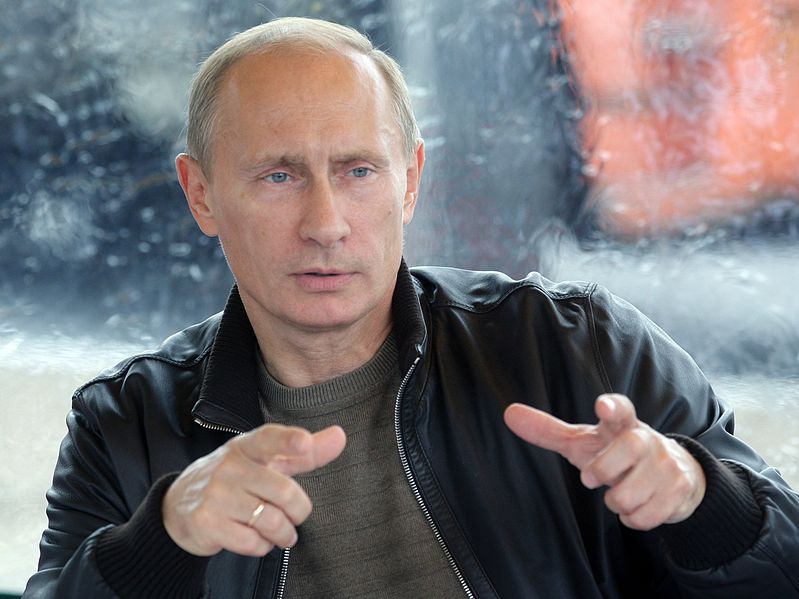
When Trump was interviewed by ABC-TV host George Stephanopoulos, former aide to President Bill Clinton, he was asked: “When you were pressed about [Russian president Vladimir Putin’s] killing of journalists, you said, ‘I think our country does plenty of killing too.’ What were you thinking about there? What killing sanctioned by the U.S. government is like killing journalists?”

Trump responded: “In all fairness to Putin, you’re saying he killed people. I haven’t seen that. I don’t know that he has. Have you been able to prove that? Do you know the names of the reporters that he’s killed? Because I’ve been — you know, you’ve been hearing this, but I haven’t seen the name. Now, I think it would be despicable if that took place, but I haven’t seen any evidence that he killed anybody in terms of reporters.”

Or Trump could have given Stephanopoulos a veritable heart attack by declaring that the American military, in the course of its wars in recent decades, has been responsible for the deliberate deaths of many journalists. In…

Read more

Video: Judo Chop! Putin spars with Russian team in Sochi

0


Russian President Vladimir Putin took part in a training session with the Russian national judo team in Sochi. First he sparred with the national team coach, then …

Via Youtube

Video: ‘Greater share of oil production’ Hillary Clinton emails reveal motives of Libya intervention

1


Newly declassified emails belonging to Hillary Clinton reveal some new possible motives behind the intervention in Libya. RT LIVE http://rt.com/on-air Subscribe …

Via Youtube

Video: Worse than Jungle? ‘Little brother of Calais’ popping up, puts residents’ safety at risk

0


A new refugee camp in northern France is causing major security concerns for locals and authorities who feel it puts residents’ safety at risk and could become a …

Via Youtube

Video: Gunmen open fire at hotel in Egyptian resort of Hurghada

0


Three armed men have reportedly stormed a hotel in the Red Sea city of Hurghada, one of Egypt’s most popular tourist resorts. Read More: http://on.rt.com/71bm …

Via Youtube

Anger and Ugly Faces of Bigotry

0

Millions of Americans feel disenfranchised by the political establishment — numbers reflected in the populist candidacies of Donald Trump and Bernie Sanders — but this sense of betrayal often pours out in ugly expressions of bigotry, as Michael Winship observed.

By Michael Winship

Philadelphia, Cradle of Liberty and City of Brotherly Love, was anything but on New Year’s Day. Visiting with family, we’d all decided to meet up at the annual Mummers’ Parade.

Now, it is well established that I am an unabashed lover of parades both as spectator and participant, having marched in protests, fireman’s carnivals, sugar beet festivals, and many other events. In high school, I was even in a freelance marching band, sort of a mobile garage band with a drum major and a couple of trombones.

An historical photo of "black-face" participants in a Mummers Parade.

An historical photo of “black-face” participants in a Mummers Parade.

So I’m a fan, and I remember watching the Mummers Parade on TV when I was a kid. Seeing it live and in person, the pageantry’s even more impressive. Reminiscent of New Orleans’ fabled Mardi Gras krewes, the various “brigades” in the line of march feature elaborate costumes, floats and superb musicianship. But unlike New Orleans, the marchers are overwhelmingly white. And their comedy skills leave a lot to be desired.

The 116-year-old Philadelphia event, perhaps the oldest of its kind in the United States, is troubled — “dogged by controversy,” as Angela Bronner Helm writes at The Root. “Minstrelsy has always [been] a part of the Mummer DNA, including blackface. But in 1964, under pressure from the NAACP, blackface was officially banned, yet it seems to find its way into the parade each year. This year, ‘brownface’ was the insult du jour, with Sammar Strutters’ ‘Siesta Fiesta’ revelers dressed as tacos with brown face paint, including children…”

But that wasn’t all, not by a long shot (for one thing, Helm forgot to mention the sombreros and serapes). In addition to the overall public drunkenness of the rowdy young crowd on the streets (I’m no prude but this was out of control), one of the other brigades in the parade crudely mocked Caitlyn Jenner, and one member was…

Read more

Video: CrossTalk: Saudi Trajectory

0


Saudi Arabia is on the move and in a hurry. Dissent at home is absolutely forbidden, and its foreign policy is active on multiple fronts. Do either make the Saudi …

Via Youtube

Video: Raining Tear Gas: IDF clash with Palestinians in Bethlehem

0


Clashes broke out between Israeli security forces and Palestinian protesters in Bethlehem. Israeli forces fired rounds of teargas at the protesters who in turn …

Via Youtube

Video: Top U.S. & World Headlines – January 8, 2016

0


Visit http://democracynow.org to watch the full independent, global news hour, read the transcript, search our archive and to make a donation to support us.

Via Youtube

Video: Poisoned Democracy: How an Unelected Official Contaminated Flint’s Water to Save Money

0


In Flint, Michigan, where a growing number of residents are demanding the arrest of Governor Rick Snyder over the ongoing water contamination crisis. Snyder …

Via Youtube

How America’s Corrupt Press Are Destroying the Country

4

Eric Zuesse

Even the best of America’s major mainstream and alternative-news media understate enormously the degree to which America’s government is corrupt; and, as a result, the public end up voting for corrupt politicians such as George W. Bush and Barack Obama, who lied through their teeth while they transferred trillions of dollars from the public to the aristocracy, who pour billions of dollars – chicken-feed for the aristocracy – into political campaigns, and into the ‘non-profit’ foundations of former Presidents. (And, for just one example of aristocratic follow-through from the political promotion of aristocracy: the head of the Clinton Foundation just happens to be their own incompetent daughter, Chelsea Clinton, whose children will then become securely part of the aristocracy, just as is every Bush – regardless of how competent or incompetent an heir might actually happen to be. Aristocracy is anything but ‘the equal-opportunity society.’ But it is bi-partisan, in the sense that all Republican candidates, and all of the top-level nationally leading Democratic candidates, are supported by the aristocracy, so as to keep the public as cooperative wage-slaves instead of rebelling labor-unionists, regardless of which Party is writing and carrying-out the laws on behalf of the aristocrats.)

The documentation of America’s media-rot starts here, with one of the best mainstream journalists (just so as to highlight how pervasive this censorship is), Shahien Nasiripour of Huffington Post, who on January 6th headlined, “The Obama Administration Could Repeat Its Biggest Mistake Of The Financial Crisis,” and he opened:

In the years since it failed to prosecute a single Wall Street executive involved in the global financial crisis, the U.S. Department of Justice has repeatedly promised to hold corporate executives liable for wrongdoing. But on Monday, when it sued Volkswagen over the automaker’s scheme to disguise the illegally high amounts of poisonous gases its cars were spewing into the air, the DOJ brought no criminal charges against the company or its employees.

The German automaker, one of the largest in the world, admitted on Sept. 22 to installing software meant to cheat on emissions tests in 11 million of its diesel vehicles. Prosecutors allege the company attempted to scam the public and deliberately hid this fact from regulators, obstructed investigators, and lied to federal authorities.

By suing Volkswagen but not pursuing criminal cases against the company or its employees, the Justice Department is repeating the mistakes it made in the wake of the financial crisis.

To call the Obama Administration’s refusal to prosecute even a single top bank executive, for the now clearly criminal actions that brought billions to those top financial executives but sucked trillions out of the public, “mistakes,” is simply to lie. A business-plan to deceive millions of home-buyers into signing 15+ page mortgage-documents that have phrases the signer won’t and doesn’t understand, and then to package thousands of these shaky mortgages as AAA safe investments when some of their own employees had tried to tell these CEOs the investments are anything but that, and then to sell these overrated packaged MBS investments to pension plans etc., with inflated fees tacked on, might make these executive criminal masterminds very rich, but the millions of boarded-up homes and stripped pensions etc. that inevitably end up being produced by this process impoverish the public. The money-funnel from the many poor to the extremely few super-rich, is terrific for the aristocracy, but bad for the public. It’s a business-plan that’s designed, and that is being carried out, by the mega-bank’s top executives and their friends, to funnel the public’s wealth to themselves, no matter how much the public inevitably will lose from it – which is far more than the elite crooks gain from it. This operation is no mere “mistake.” To say that “the Justice Department is repeating the mistakes” is false; and the reporter himself knows that. But he also needs to keep his job – and, above all, his future employability.

Nor is Obama’s refusal to prosecute these crimes a mistake. And Obama has consistently refused to prosecute them. These things are no more “mistakes” than are common bank robberies by outsiders to a bank. Outsider heists (“bank robbers”) get vigorously prosecuted. As the great criminologist William K. Black famously said, “The best way to rob a bank is to own one.” Only at the top (and the people who serve the top) in America, is criminality not prosecuted.

The U.S. has the world’s highest incarceration-rate of any country that has more than 100,000 citizens – and not merely the highest number of prisoners, of any nation, including China and all of what the U.S. ‘news’ media commonly refer to as ‘dictatorships.’ Which nations are actually police-states? If you’re rich in America, then this country isn’t one of them. But otherwise, it certainly is, more so than is any other large nation. For everyone but the very wealthiest few Americans, America is a police-state, notwithstanding the media’s calling it some sort of ‘democracy.’ For the very poor, it’s very much a police-state, even though conservatives call it instead a “welfare state,” precisely so as to smear the poor, to add insult to the mere injury of the ugly reality. As if the Sovereignty Clause, which is also the Welfare Clause, of the U.S. Constitution, were meaningless, or should be ignored. The aristocrats have named that clause instead The Preamble, and called the Taxation Clause the ‘Welfare Clause’; but, actually, the Preamble is the Constitution’s overriding statement, the Constitution’s Sovereignty Clause, and it is simultaneously the Constitution’s Welfare Clause, because it raises “the general Welfare,” of “We, the People,” to the very highest level of Constitutional importance – that of sovereignty, in America. This level of importance overrides that of taxes (with which the aristocracy have always been concerned above all else); and, therefore, to call the taxation-clause the ‘Welfare Clause’ is a gross distortion, which is based solely upon the aristocracy’s higher concern about taxes than about the general welfare. But, in any case, the U.S. Constitution opens with its supreme commitment, which includes “the general welfare.” That’s just a Constitutional fact, no matter how much the aristocracy despise “welfare.”

And no matter how skillful a journalist may be, lying in journalism is unforgivable – but it’s so routine in American ‘journalism,’ that one might more appropriately call America’s ‘journalism’ as constituting public relations instead. It’s PR for a governmental-economic system that funnels wealth from the public to the aristocracy.

It is the system that hires and fires journalists; and that, thus, controls what gets reported, and what does not, and what the placement of individual ’news’ stories will be, the prominence of them, and what in these ’news’ stories will be emphasized and de-emphasized. 

All of these things don’t happen by accident. They happen by the reality, that if the employee fails to comply, he or she will lose employment, and then will be blackballed by all of the aristocracy’s other ‘news’ media – which is practically all of the ‘news’ media.

Any journalist who refuses to compromise truth – to compromise it in the ways that the management require – gets fired (or equivalent). That’s done by media-executives in order not only to get rid of resistors but to keep all of the other ‘journalists’ in line. And, once a journalist gets fired, then he or she does become virtually blacklisted by the rest of the paying ‘journalism’ profession – that is, the employers. A fired Republican journalist can become picked up by a Democratic ’news’ medium, and a fired Democratic ‘journalist’ can become picked up by a Republican ’news’ medium; but, in either case, such a continuation of the person’s career can occur only if that ‘journalist’ refuses to report things that the entire aristocracy want the public not to know – such as what you’re now reading, which is, as one aristocrat, Warren Buffett, once publicly admitted and shockingly phrased America’s chief reality: “There’s class warfare, all right, but it’s my class, the rich class, that’s making war, and we’re winning.” That “rich class” isn’t actually the top 1%; it’s the top twenty, or so, of billionaires in America. However: the CEOs of giant banks and oil companies and military weapons-makers, and their lobbying firms and other fixers for those few top aristocrats, buy the laws – and the press-coverage and non-coverage – they want: the public no longer do that, they don’t own the government, via their citizenship and votes and taxes, in today’s America. The elected politicians represent almost only the aristocracy who fund their campaigns. The public get fed the lines that are acceptable to this aristocracy.

Here’s an example of a journalist who refused to comply: Amber Lyon was a rapidly rising star journalist at CNN when her insistence on not covering-up the brutality of the way that Bahrain’s fundamentalist Sunni royal family, and their fundamentalist Sunni royal friends, squashed the peaceful Shiite demonstrators in Bahrain, who were seeking basic democratic rights for the Bahraini public, who are overwhelmingly Shiite, and who are thus labelled as “infidels” by fundamentalist Sunnis (such as the Sauds, who own Saudi Arabia, and their friends the Khalifas, who own Bahrain), and thus are treated like trash by them. Lyon’s refusal to hide what the CNN executives required her to hide, led not only to her being fired, but blackballed, so that her soaring career was suddenly but utterly destroyed, and she now needs to pursue other means of trying to make a living.

It was one of Mr. Obama’s ‘liberal’ supporters and financial backers, who had famously said, on 26 November 2006, “There’s class warfare, all right, but it’s my class, the rich class, that’s making war, and we’re winning.” As a first-class hypocrite himself, who takes advantage of sophisticated opportunities to transfer his tax-obligations quietly onto others while urging publicly that his nation’s tax-laws should demand more of billionaires and less of the general public, Mr. Buffett was there verbally attacking, instead of (which is far more normal) publicly championing, the Robin-Hood-in-reverse that he sees in his country, and that he here affirmed to be the real “class warfare” in his country. That’s extraordinary, but Buffett said nothing to amplify his comment there, and he wasn’t invited to: no agent of the aristocracy (such as the conservative reporter to whom he had said this) asked him any questions about it – there was no interest whatsoever, among the aristocracy’s press, for him to provide any evidence, or amplification, upon that shocking (and shockingly unhedged and true) remark, from one of America’s top aristocrats. He knows the score. They all do. But saying it publicly like this is virtually unheard-of. Instead, there are numerous statements to the exact contrary, from the aristocracy’s agents, such as, for example, from the top Clinton-Obama economist, Harvard’s Larry Summers.

On 15 June 2012, Bonnie Kouvassi at Huffington Post, bannered “Larry Summers: We Need To Focus On Inequality of Opportunity,” and she presented video of him teaching at Harvard, in which he said, “I think we can accept, I think we should accept inequality of results, recognizing that those who earn more are in a better position to contribute more to support society.” He attacked those who criticized America’s extreme inequality of wealth, and he praised at length “those who are in a better position to contribute more to support society.” Summers’s aristocrat-enhancing view was that, even in a nation of such extreme wealth-inequality as America, inequality of opportunity can be reduced without also reducing inequality of wealth. It’s not just false, but absurdly false: In a country with such extreme wealth-inequality, inequality of opportunity is largely the result of inequality of wealth. Addressing the former without also addressing the latter is doomed to fail. One side of that whole cannot be attacked without simultaneously attacking the other side of it. As a reader at a blog phrased the matter, on 29 September 2013: “The privileges of wealth grow exponentially with each generation in no small part because of the greater educational opportunities the children of the rich have — with less distraction from needing to work their way through school and less debt with which to begin the ‘rat race’.” If anyone should know about that, it’s the former Harvard president Summers. He knows the reality. He simply lies about it.

That type of thing (what he said, but not his having been lying there) can be reported in the mainstream U.S. press, because perhaps as many as 30% of even the aristocracy – including people such as Buffett, but only Democrats, none of the Republicans who are in the aristocracy – disagree with Summers there. Basically, all of the aristocrats feel personally entitled, as aristocrats everywhere do (regardless of Party). They feel that they are superior and have a right to exploit the masses. This philosophy has been stated by the aristocracy’s ‘classics’ ever since at least the time of Plato – the propaganda-profession is ancient.

What America’s aristocrats all agree on are mainly to rape the publics in poorer countries. (The leaked “Summers Memo” from 12 December 1991, when Summers was Chief Economist for the World Bank, said that, “a given amount of health impairing pollution should be done in the country with the lowest cost, which will be the country with the lowest wages. I think the economic logic behind dumping a wad of toxic waste in the lowest wage country is impeccable and we should face up to that.” And he’s a ‘Democratic’ economist.) For example, even Huffington Post has never even so much as hinted at the reality in Ukraine, that the 20 February 2014 overthrow of the Russia-friendly leader Viktor Yanukovych and replacement of him as leader by the U.S.-aristocracy-subservient Arseniy Yatsenyuk (by the U.S. State Department itself, 16 days prior to the overthrow) was a very bloody coup, and not any sort of ‘revolution’ as the entire U.S. media misrepresent it as having been. Even the formerly honest British newspaper, the Guardian, was taken over by the aristocracy in recent years and now derives its income from distorting and falsifying the reality about that, instead of by honest reporting. Even the Guardian has become untrustworthy.

The Western press that failed to report that Bush and his sidekick Blair were lying, knowingly fabricating, about ‘Saddam’s WMD’ in 2002, deceiving their countries into an invasion of Iraq, didn’t apologize for their having gone along with those lies and become accessories to mass-murder, but instead became even more uniformly untrustworthy.

Western ‘democracy’ is only in the past tense. Imperfect as it was, it’s gone now. The only remaining vestige of it is a ceaseless ongoing PR campaign. How long will the Western publics continue to believe it?

–––––

Investigative historian Eric Zuesse is the author, most recently, of They’re Not Even Close: The Democratic vs. Republican Economic Records, 1910-2010, and of  CHRIST’S VENTRILOQUISTS: The Event that Created Christianity.

How Debt Conquered America

0

Special Report: America presents itself to the world as “the land of the free” but — for the vast majority — it is a place of enslaving indebtedness, a reality for much of “the 99%” that has deep historical roots hidden or “lost” from our history, as Jada Thacker explains.

By Jada Thacker

Since its center-stage debut during the Occupy Wall Street movement, “the 99%” — a term emblematic of extreme economic inequality confronting the vast majority  — has become common place. The term was coined by sociology professor David Graeber, an Occupy leader and author of the encyclopedic Debt: The First 5,000 Years, published just as the Occupy movement captured headlines.

What Graeber’s monumental work did not emphasize specifically, and what most Americans still do not appreciate, is how debt was wielded as the weapon of choice to subjugate the 99% in the centuries before the Occupy protesters popularized the term. Like so many aspects of our Lost History, the legacy of debt has been airbrushed from our history texts, but not from our lives.

A portrait of Christopher Columbus.

A portrait of Christopher Columbus.

The original 99% in America did not occupy Wall Street in protest. They occupied the entire Western Hemisphere as original inhabitants of North and South America. After 20,000 years of Occupy Hemisphere, an Italian entrepreneur appeared, having pitched an investment opportunity to his financial backers in Spain.

Soon after Columbus launched his business enterprise on the pristine beaches of the New World, each native discovered there above the age of puberty was required to remit a “hawk’s bell’s worth” of gold dust to the Spaniards every two weeks. The hands of all those failing to do so were cut off and strung about their necks — so that they bled to death, thus motivating the compliance of others.

Bartolome de las Casas, a contemporary slave-owning priest-turned-reformer, reported three million natives were exterminated by Spanish entrepreneurship in only 15 years. His population figures were guesstimates, but modern researchers confirm that 80 to 90% of the Taino people in the Hispaniola-Cuba region died within 30 years of Spanish contact, the majority from…

Read more

Video: Amid State & Fed. Cover-Up, the Story of How Researchers & Residents Exposed Flint’s Water Poisoning

0


For over a year, Flint residents have complained about the quality of the water, but their cries were ignored by state officials. In February, tests showed alarming …

Via Youtube

Video: 18 Ex-Military Guatemalan Leaders Arrested for Crimes against Humanity During U.S.-Backed Dirty War

0


In a stunning development, Guatemalan police have arrested 18 ex-military leaders on charges of committing crimes against humanity during the decades-long, …

Via Youtube

Video: “Gov. Snyder Should Be Arrested”: Flint Residents Demand Justice over Water Poisoning

0


Protests are growing in Flint, Michigan, over the state’s cover-up of the ongoing water contamination crisis. Filmmaker Michael Moore is asking fans to sign a …

Via Youtube

Obama, the Crocodile Tears of a Cold Hearted Killer

1

OBAMA’S TEARS

 “Even those tears, I me mine

“I me mine, I me mine” — the Beatles


John Chuckman


(RINF) – Had I seen the image of Obama, weeping over American gun deaths, seven years ago, I know I would have been deeply moved. It would have reinforced my view of him then as an empathetic, bright, and progressive politician. And I did then, and do now, find America’s violence — all of it, not just the small fraction of it seen in street killings – an appalling assault on the human spirit.

But the image comes seven years later, following a period of Obama’s proving himself an utterly cold and dry-eyed killer. Actually, apart from seven years packed with regular killing and support of others doing killing in at least half a dozen lands, he is reliably reported to have once said at a high-level meeting, without tears or the least change in demeanor, “I’m pretty good at killing.”

I don’t know whether the recent tears were artificially induced, as by an irritant placed on a fingertip to be touched to his face at the right moment of his performance, or squeezed out from heretofore unknown political acting talent. Perhaps they just reflect a kind of strangely compartmentalized brain.

This last possibility would make him more bizarre than I had come to regard him. I had come pretty much to accept him as just one more of the garden-variety psychopaths who have held the American Presidency for decades. There were even rumors, stemming from gaps in his resume, that he was CIA, an organization that employs a lot of psychopaths and has now deeply penetrated America’s elected government, having itself produced several presidents — George Bush père for sure – and other high office holders. The practice is equivalent to the Mafia’s having a “made man” on the bench of a high court.

After seven years of mass murder, dirty tricks destroying countless lives and destabilizing many peaceful lands, thousands of extrajudicial killings conducted by young thugs from basement computer-games rooms at CIA, and unblinking acceptance of such brutal savageries as we’ve seen from Israel or Saudi Arabia or Turkey, his tears truly mean nothing, except perhaps somewhere in the back of his own dark and terrible mind.

Only a few days before my writing this, I read of Israel spraying a huge swath of land inside the boundary of Gaza with a deadly herbicide. So these miserable people – these people who cannot even import cement to repair Israel’s savage destruction of homes and schools and public sanitation in 2014 — are now also to live with reduced arable land plus the virtual certainty of heavy future birth defects, much as the Vietnamese still experience from America’s hellish saturation of their land with Agent Orange about half a century ago.

That Nazi-like behavior solicited no teary scenes from Obama, just as Israel’s slaughter of more than 500 children and 1,700 adults in 2014 solicited not a tear from Obama, not so much as an awkward throat-clearing.

I don’t know what caused him to cry in his little performance about guns in America, but if you tell me it was because a decent human was overwhelmed momentarily by America’s hideously murderous society, I will not even bother to answer.

As remarkably few in other lands appear to grasp, America is a massively brutal society. This is true both at home and abroad, and I should know because I grew up there. I also know it will not change within the lifetimes of any readers, the overwhelming size and nature of the situation being beyond what many outside observers can imagine.

Certainly the insipid measures Obama has taken will not make a dint in the toll. Strangers to American society simply cannot imagine how many guns are floating around there. A recent Small Arms Survey estimated 270 million small arms, but there are a remarkable number of military-grade weapons in private hands as a result of exposure to a vast armed services with its galaxy of local military bases, major national guard organizations and facilities in every state, and the past heavy arming of police and numerous agencies such as the TSA. The kind of police who beat up drug suspects and take their money are also the kind of police who illicitly trade in guns, and America has large numbers of them amongst its rag-tag collection of a million or so.

America swims in guns, and there is a vast market just in private sales and stolen guns. There will always be a market under such conditions no matter what regulations Washington may impose. And increasingly, the individual states have permitted what was in my day in Chicago a serious felony, the concealed carrying of guns. Some also allow citizens to carry them openly in holsters.

Remember, there is not just the matter of thousands of murders and countless maimings each year. There is, as was revealed by The Guardian for the first time ever, 1,134 people killed by their own police in 2015. It all charges the atmosphere of the United States with a kind of regular, low-grade terror. And America’s prisons have an international reputation for brutality. They include such barbaric innovations as super-max prisons (in which prisoners live out entire lives in total isolation), private profit-motivated prisons, and a prison population whose total size dwarfs that of all other advanced countries.

I read in British newspapers, discussing Obama’s efforts, expressions from readers such as “it’s about time” or “those awful Republicans,” and I know they reflect views of people who just really do not understand America.

America is a country which has killed at least 6 million people over the last half century abroad, virtually all the killing to no purpose other than America’s trying to have its own way in places as distant as Vietnam, Cambodia, Indonesia, Chile, Iraq, Afghanistan, Syria, Libya, and still others. If you think violence officially sanctioned on such a scale has no effect on the country responsible for it, you are extremely naïve.

Much of the killing was savage beyond description, employing fire bombs, napalm, white phosphorus, Agent Orange, carpet bombing, and that truly hideous invention, cluster bombs.

America also remains the only country ever to use nuclear weapons, twice, on civilian targets of no military significance, and this after Japan had made strong feelers for its surrender. No, for America only unconditional surrender was acceptable. And a series of 12 atomic bombs for 12 cities was scheduled. Some sensible minds questioned the lunacy, considering that Japan had been almost flattened by a ferocious campaign of fire-bombing, so that not one primary or even secondary military target was left standing.

The fact that only two atomic bombs were used had nothing to do with America’s humanity. In later years, detailed plans for massive atomic attacks on Russia and China were drawn up, the last of which so far as I am aware was in 1961, being earnestly advocated to President Kennedy by the insane men then running the Pentagon. Nuclear weapons also were seriously discussed as options during the Korean War, the Cuban Missile Crisis, and the Vietnam War.

America is, far and away, the world’s largest arms dealer, literally dwarfing the trade in death machines of any other country, and it sells its arms to tyrants and madmen across the planet enabling players like Saudi Arabia, Israel, Turkey, or Egypt to hugely expand the total number of deaths for which America is responsible.

America also spends as much on its military as all the world’s militaries combined. It is an obscene amount of money dedicated to killing and oppression.

American advisors are in the business of advising kings and tyrants how they can control people and efficiently kill them if needed. America had an outfit called The Army School of the Americas which became infamous for its teaching military personnel sent from Latin America in the fine points of killing and torture. Today it’s been reborn as the bland-sounding Western Hemisphere Institute for Security Cooperation.

In a county like contemporary America, with its often poor employment prospects for young adults, the military is a major employer. It has an elaborate enticement system to attract young people. General military training anywhere consists of just two central matters: how to be doggedly obedient and how to kill people. So every year in America, many thousands of such young people are dumped back into the general population. Many of them then go on to become police because military service is a favorite entry qualification. Many of them remain unemployed. Some even homeless.

There are not just the regular armed forces involved in saturating the country with military values and attitudes, there are also the huge national guards and reserves and high school and college ROTCs. It is a massive effort, blanketing a supposedly democratic society with undemocratic and violent ideas. You might view it as kind of a national immunization program, immunization against democratic and human values, conducted year-in, year-out. So the young generation of Americans is constantly immersed in the concepts of blind obedience and killing. And all this is further reinforced by the vast numbers of Americans dependent upon work at its many regional military bases and other facilities.

Just a portion of this avalanche of annual spending on murder might have created countless new opportunities in America with new and better schools, better medical facilities, improved housing, and intervention into troubled families. No, instead, everything is just allowed to rip, and on the streets of Chicago and other cities, week-in and week-out, the toll of young blacks resembles minor battle scenes with as many as twenty-five shot (not all killed) on a single week-end.

That brings us to yet another aspect of American violence and passion for guns. America remains in many respects just as divided a society on racial lines as it was a century ago. The unspoken reason for many Americans keeping guns is the same one that caused Southern plantation owners to sleep each night with a knife and a pistol under the pillow. It rarely is openly discussed, but it is there like a great unnerving presence in a thousand dark places.

There is yet one more dimension to American violence. About half a dozen years ago, a study, led by a Harvard Medical School researcher, found evidence of mental problems in 26.4 % of people in the United States, versus, for example, 8.2% of people in Italy. The researchers were concerned with matters such as lack of access to treatment and under-treatment, but for those concerned about a safe and decent world, I think the salient finding is simply America’s high percentage. The world is being led by a nation where more than one-quarter of the people have genuine mental problems.

I’m afraid America’s movie industry has created sugary fantasies about America which still influence the views of many abroad. There really are no Jimmy Stewart types, with tears in the eyes and benign expressions, running America.

And in case you missed it, even in as sugary a confection as “It’s a Wonderful Life,” sobbed over by millions every Christmas season, some raw truth creeps in. Jimmy Stewart’s run-in with Bert the cop ends with Stewart running madly away in the snow and good old Bert pulling out his pistol and firing several times, trying to hit Stewart in the back and putting at risk pedestrians up and down the charming street. That’s the truest scene in the film.

And that is America. Fine-tuning and tears are about as fitting for the state of America as they would be on the Russian Front in World War II, the most horrendous conflict in all of human history in which 27 million Soviets and millions of Germans perished.

Video: Resistance & Outrage as Obama Administration Rounds Up Central American Refugees

0


The new year began inauspiciously for many immigrant families. Federal agents have detained at least 121 people, including children, in raids as part of an …

Via Youtube

Taking Aim at the Israeli Boycott

1

Mainstream U.S. presidential candidates are lining up behind Israel’s demand that the next “leader of the free world” take aim at Americans who express their contempt for Israel’s persecution of Palestinians through a boycott, as Lawrence Davidson describes.

By Lawrence Davidson

Most readers will know that the United States has served as the patron of Israel for decades. Why has it done so?

The commonly given reasons are suspect. It is not because the two countries have overlapping interests. The U.S. seeks stability in the Middle East (mostly by supporting dictators) and Israel is constantly making things unstable (mostly by practicing ethnic cleansing against Palestinians, illegally colonizing conquered lands and launching massive assaults against its neighbors).

Israeli Prime Minister Benjamin Netanyahu meeting with his generals to discuss the offensive in Gaza in 2014. (Israeli government photo)

Israeli Prime Minister Benjamin Netanyahu meeting with his generals to discuss the offensive in Gaza in 2014. (Israeli government photo)

Nor, as is often claimed, is the alliance based on “shared Western values.” The U.S. long ago outlawed racial, ethnic and religious discrimination in the public sphere. In Israel, religious-based discrimination is the law. The Zionist state’s values in this regard are the opposite of those of the United States.

So why is it that a project that seeks to pressure Israel to be more cognizant in foreign affairs of regional stability, and more democratic and egalitarian in domestic affairs, is now under fire by almost every presidential candidate standing for the 2016 election?

That project in dispute is BDS, the Boycott, Divestment and Sanctions movement, promoted by civil society throughout the Western world. BDS is directed at Israel due to its illegal colonization of the Occupied Territories and its general apartheid-style discrimination against non-Jews in general and Palestinians in particular.

The Candidates and BDS

With but two exceptions, every presidential candidate in both parties is condemning the BDS Movement. Let’s start with the two exceptions.

The first exception is the Green Party candidate Jill Stein, who has taken the accurate position that “the United States has encouraged the worst tendencies of the Israeli government.” She has pledged…

Read more

Video: Hill Climb – Real Old Fashioned Inclusive Car Sport from 1960s

0


Hill Climb Real Old Fashioned Car Sport From 1960s From the film The Fast Lady (1962) Hillclimbing (also known as hill climbing, speed hillclimbing or speed …

Via Youtube

Video: Pippa King On Why An Irish Sausage Company Is Pushing RFID Chips On Children

0


Please Support The Show — http://richieallen.co.uk/ Pippa King’s Websites: http://RFIDinSchools.com/ http://StateOfSurveillance.Blogspot.co.uk/ http://PippaKing.

Via Youtube

Islamic State Seeks to Lure West Into Ground War

0
The Islamic State seeks to create the greatest military costs possible for any Western power seeking to invade its territory.  (Photo: Wikimedia Commons)

The Islamic State seeks to create the greatest military costs possible for any Western power seeking to invade its territory. (Photo: Wikimedia Commons)

There’s a strange disconnect (one of dozens probably) in the strategy of the Islamic State. In the Nation, Joshua Holland quotes terrorism expert Robert Pape and explains that, on the one hand, like Al Qaeda, the Islamic State is fundamentally motivated by the West’s incursions into Muslim lands. On the other hand, Holland writes:

… how does the notion that terrorists are intent on getting powers to withdraw from their territory square with the view that the group’s shift to terrorist attacks in the West is designed to draw France and its allies into a ground war in Syria?

But, he continues, “Pape says that it’s important to distinguish between ISIS’s long-term goals and its shorter-term strategies to achieve them.”

It’s about the timing. How are you going to get the United States, France and other major powers to truly abandon and withdraw from the Persian Gulf when they have such a large interest in oil?

… if your goal is to create military costs on these states and get them to withdraw, you’ve got to figure out a way to really up the ante. And the way that you really up the ante is to get them to overreact. You try to get them to send a large ground army in so that you can truly drive up the costs. That’s what ISIS is trying to sucker us into doing.

And the West, especially the United States, is ever willing to play the sucker as long as it’s also allowed to play with its toys: guns, bombs, and planes.

More specifically, as Scott Atran writes at Aeon:

In areas under or adjacent to Islamic State control, the general populations likely do not support either the Islamic State or the Western (and now also Russian) forces arrayed against it. … ISIS knows this and entices its enemies to attack the population centres that it controls. … Mostly, then, the local populations suffer. Although many would run away from both ISIS and the bombs of its enemies if given half a chance, they cannot move and must exclusively depend for protection on the black banner.
Thus, if only for their own protection, the Islamic State’s subjects are forced to become its supporters.

This piece was reprinted from Foreign Policy In Focus by RINF Alternative News with permission.

New Study Highlights Big Unknowns of Public Health Harm From Fracking’s Chemical Cocktail

0

Researchers had information on reproductive and developmental toxicity for only 24 percent of over 1,000 chemicals they looked at

by Andrea Germanos

Add this to the body of evidence suggesting that the unconventional oil and gas extraction technique known as fracking poses risks to public health.

In a study published Wednesday, researchers at the Yale School of Public Health looked at over 1,000 chemicals in hydraulic-fracturing fluids or wastewater, and found that over 150 of them were linked to potential reproductive or developmental harm.

Those chemicals include arsenic, benzene, lead, formaldehyde, and mercury.

The study, published in the Journal of Exposure Science and Environmental and Epidemiology, also underscores the many unknowns regarding the adverse effects of fracking.

The Yale team was able to obtain information on potential reproductive and developmental toxicity for a small portion 240 of the 1,021 chemicals; for the majority–76 percent–of the chemicals, no such information was available.

“Thus, we were able to evaluate reproductive and/or developmental toxicity for only 24% of chemicals,” the researchers write.

While they obtained the list over over 1,00 chemicals from the EPA, the researchers point out that “the exact composition of fracturing fluids remains unknown because chemicals and their concentrations may be classified as confidential business information.”

The “lack of a clear target list of chemicals” used in the fracking process, therefore, presents “a major challenge to conduct efficient and well-designed human exposure assessments,” the study states.

Still, based on their study, the researchers write that the substances and processes used in fracking “indicate the potential for reproductive and developmental health risks.”

“This evaluation is a first step to prioritize the vast array of potential environmental contaminants from hydraulic fracturing for future exposure and health studies,” Nicole Deziel, senior author and assistant professor of public health, said in a media statement. “Quantification of the potential exposure to these chemicals, such as by monitoring drinking water in people’s homes, is vital for understanding the public health impact of hydraulic fracturing.”

“There’s still many unanswered questions,” she told the New Haven Register. “We (still) don’t know what aspect of hydraulic fracturing is likely to be most harmful.”

Via Common Dreams. This piece was reprinted by RINF Alternative News with permission or license.

Civilian to monitor NYPD spying in settlement over covert surveillance of Muslims

0

In a landmark settlement, the New York Police Department has agreed on reforms to protect Muslims from its discriminatory and covert surveillance, including the appointment of a civilian to monitor police surveillance.

The settlement reached during two lawsuits on Thursday establishes reforms that prevent police officers from launching investigations based around a suspect’s race, religion or ethnicity. In a further, safeguard it installs a civilian watchdog within the police department to prevent unfair targeting, and restricts the use of undercovers and confidential informants.

“At a time of rampant anti-Muslim hysteria and prejudice nationwide, this agreement with the country’s police force sends a forceful message that bias-based policing is unlawful, harmful, and unnecessary,” Hina Shamsi, the American Civil Liberties Union national security project director and an attorney in the suit, said in a statement.

The announcement brings to an end months of negotiations aimed at ending litigation over accusations that the NYPD conducted what the Associated Press described as a “covert campaign of religious profiling and illegal spying.” A federal judge must approve the terms of the settlement before they can go into effect.

The legal actions that followed reports by AP which revealed how city police infiltrated Muslim students groups, put informants in mosques, and spied on Muslims in neighborhoods, schools and stores as part of a broad effort to prevent terrorist attacks in the years September 11, 2001.

In 2013, civil rights groups sued in Manhattan federal court accusing the NYPD of breaking the Handschu rules, with a second case filed in a Brooklyn federal court by mosques and community leaders that alleged the department discriminated against Muslims.

The Handschu Guidelines, in place since 1985, barred police from starting a surveillance file purely because of religious or political leanings of a person or group. The guidelines were created after police were found to have monitored peace activists in 1970s, and violated their First Amendment-protected activity. The rules were loosened after the 9/11 attacks. The settlement reintroduces the guidelines and bans police investigations based on race, religion or ethnicity.

Among the plaintiffs in the Brooklyn case was Hamid Hassan Raza, an imam who claimed the NYPD’s practice of cultivating informants and using undercover investigations had spread fear and suspicion at his mosque.

“In America, we have the right to stand up and speak out in response to unfairness and injustice, just as throughout this country’s history, other minorities have done the same thing and secured their rights,” Raza said in a statement about the settlement. “We believe we have made important progress with this settlement for New York Muslim communities but for other minorities in New York and beyond.”

“Incorporating existing NYPD practices into the Handschu Guidelines makes it easier to maintain best practices in intelligence gathering and investigations,” Police Commissioner William Bratton said, according to Reuters.

The city is not admitting wrongdoing as part of the agreements and will pay out about $2 million to cover plaintiffs’ legal costs.

Via RT. This piece was reprinted by RINF Alternative News with permission or license.

Economists Said the Market Would Save the Planet. It Didn’t.

0

The market was supposed to save the planet.

That, at least, was the argument of many economists grappling with the problem of climate change. As fossil fuels became scarcer, they pointed out, the price of oil and natural gas would go up. And then other options, like solar and wind, would become cheaper, particularly as investment flowed into that sector and drove down the cost of new technologies.

And voila: The invisible hand would gradually turn down the global thermostat.

It’s a ridiculous argument. For one, there’s no guarantee that the market would respond in a timely manner (i.e., before we’re under water). For another, oil and gas prices are as volatile and unpredictable as a Q-and-A session with Donald Trump.

In 2008, for instance, oil hit a high of $145 a barrel. But that didn’t last long. And in 2015, despite all sorts of turmoil in the Middle East and in other oil-producing countries like Nigeria, the price of crude fell between 30 and 40 percent to its lowest levels in 11 years. That’s a bigger drop than the commodity price declines for metals, grains, and soybeans. Gas stations around the United States didn’t fully reflect this drop, but petrol prices still fell to an average of $2.40 a gallon, saving each driver more than $500 last year.

There are a number of reasons for the price drop, but it boils down to supply (more of it) and demand (less of it). The United States boosted oil production by 66 percent over the last five years, making it the largest oil and natural gas producer in the world in 2015. Other producers, like Saudi Arabia, also didn’t scale back, in part to stick it to a sanctions-hobbled Iran and snatch up its clients. Meanwhile, greater fuel efficiency and slower economic growth around the world (particularly in China) have reduced demand.

The nosedive in oil prices has been good news for a lot of people and a lot of countries. But it’s not good news for the planet.

First the Good News

Consumers love lower energy prices. It’s not only cheaper to fill up the tank and heat the house. Your shopping bill is also smaller because of lower manufacturing and transportation costs. Airlines cut fares (or at least they should). And it’s a big boost for the global economy. As The Economist notes, “a price fall normally boosts GDP by shifting resources from producers to consumers, who are more likely to spend their gains than wealthy sheikhdoms.”

The other good news is that lower oil prices haven’t undercut the market for sustainable energy. In the past, cheaper fossil fuels have meant that governments and industry put off the hard decision to shift to renewable energy sources. But several factors have changed this calculus.

The international community has made a commitment, most recently in Paris, to invest in wind turbines and solar panels. Because of technological advances and government incentives, meanwhile, the cost of renewables has fallen. The price of solar panels in the United States, for instance, has dropped 70 percent since 2009, and industry observers expect even sharper cuts in the years ahead. To keep up the momentum, the Obama administration pushed through an extension until 2019 of its tax credits encouraging renewable energy. And the investment banks, usually risk averse on this issue, are finally betting big on the sector: Goldman Sachs, for instance, announced in November that it will increase investments in renewable energy by fourfold.

Another environmental benefit to lower energy prices is the cancellation of pricier fossil fuel projects. President Obama finally deep-sixed the Keystone pipeline last November. The target of heated activist protest, the pipeline had become a considerably less attractive project when oil prices fell below $60 a barrel.

The State Department is also thrilled with lower oil prices. U.S. allies in Europe and Asia are able to reduce their energy purchases (and free up resources to buy U.S. goods, including military hardware). And key U.S. oil-producing adversaries are feeling the pinch. Iran, already under sanctions on its oil production, became more amenable last year to negotiations on its nuclear program. Russia, also under sanctions, hasn’t pushed as hard in Ukraine. Lower oil prices has put pressure on Venezuela and also reduced the flow of income to the Islamic State.

Decreasing U.S. dependency on foreign oil through a boost in domestic production is not only a good media sound bite and a hit with the voters. It also turns out to be a potent weapon for U.S. foreign policy, which is good news for battling the Islamic State but bad news for restraining arms sales.

And Now the Bad News

Much was made in December of news of a potential global “peak” in carbon emissions. Researchers from the University of East Anglia and the Global Carbon Project released a report that greenhouse gas emissions dropped in 2015 by 0.6 percent. That might not seem like much. But it represented the first such reduction in decades.

Carbon emissions have been going down in the EU. They dropped a bit in the United States in 2015. But the real reason for the global dip is China. Because of its recent economic slowdown, the country used a lot less coal last year.

So, this should be good news. But it isn’t. First of all, aside from China, the United States, and the EU, carbon emissions in the rest of the world continued their upward climb. Second, it’s more than likely that the drop was an anomaly – just as earlier predictions of “peak oil” proved premature.

And third, for any campaign to achieve zero emissions, cheap fossil fuels are the worst kind of disincentive. The price point is simply too irresistible – for car owners who want to go on vacation, companies that want to increase their profits, and governments that want to spur economic growth.

Geopolitical Ramifications

Saudi Arabia has recently been acting quite over the top. It intervened militarily in neighboring Yemen to put down an insurgency it blamed on Iran (with no evidence). It’s funneled money to its own preferred insurgents (namely, Sunni extremists) to topple Bashar al-Assad in Syria. And on New Year’s Day, it executed a number of “terrorists,” including Sheikh Nimr al-Nimr, a leading Shiite cleric.

Saudi Arabia, of course, is not known for its moderation. But the government in Riyadh has been acting even more erratically and paranoid than usual.

Or perhaps Saudi Arabia has good reason to be paranoid. Falling oil prices mean economic trouble for a country that depends on sales of crude for 85-90 percent of its revenues. The country is already running a huge deficit – some 15 percent of GDP. In their most recent budget, the Saudis indicated that some belt-tightening is in the offing, which will translate into curtailing key subsidies like gas and water.

Reduce subsidies and prices go up. If prices go up, people get upset. In other countries in the Middle East, price hikes have resulted in protest spikes. It’s no surprise, then, that Riyadh is doing what it can to eliminate potential sources of opposition at home and abroad.

Volatility in the energy market has helped to destabilize governments in the past: the Soviet Union under Gorbachev, the Suharto regime in Indonesia, or Venezuela just prior to the ascent of Hugo Chavez. So, it’s not far-fetched to imagine the winds of change blowing through Saudi Arabia – or Russia, where the economic situation is edging toward desperate, or Iran, which is anxious to see the lifting of economic sanctions as a result of the nuclear deal.

But as F. Gregory Gause points out in a Brookings report from April 2015, oil prices are just one factor affecting government stability, and most oil producers have enough reserves to weather the volatility. Indeed, Gause imagined that falling oil prices might even promote greater stability in the Middle East as Iran and Saudi Arabia worked more closely to coordinate production cuts. In fact, with Saudi Arabia severing ties with Iran this week, it looks more likely that both will continue to pump oil aggressively, driving prices down even further.

It perhaps flirts with conspiracy to imagine that the United States has boosted energy production to keep prices low in order to promote unrest in Russia, or that Saudi Arabia has done the same to foster discontent in Iran. Both countries have plenty of other reasons to push the pedal to the metal, energy-wise. But policymakers in Riyadh and Washington would certainly not be upset if their strategy produced such side benefits.

The problem is that instability in Russia and Iran isn’t in the best interests of either the United States or Saudi Arabia. Washington needs the help of Moscow and Tehran to negotiate a solution in Syria. And the Rouhani administration, compared to a more hardline clerical government that could easily emerge in Iran, is a much better potential negotiating partner for Saudi Arabia (assuming, of course, that it even wants a negotiating partner).

A Golden Opportunity

Low energy prices have come along at a particularly opportune time.

Governments can’t sit back and expect the market to allocate resources wisely, especially when it comes to the environment. That investments are flowing into the renewable sector despite the dip in oil and natural gas prices is about all the luck we can count on. It’s not clear how long prices will remain low. During this period, governments must use the savings wisely.

Priority number one should be the removal of energy subsidies. Writes Moises Naim in The Atlantic:

Energy subsidies, which amount to more than $540 billion per year worldwide, are as common as they are damaging to economies, the poor, and the environment, since they stimulate consumption and undermine efforts to save energy and use it more efficiently. According to the World Bank, these subsidies are highly regressive: As much as 60 or even 80 percent of what governments in the Middle East and North Africa spend to subsidize energy benefits the richest 20 percent of the population, with the poor receiving less than 10 percent of these public funds.

With prices so low, governments can more easily phase out these energy subsidies without causing as much disruption for consumers (while providing cash transfers to help the most disadvantaged).

The second priority is for governments to use the windfall from cheaper energy imports to provide a different kind of subsidy: for renewables. This is the moment when the world must take a sharp turn. Governments should focus on the public sector: reducing the carbon footprint of government buildings, schools, hospitals, and so on. But they must also make it economically irresistible for households to go solar, for utilities to build wind farms, and for businesses to make manufacturing more efficient.

The third priority is counter-intuitive. Energy producers must come together to reduce production. This will ultimately lead to higher oil and gas prices. But that is as it should be. If we are to achieve carbon neutrality, we have to make fossil fuels as expensive as possible.

The former Venezuelan oil minister Juan Pablo Perez Alfonso, a driving force behind the creation of the Organization of the Petroleum-Exporting Countries (OPEC), wasn’t interested in raising gas prices in order to collect windfall profits. An environmentalist of sorts, he considered petroleum “the devil’s excrement.” He saw OPEC – and its ability to cut production and boost prices – as a tool for conservation.

That’s the precisely the kind of wisdom we desperately need right now – when the devil’s excrement has become cheaper by the gallon than skim milk.

John Feffer is the co-director of Foreign Policy In Focus at the Institute for Policy Studies in Washington, DC. He is the author of North Korea, South Korea: U.S. Policy at a Time of Crisis (Seven Stories, 2003) among other books.

Via Foreign Policy In Focus. This piece was reprinted by RINF Alternative News with permission or license.

How banks, privatizers and politicians bankrupted the schools

0

Behind the Detroit Public School’s debt numbers

By Nancy Hanover

While the reports are still emerging regarding the DPS’s financial crisis, a few examples follow explaining how the financial industry has profited from DPS and worked with privatizers to dissolve the school district. This agenda has been implemented with ferocity by both Democrats and Republicans, with special praise and assistance from the Obama administration.

*In 2015 debt service cost the deficit-ridden district $53 million, including a massive $13 million in interest payments. Much of this debt goes back a decade or more and substantial amounts have been used to renovate buildings, which have been subsequently handed over to charter operations. In 2016, the district is scheduled to pay $191.3 million on long-term debt out of an annual budget of about $660 million.

*According to a Citizens Research Council (CRC) report published this week, last August the district, no doubt through the state-appointed emergency manager, decided that DPS would make debt payments rather than paying its pension liabilities for seven months last year. The penalties accruing to the state were staggering: $7,600 a day, with $78,000 in fees for each additional month the DPS was delinquent, according to the Detroit News. The DPS is now $114 million behind on the pensions, an amount which is expected to top $157 million by July.

*DPS has $1.5 billion in general obligation bonds outstanding–which are structured to generate $1.0 billion in interest over the next 25 years, according to the CRC report. In this regard, they also note that a whopping $1.5 billion was paid in debt service in 2015 collectively by Michigan school districts.

*Like public schools throughout the state of Michigan, DPS has suffered from stagnant state foundation grants, a decline in federal aid and the greater demands necessary for a school population in poverty. The district has borrowed to cover operating expenses since 2007-08.

*Under the Obama administration, Title I funds that are legally earmarked for impoverished districts like Detroit have been cut by 11 percent, while special education funding was cut 9 percent. Special-needs children in the impoverished city of Detroit are 17 percent of the school population, a much higher percentage than statewide or nationally.

*Under emergency management, DPS lost more than half of its students to charters. The district handed over buildings, teachers and resources to the charters and even authorized some of its own. All of the district’s emergency managers, privatization advocates to a man, have been highly-paid and highly-connected financial frontmen for private interests. Robert Bobb, the first EM, appointed in 2009 by Democratic Governor Jennifer Granholm–earned $425,000 annually. He explained from the beginning that his goal was “to create a purely market driven school district” and work toward “partnerships with the business community.” He closed dozens of schools during his tenure and “predicted” that thousands of students would leave the district. By the end of his tenure, he had accomplished that goal.

*Bobb also worked with the Detroit Federation of Teachers president Keith Johnson to force teachers to “loan” the DPS $9,000 each, interest-free, under the Termination Incentive Plan (TIP) between 2009-12. Under the plan, $250 was deducted from each paycheck beginning in 2010, supposedly to be repaid when the teacher left the district. However, since that time, the DPS has failed to fund the liability and now owes the TIP account over $16.6 million.

*In 2011, the State of Michigan removed the charter school cap, allowing the unlimited proliferation of charters. That year, Arne Duncan, Obama’s former education secretary, was so impressed that he praised Detroit as “ground zero” in education reform and the growth of charters.

*In 2012, Governor Rick Snyder, working with EM Roy Roberts, a former GM executive, drained funds from the Michigan School Aid Fund to create the Education Achievement Authority of Michigan (EAA), imposing lower wages and benefits for teachers and opening the doors for no-bid vendored services (later to be the subject of an FBI investigation and several indictments). The “turnaround district” operations were designed by the pro-privatization Broad Foundation, bringing on board a Broad Academy graduate, John Covington, to run it with a $1.5 billion four-year contract. The EAA was the only finalist for Obama’s Race to the Top funding in Michigan that year. It is also notable that Duncan described EAA’s Brenda Scott Academy as a “spotlight of success”–a school which one year later put 100 five-year-olds in one kindergarten class.

*The drop in DPS enrollment from 2011 to 2015, largely attributable to the post-2008 economic crisis and the sharp growth of charters and the EAA, reduced state aid to the DPS from $591 million to $394 million.

Via WSWS. This piece was reprinted by RINF Alternative News with permission or license.

8 Signs You Are Living Under a Fascist Regime

0

In Part 1 I asserted that there is a new globalised Fascist movement that has gradually, in fits and starts, insinuated itself as a new normal in Western regimes and in many “developing” regimes. A central claim of the article is that the differences between old Fascism and new Fascism are almost entirely due to the fact that the original Fascism was a nationalistic creed with imperialist ambitions, while the new Fascism is an imperialist ideology and mode of governance.

I also distinguish between the banal Fascism of governance and the dramatic Fascism of rhetoric. Fascists campaign as radical revolutionaries, but rule in a way that secures and bolsters the existing social order against mass discontent.

There is an inversion of the historic pattern in this new Fascism. This inversion of old Fascism parallels Sheldon Wolin’s conception of “inverted totalitarianism”. Old Fascism harnessed mass political engagement during a time of crisis and channelled it into an ultimately reactionary political project. The new Fascism has harnessed mass disengagement but the crisis it has brought by its own success has led to the same populist right-wing explosion that was the vanguard of the old Fascism. We can now see — particularly in the US — that this is a matter of sequence, not essence. The mass embrace of combative right-wing populism is becoming ever more common, and it completes the circle so that the symmetry with old Fascism is revealed.

A major difference between old and new Fascism is that the biopolitical paradigm of control in the new Fascism is neoliberal and expresses itself the state violence of police, courts and the “corrections” complex and through the discipline imposed on persons as consumers and workers. It lacks the paternalistic aspect of old Fascist corporatism and nationalism. This too is changing. Authoritarian political rhetoric and the actions of police and intelligence agencies…

Read more

Kerry blames China for ‘failed’ soft approach to N. Korea

0

US Secretary of State rebuked China over its appeasement of the North Korean regime, which rocked the international community by conducting a surprise nuclear test on Wednesday. Beijing has urged Pyongyang to observe the denuclearization of the Korean Peninsula.

John Kerry told reporters in Washington on Thursday that America “respected” Beijing’s special approach towards North Korea, and in particular sanctions imposed on Pyongyang.

“China had a particular approach that it wanted to make, and we agreed and respected that,” Kerry said following a phone call with his Chinese counterpart Wang Yi.

“Today in my conversation with the Chinese I made it very clear: that has not worked and we cannot continue business as usual,” Kerry said.

Kerry decisively denied a journalist’s allegation that the new North Korean nuclear test was a result of lack of oversight by Washington.

“North Korea has never been left unattended to. Not for one day,” Kerry stressed.

US officials are stressing China should be very worried that Pyongyang never warned Beijing of the upcoming nuclear test, as it did in the previous instances.

Washington thinks that without China’s economic support of Pyongyang, Kim Jong-un’s regime would crumble.

However, instead of committing itself to compromising North Korea’s economy, China has opted to apply pressure on Pyongyang from a different angle.

“China urges North Korea to adhere to denuclearization, to reiterate its commitment to this principle and to refrain from actions that can exacerbate the situation,” the Chinese Foreign Ministry’s spokesperson Hua Chunying said on Friday, adding that maintaining peace and stability in the region is China’s confirmed position.

“In light of new developments, China will continue to protect the non-proliferation regime and will work with all parties to resolve this issue,” the diplomat said.

Via RT. This piece was reprinted by RINF Alternative News with permission or license.

5,000 Swiss Army Troops To Protect the Plutocrats

0

With a new wave of terrorism, mass shootings and unprecedented social violence around the globe now a part of the daily routine for billions of people across both developed and developing nations, one group wants to be certain there is no chance of “close encounters”, violent or otherwise, with the peasantry during its upcoming annual boondoggle at the World Economic Forum in Davos. According to Swissinfo, when the world’s billionaires land their private jets in the gorgeous Swiss town (which at 1,560 m is also the highest town in Europe) on January 20, they will have up to 5,000 Swiss army troops protecting them.

As a result, the Swiss army has begun on-site preparations for the annual World Economic Forum (WEF) meeting in Davos.

Swissinfo reports that the head of the canton Graubünden police force, Walter Schlegel, who is responsible for the operation overall, said back in December that his anti-terror resources had already been at maximum capacity since the attacks on the World Trade Center in 2001, and that expanding them was “not even possible”.

Read more

Police gun down youth in poor Paris neighborhood

0

One year after Charlie Hebdo attack

By Stéphane Hugues

On Thursday, the first anniversary of the Charlie Hebdo terrorist attack, police gunned down a youth outside a police station in northern Paris. While government officials differed in their accounts of the motivation of the victim and how the police had killed him, witnesses flatly contradicted police accounts of the shooting and said police had shot an unarmed man without warning.

The shooting took place at midday in front of the Commissariat of Police for a poor and heavily immigrant neighborhood, the “Goutte d’Or” in the 18th district of Paris.

The victim was Sallah Ali, a 20-year-old Moroccan born in Casablanca but living homeless in France. He had had a single brush with the police in 2013, where he was arrested for stealing in the town of Sainte-Maxime in the Var region of the south of France. He was positively identified by his fingerprints that were taken at the time, as he had no identity papers.

Interior Minister Bernard Cazeneuve and the Paris prefect of Police arrived only half an hour after the killing, making clear that the highest levels of the Socialist Party (PS) government of Prime Minister Manuel Valls and President François Hollande were intervening.

They closed down the underground Paris Metro trains in the vicinity, ordered a mass deployment of security forces, and put the entire Goutte d’Or neighborhood on lockdown. Riflemen deployed across Paris under the terms of the PS’s state of emergency were placed on alert.

Only 45 minutes after the shooting, French Interior Ministry spokesman Pierre-Henry Brandet went on BFMTV to report that Ali, armed with a knife and an explosive belt, had shouted “Allah Akbar” (God is great in Arabic) whilst trying to assault a police officer at the entrance to the Commissariat.

Only 25 minutes later, this account of the shooting started to fall apart. A bomb disposal unit that had arrived at the scene analyzed the belt worn by Ali and said that it contained no explosives. There was no sign of a knife, but a big butcher’s cleaver was found near Ali.

Witnesses to the shooting contradicted Brandet’s account. BFMTV interviewed them and reported, “Many witnesses have assured BFMTV that the assailant of the Commissariat…did not cry out ‘Allah Akbar.’ Many of the witnesses said that he never even pronounced these words: ‘When he arrived, he was acting normally,’ said one of them.”

BFMTV continued, “Witnesses state that the man was not armed. ‘He was not armed at all,’ stated a woman who had seen the assailant. The Police officers told him ‘back-up, back-up, back-up’ then ‘he backed up whilst raising his hands,’ she said. But the man moved forward again towards the Police officers and they shot him three times.”

At about 3 p.m., the State Prosecutor’s office announced that it was charging Sallah Ali with aggressing police officers as representatives of the state. Then at 3:45, it announced that “a portable telephone and a paper that had a Daesh [Islamic State in Iraq and Syria] flag on it with a clearly formulated handwritten demand in Arabic” had been found on Ali’s body.

The Prosecutor’s office then repeated the claim that Ali had cried “Allah Akbar” as he moved toward the Police officers. The case was then transferred to the Special Anti-Terrorist Prosecutor.

It was later confirmed that the ISIS flag on the paper was amateurishly drawn with a marker. As for the handwritten demand, authorities said it was a pledge of allegiance to Abu Bakr al-Baghdadi, the self-proclaimed leader of ISIS, referring to “acts to avenge the deaths in Syria.”

The Interior Ministry’s attempts to present Ali as a terrorist are simply not credible. One policeman speaking to the right-wing daily Le Figaro expressed disbelief at PS allegations that Ali was carrying out a terrorist attack. He said, “running at armed policemen wearing bulletproof vests wearing a fake explosive belt, is bizarre. It’s even suicidal.”

The Prosecutor’s office’s account was also contradicted by Justice Minister Christine Taubira, who said, “What is very clear from what is known about this person, [it is that he] has no link to violent radicalization, none at all.”

“A fake suicide belt, shouting, the statement of loyalty in his pocket, these are signs that can indicate belonging to a [terrorist] network, but they can also be signs of instability. The investigation will shed light on all of this,” she added.

The police killing of Sallah Ali points to the vast shift to the right in the French political establishment that has taken place in the year since the Kouachi brothers carried out a terrorist attack killing 11 people at the editorial offices of the satirical weekly Charlie Hebdo. The PS organized a mass national demonstration after the attack, proclaiming a period of national unity based on a police buildup, supposedly to protect free expression and liberty of the press.

What has unfolded over the last year was not a flowering of democracy in France, however, but an accelerating movement towards police-state rule led by the PS. Law-and-order and anti-Muslim moods have helped the neo-fascist National Front (FN) to consolidate its place in the political establishment, and since the November 13 terrorist attacks, the PS placed France in a state of emergency. This gives the PS wide police powers, including to censor the press.

The PS is proposing a measure to deprive citizens of their nationality if they carry out terrorism-related offenses. This measure was long associated with the FN and, before it, to the deprivation of Jews’ French nationality during the Holocaust in fascist Europe during World War II.

The division inside the PS over the police killing of Ali reflects the debate that has roiled the government since then, with Taubira criticizing PS support for deprivation of nationality while the bulk of the government supported it.

The killing of Ali emerges directly from this poisonous and reactionary political climate. As the PS promotes law-and-order hysteria to help ram through a constitutional amendment to enshrine a permanent state of emergency in the French constitution, 100,000 soldiers and police are patrolling the streets on full alert. With jittery and heavily armed men deployed across the country, it is likely only a matter of time before another person is gunned down by security forces in the streets of France.

Via WSWS. This piece was reprinted by RINF Alternative News with permission or license.

American War Crimes: Yesterday, Today, and Tomorrow

0

They’re back!

From the look of the presidential campaign, war crimes are back on the American agenda. We really shouldn’t be surprised, because American officials got away with it last time — and in the case of the drone wars continue to get away with it today. Still, there’s nothing like the heady combination of a “populist” Republican race for the presidency and a national hysteria over terrorism to make Americans want to reach for those “enhanced interrogation techniques.” That, as critics have long argued, is what usually happens if war crimes aren’t prosecuted.

In August 2014, when President Obama finally admitted that “we tortured some folks,” he added a warning. The recent history of U.S. torture, he said, “needs to be understood and accepted. We have to as a country take responsibility for that so hopefully we don’t do it again in the future.” By pinning the responsibility for torture on all of us “as a country,” Obama avoided holding any of the actual perpetrators to account.

Unfortunately, “hope” alone will not stymie a serial war criminal — and the president did not even heed his own warning. For seven years his administration has done everything except help the country “take responsibility” for torture and other war crimes. It looked the other way when it comes to holding accountable those who set up and ran the CIA’s large-scale torture operations at its “black sites” around the world. It never brought charges against those who ordered torture at Guantánamo. It prosecuted no one, above all not the top officials of the Bush administration.

Now, in the endless run-up to the 2016 presidential elections, we’ve been treated to some pretty strange gladiatorial extravaganzas, with more to come in 2016. In these peculiarly American spectacles, Republican candidates hurl themselves at one another in a frenzied effort to be seen as the candidate most likely to ignore the president’s wan hope and instead “do it again in the future.” As a result, they are promising to commit a whole range of crimes, from torture to the slaughter of civilians, for which the leaders of some nations would find themselves hauled into international court as war criminals. But “war criminal” is a label reserved purely for people we loathe, not for us. To paraphrase former President Richard Nixon, if the United States does it, it’s not a crime.

In the wake of the brutal attacks in Paris and San Bernardino, the promises being openly made to commit future crimes have only grown more forthright. A few examples from the presidential campaign trail should suffice to make the point:

* Ted Cruz guarantees that “we” will “utterly destroy ISIS.” How will we do it? “We will carpet bomb them into oblivion” — that is, “we” will saturate an area with munitions in such a way that everything and everyone on the ground is obliterated. Of such a bombing campaign against the Islamic State, he told a cheering crowd at the Rising Tide Summit, “I don’t know if sand can glow in the dark, but we’re going to find out.” (It’s hard not to take this as a reference to the use of nuclear weapons, though in the bravado atmosphere of the present Republican campaign a lot of detailed thought is undoubtedly not going into any such proposals.)

Read more

Washington’s Multi-Million-Dollar Saudi PR Machine

0

Public image isn’t something one can always control, but Saudi Arabia is spending millions of dollars on Washington lobbyists and PR firms to improve the Kingdom’s reputation in the West. The execution of Shiite leader Sheik Nimr Baqr al-Nimr, followed by an attack on the Saudi embassy in Tehran and the Kingdom’s severing of diplomatic relations with Iran, would seem to offer few upsides for the Saudi government. Riyadh’s behavior comes across as a desperate Hail-Mary pass to isolate Iran at the expense of regional efforts to negotiate a de-escalation of the Syrian civil war and defeat the Islamic State in Syria and Iraq.

Jim Lobe pointed out that Washington’s neoconservatives have jumped to Riyadh’s defense, apparently subscribing to the philosophy that “the enemy of my Iranian enemy is my friend.” But, as The New York Times editorial board wrote on Monday, “The execution of the popular Shiite cleric Sheikh Nimr al-Nimr and 46 other prisoners on Saturday was about the worst way Saudi Arabia could have started what promises to be a grim and tumultuous year in the kingdom and across the Middle East.”

The Times may be stating the obvious, but Saudi Arabia pays millions of dollars per year to American public relations firms to paint the Kingdom in the most positive light. These firms have their work cut out for them. Indeed, that PR machine is doing all it can to spin the Saudis’ execution of a political dissident and blatant effort to fan sectarian tensions as somehow the fault of anyone but Saudi Arabia.

Defending the Kingdom

Fahad Nazer, a non-resident fellow at the Saudi- and UAE-funded Arab Gulf States Institute in Washington, was quoted in Politico defending the executions, saying, “The primary message appears to be aimed at Saudi Arabia’s own militants, regardless of their sect.” And the Times published a quote from Saudi commentator Salman al-Ansari, who “accused Sheikh Nimr, who was in his mid-50s, of organizing a ‘terrorist network’ in Shiite areas in eastern Saudi Arabia and compared him to a Qaeda ideologue who sanctioned the killing of security forces.” The Podesta Group, a public relations firm hired by the Saudi government, provided Ansari.

So, how much money is in it for the PR professionals who are burning the midnight oil to put a positive spin on Saudi Arabia’s decision to start the year with a mass execution of 46 prisoners? Foreign Agent Registration Act (FARA) filings submitted by Saudi government contractors in Washington reveal an expensive PR operation.


Read more 

Video: Snow Battle: Border police ‘attacked’ by refugee children in Serbia

0


A group of refugee children decided to take on two local police officers in a snowball fight at a refugee centre in Sid, Serbia. COURTESY: RT’s RUPTLY video …

Via Youtube

58 Facts About The U.S. Economy From 2015 That Are Almost Too Crazy To Believe

0

Michael Snyder

(RINF) – The world didn’t completely fall apart in 2015, but it is undeniable that an immense amount of damage was done to the U.S. economy. This year the middle class continued to deteriorate, more Americans than ever found themselves living in poverty, and the debt bubble that we are living in expanded to absolutely ridiculous proportions. Toward the end of the year, a new global financial crisis erupted, and it threatens to completely spiral out of control as we enter 2016. Over the past six months, I have been repeatedly stressing to my readers that so many of the exact same patterns that immediately preceded the financial crisis of 2008 are happening once again, and trillions of dollars of stock market wealth has already been wiped out globally. Some of the largest economies on the entire planet such as Brazil and Canada have already plunged into deep recessions, and just about every leading indicator that you can think of is screaming that the U.S. is heading into one. So don’t be fooled by all the happy talk coming from Barack Obama and the mainstream media. When you look at the cold, hard numbers, they tell a completely different story. The following are 58 facts about the U.S. economy from 2015 that are almost too crazy to believe…

#1 These days, most Americans are living paycheck to paycheck. At this point 62 percent of all Americans have less than 1,000 dollars in their savings accounts, and 21 percent of all Americans do not have a savings account at all.

#2 The lack of saving is especially dramatic when you look at Americans under the age of 55. Incredibly, fewer than 10 percent of all Millennials and only about 16 percent of those that belong to Generation X have 10,000 dollars or more saved up.

#3 It has been estimated that 43 percent of all American households spend more money than they make each month.

#4 For the first time ever, middle class Americans now make up a minority of the population. But back in 1971, 61 percent of all Americans lived in middle class households.

#5 According to the Pew Research Center, the median income of middle class households declined by 4 percent from 2000 to 2014.

#6 The Pew Research Center has also found that median wealth for middle class households dropped by an astounding 28 percent between 2001 and 2013.

#7 In 1970, the middle class took home approximately 62 percent of all income. Today, that number has plummeted to just 43 percent.

#8 There are still 900,000 fewer middle class jobs in America than there were when the last recession began, but our population has gotten significantly larger since that time.

#9 According to the Social Security Administration, 51 percent of all American workers make less than $30,000 a year.

#10 For the poorest 20 percent of all Americans, median household wealth declined from negative 905 dollars in 2000 to negative 6,029 dollars in 2011.

#11 A recent nationwide survey discovered that 48 percent of all U.S. adults under the age of 30 believe that “the American Dream is dead”.

#12 Since hitting a peak of 69.2 percent in 2004, the rate of homeownership in the United States has been steadily declining every single year.

#13 At this point, the U.S. only ranks 19th in the world when it comes to median wealth per adult.

#14 Traditionally, entrepreneurship has been one of the primary engines that has fueled the growth of the middle class in the United States, but today the level of entrepreneurship in this country is sitting at an all-time low.

#15 For each of the past six years, more businesses have closed in the United States than have opened. Prior to 2008, this had never happened before in all of U.S. history.

#16 If you can believe it, the 20 wealthiest people in this country now have more money than the poorest 152 million Americans combined.

#17 The top 0.1 percent of all American families have about as much wealth as the bottom 90 percent of all American families combined.

#18 If you have no debt and you also have ten dollars in your pocket, that gives you a greater net worth than about 25 percent of all Americans.

#19 The number of Americans that are living in concentrated areas of high poverty has doubled since the year 2000.

#20 An astounding 48.8 percent of all 25-year-old Americans still live at home with their parents.

#21 According to the U.S. Census Bureau, 49 percent of all Americans now live in a home that receives money from the government each month, and nearly 47 million Americans are living in poverty right now.

#22 In 2007, about one out of every eight children in America was on food stamps. Today, that number is one out of every five.

#23 According to Kathryn J. Edin and H. Luke Shaefer, the authors of a new book entitled “$2.00 a Day: Living on Almost Nothing in America“, there are 1.5 million “ultrapoor” households in the United States that live on less than two dollars a day. That number has doubled since 1996.

#24 46 million Americans use food banks each year, and lines start forming at some U.S. food banks as early as 6:30 in the morning because people want to get something before the food supplies run out.

#25 The number of homeless children in the U.S. has increased by 60 percent over the past six years.

#26 According to Poverty USA, 1.6 million American children slept in a homeless shelter or some other form of emergency housing last year.

#27 Police in New York City have identified 80 separate homeless encampments in the city, and the homeless crisis there has gotten so bad that it is being described as an “epidemic”.

#28 If you can believe it, more than half of all students in our public schools are poor enough to qualify for school lunch subsidies.

#29 According to a Census Bureau report that was released a while back, 65 percent of all children in the U.S. are living in a home that receives some form of aid from the federal government.

#30 According to a report that was published by UNICEF, almost one-third of all children in this country “live in households with an income below 60 percent of the national median income”.

#31 When it comes to child poverty, the United States ranks 36th out of the 41 “wealthy nations” that UNICEF looked at.

#32 An astounding 45 percent of all African-American children in the United States live in areas of “concentrated poverty”.

#33 40.9 percent of all children in the United States that are being raised by a single parent are living in poverty.

#34 There are 7.9 million working age Americans that are “officially unemployed” right now and another 94.4 million working age Americans that are considered to be “not in the labor force”. When you add those two numbers together, you get a grand total of 102.3 million working age Americans that do not have a job right now.

#35 According to a recent Pew survey, approximately 70 percent of all Americans believe that “debt is a necessity in their lives”.

#36 53 percent of all Americans do not even have a minimum three-day supply of nonperishable food and water at home.

#37 According to John Williams of shadowstats.com, if the U.S. government was actually using honest numbers the unemployment rate in this nation would be 22.9 percent.

#38 Back in 1950, more than 80 percent of all men in the United States had jobs. Today, only about 65 percent of all men in the United States have jobs.

#39 The labor force participation rate for men has plunged to the lowest level ever recorded.

#40 Wholesale sales in the U.S. have fallen to the lowest level since the last recession.

#41 The inventory to sales ratio has risen to the highest level since the last recession. This means that there is a whole lot of unsold inventory that is just sitting around out there and not selling.

#42 The ISM manufacturing index has fallen for five months in a row.

#43 Orders for “core” durable goods have fallen for ten months in a row.

#44 Since March, the amount of stuff being shipped by truck, rail and air inside the United States has been falling every single month on a year over year basis.

#45 Wal-Mart is projecting that its earnings may fall by as much as 12 percent during the next fiscal year.

#46 The Business Roundtable’s forecast for business investment in 2016 has dropped to the lowest level that we have seen since the last recession.

#47 Corporate debt defaults have risen to the highest level that we have seen since the last recession. This is a huge problem because corporate debt in the U.S. has approximately doubled since just before the last financial crisis.

#48 Holiday sales have gone negative for the first time since the last recession.

#49 The velocity of money in the United States has dropped to the lowest level ever recorded. Not even during the depths of the last recession was it ever this low.

#50 Barack Obama promised that his program would result in a decline in health insurance premiums by as much as $2,500 per family, but in reality average family premiums have increased by a total of $4,865 since 2008.

#51 Today, the average U.S. household that has at least one credit card has approximately $15,950 in credit card debt.

#52 The number of auto loans that exceed 72 months has hit at an all-time high of 29.5 percent.

#53 According to Dr. Housing Bubble, there have been “nearly 8 million homes lost to foreclosure since the homeownership rate peaked in 2004″.

#54 One very disturbing study found that approximately 41 percent of all working age Americans either currently have medical bill problems or are paying off medical debt. And collection agencies seek to collect unpaid medical bills from about 30 million of us each and every year.

#55 The total amount of student loan debt in the United States has risen to a whopping 1.2 trillion dollars. If you can believe it, that total has more than doubled over the past decade.

#56 Right now, there are approximately 40 million Americans that are paying off student loan debt. For many of them, they will keep making payments on this debt until they are senior citizens.

#57 When you do the math, the federal government is stealing more than 100 million dollars from future generations of Americans every single hour of every single day.

#58 An astounding 8.16 trillion dollars has already been added to the U.S. national debt while Barack Obama has been in the White House. That means that it is already guaranteed that we will add an average of more than a trillion dollars a year to the debt during his presidency, and we still have more than a year left to go.

What we have seen so far is just the very small tip of a very large iceberg.  About six months ago, I stated that “our problems will only be just beginning as we enter 2016″, and I stand by that prediction.

We are in the midst of a long-term economic collapse that is beginning to accelerate once again. Our economic infrastructure has been gutted, our middle class is being destroyed, Wall Street has been transformed into the biggest casino in the history of the planet, and our reckless politicians have piled up the biggest mountain of debt the world has ever seen.

Anyone that believes that everything is “perfectly fine” and that we are going to come out of this “stronger than ever” is just being delusional. This generation was handed the keys to the finest economic machine of all time, and we wrecked it. Decades of incredibly foolish decisions have culminated in a crisis that is now reaching a crescendo, and this nation is in for a shaking unlike anything that it has ever seen before.

So enjoy the rest of 2015 while you still can.

2016 is almost here, and it is going to be quite a year…

[ad_2]

Visit Michael’s blog

GMOs used as gene-altering superweapons could make humanity extinct

0

The future of weaponry won’t necessarily involve higher capacity firearms, more advanced bombs or better fighter jets. It will encompass an entirely new realm of genetically-modified (GM) bioweapons that threaten to destroy the human brain and cause irreversible genetic-level damage to the planet.

This is the prediction of Russia’s Ministry of Emergency Situations, which recently issued a warning about the threat of geophysical and genetic weapons that it says will have the capacity to intercept virtually all levels of life, from microscopic atoms to large-scale systems. A combination of energy, electromagnetic, radiological, geophysical and even genetic weapons will have the capacity to literally change the way people think, which is a much more powerful weapon than simply trying to kill them.

At the geophysical level, such weapons will have the ability to alter weather patterns, which we are already seeing in the form of geoengineering and “chemtrails.” Geophysical weapons will also have the ability to both create and redirect major weather events like hurricanes and earthquakes, which many have long speculated about considering the government’s controversial “HAARP” program (High Frequency Active Auroral Research Program).

According to reports, these weapons of the future will disrupt not only economic activities like human movement and commerce, but also human bodily function. Assuming everything goes as planned, future weapons systems will have the capacity to literally alter human DNA, invoking genetic mutations that ultimately lead to chronic disease and death.

“According to the Emergency Situations Ministry, this [future weapons systems] will allow an attacker to interrupt a victim’s entire control of the economy and administrative functions, as well as cause irreversible long-term destruction of territories and populations living in these territories,” reports Sputnik News.

After shunning GMO foods, Russia shifts focus to GMO weapons

Russia, in particular, is concerned about its more than 4,500 “critically important” objects, many of which are located in major population centers. It sees future GMO weaponry as a threat to its long-term viability, and is in the process of developing combative technologies to protect itself against a possible attack.

The eastern bloc country has already taken steps to thwart genetic attacks via crop GMOs, which were recently banned in Russia due to safety concerns. Unlike the U.S., Russia has a problem with untested, patented food crops being introduced into its food supply without substantive evidence showing their safety or necessity.

“The question is complicated, but the decisions was made: We are not going to produce any food products using genetically modified organisms,” stated Russia’s Deputy Prime Minister Arkady Dvorkovich in a press conference last fall.

With GMO foods now banned, Russia has decided to set its sights on GMO weapons, which it worries may be easier for terrorists to obtain than nuclear weapons. It’s only a matter of time, say some, before militant groups like al-Qaeda gain access to GMO weapons, which it will likely use against political targets that it deems a threat to its perpetuity.

“This is everybody’s big fear,” says Professor Paul Cornish, director of the research group Defense, Security and Infrastructure at the RAND think-tank. “[W]hen does al-Qaeda get to have the money and labs?”

What the West sees as “progress,” Russia sees as a major threat to humanity. And this same sentiment is shared by many freedom-minded thinkers, who see genetic terrorism as a digression rather than progression.

“The technology of tomorrow, designed to carry out that behavior which is fitting of primal animals, not an ‘evolved being,’ is just another nail in the coffin of human civilization,” wrote one Sputnik News commenter.

Sources for this article include:

SputnikNews.com

TheMoscowTimes.com

Reprinted on RINF Alternative News with permission from
Natural News.

Groovy kind of love: Researchers discover dinosaur mating dents in ground

1

While it may not be a box of chocolates or a dozen roses, new evidence has been uncovered in Colorado which shows that dinosaurs had their own form of mating dance.

In an attempt to attract the ladies, the study details how male theropod dinosaurs, large two-legged carnivorous animals, would scrape out grooves in the rock, showing off their ability to make a nest.

Paleontologists from the University of Colorado in Denver say the markings, some of which were as big as bathtubs, were found in 100 million-year-old sandstone rock at four different sites in Colorado.

Such romantic behavior is similar to what their modern relatives, birds such as puffins and ostriches, do during the mating season, but until now scientists could only speculate on the dinosaurs’ “sexual selection” behavior.

“These are the first sites with evidence of dinosaur mating display rituals ever discovered, and the first physical evidence of courtship behavior,” Martin Lockley, a professor of geology behind the study, said in a statement. “These huge scrape displays fill in a missing gap in our understanding of dinosaur behavior.”

The dinosaurs fancy footwork was found in areas known as “display arenas” or “leks” in what the Lockley say is “physical evidence of prehistoric foreplay” that is very similar to birds today.

The study claims the evidence offers a “tantalizing clue” that dinosaurs in “heat” would gather in certain areas to breed and then nest nearby.

Unable to remove the scrapes from the rocks without damaging them, 3D images of the scrapes were created and have been stored in the Denver Museum of Nature & Science.

Via RT. This piece was reprinted by RINF Alternative News with permission or license.

State officials, Wall Street target Detroit schools for bankruptcy restructuring

1

By Nancy Hanover

The Detroit News revealed this week that Detroit Public Schools (DPS) debt payments will balloon from $6.6 million to $26.8 million a month this year, essentially bankrupting the largest public school district in Michigan. These new payment levels, to begin in February, will cause the district to run out of money by April 2016.

Debt payments will rise from $1,111 per pupil to an absolutely unsustainable $3,094 per pupil. With each student’s state foundation grant set at $7,296, this means over 40 percent of state-allocated money will be diverted to the banks and wealthy bondholders.

The doomsday scenario recalls almost exactly the politically-orchestrated campaign surrounding the Detroit city bankruptcy of 2013-14. At that time, the financial elite, Democratic and Republican politicians, the courts and the media declared that emergency measures were needed to resolve an imminent crisis, which was manufactured by the speculative activities of the big banks. They then used this pretext to abrogate the state constitution, loot city workers’ wages, health benefits and pensions, hive off assets for privatization and terminate essential city services.

Teachers protest “school reform” plan last year in front of state capitol in Lansing

While the rationale and actors are largely the same, the target has been extended to Detroit’s schoolchildren, teachers and school workers, as well as the Michigan state pension system and retiree health benefits.

In effect, state officials from both big business parties and the financial interests they represent are threatening 45,000 school children and their right to learn with a potential mid-year school shutdown in order to ram through their reactionary and self-serving political and economic agenda.

The attacks are provoking deep opposition. On Thursday, hundreds of Detroit teachers called in sick and forced the closure of two high schools in a protest over overcrowded classrooms, budget cutting and attacks on their living standards. Teachers have been working without a contract since June 2015 and were recently forced to accept higher out-of-pocket health care costs and inferior medical plans by the state-appointed emergency manager.

DPS schools have been under state financial supervision since 2009, with undemocratic, unelected emergency managers specifically responsible for fiscal policy. The nature of this “supervision” can perhaps be best indicated by the fact that the DPS’s current emergency manager (EM), and the point man in this crisis, is Democrat Darnell Earley who, as EM in Flint, Michigan, switched the municipal water supply to the Flint River and oversaw the lead poisoning of thousands of residents.

There are the “reasons” spelled out in the media for the imminent bankruptcy of the DPS; then there are the real reasons. The precipitating event has been explained as a February due-date for the district to begin repayment on a little-reported short-term loan which DPS secured last August. Apparently, at that time, an $83 million deficit for the 2014-15 school year was rolled over and added to the regular debt service requirements for 2016.

The unusual way a virtually immediate repayment plan was quietly set up between state authorities and Earley would likely indicate that a political decision was made to deliberately bankrupt the district and/or impose a reorganization. It would be inconceivable that the DPS could triple its annual debt payments when it could not even make the monthly payments at the 2015 levels.

The long-term debts of the school district are also the product of deliberate decisions by the corporate and political establishment. Once one of the highest quality school districts in the country, DPS, like the former Motor City as a whole, has suffered a slow death caused by the deindustrialization of Detroit, the massive tax breaks for the auto industry and other big business interests and budget cutting on the federal, state and local levels. The school crisis has been exacerbated by the diversion of scarce public resources to for-profit charter schools, a policy the Obama administration has championed since taking office.

Rick Snyder and former Obama education secretary Arne Duncan in 2013

The crisis of DPS and other school districts has been turned into a lucrative opportunity for the banks and municipal bondholders. There has been a sharp increase in high-risk, and therefore highly profitable, forms of debt held by school districts. Distressed debt industry analyst Debtwire describes DPS’s status as “zombie credit.” The banks, which include underwriters JP Morgan and Loop Capital Markets, have driven up rates a full percentage point in just six months to 5.75 percent. By contrast, the benchmark rate for municipal bonds is only .25 percent.

Similar to the Detroit municipal bankruptcy, first the schools are starved of resources over decades, forced to load up on immense levels of debt, and then declared financially “distressed.” This is then used to justify a state takeover, a declaration that the wages, benefits and pensions of teachers are “unsustainable,” and the further destruction of public education.

Since the end of last April, Republican Governor Rick Snyder has faced a legislative logjam in his push for the division of DPS into two districts, one to collect the taxes from the population, the other to run the schools. Under his plan, developed with the assistance of Paul Pastorek who transformed New Orleans into an entirely charter school district, the policies of the new Detroit district would be set by the state and its “education business” consultants in the guise of a Financial Review Commission. Rick Snyder, an early proponent of school vouchers, has long worked with big business “education industry” interests and has been involved in more than one dirty scandal involving education profiteering.

A slightly different variation of the same plan was proposed by the union-friendly Coalition for the Future of Detroit Schoolchildren, which included industry and Chamber of Commerce representatives, but also gave the nod to a number of corrupt Democratic Party political fixtures in the guise of “community organizers” and school board members. Both plans aim to increase privatization and undermine pensions.

For example, both suggest the use of OneApp, which establishes one portal throughout Detroit for all schools, putting charters on an equal basis with traditional public schools.

Complicating the horse-trading in the Michigan Legislature has been pushback by tea-party-style Republicans who oppose reorganization, citing “Detroit fatigue,” and using the opportunity to call for the complete dissolution of DPS and complete privatization with a voucher system that could be used at any public or private institution. Michigan’s state constitution bars the use of public funds for private schools, and a 2000 statewide ballot initiative to amend the ban was overwhelmingly defeated.

Setting a precedent for the destruction of public employee pensions is also a major priority. Since the Detroit bankruptcy and its legal vacating of the Michigan constitutional protection for municipal pensions, the floodgates have been opened. Significantly, a December 29 Detroit News editorial openly characterized “addressing retiree cost” as “the whole point of the EM law … and why Snyder has proposed a legislative fix for DPS” [emphasis added].

Via WSWS. This piece was reprinted by RINF Alternative News with permission or license.

Video: Cologne NYE assaults: 31 suspects identified, 18 refugees

0


Just a week after mass assaults against women by a group of Arab and North African men in the German city of Cologne, the authorities are cracking down on …

Via Youtube

Saudi Arabia’s Dangerous Decline

0

Much of Official Washington still toes the Saudi line against Iran — in part because Israel shares that hostility — but that antagonism is putting the world at greater risk as Saudi Arabia demonstrates increasingly reckless and barbaric behavior, the sign of a declining power, says Trita Parsi.

By Trita Parsi

The escalating tension between Saudi Arabia and Iran is the story of a declining state desperately seeking to reverse the balance of power shifting in favor of its rising rival.

History teaches us that it is not rising states that tend to be reckless, but declining powers. Rising states have time on their side. They can afford to be patient: They know that they will be stronger tomorrow and, as a result, will be better off postponing any potential confrontation with rivals.

King Salman of Saudi Arabia and his entourage arrive to greet President Barack Obama and First Lady Michelle Obama at King Khalid International Airport in Riyadh, Saudi Arabia, Jan. 27, 2015. (Official White House Photo by Pete Souza)

King Salman of Saudi Arabia and his entourage arrive to greet President Barack Obama and First Lady Michelle Obama at King Khalid International Airport in Riyadh, Saudi Arabia, Jan. 27, 2015. (Official White House Photo by Pete Souza)

Declining states suffer from the opposite condition: Growing weaker over time, they know that time is not on their side; their power and influence is slipping out of their hands. So they have a double interest in an early crisis: First, their prospects of success in any confrontation will diminish the longer they wait, and second, because of the illusion that a crisis may be their last chance to change the trajectory of their regional influence and their prospects vis-à-vis rivals.

When their rivals – who have the opposite relationship with time – seek to de-escalate and avoid any confrontation, declining states feel they are left with no choice but to instigate a crisis.

Saudi Arabia is exhibiting the psychology of a state that risks losing its dominant position and whose losing hand is growing weaker and weaker. This explains why an otherwise rational actor begins making seemingly panicky and incomprehensible moves.

From its decision to give up a seat on the United Nations Security Council – after having campaigned for it for over a year and celebrated its election to the UN body only a day earlier – to its reckless and failing attack on Yemen,…

Read more

Video: Plumes of black smoke after ISIS sets fire to Libya Al-Sidra oil facility

0


Thick, black smoke was rising from the Al-Sidra oil facility, about 400 kilometers west of Benghazi, while firefighters struggled to put the flames out. Islamic State …

Via Youtube

Video: How The Chinese Debt Bubble Led to the Stock Market Plunge

0


Johns Hopkins professor Ho-fung Hung says we are seeing a continuation of the stock market collapse from the summer of 2015, and executive measures to …

Via Youtube

Not Taking Sides in Saudi-Iran Fights

0

Many U.S. pols and pundits fret that Saudi Arabia’s feelings are hurt by the Obama administration’s opening to Iran, but they conveniently forget Saudi support for terrorism and other acts harmful to the American people, as ex-CIA analyst Paul R. Pillar explains.

By Paul R. Pillar

The recent intensification of Saudi-Iranian tension also has intensified the all-too-habitual urge, in debate about U.S. foreign policy, to take sides in other nations’ conflicts even in the absence of any treaty obligations to do so or good U.S.-centered reasons to do so. That urge has multiple sources.

Some may be common to humankind in general, growing out of ancient life amid warring tribes and clans. Other sources are more specific to Americans and are related to an American tendency to view the world in Manichean good-vs.-evil terms. The latter sources are rooted in several aspects of the American national experience. Whatever the combination of underlying reasons, the side-taking tendency is usually not good for U.S. national interests. The Saudi-Iranian rivalry illustrates why.

Iran's President Hassan Rouhani celebrates the completion of an interim deal on Iran's nuclear program on Nov. 24, 2013, by kissing the head of the daughter of an assassinated Iranian nuclear engineer. (Iranian government photo)

Iran’s President Hassan Rouhani celebrates the completion of an interim deal on Iran’s nuclear program on Nov. 24, 2013, by kissing the head of the daughter of an assassinated Iranian nuclear engineer. (Iranian government photo)

Any balance sheet that carefully takes account of the attributes, interests and objectives of Iran and Saudi Arabia does not yield a sound case for the United States to favor either side of that rivalry, and specifically not for the dominant tendency to consider Saudis as the good guys and Iranians as the bad ones.

Consider, for example, the political structure of each state. Saudi Arabia is one of the most undemocratic and politically backward countries in the world. It is ruled as a family enterprise in which ordinary citizens have barely begun to be granted any political role.

The convoluted Iranian constitutional structure also has undemocratic elements, especially in the power of the Guardian Council to disqualify arbitrarily candidates for public office. But it still has significantly more democratic qualities than Saudi Arabia, with elections for a legislature…

Read more

Video: Iran accuses Saudi Arabia of bombing its embassy in Yemen

0


Iran has accused Saudi Arabia of using warplanes to attack the Iranian embassy in the Yemeni capital Sana’a. Some guards were reportedly wounded in the …

Via Youtube

Video: Armed attacker killed at Paris police station on Charlie Hebdo anniversary

0


Police in Paris have shot a man dead who tried to enter a police station armed with a knife, shouting ‘Allahu Akbar.’ It was believed he was wearing a suicide …

Via Youtube

Raining on Burma’s Parade

0
Is Suu Kyi actually considering amnesty for members of Burma’s military junta? (Photo: Jason / Flickr Commons)

Is Suu Kyi actually considering amnesty for members of Burma’s military junta? (Photo: Jason / Flickr Commons)

A Nobel Prize laureate winning leading her party to victory in an election in essentially a military government – what could be better? Aung San Suu Kyi is president of Burma’s National League for Democracy (NLD), which won a majority in the recent elections. The NLD is thus ensured that its presidential candidate (not Suu Kyi because she wasn’t born in Burma) will elected.

Alas, Suu Kyi may share much in common with the military junta disguised as a democracy that has been ruling Burma for decades. At Dictator Watch, noted Burma watcher Roland Watson, long a critic of hers, pulls no punches and simply calls Suu Kyi Burma’s “new democratic dictator.”

Prior to the election, many well-qualified individuals who wanted to run under the NLD banner were not selected, and some people were actually expelled from the Party. The reason: They did not toe her line or accept her absolute control. (She has also refused to develop a new generation of leaders.) She then ordered everyone in the country to vote for the Party, meaning her, and not the specific candidates. She announced that she would be above whomever is selected – whomever she selects – to be the new President. And, she has demanded that all NLD MPs commit to an oath of fealty, to vote on legislation as she decides.

Equally as egregious (bearing in mind that Burma’s population comprises 30% ruling Burmans and 70% ethnic groups):

She is further a member of the Burman ethnic group. … her words and actions (or silence and inaction) regarding the Rohingya, and the country’s other ethnic nationalities, suggest that she is a racist as well. The idea that she would insert herself into the nation’s civil war [with its ethnic groups] – and peace negotiation, an area that she has studiously ignored, is therefore problematic at best. While the Rohingya people are hoping that she will finally act on their behalf, this is also wishful thinking.

Taken out of context like this, these quotes may seem like baseless smears. But Watson has long documented these charges, which can be found in this article as well as his previous work, all found at Dictator Watch. Just as bad or worse, in an article which serves as an addendum to the above-quoted piece, Watson writes:

Burma’s Legal Aid Network has just released an analysis of the possibility that her recent meeting with dictator Than Shwe was to discuss an amnesty for regime members, for the egregious crimes that they have perpetrated. This would be passed by the new NLD-majority Parliament, and would supplement the amnesty in the dictatorship’s 2008 constitution.

… Suu Kyi … seemingly is willing to go against internationally recognized rule of law, and give the regime’s killers a pass. Indeed, she has been laying the groundwork for this, by arguing repeatedly that “everyone” – but by this she actually means the victims and their families – should just forgive and forget. She is trying to pressure these victims – through doing this she is adding insult to their injury – and ensure that they never receive justice.

This piece was reprinted from Foreign Policy In Focus by RINF Alternative News with permission.

TransCanada’s $15B Lawsuit Against U.S. on Keystone XL Presents Strong Case

Eric Zuesse

TransCanada, the Canadian company that had been planning to build and own its proposed Keystone XL Pipeline carrying Canada’s tar-sands oil to Texas Gulf Coast refineries for export to Europe and elsewhere, released to the public, on Wednesday January 6th, two legal presentations against the United States, because U.S. President Barack Obama, through his Secretary of State John Kerry, on 6 November 2015, had said no to TransCanada’s proposed oil pipeline.

TransCanada’s basic legal argument contains many allegations, each one of which will be exceedingly difficult for the United States to defend successfully against; and all of which taken together provide TransCanada’s stockholders a reasonably high likelihood of ultimately winning their penalty claim, even perhaps all of the $15 billion that they are seeking against U.S. taxpayers for the American President’s having violated rights of TransCanada stockholders to profit, under the 1994 NAFTA trade agreement between the U.S. and Canada. This case could be a harbinger of many more to come if President Obama’s three mega trade deals become passed by Congress (TTIP, TPP, and TISA), each of which extends the same profitable potentials for corporations to sue the U.S. government.

First of all, the penalty case here will be brought outside the U.S. legal system, in an arbitration panel (much championed by the Obama Administration and by prior Administrations, including that of President Bill Clinton, who introduced this arbitration-system into his NAFTA trade agreement). This panel will consist probably of three arbitrators, none of whom needs to be a lawyer, in an Investor State Dispute Settlement proceeding under America’s NAFTA trade agreement with Canada, rather than in any U.S. court, and it will not be reviewable in, nor appealable to, any U.S. court, including even the U.S. Supreme Court. In other words: the penalty part of TransCanada’s case will exclude any type of democratic accountability – any way that the American people (who would be the persons that would be paying the fine via their taxes) can hold anyone accountable, at the ballot box or otherwise, for the loss, if a fine is imposed by the panel. The U.S. public would simply be forced to pay to the stockholders of the TransCanada Corporation whatever fine such a panel might determine. The American people elected Clinton, Obama, and the other Presidents, and the Congresses, which have subjected U.S. taxpayers to this system – called Investor State Dispute Settlement or ISDS – and future American leaders will have to deal with the consequences, whatever those may be.

The court case challenges whether the President’s turn-down of the Keystone XL Pipeline proposal was Constitutional. It is formally unconnected with the penalty case; but, if the ultimate decision in it turns out to be in favor of Trans-Canada, then the company might be able to increase the penalty in the penalty case. Indeed, the penalty case closes with, essentially, a warning, to this effect: “The Disputing Investors reserve the right to adjust the claimed damages during the course of the arbitration.” Obviously, if the President unConstitutionally blocked the Keystone XL, then that would be especially damning against the government.

Secondly, both legal presentations – the penalty case and the court case – cite chapter-and-verse of the statements by U.S. President Obama, and by his Secretaries of State Hillary Clinton and John Kerry, in which they had argued that the Keystone XL pipeline will present little or no environmental harm, and will be beneficial for the U.S. economy. Furthermore, the penalty case (in its footnote 61) cites and quotes from Secretary of State Kerry’s 6 November 2015 press statement which explained why the President was turning down the proposed pipeline. This is the passage that’s cited: “It’s absolutely true that the perception of U.S. leadership on climate change, the perception of what this President and this Administration have been doing, and the resolve that they have been showing over the course of the last number of years has been enormously important to the U.S. posture internationally” However, the key statement there (which TransCanada oddly failed to quote, since it’s their strongest evidence) was: “The critical factor in my determination was this: moving forward with this project would significantly undermine our ability to continue leading the world in combatting climate change.” Kerry’s assertion there, that this, the giving of a public impression to other countries, that the U.S. is concerned about the issue of climate change – and not any of the issues that have legal bearing (such as climate change, which he said wouldn’t even be affected by the proposed pipeline) – was “the critical factor” in the decision, will add considerably to TransCanada’s chance of victory in the penalty case.

Thirdly, both actions cite a lengthy record of admissions by the Obama Administration that none of the issues that have legal bearing on the matter were pertinent in their decision. Here is how the penalty case summarizes this:

49. This, then, was the basis of the Administration’s reasoning: Keystone’s application should be denied so that the United States could show leadership on climate change by (i) appeasing those who held a view on the environmental impact of the Keystone XL Pipeline that the Administration itself concluded on six different occasions was wholly unsubstantiated; and (ii) making a “tough choice” to deny Keystone a Presidential Permit for the Keystone XL Pipeline, even though denying the permit would, based on the Administration’s own analysis, have no beneficial impact on the environment. In short, the decision elevated perceptions over reality, which is the hallmark of a decision tainted by politics.

Unfortunately, the following matters will have no bearing on the ultimate determination by either the arbitration panel in the penalty case, or the ruling by the U.S. District Court for the Southern District of Texas, Houston Division (which will be the first court to hear the Constitutional case):

All of the Environmental Impact Statements that the State Department commissioned to be done on the proposed pipeline, and especially the ones that were done under Secretary of State Hillary Clinton (a strong behind-the-scenes supporter of the Pipeline), were profoundly corrupt and were done by teams that included not a single climatologist but were instead wholly comprised of companies that were chosen by TransCanada itself, and that will potentially lose business if anything is reported that would be unfavorable to the U.S. government’s approval of Keystone XL. In other words: they were rigged.

John Kerry was only slightly less gung-ho for Keystone XL than Hillary Clinton was.

Furthermore, Steve Horn, of the DeSmogBlog, headlined 5 February 2015, at Huffington Post, “Digging Into TransCanada’s Lobbying History,” and he reported that: “In addition to the $250,000 paid to Paul Elliott — TransCanada’s infamous in-house lobbyist and former Secretary of State Hillary Clinton’s national deputy campaign manager during her 2008 run for president — three outside firms lobbied on TransCanada’s behalf to promote KXL.” One of those was Bryan Cave. And, “The two Bryan Cave lobbyists on the KXL file are Brandon Pollak and David Russell. Pollak formerly served as Deputy National Director of Grassroots Fundraising for John Kerry’s 2004 run for president. Kerry now serves as the head of the U.S. Department of State, the body assigned to make the final call on KXL.” So, the deeper one dug, the more the smell came to resemble that of tar-sands sludge itself.

But even that is merely scratching the surface of what’s wrong here. If TransCanada wins its penalty case here, then all nations’ environmental regulations will become effectively crippled, unless and until ISDS becomes internationally outlawed. But instead, Obama’s top intended legacy as President is to seal the deals to extend ISDS globally – and Hillary Clinton was a big supporter of that until she started to run for President in a Party that’s overwhelmingly opposed to ISDS. It’s the same as when she was a big champion of NAFTA until she started to run for President and said she hadn’t supported it. She has the worst record on the environment of anyone except Republicans.

The likeliest reason why Obama turned down Keystone XL is that he wants Hillary Clinton to become President to finish everything that he started. If he had accepted XL, he would have lost all chance of that happening, unless one of the Republican contenders wins the Presidency.

–––––

Investigative historian Eric Zuesse is the author, most recently, of They’re Not Even Close: The Democratic vs. Republican Economic Records, 1910-2010, and of  CHRIST’S VENTRILOQUISTS: The Event that Created Christianity.

Video: Over 1,000 fake life jackets found in raid on Turkish workshop

0


Turkey’s black market economy is benefiting from the mass influx of Syrian refugees, with a raid on a life jacket manufacturing facility revealing the use of child …

Via Youtube

Video: From Drone Technician to Whistleblower

0


Fmr. Senior Airman Cian Westmoreland discusses why he began to question his work in assisting more than 350 civilian deaths in Afghanistan.

Via Youtube

Video: Cologne assailants ‘ threatened victims & witnesses, urinated in public’ – police

1


German media has published, what it claims, is a leaked police report on the mass attacks in the city of Cologne. On New Year’s Eve, a group of about a …

Via Youtube

Video: Top U.S. & World Headlines – January 7, 2016

0


Visit http://democracynow.org to watch the full independent, global news hour, read the transcript, search our archive and to make a donation to support us.

Via Youtube

Video: Keiser Report: Moths to Economic Flames (E859)

0


Check Keiser Report website for more: http://www.maxkeiser.com/ In this episode of the Keiser Report, Max Keiser and Stacy Herbert discuss moths to the flame …

Via Youtube

Video: Top 3 Economic Stories of 2015

0


UMKC’s Michael Hudson breaks down how the increasing wealth gap, suppression of wages, and IMF rule changes are creating a battle between the classes.

Via Youtube

Video: As North Korea Says It’s Tested H-Bomb, Is It Time to Restart Peace, Disarmament Talks?

0


North Korea is facing international condemnation after conducting a nuclear test on Wednesday. North Korea claims it successfully tested a hydrogen nuclear …

Via Youtube

Video: How Seattle Uber Drivers Won the Right to Unionize

0


Teamsters’ Leonard Smith explains how drivers pushed for a bill that grants them collective bargaining power for higher wages since some full-time drivers only …

Via Youtube

Video: TransCanada Sues the U.S. for $15B for Rejecting Keystone XL. Will This Be the New Normal Under TPP?

0


On Wednesday, TransCanada Corporation filed a lawsuit in U.S. federal court alleging President Obama’s rejection of the Keystone XL pipeline exceeded his …

Via Youtube

‘Environmental’ Comic Strip’s Author Wants Global Warming Believers to ‘Get Real’

0

The leading environmental-themed comic strip in the United States, Mark Trail, is apparently written by a climate-change denier.

The strip’s expanded Sunday editions are intended to be educational, and this week’s (1/3/16) featured a lesson about sulfur dioxide. “Sulfur dioxide is a major cause of acid rain!” the title character, a naturalist, exclaims. He notes that it’s “a byproduct of large-scale farms, power plants and other industries,” as well as “the burning of fossil fuels by large transportation vehicles.”

Trail strikes a positive note, highlighting the importance of environmental awareness: “Fortunately, levels of manmade sulfur dioxide in the atmosphere have been declining for the past two and a half decades as more people have become aware of the issue!”

But then the strip takes an odd turn, suggesting that the big threat to nature from sulfur dioxide comes from nature itself:

Recently, an enormous eruption from the volcano Bardarbunga in Iceland released at least 120,000 tons of sulfur dioxide per day–eight times higher than the levels produced by all manmade sources in the entire continent of Europe each day.

When the eruption ended…it had produced enough lava to cover an area the size of Manhattan–having a tremendous negative impact on air quality.

Mark Trail comic strip on the volcano Bardarbunga

The information in the strip, which appears to come from a UPI story (9/24/15), gives a misleading impression of the environmental impact of the volcano: The 11 million metric tonnes of sulfur dioxide it released into the atmosphere (BBC, 4/15/15) is roughly a tenth of the amount humans release each year, and overall about 99 percent of SO2 in the atmosphere was put there by people.

But that misleading impression–that nature’s impact on air pollution far outweighs humanity’s–is precisely what the strip’s author, James Allen, was seemingly trying to convey. As he explained to readers on the strips’ Facebook group (1/3/16):

Today’s Mark Trail–folks I try not to get political over here, but I can admit to you that today’s strip is a little dose of “get real” to people that think mankind is ruining the planet by creating global warming! We are so tiny compared to this planet and what it can do (and recover from).

The idea that humans are too insignificant to affect the climate is a common trope of global warming deniers. Unfortunately, it’s not true. Since 1750, humans have added to the atmosphere nearly 900 gigatonnes of carbon dioxide, a potent greenhouse gas, creating a marked change in the rate at which the planet absorbs heat. To use Allen’s volcanic comparison, the US Geological Survey notes that “all studies to date of global volcanic carbon dioxide emissions indicate that present-day subaerial and submarine volcanoes release less than a percent of the carbon dioxide released currently by human activities.”

Mark Trail is syndicated by Hearst‘s King Features to some 175 newspapers. Allen took over the strip in 2014 after the retirement of Jack Elrod, who had been working on it since 1950. Under Elrod’s leadership, the strip was recognized for its contribution to environmental education, including by the US Forest Service, which named part of Georgia’s Chattahoochee National Forest the Mark Trail Wilderness in 1991.

If Allen doesn’t want to squander that legacy, he should educate himself about the reality of catastrophic climate change–and humans’ contribution to it.


Jim Naureckas is the editor of FAIR.org. Follow him on Twitter at @JNaureckas.

Messages to King Features can be sent here (or via Twitter @KingFeatures). Please remember that respectful communication is the most effective.

This piece was reprinted by RINF Alternative News with permission from FAIR.

Ignoring Ongoing Threats, Feds Propose Downlisting Florida Manatee

0

MIAMI – The U.S. Fish and Wildlife Service announced a proposal today to downlist the endangered Florida manatee from “endangered” to “threatened.” The proposal comes despite the fact that hundreds of manatees die each year from boat strikes, habitat loss and other causes.

“The Florida manatee has come a long way but is still threatened by boat strikes, cold stress and undiagnosed mass die-offs in the Indian River Lagoon” said Jaclyn Lopez, Florida director at the Center for Biological Diversity. “In the face of these chronic and mounting challenges, the Service should not move forward with downlisting without a proven, viable plan for further reducing boat strike mortality and for preserving vital warm water habitat.”

Florida manatees have been protected under the Endangered Species Act since 1973. By 1979 the Service estimated there were only 800 to 1,000 individuals. Through careful management of the manatee and its habitat, the Service and its Florida partner, the Florida Fish and Wildlife Conservation Commission, have helped increase the population of Florida manatees. Today, it is estimated there are about 6,000.

Despite this positive trend, the same threats against the manatee that landed it on the endangered species list persist today. Manatee mortality from all sources has increased since 1973 and these threats limit its ability to fully recover and avoid the ongoing risk of extinction.

Collisions with watercraft are a persistent threat to manatees. A 2014 Center report found that at least 668 manatees died from collisions with watercraft in Florida between 2008 and 2015. Despite these threats, both the Service and Army Corps of Engineers continue to authorize the construction of thousands of projects that facilitate increased watercraft access to Florida waters.

On Dec. 14, 2012, the Service received a petition to downlist the Florida manatee from endangered to threatened. Today’s announcement opens a public comment period.

###

Via Center for Biological Diversity. This piece was reprinted by RINF Alternative News with permission or license.

Video: Ex-Israeli PM Olmert Sentenced in Bribery Scandal But Remains Popular

0


Shir Hever explains why the majority of Israeli society remain in strong support of former Israeli Prime Minister Ehud Olmert despite his being sentenced to 18 …

Via Youtube

Video: Mystery Meat: After WTO Ruling, U.S. Tosses Meat Origin Labeling Law, Leaving Consumers in the Dark

1


As TransCanada files a NAFTA claim for $15 billion against the U.S. government over the rejection of the Keystone XL pipeline, we turn to another case in which …

Via Youtube

Video: The Iran Model: Could Nuke Deal with Tehran Help Create Way to Address North Korean Crisis?

0


Nine months ago, the United States and other world powers reached a landmark nuclear deal with Iran. Could a similar deal be reached with North Korea?

Via Youtube

Video: CREEPY Children and films: a study of boys & girls in the cinema. Carnegie UK Trust – Tavistock 1951

0


Title: Children and films: a study of boys and girls in the cinema Author: Field, Mary Imprint: Dunfermline, Carnegie United Kingdom Trust, 1954 Country: UK Publ …

Via Youtube

To End North Korea’s Nuclear Program, End the Korean War

1
north-korea-regime-collapse-planning

(Photo: Gabriel Britto / Flickr)

North Korea announced recently that it had successfully detonated its first hydrogen bomb. “This test is a measure for self-defense,” state media announced, “to firmly protect the sovereignty of the country and the vital right of the nation from the ever-growing nuclear threat and blackmail by the U.S.-led hostile forces.”

South Korea, Japan, and China were swift to respond with condemnation, as was the UN Security Council, which issued a statement that North Korea’s test was a “clear violation of Security Council resolutions” and resolved to take “further significant measures.”

Many observers, however, including nuclear weapons experts and government officials, doubt whether North Korea really did test a hydrogen bomb.

“I don’t think this was a hydrogen bomb,” said Bill Richardson, a former diplomat who’s traveled to North Korea. “It was apparently six kilotons. A hydrogen bomb is 20.” The White House also issued a statement saying that data collected by U.S. intelligence was “not consistent” with a hydrogen bomb test.

While an independent verification may take days, and the world may never fully know the true extent of North Korea’s nuclear capacity, what we do know is that this would be Pyongyang’s fourth nuclear weapons test since 2006 – and the third under President Obama’s watch.

If anything, this proves the utter failure of the Obama administration’s policy of “strategic patience” when it comes to achieving North Korean de-nuclearization.

Why Now?

Why now – especially when the door to inter-Korean talks has been open since August, when the two countries struck a deal to ratchet down tensions?

One reason is that North Korea sees its time running out to reach a deal with the Obama administration. “North Korea’s latest nuclear test is a response to the growing and worrisome trend of hardline foreign policy of the United States in Northeast Asia,” argues Korea policy analyst Simone Chun.

Chun cites this assessment from the Council on Foreign Relations: “Resolving the current standoff will probably become more difficult after Obama leaves office, as the next administration, no matter who wins the 2016 presidential election, is likely to be more hardline in its foreign and defense policy.”

An exacerbating factor may be the recent rapprochement between North Korea’s rivals South Korea and Japan over the “comfort women” conflict – a long-running dispute over whether Japan must atone for its sexual enslavement of Korean women during World War II. The North likely sees the recent deal – in which Tokyo offered Seoul an $8.3 million settlement for surviving South Korean “comfort women” in exchange for South Korea’s silence on the issue – as a bold step by Washington to line up its allies in the region for its “pivot” to Asia, which aims to move 60 percent of U.S. naval and air power to the Asia-Pacific region by 2020.

The South Korean and Japanese foreign ministers announced on December 28 that they’d resolved the “comfort women” issue. Yet their agreement was an affront to the Korean grandmothers who’ve valiantly spoken out for decades about the Japanese military’s horrendous acts of sexual violence. Not only were these halmonis not informed about the deal, the settlement fund amounts to a paltry $180,000 per survivor – without even going directly to them. The deal would silence halmonis from speaking out in international forums, including at the United Nations.

Furthermore, Japan didn’t offer the formal apology the halmonis have demanded, and Tokyo has insisted that South Korea won’t be able to collect unless it removes the bronze girl statue that civic groups installed in front of the Japanese embassy. No wonder the Korean Council for the Women Drafted for Military Sexual Slavery in Japan called the bilateral deal “diplomatic collusion” that “thoroughly betrayed the wishes of comfort women and the South Korean people.”

Washington’s Hand

Washington played a heavy hand in ensuring this deal went through.

According to the Korea Herald, President Obama “made clear to South Korea that it’s in their interest to address this issue and have good relations with Japan.” The deal, the paper continued, “removed the biggest thorn in relations between Seoul and Tokyo, and offered hope for significant progress in U.S. efforts to forge stronger security cooperation with the two allies in a region marked by a rising China.”

K.J. Noh, an activist and scholar who writes about Korea, explains further that U.S. plans to check China rely heavily on the cooperation of South Korea and Japan:

Key to the pivot is the Korean-Japanese military/political alliance to challenge, contain, threaten, and if necessary take down China: if push comes to shove, Japan is the “unsinkable aircraft carrier,” and South Korea is the “beach head” or “frontage road.”

Should war be in the cards, all South Korean troops, equipment, and bases fall under U.S. command by the status of forces agreement. Japan has just nullified its peace constitution and upgraded its military agreements with the U.S. to allow it offensive capacity anywhere in the world. … Now with [the comfort women issue] out of the way, the pivot can proceed as planned.

North Korea, of course, plays a brilliant boogeyman to justify greater U.S. militarization in the region – even if it’s aimed ultimately at China.

According to the Wall Street Journal, “U.S. officials heralded the agreement as a breakthrough that improves coordination between its allies in Northeast Asia against the military threat from North Korea and China’s increasing assertiveness. A senior U.S. official said it was as strategically important for Washington as the 12-nation Trans-Pacific Partnership trade deal.”

An Unfinished War

Many Americans don’t realize that the Korean War, often known as the Forgotten War in the United States, never actually ended.

The 1953 armistice that halted the fighting was supposed to be followed within 90 days by talks for a formal peace treaty. Over 60 years later, however, the Korean War still isn’t over. The result is intense militarization, recurrent military clashes, and the threat of dangerous miscalculation, which could lead to the annihilation of the Korean peninsula. Moreover, three generations of Korean families remain tragically divided.

Amid the ongoing conflict, Washington has tried a combination of isolating North Korea through international sanctions and flexing its military might through joint military exercises with allies. Journalist Tim Shorrock wrote in Salon about the 2013 military escalation between Washington and Pyongyang:

In a show of force not seen in East Asia for decades, the United States, as part of a series of war games with South Korea, dispatched B-52 and stealth B-2 bombers capable of devastating nuclear and tactical strikes screaming across Korean skies. F-22 warplanes, perhaps the most advanced in the U.S. arsenal, are there too, along with two guided-missile destroyers. A new THAAD portable missile defense system is being deployed to nearby Guam as a “precautionary” measure against possible North Korean missile strikes, and plans are underway for a massive expansion in U.S. missile defense systems in Alaska and the West Coast. Meanwhile, U.S. and South Korean troops practice simulated nuclear attacks and even regime change in their massive military drills, which both governments described as “defensive.”

Drills like these are especially alarming to the North, which still bears the scars of U.S. bombing campaigns from the war. Ji-yeon Yuh, a Korea historian and professor at Northwestern, describes the destruction like this:

In just three years, the United States dropped 635,000 tons of bombs [on North Korea], including 32,557 tons of napalm. This tonnage is greater than that which was dropped during the entire Pacific campaign of World War II and more napalm than was used during the Vietnam War. Both journalists and American POWs reported that virtually the whole of North Korea had been reduced to rubble. In November of 1950, the bombing had decimated housing so severely that the North Korean government advised its citizens to dig into the earth for shelter.

A New Approach

Against this backdrop, an exchange of regime change drills and new nuclear tests is a recipe for escalation. Yet instead of striking a deal to halt or reduce North Korea’s nuclear capacity, the Obama administration has allowed it to flourish.

It’s time for a new approach.

What President Obama hasn’t tried yet with North Korea is true engagement. We need our leaders to sit down, talk, and come up with a peace deal that leads to greater security for all of us. Although North Korea has appealed to the United States for a peace treaty for decades, it extended a new olive branch to Washington starting in October, requesting peace treaty talks to formally resolve the Korean War.

That’s the most judicious course of action to halt North Korea’s nuclear program. The best prospect for a nuclear free Korean peninsula is one no longer at war.

In July, three U.S. congressmen and veterans of the Korean War – Charles Rangel (D-NY), John Conyers (D-MI), and Sam Johnson (R-TX) – took Washington a step closer by introducing a bipartisan resolution, HR 384, calling for an end to the Korean War. It’s time for the White House to take them up on it.

President Obama should build upon his diplomatic victories with Iran and Cuba – and make 2016 a year of peace by ending the longest standing war with North Korea.

This piece was reprinted from Foreign Policy In Focus by RINF Alternative News with permission.

Video: Fort Dix Five: Prosecuted by Christie, Muslim Brothers Get Rare Day in Court in FBI Entrapment Case

0


In 2008, the Duka brothers–Shain, Dritan and Eljvir–were among five men from suburban New Jersey who were convicted of conspiring to kill American …

Via Youtube

Murder, Inc.

1

Terror, intimidation and violence are the glue that holds empire together. Aerial bombardment, drone and missile attacks, artillery and mortar strikes, targeted assassinations, massacres, the detention of tens of thousands, death squad killings, torture, wholesale surveillance, extraordinary renditions, curfews, propaganda, a loss of civil liberties and pliant political puppets are the grist of our wars and proxy wars.

Countries we seek to dominate, from Indonesia and Guatemala to Iraq and Afghanistan, are intimately familiar with these brutal mechanisms of control. But the reality of empire rarely reaches the American public. The few atrocities that come to light are dismissed as isolated aberrations. The public is assured what has been uncovered will be investigated and will not take place again. The goals of empire, we are told by a subservient media and our ruling elites, are virtuous and noble. And the vast killing machine grinds forward, feeding, as it has always done, the swollen bank accounts of defense contractors and corporations that exploit natural resources and cheap labor around the globe.

There are very few journalists who have covered empire with more courage, tenacity and integrity than Allan Nairn. For more than three decades, he has reported from Central America, East Timor, Palestine, South Africa, Haiti and Indonesia–where Indonesian soldiers fractured his skull and arrested him. His reporting on the Indonesian government massacres in East Timor saw him branded a “threat to national security” and officially banned from occupied East Timor.


Read more

Video: “A Travesty”: Is Japan’s Apology to Korean “Comfort Women” an Attempt to Silence Them?

0


Late last month, Japan and South Korea reached a deal aimed at addressing the demands of so-called comfort women forced into sexual slavery by the …

Via Youtube

Best of CounterSpin 2015

0
X

MP3jPLAYLISTS.MI_0 = [
name: “1. Best of CounterSpin 2015 “, formats: [“mp3”], mp3: “aHR0cDovL3d3dy5mYWlyLm9yZy9hdWRpby9jb3VudGVyc3Bpbi9Db3VudGVyU3BpbjE2MDEwMi5tcDM=”, counterpart:””, artist: “”, image: “true”, imgurl: “”
];

MP3jPLAYERS[0] = list:MP3jPLAYLISTS.MI_0, tr:0, type:’MI’, lstate:true, loop:false, play_txt:’Play’, pause_txt:’Pause’, pp_title:’FAIR’, autoplay:false, download:true, vol:80, height:71, cssclass:’ ‘, popout_css: enabled:true, colours: [“#fff”, “rgba(201,207,232,0.35)”, “rgb(241,241,241)”, “rgba(245,5,5,0.7)”, “rgba(92,201,255,0.8)”, “transparent”, “transparent”, “#525252”, “#525252”, “#768D99”, “#47ACDE”, “”, 600, 200 ],
cssInterface: “color”: “#525252” ,
cssTitle: “left”: “16px”, “right”:”16px”, “top”:”8px” ,
cssImage: “overflow”: “hidden”, “width”:”auto”, “height”:”71px” ,
cssFontSize: “title”: “16px”, “caption”: “11.2px”, “list”: “12px” ,
classes: interface:’ verdana-mjp’, title:’ left-mjp norm-mjp plain-mjp childNorm-mjp childPlain-mjp’, image:’ Himg right-mjp’, poscol:”, ul:’ darken1-mjp verdana-mjp med-mjp childNorm-mjp childPlain-mjp left-mjp’ ;

MP3 Link

Janine Jackson

CounterSpin‘s Janine Jackson

All year long, CounterSpin  brings you a look, as we say, behind the headlines of the mainstream news–that’s both to shine a light on aspects of emerging stories that might be marginalized (or off the page entirely) in corporate media, and to remind us to be generally mindful of the practices and policies of elite news media that make it an unlikely arena for a full, vital debate on issues that matter–in which those outside of social and economic power can have their voices and their ideas heard.

So we bring you these selections from the year just gone, not to say that these were the most important stories or the most ignored perspectives–but just to say that these are some the cases that illustrate the kinds of questions we ought to always be thinking about as we read the paper or watch the news.

Interviews excerpted in this year’s Best of CounterSpin include:

  • Journalist and activist Keane Bhatt on what CNN‘s characterization of Barack Obama’s State of the Union address as “very progressive” said about elite media’s connection to public opinion.
  • FAIR’s Jim Naureckas on how op-ed writers at the nation’s big papers distorted history in their complaints about how the film Selma treated President Lyndon Johnson.
  • Carlos Miller of Photography Is Not A Crime on how filming police can counteract official efforts to control the narrative in cases of violence by law enforcement.
  • Professor and author Felicia Kornbluh revisiting Bill Clinton’s op-ed victory lap on the 10th anniversary of his bipartisan effort to take federal aid away from poor people.
  • Professor and author Dean Spade on how media visibility is not the best barometer of progress for marginalized groups like trans people.
  • Writer, producer and former CounterSpin host Laura Flanders on a project that explores alternative economic visions–alternative, that is, to the workplace models that elite media generally present as the only viable option.

This piece was reprinted by RINF Alternative News with permission from FAIR.

Video: Inside Baltimore’s Outrageous Bail System

0


TRNN speaks to bail lobby insiders and those working to abolish it altogether.

Via Youtube

The Disingenuous Apologies for Israel’s Assault on Palestinian Education

0

As the American Historical Association (AHA) prepares to vote this week on a symbolic resolution that affirms support for the right to education in the occupied Palestinian territories, apologists for the Israeli regime’s policies against Palestinians are putting forward nonsensical rationalizations for their opposition to the measure. Writing in History News Network, University of Maryland History Professor Jeffrey Herf essentially argues that his profession has no practical value:

“as historians we have neither the knowledge nor expertise to evaluate conflicting factual assertions about events in Israel, the West Bank and Gaza.”

If historians should not evaluate the veracity of factual assertions about an issue then what exactly is the use of historical studies? To merely compile and organize documents? Surely a historian’s job involves analytical – in addition to technical – skills.

And surely their methods include empirical analysis — no different than a scientist testing a theory. If someone says the earth is round but another person says the earth is flat, that doesn’t mean the scientist should throw his hands up in the air and say “as scientists we have neither the knowledge nor expertise to evaluate conflicting factual assertions.”


Read more

NSA Whistleblower Tells UK Parliament: “Snooper’s Charter” Is Deadly

0

‘Britain should not go further down this road and risk making the same mistakes as my country did, or they will end up perpetuating loss of life.’

Nadia Prupis

New surveillance laws set to be approved in the UK are “totalitarian” and could cost British lives, security whistleblower William Binney told members of Parliament (MPs) on Wednesday.

Lawmakers are debating the controversial Investigatory Powers Bill, introduced by Home Secretary Theresa May and dubbed the “Snooper’s Charter” by opponents. It is expected to pass later this year and would, among other things, require telecommunications companies to store records of websites visited by every UK citizen for 12 months for access by law enforcement agencies.

That kind of sweeping, invasive surveillance strategy “costs lives, and has cost lives in Britain because it inundates analysts with too much data,” said Binney, who worked for the National Security Agency (NSA) for 30 years before exposing the ineffectiveness of its various intelligence programs.

Binney also criticized a UK government surveillance program known as Black Hole, launched in 2008 and made public in 2013 by NSA whistleblower Edward Snowden, which lists everyone in the world who has ever visited a website.

“It is 99 percent useless,” Binney said. “Who wants to know everyone who has ever looked at Google or the BBC? We have known for decades that that swamps analysts.”

In fact, Binney charged, those kinds of expansive measures prevented intelligence agents from uncovering the September 11 plot, as the deluge of information strained resources within the NSA and impeded its ability to investigate leads.

“Sixteen months before the attacks on America, our organization [Signit Automation Research Center, or SARC] was running a new method of finding terrorist networks that worked on focusing on ‘smart collection’. Their plan was rejected in favor of a… plan to collect all communications from everyone,” Binney told a committee of MPs scrutinizing the draft bill. “The US large-scale surveillance plan failed. It had to be abandoned in 2005. Checks afterwards showed that communications from the terrorists had been collected, but not looked at in time.”

“Britain should not go further down this road and risk making the same mistakes as my country did, or they will end up perpetuating loss of life,” he said.

Rather than vacuuming up bulk data and sifting through it for valuable intel, Binney urged Parliament to focus on a more targeted collection technique, which he said would streamline the process and make it more effective at uncovering and thwarting plans for attacks. It would also safeguard against violating private communications of legally protected groups like lawyers, journalists, and MPs.

“This approach reduces the burden on analysts required to review extremely large quantities of irrelevant material with consequent improvement to operational effectiveness,” he said. “At the same time, it reduces the privacy burden affecting the large number of innocent and suspicion-free persons whose communications are accessible to our systems.”

In an interview with Wired UK ahead of his testimony, Binney explained, “Fundamentally, bulk acquisition is a major impediment to success by analysts and law enforcement.”

“Retroactively analyzing people, anybody you want, any time you want, that’s certainly possible with bulk acquisition of data but that’s certainly not what democracies are built on. That’s what totalitarian states are built on,” he continued. “It doesn’t give people security, it makes them more vulnerable; we’re more vulnerable than we’ve ever been because of this.”

Via Common Dreams. This piece was reprinted by RINF Alternative News with permission or license.

Monsanto announces 1,000 job cuts after first-quarter losses

0

Agrotech giant Monsanto said that it will eliminate 1,000 jobs as part of a bid to cut costs in the wake of lower profits. The cuts are the latest in a longer series of downsizing measures.

Monsanto said that its income has been been hurt by a drop in major crop prices that has curbed farmers’ incomes and subsequent spending, as well as its continued trouble with countries’ monetary policies internationally.

“Currency has become a much stronger headwind with the recent events in Argentina,” said Monsanto CEO Hugh Grant, referring to the country’s move in December to devalue its currency, according to The Wall Street Journal.

The company, which sells agricultural chemicals and genetically engineered seeds, says that the most recent planned cuts will generate between $1.1 billion and $1.2 billion, up from previous estimates of $850 million to $900 million.

This is only the latest push in the St. Louis-based company’s restructuring efforts, first unveiled in October. At the time, the company announced that it would eliminate 2,600 positions.

The push to streamline its business came as the US Department of Agriculture projected in November that farm income in the country would drop 38 percent in 2015 to the lowest level in over a decade, prompting farmers to scale back spending on farm supplies that Monsanto and other agriculture companies provide.

The job cuts came as Monsanto reported that revenues slumped to $253 million, or 56 cents per share in the quarter ending November 30, down from a $243 million loss last year, or 50 cents per share. Revenue over the same period dropped by 23 percent, falling short of Wall Street expectations.

Corn sales — Monsanto’s biggest source of profit — fell 20 percent to $745 million, but this was offset by soybean sales growing 11 percent to $438 million. Soybeans have become more popular with US farmers pursuing higher profits, and Monsanto has rolled out new varieties of Soybean seeds in North and South America.

Monsanto has been the leader in the genetically engineered seed industry for over a decade, and has begun to develop such products specifically for emerging markets in parts of Asia and South America. Genetically modified seeds are imbued with characteristics that help farmers attain better harvests.

However, the company has also drawn the ire of environmental lobbyists. In May 2015, March Against Monstanto protests were held in more than 400 cities across the globe. Activists accused the agrotech corporation of polluting water with its pesticides and contaminating neighboring farmers’ crops with its genetically modified pollen. The company also garnered criticism from anti-GMO activists for its lobbying against required labeling for food made from genetically modified organisms.

In September, Kenyans took to the streets to protest Monsanto, USAID and the Bill and the Melinda Gates Foundation putting pressure on their country to lift its GMO ban.

Via RT. This piece was reprinted by RINF Alternative News with permission or license.

Taking on the Nuclear Goliath

0

Robert C. Koehler

Just as we stood for freedom in the 20th century, we must stand together for the right of people everywhere to live free from fear in the 21st century. And . . . as the only nuclear power to have used a nuclear weapon, the United States has a moral responsibility to act. We cannot succeed in this endeavor alone, but we can lead it, we can start it.

“So today, I state clearly and with conviction America’s commitment to seek the peace and security of a world without nuclear weapons.”

Uh . . .

These words, the core of President Obama’s first major foreign policy speech, delivered in Prague in April 2009, now resonate with nothing so much as toxic irony – these pretty words, these words of false hope, which disappeared into Washington’s military-industrial consensus and failed to materialize into action or policy.

James Carroll, writing at Mother Jones in 2013, describes what happened in the wake of this extraordinary policy declaration:

“In order to get the votes of Senate Republicans to ratify the START treaty, Obama made what turned out to be a devil’s bargain. He agreed to lay the groundwork for a vast ‘modernization’ of the US nuclear arsenal, which, in the name of updating an aged system, is already morphing into a full-blown reinvention of the arms cache at an estimated future cost of more than a trillion dollars. In the process, the Navy wants, and may get, 12 new strategic submarines; the Air Force wants, and may get, a new long-range strike bomber force. Bombers and submarines would, of course, both be outfitted with next-generation missiles, and we’d be off to the races. The arms races.”

And the cause of global nuclear disarmament, once a dream with geopolitical cred, may wind up entombed in eternal apathy. As Carroll put it: “Nuclear abolition itself is being abolished.”

But I refuse to believe that. What I do believe is that change of such magnitude simply cannot emerge from the actions of top-down leadership, even sentimentally sympathetic leadership like Obama’s, until a counterforce for disarmament is able to stand eyeball to eyeball with world decision makers and the military-industrial matrix in which they operate.

Say hello to the Marshall Islands, the tiny, heroic island nation in Micronesia, with a population just over 70,000. This former U.S. territory, which still bears the terrible scars of 67 above-ground nuclear blasts between 1946 and 1958, when this country used it as an expendable nuclear test site, has engaged the United States – and, indeed, all nine nations that possess nuclear weapons – in lawsuits demanding that they comply with the 1968 Nuclear Non-Proliferation Treaty and begin the process of negotiating global nuclear disarmament.

Specifically, the lawsuits – filed both in the International Court of Justice in the Hague and U.S. federal court – are demanding compliance with Article VI of the treaty, signed by the U.S. in 1970, which reads: “Each of the Parties to the Treaty undertakes to pursue negotiations in good faith on effective measures relating to cessation of the nuclear arms race at an early date and to nuclear disarmament, and on a treaty on general and complete disarmament under strict and effective international control.”

General and complete disarmament . . .

Do these words actually have meaning? Right now the Marshall Islands stand alone among the nations of Planet Earth in believing that they do.

The U.S. suit was filed in the April 2014 and dismissed as “speculative.” This ruling was appealed, the appeal was contested, and last month the attorneys for the Marshall Islands filed their reply brief, challenging, among other things, the U.S. government’s contention that an international treaty is the province of the Executive Branch to comply with (or ignore) as it chooses.

The brief is demanding that the Judicial Branch assert itself in this matter and rule on the island nation’s claims that A) as a signatory to the treaty, it is owed U.S. compliance to negotiate disarmament in good faith and dismantle its own nuclear weapons cache rather than upgrade it; and B) U.S. failure to do so creates a “measurable increased risk of nuclear danger” for the Marshall Islands (and, of course, everyone else on the planet).

There’s no clear time frame for what will happen next, but at some point a three-judge panel in the U.S. Court of Appeals for the Ninth Circuit will either uphold the case’s dismissal or call for oral arguments to proceed.

“Under the treaty they are obligated to do what they said they were going to do,” David Krieger, president of Nuclear Age Peace Foundation, which is working with the Marshall Islands on its case, said to me. The case alerts the public to how its interests are “being jeopardized by the failure of nuclear-armed countries to fulfill their obligations.”

Today, as I write this, North Korea is claiming that it has successfully tested a hydrogen bomb; if true, this is seriously disheartening news for the rest of the planet, and the claim is reaping universal condemnation. But the nuclear-armed nations aren’t condemning themselves for doing the same thing. Clearly, such enormous power is difficult – if not impossible – to give up on one’s own.

Is there a force for peace that can break this impasse? A tiny, wounded nation, which is still reaping the consequences of being forced to serve as a nuclear testing ground, says yes there is. The challenge is real, not symbolic. It’s also unprecedented. Multiply their effort by the hopes of almost everyone on the planet and maybe we could produce a leader who means what he says:

“So today, I state clearly and with conviction America’s commitment to seek the peace and security of a world without nuclear weapons.”

Robert Koehler is an award-winning, Chicago-based journalist and nationally syndicated writer. His new book, Courage Grows Strong at the Wound is now available. Contact him at koehlercw@gmail.com or visit his website at commonwonders.com.

Via Common Dreams. This piece was reprinted by RINF Alternative News with permission or license.

Toronto Star report outlines alarming police Taser use

0

By Carl Bronski

Based on an analysis of data obtained through Freedom of Information requests, the Toronto Star reported last week that local police officers “often override shock times, using lengthy or repeated deployments” when subduing citizens with Taser electric shock guns.

Toronto police are required to file a report anytime they deploy a Taser. In addition, data printouts displaying the number of shocks administered and the amount of time of each shock, are downloaded from deployed Tasers. Forty-five such reports were filed by Toronto police between January and June 2014. Of those, the Star requested information on 43 incidents. Toronto Police Services released 41 files, claiming that no usage reports were downloaded for the two other cases.

The newspaper reported that “21 printouts describe multiple deployments, ranging from one to 24 seconds each. More than one officer sometimes fired multiple times against a single suspect. Eleven reports describe three or more deployments from a single weapon. The data doesn’t indicate whether the Taser was making consistent contact–shocking the suspect–throughout a deployment. Officers sometimes indicated in their reports that a Taser dart had missed its target.”

The report goes on to state that “single shots were often sufficient, with 19 data printouts showing single deployments ranging from three to six seconds. A (separate) public report from Toronto police indicates that Tasers were fired for a single cycle in 44 incidents in 2014 and for multiple cycles in 43 incidents.”

Immediately jarring in this small snapshot of Taser usage is the amount of “multiple deployments” ranging for as long as 24 seconds. The weapon is typically defaulted at a five-second burst of electrical current. In the wake of a number of cases that involved the death or serious injury of victims hit by Tasers (and resulting in law suits and other court proceedings lodged against police and/or TASER International), some North American police forces have adjusted Taser usage guidelines to limit (with loopholes for “emergency situations”) the length and number of shocks that can be administered. The Toronto police force has no such recommended limits.

While promoted as a safe alternative to other forms of police violence, the current generation of higher-power Tasers has been associated with approximately 1,000 deaths since they were introduced in 2000. Last year police shocks with stun guns, just in the US, resulted in the deaths of at least 47 people.

Medical experts have concluded that if a victim is shot with a Taser near the heart, the voltage can cause the heartbeat to jump from a normal resting rate of 72 beats-per-minute to as many as 220. According to TASER International, the “peak-loaded” voltage from a Taser at impact ranges up to 40,000 volts, but the average for the duration of the firing is 600 volts.

In 2010, the British Columbia Supreme Court handed down a ruling vindicating the finding of a provincial public inquiry into the police killing of a disoriented traveler at Vancouver Airport, Robert Dziekanski, that Tasers can cause serious injury or death.

TASER International, however, insists that its product is safe and has had nothing to do with any fatalities, not unlike the arguments trotted out by tobacco companies in defense of cigarette sales. The company argues that the fault lies with police training, not Tasers, which, given the increasingly militarized character of police forces, has a grain of truth, but obscures the fact that the company has been hiding information about how its product can kill.

In fact, TASER training manuals are drawn up by the company, a weapons manufacturer, without any governmental oversight. Moreover, when forced to acknowledge scientific proof that Tasers could induce cardiac arrest if discharged too close to the heart, the company updated its manual and recommended not aiming directly at the chest area–not out of any safety concern but for fear of litigation!

TASER International’s prevarications have been enough for the Toronto police department. “While the Service recognizes the value of continued research, it remains satisfied that the current medical research has found no persuasive evidence of risk to vulnerable persons,” stated Deputy Chief Mike Frederico. “The officers are aware that … repeated or long-term application is not recommended, but the circumstances may still dictate that that’s the only available response a police officer has.”

Contrary to police claims, the Taser is generally not used in lieu of deadly force. Instead, it is used to inflict pain and undeserved punishment, with citizens increasingly liable to be targeted for electrical assault for minor infractions, or for simply failing to promptly follow an officer’s command. Particularly egregious cases, often caught on video, show handcuffed suspects, truant schoolboys, pregnant women, the elderly and wheelchair-bound patients writhing in pain after a “deployment.”

It is estimated that as of 2012 at least 2 million people in the United States, or more than 1.5 percent of the total US population, had already been tasered. The weapon is now standard issue in prisons to not only “punish” but to enforce immediate inmate docility. In Michigan, Taser usage has now been extended into hospitals for use against those suffering from mental illness.

The proliferation of stun gun use across North America, without due regard for the safety of the devices, represents an attack on the democratic rights of the population. Amnesty International has called for a moratorium on Taser usage until more is learned about its lethality, while the United Nations Committee Against Torture has condemned the use of stun guns as “a form of torture that can kill.”
Via WSWS. This piece was reprinted by RINF Alternative News with permission or license.

Australian government seizes on trade union report to attack workers’ conditions

0

By Will Morrow

The final report of the 21-month Australian Royal Commission into Trade Union Governance and Corruption was released on December 28. It has become the focal point of a campaign by the government, industry groups and the media for carrying out a fundamental transformation in Australian industrial relations, aimed at opening the way for a massive assault on the working class.

While the immediate target of the government-led campaign is the trade unions, that is not because they represent, or defend in any way, the interests of workers, a role that they ceased to play long ago. Rather, the move against union “corruption” is the thin end of the wedge for a broader campaign to dismantle the system of state regulation and arbitration of industrial relations, in which the trade unions have formed an integral component since the early 20th century. This is aimed, above all, at clearing the way for the dismantling of key remaining employee protections, such as penalty rates and restrictions on working hours, as well as for imposing real wage cuts. To the extent that the trade union apparatuses continue to base their material interests on relations bound up with state arbitration, they are viewed by sections of the ruling elite as an obstacle to this agenda.

In a press conference on December 30, Liberal/National Coalition Prime Minister Malcolm Turnbull announced that the government would be pursuing the commission’s recommendations through legislation in parliament. Turnbull declared that he would make the legislation an election issue if Labor and the Greens blocked it in parliament. The recommendations include other far-reaching attacks on the working class, such as boosting police powers and reinstating the Howard-era Australian Building and Construction Commission, an industrial police force with the power to interrogate and prosecute workers in the construction industry, and levy huge fines against individuals and organisations involved in “illegal” industrial action.

At the same time, the recommendations also contain measures aimed at curbing the power and material interests of the trade union bureaucracies. The government is seeking the power to block individuals from holding office within the trade unions, and restrict the right of union officials to enter company premises. It also wants to make it illegal for companies and unions to specify, as part of an enterprise bargaining agreement, the superannuation fund into which employees’ retirement savings will be funnelled.

This would be a major blow to the many union officials who sit on the boards of some of these funds–called industry superannuation funds–alongside their corporate partners. It has been estimated, for example, that the multi-billion dollar industry fund Cbus receives 20 percent of its revenue from agreements covering workers in the construction sector, courtesy of the unions.

The report also includes referrals for legal action against 93 individuals and organisations, including 43 recommendations for criminal investigation, mostly against trade union officials, the Australian Workers Union (AWU) and Construction, Forestry, Mining and Energy Union (CFMEU). There are also referrals against 11 current and former executives and managers from eight companies, as well as against the building construction companies Thiess John Holland and Winslow.

Indeed, the cases documented in the commission report, far from being the result of individual “corruption,” are the consequence of the transformation of the trade unions into a virtual arm of corporate management, utterly hostile to the workers they claim to represent. These cases include corporate kickbacks of millions of dollars in exchange for sweeping cutbacks to the conditions of the unions’ own members, and the suppression of industrial action. Such instances are often covered up by bogus invoices issued by the unions. Virtually all the major trade unions are involved: the AWU, the CFMEU, the Transport Union of Workers, the National Union of Workers, the Health Services Union, the Electrical Trade Union and the Maritime Union of Australia.

Moreover, while there is certainly no lack of individual corruption among union officials, this only expresses, on a smaller scale, the criminality, greed and swindling that characterises their masters at the heights of capitalist society.

The trade unions have always defended the framework of capitalism and the system of wage-labour upon which it is based, and suppressed any independent struggle by the working class against capitalist rule. In previous periods, however, they maintained their positions and privileges by pressuring employers and governments for limited improvements in workers’ wages and conditions. However, with the globalisation of production from the 1980s onwards, which shattered any objective basis for national economic regulation, the unions’ nationalist and pro-capitalist program meant that their role became centred, not on pressuring employers and governments for reforms, but on boosting the “international competitiveness” of Australian businesses and corporations through lowering wages, conditions and rights of their workers.

Today, the unions function not as workers’ organisations in any sense of the term, but as labour-management businesses offering their services to the major corporations as a reliable means for controlling their employees. After decades of betrayals, union membership has collapsed from 40 percent in 1992 to just 15 percent today.

As a result, the income of the bloated union apparatus has become almost entirely divorced from the amount it receives from union dues. In addition to their positions on the boards of multi-billion dollar superannuation funds, union executives rely for their six-figure salaries on payments made directly by companies, as well as income derived from so-called worker income insurance schemes. As an article published yesterday in the Business Spectator noted, “unions have twice as many officials (4,000) than they did in 1975 with only half the membership (1.6 million).

That is why, far from denying the commission’s revelations of their intimate collaboration with big business, the trade unions have defended their role and argued that the major corporations should continue to utilise their services. This was underscored by Labor opposition leader Bill Shorten, who appeared on national television in June this year to defend his former role as national secretary of the Australian Workers Union from 2001-2007. During that time his union entered into enterprise agreements with various companies that signed away workers’ basic entitlements, including legally required penalty rates. Shorten justified these deals in the name of “modern” trade unionism.

At least for now, Shorten has not been charged with any criminal activity. Instead, Labor MP Cesar Melham, who was Shorten’s subordinate in the AWU and later his successor as secretary, has been referred to investigators for 11 separate instances of alleged misconduct.

Significantly, however, Attorney-General George Brandis specifically referred to Shorten in last Thursday’s press conference, and announced that police investigations would be extended until the end of 2016. Brandis added: “whether those investigations … disclose matters that touch directly on Mr Shorten is a matter that awaits to be seen.”

Big business is demanding that Shorten sever Labor’s connections with the trade unions, which continue to exert, through factional powerbrokers and massive financial donations, influence inside the party. This is aimed at transforming the Labor Party into an even more pliable and open instrument of the financial elite, unhindered by the sectional interests of the unions. The commission’s decision not to cite Shorten for charges appears to be a highly political one: he has been given the opportunity to carry out this agenda, but with the threat of potential criminal investigations still hanging over him.

The response to the commission report within ruling circles points to the deep political crisis confronting the Turnbull government. They are expressing enormous frustration over the inability of the government, like its predecessors, to carry out the type of austerity spending cuts and industrial deregulation needed in order to catch up and complete with those already imposed on workers in Europe and the United States.

The Labor Party, no less than the Turnbull government, is determined to carry through this agenda. It speaks for those sections of the ruling elite who prefer to utilise the services of the trade union bureaucracy, to which the Labor Party is historically and materially wedded. Other sections of the corporate world have concluded that, under conditions of the complete discrediting of the trade unions in the eyes of the working class, it is necessary to dispense with them altogether.

Underscoring these conflicts, an editorial in the Fairfax-owned Age newspaper published on December 30 called for the trade unions to “reform” or risk “continuing their slide into irrelevance.” Underlying this appeal is deep concern about the unions’ transformation. For three decades, the trade unions have suppressed or betrayed every open manifestation of independent opposition in the working class to the endless corporate offensive against jobs and conditions. As a result, the vast majority of workers today view them with deep hostility and suspicion. This points to the fact that, under conditions of the deepening economic crisis confronting Australian and world capitalism, the resurgence of working class struggle will take a particularly explosive character, and will begin to develop independently of and in opposition to the trade unions.
Via WSWS. This piece was reprinted by RINF Alternative News with permission or license.

Trump will scrap £700mn Scottish investments if banned from UK

0

US tycoon and presidential hopeful Donald Trump has responded to the announcement that British MPs will debate a petition calling for him to be banned from the UK by threatening to pull out of a £700-million investment deal in Scotland.

On Tuesday, it was announced that the House of Commons would debate the petition on January 18. It has gathered more than 565,000 signatures.

The petition calls for Trump to be barred entry to the UK. It was created after the Republican candidate said Muslims should be banned from entering the US.

In December, Trump proposed a ban on Muslims entering the country until the security services could “figure out what’s going on here.”

Via RT.

Bernie Sanders and ‘The Big Short’

0

Democratic presidential candidate Bernie Sanders’ major policy speech at Town Hall in New York City on Tuesday — in which he declared that he will “break up any banks that are too big to fail and that big bankers will not be too big to jail” — felt a lot like the last scene of Adam McKay’s “The Big Short.”

Hollywood stars play all the major roles in the film, but it is no puff piece for the 1 percent. After watching “The Big Short” and talking to viewers, it’s hard to argue against Sanders’ demands to increase taxes on the billionaires and break up the banks, and use the revenue to fund better health care and education.

Sanders advocates a modern Glass-Steagall, a revival of the Depression-era law that would prevent investment banks from being on all sides of every bet except the side of the American people. And when you add in Sanders’s demands to end Super PAC campaign funding, and his own refusal to accept Wall Street funds in the current campaign, we are presented with a sharp contrast to the Hillary Clinton campaign and its supporters in the financial sector.

In the last 50 years the financial sector as a percentage of gross domestic product has grown almost four fold. “The Big Short” provides the narrative for how Wall Street keeps that growth going, with little increase in real value but lots of high salaries and high living that all count towards GDP. As the film concludes, we have done nothing much to change the rules, and whether the next financial bubble is housing or some other leveraged derivative, the result is likely to be the same. Once former Federal Reserve chairman Ben Bernanke and the Treasury Department let Bear Stearns, Lehman Brothers and a few mortgage brokers fail, they bailed out the rest and the high-living self-interest has returned.

Are establishment Democrats so enamored with free markets, and addicted to the political contributions from financial high rollers, that the party establishment has rushed to embrace Clinton with no real demands for change? As we learned eight years ago, the words uttered during a primary campaign bear little resemblance to presidential policies. And even Clinton campaign policy is more of the same, rather than a real challenge to financialization and its demands that finance capital trump citizen rights on issues ranging from global trade to regulation.

“The Big Short” encourages the audience to demand real change. Viewers identify with the working-class family that loses their home even though they were paying the rent each month, as the owners fell behind on their mortgage when their adjustable rate shot up and foreclosure followed. We even identify with those who bet against the investment banks and sold their leveraged mortgage debt short, even though those investors profited hugely from the misery of the people and acknowledged it.

But the answer is not a repeat and a new crop of short sellers who profit once again. The answer is the political revolution, as Sanders calls it — not just for a political democracy with voting rights in and money out, but for financial revolution that breaks up the banks; separates commercial, consumer and investment banking; and prevents regulators or White House officials from circulating between fat jobs on Wall Street and political service that rewards their previous and next employers.

“Enough is enough,” as Bernie says. As Fannie Lou Hamer said 50 years ago as she fought for voting rights in Mississippi, “I am sick and tired of being sick and tired.” We can still dream of an America where making things and providing real services is at the heart of what we do. We can dream of an America where young college graduates prefer teaching or health care to easy money in finance.

But as we celebrate the New Year, let’s commit to real change. Bernie Sanders has challenged us to join him in a political revolution that goes far beyond the presidency. If not now, when?

Larry Cohen is president of the Communications Workers of America. This piece was reprinted by RINF Alternative News with permission or license.

UK: Resignations follow Labour shadow cabinet reshuffle by Corbyn

0

By Chris Marsden

Labour leader Jeremy Corbyn never misses an opportunity to strengthen the right wing of his party by his political cowardice and overarching desire for compromise at all costs. His first cabinet reshuffle has proved to be no exception.

Billed by his opponents as a “revenge reshuffle” and by his supporters as an occasion to deal with the most openly disloyal ministers–who have publicly opposed him on key policies such as bombing Syria and renewing the Trident nuclear weapons system–it fell far short.

For 30 hours, beginning Monday and ending early Wednesday morning, Corbyn negotiated–and sought to reach an accommodation with–those he was supposed to be intent on booting out of high office.

Reporters could not believe what was happening as they waited for history’s longest reshuffle to conclude. On Tuesday, Conservative prime minister David Cameron mocked Corbyn in parliament over its duration, and in the end, all that emerged was a rotten compromise.

Supposed number-one target for removal, Shadow Foreign Secretary Hilary Benn, kept his post. In the December 2 House of Commons debate on Syria, Benn was allowed to speak after Corbyn in making the closing speech for the official opposition and supported bombing. Applauded and cheered on by the Tories, he then led 11 other shadow cabinet members (out of 28) and a total of 66 Labour MPs into the lobby with Cameron–securing him a higher-than-expected majority of 174.

All it took for Benn to keep his post was a worthless assurance that in future he would back Corbyn’s positions in his role as shadow foreign secretary. This is made more ludicrous still because it was Corbyn who gave him the ability to speak for the shadow cabinet in the first place.

Corbyn’s climb-down on Benn was probably viewed by his advisers as a necessary quid pro quo to allow for some more minor political tinkering, especially after 10 shadow cabinet members threatened to resign if he went. In any event, he finally moved Shadow Defence Secretary Maria Eagle to Culture, due to her support for Trident, and got rid of just two of his more vocal critics, Shadow Culture Secretary Michael Dugher, who made way for Eagle, and Shadow Europe Secretary Pat McFadden.

Dugher, a prominent Zionist, has occupied himself almost exclusively with attacking Corbyn and his supporters. McFadden made perhaps the most damaging attack when he asked Cameron in the House of Commons after the Paris terror attacks “to reject the view that sees terrorist acts as always being a response or a reaction to what we in the West do.” The remarks chimed with Tory attempts to cast their opponents as apologists for terrorism, culminating in Cameron’s description of all those who opposed bombing Syria as “terrorist sympathisers.”

Corbyn’s main ally, Shadow Chancellor John McDonnell, spent Wednesday morning justifying the reshuffle and its supposed merits.

McDonnell said Benn had agreed not to disagree with the leader from the front bench, to which Benn replied that he would be carrying on with his job “exactly as before”.

McDonnell said that Corbyn in fact agreed with McFadden that terrorists were responsible for what they did, whereas McFadden was implying that Corbyn believed there were excuses for terrorism.

Finally, Corbyn had conducted the reshuffle in a consensual way because he “is a very caring and considerate person and he wanted to listen to people’s views. He wanted to be as inclusive as possible in reviewing our performance over the last few months, so literally he’s been bringing people in, taking their advice, talking to them. …”

It was, McDonnell added , “never going to be this hyped-up Night of the Long Knives.”

Indeed, it was not.

The Labour Party right, having emerged largely unscathed, immediately went back on the offensive–beginning with a torrent of statements in support of its freshly minted martyrs, Dugher, McFadden and Eagle, and ending with the resignation in protest by three junior shadow ministers.

Jonathan Reynolds, shadow minister for rail, and Stephen Doughty, shadow foreign office minister, resigned in defence of McFadden. Kevan Jones resigned as a shadow armed forces minister in opposition to the removal of his boss, Maria Eagle, and her replacement by the anti-Trident Emily Thornberry.

McDonnell described the three as members of a “narrow right-wing clique”–a barb that was less than effective given his earlier endorsement of Corbyn’s “caring and considerate” approach to the actual leaders of that clique.

Press commentary was, for the most part, scathing towards Corbyn. Here was yet another test of strength and will, and one that he had failed.

The most determined opponent of Corbyn and defender of the Labour right is the Guardian. In its pages, Michael White could barely contain his glee, describing Dugher as possibly “a formidable lieutenant to whoever it is that emerges as the standard bearer of the post-Corbyn generation of Labour politicians, ones who seek to win elections, not to lead a self-satisfied protest movement.”

For his part, Steve Richards sought to explain Corbyn’s “impotence” as the result of his being “elected on a distinct policy agenda that is opposed by most of his MPs. Does he cast aside his MPs in order to adopt his agenda, or bring them on board and drop some of his deeply held convictions?”

Richards maintains that, to this question, “There are no obvious answers. Every twist and turn since he became leader arises from this bizarre context.”

In fact, the answers are there for all to see.

Corbyn’s supporters in the rank-and-file of the party want nothing more than to see Benn et al. kicked out of the party. Instead, whenever Corbyn has been posed with the choice of standing in defence of the political agenda on which he was popularly elected and coming into conflict with his cabinet or his MPs, he has behaved as a political invertebrate.

He is the archetypal representative of what little remains of the Labour “left”–someone who has spent decades registering his personal protest at Labour’s right-wing policies without this once having any real consequences or impact on his cosseted life in Westminster. Now, having been catapulted into a leadership position by popular demands for a left alternative, Corbyn can no longer hide the fact that his loyalties are first and foremost to the party apparatus he now leads.

Ultimately, this is not a personality question.

Corbyn’s perspective is a false one. He claims that Labour can be transformed, or rather gently persuaded by his “new politics” of consensus building, to function as a political vehicle to defend the interests of working people. It cannot. The political character of Labour as a defender of the interests of big business and British imperialism has been shaped over decades and cannot be altered by the election of a new leader advancing a few minor reforms and making pacifist noises, even when he is backed by an influx of new members.

Rather, the struggle against austerity, militarism and war demands the political mobilisation of the working class in opposition to the Labour Party and the trade unions, which act as the first-line defenders of capitalism and implacable opponents of socialism.

Via WSWS. This piece was reprinted by RINF Alternative News with permission or license.

Are You a ‘Potentially Suspected Terrorist’?

1

Originally published by AmmoLand.com.

Buckeye, AZ — Are you a terrorist? A potential terrorist? A suspected terrorist? A suspected potential terrorist? Or potentially a suspected terrorist?

As Jeff Foxworthy might say: If you believe in the Constitution, the Bill of Rights, or the rule of law … you might be a terrorist. 

Prohibiting people listed on the government’s secret terrorist watchlist and its secret subsidiary, the federal no-fly list, from buying guns is again on the table.

President Obama expressed the argument simply the other night when he said, “If you’re too dangerous to board a plane, you’re too dangerous, by definition, to buy a gun.” That seems reasonable, but of course, like most government programs, seeming reasonable and being reasonable are two vastly different things.

More importantly, that is not what the legislation now pending in Congress does.

Politicians, the media and anti-rights organizations are fond of terms like “terror gap” and “terrorist loophole.” Then they float between talking about the “no-fly list” and the “terrorist watchlist.” In fact, their legislation does not use either of those lists, but instead gives the attorney general (or her designate) the authority to create yet another list, based on the same vague criteria of the terrorist watchlist, but with her discretion as to whom to include and whom to leave off.


Read more

Trans-Canada Sue US Government for $15 Billion over Tar Sands Pipeline Cancellation

0

Guy Taylor

In a dramatic example of the powers assumed by the corporate world through trade deals, energy infrastructure corporation TransCanada commenced legal actions yesterday against the US president for cancelling the Keystone XL Pipeline project.

Keystone XL was designed to carry tar sands oil from Hardisty in Alberta to Steele City in Nebraska, thus increasing outlets for the most carbon-intensive oil currently produced, and reinforcing the dependency that industrialised countries like the US have on fossil fuels.

The legal case is being brought under the auspices of NAFTA, a predecessor of the current crop of free trade agreements such at TTIP, CETA and TPP. It poses four alarming propositions for us in the UK:

Firstly, the threat posed by CETA (Comprehensive Economic and Trade Agreement) between Canada and the EU. This is a prime example of the Canadian corporate world bearing its teeth. As they can no longer build a hugely profitable pipeline to the US, they want to claim compensation from the US taxpayer instead. Never mind the environmental concerns of the project, the effects on our countryside and animal habitats, there’s money to be made. Politicians need to be very conscious of this when making their minds up whether to support CETA or not when it comes up from ratification later this year.

Secondly, and following on from the first point is the potential environmental impact this could have in Europe. Firms involved in fracking, drilling, mining and other environmentally damaging practices also look to exploiting the provisions of various trade treaties to further their profit making at a cost to taxpayers across the world. This opens up some nice possibilities from the likes of Cuadrilla, which has investment from US corporation Riverstone LLC, and similar fracking companies.

Then there is the warning that despite politicians and the business world trying to allay concerns of the corporate court system that features in TTIP, CETA and the rest by saying “don’t worry, it won’t happen here”. It is. It is happening where we were told it couldn’t. Most trade deals with ISDS (Investor State Dispute Settlement), the secretive corporate court system, are between developing countries and the industrialised west. Of course investment will flow in one direction in these partnerships, meaning the UK or the EU are relatively immune from resulting court actions. Now with these mega deals between western trading blocks, it’s open season. The attractions of suing rich governments for our tax money are too much for many corporations to resist. Expect more of this kind of action.

Finally, win or lose for TransCanada, the defending government in any ISDS case is in a lose-lose situation. It is impossible for compensation to be paid to a government in ISDS. Sixty percent of ISDS cases are won by the corporations, forty percent defended successfully by the government concerned. That is an excellent success rate for the businesses concerned (legal law firms are set to make tens of millions from this kind of action). Then there is the question of the costs of defending such a case. According to United Nations Conference Trade and Development legal costs for a government average at about US$8 million per suit and in complex cases that figure has been known to exceed US$30 million.

So, we ask again; why are our government so determined to put future governments and untold millions of pounds of taxpayer money at risk from corporate lawsuits of this type coming to our shores?

Via Common Dreams. This piece was reprinted by RINF Alternative News with permission or license.

Venezuela passes new law rejecting GMOs and seed patents nationwide

0

In 2004, President Hugo Chavez prevented the planting of 500,000 acres of Monsanto’s genetically modified (GM) corn. Since then the Venezuelan farmers have been expressing strong feelings against growing or buying GM seeds.

However, this didn’t stop big corporations from trying to push their transgenic crops through in times of economic and political disturbance. A seed law proposed by a pro-government legislator in 2013 was about to open a backdoor and allow GM seeds to enter Venezuela.

Luckily, farmers and environmental movements stood up to them and demanded a complete re-write of the Seed Law.

After fighting a two-year long battle against the approval of transgenic seeds, Venezuela’s National Assembly finally approved a draft Seed Law aimed to protect food security, soil fertility and promoting sustainable agriculture, instead of creating a backdoor for the spread of GM seeds.

The new law is a big win for the people, farmers and environmental activists, who have long been on a mission to help pass the law and prevent companies such as Monsanto, Bayer and Syngenta from supplying and controling the seed and food supply in their country.

Ban on GMOs and seed patents

The new law calls for strict regulation of all hybrid seeds and will prevent research, production, import and distribution of all GM seeds to protect small farms as well as human and environmental health.

It promotes sustainable agriculture, as its foundation is to to protect food security and aid rural development.

“In Venezuela, we have the capacity to produce our own seeds,” states director Arnaldo Vasquez, of the Ezequiel Zamora Foundation, who attended the National Assembly session in order to advocate the law’s approval.

The law has been the result of years of collective grassroots efforts and public consultation.

Seed Law in a nutshell

– Seeds cannot be patented, nor can they be hybridized through biotechnology or cross-contamination by genetically modified seeds.

– A National Seed Institute, or seed controlling system, will be created to regulate, audit and control the quality of imported seeds to prevent and punish all violations against the GMO ban.

– Sustainable and natural agriculture methods — such as natural cross-breeding, seed saving and sharing — will be promoted.

According to local activists, the rejection of the Seed Law would have caused major issues for Venezuela’s agricultural sector in terms of soil fertility and the well-being of small, local farms.

Eisamar Ochoa of Venezuela Free of Transgenics stated, “This is a law that, more than prohibit the use of transgenics and the use of agrotoxins — which are highly polluting — it purports to strengthen, make visible, claim, and make our campesina (heirloom) seeds as the base of our food sovereignty.”

Venezuela is a beautiful example of the strength of the people. Multinational corporations and some politicians with interests in the GM industry, did try to take advantage of the economic and political instability to create a fear around food shortage and hunger to push their agenda through.

Fortunately, the Venezuelan farmers, activists and people held their ground and were able to reject the multibillion dollar companies from getting a foothold in their country.

Sources for this article include:

Coha.org

GMWatch.org

Venezuelanalysis.com

SustainablePulse.com

Reprinted on RINF Alternative News with permission from
Natural News.

Michigan governor declares state of emergency over Flint’s toxic water

0

Michigan Governor Rick Snyder declared a state of emergency over Flint’s contaminated drinking water. The announcement comes less than a month after Flint’s mayor declared the same, saying the city’s water was causing elevated levels of lead in children.

In announcing the state of emergency on Tuesday, Governor Snyder said that when the City of Flint switched from the Detroit water system in 2014 to the Flint River as a water source, “the harmful effects of untreated water struck the city’s water infrastructure.”

Snyder said the damaged water infrastructure caused leaching of lead into the water and damage to the water system. This, he said,“has either caused or threatened to cause elevated blood lead levels, especially in the population of children and pregnant women,”creating“a potential immediate threat to public health and safety.”

Snyder’s declaration makes available all state resources in cooperation with local response and recovery operations and authorizes the Michigan State Police, Emergency Management and Homeland Security Division to coordinate the state’s efforts.

“Working in full partnership with the Flint Water Advisory Task Force, all levels of government and water quality experts, we will find both short-term and long-term solutions to ensure the health and safety of Flint residents,” Snyder said.

The state of emergency could lead to a future request for federal assistance in the city’s toxic water crisis. The situation has already led to the resignation of the state’s top environmental regulator last month, after a governor-appointed task force held the state environmental agency “primarily responsible” for failure to ensure safe drinking water in Flint.

When Flint switched water supplies, residents immediately complained about odd tastes, smells and coloring. The situation became a full-blown crisis when, during the summer of 2015, rising levels of lead were being detected in children’s blood.

A pediatrician at the local Hurley Medical Center, Dr. Mona Hanna-Attisha told RT that the highest readings she and the state recorded for elevated blood levels in Flint were 38 micrograms per deciliter. That reading is more than seven times higher than the level classified as “elevated” by the Centers for Disease Control and Prevention (five micrograms). The CDC states there is no safe blood lead level in children.

Hanna-Attisha first revealed that lead levels in Flint children had been rising to dangerous levels in September, though her work was initially panned and dismissed by state officials, including those representing Governor Snyder.

Lead is a deadly neurotoxin, and exposure is especially dangerous for children, who may experience stunted growth, behavioral problems and permanently decreased IQs.

The city of Flint has been under a local emergency declaration since December 14, when Mayor Karen Weaver called on the board of commissioners to take action on the water crisis.

“The City of Flint has experienced a manmade disaster,” Weaver said in a statement announcing the state of emergency.

Two months earlier, Flint switched back to the Detroit water system on October 16, and FEMA began to distribute bottled water. Despite Flint’s reconnection to the Detroit water system in October, the purity of its drinking water remains unclear.

“No one really knows the current status of lead in Flint’s water supply,” said Marc Edwards, the Virginia Tech researcher whose water testing showed dangerous levels of lead in the city’s tap water, according to the Detroit News. “We have taken the position that until Flint actually passes a round of legitimate EPA Lead and Copper Rule-monitoring, (the water) should be assumed unsafe for cooking and drinking.”

A week ago, Governor Snyder apologized to Flint residents for the state’s handling of the situation. The governor also recognized the water crisis was a more expansive a problem than could met by local resources and voluntary organizations.

In November, the US Environmental Protection Agency began an investigation into Flint’s water crisis. After prompting from the Michigan chapter of the American Civil Liberties Union, and on the same day as Snyder announced the state of emergency, the Justice Department said it had opened an investigation into what went wrong, according to the Huffington Post.

A spokeswoman for the US Attorney’s Office in Detroit confirmed it is helping the EPA investigate Flint’s water crisis.

“In an effort to address the concerns of Flint residents, the United States Attorney’s Office for the Eastern District of Michigan is working closely with the EPA in the investigation of the contamination of the city of Flint’s water supply,” Balaya said, according to the Detroit News.

“Our policy has always been that we neither confirm nor deny investigations; however, the nature of this situation warranted an exception to that policy.”

Via RT. This piece was reprinted by RINF Alternative News with permission or license.

Gaddafi accused Blair of ‘supporting Al-Qaeda,’ unseen phone transcripts reveal

1

Transcripts of two phone calls between Tony Blair and Colonel Muammar Gaddafi reveal the Libyan dictator forced the former prime minister to confirm he did not support Al-Qaeda, as civil war engulfed the North African state.

On Thursday, the ex-PM submitted a transcript of the calls he made to Gaddafi on February 25, 2011, to MPs as part of their investigation into the UK’s policy on Libya.

Addressing MPs in Parliament, Blair insisted he contacted Gaddafi as a “concerned private citizen,” and confirmed he cleared the phone calls with Prime Minister David Cameron and the US State Department.

Blair accused of supporting Al-Qaeda

Blair appears to have been pressured to respond to a number of allegations during the phone calls, including claims he supported Al-Qaeda.

“People spreading rumors through the TV stations. Those people are from Guantanamo, we know them by name, they support Al-Qaeda — do you support Al-Qaeda?” Gaddafi asked Blair.

Blair, who drove the thaw in relations between the West and Gaddafi, replied: “No, absolutely not.”

Libya remains in the grip of civil war with many areas controlled by Islamic extremists linked to Islamic State (IS, formerly ISIS/ISIL).

Crispin Blunt MP, chair of the Committee, said: “The transcripts supplied by Mr Blair provide a new insight into the private views of Colonel Gaddafi as his dictatorship began to crumble around him.

“The failure to follow Mr Blair’s calls to ‘keep the lines open’ and for these early conversations to initiate any peaceful compromise continue to reverberate.”

Blair’s business interests tripled in profits

The transcripts were made public a day after accounts published for Blair’s business, Windrush Ventures Ltd, reveal his company saw its turnover increase by a third to £19.4 million in 2015, while profits tripled to £2.6 million.

Staff working for the firm have received an average pay increase of more than £30,000, according to the Mail Online.

Tony Blair’s office said in a statement: “As we stress every year, the financial results released today do not present the overall profits of either of the Windrush or Firerush businesses.”

This piece was reprinted by RINF Alternative News with permission or license.

Via RT.

Video: Snow falls off mosque roof severely injuring people in Turkey

0


Two people were severely injured in the Turkish town of Rize, after a snow drift built up on top of a roof of a mosque fell upon several pedestrians. COURTESY: …

Via Youtube

Video: Why is the Mainstream Media Ignoring Sanders’ Campaign?

3

Joe Biden’s decision to not run for president and Jeb Bush, lagging in the Republican polls have gotten far more coverage then Bernie Sanders’

Via Youtube

Video: Orthodox Christians celebrate Christmas

0


Orthodox Christians are celebrating the birth of Jesus Christ on the night of January 6th, in accordance with the Julian calendar. RT LIVE http://rt.com/on-air …

Via Youtube

Video: Why Are Parts of Nigeria’s Ruling Elite Supporting Boko Haram?

0


United Action for Democracy’s Baba Aye explains how Boko Haram rose with the support of Nigeria’s ruling elite and how there is now evidence pointing to their …

Via Youtube

Video: Israeli TV reporter stabbed & injured demonstrating knife-proof vest

0


In an attempt to demonstrate the usefulness of knife-proof vests amid a wave of stabbing attacks against Israelis, a Channel 1 reporter agreed to get stabbed on …

Via Youtube

Video: Yemen’s Peace Talks Amid New Saudi Led Coalition to Fight IS

0


Bilal Ahmed, Associate editor of Souciant.com, says the US and advancing Islamic Sate could be behind the timing of the peace talks between the Houthi rebels …

Via Youtube

British Public Perceptions Wrong On Most Important Issues

0

Misinformation, disinformation and propaganda — you are subjected to all three every single day. The problem is that the media in Britain is heavily tainted by an agenda driven by politics and money. Many of the decisions you make will be based on your perceptions of life and the way you see it.

Cognitive dissonance — is the state of having inconsistent thoughts, beliefs, or attitudes, especially as relating to behavioural decisions and attitude change, basically it happens when our beliefs do not match up with our behaviors.

So, will you vote to stay in the EU at the expected “Brexit” referendum based upon immigration? Many will, indeed, in the latest poll conducted by The Independent it shows that this has been central to the debate which has been bolstered by public anxiety over the triplicity of the refugee crisis, the Paris killings and fears over acts of terrorism on home soil — all inter-related. This poll shows about 52% of the population would vote for ‘Brexit’ right now as a result.

However, it is estimated that the empirical annual probability of a UK resident dying from a preventable cause (e.g. smoking, drinking, obesity, adverse hospital events, violence etc) is 1 in 417, this being 38,000 times higher than the empirical annual probability of a UK resident being killed by a terrorist which is about 1 in 16 million.

As far as terrorism is concerned, the government and media have conducted an impressive campaign in frightening its citizens to the point of hysteria to achieve their own aims.

Read More

Video: At Democratic Debate, Candidates Embrace Military Solutions in Foreign Policy

0


Institute for Policy Studies Fellow Phyllis Bennis says the debate showed a difference in tactics but not strategy in the foreign policy platforms of Sanders and …

Via Youtube

The Ultimate Blowback from U.S. Foreign Policy? Donald Trump.

1
donald-trump-foreign-policy

(Photo: Gage Skidmore / Flickr)

When the late Chalmers Johnson introduced the word “blowback” to describe the adverse consequences of Washington’s actions in the world, he wasn’t referring simply to the victims of U.S. imperial interventions striking back on American soil. More importantly, he saw the resulting destabilization of the American democratic process as the most dangerous blowback of all.

Seen in this light, Donald Trump’s “M&Ms campaign” – which relies heavily on broadsides against Mexicans and Muslims – is unquestionably a disturbing blowback from Washington’s policies abroad.

Trump launched his campaign with a plan to build a wall along the nearly 2,000-mile U.S.-Mexico border while summarily deporting undocumented migrants and their families. After the San Bernardino shootings on December 2, in which a Muslim couple killed 14 people, Trump has pushed for the U.S. to stop accepting Muslim migrants and visitors to the United States.

These two proposals run directly against the U.S. self-image as a country of migrants, threatening to unleash a tide of hatred against Mexican-Americans and Muslims, and putting them on notice that their rights are fragile. Yet Trump’s calls have resonated with large sectors of the Republican base, with extremist rhetoric now a staple not only of Trump’s campaign but of his rivals’ as well.

The Blowback from Iraq        

The U.S. foreign policy blunders that created ISIS – popular fear of which now drives U.S. domestic and foreign policy alike – are relatively well documented.

The U.S. invasion of Iraq blew the lid off Iraqi society, which had been a pressure cooker of sectarian rivalries contained by the regime of Saddam Hussein. As a Shia-dominated regime took over in Baghdad, an extremist Sunni movement – al-Qaeda in Iraq, headed by Abu Musab al-Zarqawi – rose to fight the government and its American sponsors.

Zarqawi found many receptive recruits among the hundreds of thousands of Sunni soldiers in Saddam’s army, which had been disbanded by the Americans shortly after their takeover. Adherents were also nurtured in U.S. prison camps, among them future ISIS leader Abu Bakr al-Baghdadi. After Zarqawi was killed by a U.S. airstrike, Baghdadi emerged as the leader of the group, which broke from al-Qaeda during the Syrian civil war and began calling itself the Islamic State of Iraq and Syria, or ISIS – later shortened to just the Islamic State.

At first, ISIS was seen by western intelligence as focused mainly on establishing a caliphate in the Middle East, for which it undertook a sophisticated international recruitment campaign online. Then concern developed that ISIS was not simply recruiting young people from Europe and the U.S. to fight in Iraq or Syria, but training them to be sent back to perform terrorist acts in their home countries.

The Paris massacre in mid-November, which saw a handful of shooters and bombers kill some 130 people in a sophisticated coordinated operation, was seen as the ultimate blowback. That is, until the San Bernardino shooting two weeks later, which U.S. authorities saw as the scariest blowback of all: shooters carrying out uncoordinated individual actions inspired by ISIS propaganda disseminated online.

The Mexican Blowback 1: The CIA Connection       

The blowback process from Mexico is less well known but equally well documented. One trigger, as in Iraq, was political intervention.

The Mexican drug syndicates were relatively small-time affairs until the 1980s. It was the Central Intelligence Agency that made them big-time during

the Reagan administration’s efforts to overthrow the Sandinista government in Nicaragua, where it engaged in unconventional fundraising operations to evade congressional scrutiny.

One was the so-called Iran-Contra deal, where top Reagan administration officials facilitated the sale of weapons to Iran – then the object of a U.S. arms embargo – and then diverted part of the proceeds to fund the anti-Sandinista guerrillas known as the Contras.

Another method was to use Mexican drug syndicates.

In her brave expose on the rise of Mexican drug cartels, Narcoland: The Mexican Drug Lords and Their Godfathers, the celebrated Mexican investigative journalist Anabel Hernandez writes that when the U.S. Congress prohibited the use of government money to fund the overthrow of the Sandinistas, the CIA made a deal with the cartels to allow large-scale cocaine sales into the United States, but on condition that part of the proceeds would be diverted to support the Contras.

Indeed, the CIA’s complicity in fostering the rise of the Mexican cartels, which eventually displaced the Colombian cartels as the main transporters of cocaine to the United States, has also been documented by a number of U.S. journalists. Among the key beneficiaries of the CIA connection was the Sinaloa Cartel, which eventually produced the lord of drug lords: “El Chapo” Guzman.

The Mexican Blowback II: NAFTA    

The other source of the Mexican blowback was economic.

Following the Third World debt crisis in the early 1980s, the United States – via the International Monetary Fund and World Bank – began an ambitious effort to restructure the Mexican economy along free-market lines. The cutting back of government support for many agricultural services, along with a program of privatization designed to reverse communal ownership of land institutionalized by the Mexican Revolution, resulted in widespread suffering in the countryside, with many peasants thrown off their lands.

But even more devastating was Mexico’s integration into the North American Free Trade Agreement, or NAFTA, which quickly became a program for dumping subsidized U.S. corn and other agricultural products into Mexico. According to a 2003 report of the Carnegie Endowment, imports of U.S. agricultural products under NAFTA threw 1.3 million farmers out of work.

For these peasants, the choice became either the shantytowns of Mexico City or “El Norte,” with vast numbers opting for the latter. By 2006, roughly 10 percent of Mexico’s population was living in the United States, 15 percent of its workforce was working there, and one in every seven Mexicans was migrating to the U.S. There was a strong element of truth in the sardonic comment that, owing to NAFTA’s savage impact on peasant agriculture, Mexico’s peasantry simply moved to the United States.

U.S. policies in Mexico and Central America thus had a dramatic dual blowback effect. On one side, the CIA godfathered a powerful cartel whose massive exports of cocaine devastated inner cities from Los Angeles to Washington, DC – and whose violence has now killed or displaced tens of thousands of Mexicans. On the other side, U.S.-sponsored structural adjustment and NAFTA ruined Mexican peasant agriculture, leading to the migration of millions to the north, where they’ve become scapegoats for U.S. economic troubles.

Study after study has refuted claims that migrants take jobs away from non-migrant workers, or that they don’t pay their taxes. Yet Mexican migrants are continually blamed by opportunistic politicians on the make, like Trump and his Republican colleagues.

The Ultimate Blowback

It’s unfortunate that this opportunistic, demagogic game of playing on physical fear (“Muslim terrorists out to take your life”) and economic fear (“Mexican workers out to steal your jobs”) has resonated among so much of the country’s white population. Trump, whose anti-Muslim and anti-Mexican rhetoric is most brazen, leads his opponents in the Republican presidential race by a wide margin in the surveys.

Instead of aggressively challenging the Republican candidates’ inflamed rhetoric and pointing to U.S. political and economic programs as the cause of the blowback, most liberal leaders are on the defensive. Only Bernie Sanders, the Vermont independent, is pointing to the real roots of America’s foreign policy and domestic crises. In the race for the Democratic presidential nomination, his opponent, Hillary Clinton, continues to push for more military intervention in the Middle East and is reluctant to finger Wall Street as the source of the country’s economic troubles.

The country seems headed towards an even less liberal democratic order than now exists – one marked by more religious intolerance, more restrictions on civil liberties, and more immigration rules designed to keep out migrants. And that, as Chalmers Johnson so presciently warned, was really the ultimate blowback.

This piece was reprinted from Foreign Policy In Focus by RINF Alternative News with permission.

Reality Peeks Through in Ukraine

1

Exclusive: With corruption rampant and living standards falling, Ukraine may become the next failed state that “benefited” from a neoconservative-driven “regime change,” though the blame will always be placed elsewhere — in this case, on the demonized Russian President Putin, writes Robert Parry.

By Robert Parry

Nearly two years since U.S. officials helped foment a coup in Ukraine — partly justified by corruption allegations — the country continues to wallow in graft and cronyism as the living standards for average Ukrainians plummet, according to economic data and polls of public attitudes.

Even the neocon-oriented Wall Street Journal took note of the worsening corruption in a Jan. 1, 2016 article observing that “most Ukrainians say the revolution’s promise to replace rule by thieves with the rule of law has fallen short and the government acknowledges that there is still much to be done.”

Ukraine's Prime Minister Arseniy Yatsenyuk. (Photo credit: Ybilyk)

Ukraine’s Prime Minister Arseniy Yatsenyuk. (Photo credit: Ybilyk)

Actually, the numbers suggest something even worse. More and more Ukrainians rate corruption as a major problem facing the nation, including a majority of 53 percent last September, up from 48 percent last June and 28 percent in September 2014, according to polls by International Foundation for Electoral Systems.

Meanwhile, Ukraine’s GDP has fallen in every quarter since the Feb. 22, 2014 putsch that overthrew elected President Viktor Yanukovych. Since then, the average Ukrainian also has faced economic “reforms” to slash pensions, energy subsidies and other social programs, as demanded by the International Monetary Fund.

In other words, the hard lives of most Ukrainians have gotten significantly harder while the elites continue to skim off whatever cream is left, including access to billions of dollars in the West’s foreign assistance that is keeping the economy afloat.

Part of the problem appears to be that people supposedly responsible for the corruption fight are themselves dogged by allegations of corruption. The Journal cited Ukrainian lawmaker Volodymyr Parasyuk who claimed to be so outraged by graft that he expressed his fury “by kicking in the face an official he says owns…

Read more

Trump Amazes WaPo Columnist by Drawing 60% Fewer People Than Sanders

0

The Washington Post‘s Chris Cillizza is gobsmacked, apparently.

“This Crowd Shot From Donald Trump’s Massachusetts Rally Is Absolutely Mind-Boggling,” the headline over Cillizza’s The Fix blog post reads (12/5/16), highlighting a photo that Post correspondent Jenna Johnson posted on Twitter:

Cillizza commented:

The building…holds 8,000 people, and local officials were estimating that it was filled to capacity or beyond. That is a MASSIVE amount of people – especially considering that the high temperature in Lowell yesterday was 29 degrees and Trump’s rally didn’t start until the evening.

Before I get to the real point, let me note that 29 degrees in Massachusetts in January is not particularly cold–the average January temperature in Lowell is 24 degrees–and January is generally when the presidential primaries really get going, so the temperature does not really add to the remarkableness of people going to see Donald Trump at an indoor arena.

But the bigger issue is that this “MASSIVE” turnout for Trump a month before the primary is not even half the size of the crowd Bernie Sanders attracted in the same general area three months ago. As the Boston Globe (10/3/15) reported:

Sanders addressed a near-capacity crowd of 20,000 at the Boston Convention and Exhibition Center, with a few thousand more watching a feed of his address while on Lawn on D. Hoping to secure a good spot at the event, people formed a line that stretched a half-mile down Summer Street, nearly reaching South Station two hours before the event began.

And Cillizza knows this, because he wrote about it at the time (10/5/15)–even employing more all-caps excitement (and another odd weather reference):

TWICE AS MANY PEOPLE CAME TO SEE BERNIE SANDERS ON A CHILLY OCTOBER DAY IN 2015 THAN DID THE SAME FOR BARACK OBAMA IN 2007.

The post came complete with an excited tweet:

The headline of Cillizza’s Sanders crowd piece is: “20,000 People Came to See Bernie Sanders in Boston. Why Aren’t We Talking More About It?” That’s a good question. Like, why aren’t we talking about it when we’re getting excited three months later about Trump drawing 60 percent fewer people?

I guess the answer to that is implicit in a piece Cillizza posted a little more than a week later (10/14/15), headlined “Why Bernie Sanders Isn’t Going to Be President, in Five Words.” The five words, if you’re wondering, are “I am a democratic socialist.” And that makes you ineligible to be president, in Cillizza’s view, since only 3 in 10 people say they have a favorable opinion of socialism and 61 percent express an unfavorable opinion of it.

As it happens, those were almost exactly the favorable/unfavorable numbers for the Republican Party the last time CBS polled about it (10/4-8/15)–32 percent favorable, 59 percent unfavorable–but nobody says that means it’s impossible for a Republican to be elected president.

The beyond-the-pale status of “socialism” does mean, however, that Sanders comes up in relation to Trump’s crowd numbers only as a reason not to get too excited about Trump’s crowd numbers: “After all,” writes Cillizza (1/5/16), “if crowd size at rallies was determinative, Bernie Sanders, not Hillary Clinton, would be the heavy favorite to be the Democratic presidential nominee.”

P.S. To get a sense of how badly Cillizza wants to hype the Trump crowd, check out this second Twitter photo he posted, from the Lowell Sun‘s Rick Sobey:

Take a close look at that photo. I count maybe 33 people in it. I have no doubt there was a longish line to get into the 8,000-seat arena, but you could take a photo of 33 people standing in line to see John Kasich.

This piece was reprinted by RINF Alternative News with permission from FAIR.

Video: ‘New gun control measures won’t be effective at all’

2


US president Barack Obama has taken unilateral action on gun control introducing new restrictions on gun sales – without seeking approval from Congress.

Via Youtube

Video: Will the Decline of Coal Solve the Climate Crisis?

0


Sharon Kelly says as coal companies face financial pressure, investors should be wary about shifting toward other fossil fuels if we are to avoid catastrophic …

Via Youtube

Video: ‘Convert or die’ Stranded Yazidi refugees on ISIS threats (EXCLUSIVE)

0


The ethnically-Kurdish Yazidi minority in Iraq is on the run from Islamic State in Syria, which continues to systematically hunt down and enslave them.

Via Youtube

Video: CrossTalk: Saudi’s World

0


Saudi Arabia’s foreign and domestic policies are becoming much more aggressive, even deadly. What is driving Riyadh’s agendas? The Saudis appear to …

Via Youtube

The Geopolitics of Cheap Oil

0
mexico-oil-privatization

(Photo: woodleywonderworks / Flickr)

The market was supposed to save the planet.

That, at least, was the argument of many economists grappling with the problem of climate change. As fossil fuels became scarcer, they pointed out, the price of oil and natural gas would go up. And then other options, like solar and wind, would become cheaper, particularly as investment flowed into that sector and drove down the cost of new technologies.

And voila: The invisible hand would gradually turn down the global thermostat.

It’s a ridiculous argument. For one, there’s no guarantee that the market would respond in a timely manner (i.e., before we’re under water). For another, oil and gas prices are as volatile and unpredictable as a Q-and-A session with Donald Trump.

In 2008, for instance, oil hit a high of $145 a barrel. But that didn’t last long. And in 2015, despite all sorts of turmoil in the Middle East and in other oil-producing countries like Nigeria, the price of crude fell between 30 and 40 percent to its lowest levels in 11 years. That’s a bigger drop than the commodity price declines for metals, grains, and soybeans. Gas stations around the United States didn’t fully reflect this drop, but petrol prices still fell to an average of $2.40 a gallon, saving each driver more than $500 last year.

There are a number of reasons for the price drop, but it boils down to supply (more of it) and demand (less of it). The United States boosted oil production by 66 percent over the last five years, making it the largest oil and natural gas producer in the world in 2015. Other producers, like Saudi Arabia, also didn’t scale back, in part to stick it to a sanctions-hobbled Iran and snatch up its clients. Meanwhile, greater fuel efficiency and slower economic growth around the world (particularly in China) have reduced demand.

The nosedive in oil prices has been good news for a lot of people and a lot of countries. But it’s not good news for the planet.

First the Good News

Consumers love lower energy prices. It’s not only cheaper to fill up the tank and heat the house. Your shopping bill is also smaller because of lower manufacturing and transportation costs. Airlines cut fares (or at least they should). And it’s a big boost for the global economy. As The Economist notes, “a price fall normally boosts GDP by shifting resources from producers to consumers, who are more likely to spend their gains than wealthy sheikhdoms.”

The other good news is that lower oil prices haven’t undercut the market for sustainable energy. In the past, cheaper fossil fuels have meant that governments and industry put off the hard decision to shift to renewable energy sources. But several factors have changed this calculus.

The international community has made a commitment, most recently in Paris, to invest in wind turbines and solar panels. Because of technological advances and government incentives, meanwhile, the cost of renewables has fallen. The price of solar panels in the United States, for instance, has dropped 70 percent since 2009, and industry observers expect even sharper cuts in the years ahead. To keep up the momentum, the Obama administration pushed through an extension until 2019 of its tax credits encouraging renewable energy. And the investment banks, usually risk averse on this issue, are finally betting big on the sector: Goldman Sachs, for instance, announced in November that it will increase investments in renewable energy by fourfold.

Another environmental benefit to lower energy prices is the cancellation of pricier fossil fuel projects. President Obama finally deep-sixed the Keystone pipeline last November. The target of heated activist protest, the pipeline had become a considerably less attractive project when oil prices fell below $60 a barrel.

The State Department is also thrilled with lower oil prices. U.S. allies in Europe and Asia are able to reduce their energy purchases (and free up resources to buy U.S. goods, including military hardware). And key U.S. oil-producing adversaries are feeling the pinch. Iran, already under sanctions on its oil production, became more amenable last year to negotiations on its nuclear program. Russia, also under sanctions, hasn’t pushed as hard in Ukraine. Lower oil prices has put pressure on Venezuela and also reduced the flow of income to the Islamic State.

Decreasing U.S. dependency on foreign oil through a boost in domestic production is not only a good media sound bite and a hit with the voters. It also turns out to be a potent weapon for U.S. foreign policy, which is good news for battling the Islamic State but bad news for restraining arms sales.

And Now the Bad News

Much was made in December of news of a potential global “peak” in carbon emissions. Researchers from the University of East Anglia and the Global Carbon Project released a report that greenhouse gas emissions dropped in 2015 by 0.6 percent. That might not seem like much. But it represented the first such reduction in decades.

Carbon emissions have been going down in the EU. They dropped a bit in the United States in 2015. But the real reason for the global dip is China. Because of its recent economic slowdown, the country used a lot less coal last year.

So, this should be good news. But it isn’t. First of all, aside from China, the United States, and the EU, carbon emissions in the rest of the world continued their upward climb. Second, it’s more than likely that the drop was an anomaly – just as earlier predictions of “peak oil” proved premature.

And third, for any campaign to achieve zero emissions, cheap fossil fuels are the worst kind of disincentive. The price point is simply too irresistible – for car owners who want to go on vacation, companies that want to increase their profits, and governments that want to spur economic growth.

Geopolitical Ramifications

Saudi Arabia has recently been acting quite over the top. It intervened militarily in neighboring Yemen to put down an insurgency it blamed on Iran (with no evidence). It’s funneled money to its own preferred insurgents (namely, Sunni extremists) to topple Bashar al-Assad in Syria. And on New Year’s Day, it executed a number of “terrorists,” including Sheikh Nimr al-Nimr, a leading Shiite cleric.

Saudi Arabia, of course, is not known for its moderation. But the government in Riyadh has been acting even more erratically and paranoid than usual.

Or perhaps Saudi Arabia has good reason to be paranoid. Falling oil prices mean economic trouble for a country that depends on sales of crude for 85-90 percent of its revenues. The country is already running a huge deficit – some 15 percent of GDP. In their most recent budget, the Saudis indicated that some belt-tightening is in the offing, which will translate into curtailing key subsidies like gas and water.

Reduce subsidies and prices go up. If prices go up, people get upset. In other countries in the Middle East, price hikes have resulted in protest spikes. It’s no surprise, then, that Riyadh is doing what it can to eliminate potential sources of opposition at home and abroad.

Volatility in the energy market has helped to destabilize governments in the past: the Soviet Union under Gorbachev, the Suharto regime in Indonesia, or Venezuela just prior to the ascent of Hugo Chavez. So, it’s not far-fetched to imagine the winds of change blowing through Saudi Arabia – or Russia, where the economic situation is edging toward desperate, or Iran, which is anxious to see the lifting of economic sanctions as a result of the nuclear deal.

But as F. Gregory Gause points out in a Brookings report from April 2015, oil prices are just one factor affecting government stability, and most oil producers have enough reserves to weather the volatility. Indeed, Gause imagined that falling oil prices might even promote greater stability in the Middle East as Iran and Saudi Arabia worked more closely to coordinate production cuts. In fact, with Saudi Arabia severing ties with Iran this week, it looks more likely that both will continue to pump oil aggressively, driving prices down even further.

It perhaps flirts with conspiracy to imagine that the United States has boosted energy production to keep prices low in order to promote unrest in Russia, or that Saudi Arabia has done the same to foster discontent in Iran. Both countries have plenty of other reasons to push the pedal to the metal, energy-wise. But policymakers in Riyadh and Washington would certainly not be upset if their strategy produced such side benefits.

The problem is that instability in Russia and Iran isn’t in the best interests of either the United States or Saudi Arabia. Washington needs the help of Moscow and Tehran to negotiate a solution in Syria. And the Rouhani administration, compared to a more hardline clerical government that could easily emerge in Iran, is a much better potential negotiating partner for Saudi Arabia (assuming, of course, that it even wants a negotiating partner).

A Golden Opportunity

Low energy prices have come along at a particularly opportune time.

Governments can’t sit back and expect the market to allocate resources wisely, especially when it comes to the environment. That investments are flowing into the renewable sector despite the dip in oil and natural gas prices is about all the luck we can count on. It’s not clear how long prices will remain low. During this period, governments must use the savings wisely.

Priority number one should be the removal of energy subsidies. Writes Moises Naim in The Atlantic:

Energy subsidies, which amount to more than $540 billion per year worldwide, are as common as they are damaging to economies, the poor, and the environment, since they stimulate consumption and undermine efforts to save energy and use it more efficiently. According to the World Bank, these subsidies are highly regressive: As much as 60 or even 80 percent of what governments in the Middle East and North Africa spend to subsidize energy benefits the richest 20 percent of the population, with the poor receiving less than 10 percent of these public funds.

With prices so low, governments can more easily phase out these energy subsidies without causing as much disruption for consumers (while providing cash transfers to help the most disadvantaged).

The second priority is for governments to use the windfall from cheaper energy imports to provide a different kind of subsidy: for renewables. This is the moment when the world must take a sharp turn. Governments should focus on the public sector: reducing the carbon footprint of government buildings, schools, hospitals, and so on. But they must also make it economically irresistible for households to go solar, for utilities to build wind farms, and for businesses to make manufacturing more efficient.

The third priority is counter-intuitive. Energy producers must come together to reduce production. This will ultimately lead to higher oil and gas prices. But that is as it should be. If we are to achieve carbon neutrality, we have to make fossil fuels as expensive as possible.

The former Venezuelan oil minister Juan Pablo Perez Alfonso, a driving force behind the creation of the Organization of the Petroleum-Exporting Countries (OPEC), wasn’t interested in raising gas prices in order to collect windfall profits. An environmentalist of sorts, he considered petroleum “the devil’s excrement.” He saw OPEC – and its ability to cut production and boost prices – as a tool for conservation.

That’s the precisely the kind of wisdom we desperately need right now – when the devil’s excrement has become cheaper by the gallon than skim milk.

This piece was reprinted from Foreign Policy In Focus by RINF Alternative News with permission.

Video: Sweden starts ID checks at border w/ Denmark to curb migrant flow

0


Top officials from Denmark and Sweden have been summoned for emergency talks in Brussels – after the two Nordic countries toughened border controls.

Via Youtube

Video: Top U.S. & World Headlines – January 6, 2016

0


Visit http://democracynow.org to watch the full independent, global news hour, read the transcript, search our archive, and to make a donation to support us.

Via Youtube

Video: North Korea announces ‘successful’ hydrogen bomb test conducted

0


North Korea has announced it has successfully tested a miniaturized hydrogen bomb following an “artificial seismic event” that has likely become the country’s …

Via Youtube

Video: “Every Time I Think About Those Kids It Gets Me Mad”: Obama Tears Up as He Orders New Gun Control

0


President Obama has laid out his plans to take executive action in an attempt to cut gun violence. Part of his plan will result in mandatory background checks for …

Via Youtube

There’s No Evidence North Korea Has an H-Bomb—but NYT Knows Fear Sells Papers

0
Officials examining a map of North Korean seismic event (photo: Chung Sung-Jun/Getty Images)

The New York Times ran this photo under the dramatic headline “North Korea Says It Has Detonated Its First Hydrogen Bomb.” But is there any reason to believe that the North Korean claim might be true? (photo: Chung Sung-Jun/Getty Images)

The New York Times‘ David Sanger and Choe Sang-Hun (1/5/16) say that if North Korea’s claim to have successfully tested a hydrogen bomb is true, that would “dramatically escalate the nuclear challenge from one of the world’s most isolated and dangerous states.” But they don’t say why.

Fusion-based hydrogen bombs have more explosive power than nuclear fission bombs that rely on uranium or plutonium. “If the North Korean claim about a hydrogen bomb is true, this test was of a different, and significantly more threatening, nature,” the Times reports. It’s not made clear, though, what if anything North Korea could achieve by having a bomb that could destroy a city and its suburbs rather than just a city, or how the response by the US and its allies to such a threat would be in any way different.

Nor does the Times‘ front-page story point out how unlikely it is that North Korea has, in fact, detonated a hydrogen bomb. “Detection devices around the world had picked up a 5.1 seismic event along the country’s northeast coast,” the Sanger/Sang-Hun article reported—using a number that is unlikely to mean much to many readers. A Q&A on the Times‘ website (1/6/16) does more to put the story in context:

The United States Geological Survey reported that it detected a magnitude 5.1 seismic event in the northeastern part of North Korea, where the test is said to have occurred – roughly similar to what happened in 2013, when North Korea tested an atomic bomb. But a South Korean lawmaker, Lee Cheol-woo, said that his country’s intelligence service estimated the event triggered an explosive yield of six kilotons and a magnitude 4.8 event – smaller than the 7.9 kilotons and magnitude 4.9 reported after the 2013 test.

A successful hydrogen bomb test would typically have an explosive yield of hundreds of kilotons – or tens of kilotons, for a failed test – Mr. Lee said.

So whatever it was that North Korea exploded, the US and South Korea agree that it wasn’t much different in power than the bomb North Korea tested in 2013. It’s really difficult to say how this would “dramatically escalate the nuclear challenge” posed by North Korea. But it might sell some papers if you put it on the front page.


Jim Naureckas is the editor of FAIR.org. Follow him on Twitter at @JNaureckas.

You can send a message to the New York Times at letters@nytimes.com, or write to public editor Margaret Sullivan at public@nytimes.com (Twitter:@NYTimes or @Sulliview). Please remember that respectful communication is the most effective.

This piece was reprinted by RINF Alternative News with permission from FAIR.

Video: ‘At arm’s length’ Cologne mayor proposes code of conduct for women after NY attacks

0


Security has been tightened in the German city of Cologne, after dozens of people reported attacks during celebrations on New Year’s Eve. According to German …

Via Youtube

Video: ud Music”A Profound Day”: Mother of Teen Who Was Shot Dead over Lo Praises Obama’s Action on Guns

0


When President Obama spoke about gun control on Tuesday, he was surrounded by family members of people killed in shootings. Standing just behind him was …

Via Youtube

Video: Jordanian MP fights ISIS propaganda after his son turned into terrorist

0


A Jordanian MP is campaigning to safeguard young people against ISIS propaganda, after his own son was indoctrinated. He says he’s managed to dissuade …

Via Youtube

Video: Will U.S. Deport Kurdish Activist Ibrahim Parlak Back to Turkey Where He Was Jailed & Tortured?

0


We turn now to a case of Michigan resident Ibrahim Parlak, who faces imminent deportation in an asylum case that stretches back more than 20 years. Parlak is …

Via Youtube

Video: Oregon Standoff: Armed group wants locals to have control of lands

0


In America, the armed occupation of a federal building in an Oregon wildlife reserve, is into its fifth day. The group inside is refusing to leave, and law …

Via Youtube

Video: Gun Owners of America vs. American Constitution Society: A Debate on Obama’s Gun Executive Orders

0


As President Obama announces plans to use executive actions to strengthen gun control regulations, we host a debate between John Velleco, director of federal …

Via Youtube

New FDA rule bans 3 food packaging chemicals with suspected cancer links

0

Three chemicals used in pizza boxes, popcorn bags, and other food packages are no longer deemed safe by the Food and Drug Administration, but the new ban is “too little, too late” for one advocacy group demanding more action against similar substances.

Concern over “chemical migration” from packaging to food has prompted environmental and public health groups to speak out for years, and after nine such organizations petitioned the FDA, they finally succeeded in pressuring the agency to ban three types of perfluorinated compounds, or PFC’s.

Those substances are linked to cancer and birth defects, according to the Environmental Working Group, one of the petitioners. While no long-term research has been done on the PFC’s, the FDA’s review of data supplied by the petitioning organizations led it to determine there to be “no longer a reasonable certainty of no harm” in the use of the chemicals.

However, considering 2011 was the last year the three PFC’s were manufactured in the US, the FDA’s new rule fell flat with the Environmental Working Group.

“Industrial chemicals that pollute people’s blood clearly have no place in food packaging,” the group’s president, Ken Cook, said in a statement. “But it’s taken the FDA more than 10 years to figure that out and it’s banning only three chemicals that aren’t even made any more.”

“This is another egregious example of how, all too often, regulatory actions under the nation’s broken chemical laws are too little and too late to protect Americans’ health. Congress needs to ensure that chemicals that make their way into food, either as deliberate additives or as contaminants from packaging and other outside sources, are thoroughly investigated,” Cook added.

The new FDA rule posted to the Federal Registry on January 4 will be enforced starting February 1. The three covered PFC’s, Diethanolamine salts of mono- and bis phosphates, Pentanoic acid, and Perfluoroalkyl, are used for guarding packaging from grease or other wetness from food.

The influential petition was signed in October 2014 by Breast Cancer Fund, Center for Environmental Health, Center for Food Safety, Center for Science in the Public Interest, Children’s Environmental Health Network, Clean Water Action, Environmental Working Group, Improving Kids’ Environment, and Natural Resources Defense Council.

Via RT. This piece was reprinted by RINF Alternative News with permission or license.

Video: Executive Action: Bush Opened Guantánamo Without Congress, So Why Can’t Obama Close It?

1


As President Obama takes executive action on gun control without going through Congress, could closing Guantánamo be next? In January 2009, Obama …

Via Youtube

Palestine after Abbas

0

Although intended to inspire his Fatah Party followers, a televised speech by Mahmoud Abbas on the 51st Anniversary of the group’s launch highlighted, instead, the unprecedented crisis that continues to wreak havoc on the Palestinian people. Not only did Abbas sound defensive and lacking in any serious or new initiatives, but his ultimate intention appeared as if it was about his political survival, and nothing else.

In his speech on December 31, he tossed in many of the old clichés, chastising Israel at times, although in carefully-worded language, and insisted that any vital decisions concerned with “the future of the land, people and national rights” would be “subject to general elections and (voted on by the Palestine) National Council (PNC), because our people made heavy sacrifices and they are the source of all authorities.”

Ironically, Abbas presides over the Palestinian Authority (PA) with a mandate that expired in January 2009 and his party, Fatah, which refused to accept the results of democratic elections in the Occupied Territories in 2006, continues to behave as the ‘ruling party’ with no mandate, aside from the political validation it receives from Israel, the US and their allies.

As for the PNC, it served as the legislative body of the Palestine Liberation Organization (PLO) until the PA was established in 1994. Propped up by international funds, the PA was initially formed as a means to an end, that being ‘final status’ negotiations and a Palestinian State. Instead, it became a status quo in itself, and its institutions, which largely reflected the political interests of a specific branch within Fatah, replaced the PLO, the PNC, together with all other institutions that expressed a degree of democracy and inclusiveness.

Whatever PLO structure that symbolically remained in place after the PA soft coup is now a rubber stamp that does not merely reflect the wishes of a single…

Read more

The Trouble with For-Profit Healthcare: Even the Insured Face Mountains of Debt

0

New data outlines ‘wide range of consequences and sacrifices’ made by insured Americans who face burdensome medical bills

by Deirdre Fulton

For one in five Americans, just having medical insurance isn’t enough to forestall the damaging consequences of the nation’s for-profit healthcare system.

A comprehensive new poll from the Kaiser Family Foundation and the New York Times finds that while an unsurprising 53 percent of people who are uninsured face problems with medical bills, a whopping 20 percent of working-age Americans who do have insurance also report having medical debt that causes serious financial challenges and changes in employment and lifestyle.

According to a Kaiser Foundation statement, people with insurance who faced the burden of medical debt reported “a wide range of consequences and sacrifices during the past year as a result,” including:

  • delaying vacations or major household purchases (77%),
  • spending less on food, clothing and basic household items (75%),
  • using up most or all their savings (63%),
  • taking an extra job or working more hours (42%),
  • increasing their credit card debt (38%),
  • borrowing money from family or friends (37%),
  • changing their living situation (14%), and
  • seeking the aid of a charity (11%).

In addition, insured people with medical debt reported skipping or putting off other health care in the past year because of the cost, such as postponing dental care, skipping doctor-recommended tests or treatments, or not filling a prescription.

The report shows that for people with insurance, such consequences loom as large as–or in some case, larger than–they do for uninsured people with problem medical bills. Indeed, a full 62 percent of those who had medical debt say the bills–stemming from co-pays, deductibles, unexpected claim denials, and more–were incurred by someone who had health coverage at the time.

“These financial vulnerabilities reflect the high costs of health care in the United States, the most expensive place in the world to get sick,” wrote Margot Sanger-Katz for the Times, where individuals shared how medical debt had affected them.

What’s more, the data highlights the problems inherent to a for-profit healthcare model.

As Sanger-Katz explained: “Since the late 1990s, insurance plans have begun asking their customers to pay an increasingly greater share of their bills out of pocket though rising deductibles and co-payments. The Affordable Care Act, signed by President Obama in 2010, protected many Americans from very high health costs by requiring insurance plans to be more comprehensive, but at the same time it allowed or even encouraged increases in deductibles.”

That’s why we need a different system, such as a uniform, single-payer national health program based on a Medicare-for-All model, advocates say.

What the Kaiser/Times statistics show is that “anyone short of Bill Gates is in big trouble if they get sick, even if they have insurance,” Dr. David Himmelstein, a co-founder of Physicians for a National Health Program (PNHP) and professor in the CUNY School of Public Health at Hunter College, told Common Dreams on Tuesday.

“A solution,” he continued, “would be real health insurance like people in the rest of the developed world have.”

Noting that residents of countries like Canada, France, and Germany don’t face the same gaps in coverage, out-of-network costs, co-pays, and “all those other things that leave Americans in trouble,” Himmelstein compared the average health insurance plan to a standard hospital gown–”it looks like you have coverage until you turn around and see what’s up in the back.”

National Nurses United policy director Michael Lighty echoed that call in an interview with Common Dreams. “Continued medical bankruptcy is inevitable because people simply can’t afford the out-of-pocket expenses that are inherent in the Affordable Care Act,” he said on Tuesday. “In that context, of course, the only solution is a system of guaranteed healthcare where we replace premiums with taxes and everyone has insurance and there’s never any possibility of bankruptcy due to healthcare needs.”

Under such a system, Lighty said, “out-of-pocket costs are virtually non-existent, you don’t have out-of-network costs because there’s a single network, and you have the ability to control costs without shifting the cost to the individual. You can’t do that under the current system. But you can do that under improved Medicare-for-All.”

Via Common Dreams. This piece was reprinted by RINF Alternative News with permission or license.

British boys accused of stealing Auschwitz artifacts ‘could face 10yrs in jail’

2

Two British schoolboys accused of stealing artifacts from the former Auschwitz death camp in Poland are to stand trial and could face up to 10 years in prison, prosecutors have revealed.

Ben Thompson and Marcus Dell, both 17 at the time of the alleged theft, were arrested in June after security guards in the camp caught them picking up buttons, fragments of a spoon and a rusted hair clipper from the ground.

The teenagers were on the site of Warehouse No. 5, an area where new arrivals at the World War II death camp were stripped of their belongings.

It is illegal to take items of historical significance from Auschwitz.

The pair, who both attend the Independent Perse School in Cambridge, in the UK, were fined approximately £170 and suspended after they admitted stealing the artifacts.

Via RT.

New Hillary Emails Reveal Propaganda, Executions, Coveting Libyan Oil and Gold

1

New Emails Expose Hillary’s Dirty War in Libya

The New Year’s Eve release of over 3000 new Hillary Clinton emails from
the State Department has CNN abuzz
over gossipy text messages, the “who gets to ride with Hillary”
selection process set up by her staff, and how a “cute” Hillary
photo fared on Facebook.

But historians of the 2011 NATO war in Libya will be sure to notice a few of
the truly explosive confirmations contained in the new
emails
: admissions of rebel war crimes, special ops trainers inside Libya
from nearly the start of protests, Al Qaeda embedded in the U.S. backed opposition,
Western nations jockeying for access to Libyan oil, the nefarious origins of
the absurd Viagra mass rape claim, and concern over Gaddafi’s gold and
silver reserves threatening European currency.

Hillary’s Death Squads

A March 27, 2011 intelligence brief
on Libya, sent by long time close adviser to the Clintons and Hillary’s
unofficial intelligence gatherer, Sidney Blumenthal, contains clear evidence
of war crimes on the part of NATO-backed rebels. Citing a rebel commander source
“speaking in strict confidence” Blumenthal reports to Hillary [emphasis
mine]:


Under attack from allied Air and Naval forces, the Libyan Army troops have
begun to desert to the rebel side in increasing numbers. The rebels are making
an effort to greet these troops as fellow Libyans, in an effort to encourage
additional defections.


(Source Comment: Speaking in strict confidence, one rebel commander stated
that his troops continue to summarily execute all foreign mercenaries
captured in the fighting…).


Read more

NASA finds supermassive black hole that ‘burps’ gas

0

A supermassive black hole in a nearby galaxy has been spotted “burping” gas and star-forming dust, NASA says. Scientists now think black holes could be “star factories” — not just star-eaters.

In making this new discovery, NASA looked into the Chandra X-ray Observatory’s new data from a nearby galaxy NGC 5195, which is now merging with its companion galaxy NGC 5194, also known as “The Whirlpool.”

In the heart of NGC 5195, there is a black hole which, NASA says, produced two enormous blasts. Chandra’s pictures now have evidence of those “violent outbursts.”

“This is one of the nearest supermassive black holes to Earth that is currently undergoing such violent outbursts,” NASA said in a press release.

It could be that the outbursts of the black hole in NGC 5195 were triggered by its interaction with its larger companion, making gas funnel in towards the black hole.

While it is not so rare that black holes spew gas, it is quite uncommon to witness it so closely, scientists say. This time, their eyes caught arcs of X-ray emissions near the center of the dwarf galaxy, the leftovers of two huge blasts.

“We think these arcs represent fossils from two enormous blasts when the black hole expelled material outward into the galaxy,” said co-author Christine Jones of the Harvard-Smithsonian Center for Astrophysics (CfA) in Cambridge, Massachusetts. “This activity is likely to have had a big effect on the galactic landscape.”

The team compares those remnants to a burp after a big meal.

“For an analogy, astronomers often refer to black holes as ‘eating’ stars and gas. Apparently, black holes can also burp after their meal,” said Eric Schlegel of The University of Texas in San Antonio, who led the study.

As the scientists explain, the phenomenon could be a result of what they call “a feedback,” when supermassive black hole affects its host galaxy. They detected a slender region of emission of relatively cool hydrogen gas just outside the outer X-ray arc. This could mean that the hotter, X-ray emitting gas has “snow-plowed” the hydrogen gas from the center of the galaxy.

In NGC 5195, the outer arc has probably plowed up enough material to trigger the formation of new stars, the team says.

“We think that feedback keeps galaxies from becoming too large,” said co-author Marie Machacek of CfA. “But at the same time, it can be responsible for how some stars form. This shows that black holes can create, not just destroy.”

The team estimates that it took about one to three million years for the inner arc to reach its current position, and three to six million years for the outer arc.

Via RT. This piece was reprinted by RINF Alternative News with permission or license.

This Global Ruling Is Just Not Cool

0

They say that if you get up in the morning and swallow a live toad, nothing worse will happen to you for the rest of the day. Well, we Americans have just been fed a live toad by the World Trade Organization.

Last May, the WTO – an oligarchic, autocratic governing entity essentially run by and for multinational corporations – ruled that a U.S. consumer protection law called “COOL” violates one of WTO’s obscure trade rules.

COOL stands for “country-of-origin labeling,” a straightforward requirement that meat sold in the United States be labeled so consumers can know where it came from. This law was passed by our Congress, signed by our president, upheld by our courts, and is supported by 92 percent of our people.

Russia-WTO-World-Trade-Organization

Wikipedia

But corporate meat processors in Canada and Mexico (including U.S. meat conglomerates with operations there) don’t want you and me to know this basic information.

So they got Canadian and Mexican government officials to do an end run around our laws by filing a claim against COOL in this shadowy corporate trade organization. A ruling by the WTO in May dutifully put the profits of these few global meat purveyors over the democratic will of some 300 million Americans: COOL must go, decreed these faceless, unelected servants of the corporate order.

Now for today’s toad.

To enforce this demand, the WTO dictated on December 7 – ironically, Pearl Harbor Day – that Canada and Mexico may now punish us by imposing import bans against some of the products we ship to their consumers.

How big is this toad? It bans more than a billion dollars a year in foreign sales of U.S. products – unless and until Congress guts our consumer labeling law.

The post This Global Ruling Is Just Not Cool appeared first on OtherWords.

This piece was reprinted from Other Words by RINF Alternative News with permission.

Bernie Sanders poses as an opponent of Wall Street in New York speech

1

By Tom Hall

Democratic Party presidential candidate Bernie Sanders expanded on his campaign pledge to break up the major Wall Street financial institutions during his first year in office in a speech on financial regulation delivered Tuesday in New York City.

Sanders’ speech was meant for two audiences simultaneously. For those who are attracted to his campaign by its focus on social inequality, its purpose was to bolster the Vermont senator’s credentials as an opponent of the criminal activities of Wall Street. For the financial elite and the corporate-controlled Democratic Party, the speech was meant to be the equivalent of a reassuring wink that, notwithstanding his populist rhetoric, Sanders could be counted on to defend the interests of American capitalism.

Sanders delivered his remarks to an invitation-only crowd at Town Hall in midtown Manhattan, a few miles from Wall Street. The select character of the audience stood in marked contrast to earlier campaign appearances at which Sanders addressed tens of thousands of people lured by his stated opposition to the “billionaire class” and social inequality and his talk of a “political revolution.”

In attendance at Monday’s speech, billed in advance as a major policy statement, were numerous Democratic Party establishment figures from the New York City area, including Ras J. Baraka, the mayor of nearby Newark, New Jersey. The event was emceed by New York State Senator James Sanders, who, during his time on New York’s City Council, supported the administration of the billionaire former mayor Michael Bloomberg.

“To those on Wall Street who may be listening today, let me be very clear. Greed is not good,” Sanders admonished. The line, which was released in advance by the campaign, was repeated in friendly media headlines and served as the speech’s “catchphrase.”

The candidate went on to say that, within 100 days of taking office, he would direct his treasury secretary to draw up a list of major banks, shadow banks and insurance firms “who pose a catastrophic risk to the United States economy without a taxpayer bailout.” These corporations would be broken up by the end of the year.

Sanders listed a number of other regulatory proposals, including reinstating the Glass-Steagall Act, a law separating investment and commercial banking that was repealed during the Clinton administration. He pledged to transform the major credit rating agencies into nonprofit institutions, cap credit card interest rates at 15 percent, and impose a tax on Wall Street speculation to fund tuition for public colleges and universities.

As always, Sanders failed to explain how the party he seeks to head, one of the two main parties of American big business, could or would carry out any significant reform of Wall Street. He did not address the critical role the Democratic Party has played, including under the Obama administration, in the explosive growth of social inequality and the deregulation of corporate America in general and Wall Street in particular.

President Obama, under whose administration the richest 1 percent has captured 95 percent of all income gains, was mentioned only once, when Sanders singled him out for praise for “improving this economy.” The presidential aspirant offered only muted criticisms of Democratic frontrunner Hillary Clinton, who has extensive ties to the financial industry, arguing that her proposals for Wall Street “reform” did not go far enough.

Sanders, who calls himself a “democratic socialist,” has made clear in the course of his campaign that he opposes any measures that would threaten the fundamental economic interests of the financial elite and the capitalist class as a whole. He does not challenge private ownership of the banks and corporations or the profit system itself, and does not advocate public ownership of the banks he claims to oppose. This makes his talk of taming Wall Street cynical bluster, as he is well aware that the massive wealth of those who control the levers of finance is the basis for their domination of the political system and the state.

In the course of his hour-long speech, Sanders made one passing and obscure remark that was meant to reassure those in the know that they had nothing to fear from his populist demagogy. He said that his proposal to break up the banks would be “authorized under Section 121 of the Dodd-Frank Act.”

This caveat confirms that his proposal is entirely unserious. The Wall Street Reform and Consumer Protection Act, commonly known as the Dodd-Frank Act, was enacted after the 2008 financial crisis in order to shield the major financial institutions, whose quasi-criminal speculative activity triggered the greatest economic crisis since the Great Depression, from any significant liability, while providing a public pretense of banking “reform.”

Under section 121 of the law, it is the Federal Reserve’s unelected Board of Governors, dominated by bankers, and not the president, that has the authority to break up companies worth more than $50 billion, and only if lesser measures are determined to be “inadequate to mitigate a threat to the financial stability of the United States.”

Since the 2008 financial crisis, the activities of the Federal Reserve have been aimed at defending and increasing the wealth of the super-rich and expanding the size and power of the biggest Wall Street banks. Its policies, including the printing of hundreds of billions of dollars under its “quantitative easing” program and keeping benchmark interest rates near zero, have directly contributed to record profits for American corporations. Sanders himself admitted as much when he accused the Federal Reserve of being “hijacked by the very bankers it is in charge of regulating” in the course of his speech.

(Sanders’ feigned indignation notwithstanding, the use of the word “hijacked” to describe the domination of the US central bank by bankers is an example of the puerile phrase-mongering that is typically used to dress up a conventional bourgeois politician as a “radical.”)

In any event, a Sanders administration, under the rules of appointment to the Fed, would have little influence on the composition of the current board. As one news outlet noted, the 14-year terms for all of the current members of the board, all Obama appointees, do not expire until 2020 or later, and the next president will not be able to replace Janet Yellen as chairwoman of the Fed until 2018, a full year after Sanders’ proposal would supposedly be implemented.

Even taken at face value, Sanders’ proposals are modest by historical standards. The break-up of major trusts was actually carried out at the turn of the 20th century by President Theodore Roosevelt, a pro-business politician and early supporter of American imperialism.

Last week, Sanders released a statement angrily denouncing Republican presidential candidate Donald Trump for claiming that Sanders supports increasing tax rates for the wealthy to 90 percent. Instead, Sanders reiterated, he merely advocates that the super-rich “pay their fair share” of taxes. During the Republican administration of Dwight D. Eisenhower in the 1950s, the top income tax bracket was 92 percent.

Via WSWS. This piece was reprinted by RINF Alternative News with permission or license.

Surprise! Corporate America Is Throwing Down for the TPP

0

Flurry of big business endorsements is likely aimed at building congressional momentum for mega-deal

by Sarah Lazare

American big business has now officially endorsed the Trans-Pacific Partnership (TPP), giving many all the proof they need that the 12-nation deal–poised to be the largest ever–is bad news for people and the planet.

An association of Chief Executive Officers known as the Business Roundtable (BRT) announced its formal backing on Tuesday, indicating that it plans to use its muscle to press Congress to approve the deal this year. In fact, BRT president John Engler told The Hill that the association wants the TPP to pass as quickly as possible–before the summer.

That endorsement followed Monday’s announcement from the National Association of Manufacturers (NAM) that it is throwing its weight behind the pact. “Open markets encourage cooperation and prosperity among nations and governments, rather than conflict, and the NAM has a long and proud history of promoting free and fair trade,” said NAM President and CEO Jay Timmons.

With these two endorsements now established, some predict that the powerful U.S. Chamber of Commerce will be next.

To be sure, multinational corporations have already been heavily influential in the TPP negotiations, which have been conducted in near complete secrecy.

But the endorsements this week appear to be calculated to add momentum to the deal in Congress. Because the U.S. Senate passed Fast Track authority this summer, lawmakers will not be able to debate or amend the deal. But both houses must ratify the TPP, which will likely be submitted by the White House in the early spring.

Civil society groups are still holding out hope that grassroots pressure can persuade legislators to vote down the TPP.

And within those countries that are party to the deal–the United States, Australia, Brunei, Canada, Chile, Japan, Malaysia, Mexico, New Zealand, Peru, Singapore and Vietnam–labor unions, environmental groups, community organizations, and grassroots social movements are vigorously opposing the accord with protests, open letters, and organizing.

When the full text of the TPP was finally released this fall, it confirmed what civil society groups around the world have long warned: the deal poses a profound threat to global health, the environment and climate, free speech, and Internet freedom.

Meanwhile, the history of the TPP’s backers is telling. NAM alone has a track record of opposing legislation to address the climate crisis, was involved in a lawsuit to challenge U.S. rules requiring disclosure of blood diamonds, and has vigorously opposed disclosure of political spending.

Via Common Dreams. This piece was reprinted by RINF Alternative News with permission or license.

Sri Lankan government moves to criminalise “hate speech”

0

By Saman Gunadasa

The Sri Lankan government last month presented anti-democratic legislation to the parliament aimed at punishing anyone deemed to be guilty of “hate speech” or advocating class struggle with a two-year jail term.

Entitled the Code of Criminal Procedure (Amendment) Bill, it declared: “Whoever, by the use of words spoken, written or intended to be read, or by signs, or by visible representation, or otherwise, intends to cause or attempts to cause or instigates or attempts to instigate, acts of violence or religious, racial or communal disharmony, or feelings of ill-will or hostility, between communities or different classes of persons or different racial or religious groups, shall be punished with imprisonment of either description for a term which may extend to two years.”

Presenting the amendment, the government claimed that its measures were aimed at stopping hate speech. This is a sham. The legislation constitutes a far-reaching attack on basic democratic rights, allowing the state not only to define any criticism of communal ideologies and campaigns as hate speech but also to criminalise working-class activities and organisations, particularly those advocating class struggle. The phrase “different classes” in the bill makes clear that the measures will target the working class, particularly any person or party fighting for a revolutionary socialist perspective.

After the Sri Lanka Human Rights Commission pointed out on December 17 that the amendment was modelled on the country’s notorious Prevention of Terrorism Act (PTA), the government made a tactical retreat and postponed parliamentary debate on the bill. The PTA, which was introduced by the right-wing United National Party (UNP) government in 1979, was used to repress the Tamil minority as well as political parties and the working class.

However, Deputy Minister of Parliamentary Reforms and Mass Media Karunaratne Paranawithana made clear that the postponement was only temporary. “We have not given up and will bring the law with amendments,” he told the media. Inclusion of PTA regulations in the amendment, he claimed, was simply “a technical fault.”

The government is cynically manipulating widespread public anger and opposition against political provocations organised by various Sinhala chauvinist groups as a pretext to introduce its anti-democratic laws.

“The government has observed a surge of communally harmful sentiments in the recent past,” Paranawithana said. “Such laws were in existence in other countries and Sri Lanka also needed a regulation of that nature as a reconciliatory measure.”

While not naming the communalist groups, Paranawithana was referring to Sinhala Buddhist extremist organisations such as Bodu Bala Sena (Buddhist Brigade or BBS), Sihala Ravaya (Sinhala Voice) and Ravana Balakaya (Ravana Brigade).

In June 2014, the BBS instigated political violence in the southern city of Aluthgama where four Muslims were killed and dozens injured by Sinhala-Buddhist mobs. These organisations repeatedly make provocative communal speeches, encouraging attacks on Muslims and Christians, and their places of worship, and accusing them of destroying the “Sinhala Buddhist heritage.”

While these groups were encouraged under the previous government of President Mahinda Rajapakse, anti-Tamil racism and other forms of communalism have been systematically employed by the Sri Lankan ruling elite and its various governments since independence to divide the working class along racial and religious lines. The entire state apparatus especially the security forces are thoroughly mired in Sinhala chauvinism.

The government’s concerns about “hate speech,” like its rhetoric about “democracy,” “good governance” and “reconciliation” is thoroughly hypocritical. Both President Maithripala Sirisena and Prime Minister Ranil Wickremesinghe backed the three-decade communal war against the separatist Liberation Tigers of Tamil Eelam and the associated crimes against the working class and poor, as well as the systematic discrimination against Tamils embodied in the country’s constitution.

The latest anti-democratic measures in Sri Lanka are part of an international phenomenon. Paranaw ithana referred to “other countries” to justify the government’s plans. In Britain for instance a Counter-Extremism Bill has been proposed that will severely curtail freedom of speech, as sembly and movement and ban organisations seeking to “undermin e democracy or use hate speech . ”

In Sri Lanka, the Tamil National Alliance (TNA) along with several non-government organisations (NGOs) and the trade unions, have filed fundamental rights petitions to the Supreme Court opposing the government’s “hate-speech” amendment. This opposition, however, simply advises the government to use the existing anti-democratic laws.

Civil society activists and 10 NGOs, for example, issued a statement opposing “the need for new legislation criminalising ‘hate speech,’” and pointed out “that there are several legal provisions that already to do so.” The violence of these groups (referring to Sinhala extremists) was “not a result of lack of legislation to prosecute perpetrators,” but a failure to properly use the laws.

The pseudo-left Nava Sama Samaja Party (NSSP) has played a key role in demanding the government ban “hate speech” and strengthen the state apparatus.

A few days after the anti-Muslim mob attacks in Aluthgama in June 2014, NSSP leader Wickremabahu Karunaratne urged the then Rajapakse government to take immediate action to implement even more draconian measures. “How can a speech be banned once the speech is being made? In order to ban, they [the government] have to take a pre-emptive action,” he told the Sunday Leader .

“They should not allow people, those who incite violence, to speak again. Gnanasara Thero [the Buddhist monk who heads BBS] made a very violent speech at Aluthgama that resulted in atrocities. Even if the government says that they will ban such speeches, I doubt very much they will put anything into practice.”

Karunaratne is a leading supporter of the current right-wing government and last January was appointed to its National Executive Council–a top-level, multi-party advisory body.

The principal target of the planned “hate-speech” legislation is the working class and the poor. The Sri Lankan government and the capitalist ruling elite, which confronts mounting debts, a developing global recession and a balance of payment crisis, has turned to the International Monetary Fund (IMF) for a stand-by loan.

The IMF has already demanded spending cuts and wholesale restructuring of the economy. Recently proposed budget cuts include the ending of the state-paid pension system and privatisation of state-owned enterprises. Well aware that major clashes lie ahead, the government is strengthening the state and arming itself with a battery of reactionary laws to use against the working class as it comes forward to defends its jobs, living standards and basic rights.

Via WSWS. This piece was reprinted by RINF Alternative News with permission or license.

Aversion to Arabic a Common Symptom of Islamophobia

0
A Virginia teacher’s attempt to teach students Arabic calligraphy generated a significant backlash. (Photo: Dr. Case / Flickr Commons)

A Virginia teacher’s attempt to teach students Arabic calligraphy generated a significant backlash. (Photo: Dr. Case / Flickr Commons)

While sane and insane voices exist in every society, it is common knowledge by now that Islamophobia is pretty vocal in the West, especially in USA. The story of Ahmed, the kid who brought a self-made clock to school, is a case in point. Of course, Islamophobia is not the dominant ideology in USA, as can be seen in the efforts of several good-willed Americans who seek nothing but peace. After all, Ahmed did get support and appreciation from all corners, didn’t he?

However, what happens when such Islamophobic paranoia, even though it might be in the minority, spills out and makes itself visible in stuff that is otherwise not a monopoly of Islam? What happens when one’s bigotry makes him/her feel scared of a language?

Apparently, some Islamophobes in USA seem to be scared of the Arabic language.

Islamophobes Dislike Arabic?

Recently, a teacher at a school in Augusta County, Virginia handed out a homework assignment. The homework, part of the geography curriculum, dealt with world religions. Among other exercises, it included a question asking students to copy Arabic calligraphy (in order to help them understand the complexity of calligraphy in the Arabic language).

The result?

It led to an angry backlash by several parents of students, as they felt it was an attempt to convert their kids to Islam. The school received multiple calls from angry parents, and some even demanded the the concerned teacher should be fired from her job (note that the teacher did not frame the questions herself, but took it from a standard workbook on world religions).

Things kept getting ugly, with more hate-filled calls and messages coming in, and more parents reacting to the incident with threats. All the schools in the county had to be shut down, and then reopened amidst high security. Eventually, the question was eliminated from the workbook.

Thankfully, there were voices of sanity too, and some former students created a Facebook group to defend their geography teacher.

This is not the first time that Islamophobic paranoia in USA resulted in bias against the Arabic language. Back in March 2015, a school near New York City had to apologize for including Arabic as one of the languages during its Foreign Languages Week celebration.

Clearly, Islamophobes would hate anything and everything, including the Arabic language. To help them realize just how poor their logic is, I decided to put together just a small fraction of things for which they should thank the Arabic language and its speakers.

Why Should They Not Hate Arabic?

What has the Arabic language or the Arabic script ever done for anyone? Here is small selection:

  • Renowned Christian theologian Thomas Aquinas was influenced by several philosophers – guess which language those philosophers wrote it? Yes, Arabic.
  • While the good and bad qualities of Christopher Columbus are surely debatable, it is established beyond doubt that during his voyage to America, Columbus depended heavily on the calculations of al-Farghani. In fact, al-Farghani was one of the first to prove that the earth was spherical, and he wrote all of that in Arabic.
  • It is argued that zero first originated in India. However, the circular zero that is in use today comes from the works of Arabic scholars. Don’t like the zero? Good luck dividing XLIV by CLXIV.

Need more? Yes, there is a lot more.

Conclusion

If Islamophobes want to turn their children away from the Arabic language because they feel it is related to Muslims, will they be turning their kids away from Trigonometry, Algebra, Chemistry, Pharmacy and Medicine? Because all of these were, in some way or the other, invented and developed by Muslims.

Quite obviously, paranoia and religious bigotry knows no reason, and is purely illogical. Such ignorance needs to be fixed because, as shown in the references above, Arabic as a language has proven nothing but beneficial for human existence as a whole.

This piece was reprinted from Foreign Policy In Focus by RINF Alternative News with permission.

Organic Farmers Score New Victory in ‘David and Goliath’ GMO Fight

0

Jackson County, Oregon wins new protections against cultivation of genetically engineered crops

by Nadia Prupis

Organic farmers are racking up new victories in the fight against ‘franken-food’, as a growing number of counties line up to bar genetically engineered (GE) crop cultivation throughout the country.

A federal judge in Jackson County, Oregon recently upheld a consent decree that designates the region a “GE-free zone,” a ruling which officially protects the decree from appeal, granting new protections to farmers, consumers, and the environment.

That means organic and traditional farms in Jackson County will be protected from chemicals produced by Monsanto, Syngenta, DuPont, and other biotech giants. The ruling follows the passage of other similar ordinances in at least eight U.S. counties, including in Hawaii, California, and Washington, along with another Oregon county. As the Washington Post pointed out on Monday, more bans are on the horizon, with Costilla County in Colorado pushing for its own GE-free zones.

“GE-Free Zones like Jackson County are important to the future of our food because they allow farmers to grow traditional and organic crops without risk of transgenic contamination,” said George Kimbrell, senior attorney with the Center for Food Safety (CFS), a consumer advocacy group which served as legal counsel to the farmers.

The judge’s ruling, which came in late December, approved the decree that was issued in response to a case brought by two GE farmers last February. With the financial support of the biotechnology lobby, the farmers challenged a 2014 ordinance that prohibited GE crop cultivation, seeking to overturn the ban on the grounds that it violated Oregon law.

However, Federal Judge Mark D. Clarke came down on the side of organic and traditional farmers, ruling that the ban was allowed under the state’s Right to Farm Act.

“U.S. farmers and consumers have a right to say no to Monsanto’s damaging and pesticide-driven business model,” Kimbrell said in December.

Elise Hingley, executive director of the Our Family Farms Coalition (OFFC), also said, “After years of fighting, farmers like myself can finally go to bed at night knowing our crops will be protected from GE-contamination.”

Under the terms of the decree, the GE farmers will be able to keep their limited crop of alfalfa in the ground for the remainder of its useful life. However, they will not be able to plant additional crops, and must enact safeguards against cross-contamination, which means Jackson County is on its way to being “a GE-free sanctuary,” CFS said in a statement.

As Kimbrell told the Post on Monday, “Until we have those restrictions on a federal level, until we have liability on the patent holder for contamination, then we need these zones in order to have any alternative to the current dominant paradigm of the GE crop systems.”

Jackson County’s case “is important in that it makes clear that farmers growing traditional crops have the right to adopt local laws to protect their crops against GE contamination,” said attorney Lia Comerford with the Earthrise Law Center. “This has always been a David and Goliath battle and we are very pleased Jackson County’s ban on GE crops will stand.”

Via Common Dreams. This piece was reprinted by RINF Alternative News with permission or license.

Nations of the world are drowning in debt, and a massive global avalanche of debt default is now imminent

0

The global economy may be about ready to take a massive hit if a series of imminent crises converge in just the right — or actually just the wrong — way.

As reported by SHTFPlan.com, global debt has been steadily rising for years, and as that has happened, conditions for a debt avalanche have been created. “Once it accumulates enough mass, and momentum is not sufficient to stop its collapse, it overwhelms its host, and will come crashing down on the rest of the system, too,” Mac Slavo reported for the site.

Around the world, Slavo says, there are literally hundreds of governments on the local, state and national level, including not a few businesses and private households, heavily indebted and reaching the point of no return. Already heavily in debt, many of these entities are set to default on the repayment of loans (many of which were made to keep nations afloat to begin with). When that happens, there will be a series of debt crises that will result in market chaos and a dramatic tightening of credit for nations and those in the private sector who are deemed most vulnerable.

Chain reaction of debt

Last month, fears grew that Puerto Rico was set to default on a massive loan payment — something that did not happen, but remains a possibility. On Dec. 1, Puerto Rican Gov. Alejandro Garcia Padilla told the Senate Judiciary Committee that the Caribbean island protectorate was essentially out of money, saying, “Let us be clear, we have no cash left.” So without congressional action, the government there is likely to default.

The U.S. government likely won’t let that happen, instead opting to burden taxpayers with another bailout, thus perpetuating the failed socialist experiment on the island that has seen its government overspend on welfare services and public pensions, leaving it about $73 billion in debt. But, as Slavo noted, Mexico is also “ready to crash and bracing for impact.”

As noted further by Wolf Street in August, corporate debt is also becoming a major problem:

“In the emerging markets, private-sector debt has become a doozie: In 2014, EM non-financial corporate debt reached a record high of 83% of GDP, up from 67% in 2009. The problem is that part of this debt is denominated in a foreign currency. …

“The countries that have seen the largest increases in non-financial corporate indebtedness are China, Brazil, and Turkey. But Mexico is not far behind. According to a new report in El Financiero, in the first half of 2015 the total debt of a sample of 50 publicly listed companies had risen 22% year-over-year.

“The main reason? The peso’s decline against the dollar.”

‘Domino of debt bomb explosions’

The website further reported that in August, the bonds of the country’s largest construction company, ICA, became the worst-performing corporate bonds in all emerging markets, and things have only gotten worse since. In early December — about the time Gov. Padilla was testifying before a Senate committee — ICA’s shares fell 22 percent in a single day, following news that the company would utilize a 30-day grace period to make a $31 million interest payment that was due that week. In subsequent days, the company’s shares fell even further to their lowest point in 21 years.

Financial analysts are not confident the company will be able to make its payment early in January, either — after the grace period expires.

“Do I think they’re going to pay within 30 days? No,” said Carlos Legaspy, a money manager at InSight Securities that holds ICA bonds due in 2017, 2021, and 2024. “The 30 days are not going to make any difference.”

Slavo notes that “the real danger” is that ICA’s failure begins a series of debt collapses around the globe, as weak, heavily indebted companies “create a domino of debt bomb explosions that risk taking the whole thing with it in a brilliant fiery scene of destruction.”

Sources:

SHTFPlan.com

ZeroHedge.com

TheHill.com

WolfStreet.com

Reprinted on RINF Alternative News with permission from
Natural News.

The Execution of Nimr Al-Nimr: One More Reason to Re-evaluate the Toxic US-Saudi Alliance

1

Medea Benjamin

The brutal Saudi execution of Shia cleric Sheikh Nimr Al-Nimr has led to protests around the globe, as well as the burning of the Saudi Embassy in Tehran, followed by the Saudi severing of relations with Iran. This exacerbation of Sunni-Shia tensions is the result of the reckless Saudi action against a popular, nonviolent Shia leader. Also reckless is the US government’s response, which has failed to condemn the Saudi government and distance itself from the abusive regime.

On January 2, the Saudi government executed 47 people, most of them by beheading. Those executed included Sunnis convicted of Al Qaeda-affiliated attacks, as well as Shia opponents–Sheik Nimr Al-Nimr and three others arrested when they were still juveniles. The killing of Al-Nimr has sparked a massive reaction because he was a prominent religious leader who defended the Shia minority and criticized the abuses–both domestic and foreign–of the Saudi regime. He supported the 2011 anti-government protests in the Eastern Province, protests that erupted in the wake of the Arab Spring. The oil-rich Eastern Province is home to some 2 million Shiites, who have long complained of discrimination by the Sunni government.

In response to increasingly vocal demands for reforms from Shiites, who constitute about 15 percent of the total population, Saudi authorities waged a harsh crackdown. Al-Nimr was arrested and imprisoned in 2012, then convicted of sedition, disobedience and bearing arms. He did not deny the political charges against him, but insisted he never carried weapons or called for violence.

He also distanced himself from sectarian divisions. He called for people to stand up to tyrants regardless of their sect, from the Sunni rulers in Bahrain to Syria’s Assad, who is from the Alawite sect of Shia Islam. “Sheikh al-Nimr preached that we should support the oppressed against the oppressor, regardless of religion,” said Gulf scholar Ali al-Ahmed. To add insult to injury, Sheik al-Nimr’s nephew, Ali al-Nimr, was targeted and arrested at the age of 17 for protesting government corruption, and his since been sentenced to beheading and public crucifixion.

The Saudi government was well aware that killing Sheikh al-Nimr would enrage Shia both inside and outside the country. Their actions abroad have already raised sectarian tensions, such as the 2011 Saudi military intervention in Bahrain to crush a democratic revolt dominated by the country’s majority Shiites. The Saudi military intervention in Yemen against the Houthis (a Shiite sect), an ongoing intervention that has killed thousands of innocents and caused a humanitarian crisis, has also angered the Shia community. And Saudi efforts to topple the Iranian-backed Assad regime in Syria also fuel tension between Saudi Arabia’s Sunni leadership and its Shiite citizens.

An additional factor fanning ethnic hatred has been ISIL attacks on Shiite mosques in the kingdom. Many Shiites hold the kingdom’s religious establishment responsible for the attacks and maintain that Saudi officials turn a blind eye to ISIL’s sectarian agenda in the kingdom.

The cleric’s execution will also complicate Saudi Arabia’s relationship with the Shiite-led government in Iraq, where the Saudi embassy was just reopened for the first time in nearly 25 years.

The US government has expressed concern that al-Nimr’s execution risked “exacerbating sectarian tensions at a time when they urgently need to be reduced.” The government understands that the explosive reaction to the al-Nimr execution has the potential to bring even more bloodshed to the Middle East, from derailing Syria peace talks to prolonging the war in Yemen to rekindling uprisings in Bahrain.

But instead of insisting on al-Nimr’s release during his years in prison and echoing Amnesty International’s condemnation of his “deeply flawed” trial, the US government was silent. Even after the execution, the US refused to issue a strong denunciation.

For decades US governments, both Democratic and Republican, have backed the kingdom. The US-Saudi alliance dates back to World War II, when US officials started to see Saudi’s oil as a strategic advantage. Since then, the US has blindly supported the Kingdom in almost every political and economic effort, despite the fact that Saudi Arabia is an ultraconservative monarchy rife with human rights abuses.

Saudi Arabia has consistently been ranked by Freedom House as one of the worst humans rights violators in the world. Earning the lowest possible score in all three categories of freedom, civil liberties and political rights, it is one of only ten nations considered “not free.”

The killing of Sheikh Al-Nimr should serve as a prime moment for the U.S. to reconsider its alliance with the Saudi regime, a regime that not only denies human rights to its own people but exports death and destruction abroad. An upcoming activist-based Saudi Summit, which will be held in Washington DC on March 5-6, is an effort to build a campaign to support challenge this toxic relationship.

Medea Benjamin (medea@globalexchange.org), cofounder of Global Exchange andCODEPINK: Women for Peace, is the author of Drone Warfare: Killing by Remote Control. Her previous books include Don’t Be Afraid Gringo: A Honduran Woman Speaks from the Heart., and (with Jodie Evans) Stop the Next War Now (Inner Ocean Action Guide).

Via Common Dreams. This piece was reprinted by RINF Alternative News with permission or license.

#WoofWoofWednesday! Google UK leaves dog in charge of Twitter account

0

Forget ‘bring your pet to work day’ — Google UK appear to have left theirs in charge, as a dog took command of the tech giant’s Twitter feed on Wednesday, with some barking mad results.

To celebrate #WoofWoofWednesday, a Twitter trend in which users post photos of their dogs, the tech giant’s UK account let one lucky pooch, or “Doogler,” off his leash and into the Twittersphere.

Soon enough, the golden retriever was posting profound statements, “tj b3wi-tjjtj4tjb w sniff ;kb rlrkgjh” and, illuminatingly, “wwwww ffjfjfjg bspiogj posekrj.”

The words “bark,” “paw” and “woof” were all spelled flawlessly, so it’s safe to say the pup may have had some help from an intern.

But what was Google UK hoping to achieve with this Wednesday afternoon whimsy? Perhaps they value dogs more than humans, or maybe it’s a demonstration that anyone can do a job in social media?

It could even be seen as a political statement about the endless reams of internet content, little of which holds any real value and drifts across oceans of limitless internet space — writing a lot, but ultimately saying nothing.

Or, maybe Google UK just wanted to get in on the cute cascade of doggie photos on #WoofWoofWednesday!

Via RT. This piece was reprinted by RINF Alternative News with permission or license.

‘Break Em Up!’: Sanders Speech Takes Aim at Big Bank Greed

1

Speaking in downtown Manhattan, presidential hopeful calls to break up ‘too big to fail’ banks and reinstate Glass-Steagall

by Lauren McCauley

Speaking just blocks away from the belly of the beast, presidential hopeful Bernie Sanders on Tuesday gave a major policy speech during which he laid out his plan to take on Wall Street and end the era of “too big to fail” banking.

“To those on Wall Street who may be listening today, let me be very clear,” Sanders said. “Greed is not good. Wall Street and corporate greed is destroying the fabric of our nation. And, here is a New Year’s Resolution that we will keep: If you do not end your greed we will end it for you.”

If elected president, Sanders will ask his Treasury secretary to create a “‘too big to fail’ list of commercial banks, shadow banks and insurance companies whose failure would pose a catastrophic risk to the United States economy without a taxpayer bailout”–and within a year, he vows, he will break up those entities.

“A handful of huge financial institutions simply have too much economic and political power over this country,” Sanders said during the address, which was held at a venue in downtown Manhattan. “If a bank is too big to fail, it is too big to exist…When it comes to Wall Street reform, that must be our bottom line.”

Among other proposals, the Vermont senator threw his support behind a measure introduced by Sen. Elizabeth Warren (D-Mass.) to reinstate the Glass-Steagall Act, which separated commercial and investment banking.

“Let’s be clear: this legislation, introduced by my colleague Senator Elizabeth Warren aims at the heart of the shadow banking system,” he stated.

Sanders’ chief rival, Hillary Clinton, opposes that measure. On Monday, Clinton’s campaign attempted to preempt Sanders’ Wall Street speech by calling on the progressive senator to endorse her proposal for banking reform.

In response, Sanders’ communications director, Michael Briggs, took aim at Gary Gensler, Clinton’s chief financial adviser. “Senator Sanders won’t be taking advice on how to regulate Wall Street from a former Goldman Sachs partner and a former Treasury Department official who helped Wall Street rig the system,” Briggs said.

The former Secretary of State has repeatedly faced criticism for her longstanding ties to Wall Street.

Watch the speech below:

Via Common Dreams.

Labour reshuffle: Shadow rail minister Jonathan Reynolds MP resigns

0

Labour Party leader Jeremy Corbyn has replaced his defense and Europe ministers but kept on his hawkish shadow foreign secretary Hilary Benn. Shadow rail minister Jonathan Reynolds, however, resigned on Wednesday morning.

Shadow rail minister Jonathon Reynolds tweeted his resignation from the front benches on Wednesday citing concerns about the Labour leader’s relationship with the Stop the War Coalition.

“I cannot in good conscience endorse the world view of the Stop the War Coalition,” he said, adding he believed them to be “fundamentally wrong” in their approach to UK security.

On reflection regarding yesterday’s Labour reshuffle, I have decided that it’s best if I serve the Party as a backbencher. I’ve written to Jeremy this morning to let him know.

Posted by Jonathan Reynolds MP on Wednesday, 6 January 2016

He said he agreed with sacked Europe minister Pat McFadden that it was wrong to “absolve ISIS [Islamic State]” for their actions in Paris.

Foreign Secretary Hilary Benn meanwhile retained his role as shadow foreign secretary despite opposing Corbyn outright over the successful Syria bombing vote in early December.

The decision lends weight to shadow chancellor and Corbyn ally John McDonnell’s claims on Tuesday that the reshuffle would not be a “night of the long knives” purge.

Other high-level changes include pro-Trident defense secretary Maria Eagle, who has been given the culture secretary job from which Blairite Michael Dugher has been removed. Anti-Trident MP Emily Thornberry will take over.

Deputy leader Tom Watson appeared supportive of Dugher, who claims his “straight talking” was the issue.

Watson told the Independent: “Michael Dugher is a rare politician — a talented working-class MP who hasn’t lost his strong Yorkshire roots.

“Politicians with his ability and commitment can make a difference in any role. Labour’s loss in the Shadow Cabinet will be compensated by Michael’s free thought on the back benches,” Watson added.

Alongside Dugher, one of the most vocal casualties has been Pat McFadden, formerly Europe minister, who is widely viewed as having been cut for lack of loyalty and public attacks on Corbyn in the wake of the Paris terror attacks in November 2015.

McFadden, a Blairite loyalist, made comments about a rapidly withdrawn Stop the War Coalition blog claiming the attacks which killed 130 people were a case of the West “reaping the whirlwind” of foreign wars. His intervention was seen by some as a coded attack on Corbyn.

Others pointed to the substantial authority Corbyn derives from his mandate.

Labour MP Cat Smith told the BBC Wednesday: “Jeremy Corbyn, as leader of the Labour Party, is within his rights to pick the people that he wants to serve in his shadow cabinet.

“And if he doesn’t want people in the shadow cabinet who spend more time attacking the Labour Party leadership than the Tory benches opposite us, then he is perfectly within his rights to do that.”

McFadden’s role as Europe minister will be taken up by Pat Glass who previously served as education chief.

Apart from more junior ministerial appointments the reshuffle is now completed, leaving a favorable gender breakdown of 17 women and 14 men in leading shadow cabinet roles.

Speaking to the Guardian on Tuesday, John McDonnell indicated how things would work going forward.

“Jeremy will represent the parliamentary Labour Party on the frontbench. If there’s a disagreement and people — on a free vote — want to express their views, they’ll do it from the backbenches,” he said.

Via RT. This piece was reprinted by RINF Alternative News with permission or license.

Why the Islamic State Is the Minor Leagues of Terror

0

It’s time to panic!

As 2015 ended, this country was certifiably terror-stricken. It had the Islamic State (IS) on the brain. Hoax terror threats or terror imbroglios shut down school systems from Los Angeles to New Hampshire, Indiana to a rural county in Virginia. The Dallas Symphony Orchestra, citing terror attacks in Paris and San Bernardino, cancelled a prospective tour of Europe thanks to terror fears, issuing a statement that “orchestra management believes there is an elevated risk to the safety of musicians and their families, guest artists, DSO personnel, and travelling patrons.” By year’s end, the Justice Department had charged an ”unprecedented” 60 people with terrorism-related crimes (often linked to social media exchanges).

While just north of the border Canada’s new government and its citizens were embracing the first of 25,000 Syrian refugees in an atmosphere of near celebration, citizens and government officials in the lower 48 were squabbling and panicking about the few who had made it here. (“Sid Miller, the Texas agriculture commissioner, compared Syrian refugees to rattlesnakes, posting on Facebook images of snakes and refugees and asking, ‘Can you tell me which of these rattlers won’t bite you?’”)

In the two presidential debates that ended the year, focusing in whole or part on “national security,” the only global subject worthy of discussion was — you guessed it — the Islamic State and secondarily immigration and related issues. Media panelists didn’t ask a single question in either debate about China or Russia (other than on the IS-related issue of who might shoot down Russian planes over Syria) or about the relative success of the French right-wing, anti-Islamist National Front Party and its presidential candidate, Marine Le Pen (even though her American analog, Donald Trump, was on stage in one debate and a significant subject of the other). And that just begins a long list of national security issues that no one felt it worth bringing up, including the fact that in Paris 195 countries had agreed on a potentially path-breaking climate change deal.

Read more


President Obama announces executive action on gun control

1

President Barack Obama has formally announced plans to expand background checks for those buying guns and impose other restrictions on firearms through executive action. The order bypasses Congress, further feeding sentiments about the administration’s overreach.

Obama’s emotional address, made from the East Room of the White House on Tuesday, was the latest in a series of attempts to make gun regulations stricter, this time without the help of Congress.

“Every year, more than 30,000 Americans have their lives cut short by guns,” Obama said. The US is not inherently more prone to violence than anywhere else in the world, but the advanced nation where gun violence is most frequent, he noted.

Via RT.

51% rise in Scottish children going to school hungry, stealing food — survey

0

Crippling government austerity measures are forcing schoolchildren in Scotland to go hungry, steal food from their peers and develop mental health issues, teachers have claimed.

An Education Institute of Scotland (EIS) survey, which quizzed more than 300 primary and secondary school teachers about life in Scottish schools in 2015, found there had been a 51 percent rise in the number of children going to school hungry.

One in five respondents identified an increase in the number of times pupils stole food from their peers and asked teachers for sustenance, according to the findings.

The EIS also reported a 22 percent rise in the number of children older than the P3 age group, which ranges from 6 to 8, taking free school meals.

Attendance at free breakfast clubs increased by 27 percent, with a 7 percent increase in the number of parent referrals to food banks, findings show.

“It’s not unusual for students to steal food from the staff room because they haven’t been given a packed lunch,” one secondary school teacher from Edinburgh, who chose to remain anonymous, told the EIS.

“There’s an unbelievable level of poverty which I see every day,” the teacher added.

It appears the hunger crisis had also caused pupils to develop mental health issues.

Nearly three quarters of teachers surveyed said they had noticed a 71 percent increase in the number of children displaying signs of anxiety, stress and low mood.

The EIS said it is evident the dearth of food is causing children’s mental and physical health to deteriorate.

The union said the survey’s findings offer a “stark warning” of the “damaging impact of poverty and the politics of austerity.”

“One of the most troubling findings is evidence of increasing food poverty affecting more pupils in our schools. Fifty-one percent of responses reported an increase in the number of pupils coming to school without any food, such as the traditional ‘play-piece’ that has been a feature in Scottish playgrounds for many years,” EIS General Secretary Larry Flanagan told the National.

“The fact that teachers are reporting such very high increases in both mental and physical health issues in pupils is a huge concern, and highlights the true cost of political choices that have driven more families into poverty and widened the gap between the rich and the poor,” he added.

The Scottish government described the survey’s findings as “shocking” and said no child should go to school hungry.

“This government is taking many positive actions to tackle the impacts of poverty on our children,” a spokesperson said.

“Tackling inequalities is at the heart of our Programme for Government. We have scrapped prescription charges, are encouraging employers to pay the Living Wage and are investing £296 million over three years to protect people from UK government’s welfare cuts and austerity agenda which are increasing the numbers of children living in poverty.”

The findings come one week after the Child Poverty Action Group said more children receiving school meals are going hungry during holiday periods because parents are struggling to feed them.

Via RT. This piece was reprinted by RINF Alternative News with permission or license.

Upholding Power of the People, Court Says Voters Can Weigh In on Citizens United

1

‘Are we a democracy of, by, and for the people, or are we to be ruled by an elite, moneyed class?’

by Deirdre Fulton

When it ruled Monday that California lawmakers can ask for voters’ opinions on campaign-spending laws, the state Supreme Court underscored “that the ultimate power of our government is vested in the people,” Common Cause senior vice president Karen Hobert Flynn declared in the wake of the decision.

By upholding the legality of Proposition 49–which would ask voters whether Congress should propose an amendment overturning the 2010 U.S. Supreme Court decision known as Citizens United–the court spoke “directly to the question we have faced since the Citizens United ruling,” Hobert Flynn continued. “Are we a democracy of, by, and for the people, or are we to be ruled by an elite, moneyed class, where the power of government rests in the hands of a few wealthy special interests?”

The San Jose Mercury News reported on the 6-1 decision:

The California Supreme Court on Monday for the most part upheld the state Legislature’s power to put nonbinding, advisory measures on the ballot–allowing state politicians to essentially test the waters on issues with voters without actually enacting new laws. The justices left some questions unanswered as to how far the Legislature can go in using such measures in the future.

The unprecedented legal test stems from Proposition 49, a measure removed from the November 2014 ballot by the state’s high court that sought voter views on whether Congress should be asked to overturn the U.S. Supreme Court’s controversial 2010 Citizens United ruling on unlimited independent campaign spending.

“Long-standing historical practice among the states demonstrates a common understanding that legislatures may formally consult with and seek nonbinding input from their constituents on matters relevant to the federal constitutional amendment process,” the ruling read in part.

“We see no evidence the drafters of the California Constitution intended to deprive the Legislature of a tool other state legislatures have long used to ensure they are truly speaking on behalf of their states in the federal constitutional amendment process,” Justice Kathryn M. Werdegar wrote for the state’s high court.

The development paves the way for the state legislature to put this issue before voters statewide in 2016. “I certainly expect it to be on the ballot one way or another,” Derek Cressman, who was the campaign manager for the proposition before it was removed from the ballot, told the LA Times. Hundreds of thousands of Californians also have spoken in support of an amendment through local advisory referenda, Common Cause points out.

A similar advisory referendum is slated to appear on the ballot this November in Arkansas. And in Washington state, backers of yet another initiative aimed at overturning Citizens United submitted 330,000 signatures to the secretary of state at the end of December–more than enough to qualify the measure for the 2016 ballot.

“Coast-to-coast, Americans are determined to break the hold of big money donors on our politics,” said Hobert Flynn, “from city hall and the county courthouse to the national capitol and the White House.”

Via Common Dreams. This piece was reprinted by RINF Alternative News with permission or license.

#BoycottThailand: Anonymous hacks Thai police websites over backpacker murder verdicts

0

Cyber hacktivist group Anonymous has hacked at least 14 Thai police websites in protest against the “scapegoating” of two Burmese men convicted of murdering two British backpackers, it has emerged.

In December, migrant bar workers Zaw Lin and Wai Phyo, both now 23, were sentenced to death after pleading guilty to the rape and murder of Hannah Witheridge, 23, and David Miller, 24.

The British couple’s battered bodies were discovered on the idyllic holiday island of Koh Tao in September 2014.

A spokesperson for the Thai police told the Khaosod news website that its Technology Crime Suppression Division will track down the hacktivists.

“Even if the source of attack was from abroad, they will be convicted eventually,” they said. “It’s not a problem. Thai police are excellent.”

“They’re not good enough to hack into our system and steal any of our data,” they added.

Miller’s parents, who sat through much of the trail, said they are convinced of the migrant pair’s guilt.

In a statement, the family said: “David was an artist by temperament, so talented. He had a creative eye that he carried with him through life and in his degree. He was hard-working, bright and conscientious, with everything to look forward to.”

Reminiscing about Witheridge’s life, her family said: “Hannah was a beautiful, intelligent, loving young woman who poured joy into the lives of all who knew her. She was selfless and caring and made each and every day that little bit more wonderful.”

This piece was reprinted by RINF Alternative News with permission or license.

Via RT.

Canada Condemns Saudi Executions, But Arms Sales Speak Louder Than Words

2

In immediate aftermath of mass executions, Canada confirms that mega-sale of arms to Gulf state will proceed

by Sarah Lazare

Despite condemning Saudi Arabia’s recent mass executions and raising concerns about human rights abuses, the Canadian government said this week it is moving forward with a controversial $15 billion weapons sale to the Gulf state.

Reportedly Canada’s largest-ever arms export contract, the deal was confirmed amid growing condemnation of ongoing western support for Saudi Arabia, despite mounting evidence of atrocities committed by the state, from neighboring Yemen to its own soil.

The country’s latest execution of 47 people, including of Shia cleric and protest leader Sheikh Nimr al-Nimr, has touched off a dangerous geopolitical rift in which Saudi Arabia and its allies are squaring off against Iran. The state killings have been widely denounced for violating the most basic due process–and employing the death penalty to crush dissent.

In fact, Canada’s own foreign affairs minister, Stéphane Dion, expressed concern.

“Canada opposes the death penalty and decries the execution of 47 individuals in Saudi Arabia,” Dion said on Sunday. “In the wake of these executions, we reiterate our call to the Government of Saudi Arabia to protect human rights, respect peaceful expressions of dissent and ensure fairness in judicial proceedings.”

However, just a day later, that same office confirmed that it will green-light the mega-arms sale. According to the Canadian paper Globe and Mail, Dion’s spokesperson, Adam Barrett, said on Monday, “A private company is delivering the goods according to a signed contract with the government of Saudi Arabia. The government of Canada has no intention of cancelling that contract.”

The deal involves the sale of an undisclosed amount of armored vehicles by the Ontario-based company General Dynamics Land Systems. The sale was secured in the 2013-2014 fiscal year by the publicly-funded Canadian Commercial Corporation under the hawkish administration of former Prime Minister Stephen Harper.

From the beginning, the sale has been controversial and highly secretive, but despite broad concerns, the administration of newly-minted Prime Minister Justin Trudeau is poised to approve it.

Under federal policies, the Department of Foreign Affairs must ensure that military exports will not be used against civilian populations. According to the research of the Canadian peace NGO Project Ploughshares, “there is video evidence that Canadian-built armored vehicles supplied to Saudi Arabia were used in 2011 to support the repression of peaceful civilian demonstrations by Bahrain security forces.”

Canada is not alone in continuing massive arms sales to the Saudi kingdom amid growing tensions and despite global calls for an arms embargo.

U.S.-based companies are the number one supplier of arms to Saudi Arabia, with the Department of Defense (DoD) announcing in October approval of an $11.25 billion deal to sell combat ships to Saudi Arabia. What’s more, the Pentagon announced in November initial approval of a $1.29 billion arms sale to the Gulf state, including over 10,000 bombs, munitions, and weapons parts.

Via Common Dreams. This piece was reprinted by RINF Alternative News with permission or license.

New Obama rule allows doctors to declare patriots, conservatives and Constitutionalists mentally ill to ban their gun rights without due process

1

Following the Alinsky—Marx playbooks to the letter, one thing Barack Obama and complicit members of Congress have managed to do during his tenure is create suspicion, distrust and anger between Americans and the various professions they used to trust.

One of the new groups on the “outs” under Obama is police officers. Through the racial politicization of the relatively few instances where cops have used excessive and deadly force, Obama — and a compliant, Praetorian guard lamestream media — have successfully turned entire communities against the thin blue line that protects them from anarchy and chaos, even to the point where officers are getting killed more often.

Another group that Obama is set to put on the outs with Americans is doctors and other primary care providers, and he will use the issue of gun control to get that done.

As reported by Politico, the White House’s new executive gun actions will empower healthcare providers to actually report gun owners they suspect of being mentally ill to the FBI’s firearms background check system.

Once freedom-minded Americans learn about this, how many do you think will trust their doctors not to “out” them to federal law enforcement? How many legitimately mentally ill people who own guns will go seek treatment?

Politico noted further:

Under the rule, which takes effect next month, for the first time health providers can disclose the information to the background check system without legal repercussions.

“The disclosure is restricted to limited demographic and certain other information needed for NICS purposes,” the rule states. Disclosure of diagnostic or clinical information is prohibited.

Naturally, Obama sycophants and the clapping seals who approve of everything he does just because he is the one doing them see nothing wrong with this massive potential for abuse.

“The administration has taken great pain to try to clarify that there is very limited information that would be reported only within a very limited group,” Paul Gionfriddo, chief executive of the mental health rights advocate Mental Health America, told the extremely biased news site.

And what would a “very limited group” look like to a president who has spent his entire tenure fixated on finding ways to get more guns out of more American hands?

We actually know the answer to that question, and frankly, that “limited group” is quite broad.

— Anyone conservative and a supporter of smaller, less intrusive government was deemed more dangerous by the Department of Homeland Security, in some cases, than Islamic terrorism, according to a February report.

Then again, this is the same DHS under Obama that named military veterans returning from Afghanistan and Iraq as potential terrorist risks.

— Staying on the theme of military veterans and the mental health focus of Obama’s new gun control order, scores of vets have returned to the U.S. with a diagnosis of Post Traumatic Stress Disorder, having seen some horrible things in combat. What kind of negative connotation does a medical diagnosis of PTSD carry in the U.S.? It doesn’t really matter if the vet is functional and not really bothered by the condition, or not taking any medication to “deal” with it. A simple one-time diagnosis would get that veteran (many of whom are better trained in the use of firearms than Obama’s Secret Service detail and many police officers) put on the “list” and potentially have his Second Amendment rights revoked.

— And speaking of “lists,” what happens when an otherwise law-abiding American is put on a “mental health list” — because you know that’s coming, if it’s not already in development? The FBI’s National Instant Background Check System is being expanded under these new orders; that will including hiring hundreds more NICS examiners and upgrading the NICS computer system. What additional data does the fine print allow Uncle Sugar to collect?

— Who decides what “mental illness” looks like? For Marxists like Obama and his supporters, you could be “mentally ill” if you’re a Marine who doesn’t care much for massive centralized government, or, heaven forbid, you’re a crazy “climate change denier.”

For those of you supporting Obama’s constitutionally questionable gun control orders, just remember this president won’t be in office forever, and the next president, whose policies you may not like, will use executive authority on occasion as well in a way you will find constitutionally questionable and wholly unacceptable.

That’s why it shouldn’t matter what political party you follow; all presidents and lawmakers should have to uphold and support the Constitution, like they pledged to do.

Sources:

AIM.org

WhiteHouse.gov

Breitbart.com

Politico.com

NaturalNews.com

Reprinted on RINF Alternative News with permission from
Natural News.

Why Bernie Sanders Deserves More Attention Than Hillary Clinton

1

Have the media stopped feeling “the Bern”? Or has the Democratic Party, which should probably be renamed the Clintoncratic National Committee, extinguished the fire?

It’s both.

Sen. Bernie Sanders deserves far more attention than he’s getting. The 74-year-old frowzy-haired Democratic Socialist from Brooklyn by way of Vermont raised $33 million in the fourth quarter of 2015. That’s just $4 million less than Hillary Clinton.

People vote with dollars, as any tearful hater of money in politics will tell you. When it comes to Sanders, lots of folks throw in small amounts of cash. So when he raises $33 million in three months, it means a lot of people care.

Beyond the fundraising, poll numbers in early primary states justify a much brighter spotlight on Sanders than the media shine.

According to the Real Clear Politics poll average, Clinton is beating Sanders by 50 percent to 37 percent in Iowa. But he’s investing huge resources there, and in caucuses, it’s passion that brings people out. Clinton inspires passion among more Republicans than supporters.

Read more

Britain abandons global anti-death penalty strategy amid rising executions

1

Rights group Reprieve has condemned the UK for abandoning its strategy on curbing the use of the death penalty worldwide amid the fallout from Saudi Arabia’s execution of 47 people on Saturday.

Reprieve criticized the government’s decision not to renew the Strategy for the Abolition of the Death Penalty, in place since 2010, as executions in countries such as Iran, Pakistan, and Saudi Arabia are hitting record highs. The government announced over the summer that it would not renew the strategy in 2016.

On Saturday, Saudi Arabia executed 47 people including popular Shiite cleric Nimr al-Nimr, prompting fears of sectarian strife and violence following mass protests in Iran in response to the execution. In 2015, the Gulf kingdom executed at least 157 people, according to Reprieve, the highest number since 1995.

“With Saudi Arabia, Iran and Pakistan [are] all executing at a horrific rate, now is not the time for the UK to be abandoning its strategy on the death penalty,” said Reprieve death penalty team director Maya Foa.

Foa lambasted the government’s close-knit relationship with Saudi Arabia, which has bought some £5.6 billion in arms, fighter jets and other military hardware from the UK since the Conservative government came to power in 2010, according to new research by the Campaign Against the Arms Trade (CAAT).

The research found the UK has sold weapons to 24 of the 27 countries it had classified as a “country of concern” due to human rights abuses.

“Taken alongside the decision to stop classifying serious human rights offenders such as Saudi Arabia as ‘countries of concern,’ this raises suspicions that a desire to avoid embarrassing Britain’s ‘allies’ has taken precedence over standing up for basic British principles. The government’s softly-softly approach to Saudi Arabia does not seem to be working — it is time for a re-think.”

Via RT. This piece was reprinted by RINF Alternative News with permission or license.

How Should We Deal With War Criminals?

5
George W. Bush was never charged for offenses which we would have labeled war crimes if perpetrated by the enemy. (Photo: YouTube)

George W. Bush was never charged for offenses which we would have labeled war crimes if perpetrated by the enemy. (Photo: YouTube)

As ISIS and its affiliates continue to wreak havoc in various parts of the world there have been calls for war crimes trials for its leaders, trials similar to those held in Nuremberg and Tokyo after World War II. Dozens of German and Japanese wartime leaders were convicted and punished for crimes for crimes such as genocide and aggression. Six Japanese leaders and 15 Germans, including Herman Goering and Josef Goebbels, were either executed or committed suicide.

A former Nuremberg prosecutor wrote a recent letter to the New York Times saying  “the hopes of the Nuremberg trials 70 years ago are being tarnished by being ignored.” In the late 1990s after the Balkan wars, several Serb leaders including Slobodan Milosevic were tried for war crimes before the International Criminal Court in The Hague and sentenced to prison. But that court has only limited jurisdiction, since both the U.S. and Israel have refused to join. Consequently the former Nuremberg prosecutor urges that the U.S. adopt new laws that “hold perpetrators of large-scale atrocities accountable.”

The problem with prosecuting perpetrators of war crimes is that the individuals found tried and guilty are invariably on the losing side. It’s the victors who determine who the war criminals are. The legal definition of war crimes under the Geneva Conventions includes unprovoked aggression, attacking civilians, and subjecting prisoners to humiliating treatment, unlawful confinement, and torture.

All of these acts were committed by the United States during its wars in Indochina, Iraq and Afghanistan. The process of “extraordinary rendition” and the torture of terrorism suspects became routine during the administration of George W. Bush, despite the fact that the United States had signed the international agreement outlawing torture. Israel is equally culpable under international law for its continued occupation, its 8-year blockade of Gaza, and for establishing settlements in occupied territory.

In the real world, however, when it comes to punishing villainous behavior, it is political expediency that determines what is a war crime and who is guilty of them. The government officials from Vice-President Dick Cheney on down who authorized the systematic use of torture will never be brought to account and neither will the CIA agents and contractors who carried out their orders, because the Obama administration considers it politically unwise to raise the issue.

Surely the Nazis are among history’s most notorious lawbreakers, not only for invading other countries but for committing genocide in their systematic attempt to exterminate the Jewish populations of Europe along with Gypsies and Slavs. But what, if not war crimes, would we call the Allied firebombing of Hamburg and Berlin, which literally incinerated thousands of ordinary German civilians, and the levelling of the city of Dresden, a cultural landmark that had no war industries?

A few years ago Robert McNamara, the secretary of defense under President Kennedy, said in a filmed interview that had the United States lost World War II American officials would undoubtedly have been accused of war crimes for having  firebombed into ashes every major Japanese city and killing thousands of Japanese civilians. Many people think Harry Truman could legitimately have been accused of war crimes for dropping atom bombs on two cities that had no strategic importance, and for doing it when Japan was on the verge of surrendering.

Since 1945 war has become even crueler, with the victims predominantly civilians. The International Criminal Court at The Hague held trials of individuals accused of war crimes during the Balkan war in the early 1990s, and several Serbs and Croats served prison terms as a result. Individuals considered responsible for the genocide in Rwanda, and atrocities elsewhere in Africa have also been tried and sentenced to prison.

The U.S. war in Indochina filled every definition of a crime. But since the victor determines who is a war criminal, no one has ever been punished. Our forces invaded Vietnam and Cambodia, that posed no threat to our national security, and killed an estimated 2 million members of a largely peasant population. We poisoned their forests and crops with agent Orange, which resulted in thousands of cases of birth defects, and the cluster bombs used by U.S. forces caused agonizing wounds.

The war crimes have continued. In retaliation for Iraq’s invasion of Kuwait in 1991, the U.S. under George H.W. Bush  dropped more bomb tonnage on Iraq than was used in the ten years of war in Indochina, according to then Defense Secretary Cheney. The sanctions imposed on Iraq by the Clinton administration were responsible for the deaths of 500,000 Iraqi children, according to the British medical journal, the Lancet. Operation Shock and Awe in 2003 that ousted Saddam Hussein killed untold numbers of Iraqis as well as four thousand American soldiers and left behind a society fractured by sectarian rivalry. The perpetrators of that war, are not likely to be charged with war crimes.

The truth is, the object of a war is to win it, by any means necessary, and those means are almost always ugly. Looting, rape, torture, and the killing of civilians, have been integral parts of every war. The United States now has troops stationed in more than 650 places around the world, and American forces are fighting in Afghanistan, Iraq, Syria, Niger, Cameroon, and aiding in the bombing of Yemen by Saudi Arabia and the Gulf emirates.

It’s a safe bet bet that in such dangerous territory, war crimes are being committed by both sides. All wars involve the killing of civilians and there are no limits on brutality when soldiers are trained to regard the enemy as less than human, and their worst impulses are released. Since the winner determines who is a war criminal, the only way to deal with war criminals is to prevent wars from taking place in the first place.

This piece was reprinted from Foreign Policy In Focus by RINF Alternative News with permission.

Video: Keiser Report: Defaulting is New Black (E858)

0


Check Keiser Report website for more: http://www.maxkeiser.com/ In this special double header of the Keiser Report, Max Keiser and Stacy Herbert begin the …

Via Youtube

Video: Kuwait recalls ambassador to Iran over Saudi mission attack

0


Kuwait has become the latest Muslim nation to renounce ties with Iran after it recalled its ambassador to Tehran, following the Islamic Republic’s rift with Saudi …

Via Youtube

Video: Top U.S. & World Headlines – January 5, 2016

0


Visit http://democracynow.org to watch the full independent, global news hour, read the transcript, search our archive and to make a donation to support us.

Via Youtube

Video: Dozens killed & injured in bus fire in China, suspected arsonist arrested

0


At least 17 people have been killed and dozens injured in a suspected arson attack in a bus in northern China, authorities said. Police have arrested a man …

Via Youtube

Video: These Aren’t the First Armed Whites to Take Over That Oregon Land: Just Ask the Native Paiute People

0


Democracynow.org – The armed militia members occupying a federally owned wildlife outpost in eastern Oregon have demanded that the land be “returned” to …

Via Youtube

The Sauds’ Impunity

0

Eric Zuesse

No matter how bad the fundamentalist Sunni-Islamic Saud royal family are, America’s government still supports them and condemns the countries that the Sauds hate: those are the Shia-led nations of Iran and of Syria.

All jihadist terrorism is Sunni, none of it is Shia; but the U.S. government is anti-Shia, not anti-Sunni. There were no Shia involved in the 9/11 attacks, nor in the Mumbai attacks, nor in the Charlie Hebdo or other Paris attacks, nor in the London bombing, nor in any of the others. All of the terrorism that wracks Afghanistan and Pakistan is Sunni. ISIS is Sunni; Al Qaeda is Sunni. As Sunni fundamentalists, they all hate especially Shia as “infidels,” because Shia claim to be Muslims, and Sunni fundamentalists take that very claim to be not only a lie but a personal insult to themselves as ‘real’ Muslims, because they ‘know’ what a ‘real’ Muslim is – they’ve been taught it, and it’s distinctively Sunni.

But the U.S. government keeps harping instead against the Shia group Hezbollah, which is at war against Israel because of the barbaric way that Israel treats its Palestinians. But that’s not terrorism in anything like the same sense – it’s not jihadist, it’s not out for global conquest; and it certainly doesn’t threaten us. And it’s really none of America’s business to get involved with, anyway – it is Israel’s problem, entirely: and Israel flagrantly violates even the Camp David accords that the U.S. government itself brokered; and, so, for America to be involved on either side there is plain wrong – but the U.S. government donates, from its own taxpayers, over $3 billion every year to Israel, so that it’ll buy weapons from U.S. arms-makers. This give-away to the U.S. weapons-industry is supposed to be ‘humanitarian,’ and ‘foreign aid.’ It actually aids more in killing than it does in protecting; the sheer hypocrisy of that subsidy to U.S. weapons-makers is obscene. But anyway: Hezbollah is a sideshow in a discussion of terrorism, and it’s not at all jihadist. By contrast, the Saud family fund jihad. And yet the U.S. government considers them allies, if not its top allies. Something’s very wrong here.

The Sauds have impunity, at least from the U.S. government. Instead of the U.S. government being against the tyrants who rule Saudi Arabia, the U.S. government overthrows the leaders (tyrants or otherwise) who are allied with Russia – which just happens to be another country that the Sauds are at war against. Thus, the U.S. overthrew Russia-friendly Saddam Hussein in 2003, and Russia-friendly Muammar Gaddafi in 2011, and Russia-friendly Viktor Yanukovych in 2014, and our government is allied with the Sauds and other top funders of terrorism, global jihadist Islam – all of whom are Sunnis – to overthrow Bashar al-Assad, because he not only is Shiite but allies with Russia, and because the Sauds hate Russia almost as much as the leadership of America do (so the U.S. is allied in this with the Sunni dictatorships: not only the Saud royals but the Qatar royals, and the Kuwait royals, and the UAE royals, and all of the Arabic-oil royal families are led by the Saudi King, the world’s wealthiest person, and the organizer of a new Saudi-run Sunni version of America’s NATO alliance against Russia).

The people who control America are lots more anti-Russian than they are anti-terrorist – and any old excuse will serve America’s leaders to ‘justify’ that priority, to the public whom they treat as their suckers, not as the people in a democracy, who are supposed to own this government (“We, the People …”), and from whom it has been stolen.

So, something’s fishy here. It’s the U.S. government, obviously, and it emits the stench of rotten fish. The U.S. government’s ulterior motives are constantly reeking. It’s the stench of our government’s constant lying-to-the-public.

Here’s the reality about our Saudi ‘friends’:

Ever since 1744, when the gang-leader Muhammad Ibn Saud and the fanatically anti-Shiite Sunni preacher Muhammad Ibn Wahhab swore their mutual oath to one-another, the Sauds have hated Shia and been set upon defeating them. That oath started what we today know as Saudi Arabia: a union of church-and-state (Saudi government with Wahhabist clerics validating that family’s authority to rule) that seeks first to exterminate all Shia Muslims, and then to organize all Muslims together into global conquest, to bring every nation under strict Sunni rule. (And anyone who resists will be beheaded and then crucified.) Wahhab hated Shia for their trying to soften the original Islam. (Wahhabism is called “Salafism” when it’s being practiced outside the Muslim Holy Land of Saudi Arabia, but its principles are the same under either name. ISIS is also the same as Saudi, except that it demands the global Islamic leader to be a descendant of the Prophet, which the Sauds are not. In this regard, ISIS poses a real threat to the Sauds. ISIS then is an enemy of the Sauds inside Saudi Arabia, but a useful fighting-oprganization for the Sauds’ objectives outside Saudi Arabia.)

The aggressor in the world isn’t Shia; it’s Sunni. And the custodians of the two holiest places in Islam – Mecca and Medina – are the extremist-Sunni Saud family, which America’s government call ‘friends.’ The Saud family won what they have by conquest: to allege they got it by either ‘capitalism’ or ‘democracy’ would be to insult both. Worse yet: it would be to lie. And they’re no ‘friends’ of America. But maybe they are our masters. Here’s how they managed to grab what they’ve got:

“Muhammad ibn Saud began by leading armies into Najdi [today’s Saudi] towns and villages to eradicate various popular and Shia practices. The movement helped to rally the towns and tribes of Najd to the Al Saud-Wahhabi standard. By 1765 Muhammad ibn Saud’s forces had established Wahhabism–and with it the Al Saud political authority.”

Furthermore:

“By marrying his son into Al-Wahhab’s tribe, Muhammad Ibn Saud broke with custom but initiated a process that led to the unification of disparate tribes under one leader. … In return for their allegiance, Muhammad Ibn Saud offered his followers the prospect of conquest. … In 1746, Imam Al-Wahhab issued a formal proclamation of jihad against all those who refused to share his vision of Unity.”

That jihad continues today, but the U.S. government joins it, instead of repudiates and condemns it. The U.S. government is instead obsessed with conquering Russia. This obsession started just while the Cold War against the Soviet Union and its communism was ending. It has dominated U.S. foreign policy ever since.

Inside Saudi Arabia, the Saud family, who financed Al Qaeda, behead some of their own jihadists in order to achieve two objectives: first, to get rid of some of the Sunni extremists who say that the Sauds aren’t sufficiently extreme or “pure”; and, second, to please American and other suckers to believe that, in America’s allying with the very same people who provide the funding to jihadists, the U.S. isn’t acting against the interests of the American people. Even a beheading can be a PR stunt, in one way or another.

And our government has been doing this since at least 1945, and especially since 1971 when the U.S. went off the gold standard and went onto the oil standard instead: oil would now be priced only in dollars.

The hypocrisy of America’s leaders is what stinks enough to make rotting fish smell like fragrance by comparison.

Why isn’t even one U.S. Presidential candidate promising to end the selling of weapons to those jihadist tyrants (the Sauds and the other Arabic oil-potentates – all of the Sunni national leaders), and to organize global economic sanctions against the Sauds and their friends the other funders of jihadism? Let those clans sell their oil and gas, but there should be an internationally coordinated arms embargo against them. Instead, the Sauds are by far the largest foreign purchasers of U.S. weapons (and, unlike Israel, they pay for all of it with their own inherited money, not with money that was donated to them by America’s taxpayers).

How else can jihadism be brought to an end in our time? Why isn’t the reality behind jihadism even being publicly discussed? Why?

–––––

Investigative historian Eric Zuesse is the author, most recently, of They’re Not Even Close: The Democratic vs. Republican Economic Records, 1910-2010, and of  CHRIST’S VENTRILOQUISTS: The Event that Created Christianity.

Video: Air Defense: Military conducts drills in northwest China

0


An artillery regiment of the 21st Group Army under the People’s Liberation Army Lanzhou Military Area Command conducted an air defense drill in northwest …

Via Youtube

Video: Amid Armed Oregon Standoff, Report Finds “Skyrocketing” Number of Anti-Gov’t Militia Groups

0


Democracynow.org – The armed occupation of a federally owned wildlife outpost in remote Oregon has entered its fourth day. A self-styled right-wing …

Via Youtube

Fastest Asset Stripping Of The UK Ever As Economic Policies Fail To Deliver

0

Public sector debt, that is the national debt that is declared as debt on the books of UKplc stands at around £1.6 trillion or 81% of GDP (all goods and services produced by the nation in one year). It is double today under George Osborne than when he took over the reigns in 2010 and for all of his musings of his economic miracle, Britain is in deep financial trouble.

The unravelling of Margaret Thatcher’s economic policies in the 1980’s are coming home to roost. She was consistently warned of the perils of deregulating the banking and financial sector. The subsequent banking collapse in 2008 was largely the fault of her “big Bang” theory we are all paying for so dearly today. Austerity, increased poverty, interest rates, gargantuan bank bailouts, quantitative easing, privatisation to name a few are the direct result of those failed policies.

The consequence of our muted ‘economic miracle’ is that revenue has to be generated from somewhere to fill an ever expanding financial black hole. George Osborne, unable to see any mechanisms for growth other than fully embracing austerity is filling that black hole with one of Thatcher’s other economic destructive disasters — privatisation.

He is set on being the chancellor who sold the nations family silver — what’s left of it. By the end of this year alone, Osborne will have sold nearly £60 billion of national assets built up over generations in just six years and by 2020, Osborne will have largely completed his task.

Read More

Video: Cartoonists mock ISIS, fight terrorist ideas across web

0


Despite its savagery, Islamic State has long-managed to exploit social media to seduce thousands of recruits. Fighting back, though, is a group of anonymous …

Via Youtube

Saudi Game-Changing Head-Chopping

0

Exclusive: Saudi Arabia likes to distinguish itself from the head-choppers of the Islamic State but the recent mass executions, including decapitating a top Shiite dissident, reveals the Saudi royals to be just better-dressed jihadists, while creating an opening for a U.S. realignment in the Mideast, says Robert Parry.

By Robert Parry

For generations, U.S. officials have averted their eyes from Saudi Arabia’s grotesque monarchy — which oppresses women, spreads jihadism and slaughters dissidents — in a crude trade-off of Saudi oil for American weapons and U.S. security guarantees. It is a deal with the devil that may finally be coming due.

The increasingly undeniable reality is that the Saudis along with other oil sheikhs are the biggest backers of Al Qaeda and various terrorist groups — helping these killers as long as they spread their mayhem in other countries and not bother the spoiled playboys of the Persian Gulf.

President and Mrs. Obama disembark from Air Force One at King Khalid International Airport in Riyadh on Jan. 27, 2015, for a state visit to Saudi Arabia. (Official White House Photo by Pete Souza)

President and Mrs. Obama disembark from Air Force One at King Khalid International Airport in Riyadh on Jan. 27, 2015, for a state visit to Saudi Arabia. (Official White House Photo by Pete Souza)

President George W. Bush — and then President Barack Obama — may have suppressed the 28 pages of the congressional 9/11 report describing Saudi support for Al Qaeda and its hijackers but the cat is thoroughly out of the bag. Mealy-mouthed comments from the State Department spokesmen can no longer hide the grim truth that U.S. “allies” are really civilization’s enemies.

The big question that remains, however, is: Will Official Washington’s dominant neocon/liberal-interventionist claque continue to protect the Saudis who have built a regional alliance of convenience with Israel over their shared hatred of Iran?

Inside Official Washington’s bubble — where the neocons and liberal hawks hold sway — there is a determination to make the “designated villains,” the Iranians, the Syrian government, Lebanon’s Hezbollah and the Russians. This list of “villains” matches up quite well with Israeli and Saudi interests and thus endless demonization of these “villains” remains the order of the day.

But the Saudis — and indeed the…

Read more

Video: Language Matters: #BlackLivesMatter Called “Thugs”; Why Aren’t Oregon Militants Called “Terrorists”?

0


Democracynow.org – Critics are raising questions about what they say is the unique treatment that armed militia members have received in the mainstream press …

Via Youtube

Video: No-Grow Zone: IDF destroys Palestinian crops in Gaza

0


The Israeli army has destroyed swathes of Palestinian crops in Gaza. The IDF used crop-dusters to spray herbicides damaging 400 acres of vegetables and …

Via Youtube

Video: When We Fight, We Win: New Book Showcases Social Movements & Activists Transforming the World

0


Democracynow.org – What do immigration raids and police brutality have in common? They’ve both sparked growing social movements demanding justice.

Via Youtube

Video: Obama tears up as he remembers Sandy Hook at executive action on gun control announcement

1


Obama formally announced plans to expand background checks to buy guns and impose other restrictions on firearms through executive action. The order …

Via Youtube

Video: “We Have Been Betrayed”: Activist Who Refused to Shake Obama’s Hand Decries Latest Immigration Raids

1


Democracynow.org – The Obama administration has begun conducting raids and detaining families as part of an effort to deport Central Americans who have …

Via Youtube

Video: Police to probe Cologne Sex assault claims

0


The German authorities must do everything to prevent a repeat of the mass sexual assaults committed in Cologne on New Year’s Eve, the country’s justice …

Via Youtube

Convincing the Young to Blame the Old, Not the Rich

2
Princeton students protest the honoring of Woodrow Wilson (photo Julio Cortez/AP)

The Washington Post‘s Catherine Rampell suggests that these Princeton students should be less upset about Woodrow Wilson’s racism and more outraged about old people collecting Social Security. (photo: Julio Cortez/AP)

The Washington Post‘s Catherine Rampell devoted a column (12/24/15) to a popular Washington pastime: trying to get young people angry at their parents and grandparents so that they are not bothered by the enormous upward redistribution of income taking place in this country.

She begins the piece by telling readers that college students are wasting their time complaining about diversity issues and sensitivity to racism and sexism, then gets to the meat of the story:

Older generations have racked up trillions in debt and stuck young people with the bill. This is not just due to expensive wars, unfunded tax cuts, Keynesian financial interventions and the other usual scapegoats for fiscal profligacy.

One of the largest ongoing sources of spending involves huge age-specific transfers: Our politicians are paying off older, higher-voter-turnout Americans in the form of generous benefits that those older people have not paid for and never will. Which means the tab will need to be picked up by someone else–i.e., someone younger.

For example, a married couple with a single breadwinner who earned the average wage his whole life and turned 65 this year will collect more than six times as much in net Medicare benefits as the couple paid out in taxes. That’s after taking into account both Medicare premiums and other ways the couple could have invested their payroll tax money.

“Invincible” youngsters are subsidizing health care for their not-yet-Medicare-eligible elders on the individual insurance market as well. And elsewhere on government balance sheets, spending on the old is crowding out spending on the young. At the state level, politicians have responded to swelling pension obligations by disinvesting from public higher education. These funding cuts have then been offset with massive tuition hikes–which fall to, you guessed it, today’s college students.

Fiscal issues of course aren’t the only way that young people have been done wrong by their elders. The warming of our planet and some politicians’ promises to undermine what small progress has been made to curb climate change also come to mind.

There is so much wrong here that it hard to know where to begin. Let’s start with an easy one, the story of Medicare and Social Security.

Lesson One: Social Security and Medicare Are Not Unfair to the Young

Catherine Rampell

Catherine Rampell: “Young people have been done wrong by their elders.”

First, Rampell’s comparison is misleading, since there are few married couples with single breadwinners turning age 65. Most women have been in the workforce for the last four decades. If we look to the same study referenced by Rampell, and take the more typical case of a couple with an average earner and low earner, we find that the value of the Medicare benefit is roughly four times (rather than six) times the taxes paid.

Most of the reason the value of Medicare benefits exceeds the value of the taxes paid is not the generosity of the benefits received by our seniors. The main cause is the fact that we pay our doctors twice as much as doctors in Canada, Germany and other wealthy countries. We also pay twice as much for our drugs and medical equipment. This is a case of upward redistribution from the rest of us to members of the 1 Percent. (Almost all doctors are in the richest 1 or 2 percent of the income distribution.) But rather than talking about how the rich raise the cost of our healthcare, Rampell wants us to be upset at seniors.

If we take Social Security and Medicare taxes together, the story is more balanced, although the ratio of benefits to taxes is still close to two to one, with total lifetime imbalance of $447,000 (in 2015 dollars) for this couple. Before we shed too many tears for today’s young ones, it is worth noting that the same study projects the imbalance of benefits and taxes to rise to more than $1.1 million (in 2015 dollars) for today’s 25-year-olds.

If that is hard to understand, imagine we told our adult children to give us $100,000 to support our retirement and then to get that money back from their children, who will in turn get the money back from their children, etc. This is the basic story of Social Security and Medicare. If this greatly troubles you, then you should be extremely mad at the generation who lived through the Great Depression and fought World War II. They really made out like bandits from these programs because they paid very little money in taxes compared to the benefits collected, as can be seen in this same study.

I could go on to mention that many older people live with their children and grandchildren. How does cutting benefits in that story help the young? Social Security also provides survivors and disability benefits that often help the young, but let’s move on.

Lesson Two: The Affordable Care Act Redistributes from the Healthy to the Less Healthy, not the Young to the Old

Rampell gives yet again the long-deflated “young invincible” story about how the Affordable Care Act (ACA) relies on healthy young people to pay premiums to support the cost of providing care to older less healthy people. While there is a modest skewing of premiums against the young, the main story of the ACA is that it relies on the healthy of all ages to subsidize the less healthy.

The Kaiser Family Foundation did an analysis two years ago that showed that even an extreme skewing by age only raised the cost of the program by around 2 percent. The big problem for the ACA is if there is a skewing by health conditions.

It is important to recognize that there are a large number of people of all ages with near zero healthcare expenditures. The older people in the exchanges (ages 55 to 64) pay premiums that average three times as much as the premiums paid by younger people. If the healthy people in both age groups get almost nothing back in benefits, the older healthy people are paying three times as much to the support the ACA as the young people. Should we shed more tears for the 20-somethings?

Lesson Three: Our Children Will Only Be Hurt by the Debt Because the Washington Post and Other Elite Types Will Use it As An Excuse to Cut Necessary Spending

30-year mortgage rates

As the federal debt has risen, interest rates have fallen.

OK, 20-somethings, how do you know about our massive debt? Yeah, it’s more than $18 trillion, can you feel it?

You surely can’t feel it from its economic impact. Interest rates in the economy are at their lowest level in more than half a century. Thirty-year mortgage rates are hovering near 4 percent. They were generally in the 6 percent range back at the end of the 1990s, when we were running budget surpluses and making plans to pay off the debt. Interest rates on car loans, student loan debt and credit card debt are correspondingly lower today.

How about the raging inflation caused by the debt? Well, the Federal Reserve Board has been working hard to raise the inflation rate back towards its 2.0 percent target.

What about the enormous amount of money that has to be diverted from other spending to meet the interest burden? Current interest costs, net of payments from the Federal Reserve Board, come to less than 1 percent of GDP. By comparison, the interest burden was more than 3 percent of GDP in the early 1990s. (That’s what lower interest rates will do.) If a 20-something claims that they can feel the economic impact of the debt, it is time for some serious drug testing.

Now, there is clearly a political impact. The Washington Post, along with other Very Serious People, has hyped the debt endlessly. They have raised fears over the debt to prevent spending that would both help boost the economy back to full employment and meet our needs in areas like education, infrastructure, research and development, and addressing global warming. The damage done by the Very Serious People’s scare stories about the deficit is in fact a very big deal. But it is a bit over the top to blame this one on the older generation as an age group, even if most of the Very Serious People gang is older.

Lesson Four: We Hand Our Children a Whole Economy, Not Just Government Debt

smartphones (cc photo: Philip Wilson)

Would 20-somethings give up their smartphones in exchange for not paying for their grandparents’ Social Security? (cc photo: Philip Wilson)

One of the most bizarre inventions of the Very Serious People is the idea that somehow generational issues can be measured by government indebtedness and taxation. We expect people to get wealthier through time as technology advances, and we become better educated and have a better and more advanced infrastructure and capital stock. The well-being of our children and grandchildren will depend on the whole economy and society we hand them; the tax burdens associated with the government debt, or even the cost of Social Security and Medicare benefits, are a trivial part of the picture.

If that sounds hard to understand, let’s try a simple thought experiment. Suppose we snap our fingers and eliminate completely every tax burden for the young associated with us old-timers. That means we not only get rid of the government debt, but we also zero out their Social Security and Medicare tax liability. Sounds great–we’ve really done right by our young now.

OK, now let’s also get rid of all the technological breakthroughs of the last 35 years. There are no smartphones or even cell phones. There is no Internet and only the most clunky of personal computers. (Apple wasn’t even cool back then.) Music is still available only on cassettes and vinyl records. Life expectancy is much shorter, as we don’t have many of the treatments that have been developed in the last three decades. And there is no Uber.

So, are our kids better off now? I doubt most people would say yes, especially not the 20-somethings.

If we want to seriously discuss whether we are making things better or worse for our kids, then we have to ask about the whole economy and society we pass on to them. When we force many of our kids to grow up with parents who are unemployed and/or in poverty because the Very Serious People won’t let us spend the money necessary to make them employed and let them have decent jobs, this is a huge issue of generational equity. The same applies to inadequate spending on infrastructure and education. Also, messing up the planet with greenhouse gas emissions is a really huge deal (addressed more below). But none of these factors gets picked up in the national debt.

There is one more point that the Very Serious People need to have beaten into their heads. Tax dollars are only one way in which the government pays for things. We pay for a large and growing number of items with government-granted monopolies in the form of patents and copyrights. These monopolies raise the cost of everything from drugs and medical equipment to seeds and recorded music by many hundreds of billions of dollars above the free-market price.

From the standpoint of our children, it makes no difference if we impose an $80,000 tax on a drug like Sovaldi, and use the money to finance drug research, or if we give Gilead Sciences a patent monopoly that allows it to charge a price that is $80,000 above the free-market price. Media outlets like the Post (which gets lots of advertising dollars from pharmaceutical companies) have been very effective in focusing attention exclusively on tax dollars and ignoring all the other ways in which the government directs money and resources. (On a related matter, do you recall any discussion of the $4 billion given to Jeff Bezos by exempting Internet retailers from the requirement to collect the same sales tax as their brick-and-mortar competitors?)

Lesson Five: Global Warming Threatens the Planet, but It Is the Fault of the Rich, not Older Generations

Cherry blossoms, Washington DC, December 27, 2015 (photo: Kevin Ambrose)

The Washington Post published this photo of cherry trees blossoming on the National Mall in December; the paper’s columnists are among the most prominent deniers of global warming. (photo: Kevin Ambrose)

Rampell is absolutely right that young people should be mad about global warming, but absolutely wrong about the direction of blame. The science on global warming has been compelling for two decades. Yet media outlets like the Washington Post have treated deniers like House Speaker Paul Ryan or the Republican crop of presidential candidates as serious people.

These papers know how to go after people when they are not telling the truth. Think of how they went after Bill Clinton to get to the bottom of his sexual relationship with Monica Lewinsky. They asked him and his staff day after day about the details and the inconsistencies in Clinton’s denials. They should go after top Republicans with the same vigilance on global warming; writing stories every day about how Paul Ryan continues to deny science that is accepted by virtually every expert in the field. They should point out to readers that the man is either an incredible fool or an outright liar. No media outlet ever does this, because, hey, that would be partisan.

Sorry, Ms. Rampell, this Baby Boomer is not taking the blame for the failings of your wealthy employer. The Post and other major news outlets have enormously failed the country in their coverage of global warming, but like the overwhelming majority of people of my generation, I don’t own a news outlet. So if you want to be honest in directing anger, use your next column to tell the world what an awful person your employer is. We look forward to that one.


Economist Dean Baker is co-director of the Center for Economic and Policy Research in Washington, DC. A version of this post originally appeared on CEPR’s blog Beat the Press (12/24/15).

Messages can be sent to the Washington Post at letters@washpost.com, or via Twitter @washingtonpost. Please remember that respectful communication is the most effective.

This piece was reprinted by RINF Alternative News with permission from FAIR.

Why Did Israel Withhold Bodies of Slain Palestinians, Denying the Right to Mourn?

1

Finally returned, the 17 bodies arrive one at a time in 17 separate ambulances. Hundreds of Palestinians stand in solidarity with the families as each body is lifted and carried above the crowd. (Photo: Christian Peacemaker Teams)  

On New Year’s Day here in Hebron, after months of painstaking waiting and deliberations, the parents of 17 slain Palestinians finally received the bodies of their children. Killed by US-backed Israeli armed forces in and near Hebron over the course of the last three tumultuous months of 2015, and held by the Israeli government without explanation, the bodies of the Palestinians were finally brought to Hebron’s al-Ahli Hospital in the early evening of January 1. Amid hundreds of fellow Palestinians who waited in solemn solidarity, the families of the deceased took the bodies of their loved ones home in order to prepare them to be honored and buried the next day. (According to Islamic law, burials should happen as soon as possible following the time of death.)

For months now, in conversations initiated by international human rights workers, journalists and the occasional audacious tourist in Hebron, one question has flowed and continues to flow like a steady stream: Why did Israel refuse to restore the bodies of 17 slain Hebronites to their families for a period, not of days, not of weeks, but of months? It’s a question that doesn’t arise in conversations between Palestinians, however. When it comes to the Israeli occupation, after all, Palestinians know that the unanswerable is standard protocol.

Read more

Video: S. Arabia & Qatar among top US arms buyers despite human rights abuses

0


When it comes to arms dealing, the United States are the big guns dominating the industry with almost one third of all global trade. However, how these …

Via Youtube

Failed US Sanctions on Russia

0

The U.S. mainstream media excludes almost all reporting and analysis that challenges the neocon/liberal-interventionist “group think” about the supposed Russian threat, but once in awhile a backhand acknowledgement of reality slips through, as Gilbert Doctorow was surprised to find.

By Gilbert Doctorow

The newest issue of Foreign Affairs continues to show a significant drop-off of professionalism in the mostly Russia-phobic essays at the flagship American magazine on international relations. Yet as low-grade as these essays may be, one of them is highly damaging to the dominant Washington narrative against Vladimir Putin’s Russia.

Emma Ashford, a visiting research fellow at the neoliberal/libertarian Cato Institute, produced an essay that is a jumble of statistics and arguments, many of them contradictory, and all of them set out without prioritization. The author clearly lacks experience and judgment. But what makes this essay newsworthy is that hit or miss the author is going up against the U.S. establishment and directly calling for an end to U.S. sanctions against Russia.

Russian President Vladimir Putin. (Russian government photo)

Russian President Vladimir Putin. (Russian government photo)

If I may sequence her arguments properly, the sanctions a) have been totally useless in changing Russian foreign and military policy in the directions desired by the U.S., b) they have caused very little damage to the Russian economy but much harm to immediate European and American economic interests, and c) they have caused the Russians to join with other BRICS members in creating institutions and pursuing financial practices that ultimately will undermine U.S. global hegemony, thereby compromising America’s future.

Along the way, Ashford agrees with IMF predictions that “even with continued low oil prices … growth will return to the Russian economy in 2016.” This means the sectoral prohibitions have not impaired the economy in the ways intended.

The author notes that Moscow circumvented the sanctions partly by turning to China, where it concluded a $400 billion gas deal, a 150 billion yuan currency swap and other major agreements. Moreover, the sanctions on individual targeted companies have been compensated by…

Read more

Collapsing global industry leads to massive stock selloff in China and the U.S

0

Stock prices around the world took a nosedive on Monday, January 4, 2016 — the first trading day of the year — signaling an ominous possible confirmation of what many experts have been predicting: that this will be the year when the global economy plunges into a complete freefall.

After years of surviving on artificial life support (read quantitative easing) while debt has continued to spiral in nearly every country, the global economy’s demise may be imminent — despite the recent rosy forecasts from mainstream media pundits who have been cheerleading the alleged recovery in the United States and elsewhere.

The day’s trading troubles started when the Shanghai Composite Index dropped 6.9 percent overnight to a three-month low of 3,296.66. This prompted the Shanghai and Shenzhen stock markets to stop trading for the rest of the day, marking the first time China has implemented its new “circuit breaker” mechanism — a measure designed to mitigate the kind of panic selling that was beginning to occur in the country’s stock markets on Monday.

The circuit breaker mechanism automatically halts trading in China if the index drops or rises more than 5 percent, but the freeze wasn’t enough to prevent shock waves from affecting the European markets and subsequently the Dow Jones as well.

From CBSNews.com:

U.S. stocks started 2016 with their biggest intra-day selloff since September 2015. The Dow dropped 423 points, or 2.4 percent, to 17,002 at 12:25 p.m. Eastern. The S&P 500 shed 2.3 percent, or 48 points, to 1,995 and the Nasdaq fell 2.8 percent, or 141 points, to 4,866.

In June 2015, a dive in prices in China caused unrest in global stock markets and the government has been trying to restore confidence in the country’s economy ever since. But a multi-billion-dollar bailout has not been enough to do the job, and, on Friday, figures indicating a “persistent contraction” in manufacturing were the main trigger for Monday’s stock sell-off.The latest unrest in the Middle East was also a contributing factor in the market plunge and an increase in oil prices:

Saudi Arabia said Sunday it is severing diplomatic relations with Iran, a development that could potentially threaten oil supply. The world’s largest oil supplier executed a prominent Shiite cleric that prompted protesters to set fire to the Saudi Embassy in Tehran and Iran’s top leader to criticize Saudi Arabia.

The general consensus among analysts is that the markets will continue to remain volatile throughout 2016, and that assessment may prove to be an enormous understatement.

Many observers predict that the house of cards known as the global economy is about to come tumbling down on a scale that will make the Great Recession look like a minor correction in comparison.

Natural News‘s own Mike Adams, the Health Ranger, has been predicting the coming collapse for some time now, and he also sees Monday’s plunge as a sign that the time is now at hand:

Just today, China halted trading on its markets as stocks plunged to emergency levels. The Dow, meanwhile, opened with a 450-point plunge, and world markets are showing signs that the end of the cheap money bubble is rapidly approaching. According to Adams, “the global debt pyramid is on the verge of unraveling,“ and when it does, the crash will be far worse than anything that happened in the 2008 housing bubble implosion.

Adams successfully predicted the 2008 housing bubble crash two years before it occurred, and has lately been warning people that they should consider liquidating their investments before it’s too late.

At any rate, it would seem to be the time to at least start paying close attention to what is happening in the global markets — the recent volatility is not an indication of any sort of “recovery,” at least as far as most legitimate experts are concerned.

Sources:

AmericasMarkets.USAToday.com

CBSNews.com

NYTimes.com

NaturalNews.com

Reprinted on RINF Alternative News with permission from
Natural News.

British A-team? UK needs US-style ‘Tier 2’ special forces to beat ISIS, says ex-soldier

0

Military special forces “A-teams” are what Britain needs to fight Islamic State (IS, formerly ISIS/ISIL), according to a former military reservist and communications expert.

Writing in the Telegraph, former Territorial Army soldier and social media specialist J. Singh-Sohal said Britain must develop a ‘Tier 2’ special forces unit along the lines of the US military’s A-teams.

The 12-strong units would be composed of experts in a range of military skills and be used in training roles instead of Tier 1 combat units like the SAS and SBS.

The former British Army public affairs officer has also worked in communications for the hawkish Henry Jackson Society think tank.

He believes the British military has a unique range of skills like languages, intelligence and mentoring which now need to be consolidated to fight radical jihadists in the Middle East and Africa.

This piece was reprinted by RINF Alternative News with permission or license.

Via RT.

You Can’t Report Truthfully on Israel Without Facing Its Wrath

0

Makarim Wibisono has announced his resignation as UN special rapporteur on human rights in the occupied Palestinian territories, the position I held for six years until June 2014.

The Indonesian diplomat says that he could not fulfill his mandate because Israel has adamantly refused to give him access to the Palestinian people living under its military occupation in the West Bank and Gaza Strip.

“Unfortunately, my efforts to help improve the lives of Palestinian victims of violations under the Israeli occupation have been frustrated every step of the way,” Wibisono explains.

His resignation reminds me in a strange way of Richard Goldstone’s retraction a few years ago of the main finding in the UN-commissioned Goldstone report, that Israel intentionally targeted civilians in the course of Operation Cast Lead, its massive attack on Gaza at the end of 2008.

I responded to media inquiries by saying that I was shocked, but not surprised. Shocked because the evidence was overwhelming and the other three distinguished members of the UN fact-finding commission stuck by the finding.

I was not surprised because I knew Goldstone — a former judge of the South African constitutional court — to be a man of strong ambition and weak character, a terrible mix for public figures who wander into controversial territory.

In Wibisono’s case I am surprised, but not shocked. Surprised because he should have known from the outset that he was faced with a dilemma between doing the job properly of reporting on Israel’s crimes and human rights abuses and gaining Israel’s cooperation in the course of gathering this evidence. Not shocked, indeed grateful, as it illuminates the difficulty confronting anyone charged with truthful reporting on the Palestinian ordeal under occupation, and by resigning Wibisono doesn’t allow Israel to get away with neutering the position of special rapporteur.

Read more

ICE’s Holiday Raids on Families and Children Compound the Shame of Family Detention

1

Grassroots Leadership condemns the nationwide raids and calls them a new stain on the Obama Administration’s already shameful immigration legacy

AUSTIN – The Immigration and Customs Enforcement (ICE) raids targeting families and children that were announced just days before Christmas began this past weekend, according to the news reports and immigration advocates.

Grassroots Leadership joins the large number of civil, human and immigrant rights advocates speaking out against the raids and condemns this development in the strongest possible terms. ICE’s cruel raids on the homes of families and children come at a time of year when many are spending time with loved ones, making the raids especially cruel. ICE’s raids are an affront to the safety and dignity of these families.

Department of Homeland Security Secretary Jeh Johnson’s tried to excuse the raids in a statement released this morning. Sec. Johnson’s rationale comes in the predictable guise of “border security” and “enforcement priorities.” But the truth is that these raids target mostly women and children who came to the U.S. seeking refuge from life-threatening violence. Sec. Johnson says that 121 people were rounded up for detention and deportation over the weekend, and there are reports this includes children as young as four years old

“These raids prove that even though it’s a new year we have the same deporter-in-chief. Once again, this administration is showing that it cares very little about the immigrant community. Not only did this announcement  replace joy with terror by its timing but it also helped remind us that this administration will continue to do everything it can to terrorize the immigrant community. ” said Alejandro Caceres, family detention organizer at Grassroots Leadership.

Families and children who are rounded up in the raids will be locked up at one of the nation’s three notorious family detention camps in Dilley or Karnes South Texas, or in Berks, Pennsylvania. Just as the policy family detention (which has drawn widespread comparison to Japanese internment) will mar the Obama Administration’s legacy on immigration, so will these cruel holiday raids.

###

At Grassroots Leadership, we believe no one should profit from the imprisonment of human beings. We live in the most incarcerated society in the history of the world. Every day we confront a prison industry that preys on pain because our addiction to locking people up dehumanizes all of us.

Via Grassroots Leadership. This piece was reprinted by RINF Alternative News with permission or license.

Blind woman fitted with ‘bionic eye’ sees for first time in 6yrs

0

A British mother of three who was given a revolutionary ‘bionic eye’ has spoken of her delight at regaining her vision for the first time in over six years.

Rhian Lewis, 49, was offered the retinal implant as part of a trial at the Oxford Eye Hospital. Surgeons based there fitted a tiny electronic chip at the back of her right eye’s retina in a bid to restore her sight.

Cardiff-based Lewis has suffered from retinitis pigmentosa since she was five years old. The degenerative disorder is inherited and causes gradual deterioration of photoreceptors in the retina, which are responsible for detecting light. The disease can result in blindness and affects one in 3-4,000 people across the UK.

Lewis is totally blind in her right eye and almost completely blind in her left eye. The retinal implant she received was manufactured by a German company, and was fitted in her eye in June. Operations to implant the electronic chip typically take six to eight hours.

After the procedure, Lewis was delighted when she realized she could see. She said it felt like Christmas Day when she discovered she could read the time.

The electronic implant she received is just 3mm sq in size and contains roughly 15,000 light sensors that send pulsating electrical signals to the eye’s nerve cells. It is hooked up to a mini computer that rests behind the ear underneath the skin, and resembles a hearing aid.

When the device is first activated, patients can detect light but generally can’t distinguish shapes. However, over the course of several weeks their brains learn to interpret those flashes as objects. Although the images can appear grainy and in black and white, they hold the potential to change people’s lives.

After Lewis’ retinal implant was switched on, she said she saw flashes of light within seconds. As she ambled along the street some time later, she was able to make out a silver car drenched in sunlight.

Via RT.

UAW local publishes blacklist of workers who opt out of dues payment

0

By Eric London

In its latest tactic aimed at bullying workers, the United Auto Workers has published a blacklist of workers who decided to end their membership in the UAW and stop paying dues to the organization under Michigan’s so-called Right-To-Work law.

The Republican-backed law is anti-worker and aimed at blocking any collective resistance to the corporations. Workers have every reason to stop paying the UAW for the “privilege” of being sold out.

In its most recent newsletter, UAW Local 412 in the Detroit suburb of Warren, Michigan–which is composed of Fiat Chrysler autoworkers as well as county, health, and military equipment workers–listed the names of 43 workers who have stopped paying dues. In addition to saying these workers will no longer have the right to vote on contracts, the newsletter urges other workers “not [to] share any tools, knowledge, or support” with “ex-UAW members.”

The UAW newsletter targets one Fiat Chrysler worker in particular, mentioning him by name and noting, “Although this person made substantial gains economically from [recent Big Three contract] negotiations, he has chosen to quit paying his fair share…”

This statement turns reality on its head. First, what the UAW calls “substantial gains” is the poverty contract the UAW imposed on behalf of the auto bosses through a series of lies, tricks, and threats.

The deal the UAW rammed through after FCA workers overwhelmingly rejected the first tentative agreement was essentially the same as the first. The contracts at all three automakers–FCA, GM and Ford–include paltry wage increases, no cost-of-living-adjustment, a retention of the Alternative Work Schedule and more corporate flexibility for temp hiring. They limit labor cost increases to below the rate of inflation, open the way to a further assault on health care, and will provide billions more in profits for the automakers.

Second, workers who choose to leave the UAW have not “chosen to quit paying their fair share,” they have made the completely justified choice to stop forking over their hard-earned money to an organization of pro-corporate stooges.

Workers know their dues money is used to finance the salaries and perks of the army of pro-company executives that man the UAW apparatus. After forcing workers to accept the recent sellout contract, UAW-Ford negotiation officials used workers’ money to go on an all-expenses-paid beach binge in Miami Beach, Florida. They stayed at the luxury Eden Roc Resort, where rooms cost $600 per night. While UAW officials were enjoying $200 massages and $60 drinks on their vacation, UAW workers at Kohler in Wisconsin were receiving just $200 a week in strike pay to feed their families. In other words, the UAW wants workers to “pay their fair share” of the bar tab of these corrupt officials.

This is not the first time a UAW local has posted lists of workers who have chosen to decertify. At GM’s Spring Hill plant in Tennessee, the UAW printed a similar blacklist, labeling those who chose to decertify as “scabs.”

A “scab” is a worker who betrays the working class by weakening the workers’ unity, who goes behind the backs of the workers to help the corporation make profit, and who will do anything to keep production and profits up, all for a tiny and pathetic pay-off from his corporate master.

As the recent contract struggle shows, this is a definition that applies to the UAW, and a scab organization has no right to call workers names for choosing not to pay up any longer.

The UAW is engaged in a campaign to threaten and silence workers who speak out against the UAW-backed corporate tyranny in the factories and the relentless speedup, job-cutting and deadly working conditions the UAW will enforce under these sellout deals.

Workers have been fired at Nexteer in Saginaw, Michigan as well as at Ford’s Kansas City Assembly Plant for voicing opposition to the UAW and the corporations on social media. Many workers suspect the UAW is helping the company pick out the most class-conscious workers for victimization.

This follows the redbaiting and anti-socialist campaign the UAW launched against the World Socialist Web Site Autoworker Newsletter for telling autoworkers the truth and rallying the opposition of thousands of rank-and-file workers against the pro-company labor agreements.

To the UAW and the corporations, workers have no rights in the workplace. In the eyes of the UAW and the corporations, workers accept conditions similar to life under a police state dictatorship.

In a telling online interaction, one UAW official reprimanded an autoworker for opposing their blacklist. After a UAW Facebook page posted an article about the blacklist, workers began to denounce the anti-democratic measure only to be told by the UAW that they have no rights.

One autoworker commented: “Since [the UAW] won’t address people’s very legitimate grievances, they turn to censorship in an attempt to make the problems ‘disappear.’ Cute.”

UAW bureaucrat Ralph Lyke replied with the chilling statement: “There is No ‘Free Speech’ in Our UAW Workplace…Again, the U.S. Bill Of Rights Don’t Apply–When we enter our UAW workplaces, we leave our civil liberties in the glove box of our vehicles.”

Such a statement might well have been made by one of Hitler’s cronies in a fascist “Labor Front.” During Hitler’s reign, the fascists crushed the opposition of workers and imposed dictatorial shop conditions and forced workers to join pro-corporate, pro-government “Labor Front” organizations. While the UAW is not a fascist organization, in the corporatist, nationalist and deeply anti-democratic outlook of its management there are many parallels.

The World Socialist Web Site opposes all attacks on the rights of workers, whether from right-wing forces like the Koch Brothers, who want to outlaw any means for workers to collectively oppose the employers, or from the UAW, which calls itself a “union” to conceal the fact that it nothing more than an arm of corporate management and the government.

New forms of representation and struggle must be built, including factory committees democratically controlled by the workers themselves and committed to the methods of class struggle, not class collaboration.

This must be combined with the development of a powerful political movement of the working class to end the dictatorial control of the corporate and financial elite, and its political servants in both big business parties. Genuine democracy in the workplace will only be created when the economy is put under the control of workers themselves and reorganized on the basis of the socialist principle of production for human need, not profit.

Via WSWS. This piece was reprinted by RINF Alternative News with permission or license.

Vietnam accelerates military build-up, plans for war

1

By John Braddock

In its biggest military re-armament program since the end of the Vietnam War, the country’s leadership is accelerating a decade-long drive to modernise its armed forces.

A Reuters report, “Vietnam builds military muscle to face China,” published on December 18, said Hanoi was seeking to “deter” China as tensions rise over disputes in the South China Sea. If that fails, Vietnam is rapidly preparing “to be able to defend itself on all fronts” the article claimed.

Senior officers and other highly placed sources in Hanoi told Reuters that Vietnam’s strategy has “moved beyond contingency planning” into full-scale preparation for war. Key army units, including the elite Division 308 which guards the mountainous north, have been placed on “high combat readiness,” to fend off any sudden attack.

A video report accompanying the article noted that historically “Vietnam has defined itself” by conducting wars against bigger powers, and it is “now preparing for its next one.” In reality, Vietnam is preparing to enter an imperialist war as an accomplice of the United States, which waged a neo-colonial war to subordinate the country in the 1960s and 1970s.

In line with the corporate media’s demonising of China over the intensification of hostilities in the South China Sea, Reuters falsely depicted Vietnam’s military build-up as defensive. It claimed that the “turning point” was China’s positioning, in May 2014, of an oil rig “just 80 nautical miles” from Vietnam’s coast. The dispute escalated into a dangerous confrontation between Chinese ships and the Vietnamese coast guard.

The oil rig was in fact set up near the Paracel Islands, which are claimed by both countries, but have been controlled by China since 1974. The area overlaps a Vietnamese oil exploration block which Hanoi had earlier awarded to the US energy giant, ExxonMobil. The US quickly intervened in the conflict, with State Department spokeswoman Jen Psaki branding the placement of the rig as “provocative and unhelpful to the maintenance of peace and stability in the region.” Vietnamese authorities, in turn, encouraged a wave of sometimes violent protests at Chinese diplomatic offices and Chinese-invested businesses, denouncing China and driving thousands of Chinese citizens from the country.

As part of the Obama administration’s “pivot” to Asia, Washington has deliberately inflamed longstanding but low-level regional disputes into dangerous flashpoints by declaring its “national interest” in ensuring “freedom of navigation” in the South China Sea and encouraging countries such as Vietnam and the Philippines to press their territorial conflicts with China.

Since 2007, visits by American warships to Vietnamese ports have become a regular feature of military relations, along with a growing number of joint exercises.

The Obama administration is working assiduously to strengthen US strategic engagement with Vietnam. Defence Secretary Ashton Carter and the Vietnamese government signed a Joint Vision Statement in July, under which the US would train Vietnamese troops to participate in UN “peacekeeping operations.”

Carter committed to providing Vietnam with $US18 million to purchase two US-made patrol boats, as a prelude to the co-production of weapons and defence supplies, seeking to curtail Russian military influence. This followed a decision by the US in October 2014 to lift its longstanding ban on the sale of maritime weaponry to Vietnam. In July President Obama met with Nguyen Phu Trong, general secretary of the Vietnamese Communist Party (VCP). The meeting declared a joint commitment to the US demand for “freedom of navigation.”

The US and its main regional ally Japan are seeking to boost the military capacity of Vietnam and other countries in Asia to prepare for war with China. Japan and Vietnam have agreed to hold their first-ever joint naval exercise in the near future with a Japanese warship expected to visit the strategic naval base at Cam Ranh Bay.

Vietnamese crews are also undergoing training in undersea warfare at India’s INS Satavahana submarine centre. Coinciding with a series of defence, trade and economic agreements signed by the two countries’ leaders in November 2014, India is engaged in energy projects with Vietnam in the South China Sea, including in areas claimed by China, while simultaneously providing a $US100 million line of credit to Vietnam to buy military hardware.

In recent months, the first four of six heavily-armed submarines purchased from Russia began patrolling the South China Sea. The fleet is expected to be fully operational by 2017. The navy is also acquiring Russian-designed ships equipped with anti-ship missiles, as well as 2 frigates, 6 corvettes and 18 fast-attack missile boats. New vessels will have enhanced anti-submarine weapons. Coastal defences have been strengthened with anti-ship artillery batteries.

Vietnam’s Air Force operates 30 Russian-supplied fighter-bombers, which patrol its military bases in the Spratly archipelago. Air defences have been have upgraded and expanded with Israeli early warning radars and Russian surface-to-air missile batteries. Negotiations are underway with European and US arms manufacturers to buy more fighter jets, maritime patrol planes and unarmed surveillance drones.

The army maintains a conscript-based force of an estimated 450,000 troops. It has recently started manufacturing Israeli rifles under license, and has used Israeli and European technological help to refit some 850 Russian tanks. Laws were passed last year lengthening compulsory military service from 18 months to two years.

The Vietnamese leadership is engaged in a delicate balancing act; while not an official US ally, it has tilted markedly towards Washington, despite longstanding economic ties with China, its largest trading partner. In an attempt to counter America’s growing influence, Chinese President Xi Jinping visited Vietnam and Singapore in November, promoting China’s “Belt and Road” trade and infrastructure initiative. This includes major transport and power plant construction projects in Vietnam, with financing from the Bank of China.

According to a commentary in the Diplomat on November 6, Xi’s visit was also intended to boost the pro-China faction within the VCP leadership, co-led by Party Secretary Phu Trong and Defence Minister Phung Quang Thanh. Tensions between these elements and the more US-oriented faction of Prime Minister Nguyen Tan Dung are likely to be a major factor in the party congress, held every five years, which will convene later this month to select the new leadership of the VCP.
Via WSWS. This piece was reprinted by RINF Alternative News with permission or license.

Amid Armed Oregon Standoff, Report Finds “Skyrocketing” Number of Anti-Government Militia Groups

3

The armed occupation of a federally owned wildlife outpost in remote Oregon has entered its fourth day. A self-styled right-wing antigovernment militia calling itself the Citizens for Constitutional Freedom took over the Malheur National Wildlife Refuge on Saturday in support of two ranchers sentenced to prison for setting fires that burned federal land.

The wildlife refuge is located outside the town of Burns, Oregon, about 300 miles southeast of Portland. Leaders of the occupation include Ammon and Ryan Bundy, the sons of Nevada rancher Cliven Bundy, who refused to pay decades’ worth of cattle grazing fees, prompting a standoff with federal rangers in 2014 in Nevada, during which an armed militia rallied to his support. Cliven Bundy declared victory after the federal government backed down and released cattle they had seized from him.

The Oregon occupation also stems from a fight over public lands in the West and comes as a new report by the Southern Poverty Law Center found the number of militias in the United States jumped 37 percent over the past year. We speak with Richard Cohen, president of the Southern Poverty Law Center.

Read more

The Clintons’ Paid-Speech Bonanza

0

Exclusive: With primary voting set to start next month, one of Hillary Clinton’s remaining hurdles is convincing Democratic voters that she is not beholden to Wall Street and other wealthy interests that have fattened her family’s bank account with tens of millions of dollars for paid speeches, writes Chelsea Gilmour.

By Chelsea Gilmour

Hillary Clinton is said to be buoyant over her prospects to become the next U.S. President, as Republicans feud over Donald Trump’s disruptive campaign and Sen. Bernie Sanders fails to articulate a clear foreign policy, but perhaps the biggest obstacle still confronting the ex-Secretary of State is her own record as a beneficiary of rich and powerful corporate interests.

“The truth is, you can’t change a corrupt system by taking its money,” says a Sanders’s television commercial.  And Clinton has left herself open to that charge by profiting off her government experience, racking up $11.8 million in 51 speaking fees in the 14-month period from January 2014 to May 2015 before she became an official candidate for President, according to disclosure records.

Former Secretary of State Hillary Clinton.

Former Secretary of State Hillary Clinton.

For speeches usually lasting between 30 minutes and one hour, Clinton was paid from $100,000 to $335,000, an average around $230,000. Many of her paid speeches were delivered to Wall Street, Big Pharma, Tech and other industries with interests in influencing government policies.

Payments crossing the $300,000 mark came from Qualcomm Inc. ($335,000), the Biotechnology Industry Organization ($335,000), the National Automobile Dealers Association ($325,500), Cisco ($325,000), eBay ($315,000) and Nexenta Systems, Inc. ($300,000). Those amounts are each roughly equivalent to six times the typical American middle-class earnings in an entire year.

It’s true that the paid speaking circuit is a common stomping ground for former public officials. For instance, after leaving the Florida governorship and before running for President, Jeb Bush was compensated handsomely for his public speeches. During the same 14-month period between January 2014 and March 2015, Jeb made $1.8 million delivering 43 paid speeches in the U.S. and…

Read more

Video: “Jersey Witnesses Who Say Kids Disappeared From Ted Heaths Yacht Are Credible!”

0


Please Support The Show — http://richieallen.co.uk/ http://LeahMcgrathGoodman.Com/ https://www.facebook.com/therichieallenshow …

Via Youtube

White People Can’t Fix Black Problems

0

A few years ago, BET had a commentary titled “Where Are the Grocery Stores in Black Neighborhoods?” One wonders whether anyone thinks that the absence of supermarkets in predominantly black neighborhoods means that white merchants do not like dollars coming out of black hands. Racial discrimination cannot explain the absence of supermarkets in black communities.

Compare the operation of a supermarket in a low-crime neighborhood with that of one in a high-crime neighborhood. You will see differences in how they operate. Supermarkets in low-crime neighborhoods often have merchandise on display near entrances. They may have merchandise left unattended outside the store, such as plants and gardening material. Often these items are left out overnight. Supermarket managers’ profit maximizing objective is to maximize merchandise turnover per square foot of leased space. The economic significance of being able to have merchandise located at entrances and outside is the supermarket manager can use all of the space he leases.

Supermarket operation differs in high-crime neighborhoods. Merchandise will not be left unattended outside the store – and surely not overnight. Because of greater theft, the manager will not have products near entrances and exits. As a result, the manager cannot use all of the space that he leases. On top of this, it is not unusual to see a guard employed by the store.

Because supermarkets operate on a very lean profit margin, typically less than 2 percent, crime makes such a business unprofitable. The larger crime cost is borne by black residents, who must pay higher prices, receive inferior-quality goods at small mom and pop stores and/or bear the transportation cost of having to shop at suburban malls. Crime works as a tax on people who can least afford it.


Read more

Income Inequality Is a Health Hazard – Even for the Rich

0

In the United States, the most affluent die at a greater rate in counties with higher income inequality than the poorest in counties with lower income inequality. (Image: Blood pressure via Shutterstock)

Wealth in the United States can buy many things: education, homes, vacations. It can even buy the best doctors and diet, but it can’t buy health. Why not?

Ask Stephen Bezruchka, a public health researcher at the University of Washington. While training Nepalese doctors and students in 1991, he stumbled upon research that revealed a disturbing trend in US health indicators: Life expectancy was falling behind other developed countries while mortality rates were rising past them. He wondered why.

After leaving a career in medicine to study public health, he was shocked to learn that people in more economically unequal societies live shorter lives. What was startling was that this was true even for the rich. In the United States, the most affluent die at a greater rate (912.2 per 100,000) in counties with higher income inequality than the poorest (883.3 per 100,000) in counties with lower income inequality. More than 170 studies support these findings.


Read more

Man Charged With Planning (Non-) Attack on Behalf of ISIS

0

For 25 percent of your grade this term, compare and contrast the following two true descriptions of the same thing.

The opening to the New York Times story:

A 25-year-old man in Rochester has been arrested and charged with preparing to stage a New Year’s Eve machete attack on diners at a local restaurant on behalf of the Islamic State. The man, Emanuel L. Lutchman, is accused of gathering knives, a machete, ski masks and zip ties as part of his plan to raid the restaurant and possibly kidnap someone, taking advantage of what a self-identified Islamic State member overseas described as his position “behind enemy lines.”

Mr. Lutchman appeared in federal court in Rochester on Thursday on a charge of attempting to provide material support and resources to the Islamic State, also known as ISIS or ISIL, as he pursued a goal of joining the terrorist organization overseas. “This New Year’s Eve prosecution underscores the threat of ISIL even in upstate New York but demonstrates our determination to immediately stop any who would cause harm in its name,” William J. Hochul Jr., the United States attorney in Buffalo, said in a statement.

However, we learn later in the same article:

Read more

Mayoral spat: Tory Zac Goldsmith accuses Labour rival Sadiq Khan of ‘playing race card’

0

Conservative London mayoral candidate Zac Goldsmith has accused his Labour rival Sadiq Khan of ‘playing the race card’ after Khan took issue with Goldsmith’s description of his politics as “radical and divisive.”

Khan’s team suggested the use of the term “radical” in reference to a Muslim candidate in Tory election leaflets released by Goldsmith in early December was a coded way of linking Khan to extremism.

“Calling someone divisive and radical, be very careful how that’s perceived. You’re playing with fire. When you say that about a candidate of Islamic faith, what are you implying? That will come back and bite you in the bum if you resort to that,” Khan wrote in Sunday Times after the leaflets’ release.

Goldsmith, MP for Richmond Park and North Kingston, however said he was referring to the “extraordinarily radical” changes happening in the Labour Party since Jeremy Corbyn was elected leader in September.

Goldsmith told BBC’s Radio 4: “If I cannot use the term radical to describe what has happened to the Labour Party… then I don’t know when I would be able to use the term.

“I think he is playing with fire. I don’t think there is anything more divisive than playing the race card when clearly, unambiguously, it does not apply.

“It’s very obvious that what I was referring to when I described him as a radical candidate as part of a radical process that has enveloped the Labour Party and taken our politics in an extraordinary direction.”

Responding to Goldsmith’s BBC interview, a spokesperson for Khan said: “It was the Zac Goldsmith campaign which put out the infamous dog-whistle leaflet branding Sadiq as ‘radical’ just because he happens to be a Muslim. And it was Zac Goldsmith’s campaign which had to launch an investigation after alleged racist remarks from a Tory canvasser to a voter.”

This row is the latest in a series of escalating exchanges between the two men vying for City Hall in May, when incumbent Boris Johnson has pledged to stand down.

Khan, MP for Tooting, has said he will not criticize his opponent for his privileged background but suggested the son of billionaire financier James Goldsmith may not have qualifications to be mayor of one of the world’s financial capitals.

“London is one of the leading global commercial cities in the world, so I ask the question ‘Do you want as Mayor of London … someone who has never had a proper job, someone whose only job was one given you by your uncle to run his niche magazine?” he said.

For his part, Goldsmith has accused Khan of being a machine politician who flip-flops on major issues when politically convenient.

Via RT. This piece was reprinted by RINF Alternative News with permission or license.

US media agency BBG chief says more taxpayer money needed ‘to counter RT’

4

BBG, the US government agency overseeing state-funded media directed at foreign audiences, needs more money to be on a par with countries such as Russia and China, its head says as radical reform looms in Congress.

“There’s no question we’re badly underfunded and don’t have enough money to compete with our adversaries,” Jeff Shell, chairman of the Broadcasting Board of Governors (BGG), told the Washington Times.

BGG oversees outlets such as Radio Free Europe/Radio Liberty, Voice of America Radio Free Asia and the Middle East Broadcasting Networks, which try to appeal to foreign citizens with pro-American programming. According to Shell, the US is “spending a small fraction of what our adversaries are spending” – those being Russia’s RT, China’s CCTV and Qatar’s Al Jazeera.

“We have three great challenges right now,” Shell told the Washington Times. “The challenge of this newly nationalistic Russian media, the challenge of China presented increasingly through cybertechnology and, finally, the challenge of violent Islamic extremists spreading their propaganda online.”

American taxpayers fund BBG’s operations to the tune of roughly $730 million a year. The Times says this is higher than Moscow spends on RT, estimated at roughly $307 million annually. Indeed, the Russian government allocated just over $300 million to the channel in the 2016 federal budget.

The Washington Times says the BBG is concerned about its engagement model, while RT is taking the lead in the “new media” with three billion views across its YouTube channels, which made it the world’s top TV news network on the platform.

“The reality is, if you’re trying to reach a 12-year-old or other younger people, they’re not listening to radio in their cars. They have an iPhone or other device, and that’s what they’re listening to,” Shell told the newspaper.

“We have to make both regional and technological choices. We’d love to be on FM and on TV and all over the world, but we’ve decided in some countries that it’s more important to reach young people in the digital realm,” he added.

Shell’s plea for more resources comes as some US legislators are calling for an overhaul of the American approach “to deliver the government’s message.” Critics say the BBG suffers from a lack of focus and rampant bureaucracy. Last summer, Rep. Edward R. Royce, the Republican chairman of the House Foreign Affairs Committee, and Rep. Eliot L. Engel, the ranking Democrat on the committee, introduced legislation that would reform the agency.

The reform is designed to reduce duplication of its services, establish a full-time day-to-day leader of the agency, currently run through monthly board meetings, establish a new separate organization called the Freedom News Network, and launch an international communications agency under the BBG.

Shell told the newspaper he supported the reduction of redundancy, which is what the BBG is trying to achieve with ongoing internal reform, but doubted the idea of creating the new agency with its own board.

“I agree with reform to eliminate bureaucracy so you can have more money to spend on content, and to eliminate duplication so you’re not doing the same things in different ways,” he said. “But to me, two boards and two bureaucracies and two CEOs will result in exactly the opposite of those goals.”

His sentiments are echoed by others at the BBG.

“So you will have created two media organizations, with two boards and no single oversight of both,” said board spokeswoman Laurie Moy. “At a time when Russia and China and others are centralizing their media efforts, this bill would split us up, and that would actually make it harder to achieve this more focused mission that the legislation claims to intend.”

The BBG is concerned that the bill would result in the board being defunded, the Times said citing an anonymous source.

The BBG earlier attacked RT, when its newly appointed CEO Andy Lack put the Russian news network on the same challenge list as Islamic State and Boko Haram, the notorious terrorist groups. Lack resigned after just six weeks in office.

Criticism about the American government’s failure to compete with alternative points of view coming from countries such as Russia and China were previously voiced by top US officials and politicians. Secretary of State John Kerry cited RT’s growing influence last year to explain to lawmakers why his department should be allocated more money.

Via RT. This piece was reprinted by RINF Alternative News with permission or license.

‘Legal tightrope’: N. Irish medics fear life imprisonment over abortion advice

0

Medics in Northern Ireland are anxious they could face imprisonment for offering advice to women who are seeking an abortion, healthcare leaders have warned.

Doctors are fearful the provision of advice about abortion clinics in England could prove illegal under Northern Irish law.

The number of legal abortions being conducted in the region has dropped by fifty percent over the past 24 months because doctors and midwives are alarmed by punitive guidelines concerning abortion in the jurisdiction.

The guidelines were published in early 2013 by Northern Ireland’s health minister Edwin Poots.

“It is important for practitioners to appreciate that anyone who unlawfully performs a termination of pregnancy is liable to criminal prosecution with a maximum penalty of life imprisonment,” the document states.

Although the guidelines were never implemented, doctors told the Guardian they have had a “chilling effect” on healthcare staff who became reluctant to conduct abortions that previously would have been considered standard.

Speaking to the paper, Carolyn Bailie of the Northern Ireland committee of the Royal College of Obstetricians and Gynaecologists warned Northern Irish medics are living in a climate of fear.

“There is a real sense of fear and concern that one of us could end up in prison,” she said.

Chair of the Royal College of GPs in Northern Ireland John O’Kelly told the paper medics in Northern Ireland are walking “a legal tightrope.”

“It is difficult for us to advise our patients — if you offer them advice on who to contact, are you breaking the law? We don’t know,” he said.

In February 2015, Amnesty International branded Northern Ireland’s abortion laws the harshest in Europe and said they must be urgently reformed.

The following November, Belfast High Court ruled that Northern Ireland’s ban on abortion, even in cases of rape and incest, is “incompatible with human rights.” The Northern Ireland Human Rights Commission (NICHRC), which brought the case to the High Court, welcomed the decision at the time.

Britain’s Abortion Act 1967 does not extend to Northern Ireland. In contrast to the rest of UK, abortion is only available in Northern Ireland if there is a real risk to the woman’s long-term mental or physical health.

Because abortion legislation there is so ambiguous, midwives are reportedly concerned their agreement to assist with an abortion may be criminal. Others say they are anxious they could be prosecuted for procedures they previously helped with as a result of this legal uncertainty.

Obstetricians and gynecologists told the Guardian they feel unable to offer women adequate care in the face of concrete guidance on how the law should be interpreted.

More than 1,000 women travel from Northern Ireland to access abortion services in England each year, according to Department of Health figures. Northern Irish women are also not eligible for NHS funded abortions, and must pay for the procedure at a cost of £900 (US$ 1,500).

Via RT. This piece was reprinted by RINF Alternative News with permission or license.

Police agent-provocateurs exposed at Montreal anti-austerity demonstration

3

By Carl Bronski

Further information has come to light concerning the Montreal Police Department’s use of agent-provocateurs disguised as “Black Bloc” protestors at a December 18 demonstration against police violence and the anti-austerity policies of the Quebec Liberal government.

Initially the police refused to admit that they had infiltrated the protest. But now they are strongly defending the actions of an undercover cop who drew his revolver and threatened protesters who had “outed” him as a police agent provocateur.

On the night in question about 100 people, most of them students, had gathered for a protest. As the march proceeded through the streets of downtown Montreal, fireworks were shot towards police lines from amongst the ranks of the protestors. Police then unleashed tear gas and flash-bang grenades against the demonstrators.

Near the end of the confrontation, university student Katie Nelson, who reported that the demonstration had gone “strangely violent right away,” noticed four men in black clothing and face masks who appeared to be members of the “Black Bloc” anarchist formation. But when one man removed his mask, Nelson immediately identified him as an undercover police officer who had arrested her at a previous demonstration. Having seen that Nelson had recognized him, the undercover cop quickly put his mask back over his face, then whispered something to a fellow undercover officer.

Shortly thereafter, a brief melee ensued. Two undercover officers arrested a protestor who had also questioned their identity, shoving his face into the ground. A member of the press who moved to record the incident was then manhandled. Nelson, who was leaving the scene, was violently struck from behind by one of the men she had identified as a provocateur. She was taken from the scene by ambulance and hospitalized with a serious neck injury and possible concussion.

In the midst of all this, several demonstrators converged on three of the undercover policemen to demand that they identify themselves and who they work for. One of the officers then pulled a gun on the protestors. When questioned days later by the press about this particular incident, Montreal police spokesman Ian Lafrenière vehemently defended the undercover cop’s actions, claiming that he had feared for his life. According to Lafrenière, the undercover cops, “cried, ‘Police, back off!’ It didn’t work, so one of them took out his gun, and at that point, the protesters fled.”

Montreal Mayor Denis Coderre and Quebec Public Security Minister Pierre Moreau have refused all comment on the police’s actions at the December 18 demonstration. Their silence implies support–support for the police practice of infiltrating demonstrations and inciting violence and for the intimidation of protesters with a lethal weapon.

This is not the first time that the police have used agent-provocateurs to justify the adoption of repressive measures aimed at limiting, if not abolishing for all practical purposes, the democratic right to demonstrate in opposition to government policy.

In documents released in 2011 as part of a plea deal between 17 social activists and Crown attorneys, it was revealed that 12 undercover police agents either spied on or infiltrated protest groups who were planning to participate in demonstrations against world leaders at the June 2010 G-20 summit meeting in Toronto. At least two of these undercover officers played central roles in organizing protest activities of various anarchist collectives. This included helping to identify targets to be vandalized in downtown Toronto.

To cite only a few other incidents of police provocation, there was the widely publicized Germinal affair at the April 2001 Quebec City Summit of the Americas. A few days before the summit, police arrested seven young men traveling to Quebec City, who had in their possession sticks, smoke bombs, dummy grenades and gas masks. The press trumpeted the incident and loudly applauded the draconian security measures surrounding the summit.

Rapidly, however, the affair was shown to have been a state provocation. The reputed leader of the Germinal group was an ex-member of the Canadian Armed Forces. Of the group’s 15 members at least two others were RCMP double agents and two more part of the Canadian military. It was one of the soldiers who had introduced the RCMP moles to the Germinal group. The RCMP agents urged the group to use Molotov cocktails in Quebec City, an idea the group rejected citing the possibility of damage or injury. The moles also furnished a large part of the equipment used to incriminate the Germinal members.

A similar anti-democratic modus operandi was unmasked at Montebello, Quebec in 2007, in part through an amateur video posted on the internet. The video documents how Quebec Provincial Police (SQ) cops disguised as anarchist protesters sought to provoke fights between riot police and demonstrators protesting a summit meeting of the US and Mexican presidents and Canada’s prime minister.

The video shows three burly, aggressive-looking masked men trying to join a group of smaller, youthful demonstrators wearing black and carrying red flags. One of the police thugs is carrying a sign that says, “An end to war and globalization.” Another has a rock in his hand.

One of the demonstration’s organizers confronts the three thugs. He asks the one with a rock to drop it and asks all of them to show their faces. One of the masked men then shoves the march organizer and gives him the middle finger. At this moment, a group of peaceful demonstrators begins chanting, “Police, police.” One hears a young demonstrator say, “They want to trick us. They want us to be aggressive with them. […] They are agent provocateurs.”

In the meantime, the three masked men quietly approach the riot squad, which is forming a cordon a few paces away. One of them whispers something into the ear of a policeman. After a brief staged scuffle, the police cordon opens, letting the men through and they are gently placed in handcuffs. As the three walk away, one clearly sees that the fake demonstrators are wearing the same boots as their police escorts.

In keeping with security forces’ standard procedure, top SQ officials initially categorically denied that the three men in question were policemen. But after the video was posted to YouTube, the SQ was forced to admit that the men were indeed SQ cops.

The police provocation last month in Montreal came as hundreds of thousands of workers in Quebec were taking strike action against the Liberal government of Premier Phillipe Couillard. Just days before the street protest, the vast majority of Quebec’s half-million public sector workers joined a one-day province-wide strike to oppose concessionary contract demands and savage social spending cuts.

The same week saw 8,000 City of Montreal “white collar” workers, who have been without a contract since 2012, stage a one-day walkout and 2,000 Montreal “blue collar” workers defy a provincial Labour Board order prohibiting them from attending a union meeting during working hours.

Under conditions of mounting social unrest, police agencies are more and more placed to the fore as part of the drive by the state to criminalize all forms of working class opposition. These recent incidents of police provocation should be emblazoned on every worker’s memory: When the state deploys its repressive apparatus under the pretext of fighting “extremism,” it sends its own thugs and agents to make trouble and incite violence. Its objectives are clear: to intimidate demonstrators; to discourage the populace in general from exercising its democratic right to express its opposition to the reactionary agenda of the ruling elite; and to discredit opponents of the government, especially the youth, by smearing them as vandals and criminals.
Via WSWS. This piece was reprinted by RINF Alternative News with permission or license.

People My Age Have Had Their Aspirations Crushed by Austerity – It’s Time to Change That

0

We know the devastating impact austerity has had on our most vulnerable, but what we don’t talk about is how it has resulted in crushed aspirations for a whole generation.

That generation are people my age who went through their twenties and entered their thirties as the global financial crisis gave way to an age of austerity.

Everyone deserves a home and a chance, but too many people my age in Scotland are either living at home with their parents or stuck in expensive rents unable to get that first foot on the property ladder.

Home ownership is a big ambition for hundreds of thousands of Scots, but for too many people my age it remains an ambition rather than a reality.

Instead many remain trapped in a vicious cycle from which there appears to be no escape. They decide to rent to save for a deposit to buy a house, but the rent is too high so they can’t save much for a deposit, which means they continue to pay the high rent for years to come.

Under the SNP Government the number of people in Scotland aged 34 and younger who have bought their own home with a mortgage has fallen by 15%. Just 28% of those aged 16-34 in Scotland now own their home with a mortgage – the lowest level since the Scottish Parliament was established in 1999.

Read more


Saudi Arabia Executed a Non-violent Shiite Cleric. It’s Going to Cost Them Big.

1
nimr-al-nimr

Nimr al-Nimr (Photo: freenimr.org)

Since King Salman inherited the throne in Riyadh a year ago, Saudi Arabia’s execution rate has soared. Last year, the kingdom executed 158 people, marking a 20-year high.

Apparently not content to rest on those dubious laurels, Saudi authorities followed that high water mark by executing 47 people – by beheadings and firing squads – on just the second day of this year. It was the highest number of executions in a single day in the kingdom since 1980, when Saudi authorities publicly beheaded 63 Sunni fundamentalists behind the takeover of the Kaaba during the 1979 Hajj.

The majority of those killed on January 2 were alleged terrorists convicted on charges stemming from the country’s al-Qaeda insurgency, which wreaked havoc across Saudi Arabia in the mid-2000s. Four, however, were Shiites – including the internationally revered Ayatollah Nimr Baqir al-Nimr, a vocal advocate for the kingdom’s oppressed Shiite minority.

A Saudi court sentenced al-Nimr to death in 2014 after convicting him of eight crimes, including “waging war against God.” In the immediate aftermath of the execution, Arab News – a Jeddah-based English daily owned by the royal Saudi family – accused the slain cleric of delivering sermons that incited violence, even blaming him for the death of policemen in the Shiite-majority Eastern Province in 2011.

According to the article, al-Nimr advocated a “public uprising against the state” and “secession of the Shiite regions to form a united Shiite state.” Saudi Arabia’s Grand Mufti – the kingdom’s highest religious authority – endorsed al-Nimr’s execution, asserting that the Saudis were showing “mercy” by preventing al-Nimr and the others from committing more “crimes.”

A Shiite Backlash

Across the Muslim world, however, Shiite political and religious figures have disputed this characterization of al-Nimr’s advocacy and expressed outrage at his execution.

To protest the killing of al-Nimr, hundreds of Saudi Shiites held demonstrations in the Qatif district of the Eastern Province, chanting “down with Al Saud” while holding placards bearing portraits of the slain cleric.

Across the Gulf, Iran’s Supreme Leader Ayatollah Ali Khamenei warned on Twitter that the “unfairly-spilled blood of oppressed martyr #SheikhNimr” would herald “Divine revenge” on Saudi politicians.” Iran’s top leader added, “This oppressed scholar had neither invited people to armed movement, nor was [he] involved in covert plots. … The only act of #SheikhNimr was outspoken criticism” of the Saudi regime.

The day after the execution, several hundred Iranians gathered outside the Saudi embassy in Tehran, storming and ransacking its offices and setting fire to the building before police drove them out. Iranian President Hassan Rouhani, who has sought to improve Iran’s relations with the Saudis since becoming president in 2013, condemned both the execution of al-Nimr and the attacks on the embassy, which he attributed to Iranian “extremists.” Since then, Tehran’s local council has passed legislation to change the name of a street near Riyadh’s embassy from Bustan to “Martyr Sheikh al-Nimr.”

Nuri al-Maliki, who served as Iraq’s prime minister from 2006 to 2014 – and is still thought to be close with Iranian-backed militias operating in the country – likewise issued a condemnation of Saudi Arabia’s “detestable sectarian practices” against its Shiite minority. He predicted that the “crime of executing Sheikh al-Nimr will topple the Saudi regime” and likened al-Nimr’s death to Saddam Hussein’s execution of a prominent Iraqi Shiite cleric, Muhammad Baqir al-Sadr, in 1980. While speaking on Palestine Street in Baghdad, Ahmed al-Shahmani, a prominent Iraqi cleric, declared that “The House of Saud has opened the gates of hell on its own regime.”

In Bahrain, a Shiite-majority country ruled by a Saudi-backed Sunni monarchy, Shiites held protests on the restive island of Sitra and in al-Daih, a village situated west of Manama, where they chanted that al-Nimr is “our martyr.” The island kingdom’s interior ministry announced that Bahraini authorities had arrested “several rioters and vandals,” as well as “a small number of people who misused social media for illegal purposes” in response to al-Nimr’s execution.

Elsewhere, Syrian Information Minister Omran al-Zoubi described al-Nimr’s execution in state media “as a bona fide crime, an assassination of liberties and human rights, and a reflection of the policy of the oppressive and disturbed Al Saud regime.” Al-Zoubi called on “international organizations and relevant institutes” to hold the Saudis accountable for this act, which he described as a “a terrifying political and humanitarian crime that cannot be conceived by any human mind of law or religion.” The Syrian official asserted that “the spirits of the 47 victims will continue to strike fear into the Saudi regime and haunt it.”

Echoing that theme, Hassan Nasrallah, the secretary-general of Hezbollah, declared that “any hope for Saudi rational behavior has ended… When a regime loses its mind, that means it has reached the abyss.”

Thousands of Shiite Muslims as far away as Pakistan, India, and Kashmir also took to the streets to express their rage and grief. Meanwhile, members of the international community and human rights organizations with a more neutral stance on the Middle East’s Shiite-Sunni schism also reacted.

Ban Ki-moon, the UN Secretary-General, was “deeply dismayed” by the execution of al-Nimr and 46 others. He demanded that all governments ban capital punishment and that Middle Eastern leaders take bold steps to de-escalate sectarian strife. Federica Mogherini, the EU’s high representative for foreign affairs, declared the Saudi cleric’s execution as cause for “serious concerns regarding freedom of expression and the respect of basic civil and political rights.”

Philip Luther, Amnesty International’s director of the Middle East and North Africa, accused Saudi Arabia of “using the death penalty in the name of counter-terror to settle scores and crush dissidents.” The London-based human rights organization also said that al-Nimr’s execution demonstrated the kingdom’s “utter disregard for human rights and life” and that the Shiite cleric was “convicted after a political and grossly unfair trial.”

Geopolitical Implications

An entirely predictable result of the killing has been an uptick in sectarian temperatures and an exacerbation of geopolitical tensions across the region. Judging by Saudi Arabia, Bahrain, Sudan and the United Arab Emirates’ immediate severance or downgrading of diplomatic ties with Iran following Tehran’s vocal condemnation, that may well have been the point.

After nearly five years of sponsoring a Sunni-led insurgency against the resilient Syrian regime – and after almost ten months of waging a disastrous military campaign against Yemen’s Houthi rebel movement – Riyadh is coming to terms with new geopolitical realities in the region: Namely, that its strategy of countering Iranian influence via seemingly endless proxy wars has failed to achieve the kingdom’s objectives.

Instead, these expensive quagmires are speeding up the rate at which the Saudis are burning through their financial reserves – at a time when low oil prices globally are already putting a squeeze on the kingdom’s traditional strategy of tamping down domestic dissent with lavish social spending. By beheading al-Nimr, the Saudi leadership is sending a clear message to Shiites at home and abroad about the kingdom’s steadfast commitment to maintaining an iron fist in its Eastern Province, where Riyadh accuses Tehran of fomenting unrest.

Al-Nimr’s execution also was intended to communicate an important message to Saudi Arabia’s Wahhabi Muslims at a time when Daesh – also known as the so-called Islamic State – is stepping up its terror campaign against the kingdom. Despite Riyadh’s aggressive posture against Iran and harsh oppression of Shiite dissent in the Eastern Province, Daesh’s recruiters have sought to exploit some Saudi Sunnis’ belief that the ruling family has gone “soft” on Iran and Shiite activism in the Gulf region.

Late last year, after Saudi Arabia’s young and inexperienced defense minister announced the establishment of a 34-nation Sunni Muslim coalition to defeat Daesh and other groups across the Islamic world, ISIS leader Abu Bakr al-Baghdadi mocked the alliance and demanded that Saudis “rise up against the apostate tyrants and avenge your people in Syria, Iraq, and Yemen.”

Last year’s series of Daesh-orchestrated attacks targeting Shiite worshipers in Saudi Arabia’s Eastern Province and Kuwait City factored into the extremist group’s plans to force the Saudi rulers to come to the defense of the kingdom’s Shiite minority, a ploy to drive a wedge between the kingdom and Saudi Wahhabis who share Daesh’s view of all Shiites as “apostates.” By killing al-Nimr and three other Shiite activists along with the several dozen Sunni jihadists, Saudi Arabia likely intended to convince its population that Riyadh is committed to crushing all “terrorist” groups – both Sunni and Shiite – to avoid providing Daesh with further opportunity to exploit sectarian flash points in the region, most notably in the kingdom’s restive Eastern Province.

A Crisis of Saudi Arabia’s Own Making

Given Iran’s role as the heart of 21st century Shiism, Tehran cannot afford to permit al-Nimr’s execution to go unanswered. Elsewhere, militant groups in Bahrain, Yemen, and Iraq all warned the Saudis on numerous occasions that the execution of any member of the al-Nimr family would be answered. Given Saudi Arabia’s interests around the region, there’s ample opportunity for such groups to enact revenge for the cleric’s execution. Al-Qaeda in the Arabian Peninsula has also promised to take action for the kingdom’s killing of al-Qaeda members.

Naturally, it’s difficult to predict how such groups will make good on their not-so-veiled threats. Yet the stepped up security presence across the Eastern Province underscores that Saudi Arabia is taking concerns about blowback seriously.

Unfortunately, sectarian temperatures inside Saudi Arabia and neighboring countries have reached a boiling point. Low oil prices, inflated budgets, an expensive war in Yemen (which is costing the kingdom $6 billion per month), and Riyadh’s commitment to propping up the Egyptian military regime in Cairo are causing the kingdom’s coffers to rapidly drain. By executing al-Nimr, the Saudis have knowingly made a decision that will escalate these costly proxy wars, which Riyadh won’t be able to finance indefinitely.

Over time, the people of Saudi Arabia may come to realize that their biggest enemies aren’t nonviolent Shiite clerics or political activists advocating democratic reform and gender equality. The real threat to their long-term security stems from an autocratic and reactionary monarchy that’s increasingly angering and offending a growing number of Muslims, regional governments, and human rights activists all over the globe.

This piece was reprinted from Foreign Policy In Focus by RINF Alternative News with permission.

Neocons Protest US Spying on Israel

0

U.S. neocons are livid over a report that U.S. intelligence spied on Israeli efforts to sabotage the Iran nuclear talks, though they are curiously silent on evidence that Israel spies on the U.S. Ex-CIA analyst Paul R. Pillar says it would be a mistake to let this pressure blind U.S. leaders on what Israel is up to.

By Paul R. Pillar

An article in the Wall Street Journal about what the journalists describe as U.S. interception of communications of Israeli leaders has caused a stir, especially among those habitually quickest to leap to the defense of Israeli policies. We in the public do not know how much of the article’s content is true; it represents one stream of reporting by one newspaper’s correspondents.

The administration and the intelligence agencies, quite understandably and appropriately, are not confirming or denying any of this. But worthy of comment are some of the reactions to the report, as well as what U.S. intelligence should be doing in this direction regardless of what it is or is not doing right now.

Israeli Prime Minister Benjamin Netanyahu at the United Nations in 2012, drawing his own "red line" on how far he will let Iran go in refining nuclear fuel.

Israeli Prime Minister Benjamin Netanyahu at the United Nations in 2012, drawing his own “red line” on how far he will let Iran go in refining nuclear fuel.

U.S. intelligence agencies have responsibility to collect, within the limits of applicable laws and regulations, information on whatever is going on overseas, including whatever is going on inside foreign governments, that will help provide U.S. policymakers with the most complete and accurate picture of situations that they will have to deal with and that bear on important U.S. national interests. The policymakers in turn have responsibility for availing themselves of such information, for not impeding the proper collection and analysis of it, and for being as well-informed as they can be as they make decisions and conduct foreign relations.

Unquestionably the activities of the Israeli government fall within the bucket of things going on overseas that bear on important U.S. interests and thus are important for U.S. policymakers to be fully informed about. Israel is a major player in the Middle East and has been at the center of wars, debilitating occupations, and much else that makes…

Read more

How Obama Enables Atrocities

1

Exclusive: President Obama seems so scared of offending the Saudis and their Israeli allies that he will tolerate almost any outrage, including Saudi Arabia’s mass beheadings and/or shootings of the regime’s enemies including a Shiite political leader who dared criticize the monarchy, writes Robert Parry.

By Robert Parry

As the New Year dawns, the neocons and their liberal interventionist sidekicks remain firmly in control of Official Washington’s storylines — on Syria, Russia and elsewhere — even as their policies continue to wreak havoc across the Mideast and threaten the stability of Europe and indeed the future of civilization.

The latest proof of this dangerous reality came when Saudi Arabia’s repressive Sunni monarchy executed prominent Shiite political leader Sheikh Nimr al-Nimr for criticizing the nation’s kings and princes. Before the killing, the Obama administration held its tongue in public so as not to antagonize the Saudi royals. (Nimr’s nephew awaits Saudi “crucifixion” for his role as a teenager in Arab Spring protests.)

Saudi King Salman meets with President Barack Obama at Erga Palace during a state visit to Saudi Arabia on Jan. 27, 2015. (Official White House Photo by Pete Souza)

Saudi King Salman meets with President Barack Obama at Erga Palace during a state visit to Saudi Arabia on Jan. 27, 2015. (Official White House Photo by Pete Souza)

After the Nimr execution, the State Department issued a mild protest toward the Saudis while blurring the guilt by twinning it with criticism of Iran where outraged protesters damaged the Saudi embassy, which led to Saudi Arabia’s retaliatory breaking of relations with Iran.

“We believe that diplomatic engagement and direct conversations remain essential in working through differences,” State Department spokesman John Kirby said meekly on Sunday, while some senior U.S. officials reportedly seethed in private over the latest Saudi provocation.

“This is a dangerous game they are playing,” one official told The Washington Post’s Karen DeYoung while insisting on anonymity to discuss U.S.-Saudi relations.

But the fact that the Obama administration could not voice its revulsion over the Saudi mass head-chopping (along with some firing squads) for 47 men, including Nimr, over the weekend speaks volumes. President Barack Obama and other insiders…

Read more

Origins of the EU — USA Covert Operations to Assimilate Europe Into A Federal State

0

For anyone who still has doubts, the European Union was not really motivated by the twin desires of ending warfare on the continent of Europe and promoting economic growth by making it easier for European countries to trade with each other. This was the story you were spoon-fed. It was actually the creation of America. Read on.

Post second world war, America saw the opportunity to transform a war torn continent. It wanted Europe to be complimentary to American policy, viewing American federalism an an ideal political model. It wanted to assimilate Europe and implemented various covert operations to undermine staunch resistance to federalist ideas, especially by the British Labour government. The opportunity was a puppet run super-state filled with attendant yes men for trade and the manipulation of strategic global markets and, just as importantly a defensive buffer zone against it’s new foe — the Reds from Russia and China.

Diplomatic historians have unearthed evidence of US backed covert operations designed to undermine communist influences in Europe. US officials worked on a plan in 1950 to lead to a United States of Europe. It is here we see the emergence of the Bilderberg Group and The Action Committee for a United States of Europe. Winston Churchill was one of the five presidents of the Council of Europe, a disparate organisation urging rapid European unification.

Interestingly, these particular documents were not found in the archives in America or Britain, but in Brussels, the de facto capital of the European Union.

In 2000, declassified American government administration documents show that the US intelligence service started to run a large scale campaign in the Fifties and Sixties to build momentum for a united Europe. It also funded and fully directed the European federalist movement, something which many EU members states resisted with many eventually capitulating — “you’re either with us or against us”.

The documents show that the American Committee for a United Europe (ACUE) financed the operations of the European Movement, the most important federalist organisation in the post-war years. In 1958, it provided more than half of the movement’s funds.

These operations were managed by the CIA but as documents show it took its orders from the US State Department.

Read More

Video: Top U.S. & World Headlines – January 4, 2016

0


Visit http://democracynow.org to watch the full independent, global news hour, read the transcript, search our archive, and to make a donation to support us.

Via Youtube

Video: Friend of Sheikh Nimr al-Nimr: Shiite Cleric’s Execution “Will Not End Well” for Saudi Monarchy

2


Democracynow.org – As protests erupt across the Middle East after Saudi Arabia’s execution of prominent Shia religious leader Sheikh Nimr al-Nimr, we speak …

Via Youtube

Video: Islamophobia in UK up 275%, women harrased mostly

0


Incidents of hate crimes against Muslims in London have almost doubled since 2013. They’ve spiked since November’s Paris massacres. More than a 100 …

Via Youtube

Video: Lori Berenson After Being Held 20 Years in Peru: “My Objectives Were to Achieve a More Just Society”

0


Democracynow.org – The once-imprisoned U.S. activist Lori Berenson has returned home nearly two decades after being tried and convicted of collaborating …

Via Youtube

Video: No more friendship bridges: Sweden checking IDs to curb migrant flow

0


Sweden is attempting to drastically reduce the number of refugees it allows into the country. The government hopes to block up to 80 percent of refugees – to …

Via Youtube

Video: As Saudi Arabia Executes Sheikh al-Nimr, Will U.S. Respond by Cutting $50 Billion in Weapons Sales?

1


Democracynow.org – After Saudi Arabia executed Shiite cleric Sheikh Nimr al-Nimr on Saturday along with 46 others, protesters in the Iranian capital of Tehran …

Via Youtube

Video: Crackdown on Kurds: ‘They brought all the weapons in the world, they’ve gone crazy’

0


A pro- Kurdish rally in Istanbul has ended with multiple arrests. Protesters gathered to vent their anger over the government’s actions in the south-east, which is a …

Via Youtube

America’s Now-Aggressive War Against Russia

0

Eric Zuesse, originally posted at strategic-culture.org

America’s aristocracy is determined to take over Russia. Ever since the end of the Soviet Union and of its communism, the Cold War has become replaced by an increasingly hot war in which the U.S. and its allies are expanding NATO right up to Russia’s borders, and imposing against Russia what the U.S. refused to accept being imposed upon itself during the 1962 Cuban Missile Crisis: nuclear checkmate! 

The direction of aggression since the end of communism has reversed, and the aggression itself has considerably intensified. Though the ideological excuse for the conflict is thus entirely gone, the aggression against Russia is far more than the Soviet Union ever dreamt of even trying against America. It’s so blatant. This is raw aggression, for nothing else than conquest – ideology has nothing to do with it. First, Russia’s allies are assassinated or otherwise overthrown; then, Russia is to be in the cross-hairs, isolated as much as possible: Russia’s ally Saddam Hussein in Iraq was killed in 2003; Russia’s ally Muammar Gaddafi in Libya was killed in 2011; America and its allies (Sunni-fundamentalist nations Saudi Arabia, Qatar, and Turkey) tried to kill Russia’s ally the non-sectarian Shiite Bashar al-Assad in Syria in 2013 but failed; and the U.S. perpetrated a coup that overthrew the Russia-friendly President of Ukraine, Viktor Yanukovych, in February 2014. In each instance, chaos and an enduring hell for the victim-nation’s public have resulted, but America’s rulers are psychopaths, and they keep up the propaganda and the lies alleging the U.S. regime to be good and the regimes they overthrow to have been bad and ‘deserving’ of the American-and-allied aggression. The regimes they overthrew were bad, but not nearly so vile as America has imposed after them. In Syria, Russia itself interceded in order to defeat the jihadists that the U.S.-led operation has been using to bring down Assad. Only the U.S-and-allied nonstop propaganda fools the publics in U.S.-allied countries to think that their own rulers were ‘well-intentioned’ but ‘misled by poor intelligence.’ The suckers don’t even notice that it happens again and again: there is clearly a pattern to these ‘mistakes.’ These weren’t mistakes; they were aggressions, for spreading conquest. This is an increasingly hot war; to call it ‘the new Cold War’ is to lie, yet again.

The U.S. and its allies (the Sunni-Islamic, Roman Catholic, Protestant, and Jewish aristocracies) are the world’s aggressors now; and Russia and its allies (who have emerged as being the Shia-Islamic, Russian Catholic, Confucian, Tao, and Hindu aristocracies) are in ‘the West’s’ gunsights, to be forced by the American aristocratic gang to capitulate, as the former capitalist-v.-communist Cold War has increasingly (ever since 1990) morphed into an increasingly aggressive and increasingly hot war for brute conquest, by the U.S. and its allies, taking over, one-by-one, without overthrowing but instead playing simply upon residual fears against the long-expired communist Soviet Union, Russia’s former allies, who were: Czech, Hungary, Poland, Bulgaria, Estonia, Latvia, Lithuania, Romania, Slovakia, Slovenia, Albania, Croatia; and soon: Macedonia, Montenegro, Bosnia and Herzevogina, Ukraine, and Georgia. The aim of all of this is ultimately to take over Russia itself, to become the vestigial whipping-boy for Soviet crimes. (Whereas the U.S. wants all of the former Warsaw Pact countries in its NATO, the U.S. has consistently refused to accept Russia into NATO – though that had been verbally promised to Gorbachev.) This isn’t actually retribution based on vengeance; it is instead aggression based on the craving that America’s aristocrats have for sheer global conquest.

This is not a grab for added wealth and power by any public anywhere – the non-aristocrats (the public) are basically just servants and/or suckers to the aristocracy, in any country. The public in each country are overwhelmingly comprised of the servers and the mere fools of that country’s aristocracy. The aristocracy include the people who own the ‘news’ media, and who (as servers are paid to) slant their ‘news’ ‘reporting’ (to the multitudes of mere suckers) in order to block from national power any politician who resists continuing rule by the given nation’s aristocracy – regardless of any politician’s particular political party within that country. These ‘news’ media are, in turn, being paid by other aristocrats, the advertisers, and so the entire aristocracy controls each and every one of them, and thus collectively decides which ‘news’ gets published, and which (like this) does not. The editors whom the aristocrats hire won’t publish this, but that doesn’t mean its false and the lies they publish are true. It simply means that the truth is suppressed.

Here is the best documentary introduction to this global war, and this documentary is only 22 minutes long; so, a viewer might want to replay and investigate on his/her own some of the passages that whiz by in it. I have found that everything in it is honest and true: this documentarian, Aaron Hawkins (or “Storm Clouds Gathering”), is far more careful to exclude fabricated ‘information’ than are the vast majority of documentarians and videographers – especially about such ‘sensitive’ geopolitical subjects. False and fake sources are carefully excluded by Hawkins; only the most-solid sources are employed in his documentaries. In the 22 minutes of this one are the most-important global historical events since the start of Richard Nixon’s massively history-shaping Presidency. The changes that Nixon pioneered are rising to a crescendo today, and some of them are explained in that documentary.

As I myself have documented in an earlier article, the U.S. war against Russia started in 1990 while the Administration of the then-U.S. President George Herbert Walker Bush was negotiating with the Administration of the Soviet President Mikhail Gorbachev the conditions for the re-unification of Germany, and the end of the Cold War: Bush told his negotiators to make certain promises; but, then, once Gorbachev’s people said yes to these understandings, Bush instructed his people to move forward on the basis of ignoring what they had just promised, and they all did so – and there was nothing that Russia now could do about it, because Russia had just disbanded (and this is Putin’s big lament about Gorbachev) not only the Soviet Union, but even the broader Warsaw Pact – the military alliance that had been the USSR’s equivalent to America’s NATO alliance. Gorbachev actually trusted the West – he didn’t know that the U.S., which leads the West, was no longer a democracy; he didn’t know that the aristocracy had retaken it. He wasn’t prepared for the reality that the U.S. had recently been restored to aristocratic control after the brief period of post-Civil-War democracy in the U.S., 1932-1972. And now, the U.S. is more in the grip of its aristocracy than ever since the country had started, back in 1776. U.S. President Jimmy Carter is correct that today’s U.S. is a dictatorship. But publics in the U.S.-allied nations haven’t yet figured that out.

From the end of the Soviet bloc (1991) till the present time, each successive U.S. President has run a foreign policy that continues from George Herbert Walker Bush’s exquisitely engineered deceit, which was designed ultimately to surround Russia, and to swallow it up. That’s the plan, and Barack Obama is utterly devoted to it – to such an extent that, according to the great investigative journalist Seymour Hersh, the Chairman of the U.S. Joint Chiefs of Staff, Martin Dempsey, who had been in on the planning for the operation to overthrow the Russia-friendly leader of Syria, Bashar al-Assad, quit over Obama’s determination to continue the operation until Assad is removed and replaced by a leader who will do what the U.S. aristocracy wants (which is to allow the gas-pipeline from Qatar into Europe to be built and to run through Syria).

Russia is the world’s most resource-rich nation. The U.S. aristocracy wants to control it. And Qatar and Saudi Arabia want to weaken their biggest oil-and-gas competitor: Russia.

When the Soviet Union broke up in 1991, Russia became ruled by the drunkard Boris Yeltsin, who accepted guidance from Washington, and privatized the Russian nation’s most valuable assets, in deals that spun them off to corrupt operators who shared their bonanzas with American aristocrats, including even some of the Harvard economists who were basically making the decisions and overseeing the entire process of this stripping from the Russian public their key national assets and enriching the most grubby U.S.-subservient new Russian aristocrats. Both the wealth and the welfare of the Russian people immediately plunged, and then started slowly climbing back up to what it had been before the breakup. The U.S. operation of Russia was an absolute disaster for the Russian people.

But here is what the agents for America’s aristocrats said about Yeltsin’s rule of Russia (as quoted in pages 3-5 of Stephen F. Cohen’s 2001 Failed Crusade: America and the Tragedy of Post-Communist Russia:   

“The Russian prospect over the coming years and decades is more promising than ever before in its history.” David Remnick, journalist, 1997 [now the editor of the New Yorker].

“Optimism prevails universally among those who are familiar with what is going on in Russia.” U.S. Vice President Al Gore, 1998.

“Only a few years from now … what will be left standing is the towering edifice of Yeltsin’s achievement.” Leon Aron, biographer, 2000.

At the same time (also on those same pages from Cohen) was being published outside the U.S. the depressing reality inside Yeltsin’s Russia:

“A human crisis of monumental proportions is emerging in the former Soviet Union.” U.N. Development Program, 1999.

“Will we continue looting and destroying Russia until nothing is left?  … God forbid these reforms should continue.” Alexander Solzhenitsyn, 2000.

Look at the reality, and you’ll see in the statistics of Russia, what was blatantly obvious to everyone except Americans (who are so deluded by the agents for America’s aristocracy). For examples of this “human crisis of monumental proportions”: Between 1991 when Yeltsin took over, and 1993 a mere two years later, Russia’s male life expectancy plunged from 63 years down to less than 58 years. When Putin took over in 2000, it was 59 years. By 2010, it was back again to 63 years. By 2014, it was 66 years. an all-time-record high. But America’s propaganda says that Putin is bad and Yeltsin was good.

Per-capita GDP was 39% of America’s in 1991, and was 20% of America’s in 1998, while Americans were praising Yeltsin’s rule. By 2010, after 10 years of Putin, it had risen to 39% of America’s. It kept rising until Obama slammed on the economic sanctions in 2014.

Pew Global polling shows unfavorable opinions of Putin everywhere but in Vietnam, China, India, and Philippines (and they didn’t show their figure in Russia itself, where Pew had actually found an 88% approval-rating for Putin) – and strongly negative ratings in all of the U.S.-allied countries. However, earlier than the February 2014 Obama coup that replaced a Moscow-friendly with a Washington-run President of Ukraine, Pew found no such international hostility toward either Putin personally or Russia nationally. All of this hostility was manipulated by the U.S. as part of Obama’s all-out campaign to cripple and isolate Russia so as to cause Putin to lose power ultimately and become replaced by a U.S. stooge.

The U.S. government propaganda services, quite understandably, brag about how effectively they’ve demonized Putin. They have, indeed, done a terrific job for their aristocratic masters. They’ve convinced billions of suckers, that white is black, black is white, up is down, and down is up.

And that’s the news, about the ‘news.’

And here is more, just in case someone still really believes the U.S. aristocracy’s lie that the sanctions against Russia are based on international criminality by Russia’s leadership, and not on international criminality by America’s leadership. The truth here is too hot to handle: the U.S., just like it was internationally recognized to be in the only global opinion poll on the subject, is overwhelmingly recognized as constituting “the greatest threat to peace in the world today.”

And that’s news the U.S. aristocracy and its allied aristocracies don’t report; they suppress. It’s also why the pollster, which was hired by them for this poll, buried it, instead of headlined with it. (Perhaps if – as America’s aristocrats might have been hoping – Russia had been named there as #1 instead of the U.S., that would have been the headline. But Russia wasn’t even listed among the top 5 there. News like that always gets buried. Just as does the news that the only scientific analysis of the evidence about the overthrow of Yanukovych proves that it was a U.S. coup, no authentic ‘revolution.’)

–––––

Investigative historian Eric Zuesse is the author, most recently, of They’re Not Even Close: The Democratic vs. Republican Economic Records, 1910-2010, and of  CHRIST’S VENTRILOQUISTS: The Event that Created Christianity.

Video: Spectacular Guatemala volcano eruption: Fuego spits lava into night sky

0


The Fuego volcano was seen erupting lava and ash on Sunday. The eruption, which began last week, sent ash 24000 feet (7315 metres) into the air and caused …

Via Youtube

Saudi Arabia’s Gruesome Provocation

1

Saudi Arabia’s execution of a prominent political leader of the monarchy’s Shiite minority has worsened Mideast tensions and is forcing the Obama administration to decide if there are any limits to the outrages that the longtime U.S. “ally” may commit, as Trita Parsi explains.

By Trita Parsi

There should be little doubt that Saudi Arabia wanted to escalate regional tensions into a crisis by executing Shi’ite cleric Nimr al-Nimr. On the same day, Riyadh also unilaterally withdrew from the ceasefire agreement in Yemen.

By allowing protesters to torch the Saudi embassy in Tehran in response, Iran seems to have walked right into the Saudi trap. If Saudi Arabia succeeds in forcing the United States into the conflict by siding with the kingdom, then its objectives will have been met.

President Barack Obama walks past a military honor guard formation during an arrival ceremony at King Khalid International airport in Riyadh, Saudi Arabia, March 28, 2014 (Official White House Photo by Lawrence Jackson)

President Barack Obama walks past a military honor guard formation during an arrival ceremony at King Khalid International airport in Riyadh, Saudi Arabia, March 28, 2014 (Official White House Photo by Lawrence Jackson)

It is difficult to see that Saudi Arabia did not know that its decision to execute Nimr would not cause uproar in the region and wouldn’t put additional strains on its already tense relations with Iran. The inexcusable torching of the Saudi embassy in Iran – Iranian President Hassan Rouhani condemned it and called it “totally unjustifiable,” though footage shows that Iranian security forces did little to prevent the attack – in turn provided Riyadh with the perfect pretext to cut diplomatic ties with Tehran. With that, Riyadh significantly undermined U.S.-led regional diplomacy on both Syria and Yemen.

Saudi Arabia has long opposed diplomatic initiatives that Iran participated in — be it in Syria or on the nuclear issue — and that risked normalizing Tehran’s regional role and influence.

Earlier, Riyadh had successfully ensured Iran’s exclusion from Syria talks in Geneva by threatening to boycott them if Iran was present, U.S. officials have told me. In fact, according to White House sources, President Barack Obama had to personally call King Salman bin Abdulaziz Al Saud to force the Saudis to take part in the Vienna talks on Syria this past…

Read more

Video: S. Arabia cuts all commercial ties & air traffic w/ Iran, more countries join diplomatic standoff

1


Riyadh is planning to cut off all flights between Saudi Arabia and Iran, and will ban its citizens from traveling to the Islamic Republic, the Saudi Foreign Minister …

Via Youtube

How Media Turned Right-Wing ‘Willing to Kill’ Extremists Into Peaceful ‘Rancher’s Rights Protesters’

0

Of all extremist groups, the far-right is consistently given the kindest news coverage in US corporate media. This weekend, the world witnessed a prime example of such friendly treatment in action.

Armed far-right anti-government militants occupied a federal building in Oregon late on January 2 and announced they would remain there indefinitely. Although the armed occupation was ostensibly organized to protest the imprisonment of ranchers on arson charges, the ultra-conservative militants made it clear from the beginning that they were willing to use violence, and hoped to inspire a larger anti-government uprising.

Major US media outlets ignored these basic facts, nevertheless, instead characterizing the far-right militants as peaceful “ranchers’ rights protesters” and “activists.”

The armed occupation was organized by Ammon and Ryan Bundy, sons of right-wing extremist Cliven Bundy. Cliven led a similar standoff with the federal government in 2014, in which scores of heavily armed far-right militants occupied federal land, many pointing guns at government authorities. No militants were killed, or even injured, in the incident.

When the ongoing Oregon occupation began, the extremists said they would use violence if need be to fight what they deemed government “tyranny.” Early on the morning of January 3, Ian Kullgren, a politics reporter for the Oregonian local newspaper, spoke with Ryan Bundy, who told him the far-right occupiers are willing to kill and be killed.

The armed militants stressed to Kullgren that they are “ready to die”:

Before the occupation began, participant Jon Ritzheimer posted a declaration on YouTube (12/31/15; Indian Country, 1/3/15) in which he encouraged the head of the ranching family to “die a free man” fighting the “oppressive, tyrannical” federal government, and announced he was “100 percent willing to lay down my life to fight against tyranny in this country.”

There were few photos of the armed occupation at this time, but Guardian photographer Jason Wilson visited the site on the night the occupation began, and shared a picture of the extremists with heavy weapons. Wilson’s photo made it indisputable, from the start, that the militants were armed. Many media reports would later question or even downright ignore this fact.

The Associated Press, which many local outlets rely on for coverage of national and international news, released one of the earliest reports on the incident on the night of January 2. The piece began:

A peaceful protest Saturday in support of an eastern Oregon ranching family facing prison terms for arson was followed shortly afterward by an occupation of a building at a national wildlife refuge.

Leading with the description of a “peaceful protest” suggested that this movement–led by people willing to “kill and be killed”–was a nonviolent one. This article did not make it clear that the militants were armed; in fact, it implied that weren’t, reporting:

Some local residents feared the Saturday rally would involve more than speeches, flags and marching. But the only real additions to that list seemed to be songs, flowers and pennies.

(The pennies were a reference to protesters throwing pennies at the courthouse doors to signify that “civilians were buying back their government.”)

AP published a more detailed follow-up piece on the night of January 3 with the ambiguous, contextless headline, “Oregon Standoff Latest in Dispute Over Western Lands.” This article did point out in the opening line that the right-wing occupiers are armed and motivated by “anti-government sentiment.”

nyt wildlife refuge occupied

The New York Times (1/2/16) was similarly vague in its reporting. The leading US newspaper employed the passive voice to obscure who was responsible for the armed occupation. “Wildlife Refuge Occupied in Protest of Oregon Ranchers’ Prison Terms” was the headline for its report–glossing over the fact that those occupying this federal installation were armed right-wing extremists prepared to use lethal force.

The New York Times (1/3/16) published a follow-up piece that conveyed in the headline that the occupiers were armed: “Armed Group Vows to Continue Occupation at Oregon Refuge.”

NBC (1/3/16) characterized the militants as “rancher’s rights protesters.” It headlined its report on the story “Ammon Bundy, Rancher’s Rights Protesters Occupy Malheur National Wildlife Refuge in Oregon.”

nbc ranchers rights

NBC euphemistically referred to the extremists as “reportedly armed protesters,” even though its report was published hours after the Guardian photographer Wilson publicly shared the aforementioned photo showing that the militants were heavily armed.

The Wall Street Journal (1/3/16) initially titled its report “Protesters Occupying Oregon Wildlife Refuge Ask Militia Members to Join Them.” Later, the Journal acknowledged that the militants were armed, changing the headline of the piece to “Oregon Armed Protest Leader Says Group Will Defend Occupied Building.”

wsj protesters occupying refuge


Reuters (1/3/16) headlined its report “Protesters Occupy Oregon Wildlife Refuge as Dispute Over Western Range Flares,” again euphemistically characterizing the right-wing extremists as mere “protesters.” Only in the middle of the piece did Reuters acknowledge that the militants are armed.

Numerous news outlets employed similarly misleading tactics, downplaying the extremism of the armed occupation and ignoring details that had been widely known hours before.

CNN, for instance, described the paramilitary occupation as an “armed protest” and the militants as “armed protesters” in its interview with extremist leader Ammon Bundy.

(Credit: Steven Horn)

(Credit: Steven Horn)

In general, large corporate media conglomerates were much more euphemistic in tone and acontextual in their reporting. Smaller independent media outlets tended to be more accurate. Mashable (1/3/16), for instance, reported on “the armed militants occupying a federal building in Oregon.”

The double standards in reporting were striking, particularly compared to the way in which US media treated Black Lives Matter civil rights protests and victims of police brutality. Media outlets have frequently characterized peaceful Black Lives Matter activists as dangerous, with protests in Ferguson, Missouri, blamed on “outside agitators.” Corporate media are quick to jump on sketchy claims of African-American and left-wing threats, as with claims of an “anarchist plot to ambush cops on Halloween” or a “Teen Purge” in Baltimore, but when actual right-wing militants openly declare an armed insurrection against federal “tyranny,” that somehow fails to alarm journalists.

This hypocrisy was vociferously condemned on social media.

The infamous “terrorism” double standard was sometimes remarked upon in corporate media itself. The Washington Post (1/3/16) published an op-ed asking “Why Aren’t We calling the Oregon Occupiers ‘Terrorists?’” CNN (1/3/16) ran a more forceful opinion piece, “Face it, Oregon Building Takeover Is Terrorism.”

Media double standards vis-à-vis far-right extremism are a commonplace by this point. The hands-off response of the government–which said it had no plans to deal with the armed occupation–is striking, if not unexpected; the response of the media even more so.

As much as the right complains about the US media’s supposed “liberal bias,” news outlets were enormously euphemistic and gracious in their portrayal of the Oregon occupation. Such graciousness is not extended to other extremist groups.


Ben Norton is a journalist and writer based in New York City. He is currently a politics staff writer at Salon. His website can be found at BenNorton.com, and he tweets at @BenjaminNorton.


This piece was reprinted by RINF Alternative News with permission from FAIR.

As Saudi Arabia Executes Sheikh al-Nimr, Will US Respond by Cutting $50 Billion in Weapons Sales?

1

After Saudi Arabia executed Shiite cleric Sheikh Nimr al-Nimr on Saturday along with 46 others, protesters in the Iranian capital of Tehran responded by torching part of the Saudi Embassy. On Sunday, Saudi Arabia responded by severing ties with Iran. With Saudi Arabia and Iran backing opposing groups in Syria and Iraq, and on opposite sides of the conflict in Yemen, we examine how this will impact both regional tensions and the US relationship with Saudi Arabia. Under the Obama administration, the United States has entered a record $50 billion in new arms sales agreements with the Saudis. “If the Obama administration wants to show its displeasure with this execution and try to bring an end to the war in Yemen, there’s got to be a distancing from Saudi Arabia, beginning with cutting off some of these arms supplies,” says William Hartung, senior adviser to the Security Assistance Monitor and director of the Arms and Security Project at the Center for International Policy. We also speak with Toby Jones, an associate professor of history and director of the Center for Middle Eastern Studies at Rutgers University and author of Desert Kingdom: How Oil and Water Forged Modern Saudi Arabia, and with Ali al-Ahmed, the founder and director of the Institute for Gulf Affairs.

TRANSCRIPT

This is a rush transcript. Copy may not be in its final form.

AMY GOODMAN: This is Democracy Now!, democracynow.org, The War and Peace Report. I’m Amy Goodman, as we continue to look at Saudi Arabia’s execution of Sheikh Nimr al-Nimr, along with 46 others, which could have major repercussions in the region. We’re joined in Washington, DC, by Ali al-Ahmed, the founder and director of the Institute for Gulf Affairs, one of Saudi Arabia’s youngest political prisoners, detained when he was 14. Also joining us from Rutgers College – Rutgers University in New Jersey, Toby Jones, an associate professor of history and director of Middle East studies there. He’s author of Desert Kingdom: How Oil and Water…

Read more

Iraq Atrocities: The UK’s “Independent” Inquiry

0

Nothing justifies killing of innocent people.
– Tony Blair, CNN, January 15th, 2015

A little over three months short of the thirteenth anniversary of the invasion of Iraq (March 20th, 2003) now widely accepted as unlawful even by the former UN Secretary General, Kofi Annan, it has emerged that the Unit in the British Ministry of Defence established to investigate “allegations of torture and unlawful killings” by members of the 46,000 UK armed forces originally deployed has been “overwhelmed” with cases.

The Independent reports that:

“British soldiers who have served in Iraq may face prosecution for crimes, including murder”, according to Mark Warwick, the former police detective heading the Unit, the Iraq Historic Allegations Team (IHAT).

In his first major interview, Mr. Warwick told the Independent he “believed there would be sufficient evidence to justify criminal charges.”

The “serious allegations” which “include homicide”, could lead to “significant evidence” being laid before “the Service Prosecuting Authority to prosecute and charge.”

Allegations of torture, rape and unlawful killing by British armed services personnel between 2003 and 2009 — after which they slunk out of Iraq under cover of darkness — has increased tenfold since the Unit was established in November 2010:


Read more

Debate Schedule Is Allowing GOP To Frame Election Narrative

0

There’s just no way around it: the Democrats are intentionally hiding their presidential candidates from the public.

The last Democratic presidential debate was buried on a Saturday night up against the opening of Star Wars. Naturally it drew a fraction of earlier Republican debate audiences — and even of the earlier Democratic debates. The next debate is scheduled, astonishingly, on a Sunday night, January 17, the middle day of a three-day weekend. But just in case that might still draw an audience, it is also up against NFL playoff games. What is going on?

Partly as a result of this scheduling, Republican presidential candidates and their campaign proposals dominate the news and therefore the public’s attention. But the Republican candidates are not addressing the country’s many problems or offering serious proposals for solving them. Banning certain religions? Even more tax cuts for the rich and their corporations? Unleashing oil companies? More guns? What?

Read more

The GOP’s Pro-Corporate Prescription

0

The conventional wisdom in Washington is that tax breaks for corporations lead to economic growth. Tax assistance for working families, on the other hand, may help them make ends meet, but it doesn’t have much impact on the economy.

The conventional wisdom has it backwards. And so did Congress, when it wrestled through a huge tax package that gave corporations plenty to celebrate as lawmakers finished their work for 2015.

If we’re going to drive our economy forward and provide economic security to Americans, we need to get this right. And so does the next president.

In the year-end deal, Republicans led the charge for extending corporate tax breaks, racking up more than $351 billion worth over 10 years. Democrats, meanwhile, pushed for boosting tax credits for low-wage workers and people with children. In all, those breaks for the rest of us added up to $118 billion – less than half as much as the corporate tax breaks.

This balance fits the pro-corporate prescription for economic growth put out by virtually every Republican presidential candidate.

But according to an economic analysis by Moody’s – an economic research service aimed at the business world – working family tax credits would boost the economy by many times more than corporate tax breaks.

Read more

Video: Militia in Oregon: If police use force ‘that would be bad’

1


Armed protesters who seized a government building in the US state of Oregon are refusing to surrender. As the occupation enters another day, the militia are …

Via Youtube

Video: New Education Bill: Downloading and its Impact on Schools

0


Lois Weiner of New Jersey City University says the main issues facing public schools are privatization, testing, teacher performance and school budgets – and …

Via Youtube

The Reunification Guessing Game

0
A North Korean Soldier takes photos through the window while U.S. Army Gen Martin E. Dempsey, chairman of the Joint Chiefs of Staff, is briefed at the demilitarized zone in South Korea, Nov. 11, 2012. (DOD photo by D. Myles Cullen/Released)

A North Korean Soldier takes photos through the window while U.S. Army Gen Martin E. Dempsey, chairman of the Joint Chiefs of Staff, is briefed at the demilitarized zone in South Korea, Nov. 11, 2012. (DOD photo by D. Myles Cullen/Released)

Liam Neeson recently donated $1,515 toward Korean reunification. The actor, who will be playing General Douglas MacArthur in an upcoming movie about the Korean War, wanted to do something to signal his support for improved inter-Korean relations. Along with his donation, Neeson predicted that the two Koreas will reunify within the next five years.

Everyone has his or her own prediction for Korean reunification. Futurologist George Friedman thinks it will happen before 2030 while Ian Bremmer of the Eurasia Group believes that reunification may be just around the corner. The CIA predicted that reunification will take place in 10-15 years — but that was in its global survey published in 2000. Oops! Indeed, the CIA’s crystal ball rarely reveals the future very accurately. It failed to anticipate the collapse of the Berlin Wall, the disintegration of the Soviet Union, or the Arab Spring uprisings.

So, when it comes to guessing the date of Korean reunification, Liam Neeson probably can’t do any worse than America’s top spooks. But how useful is it to play the reunification guessing game?

Back in the 1970s, it made some sense to speculate about when the two Koreas might reunify. The two countries had roughly the same economic status, similarly undemocratic systems, and rather conservative and insular societies. There were even high-level discussions at that time between the respective leaderships about what a confederation of the two systems might look like.

Today, however, the two Koreas live on different planets. North Korea remains autocratic while South Korea has become democratic. Social life south of the DMZ is modern and open to the world while life in the north is relatively isolated and parochial. In the economic realm, meanwhile, the two countries have experienced perhaps the greatest divergence. The gross national income of South Korea is now 44 times that of North Korea. The trade volume of the south is 144 times that of the north.

So, because of these stark political, social, and economic differences, the question of when the two countries will reunify is largely irrelevant. Government representatives from Pyongyang and Seoul met in mid-December and couldn’t agree on anything, not even on whether to meet again. For the time being, then, forget about any discussions on even the tiniest steps toward reconciliation (much less reunification).

Given its unlikely prospects in the short term, reunification represents an abstract aspiration for most Koreans. One day, as if by magic, reunification will simply happen. Miracles, by their very nature, defy prediction.

As for the scenario of North Korean collapse followed by absorption into the South, those predictions have proven equally inaccurate. The North Korean regime has survived the collapse of Soviet-style Communism, the loss of trade on preferential terms with its erstwhile allies, a devastating collapse of agricultural and industrial production, an ensuing famine, the death of the father-and-son duo that ruled the country for more than half a century, and an equally long-lasting set of sanctions that have only reinforced the country’s own tendency to fall back on self-sufficiency.

North Korea’s juche system, in other words, doesn’t have a clear expiration date.

North Korea specialist Andrei Lankov argues that North Korea’s collapse will come unexpectedly and South Korea should prepare for this eventuality. “Maybe the best way to describe this situation is to compare North Korea’s geopolitical neighborhood to a large city where disastrous earthquakes are known to be possible,” he writes for NK News. “In such a city, all responsible authorities should remember that another quake is likely, so all necessary preparations have to be made and all necessary plans have to be drafted and systematically kept up to date.”

The topic of reunification, then, swings between these two extremes. It falls into the realm of magical thinking or the realm of disaster preparedness: miracle or catastrophe.

For Kim Dae Jung and Roh Moo Hyun, however, reunification was something altogether different: a pragmatic policy choice. They believed that gradual reconciliation between the two Koreas would help North Korea eventually achieve sufficient economic parity with the South to make reunification feasible.

North Korea is eager to restart some of the key aspects of that earlier reconciliation policy, like the Kumgangsan tourism project. If such projects resume, the North might more enthusiastically embrace key elements of the South’s priority list, like divided family reunions.

Sure, the Kim Jong Eun regime could collapse. But, like an earthquake, it’s not something to try to precipitate or wish for: the negative consequences for everyone in the region would be immense. At the same time, reunification as an aspiration is a useful concept, the closest thing that Koreans all over the world have to a common civic religion.

But I think the question “When will the two Koreas reunify” is not the right one. Instead, we should be asking, “When will the two Koreas reconcile?” And by reconciliation, I mean even the smallest steps toward mutual understanding and joint cooperation. Reconciliation — like the nuclear deal between the United States and Iran or the diplomatic breakthrough between Washington and Havana — doesn’t require regime collapse or even much in the way of mutual admiration.

By all means South Korans should prepare for the possibility of North Korea’s collapse and dream of a distant future of reunification. In the meantime, however, it might be more useful to prepare for and dream of something more mundane: reconciliation.

This piece was reprinted from Foreign Policy In Focus by RINF Alternative News with permission.

‘Volcanic’ Porter Ranch Gas Leak May Take Months to Close

2

According to state officials, safety concerns have slowed down efforts to close gas leak pumping thousands of tons of methane

by Nadia Prupis

The gas leak in Porter Ranch, California that has been pumping tens of thousands of kilograms of methane into the air every hour since October 23 may take months to close up, according to state officials.

Thousands of residents in the San Fernando Valley community, roughly 30 miles northwest of Los Angeles, have been forced to relocate due to health problems caused by the fumes–including, in some cases, bleeding eyes and gums.

However, officials recently announced that fixing the broken pipe will take more time than initially planned, with emergency crews unlikely to finish closing it up before March or April due to unexpected safety concerns.

Methane emissions are up to 87 times more polluting than carbon dioxide over a 20-year span. Advocates for the residents warned there could be untold public health consequences, while environmentalists note that the size of the leak, which continues full force, is roughly a quarter of California’s total annual methane emissions.

“There is no safety mechanism to protect the public at all from the gas injection wells in Porter Ranch,” Patricia Oliver, an attorney for Porter Ranch residents, told the Los Angeles Daily News on Sunday. “The safety valve that should have been at the bottom of the well to prevent [the gas] from migrating up is not present in the wells…. All they had to do was keep a safety valve in place on that well. This massive release of methane shouldn’t have happened.”

The months-long saga has also compelled some California residents to raise questions about by Governor Jerry Brown’s personal ties with the Southern California Gas Company (SoCal Gas), which owns the busted well. Brown’s sister, Kathleen L. Brown, is a paid member of the company’s board. And the governor himself has remained noticeably quiet on the crisis, although his office released a copy of a letter Brown wrote to SoCal Gas criticizing its insufficient response.

“While we are enthused the Governor seems to be aware of the Porter Ranch Gas Leak, we are scratching our heads trying to figure out where he’s been,” said Matt Pakucko, president of the San Fernando Valley-based advocacy group Save Porter Ranch, in a statement last month. “He continues to ignore us while this gas leak unravels his reputation as a so-called climate leader.”

Earlier efforts to stop the leak were abandoned over safety concerns. Emergency workers originally attempted to pour a blend of water, potassium chloride, and bentonite clay into the ruptured well to close up the hole, but soon realized that the pressure of the methane was too strong for the mixture. According to Jason Marshall, chief deputy director of the California Department of Conservation, the measure was halted over concerns that the resistance could cause further damage to the pipes, worsening the leak.

The Los Angeles Times reports:

SoCal Gas decided to drill two relief wells to intersect SS-25 at its juncture with the capstone. The new wells would feature larger and less obstructed piping for the insertion of the brine and mud. The drawback is that the drilling will take months.

[….] Crews expect to start drilling the second well by Jan. 20, Marshall said, once site preparations are complete. The second well is being drilled in the event that the first one misses its target or is unable to deliver enough brine and mud to stop the leak.

The process will be further slowed by the task of wrangling an above-ground drill rig to reach a seven-inch pipe buried more than 8,000 feet below the surface of Aliso Canyon, which the crews will attempt to stop up by sliding concrete casing into the opening. Altogether, Marshall told the Times, it’s “a little like trying to hit a quarter-inch target from the distance of a football field.”

Meanwhile, toxic fumes continue pouring into the air surrounding Porter Ranch, which has a population of roughly 30,000 people. According to environmental and public health advocate Erin Brockovich, the crisis is the worst in state history and the biggest chemical poisoning catastrophe since BP’s Deepwater Horizon spill in the Gulf of Mexico in 2010.

“The enormity of the Aliso Canyon gas leak cannot be overstated,” Brockovich wrote earlier this month after visiting Porter Ranch. “Gas is escaping through a ruptured pipe more than 8,000 feet underground, and it shows no sign of stopping. As the pressure from weight on top of the pipe causes the gas to diffuse, it only continues to dissipate across a wider and wider area. According to tests conducted in November by the California Air Resources Board, the leak is spewing 50,000 kilograms of gas per hour–the equivalent to the strength of a volcanic eruption.”

Via Common Dreams. This piece was reprinted by RINF Alternative News with permission or license.

America Is Being Destroyed By Problems That Are Unaddressed – Paul Craig Roberts

1

Paul Craig Roberts

(RINF) – One hundred years ago European civilization, as it had been known, was ending its life in the Great War, later renamed World War I. Millions of soldiers ordered by mindless generals into the hostile arms of barbed wire and machine gun fire had left the armies stalemated in trenches. A reasonable peace could have been reached, but US President Woodrow Wilson kept the carnage going by sending fresh American soldiers to try to turn the tide against Germany in favor of the English and French.

The fresh American machine gun and barbed wire fodder weakened the German position, and an armistice was agreed. The Germans were promised no territorial losses and no reparations if they laid down their arms, which they did only to be betrayed at Versailles. The injustice and stupidity of the Versailles Treaty produced the German hyperinflation, the collapse of the Weimar Republic, and the rise of Hitler.

Hitler’s demands that Germany be put back together from the pieces handed out to France, Belgium, Denmark, Lithuania, Czechoslovakia, and Poland, comprising 13 percent of Germany’s European territory and one-tenth of her population, and a repeat of French and British stupidity that had sired the Great War finished off the remnants of European civilization in World War II.

The United States benefitted greatly from this death. The economy of the United States was left untouched by both world wars, but economies elsewhere were destroyed. This left Washington and the New York banks the arbiters of the world economy. The US dollar replaced British sterling as the world reserve currency and became the foundation of US domination in the second half of the 20th century, a domination limited in its reach only by the Soviet Union.

The Soviet collapse in 1991 removed this constraint from Washington. The result was a burst of American arrogance and hubris that wiped away in over-reach the leadership power that had been handed to the United States. Since the Clinton regime, Washington’s wars have eroded American leadership and replaced stability in the Middle East and North Africa with chaos.

Washington moved in the wrong direction both in the economic and political arenas. In place of diplomacy, Washington used threats and coercion. “Do as you are told or we will bomb you into the stone age,” as Deputy Secretary of State Richard Armitage told President Musharraf of Pakistan. Not content to bully weak countries, Washington threatens powerful countries such as Russia, China, and Iran with economic sanctions and military actions. Consequently, much of the non-Western world is abandoning the US dollar as world currency, and a number of countries are organizing a payments system, World Bank, and IMF of their own. Some NATO members are rethinking their membership in an organization that Washington is herding into conflict with Russia.

China’s unexpectedly rapid rise to power owes much to the greed of American capitalism. Pushed by Wall Street and the lure of “performance bonuses,” US corporate executives brought a halt to rising US living standards by sending high productivity, high value-added jobs abroad where comparable work is paid less. With the jobs went the technology and business knowhow. American capability was given to China. Apple Computer, for example, has not only offshored the jobs but also outsourced its production. Apple does not own the Chinese factories that produce its products.

The savings in US labor costs became corporate profits, executive remuneration, and shareholder capital gains. One consequence was the worsening of the US income distribution and the concentration of income and wealth in few hands. A middle class democracy was transformed into an oligarchy. As former President Jimmy Carter recently said, the US is no longer a democracy; it is an oligarchy.

In exchange for short-term profits and in order to avoid Wall Street threats of takeovers, capitalists gave away the American economy. As manufacturing and tradeable professional skill jobs flowed out of America, real family incomes ceased to grow and declined. The US labor force participation rate fell even as economic recovery was proclaimed. Job gains were limited to lowly paid domestic services, such as retail clerks, waitresses, and bartenders, and part-time jobs replaced full-time jobs. Young people entering the work force find it increasingly difficult to establish an independent existence, with 50 percent of 25-year old Americans living at home with parents.

In an economy driven by consumer and investment spending, the absence of growth in real consumer income means an economy without economic growth. Led by Alan Greenspan, the Federal Reserve in the first years of the 21st century substituted a growth in consumer debt for the missing growth in consumer income in order to keep the economy moving. This could only be a short-term palliative, because the growth of consumer debt is limited by the growth of consumer income.

Another serious mistake was the repeal of financial regulation that had made capitalism functional. The New York Banks were behind this egregious error, and they used their bought-and-paid-for Texas US Senator, whom they rewarded with a 7-figure salary and bank vice chairmanship to open the floodgates to amazing debt leverage and financial fraud with the repeal of Glass-Steagall.

The repeal of Glass-Steagall destroyed the separation of commercial from investment banking. One result was the concentration of banking. Five mega-banks now dominate the American financial scene. Another result was the power that the mega-banks gained over the government of the United States. Today the US Treasury and the Federal Reserve serve only the interests of the mega-banks.

In the United States savers have had no interest on their savings in eight years. Those who saved for their retirement in order to make paltry Social Security benefits liveable have had to draw down their capital, leaving less inheritance for hard-pressed sons, grandsons, daughters and granddaughters.

Washington’s financial policy is forcing families to gradually extinguish themselves. This is “freedom and democracy “ America today.

Among the capitalist themselves and their shills among the libertarian ideologues, who are correct about the abuse of government power but less concerned with the abuse of private power, the capitalist greed that is destroying families and the economy is regarded as the road to progress. By distrusting government regulators of private misbehavior, libertarians provided the cover for the repeal of the financial regulation that made American capitalism functional. Today dysfunctional capitalism rules, thanks to greed and libertarian ideology.

With the demise of the American middle class, which becomes more obvious each day as another ladder of upward mobility is dismantled, the United States becomes a bipolar country consisting of the rich and the poor. The most obvious conclusion is that the failure of American political leadership means instability, leading to a conflict between the haves–the one percent–and the dispossessed–the 99 percent.

The failure of leadership in the United States is not limited to the political arena but is across the board. The time horizon operating in American institutions is very short term. Just as US manufacturers have harmed US demand for their products by moving abroad American jobs and the consumer income associated with the jobs, university administrations are destroying universities. As much as 75 percent of university budgets is devoted to administration. There is a proliferation of provosts, assistant provosts, deans, assistant deans, and czars for every designated infraction of political correctness.

Tenure-track jobs, the bedrock of academic freedom, are disappearing as university administrators turn to adjuncts to teach courses for a few thousand dollars. The decline in tenure-track jobs heralds a decline in enrollments in Ph.D. programs. University enrollments overall are likely to decline. The university experience is eroding at the same time that the financial return to a university education is eroding. Increasingly students graduate into an employment environment that does not produce sufficient income to service their student loans or to form independent households.

Increasingly university research is funded by the Defense Department and by commercial interests and serves those interests. Universities are losing their role as sources of societal critics and reformers. Truth itself is becoming commercialized.

The banking system, which formerly financed business, is increasingly focused on converting as much of the economy as possible into leveraged debt instruments. Even consumer spending is reduced with high credit card interest rate charges. Indebtedness is rising faster than the real production in the economy.

Historically, capitalism was justified on the grounds that it guaranteed the efficient use of society’s resources. Profits were a sign that resources were being used to maximize social welfare, and losses were a sign of inefficient resource use, which was corrected by the firm going out of business. This is no longer the case when the economic policy of a country serves to protect financial institutions that are “too big to fail” and when profits reflect the relocation abroad of US GDP as a result of jobs offshoring. Clearly, American capitalism no longer serves society, and the worsening distribution of income and wealth prove it.

None of these serious problems will be addressed by the presidential candidates, and no party’s platform will consist of a rescue plan for America. Unbridled greed, short-term in nature, will continue to drive America into the ground.

Dr. Paul Craig Roberts was Assistant Secretary of the Treasury for Economic Policy and associate editor of the Wall Street Journal. He was columnist for Business Week, Scripps Howard News Service, and Creators Syndicate. He has had many university appointments. His internet columns have attracted a worldwide following. Roberts’ latest books are The Failure of Laissez Faire Capitalism and Economic Dissolution of the West, How America Was Lost, and The Neoconservative Threat to World Order.

Another Reason Economists Don’t Know Much About the Economy: The Story of the Robots

0

(Photo: Robotic Arm via Shutterstock)

The public’s confidence in economists was rightly shaken by the fact that almost no economists recognized the housing bubble and the damage that would be caused by its collapse. We still don’t know the full cost of this failure, but the latest projections from the Congressional Budget Office imply lost output of more than $17 trillion (at $50,000 per person) through 2025. And that is apart from the lives that have been ruined due to unemployment and the loss of homes.

Given this track record, it is not surprising to find economists spinning tales of robots and the development of technology that don’t make sense. An often repeated story from economists is that technology is displacing jobs that had paid a middle-class wage. In this story, we see fewer middle-class jobs, and therefore a shrinking middle class. Most workers are left to compete for low-end jobs, driving down the wages in already low-paying occupations. This leads to a redistribution of income from workers to the people who own the technology.

There is both a small and big problem with this story. The smaller problem is that the “hollowing out of the middle” story doesn’t seem to fit the data. The only occupations that have been seeing a substantial growth in their share of the labor market have been those at bottom end. Occupations at both the middle and top end of the labor market have seen a decline in their share of total employment in this century.

Read more

Defense Department invests in ‘hibernation drugs’ to save soldiers’ lives

0

The Defense Department is working to develop a battlefield “hibernation” procedure for wounded troops so that the critical element of time can be mitigated to the advantage of the soldier.

According to the Washington Times, the Pentagon is working with Dr. Geoffrey Dobson, an Australian researcher with Queensland’s James Cook University and the Division of Tropical Health and Medicine to develop hibernation “drugs” that are capable of essentially rewiring “the body’s natural response to trauma so that deployed troops have enough time to get their injured comrades to medical attention.”

Time was killer for nearly 1,000 allied troops in Iraq and Afghanistan

“During the fighting in Iraq and Afghanistan, more than 87 percent of all deaths among allied soldiers occurred in the first 30 minutes, before they could get to a hospital,” Dr. Dobson said during an interview with an Australian news website in recent days.

“Nearly a quarter of these, almost a thousand people, were classified as having potentially survivable wounds. Time was the killer,” he said. “The idea of our research is to save that thousand lives.”

“The first 10 minutes after a troop is shot or wounded in an explosion are the most critical,” Dobson said.

The Times further reported, citing Dobson’s research:

The goal is to change the human body’s normal response to shock while also forcing it to provide enough blood pressure to vital organs to keep wounded individuals alive.

“Our treatment cancels out the shock and puts them in a low-blood pressure, hibernation-like state. You want to dial-in the right blood pressure to prevent further blood loss but high enough to keep the major organs, including the brain, going,” Dobson told the Australian news site.

Two stage process designed to create optimal survivability conditions

The emergency drug therapy is designed to be given in two stages; it will direct some 100 milliliters of medication into the wounded troop’s veins or blood marrow. That will reduce the need for immediate large transfusions of blood or other fluids, to replace what has been lost, which can then shock the body a second time.

According to News.au:

Shot one is intended to kick-start the heart in the critical first few minutes after a severe wounded.

Shot two is aimed at reprogramming the soldier’s metabolism into hibernation mode, buying enough time to allow an emergency evacuation.

“You want to stabilize the system because of the long retrieval times in forward areas for these special operations soldiers,” said Dobson. “We increase the blood pressure to a low ‘optimal’ level sufficient for survival, we reduce inflammation and we correct the blood coagulation – stop it getting thinner.”

The lower, but nonetheless sufficient, blood pressure will also work to protect and preserve brain tissue if that organ has also been injured, Dobson said.

“The problem is, after a soldier suffers catastrophic blood loss and brain injury, what is a good treatment for the body is not good for the brain and vice versa. If you aim for too high a blood pressure, the casualty will bleed to death, and if you aim too low the brain will be irreversibly damaged,” he said, as reported by Britain’s Daily Mail newspaper.

Initial studies and trials have been very promising, the Australian researcher said; that has prompted the Pentagon to want to fast-track the drug to the battlefield.

The two-drug treatment can also be of service to paramedic and ambulance services in remote, rural areas, in Australia and elsewhere, Dobson insists. It will serve to stabilize traumatically injured patients who must be transported great distances to urban-located treatment centers.

Department of Defense providing funding for the research

The Pentagon, impressed with the results of the initial research, has granted Dobson’s team $550,000 to perfect the treatment. The Australian researcher says he hopes to have the experimental drugs ready to deploy within a year.

U.S. Special Operations Command is particularly interested in the hibernation treatment technique.

As further reported by the Daily Mail:
Experts say the drug therapy they’re working on may be the first big advance in treating battlefield casualties since the Vietnam War.

Sources:

http://www.washingtontimes.com

http://www.news.com.au

http://www.dailymail.co.uk

Reprinted on RINF Alternative News with permission from
Natural News.

White 20-year old Female College Student Shot in Head on New Year’s Day by 5 or 6 Young Black Men – Where is the Media Outrage?

2

Denton Police say a 20-year-old University of North Texas student has died after being taken off life support following a shooting overnight.

Sara Mutschlechner was driving along North Elm Street around 2 a.m. Friday when a black Toyota or Lexus SUV pulled up next to her. Words were exchanged and someone in the SUV opened fire, police said.

Mutschlechner was shot in the head. She lost control of her car and crashed into a nearby electrical pole.

Read more

Video: James Perloff On The Overwhelming Evidence That The Attack On Pearl Harbour Was A False Flag

0


Please Support The Show — http://richieallen.co.uk/ https://www.facebook.com/therichieallenshow http://www.youtube.com/RichieAllenShowMedia Tune in at …

Via Youtube

Mideast’s ‘Regime Change’ Madness

0

Hillary Clinton’s “regime change” policies as Secretary of State helped spread the chaos that has turned the Middle East into a killing field and might have done even worse if not for extraordinary obstructions from the Pentagon’s Joint Chiefs of Staff regarding Syria, as Gareth Porter recounts at Middle East Eye.

By Gareth Porter

Seymour Hersh’s recent revelations about an effort by the U.S. military leadership in 2013 to bolster the Syrian army against jihadist forces in Syria shed important new light on the internal bureaucratic politics surrounding regime change in U.S. Middle East policy. Hersh’s account makes it clear that the Obama administration’s policy of regime change in both Libya and Syria provoked pushback from the Joint Chiefs of Staff (JCS).

That account and another report on a similar episode in 2011 suggest that the U.S. military has a range of means by which it can oppose administration policies that it regards as unacceptable. But it also shows that the military leadership failed to alter the course of U.S. policy, and raises the question whether it was willing to use all the means available to stop the funneling of arms to al-Nusra Front and other extremist groups in Syria.

Ousted Libyan leader Muammar Gaddafi shortly before he was murdered on Oct. 20, 2011.

Ousted Libyan leader Muammar Gaddafi shortly before he was murdered on Oct. 20, 2011.

Hersh details a JCS initiative in the summer of 2013 to share intelligence on Islamic State and al-Qaeda organizations with other German, Russian and Israeli militaries, in the belief that the information would find its way to the Syrian army. Hersh reports that the military leadership did not inform the White House and the State Department about the “military to military” intelligence sharing on the jihadist forces in Syria, reflecting the hardball bureaucratic politics practiced within the national security institutions.

The 2013 initiative, approved by JCS chairman, General Martin Dempsey, was not the first active effort by the U.S. military to mitigate Obama administration regime change policies. In 2011, the JCS had been strongly opposed to the effort to depose the Muammar Gaddafi regime in Libya, a regime-change effort led by then-Secretary of State Hillary…

Read more

Saudi Executions, Weapons and Influence

0

WASHINGTON – Reuters reports: “Saudi Arabia’s Sunni allies rallied behind the kingdom on Monday and several joined Riyadh in severing or downgrading diplomatic relations with Tehran, deepening a sectarian split across the Middle East. … Saudi Arabia executed [Muslim cleric Nimr al-Nimr] and three other Shias on terrorism charges on Saturday, alongside dozens of Sunni jihadists.”

ALI AL-AHMED, alialahmedx at gmail.com, @AliAlAhmed_en
Ahmed is director of the Institute for Gulf Affairs. He was on “Democracy Now!” this morning and stated that he has known Nimr for decades. Ahmed stated that while other clerics had been sentenced to death, this was the first time a Shia religious leader has been executed. He said: “This will have repercussion for some time and it will not end well for the Saudi monarchy.”

He criticized U.S. political figures across the political spectrum for not meaningfully challenging Saudi Arabia and argued that money from Saudi Arabia and wealthy individuals from there had purchased influence in U.S. institutions including the Clinton Foundation. In contrast, the new leader of Labor in the UK has seriously challenged that country’s support for the Saudi regime, see: “Corbyn’s honourable record on Saudi Arabia puts Cameron to shame.” Also, see from the British Independent: Exclusive: UK Government urged to reveal its role in getting Saudi Arabia onto UN Human Rights Council.”

WILLIAM HARTUNG, williamhartung55 at gmail.com, @williamhartung
Hartung is the director of the Arms and Security Project at the Center for International Policy and a senior adviser to theSecurity Assistance Monitor.

He just wrote the piece, “U.S. Arms Sales Are Fueling Mideast Wars.” He said today that Saudi Arabia is perpetuating war crimes in its bombing of Yemen since March – and is being aided by the U.S. government with weapons in the effort.

OMER AZIZ, omer.aziz at yale.edu, @omeraziz12
A fellow at the Yale Information Society Project and student at Yale Law School, Aziz recently wrote the piece, “Wahhabism, Saudi Arabia, and Their Gift to Yale.”

In an accuracy.org news release in October, he warned against the still-impending execution of Ali al-Nimr, the executed cleric nephew, calling it “classic Saudi sectarianism at work.”

The Guardian noted in a piece last year: “Nimr had long been regarded as the most vocal Shia leader in Qatif, willing to publicly criticize the ruling al-Saud family and calling for elections. He was, however, careful to avoid calling for violence, analysts say.”

Hassan Nasrallah, the leader of Hezbollah in a speech on the execution of Nimr stated: “The execution sends a clear message that the Saudi regime does not care for Islamic and international public opinion and for hundreds of millions of Sheikh Nimr’s lovers who would be hurt by his execution. … Al Saud [the Saudi royal family] are also explicitly telling people that they can either live under the dictatorship of the royal family or suffer all sorts of misery, including death. … Shia Muslims must be aware so that they do not fall in the trap of sedition as only Al-Saud, not the Sunnis killed Sheikh Nimr.” See: “Nasrallah on Saudi” and “S. Nasrallah: Al Saud Dynasty Imposed Itself on Arabian Peninsula via Massacres.”

###

Via Institute for Public Accuracy (IPA). This piece was reprinted by RINF Alternative News with permission or license.

Crowdfunded challenge to ‘snoopers’ charter’ launched by Open Rights Group

0

Open Rights Group civil liberties campaigners are trying to raise £20,000 to fund a challenge to the Investigatory Powers Bill (IPB), branded the “snoopers’ charter” by its detractors, which is expected to come into law in the coming months.

The group, which has so far raised more than £12,000 toward its target, aims to build an open information source on the IPB that can be accessed by anyone.

Via RT.

The Execution of Nimr Al-Nimr: One More Reason to Reevaluate the Toxic US-Saudi Alliance

0

The brutal Saudi execution of Shia cleric Sheikh Nimr Al-Nimr has led to protests around the globe, as well as the burning of the Saudi Embassy in Tehran, followed by the Saudi severing of relations with Iran. This exacerbation of Sunni-Shia tensions is the result of the reckless Saudi action against a popular, nonviolent Shia leader. Also reckless is the US government’s response, which has failed to condemn the Saudi government and distance itself from the abusive regime.

On January 2, the Saudi government executed 47 people, most of them by beheading. Those executed included Sunnis convicted of Al Qaeda-affiliated attacks, as well as Shia opponents — Sheik Nimr Al-Nimr and three others arrested when they were still juveniles. The killing of Al-Nimr has sparked a massive reaction because he was a prominent religious leader who defended the Shia minority and criticized the abuses — both domestic and foreign — of the Saudi regime. He supported the 2011 antigovernment protests in the Eastern Province, protests that erupted in the wake of the Arab Spring. The oil-rich Eastern Province is home to some 2 million Shiites, who have long complained of discrimination by the Sunni government.

In response to increasingly vocal demands for reforms from Shiites, who constitute about 15 percent of the total population, Saudi authorities waged a harsh crackdown. Al-Nimr was arrested and imprisoned in 2012, then convicted of sedition, disobedience and bearing arms. He did not deny the political charges against him, but insisted he never carried weapons or called for violence.

He also distanced himself from sectarian divisions. He called for people to stand up to tyrants regardless of their sect, from the Sunni rulers in Bahrain to Syria’s Assad, who is from the Alawite sect of Shia Islam. “Sheikh al-Nimr preached that we should support the oppressed against the oppressor, regardless of religion,” said Gulf scholar Ali al-Ahmed. To add insult to injury, Sheik al-Nimr’s nephew, Ali al-Nimr, was targeted and arrested at the age of 17 for protesting government corruption, and his since been sentenced to beheading and public crucifixion.


Read more

Aloha to smoke: Hawaii becomes 1st state to bar under-21s from buying tobacco

0

Bad news for tobacco-loving teens in Hawaii: You can no longer buy smokes in the island state. A law that makes 21 the minimum age for buying all tobacco products, including electronic cigarettes, came into effect January 1.

The move brings the age restrictions on tobacco use in line with the nationwide drinking age. Hawaii is the first state in the US to do so.

Hawaii hopes the move will prevent more young people from developing an unhealthy addiction, the state Department of Health said in a statement.

“In the US, 95 percent of adult smokers begin smoking before the age of 21,” the statement says. “Nearly half become regular, daily smokers before age 18, and an additional 25 percent become regular, daily smokers between ages 18 and 21. The 18-to-21 year group is therefore a time when many smokers transition to regular use of cigarettes.”

Even though the law went into effect Friday, police in Hawaii will not begin enforcing the new rules until April, according to KGMB-TV. Until then, warnings will be handed out in lieu of fines.

Multiple military bases in Hawaii came out in support of the new restriction. A Navy spokesman says it’s a question of fitness and readiness.

“When we can prevent sailors from smoking or using tobacco, if we can get them to quit, then that improves their fitness and readiness, and it saves them a ton of money too,” said Bill Doughty, spokesman for the Navy Region Hawaii, according to AP.

Critics have argued that anyone old enough to be in the military and die for their country should be allowed to make decisions about their own lives.

“If you can serve the country, you should be able to have a drink and a cigarette,” Justin Warren, 22, an X-ray technician in the Army, told AP.

Similar arguments were made about the minimum drinking age during the Vietnam War era, before every state was required to raise the drinking age to 21 or lose their federal highway funding in 1984.

Cigarettes entered widespread use within the US military during the First World War, and remained part of soldiers’ rations until 1975.

While smoking has sharply declined in Hawaii, the popularity of e-cigarettes has been on the rise. Twenty-two percent of high school students have used e-cigarettes, compared to only 5 percent in 2011, according to the state Department of Health.

Via RT. This piece was reprinted by RINF Alternative News with permission or license.

Sexting scandal: Simon Danczuk MP rejects calls to quit as protesters lay siege to his office

1

Labour MP Simon Danczuk, who reportedly sent explicit text messages to a 17-year-old girl, is under mounting pressure to resign after protesters descended on his Rochdale constituency office on Monday.

The 49-year-old, who is at the heart of a deepening sexting scandal, admitted he was “silly” for sending explicit text messages to the 17-year-old dominatrix, who had asked him for a job.

In a string of lewd messages, the MP told Sophena Houlihan how “horny” he was and asked her if she wanted “spanking.”

Following the publication of an investigation by The Sun newspaper, which exposed the allegations last week, the Labour Party suspended Danczuk, a right-winger who has said frequently that socialist Jeremy Corbyn should not be Labour leader, came to prominence by promoting himself as a campaigner against child sex abuse.

Days after the controversy broke, the MP’s ex-wife Sonia Rossington, 39, claimed he bullied her into “awful sex” while she was asleep.

Danczuk dismissed the allegations, claiming Rossington was “consumed by bitterness.”

On Monday, a group of protesters blocked the entrance to Danczuk’s office and called on him to quit.

Insisting he is still fit to be an MP, Danczuk addressed the crowds and said: “I have been very clear about what issues I have addressed personally and I will continue to do so.”

“It is not for ex-girlfriends or ex-wives to determine who the MP for Rochdale is. It is for the residents of Rochdale to determine who the MP for Rochdale is.”

The MP also urged Corbyn to distance himself from the protest and suggested “Corbynites” were among those targeting him.

“This is the ugly face of extremist groups in politics and the Labour leadership should distance themselves from it,” he told reporters outside his office.

“I know I’ve been silly and I’ve said I’m extremely sorry, but I’m not going to be dragged through a kangaroo court so my enemies can exact revenge.

“We are seeing an orchestrated campaign to use what’s happening in my personal life to whip up opposition to me.”

Danczuk apologized for sending the sexually explicit texts and claimed a “drinking problem” led him to do it.

He told the Sun newspaper he was “drunk, horny and on my own.”

However, former Rochdale Liberal Democrat councilor Liz Thirsk said that being drunk was “no excuse.”

“If he was a schoolteacher would that be allowed, or if he was a social worker? Would the fact that I was drunk be an excuse? If you go up in court accused of a crime, would the fact that you were drunk excuse you? That can’t be acceptable,” she told The Telegraph.

Commenting on the controversy, Corbyn told The Daily Mirror: “Simon has now been suspended and is being investigated.”

Via RT. This piece was reprinted by RINF Alternative News with permission or license.

Emerging Trends Show "Citizens United" Ruling to Be Disastrous, and More

0


TRANSCRIPT:

Thom Hartmann here – on the best of the rest of Economic and Labor News…

You need to know this. It’s been five years since the United States Supreme Court made their infamous ruling in the case of Citizens United v. FEC. That ruling turned a century of legal precedent on its head with the declaration that corporations have a First Amendment right to spend money in elections. And, that ruling opened the floodgates to massive spending in our political process. In the five years since the Citizens United decision was made, some alarming trends have emerged, and they show exactly why that ruling was disastrous for our democracy.

According to a new report from the Brennan Center for Justice, three of these dangerous trends were foreseen by the justices, but virtually ignored nonetheless. In the election cycles since the ruling, we’ve seen “a tidal wave of dark money,” despite the Supreme Court’s claim that “prompt disclosure of expenditures can provide shareholders and citizens with the information needed to hold corporations and elected officials accountable.” And, those shareholders – the ones that our Supreme Court said would hold corporations accountable – have had a difficult time standing up to corporate spending that they know nothing about. In between elections, wealthy donors and corporations found new ways to collaborate with so-called outside groups, and work around regulations that limit direct campaign contributions.

The Supreme Court claimed that those remaining regulations would prevent corruption, but donors simply went around them and continued…

Read more

The War Against the Cowboys

0

As our old republic fades
into history
, replaced by a voracious global Empire, the division between
foreign policy and domestic policy is erased. A conquistador treats his helots
on the home front with the same contempt he has for his subjects abroad. In
both cases, conquest and subjugation is the goal — and rebellion is the inevitable
result.

Just as the people of Iraq rose up and finally threw out the American occupiers,
so the people in the American West are rising up against their federal overlords.
This is the reason for the
occupation of a federal facility in Burns, Oregon
, where hundreds of protesters
rallied against the jailing of ranchers Dwight Hammond and his son Steve.

The Hammond case has become a cause celebre West of the Mississippi,
where federal control of huge swathes
of real estate
has become a life and death issue for ranchers and others
who make their living off the land. As the feds encroach on their livelihood,
they are pushing back, and nothing illustrates this better than the Hammond
case.

In 2001, the Hammonds started a controlled burn on their own land to eliminate
invasive junipers from ruining grazing for cattle: the fire spread to neighboring
federal lands. As the Tri-State Livestock News reports:

“The first fire, in 2001, was a planned burn on Hammonds’
own property to reduce juniper trees that have become invasive in that part
of the country. That fire burned outside the Hammonds’ private property line
and took in 138 acres of unfenced BLM land before the Hammonds got it put out.
No BLM firefighters were needed to help extinguish the fire and no fences were
damaged.

“’They called and got permission to light the fire,’ Dwight’s wife, Susan,
said, adding that was customary for ranchers conducting range management burns
— a common practice in the area.


Read more

US ‘Regime Change’ Madness in the Middle East

0

Seymour Hersh’s recent revelations about an effort by the US military leadership in 2013 to bolster the Syrian army against jihadist forces in Syria shed important new light on the internal bureaucratic politics surrounding regime change in US Middle East policy. Hersh’s account makes it clear that the Obama administration’s policy of regime change in both Libya and Syria provoked pushback from the Joint Chiefs of Staff (JCS).

That account and another report on a similar episode in 2011 suggest that the US military has a range of means by which it can oppose administration policies that it regards as unacceptable. But it also shows that the military leadership failed to alter the course of US policy, and raises the question whether it was willing to use all the means available to stop the funnelling of arms to al-Nusra Front and other extremist groups in Syria.

Hersh details a JCS initiative in the summer of 2013 to share intelligence on Islamic State and al-Qaeda organisations with other German, Russian and Israeli militaries, in the belief that the information would find its way to the Syrian army. Hersh reports that the military leadership did not inform the White House and the State Department about the “military to military” intelligence sharing on the jihadist forces in Syria, reflecting the hardball bureaucratic politics practised within the national security institutions.

The 2013 initiative approved by the chairman of the JCS, General Martin Dempsey, was not the first active effort by the US military to mitigate Obama administration regime change policies. In 2011, the JCS had been strongly opposed to the effort to depose the Muammar Gaddafi regime in Libya led by then secretary of state Hillary Clinton.

Read more


IMF head warns of slow growth and economic “shocks” in 2016

0

by Barry Grey

International Monetary Fund Managing Director Christine Lagarde offered a bleak economic forecast for 2016 and beyond in a guest column published Wednesday in the German financial newspaper Handelsblatt .

The IMF head wrote that global economic growth next year would be “disappointing” and the outlook for the medium term had also deteriorated. Lagarde pointed to the continuing slowdown in China and the prospect of rising interest rates in the US as major factors leading to a continued slowdown in world growth rates and the potential for financial shocks.

Lagarde also noted the substantial decline in the growth of world trade, the ongoing fall in oil and other commodity prices, and the worsening economic and financial crisis in so-called “emerging market” and “developing” countries whose economies are heavily dependent on commodity exports and expanding trade.

“All of that means global growth will be disappointing and uneven in 2016,” Lagarde said. She warned, in particular, of “spillover effects” resulting from the decision of the US Federal Reserve Board earlier this month to begin raising its benchmark interest rate from near zero, the first Fed rate increase in over nine years.

Lagarde and the IMF had lobbied against the Fed move, warning that it could spark a panic outflow of capital from emerging market countries with high levels of dollar-denominated corporate debt such as Brazil, Turkey and South Africa.

In the Handelsblatt article, Lagarde said that she was concerned about the ability of such countries to absorb “shocks,” citing in particular an increase in financing costs for corporations that sold large volumes of dollar-denominated bonds during the emerging market and oil boom that followed the financial crisis of 2008. The rise in the dollar means the real cost of debt repayment for these companies, whose revenues are in sinking local currencies, increases.

Lagarde hinted that the crisis could spread more broadly across the financial system, suggesting that emerging market and energy sector companies defaulting on their payments could “infect” banks and state treasuries.

On Wednesday, oil prices resumed their slide to their lowest levels in eleven years after the Saudi oil minister said the kingdom had no intention of scaling back petroleum production in 2016. Since the middle of 2014, oil prices have plummeted by two-thirds. In 2015 alone they have dropped by 35 percent.

But the oil price fall is only part of a broader collapse in industrial commodity prices. Nickel has dropped by more than 40 percent. Zinc, which was widely expected to rise in price this year because of the signaled closure of large mines in Australia and Ireland, has fallen 28 percent. Iron ore has also plummeted.

The new drop in oil prices and Lagarde’s pessimistic forecast combined to push down global stock prices Wednesday, with the Dow Jones Industrial Average falling 117 points (0.66 percent), in line with other major indexes in the US and Europe.

The continuing decline in commodity prices is a sharp expression of a deepening crisis in the real economy internationally. The slowdown in China is the most prominent factor in the fall in these prices, as its previously voracious appetite for industrial commodities propped up global demand.

But China’s slowdown is itself an expression of more fundamental processes and contradictions in the world capitalist economy. An indication of the systemic nature of the current malaise is the forecast released this week by OPEC that petroleum prices will not return to the $100-per-barrel levels of 2013 and early 2014 until 2040 at the earliest.

In October, the IMF released a report predicting world economic growth of 3.5 percent for 2016, the slowest rate since the immediate aftermath of the September 2008 financial meltdown. Last April, it warned that the global economy would remain locked in a pattern of slow growth, high unemployment and high debt for a prolonged period, acknowledging that there was little prospect of a return to the growth rates that prevailed prior to the 2008 crash.

In the April report, the IMF focused on a sharp decline in business investment during the so-called “recovery” that officially began in June of 2009. It noted that business investment in North America and Europe had declined by 20 percent, twice the fall that followed previous recessions.

While the IMF chose not to make the connection, this figure points to a basic feature of the global capitalist crisis–the enormous growth of speculation and parasitism. The same tendencies that triggered the 2008 crash–the reckless and largely criminal speculative activities of the financial elite that have come to dominate economic life–have only intensified in the aftermath of the financial crisis.

Far from reining in the banks and hedge funds, the IMF, the major central banks and governments in the US, Europe and Japan have bailed them out to the tune of trillions of dollars and subsidized a further orgy of speculation. By means of ultra-low interest rates and central bank money-printing operations, known as “quantitative easing,” finance capital has been encouraged to inflate new financial bubbles–from the stock market to the oil sector, junk bonds and emerging market economies–which have further enriched the wealthy and the super-wealthy while diverting resources from the productive forces and impoverishing the working class.

While the real economy has remained depressed, stock prices have soared. The Standard & Poor’s 500 index in the US has risen by more than 200 percent since 2009.

Corporations and banks have starved the real economy of productive investment, instead seeking higher profits from risky investments that are entirely parasitic. These include speculation in high-yield, high-risk “junk bonds” linked to the oil and commodities industries. After the implosion of the subprime mortgage market in 2007-2008, money has flooded into this area of speculation. High-yield assets at US mutual funds hit $305 billion in June 2014, triple their level in 2009. Outstanding debt in the US junk bond market has soared to more than $1.2 trillion from less than $700 billion in 2007–an increase of 71 percent.

Now, under the impact of the collapse in industrial commodity prices, the ratings agencies are warning that 50 percent of energy junk bonds could default, along with 72 percent of bonds in the metals, mining and steel industries.

The mounting crisis of the emerging market economies is similarly bound up with massive inflows of hot money seeking high rates of return during the oil boom and China’s post-Wall Street crisis rapid economic expansion. Between 2004 and 2014, emerging market corporate debt increased from $4 trillion to $18 trillion, with much of the increase taking place since 2008.

One figure highlights the further growth of economic parasitism since the 2008 crisis: global debt has increased by 40 percent to $200 trillion, almost three times the size of the world economy.

To pay for this exercise in recklessness and greed, the working class all over the world has been hammered with austerity programs, mass layoffs and cuts in wages, pensions and health benefits. This has only deepened the stagnation and decline in the real economy. But these attacks will continue and intensify in 2016 and beyond, in tandem with the deepening of the crisis of the capitalist system.

Perhaps the sharpest expression of the explosive growth of parasitism is the record increase registered in 2015 in mergers and acquisitions and stock buybacks. US corporations that amassed trillions from cost cutting, wage cuts and the benevolence of the Obama administration and the Fed, rather than invest their cash hoards in job-creating, productive areas, have instead plowed it into stock buybacks to increase the payouts to big investors, and in mergers, which result in downsizing and job cutting. This past year, $4.7 trillion worth of mergers and acquisitions were announced in the US, a record.

One day prior to Lagarde’s column in Handelsblatt, the initial fruits of one of the biggest mergers of the year, the $130 billion deal involving the chemical giants DuPont and Dow, were announced. DuPont said Tuesday it would cut 1,700 jobs in its home area around Wilmington, Delaware. This is part of a $700 million cost-cutting plan that will reduce the firm’s 61,000-strong work force by 10 percent.

Via WSWS. This piece was reprinted by RINF Alternative News with permission or license.

Eyes on the road: Police surveillance database logs 30mn car journeys every day

0

Britain’s surveillance commissioner has questioned the legality of a police database that holds the details of 22 billion road journeys and was established without parliamentary consent.

A network of 8,300 sophisticated cameras capable of recognizing vehicle registration plates take photos of up to 30 million cars traveling on roads throughout England and Wales each day.

The Automatic Number Plate Recognition (ANPR) system is believed to be the biggest in the world and is used to find stolen cars and uninsured drivers.

Police are now considering extending the length of time number plate records can be stored from two years to seven.

But independent surveillance camera commissioner Tony Porter has questioned whether the surveillance network is legal.

“There is no statutory authority for the creation of the national ANPR database, its creation was never agreed by parliament and no report on its operation has ever been laid before parliament,” he said in a report.

Porter has directed his questions to the Home Office, and also passed on concerns from civil liberties groups who argue the database breaches the human right to privacy.

The database of front and rear number plate “reads” gives police access to details including the time and place the photos were captured.

Human rights group Liberty warns the surveillance network undermines the principles of policing.

Liberty’s director of policy, Bella Sankey, said: “The slow creep of ANPR use, without public or parliamentary consent, undermines the bedrock principle of policing by consent – how can we consent when we haven’t been consulted?”

Liberty argues that the ANPR system could be challenged in court because it breaches the right to privacy and is disproportionate.

Big Brother Watch research director Daniel Nesbitt called for a debate on the issue.

“It’s now virtually impossible for motorists to travel without having their details captured and stored, regardless of whether or not they are doing anything wrong.

“A proper debate about how this technology is being used and to what extent it invades the privacy of ordinary motorists is long overdue.”

The government’s policing minister, Mike Penning, defended the system as a “valuable source” of intelligence.

“Automatic number plate recognition systems are a valuable source of intelligence for the police to use in both the prevention and detection of crime. The government, with the surveillance camera commissioner, aims to ensure that the public can be confident that surveillance camera systems are there for their personal protection.”

Via RT. This piece was reprinted by RINF Alternative News with permission or license.

Clinton Conflicts: Bill cashes in on Hillary’s diplomacy

0

US presidential candidate Hillary Clinton is under further scrutiny after it emerged that her husband and former president, Bill Clinton, made $8 million giving talks to companies which had interests before the State Department.

Hillary Clinton served as US Secretary of State for the Obama administration between 2009 and 2013.

It became clear last year that former president Bill Clinton was making a pretty penny, $2.5 million in fact, from organizations that would have liked a word in his wife’s ear. Now, it seems the total is much higher.

The Clintons’ apparent failure to draw a line between private and public political affairs has led to murmurings of a conflict of interest, something which has already dogged Mrs. Clinton’s campaign for the White House.

In May the International Business Times wrote how, during Hillary Clinton’s tenure, the State Department “approved $165 billion worth of commercial arms sales to 20 nations whose governments have given money to the Clinton Foundation.”

Now the Wall Street Journal  is reporting that Bill Clinton made more than 200 speeches to sponsors and lobby groups around the time they were striving to get legislation pushed through with the State Department.

At least fifteen wannabe political influencers donated between $5 and $15 million to the family’s charity, the paper states.

While the Clintons deny ever having received donations for political favors, the Wall Street Journal article highlights occasions where the line of impartiality appears blurred.

There’s no evidence to suggest anything illegal has happened, and the Clintons had the presence of mind to clear the speaking engagements with the State Department ethics authorities.

However, an analysis of “financial disclosure forms, lobbying records and emails” reveals “several instances” where donors to the family and the Clinton Foundation charity appeared to benefit from State Department actions.

One particular example reports how Bill Clinton received $1 million for attending two Abu Dhabi state sponsored events. At the same time, between 2011-2013, the State Department was negotiating a request from the United Arab Emirates to facilitate fast-track visas for travelers entering the US.

Only five other countries had such an arrangement at the time and the agreement came despite large-scale opposition.

The Air Line Pilots Association, the largest pilots union in the world, blasted the proposal, arguing it exclusively benefited UAE state-backed Eithad Airways.

The Gulf airline was a sponsor at a UAE government conference, where Bill Clinton earned $500,000 for giving a talk about the importance of tourism.

However, Clinton campaign spokesperson Brian Fallon has rejected any implications of a conflict of interest.

Responding to the Wall Street Journal report, he said “no evidence exists” of Bill Clinton’s hosts influencing State Department decisions.

Via RT. This piece was reprinted by RINF Alternative News with permission or license.

US gov suggests limiting GM corn cultivation as failed experiment causes superpests to spread

0

Yet another case against GM crops and their ineffectiveness has surfaced, this time in the instance of rootworms that have been found to be resistant to GM corn. Surprisingly, unlike many times in the past where industry regulators claim there is not enough evidence to support certain findings, the Environmental Protection Agency is actually considering putting limits on GM corn.(1)

It would appear that the persistence of rootworms, a superpest that wreaks havoc on corn crops since they’re proving to be resistant to Bt (Bacillus thuringiensis) poison, has become an eye-opening situation that’s led the government to consider making changes to GM corn cultivation.

Specifically, the EPA is suggesting that, after two years in a row of GM corn being grown, approximately 35 percent of corn fields be planted with another plant. They say that this will prevent farmers from engaging in excessive use of environmentally harmful pesticides, drenching even more of the toxins on the corn in an effort to destroy the rootworm. Monsanto, DuPont and Dow Chemical all sell rootworm-resistant corn; Monsanto was the first to sell it.(1,2)

“Continuous corn is the perfect habitat for rootworm,” Aaron Gassmann, an Iowa State University entomologist, has previously said. As an increasing amount of corn crops has been ruined through the years, his comment seems to support the EPA’s recent suggestion to plant additional crops after two years.(3)

While the news is good for those who don’t want toxins in the environment or the foods they eat, it’s bad news for some farmers who want to have control of how they handle the problems that face their crops.

“To me, it should be more an individual decision and not the government telling us what to do,” said Nebraska corn farmer Boyd Epperson. While his statement is true and expresses the individual freedoms we all should be entitled to, it certainly has overtones that suggest he is likely among those who would douse his fields in more and more of the dangerous chemicals — only to “fight” a battle against superpests that simply refuse to be destroyed.(2)

Monsanto’s website, of course, touts the benefits of its corn products. Even in light of the fact that rootworms are destroying even GM corn crops, their site states, “Field monitoring of these products, which Monsanto has conducted since these products were first introduced, demonstrates an outstanding level of performance and grower satisfaction on greater than 99.8 percent of
all acres planted to the technology in the United States.” Sure. That’s why the EPA is stepping in to address failed GM crops.(4)

They describe how farmers can overcome corn pest resistance by engaging in “Best Management Practices,” by urging those in the corn belt to — no surprise here — turn to one of their three corn products, Genuity SmartStax RIB Complete. Predictably, the article even links to that particular product.(5)

The bottom line is that using processes and chemicals that fight what nature is meant to do is detrimental to health.

Study after animal study has found that exposure to GMO foods leads to fertility issues including damaged sperm cells and lower birth weights. On a lesser, but still concerning, level, such foods have also been linked to the onset of allergies.(6)

Humans, too, are obviously affected by GMO foods and the chemicals used to keep weeds at bay. Friends of the Earth has put out briefings that detail the consequences they face as areas are treated with toxic chemicals, all in the name of producing the ideal food.(7)

For example, one such briefing, Human contamination by glyphosate, explains that, in a United States study designed to assess the glyphosate levels in urine samples, 60 percent of farmers were found to have detectable amounts on the same day of application. Even days after, there were still glyphosate levels in their urine.(7)

That same briefing also sheds light on both farmers and non-farmers in Iowa, where even the wives and children were found to have levels of glyphosate in their urine. Shockingly, 80 percent of children’s urine had levels of this toxic chemical.(7)

Sources for this article include:

(1) http://healthimpactnews.com

(2) http://www.farms.com

(3) http://www.wired.com

(4) http://www.monsanto.com

(5) http://monsantoblog.com

(6) http://www.darkgovernment.com

(7) https://www.foeeurope.org[PDF]

Reprinted on RINF Alternative News with permission from
Natural News.

Israel Bans Novel on Arab-Jewish Romance From Schools for ‘Threatening Jewish Identity’

1

Move comes despite the fact that the official responsible for teaching of literature in secular state schools recommended the book for use in advanced literature classes, as did a professional committee of academics and educators.

Israel’s Education Ministry has disqualified a novel that describes a love story between an Israeli woman and a Palestinian man from use by high schools…

What begins in the cold of early New York winter ends on a Jaffa beach at summer’s blinding peak. A chance encounter brings two strangers together: Liat, an Israeli from Tel Aviv, and Hilmi, a Palestinian born in Hebron. For one frozen winter away from home, on snowy streets, filled with longing for a Middle Eastern sun, Liat and Hilmi demarcate the place reserved only for them, an intimate short-term place, a universe for two. At the fissures and margins of things, in corners and in gaps, the reality lurking in Israel peers and snarls at them. The story, with its twists and passions, follows them even when they each go their own way — Liat returning to Tel Aviv and Hilmi to the village of Jifna, north of Ramallah — refusing to end.

Read more

The Shockingly High Number of Casualties of America’s Nuclear Weapons Program

0

When Americans think about nuclear weapons, they comfort themselves with the
thought that these weapons’ vast destruction of human life has not taken place
since 1945 — at least not yet. But, in reality, it has taken place, with
shocking levels of U.S. casualties.

This point is borne out by a recently-published study
by a team of investigative journalists at McClatchy News. Drawing upon millions
of government records and large numbers of interviews, they concluded that employment
in the nation’s nuclear weapons plants since 1945 led to 107,394 American workers
contracting cancer and other serious diseases. Of these people, some 53,000
judged by government officials to have experienced excessive radiation on the
job received $12 billion in compensation under the federal government’s Energy
Employees Occupational Illness Compensation Program. And 33,480 of these workers
have died.

How could this happen? Let’s examine the case of Byron Vaigneur. In October
1975, he saw a brownish sludge containing plutonium break through the wall of
his office and start pooling near his desk at the Savannah River, South Carolina
nuclear weapons plant. Subsequently, he contracted breast cancer, as well as
chronic beryllium disease, a debilitating respiratory condition. Vaigneur, who
had a mastectomy to cut out the cancer, is today on oxygen, often unable to
walk more than a hundred feet. Declaring he’s ready to die, he has promised
to donate his body to science in the hope that it will help save the lives of
other people exposed to deadly radiation.


Read more

Trump may be barred from Britain

4

Republican presidential hopeful Donald Trump could be barred from entering Britain after Home Secretary Theresa May indicated she “may” exclude visitors deemed “non-conducive to the public good.”

A spokesman for May said Wednesday the decision would not be made lightly, but she would use the power to bar those who wish to harm British society.

Senior figures in the British government have condemned recent comments by Trump, in which he called for a ban on Muslims entering the US following the San Bernardino shootings in California.

An online petition on Parliament’s website calling for Trump to be refused entry to the UK has received 565,392 signatures — well beyond the minimum 100,000 required in order for parliament to consider debating the issue.

The government has confirmed the travel ban could be discussed in parliament.

In a statement, a spokesman for the home secretary said the government recognized the strong public sentiment against Trump’s remarks.

“The Home Secretary may exclude a non-European Economic Area national from the UK if she considers their presence in the UK to be non-conducive to the public good.

“Exclusion powers are very serious and are not used lightly. The [home secretary] will use these powers when justified and based on all available evidence.”

The statement went on to acknowledge the government’s opposition to Trump’s comments.

“The prime minister has made clear that he completely disagrees with Donald Trump’s remarks. The home secretary has said that Donald Trump’s remarks in relation to Muslims are divisive, unhelpful and wrong,” it said.

“The government recognizes the strength of feeling against the remarks and will continue to speak out against comments which have the potential to divide our communities, regardless of who makes them. We reject any attempts to create division and marginalization amongst those we endeavor to protect.”

Via RT. This piece was reprinted by RINF Alternative News with permission or license.

Anti-Semitic hate crimes up 61% in London — police figures

0

Jewish hate crimes in London have rocketed by 61 percent in the last year, Metropolitan Police figures show. John Mann MP has called on the government to introduce new legislation to clamp down on hate speech.

The findings published on Wednesday show a total of 483 anti-Semitic crimes were committed between November 2014 and November 2015. This marks a significant rise on the 299 hate crimes recorded during the same period the previous year.

The south London borough of Lambeth saw a 200 percent rise in Jewish hate crimes, while Westminster saw a 178 percent increase.

Commenting on the findings, Mann said the increase may be due to messages distributed online.

“The big change … has been the growth of anti-Semitic hate crimes which I have witnessed first-hand. Over 200 anti-Semitic attacks have been made on me in the last six months over the internet in this country alone. This is mild compared to prominent Jewish politicians,” he told the Independent.

Via RT.

2015 a Deadly Year as Journalism ‘Put Daily to the Sword’

0

At least 109 journalists and media workers were slain by ‘targeted killings, bomb attacks, and cross-fire incidents,’ new report finds

by Sarah Lazare

From targeted bombings to fatal crossfire, the year 2015 was violent and deadly for journalists around the world, particularly those based in the Americas and Middle East, the International Federation of Journalists (IFJ) said Friday.

According to a survey by the organization, at least 109 journalists and media workers were slain by “targeted killings, bomb attacks, and cross-fire incidents.”

While the Charlie Hebdo media workers killed in 2015 perhaps had the highest profile, the plurality of those struck down were lesser-known nationals of the Americas (27) followed by the Middle East (25), Asia-Pacific (21), and Africa (19).

Joel Aquiles Torres, owner of the Honduran TV station Canal 67, was one of those killed. He was “shot dead while driving his car in Taulabe in the department of Comayagua on 3 of July,” according to UNESCO.

Ali al-Ansari, an Iraqi journalist for Al-Ghadeer, was killed “while covering fighting between the Iraqi security forces and militants of the so-called Islamic State (IS) in the Muqdadiyah area north of Baghdad,” IFJ reports.

“Sadly, there were scores of unreported killings, and unless the journalist is a well-known by-lined correspondent the world barely notices,” said IFJ president Jim Boumelha in a statement accompanying the report.

“Journalism is put daily to the sword in many regions of the world,” Boumelha continued, “where extremists, drug lords and reckless warring factions continue murdering journalists with impunity.”

The IFJ’s findings follow a separate round-up released earlier this week by Reporters Without Borders, known by their French acronym RSF.

According to RSF, which uses different criteria to establish their conclusions, at least 110 journalists around the world were killed in 2015 “in connection with their work or for unclear reasons.” The organization said it can definitively conclude that 67 of those people were “targeted because of their work or were killed while reporting.”

Most journalists directly targeted, or killed for unclear reasons, hailed from Iraq, Syria, France, Yemen, and South Sudan respectively, RSF revealed.

The organization noted that the majority of journalists knowingly killed in 2015–64 percent–were struck down outside of what is recognized as an official war zone. What’s more, last year’s grim tally brought the number of journalists killed since 2005 to 787.

While IFJ and RSF both reached slightly varying conclusions, both organizations agree that journalists across the globe are inadequately protected.

According to Anthony Bellanger, IFJ general secretary, the organization’s reports over the last quarter century “have clearly shown that journalists and media staff have become easy targets because there is very little respect for national and international laws that are supposed to protect them.”

Via Common Dreams. This piece was reprinted by RINF Alternative News with permission or license.

Notes from Kabul

0

Carolyn Coe

They have descended from homes built on the mountainside. Women sit together in the cemetery not to mourn but to wait for the duvet distribution to begin. When I approach them, each woman extends a hand in greeting. Some have the needed small stamped pieces of paper to receive two duvets but most don’t. One of the women tells me about the pain in her chest, her legs. She talks about the war. I listen to all the manifestations of her suffering. I understand only a handful of words but as she clasps my hand, I know she wants my help in receiving a pair of duvets, too. I tell her I don’t make any decisions here. It is the elder representative of the neighborhood who determines who receives the quilted bed covers. Standing with the women, I say I’m sorry I’m sorry. All other words fail me.

Someone calls me over to the truck as the distribution will soon begin. In the Afghan gesture of greeting and leave-taking, I place my right hand over my heart and say goodbye.

A balloon seller approaches. A boy wheels a cart of apples nearby. Where a crowd gathers, there’s a potential sale, but no one buys. So the sellers observe the scene as I do. Colorful duvets, like clouds enveloping the bearers, seem to float by. I take a photo of a pair of girls. They become my shadow, following me and requesting more pictures.

The truck piled high with duvets is in a narrow gated car park. Perhaps two times as many people arrive as have the needed pieces of paper. The crowd presses towards the open gate, hoping. I observe one of the volunteers at work. Abdulhai has just finished 12th grade and is one of the founding members of the Afghan Peace Volunteers with a gift for crowd control. Instead of  pushing the crowd back with outward facing palms, he smiles and snaps his fingers so the children laugh. He speaks kindly and softly. Both children and adults stop trying to edge forward, at least while he’s there. Their shoulders visibly relax. Some return smiles.

It isn’t that they want to be there, Abdulhai says a couple nights later about those who show up without a ticket. The people are desperate. Understanding without judgment seems the key to Abdulhai’s gentle effectiveness.

***

Safeh Zakira stands with her youngest daughter, age 5.

Safeh is one of 60 women sewing for this winter’s duvet project of the Afghan Peace Volunteers.

Safeh Zakira says she wants to continue sewing. Before this work, she would sometimes break the shells of almonds, using the shells as fuel. I wonder how much heat such shells can generate, then learn her family also heats with coal. She lifts her hands. They are covered in coal dust.

Her husband is a day laborer, laying mud on walls. Most days he can’t find work. When he does work, his average pay is 300 Afghanis a day, but in the winter he earns less, 200 Afghanis. So many are seeking work that employers take advantage of the situation. Officially, Afghanistan has 40% unemployment. The unofficial estimate is higher: more than 80%.

Safeh Zakira’s family lives in a rented home that costs 2,500 Afghanis a month. They also pay for water, 500-1,000 a month. I think about her coal-covered hands, the cost of water.

Along with the finished duvets, she arrived today with a bag of the remainder material. (The cover fabric, polyester stuffing and thread were all issued about a week earlier.) I remark on this act of returning the extra stuffing. Honesty is important, she says.

Safeh Zakira learned about the duvet project from her neighbor. She asked where this place was and took the initiative to come and ask to be involved. A team of Afghan Peace Volunteers visited her home to survey her home situation and gave her employment.

Another woman, standing nearby, explains she was hoping to sew, too, but when she got here, she learned the project is already full. Ali, a student volunteer, took her name so that the volunteers can help her in some other way. She will receive a duvet. I worry about the investment in taxi fare as she traveled for an hour. Fortunately, the fare is by trip, not by the number of passengers, so she didn’t lose money. Safeh Zakira is given money for transportation as well as for the sewing, and the women traveled together.

Safeh Zakira tells me she hopes there will always be work for her, not just with this winter’s duvet project. What the people need, she says, is work so that they can provide for their family.

***

Asma added a red potato print to her page.

Aaron Hughes, of Iraq Veterans against the War, leads a pair of art workshops.

The workshop has two rules.

First, if you get paint on your fingers, you can’t touch your clothes.

Second, there is no mixing of colors, so a potato dipped into the red paint shouldn’t later be dipped in the green or orange paint.

Rule two is blissfully ignored.

Not following the rules is how they have survived, Hakim says.

Twenty-some child laborers have joined the afternoon workshop. One boy shows me the design he has printed from potatoes cut into the shape a leaf and a star. The boy names his flower  design in English and asks me how it is.

Maqbool, I answer. Beautiful.

Later, he approaches me holding a relief print in each hand, eager for more praise.

Listen for the chuh-chuh-chuh, Aaron says, imitating the sound the roller makes when it is sucking up blue paint. He directs Imam, another boy at the street kids school, to make sure the roller catches the corners of the linoleum. Imam’s eyes brighten as he lifts the paper to reveal his self portrait.

In less than an hour, the children have gone through one hundred sheets of paper, which they’ve spread out on the grass to dry. A few girls and boys walk between the designs, leaning over to pick some up for a closer look before turning their gaze to others. It is as if they are smelling flowers.

Carolyn Coe is part of a Voices for Creative Nonviolence (www.vcnv.org) delegation to visit the Afghan Peace Volunteers (ourjourneytosmile.com) in Kabul. She lives in Maine.

Via Common Dreams. This piece was reprinted by RINF Alternative News with permission or license.

The World is Racing to Build a Moon Base – Here’s What it Could Look Like

2

From: mic.com


The ESA’s concept art for a lunar base. Source: ESA

The European Space Agency just reminded the world that it wants to build a base on the moon by 2030, using 3-D printed parts made from materials found on the lunar surface.

The ESA has some competition. Earlier this month, Congress passed a spending bill that would give NASA $55 million to build a space habitat for deep-space exploration, including both the space within the moon’s orbit and, eventually, Mars. The only catch: NASA has 180 days to show what it’s going to be.

It’s a global space race to live on the moon. Around 26 nations want to figure out what that’s going to look like.

In the past, NASA has been a big fan of expandable, inflatable modules, like the ones made by Bigelow Aerospace. The ESA’s concept art shows buildings made out of the natural elements found on the lunar surface. This idea isn’t far-fetched; product designers have used sand to print in the past.

Read more

Financial Armageddon Approaches: U.S. Banks Have 247 Trillion Dollars Of Exposure To Derivatives

0

Michael Snyder

(RINF) – Did you know that there are 5 “too big to fail” banks in the United States that each have exposure to derivatives contracts that is in excess of 30 trillion dollars? Overall, the biggest U.S. banks collectively have more than 247 trillion dollars of exposure to derivatives contracts. That is an amount of money that is more than 13 times the size of the U.S. national debt, and it is a ticking time bomb that could set off financial Armageddon at any moment. Globally, the notional value of all outstanding derivatives contracts is a staggering 552.9 trillion dollars according to the Bank for International Settlements. The bankers assure us that these financial instruments are far less risky than they sound, and that they have spread the risk around enough so that there is no way they could bring the entire system down. But that is the thing about risk — you can try to spread it around as many ways as you can, but you can never eliminate it. And when this derivatives bubble finally implodes, there won’t be enough money on the entire planet to fix it.

A lot of readers may be tempted to quit reading right now, because “derivatives” is a term that sounds quite complicated. And yes, the details of these arrangements can be immensely complicated, but the concept is quite simple. Here is a good definition of “derivatives” that comes from Investopedia…

A derivative is a security with a price that is dependent upon or derived from one or more underlying assets. The derivative itself is a contract between two or more parties based upon the asset or assets. Its value is determined by fluctuations in the underlying asset. The most common underlying assets include stocks, bonds, commodities, currencies, interest rates and market indexes.

I like to refer to the derivatives marketplace as a form of “legalized gambling”. Those that are engaged in derivatives trading are simply betting that something either will or will not happen in the future. Derivatives played a critical role in the financial crisis of 2008, and I am fully convinced that they will take on a starring role in this new financial crisis.

And I am certainly not the only one that is concerned about the potentially destructive nature of these financial instruments. In a letter that he once wrote to shareholders of Berkshire Hathaway, Warren Buffett referred to derivatives as “financial weapons of mass destruction”…

The derivatives genie is now well out of the bottle, and these instruments will almost certainly multiply in variety and number until some event makes their toxicity clear. Central banks and governments have so far found no effective way to control, or even monitor, the risks posed by these contracts. In my view, derivatives are financial weapons of mass destruction, carrying dangers that, while now latent, are potentially lethal.

Since the last financial crisis, the big banks in this country have become even more reckless. And that is a huge problem, because our economy is even more dependent on them than we were the last time around. At this point, the four largest banks in the U.S. are approximately 40 percent larger than they were back in 2008. The five largest banks account for approximately 42 percent of all loans in this country, and the six largest banks account for approximately 67 percent of all assets in our financial system.

So the problem of “too big to fail” is now bigger than ever.

If those banks go under, we are all in for a world of hurt.

Yesterday, I wrote about how the Federal Reserve has implemented new rules that would limit the ability of the Fed to loan money to these big banks during the next crisis. So if the survival of these big banks is threatened by a derivatives crisis, the money to bail them out would probably have to come from somewhere else.

In such a scenario, could we see European-style “bail-ins” in this country?

Ellen Brown, one of the most fierce critics of our current financial system and the author of Web of Debt, seems to think so…

Dodd-Frank states in its preamble that it will “protect the American taxpayer by ending bailouts.” But it does this under Title II by imposing the losses of insolvent financial companies on their common and preferred stockholders, debtholders, and other unsecured creditors. That includes depositors, the largest class of unsecured creditor of any bank.

Title II is aimed at “ensuring that payout to claimants is at least as much as the claimants would have received under bankruptcy liquidation.” But here’s the catch: under both the Dodd Frank Act and the 2005 Bankruptcy Act, derivative claims have super-priority over all other claims, secured and unsecured, insured and uninsured.

The over-the-counter (OTC) derivative market (the largest market for derivatives) is made up of banks and other highly sophisticated players such as hedge funds. OTC derivatives are the bets of these financial players against each other. Derivative claims are considered “secured” because collateral is posted by the parties.

For some inexplicable reason, the hard-earned money you deposit in the bank is not considered “security” or “collateral.” It is just a loan to the bank, and you must stand in line along with the other creditors in hopes of getting it back.

As I mentioned yesterday, the FDIC guarantees the safety of deposits in member banks up to a certain amount. But as Brown has pointed out, the FDIC only has somewhere around 70 billion dollars sitting around to cover bank failures.

If hundreds of billions or even trillions of dollars are ultimately needed to bail out the banking system, where is that money going to come from?

It would be difficult to overstate the threat that derivatives pose to our “too big to fail” banks. The following numbers come directly from the OCC’s most recent quarterly report (see Table 2), and they reveal a recklessness that is on a level that is difficult to put into words…

Citigroup

Total Assets: $1,808,356,000,000 (more than 1.8 trillion dollars)

Total Exposure To Derivatives: $53,042,993,000,000 (more than 53 trillion dollars)

JPMorgan Chase

Total Assets: $2,417,121,000,000 (about 2.4 trillion dollars)

Total Exposure To Derivatives: $51,352,846,000,000 (more than 51 trillion dollars)

Goldman Sachs

Total Assets: $880,607,000,000 (less than a trillion dollars)

Total Exposure To Derivatives: $51,148,095,000,000 (more than 51 trillion dollars)

Bank Of America

Total Assets: $2,154,342,000,000 (a little bit more than 2.1 trillion dollars)

Total Exposure To Derivatives: $45,243,755,000,000 (more than 45 trillion dollars)

Morgan Stanley

Total Assets: $834,113,000,000 (less than a trillion dollars)

Total Exposure To Derivatives: $31,054,323,000,000 (more than 31 trillion dollars)

Wells Fargo

Total Assets: $1,751,265,000,000 (more than 1.7 trillion dollars)

Total Exposure To Derivatives: $6,074,262,000,000 (more than 6 trillion dollars)

As the “real economy” crumbles, major hedge funds continue to drop like flies, and we head into a new recession, there seems to very little alarm among the general population about what is happening.

The mainstream media is assuring us that everything is under control, and they are running front page headlines such as this one during the holiday season: “Kylie Jenner shows off her red-hot, new tattoo“.

But underneath the surface, trouble is brewing.

A new financial crisis has already begun, and it is going to intensify as we head into 2016.

And as this new crisis unfolds, one word that you are going to want to listen for is “derivatives”, because they are going to play a major role in the “financial Armageddon” that is rapidly approaching.

Visit Michael’s blog

Ben Carson’s top aides, 20 staffers quit in latest campaign blow

0

Republican presidential candidate Ben Carson received another blow in his bid for the White House after two of his top aides resigned.

Carson’s campaign manager Barry Bennett and communications director Doug Watts stepped down just five weeks before the first contest for the Republican nomination in Iowa on February 1.

On top of that another 20 staff members quit amid infighting, falling poll numbers, and negative media coverage, according to Reuters.

Both Bennett and Watts blamed their departures on another top advisor to Carson, Armstrong Williams.

Bennett blamed Williams for an interview Carson gave last week to The Washington Post suggesting that the campaign was in disarray.

“It’s one of the stupidest things I’ve ever seen a candidate do,” Bennett said.

Things had “boiled over” with Williams, Bennett told Reuters.

“For the past seven weeks, I’ve been doing nothing but putting out Armstrong Williams-started fires,” Bennett said.

He also claimed Watts resigned due to differences with Williams and that a total of 20 staff had left, including deputy campaign manager Lisa Coen.

Williams, a political commentator who holds no official role with the campaign, said he was “shocked” by Bennett’s criticism.

“They’re giving me a lot more credit than I deserve,” he told Reuters.

Carson’s staffing crisis comes as the retired neurosurgeon’s position slides in the polls.

He now places fourth in many national opinion polls after being tied with front runner Donald Trump just a few weeks ago.

Despite these troubles, Carson was still able to raise almost $23 million in the final three months of 2015.

His campaign announced Bob Dees, a retired Army major general, would be campaign chairman while Ed Brookover, formerly a senior strategist, would serve as campaign manager.

Carson’s campaign has courted controversy due to a number of ill-informed statements made by the Republican candidate.

In October he compared abortion to slavery.

“I know that’s one of those words you’re not supposed to say, but I’m saying it,” Carson began. “During slavery, a lot of slave-owners thought they had the right to do whatever they wanted to that slave, anything that they chose. And what if the abolitionists had said, ‘I don’t believe in slavery, but you guys do whatever you want’? Where would we be?”

Carson also came under criticism for remarks he made regarding the Holocaust and gun control.

He told CNN “I think the likelihood of Hitler being able to accomplish his goals would have been greatly diminished if the people had been armed. I’m telling you there is a reason these dictatorial people take guns first.”

Via RT. This piece was reprinted by RINF Alternative News with permission or license.

German political establishment calls for faster remilitarization

0

By Philipp Frisch and Johannes Stern

In the course of 2015, Germany had made significant strides in its return to great power politics and the rebuilding of its military. The German army is taking part in risky military provocations against Russia, undertaking new military deployments in Afghanistan and Mali, and is now also taking part in the war in Syria.

Recent comments by leading politicians, journalists and academics leave no room for doubt that the march to war will be continued in 2016. The demands raised extend from new weaponry for the armed forces to the expansion of the role of Germany in the Middle East and Africa, together with the deployment of German ground troops in Syria and the reintroduction of compulsory military service.

After Christmas, the president of the Armed Forces Alliance, André Wüstner, spoke in a long interview with Deutschlandfunk radio about the continuing revamping of the armed forces. He said: “We are absolutely in the red and it is important that the [defence] minister and parliament make adjustments because we have a change of situation. And all the things we have to do can no longer be accomplished with the personnel and materials at hand.”

Wüstner demanded immediate measures be taken to increase the personnel of the armed forces by up to 10,000. He insisted that the upper limit of personnel in the armed forces be made more “flexible”, at the very least. In the course of the “new orientation” of the army, beginning in 2010, an upper limit of 185,000 soldiers had been set.

Wüstner also proposed major changes with regard to equipment. If one wanted to “continue upwards starting in 2018” in the so-called NATO spearhead on the Russian border, as promised to NATO, it would be necessary to “give equipment provision a massive push.”

With regard to the impending deployment in Mali, where 600 additional German soldiers are due to be sent into the fighting in the northern part of the country in 2016, “the classic issue is that we actually extremely urgently need … a drone capable of bearing weapons.”

In Syria as well, one has “a new deployment scenario, but not everything that we need in terms of capability,” said Wüstner. Although the air force is only sending “six Tornados now to Turkey, in order to have them ready for full deployment starting in January,” this limited deployment is reaching its “limits”. And that ought “not to be the case in so large a country, such a strong country as Germany.”

In Eastern Europe, where “at least since the Russia-Ukraine crisis” there has been a “new emphasis” on “defending the alliance”, the armed forces also faced a great challenge, he said. “We have officers who are classically educated, very good upstanding women and men, who are winning people over in Afghanistan, but who have never carried out a larger campaign in the framework of the brigade … which one, so to speak, should now practice in Poland or the Baltic states, with a view to the VJTF,” said Wüstner. The VJTF (Very High Readiness Joint Task Force) is a newly founded spearhead of NATO.

It would not work “if one said at the last minute: we should call up a brigade and deploy it in the Baltics and after nothing more than a march … that we are already overextended.” The issue at the next NATO Defence Ministers meeting in February will be “whether Germany should even mobilise the equivalent of a division. All of this “is an enormous exertion of force.” The military is “on the way at the moment. But it is an enormous exertion and we need equipment for that.”

Behind the repeated claim that the armed forces will not be able to fulfil the growing demands of NATO without a massive increase in personnel and equipment is the demand by the German elite for the development of Germany as an independent, aggressive great power. Wüstner advocates this openly at the end of the interview, demanding “a good and better white paper than before, with clearly formulated national interests.”

Wüstner’s demands correspond to the plans of the federal government. According to media reports, the defence minister is considering an expansion and more weapons for the armed forces in the spring at the latest.

In the most recent issue of the Bild am Sonntag, Finance Minister Wolfgang Schäuble argued for “more deployments, more money for the armed forces and more soldiers” as well as the creation of a “European army.”

Schäuble said provocatively: “My prediction for the next year is that the insight will prevail that the refugee crisis can only be solved together. For Germany this means also, however, that the demands on us in foreign and security policy are greater than perhaps we would like. We will not stabilise the Middle East without a stronger European engagement. The same goes for Africa.”

An article by Dirk Kurbjuweit, entitled “The weapon of courage” in the current issue of Spiegel magazine reveals what concrete scenarios are being discussed in Berlin. As “courage”, Kurbjuweit understands the deployment of ground troops in Syria. He writes: “If this [the existing] coalition cannot defeat the IS, the west will have to end its empty strategy and help by means of ground troops. There can be no rational reason why the Germans should not fight as well.”

He added cynically: “It is not easy for me to write this, life is holy to me, but that also goes for the lives of the French, Americans, or British.” And it belongs to the professional duties of a soldier that he has to be ready to defer his individual security when fighting for the collective security of an alliance.”

Kurbjuweit says quite openly that the aim of the West is not to spread democracy. Instead, the purpose is the neocolonial carving up and long term occupation of the region. “If the IS were driven out of Syria and Iraq, that would not be the end of the campaign,” he wrote, adding “The west will also have to take care of the post war order, since new problems will arise, rivalries, disappointments. The goal can no longer be to implement democracy. The experiences in Afghanistan and Iraq have shown that this is not possible. The goal is to create a stable order. This will require many forces and will last a long time.”

Kurbjuweit played a central role in the return of German militarism. Only a few days after President Gauck, Foreign Minister Steinmeier and Defence Minister von der Leyen announced the end of German military restraint at the Munich Security Conference in 2014, he published an article titled “Culpability Question Divides Historians Today.” His aim was to present a revisionist interpretation of “German guilt” in the First and Second World Wars and downplay the crimes of National Socialism.

In addition to the notorious German apologist for National Socialism, Ernst Nolte, Kurbjuweit also quoted Professors Herfried Münkler and Jörg Baberowski from Humboldt University in Berlin.

Kurbjuweit introduces Münkler as the prime mover for the re-evaluation of German responsibility in the outbreak of the First World War. The theses of the renowned German historian Fritz Fischer are “in principle outrageous,” Münkler declared. Fischer proved in his influential 1961 study, Germany’s Aims in the First World War, that German imperialism had a large share of the responsibility in the outbreak of World War I.

Kurbjuweit quotes Baberowski’s now infamous words: “Hitler was not a psychopath, he was not vicious. He did not want to talk about the extermination of the Jews at his table.”

The political consequences of these comments are becoming ever clearer. A conspiratorial clique of military and intelligence agencies, warmongers in politics and the media, and war ideologists at the universities have made the decision to go on a war footing once again, despite the crimes of German imperialism in two world wars and widespread anti-militarist sentiments in the population.

Via WSWS. This piece was reprinted by RINF Alternative News with permission or license.

1,000 crack British troops deployed to Libyan oil fields to ‘halt the advance of ISIS’

1

British Special Forces have been deployed in Libya to wrest back control of more than a dozen oil fields seized by Islamic State (IS, formerly ISIS/ISIL) militants, it has emerged.

Approximately 6,000 European and US soldiers, including 1,000 British troops, will be involved in a number of offensives set up to halt the advance of the jihadist terror group.

The operation will be led by Italian forces and supported mainly by Britain and France.

Special Forces, including military close observation experts from the Special Reconnaissance Regiment, are spearheading the major coalition offensive against the jihadist group, according to the Daily Mirror.

IS has seized several revenue-boosting oil fields in Libya and is eager to win more control over the country, as the land could provide them with millions of dollars to fund terror attacks.

The terrorist network is now targeting the Marsa al Brega oil refinery, the biggest in North Africa.

If jihadists successfully capture the oil refinery, located between Sirte and Benghazi, they would gain full control of the country’s oil.

Via RT.

Why Aren’t We Calling the Oregon Occupiers ‘Terrorists’?

9

As of Sunday afternoon, The Washington Post called them “occupiers.” The New York Times opted for “armed activists” and “militia men.” And the Associated Press put the situation this way: “A family previously involved in a showdown with the federal government has occupied a building at a national wildlife refuge in Oregon and is asking militia members to join them.”

Not one seemed to lean toward terms such as “insurrection,” “revolt,” anti-government “insurgents” or, as some on social media were calling them, “terrorists.” When a group of unknown size and unknown firepower has taken over any federal building with plans and possibly some equipment to aid a years-long occupation – and when its representative tells reporters that they would prefer to avoid violence but are prepared to die – the kind of almost-uniform delicacy and the limits on the language used to describe the people involved becomes noteworthy itself.

It is hard to imagine that none of the words mentioned above – particularly “insurrection” or “revolt” – would be avoided if, for instance, a group of armed black Americans took possession of a federal or state courthouse to protest the police. Black Americans outraged about the death of a 12-year-old boy at the hands of police or concerned about the absence of a conviction in the George Zimmerman case have been frequently and inaccurately lumped in with criminals and looters, described as “thugs,” or marauding wolf packs where drugs are, according to CNN’s Don Lemon, “obviously” in use.

If a group of armed Muslims took possession of a federal building or even its lobby to protest calls to surveil the entire group, it’s even more doubtful they could avoid harsher, more-alarming labels.

In fairness to those assembled in Oregon, it is true that there have been no reports of actual violence, injury or anyone being held inside the Oregon building against their will.

Read more


The American Empire: Murder Inc.

0

Terror, intimidation and violence are the glue that holds empire together. Aerial bombardment, drone and missile attacks, artillery and mortar strikes, targeted assassinations, massacres, the detention of tens of thousands, death squad killings, torture, wholesale surveillance, extraordinary renditions, curfews, propaganda, a loss of civil liberties and pliant political puppets are the grist of our wars and proxy wars.

Countries we seek to dominate, from Indonesia and Guatemala to Iraq and Afghanistan, are intimately familiar with these brutal mechanisms of control. But the reality of empire rarely reaches the American public. The few atrocities that come to light are dismissed as isolated aberrations. The public is assured what has been uncovered will be investigated and will not take place again. The goals of empire, we are told by a subservient media and our ruling elites, are virtuous and noble. And the vast killing machine grinds forward, feeding, as it has always done, the swollen bank accounts of defense contractors and corporations that exploit natural resources and cheap labor around the globe.

There are very few journalists who have covered empire with more courage, tenacity and integrity than Allan Nairn. For more than three decades, he has reported from Central America, East Timor, Palestine, South Africa, Haiti and Indonesia–where Indonesian soldiers fractured his skull and arrested him. His reporting on the Indonesian government massacres in East Timor saw him branded a “threat to national security” and officially banned from occupied East Timor. Nairn returned clandestinely to East Timor on numerous occasions. His dogged reporting of torture and killing of civilians by the Indonesian military contributed to the U.S. Congress suspending military aid to Jakarta in 1993. He exposed U.S. complicity with death squads and paramilitary organizations carrying out murderous rampages in El Salvador, Guatemala and Haiti. During the 2014 presidential elections in Indonesia, where he spends much of his time, Nairn was threatened with arrest for exposing presidential candidate Prabowo Subianto’s role in atrocities. Nairn’s reporting on army massacres was an important component in the trial of former Guatemalan President Efrain Ríos Montt. Gen. Montt ordered the killing of over 1,700 people in the Ixil region of the country in the early 1980s and was convicted in 2013 of genocide and crimes against humanity. He was sentenced to 80 years in prison. The conviction was later overturned.

Read more


America’s richest 400 households paid a 16.7 percent tax rate in 2012

1

By Tom Eley

In 2012, the top 400 U.S. taxpayers–those who took home more than $100 million–paid an effective tax rate of under 16.7 percent. These 400 households collectively comprise 0.0001 percent of taxpayers, but accounted, by themselves, for roughly 1.5 percent of all income.

In 2013 George W. Bush-era tax cuts expired, increasing the capital gains tax upward from 15 percent to 23 percent, which drove the effective tax rate for the super-rich up to 22.9 percent–still far lower than the statutory marginal rate of 39.6 percent that is supposed to be paid on incomes of over $415,000.

Anticipating the change, which was the result of a deal worked out between Republicans and the White House early in the Obama administration in order to avoid the so-called “fiscal cliff,” the super-rich “sold assets before the deadline to avoid higher taxes, leading to a huge surge in income in late 2012,” notes the Wall Street Journal. In that bonanza year the average income of the top 400 taxpayers was $336 million–$70 million more than in 2013.

The effective tax rate for the super-rich is lower than the statutory marginal rate imposed on working class families. Single workers pay a tax rate of 25 percent, after payroll deductions, for income of over $36,000; for single workers who earn more than $88,000, the income tax rate rises to 39.6 percent

How is it that the super-rich pay a lower tax rate than many working class Americans? Put simply, it is because the rich don’t work. Tax rates on income generated in dividends and capital gains–profits gained by stock market performance and by flipping property such as securities and large real estate holdings–are far lower than they are on tax rates imposed on labor.

In 2013, the 400 richest individual taxpayers received, by themselves, 5.3 percent of the entire national income in dividends, and 11.2 percent of all income derived from capital sales. For 2012, the same group accounted for 8.34 percent of taxable dividends and 12.26 percent of capital gains. Had these profits been taxable at the rate of salary or wages, super-wealthy taxpayers would have seen their tax liability more than doubled.

The super-rich’s efforts to avoid taxes have created an industry in itself, a December 29 analysis in the New York Times points out. “[T]he very richest Americans have financed a sophisticated and astonishingly effective apparatus for shielding their fortunes,” write authors Noam Scheiber and Patricia Cohen. “Some call it the ‘income defense industry,’ consisting of a high-priced phalanx of lawyers, estate planners, lobbyists and anti-tax activists who exploit and defend a dizzying array of tax maneuvers, virtually none of them available to taxpayers of more modest means.”

Among the tax-dodge mechanisms used by the top 400, according to the T imes, are “convoluted partnerships and high-end investment funds,” “opaque family trusts,” and “foreign shell corporations.” But the basic strategy is to convert “one type of income into another type that’s taxed at a lower rate.”

As one example, the Times cites hedge fund manager Daniel S. Loeb, who “has invested in a Bermuda-based reinsurer–an insurer to insurance companies–that turns around and invests the money in his hedge fund. That maneuver transforms his profits from short-term bets in the market, which the government taxes at roughly 40 percent, into long-term profits, known as capital gains, which are taxed at roughly half that rate. It has had the added advantage of letting Mr. Loeb defer taxes on this income indefinitely, allowing his wealth to compound and grow more quickly.”

There is also the tried-and-true tax shelter known as “philanthropy.” The top 400 taxpayers account for, by themselves, 6 percent of all tax deductions claimed for charitable donations.

The exploitation of the US tax system by the mega-wealthy is surpassed only by tax cheating by the firms they control. According to an October, 2015 report by the PIRG Education Fund and Citizens For Tax Justice, the vast majority of America’s Fortune 500 hid profits in offshore tax havens in 2014–especially the Cayman Islands and Bermuda. These companies, the report concludes, reported an accumulated $2.1 trillion in offshore income solely for tax avoidance purposes. Fortune 500 corporations likely have dodged $620 billion in federal income taxes on these offshore profits, the study concludes–a figure about 8 times greater than Obama’s proposed spending on education in the 2016 federal budget.

The claim that such profits are actually “earned” in these Caribbean island statelets is absurd on its face. US Fortune 500 profits in Bermuda and the Cayman Islands amount “to 1,643 percent and 1,600 percent respectively of each country’s entire GDP,” the report notes.

The biggest single tax dodger is tech giant Apple, which has avoided paying $59.2 billion in US taxes through stashing $181.1 billion offshore, much of it hidden in Ireland.

So effective are US corporations at dodging the federal statutory corporate rate of 35 percent, that their effective tax rate now stands at roughly 17 percent, according to data compiled by economist Gabriel Zucman in his recent book, The Hidden Wealth of Nations.

US corporations are leading the way in a global phenomenon of tax dodging. Zucman uses a simple method to demonstrate that there are trillions of dollars in hidden wealth circulating in the global economy. Mathematically, financial liabilities should be cancelled out by assets for a net zero, and vice versa. But Zucman found that reported liabilities, globally, are $6 trillion larger than reported assets. He concludes the disparity is owed largely to money hidden in tax havens.

The super-rich and their corporations achieve these ends through domination of the US political system. As recently as December 18, a year-end fiscal package was signed into law by President Obama that included another $383 billion in tax cuts for corporations and businesses. Meanwhile, in the coming decade, federal spending is expected to decline by $8 trillion–much of it owed to cuts in health care and social spending. However, these “savings” will be largely offset by… declining tax revenue, meaning that the federal deficit will still grow by $7.7 trillion, according to 2014 projections by the Senate Budget Committee.

Both parties are fully in the service of the super-rich. The Times notes that the heads of various hedge funds favor, alternatively, Republican and Democratic candidates. James Simon gives to Democrats. Robert Mercer gives to Republicans. Simon’s hedge fund, currently under investigation by the IRS, is managed by Mercer. George Soros gives millions to Democrats, and claims taxes should be raised on the wealthy, even as his $24.5 billion hedge fund exploits tax loopholes. He and his hedge fund manager Stanley Druckenmiller give hundreds of thousands to Republicans.

The current state of affairs is the outcome of a longer process. In 1961, the high-end marginal tax rate for the wealthiest Americans stood at 91 percent. The liberal administrations of Democrats John Kennedy and Lyndon Johnson, responding to the first signs that the post-World War II global economic system was failing, reduced the tax rate of the top income bracket to 75 percent, and also cut corporate taxes from their statutory rate of 50 percent.

The assumption was that the rich and corporations would redirect this cash into investment. Instead, the tax cuts set the stage for the mergers and acquisitions wave of the late 1960s, and accelerated the outflow from the US economy of dollars that found more profitable returns overseas, exacerbating the underlying crisis of the Breton Woods system, by which the dollar was convertible to gold at the fixed rate of $35 per ounce.

The shift away from commodity production and toward parasitic financial speculation, at a certain point, went from being a policy error to a policy goal. A milepost was passed in 1979 when Federal Reserve chief Paul Volcker, Democrat Jimmy Carter’s appointee, raised the Fed’s benchmark overnight bank lending rate past 20 percent, redirecting investment from basic industry to finance.

The finance industry–which makes nothing tangible and whose principal “service” is simply the movement of money–has doubled its share of the US economy in the past half century, and, over the past 30 years, it has grown at a rate six times as fast as the rest of the economy–decades that correspond to a dramatic polarization of wealth in the US. All of this has been facilitated by the tax policies implemented by presidents, senators and congressmen of both parties.

“Lawmakers kept encouraging financial innovation,” the Washington Post noted in a recent analysis. “They did that by… loosening restrictions on the kinds of financial activities that the titans of Wall Street could engage in.” “Financial innovation” is, of course, a euphemism for swindling.

According to economists Thomas Philippon and Ariel Reshef, until the early 1980s Wall Street bankers were paid no more than other private sector professionals. Their research shows that the average Wall Street salary has gone from just under $50,000 in 1981 to over $350,000 in 2012. Today there are about two times as many “financial professionals” in the top 1 percent of US income earners as there were in 1979, and about 1 in 5 members of the richest .1 percent of Americans “work” in finance.

This has not been a socially neutral process. The growth of “complex financial products has served primarily to boost income for the firms themselves” Philippon’s research shows.

According to another recent study carried out by economists at Harvard and the University of Chicago, every dollar doled out to Wall Street executives actually makes the US economy 60 cents worse off.

Via WSWS. This piece was reprinted by RINF Alternative News with permission or license.

Monopolisation of wealth by UK super-rich accelerates

0

By Barry Mason

The Office for National Statistics (ONS) has released its latest survey of the wealth of private households in the UK. Known as the Wealth and Assets Survey, the latest report covers the period July 2012 to June 2014. According to the ONS, the survey is compiled “by gathering information on, among other things, levels of savings and debt, saving for retirement, (and) how wealth is distributed across households …”

Its main findings showed that the total wealth of private households in the UK, which includes wealth from private pensions, was over £11 trillion. However, the wealthiest 10 percent of households owned 45 percent of the wealth whilst the least wealthy 50 percent of households held only 9 percent of total aggregate household wealth.

The concentration of wealth is expressed in the survey findings that show the top 1 percent of wealthiest households have as much wealth as the poorest 57 percent combined. The poorest 1 percent of households has just 0.05 percent of total wealth.

The ONS report notes the disparity in the distribution of wealth: “The distribution of wealth is highly skewed towards the top–the wealth held by the richest 10 percent of households combined was just under £5 trillion. … Conversely the combined wealth of the bottom half of households … was less than £1 trillion. … The wealth held by the top 10 percent of households was … over 875 times greater than that of the least wealthy 10 percent of households.”

There are around 26 million households nationally, with the super-rich in just 260,000 households now monopolising most of the UK’s wealth.

On average, each household in the top 1 percent of wealthiest households holds wealth of around £24 million. For the top 10 percent of wealthiest households the figure is around £1 million, whilst for the poorest 10 percent the value of their assets was £12,600 or less.

The total measure of aggregate wealth covering the survey period shows an increase of 18 percent over the previous survey period of July 2010 to June 2012, with the median total wealth figure increasing by 4 percent to £225,100. However, the increase is skewed sharply towards the richest households. The wealth of the top 10 percent of wealthiest families increased by 21 percent, but for the least wealthy 50 percent of households the increase in their aggregate was a mere 7 percent.

The ONS figures note the regional disparities of household wealth, with the average figure for the north-east being £150,000, while for the south-east the figure is more than double at £342,000.

Duncan Exley, the director of the Equality Trust, which monitors the impact of inequality, told the Guardian: “When such a huge chunk of the country’s wealth is found in the hands of so few people, it is clear something has gone terribly wrong. Aside from the disproportionate power this provides the richest, we know this vast inequality also weakens our economy and damages our society.”

The Equality Trust commentary on the latest ONS figures published December 21, headlined “Richest 1,000 wealth increase could pay for Christmas for everyone”, highlighted the sheer scale level of inequality in the UK. It notes: “[I]t’s even more shocking when you look at the super-rich. The richest 1,000 people in the UK have more wealth than the poorest 40 percent and the richest 100 more than the poorest 30 percent. Last year the wealth of the richest 1,000 people increased by around £28 billion.

“Let’s imagine that this wealth was used more equitably. Perhaps unsurprisingly it turns out £28 billion goes quite a long way. In fact £21.5 billion would cover the total Christmas spend of all households in the UK, that’s all food, drink, cards and presents paid for, with a few billion left over. In other words, a single year’s increase in the wealth of just 1,000 people could essentially ‘pay for Christmas for everyone’.

“You don’t even have to look at the richest 1,000, the top 10 will suffice. They saw their wealth increase by £3.25 billion last year. That’s enough to pay for the festive food and drink for over 20 million households. It could also pay for all the presents given by nearly 5.5 billion households, or a greater necessity, December’s gas and electricity bill for every household in the UK.”

For many households their main measure of wealth came from their ability to buy a home. Currently around 65 percent of people own their own home, but this is down from 73 percent in 2007. Again there are regional differences, with many in London and the south-east priced out of the market as property prices soar, driven in many instances by speculators piling in, regarding property as a lucrative way to rapidly increase their wealth.

For the majority of people house prices have been outpacing earnings for the last 20 years. This has accelerated especially since the global financial crisis of 2008 and the squeeze on earnings for millions of workers.

A Resolution Foundation report published December 19 highlights the difficulties faced by first-time buyers. Titled “Dealing with the housing aspiration gap”, the report notes: “[B]uying a home appears an ever more distant dream for millions. … low to middle income households saving 5 percent of their disposable a year were able to accumulate the deposit required for an average first time buyer home over the course of around three years in the 1990s. Today that figure is 24 years.”

Citing a Bank of England survey the report notes: “It shows that just under half (46 percent) of the one third of families who don’t already own their own home believe they’ll never do so …”

The growing gap between a rich elite and the majority is acknowledged by the government’s own Social Mobility & Child Poverty Commission report published this month. It notes: “There is a growing social divide by income and by class … the income share of the top 10 percent has increased from 28 percent to 39 percent since 1979 and the income share of the top 1 percent has more than doubled from 6 percent to 13 percent over the same time period.”

Pointing out that the concentration of wealth exploded under both Labour and Tory governments, the report adds: “[T]he wealth share of the top 10 percent has increased from 59 percent to 66 percent since 1991 and the wealth share of the top 1 percent has increased from 19 percent to 23 percent. … At the very bottom of society there are more than 1 million children living a life of persistent poverty. They are excluded from sharing in the many opportunities that life in modern Britain affords.”

These reports and surveys all point to the fact that such extremes of wealth and income are an entrenched feature of British capitalism. Society is sharply polarised, with a fabulously wealthy elite at one end, and broad sections of the population, with many surviving on next to nothing, at the other.

Via WSWS. This piece was reprinted by RINF Alternative News with permission or license.

US threatens new sanctions on Iran

1

By Peter Symonds

The Iranian regime has reacted angrily to threats by the Obama administration last week to impose new sanctions targeting individuals and companies connected to its ballistic missile program. The US is accusing Iran of carrying out two ballistic missile tests–in October and November–in breach of a UN Security Council resolution banning Iran’s development of such weapons systems.

Washington’s threat is particularly provocative as it came just days after Tehran fulfilled a key aspect of the nuclear agreement reached last July between Iran and the P5+1 group that includes the US, Britain, France, China, Russia and Germany. A Russian ship left Iran last Monday carrying virtually all country’s stockpile of low-enriched uranium and thus greatly lengthening the time that would be needed to manufacture enough highly enriched uranium to build a nuclear weapon. Tehran has repeatedly denied that it has any plans to build a nuclear weapon.

In return for the shipment, Iran will receive an equivalent amount of natural uranium from Kazakhstan that has not been enriched. However, Iran’s main payoff for giving up its enriched uranium is meant be the first steps to lifting the punitive sanctions that have crippled the country’s economy, possibly this month. These would include the release of about $100 billion in frozen assets, limitations on the sale of Iranian oil and allowing Iran to operate freely in the world financial system.

Last Wednesday, the Obama administration circulated a draft of proposed new sanctions targeting companies and individuals in Iran as well as Hong Kong and the United Arab Emirates. The sanctions would ban US or foreign nationals from conducting business with the blacklisted firms and American banks would be compelled to freeze the assets of the companies and individuals.

The following day Iranian President Hassan Rouhani denounced the Obama administration’s “illegal intervention in Tehran’s right to boost its defensive power” and directed the defence ministry to “quickly and firmly continue with its plans to produce different missiles needed by the country’s armed forces.” Foreign Ministry spokesman Hossein Jaber Ansari warned the US against taking actions that were “unilateral, arbitrary and illegal.”

Rouhani won the Iranian presidency in 2013 and was given the green light by the country’s Supreme Leader Ayatollah Ali Khamenei to negotiate an end to the devastating sanctions regime. The agreement reached last year after months of talks and relentless pressure on Tehran, above all with Washington, involved a major winding back of Iran’s nuclear programs, including its uranium stockpiles and its capacity to enrich uranium, and the reconfiguration of the heavy water research reactor being built at Arak.

Rouhani is now coming under pressure from hard-line sections of the regime, particularly in the military, that have heavily criticised him for conceding too much in reaching the nuclear deal. While he is not facing an election in the near future, Rouhani is concerned that his allies will lose ground in two crucial elections next month–for the parliament and for the smaller Council of Experts that selects the country’s supreme leader.

Tehran had already expressed its opposition to a new US “anti-terror” law prohibiting citizens from 38 countries, mainly European, from travelling to the United States if they have visited Iran, Iraq, Syria or Sudan in the previous five years. A senior parliamentary official Alaedin Boroujerdi wrote to European, Chinese and Russian counterparts criticising the legislation which he described as a “destructive blow” against the nuclear agreement.

The Obama administration’s determination to maintain pressure on Tehran underscores the fact that the nuclear issue has always been a pretext for advancing the economic and strategic agenda of US imperialism in the Middle East. The threat of new sanctions, and to potentially drag out the lifting of existing measures, is aimed at extracting concessions from the Iranian regime on other issues.

The US, for instance, would like to weaken Iranian support for the Syrian regime of President Bashar al-Assad, which Tehran has backed politically and militarily. A UN Security Council resolution passed last month sets the stage for a ceasefire and negotiations between the Syrian government and opposition to establish a transitional government. Washington is adamant that Assad must go but is opposed by Russia, and at this stage, Iran.

Moreover, if the nuclear agreement enables the lifting of sanctions, possibly within weeks, the major beneficiaries are likely to be Washington’s rivals in Europe and Asia. Since the accord was reached last July, a stream of diplomats and corporations has headed to Tehran to sound out opportunities in preparation for the ending of key bans.

An article in Saturday’s Guardian entitled “Foreign firms dash to get in on Iran ‘gold rush’–but US companies left out in cold” pointed out that companies from Asia and Europe were flocking to Tehran to take advantage of what is being mooted as “the world’s last great emerging economy.” American companies, however, have been more wary. Not only are there significant US sanctions, in addition to international ones, to deal with, but Republican candidates in this year’s presidential election are pledging to scrap the nuclear agreement if they win office.

Obama is already under fire for failing to immediately implement last Wednesday’s threat to impose new sanctions over Iran’s missile program. A Wall Street Journal editorial last Friday entitled “The Mullahs thank Mr Obama” again lambasted the US administration over the nuclear agreement and its delay in responding to Iran’s missile tests. It also claimed that the firing of rockets from Iranian Revolutionary Guard vessels last week in the Gulf of Hormuz was “a hostile act that could have resulted in American casualties.” In reality, the Iranian vessels issued a warning in advance and the rockets landed over a kilometre away from US navy ships in the narrow strait.

The editorial concluded by denouncing the Obama administration and anyone else who put any faith in the nuclear agreement or so-called “moderates” like Rouhani in Tehran. “When will this crowd figure out that Iran’s rulers don’t want better relations with the US? They want to become the dominant power in the Middle East while driving the US out of the region,” it declared.

In enunciating the opposition of right-wing layers of the political establishment–Republican and Democrat, the Wall Street Journal is standing reality on its head. US imperialism has no intention of being driven out of the energy-rich region and is determined to remove all obstacles to its regional dominance by any means. While not spelt out, the logic of the editorial in rejecting Obama’s tactic for ensuring American hegemony is a further expansion of the US-led war already underway in Iraq and Syria to also target Iran.

Via WSWS. This piece was reprinted by RINF Alternative News with permission or license.

Behavior of a Self-Professed Psychopath

1

Like Patrick Bateman in American Psycho, psychopaths can be intelligent and charming, while hiding a lack of empathy.

So given their ability to manipulate others, how easy it is for you to spot one?

Self-professed psychopath Jacob Wells has revealed how he behaves in different situations and has listed questions that may help others identify whether they have any psychopathic traits — as well as recognise them in others.

These include superficial charm, a grandiose notion of self-worth, the need for stimulation and impulsiveness, pathological lying, the ability to manipulate others and a lack of remorse and empathy.

Of course, not all psychopaths are criminals and murderers — in fact, many hold important positions in businesses thanks to their ruthless and impulsive attitude.

The Hare Psychopathy Checklist-Revised (PCL-R) is used as a diagnostic tool to determine where someone lies on the psychopathy spectrum, as not all psychopaths display all the traits.

Read more

Jeremy Corbyn prepares to sideline pro-war critics in Shadow Cabinet reshuffle

0

Labour Party leader Jeremy Corbyn is expected to move Shadow Foreign Secretary Hillary Benn and Shadow Defense Secretary Maria Eagle to other positions in his Shadow Cabinet in a bid to secure party unity on foreign and defense policy.

Corbyn reportedly spent Sunday planning what critics have dubbed the “revenge reshuffle.”

Last month’s vote on extending British airstrikes against Islamic State (IS, formerly ISIS/ISIL) from Iraq into Syria exposed stark divisions among Labour MPs. Eleven of Corbyn’s 28 Shadow Cabinet ministers, including Benn and Eagle, broke with party policy and voted in favor of intervention, with Benn delivering a speech backing airstrikes that was applauded by Tory MPs.

Eagle, meanwhile, also supports renewing Britain’s Trident nuclear missile system. Corbyn opposes the renewal, and hopes to change the party’s policy ahead of a vote in the spring.

Labour sources have suggested that Shadow Home Secretary Andy Burnham, who voted against airstrikes, may swap positions with Benn, allowing Benn to retain a senior post, the Times says.

The reshuffle is also thought to be aimed at increasing the number of women in senior posts, the paper writes. Shadow Employment Minister Emily Thornberry and Shadow International Development Secretary Diane Abbott are believed to among those in consideration for top jobs.

Corbyn refused to comment on reshuffle rumors on Monday morning during a protest against rising train fares at Kings Cross station in London.

Shadow Culture Secretary Michael Dugher, another prominent Corbyn critic whose post is believed to be at risk, rejected rumors of a major reorganization as speculation. He told BBC 5 Live on Sunday: “The reason I don’t see it happening is because I think it would be inconsistent with what Jeremy has talked about since he got the leadership, which is about … having debate.”

“[Labour leaders] do try and hold the party together, they do recognize that the Labour Party is a broad church, not a religious cult, that you need people of different backgrounds and try and get the best possible talents,” Dugher said.

Writing in soft-left magazine the New Statesman, Labour MP John Woodcock urged Corbyn to deliver on his promise of a kinder politics.

Via RT.

Conn Hallinan’s 2015 “Are You Serious?” Awards

0
The U.S. Defense Department and Lockheed Martin lead the way in organizations having years as damaging as they are absurd. Pictured: the troubled F-35. (Photo: Wikipedia)

The U.S. Defense Department and Lockheed Martin lead the way in organizations having years as damaging as they are absurd. Pictured: the troubled F-35. (Photo: Wikipedia)

The First Amendment Award to U.S. Defense Secretary Ashton Carter for issuing a new Law Of War manual that defines reporters as “unprivileged belligerents” who will lose their “privileged” status by “the relaying of information” which “could constitute taking a direct part in hostilities.” Translation? If you report you are in the same class as members of al-Qaeda.

A Pentagon spokesperson said that the military “supports and respects the vital work that journalists perform.” Just so long as they keep what they see, hear, and discover to themselves? Professor of constitutional law Heidi Kitrosser called the language “alarming.”

Runner-up is the U.S. Military College at West Point for hiring Assistant Professor of Law William C. Bradford, who argues that the military should target “legal scholars” who are critical of the “war on terrorism.” Such critics are “treasonous,” he says. Bradford proposes going after “law school facilities, scholars’ home offices and media outlets where they give interviews.”  Bradford also favors attacking “Islamic holy sites,” even if that means “great destruction, innumerable enemy casualties, and civilian collateral damage.”

The Little Bo Peep Award for losing track of things goes to the U.S. Defense Department for being unable to account for $35 billion in construction aid to Afghanistan, which is about $14 billion more than the country’s GDP. The U.S. has spent $107.5 billion on reconstruction in Afghanistan, more than the Marshall Plan. Most of it went to private contractors.

The Pentagon response to the report by the Special Inspector General for Afghanistan on the missing funds was to declare that all such information was now classified, because it might provide “sensitive information for those that threaten our forces and Afghan forces.” It has since partially backed off that declaration.

While it is only pocket change compared to Afghanistan, the Pentagon also could not account for more than $500 million in military aid to Yemen. The U.S. is currently aiding Saudi Arabia and a number of other Gulf monarchies that are bombing Houthi rebels battling the Yemeni government. Much of that aid was supposed to go for fighting Al-Qaeda in the Arabian Peninsula (AQAP), against which the U.S. is also waging a drone war.  The most effective foes of AQAP are the Shiite Houthis. So we are supporting the Saudis and their allies against the Houthis, while fighting Al-Qaeda in Yemen, Somalia, Afghanistan, and Iraq.

If the reader is confused, Dispatches (Conn Hallinan’s Dispatches from the Edge) suggests taking a strong painkiller and lying down.

The George Orwell Award for Language goes to the intelligence gathering organizations of the “Five Eyes” surveillance alliance – the U.S., Britain, Canada, Australia, and New Zealand – who changed the words “mass surveillance” to  “bulk collection.” The linguistic gymnastics allows the Five to claim that they are not violating Article 8 of the European Convention on Human Rights. In the 2000 decision of Amann v. Switzerland, the Court found that it was illegal to store information on an individual’s private life.

As investigative journalist Glen Greenwald points out, the name switch is similar to replacing the world “torture” with “enhanced interrogation techniques.” The first is illegal, the second vague enough for interrogators to claim they are not violating the International Convention Against Torture.

A runner-up is the U.S. Defense Department, which changed the scary title of “Air Sea Battle” to describe the U.S.’s current military doctrine vis-à-vis China, to “Joint Concept for Access and Maneuver in the Global Commons.” The Air Sea Battle doctrine calls for bottling up China’s navy, launching missile attacks to destroy command centers, and landing troops on the Chinese mainland. It includes scenarios for the use of nuclear weapons. “Global Commons,” on the other hand, sounds like a picnic on the lawn.

The Lassie Come Home Award to the U.S. Marine Corps for creating a 160-pound robot dog that will “enhance the Marine Corps war-fighting capabilities,” according to Captain James Pineiro. Pineiro heads up the Corp’s Warfighting Laboratory at Quantico, Virginia. “We see it as a great potential for the future dismounted infantry.”

The Defense Advanced Research Projects Agency is also designing an autonomous fighting robot. Can the Terminator be far off?

The Golden Lemon Award goes to Lockheed Martin, the biggest arms manufacturer in the world, which has managed to produce two stunningly expensive weapons systems that don’t work.

The F-35 Lighting II is the single most expensive weapons system in U.S. history: $1.5 trillion. It is supposed to replace all other fighter-bomber aircraft in the American arsenal, including the F-15, F-16 and F-18, and will begin deployment in 2016.

Slight problem.

In dogfights with the three decade-old F-16, the F-35 routinely lost. Because it is heavy and underpowered, it is extremely difficult to turn the plane during air-to-air combat. It has a fancy 25-MM Gatling gun that gets off 3,000 rounds a minute – but the plane can only carry 180 rounds. As one Air Force official put it, “Hope you don’t miss.” Oh, and the software for the gun won’t be out until 2019.

And that’s not the only glitch.

The F-35 has stealth technology, but its Identification Friend or Foe system is so bad that pilots are required to get a visual confirmation of their target. Not a good idea when the other guys have long-range air-to-air missiles. The $600,000 high-tech helmet the pilot uses to see everything around him often doesn’t work very well, and there isn’t enough room in the cockpit to turn your head. If the helmet goes out, there is no backup landing system, so maybe you had better eject? Bad idea. The fatality rate for small pilots (those under 139 pounds) at low speeds is 98 percent, not good odds. Larger pilots do better but the changes of a broken neck are still distressingly high.

But it is not just Lockheed Martin’s airplanes that don’t work, neither do its ships.

The company’s new Littoral Combat Ship (LCS), the Milwaukee, broke down during its recent East Coast tour and had to be towed to Virginia Beach. The LCSs are designed to fight in shallow waters, but a recent Pentagon analysis says the ships would “not be survivable in a hostile combat situation.” The LCSs have been plagued with engine problems and spend more than 50 percent of their time in port being repaired. The program costs $37 billion.

And Lockheed Martin, along with Northrop Grumman and Boeing, just got a $58.2 billion contract to build the next generation Long Range Strike Bomber. Sigh.

The Great Moments In Democracy Award goes to Jyrki Katainen, Finnish vice-president of the European Commission, the executive arm of the 28-nation European Union. When Greece’s anti-austerity Syriza Party was elected, he commented, “We don’t change policies depending on elections.” So, why is it that people have elections?

A close runner-up in this category is German Finance Minister Wolfgang Schauble, who denounced Athens’ government for not cracking down on Greeks who can’t pay their taxes. The biggest tax dodger in Greece? That would be the huge German construction company, Hochtief, which has not paid the Value Added Tax for 20 years, nor made its required contributions to social security. Estimates are that the company owes Greece one billion Euros.

The Ty-D-Bol Cleanup Award to the U.S. State Department for finally agreeing to clean up plutonium contamination, the residue from three hydrogen bombs that fell near the Andalusia town of Palomares in Southern Spain in 1966. The bombs were released when a B-52 collided with an air tanker. While the bombs did not explode – Palomares and a significant section of southern Spain would not exist if they had – they broke open, spreading seven pounds highly toxic plutonium 239 over the area. Plutonium has a half-life of 24,000 years.

While there was an initial cleanup, Francisco Franco’s fascist government covered up the incident and played down the dangers of plutonium. But recent studies indicate that there is still contamination, and some of the radioactive materials are degrading into americium, a producer of dangerous gamma radiation.

When Spain re-raised the issue in 2011, the U.S. stonewalled Madrid. So why is Washington coming to an agreement now? Quid pro quo: the U.S. wants to base some of its navy at Rota in Southern Spain, and the Marines are setting up a permanent base at Moron de la Frontera.

As for nukes, the U.S. is deploying its new B61-12 guided nuclear bomb in Europe. At $11 billion it is the most expensive nuke in the U.S. arsenal. The U.S. will base the B61-12 in Germany, the Netherlands, Belgium, Italy and Turkey, a violation of Articles I and II of the Nuclear Non-Proliferation Treaty. Those two articles ban transferring nukes from a nuclear weapon state to a non-nuclear weapon state.

Dispatches assumes they will also bring lots of mops and buckets.

Buyer Beware Award to the purchasing arm of the U.S. Defense Department that sent dozens of MD-530 attack helicopters to Afghanistan to build up the Afghan Air Force. Except the McDonnell Douglas-made choppers can’t operate above 8,000 feet, which means they can’t clear many of the mountains that ring Kabul. The Afghan capital is at 6,000 feet. It also doesn’t have the range to reach Taliban-controlled areas and, according to the pilots, its guns jam all the time. The Pentagon also paid more than $400 million to give Afghanistan 16 transport planes that were in such bad condition they couldn’t fly. The planes ended up being sold as scrap for $32,000.

The Pogo Possum “We Have Met The Enemy and He Is Us” Award goes to Defense Intelligence Agency for warning Congress that “Chinese and Russian military leaders…were developing capabilities to deny [the] U.S. use of space in the event of a conflict.” Indeed, U.S. military satellites were jammed 261 times in 2015 – by the United States. Asked how many times China and Russia had jammed U.S. signals, Gen. John Hyten, head of the Air Force Space Command replied, “I don’t really know. My guess is zero.”


This piece was reprinted from Foreign Policy In Focus by RINF Alternative News with permission.

Video: RAW: Furious protesters set fire to Saudi embassy in Tehran

0


The video shows Iranian protesters throwing Molotov cocktails at the Saudi Embassy in Tehran before storming it. Shiite Muslims have reacted with disgust and …

Via Youtube

Video: Clashes with police erupt in Bahrain after Saudi execution of Shiite cleric

0


Violent clashes erupted between protesters and riot police in Sitra, Bahrain, following the execution of Sheikh Nimr al-Nimr in Saudi Arabia. Protesters used …

Via Youtube

Video: RAW: Saudi embassy struck by rocket after Sheikh Nimr’s execution in Bagdad

0


Smoke bellowed from the Saudi Arabian embassy in Baghdad after a rocket was reportedly fired at the building following the execution of prominent Shia cleric …

Via Youtube

Hyping More Fears about Iran

0

Official Washington’s neocon/liberal-hawk establishment is working itself into another lather over Iran, this time by hyping fears about a ballistic missile program as another backdoor way to sabotage the Iran-nuclear agreement, as ex-CIA analyst Paul R. Pillar explains.

By Paul R. Pillar

There are several important things to understand about ballistic missiles and Iran, beyond the fact that this topic has become one of the latest on which those who want Iran to be an ostracized and feared pariah forever, and who still want to kill the agreement to restrict Iran’s nuclear program, have seized.

Ballistic missiles are any projectiles that follow, after an initial powered and guided phase, a ballistic trajectory. Devices with this name include an enormously wide variety of sizes, ranges and capabilities. They run from short-range battlefield weapons to missiles with intercontinental range.

Iranian women attending a speech by Iran's Supreme Leader Ali Khamenei. (Iranian government photo)

Iranian women attending a speech by Iran’s Supreme Leader Ali Khamenei. (Iranian government photo)

Ballistic missiles are in the armed forces of many states. They have become important and accepted parts of the defense posture of many states. Most of those states do not have what are commonly called weapons of mass destruction, and the missiles in their arsenals are not intended or designed to be used with such weapons. Instead they are part of a standard conventional defense strategy. If there is a genie involved with ballistic missiles, it has long been way, way out of the bottle.

Scary rhetoric about Iran has repeatedly referred to the supposed prospect of an Iranian intercontinental ballistic missile, evidently to try to get Americans to believe that Iranian missile programs pose a threat to the United States. Such rhetoric bears little or no resemblance to what the Iranians have been doing in the way of development and testing of ballistic missiles.

As missile expert Greg Thielmann, who studies the Iranian program closely, has concluded, an Iranian ICBM “is nowhere in sight.” Iranian work on missiles has focused on shorter-range systems that are more relevant to Iran’s defense needs within its own neighborhood.

Those needs, and how Iranian leaders perceive them, are…

Read more

Video: Armed militia seize fed building in stand against US govt

0


150 strong armed militia has occupied a federal building in the state of Oregon, USA. They critisize the authorities of a failed legal process concerning 2 locals …

Via Youtube

Video: Iran blacklash: Saudi embassy stormed over execution of cleric Nimr al-Nimr

0


The Saudi Embassy in Tehran has been pelted with Molotov cocktails in response to Saudi Arabia’s beheading of a prominent Shia cleric Sheikh Al-Nimr, on …

Via Youtube

Video: Runaway pigs block Chinese highway for hours

0


Dozens of pigs were seen running loose after truck carrying animals overturned on the Ankang-Baomao Expressway in Shaanxi Province on December 30, …

Via Youtube

Video: Sam Hill: “I Was Held Prisoner At Top London Hospital To Protect My Abuser!”

1


Please Support The Show — http://richieallen.co.uk/ https://www.facebook.com/therichieallenshow http://www.youtube.com/RichieAllenShowMedia Tune in at …

Via Youtube

Yurok Tribe Adopts Ordinance Banning Frankenfish and GMOs

0

In this photo, the Yurok Tribe wraps up commercial fishing for 2014. The tribe has banned genetically engineered salmon on their reservation on the Klamath River. (Photo: Beau Finley / Flickr)

The Yurok Tribe, the largest Indigenous Tribe in California with over 6,000 members, has banned genetically engineered salmon and all Genetically Engineered Organisms (GEOs) on their reservation on the Klamath River in the state’s northwest region.

The Yurok ban comes in the wake of the federal Food and Drug Administration (FDA) decision on November 19 to approve genetically engineered salmon, dubbed “Frankenfish,” as being fit for human consumption, in spite of massive public opposition to the decision by fishermen, Tribes, environmental organizations and public interest organizations.

On December 10, 2015, the Yurok Tribal Council unanimously voted to enact the Yurok Tribe Genetically Engineered Organism (“GEO”) Ordinance. The vote took place after several months of committee drafting and opportunity for public comment, according to a news release from the Tribe and Northern California Tribal Court Coalition (NCTCC).

This ordinance is apparently the first of its kind in the U.S. to address the FDA’s approval of AquaBounty Technologies’ application for AquAdvantage Salmon, an Atlantic salmon that reaches market size more quickly than non-GE farm-raised Atlantic salmon, as well as all GMOs.

Read more

Mad props: Regional pilots make miraculous landings in strong UK winds (VIDEO)

1

If you’re apprehensive about flying in propeller-powered planes, you might want to look away now.

A plane spotter filmed various turboprops landing in Birmingham and other UK airports while battling against winds as strong as 50 miles an hour – and the highlights he posted this week are nerve-wracking to watch.

Via RT.

Bernie bucks: Sanders smashes Obama record with $33mn from individual donors

0

Democratic presidential candidate Bernie Sanders has broken Barack Obama’s fundraising record from individual donors with more than $33 million in the last three months of 2015.

The Sanders campaign released the news this weekend, which increases the candidate’s year-end total donations to more than $73 million from over 1 million people.

The record previously held by Obama was reached during his fourth-quarter re-election in 2011 with $2.2 million in small donations.

The push could not have come at a better time for Sanders who is just one month away from the critical Iowa caucus.

The record is especially meaningful to the campaign as Sanders was initially considered a dark-horse candidate because he chose to run without the super PACs used by all of his main rivals.

After a controversial Supreme Court ruling on a legal challenge brought by big business lobby Citizens United, political action committees can help candidates collect unlimited, anonymous donations independently.

That gives cover to a small group of wealthy contributors who support other Democrats like Hillary Clinton and Republican candidates.

Sanders made repeal of the Citizens United ruling a central part of his policy platform, calling election finance “corrupt”.

Individual donors are limited to $2,700 per election cycle, but only a few hundred contributions to Sanders maxed out. The average donation to his campaign was $27.

“This people-powered campaign is revolutionizing American politics. What we are showing is that we can run a strong, national campaign without a super PAC and without depending on millionaires and billionaires for their support. We are making history and we are proud of it”, said Sanders campaign manager Jeff Weaver.

In comparison, the Democratic frontrunner Hillary Clinton raised $55 million in the fourth quarter of 2015, raising her donations total for the year to $112 million.

$37 million of the funds raised were primary money, and $18 million of funds donated to the Clinton campaign within the last three months were through state Democratic committees.

Via RT. This piece was reprinted by RINF Alternative News with permission or license.

The Great Malaise Continues

1

NEW YORK — The year 2015 was a hard one all around. Brazil fell into recession. China’s economy experienced its first serious bumps after almost four decades of breakneck growth. The eurozone managed to avoid a meltdown over Greece, but its near-stagnation has continued, contributing to what surely will be viewed as a lost decade. For the United States, 2015 was supposed to be the year that finally closed the book on the Great Recession that began back in 2008; instead, the US recovery has been middling.

Indeed, Christine Lagarde, Managing Director of the International Monetary Fund, has declared the current state of the global economy the New Mediocre. Others, harking back to the profound pessimism after the end of World War II, fear that the global economy could slip into depression, or at least into prolonged stagnation.

In early 2010, I warned in my book Freefall, which describes the events leading up to the Great Recession, that without the appropriate responses, the world risked sliding into what I called a Great Malaise. Unfortunately, I was right: We didn’t do what was needed, and we have ended up precisely where I feared we would.

The economics of this inertia is easy to understand, and there are readily available remedies. The world faces a deficiency of aggregate demand, brought on by a combination of growing inequality and a mindless wave of fiscal austerity. Those at the top spend far less than those at the bottom, so that as money moves up, demand goes down. And countries like Germany that consistently maintain external surpluses are contributing significantly to the key problem of insufficient global demand.

Read more


US commander prepared to seek more troops for Afghanistan

1

By Bill Van Auken

The commander of US forces in Afghanistan is prepared to ask the Obama administration to send more American troops to the country under conditions in which the security forces of the US-backed regime in Kabul have proven incapable of holding back a nationwide offensive by the Taliban.

In an interview published Tuesday by USA Today, Army Gen. John Campbell said that he would seek to postpone as long as possible any drawdown of the nearly 10,000 US troops now deployed in Afghanistan and would not hesitate to request additional forces should he find them necessary.

President Barack Obama last October reneged on his pledge to withdraw virtually all US troops from Afghanistan before the end of his administration, ordering instead a force of 9,800 to remain there through most of 2016, with at least 5,500 troops still in place when he leaves office in January 2017.

General Campbell indicated that he would resist any reduction in the size of the American occupation force. “My intent would be to keep as much as I could for as long as I could,” he told the newspaper in a telephone interview from Kabul.

Campbell expressed confidence that if he pushed for an escalation of the US deployment in Afghanistan, the Obama White House would comply.

“My job as commander on the ground is to continually make assessments,” the general told USA Today. “Every time I’ve gone to the president and said, ‘I need X,’ I’ve been very, very fortunate that he’s provided that. So he’s been very flexible. It’s actually been conditions based as we’ve gone forward.

“If I don’t believe that we can accomplish the train, advise and assist and the (counterterrorism) missions, then I owe it to the senior leadership to come back and say, ‘Here’s what I need.’ If that’s more people, it’s more people.”

The newspaper also cited Congressman Mac Thornberry of Texas, the Republican chairman of the House Armed Services Committee, who expressed support for increasing the number of US troops on the ground in Afghanistan. “The sheer lack of numbers as well as the restrictions our folks are put under handicap our efforts,” he said.

Thornberry was quoted as saying that US military commanders had sought the deployment of up to 20,000 troops.

That the Pentagon, the Congress and the White House are once again embroiled in a debate over escalating the US intervention in Afghanistan speaks volumes about the debacle created by over 14 years of war and occupation that has cost more than $1 trillion, and seen more spent on aid than the entire expenditure under the Marshall Plan on the reconstruction of post-World War II Europe. Afghanistan, meanwhile, remains the most impoverished and undeveloped country in Asia.

The decision by the Obama White House in October to keep nearly 10,000 US troops in place was driven in large measure by the rout of Afghan security forces in the key northern city of Kunduz, which was overrun and held for nearly two weeks by the Taliban.

US forces were dispatched to play a leading role in retaking the city. In the course of the counterattack, a US AC-130 flying gunship carried out a sustained attack on the city’s Doctors without Borders (MSF) hospital, killing 42 patients and medical staff members. MSF has demanded an independent investigation of the attack as a war crime.

The fall of Kunduz to the Taliban has been followed by its overrunning this month of virtually the entire Sangin district in southern Helmand province. The precarious situation confronting the US military was further underscored by a suicide bomber’s killing of six American airmen patrolling the perimeter of Bagram air base on December 21.

A Pentagon report issued earlier this month found that “In the second half of 2015, the overall security situation in Afghanistan deteriorated, with an increase in effective insurgent attacks and higher A.N.D.S.F. [Afghan National Defense and Security Forces] and Taliban casualties.”

The Afghan security forces, the report added, “remain in a primarily defensive posture that limits their agility across the country,” while the “insurgents are improving their ability to find and exploit vulnerabilities, making the security situation still fragile in key areas and at risk of deterioration in other places.”

It is not the crisis of the Afghan puppet forces alone that is driving the Pentagon’s decisions on troop deployments. As the New York Times revealed this week, “The White House is now considering a Pentagon proposal to maintain at least one base in Afghanistan for years to come, according to American military officials.”

The maintenance of the base, which is to serve “as a hub for Special Operations troops and intelligence operatives throughout Central and South Asia,” would, the Times notes, “run counter to Mr. Obama’s original pledge to remove all troops from Afghanistan except for a counterterrorism force and the troops guarding the United States Embassy in Kabul.”

Fox News confirmed that the proposed long-term base would be located at Bagram Airfield, about 30 miles north of Kabul. Special Operations troops and their helicopters currently deploy from the base, which is also used by US F-16s, which have carried out some 4,000 sorties over Afghanistan this year.

“If you don’t leave a sizable force inside Afghanistan, the whole place will go to hell,” a US official told Fox News.

Military forces deployed permanently in Afghanistan would be directed not only against the insurgency challenging the US-backed regime in Kabul, but also against Washington’s geo-strategic rivals in the region, Iran and China, which border the country, as well as Russia, which has extensive interests in the nearby former Soviet republics of Central Asia.

China has unveiled plans to spend up to $100 billion on the development of a “Silk Road Economic Belt” designed to assert Beijing’s influence over Afghanistan and Central Asia. Meanwhile, the Russian government announced recently that it is in communication with the Taliban, sharing intelligence on the activities of the Islamic State (ISIS) in Afghanistan. Both countries have reportedly heavily increased the number of intelligence agents operating on Afghan soil.

Via WSWS. This piece was reprinted by RINF Alternative News with permission or license.

‘Horse penis’ Facebook joke may land Briton in Kyrgyz prison for 5 years

1

A British citizen may face up to five years in a Kyrgyz prison after his inappropriate comparison of a national delicacy to horse genitalia led to a strike at the gold mine where he was employed and caused uproar across Kyrgyzstan.

Michael Mcfeat was detained by the police at the Manas airport on Sunday night, Eldar Tadzhibaev, head of Kyrgyz Mining and Metallurgical Unions, told Sputnik Kyrgyzstan.
It can’t be ruled out that the foreigner went to the airport in an attempt to flee Kyrgyzstan, Tadzhibaev added.

Mcfeat, who worked at the Kumtor gold mine, owned by Canadian company Centerra, faces racial hatred charges, which carry a term of from three to five years behind bars under Kyrgyz law.

On December 31, he posted a picture from a corporate New Year party, followed by a caption reading: “The Kyrgyz people queuing out the door for their special delicacy the horse penis!!!”

Mcfeat was talking about “chuchuk,” a traditional horse meat sausage, popular in Kyrgyzstan and neighboring Kazakhstan.

According to Tadzhibaev, the post by the British citizen “caused a lot discontent and resentment from local staff as chuchuk is one of the most important and respected foods for the Kyrgyz people.”

It even led to a brief strike at the gold mine, which accounts for around 10 percent of Kyrgyzstan’s economic output.

The Kyrgyz miners also forwarded letters to the Ministry of Internal Affairs, the Prosecutor General’s Office and the National Security Committee, demanding that the foreigner to be brought to justice for insulting their national dignity.

Mcfeat quickly deleted the controversial post and issued an apology, which, apparently, came too late.

I would like to take the opportunity to sincerely appologise for the comment I made on here about the kygyz people and…

Опубликовано Michael Mcfeat 2 января 2016 г.

Via RT. This piece was reprinted by RINF Alternative News with permission or license.

Workers’ Comp Industrial Complex: The Middlemen Silencing Injured Workers

0


Las Vegas – A scantily clad acrobat dangles from the ceiling, performing flips and splits as machines puff smoke and neon lights bathe the dance floor in turquoise and magenta. Dancers in lingerie gyrate on poles to the booming techno. Actors dressed as aliens pose for selfies with partygoers. There’s an open bar and waiters weave through the crowd passing out chocolate truffles.

It’s the closing night of the National Workers’ Compensation and Disability Conference & Expo.

The party at Light, a Cirque du Soleil-themed club at the Mandalay Bay Resort and Casino, capped off the workers’ comp industry’s biggest annual networking event. For three days in November, hundreds of vendors wooed insurers and employers with lavish after-hours parties, giveaways of designer handbags, photos with Olympic gymnast Kerri Strug, and free rides in orange Hummer limousines.

A top manager for a major insurance company recalled standing amid the hoopla a few years back when a company CEO turned to her and marveled: “All of this because somebody got hurt at work.”

Workers’ comp is supposed to be simple. If you’re injured on the job, your employer pays your medical bills and part of your wages while you recover.

But over the past two decades, a cottage industry of middlemen has emerged, which some have dubbed the “workers’ comp industrial complex.” Even private equity firms have bought in, seeing profit opportunities in employers’ and insurers’ quest to contain spending.


Read more

#OregonUnderAttack: People slam lack of govt action after Bundy’s militia takeover in Oregon

1

Clive Bundy’s armed rancher militia taking over a federal building in Oregon seems to have aroused no concrete action from the government, compared to notable standoffs such as Ferguson, where minorities were involved.

Via RT.

Ecological Meltdown And Nuclear Conflict: The Relevance Of Gandhi In The Modern World

0

A few months ago, entrepreneur Charles Devenish contacted me to tell me about his plans to develop various mining enterprises across India. He spoke about the massive amounts of untapped mineral resources lying beneath India that is just lying there and has been for a long time. What he thought I might find appealing were his plans for how small-scale mining could dovetail with a model of agriculture aimed at restoring Indian soils, which have been seriously degraded by decades of ‘green revolution’ chemical poisoning, and a rolling back of the increasing and harmful corporate control of farming.

Devenish wants to set up co-operative mining enterprises in rural areas that would involve local farmers, who would then have a say and a stake in these local mines (see this report). The farmers would also benefit from the profits that would supplement their farming income and also be funnelled into investment in research and knowledge, which would enable them to restore their soils and move towards organic agriculture that would be in harmony with the local ecology.

Taken at face value, the plan sounds reasonable, especially given the current push to make farming financially non-viable, displace farmers from their lands and then implement a petro-chemical intensive system of agriculture based on the industrialised model of farming that the West has adopted. This model has led to de-nutrified food, degraded soils, contaminated water, serious health issues and various other problems. Although there are calls to help farmers by, for example, providing them with a proper living income and stopping wrongful land acquisition, waiting for policy makers in central government to address the plight of farmers could be a very long wait indeed, particularly as much of officialdom is facilitating the corporate takeover of farming.

But what caught my attention was Charles Devenish’s commitment to a Gandhian model of rural development. The model of mining he is proposing seems a long way from those stories we hear about people being driven from their lands as big corporations move in to destroy the landscape and ecology courtesy of corrupt back-room deals done with officials. The aim is to keep farmers on their lands and provide them with additional sources of income, not least from mining.

Devenish’s ‘Gandhian model of development’ appears to have nothing to do with Gates-Zuckerberg models of ‘philanthrocapitalism’ that we currently hear about. What Gates is attempting to do with agriculture in Africa is very much tied to a corporate model as envisaged by Monsanto. And what Zuckerberg seems to want is to roll out a ‘free’ and basic version of the internet which is again tied to corporate interests.

But mention Gandhi in certain circles and the response is one of cynicism: many would say his ideas are outdated and irrelevant in today’s world. Such a response could not be further from the truth. Gandhi could see the future impact of large-scale industrialisation in terms of the devastation of the environment, the destruction of ecology and the unsustainable plunder of natural resources.

Gandhi was ahead of his time. Although he might not have used today’s terms, ideas pertaining to environmentalism, agroecology, sustainable living, fair trade, local self-sufficiency, food sovereignty and so on were all present in his writings. He was committed to inflicting minimal damage on the environment and was concerned that humans should use only those resources they require and not amass wealth beyond their requirements. People have the right to attain certain comforts but a perceived right to unbridled luxuries would result in damaging the environment and impinge on the species that we share the planet with. His own lifestyle was a highly sustainable one, focusing on simplicity, austerity and need rather than want.

For Gandhi, indigenous capability and local self-reliance (swadeshi) were key to producing a model of sustainable development. This is in stark contrast to what is currently taking place. For example, Chennai (Madras) has just experienced its worst flooding in over 100 years. This article in the Hindustan Times outlines how uncontrolled urban sprawl and planning across India has ignored watershed management and proper environmental planning and has placed cities at the peril of major flooding. In Delhi, the authorities are building on flood plains. Across India, cities are “sitting ducks for all sorts of natural disasters.”

Another example is agriculture, whereby the ‘green revolution’ brushed aside indigenous agriculture and replaced it with water- and chemical-intensive farming that relies on external inputs from corporations and results in massive external costs, including huge damn construction projects, soil degradation, ecological devastation, population displacement and a poisoned environment. It has also exposed farmers to the vagaries of rigged global trade and markets, commodity speculation and the geopolitics of food. They are also often encouraged to grow cash crops for export rather than supply local people. The result for many of them has been debt, suicide and financial crisis. Farmer and campaigner Bhaskar Save outlines what the green revolution did for Indiahere.

Rather than a push towards urbanisation, Gandhi felt that the village economy should be central to development and India should not follow the West by aping an urban-industrial system. He noted that it took Britain half the resources of the planet to achieve its prosperity and asked how many planets would a country like India require? Gandhi added that the economic imperialism of a tiny island kingdom was keeping the world in chains, and if an entire nation of 300 million (India’s population at the time) took to similar economic exploitation, it would strip the world bare like locusts.

India is now 1.2 billion plus and China, 1.3 billion. The US with 300 million has already stripped much of the planet. US citizens as a whole constitute 5 percent of the world’s population but consume 24 percent of the world’s energy. On average, one American consumes as much energy as two Japanese, six Mexicans, 13 Chinese, 31 Indians, 128 Bangladeshis, 307 Tanzanians and 370 Ethiopians

Gandhi argued that the type of industrialised development adopted by Britain was based on a mind-set that encourages humans to regard man as conqueror and owner of the Earth. Apart from uncontrolled urban sprawl that tramples over the environment, this arrogance also manifests itself in geo-engineering, genetic engineering and the appropriation of all facets of life from water and land to forests, seeds and food by powerful corporations.

The view of development envisaged by Gandhi was fundamentally different. Although there was a role for industrialisation that was not resource- or energy-intensive and which involved for example shipbuilding, iron works and machine making, this would exist alongside village handicrafts. This type of industrialisation would not make villages and village crafts subservient to it: nothing would be produced by the cities that could be equally well produced by the villages and the function of cities would be to serve as clearing houses for village products. He argued that with new technology even energy could be produced in villages by using sunlight and local materials. And, of course, people would live within the limits imposed by the environment and work in harmony with the natural ecology rather than by forcing it to bend to the will of profiteering industries.

In  his book ‘Mahatma Gandhi: An Apostle of Applied Human Ecology‘, the late environmental scientist T N Khoshoo writes:

“… Gandhiji called the so-called modern society a nine-day wonder. Poverty has been aggravated due to cumulative environmental degradation on account of resource depletion, increasing disparities, rural migration to urban areas resulting in deforestation, soil erosion, loss of soil fertility, desertification, biological impoverishment, pollution of air, water and land on account of lack of sanitation, chemical fertilizers, pesticides and their biomagnification, and a whole range of other problems.”

Consider that prior to the British, India was among the richest countries in the world and had controlled a third of global wealth until the 17th century. It was an exporter of spices, food grains, handicrafts, handloom products, wootz steel, musk, camphor, sandalwood and ivory items, among other things. The village was the centre of a rural economy, which was the centre of entrepreneurship. The British dismantled much of this system by introducing mono crop activities and mill-made products, and post independent India failed to repair the economic fabric. As a result, successive administrations have ended up preparing relief packages from time to time and rural India is thus too often depicted a basket case.

Officials now seem to be preoccupied with a fetish for GDP growth and an unsustainable model of ‘development’. Part of this process involves destroying the environment and moving hundreds of millions from the land and into what are already overburdened mega-cities. Depriving people of their livelihoods in rural India (and deliberately running down agriculture) means mass migration to cities that are failing to produce anywhere near the volumeof jobs required to soak up new arrivals.

If a forest can be chopped down and the land and timber sold, this increases GDP and thus constitutes ‘growth’. The wildlife has gone and the forest which had been managed for centuries by local people who had used its resources sustainably for their needs has disappeared. And the people who lived on the land migrate to cities to live in slums and search for work that does not exist. This is regarded as ‘development’.

It is, according to Vandana Shiva, a model of development underpinned by a certain ideology:

“People are perceived as ‘poor’ if they eat food they have grown rather than commercially distributed junk foods sold by global agri-business. They are seen as poor if they live in self-built housing made from ecologically well-adapted materials like bamboo and mud rather than in cinder block or cement houses. They are seen as poor if they wear garments manufactured from handmade natural fibres rather than synthetics.”

And the result of this mind set is that the ‘poor’ must therefore be helped out of their awful ‘backwardness’ by the West and its powerful corporations.

What some might regard as ‘backward’ stems from an ethnocentric ideology, which is used to legitimize the destruction of communities and economies under the banner of ‘globalisation’ (ie neoliberalism and imperialism) that were once locally based and self- sufficient.

Reflecting Gandhi’s views, Sudhansu R Das argues that reweaving the Indian village economy lies in the ability of the leadership to revert the change in societal behaviour that lets villagers prefer unnecessary consumer items to real economic assets. Das argues that the young generation in villages today prefers fast food to homemade nutritious food. Similarly, many biodegradable, handcrafted, daily use items have given way to plastic and synthetic products. People give up many climate friendly traditional dresses, footwear and a wide range of homemade eatables for no convincing reason but for the influence of ‘the market’ and advertising. People are persuaded to borrow and live beyond their means. The mad craze for status symbol has indebted millions of people. Das calls for reinvigorating entrepreneurship in villages.

However, government after government aggravates the problems by creating an impression that the villagers are a backward, inefficient and unproductive lot who can survive only on relief. With proper investment and appropriate policies, India’s rural economy could once again thrive.

T N Khoshoo argued that Gandhi’s advocacy of an ‘non-interventionist lifestyle’ provides the answer to the present day problems. The phrase ‘health of the environment’ is not just a literary coinage, he argues. It makes real biological sense because, as Gandhi argued, our planet is like a living organism. Without the innumerable and varied forms of life that the earth inhabits, without respecting the species we share this place with, our world will become lifeless.

Alternatively, before that happens, humans will become extinct and the planet will shake us off like a bad case of fleas. But, in the meantime, how much damage will have done by then and how much suffering will we have caused by a system that thrives on turning people into slaves to their desires and allowing imperialism to reign free?

Gandhi was “an apostle of applied human ecology,” according to T N Khoshoo. He offered a vision for a world without meaningless consumption which depleted its finite resources and destroyed habitats and the environment. Given the problems facing humanity, his ideas should serve as an inspiration to us all, whether we live in India or elsewhere.

Unfortunately, his message seems to have been lost on many of today’s leaders who have capitulated to an out-of-control ‘capitalism’ that is driving the world towards resource-driven conflicts with the ultimate spectre of nuclear war hanging over humanity’s head.

Colin Todhunter is an independent writer – website

Video: Super-cute Baikal seals master sax playing & painting

0


Baikal seals have been training in the fine arts at the Baikal Seal Aquarium in Irkutsk, Saturday, with the seals named Winnie-the-Pooh and Laska, have been …

Via Youtube

Video: 10,000 plunge into cold North Sea on New Year’s dive in the Netherlands

0


Around 10000 people gathered at a beach in Scheveningen, Friday, for the traditional New Year’s Day dive. At exactly 12 pm local time, the divers headed into …

Via Youtube

America’s Vampire Aristocracy

4

Eric Zuesse

On January 2nd, America’s NBC News bannered “Arab Spring Cleric Nimr al-Nimr Among 47 Executed by Saudi Arabia,” and, one-third of the way into their report, showed this tweet:

“Saudi execution of Nimr al-Nimr along w/ al Qaeda members is straight from Assad’s playbook – lumping nonviolent activists with terrorists.

– DavidKenner (@DavidKenner) January 2, 2016”

Even when Sunni-Islamic extremists, the Sauds, perpetrate mass-murder, in Saudi Arabia and not only in Yemen and in Syria, the U.S. ‘news’ media find some way to smear their audience’s minds with the demon, “Bashar al-Assad,” as if Assad actually had anything to do with it, and the King of Saudi Arabia, King Salman, had nothing to do with it. Salman, who owns Saudi Arabia and everyone in it (and who even allows outright slavery there), wasn’t so much as mentioned by the NBC ‘News’ ‘reporter’ or propagandist. (Assad was mentioned in that ‘news’ report only because Assad allies with the U.S. aristocracy’s super-demon, Vladimir Putin, the leader of Russia, who refuses to do the U.S. aristocracy’s bidding, such as his predecessor Boris Yeltsin, much praised by the U.S. aristocracy, had done.)

America’s main ally, and the largest customer for American-made weapons, the royal family that owns and runs Saudi Arabia, had just started out a new year of mass-executions, after their near-record year of 2015: the AP headlined only the day before, on New Year’s Day, “Saudi Beheadings Soar in 2015,” and reported that, “Saudi Arabia carried out at least 157 executions in 2015, with beheadings reaching their highest level in the kingdom in two decades, according to several advocacy groups that monitor the death penalty worldwide.” (King Salman wasn’t mentioned in that one, either.)

So, the Sauds, America’s most important ally, and equally passionate enemies of Russia (and their clerics had recently issued fatwas against Russia for coming to Assad’s defense) – the royal Saud family, who recently organized their own 34-nation Sunni-Islamic version of America’s 28-nation European NATO alliance against Russia – are as determined to lead ‘The Free World’ as is the American aristocracy. And, they’re as capable of providing such democratic leadership, after the U.S. assassinated pro-Russian leaders Saddam Hussein in 2003, Muammar Gaddafi in 2011, and tried to kill Bashar al-Assad starting in 2011. ‘The West’ are such passionate supporters of ‘democracy.’ And, after U.S. President Barack Obama took over Ukraine in February 2014, it’s more corrupt and poorer than ever.

Hypocrisy of the American government seems to know no limits. The Saud family don’t even try to compete with their U.S. counterparts in the hypocrisy-category.

And it’s not a partisan issue in the United States, either: both the ‘liberal’ and the outright conservative wings of the U.S. aristocracy are riddled with corruption, and suck the financial blood of not only their own nation, but of the foreign ones they entice into their grip, by bringing foreign aristocracies into their corrupt operation, to share in the looting and mass-emiseration of publics everywhere. The Saud family are part of that elite club, but they don’t pretend to be ‘democratic.’ They are corrupt as they live and breathe: they ‘earned’ their billions in The Lord’s way: they were born with it.

The essence of aristocracy is corruption. These beheadings are just little decorations of it, by some of America’s fellow-champions of ‘The Free World.’ 

Corruption isn’t composed merely of things that are illegal, but includes also much that doesn’t violate any laws, because the aristocrats basically write the laws (or their hired agent, called “lobbyists,” do). On top of that immunity which they enjoy from the laws, whenever the international aristocracy don’t like an international agreement that has somehow come into effect but that turns out not to suit them, they simply ignore it; they are above not only their own nation’s laws, but unreachable by all laws, even international ones. (That’s what makes them international aristocrats.) Everyone beneath them can be emiserated or even killed on the spot, but only a revolution could kill the aristocrats – they’re surrounded by bodyguards.

For example, on 22 December 2015, the United Nations headlined, “UN expert calls for fundamental rethink of global trading system,” and reported:

The Independent Expert on the promotion of a democratic and equitable international order, Alfred de Zayas, deplores that developed countries evaded their Doha development commitments at the World Trade Organization’s 10th ministerial conference, held in Nairobi from 15 to 19 December 2015. Although a majority of States meeting in Nairobi wanted to have a clear reaffirmation of the Doha Framework, the opposition of some developed countries prevented the adoption of a consensus on this important point. Instead, he says, developed countries tried to pressure the developing world into agreements that undermine the promotion of the right to development and many provisions of human rights treaties.

Murdering labor union organizers in underdeveloped countries enables the aristocrats in developed ones to sell to their own nation’s public the goods that would otherwise be made at a far higher wage-rate in their own countries, and that therefore compete-away those jobs abroad, and so hollow-out the domestic economy, while enabling the developed-world’s aristocracies to extract from their home market the profits that can be derived by so impoverishing the workers both domestically and abroad. The lower the wages the aristocrats must pay, the higher their profits are. And the United States, and its ‘liberal’ “Democratic’ President Barack Obama and his Administration, is the global leader in imposing and making even harsher than it already is, this barbaric international system of exploitation of the public by aristocrats.

And here is an example of how it works at the merely national level:

One of Mr. Obama’s ‘liberal’ supporters and financial backers, Warren Buffett, famously said, on 26 November 2006, “There’s class warfare, all right, but it’s my class, the rich class, that’s making war, and we’re winning.” As a first-class hypocrite himself, who takes advantage of sophisticated opportunities to transfer his tax-obligations quietly onto others while urging publicly that his nation’s tax-laws should demand more of billionaires and less of the general public, Buffett was there verbally attacking, not publicly championing, the Robin-Hood-in-reverse that he sees in his country, and that he here affirmed to be the real “class warfare” in it. 

But, more recently, on 26 December 2015, Daniel Wagner of buzzfeed headlined a major investigation, “Warren Buffett’s Company Wants to Sell You a Mobile Home,” and he described a systematic operation by Buffett’s Clayton Homes, and its associated Vanderbilt Mortgage and Finance company, to lure new immigrants, and uneducated poor people, and especially poor Blacks, into borrowing to buy mobile homes, with finance charges far higher than were promised by the sales people, so that many of those trailer-homes become repossessed and then resold to other trusting suckers. And the U.S. Federal Housing Administration actually assists this corrupt operation, by saying such things as: “Many people don’t realize that FHA loans can help people with bad credit. Need a home mortgage, but concerned about bad credit? You’ve come to the right place! An FHA mortgage can get you into a new home – even if you have bad credit – because the loans are insured by the federal government.” The FHA thus actually encourages suckers into this system, to become fleeced by operators such as Clayton Homes. While FHA, despite saying that it accepts “bad credit,” turns down loan-applicants who actually have bad credit, the gull has thus already become lured into the tiger’s clutches by the time he or she finds out that the only financial option (other than backing out) is Vanderbilt. And, only much later do they recognize that while they’ve been paying all they could for the few years they lived in the trailer, they’re thrown out onto the street, after those few years of having paid more per month than they’d have paid if they had merely rented (as the system should have guided them to do – instead of having guided them to become ripped off). Typical for America’s ‘news’ ‘reporting,’ no mention at all was made by Mr. Wagner, in his lengthy article, of the Federal Housing Administration, or FHA, as presenting a lure, or bait-and-switch come-on, in this way; and, so, the legal framework that empowers and advances the rip-offs that Wagner was describing, was actually ignored. Instead of such an informative aricle, the sales people for Clayton and for Vanderbilt were described, luring victims in, for their fleecing. However, Wagner’s article was merciless against Buffett personally:

“Through a spokesperson earlier this month, Buffett declined to discuss racial issues at Clayton Homes, and a reporter who attempted to contact him at his home was turned away by security. Clayton and Berkshire Hathaway did not respond to numerous requests for interviews with executives, delivered by phone and email, as well as in person at Berkshire Hathaway’s headquarters in Omaha. The companies did not answer any of 34 detailed questions about Clayton and its practices. Nor did they respond to an extensive summary of this article’s findings, provided along with an invitation to comment.”

Meanwhile, of course, there are numerous instances, on both the political right and the political ‘left,’ of international scams, such as the LIBOR interest-rate rigging, and the manipulations of the commodity markets, and the hiring of nazis to overthrow in ‘the Maidan revolution’ coup d’etat, the democratically elected Russia-friendly President of Ukraine, and replace him with fascists. And, of course, Obama practically masterminded the sarin gas attack in Syria that he set up to blame on Assad as an excuse to bomb to produce “regime change in Syria” like George W. Bush’s “regime change in Iraq” had been.

Any member of the public who thinks that these things were done by and for the public, instead of by and for the aristocracy, I’ve got a bridge in Brooklyn I want to sell: please contact me in the reader-comments here. (But, I won’t answer. Plenty of other people will be happy to sell it to you.) 

–––––

Investigative historian Eric Zuesse is the author, most recently, of They’re Not Even Close: The Democratic vs. Republican Economic Records, 1910-2010, and of  CHRIST’S VENTRILOQUISTS: The Event that Created Christianity.

John Brown’s Anti-Slavery Legacy

0

For some American abolitionists, President Lincoln’s Emancipation Proclamation of Jan. 1, 1863, was a long time coming, but it was a moment for rejoicing among a racially mixed force in Kansas that included veterans of John Brown’s anti-slavery uprisings, writes William Loren Katz.

By William Loren Katz

Only the skies were gloomy as Emancipation Day 1863 dawned and the First Kansas Colored Volunteers – a mix of African-Americans, Native Americans and Black Indians – assembled at Fort Scott to celebrate President Abraham Lincoln’s long-delayed Emancipation Proclamation.

The men had been fighting the Confederacy since war broke out in 1861. The white officers even longer – as radical abolitionists whom John Brown commanded in his Kansas battles to free slaves in the 1850s (before his failed raid against the armory at Harper’s Ferry, Virginia, which led to his trial for treason and his death by hanging in 1959).

Abolitionist John Brown.

Abolitionist John Brown.

Celebrating Lincoln’s Emancipation Proclamation — issued on Jan. 1, 1863 — about 500 people gathered at Fort Scott in eastern Kansas. As flags, sewn by women of color, floated above the fort, people sang the “The Star-Spangled Banner,” then they shared a barbecue and strong liquor. Next, soldiers and officers burst into their song. They honored their “immortal hero” with “the John Brown song.” The soldiers added this line: “John Brown sowed, and the harvesters are we.”

This self-liberated army was commanded by officers whom John Brown had trained and led in a Kansas guerrilla war to end slavery. By the Civil War, the First Kansas Colored Volunteers included the kind of fighters that Brown had dreamed of rallying to the cause. For this multi-racial force, this was the time to complete “the old man’s work.”

The men of color were recruited from 10,000 people from the Seminole, Creek, Choctaw, Chickasaw and Cherokee Nations who followed Chief Opothla Yahola on what began as a peace march – to avoid serving the Confederate cause – from the Indian Territory. Attacked three times by Confederate cavalry on their desperate voyage, they finally decided to head for Union lines in Kansas.

By the time…

Read more

What Are the Chances for Peace in 2016?

4

Each year more than one trillion dollars goes up in smoke. More accurately,
it is stolen from the middle and working classes and shipped off to the one
percent. I am talking about the massive yearly bill to maintain the US empire.
Washington’s warmongers have sold the lie that the military budget has
been gutted under President Obama, but even when the “Sequester” was
in effect military spending continued to increase. Only the pace of increase
was reduced, not actual spending.

None of this trillion dollars taken from us is spent to keep us safe, despite
what politicians say. In fact, this great rip-off actually makes us less safe
and more vulnerable to a terrorist attack thanks to resentment overseas at our
interventions and to the blowback it produces.

The money is spent to maintain existing conflicts and to create new areas of
conflict overseas that in turn feeds the demands for more military spending.
It is an endless cycle of theft and deceit.

Billions were spent not long ago overthrowing an elected government in Ukraine
and provoking Russia. A new Cold War is a bonanza for the military industrial
complex, the pro-war think tanks, and the politicians. NATO is on the move in
eastern Europe, placing heavy weapons right on Russia’s border and then
blaming the Russians when they complain about the rising militarism. NATO military
exercises on Russia’s border have increased and become more confrontational.

In the Middle East, more billions have been spent attempting to overthrow the
secular government of Syria over the past five years. The big winners in this
grand scheme have been the Islamist extremists, who are funded directly and
indirectly by the US and its allies. NATO is planning to go back into Libya,
an admission that its 2011 “liberation” of that country has been a
disaster.

In Asia, the US empire challenges and provokes China, sending military ships
and aircraft into territory China claims in the South China Sea. How much will
they continue to escalate before China gets fed up?

The more money sent to the Pentagon and other parts of the Washington war apparatus,
the more danger we are in.


Read more

Human Research Loopholes: Alive and Well

0

In one of the darkest chapters in medical ethics, the United States government ran an experiment from the 1930s to the 1970s in which it withheld treatment and medical information from rural African-American men suffering from syphilis. The public uproar generated by the Tuskegee Syphilis Study eventually resulted in regulations restricting government-supported research testing on humans. These regulations are called the “Common Rule,” and they are right now up for their first full update.

The  Common Rule, also known as the “Federal Policy for the Protection of Human Subjects,” is supposed to affirmatively protect us from the abuses of the future. However, the proposed regulation is lousy with loopholes, including ones that could exempt tracking online behavior and experiments related to intelligence activities.

File a comment on the “Federal Policy for the Protection of Human Subjects” through Regulations.gov.

What is the Common Rule

The Common Rule was created in 1991 as an outgrowth of the Belmont Report, a series of ethical and principles and guidelines created by the National Commission for the Protection of Human Subjects of Biomedical and Behavioral Research to address issues raised by the Tuskegee experiment. The Common Rule claims to strike a balance between the three goals identified in the Belmont Report: 1) respecting persons, 2) ‘beneficence’ (i.e.,maximizing the social value of science and research), and 3) justice.

This federal policy purportedly binds the Department of Health and Human Services (HHS) and numerous other agencies, including the CIA and Department of Homeland Security (per Executive Order 12333). But as we’ve seen, these agencies are adept at honing in on small loopholes, so the proposed language needs a serious edit if it is going to provide any real protection.

EFF filed a comment when HHS first proposed this update in 2011, and we are drafting a new comment laying out our biggest concerns to file by January 6, 2016.

Read more

Video: Exclusive: Assad army advances against ISIS in southern Syria

0


The Syrian government is continuing to advance against ISIS groups across the country. In the latest move, forces stormed the southern Daraa province, Sheikh …

Via Youtube

Hearing the Russian Perspective

0

The neocons and liberal hawks who dominate the U.S. foreign policy and media establishment are pushing the world toward a nuclear showdown with Russia as few people hear a comprehensive response from the other side, an imbalance that a new Russian documentary addresses, writes Gilbert Doctorow.

By Gilbert Doctorow

Without mincing words, the new Russian documentary World Order is a devastating critique of U.S. global hegemony justified in the name of “democracy promotion” and “human rights” ever since the fall of the Soviet Union in 1992.

It is directly in line with Russian President Vladimir Putin’s first repudiation of the American unipolar world issued in his speech to the Munich Security Conference in February 2007 and his further, ever more explicit exposés in a succession of speeches that challenged specific manifestations of “American exceptionalism.”

Russian President Vladimir Putin taking the presidential oath at his third inauguration ceremony on May 7, 2012. (Russian government photo)

Russian President Vladimir Putin taking the presidential oath at his third inauguration ceremony on May 7, 2012. (Russian government photo)

World Order, which is now posted on YouTube (in Russian), illustrates through graphic footage and the testimony of independent world authorities the tragic consequences, the spread of chaos and misery, resulting from U.S.-engineered “regime change” and “color revolutions,” of which the violent overthrow of the Yanukovich regime in Ukraine in February 2014 is only the latest example. (Some of the highlights from Putin’s interview are translated into English here and here.)

The title of the film follows on Putin’s address to the 70th anniversary gathering of the United Nations General Assembly in September 2015 which had as its central message that world order rests on international law, which in turn has as its foundation the UN Charter.

By flouting the Charter and waging war without the sanction of the UN Security Council, starting with the NATO attack on Serbia in 1999 and continuing with the invasion of Iraq in 2003 up to its illegal bombings in Syria today, the United States and its NATO allies have shaken the foundations of international law.

As set out in World Order, Putin’s identification of the root cause of the failure to bring the…

Read more

EU renegotiation talks open up “civil war” in UK Tory government

0

By Robert Stevens

UK Prime Minister David Cameron’s negotiations over the terms of Britain’s European Union (EU) membership threaten the breakup of his governing Conservative Party.

To appease the sizable Eurosceptic wing of his party, Cameron pledged in the Tories’ general election manifesto to hold an “in-out” referendum on EU membership by the end of 2017–following a renegotiation of the UK’s terms of membership.

Cameron’s initial attempts earlier this month at reaching a deal with EU leaders failed. This was due to hostility, particularly from eastern European member states, to his proposal to restrict EU migrants’ access to the UK’s in-work benefits, such as tax credits, for four years.

Following the talks, the EU set February as a deadline to reach an agreement with the UK, with Cameron stating that a deal was in the offing and hinting at a possible referendum being held in the summer of 2016.

Over the holiday period, it was reported by the Politico Europe web site that German Chancellor Angela Merkel and French President François Hollande were “co-ordinating” and prepared to offer Cameron a compromise. The report claimed they would support EU migrants being banned from claiming in-work benefits in the UK for three years, instead of the four demanded by Cameron.

However, Cameron faces more determined opposition within his own party than he does from EU leaders, with any such deal being nowhere near enough to satisfy his vociferously anti-EU faction.

Cameron is still weighing up whether to allow his Cabinet members and MPs a “free vote” in the EU referendum. It is believed that a number of ministers, including Chris Grayling, Theresa Villiers, John Whittingdale, Michael Gove and others such as Home Secretary Theresa May, are possibly supporting the campaign to leave the EU.

Another minister, and Cameron’s predecessor as party leader, Iain Duncan Smith, could also openly oppose EU membership. Duncan Smith was designated one of the party’s anti-EU “bastards” by Tory former Prime Minister John Major, as he tried to ratify the Maastricht treaty in 1993.

Major of London Boris Johnson, who has made a series of anti-EU statements, is hedging his bets with reports circulating that Cameron is considering offering him the position of Foreign Secretary to retain his support. Johnson said recently, “In an ideal world, I want to stay in a reformed European Union but I think the price of getting out is lower than it’s ever been.”

On December 21, the pro-EU Lord Heseltine warned of a “civil war” in the party if cabinet ministers were allowed to openly campaign to leave the EU in the event that the prime minister secured an agreement with the EU and was calling for a vote to stay. Heseltine said, “To have a civil war within the Conservative Party at that time in the belief that the referendum, having been determined, the participants in the civil war are going to sit round the table and happily smile together I think is rather naive.”

A free vote would mean the “divisions, the divisiveness, the bitterness that would flow would actually, in my view, make the prime minister’s position look very difficult,” Heseltine added. “If they [the anti-EU ministers] feel so strongly they should resign, although it is quite difficult for me to understand how they’re in the cabinet in the first place.”

According to Steve Baker MP, the co-chairman of the Conservatives for Britain group, which is allied to the cross-party Vote Leave campaign, “over half of the Conservative party is strongly leaning to leave.”

Baker said Cameron had so far only won “inconsequential” reforms regarding EU membership and is demanding a free vote is granted. Baker said, “I think there might be about 130 MPs in total who might lean in favour of voting to remain. That is a minority in the Conservative party and I think that is throughout government as well.”

He later told Sky News, “I think it is inevitable that some members of the cabinet will feel they have to resign if they are browbeaten into supporting a deal this flimsy.”

Baker is backed by senior figures including Liam Fox, who served under Cameron as a defence secretary, and Graham Brady, the chair of the influential 1922 committee, which represents backbench Tory MPs.

Writing in the Sunday Times December 20, Fox said of the concessions Cameron is seeking, “I do not believe they are a reason to stay in an organisation whose direction of travel is, in my view, against Britain’s national interest.

“The renegotiation itself reinforces this view. The fact that a British prime minister has been in effect forced to take the political begging bowl around European capitals in order to make the laws he believes are necessary for Britain is the best possible demonstration of the problem.”

In a comment in the anti-EU Daily Mail Sunday , David Davis MP wrote, “As a former Europe Minister, it pains me to say that I have reached a tipping point and concluded that it is in both our best interests and the EU’s best interests that we seek our future in the wider world.”

He warned, “[T]here is one way to guarantee a Conservative civil war and that’s if the party leadership insists that Cabinet Ministers toe the party line throughout the referendum campaign.”

Davis concluded, “This policy will founder under the weight of its own stupidity. If it does not, and Ministers start to resign, this will provide the greatest possible accelerant to the ‘Out’ campaign that it could ever wish for. So expect a quiet climbdown from that particular policy.”

Leading Eurosceptic John Redwood predicted that “half a dozen” cabinet members believe “pretty strongly” that Cameron’s EU deal “won’t be good enough” and will join the Vote Leave campaign. Speaking to the BBC, he said if the referendum resulted in a vote to leave, Cameron would be forced to resign, “[B]ecause you would need someone who believes in leaving, who could go to France and Germany who could sort it out in an amicable but firm way.”

Cameron is also a hostage to the anti-Europe UK Independence Party, to which several Tory MPs have already defected. He is being dictated to by his anti-EU opponents to an extent that could result in his removal as prime minister and the fall of his government.

Under conditions where no deal that Cameron is able to seal with the EU is likely to satisfy his anti-EU wing, the prime minister is tied to a divisive referendum on membership. This is despite a “Brexit” (British withdrawal from the EU) being opposed by the major European powers, Britain’s main international ally, the United States, China, which the Cameron government is developing close ties to, and a large portion of big business in Britain.

Via WSWS. This piece was reprinted by RINF Alternative News with permission or license.

Video: ‘Trump is disgusting’: Skywriters troll Donald Trump from high above California

0


Republican presidential hopeful Donald Trump was message-bombed from on high during the New Year’s Day Rose Parade in California. A derogatory slogan …

Via Youtube

Almost 1200 people, mostly minorities, killed by US cops in 2015

5

US law enforcement officers killed up to 1,199 people last year, the majority of whom were ‘people of color’.

Black men between the ages of 15 and 34 were 15 percent of those killed by police in 2015.

Despite making up just 2 percent of the US population, that’s five times more than white men the same age, according to The Counted, a project launched in 2015 by journalists from The Guardian.

Its final tally of killings at the hands, weapons, or vehicles of US police officers last year was 1,134, while the open-source reporting project Killed by Police, which tracks “corporate media” reports of anyone killed by police, recorded 1,199 deaths.

The two figures vary because the projects use slightly different definitions of what constitutes a police killing.

Killed By Police was launched in 2013 and The Counted last year in response to the lack of comprehensive US government data on these type of fatalities, similar to the website Iraq Body Count.

The Counted’s database includes any deaths arising from direct encounters with police.

“Self-inflicted deaths” during police encounters, such as a person killed in a car crash while fleeing police during a car chase, and mass shootouts, in which police failed to identify who was killed by police and who was killed by civilians, are not counted by The Guardian project, but are included by Killed By Police.

Notable statistics:

  • One in five killed were unarmed.
  • At least six innocent bystanders were killed by officers during violent incidents.
  • Fourteen percent of killings followed an attempted traffic or street stop.
  • Seven percent after a non-violent crime.
  • The oldest victim was 87-year-old Louis Becker who died after his vehicle collided with a state trooper’s SUV in New York.
  • One transgendered person, Mya Hall, was killed in 2015… by National Security Agency (NSA) police.
  • Forty-three children under the age of 18 were killed by police.
  • California had more police killings relative to the size of its population than anywhere else in the country.
  • Rhode Island and Vermont were the only states where just one person was killed in 2015. Vermont’s killing happened the last week of the year when 56-year-old Kenneth Stephens was shot at 13 times after police say he pointed a rifle at them during a warranted search of his property.
  • A total of 89 percent of deaths by police were caused by gunshot, 4 percent were taser-related, 4 percent died in custody following physical confrontations, and 3 percent were struck by police officers driving vehicles.
  • Critically, The Counted found that only 255 of the killings, less than 25 percent, were considered “justified” by authorities.

Until now, no publicly-available data was gathered by the US government, but a new open-source system is being tested to track America’s growing “death by cop” epidemic.

Local police, medical, and investigative records will be used along with media reports. Previous government data relied solely on voluntary reporting by local law enforcement.

Attorney General Loretta Lynch announced the new government program in the wake of Ferguson protests and the US outcry over cop killings.

Via RT. This piece was reprinted by RINF Alternative News with permission or license.

Tories ‘plotting to silence critics’ — Lord Kerslake

0

Prime Minister David Cameron’s Conservative-led government is plotting to silence critics by diminishing trade unions and limiting journalists from scrutinizing its practices, the former civil service chief has claimed.

Lord Kerslake has accused Cameron of taking an “authoritarian approach” and trying to weaken anyone with “the temerity to take a different view.”

In an interview with the Financial Times, he said: “Being a bit arrogant goes with the territory for a government, especially if you have won a mandate for a second term.”

However, there are “worrying signs” of an authoritarian approach to government, he added.

“Individually these issues stand on their own terms, but if you add it all up you wonder if this is a government that wants to weaken people who have the temerity to take a different view.”

Via RT.

UK veterans may be prosecuted over Iraq ‘war crimes’ as claims grow tenfold

4

Allegations of unlawful killings and torture committed by British troops in Iraq have multiplied tenfold over the past five years, with the head of the unit established to investigate the cases saying the soldiers may face prosecution.

When the UK Ministry of Defence created the Iraq Historic Allegations Team (IHAT) in 2010 to look into accusations of abuse and torture allegedly committed by the British contingent in Iraq in 2003-06, the number of the victims it was dealing with was 152, yet in a matter of five years this number grew by almost 10 times, currently reaching at least 1,514, according to the latest IHAT quarterly update.

Of the total number of alleged victims, some 280 are victims of alleged unlawful killings and 1,235 are cases of ill-treatment, including alleged rape and torture.

Currently, only 25 unlawful killing cases (9 percent) allegedly committed by British forces are being investigated; the ill-treatment cases under investigation total 45 (less than 4 percent).

“There are serious allegations that we are investigating across the whole range of IHAT investigations, which incorporates homicide, where I feel there is significant evidence to be obtained to put a strong case before the Service Prosecuting Authority (SPA) to prosecute and charge,” Mark Warwick, a former police detective in charge of the Iraq Historic Allegations Team (IHAT), told The Independent.

In the meantime, the International Criminal Court (ICC) is conducting a preliminary examination of more than 1,200 cases of war crimes allegedly committed by British forces in Iraq, of them nearly 50 cases of Iraqis dying in British custody.

The IHAT was supposed to complete its investigations by 2016 but it is clear that this time limit will not be met. Even though the team is going to be funded until 2019, even that timeframe would not guarantee that the job will get done.

“Over the next 12 to 18 months, we will review all the caseload to better understand the picture and then I think we can say whether 2019 seems realistic,” Warwick said.

Having mentioned “lots of significant cases” with “serious allegations” being investigated right now, Mark Warwick said that “at the appropriate time” they will be discussed with the SPA regarding whether they could be brought to court as war crimes.

So far, after five years since the IHAT was established, not a single prosecution has been brought to court.

Human rights groups suspect the British government of soft-pedaling the whole issue.

“Things seem to still be moving at a snail’s pace,” The Independent cited the director of the human rights charity Redress, Carla Ferstman, as saying. “This cannot be a whitewash,” she said, calling on to the British government to press IHAT to get the job done fast.

Mark Warwick explained the slow pace of the IHAT investigations with “the complexity, the volume and the geography aspects” of their work, stressing that the IHAT is “trying to conduct ethical investigations.”

Via RT. This piece was reprinted by RINF Alternative News with permission or license.

The Mossad Caucus Exposed

0

Once again, a scandal involving spying and the state of Israel is rocking Capitol
Hill, with one big difference. This time, instead of the usual scenario where
Israel is spying on us, the tables are turned and it’s those usually hapless
Americans who have been secretly looking over the shoulder of their “ally.”
The Wall Street Journal reports
that the National Security Agency (NSA) not only eavesdropped on the private
communications of Israeli Prime Minister Benjamin Netanyahu, but that

“The National Security Agency’s targeting of Israeli leaders and officials
also swept up the contents of some of their private conversations with U.S.
lawmakers and American-Jewish groups. That raised fears — an ‘Oh-s — moment’
one senior US official said — that the executive branch would be accused of
spying on Congress.”

At the time, Netanyahu and his government were engaged in an all-out campaign
to torpedo the nuclear agreement with Iran, and that effort wasn’t limited to
using their American fifth column to put pressure on Congress and the Obama
administration. Israeli intelligence planted
malware in the hotel computers
where US negotiators were staying during
the negotiations in Switzerland: they intercepted highly sensitive inside information
on the talks, and leaked it. Did they leak to members of Congress opposed to
the Iran deal? It no doubt occurred to the US intelligence community to ask
this question, and answering it was a matter of national security. As the Journal
reports:

“Stepped-up NSA eavesdropping revealed to the White House how Mr. Netanyahu
and his advisers had leaked details of the U.S.-Iran negotiations — learned
through Israeli spying operations
— to undermine the talks; coordinated
talking points with Jewish-American groups against the deal; and asked undecided
lawmakers what it would take to win their votes, according to current and former
officials familiar with the intercepts.”


Read more

Video: Turkey’s illegal oil deals with ISIS fueling terrorists – captured Daesh fighter

0


The former ISIS memeber revealed details about Turkey’s alleged oil links to the terror group. He said that the oil is sold via several businessmen and traders, …

Via Youtube

Video: Belgium’s nuclear power plants ‘falling to bits’ — German officials

0


Germany is alarmed over neighbouring Belgium’s decision to re-launch two aging nuclear reactors amid serious safety concerns. Belgian nuclear plants have …

Via Youtube

Video: Is America Becoming a Garrison State?

0


Fmr. Chief of Staff to Colin Powell Larry Wilkerson says the increasing militarization of the police and gated communities protecting the elite shows signs of …

Via Youtube

To Change Everything, It’s Going To Take Everything We’ve Got

0

OK, here’s the idea. We’re in a crisis so deep, so knotted, so unprecedented, and so urgent that, well, we have to change everything, pretty much. Or else.

And there’s no one to do it for us. There’s just us. Just-us. Justice.

And who are we? We are everyone, everywhere, who wants to do this. Everyone, everywhere, who cares what happens to everything–each other, humanity, Mother Earth, nature, the planet, the future creatures for whom what we do this day–this year–will make a difference. Possibly all the difference.

And what do we have to do? To repeat: we have to change most of the systems in which we live, whether we are in comfort or not, whether we have other preoccupations or not, whether we are happy or not, whether we have enough time, money, resources, or not. And we have to be radical.

And why do we have to do this? Let each of us answer for ourself. Because in the end, we will have to answer for ourselves. For what we did this coming year, and what we didn’t.

OK, enough of the solemn words and grandiose tone. What am I really trying to talk about here?

Read more

Video: Dean Henderson On Trump, Bernie Sanders And How Bankers Rule The World

0


Please Support The Show — http://richieallen.co.uk/ https://www.facebook.com/therichieallenshow http://www.youtube.com/RichieAllenShowMedia Tune in at …

Via Youtube

We Are Still Alive(Non-Terrorism Edition)

0

I survived. America, and the world, and you, survived. We awoke the first day of 2016 to find that once again, using the extraordinary power of fear, we defeated the terrorists.

Hard as it is to persuade a constantly re-frightened American public, there have been only 38 Americans killed inside the Homeland by so-called Islamic terrorism since 9/11.

Argue the number, hell, go ahead and double or triple it, and it still a tragic, sad, but undeniable drop in the bucket. Throw in a few mysterious “foiled plots” the government never seems to have many specifics on to share and tack on some more to the terror body count. No matter how hard you drive, you just can’t get the number of Americans killed or even in clear danger of being killed to a very large number.

Read more

Video: Keiser Report: Radically Beneficial World (Winter Why Nots, E857)

0


Check Keiser Report website for more: http://www.maxkeiser.com/ In this final special, ‘Winter, Why Not?’ episode of the Keiser Report, Max Keiser and Stacy …

Via Youtube

Video: 86yo woman conquers Kilimanjaro, dances up the mountain

0


A Russian lady in her eighties has cemented her name in the Guiness World Records by becoming the oldest person to conquer Mount Kilimanjaro in Tanzania.

Via Youtube

Video: McCain makes Obama look ‘blacker’ in 2008 presidential ad — Stanford study

1


A racial scandal is brewing in the US following claims that Barack Obama’s skin was made to look darker, during the 2008 presidential campaign of his rival …

Via Youtube

Video: $100 Billion in Tax Revenue Lost Every Year Due to Loopholes for Multinationals

1


On 60 minutes, Apple CEO Tim Cook says accusations of tax avoidance schemes are ‘total political crap’, but economist James Henry says it’s unfair for …

Via Youtube

Video: Is the African Union a Western Front for Civil War in Burundi?

1


Executive editor and founder of Black Agenda Report discusses the latest in the apparent civil war in Burundi describing much of the problem as originating in …

Via Youtube

Video: The African Origins of Christmas

0


Historian, author and educator Anthony Browder summarizes the African origins of Christmas.

Via Youtube

Video: What Influence Does Wall Street Have Over Candidates Clinton and Sanders?

0


OpenSecret.org’s Will Tucker and former financial regulator Bill Black respond to Hillary Clinton’s comments on her ties to Wall Street For more videos, go to: …

Via Youtube

Video: Mumia Abu-Jamal and the Fight Over Prisoner Rights and Healthcare

0


Veteran political prisoner rights activist Dr. Johanna Fernandez of Baruch College discusses the latest developments by political prisoner Mumia Abu-Jamal to …

Via Youtube

Video: CrossTalk: Welcome 2016

0


Ringing in the New Year! What does 2016 hold for us? What stories will we be covering? Who will capture our imagination and hopes? What will inspire us?

Via Youtube

Video: RAW: Daredevil jumpers making gorgeous stunts in the sky

0


The most breathtaking stunts 2015 from daredevil wingsuit jumpers filmed worldwide among which are flying between two rocks…barely wide enough to walk …

Via Youtube

Video: Best political tension-breakers of 2015

0


While world politicians had their hands full in 2015…they still found time to fool around. RT LIVE http://rt.com/on-air Subscribe to RT!

Via Youtube

Video: Mother of Man Killed in Private Policy Custody Calls for U.N. Investigation

0


Activist and Organizer with Pan-African Community Action (PACA) talks about the case of Alonzo Smith, who died in D.C. on November 1.

Via Youtube

Video: 2015 top stories: Russia (not) isolated?

0


West’s attempt to isolate Russia was one of the trending issues of 2015: RT looks back at how the situation has been changing during the year RT LIVE …

Via Youtube

Video: Prankster suggests making UK less Christian to help integrate Muslims

0


While Britons enjoy their Christmas and New Year holidays, we asked some of them whether they’d be ready to give up their celebrations to help people from …

Via Youtube

Video: Chilling footage: Divers take Fir Tree in ice cold water celebrating New Year

0


A group of Russian divers from the ‘Vladscuba club’ from the far eastern city of Vladivostok traditionally placed a decorated New Year tree on the bottom of the …

Via Youtube

The Nobel Laureate vs. the Dictator

0
Svetlana Alexievich

Svetlana Alexievich

The prestigious Nobel Prize in Literature 2015 has been awarded to my compatriot from Belarus, writer and journalist Svetlana Alexievich. Many Belarusians pin their hopes on this prize. That’s why she started her Nobel Lecture at the Stockholm City Hall with the words: “I do not stand alone at this podium…There are voices around me, hundreds of voices.”

They are the voices of her protagonists that she interviewed over the decades. They are the voices of Belarusians she was hearing and evoking all her creative life. “Flaubert called himself a human pen,” she noted in her lecture. “I would say that I am a human ear.”

News of a homegrown Nobel laureate in literature is more important in Belarusian society than news of a politician, especially a dictator. Since its announcement in October, Alexievich’s prize has been the subject of heated discussions in Belarusian social networks as well as in all the independent mass media.

The novelty has stolen the spotlight from the “great” President Alexander Lukashenko. Journalists and civil society of late have found him relatively less interesting, even during his so-called election victory. Lately, he has been mentioned only when Alexievich brought him up or he criticized her.

Many remember Lukashenko in the context of the Ig Nobel Prize that he won 2013. The annual Ig Nobel Peace Prize, a kind of anti-Nobel, is awarded at Harvard University to poke fun at specious achievements. Lukashenko won his for making it illegal to applaud in public. The Belarus State Police also received the award–for arresting a one-armed man for applauding.

From Scant Applause to Critique

Svetlana Alexievich criticizes dictatorship and dictators of all kinds, including Lukashenko. She debunks their fraudulent elections and wars. At the same time, she distances herself profoundly from politics by positioning herself as a writer who studies human nature.

The German Deutsche Welle wrote about the “scant applause” for Alexievich in her home country:

About six hours after the Nobel Committee had named Svetlana Alexievich the winner of the 2015 Nobel Prize for Literature, Belarusian President Alexander Lukashenko congratulated the author, telling the state news agency Belta that he was “honestly happy” about her success, adding “I hope very much that her award will serve our state and the people of Belarus.” That was the extent of Lukashenko’s recognition. On Belarusian state television, the news from Stockholm was not a headliner but instead a dry news bulletin.

At her press conference in the Swedish Academy in Stockholm, Alexievich said: “Dictatorship is primitive creation, usually headed by the unintelligent people.” The dictatorship in Minsk proved its primitivism by going to great lengths to ignore its Nobel Laureate. Instead of expressing national pride in Alexievich, Lukashenko started to criticize her, in much the same way the Soviet Union denounced Nobel Laureate Andrei Sakharov. Lukashenko said, in a transcript of a speech on the president’s website:

Some of our ‘artists,’ creative individuals, even Nobel Prize winners … went abroad and tried to pour a bucket of dirt over their country. It is completely wrong because, like your parents, or your mother, you don’t choose your motherland, your land. [Belarus] is what it is. If you speak badly about your motherland, are ashamed of her, that means you, above all, are a bad son.

The congratulations, celebrations, and meetings for Alexievich at the Minsk airport were from ordinary people, journalists, civil society representatives, and colleagues. Belarusians organized a “Let’s celebrate the Nobel Prize together” campaign through social media.

Heroes of Revolution

In her banquet speech after the Nobel Award Ceremony, Alexievich talked about Belarus. She explained that Belarus has not taken the path to democracy, despite declaring independence from the Soviet Union 25 years ago. Indeed, no change has come about since Soviet times. The country still gets called a “communist reservation.”

Yet behind the mask of what Lukashenko calls “stability,” Belarus is experiencing ongoing revolution. Alexievich spoke of the heroes bravely fight for liberty in Belarus that the Lukashenko regime has jailed, expelled, and killed.

Several generations have grown up since Belarus became independent after the August 1991 coup. Each of them has had its own revolution, has come out onto the Square to demonstrate, and each has wanted to live in a free country. They have all been beaten, sent to prison, driven out of universities, and fired from their jobs. Our revolution has not been victorious, but we do have our own revolutionary heroes. Freedom is not an instantaneous holiday, as we once dreamed. It is a road. A long road. We know this now.

According to Alexievich, the entire world is experiencing a return to a past of imperialism and totalitarianism. ”A barbaric era is upon us once again. An era of power. Democracy is in retreat,” she said. “We are witnessing a new clash between good and evil. We are both witnesses and participants.”

Some days later, in her interview with the online independent Russian TV Rain she talked about loyalty to totalitarianism in the post-soviet period: “We are tied to the past like dogs,” she said. “Empire in the 21st century—it is an absolute anachronism.”

Alexievich spoke about the tragedy of the “little red man” in her speech at the Stockholm City Hall. The figure of this little man has intrigued her for decades. He appears in her books as someone facing huge problems: war, perestroika, Chernobyl, and dictatorship. Her little man is a red man, a Soviet man, who survives his troubles and changes. The transformation of a Soviet man to a Chernobyl survivor and an adherent of dictator Putin or Lukashenko is something she has seen happen. Alexievich wonders about the nature of the little red man. Why is he still around after the end of the Soviet era? Why does he support a new dictatorship? Why is he prone to make war? Why does he create and maintain dehumanized geopolitical boundaries in which the value of human life approaches zero?

The little man is the one who does not care, does not influence, does not take part in decision-making on the important issues for society. He doesn’t even want to, and he is quite tenacious in his refusal. Part of the attraction of the figure of this little man is that he can be found not only in the post-Soviet zone of influence but elsewhere as well, even in the United States.

Links to Current Wars

Today Russia is making war again–in Ukraine, in Syria. She is surrounding herself with a ring of enemies by opposing the United States, European Union, and even former friends such as Turkey. In Russia’s hybrid war against Ukraine, where Putin has launched both conventional warfare and propaganda attacks–the social networks exploded with the quotations from the books of Alexievich. Ordinary people posted stories from her War’s Unwomanly Face about World War II and Zinky Boys about war in Afghanistan. These stories very much resemble the stories of contemporary wars in Ukraine and in Syria.

In her Nobel Lecture in Stockholm, Alexievich told one of her Afghanistan stories:

I drove to a hospital for Afghan civilians with a group of nurses — we brought presents for the children. Toys, candy, cookies. I had about five teddy bears. We arrived at the hospital, a long barracks. No one has more than a blanket for bedding. A young Afghan woman approached me, holding a child in her arms. She wanted to say something– over the last 10 years, almost everyone here has learned to speak a little Russian–and I handed the child a toy, which he took with his teeth. “Why with teeth?” I asked in surprise. She pulled the blanket off his tiny body–the little boy was missing both arms. “It was when your Russians bombed.” Someone held me up as I began to fall.

With her true war stories or her oral history about the Chernobyl nuclear power plant disaster, Alexievich is addressing the same issue: abuse of power and the destruction of people. With the Nobel Prize, her books will now receive worldwide dissemination. Perhaps they can help prevent more of these disasters in the future.

Photo: Svetlana Alexievich

Tatyana Ivanova is a Belarusian journalist residing in the United States.

This piece was reprinted from Foreign Policy In Focus by RINF Alternative News with permission.

A Look-Back at 2015 Stories

0

At Consortiumnews, we mix today’s journalism with historical analyses on a wide range of topics, showing how current events fit into a larger context, an approach often lacking in the mainstream media. So a selection of our stories from 2015 is an intriguing way to look back — and to understand — the year just ended.

“Rebuilding the Obama-Putin Trust” by Ray McGovern, Jan. 3, 2015

“NYT Still Pretends No Coup in Ukraine” by Robert Parry, Jan. 6, 2015

Russian President Vladimir Putin addresses a crowd on May 9, 2014, celebrating the 69th anniversary of victory over Nazi Germany and the 70th anniversary of the liberation of the Crimean port city of  Sevastopol from the Nazis. (Russian government photo)

Russian President Vladimir Putin addresses a crowd on May 9, 2014, celebrating the 69th anniversary of victory over Nazi Germany and the 70th anniversary of the liberation of the Crimean port city of Sevastopol from the Nazis. (Russian government photo)

“CIA’s Hidden Hand in ‘Democracy’ Groups” by Robert Parry, Jan. 8, 2015

“Behind the Saudi Oil-Price Gambit” by Andrés Cala, Jan. 13, 2015

“Neocons: The ‘Anti-Realists’” by Robert Parry, Jan. 17, 2015

“How Propaganda Conquers Democracy” by Nicolas J S Davies, Jan. 19, 2015

“The Danger of an MH-17 ‘Cold Case’” by Robert Parry, Jan. 19, 2015

“Risky Blowback from Russian Sanctions” by Jonathan Marshall, Jan. 19, 2015

“NYT Is Lost in It’s Ukraine Propaganda” by Robert Parry, Jan. 24, 2015

“How Roy Cohn Helped Rupert Murdoch” by Robert Parry, Jan. 28, 2015

President Reagan meets with publisher Rupert Murdoch, U.S. Information Agency Director Charles Wick, lawyers Roy Cohn and Thomas Bolan in the Oval Office on Jan. 18, 1983. (Photo credit: Reagan presidential library)

President Reagan meets with publisher Rupert Murdoch, U.S. Information Agency Director Charles Wick, lawyers Roy Cohn and Thomas Bolan in the Oval Office on Jan. 18, 1983. (Photo credit: Reagan presidential library)

“Why FDR Matters Now More Than Ever” by Beverly Bandler, Jan. 30, 2015

“‘Group-Thinking’ the World into a New War” by Robert Parry, Jan. 30, 2015

“What Syriza’s Victory Means for Europe” by Andrés Cala, Feb. 1, 2015

“Examining the STASI, Seeing the NSA” by Elizabeth Murray, Feb. 3, 2015

“A Pointed Letter to Gen. Petraeus” by Ray McGovern, Feb. 3, 2015

“Al-Qaeda, Saudi Arabia and Israel” by Robert Parry, Feb. 4, 2015

“From Tiger Cages to Soup Kitchens” by Ted Lieverman, Feb. 5, 2015

“Nuclear War and Clashing Ukraine Narratives” by Robert Parry, Feb. 6, 2015

“When Silencing Dissent Isn’t News” by Robert Parry, Feb. 7,…

Read more

For-Profit Colleges Are Scandal Machines

2

The nation’s for-profit, private college industry is a study in horror.

Start with the fact that it actually calls itself an “industry.” Excuse me, but education is a social investment – not an industrial product.

Next, this so-called “private” industry depends almost wholly on government money. It generates practically none of its revenue from the free market. Instead, it cons students into taking expensive government-backed loans to invest in educations that seldom deliver increases in their earning potential.

“For-profit” colleges are just that. They maintain that their obligation isn’t to serve students or society, but to deliver profits to their corporate shareholders. These things are scandal machines, as proven by the latest for-profit college conglomerate to be exposed as a fraud.

Student Protestors

shahk/Flickr

Education Management Corporation operates four college systems, offering courses online and in office buildings in 32 states. EDMC gives its recruiters extravagant financial incentives to pressure low-income people into taking-out huge federal education loans in order to pay for courses at the corporation’s colleges.

EDMC has been sucking up more than a billion dollars a year from these students, who generate some 90 percent of its revenue. But its courses are mediocre to worthless, leaving graduates in unbearable debt and unable to get jobs with salaries high enough to pay off their loans.

Bear in mind that this sleazy fraud isn’t the work of some fly-by-night hucksters. EDMC is largely owned by Wall Street giant Goldman Sachs.

Thanks to some former students and a couple of corporate whistleblowers, EDMC has now been exposed and is paying a price for its extortion. Its stock price has fallen from $22 a share to – get this – 9 cents. And it’s also been hit with a $90 million federal penalty for fraud.

The whole system of corrupt for-profit colleges ought to be put out of business.

The post For-Profit Colleges Are Scandal Machines appeared first on OtherWords.

This piece was reprinted from Other Words by RINF Alternative News with permission.

Best of CounterSpin 2015

0
X

MP3jPLAYLISTS.MI_0 = [
name: “1. Best of CounterSpin 2015 “, formats: [“mp3”], mp3: “aHR0cDovL3d3dy5mYWlyLm9yZy9hdWRpby9jb3VudGVyc3Bpbi9Db3VudGVyU3BpbjE2MDEwMi5tcDM=”, counterpart:””, artist: “”, image: “true”, imgurl: “”
];

MP3jPLAYERS[0] = list:MP3jPLAYLISTS.MI_0, tr:0, type:’MI’, lstate:true, loop:false, play_txt:’Play’, pause_txt:’Pause’, pp_title:’FAIR’, autoplay:false, download:true, vol:80, height:71, cssclass:’ ‘, popout_css: enabled:true, colours: [“#fff”, “rgba(201,207,232,0.35)”, “rgb(241,241,241)”, “rgba(245,5,5,0.7)”, “rgba(92,201,255,0.8)”, “transparent”, “transparent”, “#525252”, “#525252”, “#768D99”, “#47ACDE”, “”, 600, 200 ],
cssInterface: “color”: “#525252” ,
cssTitle: “left”: “16px”, “right”:”16px”, “top”:”8px” ,
cssImage: “overflow”: “hidden”, “width”:”auto”, “height”:”71px” ,
cssFontSize: “title”: “16px”, “caption”: “11.2px”, “list”: “12px” ,
classes: interface:’ verdana-mjp’, title:’ left-mjp norm-mjp plain-mjp childNorm-mjp childPlain-mjp’, image:’ Himg right-mjp’, poscol:”, ul:’ darken1-mjp verdana-mjp med-mjp childNorm-mjp childPlain-mjp left-mjp’ ;

MP3 Link

Janine Jackson

CounterSpin‘s Janine Jackson

All year long, CounterSpin  brings you a look, as we say, behind the headlines of the mainstream news–that’s both to shine a light on aspects of emerging stories that might be marginalized (or off the page entirely) in corporate media, and to remind us to be generally mindful of the practices and policies of elite news media that make it an unlikely arena for a full, vital debate on issues that matter–in which those outside of social and economic power can have their voices and their ideas heard.

So we bring you these selections from the year just gone, not to say that these were the most important stories or the most ignored perspectives–but just to say that these are some the cases that illustrate the kinds of questions we ought to always be thinking about as we read the paper or watch the news.

Interviews excerpted in this year’s Best of CounterSpin include:

  • Journalist and activist Keane Bhatt on what CNN‘s characterization of Barack Obama’s State of the Union address as “very progressive” said about elite media’s connection to public opinion.
  • FAIR’s Jim Naureckas on how op-ed writers at the nation’s big papers distorted history in their complaints about how the film Selma treated President Lyndon Johnson.
  • Carlos Miller of Photography Is Not A Crime on how filming police can counteract official efforts to control the narrative in cases of violence by law enforcement.
  • Professor and author Felicia Kornbluh revisiting Bill Clinton’s op-ed victory lap on the 10th anniversary of his bipartisan effort to take federal aid away from poor people.
  • Professor and author Dean Spade on how media visibility is not the best barometer of progress for marginalized groups like trans people.
  • Writer, producer and former CounterSpin host Laura Flanders on a project that explores alternative economic visions–alternative, that is, to the workplace models that elite media generally present as the only viable option.

This piece was reprinted by RINF Alternative News with permission from FAIR.

Video: Top 5 Censored News Stories From 2015

0


In this video Luke Rudkowski details the top 5 most censored news stories from 2015. These are the stories that you did not hear on the main stream media but …

source

Video: Washington cops allow drunk deputy to drive home, claiming no “probable cause” to arrest him

1


Two Poulspo police officers refused to arrest Kitsap County sheriff Jim Porter for DUI because he was a fellow law enforcement officer.

Via Youtube

Video: Michael Rivero: San Bernardino Shooting Is The Most Obvious False Flag Event In Recent History!”

0


Please Support The Show — http://richieallen.co.uk/ http://WhatReallyHappened.Com/ https://www.facebook.com/therichieallenshow …

Via Youtube

Video: Podemos Breaks Two-Party System in Spain

0


ROAR Editor Carlos Delclós explains how Podemos has lead the call for structural change but will ultimately be limited in getting results.

Via Youtube

Video: New Year’s Eve inferno: At least 20 of 63 stories of Address Downtown Dubai Hotel on fire

0


At least 20 stories of a 5-star Dubai hotel became engulfed in flames as the city was preparing for New Year’s Eve celebrations, with 16 people receiving injuries.

Via Youtube

When Life Makes Resolutions for You

0

Last year, I didn’t make any New Year’s resolutions. But it appears that life made them for me.

Two changes occurred in my life, and I responded. In retrospect, 2015 produced more personal growth than perhaps any other year of my life.

The first change occurred shortly after New Year’s Day. After months of therapy, I was able to feel my feelings in a more intense, genuine way than ever before.

In the past, I’d tried to cut myself off from all unpleasant feelings. It’s not fun to feel sadness, anger, or fear – and it’s inconvenient, too. But they don’t go away when you do that. Repressing them isn’t benign at all.

Now I’ve learned to recognize when I need to take the time to address my own difficult emotions.

When you’re a busy graduate student with a long to-do list, spending an evening taking care of yourself and focusing on your emotions is excruciating. But it’s far healthier and more productive in the long run than bottling them up – and it makes you a better friend to the important people in your life.

Fire-Sparkler-fireworks-new-year's-eve

Sarah J. / Flickr

The second change happened on the job. I was assigned a gig as a teaching assistant for a class on race and ethnicity. As a white woman with no academic background in the subject, I was bound to make mistakes and offend some people. And I did.

Perhaps if my blunders had occurred in another context I would have brushed them off. I could have insisted that I was right, and that the offended party was too sensitive and needed to grow a thicker skin. I could have learned nothing, and refused to change my behavior.

But you don’t get to do that when it’s your job to teach.

I decided to welcome criticism, and I actively encouraged students to let me know immediately if I upset them in any way. Professionally, if someone’s upset, it’s better to find out early and handle the situation than to wait until they’re so angry they go to your boss.

From a moral standpoint, it’s simply the right thing to do.

It’s not fun to be told you’ve offended someone when you’ve acted in a way you thought was appropriate – especially when the subject is race. Very often, you react in fear, fighting back against a perceived accusation that you’re a racist. Especially if you abhor racism, as most of us do.

Fortunately, these incidents didn’t happen often. But when they did, I couldn’t deal with them by becoming defensive. I had to listen. I had to put myself in my students’ shoes and imagine the world from their point of view. And it’s been one of the most rewarding experiences of my life.

Step one is acknowledging that each person knows how he or she feels. Just like nobody gets to tell me how I “should” feel, I don’t have the right to insist that someone else can’t be offended by what I’ve said or done.

The next step is figuring out what to do about it.

Here’s how I learned to handle the situation: Thank them for letting me know, apologize for offending them, and ask for more information. Every time, I’ve learned from the experience and gained knowledge, as well as tools to avoid hurting others’ feelings – or doing my subject injustice.

After this year of personal growth, taking time to feel my feelings, and making space for the feelings of others, my life is better than ever.

In 2016, I’m determined to do this all again. And I think everyone would benefit from resolving to make space for feelings – their own as well as those of others.

Last year, life made this resolution for me. This year, I’m making it myself.

The post When Life Makes Resolutions for You appeared first on OtherWords.

This piece was reprinted from Other Words by RINF Alternative News with permission.

Video: Putin’s New Year Address 2016: Grateful to all those defending Russia

0


President Putin has addressed the Russian nation, congratulating the people on a hard but fruitful year. Grateful for all those servicemen and women for …

Via Youtube

Video: Celebrating no matter what: Dubai welcomes 2016 with splendid firework amidst hotel blaze

0


A 5-star Dubai hotel became engulfed in flames as the city was preparing for New Year’s Eve celebrations, with 16 people receiving injuries. Firefighters are …

Via Youtube

Video: Festive fireworks light up night sky as New Year is welcomed in Moscow

0


New Year’s fireworks appear in Moscow night sky RT LIVE http://rt.com/on-air Subscribe to RT!

Via Youtube