Vox and the False Consensus of ‘Most Economists Agree’

1

Vox: "Most Experts"When it launched in 2014, “new media” outlet Vox prided itself on having an analysis-driven approach, “explaining” the news to its readers in a clear and concise way. A rhetorical tic appearing in much of their reporting, however, belies those noble motives: the reliance on  phantom economic and expert consensus.

Given that Vox does little original reporting, much of their selling point is quick, easy-to-understand analysis. A meaningful amount of this analysis, however, pivots on the toxic cliche, “most economists agree/think/say/believe,” and its equally toxic cousin, “most experts agree/think/say/believe.” This cliche is frequently used without a shred of evidence for said consensus.

Vox is by no means alone. This is a common trope found at the The Economist and other “wonky” neoliberal outlets. The problem with the refrain, aside from the fact that it’s a weasel phrase that wouldn’t pass muster in a 10th grade rhetoric class, is that it’s designed to posture, to aggrandize an argument based solely on the insertion of an entirely made-up consensus of bespectacled, important men hovering over data and dispassionately reaching conclusions that happen to dovetail with the author’s own positions.

“Most Experts”:

Should You Own Foreign Stocks?

Most experts believe you should invest at least some of your retirement savings in international stocks. But there’s surprisingly little consensus about how much.

What polling data supports this assertion? Matthew Yglesias only links to one Wall Street Journal straw poll of “ten experts” who all say you should, but they’re all working at wealth management firms — what are they supposed to say, don’t invest in this large, emerging sector?  How did the opinion of ten people who work in wealth management become “most experts”? It’s never made clear. At best, it’s “some” experts, but this sounds far less sexy than the superlative “most.”

The Most Predictable Disaster in the History of the Human Race

In one of their half–dozen commercials for Bill Gates (who put $1 billion into Vox’s main investor Comcast in 1997 and whose Gates Foundation owns 945,000 Class A “special” shares in Comcast as well), Vox asserted Gates’ value proposition using the mystical “most experts” consensus:

Whether through the WHO or some other mechanism, most experts agree that the world needs some kind of emergency-response team for dangerous diseases.

Maybe “most experts” do agree the world needs an emergency-response team for dangerous diseases, but there’s no proof offered of this. Instead, Gates’ sales pitch for his project is asserted as axiomatic.

Bernie Sanders Is Creating a New and Untested Electoral Force in American Politics

Sanders’ coalition looks very different from what Obama created, or what most experts had expected.

What did experts expect? It’s never explained.

Why Police Officers Often Resort to Lethal Force as Their First Response

While the public often expects a police officer to use a Taser — or, if the officer only has a gun, to shoot the suspect in the leg — in any possible situation, most experts and police guidelines side with Belmar.

No evidence for this consensus is provided.

Iraq’s Sunnis and Minorities Will Probably Suffer the Most

ISIS’s military defeats by the Iraqi government, Shia militias and Kurdish fighters have convinced most experts that the group can’t hold on to its territory forever.

No group has ever held on to its territory forever. This fatuous non-statement is meant to give the appearance that progress is being made against ISIS without having to actually show this is the case.

“Most Economists”

Martin O’Malley Wants Boosts to Social Security That Even Bernie Sanders Hasn’t Called For

…such as that put forward by the Obama administration, to adopt “chained CPI,” which is a method of calculating population-wide price inflation that most economists regard as more technically accurate than the current measure, which would effectively cut benefits.

What percent of economists think this? One of the problems with the weasel phrase “most are” is that it spans a wide chasm. Somewhere between 50 percent and 99.999 percent, since anything under the former would be “some” and anything over the latter would be “all.”

The same asserted majority made an appearance in a September 16, 2015, Vox piece:

Most economists feel that a “chained” index like personal consumption expenditure deflator would be more accurate, and those indexes paint a more optimistic picture of income growth.

Study: Bernie Sanders’ Single-Payer Plan Is Almost Twice as Expensive as He Says

There’s also a dispute as to who would pay the employer payroll tax. Like most economists, Thorpe treats the employer payroll tax as paid entirely by workers. In an email, he explained that he’s following standard practice used by the Congressional Budget Office and the Joint Committee on Taxation in calculating their estimates of legislation. “CBO and JCT assume that total employer compensation is fixed so this is fully borne by workers,” he writes.

Official US government models becomes “most economists.”

That Time Lindsey Graham Crafted a Bill to Destroy the Economy

Also, the association of cap and trade with a weak economy is misleading, as most economists say a cap-and-trade program (or other price on carbon) is the most efficient way to reduce carbon emissions.

No evidence for this consensus is provided.

Here’s What the Tax Code Would Look Like if Bernie Sanders Got Everything He Wanted

A 6.2 percent income-based premium paid by employers on wage income. This is basically a payroll tax, and most economists agree that the cost of “employer-paid” payroll taxes are passed on entirely to workers in the form of lower wages in the long run.

Again, no evidence is provided of what “most economists” think. (As FAIR noted on Tuesday, Vox’s dubious “tax calculator” pivoted almost entirely on this notion of what “most economists” agreed with.)

5 Reasons Why the Shrinking GDP Isn’t a Reason to Panic

…but here are a few reasons why economists and markets are shaking off the biggest economic contraction in more than five years.

An economic consensus is just asserted by the author.  One week later:

Jobs Day Has Arrived!

And yet despite that awful news, most economists are downright complacent about the state of things.

Here the evidence for the attitude of “most economists” is a link back to the previous article, where the evidence for consensus is the author’s assertion. The economy is just dandy and the reason we know this is because a phantom “most economists” say so.

Clean Energy Tax Credits Mostly Go to the Affluent. Is There a Better Way?

To most economists, climate policies are either a carbon price or “second best.” We needn’t rehearse all that again.

The link goes to a Grist article that questions the uncritical “reverence” for a carbon tax held by “many economists and climate hawks,” rather than to any actual evidence about what “most economists” think.

***

Sometimes Vox does actually link to something at least attempting consensus, as they have done here and here. But more often, even when an attempt at consensus is reached, it’s plagued with blinders that render the “most economists” distinction suspect.

For example, the University of Chicago “poll” that sampled economists about the value of Uber, showing uniform consensus about how great it was, did not contain a single African-American or Hispanic economist. Does the class and racial composition —let alone the University of Chicago’s notorious association with free-market ideology—affect what this cohort of “most economists” thinks? Probably. Does anyone at Vox care? Evidently not.

Sometimes the “most economists” device is just a lazy placeholder, and it’s entirely possible that “most economists,” if subjected to anything approaching a scientific poll, would actually agree with the author’s assertion. Sometimes vague intuitions about what others think are true!

But like Fox News‘ use of “some say,” “most economists” or “most experts” is often a weasel phase that permits the writer to smuggle in their own opinion and ideology where it ought not be, and couches their own subjective, ad hoc analysis as something reflecting scientific consensus. Certainly, if “most experts” on a subject agree, what they agree on must therefore be objectively and undoubtedly true.

Ultimately, the “most expert/economists” cliche is a lazy appeal to authority that shortcuts actually showing one’s homework—how one got from premise to conclusion. If the news is going to be “explained” rather than just asserted, most media critics agree that Vox should drop this tic altogether.

This piece was reprinted by RINF Alternative News with permission from FAIR.

Obama and Xi announce joining climate change pact, urge others to do so

0

China and the US will sign the Paris Agreement on combating climate change next month, and urge other countries to do the same, presidents Barack Obama and Xi Jinping have announced. The two met on the margins of the nuclear summit in Washington.

“The United States and China will sign the Paris Agreement on April 22nd and take their respective domestic steps in order to join the Agreement as early as possible this year,” the two presidents said in a statement published by the White House on Thursday. “They encourage other Parties to the United Nations Framework Convention on Climate Change to do the same, with a view to bringing the Paris Agreement into force as early as possible.”

“Our two countries, with this joint statement, are making an important step forward in building on the success of Paris by urging and encouraging swift entry into force of that agreement,” said Brian Deese, Obama’s senior adviser, according to the Washington Post.

Proposed in December at a conference in Paris, the document aims to “strengthen the global response to the threat of climate change in the context of sustainable development and efforts to eradicate poverty, including by holding the increase in the global average temperature to well below 2 degrees Celsius [3.6 degrees Fahrenheit] above preindustrial levels and to pursue efforts to limit the temperature increase to 1.5 degrees Celsius [2.7 degrees Fahrenheit].”

Read more


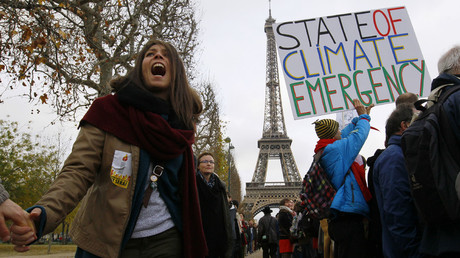
Environmentalists hold hands as they form a human chain during a demonstration near the Eiffel Tower in Paris, France, as the World Climate Change Conference 2015 (COP21) continues near the French capital in Le Bourget, December 12, 2015. © Mal Langsdon

If signed and ratified by 55 countries – which represent 55 percent of global carbon emissions – the agreement will enter into force in 2020. The signing ceremony is scheduled for April 22, which is also Earth Day, at the United Nations in New York.

China is the world’s biggest emitter of carbon dioxide, due to its heavy coal use. However, China’s emissions went down by 4 percent in 2015, thanks to coal cutbacks driven in part by efforts to combat air pollution. As a result, the global CO2 emissions decreased by 1 percent. European and US emissions have flattened out as more people switched to natural gas, solar and wind energy.

Meanwhile in the US, President Obama’s Clean Power Plan, designed to cut emissions by 32 percent by 2030 and boost renewable energy use, has been thrown into legal limbo after the US Supreme Court ordered a stay of its implementation.

Via RT. This piece was reprinted by RINF Alternative News with permission or license.

Gallup Finds: ‘Clinton Preferred for Experience; Sanders for Care’

Eric Zuesse

On March 31st, Gallup headlined, “Clinton Preferred for Experience; Sanders for Care,” and reported that, overwhelmingly, the top-listed reason that Hillary Clinton voters give for preferring her over her competitor Bernie Sanders is “Capable of being president/Qualified/Experienced.”

Here is the “experience” that impresses Democratic Party voters so much. Click on that (and on the links in it, if you want even more depth), to see what her record of achievement in public office has been.

Is there any sane reason why those voters prefer that record of achievement to the record of achievement of her competitor, Bernie Sanders?

What does it say about those Democratic Party voters?

—————

Investigative historian Eric Zuesse is the author, most recently, of  They’re Not Even Close: The Democratic vs. Republican Economic Records, 1910-2010, and of  CHRIST’S VENTRILOQUISTS: The Event that Created Christianity.

Holocaust files: Britain withheld compensation despite appalling survivor testimonies

0

Survivors of the Holocaust and former prisoners of war were subjected to fierce questioning by British bureaucrats and refused compensation despite the savage treatment they endured, declassified files show.

The chilling records of hundreds of claimants were released by the National Archives on Thursday and include pages of testimony by those who survived horrific treatment at the hands of the Nazis.

The individuals were applying for compensation after the post-war German government had agreed to create a fund.

‘A Dutch Jew’

One applicant, Leon Greenman, was refused on the basis he was a dual Dutch-British citizen. Greenman had been captured in the Netherlands. His wife and child were gassed at Auschwitz.

He told Foreign Office officials his passport had been lost when Rotterdam was bombed, but was informed he should seek compensation from the Dutch authorities.

The Foreign Office told him it must make “certain enquiries which may take a considerable time” and wrote that they considered him a “Dutch Jew.”

‘Hero spy’

Tania Szabo, daughter of executed secret agent and George Cross recipient Violette Szabo, endured years of investigation before being awarded sums of around £1,000 (US$1,430) in 1966 and 1967.

Despite her Paris-born mother’s capture, torture and death in the service of Britain, officials appeared to doubt that her father had been British as claimed.

Austrian-born British national Johanna Hill was told to seek compensation from the government of Austria despite having been arrested for sheltering two British soldiers.

‘Great escape’

RAF squadron leader Bertrand James, who helped orchestrate the real-life ‘Great Escape’ from infamous prisoner of war camp Stalag Luft Three, was also initially refused compensation.

He spent five months in solitary confinement and recalled “inmates being beaten and worked to death … at the rate of 50 a day and their bodies burnt in bonfires, the smell of which not infrequently reached us.”

Despite this the committee appointed to look at his case said he had not experienced “the inhuman and degrading treatment of a concentration camp proper.”

He was forced to wait until 1968 before receiving £1,000 for his hardships.

‘Rampant cannibalism’

The archives also contain testimony from the only British survivor of the notorious Bergen-Belsen death camp.

Arrested the day before D-Day in Jersey, Harold Le Druillenec spent periods in three different concentration camps, ending his time as a prisoner heaving bodies into graves at Bergen-Belsen, where more than 70,000 people died.

Without food or water, inmates resorted to eating human flesh, he reported.

“Jungle law reigned among the prisoners; at night you killed or were killed; by day cannibalism was rampant,” he said.

“The bulk of Auschwitz had been transferred to Belsen when I arrived and it was here that I heard the expression ‘there is only one way out of here – through the chimney!’” he added, referring to the camp’s crematorium.

He was left with scabies, malnutrition and septicemia and lost his memories of pre-war life, but later helped war crimes investigators to convict fascists who ran the death camps.

Le Druillenec was eventually given around £2,000 compensation by the Foreign Office for his time in the death camps and his disabilities.

‘Understanding depravity’

In a statement, Eric Pickles MP, the UK’s Special Envoy for Post-Holocaust Issues, said: “It is absolutely crucial that these files are opened for public access.”

He said first-hand accounts of the death camps offered “an opportunity to deepen our understanding of the depravity of Nazi persecution, and understand more about how the systems functioned.”

Some 900 documents have been released so far with a further 3,000 due to be declassified in 2017.

Via RT. This piece was reprinted by RINF Alternative News with permission or license.

First they came for the bacon: New study says vegetarianism can cause cancer

0

New research may shed light on why vegetarians are almost 40 percent more likely to suffer colorectal cancer than those of the carnivorous persuasion. The study goes beyond an individual’s diet though, pointing to a multi-generational factor at work.

A new study from Cornell University found a generation variation – or adaptive allele – that appears in populations who have subsisted on a vegetarian diet for generations. This adaptive allele is believed to have occurred to make it easier for vegetarians to absorb essential fatty acids from plants, but it also leaves them more susceptible to inflammation.

According to the study authored by J. Thomas Brenna, “The mutation, called rs66698963 and found in the FADS2 gene, is an insertion or deletion of a sequence of DNA that regulates the expression of two genes, FADS1 and FADS2. These genes are key to making long chain polyunsaturated fats.”

Among the polyunsaturated fats are omega-3s and omega-6s, two important fatty acids that the human body cannot make itself. But research indicates that vegetarians with the adaptive allele who stray from a balanced omega-6 to omega-3 diet are at a higher risk of cancer and heart disease.

“Changes in the dietary omega-6 to omega-3 balance may contribute to the increase in chronic disease seen in some developing countries,” Brenna and his co-author, Kumar Kothaplli, told Science Daily,

This research could explain why vegetarians are nearly 40 percent more likely to suffer from colorectal cancers than meat eaters, The Daily Telegraph reported.

The problem of heart disease comes from the fact that the mutation hinders the production of omega-3 fatty acids, which protect against heart disease and are found in fish and nuts. However, post industrial revolution diets are lower in omega-3 fatty acids and higher in omega-6 acids that are found in vegetable oils.

“In [those with the adaptive allele], vegetable oils will be converted to the more pro-inflammatory arachidonic acid, increasing the risk for chronic inflammation that is implicated in the development of heart disease, and exacerbates cancer,” said Brenna.

Via RT. This piece was reprinted by RINF Alternative News with permission or license.

British Military wants robots to make life-or-death battlefield decisions

0

Identifying threats on the battlefield could soon be a decision made by artificially intelligent machines after a landmark report was delivered to the military by a London-based tech firm.

Massive Analytics specializes in technology which interprets massive amounts of data – including, potentially, something as complex and treacherous as the modern-day battlefield.

In 2015, the firm won a prestigious defense contract to develop tools and systems to autonomously process battle data.

First reported by the Register, an investigative technology site, it has emerged that developers at the firm’s Farringdon facility will soon be loading Ministry of Defence (MoD) surveillance data into a special analytics system.

The reason for the move into independently-thinking systems, according to a top MoD official, is a shortage of manpower.

“In a time when military manpower is limited [the] manual processing of data is too time consuming,” Jim Pennycook, head of the MoD’s Centre for Defence Enterprise (CDE), told the Register on Thursday.

“The use of autonomous systems and processes to make sense of data to support decision making could increase efficiency and reduce the risk and cost of operations,” the former Royal Air Force (RAF) wing commander added.

Massive Analytics boss George Frangou said the sheer complexity of the modern theater of operations means it is incredibly hard to process the quantities of data required to operate effectively.

“In a surveillance scenario – perhaps in peace time or perhaps in a theater of war – you will have lots of sources of information coming in,” he said.

“There’ll be stuff from social media, there’ll be geographic information, you’ll have information about where assets are and where threats are, and information about how threats are going to be manifesting in terms of timing and geography.”

As data arrive in military hands via a mix of text, video and social media, new methods of analysis must be found, he said.

“The question is how can you get the holistic view from these things to precognize possible outcomes,” he argued.

Precognition of threats is a key issue for the military, Frangou explained, and said his firm is working to build such capabilities into command and control systems.

Who is accountable for the machines’ decisions, however, remains unclear.

Via RT. This piece was reprinted by RINF Alternative News with permission or license.

Citizen, You Are Not Working Hard Enough

0

Citizen, you are not adequately serving your society.

Citizen, you should feel shame for your selfish desire for free time, pleasure, and the pursuit of happiness.

Citizen, you should be thankful and happy around us. We have given you a job and allowed you to live on this planet. We have given you the amazing exciting opportunity to pay for resources that have been stolen and immorally cordoned of by us so that we may profiteer off your existence. You should be grateful we have chosen you as a worthy candidate for employ.

Citizen, you should not complain about not having enough. If you do not have enough it’s not the fault of the wealthy who happen to directly benefit from…

Read more

US prepares to hunt enemy submarines with giant sea drone (VIDEO)

0

Pentagon’s research agency DARPA has beefed up the US underwater warfare capabilities by launching a futuristic autonomous drone, designed to hunt down stealthy, silent enemy submarines.

The surface anti-submarine Sea Hunter, part of the ACTUV program, has already completed speed tests where it reached a top speed of 27 knots (50 km/h). 

A fleet of such drones could join the US Navy by 2018, with engineering company Leidos citing an “underwater arms race” ‒ fueled by low-cost Russian diesel-electric submarines ‒ as one reason for its development. 

American weapon-makers say that virtually silent underwater vessels pose a huge threat to the commercial shipping industry.

According to Rear Admiral Frank Drennan, of the US Anti-Submarine Warfare Command, trying to locate the partly battery-powered submarines is “like trying to identify the sound of a single car engine in the din of a major city.”

Cue the launch of a 130-foot sub hunter, programmed to navigate seas and interact with enemies on its own. 

As with many of its defense creations, DARPA has not commented whether or not the large unmanned ship will be equipped with weapons.

Leidos says the vessel is simply designed to shadow and chase enemies from “strategic waters”.

One thing that is clear, however, is that the robotic vessel has the ability to ruthlessly pursue intelligent adversaries for months at a time.

DARPA reveal in the design stage that “non-conventional sensor technologies” were sought to help the robotic hunter “robustly track quiet diesel electric” subs over thousands of kilometers, without human involvement.

Video released by the weapons manufacturer shows the grey drone warship sailing from a dock in Portland, Oregon.

The ACTUV drone is due to be officially christened on April 7, and will continue open-water testing off the coast of California this summer.

Via RT. This piece was reprinted by RINF Alternative News with permission or license.

What’s ‘Processed’ Food?

0

If you’ve read any nutritional advice lately, you’ve probably encountered one hard-and-fast rule: Avoid processed foods.

But what does “processed” mean?

On one level, anything humans do to food — slicing fruit, cooking beans, fermenting cabbage into sauerkraut — constitutes processing. It’s obviously silly to say that an apple eaten whole is healthy, while the same apple sliced isn’t.

And even if you can call the ingredients “processed,” there’s nothing unhealthy about a good, crusty sourdough bread made with whole wheat flour or cold-pressed extra virgin olive oil. Why should a diet forbid them?

peeps-processed-food

(Photo: Kate Ter Haar / Flickr)

Another school of thought says that if cooking and chopping are benign and even healthful, then any other form of processing is good, too. But what rational person would say that a roasted chicken is nutritionally equivalent to a Chicken McNugget?

Here’s what you really need to avoid: ultra-processed fare. Ultra-processed foods are made with ingredients not normally found in a household kitchen, such as artificial flavors, colors, and emulsifiers.

It’s a simple but logical distinction. A smoothie made from fruit and yogurt is processed in the ordinary way. But if you add artificial flavoring, Red Dye #40, and high fructose corn syrup, then it’s ultra-processed.

A recent study found that over half of the calories Americans eat come from these ultra-processed foods. Yet some of the confusion over the difference may lead to calls for people to avoid all processed foods.

For example, a fruit salad is an undeniably healthy snack. But if you didn’t make it yourself, it may have been treated with a preservative.

Likewise, humans have eaten oils for millennia. But they’ve only recently begun extracting it with solvents like hexane. If you buy a bottle of vegetable oil at the store — or a dish fried in a vat of oil at a restaurant — do you know what you’re getting?

It can be hard to know where to draw the line. And it’s getting more difficult as ultra-processed foods warp people’s taste buds.

Food journalist Mark Schatzker, author of The Dorito Effect: The Surprising New Truth About Food and Flavor, made another prescient observation: As ultra-processed foods become ever more irresistible, some of the better alternatives have become less tasty.

It’s true. Factory farms have bred broiler chickens to grow to maturity at five weeks, before they develop flavor. And vegetable shippers have selected tomatoes that are big, red, round, and ship well — but taste like styrofoam. Can you blame eaters for turning away from them?

We don’t need restrictive regimens banning us from cooking, slicing, steaming, and fermenting to shape up our diets. And you don’t have to buy everything you eat at farmers’ markets or grow it yourself, as tasty as that might be.

But it’s safe to say that cutting back on Twinkies, Peeps, Flamin’ Hot Cheetos, Easy Mac, and other ultra-processed foods will do the trick.

The post What’s ‘Processed’ Food? appeared first on OtherWords.

This piece was reprinted from Other Words by RINF Alternative News with permission.

Woman Faces 60 Years in Prison for the Death of Her Abusive Ex

0

UPDATE: Twelve jurors found Cherelle Baldwin not guilty of murder on Thursday in the death of her ex-boyfriend, Jeffrey Brown.

Jurors in Connecticut are deliberating the fate of Cherelle Baldwin, a 24-year-old mother accused of killing her alleged abuser. Baldwin is charged with the 2013 killing of her ex-boyfriend, Jeffrey Brown, who Baldwin alleges had stalked and abused her. According to court documents, Brown had repeatedly threatened Baldwin, took her credit cards and money, and assaulted her during visits to see their son, who lived with Baldwin. Baldwin eventually attained a court order barring threats, harassment and assaults during visits, but just before Brown died, he sent Baldwin a series of threatening text messages. Then, according to a police affidavit based on Baldwin’s statements, Brown showed up at her house, climbed through her window and attacked her, choking her with his belt. Baldwin escaped and managed to get inside her car, but so did Brown, who again choked her. What happened next is hard for even Baldwin to remember, but when police arrived they found Baldwin on the ground with a broken leg and Brown dead in front of the car, pinned against the garage wall. Baldwin was arrested on murder charges. Baldwin has already spent nearly three years in jail. If convicted, she could spend decades in prison. We are joined by Charelle Baldwin’s mother, Cynthia Long. We’re also joined by Victoria Law, a freelance journalist whose recent article for Rewire is “Facing Years in Prison for Fleeing Abuse: Cherelle Baldwin’s Story is Far from Unique.”

TRANSCRIPT:

NERMEEN SHAIKH: We begin today in Connecticut, where jurors are deliberating the fate of Cherelle Baldwin, a 24-year-old mother accused of killing her alleged abuser. Baldwin is charged with the 2013 killing of her ex-boyfriend, Jeffrey Brown, who Baldwin alleges had stalked and abused her. According to court documents, Brown had repeatedly threatened Baldwin, took her credit cards and money, and assaulted…

Read more

Burst water main creates massive fountain seen from miles around (VIDEO)

0

As many as 4,500 homes across southern Liverpool may be temporarily left without water after a 70ft high fountain erupted from a burst main, according to local reports.

The pipe started gushing after a water valve was damaged by work at a nearby building site in the Halewood neighborhood, the Liverpool Echo reports. 

The massive jet, three times as tall as nearby houses, could be seen for miles around.

Olly Harrison, 35, who runs a farm in the area, told the Echo: “My mate was driving past and said I should go and have a look at a massive jet – a fountain of water.

“I came out of the yard and you can see it from miles away. It must be about 120ft high.

“I thought … someone must be in trouble.

“They may have hit it with a digger.”

Via RT. This piece was reprinted by RINF Alternative News with permission or license.

Anonymity in the New York Times: By the Numbers

3

Anonymous sourceA new report from FAIR looks at a year’s worth of anonymity in the New York Times, with media critic Reed Richardson taking an in-depth look at how unnamed sources were used in the paper in 2015. His research substantiates that the observation Times public editor Margaret Sullivan made in 2014 (12/29/14) is still true: “Anonymity continues to be granted to sources far more often than a last-resort basis would suggest.” Among Richardson’s findings:

  • In 2015, New York Times staff wrote 1,538 articles that acknowledged using anonymous sourcing. Such stories were published almost every day–only 12 days did not see a Times reporter openly using an anonymous source–with a peak of 14 anonymous-source stories appearing on September 23, 2015.
  • The Times‘ website and print edition ran more than 3,800 wire service stories that used anonymous sourcing. Combined with stories authored by Times reporters, the Times last year published more than 5,300 stories last year with anonymous sourcing–or nearly 15 per day. (This doesn’t include stories that used anonymous sources without explicitly disclosing them as such, which would add hundreds more to the total, by a conservative estimate.)
  • Of the Times-authored stories with explicit anonymity, 190 violated the paper’s guidelines by failing to offer any justification for not using the source’s name, while another 133 resorted to the unhelpful tautology that the source was “not authorized to talk to the media.”
  • The Times‘ Foreign desk provided the largest share of Times-authored anonymous-source articles, with 41 percent of the total. This was followed by Business (26 percent), Metro (13 percent) and National (10 percent). All other departments of the paper together provided 10 percent of the anonymous-source stories.
  • Nearly one in five—19 percent—of these anonymous-source stories ran on the front page (A1) of the Times‘ print edition. Another 12 percent were published on the front page of a section, like Business Day.
  • In 2015, 367 different Times reporters identified sources as being anonymous, but more than 200 of them granted anonymity three times or less during the year. There were 55 Times reporters who averaged at least one declared anonymous source a month last year.
  • Eric Schmitt, the Times reporter who had the most anonymous-source stories in 2015 (62–36 of which were on the front-page), quoted an unnamed US government official in three out of every four of his stories last year.

Richardson’s report, “Journalism’s Dark Matter: Uncovering a Year of Anonymous Sources at the New York Times,” is available at FAIR.org. A searchable database of every New York Times anonymous-source story from 2015 is available as a Google Doc. You can contact him at reedfrichardson@gmail.com or @reedfrich.

Reed Richardson is a media critic and writer whose work has appeared in The Nation, AlterNet, Harvard University’s Nieman Reports and the textbook Media Ethics (Current Controversies).

This piece was reprinted by RINF Alternative News with permission from FAIR.

Airport workers across US strike for better pay, benefits

5

Service workers at nine US airports went on a 24-hour strike to protest low pay, lack of benefits and security problems. The strikers are asking for a $15 minimum wage, paid sick leave and vacation time, and better security training.

The “Poverty Doesn’t Fly” strike, organized by Airport Workers United, aims to raise awareness of the plight of poorly paid service workers – janitors, baggage handlers, porters and other sub-contracted staff – at major US airports.

Nine airports affected by the strike are Reagan National Airport serving Washington, DC; LaGuardia, Kennedy (JFK) and Newark Liberty airports serving New York City and the surrounding areas; the international airport in Philadelphia, Pennsylvania; O’Hare International Airport in Chicago, Illinois; Boston Logan International Airport in Massachusetts; Seattle-Tacoma International Airport in Washington; and Fort Lauderdale–Hollywood International Airport in Florida.

Officials at the affected airports said the number of workers participating in the strike – estimated to be about 2,000 nationwide – are not big enough to cause significant problems, according to the Washington Post.

Strikers point to employees like David Tucker, a porter (“skycap”) at Washington, DC’s Reagan National Airport, whose hourly wage is $3.77 – plus whatever tips he can get from passengers.

The strike is backed by the Service Employees International Union (SEIU), which has been fighting for a $15 minimum wage for low-paid service workers across the US.

The protesters have received support by some local officials, such as Broward County Commissioner Dale Holness in Florida, and state Representative Mia Gregerson in Washington.

US Representatives Alan Grayson and Patrick Murphy, both Democrats from Florida, have also come out in support of the strike.

The SEIU traditionally backs the Democratic party, throwing its weight behind Barack Obama in 2008 and endorsing Hillary Clinton in this year’s presidential campaign.

Originally scheduled for March 22, the strike was postponed after the terrorist attacks in Belgium, where bombs went off at Brussels’ international airport and at a Metro station downtown.

Via RT. This piece was reprinted by RINF Alternative News with permission or license.

Video: Kim Hutchison – Soul Connection Healing Meditation For 3rd Energy Expression Centre

0


Please Support The Show – http://richieallen.co.uk/ https://www.facebook.com/therichieallenshow http://www.youtube.com/RichieAllenShowMedia Tune in at …

Via Youtube

Video: Shocking killing: 3yo girl beheaded in front of her mother in Taiwan, suspect arrested

0

The child and her mother were on their way to a metro rail station to meet the girl’s grandfather when the incident took place. The attacker grabbed the girl from …

Via Youtube

Bill Clinton on Brexit: N. Ireland will ‘get whacked’ if Britain leaves the EU

0

Northern Ireland will be dealt a serious blow if UK citizens vote for a Brexit in June, former US President Bill Clinton has said.

Speaking at an Irish-American event in New York this week, he said: “It’s Northern Ireland that will really get whacked if Britain withdrew from the European Union.

“And I hope they don’t because it’s too easy to believe that the only solution to the problems in the world is to hunker down.”

He was honored at the event with a life-time award for his role in Northern Ireland’s peace process in the mid-1990s, and is considered one of the key architects of the 1998 Good Friday Agreement.

His intervention came after Irish Prime Minister Enda Kenny said a Brexit could inflame tensions in Northern Ireland and cause a break-down of the peace agreement.

The current US President Barak Obama angered Pro-Brexit campaigners, after it became clear he planned to use a visit to London in April to urge UK voters to remain part of the Union.

The warnings in the Brexit debate continue elsewhere, with UK think tank Open Europe, warning the country’s GDP could fall by 2.2 percent by 2030 if Britain leaves and fails to broker a deal with the bloc or retreats into protectionism.

“In a best case scenario, under which the UK manages to enter into liberal trade arrangements with the EU and the rest of the world, whilst pursuing large-scale deregulation at home, Britain could be better off by 1.6 percent of GDP in 2030,” a recent report by the think tank says.

“However, a far more realistic range is between a 0.8 percent permanent loss to GDP in 2030 and a 0.6 percent permanent gain in GDP in 2030, in scenarios where Britain mixes policy approaches.”

Thursday saw Tory Prime Minister David Cameron accused of using Britain’s steel crisis to scaremonger UK voters into voting against a Brexit on June 23, saying EU membership is essential to the industry. It’s feared thousands of jobs are at risk after Tata Steel threatened to pull out of Britain.

Open Europe, which says it will remain neutral on the EU referendum, publishes real time analysis on what it describes as the EU’s “most pressing challenges.”

On Wednesday, co-director Raoul Ruparel weighed into the steel industry debate. He said the sector has been in decline for “years if not decades.”

“It experienced a sharp decline in output in the late 1990s and has continued to struggle since,” he said.

“However, the UK’s steel sector is not alone in facing challenges. The industry more broadly has struggled to recover since the financial crisis. This has been exacerbated by the recent slowing demand from emerging markets (China in particular) and the simultaneous increase in low cost exports from those markets.”

Ruparel said Britain’s steel industry has struggled for a while to remain competitive, relative to that in other EU states.

Via RT. This piece was reprinted by RINF Alternative News with permission or license.

FBI agrees to help unlock iPhone in Arkansas homicide case

0

The FBI has agreed to help an Arkansas prosecutor crack an iPhone and an iPod belonging to teenagers accused of murder. This comes just days after the agency managed to break into the San Bernardino gunman’s iPhone without help from Apple.

The agency agreed Wednesday to help Cody Hiland, prosecuting attorney for Arkansas’ 20th judicial district, to unlock an iPhone 6 and an iPod that could contain evidence in a murder case.

Hunter Drexler, 18, and Justin Staton, 15, are accused of killing Patricia and Robert Cogdell in the town of Conway, Arkansas in July. Their trial was postponed by a judge so that the FBI could be asked for help on Tuesday, less than 24 hours after the FBI announced that it had managed to beat the security features on the iPhone 5c that San Bernardino, California terrorist Syed Farook used for work.

Farook and his wife died in a shootout with police after they killed 14 people at the Inland Regional Center in December.

While the FBI initially used litigation to try and force Apple to create a way to open the killer’s iPhone, the high-profile legal battle came to an abrupt halt on Monday when the agency managed to gain access using a method that wasn’t even disclosed to Apple.

“The iPod had just come into our possession a couple of weeks ago,” Hiland said Wednesday, according to the Los Angeles Times. “Obviously when we heard that [the FBI] had been able to crack that phone we wanted to at least ask and see if they wanted to help.”

Both Drexler and Staton have pleaded not guilty to capital murder and other charges in the death of the Cogdells, 66-year-olds who had raised Staton as their grandson.
It’s not clear what operating system the iPhone 6 in question is running, but Apple has said that such a device running iOS 8 encrypts all the data on the phone when locked – a security feature not present on Farook’s older model.

Law enforcement officials have long complained that encryption is a major obstacle in criminal investigations. FBI Director James Comey has even gone as far as requesting that tech companies build a special “golden key” backdoor for law enforcement into all devices. The tech community, however, has overwhelmingly denounced this idea, saying that it would merely be a disastrous weakening of all computer security that would be exploited by criminals.

Via RT. This piece was reprinted by RINF Alternative News with permission or license.

Video: EgyptAir MS181 hijack: People seen escaping plane in Larnaca airport

0

Egyptian airlines flight MS181, en route from Alexandria to Cairo, has been hijacked by a passenger, who said he had a suicide belt and forced the pilot to land …

Via Youtube

How US-Backed War on Syria Helped ISIS

0

By funneling TOW missiles and other weapons to Syrian jihadists for their “regime change” war, President Obama facilitated the rise of the Islamic State with the terrorist blowback now hitting Europe, says Daniel Lazare.

By Daniel Lazare

Why are Islamic militants wreaking havoc from Brussels to Lahore? The best way to answer this question is by taking a close look at how The New York Times covered this weekend’s liberation of Palmyra from Abu Bakr al-Baghdadi’s Islamic State.

The article, entitled “Syrian Troops Said to Recapture Historic Palmyra From ISIS,” began on a snide note. While the victory may have netted Bashar al-Assad “a strategic prize,” reporters Hwaida Saad and Kareem Fahim wrote that it also provided the Syrian president with “something more rare: a measure of international praise.”

Saudi King Salman meets with President Barack Obama at Erga Palace during a state visit to Saudi Arabia on Jan. 27, 2015. (Official White House Photo by Pete Souza)

Saudi King Salman meets with President Barack Obama at Erga Palace during a state visit to Saudi Arabia on Jan. 27, 2015. (Official White House Photo by Pete Souza)

The article noted that “Mr. Assad’s contention that his government is a bulwark against the transnational extremist group” has been bolstered, but added that “his foes and some allies argue that he must leave power as part of a political settlement to end the war in Syria” – without, of course, specifying who those allies might be.

Then it offered a bit of background: “Lost in the celebrations was a discussion of how Palmyra had fallen in the first place. When the Islamic State captured the city in May [2015], the militants faced little resistance from Syrian troops. At the time, residents said officers and militiamen had fled into orchards outside the city, leaving conscripted soldiers and residents to face the militants alone.”

Since the Times claims to have “several hundred” surreptitious contacts inside Syria, the charge that Assad’s troops fled without a fight may conceivably be correct. But it’s hard to square with reports that the Islamic State (also known as ISIS, ISIL and Daesh) had to battle for seven or eight days before entering the city and then had to deal with a counter-offensive on the city’s outskirts. But even if true,…

Read more

Dying in Prison

3

Over the past three decades, judges and juries have filled America’s prisons with non-violent offenders.

Many are serving draconian sentences for first-time offenses. Indeed, while only about 5 percent of the world’s people live in the United States, our country is locking up nearly 25 percent of the world’s prison population.

President Barack Obama has at least begun to address this issue by creating the Clemency Project, which connects prisoners to pro-bono lawyers who can argue for them to have their sentences reduced. Inmates are eligible if their sentences would have been shorter today than when they received them — as long as they’ve already served at least half their time.

That doesn’t help prisoners who haven’t yet served half of their sentences. It’s an especially glaring gap for prisoners who are elderly and gravely ill. Where is their relief?

prison-cemetery-west-virginia-cropped

Cemetery for Moundsville Penitentiary in Moundsville, WV. (Photo: Angie / Flickr)

A handful of prisoners on their deathbeds might go free under a federal practice called compassionate release. To qualify, an incarcerated person must be at least 65 years old and suffering from a deteriorating medical condition that diminishes their ability to function in a correctional facility.

And they have to have served 10 years of their sentence.

Last year, the federal government released 110 prisoners under the compassionate release program. While this was a record high, it was also statistically insignificant as we’ve got 2.24 million people behind bars.

To make matters worse, although the regulations for eligibility are clear, the entire program is “clouded in secrecy and bureaucracy,” according to the Clemency Report.

I watched the failure of this program unfold in real time when I was incarcerated for blowing the whistle on the CIA’s torture program. I was friendly with a prisoner I’ll call Bill.

Bill was 68 years old and doing 30 years for a non-violent organized crime conviction. He’d served more than half his sentence.

I saw him in the hall one day, doubled over in pain. He told me that he’d never before experienced back pain like this. I suggested that he go to sick call in the morning and ask for Tylenol, the go-to painkiller in U.S. prisons.

He did, but he got no relief.

A couple of weeks later, Bill was walking with a cane and in obvious distress. He told me again that his back pain was excruciating. He’d asked the medical unit for an X-ray, and he’d been denied. The physician’s assistant had just given him more Tylenol.

Two weeks later, Bill was in a wheelchair. I went to the chaplain and said that Bill was being denied medical care. He agreed to intervene.

Bill was sent to an outside hospital for an MRI, which found stage 4 cancer of the spine. Bill applied for compassionate release so he could die at home, surrounded by his family.

The warden went to see him in his cell. Would Bill agree to sign a paper agreeing not to hold the prison responsible for failing to diagnose and treat his cancer? He refused.

Two weeks later, Bill died in his bunk in prison, alone.

This shouldn’t have happened. Compassionate release was created exactly for prisoners like Bill. Dying prisoners who pose no threat to society whatsoever should be sent home to be with their families.

It’s the only moral thing to do.

The post Dying in Prison appeared first on OtherWords.

This piece was reprinted from Other Words by RINF Alternative News with permission.

Video: Moment EgyptAir crew member escapes hijacked plane through cockpit window

0

One of the members of the EgyptAir flight MS181 made a daring escape to safety after climbing through the cockpit window of the aircraft and sliding down the …

Via Youtube

Tick tock… The ‘death clock’ that predicts when you’ll die

3

Scientists have teamed up with insurance companies to develop a ‘death clock’ that can predict when customers are going to die.

The four-year project at the University of East Anglia (UEA) aims to use medical databases to determine life expectancy and long-term illness.

The program follows worldwide trends by insurance companies to find out as much as they can about people’s health and lifestyle.

Professor Elena Kulinskaya, from UEA’s School of Computing Sciences, said scientists want to use ‘Big Data’ to predict the future.

“People around the world are living longer,” she said.

“We want to develop software tools that use Big Data routinely collected by healthcare providers to forecast longevity.

“We want to identify and quantify the key factors affecting mortality and longevity, such as lifestyle choices, medical conditions and medical interventions.

“We are particularly interested in understanding how various chronic diseases and their treatments impact life expectancy.”

The project is funded by a £800,000 (US$1.15 million) grant from the Institute and Faculty of Actuaries (IFoA) and uses employees from insurance firm Aviva.

Computer scientists working on the project claim it will help people plan for retirement and also aid research into the impact on longevity of medical drugs such as beta-blockers and statins.

Insurance analyst and pensions expert Ned Cazalet said the database could help people denied insurance due to health issues secure policies.

“We’re not quite down to blood samples and DNA tests yet but it’s certainly going that way,” he said.

“We have a big ageing population so it’s important that insurance companies get this right, instead of a one-sized fits all approach.

“Inevitably it will mean changes for some people but it could mean that people who were unable to get policies because of disease can now get them because it was just so tricky to work out in the past.”

Via RT. This piece was reprinted by RINF Alternative News with permission or license.

Intifada for Dummies

0

Whether history moves in a straight or cyclical line, it matters little. The uncontested fact is that it is in constant motion. Thus, the current situation in Palestine is particularly frustrating to a generation that has grown up after the Oslo Peace Accord because they have been brought up within a strange historical phenomenon: where the earth below their feet keeps shrinking and when time stands still.

The nature of the current uprising in the West Bank and East Jerusalem is a testament to that claim. Previous uprisings were massive in their mobilization, clear in their message and decisive in their delivery. Their success or failure is not the point of this discussion, but the fact is that they were willed by the people and, within days, they imprinted themselves on the collective consciousness of Palestinians everywhere.

The current uprising is different; so different, in fact, that many are still hesitating to call it an ‘intifada’; as if intifadas are the outcome of some clear-cut science, an exact formula of blood and popular participation that must be fully satisfied before a eureka moment is announced by some political commentator.

It is different, nonetheless, for there is yet to be a clear sense of direction, a leadership, a political platform, demands, expectations and short and long term strategies. At least that is how the 1987-93 Intifada played out and, to a lesser extent, the 2000-05 al-Aqsa Intifada as well. But is it not possible that the outcomes of these previous intifadas is what is making the current uprising different?

Read more

In historic first, border patrol union endorses Trump

2

A union representing US border patrol agents has endorsed Donald Trump for president. The move marks the first endorsement in history of the National Border Patrol Council. It also opposes the group’s parent organization, which endorsed Hillary Clinton.

The NBPC, which represents up to 18,000 Border Patrol agents, according to Federal Times, previously voiced displeasure over the December 2015 endorsement of Clinton by the American Federation of Government Employees (AFGE), its parent organization. On Tuesday, the union openly endorsed Trump, who is leading in the Republican primary contests.

This is the same union that reportedly pressured its Laredo, Texas chapter to back out of a meeting with Trump during the candidate’s scheduled visit to the US-Mexican border last July.

“There is no greater physical or economic threat to Americans today than our open border. And there is no greater political threat than the control of Washington by special interests,” the group said in a letter endorsing Trump.

Praising Trump for being an outsider who is independent from special interests, has created thousands of jobs and is committed to “aggressive pro-American change,” the NBPC lashed out at Washington insiders more concerned about Trump’s tone than the “destruction wrought by open borders.”

“You can judge a man by his opponents: all the people responsible for the problems plaguing America today are opposing Mr. Trump,” the group wrote. “We need a person in the White House who doesn’t fear the media, who doesn’t embrace political correctness, who doesn’t need the money, who is familiar with success, who won’t bow to foreign dictators, who is pro-military and values law enforcement, and who is angry for America and NOT subservient to the interests of other nations. Donald Trump is such a man.”

The NBPC also took a potshot at President Barack Obama, without mentioning him by name.

“America has already tried a young, articulate freshman senator who never created a job as an attorney and under whose watch criminal cartels have been given the freest border reign ever known,” the group said in the letter.

Trump, who is in Wisconsin campaigning ahead of the April 5 primary, thanked the union and said that he was especially honored that they broke with tradition to give him a primary endorsement.

“This endorsement represents a total rejection of the corrupt politicians who have allowed transnational gangs and cartels to terrorize American communities,” the GOP frontrunner said.

Immigration, legal and otherwise, has been at the forefront of Trump’s campaign since he entered the race in June 2015. Since then, the previously ignored subject has become a topic of – often acrimonious – national debate, while Trump has garnered endorsements from hardline opponents of immigration, from Alabama Senator Jeff Sessions and former Arizona Governor Jan Brewer to Maricopa County Sheriff Joe Arpaio.

Via RT. This piece was reprinted by RINF Alternative News with permission or license.

Judge Rules Clinton Exhibited ‘Wrong-Doing and Bad Faith’

3

Eric Zuesse

A U.S. District Court Judge ruled, on Tuesday March 29th, that in the civil matter of Hillary Clinton’s State Department emails, “there is evidence of government wrong-doing and bad faith.” Consequently, he has granted to Clinton’s adversary in the proceedings, Judicial Watch, what they had been seeking, which was “limited discovery” to seek further evidence about what she had done and why. (NOTE: This is not in the FBI’s potential criminal case against her, which remains at a preliminary stage. A main purpose of the civil case is to develop evidence that can assist in a potential criminal prosecution against the defendant.)

The Judge, Royce C. Lambreth, of the U.S. District Court for the District of Columbia, further noted that there have been “constantly shifting admissions by the Government and the former officials.” This was a veiled reference to the former Secretary of State, Clinton.

He also said that, for these reasons, such “limited discovery,” as Judicial Watch was seeking, “is appropriate, even though it is exceedingly rare in FOIA [Freedom of Information Act] cases.”

Consequently, the petitioner (‘Plaintiff’) Judicial Watch, was, in his ruling, allowed — in accord with a prior judge’s ruling — to draw up its specific list of further evidence to be sought in “discovery,” in the case (which Judicial Watch had already done on March 15th), and, Clinton, the “Defendant shall respond ten days after plaintiff’s submission.” The prior judge’s ruling had already specified that Clinton(’s lawyer, David Kendall) has until April 5th to respond. Judicial Watch is to respond to that by no later than April 15th.

Clinton (via her lawyer) had requested a denial of the petitioner’s request for “limited discovery” of more evidence, and the Judge’s ruling against her here is referring to what he apparently viewed as being already-existing “evidence of government [i.e., of Clinton’s] wrong-doing and bad faith,” so as to make clear, to her — though tactfully in a way that didn’t condemn her by name, but only as “government,” in order not to harm her (political career) outside the ongoing judicial proceedings in this case — that, in his opinion, which is based upon what he has seen thus far, the prospect of a final judgment against her is very real. It’s simply a warning to her.

On February 23rd, a different judge, on the same Court, Emmet G. Sullivan, had already ruled that Judicial Watch’s request for additional evidence in the case was granted, by saying: “The Court grants [48] Motion for Discovery. … Plaintiff to Submit Discovery Plan To Court and Counsel by 3/15/2016. Defendant Response due by 4/5/2016. Plaintiff Replies due by 4/15/2016.” So: that ruling established the timeline by which the Court demands responses.

Judge Lambreth’s ruling merely seconds Judge Sullivan’s prior one, but adds to it Lambreth’s veiled warning to Clinton.

Whereas Judicial Watch is seeking additional evidence, Clinton has been seeking for the case to be instead either dismissed in “summary judgment,” or else, dragged on, until she has become elected President. 

The Court has clearly not been convinced that the case is meritless. Consequently, the question for her, at the present stage, seems to be whether or not some additional way to postpone judgment will be able to be found by Clinton’s lawyer.

Already, by April 15th, the Democratic Presidential nominee might have been determined. And, if there is to be any indictment of Ms. Clinton on criminal charges, it would presumably occur after that time. Consequently, the possibility exists that she will be indicted while she is campaigning in the general election, against the Republican nominee. Anyone who votes for her before this case is cleared up is, apparently, comfortable with having helped to nominate a person who might be a criminal defendant campaigning against the Republican nominee. Alternatively, the Democratic Party’s 715 superdelegates might be able, if an indictment comes down prior to the Democratic National Convention on July 25th, to hand the nomination to her competitor, Bernie Sanders. However, if an indictment comes down after the end of that Convention on July 28th, there might be no way of salvaging election-year 2016 for the Democratic Party.

NOTE:

Judge Sullivan was appointed to the Court by the Defendant’s husband, Bill Clinton.

Judge Lambreth was appointed to the Court by Ronald Reagan.

—————

Investigative historian Eric Zuesse is the author, most recently, of  They’re Not Even Close: The Democratic vs. Republican Economic Records, 1910-2010, and of  CHRIST’S VENTRILOQUISTS: The Event that Created Christianity.

From Fukushima to Brussels, Nuclear Energy Isn’t Worth the Risks

1
nuclear-energy-terrorism

(Cartoon: Khalil Bendib)

The ISIS supporters who attacked Brussels killed more than 30 people and injured hundreds more. Bombings at the city’s airport and a subway station blew up the notion that measures taken after the Paris siege were keeping Europe safe.

The scariest part of this story is something that hasn’t happened yet and hopefully never will: an act of nuclear terrorism.

World leaders and the experts who track the whereabouts of fissile material should see Belgium’s ordeal as a wakeup call. Nuclear reactors — as the Fukushima disaster proved five years ago in Japan — aren’t worth the risks they pose based on operational safety considerations alone. But security questions also render them unacceptably perilous.

Consider this news out of Europe that you may have missed.

Didier Prospero, a security guard at a Belgian reactor, was murdered in his own home two days after the March attacks. The killers shot the slain man’s dog too. After Prospero’s children found his body, authorities determined that his security pass was missing.

This gut-wrenching tragedy is even more troubling than it sounds.

Belgian authorities discovered hours of secretly recorded video footage of a nuclear scientist during a raid on a suspected terrorist late last year. Khalid and Ibrahim El Bakraoui, two brothers believed to have participated in the Brussels attacks, planted a camera in the bushes outside that scientist’s home.

Perhaps the suspected terrorists intended to sabotage one of Belgium’s aging nuclear reactors, turning it into a weapon of mass destruction — a tactic our government says the 9/11 attackers contemplated.

Or the suspected terrorists may have aimed to steal radioactive material for a “dirty bomb,” a conventional explosive that contaminates the area where it detonates with radiation. Either way, they’ve raised the bar for guaranteeing security at nuclear power plants.

Even before the attacks on Brussels and Prospero’s murder, Belgium was under pressure from Germany, the Netherlands, and Luxembourg to address lapses at the 11 aging nuclear reactors that generate half its electricity.

There were good reasons to be alarmed. The Belgian nuclear agency’s computer system has been hacked, intruders have stolen and sabotaged equipment, and two employees at a Belgian reactor joined ISIS after quitting their jobs.

Hundreds of thousands of Europeans had signed a petition calling for independent inspections of Belgium’s worrisome reactors weeks by late January. Their goal was to “avoid the next Chernobyl,” based on reports of leaks and cracks, along with assorted sabotage attempts.

Fifteen years after 9/11, how are reactor safety and security on our side of the pond? Not so hot, as seven engineers employed by the Nuclear Regulatory Commission recently made clear.

Upon finding the NRC unresponsive to their concerns about a dangerous design flaw at all but one U.S. nuclear reactor, they filed a public complaint using the same channels available to all private citizens.

It’s not clear who has the power to do something about this problem.

New York Governor Andrew Cuomo apparently doesn’t. He wants the Indian Point power plant located 30 miles north of the Bronx closed. That’s easier said than done, even though its two active reactors — rife with security and safety issues — are so near our country’s biggest city.

Plant operator Entergy downplayed one recent outage after blaming it on — get this — bird droppings.

If the company can’t protect Indian Point’s equipment against natural threats like avian excrement, how well would it handle terrorists?

This piece was reprinted from Foreign Policy In Focus by RINF Alternative News with permission.

Video: BBG & RT: Curious convergence on Turkey

0

The US has a system of international media outlets working to promote American values abroad. It’s run by the BBG – or the broadcasting board of governors, …

Via Youtube

The CIA and the Pentagon Are Shooting at Each Other

1

A soldier aims his gun in Diyarah, Iraq, on March 18, 2006. Today, the US fights proxy wars between various departments of our own federal government, using your tax dollars to buy the bullets and the bombs. (Photo: US Army)

Not so very long ago, Dick Cheney announced with his bare face hanging out that the vice president’s office was not part of the executive branch of the federal government. He coughed up this preposterous hairball because he didn’t want to give his official papers to the National Archive, as is required by several federal laws.

On that blissfully innocent June day in 2007, I believed that we as a nation had summited the Mount Everest of assholery, planted Cheney’s flag in a gritty crust of snow and watched as that bloody banner fluttered in the air-starved breeze.

This was the nadir, the final insult, the single silliest bark I’ve heard from a high public official since “If the president does it, it’s not illegal” and “Rarely is the question asked: Is our children learning?” It had to be, right? The vice president, who sits one missed heartbeat away from the big round room, isn’t part of the executive branch? Also, clouds aren’t part of the sky, water isn’t wet and bears don’t poop in the piney woods.

Such was my age of innocence. I believed with my whole heart that the arc of ridiculous had kissed the very ceiling of the sky. I was comprehensively wrong.

You may want to sit down for this one. Here be some foolishness of such raw and ponderous weight that it might cave in the solar system entirely. Ready? Here goes: There are currently two militias duking it out in Syria, in the shaved and shattered death zone between Aleppo, Marea and the Turkish border, and the US government is funding them both simultaneously.

The Knights of Righteousness (yeah, seriously, that’s their name) recently got their asses…

Read more

Video: RAW: NATO Eurofighters follow Russian defense minister’s plane over Baltic sea

0

Heading towards Kaliningrad over the neutral waters in the Baltic Sea, Russian Defense Minister Sergey Shoigu’s plane got accompanied by NATO fighters that …

Via Youtube

Grave robbery: Surge in ‘paupers’ funerals’ as British bereavement costs mount

1

Funerals in Britain have become so expensive that one mother was forced to have her son’s body frozen for several months so she could save up enough money to pay for him to be buried.

MPs on the Work and Pensions Select Committee were so shocked by the incident they’re calling on the Competition and Markets Authority to look at how funeral homes are ramping up prices, leaving grieving low-income families deeply distressed and shackled with debt. 

In a damning report, published on Thursday, the committee told the government watchdog to investigate funeral directors’ fees. They want to see action within the industry focused on curbing funeral costs for low-income households.

It was found that prices can fluctuate considerably within the same region, ranging from £990 to £3,000 (US$1,420 to $4,300).

According to pensions company Royal London, the average cost of a funeral in 2015 was £3,702 – almost 4 percent higher than 2014, despite low levels of inflation.

“We did not set out to inquire into the funeral industry, but it soon became apparent that the interaction between an opaque and outdated public system of bereavement support and a market in funeral services which simply does not operate ‘normally’ is causing problems,” Labour MP and Chairman of the Work and Pensions Select Committee Frank Field said.

“We are concerned by the lack of protection in the market for bereaved customers, particularly those on low incomes. They are vulnerable and may not be inclined to shop around. This is not conducive to effective operation of the market.”

Field outlined how the Committee saw the destructive impact rising funeral costs are having on people.

“We heard clear evidence of the distressing circumstances and debt this is leading people into, at a time when they are grieving and vulnerable,” he said.

“We do not want a return to the specter of miserable ‘pauper’s funerals.’”

The National Association of Funeral Directors (NAFD) concedes burials are becoming more expensive.

“Funeral costs are rising, of that there is no doubt and the NAFD has welcomed this and other opportunities to work with the government to address this issue,” a spokesman for the group told the Telegraph.

“However, liberally berating funeral directors, who work in the main for very small businesses, is not the way to address this.”

The NAFD also appeared surprised that the committee did not probe cremation or burial authorities.

“We were surprised that the committee did not hear evidence from any cremation or burial authorities who are crucial to understanding the make-up of funeral costs,” he said.

“With these costs shown on a funeral director’s final bill, it is vital that the role of the increasing cost of cremation and burial charges play in the funeral price inflation figures quoted by Royal London are properly scrutinized. These lie outside of funeral directors’ control and have not been addressed in this report.”

Via RT. This piece was reprinted by RINF Alternative News with permission or license.

Video: Pakistani Military Flexes Its Muscles In Wake of Lahore Bombing (2/2)

0

Saadia Toor, author of State of Islam: Culture and Cold War Politics in Pakistan, describes the potential “creeping coup” in the aftermath of the tragedy.

Via Youtube

‘What if he shot my daughter?’ NYPD officer to explain why he shot ‘friendly’ pit bull (VIDEO)

0

A police officer will be made to explain himself after shooting a pit bull in the hallway of a Bronx apartment building. The friendly pooch had been wagging his tail when he was killed at point-blank range, according to his owner.

Yvonne Rosado had called the New York Police Department because her former boyfriend and current subject of an order of protection attempted to enter the building on E. 183 Street in New York City’s borough of The Bronx in February. He had been long gone, however, by the time the officers showed up.

The 42-year-old woman was engaging in her weekly ritual of dancing with her dog, Spike, to a Kid Cudi song. “I dance around with him and I spin him with one paw,” she explained to the New York Daily News. When she heard something in the hallway, however, she opened the door – and the 70-pound pooch slipped out.

Rosado claimed that she screamed, “he’s friendly! He’s friendly!” as Spike slowly approached the officer, his tail wagging. But the cop, identified as Officer Ruben Cuesta, 28, stepped back and opened fire from three feet away.

Rosado said she intends to sue the city, and plans to file a grievance against Cuesta as well.

Officer Cuesta had been talking to Rosado’s 16-year-old neighbor, Serena Santiago, when Spike showed up. Her mother, Irma Sue Santiago, says she was upset about the shooting as well.

“What if he had missed the dog and shot my daughter?” she asked the Daily News. Santiago also claims that the incident was traumatizing to her daughter, saying “I heard the cops had to go to the hospital for ringing ears, but my daughter has to go to psychiatric therapy for this.”

Her family’s attorney, David Thompson, does not believe that shooting the dog was necessary.

“Don’t fire your damn gun in an apartment house stairwell unless you absolutely, positively, 100 percent got to do it,” Thompson said.

Officer Cuesta will have to explain himself to department investigators.

“In all circumstances we have to leave it to the officer’s understanding of what’s happening at the scene as to what piece of equipment he might use – Taser, pepper spray, firearm,” NYPD Commissioner Bill Bratton told the Daily News. “In this instance he used the firearm, so now, as part of the investigation, he’ll have to justify what was going through his mind at that particular time.”

The department has yet to verify whether or not Cuesta was carrying a more potent type of pepper spray that the NYPD began using last year after the old version was found to be ineffective on dogs.

Via RT. This piece was reprinted by RINF Alternative News with permission or license.

Video: Rare video (on RT): Panda taking selfie with a man in China

0

The giant panda cub Manyuemei has been spending time with its foster dad at Dujiangyan’s Giant Panda Conservation and Research Center in southwest …

Via Youtube

Video: Happy Endings and Innocence: Media Myths of Mass Incarceration

0

Author, activist and former political prisoner James Kilgore joined us to discuss his argument that pop culture works to poorly frame the crisis of mass …

Via Youtube

Video: Top U.S. & World Headlines — March 30, 2016

0

Visit http://democracynow.org to watch the full independent, global news hour, read the transcript, search our archive and to make a donation to support us.

Via Youtube

Video: Riot police vs Idomeni refugees: Violent clashes hit camp

0

Violent scuffles erupted between the police and refugees at the Idomeni refugee camp on Tuesday with a group of refugees continuing to block train tracks near …

Via Youtube

Military charity spent just 2% of its annual revenue on veteran grants

0

Our Local Heroes spent only 2 percent of its £500,000 budget in 2015 on grants for veterans, according to the UK’s charity watchdog.

The charity spent £155,000 on office space and wages for eight employees, but a mere £10,000 went to actual veterans in need.

The Lancashire-based outfit was set up to support armed forces veterans through hardship, but after investigating financial records the Charity Commission found substantial amounts of money was being used to cover running costs and project outside any sensible remit.

The Commission claims 80 percent of the funds raised were channeled to a private firm charged with running events for the charity as part of a trade agreement. That arrangement, with Targeted Management Limited (TML), has now been replaced.

The watchdog’s report said it had “received complaints that the public was being misled and were not being properly informed that only 20 percent of the funds raised went to the charity.”

While the report found “no evidence of fraud or theft” had occurred in Our Local Heroes’ dealings, the investigation did raise “serious regulatory concerns including a very low level of charitable expenditure, substantial spending outside the charity’s objects, poor governance, conflicts of interest and an insufficient focus on providing grants to beneficiaries.”

Our Local Heroes has now implemented a number of changes which the Charity Commission has commended.

A spokesman for the charity told the Telegraph newspaper: “All the monies received at the promotions whether through donation or sales of products is paid to the charity.”

“The 80 percent figure mentioned by the Charity Commission is the maximum cost the charity will expect to spend running an activity of this type,” the spokesman added.

Dozens of military charities have sprung up in the UK since the Iraq and Afghanistan wars began, the most high-profile of which is Help for Heroes (H4H).

In September 2015, H4H was criticized for the number of empty beds in its various recovery centers as well as the lack of a coherent plan for using its money.

Lieutenant Colonel John Sutton, who left the military in dismay over the issue, told the Times newspaper at the time he had raised his concerns over the lack of an “audit trail” of where money was going.

“We were spending lots of other people’s money — that people had biked, climbed, run and swum for — on bricks and mortar without a clear audit trail about how we got to this position,” he said.

Via RT. This piece was reprinted by RINF Alternative News with permission or license.

Video: Pakistani Military Flexes Its Muscles In Wake of Lahore Bombing (1/2)

0

Saadia Toor, author of State of Islam: Culture and Cold War Politics in Pakistan, describes the potential “creeping coup” in the aftermath of the tragedy.

Via Youtube

‘Terrorism threat’ main focus of Obama’s final nuclear security summit

1

While President Barack Obama’s final nuclear security summit focuses on the threat of atomic terror in a major western city by non-state actors, activists argue that aging nuclear power plants and weapons proliferation are issues of greater concern.

In a special session at the two-day global summit, which begins Thursday in Washington DC, leaders from 50 countries will discuss a hypothetical scenario in which a chain of events could lead to nuclear terrorism.

Concerns about a “nuclear terrorism” threat by extremist groups have increased after it was revealed that the two brothers linked to earlier Islamic State (IS, formerly ISIS/ISIL) terrorist attacks in Paris had secretly filmed the daily routine of the head of Belgium’s nuclear research and development program, and considered an attack on a nuclear site in the country, according to Belgian media. The two brothers were part of an ISIS cell that went on to strike the Brussels airport and Metro, and both died in the attacks.

READ MORE: Brussels terrorists planned nuclear plants attack, changed target after accomplice’s arrest – report

“We know that terrorist organizations have the desire to get access to these raw materials and to have a nuclear device,” said Ben Rhodes, Obama’s deputy national security adviser, according to AP.

Experts envision four potential scenarios for a nuclear-related attack by an extremist group. The most improbable involves a group stealing a fully functional bomb from a nuclear-armed country. Other scenarios include obtaining fissile material – such as highly enriched uranium – and turning it into a crude nuclear device delivered by truck or ship; bombing a nuclear facility; or obtaining radioactive material for a “dirty bomb.”

In the last scenario, terrorists could raid a relatively undefended facility that carries radioactive material such as a hospital, according to Tim Judson, Executive Director at the Nuclear Information and Resource Service. NIRS serves citizens concerned about nuclear power, radioactive waste, radiation, and sustainable energy issues.

“Most smoke detectors used in American buildings have Americium 241 sources in them, which if you combined them together would be a pretty significant [crude radiological] device just from the stand point of contaminating an area, and causing harm,” Judson told RT.

It is hard to see how the government could prevent such a dirty bomb, Judson said, adding that a greater threat is the vulnerability of nuclear power and waste facilities. He said the US media is still in the habit of pretending that a nuclear accident couldn’t really happen at a power plant.

“The Fukushima accident demonstrated the falsity of that pretty conclusively,” said Judson.

According to him, in the last year, officials at nuclear plants in Belgium have said the vessels that contain the reactor cores – which are the basic safety mechanism to prevent a meltdown – have shown to be incredibly brittle.

“The Belgian government isn’t sure those reactors are safe to operate anymore,” said Judson, “never mind that a terrorist might attack the facility and cause a meltdown intentionally.”

An equally dangerous decision was made by US the Federal Energy Commission and the Nuclear Regulatory Commission in the last year, when they issued permits for a massive natural gas pipeline to be built adjacent to the Indian Point Nuclear Power Plant, just 25 miles north of New York City.

“Within a 100 feet of critical safety systems at the plant,” said Judson.

“The NRC seems to think, without any analysis as far as we can tell, that an explosion of the pipeline wouldn’t cause a meltdown at the reactors. The placement of a massive explosive source that close to a reactor could easily be used by a terrorist as a diversion to attack the facility directly,” he added.

Judson said these decisions are being made without any seeming concern for security implications.

Obama inaugurated the first nuclear summit in 2009, to pursue “a world without nuclear weapons,” and pioneer new US policies on nuclear disarmament, nonproliferation, security and energy.

With the president’s second term expiring at the end of the year, the White House is keen to claim the initiative has been a success, especially with the Iran nuclear deal taking one issue off the table.

According to NIRS’s Nuclear Security Index, which tracks the safety of weapons-usable nuclear materials, the past two years saw no improvement in a range of measures including on-site physical protection, security during transport, and the ability to recover lost radioactive materials.

On the summit’s sidelines, Obama is expected to meet with the leaders of China, South Korea and Japan, who all share concerns about North Korea’s nuclear program. Judson of NIRS says that another worrying development is the US support for the Japanese government building a nuclear fuel reprocessing facility.

“[It] is nothing else but a facility to separate plutonium from used reactor fuel,” said Judson. “That presents both a proliferation concern, but also raises concerns about an escalation of an arms race in East Asia – because the Chinese government does not take lightly the Japanese government separating plutonium, nor does the North Korean government, and by extension the South Korean government.”

Russia has sent delegates to three previous summits, but announced that no officials would be coming to Washington this time. Moscow will be represented by its ambassador to the US, Sergey Sergei Kislyak.

Foreign Ministry spokeswoman Maria Zakharova said in January that the summits interfered with international organizations like the International Atomic Energy Agency, the UN’s nuclear watchdog, and imposed on them the “opinions of a limited group of states.”

Protesting the summit on Friday will be a group called Global Zero. They plan to erect a life-size inflatable nuclear missile at a noontime rally in downtown Washington’s McPherson Square, to draw attention to the 15,000 nuclear weapons in the world. Organizers with Global Zero, an international movement to eliminate nuclear weapons, argue there can be no such thing as “nuclear security” as long as atomic weapons exist.

Via RT. This piece was reprinted by RINF Alternative News with permission or license.

Video: Plaintiff in HB 2 Suit: I Can’t Believe NC Is Passing Laws Requiring Anti-Trans Discrimination

0

http://democracynow.org – North Carolina is facing a growing backlash over a new law barring cities and towns from passing laws prohibiting discrimination …

Via Youtube

Belgian Awful

0

The ISIS supporters who attacked Brussels killed more than 30 people and injured hundreds more. Bombings at the city’s airport and a subway station blew up the notion that measures taken after the Paris siege were keeping Europe safe.

The scariest part of this story is something that hasn’t happened yet and hopefully never will: an act of nuclear terrorism.

World leaders and the experts who track the whereabouts of fissile material should see Belgium’s ordeal as a wakeup call. Nuclear reactors — as the Fukushima disaster proved five years ago in Japan — aren’t worth the risks they pose based on operational safety considerations alone. But security questions also render them unacceptably perilous.

Consider this news out of Europe that you may have missed.

A Nuclear Juggling Act, an OtherWords cartoon by Khalil Bendib

A Nuclear Juggling Act, an OtherWords cartoon by Khalil Bendib

Didier Prospero, a security guard at a Belgian reactor, was murdered in his own home two days after the March attacks. The killers shot the slain man’s dog too. After Prospero’s children found his body, authorities determined that his security pass was missing.

This gut-wrenching tragedy is even more troubling than it sounds.

Belgian authorities discovered hours of secretly recorded video footage of a nuclear scientist during a raid on a suspected terrorist late last year. Khalid and Ibrahim El Bakraoui, two brothers believed to have participated in the Brussels attacks, planted a camera in the bushes outside that scientist’s home.

Perhaps the suspected terrorists intended to sabotage one of Belgium’s aging nuclear reactors, turning it into a weapon of mass destruction — a tactic our government says the 9/11 attackers contemplated.

Or the suspected terrorists may have aimed to steal radioactive material for a “dirty bomb,” a conventional explosive that contaminates the area where it detonates with radiation. Either way, they’ve raised the bar for guaranteeing security at nuclear power plants.

Even before the attacks on Brussels and Prospero’s murder, Belgium was under pressure from Germany, the Netherlands, and Luxembourg to address lapses at the 11 aging nuclear reactors that generate half its electricity.

There were good reasons to be alarmed. The Belgian nuclear agency’s computer system has been hacked, intruders have stolen and sabotaged equipment, and two employees at a Belgian reactor joined ISIS after quitting their jobs.

Hundreds of thousands of Europeans had signed a petition calling for independent inspections of Belgium’s worrisome reactors weeks by late January. Their goal was to “avoid the next Chernobyl,” based on reports of leaks and cracks, along with assorted sabotage attempts.

Fifteen years after 9/11, how are reactor safety and security on our side of the pond? Not so hot, as seven engineers employed by the Nuclear Regulatory Commission recently made clear.

Upon finding the NRC unresponsive to their concerns about a dangerous design flaw at all but one U.S. nuclear reactor, they filed a public complaint using the same channels available to all private citizens.

It’s not clear who has the power to do something about this problem.

New York Governor Andrew Cuomo apparently doesn’t. He wants the Indian Point power plant located 30 miles north of the Bronx closed. That’s easier said than done, even though its two active reactors — rife with security and safety issues — are so near our country’s biggest city.

Plant operator Entergy downplayed one recent outage after blaming it on — get this — bird droppings.

If the company can’t protect Indian Point’s equipment against natural threats like avian excrement, how well would it handle terrorists?

The post Belgian Awful appeared first on OtherWords.

This piece was reprinted from Other Words by RINF Alternative News with permission.

Video: Bill sentencing pre-teens to jail for murder gets approval in Israel

0

Israeli Justice Minister Ayelet Shaked wants to introduce a bill to punish terrorists under the age of 14, which would also see them serve jail time when they are …

Via Youtube

Video: Family of Mexican Man “Tortured & Killed” by U.S. Border Agents Seeks Justice at Int’l Tribunal

1

http://democracynow.org – The family of a Mexican immigrant killed by Border Patrol agents in 2010 is launching an unprecedented effort to hold the United …

Via Youtube

Video: Defusing Palmyra: Syrian army clears ancient city of ISIS booby traps

0

Syrian soldiers clear the newly-liberated city of Palmyra from mines left by Islamic State fighters. RT LIVE http://rt.com/on-air Subscribe to RT!

Via Youtube

Police shooting of Jean Charles De Menezes was lawful, rules ECHR

1

Strasbourg’s European Court of Human Rights has ruled it was ‘right not to charge’ police over the 2005 shooting of Brazilian Jean Charles De Menezes.

Brazilian electrician De Menezes died in 2005 after he was pinned down by police on a London train and shot 11 times. Strasbourg’s European Court of Human Rights ruled on Wednesday that the killing was lawful.

The shooting took place nearly 11 years ago in the tense days following the 7/7 terror attacks in which 56 Londoners died.

De Menezes, 27, was pursued by armed police into Stockwell Underground Station, South London, on July 22, 2005. They allegedly believed he was a terrorist fugitive.

The electrician, who lived in the same block of flats as several of the 7/7 bombers, was shot 11 times at close range.

In a case brought by the deceased’s cousin Patricia Armani Da Silva in 2008, the court ruled the officers involved could not be charged with his murder.

She is challenging an earlier ruling by Britain’s Crown Prosecution Service (CPS), which said none of the officers should face charges.

A 2006 report by the Independent Police Complaints Commission (IPCC) suggested a number of command mistakes had led to the killing. It identified several instances that may constitute criminal acts, including gross negligence and murder.

However, the CPS decided not to press charges at the time, saying there was a low possibility of conviction.

A 2008 inquest rejected the official account of the killing, but returned an open verdict arguing it was not within the power of the jury to push for unlawful killing prosecutions.

Mystery still surrounds the involvement of a shadowy military Special Forces unit called the Special Reconnaissance Regiment (SRR) in the events leading up to the killing.

The unit had been tailing De Menezes. But in the immediate aftermath of the killing Whitehall sources told the Guardian their roles had been purely surveillance, and that there was “no direct military involvement in the shooting.”

The case rests on the family’s belief that the lethal force applied was unnecessary because there was no evidence against De Menezes.

Via RT. This piece was reprinted by RINF Alternative News with permission or license.

What Tumeremo Massacre?

0

If the Boliviarian government has its way, one of the largest massacres of Venezuelan civilians in recent history will soon be swept under the rug, along with all the other disasters of the country. Indeed, the impending electrical blackout of the country—the shutting down of the Guri Dam’s hydroelectric system which provides some 60% of the nation’s energy is just days away—is only matched by the news blackout of the country’s catastrophic problems. Journalists and other media workers on March 30, 2016 protested all over Venezuela against censorship and the closing of independent daily newspapers. They point out that twenty-one independent, non-government dailies have closed down in Venezuela in the three years Maduro has been president. And when there is no independent press, critical information about the performance of the government, or massacres like the one in Tumeremo, Bolívar, Venezuela, are easily, and quickly, covered up. Those that dare report on the incident might well face severe recriminations such as those that came down on David Natera, publisher of the Correo de Caroni right after the paper began reporting on the Tumeremo massacre.

Residents of Tumeremo, in the area of Sifontes, near the contested zone bordering on Guyana, claim that 28 miners were murdered on the evening of March 4, 2016 by a gang led by “El Topo” (The Mole). “El Topo” is the nickname of Jamilton Andrés Ulloa Suárez, an Ecuadoran miner-turned-gangster who lives from “taxes” on local miners in the shadowy world of the gold mining, and in some cases evidently directly controls the mining itself.

The bodies of the victims were reportedly murdered execution-style, then brought through town, escorted by a a truck of the largest national police force, the Cuerpo de Investigaciones Científicas, Penales y Criminalísticas, CICPC, and then through three military checkpoints where there were reports of the presence of Bolivarian Intelligence (SEBIN) officers. According to some eyewitness reports, some of the bodies had been sawn up by chainsaws before being taken away for disposal in nearby mine shafts.

Read more

Majority of Americans oppose fracking – poll

1

More than half of Americans are opposed to fracking in pursuit of oil and gas, according to a new Gallup poll. The results come amid mounting concerns about the links between fracking and earthquakes and groundwater pollution.

Asked whether they favored or opposed hydraulic fracturing, or fracking, as a means of increasing the production of natural gas or oil in the US, 36 percent of respondents said they were in favor, while 51 percent said they were opposed and 13 percent had no opinion, according to the new Gallup poll released on Wednesday.

That is an 11 point increase in opposition since last year. Answering the same question in 2015, 40 percent of Americans were in favor and 40 percent were opposed, while 19 percent had no opinion. The poll was conducted between March 2 and March 6.

Noting the six point decrease in Americans who had no opinion of the technology, Gallup noted that that could partially account for the rise in opposition to fracking, as a result of the term becoming “more commonplace in the culture, or as the media has more extensively covered the arguments for and against fracking.”

Increased opposition could also come from the low oil prices, greater energy independence, and a turn towards alternative, sustainable energy sources, Gallup noted.

“Americans’ turn against fracking comes as the percentage predicting there will be a critical energy shortage in the next five years has fallen to a new low because of lower gas prices. With oil and gas relatively cheap, many Americans may not see the need to fracture the earth through fracking,” said the polling agency.

The poll also found that Republicans are not as supportive of fracking in 2016, with only 55 percent in favor compared to 66 percent last year. There was not as much change among the Democrats, with 25 percent in favor this year compared to 26 percent in 2015.

Fracking has become a contentious topic in American life. The method has provided great opportunities for the nation’s crude oil producers, with half of US oil production currently acquired through fracking compared to just 2 percent in 2000. US reliance on domestic supply, however, has caused a global tug of war with Saudi Arabia, which has been driving down the price of oil to try and make fracking too expensive in the US. A number of US companies have folded as the oil prices bottomed out.

Environmentalists blame fracking for earthquakes across sections of the country which are typically tremor-free. Last year there were more than 1,000 earthquakes in central US. This week, the US Geological Survey said 7 million Americans are at risk of experiencing earthquakes caused by fracking in the states of Oklahoma, Kansas, Texas, Colorado, New Mexico and Arkansas. The same survey said the state of Oklahoma had a one in eight chance of experiencing earthquakes surpassing the state of California. There are 4,500 oil and gas wells in Oklahoma, and 3,200 are operational daily.

“Induced quakes have become more frequent because there’s more wastewater from oil and gas operations around the country that has to be disposed of,” Mark Peterson, seismic hazard expert at USGS, told National Public Radio. “Companies pump it down into underground well, and sometimes that water raises pressure on underground faults that then slip and cause small quakes.”

It is not just the threat earthquakes that has people in opposition to the method but also pollution to groundwater. Earlier this month a federal jury ordered Cabot Oil & Gas to pay more than $4.24 million in damages to two families in Dimock, Pennsylvania, who claimed the company’s fracking operations contaminated their groundwater with methane.

The verdict comes at the end of a long-running federal case that pitted Dimock homeowners against Cabot, one of the largest gas drillers in Pennsylvania. State regulators blamed faulty gas wells drilled by the company for leaking combustible methane into Dimock’s groundwater. The company argued the methane was occurring naturally.

More than 40 families have sued Cabot since they began fracking to extract natural gas from underground shale formations near Dimock in 2008. Most of the families settled with the company in 2012. The plight of families in Dimock was featured in Gasland, the Emmy-winning 2010 documentary by Josh Fox.

Via RT. This piece was reprinted by RINF Alternative News with permission or license.

Video: Juan González Retires from New York Daily News, Praised for “Relentless Assault on Injustice”

0

http://democracynow.org – Democracy Now! co-host and New York Daily News columnist Juan González has announced he is leaving the Daily News after 29 …

Via Youtube

Getting Away With Murder: How Koch Reform Efforts Would Let Lawbreakers Off the Hook

1

Don Blankenship, the former CEO of Massey Energy, addresses a luncheon at the National Press Club in Washington, DC, on July 22, 2010. (Photo: Rainforest Action Network)

On Monday, federal prosecutors announced that they were seeking a maximum sentence for former Massey Energy CEO Don Blankenship, who was found guilty of conspiracy in December 2015.

Considering what Blankenship is guilty of doing — breaking safety laws that could have saved the lives of 29 people who died at an explosion in one of his West Virginia mines — you’d think it likely he would spend the rest of his life in prison for the death of those 29 people.

Well, think again.

Despite having the blood of almost 30 people on his hands, Blankenship will only spend at maximum one year in prison.

This is the punishment federal prosecutors are now asking for, and even they think it doesn’t go far enough in taking into account the scale of his crimes.

In his court-filing demanding that Blankenship get the maximum one-year sentence, Assistant US Attorney Steven Ruby said that, “Under any fair assessment, only a sentence of many years in prison could truly reflect the seriousness of [the defendant’s] crime … A year is woefully insufficient … but under the law on the books, it is the best the court can do.”

See more news and opinion from Thom Hartmann at Truthout here.

Don Blankenship kills 29 people and only goes to prison for a year, while the kid down the street sells a few joints and gets locked up for 20 years. Such is life in the US criminal legal system, where the rich and powerful literally get away with murder and the poor and oppressed get the shaft and then some.

This kind of situation is, theoretically at least, what the much-vaunted bipartisan criminal legal reform effort in Congress is meant to stop. It’s claimed to the bridge towards a…

Read more

Video: Life jacket: Refugee crisis symbol, profitable business & shocking math

0

Life jacket: The savior or symbol of betrayal? Deadly math behind refugee desperation RT LIVE http://rt.com/on-air Subscribe to RT!

Via Youtube

Video: “2 Steps Forward, 1 Step Back”: Will Obama’s New Opioid Proposal Continue the Failed War on Drugs?

0

http://democracynow.org – President Obama has unveiled a series of steps aimed at addressing the epidemic of opioid addiction in the United States. In 2014, a …

Via Youtube

Video: Football action & fan support in 360-degree 4k video: Russia v Lithuania

0

Russia vs Lithuania friendly football match filmed in 4k using 360-degree technology. The match ended with 3:0 score. RT LIVE http://rt.com/on-air Subscribe to …

Via Youtube

Rumbled? Tories ‘broke the law’ to win 2015 general election

0

Dozens of Conservative Party MPs broke the law during local campaigns to win seats in the 2015 general election, which saw a Tory majority seize power, a new investigation alleges.

Some 24 candidates are accused of failing to declare funds spent on the Conservatives’ “RoadTrip 2015,” a bus which transported campaigners to marginal seats in the lead-up to the election and which has been widely credited as helping MPs win their seats.

The Daily Mirror investigation alleges MPs did not declare spending on the bus, along with the associated costs of food and hotel accommodation.

Read more


© Dylan Martinez

Had the MPs declared the funding, they would have likely exceeded the spending limit on election campaigns, a cap aimed at making sure there is a level political playing field.

Overspending or “making a false declaration as to election expenses” are both criminal offences.

If the allegations prove correct, the Conservative MPs could face prosecution.

However, the party denies any wrongdoing. It says the bus was taken into account in the national Conservative budget, not the local ones.

“CCHQ [Conservative Campaign Headquarters] campaigned across the country for the return of a Conservative government. Such campaigning would be part of the national return, not local return,” a spokesperson said.

The road trip was hailed by senior Tories, including Prime Minister David Cameron, who told the scheme’s organizer: “We quite simply could not have done it without you.”

The revelations come as the Conservative Party candidate for London Mayor, Zac Goldsmith, faces a parliamentary probe for failing to declare payments from donors to his campaign.

A report by the Independent suggests the millionaire failed to declare £120,000 in donations from rich friends on the Register of Members Interests, which documents monetary gifts made to politicians.

Via RT. This piece was reprinted by RINF Alternative News with permission or license.

Arizona cop faces murder charges after shooting man who begged for his life

0

Police in Mesa, Arizona have published a report about a January shooting in which one of their own shot and killed an unarmed Texas man who begged to be spared. The officer involved has been fired and charged with second-degree murder.

Daniel Shaver, 26, was killed outside of his room at the La Quinta Inn on January 18. Officer Philip “Mitch” Brailsford opened fire on Shaver as he crawled along the hallway. A transcript of the body camera footage confirmed the statement of a witness that Shaver was saying, “please don’t shoot me,” and “please don’t shoot,” moments before Brailsford opened fire.

The Mesa Police Department released the police report, 911 calls and other materials from the investigation into the shooting, but not the body camera video from the scene.

Maricopa County Attorney Bill Montgomery, who charged Brailsford with one count of second-degree murder on March 4, said the shooting was unjustified use of deadly force and that the officer was “manifesting an extreme indifference to human life recklessly causing the death of another.”

According to two witnesses, a man and a woman who were staying at the La Quinta Inn, they met Shaver on the evening of January 18 and went to his room to drink shots. The woman saw a case inside the room and asked about its contents. Shaver opened it up, revealing a pellet gun. When he and the other man pointed it out the window, hotel guests called the police, according to the Arizona Republic.

The responding officers had had Shaver and the unidentified woman exit the room, and ordered them to get on the floor and crawl towards them. While Shaver was crawling, he motioned to his waistline. Brailsford responded to by shooting him five times, KPNX reported.

“As the male came close to us I saw him abruptly drop his right hand from above his head and reach back to the small of his back. I immediately perceived this as a threat and a movement to reach a handgun,” an officer who was also on the scene said in a supplemental report.

Reports cited by the Arizona Republic indicate that the Texas man lowered his right hand towards his waistline, possibly attempting to pull up his sagging shorts as he crawled.

Court records showed that Shaver may have not understood directions from the police due to intoxication at the time of his death. Several witnesses described him as being extremely intoxicated before the shooting.

A court document released earlier this month corroborates this story, saying, “Shaver was cooperative, but sometimes confused by the commands and because of his possible intoxication,” and that “the sergeant told Shaver that if he put his hands behind his back then he would be shot.”

Brailsford was fired from the Mesa PD on March 14. In addition to the murder charge, he was found to have defaced his AR-15 rifle, by carving in the phrase “You’re F***ed.”

Via RT. This piece was reprinted by RINF Alternative News with permission or license.

Video: Keiser Report: Helicopter Money (E894)

0

In this episode of the Keiser Report, Max and Stacy discuss billions from heaven as more economists, bankers and pundits plead for helicopter money.

Via Youtube

When Red Tape Is a Good Thing

0

One of the dirtiest words in politics is “regulation.”

It conjures up images of confusing paperwork, red tape, and obstacles to progress and innovation. However, when it comes to guaranteeing that the water we drink is lead-free, the air we breathe is clean, and that the food we buy at the supermarket won’t cause cancer, people are all for them.

The winds quickly change when you refer to regulations as “protections.”

Regulations, the rules that govern the laws passed by Congress, are necessary. But they present a target-rich environment for corporate and special interests.

Just because a law is passed doesn’t mean it’s going to be enforced. More often, it’s up to various federal agencies to interpret the law and write the rules — that is, the regulations — for its implementation.

government-regulation-money-politics-red-tape

Roland Tanglao / Flickr

This rulemaking process makes it too easy for special interests to twist a good law into something that’s more beneficial for their own interests than American taxpayers. They spend billions of dollars every year to gain access to decision-makers in government in an attempt to influence their policies.

If you want to get the money out of politics, you should also worry about the money in policy.

Away from public view, many players take aim at the rules agencies make: industry, lobbyists, lawyers, politicians, and even other agencies. Their influence and interference often leads to enormous delays and compromised standards.

For example, it took the EPA more than 10 years — and a court order — to finish rules on mercury emissions from power plants.

It was a rule about mercury. In the air. That people were breathing. If that doesn’t qualify as an urgent issue, what does? Yet it took a decade for the government to get regulations in place.

The process has become cumbersome to the point that you can never know whether agencies will finish making rules that they start — much less ensure that the final rules will match a law’s original intent. Unfortunately, all attempts by Congress to “solve” the rulemaking problem have consisted of provisions that would actually make the current system worse.

One preposterous proposal, put forward by Senator Rand Paul, actually calls for Congress to have oversight over new rules.

Congress is surely dysfunctional. Even proposals with bipartisan support can inexplicably languish for months on the Hill and die with no action. That’s not where you go to smooth out a rocky process.

The fact is, “reform” proposals like these aren’t meant to remedy our rulemaking dilemmas. Instead, they’re part of a campaign by powerful interests to make the process even less effective.

What we need is greater transparency and accountability in rulemaking. There should be no secret processes where political pressure can be brought to bear behind closed doors. Any changes made to a federal agency’s rule — whether by the White House, other agencies, or lawmakers — should be done on the public record, with a full explanation of why it was necessary.

Agencies should also have the authority to operate more quickly and decisively based on their expertise, including rejecting proposed changes they believe damage a rule.

As distasteful you may find regulations, we need to speed up the rulemaking process and make it less vulnerable to pressure from outside groups. Without it, our laws will only protect the highest bidders.

The post When Red Tape Is a Good Thing appeared first on OtherWords.

This piece was reprinted from Other Words by RINF Alternative News with permission.

Video: 1 year in space, Russian view: Cosmonaut Kornienko recalls unique mission with Kelly

0

Scott Kelly and Mikhail Kornienko returned from their mission at the beginning of March. They spent just over 12 months in orbit, double the amount of time an …

Via Youtube

Scouting for business? British Royal Navy to head Gulf task force amid UK trade push

0

Britain will lead a joint maritime force in the Gulf from April alongside forces involved in the brutal war in Yemen, including Saudi Arabia, Bahrain, the UAE and Kuwait. The announcement comes amid a UK business charm offensive.

The British Royal Navy will assume control of Command Task Force 150 (CTF-150), a multinational coalition charged with anti-piracy and counter-terrorism patrols in an area covering two million square miles.

It includes the Red Sea, the Gulf of Aden, the Indian Ocean and the Gulf of Oman – all valuable global trade routes.

UK Defence Secretary Michael Fallon made the announcement in Qatar on Tuesday following a low-profile visit to Saudi Arabia, where he met the minister responsible for the Gulf kingdom’s bloody war in Yemen.

Read more


FIle photo: Britain's Conservative Party leader David Cameron (L) speaks with Saudi Arabia's King Abdullah (R) © Alessia Pierdomenico

A Ministry of Defence (MoD) press statement says Fallon discussed how the UK and Saudi Arabia could deepen defense cooperation.
The visit comes amid heightened scrutiny of British military assistance to the Saudi armed forces, which stand accused of war crimes against Yemeni civilians.

In January, Human Rights Watch (HRW) attacked the British government for downplaying the impact of the Saudi-led coalition’s intervention on Yemeni civilians.

“For almost a year, [Foreign Secretary] Philip Hammond has made the false and misleading claim that there is no evidence of law or war violations by the UK’s Saudi ally and other members of the coalition,” HRW’s UK Director David Mepham told the Guardian.

Fallon made the announcement regarding CTF-150 on board HMS Defender, a Type 45 Destroyer currently patrolling the Gulf.

“This underlines our commitment to working with allies to fight Daesh [Islamic State] and tackle terrorism across the region,” he said.

Fallon later visited an arms fair in Qatar in support of British weapons and security firms, including SERCO, QINETIQ, and MSI Defence Systems Ltd.

He attended the Doha International Maritime Defence Exhibition and Conference (DIMDEX) with the aim of identifying “opportunities as Qatar modernizes its armed forces,” according to the MoD.

During his Saudi visit, Fallon met Defense Minister HRH Prince Mohammed bin Salman bin Abdul Aziz, who is overseeing the oil-rich nation’s war in Yemen.

He also met HRH Prince Muhammad bin Naif bin Abdulaziz Al Saud, crown prince and minister of interior. The Gulf kingdom shocked the world in January when it executed 47 so-called Shia “terrorists,” including a prominent cleric in one day.

Via RT. This piece was reprinted by RINF Alternative News with permission or license.

Over 125,000 veterans denied benefits by the VA – report

1

Tens of thousands of Iraq and Afghanistan veterans with less-than-honorable discharges, many with physical and mental injuries, were being denied care by the Department of Veterans Affairs, claims a new report by a veterans’ advocacy group.

“The VA created much broader exclusion criteria than Congress provided, failing to give veterans due credit for their service to our country,” said the report by advocacy group Swords to Plowshares, published on Wednesday.

Under the 1944 GI Bill, Congress expanded eligibility for veteran benefits to almost all veterans, even those with less-than-honorable discharges, provided the misconduct was not so severe that it should have led to a trial by court-martial and a dishonorable discharge. Congress left open the door to benefits for spectrum of discharges between honorable and dishonorable, including “undesirable” and “other than honorable.”

The report found the VA labeled 90 percent of veterans with bad paper discharges as “dishonorable,” even though the military classified them differently.

“The VA’s board and vague regulations are contrary to law and create a system that does not work for the VA or for veterans… and stops the agency from effectively addressing the national priorities of ending veteran suicide and homelessness,” said the report.

Veterans with bad paper discharges were more likely to have mental health conditions and were twice as likely to commit suicide, the report found. They are also more likely to be homeless and involved with the criminal justice system.

“Yet, in most cases, the VA refuses to provide them any treatment or aid,” said the group.

The New York Times cited the example of Joshua Bunn, a US Marine Corps veteran who was deployed to Afghanistan in 2009. His unit served in “one of the bloodiest valleys in Afghanistan,” killing hundreds of enemy fighters and losing more Marines than any other battalion that year.

Haunted by nightmares and becoming suicidal after the deployment, Bunn was hospitalized when he got home from Afghanistan. Subjected to hazing by his unit, he was denied help and ran away from his base in California. The USMC charged him with misconduct and gave him a less-than honorable discharge. As a result, he was denied benefits by the VA.

For the first time, the Swords to Plowshares report compared 70 years of data from the Department of Defense and Veterans Affairs and found that over 125,000 veterans were unable to access basic benefits including healthcare, disability compensation and homeless assistance – even though the VA had never completed an evaluation of their service.

It also found the VA excluded from benefits 6.5 percent of veterans who served since 2001, compared to 2.8 percent who served in Vietnam and 1.7 percent who served in World War II.

“It has gotten worse with every generation, and it appears to hit the veterans Congress intended to protect,” Bradford Adams, a lawyer and one of the report’s authors told The New York Times. “They knew these folks had been through combat, and wanted to make sure they had help. The VA doesn’t seem to be doing that.”

Further analysis showed that three out of four veterans with “bad paper” discharges who served in combat and who have post-traumatic stress disorder (PTSD) were denied eligibility by the Board of Veterans’ Appeals. Marine Corps veterans were nearly 10 times more likely to be ineligible for benefits than Air Force veterans.

Sloan Gibson, deputy secretary of Veterans Affairs, said a statement he welcomed the report’s findings.

“Where we can better advocate for and serve veterans within the law and regulation, we will look to do so as much as possible,” he told the New York Times.

The report’s recommendations to the VA were to revise its regulations to reflect Congressional intent, and only exclude those former service members who were discharged dishonorably. Furthermore, the VA should only require pre-eligibility reviews for those veterans who received punitive discharges, and make sure all its staff and volunteers understand Congressional intent, the authors said.

“Adoption of those recommendations would help to ensure that no veterans are denied the care and support that our nation owes them – and that Congress intended to provide them,” said the report.

Via RT. This piece was reprinted by RINF Alternative News with permission or license.

Video: Dashcam footage: Young couple killed as falling rocks from truck bury car

0

A young couple have been killed when their car was buried by falling rocks from a truck following a collision in Xiamen City, east China’s Fujian Province.

Via Youtube

Pakistan’s Ticking Nuclear Time Bomb

0

Exclusive: Pakistan’s nuclear arsenal remains a top global security threat, as Islamic jihadists penetrate many of the nation’s political, educational and military institutions, says Jonathan Marshall.

By Jonathan Marshall

Dozens of world leaders are arriving in Washington, D. C. for the fourth Nuclear Security Summit, a biennial event dedicated to minimizing the threat of loose nuclear material falling into the hands of terrorists or rogue nations.

The summit couldn’t be more timely in view of recent revelations that militants linked to the Islamic State recruited two employees at a Belgian nuclear plant where an insider in 2014 drained thousands of gallons of lubricating oil, severely damaging its turbines.

A nuclear test detonation carried out in Nevada on April 18, 1953.

A nuclear test detonation carried out in Nevada on April 18, 1953.

The summit also comes just days after North Korea released a video threatening a nuclear first strike against Washington — an unrealistic but unsettling boast from one of the world’s most repressive and impenetrable regimes.

But an even greater threat to nuclear security lies thousands of miles from Belgium and Korea — in Pakistan. It is home to about 120 atomic weapons, making it the world’s fifth largest and fastest growing nuclear arsenal. Pakistan also has large stockpiles of highly enriched uranium and plutonium for making dozens of new warheads.

No one should sleep well while the armed forces who are responsible for securing that deadly stockpile continue to collaborate openly with armed extremists at home and abroad, and adopt provocative doctrines for using nuclear weapons on the battlefield.

Pakistan is one of the last places on Earth to which you’d want to entrust nuclear weapons. The Pakistani industrialist Shakir Lakhani last year declared his country a “failed state,” noting that corruption is rampant and that terrorists “have infiltrated our institutions, our schools and colleges, our universities, our police departments, our armed forces and perhaps even our judiciary.”

The celebrated journalist Ahmed Rashid warns that Pakistan is “in the process of dissolution, facing the same fate as Syria or Somalia.”

Government collapse in Pakistan is…

Read more

Video: CrossTalk: Scapegoating Russia

2

A disturbing trend: Western governments and their pliant mainstream media often blame Russia for many of the world’s woes. In fact the cottage industry known …

Via Youtube

Enforcing UK surveillance powers may cost over £1bn, 7 times original estimate

0

Online surveillance on the scale proposed in the UK government’s Investigatory Powers Bill could end up costing more than £1.2 billion, over seven times the Home Office’s highest estimate.

A Danish digital rights group told British MPs the government’s estimated cost of rolling out a new system for spying on internet users is too low and could only cover “a small part” of the population.

Denmark recently suspended plans to introduce a similar internet surveillance program after an official study by Ernst & Young (EY) found set-up costs would be much higher than originally projected.

The IT-Political Association of Denmark said in written evidence to the committee scrutinizing the Investigatory Powers Bill that Britain should expect a similarly high price tag.

Read more


© Jorge Silva

“Based on the new cost information from Denmark, it seems unlikely that the Home Office budget can cover a sufficiently effective ICR implementation, unless only a small part of the British population is subjected to [ICRs].”

The revised bill, published last month, ignored criticism from MPs by expanding the most controversial powers.

The new legislation requires internet companies to collect and store everyone’s web browsing history for 12 months, and gives security services the power to hack into citizens’ computers and smartphones.

Home Secretary Theresa May estimates the Home Office would need to compensate internet companies between £130.6 million and £164.4 million to start new data systems capable of gathering and storing the public’s Internet Connection Records (ICRs).

In addition, the government projects running costs of £4.4 million to £5.6 million over 10 years.

However, the EY study from Denmark suggests costs could be exponentially higher. EY found the cost of building computer systems capable of collecting and storing ICRs would be about £19 per person.

Read more


Britain's Home Secretary Theresa May. © Stefan Wermuth

If this figure is the same for the UK, with its 64.6 million population, it adds up to a hefty £1.2 billion price tag.

Liberal Democrat peer Paul Strasburger, who sits on the committee, called on the government to “scrap this bad idea.”

“This news about the real cost should be the final nail in the coffin for ICRs.

“The Danes found that it was about as useful as a chocolate teapot for catching criminals or preventing terrorism, and anyway it is very easy for the bad guys to evade.

“What’s worse is that collecting everyone’s data would put every British internet user at risk of having their most intimate information stolen by hackers, thieves, and blackmailers,” Strasburger concluded.

The Mirror reports a Home Office spokesperson as claiming the Danish model is not comparable to the plan outlined in the Investigatory Powers Bill.

The Home Office said an updated figure would be published before the bill is passed, but could not give a date.

Via RT. This piece was reprinted by RINF Alternative News with permission or license.

We Are in The Armpit of the Gangrenous Syphilitic Monster

0

It’s a dangerous sign – the consumer crank sold from birth to grave, tied to the perverted narrations of elites and college grads and these under bites we call the creative class. Californians and Big Apple sucks, and for the majority of the tools of lobotomizing and propaganda coming from these distorted humans on Broadway, in Hollywood, in those fake academic circles, the movies and fluff and sickness of this mob crack orgy, well, here we are, sold a bill of goods called weekend leisure and fractured thinking. These film schools and directors from the upper class of nepotism incorporated, the rot that comes to the silver screen or LED square, it’s one of the reasons for children lost in confusion, hate, aggression, convoluted allegiance to the corporation, searching for the shiny coins at the bottom of the cesspool of American life.

Stomaching the James Bond movie, this new perversion – Spectre – well, emblematic of the warped vision of the elites in UK land, and the credits roll and shine the light on the all powerful minority of minorities – sliver of humanity flash-pointed in the cauldron of Zionism, the money changers, the same old sex-guns-racism that has been the cornerstone of the Ian Flemming droll that is now so “creamed after” by both sexes – this washed out little man playing double oh seven represents the celluloid of insanity.

The lines are cardboard but so un-creatively hip, according to the coders and the giants running the guns of a truly murderous film industry.

A story told a million times with variations on the theme, but always a narrative that puts whites and Christian-Jews in the light of over-lording the planet with insane ideas, obscene story lines, incredibly racist scenes.

Read more

‘Wasteful’: DEA and Pentagon’s $86mn drug plane that never flew

0

It was supposed to fly over Afghanistan and look for drug-producing sites, but the airplane the DEA and the Pentagon spent nearly $90 million never left its hangar. Seven years since it was bought, the plane is still unable to fly and may never do so.

An audit by the Department of Justice’s Inspector-General (OIG) discovered the money pit in a Dover, Delaware hangar, “in an un-flyable state,” its modifications never completed. The inspectors described the program as an “ineffective and wasteful use of government resources.”

“Even though collectively the DEA and DOD have spent more than $86 million on the Global Discovery program, we found that, over seven years after the aircraft was purchased for the program, the aircraft remains inoperable, resting on jacks, and has never actually flown in Afghanistan,” said the DOJ audit, published Wednesday.

The boondoggle began in September 2008, when the DOJ’s Drug Enforcement Agency teamed up with the Department of Defense to purchase a 500-series ATR-42 turbo-prop transport for $8.6 million.

The Pentagon invested $29 million into modifying the plane to operate in combat zones such as Afghanistan, as part of a surveillance program called “Global Discovery,” intended to have been launched by December 2012. Instead, the program “has missed every intended delivery date that has been established,” the audit said.

Read more


Reuters / John Vizcaino

Responding to the report, the DEA pointed the finger at the Pentagon, saying it had “previous positive experiences utilizing DoD contractors for modifying DEA aircraft,” and “no indication that the Global Discovery modification would encounter the significant delays and problems that ultimately occurred.”

The audit was conducted after an anonymous whistleblower sent a tip to the US Office of Special Counsel, accusing the DEA of misusing the Pentagon’s money by spending it on purposes unrelated to operations in Afghanistan.

While the inspectors could not directly confirm this to be the case, they did say the agency failed to follow federal rules and its own guidelines when it came to Global Discovery. The DEA flew only a small percentage of the required missions in Afghanistan, and ended up channeling a lot of the funds to unrelated travel and maintenance, for example.

Even if the Pentagon’s contractors somehow managed to fix up the plane, it will never fly over Afghanistan, as the DEA ended its operations in the country in July 2015.

Informing Congress at a hearing on March 16 of the fact that 2014 was the most profitable year for the Afghan drug trade, John Sopko, the Special Inspector General for Afghanistan Reconstruction, asked, “If this is winning [the drug war], what is losing?”

Since US-led forces occupied Afghanistan in 2001, Washington has spent approximately $8 billion on trying to suppress the production of heroin from the country’s poppy crops. Yet in recent years, heroin production has reached record highs, District Sentinel reported.

Via RT. This piece was reprinted by RINF Alternative News with permission or license.

Donald Trump: Foreign Policy’s Useful Idiot?

0
donald-trump-foreign-policy

Donald Trump may be a bigot and a bully, but it’s hard not to applaud when he pisses off the stuff shirts at the Washington Post. (Photo: Gage Skidmore / Flickr)

He wants to cut back on U.S. military commitments overseas. He calls the Iraq War “one of the worst decisions ever made in the history of our country.” He promises to make deals with America’s adversaries. He’s comfortable with the détente with Cuba.

And he really pisses off the stuffed shirts at The Washington Post.

So, what’s not to like about Donald Trump?

Well, a great deal, of course. The man is an incoherent, misogynistic bully. But his foreign policy vision, a kind of fun-house version of Reaganism, is upsetting Beltway mandarins, shaking up the Republican Party, and pointing to a potential rupture in the informal liberal-conservative consensus on foreign policy that has prevailed in Washington since the end of the Cold War.

It’s hard not to enjoy a frisson of schadenfreude watching Trump tear through the conservative mainstream like Jack the Ripper at a Heritage Foundation tea party.

For all his earlier flirtations with the Democratic Party, the Donald is a product of the same right-wing extremism that has flushed moderates out of the Republican Party, reduced political discourse to a debate over the relative size of bank accounts and genitalia, and revealed “politically incorrect” talk to be naked racism, sexism, and xenophobia. Trump is a rogue elephant, and he might just lead the entire herd over the electoral cliff. It’s a drama that’s almost Shakespearian in its combination of low comedy and fratricidal bloodletting.

I was confident back in August that Trump could win the Republican primary, because his messages were perfectly tailored to 95 percent of self-identified Republican primary voters (i.e.: conservative white people). I suspected that he wouldn’t crash and burn because the more he pissed off those outside his core demographic, the more his supporters believed that he was an authentic truth-teller.

I am equally confident that Trump will go down in flames during the general election, even if the Democratic Party chooses neither Clinton nor Sanders but instead fields a toaster oven as a candidate.

When the neo-fascist Jean-Marie Le Pen won a surprising second-place finish in the first round of the French presidential elections in 2002 — capturing 16.86 percent of the vote to Jacques Chirac’s 19.88 percent — virtually all of French society came together to defeat the monster. In the second round, Chirac racked up 82.2 percent of the vote to Le Pen’s measly 17.7 percent.

The gap won’t be nearly as large in a showdown with Trump. But whatever reservations people might have about Hillary Clinton’s emails, Bernie Sanders’s socialism, or the toaster oven’s lack of sentience, the idea of Donald Trump controlling the nuclear football will send a clear majority of voters running screaming to the polls to cast their anti-Trump ballots. In addition, many Republicans will simply stick their heads in the sand on Election Day until, they hope and pray, the problem goes away.

The real question is: Will the problem go away even after Trump slinks back to his New York City penthouse?

According to one strain of thought, Trump will leave behind no mark on politics because he’s a one-of-a-kind disrupter. American politics, bruised by the new low bar it had to shimmy under, will nevertheless return to its previous state of subservience to more predictable corporate and geopolitical interests.

But the mainstream is worried, and not just about the prospect of Trump turning the White House into just another jewel in his real-estate crown.

America’s very leadership in the world is at stake, argues Fred Hiatt, who came away clearly shaken from a recent Washington Post editorial board meeting with the Republican Party candidate. The tradition of “U.S. leadership, beginning with presidents such as Truman and Kennedy, Reagan and Clinton…stands in danger today,” Hiatt wrote this week. He was clearly not pleased to hear about Trump’s preference to see the United States disengage, however modestly, from its overseas military commitments.

After all, it’s not just Trump who is pummeling America’s tradition of leadership, Hiatt argues. It’s a one-two punch, with President Obama delivering the other blow. The so-called political center is worried that Trump is tapping into a much deeper sentiment that the president has also been cultivating of late: a desire to see America withdraw from the world.

Trump’s Eye View

It’s amusing to read the transcript of the Post’s confab with Trump. It could have been written by the recently departed Garry Shandling, the master of stand-up who brought cringe comedy to the small screen with It’s Garry Shandling’s Show in the 1980s. Trump, with all his bloated self-importance, sounds like someone Shandling might have created solely for the purpose of skewering.

The Post staffers seemed as if they couldn’t quite believe what they were hearing. They were thrown by the candidate’s flagrant bombast and refusal to play by the rules of the game. The Post editors expected a round of bridge. Instead, Trump brought a Louisville Slugger to the game.

Consider, for example, this exchange on military bases. Trump points out that South Korea is a rich country and wonders why the United States is paying for military bases there. Charles Lane, the columnist, points out that South Korea covers 50 percent of the costs.

TRUMP: 50 percent?

LANE: Yeah.

TRUMP: Why isn’t it 100 percent?

HIATT: Well I guess the question is, does the United States gain anything by having bases?

TRUMP: Personally I don’t think so. I personally don’t think so. Look. I have great relationships with South Korea. I have buildings in South Korea. But that’s a wealthy country. They make the ships, they make the televisions, they make the air conditioning. They make tremendous amounts of products. It’s a huge, it’s a massive industrial complex country. And —

HIATT: So you don’t think the U.S. gains from being the force that sort of helps keep the peace in the Pacific?

TRUMP: I think that we are not in the position that we used to be. I think we were a very powerful, very wealthy country. And we’re a poor country now. We’re a debtor nation.

Trump’s description of the United States as a “poor country” elicited an immediate rebuke from Robert Samuelson, again in the Post. But Trump’s essential point, that perhaps the United States can’t quite afford to garrison the globe — when U.S. infrastructure is falling part and large communities are mired in poverty — remains an important one. He also wonders why the United States lavishes funds on Saudi Arabia, why European allies don’t pay more for NATO, and why our adversaries are using our own weapons against us — all legitimate questions.

But it’s the way he lays out his arguments that confounds his interlocutors. The fact that he has great relationships with South Korea is irrelevant. And he avoids any discussion of Asian security — probably because he can’t tell a Dokdo from a Senkaku. As MSNBC’s Andrea Mitchell points out, Trump’s conversational gambits are designed to conceal his own vast ignorance. “When he doesn’t know something, he just changes the subject, and makes it all about himself,” she observes.

In this way, Trump is Chance the Gardener, but instead of gardening, he talks about himself. No one misinterprets this as profundity, as they do when Chance becomes a media celebrity in Jerzy Kozinski’s novel Being There. But it’s a strategy perfectly designed to throw opponents off guard and prevent them from challenging his positions. Trump doesn’t even pretend to play the same game.

As the Donald might say, he’s in a league of his own.

On Leadership

But let’s focus on the heart of the matter — Trump’s challenge of the bipartisan consensus that the United States should lead the world.

Democrats and Republicans disagree about many things. But with a few exceptions they all support an enormous military budget, an expensive overseas expeditionary force, and unilateral acts of force when necessary to protect U.S. national interests (understood broadly).

It’s an odd paradox that Trump, who blathers on about making America great again, departs from this consensus. Probably as president, he wouldn’t. But he’s decided that, as an electoral strategy, bringing the war dollars home to rebuild America is popular among those who have largely lost out during the tech booms, the real estate booms, the financial booms, and all the other economic bubbles that have helped redirect money from the struggling middle class and the working poor to wealthy professionals and a few magnates (like Trump himself). That voters support someone who so clearly doesn’t represent their economic interests speaks not to their stupidity but to the obvious lack of anyone else in either party who actually cares about the interests of those left behind.

Bernie, you say? Yes, but he’s only been a Democrat for a tiny percentage of his political career. Indeed, he made a name for himself in Vermont by opposing Democrats, and aligning himself with Republicans if necessary. Unions have dwindled in membership. Progressives command little respect within the Democratic Party. And the Republicans long ago became the party of oligarchy.

This is really what the political mainstream is worried about — not that Trump will win. Or that Hillary Clinton will decide somehow to pursue Obama’s legacy of disengaging from the Middle East, which he articulated in some detail in a set of interviews with The Atlantic’s Jeffrey Goldberg. Neither of these scenarios will play out. Trump will lose; Hillary firmly supports the foreign policy status quo.

No, the mainstream is worried that the political parties will realize that the “bring the war dollars home” message can win a national election and disrupt the comfortable revolving-door consensus. Perhaps Elizabeth Warren will run on this platform in 2020. Perhaps the Republican Party, which will fracture as a result of Trump’s current suicide bombing attempt, will reform around its older, more isolationist tradition.

Before that happens, of course, we’ll have to endure a very ugly election followed by four years of foreign policy as usual. The United States will continue its drone attacks, its selective interventions, its costly alliances. Meanwhile, America will continue to implode structurally, the population becoming even further polarized politically and economically. The essential choice — to refocus national energies on rebuilding the economy at home or to wage endless conflict overseas — will be put off until 2020.

Trump is a terrifying figure. But he may prove to be a useful idiot. It probably takes someone of Trump’s vapid visibility to drive home the point that “world’s policeman” is not a viable role for the United States to play. Eventually, someone with a bigger brain and a smaller ego will pick up this message, run with it, and win big at the polls.

The foreign policy mavens at the Post are right to be quaking in their boots.

This piece was reprinted from Foreign Policy In Focus by RINF Alternative News with permission.

Sanders Soars: The Democratic Race Is Closer Than the Republicans'

4

Presidential candidate Bernie Sanders of Vermont speaking at a town meeting at the Phoenix Convention Center in Phoenix, Arizona. (Photo: Gage Skidmore)Presidential candidate Bernie Sanders speaking at a town meeting at the Phoenix Convention Center in Phoenix, Arizona. Sanders remains an underdog, but he keeps surging and his opponent, Hillary Clinton, keeps sinking. (Photo: Gage Skidmore)

Only you can help sustain grassroots, groundbreaking journalism. Join the thousands of readers who support Truthout: Click here to make a donation!

Bernie Sanders routed Hillary Clinton in three Western states on Saturday. He isn’t just winning; he’s winning with stunning percentages: Alaska 82-18; Hawaii 70-30; Washington 73-27. He’s taken five of six in the West, and chipped away Clinton’s lead in pledged delegates, trailing in pledged delegates by 1243 to 975.

The Clinton campaign, echoed by the talking heads, sought to discount the victories as “expected” from the “largely white and liberal” Pacific northwest. But just as Clinton’s victories in the South should not be dismissed because they were built on loyal African-American voters, Sanders’ victories shouldn’t be dismissed either. Liberals are Democrats, too.

Sanders remains an underdog, but he keeps surging and Clinton keeps sinking. Sanders has won 15 primaries and caucuses compared to Clinton’s 20, and he’s virtually tied four others (Iowa, Massachusetts, Missouri and Illinois). This from an unknown candidate who started at single digits in early polls. His crowds keep growing. The turnout in Washington was “huge,” state officials reported, nearly at the unprecedented levels of 2008. And he’s done this in spite of a mainstream media that can’t cover his campaign without dismissing it.

Sanders has now caught Clinton in the most recent poll of Democrats. He raised more money than she did in February (probably one reason the Clinton campaign didn’t blanche at sponsoring a $353,000-a-plate sit down with the Clooneys on April 15 in San Francisco. That number is not a misprint.)

What’s troublesome for Clinton is that she’s getting less popular as the campaign goes on. She’s now viewed…

Read more

Video: RAW: Ancient Palmyra recaptured from ISIS

0

De-mining teams have begun examining the ancient city of Palmyra, recently liberated from Islamic State militants who planted dozens of explosive devices …

Via Youtube

Video: Strained relationship: Erdogan’s one-on-one with Obama in question

1

Washington and Ankara are trying to put a brave face on their strained bilateral ties. It emerged earlier that President Obama will not host a formal meeting with …

Via Youtube

Nuclear hacks: Trident cyber-defenses to be revamped amid ISIS, rogue-state hacker threat

0

Cyber-defenses protecting Trident nuclear weapons are to be updated amid concerns military computers and networks may be vulnerable to North Korean and Islamic State (IS, formerly ISIS) hackers.

British defense giant BAE Systems will carry out the update on behalf of the US Navy, which maintains Trident, Bloomberg reports.

“Now that cyber has become even more important in our national security, there will be even more requirements. In our modern era, cyber security threats are a legitimate concern,” a US Navy nuclear deterrent program spokesman, John Daniels, told Bloomberg.

Last November, former UK Defense Secretary Lord Browne warned hackers could render Britain’s nuclear deterrent obsolete.

“There is no guarantee that we will have a reliable deterrent or the prime minister will be able to use this system when he needs to reach for it,” he cautioned.

The US is seeking a $34.7 billion budget through to 2021 to bolster cyber-security capabilities. UK Chancellor George Osborne announced in November the UK will set aside £1.9 billion ($2.7 billion) in its military budget for cyber security spending over the next five years.

Britain and the US cooperate closely on Trident, with US defense contractor Lockheed Martin building the Trident II D5 missiles that are carried on Britain’s four Vanguard submarines.

The US Navy also services the missiles in the State of Georgia, while the UK supplies the warheads. Documents declassified in 2014 indicate the warheads are designed with the help of US expertise. They are made at the Atomic Weapons Establishment at Aldermaston, which is managed in part by Lockheed Martin.

Approached by the Times, the British Ministry of Defence (MoD) would not confirm the planned update.

“The deterrent remains safe and secure. We take our responsibility to maintain a credible nuclear deterrent extremely seriously.”

Via RT. This piece was reprinted by RINF Alternative News with permission or license.

Ezra Klein and the Terrible, Horrible, No-Good Tax Calculator

2

The website Vox (3/25/16) has what editor-in-chief Ezra Klein describes as an “excellent tax calculator” that, in its headline’s promise, “Tells You How Each Presidential Candidate’s Tax Plan Affects You.”

Actually, it does no such thing; it’s a gimmick that is entirely useless except as a deceptive advertisement for Hillary Clinton.

As a gimmick, it’s pretty simple. You put in your annual income (actually, your “expanded cash income,” which you probably don’t know even if you know what it is), whether you’re single or married and whether you have no kids, one kid, or two or more kids. And then it tells you what Donald Trump’s, Ted Cruz’s, Hillary Clinton’s and Bernie Sanders’ “plans mean for your federal tax liability.”

Let’s try it out with the US median household income ($43,585), married, two kids.  You get a graphic that looks like this:


Vox: How Your Tax Liability Changes

“Pay $5,110 more”—holy smokes! Stop the revolution, I want to get off! Why didn’t someone (besides Vox’s Alvin Chang) tell me that “Sanders wants to implement massive increases across the board, including on the poor”?

Maybe because he doesn’t—and you wouldn’t pay $5,110 more, or anything like it.

Mostly, that big number you get for the Sanders tax hike when you plug in your income is the payroll tax that employers will pay to cover the cost of a single-payer healthcare system. As the Tax Policy Center, which worked with Vox to create  the calculator, explains:

We’re including payroll taxes, excise taxes and corporate income taxes as well as individual income taxes…. Most economists think employers pass their share of the tax on to workers in the form of lower wages.

With all due respect to most economists, this is dubious. Unless you work at the rare enterprise that does not have profit as its primary goal, your bosses are already paying you as little as they think they can get away with. If they get a new cost associated with your employment, they may try to raise their prices. They may look for other areas where they can cut costs. They may even decide that they can no longer afford to employ you. But what they won’t do is suddenly realize that they could have been paying you thousands of dollars less all along without you quitting. (They may even be forced to accept a lower profit rate, though that’s something “most economists” seem to exclude a priori.)

But that’s not even the real problem with Vox’s calculator. Sanders’ plan is based on using a new payroll tax to pay for a single-payer healthcare system, which will relieve businesses of the considerable burden of paying for employee healthcare. Since just about everyone agrees that single-payer is cheaper than what we have now (including Ezra Klein, before Sanders started running against Clinton on a single-payer platform), in theory business as a whole should come out ahead. But certainly you need to take into account that business would be getting a big break on expenses at the same time that it’s getting a new tax, right?

No, Vox thinks you don’t need to take that into account. From the calculator’s FAQ: “The Tax Policy Center’s model does not include spending programs and thus can only show the effects of tax changes.”

Imagine a website—maybe one that seems to have a pronounced pro-Sanders tilt—creating a “Benefits Calculator” that promises to tell you how each candidate’s benefits plan affects you. The calculator guesstimates how much your employer will save with a single-payer plan and, using the same dubious economics, implies that that savings is money in your bank account. What about your employer’s big tax hike? It’s a benefits calculator—it can’t show the effect of tax changes!

Ezra Klein would be the first to say that a website that constructed a machine for telling people that Bernie Sanders would give them thousands of dollars was engaging in partisan hackery. Yet when Vox does the same thing in reverse, it’s data-driven journalism. Or something.


Jim Naureckas is the editor of FAIR.org. You can follow him on Twitter: @JNaureckas.

You can contact Vox here (or via Twitter: @VoxDotCom). Please remember that respectful communication is the most effective.


This piece was reprinted by RINF Alternative News with permission from FAIR.

‘Lock them up’: Store detectives claim CVS racially profiled shoplifters

4

CVS Pharmacy is facing lawsuits from a couple of former employees in New York City who claim their supervisors instructed them to target blacks and Hispanics when looking for shoplifters. Similar claims were made in a 2015 class action suit.

Sheldon Thomas, who worked as a store detective at a Brooklyn CVS and was responsible for catching shoplifters, claims his supervisors profiled African-American and Latino shoppers.

“There are a lot of black and Spanish people here. Make sure you watch them,” they said, according to the lawsuit he filed in the Brooklyn Federal Court.

Thomas, an African-American, also claims that racial slurs were frequently used in the workplace – including the ‘n-word’ – and that his supervisors would have the black and Hispanic shoplifters arrested, while letting white offenders go.

According to his lawsuit, his bosses told him, “when you catch the black people, lock them up,” and, “when you catch the Spanish people, lock them up.”

The New York Daily News reports that a similar lawsuit has been filed in in the Bronx Supreme Court by two former store detectives. Their allegations sound very similar to those made by Thomas, according to the paper.

Both cases also have striking similarities to a class action lawsuit filed in Manhattan last June by four former store detectives. One plaintiff alleged that after an argument with his store manager, the manager called him and told him to “get his black ass back to the store and apologize,” the New York Times reported.

Read more


Reuters/Mike Segar

The same plaintiff also claimed that the supervisor of his store’s loss-prevention department would regularly tell in-store investigators that “black people always are the ones that are the thieves,” and that “lots of Hispanic people steal.”

Three out of four of the 2015 plaintiffs are currently settling through private litigation, the Daily News reported. The attorney representing them all, David Gottlieb of Wigdor LLP, says that CVS is not doing enough to rectify the situation, however.

“Other large retailers faced with allegations of racial profiling have attempted to remedy these problems to help ensure that people are treated fairly without regard to race,” Gottlieb told the Daily News. “In contrast, we are not aware of any efforts by CVS since we filed the original complaint to remedy its problems.”

CVS is the second-largest pharmacy chain in the US. As one of the attorneys at Wigdor LLP pointed out, all of the company’s executives are white.

Via RT. This piece was reprinted by RINF Alternative News with permission or license.

Missing in Action: Political Reality and Leadership

0

Every federal budget is a dream sheet. They’re all unrealistic.

It goes something like this: The president lays out a slate of new programs, revenue raisers, and strategic cuts. Then Republican leaders pull out their X-Acto knives, highlighting cuts to programs they oppose. Then the more conservative caucuses sing, with apologies to Irving Berlin, “whatever they can cut, I can cut better.”

But budgets also serve real purposes. They dictate how much money can be spent in a given year, give directions on how to prioritize that spending, and draw a vision for how to move into the future.

It’s natural to expect some posturing in the budget process. But this year, every single budget starts with unrealistic assumptions that the other side will never agree to. The focus is all vision and politics. Utility is ignored.

government-shut-down-protest

(Photo: Keith Ellison / Flickr)

President Barack Obama’s request, for example, assumes massive increases in infrastructure spending, a rollback of special interest tax breaks, the passage of immigration reform, and no major changes to deal with the fiscal challenges facing Social Security and Medicare. All told, it claims to produce $3.64 trillion in savings over 10 years.

But Congress has already said it won’t enact these policies. In fact, many of the same ideas were rejected in the last budget — and, in the case of certain tax breaks, in every one of Obama’s budgets. Why would this change in an election year?

The House’s proposed budget also turns a blind eye to political reality. To amass its $7 trillion in savings over a decade, it repeals the Affordable Care Act, aka Obamacare ($2 trillion), and makes structural changes to Medicaid ($1 trillion). It also cuts — and then freezes for nine years — all non-military spending ($887 billion), while increasing Pentagon expenditures every year.

Even with low inflation, the idea that Washington will go several years without spending one more dime on government outside the Pentagon is laughable. Whether you like it or not, the likelihood that Obama will make one of his last acts as president repealing his signature health care legislation is less than nil.

House conservatives go even further, claiming that their budget would save taxpayers $8.6 trillion over the next decade.

Faced with all these competing budget proposals, it looks like the budget and appropriations train is about to derail without leaving the station.

The conservative House Freedom Caucus has raised objections to $1.07 trillion top-line spending level in the standard-issue House budget — preferring the $1.04 trillion originally included in the Budget Control Act of 2011 instead. Senate leaders want to stick with the $1.07 trillion figure, though they may not even produce a budget resolution. House Speaker Paul Ryan says it’s $1.07 trillion or bust.

All signs point to another “omnibus” spending bill, negotiated behind closed doors in the House speaker’s office, to close out Obama’s last year in office.

It doesn’t have to be this way.

As budgets are political documents, there will always be some disagreements. But the gulf between Congress and the president, between Republicans and Democrats, the House and the Senate, and even within the House Republican majority ranks is only getting larger. There are plenty of ideas that could find bipartisan agreement, but everybody’s talking past each other.

What we really need is leadership. Budgeting based on politics, accounting gimmicks, and the legislative equivalent of putting your opponent between a rock and a hard place hasn’t worked.

We need lawmakers who are willing to step up, consider the national interest, and say no — my parochial project isn’t the most important thing today. We need folks who will put it all on the line to tackle the big issues facing our country.

We may all be watching the circus in the presidential primary, but the show in Congress is just as ridiculous.

The post Missing in Action: Political Reality and Leadership appeared first on OtherWords.

This piece was reprinted from Other Words by RINF Alternative News with permission.

Video: Inside Old Palmyra: Exclusive access to ancient relics after ISIS flees

1

A clearer picture is emerging of the full scale of the destruction inflicted by Islamic State, on the ancient city of Palmyra. RT’s Lizzie Phelan gained exclusive …

Via Youtube

Video: Battle over Brexit: Live debate on air (J. Montgomery vs J. Edward)

0

For debate on the risks and benefits associated with Brexit RT is joined by Jack Montgomery, Press Officer of the Leave. EU campaign, and John Edward, Senior …

Via Youtube

Breaking Nudes: English town will go naked for US photographer Spencer Tunick

0

The people of Hull will drop their pants and inhibitions to take part in an art project launched by US photographer Spencer Tunick. The mass nude photo shoot comes as the northern English town assumes the mantle of UK City of Culture 2017.

The shoot will take place in July, mercifully in time for warmer weather.

Tunick is famous for his artworks featuring mass nudity. The “Sea of Hull” project will see participants painted in shades of blue and green and positioned to create abstract shapes on the pavement.

Based in New York, Tunick has created installations at landmarks worldwide, including the Sydney Opera House, the Place des Arts in Montreal and the Ernest Happel Stadium in Vienna.

“I’m very interested in the history of the city and its place as a seafaring center and its relationship to a rich maritime past,” Tunick said.

Read more


Eve giving Adam the forbidden fruit, by Lucas Cranach the Elder (Image from wikipedia.org)

“It intrigues me that in some places where there are major streets or parks today, previously there was water. To reflect this I’ll be using body paint so that the massed people create the idea of a sea of humanity flooding the urban landscape.”

He added: “This is a wonderful opportunity for anyone interested in art who wants to pose nude but is modest. The body paint will help many participants to overcome their inhibitions – after all, they will still be covered in a way.”

Kirsten Simister, curator at Hull’s Ferens Art Gallery, said the project offers an opportunity to include residents in an important cultural project.

“This is more than a commission. It’s an opportunity to involve people directly in an amazing live, performance that will temporarily transform the city.”

“His new body of work will form part of an exhibition in 2017 and will also be purchased for the permanent collection. With hundreds upon hundreds of people coming together to be photographed, Sea Of Hull anticipates the exciting things to come at the Ferens next year.”

Via RT. This piece was reprinted by RINF Alternative News with permission or license.

Florida woman comes face-to-face with rare panther on nature trail (VIDEO)

0

A woman in Florida had a rare and amazing close encounter with one of the most endangered mammals on the planet ‒ a Florida panther ‒ while out on an early morning stroll.

There are fewer than 100 such big cats left in the wild, according to conservationists at the National Wildlife Federation.

The species of cougar has never attacked a human in the state of Florida, but that doesn’t mean that meeting the animal, which can reach 7 feet long and feasts on deer, is not a terrifying experience.

Tina Dorschel was exploring the sights at the Corkscrew Swamp Sanctuary when she inadvertently found herself on the same nature path as the razor-toothed cat.

Stopping dead in her tracks, Dorschel can be heard on camera repeatedly saying “oh my God,” as she no doubt wonders whether the large cougar will launch an attack, swiping with its beastly claws.

However, the animal appears unused to human contact and runs off at pace past the startled hiker.

Taking to her Facebook page, Dorschel explained how on her walk she saw an alligator, a snake and frogs before the “unexpected encounter.” Be warned, Dorschel’s recording of the Monday incident contains strong language.

“This gorgeous Florida panther seems to have unexpectedly found himself cornered while travelling around a corner on the boardwalk and quickly sped up to get away,” the swamp owners posted on Facebook. “Panthers are shy creatures and this kind of encounter was a lucky and extremely rare experience.”

Dorschel’s brush with the large cat comes after a similar panther was discovered relaxing on the porch of a Lee County, Florida home on March 18. 

“It stayed for about 20 minutes and laid down for a bit,” Phil Hendra told the Florida Fish and Wildlife Research Institute.

“It looked at us inside the window then slowly walked away and we have not seen it since. My parents have lived here since 1988 and they may have seen a younger panther… but nothing compares to this once in a lifetime experience.”

Via RT. This piece was reprinted by RINF Alternative News with permission or license.

Video: Sukhoi Su-25 jet crashes in Russia’s Far East – immediate aftermath footage

0

Villagers and a pilot narrowly avoided death on Wednesday when a Sukhoi Su-25 plane crashed in the remote rural area of Chernigovka in Russia’s Far East.

Via Youtube

Video: Teen punches man after alleged groping, immediately pepper sprayed at Trump rally

0

For more RT Play videos, visit our Facebook page: https://www.facebook.com/RTvids/ A teenage girl was sexually assaulted and pepper-sprayed outside a …

Via Youtube

Remembering the Irish Easter Uprising of 1916 against the British Empire?

0

It has been one hundred years since the heroic Easter uprising of the IRB (Irish Republican Brotherhood) and the ICA (Irish Citizen Army) against the might of the British Empire in 1916. The planning of the 2016 commemoration was thrust into the hands of the conservative Fine Gael/Labour government who would have been at least a bit uneasy about the potential for increasing the political support base for the more politically radical Sinn Féin. However, the problem of artistic representation of the events was at least partially resolved by the well-worn techniques used by successive conservative Irish governments over the years since the Easter Rising: mythologisation, diversion…

Read more

Boobie trap: ‘The Sun’ run cleavage competition, receive trolling topless male pics (PHOTOS)

0

British tabloid The Sun should know that when you ask the internet for something the response is liable to be the exact opposite – which is why its staff are now sifting through photos of hairy man boobs.

The newspaper, well-known for its obsession with the female bust, is being trolled online for its decision to run a £1,000 cleavage photo competition asking for “boobalicious entrants”.

Editors of the tabloid were almost certainly expecting the Bust of Britain competition to attract women and their “busty selfies”.

However, in a tweet displaying a woman in a revealing bikini top, the newspaper failed to take into account that many men have a rack of which to be proud. Cue Twitter becoming awash with male boob pics.

One of the most retweeted entries has been of British Prime Minister David Cameron strutting his stuff like a Baywatch babe on the beach.

Meanwhile, an image of London Mayor Boris Johnson and the Tory leader on the tube has been entered as “crackin’ pair of tits”.

Scores of men have been striking their best Page 3 pose in bid to take home the cash prize before the closing date of April 10.

Photos of male celebrities have also cropped up in the online competition, like Simon Cowell, Jack Nicholson, and Aerosmith frontman Steven Tyler. Now that’s just cruel…

Via RT. This piece was reprinted by RINF Alternative News with permission or license.

Video: Is Arizona Voting Chaos a Warning for Upcoming Elections?

0

Ari Berman, senior contributing writer for the Nation, discusses repeal of the Voting Rights Act and the possible two-tiered democracy developing between blue …

Via Youtube

Obama grants early release to 61 prisoners convicted of drug crimes

0

President Barack Obama commuted the sentence of 61 federal prisoners who were behind bars for nonviolent drug offenses. He also ate lunch with seven inmates who previously had their sentences cut short, holding them up as success stories.

More than a third of the individuals who were granted early release Wednesday would have otherwise served life sentences. The total number of prisoners who have had their sentences shortened by Obama now comes to 248 – more than the total commuted by the previous six presidents combined – 90 of whom would have otherwise been behind bars for life.

Read more


© www.coalitionforpublicsafety.org

“Most of them are low-level drug offenders whose sentences would have been shorter if they were convicted under today’s laws,” Obama said in a post on his Facebook page. “I believe America is a nation of second chances, and with hard work, responsibility, and better choices, people can change their lives and contribute to our society.”

To underscore his commitment to sentencing reform, Obama met for lunch with seven former inmates, whose sentences have been commuted by his administration, or those of Presidents George W. Bush and Bill Clinton.

“You’ve got people sitting around this table who are now attorneys themselves,” Obama said of his lunch companions at the Busboys and Poets restaurant in Washington, DC. “This is an example of what we mean when we talk about second chances.”

Obama has long pushed for reforms to reduce the number of people in the nation’s prison system, and argued that broad reforms are needed beyond the president’s initiative to grant shortened sentences. He called the current system unduly harsh, outdated, and unfair to minorities.

“I am hopeful the President will continue to mercifully grant clemency to the hundreds of others who deserve relief, like Corey Jacobs, who is serving his 16th year of a life sentence as a first-time non-violent drug offender,” Brittany K. Byrd, several of whose clients previously had their sentences commuted by Obama, said Wednesday in response to the president’s announcement. “Life in federal prison is a fundamental death sentence. Requiring hundreds of people like Corey Jacobs to die in prison for non-violent drug offenses is an utter waste of human life and taxpayer dollars.”

Administration officials said on Wednesday that the president also wanted to focus on the rehabilitation of prisoners into functioning members of society. On Thursday, the White House will hold an event called Life after Clemency, which will act as a venue for discussion with prison reform advocates, administration officials and former inmates.

Via RT. This piece was reprinted by RINF Alternative News with permission or license.

Family of Mexican Man "Tortured and Killed" by US Border Agents Seeks Justice at International Tribunal

0

The family of a Mexican immigrant killed by Border Patrol agents in 2010 is launching an unprecedented effort to hold the United States responsible. Six years ago, in May 2010, Anastasio Hernández Rojas tried to cross the border to return to San Diego, where he had lived for 25 years and fathered five children. Hernández Rojas was stopped by Border Patrol agents. He would never see his children again. The agents initially said Hernández Rojas became hostile and resisted arrest, but eyewitness video shows the agents beat and tasered him. The San Diego Coroner’s Office classified Anastasio Hernández Rojas’s death as a homicide, concluding he suffered a heart attack as well as “bruising to his chest, stomach, hips, knees, back, lips, head and eyelids; five broken ribs; and a damaged spine.” Despite these findings, the Department of Justice announced last year there was insufficient evidence to pursue federal criminal civil rights or other federal charges against the agents. Just after our broadcast today, the family of Anastasio Hernández Rojas is filing a petition with the Inter-American Commission on Human Rights in Washington, D.C. We speak to Anastasio’s brother, Bernardo Hernández Rojas, and Roxanna Altholz, associate director at the International Human Rights Law Clinic at UC Berkeley School of Law.

TRANSCRIPT:

JUAN GONZÁLEZ: We turn now to an unprecedented effort to hold the United States responsible for violence committed by its Customs and Border Protection agents. Six years ago, in May 2010, a Mexican immigrant named Anastasio Hernández Rojas tried to cross the border to return to San Diego, where he had lived for 25 years and had fathered five children. He was then stopped by Border Patrol agents. He would never see his children again. The agents initially said Hernández Rojas had become hostile and resisted arrest, but eyewitness video showed the agents had beaten and tasered him. Footage of Hernández Rojas’s death was obtained by reporter John Carlos…

Read more

Video: Disaster film-style escape: Fishermen dash for safety as frozen lake cracks underfoot in Russia

0

Dozens of Russian fisherman made a dash for safety after the ice sheet they were standing on broke dramatically beneath them Courtesy: Citysakh.ru READ …

Via Youtube

In OtherWords: March 30, 2016

0

This week in OtherWords, Peter Montgomery highlights Donald Trump’s popularity among white nationalists and Ryan Alexander weighs in on the federal budget debate’s unrealistic tone.

If you haven’t already subscribed, please ensure that you don’t miss the latest from OtherWords by signing up for our free weekly newsletter.

And if you’d like to see these bold opinion pieces delivered to more newspapers and new media outlets, please make a tax-deductible donation today.

  1. Trump Is Opening the Floodgates of Hate / Peter Montgomery
    The GOP frontrunner has turned white nationalists into political players.
  2. Missing in Action: Political Reality and Leadership / Ryan Alexander
    The budget and appropriations train is derailing without leaving the station.
  3. When Red Tape Is a Good Thing / Sean Moulton
    We don’t just need to get money out of politics — we need to get it out of policy, too.
  4. Belgian Awful / Emily Schwartz Greco
    The latest European terrorist attacks redefined nuclear security.
  5. Dying in Prison / John Kiriakou
    Inmates on their deathbeds should be free to spend their final days with their loved ones.
  6. What’s ‘Processed’ Food? / Jill Richardson
    It can be hard to know where to draw the line, but Peeps are definitely past it.
  7. NBA: The National Billboard Association? / Jim Hightower
    Pro basketball teams are turning their players into running, dribbling ads.
  8. A Nuclear Juggling Act / Khalil Bendib cartoon

The post In OtherWords: March 30, 2016 appeared first on OtherWords.

This piece was reprinted from Other Words by RINF Alternative News with permission.

Video: BREAKING: Violence and Pepper Spray At Anti Donald Trump Rally Now

0


In this video Luke Rudkowski documents what he see’s at the anti Donald Trump rally that took place in NYC on March 19th 2016. We were on the front lines like …

source

Video: RAW: Russian sappers depart for Palmyra demining mission

0

Russian bomb disposal experts prepared to fly from Chkalovsky Airport, Moscow Region, to Syria to take part in in the mine clearance of Palmyra, Wednesday.

Via Youtube

‘We Have Never Ignored Cuba’

0

Janine Jackson interviewed Aviva Chomsky about Barack Obama’s trip to Cuba for the March 25, 2016, CounterSpin. This is a lightly edited transcript.


Aviva Chomsky

Aviva Chomsky: “If we think of the goal of the Cuban embargo as being to make the economy scream, then it was successful.”

X

MP3jPLAYLISTS.MI_0 = [
{ name: “1. CounterSpin Aviva Chomsky Interview “, formats: [“mp3”], mp3: “aHR0cDovL3d3dy5mYWlyLm9yZy9hdWRpby9jb3VudGVyc3Bpbi9Db3VudGVyU3BpbjE2MDMyNUNob21za3kubXAz”, counterpart:””, artist: “”, image: “true”, imgurl: “” }
];

MP3jPLAYERS[0] = { list:MP3jPLAYLISTS.MI_0, tr:0, type:’MI’, lstate:true, loop:false, play_txt:’Play’, pause_txt:’Pause’, pp_title:’FAIR’, autoplay:false, download:true, vol:80, height:71, cssclass:’ ‘, popout_css:{ enabled:true, colours: [“#fff”, “rgba(201,207,232,0.35)”, “rgb(241,241,241)”, “rgba(245,5,5,0.7)”, “rgba(92,201,255,0.8)”, “transparent”, “transparent”, “#525252”, “#525252”, “#768D99”, “#47ACDE”, “”, 600, 200 ],
cssInterface: { “color”: “#525252” },
cssTitle: { “left”: “16px”, “right”:”16px”, “top”:”8px” },
cssImage: { “overflow”: “hidden”, “width”:”auto”, “height”:”71px” },
cssFontSize: { “title”: “16px”, “caption”: “11.2px”, “list”: “12px” },
classes: { interface:’ verdana-mjp’, title:’ left-mjp norm-mjp plain-mjp childNorm-mjp childPlain-mjp’, image:’ Himg right-mjp’, poscol:”, ul:’ darken1-mjp verdana-mjp med-mjp childNorm-mjp childPlain-mjp left-mjp’ }} };

MP3 Link

Janine Jackson: FAIR contributor Adam Johnson noted recently how in this country discussion of US history, and that of its allies, is permitted a certain moral nuance, while official enemies are presented as essentially, unrelievedly evil. So it is with Cuba, where Barack Obama just paid the first visit by a sitting US President in 88 years. Any mention of, say, Cuba sending doctors overseas to help in crisis zones is nullified in elite US debate by the fact that—it’s Cuba! Where Castro lives! Few countries are drawn as cartoonishly, making a clear view of Cuba’s strengths and struggles, along with the meaning of any supposed thaw with the US, harder to come by.

Here to help us put recent events in some context is historian and activist Aviva Chomsky. She’s professor of history and coordinator of Latin American studies at Salem State University in Massachusetts, and author of The Cuba Reader and A History of the Cuban Revolution, among other titles. She joins us now by phone from Massachusetts. Welcome back to CounterSpin, Aviva Chomsky.

Aviva Chomsky: Thanks, Janine. It’s great to be here again.

Fox News: Obama Visits Cuba

Fox News on Obama’s Cuba visit

JJ: Well, let me ask you first to translate, if you will, the statement of White House press secretary Josh Earnest, meant to define the purpose of Barack Obama’s visit to Cuba:

For more than 50 years, we tried a strategy of saying, well, why don’t we just try to ignore the Cubans and see if they change their mind on their own? Not surprisingly, that strategy didn’t really work very well, so we’re trying a new approach.

How do you begin to parse that statement from the White House?

AC: Well, wow! Because, like you said, sometimes we’re allowed a degree of nuance when we’re discussing the history of our own country. But that statement is just such a blatant lie, it’s hard to believe that he could get away with it.

That is, we have never ignored Cuba. Cuba has always been a policy priority for the United States, since the mid-1800s. We have invaded Cuba about a dozen times, starting for the first time in 1898 and then multiple times after that, with the most recent actual military invasion being in 1961. But even with no actual invasions of Cuba since 1961, the United States has pursued, by every means possible, the goal of overthrowing Cuba’s government—legal and illegal, covert and overt, violent and nonviolent. We have never paused in that.

To the extent that when—President Obama, in his speech at the press conference on Tuesday, made a really startling statement. He said, we acknowledge the right of the Cubans to choose their own form of government and to choose their own future. Now, to people in the United States,they might have assumed that that is typical US policy or that that has been US policy all along, so the statement might not have sounded so startling. But because that is so distant from what US policy has been all along, to a Cuban audience that was a welcome and shocking statement. Because the United States has never before acknowledged the right of Cubans to determine their own future.

JJ: In terms of US activity, we also hear about invasions and we also hear, more recently, about sort of bungled attempts, even if there were numerous of them, bungled attempts to kill Fidel Castro. But the US involvement in Cuba was much more than kind of inept CIA assassination efforts. I mean, there really was what you might call a terrorist war.

AC: By about a year into the revolution, the United States, after some frantic scrabbling around during 1959 and the beginning of 1960, as to are we going to be able to control Fidel Castro or not, came to the conclusion that, no, we’re not going to be able to control him. There was then a debate—and this is quoting directly from US government correspondence—if we allow Castro’s revolution to succeed, we will be encouraging other Latin American countries to follow the same path of trying to prioritize the needs of their own citizens over the needs of our corporations, and we need to decide whether we wish to let this revolution succeed. And the decision was made, very quickly, that they did not choose to let this revolution succeed, and that they were going to do everything possible to overthrow it.

Now, during the Obama administration, the policy has primarily been through covert action; that is, USAID, the US Agency for International Development, has continued to fund projects aimed at overthrowing Cuba’s government, and imposing a new form of political and economic organization in Cuba. Over the 1990s and 2000s, there’s been a strong decrease in actual military attempts. However, the economic embargo, which was strengthened greatly in the 1990s, is also overtly an attempt to force a change of government onto Cuba.

JJ: The embargo is now discussed as something that “didn’t work,” you know — “not surprisingly,” as Josh Earnest tells us. And I think, particularly for younger people, the Cuba embargo sounds like something that meant that Americans couldn’t get cigars. I wonder if you could tell us a little bit about the real impact, and also the international understanding of that embargo?

AC: If the goal of the embargo was explicitly to overturn the revolutionary government, then we can say that it failed. If the goal of the embargo was to—as Nixon said in the case of Chile in 1970, we want to “make the economy scream” in order to undermine the legitimacy of the Allende government in Chile—if we think of the goal of the Cuban embargo as being to make the economy scream, then it was successful. That is, it has over the course of 50 years, more than 50 years, severely affected Cuba’s ability to develop a viable economy. And the reason the Cubans call it a blockade instead of an embargo is that the United States attempted to enforce it extraterritorially. That is, not only do we say that we don’t want to trade with Cuba, but we try to prevent others from trading with Cuba.

Now, internationally, the embargo has been universally and repeatedly condemned. Every single year, it comes up before the United Nations General Assembly, a resolution to condemn the US embargo, and it always passes overwhelmingly, with only the United States and Israel reliably voting against this resolution to condemn the embargo. So every other country in the world recognizes Cuba, trades with Cuba, maintains good relations with Cuba, and condemns this US policy aimed at punishing Cuba for trying to choose a different path to economic and political development.

JJ: The press secretary, Josh Earnest, said in the same speech that the new approach, the United States’ putative new approach, is reflected in the fact that Obama was “going to give a speech to the Cuban population…where the president will advocate for better respect for human rights…the kinds of universal human rights that we deeply cherish in this country,” he said. Now, this of course is the same president who maintains a “kill list,” as listeners know. Setting aside US hypocrisy, heavy a boulder as that is to roll, but setting it aside, what can we say about human rights and civil liberties in Cuba today, as compared to other countries in the hemisphere and in the world?

AC: Well, it’s interesting that Raul Castro was asked a question by US journalists at the end of the press conference about political prisoners in Cuba. And he answered, very defensively, by saying, we don’t have political prisoners in Cuba; give me a list. If you have the names of any political prisoners, just give me the names, and they’ll be released by tonight. So, of course, opposition organizations provided, online, after the press conference, lists of political prisoners in Cuba, and there’s approximately 50 of them.

But what Raul could have said is that by far the largest number of political prisoners in Cuba, far more than 50, are on the US naval base of Guantanamo, in the military prison there. That is, the United States can’t get really much traction by talking about political prisoners and human rights in Cuba when the United States is probably the largest violator of political and civil liberties in Cuba, by maintaining a prison where prisoners are not just political prisoners, but do not have the right to trial, do not have the right to representation, are maintained in solitary confinement for years on end.

JJ: We’ve been speaking with Aviva Chomsky, author of The Cuba Reader among other titles. Thank you, Aviva Chomsky, for joining us this week on CounterSpin.

AC: Oh, you’re very welcome.

This piece was reprinted by RINF Alternative News with permission from FAIR.

'Dithering' Cameron bans SAS from hunting ISIS chiefs

0

Britain’s fight against Islamic State (IS, formerly ISIS/ISIL) is being derailed because of Prime Minister David Cameron’s refusal to let special forces hunt and kill jihadist leaders, military figures claim.

UK special forces will not be allowed to track and kill jihadist leaders around the group’s Syrian capital Raqqa, the Sun newspaper reported on Wednesday.

It is alleged Cameron fears the political fallout from anti-war MPs if casualties are sustained. There is also a legal minefield surrounding extrajudicial killing overseas.

An anonymous military source told the paper that restraints on the unit are like “fighting Daesh [Arabic pejorative term for IS] with the handbrake still on.”

“We have an SAS squadron in Kurdistan, but they aren’t allowed to cross the border because of political restraints. We could be doing so much more, and it is frustrating,” the source claimed.

Former soldier turned Tory MP Johnny Mercer shares the same view and is willing to put his name to it.

In a comment piece for the Sun on Wednesday, he rejected recent calls by the Scottish National Party (SNP) for more transparency over special forces operations and said the work of elite units is essential.

“We are all nervous of foreign adventures turning bad,” the Afghan war veteran said.

“But to let this fear inhibit the work and duties of our PM and his executive team in keeping us safe is not the answer.”

Although mentoring indigenous forces is useful, he argued it could not replace “a deliberate, targeted, well-resourced and committed man-hunting operation.”

On Tuesday evening General Sir Richard Dannatt, former head of the British Army, criticized Cameron over the UK response to the recent Russian bombing campaign in Syria.

“The Russians are now all over this like a rash, which makes it a lot harder for us to be,” he told the Sun.

“While we vacillated, Vladimir Putin has trumped us. We dithered too long, while he acted decisively,” the ex-general added.

Via RT. This piece was reprinted by RINF Alternative News with permission or license.

Video: John McAfee: “I’ll Unlock San Bernardino Phone! Apple Shouldn’t Give In To The FBI!”

0


Please Support The Show – http://richieallen.co.uk/ http://McAfee2016.com/ https://www.facebook.com/therichieallenshow …

Via Youtube

No charges for Minneapolis officers involved in Jamar Clark death

0

Two white police officers in Minneapolis, Minnesota will not face criminal charges for their involvement in the shooting of Jamar Clark, an unarmed African-American man whose death sparked weeks of protests in the city.

Hennepin County Attorney Mike Freeman made the announcement Wednesday, saying the investigation determined that Clark, 24, was not handcuffed at the time of the November shooting, as some witnesses claimed. He also said that Clark had struggled with Officers Mark Ringgenberg and Dustin Schwarze, before Schwarze shot him in the head.

Freeman added that Clark had one of his hands on a gun belonging to Ringgenberg, and that he refused to remove his hand despite multiple orders to do so. “I am ready to die,” Clark said more than once, according to a Minneapolis Star Tribune report on the investigation.

“Criminal charges are not warranted against either officer,” said Freeman on Wednesday, as quoted by NBC News. Officials said the shooting was justified because the officers reasonably believed Clark was reaching for a gun.

Soon after Freeman announced the news, protesters and Black Lives Matter activists gathered near the spot where Clark was shot.

“We are coming for him,” said one protester, referring to Freeman. “We will find justice on the streets.”

Police with riot gear were also seen arriving at the site.

Clark was shot on November 15, after responded to reports of him assaulting his girlfriend. Police said Clark was interfering with paramedics who were trying to render aid to the woman when the confrontation began.

Some witnesses said that Clark was handcuffed or otherwise restrained when he was shot, but Freeman said that, although handcuffs were found at the scene, “forensic evidence established that Clark was not handcuffed,” the Washington Post reported. According to Freeman, Officer Schwarze tried to handcuff Clark but was unable to do so, dropping the cuffs to the ground. He also said no DNA from Clark was found on the inside of the cuffs.

During the scuffle, Schwarze apparently placed his gun near Clark’s mouth and said, “Let go or I’m going to shoot you.” At this point, Clark said he was ready to die and Schwarze pulled the trigger, about 61 seconds after the confrontations started.

Freeman said DNA evidence from Clark was found on the grip of Ringgenberg’s gun.

Notably, Freeman declined to take the case to a grand jury in order to determine whether charges would be filed. Grand juries have often been used in officer-involved shootings – and generally decline to indict officers – but Freeman decided his office would determine whether charges were necessary.

Upon hearing Freeman’s announcement, Clark’s cousin Jeremy Baker left the room.

“They killed my cousin! They shot him in the head. Are you serious? This is so sad,” he said, according to the Minneapolis Star Tribune.

Clark’s death triggered weeks of protests in Minneapolis, including a camp-out in front of a police precinct that lasted for 18 days before law enforcement tore it down. Other events saw protesters throwing rocks and bricks, while police deployed pepper spray into crowds. Five protesters were also shot at a Black Lives Matter protest, resulting in the arrest of three white suspects and an Asian.

The last major protest was on December 23, when demonstrators were prevented from occupying the Mall of America and ended up briefly shutting down the nearby Minneapolis International Airport.

Via RT. This piece was reprinted by RINF Alternative News with permission or license.

For a Democrat, Sanders is as 'revolutionary' as you can get

0

Bernie Sanders is not revolutionary as he supports US wars of aggression, an American political analyst says. Read more

‘Argentina covets the Falklands to mask its own incompetence’ – British colonel

0

British critics are accusing the government of Argentina of using its claim over the Falkland Islands, also known as Islas Malvinas, to distract attention away from its own civil and military incompetence.

The allegation follows a UN ruling that extended the South American nation’s maritime territory to cover the disputed islands.

Buenos Aires celebrated the UN decision on Monday, which expanded Argentine territorial waters by 1.7 million square kilometers.

However, critics argue the Argentine government continues to claim the islands as a means of distracting attention from its own shortcomings.

Retired British Army colonel Tim Collins mocked Buenos Aires for its tough stance on the Falklands when its economy is “disintegrating.”

“Argentina has gently withered to a shadow of a country thanks to political and financial mismanagement during the Kirchner regime,” the former SAS officer wrote in the Telegraph.

“Drug traffickers from Bolivia and Peru are running their cargoes through the country because the infrequently paid police force is rarely to be seen. The Argentine military is disintegrating.”

Collins, famed for an enthusiastic eve-of-battle speech he gave ahead of the 2003 invasion of Iraq, ridiculed Argentine military capabilities.

“In August 2015, the Argentine Air Force retired its Mirage fighters, with only a handful of them even flyable.

“The problems don’t stop there: their submarine crews, despite benefiting from a recent upgrade, need at least 190 days of immersion practice, and in 2014 only spent 19 hours submerged. Their four destroyers face a similar situation; they don’t have any weaponry.

“Argentine ground forces rarely have the resources for training and are vastly under equipped, their kit dates back to the 70s and is in very short supply,” he added.

Argentina welcomed the UN ruling on Monday, with Foreign Minister Susana Malcorra saying the country is “reaffirming” its sovereign rights over resources in the newly expanded area.

Secretary of Exterior Relations Carlos Foradori said Argentina had a wealth “we do not even know about yet.”

He went on to say the new territory opened up the possibility of “exploitation of maritime subsoil.”

Shares in Rockhopper Exploration PLC, a British oil company operating on Falkland Islands, slumped 5.3 percent following the UN ruling.

Prime Minister David Cameron downplayed the UN decision as “not legally binding,” insisting the UN commission does not have jurisdiction over national sovereignty.

A spokesperson for Downing Street said Falklands residents cannot be forced to accept Argentine sovereignty against their will.

“What’s important is what do the Falkland islanders themselves think? They’ve been clear that they want to remain an overseas territory of the UK and we will still support their right to determine their own future.”

Via RT. This piece was reprinted by RINF Alternative News with permission or license.

Super Troopers' bum bust: Man arrested with equivalent of 1,400 bags of heroin inside his body

0

A New York man went through a lot of effort to try and hide the equivalent of 1,400 bags of heroin, but it was all for naught when Vermont State Police stopped him and discovered the stash – inside of his body.

Fernando Estrella, a 41-year-old from the Bronx, was pulled over in St. Albans City, Vermont early Tuesday morning for “numerous motor vehicle violations” when the search for contraband began, Vermont State Police (VSP) said in a press release. Police were alerted to the possibility of drugs by a K9 unit that was accompanying them.

Read more


© Inti Ocon

The search came up empty at first, as police couldn’t find anything in the vehicle itself. However, they did uncover a heroin needle and a cooking cap, according to the New York Daily News.

Estrella was detained and officers then sought a warrant for a body cavity search. Conducted at a local hospital, the search turned up “approximately 1,428 bags worth of Heroin,” police said.

While the troopers did not officially state where the drugs were found when they announced the arrest, Sergeant John Helfant of the VSP told the Daily News that three condoms filled with heroin were found inside Estrella’s rectum.

On top of the heroin discovery, police also found that Estrella was arrested in November 2015 for an incident involving cocaine and was on probation, VSP said.

Estrella faces multiple charges, including felony heroin possession, heroin trafficking, heroin importation, and violation of conditions of release.

A couple of weeks ago, the VSP arrested a Vermont couple and accused them of bringing 788 bags of heroin into the state, as well as an ounce of cocaine. They were charged with possession, trafficking and transporting heroin.

Heroin addiction and overdoses have spiked in many parts of the US over the past few years, and Vermont has been one of the hardest-hit states. Fifteen people died from heroin and fentanyl in Vermont during 2012, but in 2015 that number jumped to 53, according to data from the Vermont Health Department; 42 people died from the drugs in 2014.

The rise of heroin has been linked to the over-prescribing of opioid painkillers, which can help people become addicted and even move on to harder drugs. President Barack Obama has said he wants $1.1 billion to fight opioid abuse in the US and wants the country to rethink how it treats the issue.

Via RT. This piece was reprinted by RINF Alternative News with permission or license.

Obama in Arabia

0

Like his predecessors, President Obama is putting cozy ties with the Saudi royals ahead of telling the truth to the American people about the Saudi role in 9/11, writes 9/11 widow Kristen Breitweiser.

By Kristen Breitweiser

Why does President Obama think it’s okay for 15 Arabs (and four of their friends) to come into our country, hijack our planes, crash them into our buildings, and brutally kill 3,000 innocent people? Because those 15 Arabs were Saudis, that’s why. And, Saudis are special. Saudis are apparently allowed to get away with murder — or at least the financing of it.

I am a 9/11 widow. My husband Ron was killed while he was working at his desk for Fiduciary Trust Company on the 94th floor of Tower 2. Ron was 39 years old, I was 30, and our daughter was two. I watched the horror unfold on live worldwide television as I stood in my kitchen speaking to Ron. Moments later, I watched Flight 175 slice into his building, exactly where he stood on the other end of the line talking to me.

King Salman the President and First Lady to a reception room at Erga Palace during a state visit to Saudi Arabia on Jan. 27, 2015. (Official White House Photo by Pete Souza)

King Salman the President and First Lady to a reception room at Erga Palace during a state visit to Saudi Arabia on Jan. 27, 2015. (Official White House Photo by Pete Souza)

Since 9/11, my life has been spent fighting for truth, accountability, and lessons to be learned so that no other family would ever have to suffer such searing pain and tragic loss. Shamefully, my government has fought me tooth and nail along the way. Recently, it has become increasingly clear to me why my government has fought against such transparency, accountability, and revelation of the truth regarding the 9/11 attacks.

There are 28 pages of the Joint Inquiry of Congress (an investigation into the U.S. government intelligence failures prior to 9/11) that have remained classified and hidden away from the American public by both the Bush and Obama Administrations. These 28 pages allegedly prove that the Saudis had a controlling hand in funding the 9/11 attacks that killed 3,000 innocent people.

Now, it’s more than fair to say that if these 28 pages blamed the Iraqis or the Iranians for financing the 9/11 attacks, they would have been released years ago. Unfortunately, since the 28…

Read more

Portals Of Myth

0

Catch the fire
light it, man’s
primitive instinct
is at work, hair straggling
skin cloth, animal bearing
tusks, head horns
warming around fire
with the red meat slung
cross a pole
repeat this picture
saw it once, see it today
the meat has been replaced with
triggers, the hearth an office
or airport
repeat this picture
and see coffins, blood and gun shot
Man has come a long way
primal, primates to ascendant
evolutionary, revolutionary
repeat this picture
and catch man napping
in the arid portals of myth.

Ananya S Guha lives in Shillong in North East India. He has been writing and publishing poetry for the last thirty years, and his…

Read more

App & away: Smartphones could render passports obsolete

0

A British banknote manufacturer has begun work on technology that can securely store passport details on a smartphone, meaning you’d never forget your passport again. Unless you forgot your phone!

In the digital age, with smartphones already storing sensitive documents such as boarding passes, paper passports are something of a relic from a past era. That’s the view that’s inspired De La Rue’s new project. 

Read more


Reuters / Tim Wimborne

Martin Sutherland, CEO of De La Rue, the world’s biggest producer of passports and also the company that prints banknotes for more than 150 countries, told the Times his company is developing technology that will eventually make paper passports history.

Sutherland admitted the plan, still in the early stages of development, would require government approval and cooperation.

De La Rue is not the first to dip its toes into digitizing secure documents.

Last year, Australia announced it is developing “cloud passports” that could allow holders to store personal information in the cloud.

READ MORE: Man suspected of producing fake documents for both Paris and Brussels attackers arrested in Italy

The technology would work by storing the identity and biometric data of holders online so it could be checked digitally.

Trials of the system for travelers between Australia and New Zealand are currently being discussed.

Via RT. This piece was reprinted by RINF Alternative News with permission or license.

Fear of flying: Sex offenders push back against having unique passports

0

Sex offenders required by a new federal law to carry marked passports are hoping a Wednesday court hearing will suspend the regulation. The law, signed by President Barack Obama last month, is a violation of their constitutional rights, they say.

A federal judge in Oakland, California could potentially block the International Megan’s Law to Prevent Demand for Child Sex Trafficking as requested by California Reform Sex Offender Laws, a civil rights group. Just six weeks old, the law requires the State Department to mark the passports of certain sex offenders.

The plaintiffs claim that the law violates the US Constitution’s First Amendment, forcing them to divulge information that will “publicly stigmatize a disfavored minority group using a document foundational to citizenship,” the lawsuit states.

The lawsuit also alleges that because passports are a vital form of identification abroad, a unique symbol that identifies sex offenders could “invite significant risk of harm to themselves, their families, and other with whom they may be traveling.”

The intention of International Megan’s Law is to prevent child trafficking and exploitation abroad, an expansion of Megan’s Law, a law passed by Congress in 1996 to mandate authorities publicly disclose information about convicted sex offenders. The new law was sponsored by Rep. Chris Smith (R-New Jersey) after a meeting with a delegation of Thai officials about human trafficking, the Wall Street Journal reported. 

There is already a federal law in place that requires sex offenders give local law-enforcement notice of travel plans 21 days in advance through US Immigration and Customs Enforcement (ICE). However, ICE has announced plans to expand efforts to alert foreign law enforcement of travel by convicted child sex offenders. Called Operation Angel Watch, the program was founded in 2007 in the hopes of curtailing danger to children. The expansions will allow ICE to receive information from other countries about convicted child predators that plan on entering the US, the ICE reports.

Janice Bellucci, an activist for sex crime offender reform and attorney for the plaintiffs, drew comparisons between marking the passports of sex offenders to the Nazis and Soviet Union. In Nazi Germany, they confiscated Jewish passports, marking them with a “J,” and in the Soviet Union, they had passports that made Jews identify themselves as Jewish, instead of using their place of birth.

One of the biggest pushbacks against this law came from those defending children. Nicole Pittman, director of the Impact Justice Center on Youth Registration Reform, told the Wall Street Journal that nearly half of the 850,000 people registered as sex offenders were minors when they were convicted.

“This is supposed to protect kids and we’re actually hurting them,” Ms. Pittman told the Wall Street Journal. “We have kids going on the registry for sending nude pictures of themselves.”

Via RT. This piece was reprinted by RINF Alternative News with permission or license.

Video: Belgium’s Domestic and Foreign Policies Perpetuate Muslim Alienation

0

Elites ignore 25% youth unemployment and engage in reckless foreign policy, which has led to the rise of jihadism in Belgium, says Brussels-based journalist …

Via Youtube

Dramatic fall in Employment Tribunal cases in UK

0

Via WSWS. This piece was reprinted by RINF Alternative News with permission or license.

Dennis Moore

In November 2015, Dick Palmer, the father of three sisters, Lucy, Bethany and Esme Palmer, had to pay the Employment Tribunal (ET) a fee to be able to bring a claim of sexual harassment and unfair dismissal against award-winning chef Ben Cox, co-owner of the Star Inn, in Sancton, North Yorkshire.

Palmer said that the case only went ahead after he agreed to pay a £250 fee. He commented, “The costs just keep going on up and up and, when you think of it all, it would be enough to put most people off, but my daughters were convinced something had to be done and we had to bring this case forward.”

The tribunal found Bethany, 24, and Lucy, 21, were unfairly dismissed and Lucy and Esme, 17, were sexually harassed by Cox. The restaurant was found to have breached working time regulations by denying Lucy and Bethany a rest break.

It is now three years since the introduction of tribunal fees by the Employment Appeal Tribunal Fees Order 2013 under powers conferred by the Tribunals, Courts and Enforcements Act 2007. Fees start at around £160 to issue a “type A” claim (e.g., unlawful deduction of wages or breach of contract). It costs £250 for a “type B” claim (e.g., unfair dismissal, discrimination claims), with a further hearing fee of £230 for Type A claims and £950 for Type B claims.

Since their inception in 1964, Employment Tribunals had been free, with costs met by the government.

At the time of the changes, there were many criticisms of the fees system on the basis that they would restrict the number of people able to afford to take cases forward to tribunal. These warnings have been vindicated.

In the first year following the introduction of fees, the numbers of cases accepted to go to tribunal dropped dramatically, by 77 percent. Cases fell from 187,441 during the period October 2012 to September 2013, to just 43,961 from October 2013 to September 2014.

Employers and government ministers asserted at the time that fees were necessary to prevent vexatious and unfounded claims. Yet there is no evidence to show that the drop in people taking claims forward can be attributed to such claims. Evidence from the Citizens Advice Bureaux (CAB) Scotland and England, the Law Society of Scotland and the universities of Bristol and Strathclyde shows that it is workers with genuine cases who are being prevented from pursuing their claim.

The August 2015 study “Employment Tribunal Fees—effect on clients of the Citizens Advice Bureaux” revealed that the introduction of the fees has been a major determining factor in cases not going forward to tribunal.

Workers who have lost their jobs are often not in any financial position to take cases forward. This is particularly the case for workers moving from one low paid job to another. The CAB study notes that workers who have been advised that their case is strong often will not take it forward for fear of losing the case and then losing the fees they have paid out.

The levels of compensation awarded in most tribunal cases in relation to the fees themselves are also a factor in many cases not being taken out. In disability discrimination, the average award is £7,536, with 18 percent of those awarded compensation receiving less than £3,000 and 29 percent less than £5,000.

In cases of race discrimination, the average award is £4,831 with 28 percent of those awarded compensation receiving less than £3,000 and 46 percent receiving less than £5,000. In the case of sex discrimination, the average award is £5,900, with 22 percent of those awarded receiving less than £3,000 and 39 percent less than £5,000.

The Funding Code, published by the Legal Aid Agency, an executive agency of the Ministry of Justice, advises that a “reasonable person” would not litigate a claim with 50-60 percent prospects, unless the likely damages award was at least four times the likely cost of pursuing the case.

Prior to these changes in legislation, a major problem was that tribunal compensation awards were often not being paid. A 2013 study by the department for Business Innovation and Skills (BIS) found that only 49 percent of tribunal awards were paid in full, with 16 percent paid in part. Thirty-five percent of those winning their case against an employer received no money at all.

Many have found that since the introduction of fees, there has been difficulty in obtaining legal advice from those working on a “no win—no fee” basis. This has led to people pursuing cases that win and then being no better off financially once legal costs were deducted.

In the case of the Palmers, it was clear that without the financial support of their father it is likely they would not have been able to take their case forward to tribunal.

The CAB-led study highlights the fact that many workers feel powerless to do anything to remedy a wrongdoing. Comments like this cited in the report are common: “Well as far as I’m concerned, for me, there is no law or legal system … as far [sic] it is me getting justice, you know. You’ve got to pay for justice. What sort of justice is that you’ve got to buy it?”

The fact that workers are not able to access justice is leading to a growing number of unlawful employment practices being normalised, and is just one expression of the ferocious attack on working conditions and democratic rights since the financial crash of 2008.

The Unison trade union failed in August last year to challenge the changes to employment tribunals in the Court of Appeal. The court ruled that it could not be inferred that a drop in the number of employment claims was entirely down to potential claimants being unable to afford fees.

Unison is currently challenging the ruling in the Supreme Court.

Unison is opposed to tribunal fees primarily on the basis that they are harmful to its efforts to deepen collaboration with employers and the state. Last September, Mike Kirby, Unison’s Scottish Secretary, said of the Scottish National Party’s (SNP) plan to end tribunal fees in Scotland, “This announcement goes a long way towards building more sensible industrial relations in Scotland and we welcome it” (emphasis added).

The content of these “sensible relations” is outlined in the programme of the devolved SNP administration’s programme for 2015-16, “A Stronger Scotland,” which Unison lauded. It states, “The Scottish Government’s partnership with the Scottish Trades Union Congress and strong belief in the contribution of the Trade Union movement to fairness and equity at work is also important. We will continue to oppose the legislation being brought forward by the UK Government which threatens to undermine the Unions’ ability to act as p artners in economic development” (emphasis added).

The Labour Party, even prior to Jeremy Corbyn being elected leader, said it would abolish the ET fee-paying system. Yet it is they and the trade unions that are responsible for these and many other attacks being imposed.

Labour under Tony Blair came to power in 1997, after successive Conservative governments had introduced a battery of anti-trade union laws. Over the next 13 years Labour maintained this legislation while in office, with the unions not lifting a finger in opposition. If workers are to fight back against ruthless employers, they cannot depend on the courts for legal redress, or the Labour Party and trade unions that are proven defenders of the capitalist class.

Iraq Ranks In Ten Most Corrupt Countries In World, Again

0

Iraq, the failed state that over 4,600 (and counting…) Americans died to free from some evil tyrant 13 years ago, is still ranking high internationally in something. Unfortunately, that something is corruption.

A couple of other places where America has been intervening for freedom also made the list.

Germany’s Transparency International released its newest corruption index for 2015, and as usual Iraq was on the list. The ten worst countries in its new study were Somalia, North Korea, Afghanistan, Sudan, South Sudan, Angola, Libya, Iraq, Venezuela, and Guinea-Bissau.

Seven of those nations held the same worst ranks last year. Iraq received the same score that it had for the last two years.

Read more

The U.S. Is Militarizing the Pacific — and Not Taking Questions

0
military-spending-asia-sipri-pacific-pivot-south-china-sea

(Photo: U.S. Pacific Command / Flickr)

The biggest U.S. military re-alignment in a generation may be underway in the Asia-Pacific. But most Americans know nothing about it.

Unveiled in 2011, the “Pacific Pivot” aims to transition U.S. military and diplomatic resources away from the Middle East and toward the world’s most populous and economically dynamic region.

The United States already has enormous resources invested in the region — including tens of thousands of troops, large aircraft carrier groups, and mutual defense treaties with powerful countries like South Korea and Japan. The pivot aims to bolster that military presence, as well as secure more political cooperation from U.S. allies and boost trade through major pacts like the Trans Pacific Partnership, or TPP.

“The United States is a Pacific Power,” President Obama told the Australian parliament in November 2011, “and we are here to stay.” In the shadow of a rising China, Obama promised that Washington “will allocate the resources necessary to maintain our strong military presence in this region.”

In a sprawling 5,500-word article in Foreign Policy, then-Secretary of State Hillary Clinton described America’s role in the region as “vital,” “essential,” and “irreplaceable.” For a few companies, it could also be  : Key components of the strategy, Clinton explained in 2011, are strategic economic partnerships and international trade agreements like the TPP.

Under pressure from the Bernie Sanders campaign, Clinton says she now opposes the TPP. But it remains a key plank of the U.S. strategy to pull countries in the region into its sphere of influence. Secretary of Defense Ash Carter has said that “passing TPP is as important to me as another aircraft carrier” — though he’s asking for actual armaments too, including “high-end capabilities” like the new long-range stealth bomber and anti-ship cruise missiles.

Though overshadowed by unrest in the Middle East, the pivot remains very much underway. Already the U.S. has expanded and established new military exercises and agreements with Japan, South Korea, Australia, New Zealand, Singapore, Vietnam, the Philippines, and other parts of Southeast Asia — as well as Myanmar, Bangladesh, India, Mongolia, and even China.

The linchpin of this military realignment is my home state of Hawaii, which has hosted the headquarters of the U.S. Pacific Command, or USPACOM, for almost 70 years.

Beyond Scrutiny

Based on the island of Oahu, USPACOM claims the Asia-Pacific as its “area of responsibility.” Home to 36 nations — and more than half the world’s population — the region stretches, in the words of top military brass, “from Bollywood to Hollywood and penguins to polar bears.”

Unfortunately, members of Congress who should be prepared to explain their positions aren’t talking. Specifically, I’m referring to Hawaii’s four-person congressional delegation — which represents the one U.S. state that truly is Asian and Pacific.

I spent over a year reaching out to Senators Brian Schatz and Mazie Hirono and Representatives Tulsi Gabbard and Mark Takai. Collectively the four Democrats serve on committees, subcommittees, and caucuses that oversee foreign affairs, intelligence, naval issues, four branches of the military, and relations with critical Asia-Pacific nations, among other relevant portfolios. Furthermore, both Gabbard and Takai are active members of the National Guard and have served in the Middle East.

None of the four was willing to be interviewed about their views on the pivot, or U.S. military policy in Asia more generally. I learned this after making dozens of phone calls and sending scores of emails over a 13-month period. I even approached Gabbard, whom I’ve interviewed before, in person following a Veteran’s Day ceremony in an attempt to schedule an interview.

Sometimes patience and persistence just aren’t enough. Even after submitting questions and providing an editor’s letter of intent (for Hirono), none would take my questions in writing, in person, or by telephone. Staff responses were sporadic and difficult to get.

Finally, my requests were ultimately denied without explanation.

The Questions

These weren’t “gotcha questions” designed to elicit an embarrassing response. They were straightforward and honest inquiries related to U.S. policy in a key region of the world — all on subjects each of the four should have been prepared to discuss with the media.

Here were a few them:

1. In May 2015, Schatz, Hirono, and Gabbard all met with Takeshi Onaga, who governs the Japanese prefecture of Okinawa — a small island that plays host to the vast majority of U.S. military installations in Japan. Onaga was visiting Hawaii to protest a plan, favored by both Washington and Tokyo, to build a new Marine base in Okinawa despite overwhelming local opposition, more than a year of continuous protests, and the plan’s disputed legal status.

There are more than 30 U.S. bases on Okinawa already. Do the members support construction of the new base? If so, do they believe the way the dispute has been handled is consistent with the U.S. values of freedom, democracy, and human rights?

2. Obama, Carter, and USPACOM’s Admiral Harry B. Harris have criticized China for militarizing the South China Sea, accusing Beijing of both inflicting environmental damage and destabilizing of the region. Doesn’t the increasing U.S. military presence also threaten to bring environmental damage and instability to Okinawa, the Philippines, Guam, the Northern Mariana Islands, the Marshall Islands, the South China Sea, and elsewhere?

3. In 2014, the U.S. military conducted 425 “signed activities” and rotated 3,700 of its own forces through the Philippines under the Enhanced Defense Cooperation Agreement (EDCA), which gives the U.S. broad access to operate and pre-position weapons and troops inside Philippine military bases.

The agreement was not voted on or ratified by the Philippine Senate or U.S. Congress. It’s opposed by many Filipinos, who say it violates their sovereignty and risks drawing them into U.S. conflicts with China. Additionally, after the initial ten-year term, EDCA automatically extends, meaning it’s not really a “ten year” agreement. Do you think Congress should debate the terms and degree to which U.S. forces can operate under an open-ended agreement in a foreign country?

4. The Korean peninsula, one of the most heavily militarized places on earth, remains home to some 28,500 U.S. troops — with more at least 800 more added during the pivot. In light of this massive troop presence — and not to mention the tremendous destruction of North Korea by the United States during the Korean War and a climate of mutual threats and posturing ever since — are the U.S. and South Korea making a bad situation worse every time they conduct large-scale annual war games on North Korea’s frontier?

For example, when the U.S. flies nuclear capable B-52 and B-2 stealth bombers in drills near the North Korean border to “send a message” to Pyongyang, is this the best way to finally end the Korean War? Can provocative measures like these lead to re-unification, or are we just provoking North Korea, playing a war-mongering yin to North Korea’s yang?

Other questions considered the United States’ responsibility to address lingering health and environmental damage from nuclear testing in the Marshall Islands, the environmental impact of expanding live-fire testing in the Northern Mariana Islands, and the implications of military cuts in Hawaii and increases in Guam.

None was answered.

Don’t Ask. Don’t Tell.

In her article promoting the pivot, Hillary Clinton wrote that the U.S. presence in the Asia-Pacific “ensures stability and security” and “defends freedom and transparency in the military activities of the region’s key players.”

Yet all four members of Hawaii’s congressional delegation spent more than a year avoiding a journalist — and a constituent — trying to conduct a single interview on the subject. There’s nothing transparent about that at all, especially since Hawaii is supposed to be the headquarters for many of these operations.

That’s a shame. Because real answers to these questions might have exposed a system that puts military, political, and financial institutional interests above those of a truly

Here are a few other questions.

Rep. Gabbard recently made headlines after her endorsement of Bernie Sanders, ostensibly because of her concerns about “the cost of war.” Does that sentiment extend to having an open and frank discussion of the militarized Pacific?

Will the Pacific pivot actually create a safer, more secure world, or simply preserve a status quo that ensures the sale of a lot of expensive weapons systems? Does the broader rebalancing promote human rights — consider how increased militarization impacts North Korean civilians or curtails press freedoms in Japan, for example — and stability? Or does it promote and expand a global order in which trade agreements are as important as new aircraft carriers?

As a nation, we have no qualms about militarizing distant lands and stationing tens of thousands of our own soldiers in other people’s countries for decades on end. But would we accept a fraction of the same treatment for even one minute?

Perhaps one day another reporter will gain access and ask such questions to members of Congress. But for now I’m not holding my breath that they’ll answer.

This piece was reprinted from Foreign Policy In Focus by RINF Alternative News with permission.

Trump Is Opening the Floodgates of Hate

0

The staying power of Donald Trump’s presidential candidacy has surprised and unsettled people across the political spectrum. Many voters who are angry about the loss of middle-class jobs and frustrated with our broken politics have rallied to Trump’s outsider campaign.

There’s a darker side to Trump’s campaign that should disturb anyone thinking about supporting him: It’s electrifying and energizing the white supremacist movement.

“You can’t help who admires you,” says Richard Cohen, president of the Southern Poverty Law Center. “But when white supremacists start endorsing you for president, you ought to start asking why.”

Less than two weeks after Trump launched his campaign with ugly rhetoric about Mexican immigrants, the neo-Nazi news site The Daily Stormer endorsed him. Since then, he’s attracted praise from icons of the movement like former KKK leader David Duke, who told whites it was “treason against your heritage” not to support Trump.

Donald_Trump_GOP_presidential_candidate_2016

Gage Skidmore / Flickr

White nationalists have even invested in robo-calls promoting Trump’s candidacy in states like Iowa, New Hampshire, Vermont, and Minnesota.

Trump’s incendiary rhetoric against Muslims and Latinos is bringing racist groups like these more openly into our politics. His campaign has become “a great outreach tool” for the KKK, gushes one Klan activist. According to Media Matters, it’s “a fundraising engine for white nationalist media.”

Trump’s campaign against “political correctness” has given people permission to trumpet views they may once have kept to themselves — and rallies to gather together. Duke has encouraged his own followers to volunteer for Trump’s campaign, promising them, “You’re gonna meet people who are going to have the same kind of mindset that you have.”

Given all this, it’s hardly surprising that Trump’s rallies have drawn protests.

However, Trump didn’t need to openly welcome violence against peaceful protesters. In case you somehow missed it, at recent rallies he’s complained that it’s only “political correctness” that prevents people from beating up protesters — and that in the good old days they would have been “carried out on a stretcher.”

Of course, not all of Trump’s supporters are racists. Some are fed up with dwindling economic opportunity and politics as usual. They think that a strong-willed outsider can somehow shake things up, or “make America great again.”

But how exactly would that work?

Trump has shown contempt for many of our defining constitutional principles: freedom of speech, freedom of religion, equality under the law.

Trump has said he’ll re-write laws protecting the press to make it easier to go after journalists who criticize him. He’s argued for shutting down mosques and discriminating against Muslims on the basis of their religion. He’s a bully who’s used his deep pockets and teams of lawyers to threaten and harass his critics.

Republican officials helped create the conditions for Trump’s rise by promoting the angriest voices in right-wing media when they thought it was to their political benefit. This sea of anger is everyone’s problem now. We should all be concerned about the long-term impact of the forces Trump and his supporters are unleashing.

As Matthew Heimbach, a 24-year-old white nationalist who thinks America should be divided into ethnically homogenous regions, told The Washington Post: “Donald Trump, whether he meant to or not, has opened this floodgate that I don’t think can be restrained regardless of what happens in the 2016 elections.”

The post Trump Is Opening the Floodgates of Hate appeared first on OtherWords.

This piece was reprinted from Other Words by RINF Alternative News with permission.

Treat ISIS Like an Artichoke: A Non-Military Way to Get to the Heart of the Current Crisis

0

Treat ISIS Like an ArtichokePolicy makers should peel off ISIS’s overlapping layers of recruits, weapons and political and financial support. (Image: Jared Rodriguez / Truthout)

Stories like this only get published because of reader support. Want to see more of them? Donate to Truthout today to ensure we have a future!

The recent carnage in Brussels underscores the horrific consequences of ISIS (also known as Daesh) spreading around the globe. Such attacks will likely continue so long as ISIS flourishes in its territorial bases of Iraq and particularly Syria. To stop ISIS’s machinery of global terror, Washington, in concert with the international community, must stop the machinery of the Syrian war. And a diplomatic approach, rather than bombing raids, must take center stage.

Make no mistake: Bombs can and do kill ISIS fighters. But like ripping off a starfish’s leg, the bombs can’t stop ISIS from recouping its loss. ISIS derives its power from overlapping layers of political and financial support. While many of these layers include recruits and other actors far from the ISIS ideological core, the layers are bound together by resistance to both Syrian President Bashar al-Assad’s mass killing and foreign military intervention.

In short, to get to the heart of the ISIS crisis, we must press our elected officials and other policy makers to treat ISIS like an artichoke. The most promising way to deal with ISIS is to strip off its overlapping layers of recruits, weapons, and political and financial support. Those layers have to be carefully peeled off, rather than beaten by a club into a mushy mess.

Peeling Off ISIS’s Support

The artichoke metaphor might bring to mind Adil Shamoo’s insightful 2014 piece calling for the United States to “Treat ISIS Like an Onion.” The artichoke metaphor may function better than the onion metaphor. The fact of the matter is that brute force is often the only way to go with an onion bulb, and the sharper the knife, the greater the chance of staying tear-free.

On the other…

Read more

Bernie Sanders pledges politcal change in US

0

US Democratic presidential candidate Bernie Sanders has pledged to make fundamental changes to the country’s political, criminal justice, health care and education system, if he becomes president.

Touting his “political revolution”, Sanders said he would work to reform campaign finance laws and the criminal justice system, expand social welfare, create universal health care and make public college tuition-free.

The independent US senator from Vermont was addressing his supporters during a rally in the city of Milwaukee on Tuesday ahead of the Democratic nominating contest in Wisconsin on April fifth.

Wisconsin is widely viewed to be a Sanders-friendly state.

During the campaign rally, Sanders criticized Clinton on a number of fronts, including her reliance on super PAC political finance organizations and for supporting trade agreements that have sent tens of thousands of American jobs abroad.

“We don’t represent Wall Street. We don’t represent the…

Read more

Video: Is the US Postal Service the Next Target for Corporate Plundering?

0

Workers and advocates gather in Baltimore to fight back against what they say are concerted efforts by private interests to undermine the agency in order to …

Via Youtube

Trump won’t sack campaign manager charged with battery

0

US Republican presidential candidate Donald Trump has defended his campaign manager who has been arrested in Florida and charged with simple battery in connection with an incident happened earlier this month.

Police in Jupiter, Florida, said on Tuesday Corey Lewandowski was charged for grabbing and bruising the arm of Michelle Fields, a reporter for Breitbart News, as she tried to ask Trump a question during a March 8 campaign event.

Trump on Tuesday night argued that Lewandowski acted appropriately by getting physically involved when Fields approached him.

“She shouldn’t have been touching me,” he said during a CNN town hall in Milwaukee, Wisconsin, referring to Fields.

“She had a pen in her hand,” Trump told CNN anchorperson Anderson Cooper. “It could have been a knife. It might have been dangerous.”

The Republican frontrunner said he would not punish his top aide because he did nothing wrong during the incident.

“I would have loved to…

Read more

Cologne-style rape gangs, vulnerable borders, migrant hoards… another day in the Brexit debate

4

EU rules make UK borders vulnerable and risk bringing Cologne-style rape gangs to British cities, prominent anti-EU campaigners have claimed in the latest exchange of fear mongering and moral panic ahead of the Brexit referendum.

Speaking at a meeting of the Grassroots Out campaign in Wales on Tuesday, UKIP leader Nigel Farage said EU rules risk importing mass rape gangs to British streets, like those reported in Cologne during New Year festivities.

It was alleged at the time that gangs of refugee and migrant men were hunting women in public areas and singling them out for sexual assault.

‘Remainions’

Farage said a hundred years of “female emancipation and liberation” are at risk, singling out the German leader Angela Merkel for allowing in “huge numbers of young males” from counties where “women are at best are second class citizens.”

“What we saw outside that train station in Cologne on New Year’s Eve was truly and genuinely shocking,” he said, warning that Britons should not be “surprised if scenes that we saw in Cologne don’t happen more often.”

He also blasted the UK government for not controlling borders properly and mocked pro-EU campaigners as “Remainions” – in reference to the recent arrival of Romanian migrants in the UK.

He claimed that EU free movement had led to “this horrendous terrorist wave that we are seeing” and said it is time “to take back control of our country and its borders.”

EU border policy

Tory Justice Minister Dominic Raab made a similar argument on Wednesday while addressing Vote Leave activists at a central London rally, warning that EU laws hinder intelligence agencies.

“We cannot bar individuals on whom we have sketchy intelligence but reason to believe may be linked to terrorist related or other serious criminal activity. Or who may have done something which gives rise to questions, such as visiting Syria, without a clear or credible reason,” said Raab.

He said the EU set the bar for stopping people at the border “impossibly high” meaning “we effectively have to give a free pass into Britain to those coming from the EU.”

‘1.6 million migrants’

Pro-Brexit campaigners pointed to Office for National Statistics data, released following a request by Tory MP Anne Main, which shows 1.6 million migrants settled in the UK between 2006 and 2014.

Main told the Daily Mail on Tuesday the figures are worrying “because they don’t take into account all immigration from the EU.

“This is the choice faced by Britain on June 23: from today until the polling day, the UK will need to find housing, hospitals and schools to accompany a new town the size of Canterbury, Torquay or Folkestone,” she added.

Via RT. This piece was reprinted by RINF Alternative News with permission or license.

15yo girl sexually assaulted, pepper-sprayed outside Trump rally (VIDEO)

0

A teenage girl was sexually assaulted and pepper-sprayed outside a Donald Trump rally in Wisconsin, according to local police. The incident occurred after the girl tried to fend off a man in the crowd who had groped her.

“A 15-year-[old] girl from Janesville was pepper sprayed in the crowd by a non-law enforcement person. A 19-year-old woman from Madison received second hand spray as well. Both individuals received medical attention at local hospitals,” the Janesville Police Department said in a statement.

“A male in the [crowd] groped the 15-year-[old] girl, when she pushed him away; another person in the [crowd] sprayed her. We are currently looking for two suspects, one for the sexual assault and one for the pepper spray,” the department continued.

The incident on Tuesday was recorded in a video posted by Wisconsin State Journal reporter Molly Beck. The footage shows the girl shouting, “You f**king touched me” to a person in the crowd. A second voice can be heard saying, “I never touched her.”

The 15-year-old appeared to be holding a sign accusing Trump of supporting white supremacy. She is standing next to a person holding a “Black Lives Matter” sign. Others in the crowd could be heard chanting “All Lives Matter.”

The incident took place outside the Holiday Inn Express, where around 1,000 people had gathered in support of Trump.

It came just one day after six protesters were arrested on charges of disorderly conduct, obstructing an officer, and trespassing after they refused to leave the Holiday Inn Express lobby, police said.

The Trump campaign is reeling from another controversy, after it was reported that campaign manager Corey Lewandowski had been arrested after allegedly assaulting a Breitbart reporter. He is charged with simple battery.

Trump has defended his manager, calling the charge “unfair” and telling journalists that he believes the reporter “made the story up.”

Raging tempers at Trump’s rallies have led to concern from presidential candidate Hillary Clinton, who said: “What Donald Trump has been doing over these last months is inciting violent behavior, aggressive behavior that I think is very dangerous and has resulted in attacks on people at his events, including this charge that has now been brought against his campaign manager.”

Earlier this month, a Trump rally in Chicago was canceled over security concerns, after protesters clashed with supporters inside an arena where he was due to speak. 

Also this month, a white Trump supporter in Fayetteville, North Carolina, was seen sucker-punching an African-American protester who was being led out of the venue by police.

Despite concern about the violence at Trump’s rallies, the presidential candidate has insisted “there is no violence” at his events. 

“If one person gets up and starts shouting and the police walk that person out, they try and make it like it’s a violent thing. It is not violent. It’s a protester that stands up or probably a disruptor, because I think they’re sent there by people on the other side,” Trump told CNN.

“But there’s no violence, nobody’s been hurt,” he added.

Via RT. This piece was reprinted by RINF Alternative News with permission or license.

Video: World Economic Situation: Serious Difficulties Call For Bold Measures

1

Dr. Yilmaz Akyuz, Chief Economist of the intergovernmental organization South Centre, says that the 2008 financial crisis may be moving in a third wave that …

Via Youtube

Video: Freedom Is a Constant Struggle: Angela Davis on Ferguson, Palestine & the Foundations of a Movement

0

http://democracynow.org – In a Women’s History Month special, we speak with author, activist and scholar Angela Davis, professor emerita at the University of …

Via Youtube

VIP pedophile probe ‘ruined my life’ – Harvey Proctor

0

Former MP Harvey Proctor says the highly-criticized Operation Midland – the inquiry into VIP child abuse and torture that was terminated last week after turning up zero arrests or convictions – had a devastating effect on his life.

“These are the worst things that can be said of a human being. This has irreparably ruined my life. It has been a harrowing time for me, for my family and for my friends,” the 69-year-old said of the investigation.

London’s Metropolitan police announced last Monday that it had closed the controversial probe into allegations of sexual abuse, torture and murder by high-profile establishment figures in the 1970s and 1980s.

Read more


Commissioner of the Metropolitan Police Service Bernard Hogan-Howe © Luke MacGregor

Over the course of a 16 month, £2 million (US$2.9 million) inquiry, the Met was unable to find any evidence to substantiate the claims.

The Met has been the subject of intense scrutiny over the probe, with critics questioning the credibility of the investigation’s central witness, known only as ‘Nick’, who claimed to have been raped and tortured by a group of VIPs, including former Prime Minister Sir Edward Heath and the former head of the army, Lord Bramall.

Police have so far rejected calls to prosecute Nick for misleading investigators and perverting the course of justice, saying, “Officers have not found evidence to prove that they were knowingly misled by a complainant.”

Read more


Former British Prime Minister Edward Heath © Str

Among the obstacles the investigation faced was the inability to open up a number of closed government documents that may have been relevant to the case. Campaigners launched a petition, which was ultimately unsuccessful, calling on the government to open up the files which are thought to contain information on alleged sexual offences by members of the House of Lords.

Senior police officials meanwhile have said that forces need to prioritize more recent allegations of abuse in favor of historic cases.

“Our priority has to be offending that is happening today because that’s the only way that we can protect future victims,” The National Crime Agency’s chair, Lynne Owens, said.

“For the victims of course, whether it happened yesterday or whether it happened 20 years ago, the feelings are just as raw for them now as they would have been. The difference between the two is if it’s still happening, we have a responsibility to try and catch the offender now, at this moment in time. So in our response, we have to make sure that we get the balance between those two right.”

A spokesperson for the NCA told RT that Owens was not talking about Operation Midland specifically.

“The NCA has no insight into how the Metropolitan Police run their investigations,” he said.

Separately, Metropolitan Police Commissioner Sir Bernard Hogan-Howe echoed Owen’s call to focus on recent cases.

“Historical offence is harder to investigate. Witnesses find it harder to remember evidence. I’m afraid we do have to prioritize real and present danger,” he told the Times.

The cost of child abuse probes in Britain is steadily rising and is expected to hit £3 billion by 2020, up from £1 billion in the past year, a lead officer on child protection claimed last week.

In an interview with the Times, the Norfolk Constabulary’s Simon Bailey said that in the last three years abuse investigations have spiked 80 percent—with police probing 70,000 claims in the past year.

“Based on the current trends that we are seeing – and we are seeing no sign of that plateauing out – by 2020 we would be [carrying out] 200,000 investigations,” said Bailey, who serves as the lead on child protection and abuse of the Association of Chief Police Officers.

Via RT. This piece was reprinted by RINF Alternative News with permission or license.

#ArizonaElectionFraud: Secretary of State baffled by vote count fiasco (VIDEO)

0

Arizona’s Secretary of State Michele Reagan has admitted that thousands of voters were given provisional ballots which weren’t counted in the state’s primary on March 22.

Regan made the confirmation during a legislative hearing on the controversy Tuesday, after claims of election fraud from voters.

READ MORE: Showdown in Arizona: Voter-suppression hearing gets wild 

Arizona operates a ‘closed primary’ system requiring pre-party registration from voters ahead of the election. Many voters had queued for hours on the day of the vote only to be told they couldn’t vote in the presidential primary as they did not appear on the list of registered voters.

Thousands of other voters were given provisional ballots for the primary which were not counted as their party registration showed up in the system as “independent” or “no party declared”.

“This is something that I know happens and I know it happened to people in this room,” Regan said.

“It’s not hearsay – it happened to someone in my own office. One of my employees was registered as a particular party, went to go vote, and I don’t want to divulge his personal details, but it happened to him.”

“So we know it happened,” she added.

Reagan said the elections division were cross checking paper voter registration forms to find those who may have been affected, and are prioritizing people who cast provisional votes.

READ MORE: Phoenix mayor urges DOJ to probe Arizona primary after voters claim ‘election fraud’

Chair Michelle Ugenti-Rita asked Regan if this has happened in previous elections.

Regan responded that “we’ve heard of this before but never to the level in this election”.

She said an investigation will take place to determine if this happened as a result of a change in process or system or was it due to more interest in this presidential preference election.

However, this will not take place until the provisional ballots have been cross checked.

According to the official results, Donald Trump won the Republican Party’s Arizona primary, while Hillary Clinton took the Democratic Party vote.

A White House petition calling on the Obama administration to investigate the situation has reached more than 210,000 signatures.

Via RT. This piece was reprinted by RINF Alternative News with permission or license.

Video: Top U.S. & World Headlines — March 29, 2016

0

Visit http://democracynow.org to watch the full independent, global news hour, read the transcript, search our archive and to make a donation to support us.

Via Youtube

Video: Tariq Ali on Lahore Bombing: Is the Pakistani Government Turning a Blind Eye to Taliban Violence?

0

http://democracynow.org – Pakistan has launched a paramilitary operation following the Easter Day bombing in the country’s second-largest city that killed 72 …

Via Youtube

Frenzied Veins Scorched with a Fever

0

Fire from the sky
lights up the center
of my third eye’s
chakra cliché,
sparking ignition
across every neuron
while pulsing love
through my ripened heart
while empty platitudes
spill forth
from an overflowing chalice.

I taste the fervor
on the tip
of my tongue
as it becomes
neon electric
against the black backdrop
of a whitewashed halo
that scorches my lungs
while releasing the holy smoke
of a purified signal of peace.

The siren sings
with the lips
of an angel
from the precipice of heaven
before falling back
to paradise
with a special delivery
of detoxified glands
to purge the parasites
and cleanse the earth
with a symphony of health
sent from…

Read more

Brexiteers say 50 dangerous criminals slipped into Britain because of EU free movement policy

0

Some of the most dangerous criminals in Europe have made it into the UK without being detected, according to the group that wants Britain to leave the European Union.

Vote Leave claims 50 dangerous offenders, including murderers, rapists and pedophiles, traveled freely as a result of the EU’s free movement directive.

The Brexit campaign group warned that 45 of the criminals had committed further crimes in Britain. Fourteen went on to kill, 13 committed sex offences and another nine took part in violent assaults.

High profile offenders include Adelhamid Abaaoud, who is considered the mastermind behind the Paris attacks in November. He slipped into Britain during 2015 despite a warrant for his arrest.

Another offender is Arnis Zalkans, who is suspected of murdering schoolgirl Alice Gross before taking his own life. He had served a seven-year sentence in his native Latvia for the murder of his wife before he came to Britain.

Vote Leave say the EU is “hanging out the welcome sign” to foreign criminals.

Read more


© Umit Bektas

Euroskeptic Justice Minister Dominic Raab said: “European Union rules make it far too difficult to control who comes into the UK, and who we can deport. In security terms, that forces us to import risk, at the expense of public protection. There’s no escaping the fact that this weakens our security.”

In some cases, the criminals were allowed to enter Britain because authorities were not aware they had committed crimes overseas or in their own countries.

The Euroskeptic group also says murder convicts are not subject to the same amount of supervision after their release in other countries as they are in Britain.

In response to the claims, Tory MP Damian Green said: “Once again, the Leave campaign’s argument makes no sense, it is a mix of chaos and confusion.

“The truth is that the UK already has the best of both worlds. We maintain all the benefits of EU membership while opting out of the passport-free Schengen area and maintaining our border at Calais rather than Dover.”

The family of murdered Alice Gross said they did not want their daughter’s death “hijacked” by anti-immigration campaigners.

The Gross family has previously released a statement via civil rights group Liberty, who said the family “believe in freedom of movement and human rights.”

Via RT. This piece was reprinted by RINF Alternative News with permission or license.

Obama urges rethink on US drug policies as opiod overdoses kill more than traffic accidents

4

President Barack Obama is urging a major re-think of US drugs policy, saying treatment programs are “underfunded.” He also believes that for too long narcotics problems has been judged “through the lens of the criminal justice system.”

Obama says he wants to find a new approach to those addicted to heroin and prescription drugs. He says that more attention needs to be paid to a problem that kills more people per year in the US than traffic accidents, and it should be given similar importance as the fight against Islamic State. 

However, perhaps most importantly, Obama says he wants to change the perception of how drug abuse is viewed as it is “costing lives and it’s devastating communities.” 

“For too long we have viewed the problem of drug abuse generally in our society through the lens of the criminal justice system,” he said, speaking at a drug abuse summit in Atlanta, as cited by Reuters. 

More than 29,000 Americans died from drug overdoses in 2014 – more fatalities than occurred in motor vehicle crashes, according to the Centers for Disease Control and Prevention. 

“The problem we have right now is treatment is underfunded,” Obama said, urging greater steps to be taken to tackle the problem. 

Read more


© Jose Luis Gonzalez

In February, Obama announced he is seeking $1.1 billion in new funding to address opioid abuse and a heroin epidemic that has surged across America. 

The administration will ask for the increase in spending to be spread over two years to expand access to treatment. The government is already spending $127 million on treatment programs this year. 

Obama even talked about his own drug use in his youth saying that he was lucky that addiction “didn’t get its claws in me,” except for nicotine. Obama had previously written about using marijuana and cocaine in his book “Dreams from my Father.”

However, a recent study by the Boston Medical Center found that more than 90 percent of people who survived a prescription opioid overdose were able to obtain another prescription for the same drugs that nearly killed them. 

The findings on chronic pain treatment came from analyzing a national database of 50 million health insurance claims filed from 1999 to 2014. Amongst the data, researchers found nearly 3,000 patients, aged 18 to 64, who were prescribed an opioid for chronic pain and were treated for a nonfatal opioid overdose within 12 years. 

“Ninety-one percent got another prescription for an opioid,” said Marc LaRochelle of the Boston Medical Center, a lead author of the study, told the Boston Globe. “It wasn’t because they went down the street and found a new doctor. Seventy percent got it from the doctor who had prescribed before the overdose.” 

Facing the epidemic of overdose fatalities head on, the Centers for Disease Control and Prevention (CDC) has urged physicians to cut back on opioid prescriptions and, instead, prescribe physical therapy and non-opioid painkillers. In addition, they suggested that patients taking opioids be required to have periodic urine tests to ensure no abuse is taking place.

Via RT. This piece was reprinted by RINF Alternative News with permission or license.

Video: “Complete Fantasy”: Tariq Ali on Donald Trump’s Claim “I Alone Can Solve” Rise in Islamic Militancy

0

http://democracynow.org – Following the attacks in Lahore, leading Republican presidential candidate Donald Trump tweeted to his 7 million followers, “Another …

Via Youtube

How Corporate Media and Political Establishment Have Tried to Orchestrate the Democratic Primary

1

Hillary Clinton, a Democratic presidential hopeful, speaks at a campaign event at Carl Hayden Community High School in Phoenix, Ariz., March 21, 2016. (Photo: Max Whittaker / The New York Times)Democratic presidential hopeful Hillary Clinton speaks at a campaign event at Carl Hayden Community High School in Phoenix, Arizona, March 21, 2016. (Photo: Max Whittaker / The New York Times)

It’s not over. Far from it. The economic and political establishment, which includes the Democratic National Committee, its Wall Street and corporate backers and the major media — most of it now owned by a half dozen big corporations — have worked feverishly to turn the Democratic primary process into a coronation for Hillary Clinton.

Bottom line: they wanted to declare it over before actual voters could vote, but their carefully crafted strategy began to #FeelTheBern.

Here are 10 ways the establishment has sought to orchestrate the results, and why the race has a long ways to go.

1. Major Media Blackout

When Sanders began his campaign, as he often recounts, he had virtually no national name recognition and trailed Clinton by 60 to 70 points in national polls. The major media barely breathed his name, even when he began drawing crowds of 20,000 or more to summer rallies. This was partly the result of the obsession with Trump, but also because the conglomerates controlling the media hardly wanted to promote such a fierce critic of Wall Street and the 1 percent.

In December, the nightly news networks had allotted Trump 23 times more coverage than Sanders; on ABC alone 81 minutes to Trump for the year, compared to only 20 seconds for Sanders. While Sanders was holding extensive campaign events and press availabilities for months, Clinton was mostly avoiding public events and media avails, with the media largely ignoring its rebuff. (Even today, Clinton often passes on press conferences.)

2. They’re Debating When?

Ironically, unlike the Republican National Committee, the DNC manipulated its debate schedule to have the fewest number of debates at the worst times, intended to minimize voter viewing, including setting them on holiday weekends and the Saturday night before Christmas.

The…

Read more

US concedes Russian 'constructive role' in Syria

0

The Pentagon has acknowledged Russia’s “constructive role” in the Syrian peace process, which might ultimately lead to a “resolution” of the years-long conflict.

“It’s being clear that they have focused more of their military attention on ISIL. We think that is a good thing. We encourage that from the start,” Pentagon Press Secretary Peter Cook said during a briefing on Tuesday.

“They’re playing a constructive role with regard to the cessation of hostilities,” he added.

The Pentagon official said that no other player has more “leverage” than Russia to nudge the Syrian government toward a political transition.

“And we would hope that they would use that leverage in as constructive a fashion as possible. And we would encourage them to do so,” he noted.

Cook said the United States will continue with its military campaign against Daesh, “but at this point, we’re not at a position to cooperate with Russia in that effort.”

In…

Read more

Video: Bullied by the Government: North Carolina Sued After Enacting Sweeping Anti-Transgender Law

0

http://democracynow.org – In North Carolina, the American Civil Liberties Union has filed a lawsuit challenging a sweeping new law banning local governments …

Via Youtube

Battle-scarred: 85% surge in military personnel phoning helpline

0

Desperate calls to a helpline used by serving and former military personnel have surged by 85 percent, according to an armed forces charity.

The Soldiers, Sailors, Airmen and Families Association (SSAFA) said many callers have problems with mental health, work, housing and relationships.

The charity said the rise reflected the stress military personnel and their families are under.

The confidential Forcesline was initially set up nine years ago at the request of the British Army, a decade after the 1995 Deepcut recruit deaths.

The hotline received almost 22,000 requests for help in 2015. It said the most “striking increase” was among serving soldiers, sailors and airmen, with the number of those calls surging by 3,000 compared to a year before.

In a blog, former RAF Air Vice Marshal David Murray, now head of SSAFA, said: “The increase in the number of troops coming to SSAFA for help, although not a cause for panic, is reason for concern.”

He said the fact service personnel are coming to the charity may hint at a cultural issue in the armed forces.

“It is interesting that the service men and women who are contacting us are choosing to come to SSAFA, rather than their own chain of command, as the ‘grin and bear it’ attitude within the serving community remains strong,” he said.

“We must not allow any of our troops to feel that they need to deal with their issues on their own.”

A February report by Ministry of Defence (MoD) Defence Statistics claimed more than 10,000 physical wounds were sustained by British military personnel during the Afghan war and that psychological injury remains rife among UK veterans who have returned home.

They were compiled by the UK’s cutting-edge military field hospital, which operated in the war-torn state between April 2006 and 2014. The year 2014 marked the official end of Britain’s combat role there, codenamed Operation Herrick.

Via RT. This piece was reprinted by RINF Alternative News with permission or license.

ExxonMobil climate change cover-up probe to expand as 17 AGs join NY to tackle fossil fuel firms

0

A probe over ExxonMobil’s apparent cover-up of climate change risks has expanded. Now 17 states’ US attorneys general have joined New York’s investigation and vowed more probes into fossil fuel firms.

US attorneys general are going to cooperate in order to investigate whether fossil fuel companies have misled investors on climate change and global warming issues by perusing their financial interests.

“We have heard the scientists and we have heard what is happening to the planet,” said New York attorney general Eric Schneiderman at a briefing for reporters. “Every fossil fuel company has a responsibility to be honest with its investors.”

Read more


© Jessica Rinaldi

It has been nearly five months since Schneiderman launched an investigation into whether ExxonMobil, the largest US gas and oil company, had misled the public and investors about the risks of climate change. His actions were followed by a similar inquiry that had been opened in California earlier this year.

The multi-state effort has now been joined by attorneys general from Connecticut, Colorado, Maryland, Massachusetts, Virginia, and the US Virgin Islands along with another 11 states as a part of an unprecedented “AGs United for Clean Power” group.

The “first-of-its-kind coalition” as described by former Vice President Al Gore would be working to “fight for climate progress.”

READ MORE: Supreme Court blocks EPA Clean Power Plan, Obama vows to fight on 

All of the joining members previously formed coalition of 25 states, cities and counties led by Schneiderman, which defended President Obama’s Environmental Protection Agency’s (EPA) “Clean Power Plan” against a legal challenge.

New York, Massachusetts, California and the US Virgin Islands have started investigations already.

“If Exxon Mobil has tried to cloud their judgment, we are determined to hold the company accountable,” Virgin Islands Attorney General Claude Earl Walker said during the Tuesday news conference in New York.

Attorney General Maura Healey of Massachusetts also went on to announce her state’s willingness to join the effort, stressing the severity of the climate change problem.

“It’s incredibly serious when you think about the human and economic consequences,” Healey said.

Although none of the other officials were present, aside from Healey and Walker who announced inquiries of their own, Schneiderman said, “not every investigation gets announced at the outset.”

“If there are companies, whether they’re utilities, whether they’re fossil fuel companies, committing fraud in an effort to maximize their short-term profits at the expense of the people we represent, we want to find out about it. We want to expose it and want to pursue them to the fullest extent of the law,” the New York attorney general said.

Gore, an active climate policy advocate, joined the attorneys general at the announcement, calling the coalition a “key step on the path to a sustainable, clean-energy future.”

“We cannot continue to allow the fossil fuel industry or any industry to treat our atmosphere like an open sewer or mislead the public about the impact they have on the health of our people and the health of our planet,” Gore said.

ExxonMobil believes the probes by state attorneys general are “politically motivated,” said Suzanne McCarron, the company’s vice president for public and government affairs.

“We are actively assessing all legal options,” she said. “The allegations repeated today are an attempt to limit free speech and are the antithesis of scientific inquiry.”

Last week, the Rockefeller Family Fund said it would withdraw all of its investments from ExxonMobil as soon as possible citing “morally reprehensible conduct.”

Via RT. This piece was reprinted by RINF Alternative News with permission or license.

Video: Greenwald: FBI-Apple Fight Tied to U.S. Effort to Access the Communications of Everyone Everywhere

0

http://democracynow.org – On Monday, the Justice Department announced it has succeeded in unlocking an iPhone used by one of the San Bernardino shooters …

Via Youtube

Video: Meet the Transgender Student Suing North Carolina over Its Anti-LGBT “Bathroom Bill” (Part 2)

0

http://democracynow.org – Last week, North Carolina enacted a sweeping anti-transgender law, widely considered to be the most wide-ranging anti-trans law to …

Via Youtube

Cruz says backlash on anti-Muslim proposal a 'badge of honor'

0

Republican presidential candidate Ted Cruz has strongly defended his proposal to patrol Muslim neighborhoods, despite the backlash he has received.

“You are right that after I called for increased vigilance protecting us, that Barack Obama, Hillary Clinton and New York’s Mayor Bill de Blasio all attacked me,” he said Tuesday during a CNN town hall event in Milwaukee, Wisconsin.

“I wear that as a badge of pride. I’m not going to apologize to anyone,” the Texas senator added.

In the first substantive proposal by a presidential candidate since the Brussels bombings last week, Cruz called for reinstating a controversial surveillance program that targeted Muslim neighborhoods in New York for years following the September 11, 2001 attacks.

Cruz continued to defend the program even when he was pushed on the fact that the commander who oversaw the program testified that it did not lead to any investigations.

Sen. Ted Cruz takes part in a town hall event…

Read more

Israel denies Elton John was asked to ‘declare loyalty’ to gain visa

0

Israel has been forced to reject a “delusional” claim that singer Elton John was asked to declare his allegiance to the country and its right to exist before an upcoming concert.

On Monday, the star’s concert organizer Shuki Weiss said John was issued the demand by Israel’s Interior Ministry as a condition for getting a visa, Israeli media reports suggest.

“Only two weeks ago Elton John was asked to sign a declaration of loyalty. That insane idea has been dropped,” he reportedly said.

Haaretz reports that John’s team had been confronted with the clause, which read: “I declare that I have never acted against the Jewish people or the security of the state of Israel.”

Israel’s Interior Ministry denied the existence of the clause, and said it could sue Weiss for defamation.

“We are talking about a blatant lie which is meant to provide headlines for the promoter at the expense of a government ministry,” spokeswoman Sabin Hadad said.

“No artist has ever been asked to sign such a declaration and to think such a thing is delusional.”

Elton John is scheduled to perform in Tel Aviv on May 26.

Via RT. This piece was reprinted by RINF Alternative News with permission or license.

Company fined $10 million for using nerve agent and poisoning US family

0

The Justice Department has fined Terminix $10 million after the pest control company illegally used a nerve agent that sickened a Delaware family vacationing on the US Virgin Islands.

“Terminix companies knowingly failed to properly manage their pest control operations in the US Virgin Islands, allowing pesticides containing methyl bromide to be applied illegally and exposing a family of four to profoundly debilitating injuries,” US Assistant Attorney General John C. Cruden said in a statement Tuesday, according to The Associated Press.

A criminal investigation began last year after a Delaware family vacationing in St. John in March 2015 was poisoned and suffered seizures. Employees of Terminix had used methyl bromide at a vacation unit below the one the family had rented.

Two teenagers were hospitalized in critical condition and have permanent neurological damage, while their parents also underwent treatment. A lawyer representing the family said that the brothers were barely able to move months later, trapped in bodies badly damaged by the nerve agent.

“Neurologically, it’s like being in a torture chamber,” attorney James Maron told CNN last year.

The nerve agent is a restricted-use pesticide, and has been banned for indoor use by Environmental Protection Agency for more than two decades.

Exposure to methyl bromide can result in serious health effects, including central nervous system and respiratory system damage, according to the EPA.

The pest control company was charged with illegally using methyl bromide at the St. John resort and 13 residential locations across the US Virgin Islands in recent years. The US Justice Department said Terminix agreed to pay the fine and has stopped using the pesticide on the US mainland and in its territories.

Justice Department officials said Terminix will resolve the family’s medical expenses through a separate civil process as part of a three-year probation.

Virgin Islands US Attorney Ronald Sharpe said the case highlights the need to comply with environmental laws.

“Tragically, the defendants’ failure to do so resulted in catastrophic injuries to the victims and exposed many others to similar harm,” he told The Associated Press.

The criminal investigation is continuing.

Via RT. This piece was reprinted by RINF Alternative News with permission or license.

Anti-Muslim rhetoric harms US homeland security: Johnson

0

US Homeland Security Secretary Jeh Johnson has denounced the anti-Muslim rhetoric by Republican presidential candidates, saying such “inflammatory” comments are harmful to US homeland security.

“I believe that inflammatory comments about patrolling and securing Muslim neighborhoods or barring Muslims from entering this country, having an immigration policy based on religion, is counterproductive to our homeland security and national security interests,” Johnson said on MSNBC’s “Morning Joe” program Tuesday.

Johnson was responding to a question about White House hopeful Senator Ted Cruz of Texas who has called for stricter patrols and surveillance in Muslim neighborhoods. Republican frontrunner Donald Trump also created a firestorm last year by proposing a “total and complete shutdown” of Muslims entering the United States.

Sen. Ted Cruz takes part in a town hall event moderated by Anderson Cooper March 29, 2016 in Milwaukee,…

Read more

The Choice of Justice John Marshall

0

Putting in context President Obama naming a Supreme Court justice in his last year was the case of John Marshall, one of the Supreme Court greats, chosen just weeks before a new president took office, William John Cox recalls.

By William John Cox

In the midst of one of the wildest presidential races in the history of United States, the sudden death of Supreme Court Justice Antonin Scalia has created yet another wrinkle in the campaign’s political fabric. With the Republican leadership delaying consideration of President Obama’s nomination of Merrick B. Garland until next year, a look at some earlier elections and court nominations might be instructive.

Although history will record that congressional Republicans have opposed virtually every program advanced by Obama throughout his administration, including their very own health care plan, history also reveals what happened during a similarly contested election and “lame-duck” nomination of a Supreme Court justice shortly after the United States was founded. Will the Republicans take lessons from the conservative “Federalists” who actually drafted and ratified the Constitution, or will they continue their strategy of obstruction at all costs?

U.S. Supreme Court Chief Justice John Marshall

U.S. Supreme Court Chief Justice John Marshall

Following George Washington’s two terms as the first president of the United States, party politics first reared its ugly head as Vice President John Adams—who headed the new Federalist Party—was elected President. Washington’s Secretary of State, Thomas Jefferson—the leader of the new Democratic-Republican Party—received the second largest number of electoral votes and automatically became the Vice President.

Four years later, the election of 1800 was a rematch between the two candidates. The election was bitterly fought, with the Democratic-Republicans attacking Adam’s pro-British position and his Alien and Sedition Acts and the Federalists attacking Jefferson’s pro-French position. The election, which was held throughout the month of November, resulted in an Electoral College tie vote between Jefferson and Aaron Burr (who was ostensibly Jefferson’s vice-presidential running…

Read more

France’s Tax Subsidy on “Gifts” to Israeli Army

0

This is astounding. A senior French politician has revealed that the tax laws of France entitle a citizen to make a charitable, tax-deductible donation to the Israeli army. As the French politician Nathalie Goulet observes: “This represents a tax benefit by the French taxpayer for the benefit of a foreign army.”

Or put more bluntly still, French citizens are being encouraged through the tax system to subsidise an illegal, belligerent occupation of the Palestinians by the Israeli army. It underscores the sheer hypocrisy of the French government as it claims to be trying to resolve the Israeli-Palestinian conflict through “peace-making” at the United Nations.

Maybe one should…

Read more

‘Privacy is not a privilege, it’s a fundamental human right,’ top privacy expert tells RT

0

Britain should use targeted surveillance to tackle terrorism rather than collecting people’s private online data because the terror suspects behind recent atrocities are already known to police, a leading privacy expert says.

Legal officer at Privacy International, Camilla Graham Wood, was speaking ahead of a European Court of Justice (ECJ) hearing in April, in which EU judges will decide whether the “bulk” interception of data violates fundamental human rights.

The court will make a decision after Labour’s Deputy Leader Tom Watson and Tory MP David Davis secured a victory against the government in Britain’s High Court last year. They argued that the Data Retention and Investigatory Powers Act (Dripa) 2014 allows police and security services to snoop without proper privacy safeguards.

The legislation forces phone and internet firms to store communications data for a year, and regulates how intelligence agencies and the police can use it.

The High Court ruled the legislation is “inconsistent with European Union law.” The ECJ will review that decision on April 12.

Speaking to RT on Tuesday, Graham Wood said privacy is not a privilege, but a “fundamental human right.”

“The very fact of mass retention of data on a generalized basis violates the right to privacy of individuals. The very fact of retention will affect how individuals communicate, impacting on private behavior,” she said.

“If bulk interception of communications data without safeguards is ruled acceptable, this is a blow for privacy in Europe but it is not the end of privacy as we know it. The UK is considering the IPBill and it is vital that Parliament takes seriously the risks of bulk interception.”

The ECJ hearing will have significant influence over the UK’s so-called “Snoopers Charter”.

As part of the proposed policy shift, Home Secretary Theresa May wants to ramp up existing surveillance powers, get access to citizens’ data, and then keep it.

It’s been suggested the ECJ’s ruling on April 12 could significantly affect the plans, which the government says aim to tackle terrorism and organized crime.

Privacy International is among those who say the bill goes too far.

Graham Wood, who has previously represented victims of trafficking and asylum seekers, says the case for increased surveillance powers is “not supported by evidence.”

“It would be more effective to use targeted surveillance to tackle terrorism and organized crime. As we have seen from recent atrocities suspected terrorists are known to the police,” she said.

“It is not effective for the authorities to drown themselves in data and to state that this is needed to tackle terrorism and organized crime without providing supporting evidence,” she added, arguing it “undermines effective scrutiny of the need for these powers.”

She suggests authorities should only ask for citizens’ data following adequate investigation or other proceedings.

RT asked both the Home Office and UK spy agency GCHQ whether a citizen’s right to privacy is a privilege or a human right. 

GCHQ declined to comment, saying it’s best to ask the Home Office. The Home Office is yet to respond. 

Via RT. This piece was reprinted by RINF Alternative News with permission or license.

Air pollution linked to 16,000 premature births, costs US over $4.3 billion – study

0

In a first of its kind analysis, the New York University School of Medicine has linked 16,000 premature births to air pollution, resulting in costs overrunning $4 billion a year for medical treatment.

Researchers noted that air pollution is known to increase toxic chemicals in the blood and cause immune system stress, which can weaken the placenta surrounding the fetus and lead to premature birth. There are over 3.9 million live births in the contiguous US states every year, and of those, 11.4 percent are born premature. Pregnancy normally last about 40 weeks while premature babies are born before 37 weeks.

“Air pollution comes with a tremendous cost, not only in terms of human life, but also in terms of the associated economic burden to society,” said lead study author Dr. Leonardo Trasande, an environmental health researcher at New York University School of Medicine in New York City, in a released statement. The study was published online in the journal Environmental Health Perspectives.

For the study, Trasande and his colleagues used data from two US federal agencies, the Environmental Protection Agency and the Centers for Disease Control and Prevention, as well as the non-profit Institute of Medicine. They calculated the average air pollution exposure and the number of premature births per county. They then tabulated the long-term health implications of premature birth on early death, decreased IQ, work absences due to frequent hospitalizations and overall poor health.

Premature babies can suffer from neurological problems such as behavioral issues, cerebral palsy or autism. They can also have respiratory problems leading to asthma and dysplasia as well as the added burden of suffering from intestinal problems and infections.

All those potential adverse health effects create an “associated economic burden to society” through medical costs in the first few years of life such as in the newborn intensive care unit or in a drop in economic productivity due to the child’s likelihood of development disabilities and lost cognitive potential during their lifetime. The study found that for 16,000 premature babies, a prolonged stay in hospital costs $760 million, and can cost society $3.57 billion in lost economic productivity.

The highest incidences of premature births were found in urban counties, primarily in Southern California and the eastern US, particularly Chicago, New York and Pennsylvania, with peak numbers in the Ohio River Valley.

“It is also important to note that this burden is preventable,” said Trasande, “and can be reduced by limiting emissions from automobiles and coal-fired power plants.”

Trasande said the research team plans to share their findings with policymakers in an effort to help shape regulations designed to reduce air pollution and protect public health.

Via RT. This piece was reprinted by RINF Alternative News with permission or license.

Trump and Cruz Want to Deport 11 Million Immigrants. That’s Literally Impossible.

0
obama-immigration-executive-order

(Photo: Bread for the World / Flickr)

In 2006, when I first began researching deportations, George W. Bush was president and quietly building a deportation machine in the Department of Homeland Security.

Outside of small activist circles, few Americans knew that deportations had been rising since 1996 due to legislation signed by President Bill Clinton. Nor could anyone then have imagined that the next president would be a Democrat, the son of a Kenyan immigrant, and would make Bush look like a piker when it came to record-high deportations. Nor, for that matter, would anyone have dreamed that deportation would become a — possibly the — signature issue of the 2016 presidential campaign.

And yet, all of this and more has come to pass in a blistering season of demagoguery, nativism, and outright racism. As again would have been unimaginable a mere decade ago, Republican front-runners Donald Trump and Ted Cruz have both promised to deport every last one of the estimated 11 million undocumented migrants in the United States, the whole lot of them, while as a bonus banning Muslims from the country. Trump gave his particular proposals a special twist by labeling Mexicans coming across the border as “rapists,” and immigrants more generally as “snakes.”

On the issue of deportations, the Republican presidential hopefuls differ in only one tiny way: Trump claims he will allow the “really good” immigrants to return, while Cruz wants to get rid of every last undocumented immigrant permanently.

To put all this in perspective, here’s the crucial thing you need to understand: with such “proposals,” we have been plunged into a grim fantasyland. You can be guaranteed that neither of these men has spent a serious moment considering what it might really mean to deport those 11 million actual human beings. Behind such a program there can be no real plan, because it would prove both unaffordable and unworkable (leaving aside its utter inhumanity).

Undoubtedly, neither Trump nor Cruz cares about the details of all this, since the point is to arouse deep fears of loss and visceral betrayal in the white working class voters they want to attract. But it’s worth taking their proposals seriously enough to ask a relatively straightforward question: Is it feasible to deport 11 million people?

Deporter-in-Chiefs?

Any plan to deport all undocumented migrants would involve an inconceivably massive expansion of the current deportation program, which since 1996 has already experienced significant growth.

The highest number of people ever deported from the United States in a given year is 237,941. That was the number of “interior removals” reported by the Department of Homeland Security’s Immigration and Customs Enforcement (ICE) in 2009. A removal, by the way, is a deportation that involves a court process, while an interior removal is a deportation involving a person who is arrested inside the United States and is not a recent border-crosser.

Keep in mind that those 237,941 undocumented immigrants expelled from the country represented a far higher number of deportations than had ever previously been experienced. Before 1995, there were never more than 50,000 total removals — including people caught crossing the border. Only in 2003 were figures for interior and border removals reported separately, at which time there were 30,000 interior removals.

A concerted effort in the years that followed would translate into a seven-fold increase in the number of interior removals during the Bush presidency.

When President Obama took office in 2009, he topped the Bush numbers, overseeing record deportations and keeping interior removals steadily above200,000 until 2012. Then those numbers began to decline, dropping to a still hefty 69,478 interior removals in 2015.

For his early deportation record, Obama earned the title of “deporter-in-chief” from immigration activists, as well as the ire of the Latino community. Perhaps due to pressure from that community, he has in recent years rolled back deportations, in addition to issuing an executive order that grants temporary authorization to stay and work in the United States to immigrants who came here as children. He also issued another executive order that would grant the same protections to their parents, although it is still held up in the courts.

Now, for the future: The promise to deport all 11 million undocumented migrants in, assumedly, two four-year presidential terms would mean the deportation of 1,375,000 people annually, or six times that all-time high of 237,000.

In other words, Donald Trump or Ted Cruz would have to almost match Bush’s seven-fold increase in deportations on a truly monumental, essentially inconceivable scale. The more realistic question in the grim world of deportations would be: Could one of them even get back to the 237,000-a-year figure? It’s far from clear that any president could actually restore such record-high deportation rates today — forget the promise of millions.

As it happens, ramping up deportations again would require cooperation from local criminal law enforcement, which is unlikely. In reality, local police departments have been moving away from such cooperation over the past few years, in part due to criticism that such programs encourage racial profiling while diminishing trust between communities and the local police.

The dramatic increase in deportations under President Bush relied heavily on increased cooperation between local police and ICE, due to real limitations on the ways in which immigration laws can be enforced. Whereas local police officers are empowered to patrol the streets and arrest people suspected of committing crimes, immigration law enforcement agents are not authorized to pull people off the streets simply because they suspect they might be undocumented. An important reason for this: There is no way you can figure out a person’s immigration status simply by looking at them.

Only Customs and Border Patrol (CBP) agents are authorized to rely on “Mexican appearance” when deciding whom to interrogate, and they can only operate up to 100 miles from the border. Interior immigration enforcement is mostly carried out by Immigration and Customs Enforcement agents with the help of local police officers, who can indeed inquire about someone’s immigration status — but only after such a person has been stopped on reasonable suspicion of committing a crime.

There are currently about 5,000 ICE agents in the country. Their capacity, with limited cooperation from local law enforcement, seems at the moment to be about 70,000 deportations a year, as evidenced by 2015 numbers. To get those deportations back above 200,000 would involve gargantuan and expensive efforts and a restoration of the frayed relationship between ICE and local police departments.

Home and Workplace Raids

How, then, are 5,000 ICE agents, or even 15,000 — the number Donald Trump wants — going to deport more than a million people annually? In reality, there is no way that those numbers would be enough to arrest and expel the nearly 4,000 people a day, or 1,460,000 people a year that Ted Cruz implies he would reach in his presidency.

It may seem like 5,000 agents should be capable of arresting at least one person each a day and so meet those goals. But the process is simple only in a Trumpian fantasy world. In the real world, locating and then arresting the undocumented is anything but a straightforward process. After all, ICE agents can’t go around interrogating people to find out if they are undocumented and then sweep them off the streets. They can, however, arrest people in their homes — if they have a warrant.

Once an investigation is completed and such a warrant has been issued, an ICE raid on the home of a suspected undocumented migrant usually involves about a dozen agents working through the National Fugitive Operations Program that has come under harsh criticism for its remarkable inefficiency. To have such a home raid described is to begin to understand why such raids tend to work out so poorly.

In February 2010, Maximo, a Dominican citizen who lived in Puerto Rico and experienced just such a raid, described the process to me. He shared an apartment in San Juan with two other men, a Venezuelan and a Puerto Rican. Early one morning, they heard loud banging on the door. Maximo tried to sleep through it, but it only got louder. Finally, he got up. Before he could answer the door, however, the ICE agents decided to break it down and he found himself surrounded by several of them, guns drawn, demanding to see all of the occupants of the apartment. The three men were then ordered to sit on the floor. Finally, Maximo was given his clothes and allowed to get dressed.

When asked for identification, he gave them his Dominican passport. Was he, they then asked, in the country illegally? He admitted that he indeed was, which led to his arrest and dispatch to an immigration detention center. There, he signed a voluntary departure order and two days later was deported to Santo Domingo. In other words, that day’s work for at least a dozen officers led to the deportation of a single Dominican, as his housemates were legal permanent residents. This is typical of the kinds of “successes” that ICE agents have.

Among other things, the next president could revisit the worksite enforcement strategies implemented during the Bush years to find undocumented workers. Such worksite raids, however, have proven even less effective and efficient than home raids.

Consider the 2008 Postville raid in Iowa, at the time the largest of its kind ever. Start with the fact that it took almost a year and a half of investigation and planning to pull off.

In December 2006, federal agents began to look into a worksite enforcement operation in Postville, a town with 2,273 inhabitants, 968 of whom worked at Agriprocessors, a kosher slaughterhouse and meat processing plant. On Monday, May 12, 2008, the plan became a reality as 900 agents descended on the town. Cooperation among several federal and local agencies was necessary for this to happen. In all, 389 immigrant workers were arrested, though only half of them were eventually deported.

In other words, ICE spent a year and five months working on a case that required almost 1,000 agents on the ground and eventually resulted in fewer than 300 deportations.

So let’s put this simply: There is no quick and easy way to deport millions of people from the United States, in part because we are a nation that values individual rights and requires at least some semblance of a process before a person is uprooted from his or her home or workplace. It is not within the purview of the executive branch to topple existing laws and judicial processes in order to carry out the mass removal of a significant segment of the population.

In sum, President Obama has done about as much damage as is presently possible to undocumented migrants and their families within these legal and judicial constraints. Trump and Cruz’s claims that they will do significantly more are baseless, unless the American system were to be changed in fundamental ways — and even then, achieving their goals would prove unlikely in the extreme.

Walls and Other Fantasies

Add to all of this an even greater and more literal fantasy edifice: Donald Trump’s wall.

That future 80-foot competitor to the Great Wall of China is slated to cover the 2,000-mile-long southern border, sport all the latest in surveillance technology, and (as The Donald regularly reassures audiences at his rallies) be paid for by the Mexicans.

As it happens, Mexican President Enrique Peña Nieto, who recently compared Trump’s language to Hitler’s, disagrees. He’s made it abundantly clear that he would never comply with such a demand. The previous Mexican president, also citing Hitler, has simply termed the very idea “stupid.” Felipe Calderón, Peña Nieto’s predecessor, said the Mexican people won’t “pay any single cent for such a stupid wall!”

In Trump’s far-fetched proposal lurks a crucial irony of our moment: Mexicans are no longer emigrating in large numbers to the United States. Over the past decade, more Mexicans have actually left the U.S. than headed illegally for it. Undocumented border crossings from Mexico have, in fact, been falling for the last 15 years, in part thanks to a sharp decline in the fertility rate in that country and the consequent lack of demographic pressure for people to leave.

And don’t forget that the wall would be a staggering infrastructure project. It would, for instance, require 10 percent of all the cement produced in the United States in a year. And then there’s the issue of the price. It is estimated that just fencing in the full 2,000 mile border would cost up to $25 billion, or a quarter of what the federal government spends on infrastructure annually. An 80-foot, high-tech wall would cost far more.

And let’s not forget that infrastructure in the U.S. is falling apart: Highways are crumbling and mass transit systems are in desperate need of repair and modernization. Imagine the federal government, spurned by the Mexicans, spending tens of billions of dollars on such a wall when Amtrak, for example, is barely scraping by with an annual budget of $1.6 billion, while other developed countries are leaving us in the dust with 200-mile-per-hour bullet trains.

All this means that the proposals to “build a wall” and “deport them all” that have animated this election season are quite fantastical. And then there’s the irony that such plans come from a political party that has long criticized government spending and waste. On wasting money, we’re talking textbook cases here.

In short, taken on their own “merits,” the numbers don’t add up. The costs would be tremendous. The disruption to American life in which the undocumented play a little noticed but crucial role would be far more unsettling than any of Donald Trump’s or Ted Cruz’s admirers imagine, and no wall or deportation program will protect them from the actual forces decimating their lives (and life spans). In fact, looked at piece by piece, in a purely practical way, the present deportation debate, which has proven extremely effective in raising the temperature of the political moment, is simply the essence of the demagogue.

Should Donald Trump or Ted Cruz win the presidency, they are guaranteed to make life hell for millions of undocumented human beings living in and working extremely hard in this country, and their plans would fail dismally — but that failure would undoubtedly prove to be a horror all its own.

This piece was reprinted from Foreign Policy In Focus by RINF Alternative News with permission.

How Do We Democratize Our Media?

0

Reporters surround Donald Trump in the spin room at the end of the Republican presidential debate at the Ronald Reagan Presidential Library in Simi Valley, Calif., Sept. 16, 2015. (Photo: Monica Almeida / The New York Times) Reporters surround Donald Trump in the spin room at the end of the Republican presidential debate at the Ronald Reagan Presidential Library in Simi Valley, California, September 16, 2015. (Photo: Monica Almeida / The New York Times)

Join the movement for independent media — no ads, no sponsored content, just uncensored news and analysis. Make a tax-deductible donation to Truthout today!

There’s a huge debate going on right now about the role of the media in US politics. And two of the main questions are: “How much are the media to blame for fueling the rise of Donald Trump?” And, “What’s the real relationship between Trump and the media?”

Nicholas Kristof recently gave his opinion on the matter in the The New York Times. He explains that, “Those of us in the news media have sometimes blamed Donald Trump’s rise on the Republican Party’s toxic manipulation of racial resentments over the years. But we should also acknowledge another force that empowered Trump: Us.”

It’s really not an either/or proposition though; those two things go hand in hand.

The prevalence of right-wing hate rhetoric and the rise of Trump make it clear why, now more than ever, we need to reinstate the Fairness Doctrine and democratize our media.

See more news and opinion from Thom Hartmann at Truthout here.

Between 1949 and 1987, the Fairness Doctrine was a longstanding policy of the Federal Communications Commission (FCC) that required broadcasters to give air time to controversial issues of public importance, and to do so in a fair manner without editorial input from advertisers.

But after the FCC stopped the Fairness Doctrine under President Ronald Reagan in 1987, broadcast corporations stopped having to worry about broadcasting in the public interest. Because the main way that stations “programmed in the public interest” was by producing news — real, actual, non-infotainment news — and once Reagan lifted that requirement, the news divisions of the various networks came under the sway of ratings…

Read more

Obama to have ‘informal’ meeting’ with visiting Erdogan

0

US President Barack Obama is expected to have an “informal meeting” with visiting Turkish President Recep Tayyip Erdogan, the White House says.

Erdogan who arrived in Washington, DC, late on Tuesday, said before leaving Istanbul that a meeting had been scheduled.

White House spokesman Josh Earnest, however, sounded less confident, telling reporters he “would expect that over the course of the visit, the president will have an opportunity at some point to have at least an informal discussion with President Erdogan.”

The Turkish president will be one of more than 50 world leaders attending a Nuclear Security Summit in Washington on Thursday and Friday.

Erdogan will instead meet with US Vice President Joe Biden.

Earnest dismissed the idea that no meeting with Erdogan stood for a snub to Ankara.

Meanwhile, the Pentagon said families of the US military personnel have been ordered to leave Turkey “due to continued security concerns.”

Pentagon…

Read more

Journalism’s Dark Matter

0

Journalists face numerous ethical and institutional challenges when doing their job. But none of these challenges lays bare the conflicts and compromises involved in reporting the news quite like the use of anonymous sources.

For a profession predicated on demanding transparency and accountability from others, the practice of granting anonymity serves as an inconvenient reminder of journalism’s own messy reality. The implied bargain therein—that the value of the light provided by a source’s information outweighs the cost of casting of a shadow over his or her public identity—trades upon both the judgment and authority of the reporter and his or her news organization.

Journalism, as a profession, has a long, sordid history of misusing and abusing anonymous sources. In recent years, news organizations have tried to rein in those excesses with more rigorous ethical rules about their use. The Society of Professional Journalists has published recommended best practices, but newspapers and media outlets routinely pick and choose which of these they will follow—if they follow any of them at all—and cobble together their own in-house guidelines. More often than not, however, these anonymity rules work in a prescriptive rather than normative fashion and are reactive in nature, narrowly tailored to correct the latest embarrassing mistake.

NYT: US Says Hussein Intensifies Quest for A-Bomb Parts

One of the New York Times‘ deceptive WMD stories (9/8/02), sourced to “Bush administration officials.”

The New York Times is no exception. In fact, the paper just unveiled yet another update to its rules on granting anonymity earlier this month (3/15/16) after two major anonymous sources stories blew up in the paper’s face last year. This follows more than a decade of false starts and half-measures reaching back to 2004, when the paper finally published an explicit confidential news sources policy after its reputation was publicly battered by the twin scandals of Jayson Blair’s fabulism and its credulous Iraqi WMD coverage. But only a year later, the paper saw the need to further tighten its guidelines, the effect of which “created the potential to profoundly alter the role of confidential sources in the Times‘ newsroom,” according to the (very optimistic) then-Times public editor, Byron Calame (11/20/05).

Just two years after that rosy assessment, however, a survey by Columbia University Journalism School students found that the paper had cut down on the use of anonymous sources, but that only one in five instances met the paper’s own citation standards. In 2009, Craig Whitney, the Times standards editor at the time, told Clark Hoyt, Calame’s successor as public editor (3/22/09), an all too familiar tale: “The bar should be far higher than it is before a reporter puts an anonymous quote in and before an editor lets it stay in.” But as FAIR documented (Extra!, 11/11), the Times consistently failed to live up to its own standards in the years following that pronouncement as well.

And so, nearly 12 years after the Times‘ first public editor, Daniel Okrent (5/4/04), condemned the “toxic” effect of unnamed sources in the paper, the Times continues to struggle with endemic abuses of anonymity. Current public editor Margaret Sullivan acknowledged as much in a column at the end of 2014 (12/29/14):

One thing is certain: Anonymity continues to be granted to sources far more often than a last-resort basis would suggest…. But 2015 is another year to try to root out what some have called the “anonymice”—and the dubious rationalizations they travel with.

So after all these years of newsroom memos and executive rhetoric, I wondered, what exactly does a year’s worth of anonymous sources now look like at the New York Times? The answer, it turns out, is a journalistic amalgam of frustrating ambiguity and mind-numbing repetition, with moments of stunning negligence and unmitigated triumph mixed in. Far from being a “last resort,” however, anonymous sources remain stubbornly common within the paper, and were, notably, even more likely to be found lurking among high-profile and front-page stories.

If you’re looking for a definitive total of anonymous-source articles published by the Times last year, you won’t find it here. Or anywhere. After sorting and categorizing tens of thousands of data points and poring over hundreds of individual articles, blog posts and columns, I can only say with high confidence that the number of anonymous-source stories published by the Times in 2015 approached 6,000, out of roughly 88,000 individual articles, blog posts and columns from both the paper and wire services. (To view the full set of Times-authored anonymous-source stories for 2015, plus news desk and front-page analysis as well as a breakdown of bylines, go to this public Google Doc.) But I’m convinced the exact number is unknown by any mere mortal (or editor on Eighth Avenue).

That’s not to say that much of the Times’ anonymity output couldn’t be quantified. But to try to conduct a comprehensive census across 12 months of its editorial output is to realize the insidious nature of anonymous sources and the limitations they impose. So, like an astronomer trying to detect unseen forces in a distant galaxy, identifying unnamed sources similarly required looking for secondary effects in nearby objects.

Fortunately, the Times’ confidential source guide establishes a clear policy for just such a thing. Whenever Times reporters cite an anonymous source, they are supposed to clearly spell out in an adjacent explanation that source’s relevant background and motivations for remaining anonymous. (Note my emphasis on “supposed,” which I’ll address later.) The accompanying phrasing that the Times and other news organizations have adopted for this—“upon condition of anonymity” or “insisted upon/requested anonymity”—thus became a guiding light for my anonymous source research.

Orbits of transparency and accountability

The myriad ways that anonymity creeps into the Times are not nearly that simple, though. Perhaps the best way to assess a year’s worth of anonymous sources is to think of them as occupying three distinct orbits of accountability and transparency.

The closest, most visible of these involves anonymous-source articles that meet two criteria. First, they are authored by Times staff and, second, they follow the paper’s guidelines by “declaring” anonymity in the text. In 2015, the paper published 1,538 of these articles in print or online—an average of four a day—according to data pulled from the paper’s own Article Search application programming interface (API). (For more on the methodology of my data sourcing and analysis, see Tab J.) Over the year, this anonymity followed a steady daily rhythm, but it did have ebbs and flows. On 12 different days in 2015, for example, no new anonymous-source stories were authored by the Times. Conversely, on September 23, the paper produced 14 anonymous-source stories in a single day.

Anonymous source statistics

Not surprisingly, four major news desks—Foreign, Business, Metro and National—accounted for 9 out of 10 anonymous-source articles in the paper. The Foreign desk’s share of anonymous-source stories topped the list at 41 percent, followed by Business (26 percent), Metro (13 percent) and National (10 percent).

Anonymity Image 2

Far from being relegated to the back pages, a disproportionate share of these stories enjoyed prominent play in the print newspaper (which routinely correlates to priority placement on the Times home page as well). Nearly one in five—19 percent—of these anonymous-source stories ran on the front page (A1) last year. Another 12 percent were published on a section front, like Business Day.

Location of NYT-authored anonymous-source stories

Here again, the Foreign desk dominated: Its 163 articles represented more than half of all anonymous-source stories published on A1 in 2015. National (21 percent), Metro (11 percent), and Business (10 percent) desks accounted for virtually all the rest. In all, 286 anonymous-source stories ran on A1 of the Times in 2015, or roughly one story on four out of every five days.

In one respect, this high-profile status makes sense. Blockbuster revelations of wrongdoing often necessitate using unnamed sources to get an important story out, and last year the Times had several remarkable examples of intrepid reporting worthy of the front page. Consider the fantastic DealBook series on widespread arbitration abuse, which heard from an unnamed “cruise ship employee” who was cruelly prohibited from suing her employer after she was drugged and raped by fellow crew members. Without the key details provided by numerous anonymous sources inside the U.S. military, this chilling account of the limited oversight given to Seal Team Six’s secret kill missions would not have been possible. Likewise,  this sweeping exposé of the nail salon industry, though controversial, drew much of its narrative strength from confidentially giving voice to many voiceless immigrant women being preyed upon by ruthless salon owners.

Many, many more of 2015’s anonymous-source front-page stories were not like the above, however. For every confidential whistleblower quoted, there were dozens more unnamed “American officials” to be found; time and again, the powerful enjoyed the privilege of anonymity orders of magnitude more often than the powerless. All too often, the Times front page resembled a journalistic dumping ground for anonymous source-driven ego scoops, trial balloons, buck-passing and what University of London professor and media critic Aeron Davis calls “inter-elite communication.”

Moving beyond this first orbit, there was an even larger ring in the anonymous-source solar system, which consisted of stories reported and written by wire services but published by the Times. (A majority of these were breaking news stories posted only on the Times website.) Last year, the combined total of these Associated Press, Reuters and other wire service stories came to more than 3,800. Combined with the total of Times-authored articles, the full-year figure of anonymity rises to more than 5,300 print or online articles—or nearly 15 anonymous-source stories every day.

Though these stories aren’t written by Times staff, the paper still exercises judgment over whether or not to run them and, thus, owns some culpability over their pervasive presence. Still, I deemed it unfair to hold the paper responsible for any systemic sourcing problems therein, since the Times cannot exert editorial control of how AP articles are reported and edited. As such, I omitted these wire stories from my deeper source analysis below.

This leaves the last, least visible orbit of anonymity, one that is populated by every hit-and-run citation by a Times reporter of a “senior administration official” or “Western diplomat” or “person in law enforcement” that offers nothing else by way of context to the reader. Nearly invisible yet stubbornly common, these deeply embedded anonymous sources act like the journalistic equivalent of dark matter. Remember how Times policy says all anonymous sources are supposed to be coupled with an explanation and reason for granting it? Well, every one of these examples fails to live up to that promise. Of all the ethical shortcomings of the Times’ anonymity practices, the continued existence of drive-by anonymity ranks among the worst.

Accounting for all these “dark matter” anonymous sources through the paper’s API proved to be impossible. Instead, in a manual search of a few hundred stories, I turned up several dozen anecdotal examples. While these results are by no means a statistical sample, nevertheless I’d still conservatively estimate that hundreds more of these latent anonymous sources were cited by the Times in 2015. That number could be even higher, but again, neither I nor anyone at the Times knows the actual figure.

This granting of de facto anonymity can have a corrosive effect over time. As Saint Louis University professor Matt Carlson notes in his 2011 book On the Condition of Anonymity: Unnamed Sources and the Battle for Journalism, this practice can foster a culture of source entitlement, where on-the-record attributions become exceptions rather than the rule. Once this culture becomes entrenched, it becomes that much more difficult to hold those in power accountable and accurately inform the public.

“The reproduction of official voices, particularly without attribution, may be objective, but it is often not desirable,” Carlson writes. “The concept of autonomy lies at the heart of journalism’s arguments for its authority, but it elides the complicated ways in which journalism is woven into the very culture it strives to cover from a distance.”

NYT: Inquiry Sought in Hillary Clinton's Use of Emails

This New York Times story (7/23/15) about Hillary Clinton’s emails required two corrections to retract claims made by “senior government officials.”

The risks from blurring those lines became painfully clear in two of the Times’ biggest corrections last year, both of which involved the use of ‘dark matter’ anonymous sources. Two major front-page stories—about a supposed “criminal inquiry” into Hillary Clinton’s emails and on the San Bernardino terrorists’ online presence—both had to be walked back (sometimes more than once) after key claims initially provided by, respectively, unspecified “law enforcement officials” and “senior government officials” turned out to be wrong. Also worth noting: Both corrected articles violated the Times‘ confidential source policy—both before and after the correction ran. A close reading of how each story failed suggests the act of adding the missing context for the anonymous sources might have forewarned the reporters—two of whom shared a byline on both flawed stories—of potential problems before publishing.

Anonymity at the granular level

That two veteran investigative reporters—here, Matt Apuzzo and Michael S. Schmidt—were involved in multiple anonymous-source stories going sideways within the span of five months is striking…but also, in a way, unsurprising. For certain high-profile beats and subjects—like national security, foreign policy and national politics—relying on anonymous sources has long been both an occupational necessity and hazard.

In fact, a 1993 Journalism Quarterly study of major newspapers by Daniel Hallin, Robert Karl Manoff and Judy Weddle found that 48 percent of executive-branch sources and 32 percent of congressional sources went unnamed in national security articles. More than two decades later, little has changed. In a public editor’s column from 2013, Times national security editor Bill Hamilton  (10/13/13) complained: “It’s almost impossible to get people who know anything to talk…. So we’re caught in this dilemma.”

To simply chalk this up as special pleading by Hamilton and the Times would be to ignore the lived reality of reporters who face constant stonewalling by government officials on a daily basis. Indeed, the dilemma Hamilton describes has long confronted journalism. And recently, the Obama administration has made it worse. Former Washington Post executive editor Leonard Downie Jr. (CPJ, 10/10/13) has documented in detail how Obama’s aggressive pursuit of leak prosecutions has only exacerbated a chilling effect upon news sources speaking on the record. All of which is to say that news organizations, including the Times, can’t be held solely responsible for all the anonymous sources afflicting their reportage.

Indeed, to dig down to the individual byline level is to discover that the use of anonymous sources is less widespread and mostly clustered around a few dozen reporters. For example, 367 different Times reporters used an “anonymity”-identified source in 2015, but more than 200 of them granted anonymity three times or less during the year. (The Times news staff numbers around 1,300, but this includes several hundred editors, photographers and news clerks who don’t write and report bylined stories.) At the high end, 55 Times reporters averaged one declared anonymous source a month or more in their reporting. (Tab D.)

As might be expected, Foreign desk reporters made up the greatest share—24 of the 55 and nine of the top 10—of these high-volume anonymity users, while Business, Metro, and National reporters comprised almost all the rest. (Tyler Kepner, of Sports, made the list thanks to his baseball trades reporting.) The Times reporters at the top of this list used dozens of anonymous sources during the year—which, in some extreme cases, represented more than half of their yearly output—and routinely landed anonymous-source stories on the front page of the paper. (Tab G.)

Reporters with most anonymous-source stories

These news desk and individual byline results closely track a 2010 Georgia State University longitudinal study by Matt Duffy of anonymous sources in the Times and Washington Post. Comparing last year’s data to that study (of 2008 news stories) finds many of the same beats and subjects most heavily relying on anonymous sources: military/defense, government, foreign relations, crime, business and the national election.

Worth pointing out, though: That study also measured a noticeable decline in the overall number of anonymous sources in the Times and Post over the decades. According to its data, anonymity peaked in the 1970s post-Watergate era, when unnamed sources appeared in roughly half of all news articles. By 2008, the survey found the frequency had fallen to rate of one of every four stories.  My data showed a much smaller share of anonymous–source stories in the Times last year—closer to 2 percent of the paper’s output. But because of differing methodologies—again, I only counted Times-authored articles that identified “anonymity” in the text—the two rates can’t be reliably compared.

But even if the Times has made notable strides toward reining in its reliance on anonymity, it doesn’t mean gross abuses of the practice don’t still occur on a regular basis. One of the most common of these lingering problems involves a routine lack of transparency in the justifications for granting anonymity. In a Times internal memo on anonymous sources from 2010, standards editor Phil Corbett warned against disrespecting the reader by not taking this step seriously. “Pat, formulaic expressions of why an anonymous source wants to be anonymous are probably worse than no explanation at all,” he wrote. “Let’s stop using such rote formulas as ‘because he/she was not authorized to speak …’ or ‘because of the sensitivity of the issue.’”

Good advice, to be sure, since these tautological excuses do little to inform the reader. Nevertheless, 2015 still saw far too many examples where this guidance was ignored. For example, in January of last year, nearly half of the 113 declared “anonymity” Times stories fail to live up to this standard, either because they failed to give a justification or because they employed the circular logic Corbett dismissed. For the whole year, 190 stories gave no anonymity justification whatsoever and 133 more stooped to the “not authorized to talk to the media” crutch. To be fair, the latter numbers would mark an improvement from a few years ago, as Corbett’s 2010 memo also noted the paper had used the “not authorized…” reason nearly 300 times in the year prior.

Of course, adhering to Times policy for justifying a source offers no guarantee the anonymity was actually justifiable. Indeed, 2015 offered up plenty of examples of the sometimes absurd, sometimes contrived reasons that reporters can give for granting anonymity: “afraid of looking bad,” “always wanted to be an anonymous source,” “because he hoped to be asked to play [golf with President Obama] again,” “he did not want to affect his company’s stock price by commenting publicly on the state of the industry,” “to discuss his clients’ fluctuating moods,” “the uncertainty over [New York Assembly Speaker Sheldon] Silver’s fate and legacy,” “as is customary before meetings of eurozone ministers” and, one of my favorites: “to treat a delicate situation with a level of candor frowned upon in politics.”

NYT: Iraq Forces, Pushing ISIS Out of Tikrit, Give Few Thanks for U.S. Airstrikes

An Iraqi militia commander was granted anonymity in this New York Times article (4/2/15) “because he did not want to be identified admitting to a war crime.”

That last, precious excuse came from a May 2015 story where anonymous aides and allies of Chris Christie dared to acknowledge what was already blindingly obvious to everyone else—that the highly unpopular New Jersey governor had a slim chance of becoming the Republican presidential nominee. And yet anonymity was still granted by the Times to report such banalities.

By contrast, it’s hard to beat this as one of 2015’s best justifications for anonymity: “because he did not want to be identified admitting to a war crime,” which could be found in a chilling, on-the-ground account of an Iraqi militia whose members were interrogating and then summarily killing captured ISIS fighters.

While the “how” and “why” of anonymity presented one set of problems in 2015, the “who” of the anonymous sources presented yet another. Perhaps no Times reporter better exemplified this dilemma than Eric Schmitt. Assigned to cover sometimes impenetrable beats like the war against ISIS and the US’s classified drone program, Schmitt, a two-time Pulitzer Prize winner, topped the list in anonymous source usage in nearly every category in 2015. He led the paper in total number of declared anonymous–source stories (62), percentage of anonymity stories compared to his total output (57 percent; 62 out of 108 stories), and number of front-page anonymous–source stories (36).

Dig inside those numbers, and Schmitt’s devotion to anonymous government officials stands out even more. In 51 of his 108 bylined articles, he cited some version of an American official. But even this number is deceptively low, as he failed to follow Times confidential source protocol in 31 other stories, bringing his actual declared and undeclared anonymous-source story total to 93 for the year. And in those additional 31 stories, he cited some kind of US official 28 times, bringing that total to 86. Add it all up, and Schmitt cited some type of anonymous US government official in three out of every four of his stories in 2015. (Tab I.)

Schmitt’s clearly a skilled reporter who breaks important stories, but his dependence on anonymous government sources can also make his daily reporting more vulnerable to issues of credibility. Case in point: a June 2015 story Schmitt co-wrote about a drone strike in Iraq that killed an ISIS operative allegedly involved in the 2011 Benghazi consulate attack. In the first three paragraphs, “Defense Department officials,” “the Pentagon” and “a military official” are cited with blanket anonymity. Discussing that last anonymous source, Schmitt’s story notably says: “There was certainty that ‘the airstrike struck its intended target.’” [emphasis mine] A day later, however, a correction appeared on the story explaining, somewhat ironically, that the man who was killed was actually the supposed initial victim’s brother.

And that’s the rub. When you’re beholden to the “certainty” of officials who can easily duck accountability for life-and-death mistakes, it’s not just the government’s integrity that’s being undermined. Schmitt is aware of reader concerns about anonymity abuse, although he clearly underestimated it in the past. In 2013, he told Times public editor Margaret Sullivan (10/12/13) that, while a member of the newsroom committee on reporting practices, he was surprised to learn that the paper received the most complaints about anonymous sources. “It goes to the heart of our credibility,” he acknowledged. Sullivan went on to report: “Mr. Schmitt offers one partial solution: to describe the sources, in as much detail as possible, when they can’t be named and to give the reasons for anonymity.”

***

That there’s an obvious disconnect between word and deed by a journalist of Schmitt’s caliber is a microcosm of the broader, deeper challenges the Times still faces with respect to the paper’s use and abuse of anonymity. It was in no small part due to Sullivan’s dogged crusading that paper recently released what it calls a “new, stricter policy” on anonymity. This is a generous way to describe a few extra guidelines that mandate more oversight by top editors when an anonymous source or sources provide the “primary news element” of a story  and strongly discourage the use of direct quotes by unnamed sources. These changes, though certainly welcome, nonetheless come across as very limited in scope and, as mentioned before, feel like a circumscribed, mostly backward-looking reaction to past reporting snafus.

When contacted about this story, Times spokesperson Eileen Murphy’s response was limited to re-sending the full internal memo outlining the newest guidelines. Neither she nor the paper’s standards editor, Phil Corbett, responded to detailed questions about the volume of anonymous sources used by the Times last year or the numerous violations of policy uncovered. Nor did they address how these new guidlines would specifically prevent many of same issues from happening again. The memo does, however, say that these new rules “may be just the starting point.”

That’s an encouraging sign. Skepticism about the actual impact of these latest policy changes is certainly warranted, as the Times’ documented history of ineffective or incremental improvements to anonymous source use can attest. Good intentions, smarter guidelines and increased vetting by senior management can only get a news organization so far. Old habits, deadline pressure and a hyper-competitive news economy can ultimately prove far too formidable an opponent for any anonymous source policy that is enforced sporadically, if at all, and that fails to fully address the culture of anonymity that strongly pervades certain segments of the Times’ reporting. At the very least, the paper could make a real effort to follow its own rules on anonymity all of the time.

Make no mistake, a real paradigm shift in how a news organization of the Times’ stature thinks about the priority and purpose of anonymous sources would be very difficult to achieve—as the small-bore nature of these latest policy changes seems to acknowledge—but it would also be a huge step forward for journalism. The New York Times still occupies a singular position in the media firmament. So, when it routinely falls short of its own ethical principles on anonymity, when it leaves the reader with more questions than answers, when it fails to do its due diligence on the accuracy of the information it reports to the public, the Times not only risks dimming its own reputation, but the public’s faith in the broader press as well.

The truth is reporters need anonymous sources more than ever. There have never been more secretive government agencies, egregiously powerful corporations or corrupt, compromised politicians in need of exposing to sunlight. Holding them all accountable, though, will require a journalism that doesn’t cheapen or delegitimize the role of whistleblowers by associating their critical voices with pointlessly secret trivia or commodified spin from officialdom. In the conclusion of On the Condition of Anonymity, Matt Carlson offered up a simple but profound question about the use of anonymity in the news: “In the end, does it serve journalists, sources or the public?” After studying a full year of anonymity at the Times, it’s clear much work still needs to be done to ensure that the answer is the latter.


Reed Richardson is a media critic and writer whose work has appeared in The Nation, AlterNet, Harvard University’s Nieman Reports and the textbook Media Ethics (Current Controversies). You can follow him on Twitter at: @reedfrich.

Additional data reporting by Monika Richardson.

###


This piece was reprinted by RINF Alternative News with permission from FAIR.

Firefighters battle ‘severe’ Birmingham scrapyard blaze (VIDEO)

0

Around 70 firefighters have been sent to tackle a mammoth blaze at a scrapyard in Birmingham, authorities report.

Scores of firefighters, 12 fire engines, two aerial platforms and a digger have been sent to the site in Saltley, Birmingham, West Midlands Fire Service said. 

They were called to the scene just after 14:00 BST. Residents report seeing smoke rising from some distance away.

People living in the local area have been advised to close all doors and windows as a precaution.

Firefighters believe the blaze could involve some 800 tons of metal, mixed plastics and rubber.

DETAILS TO FOLLOW

Via RT. This piece was reprinted by RINF Alternative News with permission or license.

’Where is Egypt?’: Confrontation over dreadlocks goes viral, prompts probe

0

An argument between a black woman and a white man that got a little hairy is being investigated by San Francisco State University. A video of the incident was recorded and posted to YouTube on Monday, garnering nearly 200,000 views in less than a day.

The 46-second video seems to begin ‘in medias res,’ with a white man with dreadlocks telling the black woman, “You’re saying that I can’t have a hairstyle because of your culture? Why?”

Read more


© Carlos Jasso

“Because it’s my culture,” she responds.

The man defends his Korn-inspired look by telling the woman that dreadlocks were a part of Egyptian culture and asking if she’s Egyptian, answering his own question: “Nah, man, you’re not.”

The two go back and forth, with the woman asking him where Egypt is, until the man attempts to walk away. She then grabs his arm and blocks him from going up the stairs.

He responds with, “Yo, girl, stop touching me right now,” adding, “I don’t need your disrespect.”

After the man with dreadlocks leaves, the woman turns her attention to the man filming her and asks, “why are you filming this?” to which he responds, “just for everyone’s safety.” The video ends when the woman appears to swat the camera away.

Although the title of the video claims that the woman is a campus employee, San Francisco State officials told the Los Angeles Times that none of the people shown in the video were employed by the university.

Jonathan Morales, a spokesman for the university, told the Washington Free Beacon that both individuals are students. Another spokesman for the university confirmed that campus police were called to the scene of the incident and that they are investigating it.

Cory Goldstein, the student with the dreadlocks, took to his Facebook page to clarify that he would not pursue charges. The female student has been identified as Bonita Tindle.

Via RT. This piece was reprinted by RINF Alternative News with permission or license.

Prince of Persia? Charles planning official Iran visit amid uneasy relations

0

Prince Charles is reportedly keen to pay British royalty’s first official visit to Iran in more than four decades.

It comes just four years after the British embassy in Tehran was looted and the Union flag burned by Iranians enraged by sanctions.

A Royal source told the Sunday Times on Tuesday that the Foreign Office and Clarence House are negotiating with Tehran to arrange the trip.

The visit comes in the wake of an international deal struck in 2015, which saw Western sanctions against Iran lifted in exchange for it abandoning its nuclear ambitions.

The visit would mark a significant thaw in relations, and could lead to new trade ties.

A Clarence House spokesman told the Times the tour is “not confirmed.” The secret source, however, claimed the heir to the throne “is very keen to visit Iran.”

“He hopes he would be able to use his role as a diplomat to further encourage the relationship and dialogue between the two countries,” the insider said.

In 2011, protesters opposed to the crippling nuclear sanctions placed on Iran scaled the walls of Britain’s 19th century embassy, looted its contents and burned its flag.

Then-Foreign Secretary William Hague said at the time it was “fanciful” to suggest the regime had not played a part in the raid.
In response, Britain ejected Iran’s diplomats from London.

“If any country makes it impossible for us to operate on their soil they cannot expect to have a functioning embassy here,” said Hague.

In February an election poster was spotted in a Tehran square a few blocks from the British embassy, which reopened in August 2015, depicting a camel dressed as the Queen.

Below the crowned animal was a slogan which read: “England is yearning to meddle in the elections of Iran.”

Prince Charles last visited the country in 2004, in an unofficial capacity, following a major earthquake. He was there as a patron of the Red Cross. UK diplomats described the visit as “completely non-political.”

Via RT. This piece was reprinted by RINF Alternative News with permission or license.

Washington Monument closed after elevator failure

0

The world’s tallest obelisk, located in the heart of Washington, DC, is closed to the public again, after an elevator failure stranded 42 tourists inside the stone structure.

The elevator carrying 19 tourists broke down on Tuesday afternoon, forcing the group to descend 280 feet (85 meters), or 20 stories, using the stairs.  Another 23 people were at the observation deck of the Washington Monument when the failure happened, according to a US National Park Service (NPS) spokesman. Everyone was able to leave the monument safely.

Elevator engineers are on the scene, but the cause of the malfunction is still undetermined, according to NPS.

Finished in October 1888, the obelisk dedicated to George Washington is the central feature of the US capital city. Standing almost 555 feet (170 meters) tall and made out of marble, granite and gneiss, the monument is the world’s tallest stone structure.

A coveted destination for legions of tourists visiting the District of Columbia every year, the monument has been closed to the public on multiple occasions over the past 20 years for the sake of restoration, upgrades, security measures and even repairs following the 2011 East Coast earthquake.

Elevator problems have shut the monument down at least eight times since May 2015, according to WRC-TV.

Via RT. This piece was reprinted by RINF Alternative News with permission or license.

Video: Drone buzzes over ancient Palmyra after Syrian army retakes city from ISIS

0

Syrian government forces have retaken the ancient city of Palmyra from Islamic State. COURTESY: RT’s RUPTLY video agency, NO RE-UPLOAD, NO REUSE …

Via Youtube

Video: Scalia’s Death Clears the Way for Union Win in Supreme Court

0

In a split 4-4 decision, deep-pocketed interests like the Koch Brothers & the John Birch Society lost ground in their decades-long battle against unions, says …

Via Youtube

Obama vs. Fidel: Africa tells the whole story on ‘hope and change’

0

In his historic visit to Cuba, US President Barack Obama appeared on the Caribbean state’s national television to speak of “hope and change,” just like he had in his 2008 presidential campaign but New York journalist and radio host Don DeBar tells Press TV that the president has failed to bring about either in his own country, which manifests itself in the “implosion” of both the Democratic and Republican parties in the run-up to the 2016 presidential election.

Obama, who has normalized ties with Cuba after decades of adversary, “invoked… themes of hope and change” during his address to the Cuban nation on March 22, while “we find ourselves after two terms of his presidency with neither really on hand.” DeBar said, commenting on Fidel Castro’s criticism of “the empire” after the visit.

 “There’s a great shortage of both in the United States with people more disaffected and more distrustful of the political and economic…

Read more

Video: Pakistan Blast: Suicide bombing in Lahore leaves dozens dead, hundreds wounded

0

Taliban faction Jamaat-ul-Ahrar has claimed responsibility for Sunday’s suicide blast outside a public park in Pakistan’s eastern city of Lahore that killed at least …

Via Youtube

Video: Green Party Senate Candidate Removed From Debate Stage

0

After Maryland Green Party candidate Margaret Flowers was escorted off the debate stage at last night’s forum just outside of Baltimore, she talked to the Real …

Via Youtube

“Liberte, Egalite, Fraternite”: Abandoned for Forced Asylum

0

Calais – This month, French authorities (supported and funded by the UK government to the current balance of £62 million) have been demolishing the ‘Jungle,’ a toxic wasteland on the edge of Calais. Formerly a landfill site, 4 km² it is now populated by approximately 5,000 refugees who have been pushed there over the past year. A remarkable community of 15 nationalities adhering to various faiths comprises the Jungle. Residents have formed a network of shops and restaurants which, along with hamams and barber shops contribute to a micro-economy within the encampment.  Community infrastructure now includes schools, mosques, churches and clinics.

Afghans, numbering…

Read more

End global war on drugs, bring in decriminalization to protect human rights, says report

0

The global war on drugs has failed, eroding public health and human rights, and must be scrapped in favor of decriminalization, a report commissioned by a leading medical journal says.

Anti-narcotics efforts have had little impact on global patterns of supply and demand and cannot be defended on public health or scientific grounds, according to academics who worked on a hard-hitting study jointly commissioned by the Lancet and America’s Johns Hopkins Ivy League University.

The report uncovers compelling evidence that EU states such as the Czech Republic and Portugal have achieved positive results from decriminalizing non-violent, minor drug offenses. Portugal, in particular, decriminalized the personal use of drugs such as cannabis, cocaine, and heroin in 2001.

Benefits reportedly include improved public health, lower rates of imprisonment, money saving and “no significant increase in problematic drug use,” the report’s authors say.

After examining evidence from across the globe, the study concluded that drug laws often discriminate against ethnic and racial minorities and women and have undercut basic human rights. The report also highlights prison terms for those who commit minor drug offenses as the biggest contributor to increased infection rates of HIV and hepatitis C among drug users.

The study’s authors are calling on the US and the UK to consider introducing regulated markets for the sale of cannabis similar to those found in Uruguay and the US states of Washington, Colorado, Oregon and Alaska.

Dr Chris Beyrer of Johns Hopkins’ Bloomberg School of Public Health says prohibition has been the foundation of national drug laws. Beyrer also argued counter-narcotics policies across Europe and America focus on ideas relating to drug use and dependence that have no scientific grounding.

“The global ‘war on drugs’ has harmed public health, human rights and development,” he said.

“It’s time for us to rethink our approach to global drug policies, and put scientific evidence and public health at the heart of drug policy discussions.”

The report marks yet another drive for changes to UK drug laws, a move which has been put forward by ex-Liberal Democrat leader Nick Clegg and British billionaire, businessman Richard Branson. Experts suggest that legalizing cannabis in Britain could rake in up to £1 billion in taxes.

Via RT. This piece was reprinted by RINF Alternative News with permission or license.

Pentagon, State Dept. evacuating Americans from Turkey

0

Citing security concerns in Turkey, the Department of Defense has ordered the evacuation of US military families and civilians from Adana, Izmir and Mugla, as well as the Incirlik air base. Nearly 700 dependents are affected by the order.

This decision “allows for the deliberate, safe return of family members from these areas due to continued security concerns in the region,” the US European Command (EUCOM) said in a statement Tuesday afternoon.

According to EUCOM chief General Philip M. Breedlove, the decision was made in consultation with the Turkish government, the State Department and the US Secretary of Defense.

“We understand this is disruptive to our military families, but we must keep them safe and ensure the combat effectiveness of our forces to support our strong ally Turkey in the fight against terrorism,” Breedlove said.

Families of US diplomats are also being evacuated after the State Department restricted official travel to “mission critical” cases and issued a travel advisory for Turkey.

There are currently 770 military family members in Turkey, mostly at the Incirlik Air Base in the country’s south-east, EUCOM spokeswoman Julie Weckerlein told the military newspaper Stars and Stripes. About 670 will be evacuated, along with 287 pets. The remaining hundred have mission-essential jobs.

According to Military Times, after the government in Ankara decided to allow the use of Incirlik for air strikes against Islamic State (IS, formerly ISIS/ISIL) in Iraq and Syria last June, the size of the US contingent at the base increased from around 1,300 to about 2,500.

Concerns about terrorism prompted military officials to lock down the base in July 2015, prohibiting almost 5,000 American troops, civilian contractors and dependents from patronizing the kabob shops, carpet merchants and other stores in the “American Alley” just outside the main gate.

Security concerns prompted the closure of the on-base school on March 9, as the base imposed additional protective measures, the Military Times reported. As only 80 dependents took up the Pentagon’s offer of a voluntary evacuation last September, the remaining families will not have a choice this time.

It is hard to tell whether the evacuation is linked to IS activity, or to Turkey’s ongoing crackdown against the restive Kurdish minority along the southeastern border with Syria and Iraq. In addition to Incirlik and Adana, which are close to the Syrian border, the order also affects dependents in Izmir and Mugla, located in western Turkey.

On Monday, Israel warned its citizens to leave Turkey as soon as possible and avoid any travel to the country.

IS claimed responsibility for a suicide bombing that killed 4 people and injured 36 in Istanbul on March 19. Two car bombs struck Ankara on March 13 and February 17, killing a total of 62 people and injuring almost 200; a splinter faction of the Kurdistan Workers’ Party (PKK), which Turkey has designated a terrorist organization, claimed responsibility.

Turkey is conducting a massive military operation in the southeast of the country, aimed at crushing the PKK. The crackdown has resulted in widespread devastation and civilian casualties in cities like Diyarbakir and Cizre, among others, and prompted calls to investigate human rights abuses against the Kurds.

Via RT. This piece was reprinted by RINF Alternative News with permission or license.

Video: CrossTalk: Bullhorns Unlimited

0

Why can’t Europe protect itself from terror attacks – does Brussels have misplaced priorities? Also, Russia as universal bogeyman – when the U.S. and the EU …

Via Youtube

Angela Davis on Not Endorsing Any Presidential Candidate: "I Think We Need a New Party"

0

In a world full of outrageous injustice, how can we work together to build a movement for human liberation? Angela Y. Davis provides answers in Freedom Is a Constant Struggle, illuminating the connections between past and present struggles for justice and freedom all around the world. Click here to make a donation to Truthout and order your copy of a book Mumia Abu-Jamal calls “vintage Angela: insightful, curious, observant, and brilliant.”

In a Women’s History Month special, we speak with author, activist and scholar Angela Davis. For more than four decades, Davis has been one of most influential activists and intellectuals in the United States. An icon of the 1970s black liberation movement, Davis’ work around issues of gender, race, class and prisons has influenced critical thought and social movements across several generations. She is a leading advocate for prison abolition, a position informed by her own experience as a fugitive on the FBI’s top 10 most wanted list more than 40 years ago. Davis talks about the “fascist appeal” of Donald Trump and explains why she is not officially endorsing any candidate in this election. “I believe in independent politics,” she says. “I still think that we need a new party, a party that is grounded in labor, a party that can speak to all of the issues around racism, sexism, homophobia, transphobia, what is happening in the world. We don’t yet have that party.”

TRANSCRIPT:

AMY GOODMAN: In this Women’s History Month special, we turn to the author, the activist, the scholar Angela Davis. For more than four decades, she’s been one of the most influential activists and intellectuals in the United States. An icon of the ’70s black liberation movement, Angela Davis’s work centers around issues of gender, race, class and prisons, and has influenced critical thought and social movements across several generations. She’s a leading advocate for prison abolition, a position informed by her own experience as a fugitive on the FBI’s top 10 most…

Read more

Trump's campaign manager charged with assault

0

US Republican presidential candidate Donald Trump’s campaign manager has been arrested in Florida and charged with simple assault in connection with an incident happened earlier this month, police records show.

Police in Jupiter, Florida, said Lewandowski was charged on Tuesday for grabbing and bruising the arm of Michelle Fields, a reporter for Breitbart News, as she tried to ask Trump a question during a March 8 campaign event.

Police issued Lewandowski a notice to appear in court May 4.

“Lewandowski grabbed Fields’ left arm with his right hand causing her to turn and step back,” the Jupiter Police Department report said.

Fields showed police her left forearm which “appeared to show a grabbing-type injury,” according to the investigating officer.

“Mr. Lewandowski was issued a Notice to Appear and was given a court date. He was not arrested,” the Trump campaign said in a statement. “Mr. Lewandowski is absolutely innocent of this charge. He will enter…

Read more

Video: Actual CCTV footage of Brussels attacks ‘man in hat’ suspect

0

Belgium’s federal police have released on YouTube the actual CCTV footage of suicide bombers from last week’s airport attack. RT LIVE http://rt.com/on-air …

Via Youtube

Video: What We Saw At The Anti Donald Trump Rally

0


In this video Luke Rudkowski documents what he see’s at the anti Donald Trump rally that took place in NYC on March 19th 2016. We were on the front lines like …

source

Video: Woman with Cancer Given 2 Weeks To Live in 2014 Changed Her Diet & Is Still Here!

0


Please Support The Show – http://richieallen.co.uk/ https://www.facebook.com/therichieallenshow http://www.youtube.com/RichieAllenShowMedia Tune in at …

Via Youtube

6-wheeled ‘friendly’ delivery droid the latest tech to threaten human jobs (VIDEO)

0

Those fearing future robot enslavement or being replaced by super intelligent machines should look away now because a new self-driving droid in London is threatening to do away with human involvement in the delivery industry.

Developed by the former whizzkid founders of Skype, the six-wheeled delivery robot is just the latest in a long line of ways in which humans could be made a redundant feature of the future workforce. 

Described as a “friendly” curbside robot, the mini road runner gives off zero emissions and use of the device will cost customers just £1 (about US$1.4) per shipment of goods or groceries. Friendly, cheap, and with no holiday requirements? Prepare yourselves for the scrap heap, humans. 

A recent Pew Research Center Poll of the American workforce found that two-thirds of people fear advanced technology will do away with much of human employment over the next 50 years. 

READ MORE: Global pizza chain tired of paying human drivers pittance unleashes delivery robot (VIDEO)

And now it appears those fears could be realised even sooner across the water – at least in the area of couriership – if the trial of the low cost Starship Technologies robot goes well in Britain. 

The robot is fitted with GPS tracking and can autonomously navigate its way through busy streets using a series of sensors and nine cameras. A mobile app allows users to map their delivery in real-time.

Should any hiccups occur along the way, an operator can take control of the vehicle.

“Our robots are a totally new class of devices that will provide a combination of low cost and convenience with less congested streets and zero emissions,” explains Ahti Heinla, chief executive of Starship Technologies, in a statement. 

The device has been in development for two years and is being trialled in the London borough of Greenwich, before being rolled out to other parts of England, Scotland and Wales.

“The robot has been very well-received by pedestrians in all of the interactions we’ve seen so far, so it’s very exciting to be officially introducing the robot to the British public,” Heinla added.

It comes amid claims international advertising agency McCann Erickson has appointed the world’s first robot “creative director” to its Japan office.

It’s unclear whether the move to “hire” AI-CD β is an advert itself – or even an early April Fool’s Day prank – by the agency which counts Coca-Cola, MasterCard and GlaxoSmithKline among its clients.

A statement on the McCann Erickson Facebook page explained the robot will “start its career analyzing the last 10 years of the All Japan Radio + Television Commercial Festival to understand the current state of creative intelligence”.

The company claim the project is the brainchild of the ‘McCann Millennials’ innovation group and will be involved in producing marketing campaigns.

Hopefully their project will go more smoothly than Microsoft’s recent AI Twitter bot experiment, which had to be pulled just one day after launch when it went on a foul-mouthed hate tirade.

READ MORE: Botty-mouth: Microsoft forced to apologize for chatbot’s racist, sexist & anti-semitic rants

Via RT. This piece was reprinted by RINF Alternative News with permission or license.

FBI probing group of Middle Eastern men with guns in California desert

0

Shots fired in California’s Mojave Desert led police to a group of 17 campers, all of Middle Eastern descent. The men were detained and questioned by local police and FBI. No crime was committed, police said, yet the FBI hinted at investigating further.

On Sunday, a 911 call to the Victor Valley Sheriff’s Station reported “more than 100 shots” were heard and “5 to 7 subjects wearing turbans were seen” in the area of Deep Creek Hot Springs in the Mojave Desert within San Bernardino County, California. The men were also heard “chanting,” according to news reports.

A sheriff’s helicopter located the men in a remote area, as they were walking from Deep Creek Hot Springs with backpacks and other items, according to the sheriff’s report. Deputies from three other local police units and an FBI agent assisted Victor Valley deputies.

The men were detained and searched, revealing several handguns, a rifle, and shotgun among their items. A photo of the arrests was posted by the Victor Valley News Group, but was not immediately confirmed by law enforcement.

Two photographs purporting to show the men seated on the ground as authorities searched their belongings were posted in a chat forum about Deep Creek Hot Springs.

According to the police report, all guns were properly registered, as were the group’s vehicles. The only exception was the rifle, which had been purchased in parts, but the authorities still declared it legal. None of the men had a criminal history or outstanding warrants for their arrest.

“Several” other hikers in the area on Sunday were questioned by authorities, the sheriff’s report said, but none of them witnessed gunfire.

“There was no evidence found that a crime had been committed by any of the subjects who were detained and they were released,” the sheriff’s report says.

On Monday, San Bernardino County Sheriff’s Department spokeswoman Jodi Miller said none of the men “interviewed yesterday were identified as terrorists,” according to the Los Angeles Times. The men were cooperative with the deputies, Miller said.

However, an FBI spokeswoman said that the Bureau is working with local authorities to investigate if any crimes were committed.

“The FBI was asked to respond to reports of suspicious activity on federal land and we are currently working with local authorities to determine whether a crime occurred,” Laura Eimiller told the Victory Valley Daily Press on Monday.

Reports do not indicate whether the men were within the bounds of the San Bernardino National Forest, where Deep Creek Hot Springs is located. Nevertheless, national forests are overseen by the US Forest Service, which does allow firearms in its areas pursuant to state laws and county ordinances.

A man hiking in the Deep Creek Hot Springs area on Sunday told the Daily Press that he witnessed the men firing their guns early that morning.

“I was about 50 feet away from the hot tub and saw them fire about six to eight shots,” Dave Stevens said. “I could see them near the hot tubs talking and shooting. I said, ‘I’m out of here, these guys are crazy,’ and decided to leave. As I started heading up the trail I could see them shooting through the canyons. They were shooting toward the hills where people were camping.”

Via RT. This piece was reprinted by RINF Alternative News with permission or license.

US orders government families to leave parts of Turkey

0

The US government has ordered the families of American diplomats and military personnel to leave parts of southern Turkey due to “increased threats from terrorist groups” in the country.

The US Departments of State and Defense said Thursday that American military dependents at the US consulates in Adana and Izmir, as well as the Incirlik air base, must leave.  

In a statement, the US military’s European Command said the step “allows for the deliberate, safe return of family members from these areas due to continued security concerns in the region.”

“We understand this is disruptive to our military families, but we must keep them safe and ensure the combat effectiveness of our forces to support our strong ally Turkey in the fight against terrorism,” the European Command statement said.

The move comes amid heightened security concerns throughout Turkey due to the ongoing fight against the Daesh (ISIL) terrorist group in neighboring Syria and…

Read more

Video: IDF soldier greets ultra-nationalist after injured Palestinian attacker killed

0

COURTESY: B’Tselem Israeli soldier and well-known ultra-nationalist Baruch Marzel seen shaking hands after wounded Palestinian man in Hebron killed, …

Via Youtube

Zionist-controlled media fueling Islamophobia: Scholar

0

The Zionist-controlled media in the United States have linked the false flag terrorist attacks in the country to Muslims in order to increase hatred of Muslims and fuel Islamophobia, an American scholar and radio host says.

“The neoconservatives wanted to create a situation in which the people would hate Muslims due to these false flag terror events,” said Dr. Kevin Barrett, a founding member of the Muslim-Jewish-Christian Alliance.

This hatred of Muslims can then be channeled by the American leadership to wars against Islamic nations, more military spending and increased support for Israel, Barrett told Press TV on Tuesday.

“The American mainstream media is under the control of Zionists, let’s face it,” he added. “We know from all sorts of research that Zionist Jews are wildly over-represented in the US media.”

Islamophobia has recently spiked in the US following anti-Muslim comments by some Republican presidential candidates, especially…

Read more

Video: Kim Jong-un provides ‘field guidance’ at North Korea military drills

0

North Korean state media released video of leader Kim Jong Un inspecting a test fire of a new large-calibre multiple rocket launcher system. KRT did not specify …

Via Youtube

Project Fear: RT unravels the latest scare tactics to keep Britain in the EU

0

Brexit scaremongering is international. Spain has threatened to cut off access to Gibraltar if Britain quits the EU, essentially leaving it lonely and isolated under the belly of Europe. RT unpicks other recent doomsday predictions from Project Fear.

Should I stay or should I go? That is the question facing Brits on June 27, when a referendum will be held on the UK’s continued membership of the European Union.

Prime Minister David Cameron named the date for the vote last month following frantic negotiations with fellow EU leaders. Since then leaders from across the globe have made clear their opposition to Brexit, with many resorting to scare tactics.

RT has examined some of the best examples of Project Fear at work.

Spain threatens Gibraltar

Madrid warned it could close the border with Gibraltar and renege on its obligations to the tiny British territory if the UK leaves the EU.
The Spanish government said on Saturday it would no longer have to respect directives from Brussels on the free movement of capital, goods and labor in and out of ‘the Rock.’

Spain views Gibraltar as a territory under “illegal occupation” and may try to exploit the EU referendum to get revenge for the continued British presence in the territory, which was captured by the UK in 1704.

France weaponizes refugees

France issued a not-so-veiled threat earlier this month when it warned a Brexit could result in migrants who are stranded in Calais traveling unchecked across the Channel.

French Finance Minister Emmanuel Macron said a British withdrawal from the EU would spell the end of the 2003 treaty which allows UK border guards to be stationed in Calais.

Macron also suggested France would “roll out the red carpet” for bankers wanting to “repatriate” from the City of London to Paris.

Germany drops the ‘trade bomb’

Given Berlin has the most to lose in the event of a Brexit, it’s not surprising Germany jumped on the Project Fear bandwagon last month.

German Prime Minister Wolfgang Schaeuble warned a Brexit would be “poison” for British, European and global trade.

He said years of challenging negotiations and insecurity would follow if the UK leaves the EU.

United States, NATO & ‘national security’ [subhead]

Despite the fact the US isn’t even in Europe, Washington has been vocal and persistent in its opposition to Brexit.

Lieutenant General Frederick Hodges, head of the US Army in Europe, echoed President Barack Obama when he warned such a divorce would cause NATO serious damage. Obama himself plans to visit the UK before the June vote to urge British citizens to stay in the EU.

US Senator John McCain even dug out the Russian threat earlier this month. He said whatever the results of Britain’s referendum, “it will send a strong message to Vladimir Putin.”

While being accused of supporting Brexit, Russia, unlike the US, has largely kept out of the debate.

Earlier in March, British Foreign Secretary Philip Hammond said: “None of our allies want us to leave the EU: nor Australia, nor New Zealand, not Canada, not the US. In fact, the only country [that] would like us to leave the EU is Russia. That fact should probably tell us everything we need to know.”

The Russian embassy in London replied at the time: “We find this unfair towards both Russia, with whom Britain maintains diplomatic relations, and the British people, who deserve a better treatment from their own government.”

In resorting to the “wicked Russia thesis,” they “admit they cannot win an argument in an open and straightforward debate” with the British people, it argued.

With only weeks to go before the referendum, Project Fear and its allies abroad will no doubt drop many more doomsday scenarios.

Via RT. This piece was reprinted by RINF Alternative News with permission or license.

Vets get free marijuana in Colorado Springs to fight pain & PTSD

0

A cannabis club in Colorado Springs is handing out free marijuana to military veterans, hoping to give them relief from issues like post-traumatic stress disorder and chronic pain they suffer from after returning home from deployment in war zones.

Over the weekend, the Veteran Farmers Alliance group handed out more than half a pound of pot and marijuana edibles – worth about $1,400 – to veterans in Colorado Springs. The group’s founder, Steve Defino, said other groups should also be doing the same thing and that marijuana was essential for him to deal with his PTSD, which he has fought for a decade.

“I’ve been able to actually go through my memories, recall my memories without getting upset anymore, and I’m starting to live my life again like a normal person,” Defino said in an interview with KXRM, which reported on the pot giveaway.

Read more


© Steve Dipaola

Defino added that using the drug could be especially important when it comes to suffering veterans who may feel close to suicide, because even though marijuana’s impact is short-lived, it enables veterans to gradually interact with and re-enter the community.

“I’ve talked to guys that are ready to kill themselves. They’re ready to take their own life because they feel like nobody is there for them. So this is a small way to say thank you for what you’ve done,” he said.

One Iraq War veteran at Saturday’s event told KXRM that pot has helped him get some much-needed rest since he started using it three years ago. Prior to that, he said he would go days without sleeping.

“This saves lives. This will take [the depression or anxiety] off their mind, at least temporarily, until they can find some more permanent help or relief,” Defino added.

Stories praising the impact of marijuana on veterans come as an increasing number of former military members turn to the drug to battle chronic pain and PTSD, even though there is little scientific research showing that pot is beneficial. The state of Colorado is currently funding two different studies into the issue, as it has held off approving marijuana for PTSD until more data comes in.

“There surely is not enough scientific evidence to say marijuana helps PTSD,” Marcel Bonn-Miller, a University of Pennsylvania professor who is part of the Colorado studies, told the Associated Press. “But we’ll get a heck of a lot closer to getting to know the answer in two to three years.”

While many have gotten behind the drug, the Department of Veterans Affairs (VA) has recorded an increasing number of veterans diagnosed with marijuana dependence, the AP reported recently. In one case documented by the outlet, an Iraq War vet using marijuana to help himself sleep ended up killing himself by age 31.

“Marijuana killed my soul & ruined my brain,” he wrote in his suicide note.

Yet despite the lack of research at this point, marijuana may become a preferred option for veterans treating chronic pain over opioids such as Vicodin or Zohydro. Opioid addiction has become an epidemic in the US in recent years, and veterans are more likely than others to become affected. These drugs can be effective if they’re properly managed, but if not they can lead to overdoses, addiction, and heroin use, as well as suicide.

Overall, veterans are two times more likely to suffer an overdose than other Americans, according to a study published by the National Center for Biotechnology Information. Between 2010 and 2015, opioid-use disorders rose by 55 percent, PBS’ Frontline reported. Now, the VA is trying to cut back on prescribing opioids, but marijuana is still off the table.

As officials continue to research the issue, veterans remain in need of healthcare that other Americans might take for granted, and volunteer groups are trying to fill the void. Many don’t qualify for dental care from the VA, for example, and the nationwide Aspen Dental network is now working with the Got Your 6 non-profit to provide care via a traveling “MouthMobile” truck. It’s currently working its way through more than 30 cities across the US.

Since it began in 2014, the MouthMobile has provided almost $4 million in free dental care and education, according to the Military Times.

“Many veterans who have served our great country find themselves struggling to address the most basic needs in life,” Air Force veteran Randall Murray, who has received care from the program, told the news outlet. “The Healthy Mouth Movement program helps address the gap in services and resources available to the veteran population.”

Via RT. This piece was reprinted by RINF Alternative News with permission or license.

Slap in the face: Obama administration to cut off Flint emergency aid

0

Via WSWS. This piece was reprinted by RINF Alternative News with permission or license.

James Brewer

The US Federal Emergency Management Agency (FEMA) assistance being provided to Flint as a result of the Obama administration’s limited declaration of an emergency over the lead poisoning of the city’s water was due to expire in mid April. On March 25, FEMA sent a letter to the state of Michigan informing it of a limited four-month extension, at which point “no further extensions will be granted.”

This is a slap in the face for the people of Flint, who have been fighting to have their complaints and concerns heard for almost two years after the city’s water source was switched to the corrosive Flint River. Five months after the city’s water source was finally switched back to the treated Lake Huron water supplied by Detroit, the US Environmental Protection Agency (EPA) is still advising Flint residents not to drink, cook or brush their teeth with the still-toxic tap water.

Obama’s declaration of emergency for Flint came on January 16 and only allocated $5 million in aid—a miserly $50 for each resident. The Obama administration would not designate the crisis as a disaster, in which case $100 million would be committed, supposedly because it was man-made. That then set the stage for three sessions of the Congressional oversight committee—one in February and two in March—where Republican and Democratic Party politicians took the opportunity to grandstand and point accusatory fingers at the agencies under the control of the rival party.

The Obama administration, along with state and local government officials of both parties, played a critical role in creating and covering up the disaster in Flint.

In her Congressional testimony, Gina McCarthy, the administrator of the EPA and an appointee of Obama, stubbornly refused to acknowledge any responsibility by the agency she directs. The EPA supposedly oversees state and local authorities to ensure that federal requirements for safe drinking water are followed. Susan Hedman, the administrator for the midwest area covering Michigan, was forced to resign for covering up and prolonging the crisis.

The Michigan Department of Environmental Quality (MDEQ), after allowing the switch from a safe source of treated lake water to corrosive river water processed through an archaic and untested treatment plant, made the scientifically unjustifiable decision—and illegal under EPA regulations—that corrosion control treatment was not necessary to protect the city’s pipes. Publicly, the MDEQ lied that corrosion control was being applied.

That lie was exposed by a resident after she discovered that lead levels in her home were hundreds of times higher than the EPA’s action level, and after her children were diagnosed with lead poisoning. In June the EPA became aware from their own expert that high lead levels were being hidden by the MDEQ’s deceptive sampling methods, yet refused to act and silenced the employee who made the discovery.

Flint pediatrician Dr. Mona Hanna-Attisha wrote a comment that appeared in last weekend’s Sunday Review section of the New York Times, “The Future for Flint’s Children.” In it, she describes the unspeakable poisoning as follows: “For almost two years, Flint’s children have been drinking water through lead-coated straws.” She notes the long-term consequences: “Developmental neurobiology has taught us that adverse childhood experiences and toxic stress change the trajectory of a child’s life in predictable ways.”

To address the effects of lead poisoning, Hanna-Attisha called for “evidence-based interventions to promote [child] development. These include maternal infant support and early literacy programs; universal preschool; school health services; nutrition programs; and primary medical care and mental health care. All vulnerable children need these interventions, but kids in Flint need them now, not next month or next year.”

All of this would require a massive infusion of funds, “much more than the $220 million Congress is considering for water infrastructure and health-related services to communities nationwide.” While writing that she is “hopeful” that the Michigan legislature will pass the $195 million being recommended by Republican Governor Rick Snyder, she adds, “even this support would not address the full magnitude of this problem, which will continue throughout these children’s lives.”

There is no question that a huge commitment of resources is needed, not just in Flint but throughout the county. In recent months, lead poisoned cities have been uncovered throughout the country, caused in part by the slashing of federal government funds for water infrastructure to a mere 25 percent of what it was in 1977.

The Obama administration’s decision to cut off Flint is part of a broader effort by both parties to provide as little as possible to address a crisis for which they are responsible. This is under conditions in which unlimited resources are made available to bail out the banks and finance the US war machine.

The 2015 budget for military spending is almost $600 billion. The $220 million that is being proposed by Congress and the Obama administration for the entire US water infrastructure budget is just 0.0037 percent of what is spent for war.


‘
];
var html = htmlArray.join(”);
$(‘#page’).prepend(html);
$(‘#top-appeal’).animate({opacity:1.0},1000).slideDown(1000);
} else {*/
var htmlArray = [
”
];
var html = htmlArray.join(”);
$(‘#sidebar > .column:last’).prepend(html);
/*}*/
}
}

function appendFundAppeal2015() {
if ($.cookie(‘fundAppeal2015’) != ‘seen’) {
if ($(‘#page’).length > 0) {
var htmlArray = [
‘

‘,
‘

‘,
‘

‘,
//’The WSWS is a unique and indispensable resource. Every day, the site provides news, analysis and commentary on world events from a socialist perspective. It counters the lies of the corporate media. We are not sponsored by the ruling class, nor backed by any government. To keep the WSWS running, we depend on the financial contributions of our readers. Donate today!

‘,
//’

Please take a moment to hear a personal message from Joseph Kishore, National Secretary of the Socialist Equality Party (US).

‘,
//’

To respond to the intensifying crisis of world capitalism, the WSWS must significantly expand its content. We must have more on-the-spot coverage, more interviews with our writers and contributors, and a greater use of live streaming media.

‘,
//’

All of this depends on your support. Please make a donation today!

‘,
//’

The WSWS is the only authentic voice of the international working class and socialism. We need your support to send reporting teams to cover workers struggles around the world, including the ongoing strike of oil workers in the United States. The WSWS is unique in providing both a voice for the working class and a program and perspective to fight back. Please donate today!

‘,
//’‘,
//’

The WSWS is the only authentic voice of the international working class and socialism. We need your support to help build a genuine socialist movement around the world. Please donate today!

‘,
‘‘,
‘

In order to develop an international movement of the working class against the dictatorship of money and capital all over the world, we need resources. Those resources can come only from you, our readers.

‘,
//’‘,
//’‘,
//’‘,
//’‘,
//’‘,
‘‘,
‘

‘,
‘

‘,
‘

‘,
”,
‘‘,
‘‘,
‘

‘,
‘

‘,
‘‘,
‘‘,
‘‘,
‘‘,
‘‘,
‘‘,
‘‘,
‘

‘,
‘‘,
‘Donate by mail‘,
‘

‘,
‘

‘,
‘

‘,
‘

‘,
‘‘,
”,
‘

‘,
‘‘,
‘‘,
‘‘,
‘‘,
‘‘,
‘‘,
‘‘,
‘‘,
‘‘,
‘‘,
‘‘,
‘‘,
‘

‘,
‘

‘,
‘

‘,
];
var html = htmlArray.join(”);
$(‘body’).prepend(html);
$(‘#fundAppeal2015 > .wrapper > .left’).children(‘img, button’).click(function() {
if ($(‘#fundAppeal2015’).hasClass(‘video’)) {
$(‘#fundAppeal2015 > .wrapper > .video’).empty();
} else {
//var html = ”;
//var html = ”;
//var html = ”;
//var html = ”;
var html = ”;
$(‘#fundAppeal2015 > .wrapper > .video’).append(html);
}
$(‘#fundAppeal2015’).toggleClass(‘video’);
});
$(‘#fundAppeal2015 > .wrapper > .right > form > .button’).click(function() {
var type = $(‘#fundAppeal2015 > .wrapper > .right > form > .type > input:checked’).val();
var amount = $(‘#fundAppeal2015 > .wrapper > .right > form > .amount > > input:checked’).val();
if (type == ‘subscribe’) {
if (amount == ”) amount = 10;
$(‘#fundAppeal2015 > .wrapper > .subscribeForm > input[name=a3]’).val(amount);
$(‘#fundAppeal2015 > .wrapper > .subscribeForm’).submit();
} else {
$(‘#fundAppeal2015 > .wrapper > .donateForm > input[name=amount]’).val(amount);
$(‘#fundAppeal2015 > .wrapper > .donateForm’).submit();
}
return false;
});
$(‘#fundAppeal2015 > .wrapper > .button-close’).click(function() {
$(‘#fundAppeal2015 > .wrapper > .video’).empty();
$(‘#fundAppeal2015 > .wrapper’).removeClass(‘video’);
$(‘#fundAppeal2015’).removeClass(‘active’);
var expireDate = new Date();
var minutes = 1440;
expireDate.setTime(expireDate.getTime() + (minutes * 60 * 1000));
$.cookie(‘fundAppeal2015’, ‘seen’, {
expires: expireDate,
path: ‘/’,
domain: ‘wsws.org’,
secure: false
});
});
setTimeout(function() {
$(‘#fundAppeal2015’).addClass(‘active’);
}, 2000);
}
}
}

function appendFundAppeal2016() {
if ($.cookie(‘fundAppeal2016’) != ‘seen’) {
if ($(‘#page’).length > 0) {
var htmlArray = [
”
];
var html = htmlArray.join(”);
$(‘body’).prepend(html);
$(‘#fundAppeal2016 > .wrapper > button’).click(function() {
//$(‘#fundAppeal2016’).removeClass(‘active’);
$(‘#fundAppeal2016’).remove();
var expireDate = new Date();
var minutes = 1440;
expireDate.setTime(expireDate.getTime() + (minutes * 60 * 1000));
$.cookie(‘fundAppeal2016’, ‘seen’, {
expires: expireDate,
path: ‘/’,
domain: ‘wsws.org’,
secure: false
});
});
setTimeout(function() {
$(‘#fundAppeal2016’).addClass(‘active’);
}, 2000);
}
}
}

function appendInlineAppeal() {
var excludes = [ ‘wsws’, ‘twih’, ‘vide’, ‘sale’, ‘dart’, ‘task’, ‘powe’, ‘gmhv’, ‘raul’ ];
var url = document.location.href;
var filename = url.substring(url.lastIndexOf(“/”) + 1, url.length);
if (!$(‘#content’).is(‘.width72,.category’) && excludes.indexOf(filename.substr(0,4)) == -1) {
var htmlArray = [
‘

‘,
‘‘,
‘

The WSWS needs your support!

‘,
‘

Your donations go directly to financing, improving, and expanding the web site.

‘,
‘Donate‘,
‘

‘
];
var html = htmlArray.join(”);
var pCount = $(‘#content’).children(‘p’).length;
var position = Math.floor(pCount*0.1);
$(‘#content’).children(‘p’).eq(position).before(html);
$(‘#inline-appeal’).children(‘form’).children(‘.more-options’).children(‘a’).click(function() {
$(‘#inline-appeal’).children(‘.initially-hidden’).show();
$(this).parent().hide();
return false;
});
}
}

function appendInlineAppeal2() {
var excludes = [ ‘wsws’, ‘twih’, ‘vide’, ‘sale’, ‘dart’, ‘task’, ‘powe’, ‘gmhv’, ‘raul’ ];
var url = document.location.href;
var filename = url.substring(url.lastIndexOf(“/”) + 1, url.length);
if (!$(‘#content’).is(‘.width72,.category’) && excludes.indexOf(filename.substr(0,4)) == -1) {
var htmlArray = [
”
];
var html = htmlArray.join(”);
var pCount = $(‘#content’).children(‘p’).length;
var position = Math.floor(pCount*0.2);
$(‘#content’).children(‘p’).eq(position).before(html);
}
}

function appendBottomAppeal() {
var excludes = [ ‘lect-a20’ ];
var url = document.location.href;
var filename = url.substring(url.lastIndexOf(“/”) + 1, url.length);
if (!$(‘#content’).is(‘.width72,.category’) && excludes.indexOf(filename.substr(0,8)) == -1) {
var htmlArray = [
‘

‘,
‘

‘,
‘‘,
‘

The WSWS needs your support!

‘,
‘

Your donations go directly to financing, improving, and expanding the web site.

‘,
‘

‘,
‘

‘,
‘

‘,
‘‘,
‘‘,
‘‘,
‘‘,
‘‘,
‘‘,
”,
‘‘,
‘

‘,
‘

‘,
‘

‘
];
var html = htmlArray.join(”);
if ($(‘#article-tools’).length > 0) {
$(‘#article-tools’).before(html);
} else {
$(‘#content’).append(html);
}
$(‘#inline-appeal’).children(‘form’).children(‘.more-options’).children(‘a’).click(function() {
$(‘#inline-appeal’).children(‘.initially-hidden’).show();
$(this).parent().hide();
return false;
});
}
}

function appendBottomAppeal2() {
var excludes = [ ‘lect-a20’ ];
var url = document.location.href;
var filename = url.substring(url.lastIndexOf(“/”) + 1, url.length);
if (!$(‘#content’).is(‘.width72,.category’) && excludes.indexOf(filename.substr(0,8)) == -1) {
var htmlArray = [
”
];
var html = htmlArray.join(”);
if ($(‘#article-tools’).length > 0) {
$(‘#article-tools’).before(html);
} else {
$(‘#content’).append(html);
}
}
}

function popupMaydayAd() {
if ($.cookie(‘mayday’) != ‘seen’) {
var html = ‘‘;
$(‘#content’).append(html);
$(‘#maydayad’).lightbox({fitToScreen: true}).click();
$(‘#lightbox’).attr(‘style’, ‘display:blcock; top:’+$(‘#lightbox’).css(‘top’)+’; left:0px; margin-top: 60px !important’);
var temp1 = $(‘#imageContainer’).html();
var temp2 = ‘
‘ + temp1 + ‘‘;
$(‘#imageContainer’).html(temp2);
$.cookie(‘mayday’, ‘seen’, {
expires: 1,
path: ‘/’,
domain: ‘wsws.org’,
secure: false
});
}
}

function popupFundAppeal() {
if ($.cookie(‘popupfundappeal’) != ‘seen’) {
if ($(‘#page’).length > 0) {
var htmlArray = [
”
];
var html = htmlArray.join(”);
$(‘body’).prepend(html);
$(‘#popupfundappeal’).click(function() {
//$(‘#fundAppeal2016’).removeClass(‘active’);
$(‘#popupfundappeal’).remove();
/*
var expireDate = new Date();
var minutes = 1440;
expireDate.setTime(expireDate.getTime() + (minutes * 60 * 1000));
$.cookie(‘fundAppeal2016’, ‘seen’, {
expires: expireDate,
path: ‘/’,
domain: ‘wsws.org’,
secure: false
});
*/
});
setTimeout(function() {
$(‘#popupfundappeal’).addClass(‘active’);
}, 2000);
}
}
}

$(document).ready(function(){
//appendTopAppeal();
//appendInlineAppeal();
//appendInlineAppeal2();
//appendBottomAppeal();
//appendBottomAppeal2();
//appendFundAppeal2015();
appendFundAppeal2016();
//popupMaydayAd();
if (window.location.href.indexOf(‘demo=popup’) != -1) {
popupFundAppeal();
}
});

Terrorism: Then & Now

0

Ruins of the Metropole Hotel on Sackville Street | Wikipedia

The year 2016 is the 100th anniversary of the Irish Easter Rebellion. Throughout the year I will try to revisit some of the lessons of Ireland’s struggle for freedom.

Bombs explode in a subway. The victims are everyday people who happen to be in the wrong place at the wrong time. What follows is outrage: track down the perpetuators. The people who set off the bombs are monsters and inhuman fanatics, thunder the authorities.

But the year is not 2016, it is 1883 during the “Dynamite War” waged by mainly Irish-American members of the Fenians against the English occupation of Ireland. The Fenian Brotherhood was founded in 1848. The “War” targeted the underground, train stations, city halls, public plazas, and factories in London, Manchester, and Liverpool. The war spanned four years, and in the light of the current terrorist attacks in the Middle East and Europe, it is an instructive comparison.

On one level there is no similarity. The “Dynamite War” killed and injured very few people, while terrorist attacks and bombs in Turkey, Iraq, Syria, Egypt, France and Belgium have murdered hundreds and wounded thousands. It is also hard to compare John Devoy and Patrick Tynan of the Fenians to the likes of the Islamic State’s Abu-Bakr al-Baghdadi and Abu Muslim al-Turkmani.

Yet there is an historical lesson here, and we ignore it at our peril. Terrorism is a difficult subject to talk about because anything other than outrage seems like one is making an excuse for unspeakably heinous acts. And yet if we are to seriously look for solutions, that requires asking “why,” even if the answers are uncomfortable.

There are certainly easy “solutions” out there: occupy Muslim communities and torture suspects we arrest. Unleash yet more drones, carpet bomb the bastards, and, if necessary, send in the Marines. But that is exactly what we have doing for the past three decades, and is there anyone who would seriously argue that things are better now than they were in 1981?


Read more

Video: Russia to send robots and engineers to Syria to help demine Palmyra

0

Russia says it will deploy bomb disposal experts and technology into Syria in the next few days to help defuse explosives in the city of Palmyra, which was …

Via Youtube

Obama’s Fakery, ‘News’ Media’s Suckery

0

Eric Zuesse, originally posted at strategic-culture.org

How can it be that the same news-medium that reported, on 22 April 2015, that the Obama Administration allows countries it signs trade-pacts with to murder their trade-union organizers and insists upon continuing to permit those murders, has now also reported on 24 March 2016, “The Obama Administration Just Took A Huge Step On Worker Safety: It’s known as the silica rule, and it’s a big frigging deal”? This new Obama-Administration ‘rule’ won’t even be enforceable, but that ‘news’ medium failed to notice that this ‘big frigging deal’ is actually only a con by Obama — nothing more than empty words and promises, nothing at all that’s likely to be enforceable (because bigger actions by him, which they had reported earlier, are intended to make any such new rule virtually unenforceable).

On 22 April 2015, Michael McAuliff, Huffington Post’s Senior Congressional Reporter and one of the best journalists covering that beat, headlined, “AFL-CIO’s Trumka: USTR Told Us Murder Isn’t A Violation Under U.S. Trade Deals,” and reported that Obama’s U.S. Trade Representative, Obama’s own longtime friend Michael Froman, refused to treat the murder of trade-union organizers in foreign countries as being unfair to American workers who in America’s ‘trade’ pacts are wage-competing against third-world workers whose trade-union organizers are freely murdered — as hundreds of these labor-organizers have, in fact, been.

The AFL-CIO documented that, under CAFTA, the Central American Free Trade Agreement in 2005, there have been several murders of trade-union organizers in Guatemala during the Obama Administration, and Obama’s Trade Representative said that this isn’t relevant to compliance with any U.S. trade agreement with any country, not CAFTA, not NAFTA, and wouldn’t be under TPP, TTIP, TISA, or any other. He said it’s not relevant to any ‘Free Trade Agreement’. McAuliff reported, in his article: “Thea Lee, the AFL-CIO deputy chief of staff, told HuffPost that USTR officials said in at least two meetings where she was present that killing and brutalizing organizers would not be considered interfering with labor rights under the terms of the trade measures. One instance involved talks last year about killings in Guatemala, where the AFL-CIO has been seeking redress for labor violations for six years. Another came just a few months ago in talks about a three-year-old case involving Honduras, Lee said. ‘To substantiate our case we documented five or six murders of Guatemalan trade unionists that the government had failed to effectively investigate or prosecute,’ Lee said. ‘The USTR told us that the murders of trade unionists or violence against trade unionists was not a violation of the labor chapter because it was a rule of law problem.’”

Similarly, on 24 September 2013, HuffPo’s Kate Sheppard, a Senior Reporter on environmental matters, bannered, “Michael Froman, Top U.S. Trade Official, Sides With Tar Sands Advocates In EU Negotiations,” and she reported that, “Refiners in the U.S. have expressed concern that [the EU’s] assigning higher [CO2-processing] values to tar sands oil [than to regular oil] would limit their ability to export the product to the EU. While most tar sands oil comes from Canada, much of it is processed in U.S. refineries,” and Froman was pressing the EU to weaken their anti-global-warming rules so that in TTIP, the EU wouldn’t be permitted to ‘discriminate’ against higher-CO2-producing tar-sands-derived oil. Of course, under 2016-election-year pressure, Obama ultimately disallowed construction of the Keystone XL Pipeline for bringing tar-sands-oil from Canada to the Texas coast for shipment to Europe; but, actually, he really wanted to allow the XL to be built, and he was pressuring Europe to accept the oil into their market — the world’s largest energy-market. On that issue, too, he was working behind-the-scenes (via his Secretaries of State Hillary Clinton and John Kerry, and his Trade Representative Froman) to produce faked Environmental Impact Statements favoring XL, and also to force Europe to accept tar-sands oil which would be carried by that Pipeline, even while he was publicly mouthing anti-global-warming statements.

So: Huffington Post, which reported the truth that Obama wants American workers to be wage-competing against third-world labor where union organizers are routinely murdered in order to keep wages down, and which also reported the truth that Obama’s mouthings against global warming are purely pretense from him, nonetheless allows sucker-reporters on its staff to advertise for Obama such propaganda, as, from Dave Jamieson, their Labor Reporter: “The Obama Administration Just Took A Huge Step On Worker Safety: It’s known as the silica rule, and it’s a big frigging deal”.

Under TPP and TTIP — these two mega ‘trade’ deals that are intended by Obama to be his biggest legacy achievements if he can get them into law — a prosecution of any foreign corporation (that’s based in another of the signatory countries) for violating this ‘rule’, can spark from that corporation a lawsuit against the U.S. for ‘infringing on the corporation’s right to profit.’ A panel of three private ‘arbitrators’ will hear the case and issue a ruling, which won’t be able to be appealed in any nation’s courts — it will be final, and the laws of no nation can be appealed to to reverse it. U.S. taxpayers would then be forced to reimburse the corporation for any ‘losses’ that allegedly result from America’s having enforced this new rule. How likely is it that a rule which is stiffer than existed when the trade-agreement was written, will then be enforced?

Obama’s push to strengthen the grip of international corporations and to make supreme stockholders’ ‘rights,’ above and beyond the merely national rights of mere voters and citizens and taxpayers of any signatory country, is tragically real; his mere rhetoric and even ‘regulations’ against such things, is tragically fake.

Are American news-media suckers for allowing such deception to be reported without simultaneously reporting the ugly reality — without demanding every  reporter always  to make note of the fakery, and never merely  to report the fake ’news’ without noting that  it’s a fake — so that readers can get an understanding of the reality, not merely of the surface?

After all: a President who is so determined to give international corporations what they want as to treat the murder of union-organizers in a ‘free-trade-area’ country as being irrelevant  to that country’s ‘free trade’ with the U.S., and to try to force Europe to lower its anti-global-warming standards so as to promote the sale of the world’s dirtiest oil — and at the same time to mouth his own opposition  to those very same things — shouldn’t ever be allowed to present his mere lies and deceptions, without in the same report, indicating also the ugly reality that they’re contradicting. (Instead of reporting that ugly reality, this PR-piece simply ignores it and the contradiction — makes no mention of it.)

Honest news-reporting in the U.S. shouldn’t depend only upon the mere quirk that a few of a news-medium’s reporters (such as McAuliff and Sheppard) are competent; what’s required is management-level competence, which entails demanding of each and every  news-report, and every  news-reporter on their staff, to report reality, and never only  to report the mere surface of what’s actually fakery.

The problems in American journalism are at the very top. And this is a major reason why so many American voters are so deceived, and so confused. They get too much mere propaganda, and thus they really have no reason to trust any ‘news’ report (except perhaps the few news-reports that — like the present one — provide links to the evidence behind all key allegations and so invite  any skeptical reader to check out its sources, the deeper  level of that report).

On 28 September 2015, Gallup headlined, “Americans’ Trust in Media Remains at Historical Low,” and the problem there isn’t  the distrust; it’s that the distrust is warranted.

And the real  rot in America’s ‘news’media is at the top. That’s where this distrust has its source. It can’t reasonably be blamed on sloppy or gullible reporters. After all: they didn’t hire themselves. (And, sometimes, the best reporters get fired for being too good. To be a good journalist in America — as in most countries — requires courage: it’s dangerous to a reporter’s career.)

With such rot at the top, voters make their electoral decisions more on the basis of misinformation and outright propaganda, than on the basis of authentic and honestly reported news. Whether that type of press produces a democraciy is doubtful: the evidence says that it doesn’t.

—————

Investigative historian Eric Zuesse is the author, most recently, of  They’re Not Even Close: The Democratic vs. Republican Economic Records, 1910-2010, and of  CHRIST’S VENTRILOQUISTS: The Event that Created Christianity.

The Trump-Clinton Dilemma

0

As buffoonish billionaire Donald Trump undergoes full-scale demonization, the political/media establishment is making Hillary Clinton the heroine of the stop-Trump drama, but who is really more dangerous, asks John Pilger.

By John Pilger

A virulent if familiar censorship is about to descend on the U.S. election campaign. As the cartoon brute, Donald Trump, seems likely to win the Republican Party’s nomination, Hillary Clinton is being ordained both as the “women’s candidate” and the champion of American liberalism in its heroic struggle with the Evil One.

This is drivel, of course; Hillary Clinton leaves a trail of blood and suffering around the world and a clear record of exploitation and greed in her own country. To say so, however, is becoming intolerable in the land of free speech.

Former Secretary of State Hillary Clinton.

Former Secretary of State Hillary Clinton.

The 2008 presidential campaign of Barack Obama should have alerted even the most dewy-eyed. Obama based his “hope” campaign almost entirely on the fact of an African-American aspiring to lead the land of slavery. He was also “antiwar.”

But Obama was never antiwar. On the contrary, like all American presidents, he was pro-war. He had voted for George W. Bush’s funding of the slaughter in Iraq and he was planning to escalate the invasion of Afghanistan. In the weeks before he took the presidential oath, he secretly approved an Israeli assault on Gaza, the massacre known as Operation Cast Lead. He promised to close the concentration camp at Guantanamo and did not. He pledged to help make the world “free from nuclear weapons” and did the opposite.

As a new kind of marketing manager for the status quo, the unctuous Obama was an inspired choice. Even at the end of his blood-spattered presidency, with his signature drones spreading infinitely more terror and death around the world than that ignited by jihadists in Paris and Brussels, Obama is fawned on as “cool” (the Guardian).

On March 22 and later, my article, “Start of a New Cold War,” was published across the Web (including at Consortiumnews.com).

As has been my practice for years, I syndicated it to an international network, which included…

Read more

Video: Inconsistent drug ban lists make athletes fall into trap – Russian Sports Min on Sharapova scandal

0

The world of sports is shaken by one doping scandal after another as dozens of Russian and international athletes are testing positive for meldonium – a drug …

Via Youtube

Video: In Syria, CIA & Pentagon-Funded Militias Clash

0

A long history of bureaucratic disputes has contributed to a failed strategy in Syria, says former chief of Staff to Colin Powell Larry Wilkerson.

Via Youtube

Doctors Demand Regulation of Big Pharma

2

American College of Physicians publishes policy paper on getting skyrocketing drug prices under control

Nadia Prupis

The American College of Physicians (ACP), a group of 143,000 internal medicine doctors, on Tuesday published a position paper calling on the government to do more to regulate the skyrocketing costs of pharmaceutical drugs.

The article, written by the ACP’s Health and Public Policy Committee and published in the Annals of Internal Medicine, notes that the U.S. is one of the only economically advanced countries in the world that does not have any government regulation of drug prices.

“In the United States we pay comparatively much more for prescription drugs than other countries, an increasing concern for all Americans,” said ACP president Dr. Wayne J. Riley. “The impact of these rising costs can be very detrimental to patients, causing them to forgo filling important prescriptions or not taking drugs on the schedule that they are prescribed.”

The ACP made seven recommendations to help slow down and maintain the price of medicine, including:

  • Transparency in the pricing, cost, and comparative value of all pharmaceutical products;
  • Allowing price negotiation by Medicare and other publicly-funded health programs, consideration of reimporting drugs manufactured in the U.S., and increasing competition for sole-source drugs;
  • Ensuring that patient cost-sharing is not set at a level that imposes a “substantial economic barrier” to patients.

As NPR reports, the ACP also called for “drugmakers to disclose the actual research and production costs of developing and manufacturing each drug, and to disclose the prices paid for drugs—including discounts and rebates—that take advantage of basic research funded by the government, such as the National Institutes of Health and the Department of Veterans Affairs.”

The ACP writes in its paper:

Pricing (the base price of a drug before negotiations, rebates, and discounts), cost (the actual dollar amount paid by patients, health plans, or the government for a drug), and value (the benefit of a drug relative to its cost) are intertwined, and as policymakers look for solutions, they must consider all 3 issues in order to understand the broader implications of policies or regulatory action.

The article comes amid several high-profile cases of life-saving drugs reaching out-of-control costs.

Notorious Turing Pharmaceuticals CEO Martin Shkreli, for example, increased the price of the malaria medication Daraprim from $12.50 to $750 a pill in September before being indicted for securities fraud.

In a Kaiser Family Foundation survey conducted last August, 70 percent of respondents said they felt that drug prices were too high and pharmaceutical companies were only interested in making a profit.

“We continue to pay more and more for drugs, making it harder and harder for patients to afford critical prescriptions. This situation must change,” Riley said on Tuesday. “A prescription drug can only be as effective as a patient’s ability to access it and adhere to the medication as prescribed. Year after year of rising costs is clearly a burden for many patients that ultimately impacts their health and quality of life.”

Via Common Dreams. This piece was reprinted by RINF Alternative News with permission or license.

Voter Suppression in Maricopa County

0

If you don’t already know what’s going on in Arizona, and in Maricopa County in particular, you’re bound to hear more about the voter suppression that took place last week, on March 22, during the state’s presidential primaries. The local papers promptly reported that the county provided just one polling place per every 21,000 voters. Indeed, we suffered greatly in Maricopa due to the decrease in polling sites—down from 200 in 2012, to only 60 sites last week. Passing a downtown polling place, I spotted a line that seemed at least 100 people long. They wrapped the corner well after 11 p.m., and some had their children with them.

On Monday, March 28, I went down to the…

Read more

EU gun laws not stopping terror arms trade – police

0

Flawed European laws have allowed weapons to slip into the hands of Islamic State (IS, formerly ISIS/ISIL), British police warn.

Despite a huge crackdown on illegal firearms in recent months, following terror attacks in Paris and Brussels, EU legislation is still allowing many deactivated guns to be traded across Europe.

Deactivated or “acoustic expansion weapons” are often sold on as movie props, but now the EU is facing calls to monitor the sale of “acoustic” guns more closely after their involvement in a number of terror attacks.

It was these kind of “acoustic” guns, altered to become live again, which were used during the attacks on the offices of satirical magazine Charlie Hebdo in January 2015.

Read more


Abdelhamid Abaaoud ©

Weapons experts believe the AK47s used in the Paris attacks in November were also converted “acoustic” weapons.

Authorities think many of these weapons originate from Eastern Europe, particularly EU member Slovakia.

Current EU law doesn’t take them into account, something the European Commission wants to change. And Britain wants harsher sentences.

A police source told the Times: “There is a mandatory five-year sentence in Britain for illegal possession of a firearm and that has helped drive down gun crime. In a lot of European countries sentencing is far too lenient.”

Recently retired French counter-terror chief Marc Trevidic has warned IS is attempting to flood Europe with low-level, lone wolf attack plots in order to preoccupy authorities while larger attacks are planned.

The terrorist group has been planning to attack Europe for up to four years, Trevidic claims.

“It served to put all our agencies on edge. Just like a smoke screen, it allowed them to calmly prepare,” he said.

The former counter-terror chief also warned IS has been funneling would-be jihadists into Europe who could act as “lone wolves” and carry out attacks on the continent.

Fighters are told to choose their own targets, in order to minimize the chances of communications being intercepted by Western authorities, according to files obtained by the New York Times.

Via RT. This piece was reprinted by RINF Alternative News with permission or license.

Investigation launched after oil spills into Louisiana waterway – Coast Guard

0

An unknown amount of crude oil has spilled into a Louisiana waterway, the US Coast Guard announced. Residents were told to take shelter where they were as cleanup and environmental crews responded to the incident.

Read more


© rstreet

The spill in Bayou Teche, a 125-mile waterway winding through south-central Louisiana, occurred while a tank was being filled with oil. The source of the spill has since been secured.

It is unclear how much crude oil was spilled, and an investigation is underway, the Coast Guard said in a statement.

Rescue crews deployed more than 200 yards of boom to contain the oil slick, and a wide stretch of the waterway will be closed to commercial vessel traffic until further notice.

Some residents were told to shelter in place while cleanup crews responded to the spill, St. Mary Paris Sheriff’s Office said, as cited by Reuters.

The spill was reported by PSC Industrial Outsourcing, which specializes in metals recovery, recycling, and industrial cleaning.

Louisiana was one of several states affected by the 2010 Deepwater Horizon oil spill in the Gulf of Mexico, considered to be the largest accidental marine oil spill in the history of the petroleum industry.

Via RT. This piece was reprinted by RINF Alternative News with permission or license.

Video: ‘Problem of Islam’ or ‘Iraqi war fallout’? Panel Discussion following Brussels attacks

0

The Brussels bombings (and the Paris attacks before them) underscore the immense dangers Europe faces from terrorism. Alongside those fears – concern that …

Via Youtube

Where Is Gorbachev When You Need Him?

0
To Gorbachev, national security for Russia could only be achieved by cooperating with other nations, including the United States. Pictured: the Kremlin. (Photo: Larry Koester / Flickr Commons)

To Gorbachev, national security for Russia could only be achieved by cooperating with other nations, including the United States. Pictured: the Kremlin. (Photo: Larry Koester / Flickr Commons)

It’s odd how the name of Mikhail Gorbachev, the last leader of the Soviet Union (chairman, general secretary of the Communist party, and president) fails to be included in the list of great statesman of the twentieth century. Nor has anyone comparable appeared on the international scene in the twenty-first century.  In tandem with instituting glasnost and perestroika, he reduced the Communist party’s role in running the economy. Perhaps the chaos that followed explains the reluctance from giving him full credit for his accomplishments.

But from the standpoint of those to whom foreign policy, as well as nuclear weapons, is paramount, Gorbachev was incomparable. In their book We All Lost the Cold War (Princeton University Press, 1994), about which I recently posted, Richard Ned Lebow and Janice Gross Stein explain how he attempted and, to a large part, succeeded in re-orienting Russia’s relationship with the West.

Gorbachev and his closest advisors rejected the traditional Soviet approach to security. In their view, it had helped to create and sustain the Cold War and had placed a heavy burden on the Soviet economy. Perestroichiks were especially critical of the domestic consequences of postwar Soviet foreign policy….

Gorbachev’s vision of Soviet security was cooperative rather than competitive. He … repudiated the class basis of international relations that had dominated Soviet thinking about security since the Soviet state was created. … “New thinking” about security was based on five related propositions: the primacy of universal “all-human” values over class conflict; the interdependence of all nations; the impossibility of achieving victory in nuclear or large-scale conventional war; the need to seek security in political and economic rather than military terms; and the belief that neither Soviet nor Western security could be achieved unilaterally. Gorbachev called for the development of “a new security model” based on “a policy of compromise” among former adversaries. National security was to be replaced by a “common, indivisible security, the same for all.” The goal of the Soviet Union was to join a “common European house” that would foster security and prosperity through “a policy of cooperation based on mutual trust.”

Then, of course, at the 1986 Reykjavik summit he went on to propose the elimination of all nuclear weapons over the course of a decade, though, for President Ronald Reagan that was a bridge — to peace — too far.

This piece was reprinted from Foreign Policy In Focus by RINF Alternative News with permission.

Noam Chomsky: The Republican Base Is "Out of Control"

0

Republican presidential hopeful Donald Trump during a rally at the Savannah Center in West Chester, Ohio, March 13, 2016. (Photo: Mark Makela / The New York Times)Republican presidential hopeful Donald Trump during a rally at the Savannah Center in West Chester, Ohio, March 13, 2016. (Photo: Mark Makela / The New York Times)

This original story saw the light of day thanks to support from readers like you. Help us publish more stories like it by donating to Truthout now!

The 2016 US presidential election is shaping up to be a fascinating contest between reactionaries (Donald Trump and Ted Cruz), pro-establishment figures (Hillary Clinton) and a progressive of a selective kind (Bernie Sanders). The candidates’ views span a political range that is broader than usual, at least insofar as US political life goes, and several of them are taking positions that are rather unusual for mainstream US political culture. For example, GOP candidates are turning their backs on “free trade” agreements, while Sanders has emphasized issues like inequality, class and the connection between money and politics.

For more original Truthout election coverage, check out our election section, “Beyond the Sound Bites: Election 2016.”

Do these developments speak of a changing United States? If so, what is the connection now between ideology, money in politics and elections? In this latest exclusive interview with Truthout, Noam Chomsky sheds light on these critical issues.

C.J. Polychroniou: Noam, perhaps because more outrageous political characters are drawn into US politics than at any other time in the recent past, we have become witnesses of some strange developments, such as GOP candidates attacking “free trade” agreements and even someone like Donald Trump having turned against his fellow billionaires. Are we witnessing the end of the old economic establishment in American politics?

Noam Chomsky: There is something new in the 2016 election, but it is not the appearance of candidates who frighten the old establishment. That has been happening regularly. It traces back to the shift of both parties to the right during the neoliberal years, the Republicans so…

Read more

US presidential campaign heads to Wisconsin next week

0

The US state of Wisconsin is the next destination for the presidential nominating contests, as the state’s April 5 primary elections are seen as a make-or-break for the Democratic and Republican presidential candidates.

Democratic candidate Bernie Sanders whose campaign was boosted by landslide wins in Alaska, Washington and Hawaii, is hoping to cut further into Hillary Clinton’s lead in next week’s elections.

However, the US senator from Vermont still faces a steep uphill battle against the former secretary of state.

Sanders believes his recent string of victories shows he can not only win the Democratic nomination, but also succeed in the general presidential election against the Republican nominee.

On the Republican side, frontrunner Donald Trump faces intensified efforts by his two remaining rivals, Ted Cruz and John Kasich.

Cruz and Kasich both want to put a roadblock on the controversial billionaire’s drive to secure the Republican nomination…

Read more

Video: Mistaken Identity: Internet thought Merkel took selfie with Brussels attacks suspect

0

As the police try to bring those responsible for the attacks to justice, some online users pointed the finger at a Syrian refugee who once posed for a selfie with …

Via Youtube

Kids with guns: 1,500 children arrested for suspected firearms offences

0

British police forces arrested 1,549 children, some as young as 10, for suspected firearms offences between 2013 and 2016. Figures suggest a 20 percent rise in the last year alone.

The statistics include weapons such as air rifles, BB guns, imitation firearms and Tasers.

The data was obtained through Freedom of Information (FoI) requests sent by the Press Association to all police forces in the UK, with 29 responding.

Of the 679 children arrested between 2013 and January 2016 by London’s Metropolitan Police, 30 were under 13 years of age.

A counsellor and trustee of the charity Mothers Against Violence, Ian Cameron Swanston, lost his 20-year-old brother in a shooting in Manchester in 1999. He said gangs use children to hide weapons.

“The more guns within the community, the more likely it is we will see younger children getting access to them. Gangs use children, they use their girlfriends. They use people who the police are unlikely to search.

“For some it’s about status. Having a gun is seen as having power and people become fearful of you.

“The impact of their choices is far greater than can be imagined. It is so much easier to destroy a life,” he added.

  • West Midlands Police, responsible for Birmingham, Britain’s second-largest city, said it had charged 83 boys and one girl with firearm offences since 2013.
  • Merseyside Police, responsible for Liverpool, said 73 children were arrested for suspected firearm offences between 2013 and 2015.
  • Police in Northern Ireland said nine boys and one girl were arrested for suspected firearm offences in 2015.
  • North Wales Police arrested 14 boys, West Yorkshire Police arrested 138 children and Nottinghamshire Police arrested 60 young people under the age of 18.
  • Greater Manchester Police and Police Scotland were among the forces that failed to provide figures.

“Firearms offences in the UK still account for less than 0.2 percent of total recorded crime. These offences reflect a broad range of crimes, which can include air weapons or even possession of a BB gun if used in criminal circumstances,” a spokesman for the National Police Chiefs’ Council said.

“Forces across the country and community safety partnerships are working together to prevent young people getting involved in gangs and firearms. This is a key piece of work for all agencies and communities in breaking the cycle of young people becoming involved in gangs and the associated criminality.”

Via RT. This piece was reprinted by RINF Alternative News with permission or license.

US Capitol on lockdown for 2nd day as authorities investigate suspicious package

0

Via RT. This piece was reprinted by RINF Alternative News with permission or license.

Half of American voters support ban against Muslims: Poll

0

A majority of American voters agree with Republican presidential front-runner Donald Trump that the United States should implement a temporary ban on Muslims entering the country.

When asked if there should be “a total and complete shutdown of Muslims entering the United States until our country’s representatives can figure out what is going on,” 51 percent of Americans said they support the ban, according to the new poll by Morning Consult released on Tuesday.

The poll showed that 71 percent of Republican, 34 percent of Democratic voters, and 49 percent of independents support the ban.

Eighty-four percent of Trump’s supporters endorse the ban, while 65 percent of those who back Ted Cruz are in favor of banning Muslims entering the US, according to the survey.

On the Democratic side, 37 percent of Hillary Clinton’s supporters and 27 percent of Bernie Sanders’ fans agree with the travel ban.

Seventy percent of likely Republican voters agreed with…

Read more

Video: ‘Nobody is in control’ CIA, Pentagon backed groups fighting each other in Syria

0

the Pentagon fights the CIA…in Syria! Different militias backed by the two U.S. departments have apparently started fighting each other…all at the American …

Via Youtube

Video: ‘We are hopeful this is step forward to restore Palmyra’- UNESCO

0

Apart from the UN and UNESCO, there’s so far been little international reaction following the Syrian army’s success in Palmyra. NATO has declined to comment …

Via Youtube

Corporate Debt Defaults Explode To Catastrophic Levels Not Seen Since The Last Financial Crisis

2

Michael Snyder

(RINF) – If a new financial crisis had already begun, we would expect to see corporate debt defaults skyrocket, and that is precisely what is happening.  As you will see below, corporate defaults are currently at the highest level that we have seen since 2009.  A wave of bankruptcies is sweeping the energy industry, but it isn’t just the energy industry that is in trouble.  In fact, the average credit rating for U.S. corporations is now lower than it was at any point during the last recession.  This is yet another sign that we are in the early chapters of a major league economic crisis.  Yesterday I talked about how 23.2 percent of all Americans in their prime working years do not have a job right now, but today I am going to focus on the employers.  Big corporate giants all over America are in deep, deep financial trouble, and this is going to result in a tremendous wave of layoffs in the coming months.

We should rejoice that U.S. stocks have rebounded a bit in the short-term, but the euphoria in the markets is not doing anything to stop the wave of corporate defaults that is starting to hit Wall Street like a freight train.  Zero Hedge is reporting that we have not seen this many corporate defaults since the extremely painful year of 2009…

While many were looking forward to the weekend in last week’s holiday-shortened week for some overdue downtime, the CEOs of five, mostly energy, companies had nothing but bad news for their employees and shareholders: they had no choice but to throw in the towel and file for bankruptcy.

And, as Bloomberg reports, with last week’s five defaults, the 2016 to date total is now 31, the highest since 2009 when there were 42 company defaults, according to Standard & Poor’s. Four of the defaults in the week ended March 23 were by U.S. issuers including UCI Holdings Ltd. and Peabody Energy Corp., the credit rating company said.

And by all indications, what we have seen so far is just the beginning.  According to Wolf Richter, the average rating on U.S. corporate debt is already lower than it was at any point during the last financial crisis…

Credit rating agencies, such as Standard & Poor’s, are not known for early warnings. They’re mired in conflicts of interest and reluctant to cut ratings for fear of losing clients. When they finally do warn, it’s late and it’s feeble, and the problem is already here and it’s big.

So Standard & Poor’s, via a report by S&P Capital IQ, just warned about US corporate borrowers’ average credit rating, which at “BB,” and thus in junk territory, hit a record low, even “below the average we recorded in the aftermath of the 2008-2009 credit crisis.”

What all of this tells us is that we are in the early stages of an absolutely epic financial meltdown.

Meanwhile, we continue to get more indications that the real economy is slowing down significantly.  According to the Atlanta Fed, U.S. GDP growth for the first quarter is now expected to come in at just 0.6 percent, and Moody’s Analytics is projecting a similar number…

First-quarter growth is now tracking at just 0.9 percent, after new data showed surprising weakness in consumer spending and a wider-than-expected trade gap.

According to the CNBC/Moody’s Analytics rapid update, economists now see the sluggish growth pace based on already reported data, down from 1.4 percent last week.

Of course if the government was actually using honest numbers, people wouldn’t be talking about the potential start of a new recession.  Instead, they would be talking about the deepening of a recession that never ended.

We are in the terminal phase of the greatest debt bubble the world has ever experienced.  For decades, the United States has been running up government debt, corporate debt and consumer debt.  Our trade deficits have been bigger than anything the world has ever seen before, and our massively inflated standard of living was funded by an ever increasing pile of IOUs.  I love how Doug Noland described this in his recent piece…

With U.S. officials turning their backs on financial excesses, Bubble Dynamics and unrelenting Current Account Deficits, I expected the world to lose its appetite for U.S. financial claims. After all, how long should the world be expected to trade real goods and services for endless U.S. IOUs?

As it turned out, rather than acting to discipline the profligate U.S. Credit system, the world acquiesced to Bubble Dynamics. No one was willing to be left behind. Along the way it was learned that large reserves of U.S. financial assets were integral to booming financial inflows and attendant domestic investment and growth. The U.S. has now run persistently large Current Account Deficits for going on 25 years.

Seemingly the entire globe is now trapped in a regime of unprecedented monetary and fiscal stimulus required to levitate a world with unmatched debt and economic imbalances. History has seen nothing comparable. And I would strongly argue that the consequences of Bubbles become much more problematic over time. The longer excesses persist the deeper the structural impairment.

As this bubble bursts, we are going to endure a period of adjustment unlike anything America has ever known before.  I talk about the pain coming to America in my new book entitled “The Rapture Verdict” which is currently the #1 new release in Christian eschatology on Amazon.com.  To be honest, I don’t know if any of us really understands the horror that is coming to this nation in the years ahead.  None of us have ever experienced anything similar to it, so we don’t really have a frame of reference to imagine what it will be like.

This spike in corporate debt defaults is a major league red flag.  Since the last financial crisis, our big corporations went on a massive debt binge, and now they are starting to pay the price.

We never seem to learn from the errors of the past.  Instead of learning our lessons the last time around, we just went out and made even bigger mistakes.

I am afraid that history is going to judge us rather harshly.

Those that are waiting for the next great financial crisis to begin can quit waiting, because it is already happening right in front of our eyes.

If you believe that the temporary rebound of U.S. stocks is somehow going to change the trajectory of where things are heading, you are going to end up deeply, deeply disappointed.

Visit Michael’s Blog

Neocon war hawks have always backed Hillary Clinton

1

The neoconservative Right would have you believe this election affords them
a uniquely tough choice. On the one hand, there’s Hillary Clinton, liberal
bogeywoman and hated embodiment of the Democratic establishment. On the other,
there’s Donald Trump, who has repeatedly called the Iraq war a mistake, accused
the Bush administration of lying to drag the United States into said war, claimed
he would be “neutral” in his dealings with Israel and just recently
sketched
out
an “unabashedly noninterventionist approach to world affairs”
for the Washington Post editorial board.

Whether or not Trump believes any of this is, as usual, up for debate. But
some neocons are so disgusted with his rejection of foreign policy establishment
thinking that they’ve declared the unthinkable: They’re going to
vote for Hillary Clinton.

Concerned that Trump would “destroy American foreign policy and the international
system,” author Max Boot told
Vox
that Clinton would be “vastly preferable.” Historian
Robert Kagan has also come out in
favor of Clinton
, saying he
feels
“comfortable with her on foreign policy.” Eliot Cohen,
a former Bush administration official who has been called “the most influential
neocon in academe,” declared
Clinton “the lesser evil, by a large margin.”

It would be convenient to accept that this support is just part of a Faustian
bargain neocons have reluctantly entered into because of the looming specter
of Trump. But the truth is, neocons and assorted war hawks have long had a soft
spot for Clinton and her views on foreign policy.

When President Obama nominated Clinton for Secretary of State in 2008, Richard
Perle, one of the Iraq War’s primary
cheerleaders
and chairman of the Defense Policy Board in the lead-up to
the war, said
he was “relieved.” “There’s not going to be as much change
as we were led to believe.”

Perle, who was sometimes referred to as the “Prince
of Darkness”
and who once
predicted
there would be “some grand square in Baghdad that is named
after President Bush,” made clear his support for Clinton was not due
to a lack of choices. “I heard about others on the list [for Secretary of State] that I wouldn’t be happy about,” he said. “Those were
mostly Republicans.”

Read more

The Drone Program Ponzi Scheme: Systematic Mass-Murder

0

I was disturbed to learn of the recent mass killing by the US government of yet another group of brown-skinned persons of unknown identity, this time in Yemen. Only two weeks ago, reports surfaced of a mission in Somalia which culminated in the deaths of an estimated 150+ terrorist suspects. The victims in Yemen, as is customary, were identified post-mortem as persons all of whom posed an “imminent threat” to US forces and allies. The estimated number of deaths in Yemen from the attack on Tuesday, March 22, 2016, is more than 50, with nearly as many people harmed. None of the dead were civilians, according to US officials.

“None of the dead were civilians” is a claim frequently made by drone program administrators, including John Brennan, who while serving as Obama’s top counterterrorism advisor announced in 2011 in apparent sincerity that there had been no collateral deaths from the CIA’s targeted killing program during the previous year. Later it emerged that the administration had simply redefined the concept of “civilian” so as to exclude male persons from about 16 to 50 or 55 years of age. That’s right: in one of the worst examples of racial profiling in human history, able-bodied males in tribal regions are assumed to be terrorists until proven otherwise.

Should we believe US officials now, when they report that 200+ dangerous terrorists have been stopped in their tracks? I have an idea: why don’t we ask Giovanni Lo Porto or Warren Weinstein? Or perhaps we should ask the survivors of the March 17, 2011, massive air attack on Datta Khel, Pakistan, which wiped out the community’s tribal elders as they were meeting peacefully for a jirga to settle a dispute over a chromite mine.

The CIA’s ambitious agenda to rid the universe of suspects who might possibly be thinking about possibly planning to attempt to carry out possible future acts of potential terror against the people of the United States has obviously failed. But rather than draw the rational conclusion from the recent terrorist attacks on Brussels, Paris, and San Bernardino, the drone killers point to the episodes as evidence that they need to kill even more. The CIA continues to clamor for more drone strikes in collaboration with JSOC in Iraq and Syria. That should go well, given the resplendent success of the Agency’s effort to arm and train “appropriately vetted moderate rebels” in Syria. For those who missed the outcome of that initiative: a handful – as in four or five – fighters emerged as US allies after an infusion of $500 million dollars of military aid into the Syrian conflict.

Read more

Canadian Liberal government to implement military spending hikes

0

Via WSWS. This piece was reprinted by RINF Alternative News with permission or license.

Roger Jordan

In presenting its first budget last week, Canada’s Liberal government reaffirmed its election pledge to retain its Conservative predecessor’s plan to hike base military spending by 1 percent per year for nine years beginning in 2017. When inflation adjustments are included, this will amount to 3 percent annual military-spending increases through 2026.

The Liberals’ commitment to a further $10 billion in military expenditure reflects the overwhelming support within the ruling elite for improving Canada’s capacity to participate in US imperialism’s wars and strategic offensives.

In power since only last November, the Liberal government has already expanded and extended Canada’s role in the Mideast war and is now considering, whether under the NATO or United Nations’ banner, undertaking new military interventions in Africa and Haiti.

Finance Minister Bill Morneau made clear that the government also stands firmly behind the previous government’s plans to spend tens of billions on new military equipment.

The budget postponed $3.7 billion in major military procurement spending until after 2020, but only because of what Canadian military analysts have termed a “broken procurement system.” In comments to the media, Morneau emphasized that the Liberals are about to launch a Defence policy review, which is slated to be completed by the end of the year. The review, he vowed, would produce “a new defence strategy that will deliver a modern, more agile and better-equipped military.”

In the run-up to the defence review, the corporate media and various big business think tanks have published a torrent of articles bemoaning the Canadian military’s “out-of-date” equipment and demanding new weapons systems be urgently procured. A recent report by the Canadian Defence Associations (CDA) criticized Canada for its failure to meet the NATO target of spending 2 percent of GDP on defence. Meeting this target would require a doubling of Canada’s current base defence spending to some $40 billion per year

The major items the ruling elite is demanding include a new fleet of fighter aircraft to replace the current CF-18 model, navy destroyers, search-and-rescue aircraft, and maritime patrol aircraft. The inability of the previous Conservative government to move forward with these procurements was a significant factor in the swinging of key sections of the ruling elite behind Trudeau and his Liberals in last fall’s election campaign.

Speaking at a military-security conference last month, Defence Minister Harjit Sajjan emphasized the defence policy review would look at ways to expand the military’s activities. He ruled out cutting military personnel, meaning the increases that the Conservatives implemented in uniformed personnel will remain. “We need to consider what role we want Canada, and our military, to play on the world stage,” said Sajjan. “Our government is committed to a policy of re-engagement with the world. We need a defence vision that is firmly grounded in our broader foreign policy objectives, and that reflects the aspirations of Canada.”

Chief of the Defence Staff General Jonathan Vance declared earlier this month that he would be pushing for the government to take a decision during the review on the purchasing of armed drones. Vance had previously provocatively commented that there would be little point in acquiring drone surveillance capability if the drones couldn’t also strike targets.

The defence policy review is also expected to give prominence to expanding the military’s activities in the Arctic. Canada has long pursued large sovereignty claims in the Arctic Ocean, and the ruling elite is determined to work with the US through NORAD to counter Russia’s presence in the region as part of a broader strategy to subordinate Moscow to their common geopolitical interests. Last month, Canada expanded its Arctic military base at Resolute Bay so it can host troops all year round.

In his visit to the White House earlier this month, Trudeau praised the two countries’ close military-strategic collaboration and signed an agreement to deepen Canada-US cooperation in the Arctic.

Trudeau has made strengthening Canada’s strategic partnership with US imperialism a key priority since coming to power. Canada’s ruling elite views its seven-decades’ old alliance with the US as critical to asserting its own imperialist interests on the global stage and for that reason shares Washington’s apprehensions about the relative decline in US economic dominance and global strategic hegemony, increasing rifts among the imperialist powers, and challenges from China and other emerging powers.

Canada is already deeply implicated in US imperialism’s three major geostrategic offensives.

In early February, Trudeau announced a tripling of the deployment of Canadian Special Forces to Iraq and the seconding of additional military personnel to the US-led war coalition’s command structures. The war in Syria and Iraq, waged under the pretext of combatting the Islamic State (ISIS), is aimed at toppling the Assad regime and consolidating Washington’s dominance over the world’s most important oil-producing region.

In Eastern Europe and the Baltic, Canada has been one of Washington’s closest partners in NATO’s aggressive moves to encircle Russia following the 2014 US-sponsored coup in Ukraine. Less than two weeks after announcing with great fanfare the withdrawal of Canada’s six CF-18s from operations in Iraq, Ottawa sent four of them to Romania, a NATO ally which borders Ukraine, for training exercises. A Canadian warship is also part of the NATO mission in the Aegean Sea between Greece and Turkey, aimed at preventing refugees from reaching Europe.

In Asia, Canada is fully integrated into Washington’s “Pivot,” which is aimed at economically isolating and militarily-strategically encircling China in preparation for war.

The Liberals are attempting to repackage this aggressive, militarist foreign policy in a more “progressive” garb than Stephen Harper’s Conservatives. In February, Trudeau welcomed UN Secretary General Ban Ki-Moon to Ottawa and publicly pledged his government’s readiness to commit more to “peacekeeping” missions. Earlier this month, the Prime Minister was at the UN in New York to announce his government’s intention to pursue one of the rotating seats on the UN Security Council that come free in 2021.

Discussions on a series of military deployments are already well advanced. The French-language Montreal daily Le Devoir reported March 17 that the government is consulting with experts about which military missions it could participate in to “reengage” with UN peacekeeping.

The most likely candidate appears to be Mali, where French troops have been deployed since 2013 to support the government in combatting Islamist forces in the country’s north . Le Devoir noted diplomatic, historical, security and strategic reasons for Canada intervening in Mali. Canada has major economic interests in the West African country, with significant investments in the mining sector. The previous government targeted Mali as having significant growth potential for Canadian business, making it a priority country for Canadian foreign policy and foreign aid.

Up to 2,000 Canadian troops and police could also take over the UN mission in Haiti, which is currently headed by Brazilian forces that are scheduled to pull out later this year. UN forces have occupied Haiti since Canada’s military invaded the country in 2004 in conjunction with US and French troops so as to oust its elected president, Jean-Bertrand Aristide.

In a recent National Post comment, veteran foreign affairs correspondent Matthew Fisher listed a series of other countries where Canada might soon intervene militarily as part of a UN peacekeeping mission. They included Burkina Faso and Niger, where French troops are already stationed, and even Burundi. Fisher emphasized that it was all but certain at least one mission in Africa will go ahead and that such active participation in policing the current world order is considered critical in Ottawa’s bid to win a UN Security Council seat.

Sajjan and Foreign Minter Stephane Dion have also consulted with NATO allies on a Canadian intervention in Libya. Sajjan said he had discussed the possibility of Canadian troops participating in an Italian-led military training mission with German Defence Minister Ursula Von der Leyen earlier this month.

Canada played a leading role in NATO’s 2011 air bombardment of Libya, which led to the ouster of the Gaddafi regime and the deaths of thousands and plunged the country into an ongoing civil war. Foreign Minister Dion has said Canada is ready to send military forces to the oil-rich North African country, but not before it has a single “unity” government broadly-recognized by the western powers.

Fracking earthquakes could cause devastation for millions of Americans

1

For the first time, USGS includes human caused seismicity in predictive map

Lauren McCauley

Oil and gas drilling has made parts of the central United States as dangerous as the most earthquake-prone regions of California, according to the U.S. Geological Survey (USGS), exposing millions of people to the risk of human-induced earthquakes, known as “frackquakes.”
According to new maps released on Monday by the USGS, roughly 7 million people who live and work in parts of Oklahoma, Kansas, Texas, Colorado, New Mexico, and Arkansas face “potential for damaging shaking from induced seismicity,” which the USGS notes is triggered primarily by wastewater disposal from oil and gas drilling activities.

“Within a few portions of the [Central and Eastern U.S.], the chance of damage from all types of earthquakes is similar to that of natural earthquakes in high-hazard areas of California,” the USGS states, with Oklahoma being the most prone to induced earthquakes and having the largest at-risk population.

Oklahoma has seen a rapid increase in earthquakes registering at or above a 3.0 magnitude per year, surging from 109 in 2013 to over 900 in 2015.

Last year, the state’s oil and gas industry regulator said that Oklahoma now experiences more earthquakes than anywhere else in the world, which scientists and officials have linked to the proliferation of disposal wells, which inject the toxic byproduct of oil and gas production deep underground.

“Today’s report once again highlights the dangers the fracking cycle poses to our communities,” declared Dan Chu, director of Sierra Club’s Our Wild America campaign, on Monday.

Connecting the rise of human-induced earthquakes to the other threats posed by the continued use of fossil fuels, Chu added, “The world is already experiencing deadly storms, droughts, and erratic climate and weather extremes due to climate change, and the rapid increase in earthquakes caused by wastewater injections from the oil and gas industry only raises the threat to communities across the country.”

The USGS’ one-year seismic hazard forecast for the Central and Eastern U.S. is the first predictive map to include human-induced earthquakes, in addition to natural earthquakes. Last spring, the government agency released another landmark map which highlighted the location and frequency of earthquakes thought to be caused by human activities.

Mark Petersen, chief of the USGS National Seismic Hazard Mapping Project, said that “by including human-induced events, our assessment of earthquake hazards has significantly increased in parts of the U.S..”

Via Common Dreams. This piece was reprinted by RINF Alternative News with permission or license.

Oxfam attacks UK for not taking ‘fair share’ of Syrian refugees

0

Britain is failing to take its fair share of Syrian refugees, a scathing new report by the humanitarian charity Oxfam claims.

The charity has branded the UK’s failure to take on its proper quota of refugees as “shocking.” 

So far only three countries – Canada, Germany and Norway – have pledged to exceed their share, while the UK, New Zealand, Australia, Finland, Sweden and others have not.

In a statement on the charity’s website, Oxfam GB Chief Executive Mark Goldring said: “while people continue to flee Syria most countries have failed to provide a safe home for the most vulnerable.”

Although the British government has provided “generous” amounts of financial aid, it had “only offered to resettle 20,000 people by 2020, approximately 5,000 people a year,” he said.

“This is simply not good enough and Britain can and should do more,” Goldring added.

The report claims 1 in 5 people in Lebanon are Syrian refugees. Displaced Syrians now also constitute 10 percent of the Jordanian population.

As these nations struggle to cope, “rich nations should be doing more to share the responsibility and offer refuge to some of the most vulnerable women and children affected by this crisis,” said Goldring.

The report is also critical of the use of refugees as a bargaining tool, arguing that “political deals, like the recent EU-Turkey deal, are deeply troubling and pose political, ethical and probably legal questions.”

“Resettlement should be about providing a home to vulnerable refugees, not a method for managing migration or justifying harsh asylum policies,” the charity added.

The Turkish/EU deal was struck on March 18 and will see all refugees crossing the Aegean sent back to Turkey, a regime which has been branded increasingly authoritarian by a raft of human rights NGOs.

Responding to the deal, Global Justice Now Director Nick Dearden said EU leaders have abandoned “any pretense of the EU’s principles” and that the bloc is being threatened by Turkey.

“What we call a ‘migrant crisis’ is actually a crisis of global injustice caused by war, poverty and inequality. To demonize those making a rational choice on the part of themselves, their family and their community obscures the truth,” he said.

“Migration is bringing those of us in Europe face-to-face with the reality of the world our leaders have constructed.”

Via RT. This piece was reprinted by RINF Alternative News with permission or license.

Muslims Are Standing Up To Extremism

1

Following every Islamist terror attack on a Western soft target, like the recent one in Brussels, we hear the same refrain from certain corners: “Why won’t Muslims stand up to Islamic extremism?” The rhetorical question is meant to imply its own answer: that Islam is unavoidably a religion of violence which impels its adherents to at least sanction terrorism, if not partake in it.

But the argument contains a false premise. Plenty of Muslims are standing up to Islamic extremism, both in word and deed. In fact, it is Muslims who are doing all the heavy lifting in this regard, while the chief contribution of the self-righteous Western powers has been to add to their burden.

First of all, Muslims have opposed extremism ideologically. This goes for Muslim leaders, including top clerics and such groups as the Organization of Islamic Cooperation and the 50-million strong Nahdlatul Ulama (NU).

It also goes for the general Muslim populace. The 2008 book Who Speaks for Islam: What a Billion Muslims Really Think was, according to its publisher Gallup, “…based on six years of research and more than 50,000 interviews representing 1.3 billion Muslims who reside in more than 35 nations that are predominantly Muslim or have sizable Muslim populations. Representing more than 90% of the world’s Muslim community, it makes this poll the largest, most comprehensive study of its kind.” Gallup itemized several of the study’s conclusions, including the following:

“* Muslims and Americans are equally likely to reject attacks on civilians as morally unjustifiable.
* Large majorities of Muslims would guarantee free speech if it were up to them to write a new constitution AND they say religious leaders should have no direct role in drafting that constitution.
* When asked about their dreams for the future, Muslims say they want better jobs and security, not conflict and violence.”

Read more

United Airlines pilot charged with running brothel ring appears in court, faces 20 years

0

A United Airlines pilot has made his first appearance in court. He is accused of running a network of brothels in Houston, Texas. If found guilty, he could spend up to 20 years behind bars.

Bruce Wayne Wallis, 51, made no comment to journalists during the hearing.

Last week, he was detained, but his lawyer says the case against his client is an exaggeration on a massive scale, according to local TV station KHOU.

“This may be the newest prosecution of the world’s oldest profession, but this is hardly the case of the century that the State makes it out to be,” Dan Cogdell, Wallis’ attorney, told reporters.

Read more


© Eric Thayer

Wallis and his partner are accused of paying dozens of women around $400 a week to work a few apartments and offices, prosecutors stated, as cited by Reuters.

Six to 10 women worked at each sex spot, prosecutors added, with an assistant district attorney calling the case “the largest operation that I’ve ever worked on.”

Mr Wallis concealed his side job by using his flight school, Eastex Aero, as a facade for providing his sex workers with “legitimate” employment, according to court documents obtained by the Houston Chronicle.

Investigators added that Wallis massively bragged about having been a pimp for 10 years, and once boasted of convincing an 18-year-old girl to become a prostitute, as quoted by the New York Daily News.

A few years ago, a letter circulated in Wallis’s neighborhood, accusing the former pilot of “auditioning” women for jobs by making them perform sex acts. However, the local community treated the letter with disbelief, according to the Houston Chronicle.

A female accomplice, 37-year-old Tracie Rebekah Tanner, has also been charged.
United Airlines only commented that Wallis had been “removed from his flying duties.”

“We hold our employees to the highest standards and are assisting the authorities in this matter,” the airline spokesman added.

Via RT. This piece was reprinted by RINF Alternative News with permission or license.

Scientists discover bread mold could make greener electrochemical batteries

2

Scientific breakthroughs often come from unlikely sources, and a recent discovery has proved to be no exception. Who would have imagined a connection between moldy bread and ‘greener’ electrical batteries?

As odd as it may sound, scientists have found a way to use the fungus found in common bread mold to generate materials that produce electricity, and the discovery may pave the way to manufacturing batteries in a more environmentally sustainable fashion.

The fungus, called Neurospora crassa, has the ability to transform manganese into materials that can be used in making electrochemical battery components.

From the UK’s Daily Mail:

“A team in Dundee has been developing bread moulds to transform materials, with previous research showing the fungi could be used to convert toxic lead and uranium into more stable materials.

“In their latest study, the researchers converted manganese into minerals ideal for use in lithium-ion batteries and capacitors, which store electric charge in a chemical form.

“‘We have made electrochemically active materials using a fungal manganese bio-mineralisation process,’ said Professor Geoffrey Gadd of the University of Dundee, who led the research.

“Gadd’s team incubated N. crassa with manganese chloride and urea, a natural waste product, and found that the long filaments grown by the fungus became covered by minerals.”

When heated, the treated fungus produces manganese oxides and carbon biomass – both of which are ideally suited for use in manufacturing battery electrodes and capacitors.

“The electrochemical properties of the carbonized fungal biomass-mineral composite were tested in a supercapacitor and a lithium-ion battery, and it [the composite] was found to have excellent electrochemical properties,” said professor Gadd.

There has been other research conducted in an effort to find ways to improve the performance of these types of batteries and capacitors, but the Dundee researchers believe that they may now have found the key to more sustainable battery production.

Potential for home-generated sustainable energy

Professor Gadd envisions a future in which this process could be used to generate energy at home using moldy bread:

“A lot of people make their own wine and beer for example, and there’s not much difference. In theory, people could do this kind of thing at home if they wanted to.”

Paul Graham, chief economist with the CSIRO, predicts that more “quirky” innovations will soon emerge that may be applied in the home energy sector.

From ABC.net.au:

“I think we’ll see a lot of activity in this space. What’s driving that of course is we’ve had quite an increase in electricity prices and with solar coming along, it’s got a lot of people thinking about what can they do themselves?

“I think there were just a lot of people who wanted to move to green power because the government might have been dragging its feet, then there’s a whole group of people who just want to save money on their bills as power prices go up.

“And I think we’ve also just got a group of customers who are the fast adapters, who just like to get involved in new technology.

“So I think there’s a lot of different motivations, but it’s all helping to drive down the cost of this stuff for the average person.”

Goodbye grid?

Inexpensive self-sustainable energy production at home is becoming a reality. As small-scale green energy production and battery storage systems continue becoming cheaper and more efficient, we may soon be able to produce and store all the energy needed to run our homes.

Of course, this is not good news for power companies and those who wish to maintain centralized control over energy production and consumption.

It will be interesting to see what happens when home energy production becomes cheaper and more practical than staying plugged into the grid – and we may not have to wait too much longer to find out.

Sources:

DailyMail.co.uk

ABC.net.au

Science.NaturalNews.com

Reprinted on RINF Alternative News with permission from
Natural News.

Video: Gunman in custody after firing shots in Capitol Visitors Center

0

A gunman has been arrested after firing shots at the Capitol Visitors Center in the U.S. Capitol complex. The suspect has been wounded by the police officer and …

Via Youtube

UK Junior doctors dispute at a crossroads

0

Via WSWS. This piece was reprinted by RINF Alternative News with permission or license.

Statement by NHS Fightback

The UK junior doctors’ dispute has entered a critical stage.

Health Secretary Jeremy Hunt has defended the government’s action in adopting the “nuclear option” to impose the contract by August 1 on 55,000 junior doctors in England. The junior doctors have demonstrated their determination to defeat this attack, which threatens the existence of the National Health Service (NHS). A series of national strikes has meant the cancellation of thousands of operations, but continues to command the support of workers who value junior doctors’ defence of a universal health service, against a Conservative government committed to the destruction of health and social care provision.

The imposition of the contract is a test case for the restructuring of the terms and conditions of the entire NHS workforce of over 1 million. In addition to a six-year pay freeze and the strain of coping with the longest spending squeeze in NHS history, junior doctors are meant to accept a radical reduction in payments for working out of hours and Saturdays and the undermining of safeguards against working excessive hours.

The risk that this may force many to leave the NHS is a calculated one. The government’s plans are dependent on severing the allegiance of clinicians to a health service which places patient care before efficiency savings and performance targets.

The pleas for Hunt to rethink his position or calls for his resignation are a diversion. He is only the latest in a succession of health secretaries, Conservative and Labour, who have taken the NHS ever closer to privatisation. His predecessor, Andrew Lansley, who oversaw the Health and Social Care Act 2012, stood down because of widespread unpopularity, but the legislation took effect. Under the previous Labour government, Alan Millburn and Patricia Hewitt, who introduced pro-market reforms, moved on to lucrative positions as advisors to major pharmaceutical and private health providers.

The government’s “7 day NHS” is a Trojan horse for the stepped-up privatisation of hospital services. The imposition of the contract is to ensure profitability to private providers who will be invited to take over more non-urgent procedures and testing.

The claim that this is to reduce mortality rates is not held up to scrutiny or account by the media, which has centred its fire on the principled stand by junior doctors. This includes not only the right-wing press but also the Observer and The Independent, who have decried the strike and portray junior doctors as placing their sectional interests above those of patients and the NHS.

The British Medical Association (BMA) has called on the government to re-enter negotiations and stop placing “politics before patients.” It wants to end the dispute by assuring the government that its settlement is cost-neutral and complies with the squeeze on the NHS budget. The demand not to politicise the dispute is supported by the all the trade unions and the Labour Party. Its purpose is to deny the working class an independent voice and conceal the extent to which the foundations of the NHS have been eroded.

The election of Jeremy Corbyn as Labour Party leader has not resulted in any change in its treacherous record. Labour refused to officially support the strike and has confined itself to criticising the government for provoking a protracted industrial dispute.

There is no constituency in the Labour Party to defend the NHS as the debacle over the NHS Reinstatement bill indicates. The cross-party bill, presented as restoring the NHS to public ownership, received the backing of Corbyn and a handful of other Labour MPs in a private capacity, but fell on its second reading this month after a debate in parliament lasting just 17 minutes and attended by less than 50 MPs.

Labour’s 13 years in office (1997-2010) witnessed an extension of the market and enabled the private sector to provide NHS funded patient care. Independent Sector Treatment Centres established the precedent for the private sector to cherry pick the more profitable low risk procedures and divert funds from the NHS.

The Private Finance Initiative (PFI) was a Conservative policy, but it was Labour which signed the contracts in which new hospitals were built by private consortia and leased back by the government. The extortionate interest rates have been a driving force in cutting beds, staff and other facilities. The creation of Foundation Trusts forced hospitals to compete for patients and develop relations with the private sector, paving the way for the unprecedented situation in which hospitals can be declared bankrupt for closure or mergers.

The Trades Union Congress (TUC) has not mobilised any support behind the junior doctors. The basic principle of an “injury to one is an injury to all” is a dead letter. Unison, with nearly a half-million members in the NHS, along with the other main unions, are engaged in negotiations over the 2016-17 pay award for the entire workforce and maintain that improvements to the 1 percent pay freeze can be negotiated even as the government tears up the terms and conditions of junior doctors. A Unison bulletin complains, “Talks are progressing slower than we would like as the employers and the Department of Health have been tied up on the junior doctors dispute.”

There has been no call to unite the fight of junior doctors with that against the government’s scrapping of the NHS bursaries for nurses, midwives and Allied Health Professionals, which will have disastrous effects on recruitment.

The unions are not organisations which function to defend the working class. They serve only the interests of the ruling class and a privileged bureaucracy.

The NHS, founded in 1948, is the most far-reaching reform won by the working class of the UK in the post-war period. But though it is portrayed as a “national treasure”, it does not stand above class interests or outside of politics. It was viewed by the ruling class at the time as a necessary concession when confronted by a working class animated by sentiment of an anti-capitalist and socialist character.

The financial aristocracy has seized on the 2008 crash to roll back every reform, plunder public assets and reduce the working class to penury. It is intent on clawing back all concessions made in the post-war period and embodied in what was once known as the “welfare state”. It views the continued existence of the NHS, which constitutes approximately 10 percent of GDP, as a coveted prize, and the egalitarian principle with which it is widely associated as a political affront.

The three major principles of the NHS—a universal, comprehensive service, free at the point of delivery—are being shelved. The Health and Social Care Act 2012 removed the responsibility from the Health Secretary to provide a universal health care system in England. Clinical Commissioning Groups were awarded the majority of the NHS budget. They have no obligation to provide for all their patients and have started the rationing of the range of services provided. Health services have been fast tracked to the private sector under the Any Qualified Provider rule.

The NHS, despite being continually undermined, is still the most cost efficient and effective health service in the developed world, but it is being remodeled along the lines of its worst—the United States private insurance-based scheme.

The junior doctors’ dispute brings into sharp focus the necessity for the working class to strike out on a new political course. The Socialist Equality Party initiated the NHS Fightback campaign in 2012 based upon the recognition that the defence of jobs, the attacks on pay and closures of hospital facilities could not be taken forward through the trade unions and the Labour Party. This stand has been vindicated.

The defence of health care requires a challenge to the grip exercised by the financial and corporate elite, based on a socialist and international program. It means above all building the SEP as the new leadership of the working class.

Nuclear Power Plants: Pre-Deployed WMDs

1

Pre-deployed weapons of mass destruction.

That’s what nuclear power plants are. And that’s another very big reason—demonstrated again in recent days with the disclosure that two of the Brussels terrorists were planning attacks on Belgian nuclear plants—why they must be eliminated.

Nuclear power plants are sitting ducks for terrorists. With most positioned along bays and rivers because of their need for massive amounts of coolant water, they provide a clear shot. They are fully exposed for aerial strikes.

The consequences of such an attack could far outweigh the impacts of 9/11 and, according to the U.S. 9/11 Commission, also originally considered in that attack was the use of hijacked planes to attack “unidentified nuclear power plants.” The Indian Point nuclear plants 26 miles north of New York City were believed to be candidates.

As the Belgian newspaper Dernier Heure reported last week, regarding the plan to strike a Belgian nuclear plant, “investigators concluded that the target of terrorists was to ‘jeopardize national security like never before.’”

The Union of Concerned Scientists in a statement on “Nuclear Security” declares:

“Terrorists pose a real and significant threat to nuclear power plants. The 2011 accident at Fukushima was a wake-up call reminding the world of the vulnerability of nuclear power plants to natural disasters such as earthquakes and floods. However, nature is not the only threat to nuclear facilities. They are inviting targets for sabotage and terrorist attack. A successful attack on a nuclear plant could have devastating consequences, killing, sickening or displacing large numbers of residents in the area surrounding the plant, and causing extensive long-time environmental damage.”

A previously arranged “Nuclear Security Summit” is to be held this week in Washington, D.C. with representatives of nations from around the world and with a focus on “nuclear terrorism.”

Last week, in advance of the “summit” and in the wake of the Brussels suicide-bombings at the city’s airport and a subway line, Yukiya Amano, director general of the International Atomic Energy Agency (IAEA), said: “Terrorism is spreading and the possibility of using nuclear material cannot be excluded. Member states need to have sustained interest in strengthening nuclear security. The countries which do not recognize the danger of nuclear terrorism is the biggest problem.”

Read more

Bernie Sanders Just Trounced Hillary Clinton in Three of the Ten Most Diverse States in America

0

The overwhelming majority of the voting data accumulated thus far in the Democratic primaries contradicts the media narrative suggesting Bernie Sanders doesn’t perform well in states with diverse populations.

While the fact that Sanders yesterday swept “Western Saturday” (with votes in Alaska, Hawaii, and Washington) is a part of the analysis — as is the fact that, in just a few hours of voting, Sanders managed to eliminate 22.5% of Hillary Clinton’s 296-delegate lead — it isn’t the greater part. I’m not even focusing here on the fact that, after weeks of being told how staggeringly far ahead Clinton is in the pledged delegate race, her monumental margin ends up, as of today, being no more than 54.9% to 45.1%.

A single-digit lead.

With 1,750 pledged delegates — nearly 45% of all pledged delegates — yet to be awarded, across 22 future nominating contests.

So: those are some pretty eye-popping numbers.

Still, far more important to undercutting the specious media narrative about Bernie Sanders and diverse electorates is a somewhat broader observation: that thus far, six of the ten most diverse states in America have held Democratic nominating contests, and both Hillary Clinton and Bernie Sanders have won three of these contests.

In two of her three wins in ultra-diverse states, Clinton won with relatively slim majorities: in Arizona she pulled 57.6% of the vote, and in Nevada, 52.6%.

In both states, Clinton substantially underperformed pre-election polling. The RCP polling average in Arizona predicted a 30-point victory; instead, Clinton won by 17.7%, and in fact she lost the live (Election Day) voting to Sanders, 52% to 48%. Meanwhile, in Nevada, Clinton met the expectations set by polls taken in the 120 hours before the caucuses, but fell dramatically short of the last poll taken prior to that period, which predicted a 23-point Clinton victory instead of the 5.5-point one she got. This enabled Sanders to claim, not unfairly, that he’d made up more than 17 points on Clinton in the eight weeks leading up to the Silver State caucuses. The New York Times, getting it right for once, called Clinton’s Nevada win “narrow”.

Meanwhile, Bernie Sanders won his three contests in ultra-diverse states — Alaska, Hawaii, and Washington — with 81.6%, 69.8%, and 72.7% shares of the vote, respectively.

In all three states, Sanders exceeded expectations dramatically. Polling website FiveThirtyEight.com had predicted 8-point wins for Sanders in Hawaii and Alaska, and a more generous 17-point win in Washington.

Instead, Sanders won Alaska by 61.5 points, Hawaii by 39.8, and Washington — the largest of the three Western Saturday states — by a jaw-dropping 45.6 points.

(As a side note, Sanders also just won the Democrats Abroad primary — which awards as many delegates as do Alaska, Vermont, or Wyoming — 69% to 30%. While the demographic breakdown of Democrats Abroad voters is unknown, we do know that Sanders defeated Clinton in 167 of 170 countries — those last four words might be worth reading twice — and that in one of the three countries Clinton won, only five people voted. That means Sanders won among Democrats in every majority-nonwhite country in the world that has Democrats in it other than Nigeria, Singapore, and the Dominican Republic. As noted, only five people voted in Nigeria; in Singapore, Clinton’s win was a relatively modest one, 58% to 42%. I won’t list the 167 countries Sanders won, as I just don’t have the space here.)

If you thought these four decisive Sanders wins offered the national media a pretty good opportunity to drop its ridiculous narrative about Bernie Sanders supporters — namely, that nearly all of them are white — you either don’t understand how firmly in the Clinton camp even mainstream media organizations are, or you don’t pay any attention to domestic politics at all. Most of us knew what to expect from the media after seeing months of purportedly objective “panels” on CNN and MSNBC comprised entirely of Clinton surrogates or neutral reporters; watching media outlets fail to cover even a single second of election-night speeches by Sanders; and cringing as every major media organization continued counting “super-delegates” as though these were earned and confirmed “votes,” despite a DNC directive to not tally them until the summertime.

Most importantly, most of us knew what to expect after the national media had ignored entirely Sanders’ strong performances in, demographically speaking, the “middle half” of U.S. states — that is, those states ranked 13th through 38th in terms of their white population.

Sanders’ record in these states is as follows (acknowledging exceedingly close results as ties):

  • Wins: 6
  • States: Colorado, Kansas, Minnesota, Nebraska, Oklahoma, Utah.
  • Delegate Count in These States: Sanders 170, Clinton 101.
  • Ties: 4
  • States: Illinois, Massachusetts, Michigan, Missouri.
  • Delegate Count in These States: Sanders 219, Clinton 216.
  • Losses: 7
  • States: Alabama, Arkansas, Louisiana, North Carolina, Ohio, South Carolina, Tennessee.
  • Delegate Count in These States: Clinton 326, Sanders 177.

The total delegate count for these seventeen “normative” American states?

Clinton 643, Sanders 566.

53.1% to 46.9%.

So we see here that Clinton has a very slight edge in states (1) and delegates (77), but not a dramatic one — especially given that in one of her “win” states, North Carolina, live (Election Day) voting was essentially a tie. Meanwhile, all of Sanders’ wins were by large margins.

When you add to the above seventeen states the six ultra-diverse ones referenced at the top of this article — plus the Democrats Abroad primary — the tally for Sanders looks like this:

  • Wins: 9
  • States: Alaska, Colorado, Hawaii, Kansas, Minnesota, Nebraska, Oklahoma, Utah, Washington.
  • Delegate Count in These States: Sanders 274, Clinton 139.
  • Ties: 4
  • States: Illinois, Massachusetts, Michigan, Missouri.
  • Delegate Count in These States: Sanders 219, Clinton 216.
  • Losses: 10
  • States: Alabama, Arizona, Arkansas, Louisiana, Nevada, North Carolina, Ohio, South Carolina, Tennessee, Virginia.
  • Delegate Count in These States: Clinton 452, Sanders 256.

The total delegate count for these twenty-one diverse American states?

Clinton 807, Sanders 749.

51.8% to 48.2%.

Whereas none of the Sanders “wins” listed in this second chart were at all close, two of the wins Clinton banked were squeakers in one way or another: Nevada, because Clinton only won 52.7% to 47.2%; and North Carolina, because (again) Election Day voting there was a virtual tie.

So, is it really the case that all the voting in the nation’s most diverse states (at least those that have voted thus far) comes down to Clinton beating Sanders — in delegates — just 51.8% to 48.2%?

Almost.

What the above analysis really does is underscore how complicated questions of race are in America.

For instance, the data assessment used at the head of this article to determine the ten most diverse states in America was one that considered mixed-race voters as “non-white.” For this reason, it did not include Florida, Georgia, Mississippi, or Texas — states that would have appeared in the top ten if the question had simply been what percentage of each state’s voters are Caucasian. But should that really be the measure we use to determine a state’s demographic diversity? Certainly, it seems impermissibly reductive to blithely call mixed-race Americans “Caucasian.”

Yet most media assessments of racial and ethnic demographics do exactly that. For this reason, I’ve used, in the middle of this article — the part with the bullet-pointed lists — a data assessment that ranks states solely by their Caucasian populations. This assessment offers no break-out for mixed-race Americans.

So if you consider mixed-race voters, as of course we should, Sanders and Clinton have indeed both won three of the ten most diverse states. And if you don’t — that is, if you look instead at “percentage-white” data only, as the national media habitually does — the seventeen American states that are the most “normative” racially and ethnically indeed have voted just 53% to 47% in Clinton’s favor.

So, somehow a 53%-47% delegate split in the seventeen most “normative” American states (demographically speaking) and a 3-3 split among the six most diverse states that have voted so far adds up to a compelling narrative about Sanders’ inability to attract nonwhite voters? That’s a head-scratcher for sure.

If you think I’m just having fun with numbers here, look at it this way: right now Clinton leads Sanders by 226 delegates, and 215 of that 226-delegate lead (over 95% of it) can be attributed to just four states, three of which are majority-white: Georgia (53% white), Florida (55% white), Mississippi (57% white).

Of these four states that account for almost the entirety of Clinton’s lead on Sanders, only one of them — Florida — has any real chance of being won by the Democrats in the next four general elections.

In other words, reports of Sanders’ irrelevance to the full swath of Democratic voters are not just exaggerated, but laughable.

Now, none of this is to say that Sanders performs just as well as Clinton among African-American voters, or Latino voters, though we can note that Sanders has improved his performance among both groups as time has gone on and that — and this is perhaps the worst canard the media has perpetuated — the fact that Clinton performs well among these two voting groups does not mean that Sanders is unpopular in these communities. Indeed, Sanders’ favorability ratings wouldn’t be 32 net points higher than Clinton’s (+11 as compared to -21) if this were the case.

But what the above data do tell us is that “Western Saturday” was the time for the media to finally put to rest its outlandish claim that Bernie Sanders doesn’t do well in states with diverse populations — as that narrative, we can say for certain, is untrue.

Unfortunately, that sort of magnanimity from the corporate media just wasn’t to be.

Amazingly, most Sanders supporters I’ve spoken to, skeptical as they’ve been about the media’s coverage of the Sanders campaign, are still absolutely appalled at what unfolded after Sanders absolutely dominated Clinton on “Western Saturday” — which was, again, if we let demographic statistics be our guide, the day on the spring election calendar in which the largest number of racially and ethnically diverse populations got to weigh in on the Democratic primary race.

But you know what? They’ve a right to be appalled, and even by the low standards set by news media coverage of the presidential election, it was appalling.

Here’s an abbreviated list of the shocking, indeed borderline racist political analyses heard on CNN during Western Saturday:

  1. The claim that Hawaii is mostly white (it’s majority-minority);
  2. the claim that Alaska is overwhelmingly white (it’s the seventh-most diverse state);
  3. the claim that Michigan is the most diverse state Sanders has acquitted himself exceedingly well in (in fact it’s the sixth-most diverse, and eighth if you count the ties in Illinois in Massachusetts); and
  4. the claim that Wisconsin is more diverse than any of the states that voted on Western Saturday (in fact, Wisconsin is one of the dozen whitest states in America, while the Western Saturday states are all among the ten most diverse).

I’m not including, in the list above, all the other absurd misstatements that CNN in particular filled the airwaves with — such as Bakari Sellers stating that Clinton’s 13.8% win in Ohio (after polling had predicted a victory by more than 30 points) was as miraculous a performance as Sanders’ come-from-behind win in Michigan or (moreover) his making up of almost the entirety of a 42-point deficit in Illinois in just the last seven days of that campaign.

So what explains all this journalistic malpractice?

The same thing that explains the absence of Sanders surrogates or supporters on cable TV. The same thing that explains media blackouts of Sanders speeches. The same thing that explains super-delegate tallies having been used by cable news all spring — successfully — to influence public perception of the Clinton-Sanders race, despite their use for this purpose having been explicitly opposed by the Democratic National Committee. The same thing that explains Sanders having netted 21 delegates on “Western Tuesday” (the votes in Arizona, Idaho, and Utah) rather than losing between one and ten net delegates — as predicted before the voting by the media — without anyone coming on air thereafter to issue a mea culpa or even a well-done to Sanders.

In short, the national media has a false narrative in its jaws like a dog with a bone and the only thing that will dislodge it is — apparently — Sanders not only winning the Democratic nomination for President but, also, each member of the media being allotted one Sanders voter apiece to pinch them mercilessly on the arm.

Via Common Dreams. This piece was reprinted by RINF Alternative News with permission or license.

Extremist cell behind attacks in Brussels and Paris is being ‘annihilated’

5

Punctuated with gunfire and explosions, a new series of anti-terrorism raids unfolded Friday in the Belgian capital as the French president declared that the extremist cell behind Tuesday’s bombings in Brussels and the attacks last November in Paris was being “annihilated.”

The raids here came as French and German authorities swooped down on suspects as part of a European crackdown on possible terrorist networks.

The police actions Friday included a major offensive in central Brussels, where authorities detained three more people near an apartment that the attackers in Tuesday’s airport bombings had used as a safe house and possibly a bomb-making hub.

Two of the people swept up in the raids were shot, both in the legs. One of them was sitting on a tram bench with a suspicious bag and accompanied by a young girl.

Read more

Obama high court pick Merrick Garland: A record of support for police powers

3

Via WSWS. This piece was reprinted by RINF Alternative News with permission or license.

Tom Carter

In the roughly two weeks since President Obama nominated Merrick Garland to the US Supreme Court, a picture has emerged of a former prosecutor who consistently upholds the police powers of the state.

Appointed to the bench by President Bill Clinton in 1995, the 63-year-old Garland has earned a reputation as a judicial “centrist,” a term that in the contemporary context signifies an accommodation to corporate interests and the curtailment of democratic rights.

Obama’s nominee is by most accounts the most conservative of the judges said to have been on his “short list” of possible nominees. Near-term political considerations in advance of the November elections clearly played a significant role in Obama’s pick to succeed the long-time leader of the right-wing bloc on the Supreme Court, Antonin Scalia, who died suddenly last month. With the Republican leadership in Congress vowing to block a vote on Scalia’s replacement until after the election, Obama chose a federal appeals court judge who had been broadly backed and even praised by prominent Republicans.

Garland’s judicial career parallels the rightward trajectory of the American judiciary over the past two decades, and especially since the launch of the so-called “war on terror” in 2001. He has endorsed the authoritarian theory of “deference” to the executive, according to which executive agencies are presumed to be acting reasonably and lawfully.

As a judge on the US Court of Appeals for the District of Columbia Circuit, Garland joined an antidemocratic decision that deferred to the Bush administration regarding the rights of detainees at the Guantanamo Bay prison camp. The New York Times’ Adam Liptak admitted, “He has been notably deferential to executive agencies and is seen as reluctant to second-guess experts.”

Before becoming a judge, Garland worked for the Justice Department as an associate deputy attorney general (a federal prosecutor), a fact touted by Obama in his nomination speech. On that occasion, Obama emphasized Garland’s law-and-order background as a prosecutor who would “take no chances that someone who murdered innocent Americans might go free on a technicality.” Here the term “technicality” is a code word for violation of constitutional due process.

In 2003, while some of the most egregious forms of torture were being employed at Guantanamo Bay, Garland voted to throw out a lawsuit by prisoners at the camp challenging their detention without trial, effectively making Garland an accomplice in their illegal detention and torture from that point forward. In that case, Al Odah v. United States, Garland sided with the Bush administration and ruled that the judiciary had no jurisdiction over the case and no authority to challenge the executive.

After the Supreme Court’s infamous Citizens United decision in 2010 lifting restrictions on corporate donations in elections, Garland joined in a unanimous appeals court decision expanding the doctrines announced in that decision and facilitating the rise of “super PACs.”

In that case, SpeechNow v. Federal Election Commission (2010), the DC Circuit reasoned that since the Supreme Court decided that corporate political spending in elections could not be corrupt, donations to fund spending by so-called “political action committees” (PACs) could not be corrupt either. The SpeechNow decision cited the Citizens United decision 26 times.

In Hatim v. Obama (2014), Garland sided with the Obama administration in a case involving allegations that Guantanamo detainees were subjected to humiliating and vindictive genital probing before being allowed to meet with their lawyers, discouraging detainees from getting legal advice. Garland ruled that the genital searches were “reasonable security precautions.”

In Judicial Watch v. United States Department of Defense (2013), Garland rejected a request for the Obama administration to release images of Osama bin Laden’s reported burial at sea. This ruling asserted that the purpose of censoring the images was “to prevent the killing of Americans and violence against American interests.”

One exception is a 2013 decision authored by Garland rejecting the Central Intelligence Agency’s refusal to “confirm or deny” the existence of records pertaining to its drone assassination program. The CIA had claimed that acknowledging the mere fact of the existence or nonexistence of the records would jeopardize national security.

The CIA’s legal position in that case was exceptionally spurious, even by the standards of 21st century American jurisprudence. “No reasonable person,” Garland wrote, could make the CIA’s argument “with a straight face.”

On the question of the criminal justice system, Washington Post journalist Radley Balko noted, “Garland may actually move SCOTUS [Supreme Court of the United States] to the right on criminal justice.” In 2010, the New York Times commented that “his rulings suggest that he could be more of a center-right justice in matters of criminal law.”

In 2008, for example, Garland sided with a cop who had allegedly performed an illegal search by unzipping a person’s jacket without permission and without probable cause. In 2007, he justified a police search of a car as a “search incident to arrest,” when the arrest had actually come after the search. In 1999, he supported a prosecutor who had misrepresented critical evidence in closing arguments in a jury trial.

With respect to the death penalty, Garland has claimed that the constitutionality of capital punishment is “settled law.” While he worked as a prosecutor, he personally “recommended that the government seek the death penalty,” according to the Times.

In the upcoming elections, the American people will be told once again that to defend democratic rights it is necessary to vote for Democrats who will appoint supposedly liberal judges. In that regard, it is instructive to consider the Supreme Court decision in Plumhoff v. Rickard (2014). In that ruling, the court overrode the democratic rights of the family of a victim of police brutality and granted immunity to the police. The unanimous decision was authored by Bush appointee Samuel Alito and joined by both of Obama’s Supreme Court appointees, Elena Kagan and Sonia Sotomayor.

The administration’s March 16 announcement of the nomination of Garland has touched off back-and-forth posturing by prominent figures in the political establishment and the media. Obama and his fellow Democrats have denounced the Republicans as “obstructionists” for blocking consideration of Garland, calling it a violation of the Senate’s constitutional responsibility to confirm or deny executive appointments. Far from claiming that the accession of Garland would end the generally reactionary trend on the high court, they are promoting him as a “moderate” and “consensus” pick and seeking to use his conservative credentials to embarrass prominent Republicans who previously backed him.

The Republican position, no less cynical, is that Scalia’s replacement will so decisively shift the balance on the Supreme Court that the American people should be given the opportunity to weigh in on the choice in the November elections before the Senate takes action.

U.S. Supreme Court Denies Effort to Overturn Tongass National Forest Protections

0

The U.S. Supreme Court today declined to hear a last-ditch effort by the State of Alaska to exempt America’s largest national forest from a national rule protecting undeveloped, road-free national forest areas from logging and road construction. The State sought to overturn a Ninth Circuit Court of Appeals ruling that kept the Roadless Area Conservation Rule in effect in the vast Tongass National Forest in Southeast Alaska. The Ninth Circuit agreed with a federal District Court in Alaska that the Bush administration improperly exempted the Tongass from that landmark conservation measure.

A coalition including the Organized Village of Kake (a federally recognized Alaska Native tribe), tourism businesses, and conservationists joined the federal government in urging the Supreme Court to leave the lower court rulings intact.

“Today’s court order is great news for Southeast Alaska and for all those who visit this spectacular place,”  said Earthjustice attorney Tom Waldo. “The remaining wild and undeveloped parts of the Tongass are important wildlife habitat and vital to local residents for hunting, fishing, recreation, and tourism, the driving forces of the local economy. The Supreme Court’s decision means that America’s biggest national forest—the Tongass—will continue to benefit from a common-sense rule that applies nationwide.”

“It feels terrific to put this case to bed once and for all,” added Niel Lawrence, senior attorney and Alaska Director for the Natural Resources Defense Council. “Punching clearcuts and logging roads into America’s last great rainforest wildland produced nothing but controversy, conflict, and uncertainty. The region can now move ahead on a path that benefits from and sustains the fabulous natural values that attract people to the Tongass. And all Americans can celebrate, knowing that wefll pass on the crown jewel of national forests to future generations as wild and wonderful as it is today.”

“Southeast Alaska has moved on,” said Buck Lindekugel, Grassroots Attorney for the Southeast Alaska Conservation Council. “Clearcutting old-growth forests in the remote wildlands of our region, with expensive new logging roads no one can afford to maintain, is a thing of the past. We are pleased to see the Supreme Court put this issue to rest and call on the State of Alaska to do the same.”

“The Supreme Court’s decision today is a victory for wildlife in the Tongass National Forest, the state of Alaska, the region and the nation,” said Peter Nelson, senior policy advisor for federal lands for Defenders of Wildlife. “The Roadless Rule protects the wildlands that form the heart of America’s largest national forest within the most expansive temperate rainforest in the world. Future generations will now have the opportunity to experience the majesty of this ecosystem and the salmon, bears, wolves, birds and the myriad wildlife that depend on it.”

“The Roadless Rule protects our intact ancient forests that salmon, bears, and wolves depend upon. Alaska’s temperate rainforest is a treasure and today’s decision will help keep the Tongass protected from more logging and destruction,” said Marc Fink, Senior Attorney for the Center for Biological Diversity.

“We’re pleased to see the Roadless Rule upheld again. Over the past decade we’ve seen that the rule works. It has protected millions of acres of forests across the country, ensuring that both wildlife and American families have space to live and explore. In the face of a rapidly changing climate, protecting forests like the Tongass is even more important,” said Alli Harvey, with the Sierra Club’s Our Wild America campaign in Alaska. “It’s common sense to protect this wild national icon for future generations to enjoy.”

Background
The so-called “Roadless Rule” was designed to protect “large, relatively undisturbed landscapes” in national forests from logging roads and clear-cuts, while allowing other economic development—including hydropower projects, transmission lines, tourism, federally-financed public roads, and even mining—to continue.

Today’s ruling is good news for the many residents of the region and local businesses who use and depend on the Tongass’ outstanding natural values, as well as visitors who come to see America’s last great rainforest, teeming with fish and wildlife that thrive in its undeveloped roadless areas. Little practical change is expected, however, since even when the Bush-era exemption was in effect, cost and controversy kept almost all logging out of roadless areas. And last year, a federal advisory committee including representatives of the timber industry and the State formally and unanimously recommended against further logging of those wildlands.

The 17 million-acre Tongass spans 500 miles of coastal Southeast Alaska, encompassing alpine meadows, deep fjords, calving glaciers, dense old-growth rainforest, and over 1,000 islands and islets. After much debate and hundreds of thousands of comments, in 2001, the Agriculture Department decided that the Roadless Rule should apply to the Tongass but included special measures to blunt the impact of the rule on Alaska’s timber industry. Not applying the rule, the department found, “would risk the loss of important roadless values” in the Tongass. When the Bush administration reversed course and tried to exempt the Tongass from the Roadless Rule, it relied on factual findings at odds with those that justified its original decision and ignored the economic mitigation package for the Tongass. It asserted, without support, that the rule was not needed to protect Tongass wildlands and would cause widespread economic hardship.

The Ninth Circuit’s ruling—and today’s decision by the Supreme Court not to review that ruling—reinforced the settled rule that federal agencies cannot arbitrarily change policies and ignore previous factual findings simply because a new president has taken office.

Attorneys from Earthjustice and the Natural Resources Defense Council represent the following groups in the case: Organized Village of Kake, The Boat Company, Alaska Wilderness Recreation and Tourism Association, Southeast Alaska Conservation Council, Natural Resources Defense Council, Tongass Conservation Society, Greenpeace, Wrangell Resource Council, Center for Biological Diversity, Defenders of Wildlife, Cascadia Wildlands, and Sierra Club.

###

Via Earthjustice. This piece was reprinted by RINF Alternative News with permission or license.

Kasich censures Trump, Cruz for anti-Muslim rhetoric

0

US Republican presidential candidate John Kasich has blasted his rivals, Donald Trump and Ted Cruz, over their rhetoric against Islam and Muslims.

“Some people say what we ought to do is ban all Muslims from coming into the country,” Kasich said during a town hall in La Crosse, Wisconsin on Monday, referring to Trump’s proposal without naming the Republican frontrunner.

“Are you Catholic, or are you Muslim?” Kasich asked. “How do you do that?”

The Ohio governor also went on to criticize Cruz, who last week called for authorities to step up their policing of Muslim neighborhoods in the US, following the terrorist attacks in Brussels.

“We’re going to start policing the neighborhoods of Muslims?” Kasich asked. “This is just politics.”

Kasich pointed that a “tiny percentage” of Muslims in the world are part of a radicalized “group of lunatics and murderers.”

In the wake of the deadly terrorist attacks in Brussels on March 22, Cruz proposed more resources…

Read more

Video: Huge fire engulfs 2 towers of residential skyscraper in UAE

0

A massive fire has ripped through at least two residential buildings in the Swan area of the Persian Gulf city of Ajman in the United Arab Emirates. COURTESY: …

Via Youtube

Video: Part 2: Ted Cruz Taps Anti-Muslim Neocon Adviser; Scahill on US Drones & “Crowd Killing” in Somalia

0

http://democracynow.org – We continue our conversation with The Intercept’s Jeremy Scahill and national security reporter Matthew Cole, who examines …

Via Youtube

Real America, an Endangering and Endangered Ruination

0

A Ruination

Real America is not the window dressing of a nation posed by her government or by the corporate dominated mass media. Behind that pose is an endangering and endangered “ruination.”

If you follow unbiased accounts of current events and conditions, you know I am not exaggerating. For decades I have been keeping tabs on Real America’s conditions and her actions at home and away and they are appalling. To summarize them I compiled and reported elsewhere a list of what I call “sadtistics.” They amount to a pitiful portrait of every element of America that matters, whether domestic (e.g., high rates of homelessness and poverty), environmental (e.g. polluted…

Read more

Tone it down: Clinton may back off debating Sanders

3

Hillary Clinton’s team may have lit a fire under Bernie Sanders’ supporters. Joel Benenson, chief strategist for Clinton’s campaign, told CNN that the upcoming New York debates may not happen if Bernie Sanders doesn’t change his “tone.”

With another Democratic debate looming on the horizon, CNN asked Benenson about the risk of debating Sanders one more time.

“There’s no risk. She’s done very well in the debates. The debates have been very good, but Sen. Sanders doesn’t get to decide when we debate, particularly when he’s running a very negative campaign against us. Let’s see if he goes back to the kind of tone he said he was going to set early on. If he does that, then we’ll talk about debates,” Benenson said.

Bernie Sanders’ roughly 1,780,000 Twitter followers took that about as well as imagined. Both Sanders’ supporters as well as Clinton’s took to social media to respond to the allegations of Sanders’ having a tone problem.

Via RT. This piece was reprinted by RINF Alternative News with permission or license.

Video: NASA astronaut Scott Kelly shares his experience after 1 year in space

0

Scott Kelly and MIkhail Kornienko returned from their mission at the beginning of March. They spent just over 12 months in orbit, double the amount of time an …

Via Youtube

Public Health Innovator Leana Wen on Challenging Addiction Stigma

0


Baltimore Health Commissioner Leana Wen addresses a crowd in Baltimore in front of a billboard for DontDie.org, the website that links residents to the opioid overdose reversal drug naloxone. (Photo: Courtesy of Baltimore City Health Department)

After years of opposing common-sense policies or simply ignoring the issue, politicians in Washington and many state governments are finally supporting public health solutions to the challenges posed by opioid drug abuse, instead of relying solely on criminal law enforcement. Unfortunately, this political momentum is built on thousands of tragedies.

The number of opioid fatal drug overdoses in the United States has quadrupled in recent years while the number of prescriptions written for opioid drugs also increased fourfold, according to the Centers for Disease Control and Prevention. Law enforcement crackdowns on prescribers and drug traffickers have forced people living with opioid addiction to seek out street drugs, such as heroin cut with dangerous additives that increase the likelihood of an overdose.

The uptick in opioid-related deaths has busted the myth that addiction and the misuse of painkilling drugs are only problems in poor areas and communities of color. The mainstream media’s new attention to affluent white people who use heroin has pushed politicians to finally listen to public health experts who have said for years that the government should abandon its war on drugs and expand access to medical services that treat addiction as an illness.


“We believe that naloxone should be part of everyone’s medicine cabinet, part of everyone’s first aid kit.”


With a vote of 94 to 1, the Senate recently passed the Comprehensive Addiction and Recovery Act (CARA), which promotes drug misuse prevention programs and would allow state health and law enforcement agencies to expand access to…

Read more

Video: VIDEO: Public Education is a Right! Voices of CUNY Students, Faculty and Staff From Die-in Protest

0

http://democracynow.org – Students, faculty and staff staged a die-in Thursday in New York City to demand the state fully fund the City University of New York.

Via Youtube

Video: Top U.S. & World Headlines — March 28, 2016

0

Visit http://democracynow.org to watch the full independent, global news hour, read the transcript, search our archive and to make a donation to support us.

Via Youtube

‘$1.2 billion slush fund’: Justice Dept. resumes controversial asset forfeiture ‘equitable sharing’

0

The Justice Department is lifting its suspension on the civil asset forfeiture “equitable sharing” program, which has allowed local and state police forces to reap a portion of the profits from seizing property from citizens, regardless of their conviction.

The controversial practice allows police to seize and keep cash and property from people who have never been convicted, and in many cases, never charged with wrongdoing under federal rather than state law. Under the federal law, police departments can keep up to 80 percent of the assets they seize.

The DOJ suspended payments to law enforcement under the program back in December due to budget cuts included in last year’s spending bill.

“In the months since we made the difficult decision to defer equitable sharing payments because of the $1.2 billion rescinded from the Asset Forfeiture Fund, the financial solvency of the fund has improved to the point where it is no longer necessary to continue deferring … payments,” Peter J. Carr, a DOJ spokesman, told The Washington Post on Monday.

The Federal Bureau of Investigation argues asset forfeiture helps law enforcement reduce the “incentive for illegal conduct…[and] takes the profit out of crime by helping to eliminate the ability of the offender to command resources necessary to continue illegal activities.”

The Comprehensive Crime Control Act in 1984 established the Department of Justice Assets Forfeiture Fund to receive the proceeds of forfeiture to pay the costs associated with forfeitures including managing and disposing of property, plus finance certain general investigative expenses.

But the number of times the method has been used is said to have exploded in recent years and become controversial. The Washington Post reported federal authorities seized over $5 billion in assets in 2014, “more than the amount of money lost in every single burglary that year,” prompting the view that police are motivated more by profit and less by justice.

The decision by the DOJ to suspend the program in December had critics thinking it was trying to curtail the practice, but it appears to be about budget bottom lines.

“This really was about funding, not a genuine concern about the abuses rampant in the equitable sharing system,” Scott Bullock, president of the Institute of Justice told the Post.

The heads of the International Association of Chiefs of Police, the National District Attorney’s Association and other groups argued in a letter to President Obama in December the funds helped them protect the communities they served.

“The resources provided by the equitable sharing program have allowed agencies to participate in joint task forces to thwart and deter serious criminal activity and terrorism, purchase equipment, provide training, upgrade technology, engage their communities, and better protect their officers,” their letter read.

Another of the program’s outspoken critics is the American Civil Liberties Union, which argued that the laws “create perverse, unfair, and unconstitutional incentives for law enforcement to build multimillion-dollar slush funds. They spend this money virtually at will, with no meaningful oversight.”

The ACLU said the practice is a violation of due process and that it is often used “to disproportionately target communities of color.”

Via RT. This piece was reprinted by RINF Alternative News with permission or license.

Trump challenges interventionist policy of US neocons: Scholar

1

Donald Trump is challenging the Republican neocon establishment and Bernie Sanders the Democratic neoliberal establishment on foreign policy because they know that US policy of interventionism and regime change is counterproductive and unaffordable, says Professor Dennis Etler, an American political analyst who has a decades-long interest in international affairs.

Etler, a professor of Anthropology at Cabrillo College in Aptos, California, made the remarks in an interview with Press TV on Tuesday commenting on Trump’s recent statement in which he said the US cannot always “be the policeman of the world.”

The Republican presidential frontrunner told The New York Times on Saturday that, if elected, he would consider allowing Japan and South Korea to build their own nuclear arsenals instead of depending on America’s “severely depleted” military for their protection against North Korea and China.

Trump added the US military cannot protect…

Read more

Video: Glenn Greenwald: U.S. Government Wants Ability to Access the Communications of Everyone, Everywhere

2

http://democracynow.org – Web-exclusive interview with Glenn Greenwald on the debate over encryption and the Apple-FBI battle. Democracy Now! is an …

Via Youtube

Video: Angela Davis on Not Endorsing Any Presidential Candidate: “I Think We Need a New Party”

0

http://democracynow.org – In a Women’s History Month special, we speak with author, activist and scholar Angela Davis. For more than four decades, Davis has …

Via Youtube

Communities, not crime: Attorney General recommends less jail time, more community service

1

The US has the highest incarceration rate in the world, two of the results of which have been overcrowded prisons and damaged communities. Now Attorney General Loretta Lynch is pushing courts to decriminalize petty crimes and assign community service.

In a nine page letter from the Civil Rights Division, the US Department of Justice (DOJ) advised changing how courts handle the sentencing of “individuals accused of misdemeanors, quasi-criminal ordinance violations, or civil infractions.” The DOJ is using more than words to encourage courts to follow their advice. For court systems that receive federal funds, a failure to heed their words could result in being cut off. 

The letter not only pleads the case that jailing or fining individuals for minor crimes does more damage than good, but that the fees and fines accrued through the judicial system are cause for distrust from citizens, saying, “these practices are geared not toward addressing public safety, but rather toward raising revenue, they can cast doubt on the impartiality of the tribunal and erode trust between local governments and their constituents.”

The DOJ outlines a set of seven guidelines to help the justice system protect individuals’ rights. To summarize, it advises:

  • Not jailing individuals who don’t pay fees or fines, unless it can be proven that the fees were not paid intentionally. 
  • Considering alternatives – such as community service – in lieu of jail time or fines
  • Courts cannot demand prepaying fines before having a judicial hearing
  • Courts must provide notice and council before enforcing fines
  • Warrants cannot be used as a debt collection service for the courts, same for suspending licenses
  • Bail or bond practices cannot be used in situations where the individual does not have the money to pay for their release 
  • Courts are responsible for their staff and contractors and any unconstitutional practices they use

This is just the latest in a recent effort by the government to reform the criminal justice system. Earlier this month, Minnesota lawmakers revealed plans to overhaul drug sentencing and build new private prisons in order to reduce prison overcrowding, the Star Tribune reports.

One Indiana jail reported spending an extra $3,000 due to overcrowding. The Vigo County Jail in Terre Haute is always overcrowded, according to Sheriff Greg Ewing. He told the Tristate Homepage that shipping the surplus criminals to other jails costs the taxpayers $35 for each inmate per day.

Via RT. This piece was reprinted by RINF Alternative News with permission or license.

FBI hacks into iPhone without Apple’s help

0

The US Federal Bureau of Investigation (FBI) has successfully accessed data stored on an encrypted iPhone used by one of the San Bernardino shooters without the American tech giant’s help, US officials say.

The breakthrough effectively ended the Obama administration’s controversial court case against Apple Inc. on Monday.

“The FBI has now successfully retrieved the data stored on the San Bernardino terrorist’s iPhone and therefore no longer requires the assistance from Apple required by this Court Order,” Justice Department spokeswoman Melanie Newman said in a statement on Monday.

“The FBI is currently reviewing the information on the phone, consistent with standard investigatory procedures,” the statement added.

On February 16, a federal judge ordered the company to assist the FBI in opening Syed Rizwan Farook’s phone.

In response, the Justice Department filed a motion seeking to force Apple to comply with the judge’s order to unlock…

Read more

Video: What Trump’s Campaign Reveals About Race and Voting

0

Glen Ford, executive editor and founder of BlackAgendaReport.com, says that Donald Trump’s campaign can teach us about the role of race in American …

Via Youtube

Video: Hands Off Assata Shakur: Angela Davis Calls for Radical Activism to Protect Activist Exiled in Cuba

0

http://democracynow.org – President Obama concluded his historic visit to Cuba last week as the first sitting U.S. president to visit the island in 88 years. During …

Via Youtube

Bernie Sanders as Commander-in-Chief

0

Exclusive: Tulsi Gabbard, a Hawaii congresswoman and Iraq War veteran, stars in a stunning ad endorsing Bernie Sanders as “Commander-in-Chief,” a potential turning point in the Democratic race, writes Robert Parry.

By Robert Parry

Sen. Bernie Sanders’s landslide victories in Washington State, Alaska and Hawaii on Saturday coincided with a long-awaited signal that he may finally be ready to challenge former Secretary of State Hillary Clinton on the “Commander-in-Chief” question, which has been regarded as one of her key strengths.

In what may be the most striking campaign commercial of the presidential race, the Sanders campaign released an ad, entitled “The Cost of War” and featuring Hawaii’s Rep. Tulsi Gabbard, an Iraq War veteran who endorsed Sanders not just as her preference for President but as Commander-in-Chief of the U.S. military.

Rep. Tulsi Gabbard, D-Hawaii.

Rep. Tulsi Gabbard, D-Hawaii.

“Bernie Sanders voted against the Iraq War,” Gabbard says. “He understands the cost of war, that that cost is continued when our veterans come home. Bernie Sanders will defend our country and take the trillions of dollars that are spent on these interventionist, regime change, unnecessary wars and invest it here at home.”

Gabbard also counters another strong point of the Clinton campaign, its contention that Clinton’s plans for incremental change are more realistic than Sanders’s calls for sweeping reforms – or a “political revolution” – to reverse the nation’s steady drift toward a country of lavishly rewarded haves and increasingly desperate have-nots.

“The American people are not looking to settle for inches; they are looking for real change,” Gabbard says. But perhaps her most important statement comes at the end of the 90-second commercial when she says: “My name is Tulsi Gabbard and I support Bernie Sanders to be our next President and Commander-in-Chief.”

The phrase “Commander-in-Chief” is one that Sanders has largely sidestepped in the early phases of the Democratic presidential race, conceding Clinton’s superior qualifications on foreign policy though questioning her judgment when she voted for the Iraq War in 2002. Yet, what…

Read more

Video: Bernie Sanders Wins Landslides in Washington, Alaska and Hawaii; Corporate Media Downplays Them

0

http://democracynow.org – On Saturday, Vermont Senator Bernie Sanders won landslide victories in Washington, Alaska and Hawaii, chipping away at …

Via Youtube

Iraq Invasion: Anniversary of The Biggest Terrorist Attack in Modern History?

2

Since terrorism’s tragedy is again in the news, it is timely to revisit perhaps one of the biggest acts of terrorism in modern history — the illegal invasion and destruction, ongoing, of Iraq.

March 20th marked the thirteenth anniversary of an action resulting in the equivalent of a Paris, Brussels, London July 7th, 2005, often multiple times daily in Iraq ever since. As for  September 11th, 2001, there has frequently been that death toll and heartbreak every several weeks, also ongoing.

America and Britain have arguably engaged in and generated the legacy of one of the longest recorded attacks of terrorism since World War Two.

There are no minutes of silence or Eifel Tower…

Read more

New ‘Titanic’ prepares for voyage as NASA reports record low Arctic sea ice

0

A luxury cruise liner bigger than the Titanic is set to embark on an epic voyage this summer. In anticipation, the US and Canadian coast guards will conduct exercises so they are ready should tragedy befall the trip, although NASA has reported record low Arctic sea ice.

The extravagant cruise ship, Crystal Serenity, will set sail next August on its maiden voyage, departing from Alaska then traveling through the Bering Strait and Northwest Passage before arriving in New York 32 days later.

US and Canada coast guard officials will carry out drills next month for mock mass rescue missions just in case Crystal Serenity’s 1,070 passengers and 655 crew members run into trouble. The joint exercise will take Crystal operators and rescue officials through the scenario of rescuing hundreds of passengers along the 1,000 miles from the nearest coast guard base, officials said.

“We all have to be very proactive in trying to game out what we do in an emergency situation,” Lieutenant Commander Jason Boyle, the coast guard’s prevention office for the Alaska region told The Guardian.

As if any rescue on a journey requiring accompanying icebreaking vessels and helicopters wasn’t challenging enough, there is also the lack of roads and patchy cell phone reception. Then there are the tiny towns with few facilities, hospital beds and medical supplies.

Local communities, whose livelihood comes from the ice, are apprehensive.

“If something were to go wrong it would be very, very bad,” Richard Beneville, mayor of the coastal town of Nome, which the Crystal is due to visit, told The Guardian. “Most cruise ships that get here have passenger manifests of 100, maybe 150. This is a very different ship.”

Nome has just 18 hospital beds.

Journeys through the Northwest Passage are on a sharp rise since the loss of Arctic sea ice cover, leading to an increasing risk of oil spills, shipping accidents and pollution.

The sharp rise in traffic saw a record 540 crossings between the US and Russia last year, more than double the number in 2008. Vessels included Korean cargo ships, Russian tankers, supply barges and smaller cruise ships and adventure seekers. There have also been a number of emergency rescues.

Two British adventurers who set out to ski across the Bering Strait had to be flown to safety when they got trapped on thin ice on March 4. The rescue operation involved two coast guard helicopters, a military transport plane and 24 personnel from bases 700 miles away, the US coast guard told The Guardian.

In 2014, a scientific research ship had to rescue adventurers in the Chukchi Sea, and in 2010, a smaller cruise ship went aground in the Canadian Arctic, forcing the evacuation of 300 passengers.

NASA’s latest report on the record low sea ice will do little to quell the enthusiasm for Arctic travel.

On Friday, the space agency reported that 2016 hit another record low for Arctic sea ice. Using its monitors from space, the “winter sea ice maximum” occurred on March 22, reaching an extent of 5.61 million square miles. That is 7,700 square miles below the previous lowest maximum, set in 2015. NASA said year-to-year variations are expected, but it is the long term that should be watched.

“We have almost 40 years worth of data now,” Dr. Walt Meier, a NASA scientist, said in a released statement, continuing, “and we’re seeing a significant downward trend in the winter ice cover. We’ve lost close to the size of the state of Alaska in terms of the ice area cover in winter.”

Every year, the cap of frozen seawater floating on top of the Arctic Ocean and its neighboring seas melts during the spring and summer and grows back in the fall and winter months, reaching it full extent between February and April. The sea ice maintains Earth’s temperature. Its bright white surface reflects solar energy that the ocean would otherwise absorb, and the sea ice keeps the Northern Hemisphere cool.

The new record low follows record high temperatures in December, January and February around the globe and the Arctic, with air temperatures up 10 percent, according to the space agency.

“It is likely that we’re going to keep seeing smaller wintertime maximums in the future because in addition to the warmer atmosphere, the ocean has also warmed up. That warmer ocean will not let the ice edge expand as far south as it used to,” Dr. Meier said.

Since 1979, the trend has led to a loss of 620,000 square miles of winter sea ice cover, an area more than twice the size of Texas.

The loss of Arctic sea ice also changes the atmospheric circulation patterns, according to Meier.

“What happens in the Arctic doesn’t stay in the Arctic … as we warm up the Arctic, we’re changing the balance between the Arctic and the lower latitudes,” says Meier. “That’s changing weather patterns, things like the jet stream, storm tracks. These have impacts well outside of the Arctic.”

Via RT. This piece was reprinted by RINF Alternative News with permission or license.

Terrorism: From the Irish Dynamite War to the Islamic State

0
How many Western leaders are honestly interested in terrorists’ motives? Pictured: bombing in the Irish Civil War. (Photo: Public Domain)

How many Western leaders are honestly interested in terrorists’ motives? Pictured: bombing in the Irish Civil War. (Photo: Public Domain)

The year 2016 is the 100th anniversary of the Irish Easter Rebellion. Throughout the year I will try to revisit some of the lessons of Ireland’s struggle for freedom.

Bombs explode in a subway. The victims are everyday people who happen to be in the wrong place at the wrong time. What follows is outrage: track down the perpetrators. The people who set off the bombs are monsters and inhuman fanatics, thunder the authorities.

But the year is not 2016, it is 1883 during the “Dynamite War” waged by mainly Irish-American members of the Fenians against the English occupation of Ireland. The Fenian Brotherhood was founded in 1848. The “War” targeted the underground, train stations, city halls, public plazas, and factories in London, Manchester, and Liverpool. The war spanned four years, and in the light of the current terrorist attacks in the Middle East and Europe, it is an instructive comparison.

On one level there is no similarity. The “Dynamite War” killed and injured very few people, while terrorist attacks and bombs in Turkey, Iraq, Syria, Egypt, France and Belgium have murdered hundreds and wounded thousands. It is also hard to compare John Devoy and Patrick Tynan of the Fenians to the likes of the Islamic State’s Abu-Bakr al-Baghdadi and Abu Muslim al-Turkmani.

Yet there is an historical lesson here, and we ignore it at our peril. Terrorism is a difficult subject to talk about because anything other than outrage seems like one is making an excuse for unspeakably heinous acts. And yet if we are to seriously look for solutions, that requires asking “why,” even if the answers are uncomfortable.

There are certainly easy “solutions” out there: occupy Muslim communities and torture suspects we arrest. Unleash yet more drones, carpet bomb the bastards, and, if necessary, send in the Marines. But that is exactly what we have doing for the past three decades, and is there anyone who would seriously argue that things are better now than they were in 1981?

Did the invasion of Afghanistan muzzle terrorism? A decade and a half later, we are still at war in that poor benighted country, and the terrorism that we experienced on 9/11 has spread to Madrid, Paris, Beirut, Ankara, Cairo, Brussels, Damascus, Baghdad, and other cities. We sowed the wind in Somalia, Iraq, Libya, Yemen and Syria. Did we expect to reap less than a whirlwind?

In his book “Blowback,” the late Chalmers Johnson chronicled the ricochets from American foreign policy. We raised up the Mujahedeen in Afghanistan to defeat the Russians and helped create Osama bin Laden. We ally ourselves with Saudi Arabia, the country that supplied most of the people who flew those airplanes into the Twin Towers and the Pentagon, whose reactionary brand of Islam has helped create an army of jihadists worldwide.

The flood of refugees headed toward Europe is a roadmap of U.S. interventions in Somalia, Yemen, Iraq, Syria, Afghanistan and Libya. In the case of the latter, we created a failed state, whose massive arms caches have succeeded in destabilizing significant parts of Central Africa.

The nature of American foreign policy—as well as those of some of its allies—is where the conversation of what to do about terrorism has to begin. This is not to excuse terrorism, but to try to understand what it emerges from, instead of playing an endless—and eventually futile—game of whack-a-mole.

For people like Donald Trump and Ted Cruz the answer is simple: terrorists are evil Muslims (although sometimes just being a Muslim is enough). But how many of our leaders ask, “Why are they doing this” and are really interested in an answer? Hillary Clinton says she doesn’t think we should torture people, but she is all for bombing the bejesus out of them and overthrowing their governments. Bernie Sanders is much more sensible, but even he voted for the Yugoslav War, which set off NATO’s eastward march and led to the current crisis over the Ukraine.

Terrorism is not a thing you can wage war against, it is a tactic employed by the less powerful against the more powerful. If you can’t defeat someone’s armies you can always blow up their citizens. Simply using military power in response to terrorism is the most efficient way to recruit new terrorists. Drone strikes are supposed to be “surgical” weapons that only kill bad guys. But as the Bureau of Investigative Journalism has found, drones have killed thousands of civilians. Each of those civilians has a family, and each of those family (clan, tribe, etc.) members is now a potential recruit. The drone war is a perfect example of Johnson’s “blowback.”

Of course, terrorism generates its own “blowbacks.” The “Dynamite War” didn’t do much damage to the British, but it was a political catastrophe for the Irish. The English used it—along with the infamous 1882 Phoenix Park murders of the colonial authority’s chief secretaries—to pass the  “Perpetual Coercion Act” and imprison hundreds of Irish activists. The loss of those leaders seriously damaged efforts by the Land League to stop a wave of tenant farmer evictions that followed in the wake of the 1878-79 crop failures.

Those evictions produced a “blowback” of their own. Tens of thousands of Irish were forced to emigrate to America, bringing with them a deep rage at English landlords and the colonial authorities. That fury fed the anger that many Irish-Americans still held against the British, and that led to a revival of the Fenians and the launching of the “Dynamite War.” It was good old American know-how that built the bombs that blew up targets in England.

The “War” was actually similar to the current wave of terrorism, at least in conception. Rather than going after the English armed forces and police, most the bombs were set in public places with the explicit idea of terrorizing everyday life. The plan was to transplant the violence of the colonial occupation to the home country. It did, indeed, scare people, including many English who formerly favored the Irish cause, and turned those who were indifferent anti-Irish. It derailed the Home Rule movement for several decades.

The Colonial authorities responded with yet greater repression, much as many of the current candidates for the White House would if given a chance. But while the “Dynamite War” was ill conceived and counterproductive, it was a reflection of the basic injustice of colonialism. The Islamic State is a genuine monstrosity, but it reflects a hundred years of European and American manipulation of the Middle East’s resources and politics. When Britain and France divided up the Middle East to their liking in 1916—deliberately building in ethnic, tribal and religious instability—did they really think there would never be a day of reckoning?

There are monsters in the Middle East, but we have helped create them. The question is, can we stop them?

We should know by now that more bombs and troops do exactly the opposite. To seriously tackle terrorism will take a fundamental re-examination of U.S. foreign policy. It must start with challenging the idea that everything about this country is the “best,” the ideology of “American exceptionalism” that underlies so much of our strategic policies. That idea of “exceptionalism” gives us the right to intervene in other countries’ internal affairs, to subvert their political structures, and, if necessary, seek regime change.

We preach “democracy” to Cuba, China and Russia, while being perfectly comfortable with Saudi Arabia and the other autocratic monarchies that make up the Gulf Cooperation Council. People take note of that contradiction and quite logically assume that it is hypocrisy and has more to do with our “interests” than any commitment to the right of people to choose how to run their own lives.

In any case our own political system increasingly looks like some grotesque caricature of democracy, where presidential candidates blithely propose ignoring the Constitution and violating international law, and where a handful of billionaires can dominate the public space.

We are the most powerful economic and military force on the planet, so overthrowing a government or strangling its economy is not all that hard to do. At least in the short run. But the world is simply far too complex to fit into one model of government or worldview and, sooner or later, people will dig in their heels.

How we respond to that resistance is what we need to examine. If the response is force, we can hardly complain when we find ourselves the target of “asymmetrical violence”—terrorism.

The people who set the bombs have to be caught and punished, but that will not end the problem. The Irish who murdered the colonial secretaries in Phoenix Park were caught and punished, but it did not make Ireland a calm place or end Irish resistance to the English occupation. That was resolved when the British finally realized that they could no longer determine the history of another country. We must do the same. And that will take a conversation that we have not yet had. It’s time to start.

This piece was reprinted from Foreign Policy In Focus by RINF Alternative News with permission.

Clinton won’t ‘automatically’ become president after nomination

0

If former Secretary of State Hillary Clinton and American billionaire Donald Trump are nominated by their parties, the outcome of the US 2016 presidential election would still be difficult to predict, says an analyst in Washington.

Clinton and Vermont Senator Bernie Sanders are fighting for the Democratic Party while Trump and Texas Senator Ted Cruz are vying to be picked by the GOP for the November election.

“America is in the midst of one of the most tumultuous, exciting, and potentially important presidential races that she has experienced for quite some time,” said Patrick Basham, the founding member of Democracy Institute, in an interview with Press TV on Tuesday.

He described the race as being “unpredictable” and remaining so, particularly given how “competitive” the former first lady’s race has been to win her party’s nomination despite earlier assumptions.

The two Democratic contenders would need 2,383 delegates to be nominated….

Read more

Forty-Two Years Later, OSHA Approves Rule Protecting Workers From Silica

2

New workplace limits for a lung-damaging and ubiquitous substance called silica are about to take effect, decades after federal health experts warned that the nation’s existing rule was dangerously lax.

Silica, found in rock and sand, poses a hazard when pulverized to a fine dust and inhaled — a problem on construction sites, during hydraulic fracturing operations and at a variety of other workplaces. The substance can trigger silicosis, a lung-scarring condition that can kill by suffocation, as well as lung cancer and kidney disease.

The Occupational Safety and Health Administration’s new standard — announced last week — replaces a rule set in 1971. It reduces the allowable exposure limit to 50 micrograms per cubic meter of air, five times less than the current limit for the construction and shipyard sectors and half the current level for other workplaces.

Industry groups that argued against the change call the rule a job-killer that will cost far more than OSHA anticipates. Worker-safety advocates, disputing that, say silica is a worker-killer and the standard is long overdue. OSHA estimates the rule will prevent about 640 deaths a year.

“The current OSHA standards are woefully out of date,” Peg Seminario, the AFL-CIO’s director of safety and health for the union federation, said by email. The 1971 rule was “based on science from the 1920’s, long before many of the health effects of silica exposure — like lung cancer — were known.”

Workers exposure to silica is a prime example of the country’s broken system for protecting Americans on the job, the Center for Public Integrity found in a 2015 investigation. The National Institute for Occupational Safety and Health urged in 1974 — 42 years ago — that OSHA substantially tighten the silica limit. But OSHA, hemmed in by court rulings, corporate resistance and procedures and that have turned the process of setting a single standard into a years-long marathon, has updated few of its 470 exposure limits since adopting them…

Read more

Video: As Sanders Sweeps 3 States, Meet the Young Immigrant Activist Helping Him Mobilize Latinos

0

http://democracynow.org – On Saturday, Vermont Senator Bernie Sanders won landslide victories in Washington, Alaska and Hawaii, chipping away at …

Via Youtube

CIA chief visited Moscow to discuss Syria: US official

0

CIA director John Brennan went to Moscow earlier this month to discuss the Syria crisis with the Russian authorities, a US official says.

The spy agency’s chief was there to reiterate the United States stance on Syrian President Bashar Assad, the unnamed official was quoted as saying in a Monday report by AFP.

Brennan “reiterated the US government’s consistent support for a genuine political transition in Syria, and the need for Assad’s departure,” the official said.

The spymaster also stressed “the importance of Russia and the Assad regime following through on their agreements to implement the cessation of hostilities in Syria.”

Brennan’s visit was confirmed by Russia’s Deputy Foreign Minister Oleg Syromolotov, who said the meeting was no “secret” and irrelevant to Russia’s recent withdrawal from Syria.

“The fact that Brennan was here had not been made secret. He didn’t go to Russia’s Foreign Ministry. I know for sure that he was at the…

Read more

As Sanders Surges, Cable News Runs Prison Reality Show, Jesus Documentary

0
CNN: Finding Jesus

Instead of covering the primary election returns, CNN went with a 2,000-year-old story.

Over the past week, Bernie Sanders racked up six wins out of seven primary contests, winning 92 delegates more than his rival Hillary Clinton to chip into her pledged delegate lead. While not an existential shift in the race, the momentum has changed in Sanders’ favor, especially since he won the last three primaries—Hawaii, Washington state and  Alaska—with between 70 and 82 percent of the vote.

You, however, would hardly have noticed had you been watching cable news the night of the Saturday primaries. Both MSNBC and CNN forwent live election coverage on arguably Sanders’ biggest night of the year, instead deciding to air a normally scheduled prison reality show and a “documentary” on Jesus. As The Nation’s Katrina vanden Heuvel noted Saturday night:

The networks cared so little for Saturday’s primary results that the Hawaii results, which in fairness came in around 2:30 am, were totaled by online volunteers and revealed to the public using a Google Doc.

The race is far from over, yet most of the major cable networks have all but moved on. Clinton’s lead, while considerable, is far from insurmountable. Indeed, the netting of 66 delegates Saturday night pulls Sanders to within 268 pledged delegates of the former secretary of State—with 2,073 delegates yet to be awarded.

The Republican primary race, which Trump has led with little or no suspense, has received A-list treatment throughout the race, despite having far less drama than the Clinton/Sanders battle. This is consistent with a New York Times study that showed the Republicans receiving three times as much coverage as the Democratic primary—most of which was handed, entirely for free, to the showy frontrunner, Donald Trump.

The Democratic party has 57 primary contests, 22 of which haven’t chimed in this election. There is no law of reporting that gives more weight to ones that come early, other than the horserace drama networks seek. If cable networks are going to follow the early contests like Woodstock, they could at least give some token coverage to Sanders’ recent string of victories.


Adam Johnson is a contributing analyst for FAIR.org. Follow him on Twitter at @AdamJohnsonNYC.

This piece was reprinted by RINF Alternative News with permission from FAIR.

Secret Service answers petition to allow open-carry of firearms at GOP convention

1

The Republican National Convention will be a “gun free zone,” despite a petition to allow the open-carry of firearms receiving tens of thousands of signatures. The Secret Service has put its foot down, citing US law against Second Amendment enthusiasts.

The Change.org petition launched last week is on its way to garnering the 50,000 signatures needed to achieve its ostensible goal. Ostensible, because, despite the outpouring of support for the initiative’s message, the author appears to be a jokester. 

“The Hyperationalist,” the blog and Twitter account behind the appeal, has been retweeting people finding humor in what increasingly looks to be an exercise in satire. The Secret Service, however, wasn’t laughing, reiterating to the petition’s signers that the law is on their side to keep private firearms out of the Quicken Loans Arena in Cleveland during the GOP convention, July 18-21.

“Individuals determined to be carrying firearms will not be allowed past a predetermined outer perimeter checkpoint, regardless of whether they possess a ticket to the event,” the Secret Service said in a statement. “Only authorized law enforcement personnel working in conjunction with the Secret Service for a particular event may carry a firearm inside of the protected site.”

Even without the Secret Service, the policy would in all likelihood stay the same. The privately owned venue already has a policy in place against weapons of many kinds being allowed inside. The petition not only called upon the Republican National Committee to “rectify this affront to our Second Amendment,” but also demanded the Quicken Loans Arena suspend its “unconstitutional” policy.

The Second Amendment is a prohibition on the power of Congress, not private property owners.

The petitioners, depending on how genuine this whole effort is, also want the National Rifle Association to condemn the “gun free zone” policy and for presidential candidate Ohio Governor John Kasich to issue an executive order to do away with it.

Via RT. This piece was reprinted by RINF Alternative News with permission or license.

CIA took naked photos of detainees before sending them for torture: Report

1

The Central Intelligence Agency took naked photographs of its detainees before sending them to be tortured by its partners in other countries, a report says.

The report, published on Monday by the Guardian, said the CIA took such photos to distance itself or remain insulated from the legal or political ramifications resulting from the brutal treatment of detainees in the hands of partner intelligence agencies.

The agency regarded it as necessary to strip the captives of clothing in order to document their physical condition in its custody so that it can distinguish them at that point from what they would subsequently experience in another agency’s custody.

The photos appear to be “very gruesome” as described by a former US official who had seen some of them.

Also, a medical and human rights expert called the practice “sexual humiliation,” while some other human rights campaigners regard it as a potential war crime.

In some photos, the detainees…

Read more

Get out of jail free: Inmates escape from prisons over the weekend

0

Two jailbreaks more than 500 miles apart from one another turned two prisoners into fugitives in Ohio and North Carolina. One escapee used a toothbrush, and the other outlaw is thought to be in the company of two women.

John Modie was serving a sentence of 15 years to life for murder, robbery, and escape when he escaped on Sunday. He was discovered to be missing Sunday during an 11:00pm count in the Hocking Unit of the Southeastern Correctional Complex in Nelsonville, Ohio, according to Newsweek. The Associated Press reports that he might be in a gold Jeep Grand Cherokee in the company of two women.

Modie, 58, was convicted of the 2002 slaying of Ucianna Ortiz, 26. Modie beat the Cleveland woman to death in her home and dumped her body behind an abandoned factory, according to the Columbus Dispatch. He was caught in Texas days later driving a stolen BMW.

The Ohio Department of Rehabilitation and Correction has yet to reveal how Modie made his escape, but Pike County Sheriff Charles Reader said that Modie should have lacerations from razor wire and he should be considered armed and dangerous.

As a result of Modie’s escape, Hocking College closed its campus on Monday. Security will be present between the dining and residence halls where students are advised to stay between.

Meanwhile, a similar jailbreak also took place on Sunday in North Carolina. Kelvin Singleton made a tool out of his toothbrush and used it to force an officer to release him.

“We had an inmate, while they were moving them around after visitation pull a shank, or a homemade knife on one of the detention officers,” Chowan County Sheriff Goodwin told WTKR. The officer was unharmed.

Singleton, 26, had been serving time for robbery and second-degree kidnapping but was facing extradition to Charlotte as a result of pending assault charges.

Singleton was held at the Chowan County Detention Facility, a jail that holds 23 inmates with only two to three detention officers working at a time. Despite the low volume, this is not the first time an inmate has escaped under Sheriff Goodwin’s watch.

“This is the second escape since I’ve been sheriff,” Sheriff Goodwin told WTKR.

“The first one was our fault. This one is the first time I can remember where [the inmate] ever used a weapon to perfect the escape.”

Via RT. This piece was reprinted by RINF Alternative News with permission or license.

Fidel Castro censures ‘Brother Obama’ after historic visit

0

Not long after US President Barack Obama paid a historic visit to Cuba, Fidel Castro says the Caribbean Sea nation can stand on its own feet and doesn’t need any “gifts from the empire.”

Castro made his first public reaction to the visit in a Tuesday column published by Granma, the official newspaper of Cuba’s communist party, in which he suggested “Brother Obama” to “think and not try to theorize about Cuban politics.”

“We are capable of producing the food and material wealth we need with the labor and the intelligence of our people. We don’t need any gifts from the empire,” noted the leader of the 1959 Cuban Revolution, denouncing the American President’s pro-democracy remarks as “syrupy.”

When Obama was 10

On March 20, Obama became the first sitting US president to travel to the island nation in nearly 90 years.

Obama did not meet with Fidel in his three-day visit, during which he said the Cuban “voters should be able to choose their…

Read more

Video: Will the Syrian Ceasefire End the US-Russia Proxy War?

0

Fmr. Chief of Staff for Colin Powell, Larry Wilkerson, says the ceasefire could be key to lasting peace in Syria.

Via Youtube

After British, Italian and French Denials: Libya, The Sequel

0

The prime minister promised, in September 2011, that he would “not allow Libya to turn into another Iraq” so he decided to lead international efforts, with France, to rescue Libya, by backing rebels fighting to overthrow Gaddafi and impose a no-fly zone over the country, supposedly overcoming initial reservations from the EU and even the USA.

Grand-standing in front of the world’s media Cameron exclaimed to the people of Tripoli; “Your city was an example to the world as you threw off a dictator and chose freedom” adding: “Your friends in Britain and France will stand with you as you build your democracy.”

So successful was the campaign to…

Read more

U.S. Still Demands Assad’s Removal in Syria

1

Eric Zuesse

A news report from Russia’s Interfax News Service quotes “the press-secretary of the US embassy in Moscow,” whom it identifies as “William Stevens,” as saying that during a meeting U.S. CIA Director William Brennan had in Moscow with “Russia officials” “in early March,” “Director Brennan” chose “to emphasize with Russian officials the importance of Russia and the Assad regime following through on their agreements to implement the cessation of hostilities in Syria” and that, “Director Brennan also reiterated the US government’s consistent support for a genuine political transition in Syria, and the need for Assad’s departure in order to facilitate a transition that reflects the will of the Syrian people.”

All of this is from Russia’s Sputnik News, that allegedly “William Stevens told RIA Novosti.”

Western news services are citing that Russian source as the sole source in their own reporting of the matter; and no denial has yet been issued by the U.S. government.

If the allegation is true, then the U.S., “in early March,” was demanding “Assad’s departure,” despite there being no participation of the Syrian people in that decision — no new election in Syria, much less Assad’s losing any such election; and, yet, Mr. Brennan was demanding this, “in order to facilitate a transition that reflects the will of the Syrian people,” somehow (despite there being no democratic process whatsoever).

Even Western polling firms have been finding that Assad’s remaining as Syria’s leader is supported by 55% of Syrians, and that the U.S. is blamed by 82% of Syrians as being the source of Syria’s civil war: “82% agree ‘IS [Islamic State] is US and foreign made group’.” In other words: Syrians, the most secular, the most anti-theocratic, people in the entire Middle East, blame people such as John Brennan as the source of their miseries. This same poll found that “79% agree ‘Foreign fighters made war worse’.” It also found: “70% agree ‘Oppose division of country’.” 

The Obama Administration favors breaking Syria up into sectarian enclaves: Alawite-Shiite, versus Sunni, versus Druze, versus Kurd. This would be essential in order to permit Saudi Arabia to build an oil pipeline into Europe through the Sunni part of Syria, and Qatar also to build a gas pipeline through the Sunni part of Syria, both in order to get their (U.S.-corporate-backed) oil and gas into Europe, so as to replace Russia’s main market for its oil and gas, which is the EU.

The same poll also found that “65% agree ‘Syrians can live together again’.” 

Clearly, American involvement in the political process in Syria is unwelcomed, if not loathed, by the Syrian people. They don’t want the U.S. to continue supporting the jihadists who are destroying their country; and they also don’t want the U.S. dictating that Bashar al-Assad will stop being their leader.

None of these facts are brought up by any of the moderators in the U.S. Presidential candidates’ debates. However, some of those moderators are on my email list for all of my news-reports (which have covered all of these matters), and therefore it would seem unlikely that the reason for the matter’s not being covered — at all — is that they are ignorant of the reality. The explanation must be something other than ignorance.

—————

Investigative historian Eric Zuesse is the author, most recently, of  They’re Not Even Close: The Democratic vs. Republican Economic Records, 1910-2010, and of  CHRIST’S VENTRILOQUISTS: The Event that Created Christianity.

Petition to ban 'dangerous' Cameron from re-entering UK receives over 23k signatures

0

More than 23,000 people have signed a petition to stop British Prime Minister David Cameron from re-entering the UK after his Easter holiday in Lanzarote, claiming he presents a “clear and present danger” to the country.

“David Cameron presents a clear and present danger to the short, medium and long term interests of the country. As such, the UK should institute a temporary ban on his return to Britain at the conclusion of his holiday in Lanzarote,” says the petition, which is addressed to Home Secretary Theresa May. 

At the time of publishing, the petition had received 23,067 signatures.

Many of the petition’s signatories commented beneath the document, with supporter Michael Thorpe writing that “David Cameron is a bigger threat to the people of the United Kingdom than any terrorist organisation.”

Read more


Britain's Prime Minister David Cameron. © Andrew Winning

Another supporter, Lydia Paris, wrote that Cameron is a “danger to humanity, and pigs,” referring to #PigGate allegations that Cameron stuck his private parts in a dead pig’s mouth when he was a student at Oxford University.

The petition was launched by independent journalist Kerry-anne Mendoza. A former consultant for the NHS and the banking sector, Mendoza left her former career to join the Occupy movement in 2011 and has since become known for challenging austerity and neoliberal politics.

David Cameron has faced criticism for his decision to vacation in Lanzarote just weeks after appealing to the British public to spend their Easter holidays in the north of England, to help the region bounce back from recent flooding.

Liberal Democrat leader Tim Farron led the pack when it came to criticizing Cameron’s holiday destination.

“The prime minister has jetted off already for a few days’ relaxation in Spain…so while the prime minister ignores his own comments about visiting the North, what I am saying is that we are open for business and I urge people to come and visit and see some of the beautiful scenery in the country.

“But for everyone else the added bonus is that you seem guaranteed not to bump into him,” Farron said, as quoted by the Telegraph.

Via RT. This piece was reprinted by RINF Alternative News with permission or license.

147 FBI agents involved in Clinton email investigation – report

0

The FBI has tasked 147 agents to investigate whether former Secretary of State Hillary Clinton broke the law by storing classified information on a private email server during her time as the country’s top diplomat, according to a new report.

The Washington Post reported Sunday that the number of agents deployed was so large because the FBI was making sure that the probe could be resolved quickly, so not to leave any possible indictment too close to the November election, according to a lawmaker briefed by FBI Director James B. Comey.

Read more


U.S. Democratic presidential candidate Hillary Clinton © Scott Morgan

Earlier this month, Comey told lawmakers that he was personally close to the investigation of Clinton’s emails.

During her tenure as secretary of state from 2009 to 2013, Clinton used a private server to store her emails, which intelligence experts considered to be much less safe than using government servers.

The FBI seized the server in August, after authorities in the intelligence community determined that some of the emails stored on the unsecured machine contained information classified “Top Secret.”

Now, federal investigators are determining whether or not Clinton, who is currently the Democratic frontrunner in the 2016 presidential election, will be charged with a crime based on the Espionage Act of 1913, which states that anyone who has information “relating to the national defense” cannot compromise it through gross negligence.

Clinton has said that using the private personal email server was an error in judgment on her part, but maintained that nothing she did broke the law.

The email controversy has been a hot-button issue in the 2016 election, with Republicans arguing that the scandal disqualifies Clinton from office. Vermont Senator Bernie Sanders, Clinton’s only remaining rival for the Democratic nomination, has refused to use the scandal as a line of attack.

Prosecutors have begun contacting Clinton’s longtime aides to determine if the classified materials were in fact knowingly or negligently discussed over a non-secure email system, the Los Angeles Times reported.

Via RT. This piece was reprinted by RINF Alternative News with permission or license.

On the News With Thom Hartmann: Millionaires in New York Want to Pay Higher Taxes, and More

0

In today’s On the News segment: Millionaires in New York want to pay higher taxes; our election process should be a national embarrassment; Los Angeles is standing up for the homeless; and more.

See more news and opinion from Thom Hartmann at Truthout here.

TRANSCRIPT:

Thom Hartmann here — on the best of the rest of Economic and Labor News…

You need to know this. Millionaires in New York want to pay higher taxes. In fact, 51 of those wealthy individuals felt so strongly about paying their fair share, they have signed on to a letter to Gov. Andrew Cuomo asking him to make their temporary high tax rates permanent. That group of millionaires includes names like Steven C. Rockefeller and Abigail Disney, and they want to help their state invest in things like infrastructure and programs that help those in poverty. Their letter was sent to New York lawmakers and the Governor last Monday, and it was published in full by major outlets like the Washington Post. These patriotic millionaires wrote, “In the spirit of shared sacrifice, we, the undersigned, call for a balanced solution that includes maintaining, expanding and making permanent the top marginal income tax rates for upper-income New Yorkers like us who can afford to pay more.” They explained that they understand that those who have benefited the most from the Empire State have a responsibility to help care for the society that provided their success. In addition to calling for a temporary “Millionaire’s Tax” to be made permanent, the letter’s authors also announced their support for the “1% Plan for New York Tax Fairness.” That’s the Fiscal Policy Institute’s proposal, which would raise state taxes on New York’s highest earners from 7.65 to 9.99 percent. They wrote, “We can well afford to pay our current taxes, and we can afford to pay even more. Our state needs to invest this revenue in our struggling schools, in anti-poverty measures and in infrastructure improvements.” They added, “Our state’s long-term economic…

Read more

Video: After A String of Victories, Sanders Opens Maryland Campaign HQ

0

Former NAACP head Ben Jealous, national press secretary Symone Sanders, local activists and elected officials discuss the Sanders campaign at the Freddie …

Via Youtube

One police officer injured in Capitol Hill shooting

0

A US police officer has sustained minor injury after a shooting on Capitol Hill, which has put the Congress on lockdown.

The situation appeared to have been contained and the shooter was said to have been shot and taken into custody.

With the Congress was on recess, reporters and the staff, and tourists were told to “shelter in place” and not leave their offices.

“Due to police activity, Capitol Police have issued a shelter in place for the Capitol complex. Please stay in your designated area,” the Senate sergeant at arms said in a tweet.

A female bystander was injured by shrapnel during the incident.

The suspect was taken to a hospital.

Elsewhere in the country, the New York Police Department confirmed that the cops were investigating a suspicious package in the Time Square.

-The story is being updated.

Read more

Video: INSANITY Frm Defense Secretary Donald Rumsfeld Still Has No Clue About WTC7

0


In this video Luke Rudkowski confronts the former secretary of defense Donald Rumsfeld who was on duty on 9/11. Rumsfeld recently made national headlines …

source

Video: Robin Falkov On The Elite Plans To End Vaccine Choice Through Scaremongering.

0


Please Support The Show – http://richieallen.co.uk/ https://www.facebook.com/therichieallenshow http://www.youtube.com/RichieAllenShowMedia Tune in at …

Via Youtube

No, CNN, the States Sanders Won This Weekend Weren’t ‘Largely White and Rural’

0
CNN: Takeaways from Western Saturday

CNN (3/28/16)

After Bernie Sanders overwhelmingly won the Democratic caucuses in Alaska, Hawaii and Washington state, CNN‘s Chris Moody (3/28/16) observed:

These caucus states—largely white and rural—are the type of places Sanders traditionally does well. In order to win the nomination, he must replicate this success in other, more ethnically diverse states that hold primaries, as he did in Michigan last month.

In fact, Hawaii is only 25 percent white, making it the least white state in the country, and the only state without a white majority. Alaska, at 67 percent white, is less white than 44 other states. (Vets for Bernie noted that CNN not long ago ran a story about Alaska’s ethnic diversity, which “may surprise folks from the Lower 48 who picture Alaska as a largely homogenous and snowy American extremity. But Alaskans are quite proud of their distinctive demographics.”) Washington state is 77 percent white, a little whiter than the US average of 72 percent, but still less white than 26 other states.

Nor are these states “largely rural”: Hawaii, 92 percent urbanized, is the 5th-most urban state. Washington, at 84 percent urbanized, is No. 16. Even Alaska, while more rural than the average state, is 66 percent urbanized.

So why did CNN describe these mostly urban, not particularly white states as “largely white and rural”? It certainly fits in with the Hillary Clinton campaign’s strategy of portraying Sanders as a marginal, out-of-touch white man. But you could charitably assume that the folks at CNN are just too lazy to look things up.


Jim Naureckas is the editor of FAIR.org. You can follow him on Twitter: @JNaureckas.

Messages to CNN can be sent to here (or via Twitter @CNN). Please remember that respectful communication is the most effective.


This piece was reprinted by RINF Alternative News with permission from FAIR.

Islamophobe brands all Muslims ‘terrorists’ in shocking London train outburst (VIDEO)

0

A young woman has posted a shocking video online showing the moment a fellow commuter on the London underground branded her and all Muslims “terrorists”.

The outburst was reportedly filmed by the unnamed Muslim woman on the Jubilee underground line in East London last Friday.

The grainy mobile phone footage shows a man declaring to the whole train carriage that “today all Muslims are terrorists”.

He can then be heard to say that members of the religion “blow up” city upon city, with a Muslim student within earshot of his Islamophobic comments.

The video comes less than a week after Islamic State (IS, formerly ISIS/ISIL) supported attacks on the Brussels metro and airport claimed the lives of 35 people and injured a further 270 more.

The attacks have seen instances of anti-Islam sentiment increase online.

READ MORE: Brussels attacks: #StopIslam trending worldwide as Twitter reacts to bombings

The 21-year-old woman who filmed the video later told the Evening Standard that she was shocked that on a train full of people, nobody spoke up in her defense.

“There were quite a lot of people and no-one said anything. People totally ignored it – I was shocked.

“I’ve never experienced anything like that. I’ve heard of it on the news but never thought I would personally experience it. It’s become the norm in society,” she said.

Scores of people have since come out in support of the young lady on Twitter, labelling the unidentified male commuter an “idiot”, a “pig”, and a “fool”.

Others even apologized for the man’s outburst and praised the victim for staying calm during her public ordeal.

Via RT. This piece was reprinted by RINF Alternative News with permission or license.

Shooting locks down US Capitol

0

The US Capitol in Washington, DC is on lockdown after reports of an active shooter. Members of Congress and the tourists visiting the building have been told to shelter in place.

No one is allowed to enter or exit any of the buildings in the congressional complex. Anyone outside is being advised to “seek cover immediately,” local media report.

Shots were reportedly fired at the Capitol Visitor Center, an underground facility on the east side of the main building.

The White House was placed on lockdown as well.

DETAILS TO FOLLOW

Via RT. This piece was reprinted by RINF Alternative News with permission or license.

Hillary Clinton is career criminal, clinical psychopat: Analyst

1

The superdelegates in the United States have an unfair influence over US elections and will help to nominate the candidate who best represents the global financial elites, a writer and researcher in Florida says.

“The political system of the United States is a democracy in name only. There is a democratic facade that hides the reality that the true polity of America is plutocracy, or government by the wealthy,” Walt Peretto told Press TV on Monday.

“Voting in the United States has little to no influence on who ends up staffing the federal government. The election system is mainly in place to offer the common people the illusion of democracy so that psychologically they will feel participatory in their own affairs instead of dictated to,” Peretto said.

“It’s clear that the global financial elites who issue the currencies of the United States and almost all of the currencies of the world intend to place Hillary Clinton into the White House in…

Read more

The Owner of Rolling Stone Endorses Hillary Clinton for President

7

Eric Zuesse

His name is Jann Wenner, and he says he endorses her because, “Hillary Clinton is one of the most qualified candidates for the presidency in modern times.” He doesn’t explain what he means by that.

Here  are her qualifications — it’s her actual record, as the U.S. Secretary of State, and links are also provided there to her record as U.S. Senator before that. She was Senator for 8 years, and was Secretary of State for one 4-year term. (Prior to that, she was First Lady for 8 years, no government-decisionmaker.) Her opponent Bernie Sanders was U.S. Congressman for 18 years, and U.S. Senator for 10 years. (Prior to that, he was a political demonstrator and activist for many years, and was sent to jail in the early 1960s for leading a Chicago demonstration against racial segregation, and he was also the Mayor of Burlington Vermont, prior to being elected to Congress.)

Those are her “qualifications.” That’s what she actually achieved as U.S. Secretary of State, and before. (Despite her double-speak on Obama’s ‘trade’ deals, she supports them, just as she supported NAFTA.) The near-billionaire owner of Rolling Stone  prefers her “qualifications” over those of Sanders, whom he calls “a candidate of anger,” and Wenner says, “Anger is not a plan; it is not a reason to wield power; it is not a reason for hope.” He says, “Idealism and honesty are crucial qualities for me, but I also want someone with experience who knows how to fight hard” — and, by “fight hard,” he doesn’t explain what he means, but he seems to mean: someone who has the financial backing of super-rich people such as he is, who can afford to spend the money that’s required to win the Presidency.

He says: “Clinton is far more likely to win the general election than Sanders.”

He provides no evidence on that, either; but here is the actual evidence on that matter. It has been consistently showing, for months, that Sanders is a much stronger candidate against any of the potential Republican candidates than is Clinton. In other words: it shows that Sanders is actually far more likely to win the general election than Clinton is — if  Sanders wins the Democratic nomination (which Wenner doesn’t want to happen).

In the latest nationwide polled matchups shown there, Sanders beats Trump by 17.5%; Clinton beats Trump by only 11.2%.

Sanders beats Cruz by 8.4%; Clinton beats Cruz by only 2.9% (and the latest poll even shows Cruz beating her by 3.0%).

Sanders beats Kasich by 1.0%; Clinton loses by 6.5% to Kasich.

How can the nearly-billionaire Jann Wenner say that “Clinton is far more likely to win the general election than Sanders”? He can lie, or else he can be a fool.

Why might he lie? Could it be because his taxes will go way up if Sanders becomes President?

Oh — and what has Sanders’s actual record of achievement  been in public office? Here it is. And, if you think that Senator Sanders should be more appreciated for that than he is, he already has (by far) the highest approval-rating of any of the 100 U.S. Senators — 83% — and that’s approval by the people who’ve actually seen the results of his performance serving them. There’s nothing speculative at all about that: the people in his home-state of Vermont have always been delighted with his performance for them.

Furthermore: with a record like that (and currently a 17.5% edge against Trump in the general-election matchup), Sanders as the Democratic nominee would quite possibly bring in a congressional landslide for the Democratic Party, the type of landslide which would enable him quickly to pass in Congress the types of reforms that he’s been talking about.

So: perhaps these things make pretty clear why Jann Wenner — like most other centi-millionaires and billionaires — prefers Hillary Clinton: She’s got the type of record they want in public office. She has represented them, very well.

(NOTE: In order not to lose his readers who aren’t suckers, Wenner allowed his employee, Matt Taibbi, who is very popular with his readers, to state in Wenner’s publication, why Taibbi dissents. Taibbi opened by praising his “boss,” by saying: “In many ways, the endorsement by my boss and editor, Jann Wenner, read like the result of painful soul-searching, after this very magazine had a profound influence on a similar race, back in 1972. Jann explains this eloquently in ‘Hillary Clinton for President’.” There’s nothing actually ‘eloquent’ about Wenner’s propaganda for Hillary Clinton. And the circumstances aren’t well analogous to those of the McGovern campaign’s failure. But, in any case: Bernie Sanders is no George McGovern. But he could turn out to be another FDR. And America’s billionaires didn’t like his  policies, either.)

—————

Investigative historian Eric Zuesse is the author, most recently, of  They’re Not Even Close: The Democratic vs. Republican Economic Records, 1910-2010, and of  CHRIST’S VENTRILOQUISTS: The Event that Created Christianity.

Fundraising drive for murdered Scottish Muslim shopkeeper hits £77,000

0

A campaign launched in memory of a much-loved Glasgow shopkeeper stabbed to death hours after posting an Easter message of tolerance online has surpassed £70,000 ($109,000) in just three days.

Asad Shah, 40, was a “popular, well respected and much loved” member of the community, according to the GoFundMe page set up by local residents to help Shah’s family cover funeral costs.

READ MORE: Muslim shopkeeper who wrote loving Easter posts stabbed to death in ‘religiously prejudiced’ attack

Loyal customers of Shah had initially hoped to raise £1,500 through the online campaign, but the target was surpassed 50 times over as almost 4,000 people donated from all across the world.

The Scottish-Muslim man was stabbed in front of eyewitnesses outside his shop at around 9 p.m. Thursday night. Just four hours earlier, Shah shared an happy Easter message calling for peace and unity on his Facebook page.

A 32-year-old Muslim man has been arrested in connection with the murder.

The accused may have travelled 200 miles from Bradford to carry out the “religiously prejudiced” attack, according to police. 

Via RT. This piece was reprinted by RINF Alternative News with permission or license.

Cuban migrants rescued at sea after being shot by 'criminals who wanted to steal their raft'

0

The US Coast Guard stopped a makeshift raft on the outskirts of Key West, Florida, finding 26 migrants, seven of whom had suffered gunshot wounds. One of the injured said “criminals” had tried to steal the boat as the migrants were leaving Cuba.

The boat was found by the Coast Guard nine hours after leaving Matanzas, east of Havana, at around 3am on Saturday, March 26, according to refugees interviewed in Miami after they were released from a Key West hospital.

Read more


Former Cuban leader Fidel Castro © Desmond Boylan

“We really don’t know who shot us, but we think it was criminals who wanted to steal the raft,” said Yaser Cabrera Romero, a released refugee shot in the abdomen, the Miami Herald reported. “We were just arriving in a vehicle that took us to the raft, and while we were still on shore, four people showed up and yelled: ‘Stay where you are. The boat is ours!’ ”

The bullet remains inside Cabrera Romero, he told reporters. His wounds were not life-threatening, he said.

“They gave me morphine, but I have still have the bullet inside and it hurts a lot,” said Cabrera Romero, who was on his third attempt to flee Cuba to the US, according to WFOR. “I’ve had that bullet in me for more than 24 hours.”

Jorge Luis Escalona, a refugee shot in the side, said the shooting was likely part of an attempted robbery.

“We confronted them and one drew a gun,” Escalona said. “It was very dark, and we think they were criminals who wanted to steal our raft.”

Cabrera Romero and Escalona were two of four migrants released out of the six who were hospitalized at Lower Keys Medical Center on Stock Island, according to KeysInfoNet. The four were taken to the Doral, Florida, office of Church World Service, an agency that aids refugees and immigrants attempting to resettle in the United States.

Migrants found sick or injured by the Coast Guard are taken ashore for medical care. The four released from the hospital are now eligible to stay in the US and can apply for permanent residency after one year, pursuant to the Cuban Adjustment Act.

Two other wounded refugees, including a pregnant woman who was shot in the back, remain hospitalized, according to reports. The seventh wounded rafter, who was shot in the foot, remained with the 19 unharmed migrants. Those 20 were taken by the Coast Guard and will likely be repatriated in Cuba unless they claim fear of persecution upon return, in which case they would be taken to the US naval base at Guantanamo Bay to be arranged for resettlement in a third country.

The Coast Guard would not offer details on the shooting, but only that there is an “ongoing investigation” taking place.

The Coast Guard said in a statement that it “works hard to ensure the safety of migrants on our cutters after an interdiction and strongly discourages attempts to illegally enter the country by taking to the sea. These trips are extremely dangerous and could lead to loss of life.”

The Coast Guard has said that a boom in migrants from Cuba has occurred since President Barack Obama’s announcement of normalized relations with Cuba in December 2014. Last week, Obama became the first sitting US president to visit Cuba in nine decades. While there, he called on the US Congress to to end to embargo of Cuba, arguing not only that it was harming the Cuban people, but also that it was a burden on Americans who want to invest and do business in the country.

“A policy of isolation designed for the Cold War had no place in the 21st century,” he said, all while imploring Cubans to advocate for democratic reforms on the socialist island.

Thus far in fiscal year 2016, 2,562 Cuban migrants have been intercepted, sighted, or have successfully made the voyage to Florida, according to Coast Guard data cited by the Herald. In fiscal year 2015, 4,476 Cuban migrants attempted or completed the journey, marking a seven-year high.

Via RT. This piece was reprinted by RINF Alternative News with permission or license.

Federal prosecutors to interview Clinton, aides over private email server

3

US government prosecutors are expected to interview Democratic presidential candidate Hillary Clinton and her former aides as part of the federal probe into her personal email server during her time as Secretary of State.

The federal investigation, which is being overseen by US Justice Department prosecutors and FBI agents, could still take many weeks, The Los Angeles Times reported on Sunday.

No dates have been set for questioning Clinton or the advisors, but a federal prosecutor in recent weeks has called their lawyers to alert them that he would be doing so soon, according to two people familiar with the probe.

The interviews by federal prosecutors and FBI agents will play a significant role in helping them better understand whether Clinton or her aides knowingly or negligently discussed classified government secrets over a non-secure email system when she was the head of the US State Department.

The expected interviews are also an indication that…

Read more

Explaining Belgium’s Vulnerabilities

0

Brussels is called the capital of Europe but it also the capital of an ethnically and politically divided Belgium that has made it an easy target for Islamic extremists, writes Gilbert Doctorow.

By Gilbert Doctorow

In the immediate aftermath of the March 22 terrorist attacks in Brussels, the most watched television news stations in Europe, the BBC and Euronews, broadcast extensive live coverage of the scenes of horror at the airport in Zaventem and outside the Metro station near the European Institutions in central Brussels.

Then we were shown senior politicians, in particular the Belgian Prime Minister and French President, delivering pious words on European solidarity in times of crisis and their shared revulsion at the cowardly deadly acts just perpetrated by jihadists for which responsibility was claimed by the Islamic State.

Images of the suspected bombers of Brussels' airport on March 22, 2016.

Images of the suspected bombers of Brussels’ airport on March 22, 2016.

Next came coverage of the popular reaction to the terror acts, the lighting of candles, leaving flowers and sharing messages of condolences at the Place de la Bourse in downtown Brussels, all so reminiscent of the popular reaction that followed terror attacks at a concert hall and on the streets of Paris on Nov. 13, 2015, and still earlier following the attack on the editorial offices of Charlie Hebdo in January 2015. These maudlin exercises brought out the “human interest”nature of events which the media could feed on hungrily.

Phase Two of media coverage stayed within the category of “human interest”but moved on to the flow of information about the identities of the jihadists. We learned about their personalities, their past whereabouts, and their interconnections. The overriding approach was at the psychological level: trying to explain to a confused and shocked public how someone unexceptional in their midst, cleaning staff at the airport or a tram driver, as it turned out, could fall under the influence of radical Islam and carry out kamizake attacks on fellow civilians.

At this point, what some observers found to be a profound insight passed from the pages of The New York Times to talking heads in Europe:  the fact that in Brussels, as…

Read more

Does the End of Growth Mean the End of Capitalism?

0

What is Capitalism? The dictionary defines it as “an economic and political system in which a country’s trade and industry are controlled by private owners for profit, rather than by the state.” While accurate enough, this definition fails to capture the essential characteristic which distinguishes capitalism from other economic systems, past and present. For one thing, even in the quintessential capitalist economy – our own – the state intervenes significantly in trade and industry; for another, there have been non-capitalistic economic systems in which trade and industry (or more precisely, craftsmanship) were in private hands, be they those of yeomen, guildsmen, or lords of the manor.

A simpler definition, I think, better captures the essence of Capitalism and that is “an economic system based on the charging of interest for the use of capital”. This is Capitalism’s distinguishing feature, that which sets it apart from prior systems and probably future ones, as well. It is so integral a part of our economic life we forget – or more likely never even considered – how unique in human history such a system is. Who is aware that for most of its history the Christian Church condemned usury as a sin, canon law defining usury as the charging of any interest, not the muddled banking law euphemism, “exorbitant interest”. In fact, all three of the Abrahamic religions condemned usury (though in Talmudic law it applied only to intra-Israelite transactions) and one – Islam – still does.

Read more

Ban’s Misstep in Western Sahara

0
1024px-Ban_Ki-moon_20090129

UN Secretary-General Ban Ki-Moon

The conflict over Western Sahara has lasted well over 40 years, 25 of those under UN Security Council oversight. The peace process has just suffered the latest of many setbacks. This time, Secretary-General Ban Ki-moon undertook an ill-advised visit to North Africa, which did not include Morocco, the key player in the conflict. Instead of energizing the stalled talks over Western Sahara as he intended, the secretary-general’s visit likely put them in a deep freeze until his successor takes office.

The new crisis on Western Sahara could have been avoided. The secretary-general and those advising him should have taken a closer look at the history of the Security Council’s handling of the conflict since the Council first became involved in 1991. I should know. I covered this issue for 12 years while working in the UN, and I continue to follow developments in Western Sahara with increasing alarm. In my final seven years at the UN, I was part of the negotiating team and advisor to former US Secretary of State James Baker, who was Kofi Annan’s first personal envoy to Western Sahara from 1997 to 2004. It was during Baker’s tenure that the UN came the closest to resolving this conflict in 2003. It has been downhill ever since.

This month, Ban decided to visit the region in an effort to resolve the conflict before the end of his term this December. And he made the trip, despite Morocco’s repeated claims that it could not receive him due to the absence of King Mohammed VI on any of the different dates proposed by the secretary-general. But if, as his spokesman claimed, Morocco blocked his visit to the territory by denying landing clearance for his plane, this is unprecedented and an affront to the office of the secretary-general, given that his predecessors Kofi Annan and Boutros Boutros-Ghali had visited the territory. Equally unprecedented was the secretary-general’s decision to meet with only the other party to the conflict, the pro-independence Polisario Front, a liberation movement representing the Saharan people in the UN original Settlement Plan to resolve the Western Sahara conflict. He also met with the neighboring states of Mauritania and Algeria, the latter a key supporter of Polisario. While in Algiers, the secretary-general described Morocco’s presence in Western Sahara as an “occupation,” a term that predictably enraged Morocco’s government, press, political parties, and public enough that it provoked a retraction from the secretary-general’s office.

In another unprecedented move, the secretary-general also visited the eastern sliver of Western Sahara nominally controlled by Polisario, a no-mans-land created by Morocco’s massive defensive wall that divides the territory. Although ostensibly there to visit a UN peacekeeping site, the Secretary-General also visited the provisional capital of Polisario’s government-in-exile in Bir Lahlou, a move that could only further infuriate the Moroccans.

The Last, Best Effort

It is difficult to recall such counterproductive behavior by a secretary-general since Javier Perez de Cuellar began engaging the parties in the mid-1980s. Initially, the UN attempted to resolve the conflict by holding a vote on self-determination. But the lack of post-referendum arrangements in the plan, with each party determined to achieve its own result in the referendum, made holding such a vote too dangerous. Baker finally proposed a compromise solution that would grant the territory autonomy for four years followed by a final status vote that would incorporate both native Western Saharans and Moroccans in the electorate. This proposal, the Peace Plan for self-determination of the People of Western Sahara, had the unanimous support of Security Council, as well as Polisario and Algeria, and was based on King Mohammed VI’s commitment to power sharing as a means to resolving the crisis. Baker’s Peace Plan thus represented the last, best hope for Western Sahara. Morocco rejected it. Unfortunately, the Security Council, led by the US and France, key supporters of Morocco, and helped by the Secretariat began to water down Baker’s initiatives because of Morocco’s discomfort with the referendum’s independence option. Baker resigned in 2004 in the face of implacable parties and an impotent Security Council.

The UN did not realize in 2004 that it set a precedent allowing one side of the conflict effectively veto any solution it did not like. This precedent soon extended to the mediators, with one side or the other rejecting UN envoys who said things they did not like to hear. Thus the peace process has made no progress for over a decade; indeed, it has only gotten worse.

Although clearly the Western Sahara peace process has needed dramatic action to shake things up, the secretary-general’s ill advised trip to the region was a clumsy attempt that will make one of the world’s most intractable disputes even more difficult for the next secretary-general to resolve. Polisario and Algeria will only feel emboldened and Morocco will be further galvanized. The secretary-general simply walked into a trap that longtime observers of the Western Sahara conflict know all too well: the disingenuous way in which the parties play an unrelenting game of one-upmanship with every hapless peacemaker.

If the trip were an intentional attempt to get Morocco to overreact and demonstrate to the world the error of its ways, Morocco certainly obliged. After a blistering government statement and a large demonstration that some claim was organized by the government, Morocco went a step further and announced a unilateral reduction of the political staff of the UN peacekeeping mission in Western Sahara, MINURSO, and cessation of its contribution to maintain the mission. The UN is now scrambling to find a solution and most of the world is aghast at Morocco’s actions.

Meanwhile articles and statements in Algerian and Polisario press keep flagging the illegality of Morocco’s presence in Western Sahara and acclaim the secretary-general’s visit to the region. However, they also express concern about the implications of Morocco’s actions on MINURSO.

What Ban Should Have Done

Ban claims that, after nine years at the helm of the United Nations, he felt that he ought to have tried to resolve it before his departure at the end of this year, and possibly for this reason he insisted on taking the trip. But, in the face of Morocco’s obstinacy, he could have tried discretely to use his influence to build consensus among the permanent Security Council members and Morocco supporters, France and the United States, on a way forward. Such a consensus, difficult as it may be, is the only way to persuade Morocco to re-engage with the peace process. Blind and unquestioned support by Washington and Paris for Morocco’s inflexibility due to its role in anti-terrorism efforts have not helped to make the region safer.

Rather than doing that, he played into the games of the parties by helping them antagonize each other further. He publicly dressed down the Moroccan foreign minister by conveying astonishment at the statement issue by the Moroccan government after his remarks in Algeria and expressed deep disappointment and anger for the demonstration that targeted him personally. Following an emergency Security Council meeting where no statement was issued, his spokesperson expressed disappointment at the Council’s failure to take a strong stand in the dispute between him and Morocco because the Council did not urge Morocco to reverse its stance on MINURSO and did not express support for him.

Despite these steps backward, this may be an opportunity for the secretary-general and the Security Council to get serious and demonstrate a sense of urgency about a conflict that they have deliberately placed on the back burner for 25 years. Intentionally or unwittingly, the Secretary-General has been dealt a card that he can use. He can inform the Security Council that even leaving MINURSO’s military component in place, as Morocco seems to want, by having military observers continue monitoring the cease-fire, will not guarantee the region’s stability. Polisario and Algeria also need to understand that symbolic visits will not be enough to avert disappointment and frustration in the camps.

For that, real mediation work is needed by a negotiator with the Security Council’s total and unmitigated support to demand that both sides commence genuine negotiations that will involve mutual give and take. If the United States and France insist on simply calling the Moroccan autonomy offer “serious and credible” without demanding that Morocco engage in actual negotiations with the other side, then they should clarify whether they recognize Morocco’s sovereignty over Western Sahara, which is the basis of its autonomy offer.

The secretary-general and his successor should turn the responsibility of handling the conflict over Western Sahara to the Security Council and stop any pretence at mediation until the Council is ready to take difficult decisions. Meanwhile, the regional insecurity will only grow as the impasse continues, which it appears all but certain to do now.

This piece was reprinted from Foreign Policy In Focus by RINF Alternative News with permission.

Russia questions UK silence on retaking Palmyra from ISIS

0

The Russian embassy in the UK has publicly questioned why the British government has failed to address the retaking of Palmyra from ISIS militants. The Sunday recapture by the Syrian government was made possible with the help of Russian airstrikes.

Calling the retaking a “major victory over Islamic State [IS, formerly ISIS/ISIL],” the embassy tweeted that the British Foreign Office and the government branch dedicated to defeating the group has failed to acknowledge the efforts.

British Prime Minister David Cameron has indeed kept silent about the recapture, which released the ancient city from the hands of IS for the first time since May 2015.

According to the Russian Center for Reconciliation in Syria, Russian air forces “carried out 40 sorties to Palmyra’s area within 24 hours.” Eight command center buildings, 12 bases, two tanks, three artillery units, eight vehicles, and six ammunition warehouses were destroyed in the strikes. Eighty militants were also killed in the operation, according to the Russian Defense Ministry.

President Obama has also refused to acknowledge the retaking of the ancient city, with a reporter from the Los Angeles Times speculating that this is because the US has portrayed the battle against IS as a task for Washington and its allies, while accusing Russia of attacking moderate rebels instead of extremists.

The US-led coalition in Syria has previously butted heads with Russia when it comes to conducting airstrikes in the war-torn country. In December, the US and Moscow accused each other of launching a strike which killed three Syrian soldiers at an army base.

NATO is also refusing to comment on the recapture of Palmyra, an alliance official told TASS on Monday.

“As a NATO official, I suggest you contact with your question NATO’s allies, which are all contributing to the International Coalition against ISIL,” the official said.

Read more


© Mikhail Voskresensky

Meanwhile, London Mayor Boris Johnson has chosen to speak out, despite the silence of his country’s prime minister.

Praising the “ruthless clarity” of Russian President Vladimir Putin in aiding the Syrian government’s removal of “maniac” Islamic State jihadists from Palmyra, Johnson said that Moscow has made the West look “ineffective.”

“If reports are to be believed, the Russians have not only been engaged in airstrikes against Assad’s opponents, but have been seen on the ground as well. If Putin’s troops have helped winkle the maniacs from Palmyra, then (it pains me to admit) that is very much to the credit of the Russians. They have made the West look ineffective; and so now is the time for us to make amends, and to play to our strengths,” Johnson wrote in his column for the Telegraph.

Johnson went on to note the archaeological and historical significance of the city, much of which has been destroyed by Islamic State.

“The victory of Assad is a victory for archaeology, a victory for all those who care about the ancient monuments of one of the most amazing cultural sites on Earth,” Johnson wrote.

“The monsters of ISIL were not just content to murder anyone who refused to accept their barbaric version of Islam. They were so small, so narrow, so stunted in their understanding of the will of God that they regarded any pre-Islamic building or structure – no matter how beautiful – as being somehow a blasphemy. They have mined, bombed and demolished some of the most sublime buildings in the world,” he continued.

Palmyra is home to dozens of remarkable monuments of antiquity, and a number of historical sites have been destroyed by IS jihadists since they captured the city – among which were the 2,000-year-old Temple of Bel and the Arch of Triumph.

Giovanni Boccardi of UNESCO’s Emergency Preparedness and Response Unit told RT on Sunday that it remains unclear what can be restored or rescued.

“We are looking at the web and we have seen footage of the city as it looks today, and it looks that there might be even more destruction than what we expected, so it is critical now to be able to go there and to conduct a total assessment as soon as the security conditions will allow,” he said.

Via RT. This piece was reprinted by RINF Alternative News with permission or license.

John Kerry: Candidates' rhetoric on Muslims 'upsets people's sense of equilibrium'

0

US Secretary of State John Kerry has noted regretfully that “every leader” he meets overseas is completely baffled by the American political rhetoric regarding Muslims in the wake of the deadly Brussels bombings. “It upsets people’s sense of equilibrium,” he said.

Reacting to the Brussels attacks, which killed 35 people last week, Republican presidential candidate Donald Trump promised to bring back torture and “do a lot more than waterboarding,” while Senator Ted Cruz suggested stepping up policing of “Muslim neighborhoods” across the country.

“Frankly, the waterboarding, if it was up to me, and if we changed the laws or had the laws, waterboarding would be fine,” Trump told NBC’s “Today.”

“If they could expand the laws, I would do a lot more than waterboarding. You have to get the information from these people,” the billionaire added. His trademark comments amplified earlier equally controversial remarks.

“I would absolutely authorize something beyond waterboarding and believe me, it will be effective,” Trump said during a February 7 interview on ABC’s “This Week With George Stephanopoulos.”

Kerry told CBS’s “Face the Nation” that there are a lot of raised eyebrows over such rhetoric.

“Everywhere I go, every leader I meet, they ask about what is happening in America. They cannot believe it. I think it is fair to say that they’re shocked,” Kerry said.

“They don’t know where it’s taking the United States of America. It upsets people’s sense of equilibrium about our steadiness, about our reliability.”

“To some degree, I must say to you, some of the questions, the way they’re posed to me, it’s clear that what’s happening is an embarrassment to our country,” the US Secretary of State added.

Last week, America’s largest Muslim civil liberties and advocacy organization, CAIR, slammed Cruz’s proposal to empower law enforcement to “patrol and secure Muslim neighborhoods“ as “racist, xenophobic and anti-Muslim.”

“Cruz is talking about police ‘securing’ – what does that mean?” Ibrahim Hooper, national communications director for CAIR, told Vox. “Does that mean checkpoints on every corner? Does that mean papers on every street? To me, this sounds like an armed occupation of Muslim neighborhoods.”

Cruz’s proposal has also come under fire from President Barack Obama.

“I just left a country that engages in that kind of neighborhood surveillance, which, by the way, the father of Senator Cruz escaped for America, the land of the free,” the US president told a press conference in Argentina, referring to his recent trip to Cuba.

“The notion that we would start down that slippery slope makes absolutely no sense. It’s contrary to who we are, and it’s not going to help us to defeat ISIL,” Obama, who became the first US president to visit Cuba in nearly nine decades, added.

AP revealed in 2011 how in the wake of 9/11 the Demographics Unit in New York Police Department (NYPD) infiltrated Muslim student groups, put agents in mosques and spied on Muslims for potential terrorist activities. AP reported that a senior NYPD official testified in 2012 that the unit never generated leads or triggered a terrorism investigation. The program was shut down in 2014. According to ProPublica, the department “thwarted or helped thwart” 14 terrorist plots against New York since Sept 11, 2001. Last year a federal appeals court reinstated the lawsuit challenging the surveillance, comparing the spying to other instances of heightened scrutiny of religious and ethnic groups, including Japanese-Americans during WWII.

US Senator Marco Rubio, who suspended his campaign for the Republican presidential nomination earlier this month, made waves when he said in November that “whatever facility is being used — it’s not just a mosque — any facility that’s being used to radicalize and inspire attacks against the United States, should be a place that we look at,” he said on Fox News’ The Kelly File.

“The bigger problem we have is our inability to find out where these places are, because we’ve crippled our intelligence programs, both through unauthorized disclosures by a traitor, in Edward Snowden, or by some of the things this president has put in place with the support even of some from my own party to diminish our intelligence capabilities,” Rubio, once considered the last best option to defeat Trump and Cruz for the party’s nomination for the presidential election, added.

Via RT. This piece was reprinted by RINF Alternative News with permission or license.

Ten Huge Drug Rip-Offs — and Big Pharma’s Infuriating Campaign to Keep on Price-Gouging

4

(Photo: Kev-Shine; Edited: LW / TO)(Photo: Kev-Shine; Edited: LW / TO)

This article was originally published by The Influence, a news site that covers the full spectrum of human relationships with drugs. Follow The Influence on Facebook or Twitter.

When did you become aware of the obscene prices the pharmaceutical industry is charging for drugs? For many it was when a smirking Martin Shkreli, founder of Turing Pharmaceuticals, testified on the Hill in February about his price hike of the antiparasitic drug Daraprim from $13.50 to $750, after which he called lawmakers “imbeciles” in a tweeted goodbye.

For others it was the roll-out of Gilead Sciences hepatitis C drug Sovaldi in 2014 at $84,000 for a 12-week course of treatment.

“Let’s hold our position whatever competitors do or whatever the headlines,” a Gilead executive said in an internal email, an impressive commitment to price-gouging in the face of public opprobrium. The Senate Finance Committee, in an understatement, said the price did not reflect research and development but a “revenue” push. Forbes writer Avik Roy noted the same hepatitis C treatment costs $900 a year in Egypt and that US taxpayers are picking up the tab since most US hepatitis C patients are uninsured, underinsured or imprisoned.

Other shocking drug prices include:

    • Kalydeco a drug that treats a rare form of cystic fibrosis in patients ages 6 years and older priced at a $300,000 a year.


    • Acthar, a drug that treats treat seizures in infants under 2-years-old priced at a $300,000 a year.


    • Kadcyla, a breast cancer drug that costs $94,000 for a year.


    • Zydelig, a leukemia drug, made by Gilead the (Hep C drug maker) that costs $57,755 a year.


    • Hetlioz, a drug that treats non-24 sleep disorder — a problem affecting blind people whose circadian rhythm is off — that costs $60,000 per year.


  • Xyrem, a drug that treats narcolepsy…

Read more

U.S. Leaders Are Hucksters

0

Eric Zuesse, originally posted at strategic-culture.org

Here is Bill Clinton, the U.S. President who served Wall Street by removing all regulations on derivatives-trading and by ending FDR’s Glass-Steagall Act separation of investment-banking from consumer-banking, now telling an audience, that his successor George W. Bush had done this, and that Bush’s successor Barack Obama has unfortunately continued it. He said this on March 21st when explaining why everyone should vote for his wife to undo the ”awful” and “trickle-down” legacy of George W. Bush and Barack Obama:

“If you believe we can all rise together, if you believe we’ve finally come to the point where we can put the awful legacy of the last eight years behind us and the seven years before that when we were practicing trickle-down economics and no regulation in Washington, which is what caused the crash, then you should vote for her because she’s the only person who basically had good ideas, will tell you how she’s going to pay for them, can be commander in chief, and is a proven change maker with Republicans and Democrats and independents alike.”

(Clarification: Where he said “seven years” he meant eight years, and where he said “eight years” he meant seven years, because Bush had 8 years and Obama has thus far had 7.)

The truth is that just before Bill Clinton ended his Presidency he gave Wall Street exactly what it wanted: the ability to gamble with FDIC-insured money, so that Wall Street would be bailed out by taxpayers if their gamblers stopped gambling (‘investing’) and the financial system consequently froze up — which happened in 2008. George W. Bush didn’t make that change, Clinton did. Rotten as Bush was, Clinton was arguably even worse, but he’s now alleging that his wife will undo his own “trickle-down” legacy.

Here is Donald Trump, pandering to the far-right, ethnocentric-Jewish, AIPAC (American Israel Public Affairs Committee), who hate Palestinians and Iran, telling these racist ethnocentric Jews why they should support Trump for President — and opening by telling his suckers that he’s not going to “pander to” them:

“I didn’t come here tonight to pander to you about Israel. That’s what politicians do: all talk, no action. … My number one priority is to dismantle the disastrous deal with Iran. … We have rewarded the world’s leading state sponsor of terror with $150 billion and we received absolutely nothing in return. … Iran is a problem in Iraq, a problem in Syria, a problem in Lebanon, a problem in Yemen, and will be a very major problem for Saudi Arabia. Literally every day, Iran provides more and better weapons to their puppet states. … We will totally dismantle Iran’s global terror network. Iran has seeded terror groups all over the world. During the last five years, Iran has perpetrated terror attacks in 25 different countries on five continents. They’ve got terror cells everywhere, including in the western hemisphere very close to home. Iran is the biggest sponsor of terrorism around the world and we will work to dismantle that reach.

Third, at the very least, we must hold Iran accountable by restructuring the terms of the previous deal. … The United Nations is not a friend of democracy. It’s not a friend to freedom. It’s not a friend even to the United States of America, where as all know, it has its home. And it surely isn’t a friend to Israel. … When I become President, the days of treating Israel like a second-class citizen will end on Day One. I will meet with Prime Minister Netanyahu immediately. I have known him for many years and we will be able to work closely together to help bring stability and peace to Israel and to the entire region.”

On February 17th, Trump told the truth: “Who blew up the World Trade Center? It wasn’t the Iraqis, it was Saudi.” Not Iran, but Israel’s ally the Saud family, who are the chief financial backers of the overthrow-Assad operation (which Israel’s government likewise supports) and of the entire war against Iran and all Shia everywhere — including even Shia in Saudi Arabia itself — and who were the chief funders of Al Qaeda at least until 9/11, and (according to Bill Clinton’s wife Hillary Clinton, in private) even as late as 2009, were still “the most significant source of funding to Sunni terrorist groups worldwide.” As regards Shiite ‘terrorist’ groups, there’s only one, Hezbollah, and its exclusive focus is against Israel, not against the West. In fact, the title of that State Department cable from her was about ”Terrorist Finance: Action Request for Senior Level Engagement on Terrorism Finance,” not about “Sunni Terrorist Finance,” because, she knows, all  Islamic terrorism, except what’s directed against Israel, is Sunni, none of it is Shiite. So: that cable of hers was sent only to U.S. Embassies in Sunni-run countries, not to the U.S. Embassy in the only Shiite-run country where the U.S. has an Embassy, which is Syria. The U.S. government is quite aware that terrorism (except against Israel) is strictly  Sunni-fundamentalist-Islamic, and that Syria’s ideologically secular, non-sectarian, government, has (like Russia’s secular non-sectarian government) always tried to crush it, never  supported it. The U.S. is allied with the terrorist-financing countries, against Shiite-run countries, because Shiite-run countries (specifically Syria and Iran) are allied with Russia, which the U.S. government aims to isolate and ultimately conquer.

So: even when the hucksters who make it to the top of American politics tell the truth, it’s by accident. Truthfulness isn’t ever their goal; winning and keeping power is.

Americans are taught that things are like that in African countries, and in former Soviet-bloc countries, but not that this is the way America itself is; to say a thing like this here is verboten  in the ‘respectable’ ‘news’ media. It’s not publishable. It’s American samizdat. Any major news-medium that would publish it would be subject to severe sanctions; people would be fired. They might even be treated worse — like Chelsea Manning, Edward Snowden, and Julian Assange — isolated, smeared, and possibly imprisoned. It destroys careers of the few authentic journalists. They’re supposed to be propagandists, instead. Even to call oneself a ‘journalist’ here is supposed to be  a lie. There’s virtually no remaining market for real journalism in the United States. The major advertisers won’t patronize it, and the government-funded ‘news’ media also don’t allow it. So: certain types of truth are simply not publishable here.

Huckster-politicians and their friends just thrive in such an environment. Like U.S. President Obama himself says, “The United States is and remains the one indispensable nation.” All other  nations are ‘dispensable.’ That’s something which Donald Trump, Bill Clinton, and Hillary Clinton, might equally say. But, of course, none of them would be “pandering.” They don’t do that — just ask them, and they’ll tell you they don’t (like Trump just did).

—————

Investigative historian Eric Zuesse is the author, most recently, of  They’re Not Even Close: The Democratic vs. Republican Economic Records, 1910-2010, and of  CHRIST’S VENTRILOQUISTS: The Event that Created Christianity.

Global Agribusiness, Dependency and the Marginalisation of Self-Sufficiency, Organic Farming and Agroecology

Is organic-based farming merely a niche model of agriculture that is not capable of feeding the global population? Or does it have a major role to play?

In addressing these questions, it would be useful to consider a selection of relevant literature to see what it says about the role of organic farming, how this model of agriculture impacts farmers and whether or not it can actually feed the global population.

Organic farming and sustainable livelihoods

In ‘The impact of organic farming on food security in a regional and global perspective’, Halberg et al (2006) argue that while present food production in theory is sufficient to cover the energy and protein needs of the global population, there are still more than 740 million food insecure people, the majority of whom live in the Global South. The researchers indicate that if a conversion to organic farming of approximately 50% of the agricultural area in the Global South were to be carried out, it would result in increased self-sufficiency and decreased net food import to the region.

Following on from this, in the 2013 book ‘Organic Agriculture for Sustainable Livelihioods’ by Halberg and Muller, the authors suggest that organic crops tend to provide farmers with a higher net income compared to their conventional counterparts due to lower production costs. The book provides convincing evidence that organic farming has a positive influence on smallholder food security and livelihoods. This is important because smallholder agriculture is key to food production in the Global South, where food insecurity is most prevalent.

Aaron Iverson makes a pertinent point about this book: Halberg and Muller factor into their analyses the economic benefits of organic agriculture over conventional agriculture, which accrue over several years to decades. Iverson says that such analyses on these time scales are rare. Based on extensive research and modelling, the two authors indicate that organic farming promotes crop diversity, improves worker health due to less chemical exposure, increases social and human capital, increases farmland biodiversity, lowers pollution, increases soil fertility and is less financially risky due to lower upfront costs. Among other things, it also sequesters more soil carbon and is less vulnerable to climate change due to improved soil properties.

UN FAO: organic could feed the world

In 2007, the UN FAO (Food and Agriculture Organization) noted that the advantage of organic agriculture is that it relies on fossil-fuel independent and locally-available production assets. Organic models work with natural processes, increase cost-effectiveness and contribute to resilience in the face of climatic stress. The FAO concluded that by managing biodiversity in time (rotations) and space (mixed cropping), organic farmers use their labour and environmental factors to intensify production in a sustainable way and that organic agriculture could break the vicious circle of indebtedness for agricultural inputs, which causes an alarming rate of farmers’ suicides.

The FAO recognises that agroecology contributes to improved food self-reliance, the revitalisation of smallholder agriculture and enhanced employment opportunities. It asserts that organic agriculture could produce enough food on a global per capita basis for the current world population but with reduced environmental impact than conventional agriculture.

In a similar vein, although not focusing solely on organic, Jules Pretty et al note that sustainable, resource-conserving agriculture has the potential to significantly increase yields. It also improves nutrition, food security and crop diversity (contrast this with what Daniel Miangi says about the chemical-intensive mono-cropping system and its adverse impact on diet).

UN Special Rapporteur on agroecology and the right to food

Olivier De Schutter, former UN special Rapporteur on the right to food, produced this report in 2011 that was based on an extensive review of recent scientific literature. He concludes that, by applying agroecological principles to the design of democratically controlled agricultural systems, we can help to put an end to food crises and address climate-change and poverty challenges. He is not the only one who asserts organic farming is better suited to addressing climate-related challenges. This peer-reviewed paper also argues that organic is a “concrete and sustainable option” for adapting to climate change and variability.

De Schutter argues that agroecological approaches could address food needs in critical regions and could double food production in 10 years.

His report focussed on regions like Africa and South East Asia and showed an average crop yield increase of 80% in 57 developing countries, with an average increase of 116% for all African projects. Recent projects conducted in 20 African countries demonstrated a doubling of crop yields over a period of 3-10 years. However, De Schutter notes insufficient backing for organic-based farming seriously hinders progress.

And this last point should not be understated. For instance, the success of the green revolution is often touted, but how can we really evaluate it? If alternatives had been invested in to the same extent, if similar powerful and influential interests had invested in organic-based models, would we now not be pointing to the runaway successes of organic-based farming and, importantly, without the massive external costs of a polluted environment, less diverse diets, degraded soils and nutrient deficient food, ill health and so on?

And if green revolution technology and thinking had not been wedded to and fuelled and driven by powerful commercial and geopolitical interests, would it not have been employed more judiciously to serve farmers and the public better?

UNCTAD: better incomes and food availability

In 2012, the Deputy Secretary General of the UN Conference on Trade and Development (UNCTAD), Petko Draganov, during the opening of the 2nd African Organic Conference in the Zambian capital, Lusaka, stated:

“Organic agriculture can offer an impressive array of food security, economic, environmental, and health benefits for developing countries, including in Africa.”

He went on to state that expanding Africa’s shift towards organic farming will have beneficial effects on the continent’s nutritional needs, the environment, farmers’ incomes, markets and employment.

According to UNCTAD, organic agriculture can increase farm yields markedly and help farmers receive higher prices for their produce, which sells at a premium. The method also helps create jobs in rural areas.

A meta analysis conducted by UNEP–UNCTAD (2008) assessed 114 cases in Africa. In Kenya, maize yields increased by 71% and bean yields by 158%. Increased diversity in food crops available to farmers resulted in more varied diets and thus improved nutrition. The 114 projects covered 2 million hectares and 1.9 million farmers showing a 116% higher average crop yield on average for all African projects and 128 higher for the projects in East Africa. The UN agencies concluded that organic agriculture can be more conducive to food security in Africa than most conventional production systems and that it is more likely to be sustainable in the long term. These projects increased food availability for local people and gave the farmers involved higher incomes.

IAASTD recommends agroecology

The IAASTD peer-reviewed report, produced by 400 scientists and supported by 60 countries, recommends agroecology to maintain and increase the productivity of global agriculture. It cites the largest study of sustainable agriculture in the Global South, which analysed 286 projects covering 37 million hectares in 57 countries, and found that on average crop yields increased by 79% (the study by Pretty et al, referred to earlier – which includes ‘resource conserving’ non-organic conventional approaches).

The purpose of listing these reports is to show that there is enough evidence to demonstrate that organic-based approaches are vital for guaranteeing food security, rural development, better nutrition and sustainability, especially in the Global South.

The Cuban model

Aside from the evidence provided above, there are numerous other studies which testify to the efficacy of organic farming: for example, there are reports/studies from the Rodale Institute, Oakland Institute, Women’s Collective of Tamil Nadu, Newcastle University, UN Green Economy Initiative and Washington State University. We also need look no further than the results of organic-based farming in Malawi. Organic approaches have also enhanced farmers’ livelihoods in India and play a key role in contributing to rural development.

However, if we want to really appreciate what happens when a major widespread shift to organic farming occurs, we need look no further than Cuba.

Cuba is the one country in the world that has made the biggest changes in the shortest time in moving from industrial chemical-intensive agriculture to organic farming.

Miguel Altieri notes that, due to the difficulties Cuba experienced as a result of the fall of the USSR, it moved towards organic and agroecological techniques in the 1990s. Thousands of oxen replaced tractors that could not function due to lack of petroleum and spare parts. Farmers substituted green manures for chemical fertilizers and artisanally produced biopesticides for insecticides.

Altieri states that from 1996 to 2005, per capita food production in Cuba increased by 4.2 percent yearly during a period when production was stagnant across the wider region. In the mid-2000s, the Ministry of Agriculture endorsed the creation of 2,600 new small urban and suburban farms and allowed farming on some three million hectares of unused state lands.

Today Cuba has 383,000 urban farms, covering 50,000 hectares of otherwise unused land and producing more than 1.5 million tons of vegetables. The most productive urban farms yield up to 20 kg of food per square meter, the highest rate in the world, using no synthetic chemicals. Urban farms supply 50 to 70 percent or more of all the fresh vegetables consumed in cities such as Havana and Villa Clara.

Altieri and his colleague have calculated that if all peasant farms and cooperatives adopted diversified agroecological designs, Cuba would be able to produce enough to feed its population, supply food to the tourist industry and even export some food to help generate foreign currency.

What Cuba has done is a major achievement, as Garry Leech argues:

“The shift to a more ecologically sustainable agricultural production has resulted in healthy organic food being the most convenient and inexpensive food available to Cubans. Because of the US blockade, processed foods are more expensive and not readily available. This reality stands in stark contrast to that in wealthy capitalist nations such as the United States and Canada where heavily-subsidized agri-businesses flood the market with cheap, unhealthy processed foods while organic alternatives are expensive and more difficult to obtain. The consequence in the United States is high levels of obesity, diabetes and heart disease.”

Cuba shows what can be done (see how it was done and the dangers it now faces) when the political will exists and what should be done if we are to move away from an unsustainable model of agriculture that creates food insecurity, environmental degradation, bad food and ill health.

The US model

Contrast this with what NAFTA did to Mexico. Driven by an industrial chemical-intensive US model of food processing, retail and agriculture, the outcome has been bad health, the undermining of food security and the devastation of small farmers and businesses.

Processed junk food ridden with toxins and a propped up agribusiness sector with subsidies has become a feature of the US chemical-intensive model of agriculture, which has led to all kinds of health and environmental problems in the US, as highlighted here.

For Olivier De Schutter, a programme that deals effectively with hunger and malnutrition has to focus on Mexico’s small farmers and peasants. They constitute a substantial percentage of the country’s poor and are the ones that can best supply both rural and urban populations with nutritious foods.

And the writing is on the wall for places like India too as the neoliberal invasion and transnational agribusiness armed with its chemicals (and GMOs) increases its hold over food and agriculture. It is turning out to be disastrous for Indian farmers, the environment and the health of the public (see this too).

In the meantime, supporters of the unhealthy, unsustainable, industrialised petro-chemical model of agriculture wish to continue to rip up indigenous agriculture and recast it accordingly. And they attempt to justify this by stating there is no alternative and that organic-based approaches, including a genuine democratic-participatory movement like agroecology, cannot deliver.

Despite places like Russia, Cuba and Sikkim (India’s first fully organic state) are showing the way forward, these supporters would say that, wouldn’t they?

From NAFTA and trade agreements like the Knowledge Initiative on Agriculture (India), TTIP and TPP to the ongoing infiltration of Africa by Bill Gates and ‘corporate America’, they require business as usual: to offer governments strings-attached loans and ensure export cash-crop monocropping takes hold (see this article from 1999 about India), to make farmers reliant on external inputs, to get them onto a highly profitable but unsustainable GMO/chemical treadmill and to incorporate them into a system of globalisation centred on rigged trade, debt traps and the manipulated international ‘free’ market.

And all for what? To capture the entire supply chain from seed to plate, to serve the commercial interests of transnational agritech/agribusiness and food retail corporations and to use agriculture as a political tool to create dependency. All of this at the expense of self-sufficiency, sustainable indigenous agriculture and the livelihoods of those involved in traditional food production, processing and retail. And all of this too at the expense of regional food security, the environment and a nutritious, healthy and diverse diet.

Colin Todhunter is an independent writer.

This article took 12 hours to put together. Don’t take free content on the web for granted – read this

Flying trampolines from #StormKatie cause mayhem across UK (PHOTOS)

0

Storm Katie has been battering southern England and Wales, wreaking havoc and flinging trampolines onto roads, as well as neighbors’ gardens and trees.

Gusts of up to 168kph (105mph) have been reported in some parts as the violent weather rages on.

READ MORE: Storm Katie’s 168kph winds bring chaos to UK, flights & trains cancelled 

While it has led to damaged property, travel disruptions and power cuts, for some people the greatest challenge Storm Katie has served up is runaway trampolines.

The rogue trampolines have even careered onto streets and roads, causing major disruption.

One home in the town of Oxted in Surrey was greeted with a trampoline smashing a window at the side of the house in the early hours of Monday morning.

Many others took to social media to share photos of their flying trampolines and warn people to tie them down.

Via RT. This piece was reprinted by RINF Alternative News with permission or license.

’State who?’ Pentagon increasingly dominating US foreign aid

0

The result of Washington’s “newest arms race” between the Pentagon and the Department of State is a “militarizing of foreign policy” and subsequent arming of suspect states and human rights abusers, according to a new report.

The Defense Department is amassing ever more control over foreign aid – and by extension, US foreign policy – despite Foggy Bottom’s formal role as America’s policy-implementation arm overseas, supporters of the State Department told Politico.

The Pentagon has consistently sent aid, allocated by Congress or approved by the Obama administration, to nations like Burkina Faso and Tajikistan that have been accused of torture, suppression of political dissent or activism, excessive force against detainees, and other humanitarian infractions, officials said.

“This trend of giving more and more authority and taking them away from State is not a great thing,” said Ilan Goldenberg, head of Middle East Security Program at the Center for a New American Security. “It is largely a function that in Congress DoD gets a lot more attention and has a lot more leverage.”

Pentagon supporters say the State Department process for allocating resources is too slow and out of line with America’s need to strengthen military partners, especially in the Middle East. The DOD’s current authority to provide an increasing amount of aid stems in part from a “steady accumulation of very specific authorities that have largely gone over to the Department of Defense” amid major ground wars in Iraq and Afghanistan, and more recent military actions against jihadist group Islamic State in Iraq and Syria, said Troy Thomas, special assistant to the president for national security and former special assistant to the chairman of the Joint Chiefs of Staff.

The Pentagon’s budget for overseas military aid tripled from 2008 to 2015, while the State Department’s budget increased by 23 percent in that time, according to Politico.

In 2015, more than $11 billion of Pentagon money was spent to arm and train security forces around the globe. Now, Congress – which has prioritized Defense Department budgets over support for the State Department – is crafting defense policy legislation to entrust the DOD with more power over foreign aid.

Former Assistant Secretary of State Andrew Shapiro told Politico that Pentagon officials called for “some of the most aggressive proposals possible” at the beginning of President Barack Obama’s first term. “They all said: ‘You’ve got to do something. We can’t assist our partners quickly enough,'” said Shapiro.

Foggy Bottom, meanwhile, has legal authority to be involved in aid decisions and – in some cases – it can veto programs of which it does not approve. Furthermore, the Leahy amendment is a US law that bars the Defense or State Departments from providing assistance to any state or potential recipient that violates human rights. Additionally, the Arms Export Control Act has similar prohibitions for selling or transferring arms to suspect recipients.

Yet State has been increasingly shut out of foreign-aid review processes, current and former department official told Politico. For example, Foggy Bottom recently discovered a Pentagon counter-narcotics plan for nations in Central Asia that State had already assessed as unworthy of military aid.

A recent analysis by the Congressional Research Service found that policy actions of late “have combined to slowly muddle the clear legal separation between State and DoD roles.”

“The State Department is supposed to manage foreign policy and and making sure these efforts are in line with our interests,” said Goldenberg. “Giving military support to any of our partners is fundamentally a political act and a foreign policy action.”

In line with Congressional support for militarism, popular opinion seems to favor the Pentagon’s increasing share of the budget. A recent poll found that a rising number of Americans believe the US spends too little on the Pentagon’s operations despite a military budget greater than the next seven countries’ budgets combined.

US military spending rose sharply following the terror attacks of September 11, 2001, and continued to rise to around $700 billion (in inflation-adjusted US dollars) until about 2010, according to the Stockholm International Peace Research Institute (SIPRI), which tracks global military expenditures – including spending on overseas operations, which the US budget separates from military funding.

In 2014, even though spending went down slightly, the US still spent $610 billion on its military, SIPRI reported, representing about one-third of global military spending. The next seven nations on the list – China, Russia, Saudi Arabia, France, the United Kingdom, India, and Germany – spent $601 billion combined in 2014.

“US military spending continues to run at historically high levels and is around the same level in real terms as at its previous peak in the late 1980s,” SIPRI said last April.

Via RT. This piece was reprinted by RINF Alternative News with permission or license.

Bernie Sanders seeks support from superdelegates

0


US presidential candidate Bernie Sanders says his overwhelming victory in the Saturday caucuses can help him win the support of elected Democratic Party officials over frontrunner Hillary Clinton.

Sanders was speaking after winning the Western states of Washington, Alaska, and Hawaii by wide margins.

“I think the momentum is with us,” Sanders said on CNN’s “State of the Union” with Jake Tapper on Sunday. “A lot of these superdelegates may rethink their positions with Secretary Clinton.”


The US Senator from Vermont is convinced he has the support needed to persuade senior party members, or so-called superdelegates, to back his campaign against Clinton in the fight for the Democratic nomination.

Sanders backers have express dissatisfaction with the less-than-democratic super delegate system, in which top elected Democrats and party officials are automatic delegates to the Democratic National Convention.

Unlike regular delegates, the superdelegates…

Read more

Video: Battle Raging: Fierce fight drags on for Palmyra

0

Syrian government forces aided by allied militia units have advanced further into the ancient city of Palmyra with heavy support from Russian airstrikes. RT LIVE …

Via Youtube

Video: Swedish BBQ? Cars set ablaze 2nd day in a row

0

Vehicles were set on fire for a second day in a row in the Swedish capital of Stockholm. Police officers were reportedly in the area at the time on Friday engaging …

Via Youtube

Storm Katie’s 168kph winds bring chaos to UK, flights & trains cancelled

0

Storm Katie continues to cause damage and travel disruption across England and Wales as she batters the region with gusts of up to 168kph (105mph).

A number of flights due to arrive in London’s Gatwick and Heathrow airports today have been cancelled while other flights were diverted.  

Airport officials are also advising passengers to take extra time to get to the airport due to road disruptions in the area.

A number of roads and bridges have been closed to traffic, according to Highways England.

Train services have also been disrupted with delays and amended routes in Southern England.

An amber wind warning has been issued by the Met Office for London and south-east England, with a yellow alert in place for the east and south west, along with south Wales.

The highest gusts so far in Storm Katie have been recorded at the Needles off the Isle of Wight, with winds there reaching 105mph.

Although 26 flood warnings and 141 flood alerts remain in place by the Environmental Agency, meteorologists say winds are easing and clearing east.

Meanwhile, UK Power Networks are working to restore power to parts of the South East network.

Via RT. This piece was reprinted by RINF Alternative News with permission or license.

High lead levels found in North Minneapolis – regulator

0

High levels of airborne lead particles and other heavy metals have been detected in North Minneapolis, Minnesota, by state environmental regulators. Health officials said the pollution may have long-term impacts for nearby residents and workers.

The Minnesota Pollution Control Agency (MPCA) reported“violations of the state standard for particles” in an industrial section of North Minneapolis. Air monitors installed near the Northern Metals recycling plant along the Mississippi River in 2013 and 2014 now show that heavy metal presence in the area is cause for concern, the agency said.

Read more


Michigan Governor Rick Snyder. © Kevin Lamarque

“The two air monitors, on the west bank of the river near the Lowry Avenue Bridge, recorded lead at higher levels than at other Minnesota locations,” MPCA announced on Thursday. “In addition, while other metals don’t have state or federal standards, chromium, cobalt and nickel were measured at levels above health-based guidelines used by state and federal agencies to set protective levels for air emissions.”

It was only recently that the agency air monitors gathered enough data to accurately judge air quality near the recycling plant, which is suspected by officials to be a top contributor to the pollution levels, MPCA Assistant Commissioner David Thornton said.

“What we found is that the lead levels are below the federal ambient air quality standard,” said Thornton, according to Minnesota Public Radio. “But they’re higher than they are at any other site we have in the state and that’s of concern.”

The Minnesota Department of Health said that the MPCA data is worrying, and that long-term health risks are at play.

“While the results in this report do not indicate a short-term health risk, we are concerned about the overall impact on air quality in this area and the potential for harm over the long term, particularly for those who work in the immediate area,” said James Kelly, manager of the Minnesota health department’s environmental health division.

Calling the pollution “an environmental justice issue,” Minneapolis Mayor Betsy Hodges pointed out that the area in question is “one of the most overburdened neighborhoods in our community.”

“For too long, the health of our residents, including our children, has been determined by their ZIP code,” she said in a statement. “I urge the MPCA to act swiftly to confirm the source of the lead particulate emissions and take the strongest possible action, up to and including revoking permits and shutting down operations completely.”

Kelly pointed out that the area near the recycling plant, located in an industrial section of Minneapolis, has a “higher rate of children with elevated blood lead levels.”

“The older housing stock in this area, which often has lead paint, is the major source of exposure to lead, however any additional sources of lead exposure should be taken seriously,” he added.

Northern Metals is currently under court order to test whether its North Minneapolis facility is in compliance with MPCA air-quality standards. The company previously sued to stop air monitoring by the MPCA, the agency said, adding that its current permit status could be in limbo over potential inaccurate data reporting.

Northern Metals has yet to comment on the MPCA report.

Via RT. This piece was reprinted by RINF Alternative News with permission or license.

Trump rips ‘crooked’ Republican Party for favoring Cruz

0

US Republican presidential hopeful Donald Trump has threatened court action against the ‘crooked’ GOP system over its awarding of delegates in the Louisiana Primary.

Trump on Sunday lashed out at the party policy over the way delegates are being awarded following.

The business mogul had won the popular vote in Louisiana’s March 5 contest, bagging 124,818 votes to 113,949 for Texas Senator Ted Cruz, 33,805 for Florida Senator Marco Rubio who later dropped out of the race for the party’s presidential nomination, and 19,355 for Ohio governor John Kasich.

The Republican Party primarily gave Cruz and Trump 18 delegates each, with five going to Rubio.

However, The Wall Street Journal reported recently that Rubio’s delegates will probably go to Cruz along with five unbound delegates as party leaders struggle to keep Trump from gaining the 1,237 delegates needed to secure the GOP nomination.

“Just to show you how unfair Republican primary politics…

Read more

Video: RAW: Syrian army retakes Palmyra citadel from ISIS

0

Syrian army and pro-government militia retake Palmyra citadel from ISIS RT LIVE http://rt.com/on-air Subscribe to RT!

Via Youtube

Video: ‘News for Refugees’ Greek state TV launches bulletins in Arabic for migrants

0

Greek state broadcaster ERT TV has responded to the influx of Middle Eastern and North African refugees by launching its own Arabic news bulletin, called …

Via Youtube

Saudi Arabia on the American Chessboard

0

Part One: Independent player, compliant pawn, blackmailed clan, or criminal regime seeking survival?

by B.J. Sabri / March 27th, 2016

For decades, American and Saudi officials have been calling each other allies. In countless occasions, though, Saudi officials shun the term “ally” and opt for “partner”. Why partner, not ally?  But the hyper-imperialist superpower has also been conferring the grand tile of ally to Israel, Japan, Persian Gulf sheikdoms, Egypt, Jordan, and, of course, to all members of the North Atlantic Treaty Organization (NATO). Do these members see NATO as a defensive alliance, offensive organization, or partnership for peace? Does their view of NATO…

Read more

Pranksters place Donald Trump tombstone in New York’s Central Park

0

No one divides opinion like Donald Trump, but protesters opposed to the Republican presidential candidate went a step further by creating a tombstone for the 69-year-old, which was placed in the middle of Central Park.

The tombstone, which was inscribed with the words, “Made America Hate Again,” did not have a date of death.

“There were people taking pictures, which is why I stopped,” Annie Reiss told Gothamist. “It was definitely provocative, strange for Easter morning.” 

The New York City Department of Parks and Recreation later removed the tombstone from the site. 

Incidentally, Trump has given some thought to where he would like his final resting place to be. In 2015, he was given approval to build himself a private cemetery at the Trump National Golf Club in New Jersey. However, he then had a change of heart, saying he would prefer to be buried in Florida.

Via RT. This piece was reprinted by RINF Alternative News with permission or license.

NYPD's Arrests of Citizen Journalists Should Spark Outrage

0

Last week, New York City police officers arrested four well-known activists for filming them. Copwatchers — people who regularly film and document police activity — have often been targeted by cops who don’t want to be recorded, despite reminders that recording police interactions is legal in the city. While legal protections for filming police are still unclear in some parts of the country, the invaluable role that copwatchers play as journalists — acting as the eyes, ears and media of the streets — deserves to be recognized.

Much was made in the media about the 2014 arrests of the Huffington Post’s Ryan Reilly and the Washington Post’s Wesley Lowery by local police in Ferguson, Missouri, after the police killing of Michael Brown. HuffPo released a statement condemning Reilly’s arrest. The Society of Professional Journalists, the National Association of Hispanic Journalists and the Columbia Journalism Review also objected. Reilly, a reporter at media powerhouseHuffington Post (where I occasionally blog), and Lowery, who has produced some top-notch copaganda since then (FAIR Blog, 2/12/16), were roughed up and arrested, apparently for nothing.

A few months later, CNN’s Don Lemon and Chris Cuomo would be ducking tear gas canisters as a militarized police response to protests over Brown’s death was netting even mainstream media members in its sweep.

When a Time magazine photographer was neck-slammed WWE-style by a Secret Service goon at a Trump event last month, social media lit up with outrage. Most outraged were members of the media, reporters and photographers alike, aghast that this could happen to one of them. A photog from Time magazine, can you imagine? Freedom of the press was being violated at Trump’s rallies — never mind the protesters who’d been assaulted before and since.

Similar solidarity among the media was expressed for a New York Timesphotographer, Robert Stolarik, who was falsely arrested for interfering with an…

Read more

Video: Mea Culpa! Under the Mask of Cologne (RT Documentary)

0

Recently, the German city of Cologne made the news for a string of attacks against women that many blamed on migrants. The deepening refugee crisis is …

Via Youtube

Obama rejects Erdogan offer on Maryland mosque

0

US President Barack Obama has turned down an offer by his Turkish counterpart Recep Tayyip Erdogan to participate in the planned inauguration of a Turkish-funded mosque in Maryland.

According to The Wall Street Journal, citing US officials, Obama also has no plans for a formal one-on-one meeting with Erdogan during this week’s Nuclear Security Summit (NSS) in Washington.

The fourth and final NSS convention will kick off on Thursday in the US capital where Obama is expected to tell delegations from 51 nations, plus major groups such as the European Union and United Nations, about steps taken to ensure nuclear materials do not fall to militant groups.

Senior administration officials told the Journal, though, that Obama’s decision should not be taken as a slight since the two leaders met in November at the Group of 20 summit in Turkey, and spoke by phone in February.

“The president has been in such regular contact with few other world leaders,”…

Read more

Video: We need a pan-European FBI to counter terror threat – ex-Brussels region chief

0

The terrorist attack in Brussels has scuttled the last glimpse of hope that people of Europe could live without the fear of a sudden death at the hands of …

Via Youtube

$200 mn worth of cocaine sinks to ocean floor in semi-sub during US raid

11

American authorities say they successfully disrupted a drug-trafficking effort to bring almost $200 million worth of cocaine into the United States. Four people were arrested, but the vessel – and all the cocaine – sank before it could be seized.

On March 2, a team from US Customs and Border Protection’s Air and Marine Operations division based in Corpus Christi, Texas detected a semi-submersible vessel from the air while using a P-3 Long Range Tracker aircraft to conduct counter-narcotics operations. The self-propelled semi-sub was found to have more than 12,800 pounds of cocaine – about 5.5 tons – onboard after a US Coast Guard vessel intercepted it.

Read more


© U.S. Coast Guard

The Coast Guard arrested four people who were operating the vessel, but the semi-sub itself “became unstable and it along with the cocaine sank to the ocean floor,” Customs and Border Protection (CBP) spokesperson Yolanda Choates confirmed to RT.

The cocaine was worth approximately $194 million.

This isn’t the first time officials have lost drugs they intercepted. In August, the Coast Guard lost 4,000 pounds of cocaine after making a huge bust off the California coast. The crew still managed to seize 12,000 pounds of the drug, but said the rest sank when they were towing the semi-sub involved to the shore.

According to CBP, Air and Marine Operations crews patrol an area of 42 million square miles, which includes more than 41 countries and the Pacific Ocean, Gulf of Mexico, Caribbean Sea, and seaboard approaches to the US. This latest drug bust involved efforts in the Eastern Pacific Ocean.

“This type of cooperation and teamwork produces these kinds of results where suspects are arrested and narcotics prevented from reaching U.S. shores,” said Director John Wassong at the National Air Security Operations Center in Corpus Christi. “Our crews will continue to take every opportunity to disrupt this type of transnational criminal activity.”

During the 2015 fiscal year, AMO crews helped successfully seize, disrupt or interdict about 213,000 pounds of cocaine.

Back in November 2015, the Coast Guard announced it seized 25 tons of cocaine worth about $765 million over the course of two months during operations along the Pacific Coast of Central and South America. More than 7.5 tons came from a single, self-propelled semi-sub.

Via RT. This piece was reprinted by RINF Alternative News with permission or license.

US presidential campaign is an embarrassment: Kerry

0

US Secretary of State John Kerry has criticized the chaos in America’s presidential campaign, saying it “is an embarrassment to our country.”

Kerry told CBS’s ‘Face the Nation’ on Sunday that “everywhere I go, every leader I meet, they ask about what is happening in America. They cannot believe it. I think it is fair to say they’re shocked.”

The comments are apparently directed at the recent intensified mudslinging between Republican frontrunners Donald Trump and Ted Cruz who have been bashing each other on the campaign trail.

Cruz on Thursday branded Trump a “sniveling coward” as a war of words between the contenders over their wives took a nastier turn.

The verbal attack came after Trump’s earlier threat to “spill the beans” on Cruz’s wife, Heidi.

The spat erupted in the wake of the recent publication by an anti-Trump group of a decade-old nude photo of his wife, Melania, when she was a model before marrying him.

Trump attributed…

Read more

Video: ‘I’ll huff and I’ll puff and I’ll shoot your house up’: US NRA adds firearms to fairy tales

0

America’s pro-gun lobby is entertaining the country’s younger generation by rewriting classic children’s fairy tales – but now the protagonists are armed with guns …

Via Youtube

British government refuses to answer information requests on secret EU meetings with lobbyists

5

The Alliance for Lobbying Transparency and Ethics Regulation (ALTER-EU) has been investigating EU member state permanent representations, finding out to what extent they are a target of lobbying. This article takes certain extracts from that report to focus on Britain’s response to requests for information – the results should raise an eyebrow. This report also provides an insight into the secrecy of British government actions within the EU and casts doubt over government integrity, particularly when taking negotiations of TTIP into consideration where the EU Commission, met corporate lobby groups in 88 percent of 597 meetings.

The member state permanent representations, like the Council and the European Council, are not party to the EU lobby transparency rules. In fact, the Council has consistently emphasised that member states’ governments, including their permanent representations in Brussels, should not be covered by EU transparency regulations.

However, as the EU media outlet Politico, recently wrote, “Most lobbyists we speak to agree that permanent representations are a soft touch: All you need is the right policy officer and you can come into close contact with the policy formulation at its most influential stage. This is how you get policy input into the Council of Ministers and it’s considerably cheaper than having to deal with member states in capital cities.”

The only two countries who completely refused access to information despite holding the information requested was Malta and Britain.

Read More..

After British, Italian and French denials ; Libya – The Sequel

0

The prime minister promised, in September 2011, that he would “not allow Libya to turn into another Iraq” so he decided to lead international efforts, with France, to rescue Libya, by backing rebels fighting to overthrow Gaddafi and impose a no-fly zone over the country, supposedly overcoming initial reservations from the EU and even the USA.

Grand-standing in front of the world’s media Cameron exclaimed to the people of Tripoli; “Your city was an example to the world as you threw off a dictator and chose freedom” adding: “Your friends in Britain and France will stand with you as you build your democracy.”

So successful was the campaign to “rescue” Africa’s most prosperous and thriving nation that the sequel is currently underway to “rescue” it once again. Back in 2011 a United Nations Security Council resolution (Res #1973) resulted in American and British naval forces firing over 110 Tomahawk cruise missiles, the French, British and Canadian Air Forces undertaking hundreds of bombing sorties across Libya and a naval blockade by Coalition forces along with airspace over the country being declared a ‘no-fly zone’ just as Cameron envisaged.

Britain, France and Italy have denied the presence of any ‘boots on the ground’ in Libya. The establishment press is acting as the international government mouthpiece.

In the meantime – denials accepted; Britain has launched covert military operations in Libya against ISIS militants with the support of Jordan, Middle East Eye (MEE) revealed. MEE obtained a detailed account of a meeting Jordan’s King Abdullah held with US congressional leaders in January, when he revealed the previously unreported deployment of British and Jordanian special forces in Libya. It appears, according to the Jordanian King that Britain does indeed have ‘boots on the ground’ in Libya.

Read More..

Video: 100 years since Ireland’s ‘revolution’: Easter Rising parade and proclamation ceremony

0

Thousands in Dublin, Ireland will march in a parade to the General Post Office (GPO) building where Easter Rising rebels fought the British military 100 years …

Via Youtube

Netflix and buffer? Service admits to throttling video on mobile devices

0

People watching Netflix on Verizon or AT&T mobile networks have been experiencing throttled video streaming service for years – but the often-controversial, much-maligned wireless carriers aren’t the ones to blame for the poor quality.

In fact, Netflix admitted that it has been throttling service on networks around the world for the last five years, the Wall Street Journal reported.

According to the newspaper, Netflix said it has been capping streaming capabilities on Verizon and AT&T networks at 600 kilobits per second. For normal standard definition viewing, the company suggests a network speed of 3 megabytes per second – or five times faster. For HD viewing, Netflix suggests 5 megabytes per second.

For its part, Netflix argues that it isn’t doing anything nefarious, and that the practice is meant to “protect consumers from exceeding mobile data caps,” which can result in high fees from carriers like Verizon and AT&T.

However, the behavior doesn’t just benefit consumers – it also benefits Netflix. The streaming service would potentially lose a lot of viewership if it didn’t cap data speeds, especially if consumers are worried they will hit data caps. According to WSJ, Netflix said that watching two hours of video on a mobile device at the HD level would require 6 gigabytes of data – a whole month’s worth of data for someone on Verizon’s $80-per-month plan.

Read more


© Kacper Pempe

As CNET reported, though, Netflix’s argument ignores the fact that millions of AT&T customers actually have unlimited data plans. That means they are getting video of lesser quality, even though they have plenty of bandwidth for video streaming.

The company’s admission comes after both Verizon and AT&T were blasted for allegedly reducing video quality on mobile devices. The CEO of T-Mobile recently said viewers using those carriers were getting worse service, while both companies denied that was the case.

“We’re outraged to learn that Netflix is apparently throttling video for their AT&T customers without their knowledge or consent,” Jim Cicconi, AT&T’s senior executive vice president of external and legislative affairs, told WSJ.

A Verizon spokesperson maintained that the company does not throttle video content from any provider.

Meanwhile, carriers like T-Mobile and Sprint did not have video on their networks throttled, because Netflix said “historically those two companies have had more consumer-friendly policies.” Generally, they will reduce network speeds for customers that go over data limits instead of hitting them with fees.

Of course, Netflix has been a huge proponent of net neutrality, or the principle that companies should be required to treat all internet customers equally and not allowed to vary speeds. But while the Federal Trade Commission ruled last year that internet providers cannot throttle speeds or charge more for “fast lanes,” those rules don’t apply to content providers like Netflix.

Also on Thursday, Netflix explained its position further in a blog post announcing an upcoming data saver feature for mobile viewers. The feature will give the viewer the option of either streaming more video using less data or boosting video quality if they have a better plan.

“We believe restrictive data caps are bad for consumers and the Internet in general, creating a dilemma for those who increasingly rely on their mobile devices for entertainment, work and more,” company spokesperson Anne Marie Squeo wrote in a blog post.

“In an effort to protect our members from overage charges when they exceed mobile data caps, our default bitrate for viewing over mobile networks has been capped globally at 600 kilobits per second. It’s about striking a balance that ensures a good streaming experience while avoiding unplanned fines from mobile providers.”

Squeo said that the reduced speed “has not been an issue for our members.” She added that research shows mobile viewers are worried about data usage and aren’t as interested in getting the same resolution on small screens as they get on large televisions.

Via RT. This piece was reprinted by RINF Alternative News with permission or license.

Washington slams Lahore’s ‘appalling’ attack

0

The United States has censured the “appalling terrorist attack” that left scores of people dead in Lahore, Pakistan on Sunday.

The weekend bombing killed at least 65 people and injured 280 others at a park in the eastern Pakistani city.

US National Security Council spokesman Ned Price denounced the attack, saying in a statement that “this cowardly act in what has long been a scenic and placid park has killed dozens of innocent civilians and left scores injured.”

“We send our deepest condolences to the loved ones of those killed, just as our thoughts and prayers are with the many injured in the explosion.”

A faction of Taliban, which calls itself Jamaat-ul-Ahrar, has claimed responsibility for the attack. Ahsanullah Ahsan, a spokesperson for the group said, “We want to send this message to [Pakistani] Prime Minister Nawaz Sharif that we have entered Lahore. He can do what he wants but he won’t be able to stop us. Our suicide bombers will…

Read more

Video: Free Taxi? Man drives away with cop on hood after traffic stop in China

0

A taxi driver suspected of using a fake license plate in north China was filmed driving with a traffic police officer lying on the hood of the taxi. Surveillance video …

Via Youtube

Video: UN Human Rights Council Will Monitor Corporations Operating in Occupied Palestine

2

The U.N. vote to expose corporations profiting from Israeli occupation demonstrates shifting global opinion on settlements, says the Institute of Policy Studies’ …

Via Youtube

The Risk of Overreacting to Terror

2

Republicans are denouncing President Obama for not reacting to the Brussels terror attacks by dropping everything and rushing back to Washington, but ex-CIA analyst Paul R. Pillar says overreacting can be a bigger mistake.

By Paul R. Pillar

Reactions in the United States to the terrorist attacks in Brussels have quickly fallen into a familiar pattern, seen after attacks last year in Paris and in similar form after earlier incidents.

There are commentaries about how sophisticated and far-reaching the responsible group must be. There is excoriation of relevant security services, this time being the Belgians’ turn. There is exploitation by politicians of the spike in public concern about terrorism, this time with presidential candidates calling for patrols of American neighborhoods identified by religion, when those same candidates are not calling for carpet bombing a foreign country. And there is discussion of the scary possibility of similar future attacks in the United States.

President Barack Obama and National Security Advisor Susan E. Rice talk on the phone with Homeland Security Advisor Lisa Monaco to receive an update on a terrorist attack in Brussels, Belgium. The President made the call from the residence of the U.S. Chief of Mission in Havana, Cuba, March 22, 2016. (Official White House Photo by Pete Souza)

President Barack Obama and National Security Advisor Susan E. Rice talk on the phone with Homeland Security Advisor Lisa Monaco to receive an update on a terrorist attack in Brussels, Belgium. The President made the call from the residence of the U.S. Chief of Mission in Havana, Cuba, March 22, 2016. (Official White House Photo by Pete Souza)

There also is attention to what, if anything, the President of the United States should be doing in response to an incident of this sort. Another aspect of the familiar pattern is calls for him to do something. One of the presidential candidates called for him to cut short his Latin American trip, although how this would help to combat terrorism or to serve any other purpose was unclear. The President of the United States does not coordinate emergency responses in Belgium.

There also is, appropriately, attention to what the President says. This is appropriate not only because there needs to be a consistent and credible justification for anything that he does, but also because the American reactions are taking place in the realm of what is thought, said, and feared. What should a president tell his citizens about how to think about…

Read more

Video: Riot police push back far-right protesters at Brussels memorial rally

0

Police on foot and with water cannon vehicles forced a few hundred protesters out of the Place de la Bourse square in Brussels. Law enforcement intervened …

Via Youtube

Preoccupied in Palestine

0

1. The Silence

She has given up speech for sign language.
She is learning how to sing with her hands,
how to scream and shout without parting her lips
or betraying her coordinates. The truth is
she can tell you everything she needs to with her eyes;
right now, they are pointing out a sniper—and his shadow—
watching us eat lunch through a telescopic lens.

2. Disappearing Stones

These days the dead are too angry to die.
I see their hands reaching up out of the grave,
grasping for stones. I can’t tell anymore
which side of this dream I’m on. Last night
I buried my niece and marked her place
with a few fine stones—By dawn, they were gone.

3. The Brains of Resistance

The soldier’s…

Read more

Beep beep: Bomb squad builds noise-making Easter eggs for blind kids

0

Egg hunts are a traditional Easter practice in the US, with children looking everywhere for brightly colored eggs. Bomb techs at one suburban Maryland fire department took the time to ensure blind kids could enjoy Easter too.

Ordnance disposal technicians at the Prince George’s County Fire Department – in the Maryland suburb of Washington, DC – spent several hours earlier this week building four dozen “beeping” Easter eggs for visually impaired children.

Made in red, green, blue and yellow plastic, the “eggs” were wired to emit a beeping sound when the switch is turned on, helping the children track them down.

The eggs were “constructed to allow for multi-time use and rough handling,” according to PGCFD spokesman Mark Brady. The materials were donated by the International Association of Bomb Technicians and Investigators.

“It was a drill that goes over basic electronics and allows me and the bomb techs to enhance our skills,” bomb squad commander Captain Shajahan Jagtiani, told the Washington Post. But “putting the eggs together, it is also something bigger than us.”

It took the team about five hours to put the 48 “eggs” together, Jagtiani said. They were then handed over to the Vision Program, part of the Department of Special Education of Prince George’s County Public Schools.

Via RT. This piece was reprinted by RINF Alternative News with permission or license.

Life, Breath and Toxics: Lethal Negligence of Northeast and South Los Angeles

0

From Norco, Louisiana to Flint, Michigan to Los Angeles, California — environmental racism is real. On this edition of Making Contact, we look at polluting industries in Northeast and South L.A.

We begin with a story by Making Contact’s Community Storytelling Fellow Ivan Rodriguez, followed by an interview with journalist Aura Bogado and Los Angeles County Supervisor Hilda Solis.

Featuring:

  • Ivan Maceda Rodriguez, Making Contact Community Storytelling Fellow
  • Aura Bogado, Journalist, Grist
  • Hilda Solis, Los Angeles County Supervisor

Read more

Video: Syrian army retakes Palmyra from ISIS

0

Syrian government forces have retaken the ancient city of Palmyra from Islamic State. The army now aims to use the desert city as a ‘launchpad’ to expand …

Via Youtube

Cruz vows to ‘utterly and completely destroy’ Daesh

0

US Republican presidential candidate Ted Cruz has criticized the Obama administration over its “weak” foreign policy, and vowed to “utterly and completely destroy” Daesh (ISIL) terrorists if he became the president.   

“Enough is enough,” Cruz declared in an interview with Fox News on Sunday. “We need a commander in chief who will keep this country safe.”

Cruz, who is currently second behind Donald Trump in the race for the Republican presidential nomination, said the administration of President Barack Obama has embraced policies that “make no sense.”

“We need a commander in chief that is focused on defeating radical Islamic terrorism [sic], utterly destroying ISIS [Daesh] and on keeping America safe,” he said.

“If I’m president, we will utterly and completely destroy ISIS,” the Texas senator said, referring to the Daesh Takfiri group, which was created and funded by the US and its regional allies.  

In the wake of the deadly terrorist…

Read more

Video: Pilot makes emergency landing after front landing gear malfunction in Kazakhstan

0

A Bek Air pilot was forced to make an emergency landing without the use of their aircraft’s front wheels at Astana International Airport, Sunday, after a …

Via Youtube

Most Americans say election process broken, still find a worthy candidate

0

Two thirds of respondents to a new poll said the presidential election process in the US is not “working as it should.” Yet a majority also believes at least one candidate of the five left in the race is qualified to hold the office.

A new Gallup poll found that only 30 percent of respondents said the US presidential campaign is being conducted in a way that makes them “feel as though the election process is working as it should.” Sixty-six percent disagreed, while four percent had no opinion.

The numbers mark a low point for Americans’ faith in the US presidential campaign since Gallup began asking the question in 2000.

The discontent appears to be driven by Republicans and conservatives increasingly sour on the current presidential race, Gallup found. Only 30 percent of Republicans and Republican-leaning independents now say they feel the election process is working as it should, as opposed to in January 2016, when 46 percent of respondents within those groups expressed optimism about the process.

Opinions of Democrats and those independents who lean toward the Democratic Party have not changed much in the 2016 election cycle. In both January and March, 32 percent of poll respondents in those groups said they believe the presidential election process is working as it should.

Despite the lack of faith, a clear majority of respondents still believe at least one of the remaining presidential candidates – Democrats Hillary Clinton and Bernie Sanders, and Republicans Donald Trump, Ted Cruz and John Kasich  – “would make a good president.”

Just over two-thirds (68 percent) of total respondents said as much, with 78 percent of Republicans and Republican-leaning independents and 69 percent of Democrats and Democratic-leaning independents agreeing with the sentiment.

“Even 63 percent of those who say the process is not working the way it should still say there is a candidate running who would make a good president,” Gallup reported.

The survey is based on interviews with 1,012 American adults on March 16 and 17.

Trump currently leads the Republican candidates in the race for the party’s presidential nomination. He holds 739 delegates, as opposed to 465 for Cruz and 143 for Kasich, in the hunt for the 1,237 total delegates needed to secure the nomination.

According to RealClear Politics’ analysis of the latest presidential election polling, the real estate mogul is still the clear favorite in the Republican race.

Clinton leads Sanders in the Democratic race, with 1,690 delegates and superdelegates to Sanders’ 946. The eventual winner will need 2,383 to secure the party’s nomination. Clinton is also the clear favorite in the latest national polling, according to RealClear Politics.

Via RT. This piece was reprinted by RINF Alternative News with permission or license.

Video: Police pepper spray protesters in Ankara

0

Police pepper-sprayed and detained a group of peaceful protesters in Ankara’s Kizilay district, taking in 22 demonstrators, reportedly calling for improved …

Via Youtube

‘Clinton shocked by challenge presented by socialist Sanders’

0

US Democratic presidential frontrunner Hillary Clinton has been shocked by the challenge presented by Bernie Sanders, a “socialist” senator from Vermont, an American political commentator and broadcast journalist says.

David Christie made the remarks in a phone interview with Press TV on Sunday while commenting on Sanders’ victories against Clinton in Saturday’s Democratic primaries. 

The senator said he sees a “path toward victory” after winning caucuses in the western states of Washington, Alaska and Hawaii.

According to Christie, “an interesting phenomenon” is taking place at this year’s election cycle in the United States.

“I do wonder if everybody has noticed this. The mood of the American voters is not just restive, it’s not simply predictable… it actually seems more predictable than even been in the willingness of voters to reject the usual stooges who are groomed and trotted out by Democrats and Republicans as viable…

Read more

Video: Sanders Gains Momentum With Big Wins in Alaska, Hawaii and Washington State

0

Next up for the Democrats are key contests in New York and Wisconsin, that could settle the primary contest.

Via Youtube

'Fight for $15' movement wins major battle in California with minimum wage agreement

0

Democratic leaders in California, the eighth-largest economy in the world, reached an agreement with labor unions this weekend to raise the state’s minimum wage from $10 to $15, according to Los Angeles Times sources on the condition of anonymity, but the top wage won’t take effect until 2022.

Labor negotiators, part of the Fight for $15 movement, reportedly had a battle on their hands with the neo-liberal forces within the Democratic party, even though unions and Democrats have traditionally been on the same side. 

LAT also reported that business groups were relegated to the sidelines during the negotiations, a unusual power dynamic in US politics.

The minimum wage will gradually rise to $10.50 per hour by 2017 to $11 in 2018 and finally to $15 after 2022.

“We want to look at the details first,” said Steve Trossman from Service Employees International-United Healthcare Works West.

The unions planned to bring ballot initiatives in November to address the issue after Democrats blocked them legislatively, but they may be withdrawn because of this new deal.

Both Democratic presidential hopefuls, Bernie Sanders and Hillary Clinton, endorsed a nationwide campaign to raise the minimum wage and could be forced to take a firmer approach in light of the latest developments. 

READ MORE: Bernie Sanders’ supporters ‘frustrated with emerging low-wage police state’

The wage debate is a political football between corporate interests, led by the US Chamber of Commerce, and workers, led by the unions and other grassroots organizations, with Democrats running for office often testing the wind – and the fundraising options – before taking a side.

Via RT. This piece was reprinted by RINF Alternative News with permission or license.

Trump would allow Japan, S Korea to build nuclear arsenals

0

US Republican presidential candidate Donald Trump has said, if elected, he would consider allowing Japan and South Korea to build their own nuclear arsenals instead of depending on America’s “severely depleted” military for their protection against North Korea and China.

The Republican frontrunner said in an interview with The New York Times on Saturday that the US military cannot protect Japan and South Korea for a long time, adding that the US cannot always “be the policeman of the world.”

“There’ll be a point at which we’re just not going to be able to do it anymore,” he said. “We have nuclear arsenals which are in very terrible shape. They don’t even know if they work.”

“If the United States keeps on its path, its current path of weakness, they’re going to want to have that anyway with or without me discussing it, because I don’t think they feel very secure in what’s going on with our country,” he said of Japan…

Read more

Groundlings

0

We are still here!
Your bulldozers flattened the shanties
Threw away our meagre belongings in the drive
Against the dispossessed, sparing the rich.
We are back!
There is no roof
No walls here.
Like seeds, we grow everywhere.
Cops will come and shoo us away
But again, night, we will return and reclaim
The dusty ground—because we are the groundlings!
Our homes do not add to pollution, as do their gadgets.
Just a pale bulb and a common tap, no wastage!
Hard work and sound sleep—envy of others!
Why do you keep on driving us outwards?
We can sleep under the stars, under a welcoming tree.
Our life is a public spectacle watched by the motorists,…

Read more