Velayati to resolve foreign policy issues

0

Iran presidential candidate Ali Akbar Velayati addresses a crowd of supporters in Tehran on June 10, 2013.

Presidential candidate Ali-Akbar Velayati says he will use a well-tuned policy of resistance to resolve all outstanding foreign policy issues and Iranâ„¢s nuclear energy program if he wins the vote.

Speaking to a crowd of supporters in Tehran on Monday, the Principlist candidate said he would work in line with Islamic values and the guidelines of the Leader of the Islamic Revolution Ayatollah Seyyed Ali Khamenei to solve Iranâ„¢s foreign policy problems.

”I insist on the phrase wise resistance and we will pursue the same path on Iranâ„¢s nuclear rights as the Leader has [outlined] with foresight so far,” Velayati stated.

Velayati, a senior advisor to the Leader on international affairs, added that sanctions are one of the factors behind economic woes and a way must be found to lift them while maintaining the countryâ„¢s nuclear success.

Å“

Wise resistance means that we must find ways to expand ties and interact with other countries while safeguarding the principles and values of the Islamic establishment,” he said.

The United States, Israel, and some of their allies have repeatedly accused Iran of pursuing non-civilian objectives in its nuclear energy program with the US and European Union using the allegation as an excuse to impose illegal unilateral sanctions on the Islamic Republic.

Iran rejects the allegation, arguing that as a committed signatory to the Non-Proliferation Treaty and a member of the International Atomic Energy Agency, it has the right to use nuclear technology for peaceful purposes.

Velayati, a former foreign minister, further stated that Iran has reached a level of prowess and progress in political, economic, scientific and technological fields which allows it to increase relations with other states without concern about the countryâ„¢s national security and authority.

Iran can display the Iranian-Islamic model in the world, he emphasized.

Iranians will cast their ballots at over 66,000 polling stations across the country in the nationâ„¢s 11th presidential election on June 14. Expatriates will also be able to vote at 285 polling stations that will be set up in foreign countries.

The president of Iran is elected for a four-year term in a national election.

SF/HGH

This article originally appeared on: Press TV

NATO Base Targeted as Taliban Launch Assault at Kabul Airport

0

An assault on Afghanistan’s main airport in Kabul on Monday ended with all seven Taliban soldiers, including two suicide bombers, dead.

Policemen arrive near the Kabul military airport during a clash between insurgents and security forces on June 10, 2013. All seven militants who launched an attack Monday on Kabul airport died in the assault, Afghan police said. According to officials, only those trying to attack the airport facility–which services both civiian and military flights–were killed amid the explosions and exchange of gunfire.

“There have not been any casualties to the security forces, and we have not (received) any report of civilian casualties so far,” said Mohammad Ayoub Salangi, chief of Kabul police, to reporters near the scene.

Al-Jazeera reports:

Loud explosions and bursts of small-arms fire were heard during the attack, with the US embassy sounding its “duck and cover” alarm and its loudspeakers warning that the alarm was not a drill.

“An explosion … occurred after which a group of suicide attackers entered a building [near] Kabul airport, and started sporadic shooting,” Hashmat Stanikzai, a police official, said in a statement.

Al Jazeera’s Jennifer Glasse, reporting from the Afghan capital, said that a large police reinforcement was rushed to the airport which is shared by civilians and the NATO-led international force.

_________________________

This work is licensed under a Creative Commons Attribution-Share Alike 3.0 License

This article originally appeared on: Common Dreams

“The Gaia Plan: A Worldwide Guaranteed Income”

0

“The Gaia Plan: A Worldwide Guaranteed Income”

By Richard C. Cook

Speech Prepared for “Public Banking 2013: Funding the New Economy”

Sponsored by Dominican University and the Public Banking Institute

San Rafael, California

June 2, 2013

My name is Richard C. Cook, and I am grateful to Dominican University and the Public Banking Institute for inviting me to speak today. I am a very happily retired federal government analyst who spent 32 years working in Washington, D.C., for a number of agencies, including the Food and Drug Administration, the Carter White House, NASA, and the U.S. Treasury Department. I served at Treasury for over 20 years. But I am also a lifelong student of meditation and spirituality, which has led me to see many things differently from the typical bureaucratic perspective.

I am the author of four books. The first was In the Footsteps of the Yogi about a guru from India with whom I worked and traveled during my vacations from work for seven years. Then, when I retired from the government in 2007, I published Challenger Revealed, about my days as a whistleblower following the space shuttle Challenger disaster.

Then, sitting in a small apartment where I was living in College Park, Maryland, I began writing articles on the growing financial crisis and, along with a few others, predicted the crash of 2008. The coming of the crash was obvious due to the insanity of unsustainable debt-to-equity ratios in the economy, and people who listened saved a lot of money when the stock market tanked. Because when debt reaches a critical mass, which it has done repeatedly during the boom-bust cycles of past decades, a crash is inevitable. It doesn’t matter if it’s a merger/acquisition bubble, a dot.com bubble, a housing bubble, a stock bubble, a gold bubble, a government bond bubble, or a new housing bubble. The result is always the same. Our economy has been based on the inflation and deflation of bubbles for a generation. Bank-run economies are like that, with devastating effects on those who work for a living.

In 2009 I published a book based my ideas on the monetary system entitled We Hold These Truths: The Hope of Monetary Reform. Then I turned again to the spiritual teachings. I had remarried in 2009, and my wife Karen and I left the Washington, D.C., area and are now teaching meditation and spirituality in Roanoke, Virginia, in the Appalachian Mountains. A few months ago I published my most recent book, Return of the Aeons: The Planetary Spiritual Ascension, which contains a chapter on my monetary ideas and proposals entitled “Monetary Metaphysics.” In my book I make note of the extremely perilous condition of the United States at present due to the fact that it has fallen under the almost complete control of the financial cartel, what you could justifiably call a financial Mafia, headquartered in Wall Street.

This cartel controls all aspects of economic life in the U.S. today, along with most of our politics and much of our media and culture, and is part of an international financial conglomerate. The peace and sanity of the world are in great peril today, especially with the continuing potential of world war taking place between West and East. Though I think the growth of spirituality in the world promises a splendid future, on the way to getting there we are facing a disaster of tremendous proportions. So as we face these prospects it is essential for people like us, behind the leadership of organizations like the Public Banking Institute, to hone our thinking about the kind of world we wish to create while things are falling apart around us and as we prepare for a future where the old structures will have collapsed and passed away.

Public banking is an unbelievably important topic and a very broad one. It includes a multitude of reforms and a great variety of approaches. But they all derive from the proper definition of money as a public utility, which is also the title of my six-part video series you can find on YouTube: “Credit as a Public Utility.”

It is the duty of any government to provide a circulating medium of exchange for the movement of trade and the facilitation of free exchange of labor. This is a novel concept because we have been brainwashed into believing that the only way money can or should be created is through lending from private banks, under the umbrella of a central bank like the Federal Reserve System.

But the difference between private and public control of banking, credit, and money is like night and day. Private control of money-creation is the way the financial elite maintains control of the world that they are destroying daily through greed, exploitation, violence, and enslavement of humanity. Public regulation of banking is a major part of our hope for a future of ecological sanity whereby humanity might exist as a human family and friends of our mother the Earth.

The Federal Reserve System, while literally owned by its private banking members, is chartered by Congress, proving that our system of government does implicitly recognize that the monetary power is sovereign to the people of the nation, even though that sovereignty has been given away or perhaps stolen. In fact, much of American history can be analyzed as a struggle between private and public control of money creation. During colonial days the colonial legislatures exerted their sovereignty by creating a number of regional currencies, including those of the Pennsylvania land bank, Virginia tobacco currencies, etc. In 1764 the British Parliament abolished any further issuances, which led to an economic depression. Benjamin Franklin recognized this as the primary cause of the Revolutionary War, though our historians, largely drawn from the Eastern financial and academic elite, have conveniently ignored this part of our history.

The Articles of Confederation, under which the Revolutionary War was fought, extended to the Continental Congress the right to create money through the issuance of what were called “bills of credit.” Under this provision, the continental currency was spent into existence, an entirely legitimate system not based on any kind of debt, which sustained the American war effort until France entered the conflict. The value of the continental currency, which has been much maligned by official academia, was actually destroyed by British counterfeiting.

By the time the U.S. Constitution was ratified, the bankers had begun a renewed effort to take over the country. The chief instigator was Alexander Hamilton, who had become the mastermind of the New York banking cabal, closely allied to the banks of Great Britain. They prevented bills of credit from appearing in the new Constitution, except to mention that the right to issue them was expressly prohibited to the states. The central government was given the power to tax, to incur debt, and to mint coin, but this was really to mint coin for private parties, not to establish a national printed currency. However, the Constitution also gave the government the power to regulate interstate commerce. Under the implied powers doctrine, this in itself provides the basis for a national monetary system. Again, this point has been ignored by academia.

However, the role of the federal government was ambiguous, which allowed Hamilton, as Secretary of the Treasury, to use the implied powers doctrine to create the First Bank of the United States, an imitation of the Bank of England. The First Bank was to be capitalized by U.S. government debt, which is similar to the system we have today.

But Thomas Jefferson, James Madison, and others saw what Hamilton was up to. After Jefferson was elected president through what was called the “Revolution of 1800,” the First Bank was downgraded, then eliminated. Later the Second Bank reared its head but was marginalized by President Andrew Jackson until its charter expired. Until the Civil War, the U.S. developed without a central bank and, not coincidentally, without a large standing army. Banking was done by a network of private and state-owned banks, later derided as “Wildcat banks,” but which served the nation extremely well. These existed in tandem with capital markets that effectively funded such projects as the building of the Erie Canal and the early railroads.

Then came the catastrophe of the Civil War. Congress, with President Abraham Lincoln’s cooperation, saved the nation through the printing and issuance of Greenbacks, which were spent by the government directly into circulation as payment for wartime expenses. The Greenbacks were a tremendous innovation but were also denigrated by historians. Actually, they helped give us an effective circulating currency for several decades, even into the early 20th century.

But the banks had been able to stage a major coup by the adoption in Congress of a new national banking system under the National Banking Act of 1863. While there was no central bank, the state and local bank currencies were outlawed, with national banks again becoming collateralized by federal government debt as were the First and Second Banks of the United States. The central bank came back into existence in 1913 when the Federal Reserve System was created and the government surrendered its sovereignty over money to the private banking system that owns the Federal Reserve.

But the power struggle continued. The bankers took us into World War I on the side of Great Britain, then gave us some economic boom times until the crash of 1927, which was caused by a contraction of the currency emanating from Great Britain. President Franklin Roosevelt gradually took over de facto control of the banking system, including the Federal Reserve, through his appointment of Marriner Eccles, one of his close allies, as chairman. The New Deal and the post-World War II economic boom were created by low interest rates and federal control of the banking system in addition to wartime consumer savings. But this began to change during the 1950s while Dwight Eisenhower was president. Interest rates began to rise, but the great turning point was the assassination of President John F. Kennedy in 1963.

It is not sufficiently recognized the extent to which Kennedy was viewed as an enemy by Wall Street and the banking industry. There is a tremendous book on this subject entitled Battling Wall Street: The Kennedy Presidency by Professor Donald Gibson of the University of Pittsburg. With Kennedy out of the way, the power of the bankers grew to where it is today. The inflation of oil prices in the 1970s was engineered by the bankers, as was Nixon’s abandonment of the gold peg, as was the creation of the petrodollar, as was the destruction of American small business in the recession of 1979-1983. Then came the so-called Reagan Revolution that turned the nation’s economy over to Wall Street entirely, followed by the key measure whereby President Bill Clinton agreed to repeal the Glass-Steagall Act through which commercial and investment banking had been kept separate for over a half-century. The results of all this were catastrophic.

The U.S. Main Street economy was wrecked, with Wall Street and the banks gaining the power to smash the economy, destroy the labor movement and the middle class, and gain obscene profits from the roller coaster of booms and busts that has terrorized our nation for the last several decades. All this was facilitated by the computer automation of banking and money transfer that has allowed the use of derivatives to store bank-generated wealth that they could not utilize by lending at interest.

That’s it in a nutshell, and it’s high time for the advocates of public banking to fight back, and that’s what Ellen Brown and her colleagues at the Public Banking Institute are doing. And it shouldn’t just be done at the state level, though it was Ellen’s discovery of the state-operated Bank of North Dakota that started the ball rolling. Public banking can also be done at the national level, through legislative changes that could make the U.S. Treasury a bank of issue or by chartering a new public central bank to replace the Federal Reserve. Treasury could easily issue federal payments directly for infrastructure, as the American Monetary Institute and Dennis Kucinich have recommended, or it could issue a citizens dividend instead of bank bailouts. It could also monetize local complementary currencies.

So what I would like to suggest is that those of you here at this conference expand your minds as much as possible about how money is created and distributed and indeed what money is for in the first place. And then what is life for–why we exist and what we are intended to accomplish during our lifetime on this planet. And how the spiritual traditions down through the ages call upon us to treat one another. Every one of them has some form of the Golden Rule: treat others as you would have them treat you. Does a banking system based on monetary slavery do this?

Two years ago I was invited to address the annual meeting of the International Reciprocal Trading Association (IRTA) at Puerto Aventuras, Mexico, on the Yucatan Peninsula. My wife Karen joined me on this fascinating journey where we also visited ruins of the ancient Mayan civilization. We stayed in a luxurious all-inclusive resort in the vicinity of dirt-poor towns where modern-day Mayans live in abject poverty.

At this conference I made two proposals. The first had to do with promoting financial freedom for any organization, institution, or jurisdiction that creates an alternative currency, including bartering organizations that set up a centralized exchange system to monetize the inventory of participating business entities. IRTA, for instance, has created a system called UC, or Universal Currency.

It’s a marvelous system. There is only one problem, which I explained at their conference. We know, you see, that alternative currencies are legal under the Internal Revenue Code so long as these currencies are denominated in units equivalent to the U.S. dollar and so long as anyone–business or person–pays tax to IRS on any profits realized in the alternative currency. But the tax must be paid in U.S. currency alone.

This is totally wrong. I argued to IRTA that this regulation is unconstitutional in terms of denying the business or person using UC or any other alternative currency the equal protection of the laws as specified in the Fifth Amendment. So I told IRTA that they should immediately launch a lawsuit against IRS demanding that they be allowed to pay income tax in their alternative currency, the one they have created based on the value of their commodities for purposes of trade.

Now, people might argue that it would be chaotic if anyone could just invent a currency, then pay taxes denominated in that currency. They say that alternative currencies are not and cannot be “legal tender.” But “legal tender” is an arbitrary concept. Anything could be declared “legal tender.” Why does it just apply to bank-created debt-based Federal Reserve notes?

You may have noticed that any authoritarian gatekeeper uses as his first argument against human liberty that it is “chaotic.” But if a currency invented by barter association members is being used to move trade, it is a legitimate currency.

Please, ladies and gentlemen, understand this principle. And I can tell you based on my own government experience that it would be the easiest thing in the world for the Treasury to convert that currency upon receipt for taxes into U.S. dollars. Such a provision would immediately bring about a huge increase in circulating currency sufficient to break the banking monopoly on money-creation and would eliminate the ongoing Great Recession practically overnight.

When I made this proposal, the IRTA members gave me a standing ovation, because they realized the significance of what they had heard.

So in your approaches, I would also urge the Public Banking Institute not to confine itself solely to banking and lending and to better and more efficient ways of running the fractional reserve system. What I am saying is that any association of traders or producers should have the right to become their own bank of issue by monetizing the value of their trade, production, or inventory. The simple reform I am talking about would do that on a scale that would revolutionize economics. It could apply to any community-based alternative or complementary currency in existence and link those currencies to the public financial system.

My second proposal to IRTA was for there to be established a worldwide basic income guarantee under the auspices of the U.N. or some other central authority, whereby a basic subsistence income would be paid to every adult on the planet. I call this the Gaia Plan.

Now some people throw up their hands in horror–why this is “one-world government” they say. My friends, we already have one-world government: namely the tyranny of the international banking cartel, affiliated with entities like the Bilderberg Group, a cartel which seeks to establish control over every nation on earth by monopolizing the issuance of currency worldwide. A financial Mafia doesn’t just run the U.S. They want to run everything.

In fact, they have decreed an international liquidity collapse that is going on right now so that they can establish totalitarian control over the entire world. Don’t believe me–they have told us what they are doing and you can see it on YouTube. What do you think is going on under your nose? Do you think it’s accidental or systemic? Well it’s not. And it’s not just the U.S. banking system or the Federal Reserve. It’s the wealthy owners of the entire world financial system. And the way to break their power, which is really a power to commit selected genocide, is through measures like public banking, alternative currencies, and the Gaia Plan.

I am a member of the U.S. Basic Income Guarantee Network and have addressed two of that organization’s national conventions. Those of us who are members of the network believe that as a matter both of justice and of economic policy, each person in society, usually expressed as each adult, should receive a free and unencumbered stipend sufficient to sustain the basic requirements of life. This stipend should be granted regardless of employment status and without any means test. We view it as a fundamental human right belonging to every individual on the planet. An example of such an initiative on a limited scale is the Alaska Permanent Fund, whereby every Alaska resident receives a check annually as that person’s share of the state’s resource revenues.

The nation furthest along to implementing a basic income guarantee is Brazil. Serious initiatives are underway either as pilot programs or official proposals and studies in Italy, Finland, the state of Oregon, and elsewhere. There are also petitions circulating among the nations of the European Union to bring the idea of a basic income guarantee before the EU parliament for formal analysis and debate. The emerging basic income movement is a growing force around the world as nations and people contemplate the wreckage and injustice of the world financial system.

The idea of a basic income guarantee has deep roots in the world’s spiritual traditions, as well as in the concept of citizenship. The idea that without bank-originated money you starve and die is very much an innovation of modern materialistic societies.

Note, however, that the Gaia Plan goes directly counter to all those who insist that the way to save the world is for more and more jobs to be created. This is a strong prejudice and a hard mental habit to break. But the fact is that technology is constantly eliminating jobs by making work more productive. More and more jobs are being eliminated all the time. By the year 2030, experts estimate, half of all current jobs will be gone. So where will purchasing power come from?

But why don’t people realize this is a good thing? This is an actual real-time appreciation of the value of the world economy. It means that the leisure dividend which we once thought held great promise but has proved an impossible dream would actually become possible. The desirability of a leisure dividend was first enunciated over a century ago by Nikola Tesla.

Of course all of us who have advocated a basic income guarantee have heard the scorn heaped upon our ideas, for instance, the labeling of them as vestiges of the outmoded concept of the welfare state. We have been called socialists or communists or worse, and we have heard the vehemence with which people protest any suggestion that those lazy s.o.b.’s should get something for nothing while I have to go to work every day to earn my keep. Of course these same people who attack us are silent at the idea of those who inherit millions or billions or live without doing anything except keep track of their interest and dividend payments.

And what would people do who could live on a subsistence stipend? Wouldn’t they just get drunk or take drugs? Well, humanity is growing up. Here are some suggestions: spouses could take turns staying home to help raise children; doing volunteer charitable work; eldercare; creative artistic activity; devotion to meditation and spiritual pursuits; earlier and more secure retirements; starting small businesses; urban gardening; being a student without running up astronomical debt; learning a new trade; building or refurbishing your house; or dozens of other worthwhile occupations that today people can’t afford to engage in.

Let me tell you something else. One of the greatest advocates of such a system in modern economic life was the guru of conservative monetarist policy, Milton Friedman. In the 1960s Milton Friedman was the foremost spokesman for the reverse income tax. Friedman knew that private enterprise is so efficient and productive that more and more jobs would be disappearing, so that a reverse income tax was the only way to proceed.

Others got on the bandwagon in the 1960s, including Dr. Martin Luther King, Jr., Senator Daniel Patrick Moynihan, and President Richard Nixon. All this had been figured out. A proposal came before the U.S. Senate and was barely defeated by the opposition of white Southern senators belonging to the Democratic Party. Why? Because they didn’t want blacks to benefit. The opposition was racist.

What we got instead was the earned income credit, which is something, but really a pittance. We got a lot of other welfare measures but with a grossly inefficient self-serving bureaucracy to administer them, combined with the downside of permanently scarring the psychology of welfare recipients by making them into welfare slaves with all the evils attendant upon that status. We got the collapse of our inner cities into urban death zones. When in reality the solution was so simple–circulating credit along with the basic income guarantee.

Some very smart people like to ask, “Where’s the money going to come from?” That’s the Tea Party answer to everything. Something else the Tea Party says, and you may have seen their posters, is “Keep your government hands off my Medicare.”

Well, please read my book, We Hold These Truths: The Hope of Monetary Reform, as it tells you where the money will come from. In particular, please examine carefully what I say about the ideas of British reformer C.H. Douglas, the founder of the incredibly important Social Credit movement that was a powerful force in Great Britain, Canada, New Zealand, and Australia between World Wars I and II.

Douglas advocated for the periodic distribution of what he called a National Dividend to monetize the cumulative appreciation of a nation’s productive capacity, a concept fought bitterly by Keynesians who advocated a “full employment” solution that in reality was, and is, very close to being another form of communism. Today the Social Credit movement remains of importance. See for instance the Guardian Political Review of New Zealand, which is the publication of the New Zealand Democrats for Social Credit. This magazine is the most intelligent publication of its type in the world. These are people who truly understand money.

I would add that in fact the very smart people who ask where the money will come from never ask where the $600 trillion in derivatives running loose in the world economy comes from. That’s because they don’t know and maybe don’t care. And Fox News doesn’t tell them.

In fact, that money comes through the fractional reserve system’s overnight deposit function that was implemented through electronic funds transfer following the cybernetic revolution of the 1980s. Incredible amounts of money were generated from shuffling reserves around using EFT. Everyone in Treasury knew that. And there was no way for the banks to lend it out into the producing economy, because such amounts could never be repaid by businesses and certainly not by consumers. So it was turned into derivatives: just a big casino with millionaire bankers skimming the cream in fees, bonuses, and commissions. The ultimate corruption.

What I am saying now is that instead of putting that reserve-generated capital into derivatives, use the potential credit for the basic income guarantee. And it would not necessarily cause inflation, because it would be balanced by the production and consumption of goods and services locally that it would call forth in the liquidity-starved local economies of the world. And it could also help capitalize the public banks for which the Public Banking Institute is advocating. And it would also result in a cultural and spiritual rebirth by people who didn’t have to engage in useless, unneeded, and menial service-industry jobs, or worse, engage in internet fraud or various forms of prostitution and wage slavery, as hundreds of millions of people have been reduced to worldwide in our enlightened era. In fact the biggest job-creation welfare program in the world is the U.S. military. Look around you, ladies and gentlemen, and see what is really going on in the world today.

So I would like to call your attention today to my proposal for the Gaia Plan as a supplement to your many other excellent ideas and proposals for monetary reform. I believe if you really think about it you will see that the Gaia Plan is a measure that provides a spiritual solution to the problem and makes us into ones who love our neighbor as ourselves. Don’t say it “can’t” or “won’t” happen. The world has changed remarkably even in the last four to five years. When you say or think “can’t” or “won’t” you are binding yourself to the past and destroying your own freedom.

On the New Earth that is coming, love for humanity is replacing fear. That is how the world is going to change and is in fact the only way.

Thank you.

© 2013 by Richard C. Cook.

Richard C. Cook is a retired federal government analyst who now teaches meditation in Roanoke, Va. His most recent book is Return of the Aeons: The Planetary Spiritual Ascension. His website is www.richardccook.com.

Egypt court resumes Mubarak trial

0

Former Egyptian president, Hosni Mubarak (C) sits with his sons Gamal (L) and Alaa (R) inside a cage in a courtroom at the police academy in Cairo on April 13, 2013.

An court in Cairo has resumed the trial of former Egyptian dictator Hosni Mubarak and his two sons over their involvement in the violent crackdown during the North African countryâ„¢s 2011 revolution.

Media reports say the ousted dictator was taken to the Cairo court by a military helicopter from Tora Prison Hospital on Monday.

Mubark’s sons, Gamal and Alaa, along with former interior minister, Habib El-Adly, are also facing trial.

Mubarak and his top officials are accused of complicity in the killing of hundreds of protesters during the Egyptian revolution in 2011. The former dictator and his two sons are also facing corruption charges.

The ousted dictator received a life sentence in June 2012, but was granted a retrial in January 2013 due to some irregularities.

On Saturday, the court rejected all civil complaints filed on behalf of the victims’ relatives. Some Egyptians are accusing the court of seeking to acquit the former dictator.

JR/SS

This article originally appeared on: Press TV

1000s flee floods in Germany, Hungary

0

Soldiers of the German armed forces Bundeswehr carry sandbags in a street flooded by the river Elbe in Magdeburg’s Rothensee District, eastern Germany, on June 9, 2013.

More than 24,000 people have been forced to evacuate their homes in Germany and Hungary as dramatic increases in the levels of Elbe and Danube rivers continued to cause severe floods in Central Europe.

Some 23,000 people were evacuated from the east German city of Magdeburg on Sunday, after a dam burst on the Elbe. The water levels reportedly rose to a record 7.48 meters, about five meters above normal level.

About 1,200 people left their homes in the Hungarian capital, Budapest, to flee damage from the swollen Danube that peaked at highest level overnight.

Budapest Mayor Istvan Tarlos said in a news conference on Monday that Danube rose to record high of 8.91 meters late on Sunday, adding, Å“Thank God the river has started to recede … (and) I have no catastrophe to report.”

Thousands of people from 34 towns and villages have been urged to leave their homes in Hungary, and 44 roads closed because of the floods.

Prime Minister Viktor Orban said 20,000 people have worked along Danube to strengthen defenses and now the focus switched to the south of the capital.

“As for the stretch south of Budapest the order is still the same as what applied to the northern part of the country: we do not give up any dikes,” Orban said.

At least 18 people have reportedly died as Central Europe’s worst floods hit Germany, Austria, Slovakia, Poland, the Czech Republic and Hungary.

The Cologne Institute for Economic Research said the damage from the floods in Germany would add up to over 6 billion euros.

On Sunday, parts of Polandâ„¢s capital, Warsaw, were flooded following hours of heavy rain. Reports say that one of the capitalâ„¢s busiest motorways was inundated.

SAB/SS

This article originally appeared on: Press TV

Arrest Congressman Peter King, Not NSA Whistleblower

0

Infowars.com
June 10, 2013

The NSA whistleblower is a patriot yet Congressman Peter King has called for his arrest. King is the one who should be arrested for violating his oath.

<!–

–>

This article was posted: Monday, June 10, 2013 at 7:45 am

Tags:


<!– this is where we need to show the related articles

–>

This article originally appeared on: Infowars

Mali gold: Splendors for foreign firms, misery for Malian miners

0


Published time: June 10, 2013 12:04

Artisanal gold miner Sara Moulare (C), 29, and colleagues pan for gold in Kalana (Reuters)

Download video (26.41 MB)
Embed

Code

War-worn Mali has tripled its gold exports over the last decade, though the rising profits are being funneled outside what is one of the world’s poorest countries: Foreign corporations appear to be taking over one of Mali’s few thriving industries.

Mali, Africa’s third-largest gold producer, has just announced it
expects to double annual gold output over the next five years to
100 tons.

Malian officials claim the gold-abundant south has been untouched
by the military conflict between government troops and Tuareg
insurgents in the north, which prompted an intervention by France
in January. The promise of gold has lured investors into one of
Mali’s most profitable industries.

However, residents have decried the news, as they feel they will
benefit little from the country’s newfound riches. Thousands are
employed as ‘traditional miners’ in the town of Yanfolila in
southern Mali, the epicenter of the country’s gold rush.

Traditional mining is a near-medieval process in which Malian
workers dig holes approximately the size of their own bodies
using only primitive picks — their gold mines. Without a proper
geological survey, workers are essentially hoping to get lucky.
The narrow shafts go as deep down as 60 meters, the equivalent of
a 15- to 20-story building.

Having gone just several meters down one of those holes, RT’s
Maria Finoshina described the experience as frightening, with the
dark and cramped tunnel having barely any room for movement, and
no support structures to guarantee safety inside. Finoshina said
she could feel oncoming oxygen deprivation after spending just
minutes underground.

The gold miners’ camp is equally barebones, with entire families
helping: After the men extract rocks, women pound, sift and wash
them. 

Artisanal gold miner Mamadou Diarra poses for a picture in between panning for gold at a small scale mine in Kalana (Reuters)

 “Having spent here around five hours we are
dirty exhausted and terribly dehydrated. People usually work here
from 10 to 11 hours per day. Every evening they are paid, but not
in cash — they are given rocks taken from the mine. This may
contain gold — if it doesn’t they are just left
empty-handed
,” Finoshina
said. 

The hours of backbreaking labor usually only yield small grains
of gold, which are then taken to market and sold for a few
dollars a gram. Gold from Mali then travels to Europe and China
to be made into jewelry, leaving no trace of its painful origin.

 “I’m not happy as I work more than I get. It’s not for
pleasure — it’s a hard job. And it’s disproportionate
,” miner
Adama Tsanal said.

The fact that these miners pay no taxes is little relief, as they
are also exempt from social safety programs.

Malian authorities have announced plans to ban traditional mining
altogether: “The activity reached a huge scale — we lose a
lot. Black market growing. There is no tax system. We don’t have
a penny from it
,” Lassana Guindo, president of Mali’s
national direction of geology and mines told RT.

Officials appear to favor industrial mining performed with
machinery, which are often referred to as government mines.
Despite the name, these facilities often have major financial
backing from large foreign companies, and only 20 percent of
their revenue is paid into the country’s coffers.

Foreign investment in gold mining in Mali is expected to grow:
This November, a joint Malian-Swiss venture will launch the
country’s first gold refinery. With a monthly capacity of half
the country’s annual production, it will demand a huge increase
in production. At least seven Chinese geological agencies have
already arrived in the country, and many more are likely to
follow.

“Will these others change anything to the better for people?
It’s a big question and that makes me sad
,” Broulaye Diallo,
a traditional mine owner said.

Many struggling Malians believe that large foreign corporations
will take over the country’s abundant natural resources — wealth
that could otherwise be used to pull Mali out of extreme poverty.

Banning traditional mining also do little to bring stability to
the volatile region. An attempt last year to cut 12,000 jobs at a platinum mine in South Africa
saw the country wracked with violence for several weeks.

This article originally appeared on: RT

Syrian rebels execute teenage boy for ‘heresy’ – report

0

An al-Qaeda-affiliated opposition group has allegedly executed a teenage boy in Syria in front of his family, the Syrian Observatory for Human Rights reports. The boy was shot by the group for supposedly blaspheming.

15-year-old Mohammad Qataa was taken hostage by the extremist
group and was then summarily executed in the northern city of
Aleppo on Sunday night. Pro-opposition group the Syrian
Observatory for Human Rights (SOHR) released a photo of the boy
with bullet wounds in both his face and neck.

The SOHR said witnesses claim Qataa got into an argument at a
coffee stand where he worked in the Sh’ar neighborhood of Aleppo.
He was overheard saying: “Even if the Prophet Mohammad comes
down (from heaven), I will not become a believer.”

His words caught the attention of members of the Islamic State of
Iraq and Syria who kidnapped Qatta. They then brought him back to
the stall late on Sunday night with whiplash marks on his body.

According to the report published by the SOHR, one of the members
of the group addressed the crowd and said: “Generous citizens
of Aleppo, disbelieving in God is polytheism and cursing the
prophet is polytheism. Whoever curses even once will be punished
like this.”

“He then fired two bullets from an automatic rifle in view of
the crowd and in front of the boy’s mother and father, and got
into a car and left,”
the report said. It added that the SOHR
demands the killers be brought to justice. Qatta’s mother
allegedly pleaded with the killers, whose accented Arabic
suggested they were not from Syria.

Photo of child executed by islamist rebels in Aleppo (Photo from www.facebook.com/syriaohr)

The group expressed concern that the Sharia court of Aleppo had
done nothing to stop the execution of the 15-year-old.

“The Observatory cannot ignore these crimes, which only serve
the enemies of the revolution and the enemies of humanity,”

said the group’s leader Rami Abdulrahman. The Observatory also
released a photo of the boy participating in pro-democracy
protests in Aleppo.

There have been a number of reports of opposition brutality in
Syria in recent months. A video disseminated over the internet in
May, purported to show an opposition member taking a bite out of
a soldier’s heart, and drew widespread condemnation from the
international community.

Abu Sakkar, the leader of a group called the Independent Omar
al-Farouq Brigade, an offshoot of the Free Syrian Army, says in
the video “I swear to God we will eat your hearts and your
livers, you soldiers of Bashar the dog”.
Sakkar expressed no
remorse for the “eye-for-an-eye” attack and pledged to carry out
more such acts.

Currently the international community is pushing to bring both
the opposition and the Assad government to the bargaining table
to end the two-year conflict. There is disagreement as to what
should be done with President Bashar Assad. Russia believes the
President should have a role in the solution to the conflict,
while the Syrian opposition and their allies are calling for his
immediate removal.

This article originally appeared on: RT

Russian peacekeepers on Golan Heights would guarantee security — Pushkov

0

Russia’s top foreign policy MP says Syria-Israel relations needed a “qualitatively new solution” and Russian peacekeepers could provide additional security guarantees.

“The issue has not been yet solved, it is being considered. We
must take some real action because we cannot exclude that the
Syrian-Israeli topic would be involved in large-scale military
action
,” said Aleksey Pushkov who currently chairs the Lower
House committee for international relations.

Speaking at a Moscow press conference on Monday the MP said it
was too early to say that Vladimir Putin’s suggestion of placing
Russian peacekeepers on the Golan Heights lacked perspectives or
could not be implemented.

He added that it should not come as a surprise that the Israeli
authorities would oppose this step, but warned about possible
consequences. “Assad could be replaced by radical Islamists in
comparison with whom Assad would seem an angel from heaven. The
people who are now offering friendship to Israel would not
necessarily see Israel as their partner when they come to power,
rather they would see it as an enemy
,” Pushkov told
reporters.

The MP called upon Israeli leaders to pay more attention to the
possible future scenarios in Syria and added that Russia could
play a positive and stabilizing role in the region.

The idea of placing Russian peacekeepers on the Golan Heights was
voiced by President Vladimir Putin on June 7, after it was
announced that the Austrian contingent was withdrawing from the
area as tension rose due to the internal crisis in Syria.

Such a move is against the UN-backed international agreement on
the Golan Heights that forbids permanent members of the Security
Council from participation in the peacekeeping force on the
Syria-Israel border.

After UN confirmed this, Russia’s Deputy Foreign Minister
Gennadiy Gatilov wrote in his Twitter that “One should not quote
limitation that date 40 years back. The task of maintaining peace
and stability call for a different political thinking”.

Days after the suggestion was made public, the Russian military
announced on Monday that the Airborne Troops had formed a
separate peacekeeping brigade, specially designed to act as
peacekeepers under the aegis of the United Nations or the
Russia-led CSTO security bloc. The brigade received the status of
a peacekeeping unit on June 1, 2013, said Vladimir Shamanov, the
commander of the Russian Airborne Troops.

This article originally appeared on: RT

‘Those silly things are still there’: US nukes stored in Netherlands

0

Around 22 US nuclear weapons are still being stored in the Netherlands, former Dutch Prime Minister Ruud Lubbers told Dutch TV. WikiLeaks had previously leaked information that US missiles were being kept there as late as 2009.

Lubbers, who was President of the Netherlands from 1982 to 1994,
said the nuclear weapons were kept underground in purpose-built
strongrooms at the Volkel airbase in Brabant.

“I would never have thought those silly things would still be
there in 2013,”
he said in an interview for a documentary on
National Geographic. He added that to his understanding of
“military thinking,” keeping the missiles there was
“absolutely pointless.”

The Dutch military has so far refrained from commenting on the
former Prime Minister’s remarks, though the presence of nuclear
weapons on Dutch soil had long been suspected. WikiLeaks
confirmed their existence in 2009 when it published thousands of
US diplomatic cables on its whistleblowing site. A 2007 report
included in the leak said US nuclear weapons had been stored in a
vault underneath the Volkel airbase since the 1960s, the era of
the Cuban missile crisis.

The leaks suggested that some 200 bombs were being stored across
Europe in Belgium, Germany Turkey and the Netherlands.

The publication of this classified data was condemned by European
and US politicians alike as “illegal and dangerous.

This article originally appeared on: RT

‘Ownership of PG islands non-negotiable’

0

Principlist presidential candidate Saeed Jalili has highlighted the importance of Iranâ„¢s territorial integrity, saying the countryâ„¢s sovereignty over the three Persian Gulf islands will non-negotiable.

Jalili said Iran would not hold talks with any country over its ownership of the three of Abu Musa, the Greater Tunb and Lesser Tunb.

The United Arab Emirates has repeatedly laid clams to the Iranian islands which have historically been part of Iran.

The islands temporarily fell under British control in the 1800s but were returned to Iran on November 30, 1971 through a legal procedure that preceded the establishment of the UAE as an independent state.

Jalili, who was campaigning in the southern Hormuzgan Province, said the recent victories by the Hezbollah Resistance Movement in Lebanon were inspired by the discourse of the 1979 Islamic Revolution.

The secretary of the Supreme National Security Council also said that Iran can now deal with enemy threats.

Å“That explains why they’re trying to foment regional threats and domestic cynicism against the Islamic Republic,” he said.

Jalili is facing six rivals, namely, President of the Expediency Councilâ„¢s Center for Strategic Research Hassan Rohani, Tehran Mayor Mohammad-Baqer Qalibaf, Secretary of the Expediency Council Mohsen Rezaei, lawmaker Gholam-Ali Haddad-Adel, former Foreign Minister Ali-Akbar Velayati, former First Vice President Mohammad-Reza Aref, and former Telecommunications Minister Mohammad Gharazi.

The president of Iran is elected for a four-year term in a national election. This yearâ„¢s election will be held on June 14.

Nearly 50.5 million Iranians are eligible to vote in the upcoming presidential election.

KA/HGH

This article originally appeared on: Press TV

Turkish protesters control Gezi Park

0

Protesters spend the night at Taksim’s Gezi park in Istanbul on June 10, 2013.

Turkish protesters have taken full control of Istanbul’s Gezi Park as anti-government protests, which have already left four people dead, entered their 11th day.

Protesters in Istanbul are now in control of a large area near the cityâ„¢s Taksim Square, barricading the roads leading to their tents and forcing police to completely withdraw from the site.

Turkey’s opposition Republican People’s Party leader has called on Prime Minister Recep Tayyip Erdogan to stop escalating tensions.

Kemal Kilicdaroglu said Erdogan is “trying to hold on to power by creating tensions” and is “throwing society into the fire.”

On Sunday 1, Erdogan made a series of speeches warning that there’s a limit to his patience, demanding an end to the protests, and threatening to hold those who don’t respect his government to account.

He has also called major pro-government rallies in Ankara and Istanbul next weekend.

The anti-government protests in Turkey were triggered by the police violence against an environmental protest in Istanbulâ„¢s Taksim Square on May 31.

The protests soon spread to dozens of cities across Turkey and solidified into calls for Erdoganâ„¢s resignation.

On Saturday, leader of Turkeyâ„¢s opposition Nationalist Movement Party Devlet Bahceli called for early elections in order to overcome the current turmoil.

Erdogan has faced international condemnation for his handling of the crisis and the Turkish police have been criticized strongly for using excessive force against peaceful protests.

Amnesty International has also censured the Turkish police for the tactics they used to control the protests.

PG/SS

This article originally appeared on: Press TV

Obama administration takes first step in probe on who leaked info about phone, email tracking

0

BINYAMIN APPELBAUM and ERIC LIPTON
Fox News
June 10, 2013

The Obama administration has taken a first step toward opening a criminal investigation into the purported leaking of classified documents related to the federal government tracking Americans’ phone calls and emails, a source familiar with the high-level discussions told Fox News on Saturday.

The source said James Clapper, the director of U.S. national intelligence, had filed a “criminal report”with the Justice Department and the FBI, which begins the process.

“The Department reviews any referrals it receives from the intelligence community consistent with established procedures for determining whether investigation is warranted,” a DOJ source told Fox News late Saturday.

The FBI and Justice Department would likely be involved in such a probe, which is expected to focus on British and U.S. newspapers including The Guardian. The British newspaper reported late Wednesday that the U.S. government had collected the phone records of millions of Verizon customers.

Full article here

<!–

–>

This article was posted: Monday, June 10, 2013 at 6:46 am

Tags: ,


<!– this is where we need to show the related articles

–>

This article originally appeared on: Infowars

Neil Cavuto Erupts Over Democratic Operative’s Defense Of Gov’t NSA Scandal

0

Infowars.com
June 10, 2013

Fox News host Neil Cavuto and Democratic strategist Julian Epstein erupted at each other on Saturday morning, when Cavuto demanded Epstein see the NSA subpoena as part of a larger pattern of oppressive behavior on the part of the Obama administration. “You see one incident after another that comes up,” Cavuto said. “It all comes back to the same basic issue: privacy invaded or potentially invaded. Institutions of all sorts doing the same thing. There is a pattern.”

<!–

–>

This article was posted: Monday, June 10, 2013 at 6:40 am


<!– this is where we need to show the related articles

–>

This article originally appeared on: Infowars

Leaker’s Employer Became Wealthy by Maintaining Government Secrets

0

BINYAMIN APPELBAUM and ERIC LIPTON
NY Times
June 10, 2013

WASHINGTON – Edward J. Snowden’s employer, Booz Allen Hamilton, has become one of the largest and most profitable corporations in the United States almost exclusively by serving a single client: the government of the United States.

Over the last decade, much of the company’s growth has come from selling expertise, technology and manpower to the National Security Agency and other federal intelligence agencies. Booz Allen earned $1.3 billion, 23 percent of the company’s total revenue, from intelligence work during its most recent fiscal year.

The government has sharply increased spending on high-tech intelligence gathering since 2001, and both the Bush and Obama administrations have chosen to rely on private contractors like Booz Allen for much of the resulting work.

Thousands of people formerly employed by the government, and still approved to deal with classified information, now do essentially the same work for private companies. Mr. Snowden, who revealed on Sunday that he provided the recent leak of national security documents, is among them.

As evidence of the company’s close relationship with government, the Obama administration’s chief intelligence official, James R. Clapper Jr., is a former Booz executive. The official who held that post in the Bush administration, John M. McConnell, now works for Booz.

Full article here

<!–

–>

This article was posted: Monday, June 10, 2013 at 6:46 am

Tags: ,


<!– this is where we need to show the related articles

–>

This article originally appeared on: Infowars

Government Spying: Should We Be Shocked?

0

Ron Paul
Infowars.com
June 10, 2013

Last week we saw dramatic new evidence of illegal government surveillance of our telephone calls, and of the National Security Agency’s deep penetration into American companies such as Facebook and Microsoft to spy on us. The media seemed shocked.

Many of us are not so surprised.

Some of us were arguing back in 2001 with the introduction of the so-called PATRIOT Act that it would pave the way for massive US government surveillance — not targeting terrorists but rather aimed against American citizens. We were told we must accept this temporary measure to provide government the tools to catch those responsible for 9/11. That was nearly twelve years and at least four wars ago.

We should know by now that when it comes to government power-grabs, we never go back to the status quo even when the “crisis” has passed. That part of our freedom and civil liberties once lost is never regained. How many times did the PATRIOT Act need renewed? How many times did FISA authority need expanded? Why did we have to pass a law to grant immunity to companies who hand over our personal information to the government?

It was all a build-up of the government’s capacity to monitor us.

The reaction of some in Congress and the Administration to last week’s leak was predictable. Knee-jerk defenders of the police state such as Senator Lindsey Graham declared that he was “glad” the government was collecting Verizon phone records — including his own — because the government needs to know what the enemy is up to. Those who take an oath to defend the Constitution from its enemies both foreign and domestic should worry about such statements.

  • A d v e r t i s e m e n t

House Intelligence Committee Chairman Mike Rogers tells us of the tremendous benefits of this Big Brother-like program. He promises us that domestic terrorism plots were thwarted, but he cannot tell us about them because they are classified. I am a bit skeptical, however. In April, the New York Times reported that most of these domestic plots were actually elaborate sting operations developed and pushed by the FBI. According to the Times report, “of the 22 most frightening plans for attacks since 9/11 on American soil, 14 were developed in sting operations.”

Even if Chairman Rogers is right, though, and the program caught someone up to no good, we have to ask ourselves whether even such a result justifies trashing the Constitution. Here is what I said on the floor of the House when the PATRIOT Act was up for renewal back in 2011:

“If you want to be perfectly safe from child abuse and wife beating, the government could put a camera in every one of our houses and our bedrooms, and maybe there would be somebody made safer this way, but what would you be giving up? Perfect safety is not the purpose of government. What we want from government is to enforce the law to protect our liberties.”

What most undermines the claims of the Administration and its defenders about this surveillance program is the process itself. First the government listens in on all of our telephone calls without a warrant and then if it finds something it goes to a FISA court and get an illegal approval for what it has already done! This turns the rule of law and due process on its head.

The government does not need to know more about what we are doing. We need to know more about what the government is doing. We need to turn the cameras on the police and on the government, not the other way around. We should be thankful for writers like Glenn Greenwald, who broke last week’s story, for taking risks to let us know what the government is doing. There are calls for the persecution of Greenwald and the other whistle-blowers and reporters. They should be defended, as their work defends our freedom.

<!–

–>

This article was posted: Monday, June 10, 2013 at 6:47 am

Tags: , ,


<!– this is where we need to show the related articles

–>

This article originally appeared on: Infowars

Ex-CIA man says exposed spy scheme for better world

0

Andrew Osborn and Peter Graff
Reuters
June 10, 2013

An ex-CIA employee working as a contractor at the U.S. National Security Agency said he was the man who had leaked details of a top secret U.S. surveillance program, acting out of conscience to protect “basic liberties for people around the world”.

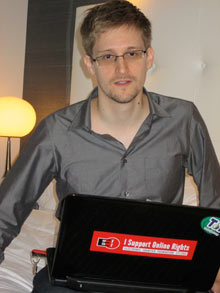
Holed up in a hotel room in Hong Kong, Edward Snowden, 29, said he had thought long and hard before publicizing details of an NSA program codenamed PRISM, saying he had done so because he felt his country was building an unaccountable and secret espionage machine that spied on every American.

Both the Washington Post and Britain’s Guardian newspaper — to whom he gave the documents he had purloined — published his identity on Sunday.

“I don’t want to live in a society that does these sort of things … I do not want to live in a world where everything I do and say is recorded. That is not something I am willing to support or live under,” he told the Guardian, which published a video interview with him on its website.

Full article here

<!–

–>

This article was posted: Monday, June 10, 2013 at 6:51 am

Tags: ,


<!– this is where we need to show the related articles

–>

This article originally appeared on: Infowars

David Icke Addresses Thousands at Bilderberg protest

0

Infowars.com
June 10, 2013

David Icke gives a rousing speech to thousands of people at the Bilderberg 2013 protests.

<!–

–>

This article was posted: Monday, June 10, 2013 at 6:45 am


<!– this is where we need to show the related articles

–>

This article originally appeared on: Infowars

Qalibaf repeats pledge to fix economy

0

Presidential candidate Mohammad-Baqer Qalibaf is greeted by his supporters in the northeastern city of Bojnourd.

Presidential candidate Mohammad-Baqer Qalibaf has reaffirmed his pledge to bring the economy back on track in two years should he be elected president.

In a speech in the northeastern city of Mashhad, the Principlist said Iran cannot open a new chapter in history amid an economic downturn and slow diplomacy.

Qalibaf, who is currently Mayor of Tehran, said there is no room left for trial and error and that people are fed up with broken promises or the irrational analyses of the status quo by officials.

He said he is running for the presidency to end to the current situation once and for all.

Qalibaf is facing six rivals, namely, President of the Expediency Councilâ„¢s Center for Strategic Research Hassan Rohani, Secretary of the Supreme National Security Council Saeed Jalili, Secretary of the Expediency Council Mohsen Rezaei, lawmaker Gholam-Ali Haddad-Adel, former Foreign Minister Ali-Akbar Velayati, former First Vice President Mohammad-Reza Aref, and former Telecommunications Minister Mohammad Gharazi.

The president of Iran is elected for a four-year term in a national election. This yearâ„¢s election will be held on June 14.

Nearly 50.5 million Iranians are eligible to vote in the upcoming presidential election.

KA/HGH

This article originally appeared on: Press TV

US-led soldier killed in Afghanistan

0

Polish soldiers stand guard by a road in Ghazni Province. (File Photo)

A US-led soldier has been killed in a roadside bomb explosion in Afghanistan’s eastern province of Ghazni, Press TV reports.

Poland’s Defense Ministry announced that the Polish soldier died of wounds suffered in the blast early on Monday.

Marek Pietrzak, the spokesman for the ministry’s Operations Command, said Master Cpl. Jan Kiepura has been injured during a safety-checking mission in the province.

The death of the 35-year-old soldier brings to 40 the number of Polish troops killed in Afghanistan since 2007.

According to the website, icasualties.org, at least 84 foreign soldiers have been killed in the war-torn state so far this year.

Attacks on foreign troops are expected to rise in the next months, as Taliban militants have announced the beginning of their “spring offensive” across Afghanistan.

The militant group said it would use “every possible tactic” to inflict casualties on Afghan and US-led forces, specifically mentioning insider and bomb attacks.

The United States and its allies invaded Afghanistan in 2001 as part of Washingtonâ„¢s so-called war on terror. The offensive removed the Taliban from power, but the country is still gripped by insecurity.

The increasing number of military casualties in Afghanistan has caused widespread anger in the US and other NATO member states, undermining public support for the Afghan war.

DB/SS

This article originally appeared on: Press TV

Haddad-Adel quits presidential race

0

Former presidential candidate Gholam-Ali Haddad-Adel is seen among his supporters in the northwestern city of Tabriz, on June 9, 2013.

Presidential candidate Gholam-Ali Haddad-Adel has ruled himself out of the June 14 race in favor of Principlists.

In an official statement on Monday, the former Majlis Speaker said he would continue to help the Principlist camp win the election regardless of his withdrawal.

Haddad-Adel said he stepped aside after evaluating the situation and the realities on the ground.

The sitting lawmaker expressed hope that his decision would help Principlists win the race in the first round or in a possible runoff.

Haddad-Adel also called on the Iranian nation to take part in the elections en masse.

The seven candidates in the race include President of the Expediency Councilâ„¢s Center for Strategic Research Hassan Rohani, Secretary of the Supreme National Security Council Saeed Jalili, Secretary of the Expediency Council Mohsen Rezaei, lawmaker Gholam-Ali Haddad-Adel, Tehran Mayor Mohammad-Baqer Qalibaf, former Foreign Minister Ali Akbar Velayati, former First Vice President Mohammad-Reza Aref, and former Telecommunications Minister Mohammad Gharazi.

The president of Iran is elected for a four-year term in a national election. This yearâ„¢s election will be held on June 14.

Nearly 50.5 million Iranians are eligible to vote in the upcoming presidential election.

KA/HGH

This article originally appeared on: Press TV

Russian gaming goes ballistic worth estimated $1.3bn

0

The Russian online video game industry is valued at $1.3 billion, and is rapidly rivaling western counterparts. A survey by Mail.ru shows gaming has increased over 240 percent in the last two years, and has reached a market value of $900 million.

Profits in the Russian game market reached $1.3 billion in 2012,
with the bulk stemming from online services ($900 million) and a
slight decrease of 12 percent in the offline sector.

“The Russian game industry is rapidly developing and
increasingly resembles major, long-established western
markets,”
said Vladimir Nikolsky, who, as of Monday, will
move from Mail.ru’s vice president of gaming to the chief
operating officer.

In 2011 the online gaming sector increased 54 percent and in 2012
it increased 64 percent, according to Mail.ru’s
report
.

Mail.ru operates Russia’s largest online gaming platform, as well
as the country’s largest email service and internet portal. The
study was spurred by a ‘significant knowledge gap’ in
demographics that exists in one of Russia’s hottest markets.

The study found that loyal Russian online gamers are willing to
routinely spend about $34 per month on services. The study found
that 87 percent of internet users play a game more than once a
month, and the median gamer age is 33. 54 percent of users are
women, and 46 percent are men. 44 percent of users are
professionals with university degrees or students currently
enrolled in higher education.

Mail.ru Group interviewed 2033 respondents aged over 13 years
living in Russian cities with a population of over 100,000
people.

AFP Photo/Oliver Berg

The most popular and fastest growing gaming platform is Android,
both on smartphones and tablets. In Russia, the mobile gaming
market grew by 180 percent in 2012, after surging 306
percent in 2011. Smartphone and tablet markets only increased
mobile gaming use.

According to retail data, the smartphone market in Russia grew by
67 percent.

Residents of Moscow take advantage of their morning commute to
hook up to video game networks, as some metro lines are equipped
with WI-FI.

A lot of video games are developed in Russia, as computer
programming is cheaper than Western markets and of the same
caliber. 

Tetris, the visual-spatial geometric puzzle of the 1980s comes
from Russia, and is used worldwide by computer science students
learning program code.

Mail.ru is a major stakeholder in Vkontakte (40 percent) and also
holds shares in Facebook (10 percent). The company sees a strong
growth relationship between the number of social network users
and their desire to pay for online gaming sources.

The media giant is headed by Alisher Usmanov, Russia’s wealthiest man, and
also holds various stakes in small venture capital investments in
Russian and Ukrainian internet companies.

This article originally appeared on: RT

NSA Surveillance: Historic Challenge to Support the Moral Actions of Edward Snowden

0

In Washington, where the state of war and the surveillance state are one and the same, top officials have begun to call for Edward Snowden’s head. His moral action of whistleblowing – a clarion call for democracy – now awaits our responses.

After nearly 12 years of the “war on terror,” the revelations of recent days are a tremendous challenge to the established order: nonstop warfare, intensifying secrecy and dominant power that equate safe governance with Orwellian surveillance.

In the highest places, there is more than a wisp of panic in rarefied air. It’s not just the National Security Agency that stands exposed; it’s the repressive arrogance perched on the pyramid of power.

Back here on the ground, so many people – appalled by Uncle Sam’s continual morph into Big Brother – have been pushing against the walls of anti-democratic secrecy. Those walls rarely budge, and at times they seem to be closing in, even literally for some (as in the case of heroic whistleblower Bradley Manning). But all the collective pushing has cumulative effects.

In recent days, as news exploded about NSA surveillance, a breakthrough came into sight. Current history may not be an immovable wall; it may be on a hinge. And if we push hard enough, together, there’s no telling what might be possible or achieved.

The gratitude that so many of us now feel toward Edward Snowden raises the question: How can we truly express our appreciation?

A first step is to thank him – publicly and emphatically. You can do that by clicking here to sign the “Thank NSA Whistleblower Edward Snowden” petition, which my colleagues at RootsAction.org will send directly to him, including the individual comments.

But of course saying thank-you is just one small step onto a crucial path. As Snowden faces extradition and vengeful prosecution from the U.S. government, active support will be vital – in the weeks, months and years ahead.

Signing the thank-you petition, I ventured some optimism: “What you’ve done will inspire kindred spirits around the world to take moral action despite the risks.” Bravery for principle can be very contagious.

Edward Snowden has taken nonviolent action to help counter the U.S. government’s one-two punch of extreme secrecy and massive violence. The process has summoned the kind of doublespeak that usually accompanies what cannot stand the light of day.

So, when Snowden’s employer Booz Allen put out a statement Sunday night, it was riddled with official indignation, declaring: “News reports that this individual has claimed to have leaked classified information are shocking, and if accurate, this action represents a grave violation of the code of conduct and core values of our firm.”

 What are the “code of conduct” and “core values” of this huge NSA contractor? The conduct of stealthy assistance to the U.S. national security state as it methodically violates civil liberties, and the values of doing just about anything to amass vast corporate profits.

The corporate-government warfare state is enraged that Edward Snowden has broken through with conduct and values that are 180 degrees in a different direction. “I’m not going to hide,” he told the Washington Post on Sunday. “Allowing the U.S. government to intimidate its people with threats of retaliation for revealing wrongdoing is contrary to the public interest.”

When a Post reporter asked whether his revelations would change anything, Snowden replied: “I think they already have. Everyone everywhere now understands how bad things have gotten – and they’re talking about it. They have the power to decide for themselves whether they are willing to sacrifice their privacy to the surveillance state.”

And, when the Post asked about threats to “national security,” Snowden offered an assessment light-years ahead of mainline media’s conventional wisdom: “We managed to survive greater threats in our history . . . than a few disorganized terrorist groups and rogue states without resorting to these sorts of programs. It is not that I do not value intelligence, but that I oppose . . . omniscient, automatic, mass surveillance. . . .  That seems to me a greater threat to the institutions of free society than missed intelligence reports, and unworthy of the costs.”

 Profoundly, in the early summer of 2013, with his actions and words, Edward Snowden has given aid and comfort to grassroots efforts for democracy. What we do with his brave gift will be our choice.

Norman Solomon is co-founder of RootsAction.org and founding director of the Institute for Public Accuracy. His books include “War Made Easy: How Presidents and Pundits Keep Spinning Us to Death.”

This article originally appeared on: Global Research

Mass Surveillance in America. Big Brother is Real. It’s no longer Fiction

0

It shouldn’t surprise. It’s longstanding policy. Post-9/11, it escalated. Previous articles said Big Brother is real. It’s no longer fiction.

Mass surveillance is official US policy. It’s not for national security. It’s not about discovering terror or other threats. None whatever exist. Claiming otherwise doesn’t wash. Big Lies substitute for vital truths.

What’s ongoing reflects unchecked power. It’s for unchallenged global dominance. It’s secret with no oversight for good reason. It’s unconstitutional. Societies governed this way are lawless. People living in them aren’t free.

America never was a democracy. It wasn’t created to be one. It’s not one now. Freedom is verboten. It’s vanishing in plain sight. Wealth, power and privilege alone matter. Police state terror targets non-believers.

Money power runs America. Powerful interests alone matter. What they say goes. What they want they get. Obama’s their nominal front man. Complicit congressional and judicial officials are involved. So are media scoundrels.

They serve wealth, power and privilege. They spurn populist interests. They pretend otherwise. Policies belie official rhetoric. A previous article said impeaching Obama is vital. It’s a national imperative. What’s ongoing now may be prelude for much worse to come.

Police states operate this way. They tolerate no opposition. People wanting to live free and saying so are considered enemies. Challenging government of, by and for privileged elites is criminalized. Expect much worse ahead.

Mass surveillance is all-embracing. There’s no place to hide. Everyone is watched. Non-believers are targeted. Privacy no longer exists.

Orwell envisioned the future. “Big Brother is watching,” he said. “There was of course no way of knowing whether you were being watched at any given moment.”

“How often, or on what system, the Thought Police plugged in on any individual wire was guesswork. It was even conceivable that they watched everybody all the time. But at any rate they could plug in your wire whenever they wanted to.”

The worst of what Orwell foresaw is real. It’s worse than he imagined. State-of-the-art technology is frightening. It’s used repressively. It’s a dagger at the heart of freedom. It’s being destroyed in plain sight.

NSA is nicknamed No Such Agency. It’s the crown jewel of mass surveillance. It’s Big Brother writ large. It’s too great a menace to ignore.

What’s now public knowledge may be the tip of the iceberg. Much more needs to be known. Free societies require sunshine. It’s the best disinfectant. It’s the only one.

Hopefully more insiders will tell all. Preserving what too vital to lose depends on them. Freedom’s too precious to lose. It’s practically gone now. Reclaiming what’s lost depends on mass opposition against ruthless state terror.

Governments subverting popular interests lack legitimacy. America’s Declaration of Independence said so. Governments “deriv(e) their just powers from the consent of the governed.”

Whenever government ill-serves, “it is the Right of the People to alter or to abolish it, and to institute new Government….”

When longstanding “abuses and usurpations” become despotic, “it is their right, it is their duty, to throw off such Government (and replace it) for their future security.”

Colonial America rejected British tyranny. Challenging what replaced it is vital. It’s same old under new management. It’s old wine in new bottles. It’s draconian. It’s technologically threatening. It’s too intolerable to permit.

Collective activism has power. What better time to use it than now. America’s waging political, social, financial, and hot wars.

It’s doing so globally. It’s happening at home and abroad. Constitutional protections are vanishing. America’s social contract is being destroyed.

Militarization, permanent wars, and unchallenged global dominance reflect policy. So does police state harshness. Dissent is endangered. Privilege is entrenched. Fundamental freedoms are disappearing in plain sight.

Electoral politics doesn’t work. Money power runs America. Vital change more than ever is needed. Authority must be challenged disruptively.

Resisting tyranny is a universal right. Jefferson said doing so “is obedience to God.” Women’s rights advocate Susan B. Anthony said the same thing.

In his second Treatise of Government, John Locke addressed the “Right of Revolution,” saying:

“….acting for the preservation of the Community, there can be but one Supream (sic) Power, which is the Legislature, to which all the rest are and must be subordinate, yet the Legislature being only a Fiduciary Power to act for certain ends, there remains still in the People a Supream Power to remove or alter the Legislature, when they find the Legislative act contrary to the trust reposed in them.”

“When government fails the people, its “trust must necessarily be forfeited, and the Power devolve into the hands of those that gave it, who may place it anew where they shall think best for their safety and security.”

St. Thomas Aquinas wrote:

“If the law purports to require actions that no-one should ever do, it cannot rightly be complied with; one’s moral obligation is not to obey but to disobey.”

“If the lawmakers (i) are motivated not by concern for the community’s common good but by greed or vanity (private motivations that make them tyrants, whatever the content of their legislation), or (ii) act outside the authority granted to them, or (iii) while acting with a view to the common good apportion the necessary burdens unfairly, their laws are unjust and in the forum of reasonable conscience are not so much laws as acts of violence.”

“Such laws lack moral authority, i.e. do not bind in conscience; one is neither morally obligated to conform nor morally obligated not to conform.”

“All who govern in the interests of themselves rather than of the common good are tyrants.”

“Against the regime’s efforts to enforce its decrees, one has the right of forcible resistance; as a private right this could extend as far as killing the tyrant as a foreseen side-effect of one’s legitimate self-defence.”

Martin Luther King said:

“I submit that an individual who breaks a law that conscience tells him is unjust and who willingly accepts the penalty of imprisonment in order to arouse the conscience of the community over its injustice, is in reality expressing the highest respect for law.”

“I am convinced that noncooperation with evil is as much a moral obligation as is cooperation with good.” King championed “creative protest.” Passivity is no option in the face of injustice.”

Henry David Thoreau’s “Civil Disobedience” remains a landmark essay.

“Must the citizen ever for a moment, or in the least degree resign his conscience to the legislator,” he asked?

“The only obligation which I have a right to assume is to do at any time what I think right.”

“All men recognize the right of revolution; that is, the right to refuse allegiance to, and to resist, the government, when its tyranny or its inefficiency are great and unendurable.”

“Unjust laws exist; shall we be content to obey them, or shall we endeavor to amend them, and obey them until we have succeeded, or shall we transgress them at once?”

The state “is not armed with superior wit or honesty, but with superior physical strength. I was not born to be forced. I will breathe after my own fashion….They can only force me who obey a higher law than I.”

Gandhi said throughout history, “there have been tyrants and murderers, and for a time, they seem invincible. But in the end, they always fall. Always.”

Ralph Waldo Emerson believed unjust laws must be resisted. His “Representative Men” essays expressed strong abolitionist sentiment.

“I think we must get rid of slavery or we must get rid of freedom….If you put a chain around the neck of a slave, the other end fastens itself around your own,” he said.

Slavery today exists in new forms. Abolishing freedom best explains it. Tolerating what demands challenging assures much worse ahead. It’s happening in plain sight.

Mass surveillance permits it. London’s Guardian revealed more. On June 8, it headlined “Boundless Informant: the NSA’s secret tool to track global surveillance data.”

The Guardian obtained another leaked document. Hopefully many more will come out.

Boundless Informant (BI) is a data-mining tool. It’s used to record and analyze “where its intelligence comes from.” It’s capability “raise(s) questions about its repeated assurances to Congress that it cannot keep track of all the surveillance it performs on American communication.”

BI “count(s) and categoriz(es) the records of communications, known as metadata, rather than the content of an email or instant message.”

BI documents show NSA collected almost three billion pieces of intelligence “over a 30-day period ending in March 2013.”

An NSA fact sheet says BI “allows users to select a country on a map and view the metadata volume and select details about the collections against that country.”

It’s used internally and abroad. It’s a global spy tool. It’s watching everywhere all the time. It can if it wants to. In March, DNI head James Clapper testified before the Senate Select Committee on Intelligence.

Senator Ron Wyden asked: “Does NSA collect any type of data at all on millions or hundreds of millions of American?”

“No sir,” said Clapper. He lied saying so. Virtually everyone in America is monitored all the time. NSA is Big Brother writ large. Guardian obtained documents prove it.

NSA capabilities keep improving. What’s ongoing now will be technologically advanced ahead. It’s used for unchallenged control. Perhaps Orwell explained best.

Power is sought “for its own sake,” he said. Ruthless rulers aren’t “interested in the good of others.” They’re “interested solely in power, pure power.”

“Power is not a means; it is an end. One does not establish a dictatorship in order to safeguard a revolution; one makes the revolution in order to establish the dictatorship.”

“The object of persecution is persecution. The object of torture is torture. The object of power is power. Now you begin to understand me.”

Orwell also said “(u)ntil they become conscious they will never rebel, and until after they have rebelled they cannot become conscious.”

Stephen Lendman lives in Chicago. He can be reached at lendmanstephen@sbcglobal.net.

His new book is titled “Banker Occupation: Waging Financial War on Humanity.”

http://www.claritypress.com/LendmanII.html

Visit his blog site at sjlendman.blogspot.com.

Listen to cutting-edge discussions with distinguished guests on the Progressive Radio News Hour on the Progressive Radio Network.

It airs Fridays at 10AM US Central time and Saturdays and Sundays at noon. All programs are archived for easy listening.

http://www.progressiveradionetwork.com/the-progressive-news-hour

http://www.dailycensored.com/mass-surveillance-in-america/

This article originally appeared on: Global Research

NSA Whistleblower Reveals Himself

0

“I realised that I was part of something that was doing far more harm than good… The NSA routinely lies in response to Congressional inquiries about scope of surveillance in America. The NSA is intent on making every conversation and every form of behaviour in the world known to them…. What they’re doing poses an existential threat to democracy.” – Edward Snowden, 29, PRISM Whistleblower

The US government will be happy to learn it will save several million dollars on the criminal inquiry into the identity of the NSA’s PRISM whistleblower because moments ago in a lengthy profile by the Guardian’s Glenn Greenwald, said whistleblower has decided to reveal himself to the world: he is Edward Snowden, 29 years old. Originally from Elizabeth City, NC, a Maryland community college dropout and former Special Forces trainee, the 10 year “veteran” with the NSA, most recently in its Hawaii office under the employ of defense contractor Booz Allen Hamilton, has just made history and joined the pantheon of such legendary whistleblowers of the US government’ secret activities as the Pentagon Papers’ Daniel Ellsberg and Wikileaks’ Bradley Manning. Last but not least, Edward is currently residing in Hong Kong, out of harm’s (read America’s) way.

Who is Edward and how did he end up at the NSA? The Guardian has the full story.

By his own admission, he was not a stellar student. In order to get the credits necessary to obtain a high school diploma, he attended a community college in Maryland, studying computing, but never completed the coursework.

In 2003, he enlisted in the US army and began a training program to join the Special Forces. Invoking the same principles that he now cites to justify his leaks, he said: “I wanted to fight in the Iraq war because I felt like I had an obligation as a human being to help free people from oppression”.

He recounted how his beliefs about the war’s purpose were quickly dispelled. “Most of the people training us seemed pumped up about killing Arabs, not helping anyone,” he said. After he broke both his legs in a training accident, he was discharged.

After that, he got his first job in an NSA facility, working as a security guard for one of the agency’s covert facilities at the University of Maryland. From there, he went to the CIA, where he worked on IT security. His understanding of the internet and his talent for computer programming enabled him to rise fairly quickly for someone who lacked even a high school diploma.

By 2007, the CIA stationed him with diplomatic cover in Geneva, Switzerland. His responsibility for maintaining computer network security meant he had clearance to access a wide array of classified documents.

That access, along with the almost three years he spent around CIA officers, led him to begin seriously questioning the rightness of what he saw. 

He described as formative an incident in which he claimed CIA operatives were attempting to recruit a Swiss banker to obtain secret banking information. Snowden said they achieved this by purposely getting the banker drunk and encouraging him to drive home in his car. When the banker was arrested for drunk driving, the undercover agent seeking to befriend him offered to help, and a bond was formed that led to successful recruitment.

“Much of what I saw in Geneva really disillusioned me about how my government functions and what its impact is in the world,” he says. “I realised that I was part of something that was doing far more harm than good.”

He left the CIA in 2009 in order to take his first job working for a private contractor that assigned him to a functioning NSA facility, stationed on a military base in Japan. It was then, he said, that he “watched as Obama advanced the very policies that I thought would be reined in”, and as a result, “I got hardened.”

Why did he wait so long?

He said it was during his CIA stint in Geneva that he thought for the first time about exposing government secrets. But, at the time, he chose not to for two reasons.

First, he said: “Most of the secrets the CIA has are about people, not machines and systems, so I didn’t feel comfortable with disclosures that I thought could endanger anyone”. Secondly, the election of Barack Obama in 2008 gave him hope that there would be real reforms, rendering disclosures unnecessary.

That did not happen. So he proceed to reveal what he knows about the NSA to a newspaper which the NYT pejoratively referred to as a “British News Site.” Well, he certainly did not go with any of the news sites on favorable terms with the current administration. Instead, “He purposely chose, he said, to give the documents to journalists whose judgment he trusted about what should be public and what should remain concealed.”

Which of course brings up the question: now what, and why risk what was otherwise a “comfortable life” in a Hawaiian paradise?

In a note accompanying the first set of documents he provided, he wrote: “I understand that I will be made to suffer for my actions,” but “I will be satisfied if the federation of secret law, unequal pardon and irresistible executive powers that rule the world that I love are revealed even for an instant.”

Despite his determination to be publicly unveiled, he repeatedly insisted that he wants to avoid the media spotlight. “I don’t want public attention because I don’t want the story to be about me. I want it to be about what the US government is doing.”

He does not fear the consequences of going public, he said, only that doing so will distract attention from the issues raised by his disclosures. “I know the media likes to personalise political debates, and I know the government will demonise me.”

Despite these fears, he remained hopeful his outing will not divert attention from the substance of his disclosures. “I really want the focus to be on these documents and the debate which I hope this will trigger among citizens around the globe about what kind of world we want to live in.” He added: “My sole motive is to inform the public as to that which is done in their name and that which is done against them.”

He has had “a very comfortable life” that included a salary of roughly $200,000, a girlfriend with whom he shared a home in Hawaii, a stable career, and a family he loves. “I’m willing to sacrifice all of that because I can’t in good conscience allow the US government to destroy privacy, internet freedom and basic liberties for people around the world with this massive surveillance machine they’re secretly building.”

That said, he has left the US and is now in Hong Kong, which in the New Normal is a safer venue for those exposing what until recently was considered a massive conspiracy theory.

Three weeks ago, Snowden made final preparations that resulted in last week’s series of blockbuster news stories. At the NSA office in Hawaii where he was working, he copied the last set of documents he intended to disclose.

He then advised his NSA supervisor that he needed to be away from work for “a couple of weeks” in order to receive treatment for epilepsy, a condition he learned he suffers from after a series of seizures last year.

As he packed his bags, he told his girlfriend that he had to be away for a few weeks, though he said he was vague about the reason. “That is not an uncommon occurrence for someone who has spent the last decade working in the intelligence world.”

On May 20, he boarded a flight to Hong Kong, where he has remained ever since. He chose the city because “they have a spirited commitment to free speech and the right of political dissent”, and because he believed that it was one of the few places in the world that both could and would resist the dictates of the US government.

Snowden’s future is bleak to say the least, and if Bradly Manning’s recent travails are any indication, a life in prison may be an upside option:

“All my options are bad,” he said. The US could begin extradition proceedings against him, a potentially problematic, lengthy and unpredictable course for Washington. Or the Chinese government might whisk him away for questioning, viewing him as a useful source of information. Or he might end up being grabbed and bundled into a plane bound for US territory.

“Yes, I could be rendered by the CIA. I could have people come after me. Or any of the third-party partners. They work closely with a number of other nations. Or they could pay off the Triads. Any of their agents or assets,” he said.

“We have got a CIA station just up the road — the consulate here in Hong Kong — and I am sure they are going to be busy for the next week. And that is a concern I will live with for the rest of my life, however long that happens to be.”

Having watched the Obama administration prosecute whistleblowers at a historically unprecedented rate, he fully expects the US government to attempt to use all its weight to punish him. “I am not afraid,” he said calmly, “because this is the choice I’ve made.”

He predicts the government will launch an investigation and “say I have broken the Espionage Act and helped our enemies, but that can be used against anyone who points out how massive and invasive the system has become”.

The only time he became emotional during the many hours of interviews was when he pondered the impact his choices would have on his family, many of whom work for the US government. “The only thing I fear is the harmful effects on my family, who I won’t be able to help any more. That’s what keeps me up at night,” he said, his eyes welling up with tears.

…

As for his future, he is vague. He hoped the publicity the leaks have generated will offer him some protection, making it “harder for them to get dirty”.

He views his best hope as the possibility of asylum, with Iceland — with its reputation of a champion of internet freedom — at the top of his list. He knows that may prove a wish unfulfilled.

But after the intense political controversy he has already created with just the first week’s haul of stories, “I feel satisfied that this was all worth it. I have no regrets.”

Now the great debate begins: is sacrificing it all in the name of ethical principles under a totalitarian regime now fully set on destroying you, worth it? And since we are dealing with one grand revealed conspiracy, another one will naturally emerge: is Snowden’s explanation of his motives honest and accurate? Why now and why him? Surely at least one other person has worked at the NSA in the past decade whose thought process has been identical and who put the value of democracy over and above that of one’s personal career development and safety.

Most importantly, the ball is now in Obama’s court, and the constitutional scholar’s every action will be studied under a microscope by civil liberty defenders (both real and paid for) everywhere while one Jon Corzine withdrawls millions of dollars from East Hampton ATM machines unhindered, and without any scruples.

Finally, we would like to thank Snowden for putting a nail into the coffin of all those who use the term “conspiracy theorist” pejoratively. Because whatever his motives, whatever the outcome of this dramatic escalation between the people’s right to know and a government intent on hijacking all civil liberties one by one, Snowden has showed that the distance from Conspiracy Theory to Conspiracy Fact is just one ethical judgment away.

For those curious, here is the full text of the US-Hong Kong Extradition treaty.

* * *

Snowden’s interview with the Guardian’s Glenn Greenwald (produced by WaPo’s Laura Poitras) can be seen after the jump.

This article originally appeared on: Global Research

PRISM Whistleblowing. Edward Snowden: Former CIA Man behind the NSA Intelligence Leak

0

Edward Snowden: former CIA man behind the NSA intelligence leak

The 29-year-old source behind the biggest intelligence leak in the NSA’s history explains his motives, his uncertain future and why he never intended on hiding in the shadows

 by Glenn Greenwald, Ewen Macaskill and Laura Poitras

in Hong Kong, Monday, Guardian, 10 June 2013

The individual responsible for one of the most significant leaks in US political history is Edward Snowden, a 29-year-old former technical assistant for the CIA and current employee of the defence contractor Booz Allen Hamilton. Snowden has been working at the National Security Agency for the last four years as an employee of various outside contractors, including Booz Allen and Dell.

The Guardian, after several days of interviews, is revealing his identity at his request. From the moment he decided to disclose numerous top-secret documents to the public, he was determined not to opt for the protection of anonymity. “I have no intention of hiding who I am because I know I have done nothing wrong,” he said.

Snowden will go down in history as one of America’s most consequential whistleblowers, alongside Daniel Ellsberg and Bradley Manning. He is responsible for handing over material from one of the world’s most secretive organisations — the NSA.

In a note accompanying the first set of documents he provided, he wrote: “I understand that I will be made to suffer for my actions,” but “I will be satisfied if the federation of secret law, unequal pardon and irresistible executive powers that rule the world that I love are revealed even for an instant.”

(…)

To read complete article:

http://www.guardian.co.uk/world/2013/jun/09/edward-snowden-nsa-whistleblower-surveillance?guni=Network%20front:network-front%20full-width-1%20bento-box:Bento%20box:Position1

See also

interview (video 12:36 min) with Edward SNOWDEN;

http://www.guardian.co.uk/world/video/2013/jun/09/nsa-whistleblower-edward-snowden-interview-video

This article originally appeared on: Global Research

US Gulf allies crack down on Internet freedoms

0


Published time: June 10, 2013 09:45
Edited time: June 10, 2013 10:22

AFP Photo/Behrouz Mehri

Download video (15.18 MB)
Embed

Code

Gulf Arab allies of the US have come under fire for introducing a series of draconian measures that limit Internet freedoms. The measures restrict content on social media sites, making “offending” posts punishable by extensive jail sentences.

Saudi Arabia, Qatar, the United Arab Emirates, Kuwait and Bahrain
have tightened controls on Internet freedoms recently, targeting
social media and phone applications alike in their communications
crackdown.

Across the Gulf, dozens of journalists and social media users
have been arrested since the beginning of the year for being in
violation of the uncompromising national laws.

Punishments include deportation and lengthy prison sentences for
crimes such as making derogatory comments about the government
“in bad faith,” and offending religion and family values.
In Saudi Arabia last month, top cleric Sheikh Abdul Latif Abdul
Aziz al-Sheikh warned citizens against using Twitter, stating
that those who use social media sites “have lost this world
and the afterlife.”

Saudi Arabia

After threatening to ban messaging applications like Skype and
WhatsApp, Saudi Arabia’s telecom regulator has chosen a new
target: The web-based communication app Viber. The instant
messaging application has been blocked since June 5.

“The Viber application has been suspended… and the
[regulator] affirms it will take appropriate action against any
other applications or services if they fail to comply with
regulatory requirements and rules in force in the kingdom,”

the Communications and Information Technology Commission (CITC)
said in a statement. 

A Saudi man browses through twitter on his desktop in Riyadh (AFP Photo)

Viber allows its users to
text, call and send photos and video messages worldwide using a
3G or Wifi connection, and boasts over 200 million subscribers
worldwide. 

In March, the CITC warned mobile providers in the Kingdom that if
they could not find ways to monitor encrypted messaging and VOIP
applications, then they would be blocked, according to local
media. The commission then issued a statement saying that “it
would take suitable measures against these apps and
services,”
in its push for greater control over the Internet.

The Saudi government has also begun arresting Twitter users for
posts to their accounts. Local media reports that the government
is looking into ending anonymity for Twitter users in the country
by making users register their identification documents.

Qatar

Despite its status as a regional media hub, the emirate state is
considering a new cybercrime law that would widen government
control over news websites and online commentaries.

If passed, the law would enable the government to punish websites
or social media users for violating “the social principles or
values,”
or for publishing “news, photos, audio or visual
recordings related to the sanctity of the private and familial
life of persons, even if they were true, or infringes on others
by libel or slander via the Internet or other information
technology means,”
Qatar News agency reported.

Abdullah Al-Hadidi

United Arab Emirates

At the end of 2012, the UAE passed a sweeping new cybercrime law:
Anyone found guilty of criticizing the country’s rulers or
institutions online may be jailed or deported. The law attracted
widespread opposition, with legal consultants warning it is broad
enough to penalize anyone caught posting allegedly offensive
comments against the state.


This law has been used to jail citizens for Twitter posts over
the past few months. In May, the UAE appeals court sentenced
Abdullah Al-Hadidi to 10 months in jail for tweeting details of
the trial of his father.

He was arrested on March 22 on charges of disseminating
information on Twitter “in bad faith.” The court ruled
that he wrote false details of a public hearing that, along with
his father, involved 93 other people accused of plotting to seize
power in the Gulf Arab state.

Kuwait

The government has arrested dozens of activists and at least six
journalists in 2013 in the constitutional emirate, often
described as the most liberal country in the region.

In March, Twitter user Hamed Al-Khaledi was sentenced to two
years in prison for allegedly insulting the ruler of the Gulf
nation. Others have been accused of “threatening state
security”
or “offending religion.”

In April, a Kuwaiti court sentenced former parliamentarian and
opposition leader Mussallam al-Barrak to five years in prison for
remarks deemed critical of the ruler of the state, which he made
last year at a public rally.

Kuwait has been a member of the International Covenant on Civil
and Political Rights (ICCPR) since 1996, which protects the right
to freedom of expression, including peaceful criticism of public
officials. 

King of Bahrain Sheikh Hamad bin Issa al-Khalifa (Reuters)


Bahrain

The Bahraini government has been trying to suppress an ongoing
uprising by introducing stricter penalties. In April, the
government passed a law making it illegal to insult the Gulf
state’s King Hamad bin Issa al Khalifa, or its national symbols.

Recently, Bahraini blogger and activist Ali Abduleman was granted
asylum in the UK after two years in hiding. Adbuleman claims he
was persecuted by the government “for exercising the right to
express his opinions”
on his website. The Bahraini government
claims he was tried for “inciting and encouraging continuous
violent attacks against police officers” and conspired to spread
“false and inflammatory rumors.”

In May, 62-year-old Bahraini protester Abdulla Sayegh was
sentenced to three months in prison for hanging a national flag
from his truck during a 2011 rally. The same month, six Twitter
users were jailed for allegedly offensive comments about the
country’s ruler deemed to be ‘abusing freedom of expression.’
According to prosecutors, they posted comments that undermined
“the values and traditions of Bahrain’s society towards the
king.”

One of the best-known human rights abuse cases in Bahrain is that
of activist Nabeel Rajab, who was sentenced to three years in
jail in August 2012 on charges of ‘participating in an illegal
assembly’ and ‘calling for a march without prior notification.’
He openly criticized the country’s regime on RT for Julian
Assange’s show The World Tomorrow.

The country has witnessed mass protests led by the kingdom’s
majority Shiites against the minority Sunni-led government for
two years. The Shiite demonstrators call for a transfer to a
democratic system, and complain of discrimination in jobs and
government. Their loyalty is in turn questioned by the ruling Al
Khalifa monarchy, which has been in power for decades.

This article originally appeared on: RT

Russian Communists brace themselves for fighting international oligarchy

0

At a congress in Moscow over a thousand Communist deputies from the federal and regional level have been trying to develop a strategy that would allow them increased political weight.

Party leader, Gennadiy Zyuganov, told his colleagues that the
current situation is Russia was ‘favorable’ — even though the
authorities managed to tone down the active protests, the number
of people who support United Russia is on the
decrease. Zyuganov quoted the latest opinion polls that show only
24 percent of voters said they were supporting the present
majority party and only 29 percent said they were supporting
Vladimir Putin — a marked fall from 2012 when the share of those
who supported Putin was over 63 percent

Zyuganov then added that the Communist parliamentarians must be
more on the September 8 election day so they overcome voter
negativity and get the representation they deserve. At the moment
Communists hold slightly over 8,000 seats in federal and regional
parliaments — a very small share of a total of over 221,000
seats.

The Communist leader gave a typical outline of the major
drawbacks of modern capitalism, offering his party faithful a set
of ready-made arguments for future election debates.

Zyuganov described the current situation in the world as the
collapse of the existing financial system and a vivid proof that
capitalism cannot solve the problems that it had created. He
accused Russian and international oligarchs of “robbing Russia
and its people
”, capital flight, dominance of resource sector
in the economy and poor state of society.

The communist head said that “almost all major Russian
companies
” now belong to foreign investors who extract the
profits, saving on taxes, social programs and also on the
modernization of production facilities. He also said the current
fall in production growth and dire state of many of Russian
regions “have proved that the reforms, planned and conducted
by the current Russian authorities, had failed completely
”.

Despite their leader’s calls, some of the top members of the
party remained skeptical about their chances in the September
polls. State Duma member Vadim Potomskiy and parliamentary of the
Vladimir Region Lyudmila Bunina both said in comments to
Kommersand daily that the support from the President and federal
ministries gave great advantage to United Russia candidates and
no strategy could overweight this.

Some regional politicians, on the contrary, said that they
believed that their results will be better than those of previous
elections. Communist party members from Buryatia, Ryazan and
Kalmykia, said that their representation in regional parliaments
will grow after the September polls.

Kommersant’s experts took a medium position, saying that
communists might repeat or slightly improve their representation
in regional legislatures, but had very little chances at
gubernatorial polls.

This article originally appeared on: RT

Jordan wargames: Patriot batteries, F-16s and 4,500 US troops near Syrian border

0

Multinational military exercise ‘Eager Lion’ has been launched in Jordan amid condemnation from neighboring Syria and its ally Russia. The US brings Patriot missile batteries to the Syrian border, which could remain deployed afterwards.

The exercises will last for 12 days, bringing together about
8,000 personnel from 19 countries, mostly Arabic, but also
including the US and Europe. The maneuvers will also involve some
3,000 Jordanian and 500 British troops.

‘Eager Lion’ — which is being conducted only 120km from the
Jordan-Syria border — is aimed at training personnel for the
possibility of the Syrian civil war spilling into neighboring
countries.

Russia has raised concerns over the deployment of US Patriot
missile batteries and F-16 fighter jets to Jordan: “We have
more than once stated our opinion on this — foreign weapons are
being pumped into an explosive region,”
Russian Foreign
Ministry spokesperson Aleksandr Lukashevich said last week.

“This is happening very close to Syria, where for more than
two years the flames of a devastating conflict are burning that
Russia and its American partners are trying to stop by proposing
to hold an international peace conference as soon as
possible,”
Lukashevich said.

Patriot Missiles stand at the ready at a classified launch area in the southern Kuwaiti desert. (AFP Photo)

The organizers of ‘Eager Lion’ say that the troops involved will
also train for the possibility of a chemical attack, as Syria’s
neighbors fear that Damascus may lose control of its chemical
weapons arsenal, which could then fall into the wrong hands.

“We all have chemical training from any activity, so we
continue to build those objectives into any exercise that we
do,”
said US Major General Robert Catalanotti, the Director
of Exercises and Training.

Last
week
the US military revealed it may indefinitely leave
behind the Patriot batteries and F-16s deployed in Jordan due to
the threat of the violence in Syria crossing into Jordanian
territory.

Jordanian Army Major General Awni el-Edwan, Operation Chief of
Staff, told reporters on Sunday that no US troops, Patriot
missile complexes or F-16s would remain in Jordan after the
exercises conclude: “The drills have nothing to do with any
objective related to what is happening in Syria.”

“No forces will stay after the exercise unless there is a
request by the Jordanian government to keep the Patriots and F-16
jets, this is a political decision,”
General el-Edwan said,
adding that Amman has no intention to “attack anybody.”

Jordanian special forces (Reuters/Ali Jarekji)

US Major General Robert Catalanotti echoed el-Edwan’s remarks,
saying that “If the government of Jordan decides to make that
request that would have go back through Washington, DC, for
decision, and they would have to plan the numbers to support
that.”

“But as of right now, in the exercise, I am not working that
issue at all, I’m simply using those instruments here for our
objectives in the exercise,”
Catalanotti said.

General el-Edwan also stressed that the Syrian opposition will
not participate in the exercise: “We are dealing with
countries, we are a neutral country.”

The Syrian army is continuing its push to retake control of
rebel-held regions in the country. Forces loyal to President
Bashar Assad recently forced rebel militants to withdraw from the
strategic western Syrian town of Qusair.

This article originally appeared on: RT

US security officials said NSA leaker, journalist should be 'disappeared' — report

0

A US editor has alleged he overheard security officials saying that the NSA leaker and the Guardian columnist who broke his story should be “disappeared.” Leaker Edward Snowden said that American spies often prefer silencing targets over due process.

“In Dulles UAL lounge listening to 4 US intel officials saying
loudly leaker & reporter on #NSA stuff should be disappeared
recorded a bit,”
the Atlantic’s Washington-based
editor-at-large Steve Clemons tweeted on Sunday.

According to Clemons, four men sitting next to him at the airport
“were loud. Almost bragging” while discussing an
intelligence conference they had just attended hosted by the
Intelligence and National Security Alliance.

Clemens said he was unsure of the men’s identities or which
agency they worked for, and told the Huffington Post that one of
them was wearing “a white knit national counter-terrorism
center shirt.”
Clemons also recorded part of their
conversation and snapped some photos, hoping that “people in
that bz will know them.”

“But bad quality,” he noted about the quality of the
photos. “Was a shock to me and wasn’t prepared,” he wrote
on Twitter.

The source behind the revelation of the top-secret NSA
surveillance program, dubbed one of the most significant
intelligence leaks in US history, was uncovered late last week.
Snowdon, a former CIA technical contractor and NSA consultant,
had asked the Guardian to reveal his identity. He has fled to
Hong Kong in a bid to escape retaliation by the US.

“The NSA has built an infrastructure that allows it to
intercept almost everything. With this capability, the vast
majority of human communications are automatically ingested
without targeting. If I wanted to see your emails or your wife’s
phone, all I have to do is use intercepts. I can get your emails,
passwords, phone records, credit cards,”
Snowden told the
Guardian.

When asked for his reaction to the alleged comments that reporter
Glenn Greenwald and the 29-year-old leaker himself should be
“disappeared,” Snowden told the newspaper: “Someone responding to
the story said ‘real spies do not speak like that.’ Well, I am a
spy and that is how they talk. Whenever we had a debate in the
office on how to handle crimes, they do not defend due process —
they defend decisive action. They say it is better to kick
someone out of a plane than let these people have a day in court.
It is an authoritarian mindset in general.”

Snowdon earlier explained that he had sacrificed his life and
$200,000-a-year career out of his desire to protect “basic
liberties”
in order to “send a message to government that
people will not be intimidated.”

The whistleblower leaked top-secret documents that revealed the
existence of the US National Security Agency’s extensive Internet
spying program PRISM, which records digital communications and
allows for real-time online surveillance of US citizens. PRISM
apparently gives US intelligence agencies direct access to files
stored on the servers of major Internet companies — including
Google and Facebook — in order to identify and target potential
terror suspects.

This article originally appeared on: RT

‘Riyadh, Doha in rivalry over Yemen’s oil’

0

File photo shows an oil facility in Yemen.

A political analyst says Yemen is emerging as an arena in the energy-driven confrontation between Saudi Arabia and Qatar, as Riyadh and Doha are seeking to tap into crude oil reserves in the impoverished country.

The commentator, who requested anonymity, said that the Qatari government has an objective alliance with Yemenâ„¢s Muslim Brotherhood and provides financial aid to the group.

The Muslim Brotherhood will in return assist al-Qaeda militants in Yemenâ„¢s eastern province of Hadhramaut, the commentator stated, adding that Saudi Arabia, on the other hand, has thrown its weight behind remnants of the regime of ousted Yemeni dictator Ali Abdullah Saleh in order to establish its influence in the region, and pump out Yemenâ„¢s oil.

Pundits agree that a schism is slowly emerging between Saudi Arabia and Qatar in the wake of their attempts to play a more influential role in the Middle East.

Qatarâ„¢s relations with the Muslim Brotherhood are multi-faceted. Middle East scholar Alain Gresh says Doha has dedicated al-Jazeera news network to the service of the Muslim Brotherhood, and turned it into what many scholars call a Å“mouthpiece for the Brotherhood.”

Qatar has also been very generous with the income from its gas wealth, and transferred billions of dollars to the Muslim Brotherhood.

Saudi Arabia has however been opposing the Muslim Brotherhood.

Saudis accuse the Muslim Brotherhood of Å“betraying” the kingdom after it hosted their members, who were persecuted under former Egyptian President Gamal Abdel Nasser.

MP/HSN

This article originally appeared on: Press TV

US senator to sue govt on spying bid

0

US Republican Senator Rand Paul has declared plans to take legal action against the Obama administration for what he described as its “unconstitutional” electronic surveillance efforts.

The Kentucky senator further emphasized during a nationally televised interview with Fox News Sunday show that he intends to rally “the support of 10 million Americans” for his class action lawsuit.

“I’m going to be seeing if I can challenge this at the Supreme Court level,” Paul reportedly said.

Å“Iâ„¢m going to be asking all the Internet providers and all of the phone companies, ask your customers to join me in a class action lawsuit. If we get 10 million Americans saying we donâ„¢t want our phone records looked at, then somebody will wake up and say things will change in Washington,” he further emphasized.

Senator Paul also insisted that public outrage over two pieces of legislation, known as SOPA and PIPA, which triggered Internet privacy concerns, have proved very successful.

Å“If we can have that again – people by the millions coming out and saying, ËœLook, I want to be part of a class action suit that says to the government, letâ„¢s hear this at the Supreme Court level. Are you allowed to look at phone records even though thereâ„¢s no probable cause that Iâ„¢m related to a crime?â„¢ – I think weâ„¢ll put an end to this,” Paul also underlined.

The development comes just days after leaked reports that the largest US spy institution, the National Security Agency (NSA) has ordered one of the nationâ„¢s major phone companies to collect and submit phone records of tens of millions of its American customers under a Å“top-secret” court order issued in April.

The secret order required the huge American phone company, Verizon, to provide the NSA Å“with daily information on all telephone calls by its customers within the United States and from foreign locations into the United States,” the UK-based Guardian and the US-based The Washington Post dailies reported last week.

The order was reportedly signed off by Å“a judge from the secret court that oversees domestic surveillance” and may constitute Å“the broadest surveillance order” ever issued.

The development further confirmed persisting suspicions of civil liberties activists across America about the sweeping nature of US governmentâ„¢s surveillance measures on its own citizens through corporate commercial carriers under the laws hastily passed by American lawmakers following the suspicious September 11, 2001 incidents in New York and near Washington DC that killed nearly 3,000 people.

Despite the outrage, US President Barack Obama and the Director of US National Intelligence James Clapper defended the massive surveillance efforts as Å“legal,” longstanding and well-known to the nationâ„¢s Congress.

Meanwhile, former NSA system administrator and ex-CIA undercover agent Edward Snowden revealed on Sunday that he was the source behind leaking the information about the massive NSA surveillance of American electronic communications.

While declaring his intension to seek asylum in another country, Snowden said, Å“I donâ„¢t want to live in a society that does these sort of things… I do not want to live in a world where everything I do and say is recorded.”

MFB/MFB

This article originally appeared on: Press TV

Rohani urges high voter turnout

0

Iranian presidential candidate Hassan Rohani has called for a high voter turnout in the upcoming election in order to create a political epic.

During his visit to the northwestern province of Gilan on Sunday, Rohani said, Å“Your presence is [required] to create the epic of Khordad 24 (June 14), an epic to save this country, an epic to overcome poverty, high prices and unemployment.”

Rohani added that the existing problems in the country can be resolved through the unity and perseverance of the people.

Å“The only path to victory and success is your presence on the day of Khordad 24 (June 14),” the presidential candidate said.

Å“I am certain that if we call in all competent managers to run the country and if we extend, with humbleness, a hand of cooperation to professors, scholars, and competent and experienced people, our country will overcome all problems,” Rohani added.

Rohani is competing against seven rivals, namely Secretary of the Supreme National Security Council Saeed Jalili, Secretary of the Expediency Council Mohsen Rezaei, former Majlis Speaker Gholam-Ali Haddad-Adel, Tehran Mayor Mohammad Baqer Qalibaf, former Foreign Minister Ali Akbar Velayati, former First Vice President Mohammad Reza Aref, and former Telecommunications Minister Mohammad Gharazi.

The president of Iran is elected for a four-year term in a national election. This yearâ„¢s election will be held on June 14.

Nearly 50.5 million Iranians are eligible to vote in the upcoming election.

MYA/NN/HJL

This article originally appeared on: Press TV

GC rejects reports of re-vetting candidate

0

Iran’s Guardian Council has rejected media rumors that the supervising body has re-vetted and nullified its previous approval of a presidential candidate.

Å“Unfortunately, sometimes, certain reports are published that surprise us, too,” Spokesman for the Guardian Council Abbas Ali Kadkhodaei said on Monday.

A number of media outlets had reported on Sunday that the Guardian Council planned to re-vet reformist presidential candidate Hassan Rohani on Monday.

Kadkhodaei denied that the Guardian Council has considered re-vetting any of the candidates so far.

Nevertheless, he pointed out, the Guardian Council can vet the candidates again before the election day under Article 58 of the election law.

The Iranian official made the remarks after his meeting with the heads of the election headquarters of the presidential candidates.

After a 10-day vetting process, the Guardian Council approved eight political figures to run for president, namely former Majlis Speaker Gholam-Ali Haddad-Adel, former Foreign Minister Ali Akbar Velayati, Secretary of the Supreme National Security Council Saeed Jalili, Secretary of the Expediency Council Mohsen Rezaei, Director of the Strategic Research Center of the Expediency Council Hassan Rohani, former First Vice-President Mohammad Reza Aref, Tehran Mayor Mohammad Baqer Qalibaf, and former Telecommunications Minister Mohammad Gharazi.

Iranians will cast their ballots at over 66,000 polling stations across the country in the nationâ„¢s 11th presidential election on June 14. Iranian nationals residing abroad will also be able to vote at 285 polling stations to be set up in foreign countries.

MYA/NN/HJL

This article originally appeared on: Press TV

Breastfeeding, brain growth linked

0

A new study conducted by researchers from Brown University has demonstrated that breastfeeding plays significant role in brain development in infants.

The research team analyzed the brain growth in a sample group of children by specialized, baby-friendly magnetic resonance imaging quiet MRI when they were asleep, according to paper published in the journal NeuroImage.

They observed 133 babies ranging in ages from 10 months to four years who had normal gestation times, and all came from families with similar socioeconomic statuses.

“We wanted to see how early these changes in brain development actually occur,” said the studyâ„¢s lead author Sean Deoni, assistant professor of engineering at Brown University in the United States.

The study unraveled that those babies who had only breastfeeding for at least three months were granted more development in their brain key parts compared to infants who were fed formula exclusively or who were fed a combination of formula and breast milk.

“We are finding the difference [in white matter growth] is on the order of 20 to 30 percent, comparing the breastfed and the non-breastfed kids,” said Deoni.

The extra improvement was also observed in parts of the brain which are responsible for language, emotional function, and cognition.

The researchers also found that the babies who were breastfed longer (more than a year) had remarkably enhanced brain growth especially in areas of the brain dealing with motor function compared to those babies who breastfed less than a year.

According to earlier behavioral studies, breastfeeding has been also associated with better cognitive outcomes in older adolescents and adults.

FGP/FGP

This article originally appeared on: Press TV

US anti-drone activists to visit Yemen

0

This file photo shows a US assassination drone.

A group of American rights activists are scheduled to travel to Yemen to meet with the victims of US assassination drone attacks and the families of Yemeni detainees held at the USâ„¢s Guantanamo prison.

The seven-member delegation, who are expected to visit Yemen from June 11 to 18, say the relations between Washington and Sana’a should be based on diplomacy and adherence to international law, not drone strikes and indefinite detentions.

Å“We are traveling to Yemen as citizen diplomats to show the people there that not all Americans support these policies of terror and assassination, and we know that peace cannot be achieved by dropping Hellfire missiles from Predator drones,” the delegation, organized by the US anti-war group Code Pink, said in a statement.

On Sunday, a tribal source said that US assassination drone strikes in Yemenâ„¢s northern province of al-Jawf claimed the lives of at least five people.

The United States has stepped up its drone operations in Yemen over the past few years. On June 1, at least seven people were killed in a similar strike in the countryâ„¢s southern province of Abyan.

According to the Washington-based think tank, the New America Foundation, the US drone attacks in Yemen almost tripled in 2012.

In April, Yemeni National Organization for Defending Rights and Freedoms said US drones had conducted more than 80 air raids in the Middle Eastern country last year.

Washington has come under fire for increasing the drone attacks in Yemen, where the people have held many demonstrations to condemn the violation of Yemenâ„¢s sovereignty by the US drone raids.

Washington uses its assassination drones in countries including Yemen, Pakistan, Afghanistan, etc., claiming that they target terrorists, but local sources say civilians have been the main victims of the attacks.

YH/NN/HJL

This article originally appeared on: Press TV

Saudi Arabia jailed tweeter for 6 months

0

Reports say Saudi Arabia jailed prominent political commentator and novelist Turki al-Hamad for six months over posting messages on Twitter that were deemed to be insulting to the Wahhabi government.

Hamadâ„¢s arrest in December 2012 followed a tip by Saudi religious organizations. The arrest warrant was signed by Saudi Interior Minister Prince Mohammad bin Nayef bin Abdel Aziz.

On June 5, attorney Walid Abulkhair said his client, Hamad, Å“returned home this morning.”

The Saudi writer Å“has not been put on trial, and has not faced any charges,” Abulkhair stated.

Some 500 supporters of Hamad, including Saudi intellectuals, had signed a petition in January, calling on Saudi Arabiaâ„¢s Crown Prince Salman bin Abdul Aziz to order the release of the prominent author.

Hamadâ„¢s messages on Twitter had been critical of radical Wahhabi clerics in Saudi Arabia, whom he claimed were misinterpreting and twisting the Å“message of love” by Prophet Muhammad (PBUH).

The Saudi writer also characterized the emergence of Wahhabism as Å“a neo-Nazism on the rise in the Arab world.”

Last year, Saudi officials also arrested young blogger Hamza Kashgari over Ëœblasphemyâ„¢ charges.

MP/HSN

This article originally appeared on: Press TV

US-led soldier killed in Afghanistan

0

[unable to retrieve full-text content]A US-led soldier has been killed in a bomb explosion in eastern Afghanistan,Press TV reports.

This article originally appeared on: Press TV

Iran dismisses hype on Bushehr plant

0

Iranâ„¢s Foreign Minister Ali Akbar Salehi (R) meets with head of Iran-Kuwait Parliamentary Friendship Group Ahmad Abdulmohsen al-Mulaifi, Tehran, June 10, 2013.

Iran has dismissed as Å“unfounded” expressions of concern by certain countries about the Å“vulnerability” of the Bushehr Nuclear Power Plant (NPP) to natural disasters such as earthquakes.

Å“The propaganda by certain countries regarding concerns over the security of this power plant is baseless,” Iranâ„¢s Foreign Minister Ali Akbar Salehi said in a Sunday meeting with visiting head of the Iran-Kuwait Parliamentary Friendship Group Ahmad Abdulmohsen al-Mulaifi.

The Iranian top diplomat added that Iran has applied very high security and technical standards at the facility to ensure the safety of its own citizens, who live in the vicinity of the plant.

On April 9, a strong earthquake measuring 6.1 on the Richter scale struck the town of Kaki, some 90 kilometers southeast of the provincial capital, Bushehr, at a depth of 12 kilometers. Over 35 people were killed and more than 850 others were injured.

The Bushehr NPP, which is located 18 kilometers south of Bushehr and about 160 kilometers away from the quake-stricken region, remained intact.

Officials at Russiaâ„¢s Rosatom State Nuclear Energy Corporation, a major contractor in charge of the Bushehr plant project, say the power plant has been constructed to withstand an earthquake with a magnitude of even nine on the Richter scale.

Elsewhere in his remarks, Salehi said Iranâ„¢s foreign policy is based on the maintenance of peace, stability and security in the region to serve the interests of all regional countries.

Iran also pays due regard to the expansion of ties with regional states based on mutual respect and non-interference in one anotherâ„¢s internal affairs, the foreign minister added.

Pointing to the religious, cultural and historical commonalities between Iran and Kuwait, Salehi described bilateral political ties between Tehran and Kuwait City as excellent, highlighting the need for the further enhancement of mutual ties in various economic and commercial fields.

Al-Mulaifi, for his part, said Tehran and Kuwait enjoy cordial ties and should tap into the numerous potentialities that exist in order to further boost mutual cooperation, especially in economic and trade areas.

YH/NN/HJL

This article originally appeared on: Press TV

Syria militants slain in booty dispute

0

Dozens of militants in Syria have been killed in a dispute over the distribution of property stolen during attacks in Syriaâ„¢s northeastern province of Hasaka.

The militants were killed in the Tal Tamer district of the province on Sunday after they turned on each other and exchanged heavy gunfire, Syriaâ„¢s official news agency SANA reported.

Dozens of the terrorists were also injured in the clashes.

The crisis in Syria began in March 2011, and many people, including large numbers of Syrian army personnel and security forces, have been killed.

Damascus says the chaos is being orchestrated from outside the country, and there are reports that a very large number of the militants are foreign nationals.

The Syrian government says the West and its regional allies, such as Qatar, Saudi Arabia, and Turkey, are supporting the militants.

In addition, several international human rights organizations say the militants operating in Syria have committed war crimes.

MP/HJL

This article originally appeared on: Press TV

Has the US war on terror just had its Cronkite moment?

0
Max Keiser, the host of RT’s ‘Keiser Report,’ is a former stockbroker, the inventor of virtual specialist technology and co-founder of the Hollywood Stock Exchange.

Revelations about US domestic spying and the NSA’s massive PRISM web-surveillance program have harmed not only trust in the Obama administration, but also confidence in US bond markets, which could have dire consequences.

In 1968, President Lyndon Johnson allegedly remarked — after CBS
anchor Walter Cronkite reported that the US had become mired in a
stalemate in the Vietnam War with no way out — “If I’ve lost
Cronkite, I’ve lost Middle America.”
A month later, the
president announced he would not run for re-election.

I remember those years well. I was still very young, but I
remember how the mainstream media in America — principally CBS —
changed from simply reporting the government line to reporting on
what their reporters were actually seeing on the ground in the
war zone, and letting the pictures and video tell a different,
more truthful story. Although my young mind was unable to
articulate what I felt in words, I could feel and see the change
in the faces of my brothers and sisters, especially my brother
who was set to be drafted. These images have stayed with me.

Unfortunately, the lessons America learned in Vietnam — that we
should not get entangled in unfocused, un-winnable foreign fights
where only war profiteers are winning — were never learned.
Today, the technology has gotten better. The propaganda has
gotten better. And America has stormed through the Mideast with
relish (and death), but I wonder now if Barack Obama might now be
experiencing his Cronkite moment.

The ultra-liberal ‘Obamabot’ website Daily Kos, one of the
sites that put Obama over the top in 2008 and 2012, as well as
others in the Obama-can-do-no-wrong camp, have started to ask
some difficult questions about America’s domestic spying and the
PRISM program. Liberals are recoiling at the stench of Obama’s
actions.

Referring back again to Vietnam, at some point the truth about
the war become obvious to everyone. America had no business being
there, and the only ones who thought so were manufacturers of
helicopters, M16’s and napalm. Today, a growing number of
‘liberal’ Americans who would have followed Obama to the ends of
the Earth are realizing the war on terror is just another
war-profiteering boondoggle that hands trillions of dollars over
to defense contractors and mercenaries to fight shadows, no
matter how many people end up on food stamps in America. (The
number of families on food stamps just hit an all-time high.)

PRISM looks like that Cronkite moment: The moment when even the
staunchest Obama supporter admits they’ve been taken for a ride.

As this realization of a fake war to boost the ill-gotten gains
of a permanent kleptocrat class in America sinks, in look for a
loss of confidence in other areas of the economy as well, not
just Obama’s presidency. The bond market, for example. There is
already significant selling by the largest bond managers like
Bill Gross of PIMCO (the biggest bond manager in the world), who
sends out tweets regularly questioning the judgement and
viability of Obama’s domestic and foreign policy. He pointed to
recent revelations that he helped engineer a permanent back door
to databases and the sensitive information of up to 50 American
companies for use by high-frequency traders and market
manipulators, who almost monthly admit their guilt in
market-rigging and price-fixing.

And of course, after confidence in the president goes and
confidence in the bond market evaporates, don’t expect the stock
market to hold onto its recent gains either. It’s all looking
rather ‘toppy,’ to use the Wall Street jargon.

The statements, views and opinions expressed in this column are solely those of the author and do not necessarily represent those of RT.

This article originally appeared on: RT

Candidates to have representatives at GC

0

An Iranian casts a ballot during a general election. (File photo)

The spokesman for Iran’s Guardian Council says the country’s presidential candidates will have representatives at the top election supervisory body.

Å“During the previous election, we realized that there may be problems and ambiguities in [the candidatesâ„¢] campaign headquarters; therefore, we invited the candidates to appoint representatives to the Guardian Council, so that they could convey any problems or complaints to us in case of need,” Abbas Ali Kadkhodaei said on Monday.

The Guardian Councilâ„¢s spokesman made the remarks in a meeting with the heads of the campaign headquarters of the presidential candidates.

Kadkhodaei added that the Guardian Council had decided to have more cooperation and interaction with the candidates in order to resolve issues with regard to the electoral process so that no problems would occur.

After a 10-day vetting process, the Guardian Council approved eight political figures to run for presidency, namely former Majlis Speaker Gholam-Ali Haddad-Adel; former Foreign Minister Ali Akbar Velayati; Secretary of Supreme National Security Council Saeed Jalili; Secretary of Expediency Council Mohsen Rezaei; Hassan Rohani, the director of the Strategic Research Center of the Expediency Council; former First Vice President Mohammad Reza Aref; Tehran Mayor Mohammad Baqer Qalibaf; and former Telecommunications Minister Mohammad Gharazi.

Iranians will cast their ballots at over 66,000 polling stations across the country in the nationâ„¢s 11th presidential election on June 14. Iranian nationals residing abroad will also be able to vote at 285 polling stations that will be set up in foreign countries.

MYA/NN/HJL

This article originally appeared on: Press TV

Market Buzz: World stocks rally following upbeat data from US

0

Russian floors started off Monday trading higher, following gains on Wall Street on Friday after the government released better-than-expected jobs data.

On Friday, June 7, Russian floors ended the week with gains: The
MICEX advanced 2.05 percent to close at 1,343.90 and the RTS
climbed 2.14 percent to end at 1,314.41.

European shares also closed sharply higher on Friday after the US
government’s employment report showed that employers added
slightly more jobs than expected in May.

The Stoxx Europe 600 index jumped 1.3 percent to close at 295.40.
The German DAX 30 rose 1.9 percent to 8,254.68. On Friday,
Germany’s Bundesbank cut its growth outlook for Germany for 2013
and 2014 after the European Central Bank again forecasted a
eurozone recovery to begin later this year. However, Friday’s
industrial data for Germany beat expectations, with April’s
figure up 1.8 percent from March.

The UK’s FTSE 100 index gained 1.20 percent Friday to close at
6,411.99, while France’s CAC 40 index closed 1.5 percent higher
ending at 3,872.59.

European shares are expected to open lower on Monday. On June 10,
Switzerland will publish its official data on retail sales and
the government’s measure of consumer spending. France will also
release data on industrial production.

US floors edged up Friday following the optimistic data releases.
The Dow Jones Industrial Average rose 1.38 percent to close at
15,248, the S&P 500 rose 1.28 percent to 1,643, and the
Nasdaq Composite climbed 1.32 percent to 3,469.

One key factor closely watched by global investors was the US
jobs report. Federal Reserve Chair Ben Bernanke has repeatedly
said that consistent improvement in the labor market would mean
that the central bank could start tapering off its bond-buying
stimulus program.

Non-farm payrolls climbed by 175,000 jobs in May, against 149,000
new jobs added in April. The report beat economists’
expectations, which predicted 159,000 new jobs would be added in
May. Private payrolls rose by 178,000 in May, compared to 157,000
in April. The consensus forecast said 175,000 new private jobs
would be added in May.

Asian markets rose Monday on strong US jobs data: Tokyo’s Nikkei
225 advanced 3.8 percent to 13,363.18, while Hong Kong’s Hang
Seng fell 0.4 percent to 21,509.91. Markets in China and
Australia were closed for holidays.

WTI oil rose slightly Monday, extending gains posted late last
week, and is currently around $96.2. Brent futures rose towards
$105 per barrel on Monday, and crude oil is currently trading at
$104.3.

This article originally appeared on: RT

Yemen seizes more Turkish-made arms

0

The Yemeni army has seized 300 boxes of weapons in the south. (File photo)

Yemeni authorities have seized a boat attempting to smuggle Turkish-made weapons near the strait of Bab al-Mandab in the south.

According to Yemenâ„¢s official news agency Saba, authorities seized the weaponry on June 6.

Yemenâ„¢s Taizz region commander Ali Mussed Hussain told the news agency that the army had captured some 300 boxes of weapons. He also said that 15,000 Turkish-made colt pistol parts were among the weapons on the boat.

The Yemeni commander added that the army had also carried out a raid in the coastal village of al-Jadid, where two caches of arms and smuggled items were discovered.

Last month, Yemenâ„¢s Defense Ministry announced that the army had captured a boat carrying 20,000 Turkish-made guns in the coastal regions of the country.

Over the past months, at least four illegal shipments of Turkish-made weaponry have been seized by Yemeni authorities.

SZH/HSN

This article originally appeared on: Press TV

‘S-300 risk to US, Israeli hits on Syria’

1

US claims its spy agencies have identified Russian ships taking Å“weapons” to Syria, including the S-300 anti-air defense system, expressing fears the move would threaten Å“future air strikes” against the nation by US, Israeli and NATO aircraft.

Citing an unnamed Pentagon official, US-based CNN reports Monday that the Russian warships tracked by American spy agencies Å“are believe” to be carrying weapons shipments Å“to resupply” the Syrian military.

It then adds that Å“although itâ„¢s not confirmed” the ships are believed to carry Å“some components” of the S-300 defense system as well as Å“other weapons” for the Syrian government.

The move comes despite intense US pressure on Moscow for the past weeks against the delivery of the powerful anti-air defense system due to Å“the threat it would pose by upgrading Syriaâ„¢s already robust air defense system,” the report underlines.

It further reiterates that Washington believes the S-300 system would provide Syria with Å“a much greater ability to target US, Israeli, NATO or other aircraft that may try to strike targets on the ground in the future.”

The report by the influential American media outlet clearly confirms earlier suggestions that US, NATO and the Israeli regime may all be contemplating massive military interventions against Syria, moves that many leaders and analysts in the region agree will seriously threaten regional and global security.

Claiming that US satellites were able to see Å“some indications” of containers being loaded onto the Russian warships, the report notes that the US Å“has been tracking the ships since they left Russian ports.”

The American criticism of arms shipment to the soverign Syrian government comes amid reports of Washington’s persisting support for massive arms shipment by its regional allies to anti-Damascus and mostly al-Qaeda-linked insurgents in Syria and its repeated threats of direct military intervention against the key Arab nation.

The report also notes the US Navy aircraft carrier USS Eisenhower as well as a Patriot missile battery and F-16 jetfighters will be deployed in the region within the next two weeks in order to take part in military drills with Jordanian troops.

The Jordanians, meanwhile, have asked the US to keep the Patriot missile system in the country after their joint military maneuvers conclude at the end of the month.

MFB/MFB

This article originally appeared on: Press TV

UK: Syria successes impact Geneva conf.

0

British Foreign Secretary William Hague claims the recent battlefield accomplishments by Syrian army forces against foreign-backed militants undermines chances of a planned conference on Syria in Geneva.

Hague also claimed that London is Å“very reluctant” to directly arm the militants after the EU failed to renew its arms embargo on the terrorists last month.

Hague pledged the government will put a decision to arm the militants to a parliamentary vote if London ever decides to go ahead with the plan.

“There would be a vote one way or the other. People have understandable concerns about the idea of sending arms to anybody in Syria and we’d all be very reluctant to do that,” he told the BBC TV.

Hagueâ„¢s remarks come as the militants have threatened to boycott the planned Geneva 2 conference if they get no direct arms deliveries from western countries, including Britain.

The Syrian army has recently clinched victories against the militants, liberating the strategic towns of Qusayr, Qunaytirah and Dabaâ„¢a in the west.

Qusayr was an important center and supply route for the armed groups while it is believed its liberation gives the Syrian government the upper hand against militants and their western backers in any future talks on the country.

Å“The [Syrian government] has gained ground. That makes the Geneva conference harder to bring about and to make a success. It makes it less likely that the [Syrian government] will make enough concessions in such negotiations, and it makes it harder to get the opposition to come to the negotiation,” Hague added.

The recent victories by the Syrian government forces followed their retaking control of several villages near Qusayr on June 7 and their expulsion of militants from the central villages of Salhiyeh and Masoudiyeh.

AMR/HE

This article originally appeared on: Press TV

Seven die in Afghanistan bomb attack

0

Afghan policemen are seen in the capital, Kabul, June 10, 2013.

Seven people including a police officer have been killed in a bomb explosion carried out in Afghanistanâ„¢s southern province of Zabul, Press TV reports.

The Zabul provincial council was targeted on Monday.

Our correspondent says several people were injured in the bombing.

No group has claimed responsibility for the attack, but Afghan officials often blame the Taliban militant group for such deadly attacks.

The militant group said in April that it had begun its Ëœspring offensiveâ„¢ against the US-led foreign forces and Afghan troops in the country.

On June 8, local officials in the northern province of Balkh said an Afghan civilian had been shot and killed by a group of US forces. Several others were also wounded.

The United States and its allies invaded Afghanistan in 2001 as part of the so-called war on terror. The offensive removed the Taliban from power, but insecurity remains across the country.

The chief of the Afghan Independent Human Rights Commission (AIHRC), Sima Samar, has voiced concern over the recent surge in violence against civilians across Afghanistan.

The AIHRC chief said deadly attacks had killed at least 366 people in Afghanistan in the first two months of 2013.

DB/HSN

This article originally appeared on: Press TV

Car bombings kill 13 in eastern Iraq

0

Residents gather at the site of a car bomb attack in the Iraqi capital, Baghdad. (File photo)

More than a dozen people have been killed and nearly 40 others have been injured in three car bomb attacks at a marketplace in Iraqâ„¢s eastern province of Diyala.

An Iraqi provincial police source, who spoke on condition of anonymity, said the attacks were carried out during the morning rush hour at a fruit and vegetable wholesale market in the town of Judaida al-Shat on Monday.

Thirteen people died and 39 others were wounded in the bombings.

No group has claimed responsibility for the attacks, but the bombings bear the hallmarks of al-Qaeda-linked militants in Iraq, who are seeking to destabilize the central government.

On Sunday, a total of six people were killed and 25 others wounded in shooting attacks targeting Iraqi security forces across the country.

There has recently been an upsurge in violence across Iraq, and authorities say Qatar and Saudi Arabia have been involved in some of the deadly incidents.

On June 1, the United Nations said that a total of 1,045 people were killed and nearly 2,400 others were injured in the incidents of violence across Iraq in May.

On May 30, UN Ambassador to Iraq Martin Kobler warned that Å“systemic violence is ready to explode at any moment.”

He also urged Iraqi political leaders to Å“engage immediately to pull the country out of this mayhem.”

Iraqi Prime Minister Nouri al-Maliki has said that militant groups and the remnants of the former Baâ„¢athist regime are responsible for the latest wave of violence.

MP/HSN

This article originally appeared on: Press TV

NATO supply trucks attacked in Pakistan

0

The file photo shows a convoy of burning NATO trucks in Pakistan following an attack that targeted the vehicles carrying oil for the US-led foreign forces in Afghanistan.

Five people have been killed in a shooting attack by unknown assailants on a convoy of NATO trucks in Pakistanâ„¢s northwestern tribal region.

Pakistani media said the attack was carried out in the Jamrud area of Khyber Agency on Monday morning.

Gunmen opened fire on the four trucks that were transporting goods for the US-led foreign forces in neighboring Afghanistan. The media reports added that two drivers were among the dead.

The attackers set fire to the trucks and fled the scene.

Pakistani security forces have cordoned off the site of the attack, and an investigation into the incident has begun.

There has been no claim of responsibility for the attack.

Hundreds of NATO tankers and containers have been attacked in different parts of Pakistan in recent years.

Pro-Taliban militants often claim responsibility for such attacks, saying that the assaults are in retaliation for the US killer drone strikes on the tribal regions of Pakistan.

Despite frequent attacks on NATO supply convoys, the US military has not stopped its drone strikes on the Pakistani territory.

Washington claims the airstrikes target militants, but local sources say the attacks have led to the deaths of hundreds of civilians in Pakistan since 2008.

The Bureau of Investigative Journalism said in a report in February that the United States had carried out more than 360 assassination drone attacks in Pakistan since 2004, killing nearly 3,500 people.

DB/HSN

This article originally appeared on: Press TV

Edinburgh Filmfest to present Iran doc

0

Iranian female director Mahvash Sheikholeslamiâ„¢s documentary is scheduled to contend for award at the 13th RAI International Festival of Ethnographic Film in Edinburgh.

Sheikholeslamiâ„¢s screen creation Stone Lion will be presented at the competition section of the Scottish festival.

The documentary screens an ancient Iranian tradition believed to date back to the Elamite period in the late 4th and early 3rd millennia.

The film portrays the process of making lion statues and the technique of their construction for installing on graves and tombstones.

While the lion has been a symbol of power and bravery for over 5000 years, the stone lions are traditionally placed on the graves of heroes.

The tradition is popular in the provinces of Khuzestan, Chahar Mahal and Bakhtiari and Kohgiluyeh and Boyer-Ahmad.

Organized by the Royal Anthropological Institute of Great Britain and Ireland (RAI) since 1985, this yearâ„¢s festival is hosted by National Museums Scotland and the Scottish Training in Anthropological Research (STAR).

The 13th RAI International Festival of Ethnographic Film will be held at the National Museum of Scotland and the Chrystal Macmillian building at Edinburgh University from June13 to16, 2013.

FGP/FGP

This article originally appeared on: Press TV

A Nation’s Betrayal

0

This week, the government began their assault against private Bradley Manning. Even though he has already plead guilty to misusing classified documents and faces twenty years in prison, prosecutors want him branded as having aided the enemy, with a life sentence to go along.

The government is incensed that this lowly private would take his oath to protect and preserve the Constitution seriously enough to expose illegal and unconstitutional acts by our government. They are furious that Manning’s leaks gave the world video proof of some of the American military’s war crimes. They want vengeance because the callous, supercilious, erroneous and ignorant acts by government officials in dealing with international affairs have been revealed to all through the leaked cables. They are embarrassed that they have been exposed as the lying liars that the public generally assumes them to be. They are mortified that some citizen or news organization will draw peoples’ attention to the fact that the government is over-classifying documents at conspiratorial levels.

So, reminiscent of the best of Stalin or Kafka, they have put Bradley Manning “on trial” for his crimes. They will rely on secret evidence to make their case. They will not give Manning’s defense full access to this evidence. And they will prevent him from being able to shine the spotlight on what should really be on trial here: the illegal and immoral actions of the United States government and military. Even Fulgencio Batista, the military dictator of Cuba, allowed Fidel Castro to speak in his own defense without censoring him while he was being tried for an armed assault on a Cuban military installation. Of course, Batista would soon be driven from power by Castro, and the oligarchy that runs America doesn’t want to make the same mistake. So they will stack the deck against Manning, bring the media on board with tantalizing but vague claims of national security threats and then concoct some sort of narrative that casts the Private as a troubled, unstable soul, or perhaps a misguided and vindictive one that will explain away the why of the crime and the erase the significance of anything unearthed in the leaked documents.

Let’s take a moment to consider some of the conduct of our most recent leaders and the outcomes of that conduct. Lyndon Johnson lied about a naval incident in the Gulf of Tonkin in order to initiate combat in Vietnam. Nixon lied to the American people about a secret plan to end the war while he was actually using intermediaries to delay peace talks to help his election chances. More than one million Vietnamese and 58,209 Americans perished in that senseless war. America’s prestige was exposed as a fraud and we are still exacting a price from homeless veterans, Agent Orange survivors and PTSD victims, not to mention the decades it has taken in restoration efforts in Vietnam, Cambodia and Laos.

Ronald Reagan lied about selling arms to Iran in exchange for freeing hostages. He also lied about the terrorist assault that America was sponsoring against the democratically elected government of Nicaragua through our proxy army of contras, funded with the profits from the illegal arms sales. Those and other policies in latin America contributed to the extermination of over a million peasant, farmers and indigenous people in the region.

George W. Bush and Dick Cheney, in the face of contradictory evidence, lied about weapons of mass destruction to get us into war in Iraq. Secretary of State Colin Powell substantiated the lie. The military ignored the lie and got down to the dirty work of committing war crimes and devastating a civilian population. The results: hundreds of thousands dead, a corrupt government is slowly turning back into a dictatorship, sectarian strife is rampant, mercenary American corporations have made billions and America is even hated more fiercely than it was prior to the start of our unprovoked attack. Now muslims worldwide accuse the U.S. of conducting a religious crusade in an attempt to destroy Islam. It’s not too hard to understand why they’ve drawn that conclusion.

Obama lied to us just last week when he assured us that his administration only murders bad guys when they can’t be caught first.

The betrayal here is twofold, but none of it is from Bradley Manning’s decision to share these documents with the world. The first betrayal is that of our nation’s leaders failure to live up to the letter and the spirit of our Constitution and our laws. They have instead acted as out of touch tyrants, confusing their personal views with the truth and recklessly violating constitutional rights with abandon. Their actions time and again lead to gross injustices, murder and mayhem, corporate profiteering and greater suffering among the general populace as a result. Manning’s action was taken in order to sustain his oath to the Constitution. The soldiers who ignored these war crimes in their units are the ones who have betrayed us. The officers who overlooked these crimes, or, worse, encourage them are betraying our nation and our notion of everything that is right and moral. The politicians who serve themselves to the last bits of swag while the the constitutional construct that has defined us succumbs to corporate/commercial control, these are the true traitors to our nation.

And we the people cannot escape this charge as well. Those of us who have allowed Bradley Manning to twist in the wind without taking even a moment to learn what is was that he exposed, those of us who, when we do learn of the atrocious actions of our government, simply shrug our shoulders and change the channel, we are also betraying our nation, our duty as citizens and the honor of Private Manning’s action.

Even if we consider topics outside the scope of this “trial”, we can see that we betray our nation’s principles or Constitution almost daily. When we allow the media to tell us get excited about the recent housing market uptick, without learning or caring that the reason for this is only because speculators — hedge funds, investment companies and real estate corporations — are starting to buy up houses thinking to turn them over for a profit in the near future which only exacerbates the housing market, then we are betraying the American principle of thinking freely for ourselves and of equal opportunity for all. Every time we allow a corporation to tell us that they are going to take our land so that they can spill tar sands oil on it, or that they can raze your neighborhood in order to attract wealthier people to that neighborhood, then you have betrayed the very notion that you are a free American as advertised so convincingly on TV. Every time that you allow yourself to be defined by a “brand” be it an automobile, a pair of jeans or a brand of beer, you have betrayed the mythic concept of American individualism.

Contrary to government rumors, Bradley Manning is one of the few among us who decided not to betray his country. He is one of the few who decided to take fateful action, knowing that is was the right thing, the only thing that he could do, especially as a service member under oath to defend the Constitution.

We can follow his example. We can say “no mas” when it comes to putting up with assaults on our privacy, our health and our environment. We can throw a cog into the wheels of crooked commerce whenever we encounter it. We can withdraw our money and our business from any institution that does not meet our standards of conduct. We can be as bold as Bradley, and his work will not have been in vain.

Let’s show our colors next week by celebrating “Fly Somebody Else’s Flag Day” on June 14. Maybe when we the criminals stop prosecuting the defenders of the nation, we could more appropriately think about fly our own.

Dan DeWalt is an activist and journalist based in New Fane, VT.

This article originally appeared on This Can’t be Happening!

This article originally appeared on: Counterpunch

Cabinet to include ethnic groups: Rezaei

0

Iranian presidential contender Mohsen Rezaei says he will select his cabinet members from different ethnic groups across the country if he wins the upcoming vote.

Å“Individuals from all Iranian ethnic groups, including Kurdish intellectuals, will be present in the cabinet,” said Rezaei in a speech in Sanandaj, the capital city of Iranâ„¢s western Kordestan Province.

Rezaei, who is now secretary of the Expediency Council, vowed to fully implement Article 15 and 19 of Iranâ„¢s Constitution, which define the rights of ethnic groups and tribes.

He also reaffirmed his resolve to decentralize the government in a bid to eliminate deprivation.

Rezaei is competing against seven rivals, namely Secretary of the Supreme National Security Council Saeed Jalili, President of the Center for Strategic Research of the Expediency Council Hassan Rohani, lawmaker Gholam-Ali Haddad-Adel, Tehran Mayor Mohammad Baqer Qalibaf, former Foreign Minister Ali Akbar Velayati, former First Vice President Mohammad Reza Aref, and former Telecommunications Minister Mohammad Gharazi.

Iranians will go to the polls in the countryâ„¢s 11th presidential election on June 14. The president of Iran is elected for a four-year term in a national election.

Nearly 50.5 million Iranians are eligible to vote in the upcoming presidential election, with more than 1.6 million first-time voters.

YH/NN/HJL

This article originally appeared on: Press TV

London police patrol Islamic sites 24/7

0

Following the arson attack on an Islamic school in London, the Metropolitan Police has announced Å“vulnerable sites” in the city will be patrolled round-the-clock by uniformed police officers.

The Darul Uloom Islamic boarding school at Chislehurst was Å“set alight by intruders” on Saturday night while 128 children and staff were inside the building.

The fire almost engulfed the building smoke-poisoning two boys and damaging 10 percent of the schools.

The incident was the second Å“suspected arson attack” on Islamic centers in less than a week.

In the early hours on Wednesday, police and firefighters were called to a serious fire at the Somali Bravanese Welfare Association in north London.

The fire, now being investigated as an arson attack by the far-right group the English Defense League, completely wrecked the building of the cultural center.

The investigation was launched after the discovery of graffiti reading Å“EDL” (English Defense League) at the site.

“The Met is now investigating suspicious fires at two locations within the Islamic community which have happened in the past few days. Fortunately no one has been hurt, but we know that fires can often prove fatal,” Metropolitan Police Commissioner Bernard Hogan-Howe said.

Å“In all boroughs across London, there is an increased police presence around locations that might be at risk. We will maintain a 24/7 guard of uniformed officers at sites we consider to be at greatest risk,” he added.

Several British mosques have been attacked since a soldier was killed in Woolwich area of London last month.

AMR/HE

This article originally appeared on: Press TV

Free Will is a Myth – But We Can Still Have Ethics and Hold People Accountable

0

<!–

MailChimp RSS-Email Widget

–>

How free will is a particularly American and Western way of conceiving human nature.

Photo Credit: Shutterstock.com/Muemoon

June 4, 2013
 |

Like this article?

Join our email list:

Stay up to date with the latest headlines via email.

Copyright © 2013 by Heidi M. Ravven. This excerpt originally appeared in The Self Beyond Itself: And Alternative History of Ethics, The New Brain Sciences, and the Myth of Free Will, published by The New Press. Reprinted here with permission. 

Why are some people ethical and others unethical? How do people become ethical or unethical? Do people sometimes act in ethical ways and at other times act in quite unethical ways? How can that happen? Are there situations and times when people tend to act in ethical ways and other times when they tend to act unethically? How can we get people to be more ethical and more consistently ethical? How can we get ourselves to be better people and act more ethically more of the time? These are the questions I address in this book. Philosophers refer to these questions and related ones as the problem of “moral agency.” This book is about moral agency. I look at the problem of moral agency– how we become moral (and immoral) and why we act morally and immorally– from many different perspectives. I circle around it, exploring different ways of thinking and rethinking what our experience of being ethical is all about– especially where our ethical capacity comes from, how it develops, and finally how to strengthen it and put it to best use. One fairly popular idea among some scientists and philosophers looking to discover where our moral sense comes from is to search for an ethical module in the human brain. These brain scientists set out to discover and locate a special innate ethical capacity in the brain. They conjecture that some of us inherit a more effective ethical brain than others– that is, some of us are born with a strong moral brain capacity and others with a weak one. Other scientists and philosophers conjecture that perhaps some of us use and develop our ethical capacity better than others. These folks ask what certain people do to become better at being ethical than others. So some scientists and philosophers regard the variation as primarily between individuals because of an innate difference, while others chalk up the difference to how people are brought up. Still others raise the question of the effects upon moral agency of present context and situation, proposing that our moral capacity may be more about context and group behavior than about individuals.

The most common assumptions in the United States and the West more generally about the human moral capacity differ from the innate moral module view (nature) and also from the individual or social training view (nurture) just outlined. The view most prevalent among people all around us (and also nearly universally held by philosophers till very recently) is that we have free will. The free will view goes like this: we might have a brain that has certain biological tendencies toward good or bad, and we might have a biography replete with all kinds of terrible moral models and have suffered painful and harsh conditions and even abuse, and we might be in fairly coercive political and social situations and institutions, yet we all know what doing the right thing is, and we can and ought to do the right thing no matter what. We can rise above both our nature and our nurture and even our situation to be good people and choose to act ethically. This capacity to choose our actions– to rise above our genetic inheritance what ever it might be, above our upbringing no matter how terrible it was, and above our present situation despite its social pressures– is what we mean by “free will.” On this account, we are all capable of being good, and we are all equally capable of it because we are all human. Being human means that we can freely choose the good over the bad no matter what hand nature or nurture has dealt us. The choice is completely our own. Our actions have no other origin, no other ultimate causes, than ourselves as free agents. Even if we are somewhat shaped by our hardships, by our luck, or even by our brains, nevertheless we still have a sacrosanct core of free will that we can use to rise above all of that and be moral beings. We do moral acts for moral reasons, for no other reasons, and out of no other fully determining causes– such as brain modules, group pressures, or upbringing. And that is why we can be and ought to be held morally responsible for what we do and for what we fail to do. This free will story, about how and why we are moral and also at times fail to be moral, is everywhere around us. It probably seems and feels absolutely obvious and obviously true as you read my account of it here. But the evidence from the new brain sciences is amassing that the free will account of the nature and origin of our ethical capacity, of our moral agency, is in fact false, or at least highly unlikely; at best it may work that way in some rare  individuals, who are probably philosophers.

Liked this article? Join our email list
Stay up to date with the latest headlines via email

Like Alternet on Facebook

‘;
jQuery(‘#root_subfooter’).before( html );

var slide_top_offset = calculate_slide_div_top_offset();
var slide_left_offset = calculate_slide_div_left_offset();

jQuery(‘#like_alternet_on_fb’)
.css(‘position’,’fixed’)
.css(‘top’,’-100px’)
.css(‘width’,’450px’)
.css(‘height’,’105px’)
.css(‘background’,’#E8E8FB’)
.css(‘border’,’10px solid #223BBE’)
.css(‘border-right’,’0px’);

toggle();

}

function resize_slide_div(){

var slide_top_offset = calculate_slide_div_top_offset();
var slide_left_offset = calculate_slide_div_left_offset();

jQuery(‘#like_alternet_on_fb’)
.css(‘top’,slide_top_offset)
.css(‘left’,slide_left_offset);

}

/* HOOK SCRIPT INTO EVENTS */

var paging = String( getUrlVars()[“page”] );

if( paging == ‘off’ ){
var is_paging_off = true;
} else {
var is_paging_off = false;
}

//console.log( ‘Is paging off ? [‘ + is_paging_off + ‘] ‘ + getUrlVars()[“paging”] );

var page = String( getUrlVars()[“page”] );

if( page == ‘undefined’ ){
var is_first_page = true;
} else {
var is_first_page = false;
}

//console.log( ‘Is first page ? [‘ + is_first_page + ‘] ‘ + page );

jQuery(window).scroll(function() {

var scrollYpos = jQuery(document).scrollTop();

if( scrollYpos >= pop_in_yPos && on_off_toggle == ‘off’ ){
toggle();
}

if( scrollYpos

‘;
jQuery(‘div.media-image’).each( function(index){
src = String(jQuery(this).children(‘img.media-image’).attr(‘src’));
if( src != ” && src != ‘undefined’ ){
parts = src.split(‘/’);
if( parts[parts.length-2] == ‘slideshow’ ){ new_src = ‘/files/slideshow/’+parts[parts.length-1]; }
else if( parts[parts.length-2] == ‘AFP’ ){ new_src = ‘/files/images/AFP/’+parts[parts.length-1]; }
else if( parts[parts.length-2] == ‘public’ ){ new_src = ‘/files/’+parts[parts.length-1]; }
else if( parts[parts.length-3] == ‘public’ ){ new_src = ‘/files/’+parts[parts.length-2]+’/’+parts[parts.length-1]; }
else { new_src = false; }
if( new_src ){ jQuery(this).html(‘‘+jQuery(this).html()+enlarge_html+’‘); }
}
});

var slideshowdiv; var new_html; var img_obj; var sourcediv; var titlediv; var captiondiv; var title; var caption;

jQuery(‘div.slideshow-body div.slideshow div.field-item’).each( function(index){

slideshowdiv = jQuery(this).find(‘div.altslideshow-embedded-gallery’);
img_obj = slideshowdiv.find(‘img’);
src = img_obj.attr(‘src’);

title = slideshowdiv.children(‘div.altslideshow-title’).html();
if( title == null ){ title = ”; }

caption = slideshowdiv.children(‘div.altslideshow-caption’).html();
if( caption == null ){ caption = ”; }

if( src != ” && src != ‘undefined’ ){
// alert( ‘SRC: ‘+src );
parts = src.split(‘/’);
if( parts[parts.length-2] == ‘slideshow’ ){ new_src = ‘/files/slideshow/’+parts[parts.length-1]; }
else if( parts[parts.length-2] == ‘AFP’ ){ new_src = ‘/files/images/AFP/’+parts[parts.length-1]; }
else if( parts[parts.length-2] == ‘public’ ){ new_src = ‘/files/’+parts[parts.length-1]; }
else if( parts[parts.length-3] == ‘public’ ){ new_src = ‘/files/’+parts[parts.length-2]+’/’+parts[parts.length-1]; }
else { new_src = false; }
// alert( ‘New SRC: ‘+new_src );
if( new_src ){
img_obj.parent().attr(‘href’,new_src).attr(‘rel’,’lightbox[slides]’).attr(‘title’,title+’
‘+caption).append(‘

Click to enlarge.

‘);
}
}

//sourcediv = jQuery(this).find(‘div.altslideshow-source’);
//titlediv = jQuery(this).find(‘div.altslideshow-title’);
//captiondiv = jQuery(this).find(‘div.altslideshow-caption’);
//sourcediv.after( titlediv ).after( captiondiv );

});


This article originally appeared on: AlterNet

Stay with a Man Who Beats You or End Up Homeless? How Budget-Cutting Obsession Is Destroying the Lives of Abused Women

0

June 7, 2013
 |

Like this article?

Join our email list:

Stay up to date with the latest headlines via email.

The first time Julianna Martinez’s ex-husband hit her in the face, it came out of nowhere. They’d been out dancing, but he left the club early. Later that night she let him into her house and they were sitting there talking.

“He didn’t even seem angry. Then wham, across my face.” Afterward he cried, so she forgave him, thinking it was a one-time thing.

The second time it happened, they were driving through a military base in Germany when he got pissed off because she hadn’t been welcoming enough to a fellow soldier’s wife. “He turned around and smacked me,” she says. “His reason was, I wasn’t sitting with her, making her feel comfortable.”

She sat there stunned. When she recovered from her shock she jumped out of the car and ran to the office of the army police. Although they were initially separated, they went to marriage counseling.

It didn’t help. Before their son was born, they fought because her husband wanted her to leave the army to spend all of her time raising him. After their son was born, they fought because her husband didn’t want her to go to Saudi Arabia with her unit. That fight ended when he stripped off all her clothes and tied her to a weight bench with some T-shirts, which is how she spent the night. The abuse continued through their move back to the US and his exit from the army. They settled in Arizona, where she tried her best to hide the beatings from her children and her friends.

“Of course, he did everything behind closed doors and sneaky,” Martinez says. “He used to beat me up and I had black eyes, but once the kids came the beatings were more on my legs, on my torso, on my arms. He stopped hitting me in the face, no more bruises to show, they were all hidden.”

That’s how she spent 17 years, through what she calls good times and bad times. As long as he just went after her and left the kids alone, she thought that they were all better off staying.

“My mother [had] disowned me, so where would I go? So I just stayed. It was survival for me, where else do I go?” she says.

Her fears were not unwarranted. Many women who flee their abusers end up homeless. One 2003 study found that 25% of homeless mothers surveyed said they’d been “kicked, pushed, shoved or otherwise hurt” in the past year. 63% of homeless women have been victimized by their partners, while 92% have been physically or sexually assaulted at some point in their lives. (Men are also the victims of intimate partner violence, but at far lower rates than women.)

That’s just one of the heartbreaking ways poverty and domestic violence are intertwined. If the abuser brings home the money in a low-income house, the choice to send him off to jail may seem impossible. Low-income and minority women, for understandable reasons, may be reluctant to tangle with the criminal justice system, and may be less likely to report abuse to police in the first place. Even the relatively well-off can find themselves in trouble: abusers do not tend to encourage their partners’ career aspirations, leaving many battered women financially stuck when getting away can mean poverty.

Everything gets worse in a bad economy. A lost job or foreclosed home, the stress of long-term unemployment ( 4.4 million Americans have been without work for 27 weeks or longer) can all trigger violent episodes or worsen abuse. Eight out of 10 shelters surveyed reported more calls for help in the past year and the year before that, going back to the start of the financial crisis when the first survey was taken, according to the Mary Kay Foundation.

This article originally appeared on: AlterNet

What the Cellphone Industry Doesn't Want You to Know About Radiation Concerns

0

Photo Credit: Shutterstock.com

June 7, 2013
 |

Like this article?

Join our email list:

Stay up to date with the latest headlines via email.

In her 2011 book Disconnect, National Book Award finalist, former senior White House health advisor and internationally regarded epidemiologist Devra Davis revealed that the cellphone industry is knowingly exposing us to dangerous levels of electromagnetic radiation. No small problem when you consider that of the roughly 7 billion people on this planet, about 6 billion of us now use mobile phones.

In a recent analysis for the Huffington Post, Davis examined the cellphone industry’s long-term strategy, devised in the early ’90s, to deal with studies showing cellphone radiation damages DNA: “war-game the science.” Noted in a 1994 Motorola memo, this strategy, wrote Davis, “remains alive and well” today, the latest example occurring just last month. When the World Health Organization’s International Agency for Research on Cancer (IARC) published newly detailed documentation for its yearlong 2011 expert review–which declared cellphone radiation a “possible human carcinogen” (same as lead and DDT)–the multi-trillion-dollar cellular industry responded by citing a new dubious report out of Taiwan.

Davis, the founding director of the Board on Environmental Studies and Toxicology of the U.S. National Research Council, pointed out that the online abstract concludes “with some highly unscientific language that sounds as though it was crafted for the PR section of Foxconn, the Taiwanese producer of phones for Apple, Motorola, and Sony:

‘In conclusion, we do not detect any correlation between the morbidity/mortality of malignant brain tumors and cellphone use in Taiwan. We thus urge international agencies to publish only confirmatory reports with more applicable conclusions in public. This will help spare the public from unnecessary worries.'”

In a recent phone interview with AlterNet, Davis, founder and president of the Wyoming-based Environmental Health Trust, discussed the cellphone industry’s longstanding covert battle against inconvenient science, strategies it has learned from the tobacco industry, our chemical addiction to mobile devices, and simple ways we can limit our exposure without losing touch with civilization.

Brad Jacobson: You’ve written that the cellphone industry’s long-term strategy for responding to studies showing its products damage DNA is to “war-game the science.” What exactly does this strategy entail?

Devra Davis: The example in the 1990s, which is documented in my book, was that [University of Washington researchers] Henry Lai and Narendra N.P. Singh found significant evidence of DNA damage caused by cellphone light radiation comparable almost to the damage you would get from X-rays, which is ionizing. At the time, it was generally believed by some people that non-ionizing radiation, which comes from a cellphone, could not possibly be physically damaging because it was so weak.

Well, it’s true that non-ionizing radiation lacks the power to have damage. But its damage seems to come from its modulated signal. So every 900 milliseconds, if you have a cellphone in your pocket, it’s getting half of that radiation which is getting into you as it seeks the signal from the tower.

So the industry understood this could be of enormous consequences, so they did three things. First, they wrote to the university and tried to get the scientists fired for violating the rules of the contract that they were working under at the time. They then wrote to NIH [National Institutes of Health]–and all of this has been documented in my book and there’s been no lawsuits filed about any of the statements I’m making to you–and they accused the scientists of fraud for misusing funds to do the study. Then, when that didn’t work they actually had somebody meet with the journal editors to try to get the article accepted for publication unaccepted.

This article originally appeared on: AlterNet

"We Steal Secrets:" Why The New Movie About WikiLeaks Pisses WikiLeaks Off

0

Photo Credit: Shutterstock.com/haak78

June 7, 2013
 |

Like this article?

Join our email list:

Stay up to date with the latest headlines via email.

Every documentary filmmaker begins with deciding on the story to be told, and, then, how to sustain audience interest.

If your goal is to inform the public or take a stand on an important issue by explaining its origins and exposing wrong doers then you go one way. If your goal is to entertain and shroud your motives by exploring murky personality contradictions, you go another.

We Steal Secrets, Alex Gibney’s latest documentary (or is it a docudrama?), skillfully made with the backing of major media company tries to do both.

Ironically, that company, Comcast-Universal, owners of NBC, is at the same time having a major success with another movie, Fast and Furious 6, glamorizing a criminal gang that relies on speedy cars.

You could say that WikiLeaks, the subject of We Steal Secrets also began with a fury — a fury against war and secrecy, and was moving as fast as it could to challenge media complacency in the digital realm.

Now, it is being ganged up on by a media that invariably builds you up before tearing you down.

The docu-tract uses slick graphics to creatively report on the origins and impact of WikiLeaks, the online whistleblower collective, but then, for “balance” and perhaps to pre-empt any criticisms of any bias, especially too much ideological sympathy, opened the tap on endless criticisms by Wiki-dissidents who have turned on founder Julian Assange, as well as the pathetic patriot hacker turned informant, Adrian Lamo, who ratted out Manning.

The movie revels in all the negatives that surround him, and his chief and gutsy leaker, Private First Class Bradley Manning who is on the eve of a trial that could land him behind bars for life under the 1917 Espionage Act.

On June 1st, Manning supporters will rally at the Virginia base at which he is being held. ABC News reports, “ABC News reports: “A large crowd is expected at Fort Meade this weekend for a mass demonstration in support of Army Private First Class Bradley Manning.” His trial begins June 3.

Says Michael Ratner of the Center for Constitutional Rights: “The Manning trial is occurring in the context of perhaps the most repressive atmosphere for free press in recent memory. It was bad enough that the Obama administration prosecuted twice the number of whistleblowers than all prior administrations combined. Then it went after logs and records of journalists and publishers…”

Manning’s recent and widely unreported statement in Court explaining his reasons for making the secret documents public is not in the film.

The film mentions, but does not explore, Manning’s claim that he offered his data first to mainstream newspapers including the New York Times and Washington Post which showed no interest.

Their failure to publish the story was one of the reasons the soldier turned to WikiLeaks. And, also, one of the reasons that validates WikiLeaks claim of having a journalistic mission.

So, the stakes are high, and its surprising that the film’s very title, “We Steal Secrets,” an idea that many might be taken as a Wiki-boast, was really an admission by former CIA and NSA director Michael Hayden about what the U.S. government, not WikiLeaks, is all about. Balancing his espionage boosterism is a former Republican Justice Department hack.

It is very rare for an Indy filmmaker to land interviews with top intelligence honchos. Who had the juice to get this “get” as major interviews are called in the news world.

Supporters of Assange like civil libertarians, media freedom groups. Pentagon Papers leaker Daniel Ellsberg, or critics like Noam Chomsky, are conspicuously absent.

This article originally appeared on: AlterNet

America's Baby-Boomer Potheads Are Toking More–and More Openly

0

June 9, 2013
 |

Like this article?

Join our email list:

Stay up to date with the latest headlines via email.

As US marijuana laws evolve and society distances itself from previous prohibitionist attitudes, the baby boomer generation (born roughly 1946-1964), is smoking pot at an ever higher rate–or at least more of them are admitting it. As of 2011, 6.3% of adults between ages 50 and 59 reported using marijuana, up from 2.7% in 2002, according to the National Survey on Drug Use and Health. “There’s a resurgence of interest in pot and psychedelics in baby boomers,” Rick Doblin, executive director of the Multidisciplinary Association for Psychedelic Studies, tells The Fix. “Many of them had experience with these substances in college, then gave them up for their families and careers. Now that they’re retiring and no longer working, they’re more open.” Doblin, who is 59 and has been a regular toker since he was 17, says his marijuana use has become more “work-oriented” as he’s gotten older. “I better understand how to use [pot] for activity rather than just relaxation,” he explains. “It goes terrific with exercise and physical labor. Older people understand this better.”

Doblin says the stigma of pot has decreased in recent decades, and many baby boomers now have a “longer-term perspective” about marijuana after witnessing scare stories blow over. “We’ve watched for 40 years and have found a lot of these claims [about the dangers of pot] to be untrue,” he says. Many older adults also feel freer to use the drug now that their children have grown up and left home. Though not all of them are completely open about it. “What’s so ironic to me is how many people grew up hiding marijuana from their parents,” says Doblin, “and now they’re hiding marijuana from their kids.”

In addition to recreational use, boomers are increasingly using pot to medicate the physical effects of aging. Medical marijuana is now legal in 11 states and can be purchased from dispensaries. “A lot of retired people have aches and pains,” Doblin says. “[Pot] promotes health and reorients your view of physical pain or stress.” Hal, 56, a restaurant worker from New Jersey who is sometimes on his feet for 12-hour shifts, tells The Fix that he uses pot as a replacement for prescription medication. “Through our whole life, people are self-medicating somehow,” he says, “I’d rather smoke pot than take pills.”

Robin, 65, says “dope” (marijuana) has become “fairly common” among aging adults in the Boston suburb where she lives. “My feeling is that it is like alcohol–for some people it’s fine, and for some it’s an issue,” she tells us. “Most of the adults I know who smoke it are pretty functional. They use it as a sedative more than anything else–as a relaxant, in place of drinking.” Compared to alcohol, she says pot is “a much safer drug in a lot of ways, because you’re not as impaired. You can drive; you just drive too slowly, rather than too fast or carelessly.” She adds that pot seems “benign,” saying: “people don’t go into murderous rages when they’re stoned, but they can when they’re drunk.” But while most of her generation is capable of managing their marijuana use, she sees the drug as more of a problem among younger people. “It concerns me when I see young twenty-somethings who do nothing but smoke it,” she says, “but I don’t see it as a problem for [older] adults.”

Victoria Kim is editorial assistant at The Fix.

This article originally appeared on: AlterNet

Rachel Kushner’s Ambitious New Novel Scares Male Critics

0

Photo Credit: RachelKushner.com

June 9, 2013
 |

Like this article?

Join our email list:

Stay up to date with the latest headlines via email.

In 1963, Esquire magazine’s July issue was about the American literary scene, and featured an essay by Norman Mailer. Titled “Some Children of the Goddess: Further Evaluations of the Talent in the Room,” the piece was a repeat of a survey of his “rivals” that appeared in “Advertisements for Myself.” Few American novelists have ever been more invested than Mailer in the mystique of the Great American Novel, and it’s no coincidence that his list of the authors likely to produce such a work (William Styron, James Jones, James Baldwin, William Burroughs, Joseph Heller, John Updike, Philip Roth, J.D. Salinger and Saul Bellow) consisted of exactly zero women.

The deliberate pursuit of the Great American Novel has always been a peculiarly masculine endeavor. It is a book, in Mailer’s words, designed to “seize the temper of the time and turn it.” To attempt to write the Great American Novel is to surmise that you can speak on behalf of an entire, fractious nation. Plus, by all appearances, we’re talking about a game of King of the Mountain: Only one winner allowed, and the competition is bruising. The photograph accompanying Mailer’s piece showed him standing in a boxing ring, poised to deliver his punches.

The presumption and the belligerence embodied in this ideal have put off many American women writers. They weren’t going to be allowed into the Room to begin with, but exclusion gave them the opportunity to discover something important: There’s more than just one room. There are, in fact, an awful lot of rooms in American fiction, rooms in which Mailer contemporaries as brilliant and varied as Shirley Jackson, Eudora Welty, Ursula K. Le Guin and Paule Marshall found ways to flourish creatively and reach many readers, albeit without the prestige accorded to the guys in the Room.

Often the debate about bias against women writers – now regularly revived by the annual VIDA survey and its dismaying figures on the gender breakdown of book reviewers and authors reviewed in prominent literary publications – focuses on genre. Why are some themes (courtship, family life) or forms (the short story) typically regarded as less significant than others (war, adventure, the epic novel)? How is it that purportedly lightweight themes suddenly become momentous in critics’ eyes when the novelist who takes them up is a man (Jonathan Franzen, Jeffrey Eugenides)?

These are legitimate and essential challenges to the values embedded in Mailer’s concept of the Room. It’s also true that chipping away at the fantasy of a rigidly hierarchical aesthetic pecking order – a typological crutch for structure junkies – will open up the literary landscape to more writers and readers. It’s important to challenge both the Room and the supremacy of the kind of novel the Room tends to prize: long, wide-ranging, idea-driven, full of social commentary and concerned with the American dream of self-invention – “ambitious,” as critics often call it.

Given how fiercely American male writers have fought for the Great American Novel laurels, many women authors apparently decided it simply wasn’t worth wading into the fray. Furthermore, there’s a grandiose self-presentation, a swagger, that goes along with advancing your book as a Great American Novel that many women find impossible or silly. Besides, critics longing for a silverback alpha male to declare the leader of the pack are never going to glance at the distaff side. Who wants to play a game whose rules are so obviously rigged against you?

So we don’t have many novels of this type written by American women, even if the women who might have written them (Jennifer Egan, say, or Joyce Carol Oates, to name just two) have done equally impressive work in other rooms, such as composing prismatic explorations of style or exploding seemingly hidebound genres like the gothic. Still, it’s possible to point out that a novel needn’t be “ambitious” to be worthy of the highest acclaim and yet stop short of dismissing the “ambitious” genre entirely. American women writers have been so creative in the other rooms of our national literature that it’s easy to miss the paucity of conventionally “ambitious” novels written by their hands – until that is, a book like Rachel Kushner’s “The Flamethrowers” comes along.

This article originally appeared on: AlterNet

The Trash-Talking Blood Sport of Economics

0

Photo Credit: Flickr (cc)

June 9, 2013
 |

Like this article?

Join our email list:

Stay up to date with the latest headlines via email.

Thomas Carlyle called economics “the dismal science.” Journalist A. J. Liebling called boxing “the sweet science.” To read the Internet lately you’d think they got the two professions mixed up.

Economics is becoming a battle royale, a free-for-all. It’s a melee where everybody with a fist, glove or folding chair can jump out of the audience and into the ring. It doesn’t matter how much ref blows his whistle. There will be blood. If economists had entourages, bullets would be flying.

The brawl du jour is over the Affordable Care Act, but it’s also an argument over the tone of policy disputes, a burning “meta” question in that paradoxical world where conservative economists believe every human being on Earth is an economic actor … except other economists.

Economists are talking trash about each other. And, as crazy as it sounds, it actually matters.

The latest fracas seems to have started when Paul Krugman used the word “fraudulent” to describe Avik Roy’s assertion that Obamacare has caused “rate shock” in California. Krugman says economist Roy “knows better” and is intentionally deceiving his readers. Then Tyler Cowen of the Marginal Revolution blog, a smart and rational libertarian-conservative economist, weighed in. “I find the screeds of most but not all of Roy’s critics to be inappropriate,” Cowen wrote, “or in some cases beyond inappropriate.”

Economist Austin Frakt of The Incidental Economist posed a question: “Can polite discourse cut through the noise and, yes, BS? Or, does one have to get a bit rude?” His blog partner, Aaron Carroll, lamented the time wasted on not discussing “actual differences of opinion” and questioned the motives of aggressive writers, saying “incivility sells. It gets eyeballs and clickthroughs.”

“Be the debate you want to see,” says Carroll.

But the question isn’t which debate we’d like to see. Isn’t the real question, Which debate leads to the best outcome?

Most people I know would rather have a civil, intellectually-grounded debate. Here’s the problem: The economics profession has been injected with enormous sums of money – in the form of chairs, endowments, think tanks, advisory roles, consulting gigs, and God knows what else – to push it further to the right.

And the money’s worked. Mike Konczal wrote that his graduate-level macroeconomics course “was by far the most ideologically indoctrinating class I’ve ever seen,” a place where “you learn more sophisticated ways of explaining, say, revealed preferences.”

There’s a growing perception that right-wing economists are incredibly well-funded, don’t fight fair, and are engaged in a war of attrition. That they’ll use any gambit necessary to support their case and bog their opponents down in a permanent defensive crouch.

Are they acting out of economic self-interest? There’s no way of knowing. I’m sure some are sincere, others are “actors” in the economic sense, and others have simply found themselves hemmed in by events.

I have fewer dogs than usual in the Krugman/Roy fight. I agree with those who say that the ACA is in many ways a new tax, both direct and indirect. (I come at it from the left; I think we need, at a minimum, the public option plus rate controls.) I believe that the ACA’s defenders have been seriously overselling California’s results. (Although I usually agree with him, I include Krugman among the oversellers.)

And yet, looking at it as objectively as I can, I understand why Krugman called Roy’s argument “fraudulent.” As Krugman notes, Roy can be worth engaging intellectually. But when an argument seems based on deliberate distortion, is it really more high-minded to pretend otherwise?

This article originally appeared on: AlterNet

How U.S. Law Pre-Convicts and Pre-Punishes American Muslims

0

Photo Credit: Flickr (cc)

June 9, 2013
 |

Like this article?

Join our email list:

Stay up to date with the latest headlines via email.

A four-month hunger strike, mass force-feedings, and widespread media coverage have at last brought Guantanamo, the notorious offshore prison set up by the Bush administration early in 2002, back into American consciousness. Prominent voices are finally calling on President Obama to close it down and send home scores of prisoners who, years ago, were cleared of wrongdoing.

Still unnoticed and out of the news, however, is a comparable situation in the U.S. itself, involving a pattern of controversial terrorism trials that result in devastating prison sentences involving the harshest forms of solitary confinement. This growing body of prisoners is made up of Muslim men, including some formerly well-known and respected American citizens.

At the heart of these cases is a statute from the time of the Clinton presidency making it a crime to provide “material support” to any foreign organization the government has designated as “terrorist.” This material support provision was broadened in the USA PATRIOT Act, passed by Congress just after the 9/11 attacks, and has been upheld by a 2010 Supreme Court ruling in the case of Holder v. Humanitarian Law Project.  Today, almost any kind of support, including humanitarian aid, training, expert advice, “services” of all sorts, or “political advocacy” undertaken in “coordination” with any group on the State Department’s terrorist list, can lead to such a terror trial. The Court has never defined what “coordination” actually means.

In that Supreme Court ruling, Justice Stephen Breyer was joined in dissent by Justices Ruth Bader Ginsburg and Sonia Sotomayor. Justice Breyer proposed a narrower interpretation of material support: individuals should not be subject to prosecution unless they knowingly provided a service they had reason to believe would be used to further violence. At the time, the position of the dissenting judges was backed by key editorials in major newspapers. In the three years since, however, more material support cases have resulted in long sentences with very little public notice or critical comment.

Pre-Trial Punishment

In the U.S. these days, the very word “terror,” no less the charge of material support for it, invariably shuts down rather than opens any conversation. Nonetheless, a decade of researching a number of serious alleged terrorism cases on both side of the Atlantic, working alongside some extraordinary human rights lawyers, and listening to Muslim women in Great Britain and the U.S. whose lives were transformed by the imprisonment of a husband, father, or brother has given me a different perspective on such cases.

Perhaps most illuminating in them is the repeated use of what’s called “special administrative measures” to create a particularly isolating and punitive atmosphere for many of those charged with such crimes, those convicted of them, and even for their relatives. While these efforts have come fully into their own in the post-9/11 era, they were drawn from a pre-9/11 paradigm. Between the material support statute and those special administrative measures, it has become possible for the government to pre-convict and in many cases pre-punish a small set of Muslim men.

Take the case of Ahmed Abu Ali, a young Palestinian-American who is now serving life in the Administrative Maximum Facility, a supermax prison in Florence, Colorado, and is currently under special administrative measures that restrict his communications with the outside world. A university student in Saudi Arabia, he was arrested in 2003 by the Saudi government and held for 20 months without charges or access to a lawyer. The Washington Post reported that the U.S. government finally asked for his return just as his family filed a lawsuit in Washington.

This article originally appeared on: AlterNet

5 Ways Tech Companies Cheat America's Youth

0

Apple store in New York City
Photo Credit: Flickr (cc)

June 9, 2013
 |

Like this article?

Join our email list:

Stay up to date with the latest headlines via email.

Young people in America, and their parents and grandparents, are all contributors to the greatest revolution in technology in the history of the world. Yet as we heap praise and money on tech leader Apple, and generate billions in advertising revenue for Google and Facebook, we’re not getting back as much as we’re giving.

Yes, these companies provide quality products and much-desired entertainment. They deserve a sizable profit. But while they’re making unprecedented profits, they’re creating little more than low-wage positions, investing minimally in the country that funded their growth, and making a mockery of the tax laws that are supposed to pay for the next generation’s education.

We all like free websites, but it’s easy to miss the fact that they’re not really free. We’re all contributing, in little pieces from our purchases of ad-related products, to the fortunes of a few savvy and well-positioned individuals and corporations. And we’re paying dearly for our communications devices.

Here, then, is a story of greed and duplicity that impacts all of us, especially America’s young adults:

1. Tech companies built their businesses with our money and effort.

As summarized by Joseph Stiglitz, “Apple, like Google, has benefited enormously from what the U.S. and other Western governments provide: highly educated workers trained in universities that are supported…by government.”

He’s right. Public funding provided almost half of basic research funds into the 1980s, and even today supports about 60 percent of the research performed at universities.

Apple’s first computer was introduced in the late 1970s. Apple still does most of its product and research development in the United States, with U.S.-educated engineers and computer scientists. Google’s business is based on the Internet, which started as ARPANET, the Defense Department’s Advanced Research Projects Agency computer network from the 1960s. The National Science Foundation funded the Digital Library Initiative research at Stanford University that was adopted as the Google model. Microsoft was started by our richest American, Bill Gates, whose success derived at least in part by taking the work of competitors and adapting it as his own.

2. They don’t pay their required taxes.

Apple got its tax bill down to 9.8% in 2011. The company paid a combined US/foreign tax rate of 15.3% in 2008-’12, which comes to $25 billion in avoided taxes over that time. It uses tax schemes like the “Double Irish” to find tax havens for its profits, two-thirds of which remain untaxed overseas. According to the New Yorker, one of Apple’s Irish subsidiaries (Apple Operations International) made $30 billion in profits from 2009 to 2012 but paid ZERO corporate income tax.

The long-time Cupertino, Calif. resident also avoids state taxes by claiming residence in tax-free Nevada. And while doing everything possible to avoid taxes, Apple is engaging in a massive stock buyback, which has the effect of enriching executives rather than investing in jobs or new technologies.

Google, like Apple, is a master of the Double Irish revenue shift to Bermuda tax havens, while using tax loopholes to bring a lot of the money back to the U.S. without paying taxes on it.

Microsoft is one of the biggest offshore hoarders, using tax strategies to bring much of its untaxed money back to the U.S., where the company also avoids state taxes.

3. They show contempt for the U.S. education system, which is underfunded because of unpaid taxes.

An Apple executive said, “We shouldn’t be criticized for using Chinese workers. The U.S. has stopped producing people with the skills we need.” He’s right about the skills issue. Half of the companies surveyed by the San Francisco Chronicle said they couldn’t find qualified graduates for positions within their organizations.

But tech companies aren’t paying the taxes needed to train America’s young people to work for them.

As corporate taxes have plummeted, education financing has declined by 24 percent, and tuition at state schools has increased 72 percent. Since 1985, while consumer prices have approximately doubled, tuition has risen almost 600%.

Total state education cuts for fiscal 2012 were $12.7 billion. A study by Citizens for Tax Justice noted that 265 of our nation’s largest companies avoided about the same amount in state taxes each year from 2008 to 2010.

Even at the most basic level of education, the lack of corporate tax money is evident. Spending on K-12 public school students fell in 2011 for the first time since the Census Bureau began keeping records over three decades ago.

4. They provide low-wage jobs, if any.

Libertarian Rand Paul proclaimed, “What we need to do is apologize to Apple and compliment them for the job creation they’re doing.”

Apple claims to have added 500,000 jobs to the U.S. economy, but it only has 43,000 U.S. employees. It is estimated that the company makes $400,000 profit per employee while paying an average of $12 per hour for its store workers.

And those are U.S. workers. Embarrassment turns to shame with a visit to the exploitative Foxconn factory in China.

In the U.S., more than half of college graduates were jobless or underemployed in 2011. Over the last 12 years, according to a New York Times report, the United States has gone from having the highest share of employed 25- to 34-year-olds among large, wealthy economies to having among the lowest. The Wall Street Journal recently noted that nearly 300,000 people with at least a bachelor’s degree were making the minimum wage in 2012, double the number in 2007.

Our “representatives” in Washington are little help. In October 2011 Senate Republicans killed a proposed $447 billion jobs bill that would have added about two million jobs to the economy. More recently, only one member of Congress bothered to show up for a hearing on unemployment.

The result of all this, for our young adults, is an average of over $27,000 in student loan debt. Class of 2013 grads average an astounding $35,200 in college-related debt. For degree holders in the bottom quintile of Americans, the liability consumes nearly a quarter of their household income.

5. They turn Internet freedom into money.

We hear a lot of rosy predictions for the newest generation, such as this from Michael Barone of the Washington Examiner: “The good news is that information technology provides the iPod/Facebook generation with the means to find work and create careers that build on their own personal talents and interests…creating your own career will produce a stronger sense of satisfaction and fulfillment.”

Create your own job? No, it doesn’t work that way. Most young people are productive and reliable workers who perform best in the employment of an organization that has set up a process to utilize their skills. In his book Who Owns the Future? Jaron Lanier gives us an example of technology’s opposite direction:

This article originally appeared on: AlterNet

Visions of a Nuclear Free World

0

Southern California Edison’s announcement last week that it will close its troubled twin-reactor San Onofre nuclear power plant–along with other recent setbacks for atomic energy in the United States–marks a downward spiral for nuclear power.

And it could–and should–mean a great advance for the implementation of safe, clean, renewable energy technologies. “We have long said that these reactors are too dangerous to operate and now Edison has agreed,” said Erich Pica, president of Friends of the Earth, after the announcement Friday. “The people of California now have the opportunity to move away from the failed promise of dirty and dangerous nuclear power and replace it with safe and clean energy provided by the sun and wind.”

S. David Freeman, former head of the Tennessee Valley Authority and other utilities, at a joint news conference with Pica Friday, said it was a “step in the right direction and another move toward the renewable revolution that’s underway in California.”

Also this week, Warren Buffett’s MidAmerican Energy scrapped plans to build nuclear plants in Iowa. Last month, Dominion Resources announced it was shutting down its Kewaunee nuclear plant in Wisconsin. Also last month, the U.S. Nuclear Regulatory Commission ruled that a partnership between Toshiba and NRG Energy to build two nuclear plants in Texas violated a U.S. law barring foreign control of nuclear plants. Further last month, Duke Energy announced it was scuttling plans to build two nuclear plants in North Carolina. This came after Duke’s earlier announcement that it would close its troubled Crystal River nuclear plant in Florida.

From 104, the U.S. in short order has gone to 100 operating nuclear plants–and most of these are also plagued with safety and financial problems. Many also face strong opposition and

demands they be shut down.

“This industry is on its final trajectory downward,” said Pica Friday. He said that with these events, the NRC should be renamed the Nuclear Retirement Commission.

At the news conference, Freeman said that having a nuclear power-free and greenhouse gas-free world are the two most needed things to be done to “sustain life…on Earth.”

That nuclear power is a threat to life is not a new issue–it’s been central to the battle against nuclear power even before the first commercial nuclear plant in the U.S., the Shippingport plant in Pennsylvania, opened in 1957.

But new in recent decades have been the great advances in safe, clean, renewable energy technologies led by solar and wind, rendering nuclear power unnecessary.  Germany has become a global model in jettisoning nuclear power in the wake of the Fukushima Daiichi nuclear disaster and is committed to a goal of 100% of its energy coming from clean, renewable sources.

A few hundred miles from the San Onofre plant, in San Francisco last month, a conference–“Pathways to 100% Renewable Energy”–was held serving as an international organizing and strategy event. It was hosted by the Renewables 100 Policy Institute of San Francisco. Experts in energy and finance, political leaders and renewable energy activists spoke on the feasibility of 100% renewable energy.

Study after study have now determined that renewable technologies can provide all the power the world needs.The Renewables 100 Policy Institute presents many on its website (www.go100percent.org) including “A Plan to Power 100% of the Planet With Renewables,” a 2009 cover story of Scientific American, a conservative and most careful publication.

The challenge has been converting this understanding to action, particularly considerng how special interests pushing their energy products–nuclear, oil, gas and coal–have a hold on so many governments around the world. At the conference, a “global alliance” was formed to “build political will among a critical mass of decision makers and set a required goal of 100% renewable energies.”

Also a big problem has been the ignorance in much of mainstream media about energy issues–especially concerning nuclear power. For example, at the news conference Friday, Matthew Wald, who covers nuclear power for The New York Times, demanded most defensively of Pica how he squared eliminating “2,400 megawatts of carbon-free energy” that would be generated by the San Onofre nuclear plant. Wald either doesn’t want to acknowledge or doesn’t know that the “nuclear cycle”–the mining, milling, fuel enrichment and other components of nuclear power–emit greenhouse gases and contribute substantially to global warming, and thus the energy from San Onofre was never “carbon-free.”

The San Onofre plant, built along an earthquake fault, has been an obvious threat to anyone traveling along Interstate 5, the major highway linking San Diego and Los Angeles. Its twin domes sit right next to Interstate 5.

“We are now left with one of the largest, most concentrated nuclear waste piles on the planet,” said Ace Hoffman of Carlsbad, California, who has written extensively about the serious safety problems at San Onofre. “This will be an eternal problem, but thankfully it is no longer a growing problem…It will take millions of years–not just days–to be safe, but at least we are headed in the right direction.” As to the employees of San Onofre, said Hoffman Friday: “I hope they all will find jobs in the solar and wind technology energy sectors.”

Two nuclear reactors amid millions of people will now be shut down permanently. The electricity they would have generated can be replaced, said utility veteran Freeman, an engineer, through energy efficiency and with solar and wind power made available on-demand with a variety of energy storage systems.

And, as Damon Moglen, climate and energy director of Friends of the Earth, said at the conference, with San Onofre’s closing “we will see California move even more decisively” on renewable energy and become “one of the largest non-nuclear economies on our planet .”

That’s a big step in the vision of a nuclear power-free world using energy that people can live with–safe, clean renewable energy.

Karl Grossman, professor of journalism at the State University of New York/College of New York, is the author of the book, The Wrong Stuff: The Space’s Program’s Nuclear Threat to Our Planet. Grossman is an associate of the media watch group Fairness and Accuracy in Reporting (FAIR). He is a contributor to Hopeless: Barack Obama and the Politics of Illusion.

This article originally appeared on: Counterpunch

French women protest spending cuts

0

Women have taken to the streets in Paris and several other cities across France to protest austerity measures and workplace discrimination against women, Press TV reports.

Angry protesters complained about the growing gender inequality at workplace, which they say is due to the tough government austerity measures.

The demonstrators also demanded higher salaries for women, saying that large job cuts were taking place in the countryâ„¢s female-dominated government and social service sectors.

Å“We absolutely do not agree that [French President] Hollande has done anything to improve the situation of women. This government is all about window-dressing,” said Danny Peter, with the Organization for Female Equality.

Reports say that the recent crisis in France has caused the unemployment rate to hit its highest level in 15 years, now standing at 10.8 percent.

Activists say protests must continue as the French president is planning to impose more spending cuts.

The ruling Socialist Party and the conservative opposition in France are also preparing to cut retirement benefits.

Meanwhile, a recent poll by the French Institute of Public Opinion (Ifop) showed that President Francois Hollandeâ„¢s approval rating had plunged to 25 percent, making him the most unpopular head of state in modern French history.

Commentators say Hollandeâ„¢s failure to tackle the issue of unemployment is one of the main reasons for his low approval rating. Over three million people are jobless in France.

The worsening debt crisis in the eurozone has forced the EU governments to adopt harsh austerity measures and tough economic reforms, which have triggered incidents of social unrest and massive protests in many European countries.

SZH/HSN

This article originally appeared on: Press TV

‘Canada violating Iran nationals' rights’

0

The Islamic Republic of Iran has criticized the Canadian government for depriving Iranian nationals in Canada of their legal rights.

Å“Canadaâ„¢s illogical and injudicious move to suspend bilateral ties [with Iran] has led to the closure of the embassies of both countries and the termination of consular services to Iranians, including the setting up of ballot boxes in Canadian cities,” said Iranian Foreign Ministry Spokesman Seyyed Abbas Araqchi.

On September 7, 2012, the Canadian government closed its embassy in Tehran and ordered Iranian diplomats to leave Canada within five days.

Araqchi further said many Iranian nationals in Canada will not be able to cast their ballots in the upcoming Iranian presidential election as Ottawa has not allowed polling centers to be set up across the North American country.

He underlined that the Canadian government has never allowed polling stations to be set up outside Ottawa, even when the two countries had normal relations.

Å“By making such a decision, Canada had deprived many Iranians of exercising their legal rights [even in the past],” said the Foreign Ministry spokesman.

Iranians will go to the polls in the nationâ„¢s 11th presidential election on June 14. Over 66,000 polling stations will be set up across Iran. Iranian nationals will also be able to cast ballots at 285 polling stations that will be set up overseas.

Describing a recent move by Canadian Foreign Minister John Baird claiming to defend the rights of the Iranian diaspora in the country as a Å“hypocritical gesture,” Araqchi pointed out that Ottawa has a long record of stripping Iranians of their basic rights.

The Iranian official said the Canadian government has imposed banking restrictions on Iranian nationals, frozen their bank accounts, closed down the Canadian embassyâ„¢s consular section in Tehran, and denied Iranian nationals the right to enjoy consular services offered by the Iranian embassy in Ottawa.

Å“This government has even endangered the security of our countrymen in Canada by allowing well-known terrorist groups to freely pursue their activities and removing the Mujahedin-e Khalq Organization (MKO) from the list of terrorist groups,” the Iranian official added.

MYA/NN/HJL

This article originally appeared on: Press TV

Triple bombings kills 13 in eastern Iraq

0

[unable to retrieve full-text content]Iraqi security forces say at least 13 people have been killed and nearly 40 others injured in three car bomb attacks at a marketplace in the country’s eastern province of Diyala.

This article originally appeared on: Press TV

Tens of Thousands Rally to 'Demand an Answer' from Turkish Government

0

An aerial picture of the crowd in Istanbul’s Taksim Square on Sunday. (Photo: @911Buff/ Twitter)Tens of thousands of anti-government protesters gathered in Istanbul’s Taskim Square Sunday in the largest showing since the mass demonstrations began 13 days ago.

What began as a protest against government plans to raise Gezi Park in Taksim Square to make room for a shopping mall have spiraled into movement against, what the protesters are calling, an authoritarian regime run by Turkish Prime Minister Recep Tayyip Edrogan and his AK Party.

Al Jazeera reports:

Members of a group naming itself Taksim Solidarity Platform organized another rally in Istanbul on Sunday to “cry out their demands” and give an “answer to the government”.

The group’s demands include restricting police from using tear gas, release of all detained prisoners and the dismissal of officials responsible for the crackdown on the protests over the last few days.

“The demands are obvious. We call on government to take account of the reaction (on the street), act responsibly and fulfill demands being expressed by millions of people everyday,” the group said in a statement.

Demonstrators have been camping out in the square for over two weeks, despite the heavy-handed response of the police force which, night after night, has responded to the protests with tear gas and water cannons.

Thus far, three people have been killed in the clashes–two protesters and a policeman–and thousands have been injured, AFP reports.

Also Sunday, in a “rival rally” thousands of Edrogan supporters rallied at the airport to greet his arrival. Responding to the ongoing uprising, Edrogan told the crowd to respond to the demonstrations by voting for his AK Party in next year’s polls.

“I want you to teach them a first lesson through democratic means at the ballot box,” he said.

This work is licensed under a Creative Commons Attribution-Share Alike 3.0 License

This article originally appeared on: Common Dreams

Karzai Demands Return of Afghan Detainees from 'Secret' UK Prison

0

Afghan President Hamid Karzai is demanding the return of nearly 100 Afghan men who are being held in secret, without charges in the country’s UK-run Camp Bastion–a situation with obvious parallels to the United State’s Guantanamo Bay Detention Facility. 

(Photo: Pool/ Reuters) “We are living in Afghanistan and we are talking about Afghans detained on Afghan soil and held in Afghanistan. According to our laws this is a breach of sovereignty,” Karzai spokesman Aimal Faizi told the Guardian. “The UK … is another country with its own laws and sovereignty, [which] don’t mean anything here in Afghanistan.”

Their report continues:

This month the defense secretary, Philip Hammond, announced that Kabul and London had agreed safeguards to protect prisoners from torture, and handovers would start after three weeks.

The delay is a requirement to allow for any legal challenges to the decision, and is almost certain to stretch far longer, as lawyers acting for the prisoners have said they will challenge the decision in court.

But Karzai has demanded custody of the prisoners by 22 June.

Revelations about the UK’s “secret detention facility” were revealed late last month after lawyers for the detainees launched a habeaus corpus application demanding that a court determine whether the prisoners’ detainment is illegal.

According to the attorneys, the prisoners’ treatment by the British troops amounts to “unlawful detention and internment.” A number of the men have reportedly been held for up to 14 months without charge or any indication of a trial date, and many others have not yet been allowed to consult a lawyer after months spent in prison.

Despite claims of “unlawful detention” on the part of the British government, the British Embassy insists their prolonged internment of the Afghan men was due to reportedly widespread torture in the Afghan prisons.

“We must be satisfied that they do not face a real risk of serious mistreatment or torture. As a matter of priority the UK has been working with the Afghan government to identify a safe transfer route,” the Embassy said.

_____________________

This work is licensed under a Creative Commons Attribution-Share Alike 3.0 License

This article originally appeared on: Common Dreams

NATO Base Targeted as Taliban Launch Assault at Kabul Airport

0

An assault on Afghanistan’s main airport in Kabul on Monday ended with all seven Taliban soldiers, including two suicide bombers, dead.

Policemen arrive near the Kabul military airport during a clash between insurgents and security forces on June 10, 2013. All seven militants who launched an attack Monday on Kabul airport died in the assault, Afghan police said. According to officials, only those trying to attack the airport facility–which services both civiian and military flights–were killed amid the explosions and exchange of gunfire.

“There have not been any casualties to the security forces, and we have not (received) any report of civilian casualties so far,” said Mohammad Ayoub Salangi, chief of Kabul police, to reporters near the scene.

Al-Jazeera reports:

Loud explosions and bursts of small-arms fire were heard during the attack, with the US embassy sounding its “duck and cover” alarm and its loudspeakers warning that the alarm was not a drill.

“An explosion … occurred after which a group of suicide attackers entered a building [near] Kabul airport, and started sporadic shooting,” Hashmat Stanikzai, a police official, said in a statement.

Al Jazeera’s Jennifer Glasse, reporting from the Afghan capital, said that a large police reinforcement was rushed to the airport which is shared by civilians and the NATO-led international force.

_________________________

This work is licensed under a Creative Commons Attribution-Share Alike 3.0 License

This article originally appeared on: Common Dreams

NATO trucks attacked in NW Pakistan

0

[unable to retrieve full-text content]At least five people have been killed in an attack by unknown militants on a convoy of NATO trucks in the tribal region of northwest Pakistan.

This article originally appeared on: Press TV

Militant mortar attack kills two Syrians

0

Foreign-sponsored militants load a mortar in a suburb of the Syrian capital, Damascus. (File photo)

Two Syrians have been killed and several others injured in a mortar attack by the foreign-backed militants on a residential area in the capital, Damascus.

On Sunday afternoon, three mortar shells fired by militants slammed into the Ihda Ashariya residential area of the al-Zablatani neighborhood, Syriaâ„¢s official news agency SANA reported.

Three children, aged between four and nine, were also among the injured.

The attack also caused damage to a number of houses and buildings in the area.

Over the past few months, the Syrian capital has come under mortar attacks by the militant groups holed up on the outskirts of the city.

Syrian troops continue operations against the armed groups in the Damascus suburbs to drive the militants out.

The foreign-sponsored militancy in Syria has taken its toll on the lives of many people, including large numbers of Syrian soldiers and security personnel, since the outbreak of turmoil more than two years ago.

On Sunday, the Syrian army launched a major operation to clear the northwestern city of Aleppo of the militants in the country. The operation is code-named North Storm.

The Syrian forces closed the major outlets of the city, which is located some 310 kilometers (192 miles) north of the capital.

On June 5, the Syrian state TV said the western town of Qusayr, which lies near the border with Lebanon, was under full control of the Syrian army following three weeks of fighting with militants. Syrian troops were backed by forces from the Lebanese resistance movement Hezbollah during the Qusayr operation.

Syriaâ„¢s President Bashar al-Assad has said that the army enjoys popular support in the fight against terrorism.

MP/HSN

This article originally appeared on: Press TV

US to discuss no-fly zone over Syria

0

US President Barack Obama (sitting) meeting with aides at the White House (file photo)

Obama administration officials have confirmed planned White House meetings this week to discuss further aid to foreign-backed insurgents in Syria, including shipping lethal weapons and imposing a no-fly zone over the country.

The officials add that US Secretary of State John Kerry has postponed a planned trip to the Middle East this week in order to take part in the White House meetings on Syria in response to recent victories against the militant gangs by the Syrian Army, CNN reports on Monday.

“At the president’s direction, his national security team continues to consider all possible options that would accomplish our objectives of helping the Syrian opposition serve the essential needs of the Syrian people and hastening a political transition to a post-Assad Syria,” National Security Council spokeswoman Bernadette Meehan is quoted as saying in the report.

The remarks once again point to persisting US desire to overthrow the government of President Bashar al-Assad, the only Arab leader in the region who has consistently sided with Palestinian resistance against the Israeli occupation. The Israeli regime is the key American ally in the region.

The development comes as the anti-Damascus militants have Å“warned the Obama administration” that without Å“immediate support,” they may suffer Å“crippling losses” amid the continuing advances made against the foreign-backed insurgents by the Syrian military, backed by Hezbollah forces from neighboring Lebanon, the report adds.

The American officials, however, emphasized that although no final decisions have been taken on their anti-Syria effort, President Barack Obama was Å“inching closer to signing off on arming moderate rebel units that had been vetted.”

They further added that the potential enforcement of a no-fly zone over Syria is also on the agenda of the White House meeting on Syria.

“We have prepared a wide range of options for the president’s consideration, and internal meetings to discuss the situation in Syria are routine,” Meehan insisted. “The United States will continue to look for ways to strengthen the capabilities of the Syrian opposition, though we have no new announcements at this time.”

This is while a top US general emphasized last week that imposing a no-fly zone over Syria would constitute an Å“act of war.”

The US-led backing of the mostly al-Qaeda-linked takfiri militants in Syria, continues despite many reports by international media and human rights group about major atrocities and war crimes being committed by the insurgents against Syrian civilians and pro-government forces.

Takfiris are radical Muslims that engage in violent attacks and killing of anyone, including other Muslims, that disagrees with their deviant interpretation of Islam.

MFB/MFB

This article originally appeared on: Press TV

EDL rally features Nazi salutes

0

The far-right English Defense League protesters have once more given away the Fascist nature of the group, giving straight-armed Nazi salutes during a rally at a war memorial in Sheffield.

The salutes were made as the 300-strong EDL rally on Saturday was countered by a protest by around 2,000 members of the Unite Against Fascism campaign group.

The episode at the war memorial at Barker’s Pool in Sheffield also once more revealed the Islamophobic nature of the EDL as the group chanted blasphemous anti-Islamic slogans.

“They claimed to be coming here peacefully but I am disgusted that they stood in front of the war memorial and gave a nazi salute, then chanted obscenities at the police and towards Sheffield’s Muslim citizens,” Sheffield Central Labour MP Paul Blomfield.

The EDL have been exploiting the death of a British soldier in Woolwich last month to unleash hundreds of racist attacks against mosques and Muslims and preach anti-Muslim hatred in dozens of rallies across Britain.

In response, Unite Against Fascism and other anti-racism campaign groups have held several protest rallies in time with EDL marches.

AMR/HE

This article originally appeared on: Press TV

Iran Cultural Heritage mounts exhibit

0

Iranâ„¢s Cultural Heritage, Handcrafts and Tourism Organization has mounted an exhibition of its 15 years achievements in various scopes.

Different research centers affiliated to Iranâ„¢s Cultural Heritage Organization including Anthropology, Language and Dialect, Handicrafts, Tourism and Archaeology have exhibited their achievements at the event.

The organizationâ„¢s scientific researches and published books were also showcased at the exhibition held in Tehran’s Sa’ad Abad Cultural Complex.

The event also hosted a meeting on Iranâ„¢s cultural heritage titled ËœYesterday, Today, Tomorrowâ„¢.

Iranâ„¢s renowned archaeologist Sadeq Malek Shahmirzadi along with several other leading scholars attended the meeting.

Established in 1985, Iran Cultural Heritage Organization is an educational and research institution that runs numerous associated museum complexes.

The organization also publishes and oversees the publication of many journals and books, and carries out projects in conjunction with foreign museums and academia.

FGP/FGP

This article originally appeared on: Press TV

Who rules America?

0


10 June 2013

President Barack Obama’s defense of secret government programs to spy on the American people has been followed by threats from Director of National Intelligence James Clapper to prosecute those involved in leaking information about the massive surveillance operations.

In a statement issued Saturday, Clapper denounced the British Guardian and the Washington Post for publishing “reckless exposures” of programs run by the Pentagon-based National Security Agency (NSA). These programs collect on a daily basis the telephone records of virtually every American and capture millions of Internet communications, including emails, chats, videos, photos and credit card receipts.

Reuters cited Justice Department and Federal Bureau of Investigation officials who said the government is expected to open a criminal investigation into the leaks. As far as the Obama administration is concerned, the crime is not the flagrantly unconstitutional invasion of the privacy rights of the American people, but the exposure of these acts before the public.

Obama’s remarks last Friday in defense of the NSA programs, in which he characterized the media reports as “hype” and called pervasive state surveillance of the population a “modest encroachment” on the Bill of Rights, reflect a complete abandonment of any conception of democratic rights. This former professor of constitutional law articulates the outlook of a ruling class that has severed any serious connection to the constitutional framework upon which the United States was founded.

Obama presides over a country in which the president can–and does–unilaterally order the extra-judicial assassination of people all over the world, including US citizens; where entire cities, such as Boston, can be placed under de facto martial law; where the government seizes the phone records and emails of investigative journalists; where those who expose US war crimes, such as Private Bradley Manning, are tortured and prosecuted for treason; where the president can order alleged terrorists to be detained indefinitely and without trial in military prisons.

The question posed by these developments is: Who rules America?

In defense of his violations of the Constitution, which he is his sworn to defend, Obama insists that Congress has been consulted and has given its approval. That is true. He also points accurately to the sanction provided by the courts.

Yet everyone knows that the American people have never been consulted and have been lied to and kept in the dark about the destruction of their democratic rights. Even the term “bourgeois democracy” becomes something of a misnomer for a political system in which the threadbare trappings of popular sovereignty are so wholly contradicted by the realities of political life.

The secret collaboration of the military, the intelligence and national security agencies, and gigantic corporations in the systematic and illegal surveillance of the American people reveals the true wielders of power in the United States. Telecommunications giants such as AT&T, Verizon and Sprint, and Internet companies such as Google, Microsoft, Facebook and Twitter, provide the military and the FBI and CIA with access to data on hundreds of millions of people that these state agencies have no legal right to possess.

Congress and both of the major political parties serve as rubber stamps for the confluence of the military, the intelligence apparatus and Wall Street that really runs the country. The so-called “Fourth Estate”–the mass media–functions shamelessly as an arm of this ruling troika.

The cowardice and duplicity of Congress, above all, the Democrats, and the subservience of the media, exhibited in their response to the exposure of the NSA spying programs, encourage the military and intelligence agencies to go even further in their drive toward dictatorship. Mark Udall, the Democratic senator presented as the most “outspoken” critic of the spying programs, began his interview Sunday on CNN’s “State of the Union” program by pledging his support to the “war on terror” and denouncing leaks of classified information.

Not a single major newspaper or media outlet has demanded an end to the spying, the closure of the NSA, the prosecution of officials responsible for the illegal spying, or impeachment proceedings against Obama, whose “high crimes and misdemeanors” in violation of the Constitution surpass anything committed by Nixon. The New York Times on Saturday published a front-page lead article headlined “Mining of Data is Called Critical to Fight Terror.” The article citied former intelligence officials to unabashedly defend the NSA surveillance programs.

The Obama administration itself, more than any previous US administration, embodies the consolidation of power by the military and the CIA in alliance with the financial elite. The ever-increasing power of what Eisenhower in 1961 called the “military-industrial complex” has found a certain consummation in the merging of the executive branch with the national security apparatus under Obama.

Obama’s personal background appears to have made him the ideal vehicle for this process. It is well known that after his graduation from college he worked for a year for Business International, whose founder acknowledged providing cover for CIA agents in several countries.

Obama’s personal biography, however, should not detract from the more basic social processes at work in the emergence of dictatorial forms of rule in the United States. No one can seriously deny today that the “war on terror” is and always was a war on the American people–a cover for imperialist war internationally and an unrelenting assault on democratic rights within the US.

The massive scale of the spying–targeting every man, woman and child in the country–raises the question: What are they afraid of?

The ruling class is haunted by the sense that it is socially and politically isolated, that the policies it is pursuing lack any serious base of support. Even as it escalates its assault on the conditions of the vast majority of the people–driven by the crisis of the capitalist system–the corporate-financial elite feels itself threatened by the consequences of the crisis. It knows that the financial house of cards it has constructed can come crashing down at almost any point, provoking revolutionary social upheavals.

But the ruling class has ultimately only one answer to this dilemma–violent repression. Hence the inexorable buildup of the police powers of the state. They are directed not against terrorists, but against the working class.

No section of the political establishment and no official institution will fight the assault on democratic rights.

The Democratic Party and the so-called “liberal” establishment once again reveal that they have no serious commitment to democratic rights. They are joined by the coterie of left-liberal and pseudo-left forces, represented by the Nation magazine and the International Socialist Organization, which have remained largely silent on the latest exposure of Obama’s deeply reactionary and anti-democratic policies. Without the support these ostensibly “left,” in reality right-wing, groups provide Obama and the Democrats, it would not be possible for the state to mount such far-reaching attacks on democratic rights.

These rights, however, resonate deeply in the working class. They were achieved in the first place through revolutionary struggles. The fact that the ruling class today is determined to destroy them is an expression of the historical bankruptcy of American and world capitalism. The defense of these rights now falls to the working class.

What must be developed is an independent political movement of working people and youth. The defense of democratic rights is inseparable from a struggle against capitalism and the capitalist state. The key to the waging of this struggle is the building of the Socialist Equality Party as the new revolutionary leadership of the working class.

Barry Grey


‘
];
var html = htmlArray.join(”);
var pCount = $(‘#content’).children(‘p’).length;
var position = Math.floor(pCount*0.1);
$(‘#content’).children(‘p’).eq(position).before(html);
$(‘#inline-appeal’).children(‘form’).children(‘.more-options’).children(‘a’).click(function() {
$(‘#inline-appeal’).children(‘.initially-hidden’).show();
$(this).parent().hide();
return false;
});
}
}

function appendBottomAppeal() {
if (!$(‘#content’).is(‘.width72,.category’)) {
var htmlArray = [
‘

‘
];
var html = htmlArray.join(”);
if ($(‘#article-tools’).length > 0) {
$(‘#article-tools’).before(html);
} else {
$(‘#content’).append(html);
}
$(‘#inline-appeal’).children(‘form’).children(‘.more-options’).children(‘a’).click(function() {
$(‘#inline-appeal’).children(‘.initially-hidden’).show();
$(this).parent().hide();
return false;
});
}
}
$(document).ready(function(){
appendInlineAppeal();
appendBottomAppeal();
});

This article originally appeared on: World Socialist Web Site

US drone strikes kill dozens in Yemen, Pakistan

0


By
Niles Williamson

10 June 2013

In the two and a half weeks since President Barack Obama’s speech at the National Defense University justifying his policy of drone assassination, as many as 25 people have been killed and as many as 12 others injured in four US drone missile attacks in Pakistan and Yemen. The attacks demonstrate that the Obama administration intends to continue indefinitely its illegal assassination campaign.

An attack June 1 in Yemen by two US drones killed as many as eight people and injured three more in a strike on two vehicles allegedly carrying militants affiliated with Al Qaeda in the Arabian Peninsula (AQAP), AQAP is considered by the US government to be the most active branch of Al Qaeda currently operating.

Amongst those reported to have been killed in the strike were a senior AQAP militant, Awadh Ali Lakra, and an alleged militant known only as Lawar.

Following the deadly attack, Qassim al-Rimi, a senior AQAP commander, released an audio statement addressed to the United States government. In the statement he counseled the Obama administration about the folly of its foreign policy, including drone assassinations, stating that American security “is not achieved by despoiling other nations’ security or by attacking and oppressing them.” Al-Rimi also called on the US to “leave us with our religion, land and nations and mind your own internal affairs.”

Yet another drone attack was launched in Yemen near the Saudi Arabian border June 9, killing at least three suspected AQAP militants. Among those allegedly killed was Surah Haidan, considered to be a senior AQAP leader by Yemeni officials. Yemeni officials claimed that five missiles were used in the latest attack. Residents in the area of the attack heard nearly a dozen explosions that continued even after the suspects were killed.

Abdul Salam Abdullah, an eyewitness, complained that the attack had put children at risk, “Any of our children could have easily been killed by a shrapnel if they were in the wrong place during the attack. The suspects were in a vehicle and the attack could have easily happened far from homes and civilian presence.”

Drone strikes in Yemen have increased significantly since the ouster of former President Ali Abdullah Saleh in a coup led by Major General Abd Rabbuh Mansur Hadi, who was installed as president in February 2012. There have been 11 confirmed drone strikes in Yemen since the beginning of 2013.

In Pakistan, seven people were killed and as many as four more injured in a drone strike June 7. According to Pakistani intelligence officials, the attack came shortly after sunset in the village of Gubez in North Waziristan’s Shawal region, near the border with Afghanistan. The area is known to be a stronghold of Tahreek-e-Taliban Pakistan (TTP), a coalition of militias fighting the US occupation of Afghanistan and the Pakistani state, which is collaborating with the US war.

According to Dawn, the strike killed Mutaqi, alias Bahadar Khan, a key TTP commander, and six other alleged militants. Mutaqi was allegedly preparing to lead the militants into Afghanistan before they were killed in the US drone attack.

The June 7 attack came approximately a week and a half after the last strike in Pakistan. A CIA drone May 29 killed at least seven people in North Waziristan, including Wali Ur-Rehman the second in command of the Pakistani Taliban. (See “First US drone strike in Pakistan since Obama’s drone speech kills seven”)

The latest strike in Pakistan came two days after the swearing-in of newly elected Pakistani prime minister Nawaz Sharif. In his inaugural speech before parliament, Sharif called for an end to US drone attacks on Pakistani soil. “The drone attacks that are being carried out for years shall stop now. If we respect the sovereignty of other nations, these nations shall also respect the sovereignty of our country. We will devise a unanimous agenda to address the issue of drone attacks.”

He did not provide any details as to how his government would get Washington to end its drone attacks. The US government has yet to show any regard for Pakistani sovereignty or the desires of the Pakistani people, who overwhelmingly oppose the drone attacks.

On Saturday the Pakistani Foreign Office in Islamabad, on the orders of the prime minister, summoned US Chargé d’Affaires Richard Hoagland to lodge an official complaint over the most recent strike. Tariq Fatemi, the prime minister’s special advisor on foreign affairs, presented Hoagland with a protest that laid out the government’s objections to the US drone program.

According to a statement from the Pakistani Foreign Office, Fatemi “conveyed to the US CdA (Chargé d’Affaires) that the government of Pakistan strongly condemns the drone strikes which are a violation of Pakistan’s sovereignty and territorial integrity. It was also pointed out that the government of Pakistan has consistently maintained that drone strikes are counter-productive, entail loss of innocent civilian lives and have human rights and humanitarian implications.”

Sharif released a statement after the meeting condemning drone attacks as “violating our sovereignty as well as international laws. Drone attacks must stop. We have protested many a time. This is simply unacceptable.” Despite this protest, he also stated that Pakistan is “ready to facilitate the withdrawal of coalition troops from Afghanistan and hopes that the Afghan army and security forces would be able to manage the situation.”

While it feels compelled to respond in a pro forma manner to the repeated violation of Pakistani sovereignty and the murder of thousands of Pakistanis by the US government, the Sharif government is entirely dependent on its economic and military ties to the US. (See “Pakistan’s new prime minister to continue close relations with US”)

The commander of NATO forces in Afghanistan, US General Joseph F. Dunford, met with Pakistani army chief General Ashfaq Kayani and Afghan army chief General Sher Muhammad Karimi over the weekend to discuss “matters of mutual interest,” in particular, the continuation of military operations along the Af-Pak border.


‘
];
var html = htmlArray.join(”);
var pCount = $(‘#content’).children(‘p’).length;
var position = Math.floor(pCount*0.1);
$(‘#content’).children(‘p’).eq(position).before(html);
$(‘#inline-appeal’).children(‘form’).children(‘.more-options’).children(‘a’).click(function() {
$(‘#inline-appeal’).children(‘.initially-hidden’).show();
$(this).parent().hide();
return false;
});
}
}

function appendBottomAppeal() {
if (!$(‘#content’).is(‘.width72,.category’)) {
var htmlArray = [
‘

‘
];
var html = htmlArray.join(”);
if ($(‘#article-tools’).length > 0) {
$(‘#article-tools’).before(html);
} else {
$(‘#content’).append(html);
}
$(‘#inline-appeal’).children(‘form’).children(‘.more-options’).children(‘a’).click(function() {
$(‘#inline-appeal’).children(‘.initially-hidden’).show();
$(this).parent().hide();
return false;
});
}
}
$(document).ready(function(){
appendInlineAppeal();
appendBottomAppeal();
});

This article originally appeared on: World Socialist Web Site

Turkish protests grow as Erdogan calls counter-demonstrations

0


By
Alex Lantier

10 June 2013

Protests against the Islamist government of Turkish Prime Minister Recep Tayyip Erdogan grew over the weekend, as Erdogan called counter-demonstrations by his supporters next weekend and warned that his ability to tolerate the protests “has a limit.”

On Saturday, tens of thousands of protesters filled Taksim Square in Istanbul, a week after police withdrew from the square after a failed attempt to crush protests against Erdogan’s plans to remodel the historic area in downtown Istanbul. Fans of the Besiktas and Fenerbahce football clubs had called on their supporters to join the demonstration, one of the largest so far on Taksim Square. Protesters chanted, “Erdogan, resign!”

Police and protesters clashed in the western Istanbul neighborhood of Gazi, however, with police firing water cannon after protesters reportedly taunted police.

In the capital, Ankara, police attacked a group of approximately 5,000 protesters Saturday night around 10:30 p.m. in Kizilay Square with barrages of tear gas and water cannon. There were reports of at least two injuries yesterday, after clashes continued in Ankara through the night and into early Sunday morning.

Turkey’s national doctors’ union said the protests had left two protesters and one policeman dead, and almost 4,800 people injured across the country. This figure includes approximately 600 injured police officers.

Protesters held another major rally on Taksim Square yesterday afternoon, as protests continued in cities throughout the country. They chanted, “Erdogan, resign!” and organized songs and dances in various locations on the square.

The Taksim Square rally was called by the Taksim Solidarity Platform–a group of academics, architects, environmentalists, and members of the opposition CHP (Republican People’s Party), who have tried to lay out conditions for a deal with Erdogan to wind down the protests.

The maneuvers of the Taksim Solidarity Platform–and those of the union bureaucracies, pseudo-left groups, and nationalist parties like the CHP–point to critical issues of political perspective confronting the protest movement.

The protests have become the focal point of broader hostility to Erdogan’s policies, including attacks on democratic rights, rising social inequality, and support for the reactionary US-led war in Syria. Numerous commentators have compared the Taksim Square protests in Turkey to the 2011 Tahrir Square protests in Cairo, which launched revolutionary struggles against Egyptian President Hosni Mubarak.

Stark differences exist between the two struggles, however. Above all, in February 2011, the working class in Egypt intervened, launching a series of powerful mass strikes that brought down Mubarak. These were directed against Egypt’s state-controlled unions and escaped the control of its opposition parties.

The only way forward for opposition to austerity, war, and democratic rights in Turkey is a fight to similarly mobilize the working class in struggle against the Erdogan regime, independently of and against the unions and the bourgeois opposition. To the extent that the Turkish protests have not advanced such a perspective, they have remained under the political influence of reactionary forces in the union bureaucracy and the CHP. They are seeking a deal with Erdogan to avert a revolution and increase their weight in Erdogan’s maneuvers with imperialism.

Erdogan is seeking to exploit this situation to rally supporters of his Islamist Justice and Development Party (AKP) for a crackdown against the protests. Yesterday the AKP called pro-government counter-demonstrations in Ankara and Istanbul for next Saturday and next Sunday, respectively, as Erdogan went on a three-city tour to Mersin, Adana, and Ankara.

In Adana, where a policemen allegedly fell to his death from a bridge while chasing protesters, Erdogan denounced protesters for having “martyred” the policeman.

He also attacked calls for police involved in brutal repression of the protests to resign, slandering protesters as terrorists: “We won’t sacrifice our police to their wishes. We cannot leave the streets for anarchists and terrorists to roam.”

Pro- and anti-Erdogan protesters had clashed the night before, the second such clash after Erdogan supporters attacked a group of protesters in Erdogan’s home city of Rize on Thursday.

Speaking in Ankara as police attacked protesters, Erdogan said: “We remained patient, we are still patient, but there’s a limit to our patience. Those who do not respect this nation’s party in power will pay a price.”

Erdogan also made empty attacks on major banks or governments in North America and Europe, in response to fears that they might place pressure on him to compromise with the protesters, for instance by holding up lending and threatening to increase interest rates on Turkish debt.

He said, “The interest lobby should better behave itself. This lobby exploited my people for years. We have shown patience for a long time. I am not saying this only for one bank or two, but for all whoever is making this lobby. Those who have started this fight against us, you will pay the price heavily. Those who tried to let the stock exchange collapse: Tayyip Erdogan has no money there; if it collapses you will also collapse with it. The moment we discover stock exchange speculation, we will ram it down your throat.”

This is, however, bluster from a government whose foreign policy is closely aligned on Washington’s Middle East wars, above all in Syria, and which depends on international banks to fund Turkey’s current account deficit.

At the same time as Erdogan made these remarks, other Turkish officials cynically sought to dampen down conflicts with the protesters, in line with demands in the Western press.

Istanbul Governor Huseyin Avni Mutlu, under whose orders the police brutally attacked protesters last week, issued absurd messages on Twitter to protesters on Taksim Square and nearby Gezi Park: “Young people, I hear you spent a peaceful morning in Gezi Park with bird songs, the buzzing of bees, and the smell of linden trees. I would like to be with you…. Even if we cannot agree with one another, it is obligatory for us to share our problems by looking into our eyes humanely and with justice; every individual is worthy and special.”

Turkish officials also criticized the New York Times ’ decision to run a full-page ad from the Gezi Democracy Movement criticizing Erdogan in its Friday edition. In a letter responding to questions about the ad from the Turkish daily Hurriyet, the Times wrote: “We publish this type of advertising because we believe in the First Amendment, which affords us the right to publish news and editorials, but just as important, guarantees the public’s right to be heard.”

The Times ’ invocation of constitutional rights and freedoms–as it supports the Obama administration, which is escalating domestic spying and building up the apparatus of a police state–is empty and cynical. There can be no question that the Times posted this ad in line with the calculations of sections of the US foreign policy establishment, who hope to use pro-imperialist elements within the protest movement for their own purposes.

As Turkey’s EU Minister Egemen Bagis, a former lobbyist in the United States, sarcastically noted: “When I read the New York Times’ answer with a mention of the First Amendment, I had tears in my eyes, I was really touched.”

Bagis noted that when the Times was approached with plans to carry an ad denying the Armenian genocide in Turkey, it declined to do so.


‘
];
var html = htmlArray.join(”);
var pCount = $(‘#content’).children(‘p’).length;
var position = Math.floor(pCount*0.1);
$(‘#content’).children(‘p’).eq(position).before(html);
$(‘#inline-appeal’).children(‘form’).children(‘.more-options’).children(‘a’).click(function() {
$(‘#inline-appeal’).children(‘.initially-hidden’).show();
$(this).parent().hide();
return false;
});
}
}

function appendBottomAppeal() {
if (!$(‘#content’).is(‘.width72,.category’)) {
var htmlArray = [
‘

‘
];
var html = htmlArray.join(”);
if ($(‘#article-tools’).length > 0) {
$(‘#article-tools’).before(html);
} else {
$(‘#content’).append(html);
}
$(‘#inline-appeal’).children(‘form’).children(‘.more-options’).children(‘a’).click(function() {
$(‘#inline-appeal’).children(‘.initially-hidden’).show();
$(this).parent().hide();
return false;
});
}
}
$(document).ready(function(){
appendInlineAppeal();
appendBottomAppeal();
});

This article originally appeared on: World Socialist Web Site

Trade unions urge anti-immigrant measures following Swedish riots

0


By
Jordan Shilton

10 June 2013

The riots that gripped Stockholm in Sweden last month are being exploited to launch attacks on immigrants and all those living on welfare benefits, as part of a campaign to intensify labour market reforms.

The violence, which only subsided after seven consecutive nights, saw clashes with police on the capital’s streets and the burning of cars and public buildings. Anger erupted after the police shot dead a Portuguese immigrant earlier in the month. Over the course of the week, riots spread to Malmo, Sweden’s second largest city.

The riots were driven by frustration among mainly young people at the desperate economic outlook they face. Although Sweden has been hailed for its relative economic resilience in the face of the European crisis, the latest figures show that the economy grew by just 0.6 percent in the last quarter. At over 23 percent, youth unemployment is more than three times the national average, and there are more than 77,000 16- to 29-year-olds who have not been in education or employment in the past two years. In some of the suburbs where the violence took place, overall joblessness is twice the national average and youth unemployment is above 40 percent.

In response to the disturbances, the trade unions have launched a nationalist campaign, urging the right-wing Conservative government of Frederick Reinfeld to impose restrictions on immigration in certain economic areas. The Swedish Trade Union Confederation (LO) complained that more than two thirds of work permits issued to people from non-Nordic countries were related to economic areas where there was already high domestic labour competition.

Commenting on a report that proposed immigration restrictions in economic areas such as construction and hospitality, union spokesman Thord Ingesson stated to Dagens Nyheter, “We are not saying that the unions should have some kind of veto. But we think giving permits should be based on some kind of list from the employment agency that shows in which areas employers are having problems finding people.”

Such positions echo those of the far-right Sweden Democrats, who have stepped up their calls for a further clampdown on immigration to the country. The current right-wing coalition government has itself imposed several restrictions on immigration numbers since coming to power in 2006.

Employers’ organisations have strongly opposed the introduction of stricter controls on migrant workers, since the increased number of immigrants has enabled firms to drive down labour costs through increased competition. As Karin Ekenger of the Confederation of Swedish Industry put it, “We are a small country in a globalised world, and thus strongly dependent on both the free trade and open borders. Labour migration, therefore, makes it possible for Swedish companies to compete in the global arena.”

Ruling circles have nonetheless expressed concerns about the potential for the rapid spread of social unrest under conditions where the deepening economic crisis is imposing widespread joblessness and growing social inequality across the continent. Several commentators drew parallels with the riots in Britain in 2011, which spread from London to Birmingham and Manchester, and saw a massive clampdown by the police and an expansion of the repressive powers of the state.

Just days after the riots in Sweden, the European Union (EU) released statistics showing that average youth unemployment across the euro zone rose above 24 percent. At the launch of an EU strategy ostensibly to tackle the problem, German finance minister Wolfgang Schäuble warned that without taking action, the EU “will lose the battle for Europe’s unity.”

The programme the EU set forth has nothing to do with creating decent-paying, secure jobs for the continent’s youth. Instead, through labour market reforms, workers’ wages and working conditions are to be driven down to increase competitiveness within Europe to levels existing in India and China. The jobs to be created for the younger generation will see the spread of poverty wages, which will lead to a sharpening of class conflict.

Sweden will not be exempt from this strategy. In an opinion piece responding to the riots in the Wall Street Journal, entitled “Sweden’s real equality problem”, Fredrik Segerfeldt wrote, “The biggest hindrance to assimilating foreigners has ironically been Sweden’s dogged attempts to maintain absolute economic equality, and at very high rates. By sector-wide union agreements, the country has higher de facto minimum wages than most of its peers, and so boasts fewer low-wage entry-level jobs than any other EU member.”

He went on to urge that labour costs be slashed in order to increase competitiveness. “Too many of them (immigrants) have been priced out of a labor market that caters only to the skilled. They’re receiving benefits that are still way too generous, but their human capital and productivity can’t measure up,” he argued. “Stockholm’s best hope to avoid similar events in future would be to let income gaps widen, not force them narrower.”

By scapegoating immigrants, this is precisely the scenario being facilitated by the trade unions. They divide the working class, and the employers rule the roost by pitting each against all.

Notwithstanding the clear link between expanding social inequality and the outburst of rage seen in Sweden, politicians have also sought to deny that there is a connection between these two developments. Reinfeld put the violence down to “hooligans”, while Kjell Lindgren, a spokesman for the Stockholm police, claimed that “there is no answer” to the cause of the riots.

In fact, the violence is a direct product of policies embraced by the entire political establishment over an extended period to undermine public services, slash labour costs and vastly expand the influence of the private sector in all areas of economic and social life. Many of these policies, including attacks on public education and the undermining of social welfare programmes, were begun under the Social Democrat-led government of Göran Persson, which enjoyed the backing of the Greens and Left Party. This process has been intensified by the right-wing Alliance, especially in the aftermath of a multibillion-krona bailout of Sweden’s banks in 2008.

The sustained onslaught against the living standards of working people has created the miserable conditions of life in many of the suburbs like Husby and Rinkiby on Stockholm’s outskirts where the violence was at its worst. The levels of inequality that have opened up between these suburbs and richer areas are so stark that an Organisation for Economic Co-operation report identified Sweden as the country with the fastest growth in social inequality over the past decade.

Megafonen, a campaign group set up by local residents in Husby, has documented numerous cases of police brutality towards the mainly immigrant population, with stop-and-search procedures an almost daily occurrence. One member told the Berlin-based TAZ newspaper, “Just look at what is going on here every day. Sixteen-year-olds are now used to being stopped by a police patrol and searched for drugs on their way to football training.”

Another member commented, “I am white, and have myself been denounced from police as a ‘rat.’ Many young people report insults like ‘monkey,’ and ‘nigger.’ They are always talking about their readiness for dialogue, but where is that when they approach us at the same time with shields, batons and dogs?”

There have been long-running allegations of racism within the police. Earlier this year, a scandal broke when it was revealed that police were using racial profiling tactics to stop commuters on the Stockholm underground and ask for identification. The “REVA” programme was aimed at locating “illegal immigrants”, and was initiated by the government. Police were told to approach “foreign-looking” people in an attempt to increase deportation rates.


‘
];
var html = htmlArray.join(”);
var pCount = $(‘#content’).children(‘p’).length;
var position = Math.floor(pCount*0.1);
$(‘#content’).children(‘p’).eq(position).before(html);
$(‘#inline-appeal’).children(‘form’).children(‘.more-options’).children(‘a’).click(function() {
$(‘#inline-appeal’).children(‘.initially-hidden’).show();
$(this).parent().hide();
return false;
});
}
}

function appendBottomAppeal() {
if (!$(‘#content’).is(‘.width72,.category’)) {
var htmlArray = [
‘

‘
];
var html = htmlArray.join(”);
if ($(‘#article-tools’).length > 0) {
$(‘#article-tools’).before(html);
} else {
$(‘#content’).append(html);
}
$(‘#inline-appeal’).children(‘form’).children(‘.more-options’).children(‘a’).click(function() {
$(‘#inline-appeal’).children(‘.initially-hidden’).show();
$(this).parent().hide();
return false;
});
}
}
$(document).ready(function(){
appendInlineAppeal();
appendBottomAppeal();
});

This article originally appeared on: World Socialist Web Site

Sharp economic reversal in Australian mining states

0


By
Mark Church

10 June 2013

Official statistics released last week showed that the Australian economy grew by only 0.6 percent in the March quarter, slowing the annualised growth rate to 2.5 percent–well below the Treasury forecast of a 3 percent growth rate this year.

The gross domestic product (GDP) data published by the Australian Bureau of Statistics points to recessionary conditions taking hold as the two-decade-old mining boom breaks up. The mining states and territories of Western Australia, Northern Territory and South Australia led the decline in growth, reflecting falling mining investment and employment.

The downturn stems from the worsening international situation. Slowing output in China, due to its declining markets in Europe and America, has seen lower demand for Australian raw materials. This demand had previously masked the full impact of the slump in other key sectors such as manufacturing, construction and retail.

The Northern Territory economy contracted by 10.2 percent, in seasonally adjusted terms, after rising by almost as much in the previous quarter. Western Australia’s economy shrank by 3.9 percent, its second consecutive quarter of contraction. South Australia’s output fell by 0.3 percent, its third consecutive quarterly decline, while the small state of Tasmania suffered a 1.1 percent fall, its sixth quarter of contraction in a row.

Traditionally, economists regard two consecutive quarterly declines as the mark of a recession, so by this measure, substantial areas of Australia are already in recession. Output–or state final demand–grew only in Victoria (0.8 percent), Queensland (0.6 percent) and New South Wales (0.4 percent).

Overall, Australian exports grew by 1 percent in the first quarter of 2013, but household spending rose by only 0.3 percent, a sign of growing financial stress in the working class. There was a sharp drop in government investment in the quarter, which is an indication of the effect of the austerity spending cuts being spearheaded by the Gillard government. Average wages also rose by an annualised rate of only 2.7 percent, barely keeping pace with inflation, placing more pressure on workers’ living standards.

Bank of America Merrill Lynch Australia chief economist Saul Eslake told the Australian Broadcasting Corporation (ABC) that the weakness in the resource-intensive sectors was concerning. Pointing out that Western Australia’s unemployment rate had risen by 1.7 percentage points since last July, he commented: “So some people might interpret that as saying that the state which has been the engine room of Australia’s growth over the last three-and-a-half years has all of a sudden fallen into something that looks a bit like a recession.”

International markets responded by sending the Australian dollar down to 94.34 US cents last Thursday, its lowest level since September 2010. Since the end of April, the Australian dollar has fallen substantially against most major currencies, reflecting a falling level of trust by investors that the Australian economy will provide the returns it previously did. The Australian stock market continued to drop, having now lost more than 9 percent, or $135 billion, since mid-May.

The Australian government moved into damage control after the GDP announcement, trying to dispel fears of a serious downturn. Treasurer Wayne Swan said the poor figures were the result of “lumpiness” and a “devil’s plateau” in the mining sector, “not a cliff as it has been portrayed in some of the public discussion.” His reassurances, however, were undermined by another official report.

The Australian Bureau of Resources and Energy Economics (ABARE) last month predicted a two-thirds fall in mining investment over the next five years, shattering the government’s claims, regularly invoked until recently, of a “massive pipeline” of mining investment still to come. ABARE estimated that the peak in investment passed last October, when $268.4 billion was committed to projects, and that the total would drop to $70 billion by the end of 2017.

Over the past year, 18 projects worth a total of $150 billion have been abandoned or deferred, including BHP Billiton’s $30 billion Olympic Dam development and Woodside’s $36 billion Browse liquefied natural gas project. ABARE noted that 14 fewer resources projects were under development at the end of April, compared to six months earlier. Exploration spending by mining companies also declined by about a quarter between June and December.

The gathering economic slump will further undermine the government’s tax revenue forecasts, intensifying the pressure by the financial markets for deeper cuts to public spending. All the calculations in last month’s federal budget were based on assumptions of annual growth of nominal GDP of 5 percent for the next four years. This has been rejected as completely unrealistic by economic commentators. With revenue predictions falling short, whichever party forms the next government will bring forward even more severe cuts to welfare and other social programs.

The latest figures have only strengthened the demands from business for a further assault on workers’ conditions and wages. Former Treasury secretary Ken Henry told the Australian Chamber of Commerce last week that the end of the mining boom meant “there is a massive productivity agenda that needs to be prosecuted.”

The government also argued that the mining downturn would be offset by growth in other areas of the economy, such as housing, property development and agriculture, but news from these sectors brought more gloom.

The latest Performance of Construction Index published by the Australian Industry Group and Housing Industry Association reported the 36th consecutive month of decline in the construction industry. The May index result was 35.3, well below the 50 mark that indicates contraction. The decline was driven by the third straight month of falling demand for new housing, despite the Reserve Bank maintaining official interest rates at a 50-year low of 2.75 percent.

This week also saw further job losses in retail and manufacturing. Major retailer Target and food production company Simplot both announced plans to axe hundreds of jobs and close down some operations in New South Wales, Victoria and Tasmania. The Australian Securities and Investments Commission said April had the highest monthly tally of companies going into administration since recording began in 1999. It reported that 941 companies were declared bankrupt in April, bringing the total this year to 3,450.

The author also recommends :

As mining boom fades, Western Australian government imposes austerity measures
[7 June 2013]


‘
];
var html = htmlArray.join(”);
var pCount = $(‘#content’).children(‘p’).length;
var position = Math.floor(pCount*0.1);
$(‘#content’).children(‘p’).eq(position).before(html);
$(‘#inline-appeal’).children(‘form’).children(‘.more-options’).children(‘a’).click(function() {
$(‘#inline-appeal’).children(‘.initially-hidden’).show();
$(this).parent().hide();
return false;
});
}
}

function appendBottomAppeal() {
if (!$(‘#content’).is(‘.width72,.category’)) {
var htmlArray = [
‘

‘
];
var html = htmlArray.join(”);
if ($(‘#article-tools’).length > 0) {
$(‘#article-tools’).before(html);
} else {
$(‘#content’).append(html);
}
$(‘#inline-appeal’).children(‘form’).children(‘.more-options’).children(‘a’).click(function() {
$(‘#inline-appeal’).children(‘.initially-hidden’).show();
$(this).parent().hide();
return false;
});
}
}
$(document).ready(function(){
appendInlineAppeal();
appendBottomAppeal();
});

This article originally appeared on: World Socialist Web Site

Obama ordered planning for cyberwarfare first strike

0


By
Patrick Martin

10 June 2013

The US government is developing detailed plans to attack other countries using cyberwarfare techniques, according to a report Friday in the British daily newspaper Guardian. President Obama gave the orders to plan for cyber attacks, including preemptive strikes by the US, in an 18-page directive issued last October and leaked to the newspaper, which published it on its web site.

Presidential Policy Directive 20 defines Offensive Cyber Effects Operations (OCEO), which “can offer unique and unconventional capabilities to advance US national objectives around the world with little or no warning to the adversary or target and with potential effects ranging from subtle to severely damaging.”

It continues: “The United States government shall identify potential targets of national importance where OCEO can offer favorable balance of effectiveness and risk as compared with other instruments of national power.”

The directive instructs the secretary of defense, the director of national intelligence, and the director of the CIA to “prepare for approval by the president through the National Security Advisor a plan that identifies potential systems, processes and infrastructure against which the United States should establish and maintain OCEO capabilities.” Since the deadline for this action is six months after the approval of the directive, which came in October, this plan has presumably already been developed and submitted to the National Security Council.

In relation to foreign targets of cyberwarfare, the directive authorizes actions by US government agencies in circumstances where the identity and nationality of the “adversary” are uncertain. The US government “shall make all reasonable efforts, under circumstances prevailing at the time, to identify the adversary and the ownership and geographic location of the targets and related infrastructure where DCEO or OCEO will be conducted or cyber effects are expected to occur.”

Translated into plain language, this means that a US government attack on alleged hackers could target a foreign government or military without definitively identifying them as the source of the hacking. In recent months, the Obama administration and US media, spearheaded by the New York Times, have hyped the threat of Chinese hackers, supposedly organized through a Chinese military office in Shanghai, without providing any actual proof of the linkage.

As one of its intelligence sources told the Guardian, US complaints about Chinese cyberwarfare efforts were hypocritical: “We hack everyone everywhere. We like to make a distinction between us and the others. But we are in almost every country in the world.”

The directive acknowledges that cyber-warfare efforts by the US government may produce “potential unintended or collateral consequences,” not only within the targeted countries, but worldwide and in the US itself. These consequences could include “loss of life, significant responsive actions against the United States, significant damage to property, serious adverse US foreign policy consequences, or serious economic impact on the United States.”

The directive essentially reiterates the doctrine of preventive warfare, enunciated by George W. Bush in 2002 in the run-up to the invasion of Iraq. Bush declared that the United States had the right to attack other countries, not merely to preempt an impending attack, but to prevent any potential attack at any time in the future–a formula for unlimited worldwide aggression.

Bush himself was giving little more than a rehash of the Nazi doctrine condemned by the Nuremburg Tribunal after World War II, when a US prosecutor declared that the supreme crime of Hitler’s Germany was the “planning, preparation, initiation and waging of a war of aggression,” from which all the other crimes, including the Holocaust, ultimately stemmed.

The directive’s pro-forma declaration that the “United States Government shall reserve the right to act in accordance with the United States’ inherent right of self defense as recognized in international law” cuts no ice, since both the Bush and Obama administrations include such actions as the invasion of countries, bombing, missile strikes and assassinations under the rubric of “self defense.”

The directive also discusses possible cyber attacks by the US government against domestic targets inside the country. This raises the prospect that in the event of a political crisis in the US, stemming either from domestic political and social upheaval or mass opposition to war, the US government could shut down the Internet and social media, target specific web sites or carry out other acts of cyber warfare in the name of “national security.”

While the document claims that only the president can authorize cyber operations inside the United States, it contains a lengthy section, the longest in the entire executive order, spelling out what it calls “Emergency Cyber Action,” which can be taken by the secretary of defense or “a department or agency head with appropriate authorities”–in other words, any top official of the military-intelligence apparatus.

Such actions can be taken if “necessary to mitigate an imminent threat or ongoing attack against US national interests.” This would include preventing “significant damage with enduring national impact on the Primary Mission Essential Functions of the United States

Government, U.S. critical infrastructure and key resources, or the mission of U.S. military forces…”

The language is so broad that it could easily be applied to a strike by US government employees or workers at any corporation providing services to the military or a government agency, or to workers in telecommunications, utilities, public transportation, or anything else designated as “critical” by the government.

According to the directive, domestic cyber-warfare actions would be coordinated with dozens of federal departments and conducted in accordance with the “National Continuity Policy” document of May 9, 2007.

This is a reference to one of the last versions of the notorious Bush administration planning for “continuity of government,” in which plans were made for transferring all federal power to a small cabal of executive branch officials–lodged in Richard Cheney’s infamous “undisclosed secure location”–and excluding both the legislative and judicial branches of government.

In other words, from Bush to Obama, from Republican to Democrat, the preparations of the American ruling elite for dictatorial rule continue and accelerate. While nominally justified by the threat of “terrorism” or, in the case of cyber-warfare, the supposed threat of China, the real target of these preparations is the American working class.

In both its plans for worldwide warfare, and its preparations for dictatorship at home, the American ruling class is driven by the mounting social inequality and class antagonisms within the United States.


‘
];
var html = htmlArray.join(”);
var pCount = $(‘#content’).children(‘p’).length;
var position = Math.floor(pCount*0.1);
$(‘#content’).children(‘p’).eq(position).before(html);
$(‘#inline-appeal’).children(‘form’).children(‘.more-options’).children(‘a’).click(function() {
$(‘#inline-appeal’).children(‘.initially-hidden’).show();
$(this).parent().hide();
return false;
});
}
}

function appendBottomAppeal() {
if (!$(‘#content’).is(‘.width72,.category’)) {
var htmlArray = [
‘

‘
];
var html = htmlArray.join(”);
if ($(‘#article-tools’).length > 0) {
$(‘#article-tools’).before(html);
} else {
$(‘#content’).append(html);
}
$(‘#inline-appeal’).children(‘form’).children(‘.more-options’).children(‘a’).click(function() {
$(‘#inline-appeal’).children(‘.initially-hidden’).show();
$(this).parent().hide();
return false;
});
}
}
$(document).ready(function(){
appendInlineAppeal();
appendBottomAppeal();
});

This article originally appeared on: World Socialist Web Site

NSA whistleblower reveals identity, exposes US government’s “architecture of oppression”

0


By
Thomas Gaist

10 June 2013

Former CIA employee Edward Joseph Snowden announced on Sunday that he is the source of recent leaks to the Guardian and Washington Post exposing systematic police-state surveillance conducted under the Obama administration by the National Security Agency.

Snowden, who is 29 years old and has served as an undercover intelligence employee, referred to the massive surveillance program as an “architecture of oppression” with virtually limitless aims: “They are intent on making every conversation and every form of behaviour in the world known to them.”

The leaks have uncovered a government spying program that includes the accumulation of detailed phone records on nearly every individual in the United States, as well as a program of Internet spying involving the close collaboration of major tech companies, including Microsoft and Google.

In an interview with the Guardian’s Glenn Greenwald (available online here), Snowden detailed the vast spying capabilities assembled by US government agencies: “The NSA has built an infrastructure that allows it to intercept almost everything. With this capability, the vast majority of human communications are automatically ingested without targeting.”

“The NSA specifically targets the communications of everyone… I sitting at my desk certainly had the authority to wiretap anyone, from you or your accountant, to a federal judge or even the president if I had a personal email.”

“I don’t want to live a society that does these sort of things,” Snowden said. “I do not want to live in a world where everything I do and say is recorded. That is not something I am willing to support or live under.”

Snowden currently works for Booz Allen Hamilton, a defense contractor in Hawaii, but has fled to Hong Kong. Speaking of his motivation in leaking evidence of a massive dragnet carried out under the Obama administration, Snowden added, “Everyone, everywhere now understands how bad things have gotten–and they’re talking about it.”

Snowden rejected claims that the spying programs are focused on foreign communications: “The NSA routinely lies in response to congressional inquiries about the scope of surveillance in America…We collect more digital communications from America than we do from the Russians.”

“We hack everyone everywhere,” he added.

Asked about the possibility of effective countermeasures against the surveillance, Snowden responded, “You are not even aware of what is possible. The extent of their capabilities is horrifying. We can plant bugs in machines. Once you go on the network, I can identify your machine. You will never be safe whatever protections you put in place.”

Snowden said he was motivated by a desire to defend the public against a vast expansion of state power. “Allowing the US government to intimidate its people with threats of retaliation for revealing wrongdoing is contrary to the public interest,” he said. “It’s important to send a message to government that people will not be intimidated.”

Snowden stated that he lives “a very comfortable life,” but is “willing to sacrifice all of that because I can’t in good conscience allow the US government to destroy privacy, Internet freedom and basic liberties for people around the world with this massive surveillance machine they’re secretly building.”

Snowden made clear that he fears for his safety as a result of his actions: “Yes, I could be rendered by the CIA. I could have people come after me. Or any of the third-party partners. They work closely with a number of other nations. Or they could pay off the Triads [organized crime syndicate in China]. Any of their agents or assets,” he said.

Snowden’s fears are entirely justified, given the punishment of whistleblowers meted out by the Obama administration. The US military is currently prosecuting Bradley Manning for releasing to WikiLeaks evidence of massive criminality abroad.

Responding to statements by journalist Steve Clemons that he had overheard intelligence officials arguing that the reporter and leaker of the story should be disappeared, Snowden said: “Well, I am a spy and that is how they talk. Whenever we had a debate in the office on how to handle crimes, they do not defend due process–they defend decisive action. They say it is better to kick someone out of a plane than let these people have a day in court. It is an authoritarian mindset in general.”

Snowden has announced that he will seek protection from foreign governments: “I intend to ask for asylum from any countries that believe in free speech and oppose the victimization of global privacy,” Snowden told the Washington Post.

Obama administration officials have already threatened to arrest and prosecute the leaker of the information on domestic spying. Speaking to NBC, Director of National Intelligence James Clapper said, “This is someone who for whatever reason has chosen to violate a sacred trust for this country… I hope we’re able to track down whoever is doing this.”

In a recent speech, Obama brushed aside media coverage of the surveillance programs as “hype,” saying that systematic spying on telephone records and Internet usage amounted to no more than a “modest encroachment” on rights protected by the US Constitution.

Snowden said he “watched as Obama advanced the very policies that I thought would be reined in [with the departure of the Bush administration],” and as a result, “I got hardened.”

“What they’re doing,” Snowden said, poses “an existential threat to democracy.”


‘
];
var html = htmlArray.join(”);
var pCount = $(‘#content’).children(‘p’).length;
var position = Math.floor(pCount*0.1);
$(‘#content’).children(‘p’).eq(position).before(html);
$(‘#inline-appeal’).children(‘form’).children(‘.more-options’).children(‘a’).click(function() {
$(‘#inline-appeal’).children(‘.initially-hidden’).show();
$(this).parent().hide();
return false;
});
}
}

function appendBottomAppeal() {
if (!$(‘#content’).is(‘.width72,.category’)) {
var htmlArray = [
‘

‘
];
var html = htmlArray.join(”);
if ($(‘#article-tools’).length > 0) {
$(‘#article-tools’).before(html);
} else {
$(‘#content’).append(html);
}
$(‘#inline-appeal’).children(‘form’).children(‘.more-options’).children(‘a’).click(function() {
$(‘#inline-appeal’).children(‘.initially-hidden’).show();
$(this).parent().hide();
return false;
});
}
}
$(document).ready(function(){
appendInlineAppeal();
appendBottomAppeal();
});

This article originally appeared on: World Socialist Web Site

Germany: Police brutality against Blockupy protesters in Frankfurt

0


By
our correspondents

10 June 2013

The regional government in the state of Hesse mounted a massive police operation against the final day of demonstrations by “Blockupy” June 1. Parts of the banking sector of Frankfurt were completely sealed off, demonstrators were “kettled” until late into the evening and some were beaten and attacked with pepper spray.

Blockupy–a combination of the words occupy and blockade–refers to a European network, which in Frankfurt includes trade unions and NGOs like Attac, as well as other associations and organisations affiliated to the Left Party. Although the annual demonstrations are directed against the austerity policies of the European Central Bank (ECB), these groups are concerned only with securing a more comfortable position for themselves within the existing setup.

On June 1, roughly 10,000 people gathered on Baseler Platz, significantly fewer than last year. Shortly after midday, the march set off with drums and music on a route through the centre of the city to the ECB, headquartered in Frankfurt. From the outset, the march was accompanied on both sides by double columns of police.

There was a massive array of armed police officers in the banking centre, including the deployment of tank-like vehicles and water cannon. The police units came not only from Frankfurt, but were brought together from the other German states of Saxony, Baden Württemberg and North Rhine-Westphalia. Helicopters circled above the city to watch over developments and police filmed participants.

A large area around the ECB had already been sealed off the day before, and the underground station nearby was closed. On Saturday morning, there were protests against the EU’s crisis management in front of large banks and businesses in the shopping district and at Frankfurt airport.

Although the route of the demonstration past the ECB had been approved in advance by a court, against the wishes of the state government, the police stopped the marchers as they reached the city’s theatre and prevented the demonstration from continuing. Police intervened to kettle 1,000 people, supposedly in order to arrest masked individuals from the “anti-capitalist bloc.”

The police allowed the rest of the demonstrators to move on and sought to record the personal details of all the detained protesters. A number of demonstrators who had not been kettled by the police demonstrated their solidarity with those who had and remained at the square.

Police dragged individuals out of the confined crowd in order to take their photographs and fingerprints and confirm their personal details. When pushing and shoving broke out, the police targeted young people for attack with pepper spray and batons. This brutal procedure lasted for up to nine hours.

Journalists also faced restrictions; some were pushed around and verbally abused and faced checks even though they clearly had media IDs.

At 10:30 in the evening, the police finally withdrew. They had arrested 45 people, and the Blockupy alliance estimated 200 were injured. Three-thousand angry demonstrators marched together in a protest to the central train station.

The regional government of the Christian Democratic Union (CDU) and Free Democratic Party (FDP) and the city authorities have set a dangerous precedent with their operations. The demonstration was legally authorised on several occasions, most recently at the Hesse Administrative Court in Kassel. Nonetheless, the police demonstrated their open contempt and disregard for the court’s decision.

The supposed reason for the police intervention, that “masked individuals had been prepared to employ violence” and that a few fireworks and paint bombs were thrown at the police, merely served as a pretext. It is well known that the so-called black bloc of protesters is a vehicle for state provocateurs.

The virtual banning of the demonstration by the police in Hesse is the high point of a sustained attack on the right to protest in Frankfurt. In May of last year, the city administration of the CDU and Greens banned all of the activities of Blockupy. The courts subsequently decided to allow a few protests, but only under very strict conditions. The municipal authorities then finally instructed the police in August to violently clear the camp of Blockupy activists, which had remained outside the ECB for 300 days.

Similar developments have taken place in other cities and regions. In 2006, the Social Democrat-Left Party administration in Berlin banned protests in support of the Lebanese Hezbollah, which was under attack from Israel. One year later, Germany’s Constitutional Court outlawed a protest march that was to have converged on the G8 conference.

The reaction of politicians from the Social Democrats, Greens and Left Party is particularly cynical given this record. Even though they lead attacks on democratic rights whenever they are in power, especially on the right to freedom of assembly, they have sought to distance themselves from the actions of the police. Christian Heimpel, chair of the Social Democrats’ youth organisation, even called for the resignation of the Hesse interior minister, Boris Rhein (CDU).

The police intervention was a serious attack on the basic democratic right of freedom to protest. The confining of peaceful demonstrators for hours on end in a police cordon was not the response of the state to supposed “acts of violence”, but rather was an operation that had been prepared well in advance.

The target was not so much the organisers of the Blockupy protests, such as the Left Party, Social Democrats and Greens, who have themselves participated fully in the attacks on democratic rights. Rather, the measures served as a preparation for the coming social conflicts and were an attempt to intimidate all opposition.

The ruling elite knows full well that the sustained impoverishment of the population through their austerity policies will provoke opposition. Only a few days ago, the International Labour Organisation (ILO) warned that the global economic crisis would intensify social unrest in Europe. The risk of opposition motivated by economic conditions had risen sharply since the outbreak of the crisis in 2007 in the European Union in particular, the ILO noted.


‘
];
var html = htmlArray.join(”);
var pCount = $(‘#content’).children(‘p’).length;
var position = Math.floor(pCount*0.1);
$(‘#content’).children(‘p’).eq(position).before(html);
$(‘#inline-appeal’).children(‘form’).children(‘.more-options’).children(‘a’).click(function() {
$(‘#inline-appeal’).children(‘.initially-hidden’).show();
$(this).parent().hide();
return false;
});
}
}

function appendBottomAppeal() {
if (!$(‘#content’).is(‘.width72,.category’)) {
var htmlArray = [
‘

‘
];
var html = htmlArray.join(”);
if ($(‘#article-tools’).length > 0) {
$(‘#article-tools’).before(html);
} else {
$(‘#content’).append(html);
}
$(‘#inline-appeal’).children(‘form’).children(‘.more-options’).children(‘a’).click(function() {
$(‘#inline-appeal’).children(‘.initially-hidden’).show();
$(this).parent().hide();
return false;
});
}
}
$(document).ready(function(){
appendInlineAppeal();
appendBottomAppeal();
});

This article originally appeared on: World Socialist Web Site

Chinese president appeals to Obama for “new type of great power relations”

0


By
John Chan

10 June 2013

In his June 7—8 meeting with US President Barack Obama in Sunnyland in California, Chinese President Xi Jinping tried to reassure Washington that China has no intention of challenging US global dominance.

The very fact that Xi agreed to attend an “informal” meeting at a billionaire’s retreat–breaking decades of insistence on formal state visits at the White House–was a peace offering from the new Chinese Communist Party (CCP) leadership, in the face of Obama’s aggressive “pivot to Asia” to contain China.

After the first day’s meeting with Obama, Xi insisted in front of reporters that China will firmly remain on the “path of peaceful development.” The Chinese president maintained that both Washington and Beijing must choose a course “unprecedented in history … one that is different from the inevitable confrontation and conflict between the major powers of the past.”

Xi outlined his three points of what he termed a “new type of great power relations”; first, “no conflict and confrontation”, one that “must view each other’s strategic intention objectively and rationally.” Second, they must “mutually respect each other’s core interests and major concerns,” and thirdly, pursue cooperation based on “abandoning the zero-sum game.”

In fact, the tensions between the two countries are just beneath the surface. Washington is already moving against what China regards as its “core interests” because it views Beijing’s expanding influence as incompatible with US geo-political dominance in the Asia-Pacific–a state of affairs that has existed since the end of World War II.

Though its gross domestic product (GDP) was just one-eighth the size of the US economy at the beginning of the 2000s, China’s GDP is now over half that of the US. It has replaced the US as the largest trading partner for most countries in Asia.

The Obama administration has consistently sought to deploy more of its military resources to Asia, while strengthening its regional alliances and basing agreements. These include alliances with Japan, South Korea, the Philippines and Australia, as well as deepening military ties with India and Vietnam, which have provoked tense territorial disputes in the East and South China Seas. The “pivot” aims to deploy superior US military power to force China to function economically and geopolitically in line with the interests of the US financial elite.

Speaking of Xi’s appeal for “new” and more harmonious international relations, Henry Kissinger, former US Secretary of State, who advocates defusing US-China tensions, told CNN: “If it works well and both sides are lucky, then at the end of 10 years, this may have become a habit that has transformed international relations.”

“If it doesn’t work,” Kissinger continued, “each side will look after its own interests. We surely will.”

The message is that if China fails to fall into line by incorporating itself into a US-led order, Washington will ruthlessly undermine Chinese interests, including through war.

Xi proclaimed that his slogan of a “China Dream” shares a common objective with the “American Dream” of promoting global economic prosperity. But Xi’s main goal–i.e., to make China a “rich and powerful nation”–is fundamentally unacceptable to Washington. Xi took the slogan from a book written by Chinese military academic who called for building a military force to rival America’s in the coming decades.

Prior to the summit, Obama made clear he would aggressively raise the issue of alleged Chinese cyber intrusions into US corporations as well as government and military networks.

Obama apparently succeeded in using the issue to extract concessions. In particular, Xi agreed to use China’s economic leverage to exert pressure on its ally, North Korea, to return to talks over abandoning its nuclear program.

Outgoing White House national security advisor Tom Donilon told reporters that both leaders “agreed that North Korea has to denuclearise, that neither country will accept North Korea as a nuclear-armed state, and that we would work together to deepen cooperation and dialogue to achieve denuclearisation.”

Chinese State Councillor Yang Jiechi reported that Xi had told Obama that China and the United States were “the same in their positions and objectives” on the North Korean nuclear issue.

Obama and Xi also announced that a working team will be set up under the annual US-China Strategic and Economic Dialogue to jointly combat supposedly “common” cyber security threats.

“President Xi and I recognise that, because of the incredible advances of technology, the issue of cyber-security and the need for rules, and common approaches to security, have become increasingly important,” Obama declared.

Obama downplayed the issue partly due to fallout from exposure of the fact that his government authorised the National Security Agency (NSA) to collect vast online and phone records from millions of American citizens, under the pretext of the “war on terror.” This points to the stunning hypocrisy of the Obama administration, which runs the world’s largest cyber spying operations, in using this issue to pressure the Chinese regime.

Nevertheless, Obama exploited alleged Chinese hacking to pressure Xi to discipline Chinese businesses not to violate US corporations’ intellectual property and for Beijing to further open up economically.

Yang Jiechi also said that cyber security “should not become the root cause of mutual suspicion and friction; rather, it should be a new bright spot in our cooperation.”

Shortly after the Xi-Obama meeting, North Korean officials met with their South Korean counterparts in the border truce village of Panmunjom to prepare a ministerial meeting in Seoul for Wednesday, the first since 2007. After the US and its South Korean ally jointly threatened North Korea with military exercises in April–including over-flights by nuclear-capable strategic bombers–North Korea had threatened “all-out war” and shut down an industrial zone jointly run with South Korea.

Fearing the consequence of the US exploiting North Korea’s nuclear “threat” to further ratchet up tensions with China, Xi apparently pressured Pyongyang, including by leaking plans for Chinese-backed “regime change” to oust North Korean leader Kim Jong-un.

Despite Beijing’s efforts to appease Washington over North Korea, it is only matter of time before Washington takes up another concern to confront China, on issues ranging from territorial disputes in the South China Sea to the ongoing civil war in Syria.


‘
];
var html = htmlArray.join(”);
var pCount = $(‘#content’).children(‘p’).length;
var position = Math.floor(pCount*0.1);
$(‘#content’).children(‘p’).eq(position).before(html);
$(‘#inline-appeal’).children(‘form’).children(‘.more-options’).children(‘a’).click(function() {
$(‘#inline-appeal’).children(‘.initially-hidden’).show();
$(this).parent().hide();
return false;
});
}
}

function appendBottomAppeal() {
if (!$(‘#content’).is(‘.width72,.category’)) {
var htmlArray = [
‘

‘
];
var html = htmlArray.join(”);
if ($(‘#article-tools’).length > 0) {
$(‘#article-tools’).before(html);
} else {
$(‘#content’).append(html);
}
$(‘#inline-appeal’).children(‘form’).children(‘.more-options’).children(‘a’).click(function() {
$(‘#inline-appeal’).children(‘.initially-hidden’).show();
$(this).parent().hide();
return false;
});
}
}
$(document).ready(function(){
appendInlineAppeal();
appendBottomAppeal();
});

This article originally appeared on: World Socialist Web Site

China’s president visits Mexico and Central America seeking economic ties

0


By
Don Knowland

10 June 2013

China’s new president, Xi Jinping, traveled to Trinidad and Tobago, Costa Rica and then Mexico last week, on the eve of his weekend meeting in California with US President Barack Obama.

Xi’s trip comes just a month after Obama’s own visit in early May to Mexico and to Central America. Xi arrived in Trinidad just as US Vice President Joe Biden finished a six-day trip to Colombia, Trinidad and Brazil aimed at shoring up US economic interests in the region.

Xi’s trip is part of a stiffening response by China to US attempts to undercut Chinese efforts to assure itself worldwide access to critical mineral resources, and to encircle China under the guise of its “pivot to Asia” policy. There the US has stoked Japan, the Philippines and Vietnam into increasingly abrasive relations with China over competing claims to various islands in the oil and gas-rich East China and South China Seas.

“China wants to remind the US that just as the US has influence in regions close to China, China too has rising influence in the Americas,” according to Matt Ferchen, a scholar at the Carnegie-Tsinghua Center for Global Policy in Beijing.

Past Chinese presidents were deferential to the US, making reference to Latin America as “Washington’s backyard,” as US Secretary of State John Kerry himself recently called it in testimony in April before the US Congress. But Xi’s Latin America trip, coming early in his presidency, shows “little concern for American reaction,” Evan Ellis, a professor at the National Defense University in Washington, told Bloomberg News.

China had already invested heavily in South America in recent years, striking major trade deals with the region’s governments. Beginning in 2009, it supplanted the US as the number one trading partner of Brazil, Latin America’s foremost economy, as well as its number one source of foreign direct investment.

In the decade spanning 2000 to 2010, trade between China and Latin America as a whole increased 1,500 percent. By 2010, it had risen to $261.2 billion, gaining steadily on US-Latin American trade, which amounted to $351 billion last year. Between 2002 and 2011, Chinese foreign direct investment in the region rose 100-fold from $22.6 million to $22.7 billion.

The areas where US capitalism has retained clear dominance, Mexico and Central America, were the focus of Xi’s trip.

Relations between China and Mexico have been tepid in the past, and they worsened after former President Felipe Calderon hosted the Dalai Lama in 2011.

More fundamentally, their economic relations have been unbalanced. In 2012 the value of China’s exports to Mexico were ten times those of Mexico to China, $57 billion to $5.7 billion. Mexico exported to China copper and other minerals, oil, cotton and car parts, and imported electronics, toys, plastics and furniture.

Mexico and China also have been direct competitors in supplying the US market with manufactured goods. Mexican businessmen have long felt threatened by China undercutting them as a cheap labor platform, particularly in electronic and consumer products industries.

A decade ago Mexico’s average labor costs were nearly three times higher than China’s. Recently that labor-cost differential has narrowed sharply, eating into Chinese cost advantage, so Mexico has regained some US market share. According to at least one report this year, hourly wages in Mexico are now lower than in China.

Mexican companies still complain that Chinese workplace rules on “flexibility”, lower quality control and lack of respect for intellectual property rights continue to permit unfair competition.

Mexico’s new president, Enrique Peña Nieto, visited China two months ago, seeking to change this state of affairs. The reciprocal visit by Xi this week was an unusually quick diplomatic follow-up.

Upon his arrival, Xi said that he wanted to help with Mexico’s huge trade deficit. This means oil, which China needs to fuel its economy and the cars of its middle class.

“Access to strategic raw materials is key to understanding the dynamic of relations with China,” said Hugo Beteta, director for Mexico and Central America of the United Nations Economic Commission for Latin America and the Caribbean. “Clearly there is an interest by China in Mexican oil.”

“China is the principal consumer of coal, gas, oil, of secondary industries like cement, steel, concrete,” said Juan Carlos Rivera, director of Mexico’s Center for Business with Asia at the private Monterrey Technological Institute. “Evidently (China) is looking to satisfy their market needs.”

Not coincidentally, Xi’s visit to Mexico comes just as the Mexican government is bent on opening up the state oil company Petroleos Mexicanos, or Pemex, to private and foreign investment in order to stem decreasing production by funding deepwater drilling. Peña Nieto will soon present an energy reform bill to the Mexican Congress allowing that.

Of the roughly 2.5 million barrels of crude a day that Pemex presently produces, about 1.2 million are exported. Some 75 percent of those exports go to the US, but only 7 percent to the Far East, including China. China is looking for much more.

During Peña Nieto’s April visit to China, Pemex signed its first long-term contract with a Chinese company, agreeing to ship 30,000 barrels a day to the state oil company Sinopec.

This week Pemex said the Export-Import Bank of China would provide it with a $1 billion credit line to buy ships and offshore equipment. It also signed a memorandum of understanding with state-owned Xinxing Cathay International Group to explore ways to work together on pipelines.

For its part, Mexico is looking to diversify its trade and investment, which have long been dominated by the US. It also recognizes China’s rise as a geopolitical player far beyond Asia.

“In the new global geopolitical and economic map, China is, and I think it has arrived to stay, the world’s second economic power,” Mexican vice minister of foreign affairs Carlos De Icaza said. Mexico “has to understand and strengthen relations with a nation that has such great strategic value.”

In a speech before the Mexican Senate, Xi said the Sino-Mexican relationship stands before “unprecedented opportunities”. “China is willing to work alongside Mexico to improve the strategic association between the two countries,” Xi added.

Xi also called on the two countries to oppose protectionism and try to resolve trade disagreements through consultation. He and Peña Nieto agreed to end a dispute over Chinese textiles that had led to litigation.

The Chinese sought to sign at least a dozen agreements in the fields of trade, energy, tourism (a huge Mexican industry), science and technology during Xi’s visit. All that was accomplished, however, were agreements to cooperate on commercial defense, and on access for Mexican tequila and Mexican pork to the Chinese market.

Mexican Foreign Minister Jose Antonio Meade said it was “too soon” for a free-trade agreement between the two countries, perhaps reflecting caution as to the effect of courting China on Mexico’s neighbor to the north. Mexico, along with the US and other Pacific Rim countries, but not China, is party to the Trans-Pacific Partnership negotiations, an effort to increase trade among the Americas, Asia and Australasia. Mexico is keen not to jeopardize those talks.

Xi also visited Trinidad and Tobago, with which China has had diplomatic ties for almost 40 years. Trinidad is also a major trading partner in the Caribbean for China. Xi’s meetings in Trinidad were aimed at buying up liquified natural gas (LNG). China’s LNG purchases rose 20 percent last year; it is eying Trinidad’s surplus now that the United States is shifting from Caribbean LNG imports to greater reliance on domestic shale gas extracts.

During this phase of Xi’s trip, China utilized the “checkbook diplomacy” it has pursued in Africa. It promised $3 billion in concessionary loans for 10 Caribbean countries, whose leaders flew in to meet with Xi.

Costa Rica is the only Central American country with diplomatic relations with China; the other Central American countries recognize Taiwan, a legacy of US dominance of the region. Xi ended his trip with a visit there with Costa Rican President Laura Chinchilla.

The Chinese announced $2 billion in deals with Costa Rica, including $1.3 billion for joint construction of a refinery on the Caribbean coast, and hundreds of millions for a new highway. Chinchilla said her country was pursuing additional agreements on investment in clean energy and student exchanges.

In contrast to China’s Xi, Obama, accomplished nothing concrete on the economic front during his May trip to the same region, and brought no investment dollars.

Similarly, Biden’s trip garnered only a vague accord to boost investment and economic cooperation with 15 Caribbean nations, and a one-year free trade agreement with Colombia. The US offered no concrete plans for investment or economic aid.

In contrast, according to a report published last year by Inter-American Dialogue, a Washington-based think tank, China has made $75 billion in loan commitments in Latin America over the last six years, topping total lending by the World Bank and the Inter-American Development Bank combined.

China is increasing its funding in the region just as the US has been pressured by its dwindling economic position to cut aid and investment. Confronted with a rising challenge to its longstanding economic hegemony, the US inevitably leans more heavily on military and intelligence pacts and training to assert its influence in the region.


‘
];
var html = htmlArray.join(”);
var pCount = $(‘#content’).children(‘p’).length;
var position = Math.floor(pCount*0.1);
$(‘#content’).children(‘p’).eq(position).before(html);
$(‘#inline-appeal’).children(‘form’).children(‘.more-options’).children(‘a’).click(function() {
$(‘#inline-appeal’).children(‘.initially-hidden’).show();
$(this).parent().hide();
return false;
});
}
}

function appendBottomAppeal() {
if (!$(‘#content’).is(‘.width72,.category’)) {
var htmlArray = [
‘

‘
];
var html = htmlArray.join(”);
if ($(‘#article-tools’).length > 0) {
$(‘#article-tools’).before(html);
} else {
$(‘#content’).append(html);
}
$(‘#inline-appeal’).children(‘form’).children(‘.more-options’).children(‘a’).click(function() {
$(‘#inline-appeal’).children(‘.initially-hidden’).show();
$(this).parent().hide();
return false;
});
}
}
$(document).ready(function(){
appendInlineAppeal();
appendBottomAppeal();
});

This article originally appeared on: World Socialist Web Site

Iranian documentary to vie in Italy

0

The Iranian documentary Immortality directed by Mohammad Ehsani has been selected to compete at the 51st International Tourfilm Festival in Italy.

The documentary which is Ehsaniâ„¢s 2012 production revolves around cultural heritage and human immortality.

Ehsani, who is a member of the Iranian Documentary Filmmakers Association, has made several award-winning documentary and Fiction films.

The Lovers: The Victims ( 2004 ), Lady Urmia ( 2012 ), Land of Nomads ( 2013 ) are among his better known works.

This yearâ„¢s Tourfilm Festival is slated to host more than 300 films from 60 countries in various categories.

Several discussion panels and meetings on tourism industry will be held on the sidelines of the event.

The 51st International Tourfilm Festival is to take place in Italian historical city of Lecce from June 19 to 23, 2013.

FGP/FGP

This article originally appeared on: Press TV

The Judicial Lynching of Bradley Manning

0

http://www.truthdig.com/report/item/the_judicial_lynching_of_bradley_manning_20130609/

Posted on Jun 9, 2013

This article originally appeared on: TruthDig

NSA Whistleblower Revealed: Q&A with Edward Snowden

0

Edward Snowden.

Get used to hearing the name that belongs to the twenty-nine year old systems administrator for the private defense company Booz Allen Hamilton who came forward on Sunday as the source behind an explosive series of news stories which detail some of the US government’s most far-reaching surveillence programs run by its National Security Agency.

In a video interview conducted by Guardian journalist Glenn Greenwald and released by the British newspaper on Sunday, Snowden confesses his role as a NSA whisteblower and explains why he decided to risk his livelihood–and possibly his freedom and his life–in order to bring to American public the extent of the programs he once administered.

“I don’t want to live in a society that does these sort of things,” Snowden explained to Greenwald and his colleague Ewan MacAskill in an extensive question and answer session. “I do not want to live in a world where everything I do and say is recorded. That is not something I am willing to support or live under.”T

The Washington Post, at his request, also revealed Snowden’s identity on Sunday and reported that his motivations stemmed from a desire to expose the growing ‘surveillance state’ in the US. Along with the Guardian, the Post published an explosive report about the existence of a program called PRISM on Thursday, which was based on documents provided by Snowden and showed that the spy agency has the ability to access the online data from the world’s largest private internet systems.

“As I advanced and learned the dangerous truth behind the U.S. policies that seek to develop secret, irresistible powers and concentrate them in the hands of an unaccountable few, human weakness haunted me,” Snowden wrote in a note that accompanied the first documents he leaked to the Post. “As I worked in secret to resist them, selfish fear questioned if the stone thrown by a single man could justify the loss of everything he loves.”

There will be much written about Snowden’s confession and his decision in the coming days, but for the moment it’s perhaps most important to let him speak for himself.

The Q&A between Snowden, Greenwald and MacAskill follows:

was interviewed over several days in Hong Kong by Glenn Greenwald and Ewen MacAskill.

Q: Why did you decide to become a whistleblower?

A: “The NSA has built an infrastructure that allows it to intercept almost everything. With this capability, the vast majority of human communications are automatically ingested without targeting. If I wanted to see your emails or your wife’s phone, all I have to do is use intercepts. I can get your emails, passwords, phone records, credit cards.

“I don’t want to live in a society that does these sort of things … I do not want to live in a world where everything I do and say is recorded. That is not something I am willing to support or live under.”

Q: But isn’t there a need for surveillance to try to reduce the chances of terrorist attacks such as Boston?

A: “We have to decide why terrorism is a new threat. There has always been terrorism. Boston was a criminal act. It was not about surveillance but good, old-fashioned police work. The police are very good at what they do.”

Q: Do you see yourself as another Bradley Manning?

A: “Manning was a classic whistleblower. He was inspired by the public good.”

Q: Do you think what you have done is a crime?

A: “We have seen enough criminality on the part of government. It is hypocritical to make this allegation against me. They have narrowed the public sphere of influence.”

Q: What do you think is going to happen to you?

A: “Nothing good.”

Q: Why Hong Kong?

A: “I think it is really tragic that an American has to move to a place that has a reputation for less freedom. Still, Hong Kong has a reputation for freedom in spite of the People’s Republic of China. It has a strong tradition of free speech.”

Q: What do the leaked documents reveal?

A: “That the NSA routinely lies in response to congressional inquiries about the scope of surveillance in America. I believe that when [senator Ron] Wyden and [senator Mark] Udall asked about the scale of this, they [the NSA] said it did not have the tools to provide an answer. We do have the tools and I have maps showing where people have been scrutinised most. We collect more digital communications from America than we do from the Russians.”

nsa whistleblowerSnowden is a 29-year-old former technical assistant for the CIA

Q: What about the Obama administration‘s protests about hacking by China?

A: “We hack everyone everywhere. We like to make a distinction between us and the others. But we are in almost every country in the world. We are not at war with these countries.”

Q: Is it possible to put security in place to protect against state surveillance?

A: “You are not even aware of what is possible. The extent of their capabilities is horrifying. We can plant bugs in machines. Once you go on the network, I can identify your machine. You will never be safe whatever protections you put in place.”

Q: Does your family know you are planning this?

A: “No. My family does not know what is happening … My primary fear is that they will come after my family, my friends, my partner. Anyone I have a relationship with …

I will have to live with that for the rest of my life. I am not going to be able to communicate with them. They [the authorities] will act aggressively against anyone who has known me. That keeps me up at night.”

Q: When did you decide to leak the documents?

A: “You see things that may be disturbing. When you see everything you realise that some of these things are abusive. The awareness of wrong-doing builds up. There was not one morning when I woke up [and decided this is it]. It was a natural process.

“A lot of people in 2008 voted for Obama. I did not vote for him. I voted for a third party. But I believed in Obama’s promises. I was going to disclose it [but waited because of his election]. He continued with the policies of his predecessor.”

Q: What is your reaction to Obama denouncing the leaks on Friday while welcoming a debate on the balance between security and openness?

A: “My immediate reaction was he was having difficulty in defending it himself. He was trying to defend the unjustifiable and he knew it.”

Q: What about the response in general to the disclosures?

A: “I have been surprised and pleased to see the public has reacted so strongly in defence of these rights that are being suppressed in the name of security. It is not like Occupy Wall Street but there is a grassroots movement to take to the streets on July 4 in defence of the Fourth Amendment called Restore The Fourth Amendment and it grew out of Reddit. The response over the internet has been huge and supportive.”

Q: Washington-based foreign affairs analyst Steve Clemons said he overheard at the capital’s Dulles airport four men discussing an intelligence conference they had just attended. Speaking about the leaks, one of them said, according to Clemons, that both the reporter and leaker should be “disappeared”. How do you feel about that?

A: “Someone responding to the story said ‘real spies do not speak like that’. Well, I am a spy and that is how they talk. Whenever we had a debate in the office on how to handle crimes, they do not defend due process — they defend decisive action. They say it is better to kick someone out of a plane than let these people have a day in court. It is an authoritarian mindset in general.”

Q: Do you have a plan in place?

A: “The only thing I can do is sit here and hope the Hong Kong government does not deport me … My predisposition is to seek asylum in a country with shared values. The nation that most encompasses this is Iceland. They stood up for people over internet freedom. I have no idea what my future is going to be.

“They could put out an Interpol note. But I don’t think I have committed a crime outside the domain of the US. I think it will be clearly shown to be political in nature.”

Q: Do you think you are probably going to end up in prison?

A: “I could not do this without accepting the risk of prison. You can’t come up against the world’s most powerful intelligence agencies and not accept the risk. If they want to get you, over time they will.”

Q: How to you feel now, almost a week after the first leak?

A: “I think the sense of outrage that has been expressed is justified. It has given me hope that, no matter what happens to me, the outcome will be positive for America. I do not expect to see home again, though that is what I want.”

_____________________________________________________

This work is licensed under a Creative Commons Attribution-Share Alike 3.0 License

This article originally appeared on: Common Dreams

Turkey police crush protests in Ankara, Istanbul (PHOTOS, VIDEO)

0


Published time: June 10, 2013 03:41

A demonstrator is detained by police during a demonstration in Kizilay square in Ankara on June 9, 2013.(AFP Photo / Marco Longari)

Download video (8.98 MB)
Embed

Code

Riot police have dispersed crowds of protesters in the Turkish capital of Ankara and Istanbul with tear gas and water cannon. Violent protests have been rocking Turkey for almost two weeks.

In Ankara protesters gathered in front of the US Embassy throwing
rocks and shooting fireworks at police who were trying to
disperse them.

Numerous injuries have been reported as riot police used tear gas
and water cannon and pushed protesters back with batons.

Fresh clashes also erupted in Istanbul and the major western city
of Izmir, as well as the city of Adana in the south. In
Istanbul’s western Gazi neighborhood rioters hurled projectiles
and taunted police, AFP reported.

Turkish police move in to break up a demonstration on June 9, 2013.(AFP Photo / Marco Longari)

A beaten and shocked demonstrator cries in pain on June 9, 2013.(AFP Photo / Marco Longari)

Demonstrations calling for the resignation of Turkish Prime
Minister Recep Tayyip Erdogan have been held in 78 cities across
the country for 10 successive days.

The possibility of an early election was ruled out on Saturday
after Erdogan’s AK Party said that “the government is running
like clockwork.”

“There is nothing that necessitates early elections,” said
deputy chairman of the AKP Huseyin Celik as cited by Reuters.
“The world is dealing with an economic crisis and things are
going well in Turkey. Elections are not held because people are
marching on the streets.”

Protesters run on June 9, 2013.(AFP Photo / Marco Longari)

On Sunday, during an address to a pro-government rally in Adana,
Erdogan has urged AKP supporters to teach the anti-government
demonstrators “a lesson.”

“There are just seven months left until the local elections. I
want you to teach them a lesson through democratic means at the
ballot box,”
Erdogan told a cheering crowd.

This article originally appeared on: RT

Why the West has trouble understanding Iran’s political language

0
<!–Nadezhda Kevorkova–>

Nadezhda Kevorkova is a war correspondent who has covered the events of the Arab Spring, military and religious conflicts around the world, and the anti-globalization movement.

The outcome of the presidential election in Iran will have a resounding effect across the Middle East and the whole world. While the West dubs the poll unrepresentative, little is done to understand the nature of Political Islam which governs the nation.

The previous 2009 elections came amid a large-scale opposition
campaign to review the voting results — but that was before the
Arab Spring, while the future elections have dovetailed with a
crisis of the revolution in Egypt, a war in Syria and a wave of
unrest in Turkey.

In 2009, the Muslim world saw the US as its archenemy, and Iran —
mostly as a friend: it persevered in its nuclear program,
disagreed with Americans, advocated Palestine’s interests and
backed both Hamas and Hezbollah. However, with the Syrian
conflict now in full swing, the Muslim world has been virtually
forced into a Sunni vs. Shia standoff.

This makes the upcoming vote a turning point for Iran, the Middle
East and the whole world.

Now that the US has already panned the elections as fraudulent,
will the opposition resort to the methods it used back in 2009?
Will it lead to an upheaval in the country? Will the US offer a
helping hand to the opposition? We shall find out very soon.

Few in the West have any idea at all of the Iranian political
landscape.

To make matters clear, they have labeled the contenders
‘conservatives’ and ‘reformists’ — a deeply flawed
classification.

The leading reformist, Akbar Hashemi Rafsanjani, who was
disqualified from the presidential race by the Guardian Council,
and ex-president Mohammed Khatami, who reportedly decided not to
run, are high-ranking Muslim clericals.

‘Conservatives’, on the contrary, hold strongly secular views. It
is Khatami who once introduced the idea of the Dialogue of
Civilizations as a response to Samuel Huntington’s Clash of
Civilizations. But when he met the Spanish Queen, he made a point
by refusing to shake her hand.

Another reformist, Ayatollah Rafsanjani, leads an important
clerical council in the country. His son is a pistachio tycoon,
but the ayatollah still lives a modest lifestyle not far from
Imam Khomeini’s house in an ex-slum called Jamaran.

An Iranian conservative, President Ahmadinejad in many ways owed
his victory in the previous polls and his popularity to his
unassuming attitude. When he was a city mayor, he wore a casual
jacket and lived in a poor neighborhood. At the same time, a
university professor, he could easily plunge into discussing
philosophical matters, shocking the political elite into a
stupor.

Iranian President Mahmoud Ahmadinejad.(AFP Photo / Plus Utomi Ekpei)

Conservatives in Iran are against the very symbol of what the
West calls a conservative regime — putting clericals into high
offices.

Now the outcome of the Iranian election is pretty unpredictable —
for a number of reasons.

Political preferences of Tehran’s residents and the rest of the
country are very divergent: while in the capital the politically
active intellectuals would like to see a ‘consensus candidate’ at
the helm, Iran on the whole is dominated by adherents of the
Islamic Revolution — which stands for refusing to cooperate or
enter into any agreements with the West. That’s why Tehran is by
no means a thermometer of nationwide sentiments.

Iranians are a highly disciplined nation. And it’s not only about
how millions instantly respond to political issues. It’s also
about a high voter turnout and observers from all the candidates
at the polls. I saw all of this with my own eyes in 2009.

Contrary to what the Western media say, an Iranian does not face
a ballot of eight unfamiliar contenders.

Each candidate has a strong background and his own supporters.

A two-week debate offers all the runners an opportunity to answer
questions on their vision of economy, politics and culture.

And while a Western viewer will say the debate would do better
with a healthy amount of squabbling and wrangling, Iranians are
happy with what they have. In Iran, they do not make a show of
the elections. The debate enables a politically vocal majority to
make their ultimate choice.

Nature of ‘political Islam’

But there is one more thing to remember. Most Iranians are
constantly in touch with influential scholars, men and women
alike, who know the sharia law and the Quran very well. In one
family, husband and wife may well sign up to different schools of
thought.

During the holy month of fasting and on holidays, Iranians invite
these spiritual teachers to visit them and talk to their friends
and family.

Such intellectual exchanges constitute a very important part of
life in Iran — one that people abroad are unaware of. They’re not
religious events or chatting over a cup of tea, or philosophy
clubs — it’s just that people are constantly seeking intellectual
discussion.

The scholars themselves have regular contacts with other scholars
from their schools of thought and ayatollahs. It’s important to
understand that in this respect there’s no uniformity in Iran —
there are various schools of thought that don’t agree with either
Imam Khomeini’s or Rahbar (The Supreme Leader of Iran) Khamenei’s
ideas. (However, people who run for president have to more or
less fall in line with Khamenei’s stance.)

Iranian presidential candidates (L to R) former parliament speaker Gholam-Ali Haddad Adel, top nuclear negotiator Saeed Jalili, former chief nuclear negotiator Hassan Rowhani, Tehran's mayor Mohammad Baqer Qalibaf, former chief of the Revolutionary Guards Mohsen Rezai, former first vice president Mohammad Reza Aref, former foreign minister Ali Akbar Velayati, Mohammad Qarazi and state TV anchor Morteza Heidari pose for a group picture after a live debate on state TV in Tehran on June 7, 2013, ahead of the upcoming presidential elections.(AFP Photo / IRIB / Mehdi Dehghan)

There’s a consensus among the Iranian population on several key
issues, such as the fact that the Islamic Revolution offered a
new path for the people; that Iran has a right to its nuclear
program and development; and that women’s rights are more
respected in Islam than in Western law, which is inferior to
Sharia law. The rest, like mullahs’ role in politics, the
necessity of theocratic rule, the right to protest and dissent,
and various cultural and behavioral phenomena, are considered to
be topics open for debate. In Iranian people’s experience and
tradition, it is necessary to regularly discuss such issues with
scholars in order to comprehend them more fully.

A scholar is a central figure for seminars of this kind, but he
or she is not a priest and definitely not a deity.

These ties between people — strong, but unseen by the outsiders —
pervade Iranian society, strengthening it.

That’s what the Iranians mean by “political Islam”. It existed
before the Islamic Revolution, secured its success, allowed
dozens of millions of people to receive education and accounted
for the country’s rapid progress in scientific and technological
spheres.

It’s impossible to tell which school of thought a person adheres
to simply by the way they look. For example, public servants of
any kind all wear strict hijabs or ordinary suits, but that
doesn’t mean they all follow the same school of thought. It
doesn’t even mean they are religious or indicate which party they
support.

Foreigners assume that Iranian women that wear make-up and have
their hair done are somehow protesting against the regime, and
find themselves at a loss when they see these same women in
mosques. And they are completely stupefied when they see women in
strict hijabs taking part in demonstrations. Iran is, indeed, a
mystery.

Illegitimate and unrepresentative or..?

So who will be elected the country’s 7th president in the 11th
presidential elections heavily depends on this complex mechanism
— political Islam. The US State Department has already declared
the election illegitimate, claiming that the candidates “do
not represent the people”.

Let’s try to determine if that is the case. It should be
mentioned that Iranian politics is an exotic and unusual thing
for Western people. In order to make sense of it, it is important
to know about a politician’s origins, his occupation before and
after the Iranian Revolution, his status, which is far more
challenging than distinguishing between the Western bipartisan
systems, where the differences between the parties boil down to
their stances on taxes, abortion and gay rights.

The so called “conservatives” include five candidates:
Saeed Jalili, Ali Akbar Velayati, Mohammad Bagher Ghalibaf,
Gholam-Ali Haddad-Adel, and Mohsen Rezaee.

Saeed Jalili

Experts say Saeed Jalili is most likely to win. But predictions
don’t always work in Iran. In 2005, analysts didn’t even notice
Mahmoud Ahmadinejad in the first round, but in the second round
he beat Rafsanjani himself.

Saeed Jalili is 47 years old, making him the youngest of the
eight candidates. He was born in Mashhad, a home of many Shia
holy places. Many revolution minded students came out of this
city. He is the main negotiator for the nuclear program, so
Iranians hear his name all the time, since the media in Iran and
all over the world follow this topic closely.

In 2007, he became secretary of the Supreme National Security
Council, making him the chief negotiator for Iran’s nuclear
program. With the country’s nuclear policy a topic of intense
interest at home and abroad, he is a household name in Iran.

Saeed Jalili.(AFP Photo / DSK)

Jalili holds a Ph.D in political science and philosophy from Imam
Sadeq University in Tehran.

During the war, he served as a member of the Basij volunteers of
the Army of the Guardians of the Islamic Revolution, which
certainly wins him some points with the people. He was senior
director of policy planning in the office of Iran’s Supreme
Leader, and also served as Deputy Foreign Minister.

He didn’t announce his candidacy until very recently. Despite
being a member of the Front of Islamic Revolution Stability, he
will run as an independent candidate.

Experts say that even though he never was a policy maker per se,
he has a strong political will and knows what tough confrontation
is like. But this won’t win him people’s votes. However, the fact
that a number of registered candidates withdrew in favor of
Jalili, shows that he has a serious chance to win.

In the first round of debates, Jalili promised to stand strong
against “the arrogant Western countries”. The Iranian
people can identify with this, they understand his stance and
promise to avoid the policy of compromise. While the West sees it
as “entrenched conservatism”, for the Iranians this
represents the continuity of Iran’s resistance policy, which most
of the people support.

Jalili also commented on a very important issue: “We registered
850 thousand new marriages in the last year, so we need to come
up with a housing program in order to accommodate the needs of
these new families.” So basically he is going to focus on making
sure that young couples can afford to buy or rent a place. In
Iran, this is considered a high priority issue.

He also mentioned renovation of old buildings. Few people outside
Iran know that Iranians blame the shah for destroying Tehran’s
historic streets. Apparently only the Mahdi is allowed to “make
streets straight”, so basically the shah played the Mahdi.

Ali Akbar Velayati

Ali Akbar Velayatii.(AFP Photo / DSK)

Some experts had declared Ali Akbar Velayati as the most likely
winner.

Velayati is 67 years old. He was born in a small village outside
Tehran. He studied pediatrics in Tehran and Johns Hopkins
University in the US. He was arrested when he was 17 — this was
during the rule of Mohammad Reza Shah.

In the last two years he initiated a number of summits for Arab
Spring leaders, which Iranians call “Islamic Awakening”. He was
able to bring together representatives of many different groups —
from Taliban to Salafi groups, HAMAS and Hezbollah. Politicians,
charismatic leaders, journalists from all over the world, female
activists, and even revolutionary poets have come to his summits.
Thanks to Velayati’s efforts, Iran has stayed the leader of the
Arab revolution.

He used to be a Minister of Foreign Affairs, and today he is the
foreign affairs advisor to the Supreme Leader of Iran.

Velayati is part of the “2+1” coalition (Velayati, Ghalibaf, and
Haddad-Adel). There is still a possibility that they will
withdraw in favor of Jalili. Velayati has already endorsed him.

Bagher Ghalibaf

One of the most vibrant and hard-boiled contenders is Mohammad
Bagher Ghalibaf.

Ghalibaf, 51, was also born in Mashhad to a Kurdish father. In
Iran, contrary to what Western propaganda is saying, the
national/ethnic issue is a minor one, so all the attempts to use
it to spur turmoil have failed. Khamenei, for instance, is
Azerbaijani.

Mayor of Tehran, Iranian Mohammad Baqer Qalibaf.(AFP Photo / Behrouz Mehri)

Previously, Ghalibaf used to stand at the helm of the Iranian
police. After that, he headed the Islamic Revolution Guards Corps
and was the Iranian Army Commander. Since 2005, he has enjoyed
skyrocketing approval ratings as the Mayor of Tehran.

After he announced he’d be running as an independent candidate, a
video went viral on the Internet showing Ghalibaf order troops to
open fire on student protesters at Tehran University in 2003.
Another similar video soon followed.

Ghalibaf has gone hard on his political rival Mahmoud
Ahmadinejad, who won the 2005 elections. In an interview to
Iranian news agency Tasnim he said, ‘Since when has the Holocaust
become a leading issue of our foreign policy? Iran has never been
against Judaism.’

That was his response to Ahmadinejad repeatedly raising this
topic in public.

The truth of the matter is that Ahmadinejad has never spoken
against Judaism or Jews and welcomed numerous rabbi delegations.
Iran rejects Zionism as a fundamental ideology for the state of
Israel, believing that it runs counter to Judaism.

Gholam Ali Haddad-Adel

Gholam Ali Haddad-Adeli.(AFP Photo / DSK)

Gholam Ali Haddad-Adel is unlikely to oppose the coalition.

Adel, 68, comes from Tehran. His daughter is married to the son
of the Supreme Leader of Iran. In 2004-2008, he was the first
secular Speaker in Parliament. He is a member of the Expediency
Discernment Council (resolves differences between the Parliament
and the Council of Guardians, headed by Rafsanjani) and the High
Council of Cultural Revolution. Odds are that he will withdraw
from the race to back the 2+1 coalition candidate.

With his degree in Physics (the most respected profession in
Iran), he also holds a PhD in Philosophy from the Tehran
University and is a prolific author. He served in various posts
like Vice Minister of Culture and Vice Minister of Education.

Mohsen Rezaee

Mohsen Rezaee’s chances to win remain slim, in spite of his
revolutionary past.

Mohsen Rezaee.(AFP Photo / DSK)

Rezaee is 58 and comes from Khuzestan. He was born into a
semi-nomadic family of Lurs — a Persian ethnic group living in
the Southwestern Zagros Mountains.

Shortly after the war with Iraq began, at the age of 27 he became
the youngest commander to lead the Islamic Revolution Guards
Corps, when his predecessor was killed in a terrorist attack. A
hero of the war, he resigned from his post in 1981. For several
years, he worked as Secretary of the Expediency Discernment
Council.

Before the Revolution, he studied engineering at the Iran
University of Science and Technology. In 2001, he earned a PhD in
Economics.

In 2006, Argentina issued an arrest warrant for Rezaee and six
more Iranians in connection with a 1994 suicide
bombing of a Jewish cultural center in Buenos-Aires. Rezaee’s
son, Ahmad, defected to the United States and reportedly told
officials that his father was behind the attack. Argentina has
never asked Iran to extradite Rezaee.

This invalidates his presidential bid: in spite of his enormous
popularity, a future president cannot be blacklisted by the
Interpol or face a risk of arrest abroad.

Hassan Rouhani

The reformists have promised to unite behind one presidential
nominee by June 8. As Aytollah Rafsandjani is no longer running
for office, there are three possible candidates left.

Hassan Rouhanii.(AFP Photo / DSK)

Hassan Rouhani is considered to be the conservatives’ main rival,
but he is a cleric and as such will not be able to provide
serious competition.

Hassan Rouhani is 64. He was born in Sorkheh. He used to be a
member of the Assembly of Experts, as well as the Expediency
Council and the Supreme National Security Council. He
has been the head of the Center for Strategic Research since
1992. He also took part in negotiations regarding Iran’s
nuclear program.

He is an independent candidate, but the reformist leaders, former
president Mohammad Khatami and Hashemi Rafsanjani, have supported
his bid.

During the debates on the economic situation he raised the
unemployment issue, saying there are 3 million unemployed people
in Iran, 800,000 of whom hold college degrees.

Last week, during Rouhani’s campaign rally in Jamaran Mosque,
several of his supporters were arrested. Saeedollah Badashti, the
head of the youth branch of Rouhani’s followers, and others were
arrested for chanting slogans in support of Mirhossein Mousavi
and Mehdi Karroubi — the opposition candidates who led
demonstrations after 2009 presidential election. Both of them are
currently under house arrest.

“With your support, we will open all the locks which have been
fastened upon people’s lives during the past eight years. You,
dear students and heroic youth, are the ones who support economic
recovery and improving living standards. We will restore our
country’s dignity,”
Rouhani said.

Mohammad Reza Aref

Mohammad Reza Aref is 61. He was born in Yazd. He was
Vice-President under Khatami, from 2001 to 2005. He is an
electrical engineer and a professor at the University of Tehran
and Sharif University of technology. Currently
Mohammad Reza Aref is a member of the Supreme Council of Cultural
Revolution and the Expediency Discernment Council.

The polls show that Aref could become a successful candidate, but
since the key reformist politicians have supported Rouhani he is
likely to withdraw from the race.

Iranian former Vice-President Mohammad Reza Aref.(AFP Photo / Atta Kenare)

During the debates Aref blamed Ahmadinejad for the country’s
economic and political problems. He is in favor of privatization,
which, in his view, is the only way to ensure economic growth. He
hasn’t stop at criticizing Ahmadinejad, however, and proceeded to
say that all of Iran’s problems are the conservatives’ fault.
Nevertheless, he promised that as president, he would not
tolerate criticism towards his predecessors, i.e. Ahmadinejad,
Khatami, Mousavi and Rafsanjani.

The least known candidate is Mohammad Gharazi, who is also likely
to withdraw from the race.

During a press conference before the debates Gharazi said, “I
have no money or campaign managers, but I have an anti-inflation
strategy”.

Gharazi is in Rafsanjani’s circle — he was Minister of
Communication under Rafsanjani and Minister of Petroleum under
Mousavi. He hadn’t been very politically active, so his bid for
presidency was quite unexpected, and quite unexpectedly approved.

Out of 75 million Iranians, just over 50 million have a right to
vote in the upcoming presidential election that will be held on
Friday, June 14. Polling stations have been set up in schools,
mosques and colleges. All the candidates will have their
observers at every polling station.

The statements, views and opinions expressed in this column are solely those of the author and do not necessarily represent those of RT.

This article originally appeared on: RT

Libertarianism’s Achilles’ Heel

0

http://www.truthdig.com/report/item/libertarianisms_achilles_heel_20130609/

Posted on Jun 9, 2013

This article originally appeared on: TruthDig

US-led base attacked in Afghan capital

0

Afghan security forces inspect the site of a car bomb attack in the capital, Kabul. (File photo)

Militants have attacked a US-led military base inside Kabul International Airport in the Afghan capital, Press TV reports.

The attack was carried out shortly after dawn on Monday. Large explosions and gunfire were also heard in the area.

The US Embassy in the diplomatic area of Kabul also sounded its Ëœduck and coverâ„¢ alarm.

The militants, armed with machine guns and rocket propelled grenades, are said to have seized control of a building under construction near the airport, from which they targeted the base.

There has been no claim of responsibility for the attack. However, the Taliban militant group said in April that it had begun its Ëœspring offensiveâ„¢ against the US-led foreign forces in the country.

Hashmat Stanikzai, Kabulâ„¢s police chief said that a group of attackers Å“entered a building in Qasaba road, west of Kabul airport, and started sporadic shooting.”

Å“Now the area is sealed off by the security forces and a stand-off between security forces and the attackers is ongoing,” the police chief added.

Kabul International Airport is home to the NATO Joint Command headquarters, and all flights in and out of the airport have been canceled due to the attack. Other NATO bases across the Afghan capital were also locked down.

The large NATO headquarters at the Kabul airport runs the day-to-day operations of the foreign forces in Afghanistan.

The Afghan capital last came under attack on May 24, when the Taliban militants carried out an assault on a compound of the International Organization for Migration (IOM).

FKO/MR/DB/HSN

This article originally appeared on: Press TV

Meet the Whistleblower Responsible for the Massive NSA Leak

0

June 9, 2013
 |

Like this article?

Join our email list:

Stay up to date with the latest headlines via email.

<iframe width="500" height="281" src=" http://www.youtube.com/embed/_Z99qFwsDmU” frameborder=”0″ allowfullscreen>

Watch Glenn Greenwald’s interview with NSA whistleblower Edward Snowden.

The individual responsible for one of the most significant leaks in US political history is Edward Snowden, a 29-year-old former technical assistant for the CIA and current employee of the defence contractor Booz Allen Hamilton. Snowden has been working at the National Security Agency for the last four years as an employee of various outside contractors, including Booz Allen and Dell.

The Guardian, after several days of interviews, is revealing his identity at his request. From the moment he decided to disclose numerous top-secret documents to the public, he was determined not to opt for the protection of anonymity. “I have no intention of hiding who I am because I know I have done nothing wrong,” he said.

Snowden will go down in history as one of America’s most consequential whistleblowers, alongside Daniel Ellsberg and Bradley Manning. He is responsible for handing over material from one of the world’s most secretive organisations — the NSA.

In a note accompanying the first set of documents he provided, he wrote: “I understand that I will be made to suffer for my actions,” but “I will be satisfied if the federation of secret law, unequal pardon and irresistible executive powers that rule the world that I love are revealed even for an instant.”

Despite his determination to be publicly unveiled, he repeatedly insisted that he wants to avoid the media spotlight. “I don’t want public attention because I don’t want the story to be about me. I want it to be about what the US government is doing.”

He does not fear the consequences of going public, he said, only that doing so will distract attention from the issues raised by his disclosures. “I know the media likes to personalise political debates, and I know the government will demonise me.”

Despite these fears, he remained hopeful his outing will not divert attention from the substance of his disclosures. “I really want the focus to be on these documents and the debate which I hope this will trigger among citizens around the globe about what kind of world we want to live in.” He added: “My sole motive is to inform the public as to that which is done in their name and that which is done against them.”

He has had “a very comfortable life” that included a salary of roughly $200,000, a girlfriend with whom he shared a home in Hawaii, a stable career, and a family he loves. “I’m willing to sacrifice all of that because I can’t in good conscience allow the US government to destroy privacy, internet freedom and basic liberties for people around the world with this massive surveillance machine they’re secretly building.”

Three weeks ago, Snowden made final preparations that resulted in last week’s series of blockbuster news stories. At the NSA office in Hawaii where he was working, he copied the last set of documents he intended to disclose.

He then advised his NSA supervisor that he needed to be away from work for “a couple of weeks” in order to receive treatment for epilepsy, a condition he learned he suffers from after a series of seizures last year.

As he packed his bags, he told his girlfriend that he had to be away for a few weeks, though he said he was vague about the reason. “That is not an uncommon occurrence for someone who has spent the last decade working in the intelligence world.”

This article originally appeared on: AlterNet

Meet the Whistleblower Responsible for the Massive NSA Leak

0

June 9, 2013
 |

Like this article?

Join our email list:

Stay up to date with the latest headlines via email.

The individual responsible for one of the most significant leaks in US political history is Edward Snowden, a 29-year-old former technical assistant for the CIA and current employee of the defence contractor Booz Allen Hamilton. Snowden has been working at the National Security Agency for the last four years as an employee of various outside contractors, including Booz Allen and Dell.

The Guardian, after several days of interviews, is revealing his identity at his request. From the moment he decided to disclose numerous top-secret documents to the public, he was determined not to opt for the protection of anonymity. “I have no intention of hiding who I am because I know I have done nothing wrong,” he said.

Snowden will go down in history as one of America’s most consequential whistleblowers, alongside Daniel Ellsberg and Bradley Manning. He is responsible for handing over material from one of the world’s most secretive organisations — the NSA.

In a note accompanying the first set of documents he provided, he wrote: “I understand that I will be made to suffer for my actions,” but “I will be satisfied if the federation of secret law, unequal pardon and irresistible executive powers that rule the world that I love are revealed even for an instant.”

Despite his determination to be publicly unveiled, he repeatedly insisted that he wants to avoid the media spotlight. “I don’t want public attention because I don’t want the story to be about me. I want it to be about what the US government is doing.”

He does not fear the consequences of going public, he said, only that doing so will distract attention from the issues raised by his disclosures. “I know the media likes to personalise political debates, and I know the government will demonise me.”

Despite these fears, he remained hopeful his outing will not divert attention from the substance of his disclosures. “I really want the focus to be on these documents and the debate which I hope this will trigger among citizens around the globe about what kind of world we want to live in.” He added: “My sole motive is to inform the public as to that which is done in their name and that which is done against them.”

He has had “a very comfortable life” that included a salary of roughly $200,000, a girlfriend with whom he shared a home in Hawaii, a stable career, and a family he loves. “I’m willing to sacrifice all of that because I can’t in good conscience allow the US government to destroy privacy, internet freedom and basic liberties for people around the world with this massive surveillance machine they’re secretly building.”

Three weeks ago, Snowden made final preparations that resulted in last week’s series of blockbuster news stories. At the NSA office in Hawaii where he was working, he copied the last set of documents he intended to disclose.

He then advised his NSA supervisor that he needed to be away from work for “a couple of weeks” in order to receive treatment for epilepsy, a condition he learned he suffers from after a series of seizures last year.

As he packed his bags, he told his girlfriend that he had to be away for a few weeks, though he said he was vague about the reason. “That is not an uncommon occurrence for someone who has spent the last decade working in the intelligence world.”

On May 20, he boarded a flight to Hong Kong, where he has remained ever since. He chose the city because “they have a spirited commitment to free speech and the right of political dissent”, and because he believed that it was one of the few places in the world that both could and would resist the dictates of the US government.

This article originally appeared on: AlterNet

Militants seize building near Kabul airport

0

[unable to retrieve full-text content]Afghan security officials say armed militants have taken over a building near Kabul airport, which is home to a large US-led military base.

This article originally appeared on: Press TV

Iran installs reactor’s main container

0

The image shows a view of Arak heavy-water reactor the central province of Markazi on June 9, 2013.

The main container of the heavy-water reactor in the central Iran city of Arak has been installed in the presence of Iranian President Mahmoud Ahmadinejad.

The installation took place on Sunday, Fars News Agency reported.

The reactor, which uses natural uranium to produce radio medicines, is planned to replace the Tehran research reactor gradually.

The United States, Israel, and some of their allies have repeatedly accused Iran of pursuing non-civilian objectives in its nuclear energy program.

Over the false allegation, Washington and the European Union have imposed several rounds of illegal unilateral sanctions against the Islamic Republic.

Iran refutes the allegation and argues that as a signatory to the nuclear Non-Proliferation Treaty and a member of the International Atomic Energy Agency, it is entitled to develop nuclear energy for peaceful purposes.

NT/HN

This article originally appeared on: Press TV

‘US helps allies for Iran cyber attacks’

0

A new report says US is helping its Middle East friends to counter Iranâ„¢s alleged cyber attacks.

The United States is assisting its allies in the Middle East to counter alleged cyber attacks from Iran, a report says.

On Sunday, the New York Times quoted senior US officials as saying the Obama administration began helping its Middle Eastern friends build up cyber defenses against alleged attacks form the Islamic Republic.

The report, however, did not mention which countries had signed up for the program.

Over the past few years, Iran has been the target of several cyber attacks.

Tehran has repeatedly accused the US and Israel of carrying cyber attacks against targets in the Islamic Republic.

Iranian officials have described the US and Israeli cyber attacks targeting the countryâ„¢s peaceful nuclear program as a matter of global concern. Tehran has called for a new international legal instrument to counter the increasing wave of such attacks in the world.

In June 2012, a report by the Washington Post said the US and the Israeli regime had cooperated in creating the computer virus Flame to spy on Iran. US National Security Agency, the CIA and the Israeli military worked together to create the Flame virus, the paper added.

In addition, the New York Times also revealed in the same month that US President Barack Obama secretly ordered a cyber attack with the Stuxnet computer virus against Iran in 2010 to sabotage the countryâ„¢s nuclear energy program.

NT/AS

This article originally appeared on: Press TV

Kabul airport hit by several suicide blasts, gunfire

0


The military side of Kabul international airport that houses a NATO headquarters has been hit by at least three massive blasts. The attack is ongoing with gunfire being heard from the facility, authorities say.

Insurgents launched an attack on the airport at around 4:30am on
Monday, said Kabul police spokesman Hashmat
Stanekzai. 

A group of militants has captured a building nearby to target the
airport and other facilities, Stanekzai told CBS.

This article originally appeared on: RT

Rally celebrates restored Qusayr security

0

Syrians held a rally in Qusayr on Sunday to celebrate the restoration of security in the city.

A large number of Syrians have held a rally in the strategic city of Qusayr to celebrate the restoration of security in the city, which borders Lebanon.

The demonstrators, waving Syrian flags and chanting nationalistic slogans, marched through the streets of Qusayr on Sunday, the official news agency SANA reported.

They expressed their trust in the ability of the Syrian security forces to confront terrorists and protect the homeland against plots hatched by the Arab countryâ„¢s enemies.

Homs governor Ahmad Munir Mohammad, who was leading the rally, said that the public services destroyed by terrorists would be restored soon.

Former Lebanese MP, Hassan Yaacoub, who also participated in the demonstration, said that Syria’s enemies sought to destroy it but failed Å“due to the steadfastness of the Syrian people and bravery of the Syrian army.”

Last week, Syrian troops established control over Qusayr following weeks of heavy clashes with foreign-backed militants. Syrian troops were backed by forces from the Lebanese resistance movement Hezbollah during the Qusayr operation.

The Syrian Army is now in control of most of the towns and villages near the border with Lebanon.

There have been reports of heavy clashes between government forces and militants in Aleppo, Lattakia, Idlib, Deir Ezzor and several Damascus suburbs.

The Syria crisis began in March 2011, and many people, including large numbers of government forces, have been killed.

Damascus says the chaos is being orchestrated from outside the country, and there are reports that a very large number of the militants are foreign nationals.

The Syrian government says the West and its regional allies, such as Qatar, Saudi Arabia, and Turkey, are supporting the militants.

In addition, several international human rights organizations say the militants operating in Syria have committed war crimes.

GJH/HN

This article originally appeared on: Press TV

Koreas agree on govt.-level meeting

0

South Korea’s Unification Policy Officer Chun Hae-sung (L) talks with the head of North Korea’s delegation Kim Song Hye during their meeting on Sunday, June 9, 2013.

North and South Korea have reached an agreement on holding a government-level meeting in Seoul aimed at rebuilding trust.

The agreement came on early Monday after nearly 18 hours of negotiations between the government delegates from the two sides in the village of Panmunjom – the Ëœtruce villageâ„¢ on the border.

South Korean local media reported that during the marathon talks Seoul and Pyongyang agreed to hold their first high-level talks since 2007, on June 12 and 13 in South Koreaâ„¢s capital.

The South Korean Unification Ministry also said the two sides had reached a partial understanding on several important issues during the Panmunjom negotiations.

Meanwhile, the North Korean official Korean Central News Agency (KCNA) said the meeting would concentrate on restarting suspended commercial links between the two nations, including the Kaesong joint industrial complex. The jointly-run industrial zone was closed in April amid growing tensions.

Å“It was agreed to discuss immediate and urgent matters concerning the inter-Korean relations including the issue of normalizing the operation of the Kaesong industrial zone, the issue of resuming the tour of Mt. Kumgang, the issue of reunion of separated families and their relatives and other humanitarian issues,” KCNA quoted a press release as saying after the talks ended.

On June 7, North Korea reconnected a hotline between the two countries that had been severed in March due to the tensions.

Kaesong is located on the North Korean side of the fortified border and houses the operations of over 120 South Korean companies, employing both South and North Korean workers.

The Korean Peninsula has been locked in a cycle of military rhetoric over the past few months.

The rhetoric escalated when the United States and South Korea held joint military exercises in April, with the participation of US nuclear-capable B-52 and B-2 stealth bombers. North Korea censured the drills and warned Washington and Seoul against a Å“preemptive attack,” which could develop into an Å“all-out war.”

On June 1, South Korean Defense Minister Kim Kwan-jin and US Secretary of Defense Chuck Hagel said Seoul and Washington would maintain a strong alliance in the face of what they described as potential threats from North Korea.

MR/HN

This article originally appeared on: Press TV

US Kabul embassy placed on lockdown

0

[unable to retrieve full-text content]The US embassy in the Afghan capital Kabul has been placed on lockdown after gunfight and explosion were heard in the city.

This article originally appeared on: Press TV

Indonesian dies at protest in S Arabia

0

Undocumented workers queue outside the Saudi immigration offices at the Al-Khazan district, west of Riyadh, on May 28, 2013.

An Indonesian woman has died at a protest outside her country’s consulate in the Saudi Arabian city of Jeddah, where thousands of frustrated workers gathered to rectify their immigration status.

“Some of them lit a fire near the walls of the consulate seeking to enter by force, but leading to the death of a woman,” AFP quoted an unnamed consular source as saying on Sunday.

Around 8,000 Indonesians workers gathered outside the consulate trying to resolve their immigration status as the government has asked the undocumented workers to regularize their position before July 3 or leave.

The consular source said that the workers, frustrated by long waits to get exit visas, threw stones at the building. Some witnesses also said that the workers briefly clashed with security forces.

Workers without proper papers will face penalties, including imprisonment up to two years, and fines up to 100,000 riyals ($A28,370) after July 3.

Saudi Arabia, the world’s top oil exporter, is trying to create job opportunities for its own unemployed by cutting the number of foreign workers.

MN/HN

This article originally appeared on: Press TV

Syria’s Qusair Victory Matters: US-NATO-Israel Supported Death Squads Defeated

0

Qusair’s strategically important. Western-backed death squads controlled it for over a year. On June 5, Syrian forces triumphed. Insurgent fighters were routed. Many were killed. Others were captured. Remaining elements fled.On June 8, Buwayda village was secured. It was the final area-held insurgent position. Syria’s in full control. Qusair borders Lebanon. It’s in central Homs province. It’s part of an important insurgent supply route.

According to General Yahya Suleiman:

“Whoever controls Qusair control the center of the country, and whoever controls the center of the country controls all of Syria.”

On June 8, an unnamed senior Syrian military officer said:

“We can now declare Qusair and the surrounding area to be a fully liberated area. We will go after the terrorists wherever they are.”

On June 6, the Los Angeles Times headlined “Syria loyalists in Damascus cheered by Qusair victory,” saying:

A man called Ali said “(w)e never thought of defeat; now we know the final triumph is coming.”

LA Times writers said “victory in Qusair was one of a string of recent battlefield successes that has not only improved the government’s strategic position, but also boosted morale among loyalists in the capital and elsewhere.”

A previous article cited a recent NATO study. It shows 70% of Syrians support Assad. They do so for good reason. They’re outraged about foreign intervention.

Western-backed death squads are responsible for mass killing and destruction. They’ve committed appalling atrocities. Syrians want them routed and defeated. They want their sovereignty respected. They want peace and stability restored.

Pro-Assad solidarity’s increasing. LA Times writers said Syrians “view the president as holding back a wave of Islamic extremists funded by Turkey, Arab states and the West.”

Washington’s fully in charge. It’s running things. It has from inception. It’s orchestrating ongoing fighting. LA Times writers didn’t explain. A Syrian merchant did, saying “(t)his so-called revolution is not of our making.”

What’s ahead remains to be seen. Regime change is longstanding US policy. Plans won’t change. Conflict continues. It does so despite decisive Syrian victories.

Qusair’s most important of all. Other areas have been liberated. Perhaps ahead they all will be. Death squad fighters are no match against superior Syrian military power. Cutthroats excel only in killing civilians and committing gruesome atrocities.

Whether Washington plans US-led NATO intervention bears close watching. Israel’s very much involved. Netanyahu actively supports Al Qaeda and other extremist Islamists.

So does Washington. Syria knows its liberating struggle goes on. Conflict could continue for years. It’s Washington’s call.

Decisions made there matter. Obama officials will decide what follows. Nothing suggests peace and stability breaking out. Plans call for continued death, destruction, subversion and destabilization.

Michel Chossudovsky is right. “The West should pay reparations to Syria,” he said. War crimes must be addressed. Washington, key NATO partners, Israel and rogue Arab state allies bear full responsibility.

What’s ongoing reflects naked aggression. Syria was invaded. Death squads are Western-backed proxy foot soldiers. There’s no ambiguity about Washington’s war. Conflict was planned years ago.

Only its timing remained to be determined. When and how it ends isn’t known. Ordinary Syrians suffer most. The longer conflict persists, the greater Assad support grows.

Syrians depend on his protection. They deplore Western and/or Israeli control. They value their sovereign independence. They want no part of extremist Islamist governance. They alone deserve the right to choose who’ll lead them.

Recent key events are important. For over 10 days, anti-government protests rocked Turkey. Prime Minister Erdogan is Washington’s lead attack dog.

Millions of Turks reject his hardline rule. Turkey is more police state than democracy. Dissent isn’t tolerated. No country imprisons more journalists than Turkey.

Police brutality is well known. Dissenters are targeted. Civil and human rights abuses are commonplace. Nonviolent protesters are attacked violently.

Turks have multiple reasons for outrage. They reject authoritarian rule. They want social justice. They deplore Erdogan’s involvement against Syria. They want regional stability restored.

Perhaps they’ll influence Turkish anti-Syrian policy. Erdogan’s domestic concerns may compromise his belligerent involvement.

Most Turks want no part of it. They want major internal change. So far they’re staying the course. They erected thousands of tents in Istanbul’s Gezi Park. They warned authorities against storming it.

So-called pro-Erdogan demonstrations appear government orchestrated. Most people don’t endorse thuggish rule. Erdogan’s more despot than democrat.

Turkish Nobel Literature Prize laureate Orhan Pamuk expressed alarm. Erdogan’s uncompromising attitude worries him most. On June 7, he said:

“I am concerned for my country, and I am following the events with sorrow. There is no signal (for) a peaceful solution (on) the future between the government and demonstrators.”

“Everyone who lives in Istanbul has certainly an unforgettable anecdote (re Taksim Square). I understand and embrace people (protesting).”

“Taksim has a huge political past. I saw conservatives, nationalists, socialists, social democrats and the military pass from there. So I hope that this will be solved with peace.”

“The government is making a mistake trying to build a shopping center in such a sensitive place.”

It’s historically important. It’s Istanbul’s last green space. Artists, intellectuals, students, workers, activists and others want it preserved.

They’re outraged about police brutality. They support peaceful demonstrations. Istanbul Mayor Kadir Topbas expressed readiness to cancel development plans.

“We are definitely not thinking of building a shopping mall there, no hotel or residence either,” he said. “It can be…a city museum or an exhibition center.” Erecting an Ottoman era military barracks replica will proceed as planned.

Protests continue nationwide. Erdogan’s Justice and Development Party (AKP) announced June 15 and 16 counter demonstrations. Doing so throws fuel on the fire. They may incite more violence.

Hell, it’s said, hath no fury like a woman’s scorn. Perhaps its greater fury erupts against contemptuous disregard for popular concerns. The longer it continues, the harder it is for Erdogan to continue supporting Washington’s war most Turks oppose.

It remains to be seen what effect it has on what unfolds. Qusair and other Syrian victories compromised US plans. Western leaders expressed concern.

On June 9, UK Foreign Minister William Hague said Assad’s gains make Geneva II “harder to bring about and to make a success.”

In other words, it’s unlikely he’ll capitulate to Western demands. It’s harder when most Syrians oppose them.

Assad’s in a position of strength. Syrian forces fought hard to achieve it. They’re solidifying control over most areas. Supplying more arms to insurgents won’t change things.

Direct US-led NATO intervention remains possible. Perhaps it’s likely. It’s hard imagining America abandoning longstanding regime change plans. The fullness of time will explain what’s coming.

If Obama forgoes direct intervention, Assad will emerge victorious. At the same time, conflict may continue longterm. Tens of thousands more may die. Millions will suffer.

Obama bears full responsibility. He’s a war criminal multiple times over. He’s waging war at home and abroad.

It bears repeating. He belongs in prison, not high office. Impeachment is essential. Crimes too grave to ignore can’t be tolerated. They persist globally.

Popular resistance more than ever is needed. Nothing else will stop America’s rampage. Hegemons don’t quit unless forced to. It’s high time Americans said no more.

A Final Comment

Syria’s conflict remains unresolved. Salfist violence in Lebanon continues. Israel’s a wild card. Netanyahu actively supports extremist Islamist fighters. He launched early May air attacks on Syrian soil. Previous articles discussed them.

Netanyahu goaded Syria to respond. Several times, Israeli forces shelled cross-border. In late May, an Israeli military vehicle provocatively crossed the ceasefire line.

It was captured and displayed. Israeli rocket fire targeted Al-Zubaydiah village. Repeated provocations goad Syria to respond. Doing so would provide pretext for greater intervention.

Events perhaps head toward doing so. Maybe Israel will replace Erdogan as Washington’s lead attack dog.

On June 7, UN peacekeeping chief Herve Ladsous addressed a closed emergency Security Council session. He said Israel threatened to launch cross border attacks.

According to Ladsous, Israeli and Syrian clashes nearly erupted. It would have been the first time since the 1973 Yom Kippur War. After insurgents briefly controlled Quneitra demilitarized border areas, Syria deployed tanks and armored personnel carriers in response.

An Israeli Defense Ministry statement followed. It told UNDOF (UN Disengagement Observer Force) that if Syrian tanks continued, “the IDF would take action.”

UNDOF’s commander informed Syrian authorities. They said Syrian tanks were there to fight insurgents. Being there breached the 1974 disengagement agreement.

Syrian forces regained control hours after insurgents did so. These type incidents are potential flashpoints. Provocations start wars. Key is whether Washington wants full-scale intervention. If so, all bets are off.

Stephen Lendman lives in Chicago. He can be reached at lendmanstephen@sbcglobal.net.

His new book is titled “Banker Occupation: Waging Financial War on Humanity.”

http://www.claritypress.com/LendmanII.html

Visit his blog site at sjlendman.blogspot.com.

Listen to cutting-edge discussions with distinguished guests on the Progressive Radio News Hour on the Progressive Radio Network.

It airs Fridays at 10AM US Central time and Saturdays and Sundays at noon. All programs are archived for easy listening.

http://www.progressiveradionetwork.com/the-progressive-news-hour

This article originally appeared on: Global Research

'Attacks kill at least 4 in Iraq'

0

Iraqi security forces and civilians inspect the scene of a car bomb attack in the Kamaliyah neighborhood of eastern Baghdad on May 20, 2013.

At least four people have been killed and 23 injured by separate attacks targeting security forces across Iraq, according to police sources.

On Sunday morning, a militant drove his explosive-laden car into the entrance gate of the police headquarters in Baghdad’s northern district of Kadhmiyah, killing four guards and injuring 17 people, Xinhua reported.

Hours later, a roadside bomb hit a police vehicle in the town of Saqlawiyah, some 50 kilometers west of the Iraqi capital of Baghdad, leaving two policemen wounded.

In northern Iraq, a senior police official survived a roadside bomb attack in western the city of Mosul, about 400 kilometers north of Baghdad. However, two of his security guards were injured in the attack

Meanwhile, two policemen were injured when a roadside bomb struck their vehicle in the town of Qaiyarra, nearly 50 kilometers south of Mosul.

No group has claimed responsibility for the attacks, but the bombings bear the hallmarks of al-Qaeda-linked militants in Iraq, who are seeking to destabilize the central government.

There has recently been an upsurge in violence across Iraq, and the authorities say Qatar and Saudi Arabia have had a hand in some of the incidents.

On June 1, the United Nations said that a total of 1,045 people were killed and 2,397 injured in violent incidents in Iraq in the month of May.

On May 30, UN envoy to Iraq Martin Kobler warned that Å“systemic violence is ready to explode at any moment.”

He also urged Iraq’s political leaders to Å“engage immediately to pull the country out of this mayhem.”

Iraqi Prime Minister Nouri al-Maliki has said that militant groups and the remnants of the former Baâ„¢athist regime are responsible for the latest wave of violence.

GJH/HN

This article originally appeared on: Press TV

Iran presidential candidates tour country

0

Iranian presidential candidates are touring the country to attract more voters in the upcoming election.

The candidates have been visiting people in different cities across the country as part of their campaigns.

The campaigns include speeches, conversations with individuals, and visits to universities, colleges, and mosques.

Nearly one million people will be in charge of holding the presidential, and the city and village council elections throughout Iran on June 14.

The city and village Islamic councils are local establishments that are elected by public vote in all cities and villages across the country. Council members in each city or village are elected for a four-year term.

The president of Iran is elected for a four-year term in a national election, and the Guardian Council vets the candidates.

The eight political figures approved by the Guardian Council are MP Gholam-Ali Haddad-Adel, former Foreign Minister Ali-Akbar Velayati, Supreme National Security Council Secretary Saeed Jalili, Expediency Council Secretary Mohsen Rezaei, Hassan Rohani, the director of the Strategic Research Center of the Expediency Council, former First Vice President Mohammad-Reza Aref, Tehran Mayor Mohammad-Baqer Qalibaf, and former Telecommunications Minister Mohammad Gharazi. The eight candidates were approved after a 10-day vetting process.

Nearly 50.5 million Iranians are eligible to vote in the upcoming presidential election.

NT/HN

This article originally appeared on: Press TV

Predictive Analytics: The Power to Predict Human Behavior

0

Predictive AnalyticsIn light of recent revelations of wholesale spying on American citizens by the National Security Agency (NSA), significant media attention has focused on not only how much data is being collected and under what authority it was being collected in the first place, but on the potential uses of that crucial private information by the agents of the federal surveillance state.

In a timely book on the subject, author Eric Siegel reveals the power and peril of predictive analytics.

Siegel, a former Columbia University professor, describes in his book, Predictive Analytics: The Power to Predict Who Will Click, Buy, Lie, or Die, how government, law enforcement, hospitals, and businesses use technology to track and predict the behavior of everyone, everywhere. Predictive analytics is the science that turns raw data into useful information.

With this technology, computers literally learn from data how to predict future behavior of individuals. In business, this ability to predict – which is based on the patterns distinguished within the data – helps businesses make informed decisions and identify risks and opportunities.

“Data embodies a priceless collection of experience from which to learn. Every medical procedure, credit application, Facebook post, movie recommendations, spammy e-mail, and purchase of any kind – each positive or negative outcome, each successful or failed event or transaction – is encoded as data and warehoused,” Siegel explained. “As data piles up, we have ourselves a genuine gold rush. But data isn’t the gold — data in its raw form is boring crud. The gold is what’s discovered therein. With the new knowledge gained, prediction is possible.”

No one values this data as much as the domestic surveillance apparatus. The federal government knows it can use this ability to aggregate data and plot patterns to identify and label individuals it considers potential threats to the homeland. This is precisely, the Obama administration claims, the purpose of the surveillance conducted on millions of innocent Americans by the NSA and others.

The dragnet nature of the surveillance completely disregards the “probable cause” requirement of the Fourth Amendment and makes every citizen a suspect and subordinates the Constitution into nothing more than an relic trumped by secret court orders and executive directives.

Predicting human behavior can be helpful, but the potential harm is significant. Information that is a boon to advertisers and retailers can cause irreparable harm to civil liberty.

The full spectrum of possible applications of this technology must be understood in order to avoid allowing government or law enforcement to use predictive analytics to train the never-blinking eye of government surveillance on innocent people (as in the case with the NSA-Verizon operation and the PRISM program) caught in a Minority Report-style dragnet.

Recently, this reporter conducted a telephone with Siegel to ask him about the methods used to collect the data and to ask his learned opinion about the manifold ethical, legal, and constitutional issues involved in such surveillance and data collection.

The New American: Often, predictive analytics as described in your very informative book is used by law enforcement to identify potential high-crime areas in order to direct limited resources toward those areas. When that technology is turned to people, however, isn’t there a violation of constitutionally protected privacy?

Eric Siegel: Yes, likely there is. This use would be an injustice. The ethical issue we deal with in cases like the one you’re describing is that humans are trusting computers as an advisor. Humans must decide how and whether to give credence to the information the computer provides.

TNA: Another constitutional issue that arises when a person is arrested based on predictive analytics derived from computer data is the right guaranteed by the Sixth Amendment to one accused of a crime to confront his accuser. How can a person confront – constitutionally – a computer?

Siegel: That’s an interesting question. The computer is not an agent, it is a tool. The humans that collect and consider the data should be accountable and are the actual accusers.

TNA: It seems, Dr. Siegel, that underlying predictive analytics is the sacrificing of the civil liberties of the individual in favor of the possibility that the safety of the many will be increased.

Siegel: Ultimately, people who program the computer to collect the data upon which predictive analytics is applied must be held accountable. The computer itself will never be perfectly accurate and thus there will always be the need for human interaction with the computer and interpretation of the data it gathers. That preserves the moral aspect of predictive analytics when applied to the behavior of human beings.

TNA: What is the relationship between predictive analytics and government electronic surveillance and acts seeking control of the internet such as the Cyber Intelligence Sharing and Protection Act (CISPA) passed in April by the House of Representatives?

Siegel: CISPA fans the flames to provide incentive to government to collect and aggregate more and more data. We need to decide as a society if we want to use this data. There is value in certain of these endeavors if they can be put to use in a way that will not infringe on civil liberties.

When it comes to the potential uses these data can be put to by a federal government bent on placing every movement, every word, every electronic communication under constant surveillance, there is no room for compromise. Enshrined within the Constitution are protections for the God-given:

The right of the people to be secure in their persons, houses, papers, and effects, against unreasonable searches and seizures, shall not be violated, and no warrants shall issue, but upon probable cause, supported by oath or affirmation, and particularly describing the place to be searched, and the persons or things to be seized.

Probable cause, supported by oath or affirmation is still the standard. Although companies may skirt this standard, the federal government may not as the Constitution was written to restrain government and keep it from putting another long train of abuses on the rails that lead to despotism.

It seems that while there may indeed be legal, ethical, and moral uses for predictive analytics, the attempt by agents of the federal government’s spy regime to not only gather information on millions of Americans not suspected of committing any crime but to use that information to predict which of them will become a “terrorist” is immoral, a clear and present threat to freedom, and a direct and inexcusable violation of the Constitution.

Predictive Analytics: The Power to Predict Who Will Click, Buy, Lie, or Die, by Eric Siegel, Ph.D. is published by John Wiley & Sons, Inc. and is available now.

Joe A. Wolverton, II, J.D. is a correspondent for The New American and travels frequently nationwide speaking on topics of nullification, the NDAA, and the surveillance state. He can be reached at
This email address is being protected from spambots. You need JavaScript enabled to view it.
.

This article originally appeared on: The New American

‘Yemeni police kill 10 Houthi protesters’

0

Yemeni police stand guard as Houthis protest outside the headquarters of the National Security Bureau in Sanaâ„¢a on June 9, 2013.

The Yemeni police have killed at least 10 Shia Houthi protesters and injured dozens others at a demonstration in the capital Sanaâ„¢a, a senior Yemeni security official says.

On Sunday, the Houthis demonstrated outside the headquarters of the countryâ„¢s internal security service — the National Security Bureau (NSB) — that has been accused of human rights abuses.

They demanded the disbanding of the NSB because of its involvement in suppression of political activists under ousted dictator Ali Abdullah Saleh.

The protesters were also demanding the release of the Houthis being held by the authorities.

According to the security official, 10 protesters were killed, 38 wounded and 87 others detained by the police.

The police used live ammunition against the protesters, said Abdel Karim al-Khaywani, a local Houthi leader.

Khaywani stated that the police also arrested some of the wounded demonstrators before they could be treated at hospital.

Yemenâ„¢s Shia Houthi movement draws its name from the tribe of its founding leader Hussein Badreddin al-Houthi.

The conflict between the government of Saleh and Houthi fighters in northern Yemen began in 2004 and ended when a truce was reached in 2010.

In August 2009, the Saleh government launched Operation Scorched Earth to uproot the Houthi resistance fighters, whom Sana’a had accused of seeking a return to the Zaydi imamate overthrown in a 1962 coup.

In November 2009, Saudi forces also started fighting against the Houthis and bombing their positions after accusing the fighters of killing Saudi border guards.

Houthi fighters said that Saudi forces used toxic materials, including white phosphorus, in the attacks on northern Yemen.

The Houthis, who control parts of the north and are engaged in reconciliation talks with Sanaâ„¢a, accuse the government of violating their civil rights and marginalizing them politically, economically, and religiously.

Saleh, who ruled Yemen for 33 years, stepped down in February 2012 under a US-backed power transfer deal in return for immunity, after a year of mass street demonstrations demanding his ouster.

His vice president, Abdrabuh Mansur Hadi, replaced him on February 25, 2012 following a single-candidate presidential election backed by the United States and Saudi Arabia.

The Houthi movement played a key role in the popular revolution that forced Saleh to step down.

On June 6, tens of thousands of Houthis reburied the remains of Hussein Badreddin al-Houthi, who was killed in 2004 by the forces loyal to the Saleh regime.

GJH/HN

This article originally appeared on: Press TV

‘More young whistleblowers 2.0 to seek justice through maximum exposure’

0
<!–Annie Machon–>

Annie Machon is a former intel­li­gence officer for the UK’s MI5, who resigned in 1996 to blow the whistle. She is now a writer, public speaker and a Director of Law Enforcement Against Prohibition.


Published time: June 09, 2013 23:31

Reuters / Bernardo Montoya

Download video (33.43 MB)
Embed

Code

The new generation of whistleblowers who learnt their lessons from the Manning case will go public having an emergency plan against US persecution, former MI-5 agent Annie Machon told RT speaking about the man behind the massive NSA surveillance leak.

RT: You’ve been in Snowden’s shoes – you know
first-hand the reaction of a security service. How will the CIA
and NSA react to this?

Annie Machon: I think he is in for a rough ride. But I
have to say that the way he has run the whole exposure and
disclosure of the crimes of the NSA and what they are doing
against the American people and the rest of the world people has
been very sophisticated. And I take heart from that. The fact
that he has fled the USA, he is now in Hong Kong. The fact that
he has been working with journalists of Glenn Greenwald’s
caliber. And obviously he’ll have taken on board the sort of
techno security issues that he needs to think about and also the
extradition issues that he needs to think about.

And the message he is putting out now: why he’s doing it, why
it’s important, why people need to listen to what he saying, the
disclosures he is making. 

I think it’s been very, very well done. I would call this
Whistleblowing 2.0.

RT: Does Edward Snowden have good reason to fear for
his family’s safety – he says he can’t sleep at night… is he
exaggerating here?

AM: No, absolutely not. I mean when I was involved in
whistleblowing 15 years ago with David Shayler who blew the
whistle on illegal MI6 assassination plots and things, it wasn’t
just me who got arrested, it wasn’t just David who went to prison
twice. It was also an ever-widening circle of his friends and
family and journalists who were arrested and in some cases
convicted for daring to expose the truth of the spy crimes.

So I think from what I can see Edward Snowden has actually taken
very careful steps to protect those closest to him. And also all
credit to the journalists.

RT: Why do you think he has done it?

AM: Well, because what the NSA is doing is turning the USA
and by de-facto the rest of the world into a Big Brother
surveillance state. As soon as you get into this situation where
the nuts and bolts with the internet, like Google, Facebook and
all, a system that we all use can be used to spy on us
whether those companies know it or not, means that we have no
privacy whatsoever. And once we have no privacy on the internet
we then lose any sense of freedom to express ourselves openly. We
lose our freedom to download information and ingest information
openly. So we lose free society. Free thought requires free
media. 

AFP Photo / Spencer Platt

RT: Is his fate now going to mirror that of Bradley
Manning?

AM: I would hope not. I would hope that the Obama
administration has learnt by prosecuting and persecuting multiple
whistleblowers, Bradley Manning being just one of them, that they
are not winning the war of the desire for information to be free,
the desire for people to need the information, to be informed.
And that’s the situation we are facing. So I think the way this
story is playing out is showing us a sort of lessons learnt from
the terrible tragedy of the Bradley Manning case. And I hope that
Edward Snowden will be much safer and will have a fair hearing
and not have to go through the same experience. 

RT: And now, after Snowden, do you think we are going
to see more? 

AM: Of course. This happens time and time again. And as
the powers of the state and corporative state become greater
people will become more concerned about civil liberties not just
within their own countries but also the implications around the
world: what happens in Syria, or Libya, or the Middle East or
Central Asia? People are worried about this, the implication.

So I think normal young people within the intelligence agencies
are going to think: Well, actually we are doing this for good
reasons not bad reasons. And they will speak out.

RT: How does it reach a point where the organization
you are working for becomes so bad you have to go public?
Why couldn’t — and I sound idealistic I know — this be dealt with
in-house?

AM: Well, often people who do blow the whistle do try to
deal with it in house. I mean certainly we did. You go to your
boss and you say “this is wrong”, you say “we should learn from
mistakes made” or whatever it is. And they tell you just to shut
up, not rock the boat and just follow orders. And that’s our
major problem.

So, I can imagine — what I did was 15 years ago — but now
particularly we are looking into a situation where intelligence
agencies are being asked to spy on fellow citizens, or to draw up
CIA drone kill list, or to kidnap and torture people, terrorist
suspects.

And we have a situation now where young people are going to be
coming into this and thinking: “Is this right? Should we be doing
this to our fellow human beings? And if it is not right what can
we do?” Raise it with the boss? That goes nowhere, you are told
to shut up.

The only other way in this Internet age, I think, for it to go
public and get the maximum exposure. To get justice through that
transparency but also to provide a certain degree of safety and
protection for yourself as well while you are doing it and that’s
what I think is going on here. And it’s been very well done.

The statements, views and opinions expressed in this column are solely those of the author and do not necessarily represent those of RT.

This article originally appeared on: RT

Manning 2.0? Former NSA consultant behind massive US surveillance leak

0

The source behind the leak of the top-secret NSA surveillance program — one of the most significant leaks in US history — has been revealed. A 29-year-old former CIA contractor Edward Snowden has fled to Hong Kong to avoid the fate of Bradley Manning.

The former technical assistant for the CIA and current employee
of the defense contractor Booz Allen Hamilton, had asked the
Guardian to reveal his identity and had never planned on hiding.

“I have no intention of hiding who I am because I know I have
done nothing wrong,”
he said in an interview.

Snowden predicts that the government will launch an investigation
against him, however it was “a matter of principle” for
him because he believes that the people should know how the
government intrudes into their privacy. According to Snowden he
acted out of a desire to protect “basic liberties” and to
“send a message to government that people will not be
intimidated.”

“I can’t in good conscience allow the US government to destroy
privacy, internet freedom and basic liberties for people around
the world with this massive surveillance machine they’re secretly
building,”
said the whistleblower.

Snowden leaked top-secret documents to The Guardian that included
the existence of a US National Security Agency’s extensive spying
program called PRISM. The program was designed to collect
information about digital communications allowing real-time
online surveillance of US citizens.

According to the leaked information it gives “direct
access”
to files from the servers of major internet companies
including Google and Facebook. The spying program was allegedly
targeted to identify “folks who might engage in
terrorism,”
according to US president Barack Obama, who noted
that American citizens should be prepared to trade some of
their freedoms for more safety.

Snowden said he is willingly sacrificing his very comfortable
life with a family he loves and a stable career with a salary of
around $200,000. “My sole motive is to inform the public as to
that which is done in their name and that which is done against
them.”

A former MI5 agent Annie Machon believes that Snowden will be the
first of a series of modern whistleblowers who learnt from the
terrible tragedy of the Bradley Manning case.

“The way he has run the whole exposure and disclosure of the
crimes of the NSA and what they are doing against the American
people and the rest of the world people has been very
sophisticated. And I take heart from that. The fact that he has
fled the USA, he is now in Hong Kong. The fact that he has been
working with journalists of Glenn Greenwald’s caliber,”

Machon told RT. “I think it’s been very, very well done. I
would call this Whistleblowing 2.0.”

The revelation of the whistleblowers identity comes after NSA
filed a leak investigation report on Sunday to the Justice
Department for it to launch a criminal case into the breach of
security. The leaks also come amid US Army Private Bradley
Manning’s trial on charges of transmitting classified materials
connected with US military operations abroad to the WikiLeaks
website. The Obama administration has aggressively pursued
whistleblowers and Snowden expects the government to pursue him,
however he states that he “is not afraid , because this is the
choice I’ve made.”

This article originally appeared on: RT

US begins joint military drill in Jordan

0

The United States has launched a multinational military drill involving Patriot missiles and fighter jets in Jordan despite condemnation from Russia.

Over 4,500 US troops, around 3,000 Jordanians, and 500 soldiers from Britain, Saudi Arabia and other countries are participating in the Eager Lion exercise, which started on Sunday, military officials said.

The US confirmed last week that it was deploying the F-16 jets and missiles, which can be used against planes and other missiles, to Jordan. Washington added that it might mull over keeping them in the Arab country after the drills.

US Major General Robert G. Catalanotti said at a joint news conference that the exercises would enhance Å“our ability to operate together in any upcoming contingency.”

However, the two nations claimed that the exercises, which involve a number of F-18 jets from bases in the Persian Gulf, were unrelated to the unrest in Syria.

The top army commander in charge of Jordanian troops, Major General Awni al-Adwan also told reporters, Å“The drills having nothing to do with any objective related to what is happening in Syria.”

The military drills in Syriaâ„¢s southern neighbor is taking place several months after NATO dispatched six Patriot batteries to Turkey, the northern neighbor of the crisis-hit country.

Jordan is among the Arab nations that have supported the Syrian opposition groups.

Jordanian officials privately say they have asked that at least two Patriots remain in the country after the end of the dills. According to Western diplomats, Washington has given a favorable response to the request.

Meanwhile, Russia protested after the US confirmed that it had dispatched missiles and jets to Jordan.

Russian Foreign Ministry spokesman Alexander Lukashevich said in a statement on June 4, Å“We have more than once stated our opinion on this — foreign weapons are being pumped into an explosive region.”

Å“This is happening very close to Syria, where for more than two years the flames are burning of a devastating conflict…,” the statement added.

Syria has been gripped by unrest for over two years, and many people, including large numbers of Syrian soldiers and security personnel, have been killed in the foreign-sponsored militancy.

MR/AS

This article originally appeared on: Press TV

Candidate vows closer govt. branch ties

0

Haddad-Adel says will forge closer ties among govt. branches

Iranian presidential candidate Gholam-Ali Haddad-Adel says he will forge closer ties among the three branches of the government if elected in the upcoming election.

Haddad-Adel made the remarks in an interview broadcast on the Iranian television on Sunday.

Å“The people, who have problems, would like to see their officials [having] empathy with each other. This way, they get more hopeful rather than when they see heads of two of the branches offend one another,” the MP said.

Å“What people expect is friendly cooperation. I have experienced it as a head of a branch in the four years that I managed Majlis (Iranian Parliament). I experienced how it is possible to interact with the president better,” he added.

In Iranâ„¢s upcoming presidential election, Haddad-Adel will be competing against, Supreme National Security Council Secretary Saeed Jalili, Hassan Rohani, the director of the Strategic Research Center of the Expediency Council, Tehran Mayor Mohammad-Baqer Qalibaf, Expediency Council Secretary Mohsen Rezaei, former First Vice President Mohammad-Reza Aref, former Telecommunications Minister Mohammad Gharazi, and former Foreign Minister Ali-Akbar Velayati.

The president of Iran is elected for a four-year term in a national election, and the Guardian Council vets the candidates.

Iranians go to the polls in the nationâ„¢s 11th presidential election on June 14. Over 66,000 polling stations will be set up across the country. Expatriates will also be able to cast ballots at 285 polling stations that will be set up in foreign countries.

NT/HN

This article originally appeared on: Press TV

Velayati stresses Iran’s role in region

0

Presidential candidate Ali Akbar Velayati has emphasized on the Islamic Republic of Iranâ„¢s important role in global and regional affairs.

In a televised interview on Sunday, the former foreign minister said he would use all his experience as the countryâ„¢s top diplomat to improve relations with the world.

Å“Iran is a very special country. It has a very special geopolitical role in the region. Everybody knows this. We have fifteen neighbors and we are the most important player in the region. Today no regional issue can be dealt with without Iranâ„¢s engagement,” Velayati said.

The principlist candidate added that he has a comprehensive plan for resolving Iranâ„¢s nuclear issue.

In Iranâ„¢s June 14 presidential election, Velayati will be competing against Supreme National Security Council Secretary Saeed Jalili, Hassan Rohani, who is the director of the Strategic Research Center of the Expediency Council, MP Gholam-Ali Haddad-Adel, Tehran Mayor Mohammad-Baqer Qalibaf, Expediency Council Secretary Mohsen Rezaei, former First Vice President Mohammad-Reza Aref, and former Telecommunications Minister Mohammad Gharazi.

Iranians will cast their ballots at over 66,000 polling stations across the country in the nationâ„¢s 11th presidential election. Expatriates will also be able to vote at 285 polling stations that will be set up in foreign countries.

The president of Iran is elected for a four-year term in a national election.

NT/AS

This article originally appeared on: Press TV

Nakba History and the Origins of the Jewish State : the Role of the Balfour Declaration

0

The Balfour Declaration, issued on November 2, 1917, committed Britain to set up Palestine – then part of the Ottoman Empire — as a Jewish homeland; it was an extraordinary letter from the Government of Britain to a member of the banking house of Rothschild.

As Arthur Koestler noted, ” One nation solemnly promised to a second nation the country of a third” – a country that then belonged to a fourth country, namely Turkey!

The reason for the creation of this document – the British obligation to perform such a service to Zionists – has not been well understood.

Robert John’s booklet “Behind the Balfour Declaration” uses sources provided by the late US activist Benjamin Freedman to provide the fascinating background for this history.

Freedman’s passionate 1961 address has the benefit of firsthand observations but some of his perspectives were not borne out by John’s evidence. According to Freedman, Zionists approached Britain at a crucial point of World War I with the offer of badly needed financial help in exchange for a commitment to secure Palestine as a future Zionist state; the deal required the entry of the United States to give Britain the ability to deliver Palestine from the Ottoman Empire. Freedman claimed that Germany’s post-WW I resentment against the Jewish community stemmed from what they regarded as the betrayal and complicity of German-Jewish financiers in their defeat.

The following excerpts of John’s booklet attempt to make his information more accessible; the full document has been made available by the 2013 Institute for Historical Review at URL: http://www.ihr.org/jhr/v06/v06p389_John.html  Footnotes embedded in the excerpts can be referenced in the original document.

The early Zionists who wanted to establish a Jewish homeland faced what looked like an impossible task at the turn of the 20th century. Most Jews were unsympathetic to the establishment of a “homeland”, and the Zionist community itself was divided between those – like founder Theodore Hertzl – who believed that a pragmatic choice in Africa would be adequate and those determined to obtain Palestine. The Ottoman Empire refused to release Palestine to the Zionists and European leaders were – while often sympathetic— unhelpful. Hertzl claimed prophetically that they would obtain Palestine “not from the goodwill but from the jealousy of the Powers.” [112]

The conflicts gripping Europe in 1916-1917 created the fertile ground for Zionist aims in Palestine.

The start of World War I saw the Allies of Britain, France, Italy and Czarist Russia facing off against the Entente: Germany, Austria- Hungary and the Ottoman Empire of Turkey. The human losses were staggering, and by 1916 the Allies were running short of money and credit.

To quote excerpts of John’s description of the situation and a key encounter:

 1916 was a disastrous year for the Allies. “In the story of the war” wrote Lloyd George, “the end of 1916 found the fortunes of the Allies at their lowest ebb. In the offensives on the western front we had lost three men for every two of the Germans we had put out of action. …”

 As for paying for the war, the Allies at first had used the huge American debts in Europe to pay for war supplies, but by 1916 the resources of J.P. Morgan and Company, the Allies’ financial and purchasing agents in the United States, were said to be nearly exhausted by increased Allied demands for American credit. [91] …

[And, given the uncertainly of the outcome of this conflict, funding was not forthcoming.]

Into this gloomy winter of 1916 walked a [well-connected] new figure. He was James Malcolm, [S] an Oxford educated Armenian [T] who, at the beginning of 1916, with the sanction of the British and Russian Governments, had been appointed … to take charge of Armenian interests during and after the war. …. He was passionately devoted to an Allied victory which he hoped would guarantee the national freedom of the Armenians then under Turkish and Russian rule.

Sir Mark Sykes, with whom he was on terms of family friendship, told him that the Cabinet was looking anxiously for United States intervention in the war on the side of the Allies, but when asked what progress was being made in that direction, Sykes shook his head glumly, “Precious little,” he replied.

James Malcolm now suggested to Mark Sykes that the reason why previous overtures to American Jewry to support the Allies had received no attention was because the approach had been made to the wrong people. It was to the Zionist Jews that the British and French Governments should address their parleys.

“You are going the wrong way about it,” said Mr. Malcolm. “You can win the sympathy of certain politically-minded Jews everywhere, and especially in the United States, in one way only, and that is, by offering to try and secure Palestine for them.” [96]

What really weighed most heavily now with Sykes were the terms of the secret Sykes-Picot Agreement. [Not to mention Britain’s 1915 promise to the Arabs!] He told Malcolm that to offer to secure Palestine for the Jews was impossible. “Malcolm insisted that there was no other way and urged a Cabinet discussion. … Malcolm pointed out the influence of Judge Brandeis of the American Supreme Court, and his strong Zionist sympathies.” [97]

 In the United States, the President’s adviser, Louis D. Brandeis, a leading advocate of Zionism, had been inducted as Associate Justice of the Supreme Court on 5 June 1916. That Wilson was vulnerable was evident, in that as early as 1911, he had made known his profound interest in the Zionist idea and in Jewry. [98] … Wilson had been blackmailed for $40,000 for some hot love letters he had written to his neighbor’s wife when he was President of Princeton. He did not have the money, and the go-between, Samuel Untermeyer, of the law firm of Guggenheim, Untermeyer & Marshall, said he would provide it if Wilson would appoint to the next vacancy on the Supreme Court a nominee selected by Mr. Untermeyer. The money was paid, the letters returned, and Brandeis had been the nominee. [Wilson was also surrounded by the pro-Zionist Col. E. M. House, who he had made his effective Secretary of State, and Brandeis’s nephew, Felix Frankfurter.]

In December 1916, Lloyd George, formerly counsel to the Zionists, was named Prime Minister of Britain, with Arthur Balfour his Foreign Minister. Lloyd George planned to pursue the war more aggressively than had the preceding Asquith government. Germany, so far the winner in the conflict, offered generous peace terms in January 1917, according to Freedman, which were “status quo ante,” giving Germany no benefit for its lead in the conflict.

But Britain had other ideas at that point, and the situation in Russia, with the approaching success of the revolution in March of 1917, was a positive development. Lloyd George’s memoirs noted that:

Russian Jews had been secretly active on behalf of the Central Powers from the first; they had become the chief agents of German pacifist propaganda in Russia; by 1917 they had done much in preparing for that general disintegration of Russian society, later recognised as the Revolution. It was believed that if Great Britain declared for the fulfilment of Zionist aspirations in Palestine under her own pledge, one effect would be to bring Russian Jewry to the cause of the Entente.

It was believed, also, that [an agreement to obtain Palestine for a Jewish homeland] would have a potent influence upon world Jewry outside Russia, and secure for the Entente the aid of Jewish financial interests. In America, their aid in this respect would have a special value when the Allies had almost exhausted the gold and marketable securities available for American purchases. Such were the chief considerations which, in 1917, impelled the British Government towards making a contract with Jewry. [189] …

John noted that:

The reports reaching England of impending dissolution of the Russian state practically removed the need for Russian endorsement of Zionist aims, but made French and Italian acceptance even more urgent. This at any rate was the belief of Sykes, Balfour, Lloyd George and Winston Churchill, who, as claimed in their subsequent statements, were convinced that proclaimed Allied support for Zionist aims would especially influence the United States. Events in Russia made the cooperation of Jewish groups with the Allies much easier. ….

 On 22 March 1917 Jacob H. Schiff of Kuhn, Loeb & Co., wrote to Mortimer Schiff, “… because of recent action of Germany (the declaration of unlimited U-boat warfare) and developments in Russia we shall no longer abstain from Allied Governments financing when opportunity offers.” …. [emphasis added]

[Thus:] In London, the War Cabinet led by Lloyd George lost no time committing British forces first to the capture of Jerusalem, and then to the total expulsion of the Turks from Palestine. The attack on Egypt, launched on 26 March 1917, attempting to take Gaza, ended in failure. By the end of April a second attack on Gaza had been driven back and it had become clear that there was no prospect of a quick success on this Front. …

In March of 1917 Wilson had unsuccessfully tried to get Congressional agreement to an undeclared naval war against Germany. On April 2, 1917 – within six months of James Malcolm’s suggestion to Sykes – Wilson called a special session of Congress to declare war. John describes it:

 He asked for a declaration of war with a mission: for democracy, for the right of those who submit to authority to have a voice in their own governments, for the rights and liberties of small nations, for a universal dominion of right by such a concert of free peoples as shall bring peace and safety to all nations and make the world itself at last free.

That night crowds filled the streets, marching, shouting, singing “Dixie” or “The Star Spangled Banner.” Wilson turned to his secretary, Tumulty: “Think what that means, the applause. My message tonight was a message of death, How strange to applaud that!” …

In July of 1917, Woodrow Wilson sent a delegation to Turkey to examine the possibility of peace negotiations with the Allies; Wilson was concerned about the Armenian genocide which was then taking place. The mission, which consisted of Henry Morgenthau, Sr. and Justice Brandeis’s nephew Felix Frankfurter, was intercepted by Chaim Weizmann and persuaded to return home [147] An Allied peace with Turkey would have spelled the end of Zionist intentions for Palestine.

The drafting of the documents to enable the British obligations in Palestine took place in the summer of 1917. They were not drafted entirely in Britain. According to John:

 Brandeis … busied himself in particular with drafts of what later became the Balfour Declaration and the British Mandate for Palestine, and in obtaining American approval for them. [149] A considerable number of drafts were made in London and transmitted to the United States, through War Office channels, for the use of the American Zionist Political Committee. Some were detailed, but the British Government did not want to commit itself to more than a general statement of principles.

Brandeis cabled Weizmann on September 23, 1917, that Wilson would be sympathetic to the Declaration [165] although how he had induced Wilson to change his mind was unclear [166].

The letter known as the Balfour Declaration was issued on November 2, 1917:

Foreign Office, November 2nd, 1917

 Dear Lord Rothschild,

 I have much pleasure in conveying to you on behalf of His Majesty’s Government the following declaration of sympathy with Jewish Zionist aspirations, which has been submitted to and approved by the Cabinet:

 ”His Majesty’s Government view with favour the establishment in Palestine of a national home for the Jewish people, and will use their best endeavours to facilitate the achievement of this object, it being clearly understood that nothing shall be done which may prejudice the civil and religious rights of existing non-Jewish communities in Palestine or the rights and political status enjoyed by Jews in any other country.”

 I should be grateful if you would bring this Declaration to the knowledge of the Zionist Federation.

Yours sincerely, Arthur James Balfour. [1]

It was decided by Lord Allenby that the “Declaration” should not then be published in Palestine where his forces were still south of the Gaza-Beersheba.  Although leaflets containing its message were reportedly dropped over Germany, Austria and “the Jewish belt from Poland to the Baltic “, the German government was not aware of the Balfour Declaration until 1920. (A German-Jewish society, the V.lJ.O.D. [HH] had approached Turkey in January of 1918 to get support for a Jewish homeland in Palestine but had to be satisfied with an Ottoman promise of legislation by means of which: “all justifiable wishes of the Jews in Palestine would be able to meet their fulfilment.”)

When Winston Churchill asked the House of Commons on July 4th 1922 to keep the British pledge of the Balfour Declaration, a member of Parliament noted that “The House has not yet had an opportunity of discussing it.” American Congressman Hamilton Fish, who had authored a 1922 resolution modelled on the Balfour Declaration, was horrified at where it led. He claimed: “As author of the first Zionist Resolution patterned n the Balfour Resolution, I denounce and repudiate the Ben Gurion statements as irreconcilable with my Resolution as adopted by Congress, and if they represent the Government of Israel and public opinion there, then I shall disavow publicly my support of my own Resolution, as I do not want to be associated with such un-American doctrines.” [180]

 Why did Wilson involve the US in WW I?

In examining Woodrow Wilson’s motives for entering WW I, John noted that the 1937 study of Prof. Alex M. Arnett indicated that Wilson had decided to enter WW I on the side of the Allies “many months” before the March 1917 German resumption of U-boat warfare. [182] Given that Brandeis joined the Supreme Court in June 1916, and the British approaches to Zionist leaders would have taken place in the fall of 1916, Wilson’s decision could have reflected those influences. Wilson’s peace delegation to Turkey in July 1917, however, indicated that the cause of the Armenian genocide took precedence over Zionist ambitions in Palestine.

Some observations can be made from this study relating to responsibility for WW I and its tragic consequences:

  1.  Germany, which was forced to accept responsibility for WW I as part of the Treaty of Versailles terms, was the one country that tried to obtain peace in January of 1917 and was recognized by the Allies as the source of “peace propaganda”.
  2. While Jewish financial power and the Zionist agenda were attractive to WW I belligerents, the responsibility for those with the power to make use of them was not attributable to the Jewish community. Zionist leadership did appear to be responsible, however, for the waylaying of the American peace delegation to Turkey in July of 1917, a delegation believed to be motivated by Wilson’s concern for Armenians and Greeks then being slaughtered. The Zionist leadership’s self-serving action thus gave them some possible responsibility for the continuation of Turkey’s genocide of the Armenians.
  3. The involvement of Justice Brandeis in drafting the Balfour Declaration (as well as the British Mandate for Palestine) along with early Congressional support, indicate an American responsibility for the theft of Palestinian self-determination that is rarely acknowledged. That the United States had little    to gain from an action that contradicted everything that the United States was supposed to stand for was a testament to American naïveté in international affairs.

To conclude with Robert John’s (and Benjamin Freedman’s) observations: “We should not allow ourselves to be made pawns in the games of others.”

This article originally appeared on: Global Research

Whatever Happened to the CIA? Dirty Wars and the Cinema of Self-Indulgence

0

Let me begin with some background not covered in the film.  Dirty War derives from “La Sale Guerre”, the term the French applied to their counter-terror campaign in Algeria, circa 1954-1961.   Algeria wanted independence, and France resisted. 

Like subject people everywhere, the Algerians were badly outgunned and resorted to guerrilla tactics including “selective terrorism,” a hallmark of the Viet Minh, who fought the French until 1954, when America claimed Vietnam as its rightful property.   Viet Minh tactics were derived largely from Mao’s precepts for fighting a People’s War.

Selective terrorism meant the murder of low-ranking officials — collaborators — who worked closely with the people; policemen, mailmen, teachers, etc.  The murders were gruesome — a bullet in the belly or a grenade lobbed into a café — designed to achieve maximum publicity and demonstrate to the people the power of the nationalists to strike crippling blows against their oppressors.

Whether the Great White Fathers are French or American or English, they agree that putting down a People’s War means torturing and slaughtering the people — despite the fact that most people are not engaged in terrorism or guerrilla action and have no blood on their hands.

As John Stockwell taught us years ago, Dirty War means destabilizing a targeted nation through covert methods, the type the CIA has practiced around the world for 66 years.  Destabilizing means “hiring agents to tear apart the social and economic fabric of the country.

“What we’re talking about is going in and deliberately creating conditions where the farmer can’t get his produce to market; where children can’t go to school; where women are terrified inside their homes as well as outside; where government administered programs grind to a complete halt; where the hospitals are treating wounded people instead of sick people; where international capital is scared away and the country goes bankrupt.”

Economic warfare — strangling nations like Cuba, Iraq and Iran in Medieval fashion — is a type of Dirty Warfare beloved by the Great White Fathers who control the world’s finances.  Though no less deadly than atomic bombs, or firebombing Dresden, it is easier to sell to the bourgeoisie.

You’ll hear no mention of this in Scahill’s film, nor will you hear any references to Phil Agee, or the countless others who have explained Dirty War to each generation of Americans since World War Two.

You will not hear about psychological warfare, the essence of Dirty War.

America’s first was terror guru was Ed Lansdale, the advertising executive who made Levi’s blue jeans a national craze in the 1930’s.   He applied his sales skills to propaganda in the OSS and after WW II, concocted a new generation of psywar tactics as an agent of the Office of Policy Coordination assigned to the Philippines under military cover.  Lansdale’s bottomless black bag of dirty tricks included a “skull squadron” death squad that roamed the countryside, torturing and murdering Communist terrorists.

One of Lansdale’s counter-terror “psywar” tactics was to string a captured Communist guerrilla upside down from a tree, stab him in the neck with a stiletto, and drain his blood. The terrorized Commies fled the area and the terrified villagers, who believed in vampires, begged the government for protection.

Lansdale referred to his sadism as “low humor,” an excuse borrowed liberally by American officialdom during the Abu Ghraib prison scandal.

Lansdale formalized “black propaganda” practices to vilify the Communists: one of his Filipino commando units would dress as rebels and commit atrocities, and then another unit would arrive with cameras to record the staged scenes and chase the “terrorists” away.

Lansdale brought his black propaganda and passion for atrocity to Saigon in 1954, along with a goon squad of Filipinos mercenaries packaged as “Freedom Company.”

Under Lansdale’s guidance, Freedom Company sent Vietnamese commandoes into North Vietnam, under cover as relief workers, to activate stay-behind agent nets and conduct all manner of sabotage and subversion.  Disinformation was a Lansdale specialty, and his agents spread lurid tales of Vietminh soldiers’ disemboweling pregnant Catholic women, castrating priests, and sticking bamboo slivers in the ears of children so they could not hear the Word of God.

In the South, with the help of the American media, Lansdale re-branded the heroic Vietminh as the beastly Viet Cong.

Lansdale’s greatest innovation, still used today, was to conduct all manner of espionage and terror under cover of “civic action.”  As a way of attacking Viet Minh agents in the South, Lansdale launched “Operation Brotherhood,” a Filipino paramedical team patterned on the typical Special Forces A team.  With CIA money, Operation Brotherhood built medical dispensaries that the CIA used as cover for terror operations, as depicted in the book and movie The Quiet American.

Levis never went out of fashion, nor did Lansdale’s dirty tricks.  Think Saddam Hussein killing babies in their incubators.  Such disinformation invariably works on an American public looking for any excuse to rationalize its urge for racist genocide.

Think Argo and Zero Dark Thirty and every Rambo and Bruce Willis film.

Only Americans were fooled by the propaganda, and the Vietnamese quickly caught on.  So the CIA in 1956 launched the Denunciation of Communists campaign, which compelled the Vietnamese people to inform on Commies or get tortured and murdered.  The campaign was managed by CIA agents who could arrest, confiscate land from, and execute Communists and their sympathizers on the CIA’s master list.  In determining who was a Communist, the CIA used a three-part classification system: A for dangerous party members, B for less dangerous party members, and C for loyal citizens.

As happened later in the Phoenix program, the threat of an A or B classification was used to extort innocent civilians, while category A and B offenders were put to work building houses and offices for CIA officers and their lackeys.  And, of course, the puppet Vietnamese President used his CIA created, funded and trained security forces to eliminate his political rivals.

As Lansdale confessed, “it became a repressive tool to liquidate any opponent.”

“This development was political,” Lansdale observes. “My first inkling came when several families appeared at my house one morning to tell me about the arrest at midnight of their men-folk, all of whom were political figures. The arrests had a strange aspect to them, having come when the city was asleep and being made by heavily armed men who were identified as `special police.””‘

Lansdale complained, but he was told that a “U.S. policy decision had been made. We Americans were to give what assistance we could to the building of a strong nationalistic party that would support Diem. Since Diem was now the elected president, he needed to have his own party. “

How We Got To Scahill’s Dirty War

By 1962, as the US expanded its Dirty Wars in the Far East and South America, the military replaced its Office of Special Operations with an up-dated Special Assistant for Counter-insurgency and Special Activities (SACSA).    SACSA assigned unconventional warfare forces to the CIA and regular army commanders, who initially resisted.

The development of psychological warfare and special operations is explained in Michael McClintock’s Instruments of Statecraft.  For the CIA politics behind it, see Burton Hersh’s The Old Boys.

In 1965 Lansdale went back to Vietnam to run the Revolutionary Development Cadre Program as the CIA’s “second station” with a staff of CIA officers, Green Beanies, and Daniel Ellsberg.   Vietnam was a laboratory and the CIA was experimenting with Pacification, aka “the Other War.”

In 1967, the CIA created the Phoenix program to coordinate everyone in its Dirty War.  Phoenix combined existing counterinsurgency programs in a concerted effort to neutralize the civilians running the shadow government.  Neutralize means to kill, capture, or make to defect.  Central to Phoenix was that it targeted civilians. “By analogy,” said Ogden Reid, a member of a congressional committee investigating Phoenix in 1971, “if the Union had had a Phoenix program during the Civil War, its targets would have been civilians like Jefferson Davis or the mayor of Macon, Georgia.”

Under Phoenix, due process was nonexistent.  South Vietnamese civilians whose names appeared on CIA blacklists were kidnapped, tortured, detained without trial, or murdered on the word of an informer. Phoenix managers imposed a quota of 1,800 neutralizations per month on the saps running the program in the field, opening it up to abuses by corrupt security officers, policemen, politicians, and racketeers.  One CIA officer described Phoenix as, “A very good blackmail scheme for the central government. `If you don’t do what I want, you’re VC.”‘

Because Phoenix assassinations (totaling 25,000+) were often conducted at night while its victims were home sleeping, Phoenix proponents describe the program as a “scalpel” designed to replace the “bludgeon” of My Lai-style search and destroy operations, air strikes, and artillery barrages that indiscriminately wiped out entire villages and did little to “win the hearts and minds” of the people.  But that was just propaganda and Phoenix was, among other things, an instrument of counter-terror — the psywar tactic in which enemy agents were brutally murdered along with their families and neighbors as a means of terrorizing the people into a state of submission.  Such horrendous acts were, for propaganda purposes, often made to look as if they had been committed by the enemy.

This practice is at the heart of the film I will be reviewing.

As noted, conventional soldiers hated Phoenix.  General Bruce Palmer, commander of the U.S. Ninth Infantry Division in 1968, objected to the “involuntary assignment of U.S. Army officers to the program. I don’t believe that people in uniform,” he said, “who are pledged to abide by the Geneva Conventions, should be put in the position of having to break those laws of warfare.”

Palmer’s was such a charming sentiment.  By 2004, Obama advisor Lt. Col. David Kilcullen, in an article for Small Wars Journal, was calling for a “global Phoenix Program.”   Tom Hayden wrote an article for The Nation about Kilcullen in 2008 titled “Reviving Vietnam War Tactics”.

Fact is, Phoenix never went out of fashion.  As McClintock notes, “Counterinsurgency and indeed all aspects of special warfare doctrine had developed a reasonable level of political sophistication by the mid-1970s, acknowledging the necessity of combining military and civil initiatives.”

By 1975 SACSA had expired, the nation had internalized its humiliating defeat in Vietnam, and the CIA, wounded by the Church Committee hearings, went underground.  The age of counter-terror began.  Central and South America were the new laboratories.   The CIA forged secret alliances with proxy nations like Israel and Taiwan, whose agents taught Latin American landowners how to organize criminals into death squads which murdered and terrorized labor leaders, Human Rights activists, and all other enemies of the Great White Fathers.

To compensate for the reduction in size of its paramilitary Special Operations Division, the CIA formed its Office of Terrorism.  Meanwhile, the military branches beefed up their terror capabilities, all of which glommed together in December 1980 in the Joint Special Operations Command (JSOC).  Steve Emerson chronicles this development in detail in Secret Warriors (1988).

JSOC’s mission, conducted on the Phoenix model with the CIA, is identifying and destroying terrorists and terror cells worldwide.   Paramilitary personnel are often exchanged between JSOC and CIA.

By the early 1980s, CIA and military veterans of the Phoenix program were running counter-insurgency and counter-terror ops worldwide.  http://www.american-buddha.com/phoenixprogepi.htm

General Paul Gorman, who commanded U.S. forces in Central America in the mid-1980′s, defined this advanced form of Dirty War as “a form of warfare repugnant to Americans, a conflict which involves innocents, in which non-combatant casualties may be an explicit object.”‘  (Toledo Blade 1 Jan 1987)

All of which brings me to my review.

 Dirty Wars

Dirty Wars is a post-modern film by Jeremy Scahill, about himself, starring himself in many poses.

The film owes more to Sergio Leone and Kathryn Bigelow than Constantinos Gavras.  Scahill certainly is no Leslie Cockburn: there is no Tony Poe telling how the CIA facilitates heroin shipments; no Richard Secord suing him for unraveling the financial intrigues of the CIA’s secret operators.   The CIA is rarely mentioned.

There is no reference to the Guerra Sucia in Argentina.

Scahill is no Franz Fanon documenting the devastating psychological effects of racism on society.  There are no cameos by Jean Paul Sartre advocating violent retribution on Hollywood, no mingling with the Taliban in their caves as they conspire against their Yankee oppressors at the Sundance Film Festival.

We get the first taste of his self-indulgent idiocy when he says it is “hard to tell” when the Dirty War began.  He does tell us, however, that he is on the “front lines” of the war on terror.

Scahill (hereafter JS) brags that he wasn’t going to find the front lines in Kabul, although he could have, if he knew where to look.  Instead he just looks around furtively on his way to the scene of a war crime.   We see a close-up of his face.

The endless close-ups artfully convey the feeling that our hero is utterly alone, on some mythic journey of self-discovery, without a film crew or interpreters. There is no evidence that anyone went to Gardez to make sure everyone was waiting and not toiling in the fields or tending the flocks, or whatever they do. And we’ll never find out what the victims do.  The stage isn’t big enough for JS and anyone else.

This is a major theme throughout the story — JS is doing all this alone and the isolation preys on him.  He bears this heavy burden alone, with many soulless looks.

Initially, there is no mention that journalist Jerome Starkey reported what happened in Gardez.  JS is too busy establishing himself as the courageous super-sleuth.  As we drive along the road, he reminds us how much danger he is in.  Two journalists were kidnapped here, he says.  This area is “beyond” NATO control.   He must get in and out before nightfall or the Taliban will surely kill him like the Capitalist dog he is.

In my drinking days, we referred to this type of behavior as grandiosity.  Telling everyone how you defied death, so the guys would talk about your exploits in the bars, and the girls would fall at your feet.   For JS, this formula is working — a visit to his Facebook page reveals scores of “Millennial girls” wringing their hands and fretting for his safety as he strides across America’s secret battlefields in search of the truth.  His carefully crafted Wiki bio furthers the legend.

Using the material gathered by Starkey (whom he eventually acknowledges), JS shows that in February 2010, American soldiers murdered five people in Gardez, including two pregnant women, and tried to cover it up by digging the bullets out of the targeted man’s body.  He interviews the surviving family members.   They weep.  Violin music plays.  They seem more like props than human beings.

JS ingenuously asks various Afghan and American officials, why the cover-up?  The officials suggest that the targeted man was working for the Taliban — and if you play that double-game, you risk your family and friends.  The Chairman of the Joint Chiefs of Staff tells JS they were in the wrong place at the wrong time.  He says there will be no investigation.

Cut to Capitol Hill where, by his own account, JS has greatness thrust upon him.  “It is imperative,” he tells Chairman John Conyers, “that Congress investigates this shadow war to examine its legality.”

What, one wonders, was Conyers thinking?  Forty-two years earlier, after hearing testimony from Bart Osborn and Michael Uhl about the Phoenix program, Conyers and three other U.S. representatives stated their belief that “The people of these United States … have deliberately imposed on the Vietnamese people a system of justice which admittedly denies due process of law …. In so doing, we appear to have violated the 1949 Geneva Convention for the protection of civilian peoples.”

His testimony, JS tells us, “throws him into the public arena,” ever so reluctantly.  He revisits his Blackwater testimony and shows pictures of himself with numerous celebrities on TV.

B-takes of Scahill walking among the common folk in Brooklyn, plotting his next move.  Haunted by the horror of Gardez, he files FOIA requests and discovers that William McRaven is head of the Joint Special Operations Command (JSOC).   He’s stunned.  He’s been a national security reporter for over a decade, and he’s never heard of JSOC before.  It’s covert.  The story has been hidden in the shadows, he says.

This was the turning point of the film for me.  For a National Security correspondent, this is an admission akin to a botanist saying he’d never heard of flowers.  It’s an admission that fairly sums up the sorry state of reporting in America today.  Has JS ever read a book?

JS discovers that Gardez is not an isolated incident, and that JSOC rampages across Afghanistan with “unprecedented authority.”   He talks to a former JSOC soldier about its activities in Iraq, where it had hit lists and conducted night raids. This revelation, and the fact that McRaven took responsibility for Gardez, leads JS to conclude that JSOC is responsible for Gardez.   It certainly wasn’t Congress, which according to JS, has no control over JSOC.  JSOC money comes from rich donors.

JS learns that JSOC is not only in Afghanistan, but that it operates worldwide, and that its hit lists get bigger all the time.  And we hear, for the first time, the catchy phrase, “the world is a battlefield.”

At this point JS decides, with the help of The Nation brain trust, to investigate JSOC in Yemen where CIA drones are wiping out people by the score.

B-take of JS sipping tea thoughtfully.  He’s going to talk to the most powerful man in South Yemen.  We view of scene of a drone strike: 46 killed, including five pregnant women.  A woman in a black veil says her entire family, save one daughter, were wiped out.  Violin music.  But there’s no cover-up here.  In fact, Obama personally kept the journalist in prison who reported the strike.

What will Obama do to JS?

Once again, we fear for JS.  Luckily he lives to talk to Rachel Maddow and Morning Joe.  The greatness thrust upon him forces him onto TV shows everywhere.  There he is with Amy Goodman!

More close-ups.   We count the pores on his nose, the hairs in his eyebrows.  We feel the fear.  He gets a strange call.  Someone tells him JSOC tortures people without telling the CIA or regular army, which are too busy torturing people to care.

As he studies the hit lists, he comes across radical America Muslim, Anwar al-Awlaki.   After talking to Tony Schaffer, he realizes JSOC targets Muslims and that is why, along with the US invasion of Iraq, Awlaki is pissed off.   Awlaki is an American but is inciting people to revolution in Yemen, so Yemen allows the CIA to kill him.

Note — the CIA is mentioned maybe twice in the film.   Apparently it is so covert it escaped his notice.

We see JS in an exotic location.  An airplane lands.  JS is back in the USA.  He’s been traumatized by what he’s seen.  He tells anyone who will listen that the US cannot kill its way to peace, as if peace is the objective.  The war on terror, he concludes, is creating enemies, which of course is the objective.

Before the American people can rally to JS’s clarion call, Obama sends some guys to kill Osama bin Laden.  This is too much of a coincidence to ignore. Was it done to subvert his investigation?  In any event, McRaven and JSOC are now heroes.  He meets a knowledgeable person who tells him the Dirty War will go on forever.  He tells us about signature strikes that kill people randomly (but not that the CIA conducts them) and that the war on terror is out of control.

Pictures of JS pointing to countries on a map where JSOC operates.  He decides to visit Somalia, where JSOC is snatching bodies and taking them to ships in the Arabian Sea, and outsourcing its Dirty War to mercenaries.  He visits mercenaries wearing camo fatigues.  There are no other journalists here, it is too dangerous.  Someone hands JS a flak jacket.  Someone tells him they bury traitors alive.  The tension soars.  He’s surrounded by armed men.  There’s a gunshot.   He ducks behind sandbags.

We wonder who arranged for JS to meet these guys?  Where did he get an interpreter?  What’s the quid pro quo?

JS goes to a hospital morgue and look at a mutilated body.  After which he wants to go home.  But he learns that Awlaki’s son has been killed and reluctantly he returns to Yemen.

I liked this part of the film.  It seemed genuine.  We see home videos of Awlaki’s son doing youthful happy things.   JS tries to understand why the US would deliberately kill a 16 year old kid?  Which is a good question.  Perhaps America is ruled by a murderous Cult of Death.

We see pictures of young girls smiling, and we revert back to the contrived scenes and monologue that drag the documentary down into gratuitous self-promotion.  JS says he never had any idea where the story would lead, as if all this happened magically, like a rabbit pulled out of a hat.

He asks what will happen to us.

The film ends and I wonder what he could have produced if he hadn’t melodramatized and spent so much time and film on close-ups.  I wonder what he could have done if he’d read a few history books.

Ultimately, the film is so devoid of historical context, and so contrived, as to render it a work of art, rather than political commentary.  And as art, it is pure self-indulgence.

And in this sense, it is a perfect slice of modern American life.

Doug Valentine is the author of five books, including The Phoenix Program. See www.douglasvalentine.com or write to him at dougvalentine77@gmail.com

This article originally appeared on: Global Research

Candidate vows closer govt. branch ties

0

Haddad-Adel says will forge closer ties among govt. branches

Iranian presidential candidate Gholam-Ali Haddad-Adel says he will forge closer ties among the three branches of the government if elected in the upcoming election.

Haddad-Adel made the remarks in an interview broadcast on the Iranian television on Sunday.

Å“The people, who have problems, would like to see their officials [having] empathy with each other. This way, they get more hopeful rather than when they see heads of two of the branches offend one another,” the MP said.

Å“What people expect is friendly cooperation. I have experienced it as a head of a branch in the four years that I managed Majlis (Iranian Parliament). I experienced how it is possible to interact with the president better,” he added.

In Iranâ„¢s upcoming presidential election, Haddad-Adel will be competing against, Supreme National Security Council Secretary Saeed Jalili, Hassan Rohani, the director of the Strategic Research Center of the Expediency Council, Tehran Mayor Mohammad-Baqer Qalibaf, Expediency Council Secretary Mohsen Rezaei, former First Vice President Mohammad-Reza Aref, former Telecommunications Minister Mohammad Gharazi, and former Foreign Minister Ali-Akbar Velayati.

The president of Iran is elected for a four-year term in a national election, and the Guardian Council vets the candidates.

Iranians go to the polls in the nationâ„¢s 11th presidential election on June 14. Over 66,000 polling stations will be set up across the country. Expatriates will also be able to cast ballots at 285 polling stations that will be set up in foreign countries.

NT/HN

This article originally appeared on: Press TV

Predictive Analytics: The Power to Predict Human Behavior

0

Predictive AnalyticsIn light of recent revelations of wholesale spying on American citizens by the National Security Agency (NSA), significant media attention has focused on not only how much data is being collected and under what authority it was being collected in the first place, but on the potential uses of that crucial private information by the agents of the federal surveillance state.

In a timely book on the subject, author Eric Siegel reveals the power and peril of predictive analytics.

Siegel, a former Columbia University professor, describes in his book, Predictive Analytics: The Power to Predict Who Will Click, Buy, Lie, or Die, how government, law enforcement, hospitals, and businesses use technology to track and predict the behavior of everyone, everywhere. Predictive analytics is the science that turns raw data into useful information.

With this technology, computers literally learn from data how to predict future behavior of individuals. In business, this ability to predict – which is based on the patterns distinguished within the data – helps businesses make informed decisions and identify risks and opportunities.

“Data embodies a priceless collection of experience from which to learn. Every medical procedure, credit application, Facebook post, movie recommendations, spammy e-mail, and purchase of any kind – each positive or negative outcome, each successful or failed event or transaction – is encoded as data and warehoused,” Siegel explained. “As data piles up, we have ourselves a genuine gold rush. But data isn’t the gold — data in its raw form is boring crud. The gold is what’s discovered therein. With the new knowledge gained, prediction is possible.”

No one values this data as much as the domestic surveillance apparatus. The federal government knows it can use this ability to aggregate data and plot patterns to identify and label individuals it considers potential threats to the homeland. This is precisely, the Obama administration claims, the purpose of the surveillance conducted on millions of innocent Americans by the NSA and others.

The dragnet nature of the surveillance completely disregards the “probable cause” requirement of the Fourth Amendment and makes every citizen a suspect and subordinates the Constitution into nothing more than an relic trumped by secret court orders and executive directives.

Predicting human behavior can be helpful, but the potential harm is significant. Information that is a boon to advertisers and retailers can cause irreparable harm to civil liberty.

The full spectrum of possible applications of this technology must be understood in order to avoid allowing government or law enforcement to use predictive analytics to train the never-blinking eye of government surveillance on innocent people (as in the case with the NSA-Verizon operation and the PRISM program) caught in a Minority Report-style dragnet.

Recently, this reporter conducted a telephone with Siegel to ask him about the methods used to collect the data and to ask his learned opinion about the manifold ethical, legal, and constitutional issues involved in such surveillance and data collection.

The New American: Often, predictive analytics as described in your very informative book is used by law enforcement to identify potential high-crime areas in order to direct limited resources toward those areas. When that technology is turned to people, however, isn’t there a violation of constitutionally protected privacy?

Eric Siegel: Yes, likely there is. This use would be an injustice. The ethical issue we deal with in cases like the one you’re describing is that humans are trusting computers as an advisor. Humans must decide how and whether to give credence to the information the computer provides.

TNA: Another constitutional issue that arises when a person is arrested based on predictive analytics derived from computer data is the right guaranteed by the Sixth Amendment to one accused of a crime to confront his accuser. How can a person confront – constitutionally – a computer?

Siegel: That’s an interesting question. The computer is not an agent, it is a tool. The humans that collect and consider the data should be accountable and are the actual accusers.

TNA: It seems, Dr. Siegel, that underlying predictive analytics is the sacrificing of the civil liberties of the individual in favor of the possibility that the safety of the many will be increased.

Siegel: Ultimately, people who program the computer to collect the data upon which predictive analytics is applied must be held accountable. The computer itself will never be perfectly accurate and thus there will always be the need for human interaction with the computer and interpretation of the data it gathers. That preserves the moral aspect of predictive analytics when applied to the behavior of human beings.

TNA: What is the relationship between predictive analytics and government electronic surveillance and acts seeking control of the internet such as the Cyber Intelligence Sharing and Protection Act (CISPA) passed in April by the House of Representatives?

Siegel: CISPA fans the flames to provide incentive to government to collect and aggregate more and more data. We need to decide as a society if we want to use this data. There is value in certain of these endeavors if they can be put to use in a way that will not infringe on civil liberties.

When it comes to the potential uses these data can be put to by a federal government bent on placing every movement, every word, every electronic communication under constant surveillance, there is no room for compromise. Enshrined within the Constitution are protections for the God-given:

The right of the people to be secure in their persons, houses, papers, and effects, against unreasonable searches and seizures, shall not be violated, and no warrants shall issue, but upon probable cause, supported by oath or affirmation, and particularly describing the place to be searched, and the persons or things to be seized.

Probable cause, supported by oath or affirmation is still the standard. Although companies may skirt this standard, the federal government may not as the Constitution was written to restrain government and keep it from putting another long train of abuses on the rails that lead to despotism.

It seems that while there may indeed be legal, ethical, and moral uses for predictive analytics, the attempt by agents of the federal government’s spy regime to not only gather information on millions of Americans not suspected of committing any crime but to use that information to predict which of them will become a “terrorist” is immoral, a clear and present threat to freedom, and a direct and inexcusable violation of the Constitution.

Predictive Analytics: The Power to Predict Who Will Click, Buy, Lie, or Die, by Eric Siegel, Ph.D. is published by John Wiley & Sons, Inc. and is available now.

Joe A. Wolverton, II, J.D. is a correspondent for The New American and travels frequently nationwide speaking on topics of nullification, the NDAA, and the surveillance state. He can be reached at
This email address is being protected from spambots. You need JavaScript enabled to view it.
.

This article originally appeared on: The New American

Qalibaf says will boost regional ties

0

Iranian presidential candidate Mohammad Baqer Qalibaf says he will boost regional cooperation in his foreign policy if elected in the upcoming election.

The Tehran mayor made the remarks in a Q&A session on the Iranian Television on Sunday.

Å“We believe we should first adopt the approach of regionalism as a principle. I think one of the important subjects in the Islamic Republic is Iranâ„¢s geopolitical position. It has provided Iran with a lot of exceptional opportunities,” the presidential candidate said.

He added that the country should forge closer ties with regional states, because it is the flag-holder of peace and stability in the Muslim world.

In Iranâ„¢s upcoming presidential election, Qalibaf will be competing against lawmaker Gholam-Ali Haddad-Adel, Supreme National Security Council Secretary Saeed Jalili, Hassan Rohani, the director of the Strategic Research Center of the Expediency Council, Expediency Council Secretary Mohsen Rezaei, former First Vice President Mohammad-Reza Aref, former Telecommunications Minister Mohammad Gharazi, and former Foreign Minister Ali-Akbar Velayati.

The president of Iran is elected for a four-year term in a national election, and the Guardian Council vets the candidates.

Iranians go to the polls in the nationâ„¢s 11th presidential election on June 14. Over 66,000 polling stations will be set up across the country. Expatriates will also be able to cast ballots at 285 polling stations that will be set up in foreign countries.

NT/AS

This article originally appeared on: Press TV

Source of NSA leaks casts off mask

0

Edward Snowden, a former technical worker for the CIA, identifies himself as the source of a series of leaks about US phone and internet surveillance.

Edward Snowden, a 29-year-old system administrator and former undercover CIA employee, has revealed himself as the source behind the biggest intelligence leaks in the National Security Agency (NSA)’s history.

Snowden admitted his role in the leaks in a 12-minute video interview recorded in Hong Kong where he is currently staying, the Guardian reported on Sunday.

The British newspaper said Snowden flew to Hong Kong on May 20 after copying the last set of documents he intended to disclose at the NSA’s office in Hawaii,

The paper pointed out that it was revealing Snowden’s identity at his own request.

In the interview, he denounced what he described as systematic surveillance of innocent US citizens, saying his ” sole motive is to inform the public as to that which is done in their name and that which is done against them.”

Snowden, who has contracted for the NSA and works for the consulting firm Booz Allen Hamilton, said he was willing to sacrifice a comfortable life “because I can’t in good conscience allow the US government to destroy privacy, internet freedom and basic liberties for people around the world with this massive surveillance machine they’re secretly building.”

“I don’t want to live in a society that does these sort of things… I do not want to live in a world where everything I do and say is recorded,” he added.

Director of National Intelligence James R. Clapper Jr. said Saturday that the NSA had filed a criminal report with the US Justice Department over the leaks.

“I hope we’re able to track down whoever’s doing this, because it is extremely damaging to, and it affects the safety and security of this country,” said.

Clapper defended the electronic surveillance tool PRISM, which gathers electronic communications data from companies like Facebook and Google, and a government program designed to track every phone call made within or from the United States.

A former technical assistant for the CIA, Snowden said “I have no intention of hiding who I am because I know I have done nothing wrong.”

Å“Allowing the US government to intimidate its people with threats of retaliation for revealing wrongdoing is contrary to the public interest,” Snowden said.

Asked whether he believed his disclosures would change anything, he said Å“I think they already have. Everyone everywhere now understands how bad things have gotten – and theyâ„¢re talking about it. They have the power to decide for themselves whether they are willing to sacrifice their privacy to the surveillance state.”

Snowden said he intends to seek asylum outside the United States.

Å“I intend to ask for asylum from any countries that believe in free speech and oppose the victimization of global privacy,”

The Guardian revealed on June 6 that a top secret US court order allows the NSA to collect data on millions of Americans who are customers of the major US phone company, Verizon.

According to the order, Verizon should Å“on a daily basis” give the NSA data, including phone numbers, location, and duration of all phone calls in its systems, both in the US and between the US and other countries.

On the same day, The Washington Post also reported that the NSA had direct access to Internet servers, saying their source, a career intelligence officer, was horrified of the capabilities of the systems used by the top US spy agency.

Internet giants like Apple and Facebook, however, have denied claims that they opened their doors to US spy agencies.

The new revelation comes as the administration of US President Barack Obama has already come under fire for secretly obtaining the phone records of the Associated Press journalists as well as the emails and phone records of a Fox News Channel reporter.

MN/HN

This article originally appeared on: Press TV

Turkish police break up demo in Ankara

0

Protesters run from tear gas and water cannons used by the Turkish police to disperse a demonstration on Kizilay square in Ankara on June 9, 2013.

The Turkish police have fired tear gas and used water cannons to disperse thousands of anti-government demonstrators in the capital Ankara.

On Sunday night, at least two people were injured in the clashes between the protesters and the police in downtown Kizilay square in Ankara, AFP reported.

Meanwhile, Turkish Prime Minister Recep Tayyip Erdogan addressed thousands of pro-government demonstrators elsewhere in the capital, demanding an end to the 10-day anti-government protests.

Erdogan said his patience was running out with the anti-government demonstrations.

“We remained patient, we are still patient but there’s a limit to our patience,” Erdogan told Justice and Development Party (AKP) supporters.

“Those who do not respect this nation’s party in power will pay a price,” he added.

Earlier in the day, tens of thousands of protesters also held demonstrations against the government in Istanbul and the western city of Izmir.

Late on Saturday, tens of thousands of Turkish protesters poured into the streets in Istanbul Ankara and Izmir.

The unrest was triggered by the police violence against an environmental protest in Istanbulâ„¢s Taksim Square on May 31.

The protests soon spread to dozens of cities across cities across Turkey and solidified into calls for Erdoganâ„¢s resignation.

On Saturday, leader of Turkeyâ„¢s opposition Nationalist Movement Party Devlet Bahceli called for early elections in order to overcome the current turmoil.

Erdogan has faced international condemnation for his handling of the crisis. The Turkish police have also been criticized strongly for using excessive force against peaceful protests.

Amnesty International censured the Turkish police for the tactics they used to control the protests.

GJH/AS

This article originally appeared on: Press TV

Soldier Reprimanded Over Promotion Party Featuring Chick-fil-A Sandwiches

0

A U.S. Army soldier was disciplined after he hosted a party for his promotion to the rank of master sergeant and served Chick-fil-A sandwiches in honor of traditional marriage. The unidentified serviceman’s promotion coincided with the controversy that erupted last year over Chick-fil-A president Dan Cathy’s comments in favor of traditional marriage. Homosexual activist groups launched a high-profile boycott of the fast-food chain, which backfired when tens of thousands of Christians nationwide countered with a “Chick-fil-A Appreciation Day” that brought record sales for the company.

According to Ron Crews of the group Chaplain Alliance for Religious Liberty, the serviceman was investigated, reprimanded, threatened with judicial action, and given a bad efficiency report after he sent invitations that read, “In honor of my promotion and in honor of the Defense of Marriage Act, I’m serving Chick-fil-A sandwiches at my promotion party.”

Crews told Fox News that Army officials said the soldier was “no longer a team player and was not performing up to standards. This is just one little example of a case of a soldier just wanting to express his views and now he’s been jumped on by the military.”

Shortly after the serviceman’s promotion party in the summer of 2012, he was sent a letter of reprimand, which took exception to his serving Chick-fil-A sandwiches at his party, along with his support of the federal Defense of Marriage Act – which continues to be the law of the land.

Following the action against him the soldier contacted Crews and the Chaplain Alliance for Religious Liberty, which put him in touch with an attorney to defend him. Crews said that a year after what should have been a non-issue, the dedicated service member continues to be targeted by the Army. “There was initially some talk of bringing judicial punishment against him,” Crews told Todd Starnes of Fox News. “He had a letter put in his file and an investigation was initiated to see if he had violated any policy.”

Crews added that the man had served his country faithfully and “was at the pinnacle of his career. To make that rank means you’ve done very well throughout your career. He wants to finish serving his time honorably.”

LifeSiteNews.com noted that Crews included the soldier’s story in a letter to the U.S. Commission on Civil Rights, in which he addressed numerous concerns about religious freedom issues that have popped up within the military, particularly since the repeal of the “Don’t Ask, Don’t Tell” prohibition of homosexuals serving in the Armed Forces.

“Last month at the National Religious Freedom Conference, Crews recounted an exchange in 2010 between Admiral Mike Mullen, chairman of the Joint Chiefs of Staff, and a military chaplain,” reported LifeSite. “While Adm. Mullen was briefing the troops on what the repeal of DADT might look like, the chaplain asked if those with ‘Biblical views that homosexuality is a sin [would] still be protected to express those views?’ Adm. Mullen reportedly responded, ‘Chaplain, if you can’t get in line with this policy, resign your commission.’”

Crews noted that following the unpleasant exchange, the promotion of one military chaplain was rescinded after he forwarded an e-mail (originally sent by another chaplain) that was critical of the DADT repeal. The chaplain was also informed that he would need to be “more closely supervised” because of his opinion. Similarly, recalled LifeSite, “when another chaplain refused to allow same-sex marriages to be performed in the chapel he commanded, he was told that despite his religious objections, his chapel would be ‘sexual neutral territory.’ He was later relieved of his command.”

In related news, on June 5 U.S. Representative John Fleming (R-La.) introduced an amendment to the National Defense Authorization Act (NDAA) that he said is necessary to battle the increasing animosity toward religious expression among the troops.

“The men and women who put their lives on the line to defend our freedoms should not have their own religious freedom jeopardized during their military service,” said Fleming. He said the amendment would help “ensure that men and women of faith will not be discriminated against in the Armed Forces and will be free to exercise their religious beliefs.”

Fleming noted that some military personnel, “particularly chaplains, feel like their ability to execute their duties are being greatly limited by some of the policies and actions in the Pentagon.” He recalled that “steps to protect the religious liberties of our Armed Forces were taken in last year’s NDAA, but troubling reports indicate that the military may be focused only on protecting beliefs of service members and not the exercise or expression of those beliefs.”

Among the many examples of such reports were the following:

– Training material used by the U.S. Army Reserve categorized Christians, Catholics, and Orthodox Jews as “religious extremists,” lumping them with the Ku Klux Klan, al-Qaeda, and Hamas.

– In April the U.S. Army blocked military personnel from accessing the website of the Southern Baptist Convention, citing unnamed “hostile content” on the site. Military officials later claimed the action was a mistake that occurred because of security software used by the Army.

– In early May the Defense Department released a statement confirming that military personnel could face disciplinary action – including court-martial – for sharing their faith with others. The statement occurred in conjunction with the revelation that the Defense Department was consulting with Mikey Weinstein of the atheist Military Religious Freedom Foundation (MRFF) on policy concerning religious expression in the armed forces. The Defense Department quickly backed down on its statement, stipulating that only “proselytizing” and not “evangelizing” would be subject to discipline, but conservative and Christian leaders remained alarmed.

– An Air Force officer was forced to remove a Bible from his desk because, he was told, other personnel might might find it offensive. The Bible had been a fixture on the officer’s desk throughout his military career.

– For a time in 2011 Christian prayers were prohibited during funeral services for veterans at Houston’s National Cemetery.

– In 2011 Bibles were banned at Walter Reed Army Medical Center – a policy that was rescinded only after it was challenged by lawmakers and conservative groups.

– Christian crosses and a steeple were removed from a chapel in Afghanistan after military officials determined they were antagonistic to other religions.

Speaking at the National Prayer Breakfast in early May, Rear Admiral William Lee warned that religious liberty is under increasing attack from the Pentagon and secular legal groups. “Leaders like myself are feeling the constraints of rules and regulations and guidance issued by lawyers that put us in a tighter and tighter box regarding our constitutional right to express our religious faith,” he said.

Congressman Fleming told Fox News that his amendment is meant to clear up misunderstandings and ambiguities in Pentagon policy concerning religious expression. “The bottom line is that the military is bending over backwards to remove – even in the case of chaplains – expressions of faith and conscience.” He added that Christian chaplains are increasingly afraid “to do anything that could lead to the end of their careers. They want to be able to do their duties … without fearing that someone will come along and reprimand them.”

This article originally appeared on: The New American

President Promotes ObamaCare During California Fundraising Trip

0

President Obama used his fundraising trip to California today to promote the Affordable Care Act – popularly known as ObamaCare. KMJ Radio in Fresno reported that Obama arrived in California on Thursday evening, June 6, to attend Democratic Senatorial Campaign Committee (DSCC) fundraisers in Palo Alto and Portola Valley.

The president appeared at a Democratic National Committee fundraiser today in Santa Monica. His schedule then calls for him to travel to the Sunnylands estate in Rancho Mirage, near Palm Springs, for a private two-day meeting with Chinese President Xi Jinping.

The White House transcript of the president’s remarks at the DSCC event in Palo Alto covered several topics, including: 

When it comes to making sure a nation this wealthy provides affordable, accessible health care for every American – that’s something we can do. There’s no other advanced nation on Earth where 10, 15 percent of the population doesn’t have health care – none. Well, why should we be any different as the greatest nation on Earth? And government has a role to play to make that happen.

The president did not explain why a nation with a national debt of $16.7 trillion dollars should be categorized as “wealthy.” He also did not cite the portion of the Constitution that authorizes the federal government to play a role in healthcare.

A Reuters news report noted that because California is the nation’s most populous state, it is important for the administration to receive support there for the ObamaCare plan. The report quoted from Joseph Antos, a health policy economist with the neoconservative American Enterprise Institute, who asserted that under ObamaCare, people with incomes under the poverty level will do well, but others might not benefit: “It’s going to be the ones further up who end up paying,” said Antos. “It’s also the taxpayer who is going to end up picking up the cost of the subsidies that are going to be offered nationwide.”

The report noted that California has been one of the earliest states to develop its own health insurance exchange, called Covered California. The projected rates for participation vary quite widely, with premiums for a 40-year-old expected to be between $40 to $300 per month for a “midlevel plan,” depending on the person’s income level and subsidies.

A Washington Post blog entitled, “California is the White House’s proof that Obamacare is Working,” compared differences in the implementation of the plan in California, the first state to create a health exchange, and Ohio, which has declined to do so. The writers claimed that Ohio and 26 other states, by refusing to participate, were  “saddling the administration with an enormous and unexpected job.” The blog suggested that because most of the non-participating states were led by Republicans, they basically were spoilsports and a thorn in the side of the Obama administration.

The Post blog noted that officials in Ohio’s “Republican-led administration” released the rates proposed by insurers there on Thursday, estimating that they represented an 88-percent price increase.

“We have warned of these increases,” said Lt. Gov. Mary Taylor. “The Department’s initial analysis of the proposed rates show consumers will have fewer choices and pay much higher premiums for their health insurance starting in 2014.”

Supporters of ObamaCare apparently are counting heavily on California to shore up support for the plan.

“I don’t think the Affordable Care Act can succeed unless it succeeds in California,” the Post blog quoted Drew Altman, president of the nonpartisan Kaiser Family Foundation. “It’s not often we’re saying as goes California, so goes the nation. But it’s true this time.”

In a June 7 article posted at Forbes.com, writer Peter Ferrara asserted that California’s insurance premiums are soaring and that statistics to the contrary issued by Covered California were deliberately skewed.

“See if you can immediately spot the dishonest fallacy in the key summary statement in the Covered California press release,” asked Ferrara: “The rates submitted to Covered California for the 2014 individual market ranged from 2 percent above to 29 percent below the 2013 average premium for small employer plans in California’s most populous regions.”

Ferrara argued that Covered California was comparing apples to oranges: “This is like a California Chevy dealer in a year when the price of new Chevys has soared, issuing a press release that says, ‘The prices for new Chevy autos and trucks this year ranged from 2 percent above to 29 percent below the average price this year for new Cadillac autos and trucks in California’s most populous regions.’ ”

After citing other pro-ObamaCare statements he regarded as statistically flawed, Ferrara got to the bottom line, quoting from fellow Forbes commentator Avik Roy, whom he said had examined health insurance policies currently offered on the unofficial, private-sector, non-political health insurance exchange and concluded: “Obamacare, in fact, will increase individual-market premiums by as much as 146 percent.”

The New American’s online contributor Michael Tennant, in an article posted on June 5, also referred to Covered California’s press release claiming that the premiums for California’s ObamaCare plans would be “either slightly higher or significantly lower than comparable existing plans.”

Tennant quoted from Covered California’s vague statement designed to hedge all bets: “It is difficult to make a direct comparison of these rates to existing premiums in the commercial individual market because in 2014, there will be new standard benefit designs under the Affordable Care Act, and the actual change in an individual’s premium will depend on the person’s current insurance coverage.”

Tennant cited a comparison made by Bloomberg View columnist Lanhee Chen, using an actual individual health plan for a “hypothetical male living in San Francisco and making more than $46,000 a year.” The hypothetical male, noted Chen, can “buy a PPO plan from a major insurer with a $5,000 deductible, 30 percent coinsurance, a $10 co-pay for generic prescription drugs, and a $7,000 out-of-pocket maximum for $177 a month.”

How does this compare with the cheapest plan offered on the Covered California exchange? The exchange plan offering “nearly the same benefits, including a slightly lower out-of-pocket maximum of $6,350, will cost him between $245 and $270 a month,” Chen found. “That’s anywhere from 38 percent to 53 percent more than he’ll have to pay this year for comparable coverage! Sounds a lot different than the possible 29 percent ‘decrease’ touted by Covered California in their faulty comparison.”

The Obama administration is betting the farm on the hope that Californians will respond favorably in sufficient numbers to make the plan workable enough to serve as a model for the rest of the nation. Judging from the assessment of statistics reported in Forbes and elsewhere, however, the plan is a lemon that buyers will be wary of.

This article originally appeared on: The New American

First Time Since 1995: U.S. Produces More Oil Than It Imports

0

When Brantley Hargrove noted in the Dallas Observer on Thursday that, during the last week in May, the United States produced more oil than it consumed (for the first time since February, 1995), he was awfully quick to give nearly all the credit to Texas. But he was proud, nevertheless:

Tight oil formations in the Eagle Ford Shale of South Texas and the Permian Basin – along with production in North Dakota – allowed the country to meet 88 percent of its energy requirements this spring, Bloomberg reports. That hasn’t happened since 1986.

By the end of this year, it’s predicted [that] the Eagle Ford will be the biggest tight-oil producing play in the country. And unlike the Bakken Shale in North Dakota, there’s no bottleneck, and no shortage of conveyances to get the oil to market. It is, after all, next to one of the largest refinery complexes in the country.

Which is to say, it looks like Texas is going to be oil flush for years to come.

During the last week in May, U.S. oil production averaged 32,000 barrels a day more than were being imported, causing oil inventories to climb to their highest level in 82 years. The United States pumped a total of 7.3 million barrels every day, compared to 7.27 million barrels imported from OPEC and elsewhere. This was inevitable: Domestic oil production has increased by 42 percent over the past five years while imports have slumped by 26 percent over the same time.

This has had an enormous positive economic impact on both states, but much more so for North Dakota, according to the Bureau of Economic Analysis (BEA). In its state income analysis for 2012 the BEA noted that while the average state’s income slowed between 2011 and 2012, North Dakota’s surged by more than 12 percent, and added:

For the fifth time in the last six years North Dakota has had the fastest personal income growth of all states. Since 2006, personal income in North Dakota has grown at a compound annual rate of 9.2 percent, substantially outpacing the 2.9 percent growth rate of all other states.

Texas’ was only 4.8 percent.

Every one of the 11 individual economic sectors that BEA tracks registered positive growth for North Dakota last year, including construction, wholesale trade, and transportation. Money Morning expanded on North Dakota’s remarkable economy: “In 2012, North Dakota’s Gross Regional Product was $39.5 billion. This is enormous since its population is only about 690,000 people.” That works out to a per-person GDP in North Dakota of $57,250 compared to Texas’ which is still a very healthy $46,425. Monday Morning continued:

Since 2005, North Dakota’s oil and gas industries have grown by an astonishing 396.5%.

North Dakota is now the #2 oil producer in the nation [Texas is #1]: Oil production specifically grew more than 600% over the past few years.… The state produces about 11% of the U.S. total oil production.

Each of North Dakota’s 8,500 oil wells is profitable and not only generates healthy royalty checks to their owners, but also hefty tax revenues to the state as well. As Money Morning noted:

It costs $10 million to drill a well, but it generates roughly $20 million net profit. Each well pays approximately $4.4 million in taxes to the state and pays out $7.6 million in royalties. Every well also generates about $1.6 million in wages.

In reviewing North Dakota’s success, economist Mark Perry reported:

North Dakota’s economic success goes beyond its well-publicized shale oil prosperity, which is being supplemented by other booming sectors including manufacturing, tourism, advanced manufacturing, information technology, and agriculture.

The state’s pro-business climate should get some of the credit for the impressive output and job gains over the last several years, including leading the country in real GDP growth.

Whatever North Dakota is doing, it’s working, and the state should be a nationwide model for economic development and job growth.

The confluence of technology, opportunity, enforced private property rights, minimum government, and low taxes is working to make North Dakota the poster child for free enterprise. The entire country is benefiting from what’s happening there as well as in Texas. 

A graduate of Cornell University and a former investment advisor, Bob is a regular contributor to The New American magazine and blogs frequently at www.LightFromTheRight.com, primarily on economics and politics. He can be reached at
This email address is being protected from spambots. You need JavaScript enabled to view it.

This article originally appeared on: The New American

Mayor Bloomberg Named "Nanny of the Month" – Again

0

New York Mayor Michael Bloomberg (shown) has been named Reason magazine’s “Nanny of the Month” for May, marking the third time the controversial thee-term mayor has earned that distinction, the libertarian publication said. The latest “award” is based on the city’s regulation of the sale of toy guns and the $60,000 fine levied against the owner of a Manhattan tourist shop for selling cigarette lighters shaped like tiny pistols.

“The lighters are just three inches in length, but the city’s Department of Consumer Affairs says they could be mistaken for real firearms,” Reason said. In addition to his three monthly “awards,” Bloomberg was named the magazine’s “Nanny of the Year” in 2009, when the health-conscious mayor proposed a ban on outdoor smoking and a one-cent tax on sodas. His crusade against sugar-laden food and drinks included a public campaign against school bake sales and a program to encourage food processors to use less salt. That followed a 2007 ban on the use of trans fats, along with a public campaign against school bake sales.

The smoking ban went into effect in 2011, making lighting up illegal in any of the city’s 1,700 parks and 14 miles of beaches, as well as in pedestrian plazas like Times Square. Last year, the mayor asked city hospitals to put infant formula bottles in storage to encourage mothers of newborns to breast feed. A ban on the sale of large sugary soft drinks, imposed at the mayor’s urging by the city’s Board of Health, was struck down earlier this year by the state’s Supreme Court.

Fred Shayes, who was nailed for the cigarette lighters, said the fine could put him out of business. Shayes was fined $5,000 for each of the 12 pistol-shaped lighters he had in the store. He has appealed to the Manhattan Supreme Court in an effort to block city efforts to collect the 60 grand.

“We don’t have the money,” Shayes told the New York Post. “I would have to take a loan out from the bank to pay that.” Shayes was selling the lighters for $10 apiece until city investigators removed them from his store shelves, the Post said.

A legible stamp identifying the manufacturer or trade name is required on all toy guns, though it might have been difficult to fit a name on the novelty lighters Shayes was selling, since they are small enough to fit in the palm of a hand. The bronze silver and black items also run afoul of the “range of acceptable colors” for an “imitation firearm” under the city’s Public Safety Law. The acceptable colors include white, bright red, bright orange, bright yellow, bright green, bright blue, bright pink, or bright purple.

The billionaire mayor is reported to have committed a sizable chunk of his personal wealth to a campaign about real guns. Earlier this year, Bloomberg and the group he organized, Mayors Against Illegal Guns, launched a $12 million TV ad campaign in favor of expanded background checks and against politicians who have voted against them.

Guns are also the target of the New York Police Department’s controversial “Stop and Frisk” program, which the mayor insists is a major contribution to public safety. The New York Civil Liberties Union, after examining police department records, reported in 2011 that guns were found in just 0.2 percent of all stops. The report also showed 87 percent of all stops were of African-American and Latino males, even though the smaller number of white males stopped were twice as likely to have guns. The study also showed no correlation between the number of stops made and the public’s safety from gun violence. In 2002, when there were 97,296 stops, there were 1,892 victims of gunfire in the city. In 2011, there were 685,724 stops and 1,891 deaths by gunfire. The mayor responded to the report by calling the civil liberties groups “no better than the NRA.”

“Let’s be clear,” Bloomberg said. “The NYCLU’s priority is not protecting our safety, it is protecting their ideology. And in that regard, they are no better than the NRA.”

The Associated Press last year reported, based on interviews and a secret police document that the news agency obtained, that the New York Police Department had been conducting surveillance on Muslims and mosques “from Connecticut to the Philadelphia suburbs.” If you think Connecticut or Philadelphia might be outside the jurisdiction of New York’s police force, think again: “The NYPD has officers stationed in 11 foreign cities such as London, Paris, Madrid, and Tel Aviv, where they work with local police and act as the NYPD’s eyes and ears overseas,” the AP reported. Given its global reach, it’s not surprising that the mayor should be tempted to exaggerate when he boasts of the size of his “own army.”

“I have my own army in the NYPD, which is the seventh biggest army in the world,” Bloomberg said in a 2011 speech at the Massachusetts Institute of Technology. The city’s force of more 34,000 is impressive, but does not equal the manpower of the world’s “seventh biggest army.” That distinction, according to globalsecurity.com goes to Pakistan, which may still be beyond the Mayor Bloomberg’s jurisdiction.

The city’s ban on the sale of large (more than 16 oz.) soft drinks in self-service cups at food service establishments was what the New York Times called “a centerpiece of Mayor Bloomberg’s third term.” It also provided fodder for late night comedians. But in ruling the ban “arbitrary and capricious,” New York Supreme Court Judge Milton A. Tingling also found it a violation of the separation of powers in the City Charter. The mayor bypassed the City Council and got the ban approved by the city’s Board of Health, which lacked the legislative authority to approve such a measure, the judge ruled. The decision came on March 11, one day before the ban would have taken effect. It came in response to a suit, brought by associations of grocers, restaurateurs, theater owners, and others against the Board of Health and the Department of Health and Mental Hygiene, the city department charged with enforcing the ban.

“To accept the respondents’ interpretation of the authority granted to the Board by the New York City Charter would leave its authority to define, create, mandate and enforce limited only by its own imagination,” the judge wrote. “The Portion Cap Rule, if upheld, would create an administrative Leviathan and violate the separation of powers doctrine. The rule would not only violate the separation of powers, it would eviscerate it. Such an evisceration has the potential to be more troubling than sugar sweetened beverages.”

Bloomberg vowed to appeal the decision, claiming his responsibility to New Yorkers includes protecting their health. “This includes advising them when science says something they’re doing may be harmful to them or to their families,” he said.

But clearly Bloomberg wants to go beyond advising people on such matters. He wants to use the force of law to compel them to follow his advice. And as the judge’s ruling indicated, the mayor may not be the most reliable guide on following the law.

Photo of New York Mayor Michael Bloomberg: AP Images

This article originally appeared on: The New American

Florida Gov. Arrests, Replaces Sheriff for Upholding Second Amendment

0

Attention Florida lawmen: You will be arrested for defending the Second Amendment.

The duly-elected sheriff of Liberty County, Florida, has been run out of office, suspended without pay, and arrested for refusing to deprive a citizen in his jurisdiction of his Second Amendment rights.

Earlier this week, Liberty County Sheriff Nick Finch (shown) was arrested after being charged with misconduct based on his alleged altering and destroying of official court documents. Finch, 50, was booked into the county jail but was later released on his own recognizance.

Upon learning of the incident, Governor Rick Scott immediately suspended Sheriff Finch and appointed Carl Causey, an agent in charge of the Florida Department of Law Enforcement, as interim sheriff.

According to court documents obtained by The New American, the case against Sheriff Finch began when Floyd Eugene Parrish was arrested on March 8 for carrying a concealed weapon. Sergeant James Hoagland of the Liberty County Sheriff’s office arrested Parrish after pulling him over and finding a loaded pistol in his pocket. Parrish was booked into a holding cell while administrative officers began working up the processing documents.

The court records released to The New American also reveal that after Sergeant Hoagland left the county jail, Sheriff Finch arrived with a member of Parrish’s family and was present while the family member visited with Parrish while the latter was still in the holding cell. Sheriff Finch then allegedly seized the arrest documents, released Parrish, and informed him that no charges would be filed against him.

The complaint against Sheriff Finch alleges that Sergeant Hoagland informed Florida Department of Law Enforcement (FLDE) agents investigating the case against Finch that he (Hoagland) talked to Finch about the Parrish case and that Finch said he “believed in Second Amendment rights.”

Workers in the Liberty County sheriff’s office reportedly told investigators that Finch ordered them to release Parrish’s pistol, as well as another gun seized from his car.

According to records published by the Liberty County supervisor of elections, Finch was elected sheriff in 2012, garnering 52.8 percent of the 3,201 votes cast.

In a statement released by his office, Governor Scott informed Liberty County residents that he believes the interim sheriff “will serve the families of Liberty County well during this interim term.”

Governor Scott’s confidence in Special Agent Causey’s abilities aside, the question remains why a duly elected, constitutional sheriff was arrested for the actions he allegedly took? Why was Sheriff Finch not contacted by the FLDE or the governor and asked to answer the charges against him in a more disciplinary and less overtly legally hostile manner?

Furthermore, imagine that Sheriff Finch had released a man arrested and jailed for having openly preached Christianity in a public place. Would Governor Scott have been so hasty to remove Finch from office? Why would the rights protected by the Second Amendment be subordinate to those guaranteed by the First Amendment?

The protection of each of our God-given rights is as crucial to the perpetuation of liberty as any other. Freedom and self-government are threatened just as much by deprivation of the right to keep and bear arms as by a revocation of the right to exercise religion.

Sheriff Richard Mack, celebrated lawman and founder of the Constitutional Sheriffs and Peace Officers Association (CSPOA), makes a few similar points in a statement to The New American about the case against Sheriff Finch. Sheriff Mack said:

The arrest of Sheriff Finch is totally unheard of. This incident does not rise to the level of an arrest being necessary. It certainly appears that ulterior motives by the Governor are likely. In such cases, if the Governor were to receive a complaint about a Sheriff then a discussion between the two would be in order.

There is absolutely no criminal intent on the part of Sheriff Finch, even if he did what the complaint alleges. Would the Governor have arrested a good Sheriff back in 1955 if he had released Rosa Parks after she was arrested for failing to give her seat to a white man? There is no difference here whatsoever!

The arrestee’s rights were violated and good constitutional Sheriff stood and righted a wrong.

Thank the good Lord for such courageous Sheriffs today!

Governor Scott’s persecution and prosecution of a sheriff standing up for the Second Amendment rights of citizens of his county is particularly questionable given the hostile climate that threatens the right to keep and bear arms nationally.

So constant is the assault from the federal government (and state governments) on the right to keep and bear arms, several of Sheriff Finch’s colleagues in other counties have issued statements and imposed office policies protecting the Second Amendment in their jurisdictions and placing themselves as a shield between citizens and the gun grab being planned and perpetrated by the Obama administration and the United Nations.

As reported in January by The New American:

Elected sheriffs, as the top law enforcement officers within their counties, work for the citizens and taxpayers in their jurisdictions, not the federal government. Even the Supreme Court ruled that sheriffs cannot be compelled to follow federal dictates or mandates in a landmark case on gun control. Now, with Obama pushing hard for new restrictions on gun rights – finding strong support from some anti-Second Amendment Democrats in Congress and much of the increasingly discredited establishment media – sheriffs nationwide are putting their foot down to defend the rights of their constituents. 

Chief law enforcement officers from Kentucky, Oregon, Texas, California, Missouri, Idaho, Alabama, Colorado, South Carolina, Georgia, Minnesota, Florida, Nevada, Arizona, Ohio, New York, Utah, Oklahoma, and other states have all spoken out already – many of them in unison. It seems that virtually every single day, more sheriffs are adding their voices to the expanding list of prominent lawmen who have vowed to ensure that the U.S. Constitution is respected in their jurisdictions.  

Regardless of the strength of the case against Sheriff Finch, Governor Scott’s haste to remove him from office – an office to which he was elected by a majority of the voters of Liberty County – is compelling evidence that in Florida, political expediency is more valued than fidelity to the Constitution and the fundamental rights guaranteed by it.

In an exclusive interview with The New American, Sheriff Finch’s attorney, Jim Judkins, reports that his client is resolved to defend himself and regain his office.

“He [Finch] has his jaw set and he’s not going to flinch,” Judkins said.

Judkins is amazed by the outpouring of support from Liberty County and across the country.

“A lot of people – lawyers, constitutional lawyers, gun rights activists, and those who want government out of their lives – have contacted me to tell me that they appreciate Sheriff Finch’s stance,” said Judkins.

Judkins reports that he has had no contact with Governor Scott’s office, but says the time will come when people will be called to account for their role in pressing these “trumped up charges” against Sheriff Finch.

The story of how the charges came to be filed is shocking.

Sources close to the investigation recount the events of the night before Sheriff Finch was arrested.

At about 11:00 p.m., agents showed up at the jail with search warrants to seize the arrest records. After seizing the records, they subpoenaed employees.

Inexplicably and inexcusably, Sheriff Finch was never contacted by the FLDE and was never allowed to answer questions regarding the release of Parrish or his actions related to it.

This case will continue to gain attention nationwide as it pits a duly-elected sheriff arrested and suspended from office for defending the Second Amendment against a “conservative” governor.

Sheriff Finch is scheduled for an initial appearance in court sometime in July. Meanwhile, liberty-minded groups around the country are uniting to hold rallies and raise money for the defense of a lawman described by Sheriff Mack as “a good man and the real deal [who] has done nothing wrong.”

 Photo: Sheriff Nick Finch

Joe A. Wolverton, II, J.D. is a correspondent for The New American and travels frequently nationwide speaking on topics of nullification, the NDAA, and the surveillance state. He can be reached at
This email address is being protected from spambots. You need JavaScript enabled to view it.

This article originally appeared on: The New American

Al Sharpton: A Lucrative Career Built on Hate and Racial Conflagration

0

Twenty-five years ago the Tawana Brawley case enflamed race relations in America and catapulted Al Sharpton into the national limelight. But Sharpton’s race demagoguery had begun years before that, and his notoriety as a racial arsonist continues up to the present, as testified by his leadership role in turning the Trayvon Martin shooting into a national racial confrontation.

The Tawana Brawley case is the subject of a short, excellent new documentary by Retro Report that expertly combines historic photos, documents, and news footage with recent interviews (including with Al Sharpton himself) along with important perspective on the tactics and sordid record of one of America’s most (in)famous agitators and race hucksters. Surprisingly, the New York Times and Newsweek/Daily Beast, two of the MSM flagships that helped boost Sharpton to prominence and shield him from the consequences of his violent advocacy, have promoted the recent Retro Report exposé of Sharpton. The Daily Beast article went further, not only highlighting Sharpton’s role in the Brawley affair but also touching upon the “Rev. Al’s” incendiary role as both the gasoline and the spark in the Crown Heights riots and the Freddy’s Fashion Mart murder/arson tragedy. 

Tawana Brawley: Rev Al’s Launchpad

In November 1987, Tawana Brawley, a 15-year-old black girl from Wappingers Falls, New York, knew she was in trouble. Although she had been grounded, she had gone out with her older boyfriend anyway and had been gone for four days. She knew from past experience that when she went home she could expect a beating from her mother’s live-in boyfriend, a violent ex-con and alcoholic who had served time for murder. To avoid those consequences she concocted a lurid story that ended up being transformed – once Sharpton got ahold of it – into a racially polarizing incident at the national (and then global) level.

Tawana claimed that she had been abducted, raped, and abused by a group of white men, who smeared her with feces and wrote “B****,” “KKK,” and “N*****” on her clothes and body. If true, this would have been a horrendous crime. But Sharpton turned this hoax of a troubled teen into a malicious cause célèbre to advance his own career. Sharpton and his fellow activists, attorneys C. Vernon Mason and Alton Maddox, turned the case into a three-ring media circus that ran for months in 1988, capturing the top headlines of many of the MSM daily news cycles.

Under Sharpton’s tutelage, two of Miss Brawley’s four anonymous white men developed names: local police officer Harry Crist, Jr. and local prosecutor Steven Pagones. Not only that, but Sharpton accused Gov. Mario Cuomo and other state officials of covering up the crime. Officer Crist, who, according to testimony of family and friends, was already dealing with despondency over personal issues, committed suicide, very likely pushed over the edge by the onslaught of defamatory accusations and hateful publicity orchestrated by Rev. Al. But Sharpton, ever the audacious opportunist, even exploited the Crist suicide, accusing Pagones of murdering Crist to keep secret their rape of Miss Brawley. As with all of his other outrageous charges, he offered no evidence.

A special New York State Grand Jury composed of both white and black members spent seven months examining evidence and hearing from 180 witnesses, including forensic experts. One of the witnesses, a black woman who was a resident of the apartment complex where Tawana Brawley was “found” in a garbage bag, said she had seen Brawley climb into the bag. Forensic experts said there was no evidence of rape and the evidence overwhelmingly indicated that the alleged abuses were self-inflicted. While the Grand Jury was conducting its investigation, Sharpton & Co. were conducting daily rallies and marches, as well as busing in demonstrators to lay siege to the Grand Jury and milk the MSM press corps for as much publicity as they could get. The Grand Jury released its 170-page report in October 1988. In its conclusion, after summarizing the key evidence, the Grand Jury stated:

Based upon all of the evidence that has been presented to the Grand Jury, we conclude that Tawana Brawley was not the victim of a forcible sexual assault by multiple assailants over a four-day period. There is no evidence that any sexual assault occurred.

(The conclusion of the Grand Jury can be read here.)

The Grand Jury also exonerated prosecutor Steven Pagones, who later was awarded $345,000 in a defamation lawsuit against Sharpton, Maddox, and Mason.

Sharpton: Brawley Case Will Make Us “the Biggest N*****s in New York”

However, even several months before the Grand Jury issued its report, one of Sharpton’s top aides revealed Sharpton’s mercenary motive. Perry McKinnon, a decorated black Vietnam vet and former police officer, told federal investigators that Rev. Al had admitted privately that he didn’t believe Tawana Brawley’s story, but intended to ride it to fame and glory. McKinnon stated: 

Sharpton acknowledged to me early on that “The Brawley story do (sic) sound like bull****, but it don’t matter. We’re building a movement. This is the perfect issue. Because you’ve got whites on blacks. That’s an easy way to stir up all the deprived people, who would want to believe and who would believe – and all [you’ve] got to do is convince them – that all white people are bad. Then you’ve got a movement…. It don’t matter whether any whites did it or not. Something happened to her … even if Tawana don’t (sic) it to herself.” 

Perry McKinnon submitted to a lie detector test administered on camera and passed all questions. In the Retro Report video, McKinnon further remarked, on camera: 

This whole situation is not about Tawana Brawley. It’s about Mason, Maddox, and Sharpton taking over the town. Their exact words were, “We beat this, we will be the biggest N****** in New York.”

Tellingly, when Sharpton is confronted with McKinnon’s accusations, he doesn’t deny them. In his interview with Retro Report, Sharpton utilizes his standard evasiveness and weasel-worded response. He refuses to apologize, admit that he was wrong, or concede that Brawley was lying. He resorts to his standard line that “something happened,” as if that absolves him of all the unethical and criminal activities he and his team employed. “Whatever happened, you’re dealing with a minor who was missing for four days, so it’s clear that something wrong happened,” Sharpton says. He goes on in a pathetic attempt to cloak his activities in righteousness, declaring: “Even if you think I was wrong on some cases, don’t act like I wasn’t geared towards social justice.”

Yes, no matter how wrong, corrupt, dishonest, or criminal his tactics, they can all be rationalized as acceptable, or even good, because they are employed in the pursuit of  Rev. Al’s warped definition of “social justice.”

As Sharpton predicted, the Brawley hoax did indeed catapult him to new levels of fame and political power, even though it should have landed him in jail and forever exposed him as a malicious charlatan. The Tawana Brawley hoax cost New York taxpayers over a million dollars, but the far greater cost in terms of poisoning black-white race relations is incalculable. 

Serial racial arsonist, liar, demagogue, media celebrity

Even before the Tawana Brawley case had made him a household name, Sharpton had established himself as a racist demagogue. An in-depth, 49-page report by Carl F. Horowitz entitled Mainstreaming Demagoguery: Al Sharpton’s Rise to Respectability (published by the National Legal and Policy Center) traces Rev. Al’s sordid career as an incendiary race baiter and race hater from the famous 1984 Bernard Goetz “Subway Vigilante” shooting, through the Howard Beach conflict (1986), the Tawana Brawley hoax (1987-88), the Central Park “Wilding” rape case (1989), the Bensonhurst siege (1989-90), the Crown Heights riots and Rosenbaum murder (1991), the Freddy’s Fashion Mart murder/arson tragedy (1995), the Amadou Diallo shooting (1999), and much more.

Rev. Sharpton’s sordid career also has been ably summarized by John Perazzo in “The Nine Lives of Al Sharpton” for FrontPageMag.com. 

Sharpton’s role in the vicious racist campaign against Jewish storeowner Fred Harari, owner of Freddy’s Fashion Mart in Harlem, that resulted in the murder of seven people, should have spelled curtains for the hate-spewing “reverend.” Sharpton and Morris Powell, a lieutenant in Sharpton’s National Action Network (NAN), organized an ongoing street demonstration against Freddy’s, with escalating rhetoric that culminated in a shooting rampage by one of Sharpton’s followers, Roland J. Smith, aka Abubunde Mulocko, who burst into the store and shot four people, torched the shop, and then shot himself. Three others died in the fire. In all, eight people, including Smith/Mulocko, died. Sharpton immediately tried to distance himself from the deadly debacle, insisting he had nothing to do with it. However, it was Sharpton and Powell who launched the incendiary boycott and demonstrations against Freddy’s, and Sharpton’s man Powell who daily stoked the rallies with vitriolic denunciations of the Jewish “crackers.” It was Sharpton who publicly denounced Fred Harari as a “white interloper” and an “outsider,” even though he had been a Harlem merchant for decades. Sharpton turned up the vitriol in his speeches attacking Freddy’s in broadcasts over black radio stations WWRL, WLIB and KISS.

What neither the Horowitz or Perazzo exposés mention is that Sharpton’s radical racial activities go back much further, to his activities with Communist Party activists and violent revolutionaries and terrorists in the 1970s. 

The KeyWiki website points out, for instance, that as far back as 1971 Sharpton was supporting the Communist Party’s effort to aid terrorist Angela Davis, who later went on to run twice as the official candidate of the Communist Party USA for vice president of the United States. In 1971 Sharpton endorsed the Communist Party’s Free Angela Davis campaign. Moreover, he has worked closely over the years with communists and Marxist-Leninists, and radical racists such as William Kunstler, Sonny Carson, Ben Chavis, Khalid Muhammad, Malik Zulu Shabazz, Ron Kuby, Michael Ratner, Leslie Kagan, and many others.

Why do NBC, MSNBC, Fox promote this Sociopath?

Considering his toxic record and his cartoonish, buffoonish persona, Al Sharpton should be considered a pariah, a leper, whom no politician and no media organization would dare go near or quote. But Rev. Al leads a charmed life and serves a purpose for various powers that be; not only has he not paid a price for his despicable actions, he has actually prospered.

In his Daily Beast article cited earlier, Stuart Stevens writes: 

There are a lot of angry, twisted individuals in America and Sharpton is hardly alone in having spent decades vomiting hate, leaving innocent victims in his wake. What distinguishes Sharpton is the willingness of powerful people and organizations to look past the hate when they believe it may benefit them.

The Democratic Party and its candidates for president in 2004 were perfectly content to have Sharpton appear in presidential debates. Not one candidate called Sharpton out for his outrageous history of hate.

And today one of the great American news organizations, NBC News, is spending millions of dollars to rehabilitate and promote Al Sharpton. Americans have been pretty good at sniffing out and discarding haters, but here is Al Sharpton on NBC and MSNBC being promoted as a credible source of information. Sharpton has gone from manipulating the news with vile accusations to delivering the news for NBC. When the Boston-bombing story broke, there was Al Sharpton delivering breaking news for MSNBC. 

Yes, the man who has set back race relations in America more than David Duke, the KKK, and the Aryan Nations combined, has been rewarded with his own network platform. He can be viewed daily on NBC’s Politics Nation with Al Sharpton, where he continues his attacks on conservatives, “white America,” Republicans, capitalism, and traditional morality, while promoting Big Government, gun control, homosexual marriage, and other pet hobby horses of the far-left agenda. But NBC is far from being Sharpton’s only media gig; he also has a regular blog on the Huffington Post and has replaced his friend and ally Jessie Jackson as the go-to “black leader” the MSM pundits shower with the most face time.

Fox, O’Reilly, Hannity: What Gives With the Sharpton Lovefest?

If the MSM love affair with Sharpton is reprehensible, the ongoing romance Sharpton enjoys at the Fox network has been doubly so. The top offender at Fox has probably been Bill O’Reilly, who has featured Sharpton as a guest many times, according him a credibility he does not deserve. Moreover, the “tough guy” O’Reilly treats Sharpton with kid gloves, never calling him out on his outrageous antics and never giving him the bully treatment he (O’Reilly) dishes out to conservatives.

Back in 2007, Accuracy In Media’s Cliff Kincaid called O’Reilly out for his support of Sharpton, pointing out that the Fox celebrity anchor was also a featured “special guest” at Sharpton’s annual National Action Network conference, along with Democratic presidential candidate Senator John Edwards. That Democrats such as Edwards, Clinton, Obama, Kerry, et al, find it expedient to associate with the likes of Sharpton is at least somewhat understandable, considering that “the party of Thomas Jefferson and Andrew Jackson” long ago gave up any pretense of being shocked at the even the most extreme radical-left political activities or the sexual scandals of its heroes (think Barney Frank, Bill Clinton, Anthony Weiner). But what is it that makes Fox’s Bill O’Reilly, Sean Hannity, Mike Huckabee, or politicians such as Newt Gingrich so chummy with charlatan Sharpton? It’s not like Rev. Al’s sordid record is any secret. In fact, regular Fox commentator Michelle Malkin has repeatedly exposed Sharpton over the years (see here, here, and here).

Stuart Stevens concluded his Daily Beast column with this common-sense recommendation: 

Here’s a simple test that doesn’t involve market research or complicated board meetings. If you are an NBC exec and have kids, sit down with them and watch the Times documentary on Tawana Brawley. And when your kids ask why your colleague Al Sharpton is working for NBC, you can explain to them why everything you’ve tried to teach them about honesty, fair play, and decency is wrong and Al Sharpton is right. 

Sound advice not only for NBC, but also CNN, ABC, CBS, PBS, FOX, and all the other MSM organizations that regularly give Sharpton a platform for his hate mongering and racial agitation.

Photo of Al Sharpton: AP Images

Related stories:

Gingrich, Sharpton Still Odd Couple

Zimmerman Injury Photo Raises Questions About Prosecution, Media

Sharpton, Jackson, Media Silent About Hate Crime in S.C.

Medical Report Shows Martin Attacked Zimmerman

This article originally appeared on: The New American

Obama Defends Mass Surveillance; Internet Firms Deny Playing Part

0

“Nobody is listening to the content of people’s phone calls,” President Obama said Friday as he sought to allay concern arising from news reports over the previous two days of massive data gathering of telephone records, e-mail messages, and other communications by the National Security Agency. Saying he didn’t want the day to “just be a bleeding press conference,” the president took two questions from reporters in San Jose, California, following his speech on the Affordable Care Act.

“Mr. President,” asked Jackie Calmes of the New York Times, “could you please react to the reports of secret government surveillance of phones and Internet? And can you also assure Americans that the government – your government – doesn’t have some massive secret database of all their personal online information and activities?”

The president began by citing congressional support for the surveillance programs, noting that “relevant intelligence committees have been briefed on these programs. These are programs that have been authorized by broad bipartisan majorities repeatedly since 2006.” He also insisted that the right of privacy is reasonably protected by procedural safeguards in the programs.

The programs “make a difference in our capacity to anticipate and prevent possible terrorist activity,” Obama said, adding that they are “under very strict supervision by all three branches of government and they do not involve listening to people’s phone calls, do not involve reading the e-mails of U.S. citizens and U.S. residents.”

“As was indicated, what the intelligence community is doing is looking at phone numbers and durations of calls,” Obama continued. “They are not looking at people’s names, and they’re not looking at content.” Before members of the “intelligence community” may listen to a phone call, he said, “they’ve got to go back to a federal judge, just like they would in a criminal investigation.”

But in the case of a warrant such as the April 25 Foreign Intelligence Surveillance Court order, authorizing the collection of all of Verizon’s call logs every day for three months, the judge that the FBI or NSA goes back to is not an impartial magistrate. The court was created by the Foreign Intelligence Surveillance Act of 1978 and is often referred to as the FISA court. It is located in the headquarters building of the Department of Justice, the prosecutorial arm of the federal government. It almost never turns down a request for a warrant and rarely modifies one. It is easy enough for intelligence analysts to find the name that goes with any phone number, making the president’s statement that intelligence analysts are looking only at numbers, not names, essentially meaningless. And it is easy enough to get a warrant when they want to listen to phone calls.

“This is a court that meets in secret, allows only the government to appear before it, and publishes almost none of its opinions,” Jameel Jaffer, deputy director of the American Civil Liberties Union, said to the Washington Post. “It has never been an effective check on government.”

Obama, who was an outspoken critic of surveillance activities by the George W. Bush administration, acknowledged that he took office with “a healthy skepticism about some of these programs,” but came to realize they were needed. “We’ve scrubbed them thoroughly,” he said, and expanded safeguard and oversight provisions. “And if there are members of Congress who feel differently, then they should speak up. And we’re happy to have that debate,” he stated.

But members of Congress who have been briefed on classified information are forbidden by law to divulge what they’ve learned. In letters to Attorney General Eric Holder on in 2011 and again last year, U.S. Senators Ron Wyden of Oregon and Mark Udall of Colorado, both Democrats, protested the secrecy surrounding interpretations by the FISA court of the government’s power under the business records section of the Patriot Act. Even the interpretations are classified, they wrote, making public debate about them all but impossible.

“We believe most Americans would be stunned to learn the details of how these secret court opinions have interpreted section 215 of the Patriot Act,” the senators said in their March 15, 2012 letter to Holder. “As we see it, there is now a significant gap between what most Americans think the law allows and what the government secretly claims the law allows.” (Emphasis in original.) 

The court orders themselves come with a gag rule forbidding those served with warrants from disclosing the orders to anyone other than an attorney for the purpose of helping them comply. Perhaps that’s why some of the Internet companies named in the Washington Post story on the PRISM program issued carefully worded and remarkably similar statements denying participation in a massive data-gathering program by the National Security Agency.  

“We have never heard of PRISM,” said Steve Dowling, a spokesman for Apple. “We do not provide any government agency with direct access to our servers, and any government agency requesting customer data must get a court order.”

“We do not provide any government organization with direct access to Facebook servers,” said Joe Sullivan, chief security officer for Facebook. “When Facebook is asked for data or information about specific individuals, we carefully scrutinize any such request for compliance with all applicable laws, and provide information only to the extent required by law.”

But that can be quite extensive, indeed, as is evident in the FISA court’s order to Verizon. Google issued a statement saying, “We have not joined any program that would give the U.S. government – or any other government – direct access to our servers. Indeed, the U.S. government does not have direct access or a “back door” to the information stored in our data centers. We had not heard of a program called PRISM until yesterday.”

Yahoo also released a statement saying it does not “provide the government with direct access” to its servers. And Microsoft said: “We provide customer data only when we receive a legally binding order or subpoena to do so, and never on a voluntary basis.” 

Well, there’s nothing voluntary about complying with a court order, especially one issued by a secret tribunal that a former NSA intelligence analyst called “a kangaroo court with a rubber stamp.” And the companies’ statements, so similar they appear to have been coordinated, all speak of the government having no “direct access” to their servers. Might there be “indirect” access, despite Google’s denial of any “back door” open to the government?

In their 2010 series in the Washington Post called “Top Secret America,” Dana Priest and William Arkin wrote: “Every day collections systems at the National Security Agency intercept and store 1.7 billion e-mails, phone calls and other types of communications.” That’s a whole lot of access, however obtained, through however many back, front, or side doors.

Director of National Intelligence James Clapper late Thursday night called the leaks of classified documents about the NSA data gathering through the PRISM program “reprehensible” and said the disclosure of the court order authorizing the collection of the Verizon records will be damaging to national security.

“The unauthorized disclosure of a top secret U.S. court document threatens potentially long-lasting and irreversible harm to our ability to identify and respond to the many threats facing our nation,” Clapper said. Obama, in his remarks Friday morning, made the same point.

“If every step that we’re taking to try to prevent a terrorist act is on the front page of the newspapers or on television, then presumably the people who are trying to do us harm are going to be able to get around our preventive measures,” added the president. “That’s why these things are classified.”

It’s hard to believe, though, that the 560 million pages of classified documents the government produces each year all have to do with preventing terrorist acts or other matters related to national security. Often documents are classified because they would otherwise prove embarrassing to government officials – as in the WikiLeaks disclosure of Hillary Clinton’s private opinion of certain foreign dignitaries. What’s surprising is not that such things get leaked and published, but that they ever make their way into classified documents in the first place.

Perhaps our government officials are now embarrassed by what we’ve learned about the extent of their collection of data on us. In the statement they posted on their website, Google CEO Larry Page and chief legal officer David Drummond said they understand that governments “need to take action to protect their citizens’ safety – including sometimes by using surveillance. But the level of secrecy around the current legal procedures undermines the freedoms we all cherish.”

Photo of President Obama: AP Images

This article originally appeared on: The New American

UN Ambassador Nominee Samantha Power Wants Sovereignty Redistribution

0

At a Rose Garden ceremony on Wednesday, June 5, President Obama announced his nomination of Samantha Power (shown) to replace Susan Rice as U.S. Ambassador to the United Nations. At the same event, the president tapped Rice to be his new national security advisor.

Within hours of the announcement, opposition to Power’s nomination began to surface.

Constitutionally consistent Senator Ted Cruz (R-Texas) released the following statement on his Senate website:

The nomination of Samantha Power is deeply troubling. No nation has spilled more blood or sacrificed more for the freedom of others than ours, and yet Ms. Power has publicly embraced the need for America to continue apologizing to the world for perceived transgressions, going so far as to explicitly urge “instituting a doctrine of the mea culpa.” She is yet another Obama nominee who has been sharply critical of our nation’s strong support of Israel. She’s an aggressive interventionist, supporting sending our men and women into harm’s way for “humanitarian” causes. And she has strongly supported the expansion of international institutions and international law – including the International Criminal Court, the Anti-Ballistic Missile Treaty, and the Kyoto Protocol – at the expense of U.S. sovereignty. Indeed, Ms. Power has publicly stated, “We have to believe in international law and binding ourselves to international standards in the interest of getting others bound to those standards.” America needs a UN Ambassador to be an advocate for our own interests at the UN – not an advocate of elevating UN interests over U.S. sovereignty and the rights of the American people.

While Cruz makes several good points in his criticism of Power’s unconstitutional policy positions, the senator misses the mark with regard to the need for an advocate for the United States at the United Nations.

As The New American and The John Birch Society have chronicled for decades, the only way to protect U.S. sovereignty from the globalist government-in-waiting and to advance America’s best interests is to get the U.S. out of the UN and the UN out of the U.S.

Given Power’s professed preference for using the U.S. military as the UN’s armed force in global conflicts, it is little wonder that the Senate’s chief warmonger, Senator John McCain (R-Ariz.), has come out in support of her nomination. McCain wrote, “I support President Obama’s nomination of Samantha Power to become the next U.S. Ambassador to the United Nations. I believe she is well-qualified for this important position and hope the Senate will move forward on her nomination as soon as possible.”

Some critics see things a little differently. Many members of the Jewish community point to comments made by Power in 2002 as evidence of a desire to use military force to intervene in the Israeli-Palestinian conflict. The story as told by Fox News:

Critics point to a 2002 interview where Power seemed to suggest the possibility of military intervention in the Israeli-Palestinian dispute.  

During the interview with Harry Kreisler, host of Conversations with History, a program produced by the University of California Berkeley Institute of International Studies, Power said America needs “a willingness to actually put something on the line in sort of helping the situation.

“Not of the old, you know, Srebrenica kind or the Rwanda kind, but a meaningful military presence, because it seems to me at this stage – and this is true of actual genocides as well and not just, you know, major human rights abuses, which we’re seeing there. But – is that you have to go in as if you’re serious, you have to put something on the line,” she said. 

Although Power reportedly later described those comments as “weird,” an examination of her participation in the creation of a UN doctrine calling for military intervention reveals that those comments are consistent with her philosophy – a philosophy that, if her nomination to head the U.S. delegation to the UN is confirmed, she will undeniably bring to the ambassadorial position at UN headquarters.

Samantha Power rose to prominence in government circles as part of her campaign to promote a doctrine known as the Responsibility to Protect. Notably, this philosophy was also espoused by Hanan Ashrawi, a Palestinian lawmaker who has publicly questioned the reality of the Holocaust and who was a dedicated lictor of the late leader of the Palestinian Liberation Organization – Yasser Arafat.

Responsibility to Protect (also known as Responsibility to Act) is a doctrine advanced by the United Nations and is predicated on the proposition that sovereignty is a privilege, not a right, and that if any regime in any nation violates the prevailing precepts of acceptable governance, then the international community is morally obligated to revoke that nation’s sovereignty and assume command and control of the offending country.

The three pillars of the United Nations’-backed Responsibility to Protect are:

A state has a responsibility to protect its population from mass atrocities.

The international community has a responsibility to assist the state if it is unable to protect its population on its own.

If the state fails to protect its citizens from mass atrocities and peaceful measures have failed, the international community has the responsibility to intervene through coercive measures such as economic sanctions.

Military intervention is considered the last resort.

Records indicate that the Carr Center for Human Rights Policy, of which Samantha Power is a co-founder, participated in the advisory board of the International Commission on Intervention and State Sovereignty that was established by the Canadian government in September 2000 to address the growing problem of “mass atrocities.”

It was this “independent” commission that coined the term “responsibility to protect.”

Also of significance to the current examination of Samantha Power is the fact that the she is the founding executive director and the head of the Carr Center at the precise time it was helping to hammer out the details of the implementation of the Responsibility to Protect.

There are other more ominous threads in the tapestry depicting the relationship that exists among President Obama, Samantha Power, the Atrocities Prevention Board that she currently heads, the United Nations, and America’s official sponsorship of the Responsibility to Protect.

The worldwide leader in the promotion of this sovereignty-stealing doctrine that Samantha Power worked to develop is the Global Centre for Responsibility to Protect (GCR2P).

As published on its website, the Global Centre for Responsibility to Protect’s mission is:

to help transform the principle of the responsibility to protect into a practical guide for action in the face of mass atrocities. The GCR2P was founded by leading figures in government and academia, as well as by International Crisis Group, Human Rights Watch, Oxfam International, Refugees International, and WFM-Institute for Global Policy. 

The GCR2P engages in advocacy around specific crises; conducts research designed to further understanding of R2P; recommends and supports strategies to consolidate the norm and help states build capacity; and works closely with NGOs, governments and regional bodies which are seeking to operationalize the responsibility to protect.

 One of the biggest financial supporters of the GCR2P is the Open Society Institute which itself is a branch of the Open Society Foundation, an organization created by leftist financier and Rothschild benefactor George Soros.

 A quick perusal of the GCR2P website reveals that Soros’ group is one of a very small cadre of sponsors not affiliated with any government. The other two sponsors are the John D. and Catherine T. MacArthur Foundation (a substantial funder of National Public Radio) and Scott and Elena Lawlor.

Apart from providing financial backing to the Responsibility to Protect, Soros personally believes in and promotes the philosophy. In an article published by Foreign Policy in 2004 entitled “The People’s Sovereignty: How a New Twist on an Old Idea Can Protect the World’s Most Vulnerable Populations,” Soros presented his take on the principles that undergird the Responsibility to Protect.

“True sovereignty belongs to the people, who in turn delegate it to their governments,” Soros wrote.

And:

If governments abuse the authority entrusted to them and citizens have no opportunity to correct such abuses, outside interference is justified. By specifying that sovereignty is based on the people, the international community can penetrate nation-states’ borders to protect the rights of citizens.

In particular, the principle of the people’s sovereignty can help solve two modern challenges: the obstacles to delivering aid effectively to sovereign states, and the obstacles to global collective action dealing with states experiencing internal conflict. 

So deep are Soros’ roots in the Responsibility to Protect family tree that Ramesh Thakur, one of the men credited with first uttering the term “responsibility to protect,” sits with Soros on several boards and is in fact a fellow at the Centre for International Governance Innovation, which participates in international efforts with another institute founded by Soros.

The picture is darker still. Thakur, the co-author of the Responsibility to Protect doctrine that is so dear to Atrocities Board leader Samantha Power, was quoted in a Canadian newspaper article published in March 2011 pushing for a “global rebalancing” and “international redistribution” of power that would usher in a “new world order.”

Seems that President Obama and those of his progressive ilk are not content with the forced redistribution of wealth, but insist on wresting control of all the governments of the world and assigning sovereignty to those who will commit to following the orders and heeding the policy directives of the United Nations, the Responsibility to Protect crowd, and George Soros.

With the nomination of Samantha Power to be the U.S. ambassador to the UN, President Barack Obama has now officially given Responsibility to Protect the imprimatur of the United States of America.

Let us hope that our own national government is not being purposefully mismanaged in such a way as to invite either a revocation of our sovereignty by the United Nations under the authority of the Responsibility to Protect or a domestic demonstration of what Samantha Power describes as a “meaningful military presence” that she believes is appropriate when a nation’s sovereignty must be redistributed to those who share her worldview.

Photo of Samantha Power: AP Images

Joe A. Wolverton, II, J.D. is a correspondent for The New American and travels frequently nationwide speaking on topics of nullification, the NDAA, and the surveillance state. He can be reached at
This email address is being protected from spambots. You need JavaScript enabled to view it.

This article originally appeared on: The New American

Obama to Ignore Senate, Sign 2nd Amendment-Violating UN Gun Treaty

0

A majority in the U.S. Senate has told President Barack Obama not to do it. There’s no doubt that an overwhelming majority of Americans would oppose it – if the media ever told them about it.

Nonetheless, this past Monday, Secretary of State John Kerry said that Obama will sign a controversial gun-control treaty promulgated by the United Nations. “We look forward to signing it as soon as the process of conforming the official languages is completely satisfied,” Kerry said in a prepared statement.

Although the treaty is being touted as a way to prevent “illicit trade in conventional weapons,” it actually does far more than that. Among other outrages, it demands that every nation create a registry of gun owners, manufacturers and traders within its borders. And also that each country establish mechanisms that could prevent private individuals from purchasing ammunition for any weapons they do own.

In other words, this UN treaty would mean the end of our 2nd Amendment rights. And Kerry says Obama will sign it. What kind of madness is this?

Resolutions condemning the treaty were promptly introduced in both branches of Congress. The measures submitted to the Senate by Jerry Moran (R-Kan.) and to the House of Representatives by Mike Kelly (R-Pa.) declare that the UN Small Arms Treaty “poses significant risks to the national security, foreign policy, and economic interests of the United States, as well as to the constitutional rights of United States citizens and United States sovereignty.”

Then in March, Sen. Jim Inhofe (R-Okla.) submitted an amendment to the budget bill that urged the Obama Administration “to uphold Second Amendment rights and prevent the United States from entering into the United Nations Small Arms Treaty.” Inhofe’s amendment was approved by a vote of 53 to 46.

So a majority of Senators have publicly declared their opposition to this dangerous treaty. Doesn’t sound like there’s much chance the treaty will get a positive vote by two-thirds of the Senate, which the Constitution says must be done for any treaty to take effect.

Despite rumors to the contrary, I don’t think even Obama – surely one of the most arrogant people to ever occupy the Oval Office – will try to do an end-run around this Constitutional requirement. But still, the President has come out in favor of it. And Kerry says the Administration is eager to sign it.

Which makes me wonder, have these guys lost their minds?

I’ll grant you, both men have made it clear throughout their careers the utter disdain they hold for the idea of any Constitutional restraints on their actions. But still, coming out in support of such a flagrantly unConstitutional measure now makes me wonder what is really going on here.

I’ve heard suggestions that the UN gun control treaty is being brought forward now to distract us from all the other scandals that are besetting the Obama Administration. But that’s as unlikely as the idea that the Administration decided to unleash the story of what the IRS did to Tea Party and other patriotic groups in an effort to distract people from two other scandals – the Administration’s response to the terrorist attacks in Benghazi and the Justice Department’s surreptitious seizure of some reporters’ emails.

Okay, so we now know that the IRS actually planted the question that led to the story first breaking about how they targeted conservative groups seeking tax-exempt status. And of course it was incredibly stupid to ask for donors’ names and addresses and even questioning what some of the applicants believed.

Passing on some of that private information, so it could be posted on-line by a left wing group, compounded the folly. Clearly, some heads will have to roll over all of this. By the time Congress finishes its various investigations, some IRS employees may even face criminal penalties. From what we know, they should.

But I haven’t seen enough evidence yet to convince me that the IRS scandal will reach into the Oval Office. Yes, Obama set the tone that led to the malfeasance below him. But I don’t think he issued the orders. Unlike Watergate, there’s no recorded conversation or other smoking gun here: or, so far as we know, any impeachable offense.

But that’s emphatically not the case with the Administration’s active support of the UN Small Arms Treaty. Obama and his allies, including Kerry, know exactly what they’re doing. And they seem determined to proceed, no matter what anyone says.

The United Nations Small Arms Treaty was going nowhere last year. Obama, who was running for reelection, said he opposed it. Negotiators couldn’t agree on terms.

But then on November 7 – one day after Obama won his second term – the President reversed himself and instructed our delegation at the UN conference to agree to a “Final United Nations Conference on the Arms Trade Treaty” to be held in New York City in March.

When that conference voted to send the treaty to the UN General Assembly, the U.S. representatives fully supported the move. Subsequently, on April 2 the UN General Assembly voted overwhelmingly in favor of its passage. The vote was a lop-sided 154 to 3. The Untied States was one of the “ayes.”

The “no” votes came from three of most notorious human-rights violators in a body that’s filled with them – Iran, Syria, and North Korea. China and Russia joined 21 other nations in abstaining.

How many of those countries were founded on the principle that the citizens’ rights come from God, not government? How many have anything resembling our own Bill of Rights, where the people’s rights (and the limitations on their rulers) are spelled out so forcefully and specifically?

I’m pretty sure the answer is zero.

No, those 154 countries represent some of the most repressive regimes on earth. There aren’t too many friends of freedom sitting in that glass palace on the East River.

The United Nations is been a notorious hotbed of anti-American sentiment since the day it was founded. We don’t have many friends there and never have. Heck, its very creation was virtually a communist plot against this country, as G. Edward Griffin proves in The Fearful Master, his invaluable study of the origins of this one-world monstrosity.

Allowing the United Nations to void our 2nd Amendment rights, and determine gun-control policies for this country would be a huge step down the road to our own enslavement. As I said before, it’s utter madness.

Let’s make sure that Barack Obama, John Kerry and their left-wing allies don’t get away with it.

Until next time, keep some powder dry.

P.S. Once again I’ll be serving as master of ceremonies for FreedomFest, “the world’s largest gathering of free minds,” in Las Vegas, Nevada this July 10-13. Check out the amazing line-up of speakers, programs and debates at Freedom Fest. I encourage you to attend this inspiring gathering. If you do, please be sure to stop by and say hello.

Chip Wood was the first news editor of The Review of the News and also wrote for American Opinion, our two predecessor publications. He is now the geopolitical editor of Personal Liberty Digest, where his Straight Talk column appears weekly. This article first appeared in PersonalLiberty.com and has been reprinted with permission.

This article originally appeared on: The New American

Exclusive Interview with Liberty Co. Sheriff Nick Finch: "I Will Never Back Down!"

0

On June 4, agents of the Florida Department of Law Enforcement (FDLE) arrested Nick Finch, sheriff of Liberty County, Florida. About 11 p.m. the previous Friday night, May 31, four agents of the FDLE served a search warrant on employees of the Liberty County, Florida jail, seized arrest and booking documents, and issued subpoenas to the employees.

Sheriff Finch, a veteran of the U.S. armed forces, was booked into his own county jail and later released on his own recognizance.

After Sheriff Finch was released, Governor Rick Scott suspended Sheriff Finch and replaced him with an agent of the FDLE, the very agency that is investigating the case against the Sheriff.

According to the affidavit for arrest, Sheriff Finch is charged with one count of official misconduct as set forth in Florida State Statutes, Title 46, Chapter 838.022. That section defines the crime of official misconduct – a third degree felony – as follows:

(1) It is unlawful for a public servant, with corrupt intent to obtain a benefit for any person or to cause harm to another, to:

(a) Falsify, or cause another person to falsify, any official record or official document;

(b) Conceal, cover up, destroy, mutilate, or alter any official record or official document or cause another person to perform such an act; or

(c) Obstruct, delay, or prevent the communication of information relating to the commission of a felony that directly involves or affects the public agency or public entity served by the public servant.

This reporter is also a constitutional attorney and recognizes not only the inadequacy of the arresting affidavit, but  also that  the key phrase in the crime of official misconduct is “with corrupt intent.”

It should be pointed out at this point, that the man arrested by the deputy – Floyd Eugene Parrish – was never booked. He was merely being detained in a holding cell while the booking documents were being worked up by the jail administrative staff. A sheriff – any sheriff – may choose not to formally charge a detainee. Then, any documents related to that case may be destroyed as they are no longer legally required to be filed. Nothing Sheriff Finch did in this case is corrupt, illegal, unethical, or unheard of. Every single act falls well within the normal course of business for a county sheriff and a county jail.

Back to the charges. In the law, the “corrupt intent” element is known as the mens rea, or requisite mental state of the crime. Basically, if a person commits an act, but does so without the requisite mental state, a crime is not committed.

Apparently, then, Governor Scott believes that Sheriff Finch had some sort of corrupt intent when he refused to book Floyd Eugene Parrish of carrying a concealed weapon.

Ironically, after conducting an exclusive interview with Sheriff Finch, it seems that the political machines in Liberty County and Tallahassee were the only parties whose intent was corrupt. Corruption is not unknown in Liberty County, one of the smallest and poorest in the Sunshine State. Take, for example, this quote from an unidentified citizen when asked about possible motives behind the unconscionable treatment of Sheriff Finch.

“Since he’s considered what people consider an outsider and not from Liberty County, that they finally railroaded him out. In my personal opinion he was doing his job and people didn’t like it,” said Samuel Coover, as quoted in a story by WCTV.com.

Coover’s version of the events is corroborated by Sheriff Nick Finch in his interview. In the wide-ranging discussion of his arrest and his beliefs, Sheriff Finch showed himself to be a dedicated, humble, resilient public servant who is determined not to back down from his bold support for the Second Amendment and the God-given rights guaranteed by it.

The New American: Sheriff, thanks so much for talking to me. How are you and your family holding up?

Sheriff Nick Finch: We’re doing fine. We’re doing as well as we can under the circumstances.

TNA: Tell us a little bit about how you became sheriff of Liberty County.

Sheriff: After serving 20 years in the military – I enlisted when I was 19 – I moved to Liberty County to be close to my wife’s family. In 2008, I ran for sheriff the first time as a Republican. I came in third, but got over 500 votes. After working for a while as an investigator in the Florida Department of Transportation’s Inspector General’s office, I contacted the man who was the sheriff of Liberty County and asked if there was anything I could do for him. I worked for two years as a room deputy and I could not believe the sorts of things that went on there. I would shake my head everyday at what I saw. The sheriff’s office was rife with corruption. So, I decided to run again in 2012, but this time without party affiliation. I believe both parties have lost their way. This was unheard of. To everybody’s surprise but my own, I won the election by a narrow margin and was sworn in. This wasn’t the first time I swore an oath to uphold the Constitution and ever since that day I first took the oath when I joined the military at 19, I have never violated that oath and I never will.

TNA: What was the reaction to your unprecedented election?

Sheriff: Well, the local politicians didn’t like it because I was beholden to nobody. I accepted one $500 donation to my campaign and that was from a family member. I financed the rest entirely out of my own pocket. I don’t owe anybody or any party anything and local politicians don’t like that. My only obligation is to the Constitution and I will continue to act according to my oath and that duty.

TNA: Do you think your non-partisan and self-made status is behind your arrest and suspension?

Sherrif: I imagine so. Local politicians wanted me gone because they can’t control me. I don’t know who Governor Scott’s advisors are, but they are not advising him very well. This is a political witch hunt.

TNA: Did you vote for Governor Scott?

Sheriff: No, I didn’t. I’m not a Republican or a Democrat, I’m just a man who believes in the Constitution and believes that it is the highest law in the land.

TNA: What about the allegations made against you in the arresting affidavit?

Sheriff:There is no truth to it. I can’t say much about the specific events until the criminal case against me is over.

TNA: What can you tell me about the man, Floyd Eugene Parrish, that you released from the holding cell?

Sheriff: I didn’t know him before I saw him in the jail that day. I know a member of his family, but not well. When I ordered him released from the holding cell I say that he has a right to carry a gun under the Second Amendment, and so I let him go.

TNA: What prompted you to take that step?

Sheriff: My beliefs and my stand on the Second Amendment.

TNA: Going forward, is there a time you might give up this case?

Sheriff: Never! I will take this case all the way to the Supreme Court.

TNA: Are you surprised by the outpouring of support from around the country?

Sheriff: Yes, I am. I am so humbled and grateful for everybody’s support. As I talk to people around Liberty County, it seems that everybody is up in arms.

TNA: Given what has happened, being arrested and suspended without pay, would you go back and let Parrish be booked into jail?

Sheriff: Absolutely not. I did nothing wrong. I violated no state law and I upheld the Constitution. What I did was based on the Constitution and my commitment to the Second Amendment and I would do it all again.

As the foregoing interview demonstrates, Sheriff Richard Mack, founder of the Constitutional Sheriffs and Peace Officers Association, was right when he described Sheriff Finch as a man who is “the real deal who has done nothing wrong.”

A rally in support of Sheriff Nick Finch and the right to keep and bear arms he is suffering to support will be held on June 14 at 11:00 a.m. at 400 S. Monroe St. in Tallahassee, Florida.

Sheriff Finch revealed to me for the first time that he will indeed speak at the rally and he will let people know why he believes so firmly in the right to keep and bear arms and why he took the stand he took in defense of that right.

Readers are encouraged to check the Facebook page dedicated to Sheriff Finch for updates and to express their support for a duly elected constitutional sheriff who is being persecuted and prosecuted for his actions in defense of the Constitution.

Photo: Sheriff Nick Finch

Joe A. Wolverton, II, J.D. is a correspondent for The New American and travels frequently nationwide speaking on topics of nullification, the NDAA, and the surveillance state. He can be reached at
This email address is being protected from spambots. You need JavaScript enabled to view it.
.

This article originally appeared on: The New American

6 Turkish policemen killed selves: Report

0

Riot police stand ready to confront protesters during a demonstration in Ankara on June 5, 2013.

Six Turkish policemen have committed suicide since anti-government demonstrations started in the country, a report says.

Faruk Sezer, head of the police union Emniyet-Sen claimed that the police forces have been suffering extensively due to being forced to work under Ëœsevere conditions,â„¢ Turkish newspaper the Turkish daily Hurriyet reported on Sunday.

The Turkey unrest was triggered by the police violence against an environmental protest at Istanbul’s Taksim Square on May 31. Turkish police have come under strong criticism for using excessive force against peaceful protests.

However, Sezer said the violence seen during the unrest Å“at the end is the reflection of the violence suffered by the policemen,” adding, Å“the police are already subjected to violence within the establishment.”

On Sunday, thousands of protesters continued to stage anti-government demonstrations in Istanbul, Ankara and the western city of Izmir for the 10th consecutive day, while Turkish Prime Minister Recep Tayyip Erdogan held his own support rallies, hitting three cities in one day.

Earlier in the day, Erdogan denounced his opponents as Å“looters”, Å“anarchists” and Å“terrorists,” urging his supporters to respond to protests by voting for his ruling party in local elections next year in the city of Adana.

He has faced international condemnation for his handling of the anti-Ankara protests, which soon after starting spread to nearly 80 cities across Turkey and solidified into calls for Erdoganâ„¢s resignation.

On June 7, the Turkish premier called for an immediate end to the demonstrations in the country and said the government was open to Å“democratic demands,” adding that the demonstrations were Å“bordering on vandalism.”

MR/AS

This article originally appeared on: Press TV

Tornado rips through the South of France (VIDEO)

0

A natural phenomenon more common for America, a tornado, has hit the South of France shocking locals and holidaymakers on the Côte d’Azur, the Mediterranean coastline.

As thousands in Central Europe are struggling to cope with
devastating floods which have already claimed the lives of at
least 21 people, a tornado ripped through the French Riviera on
Sunday morning.

The violently rotating column of air and water formed off the
coast not far from popular resort towns of Cannes and Nice.

The phenomenon was observed from the Cagnes-sur-Mer commune in
southeastern France, rising off to Villeneuve-Loubet and Antibes,
reports Nicematin.com.

So far, no damage or injury has been reported.

The incident is being widely discussed on social networking
services where users — some of them freaked out others rather
thrilled – share videos and photos of the “tornado.” 

“OMG there was a mini tornado in my town today. In Nice!”
tweeted user nicknamed Sachamallow. 

“There’s been a tornado in Cannes. I bet the end of the world
is approaching! we’re all gonna die you, will see,”
noted
@Amaandarine. 

Watch the video.

This article originally appeared on: RT

‘Number of WB building permits set record’

0

Laborers work at the construction site of a housing project at the illegal Israeli settlement of Har Homa in East al-Quds (Jerusalem). (file photo)

The number of the building starts on settler homes in the West Bank in the Occupied Palestinian Territories has hit a seven-year high in the first quarter of 2013, an Israeli NGO says.

“Between January 2013 and March 2013, construction of 865 new housing units began,” Israeli watchdog Peace Now said in a statement on Sunday, AFP reported.

“This is three times as many construction starts compared to the same quarter last year (January-March 2012),” it noted, adding that “if compared to the final quarter of last year (October-December 2012), this is an astonishing 355 percent increase.”

The presence and continued expansion of Israeli settlements in the occupied Palestine has created a major obstacle for the efforts made to establish peace in the Middle East.

If Tel Aviv regime was committed to peace, it Å“would not allow, nor continue, to build settlements that inevitably harm the chances for peace,” Peace Now said.

“These findings provide further evidence of a continuing…policy to prioritize settlement expansion,” it pointed out.

A report released last month revealed that the Israeli regime confiscated 1,977 acres of the Palestinian lands in the occupied West Bank for its settlement activity during 2012.

The settlements, which cover an area roughly equal to 1,035 soccer fields and twice as big as New York’s Central Park, were approved by Å“military order,” the Israeli daily Haaretz reported on May 27.

The report said most of the new settlements were located deep in the Palestinian-inhabited West Bank.

More than half a million Israelis live in over 120 illegal settlements built since Israelâ„¢s occupation of the Palestinian territories of the West Bank and East al-Quds [Jerusalem] in 1967.

The United Nations and most countries regard the Israeli settlements as illegal because the territories were captured by Israel in the war of 1967 and are hence subject to the Geneva Conventions, which forbid construction on occupied lands.

MN/HN

This article originally appeared on: Press TV

Britain arming Syrian rebels would face MP vote

0

Britain’s parliament will vote on whether to start sending arms to the Syrian opposition, the UK Foreign Secretary William Hague has said. He also expressed his concerns that government forces are “gaining ground” in Syria, ‘undermining’ negotiations.

No decision on sending arms to Syrian rebels had yet been taken,
Hague assured on Sunday in an interview to the BBC.

“There would be a vote one way or the other,” the British
foreign secretary added, admitting that not everyone supports
such a move in the country. Some people have “understandable
concerns,”
he said.

However, Hague himself apparently advocated the rebels’ “right
to defend themselves,”
saying the world “denies” them
such a “right.”

Despite Britain had lobbied vigorously to lift the EU embargo on
arms shipments to Syria side by side with France, the UK
government now appears to be split on the issue. Some ministers
fear that sending arms to rebels would not only worsen the
bloodshed in Syria, but also drag Britain into the conflict.

Hague also remained skeptical of the two conflicting sides coming
together at a Geneva peace conference, and blamed the recent
gains of Syrian President Bashar Assad’s forces for making
negotiations even less possible.

“The regime has gained ground. That makes the Geneva
conference harder to bring about and to make a success. It makes
it less likely that the regime will make enough concessions in
such negotiations, and it makes it harder to get the opposition
to come to the negotiations,”
Hague argued.

The UK Foreign Secretary was apparently referring to the retaking
of the strategic western Syrian town of Qusair on the border with
Lebanon, which is believed to have cut an important supply route
for the rebels.

Russia has blasted the EU’s move to lift the Syrian arms embargo
as “an unlawful” decision and “an example of double
standards.”

“This is an unlawful decision, in principle, to discuss
seriously on official level the issue of supplying or not
supplying arms to non-state actors is contrary to all norms of
international law,”
the Russian Foreign Minister Sergey
Lavrov said, citing the Global Arms Trade Treaty, which allows
supplying arms to governments only.

Meanwhile, a report by the UK-based Syrian Observatory for Human
Rights said the rebels shot down a 15-year-old child in front of
his parents for what they considered a “blasphemy.”

“An unidentified rebel group shot dead a 15-year-old child who
worked as a coffee seller in Aleppo, after they accused him of
blasphemy,”
the Observatory director Rami Abdel Rahman said
as quoted by Al Jazeera.

“They shot the boy twice, once in the mouth, another in his
neck, in front of his mother, his father and his siblings,”

Abdel Rahman said, detailing the atrocity.

The rights activist blamed foreign jihadists of the
“criminal” deed, citing reports that the offenders spoke
“classical Arabic.” He condemned the shooting, saying it
is the kind of criminality that “makes people in Syria fear the
fall of the regime.” 

This article originally appeared on: RT

‘Gunmen kill policeman in Egypt Sinai’

0

Egyptian soldiers stand guard in the area of the Rafah Crossing border between Egypt and the Gaza Strip on May 21, 2013.

Unidentified armed men have killed a police officer in Egyptâ„¢s volatile Sinai Peninsula, security officials say.

An official, who spoke on condition of anonymity, said on Sunday, Å“Gunmen killed Colonel Mohammed al-Sayed Abu Shaqra from the anti-terrorism police in an attack in the city of al-Arish, (the capital of the North Sinai governorate).”

Several militant attacks have been targeting Egyptian security personnel and civilians in operations, especially in the Sinai Peninsula, which borders the Occupied Palestinian Territories and the besieged Gaza Strip.

The outbreak of violence in the Sinai region has prompted the Egyptian government to deploy hundreds of troops in the region.

In May, seven Egyptian security officers, three from the police and four from the military, who were abducted by militants in North Sinai’s Green Valley some 20 kilometers away from el-Arish, were released.

According to the countryâ„¢s Interior Minister Mohamed Ibrahim, the officers were kidnapped by men armed with machineguns and anti-aircraft missiles, who were demanding the release of imprisoned militants.

In August 2012, at least 15 Egyptian policemen were killed in an assault on a police station at the border between Egypt and the Occupied Palestinian Territories. It was the deadliest incident in Sinai in decades.

In response, Cairo launched an offensive against terrorists in Sinai, sending thousands of troops backed by tanks and heavy equipment into the region.

MAM/AS

This article originally appeared on: Press TV

Erdogan warns ‘patience has limit’

0

Turkish Prime Minister Recep Tayyip Erdogan has cautioned anti-Ankara protesters that his Ëœpatience has a limit,â„¢ as he maintained his tough line against government opponents.

Å“We remained patient, we are still patient but there’s a limit to our patience,” the Turkish premier told thousands of his supporters as he arrived at Ankara’s airport late on Sunday.

While thousands of protesters continued to stage anti-government demonstrations in Istanbul, Ankara and the western city of Izmir for the 10th consecutive day, Erdogan held his own support rallies, hitting three cities in one day.

Å“Nobody should be pessimistic. Nobody should worry. Turkey went through many events in the past and will overcome this too,” he told his backers.

Earlier in the day, Erdogan also denounced his opponents as Å“looters”, Å“anarchists” and Å“terrorists,” urging his supporters to respond to protests by voting for his ruling party in local elections next year in the city of Adana.

The unrest was triggered by the police violence against an environmental protest at Istanbul’s Taksim Square on May 31.

The protests soon spread to 78 cities across Turkey and solidified into calls for Erdoganâ„¢s resignation.

On Saturday, leader of Turkeyâ„¢s opposition Nationalist Movement Party Devlet Bahceli called for early elections in order to overcome the current turmoil.

Erdogan has faced international condemnation for his handling of the crisis. Turkish police have also been criticized strongly for using excessive force against peaceful protests.

MKA/AS

This article originally appeared on: Press TV

When Prepping Just Isn’t Enough

0

cabin in the woods

There’s a sense of urgency in the prepping community lately that is at an all time high. Between the global elite warmongers, the impending financial collapse as the government makes plans to attach pension funds, the new viruses, Monsanto’s GMO seeds running amok and threatening the world’s food supply, and  Big Food’s toxic food-like substances in the grocery stores with no regard for actual nutrition, it is clear that we are going downhill fast. The soothing ”everything-is-just-fine” propaganda is so blatant that even the most die-hard zombie is beginning to see that something is amiss and that a massive change is soon to take place.

Many of us have stocked our homes to the rafters with beans, rice, bullets, and band-aids.  Each trip to the store adds more to our stockpiles as we try to get what we need before time runs out.  Newbie preppers are feeling even more frantic, wondering how to prepare when each week it takes more money to put less in the grocery cart. (If you’re new to preparedness, here’s a little primer with some great links.)

With the situation looking more grim by the day, it is very clear that stockpiling is not enough.  No matter how many cans of green beans you have stored away, one day they will run out.  We have become so dependent on the “buy it as you need it” lifestyle that despite our food storage, there are still gaps that must be filled.

And the only way to fill these gaps is through that which is a step beyond prepping….self sufficiency.

Self sufficiency is  defined as the ability to provide for oneself without the help of others.  No amount of stockpiling gives you true self sufficiency.  It is a combination of skills, supplies, attitudes and habits that mean the difference between a person with a great pantry and a true survivor.

Self-sufficiency is for…

  • The day the grocery stores close their doors or become so expensive that people cannot afford to shop
  • The day that the FEMA Camp gates open in only one direction
  • The day that the banks go on an indefinite holiday, after draining depositor savings accounts and pension funds
  • The day that electricity and heat on demand become so expensive that only the wealthy can afford them
  • The day that medical care no longer exists for the average person, or is directed by government death panels
  • The day that a natural disaster or false flag locks down the country and completely, irrevocably changes our way of life

The list could go on and on.  These things are hurtling towards us and we must be ready.  Self sufficiency, unlike prepping, doesn’t cost a lot of money — it’s about planning and acquiring basic skills and tools.  It is about putting your plan into practice before you have no other option but to do so.

What would you do if you could never go to a store again? If you could never have utilities provided by a supplier again?  What if you were truly on your own, forever?

For some situations, prepping just isn’t enough.  If you don’t have plans for the following, you cannot consider yourself to be truly prepared.

Water

Clean drinking water is one of the most important requirements for survival.  Now is the time to figure out how you will get water if your stored water runs out.  Some ideas might be:

  • Rain barrels (which are beginning to be illegal in some states)
  • Less obvious water collection containers like pools and ponds (don’t forget the roof if you live in an apartment building
  • Water purification methods
  • Locate nearby lakes, rivers and streams
  • Wells (including non-electric pumps)

Food production

Many people believe that they will just be able to stick some seeds in the ground and feed their families year round.  It isn’t that easy. You can only learn the foibles of your bit of ground through trial and error.  It takes a lot more veggies than most people think to feed a family for a year.  Anything from a blight to bad weather to a horde of hungry bunnies can wipe out all of your hard work and leave you without a bite to store away. Look into some of these methods:

  •  Gardening in your backyard or on a balcony
  • An aquaponics or hydroponics system
  • Raising chickens and other micro-livestock
  • Sprouting
  • Hunting and foraging (a nice supplement to your diet but a risky plan for long term survival when everyone else has the same idea)
  • Full-scale farming
  • Rooftop gardening
  • Greenhouses and cold-frames

Food preservation

Not all of us are lucky enough to live in a place where we can grow food outdoors all year long.  For the rest of us, food preservation is a lifeline in the winter.  A few basic supplies and tools are needed.  Just like food production, it’s important to practices food preservation and work out the kinks now, while you still have moderately affordable groceries as a back up.  As well, this allows you to rely on healthy, non-GMO foods instead of the inexpensive, highly processed garbage at the stores.  Learn the following skills:

  • Canning
  • Freezing
  • Dehydrating/drying
  • Pickling
  • Fermentation
  • Salting and curing
  • Root cellaring

Reduce dependence on utilities

Whether you live in the country or in a high-rise apartment, you need to take steps to reduce your dependence on electricity at the flip of a switch, water from the tap, heat from the thermostat, and cooking at the turn of a dial.  As the divide between the rich and the poor widen, there could one day be a choice between food and electricity. Your priorities are:

  • Water
  • Sanitation
  • Heat
  • Electrical power
  • Lights
  • Refrigeration or other method of safe food storage
  • Cooking methods

Every situation is unique so start now to amass the necessary tools to meet your needs should the lights go out on a long term basis.

Personal defense

This is the sticking point for many people. But if you can’t defend your supplies, your home, and your garden, you don’t really have them at all — you are just using them until someone better armed or tougher comes and takes these things away from you.  Look at Argentina’s economic collapse as an example of what could happen — violent crime there increased by 35% in one year. One study went so far as to call property crime a tool of redistribution: ”Overall, these results suggest that property crime has been used as a redistributive tool for the poorest to compensate for their impoverishment during the last decade and in particular during the ultimate crisis in Argentina.

Some solutions for personal defense:

  • Arm yourself and learn to use your weapon of choice
  • Stock up on ammo while it is still available
  • Have secondary methods of defense in which you are proficient
  • Learn basic hand-to-hand self-defense skills

Home security

Not only should you be prepared to defend your home, but you should try to avoid the fight in the first place by securing your property.

  • Make your property less accessible by fencing it
  • Install heavy doors in reinforced frames
  • Install sturdy brackets to hold a bar in place on either side of the doors
  • Growing thorny inhospitable plants under windows and on fences
  • Place alarms on windows and doors
  • Install security cameras (even if they are fake and just have a blinking light)
  • Keep a low profile — if no one else has lights or power, cover your windows thoroughly so that they cannot see that you have them
  • Don’t be ostentatious — keep your property looking similar to everyone else’s in your neighborhood
  • Keep all windows and doors securely locked
  • Consider the potential necessity of standing watch in shifts if the situation has thoroughly devolved

Change your perspective on finances

Devastating financial changes are coming to a location near you.  Wouldn’t you prefer to make the cuts now and adjust accordingly, instead of having them forced upon you through evictions, foreclosures, repossessions, and other painful methods? Making some difficult changes now can provide a stable standard of living in a world that is going downhill at breakneck speed. By decreasing your monthly output, you can hang on to necessities.

  • Redefine what necessities mean to you
  • Get your money out of the banks
  • Convert fiat currency to tangibles like seeds, ammo, food, medical supplies, real estate, and  precious metals
  • Don’t be in debt
  • Reduce your monthly expenditures to the bare minimum
  • Spend more time at home 
  • Learn to enjoy productive hobbies
  • Prepare for a potential barter-based economy — what skills do you have that could be traded for essential goods and services?

The economic collapse is not some far-fetched, end-of-the-world fantasy. It is the reality that is occurring all around us, incrementally.  The collapse that has been occurring since 2008 has been one of 1000 small cuts as income goes down and expenses go up.

No matter how much food you buy, it may not be enough to get you through these difficult times.  You must learn to be self-sufficient in order to remain free from the control of those who would offer you sustenance and shelter in return for your fealty.

Instead of a huge, life-changing calamity, consider that it may be the culmination of many small events, rising prices and lower incomes, and the deliberate erosion of our self-sufficiency by those who would control us that cause TEOTWAWKI. (The End Of The World As We Know It).

The lists above aren’t comprehensive — they are  jumping off points to apply to your own situations.  Wherever you are planted, you need to come to grips with the fact that the world as we know it is undergoing massive changes.  Figure out now how to make the best of it and not only survive with your family, but thrive.

Ask the people in Greece whether they regret not having stocked up on food supplies when those items were abundantly available.  Ask the people in Argentina whether they feel the need to be armed against roving gangs and home invaders.

Hunger, cold, crime and fear are the daily realities in many countries that once enjoyed a similar standard of living to that of the average North American.  Our debt-based standard of living is unsustainable, and you must be able to connect these trends with what is happening in your own country in order to see the need for preparation.

Today, you still have stores at every corner, reliable utilities, and social safety nets in place. These may soon become a thing of the past and if you wait before preparing, your window of opportunity may slam shut.

I’m not suggesting that you stop prepping — your stockpile is vital insurance that can help to  cushion you when things go downhill. But along with your food storage and your rocket stoves and your medical supplies, begin creating a self-sufficient lifestyle that will carry you far beyond what mere prepping ever could.

depression garden

Please feel free to share this information in part or in full, giving credit to the author and including a link to this website and the following bio.

Daisy Luther is a freelance writer and editor.  Her website, The Organic Prepper, offers information on healthy prepping, including premium nutritional choices, general wellness and non-tech solutions. You can follow Daisy on Facebook and Twitter, and you can email her at daisy@theorganicprepper.ca

This article originally appeared on: SHTF Plan

Turkish police injure two protesters

0

[unable to retrieve full-text content]The Turkish police have fired tear gas and used water cannons to disperse thousands of anti-government demonstrators in the capital Ankara, leaving at least two people injured.

This article originally appeared on: Press TV

Cyber-security stalemate, N. Korea consensus at US-China summit

0

A major cyber-espionage policy breakthrough was not reached between US President Barack Obama and his Chinese counterpart Xi Jingping at an historic summit in California, although both sides agreed to cooperate over the denuclearization of North Korea.

Following a two-day informal summit in the California desert
which featured nearly 8 hours of talks and a candlelit dinner,
the heralded “new model” of future relations between the
US and China was also beset by moments of tension.

Obama pressed Xi to do more about allegations of widespread
intellectual property theft stemming from China, claiming such
actions could hinder economic relations between the two states.

Tom Donilon, Obama’s national security advisor, said the US
president outlined a series of cases involving massive digital
theft by entities in China, stressing that cyber-theft is now
“at the center of the relationship. It’s not an adjunct
issue.”

Chinese State Councilor Yang Jiechi told reporters Beijing hoped
the issue of cyber-security between China and the United States
should be one of cooperation, not contention.

“Cybersecurity should not become the root cause of mutual
suspicion and friction, rather it should be a new bright spot in
our cooperation,”
Yang said.  

On Friday, Xi rebuffed accusations that China was responsible for
a raft of cyber-attacks targeting the US military and
corporations, saying: “China is a victim of cyber- attacks and
we hope that earnest measures can be taken to resolve this
matter.”

A US Defense Science Board report recently claimed around 40
Pentagon weapons programs and almost 30 other defense
technologies had been compromised by Chinese hackers, some
purportedly tied to the military or government.

A report published in May by the Commission on the Theft of
American Intellectual Property estimated the US economy
hemorrhages $300 billion a year from such illicit practices, with
China being named as the primary culprit.

Despite the perennial cyber sticking point, Obama heralded the
talks as “terrific,” while Yang said the two leaders had
“blazed a new trail” in what he called a “strategic,
constructive and historic meeting.”


Regarding tensions on the Korean peninsula, Donilon said the
Chinese were forthcoming about their fears surrounding nuclear
proliferation in North Korea. Obama’s top security advisor
continued that both leaders “agreed that North Korea has to
denuclearize, that neither country will accept North Korea as a
nuclear-armed state and that we would work together to deepen
cooperation and dialogue to achieve denuclearization.”

Yang confirmed that China and the US were “the same in their
positions and objectives”
on the North Korean nuclear issue.

Although China has tempered UN sanctions targeting North Korea
over fears all-out economic collapse could threaten its own
security, Beijing has grown increasingly impatient with
Pyongyang’s erratic behavior and nuclear threats.

This picture taken by North Korea's official Korean Central News Agency on March 20, 2013 shows a self-propelled suface to air missile during a live military drill overseen by North Korean leader Kim Jong-Un at an undisclosed location. Kim Jong-Un oversaw a live fire military drill using drones and cruise missile interceptors, state media said on March 20, amid heightened tensions on the Korean peninsula.(AFP Photo / KCNA via KNS)

Environmental policy was another surprise area of consensus, with
Obama and Xi agreeing for the first time jointly to phase down
consumption and production of hydrofluorocarbons (HFCs), a potent
greenhouse gas used in refrigerators, air conditioners, and
industrial applications.

“A global phase down of HFCs could potentially reduce some 90
gigatons of CO2 equivalent by 2050, equal to roughly two
years-worth of current global greenhouse gas emissions,”
the
White House said in a statement posted on its website following
the summit.  

Underpinning the talks were the US military “pivot” toward
Asia, and China’s increased military assertiveness in the region.
The US has previously urged China not to use force or act
unilaterally to resolve a heated territorial dispute with Japan
over the Senkaku Islands — known as the Diaoyu in China — in the
East China Sea.

Xi for his part reportedly told Obama that Beijing hopes
Washington will commit itself to the “one China” principle,
urging the United States to halt arms shipments to Taiwan. 

Geopolitical analyst William Engdahl believes the cyber-security
focus of the talks is directly related to the US Asia pivot.

“I think [cyber-security] is a red herring issue right now
designed by Washington, by the Obama administration to put
pressure on China at a time when the US is doing just that with
the so-called Asia pivot, which really is a China pivot,”

Engdahal believes.

The summit was the first meeting between the two leaders since Xi
became president in March. US officials hope that Xi, who briefly
lived in the US and sent his daughter to university in the United
States, will present an opportunity for deeper cooperation
between the two states.

The two leaders will likely meet again on the sidelines of an
international economic summit in Russia set for September. Xi
also invited Obama to visit China soon for another round of
similarly informal talks.

This article originally appeared on: RT

British Archbishop raps tax avoiders

0

Britainâ„¢s Archbishop of York, John Sentamu, has criticized “morally bankrupt” tax avoiders, who use legal loopholes to their own advantage in order to reduce the amount payable in tax.

The Archbishop told the Telegraph that more must be done worldwide in order to tackle tax evasion and help those living in poverty.

He also argued that publishing details of how much tax people pay would encourage other countries to become more transparent about how they spend public money.

Å“This lack of transparency means that companies in our global village can get away with tax-dodging or bribery,” he said.

“It leads to the extravagant prosperity of a small number of people while millions starve at their gates.”

Sentamu also spoke in support of the Enough Food For Everyone IF campaign group to help end global hunger.

Tens of thousands of people descended on Hyde Park, London, on Saturday for the Big IF London rally in an effort to make a massive call on G8 leaders to take action to tackle global hunger in their upcoming summit.

The rally, attended by 45,000 people, was timed to coincide with the Å“Nutrition for Growth” event in London ahead of the G8 summit of June 17 and 18 in Northern Ireland when Britain takes over the rotating presidency of the group of developed nations.

BGH/SSM/HE

This article originally appeared on: Press TV

Karzai Demands Return of Afghan Detainees from 'Secret' UK Prison

0

Afghan President Hamid Karzai is demanding the return of nearly 100 Afghan men who are being held in secret, without charges in the country’s UK-run Camp Bastion–a situation with obvious parallels to the United State’s Guantanamo Bay Detention Facility. 

(Photo: Pool/ Reuters) “We are living in Afghanistan and we are talking about Afghans detained on Afghan soil and held in Afghanistan. According to our laws this is a breach of sovereignty,” Karzai spokesman Aimal Faizi told the Guardian. “The UK … is another country with its own laws and sovereignty, [which] don’t mean anything here in Afghanistan.”

Their report continues:

This month the defense secretary, Philip Hammond, announced that Kabul and London had agreed safeguards to protect prisoners from torture, and handovers would start after three weeks.

The delay is a requirement to allow for any legal challenges to the decision, and is almost certain to stretch far longer, as lawyers acting for the prisoners have said they will challenge the decision in court.

But Karzai has demanded custody of the prisoners by 22 June.

Revelations about the UK’s “secret detention facility” were revealed late last month after lawyers for the detainees launched a habeaus corpus application demanding that a court determine whether the prisoners’ detainment is illegal.

According to the attorneys, the prisoners’ treatment by the British troops amounts to “unlawful detention and internment.” A number of the men have reportedly been held for up to 14 months without charge or any indication of a trial date, and many others have not yet been allowed to consult a lawyer after months spent in prison.

Despite claims of “unlawful detention” on the part of the British government, the British Embassy insists their prolonged internment of the Afghan men was due to reportedly widespread torture in the Afghan prisons.

“We must be satisfied that they do not face a real risk of serious mistreatment or torture. As a matter of priority the UK has been working with the Afghan government to identify a safe transfer route,” the Embassy said.

_____________________

This work is licensed under a Creative Commons Attribution-Share Alike 3.0 License

This article originally appeared on: Common Dreams

‘Enemies sow discord among Muslims’

0

Iran Majlis Speaker Ali Larijani (R) and head of Iran-Kuwait Parliamentary Friendship Group Ahmad Abdulmohsen al-Mulaifi meet in Tehran on June 9, 2013.

Iran Majlis Speaker Ali Larijani has warned against plots to sow discord among Muslim nations, stressing the importance of reinforcing unity and negotiations on key regional and international issues.

Å“Certain powers foster fear among Muslim countries and strengthen extremist and radical groups in the region in order to create rift among Muslim nations and weaken (them),” Larijani said on Sunday.

He made the remarks in a meeting with the visiting head of Iran-Kuwait Parliamentary Friendship Group Ahmad Abdulmohsen al-Mulaifi in Tehran.

Larijani pointed to the ongoing crisis in Syria and stated that political dialog among different Syrian groups is the only solution to the unrest in the Arab country.

Å“Weapons cannot promote diplomacy,” the top Iranian parliamentarian added.

The crisis in Syria began in March 2011, and many people, including large numbers of soldiers and security personnel have been killed in the violence.

Reports show the chaos is being orchestrated from outside Syria and that a very large number of militants are foreign nationals.

Al-Mulaifi, for his part, said the Muslim Ummah is going through a sensitive time and urged using wisdom, dialog and negotiations to remove obstacles in the way of the unity and progress of Muslim countries.

Meanwhile, in a Sunday meeting with the Kuwaiti official, Iranian Foreign Minister Ali Akbar Salehi said the Islamic Republicâ„¢s principled policy is based on promoting peace, stability and security in the region in line with the interests of all regional nations and based on mutual respect and non-interference in the internal affairs of countries.

He pointed to the ongoing crises in the region, including the Syria crisis, and stressed the importance of determining Syriaâ„¢s fate by the Syrians without the interference of foreign powers.

Salehi called on regional countries to boost interaction in order to help the Syrian people and government resolve the crisis at the earliest.

Al-Mulaifi, for his part, said the intensified violence and sectarian strife would only inflict harm on innocents, calling for the resolution of problems on the basis of understanding and dialogue.

SF/HGH/SS

This article originally appeared on: Press TV

Libya army chief of staff resigns

0

Armed militias conduct a search operation in an area of Benghazi. (file photo)

Libyan army chief of staff Youssef al-Mangoush has tendered his resignation after deadly unrest killed more than two dozen people in the eastern city of Benghazi.

Media reports say al-Mangoush has submitted his resignation in a closed door session of the General National Congress (GNC) and the assembly accepted his resignation on Sunday.

The developments come after the violent confrontation between a militia group and a group of protesters left at least 30 people dead and injured several others in the troubled city.

The fierce fighting erupted when angry protesters gathered outside the Libya Shield Brigade premises demanding its disband.

Moreover, heavily-armed assailants have attacked several army posts in the troubled eastern city over the past few weeks.

This is while several ministries have also been surrounded by hundreds of armed men since late April. The armed men demand that the ministries ban the remnants of the former regime of Muammar Gaddafi from holding key posts and hire those who had helped topple the long-time dictator.

Benghazi is the cradle of the 2011 uprising which toppled the long-time dictator Muammar Gaddafi. The city has since been the scene of numerous attacks and assassinations.

Libyans rose up against Gaddafiâ„¢s four-decade-long rule in February 2011 and deposed him in August 2011. The ruler was killed on October 20 of the same year.

JR/PR

This article originally appeared on: Press TV

Iranians duty-bound to vote: Rohani

0

Reformist presidential candidate Hassan Rohani says everybody is duty-bound to take part in the upcoming presidential and local council elections to create yet another political epic.

Addressing a crowd of supporters in the northern Gilan Province, he said people elect the president in Iran under the law and no one has the right to claim otherwise.

According to Rohani, the countryâ„¢s economy needs stability and should he become president, he would fix it by boosting production in cooperation with the private sector.

Rohani, who is currently president of the Expediency Councilâ„¢s Center for Strategic Research, is competing against seven rivals, namely Secretary of the Supreme National Security Council Saeed Jalili, Secretary of the Expediency Council Mohsen Rezaei, lawmaker Gholam-Ali Haddad-Adel, Tehran Mayor Mohammad Baqer Qalibaf, former Foreign Minister Ali Akbar Velayati, former First Vice President Mohammad Reza Aref, and former Telecommunications Minister Mohammad Gharazi.

The president of Iran is elected for a four-year term in a national election. This yearâ„¢s election will be held on June 14.

Nearly 50.5 million Iranians are eligible to vote in the upcoming presidential election.

KA/HGH/SS

This article originally appeared on: Press TV

US, Japan troops to hold military drill

0

A US aircraft carrier leads a US guided missile cruiser and three Japanese destroyers during military exercises in the Pacific Ocean on December 10, 2012.

Japanese soldiers will travel to the US state of California as part of a military exercise with American troops, in a move aimed at boosting the Asian countryâ„¢s amphibious attack abilities.

According to US and Japanese officials, the soldiers will converge on Californiaâ„¢s southern coast in the next two weeks.

The unprecedented training led by US marines and sailors are planned to improve Japan’s Self-Defense Force to operate in better coordination with Washington.

Meanwhile reports say China has asked the US and Japan to cancel the drill scheduled to begin on Tuesday.

Although Chinese officials have not confirmed the reports, the countryâ„¢s foreign ministry spokesman Hong Lei expressed concern regarding the drill.

“We hope the relevant sides can focus on peace and stability in this region, and do more to contribute to mutual trust and regional peace and stability,” the Chinese official said.

Beijing has repeatedly criticized Washington’s increasing military buildup in the Asia Pacific region as well as its moves to increase military ties with Japan, South Korea, the Philippines, and Vietnam.

Japan and China have long been competing over the sovereignty of a series of uninhabited islands, which are located near a crucial shipping lane and would give the owner exclusive oil, mineral and fishing rights in the surrounding waters.

The tensions between Tokyo and Beijing have escalated since Japan nationalized three of the disputed isles. The islands are also claimed by Taiwan.

SZH/PR

This article originally appeared on: Press TV

NSA Wants to Punish Big Brother Whistleblower

0

CBS News
June 9, 2013

After a pair of mass online and phone surveillance programs were revealed in two stunning reports, the National Security Agency has decided to go after whoever revealed them.

A Director of National Intelligence official confirmed to CBS News correspondent Major Garrett that the highly secretive NSA has asked the Justice Department to investigate the leak. Reuters described the formal request as a “crimes report.”

The Obama Administration has shown a pattern of aggressively going after leakers of highly sensitive information that it does not itself leak, even going so far as to investigate the journalists reporting on them.

The first of the two leaks were reported in the Washington Post and Britain’s Guardian newspaper. They claimed to have information on a program collecting the telephone records of millions of U.S. customers of Verizon under a top secret court order.

The order was granted by the secret Foreign Intelligence Surveillance Court on April 25 and was good until July 19, the Guardian said. The order requires Verizon, one of the nation’s largest telecommunications companies, on an “ongoing, daily basis” to give the NSA information on all telephone calls in its systems, both within the U.S. and between the U.S. and other countries.

The second leak involved a top-secret arm of the controversial Stellar Wind program set up in the wake of 9/11 is allowing the National Security Agency and the FBI to tap directly into the central servers of nine major Internet companies to extract audio, video, photos, emails and documents that let analysts track an individual’s communication.


Read more


‘Too late for UK to stop Romanians and Bulgarians immigration influx’

0


Published time: June 09, 2013 17:43

AFP Photo / Leon Neal

Download video (80.16 MB)
Embed

Code

Following the Woolwich murder, the UK again saw a sharp rise in anti-Muslim sentiment. Though London has long grown into a majority minority city, Britain has yet to become a successful multicultural society, analyst David Goodhart told RT.

The multicultural and multi-faith London was shaken to its core
when 25-year-old Lee Rigby was brutally killed and beheaded in
late May in broad daylight by two people shouting “Allahu Akbar!”

The incident saw anti-Muslim sentiments grow in the British
capital, with the English Defence League (EDL) laying the blame
for the Woolwich murder on Islam and staging a protest in London.

Another European capital has also seen a recent rise in ethnic
tensions, with clashes in Stockholm raging for days between
police and themostly immigrant population.

These recent developments echo statements by top EU politicians
like Angela Merkel and David Cameron on how multiculturalist
policies have failed, though no alternative has been offered so
far.

The next immigration challenge the British face is dealing with
Romanian and Bulgarian immigrants, who can easily migrate to the
country next year after restrictions are lifted on these two EU
members, who joined the union in 2007.

RT spoke with David Goodhart, the director of the nonpartisan
think tank Demos and the author of ‘The British Dream,’
which looks at postwar multiculturalism, national identity and
immigration in the UK

RT: In the book you make the case that liberal
immigration is undermining the bonds that hold Britain together.
Can you elaborate on that for us? How so? Why did you write a
book on that?

David Goodhart: Well, it is trying to look at the
historical, economic, social arguments around immigration. And so
it’s a huge, controversial, fascinating subject. I’m looking at
the postwar period and how it’s affected the British society. I
try to look at it as objectively as possible and look at the
success stories and the failures. Not only from the point of view
of people coming here, but also from the people who are already
here. And we tend not to look at immigration from the point of
view of how it’s affecting the already-existing communities in
Britain.

RT: As you say yourself, this is a very controversial
topic. Why do you think this is such a divisive issue,
particularly in Britain?

DH: I don’t think it is any more divisive than it is in
any other place. I mean the people overwhelmingly are not in
favor of large-scale immigration. Throughout history that has
been true and that remains true even in our societies today,
which are on the whole much more liberal, much more tolerant with
much less racial discrimination. People still have a bias in
favor of the familiar. It always has been and it always will be.
So, it’s not particularly controversial here at the moment I
think. It has become politically very sensitive here. The outcome
of the next general election in Britain in 2015 could well hang
on the number of people who come here when our labor market is
fully opened to them from Romania and Bulgaria at the beginning
of the next year.

AFP Photo / Hugo Philpott

RT: Which political parties if any do you think are
actually on point with this issue right now?

DH: One of the big stories of British politics in the last
generation is the gap, the difference between left and right has
narrowed, but the gap between the whole of the political class
and the voter has widened. And immigration is sort of emblem of
that widening. It applies to other areas too, like welfare,
Europe. And these are issues that Labour in particular is very
sensitive on, rather exposed on. But the instinct and intuition
of the MPs is often a mile away from the ordinary voter. If
anything, Conservatives tend to be closer to the ordinary voter
on these issues. 

RT: You titled your book ‘The British Dream.’ What
exactly do you mean by that? What is the British dream?

DH: This is obviously borrowed from the idea of the
American dream. The idea that if you want to be a successful, an
open multiracial society, you need to tell yourself stories of
that. You need to tell yourself stories about good immigration,
about successful minority people, who are contributing to
Britain, not damaging the interests of the people who are already
here. And we do have those stories, we indeed have more of them
than America, which is full of extremes and remains a very
racially divided and organized, and very violent society.

And I don’t think we want to go down that road. So, the paradox
is we need to borrow some of the American language and the easy
talk about patriotism. American nationalism manages to include
almost all people that go to America. We need to borrow some of
that language in order to avoid American outcomes.

RT: You particularly seem to pinpoint that, in your
opinion, integrating poorer nationalities into richer society
doesn’t necessarily ensure a richer life. Critics would say that
that overlooks the fact that integration obviously provides
greater security. And this is sort of a backbone of our welfare
state. What would you say to them?

DH: Of course, if people are coming from poorer countries,
they usually become richer and more secure. But nobody can
reasonably start from the point of view of the world as a whole.
Well, some people do. There are lots of people in the academic
world, some people on the cosmopolitan left of politics, people
who I call the ‘global village-ists.’ We are not a global
village. We as human beings are generally more particularists.
Our allegiances sort of flow out from family and friends to
towns, to nations, to the whole world, not the other way around.
And it doesn’t make sense if you believe in the nation-state,
which I do.

I think without nation-states the world would be a ghastly place,
it would be like ‘1984.’ Democracy requires relatively
small manageable units of people, in which people speak the same
language and understand each other. The world would really be a
terrible place without nation-states I think. Nation-states
remain the foundation of most of most of the political goods in
the world. But if you can have nation-states, you have to put the
interests of fellow citizens first, otherwise what’s the point in
being a national citizen? If you find your rights are overridden
by the rights of somebody with whom you feel no allegiance from a
distant part of the world?

RT: What are your thoughts on the labor market being
opened up to Romanians and Bulgarians?

DH: It’s hard to stop it now. We are still part of the
European Union. This was written in the rules way back in 1957,
it’s part of the treaty of Rome, it’s free movement. I think it’s
being wrongly interpreted in the sense that was never intended in
1957 that the European Union should be an economic space which
included countries and groups of countries with average standards
of living one-fifth or one-quarter of rich countries like
Britain. And free movement in that context is completely
different to free movement as it is in practice happened between
1957 and the early 2000s. Hardly anybody lived permanently in
another European state. I think it was not 0.1 percent of the
population who in 2000 lived permanently in another EU state.

RT: Do you see that as part of the problem, that as we
are dealing with the immigration issue here in Britain, we are
also having to balance with our commitment to the EU?

DH: The big negative shock particularly for the poor
people in Britain came with the opening for East Europeans —
Romania and Bulgaria issues are a continuation of that, a sort of
late phase of the 2004 opening. So, it’s too late to stop it. You
can try to demagnetize the country as much as possible. And
Britain is a very attractive place to come for a number of
reasons. Partly it is because of the English language, partly
because we are a pretty tolerant country where there are lots of
minority groups already.

There are already 200,000 people here from Romania and Bulgaria
who’ve come under various temporary work schemes. How do you
prevent the big increase is sort of technical question. We simply
won’t know. I think actually not that many people will come. Like
in 2004, all of the other countries are opening up at the same
time. Many Romanians and Bulgarians have closer connections to
other richer EU states. It’s been sort of ugly, all of this
moaning about Romanians and Bulgarians, when actually all of the
hostile publicity may have put people off coming. 

AFP Photo / Sinead Lynch

RT: What would you want people to wake up to when it
comes to immigration?

DH: London is a great multicultural city. But London has
experienced a huge amount of so-called ‘white flight.’
Lower-income people mainly in the outer suburbs leaving London
because they think it’s changed too fast for them. And that does
include the change in ethnic composition of the place where they
live. And I think you can’t say London is a successful city, as
between 2001 and 2011, 620,000 white British people left the
capital, which is why now London is a majority minority city.
Quite unexpected.

None of the academics picked that up because they weren’t
watching the outflow. It’s easy enough to track the inflow. But
they don’t live in the suburbs, where this was happening. And I
think we do have to worry about that, if we want a balanced
society. On integration people have conflicting intuitions. On
the whole people want to live among people roughly like them.
That can evolve over time and become broader. But we also think
that a healthy society is one where there is a lot of
communication and contact across ethnic and social boundaries.
And we are not seeing enough of that in Britain. And we do have,
I think an integration problem. 

RT: Do you think that can be just an issue of time and
patience?

DH: It is partly. And you can see that already with the
more successful groups in the suburbs of northwest London, where
there are lots of British Hindu Indians professionals living in
the same suburbs as their white counterparts. But then there are
certain groups that are less successful and are not integrating
so fast. They may be just a generation or two behind. And that’s
the optimistic story and may be true. But even for them I think
it wouldn’t harm to speed it up with integration.

RT: When it comes to how Britain is handling the issue
of immigration in particular, how do you view our relationship
with the EU, as contributing or not to that?

DH: Part of the point of the Euro was to disperse German
power and to prevent the rise of nationalism in Europe, and it’s
done precisely the opposite on both fronts. We now have serious
national resentments particularly in countries like Greece that
have had policies imposed on them by Brussels and Berlin. And the
way that the Euro has developed is also giving all power in
Europe essentially to the German Chancellor. And David Cameron in
his speech a couple of months ago on Europe declared there would
be a referendum a couple of years after the next election. He’s
further reinforced that.

And he has handed Britain’s destiny in Europe to Angela Merkel by
saying we are going to renegotiate terms of Britain’s membership
in EU, after which I will present these new terms to the British
electorate and I hope that they will approve them and we will
stay in the European Union, but who will decide whether we get
what we want and anything that’s presentable as some kind of
victory to the electorate, it must be Angela Merkel or whoever
the German Chancellor in 2017.

The statements, views and opinions expressed in this column are solely those of the author and do not necessarily represent those of RT.

This article originally appeared on: RT

‘Syria militants threat to regional peace’

0

Iraqi Prime Minister Nouri al-Maliki has warned that Takfiri militants fighting against the Syrian government are threatening peace and stability in the entire region.

During a Sunday visit to Iraqâ„¢s Kurdistan region, Maliki referred to the turmoil in Syria, describing “the comeback of the extremist organizations” such as al-Qaeda and al-Nusra Front as the most dangerous threat to the whole region.

Å“That has brought back the ghost of the killing not only to Iraq but to the region and as Iraq is part of the region and part of its fabric general and that we started to be affected by the storm the region is going through,” Maliki added.

Maliki also called on the Iraqi nation to stay united in the face of sectarian strife targeting Iraq and other regional countries.

The al-Nusra Front has been behind many of the deadly bombings targeting both civilians and government institutions across Syria since the outbreak of violence in the Arab country in March 2011.

On April 9, the leader of al-Qaeda-inspired Islamic State of Iraq network, Abu Bakr al-Baghdadi, announced merger with the al-Nusra Front to play an even greater role in the crisis plaguing Syria.

A day later, Abu Mohammed al-Jawlani, the head of the terrorist al-Nusra Front, pledged allegiance to the al-Qaeda chief, Ayman al-Zawahiri.

Iraq has been witnessing an upsurge in violence across the country.

Shortly before Maliki arrived in Arbil, at least seven people lost their lives in a car bomb attack on an army checkpoint in the Iraqi capital, Baghdad. Some 18 others were also injured in the attack.

MKA/PR/SS

This article originally appeared on: Press TV

No attack on Beirut Embassy: Iran

0

Iran Foreign Ministry Spokesman Abbas Araqchi has dismissed reports about an attack on the Islamic Republicâ„¢s Embassy in Lebanon’s capital city, Beirut, describing them as incorrect.

Å“A small group gathered in front of Iranâ„¢s Embassy in Beirut and was dispersed by the security forces,” Araqchi said on Sunday.

Å“From what we have learned, a small group of the supporters of Takfiri groups clashed with the Lebanese army and security forces in an area, which was at least one kilometer away from the Islamic Republic of Iran Embassy compound, and casualties have been reported,” the Iranian spokesperson added.

Media reports quoted Lebanonâ„¢s security sources as saying that an unarmed Lebanese man was killed on Sunday by gunfire in the vicinity of the Iranian Embassy in Beirut. It is not yet known who killed the man.

The Lebanese army cordoned off the area near the Iranian Embassy.

SF/HGH/SS

This article originally appeared on: Press TV

Experts warn on world child malnutrition

0

Researchers have warned that poor nutrition causes nearly half of deaths of children under the age of five, about 3.1 million kids, every year in the world.

The team studied different causes of malnutrition in pregnancy and childhood, according to the report published in the Lancet medical journal.

They examined evidence on maternal and child under-nutrition and obesity in low-income and middle-income countries since 2008 and reviewed national and international progress on nutrition programs.

They found that though some improvements have been made during recent years, Å“over 165 million children were affected by stunting (low height for age) and 50 million by wasting (low weight for height) in 2011.”

“The nutritional consequences of the months during pregnancy and the conditions during the first two years of life have very important consequences for mortality and for adult chronic disease,” said the team leader Professor Robert Black, of Johns Hopkins Bloomberg School of Public Health, Baltimore.

Moreover, an earlier study reported by Save the Children “a quarter of the world’s children are suffering the effects of chronic malnutrition that is affecting their ability to learn.”

While child healthy nutrition plays vital role in the first two years of life, the experts emphasize that there is a lot more work to do and nutrition Å“must be a global priority.”

Many business leaders, scientists, governments, and civil society are programmed to take part in an international summit in the UK next week to make the financial and political commitments required to tackle the problem.

FGP/FGP

This article originally appeared on: Press TV

Bush-Era Spying 'Made Legal' Under Obama

0

Despite feigned outrage over the use of “illegal” surveillance techniques employed under the Bush administration, in the follow up to this week’s news of a massive government surveillance system, revelations have come forth regarding President Obama’s roll in not only the expansion of existing surveillance methods but also of the codification of laws that permit the violation of Americans’ civil liberties.

The illicit spying practiced under the Bush administration has been both expanded and codified under President Obama. (Photo: Pablo Martinez Monsivais/ AP) Speaking with Fox News Sunday anchor Chris Wallace about what President Obama has done with surveillance programs inherited from the Bush administration, Michael Hayden, former director of both the NSA and CIA answered:

In terms of surveillance? Expanded [the programs] in volume, changed the legal grounding for them a little bit. […]

We’ve gotten more of these records over time. With the amendment to the FISA Act, in 2008, which Senator Obama finally voted for, NSA is actually empowered to do more things than I was empowered to do under President Bush’s special authorization.

“We misunderstood Barack Obama years ago when he slammed the Bush administration for arbitrary intrusion in the privacy of citizens, in the name of the war on terrorism,” writes political blogger Juan Cole, referencing the President’s 2007 declaration that he would “provide our intelligence and law enforcement agencies with the tools they need to track and take out the terrorists without undermining our constitution and our freedom.”

“No more illegal wiretapping of American citizens, he promised. But note that he didn’t say ‘no more wiretapping,’” Cole continues. “Apparently Obama only meant that he would pass laws and issue presidential decrees that allowed the government to violate civil liberties, so that the vast domestic surveillance was legal, in contrast to its illicit character under Bush. It isn’t the surveillance that he was promising to curtail.”

In a statement issued Saturday, Director of National Intelligence, James R. Clapper Jr., defended the legality of the top-secret government surveillance program, PRISM, under Section 702 of FISA, as approved by Congress in 2008.

As the Washington Post reports:

Section 702 provides the post-911 legal framework for the “targeted acquisition” of intelligence about foreign persons outside the United States. The information can be obtained only under a FISA court order and a written directive from the attorney general and the director of national intelligence.

Under Section 702, the attorney general and director of national intelligence must show the FISA court that they have procedures “reasonably designed to ensure” that their intercepts will target foreigners “reasonably believed” to be overseas.

According to “lawmakers and company officials,” this umbrella law allegedly permits the NSA to issue secret court orders that work as “one-time blanket approvals for data acquisition and surveillance on selected foreign targets for periods of as long as a year,” the Post continues.

“Service providers supply information to the Government when they are lawfully required to do so,” Clapper added. 

Also Saturday, a spokesman from Clapper’s office told Reuters that the National Security Agency requested a criminal probe into the leak that revealed the NSA’s secret surveillance programs. According to the reporting, the crimes report is now passed on to the Justice Department who will determine whether investigation is warranted.

Though a Justice Department spokesman declined to comment, Reuters reports that officials “expected the Justice Department to take the case,” which comes as no surprise to many considering the current administration’s “unprecedented attack” on whistleblowers to date. 

As the Guardian’s Glenn Greenwald–who largely broke the PRISM story–notes:

Ever since the Nixon administration broke into the office of Daniel Ellsberg’s psychoanalyst’s office, the tactic of the US government has been to attack and demonize whistleblowers as a means of distracting attention from their own exposed wrongdoing and destroying the credibility of the messenger so that everyone tunes out the message. That attempt will undoubtedly be made here.

_____________________

This work is licensed under a Creative Commons Attribution-Share Alike 3.0 License

This article originally appeared on: Common Dreams

Arctic Melt Causing Disease to Spread

0

A cow grazing on the lush pasturelands of Cornwall in southwest England and a seal swimming in the ice cold waters of the Arctic might not appear to have much in common. The link between the two is tuberculosis, with a strain of the disease threatening cattle populations in Britain and elsewhere now showing up among seals in the high Arctic.

(Photo: baine/ Flickr) Dr Claire Heffernan, a trained vet and a specialist in global health and disease interaction between animals and humans, says that as the climate warms in Arctic regions, more and more diseases from Europe and elsewhere are spreading there, threatening both animal and human populations.

“In the past diseases might not have survived in the cold temperatures and the ice of the Arctic but as the region warms a new dynamic is introduced” Heffernan told Climate News Network.

“We need to fundamentally alter the way we look at disease in the context of climate change. We should recognize disease as a harbinger of a warming world.”

Dr Heffernan, a senior fellow at the Smith School for Enterprise and the Environment in Oxford and director of the livestock development group at the University of Reading says a wide variety of diseases have recently become evident among Arctic animal populations.

Toxoplasma, a parasite common in European cat populations, is now being found in polar bears in Greenland. Erysipelas, a disease of domestic pigs, is being found in Musk Oxen in the Canadian Arctic: the animals have also been found to have contracted Giardiasis, an intestinal parasite of humans. Meanwhile West Nile virus has been found in wolf pups in the Canadian Arctic.

Transmission

Such diseases could have been transmitted in a variety of ways, says Heffernan. The spread of Toxoplasma, for example, might be the result of people flushing cat faeces down toilets in the US and Europe which are then carried by tides to the Arctic. More people are visiting the region. Tourists defecating in the wilds might be the cause of the spread of Erysipelas.

“The Arctic is like a Heathrow airport in terms of bird, seal and other migration patterns so that’s another way disease is easily spread” says Heffernan. “And the disease pathway is not all one way — they can also be transmitted from the Arctic to elsewhere in the world.

“The point is no one is really joining up the dots between climate change and the spread of disease. There’s a whole new disease transmission cycle appearing in the Arctic which we just don’t understand.”

Impact on humans

Human disease levels in the Arctic are a continuing concern says Heffernan. Rates of TB among the Inuit of northern Canada are far higher than in the general population.

Major economic change and development now taking place in the Arctic means previously nomadic people are moving to towns in search jobs. Ice melt is also forcing more into settlements. With people living in close proximity to each other, disease tends to spread faster. Infant mortality in the Arctic, much of it due to diseases curable elsewhere in the world, is considerably higher than elsewhere.

“In 1930s there was a temperature spike in the Arctic which led to an outbreak of malaria” says Heffernan. “In subsequent years chloroquine was used to combat it. But what happens now, with temperatures rising and the prevalence of chloroquine resistant malaria?”

Anthrax alert

Early in the last century there were periodic outbreaks of anthrax in the Russian Arctic, resulting in the deaths of thousands of deer and cattle. Some Russian scientists and officials have warned that burial sites of those anthrax infected animals are now being exposed.

“As the Arctic melts, ancient pathogens can suddenly escape” says Heffernan. “No one knows for certain how many livestock burial sites there are in the Russian Arctic — I’ve seen estimates ranging from 400 to 13,000.”

In recent years there have been several anthrax outbreaks affecting both cattle and people reported in the region, particularly among communities of the indigenous Yakut, who often live near to such burial sites.

With Arctic temperatures rising at more than twice the rate of the rest of the world, Heffernan says there’s an urgent need to link disease and climate change and tackle health issues.

But there are a number of problems preventing concerted action: the Arctic is governed by different states with different laws. There’s not even a common agreement among Arctic nation states on the region’s boundaries. There’s a dearth of trained medical staff and research across the region. When it comes to statistics, the Arctic is something of a black hole with health data subsumed into more general country wide statistics.

“There’s very little biosecurity work going on in the Arctic” says Heffernan. “Yet we have the means to control so many of these diseases. There must be urgent, concerted, joined up action.”

This article originally appeared on: Common Dreams

Tens of Thousands RAlly 'Demand an Answer' from Turkish Government

0

An aerial picture of the crowd in Istanbul’s Taksim Square on Sunday. (Photo: @911Buff/ Twitter)Tens of thousands of anti-government protesters gathered in Istanbul’s Taskim Square Sunday in the largest showing since the mass demonstrations began 13 days ago.

What began as a protest against government plans to raise Gezi Park in Taksim Square to make room for a shopping mall have spiraled into movement against, what the protesters are calling, an authoritarian regime run by Turkish Prime Minister Recep Tayyip Edrogan and his AK Party.

Al Jazeera reports:

Members of a group naming itself Taksim Solidarity Platform organized another rally in Istanbul on Sunday to “cry out their demands” and give an “answer to the government”.

The group’s demands include restricting police from using tear gas, release of all detained prisoners and the dismissal of officials responsible for the crackdown on the protests over the last few days.

“The demands are obvious. We call on government to take account of the reaction (on the street), act responsibly and fulfill demands being expressed by millions of people everyday,” the group said in a statement.

Demonstrators have been camping out in the square for over two weeks, despite the heavy-handed response of the police force which, night after night, has responded to the protests with tear gas and water cannons.

Thus far, three people have been killed in the clashes–two protesters and a policeman–and thousands have been injured, AFP reports.

Also Sunday, in a “rival rally” thousands of Edrogan supporters rallied at the airport to greet his arrival. Responding to the ongoing uprising, Edrogan told the crowd to respond to the demonstrations by voting for his AK Party in next year’s polls.

“I want you to teach them a first lesson through democratic means at the ballot box,” he said.

This work is licensed under a Creative Commons Attribution-Share Alike 3.0 License

This article originally appeared on: Common Dreams

Flood evacuation order issued in Germany

0

A local resident wades to a neighbor’s house on a flooded street near the swollen Elbe River in Elster, Germany, on June 7, 2013.

Officials in eastern Germany have issued evacuation orders for thousands of people living near the swollen Elbe River.

According to reports on Sunday, in Magdeburg, the state capital of Saxony-Anhalt, over 23,000 residents were evacuated after many buildings and streets were inundated, and electricity cut off was reported.

Flooding in central Europe have killed over 20 people during the last seven days as rivers including the Danube, the Elbe and the Vlatava have risen to dangerously high levels.

Nearly 70,000 firefighters and 11,000 soldiers have reportedly been deployed to help flood-hit areas across the country.

Earlier in the day, German President Joachim Gauck visited flood-hit areas saying Å“One cannot imagine how much remains to be dealt with.”

Hundreds had to be rescued from their homes in other European countries such as Austria, Poland, and Switzerland following days of heavy rainfall.

Czech Prime Minister Petr Necas declared a state of emergency on June 2 and promised relief aid.

Evacuations also took place in Switzerland after officials in Basel said the Rhine River rose to a dangerously high level.

MAM/PR

This article originally appeared on: Press TV

Trial of black teen killer starts in US

0

The trial of George Zimmerman, charged with second-degree murder in the controversial killing of unarmed African-American teenager Trayvon Martin, is set to begin in the US state of Florida.

The selection of a six-member jury is to start on Monday. The sworn-in jury is expected to open-mindedly judge and give a verdict on the case.

“They’re going to have a tough time picking a jury. At this point who doesn’t know who Trayvon Martin is and who George Zimmerman is,” former state prosecutor and criminal defense lawyer David Weinstein said.

The long-awaited trial is expected to go on for four to eight weeks.

Zimmerman, a self-appointed neighborhood watch captain at the time, shot and killed Martin on February 26, 2012 in Sanford, Florida. He claims he acted in self-defense.

In April, the teenagerâ„¢s family settled a wrongful death suit against the homeowners association of the Florida subdivision where he was shot and fatally killed.

The killing of 17-year-old Martin sparked a wave of demonstrations across the US and revived concerns among the public over the matter of hate crime.

Many in the US questioned the motives behind the killing, saying the shooting was racially motivated.

SZH/PR

This article originally appeared on: Press TV

Troops kill 35 militants in NW Pakistan

0

Pakistani armed forces have killed nearly three dozen pro-Taliban militants during the ongoing military operations in the country’s troubled northwest tribal region, security sources say.

The causalities come after heavy fierce fighting took place in the wake of a fresh military push in Maidan region of Khyber Pakhtunkhwa Province.

Local security officials say 35 militants were killed and more than a dozen others injured during the operations over the past 48 hours. At least one soldier lost his life during the violent clashes in the troubled region.

The Pakistani army has launched several fresh operations in the troubled northwest in a bid to flush out militants from its tribal zone.

Despite the Pakistani government’s operations against Tehrik-e Taliban Pakistan (TTP) militants and associated groups, they have still been able to spread their influence in various regions of the country and kill thousands of people.

Thousands of Pakistanis have lost their lives in bombings and other militant attacks since 2001 when Pakistan entered an alliance with the US on the so-called war against terrorism, according to local media.

Thousands others have been displaced by the wave of violence and militancy sweeping across the country.

Since late 2009, there has been a surge in militant attacks in Pakistan.

JR/PR

This article originally appeared on: Press TV

Another Phony Jobs Report From A Government That Lies About Everything

0

Paul Craig Roberts
Infowars.com
June 9, 2013

The payroll jobs report for May released today continues the fantasy.

Goods producing jobs declined, with manufacturing losing another 4,000 jobs, but the New Economy produced 179,000 service jobs.

Are these jobs the high-powered, high-wage “innovation jobs” that economists promised would be our reward from Globalism. I’m afraid not.

According to the Bureau of Labor Statistics, the jobs created are the usual lowly paid
non-exportable domestic service jobs—the jobs of a third world country.

Retail trade accounts for 27,700 of the jobs.

Wholesale trade accounts for 7,900 jobs.

Ambulatory health care services accounts for 15,300 of the jobs.

Waitresses and bartenders account for 38,100 of the jobs.

Local government accounts for 13,000 of the jobs.

Amusements, gambling, and recreation account for 12,500 of the jobs.

Temporary help services provided 25,600 jobs.

Business support services provided 4,300 jobs.

Services to buildings and dwellings provided 6,400 jobs.

Accounting and bookkeeping services provided 3,100 jobs.

Architectural and engineering services provided 4,900 jobs.

Computer systems design and related provided 6,000 jobs (most likely filled by H-1B work visas).

Management and technical consulting services provided 3,200 jobs.

For a decade this has been the jobs profile of “the world’s most powerful economy.” It is the profile of third world India 40 years ago. The jobs that made the US the dominant economy have been moved off shore by corporations threatened by Wall Street with takeovers if they did not increase their profits.

The easiest way for corporations to increase profits is to take advantage of cheap labor in countries with massive quantities of unemployed labor.

So, if we believe the BLS report, and the reported new jobs are not simply a product of faulty season adjustments and a faulty birth-death model, why is the financial press happy that the US economy can only create third world jobs? Why was the stock market up on the news that the US economy has created 179,000 third world jobs? Would rational markets be up on such discouraging news?

But are the jobs really there?

With retail sales going nowhere, why 35,600 new jobs in wholesale and retail trade?

With real median incomes declining, why 38,100 more waitresses and bartenders? For every month as long as I can remember the BLS reports numerous new jobs in waitresses and bartenders, despite the long-term decline in real median income.

In the May jobs report, where are the jobs for the vast number of new college graduates?

The US now has more hotel maids, bartenders, and waitresses than it has manufacturing workers. The US has twice as many people employed in government than in manufacturing.

The services of maids, bartenders, waitresses, and government cannot be exported.
Therefore, the US trade deficit remains large and without exports to reduce it, a crisis in itself.

What the BLS jobs reports have been telling us for many years is that the US economy is in crisis, in a death-spiral. Yet, not a handful of economists’ voices have been raised.

Today president obama’s economist said that the notch upward in the unemployment rate was because the economic outlook was so good that more people were encouraged to enter the labor market than there were new jobs available.

The conclusion is inescapable: The same government that lies about weapons of mass destruction, Saddam Hussein’s al-Qaeda connections, Iranian nukes, and so on, also lies about jobs, the unemployment rate, the inflation rate, rigs every financial and commodity market, pretends that terrorism is such a threat that the US Constitution must be set aside and that Americans are safer without the protection of habeas corpus and due process.

It is amazing how rare terrorism is, especially with Washington in the second decade of trying to stir up terrorism by invading countries on totally false pretenses, murdering citizens of countries, such as Pakistan and Yemen with drones, and supporting Israel’s never-ending murder and dispossession of the Palestinians.

After such massive provocations from Washington, one would think that the world would be ablaze with terrorism. But it isn’t.

As there is so little terrorism, Washington and its presstitute media call those who resist
Washington’s invasion of their countries “terrorists.” Everyone who resists Washington’s military aggression is a terrorist. Just ask the New York Times, Fox News, or any neoconservative. Or, for that matter, the Bilderbergs, the Council on Foreign Relations, the Trilateral Commission, and Homeland Security, the Gestapo organization that now defines all American dissenters to be “domestic extremists.”

Washington’s claim that Americans have “freedom and democracy” is the sickest joke in human history.

In 21st century America, defendants have no more rights than the accused in Nazi Germany or Stalinist Russia. The FBI now shoots suspects brought in for questioning in the back of the head even before the suspect is arrested. http://lewrockwell.com/spl5/fbi-executed-my-boy.html

Long before Bradley Manning’s trial the presstitutes have convicted the accused based on lies leaked by the prosecutors. Consider Bradley Manning. After three years of detention, including one year of torture, he is brought to a rigged trial as a national security danger. All that Bradley Manning did was to comply with the Military Code and report war crimes. As his corrupt superiors did not want to know, he complied with his duty, apparently, by going public.

Now he is being made an example. The message is clear: Support Washington’s war crimes or be destroyed.

The Amerika that exists today has more in common with Nazi Germany than with the America in which I grew up. The young don’t know any different. But those my age realize that we have lost our country. America no longer exists.

Dr. Paul Craig Roberts is the father of Reaganomics and the former head of policy at the Department of Treasury. He is a columnist and was previously the editor of the Wall Street Journal. His latest book, “How the Economy Was Lost: The War of the Worlds,” details why America is disintegrating.

<!–

–>

This article was posted: Sunday, June 9, 2013 at 7:45 am


<!– this is where we need to show the related articles

–>

This article originally appeared on: Infowars

Why Was JFK Murdered?

0

Donna Coe
lewrockwell.com
June 9, 2013

Photo: JFK Library

A few years ago while traveling to Connecticut I came across a book written by James W. Douglass, “JFK and The Unspeakable, Why He Died and What It Matters”. At the time I thought it was just another book with more of the same worn-out conclusions. I had no interest in reading it. It wasn’t until recently when I came across an interview given by Lew Rockwell, that my interest in this book reached a renewed level of curiosity. Reading JFK and The Unspeakableprompted me to write to you today.

Mr. Douglass taps into an entirely different approach. His approach is less about “who” pulled the trigger and more about “why” citizen denial overwhelmingly took hold of our nation’s mindset, in addition to the role of government’s plausible deniability, and how these elements allowed the unspeakable to occur.

Before I continue some of the terminology and circumstances Mr. Douglass discusses will need a brief explanation:

Citizen denial is a term that should be easy to understand. The difficulty is to determine whether citizen denial was the mindset in 1963 and whether it is our mindset today.

Plausible deniability is a term coined by the CIA during the Kennedy administration. It is a term used to describe the withholding of information from senior officials in order to protect them from repercussions in the event that illegal or unpopular activities by the CIA became public knowledge. Does the lack of evidence make the denial plausible, meaning that it then becomes, credible? Is plausible deniability a tactic used by the CIA today?

The explanation of the unspeakable is perhaps the most interesting, yet it might also be the most difficult to grasp. It should be noted that Mr. Douglass developed a deep admiration for the writings of Father Thomas Merton. Father Merton was born in France in 1915; he was a Trappist Monk, a poet and spiritual writer, social activist, and student of comparative religion. It was Father Merton who coined the phrase “The Unspeakable” that Mr. Douglass uses in the title of his book. “The Unspeakable” as defined by Father Merton and as it is understood by Mr. Douglass is, “an evil whose depth and deceit seem to go beyond the capacity of words to describe.”

Mr. Douglass wants us to consider whether the unspeakable succeeded due to citizen denial, because the truth was hidden from us due to plausible deniability by government agencies. He presents a compelling argument that President Kennedy was assassinated by unspeakable forces, and he provides highly detailed and intricately linked evidence based on his own research and a vast array of some of the best scholarship.

In some ways Mr. Douglass actually extends the borderline and opens news paths. One of the things that makes this book instructive and worthy of reading is that Mr. Douglass is able to achieve an amazingly different view through the use of new sources, or through sources that were never used, underused, or simply not available. His years of scholarship, along with fresh interviews and access to White House memos only released in the mid-1990’s, prompted Gaeton Fonzi, former staff investigator for the U.S. House Select Committee on Assassinations, to write that JFK and The Unspeakable is “by far the most important book yet written on the subject.” Mr. Douglass meticulously documents his sources. There are nearly 100 pages of documentation.

While it is important to examine the terminology and circumstances that Mr. Douglass talks about, at the crux of his book is the sequence of steps that transformed JFK from a Cold Warrior to someone determined to pull us back from the brink of nuclear war. Even today, too few of us realize that President Kennedy was fully immersed in a perilous battle toward peaceful negotiations with all nations, including a back-channel dialogue with Soviet Premier Nikita Khrushchev. Every hypothesis, particularly when it is backed by recently released information needs to be considered. Unmasking the truth is crucial. Otherwise, we run the risk of not considering this tragic event in relation to current events, regardless of who sits in the White House.

Historical truth is essential to our understanding, but equally important is Douglass’ dissection of the actions of those in power during the 1950’s and ’60’s in both domestic and international politics. Kennedy, he posits, began as a Cold Warrior committed to Pax Americana secured through superior nuclear military might. But the near cataclysmic disaster of the Cuban Missile Crisis and the isolation Kennedy experienced from his own military advisers forced him to reach out for help both publicly and in secret back-channel memos to his greatest enemy: Soviet leader Nikita Khrushchev.

Kennedy had what some leaders might call a conversion. He turned toward peace. When the enemy is seen as human, everything changes. This conversion locked Kennedy into a death spiral with the military industrial complex and the CIA. They now considered JFK a traitor because he reached out to Khrushchev in peace, and because the CIA and the military industrial complex were fanatically committed to what General Curtis E. LeMay described as, “Pax Atomica,” the annihilation of America’s enemies through nuclear war.

Kennedy showcased his new vision in June 1963 during a speech at American University in Washington, D.C., by advocating the absolute necessity for nations to choose peace. “What kind of peace do I mean?” asked Kennedy. “Not a Pax Americana enforced on the world by American weapons of war. Not the peace of the grave or the security of the slave. I am talking about genuine peace, the kind of peace that makes life on earth worth living …” He spoke of his intentions to establish a Nuclear Test Ban Treaty and he acknowledged the Russian people wanted peace as much as the American people.

It was this speech, Mr. Douglass says, that prompted “The Unspeakable” in the form of people within the U.S. inttelligence and the military industrial complex to act.

Mr. Douglass tells us that Kennedy was well aware of his enemies and he was well aware of the dangers facing him. He tells the story that, until now, I don’t think America was ready to hear. It’s an old story of “prophets, kings and consequences”. It’s a story of how President Kennedy nearly started a nuclear war then turned toward peace with the enemy who almost started it with him It’s our story it desperately needs to be remembered and never forgotten.

<!–

–>

This article was posted: Sunday, June 9, 2013 at 7:28 am

Tags:


<!– this is where we need to show the related articles

–>

This article originally appeared on: Infowars

PRISM fallout: Hague says UK citizens have ‘nothing to fear’ from GCHQ surveillance

0

Law-abiding citizens need not fear intelligence sharing between the US and UK, Britain’s Foreign Secretary promised. His comments follow reports data gathered in the US-run PRISM program was shared with the Government Communications Headquarters (GCHQ).

British Foreign Secretary William Hague affirmed that a “lot
of information was shared with the United States,”
adding
that the two countries shared “an exceptional intelligence
sharing relationship.”

However, Hague would neither confirm nor deny GCHQ, Britain’s
electronic eavesdropping and security agency, had received
information clandestinely obtained via the United States National
Security Agency’s (NSA) ‘PRISM’ electronic surveillance program.

The Foreign Secretary is set to appear before the House of
Commons to provide a statement on Monday following media reports
that since June 2010, GCHQ has had access to PRISM, which grants
the NSA a direct line to data stored on the servers of Google,
Facebook, Apple, Yahoo and five other tech giants.

GCHQ generated 197 intelligence reports from data obtained via
the program last year, allegedly allowing the agency to bypass
the legal checks normally required to obtain such information.

The GCHQ was also reportedly given access to so-called “telephony
metadata” culled from the telephone records of millions of US
customers of Verizon — one of the largest telecommunication
companies in the United States in a separate NSA-run program.

The Foreign Secretary dismissed as “nonsense” claims that
GCHQ “are sitting around working out how to circumvent a UK
law with another agency.”

Hague continued that any information arriving in the UK from the
US is “governed by our laws,” insisting that efforts to
thwart terrorism did not endanger civil liberties.  

“If you are a law-abiding citizen of this country … you’ll
never be aware of all the things those (intelligence) agencies
are doing to stop your identity being stolen or to stop a
terrorist blowing you up tomorrow,”
Reuters cites Hague as
saying.


“But if you are a would-be terrorist or the center of a criminal
network or a foreign intelligence agency trying to spy on Britain
you should be worried because that is what we work on and we are
on the whole quite good at it,”
he continued.

The Foreign Secretary stressed that any intelligence gathering
was “authorized, necessary, proportionate and targeted,”
adding that he personally signed off on GCHQ intercepts “most
days of the week.”

Britain's Government Communications Headquarters (GCHQ) in Cheltenham (Reuters)

However, Business Secretary Vince Cable, speaking on Sky News’
Murnaghan program, said that PRISM may have allowed the
government to operate a covert sort of ‘snoopers charter’ by the
back door.

Douglas Alexander, the opposition Labour party’s spokesman for
foreign affairs, expressed his intention to ask Hague in the
House of Commons how exactly his department oversees the legal
frameworks governing such intelligence gathering
operations.  

“It is vital that the Government now reassures people who are
rightly concerned about these reports,” Alexander said in a
statement.

Parliament’s Intelligence and Security Committee Committee (ISC)
has demanded a report from GCHQ on the matter “and will decide
what further action needs to be taken as soon as it receives that
information,”
chairman Malcom Rifkind said.

ISC Committee members are set to discuss the issue with US
security officials during a planned visit to Washington on
Monday.

This article originally appeared on: RT

British PM faces vote of no confidence

0

British Conservative MP Andrew Bridgen has confirmed he has called for a no confidence vote in Prime Minister David Cameron.

The North West Leicestershire MP revealed that he had sent a letter to the Conservative partyâ„¢s powerful 1922 committee, calling for a vote of no confidence in Cameronâ„¢s leadership.

Blaming the British Prime Minister for the rise in support for the UK Independence Party (UKIP), he said Cameron now faces a Å“credibility problem”.

In an article for the Mail on Sunday, Bridgen said, “The voters think we have many of the right messages – they just don’t believe the messenger.”

Bridgen also argued that Cameronâ„¢s delay in promising a referendum on Britain’s relationship with the European Union (EU) and his push for gay marriage fuelled UKIPâ„¢s surge in the polls, adding, Å“We have created our own nemesis”.

The vote of no confidence needs some 46 letters signed by MPs to be implemented at the House of Commons.

Earlier in May, a poll by Survation, a member of the British Polling Council, found that UKIP has just two points to put behind the ruling Conservative party in terms of popularity.

BGH/SSM/HE

This article originally appeared on: Press TV

Why Was JFK Murdered?

0

Donna Coe
lewrockwell.com
June 9, 2013

Photo: JFK Library

A few years ago while traveling to Connecticut I came across a book written by James W. Douglass, “JFK and The Unspeakable, Why He Died and What It Matters”. At the time I thought it was just another book with more of the same worn-out conclusions. I had no interest in reading it. It wasn’t until recently when I came across an interview given by Lew Rockwell, that my interest in this book reached a renewed level of curiosity. Reading JFK and The Unspeakableprompted me to write to you today.

Mr. Douglass taps into an entirely different approach. His approach is less about “who” pulled the trigger and more about “why” citizen denial overwhelmingly took hold of our nation’s mindset, in addition to the role of government’s plausible deniability, and how these elements allowed the unspeakable to occur.

Before I continue some of the terminology and circumstances Mr. Douglass discusses will need a brief explanation:

Citizen denial is a term that should be easy to understand. The difficulty is to determine whether citizen denial was the mindset in 1963 and whether it is our mindset today.

Plausible deniability is a term coined by the CIA during the Kennedy administration. It is a term used to describe the withholding of information from senior officials in order to protect them from repercussions in the event that illegal or unpopular activities by the CIA became public knowledge. Does the lack of evidence make the denial plausible, meaning that it then becomes, credible? Is plausible deniability a tactic used by the CIA today?

The explanation of the unspeakable is perhaps the most interesting, yet it might also be the most difficult to grasp. It should be noted that Mr. Douglass developed a deep admiration for the writings of Father Thomas Merton. Father Merton was born in France in 1915; he was a Trappist Monk, a poet and spiritual writer, social activist, and student of comparative religion. It was Father Merton who coined the phrase “The Unspeakable” that Mr. Douglass uses in the title of his book. “The Unspeakable” as defined by Father Merton and as it is understood by Mr. Douglass is, “an evil whose depth and deceit seem to go beyond the capacity of words to describe.”

Mr. Douglass wants us to consider whether the unspeakable succeeded due to citizen denial, because the truth was hidden from us due to plausible deniability by government agencies. He presents a compelling argument that President Kennedy was assassinated by unspeakable forces, and he provides highly detailed and intricately linked evidence based on his own research and a vast array of some of the best scholarship.

In some ways Mr. Douglass actually extends the borderline and opens news paths. One of the things that makes this book instructive and worthy of reading is that Mr. Douglass is able to achieve an amazingly different view through the use of new sources, or through sources that were never used, underused, or simply not available. His years of scholarship, along with fresh interviews and access to White House memos only released in the mid-1990’s, prompted Gaeton Fonzi, former staff investigator for the U.S. House Select Committee on Assassinations, to write that JFK and The Unspeakable is “by far the most important book yet written on the subject.” Mr. Douglass meticulously documents his sources. There are nearly 100 pages of documentation.

While it is important to examine the terminology and circumstances that Mr. Douglass talks about, at the crux of his book is the sequence of steps that transformed JFK from a Cold Warrior to someone determined to pull us back from the brink of nuclear war. Even today, too few of us realize that President Kennedy was fully immersed in a perilous battle toward peaceful negotiations with all nations, including a back-channel dialogue with Soviet Premier Nikita Khrushchev. Every hypothesis, particularly when it is backed by recently released information needs to be considered. Unmasking the truth is crucial. Otherwise, we run the risk of not considering this tragic event in relation to current events, regardless of who sits in the White House.

Historical truth is essential to our understanding, but equally important is Douglass’ dissection of the actions of those in power during the 1950’s and ’60’s in both domestic and international politics. Kennedy, he posits, began as a Cold Warrior committed to Pax Americana secured through superior nuclear military might. But the near cataclysmic disaster of the Cuban Missile Crisis and the isolation Kennedy experienced from his own military advisers forced him to reach out for help both publicly and in secret back-channel memos to his greatest enemy: Soviet leader Nikita Khrushchev.

Kennedy had what some leaders might call a conversion. He turned toward peace. When the enemy is seen as human, everything changes. This conversion locked Kennedy into a death spiral with the military industrial complex and the CIA. They now considered JFK a traitor because he reached out to Khrushchev in peace, and because the CIA and the military industrial complex were fanatically committed to what General Curtis E. LeMay described as, “Pax Atomica,” the annihilation of America’s enemies through nuclear war.

Kennedy showcased his new vision in June 1963 during a speech at American University in Washington, D.C., by advocating the absolute necessity for nations to choose peace. “What kind of peace do I mean?” asked Kennedy. “Not a Pax Americana enforced on the world by American weapons of war. Not the peace of the grave or the security of the slave. I am talking about genuine peace, the kind of peace that makes life on earth worth living …” He spoke of his intentions to establish a Nuclear Test Ban Treaty and he acknowledged the Russian people wanted peace as much as the American people.

It was this speech, Mr. Douglass says, that prompted “The Unspeakable” in the form of people within the U.S. inttelligence and the military industrial complex to act.

Mr. Douglass tells us that Kennedy was well aware of his enemies and he was well aware of the dangers facing him. He tells the story that, until now, I don’t think America was ready to hear. It’s an old story of “prophets, kings and consequences”. It’s a story of how President Kennedy nearly started a nuclear war then turned toward peace with the enemy who almost started it with him It’s our story it desperately needs to be remembered and never forgotten.

<!–

–>

This article was posted: Sunday, June 9, 2013 at 7:28 am

Tags:


<!– this is where we need to show the related articles

–>

This article originally appeared on: Infowars

PRISM fallout: Hague says UK citizens have ‘nothing to fear’ from GCHQ surveillance

0

Law-abiding citizens need not fear intelligence sharing between the US and UK, Britain’s Foreign Secretary promised. His comments follow reports data gathered in the US-run PRISM program was shared with the Government Communications Headquarters (GCHQ).

British Foreign Secretary William Hague affirmed that a “lot
of information was shared with the United States,”
adding
that the two countries shared “an exceptional intelligence
sharing relationship.”

However, Hague would neither confirm nor deny GCHQ, Britain’s
electronic eavesdropping and security agency, had received
information clandestinely obtained via the United States National
Security Agency’s (NSA) ‘PRISM’ electronic surveillance program.

The Foreign Secretary is set to appear before the House of
Commons to provide a statement on Monday following media reports
that since June 2010, GCHQ has had access to PRISM, which grants
the NSA a direct line to data stored on the servers of Google,
Facebook, Apple, Yahoo and five other tech giants.

GCHQ generated 197 intelligence reports from data obtained via
the program last year, allegedly allowing the agency to bypass
the legal checks normally required to obtain such information.

The GCHQ was also reportedly given access to so-called “telephony
metadata” culled from the telephone records of millions of US
customers of Verizon — one of the largest telecommunication
companies in the United States in a separate NSA-run program.

The Foreign Secretary dismissed as “nonsense” claims that
GCHQ “are sitting around working out how to circumvent a UK
law with another agency.”

Hague continued that any information arriving in the UK from the
US is “governed by our laws,” insisting that efforts to
thwart terrorism did not endanger civil liberties.  

“If you are a law-abiding citizen of this country … you’ll
never be aware of all the things those (intelligence) agencies
are doing to stop your identity being stolen or to stop a
terrorist blowing you up tomorrow,”
Reuters cites Hague as
saying.


“But if you are a would-be terrorist or the center of a criminal
network or a foreign intelligence agency trying to spy on Britain
you should be worried because that is what we work on and we are
on the whole quite good at it,”
he continued.

The Foreign Secretary stressed that any intelligence gathering
was “authorized, necessary, proportionate and targeted,”
adding that he personally signed off on GCHQ intercepts “most
days of the week.”

Britain's Government Communications Headquarters (GCHQ) in Cheltenham (Reuters)

However, Business Secretary Vince Cable, speaking on Sky News’
Murnaghan program, said that PRISM may have allowed the
government to operate a covert sort of ‘snoopers charter’ by the
back door.

Douglas Alexander, the opposition Labour party’s spokesman for
foreign affairs, expressed his intention to ask Hague in the
House of Commons how exactly his department oversees the legal
frameworks governing such intelligence gathering
operations.  

“It is vital that the Government now reassures people who are
rightly concerned about these reports,” Alexander said in a
statement.

Parliament’s Intelligence and Security Committee Committee (ISC)
has demanded a report from GCHQ on the matter “and will decide
what further action needs to be taken as soon as it receives that
information,”
chairman Malcom Rifkind said.

ISC Committee members are set to discuss the issue with US
security officials during a planned visit to Washington on
Monday.

This article originally appeared on: RT

Obama Orders US to Draw up Overseas Target List for Cyber-Attacks

0

Barack Obama has ordered his senior national security and intelligence officials to draw up a list of potential overseas targets for US cyber-attacks, a top secret presidential directive obtained by the Guardian reveals.

President Obama and Xi Jinping at a summit in California on Friday (Photo: AP) The 18-page Presidential Policy Directive 20, issued in October last year but never published, states that what it calls Offensive Cyber Effects Operations (OCEO) “can offer unique and unconventional capabilities to advance US national objectives around the world with little or no warning to the adversary or target and with potential effects ranging from subtle to severely damaging”.

It says the government will “identify potential targets of national importance where OCEO can offer a favorable balance of effectiveness and risk as compared with other instruments of national power”.

The directive also contemplates the possible use of cyber actions inside the US, though it specifies that no such domestic operations can be conducted without the prior order of the president, except in cases of emergency. 

The aim of the document was “to put in place tools and a framework to enable government to make decisions” on cyber actions, a senior administration official told the Guardian.

The administration published some declassified talking points from the directive in January 2013, but those did not mention the stepping up of America’s offensive capability and the drawing up of a target list.

Obama’s move to establish a potentially aggressive cyber warfare doctrine will heighten fears over the increasing militarization of the internet.

The directive’s publication comes as the president planned to confront his Chinese counterpart Xi Jinping at a summit in California on Friday over alleged Chinese attacks on western targets.

Even before the publication of the directive, Beijing had hit back against US criticism, with a senior official claiming to have “mountains of data” on American cyber-attacks he claimed were every bit as serious as those China was accused of having carried out against the US.

Presidential Policy Directive 20 defines OCEO as “operations and related programs or activities … conducted by or on behalf of the United States Government, in or through cyberspace, that are intended to enable or produce cyber effects outside United States government networks.”

Asked about the stepping up of US offensive capabilities outlined in the directive, a senior administration official said: “Once humans develop the capacity to build boats, we build navies. Once you build airplanes, we build air forces.”

The official added: “As a citizen, you expect your government to plan for scenarios. We’re very interested in having a discussion with our international partners about what the appropriate boundaries are.”

The document includes caveats and precautions stating that all US cyber operations should conform to US and international law, and that any operations “reasonably likely to result in significant consequences require specific presidential approval”.

The document says that agencies should consider the consequences of any cyber-action. They include the impact on intelligence-gathering; the risk of retaliation; the impact on the stability and security of the internet itself; the balance of political risks versus gains; and the establishment of unwelcome norms of international behaviour.

Among the possible “significant consequences” are loss of life; responsive actions against the US; damage to property; serious adverse foreign policy or economic impacts.

The US is understood to have already participated in at least one major cyber attack, the use of the Stuxnet computer worm targeted on Iranian uranium enrichment centrifuges, the legality of which has been the subject of controversy. US reports citing high-level sources within the intelligence services said the US and Israel were responsible for the worm.

In the presidential directive, the criteria for offensive cyber operations in the directive is not limited to retaliatory action but vaguely framed as advancing “US national objectives around the world”.

The revelation that the US is preparing a specific target list for offensive cyber-action is likely to reignite previously raised concerns of security researchers and academics, several of whom have warned that large-scale cyber operations could easily escalate into full-scale military conflict.

Sean Lawson, assistant professor in the department of communication at the University of Utah, argues: “When militarist cyber rhetoric results in use of offensive cyber attack it is likely that those attacks will escalate into physical, kinetic uses of force.”

An intelligence source with extensive knowledge of the National Security Agency’s systems told the Guardian the US complaints again China were hypocritical, because America had participated in offensive cyber operations and widespread hacking — breaking into foreign computer systems to mine information.

Provided anonymity to speak critically about classified practices, the source said: “We hack everyone everywhere. We like to make a distinction between us and the others. But we are in almost every country in the world.”

The US likes to haul China before the international court of public opinion for “doing what we do every day”, the source added.

One of the unclassified points released by the administration in January stated: “It is our policy that we shall undertake the least action necessary to mitigate threats and that we will prioritize network defense and law enforcement as preferred courses of action.”

The full classified directive repeatedly emphasizes that all cyber-operations must be conducted in accordance with US law and only as a complement to diplomatic and military options. But it also makes clear how both offensive and defensive cyber operations are central to US strategy.

Under the heading “Policy Reviews and Preparation”, a section marked “TS/NF” – top secret/no foreign – states: “The secretary of defense, the DNI [Director of National Intelligence], and the director of the CIA … shall prepare for approval by the president through the National Security Advisor a plan that identifies potential systems, processes and infrastructure against which the United States should establish and maintain OCEO capabilities…” The deadline for the plan is six months after the approval of the directive.

The directive provides that any cyber-operations “intended or likely to produce cyber effects within the United States” require the approval of the president, except in the case of an “emergency cyber action”. When such an emergency arises, several departments, including the department of defense, are authorized to conduct such domestic operations without presidential approval.

Obama further authorized the use of offensive cyber attacks in foreign nations without their government’s consent whenever “US national interests and equities” require such nonconsensual attacks. It expressly reserves the right to use cyber tactics as part of what it calls “anticipatory action taken against imminent threats”.

The directive makes multiple references to the use of offensive cyber attacks by the US military. It states several times that cyber operations are to be used only in conjunction with other national tools and within the confines of law.

When the directive was first reported, lawyers with the Electronic Privacy Information Center filed a Freedom of Information Act request for it to be made public. The NSA, in a statement, refused to disclose the directive on the ground that it was classified.

In January, the Pentagon announced a major expansion of its Cyber Command Unit, under the command of General Keith Alexander, who is also the director of the NSA. That unit is responsible for executing both offensive and defensive cyber operations.

Earlier this year, the Pentagon publicly accused China for the first time of being behind attacks on the US. The Washington Post reported last month that Chinese hackers had gained access to the Pentagon’s most advanced military programs.

The director of national intelligence, James Clapper, identified cyber threats in general as the top national security threat.

Obama officials have repeatedly cited the threat of cyber-attacks to advocate new legislation that would vest the US government with greater powers to monitor and control the internet as a means of guarding against such threats.

One such bill currently pending in Congress, the Cyber Intelligence Sharing and Protection Act (Cispa), has prompted serious concerns from privacy groups, who say that it would further erode online privacy while doing little to enhance cyber security.

In a statement, Caitlin Hayden, national security council spokeswoman, said: “We have not seen the document the Guardian has obtained, as they did not share it with us. However, as we have already publicly acknowledged, last year the president signed a classified presidential directive relating to cyber operations, updating a similar directive dating back to 2004. This step is part of the administration’s focus on cybersecurity as a top priority. The cyber threat has evolved, and we have new experiences to take into account.

“This directive establishes principles and processes for the use of cyber operations so that cyber tools are integrated with the full array of national security tools we have at our disposal. It provides a whole-of-government approach consistent with the values that we promote domestically and internationally as we have previously articulated in the International Strategy for Cyberspace.

“This directive will establish principles and processes that can enable more effective planning, development, and use of our capabilities. It enables us to be flexible, while also exercising restraint in dealing with the threats we face. It continues to be our policy that we shall undertake the least action necessary to mitigate threats and that we will prioritize network defense and law enforcement as the preferred courses of action. The procedures outlined in this directive are consistent with the US Constitution, including the president’s role as commander in chief, and other applicable law and policies.”

© 2013 The Guardian

This article originally appeared on: Common Dreams

Pakistan Lodges Formal Protest Following Latest Drone Strike

0

The Pakistan government has lodged a formal complaint following the killing Friday of nine people by a United States drone strike in the country’s North Waziristan province.

“These drone strikes that rain in every day have to stop,” declared Pakistan Prime Minister Nawaz Sharif. (Photo: Reuters)

Summoning US charge d’affaires Richard Hoagland to the foreign ministry on Saturday to lodge a formal protest, ministry spokesman Aizaz Chaudhry declared, “It was conveyed to the US charge d’affaires that Pakistan strongly condemns the drone strikes, which are a violation of Pakistan’s sovereignty and territorial integrity,” adding that “the importance of bringing an immediate end to drone strikes was emphasized.”

According to a security official, about six missiles were fired at a compound suspected to belong to a Taliban commander in the Shawal area of North Waziristan, one of seven tribal districts near the border with Afghanistan.

Al Jazeera reports that the nine individuals killed in the strike were from the “local Bakka Khel tribe” and have been identified.

Friday’s attack was the first since the swearing in Wednesday of Prime Minister Nawaz Sharif, who declared in his first speech as premier that the “chapter of drone attacks” should come to an end.

“We must learn others’ [American] concerns about us, and express our concerns about them, and find a way to resolve this issue,” Sharif said in his first address after being re-elected. “These drone strikes that rain in every day have to stop.”

Once again, the Pakistan government reiterated their view that the strikes are “counter-productive, entail loss of innocent civilian lives and have human rights and humanitarian implications.”

According to the Bureau of Investigative Journalism, there have been a total of 370 strikes in Pakistan since 2004 killing a reported 2,541-3,540 individuals.

_____________________

This work is licensed under a Creative Commons Attribution-Share Alike 3.0 License

This article originally appeared on: Common Dreams

Revealed: Secret Government Map Catalogues Spy Reports by Country

0

A screenshot of Boundless Informant: The color scheme ranges from green (least subjected to surveillance) through yellow and orange to red (most surveillance). (Image via the Guardian)Following their recent report that the United States government is conducting massive and covert surveillance of phone and internet communications, the Guardian revealed Saturday new details about a government software program that tracks and maps by country the “voluminous amount of information” sapped from their “Orwellian” exploits.

According to documents viewed by the news outlet, the program called Boundless Informant uses an individual computer’s IP Address to categorize by location government surveillance intercepts and filed reports of ‘metadata,’ which includes the identities of the sender and recipient, and the time, date, duration and location of a communication.

With 14 billion reports, Iran was the country where the largest amount of intelligence was gathered followed by 13.5 billion from Pakistan. One of America’s closest Arab allies, Jordan, came third with 12.7 billion. Egypt was fourth with 7.6 billion and India fifth with 6.3 billion.

As journalist Glenn Greenwald, who is one of the reporters behind the disclosure, said Thursday on CNN’s Piers Morgan, “the entire world is impacted.”

According to the Guardian report:

An NSA factsheet about the program, acquired by the Guardian, says: “The tool allows users to select a country on a map and view the metadata volume and select details about the collections against that country.”

Under the heading “Sample use cases”, the factsheet also states the tool shows information including: “How many records (and what type) are collected against a particular country.”

A snapshot of the Boundless Informant data, contained in a top secret NSA “global heat map” seen by the Guardian, shows that in March 2013 the agency collected 97bn pieces of intelligence from computer networks worldwide.

The disclosed map–in addition to other documents seen by the Guardian–contradicts earlier government assertions made to Congress that the NSA was unable to provide statistics on the amount of data being collected on American citizens, as the authors assert that “the NSA does in fact break down its surveillance intercepts which could allow the agency to determine how many of them are from the US.”

Despite this, NSA spokeswoman Judith Emmel told the Guardian in a response to the latest disclosures: “NSA has consistently reported — including to Congress — that we do not have the ability to determine with certainty the identity or location of all communicants within a given communication. That remains the case.”

_____________________

This work is licensed under a Creative Commons Attribution-Share Alike 3.0 License

This article originally appeared on: Common Dreams

Bush-Era Spying 'Made Legal' Under Obama

0

Despite feigned outrage over the use of “illegal” surveillance techniques employed under the Bush administration, in the follow up to this week’s news of a massive government surveillance system, revelations have come forth regarding President Obama’s roll in not only the expansion of existing surveillance methods but also of the codification of laws that permit the violation of Americans’ civil liberties.

The illicit spying practiced under the Bush administration has been both expanded and codified under President Obama. (Photo: Pablo Martinez Monsivais/ AP) Speaking with Fox News Sunday anchor Chris Wallace about what President Obama has done with surveillance programs inherited from the Bush administration, Michael Hayden, former director of both the NSA and CIA answered:

In terms of surveillance? Expanded [the programs] in volume, changed the legal grounding for them a little bit. […]

We’ve gotten more of these records over time. With the amendment to the FISA Act, in 2008, which Senator Obama finally voted for, NSA is actually empowered to do more things than I was empowered to do under President Bush’s special authorization.

“We misunderstood Barack Obama years ago when he slammed the Bush administration for arbitrary intrusion in the privacy of citizens, in the name of the war on terrorism,” writes political blogger Juan Cole, referencing the President’s 2007 declaration that he would “provide our intelligence and law enforcement agencies with the tools they need to track and take out the terrorists without undermining our constitution and our freedom.”

“No more illegal wiretapping of American citizens, he promised. But note that he didn’t say ‘no more wiretapping,’” Cole continues. “Apparently Obama only meant that he would pass laws and issue presidential decrees that allowed the government to violate civil liberties, so that the vast domestic surveillance was legal, in contrast to its illicit character under Bush. It isn’t the surveillance that he was promising to curtail.”

In a statement issued Saturday, Director of National Intelligence, James R. Clapper Jr., defended the legality of the top-secret government surveillance program, PRISM, under Section 702 of FISA, as approved by Congress in 2008.

As the Washington Post reports:

Section 702 provides the post-911 legal framework for the “targeted acquisition” of intelligence about foreign persons outside the United States. The information can be obtained only under a FISA court order and a written directive from the attorney general and the director of national intelligence.

Under Section 702, the attorney general and director of national intelligence must show the FISA court that they have procedures “reasonably designed to ensure” that their intercepts will target foreigners “reasonably believed” to be overseas.

According to “lawmakers and company officials,” this umbrella law allegedly permits the NSA to issue secret court orders that work as “one-time blanket approvals for data acquisition and surveillance on selected foreign targets for periods of as long as a year,” the Post continues.

“Service providers supply information to the Government when they are lawfully required to do so,” Clapper added. 

Also Saturday, a spokesman from Clapper’s office told Reuters that the National Security Agency requested a criminal probe into the leak that revealed the NSA’s secret surveillance programs. According to the reporting, the crimes report is now passed on to the Justice Department who will determine whether investigation is warranted.

Though a Justice Department spokesman declined to comment, Reuters reports that officials “expected the Justice Department to take the case,” which comes as no surprise to many considering the current administration’s “unprecedented attack” on whistleblowers to date. 

As the Guardian’s Glenn Greenwald–who largely broke the PRISM story–notes:

Ever since the Nixon administration broke into the office of Daniel Ellsberg’s psychoanalyst’s office, the tactic of the US government has been to attack and demonize whistleblowers as a means of distracting attention from their own exposed wrongdoing and destroying the credibility of the messenger so that everyone tunes out the message. That attempt will undoubtedly be made here.

_____________________

This work is licensed under a Creative Commons Attribution-Share Alike 3.0 License

This article originally appeared on: Common Dreams

Arctic Melt Causing Disease to Spread

0

A cow grazing on the lush pasturelands of Cornwall in southwest England and a seal swimming in the ice cold waters of the Arctic might not appear to have much in common. The link between the two is tuberculosis, with a strain of the disease threatening cattle populations in Britain and elsewhere now showing up among seals in the high Arctic.

(Photo: baine/ Flickr) Dr Claire Heffernan, a trained vet and a specialist in global health and disease interaction between animals and humans, says that as the climate warms in Arctic regions, more and more diseases from Europe and elsewhere are spreading there, threatening both animal and human populations.

“In the past diseases might not have survived in the cold temperatures and the ice of the Arctic but as the region warms a new dynamic is introduced” Heffernan told Climate News Network.

“We need to fundamentally alter the way we look at disease in the context of climate change. We should recognize disease as a harbinger of a warming world.”

Dr Heffernan, a senior fellow at the Smith School for Enterprise and the Environment in Oxford and director of the livestock development group at the University of Reading says a wide variety of diseases have recently become evident among Arctic animal populations.

Toxoplasma, a parasite common in European cat populations, is now being found in polar bears in Greenland. Erysipelas, a disease of domestic pigs, is being found in Musk Oxen in the Canadian Arctic: the animals have also been found to have contracted Giardiasis, an intestinal parasite of humans. Meanwhile West Nile virus has been found in wolf pups in the Canadian Arctic.

Transmission

Such diseases could have been transmitted in a variety of ways, says Heffernan. The spread of Toxoplasma, for example, might be the result of people flushing cat faeces down toilets in the US and Europe which are then carried by tides to the Arctic. More people are visiting the region. Tourists defecating in the wilds might be the cause of the spread of Erysipelas.

“The Arctic is like a Heathrow airport in terms of bird, seal and other migration patterns so that’s another way disease is easily spread” says Heffernan. “And the disease pathway is not all one way — they can also be transmitted from the Arctic to elsewhere in the world.

“The point is no one is really joining up the dots between climate change and the spread of disease. There’s a whole new disease transmission cycle appearing in the Arctic which we just don’t understand.”

Impact on humans

Human disease levels in the Arctic are a continuing concern says Heffernan. Rates of TB among the Inuit of northern Canada are far higher than in the general population.

Major economic change and development now taking place in the Arctic means previously nomadic people are moving to towns in search jobs. Ice melt is also forcing more into settlements. With people living in close proximity to each other, disease tends to spread faster. Infant mortality in the Arctic, much of it due to diseases curable elsewhere in the world, is considerably higher than elsewhere.

“In 1930s there was a temperature spike in the Arctic which led to an outbreak of malaria” says Heffernan. “In subsequent years chloroquine was used to combat it. But what happens now, with temperatures rising and the prevalence of chloroquine resistant malaria?”

Anthrax alert

Early in the last century there were periodic outbreaks of anthrax in the Russian Arctic, resulting in the deaths of thousands of deer and cattle. Some Russian scientists and officials have warned that burial sites of those anthrax infected animals are now being exposed.

“As the Arctic melts, ancient pathogens can suddenly escape” says Heffernan. “No one knows for certain how many livestock burial sites there are in the Russian Arctic — I’ve seen estimates ranging from 400 to 13,000.”

In recent years there have been several anthrax outbreaks affecting both cattle and people reported in the region, particularly among communities of the indigenous Yakut, who often live near to such burial sites.

With Arctic temperatures rising at more than twice the rate of the rest of the world, Heffernan says there’s an urgent need to link disease and climate change and tackle health issues.

But there are a number of problems preventing concerted action: the Arctic is governed by different states with different laws. There’s not even a common agreement among Arctic nation states on the region’s boundaries. There’s a dearth of trained medical staff and research across the region. When it comes to statistics, the Arctic is something of a black hole with health data subsumed into more general country wide statistics.

“There’s very little biosecurity work going on in the Arctic” says Heffernan. “Yet we have the means to control so many of these diseases. There must be urgent, concerted, joined up action.”

This article originally appeared on: Common Dreams

Let the People Know — Put Full Texts of Government Contracts Online

0

http://www.truthdig.com/report/item/let_the_people_know_put_full_texts_of_government_contracts_online_20130609/

Posted on Jun 9, 2013

This article originally appeared on: TruthDig

‘Next pres. must create jobs for alumni’

0

Presidential candidate Hassan Rohani says the next administration should create jobs for hundreds of thousands of university graduates.

In an address to his supporters at a stadium in the Iranian capital city, Tehran, Rohani said some 867,000 university graduates are out of job in the country.

Å“Why canâ„¢t we create jobs for our youth? Why are so many people unemployed in a country rich in material and spiritual resources?” he asked.

Rohani also took to task Iranian officials for their failure to predict the United Nations Security Councilâ„¢s sanctions against the Islamic Republic over its nuclear energy program.

Å“It is quite right that these sanctions are cruel, that the United Nations Security Council is cruel. But didnâ„¢t we know that this cruel council is influential on Iran and the entire world?”

Å“Were we unaware of the existence of this cruel council? Why didnâ„¢t we have any plan?” asked the former chief nuclear negotiator.

Rohani, who is currently president of the Expediency Councilâ„¢s Center for Strategic Research, said people want to see Å“change, foresight and hope.”

Rohani is competing against seven rivals, namely Secretary of the Supreme National Security Council Saeed Jalili, Secretary of the Expediency Council Mohsen Rezaei, lawmaker Gholam-Ali Haddad-Adel, Tehran Mayor Mohammad Baqer Qalibaf, former Foreign Minister Ali Akbar Velayati, former First Vice President Mohammad Reza Aref, and former Telecommunications Minister Mohammad Gharazi.

The president of Iran is elected for a four-year term in a national election. This yearâ„¢s election will be held on June 14.

Nearly 50.5 million Iranians are eligible to vote in the upcoming presidential election.

KA/HGH/SS

This article originally appeared on: Press TV

The Quiet Closing of Washington

0

http://www.truthdig.com/report/item/the_quiet_closing_of_washington_20130609/

Posted on Jun 9, 2013

This article originally appeared on: TruthDig

India to adapt Iran Milani’s film

0

Prominent Iranian female filmmaker Tahmineh Milaniâ„¢s romantic comedy Cease Fire is slated to be represented in an Indian cinematic adaptation.

Milani and the Indian filmmaker talked about the details of the adaptation and signed the contract, ISNA has reported.

Cease Fire is based on a psychoanalytical book titled Recovery of Your Inner Child written by Lucia Capacchione.

The movie revolves around the domestic problems of a wealthy young couple that goes through the scrutiny of an adroit psychologist to be solved.

As one of Iran’s most talented women directors, screenwriters and producers, Milani has swept numerous awards in international film festivals.

She won the awards for Best director, Best film and Best screenplay at the 51st Asia Pacific Film Festival for her Unwanted Woman in 2006.

She has also received the Grand Prix ‘Cinéma Tout Ecran’, Geneva Cinema Tout Ecran for The Fifth Reaction in 2003 and the Best Artistic Contribution prize of the 25th Cairo International Film Festival for The Hidden Half in 2001.

Children of Divorce (1989) and Two Women (1999), are also among Milani’s better-known works.

FGP/FGP

This article originally appeared on: Press TV

Abdication: UK Queen vs. Dutch Queen

0

Abdication: UK Queen vs. Dutch Queen

Despite mounting calls on Elizabeth II to step down from the throne and allow the succession to pass on to her son Prince Charles, the British Queen is still resisting to abdicate at the age of 87.

In contrast, Dutch Queen Beatrix recently abdicated in favor of her 46-year-old son, Willem Alexander, saying she wants the new generation to take the countryâ„¢s responsibility.

But why Queen Elizabeth II, an octogenarian, hasnâ„¢t yet made a similar concession to youth? Why abdication is a common practice in Netherlands and still too strange a case in the House of Windsor?

Beatrix mother, Queen Juliana, abdicated the throne in 1980 at the age of 70, Julianaâ„¢s mother, Queen Wilhelmina also abdicated in 1948 at the age of 68. So no wonder why the Dutch Queen quit with no greed for power.

But this is not the same with Queen Elizabeth II, as British monarchs have always shown little interest in giving up the throne. The monarchs absurdly claimed the ruling power has been bestowed upon them by God and by the royal bloodline.

In fact, Edward VIIIâ„¢s decision to abdicate in 1936 so that he could marry the American divorcee Wallis Simpson is an exception in Britainâ„¢s history. Edward, the Queenâ„¢s uncle is the only British monarch ever to resign voluntarily.

Consider King George III. He reigned from 1760 until his death in 1820 at the age of 81 while he suffered serious disorders affecting his nervous system, being permanently insane, blind, and infirm.

Similarly, George IIIâ„¢s grandchild Queen Victoria reigned from 1837 until her death in 1901 at the age of 81, despite suffering from a host of ailments, including failing eyesight and insomnia.

The current British monarch has also been following her predecessorsâ„¢ footsteps. The Queen has made clear previously that she considers holding the throne as her duty, saying she will serve it until her death.

However, there is no provision in the British law for the sovereign to alter her status as sovereign, except through the due process of law. Moreover, no law exists in the UK that grants to the sovereign the right to choose, on her own authority, voluntarily to alter the scope or to discontinue the term of her reign.

MOS/SSM/HE

This article originally appeared on: Press TV

‘US drone strike kills 5 in N Yemen’

0

File photo shows a US killer drone.

At least five people have been killed in an air raid carried out by a US assassination drone in north Yemen, local sources say.

A tribal source said on Sunday that the strike targeted a vehicle in the Khab al-Shath area located in Yemenâ„¢s northern province of al-Jawf.

According to witnesses, the first aerial attack was followed by three other raids. However, they did not provide more details about the targets.

On June 1, at least seven people lost their lives in a similar strike in the countryâ„¢s southern province of Abyan.

The United States has stepped up its killer drone operations in Yemen over the past few years.

In April, Yemeni National Organization for Defending Rights and Freedoms (HOOD) said unmanned US drones had conducted more than 80 air attacks in the country last year.

Washington has come under fire for increasing the drone attacks in the country, where the people have held many demonstrations to condemn the violation of Yemenâ„¢s sovereignty.

According to the Washington-based think tank the New America Foundation, the US drone attacks in Yemen almost tripled in 2012, surging from 18 to 53.

US officials claim that the airstrikes target militants, but local sources say civilians have been the main victims of the attacks.

The US also conducts drone strikes in Afghanistan, Pakistan, and Somalia.

MKA/PR

This article originally appeared on: Press TV

‘US becoming fascist state’

1

An American political analyst tells Press TV that the US is close to becoming a fascist state as it continues to escalate Å“aggression abroad and repression at home.”

The remarks were made by American political commentator Ralph Schoenman regarding recent reports indicating that US President Barack Obama has ordered a top official to prepare a list of potential targets for cyber attacks abroad.

“This is a further step in the direction of a police state; the architecture of a fascist state; aggression abroad repression at home – thatâ„¢s the formula of a decaying capitalist system that lends itself to continued war and threats to the security of everyone in the world,” Schoenman said during a recent interview with Press TV.

Citing a report by The Guardian, the analyst went on to say that the recent presidential directive does not limit the operations to retaliatory action, but action that will Å“escalate into full scale military conflict” across the world.

On May 30, Chinaâ„¢s Defense Ministry condemned reports made by Washington, accusing Chinese hackers of gaining access to designs of more than two dozen major US weapon systems.

Schoenman pointed out that a US intelligence source had told The Guardian that Washingtonâ„¢s accusations against Beijing were entirely hypocritical “because the United State has participated in offensive cyber operations and widespread hacking, breaking into foreign computer systems around the world, China included, to mine information.”

SZH/PR

This article originally appeared on: Press TV

Iran Army to hold more military drills

0

Iranian Armyâ„¢s Ground Forces to hold armored maneuvers: Cmdr.

Iranâ„¢s Army Ground Forces holds a military drill, codenamed Bait-ul-Muqaddas 25, in the central Iranian province of Esfahan.

The commander of the Iranian Armyâ„¢s Ground Forces has announced plans to hold several maneuvers to increase the preparedness of Iranâ„¢s armed forces in countering threats against the country.

Brigadier General Ahmad Reza Pourdastan said on Sunday that armored vehicles would participate in drills to be held in the southeastern and northeastern parts of the country in the current Persian calendar year (started March 21).

Å“Along with these drills, we will try to boost the training level of the forces and improve their operational capacities … for … countering threats in an asymmetric combat,” the commander pointed out.

Over the past few years, Iran has held several military exercises to enhance the defense capabilities of its armed forces and to test modern military tactics and equipment.

The Islamic Republic has repeatedly assured other nations, especially its neighbors, that its military might poses no threat to other countries, stating that its defense doctrine is based on deterrence.

Iranâ„¢s Army Ground Forces recently held a military drill, codenamed Bait-ul-Muqaddas 25, in the central Iranian province of Esfahan and succeeded in achieving all objectives.

SF/HGH/SS

This article originally appeared on: Press TV

Europe crisis hits Italy manufacturing

0

An employee works in a Fiat Abarth factory in Turin, Italy. (file photo)

Economic crisis in Europe has put a negative impact on Italyâ„¢s manufacturing capacity, forcing companies in the recession-ravaged country to cut thousands of jobs, Press TV reports.

According to the figures recently released by Italy’s leading industrial association Confindustria, economic downturn has destroyed 15 percent of the countryâ„¢s manufacturing capacity.

During 2009-2012, economic problems led to the closure of some 55,000 manufacturing companies in the country and the loss of some 539,000 Italian manufacturing jobs.

Last week, the head of Confindustria, Giorgio Squinzi, warned over the issue, saying “This is a problem that has to be tackled, because once (businesses are) closed, there is no re-opening.”

He also added that Å“Italian companies will probably be forced to cut more jobs in the coming months.”

This is while Italyâ„¢s unemployment rate reached its highest level in at least 36 years.

The Rome-based national statistics office, Istat, said last month that the jobless rate for people between the age of 15 and 24 rose to 40.5 percent in April, the highest since the institute started collecting data on Italy in 1977.

Joblessness soared to 12 percent in April after the March reading was revised up to 11.9 percent from an initial 11.5 percent, Istat said.

Italians have been staging protests against high unemployment, economic adversity, and hardship over a series of government-imposed austerity packages in the recent past.

The government says the reforms are needed to create jobs, increase competition, and cut costs in the economy.

Italy started to experience recession after its economy contracted by 0.2 percent in the third quarter of 2011 and by 0.7 percent in the yearâ„¢s fourth quarter.

Europe plunged into financial crisis in early 2008. The worsening debt crisis has forced the EU governments to adopt harsh austerity measures and tough economic reforms, which have triggered incidents of social unrest and massive protests in many European countries.

MAM/PR

This article originally appeared on: Press TV

‘US drone strike kills 5 in N Yemen’

0

[unable to retrieve full-text content]At least five people have been killed in an airstrike carried out by a US assassination drone in north Yemen, a report says.

This article originally appeared on: Press TV

Bolshoi drops contract with star dancer Tsiskaridze after acid-attack scandal

0

Russia’s Bolshoi Theater will not renew its contract with premier dancer Nikolay Tsiskaridze, who has openly criticized the theater’s management. Tsiskaridze claims it is “persecution,” and his fans pledge to stage a protest against the decision.

Tsiskaridze has been sent a “notification saying that both the
contracts will not be prolonged,”
Bolshoi Theater
spokesperson Katerina Novikova told Russian media. The letter was
sent to the renowned dancer on Friday, she said.

He currently has two contracts signed with the legendary theater
— one of them for teaching — which are set to expire on June 30.

The famous ballet dancer has been working with the Bolshoi for
more than 20 years, becoming a household name in the process.
However, his relationship with the current directors of the
theater has been rocky in recent years.

Tsiskaridze has apparently been at odds with the Bolshoi’s
management since 2011, when he severely criticized the results of
the theater’s six-year renovation efforts. Following years of
public blame-trading, allegations of offstage intrigues and
several legal disputes, Tsiskaridze now says the decision is part
of his “persecution” at the Bolshoi, according to RIA Novosti.

In February, the dancer was reprimanded twice for giving
interviews without obtaining permission from the theater’s
management. In the interviews, Tsiskaridze accusrf the management
of making use of the “tragic” acid attack on the ballet’s
artistic director Sergey Filin to stage a “witch hunt”
against him.

Bolshoi General Director Anatoly Iksanov has publicly blamed the
dancer for the attack on Filin, calling it a “natural
consequence of the chaos that was created above all by Nikolay
Tsiskaridze.”

In April, Tsiskaridze took to court to appeal the reprimands he
was slapped with for the interviews. One was revoked, and the
dancer vowed to appeal to revoke both.

Supporters said they were taken by surprise by the Bolshoi’s
decision, and that they will protest against it. The announcement
“came out of the blue,” and will “deal irreparable
damage to the Russian ballet,”
a protest organizer told
Russian media.

“Ordinary people,” fans of the talented dancer will stage
a demonstration in front of the Bolshoi Theater on June 15,
demanding the theater renew Tsiskaridze’s contracts both as a
premier dancer and as a ballet teacher, he said.

This article originally appeared on: RT

Maher and the Liberals Defend NSA Surveillance Grid

0

Kurt Nimmo
Infowars.com
June 9, 2013

Bill Maher trusts Obama to use the NSA’s surveillance grid to find terrorists and crazies with nuclear bombs. “We live in a world of nuclear weapons and there are religious fanatics who would love to get one and set it off here,” he said on Friday night.

Bill Maher said he’s scared and that’s why he supports turning America into a Stasi surveillance state. He wants the rest of us to be scared, too, so we’ll support the government. “You know, the fact that a city can be just demolished in one second kind of tips the scale for me. So, I’m not saying to look into your emails is the right thing, I’m just saying, I’m not going to pretend it’s because I’m brave; it’s because I’m scared,” he said.

This is nonsense. Does Maher really think terrorists plotting to nuke New York or Philadelphia would make plans using an iPhone or Gmail? Is he really that stupid? I don’t think so. Bill Maher is a propaganda tool used by the establishment. He gets on HBO and says what the establishment tells him to say. Otherwise he wouldn’t be on corporate television.

Cave dwelling terrorists don’t have nuclear bombs. The U.S., Russian, British, French, Israeli, Indian and Pakistani governments have them. Nobody has ever used nukes, except the U.S. government. It makes more sense to worry about General Electric’s nuclear plants on earthquake fault zones. Bill Maher should be frighten by the government and its bankster and corporate overlords.

Bill Maher works for them. He tells us he believes in Barack Obama and trusts him. Maher wants you to trust him, too. He wants you to believe the NSA’s surveillance program is aimed at terrorists. It’s not. It’s aimed at Americans who oppose the government.

This should be obvious by now. The IRS targeted political groups. The DHS produced secret reports portraying “right-wing extremists” as a threat to national security. It squashed the idealistic and naïve Occupy Wall Street movement. The government targets leftwing activists and has done so since COINTELPO in the 1960s. In order to keep up the charade, the FBI periodically sets up clueless patsies and parades them before the establishment media. The patsies are invariably mentally ill or delusional and incapable of organizing let alone pulling off a terrorist attack.

The government is not worried about terrorists. In fact, it creates most of them. The government wants to make sure you never challenge its monopoly on power. It wants to make sure you never get the chance to organize an effective opposition. It wants to make sure you continue marching in left versus right circles that produce nothing but futility.

That’s what the NSA surveillance grid is all about. Bill Maher knows it. He’s not worried about crazy terrorists with suitcase nukes. He’s worried the United States will once again become constitutionally limited republic where the sort of big and intrusive nanny-state government he supports and his liberal friends worship will become an impossibility.

<!–

–>

This article was posted: Sunday, June 9, 2013 at 10:02 am

Tags: , , ,


<!– this is where we need to show the related articles

–>

This article originally appeared on: Infowars

The NSA Is Building the Country’s Biggest Spy Center, “Watch What You Say”

0

The spring air in the small, sand-dusted town has a soft haze to it, and clumps of green-gray sagebrush rustle in the breeze. Bluffdale sits in a bowl-shaped valley in the shadow of Utah’s Wasatch Range to the east and the Oquirrh Mountains to the west.

It’s the heart of Mormon country, where religious pioneers first arrived more than 160 years ago. They came to escape the rest of the world, to understand the mysterious words sent down from their god as revealed on buried golden plates, and to practice what has become known as “the principle,” marriage to multiple wives.

Today Bluffdale is home to one of the nation’s largest sects of polygamists, the Apostolic United Brethren, with upwards of 9,000 members. The brethren’s complex includes a chapel, a school, a sports field, and an archive. Membership has doubled since 1978–and the number of plural marriages has tripled–so the sect has recently been looking for ways to purchase more land and expand throughout the town.

But new pioneers have quietly begun moving into the area, secretive outsiders who say little and keep to themselves. Like the pious polygamists, they are focused on deciphering cryptic messages that only they have the power to understand. Just off Beef Hollow Road, less than a mile from brethren headquarters, thousands of hard-hatted construction workers in sweat-soaked T-shirts are laying the groundwork for the newcomers’ own temple and archive, a massive complex so large that it necessitated expanding the town’s boundaries. Once built, it will be more than five times the size of the US Capitol.

Rather than Bibles, prophets, and worshippers, this temple will be filled with servers, computer intelligence experts, and armed guards. And instead of listening for words flowing down from heaven, these newcomers will be secretly capturing, storing, and analyzing vast quantities of words and images hurtling through the world’s telecommunications networks. In the little town of Bluffdale, Big Love and Big Brother have become uneasy neighbors.

The NSA has become the largest, most covert, and potentially most intrusive intelligence agency ever.

Under construction by contractors with top-secret clearances, the blandly named Utah Data Center is being built for the National Security Agency. A project of immense secrecy, it is the final piece in a complex puzzle assembled over the past decade. Its purpose: to intercept, decipher, analyze, and store vast swaths of the world’s communications as they zap down from satellites and zip through the underground and undersea cables of international, foreign, and domestic networks. The heavily fortified $2 billion center should be up and running in September 2013. Flowing through its servers and routers and stored in near-bottomless databases will be all forms of communication, including the complete contents of private emails, cell phone calls, and Google searches, as well as all sorts of personal data trails–parking receipts, travel itineraries, bookstore purchases, and other digital “pocket litter.” It is, in some measure, the realization of the “total information awareness” program created during the first term of the Bush administration–an effort that was killed by Congress in 2003 after it caused an outcry over its potential for invading Americans’ privacy.

But “this is more than just a data center,” says one senior intelligence official who until recently was involved with the program. The mammoth Bluffdale center will have another important and far more secret role that until now has gone unrevealed. It is also critical, he says, for breaking codes. And code-breaking is crucial, because much of the data that the center will handle–financial information, stock transactions, business deals, foreign military and diplomatic secrets, legal documents, confidential personal communications–will be heavily encrypted. According to another top official also involved with the program, the NSA made an enormous breakthrough several years ago in its ability to cryptanalyze, or break, unfathomably complex encryption systems employed by not only governments around the world but also many average computer users in the US. The upshot, according to this official: “Everybody’s a target; everybody with communication is a target.”

For the NSA, overflowing with tens of billions of dollars in post-9/11 budget awards, the cryptanalysis breakthrough came at a time of explosive growth, in size as well as in power. Established as an arm of the Department of Defense following Pearl Harbor, with the primary purpose of preventing another surprise assault, the NSA suffered a series of humiliations in the post-Cold War years. Caught offguard by an escalating series of terrorist attacks–the first World Trade Center bombing, the blowing up of US embassies in East Africa, the attack on the USS Cole in Yemen, and finally the devastation of 9/11–some began questioning the agency’s very reason for being. In response, the NSA has quietly been reborn. And while there is little indication that its actual effectiveness has improved–after all, despite numerous pieces of evidence and intelligence-gathering opportunities, it missed the near-disastrous attempted attacks by the underwear bomber on a flight to Detroit in 2009 and by the car bomber in Times Square in 2010–there is no doubt that it has transformed itself into the largest, most covert, and potentially most intrusive intelligence agency ever created.

In the process–and for the first time since Watergate and the other scandals of the Nixon administration–the NSA has turned its surveillance apparatus on the US and its citizens. It has established listening posts throughout the nation to collect and sift through billions of email messages and phone calls, whether they originate within the country or overseas. It has created a supercomputer of almost unimaginable speed to look for patterns and unscramble codes. Finally, the agency has begun building a place to store all the trillions of words and thoughts and whispers captured in its electronic net. And, of course, it’s all being done in secret. To those on the inside, the old adage that NSA stands for Never Say Anything applies more than ever.


UTAH DATA CENTER

When construction is completed in 2013, the heavily fortified $2 billion facility in Bluffdale will encompass 1 million square feet.

”Utah

1 Visitor control center

A $9.7 million facility for ensuring that only cleared personnel gain access.

2 Administration

Designated space for technical support and administrative personnel.

3 Data halls

Four 25,000-square-foot facilities house rows and rows of servers.

4 Backup generators and fuel tanks

Can power the center for at least three days.

5 Water storage and pumping

Able to pump 1.7 million gallons of liquid per day.

6 Chiller plant

About 60,000 tons of cooling equipment to keep servers from overheating.

7 Power substation

An electrical substation to meet the center’s estimated 65-megawatt demand.

8 Security

Video surveillance, intrusion detection, and other protection will cost more than $10 million.

Source: U.S. Army Corps of Engineers Conceptual Site plan


A swath of freezing fog blanketed Salt Lake City on the morning of January 6, 2011, mixing with a weeklong coating of heavy gray smog. Red air alerts, warning people to stay indoors unless absolutely necessary, had become almost daily occurrences, and the temperature was in the bone-chilling twenties. “What I smell and taste is like coal smoke,” complained one local blogger that day. At the city’s international airport, many inbound flights were delayed or diverted while outbound regional jets were grounded. But among those making it through the icy mist was a figure whose gray suit and tie made him almost disappear into the background. He was tall and thin, with the physique of an aging basketball player and dark caterpillar eyebrows beneath a shock of matching hair. Accompanied by a retinue of bodyguards, the man was NSA deputy director Chris Inglis, the agency’s highest-ranking civilian and the person who ran its worldwide day-to-day operations.

A short time later, Inglis arrived in Bluffdale at the site of the future data center, a flat, unpaved runway on a little-used part of Camp Williams, a National Guard training site. There, in a white tent set up for the occasion, Inglis joined Harvey Davis, the agency’s associate director for installations and logistics, and Utah senator Orrin Hatch, along with a few generals and politicians in a surreal ceremony. Standing in an odd wooden sandbox and holding gold-painted shovels, they made awkward jabs at the sand and thus officially broke ground on what the local media had simply dubbed “the spy center.” Hoping for some details on what was about to be built, reporters turned to one of the invited guests, Lane Beattie of the Salt Lake Chamber of Commerce. Did he have any idea of the purpose behind the new facility in his backyard? “Absolutely not,” he said with a self-conscious half laugh. “Nor do I want them spying on me.”

For his part, Inglis simply engaged in a bit of double-talk, emphasizing the least threatening aspect of the center: “It’s a state-of-the-art facility designed to support the intelligence community in its mission to, in turn, enable and protect the nation’s cybersecurity.” While cybersecurity will certainly be among the areas focused on in Bluffdale, what is collected, how it’s collected, and what is done with the material are far more important issues. Battling hackers makes for a nice cover–it’s easy to explain, and who could be against it? Then the reporters turned to Hatch, who proudly described the center as “a great tribute to Utah,” then added, “I can’t tell you a lot about what they’re going to be doing, because it’s highly classified.”

And then there was this anomaly: Although this was supposedly the official ground-breaking for the nation’s largest and most expensive cybersecurity project, no one from the Department of Homeland Security, the agency responsible for protecting civilian networks from cyberattack, spoke from the lectern. In fact, the official who’d originally introduced the data center, at a press conference in Salt Lake City in October 2009, had nothing to do with cybersecurity. It was Glenn A. Gaffney, deputy director of national intelligence for collection, a man who had spent almost his entire career at the CIA. As head of collection for the intelligence community, he managed the country’s human and electronic spies.

Within days, the tent and sandbox and gold shovels would be gone and Inglis and the generals would be replaced by some 10,000 construction workers. “We’ve been asked not to talk about the project,” Rob Moore, president of Big-D Construction, one of the three major contractors working on the project, told a local reporter. The plans for the center show an extensive security system: an elaborate $10 million antiterrorism protection program, including a fence designed to stop a 15,000-pound vehicle traveling 50 miles per hour, closed-circuit cameras, a biometric identification system, a vehicle inspection facility, and a visitor-control center.

Inside, the facility will consist of four 25,000-square-foot halls filled with servers, complete with raised floor space for cables and storage. In addition, there will be more than 900,000 square feet for technical support and administration. The entire site will be self-sustaining, with fuel tanks large enough to power the backup generators for three days in an emergency, water storage with the capability of pumping 1.7 million gallons of liquid per day, as well as a sewage system and massive air-conditioning system to keep all those servers cool. Electricity will come from the center’s own substation built by Rocky Mountain Power to satisfy the 65-megawatt power demand. Such a mammoth amount of energy comes with a mammoth price tag–about $40 million a year, according to one estimate.

Given the facility’s scale and the fact that a terabyte of data can now be stored on a flash drive the size of a man’s pinky, the potential amount of information that could be housed in Bluffdale is truly staggering. But so is the exponential growth in the amount of intelligence data being produced every day by the eavesdropping sensors of the NSA and other intelligence agencies. As a result of this “expanding array of theater airborne and other sensor networks,” as a 2007 Department of Defense report puts it, the Pentagon is attempting to expand its worldwide communications network, known as the Global Information Grid, to handle yottabytes (1024 bytes) of data. (A yottabyte is a septillion bytes–so large that no one has yet coined a term for the next higher magnitude.)

It needs that capacity because, according to a recent report by Cisco, global Internet traffic will quadruple from 2010 to 2015, reaching 966 exabytes per year. (A million exabytes equal a yottabyte.) In terms of scale, Eric Schmidt, Google’s former CEO, once estimated that the total of all human knowledge created from the dawn of man to 2003 totaled 5 exabytes. And the data flow shows no sign of slowing. In 2011 more than 2 billion of the world’s 6.9 billion people were connected to the Internet. By 2015, market research firm IDC estimates, there will be 2.7 billion users. Thus, the NSA’s need for a 1-million-square-foot data storehouse. Should the agency ever fill the Utah center with a yottabyte of information, it would be equal to about 500 quintillion (500,000,000,000,000,000,000) pages of text.

The data stored in Bluffdale will naturally go far beyond the world’s billions of public web pages. The NSA is more interested in the so-called invisible web, also known as the deep web or deepnet–data beyond the reach of the public. This includes password-protected data, US and foreign government communications, and noncommercial file-sharing between trusted peers. “The deep web contains government reports, databases, and other sources of information of high value to DOD and the intelligence community,” according to a 2010 Defense Science Board report. “Alternative tools are needed to find and index data in the deep web … Stealing the classified secrets of a potential adversary is where the [intelligence] community is most comfortable.” With its new Utah Data Center, the NSA will at last have the technical capability to store, and rummage through, all those stolen secrets. The question, of course, is how the agency defines who is, and who is not, “a potential adversary.”


THE NSA SPY NETWORK

1 Geostationary satellites

Four satellites positioned around the globe monitor frequencies carrying everything from walkie-talkies and cell phones in Libya to radar systems in North Korea. Onboard software acts as the first filter in the collection process, targeting only key regions, countries, cities, and phone numbers or email.

2 Aerospace Data Facility, Buckley Air Force Base, Colorado

Intelligence collected from the geostationary satellites, as well as signals from other spacecraft and overseas listening posts, is relayed to this facility outside Denver. About 850 NSA employees track the satellites, transmit target information, and download the intelligence haul.

3 NSA Georgia, Fort Gordon, Augusta, Georgia

Focuses on intercepts from Europe, the Middle East, and North Africa. Codenamed Sweet Tea, the facility has been massively expanded and now consists of a 604,000-square-foot operations building for up to 4,000 intercept operators, analysts, and other specialists.

4 NSA Texas, Lackland Air Force Base, San Antonio

Focuses on intercepts from Latin America and, since 9/11, the Middle East and Europe. Some 2,000 workers staff the operation. The NSA recently completed a $100 million renovation on a mega-data center here–a backup storage facility for the Utah Data Center.

5 NSA Hawaii, Oahu

Focuses on intercepts from Asia. Built to house an aircraft assembly plant during World War II, the 250,000-square-foot bunker is nicknamed the Hole. Like the other NSA operations centers, it has since been expanded: Its 2,700 employees now do their work aboveground from a new 234,000-square-foot facility.

6 Domestic listening posts

The NSA has long been free to eavesdrop on international satellite communications. But after 9/11, it installed taps in US telecom “switches,” gaining access to domestic traffic. An ex-NSA official says there are 10 to 20 such installations.

7 Overseas listening posts

According to a knowledgeable intelligence source, the NSA has installed taps on at least a dozen of the major overseas communications links, each capable of eavesdropping on information passing by at a high data rate.

8 Utah Data Center, Bluffdale, Utah

At a million square feet, this $2 billion digital storage facility outside Salt Lake City will be the centerpiece of the NSA’s cloud-based data strategy and essential in its plans for decrypting previously uncrackable documents.

9 Multiprogram Research Facility, Oak Ridge, Tennessee

Some 300 scientists and computer engineers with top security clearance toil away here, building the world’s fastest supercomputers and working on cryptanalytic applications and other secret projects.

10 NSA headquarters, Fort Meade, Maryland

Analysts here will access material stored at Bluffdale to prepare reports and recommendations that are sent to policymakers. To handle the increased data load, the NSA is also building an $896 million supercomputer center here.


For the first time, a former NSA official has gone on the record to describe the program, codenamed Stellar Wind, in detail. William Binney was a senior NSA crypto-mathematician largely responsible for auto

mating the agency’s worldwide eavesdropping network. A tall man with strands of black hair across the front of his scalp and dark, determined eyes behind thick-rimmed glasses, the 68-year-old spent nearly four decades breaking codes and finding new ways to channel billions of private phone calls and email messages from around the world into the NSA’s bulging databases. As chief and one of the two cofounders of the agency’s Signals Intelligence Automation Research Center, Binney and his team designed much of the infrastructure that’s still likely used to intercept international and foreign communications.

He explains that the agency could have installed its tapping gear at the nation’s cable landing stations–the more than two dozen sites on the periphery of the US where fiber-optic cables come ashore. If it had taken that route, the NSA would have been able to limit its eavesdropping to just international communications, which at the time was all that was allowed under US law. Instead it chose to put the wiretapping rooms at key junction points throughout the country–large, windowless buildings known as switches–thus gaining access to not just international communications but also to most of the domestic traffic flowing through the US. The network of intercept stations goes far beyond the single room in an AT&T building in San Francisco exposed by a whistle-blower in 2006. “I think there’s 10 to 20 of them,” Binney says. “That’s not just San Francisco; they have them in the middle of the country and also on the East Coast.”

The eavesdropping on Americans doesn’t stop at the telecom switches. To capture satellite communications in and out of the US, the agency also monitors AT&T’s powerful earth stations, satellite receivers in locations that include Roaring Creek and Salt Creek. Tucked away on a back road in rural Catawissa, Pennsylvania, Roaring Creek’s three 105-foot dishes handle much of the country’s communications to and from Europe and the Middle East. And on an isolated stretch of land in remote Arbuckle, California, three similar dishes at the company’s Salt Creek station service the Pacific Rim and Asia.

The former NSA official held his thumb and forefinger close together: “We are that far from a turnkey totalitarian state.”

Binney left the NSA in late 2001, shortly after the agency launched its warrantless-wiretapping program. “They violated the Constitution setting it up,” he says bluntly. “But they didn’t care. They were going to do it anyway, and they were going to crucify anyone who stood in the way. When they started violating the Constitution, I couldn’t stay.” Binney says Stellar Wind was far larger than has been publicly disclosed and included not just eavesdropping on domestic phone calls but the inspection of domestic email. At the outset the program recorded 320 million calls a day, he says, which represented about 73 to 80 percent of the total volume of the agency’s worldwide intercepts. The haul only grew from there. According to Binney–who has maintained close contact with agency employees until a few years ago–the taps in the secret rooms dotting the country are actually powered by highly sophisticated software programs that conduct “deep packet inspection,” examining Internet traffic as it passes through the 10-gigabit-per-second cables at the speed of light.

The software, created by a company called Narus that’s now part of Boeing, is controlled remotely from NSA headquarters at Fort Meade in Maryland and searches US sources for target addresses, locations, countries, and phone numbers, as well as watch-listed names, keywords, and phrases in email. Any communication that arouses suspicion, especially those to or from the million or so people on agency watch lists, are automatically copied or recorded and then transmitted to the NSA.

The scope of surveillance expands from there, Binney says. Once a name is entered into the Narus database, all phone calls and other communications to and from that person are automatically routed to the NSA’s recorders. “Anybody you want, route to a recorder,” Binney says. “If your number’s in there? Routed and gets recorded.” He adds, “The Narus device allows you to take it all.” And when Bluffdale is completed, whatever is collected will be routed there for storage and analysis.

According to Binney, one of the deepest secrets of the Stellar Wind program–again, never confirmed until now–was that the NSA gained warrantless access to AT&T’s vast trove of domestic and international billing records, detailed information about who called whom in the US and around the world. As of 2007, AT&T had more than 2.8 trillion records housed in a database at its Florham Park, New Jersey, complex.

Verizon was also part of the program, Binney says, and that greatly expanded the volume of calls subject to the agency’s domestic eavesdropping. “That multiplies the call rate by at least a factor of five,” he says. “So you’re over a billion and a half calls a day.” (Spokespeople for Verizon and AT&T said their companies would not comment on matters of national security.)

After he left the NSA, Binney suggested a system for monitoring people’s communications according to how closely they are connected to an initial target. The further away from the target–say you’re just an acquaintance of a friend of the target–the less the surveillance. But the agency rejected the idea, and, given the massive new storage facility in Utah, Binney suspects that it now simply collects everything. “The whole idea was, how do you manage 20 terabytes of intercept a minute?” he says. “The way we proposed was to distinguish between things you want and things you don’t want.” Instead, he adds, “they’re storing everything they gather.” And the agency is gathering as much as it can.

Once the communications are intercepted and stored, the data-mining begins. “You can watch everybody all the time with data- mining,” Binney says. Everything a person does becomes charted on a graph, “financial transactions or travel or anything,” he says. Thus, as data like bookstore receipts, bank statements, and commuter toll records flow in, the NSA is able to paint a more and more detailed picture of someone’s life.

The NSA also has the ability to eavesdrop on phone calls directly and in real time. According to Adrienne J. Kinne, who worked both before and after 9/11 as a voice interceptor at the NSA facility in Georgia, in the wake of the World Trade Center attacks “basically all rules were thrown out the window, and they would use any excuse to justify a waiver to spy on Americans.” Even journalists calling home from overseas were included. “A lot of time you could tell they were calling their families,” she says, “incredibly intimate, personal conversations.” Kinne found the act of eavesdropping on innocent fellow citizens personally distressing. “It’s almost like going through and finding somebody’s diary,” she says.

In secret listening rooms nationwide, NSA software examines every email, phone call, and tweet as they zip by.

But there is, of course, reason for anyone to be distressed about the practice. Once the door is open for the government to spy on US citizens, there are often great temptations to abuse that power for political purposes, as when Richard Nixon eavesdropped on his political enemies during Watergate and ordered the NSA to spy on antiwar protesters. Those and other abuses prompted Congress to enact prohibitions in the mid-1970s against domestic spying.

Before he gave up and left the NSA, Binney tried to persuade officials to create a more targeted system that could be authorized by a court. At the time, the agency had 72 hours to obtain a legal warrant, and Binney devised a method to computerize the system. “I had proposed that we automate the process of requesting a warrant and automate approval so we could manage a couple of million intercepts a day, rather than subvert the whole process.” But such a system would have required close coordination with the courts, and NSA officials weren’t interested in that, Binney says. Instead they continued to haul in data on a grand scale. Asked how many communications–”transactions,” in NSA’s lingo–the agency has intercepted since 9/11, Binney estimates the number at “between 15 and 20 trillion, the aggregate over 11 years.”

When Barack Obama took office, Binney hoped the new administration might be open to reforming the program to address his constitutional concerns. He and another former senior NSA analyst, J. Kirk Wiebe, tried to bring the idea of an automated warrant-approval system to the attention of the Department of Justice’s inspector general. They were given the brush-off. “They said, oh, OK, we can’t comment,” Binney says.

Sitting in a restaurant not far from NSA headquarters, the place where he spent nearly 40 years of his life, Binney held his thumb and forefinger close together. “We are, like, that far from a turnkey totalitarian state,” he says.

There is still one technology preventing untrammeled government access to private digital data: strong encryption. Anyone–from terrorists and weapons dealers to corporations, financial institutions, and ordinary email senders–can use it to seal their messages, plans, photos, and documents in hardened data shells. For years, one of the hardest shells has been the Advanced Encryption Standard, one of several algorithms used by much of the world to encrypt data. Available in three different strengths–128 bits, 192 bits, and 256 bits–it’s incorporated in most commercial email programs and web browsers and is considered so strong that the NSA has even approved its use for top-secret US government communications. Most experts say that a so-called brute-force computer attack on the algorithm–trying one combination after another to unlock the encryption–would likely take longer than the age of the universe. For a 128-bit cipher, the number of trial-and-error attempts would be 340 undecillion (1036).

Breaking into those complex mathematical shells like the AES is one of the key reasons for the construction going on in Bluffdale. That kind of cryptanalysis requires two major ingredients: super-fast computers to conduct brute-force attacks on encrypted messages and a massive number of those messages for the computers to analyze. The more messages from a given target, the more likely it is for the computers to detect telltale patterns, and Bluffdale will be able to hold a great many messages. “We questioned it one time,” says another source, a senior intelligence manager who was also involved with the planning. “Why were we building this NSA facility? And, boy, they rolled out all the old guys–the crypto guys.” According to the official, these experts told then-director of national intelligence Dennis Blair, “You’ve got to build this thing because we just don’t have the capability of doing the code-breaking.” It was a candid admission. In the long war between the code breakers and the code makers–the tens of thousands of cryptographers in the worldwide computer security industry–the code breakers were admitting defeat.

So the agency had one major ingredient–a massive data storage facility–under way. Meanwhile, across the country in Tennessee, the government was working in utmost secrecy on the other vital element: the most powerful computer the world has ever known.

The plan was launched in 2004 as a modern-day Manhattan Project. Dubbed the High Productivity Computing Systems program, its goal was to advance computer speed a thousandfold, creating a machine that could execute a quadrillion (1015) operations a second, known as a petaflop–the computer equivalent of breaking the land speed record. And as with the Manhattan Project, the venue chosen for the supercomputing program was the town of Oak Ridge in eastern Tennessee, a rural area where sharp ridges give way to low, scattered hills, and the southwestward-flowing Clinch River bends sharply to the southeast. About 25 miles from Knoxville, it is the “secret city” where uranium- 235 was extracted for the first atomic bomb. A sign near the exit read: what you see here, what you do here, what you hear here, when you leave here, let it stay here. Today, not far from where that sign stood, Oak Ridge is home to the Department of Energy’s Oak Ridge National Laboratory, and it’s engaged in a new secret war. But this time, instead of a bomb of almost unimaginable power, the weapon is a computer of almost unimaginable speed.

In 2004, as part of the supercomputing program, the Department of Energy established its Oak Ridge Leadership Computing Facility for multiple agencies to join forces on the project. But in reality there would be two tracks, one unclassified, in which all of the scientific work would be public, and another top-secret, in which the NSA could pursue its own computer covertly. “For our purposes, they had to create a separate facility,” says a former senior NSA computer expert who worked on the project and is still associated with the agency. (He is one of three sources who described the program.) It was an expensive undertaking, but one the NSA was desperate to launch.

Known as the Multiprogram Research Facility, or Building 5300, the $41 million, five-story, 214,000-square-foot structure was built on a plot of land on the lab’s East Campus and completed in 2006. Behind the brick walls and green-tinted windows, 318 scientists, computer engineers, and other staff work in secret on the cryptanalytic applications of high-speed computing and other classified projects. The supercomputer center was named in honor of George R. Cotter, the NSA’s now-retired chief scientist and head of its information technology program. Not that you’d know it. “There’s no sign on the door,” says the ex-NSA computer expert.

At the DOE’s unclassified center at Oak Ridge, work progressed at a furious pace, although it was a one-way street when it came to cooperation with the closemouthed people in Building 5300. Nevertheless, the unclassified team had its Cray XT4 supercomputer upgraded to a warehouse-sized XT5. Named Jaguar for its speed, it clocked in at 1.75 petaflops, officially becoming the world’s fastest computer in 2009.

Meanwhile, over in Building 5300, the NSA succeeded in building an even faster supercomputer. “They made a big breakthrough,” says another former senior intelligence official, who helped oversee the program. The NSA’s machine was likely similar to the unclassified Jaguar, but it was much faster out of the gate, modified specifically for cryptanalysis and targeted against one or more specific algorithms, like the AES. In other words, they were moving from the research and development phase to actually attacking extremely difficult encryption systems. The code-breaking effort was up and running.

The breakthrough was enormous, says the former official, and soon afterward the agency pulled the shade down tight on the project, even within the intelligence community and Congress. “Only the chairman and vice chairman and the two staff directors of each intelligence committee were told about it,” he says. The reason? “They were thinking that this computing breakthrough was going to give them the ability to crack current public encryption.”

In addition to giving the NSA access to a tremendous amount of Americans’ personal data, such an advance would also open a window on a trove of foreign secrets. While today most sensitive communications use the strongest encryption, much of the older data stored by the NSA, including a great deal of what will be transferred to Bluffdale once the center is complete, is encrypted with more vulnerable ciphers. “Remember,” says the former intelligence official, “a lot of foreign government stuff we’ve never been able to break is 128 or less. Break all that and you’ll find out a lot more of what you didn’t know–stuff we’ve already stored–so there’s an enormous amount of information still in there.”

The NSA believes it’s on the verge of breaking a key encryption algorithm–opening up hoards of data.

That, he notes, is where the value of Bluffdale, and its mountains of long-stored data, will come in. What can’t be broken today may be broken tomorrow. “Then you can see what they were saying in the past,” he says. “By extrapolating the way they did business, it gives us an indication of how they may do things now.” The danger, the former official says, is that it’s not only foreign government information that is locked in weaker algorithms, it’s also a great deal of personal domestic communications, such as Americans’ email intercepted by the NSA in the past decade.

But first the supercomputer must break the encryption, and to do that, speed is everything. The faster the computer, the faster it can break codes. The Data Encryption Standard, the 56-bit predecessor to the AES, debuted in 1976 and lasted about 25 years. The AES made its first appearance in 2001 and is expected to remain strong and durable for at least a decade. But if the NSA has secretly built a computer that is considerably faster than machines in the unclassified arena, then the agency has a chance of breaking the AES in a much shorter time. And with Bluffdale in operation, the NSA will have the luxury of storing an ever-expanding archive of intercepts until that breakthrough comes along.

But despite its progress, the agency has not finished building at Oak Ridge, nor is it satisfied with breaking the petaflop barrier. Its next goal is to reach exaflop speed, one quintillion (1018) operations a second, and eventually zettaflop (1021) and yottaflop.

These goals have considerable support in Congress. Last November a bipartisan group of 24 senators sent a letter to President Obama urging him to approve continued funding through 2013 for the Department of Energy’s exascale computing initiative (the NSA’s budget requests are classified). They cited the necessity to keep up with and surpass China and Japan. “The race is on to develop exascale computing capabilities,” the senators noted. The reason was clear: By late 2011 the Jaguar (now with a peak speed of 2.33 petaflops) ranked third behind Japan’s “K Computer,” with an impressive 10.51 petaflops, and the Chinese Tianhe-1A system, with 2.57 petaflops.

But the real competition will take place in the classified realm. To secretly develop the new exaflop (or higher) machine by 2018, the NSA has proposed constructing two connecting buildings, totaling 260,000 square feet, near its current facility on the East Campus of Oak Ridge. Called the Multiprogram Computational Data Center, the buildings will be low and wide like giant warehouses, a design necessary for the dozens of computer cabinets that will compose an exaflop-scale machine, possibly arranged in a cluster to minimize the distance between circuits. According to a presentation delivered to DOE employees in 2009, it will be an “unassuming facility with limited view from roads,” in keeping with the NSA’s desire for secrecy. And it will have an extraordinary appetite for electricity, eventually using about 200 megawatts, enough to power 200,000 homes. The computer will also produce a gargantuan amount of heat, requiring 60,000 tons of cooling equipment, the same amount that was needed to serve both of the World Trade Center towers.

In the meantime Cray is working on the next step for the NSA, funded in part by a $250 million contract with the Defense Advanced Research Projects Agency. It’s a massively parallel supercomputer called Cascade, a prototype of which is due at the end of 2012. Its development will run largely in parallel with the unclassified effort for the DOE and other partner agencies. That project, due in 2013, will upgrade the Jaguar XT5 into an XK6, codenamed Titan, upping its speed to 10 to 20 petaflops.

Yottabytes and exaflops, septillions and undecillions–the race for computing speed and data storage goes on. In his 1941 story “The Library of Babel,” Jorge Luis Borges imagined a collection of information where the entire world’s knowledge is stored but barely a single word is understood. In Bluffdale the NSA is constructing a library on a scale that even Borges might not have contemplated. And to hear the masters of the agency tell it, it’s only a matter of time until every word is illuminated.

James Bamford (washwriter@gmail.com) is the author of The Shadow Factory: The Ultra-Secret NSA from 9/11 to the Eavesdropping on America.

This article originally appeared on: Global Research

Iran to hold 10th Bismillah Festival

0

Iran is slated to mount the 10th edition of International Bismillah Festival, hosting various Qurâ„¢anic artworks created by Iranian and foreign artists in

Tehran.

This yearâ„¢s international Qurâ„¢anic arts expo is programmed to be held at the Niavaran Cultural Center and Milad Tower in Tehran during the holy month of Ramadan.

Over 5000 works by Iranian artists and 1300 art pieces by the artists from Turkey, Bosnia, Pakistan, Afghanistan, Jordan, China and several other countries have been submitted to the event, the festivalâ„¢s secretary Mohammad Reza Kamarei announced.

Many graphic, photography, posters, calligraphy and logotype works, centered on the theme of Bismillah, will be displayed at the event.

Bismillah is the Arabic word which is used as the collective name of the phrase bismillahi-r Rahmani-r rahim meaning ‘In the name of God, Most Gracious, Most Merciful.’

The 10th International Bismillah Festival is set to kick off on July 10, 2013.

FGP/FGP

This article originally appeared on: Press TV

Velayati vows to defend nuclear rights

0

Iranian presidential candidate Ali Akbar Velayati addresses a group of his supporters in the city of Isfahan on June 8, 2013.

Presidential candidate Ali Akbar Velayati says he will resist US greed and pressure and defend Iranâ„¢s nuclear rights if he wins the June vote.

Å“We will resist US greed…. The Americans [must] withdraw from their position and recognize Iranâ„¢s absolute right to [peaceful use of] nuclear energy,” the principlist candidate said in the city of Isfahan on Saturday.

Velayati, a senior advisor to Leader of the Islamic Revolution Ayatollah Seyyed Ali Khamenei on international affairs, added that Iran should wisely resist bullying to defend its nuclear energy program and must also defend the influence and might of Iran through resistance and foresight.

He emphasized that Iranâ„¢s foreign policy should be able to solve peopleâ„¢s problems and prevent the imposition of further sanctions.

The United States, Israel, and some of their allies have repeatedly accused Iran of pursuing non-civilian objectives in its nuclear energy program with the US and European Union (EU) using the allegation as excuse to impose illegal unilateral sanctions on the Islamic Republic.

Iran rejects the allegation, arguing that as a committed signatory to the Non-Proliferation Treaty and a member of the International Atomic Energy Agency (IAEA), it has the right to use nuclear technology for peaceful purposes.

Velayati, a former foreign minister, further noted that as maintained by Ayatollah Khamenei, Iran seeks to expand ties with all countries except those pursuing domineering policies.

The candidate pledged to tackle inflation, high prices and unemployment and settle the economic problems within the first 100 days of his tenure.

Iranians will go to the polls in the countryâ„¢s 11th presidential election on June 14.

Nearly 50.5 million Iranians are eligible to vote in the upcoming presidential election, with more than 1.6 million first-time voters.

SF/HGH/SS

This article originally appeared on: Press TV

Gunmen kill three policemen in Karachi

0

Heavily armed gunmen have attacked a convey of police vehicles in Pakistan’s southern port city of Karachi, killing at least three police officers and injuring several others.

Security officials say the policemen were killed after unknown assailants sprayed bullets on a police patrol in the Patel Para area of Karachi on Sunday morning.

Security forces cordoned off the area after the blast, and launched an investigation.

Separately, unknown gunmen lobbed a grenade at Gabool Park in Lyari area of the largest city, killing at least one person and injuring seven others.

Karachi has experienced a fresh spate of violence and targeted killings over the past few months.

Sectarian, political and ethnic violence in Karachi has killed hundreds of people in Pakistanâ„¢s main commercial hub so far this year.

The developments also come days after Pakistan’s top court ordered the government law enforcement agencies to take immediate action against pro-Taliban militants in the country’s largest city.

The Supreme Court ordered the government in Sindh Province, of which Karachi is the capital, to take the issue of the presence of the Taliban in the city seriously.

Reports say at least 7,000 Pro-Taliban militants have made their way into the country’s largest city and its commercial hub.

The city is home to numerous ethnic groups and has been hit by clashes between rival ethnic and political factions in the past two decades.

Thousands of people have lost their lives in bombings and other militant attacks since 2001 when Pakistan entered an alliance with the US on the so-called war against terrorism, according to local media.

Thousands more have been displaced by the wave of violence and militancy sweeping across the country.

JR/PR

This article originally appeared on: Press TV

The Future of the Pacific Hangs in the Balance

0

The immense scale of the Pacific Ocean, at 165 million square kilometres, inspires awe and fascination, but for those who inhabit the 22 Pacific island countries and territories, it is the very source of life. Without it, livelihoods and economies would collapse, hunger and ill-health would become endemic and human survival would be threatened.

But as populations rapidly escalate, the sustainable future of this vast ecosystem hangs in the balance, while the pressing need for economic development in a region of Small Island Developing States competes with the urgency of combating climate change and stemming environmental loss.

In a message to the global community on Saturday, designated by the United Nations as World Ocean Day, U.N. Secretary-General Ban Ki-moon urged nation states to “reverse the degradation of the marine environment due to pollution, overexploitation and acidification.” Nowhere is this triple threat more evident than in the waters of the Pacific.

The largest ocean in the world, it covers one third of the earth’s surface and an area more expansive than the total of all its landmasses, while its natural processes determine the global climate.

The ocean’s health is crucial to the food security of the region’s population of 10 million, whose annual fish consumption is three to four times the world average. For the rural majority, 60 to 90 percent of sea harvests are used for sustenance, while 47 percent of households depend on fishing as a main source of income.

At the regional level, the commercial fisheries sector — dominated by the tuna industry — contributes to approximately 10 percent of gross domestic product (GDP) and 80 percent of all exports in one quarter of Pacific Island states.

However these coastal fisheries are now recognised as the most threatened by over-exploitation, pollution and climate change.

In Melanesian countries like the Solomon Islands — an archipelago nation of more than 900 forest-covered islands, lying just east of Papua New Guinea – population growth, which is 2.7 percent per year, is putting major pressure on resources. It is estimated that about 55 percent of Pacific Island nations have over-exploited coral reef fisheries.

Concerns about marine pollution have been exemplified by the ‘Great Pacific Garbage Patch’, also known as the world’s largest landfill, a massive swirling gyre of 3.5 million tonnes of waste in the North Pacific Ocean.

Joeli Veitayaki, head of the School of Marine Studies at the University of the South Pacific in Fiji, believes that “waste management is the biggest issue.”

“In some of the main population centres, there is no waste collection or treatment systems, while in others inappropriate methods are used. Communities and civil authorities are treating non-biodegradable and highly toxic waste as they have treated biodegradable waste,” he told IPS, adding, “Waste oil from some commercial operators is being disposed of in environmentally damaging ways that cause irreparable damage.”

The main sources of marine pollution are sewage, urban, agricultural and industrial run-off and plastic waste. In populated coastal island areas, plastic bags, containers and bottles are highly visible, suffocating marine habitats. Studies have revealed that fish in the North Pacific region are ingesting between 12,000 to 24,000 tonnes of plastic per year.

With UNICEF reporting that the average improved sanitation coverage in Oceanic countries is less than 50 percent, sewage remains a significant threat to the health of human and marine life. Up to 25 percent of rural communities practise open defecation and piped untreated sewerage from many urban centres is discharged directly into the sea.

Future challenges to the ocean will come from climate change as increasing sea temperatures and ocean acidity are expected to drive alterations in fish populations and lead to the breakdown of coral reef systems that are important harbours of marine biodiversity.

Marine life has already been impacted by factors ranging from destructive fishing to pollution. According to the International Union for the Conservation of Nature (IUCN)’s Red List of Threatened Species, Papua New Guinea has incurred the highest losses in the region, with a total of 196 endangered marine species, including 157 species of coral, 20 species of sharks and four species of turtles. This year the Secretariat of the Pacific Regional Environment Programme (SPREP) launched a regional marine species conservation programme to improve protection of dugongs, marine turtles, whales and dolphins.

Pacific Islanders who have maintained a close cultural, social and economic relationship with the sea for thousands of years acknowledge the imperative of preserving the ocean for future generations.

In 2010, recognising that “no single country in the Pacific can by itself protect its own slice of oceanic environment”, the Pacific Islands Forum launched the regional Pacific Oceanscape initiative, a strategic framework to improve ocean governance.

“So far no (Pacific Island) country has formulated a national ocean policy to guide the action and activities in its maritime zones,” Veitayaki pointed out.

But action at the national level has included the acclaimed development of Marine Managed Areas (MMAs) that incorporate customary traditions of resource access and governance. There are approximately 1,232 active MMAs in the Pacific region covering 17,000 square kilometres, with 10 percent being designated as ‘no-take zones.’

Significant Marine Protected Areas (MPAs) include the Phoenix Islands Protected Area established by the government of Kiribati — a low-lying nation in the Central Pacific Ocean comprising a coral reef and 32 atolls — and the one-million-square-kilometre Cook Islands Marine Park, currently the world’s largest.

The century ahead will witness increasing human stresses on the Pacific Ocean as islanders with limited land areas and resources turn to the sea in search of ways to boost economic development.

Burgeoning deep sea mineral exploration projects, such as the Solwara 1 project in the vicinity of Papua New Guinea, has galvanised regional debate about the potential economic windfalls versus long term environmental impacts, the dearth of knowledge about deep sea marine biodiversity and the present lack of national governance and legislative frameworks to regulate commercial activity on the seafloor.

The future success of ocean management is dependent on reliable marine scientific data and building national capacities that enable policy implementation.

“Lack of up to date data is a major hindrance as we are always reacting to problems, such as depleting fisheries, damaged coral reefs and high pollution levels,” Veitayaki explained. “If assessments were better, management could be more preventive.”

Capacity for implementation, which he acknowledges has always been a major challenge for developing nations in the region, whether in terms of financial, technical or human resources, will demand more innovative and collaborative approaches by the diverse Pacific Island peoples whose survival depends on a healthy ocean.

This work is licensed under a Creative Commons Attribution-Share Alike 3.0 License

This article originally appeared on: Common Dreams

UK Tory MP pulled into lobbying scandal

0

A British Conservative MP has become the latest politician to be drawn into a lobbying scandal, after he was recorded claiming to have coached a paying client on how to influence his own parliamentary committee.

An investigation by undercover reporters for the Sunday Times alleges that Tim Yeo, who heads the Commons Energy and Climate Change Committee, had privately advised the director of GB Rail Freight on what evidence to submit to his committee.

The reporters approached the MP posing as representatives of a solar energy company asking if he would be interested in a £7,000-a-day consultancy contract.

“If you want to meet the right people, I can facilitate all those introductions and I can use the knowledge I get from what is quite an active network of connections,” Yeo told the reporters.

The former environment minister, however, denies breaking lobbying rules and has reportedly referred himself to the Parliamentary Standards Committee.

According to Britainâ„¢s parliamentary rules, lawmakers are not allowed to undertake “paid advocacy” on behalf of paying clients.

In late May, Patrick Mercer, Tory MP for Newark, was exposed for abusing his position by tabling parliamentary questions and motions and also offering lobbyists a security pass for the House of Commons in return for money.

SSM/HE

This article originally appeared on: Press TV

Eminent New Honorary Members Join 9/11 Consensus Panel: Italian Judge Ferdinando Imposimato, French Director Mathieu Kassovitz, and Author James W. Douglass

0

Amidst growing doubts about its origins, the tragedy of September 11, 2001, continues to fuel the war on terror.

Meanwhile, disturbing evidence long suppressed in the media is surfacing through the 24-member 9/11 Consensus Panel’s scientific review of official claims that 19 diminutive Muslim hijackers defeated America’s defenses.

Incredibly, not one of the 300 Dulles International Airport security cameras —positioned at ticket counters, lounges and boarding gates – captured images of the alleged hijackers of AA Flight 77.

The famous “Let’s Roll” telephone call from UA Flight 93 was left open for 15 minutes after the plane allegedly crashed in Pennsylvania.

Government accounts about the whereabouts of key Pentagon leaders that morning are contradicted by witness reports that would raise the most cynical of eyebrows.

These reports are only outdone by the fact that 12 major air defense exercises – some traditionally held in April and October – were all scheduled for the morning of September 11.

The Panel is pleased to welcome its new Honorary Members.

Mr. Ferdinando Imposimato, Honorary President of the Italian Supreme Court, has presided over terrorism cases, including the kidnapping and assassination of President Aldo Moro and the attempted assassination of Pope John Paul II. He has publicly stated that 9/11 was a false-flag operation, recommending that it be tried at the International Criminal Court, which investigates criminal acts of war.

Mathieu Kassovitz is an award-winning French director, screenwriter, producer, and actor. He has been internationally acclaimed for major films, and hailed as the heir to Francois Truffaut. Kassovitz has raised questions on French television about the official account of 9/11.

James Douglass is an American Christian theologian and peace activist. He is the author of many books, including “JFK and the Unspeakable” – which Oliver Stone called “the best account I have read of the JFK tragedy and its significance.”

These notables join other prestigious honorary members, including the late biologist, Lynn Margulis.

Also new to the Panel are two reviewing members, Professor Daniele Ganser, a Swiss historian who specializes in covert warfare, and American civil engineer Jonathan Cole, who has 28 years of experience in building, utility and infrastructure design.

This article originally appeared on: Global Research

Syria militants fire on Iraq border posts

0

File photo shows an Iraqi policeman manning a machine gun near the Iraqi-Syrian borders at the Abu Kamal-qaim border crossing.

Foreign-backed militants in Syria have opened fire on Iraqi border posts along the two countriesâ„¢ frontier, killing at least one guard, officials say.

Iraqi border guards Colonel Nayif Zaili said Sunday that anti-Damascus armed groups have fired on two posts located some two kilometers (1.25 miles) from the al-Waleed border crossing connecting Syria and Iraq.

The Iraqi official further said one guard had been killed and two others injured due to the incident.

Over the past months, Takfiri militants fighting against the government of Syrian President Bashar al-Assad have attempted to take control over the al-Waleed border crossing between the two neighboring countries.

The attack took place after the Syrian army managed to inflict major losses on foreign-sponsored militants in the country, gaining a series of military successes in its fight against the armed groups.

On Saturday, Press TV reported that Syrian forces have recaptured the last militant bastion near the strategic western town of Qusayr a day after they retook control over the nearby village of al-Dabaâ„¢a and a border crossing in the occupied Golan Heights.

Syrian troops established control over the key city of al-Qusayr on Wednesday following weeks of heavy clashes with militants. The city was a major supply route for militants fighting against the Syrian government.

Foreign-sponsored militancy in Syria, which erupted in March 2011, has claimed the lives of many people, including large numbers of Syrian soldiers and security personnel.

MKA/PR

This article originally appeared on: Press TV

The Chilcot Inquiry. The British Government’s Role in the War on Iraq. Margaret Aldred and the Judicial Coverup

0

Introductory Note

The Chilcot Inquiry chaired by Sir John Chilcot was launched in 2009 by Prime Minister Gordon Brown, with the mandate to inquire into role of British government in the Iraq War.

There have been five inquiries in the United Kingdom into the Iraq War: the Foreign Affairs Committee (FAC), the Intelligence and Security Committee (ISC), the Hutton Inquiry, the Butler Inquiry and the Chilcot Inquiry (the Iraq Inquiry).  Not a single word of evidence at any of those inquiries has been heard under oath.  Sir John Chilcot, presently chairing the Chilcot Inquiry, has the unique distinction of sitting on two of those inquiries: the Butler Inquiry and the Chilcot Inquiry.  Does this not constitute a conflict of interests?

The person running the Chilcot Inquiry on behalf of Chilcot is one Margaret Aldred, an unelected civil servant, who, in my opinion and in the opinion of others, is not fit to be running any inquiry (she infamously ordered Carne Ross before he gave evidence to the Chilcot Inquiry not to mention Dr David Kelly and outlined the consequences if he did so), and certainly not the Chilcot Inquiry (because of an overwhelming conflict of interests, and other reasons, as carefully outlined below).

Margaret Aldred is fatally tainted by a huge conflict of interests

Stephen Frost


http://www.theyworkforyou.com/whall/?gid=2011-01-25b.52.1

Elfyn Llwyd (Dwyfor Meirionnydd, Plaid Cymru)

It is a great pleasure to see you in the Chair, Mr Williams, ably chairing this debate as always.

One of the vital prerequisites of a Government-initiated inquiry is that it should be utterly independent and devoid of any conflicts of interest that might undermine its credibility and the veracity of its conclusions and findings. I shall detail why I have grave misgivings about the independence of the Chilcot inquiry, and why I believe that the inquiry process may be flawed and even compromised from the beginning. I realise that those are grave allegations, but I do not make them lightly.

Before I detail the problems as I see them, I should mention that about three years ago, some documents were dispatched to my office from an unknown source, bearing a note saying that they were top secret. Some were British in origin; others may well have been from other intelligence sources. They showed that in 2001-02, active discussions were taking place on how to move in against Saddam Hussein using overwhelming military force. The term “regime change” appeared. The documents proved beyond doubt that the UK Government were on course for war even then.

The documents must have been copies of authentic documents, as two senior officers from the Metropolitan police visited me and questioned me and my colleague Adam Price about them. At the time of that visit, the documents were not physically in our possession. I decided to leave them where they were and not disclose them to anyone. I could not tell the police officers who had leaked them, as I simply did not know, and neither did Adam Price.

When the Chilcot inquiry was set up, I decided that I should surrender the documents to the inquiry. I took them to the inquiry’s office in Victoria street and handed them to Mrs Margaret Aldred, the secretary of the inquiry. I said that I had evidence that might be of assistance to the inquiry and asked Mrs Aldred if the inquiry would write to confirm whether I would be called to give evidence. I told her that I had no intention of politicking if I were called. The response was an icy stare and the words “I should jolly well hope not.”

Months went by. I wrote on two or three occasions asking for a response, but no response was forthcoming until last autumn, some nine months later. I concluded that either the secretariat was not very orderly and professional or my letters had not been passed on to the chair of the inquiry, who eventually responded. I had been discreet. As a Member of Parliament for 19 years, I thought that I should have had the courtesy of a reply one way or the other within weeks rather than months.

I began to think that something might be amiss in the secretariat, and I made various inquiries about the process of appointing the secretary. I knew that the appointment fell under the civil service code, whose key values are openness, honesty, integrity and accuracy. Recent legislation has placed those values on a statutory basis. I then tabled some parliamentary questions, and I shall refer to two of them.

On 1 December , I asked

“(1) what skills and experience were identified as being required for the role of Secretary to the Iraq Inquiry; how many candidates were identified as having such skills and experience; and on what basis the successful candidate was selected;

(2) what steps were taken in the process of appointment of the Secretary to the Iraq Inquiry (a) to identify potential conflicts of interest and (b) to ensure that any such conflicts did not affect the independence of the inquiry.”

The Parliamentary Secretary, Cabinet Office, <a target=_blank title="Our page on Nick Hurd – 'the hon. Member for Ruislip, Northwood and Pinner (Mr.

Hurd)'” href=”http://www.theyworkforyou.com/mp/?m=40511″ rel=”nofollow” target=”_blank”>Mr. Hurd, responded:

“The Cabinet Secretary decided to nominate the Secretary to the Iraq Inquiry and agreed the appointment with the Chairman of the Inquiry. Both the Cabinet Secretary and the Chairman of the Inquiry agreed that the Secretary to the Inquiry should be a senior individual in the civil service ideally with previous involvement in Iraq issues.”

The Chairman of the Inquiry has told the Cabinet Secretary that, in agreeing to the appointment, he was aware of the candidate’s role in the Foreign and Defence Policy (formerly the Defence and Overseas Policy) Secretariat in the Cabinet Office from November 2004, and, given the professional standards of the senior civil service, saw no potential conflict of interest with her appointment as Secretary to the Inquiry that would, in his view, affect the independence of the Inquiry.”-[Hansard, 1 December 2010; Vol. 519, c. 882W.]

It was, therefore, the Cabinet Secretary, Sir Gus O’Donnell, who put Mrs Margaret Aldred’s name forward for appointment as the secretary to the inquiry, and it was accepted, nem. con., by its chair, Sir John Chilcot.

On 3 September 2009 , Dr Chris Lamb, who has been very concerned about this issue, wrote a freedom of information request to the Cabinet Office asking for the precise details of the manner of the appointment. On 2 September 2010 -one whole year later-a letter, signed off by Sue Gray of the propriety and ethics team of the Cabinet Office, was sent in response. It stated:

“The Cabinet Secretary himself decided to nominate Margaret Aldred, and agreed the appointment with Sir John Chilcot, shortly after Sir John himself had accepted his role as Inquiry Chair. Both the Cabinet Secretary and the Inquiry Chair felt that the Secretary needed to be a senior individual with the right experience and skills for the task. Her previous involvement in Iraq issues was balanced against that criteria, and the view taken was that it would be possible to manage any potential conflicts of interest. Margaret Aldred was assured of that position by the Cabinet Secretary from the outset. She took up the appointment full time on 1 September  last year.”

The appointment did not follow the procedures outlined in the civil service code-it appears that no other candidate was considered by Sir Gus O’Donnell, and the process could not be described in any way as open and transparent. I will repeat what I believe to be the letter’s key phrase:

“Her previous involvement in Iraq issues was balanced against other criteria, and the view was taken that it would be possible to manage any potential conflicts of interest.”

Unsurprisingly, Dr Lamb was totally unsatisfied with the answer. He made a complaint to the Information Commissioner, and it was dealt with by Jonathan Slee, a senior case officer, who concluded in a letter dated 26 October 2010  that there were two possible scenarios. The first was that the Cabinet Office had no recorded information

“concerning the discussions in question. That is to say, such discussions took place orally (as opposed to in writing) and no written record of them was ever created. If this was the case presumably the narrative description of these discussions/deliberations which is included in the internal review was based purely on individuals’ recollection of them.”

On the second scenario, he wrote:

“Alternatively, the Cabinet Office did hold recorded information evidencing the nature of these discussions. The most obvious format for such recorded information would presumably be letters/emails exchanged between the Cabinet Secretary and Inquiry Chairman regarding Margaret Aldred, although such recorded information could obviously extend to meeting notes/memos/records of telephone conversations.”

The letter goes on to discuss another individual before noting:

“If this is the case, I suggested to the Cabinet Office that such recorded information was presumably used as the basis to provide the narrative description of the discussions which was included in the internal review. However, for the reasons set out above I suggested that Cabinet Office would not have not fulfilled your request simply by describing the content of these recorded discussions. Rather the request would only be fulfilled by provision of the recorded information about the discussions themselves.”

The pre-penultimate paragraph of the letter concludes:

“However, I appreciate that the manner in which the Cabinet Office has handled this request will no doubt have proved frustrating. I therefore intend to formally write to the Cabinet Office in order to highlight its errors in terms of handling this request, notably the failure to correctly determine whether it held information falling within the scope of the request when issuing its refusal notice; the very significant delay in conducting an internal review; and the fact that the content of the internal review was somewhat ambiguous in inferring that Cabinet Office did hold some recorded information.”

Despite the best efforts of a very experienced researcher using the Freedom of Information Act 2000, it appears that there is no paper trail relating to the appointment or that, if there is, the Cabinet Office resolutely refuses to disclose it, for whatever reason.

We are left with the appointment of the deputy head of the Cabinet Office’s foreign and defence policy secretariat, Margaret Aldred, as secretary to the inquiry that is inquiring into actions taken by her department during her tenure as its deputy head. So integral was she in policy development that she gave evidence to the Select Committee on Defence in June 1994 about whether weaponised biological agents were present. She was part and parcel of all the planning for Gulf war I. She regularly chaired the Iraq senior officials group, which co-ordinated Iraq policy across the Government.

The appointment process was unusual and unacceptable, and the irony will not be lost on the public. The process resurrected one of the worst features of sofa government, which was so criticised by the Butler inquiry, of which Sir John Chilcot was, sadly, a member. The inquiry secretary, who has a key role, is a Cabinet Office insider and was appointed because of her extensive previous involvement in Iraq policy. There is therefore a glaring conflict of interest. Some might say her position is untenable because the inquiry is looking into the period when she was active in Iraq policy, as I said.

The very same Cabinet Office has most to answer for over Iraq. The Cabinet Office, and Mrs Aldred’s section in particular, drew up plans for regime change-an unlawful concept in international law. The Cabinet Office-the Joint Intelligence Committee and its staff-produced the discredited Iraq dossier, one of the least persuasive documents in recent political history, which is of dubious provenance and even more dubious veracity. Can the inquiry be independent, or is it a Cabinet Office subsidiary? Mrs Aldred’s involvement and that of her section makes it difficult to know where the Cabinet Office ends and the inquiry begins.

Sir John Chilcot is leading an inquiry that is tasked with examining allegations that the previous Government was duplicitous towards Parliament and the public. Surely, when Sir Gus O’Donnell suggested his close colleague, so enmeshed as she was in the whole Iraq debacle, Sir John should have seen the obvious conflict of interest? Has Mrs Aldred played a part in the protocol that has limited the inquiry’s scope? What steps have been taken to manage the conflict of interest? What steps could be taken to manage her glaring, obvious and painful conflict of interest?

During the period covered by the inquiry, the section of the Cabinet Office where Mrs Aldred worked was pivotal in the Government’s policy towards Iraq. Margaret Aldred was deputy head of that section for four and a half of those eight years. The inquiry has not published a single document originated by the Cabinet Office. In July 2002, a briefing paper by the same part of the Cabinet Office expressed the hope

“that an ultimatum could be cast in terms which Saddam would reject”.

In September 2002, Mrs Aldred’s predecessor at the Cabinet Office wrote to Sir John Scarlett, then chairman of the Joint Intelligence Committee, suggesting that the Iraq dossier and qualifications in the original assessment were to be removed. That document was not disclosed to the Hutton inquiry and the Cabinet Office spent years trying to prevent its disclosure. In passing, I remind the House that it was Sir Gus O’Donnell who recently denied the Chilcot inquiry permission to publish the correspondence between President Bush and Mr Blair, despite the fact that both men were happy to refer to the correspondence in their respective autobiographies.

To conclude, Mrs Aldred routinely chaired the Iraq senior officials group; she met US officials in October 2008 to discuss Iraq; she was implicated in or knew of the rendition policy; she had the leaked document showing that she was copied in with respect to the rendition policy; and she flew to Washington for discussions with counterparts three weeks before the inquiry was announced. The following questions must in my view be answered. It may be difficult for the Minister to do so today, but clearly if he can write to me in due course that will suffice. I do not want to put him on the spot.

Is Mrs Margaret Aldred’s role at the inquiry as central as her role in Iraq policy at the Cabinet Office? Did Sir Gus O’Donnell detail Mrs Aldred’s involvement in Iraq policy precisely to Sir John Chilcot, and when she was appointed and the appointment was announced why was there no mention of her previous experience with Iraq policy? She is the gatekeeper to the inquiry. Does she advise on lines of inquiry? Does she liaise with the Government about evidence? We know that she liaises with the Government about the publication of information. Was she involved in the drawing up of the protocol that has stymied the process? It was published a month after she took up her role. Is she likely to draft the report?

Obviously, justice must be seen to be done. Transparency and openness are paramount. They are concepts that are signally absent from the inquiry process. I regret that one conclusion that can easily be drawn is that the inquiry process is flawed and compromised from the very beginning.

This article originally appeared on: Global Research

Whistleblower hunt: NSA launches criminal inquiry into PRISM leak

0

The National Security Agency (NSA) has requested a criminal probe to track down those responsible for the leak of the PRISM global internet surveillance program.

The US American intelligence community is reeling over the
revelation of the NSA’s massive Internet spy tool PRISM, the most
high-profile public leak since WikiLeaks, and is taking action
against those who publicized the top-secret program.

Washington has mounted a public defense of its right to monitor and
record all personal information that passes through or is stored
on the servers of nine leading tech companies through PRISM.

Shawn Turner, a spokesperson for the Office of the Director of
National Intelligence, told the AP via email on Saturday that the
NSA filed a criminal report with the Justice Department earlier
this week over media leaks on PRISM.

US intelligence services are “doing an assessment of the
damage that is being done to US national security by the
revelation of this information, which is necessarily secret
because the United States needs to be able to conduct
intelligence activities without those methods being revealed to
the world
,” US Deputy National Security Adviser Ben Rhodes
said.

The investigation, which is “in early stages”, would imply
close cooperation between the intelligence community and the
Justice Department, Rhodes explained. A joint team of
intelligence officers and government attorneys will evaluate the
potential damage caused by these “very disturbing leaks of
national security information.
”

US Deputy National Security Advisor Ben Rhodes (AFP Photo / Mandel Ngan)

This follows President Barack Obama’s public justification on
Friday for the NSA’s extensive spying program.
(http://rt.com/usa/obama-surveillance-nsa-monitoring-385/) Obama
claimed the scheme helps to identify “folks who might engage
in terrorism.
”

“You can’t have 100 per cent security and also then have 100
per cent privacy and zero inconvenience,
” Obama said.

Following Obama’s statement, Director of National Intelligence
James Clapper spoke out Saturday, calling the revelation of the
previously top-secret program “reckless.” Clapper stressed that
PRISM was authorized by Congress and has been strictly supervised
by a secret Foreign Intelligence Surveillance Act Court to avoid
the intentional targeting of American citizens.

He said that reports by The Guardian and The Washington Post
failed to put the program in context, stressing that PRISM is
overseen by a secret court under laws approved by the US
Congress.

PRISM is “one of our most important tools for the protection
of the nation’s security
,” he insisted. “PRISM is not an
undisclosed collection or data mining program.
” 

“It is an internal government computer system to facilitate
the government’s statutorily authorized collection of foreign
intelligence information from electronic communication service
providers under court supervision
,” Clapper said without
specifying, however, how non-Americans should regard being
targeted by PRISM or similar programs created by the US.

Speaking in Palm Springs on Sunday, Deputy National Security
Adviser Rhodes pointed out that Americans should understand that
the US government “is not listening to anybody’s phone
calls
” or “seeking to read people’s electronic
communications.
” Only if PRISM detects a “nexus to
terrorism
” will they “pursue a warrant to try to
investigate that lead, just as we would in any other intelligence
or criminal procedure,
” he said.

It remains unclear how the governmental accesses private data.
Companies like Google and Facebook cooperating with PRISM vow
that they never granted intelligence services “direct
access
” to their servers, though they may be making a
semantic point.

Chris Soghoian, a tech expert and privacy researcher at the
American Civil Liberties Union, explained to Foreign Policy that
the “direct access” term “connotes a very specific form
of access in the IT world: Unrestricted, unfettered access to
information stored on servers
.” For a system like PRISM, such
access is not necessarily required. The same applies to the term
“back door,” which describes a secret point of access to a
system unknown to the owner.

Both Google and Facebook have not denied their participation in
PRISM, saying that they provided “user data to government only
in accordance with the law
.”

Experts man their stations at the Threat Operations Center inside the National Security Agency (NSA) in suburban Fort Mead, Maryland (AFP Photo)

The defense of PRISM by top US officials, including President
Obama, strongly suggests that the surveillance program will
remain in use.

The USA Patriot Act adopted by the George W. Bush administration
has made global surveillance and tapping fully legal for US
intelligence agencies. However, those who leaked the existence of
PRISM may soon be treated similarly to US soldier Bradley
Manning, accused of leaking diplomatic cables and the infamous
‘Collateral Murder’ video to WikiLeaks.

The prosecution for Manning’s court martial are seeking life imprisonment on
charges of “aiding the enemy,” alleging that he intended
to harm the US by leaking secrets to its enemies.

This article originally appeared on: RT

Alex Jones Storms BBC, Confronts Bilderberg Member

0

Radio host takes over live broadcast

Paul Joseph Watson
Infowars.com
June 9, 2013

Alex Jones confronted Bilderberg member and UK Shadow Chancellor Ed Balls shortly before a live BBC broadcast on which Jones was a guest, before Balls was ambushed again in the corridor about breaking the ministerial code by taking part in a secret lobbying meeting.

As we reported earlier this week based on police and government sources, Bilderberg has been under intense pressure to go public about what takes place behind closed doors and a taxpayer-funded half mile ring of steel at their annual confab. Our sources were proven to be correct when not one but two members of Bilderberg were forced to go public.

Bilderberg’s attempt to hide in plain site and have their shadow government come out of the closet without making a splash failed when Balls was forced to downplay the influence of the group live on the BBC, despite innumerable examples where the organization has steered world events. In addition, Bilderberg steering committee member and MP Ken Clarke was forced to address the issue during the BBC Sunday Politics show.

Treasury official Balls sidestepped the question about breaking the ministerial code, which states that MP’s cannot attend private meetings without disclosing details to the public, by claiming that he was not a minister — an overt lie because Balls swore an oath to upload that very code when he became a Member of Parliament in 2005. Officials are also supposed to have a secretary on hand making minutes, which is not the case at Bilderberg.

Just like the NSA wiretapping issue and innumerable other scandals, illegal activity is being conducted in plain site at Bilderberg when British officials like Balls and Prime Minister David Cameron attend Bilderberg with no public disclosure.

During his appearance live on the BBC, Alex Jones blew Bilderberg wide open, exposing the organization’s Nazi origins and its central role in coordinating an authoritarian agenda that has zero regard for transparency or the democratic process.

We now have the shadow government on the run. They are being forced to go public and re-brand Bilderberg’s public facade after decades of secrecy which was achieved with the aid of mainstream media complicity.

*********************

Paul Joseph Watson is the editor and writer for Infowars.com and Prison Planet.com. He is the author of Order Out Of Chaos. Watson is also a host for Infowars Nightly News.

<!–

–>

This article was posted: Sunday, June 9, 2013 at 8:34 am


<!– this is where we need to show the related articles

–>

This article originally appeared on: Infowars

Paris City Hall honors Iran’s Farhadi

0

World-renowned Iranian filmmaker Asghar Farhadi has been honored with the Grand Medal of Vermeil from the City of Paris for his latest drama The Past.

Farhadi received this yearâ„¢s medal of Paris City Hall that was dedicated by the cityâ„¢s mayor, Bertrand Delanoe, during a ceremony held in the capitalâ„¢s City Hall.

Å“Farhadi is a filmmaker who makes one becomes familiar with the rich culture of Iran. His works remind us of Victor Hugo,” Delanoe said during the ceremony.

The French-language film The Past is scheduled to be screened at the Paris Cinema Film Festival that will take place from June 28 to July 9, 2013.

The Past which is Farhadiâ„¢s sixth directorial experience and first one in a foreign country was shot in the French capital, Paris.

Farhadi™s Paris-set tale film The Past garnered the Best Actress award at the 66th edition of Cannes film festival that went to the Argentine-French actress Bérénice Bejo.

The movie also won the Prize of the Ecumenical Jury (prix du Jury “cuménique) at the 2013 Cannes Film Festival.

The movie has received warm critical acclaim by both French movie goers during its public screening in the countryâ„¢s movie theaters and those ones who followed the film in its premier at Cannes film festival.

Farhadiâ„¢s immigrant romantic drama depicts the story of an Iranian man who deserts his French wife and two children to return to his homeland. When he comes back to Paris upon his wife’s request for a divorce encounters with a complicated situation of the family there.

Bérénice Bejo who replaced former candidate Marion Cotillard along with the French actor of Algerian origin, Tahar Rahim and the acclaimed Iranian actor Ali Mosaffa star in the movie.

Farhadiâ„¢s Academy Award winning drama A Separation and his Silver Bear winning About Elly are also to be presented at the Paris Cinema Film Festival.

FGP/FGP

This article originally appeared on: Press TV

US takes first step in NSA leak probe

0

The US has taken its first step towards launching a criminal investigation into the leaking of classified documents which shed light on the government’s tracking of American phone records and internet accounts.

According to a government source, director of US National Intelligence James Clapper has filed a Å“criminal report” with the US Department of Justice and the FBI.

The move begins the investigation process into the leaking of documents related to the federal governmentâ„¢s tracking of phone calls and internet accounts of millions of American people.

“The Department reviews any referrals it receives from the intelligence community consistent with established procedures for determining whether investigation is warranted,” the Justice Department source said on Saturday.

On June 6, The Guardian revealed a top secret US court order that allows the National Security Agency (NSA) to collect data on millions of Americans who are customers of the major US phone company, Verizon.

According to the order, Verizon should Å“on a daily basis” give the NSA data, including phone numbers, location, and duration of all phone calls in its systems, both in the US and between the US and other countries.

On the same day, the Washington Post also reported that the NSA had direct access to Internet servers, saying their source, a career intelligence officer, was horrified of the capabilities of the systems used by the top US spy agency.

Earlier on Saturday, White House spokesman Ben Rhodes said that US President Barack Obama reviewed the situation to determine the level of possible damage that may have been done by the leaking.

“We’re still in early stages,” the White House official added.

The Obama administration is already under fire for secretly obtaining the phone records of the Associated Press journalists as well as the emails and phone records of a Fox News Channel reporter.

SZH/PR

This article originally appeared on: Press TV

Turkish PM slams opponents as ‘looters’

0

Turkish Prime Minister Recep Tayyip Erdogan has denounced his opponents as Ëœlootersâ„¢, urging his supporters to respond to protests by voting for his ruling party in local elections next year.

Å“There are just seven months left until the local elections. I want you to teach them a first lesson through democratic means at the ballot box,” Erdogan told a large crowd of his supporters upon arrival in the southern city of Adana.

The Turkish premier further added, Å“We will not do what a few looters have done. They burn, they destroy,” describing the protesters as Å“anarchists” and Å“terrorists.”

He also told the cheering crowd that anti-Ankara protesters Å“are vile enough to insult a prime minister of this country.”

Erdogan made the remarks amid widespread anti-government protest rallies in the country.

Late on Saturday, tens of thousands of Turkish protesters poured into the streets in Istanbul as well as in the capital, Ankara, and the western city of Izmir.

The unrest, which has entered its 10th day, was triggered by the police violence against an environmental protest at Istanbul’s Taksim Square on May 31.

The protests soon spread to 78 cities across Turkey and solidified into calls for Erdoganâ„¢s resignation.

On Saturday, leader of Turkeyâ„¢s opposition Nationalist Movement Party Devlet Bahceli called for early elections in order to overcome the current turmoil.

Erdogan has faced international condemnation for his handling of the crisis. Turkish police have also been criticized strongly for using excessive force against peaceful protests.

On June 7, the Turkish premier called for an immediate end to the demonstrations in the country and said the government was open to Å“democratic demands,” adding that the demonstrations were Å“bordering on vandalism.”

MKA/PR/SS

This article originally appeared on: Press TV

Four Years ago Obama Promised to Investigate Afghan Massacre; has Anything Happened Since?

0

In his first year in office, President Barack Obama pledged to “collect the facts” on the death of hundreds, possibly thousands, of Taliban prisoners of war at the hands of U.S.-allied Afghan forces in late 2001.

Almost four years later, there’s no sign of progress.

When asked by ProPublica about the state of the investigation, the White House says it is still “looking into” the apparent massacre. Yet no facts have been released and it’s far from clear what, if any, facts have been collected.

Human rights researchers who originally uncovered the case say they’ve seen no evidence of an active investigation.

The deaths happened as Taliban forces were collapsing in the wake of the American invasion of Afghanistan. Thousands of Taliban prisoners had surrendered to the forces of a U.S.-supported warlord named Abdul Rashid Dostum. The prisoners, say survivors and other witnesses, were stuffed into shipping containers without food or water. Many died of suffocation. Others were allegedly killed when Dostum’s men shot at the containers.

A few months later, a mass grave was found nearby in Dasht-i-Leili, a desert region of northern Afghanistan.

The New York Times reported in 2009 that the Bush administration, sensitive to criticism of a U.S. ally, had discouraged investigations into the incident. In response, Obama told CNN that “if it appears that our conduct in some way supported violations of the laws of war, I think that we have to know about that.”

A White House spokeswoman told ProPublica that there has indeed been some kind of review — and that it’s still ongoing: “At the direction of the President, his national security team is continuing its work looking into the Dasht-i-Leili massacre.” She declined to provide more details.

“This seems quite half-hearted and cynical,” said Susannah Sirkin, director of international policy at Physicians for Human Rights, the group that discovered the grave site in 2002 and since then has pushed for an investigation.

The group sent a letter to the president in December 2011, the tenth anniversary of the incident. In a follow-up meeting some months later, senior State Department officials told Physicians for Human Rights that there was nothing new to share.

“This has been a hot potato that no one wanted to deal with, and now it’s gone cold,” said Norah Niland, former director of human rights for the United Nations in Afghanistan.

Human rights advocates have long said the responsibility for a comprehensive investigation lies with the U.S., because American forces were allied with Dostum and his men at the time. Surviving prisoners have also claimed that Americans were present when the containers were loaded, though that’s never been corroborated.

A Pentagon spokesman told ProPublica that the Department of Defense “found no evidence of U.S. service member participation, knowledge, or presence. A broader review of the facts is beyond D.O.D.’s purview.” That initial review has never been made public.

At this point, say advocates, an investigation should address not just the question of U.S. involvement, but also what the U.S. did in the years that followed to foster accountability.

“I’m not saying Dostum ordered these people killed, and I’m not saying U.S. troops participated,” said Stefan Schmitt, a forensic specialist with Physicians for Human Rights. “All I’m saying is there are hundreds if not thousands of people that went missing. In a country that’s looking to have peace, to be under the rule of law, you need to answer these questions.”

Initially excited by Obama’s statement, researchers with Physicians for Human Rights peppered the administration with their findings. But the response was “murky at best,” said Sirkin.

“We were never very clear on who within the administration was delegated the task,” she said. Current and former administration officials interviewed by ProPublica couldn’t say which agency or department had the job.

Sirkin and others eventually resigned themselves to the fact that Obama, in his televised remarks, had not specifically called for a full investigation. With the U.S. now withdrawing from Afghanistan, many observers say it’s no surprise that investigating Dasht-i-Leili is no longer a priority.

Dostum still holds considerable sway in Northern Afghanistan, though he has fallen in and out of favor with the U.S. and with Afghan president Hamid Karzai. The Times recently reported Dostum is one of several former warlords to whom Karzai passes on thousands of dollars in cash he receives from the CIA each month. (We were unable to reach Dostum himself for this story.)

This has been a hot potato that no one wanted to deal with, and now it’s gone cold.

The Obama administration has been cool toward him in recent years, saying ahead of Afghanistan’s elections in 2009 that the U.S. “maintains concerns about any leadership role for Mr. Dostum in today’s Afghanistan.”

Back in 2001, Dostum was far more important to the U.S. He was a U.S. proxy, fighting the Taliban as part of the Northern Alliance. American Special Forces famously rode on horseback alongside Dostum’s men, advising and calling in airstrikes. The alliance took the city of Mazar-i-Sharif from the Taliban in one of the first major victories of the invasion in early November 2001.

The shipping container deaths occurred a few weeks later, when Taliban fighters who had surrendered to the Northern Alliance at the city of Kunduz were en route to a prison about 200 miles away.

That winter, Physicians for Human Rights discovered a mass grave at Dasht-i-Leili. A preliminary investigation exhumed several bodies that appeared to have died from suffocation. Stories began to circulate in the region and Newsweek and others published detailed accounts from surviving prisoners, truck drivers, and other witnesses.

The Times also reported that an FBI agent interviewing new Afghan arrivals to Guantanamo Bay prison in early 2002 heard consistent accounts of prisoners “stacked like cordwood,” and death by suffocation and shooting. When the agent pressed for an investigation, he was reportedly told it was not his responsibility.

Dostum has said that he would welcome an investigation. He said that some 200 prisoners had indeed died in transit, but that the deaths were unintentional, the result of battlefield wounds.

Other estimates put the toll much higher.

A widely cited State Department memo from fall 2002 said that “the actual number may approach 2,000.”

Around the same time, then-Secretary of State Colin Powell tasked his Ambassador for War Crimes, Pierre-Richard Prosper, with looking into Dasht-i-Leili. Prosper told ProPublica that due to the U.S. alliance with Dostum, Washington felt the U.S. should not take the lead in an investigation.

“We were in the middle of fighting, and we thought we should keep the lines clear, let someone else, the U.N. or Afghans, handle this,” said Prosper.

But the newly installed Afghan government had neither the will nor the resources for a thorough investigation, and U.N. officials said they could not guarantee security. Witnesses and others involved in Dasht-i-Leili had already been killed and harassed, according to State Department memos.

A declassified Defense Department memo from February 2003 indicates the U.S. was not providing security for an investigation. The memo’s author, Marshall Billingslea, told the Times in 2009, “I did get the sense that there was little appetite for this matter within parts of D.O.D.” (Billingslea did not respond to our requests for comment.)

As the years went by, no one from the U.S., the U.N., or Afghanistan guarded the grave site. In 2008, reporters and researchers found empty pits where they had once found human remains. Satellite photos obtained later showed what appeared to be earth-moving equipment in the desert in 2006. Locals told McClatchy that Dostum’s men had dug up the graves.

After Obama pledged in 2009 to look into the case, a parallel inquiry was begun the next year in the Senate Foreign Relations Committee, chaired by current Secretary of State John Kerry.

The fate of that investigation is also unclear. The lead investigator, John Kiriakou, was a former CIA officer who was caught up in a criminal leak prosecution and is now in prison. Other Senate staffers could not provide details on Kiriakou’s efforts. Physicians for Human Rights says contact from the committee fizzled out within a year.

New attention to Dasht-i-Leili had also been sparked within the U.N.’s mission in Afghanistan and the organization’s High Commission on Human Rights, former U.N. officials said.

However, Peter Galbraith, who was the U.N.’s deputy special representative for Afghanistan until the fall of 2009, told ProPublica that “an investigation would’ve required a push from the U.S. It required the cooperation of the coalition forces.” (Neither the U.N. mission in Afghanistan nor the office of the High Commissioner on Human Rights responded to our requests for comment.)

The mass grave at Dasht-i-Leili is one of many left unexamined in Afghanistan. In late 2011, the nation’s Independent Human Rights Commission concluded a massive report on decades of war crimes and human rights abuses, which reportedly documents 180 mass graves across the country. The region near Dasht-i-Leili is also believed to hold the remains of civilians massacred by the Taliban in 1998, in what Human Rights Watch called ”one of the single worst examples of killings of civilians in Afghanistan’s twenty-year war.” In all, the report named 500 individuals responsible for mass killings — some of whom hold prominent government positions.

American and Afghan officials reportedly discouraged publication of the report, and the commission has still not made it public. “It’s going to reopen all the old wounds,” an American Embassy official told the New York Times last year. Afghanistan also recently adopted an amnesty law offering blanket immunity for past war crimes.

Nader Nadery, the commissioner responsible for the report, told ProPublica: “I haven’t seen any political or even rhetorical support of investigations into Dasht-i-Leili or any other investigation into past atrocities, from either Bush or Obama.”

This article originally appeared on: Global Research

Spaniards protest against evictions

0

Thousands of Spaniards have taken to the streets in the capital Madrid calling for the end of eviction of homeowners, which has risen dramatically during the recession, Press TV reports.

The demonstration was staged in the city on Saturday in the latest street actions taken to protest against the harsh economic reforms adopted by the conservative government over the past few months.

The protesters chanted anti-government slogans and called on the Spanish High Court to punish bankers over mortgage fraud.

Å“The main reason is to point out the responsible party for the mortgage fraud, the bankers, those who control the business of the housing bubble must be taken to court and be punished,” said a protester.

Over 400,000 people have been evicted from their homes since the Spanish economy collapsed into recession in the second half of 2008, taking with it millions of jobs.

Official data showed nearly 40,000 homes in Spain were seized by banks in 2012, due to foreclosures.

The central bank reported on May 10 that a total of 39,167 homes were seized last year after homeowners were not able to make payments.

The prospect of eviction has angered people all over the country, pushing a number of them to commit suicide.

The Spanish government has also been sharply criticized over its austerity measures that are hitting the middle and working classes the hardest.

MAM/PR

This article originally appeared on: Press TV

Mass Surveillance in America: A Timeline of Loosening Laws and Practices

0

That the National Security Agency has engaged in such activity isn’t entirely new: Since 9/11, we’ve learned about large-scale surveillance by the spy agency from a patchwork of official statements, classified documents, and anonymously sourced news stories.

Surveillance court created

After a post-Watergate Senate investigation documented abuses of government surveillance, Congress passes the Foreign Intelligence Surveillance Act, or FISA, to regulate how the government can monitor suspected spies or terrorists in the U.S. The law establishes a secret court that issues warrants for electronic surveillance or physical searches of a “foreign power” or “agents of a foreign power” (broadly defined in the law). The government doesn’t have to demonstrate probable cause of a crime, just that the “purpose of the surveillance is to obtain foreign intelligence information.”

The court’s sessions and opinions are classified. The only information we have is a yearly report to the Senate documenting the number of “applications” made by the government. Since 1978, the court has approved thousands of applications — and rejected just 11.

Oct. 2001

Patriot Act passed

In the wake of 9/11, Congress passes the sweeping USA Patriot Act. One provision, section 215, allows the FBI to ask the FISA court to compel the sharing of books, business documents, tax records, library check-out lists — actually, “any tangible thing” — as part of a foreign intelligence or international terrorism investigation. The required material can include purely domestic records.

Oct. 2003

‘Vacuum-cleaner surveillance’ of the Internet

AT&T technician Mark Klein discovers what he believes to be newly installed NSA data-mining equipment in a “secret room” at a company facility in San Francisco. Klein, who several years later goes public with his story to support a lawsuit against the company, believes the equipment enables “vacuum-cleaner surveillance of all the data crossing the Internet — whether that be peoples’ e-mail, web surfing or any other data.”

March 2004

Ashcroft hospital showdown

In what would become one of the most famous moments of the Bush Administration, presidential aides Andrew Card and Alberto Gonzales show up at the hospital bed of John Ashcroft. Their purpose? To convince the seriously ill attorney general to sign off on the extension of a secret domestic spying program. Ashcroft refuses, believing the warrantless program to be illegal.

The hospital showdown was first reported by the New York Times, but two years later Newsweek provided more detail, describing a program that sounds similar to the one the Guardian revealed this week. The NSA, Newsweek reported citing anonymous sources, collected without court approval vast quantities of phone and email metadata “with cooperation from some of the country’s largest telecommunications companies” from “tens of millions of average Americans.” The magazine says the program itself began in September 2001 and was shut down in March 2004 after the hospital incident. But Newsweek also raises the possibility that Bush may have found new justification to continue some of the activity.

Dec. 2005

Warrantless wiretapping revealed

The Times, over the objections of the Bush Administration, reveals that since 2002 the government “monitored the international telephone calls and international e-mail messages of hundreds, perhaps thousands, of people inside the United States without warrants.” The program involves actually listening in on phone calls and reading emails without seeking permission from the FISA Court.

Jan. 2006

Bush defends wiretapping

President Bush defends what he calls the “terrorist surveillance program” in a speech in Kansas. He says the program only looks at calls in which one end of the communication is overseas.

March 2006

Patriot Act renewed

The Senate and House pass legislation to renew the USA Patriot Act with broad bipartisan support and President Bush signs it into law. It includes a few new protections for records required to be produced under the controversial section 215.

May 2006

Mass collection of call data revealed

USA Today reports that the NSA has been collecting data since 2001 on phone records of “tens of millions of Americans” through three major phone companies, Verizon, AT&T, and BellSouth (though the companies level of involvement is later disputed.) The data collected does not include content of calls but rather data like phone numbers for analyzing communication patterns.

As with the wiretapping program revealed by the Times, the NSA data collection occurs without warrants, according to USA Today. Unlike the wiretapping program, the NSA data collection was not limited to international communications.

2006

Court authorizes collection of call data

The mass data collection reported by the Guardian this week apparently was first authorized by the FISA court in 2006, though exactly when is not clear. Dianne Feinstein, D-Calif., chairwoman of the Senate intelligence committee, said Thursday, “As far as I know, this is the exact three-month renewal of what has been in place for the past seven years.” Similarly, the Washington Post quoted an anonymous “expert in this aspect of the law” who said the document published by the Guardian appears to be a “routine renewal” of an order first issued in 2006.

It’s not clear whether these orders represent court approval of the previously warrantless data collection that USA Today described.

Jan. 2007

Bush admin says surveillance now operating with court approval

Attorney General Alberto Gonzales announces that the FISA court has allowed the government to target international communications that start or end in the U.S., as long as one person is “a member or agent of al Qaeda or an associated terrorist organization.” Gonzalez says the government is ending the “terrorist surveillance program,” and bringing such cases under FISA approval.

Aug. 2007

Congress expands surveillance powers

The FISA court reportedly changes its stance and puts more limits on the Bush administration’s surveillance (the details of the court’s move are still not known.) In response, Congress quickly passes, and President Bush signs, a stopgap law, the Protect America Act.

In many cases, the government can now get blanket surveillance warrants without naming specific individuals as targets. To do that, the government needs to show that they’re not intentionally targeting people in the U.S., even if domestic communications are swept up in the process.

The FBI and the NSA get access to user data from Microsoft under a top-secret program known as Prism, according to an NSA PowerPoint briefing published by the Washington Post and the Guardian this week. In subsequent years, the government reportedly gets data from eight other companies including Apple and Google. “The extent and nature of the data collected from each company varies,” according to the Guardian.

July 2008

Congress renews broader surveillance powers

Congress follows up the Protect America Act with another law, the FISA Amendments Act, extending the government’s expanded spying powers for another four years. The law now approaches the kind of warrantless wiretapping that occurred earlier in Bush administration. Senator Obama votes for the act.

The act also gives immunity to telecom companies for their participation in warrantless wiretapping.

April 2009

NSA ‘overcollects’

The New York Times reports that for several months, the NSA had gotten ahold of domestic communications it wasn’t supposed to. The Times says it was likely the result of “technical problems in the NSA’s ability” to distinguish between domestic and overseas communications. The Justice Department says the problems have been resolved.

Feb. 2010

Controversial Patriot Act provision extended

President Obama signs a temporary one-year extension of elements of the Patriot Act that were set to expire – including Section 215, which grants the government broad powers to seize records.

May 2011

Patriot Act renewed, again

The House and Senate pass legislation to extend the overall Patriot Act. President Obama, who is in Europe as the law is set to expire, directs the bill to be signed with an “autopen” machine in his stead. It’s the first time in history a U.S. president has done so.

March 2012

Senators warn cryptically of overreach

In a letter to the attorney general, Sens. Ron Wyden, D-Ore., and Mark Udall, D-Colo., write, “We believe most Americans would be stunned to learn the details” of how the government has interpreted Section 215 of the Patriot Act. Because the program is classified, the senators offer no further details.

July 2012

Court finds unconstitutional surveillance

According to a declassified statement by Wyden, the Foreign Intelligence Surveillance Court held on at least one occasion that information collection carried out by the government was unconstitutional. But the details of that episode, including when it happened, have never been revealed.

Dec. 2012

Broad powers again extended

Congress extends the FISA Amendments Act another five years, and Obama signs it into law. Sens. Wyden and Jeff Merkley, both Oregon Democrats, offer amendments requiring more disclosure about the law’s impact. The proposals fail.

April 2013

Verizon order issued

As the Guardian revealed this week, Foreign Intelligence Surveillance Court Judge Roger Vinson issues a secret court order directing Verizon Business Network Services to turn over “metadata” – including the time, duration and location of phone calls, though not what was said on the calls – to the NSA for all calls over the next three months. Verizon is ordered to deliver the records “on an ongoing daily basis.” The Wall Street Journal reports this week that AT&T and Sprint have similar arrangements.

The Verizon order cites Section 215 of the Patriot Act, which allows the FBI to request a court order that requires a business to turn over “any tangible things (including books, records, papers, documents, and other items)” relevant to an international spying or terrorism investigation. In 2012, the government asked for 212 such orders, and the court approved them all.

June 2013

Congress and White House respond

Following the publication of the Guardian’s story about the Verizon order, Sens. Feinstein and Saxby Chambliss, R-Ga., the chair and vice of the Senate intelligence committee, hold a news conference to dismiss criticism of the order. “This is nothing particularly new,” Chambliss says. “This has been going on for seven years under the auspices of the FISA authority, and every member of the United States Senate has been advised of this.”

Director of National Intelligence James Clapper acknowledges the collection of phone metadata but says the information acquired is “subject to strict restrictions on handling” and that “only a very small fraction of the records are ever reviewed.” Clapper alsoissues a statement saying that the collection under the Prism program was justified under the FISA Amendments of 2008, and that it is not “intentionally targeting” any American or person in the U.S.

Statements from the tech companies reportedly taking part in the Prism program variously disavow knowledge of the program and merely state in broad terms they follow the law.

Disclaimer: The contents of this article are of sole responsibility of the author(s). The Centre for Research on Globalization will not be responsible for any inaccurate or incorrect statement in this article. The Center of Research on Globalization grants permission to cross-post original Global Research articles on community internet sites as long as the text & title are not modified. The source and the author’s copyright must be displayed. For publication of Global Research articles in print or other forms including commercial internet sites, contact: publications@globalresearch.ca

www.globalresearch.ca contains copyrighted material the use of which has not always been specifically authorized by the copyright owner. We are making such material available to our readers under the provisions of “fair use” in an effort to advance a better understanding of political, economic and social issues. The material on this site is distributed without profit to those who have expressed a prior interest in receiving it for research and educational purposes. If you wish to use copyrighted material for purposes other than “fair use” you must request permission from the
copyright owner.

For media inquiries: publications@globalresearch.ca

This article originally appeared on: Global Research

Alter Summit: A People’s Manifesto. Roll Back Austerity and Claim Real Democracy!

0

Europe stands on the edge of a precipice, looking into the abyss. Austerity policies drive the people of Europe into poverty, undercut democracy and dismantle social policies. Rising inequalities endanger social cohesion. Ecological destruction is worsening while acute humanitarian crises devastate the most affected countries. Women and young people are hardest hit.

The European oligarchy employs ever more authoritarian methods to prop up a failed neoliberal system — all this despite widespread protest and resistance. Democracy and peace are under threat. Discrimination, based on religion, racism, homophobia or sexism and nationalism are on the rise and the crisis is deepening daily. The very existence of the European Union is now at risk while current policies weaken solidarity among European people.

Our most urgent priority is to build Europe on the basis of equality, solidarity, and authentic democracy. EU institutions and European governments now serve the interests of financial markets, with no respect for popular sovereignty. They must be brought under democratic control, just as the public interest must prevail and ecological and social needs be met. We base our demands for a democratic, social, ecological and feminist Europe on these principles, in solidarity with the people of the world.

I) End Debt Slavery

Public debt stems from economic and political choices still on the agenda of EU institutions and European governments. Decades of regressive tax policies have consciously and outrageously enriched a small minority whereas public revenues have declined and public entities using public money have bailed out failed banks. Austerity policies have drained household and small business resources and made the recession worse. Speculation on government bonds is commonplace for private banks while public finance has been tainted by corruption and collusion between politicians and private economic interests.

Moreover, in many countries private, as opposed to national debt, is due to household borrowing, aggressively promoted by the financial sector and governments in order to compensate for the stagnation of real wages while prices were rising.

The measures imposed by European institutions and governments are designed to make the people pay for this debt. However, in large part, this debt can be considered illegitimate since it was amassed with no regard for the common good. It is now clear that some countries will never be able to reimburse their debt.

Human rights must come before debt service and human needs before profit. As a matter of urgency, we demand European-wide measures to free people from the pressures of financial markets and austerity policies. Fiscal, tax and monetary policies must be changed so as to defuse the debt trap.

Our common and urgent demands:

  1. Cancel immediately the ‘memoranda’ imposed by the Troika upon over-indebted countries. Cancel as well a considerable share of the public debt without harming the interests of small bondholders, savers and pensioners. Banks and the financial sector must take their share of the losses. Specific amounts to be cancelled should be defined democratically. In this regard, citizen debt audits can serve as a useful tool.
  2. Suspend repayments until populations are protected against worsening poverty and employment and until economic development and ecological transition are ensured, public services strengthened and social and economic rights consolidated.
  3. Target the richest segment of the population with a one-off wealth levy.
  4. Mandate and oblige the European Central Bank and other public European banking institutions to lend directly to states at low interest and under democratic supervision without neoliberal “reform” programme conditionality.

II) Toward an Ecological and Social Europe:
Roll Back Austerity

Throughout Europe, particularly on its southern and eastern rims, harsh austerity policies are imposed, supposedly for the sake of debt repayment and reduction. Entire populations are overburdened, public spending is cut dramatically in essential areas, valuable investments in research or industrial activities are downgraded although they could contribute to a social and ecological transition.

 These austerity policies enforced by EU institutions and European governments create a downward spiral, destroy economies, add to deficits, debt, unemployment and poverty and intensify the ecological crisis and the looting of the environment. Meanwhile, a small minority continues to enrich itself unduly.

Today, more than half of European wealth is captured by 10 per cent of the population. Present policies are intentionally designed to maintain these inequalities as well as the neoliberal model which is devastating the planet and undermining democratic and social rights.

We demand a complete reversal of these policies and a different model of society that ensures social justice, equality, a fair distribution of wealth, ecological sustainability and protection of the commons.

Our common and urgent demands:

  1. Roll back austerity now: it is driving Europe deeper into recession. Cancel or veto the treaties and regulations that underpin it, such as the Fiscal Pact, the Six-Pack, the Two-Pack or the Pact for Competitiveness currently negotiated. Trade imbalances within the Monetary Union must be reduced by adjusting surplus country policies, not by imposing austerity on the deficit countries. Fiscal policy should remain a democratic choice.
  2. Ensure tax justice with a just, progressive and permanent taxation system on revenues, wealth and corporate profits, with effective minimum rates applied in all European countries. Revoke increases of consumption taxes such as VAT and drastically reduce those on basic goods. Outlaw tax havens and strengthen measures against fraud and tax avoidance and evasion.
  3. Develop public, Europe-wide investment programs under social control for a social and ecological transition. This transition should be based on an industrial and agricultural policy that addresses the ecological crisis as well as the need to create millions of quality jobs and should rely on ecologically sustainable and socially useful activities in the public interest. Among these would figure increased investment in education, energy transition, public transportation, and food sovereignty. It would simultaneously require cutting military spending and socially and ecologically harmful expenditure. EU and national budgets should also be reoriented in this direction.
  4. Strengthen and develop the social and ecological commons, redefine and expand public services, including health, scientific research, education, early childhood nurturing, transport and energy, water, information and culture, public housing, credit and so on. Stop all privatization of these services, establish their public or cooperative ownership and manage them democratically.

III) Rights for All: No to Poverty and Precariousness

Austerity policies attack economic and social rights and dismantle social protection. They lead to a drop in the standard of living and in many countries to acute humanitarian distress. The consequences are massive unemployment as well as a serious downgrading of working and living conditions. These, in turn, lead to unacceptable increases in poverty: today, 120 million people in the EU are poor.

In the present context of the crisis, these measures are taken even further. They attack labour rights and the role of unions, including their capacity to organize and bargain collectively. They impose competitiveness as a principle in order to divide people, increase profits, lower wages, and turn nature and human activities into commodities. Free trade agreements also foster social, ecological and fiscal dumping.

People living in precarious conditions, unemployed, disabled and pensioners are hardest hit. Among them, women, young people and migrants are first in line. Women are particularly affected by attacks on labour rights and are also obliged to compensate for the demolition of public services with unpaid care work; migrants’ basic rights are denied and an entire generation of European youth is subjected to unprecedented joblessness and social decline.

We demand that every person enjoy effective democratic, economic, environmental and social rights.

Our common and urgent demands:

  1. Restore the right to bargain collectively and the right of collective action; Safeguard or reinstate collective agreements and labour rights under threat from austerity packages. Guarantee democracy inside the work-place as a fundamental workers’ right. ILO standards and the European Social Charter must be applied to all workers, including migrants. Put a stop to precarious work.
  2. End social and wage dumping in Europe and in the world, including through international agreements; promote a common ground of collective guarantees in Europe that can ensure high-level social security systems and economic rights.
  3. Increase wages, establish an adequate minimum wage for every worker set by law or binding collective agreement in each country and a minimum income sufficient for a dignified life. Decrease working hours without decreasing wages and ensure a just division of unpaid care work; promote quality and sustainable employment for all with decent working conditions. Decrease radically salary differentials in the same company.
  4. Protect security of tenure of indebted households and generally the right of all people to decent housing. Ensure effective access to prevention and quality healthcare for all.
  5. Impose equality of wages, pensions and career development between women and men and outlaw discrimination at work based on gender, ethnic origin, nationality or sexual orientation. Vigorously oppose violence against women.
  6. Strengthen the social and political protagonism of migrants. Oppose the politics of criminalization of migrants and refugees. Secure equal rights for migrants and the granting of asylum, close detention camps, close the FRONTEX Agency and end its EU border operations.

IV) For a Democratic Economy: Make Banks Serve the Public Interest

 The collapse of the private banking system in 2008 was not an accident but rather a direct consequence of finance serving only shareholders and speculators to the detriment of the public interest. In recent decades, governments have both authorized and encouraged this system by consenting to every demand of the financial industry. Many public or cooperatively-owned credit institutions previously devoted to financing useful regional activities have been privatized. Meanwhile, the absence of regulation has allowed criminal organizations worldwide to launder money and invest their huge profits freely.

 Governments responded to the crisis by injecting hundreds of billions of euros into bank rescues at the expense of taxpayers and provided financial interests with unconditional guarantees, thereby strengthening the private banks even further.

In order to make the banking sector and the financial industry serve the public interest, society and the environment from now on, the disproportionate power of financial institutions must be curbed through strict regulation and public and democratic control over banks.

Our common and urgent demands:

  1. Review the extensive guarantees granted to private finance and exercise public control in the event of bank failures so as to avoid negative impacts on society. The shareholders of failed banks as well as their creditors must take their share of losses. Bailed-out banks must be socialized.
  2. Impose effective and strict regulation of banks and other financial institutions. Enforce complete separation of commercial and investment banks. Prohibit the use of tax havens and off-balance sheet activities. Abolish bank secrecy rules. Tax financial transactions and restore control over capital inflows or outflows. Break up “too big to fail” banks.
  3. Enforce democratic and social control of banks and financial institutions. Orient credit toward job-creating activities that encourage social and ecological development. Give priority and incentives to publicly and collectively owned cooperative public credit systems.

STAND UP FOR DEMOCRACY!

Current developments in Europe represent an outright denial of democracy. Democratic debate is silenced, repression against social movements is increasing and divisions are encouraged between people and between countries. The predictable outcome is the rise of racist, right-wing or fascist movements as resentment is partly directed against migrants, poor people, minorities, foreigners, and/or other European people. The best way to defeat these movements is to get rid of austerity.

Alternatives exist: our responsibility is to change the balance of power in order to impose them and build genuine political, social and economic democracy in Europe.

Because we refuse to be governed by a self-appointed European oligarchy,

Because we refuse the exploitation of people and nature in Europe and in the rest of the world,

Because we reject the European Union’s contribution to conflict and militarization,

Because we call for an end to the exploitation and the oppression of women and for a break with the patriarchal system,

Because we want real democracy, real participation and popular sovereignty,

Because we want a society that gives priority to ecological and social needs,

We are building a united movement for a democratic, social, ecological and feminist Europe!

We are supporting and strengthening each other’s struggles;

We pledge to join forces and to fight together to make our demands a reality through national and European actions.

The Alter Summit in Athens on June 7 and 8, 2013 is an important step in this direction. –

This article originally appeared on: Global Research

US-led airstrikes kill 2 Afghan kids

0

US fighter jets conduct an airstrike in an area of Afghanistan. (File photo)

At least two Afghan children have been killed and several others injured in airstrikes by US-led forces in the countryâ„¢s troubled northeast, Press TV reports.

Local security officials say the airstrikes happened at 9 AM local time in two villages in Badakhshan Province.

Sources say several civilians, including women and children were also injured in the attacks.

US-led foreign forces have killed thousands of people, including many civilians, in airstrikes and nocturnal raids since they invaded the country in 2001.

Washington claims that its airstrikes target militants, but local sources say civilians have been the main victims of the attacks.

The Afghan government has on numerous occasions warned Washington to stop attacks on innocent civilians.

Civilian casualties caused by foreign forces have been a major source of tension between Kabul and Washington.

The casualties inflicted by US-led troops have sparked massive anti-US protests in the past.

The US-led war in Afghanistan, which has caused record-high civilian and military casualties, has become the longest military conflict in the American history.

AZA/JR/PR/SS

This article originally appeared on: Press TV

How the Pentagon Removes Entire Peoples

0

If we think at all about our government’s military depopulating territory that it desires, we usually think of the long-ago replacement of native Americans with new settlements during the continental expansion of the United States westward.

Here in Virginia some of us are vaguely aware that back during the Great Depression poor people were evicted from their homes and their land where national parks were desired. But we distract and comfort ourselves with the notion that such matters are deep in the past.

Occasionally we notice that environmental disasters are displacing people, often poor people or marginalized people, from their homes. But these incidents seem like collateral damage rather than intentional ethnic cleansing.

If we’re aware of the 1,000 or so U.S. military bases standing today in some 175 foreign countries, we must realize that the land they occupy could serve some other purpose in the lives of those countries’ peoples. But surely those countries’ peoples are still there, still living – if perhaps slightly inconvenienced – in their countries.

Yet the fact is that the U.S. military has displaced and continues to displace for the construction of its bases the entire populations of villages and islands, in blatant violation of international law, basic human decency, and principles we like to tell each other we stand for. The United States also continues to deny displaced populations the right to return to their homelands.

At issue here are not the bombings or burnings of entire villages, which of course the United States engages in during its wars and its non-wars. Nor are we dealing here with the millions of refugees created by wars like those in Iraq and Afghanistan or by drone wars like the one in Pakistan. Rather, the following are cases of the intentional displacement of particular populations moved out of the way of base construction and left alive to struggle as refugees in exile.

In the Philippines, the United States built bases on land belonging to the indigenous Aetas people, who “ended up combing military trash to survive.”

During World War II the U.S. Navy seized the small Hawaiian island of Koho’alawe for a weapons testing range and ordered its inhabitants to leave. The island has been devastated.

In 1942, the Navy displaced Aleutian Islanders.

President Harry Truman made up his mind that the 170 native inhabitants of Bikini Atoll had no right to their island. He had them evicted in February and March of 1946, and dumped as refugees on other islands without means of support or a social structure in place. In the coming years, the United States would remove 147 people from Enewetak Atoll and all the people on Lib Island. U.S. atomic and hydrogen bomb testing rendered various depopulated and still-populated islands uninhabitable, leading to further displacements. Up through the 1960s, the U.S. military displaced hundreds of people from Kwajalein Atoll. A super-densely populated ghetto was created on Ebeye.

On Vieques, off Puerto Rico, the Navy displaced thousands of inhabitants between 1941 and 1947, announced plans to evict the remaining 8,000 in 1961, but was forced to back off and – in 2003 – to stop bombing the island.

On nearby Culebra, the Navy displaced thousands between 1948 and 1950 and attempted to remove those remaining up through the 1970s.

The Navy is right now looking at the island of Pagan as a possible replacement for Vieques, the population already having been removed by a volcanic eruption. Of course, any possibility of return would be greatly diminished.

Beginning during World War II and continuing through the 1950s, the U.S. military displaced a quarter million Okinawans, or half the population, from their land, forcing people into refugee camps and shipping thousands of them off to Bolivia – where land and money were promised but not delivered.

In 1953, the United States made a deal with Denmark to remove 150 Inughuit people from Thule, Greenland, giving them four days to get out or face bulldozers. They are being denied the right to return.

 DIEGO GARCIA

The story of Diego Garcia is superbly told in David Vine’s book, Island of Shame. Between 1968 and 1973, the United States and Great Britain exiled all 1,500 to 2,000 inhabitants from this island in the Indian Ocean. On orders from, and with funding from, the United States, the British forced the people onto overcrowded ships and dumped them on docks in Mauritius and the Seychelles – foreign and distant and unwelcoming lands for this indigenous population that had been part of Diego Garcia for centuries. U.S. documents described this as “sweeping” and “sanitizing” the island.

Those responsible for the displacement of the people of Diego Garcia knew that what they were doing was widely considered barbaric and illegal. They devised ways of creating “logical cover” for the process. They persuaded the ever-compliant Washington Post to bury the story. The Queen of England and her Privy Council bypassed Parliament. The Pentagon lied to Congress and hid its payments to the British from Congress. The planners even lied to themselves. Having originally envisioned a communications station, they concluded that advances in technology had rendered that unhelpful. So, Navy schemers decided that a fueling station for ships might offer a “suitable justification” for building a base that was actually a purposeless end in itself. But the Pentagon ended up telling a reluctant Congress that the base would be a communications station, because that was something Congress would approve.

Those plotting the eviction of the island’s people created the fiction that the inhabitants were migrant workers not actually native to Diego Garcia. Sir Paul Gore-Booth, Permanent Under Secretary in the Foreign Office of the U.K., dismissed the island’s people as “some few Tarzans or Men Fridays whose origins are obscure.” This stood in contrast to the respect and protection given to some other islands not chosen for bases because of the rare plants, birds, and animals resident there.

On January 24, 1971, remaining inhabitants of Diego Garcia were told they’d need to leave or be shot. They were allowed to take a small box of possessions, but had to leave their homes, their gardens, their animals, their land, and their society. Their dogs were rounded up and killed in a gas chamber as they watched, waiting to themselves be loaded on ships for departure. Arriving in Mauritius, they were housed in a prison. Their fate has not much improved in the decades since. David Vine describes them as very forgiving, wishing nothing but to be permitted to return.

Diego Garcia is purely a military base and in some ways more of a lawless zone than Guantanamo. The United States has kept and may be keeping prisoners there, on the island or on ships in the harbor. The Red Cross and journalists do not visit. The United States has de facto control of Diego Garcia, while the U.K. has technical ownership. The Pentagon is not interested in allowing the island’s people to return.

 JEJU ISLAND

The South Korean government, at the behest of the U.S. Navy, is in the process of devastating a village, its coast, and 130 acres of farmland on Jeju Island with a massive military base. This story is best told in Regis Tremblay’s new film The Ghosts of Jeju. This is not a tragedy from the past to be remedied but a tragedy of this moment to be halted in its tracks. You can help. Tremblay’s film examines the history of decades of abuse of the people of Jeju, and the resistance movement that is currently inspiring other anti-base efforts around the globe. The film begins somber and ends joyful. I highly recommend creating an event around a screening of it.

 PALESTINE

We should not neglect to note here that the United States funds and arms and protects the Israeli government’s ongoing displacement of Palestinians and denial of the right to return.

“The past is never dead. It’s not even past,” wrote William Faulkner.

This article originally appeared on: Global Research

Osborne’s ‘help to buy’ scheme death knell for UK property market

0
<!–Max Keiser–>

Max Keiser, the host of RT’s ‘Keiser Report,’ is a former stockbroker, the inventor of virtual specialist technology and co-founder of the Hollywood Stock Exchange.

The UK government has made a critical mistake: George Osborne’s ‘help to buy’ scheme is off to a roaring start with money pouring into house-buying, including many first-time buyers… but there’s a big problem.

The demand for houses, both domestic and foreign, shows there is
demand for a government guaranteed investment program, but why
houses? Yes, there is a housing shortage in Britain and yes, many
can’t afford to ‘get on the property ladder,’ but the primary
reason for this is that wages in Britain have not grown over the
past decade — in large part because of the last housing bubble
and crash funded with government-gifted money to speculators
leading up to the last crash — and many Britons who can’t afford
houses — also can’t afford education, decent (i.e., private)
medical services, enough energy to heat their homes and; in a
growing number of cases, food.

In other words, most Britons can’t afford energy, food, education
and transportation because the way the economy is managed is
fundamentally flawed and the answer is not to inflate a new
housing bubble with a government-guaranteed scheme.

But the British hate these facts, because of the psychological
hold houses have on their psyche. Houses are to the British
economy what Cheese and wine are to the French economy: A
protected, government-sponsored racket that distorts and cripples
the economy as a whole but makes people feel good while the
ship’s going down.  

Britain’s housing bubble popped along with the outrageous 120
percent mortgage schemes of former banks like Bradford &
Bingley and Northern Rock, and yet house prices in Britain, down
approximately 40 percent in some locations, have not fallen
enough to reflect the excesses (read: criminality) in the banking
system that led up to the 2008 crash. The only way to rebalance
supply and demand in the housing market is to let prices find
their own point of equilibrium where demand catches up to supply.
Government interference never works, and it won’t work this time.

If anything, this is an opportunity missed. This was Britain’s
moment to mobilize government resources to diversify away from
house speculation and steer the economy into new areas that would
create new, dynamic, high paying jobs. But instead of using the
government’s ability to guarantee investment in, let’s say,
jumpstarting high-tech infrastructure that would support a
US-style technology boomlet, the government — presumably being
coerced by the very same lobbying forces that got them into
trouble in the first place — has succumbed to giving the very
same speculating, non-job-creating, economically destructive
group of corrupt, market-rigging banksters another huge
taxpayer-funded gift.

Instead of high-reward jobs that would add genuine, sustainable
GDP growth to Britain, what the Chancellor has delivered is a
ticking time bomb. Based on recent trends in housing and the
interest rate sensitive bond market, I feel it’s reasonable to
predict that within 36 months Britain’s housing market will crash
again — even more spectacularly than it did in 2008.

Osborne must know this in his bones, so the question is why would
he proceed with such a reckless program. The answer is, look at
various global gatherings of the top bankers and speculators in
the world: Davos, Bilderberg, the IMF, World Bank, G20, etc. and
you see a pattern. Osborne is simply gifting these racketeers
another huge taxpayer-funded gift as a way to set himself up in
his role post-no. 11 Downing St., where he can join that other
British war profiteer and international man of deceit Tony Blair
in ransacking the world for personal gain.

For buyers of homes in Britain, if you want to get an advance
peek at your fate gaze across the channel to Ireland, where
‘first-time home buyers’ circa 2006 are still crushed under the
weight of ‘negative equity’ (the mortgage is greater than the
value of the house). This is what awaits thousands of happy ‘help
to buy’ recipients of George Osborne’s gift to speculators who,
by the way, when you are fighting to stave off bankruptcy and
ruin in 3 years time will be happily lecturing for £100,000 a pop
at various global confabs on the topic of how best to bilk the
public out of billions to feather one’s own nest like the
horrendous and dangerous ‘help to buy’ scheme.

The statements, views and opinions expressed in this column are solely those of the author and do not necessarily represent those of RT.

This article originally appeared on: RT

Syrian rebels open fire on convoy carrying Russian journalists (VIDEO)

0


Published time: June 09, 2013 13:24

Still frame from Rossiya TV’s video shows the crew lying low in the car as the vehilcle gets under fire near the Golan Heights

Download video (3.99 MB)
Embed

Code

A Russian TV crew came under fire in Syria when a mainly civilian convoy taking the journalists to the Golan Heights was shelled by Syrian rebels.

The convoy shelled on Saturday was led by a Syrian army military
vehicle, and consisted of several cars occupied by civilians,
including one with Russian TV journalists.

The shelling started when the cars were about 5 kilometers away
from their destination — ‘Checkpoint Charlie’ — the only crossing
between Syria and the Golan Heights, disputed territory claimed
by both Syria and Israel.  

“The Syrian troops started to fight the rebels back, but the
insurgents targeted the civilian cars
,” said Evgeny Poddubny,
the head of the Russian TV crew and special correspondent for
Rossiya TV channel.

Throughout the fighting, a Russian cameraman kept filming;
gunshots can be heard on the video for 15 minutes. The footage
also features a Syrian army officer reporting to command that
armed militants attacked first, that shelling was coming from
both sides of the road.

“The convoy could not make it to the checkpoint, the rebels
set an ambush on the road, fighting broke out, the military
responded with heavy fire to cover the retreat of our TV crew,
and then they retreated themselves. The militants were further
confronted by the field artillery, which is deployed in the
area
,” Poddubny said.

No one was injured in the attack. A similar incident occurred
recently in the Golan Heights buffer zone when Checkpoint Charlie
was attacked and seized by rebels on Thursday, and quickly
recaptured by government troops.

“The militants use the status of the territory; they hide in
the buffer zone and are carrying out attacks like the one you’ve
just witnessed. Then they retreat. And we cannot carry out
special operations here — as that would be a breach of
international agreements. Besides, the rebels are getting help
from Israel — it supplies them with ammunition and even provides
medical aid to terrorists in mobile hospitals
,” Syrian army
General Nasr Haidar, whose regiment is deployed in the area, told
Rossiya.

Provocations by the insurgents are seen as major reason why
international peacekeepers have been withdrawing from the area.
Austrian troops, which accounted for 40 percent of the UN
peacekeepers in the Golan Heights, have announced their
withdrawal.

This week, Russia proposed to replace Austrian UN
peacekeepers
on the Israel-Syria border. However, the mandate
of the UN mission would not allow Russia’s participation.

This article originally appeared on: RT

The NSA’s “Boundless Informant” Collects 3 Billion Intelligence Pieces From US Computer Networks In One Month

0

zerohedge.com
June 9, 2013

There’s one reason why the administration, James Clapper and the NSA should just keep their mouths shut as the PRISM-gate fallout escalates: with every incremental attempt to refute some previously unknown facet of the US Big Brother state, a new piece of previously unleaked information from the same intelligence organization now scrambling for damage control, emerges and exposes the brand new narrative as yet another lie, forcing even more lies, more retribution against sources, more journalist persecution and so on.

The latest piece of news once again comes from the Guardian’s Glenn Greenwald who this time exposes the NSA’s datamining tool “Boundless Informant” which according to leaked documents collected 97 billion pieces of intelligence from computer networks worldwide in March 2013 alone, and “3 billion pieces of intelligence from US computer networks over a 30-day period.”

This is summarized in the chart below which shows that only the middle east has more active NSA-espionage than the US. Also, Obama may not want to show Xi the activity heatmap for China, or else the whole “China is hacking us” script may promptly fall apart.

Using simple, non-AES 256 breaking math, 3 billion per month amounts to some 100 million intrusions into the US per day, or looked at from another perspective, just a little more than the “zero” which James Clapper vouched announced earlier today is the applicable number of US citizens falling under the NSA’s espionage mandate: “Section 702 cannot be used to intentionally target any U.S. citizen, or any other U.S. person, or to intentionally target any person known to be in the United States.” Oops.

But it gets worse for the NSA. As the Guardian reports, “Emmel, the NSA spokeswoman, told the Guardian: “Current technology simply does not permit us to positively identify all of the persons or locations associated with a given communication (for example, it may be possible to say with certainty that a communication traversed a particular path within the internet. It is harder to know the ultimate source or destination, or more particularly the identity of the person represented by the TO:, FROM: or CC: field of an e-mail address or the abstraction of an IP address). Thus, we apply rigorous training and technological advancements to combine both our automated and manual (human) processes to characterize communications — ensuring protection of the privacy rights of the American people. This is not just our judgment, but that of the relevant inspectors general, who have also reported this.”

In other words, Americans are absolutely the target of billions of monthly intrusions, but said data “mining” is exempted because it is difficult to identify in advance if a US citizen is implicated in any metadata chain.

Only it isn’t as it is the whole premise behind Boundless Informant.

An NSA factsheet about the program, acquired by the Guardian, says: “The tool allows users to select a country on a map and view the metadata volume and select details about the collections against that country.”

The focus of the internal NSA tool is on counting and categorizing the records of communications, known as metadata, rather than the content of an email or instant message.

The Boundless Informant documents show the agency collecting almost 3 billion pieces of intelligence from US computer networks over a 30-day period ending in March 2013. One document says it is designed to give NSA officials answers to questions like, “What type of coverage do we have on country X” in “near real-time by asking the SIGINT [signals intelligence] infrastructure.”

Under the heading “Sample use cases”, the factsheet also states the tool shows information including: “How many records (and what type) are collected against a particular country.”

A snapshot of the Boundless Informant data, contained in a top secret NSA “global heat map” seen by the Guardian, shows that in March 2013 the agency collected 97bn pieces of intelligence from computer networks worldwide.

Iran was the country where the largest amount of intelligence was gathered, with more than 14bn reports in that period, followed by 13.5bn from Pakistan. Jordan, one of America’s closest Arab allies, came third with 12.7bn, Egypt fourth with 7.6bn and India fifth with 6.3bn. 

Next up: more NSA lies of course.

The disclosure of the internal Boundless Informant system comes amid a struggle between the NSA and its overseers in the Senate over whether it can track the intelligence it collects on American communications. The NSA’s position is that it is not technologically feasible to do so.

At a hearing of the Senate intelligence committee In March this year, Democratic senator Ron Wyden asked James Clapper, the director of national intelligence: “Does the NSA collect any type of data at all on millions or hundreds of millions of Americans?”

“No sir,” replied Clapper.

Judith Emmel, an NSA spokeswoman, told the Guardian in a response to the latest disclosures: “NSA has consistently reported — including to Congress — that we do not have the ability to determine with certainty the identity or location of all communicants within a given communication. That remains the case.”

Other documents seen by the Guardian further demonstrate that the NSA does in fact break down its surveillance intercepts which could allow the agency to determine how many of them are from the US. The level of detail includes individual IP addresses.

IP address is not a perfect proxy for someone’s physical location but it is rather close, said Chris Soghoian, the principal technologist with the Speech Privacy and Technology Project of the American Civil Liberties Union. “If you don’t take steps to hide it, the IP address provided by your internet provider will certainly tell you what country, state and, typically, city you are in,” Soghoian said.

…

At a congressional hearing in March last year, Alexander denied point-blank that the agency had the figures on how many Americans had their electronic communications collected or reviewed. Asked if he had the capability to get them, Alexander said: “No. No. We do not have the technical insights in the United States.” He added that “nor do we do have the equipment in the United States to actually collect that kind of information”.

Turns out they do, and that perjury in the US is now merely another facet of the “New Normal.” Plus what difference does it make that yet another member of the most transparent administration perjured themselves. Then again, when the head of the Department of Justice is being investigated for lying to Congress under oath, one can only laugh.

That laughter risks becoming an imbecilic cackle when reading the following veiled threat to the Guardian from the NSA’s Judith Emmel: “The continued publication of these allegations about highly classified issues, and other information taken out of context, makes it impossible to conduct a reasonable discussion on the merits of these programs.”

In other words, the best discussion is one that would simply not take place as reporters should promptly stop actually reporting, and fall back to their New Normal role of being access journalists to important people (see Andrew Ross Sorkin’s rise to fame on… nothing) with zero critical insight or investigative effort. Or else…

<!–

–>

This article was posted: Sunday, June 9, 2013 at 6:03 am


<!– this is where we need to show the related articles

–>

This article originally appeared on: Infowars

UK urged to hand over Afghan detainees

0

UK govt. urged to hand over Afghan prisoners

Afghanistanâ„¢s President Hamid Karzai has urged that all detainees being held by the British forces in the southern province of Helmand be handed over within two weeks.

In a statement released on Saturday, Karzaiâ„¢s spokesman demanded custody of prisoners by 22 June, saying the detention was against Afghan law and a breach of sovereignty.

“We are living in Afghanistan and we are talking about Afghans detained on Afghan soil and held in Afghanistan. According to our laws this is a breach of sovereignty,” said Afghanistanâ„¢s presidential spokesman Aimal Faizi.

Last month, the UK government acknowledged that its troops in Afghanistan are unlawfully holding eighty to ninety Afghan nationals in the British army’s Camp Bastion in the war-torn South Asian country.

The illegal detentions were made during military operations. The British kept the Afghans in Camp Bastion jail in Helmand for a long time without trial.

British forces have been based in Helmand province since the US-led war in Afghanistan began in 2001. Some 9,000 British troops are currently stationed in the war-ravaged country.

BGH/SSM/HE

This article originally appeared on: Press TV

Freedom in America: Rest in Peace

0

Political philosopher Montesquieu (1989 — 1755) once said:

“There is no greater tyranny than that which is perpetrated under the shield of law and in the name of justice.”

International, constitutional and US statute laws no longer matter. Obama declared them null and void. He does so by disregarding them.

He consigned them to the dustbin of history. They’ve been heading there for years. Post-9/11, state terror accelerated.

Bush administration rogues enacted numerous police state laws. Previous articles discussed them. Constitutionality was ignored. Obama added his own. Doing so exceeded the worst of his predecessor’s policies.

Unconstitutional mass surveillance is official US policy. What Bush began, Obama accelerated. He did so straightaway as president.

Free societies don’t tolerate these practices. Obama authorized them secretly. He subverted constitutional law. He violated the public trust. He broke a key campaign pledge.

On January 8, 2008, he promised to end Bush/Cheney practices. Under an Obama administration, he said, they’ll be no “wiretaps without warrants.”

Straightaway as president he authorized them. On Friday, he tried defending the indefensible. He fell short and then some. His comments belie his policies.

“When I came into this office,” he said, “I made two commitments that are more important than any commitment I made: number one to keep the American people safe, and number two to uphold the Constitution.”

Americans have never been less safe. Freedom is more illusion than reality. Obama’s done more to subvert constitutional law than any previous president. He made freedom a four-letter word.

“You can’t have 100% security and also then have 100% privacy and zero inconvenience,” he claimed.

“We’re going to have to make some choices as a society. I think that on balance, we have established a process and a procedure that the American people should feel comfortable about.”

Obama made all the wrong choices. He violated constitutional law doing so. America’s unsafe to live in. Police state priorities threaten everyone.

Obama claimed surveillance “help(s) prevent terrorist attacks.” He lied saying so. No terrorist threat whatever exists. It didn’t earlier. It doesn’t now.

Obama called what’s ongoing “modest encroachments on privacy.” It’s sweeping, pervasive and lawless.

He urged Americans to trust him, Congress and federal courts. Why anyone would do so, they’ll have to explain.

“When it comes to telephone calls, nobody is listening to your telephone calls,” he said. “That’s not what this program is about. As was indicated, what the intelligence community is doing is looking at phone numbers and durations of calls.”

“They are not looking at people’s names and they are not looking at content.” Permission to do so, he claimed, requires “go(ing) back to a federal judge just like (for) a criminal investigation.”

“With respect to the Internet and emails, this does not apply to US citizens and it does not apply to people living in the United States.”

False on all counts. Civil libertarians expressed outraged. John Simpson heads Consumer Watchdog’s Privacy Project. He calls what’s ongoing “a completely unwarranted violation of our constitutional rights.”

Obama authorized sweeping domestic spying. He did so unconstitutionally. He institutionalized it. It’s ongoing daily. It’s warrantless.

The 2012 FISA Amendments Reauthorization Act renewed warrantless spying for another five years. It violated constitutional protections doing so.

Phone calls, emails, and other communications may be monitored secretly without court authorization.

Probable cause isn’t needed. So-called “foreign intelligence information” sought means virtually anything. Vague language is all-embracing.

Hundreds of millions of Americans are targeted. Major telecom and Internet companies cooperate. They do so willingly.

All three branches of government are involved. They’re complicit in sweeping lawlessness. Congress is regularly briefly. Bipartisan leaders are fully on board. So are US courts.

The Center for Constitutional Rights (CCR) called what’s ongoing the most sweeping surveillance ever ordered. It’s challenging administration practices to stop them.

CCR v. Obama is currently pending before the Ninth Circuit Court of Appeals. Initially it was filed against Bush, NSA director General Keith Alexander, and heads of other major US security agencies.

At issue is lawless, secretive, warrantless surveillance. CCR sought a cease and desist injunction. In January 2007, Bush administration officials claimed the program ended. They lied saying so.

In August 2007, the Foreign Intelligence Surveillance Act (FISA) became law. Included is a Protect America Act (PAA) amendment. It permits unrestricted warrantless data-mining.

It claims to restrict surveillance to foreign nationals “reasonably believed to be outside the United States.”

Not so! The law targets virtually everyone domestically. It does so if the Attorney General or Director of National Intelligence claims they pose a potential terrorist or national security threat. No corroborating evidence is needed.

CCR challenged PAA in court. It did so in January 2006. It called NSA surveillance illegal. It lacks judicial approval or statutory authorization.

It violates “FISA’s clear criminal prohibitions.” It exceeds executive authority under the Constitution’s Article II. It breaches the First and Fourth Amendments. CCR wants data and other information collected under PAA destroyed.

On January 31, 2011, the US District Court for the Southern District of New York dismissed CCR’s case. In April, CCR appealed. The Ninth Circuit initially scheduled oral arguments on June 1, 2012.

On May 21, 2012, the Supreme Court agreed to hear a similar ACLU case. It challenged the 2008 FISA Amendments Act’s constitutionality.

The Ninth Circuit postponed arguments until the High Court ruled. On February 26, 2013, it dismissed ACLU’s case. It did so 5 — 4.

The Ninth Circuit requested supplemental CCR briefs by April 26, 2013. Previously it said it would reschedule oral arguments. On June 3, “the panel indicated that it would submit the case for resolution without oral argument.”

There’s more. Obama’s waging war on freedom globally. On June 7, London’s Guardian headlined “Obama orders US to draw up overseas target list for cyber-attacks.”

He did so by secret presidential directive. It was issued last October. A copy was leaked to The Guardian.

It says Offensive Cyber Effects Operations (OCEO) “can offer unique and unconventional capabilities to advance US national objectives around the world with little or no warning to the adversary or target and with potential effects ranging from subtle to severely damaging.”

Washington will “identify potential targets of national importance where OCEO can offer a favorable balance of effectiveness and risk as compared with other instruments of national power.”

It suggests operating domestically the same way. Perhaps human rights organizations, anti-war activists, social justice advocates, independent journalists, alternative media web sites, and other individuals and organizations challenging lawless government practices will be targeted.

Everyone is vulnerable. Police states operate that way. America’s by far the worst. Obama’s waging war on freedom. It may not survive on his watch.

Unrestricted surveillance, other police state laws, and global cyber attacks constitute full-scale war to destroy it.

According to Professor Sean Lawson:

“When militarist cyber rhetoric results in use of offensive cyber attack it is likely that those attacks will escalate into physical, kinetic uses of force.”

Cyberwar is official US policy. An unnamed intelligence source told The Guardian that cyber attacks are commonplace. Foreign computer systems are hacked. Doing so seeks information wanted.

“We hack everyone everywhere,” the source said. “We like to make a distinction between us and the others. But we are in almost every country in the world.”

Obama bears full responsibility. He signed numerous police state laws on his watch. He authorized lawless surveillance and cyberwar. He did so unconstitutionally. Claiming otherwise doesn’t wash. Documents The Guardian obtained refute his claims. US policy is do what we say, not what we do.

According to The Guardian, Obama’s “move to establish a potentially aggressive cyber warfare doctrine will heighten fears over the increasing militarization of the internet.”

On June 7, Gizmodo.co.uk headlined “Anonymous Just Leaked a Trove of NSA Documents. Included are DOD plans for Internet control. Information on NSA’s Prism program were released.

A link provided (http://thedocs.hostzi.com/) fails to gain access. Perhaps Anonymous was hacked.

Information the Guardian posted relates to nine or more major online companies cooperating with lawless NSA spying. Google, Microsoft, Yahoo, Facebook, Apple, YouTube and others are involved.

Prism gives NSA access to search histories, emails, file transfers and live chats. It’s gotten directly from US provider servers. Doing so facilitates mass surveillance. Google denied involvement, saying:

It “cares deeply about the security of our users’ data. We disclose user data to government in accordance with the law, and we review all such requests carefully.”

“From time to time, people allege that we have created a government ‘back door’ into our systems, but Google does not have a back door for the government to access private user data.”

Previous articles discussed Google’s involvement with Bilderberg. CEO Eric Schmidt’s a regular conference attendee. He’s participating now in suburban London.

Infowars reporters Paul Joseph Watson and Jon Scobie said Google and Bilderberg are “merging.” Schmidt thinks “privacy is a relic of the past.”

He wants Google transformed into “the ultimate Big Brother.” Conspiring with Bilderberg and NSA are key ways to do it. Company deniability doesn’t wash. Google operations are very suspect.

CIA funding reportedly launched them. Allying with Bilderberg shows what’s at stake. Bilderberg wants Internet control through “cyber resistance.”

It wants a ministry of truth established. It wants all public information controlled. Google’s apparently on board to help. Obama’s very much involved. He’s waging full-scale war on freedom. It may not survive on his watch.

Stephen Lendman lives in Chicago. He can be reached at lendmanstephen@sbcglobal.net.

His new book is titled “Banker Occupation: Waging Financial War on Humanity.”

http://www.claritypress.com/LendmanII.html

Visit his blog site at sjlendman.blogspot.com.

Listen to cutting-edge discussions with distinguished guests on the Progressive Radio News Hour on the Progressive Radio Network.

It airs Fridays at 10AM US Central time and Saturdays and Sundays at noon. All programs are archived for easy listening.

http://www.progressiveradionetwork.com/the-progressive-news-hour

http://www.dailycensored.com/freedom-in-america-rest-in-peace/

This article originally appeared on: Global Research

Iraqi PM in Kurdistan to allay tensions

0

File photo shows Iraqi Prime Minister Nouri al-Maliki (L) meeting with President of Kurdistan Regional Government Massoud Barzani.

Iraqi Prime Minister Nouri al-Maliki has travelled to the countryâ„¢s Kurdistan region for the first time in over two years in an effort to resolve the longstanding territorial and oil disputes.

Maliki arrived at the Arbil airport on Sunday, where he was received by Massoud Barzani, the president of Iraqâ„¢s Kurdistan Region, and a delegation of senior Kurdish officials.

Å“This is one step along the path towards resolving all outstanding issues. Their importance is sometimes exaggerated, and sometimes these issues get out of hand,” the Iraqi leader said in a televised interview before a cabinet meeting, adding, Å“There is a strong desire to find solutions to all these problems.”

According to reports, Iraqi and Kurdish officials are due to hold further talks after the meeting. The Iraqi leader will also meet with Barzani to discuss the countryâ„¢s internal situation.

Maliki paid his last visit to the region in 2010, when the Å“Arbil Agreement” was struck. The deal authorized the formation of a power-sharing government following months of dispute, but was not fully implemented.

Kurdistan has been an autonomous part of Iraq since 1991. Baghdad and the Kurdistan region have been at odds over a number of issues, including oil production and lands.

The Kurds are determined to maintain their autonomy and develop their own oil resources. They have signed contracts on their own terms over the past years, causing resentment in Iraqâ„¢s central government.

Baghdad and the Kurdistan region also lay claim to a tract of land that stretches from Iraq’s eastern border with Iran to its western frontier with Syria.

MKA/SS

This article originally appeared on: Press TV

Alex Jones Storms BBC, Confronts Bilderberg Member

0

Radio host takes over live broadcast

Paul Joseph Watson
Infowars.com
June 9, 2013

Alex Jones confronted Bilderberg member and UK Shadow Chancellor Ed Balls shortly before a live BBC broadcast on which Jones was a guest, before Balls was ambushed again in the corridor about breaking the ministerial code by taking part in a secret lobbying meeting.

As we reported earlier this week based on police and government sources, Bilderberg has been under intense pressure to go public about what takes place behind closed doors and a half mile wide security cordon at their annual confab.

That unfolded when Balls was forced to downplay the influence of the group live on the BBC, despite innumerable examples where the organization has steered world events. In addition, Bilderberg steering committee member and MP Ken Clarke was forced to address the issue during the BBC Sunday Politics show.

Balls sidestepped the question about breaking the ministerial code, which states that MP’s cannot attend private meetings without disclosing details to the pubic, by claiming that he was not a minister. However, Balls signed up to that very code when he became a Member of Parliament in 2005.

During his appearance live on the BBC, Alex Jones blew Bilderberg wide open, exposing the organization’s Nazi origins and its central role in coordinating an authoritarian agenda that has zero regard for transparency or the democratic process.

We now have the shadow government on the run. They are being forced to go public and re-brand Bilderberg’s public facade after decades of secrecy which was achieved with the aid of mainstream media complicity.

*********************

Paul Joseph Watson is the editor and writer for Infowars.com and Prison Planet.com. He is the author of Order Out Of Chaos. Watson is also a host for Infowars Nightly News.

<!–

–>

This article was posted: Sunday, June 9, 2013 at 7:45 am


<!– this is where we need to show the related articles

–>

This article originally appeared on: Infowars

Alex Jones Speaks to thousands at Bilderberg 2013

0

Infowars.com
June 9, 2013

“The BBC will probably report there was five people here.”

<!–

–>

This article was posted: Sunday, June 9, 2013 at 6:45 am

Tags: ,


<!– this is where we need to show the related articles

–>

This article originally appeared on: Infowars

Alex Jones Takes Over National BBC Broadcast

0

Infowars.com
June 9, 2013

Alex Jones dominated a BBC One live show about Bilderberg

<!–

–>

This article was posted: Sunday, June 9, 2013 at 7:43 am

Tags: ,


<!– this is where we need to show the related articles

–>

This article originally appeared on: Infowars

Syria militants fire on Iraq border posts

0

[unable to retrieve full-text content]Foreign-backed militants in Syria have opened fire on Iraqi border posts, killing at least one guard and injuring two others, officials say.

This article originally appeared on: Press TV

Hague confirms Commons vote on Syria

0

British Foreign Secretary William Hague has vowed that the parliament would be consulted before the UK decides to arm militants fighting against the Syrian government.

Speaking on the BBC’s Andrew Marr Show on Sunday, Hague said the parliament would be recalled if the issue of providing Syria militants with weapons arose during the Commonsâ„¢ summer recess.

More than 80 Conservative MPs have written to British Prime Minster David Cameron, calling on the government to guarantee that it would not supply arms to insurgents in Syria without giving MPs their say.

Å“There would be a vote one way or another,” said the British Foreign Secretary.

Earlier in May, European Union (EU) foreign ministers agreed, after lengthy talks among divided ministers in Brussels, to lift the arms embargo on militants in Syria.

Recently, an Opinium/Observer poll found that a majority of the British public oppose arming foreign-backed militants fighting against the government of President Bashar al-Assad.

Over three quarters (78 percent) of those surveyed said the UK remains too stretched by the wars on Iraq and Afghanistan to engage in a new military intervention.

Syria has been gripped by a deadly unrest since March 2011, and many people, including large numbers of government security personnel, have been killed in the foreign-sponsored militancy.

SSM/HE

This article originally appeared on: Press TV

'Next admin. facing pressing issues'

0

Presidential candidate Mohsen Rezaei says the next administration will have to deal with a number of pressing issues in both domestic and foreign policy.

Talking to people in the southwestern city of Ahvaz in Khuzestan Province, the independent candidate said the next administration would have to deal with the Western sanctions, economic maladies and political disputes all at the same time.

Rezaei said he would settle all these issues with the help of a multi-party administration that would represent the entire nation.

The presidential candidate added that he would not make any deals with other candidates and would stay in the race as an independent candidate.

Rezaei, who is now secretary of the Expediency Council, is competing against seven rivals, namely Secretary of the Supreme National Security Council Saeed Jalili, President of the Center for Strategic Research of the Expediency Council Hassan Rohani, lawmaker Gholam-Ali Haddad-Adel, Tehran Mayor Mohammad Baqer Qalibaf, former Foreign Minister Ali Akbar Velayati, former First Vice President Mohammad Reza Aref, and former Telecommunications Minister Mohammad Gharazi.

The president of Iran is elected for a four-year term in a national election. This yearâ„¢s election will be held on June 14.

Nearly 50.5 million Iranians are eligible to vote in the upcoming presidential election.

KA/HGH/SS

This article originally appeared on: Press TV

Candidates use debate to energize fans

0

Eight Iranian presidential candidates have taken advantage of their third and final televised debate to energize their fan bases and score points on politics, Press TV reports.

Domestic and foreign policy took the center stage in the live presidential debate on Friday, with candidates spotlighting and criticizing each othersâ„¢ past and present performances.

The key questions during the heated debate were about foreign diplomacy, national security and resistance, Iranâ„¢s nuclear energy program, Western sanctions, war on Syria, Islamic Awakening, the challenges of a changing Middle East and the new face of the state terrorism.

Presidential candidate Ali Akbar Velayati, a former foreign minister, criticized the track record of candidate Saeed Jalili as Iranâ„¢s chief nuclear negotiator with the P5+1 group of world powers permanent members of the UN Security Council plus Germany).

Velayati criticized Jalili for failing to resolve the issues regarding Iranâ„¢s nuclear energy program during his tenure, saying, Å“This is not diplomacy.”

In response, Jalili refuted Velayatiâ„¢s remarks against his diplomatic track record, saying, Å“You shouldnâ„¢t manipulate the information and news.”

Reformist candidate Hassan Rohani pointed to criticism of his performance as Iranâ„¢s former chief nuclear negotiator by candidate Mohsen Rezaei, noting, Å“You are the same person who said that the [UN] Security Council (UNSC) was better than the [IAEA] board of Governors.”

During his campaign, Rohani has repeatedly defended his track record as the former chief nuclear negotiator, from October 2003 to August 2005, and highlighted his success in preventing Iranâ„¢s dossier from being referred to the UNSC.

The United States and the European Union have used the allegation that Iran pursues non-civilian objectives in its nuclear energy program as a pretext to push the UN Security Council to impose four rounds of sanctions on the Islamic Republic between 2006 and 2010.

Analysts have described the final debate as a political platform for the candidates to reach out to voters and present their views on domestic challenges, including social media freedoms, civil rights, private rights of individuals, freedom of expression, as well as management reshuffles.

Reformist candidate Mohammad Reza Aref criticized Iranâ„¢s social, cultural and political situation saying, Å“My question is, who is responsible for the present situation…. People have the right to know.”

Principlist candidate Gholam-Ali Haddad-Adel accused Rezaei of seeking to portray himself as the nationâ„¢s only well-wisher and for undermining the goodwill of the other officials.

Independent candidate Mohammad Gharazi, for his part, criticized the other candidates for squabbling over past issues and forgetting about their current plans.

It is still unclear which of the candidates has the highest popularity rating following the Friday debate, as the high number of candidates is likely to split the vote and take the race to a second round.

Meanwhile, following the requests by the people and presidential candidates for more live televised debates, the Islamic Republic of Iran Broadcasting (IRIB) has announced its readiness to hold another debate if the organizationâ„¢s advertisement commission approves the move.

The candidates had earlier discussed their economic and socio-cultural policies in two previous debates.

On June 14, Iranians will cast their ballots at over 66,000 polling stations across the country in the nationâ„¢s 11th presidential election. Iranian nationals will also be able to vote at 285 polling stations which will be set up overseas.

ASH/HGH/SS

This article originally appeared on: Press TV

Iran music warmly received in Poland

0

Iranian vocalist Ali Reza Qorbani and his ensemble in Ethno Port Festival in Poland.

Traditional Iranian music program performed by the countryâ„¢s vocalist Ali Reza Qorbani and his ensemble has gained much acclaim at Ethno Port Festival in Poland.

The ensembleâ„¢s performance which was inspired from the ancient Persian poet and mystic Mowlaviâ„¢s selected poems was warmly welcomed by the audience at the festival held in the Polish city of Poznan.

Vocalist Ali Reza Qorbani along with the members of his group, Ali Qasmsari, Saman Samimi and Hazahr Zahavi, went on the Grand Hall stage on June 8, 2013.

Qorbani, who is also a member of Iran’s National Orchestra, has participated in many successful concerts in different countries as well as festivals like the Sounds of Persia Festival in Toronto, Canada and the annual Festival de Saintes in France.

He has recently performed memorable concert tours in Europe such as a very successful performance in the 2020 Music Festival in Austria.

Internationally acclaimed Iranian Kamancheh virtuoso Kayhan Kalhor and the Turkish Baglama player Erdal Erzincan also performed a duet at the Castle Courtyard hall in Ethno Port Festival on June 7.

Organized by the Zamek Cultural Center, the Ethno Port Festival is one of the most important world music festivals in Poland.

The 2013 edition of Ethno Port Festival kicked off on June 7 and will continue until June 9.

FGP/FGP

This article originally appeared on: Press TV

Iran announces security-oriented 'space tracking center'

0

A new Iranian space monitoring center will track orbiting objects, the Iranian Defense Minister has said. It is the latest of Iran’s space program claims, which include sending a monkey into orbit.

Iranian President Ahmadinejad praised the new center as a
benchmark in the country’s space program.

“This is a highly great achievement and we are among the few
countries with such a center and if we send a satellite into the
space, we can receive its information in our country,”

Ahmadinejad said in an address inaugurating the center in Markazi
province on Sunday. He added that the “inauguration of
this center has brought us one step closer to the complete use of
space.”

Defense Minister General Ahmad Vahidi told reporters that the
center would mostly be used to monitor satellites passing
overhead using radar, electro-optic and radio systems.

Iran already maintains a number of command and control stations
around the country, and one inside the territory of its regional
ally Syria.

The US, which has punished Iran with multiple rounds of sanctions
to inhibit its supposed atomic weapons program, has voiced fears
that developments in space technology could bring Tehran closer
to making long-range missiles.

Tehran has denied these claims, maintaining that the space
program is purely civilian-orientated. Of particular concern to
Washington is Iran’s ambition to put more satellites into orbit,
which Tehran says are aimed at monitoring earthquakes, improving
security and increasing military surveillance.

Iran regularly boasts about its many technological advances. In
March, the Aerospace Industries Organization claimed it sent a
monkey into space aboard a Pioneer explorer rocket. The monkey
allegedly returned to Earth alive after being sent into orbit at
an altitude of 120 kilometers.

Iran also claims it sent a number of smaller animals into space,
including a rat, turtles and worms aboard a capsule carried by
its Kavoshgar-3 rocket in 2010. The Director of the Iran Space
Agency (ISA), Hamid Fazeli, hailed the mission as a huge success
and said it was a prelude to sending a human into space.

This article originally appeared on: RT

Jalili warns against threat of cynicism

0

Presidential candidate Saeed Jalili says cynicism is a serious threat which undermines the countryâ„¢s strengths and weakens national resistance and resolve.

During a tour of the northeastern city of Tabriz in East Azarbaijan Province, secretary of the Supreme National Security Council said the enemies have realized that their anti-Iran propaganda campaign is going nowhere.

That is why they are now bent on instilling doubt and cynicism in the hearts and minds of the nation, he said.

Jalili, who is secretary of Iran Supreme National Security Council, stated that unity and resistance is the best way to fight back.

Jalili is competing against seven contestants, including Secretary of the Expediency Council Mohsen Rezaei, President of the Center for Strategic Research of the Expediency Council Hassan Rohani, lawmaker Gholam-Ali Haddad-Adel, Tehran Mayor Mohammad Baqer Qalibaf, former Foreign Minister Ali Akbar Velayati, former First Vice President Mohammad Reza Aref, and former Telecommunications Minister Mohammad Gharazi.

The president of Iran is elected for a four-year term in a national election.

Nearly 50.5 million Iranians are eligible to vote in the upcoming presidential poll.

KA/HGH/SS

This article originally appeared on: Press TV

US-led airstrike kills 2 Afghan kids

0

[unable to retrieve full-text content]At least two Afghan kids have been killed in an airstrike by the US-led forces in the country’s northeast.

This article originally appeared on: Press TV

Iran will defend nuclear rights: Jalili

0

Iranian presidential candidate Saeed Jalili says Tehran will stand firm on its nuclear rights which are supported by many countries, including members of the Non-Aligned Movement (NAM).

Å“They (Western states) should understand that Iran will not only defend its nuclear rights, but [will do so for] all other rights [of the Iranian nation]. They should know that they canâ„¢t trifle with Iran when it comes to its rights. Iran is serious about its rights.” Jalili told national TV on Saturday.

The presidential candidate emphasized that Tehran uses its nuclear program to produce medicine for over 850,000 cancer patients.

He said nobody has the right to stop uranium enrichment activities [in Iran], adding that the Islamic Republic was forced to enrich uranium after the West refused to sell it fuel for Tehran Research Reactor.

Jalili stated that commonalities between countries can turn into opportunities for further expansion of relations, adding, Å“We have a lot of commonalities with many countries, and these commonalities can create opportunities for us.”

The presidential candidate noted that there are serious differences between Iran and certain Western countries, stressing that the Iranian foreign policy apparatus should focus on those countries which have considerable common grounds with Iran.

Jalili is competing against seven rivals in the presidential race, including Secretary of Iran Expediency Council Mohsen Rezaei, Tehran Mayor Mohammad Baqer Qalibaf, President of the Center for Strategic Research of the Expediency Council Hassan Rohani, lawmaker Gholam-Ali Haddad-Adel, former Foreign Minister Ali Akbar Velayati, former First Vice President Mohammad Reza Aref, and former Telecommunications Minister Mohammad Gharazi.

On June 14, Iranians will cast their ballots at over 66,000 polling stations across the country, and some 285 polling stations will be set up overseas for Iranian expatriates.

NN/SS

This article originally appeared on: Press TV

Qalibaf vows to fix economy in 2 years

0

Iranian presidential candidate Mohammad Baqer Qalibaf has promised to fix the economy within two years should he win the June 14 vote.

Addressing a group of his supporters in the city of Baharestan, near the capital Tehran, the principlist candidate said he would bring stability to the national economy, and boost production and investment over a two-year period.

Qalibaf, who is currently the Mayor of Tehran, said he would boost consumer purchasing power as well.

He further promised to strengthen Iranâ„¢s national currency and curb inflation within the first six months of his presidency.

Qalibaf is competing against seven rivals, namely Secretary of the Expediency Council Mohsen Rezaei, President of the Center for Strategic Research of the Expediency Council Hassan Rohani, lawmaker Gholam-Ali Haddad-Adel, Secretary of the Supreme National Security Council Saeed Jalili, former Foreign Minister Ali-Akbar Velayati, former First Vice President Mohammad Reza Aref, and former Telecommunications Minister Mohammad Gharazi.

The president of Iran is elected for a four-year term in a national election.

Nearly 50.5 million Iranians are eligible to vote in the upcoming presidential election.

KA/HGH/SS

This article originally appeared on: Press TV

'Injuries' as protest near Iranian Embassy in Beirut turns violent

0


Injuries have been reported during an anti-Hezbollah protest outside the Iranian Embassy in Beirut amid claims of a shooting, writes Naharnet. Violence broke out as thousands protested the involvement of the Islamist group in Syria.

DETAILS TO FOLLOW.

This article originally appeared on: RT

Syrian army launches Aleppo operation

0

Syrian troops are seen in the western town of Qusayr, near the Lebanese border on June 5, 2013.

The Syrian army has launched a major operation to clear the northwestern city of Aleppo of the foreign-backed militants in the country, Press TV reports.

Syrian forces have reportedly closed the major outlets of the city, which is located some 310 kilometers (192 miles) north of the capital, Damascus.

The army is preparing to attack militant strongholds in the towns of Hayyan, Khirbet Andan, Tell Rifaat and Aâ„¢zaz on the outskirts of Aleppo.

The operation is code-named North Storm.

The Syrian army has clinched victories against the militants in recent days, liberating the strategic towns of Qusayr, Qunaytirah and Dabaâ„¢a in the west.

Qusayr was an important center and supply route for the armed groups.

Damascus says a large number of militants including al-Qaeda-linked Salafists have been killed in the recent battles.

On June 5, the Syrian state TV said Qusayr, which lies near the border with Lebanon, was under full control of the Syrian army following three weeks of fighting with militants. Syrian troops were backed by forces from the Lebanese resistance movement Hezbollah during the Qusayr operation.

Syrian government forces also managed to retake control of several villages near Qusayr on June 7 and pushed the militants out of the central villages of Salhiyeh and Masoudiyeh.

The foreign-sponsored militancy in Syria has taken its toll on the lives of many people, including large numbers of Syrian soldiers and security personnel, since the outbreak of turmoil more than two years ago.

DB/HSN

This article originally appeared on: Press TV

UK mosques advised to step up security

0

An American Islamic group has urged British mosques to install security facilities.

Following an increase in racist attacks on Muslims in Britain, an American Islamic group has urged British mosques to install security facilities like panic alarms and safe rooms.

The Council on American-Islamic Relations (CAIR) has discussed security measures with the Muslim Council of Britain (MCB) in the wake of the killing of a British soldier in Woolwich, south-east London, warning that Muslims in Britain are now at greater risk than in any other western nation.

CAIR said that the murder of British soldier Lee Rigby has also incited racist attacks in the United States.

“From the outside it definitely seems UK mosques are more at risk than anywhere, including the States. There have been a number of recent incidents targeting UK mosques, groups like the English Defence League marching on mosques and a spike in violent right-wing groups,” CAIR spokesman Ibrahim Hooper warned.

Since the Woolwich killing, around 12 mosques in Britain have been targeted by racist attacks, including one in Grimsby that was hit by three petrol bombs.

Meanwhile, a recent arson attack on a Muslim community centre in Muswell Hill, north London, is being investigated by the police after they found fresh graffiti reading Å“EDL”, which stands for the far-right anti-Islam group English Defence League, on the buildingâ„¢s walls.

BGH/AMR/HE

This article originally appeared on: Press TV

13 die after boat sinks off Australia

0

File photo of a sinking boat with asylum-seekers aboard off Australiaâ„¢s Christmas Island

Over a dozen people have been found dead and a number of others remain missing following an incident where a boat transporting asylum-seekers sank off Australiaâ„¢s Christmas Island.

Australian Home Affair Minister Jason Clare confirmed the casualties on Sunday.

Clare said aerial surveillance of a debris field of wood and life jackets had spotted 13 bodies.

Å“This is a search and rescue, trying to find people alive,” the Australian minister told reporters in the capital, Canberra. He added that the incident was Å“another terrible tragedy, another terrible reminder how dangerous these journeys are.”

A full-scale search operation involving 15 ships and 10 aircraft is also underway, Clare said.

Meanwhile, Australiaâ„¢s Customs and Border Protection officials said 60 people were on board the vessel.

The Saturday sinking was the latest in a series of refugee boat disasters in recent years. Most of the vessels are from Indonesia, and they are poorly maintained and overloaded, carrying migrants in search of a better life in Australia.

Indonesia suffers from a weak and unsafe naval transportation network.

MSH/HSN

This article originally appeared on: Press TV

Deaths haunt former US drone operator

0

A former operator of unmanned aerial vehicles in the US Air Force says he is haunted by more than 1,600 deaths as a result of assassination drone strikes that he took part in.

In a recent exclusive interview with NBC News, Brandon Bryant said that he served as a drone sensor operator for five years, and guided drones over Iraq and Afghanistan.

The 27-year-old stated that his duties did not include the firing of missiles, but the missions he took part in led to the death of more than 1,600 people.

Bryant pointed out that his commander presented him with a scorecard as his career neared its end in 2011. The document showed that he had participated in missions that led to the deaths of 1,626 people.

Å“I wouldâ„¢ve been happy if they never even showed me the piece of paper. I’ve seen American soldiers die, innocent people die, and insurgents die. And it’s not pretty. It’s not something that I want to have – this diploma,” the former US drone operator said.

Bryant further explained that he is currently suffering from the post traumatic stress disorder. He said he has Å“lost respect for life” and started to feel like a sociopath.

Washington has been using its assassination drones in Pakistan, Afghanistan, and Yemen among other countries, claiming that it is targeting terrorists, but the attacks have mostly led to massive civilian deaths.

The United Nations has slammed the US terror drone attacks as targeted killings and says they pose a challenge to the international law.

MP/HJL

This article originally appeared on: Press TV

Rezaei vows to employ youths in admin

0

Iranian presidential candidate Mohsen Rezaei vows to employ young people in his administration and prepare them for future responsibilities.

Å“I regard the youth both as an asset and a resource for running the country and as a target; target in the sense that I consider one of my duties to prepare the youth for the countryâ„¢s future,” Rezaei said in a televised interview on Saturday.

Describing the youth as a necessary asset to see the current conditions through, Rezaei added that he also plans to resolve the problems of the young people, particularly the issue of marriage by giving couples marriage loans of up to23 million tomans.

Å“We have identified all factories and enterprises that produce home appliances and can provide dowry, and will identify more after [we] take over the administration,” Rezaei explained.

Å“We give them this money to firstly boost their production, [and then] we ask them to give dowry to couples in exchange for a coupon that we provide for them,” He added.

Rezaei is competing against seven rivals, namely lawmaker Gholam-Ali Haddad-Adel, former Foreign Minister Ali-Akbar Velayati, Secretary of Supreme National Security Council Saeed Jalili, director of the Strategic Research Center of the Expediency Council Hassan Rohani, former vice president Mohammad Reza Aref, former Telecommunication Minister Mohammad Gharazi, and Tehran Mayor Mohammad-Baqer Qalibaf.

The president of Iran is elected for a four-year term in a national election. This yearâ„¢s election will be held on June 14.

Iranians will cast their ballots at over 66,000 polling stations across the country in the nationâ„¢s 11th presidential election. Expatriates will also be able to vote at 285 polling stations that will be set up in foreign countries.

MYA/HMV

This article originally appeared on: Press TV

Digging up Bilderberg’s WW2 Nazi roots

0

Via Britsol Community Radio

Listen Now

Tory Kenneth ‘Bilderberger’ Clarke and Tory Justice Secretary Chris Grayling’s attempt to change the terms of Legal Aid have brought Barristers out on the streets for the first time in British history.

We ask chief barrister at Albion Chambers Michael Fitton QC if he will take the government to court over the proposals and why he and his colleagues feel so strongly. The NATO zone elite Bilderberg conference is taking place in Watford with sole arbiter of the code of Parliamentary standards Tory Prime Minister David Cameron diving in too how can we ever trust him to judge cases of MPs’ accountability again?

We go back to Arnhem in 1944 to meet two men who were later to chair the Bilderberg meetings Captain Peter Carrington and Prince Bernhard of the Netherlands. Former Captain in the 82nd Airborne Division T. Moffatt Burriss takes up the story.

We look at the escape of Hitler’s personal secretary Martin Bormann in 1945 and CBS news correspondant Paul Manning’s book Martin Bormann Nazi In Exile and ask did Bormann take the loot from WW2 and use it to set up a financial power network where swastikas came of and suits went on to Nazi sympathisers? Manning’s book certainly has the evidence.

Idris Francis discusses on the phone his ideas about the EU and the Fourth Reich recounting a story his Uncle told him that a German officer under his guard turned to him, a Major at the time, and said ‘you have beaten us twice now but the third time we will win and you won’t know anything about it until it’s all over’.

Listen Now

25 dead in anti-militia clashes in Benghazi (PHOTOS, VIDEO)

0


Published time: June 09, 2013 08:17

A Libyan protester holds a gun during clashes between demonstrators and troops of the Libyan Shield Forces (LSF), a coalition of militias, following a demonstration outside the LSF office in the northern city of Benghazi on June 8, 2013 (AFP Photo / Abdullah Doma)

Download video (6.07 MB)
Embed

Code

A protest rally against outlaw militias in Benghazi, Libya, has turned into a violent shootout, leaving dozens dead and injured. Since the end of the country’s civil war in 2011, Libyan authorities have been unable to force former insurgents to disarm.

Benghazi residents massed outside the base of Libya Shield — a
pro-government security militia — on Saturday to demand the group
disarm and submit to the authority of Libya’s security forces.
The gunmen, many of whom were reportedly foreign nationals,
refused the demands and opened fire after protesters started
throwing stones.

Reports suggest that at least 25 people died and some 90 were
wounded in the shootout, Al-Arabiya reported. Many have been
rushed to local hospitals. A large number of ambulances where
reported at the scene, where a plume of black smoke could be seen
after vehicles were set on fire.

Tyres are burning during clashes between protesters and troops of the Libyan Shield Forces (LSF), a coalition of militias, following a demonstration outside the LSF office in the Libyan northern city of Benghazi on June 8, 2013 (AFP Photo / Abdullah Doma)

The violence abated after Libyan army special forces arrived at
the scene in trucks.

Libya Shield representative Adel Tarhuni blamed the protesters
for the violence, saying that armed demonstrators had fired at
militia members, killing one militia fighter and injuring seven.

The militia operates under authority of the Libyan Defense
Ministry and is accountable to the Ministry for its actions, the
spokesperson maintained.

Protesters run after an attack on a Libyan militia, the Libya Shield brigade, headquarters in Benghazi, June 8, 2013 (Reuters / Esam Al-Fetori)

Libyan authorities have been yet unable to rein in the fighters
who took part in the ouster of longtime strongman leader Muammar
Gaddafi. Though some militants pledged loyalty to the government,
a number still only obey their direct commanders, resulting in
serious tensions in the country.

After the bloody civil war in 2011, Libya’s central government is
still weak, and a beleaguered government transition sparks
clashes on a regular basis. There are also troves of weapons left
over from the civil war, which armed militias use to enforce
their authority in the country’s rural regions.

Libyan protesters protect themselves behind a wall during clashes between demonstrators and troops of the Libyan Shield Forces (LSF), a coalition of militias, following a demonstration outside the LSF office in the northern city of Benghazi on June 8, 2013 (AFP Photo / Abdullah Doma)

In late April, a large group of heavily armed men in pickup
trucks with mounted machine guns surrounded Libya’s Justice
Ministry, demanding the resignation of any officials who served
in the regime of deposed leader Muammar Gaddafi.

In March, gunmen barricaded members of the General National
Congress (GNC) — the legislative authority of Libya — inside
parliament for hours, urging lawmakers to ban Gaddafi-era
officials from pursuing political careers. Once the siege was
lifted, gunmen targeted GNC chief Mohammed Megaryef’s motorcade,
although no one was injured in the assault.

Members of Libyan security forces run away holding weapons during clashes between protesters and troops of the Libyan Shield Forces (LSF), a coalition of militias, following a demonstration outside the LSF office in the northern city of Benghazi on June 8, 2013 (AFP Photo / Abdullah Doma)

This article originally appeared on: RT

UK rapped over Kenyans compensation

0

British MP George Galloway slams the UK governmentâ„¢s small payment of £3,000 to Kenyan victims.

British Respect party MP George Galloway has slammed the governmentâ„¢s small payment of £3,000 apiece to Kenyan victims of torture and mistreatment under British colonial rule during the 1950s.

On Press TVâ„¢s weekly program Comment, Galloway reviewed the torture Kenyans experienced during the Mau Mau uprising against British colonial rule, explaining that a recent compensation of around £20 million to 5,000 victims is not enough.

Å“Now that sounds like a lot of money [£20 million] but it actually works out at £3,000 compensation each”, Galloway said.

Å“Weâ„¢re talking about men who were castrated by the British colonial administration in Kenya. Iâ„¢m talking about women who were multiply raped and sexually abused, for that kind of torture. £3,000 ainâ„¢t much,” he added.

Galloway also said that British Foreign Secretary William Hague did not accept the legal liability for British colonizersâ„¢ brutal crimes in Kenya.

At least 10,000 people died during the 1952-1960 Mau Mau uprising against British colonial rule, with some sources giving far higher estimates.

Moreover, Galloway highlighted that the British government still has Å“hundreds of thousands” of uncompensated victims of British imperial crimes around the world.

BGH/AMR/HE

This article originally appeared on: Press TV

Bomb attack kills 3 soldiers in Pakistan

0

Three Pakistani soldiers have died and four others have been injured in bomb attacks in a restive tribal region near the border with Afghanistan, officials say.

Pakistani officials said the first attack was carried out on the Razmak-Bannu road, about 70 kilometers (43 miles) south of Miranshah, the main town of North Waziristan tribal region, on Sunday.

Å“A military convoy comprising 35 vehicles was on its way to northwestern town of Bannu from Razmak when an improvised explosive device planted along the roadside went off, killing three soldiers,” said a local Pakistani intelligence official, adding that two other soldiers were wounded in the blast.

A second bomb attack was carried out on a military convoy 20 kilometers east of Miranshah, leaving two Pakistani soldiers wounded.

Thousands of Pakistanis have lost their lives in bombings and other militant attacks since the US-led war in Afghanistan began in 2001.

Thousands more have been displaced by the wave of violence and militancy sweeping across the country.

Since late 2009, there has been a surge in militant attacks in Pakistan.

MSH/HSN

This article originally appeared on: Press TV

Qom seminary instructors back Velayati

0

Less than a week to Iranâ„¢s presidential election, the Society of Qom Seminary Instructors have announced their support for presidential candidate Ali Akbar Velayati.

In a statement issued on Sunday, the society announced its official support for the former Iranian foreign minister.

The statement was signed by Ayatollah Mohammad Yazdi, the head of the Supreme Council of the Society of Qom Seminary Instructors.

Velayati is competing against seven other candidates, namely Supreme National Security Council Secretary Saeed Jalili; Hassan Rohani, the director of the Strategic Research Center of the Expediency Council; lawmaker Gholam-Ali Haddad-Adel; Tehran Mayor Mohammad-Baqer Qalibaf; Expediency Council Secretary Mohsen Rezaei; former First Vice President Mohammad-Reza Aref; and former Telecommunications Minister Mohammad Gharazi.

Iranians will cast their ballots at over 66,000 polling stations across the country in the nationâ„¢s 11th presidential election on June 14. Iranian nationals in other countries will also be able to vote at 285 polling stations that will be set up in foreign states.

MYA/HJL/HMV

This article originally appeared on: Press TV

Car bomb kills seven Iraqis in Baghdad

0

Iraqis gather at the site of a car bomb attack in Baghdadâ„¢s Sadr City. (File photo)

Seven people including five soldiers have been killed and nearly 20 others have been wounded in a car bomb attack in Kadhimiyah District of the Iraqi capital, Baghdad.

Police officials said the attack was carried out on an Iraqi army checkpoint at the entrance of the Shia district on Sunday.

There has been no claim of responsibility for the bombing.

On Saturday, another car bomb explosion claimed the lives of four people and injured 20 others, including children, near a clinic in Al-Amin District in southeast Baghdad.

Violence has spiked in Iraq in recent weeks, and UN Ambassador to Iraq Martin Kobler has warned that Å“systemic violence is ready to explode at any moment.”

Kobler has also urged Iraqâ„¢s political leaders to Å“engage immediately to pull the country out of this mayhem.”

On June 1, the United Nations said a total of 1,045 people were killed and nearly 2,400 others injured in violent incidents in Iraq in May.

Iraqi Prime Minister Nouri al-Maliki has said that militant groups and the remnants of the former Baâ„¢athist regime are responsible for the latest wave of violence.

DB/HSN

This article originally appeared on: Press TV

'US tightened grip on IAEA under Amano'

0

The US sway over the International Atomic Energy Agency (IAEA) has increased during the tenure of incumbent Director General Yukiya Amano, a political analyst tells Press TV.

Å“Unfortunately, the IAEA has become heavily politicized, largely under pressure from the United States. It was much more neutral under [former IAEA chief] Mohamed ElBaradei.” said William Beeman in a Saturday interview.

Å“Under the current administration, it has become very heavily politicized and they are being called upon to do things with regard to the control of and inspection of nuclear technology that falls well outside of the nuclear Non-Proliferation Treaty (NPT),” he added.

The analysts pointed to IAEAâ„¢s numerous inspections of Iranâ„¢s nuclear energy facilities, noting, Å“The IAEA has in its reports continually referred to technology that Ëœmight possiblyâ„¢ be used for a nuclear weapon or might Ëœlead toâ„¢ a nuclear weapon – this is completely outside of their purview. And so the actual functioning of the IAEA is really called into question.”

On Wednesday, the IAEA wrapped up its Vienna meeting on Iran’s nuclear energy program with the Agency failing to provide any evidence on a potential diversion in the Islamic Republicâ„¢s nuclear activities.

During the meeting, however, the IAEA accused Tehran of building a reactor in the central city of Arak with a design not previously approved by the Agency.

The IAEA expressed dissatisfaction with the negotiations that have been going on for over a year to find a solution to the outstanding issues, saying that that talks Å“are going around in circles.”

The United States, Israel, and some of their allies have repeatedly accused Iran of pursuing non-civilian objectives in its nuclear energy program and have used the unfounded accusation as a pretext to impose illegal sanctions on the Islamic Republic.

Iran rejects the allegation, arguing that as a committed signatory to the NPT and a member of the IAEA, it has the right to use nuclear technology for peaceful purposes.

In addition, the IAEA has conducted numerous inspections of Iranâ„¢s nuclear facilities but has never found any evidence showing that Iranâ„¢s civilian nuclear program has been diverted to non-civilian purposes.

ASH/HJL/HMV

This article originally appeared on: Press TV

Extremists vandalize Nantes Cathedral

0

Demonstrators gather at the spot where a young left winger was killed during a fight with skinheads in the central French capital, Paris, June 6, 2013.

The Nantes Cathedral in western France has been vandalized amid recent extremist activities that led to the death of a young left winger in the country.

Christian Galliard de Lavernee, the prefect of Loire-Atlantique Department of Nantes, said the cathedral, known as Saint-Pierre de Nantes in French, was vandalized during the late hours of Friday.

The damage disfigured a part of the cathedralâ„¢s choir, and there were Nazi inscriptions on the walls, Lavernee stated.

An investigation into the incident has been opened by the Nantes prosecutor. Authorities have also temporarily blocked access to the cathedral.

The vandalism in Nantes happened a couple of days after the killing of an 18-year-old activist in an attack blamed on skinheads.

French officials said Clement Meric, a left winger, was Å“hit extremely violently” by a group of men described as Å“skinhead types” during a fight in central Paris on June 5. The student was placed on life support at the hospital but was declared brain dead and died the day after.

Five people are under investigation over the death of Meric.

The Paris Prosecutor, Francois Molins, said one of the suspects named Esteban had Å“acknowledged to police that he had struck Clement Meric twice – bare-fisted, he claimed – including the blow that caused him to fall to the ground.”

The perpetrators of the assault appeared to be members of a far-right group called the Revolutionary Nationalist Youths (JNR), police said.

Serge Ayoub, the head of the JNR, has denied his groupâ„¢s involvement in the attack.

On Saturday, French Prime Minister Jean-Marc Ayrault ordered the dissolution of the JNR, which is the militant wing of the far-right group Third Way.

DB/HSN

This article originally appeared on: Press TV

UK PM U-turns on transparency pledge

0

The UK Premier has broken his promise on transparency as he refused to discuss the Bilderberg meeting.

British Prime Minister David Cameron is facing criticism for breaking his promise to lead a transparent government, after he refused to reveal what had been discussed at the secretive Bilderberg meeting.

Cameronâ„¢s presence at the shadowy meeting is provoking controversy as the Prime Ministerâ„¢s spokesman claimed that he is still committed to lead a transparent government, even though he refused to discuss what was said in the secretive conference.

A member of the Alliance for Lobbying Transparency, Tamasin Cave, said that Cameronâ„¢s decision to attend the Bilderberg conference Å“drives a coach and horses” through his pledge of openness”.

This comes as on the Sky News channel, opposition Labour MP Michael Meacher demanded transparency over the Bilderberg meeting, which took place in a luxury hotel in Watford, Hertfordshire.

Å“If there is any conference which required transparency, it is the Bilderberg conference because this is really where the top brass of western finance capitalism meet”, Meacher said, adding that there will be no statement in the House of Commons about it.

Å“This is totally in contradiction to the governmentâ„¢s commitment to have greater transparency,” he added.

The Bilderberg Group, which is made up of senior politicians, business leaders and academics from around the world, commonly attracts conspiracy theories as its annual gatherings always take place in secrecy.

BGH/AMR/HE

This article originally appeared on: Press TV

The Do’s and Don’ts of How to be an Effective Ally in a Political Movement

0

Photo Credit: Shutterstock.com/Praisaeng

May 24, 2013
 |

Like this article?

Join our email list:

Stay up to date with the latest headlines via email.

The following is a transcript originally published by Making Contact, an award-winning, 29-minute weekly magazine/documentary-style public affairs program.

Andrew Stelzer: This week on Making Contact

What does it mean to be an ally in a political movement? From white Americans in the civil rights era, to Israelis in Palestine, to Latino-Americans working with the undocumented…how does one work to support another’s struggle? On this edition, from Mississippi to Zimbabwe, a roundtable discussion on the do’s and don’ts of how to be an effective ally. I am Andrew Stelzer, and this is Making Contact a program connecting people, vital ideas and important information

AS: You’re listening to making contact. I’m Andrew Stelzer, today we’re going to talk about what it means to be an ally in the struggle for justice. It’s something that’s kind of hard to define, but some classical examples might be a white American in the US civil rights struggle, or a white South African working to end apartheid. In general, we’re talking about the people who wouldn’t gain directly from the struggle they are getting involved in. Joining me to talk about this are four people who all work in partnership with allies and a number of different movements for social justice. So, let’s start out by meeting everyone. Please introduce yourself, tell us where you’re from, what kind of issues you work on as an organizer, and who your allies are, or maybe you’re an ally yourself. Start over here.

LR: My name is Leehee Rothschild, and I live in Tell Aviv and Israel as a white Israeli considered Jewish by the state. I am an ally to Palestinians that I’m working with as well as refugees and work migrants and at the same time, as a woman and as a bisexual woman I have allies that are both men and heterosexuals.

IC: My name is Ingrid Cruz, I live in the state of Mississippi in the United States and I mostly work on immigration issues, and in that issue I consider myself to be an ally to undocumented immigrants, but as a whole, working on racial justice issues, I am kind of the one that is the person of color and I might have allies.

DH: My name is DJ Hudson, I hail from Nashville Tennessee, where the majority of the organizing and the activist work that I do is around racial and economic justice. Most of the people who I end up working with as allies are white southerners or white Americans. However, as also a member of the LGBT community I often work with straight allies as well as allies from religious communities.

RD: Hello! My name is Rumbidzai Dube I am a human rights lawyer from Zimbabwe. I work on a lot of human rights issues. One of the main ones I work on is ending organized violence and torture with a specific focus on women victims of violence in Zimbabwe. And for this we have a number of allies from many different countries including South Africa, the US, Canada, who have grown an interest in the issue of sexual violence against women, the use of rape against women, human rights defenders and women activists in general.

AS: Okay, I’m going to bring someone else into this conversation via a pre-recorded interview. Mary King was heavily involved in SNCC, which is the Student Nonviolent Coordinating committee back in the 1960′s. That was a group that organized many successful actions in the American south around freedom and equality for black Americans. She’s also a professor of the University of Peace and has studied nonviolence struggles around the world. Here’s what Mary King had to say when I asked her about her experience and the concept of working as an ally in the struggle for social justice.

This article originally appeared on: AlterNet

Why Student Loans Are an Even Bigger Sham Than You Know

0

June 6, 2013
 |

Like this article?

Join our email list:

Stay up to date with the latest headlines via email.

It’s becoming an annual ritual. Every June, Congress debates what to do about the interest rate on federally subsidized student loans, to avert what this year will be the imminent doubling from 3.4 percent to 6.8 percent. But interest rates alone don’t tell the whole story.

At a time when overall student debt approaches $1 trillion, the facts reveal that student loans aren’t loans, not in the traditional sense. They exhibit none of the qualities of modern consumer financial instruments, and are often sold under false pretenses, with the promise of a lifelong benefit that never materializes. We need to change how these loans work and have a broader conversation about what we should be doing – including bankruptcy and refinancing – to help future generations obtain a quality, affordable education, which is critical to our economic future.

The roughly two-thirds of U.S. students who take out loans to finance their college education can end up in a situation most resembling the historical concept of indenture. In medieval times, peasants would sign deeds to work land, which would then get cut in a jagged line (looking like teeth, or “dentures”). Each party would get half, and rejoining them would prove the authenticity of the contract. Colonial indentures would trade years of labor for the opportunity of transportation to the New World. The indentured could not alter the terms of the contract, no matter their circumstances. One way or another, the debt would get paid.

This is basically how student loans work. A college student might remember freshman orientation, when an instructor told them to look to their left and right, explaining, “One of you won’t graduate.” But student loans aren’t extinguished for those who don’t finish college; instead, the debt becomes a burdensome reminder of this early mistake in life. This is also true for students snookered into matriculating at sketchy for-profit colleges, which offer almost no marketable skills or career preparedness to justify the cost. And it further describes recent college graduates who, through an accident of timing, entered the real world during the Great Recession and its aftermath, finding it difficult to obtain work in their field of study.

Due to these combined factors, delinquency rates for student loans — unlike auto, credit card or even mortgage debt — have risen the past two years, according to the Federal Reserve Bank of New York. But student debt is something you carry for the rest of your life. It’s nearly impossible to refinance student loans, despite the current low-rate environment, primarily because of the high credit risk and lack of collateral. And unlike most other loans, you cannot get rid of student debt through bankruptcy.

This happened almost by accident. Before 1976, student debt was treated the same as any other in the bankruptcy process. Amid rising default rates — yes, even back then — Congress got it in its head that people were ripping off the government for a free education and then shedding the loans (a couple of well-placed stories about doctors declaring bankruptcy after graduating from medical school added to the panic). In an effort to stop this, Congress passed a law permitting students only to discharge loans in bankruptcy five years after origination, unless they demonstrated undue hardship.

In 1990 the five-year rule was extended to seven years, and then in 1998 Congress dropped that requirement altogether, making undue hardship the only way to discharge student loans in bankruptcy. And undue hardship is a very large chore to prove, according to Bob Lawless, law professor at the University of Illinois. “The courts require proof of an inability to get by without a modification,” Lawless told Salon. “They’re reluctant to allow a discharge if someone just has a lower-paying job and can’t afford the payment.” So the bankruptcy law has become harsher at the same time that college tuition has ballooned, increasing demand for student loans. As then-law professor Elizabeth Warren said in 2007, “Why should students who are trying to finance an education be treated more harshly than someone … who racked up tens of thousands of dollars gambling?”

This article originally appeared on: AlterNet

I Was Almost a Victim of the Student-to-Prison-Pipeline

0

Photo Credit: Shutterstock.com/sakhorn

June 7, 2013
 |

Like this article?

Join our email list:

Stay up to date with the latest headlines via email.

The school-to-prison-pipeline is an epidemic that is plaguing the nation, making a visit to the principal’s office or a lonesome time-out outside of your classroom a thing of the past. What we have here is a war not only on students, but a war on kids, where essentially nonviolent behavior (like the two students who were arrested for pouring milk on each other during a break-up) is being criminalized in a remarkably horrific pattern. What’s worse is that schools are not only allowing this criminalization, but they are actually assisting it.

Today the evolving police state and its worker bees are finding themselves rather comfortable roaming school hallways, ‘visiting’ classrooms and relaxing in school offices. In the past year, students have been arrested for burping in class, improperly conducting science experiments, or throwing water balloons. When students aren’t arrested police are actively (and aggressively) making their presence known by conducting spontaneous drug searches, interrogations and guarding school entrances and principals’ offices.

In light of this booming trend, I couldn’t help but be reminded of my own case of student criminalization two years ago during my senior year in high school. To my surprise, I was pulled out of my pre-calculus class and escorted to my vice principal’s office where I was greeted by a uniformed and armed police officer, otherwise known as my high school’s School Resource Officer (SRO). The SRO closed the door behind me, sat me down and said, “It’s come to my attention that you have written a story about graffiti. Would you like to help me do my job today?”

I was totally bewildered.

Before I could answer him he went on to explain that he was referring to an article I had written for my high school’s newspaper titled “Art or Vandalism?” where I discussed the illegal and creative qualities of graffiti in the city of Davis, CA. He began by insisting that I help him by disclosing the names of two graffiti artists quoted in my article.

At first I thought this was a joke, but the potential humor slowly dissolved as I was going nowhere fast.

“Tell me their names. If you don’t cooperate there will be serious consequences,” he said.

But I told him I wouldn’t help him.

“I promised I wouldn’t give their names away, I gave my word to them,” I said.

At first he was surprised by my response. And then he got mad. He then told me, in an absurdly aggressive voice, that my article was not “real” journalism. Therefore, he said, it was my “duty and obligation” to reveal the identities, and that if I refused to do so, I would be taken to court, found guilty and charged with a felony.

At this point I was still confused. I thought back to the numerous articles I had read online about graffiti and wondered if those reporters had been jailed, too. I thought, “Why would my newspaper adviser let me write about graffiti if she knew I would be prosecuted?” and “What does he mean my reporting wasn’t ‘real’ journalism?” Though I knew I had not committed any crime by reporting on an illegal activity, I grew increasingly annoyed since I knew I hadn’t done anything wrong. Yet here I was sitting in a room with an armed police officer hovering over me telling me that regardless if I decided to help him, the artists and myself would “without a doubt be put in prison.”

At the same time, my vice principal and school hall monitors crowded around me echoing the SRO’s demands, telling me to “do the right thing” and to “get this over with.” Not once was I told I could remain silent, leave the room or contact my parents or a lawyer.

This article originally appeared on: AlterNet

Half Lives: Why the Part-time Economy Is Bad for Everyone

0

Photo Credit: Shutterstock.com

June 7, 2013
 |

Like this article?

Join our email list:

Stay up to date with the latest headlines via email.

Why is a whole job getting harder to find every day in America?

Ever since the financial crash, a growing number of people have been forced to take part-time gigs when what they really want is something increasingly out of reach: solid, full-time employment. Between late 2007 and May 2013, the number of part-timers jumped from 24.7 million to 27.5 million. A 2013 Gallup poll shows that one in every five workers is now part-time. Some folks, like students, work part-time because they want to. Nothing wrong with that. But involuntary part-time employment is not a choice, it’s a burden. Often it means substandard jobs with crazy schedules that don’t pay nearly enough. According to the Labor Department, as many as a third of all part-timers fall into the involuntary category.

There are signs that their ranks are likely to swell.

Part-Time Nation

Employers have found a new excuse to drop full-time employees to part-time status: the Affordable Care Act. Diane Stafford of the Kansas City Star looks at a trend called the “Obamadodge,” in which bosses around the country, including Regal Entertainment Group, franchise owners of Five Guys, Applebee’s and Denny’s, and the owner of Papa John’s pizza chain, have announced plans to side-step requirements that businesses with over 50 full-time-equivalent employees offer their full-time workers access to a qualified healthcare plan or pay a penalty.

The healthcare law defines a full-time employee as anyone working more than 30 hours a week, so the employers simply drop workers down below this number. Stafford notes that as many as 2.3 million workers across the country are at high risk of having their hours slashed to below the 30-hour mark.

Another rising trend is employers changing part-time workers’ schedules from week to week. According to a New York Times report, this manuever is becoming commonplace in the American retail and hospitality industries. Bosses use sophisticaled software to track the flow of customers and purchasing patterns in stores, which allows managers to assign just enough employees to handle the anticipated demand. Instead of five- or six-hour shifts, workers get two- or three-hour shifts. They are often called in at the last minute, and have no way of predicting which days they’ll be working.

At Jamba Juice, for example, employers at Manhattan’s popular smoothie shop use weather forecasts and temperature checks to make micro-adjustments to weekly schedule. If the weather tomorrow is hot, the boss knows that more customers are likely to come in for a cool drink, so more employees will be called in for certain shifts. The managers of clothing stores use different variable to estimate shopping patterns. As with so many trends that negatively impact workers, Walmart is cited as a pioneer in the heavy reliance on part-time workers and the penalizing of workers who have difficulty adjusting schedules.

The Times notes that according to a 2011 survey by the City University of New York, half of retail workers in New York City were part-time, and only 10 percent of part-timers had a set schedule week to week. One out of five said they had to be available for call-in shifts either all or most of the time. Obviously, single mothers and others who can’t shift schedules at the drop of a hat, like students trying to take classes, suffer miserably under the new paradigm.

The Price of Part-time

Part-time workers are far more likely to be paid minimum wage than full-time workers ( 13 percent v. 2 percent). As they struggle to make ends meet, many will take on multiple part-time jobs to compensate for indadequate hours and pay. Involuntary part-time employment stigmatizes workers, attacking their self-esteem and diminishing their expectations for the future. It disproportionately impacts women, younger workers and minorities. Forced part-time workers share far less than full-timers in America’s economic gains. Their purchasing power drops, as does their standard of living. Companies tend to invest less in training part-time employees, treating them like replacable widgets. They get less work experience, which makes it harder for them to transition to higher paying jobs.

This article originally appeared on: AlterNet

Democracy Now! Glenn Greenwald on the NSA Program and the Massive Surveillance State

0

Photo Credit: Shutterstock.com/F.Schmidt

June 7, 2013
 |

Like this article?

Join our email list:

Stay up to date with the latest headlines via email.

The following is a transcript orginally published on Demoracy Now!

AMY GOODMAN: We begin with news that the National Security Agency has obtained access to the central servers of nine major Internet companies, including Google, Microsoft, Apple, Yahoo! and Facebook. The Guardian and The Washington Post revealed the top secret program on Thursday, codenamed PRISM, after they obtained several slides from a 41-page training presentation for senior intelligence analysts. It explains how PRISM allows them to access emails, documents, audio and video chats, photographs, documents and connection logs that allow them to track a person or trace their connections to others. One slide lists the companies by name and the date when each provider began participating over the past six years. But an Apple spokesperson said it had “never heard” of PRISM and added, quote, “We do not provide any government agency with direct access to our servers and any agency requesting customer data must get a court order,” they said. Other companies had similar responses.

Well, for more, we’re joined by Glenn Greenwald, columnist, attorney, and blogger for The Guardian, where he broke his storyin–that was headlined “NSA Taps in to Internet Giants’ Systems to Mine User Data, Secret Files Reveal.” This comes after he revealed Wednesday in another exclusive story that the “NSA has been collecting the phone records of millions of Verizon customers.” According to a new report inThe Wall Street Journal, the scope of the NSA phone monitoring includes customers of all three major phone networks–Verizon, AT&T and Sprint–as well as records from Internet service providers and purchase information from credit card providers. Glenn Greenwald is also author ofWith Liberty and Justice for Some: How the Law Is Used to Destroy Equality and Protect the Powerful. He’s joining us now via Democracy–video stream.

Glenn, welcome back to Democracy Now! Lay out this latest exclusive that you have just reported inThe Guardian.

GLENN GREENWALD: There are top-secret NSA documents that very excitingly describe–excitedly describe, boast about even, how they have created this new program called the PRISMprogram that actually has been in existence since 2007, that enables them direct access into the servers of all of the major Internet companies which people around the world, hundreds of millions, use to communicate with one another. You mentioned all of those–all those names. And what makes it so extraordinary is that in 2008 the Congress enacted a new law that essentially said that except for conversations involving American citizens talking to one another on U.S. soil, the NSA no longer needs a warrant to grab, eavesdrop on, intercept whatever communications they want. And at the time, when those of us who said that the NSA would be able to obtain whatever they want and abuse that power, the argument was made, “Oh, no, don’t worry. There’s a great check on this. They have to go to the phone companies and go to the Internet companies and ask for whatever it is they want. And that will be a check.” And what this program allows is for them, either because the companies have given over access to their servers, as the NSA claims, or apparently the NSA has simply seized it, as the companies now claim–the NSA is able to go in–anyone at a monitor in anNSA facility can go in at any time and either read messages that are stored in Facebook or in real time surveil conversations and chats that take place on Skype and Gmail and all other forms of communication. It’s an incredibly invasive system of surveillance worldwide that has zero checks of any kind.

AMY GOODMAN: Glenn Greenwald, there is a chart prepared by the NSA in the top-secret document you obtained that shows the breadth of the data it’s able to obtain–email, video and voice chat, videos, photos, Skype chats, file transfers, social networking details. Talk about what this chart reveals.

This article originally appeared on: AlterNet

We Are All Bradley Manning: New Video Explains Why

0

Photo Credit: Daniel Joseph Barnhart Clark [CC0], via Wikimedia Commons

June 7, 2013
 |

Like this article?

Join our email list:

Stay up to date with the latest headlines via email.

Private First Class Bradley Manning is on trial now after releasing information to the public. He has already spent 1,108 days in confinement awaiting trial. The information he shared exposed the unjust detainment of innocent people in Guantanamo Bay detention camp, and served as a catalyst for pro-democracy movements in the Arab world. Instead of the cold, clean images of drone planes soaring and American flags waving that mainstream news outlets project, the information Manning helped release displayed the disturbing, human truth about the US wars in Iraq and Afghanistan.

Among other crimes, the whistleblower is accused of “aiding the enemy”–a capital offense and his most serious charge. A conviction on this charge would mean life in prison, and a possible death sentence.

Since it’s the public who benefited from this information, does that make us the enemy? What price will future whistleblowers pay? These are the questions posed on the Manning support network website, I Am Bradley Manning. The site is set up in part to promote a new PSA film created by the eponymous group.

The site’s tagline reads, “I am Bradley Manning because I believe the public deserves the truth and whistleblowers deserve a fair trial.”

The video I Am Bradley Manning features big-names including actors Maggie Gyllenhaal, Russell Brand and Peter Sarsgaard; filmmaker Oliver Stone; musicians Tom Morello and Moby; journalists Chris Hedges, Phil Donahue and Matt Taibbi; and author Alice Walker among others, carrying signs to declare they, too, are Bradley Manning. Pentagon Papers whistleblower Daniel Ellsberg tells the camera, “I was Bradley Manning.” The video’s participants call the “aiding the enemy” charge absurd.

The dialogue opens with the question, “When you join the military are you asked to keep any war crimes you might see secret?”

The video proceeds to pose important points that pertain to Manning’s case, including facts like:

The most stark example of war crimes Manning exposed is the video from Iraq titled Collateral Murder. (None of the people associated with the murder of unarmed civilians and journalists, as shown in Collateral Murder, have been arrested or tried for their crimes.

)

Shortly after passing the military information to WikiLeaks, Manning asked former hacker Adrian Lamo this question: “If you saw incredible things, awful things…things that belonged in the public domain, and not on some server stored in a dark room in Washington D.C….what would you do?”

The video echoes this question in a call-to-action statement at its close. Thousands of people in solidarity have posted photos of themselves holding “I am Bradley Manning” signs to iam.bradleymanning.org.

Manning has been nominated for a Nobel Peace Prize, and almost 65,000 people have already signed a Roots Action petition asking that he receive the prize.

“I want people to see the truth, because without it you cannot make informed decisions as a public,” Manning says in a chat logs with journalist Adrian Lamo prior to his arrest. He also said he hoped the publication of the diplomatic cables would ignite “worldwide discussion, debates, and reform.”

Now it is for the public to influence the future of one whistleblower, and whistleblowers at large.

April M. Short is a Bay Area journalist focusing on social justice reporting.

This article originally appeared on: AlterNet

How Google and Silicon Valley Screw Their Non-Elite Workers

0

Photo Credit: Flickr (cc)

June 8, 2013
 |

Like this article?

Join our email list:

Stay up to date with the latest headlines via email.

Silicon Valley sparks the imagination. Its wealth of tech jobs, flashy startups and new media goliaths seems to point toward a better future, beyond post-industrial doldrums and slack labor markets. Work on Google’s idyllic Mountain View campus hardly looks like work at all. 

But some Google employees are less equal than others. (Not everyone gets to ride the clown bikes.) Many of Silicon Valley’s blue-collar jobs are outsourced to subcontractors, a practice common with Google, Apple, Hewlett-Packard, and other big tech firms. Usually the lowest bidder gets the contract, and in labor intensive industries such as security, food service, janitorial and landscaping the lower bids tend to come from firms with lower labor standards.

Security Industry Specialists, Inc (SIS) provides hundreds of security contractors to both Google and Apple. (SIS did not respond to interview requests or questions about the exact number of guards the two companies employ.) Tom Seltz, co-president of SIS, claims that the company offers $15 an hour for entry level employees, plus benefits for full-time workers: “We pay 80 percent of the healthcare premium, 100 percent of dental, and these employees have access to a 401k plan in which we match a portion of contributions.”

But according to SIS employees, everyone starts as part-time and must work their way to a full-time position. Part-timers have no health or retirement benefits, no paid sick leave and no vacation. The hours are unpredictable because the company calls them about a day in advance to dispense shifts. Turnover at SIS is high, partly due to draconian disciplinary measures that make it difficult to advance to a full-time position. The Service Employees International Union (SEIU), which is trying to organize the guards, estimates that only 20 percent of SIS’s employees are full-time.

“Supervisors–they didn’t treat us like people,” says Manny Cardenas, the only guard to publicly endorse the unionization drive. “We got fired for small things. Zero tolerance. One guard, he told a janitor what time it was and because he used his cell phone to check the time he was fired.”

Cardenas reports that none of his peers have joined the cause. “My co-workers keep changing [referring to high turnover],” says Cardenas, who spoke at a pro-union rally outside the Google shareholders’ meeting on Thursday, June 6. “And they know that they’ll be fired, if they are getting fired for little things like cell phone to tell the time–they know something might happen.”

What that something is seems pretty clear. Since going public with his support for a union in January, Cardenas has only received one call for a shift. He hasn’t officially been fired by SIS, but the result is pretty much the same. (A charge that SIS illegally interfered in the organization drive by spying on worker meetings “may have merit,” according to William Baudler, regional director of the National Labor Relations Board, who dismissed the complaint “because the conduct at issue here is isolated.”)

The union attempting to organize Silicon Valley’s approximately 3,000 guards is SEIU-USWW (United Service Workers West), which represents the janitorial staff in many of the same buildings. The rally outside the shareholders’ meeting attracted between 40 and 50 people, including two San Jose councilmembers. Community groups addressed Google in an open letter released on the same day: “We urge you to find a more responsible security contractor, a company whose workers can have full-time hours, decent benefits and the fundamental freedom to form a union–without management interference.”

“The leaders in the market are Apple and Google and where they go, the others follow,” says Renee Asher, spokesperson for SEIU. “We want Apple and Google to sit down with us, we want to partner with them, as they have partnered with us in the past about income inequality, the rise of part-time jobs, and the number of good jobs being replaced with bad ones.”

This article originally appeared on: AlterNet

Car bomb kills 7 Iraqis in Baghdad

0

[unable to retrieve full-text content]At least seven people have been killed and 18 others wounded in a car bomb attack in Kadhimiyah district of the Iraqi capital, Baghdad.

This article originally appeared on: Press TV

1000s hold anti-austerity rally in Greece

0

Doctors, health workers and foreign unions march in the Greek capital, Athens, during a nationwide strike, June 7, 2013.

Thousands of people have staged a demonstration in the Greek capital, Athens, to protest against tough austerity measures imposed by the government and the economic policies of the European Union.

On Saturday, protesters from across Europe took to the streets of Athens to make their voices heard and demand changes to the EUâ„¢s financial policies.

The demonstrators rallied outside the Greek parliament and shouted slogans against Greece’s international lenders. They also blamed EU governments for the ongoing economic crisis in Greece.

Greece was granted a 110-billion-euro (145-billion-dollar) bailout by the so-called troika of IMF, the European Commission (EC), and the European Central Bank (ECB) in May 2010.

Another 130-billion-euro (170-billion-dollar) rescue package was approved in February 2012.

According to the figures released by the Greek statistics service, Hellenic Statistical Authority (ELSTAT), the Greek economy contracted by 5.6 percent in the first quarter of 2013 compared to the same period in 2012.

The announcement came days after the International Monetary Fund (IMF) admitted it had made serious mistakes in preparing Greeceâ„¢s first rescue package, which led to a second larger bailout.

The Greek economy also showed a 5.7-percent slump in the fourth quarter of 2012.

Reports say Greece has an unemployment rate of 26.8 percent.

MP/HJL

This article originally appeared on: Press TV

Scots warn UK of spying on referendum

0

A senior member of the Scottish nationalists has written to the head of Britainâ„¢s spy agency MI5, seeking assurance that the intelligence service does not meddle in the Scottish independence referendum.

Margo MacDonald, who is the former Scottish National Party deputy leader, said she believes MI5 has planted undercover agents in the party and asked the spy agencyâ„¢s chief Andrew Parker to avoid engagement in plots to undermine SNP.

The source of MacDonaldâ„¢s concern is apparently MI5â„¢s defined objective that is acting Å“against threats to national security”.

The SNP politician is worried that the definition can lead the spy agency into interpreting its mission as preventing the break-up of Britain, be it in the form of thwarting the Scottish independence referendum in 2014.

“I will be obliged if you can give me an assurance that UK Security Services will not be used in any respect in the lead-up to the Scottish referendum on sovereignty,” MacDonald wrote in the letter.

She further stressed that Å“of course the security services have people in the SNP” saying the spy agencies have an Å“insidious” influence and will take up any potential opportunity to Å“depress the self-confidence of Scots”.

This comes as the British government has been putting up various obstacles to Scottish independence using different excuses to dishearten Scots over the past year.

London said back in February that Scots have to renegotiate some 14,000 international treaties, including their EU and UN memberships, if they vote for independence in the 2014 referendum.

Also in February, British PM David Cameron has urged Scots to renounce the referendum saying they currently enjoy Å“the best of both worlds”.

Later in March, British Chief Secretary to the Treasury Danny Alexander claimed that an independent Scotland will face a £4 billion black hole in its budget from the very beginning.

The excuses have also been directed at matters ranging from national defense concerns for an independent Scotland to depriving it of oil reserves in the North Sea, which could be a key source of income for the potential independent state.

This comes as the British government revealed fears of Scottish independence in October admitting it could seriously undermine Londonâ„¢s international image and its position in the eyes of its allies.

The British Foreign and Commonwealth Office (FCO) admitted in a report to the Commons foreign affairs select committee in mid October that the referendum will create enough Å“uncertainty and distraction” for traditional London allies to seek reassurances that Britain would retain it position as a European power.

AMR/HE

This article originally appeared on: Press TV

Truthdigger of the Week: Anonymous NSA Leaker

0

http://www.truthdig.com/report/item/truthdigger_of_the_week_anonymous_nsa_leaker_20130608/

Posted on Jun 8, 2013

This article originally appeared on: TruthDig

'IAEA behind vicious circle on Iran'

0

A meeting of the International Atomic Energy Agency (IAEA) in Vienna, August 27, 2012 (file photo)

The politically-motivated performance of the International Atomic Energy Agency (IAEA) regarding Iranâ„¢s nuclear energy program is the reason behind the Å“vicious circle” created over the issue, a senior Iranian lawmaker says.

In a Saturday interview, Chairman of Iran’s Majlis National Security and Foreign Policy Committee Alaeddin Boroujerdi pointed to the Wednesday statement by the IAEA that said the agencyâ„¢s negotiations with Iran Å“are going around in circles.”

Å“The reason behind the vicious circle mentioned by [IAEA Director General Yukiya] Amano is the IAEA itself,” Boroujerdi said.

Å“The Agency makes such statements because it uses reports that lack the required transparency and are more political than technical,” Boroujerdi pointed out.

The Iranian lawmaker also alluded to Iranâ„¢s comprehensive negotiations with the P5+1 group of world powers (UN Security Council permanent member states plus Germany) and noted, Å“The countries negotiating with Iran mostly act under US pressure.”

He described Iranâ„¢s nuclear energy program as highly transparent and said, Å“No matter what the US wants, Iran is today … practically considered as a member of the worldâ„¢s nuclear club.”

The United States, Israel, and some of their allies have repeatedly accused Iran of pursuing non-civilian objectives in its nuclear energy program and have used the unfounded accusation as a pretext to impose illegal sanctions on the Islamic Republic.

Iran rejects the allegation, arguing that as a committed signatory to the nuclear Non-Proliferation Treaty (NPT) and a member of the IAEA, it has the right to use nuclear technology for peaceful purposes.

In addition, the IAEA has conducted numerous inspections of Iranâ„¢s nuclear facilities but has never found any evidence showing that Iranâ„¢s civilian nuclear program has been diverted to non-civilian purposes.

ASH/HJL/HMV

This article originally appeared on: Press TV

Two Koreas hold talks in ‘truce village’

0

File photo shows a South Korean soldier gesturing beside barricades on the road leading to North Koreaâ„¢s Kaesong industrial complex, at a military checkpoint in the border city of Paju.

North Korea and South Korea have held the first working-level talks in years amid recent tensions on the Korean Peninsula.

South Koreaâ„¢s Yonhap news agency said on Sunday government delegates from the two sides began the talks in the village of Panmunjom – the Ëœtruce villageâ„¢ on the border.

The ceasefire that ended the 1950-53 Korean War was signed in Panmunjom.

Pyongyang and Seoul are expected to hold an inter-Korean ministerial meeting on June 12 at the request of South Korean Unification Minister Ryoo Kihl-jae. Such ministerial talks have not occurred since 2007.

South Korean Unification Policy Officer Chun Hae-sung said Sunday prior to departure for Panmunjom in Seoul, Å“Todayâ„¢s working-level talks will be a chance to take care of administrative and technical issues in order to successfully host the ministersâ„¢ talks.”

On June 7, North Korea reconnected a hotline between the two countries that had been severed in March due to the tensions.

The discussions on Sunday focused on the issue of the suspended commercial links between the two sides, including the jointly-run Kaesong Industrial Zone. North Korea shut down the complex in April as tensions soared.

The North Korean Committee for the Peaceful Reunification of Korea had said in a statement on June 6, Å“We propose holding talks between authorities of the North and the South for the normalization of the operation in the Kaesong Industrial Zone (KIZ)….”

South Korea later said it positively viewed North Koreaâ„¢s proposal on official talks.

Kaesong is located on the North Korean side of the fortified border and houses the operations of over 120 South Korean companies, employing both South and North Korean workers.

The recent military rhetoric on the Korean Peninsula escalated when the United States and South Korea held joint military exercises in April, with the participation of US nuclear-capable B-52 and B-2 stealth bombers. North Korea censured the drills and warned Washington and Seoul against a Å“preemptive attack,” which could develop into an Å“all-out war.”

On June 1, South Korean Defense Minister Kim Kwan-jin and US Secretary of Defense Chuck Hagel said Seoul and Washington would maintain a strong alliance in the face of what they described as potential threats from North Korea.

MSH/HSN

This article originally appeared on: Press TV

‘Pakistan to continue Iran gas project’

0

This file photo shows a section of the Iran-Pakistan (IP) gas pipeline.

The new Pakistani government has reiterated its determination to continue the joint gas pipeline project with Iran as the issue of energy is Islamabadâ„¢s top priority.

Å“We will continue the work at the gas pipeline because such a vital project cannot be set aside in hard times like the present,” Pakistanâ„¢s Federal Minister for Planning Ahsan Iqbal said.

During general elections held on May 11, Pakistanâ„¢s Muslim League-Nawaz (PML-N) secured 176 seats of the 342-member lower house of the assembly. His party received 244 votes in the 342-seat parliament.

On June 5, Pakistani lawmakers endorsed PML-N leader Nawaz Sharif as the countryâ„¢s new prime minister, electing him to an unprecedented third term.

Å“Energy is our first, second and third top priority. Electricity is no longer a mere commodity now; it is a necessity and lifeline,” Iqbal added.

In May, Indian External Affairs Minister Salman Khurshid voiced New Delhiâ„¢s willingness to reenter negotiations over the gas project that initially was referred to as the Iran-Pakistan-India (IPI) or Peace Pipeline

The project, that would have transferred Iranian gas to India via Pakistan, was inaugurated by Tehran and Islamabad after India abandoned negotiations in 2009 despite preliminary agreements with Iran and Pakistan.

On March 11, Iranâ„¢s President Mahmoud Ahmadinejad and his Pakistani counterpart Asif Ali Zardari inaugurated the final construction phase of the Iran-Pakistan gas pipeline, intended to carry natural gas from Iran to its eastern neighbor.

The joint multi-billion-dollar pipeline is designed to help Pakistan overcome its growing energy needs at a time when the country of over 180 million people is grappling with serious energy shortages.

MYA/HJL

This article originally appeared on: Press TV

4-year-old US boy shoots, kills father

0

Justin Stanfield Thomas (pictured) was fatally shot by his 4-year-old son in the southwestern US state of Arizona. (File photo)

US police say a 4-year-old boy has accidentally shot and killed his father at a residence in the southwestern US state of Arizona.

The Prescott Valley Police Department said the shooting happened just after Friday noon. The 35-year-old father, identified as Justin Stanfield Thomas, and his young son were staying at a friend’s house, when the child got hold of a gun in the home’s living room and accidentally discharged it.

A bullet hit his father, an Iraq War veteran with the Army Special Forces, in the chest.

Thomas was transported with life-threatening injuries to a nearby medical center, where he was pronounced dead upon arrival.

The boy was taken to a police substation to undergo interviews. He is currently at home with his mother in Phoenix.

Å“He doesn’t know that his father is gone,” the boy’s grandmother, Marilyn Andreatta, said. Å“He’s still waiting to play with him some more.”

Every year, more than 30,000 people are shot and killed in the United States.

The US averages 87 deaths each day due to gun violence, with an average of 183 injured, according to the University of Chicago Crime Lab and the Centers for Disease Control.

Nevertheless, the year 2012 was a record-setting year for gun sales in the US.

About 4.5 million firearms are sold annually in the United States at a cost of 2 to 3 billion dollars.

On December 14, 2012, twenty children and six adult victims were fatally shot by a gunman – who later killed himself – at the Sandy Hook Elementary School in Newtown in the US state of Connecticut. Earlier in the day, the assailant killed his mother in another location.

MP/HJL

This article originally appeared on: Press TV

US intel chief defends spying programs

0

Director of US National Intelligence James Clapper has defended the electronic surveillance tool PRISM, which collects data from phone calls and Internet accounts of Americans.

On Saturday, he insisted that various intelligence-gathering programs being used by the US government are legal, and defended the US governmentâ„¢s reticence about them.

Å“Our ability to discuss these activities is limited by our need to protect intelligence sources and methods,” Clapper said.

Å“Disclosing information about the specific methods the government uses to collect communications can obviously give our enemies a Ëœplaybookâ„¢ of how to avoid detection,” he pointed out.

Clapper also said the surveillance programs are both longstanding and well-known to the Congress.

He further noted that the Congress is briefed twice a year about the surveillance activities approved by the Foreign Intelligence Surveillance Act court.

The Guardian revealed on June 6 that a top secret US court order allows the National Security Agency (NSA) to collect data on millions of Americans who are customers of the major US phone company, Verizon.

According to the order, Verizon should Å“on a daily basis” give the NSA data, including phone numbers, location, and duration of all phone calls in its systems, both in the US and between the US and other countries.

On the same day, the Washington Post also reported that the NSA had direct access to Internet servers, saying their source, a career intelligence officer, was horrified of the capabilities of the systems used by the top US spy agency.

Internet giants like Apple and Facebook, however, have denied claims that they opened their doors to US spy agencies.

The new revelation comes as the administration of US President Barack Obama has already come under fire for secretly obtaining the phone records of the Associated Press journalists as well as the emails and phone records of a Fox News Channel reporter.

MP/HJL/HMV

This article originally appeared on: Press TV

IRIB ready to hold 4th live debate

0

The eight Iranian presidential candidates during their first live televised debate on Friday, May 31, 2013

The Islamic Republic of Iran Broadcasting (IRIB) says it is ready to hold another live television debate among Iranâ„¢s eight presidential candidates if the organizationâ„¢s advertisement commission approves the move.

Managing Director of IRIBâ„¢s Public Relations Taqi Sohrabi said on Saturday that the broadcasting organization is prepared to hold a fourth round of live election debates.

Sohrabi pointed to the requests by the people and presidential candidates for more live televised debates and noted that the decision to hold the fourth round of debates must be approved by the IRIB advertisement commission.

On Friday, Iranian presidential candidates held their third and final scheduled live debate on television, discussing their domestic and foreign policies ahead of the upcoming presidential poll.

The candidates had earlier discussed their economic and socio-cultural policies in two other debates.

On June 14, Iranians will cast their ballots at over 66,000 polling stations across the country in the nationâ„¢s 11th presidential election. Iranian nationals will also be able to vote at 285 polling stations that will be set up in other countries.

ASH/HJL/HMV

This article originally appeared on: Press TV

Massive rally urges G8 to tackle hunger

0

Tens of thousands of people descended on Hyde Park, London, on Saturday for the Big IF London rally in an effort to make a massive call on G8 leaders to take action to tackle global hunger in their upcoming summit.

The rally, attended by 45,000 people and organized by Enough Food for Everyone If campaign group, was timed to coincide with the Å“Nutrition for Growth” event in London ahead of the G8 summit of June 17 and 18 in Northern Ireland when Britain takes over the rotating presidency of the group of developed nations.

Campaigners planted 250,000 plastic flowers with a total of two million petals in Hyde Park, as an attempt to make a visual petition to the G8 leaders to take action to feed the two million children who die of hunger every year.

Participants said the massive show in London is only a prelude to a ten-day push to urge G8 leaders to deal with global hunger, including another Big If campaign in Belfast, Northern Ireland, on Saturday June 15, which will be followed by the G8 summit itself on June 17 and 18.

By the end of the day, the rally had secured part of its objectives as politicians and government officials at the Å“Nutrition for Growth”, including the British Prime Minister, pledged up to £2.72bn to tackle malnutrition, effectively doubling the current annual spending on malnutrition by 2020.

In response, David Bull, Enough Food For Everyone IF campaign spokesperson, welcomed the development to deal with the Å“scandal of under-nutrition” as a turning point to tackle the biggest factor behind children death globally, but only if actions follow words.

Å“If todayâ„¢s promises are delivered, they could save the lives of almost two million children – an historic breakthrough in the fight against hunger. We now need to ensure that donors stump up the cash as quickly as possible – hungry children canâ„¢t wait,” Bull said.

Å“[British PM] David Cameron and his fellow leaders must now focus on getting an historic breakthrough on tax dodging and land grabs at the G8, which deny poor countries the resources they need to feed their own people,” he added.

According to a study released by The Lancet this week, malnutrition is the leading cause of child death accounting for almost half of global child deaths.

This comes as Bull said the topic is almost Å“neglected” with Å“less than 0.4 percent of global aid being spent addressing it”.

AMR/HE

This article originally appeared on: Press TV

Karzai seeks UK explanation over drones

0

[unable to retrieve full-text content]Afghan President Hamid Karzai has sought explanation from Britain about the drone strikes in the war-torn country, Press TV reports.

This article originally appeared on: Press TV

Four arrested at Israeli anti-cuts demo

0

At least four activists have been arrested during a protest against the Israeli regimeâ„¢s austerity measures and Tel Avivâ„¢s plans for exports of natural gas.

According to Israeli media, the arrests were made late on Saturday when hundreds of protesters took to the streets of the city of al-Quds (Jerusalem), chanting anti-regime slogans.

Police used force to disperse the protesters, who were blocking Zahal Square and disrupting the movement of the light rail.

Police also said authorities began to arrest the leaders of the protest after the Å“demonstrators did not comply with police instructions to leave the area.”

Discontented Israelis almost regularly take to the streets in Tel Aviv and other cities to protest against the painful austerity measures, which would raise income and value-added taxes and cut welfare benefits.

According to the International Monetary Fund, Israelis face high rates of poverty.

DB/HSN

This article originally appeared on: Press TV

Exclusive Interview with Liberty Co. Sheriff Nick Finch: "I Will Never Back Down!"

0

On June 4, agents of the Florida Department of Law Enforcement (FDLE) arrested Nick Finch, sheriff of Liberty County, Florida. About 11 p.m. the previous Friday night, May 31, four agents of the FDLE served a search warrant on employees of the Liberty County, Florida jail, seized arrest and booking documents, and issued subpoenas to the employees.

Sheriff Finch, a veteran of the U.S. armed forces, was booked into his own county jail and later released on his own recognizance.

After Sheriff Finch was released, Governor Rick Scott suspended Sheriff Finch and replaced him with an agent of the FDLE, the very agency that is investigating the case against the Sheriff.

According to the affidavit for arrest, Sheriff Finch is charged with one count of official misconduct as set forth in Florida State Statutes, Title 46, Chapter 838.022. That section defines the crime of official misconduct – a third degree felony – as follows:

(1) It is unlawful for a public servant, with corrupt intent to obtain a benefit for any person or to cause harm to another, to:

(a) Falsify, or cause another person to falsify, any official record or official document;

(b) Conceal, cover up, destroy, mutilate, or alter any official record or official document or cause another person to perform such an act; or

(c) Obstruct, delay, or prevent the communication of information relating to the commission of a felony that directly involves or affects the public agency or public entity served by the public servant.

This reporter is also a constitutional attorney and recognizes not only the inadequacy of the arresting affidavit, but  also that  the key phrase in the crime of official misconduct is “with corrupt intent.”

It should be pointed out at this point, that the man arrested by the deputy – Floyd Eugene Parrish – was never booked. He was merely being detained in a holding cell while the booking documents were being worked up by the jail administrative staff. A sheriff – any sheriff – may choose not to formally charge a detainee. Then, any documents related to that case may be destroyed as they are no longer legally required to be filed. Nothing Sheriff Finch did in this case is corrupt, illegal, unethical, or unheard of. Every single act falls well within the normal course of business for a county sheriff and a county jail.

Back to the charges. In the law, the “corrupt intent” element is known as the mens rea, or requisite mental state of the crime. Basically, if a person commits an act, but does so without the requisite mental state, a crime is not committed.

Apparently, then, Governor Scott believes that Sheriff Finch had some sort of corrupt intent when he refused to book Floyd Eugene Parrish of carrying a concealed weapon.

Ironically, after conducting an exclusive interview with Sheriff Finch, it seems that the political machines in Liberty County and Tallahassee were the only parties whose intent was corrupt. Corruption is not unknown in Liberty County, one of the smallest and poorest in the Sunshine State. Take, for example, this quote from an unidentified citizen when asked about possible motives behind the unconscionable treatment of Sheriff Finch.

“Since he’s considered what people consider an outsider and not from Liberty County, that they finally railroaded him out. In my personal opinion he was doing his job and people didn’t like it,” said Samuel Coover, as quoted in a story by WCTV.com.

Coover’s version of the events is corroborated by Sheriff Nick Finch in his interview. In the wide-ranging discussion of his arrest and his beliefs, Sheriff Finch showed himself to be a dedicated, humble, resilient public servant who is determined not to back down from his bold support for the Second Amendment and the God-given rights guaranteed by it.

The New American: Sheriff, thanks so much for talking to me. How are you and your family holding up?

Sheriff Nick Finch: We’re doing fine. We’re doing as well as we can under the circumstances.

TNA: Tell us a little bit about how you became sheriff of Liberty County.

Sheriff: After serving 20 years in the military – I enlisted when I was 19 – I moved to Liberty County to be close to my wife’s family. In 2008, I ran for sheriff the first time as a Republican. I came in third, but got over 500 votes. After working for a while as an investigator in the Florida Department of Transportation’s Inspector General’s office, I contacted the man who was the sheriff of Liberty County and asked if there was anything I could do for him. I worked for two years as a room deputy and I could not believe the sorts of things that went on there. I would shake my head everyday at what I saw. The sheriff’s office was rife with corruption. So, I decided to run again in 2012, but this time without party affiliation. I believe both parties have lost their way. This was unheard of. To everybody’s surprise but my own, I won the election by a narrow margin and was sworn in. This wasn’t the first time I swore an oath to uphold the Constitution and ever since that day I first took the oath when I joined the military at 19, I have never violated that oath and I never will.

TNA: What was the reaction to your unprecedented election?

Sheriff: Well, the local politicians didn’t like it because I was beholden to nobody. I accepted one $500 donation to my campaign and that was from a family member. I financed the rest entirely out of my own pocket. I don’t owe anybody or any party anything and local politicians don’t like that. My only obligation is to the Constitution and I will continue to act according to my oath and that duty.

TNA: Do you think your non-partisan and self-made status is behind your arrest and suspension?

Sherrif: I imagine so. Local politicians wanted me gone because they can’t control me. I don’t know who Governor Scott’s advisors are, but they are not advising him very well. This is a political witch hunt.

TNA: Did you vote for Governor Scott?

Sheriff: No, I didn’t. I’m not a Republican or a Democrat, I’m just a man who believes in the Constitution and believes that it is the highest law in the land.

TNA: What about the allegations made against you in the arresting affidavit?

Sheriff:There is no truth to it. I can’t say much about the specific events until the criminal case against me is over.

TNA: What can you tell me about the man, Floyd Eugene Parrish, that you released from the holding cell?

Sheriff: I didn’t know him before I saw him in the jail that day. I know a member of his family, but not well. When I ordered him released from the holding cell I say that he has a right to carry a gun under the Second Amendment, and so I let him go.

TNA: What prompted you to take that step?

Sheriff: My beliefs and my stand on the Second Amendment.

TNA: Going forward, is there a time you might give up this case?

Sheriff: Never! I will take this case all the way to the Supreme Court.

TNA: Are you surprised by the outpouring of support from around the country?

Sheriff: Yes, I am. I am so humbled and grateful for everybody’s support. As I talk to people around Liberty County, it seems that everybody is up in arms.

TNA: Given what has happened, being arrested and suspended without pay, would you go back and let Parrish be booked into jail?

Sheriff: Absolutely not. I did nothing wrong. I violated no state law and I upheld the Constitution. What I did was based on the Constitution and my commitment to the Second Amendment and I would do it all again.

As the foregoing interview demonstrates, Sheriff Richard Mack, founder of the Constitutional Sheriffs and Peace Officers Association, was right when he described Sheriff Finch as a man who is “the real deal who has done nothing wrong.”

A rally in support of Sheriff Nick Finch and the right to keep and bear arms he is suffering to support will be held on June 14 at 11:00 a.m. at 400 S. Monroe St. in Tallahassee, Florida.

Sheriff Finch revealed to me for the first time that he will indeed speak at the rally and he will let people know why he believes so firmly in the right to keep and bear arms and why he took the stand he took in defense of that right.

Readers are encouraged to check the Facebook page dedicated to Sheriff Finch for updates and to express their support for a duly elected constitutional sheriff who is being persecuted and prosecuted for his actions in defense of the Constitution.

Photo: Sheriff Nick Finch

Joe A. Wolverton, II, J.D. is a correspondent for The New American and travels frequently nationwide speaking on topics of nullification, the NDAA, and the surveillance state. He can be reached at
This email address is being protected from spambots. You need JavaScript enabled to view it.
.

This article originally appeared on: The New American

Bilderbergers talk “big data”

0

The 2013 meeting of the Bilderberg Group is currently underway, with the usual clampdown on media coverage, but it appears that Å“big data” is one of the main topics on the agenda.

Big data refers to the massive amounts of information that are currently being gathered through the use of modern technology.

The Bilderberg Group mostly uses big data to analyze global megatrends and the information gathered by intelligence agencies.

Other topics of discussion this year include economic growth, US foreign policy, Africa’s challenges, cyber-warfare, and online education.

The meeting opened in Watford, England on June 6 and closes on June 9.

British Prime Minister David Cameron, International Monetary Fund chief Christine Lagarde, Amazon founder Jeff Bezos, Google chairman Eric Schmidt, and former US secretary of state Henry Kissinger are some of the people attending the 2013 Bilderberg meeting.

This year, a larger contingent of activists is protesting against the meeting.

The Bilderberg Group is an invitation-only community which holds annual meetings with approximately 140 guests attending. It is comprised of many wealthy and influential people in the fields of politics, banking, business, the military, and news media.

Although the names of attendees and the agenda for meetings are available on their website, the group holds its meetings in private and there are no press releases about them, which has raised suspicions about the Bilderbergers.

The group first convened in 1954 at the Hotel de Bilderberg in The Netherlands, which the group was named after.

NT/HGL

This article originally appeared on: Press TV

Boundless Informant: NSA’s complex tool for classifying global intelligence

0

A new batch of classified NSA docs leaked to the media reveals the details of a comprehensive piece of software used by NSA to analyze and evaluate intelligence gathered across the globe as well as data extraction methods.

The top-secret documents released by the Guardian shed light on
the National Security Agency’s data-mining tool being used for
counting and categorizing metadata gathered and stored in
numerous databases around the world.

Known as Boundless Informant, the software provides its operator
a graphical insight on how many records were collected for a
specific “organizational unit” or country, what type of data was
collected and what type of collection was used. The program also
allows determining trends in data collection for both strategic
and tactical decision making, according to the slides.

One of the slides contains a part of the Informant’s user
interface showing a world map with countries color-coded ranging
from green to red depending on the amount of records collected
there. While Iran, Pakistan and other some other states are
predictably “hottest” according to the map, the agency collected
almost 3 billion intelligence pieces in the US in March 2013
alone.

The map showing how much data is being collected in different countries across the globe (image from the Guardian)

The insight on the software being used by the NSA comes amid the
agency spokesperson Judith Emmel’s claims that the NSA cannot at
the moment determine how many Americans may be accidentally
included in its surveillance.

“Current technology simply does not permit us to positively
identify all of the persons or locations associated with a given
communication,”
Emmel said Saturday adding that “it is
harder to know the ultimate source or destination, or more
particularly the identity of the person represented by the TO:,
FROM: or CC: field of an e-mail address or the abstraction of an
IP address.”

NSA data sources

Another slide from the internal NSA presentation redacted by the
Guardian editors details the data gathering methods used in the
NSA global surveillance program.

The first method suggests interception of data from “fiber
cables and infrastructure as data flows past”
under the FISA
Amendments Act (FAA) of 2008, Section 702.

The second distinguished method is data collection “directly
from the servers of the US service providers.”

The slide detailing methods of data extraction under the FISA Amendment Act (image from the Guardian)

The presentation encourages analysts to use both methods for
better results.

Google, Facebook negotiated ‘secure portals’ to share data with
NSA?

Meanwhile, a report by the New York Times revealed that Internet
giants, including Google and Facebook, have been in negotiations
with the US security agency over ‘digital rooms’ for sharing the
requested data. The companies still insist there is no “back
door” for a direct access to user data on their servers.

The Internet companies seem more compliant with the spy agencies
than they want to appear to their users, and are cooperating on
“behind-the-scenes transactions” of the private information,
according to a report that cites anonymous sources “briefed on
the negotiations.”

According to the report, Google, Microsoft, Yahoo, Facebook, AOL,
Apple and Paltalk have “opened discussions with national security
officials about developing technical methods to more efficiently
and securely share the personal data of foreign users in response
to lawful government requests,” sometimes “changing” their
computer systems for this purpose.

These methods included a creation of “separate, secure portals”
online, through which the government would conveniently request
and acquire data from the companies.

A slide from a classified NSA presentation leaked by the Guardian

Twitter was the only major Internet company mentioned in the
report that allegedly declined to facilitate the data transfer to
the NSA in a described way. As opposed to a legitimate FISA
request, such a move was considered as not “a legal requirement”
by Twitter.

The sources claim the negotiations have been actively going in
the recent months, referring to a Silicon Valley visit of the
chairman of the Joint Chiefs of Staff Martin E. Dempsey. Dempsey
is said to have met the executives of Facebook, Microsoft, Google
and Intel to secretly discuss their collaboration on the
government’s “intelligence-gathering efforts.”

NSA pressured to declassify more PRISM details

In response to the fury over US government’s counterterrorism
techniques, Director of National Intelligence James Clapper for
the second time in three days revealed some details of the PRISM
data-scouring program.

Being one of the “most important tools for the protection of
the nation’s security”
the PRISM is an internal government
computer system for collecting “foreign intelligence
information from electronic communication service providers under
court supervision,”
Clapper said.

He also said that PRISM seeks foreign intelligence information
concerning foreign targets located outside the US and cannot
intentionally target any US citizen or any person known to be in
the US. As for “incidentally intercepted” information
about a US resident, the dissemination of such data is prohibited
unless it is “evidence of a crime”, “indicates” a
serious threat, or is needed to “understand foreign
intelligence or assess its importance.”
 

Clapper also stressed that the agency operates with a court
authority and that it does not unilaterally obtain information
from the servers of US telecoms and Internet giants without their
knowledge and a FISA Court judge approval.

This article originally appeared on: RT

We won’t attend talks: FSA Cdr.

0

Top commander of foreign-backed militants in Syria, Brigadier General Salim Idris (file Photo)

Foreign-backed militants fighting against the Syrian government will not attend an upcoming conference on the crisis unless they receive new supplies of arms, a top commander says.

On Friday, Brigadier General Salim Idris, a top military commander of the so-called Free Syrian Army (FSA), said in a telephone interview with the New York Times from his headquarters in northern Syria that the militants would not take part in the conference due to be held in Geneva in case they are not provided with new supplies of arms and ammunition.

Å“If we donâ„¢t receive ammunition and weapons to change the position on the ground, to change the balance on the ground, very frankly I can say we will not go to Geneva… There will be no Geneva,” Idris said.

Earlier this week, the Syrian army recaptured the strategic border town of al-Qusayr — an important center and supply route for the foreign-sponsored militants — after three weeks of fighting.

On Wednesday, UN-Arab League Special Envoy to Syria Lakhdar Brahimi said the international conference to solve the crisis in Syria might be held in July.

The peace talks had originally been planned to be held in June.

Å“The goal of the conference will be to achieve a political solution to the conflict in Syria through a comprehensive agreement between the government of Syria and the Syrian oppositions,” Brahimi said a news conference after holding preparatory talks with delegations from the United Nations, US, and Russia in Geneva, adding that another preparatory meeting would be held on June 25.

The Syria crisis began in March 2011, and many people, including large numbers of soldiers and security personnel, have been killed in the violence.

The Syrian government says that the chaos is being orchestrated from outside the country, and there are reports that a very large number of the militants are foreign nationals.

Damascus says the West and its regional allies, such as Qatar, Saudi Arabia, and Turkey, are supporting the militants.

In an interview broadcast on Turkish television in April, Syrian President Bashar al-Assad said that if the militants take power in Syria, they could destabilize the entire Middle East region for decades.

Å“If the unrest in Syria leads to the partitioning of the country, or if the terrorist forces take control… the situation will inevitably spill over into neighboring countries and create a domino effect throughout the Middle East and beyond,” he stated.

NT/AS

This article originally appeared on: Press TV

Monitors to watch Iran presidential poll

0

With less than a week to go before the 11th presidential poll in the Islamic Republic of Iran, election officials have held a conference to discuss the rules and regulations governing the polling stations in the capital, Tehran, reports Press TV.

Talking to reporters on the sidelines of the event, Iranian Interior Minister Mostafa Mohammad-Najjar highlighted his ministryâ„¢s key role in monitoring the election.

Å“The Interior Ministry is obligated to have an important role in observing the presidential election,” he said.

Å“This is the 11th presidential election and the 4th city and rural council elections. There are over 50 million eligible voters, over 1.5 million first-time voters in this yearâ„¢s presidential election. There are over 60,000 polling stations in Iran, and 285 polling stations for Iranians living outside the country,” the interior minister added.

Some 200 thousand election officials will monitor the polling stations throughout the country, 6000 of whom have been designated to polling centers in Tehran, say election administrators.

Tehranâ„¢s Governor Morteza Tamadon also said some 6000 voting centers will be set up in Tehran with around 12000 ballot boxes.

As the countdown to the upcoming election has begun, the eight candidates running in the race have stepped up their campaigns, canvassing for votes. Theyâ„¢re allowed to campaign until 24 hours before polls open.

Iranians go to the polls on June 14th to elect their next president. The 4th city and rural council elections are also scheduled to be held on the same day.

NN/NN

This article originally appeared on: Press TV

18 Somalis die in fighting for Kismayo

0

A Ras Kamboni fighter mans a heavy machine gun in the center of the Somali port city of Kismayo. (file photo)

Eighteen people have been killed in gun battles between rival militias fighting for control of the Somali port city of Kismayo.

According to Kismayo residents, 13 people were killed on Saturday and seven died on Friday.

“The Ras Kamboni militia now controls this part of the city,” said Bile Nur, a resident of Kismayo’s Calanleey district.

“Residents are burying the dead of the militia driven out, while Ras Kamboni are burying theirs,” he added.

Local elder Nur Ibrahim said there is not much hope for a negotiated end to the fighting. “We hope fighting will cease. Only the man with the most weapons will remain in power.”

African Union troops are currently in charge of security in the lucrative port of Kismayo and its fertile hinterlands.

In October 2012, Kenyan troops backed by Ras Kamboni militiamen, captured the city from al-Shabab fighters.

On Saturday, a senior al-Shabab official in Kismayo said Kenya was responsible for the latest bloodshed.

Å“The resurgence of tribal hostility in Kismayo is a result of the Kenyan invasion of the city and the Kenyan government will be held fully responsible for every drop of blood,” Sheikh Xudayfa Abdirahman stated.

Somalia has not had an effective central government since 1991, when warlords overthrew former dictator Mohamed Siad Barre.

However, MPs meeting in Mogadishu elected Hassan Sheikh Mohamud as the new president of Somalia with a big majority in September 2012.

The weak Western-backed government in Mogadishu has been battling al-Shabab fighters for more than five years and is propped up by a 10,000-strong African Union force from Uganda, Burundi, Djibouti, and Kenya.

GJH/HGL

This article originally appeared on: Press TV

Humanitarian Crisis in Syria: “The West should Pay War Reparations to Syria”. Interview with Michel Chossudovsky

0

Press TV has conducted an interview with Michel Chossudovsky, Center for Research on Globalization, Montreal, on the back of UN concern for the Syrian war spilling over into other countries.

The following is an approximate transcript of the interview.

Download at

 http://64.150.186.181/presstv/site%20video/06-08-2013/chussodovsky.mp4

Press TV: The UN is warning of an explosion in the Middle East if the war on Syria continues. The question is what has the UN itself done to prevent the war from exacerbating?

Chossudovsky: First of all, that statement was made by the head of the United Nations High Commission for Refugees. And the statement says that if the fighting doesn’t stop… the fighting is going to stop because the terrorists have been defeated.

And essentially if Western powers put a moratorium on their support to these al-Qaeda affiliated rebels, the war is over — at least, the ground war is over. Recent developments suggest and confirm that the country is under the control of the Syrian government. The rebel forces have been defeated in al-Qusayr and they’ve also been defeated in other parts of the country.

The question of humanitarian aid has to be, from my standpoint, addressed because, who are the protagonists of humanitarian aid, so-called humanitarian aid? Precisely the countries, which supported these rebel terrorists.

And I think what we should be raising at this stage is that it is well established that this war was waged by the United States, NATO and Israel with the support of the [Persian] Gulf states, Qatar and Saudi Arabia in particular and that under international law what is now required is war reparations.

So I would say: let us put the “humanitarian dimension” aside and focus on the billions and billions of dollars of war reparations, which are due to the Syrian government as a result of the legal support of these terrorist formations in Syria, which constitute essentially the ground forces — the foot soldiers of the Western military alliance.

Press TV: The recent victory in Qusayr and the recent revelation that Israeli-made weapons were seized from Syrian insurgents — What impact will this have on the dynamics of the conflict?

Chossudovsky: We’ve known from day one that Israel has supported al-Qaeda. And we also know that Israel has channeled weapons and logistic support to the rebels in the areas surrounding the occupied areas of the Golan Heights. And in fact Israel even established a hospital facility for the al-Qaeda rebels and was busing them back and forth, taking the wounded to the hospital and then sending them back to the war theatre.

Israel was involved in acts of aggression against a sovereign state together with NATO, particularly Turkey, Britain, France, the United States. French and British Special Forces, including SAS forces, MI6 and CIA agents were involved — We know it because it’s documented. Who is training the rebels in chemical weapons? The Western military alliance.

Prime Minister Laurent Fabius of France comes out —and it’s the typical sort of weapons of mass destruction saga— accusing the government of using chemical weapons against civilians when in fact CNN confirms that Western forces are training the rebels in the use of chemical weapons; when the Turkish police arrests al-Qaeda rebels — it just happened a week or so ago [the rebels had chemical weapons in their possession]

So we know that all this is fabrication, whereby the Western military alliance is accusing the government of committing atrocities, which they themselves have committed.

What we must now tackle at an intentional level is war reparations. The war is over unless of course the West decides to continue this war e.g. with a no-fly zone. That would be an extremely dangerous option at this stage because Syria has an advanced air defense system.

The S-300 is in place; it has been building up over the past 18 months; there are other elements of air defense; and it would be very unwise for the Western military alliance to impose a no-fly zone, which would immediately be subject to some kind of response.

So that is the background. This war has reached a point of transition. If there is no intervention on the part of the Western military alliance, the war is over.

This article originally appeared on: Global Research

Iran will defend nuclear rights: Jalili

0

Iranian presidential contender Saeed Jalili says Tehran will stand behind its nuclear rights which are supported by many countries, including members of the Non-Aligned Movement (NAM).

Å“They (Western governments) should understand that Iran will not only defend its nuclear rights, but any other rights. They should know that they canâ„¢t trifle with Iran when it comes to its rights. Iran is serious about its rights.” Jalili told national TV on Saturday.

The presidential candidate underlined that Tehran uses its nuclear program to produce medicine for over 850 thousand cancer patients.

He said no one has the right to stop uranium enrichment activities, adding Iran was forced to enrich uranium after the West refused to sell it fuel for the Tehran Research Reactor.

Elsewhere in his remarks, Jalili pointed out that commonalities between countries can turn into opportunities for them and boost their relations on the international stage.

Å“We have many serious commonalities with many countries, and these very commonalities can create opportunities for us,” said Jalili.

He said there are serious differences between Iran and certain Western countries, adding the countryâ„¢s foreign policy apparatus should turn its spotlight on the nations which have considerable common ground with Iran.

Jalili is competing against seven rivals in the presidential race, namely Secretary of Iran’s Expediency Council Mohsen Rezaei, Tehran Mayor Mohammad Baqer Qalibaf, President of the Center for Strategic Research of the Expediency Council Hassan Rohani, lawmaker Gholam-Ali Haddad-Adel, former Foreign Minister Ali Akbar Velayati, former First Vice-President Mohammad Reza Aref, and former Telecommunications Minister Mohammad Gharazi.

On June 14, Iranians will cast their ballots at over 66,000 polling stations across the country, and some 285 polling stations will be set up overseas for Iranian expatriates.

The fourth city and rural council elections are also scheduled to be held on the same day.

NN/AS

This article originally appeared on: Press TV

Rein in terror drones, Pakistan tells US

0

German Foreign Minister Guido Westerwelle (left) listens to Pakistani Prime Minister Nawaz Sharif during a meeting in Islamabad on June 8, 2013.

Pakistani Prime Minister Nawaz Sharif has said that US assassination drone strikes are Å“simply unacceptable” and has asked Washington to end the attacks on Pakistanâ„¢s tribal areas.

Sharif made the remarks during a meeting with German Foreign Minister Guido Westerwelle in Islamabad on Saturday, the Associated Press of Pakistan reported.

US drone strikes are a violation of international law and infringe on Pakistanâ„¢s sovereignty, the newly sworn-in Pakistani prime minister stated.

Å“Drone attacks must stop. We have protested many a time. This is simply unacceptable,” he added.

The United States says the CIA-run drone strikes primarily kill Taliban militants who threaten the US-led international forces in neighboring Afghanistan, although casualty figures show that Pakistani civilians are often the victims of the non-UN-sanctioned attacks.

With around 4,300 troops deployed in the provinces of Kunduz, Balkh, and Badakhshan, Germany has the third largest contingent in Afghanistan after the US and Britain.

On Friday night, US assassination drones carried out another deadly airstrike on Pakistanâ„¢s North Waziristan tribal area, which borders Afghanistan.

US drones fired two missiles into a compound in a village in the Shawal district of North Waziristan, killing nine people.

Sharif summoned the US charge d’affaires on Saturday to protest against the drone attacks.

In his inaugural address on Wednesday, the Pakistani prime minister called for an immediate end to the US drone strikes.

On Saturday, the Pakistani Ministry of Foreign Affairs also issued a statement on the issue, saying Pakistan would not tolerate any more drone strikes.

“It was conveyed to the US charge dâ„¢affaires that the government of Pakistan strongly condemns the drone strikes, which are a violation of Pakistan’s sovereignty and territorial integrity,” the statement said.

“The importance of bringing an immediate end to drone strikes was emphasized,” the communiqué added.

On May 29, a US drone attack killed four to seven people in Miran Shah, the main town of North Waziristan.

According to the London-based Bureau of Investigative Journalism, the United Statesâ„¢ drone strikes in Pakistan have killed up to 3,603 people since 2004.

The slaughter of Pakistani civilians, including women and children, in US drone strikes has strained relations between Islamabad and Washington, and Pakistani officials have complained to the US administration on numerous occasions.

In September 2012, a report by the Stanford Law School and the New York University School of Law gave an alarming account of the effect that assassination drone strikes have on ordinary people in Pakistanâ„¢s tribal areas.

Å“The number of Ëœhigh-levelâ„¢ targets killed as a percentage of total casualties is extremely low — estimated at just 2%,” the report noted.

GJH/HGL

This article originally appeared on: Press TV

Rocket attack kills six near Aleppo

0

A foreign-backed militant holds an improvised mortar shell in the northern city of Aleppo. (file photo)

At least six people have been killed in a rocket attack on an area outside Aleppo, hours after a car bomb killed eight people in the province of Homs in western Syria.

The deaths occurred on Saturday when foreign-backed insurgents fired rockets into in the Aleppo countryside, leaving several others, including women and children, injured.

Earlier in the day, eight people, including three women and a teen, were killed in a car bomb blast al-Adawiya neighborhood in the provincial capital Homs.

The incidents came as the Syrian Army makes progress in clearing flashpoint cities of militants.

The troops took control of the last militant bastion near the strategic town of Qusayr, also in Homs province.

On Wednesday, the Syrian state TV said the town, which lies near the border with Lebanon, was under full control of the Syrian Army following three weeks of fighting with militants.

Syrian government forces also managed to retake control of several villages near Qusayr on Friday and pushed foreign-backed militants out of the central villages of Salhiyeh and Masoudiyeh, north of Qusayr.

The Syrian Army has now turned its sights on the city of Homs.

The Syria crisis began in mid-March 2011. Many people, including large numbers of security personnel, have been killed in the violence, and several international human rights organizations say the foreign-sponsored militants have committed war crimes.

The Syrian government says the chaos is being orchestrated from outside the country, and there are reports that a very large number of the militants are foreign nationals.

MRS/AS

This article originally appeared on: Press TV

Shining Path leader gets life sentence

0

Comrade Artemio lifts his fist in defiance as his sentence is being read in a court in Lima on June 7, 2013.

A court in Peru has sentenced Å“Comrade Artemio,” the leader of a remnant of the Maoist Shining Path (Sendero Luminoso) guerrilla movement, to life in prison.

Artemio, whose real name is Florindo Eleuterio Flores, was found guilty of terrorism by a court in Lima on Saturday.

He also must pay a fine of 183 million dollars.

“It was proven that he ordered the execution of a number of civilians, police, and soldiers,” Judge Clotilde Cavero said, adding, “It was proven that he belonged to the Central Committee of the Shining Path.”

Artemio, 51, was captured in February 2012 in Alto Huallaga, a former rebel stronghold and cocaine-producing region.

“It was proven that he (Artemio) was the top leader in the (Alto) Huallaga (Valley),” the judge said.

In September 2011, Artemio said the Shining Path had been defeated and the remaining rebels were ready to negotiate with the government, but Peruvian President Ollanta Humala said in September 2012 that he would not hold talks with Å“terrorists.”

“They are cold-blooded killers, who kidnap children, don’t respect basic rights, and try to use terror and extortion to change the democratic nature of the country,” the Peruvian president stated.

President Humala, a former army lieutenant colonel, fought against the Shining Path in the 1990s.

In 1992, the rebels were weakened after Abimael Guzman, the founder of the group, was captured. The remaining Shining Path guerillas are currently active in the Ene-Apurimac Valley, a remote jungle region in southern Peru.

NT/HGL

This article originally appeared on: Press TV

25 people dead in Benghazi clashes

0

Members of Libyan security forces run away holding weapons during clashes between protesters and militants in Benghazi on June 8, 2013.

At least 25 people have been killed and 70 injured in clashes between protesters and armed militiamen in the eastern Libyan city of Benghazi, Libyan officials say.

On Saturday, about 200 demonstrators, some armed, gathered outside the headquarters of the Libya Shield Brigade demanding the disbanding of militias, residents and officials said.

“A group of protesters started protesting against the presence of militias. They were calling for the disbanding of groups to rebuild the army,” said a Benghazi resident.

“As I was leaving, I saw protesters throwing stones and the other side fired back.”

Since the overthrow of long-time dictator Muammar Gaddafi in 2011, the Libyan government has been struggling to tackle the presence of armed militias, such as the Libya Shield Brigade, which is made up of militants who fought against forces loyal to Gaddafi.

The members of the Libya Shield Brigade, who claim they are operating with Defense Ministryâ„¢s approval, have so far refused to lay down their weapons.

The protesters demanded the brigade vacate its premises and lay down its weapons.

The militiamen clashed with the protesters, who were largely unarmed but a few had weapons, according to a witness. “When I was there I didn’t see any of the people use them,” he said.

After several hours of clashes, Special Forces were called in and restored order and took over the compound, a military official said.

He added that the military lost five of its men in the operation.

The fighting left 25 people dead and between 70 and 80 wounded, said a doctor, who had counted the victims at central Benghazi’s al-Jalaa hospital.

Libyans rose up against Gaddafiâ„¢s four-decade rule in February 2011 and deposed him in August 2011. He was slain on October 20 of the same year.

Benghazi was the birthplace of the 2011 uprising. It is largely governed by militias in the absence of unified Libyan security and military forces.

The former rebels refuse to lay down their arms, despite efforts by the central government to impose law and order.

Benghazi has been the scene of numerous attacks and assassinations over the past year as the power struggles between militiamen have intensified.

GJH/AS

This article originally appeared on: Press TV

Rohani says will ‘save’ Iran’s economy

0

Iranian presidential contender Hassan Rohani waving to his supporters in a stump speech at a Tehran stadium on June 8, 2013.

Iranian presidential candidate Hassan Rohani says improving the economic situation in the country through proper planning is high on his agenda.

Å“My program is to save the countryâ„¢s economy,” said Rohani in a stump speech at a Tehran stadium on Saturday.

He told his supporters that he seeks to return stability to the nationâ„¢s economy.

Å“With your help, I seek to return stability and tranquility to the countryâ„¢s economy, and this is possible through prudence, planning and hope,” said Rohani, who is also the president of the Center for Strategic Research of the Expediency Council.

The presidential contender also underlined that he would try his best to tackle unemployment.

Elsewhere in his remarks, Rohani termed the sanctions slapped on Iran by the UN Security Council Å“oppressive”, adding the countryâ„¢s authorities should have planned to counter the sanctions.

The reformist candidate also insisted that everyone will enjoy equal rights if he’s elected president.

Rohani is competing against seven rivals in the presidential race, namely Secretary of the Supreme National Security Council Saeed Jalili, Secretary of Iran’s Expediency Council Mohsen Rezaei, Tehran Mayor Mohammad Baqer Qalibaf, lawmaker Gholam-Ali Haddad-Adel, former Foreign Minister Ali Akbar Velayati, former First Vice-President Mohammad Reza Aref, and former Telecommunications Minister Mohammad Gharazi.

On June 14, Iranians will cast their ballots at over 66,000 polling stations across the country, and some 285 polling stations will be set up overseas for Iranian expatriates. The fourth city and rural council elections are also scheduled to be held on the same day.

NN/AS

This article originally appeared on: Press TV

All the Infrastructure a Tyrant Would Need, Courtesy of Bush and Obama

0

Conor Friedersdorf
The Atlantic
June 8, 2013

Let’s assume that George W. Bush, Dick Cheney, Barack Obama, Joe Biden, their staffers, and every member of Congress for the last dozen years has always acted with pure motives in the realm of national security.

Say they’ve used the power they’ve claimed, the technology they’ve developed, and the precedents they’ve established exclusively to fight al-Qaeda terrorists intent on killing us, that they’ve succeeded in disrupting what would’ve been successful attacks, and that Americans are lucky to have had men and women so moral, prudent, and incorruptible in charge.

Few Americans believe all of that to be so. Combining the people who didn’t trust Bush and the ones who don’t trust Obama adds up to a sizable part of the citizenry. But even if all the critics were proved wrong, even if the CIA, NSA, FBI, and every other branch of the federal government had been improbably filled, top to bottom, with incorruptible patriots constitutionally incapable of wrongdoing, this would still be so:

The American people have no idea who the president will be in 2017. Nor do we know who’ll sit on key Senate oversight committees, who will head the various national-security agencies, or whether the moral character of the people doing so, individually or in aggregate, will more closely resemble George Washington, Woodrow Wilson, FDR, Richard Nixon, Ronald Reagan, John Yoo, or Vladimir Putin.

What we know is that the people in charge will possess the capacity to be tyrants – to use power oppressively and unjustly – to a degree that Americans in 1960, 1970, 1980, 1990, or 2000 could’ve scarcely imagined. To an increasing degree, we’re counting on having angels in office and making ourselves vulnerable to devils. Bush and Obama have built infrastructure any devil would lust after. Behold the items on an aspiring tyrant’s checklist that they’ve provided their successors:


Read more

It's time to do away with Homeland Security

0
<!–Thom Hartmann–>

America’s #1 progressive radio show host and NY Times bestselling author of over twenty books.

The surveillance state is even bigger, and scarier, than we thought.

And, as a result, it’s time that we broke up the failed national
security experiment known as the Department of Homeland
Security. Returning to dozens of independent agencies will
return internal checks-and-balances to within the Executive
branch, and actually make us both safer and less likely to be the
victims of government snooping overreach.

On Wednesday night — the Guardian’s Glenn Greenwald revealed that
the National Security Agency is secretly collecting the phone
records of millions of Verizon users. The agency received
authorization to track phone “metadata” over a 3 month period
from a special court order issued in April.

We now also know that what the Guardian uncovered is just the tip
of the iceberg of an ongoing phone and internet records
collection program that likely includes almost all major US
telecommunications companies.

President Obama – who promised the “most transparent
administration ever”
– now finds himself and his DHS at the
center of yet another civil liberties controversy. That
controversy has deepened in the wake of two reports published
last night in both the Washington Post and the Guardian that
outlined a different NSA snooping program — a data mining
initiative code-named “PRISM.”

PRISM — which was created in 2007 during the Bush Administration
— is almost certainly the most far-reaching surveillance program
ever created. By reaching into the servers of 9 different major
US internet companies — including Facebook — Google — and Apple —
the NSA has access to millions of users’ personal data —
including emails — chats — and videos.

Although PRISM is supposed to only be used to gain information
about “foreign individuals” suspected of terrorism — the
very methods used to access such information inevitably suck up
the private data of American citizens

As the Washington Post pointed out:

“Even when the system works just as advertised, with no
American singled out for targeting, the NSA routinely collects a
great deal of American content. That is described as
“incidental,” and it is inherent in contact chaining, one of the
basic tools of the trade. To collect on a suspected spy or
foreign terrorist means, at minimum, that everyone in the
suspect’s inbox or outbox is swept in.”

These startling revelations about American intelligence agencies
raise a number of questions, the first being, of course, who’s
the Guardian’s source?

We don’t know for sure just yet, but I’d bet on WikiLeaks. The
Guardian has always been the go-to paper for the group — and
exposing the NSA could be its payback for the trial of Bradley
Manning, which started this week at Fort Meade in Maryland. Or,
it could be somebody in the DHS who sees what a monster Bush
created when he borrowed the word “Homeland” from the last
generation’s Germans and used it to create a huge national
security agency.  

Ultimately, however, the biggest question here is, “What have
we become as a nation?”

Because here’s the scariest thing of all: PRISM, just like
the NSA’s phone records collection program, is perfectly legal.
Arguably unconstitutional and totalitarian, yes, but, at the
moment, legal. PRISM is authorized by the Foreign Intelligence
Surveillance Act, and the NSA’s metadata sweeps are allowed under
the broad guidelines of Section 215 of the Patriot Act — both
acts of Congress.

The frightened little men of the Bush Administration took us into
some dark places after 9/11 — but Congress and President Obama
have tragically continued these exact same policies. Just this
past December, Congress reauthorized an amended version of the
FISA act and the President signed it without complaint.

We’re supposed to have “checks and balances.” But the very
branches of government who are supposed to keep the intelligence
agencies in check have rubber-stamped their abuses. Caught up in
the hysterical spirit of the times, our elected representatives
have signed away our most precious Constitutional liberties in
the name of “national security.” This is an institutional failure
of the highest level.

Our nation now finds itself at a crossroads when it comes to
Constitutional rights and civil liberties. Even Wisconsin
Congressman Jim Sensenbrenner, one of the primary authors of the
2001 Patriot Act, is now backing away from a law he helped write
and pass, and calling for new restrictions on its use in
intelligence gathering.

But we need to go even further.

We need to repeal the Patriot Act altogether and end our
obsession with “Homeland Security.”

Concentration of responsibility becomes concentration of power —
and because most of our intelligence and police power has been
concentrated in one agency — the DHS – that agency has become way
too powerful, with no checks and balances. In effect, it’s
created an entire surveillance industry around itself, and it’s
time to shut it down.

How did this happen? In a way, it was predictable, a replay
of Eisenhower’s warning.

As Deepthroat famously told Bob Woodward and Carl Bernstein —
“Follow the money.”

Who benefits from our nation’s addiction to out-of-control
“security”? The military-industrial-security complex. 
Providing support and equipment and consultants to DHS has now
become a trillion-dollar for-profit industry.

This is not good for the United States.

When the worst abuses of the old East German STASI become the
standard policies of what Thomas Jefferson once called “the
world’s last best hope”
— it is time for a change.

Because as Jefferson’s fellow founder, Benjamin Franklin said,
“those who sacrifice liberty for security deserve
neither.”

Repeal the PATRIOT Act, dissolve the DHS, and let’s return to
sanity.

The statements, views and opinions expressed in this column are solely those of the author and do not necessarily represent those of RT.

This article originally appeared on: RT

Premeditated massacre: Police showcase Santa Monica gunman arsenal (PHOTOS)

0

The gunman who went on bloody shooting spree in Santa Monica on Friday killing four and injuring five more, planned the attack in advance and was carrying a handgun and a rifle along with some 1,300 rounds of ammunition.

“Any time someone puts on a vest, of some sort, comes out with
a bag full of loaded magazines, has an extra receiver, has a
handgun and has a semi-automatic rifle, carjacks folks, goes to a
college, kills more people and has to be neutralized at the hands
of the police, I would say that that’s premeditated,”
said
Santa Monica police Chief Jacqueline Seabrooks.

The killer, 24, could not be identified as his next of kin was
out of the country. The gunman had an unspecified
“contact” with the police in 2006 when he was a juvenile,
according to authorities.

Weapons and ammunition were recovered from the scene of the
killings at Santa Monica College, a two-year school with about
34,000 students, where the shooter was gunned down by police
forces on Friday. The college campus is currently locked down.

Weapons and gear used by the shooting suspect on Friday's crime spree is put on display for the media by the Santa Monica Police Department in Santa Monica, California, June 8, 2013 (Reuters / Jonathan Alcorn)

The gunman looked calm and composed as he fired, said college
employee Joe Orcutt.

“He’s just standing there, like he’s modeling for some ammo
magazine,”
he said, “seeing who he could shoot, one bullet
at a time, like target practice.”

Santa Monica Police Chief Jacqueline Seabrooks speaks to reporters regarding yesterday's shooting spree in Santa Monica, California, June 8, 2013 (Reuters / Jonathan Alcorn)

The violence started a mile away from the school when the gunman
began shooting at a house, as it caught on fire. The killings
began as a domestic violence incident, according to officials who
spoke on condition of anonymity to Associated Press. The victims
in the house, the gunman’s father and brother, were later found
inside dead.

After that he carjacked a woman, who was passing by and directed
her to drive to the college campus, shooting bypassers from the
car.

A woman wounded by gunfire has a “grim prognosis” for
recovery, said Seabrooks.

At the college parking lot he fired on two people in a red Ford
Explorer that crashed through a wall, the driver was killed and
the passenger is in critical condition. Authorities identified
the driver as the school’s employee, Carlos Navarro Franco, 68,
of West Los Angeles. The gunman shot a woman in the head before
entering the building, as students ran for cover to the library’s
‘safe room’. The violence lasted for more than 10 minutes
before police killed the man.

The equipment of a man believed to be the suspect in a shooting incident at Santa Monica College lies on the sidewalk after he was shot in Santa Monica, California June 7, 2013 (Reuters / Daniel Kraft)

Weapons and gear used by the shooting suspect in Friday's crime spree is put on display for the media by the Santa Monica Police Department in Santa Monica, California, June 8, 2013 (Reuters / Jonathan Alcorn)

A part of the rifle used by the shooting suspect in Friday's crime spree is put on display for the media by the Santa Monica Police Department in Santa Monica, California, June 8, 2013 (Reuters / Jonathan Alcorn)

This article originally appeared on: RT

Democratic senator calls for Holder to resign

0

Fox News
June 8, 2013

Sen. Joe Manchin said Friday he thinks Attorney General Eric Holder should resign in the wake of a series of scandals involving surveillance of reporters for Fox News and The Associated Press.

“Let me just say that … any public official – no matter whether it be the attorney general or anybody in public office – whenever you feel that you have lost your effectiveness, or may be losing your effectiveness, to the detriment of the job that you do, even though you’re a good, honest, sincere, hardworking person, you have to evaluate that and make a decision,” the West Virginia Democrat said on Bloomberg TV’s “Political Capital with Al Hunt.”

“And I think we’re at the time now where decisions have to be made,” he added. “I just think that, basically, in light of what is going on in the country and everybody looking at it – it might be the most well-intended person with the best of intentions, but if they’re not being effective and they’re not being received, how effective is it and how good is it for the country?”

Read more

<!–

–>

This article was posted: Saturday, June 8, 2013 at 5:27 pm

Tags: ,


<!– this is where we need to show the related articles

–>

This article originally appeared on: Infowars

Armed Citizen Project Begins Free Shotgun Initiative in Houston Neighborhood

0

Juan A. Lozano/Associated Press
Abilene Reporter-News
June 8, 2013

Houston resident Cheryl Strain’s inexperience with guns was apparent as she struggled to load shells into a 20-gauge shotgun.

Over the piercing blasts of gunfire in the shooting range, Strain’s instructor, Dan Blackford, patiently directed her on how to use her thumb to shove a shell all the way inside the barrel and feel it click.

“Now we got a round in the chamber ready to go,” Blackford said as he positioned her body on the right way to hold the shotgun. “Look down your sight, put that BB right in the middle of your target and press the trigger.”

Read more

<!–

–>

This article was posted: Saturday, June 8, 2013 at 5:06 pm

Tags: , ,


<!– this is where we need to show the related articles

–>

This article originally appeared on: Infowars

Activists rap Bahrain’s misuse of CS gas

0

Bahraini protesters are engulfed in tear gas fired by regime forces during an anti-government demonstration. (file photo)

Activists have called for an investigation into misusing CS gas against the Bahraini protesters by the Al Khalifa regime’s security forces.

At a press conference in Switzerland on Saturday, Irish Orthopedic Surgeon Professor Damian McCormack, who is also a member of a Bahraini NGO, condemned the excessive use of CS gas by the Saudi-backed military forces in the Persian Gulf country.

Å“CS gas as misused in Bahrain is most certainly lethal. And it is lethal because of the intensity of its use [and] the concentration within a confined room, and it is not supposed to be used in a confined space,” McCormack said.

Å“If CS gas, which is a compound containing cyanide, and which releases cyanide if it is inflamed… that agent will kill you in a room if you do not escape the room,” he added.

Since mid-February 2011, thousands of pro-democracy protesters have staged numerous demonstrations in the streets of Bahrain, calling for the Al Khalifa royal family to relinquish power.

On March 14, 2011, troops from Saudi Arabia and the United Arab Emirates invaded the country to assist the Bahraini government in its crackdown on the peaceful protesters.

According to local sources, scores of people have been killed and hundreds arrested.

Physicians for Human Rights says doctors and nurses have been detained, tortured, or disappeared because they have “evidence of atrocities committed by the authorities, security forces, and riot police” in the crackdown on anti-government protesters.

NT/AS

This article originally appeared on: Press TV

‘No Hezbollah members captured in Syria’

0

No Hezbollah members captured by militants in Syria, Lebanese resistance movement says

The Lebanese resistance movement Hezbollah has dismissed reports that some of its members have been captured by foreign-backed militants in the governorate of Damascus.

Hezbollah issued a statement on Saturday, saying that Å“not a single combatant” from the resistance movement had been taken prisoner in Syria.

“Hezbollah sternly warns against lies orchestrated by hostile Arab and foreign media and urges accuracy in disseminating news relevant to our party,” the communiqué said.

The statement came in response to media reports claiming that militants of the so-called Free Syrian Army had captured a number of Hezbollah and Abu al-Fadl al-Abbas Brigade members in fierce clashes in the governorate of Damascus.

The Abu al-Fadl al-Abbas Brigade, which was established in 2012 to protect the holy shrine of Hazrat Zeinab (AS) in Damascus, is fighting against the militants alongside Syrian government troops.

In late May, Hezbollah Secretary General Seyyed Hassan Nasrallah said that members of the Lebanese resistance movement were battling the anti-government militants alongside Syrian government forces in the strategic border town of al-Qusayr — an important center and supply route for the foreign-sponsored militants.

Earlier this week, the Syrian army recaptured al-Qusayr after three weeks of fighting.

The Syria crisis began in March 2011, and many people, including large numbers of government forces, have been killed.

Damascus says the chaos is being orchestrated from outside the country, and there are reports that a very large number of the militants are foreign nationals.

The Syrian government says the West and its regional allies, such as Qatar, Saudi Arabia, and Turkey, are supporting the militants.

In addition, several international human rights organizations say the militants operating in Syria have committed war crimes.

MRS/HGL

This article originally appeared on: Press TV

Police use tear gas at Ankara demo

0

Turkish police use water cannon trying to disperse thousands of protesters in central Ankara on June 8, 2013.

Turkish police have attacked protesters who took to the streets in Ankara defying Prime Minister Recep Tayyip Erdoganâ„¢s call for an immediate end to protests.

The police used tear gas and water cannon on thousands of people who turned out in central Ankara on Saturday and marched to an area close Erdogan’s office and to parliament.

Meanwhile, tens of thousands gathered in Istanbul’s Taksim Square, chanting slogans against Erdogan and his authoritarian ways.

The unrest, which has entered its ninth day, was triggered by the police violence against an environmental protest in Taksim Square on May 31.

The protests soon spread to 78 cities across the country and solidified into calls for Erdoganâ„¢s resignation.

On Saturday afternoon, Erdogan met with senior officials of his Justice and Development Party (AKP) in Istanbul to discuss how to deal with the crisis.

Speaking after the meeting, party spokesman Huseyin Celik ruled out a snap election, and dismissed rumors that the 2015 general elections would be moved forward.

Leader of opposition Nationalist Movement Party (MHP) Devlet Bahceli had called for early elections in order to overcome the current unrest.

“The prime minister’s stance and the tumult have deepened the crisis,” he told reporters. “The prime minister’s time is up, we believe he has to renew his mandate.”

But Celik said the main opposition party was trying to topple Erdogan through illegitimate means after failing to beat the AKP in several elections.

Erdogan on Friday urged an immediately end to all protests, but they showed no signs of abating.

On Saturday, thousands of fans from Istanbul’s rival football teams, Fenerbahce, Galatasaray and Besiktas, held a mass march and joined protesters in Taksim Square.

The wave of protests in Turkey initially started in Takism Square over development plans that would have replaced the square’s park with buildings.

On Saturday, Istanbul’s mayor confirmed that the government would go ahead with plans to reconstruct the Ottoman-era barracks in Taksim but had abandoned plans to build a shopping mall, luxury hotel or residences.

MRS/AS

This article originally appeared on: Press TV

Sudan halts oil transfers from S. Sudan

0

Sudanese President Omar Hassan al-Bashir speaks to people in north Khartoum on June 8, 2013.

Sudanese President Omar Hassan al-Bashir has ordered the stoppage of oil transfers through Sudanese territory from South Sudan, saying the government of President Salva Kiir is supporting rebels in Sudan.

“Bashir ordered the minister of oil to stop the flow of South Sudanese oil from tomorrow, Sunday,” Sudanâ„¢s state media reported on Saturday.

“Sudan will not allow revenues from oil exports from South Sudan to be used to support rebels and mercenaries against Sudan,” Bashir said, according to the SUNA state news agency.

Bashir also urged the Sudanese youth to join the army and prepare for holy war.

“Bashir called on the youth to join the holy war and ordered the opening of army barracks and popular defense force camps from tomorrow,” SUNA added.

On May 26, the Sudanese army clashed with an armed group of Sudanese Revolutionary Front (SRF) in the Dandor area of South Kordofan. Khartoum says the government in Juba supports the SRF, but South Sudan denies the allegations.

In March, Sudan and South Sudan struck a deal to resume the flow of southern oil exports through pipelines in the north. The pipelines, which are South Sudan’s only route to international market, carry oil from the landlocked South through Sudan to a port on the Red Sea.

Two neighbors also agreed to withdraw their troops from contested border areas to ease tensions and facilitate the resumption of oil exports.

At the end of last month, Bashir warned that he would order the stoppage of oil transfers if the government of President Kiir provides assistance to the rebels fighting in South Kordofan and Blue Nile states, or in the Darfur region.

The Sudanese president threatened to completely close the pipelines, saying that “we will know if they stop the assistance, and we will know if they assist them.”

In January 2012, South Sudan stopped its oil production following tensions over transit fees and disputed territory.

South Sudan seceded from the Republic of Sudan on July 9, 2011, after decades of conflict with Khartoum. The new oil-rich nation is one of the least developed countries in the world, with one in seven children dying before the age of five.

GJH/AS

This article originally appeared on: Press TV

Police use tear gas at Ankara demo

0

[unable to retrieve full-text content]The Turkish police have used tear gas on protesters in Ankara, hours after the ruling AK Party rejected calls for early elections and said the opposition was holding demonstrations in an attempt to topple the government.

This article originally appeared on: Press TV

Rocket attack kills six in Aleppo

0

[unable to retrieve full-text content]At least six people have been killed in a rocket attack on Aleppo, hours after a car bomb killed eight people in the province of Homs in western Syria.

This article originally appeared on: Press TV

RINF VIDEO: The Department of Homeland Security’s War on Freedom

0

Mick Meaney investigates if the Department of Homeland Security are operating outside the law by violating the Fourth Amendment with their questionable warrantless stop and search procedures.

US-Dept-of-Homeland-Security-610x343

UN Ambassador Nominee Samantha Power Wants Sovereignty Redistribution

0

At a Rose Garden ceremony on Wednesday, June 5, President Obama announced his nomination of Samantha Power (shown) to replace Susan Rice as U.S. Ambassador to the United Nations. At the same event, the president tapped Rice to be his new national security advisor.

Within hours of the announcement, opposition to Power’s nomination began to surface.

Constitutionally consistent Senator Ted Cruz (R-Texas) released the following statement on his Senate website:

The nomination of Samantha Power is deeply troubling. No nation has spilled more blood or sacrificed more for the freedom of others than ours, and yet Ms. Power has publicly embraced the need for America to continue apologizing to the world for perceived transgressions, going so far as to explicitly urge “instituting a doctrine of the mea culpa.” She is yet another Obama nominee who has been sharply critical of our nation’s strong support of Israel. She’s an aggressive interventionist, supporting sending our men and women into harm’s way for “humanitarian” causes. And she has strongly supported the expansion of international institutions and international law – including the International Criminal Court, the Anti-Ballistic Missile Treaty, and the Kyoto Protocol – at the expense of U.S. sovereignty. Indeed, Ms. Power has publicly stated, “We have to believe in international law and binding ourselves to international standards in the interest of getting others bound to those standards.” America needs a UN Ambassador to be an advocate for our own interests at the UN – not an advocate of elevating UN interests over U.S. sovereignty and the rights of the American people.

While Cruz makes several good points in his criticism of Power’s unconstitutional policy positions, the senator misses the mark with regard to the need for an advocate for the United States at the United Nations.

As The New American and The John Birch Society have chronicled for decades, the only way to protect U.S. sovereignty from the globalist government-in-waiting and to advance America’s best interests is to get the U.S. out of the UN and the UN out of the U.S.

Given Power’s professed preference for using the U.S. military as the UN’s armed force in global conflicts, it is little wonder that the Senate’s chief warmonger, Senator John McCain (R-Ariz.), has come out in support of her nomination. McCain wrote, “I support President Obama’s nomination of Samantha Power to become the next U.S. Ambassador to the United Nations. I believe she is well-qualified for this important position and hope the Senate will move forward on her nomination as soon as possible.”

Some critics see things a little differently. Many members of the Jewish community point to comments made by Power in 2002 as evidence of a desire to use military force to intervene in the Israeli-Palestinian conflict. The story as told by Fox News:

Critics point to a 2002 interview where Power seemed to suggest the possibility of military intervention in the Israeli-Palestinian dispute.  

During the interview with Harry Kreisler, host of Conversations with History, a program produced by the University of California Berkeley Institute of International Studies, Power said America needs “a willingness to actually put something on the line in sort of helping the situation.

“Not of the old, you know, Srebrenica kind or the Rwanda kind, but a meaningful military presence, because it seems to me at this stage – and this is true of actual genocides as well and not just, you know, major human rights abuses, which we’re seeing there. But – is that you have to go in as if you’re serious, you have to put something on the line,” she said. 

Although Power reportedly later described those comments as “weird,” an examination of her participation in the creation of a UN doctrine calling for military intervention reveals that those comments are consistent with her philosophy – a philosophy that, if her nomination to head the U.S. delegation to the UN is confirmed, she will undeniably bring to the ambassadorial position at UN headquarters.

Samantha Power rose to prominence in government circles as part of her campaign to promote a doctrine known as the Responsibility to Protect. Notably, this philosophy was also espoused by Hanan Ashrawi, a Palestinian lawmaker who has publicly questioned the reality of the Holocaust and who was a dedicated lictor of the late leader of the Palestinian Liberation Organization – Yasser Arafat.

Responsibility to Protect (also known as Responsibility to Act) is a doctrine advanced by the United Nations and is predicated on the proposition that sovereignty is a privilege, not a right, and that if any regime in any nation violates the prevailing precepts of acceptable governance, then the international community is morally obligated to revoke that nation’s sovereignty and assume command and control of the offending country.

The three pillars of the United Nations’-backed Responsibility to Protect are:

A state has a responsibility to protect its population from mass atrocities.

The international community has a responsibility to assist the state if it is unable to protect its population on its own.

If the state fails to protect its citizens from mass atrocities and peaceful measures have failed, the international community has the responsibility to intervene through coercive measures such as economic sanctions.

Military intervention is considered the last resort.

Records indicate that the Carr Center for Human Rights Policy, of which Samantha Power is a co-founder, participated in the advisory board of the International Commission on Intervention and State Sovereignty that was established by the Canadian government in September 2000 to address the growing problem of “mass atrocities.”

It was this “independent” commission that coined the term “responsibility to protect.”

Also of significance to the current examination of Samantha Power is the fact that the she is the founding executive director and the head of the Carr Center at the precise time it was helping to hammer out the details of the implementation of the Responsibility to Protect.

There are other more ominous threads in the tapestry depicting the relationship that exists among President Obama, Samantha Power, the Atrocities Prevention Board that she currently heads, the United Nations, and America’s official sponsorship of the Responsibility to Protect.

The worldwide leader in the promotion of this sovereignty-stealing doctrine that Samantha Power worked to develop is the Global Centre for Responsibility to Protect (GCR2P).

As published on its website, the Global Centre for Responsibility to Protect’s mission is:

to help transform the principle of the responsibility to protect into a practical guide for action in the face of mass atrocities. The GCR2P was founded by leading figures in government and academia, as well as by International Crisis Group, Human Rights Watch, Oxfam International, Refugees International, and WFM-Institute for Global Policy. 

The GCR2P engages in advocacy around specific crises; conducts research designed to further understanding of R2P; recommends and supports strategies to consolidate the norm and help states build capacity; and works closely with NGOs, governments and regional bodies which are seeking to operationalize the responsibility to protect.

 One of the biggest financial supporters of the GCR2P is the Open Society Institute which itself is a branch of the Open Society Foundation, an organization created by leftist financier and Rothschild benefactor George Soros.

 A quick perusal of the GCR2P website reveals that Soros’ group is one of a very small cadre of sponsors not affiliated with any government. The other two sponsors are the John D. and Catherine T. MacArthur Foundation (a substantial funder of National Public Radio) and Scott and Elena Lawlor.

Apart from providing financial backing to the Responsibility to Protect, Soros personally believes in and promotes the philosophy. In an article published by Foreign Policy in 2004 entitled “The People’s Sovereignty: How a New Twist on an Old Idea Can Protect the World’s Most Vulnerable Populations,” Soros presented his take on the principles that undergird the Responsibility to Protect.

“True sovereignty belongs to the people, who in turn delegate it to their governments,” Soros wrote.

And:

If governments abuse the authority entrusted to them and citizens have no opportunity to correct such abuses, outside interference is justified. By specifying that sovereignty is based on the people, the international community can penetrate nation-states’ borders to protect the rights of citizens.

In particular, the principle of the people’s sovereignty can help solve two modern challenges: the obstacles to delivering aid effectively to sovereign states, and the obstacles to global collective action dealing with states experiencing internal conflict. 

So deep are Soros’ roots in the Responsibility to Protect family tree that Ramesh Thakur, one of the men credited with first uttering the term “responsibility to protect,” sits with Soros on several boards and is in fact a fellow at the Centre for International Governance Innovation, which participates in international efforts with another institute founded by Soros.

The picture is darker still. Thakur, the co-author of the Responsibility to Protect doctrine that is so dear to Atrocities Board leader Samantha Power, was quoted in a Canadian newspaper article published in March 2011 pushing for a “global rebalancing” and “international redistribution” of power that would usher in a “new world order.”

Seems that President Obama and those of his progressive ilk are not content with the forced redistribution of wealth, but insist on wresting control of all the governments of the world and assigning sovereignty to those who will commit to following the orders and heeding the policy directives of the United Nations, the Responsibility to Protect crowd, and George Soros.

With the nomination of Samantha Power to be the U.S. ambassador to the UN, President Barack Obama has now officially given Responsibility to Protect the imprimatur of the United States of America.

Let us hope that our own national government is not being purposefully mismanaged in such a way as to invite either a revocation of our sovereignty by the United Nations under the authority of the Responsibility to Protect or a domestic demonstration of what Samantha Power describes as a “meaningful military presence” that she believes is appropriate when a nation’s sovereignty must be redistributed to those who share her worldview.

Photo of Samantha Power: AP Images

Joe A. Wolverton, II, J.D. is a correspondent for The New American and travels frequently nationwide speaking on topics of nullification, the NDAA, and the surveillance state. He can be reached at
This email address is being protected from spambots. You need JavaScript enabled to view it.

This article originally appeared on: The New American

Obama to Ignore Senate, Sign 2nd Amendment-Violating UN Gun Treaty

2

A majority in the U.S. Senate has told President Barack Obama not to do it. There’s no doubt that an overwhelming majority of Americans would oppose it – if the media ever told them about it.

Nonetheless, this past Monday, Secretary of State John Kerry said that Obama will sign a controversial gun-control treaty promulgated by the United Nations. “We look forward to signing it as soon as the process of conforming the official languages is completely satisfied,” Kerry said in a prepared statement.

Although the treaty is being touted as a way to prevent “illicit trade in conventional weapons,” it actually does far more than that. Among other outrages, it demands that every nation create a registry of gun owners, manufacturers and traders within its borders. And also that each country establish mechanisms that could prevent private individuals from purchasing ammunition for any weapons they do own.

In other words, this UN treaty would mean the end of our 2nd Amendment rights. And Kerry says Obama will sign it. What kind of madness is this?

Resolutions condemning the treaty were promptly introduced in both branches of Congress. The measures submitted to the Senate by Jerry Moran (R-Kan.) and to the House of Representatives by Mike Kelly (R-Pa.) declare that the UN Small Arms Treaty “poses significant risks to the national security, foreign policy, and economic interests of the United States, as well as to the constitutional rights of United States citizens and United States sovereignty.”

Then in March, Sen. Jim Inhofe (R-Okla.) submitted an amendment to the budget bill that urged the Obama Administration “to uphold Second Amendment rights and prevent the United States from entering into the United Nations Small Arms Treaty.” Inhofe’s amendment was approved by a vote of 53 to 46.

So a majority of Senators have publicly declared their opposition to this dangerous treaty. Doesn’t sound like there’s much chance the treaty will get a positive vote by two-thirds of the Senate, which the Constitution says must be done for any treaty to take effect.

Despite rumors to the contrary, I don’t think even Obama – surely one of the most arrogant people to ever occupy the Oval Office – will try to do an end-run around this Constitutional requirement. But still, the President has come out in favor of it. And Kerry says the Administration is eager to sign it.

Which makes me wonder, have these guys lost their minds?

I’ll grant you, both men have made it clear throughout their careers the utter disdain they hold for the idea of any Constitutional restraints on their actions. But still, coming out in support of such a flagrantly unConstitutional measure now makes me wonder what is really going on here.

I’ve heard suggestions that the UN gun control treaty is being brought forward now to distract us from all the other scandals that are besetting the Obama Administration. But that’s as unlikely as the idea that the Administration decided to unleash the story of what the IRS did to Tea Party and other patriotic groups in an effort to distract people from two other scandals – the Administration’s response to the terrorist attacks in Benghazi and the Justice Department’s surreptitious seizure of some reporters’ emails.

Okay, so we now know that the IRS actually planted the question that led to the story first breaking about how they targeted conservative groups seeking tax-exempt status. And of course it was incredibly stupid to ask for donors’ names and addresses and even questioning what some of the applicants believed.

Passing on some of that private information, so it could be posted on-line by a left wing group, compounded the folly. Clearly, some heads will have to roll over all of this. By the time Congress finishes its various investigations, some IRS employees may even face criminal penalties. From what we know, they should.

But I haven’t seen enough evidence yet to convince me that the IRS scandal will reach into the Oval Office. Yes, Obama set the tone that led to the malfeasance below him. But I don’t think he issued the orders. Unlike Watergate, there’s no recorded conversation or other smoking gun here: or, so far as we know, any impeachable offense.

But that’s emphatically not the case with the Administration’s active support of the UN Small Arms Treaty. Obama and his allies, including Kerry, know exactly what they’re doing. And they seem determined to proceed, no matter what anyone says.

The United Nations Small Arms Treaty was going nowhere last year. Obama, who was running for reelection, said he opposed it. Negotiators couldn’t agree on terms.

But then on November 7 – one day after Obama won his second term – the President reversed himself and instructed our delegation at the UN conference to agree to a “Final United Nations Conference on the Arms Trade Treaty” to be held in New York City in March.

When that conference voted to send the treaty to the UN General Assembly, the U.S. representatives fully supported the move. Subsequently, on April 2 the UN General Assembly voted overwhelmingly in favor of its passage. The vote was a lop-sided 154 to 3. The Untied States was one of the “ayes.”

The “no” votes came from three of most notorious human-rights violators in a body that’s filled with them – Iran, Syria, and North Korea. China and Russia joined 21 other nations in abstaining.

How many of those countries were founded on the principle that the citizens’ rights come from God, not government? How many have anything resembling our own Bill of Rights, where the people’s rights (and the limitations on their rulers) are spelled out so forcefully and specifically?

I’m pretty sure the answer is zero.

No, those 154 countries represent some of the most repressive regimes on earth. There aren’t too many friends of freedom sitting in that glass palace on the East River.

The United Nations is been a notorious hotbed of anti-American sentiment since the day it was founded. We don’t have many friends there and never have. Heck, its very creation was virtually a communist plot against this country, as G. Edward Griffin proves in The Fearful Master, his invaluable study of the origins of this one-world monstrosity.

Allowing the United Nations to void our 2nd Amendment rights, and determine gun-control policies for this country would be a huge step down the road to our own enslavement. As I said before, it’s utter madness.

Let’s make sure that Barack Obama, John Kerry and their left-wing allies don’t get away with it.

Until next time, keep some powder dry.

P.S. Once again I’ll be serving as master of ceremonies for FreedomFest, “the world’s largest gathering of free minds,” in Las Vegas, Nevada this July 10-13. Check out the amazing line-up of speakers, programs and debates at Freedom Fest. I encourage you to attend this inspiring gathering. If you do, please be sure to stop by and say hello.

Chip Wood was the first news editor of The Review of the News and also wrote for American Opinion, our two predecessor publications. He is now the geopolitical editor of Personal Liberty Digest, where his Straight Talk column appears weekly. This article first appeared in PersonalLiberty.com and has been reprinted with permission.

This article originally appeared on: The New American

Revealed: Secret Government Map Catalogues Spy Reports by Country

0

A screenshot of Boundless Informant: The color scheme ranges from green (least subjected to surveillance) through yellow and orange to red (most surveillance). (Image via the Guardian)Following their recent report that the United States government is conducting massive and covert surveillance of phone and internet communications, the Guardian revealed Saturday new details about a government software program that tracks and maps by country the “voluminous amount of information” sapped from their “Orwellian” exploits.

According to documents viewed by the news outlet, the program called Boundless Informant uses an individual computer’s IP Address to categorize by location government surveillance intercepts and filed reports of ‘metadata,’ which includes the identities of the sender and recipient, and the time, date, duration and location of a communication.

With 14 billion reports, Iran was the country where the largest amount of intelligence was gathered followed by 13.5 billion from Pakistan. One of America’s closest Arab allies, Jordan, came third with 12.7 billion. Egypt was fourth with 7.6 billion and India fifth with 6.3 billion.

As journalist Glenn Greenwald, who is one of the reporters behind the disclosure, said Thursday on CNN’s Piers Morgan, “the entire world is impacted.”

According to the Guardian report:

An NSA factsheet about the program, acquired by the Guardian, says: “The tool allows users to select a country on a map and view the metadata volume and select details about the collections against that country.”

Under the heading “Sample use cases”, the factsheet also states the tool shows information including: “How many records (and what type) are collected against a particular country.”

A snapshot of the Boundless Informant data, contained in a top secret NSA “global heat map” seen by the Guardian, shows that in March 2013 the agency collected 97bn pieces of intelligence from computer networks worldwide.

The disclosed map–in addition to other documents seen by the Guardian–contradicts earlier government assertions made to Congress that the NSA was unable to provide statistics on the amount of data being collected on American citizens, as the authors assert that “the NSA does in fact break down its surveillance intercepts which could allow the agency to determine how many of them are from the US.”

Despite this, NSA spokeswoman Judith Emmel told the Guardian in a response to the latest disclosures: “NSA has consistently reported — including to Congress — that we do not have the ability to determine with certainty the identity or location of all communicants within a given communication. That remains the case.”

_____________________

This work is licensed under a Creative Commons Attribution-Share Alike 3.0 License

This article originally appeared on: Common Dreams

Ankara police disperse Turkish anti-govt rally with tear gas as officials say 'process is under control'

0

Police have resorted to tear gas and water cannons to quell more than 10,000 protesters that gathered in downtown Ankara. This comes as officials claim the protests are under control and the process is “becoming normalized and in line with common sense”.

The rally in the Turkish capital started peacefully
in the early hours of the morning, reports the Hurriyet Daily. As
the protesters arrived at the Kizilay Square in late afternoon,
police there made calls to disperse in order to not block car
traffic.

The police then started “a sudden an unexpected
intervention” as the protesters ran to the narrow streets
surrounding the square.

On Saturday, Turkish Prime Minister Recep Tayyip Erdogan held an
urgent meeting with the ruling AKP party’s top officials and
parliamentary Speaker Cemil Cicek in Istanbul, as the
anti-government protests entered their ninth day.

After the meeting with the PM Deputy Prime Minister Huseyin Celik
says the protests are now “under the government’s control” and
the process is “becoming normalized and increasingly in line with
common sense”.

“We are ready to listen to all reasonable, legal and democratic
demands,” said Celik.

DETAILS TO FOLLOW

This article originally appeared on: RT

Rezaei vows to end political dispute

0

Iranian presidential candidate Mohsen Rezaei says he will end political disputes in the country by forming a coalition administration if elected in June 14 election.

In a televised interview on Saturday, Rezaei said he would form a coalition administration in order to put an end to political disputes that have had no benefit for the people of the country.

Vowing to employ young people in his administration, Rezaei said, Å“The youth are the biggest assets of this country.”

The secretary of the Expediency Council said resolving unemployment tops his agenda and he would provide marriage loans in form of coupons in order to boost domestic production.

Rezaei said his team has identified factories and industries that produce goods and young people can purchase their requirements by using coupons provided for them, adding that this method would help the youth and revive industry.

Rezaei is competing against seven rivals, namely lawmaker Gholam-Ali Haddad-Adel, former Foreign Minister Ali-Akbar Velayati, Secretary of Supreme National Security Council Saeed Jalili, director of the Strategic Research Center of the Expediency Council Hassan Rohani, former vice president Mohammad Reza Aref, formerTelecommunication Minister Mohammad Gharazi, and Tehran Mayor Mohammad-Baqer Qalibaf.

The president of Iran is elected for a four-year term in a national election. This yearâ„¢s election will be held on June 14.

Nearly 50.5 million Iranians are eligible to vote in the upcoming presidential election.

MYA/AS

This article originally appeared on: Press TV

Karzai demands handover of UK prison

0

British military vehicles are parked in a compound in Camp Bastion, Afghanistan. (file photo)

Afghan President Hamid Karzai has set a deadline for the British armed forces to hand over all Afghans in Camp Bastion to the government within two weeks.

The announcement by Karzai’s spokesperson on Saturday came after last week’s revelations that the UK forces in Afghanistan are holding over 90 Afghan nationals without trial.

The presidential spokesperson says no foreign country has the right to run detention centers inside Afghanistan and that the detaining of Afghan citizens by foreign troops is against the country’s sovereignty.

The illegal detentions were made during military operations. The British kept the Afghans in Camp Bastion jail in southern Helmand province for a long time without trial.

British forces in Afghanistan are normally allowed to detain suspects for four days.

The detaineesâ„¢ lawyers said they have been held in custody without charge for up to 14 months, which amounts to unlawful detention and internment. Lawyers say the case is against international law and the British constitution.

Last week, General Zahir Azimi, a spokesman for the Afghan Defense Ministry, also criticized the detentions as Å“illegal” and “inhuman.”

“The prisoners must be handed over to the Afghan authorities,” he said. “After their handover to us, they will be dealt with according to our judicial laws, and the agreements reached with the international community.”

British forces have been based in Helmand province since the US-led war in Afghanistan began in 2001. Some 9,000 British troops are currently stationed in the war-ravaged country.

JR/AS

This article originally appeared on: Press TV

Pakistan Lodges Formal Protest Following Latest Drone Strike

0

The Pakistan government has lodged a formal complaint following the killing Friday of nine people by a United States drone strike in the country’s North Waziristan province.

“These drone strikes that rain in every day have to stop,” declared Pakistan Prime Minister Nawaz Sharif. (Photo: Reuters)

Summoning US charge d’affaires Richard Hoagland to the foreign ministry on Saturday to lodge a formal protest, ministry spokesman Aizaz Chaudhry declared, “It was conveyed to the US charge d’affaires that Pakistan strongly condemns the drone strikes, which are a violation of Pakistan’s sovereignty and territorial integrity,” adding that “the importance of bringing an immediate end to drone strikes was emphasized.”

According to a security official, about six missiles were fired at a compound suspected to belong to a Taliban commander in the Shawal area of North Waziristan, one of seven tribal districts near the border with Afghanistan.

Al Jazeera reports that the nine individuals killed in the strike were from the “local Bakka Khel tribe” and have been identified.

Friday’s attack was the first since the swearing in Wednesday of Prime Minister Nawaz Sharif, who declared in his first speech as premier that the “chapter of drone attacks” should come to an end.

“We must learn others’ [American] concerns about us, and express our concerns about them, and find a way to resolve this issue,” Sharif said in his first address after being re-elected. “These drone strikes that rain in every day have to stop.”

Once again, the Pakistan government reiterated their view that the strikes are “counter-productive, entail loss of innocent civilian lives and have human rights and humanitarian implications.”

According to the Bureau of Investigative Journalism, there have been a total of 370 strikes in Pakistan since 2004 killing a reported 2,541-3,540 individuals.

_____________________

This work is licensed under a Creative Commons Attribution-Share Alike 3.0 License

This article originally appeared on: Common Dreams

‘Free My Internet’: Hundreds march in Singapore against website licensing regime (PHOTOS)

0

In Singapore, up to 2,000 activists lead by local bloggers staged a rally against recently introduced licensing rules for news websites, including breaches of “racial or religious harmony”, which protesters see as an attack on freedom of expression.

A crowd with posters denouncing “internet censorship” gathered on
Saturday in Speakers’ Corner at Hong Lim Park to demand the
withdrawal of the policy. The peaceful demonstration in the
Southeast Asian city-state was organized by a group of bloggers
called “Free My Internet.”

The message of the gathering – “the government must trust us, and
stop treating us like babies,” said Choo Zheng Xi, the group’s
spokesperson. “It is an international embarrassment when
governments around the world are working to deregulate the
Internet, and Singapore, one of the wealthiest nations per
capita, is going in the opposite direction
,” the activist
told AFP.

A Caricature of former Singapore prime minister Lee Kuan Yew is displayed during a rally at a free-speech park called Speakers' Corner in Singapore on June 8, 2013 (AFP Photo / Roslan Rahman)

Under the rules that came into force in June, news websites must
obtain annual licenses if they have over 50,000 unique visitors
from Singapore every month and publish at least one weekly
article on the island’s news over a period of two months.

To get the license, they must pay about $39,500. Also, licensed
sources will be subjected to government control and will have to
remove banned content — such as articles that undermine “racial
or religious harmony” — within 24 hours after they get a
notification from Singapore’s media regulator.

A mock tombstone is displayed during a rally at a free-speech park called Speakers' Corner in Singapore on June 8, 2013 (AFP Photo / Roslan Rahman)

The new regulations have sparked fierce criticism among the
city-state’s internet community who accused the government of
attempts to introduce online media censorship. Authorities, in
response, assured web-users that their personal blogs and many
news commentary website will not be affected.

According to Information Minister Yaacob Ibrahim, the websites
that are required to get licenses will “have to conform to
certain minimum standards as far as we are concerned, and we
think it’s not as onerous as what’s been made up by some people
online,
” he said earlier this week, as cited by AP.

The new regulation affects ten websites so far, including Yahoo!
News in Singapore.

A day earlier, some 162 websites blacked out their content in
protest against the licensing rules, Asia One
reported. Most of the sites replaced their homepages
with a “Free My Internet” message on black screen and information
on the Saturday rally.

Human Rights Watch also criticized the move in a statement on
Friday, saying that the Singapore licensing policy “casts a
chill over the city-state’s robust and free-wheeling online
communities
,” and will limit Singaporeans’ access to
independent media.

“Singapore is placing its status as a world-class financial
center at clear risk by extending its record of draconian media
censorship to the digital world,
” said Cynthia Wong, senior
internet researcher at Human Rights Watch, as quoted by Reuters.

People gather to listen to bloggers speeches during a rally at a free-speech park called Speakers' Corner in Singapore on June 8, 2013 (AFP Photo / Roslan Rahman)

This article originally appeared on: RT

Shells fired from Syria hit Lebanon

0

[unable to retrieve full-text content]A number of mortar shells fired from Syria have landed in Lebanon in the border region of Akkar.

This article originally appeared on: Press TV

Obama Orders US to Draw up Overseas Target List for Cyber-Attacks

0

Barack Obama has ordered his senior national security and intelligence officials to draw up a list of potential overseas targets for US cyber-attacks, a top secret presidential directive obtained by the Guardian reveals.

President Obama and Xi Jinping at a summit in California on Friday (Photo: AP) The 18-page Presidential Policy Directive 20, issued in October last year but never published, states that what it calls Offensive Cyber Effects Operations (OCEO) “can offer unique and unconventional capabilities to advance US national objectives around the world with little or no warning to the adversary or target and with potential effects ranging from subtle to severely damaging”.

It says the government will “identify potential targets of national importance where OCEO can offer a favorable balance of effectiveness and risk as compared with other instruments of national power”.

The directive also contemplates the possible use of cyber actions inside the US, though it specifies that no such domestic operations can be conducted without the prior order of the president, except in cases of emergency. 

The aim of the document was “to put in place tools and a framework to enable government to make decisions” on cyber actions, a senior administration official told the Guardian.

The administration published some declassified talking points from the directive in January 2013, but those did not mention the stepping up of America’s offensive capability and the drawing up of a target list.

Obama’s move to establish a potentially aggressive cyber warfare doctrine will heighten fears over the increasing militarization of the internet.

The directive’s publication comes as the president planned to confront his Chinese counterpart Xi Jinping at a summit in California on Friday over alleged Chinese attacks on western targets.

Even before the publication of the directive, Beijing had hit back against US criticism, with a senior official claiming to have “mountains of data” on American cyber-attacks he claimed were every bit as serious as those China was accused of having carried out against the US.

Presidential Policy Directive 20 defines OCEO as “operations and related programs or activities … conducted by or on behalf of the United States Government, in or through cyberspace, that are intended to enable or produce cyber effects outside United States government networks.”

Asked about the stepping up of US offensive capabilities outlined in the directive, a senior administration official said: “Once humans develop the capacity to build boats, we build navies. Once you build airplanes, we build air forces.”

The official added: “As a citizen, you expect your government to plan for scenarios. We’re very interested in having a discussion with our international partners about what the appropriate boundaries are.”

The document includes caveats and precautions stating that all US cyber operations should conform to US and international law, and that any operations “reasonably likely to result in significant consequences require specific presidential approval”.

The document says that agencies should consider the consequences of any cyber-action. They include the impact on intelligence-gathering; the risk of retaliation; the impact on the stability and security of the internet itself; the balance of political risks versus gains; and the establishment of unwelcome norms of international behaviour.

Among the possible “significant consequences” are loss of life; responsive actions against the US; damage to property; serious adverse foreign policy or economic impacts.

The US is understood to have already participated in at least one major cyber attack, the use of the Stuxnet computer worm targeted on Iranian uranium enrichment centrifuges, the legality of which has been the subject of controversy. US reports citing high-level sources within the intelligence services said the US and Israel were responsible for the worm.

In the presidential directive, the criteria for offensive cyber operations in the directive is not limited to retaliatory action but vaguely framed as advancing “US national objectives around the world”.

The revelation that the US is preparing a specific target list for offensive cyber-action is likely to reignite previously raised concerns of security researchers and academics, several of whom have warned that large-scale cyber operations could easily escalate into full-scale military conflict.

Sean Lawson, assistant professor in the department of communication at the University of Utah, argues: “When militarist cyber rhetoric results in use of offensive cyber attack it is likely that those attacks will escalate into physical, kinetic uses of force.”

An intelligence source with extensive knowledge of the National Security Agency’s systems told the Guardian the US complaints again China were hypocritical, because America had participated in offensive cyber operations and widespread hacking — breaking into foreign computer systems to mine information.

Provided anonymity to speak critically about classified practices, the source said: “We hack everyone everywhere. We like to make a distinction between us and the others. But we are in almost every country in the world.”

The US likes to haul China before the international court of public opinion for “doing what we do every day”, the source added.

One of the unclassified points released by the administration in January stated: “It is our policy that we shall undertake the least action necessary to mitigate threats and that we will prioritize network defense and law enforcement as preferred courses of action.”

The full classified directive repeatedly emphasizes that all cyber-operations must be conducted in accordance with US law and only as a complement to diplomatic and military options. But it also makes clear how both offensive and defensive cyber operations are central to US strategy.

Under the heading “Policy Reviews and Preparation”, a section marked “TS/NF” – top secret/no foreign – states: “The secretary of defense, the DNI [Director of National Intelligence], and the director of the CIA … shall prepare for approval by the president through the National Security Advisor a plan that identifies potential systems, processes and infrastructure against which the United States should establish and maintain OCEO capabilities…” The deadline for the plan is six months after the approval of the directive.

The directive provides that any cyber-operations “intended or likely to produce cyber effects within the United States” require the approval of the president, except in the case of an “emergency cyber action”. When such an emergency arises, several departments, including the department of defense, are authorized to conduct such domestic operations without presidential approval.

Obama further authorized the use of offensive cyber attacks in foreign nations without their government’s consent whenever “US national interests and equities” require such nonconsensual attacks. It expressly reserves the right to use cyber tactics as part of what it calls “anticipatory action taken against imminent threats”.

The directive makes multiple references to the use of offensive cyber attacks by the US military. It states several times that cyber operations are to be used only in conjunction with other national tools and within the confines of law.

When the directive was first reported, lawyers with the Electronic Privacy Information Center filed a Freedom of Information Act request for it to be made public. The NSA, in a statement, refused to disclose the directive on the ground that it was classified.

In January, the Pentagon announced a major expansion of its Cyber Command Unit, under the command of General Keith Alexander, who is also the director of the NSA. That unit is responsible for executing both offensive and defensive cyber operations.

Earlier this year, the Pentagon publicly accused China for the first time of being behind attacks on the US. The Washington Post reported last month that Chinese hackers had gained access to the Pentagon’s most advanced military programs.

The director of national intelligence, James Clapper, identified cyber threats in general as the top national security threat.

Obama officials have repeatedly cited the threat of cyber-attacks to advocate new legislation that would vest the US government with greater powers to monitor and control the internet as a means of guarding against such threats.

One such bill currently pending in Congress, the Cyber Intelligence Sharing and Protection Act (Cispa), has prompted serious concerns from privacy groups, who say that it would further erode online privacy while doing little to enhance cyber security.

In a statement, Caitlin Hayden, national security council spokeswoman, said: “We have not seen the document the Guardian has obtained, as they did not share it with us. However, as we have already publicly acknowledged, last year the president signed a classified presidential directive relating to cyber operations, updating a similar directive dating back to 2004. This step is part of the administration’s focus on cybersecurity as a top priority. The cyber threat has evolved, and we have new experiences to take into account.

“This directive establishes principles and processes for the use of cyber operations so that cyber tools are integrated with the full array of national security tools we have at our disposal. It provides a whole-of-government approach consistent with the values that we promote domestically and internationally as we have previously articulated in the International Strategy for Cyberspace.

“This directive will establish principles and processes that can enable more effective planning, development, and use of our capabilities. It enables us to be flexible, while also exercising restraint in dealing with the threats we face. It continues to be our policy that we shall undertake the least action necessary to mitigate threats and that we will prioritize network defense and law enforcement as the preferred courses of action. The procedures outlined in this directive are consistent with the US Constitution, including the president’s role as commander in chief, and other applicable law and policies.”

© 2013 The Guardian

This article originally appeared on: Common Dreams

'Little or no warning': Obama draws up worldwide cyber-attack target list

0

President Barack Obama ordered national security leaders to compile a list of potential overseas “adversaries” for US cyber-attacks which could be targeted with “little or no warning”, a top secret document reveals.

The 18-page, classified document, entitled Presidential Policy
Directive 20, outlines plans for

Offensive Cyber Effects Operations (OCEO), cyber-attacks which
would target US adversaries around the world.

“OCEO can offer unique and unconventional capabilities to
advance US national objectives around the world with little or no
warning to the adversary or target and with potential effects
ranging from subtle to severely damaging,”
the Washington
Post cites the document as saying. “The United States
government shall identify potential targets of national
importance where OCEO can offer favorable balance of
effectiveness and risk as compared with other instruments of
national power,”
it continues.

The directive also mulls the potential use of cyber actions
within the US, though any such operations must be conducted with
prior authorization of the White House, unless “it qualifies
as an Emergency Cyber Action.”

Under the heading “Policy Reviews and Preparation”, a section
marked “TS/NF” – top secret/no foreign – states: “The
secretary of defense, the DNI [Director of National
Intelligence], and the director of the CIA … shall prepare for
approval by the president through the National Security Advisor a
plan that identifies potential systems, processes and
infrastructure against which the United States should establish
and maintain OCEO capabilities…,”
the Guardian reports. The
deadline for the plan is six months after the approval of the
directive.

It further recognizes the potential for collateral damage in the
wake of cyber operations, noting: “even subtle and clandestine
operations, may generate cyber effects in locations other than
the intended target, with potential unintended or collateral
consequences that may effect [sic] US national interests in many
locations.”

Reuters / Pawel Kopczynski

The document states that all cyber operations should conform with
US and international law, noting that any operations which are
“reasonably likely to result in significant consequences
require specific presidential approval.”

The directive, which was distributed to virtually every
high-ranking member of the US Executive, was first signed by
President Obama in mid-October though it was never published.

In November, a senior administration official told the Post how
the directive was part and parcel of the White House effort to
delineate between what constitutes an “offensive” or
“defensive” action in the mercurial world of cyber-war and
cyber-terrorism.

“What it does, really for the first time, is it explicitly
talks about how we will use cyber-

operations,”
the official said. “Network defense is what
you’re doing inside your own networks. . . . Cyber-operations is
stuff outside that space, and recognizing that you could be doing
that for what might be called defensive purposes.”

Select statements from the memo were declassified in January,
though no mention was made of US efforts to draw up a target list
or bolster its offensive capability.

When asked about efforts to ratchet up US offensive capabilities
as outlined in the directive, a senior administration official
told the Guardian: “Once humans develop the capacity to build
boats, we build navies. Once you build airplanes, we build air
forces.”

The official added: “As a citizen, you expect your government
to plan for scenarios. We’re very interested in having a
discussion with our international partners about what the
appropriate boundaries are.”

Reports of the directive came as Chinese President Xi Jinping met
with President Obama for an informal two-day summit in the resort
city of Rancho Mirage, California on Friday. 

In a bid to rebuff media reports that China regularly targeted
the US military and corporations with cyber-attacks, President Xi
told reporters with Obama at his side: “China is a victim of
cyber- attacks and we hope that earnest measures can be taken to
resolve this matter.”

U.S. President Barack Obama meets with Chinese President Xi Jinping at The Annenberg Retreat at Sunnylands in Rancho Mirage, California June 7, 2013 (Reuters / Kevin Lamarque)

Obama opted not to publicly accuse China of being behind a raft
of cyber-attacks targeting US facilities and institutions.
Rather, he called for “common rules of the road,” adding
that China and the US should work together for a mutually
beneficial cyber-security regime.  

“As China continues in its development process and more of its
economy is based on research and innovation and entrepreneurship,
they’re going to have similar concerns, which is why I believe we
can work together on this rather than at cross-purposes,”

Obama said.

Despite Obama’s reticence to challenge China, Secretary of
Defense Chuck Hagel recently issued a stern warning to China over
its alleged cyber-attacks against the US: “We are also
clear-eyed about the challenges in cyber. The United States has
expressed our concerns about the growing threat of cyber
intrusions, some of which appear to be tied to the Chinese
government and military.”

Hagel’s comments came in the wake of a US Defense Science Board
report which claimed around 40 Pentagon weapons programs and
almost 30 other defense technologies had been compromised by
Chinese hackers, some purportedly tied to the military or
government.

In April, Gen. Keith Alexander, who heads both the National
Security Agency and the new Cyber Command, signaled that the
United States would more aggressively counter cyber-attacks from
abroad with offensive operations.

Alexander told Congress that of 40 new CYBERCOM teams currently
being assembled, 13 were being established to counter foreign
cyber-attacks. Regarding the 13 teams of programmers and computer
experts, the NSA chief stressed: “this defend-the-nation team,
is not a defensive team.”

This article originally appeared on: RT

India to launch nuke power plant despite protests

0

The southern Indian Kudankulam nuclear plant had the fuel loaded in reactors, and will soon start supplying the energy-poor country. The Russian-designed mega plant’s opening had been delayed by environmental protests, allegedly funded by foreign NGOs.

The largest power plant in India — and potentially the most
powerful nuclear plant in the world — is due to launch the first
of its two completed1000 megawatt reactors, a month after the
country’s Supreme Court gave a final nod to their commissioning.

The launch of the plant comes at a time when the country is
struggling to meet the vast energy shortage, RT’s Maria Finoshina
reports from Kudankulam.

“There is a huge energy deficit in this particular part of the
country, in the Tamil Nadu province, and across all of India.
Industries are suffering. They are already queuing for energy —
they need it. Of course the station will help boost things
here!”
Andrey Lebedev, the vice-president of the
Atomenergoproekt told RT.

The latest projections from the Central Electricity Authority of
India show an average energy shortfall of 6.7 per cent on the
countrywide scale. But for the Southern Region the power supply
is more than 19 per cent behind what it actually needs.

The power cuts are not uncommon in the country with
coal-dependent energy sector, including major cities. In one of
the largest of such cuts more than 600 million people had to do
without electricity for two days last summer.

While the Indian people for years have been taking to the streets
to protest against the shortages and to demand an effective power
management, some have also been protesting against government
plans to reinforce the failing energy sector with nuclear power.

The environmental protests, involving local thousands-large
demonstrations and court appeals, are believed to have delayed
the Kudankulam nuclear power plant opening for years, which by
2011 had already experienced a decade of delays.

The protesters claimed the nuclear plant is “unsafe,” said
it endangers environment in the region heavily reliant on
fishing, and pointed at the 1 million population in the
surrounding area, which would be “impossible” for the
government to evacuate in case of emergency.

Police detain a demonstrator during a protest against the Kudankulam nuclear power plant, in the southern Indian city of Chennai September 11, 2012 (Reuters / Babu)

However, the Supreme Court of India finally ruled that the plant
is “safe and secure and it is necessary for larger public
interest and economic growth of the country,”
adding that
“India cannot afford to be a nuclear isolated nation,” and
rejecting the protesters’ appeals.

The Indian government also announced that several foreign NGOs
were found to be funding local activists fuelling the protests,
without specifying the countries they were based in. A number of
them had their licenses revoked, and dozens more were put on a
watch list.

India’s Prime Minister Manmohan Singh later said he believes
these NGOs were from the US and Scandinavian countries.
Others blamed the foreign-funded “Christian” organizations
in particular.

While some opponents simply denounced the court’s decision, with
a lawyer representing the protestors calling it “an
unfortunate and a terrible judgement which shows the
establishmentarian mindset of the Supreme Court judges,”

others said there is evidence of the country’s Atomic Energy
Regulatory Board’s (AERB) failure to enforce the necessary safety
measures, which the court should have taken into account.

Indian protestors gather on the beach near Idinathakarai village close to the Kudankulam Nuclear Power Plant in southern Tamil Nadu (AFP Photo)

A report by the Comptroller and Auditor General of India (CAG) —
the body mandated to “promote accountability, transparency and
good governance” — said the AERB has a history of multiple
failings to ensure the safety of nuclear installations in the
country, and that it is effectively controlled by the department
of atomic energy.

National nuclear energy bodies of India had come under severe
public criticism before, and another French-designed plant
project Jaitapur, proposed to be built on the seismically active
Western coast, is being debated and protested on various levels.

But the Kudankulam plant’s designers have insisted that the
Southern region station is built with the highest safety
standards, and in a safe location with solid terrain, refuting
Fukushima disaster-related fears. According to them, the plant’s
1.5-meter-thick protective concrete dome could withstand the
impact of a large passenger jet.

“Kudankulam is the only nuclear station in the world that not
only has active security features, but also the most up-to-date
safety systems which activate even if the electricity supply is
cut or there’s no one to control them. A repeat of the Fukushima
disaster is impossible here,”
deputy head of the plant
construction team Aleksandr Kvasha told RT.

This article originally appeared on: RT

The Suspension of Habeas Corpus in America

0

Far from having broken with his Republican predecessor, Democratic President Barack Obama has now reinforced the law of exception that he criticised when he was a senator. It is now possible to deprive United States citizens of their fundamental rights because they have taken part in armed action against their own country, but also when they take a political position favourable to those who use military action to resist the Empire. Worse — Barack Obama has added to the law John Yoo’s “Unitary Executive theory,” which puts an end to the principles of the separation of powers as defined by Montesquieu. The security policy of the United States President now escapes all control.

The Presidential elections, and the game of a possible changeover between Democrats and Republicans, cannot hide a marked tendency towards mutation in the form of the United States executive, regardless of the colour of the Presidential ticket. And it seems that the most significant change in the law has taken place under President Obama.

Barack Obama was elected by evoking a future based on respect for the fundamental rights of individuals and nations. But assessment of his presidency reveals an entirely different picture. The visible aspects of this, such as the failure to close down Guantánamo Bay, the maintenance of exceptional military tribunals or the practice of torture in Afghanistan, are only the tip of the iceberg. These elements only allow us to note the continuity between the Bush and Obama administrations. However, there has been such reinforcement of the previous political structure that the form of the state has now changed, creating a hitherto unseen modification of the relation between the authorities and the citizens of the United States.

The possibility of treating US citizens as foreign ’terrorists’ has been a constant objective of the government executive since the attacks of 9/11. By the new prerogative which has been awarded him by the National Defense Authorization Act — that of being able to nullify Habeas Corpus for US citizens and not just for foreign nationals — the Obama administration has achieved what the previous government had only planned but never instituted.

End of Habeas Corpus for foreigners

The Patriot Act, which became effective on the 26th October 2001, already authorised indefinite detention without indictment for foreigners suspected of having links to terrorist organisations.

In order to finally bring these prisoners to justice, special tribunals and military commissions were created by Presidential decree, the Military Order of 13th November 2001 [1]. This executive act enables the trial, by these military tribunals, of foreigners suspected of being in contact with Al Qaeda, or having “committed, prepared or helped to devise acts of international terrorism against the USA”.

The state of war was invoked to justify the institution of these laws, which are so harmful to liberty that they even violate the Military Code itself. These tribunals were set up to judge foreigners suspected of terrorism, and no proof which could invalidate such charges is admissible by either civil or military tribunals.

By voting for the Military Commissions Act [2], in September 2006, the Congress chambers legitimised the military commissions. The law considerably extends the notion of “illegal enemy combatant”, which no longer describes only foreigners captured on the field of battle, but also foreigners or US citizens who have never left their country of origin. While US citizens indicted on the basis of this notion of illegal enemy combatant must be deferred before civil courts, it is not the case for foreigners, who may be judged by military commissions.

In these exceptional courts, defendants do not have the right to choose their own lawyer — instead, the defense lawyer will be a military person designated by the President, who also designates the military judges and determines the degree of “physical coercion” that can be applied to the prisoner. The lawyer also has no access to evidentiary elements of the case which may be classified as “secret”.
Inscription of the ’enemy’ in criminal law

The Military Commissions Act introduces the notion of enemy into criminal law. It gives the President of the United States the power to so designate not only his own citizens, but also any nationals of countries with which the USA is not at war. A person may be prosecuted as an “illegal enemy combatant” not on the basis of proof, but simply because they have been labelled as such by the executive of the United States. Integrated in the law, the charge no longer refers only to a state of emergency, like the Military Order of 2001, but becomes permanent. The inscription of this anomie into the law establishes the exception as a constant. It mutates the judicial and political order by creating a purely subjective law which is at the entire discretion of the executive.

On the 28th October 2009, President Obama signed the Military Commissions Act of 2009 [3] which amended the Military Commissions Act of 2006. The reform was formally necessary for the new administration, because in 2006, Barak Obama was one of 34 senators who opposed the old legislation.

The new law no longer mentions ’illegal enemy combatants’, but “hostile non-protected enemies”. However, the main thrust remains — the inscription of the notion of ’enemy’ into criminal law, and thus the fusion of criminal and military law. But the term “belligerent”, which characterises the notion of ’enemy’, widens the field of incrimination. It no longer concerns only combatants, but also “persons who are engaged in conflict against the USA”. The new definition also applies not only to people captured on or near a field of battle, but also to any individuals who act or even express solidarity with those opposing the US armed forces, or even simply the aggressive policies of the US governement.

The end of Habeas Corpus for US citizens

The National Defense Authorization Act [4] signed by President Obama on the 31st December 2011 authorises the indefinite detention, without trial or indictement, of any US citizens designated as enemies by the executive. The individuals concerned are not only those who have been captured on the field of battle, but also those who have never left the United States or participated in any military action. The law concerns any person designated by the administration as “a member of Al-Qaeda or the Taliban, and who takes part in hostile action against the United States”, but also anyone who “substantially supports these organisations”. This formula enables an extensive and flexible use of the law. For example, it would enable the government to lash out at any civil defence organisations who seek to protect the constitutional rights of US citizens who have been designated by the executive as enemies of the USA.

Primacy of values over the law

By signing this document, Obama has declared that his administration will not authorise the unlimited military detention without trial of US citizens, stating that this possibility would not be contrary to US law, but only to “American values”. It is in the name of these values that he will refrain from using the opportunity offered by the law, but not because this form of imprisonment would be unconstitutional. He confirms that the National Defense Authorization Act does not in fact provide any new prerogatives. The President has had these extraordinary powers since the 14th September 2001, when Congress adopted a resolution stipulating: “that the President is authorised to use all necessary and appropriate force against nations, organisations or persons who have planned, authorised, committed or assisted the terrorist attacks of the 11th September 2001….” So, in opposition to the framework of the text, he aligns himself with G. Bush’s statement that the agreement enabling the President to engage force offers him unlimited authority, in space and time, to act against any potential aggressor, and not only those implicated in the attacks of 9/11.

The authorisation itself is preceded by a foreword stating: “it is recognised that the President has the authority under the Constitution to dissuade and defend against acts of international terrorism against the United States”. G. Bush regularly used this phrase to justify the violations of constitutional rights of US citizens. President Obama has adopted the same interpretation in order to deny the innovative nature of a law which enables him to do away with Habeas Corpus for any US citizen.

A President who places himself above the law

Here, primacy no longer resides in the legal text, but in presidential initiative. It’s entirely at his own discretion that Obama may choose to refrain from using the authorisation, conferred by the law, to imprison US citizens indefinitely and without indictment. In the same way, he opposes the obligation for military detention of foreign terrorists. Speaking of this, he confirms that his administration will “interpret and apply the clauses described below in such a way as to preserve the flexibility upon which our security depends, and to maintain the values on which this country is founded”. Thus he has deliberately side-stepped the rule that once he has signed a text of law, the President will apply it loyally. Obama has reversed the restrictive character of the legal text in favour of Presidential freedom. In the same way, the concept of “American values” takes precedence over the law.

If the National Defense Authorization Act only serves to ratify the prerogatives already possessed by the executive, the problem only concerns the modalities of implementation. The President must not be limited in the fight against terrorism. For Obama, the disputed articles are unconstitutional, not because they concentrate power in his hands, but because they limit his field of action. The contested clauses institute military detention, which limits the required action “flexibility” on the part of the administration — for example, the possibility of detaining foreign prisoners in CIA camps. The articles in question would “contravene the principle of the separation of powers.”

A reversal of the principle of separation of powers

Obama has reversed the method of organisation which was handed down by the Age of Enlightenment. For Montesquieu [5], the objective was to prevent the concentration of political power in a single authority. In order to do this, the powers balance and limit each other. Obama, on the contrary, has opened a breach in the exercise of state power in such a way that the legal authorities can no longer exercise control over the power of the executive. The separation of powers has been abandoned in favour of an absence of limits for Presidential action. This form of organisation is valid for a nation in a state of open war, whose existence is threatened by an external power. The Bush or Obama administrations consider that the authorisation granted by Congress in 2001 for the use of force against the authors of the 9/11 attacks is the equivalent of a declaration of war, like those which were voted during the Second World War. The field of application is however much wider, since the authorisation of 2001 permits the use of force not only against other nations, but also against organisations or even simple individuals.

The National Defense Authorization Act operates a mutation of the legal notion of hostility. Its declared aim is conflict against non-specified adversaries who do not threaten the integrity of the national territory. The struggle against terrorism provides a constantly renewed image of the enemy. It declares a permanent state of war, unbounded by frontiers, which blurs the distinction between interior and exterior, since it does not distinguish between US citizens and soldiers of a foreign power. The political and legal structure, built from this new and asymmetric war, reverses the form of the rule of law. The law is no longer a reduction of the exception, but its continual extension.

Translation Pete Kimberley

Voltaire Net

This article originally appeared on: Global Research

England homelessness hits 5-year high

1

Official figures show homelessness in England has reached its highest level in five years.

The number of homeless households in England has reached its highest level in five years, official figures show.

According to the British government statistics released on Thursday, the number of people declared homeless across England has increased by 6 percent over the past year.

There were 53,540 homelessness acceptances in the financial year 2012-13, compared with 50,290 in 2011-12.

The figures also indicated a 14 percent rise in the number of people living in temporary bed and breakfast (B&B) accommodation in the last year.

Some 4,500 households were in B&Bs on 31 March this year, compared to 3,960 in 2012.

The housing and homelessness charity Shelter warned that the rising cost of housing and cuts to the housing benefit are having a real impact on British families struggling to make ends meet.

Å“Behind these numbers are thousands of families up and down the country who have lost the battle to stay in their homes,” said Campbell Robb, Shelter chief executive.

SSM/HE

This article originally appeared on: Press TV

Istanbul protesters defy Turkey PM

0

Thousands of people have taken to the streets in the Turkish city of Istanbul, defying Prime Minister Recep Tayyip Erdoganâ„¢s call for an immediate end to protests.

Fans of Istanbulâ„¢s three main football clubs, Besiktas, Galatasaray and Fenerbahce, also joined the anti-government protests on Saturday, chanting Å“Tayyip resign!”

SAB/SS

This article originally appeared on: Press TV

US workers rally against low wages

0

Union workers in the US State of California have staged a protest against low wages and lack of benefits, Press TV reports.

The protest took place on Friday in the Century City area of Los Angeles which is home to some of the countryâ„¢s most profitable corporations.

The protesting workers said corporations are trying to destroy the middle class by cutting benefits and lowering wages.

Activists say there is a situation of extreme inequality and worsening living conditions for a great number of people living in the city.

Å“We are looking for some justice,” said a protesting worker during the rally.

Union officials say despite soaring profits, the companies refuse to increase workers’ wages.

Meanwhile, new official data showed the upward trend of the unemployment rate in the United States.

The US Department of Labor issued a statement on the same day saying that the country’s jobless rate rose 0.1 percent in May from 7.5 percent in April.

The figure means that nearly 12 million Americans are officially out of work. Still, unofficial reports show the unemployment rate across the US is much higher, some suggesting the actual figure is over 20 percent.

MAM/SS

This article originally appeared on: Press TV

Hitler Is Winning

0

Charles Burris
lewrockwell.com
June 8, 2013

Two superb articles posted on the Consortiumnews.com website make for fascinating reading. They are “How Wall St. Bailed Out the Nazis,” by Jerry Meldon, and “Hitler’s Shadow Reaches toward Today,” by Robert Parry. This is an important story I have intensively followed since I first read Carl Oglesby’s seminal book, The Yankee and Cowboy War, in 1976 which described the Gehlen organization’s penetration of the American intelligence services. For more books which relate to this topic, consult this Amazon book list (particularly items #23 through 40).

<!–

–>

This article was posted: Saturday, June 8, 2013 at 12:28 pm

Tags: ,


<!– this is where we need to show the related articles

–>

This article originally appeared on: Infowars