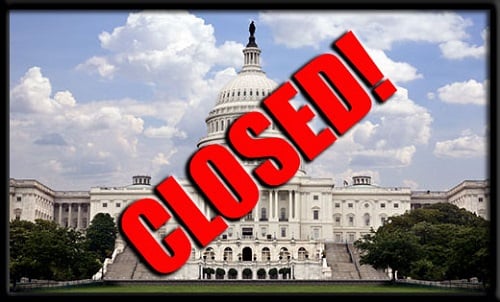
Veterans push past barricades to visit WWII memorial closed amid govt shutdown

0


Published time: October 02, 2013 02:50


(L-R) Korean War veteran Bill Bakley, Vietnam War veterans Norman Tjelmeland, and Stanley Twedt, of Ames, Iowa, snap pictures at the World War II Memorial after they were let in during a government shutdown October 1, 2013 in Washington, DC. (AFP Photo / Alex Wong)

Despite a government shutdown resulting in closed national monuments and parks, a group of Mississippi Gulf Coast Honor Flight Veterans pushed over barricades and toured the World War II memorial in Washington, D.C., on Tuesday morning.

They were joined by family, friends and members of Congress –
including Reps. Steven Palazzo (R-Miss.), Michele Bachmann
(R-Minn.) and Steve King (R-Iowa) – who helped the elderly
veterans pass through temporary gates to access the memorial.

“Maybe eight to twelve of us members…we just escorted the
veterans in,”
Bachmann said.

The Mississippi Gulf Coast Honor Flight was established in 2011
to help groups of veterans fly to Washington free of charge and
provide tours of National Mall memorials.

Similar Honor Flights scheduled for October have been notified
that the memorial will remain closed. ABC News reported that a
group of 100 veterans from Chicago is expected to arrive for a
tour on Wednesday.

In a letter to the president released Monday, Rep. Palazzo asked
that the monument remain open to the public:

“It would be truly devastating to our veterans that travel
great lengths to share this experience with family and friends
and see a piece of their own history,”
he wrote. “I
request that you immediately instruct the Department of Interior
and National Service to ensure that veterans are not denied
access to monuments on the National Mall in the case of a
government shutdown. It is the very least we can do for our
Greatest Generation who sacrificed so much on behalf of our
country.”

U.S. Rep. Louie Gohmert (R-TX) (R) talks to a military veteran at the World War II Memorial during a government shutdown October 1, 2013 in Washington, DC. (AFP Photo / Alex Wong)

The WWII Memorial was closed once again on Tuesday afternoon and
will remain closed in the absence of a funding
plan, according to National Mall and Memorial Parks
Communications Officer Carol Johnson.

Sightseers throughout the National Mall expressed frustration at
the inconvenience of the shutdown,
as world-famous sites such as the Smithsonian, the National Air
and Space Museum, and many other attractions closed their doors.

“We drove our kids from Gilbert, Arizona thousands of miles
across the country, hoping to show them the national
treasures,”
one tourist told RT.

“Instead we’re learning about government,” another member
of the family added.

Veterans tour the World War Two Memorial in Washington October 1, 2013. (Reuters / Kevin Lamarque)

Photo by Nikola Pejic. Washington, DC

Copyright: RT

Pentagon warns of shutdown effects

0

Pentagon officials have warned of the consequences of the first government shutdown in the US over the last 17 years as hundreds of thousands of civilian employees have been furloughed.

According to US military officials, about half of the Pentagon™s 800,000 civilian employees were placed on unpaid leave Tuesday after Republicans and Democrats in US Congress failed to reach a deal on a spending bill.

œThis dark cloud of uncertainty… affects our missions around the world. It affects our allies questioning our commitment,” US Defense Secretary Chuck Hagel told reporters in Seoul, South Korea, on Tuesday.

Large functions of the US government shut down on Tuesday after the Democratic-led Senate voted to reject the latest proposal by the Republican-led House of Representatives that would temporarily fund the government in return for a one-year delay of President Barack Obama™s controversial healthcare plan known as Obamacare.

As the US government shutdown is heading for its second day, both Republicans and Democrats warned Tuesday that it could last for weeks.

On Tuesday, President Obama strongly criticized Republicans for the shutdown, saying they should not hold the entire economy œhostage” over œan ideological crusade to deny affordable health insurance to millions of Americans.”

Meanwhile, US Congress faces a mid-October deadline in order to raise the federal government™s debt limit.

The White House has said Congress should raise the debt ceiling without conditions and has refused to negotiate with lawmakers about how to do it.

As congressional Republicans and Democrats refuse to compromise on a budget deal, concerns have been raised that the US government shutdown could grow to encompass a possible default by the Treasury if US lawmakers fail to agree on a deal to raise the debt ceiling.

ISH/ISH

Copyright: Press TV

California governor signs law defying cooperation with NDAA indefinite detention

0


Published time: October 02, 2013 02:28

California Gov. Jerry Brown (AFP Photo / Getty Images / Kevork Djansezian)

California Governor Jerry Brown has signed a law barring state cooperation with any attempt by the federal government to indefinitely detain people. The legislation targets the 2012 National Defense Authorization Act (NDAA).

Brown signed into law AB351,
which goes beyond any other state in rejecting federal indefinite
detention power, according to the Tenth Amendment Center. The law
reads, in part, “It is the policy of this state to refuse to
provide material support for or to participate in any way with
the implementation within this state of any federal law that
purports to authorize indefinite detention of a person within
California.”

The NDAA allows the US military to indefinitely detain
anyone – sans charges or a trial – on the basis of “national
security”
concerns. The legislation has drawn a series of
legal challenges and attempts in several states to limit its
strength.

California’s new law not only targets the NDAA provisions, but
also any future federal law that grants officials open-ended
detention powers.

Though the NDAA has not been used to date, both administrations
of Presidents Obama and George W. Bush have claimed power to
detain indefinitely without charge “enemy combatants”
caught in Iraq, Afghanistan, and around the world at Guantanamo
Bay and other prisons.

In September, Pulitzer Prize-winning journalist Chris Hedges
announced that he would be taking part in a federal lawsuit
demanding the Supreme Court weigh in on the
constitutionality of the NDAA provision allowing for indefinite
detention.
That move was only the latest in a long legal saga following a
legal victory with the appellate court of New York which last
year declared Section 1021 of the NDAA unconstitutional. The Obama administration quickly
appealed that ruling, and in July it was overturned.

Hedges, who says he has illegally been held by the US government
numerous times during his career as a foreign correspondent,
wrote that the appellate court overturned the initial victory
against the NDAA because “with respect to citizens, lawful
resident aliens, or individuals captured or arrested in the
United States, Section 1021 simply says nothing at all.”

“The court, in essence, said that because it did not construe
the law as applying to US citizens and lawful residents we could
not bring the case to court,”
Hedges wrote in his September
op-ed.

Hedges pointed out that the Supreme Court may never hear the
case, as it receives some 8,000 requests each year. Out of those,
it only hears between 80 and 100.

California’s move against indefinite detention powers, however,
marks a continuing trend among individual states.

Last year, Virginia signed a bill into law prohibiting state
cooperation with federal government attempts at indefinite
detention. The state of Alaska then passed a similar bill.

Copyright: RT

Venezuela rejects close ties with US

0

Venezuelan President Nicolas Maduro says Caracas will not have close relations with the United States as long as American diplomats continue attempts to destabilize his country.

“While the government of the United States does not understand that it has to respect our country’s sovereignty there will be simply be no cordial relations nor cordial communication,” Maduru said on Tuesday.

Maduru™s comments came a day after he ordered the expulsion of three US embassy diplomats, accusing them of plotting to sabotage the economy.

During a live TV appearance on Monday, Maduru said chargé d’affaires Kelly Keiderling and two other diplomats would have 48 hours to leave the country.

He said the diplomats had met with the “Venezuelan far-right” to finance his opponents and “encourage actions to sabotage the power system and the economy.”

œWe will not allow an imperial government to bring money and see how they can stop basic companies and stop the electricity to turn off all of Venezuela,” Maduro said.

US State Department spokesperson Victoria Nuland rejected the Venezuelan government claims saying, œThe US may take reciprocal action” in accordance with the Vienna Convention in diplomatic relations and Consular relations.

On March 5, Maduro expelled two US military attaches hours before announcing the death of President Hugo Chavez, accusing them of promoting “destabilization projects.”

Caracas and Washington have been without ambassadors since 2010, when late President Chavez refused to accept a newly named US ambassador to the country.

PG/MHB/AS

Copyright: Press TV

Sissi urges quick transition in Egypt

0

Egyptian army chief Abdel Fattah el-Sisi has called for a speedy end to the transitional period in order to restore peace and stability in the violence-wracked country.

General Sisi, who toppled the country™s first democratically elected President Mohamed Morsi in July, made the remarks during an address to soldiers and police officers at a seminar in the capital Cairo.

He said a rapid end of the transitional period would help Egypt face national security challenges.

Sisi “called on everyone to be truly aware of the size of the problems facing society, and which necessitate speeding up the end of the transitional phase,” the army spokesman’s official Facebook page said.

He censured the attempts to undermine the country’s army and security institutions, saying they are efforts to ruin the entire nation.

Egypt has been experiencing unrelenting violence since July 3, when the army ousted Morsi™s government, suspended the constitution, and dissolved the parliament. It also appointed the head of the Supreme Constitutional Court, Adly Mahmoud Mansour, as the new interim president.

The government of Mansour has launched a bloody crackdown on Morsi supporters and arrested more than 2,000 Brotherhood members, including the party™s leader, Mohamed Badie, who was detained on August 20.

About 1,000 people were killed in a week of violence between Morsi supporters and security forces after police dispersed their protest camps in a deadly operation on August 14.

The massacre sparked international condemnation and prompted world bodies to call for an independent investigation into the violence.

GJH/MHB/AS

Copyright: Press TV

Iran hits Iraq, prepares for big challenge

0

Adel Gholami and Shahram Mahmoudi (R) from Iran in action against Iraqi Nasser Aseel at a match in Dubai on October 1, 2013

Iranian volleyball players have gained their third 3-0 victory at the 2013 Asian Men™s Volleyball Championship against Iraq to keep morale high enough to take on powerhouse South Korea in the next game.

In a match held at Hamdan bin Mohammed sports complex in the United Arab Emirates™ Dubai on Tuesday, the defending champions managed to win the three sets against Iraq 25-16, 25-17, and 25-20 in Pool K of the tourney.

œYou can™t compare Iran and Iraq in terms of confidence and experience. Iran are the defending champions and the last time Iraq played in an Asian tournament was 1989,” said Iran™s Argentinean Head Coach Julio Velasco.

However, he added, œEach match is important because the team needs to take the rhythm of competition without losing. This is a long tournament and each time I ask the players for their full concentration. Without that the margins narrow.”

œMy players played well according to their age and experience, so overall I am satisfied and I believe they can give a better account of themselves in the future,” Velasco stated.

Iran, which is currently on top of Pool K with six points, will face its first real challenge of the tourney by taking on South Korea on Wednesday.

South Korea overpowered Chinese Taipei 3-0 in another match also held on Tuesday.

Iran had previously hit Kazakhstan and Kuwait in two easy matches.

Twenty-four teams originally participated in the tournament. However, since Jordan, Indonesia, and Pakistan pulled out of the tourney, the number was reduced to 21, which forced the authorities to make adjustments in the pools composition.

The Asian games kicked off in Dubai on September 28 and will wrap up on October 6.

NT/MHB/AS

Copyright: Press TV

Mexican teachers block airport road

0

Teachers block access to Mexico City™s main airport to protest education reform legislation in on October 1, 2013.

Hundreds of Mexican teachers have blocked the main road to Mexico City™s international airport in a new protest against education reforms in the country.

On Tuesday, the striking teachers gathered near the Benito Juarez International Airport in the capital for three hours.

This is the third time in the past two months that protesters try to disrupt traffic near the airport.

Hundreds of police officers were dispatched to the area to prevent the demonstrators from advancing towards the airport. Nearby metro stations also shut down.

Airport director Alfonso Sarabia said the flights were not affected by the demonstration and travelers were allowed to check in as late as 15 minutes before a flight.

Ruben Nunez, a leader of the dissident CNTE union (La Coordinadora Nacional de Trabajadores de la Educacion), said the teachers demanded a meeting with the federal government.

In the past two months, Mexican teachers have led several protests, which mainly targeted President Nieto™s shake-up of the education system in the country.

A protest, staged in late August, forced Mexican congressmen to hold a meeting in a convention center as the congress building had been encircled by the teachers.

In protest at the reforms, around 10,000 teachers also camped in the historic Zocalo square for weeks until they were forced out by the riot police on September 13.

The educators expect the government to withdraw or modify the new law, which they say violates their labor rights.

The new law, which was pushed for by the President Enrique Pena Nieto in December 2012 in an effort to put education under government control, obliges teachers to take mandatory performance tests to get jobs or promotions.

NT/MHB/AS

Copyright: Press TV

Army battling rebels in Damascus suburb

0

The Syrian army continues to tighten the noose around foreign-backed militants near the town of Zamalka in the east of capital Damascus, Press TV reports.

The army is trying to create a buffer zone between Damascus and militant strongholds to prevent them from entering the city, a Press TV correspondent reported on Tuesday.

Syrian army units are applying innovative ways to fight the armed men who are controlling Damascus™s eastern suburbs.

“We are using new tactics that some might call suicidal. We send special units carrying armored personnel carriers at night to be deployed in the middle of a terrorist controlled area. We take a certain building, make it a bridge, and then other units fight their way to connect with these advancing units,” an army officer told Press TV.

Another Syrian army official said that militants are mostly from infamous al-Nusra Front who are also using different methods in their fight against the government forces.

The government troops have recently conducted successful clean-up operations across the country, inflicting heavy losses on the militants.

The Syrian army™s push against the militants rattled their sponsors.

Syrian Information Minister Omran al-Zoubi said on June 26 that Saudi Arabia is trembling with fear because of the Syrian army™s continuous gains against the militants.

In a meeting with US Secretary of State John Kerry in Jeddah on June 25, Saudi Arabian Foreign Minister Saud al-Faisal insisted that the militants in Syria must be armed with anti-aircraft and anti-tank weapons.

A recent British defense study showed that about 100,000 militants, fragmented into 1,000 groups, are fighting in Syria against the government and people.

The extracts of the study by defense consultancy IHS Jane’s were published on September 16.

IHS Jane’s estimates that some 10,000 militants are fighting for groups affiliated with al-Qaeda such as al-Nusra Front and the rest fight for different militant groups.

The analysis also said that a large number of extremists from foreign countries are also active in Syria.

Syria has been gripped by deadly unrest since March 2011. According to reports, the Western powers and their regional allies — especially Qatar, Saudi Arabia, and Turkey — are supporting the militants operating inside Syria.

According to the United Nations, more than 100,000 people have been killed and a total of 7.8 million of others displaced due to the violence.

GJH/MHB/AS

Copyright: Press TV

New York police allowed to monitor mosques due to terror threat, NYC argues

0
A US federal judge is reviewing a Vietnam War-era court settlement restricting law enforcement surveillance policies after the New York Police Department was accused of illegally spying on Muslims in the years following the 9/11 terror attack.

The Handschu decree was signed in 1985 in response to policing
procedures that were employed against anti-war protesters
throughout the 1960s and ‘70s. The original case, filed by
political activist and lawyer Barbara Hanschu, “attempted to
redress a historic pattern of police surveillance, infiltration,
disruption, and suppression of political expression and
association in New York City,” according to the New York Civil
Liberties Union.

But in 2003, Judge Charles Haight – the same judge who first
signed the decree in 1985 – relaxed his ruling to grant police
more leeway in the wake of the terrorist attacks on September 11,
2001. Haight has now revisited the order a third time after
allegations that the New York Police Department (NYPD) adopted
widespread surveillance against New York Muslim communities,
reportedly going so far as to designate entire mosques as
terrorist organizations.

“I’ve come to think of this case as a volcano that’s asleep
most of the time…but every now and then blows up
,” Haight
said at the start of a hearing Tuesday in Manhattan federal
court.

In February 2013, civil rights lawyers filed papers seeking a
court order preventing the NYPD from monitoring Muslims without
having evidence that criminal activity is taking place. The
request, according to AP, also sought the institution of an
auditor to stop “flagrant and persistent” police activity.

Plaintiff attorney Paul Chevigny said the NYPD’s actions were
clearly in violation of the Handschu decree “because they’re
not rooted in the fact that there’s a criminal predicate. They’re
rooted in the fact that the subjects are Muslims
.”

While the NYPD has never criminally charged a mosque or Islamic
organization with operating as a terrorism enterprise, religious
centers were secretly monitored for years. By that logic, any
individual who attended a prayer service could become the subject
of an investigation.

Men pray on the street before the start of the American Muslim Day Parade in New York (AFP Photo / Spencer Platt)

Civil liberty advocates have expressed their outrage at the
policies, which were first revealed in a still ongoing series of
articles by Matt Apuzzo and Adam Goldman of AP. With help from
sources inside the NYPD who had conflicted feelings about the
program, the two reporters revealed that the NYPD opened at least
a dozen “terrorism enterprise investigations” in the past
decade.

“It’s undeniable that New York City remains at the center of
the threat by Islamists who have been radicalized to
violence
,” city lawyer Peter Farrell claimed in the court
hearing this week. Farrell said the city would provide secret
documents disclosing the evidence justifying these
investigations.

New York City Mayor Michael Bloomberg asserted in 2012 that
anything the NYPD has done throughout its investigation is
authorized by law.

“They can look at websites they can watch television to detect
unlawful activities or where there might be unlawful activity to
get leads
,” Bloomberg said on his radio show last year.
“We don’t target individuals based on race or religion. We
follow leads and we are consistent, I think, with the guidelines
resulting from the Handschu federal court decision
.”

Judge Haight announced he would make a ruling at a later date.

Copyright: RT

Govt shutdown hits patients seeking participation in medical research

0


Published time: October 02, 2013 00:39

(FILES) US President Barack Obama looks through a microscope at brain cells with Dr Marston Linehan (C) as he tours the National Institutes of Health (NIH) (AFP Photo / Jim Watson)

Patients seeking to enroll for treatment in research studies at the National Institutes of Health’s Maryland hospital are out of luck due to the government shutdown.

For every week the shutdown lasts, the agency’s research-only hospital
will turn away approximately 300 patients – 30 of them children –
who often seek participation in experimental studies after more
traditional methods have failed, National Institutes of Health
(NIH) Director Dr. Francis Collins told AP.

Though prospective NIH patients are usually eligible for studies
at other hospitals around the country, “this is the place
where people have wanted to come when all else has failed,”

Collins said. “It’s heartbreaking.”

A child with a life-threatening illness is likely the only
exception, Collins said, and existing patients will continue to
receive care at the NIH Clinical Center in Bethesda.

In addition, he said that all experimental studies are on hold as
long as Congress cannot settle on a budget deal.

“If you expected new treatments for cancer or a new universal
influenza vaccine or discovering the causes of autism were going
to move forward at the maximum it could, that will not be the
case,”
Collins said. “This is a profoundly discouraging
day.”

For the 2013 fiscal year that ended Monday, the NIH was only able
to fund around 16 percent of the research grant applications it
received. A decade ago, one in three of such applications were
funded by the NIH, which lost $1.5 billion of its $31 billion
budget due to sequester spending cuts earlier this year.

The NIH is scheduled to lose $600 million more from a second
round of cuts, meaning that further projects that will not be
funded, Collins said.

Beyond the NIH, a continuing government shutdown will also impact
operations at the Centers for Disease Control (CDC) in Atlanta,
Georgia.

According to a memo put out by the Department of Health and Human
Services, the CDC will be “unable to support the annual
seasonal influenza program, outbreak detection and linking across
state boundaries using genetic and molecular analysis, continuous
updating of disease treatment and prevention recommendations”

as well as curtail “support to state and local partners for
infectious disease surveillance.”

Copyright: RT

About 40 Percent Of All Food In The United States Is Thrown In The Garbage

Could that headline actually be true? Do Americans waste about 40 percent of all the food that we produce? That sounds like an absolutely crazy number, but it is actually quite accurate according to a study conducted by the Natural Resources Defense Council. What the NRDC discovered is that approximately 40 percent of our total food supply is either thrown into dumpsters by grocery stores, is discarded by restaurants, never gets harvested on our farms, or is thrown into the garbage by consumers in their homes. Even though 47 million Americans are on food stamps and millions of children go to bed hungry in this country every single night, we continue to waste approximately 263 million pounds of food every single day of the year. One day people will look back and regard us as probably the most wasteful society in the history of the planet.

So where does all of that food go?

Well, according to a recent Seattle Times article, “food waste” takes up more space in our landfills than anything else does…

Last year, the NRDC found that Americans throw out as much as 40 percent of the country’s food supply each year, adding up to $165 billion in losses.

Food waste makes up the largest portion of solid trash in landfills, according to researchers.

Some $900 million of expired food is dumped from the supply chain annually, much of it a result of confusion. Misinterpreted date labels cause the average American household of four to lose as much as $455 a year on squandered food, according to researchers.

The expired food that gets wasted is one of my personal pet peeves.

I don’t do this a lot, but today I am going to share a personal story with you.

Earlier today I was out running errands and I decided that I wanted to pick up some mini-cupcakes from Safeway that I just love. I do try to eat a healthy diet, but I do also like a treat from time to time. So I got over to Safeway, and I noticed that the only mini-cupcakes that they had out were ones with chocolate frosting, but I wanted ones with vanilla frosting.

So I went up to the bakery counter and there was nobody there, but behind the counter I saw a stack of several containers of vanilla cupcakes. I waited until the bakery lady got back and I asked her if I could have them.

I was astounded when she very firmly told me that I could not buy them.

She said that it was against regulations.

I implored her to sell them to me. I explained that I had come over to Safeway just to buy them and I didn’t care if they were a little old.

Again she very firmly told me that I could not buy them.

I could not understand this. I knew that the cupcakes were just going to be thrown out, so I asked to speak to her manager.

After a few moments her manager came over and I was once again told very firmly that under no circumstances would I be able to buy the cupcakes.

So needless to say, I left the store with a sad look on my face and without any cupcakes.

Now of course I probably didn’t need the cupcakes anyway. They are not healthy for me. But big chains such as Safeway throw away massive amounts of very good food as well. The level of the waste that goes on is absolutely astounding.

Meanwhile, the number of Americans that are dealing with hunger and malnutrition grows with each passing day. I want to share with you an excerpt from a recent article authored by Jason Ford entitled “I Work On The Breadline“…

I work as a cashier at a nationally known discount store. I sell clothing, cleaning products, house wares and food. The people I sell to are people of all colors, races, ages and sex, but most of them have one thing in common; EBT cards. I would say about half of every transaction I do is paid for with an EBT card. Sometimes people will use three different methods of payment. They will use whatever is left on their EBT card, then use whatever is left on their debit card, and then scrape their purse to find the remaining balance, and sometimes they still don’t have enough.

Another common trait of the people I serve besides the poverty is the poor health. The food I sell is not healthy, by any stretch. I sell potato chips, candy bars, bread, canned food, ice cream, soda, packaged meat, cigarettes and alcohol. I noticed quickly that a common ingredient of most of the foods is sugar and grains. Sugar and grains are easy to grow and produce cheaply and are used as fillers in processed food to cut cost and mask the taste of other questionable ingredients. Grains work in conjunction with sugars to inflame the body and compromise the immune system. Grains and sugars also have no nutritional value besides calories, so on top of inflaming the body; they do not provide the sustenance the body needs to survive. As the functions of the body require these nutrients the diet lacks, the body sucks these minerals from the bones, teeth and brain. Bone loss, and tooth decay and decreased brain function are the unfortunate symptoms of malnutrition. The poorest of the customers I serve are also the sickest. I have witnessed toothless mouths in the young and old. Mental retardation is also a common trait among many of them. I have even witnessed one unfortunate woman whose skin was a pale green color. These people are dying a slow starvation and they don’t even know it.

Doesn’t that just break your heart?

People are living like that, and yet America discards 263 million pounds of food every single day.

Something is fundamentally wrong with the way our system works.

So what is society going to do as the number of hungry people continues to grow in this country and around the world?

Well, according to ABC News, some scientists plan to feed them with flour made out of bugs…

A team of MBA students were the recipients of the 2013 Hult Prize earlier this week, providing them with $1 million in seed money to produce an insect-based, protein-rich flour for feeding malnourished populations in other countries. The product is called Power Flour.

“It’s a huge deal because we had a very ambitious but highly executable five-year plan in place,” said team captain Mohammed Ashour, whose team hails from McGill University in Montreal. “So winning this prize is a great step in that direction.”

Ashour, along with teammates Shobhita Soor, Jesse Pearlstein, Zev Thompson and Gabe Mott, will be immediately working with an advisory board to recruit farmers and workers in Mexico, where a population of roughly 4 million live in slum conditions with widespread malnutrition.

“We will be starting with grasshoppers,” Ashour said.

Are you ready for a “protein-rich flour” made out of grasshoppers?

I know that I am not.

And in Japan, scientists have actually been working on a way to create meat out of poop. You can read more about that right here.

Perhaps if we just quit wasting so much food we would be able to feed everybody without resorting to such craziness.

These days, an increasing number of Americans are fighting back against the colossal waste that they see all around them. Some have even chosen to take advantage of the waste by regularly going “dumpster diving”. The following is how I described “dumpster diving” in one of my previous articles…

Have you ever thought about getting your food out of a trash can? Don’t laugh. Dumpster diving has become a hot new trend in America. In fact, dumpster divers even have a trendy new name. They call themselves “freegans”, and as the economy crumbles their numbers are multiplying. Many freegans consider dumpster diving to be a great way to save money on groceries. Others do it because they want to live more simply. Freegans that are concerned about the environment view dumpster diving as a great way to “recycle” and other politically-minded freegans consider dumpster diving to be a form of political protest. But whatever you want to call it, the reality is that thousands upon thousands of Americans will break out their boots, rubber gloves and flashlights and will be jumping into dumpsters looking for food once again tonight.

Who knows – perhaps some enterprising young dumpster diver will end up fishing the vanilla cupcakes that I wanted out of Safeway’s dumpsters this evening.

It is amazing what some of these dumpster divers are able to recover from “the trash”. In North Carolina, one man even takes his son dumpster diving with him…

A programmer by day, Todd takes to the streets of North Carolina by night, digging through Dumpsters at drug stores and grocery stores all around his rural neighborhood.

“You would be simply amazed at what businesses throw out,” he said. “I’ve only had to buy two loaves of bread all year. … Last week I had a trunk full of cereal, cookies, chips and ramen noodles.”

Todd slinks in and out of smelly places with low-light flashlights to evade rent-a-cops who will shoo him away. Most nights, his 14-year-old son comes along.

Unfortunately, dumpster diving is not as easy as it used to be.

As dumpster diving has soared in popularity, some grocery stores have responded by putting locks on their dumpsters.

And in some areas of the country, police have even started regularly arresting dumpster divers.

But in the end, dumpster diving was not going to be a permanent solution anyway.

A permanent solution would be to quit wasting so much food.

I applaud the grocery store chains that choose to donate their expired food to homeless shelters and food banks.

We need to see a lot more of that going on.

And in our own homes we need to find ways to give more food away and waste less of it.

All of this needless wasting of food does not have to happen. Let’s work together to find some solutions.

Copyright: Michael Snyder

Why race matters in US govt. shutdown

0

The shutdown of the federal government which began at midnight Tuesday is a body blow to our economy that could prove difficult to bear. Coming on the heels of the automatic budget cuts of sequestration, which are already forecast to cost 750,000 jobs this year, and three years of an anemic economic recovery, the furlough of almost a million federal workers is just not what the economy needs right now. The shutdown was touched off by a Senate vote Monday to turn down a measure that would have kept the government operating for 10 weeks in exchange for a one year delay in Obamacare.

Given that the federal government contributes one out of seven dollars to annual economic output by making critical investments in key areas such as health, education, food security and housing, it will be hard to find an American who won™t be touched by this freeze in government activities, especially if it lasts for more than a few short days.

As the parts of the government affected by the shutdown disproportionately impact economic opportunity programs for the working poor, historically marginalized communities are likely to feel the effects of a shutdown acutely as time goes on.

What™s particularly distressing about the shuttering of the government is that it comes at a time when unemployment remains in the double digits for blacks and Latinos. As the Center for American Progress points out, federal, state and local governments since 2008 have eliminated 750,000 public sector jobs. Given unionization and strong anti-discriminatory hiring practices, people of color are more likely to have jobs in the public sector. This is particularly true for African-Americans, and it™s why joblessness remains so stubborn in communities of color.

The truth is that people of color represent a larger proportion of the federal workforce than the workforce overall. According to the Washington Post, 35 percent of federal workers are non-White versus 30 percent of all workers. This means that a shutdown will only add to the economic woes and employment worries in communities of color.

To be clear, not all of the more than four million federal workers will be told to stay home. Men and women in the armed forces make up close to half of all those on the federal payroll. Given special legislation to exempt them from the shutdown passed by Congress Monday, they will be on the job and receive pay.

But over 800,000 of the remaining two million civilian workers will be barred from work. Those deemed œessential” to maintain the œsafety of human life or protection of property” in critical positions will work but not receive pay. Either way, the bottom line is that two million Americans and the families that rely on them will not receive a paycheck during the period of the shutdown.

The key question though is œhow much of this will really hurt?” The answer depends on how long it goes on.

If the federal government is up and running by the end of next week, the impact will be minimal. But should it last for more than 10 days or so, it will begin to bite. Economic forecasts underscore the point.

As Bloomberg reports, Mark Zandi, former economic advisor to John McCain and chief economist at Moody™s, calculates that a shutdown of a few days would be negligible, but one of two weeks would cut economic growth for the last three months of this year by 10 percent. Any longer than that and the economy would be on its way back to recession.

Adding to the potential pain and uncertainty of it all is the sheer scale of government activities that will be curtailed, each touching on vital areas of economic life necessary for the country to function. With guidance from agency submissions to the White House, here™s a sampling of the way things could look if the shutdown persists into next week.

Health needs delayed: The 110 million Americans already in Medicare-the government health program for the elderly-and Medicaid-the federal and state partnership to provide health insurance to the working poor and their children-will continue to receive the services and treatment that they need. However new applications to these programs will be delayed until the government reopens.

Impaired ability to fight disease: The Centers for Disease Control will scale back the monitoring of the spread of infectious diseases and the National Institutes of Health will do the same for critical research into life-saving treatments until the lights come back on.

More people hungry: The Supplemental Nutrition Assistance Program (SNAP), commonly referred to as food stamps, will continue to provide its $33 of weekly assistance to the 48 million Americans who currently receive it. However, the Women Infants and Children Program (WIC)-which covers seven million children and infants, and their mothers-will temporarily end. The program will restart once the government reopens.

Poor kids set back: Funds for the one million children in Head Start will technically expire, but only a smattering of locations will be forced to immediately close their doors. However, more programs will run out of money and come under pressure the longer this goes on. The same is true for Title I education grants, which provide badly needed assistance to 20 million children in the nation™s poorest school districts. Also, review of new student loan and federal grant applications will be delayed.

Housing at risk: The Federal Housing Administration, which underwrites four out of every 10 mortgages in the United States and is crucial for working families entering the housing market, will not process new home loans during an extended shutdown. Housing vouchers for the working poor and the homeless will also be at risk the longer this goes on.

More immigration delays: Border patrols and enforcement will continue during the shutdown, but new visa and citizenship applications will be stalled until the government is back to work.

The essential point is that the partial closing of the government is potentially a huge setback for both the broader economy and economic justice at a crucial moment.

Though Congressional Republicans and their allied tea party organizations don™t see it that way.

Former Republican vice chairman and head of the American Conservative Union, Al Cardenas, told the Center for American Progress™ Thinkprogress blog this past weekend that he was œconvinced” that there œwould not be” any negative economic fallout from the shutdown. If the government is closed for a just a few days, he might very well be right.

But as I argued last week, the GOP and tea party outlook on a government shutdown is not about economic evidence, it™s about advancing an overall ideology. Until that changes, millions of Americans might very well have reason to worry.

ISH/ISH

Copyright: Press TV

‘Netanyahu’s dictation disgrace for US’

0

A US political commentator says it is a disgrace for the United States that a mass murderer like Benjamin Netanyahu can come to Washington and dictate the American president what to do.

Dr. Kevin Barrett, who is one of the renowned US critics of Washington™s so-called war on terror, made the remarks in an interview with Press TV on Tuesday, a day after the Israeli prime minister met with US President Barack Obama and asked him to toughen sanctions against Iran over its nuclear energy program.

After meeting Netanyahu, Obama repeated his war rhetoric against the Islamic Republic, saying, œWe take no options off the table, including military options, in terms of making sure that we do not have nuclear weapons in Iran.”

The Israeli regime is widely believed to be the sole possessor of a nuclear arsenal in the Middle East with more than 200 undeclared nuclear warheads. Tel Aviv has rejected global calls to join the nuclear Non-Proliferation Treaty (NPT) and does not allow international inspectors to observe its controversial nuclear program.

The US, Israel, and some of their allies have repeatedly accused Iran of pursuing non-civilian objectives in its nuclear energy program and have used the unfounded accusation as a pretext to impose illegal sanctions on the Islamic Republic.

Barrett said that a US president in his second term, such as Obama, should be able to resist Tel Aviv™s pressure and stand up for American benefit rather than Israeli interest.

œI would hope that these words of Obama™s are really just sort of empty words that he is feeding the Zionist lobby to try to keep them happy,” the political commentator stated.

œI think it is a disgrace to the presidency and to the United States of America that a criminal against humanity on the scale of Netanyahu, who has blood all over his hands in so many ways, who is actually a prime suspect in the controlled demolition of World Trade Center in September 11, 2001… he immediately went on television and said that… it is very good. That was his reaction to September 11… and then he caught himself and said well actually I meant it was just good for Israel,” he said.

œBut he was basically celebrating 9/11 just like the dancing Israelis who were caught at celebrating the success of the demolition of the Twin Towers in New York.

œNow it is just a disgrace that somebody like that can come to the United States and try to dictate to the American president how he should conduct his foreign policy. And more and more Americans are being outraged by this and were hoping that some day we will have a president with the intestinal fortitude to stand up against these Israeli mass murderers and big liars.”

Elsewhere in his remarks, Barrett said, œThe Israeli lobby does not just have a lot of clout in Congress. It owns Congress. It™s outright and about half of the money that is contributed to federal candidates in the US comes from Zionists and it has very strong strings attached.”

œThis has been going on ever since we heard from President John F. Kennedy who confided to his close friend Gore Vidal that he had been approached by Israeli lobby people who told him that if he would let them run his foreign policy, they would take care of all of his financial needs from then on. And the same thing has been going on ever since. Kennedy rejected the deal and that’s one of the reasons he was killed.”

GJH/MHB/AS

Copyright: Press TV

PKK abducts contractor in eastern Turkey

0

A group of militants of the Kurdistan Workers™ Party (PKK) has kidnapped a contractor in eastern Turkey.

The contractor, identified as Muhsin Orak, was working at a site of road construction at Sirinler village between the towns of Kigi and Yayladere in Bingol province, according to a Tuesday report by Dogan news agency.

Turkish security forces have launched an operation to capture the PKK rebels and save the contractor, the report added.

On Monday, Turkish Prime Minister Reccep Tayyip Erdogan proposed long-awaited reforms aimed at ending a 29-year conflict with the Kurds and the PKK™s armed campaign against Ankara.

.

Later in the day, the PKK rejected the proposed reforms, saying, œIt is apparent that the (ruling) AK Party does not understand the Kurdish problem and is not serious in its approach.”

Under the reforms, Kurdish-language education will be permitted in private schools and electoral candidates will be allowed to campaign in Kurdish.

The reforms also aim to ease rules that prevent pro-Kurdish and other smaller parties from entering the parliament.

In addition, towns can revert to their previous Kurdish names, and a quirky ban on the use of three letters of the Kurdish alphabet that do not exist in Turkish will be lifted.

In March, PKK’s jailed leader Abdullah Ocalan declared a historic ceasefire after months of negotiations with the Turkish government.

In return, the PKK demanded amendments to the penal code and electoral laws as well as the right to education in the Kurdish language and a degree of regional autonomy.

But in September, the PKK announced they were planning to suspend the ceasefire, accusing Ankara of failing to deliver the promised reforms.

The PKK has been fighting for an autonomous Kurdish region in southeastern Turkey since the 1980s. The conflict has left tens of thousands of people dead.

PG/MHB/AS

Copyright: Press TV

Missouri specialists warn use of common anesthetic for executions could damage US supply

0


Published time: October 01, 2013 23:29

A bottle of propofol (AFP Photo / Al Seib)

Missouri anesthesiologists have urged the state not to use a prime anesthetic used routinely in hospitals across the nation in an upcoming execution, warning that such use could put the future supply of the crucial drug at risk.

Missouri is set to use the
most commonly-used anesthetic in the US, propofol, for an October
23 execution, due to a shortage of the usual mix of drugs used
for lethal injections.

The 800-member Missouri Society of Anesthesiologists (MSA)
announced concern in a Monday statement. The European Union –
where most of the drug is made – has indicated that it may curb
exporting propofol to the US if it is used in executions.

“We urge the Department of Corrections not to jeopardize the
safety of over 50 million patients who rely on this critical
medication for anesthesia during surgery each year,”
MSA
president Dr. Larry Petersen said in a statement.

“A shortage of this medication will take the medical specialty
of anesthesiology back 20 years, leading to more complications in
the operating room, an increased rate of nausea and vomiting
after surgery, and extended time required to wake up from
anesthesia after a procedure,”
he said.

The German company that makes the bulk of propofol, Fresenious
Kabi, has gone as far as launching a website exhibiting the
ramifications of using the drug in US executions. The Food and
Drug Administration has also indicated that it is worried about
any action that could impact propofol supply in the US.

Missouri and other states have turned to propofol in
administering the death penalty after makers of the three-drug
mix usually used in lethal injections stopped selling it to
entities that intend on using it for executions.

Propofol has never been used for an execution in the US.

Missouri announced in 2012 that it would turn to the anesthetic
to put Allen Nicklasson to death on October 23. In November, a
second death row inmate is scheduled to be executed. The Missouri
Department of Corrections says it has only enough propofol for
three executions before February 2015, when the last batch
expires.

Just last week, Ohio used its remaining supply of pentobarbital,
the sedative normally used to execute prisoners, making it the
seventh state – including Missouri – which lacks the traditional execution drug to some
degree.

The European Union is reviewing its export policy which excludes
goods used in “capital punishment, torture or other cruel,
inhuman or degrading treatment or punishment.”

If propofol is added to the list, companies like Fresensius Kabi
would have to apply for a separate export license for every
shipment to a hospital or clinic, which would slow access to the
drug significantly.

Copyright: RT

Obama repeats threats against Iran

0

US President Barack Obama has once again repeated his threats of military action against Iran after a meeting with Israel™s Prime Minister Benjamin Netanyahu at the White House.

Deeply concerned about eased tensions between Iran and the US after Tehran called for diplomatic negotiations with the West to resolve the standoff over its nuclear energy program, Netanyahu headed to Washington in order to persuade Obama that diplomacy should not be used to deal with Iran over its nuclear program.

Following a meeting with Netanyahu at the White House on Monday, Obama threatened Iran with military action and claimed that Iran is calling for diplomatic negotiations over its nuclear energy program because of the illegal sanctions Washington has imposed on Iran.

œBecause of the extraordinary sanctions that we have been able to put in place over the last several years, the Iranians are now prepared, it appears, to negotiate,” Obama said.

œI’ve said before and I will repeat that we take no options off the table, including military options,” he added.

Iranian Foreign Minister Mohammad Javad Zarif criticized Obama for his remarks, saying Obama is being œdisrespectful of a nation.”

Zarif also warned Obama that his œflip-flop and contradictory” stances will destroy mutual confidence and urged him to show consistency in dealing with Iran to promote trust.

Netanyahu™s meeting with Obama followed a trip to the US by an Iranian delegation headed by President Hassan Rouhani and his address before the UN that many in the West hailed as a first step to a possible resolution to the nuclear standoff.

The Iranian president said last week that Iran™s nuclear program is for peaceful purposes and that atomic weapons contradict the Islamic Republic™s religious convictions and have no place in the country™s defense doctrine.

Capping off the visit, Rouhani and Obama had a 15-minute phone conversation that became the first direct communication between the presidents of the two countries since Iran’s Islamic Revolution of 1979.

Last week, US Secretary of State John Kerry and his Iranian counterpart, Mohammad Javad Zarif, also held a bilateral discussion of more than 20 minutes following a meeting at the UN headquarters in New York between Iran and the five permanent members of the UN Security Council – Britain, China, France, Russia and the United States – plus Germany.

In an interview with CBS, broadcast on Sunday, Kerry said œIt™s possible to have a deal” with Iran over its nuclear energy program soon, adding Washington could begin lifting sanctions against Tehran within months.

And now, Obama is once again repeating his threats of military action against Iran after meeting with Netanyahu while a recent CNN/ORC International survey shows that 75 percent of Americans favor direct diplomatic negotiations with Iran over its nuclear energy program.

ISH/ISH

Copyright: Press TV

Obamacare Is Another Private Sector Rip-Off Of Americans

0

Obamacare Is Another Private Sector Rip-Off Of Americans

The private sector allied with government is a second IRS

Paul Craig Roberts

The government of the “world’s only superpower,” the “exceptional,” the “indispensable” country, claims to know what is best for Syria, Iraq, Afghanistan, Libya, Yemen, Pakistan, Somalia, Mali, Russia, Venezuela, Bolivia, Ecuador, Brazil, China, indeed for the entire world. However, the “indispensable” country cannot even govern itself, much less the world over which the “superpower” desires hegemony. The government of the “world’s only superpower” has shut itself down.

The government has shut itself down, because it cannot deal with the budget deficit and mounting public debt caused by twelve years of wars, by financial deregulation that allows “banks too big to fail” to loot the taxpayers, and by the loss of jobs, GDP, and tax base that jobs offshoring forced by Wall Street caused.

The Republicans are using the fight over the limit on new public debt to block Obamacare. The Republicans are right to oppose Obamacare, but they are opposing Obamacare largely for ideological reasons when there are very good sound reasons to oppose Obamacare.

Last February 3, I posted on this website a column, “Obamacare: A Deception,” written by an expert on the subject. http://www.paulcraigroberts.org/2013/02/03/obamacare-a-primer/

When Republicans for ideological reasons blocked a single-payer health system like the rest of the developed world has and, indeed, even some developing countries have, the Obama regime, needing a victory, went to the insurance companies and told them to come up with a health care plan that the insurance lobby could get passed by Congress. Obamacare was written by the private insurance industry with the goal of raising its profits with 50 million mandated new customers.

Obamacare works for the insurance companies, but not for the uninsured. The cost of using Obamacare is prohibitive for those who most need the health coverage. The cost of the premiums net of the government subsidy is large. It amounts to a substantial pay cut for people struggling to pay their bills. In addition to the premium cost, it is prohibitive for hard pressed Americans to use the policies because of the deductibles and co-pays. For the very poor, who are thrown into Medicaid systems, any assets they might have, such as a home, are subject to confiscation to cover their Medicaid bills. The only people other than the insurance companies who benefit from Obamacare are the down and out who are devoid of all assets.

This might prove to be a growing percentage of Americans. On September 19 the New York Times on the front page of the business section reported what I have reported for years: that real median family incomes in the US are where they were a quarter of a century ago. In other words, in a quarter of a century there has been no income growth for the median American family.

In 2013 payroll employment is below where it was six years ago. During 2013 most of the new jobs, barely sufficient to stay even with population growth and insufficient to recover the job loss from the recession, have been part-time jobs that do not provide any discretionary income with which to drive a consumer economy.

Obamacare has resulted in the health insurance companies, who thought that they would be living in high profits from the mandated health coverage, being outsmarted by employers, who have reduced their full-time workers to part-time in order to avoid Omamacare’s requirement to provide health coverage to those employees who work 30 hours a week or more.

Employers can get away with this, because jobs are hard to find. The lack of employment opportunities results in Americans with engineering degrees working as retail sales clerks and as shelf stockers in Walmart and Home Depot. Despite the abundance of unemployed and under-employed American technical and engineering workers, the large corporations lobby Congress for more H-1B visas to bring in lowly paid foreigners with the argument that there is a shortage of qualified Americans for technical work.

As I have pointed out so many times, if there were a shortage of engineering and technical workers, salaries would be rising, not falling.

For millions of employees, Obamacare means cut hours and less take home pay plus out-of-pocket expenses to purchase an Obamacare health policy. For most people covered by Obamacare, this is a lose-lose situation.

It is also a lose-loss situation for the vast majority of the young. Most young people, unless they have jobs that provide health coverage, do without it, because the chances of the young having heart attacks, cancer, and other serious health problems is low.

Obamacare, however, requires the healthy young to pay premiums for coverage or to pay a penalty to the IRS.

In my day this might not have been a problem. However, today there are few jobs for the young that pay enough to have an independent existence. The monthly payroll jobs reports do not show well-paying jobs. The Labor Department’s projections of future jobs are not jobs that pay well. For the youth, it seems that the penalty is less than the premium, so youthful penalties paid out of waitress and bartender tips will subsidize the unusable Obamacare health policies for the poor adults who are not thrown into Medicare, which confiscates their assets, if any.

Obamacare benefits only two classes of people. It benefits employers who drop their employees working hours below the hours specified for Obamacare coverage, and it benefits the insurance companies or the IRS who collect the premiums and penalties.
Many of the people who pay the premiums won’t be able to use the policies because of co-pays and deductions.

The very poor with no assets might receive health care if they reside in states that accept the Medicaid provisions of Obamacare.

In 21st century America, the few people who have experienced income gains are the executives and shareholders of firms who offshored their production for US markets, Wall Street which makes bets covered by the Federal Reserve, and the military-security complex which has been enriched by the neoconservatives’ wars.

Every other American has lost.

The post Obamacare Is Another Private Sector Rip-Off Of Americans appeared first on PaulCraigRoberts.org.

Copyright: Paul Craig Roberts

Obamacare Is Another Private Sector Rip-Off Of Americans

Obamacare Is Another Private Sector Rip-Off Of Americans

The private sector allied with government is a second IRS

Paul Craig Roberts

The government of the “world’s only superpower,” the “exceptional,” the “indispensable” country, claims to know what is best for Syria, Iraq, Afghanistan, Libya, Yemen, Pakistan, Somalia, Mali, Russia, Venezuela, Bolivia, Ecuador, Brazil, China, indeed for the entire world. However, the “indispensable” country cannot even govern itself, much less the world over which the “superpower” desires hegemony. The government of the “world’s only superpower” has shut itself down.

The government has shut itself down, because it cannot deal with the budget deficit and mounting public debt caused by twelve years of wars, by financial deregulation that allows “banks too big to fail” to loot the taxpayers, and by the loss of jobs, GDP, and tax base that jobs offshoring forced by Wall Street caused.

The Republicans are using the fight over the limit on new public debt to block Obamacare. The Republicans are right to oppose Obamacare, but they are opposing Obamacare largely for ideological reasons when there are very good sound reasons to oppose Obamacare.

Last February 3, I posted on this website a column, “Obamacare: A Deception,” written by an expert on the subject. http://www.paulcraigroberts.org/2013/02/03/obamacare-a-primer/

When Republicans for ideological reasons blocked a single-payer health system like the rest of the developed world has and, indeed, even some developing countries have, the Obama regime, needing a victory, went to the insurance companies and told them to come up with a health care plan that the insurance lobby could get passed by Congress. Obamacare was written by the private insurance industry with the goal of raising its profits with 50 million mandated new customers.

Obamacare works for the insurance companies, but not for the uninsured. The cost of using Obamacare is prohibitive for those who most need the health coverage. The cost of the premiums net of the government subsidy is large. It amounts to a substantial pay cut for people struggling to pay their bills. In addition to the premium cost, it is prohibitive for hard pressed Americans to use the policies because of the deductibles and co-pays. For the very poor, who are thrown into Medicaid systems, any assets they might have, such as a home, are subject to confiscation to cover their Medicaid bills. The only people other than the insurance companies who benefit from Obamacare are the down and out who are devoid of all assets.

This might prove to be a growing percentage of Americans. On September 19 the New York Times on the front page of the business section reported what I have reported for years: that real median family incomes in the US are where they were a quarter of a century ago. In other words, in a quarter of a century there has been no income growth for the median American family.

In 2013 payroll employment is below where it was six years ago. During 2013 most of the new jobs, barely sufficient to stay even with population growth and insufficient to recover the job loss from the recession, have been part-time jobs that do not provide any discretionary income with which to drive a consumer economy.

Obamacare has resulted in the health insurance companies, who thought that they would be living in high profits from the mandated health coverage, being outsmarted by employers, who have reduced their full-time workers to part-time in order to avoid Omamacare’s requirement to provide health coverage to those employees who work 30 hours a week or more. http://www.theguardian.com/world/2013/sep/30/us-employers-slash-hours-avoid-obamacare/print

Employers can get away with this, because jobs are hard to find. The lack of employment opportunities results in Americans with engineering degrees working as retail sales clerks and as shelf stockers in Walmart and Home Depot. Despite the abundance of unemployed and under-employed American technical and engineering workers, the large corporations lobby Congress for more H-1B visas to bring in lowly paid foreigners with the argument that there is a shortage of qualified Americans for technical work.

As I have pointed out so many times, if there were a shortage of engineering and technical workers, salaries would be rising, not falling.

For millions of employees, Obamacare means cut hours and less take home pay plus out-of-pocket expenses to purchase an Obamacare health policy. For most people covered by Obamacare, this is a lose-lose situation.

It is also a lose-loss situation for the vast majority of the young. Most young people, unless they have jobs that provide health coverage, do without it, because the chances of the young having heart attacks, cancer, and other serious health problems is low.

Obamacare, however, requires the healthy young to pay premiums for coverage or to pay a penalty to the IRS.

In my day this might not have been a problem. However, today there are few jobs for the young that pay enough to have an independent existence. The monthly payroll jobs reports do not show well-paying jobs. The Labor Department’s projections of future jobs are not jobs that pay well. For the youth, it seems that the penalty is less than the premium, so youthful penalties paid out of waitress and bartender tips will subsidize the unusable Obamacare health policies for the poor adults who are not thrown into Medicaid, which confiscates their assets, if any.

Obamacare benefits only two classes of people. It benefits employers who drop their employees working hours below the hours specified for Obamacare coverage, and it benefits the insurance companies or the IRS who collect the premiums and penalties.
Many of the people who pay the premiums won’t be able to use the policies because of co-pays and deductions.

The very poor with no assets might receive health care if they reside in states that accept the Medicaid provisions of Obamacare.

In 21st century America, the few people who have experienced income gains are the executives and shareholders of firms who offshored their production for US markets, Wall Street which makes bets covered by the Federal Reserve, and the military-security complex which has been enriched by the neoconservatives’ wars.

Every other American has lost.

About Dr. Paul Craig Roberts

Paul Craig Roberts was Assistant Secretary of the Treasury for Economic Policy and associate editor of the Wall Street Journal. He was columnist for Business Week, Scripps Howard News Service, and Creators Syndicate. He has had many university appointments. His internet columns have attracted a worldwide following. His latest book, The Failure of Laissez Faire Capitalism and Economic Dissolution of the West is now available.

The post Obamacare Is Another Private Sector Rip-Off Of Americans appeared first on PaulCraigRoberts.org.

Health Care for All: Why We Need a New Prescription

0

http://www.truthdig.com/report/item/health_care_for_all_why_we_need_a_new_prescription_20131001/

Posted on Oct 1, 2013

By Scott Tucker

The right-wing assault on Obamacare is a distraction, but the “progressive” (or rather party line) defense of the Affordable Care Act (ACA) is also a dead end. While the Tea Party and MoveOn descend to mud wrestling, Dr. Don McCanne of Physicians for a National Health Program (PNHP) is not just staking out the moral high ground in the debate on health care. He is also making the practical case for the kind of health care we, the people, both deserve and can afford.

McCanne quotes passages from the daily news, political debates, and medical journals, and adds his running commentary. These columns are collectively titled Quote of the Day (QotD), and can be found archived at the website of PNHP: http://www.pnhp.org/news/quote-of-the-day . His columns are also available by email subscription: http://two.pairlist.net/mailman/listinfo/quote-of-the-day .

McCanne’s daily comments on health care range over both present policies and the possibilities of comprehensive reform. He is helping to build the bridge from here to there, but he is not pointing to some utopian island over the horizon. Medicare, for example, offers one flawed but real foundation for health care justice. We need a single payer system, but we also need a wider network of community health clinics, and health maintenance programs in schools, neighborhoods, and workplaces. If we limit our vision of health care reform only to the programs that career politicians deem “pragmatic,” then we are placing their careers above our own lives.

McCanne’s decency and public spirit shine through his work, though he was almost self-effacing when I first asked him to consider this interview. For myself, and many others, McCanne is our translator of choice when we try to orient ourselves in health care policy debates. He received his B.A. at the University of California at Riverside in 1959 and his M.D. from the University of California at San Francisco in 1963. He served two years as a medical officer in the U.S. Army, and then practiced as a family physician for over thirty years in San Clemente, California. He has served as chief of staff of his community hospital and as chairman of the board of a community bank. He served as president of PNHP for two terms, in 2002 and 2003, and is currently Senior Health Policy Fellow for PNHP. Every good cause involves a division of labor, and McCanne is a daily laborer for health care justice through PNHP and through his public talks and writing.

I first met McCanne during the founding meetings of the Santa Monica chapter of PNHP, and on September 1 of this year my husband and I joined Don McCanne and his wife, Sandy, for lunch at their home in San Juan Capistrano. We had a long talk about public health, private wealth, and politics. Don and I continued the conversation by exchanging emails. Our points of disagreement are plain enough, but so is our common ground. We encourage all supporters of health care for all to carry this conversation from kitchen tables to union halls, and from community clinics to public elections.

My first work in health care activism began as a member of the Reproductive Rights National Network, and continued with the AIDS Coalition to Unleash Power (ACT UP) in Philadelphia. Moving to Los Angeles ten years ago has taught me new lessons in how the present health care system is both formed and fractured by a class divided society. I was diagnosed HIV positive in 1986, and political activism is one among many reasons for my survival. I have witnessed the malign neglect and direct brutality this political system inflicts on workers, the unemployed, the poor, and the ill. In my view, the hope of removing politics from the struggle for health care is like the hope of removing the profit motive from the ruling class.

The fact that doctors are also creatures of our class culture is unsurprising. Unfortunately, some doctors also proved to be slow learners even during an epidemic. In the early years of the AIDS epidemic, patients were often the people who had to educate our own doctors in the Standard of Care. And we also had to teach some doctors “the facts of life,” namely, the facts of our own lives. As for class politics, most doctors never learned any such subject in their classes, and yet medical training and practice carries all the background radiation of a corporate economy. PNHP is therefore in no position to teach health care activists the alphabet of class-consciousness. A strictly empirical approach to science and medicine must be fused with resolute opposition to a class divided health care system. That is the true test of translating our common ethics into gaining the common ground of practical health care reform.

On that subject the good doctors in PNHP might listen more closely to their patients. Am I therefore “disenchanted” with PNHP? No, on the contrary, all political enchantment requires the cold shower of reality, and then we will find the work we can do in common. I regard PNHP as a crucial and honorable ally in the struggle for a civilized health care system in this country.

This conversation between one doctor and one writer, both of us active in the reform of our health care system, is not a detailed map of that terrain, and far less a scripture for those looking for a new religion. Any proposals for public policy must, of course, be discussed before the widest public. Within the secular horizon of the public realm, we must not lose our sense of balance and common sense, nor our sense of right and wrong. The right to health care is a human right, but the political will to win that right as a daily fact of life begins with a moral commitment to care for the poor, the sick, and the dying, and for all of us without exception.

ST: President Obama said, on July 22, 2009, “I want to cover everybody. Now, the truth is unless you have what’s called a single –payer system in which everyone’s automatically covered, you’re probably not going to reach every single individual.”

Obama finessed the brutal reality that millions of people, not just “every single individual,” will still not receive comprehensive health care under the Affordable Care Act (ACA), also known as Obamacare, which became law in 2010. According to HealthCare.gov [ see: https://www.healthcare.gov/what-key-dates-do-i-need-to-know/ ], three key dates are approaching in the translation of this complex legislation into the “Health Insurance Marketplace.” On October 1, 2013, “Market open enrollment starts.” On January 1, 2014, “Health coverage can start.” And on March 31, 2014, “Open enrollment ends.”

Don, what bumps in the road do you expect over the next two or three years, given the stated goals and limits of the ACA? And how many sick and injured people will go over the precipice, especially in working class communities, even if the ACA extends a medical safety net for the young and for people with “pre-existing conditions”?

DM: Implementation will proceed at a reasonable pace considering the complexity of the law, though the specifics of ACA make it clear that we cannot possibly achieve truly universal coverage that is affordable for everyone. The Congressional Budget Office has estimated that when the law is fully implemented, 31 million people will remain uninsured. Further, the relatively low actuarial value of the plans that most people will select – paying only 60 or 70 percent of the medical bills – will create financial hardships for people who actually need health care. Though lower-income individuals will receive subsidies for out-of-pocket expenses, the costs for which they will be responsible will still be very burdensome for far too many. Even those with employer-sponsored coverage – the majority of us – will have more difficulties in meeting medical expenses since employers are shifting more costs of care to their employees through higher deductibles and other forms of cost sharing.

The trend of the last couple of decades of shifting wealth from middle-income families to the very wealthy will also add to the burden of these families who are already having difficulties meeting other expenses such as funding their retirement accounts and paying for their children’s educations. Many low wage workers will continue to have problems with health care because it will either be paid for with forgone wages for employer-sponsored coverage, which they can’t afford, or their share of plans purchased through the exchanges plans will still be too expensive for them to afford. Worse, many will simply be excused from the mandate and the penalties for not being insured simply because the plans are deemed to be too expensive for them. Thus ACA has granted those with the greatest need for coverage the right to remain uninsured because they can’t afford it.

Theoretically, most of those living in poorer communities should be eligible for Medicaid, but many states have refused to accept federal funds to expand their Medicaid programs. ACA did not provide for exchange coverage for these very poor people because they were supposed to have been covered by Medicaid. These people also fall in the category of those who have the right to remain uninsured. ACA is a sick system that Congress has provided us.

ST: The Los Angeles Times published a September 14 article by Chad Terhune titled, “Insurers limiting doctors, hospitals in health insurance market,” and the reporter wrote, “To hold down premiums, major insurers in California have sharply limited the number of doctors and hospitals available to patients in the state’s new health insurance market opening October 1.”

The article quoted Donald Crane, chief executive of the Association of Physician Groups: “We are nervous about these narrow networks. It was all about price. But at what cost in terms of quality and access? Is this contrary to the purpose of the Affordable Care Act?” How would you compare some of the provider networks, and are we witnessing another conflict between comprehensive public health and the profit motive of private insurers? How do we muddle through this terrain, and is there a better path?

DM: When we speak of provider networks, it is important to distinguish between integrated health systems that are designed to improve efficiency and quality in the delivery of care, and networks contracted by insurers designed to reduce health care spending. Physicians and hospitals joining together to improve patient care is great, but insurers using contracts to limit access to low-cost providers is not in the patients’ best interests. Patients who have free choice of their health care providers would be wise to choose high-quality, integrated systems that can actually save on health care costs by reducing inappropriate care. Patients who will have limited choices in the narrower insurer networks to be offered in the exchanges may not be able to continue to see their current physicians, and may find that the physicians in the narrow networks are not as accessible because they are overbooked or because the approved office locations and hospitals are too far away to be convenient.

As you imply, I think that this can be characterized as a conflict between providing health care as a public service and providing health care as a means to advance the business models of private insurers. Leave policy decisions to private insurers and they will always select policies that will advance their business models as opposed to policies that would provide optimal access, quality and affordability for patients. Having cheaper premiums through narrow network plans is no solution when you can’t get a doctor when you need one, and, when you finally do, you’re left broke because the subsidies for the exchange plans are inadequate to avoid financial hardship for those in need. Single payer would have avoided all of this, and it still can.

ST: When the ACA was pushed through Congress, even the limited “public option” was deliberately removed from health policy debates in Congressional hearings. Dr. Margaret Flowers of PNHP and seven other health activists were arrested when they demanded an open debate. The message of career Democrats was that the ACA was the best they would give us, so we’d better be grateful. That remains puzzling to many people who know that other industrialized democracies spend less per capita on health care, do better in health outcomes, and extend health coverage for all citizens. Instead, the private insurance companies are still big winners from this reform, and millions of Americans are still losing adequate health care.

Could you summarize our national health care situation before and after ACA? Of course any statistical survey will have a margin of error, but some basic trends have been closely studied up to this date. What are some of the likely numbers of the uninsured and underinsured in the future?

DM: Regarding the national health care situation before and after ACA, there will not be much fundamental change. We will still be using the same fragmented, dysfunctional financing system, but we will be bringing more people under the umbrella. Although 48 million are uninsured now, when ACA is fully implemented, 31 million will still be left without coverage, and those with coverage are more likely to face excessive out-of-pocket costs should they need health care because of the gradual transition from traditional coverage to underinsurance, which is rapidly becoming the new norm. Not only do patients face much higher deductibles, they also are beginning to have fewer choices of health care providers because of greater use of more limited narrow networks of providers, and some employers are switching to private (non-ACA) health insurance exchanges which use defined contributions to transfer future cost increases from the employers to the employees. If we had a single payer, improved-Medicare-for-all program, underinsurance would be eliminated, and the number of uninsured would not be 48 million, it would not be 31 million, it would be zero!

ST: Health care spending is always a minefield in public policy debates. I’ll place some quotes from recent front-page articles in The New York Times side by side, and then raise a few questions. On September 18, Sheryl Gay Stolberg wrote, “Washington’s health care revolving door is spinning as fast as the new online health insurance marketplaces, a central provision of President Obama’s health law, are set to open on Oct. 1.” Stolberg went on to note, “The health care industry now spends more money on lobbying in Washington than any sector of the economy- more than $243 million last year alone, higher than the $242 million spent by financial, insurance and real estate companies, according to the Center for Responsive Politics here.”

Among the lobbyists is Dr. Dora Hughes, a former Obama administration official who spent “nearly four years as counselor to Health and Human Services Secretary Kathleen Sebelius,” and left government to work for Sidley Austin, “which represents insurers, pharmaceutical companies, device makers and others affected by the law.” Stolberg added, “She is not a registered lobbyist, but rather a ‘strategic adviser,’ although some call that a distinction without a difference.”

On Sept. 23, Robert Pear wrote, “When insurance marketplaces open on Oct. 1, most of those shopping for coverage will be low- and moderate-income people for whom price is paramount. To hold down costs, insurers say, they have created smaller networks of doctors and hospitals than are typically found in commercial insurance. And those health care providers will, in many cases, be paid less than what they have been receiving from commercial insurers.”

The present system offers perverse incentives for Washington political insiders to become lobbyists, and to profit from the very pieces of legislation they moved through Congress. Insurance companies can easily mutate to profit from the new set of rules and regulations. As Pear notes, “Even though insurers will be forbidden to discriminate against people with pre-existing conditions, they could subtly discourage the enrollment of sicker patients by limiting the size of their provider networks.”

Pear quotes President Obama: “Competition and consumer choice are actually making insurance affordable.” Do we have any reason to believe that is generally true now, or will be nearer to the truth when the insurance marketplaces roll out in October?

DM: Your comments about the cozy relationship between lobbyists and the administration and Congress demonstrate why we ended up with legislation that took such good care of the insurance and pharmaceutical industries while falling so short in meeting the goals of covering everyone and providing plans that should ensure both health security and financial security for all of us.

President Obama and members of his administration have been claiming that health insurance is now more affordable because of the provisions of Obamacare. The problem with that claim is that it is health care, not health insurance, that we need to be affordable. Unfortunately, under Obamacare there are very few provisions that will reduce health care costs much whereas there are some provisions that will increase out-of-pocket spending by patients.

In claiming that competition and consumer choice are making insurance affordable, they are referring only to the price of the health insurance plan. Insurers aren’t dumb. They are going to do everything they can to keep premiums competitive. When the law was written they were there to see that the plans that most people will buy in the state exchanges will have low actuarial values – 60 or 70 percent. That means that patients will have to pay 30 to 40 percent of their health care costs out-of-pocket. Typical employer group plans have actuarial values of 80 to 95 percent, so the exchange plans that most will buy are inadequate in comparison. Even for those individuals who qualify for government subsidies, the financial exposure will still be too great for too many.

One of the ways that insurers can keep the premiums competitive is to require large deductibles that must be paid before the insurance kicks in. Many will find difficulty paying these deductibles. Another method that insurers are using is to sharply limit the lists of physicians and hospitals that you can use – so-called narrow networks. Insurers save money if you have trouble finding physicians who will see you, or if they are too far away to get there.

The competition and consumer choice that Obama touts merely keeps the premiums from skyrocketing, but such market forces are undesirable when it does that by creating crummy insurance products that do not provide adequate financial security. Instead of relying on the dysfunctional marketplace, we should have the government administering the program. Medicare has been far more effective in controlling health care prices than have the private insurers, but, furthermore, Medicare does it at an administrative cost of less than 2 percent, whereas private insurers will be using 15 to 20 percent of premium dollars for their own administrative costs and profits. If Obama really wants us to have greater value in health care he should have supported Medicare for All instead of accommodating the private insurance industry.

The Office of the Actuary of the Centers for Medicare and Medicaid Services recently released a report that shows in the next decade administrative costs for government health programs such as Medicare, Medicaid, VA, Children’s Health Program, Indian Health Service and others will be about 79 billion dollars. Contrast that with the administrative costs of private insurers. They will be spending 313 billion dollars on administration and profits – far more than the government spends on administration of its extensive public programs. The government gives us a far better deal than the private insurers. Yet Obama insisted that we should keep this lousy system in place.

ST: Health care for all is a basic social democratic reform that was won by class conscious movements in every industrial Western democracy other than the United States. Once the reform was gained, even the conservative parties of those countries soon adjusted to the new reality and made it part of the practical consensus in government. In some of those countries, that consensus is once again being eroded by parties and groups committed to a greater “free market” in health care.

The right wing in this country has tried to demonize Obama and the Democratic Party by calling them “socialists,” which turns reality upside down. Sen. Ted Cruz, a Texas Republican, launched a 21 hour speech against Obamacare in the Senate, and he compared anyone who fails to join his crusade to those who appeased the Nazis. Cruz was promptly upbraided by a Republican colleague, Sen. McCain of Arizona, who has always opposed the ACA and who reminded Cruz that “elections have consequences.”

The ACA was not designed to be truly comprehensive, and it turns out to be a bargain for private insurance companies. The right wing treats any kind of health care reform as though it is a foreign import from scarlet Scandinavia, but we have a closer example of social democratic health care in Canada.

Don, in your Quote of the Day for September 25, you refer to a column by Matt Miller, “Canadians don’t understand Ted Cruz’s health care battle,” published in The Washington Post on the same day. Miller, who defines himself as a political centrist, wrote, “The moral of the story? Don’t let the rants of cynical demagogues like Cruz confuse you- it is entirely possible to be a freedom loving capitalist and also believe in a strong government role in health care.”

You commented on Miller’s column by writing, “That single payer is appropriately a centrist concept is demonstrated by the fact that it fulfills the fundamental business principles of being efficient (lower costs per person), effective (everyone is included), and of high quality (better health outcomes.)”

Matt Miller, however, failed to mention Tommy Douglas, who was named “The Greatest Canadian” in 2004 by a CBC Television program, after counting the votes on a viewer-supported survey. Douglas was a Baptist minister, a Scottish-born social democratic politician, and a founder of Canada’s universal health care program. He was by no means a political “centrist,” and when he was Premier of Sakatchewan from 1944 to 1961, he led the first democratic socialist government in North America.

The pioneering Saskatchewan Medical Care Insurance Act of 1961 became the prototype for other provinces, and by 1971 a single payer, universal health care plan was established throughout Canada. Tommy Douglas was a freedom loving socialist who fought for a health care program that lowered costs per person, that included everyone, and that maintained high quality and health outcomes. Most of the doctors in Sakatchewan had other ideas of fundamental business principles when they went on strike on July 1, 1961, the first day that Saskatchewan’s new health care program came into effect. Doctors from other provinces gave their own aid and services to the new program, and the public turned against the striking doctors. The social democratic reform of health care gained ground and momentum.

Obama did not even make the business oriented “centrist” argument for universal health care that Matt Miller has made. Indeed, Obama and the Democrats in Congress shut down an open debate on health care, and treated health care reform as though it was one more backroom deal between career politicians. The doctors who are members of PNHP no doubt include some Republicans, but I’d venture to guess most of them are Democrats. Some of them would even be partisan social democrats, if only this country had greater democracy in big elections. Since a corporate “centrist” such as Obama is red-baited by the right wing, anyone who proposes real social democracy in health care can expect the same treatment, though with more political justice.

So my questions concern the present political culture within Physicians for a National Health Program (PNHP), against the wider background of partisan corporate politics in this country. The social democratic reform of health care in other countries was won only with the support of strong labor movements and indeed of strong social democratic parties. Less than 12 percent of this country’s labor force is now unionized, and no one would mistake the party of Obama for a party of social democratic hope and change. Our situation seems dire, yet we have a world to win. Do the doctors of PNHP have the political will to form a strategic alliance with labor unions and with democratic socialists? Have such strategic political issues already been raised within PNHP? And how would PNHP envision a historical breakthrough for universal health care in this country, of the kind that occurred in Saskatchewan in 1961?

DM: Physicians for a National Health Program is a non-partisan, single issue advocacy organization, advocating for a single payer national health program. We have not inquired about political affiliations of our members, but through casual conversations, I know that many members are not pleased with the Democratic party and its neo-liberal leadership that specifically excluded single payer from consideration during the initial stages of the reform process. Some of our more avid members happen to be Republicans, some non-partisan, and, of course, several are Green Party members, since single payer is part of their platform.

Even though single payer legislation has been introduced in Congress, it is not realistic to expect any action when one party – the Republicans – currently has an agenda of obstructing government. With gerrymandered districts, it is unlikely that that will change in the near future.

Politicians do not lead, they follow (including following lobbyists’ money). We would have to have a critical mass of grassroots support before the politicians would pay attention. Although polls indicate that a majority of the public would prefer a national health program, that support does not translate into activism. Single payer ballot measures in California and Oregon had considerable support until close to election time. It took only a few sound bites from insurance industry ads to destroy that support, and both measures lost by staggering margins. The stated support for single payer is very fragile.

Creating movements requires education, coalitions, and intensive grassroots organizing. PNHP’s mission is to educate the public on single payer, and that is the role that we fill in coalition efforts in grassroots organizing. Our expertise is in policy, but not in politics, so we are dependent on other coalition members to move the process. We have held numerous strategy sessions and do recognize the need for greater activism, but our organization is not the vehicle for that. For that reason we supported the founding of Healthcare-NOW! (not to be confused with the Obamacare supporters – Health Care for American Now), a single pager advocacy organization dedicated to activism. They are quite active, but their efforts have not yet approached the threshold that we need.

The Washington Post article by Matt Miller that you cited mentioned the very strong support by Canada’s business community for their single payer system (their Medicare). I personally know several Republican businessmen here who are privately supportive of the single payer concept, but are not ready to lead the advocacy parade, though who are likely to join in once there is a groundswell of support.

I think that it would be a mistake to allow U.S. socialists and other leftists to capture the single payer concept and jealously guard it as their own. It is a far better business model of health care than our current, fragmented, dysfunctional system that has only been expanded by Obamacare without correcting the intolerable flaws in the financing infrastructure. Although it is trite to say this, we really should lay politics aside and join together in an effort to start receiving much greater value for our nation’s health care investment. You have to question the intellect of anyone who would continue to support our current system if they were adequately informed on the health policy issues.

Could we have a Saskatchewan moment? When they began their single payer program they did not have to go to Ottawa to try to extract funds from a multitude of federal programs, but rather their federal government had already authorized funds to be transferred to provincial health programs for their own use. In the United States, although we have various waiver programs, we do not have a mechanism of releasing most federal program funds to the states (Medicare, Medicaid, CHIP, VA, FEHBP, IHS, etc., plus ERISA waivers). For a state to establish a single payer system, enabling legislation would be required which would be as politically difficult as would be enacting a national single payer program. Can you imagine our current highly polarized, cutthroat Congress coming to agreement on such legislation?

TS: The new health insurance exchanges (sometimes called health insurance marketplaces) will be different in each of the fifty states. Not everyone will be shopping around for coverage, especially if they are satisfied with their existing Medicare coverage. Many others, however, will need to be guided through the terrain of new regulations. What advice would you give to people looking for such immediate guidance? And what kind of state coalitions now exist to promote a truly comprehensive health care system for all?

DM: For those who want to know their options under Obamacare, HealthCare.gov is an interactive site that can answer most of your questions and lead you to your options. There will also be publicity campaigns in most states that may provide you with other resources, especially if you do not have access to an online computer – though most libraries have them.

As you interact with Obamacare, keep in mind that if we had a single payer system, you would not need to make any choices, but rather just register with the system once only, and you would have much better health care coverage for the rest of your life.

There are many organizations and coalitions throughout the nation that continue to advocate for single payer. PNHP has an interactive map that can provide you with some of the resources in your state: http://www.pnhp.org/stateactions

Keep a watch out for single payer activities and join in them when you can, and take friends and associates with you. Networking will help to grow the movement.

ST: Last question, Don, and I thank you for your time and work. There will be political differences in the spectrum of any democratic movement, including the movement for comprehensive health care, and some of those differences are plain enough in this conversation. But there is significant moral ground in common, and a temporary tent on that ground is still better than any sectarian bunker. We must orient ourselves in the terrain of human pain, aging, illness and death, not just in the terrain of party programs and election campaigns. Don, how would you define your ethical and professional creed in your daily work for health care reform?

DM: For my home office that I use for my health reform advocacy work, I had put away all of my credentials and hung on the wall only one item: The Oath of Hippocrates. The credentials are only about me. Health care is about the patient. We need a health care system that respects the primacy of the patient.

Shutterstock

Copyright: TruthDig

Boko Haram kills 6 in NE Nigeria: Report

0

Three Boko Haram members attend a press conference in northern Nigeria. (file Photo)

Suspected members of the Boko Haram militant group have killed at least six people in Nigeria™s northeastern Borno state, a report says.

According to a top security official, the victims, who were mostly travelers, were killed along the Maiduguri-Damaturu road late on Sunday, Xinhua reported on Tuesday.

“The incident happened on Sunday afternoon and I counted six corpses as I drove off along the road. They were beheaded and their heads were placed on their chest,” the security official said.

An eye witness said he saw ten corpses on the road about 55 kilometers away from Maiduguri, the capital of Borno state.

Militants have recently stepped up their attacks against travelers along the road.

On Saturday, four people were killed in the city of Malumti while returning from Damaturu.

Early on Sunday, militants reportedly attacked and burned down a truck after offloading food items it was carrying. It is not clear if the driver was killed or not.

On May 15, the Nigerian army launched an offensive against the militant group a day after President Goodluck Jonathan declared a state of emergency in the three northeastern states of Borno, Yobe, and Adamawa.

Boko Haram has claimed responsibility for a number of deadly gun and bomb attacks in various parts of Nigeria since 2009.

Over the past four years, violence in the north of Africa™s most populous country has claimed the lives of more than 3,600 people, including killings by the security forces.

NT/MHB/AS

Copyright: Press TV

Former Qwest CEO says refusal to comply with NSA spying landed him in jail

0
Former Qwest CEO Joseph Nacchio, who spent over four years in prison for insider trading, now says his conviction was based on his company’s refusal to cooperate with NSA requests to spy on its customers.

Nacchio says he feels “vindicated” by ongoing revelations
provided by former NSA contractor Edward Snowden that the NSA does, in fact, access massive
amounts of metadata and communique information of both foreigners
and Americans.

Nacchio told The Wall Street Journal that the NSA set up a
meeting with him in February 2001 wherein he believed they would
discuss potential government contracts. But he says the NSA
instead asked him for permission to surveil Qwest customers.

He says he refused to cooperate based on advice from his lawyers
that such an action would be illegal, as the NSA would not go
through the normal process of asking the Foreign Intelligence
Surveillance Court for a subpoena. About this time, he says the
company’s ability to win unrelated government contracts –
something it did not have trouble with before the NSA meeting –
slowed significantly.

It took until 2007 before Nacchio was convicted of insider
trading. Prosecutors claim he was guilty of selling off Qwest
stock in early 2001, not long before the company went through
financial ills. Nevertheless, he claimed in court documents that
he was still confident in the firm’s ability to win government
contracts.

Nacchio believes his conviction was in retaliation for his
refusal to play ball with legally dubious NSA spying requests.

“I never broke the law, and I never will,” Nacchio told
the WSJ.

His version of events matches reporting by USA Today in 2006, in
which the paper noted that Qwest was the lone holdout from the
government’s warrantless surveillance operations and that
defiance “might affect its ability to get future classified
work with the government.”

Yet despite his efforts, Nacchio was barred from using any
evidence of potential retaliation in his defense, given that the
material was considered classified, and his judge refused
requests to allow the evidence in trial. Reports from The
Washington Post on evidence that has been made public on his case
since that time seem consistent with the CEO’s claims.

As a result of his likely hobbled defense, Nacchio was indicted
by federal prosecutors and served four-and-a half years in
federal prisons before being released in late September.

The NSA has declined to comment on Nacchio, according to the WSJ
and The Washington Post.

While spying operations disclosed by Snowden have had some level
of legal backing, President George W. Bush’s wiretapping program
did not. Thus, telecom companies that cooperated with the program
were eventually given immunity for their compliance in 2008.

Copyright: RT

‘US spying is feeding on itself’

1

The US government™s spying program continues to grow because œit feeds on itself” and the American people should take action against such spying activities before it is too late, says American writer and activist Daniel Patrick Welch.

On Saturday, the New York Times reported the US National Security Agency has been using it huge collections of data on American citizens™ communications to construct sophisticated maps of their social connections.

The US spy agency has been using metadata, GPS locations, and voter records to identify Americans™ locations at certain times, their associates and travelling companions, and other personal information.

The administration of President Barack Obama defended the practice as perfectly legal and reasonable.

œPeople are clearly angry about it, more angry about the invasion of their privacy than they are fear-mongered into accepting it for national security,” said Welch in a phone interview with Press TV on Tuesday.

œOne of the things you ask is ˜when is enough enough?™ and I don™t know when people will react in ways that will hurt the security state and that once they do, will it be too late? Because, their phone calls will be tapped and there will be no way to organize any resistance to it,” he added.

Since early June, documents disclosed by former intelligence contractor Edward Snowden have blown the lid on a number of US spying programs including one for collecting Americans™ phone records and another, codenamed PRISM, for tracking the use of US-based Internet servers by all people around the world.

Other leaked documents have also shown that US spy agencies even conducted cyber-attacks and hacked into the computer systems of other countries™ diplomatic missions.

ISH/ISH

Copyright: Press TV

Recent fighting displaces 170,000 in CAR

0

A displaced woman receives aid items in the Central African Republic. (file photo)

The United Nations says 170,000 people have been displaced in recent fighting in the Central African Republic (CAR).

On Tuesday, Jens Laerke, the spokesman of the UN Office for the Coordination of Humanitarian Affairs (OCHA), said at a press conference in Geneva that a UN-led mission found out that fighting among former Seleka rebels and other militants has caused panic among the population in the northwest of the country.

Laerke stated that only 39 percent of the 195-million-dollar humanitarian appeal for 2013 has been covered after three-quarters into the year.

“Additional funding through the appeal is urgently needed,” he added.

Meanwhile, the UN Children’s Fund (UNICEF) said it was providing some 5,500 newly-displaced families in the northwest with emergency assistance.

“UNICEF teams are providing basic but critical supplies: safe water, tarpaulins, blankets, sleeping mats, mosquito nets, jerry cans, and soap. UNICEF has also provided emergency supplies to partners working in health and nutrition, and more supplies are en route,” said UNICEF spokeswoman Marixie Mercado in Geneva on Tuesday.

“The majority of the displaced are women and children now living in deplorable conditions without access to [neither] safe water, nor shelter from the elements… At least 250,000 children have lost out on an entire school year, forced marriages and sexual violence against girls is reportedly on the rise, and UNICEF estimates that there are 3,500 children associated with armed groups, up from around 2,000 prior to the conflict.”

Mercado also said preparations were underway for a nationwide measles vaccination campaign, which aims to reach 550,000 children between 6 and 59 months old in all parts of the country.

œIt is our intent to — not just our intent, but all of our partners on the ground to reach all of these children because measles, as you know, is incredibly contagious and it is lethal for children living particularly,” Mercado said, adding, “I mean, the conditions that they are in, the displacement, lack of safe water, exposed to all the elements, just extraordinary insecurity. These are horrible and dangerous conditions for children.”

The Seleka rebels, who launched an offensive against the CAR government in December 2012 and finally ousted then President Francois Bozizé in March, have been accused of killing, looting, and raping across the country.

On September 13, CAR President Michel Djotodia dissolved the rebel group, which had brought him to power.

There are many mineral resources, including gold and diamond, in the Central African Republic. However, the country is extremely poor and has faced a series of rebellions and coups since it gained independence in 1960.

NT/MHB/AS

Copyright: Press TV

The United States Feared No More

2

In 1991, the United States had considered that the end of their rival had freed their military budget and allowed them to develop their prosperity. President George H. Bush (the father) had, after Operation Desert Storm, begun to reduce the size of the armed forces. His successor, Bill Clinton, reinforced this trend. However, the Republican Congress elected in 1995 questioned this choice and imposed rearmament without an enemy to fight. The neo-conservatives lauched their country into world assault mode to create the first global empire.

It was only on the occasion of the attacks of September 11th, 2001 that President George W. Bush (the son) decided to invade successively Afghanistan and Iraq, Libya and Syria and Somalia and Sudan and to end with Iran before turning to China.

The military budget of the United States reached more than 40% of world military expenditures. However, this extravagance had an ending: the economic crisis forced Washington to cut back. In one year, the Pentagon has dismissed a fifth of its army and halted several of its research programs. This sharp decline is just beginning and it has already disrupted the whole system. It is clear that the United States, despite having power greater than the twenty largest countries of the world, including Russia and China, is not currently able to engage in large conventional wars.

Washington thus gave up on attacking Syria when the Russian fleet was deployed along the Mediterranean coast. The Pentagon would then have had to launch its Tomawak missiles from the Red Sea over Saudi Arabia and Jordan. Syria and its non-state allies would have answered with a regional war, plunging the United States into a conflict too big for it.

In an article published by the New York Times, President Putin opened fire. He stressed that “American exceptionalism” is an insult to the equality of humans and can only lead to catastrophy. At the podium of the United Nations, President Obama answered that no other nation, not even Russia, wanted to shoulder the burden of the United States. And if they were the police of the world, it was precisely to ensure equality of humans.

This intervention is not reassuring : the United States asserting itself as superior to the rest of the world and considering the equality of humans only as their subjects.

But the spell is broken. The President of Brazil, Dilma Rousseff, drew applause by demanding an apology from Washington for its universal espionage, while the President of the Swiss Confederation denounced the U.S. policy of force. The president of Bolivia, Evo Morales, evoqued the trying of his U.S. counterpart under international justice for crimes against humanity, while the Serbian President, Tomislav Nikolic, denounced the masquerade of international courts which prosecute only the enemies of the Empire etc. It has thus gone from criticism from a few anti-imperialist states to widespread revolt including Washington’s allies.

Never before has the authority of the masters of the world been so publicly challenged – a sign that after their Syrian retreat, they are no longer to be feared.

Copyright: Global Research

Bibi’s UN speech saber-rattling: envoy

0

Iran’s deputy ambassador to the UN has condemned anti-Iranian remarks made by Israeli Prime Minister Benjamin Netanyahu at the UN General Assembly as œinflammatory”, and accused him of œsaber-rattling”.

“We just heard an inflammatory statement,” Khodadad Seifi said to the UN General Assembly on Tuesday minutes after Netanyahu ended his speech adding, “Like last year, he continued saber-rattling toward Iran by abusing this august assembly.”

The Iranian diplomat also warned Netanyahu against any miscalculation by planning to attack Iran in response to Netanyahu™s threat of acting alone to stop Iran nuclear program.

“The Israeli prime minister had better not even think about attacking Iran, let alone planning for that,” Seifi said.

Seifi asked Netanyahu to review Iran™s history of commitment to its international obligations in contrast to Tel Aviv’s defiance of all relevant international treaties and regulations.

“Unlike Israel, Iran did not and would not attack any country,” he added.

However, he noted that “Iran’s centuries-old policy of non aggression must not be interpreted as its inability to defend itself.”

œWe talked a lot about WMDs in the Middle East without mentioning that Israel is the only one in the region that possesses all types of WMDs but is not a party to any of the treaties banning them,” he added.

He also accused Israel of committing crimes in its wars against Palestinians and its other neighboring and even non-neighboring nations.

In his address to the 68th UN General Assembly, Netanyahu said that Iran must dismantle its entire nuclear program, repeating his baseless accusation that Tehran is seeking to develop nuclear weapons.

“Israel will not allow Iran to get nuclear weapons. If Israel is forced to stand alone, Israel will stand alone,” he claimed.

In a meeting with US President Barack Obama in Washington on Monday, Netanyahu claimed credible military threat and sanctions have brought Iran to the negotiating table.

He called on Obama to tighten economic sanctions on Iran if it continues its nuclear advances during a coming round of talks with the West, saying, “Those pressures must be kept in place.”

Netanyahu’s salvo of threats and accusations against Iran comes as Tehran has categorically rejected allegations leveled by the US, Israel and some of their allies against its nuclear energy program, arguing that its nuclear energy program is only for peaceful purposes.

Israel is widely believed to be the only possessor of nuclear weapons in the Middle East, with estimated 200-400 nuclear warheads.

The Israeli regime rejects all regulatory international nuclear agreements, particularly the Non-Proliferation Treaty (NPT), and refuses to allow its nuclear facilities to come under international regulatory inspections.

SF/KA/PG/AS

Copyright: Press TV

Syrian troops kill dozens of militants

0

The Syrian army says it has killed dozens of foreign-backed militants, including a large number of foreign nationals, and seized their weapons during operations across the country.

The army launched attacks against the militants in the provinces of Damascus, Hama, Daraa, Aleppo, Homs, Idlib and Latakia on Tuesday and killed dozens of them, the official SANA news agency reported.

In addition, the Syrian armed forces captured many machine guns, sniper rifles, rocket launchers, and hand-made rockets.

Several roadside bombs were defused along the Hama-Idlib highway.

The government troops have recently conducted successful clean-up operations across the country, inflicting heavy losses on the militants.

The Syrian army™s push against the militants rattled their sponsors.

Syrian Information Minister Omran al-Zoubi said on June 26 that Saudi Arabia is trembling with fear because of the Syrian army™s continuous gains against the militants.

In a meeting with US Secretary of State John Kerry in Jeddah on June 25, Saudi Arabian Foreign Minister Saud al-Faisal insisted that the militants in Syria must be armed with anti-aircraft and anti-tank weapons.

A recent British defense study showed that about 100,000 militants, fragmented into 1,000 groups, are fighting in Syria against the government and people.

The extracts of the study by defense consultancy IHS Jane’s were published on September 16.

IHS Jane’s estimates that some 10,000 militants are fighting for groups affiliated with al-Qaeda such as al-Nusra Front and the rest fight for different militant groups.

The analysis also said that a large number of extremists from foreign countries are also active in Syria.

Syria has been gripped by deadly unrest since March 2011. According to reports, the Western powers and their regional allies — especially Qatar, Saudi Arabia, and Turkey — are supporting the militants operating inside Syria.

According to the United Nations, more than 100,000 people have been killed and a total of 7.8 million of others displaced due to the violence.

GJH/MHB/AS

Copyright: Press TV

US spy agencies forced to furlough staff

0

The government shutdown has forced spy agencies to furlough 70 percent of their civilian employees, according to a senior intelligence official.

The furloughed employees include both support staff and intelligence analysts, according to the official.

Furloughs are being ordered across the federal government Tuesday as officials decide which employees are œessential” and should stay on the job despite the failure of Congress to approve a funding measure.

A spokesman for the director of national intelligence warned the shutdown would hamper the ability of the United States to track threats to national security.

œThe Intelligence Community™s ability to identify threats and provide information for a broad set of national security decisions will be diminished for the duration,” Shawn Turner, a spokesman for Director of National Intelligence James Clapper, said in a statement.

œThe immediate and significant reduction in employees on the job means that we will assume greater risk and our ability to support emerging intelligence requirements will be curtailed.”

He said that the remaining intelligence employees who are still on the job “will be stretched to the limit and forced to focus only on the most critical security needs.”

A government official familiar with the military’s plans told The Hill last week that the shutdown would be unlikely to affect “core” National Security Agency operations.

According to the Defense Department’s shutdown plan, intelligence and surveillance activities necessary for national security are excepted from the shutdown. But the document notes that “general political and economic intelligence unrelated to ongoing or contingency military operations” are not excepted.

Clapper and NSA Director Gen. Keith Alexander will testify about their controversial surveillance programs at a Senate Judiciary Committee hearing Wednesday. The Hill

ISH/ISH

Copyright: Press TV

Israel’s Secret Nuclear Biological and Chemical Weapons (NBC)

0
For years, Syria and Egypt refused to abandon their chemical weapons facing a threatening neighbor, Israel, which develops very sophisticated ones, in addition to biological and nuclear weapons. However, while Syria has joined the Organization for the Prohibition of Chemical Weapons , we are taking a look at Israeli activities.

The UN inspectors who monitor chemical weapons in Syria would have much to do if they were sent to monitor the nuclear, biological and chemical weapons (NBC) of Israel.

But according to the rules of “international law”, they cannot do so. Israel has not signed the Nuclear Non-Proliferation Treaty, nor the Convention Banning Biological Weapons , and has signed but not ratified the Convention Banning Chemical Weapons.

The entrance of the Israel Institute for Biological Research, Ness- Ziona . This structure is the cover for the research and manufacturing of Israeli chemical and biological weapons.

According to Jane’s Defense Weekly, Israel — the only nuclear power in the Middle East, has 100 to 300 nuclear warheads and their appropriate vectors ( ballistic and cruise missiles and fighter-bombers ). According to SIPRI estimates, Israel has produced 690-950 kg of plutonium, and continues to produce as much as necessary to make from 10 to 15 bombs of the Nagasaki type each year.

It also produces tritium, a radioactive gas with which neutron warheads are made, which cause minor radioactive contamination but higher lethality. According to various international reports, also quoted by the Israeli newspaper Ha’aretz, biological and chemical weapons are developed at the Institute for Biological Research, located in Ness- Ziona, near Tel Aviv. Officially, 160 scientists and 170 technicians are part of the staff, who for five decades have performed research in biology, chemistry, biochemistry, biotechnology, pharmacology, physics and other scientific disciplines. The Institute, along with the Dimona nuclear center , is “one of the most secretive institutions in Israel” under direct jurisdiction of the Prime Minister. The greatest secrecy surrounds research on biological weapons, bacteria and viruses that spread among the enemy and can trigger epidemics. Among them, the bacteria of the bubonic plague (the ” Black Death ” of the Middle Ages ) and the Ebola virus, contagious and lethal, for which no therapy is available.

With biotechnology, one can produce new types of pathogens which the target population is not able to resist, not having the specific vaccine. There is also strong evidence of research to develop biological weapons that can destroy the human immune system. Officially the Israeli Institute conducts research on vaccines against bacteria and viruses, such as anthrax funded by the Pentagon, but it is obvious that they can develop new pathogens for war use.

The same expedient is used in the United States and in other countries to get around the conventions prohibiting biological and chemical weapons. In Israel the screed secret was partially torn by the inquiry that was conducted, with the help of scientists, by the Dutch journalist Karel Knip. It has also come out that toxic substances developed by the Institute have been used by the Mossad to assassinate Palestinian leaders. Medical evidence indicates that in Gaza and Lebanon, Israeli forces used weapons of a new design: they leave the body intact outside but, upon penetration, dévitalise tissues, carbonise liver and bones, and coagulate the blood. This is possible with nanotechnology, the science that casts microscopic structures by building them atom by atom.

Italy also participates in the development of these weapons, linked to Israel by a military cooperation agreement and being its number one European partner in research and development. In the last Finance Act, Italy provided an annual allocation of € 3 million for projects of Italian- Israeli joint research. Like the one indicated in the last notice of the Farnesina (Italian Ministry of Foreign Affairs), “new approaches to combat pathogens resistant to treatment.”

In this way, the Israel Institute for Biological Research could render pathogens even more resistant.

Translation Roger Lagassé

Copyright: Global Research

As Anticipated, Glitches Plague First Day of ObamaCare

0

California insurance broker Jason Andrew planned to help a couple of his clients sign up for ObamaCare on Tuesday, the first day of the federal healthcare rollout, but couldn’t, for two reasons: First, he hadn’t yet been certified by the state to do so, and secondly, he couldn’t get accurate quotes from the state exchange’s computer.

Andrew just laughed it off: “Well, I guess we’ll have to reschedule.”

Others aren’t laughing. Similar computer problems and logistical glitches across the country are sullying the launch of ObamaCare and, for the moment at least, confirming the suspicions of many about the federal government’s massive overreach into healthcare.

In Washington, D.C., people who are trying to determine if they are eligible for either Medicaid or subsidies to purchase insurance on the exchange will have to wait. In Vermont, the state’s exchange won’t be able to accept premium payments until the middle of November. In Oregon, only a few specially selected individuals will be allowed to go online in its “beta-test” to work out glitches before opening it to the public. In California, it could take a month before Andrew’s clients’ applications are even received by the insurance company they eventually decide to join.

Last Thursday the administration announced a delay in the online shopping system for small businesses while confirming a delay in its Spanish-language site. In Colorado, its exchange, Connect for Health Colorado, was forced to delay certain computer functions, and applicants will have to call a hotline to finish the process. As of last Friday, Iowa had no certified “navigators” — people trained to help with those hotline calls.

Reuters noted that a federally-operated exchange for consumers in 24 states began posting error messages almost immediately after it opened for business on Tuesday morning, while Maryland’s exchange delayed its opening for four hours and Minnesota estimated it would be later in the day before it could confirm its exchange’s connection with the federal database.

Tongue in cheek, Joel Ario, a healthcare consultant who used to work at the Department of Health and Human Services (DHHS), said, “Nobody is going to say we’re not starting on October 1. But in some situations you have seen a redefinition of what ‘start’ means.”

Sarah Kliff, a writer for the Washington Post who has been tracking the ObamaCare launch for several months, said that the healthcare law’s big day isn’t really October 1 after all:

Instead, it’s January 1st, the day that the individual mandate takes effect and any plans purchased on the marketplace actually kick in.

The space between October and December is viewed … as a soft launch: the time to make their new web sites live, sort out the kinks and get the sites in prime condition for the beginning of 2014.

Open enrollment begins, if possible, on October 1, but any health insurance bought won’t become effective until January 1, 2014. And if some people delay until past that date, they have until March 15 to make their purchase or else be faced with paying a fine — er, tax, not a fee — for not buying health insurance.

There’s little anticipation that there will be a big rush to buy insurance on these exchanges, especially since applicants won’t have coverage until after the first of the year. Secondly, most people not covered don’t even know about their grand opportunity to cure that defect. According to a survey done by the Kaiser Family Foundation over the weekend, nearly three-fourths of people without insurance weren’t even aware that these exchanges were opening on Tuesday.

Perhaps more important is the marketing job insurance companies are going to have in persuading healthy young people to pay up for insurance. They’re being counted upon to help fund the cost of coverage for others who aren’t healthy but will be covered under the new federal plan. Out of the estimated 50 million Americans without coverage, ObamaCare has been sold on the basis that at least 30 million of them will join up. Many of them will have to be healthy in order for the math to work out. As the Associated Press put it:

One of the biggest challenges to the law’s success is the ability of insurers to persuade relatively young and healthy people to buy insurance as a way to balance the costs for the sicker people who are likely to get their coverage as quickly as possible.

The president was realistic about the glitches:

In the first week, the first month, the first three months, I would suspect that there will be glitches.

This is 50 states — a lot of people signing up for something. And there are going to be problems. And I guarantee you, there will be problems.

When Massachusetts installed its own version of ObamaCare back in late 2006, it took a total of 18 interactions — web visits, e-mails, or phone calls — before an individual was able to purchase coverage.

With ObamaCare the task is equally daunting. The federal database must link seamlessly with each state’s exchange and with the Department of the Treasury, the IRS, and the Department of Homeland Security. As James Pethokoukis, a writer for the American Enterprise Institute, asked, “What could possibly go wrong?”

Extended delays and glitches in launching ObamaCare might actually work in favor of the administration’s attempt to install a “single-payer” health care system, thus eliminating the need for insurance companies and all those messy exchanges. When Senate Majority Leader Harry Reid (D–Nev.) was asked during an interview on Las Vegas PBS’ program Nevada Week in Review in August about where ObamaCare was going, he responded, “What we’ve done with ObamaCare is a step in the right direction, but we’re far from having something that’s going to work forever.”

When panelist Steve Sebelius asked Reid if he meant that eventually ObamaCare would lead to an insurance-company-free national healthcare system, Reid responded: “Yes, yes. Absolutely, yes.”

A graduate of Cornell University and a former investment advisor, Bob is a regular contributor to The New American magazine and blogs frequently at www.LightFromTheRight.com, primarily on economics and politics. He can be reached at
This email address is being protected from spambots. You need JavaScript enabled to view it.

Copyright: The New American

Syria and Lithuanian Mercenaries. On the Preparation of a New Provocation

0

It is no secret that Lithuania gave refuge to some courageous fellows from NATO in Šiauliai, whose job it was to patrol the airspaces of Lithuania, Latvia and Estonia. On the very next day after the guys from NATO appeared, the hospitable people of Šiauliai, evidently in celebration, attacked them and beat them up. The blood of those injured ran into Lithuanian soil. One can therefore justifiably argue that the integration of Lithuania and NATO is a friendship sealed with blood.

The attack on NATO troops was not an isolated incident. Similar attacks are repeated periodically on all European members of the alliance, who also swap duty periodically. Ethnic Lithuanians have beaten up visiting NATO soldiers – from Belgium, Denmark, Britain and others – more than once… A short anecdote has even been written on the reasons why and the ratio of those attacking and those attacked in Lithuania: “Why did you attack first?» an officer asks a dozen NATO soldiers who had been beaten up by three Lithuanians during the night. The NATO soldiers reply: “We thought there were only two of them, but then a third one suddenly appeared».

According to a statement by Lithuania’s Police Commissioner General Vytautas Grigaravicius, attacks on NATO soldiers “are one of the consequences of alcohol consumption», which in comparison to Western prices costs practically nothing in today’s Lithuania. However, the problems being faced by NATO while guarding the Baltic skies is not just limited to attacks and an excessive amount of cheap alcohol. In Lithuania, where the population is falling dramatically following the collapse of the USSR but prostitution is becoming a legal “business», they are also experiencing severe discrimination from local ladies of the night. The same Police Commissioner General complained to journalists that Lithuanian prostitutes were selling themselves to NATO soldiers at an inflated rate of more than three times as much. This is obviously pure discrimination, bearing in mind that the list of services being offered by the prostitutes remains the same.

While NATO soldiers are amusing themselves with Lithuanian prostitutes (albeit at an over-inflated price), these prostitutes’ fellow countrymen are preparing to go to war and are already fighting for the interests of the alliance far beyond the borders of their homeland. It brings to mind a forgotten historical fact from the ancient world: in Ancient Rome, male mercenaries were likened to female prostitutes, since they both sold their bodies.

After becoming a member of NATO, Lithuania immediately began to increase the number of its troops abroad – Euro-Atlantic solidarity called for it. The country’s then president, Valdas Adamkus, who incidentally had both US and Lithuanian citizenship and was as fond of NATO troops as he was of some of his own countrymen, passed a special resolution to prolong the involvement of Lithuanians in “international operations» in the Persian Gulf, the Balkans, and Central and Southern Asia. He apparently believed it was better to fight bad Muslims in their own country than good NATO soldiers at home.

For many years now, hundreds of Lithuanian guys have been signing up for “peacekeeping operations» and getting killed in hotspots like Iraq, Kosovoand Afghanistan. At the present time, Americans are currently organising the recruitment of mercenaries in Lithuania for dispatch to Syria. Private security companies (PSC) in Lithuania are directly involved in the recruitment drive. These companies have already distinguished themselves in their selection of personnel to assist in the conduct of NATO military exercises in Lithuania, as well as in business dealings carried out by Americans in Afghanistan through Lithuania. American private security companies accustomed to carrying out the dirty work of security agencies both in “hotspots» and during terrorist attacks on American soil itself are also being used.

High unemployment and a low standard of living in Lithuania, especially among the Russian population, are creating a good climate for enlistment. It will suffice to mention that even according to official, clearly underestimated, figures from the Lithuanian Department of Statistics, this level is such that over the past decade, the country’s population has fallen by more than 10 percent and continues to fall. Upon receiving their initial payment, many mercenaries from Lithuania, for some reason believing they will be able to survive in Syria, agree to take the rest of the money after the start of their contract.

In mid-September, nearly 50 Lithuanian mercenaries were selected and are getting ready to board chartered flights from Lithuania to Turkeytogether with small groups of tourists. A preference is given to people aged between 25 and 40 who have carried out contracted military service in Western armies. Special forces operatives, military engineers, radio and electrical engineers and HGV drivers are the most sought after. In other words, specialists who can be used in both military actions and in post-conflict situations under the aegis of the occupation and puppet authorities (to deliver supplies, safeguard critical facilities and Western specialists, help with the creation and training of law enforcement bodies etc.)

As things stand now, on the one hand, Washington is seemingly in agreement with Moscow with regard to the Russian-American Framework Agreement on the liquidation of Syria’s chemical weapons which rules out military intervention, while on the other it is training up cannon fodder for a military invasion and service staff for the ensuing occupation regime in a country “liberated» from legitimate authorities.

Among those being sought for enlistment in Lithuania, they want people who can speak Russian fluently and have both Lithuanian and Russian citizenship… It is quite possible that in time, the West will “discover» a sensational fact regarding the “involvement of Russian volunteers» fighting alongside Syrian rebels for human rights. At the very least, this would cloud relations between Damascus and Moscow; at most, it would weaken the front of international support for Syria.

Even if the truth about the victims of the next prepared provocation becomes known to the general public in Lithuania, it will always be possible to explain to the Lithuanian electorate that it is the price for being part of global civilisation and universal human values. Or even easier: remember that the death of one person is a tragedy, while the death of many is a statistic.

Copyright: Global Research

BP lied about size of US Gulf oil spill

0

The oil giant BP is accused of lying about how much crude oil was leaking into the Gulf of Mexico after its well blew out there in 2010.

The accusations were directed at BP at the opening of the second phase of the company’s trial by plaintiffs’ attorney who also argued that the oil company was unprepared for blowout.

Brian Barr said BP worsened the problem by lying about how much oil was flowing from the well. BP says 2.4 million barrels of oil leaked into the Gulf of Mexico from its blown-out well but the US Department of Justice estimate stands at over 4 million barrels.

“BP refused to spend any time or money preparing to stop a deepwater blowout at its source,” said Barr.

BP lawyers denied the accusations saying it was impossible to prepare in advance for such an incident one mile below the sea floor.

“BP had a response plan that was fully consistent with U.S. standards for spill preparedness,” said a BP attorney, Mike Brock.

The April 2010 oil spill caused one of America’s worst environmental disasters when BP’s Deepwater Horizon well exploded in the Gulf of Mexico sending oil gushing for three months into the Gulf. The explosion and sinking of the well claimed 11 lives.

BP says œthe accident involved a well integrity failure, followed by a loss of hydrostatic control of the well. This was followed by a failure to control the flow from the well with the blowout preventer (BOP) equipment, which allowed the release and subsequent ignition of hydrocarbons. Ultimately, the BOP emergency functions failed to seal the well after the initial explosions.”

Plaintiffs’ lawyers claim BP knew its so-called “top kill” method that it used to stop the flow of oil by pumping drilling mud and other material into the head of the leaking well was doomed to fail based on higher flow rate estimates that the company didn’t share with federal officials at the time.

“BP then made the situation worse by lying about the amount of flow from the well,” Barr said.

But BP attorney Brock said “BP did not misrepresent the flow rate in a way that caused a delay in the shut in of the well. It made reasonable decisions based on what was known at each step along the way.”

BP may face $18bn in fines for the disaster.

DB/DB

Copyright: Press TV

Losing Control of Nukes

0

Politics and propaganda continue to color how the world views the existential issue of nuclear weapons. Some nations are treated as if they are entitled to have nukes while others aren’t. Yet, the risks from use in an accident or in desperation would seem to apply to all nations.

Eric Schlosser’s hair-raising new book about actual and potential accidents with nuclear weapons, Command and Control, sharpens the dialogue, such as it is, between the anti-nuclear peace movement and nuclear strategists who maintain that these weapons still enhance the security of nations.

We can imagine a hypothetical moment somewhere in time. No one can say when exactly, but for my money it is definitely far in the past. Before that moment — perhaps it was the Cuban Missile Crisis of 1962, or perhaps one of the terrifying incidents Schlosser describes, when computer glitches caused the Soviets or the Americans to misperceive that nuclear missiles had been launched — realists could argue that the deterrent effect of the balance of terror was preventing world war.

After that moment, the more nuclear weapons, the more risk and insecurity for the planet as a whole and therefore for all nations whether they have the weapons or not.

One of the important points that Schlosser makes, one which former Secretary of Defense William Perry has also emphasized, is that our present moment is not less dangerous because the Cold War has passed and treaties have reduced the overall numbers of warheads, but much more dangerous — because military service in the nuclear weapons sector is considered a career dead-end, and the very lack of post-cold-war tension increases potential carelessness.

At least General Curtis Lemay, whom John Kennedy had to restrain from launching World War III by attacking Cuba in 1962, pushed the Strategic Air Command to adhere to strict protocols for the safer handling of the weapons. Still, even that additional rigor was insufficient to prevent some of the near-disasters that Schlosser chronicles in such vivid detail.

The ultimate absurdity of the whole system of security-by-nukes is the potential of nuclear winter, which posits that it would only take the detonation of a small percentage of the total warheads on the planet to loft enough soot into the atmosphere to shut down world agriculture for a decade — in effect a death-sentence for all peoples and nations. Wherever the hypothetical line is before which nuclear weapons enhanced international security, the possibility of nuclear winter demonstrates irrefutably that we are on the other side of that line.

If some superior intelligence equipped with an interstellar version of the Diagnostical and Statistical Manual of Mental Disorders looked closely at the accepted order of things on our planet, they would have serious misgivings about our mental health. As such a visit from aliens seems unlikely to happen, we come to the question of authority here on earth.

Ever since Robert Oppenheimer and other scientists gave us nuclear weapons, other deep thinkers like Herman Kahn in his book Thinking about the Unthinkable and Henry Kissinger have tried to make rational the permanently irrational subject of mass death.

In retirement, Kissinger has thrown up his hands and works now for total abolition. He does this because he knows from experience that nuclear weapons put us in the realm of Donald Rumsfeld’s unknown knowns — no matter what experts may assert, we do know that no one knows how a nuclear war might begin. We have a somewhat clearer idea of how it would end, and “victory” is not one of the words that we associate with such an end.

No one defined more exactly the reasons why we have been so slow to acknowledge our own madness than the late United Nations Secretary-General Dag Hammarskjold:

“It is one of the surprising experiences of one in the position of the Secretary-General of the United Nations to find in talks with leaders of many nations, both political leaders and leaders in spiritual life, that the view expressed, the hopes nourished, and the trust reflected, in the direction of reconciliation, go far beyond what is usually heard in public.

“What is it that makes it so difficult to bring this basic attitude more effectively to bear upon the determination of policies? The reasons are well known to us all. It might not be understood by the constituency, or it might be abused by competing groups, or it might be misinterpreted as a sign of weakness by the other part. And so the game goes on — toward an unforeseeable conclusion.”

On Sept. 26, the UN hosted the first ever High-Level Meeting on Nuclear Disarmament. Russia and the United States boycotted the meeting.

The urgent and primary task is educational, and that is where you and I can do our small but necessary part, with letters to our newspapers and our legislators. The task is to seed into worldwide discourse the complete dysfunctionality of “realist” nuclear rhetoric — an act of love on behalf of our beautiful and deeply threatened planet.

If we succeed in changing the paradigm, a moment in time will come, again a hypothetical, indefinable moment, when the majority of the world’s people and leaders, Barack Obama and Vladimir Putin and Benjamin Netanyahu and Hassan Rouhani, the new head of Iran, the thinkers and the generals of the nine nuclear powers, the corporations who make money off these weapons, all will come to realize the futility of the course we are on.

And together we will begin to change. God help us, may no fatal accident or misinterpretation happen before that moment arrives.

Winslow Myers is syndicated by PeaceVoice, is the author of Living Beyond War: A Citizen’s Guide, and serves on the Advisory Board of the War Preventive Initiative.

Copyright: Global Research

Politicians Filling Coffers as Fiscal Battles Rage

0

Democrats, Republicans alike use Obamacare defunding, budget clash to raise political cash

Defunding Obamacare. Shuttering the government. Defaulting on federal obligations.

No matter that most every headline today is shouting about disappearing money: Legions of Democrats and Republicans alike are trying to cash in politically on the turbulance, buffeting supporters with messaging urging them to open their wallets.

A sampling of pitches, pleas and come-ons from a variety of political candidates, committees and party organizations during the past several hours:

  • Organizing for Action, President Barack Obama’s nonprofit lobbying organization: “A group of far-right Republicans in Congress is obsessed with making an ideological point. They refuse to pass a budget unless I let them sabotage Obamacare, something they know is not going to happen,” Obama writes. “Now, we’re left with only four days before a government shutdown.” The email tells readers to ”add your voice” by offering an email address and ZIP code. Doing so leads to the donation page soliciting cash in amounts ranging from $15 to $1,000. A separate OFA message late Thursday introduced a “donor wall” to honor contributors. “With all the craziness going on in Washington right now, it’s pretty clear why our work matters,” wrote Kathy Gasperine, the group’s development director.
  • Republican National Committee: “The foundation of our democracy is built upon accountability. And the Republican National Committee has made it their mission to hold accountable each and every Democrat who chooses to embrace the President’s health care train wreck at the expense of their constituents,” writesRep. Paul Ryan, R-Wis., the GOP’s 2012 vice presidential nominee. He then asks potential backers to “please contribute $14 today to keep up the fight and elect a Republican Senate in 2014!”
  • Ready for Hillary, a super PAC supporting a potential 2016 presidential bid by Democrat Hillary Clinton: ”As Republicans continue with their threats to shut down the federal government if Obamacare isn’t completely defunded, Hillary is speaking out,” reads a message from Adam Parkhomenko, the group’s executive director, above a large red “CONTRIBUTE” button. “This is too important for us to come up short.”
  • Reclaim America PAC, a leadership PAC led by Sen. Marco Rubio, R-Fla.: “[T]o make our absolute goal of repealing ObamaCare a reality, we need the right leaders in the Senate. This begins with Tom Cotton,” Rubio writes about Rep. Tom Cotton, R-Ark., who is challenging incumbent Democratic Sen. Mark Pryor, D-Ark. “Let’s send a message to the Democrats by raising $10,000 for Tom by the end of the quarter.”
  • U.S. Senate candidate Michelle Nunn, a Georgia Democrat: “Name-calling. Brinksmanship. Political posturing. We are seeing a lot of this from Washington these days,” Nunn writes. “Will you contribute $10 or more to my campaign now and show Congress that we demand something different?”
  • U.S. House candidate Bob Barr, a Georgia Republican: “Like Ted Cruz? You Will Love Bob Barr!” reads the subject line of a lengthy fundraising email from the former congressman and Libertarian presidential candidate, referring to the Republican senator from Texas who this week spoke out against Obamacare (among other things) on the Senate floor.
  • Democratic Congressional Campaign Committee: “House Republicans are threatening either to shut down the government or shut down Obamacare,” the DCCC writes, pasting a message Obama himself wrote below its own ”Help us reach 25,000 strong standing with President Obama – contribute $3 right now.”
  • House Majority PAC, a Democratic super PAC: “BREAKING: 72 hours until a possible government shutdown. Help us fight back and hold the right accountable,” an email to supporters blares. ”We are working hard to avert a shutdown, but we can’t do it alone. Can you click here and contribute today?”

Disclaimer: The contents of this article are of sole responsibility of the author(s). The Centre for Research on Globalization will not be responsible for any inaccurate or incorrect statement in this article. The Center of Research on Globalization grants permission to cross-post original Global Research articles on community internet sites as long as the text & title are not modified. The source and the author’s copyright must be displayed. For publication of Global Research articles in print or other forms including commercial internet sites, contact: [email protected]

www.globalresearch.ca contains copyrighted material the use of which has not always been specifically authorized by the copyright owner. We are making such material available to our readers under the provisions of “fair use” in an effort to advance a better understanding of political, economic and social issues. The material on this site is distributed without profit to those who have expressed a prior interest in receiving it for research and educational purposes. If you wish to use copyrighted material for purposes other than “fair use” you must request permission from the
copyright owner.

For media inquiries: [email protected]

Copyright: Global Research

‘West Blocks Naming Syria Chemical Attackers’

0

Syrian Foreign Minister Walid al-Muallem wages fresh blow at west at the UN meeting

Syrian Foreign Minister Walid al-Muallem has taken a fresh jab at the west and its Arab allies at the UN meeting who support “organ eaters.”

Addressing world leaders at the UN General Assembly in New York, he also charged that the US, Britain and France had blocked the naming of the real perpetrators of chemical weapon attacks in Syria.

He said terrorists fighting the government in the civil war are being supplied with chemical weapons, but he did not name specific nations accused of supplying them.

US President Barack Obama told the UN last week that it was Syrian President Bashar Assad’s army that was behind a chemical weapons attack in August that killed hundreds in the Damascus suburbs and brought threats of a US strike.

Syria has committed to getting rid of its stockpiles of chemical weapons and the UN Security Council voted unanimously on Friday to oblige it to do so based on a plan made by the Organisation for the Prohibition of Chemical Weapons.

Al-Muallem said it is clear to all that offshoots of al-Qaeda — “the most dangerous terrorist organization in the world” — is fighting in Syria. But some countries refuse to recognize it, he said.

“The scenes of murder, manslaughter and eating human hearts were shown on TV screens, but did not touch blind consciences,” al-Moallem said.

“There are innocent civilians whose heads are put on the grill just because they violate the extremist ideology and deviant views of al-Qaida. In Syria … there are murderers who dismember human bodies into pieces while still alive and send their limbs to their families, just because those citizens are defending a unified and secular Syria.”

A video published online in May purported to show a member of Syria’s armed opposition eating a human heart while the body of a Syrian soldier lay close by. Another video the minister referred to purportedly showed rebels grilling the head of a Syrian soldier.

The video with the heart drew condemnation from human rights groups as well as the Syrian National Council, one of the main opposition groups.

Al-Muallem said his government was committed to a political solution to his country’s conflict which he called a war against “terror” and not a civil war as the international community has been calling it for months.

“Our commitment to a political solution does not mean watching our mosques and churches destroyed, as is happening in Homs and Aleppo, and is happening now in the town of Maaloula, the only place in the world whose people still speak the language of Jesus Christ.”

Syrian leaders have averted a US-led invasion to the state by agreeing to a call to put its chemical weapons under international watchdog.

The move was applauded by the international community and the five permanent members of the United Nations Security Council unanimously issued a resolution on Syria’s chemical weapons.

MRKD/NJF

Copyright: Global Research

Government Shutdown … Brought to You by Citizens United

2
In 2010, thanks to the infinite wisdom of the five right-wing Supreme Court justices, our democracy was changed forever.

With the Citizens United decision, we lost control over our government and democracy to millionaire moguls, billionaire tycoons and giant transnational corporations.

Yet, despite the complete takeover of our political landscape by corporations and billionaires like the Koch brothers, the mainstream media has remained dead silent about the devastating effects of the disastrous Citizens United decision.

As a result, the majority of Americans have no clue what Citizens United is, let alone the damage it’s done to our democracy and way of life.

Basically, Citizens United lets a few dozen cranky right-wing billionaires, like Charles and David Koch, threaten every single Republican member of Congress with a Tea Party primary challenger.

The result is that Republicans, instead of working with Democrats to find a bipartisan middle road for the country, as they have traditionally done, have to compromise with and do the bidding of the right-wing billionaires and their Tea Party mouthpieces in Congress.

Otherwise, they risk losing their jobs to Tea Party challengers in the next election.

This isn’t good for our country or our democracy.

It has fundamentally shifted both the nature of our government and the way that we govern.

And even worse, the billionaire stranglehold over our democracy has shifted the topics for discussion in Washington.

We no longer talk about the issues that matter to working-class Americans, like taxing the rich, rolling back the Reagan tax cuts, and building the infrastructure that the middle-class uses and desperately needs, like schools, roads, and hospitals.

Instead, debate in Washington is taken up by the issues that billionaires care about, like reducing regulations on pollution, reducing regulations on banking, cutting business taxes, making it easier for companies outsource and globalize, increasing the number of guest worker visas within the immigration bill…and the list goes on.

And while billionaires control the debate in Washington, they control the news cycle too.

The most recent example of billionaires like the Koch brothers manipulating the news cycle was and continues to be around Obamacare.

Midnight last night was the moment when Obamacare exchanges across the nation opened for enrollment.

Every news organization in the country had planned packages and reports on what Obamacare is, how to sign up for it, how the exchanges work, and all the rest of the details.

Obamacare experts were being lined up as guests for September 30 and October 1 on radio and television networks and stations across the country.

All those programs on radio and television would have given the equivalent of millions of dollars’ worth of advertising to Obamacare, and caused tens of millions of young people to learn about the program, get excited about the program, and begin signing up right away.

Of course, the billionaires couldn’t let that happen.

So what could the Koch brothers and other billionaire funders of the Tea Party do to make sure that every television network in America did not do a special feature on Obamacare the night of September 30, and to make sure that on October 1 there weren’t big news and feature stories about Obamacare on radio and television?

They turned to the politicians they own, and told them to pull off such a radical stunt that it would capture all of the attention on all the television networks and newspapers throughout the entire news cycle of September 30 and October 1.

They told them to shut down the government and it worked.

It’s just that simple. The billionaires got their way just like that.

It’s time to put an end to the billionaire ownership of Republicans in our government, and to their control over our news cycle.

That means rolling back the Supreme Court Citizens United doctrine of corporations are people and money is speech.

It’s time for the American people to stand up and fight back.

Go to Movetoamend.org and find out what you can do to say no to the billionaires, and yes to democracy.

Copyright: Truth Out

On the News With Thom Hartmann: For the First Time in 17 Years, Our Government Is Officially Shut Down, and More

0

On today’s On the News segment: For the first time in 17 years, our government is officially shut down; as the government shuts down, the next budget deadline is right around the corner; despite the Republican’s best efforts, the Affordable Care Act is open for business; and more.

Thom Hartmann here – on the news…

You need to know this. For the first time in 17 years, our government is officially shut down. Just hours before the midnight deadline, the House Republicans passed a third government funding proposal, which included another absurd attempt to undermine Obamacare. As expected, the Senate rejected that version, and called on the House to pass a clean continuing resolution. At 1 a.m., House Speaker John Boehner tried to appear reasonable, by calling for a bipartisan committee between the two chambers. Democrats have been asking for such a meeting for months, however they are unlikely to accept that proposal now, as they continue to call for a clean government funding bill. After Republicans refused to pass a clean bill, Senate Majority Leader Harry Reid laid into Speak Boehner, saying, “You know with a bully, you cannot let them slap you around. Because they slap you around today, they slap you around five or six times tomorrow. We are not going to be bullied.” House Republicans proved that they would rather furlough workers, slash food assistance, and cripple our economy than back down from their efforts to kill Obamacare. As of today, 800,000 federal workers will be sent home without pay, the government will not process loans for new homes or businesses, new disability and unemployment claims will take longer to process, and the CDC will be limited in its ability to fight disease. And, these are only a few of the effects of a government shutdown. As President Obama said before the deadline, “One faction, of one party, in one House of Congress, in one branch of government, doesn’t get to shut down the entire government just to refight the results of an election.” Right now, millions of Americans are wondering how long it will take for House Republicans to realize that.

In screwed news… As the government shuts down, the next budget deadline is right around the corner. We are only two weeks from the debt ceiling fight, which could have an even broader effect on our economy. And, considering the Republican hostage-taking over funding the government, this next fight may be a knock-down brawl. According to the New York Times, a debt-ceiling breach would be disastrous, and it could quickly throw our nation back into a recession. An analysis by economists at RBC Capital Markets states, “The Treasury’s systems do not clearly mark what scheduled payments are for what reasons, so it is impractical to try to prioritize payments. And, clearing systems like Fedwire do not allow defaulted securities to flow, so the system would seize.” In other words, simply not having the funds to make certain payments could cause the Treasury’s payment system to crash, and we don’t have the option of just paying the interest on our debt, as many Republicans claim. This is a serious threat to our national economy, and the world markets in general. Millions of Americans want their lawmakers to stop these political games before they cause an even larger economic catastrophe.

In the best of the rest of the news…

Despite the Republican’s best efforts, the Affordable Care Act is open for business. As of today, millions of Americans can begin signing up for low-cost health insurance, and the open enrollment period will last for the next six months. People who are uninsured or underinsured can pick out their new plans, determine what subsidies they qualify for, and their benefits will start on January 1st. And, in states that have expanded Medicaid, millions of Americans who qualify will now be eligible for free health insurance. It’s been three years since President Obama signed the Affordable Care Act into law, and Republicans have tried to block, repeal, defund, and badmouth the plan at every turn. But, starting today, Americans will be able to judge the law’s benefits for themselves. Of course, White House officials do expect some technical issues, but they say that should not discourage people from signing up. HHS Secretary Kathleen Sebelius said, “We’re likely to have some glitches. We will fix them and move on. Is this a sign that the law is flawed and failed? I don’t think so.”

Last week, California legalized industrial hemp. On Wednesday, Governor Jerry Brown signed the legislation allowing farmers to begin growing the multipurpose crop. Industrial hemp advocates have been calling for the plant’s legalization for over a decade, and say that it will become a $500 million dollar a year industry for the Golden State. Industrial hemp can be used for fuel, clothing, paper, and even food, and it contains less than three tenths of one percent of THC, which is the psychoactive chemical found in marijuana. The new California law reclassifies the plant as a fiber or oilseed crop, rather then lumping it in with illegal drugs. Nine other states and 30 counties throughout our nation have already legalized hemp for farming, and it’s likely that California won’t be the last state to pass this common-sense legislation.

And finally… Our digital devices have become so much a part of our lives that they’ve changed how our brains function. According to Dr. Larry Rosen, a research psychologist who studies how our minds are effected by technology, 90 percent of college undergrads have experienced phantom vibration syndrome. That’s the technical term for thinking your smartphone is vibrating when it’s not. Dr. Rosen explained that while we used to react to an itch by scratching it, “something in your brain is being triggered that’s different than what was triggered just a few short years ago.” Now, our brains react to that itch by telling us to reach for our phones. And, college students were not the only ones who experienced the syndrome. A survey of hospital workers produced the same results, and even a cattle rancher reported feeling phantom vibrations. Technology is literally changing the way our brains work, but researchers didn’t comment on whether that change is for the better.

And that’s the way it is today – Tuesday, October 1, 2013. I’m Thom Hartmann – on the news.

Copyright: Truth Out

French theaters to host Iranian film

0

Iranian documentary The Last Days of Winter directed by Mehrdad Oskouei is scheduled to go on screen at the French movie theaters.

The French capital Paris and nine other cities are programmed to start screening of the film on November 8, 2013.

œSince the film was warmly received during its last year™s screening programs in France, it has been invited to hit the theaters for the second time,” Oskouei said.

Oskouei is slated to go to France to attend the film review sessions that will be held in several movie theaters.

The Last Days of Winter revolves around seven Iranian boys talking about their lives in a youth detention center.

The film was honored with Special Mention of the Regard Social section at the 2012 Traces de Vies Documentary Film Festival in France.

Oskouei™s screen creation also received the Prix de la Compétition Jeunesse (Youth Competition Prix) at the 2012 edition of French international documentary festival, Escales Documentaires.

The film grabbed the Golden Award of the 2012 International Oriental Film Festival of Geneva (FIFOG).

The 24th International Documentary Festival Amsterdam (IDFA) had earlier honored Oskouei™s documentary with the Blackberry Award of the event.

Oskouei who is the founder of Iran’s Short Film Society has made nearly 20 successful films and documentaries.

FGP/FGP

Copyright: Press TV

Greenwald: ‘the objective of the NSA is literally the elimination of global privacy’

The objective of the United States National Security Agency is to eliminate privacy around the world, the American writer who helped expose the NSA’s far-reaching surveillance powers said on Tuesday.

Glenn Greenwald of the UK’s Guardian answered questions about the
ongoing NSA leaks and his source, the now notorious former
intelligence contractor Edward Snowden, during an online
question-and-answer session held Tuesday on the website Reddit.

Greenwald is among the pool of writers who have analyzed and
reported on leaks attributed to Snowden since unauthorized
disclosures first surfaced in June of this year detailing the
otherwise largely unknown operations of the US intelligence
community.

Since then, Snowden’s documents have shown how the US government
collects phone records for millions of Americans,
compiles the Internet habits of innocent citizens and an array of
other activity that has caused international backlash abroad and
prompted lawmakers in the States to propose legislation aimed at
reforming the NSA.

Nearly four months after those leaks began, Greenwald told Reddit
on Tuesday that he believes in his opinion that people around the
world now have “a basic idea of the objective of the NSA: to
eliminate privacy worldwide, literally, by ensuring that every
human electronic communication is subject to being collected,
stored, analyzed and monitored by the NSA and its allies
.”

Asked by a participant during the Reddit “Ask Me Anything”
segment to explain what he thought was the single most shocking
revelation to come from Snowden’s leaks, Greenwald responded that
the actual abilities of the NSA as detailed through those
disclosures was what he considered to personally be the biggest
takeaway.

“The general revelation that the objective of the NSA is
literally the elimination of global privacy: ensuring that every
form of human electronic communication – not just those of The
Terroristsâ„¢ – is collected, stored, analyzed and monitored
,”
he said.

Greenwald’s remark echoed the words of NSA Director Gen. Keith
Alexander, who only last week told a Senate panel that he
believed it was in the nation’s best interest to collect
everyone’s telephone records, regardless of any pending
investigations, and put them all into a “lockbox.”

“The NSA has so radically misled everyone for so long about
its true purpose that revealing its actual institutional function
was shocking to many, many people, and is the key context for
understanding these other specific revelations
,” Greenwald
told the Reddit crowd.

But while the writer expressed discontent with the intelligence
community’s honesty with the American public, Greenwald applauded
some lawmakers in Washington for an initiative led by Rep. Justin Amash (R-Michigan)
earlier this year that almost ended in the eradication of those
NSA surveillance programs exposed by Snowden.

“The vote in Congress where they came very close to doing
something completely unthinkable even 5 months ago – de-funding a
major NSA program, based on an incredible coalition of liberals
and conservatives and everything in between – shows how
consequential and enduring these revelations have been. That will
keep building
,” Greenwald said.

The Reddit Q-and-A occurred within a week of the two latest NSA
stories published in response to top-secret documents disclosed
by Snowden, a 30-year-old former contractor who has since been
granted temporary asylum by Russia.

Within just days, leaks attributed to Snowden have been written
about in the media detailing how the US intelligence community
has been exploiting US citizens’ personal information drawn from
its large collection of metadata to create complex graphs of
social connections for foreign intelligence purposes. Days later,
a separate leak reported in the Guardian suggested that the
Internet browsing history and other overly broad information
about millions of Americans was being collected on a routine
basis, regardless of if the target was being considered as a
player in any sort of crime.

“What Edward Snowden showed more than anything else is that
even ordinary individuals have within them great power to stand
up to and subvert real injustices by seemingly invulnerable
institutions
,” Greenwald added.

According to the reporter, there have been “thousands of
documents
” supplied by Snowden, “and the majority of ones
that should (and will) be published still remain
.”

Last month, NSA Chief Technology Officer Lonny Anderson told
National Public Radio that the NSA has “an extremely good idea
of exactly what data”
Snowden accessed, as well as how
he went about obtaining it.

Snowden was employed by contractor Booz Allen Hamilton until he
fled to Hong Kong, then Russia, earlier this year. He is wanted
in the US for espionage and other charges.

Copyright: RT

Iran offers help in Syria CW destruction

0

Iran™s Foreign Minister Mohammad Javad Zarif says Tehran is prepared to help with the enforcement of an agreement reached between Russia and the US on a framework for Syria to annihilate its chemical weapons.

œWe have to move now to the implementation of the Syrian chemical weapons convention,” Zarif said in an interview with Al-Monitor website on Tuesday.

œIt™s going to be tough, we will be prepared to help in order to make sure that [the agreement] is implemented correctly and speedily,” the Iranian minister stated.

He emphasized that Iran supported the diplomatic process leading to the US-Russia framework to destroy Syria™s arsenal of chemical weapons.

The minister pointed to œpositive” Iran-Russia cooperation on Syria to avert the catastrophic outcomes of a war.

œIt was averted through a concerted effort on the part of a number of players, including Iran and Russia, and the United States, and a good number of other players, because there were forces that were pushing for war,” Zarif said.

On September 14, Russia and the United States agreed on a deal under which Syria must account for its chemical weapons stockpiles within a week and see them eliminated by the middle of 2014. Syria has agreed to the deal.

Under the US-Russian deal, the Organization for the Prohibition of Chemical Weapons (OPCW) team should finish the work by November. Some arsenals will be eliminated safely and destroyed outside Syria, while others will be destroyed inside the country.

The mission of the OPCW comes after a UN team of chemical weapons inspectors wrapped up its investigation into a deadly chemical attack near Damascus on August 21.

Washington threatened to take military action against Syria over an unsubstantiated claim that the Syrian government had been behind the August attack.

Syria strongly rejected the allegation, saying the attack had been carried out by the foreign-backed militants to draw in military intervention.

Zarif further expressed Iran™s readiness to attend the planned Geneva 2 international conference on Syria but œonly if asked.”

œWe are not begging to be invited. If they ask us to go, we will go, without any conditions, and we do not accept any conditions,” the top Iranian diplomat stated.

On May 7, Russia and the US agreed in the Russian capital, Moscow, to convene an international conference on Syria, which will serve as a follow-up to an earlier Geneva meeting held in June 2012.

However, the date of the event keeps slipping as Syria™s foreign-backed opposition coalition remains divided over taking part in the second round of Geneva talks. They have repeatedly refused to take part in the conference unless Syrian President Bashar al-Assad steps down.

The Syrian government has already announced that it is ready to take part in the peace conference without any preconditions in an effort to help end over two years of deadly turmoil in the country.

SF/KA

Copyright: Press TV

Senate Rejects Another House Proposal; Partial Shutdown in Progress

0

Even as the federal government is now experiencing a partial shutdown for the first time in 17 years, the Senate has rejected a House motion to form a conference committee to negotiate the differences between the two chambers. As a result, the standoff continues, with no clear resolution in sight.

Congress has a provision for the creation of a “conference” if the House and Senate cannot reach an agreement. The conference provides an opportunity for leaders from each chamber to engage in closed-door negotiations and possibly reach a compromise that will ultimately be voted on by both chambers.

Senate Majority Leader Harry Reid (D-Nev., shown) has outright refused to appoint negotiators, declaring that he and his fellow Democrats are not interested in negotiating until the House bends.

Reid explained the Democrat position on Monday night. “We will not go to conference with a gun to our head. We will not go to conference until we get a clean [continuing resolution],” he declared on the Senate floor.

But House Republicans are resigned to tie ObamaCare to a funding measure, as the next phase of the president’s healthcare law begins today, with Americans signing up for taxpayer-funded health insurance through the federal government.

The latest proposal by the House was rejected in the Senate by 54-46 — a complete party line vote. As noted by Time magazine, it is the third time in the last two days that the Senate has voted down a House measure that ties federal spending to the healthcare law.

Democrats have spurned proposals to delay the individual mandate, even as the White House has approved a similar delay granted to big businesses. Senate Democrats have also turned down a proposal that would have ended an ObamaCare exemption for lawmakers and their staffs.

Without a deal, the government’s funding authority is expiring with more than 800,000 federal employees furloughed.

“All over America, federal employees were given four hours this morning to clear of their emails, computers and close their offices,” Senator Reid said. “The government is closed because of the irrationality of what is going on, on the other side of the Capitol.”

But Republicans have asserted that they’ve proposed several measures to keep the federal government running, all of which were rejected by Democrats.

“Democratic leaders finally have their prize: a government shutdown that no one seems to want, but them,” Minority Leader Mitch McConnell (R-Ky.) said. “Every piece of legislation the House sent over would have kept the government from shutting down and every one represented bigger compromise than the last. They’ve not said they won’t even agree to sit down and work out differences. They have literally voted against sitting down and working out a compromise.”

Lawmakers are unsure when the shutdown will end.

House Deputy Whip Tom Cole (R-Okla.) said, “I have no idea. I’m just along for the ride.”

But Rep. Tim Huelskamp (R-Kan.) is confident that the Democrats will bow first. “When your approval rating is at 9 percent as an institution, we don’t have much further to go down,” he pointed out. “The president’s approval ratings are not going to go up.”

In the meantime, however, President Obama has addressed a letter to federal employees, blaming the House of Representatives for the current state of affairs.

“None of this is fair to you,” the letter reads. “It should not have happened. And the House of Representatives can end it as it follows the Senate’s lead, and funds your work in the United States Government without trying to attach highly controversial and partisan measures in the process.”

The letter boasts that the federal government has served as “America’s largest employer, with more than 2 million civilian workers and 1.4 million active duty military who serve in all 50 states and around the world,” a point that may not be lost on those who criticize the federal government’s growth. It is perhaps for this reason that there has been very little economic growth and substantial unemployment, items that will have to be addressed in negotiations as the United States prepares to default as it approaches the debt ceiling.

Chris Stirewalt of Fox News observes:

After 33 consecutive months of fiscal cliff diving, starting with the scheduled expiration of tax rates in December 2010, the federal government has been jumping from crisis to crisis. But it’s about to get really real. The government’s ability to borrow the more than $3 billion a day it needs to fund full operations will be exhausted in 15 days. A partial shutdown is one thing. A partial shutdown plus a debt-limit debacle would be another. Aside from bringing nearly all government functions to a halt, consumers and businesses would likely see interest rates skyrocket and the economy nosedive. With that looming, how long will Senate Democrats and Obama be able to maintain a “no negotiations” stance?

If the chambers manage to reach an agreement and a temporary funding measure is passed, it’s worth noting that it will keep the government running only until November 15, at which point a new crisis will likely arise.

The use of short-term funding measures to keep the federal government in business has proven to be problematic. But Congress has not passed a budget since Obama came to the White House.

Political commentator Michael Reagan opines, “Congress loves passing continuing resolutions, which don’t have their names attached to them, because that’s where they can hide their favorite pork-barrel projects.”

Most analysts contend that a deal will eventually be reached, and an impending fiscal crisis will be prolonged a few more weeks until the next Continuing Resolution debate. And those who did not receive their salaries during the shutdown will be paid retroactively.

Almost everything will remain the same, while America plunges further into debt.

As for now, not every branch of the federal government is closed as a result of the partial shutdown. Congress approved of a measure to keep the military and defense contractors paid, and offices considered to be fundamental for safety remain intact, at least until the debt ceiling is reached.

Photo of Senate Majority Leader Harry Reid (D-Nev.): AP Images

Copyright: The New American

‘Waddington Six’ Peace Activists To Go on Trial Next Week

0

Next Monday (7th October) six peace activists will go on trial at Lincoln Magistrates Court following an anti-drone war protest at RAF Waddington in June 2013. The six, Susan Clarkson, Chris Cole, Henrietta Cullinan, Keith Hebden, Martin Newell and Penny Walker, were originally charged with conspiracy and aggravated trespass, but these charges were dropped and replaced with a single charge of criminal damage to the perimeter fence. All six intended to plead ‘not guilty’ arguing that their actions were reasonable in the circumstances.

The trial comes during the Drones Week of Action, which is itself part of the International Keep Space for Peace Week. Many events are taking place around the country raising awareness of the growing use of armed drones.

By coincidence, 7 October is also the 12th anniversary of the start of the Afghanistan war. While inside RAF Waddington, the six posted details around the base of airstrikes in Afghanistan in which civilians had been killed (see posters here). Penny Walker states

“With drones, the huge distance between the people making the decision to kill and the people being killed can protect the killers from the reality of their deed. While I was there I wanted to communicate the reality of a drone strike on Afghan families and what it is like for them to live in fear.”

Susan Clarkson, one of the six defendants, also visited Afghanistan in late 2012/early 2013 and met many victims who “bear the scars of constant war” as she says in her one of her blog posts. Susan will undoubtedly speak about her visit to Afghanistan during the trial.

The Waddington Six: (from left) Revd Keith Hebden, Chris Cole, Fr Martin Newell, Penny Walker, Susan Clarkson and Henrietta Cullinan.

Supporters of the Waddington Six will vigil outside the court from 9am on Monday 7th and there will be a pre-trial celebration with speakers, music and poetry on Sunday 6 October between 5pm and 8pm at Pimento Tea Rooms in Lincoln. For more details please call 07960 811437

Disclaimer: The contents of this article are of sole responsibility of the author(s). The Centre for Research on Globalization will not be responsible for any inaccurate or incorrect statement in this article. The Center of Research on Globalization grants permission to cross-post original Global Research articles on community internet sites as long as the text & title are not modified. The source and the author’s copyright must be displayed. For publication of Global Research articles in print or other forms including commercial internet sites, contact: [email protected]

www.globalresearch.ca contains copyrighted material the use of which has not always been specifically authorized by the copyright owner. We are making such material available to our readers under the provisions of “fair use” in an effort to advance a better understanding of political, economic and social issues. The material on this site is distributed without profit to those who have expressed a prior interest in receiving it for research and educational purposes. If you wish to use copyrighted material for purposes other than “fair use” you must request permission from the
copyright owner.

For media inquiries: [email protected]

Copyright: Global Research

Fukushima Failure: Radioactive Water Bursts from Tank

0

TEPCO has failed to safely store contaminated water as quantities grow daily (Photo: AFP)Tons of water exposed to radiation have leaked during a transfer operation at the destroyed Fukushima nuclear plant, owner TEPCO announced Tuesday. The new leak marks the latest in mounting failures to contain the ever-increasing quantity of water contaminated by efforts to cool the plant’s melted reactors.

Following heavy rains, workers pumped trapped water into a temporary tank, a TEPCO spokesperson stated Tuesday. In the process, workers “found water was spilling from the manhole on top of the tank,” releasing an estimated 4 tons of water into the ground, according to the spokesperson.

“The water itself was rain water. But it was from the Fukushima Daiichi nuclear plant and could contain radioactive materials,” the spokesperson said. “The water seeped into the ground.”

The leak comes amid growing signs of structural flaws with the temporary tanks where the radioactive water is currently being held, including constant reports that leaks are releasing the water into the groundwater, and by extension, the sea. TEPCO says it has resorted to patching tank leaks with plastic tape.

The problem of contaminated rainwater is likely to increase as more heavy rains are expected in coming days due to an approaching storm.

The problem can only grow worse, as each day the melted reactors are flooded with hundreds of tons of water—the main strategy for cooling the melted reactors. This water then becomes contaminated and its growing quantities stored in leaking tanks. TEPCO has no clear strategy to safely contain or dispose of the contaminated water.

The Japanese government announced in early September it will invest $500 million to build a giant ‘wall of ice’ surrounding the plant. Yet, experts predict it will take at least 2 years to complete, and there is no evidence that this is enough to stem the crisis, let alone contain the immediate emergency of radioactive leakage.

_____________________

This work is licensed under a Creative Commons Attribution-Share Alike 3.0 License

Copyright: Common Dreams

Iran finishes second in Islamic games

0

Iranian sportsmen and women have claimed the second spot at the third edition of the Islamic Solidarity Games in Indonesia, and collected a total of 59 medals at the sports event.

The hosts topped the medals table, winning 105 in total. Indonesian athletes snatched 36 gold medals, 35 silvers and 34 bronze medals at the end of their campaign at the 2013 Islamic Solidarity Games on Tuesday.

The Iranian delegation stood second in the games medal tally with 30 gold, 17 silver and 12 bronze medals.

Egypt finished third in the medal standing with a total of 85. Egyptian athletes clinched 26 gold medals, 27 silvers and 32 bronze medals.

The 3rd Islamic Solidarity Games opened in Palembang on September 22, and wrapped up on October 1.

A total of 88 athletes were representing Iran in the competitions. Athletes from 55 countries were in action across 13 sports.

They were competing in archery, athletics, badminton, basketball, beach volleyball, football, karate, swimming, taekwondo, tennis, volleyball, weightlifting and wushu.

The Islamic Solidarity Games is a multinational, multi-sport event. The Games involve the elite athletes of the Organization of the Islamic Cooperation.

The Islamic Solidarity Games Federation is responsible for holding the Islamic Solidarity Games.

MP/KA

Copyright: Press TV

US Covert Actions in Pakistan, Yemen and Somalia — September 2013 Update

0

Multiple drone strikes hit Pakistan, but no confirmed US attacks in Yemen (Senior Airman Larry E. Reid Jr/US Air Force).

CIA drones strike Pakistan four times in September.

Drone attacks pause for a month in Yemen.

No strikes in Somalia. Al Shabaab violence grabs the world’s attention.

Pakistan

September 2013 actions

Total CIA strikes in September: 4
Total killed in strikes in September: 16-24, of whom 0 were reportedly civilians

All actions 2004 – September 30 2013

The CIA launched four attacks this month – the second most attacks in one month so far this year. At least 16 people were killed in these attacks – none of them reportedly a civilian. This was the ninth consecutive month without a confirmed civilian casualty.

Six killed in the first strike of the month on September 6 were named (Ob322). Among them was Mullah Sangeen Zadran – an alleged commander in the Haqqani Network and reportedly the Afghan Taliban’s ‘shadow governor’ in Afghanistan’s Paktika province.

Analyst Saifullah Mahsud said the US had ‘scored really big’ by killing Zadran. Though he was second-in-command to Haqqani patriarch Sirajuddin Haqqani, he ‘was running the show, practically’.

The final two strikes came less than 24 hours apart. The first, on September 29, hit two days after Prime Minister Nawaz Sharif told the UN General Assembly drone strikes violate his country’s borders. He added that the civilian casualties from the strikes are ‘detrimental to our resolve and efforts to eliminate extremism and terrorism from Pakistan’.

The leading political parties demonstrated that resolve on September 9 by endorsing Sharif’s plan to start peace talks with the Pakistan Taliban, the TTP. But a series of bloody attacks in the following weeks may threaten that unanimity. A week after the announcement Major General Sanaullah Khan, Pakistan Army commander in Swat, was killed by a roadside bomb. The TTP claimed responsibility.

On September 22 an horrific suicide bombing killed more than 80 people. They were worshiping in a church in Peshawar when two bombers detonated inside the building. An armed group, Jundallah, claimed the attack as revenge for US drone strikes. The TTP, an alliance of armed groups, disowned the attack three days later. It declared Jundallah was not a member group.

The church attack was a significant blow to Sharif’s hopes for talks with the Taliban. According to US news wire McClatchy, Sharif said: ‘We had proposed peace talks with the Taliban in good faith but . . . because of this attack, the government is unable to move forward with what it planned and envisaged.’

On September 27 an Ansarul Mujahideen attack killed as many as 20 people on a bus in Peshawar. The group emerged earlier this year with the stated aim of avenging civilians killed in drone strikes, The News reported. And Peshawar was hit for a third time on September 29 when a TTP car bomb detonated in one of the city’s markets. The blast killed as many as 42 men women and children, 17 reportedly from one family.

Yemen

September 2013 actions

Confirmed US drone strikes: 0
Further reported/possible US strike events: 1
Total reported killed in US operations: 0-2
Civilians reported killed in US strikes: 0

All actions 2002 – September 30 2013*

Confirmed US drone strikes: 54-64
Total reported killed: 268-397
Civilians reported killed: 21-58
Children reported killed: 5
Reported injured: 65-147

Possible extra US drone strikes: 82-101
Total reported killed: 289-467
Civilians reported killed: 23-48
Children reported killed: 6-9
Reported injured: 83-109

All other US covert operations: 12-77
Total reported killed: 148-377
Civilians reported killed: 60-88
Children reported killed: 25-26
Reported injured: 22-111
Click here for the full Yemen data.

* All but one of these actions have taken place during Obama’s presidency. Reports of incidents in Yemen often conflate individual strikes. The range in the total strikes and total drone strikes we have recorded reflects this.

There were no confirmed US drone strikes reported in September, although a single source reported an attack on a car as a drone strike on September 7.

The pause in attacks came after a barrage of at least six strikes in August. These strikes followed the report of a potential major al Qaeda attack. The strikes reportedly killed more than 22 people, six were claimed to be civilians of whom three were children.

Eleven of the dead have been named – two of them children. Two others featured on Yemen’s list of top 25 most wanted militants and a third was reportedly a leading al Qaeda member and a leader of a tribe violently at odds with Sanaa.

Al Qaeda has reportedly continued attacking Yemeni security forces this month. On September 21, threecoordinated attacks on military and security positions in southern Yemen left as many as 56 people dead. A single attack on an army base, in which 38 soldiers were killed, was the army’s biggest loss in one assault since 2012, Associated Press reported. In the following week two senior officers were reportedly assassinated. And on September 30 armed men stormed an army base in southeastern Mukalla.

Somalia

September 2013 actions

Total reported US operations: 0

All actions 2007 – September 30 2013

US drone strikes: 3-9
Total reported killed: 7-27
Civilians reported killed: 0-15
Children reported killed: 0
Reported injured: 2-24

All other US covert operations: 7-14
Total reported killed: 47-143
Civilians reported killed: 7-42
Children reported killed: 1-3
Reported injured: 12-20
Click here for the Bureau’s full data on Somalia.

Once again there were no reported US strikes in Somalia. However the brutal attack on a Kenyan shopping mall put the militant group al Shabaab into the spotlight.

A team of militants stormed the Westgate shopping complex in Nairobi armed with rifles and grenades. They moved from shop to shop and floor to floor killing some and taking others hostage. The Kenyan security forces encircled the mall and took control of the area the following day. As many as 61 civilians, six security officers and five militants were reportedly killed.

Also this month, it emerged the US has had to move its African drone base from a sprawling military complex at the international airport in Djibouti’s capital. The Washington Post revealed several drones had crashed during landing and take off from what was reportedly the busiest drone base outside Afghanistan. It was reported that the Djiboutian government asked the US to move its drones to an isolated airbase away from a civilian population.

Naming The Dead

The Bureau launched a new initiative this month: Naming the Dead. The aim is to record the names of those killed in nine years of CIA drone strikes in Pakistan. The work revealed that of the minimum 2,500 people reportedly killed in drone strikes in Pakistan, only one in five have been named. Just two women have been identified. The Bureau has published those 568 names in a filterable online database.

Of those names 295 are civilians. However little more than the name is known. The Bureau has managed to piece together biographical information for just a handful of them, including adolescent Tariq Aziz. There is more known about the top tier of militant commanders killed by drones, like Pakistan Taliban commanderBaitullah Mehsud. The Bureau will continue to publish names and biographies of the dead in the coming months.

Follow Alice Ross and Jack Serle on Twitter.

To sign up for monthly updates from the Bureau’s Covert War project click here.

Copyright: Global Research

More on Inventing an Iranian Threat

0
More on Inventing an Iranian Threat
by Stephen Lendman
None whatever exists. US, other Western, and Israeli leaders know it. Claims they make otherwise are false.
The Jewish Institute for National Security Affairs (JINSA) is a pro-Israeli front group.
It calls itself “the most influential group on the issue of US-Israel military relations.”
It “advocate(s) on behalf of a strong US military, a robust national security policy, and a strong US security relationship with Israel and other like-minded democracies.”
It supports Israeli lawlessness. It endorses its regional dominance plans. It’s in lockstep with its war on Palestine and other Middle East enemies.
It seeks full Washington support. It wants it backing Israeli policy. It’s connected to high-level military/industrial officials in both countries.
Its Board of Advisors includes a rogue’s gallery of scoundrels. They include Republican House Majority Leader Eric Cantor, former Senator Joe Lieberman, Bush UN envoy John Bolton, and an array of two, three, and four-star retired US generals and admirals.
On September 4, JINSA’s Germunder Center Iran Task Force co-chairs Eric Edelman and Dennis Ross headlined “Strategy to Prevent a Nuclear Iran.”
Edelman is a former Bush administration Under Secretary of Defense for Policy. He was a Principle Deputy Assistant to (Dick Cheney) for National Security Affairs.
Dennis Ross is a former HWBush/Clinton/Obama diplomat. His hardline advocacy gave diplomacy a bad name.
He co-founded the AIPAC-linked Washington Institute for Near East Policy (WINEP). It’s an extremist Israeli front group.
It’s board of advisors includes Henry Kissinger, George Shultz, James Woolsey, and likeminded rogue scoundrels.
James Petras once called Ross “a virulent Zionist advocate of Israel’s ultra-militaristic policies, including an armed preemptive attack on Iranian nuclear and military installations.”
“Ross is an unconditional supporter of the Israeli starvation siege of (Gaza), and fully backed Israel’s savage (2006) air attacks against civilian targets in Lebanon.”
He deplores peace. He’s no friend of Palestine. He one-sidedly endorses Israeli lawlessness. He’s criminally complicit in its crimes. Outside government, he continues being up to no good.
He and Edelman know Iran’s nuclear policy is entirely peaceful. They lied claiming otherwise. They back Obama’s pledge to “use all elements of America’s power” to thwart it.
They lied again calling “a nuclear-capable Iran the gravest, most pressing national security threat facing the United States today.”
“An Iran with nuclear weapons, which the ideologically fervent Islamic Revolutionary Guard Corps (IRGC) would control, will trigger severe strategic and economic consequences and create an unstable situation that would likely lead to a regional conflict, possibly with nuclear weapons, almost certainly drawing in the United States.”
“Unlike in the Cold War, it is not clear these consequences could be contained.”
“If they could, it would only be with extreme difficulty and at great cost over a long period of time.”
“We have now arrived at a critical moment in the quest to thwart Tehran’s nuclear ambitions.”
Washington and its allies must “test Rohani’s sincerity immediately.” It shouldn’t do so to the detriment of their “national security interests.”
“(T)he other dynamic in play is Iran’s accelerating approach to an undetectable nuclear weapons capability.”
According to Edelman and Ross, it’s “the ability to manufacture fissile material for a nuclear device in less time than will be required to detect and respond to such activity.”
It bears repeating. Iran’s nuclear program is entirely peaceful. Nothing suggests otherwise. IAEA monitors confirm it.
So do annual US intelligence assessments. World leaders know it. So do Edelmen and Ross. They lie claiming otherwise.
Iran fully complies with Nuclear Non-Proliferation (NPT) provisions. Israel is a nuclear outlaw. It refuses to sign NPT. It violates its core provisions. It does so with impunity. Don’t expect Edelman and Ross to explain.
It’s nuclear armed and dangerous. It threatens to use its entire weapons arsenal if endangered. It intends to use if preemptively. It’ll use it against nuclear or non-nuclear states.
It’ll do so lawlessly. It doesn’t care. It has friends in high places. They operate by the same rules. They invent them to support policies.
Claiming an Iranian nuclear threat is red herring cover for regime change. It’s a Big Lie pretext to pursue it.
If Iran had no nuclear program, another Big Lie would substitute. Rogue states operate that way. So do paid liars supporting them.
According to Edelman and Ross, thwarting Iran’s ability “to cross the nuclear threshold will require more than simply doubling down on the current policy.”
US and Israeli policymakers must consider force “as the limited window for diplomacy grows ever smaller.”
Sanctions aren’t enough by themselves, they say. US and Israeli power must be used “to prevent a nuclear-capable Iran.”
They endorse “a very real military strike capability against Iran’s nuclear and other strategic facilities, and an array of opportunities for pursuing political warfare against the Iranian regime.”
“In rhetoric and in action, President Obama and Congress must convey concretely the will to strike Iranian nuclear facilities as a last resort. “
“We believe that the Iranian leadership, right now, perceives such will to be absent.”
“But a credible military threat would provide an impetus to diplomacy that has heretofore been lacking.”
“If negotiations ultimately fail to yield results, even after such pressure has been applied, US policymakers must be prepared for military action and to consider regime change.”
Obama and Netanyahu want Iran’s government toppled. So do Edelman, Ross and likeminded hardliners. War is their bottom line option.
On October 1, Press TV headlined Obama’s flip-flop destroys trust: Iran’s Zarif,” saying:
Iran’s Foreign Minister Javad Zarif said “Obama should avert contradiction in order to win the confidence of the Iranian people. Flip-flop and contradictory positions will destroy trust and discredit the United States.”
Obama’s “presumption that Iran has entered negotiations due to his threats and illegal sanctions is an insult to a nation.”
It’s “bullying and wrong,” he added.
He commented in response to Obama’s remarks during his Monday White House meeting with Netanyahu.
Obama repeated longstanding US warmongering. He declared all options on the table against Iran’s nuclear program.
He lied claiming it has a military component. Zarif called his comments “completely unacceptable.”
“We will not allow (him or) Netanyahu to determine the future of our negotiations.”
A “difficult path has begun,” he stressed. It’s “a diplomatic battle and not a friendly and cordial relation.”
On Tuesday, Zarif twittered:
“President Obama should have stability to improve mutual confidence-building; zigzag moves will destroy mutual trust and confidence and will tarnish the US credibility.”
His “imagination that Iran has come to negotiate under illegal threats and sanctions is an insult to a nation and a haughty and incorrect behavior,” he added.
On October 1, Fars News Headlined “Iran: Enrichment Right No Issue for Talks,” saying:
Iran “reiterated its readiness to continue negotiations with the world powers, including the US, on the country’s civilian nuclear program.”
At the same time, it stressed “its right of uranium enrichment is not subject to any deal or compromise.”
According to Foreign Ministry spokeswoman Marziyeh Afkham:
“For us, the end point of the negotiations is (the materialization of) the nation’s nuclear rights, including enrichment, and from our point of view, no negotiation on the enrichment right is acceptable.”
“The right of enrichment is not negotiable at all,” she stressed. It’s entirely legitimate. It won’t be negotiated away. Other nations have the right to demand it. Doing so shows nefarious intentions.
Afkham added:
“We have announced that we will show full transparency and obviate the other sides’ logical concerns based on the international rules and regulations and the safeguards which exist on this path and this framework is the criteria and first step for negotiations.”
She expressed hope for all sides to work together responsibly. She knows doing so requires what hasn’t been achieved thus far.
It requires a huge leap of faith to believe this time is different. It’s up to Washington most of all to prove otherwise.
Iran categorically rejects false accusations about its peaceful nuclear program. It’s entitled to pursue it unhindered. Washington and Israel have other ideas. They enforce them through the barrel of a gun.
Stephen Lendman lives in Chicago. He can be reached at lendmanstephen@sbcglobal.net.
His new book is titled “Banker Occupation: Waging Financial War on Humanity.”
http://www.claritypress.com/LendmanII.html
Visit his blog site at sjlendman.blogspot.com.
Listen to cutting-edge discussions with distinguished guests on the Progressive Radio News Hour on the Progressive Radio Network.
It airs Fridays at 10AM US Central time and Saturdays and Sundays at noon. All programs are archived for easy listening.
http://www.progressiveradionetwork.com/the-progressive-news-hour
http://www.dailycensored.com/anti-iranian-media-bias/

Copyright: Stephen Lendman

‘Israel fears normal Iran-US ties’

1

The Israeli regime and its lobby in the United States are worried about the likelihood of normalization of ties between Tehran and Washington, a political analyst says.

œThe Tel Aviv regime and the pro-Israel lobby in the United States are clearly worried about the diplomatic impact of [Iran™s President Hassan] Rouhani™s UN visit and the qualitative steps forward which were taken by both the US and Iran toward dialog and negotiation,” Kaveh L. Afrasiabi wrote in a Monday article for Press TV.

In his speech to the 68th session of the UN General Assembly on September 24, President Rouhani reaffirmed Iran™s determination to engage in transparent nuclear talks with world powers and interact with the international community based on mutual respect.

He also held numerous meetings with the heads of state and officials from different world countries on the sidelines of the event.

Later on Friday, Rouhani and his US counterpart Barack Obama had a landmark phone conversation mainly focusing on Iran™s nuclear energy program. It was the first direct communication between an Iranian and a US president since the victory of Iran™s Islamic Revolution more than three decades ago.

During the phone conversation, the two presidents tasked their foreign ministers to follow up the matters of mutual concern, including the issues regarding Tehran™s nuclear energy program.

Afrasiabi pointed to Israel™s efforts to push the US to intensify pressure on Iran due to Tel Aviv™s repeated allegations against Tehran™s nuclear energy program.

œSuch accusations have been circulating for over a decade and the world community is less and less inclined to give much credence to the incessant Israeli propaganda against Iran, which serves Israel™s twin objectives of sustaining generous Western financial and military support on the one hand, and, on the other, deflecting attentions from the Palestinian issue,” the analyst pointed out.

At his Tuesday speech to the UN General Assembly, Israeli Prime Minister Benjamin Netanyahu called for a global action aimed at fully dismantling Tehran™s nuclear energy program.

The United States, Israel and some of their allies have repeatedly accused Iran of pursuing non-civilian objectives in its nuclear energy program, with the US and the European Union using the unsubstantiated claim as an excuse to impose illegal sanctions against Tehran.

The bans come on top of four rounds of US-instigated UN Security Council sanctions against Iran under the same pretext.

Iran has categorically rejected the allegation, stressing that as a committed member of the International Atomic Energy Agency and a signatory to the Non-Proliferation Treaty, it is entitled to develop nuclear technology for peaceful purposes.

ASH/KA

Copyright: Press TV

British teachers stage fresh strike

0

British teachers have gone on strike in parts of England in protest against government™s plans to enforce changes in their pay and working conditions forcing many schools to close.

Members of Britain’s two largest teachers’ unions, the National Union of Teachers (NUT) and the NASUWT, took part in the industrial action, which affected schools throughout the Midlands, Yorkshire and east of England on Tuesday.

Tens of thousands of pupils across 49 local authorities had their schools closed or partly closed for the day. In Leeds, 111 schools were closed and 91 others had limited teaching, British media reported.

“Teachers have had enough of the myths and misinformation about their achievements from Michael Gove [the education secretary]”, Chris Keates, NASUWT general secretary told a rally at Birmingham’s international convention centre.

“Teachers are being asked to pay the price of a recession they didn’t create”, she added, accusing Gove of œindulging in megaphone diplomacy”.

The Department for Education is willing to pay teachers based on their performance in classes by giving more powers to head-teachers.

The teaching unions reject the plan saying that in absence of clear rules such a system would be open to abuse.

Christine Blower, the general secretary of the NUT, said Tuesday™s action was meant to convey the message how teachers are angry with the government™s indifference as far as their problems are concerned.

“Strike action is never a step that teachers take lightly and we are very aware and concerned about the inconvenience it causes parents. Unfortunately we are faced with a government that is refusing to listen to the reasonable demands of the profession. Changes to pay, pensions and workload will make teaching a far less attractive profession, which is not in the long-term interests of teachers and children,” Blower said.

Further strikes are planned for 17 October in London, the north-east, Cumbria and the south of England.

MOL/HE

Copyright: Press TV

‘Yemen militants still holding hostages’

0

File photo shows al-Qaeda-linked Ansar al-Sharia militants in their stronghold town of Jaar, in Yemen™s southern Abyan Province.

Al-Qaeda-linked militants are said to be still holding hostages at a Yemeni army headquarters in the southern port city of Mukalla, despite reports that the army has recaptured the building.

“Gunmen from Ansar al-Sharia group are still holed up on the building’s third floor and are holding soldiers hostage,” AFP quoted an unnamed military official as saying on Tuesday.

He did not say how many militants or hostages were in the building.

The gunmen, dressed in Special Forces uniforms and riding in four military vehicles, stormed the headquarters after a bomber rammed an explosive-laden car into the entrance, the official explained.

He said the militants then took much of the garrison hostage.

Late on Monday, a military official said Yemeni forces have recaptured the building. But it turned out that they have only taken the first two floors of the three-story building.

Five soldiers were killed in the attack, the second major assault targeting the Yemeni army in 10 days.

On September 20, militants killed at least 56 soldiers and police in coordinated dawn attacks in Shabwah Province.

Militants have been launching mainly hit-and-run attacks on the Yemeni security forces since June 2012, when the Yemeni army recaptured large swathes of the south, which militants had held for nearly a year.

MRS/PR

Copyright: Press TV

‘Radioactive water leaks at Japan plant’

0

The operator of Japan™s crippled Fukushima nuclear power plant says workers have spilled several tons of rainwater that may be contaminated.

A spokesman for Tokyo Electric Power Co (TEPCO) said the leakage came during a transfer of radioactive water between tank holding areas.

“Work crew started operating the pump around 10:38 am. At 11:50 am, they found water was spilling from the manhole on top of the tank,” the spokesman said.

The troubled company has estimated that roughly four tons of collected rain water might have escaped.

“The water itself was rain water. But it was from the Fukushima Daiichi nuclear plant and could contain radioactive materials,” the spokesman noted, adding, “The water seeped into the ground.”

The extent of contamination is unclear. The utility is sampling the water to check radiation levels.

TEPCO has long struggled to control waste water at the plant. It has huge amounts of polluted water stored at hundreds of tanks.

Some tanks have leaked highly radioactive water, which might have been washed into sea.

Fukushima nuclear power station was damaged in the 2011 earthquake and tsunami. It has suffered nuclear meltdowns and hydrogen explosions since then.

A report released by a Japanese parliamentary panel later said the incident at the Fukushima nuclear plant was not only due to the tsunami, but also a œman-made disaster.”

The report criticized the œgovernment, regulatory authorities and Tokyo Electric Power Company” for being devoid of œa sense of responsibility to protect people™s lives and society.”

JR/PR

Copyright: Press TV

Iran must dismantle N-program: Israel

0

Israel Prime Minister Benjamin Netanyahu has told the 68th session of the UN General Assembly that Iran must dismantle its entire nuclear program, repeating his baseless accusation that Tehran is seeking to develop nuclear weapons.

“Iran wants to be in a position to rush forward to build nuclear bombs before the international community can detect it and much less prevent it,” Netanyahu said in an address to the 68th annual session of the UN General Assembly in New York on Tuesday.

“Israel will not allow Iran to get nuclear weapons. If Israel is forced to stand alone, Israel will stand alone,” he claimed.

Netanyahu added that a “nuclear-armed” Iran would be a threat to Israel™s future and called on the international community to keep up pressure on Tehran through sanctions.

Netanyahu’s salvo of threats and accusations against Iran comes as Tehran has categorically rejected allegations leveled by the US, Israel and some of their allies against its nuclear energy program, arguing that its nuclear energy program is only for peaceful purposes.

In a meeting with US President Barack Obama in Washington on Monday, Netanyahu claimed credible military threat and sanctions have brought Iran to the negotiating table.

He called on Obama to tighten economic sanctions on Iran if it continues its nuclear advances during a coming round of talks with the West, saying, “Those pressures must be kept in place.”

Israel is widely believed to be the only possessor of nuclear weapons in the Middle East, with estimated 200-400 nuclear warheads.

The Israeli regime rejects all regulatory international nuclear agreements, particularly the Non-Proliferation Treaty (NPT), and refuses to allow its nuclear facilities to come under international regulatory inspections.

SF/KA/SS

Copyright: Press TV

‘Yankees Go Home’: Venezuela Expells US Diplomats for ‘Sabotage’

0

“Yankees go home.”

Those were the words spoken in English by Venezuelan President Nicolas Maduro in a live TV appearance Monday, in which he ordered top U.S. diplomats “out of Venezuela,” giving them 48 hours to leave on charges of conspiring with far-right domestic forces to sabotage the country’s economy and power systems.

Maduro declared, “We detected a group of U.S. embassy officials dedicated to meeting the far-right and to financing and encouraging acts of sabotage against the electrical system and Venezuela’s economy.” While the details of these charges are not yet clear, the president said he has evidence that U.S. officials had met with opposition forces in the southwest state of Bolivar.

Marduro announced the expulsion of top embassy official Kelly Keiderling, consular officer David Moo, and embassy political staffer Elizabeth Hoffman. The US embassy soon after released a statement declaring, “We completely reject the Venezuelan government’s allegations of US government involvement in any type of conspiracy to destabilize the Venezuela government.”

The U.S. and Venezuela have been without official ambassadors since 2010, when the late Hugo Chavez refused to grant a visa to Larry Palmer, who was appointed as US ambassador to Caracas, on the grounds he had made false claims about links between the Venezuelan government and Colombian FARC rebels. “Anyone who comes here as an ambassador has to show respect. This is a country that must be respected,” Chavez had declared. The US government then expelled the Venezuelan ambassador in retaliation.

Maduro, who served as Chavez’s foreign minister and vice president, took over as interim president when Chavez fell terminally ill. Marduro was elected president in April in an election the US refuses to recognize.

The US government, which fiercely opposed the Venezuelan government under Chavez, has been tied to a 2002 attempted coup against then-president Hugo Chavez.

_____________________

This work is licensed under a Creative Commons Attribution-Share Alike 3.0 License

Copyright: Common Dreams

The War on Drugs Has Failed: Report

0
The global War on Drugs has failed, as illegal drugs have only become cheaper, more abundant and more pure in recent decades, according to a report published by a group of U.S. and Canadian researchers on Monday in the British Medical Journal.

“These findings add to the growing body of evidence that the war on drugs has failed,” said Dr Evan Wood, scientific chair of the International Center for Science in Drug Policy and one of the research team members that produced the study.

“We should look to implement policies that place community health and safety at the forefront of our efforts, and consider drug use a public health rather than a criminal justice issue,” added Wood.

“During the past two decades, the supply of major illegal drugs has increased, as measured through a general decline in the prices and a general increase in the purity of illegal drugs in a variety of settings,” the study states.

In the U.S., the average price of heroin, cocaine and cannabis decreased by roughly 80% between 1990 and 2007, according to the report. Average purity increased by 60%, 11% and 161% respectively.

Meanwhile, seizures of cannabis by the U.S. Drug Enforcement Administration increased by 465% between 1990 and 2010 and heroin seizures increased by 29%. Cocaine seizures fell by 49%.

The increased seizures of these drugs has also meant a massive increase in arrests and incarceration, some for very minor charges, as groups such as Drug Policy Alliance have pointed out.

According to Drug Policy Alliance, 1.53 million people were arrested in 2011 alone on nonviolent drug charges. The number of Americans incarcerated in 2011 in federal, state and local prisons and jails was 2,266,800 or 1 in every 99.1 adults, the highest incarceration rate in the world.

The U.S. has spent more than $51,000,000,000 per year on the War on Drugs.

“The punitive prohibitionist approach to global drug control has proven remarkably costly, ineffective and counterproductive,” said Ethan Nadelmann, director of Drug Policy Alliance.

“It has generated extraordinary levels of violence, crime and corruption while failing to reduce the availability and use of psychoactive drugs.”

_____________________

This work is licensed under a Creative Commons Attribution-Share Alike 3.0 License

Copyright: Common Dreams

White House will continue to give military aid to countries with child soldiers

0
A presidential determination announced by the White House on Monday will waive restrictions against aiding regimes that employ child soldiers and allow the United States to provide six African and Arab nations with military assistance.

The determination, authorized by President Barack Obama and
addressed to Secretary of State John Kerry, says that it is in
the national interest of the US to waive the application of a
provision of the Child Soldiers Prevention Act of 2008 with
respect to Chad, South Sudan and Yemen.

That provision, section 404(a), prohibits the US from providing
assistance to or licensing the direct commercial sale of military
equipment to the government of any country identified as having
children under the age of 18 participating in armed operations.

Additionally, the White House has determined that it is in the
best interest of the US if that prohibition is also waived in
part with respect to the Democratic Republican of the Congo in
order for America to continue providing International Military
Education and Training (IMET) and nonlethal excess defense
articles. The determination will also let the DRC receive
licenses for direct commercial sales of nonlethal defense
articles. The White House also said it is waiving sections of the
CSPA so that the US can allow Somalia to buy nonlethal defense
articles and receive IMET and the continued assistance from
America under the Peacekeeping Operations authority “for
logistical support and troop stipends
.”

Presidential Determination, courtesy of Think Progress:

According to Think Progress
writer Hayes Brown, the blanket waiver applied to Chad, South
Sudan and Yemen will essentially allow those nations to receive
as much military assistance as possible from the US, while
Somalia and the DRC will only be granted lethal aid in support of
peacekeeping missions currently underway in those countries.

The six nations that will benefit from the waiver make up the
majority of a list of ten countries determined by the Department
of State to be using children soldiers. Those that have been
determined to employ children but are not having the prohibition
waived are Burma (Myanmar), the Central African Republic, Sudan
and Rwanda.

But despite the State Department’s awareness of those activities,
this isn’t the first time the Obama administration has waived
provisions of the CSPA – even with regards to those countries.
Last October, Pres. Obama waived penalties against Libya, South
Sudan and Yemen, and again provided a partial waiver for the DRC.

This week’s determination in fact marks the fourth consecutive
year that Obama has lifted restrictions on a law only five years
old.

When the White House announced its determination last year, Jo
Becker of Human Rights Watch told Foreign Policy’s The Cable that
“While the administration has stepped up its attention to
child soldiers, it continues to squander the leverage it has
through the Child Soldiers Prevention Act
.”

“By giving waivers to nearly all of the countries that have
been affected by the law, the president is telling military
allies that ending the use of child soldiers is not that
important
,” said Becker, the director of the group’s
children’s rights advocacy office.

On Monday this week, however, Becker authored a statement on the
Human Rights Watch website applauding the Obama administration’s
decision to scale back, in part, assistance to Somalia and the
DRC – countries that were allowed to receive even greater aid
from the US in years past.

“The US government announced today it will withhold military
assistance from four countries — the Central African Republic,
Democratic Republic of Congo, Somalia and Rwanda — because of
their recruitment and use of child soldiers. This is a big
improvement from previous years when the Obama administration
routinely allowed governments to receive US military assistance
even while they had child soldiers in their forces
,” Becker
wrote.

According to Becker, the White House’s stance to provide some
countries with only some support may actually help remove those
nations of children soldiers in the long run.

“Last year we saw how the law could really work. The Obama
administration announced it would withhold foreign military
financing and training from a Congolese battalion until Congo
signed an agreement with the United Nations to end its use of
child soldiers. The Congo had been dragging its feet on signing
the plan for seven years, but signed the plan only five days
after the US announcement
,” Becker wrote.

“This year, the administration will withhold at least some
assistance from four countries, not just one. This will put real
pressure on these countries to take some serious steps to end
their use of child soldiers
,” she said. “The Obama
administration’s attention to child soldiers is welcome, but
there’s still more it can do to bring an end to this horrible
practice
.”

According to Becker, Yemen will be the recipient of more than $20
million foreign military financing from the US. In 2010, the
Obama administration said it was necessary for the US to continue
providing Yemen with assistance because cutting off funding
“would seriously jeopardize the Yemeni
government’s ability to conduct special operations and
counterterrorism missions, and create a dangerous level of in the
country and the region
.”

Copyright: RT

FAA furloughs 3000 safety inspectors

0

The Federal Aviation Administration has announced the furloughing of almost 3,000 air safety inspectors as part of the government shutdown.

The job of the inspectors is to ensure that airlines are keeping up with planes™ mechanical upgrades; to perform inspections on the planes and pilots; and to visit the sites that airlines use to repair aircraft, both domestically and overseas, said Kori Blalock Keller, a spokeswoman for the Professional Aviation Safety Specialists union, in the Daily Mail.

The cutbacks were so stringent – 3,000 workers sent on furlough – that union officials initially thought the FAA had made a mistake, Ms. Blalock Keller said.

But FAA Administrator Michael P. Huerta said it™s no error: The inspection force in fact had been targeted for the furloughs.

œ[I am] outraged that the FAA would consider aviation safety inspectors as playing anything but a pivotal role in protecting the safety of the American public,” said Mike Perrone, the president of the PASS union. œFurloughing this critical workforce is neither in the best interest of the economy nor the oversight of this country™s aviation system.”

Federal air traffic controllers will not be affected by the government shutdown, nor will airport security screeners, the newspaper reported. The Washington Times

AGB/DB

Copyright: Press TV

Obama slams GOP over shutdown

0

US President Barack Obama has strongly criticized Republicans for a government shutdown saying Republicans should not be able to hold the entire economy “hostage.”

“They’ve shut down the government over an ideological crusade to deny affordable health insurance to millions of Americans,” he said during his speech in the White House Rose Garden on Tuesday.

“Many Representatives have made it clear that had they been allowed by Speaker (John) Boehner to take a simple up or down vote on keeping government open with no strings attached, enough votes from both parties would have kept the American people’s government open and operating,” Obama added.

The US president made the remarks after the Republican-led House of Representatives made funding for government operations for the new fiscal year contingent on defunding, delaying or dismantling President Obama™s healthcare law.

Obama also called on the Republicans to reopen the government quickly.

“This Republican shutdown did not have to happen — I want every American to understand why it did happen,” Obama said. “I urge House Republicans to reopen the government.”

He warned that if the shutdown continues, it will make it more difficult to recruit talented people for government jobs.

According to some estimates, over 800,000 federal employees face unpaid leave with no guarantee of back pay when the deadlock is over while other estimates say upwards of 1 million workers face unpaid leave.

With prospects of a swift resolution to the crisis seem unclear what is certain is that the poor and average Americans are going to be hit the hardest. But the worse could be coming on 17th of October as a looming debt ceiling may see the US default on its debt.

AGB/DB

Copyright: Press TV

Farhadi to lead Mumbai Filmfest jury

0

Academy Award winning Iranian filmmaker, Asghar Farhadi.

Academy Award winning Iranian filmmaker has been selected to preside over the jury at the 15th Mumbai International Film Festival in India.

Farhadi will head the festival™s jury panel that is comprised of British director Waris Hussein, film critic Roger Garcia from Hong Kong, Afghan director Siddiq Barmak and Australian editor Jill Bilcock.

The event is also scheduled to host a panel discussion during which Iran™s Farhadi and French director Leos Carax will present variety of issues on cinema and filmmaking.

Born in 1972, Farhadi received his Bachelors in Theater from University of Tehran’s School of Dramatic Arts in 1998 and his Masters in Stage Direction from Tarbiat Modarres University a few years later.

His 2011 family drama A Separation became a sensation and received rave reviews from numerous international film events and festivals.

The film won the award for the Best Foreign Language film at the Golden Globe Award and Academy Award in 2012.

œFarhadi is a filmmaker who makes one becomes familiar with the rich culture of Iran. His works remind us of Victor Hugo,” The mayor of Paris, Bertrand Delanoe had earlier said during an award ceremony during which the Grand Medal of Vermeil from the City went to Farhadi for his latest drama The Past (Le Passé).

The Past has scooped numerous awards so far such as two prizes at the 66th Cannes film festival including the Best Actress award and the Prize of the Ecumenical Jury (prix du Jury “cuménique).

Dancing in the Dust (2003), The Beautiful 2004), Fireworks Wednesday (2006) and About Elly (2009) are his other directorial works.

Mumbai international film festival has named two Iranian movies in this year™s lineup.

Bahram Beizaie™s Downpour is to be presented at the Restored Classics section of the event, while Sunlight, Moonlight, Earth by Ali Qavitan is programmed to represent Iran™s cinema in the World Cinema section of the festival.

The 15th Mumbai film festival will host over 200 screen productions from more than 65 countries.

The 2013 edition of the festival is slated to take place from October 17 through 24.

FGP/FGP

Copyright: Press TV

Ireland’s Peace and Neutrality In Jeopardy: Activists call on a NO vote in “Seanad” [Senate] Abolition Referendum

0

In a letter issued to national newspapers today the group warns of the negative impact Seanad {Ireland’s Senate] abolition could have for the peace and neutrality agenda.

Abolition of Seanad could pose increased dangers for Peace & Neutrality issues say campaigners

Irish neutrality is once again a referendum issue as a number of prominent Peace and Neutrality campaigners come together to call for No vote on the amendment to abolish the Seanad.

The group includes retired Army Commandant ,Edward Horgan, UCD lecture and peace campaigner, Dr.John Lannon of Shannonwatch, Professor John Maguire of UCC, Galway Councillor Catherine Connolly, Shannonwatch activist Niall Farrell and former Green Party MEP Patricia McKenna. In a letter issued to national newspapers today the group warns of the negative impact Seanad abolition could have for the peace and neutrality agenda.

Dr. Lannon of Shannon Watch warned that the abolition of the Seanad will make the adoption of EU decisions and legislation easier for a government that is determined to do so, even if those decisions are inconsistent with the stated views of the Irish people. Edward Horgan stressed that abolishing the Seanad would eliminate the chance of ever establishing a reformed institution that could scrutinise future EU military issues and will make it less problematic for Enda Kenny and his successors to pass controversial legislation.

Professor Maguire pointed out that, with the EU pushing for more militarization there is a need to increase scrutiny and accountability not support a decision that will allow for the easier passage of such decisions. Compared to Scandinavian countries, Germany and many of the new member states, Ireland’s has one of the least effective scrutiny systems of EU legislation. A reformed Seanad could provide real potential to correct this weakness in Ireland’s oversight of EU policy making particularly on military issues.

The former Green MEP, Patricia McKenna supported this view by highlighting the recent European Parliament session in Strasbourg, which approved by a large majority a report on ‘EU’s military structures: state of play and future prospects,‘ demonstrates that the further erosion of Irish Neutrality and the continued militarization of the EU are on the EU and Government agenda and will be made easier by the removing the threat of a reformed Seanad. She said it was alarming that all Fine Gael MEPs – the party that wants the Seanad abolished instead of reformed – supported this report.

Niall Farrell pointed out that just because the Seanad has failed to promote peace and neutrality issues in the past is not a justifiable reason to support its permanent abolition. The failures of the Seanad are the direct result of the failure and refusal of the political parties to reform it.

Councillor Catherine Connolly urged voters to recognize that this vote, to abolish the Seanad, is really a vote to remove the danger that there could ever be a reformed Seanad in the future, which could function as a real body capable of scrutinising future military and foreign policy decision as well as EU developments.

TEXT OF LETTER

Letter to the Editor

1/10/2013

Dear Sir/Madam

As long time activists and campaigners on the issues of peace, demilitarization and Irish neutrality, we the undersigned are appealing to voters to vote ‘No’ to the proposal constitutional amendment to abolish the Seanad. We believe that the abolition of the Seanad will make the adoption of EU decisions and legislation easier for a government that is determined to do so, even if those decisions are inconsistent with the stated views of the Irish people. Abolishing the Seanad will eliminate the chance of ever establishing a reformed institution that could scrutinise future EU military issues and will make it less problematic for Enda Kenny and his successors to pass controversial legislation.

With the EU pushing for more militarization there is a need to increase scrutiny and accountability not support a decision that will allow for the easier passage of such decisions. Compared to Scandinavian courtiers, Germany and many of the new member states, Ireland’s has one of the least effective scrutiny systems of EU legislation. A reformed Seanad could provide real potential to correct this weakness in Ireland’s oversight of EU policy making particularly on military issues.

The recent European Parliament session in Strasbourg, which approved by a large majority a report on ‘EU’s military structures: state of play and future prospects,‘ demonstrates that the further erosion of Irish Neutrality and the continued militarization of the EU are on the EU and Government agenda and will be made easier by the removing the threat of a reformed Seanad.

This report, aimed at boosting efforts to further militarize the European Union calls for the creation of a fully-fledged EU military headquarters, for the strengthening of EU battle groups, for more money to be spent on arm production and research, and for an ever-closer relationship with NATO.

While the report is non-binding it clearly sets the agenda for the forthcoming EU Council meeting in December where further EU militarization and increased support for arms production and research will be discussed. It is most disturbing to note that all Fine Gael MEPs – the party that wants the Seanad abolished instead of reformed – supported this report and only one Irish MEP, Paul Murphy, Socialist Party MEP voted against it.

Just because the Seanad has failed to promote peace and neutrality issues in the past is not a justifiable reason to support its permanent abolition. The failures of the Seanad are the direct result of the failure and refusal of the political parties to reform it.

We urge voters to recognize that this vote, to abolish the Seanad, is really a vote to remove the danger that there could ever be a reformed Seanad in the future, which could function as a real body capable of scrutinising future military and foreign policy decision as well as EU developments.

It seems that the Government’s strategy is to ‘to get rid of the Seanad quickly’ before there is a chance to reform it in a way that would make any future Government’s task of passing controversial legislation more difficult.

While we all agree with the criticism of the current Seanad and the undemocratic procedure for allocating seats we believe that once abolished there is no going back. Because if abolished it can never be reinstated without a referendum and the only body that can propose such a referendum on constitutional change is the Government itself. Thus it’s unlikely that the institution that wants the Seanad abolished will ever propose its reinstatement.

Yours etc.

– Dr. Edward Horgan, retired Army Commandant and UN Military peacekeeper

– Dr. John Lannon, University of Limerick and Shannonwatch co-ordinator

– Catherine Connolly, Galway City Councillor

– Niall Farrell, Shannonwatch activist

– Patricia McKenna, former Green Party MEP and Peace & Neutrality activist

– Professor John Maguire, Professor of Sociology, UCC

Copyright: Global Research

Britain to establish ‘army of hackers’

0

The UK government has explicitly admitted that it is founding an army of ˜on-call hackers™ to be used for offensive purposes.

Defense Secretary Philip Hammond announced the plan during the annual conference of the ruling Conservative party on Sunday, saying the new cyber army will promote the country™s offensive and defensive capabilities amid an increase in threats from cyber-sabotage and cyber-espionage.

œWe are developing a full-spectrum military cyber capability, including a strike capability, to enhance the UK™s range of military capabilities”, said Hammond.

He added that his department will in October begin recruiting hundreds of computer experts from among military reservists and those leaving the armed forces in the first place and those people with high cyber expertise and no military background in the second.

The announcement is not the first time a government admits to developing such capabilities, but it is the first time one is explicitly saying that it will be used for offensive ends.

Therefore, it appears to be a mere political gesturing than a real plan, because for the government having an army of œcyber reserves” looks more like an army of hackers on call than full-time soldiers.

And it comes at a time when the British military is suffering from increasingly low morale among its personnel both because of long wars abroad and also because of big budget cuts which are affecting every aspect of armed forces™ lives and of their families.

MOL/HE

Copyright: Press TV

Putin nominated for Nobel Peace Prize

1

Russian President Vladimir Putin has been singled out for the 2013 Nobel Peace Prize, with claims that he is more deserving of the award than US President Barack Obama.

The International Academy of Spiritual Unity of the Peoples of the World announced Tuesday that it had written to the Nobel Prize committee, backing Putin for his plan that helped avert a œnew world war.”

The patriotic Russian group said Putin deserves the award for his efforts in brokering an agreement for Syria to hand over its chemical weapons under international control.

Ruling party lawmaker and famous singer Iosif Kobzon also added that Putin was more deserving of the Nobel Prize than Obama.

œOur president, who is trying to stop the war and suggest a political solution, is more worthy of such a title,” said Kobzon, adding that Obama is œthe person who initiated and approved such aggressive acts as Iraq and Afghanistan and who is preparing for intervention in Syria.”

In August, Putin called for Obama to remember his Nobel status and not initial a military intervention in Syria to avoid casualties.

A number of Western countries, including the United States, France, and the UK, were quick to engage in a major publicity campaign to promote war against Syria despite the fact that Damascus categorically rejected the claim that it has been behind a chemical attack in the suburbs of Damascus on August 21.

Putin also expressed surprise at a vote in the British parliament that rejected London™s role in a potential war on Syria.

The Russian president also condemned the West for its interventionism and the adoption of “missile-bomb democracy” in solving international disputes, saying he will not allow a 2011 Libya-like scenario to be repeated for Syria.

Putin pointed out that the West’s influence was waning around the word due to the economic meltdown.

The Nobel Peace Prize was created by the efforts of the Swedish industrialist Alfred Nobel in 1901, and is awarded annually to the person or group that has œdone the most or the best work for fraternity between nations, for the abolition or reduction of standing armies and for the holding and promotion of peace congresses.”

GMA/PR

Copyright: Press TV

No Triumph for Austerity

It was, I suppose, predictable that Europe’s austerians would claim vindication at the first hint of an economic upturn. Still, an op-ed by the German finance minister, Wolfgang Schäuble, in the Financial Times, in which he claims complete vindication because Europe has had one, count it, one quarter of growth, is pretty awesome even relative to expectations.

It takes quite a lot of chutzpah – do they have that word in German? – to claim that this is a record of successful preparation for structural transformation. What about all the livelihoods, and in some cases lives, destroyed? What about the millions of young Europeans who still have no hope of getting a decent job?

I take particular professional exception to Mr. Schäuble’s claim that Europe is following the recipe of Sweden in the early 1990s and that of Asia in the late 1990s. Those recipes involved large currency devaluations, not the slow, grinding “internal devaluation” supposedly happening in countries on Europe’s periphery. And as I’ve stressed a number of times, the Asian economies bounced back fast, with nothing like the seemingly endless depression in much of Europe.

What we have to realize here, however, is that at this point it’s not just a matter of ideology: egos and careers are at stake.

The evidence suggests that Europe’s austerians did a terrible thing, ruining the lives of millions. They will never admit it; they will seize on anything that gives them an out.

In Front of Their Noses

The economist Antonio Fatas is, like me, boggled by the apparent inability of the Organization for Economic Cooperation and Development to even contemplate the possibility that Europe’s poor economic performance is the result of fiscal austerity.

At one level, of course, it’s perfectly understandable. The O.E.C.D. in general – and Pier Carlo Padoan, in particular, as chief economist – was among the biggest and earliest cheerleaders for austerity; you can see why they don’t want to admit that they were, in fact, cheerleading Europe into disaster.

Still, it’s kind of depressing. What we’ve just had in the euro zone is as close to a natural experiment in fiscal policy as you’re ever likely to see, and the results overwhelmingly support a Keynesian view. You might expect some acknowledgment, some revision of views.

But that’s not the way the world works. George Orwell knew all about it. From his essay, “In Front of Your Nose”:

“The point is that we are all capable of believing things which we know to be untrue, and then, when we are finally proved wrong, impudently twisting the facts so as to show that we were right. Intellectually, it is possible to carry on this process for an indefinite time: the only check on it is that sooner or later a false belief bumps up against solid reality, usually on a battlefield … To see what is in front of one’s nose needs a constant struggle.”

And not many influential people are into that kind of struggle.

Copyright: Truth Out

‘Syria confab will fail without Iran’

0

A member of so-called Free Syrian Army sits on a sofa in the middle of a debris-strewn street in Deir ez-Zor, Syria. (File photo)

An Iranian legislator says the long-awaited Geneva 2 conference on the ongoing crisis in Syria will turn out to be unsuccessful if Iran is not invited to the event.

œThe Syria crisis can only be resolved through negotiation and a political solution. As one of the major players, the Islamic Republic of Iran plays an important role in the resolution of regional crises, including the Syria conflict,” member of Iran Majlis National Security and Foreign Policy Committee Hadi Shoushtari said on Monday.

He added that the world™s renowned diplomats unanimously believe that the resolution of Syria problems is impossible œwithout Iran™s support and cooperation.”

œAny legal power transition option that is accepted by the Syrian nation is legitimate, and is welcomed and supported by all groups and currents. Nevertheless, the resolution of the Syria crisis has some preconditions that must be taken into account,” the Iranian lawmaker pointed out.

On September 29, UN-Arab League Special Envoy to Syria Lakhdar Brahimi stated that it would be beneficial if Iran takes part in the Geneva 2 conference, noting that there is the possibility of inviting the Islamic Republic.

On August 12, Russian Deputy Foreign Minister Gennady Gatilov described Iran as an important regional player that can greatly contribute to the settlement of the Syria conflict, voicing Moscow™s eagerness for Iran™s participation in the conference

Syria has been gripped by deadly turmoil since 2011. Reports indicate that Western powers and their regional allies — especially Qatar, Saudi Arabia, and Turkey — are supporting the militants operating inside the country.

According to the United Nations, more than 100,000 people have been killed and millions of others displaced in the violence.

MP/KA/SS

Copyright: Press TV

Turkey’s reforms not end conflict: PKK

0

Turkey govt. reforms not aimed at ending conflict: PKK

Turkey™s Kurdistan Workers Party (PKK) says Ankara™s proposed human rights reforms are not aimed at ending a nearly 30-year conflict with the Kurds.

œIt is apparent that the (ruling) AK Party does not understand the Kurdish problem and is not serious in its approach,” the PKK leadership, based in northern Iraq, said in a statement on Tuesday, adding that, œThis package (of reforms) shows the only thing that is being considered is winning another election (set to be held in March 2014).”

œTossing out a few crumbs to stall (the process) shows this government lacks the mentality and capacity for a solution,” the PKK statement said.

The statement has also said that the party™s armed wing will respond next week.

Earlier, the party had rejected the Turkish government™s proposals saying the reform package œdid not address any of their expectations.”

This comes shortly after Prime Minister Reccep Tayyip Erdogan proposed long-awaited reforms to enhance the rights of Turkey’s Kurdish community.

Under the reforms, Kurdish-language education will be permitted in private schools, and candidates in elections will be allowed to campaign in Kurdish.

The reforms will also aim to ease rules preventing pro-Kurdish and other smaller parties from entering parliament. Women have been also granted permission to wear headscarves in state institutions.

Moreover, towns can revert to their previous Kurdish names, and a quirky ban on the use of three letters of the Kurdish alphabet that do not exist in Turkish will be lifted.

In March, the PKK’s jailed leader, Abdullah Ocalan, declared a historic ceasefire after months of negotiations with the Turkish government.

In return, the PKK demanded amendments to the penal code and electoral laws as well as the right to education in the Kurdish language and a degree of regional autonomy.

But earlier this month the PKK announced they were planning to suspend the ceasefire accusing Ankara of failing to deliver the promised reforms.

The PKK has been fighting for an autonomous Kurdish region in southeastern Turkey since the 1980s.

MAM/MAM

Copyright: Press TV

Was is a Psyop? Nairobi Mall Deceit Abets Israeli-Western Pipeline Wars to Oust Asian Rivals

0

The gratuitous violence and spectacular overkill by a mysterious gang of supposed “terrorists” does nothing to further the aims of either Somali nationalism or sharia law, as espoused by the original Al-Shabaab movement, which seeks the withdrawal of Kenya forces from Somalia .

As the events at the Westgate shopping mall in Nairobi unfolded, it became clear that the bloody spectacle was staged by a shadowy entity, which the Kenya foreign minister described as “Al Qaeda”. Her statement was based on the presence of other foreign assailants, including passport holders of the U.S. and Britain , under the command of a Western woman believed to be the so-called “White Widow”.

The obvious outcome of this bloody spectacle is not Kenyan military withdrawal from Somalia as desired by Al Shabaab rebels, but quite the opposite effect of hardening support for intervention by a majority of Kenyans who were previously opposed to cross-border troop stationing. It took a televised massacre to overturn the East African public’s aversion to military cooperation with former colonial masters and the Israelis.

The net effect of the conflicting reports from the mall and suspect photos raises troubling questions: What powerful elite group has the money to organize such an elaborate ruse to sway public opinion? Who can control a secret network inside the Kenyan military and the mass media? What is their motive? How do they benefit?

Primal Motives

From the onset of the police-military siege of Westgate, Israeli intelligence agencies assumed a key advisory role to the Kenyan police and directed the public-information releases, according to news reporters on the scene. As in many sensitive police-intelligence operations, information releases to the media are “strategic”, a euphemism for psychological operations.

Psy-ops are aimed at controlling the options for the criminals and shaping public attitudes about the event’s causes and outcomes.

Israeli experts were pre-positioned inside the mall, being in charge of the private security company whose plainclothesmen posed for “action shots”. The perfectly lit photos were taken during a lengthy power blackout in the nearly windowless mall. The viewer is led to believe as in Hollywood movies that a handgun is a match against automatic rifles. A large force of Mossad agents was still stationed inside Nairobi since the investigation of a mystery fire that had destroyed the capital’s Jomo Kenyatta Airport on August 8.

Nairobi , due to its logistical position and concentration of Jewish business interests, is the Israeli regional intelligence center for East Africa . Despite the 2002 terrorist attacks on an Israel plane over Kenya and hotel in Mombasa , the primary interest is not solely terrorism.

The two priorities for Israeli operations in East Africa are:

to open a second military front against Iranians, who allegedly channel aid, including weapons, to Hamas via Sudan ;

and in league with Western energy corporations to oust Asian oil companies from South Sudan by building an alternative pipeline to a proposed mega-port on Kenya ‘s Indian Ocean coast,

Pipeline Wars

Prior to the independence of South Sudan in July 2011, the U.S. and Europe imposed sanctions against the central government in Khartoum while financing and covertly arming separatist forces in the southern districts neighboring Kenya and the Darfur region bordering Chad. The sanctions-based exclusion of Western energy corporations provided a rare opportunity for Asian oil companies to win bids for exploration rights and production in the vast reserves of southern Sudan .

The dominant foreign petroleum operators are China National Petroleum Corporation (CNPC), Sinopec, Petronas of Malaysia, and India ‘s Oil and Natural Gas Corporation (ONGC). The state companies of Egypt and Yemen also hold stakes in Sudanese oil. The exploration and extraction operations are usually run as consortiums – such as Dar, Greater Nile and Sudd – that include several players in partnership with Sudapet ( Sudan state oil) and, since independence Nilepet ( South Sudan ). The crude oil flows through the Greater Nile Oil Pipeline, constructed by CNPC started in the late 1980s and since expanded over a distance of 1,300 kilometers to Port Sudan on the Red Sea .

The creation of the Republic of South Sudan , with its capital Juba , was the game-changer. The Heglig and Bamboo oil fields are well inside its boundaries and the borderline Abyei reserve remains contested and is likely to be divided between the uneasy neighbors. South Sudan now controls 80 percent of Sudanese oil reserves, estimated by BP at 6.6 billion barrels. Another noteworthy point underlying Western support of the breakaway insurgencies is that the petroleum belt stretches along a northwesterly axis into the heart of the Darfur region.

Israel Makes Its Move

The Foreign Ministry in Juba posted this January 18, 2013, report on its New Delhi embassy website, titled “South Sudan signs oil deal with Israel ”:

“ South Sudan says it has signed an agreement with several Israeli oil companies, a potentially significant strategic move that will consolidate the Jewish state’s relations with the fledgling, oil-rich East African state. South Sudan’s petroleum and mining minister, Dhieu Dau, announced the oil deal last week after he returned from a visit to Israel .

It will also bolster Israeli moves to counter Iranian inroads into the Red Sea and a major gunrunning route from the Revolutionary Guards base at Bandar Abbas in the Persian Gulf to the Gaza Strip via Sudan . Sudan has become a battleground in the mostly clandestine war between Israel and the Islamic Republic, which funnels missiles and other arms for Palestinian militants in the Gaza Strip through the Red Sea .

South Sudan, which became independent of Arab-ruled Sudan in July 2011 after a decades-long civil war, is locked in a frequently violent confrontation over its oil reserves with the military-run Khartoum regime, an ally of Iran , under President Omar al-Bashir.”

The bilateral deal can be summarized as: Israel will form a military alliance with South Sudan against Khartoum and Tehran , to be repaid with Sudanese oil exports to be controlled by Israeli energy companies.

Infrastructure Intrigues

Although unnamed so far, the Israeli oil companies with key technologies include pipeline operator Zion Oil and exploration company Shemen Oil, which conducts drilling in the former Rothschild-owned fields on Azerbaijan ‘s Caspian Sea coast. Israeli companies, by themselves, lack the scale of financial and technical resources necessary for a proposed $3 billion mega-project that will include a 1,000-kilometer pipeline and railways from Juba to Lamu on the Kenya coast, along with docks for supertankers and a massive portside refinery.

The ambitious Juba-Lamu project was launched by former Kenyan President Mawai Kibaki, whose administration was beset by corruption allegations. Environmental groups have raised objections to a petroleum port and refinery near the UNESCO heritage site of Lamu Island , brushed off by officials as a small matter when billions of dollars are at stake. The Westgate Mall attack has surely convinced Kibaki’s successor, President Uhuru Kenyatta, to drop any objections and go with the flow.

A top figure in East African infrastructure construction is Joseph Schwartzman, owner of the H. Young engineering company and business leader of Nairobi ‘s Israeli community.

Schwartzman, closely allied with business interests in South Africa and Israel , is an outspoken opponent of the Chinese role in African infrastructure projects. His neoconservative old-school instincts were expressed in a 2009 remark, reported in The Nation ( Nairobi ):

“Chinese companies’ presence in Kenya is not beneficial to the country. Their presence has only one purpose: transfer of hard currency back to China .”

In an unintended way, he is correct. In contrast with more beloved homelands, Beijing has zero to gain from charitable projects like waging proxy wars and staging false-flag massacres inside shopping centers.

U.S. Leads From Behind

Israel ‘s African oil dreams gain muscle from the participation of heavyweights like the Vitol energy trading company, which has signed aboard for the Juba-Lamu pipeline. Despite the arms-length appearance of this Europe-based trading house, it is an asset for the American corporate-and-state power structure. The Israeli-U.S. alliance is so widely distrusted worldwide, based on a proven record of misdeeds and skullduggery, their agents have to operate under the cover of sock-puppet companies.

Vitol, the world’s largest independent oil trader, is a Geneva-headquartered holding company that owns a string of oil terminals, including Rotterdam , the world center for spot-market trading. Founded in 1966 by two Dutchmen, the firm is now run by an English CEO named Ian Roper Taylor and American-born corporate president Miguel “Mike” Loya. Oxford graduate Taylor worked for Shell Oil, a firm linked with the Rothschild group, prior to joining Vitol, while Harvard MBA Loya was an executive at ExxonMobil.

Earning notoriety as the oil trader for rogue states, Vitol took a lead role in the Iraq oil-for-food deal and defied U.N. sanctions against Serbian energy imports. More recently during the Libya insurrection against the Gadhafi regime, Vitol transported the first shipment of light crude out of insurgent-controlled Tobruk, aboard a tanker that somehow managed to pass through a NATO blockade. It also delivered $1 billion in gasoline and diesel for the rebel convoys during the assault on Tripoli . None of this derring-do is remotely possible unless the company acted on orders from the CIA.

Taylor personally became embroiled in a lawsuit against a collective of Scottish artists, who accused him of being the main Tory financier of advertising campaigns and lobbyists opposed to Scotland independence. Britain ‘s North Sea oilfields are located in the territorial waters of Scotland . When and if independence is achieved, Shell and BP, now protected by the Crown Estate, would be forced to pay a fair price to the government of free Scotland , which would be a full EU member. For an apolitical rogue trading company, Vitol takes on many high-risk positions on behalf of the Anglo-American elite, thus acting more like a privateer than a pirate.

A Different Nigerian Fraud

Vitol’s position in Africa, anchored at a refinery in Mombasa , is strengthened by a partnership with Helios Investment Partners in the joint acquisition of Shell-BP retail fuel stations across the African continent. Although only a minor consumer of the crude output from South Sudan , local filling stations are important for influencing the logistics and transportation sector, which is influential in infrastructure policy.

Ostensibly a long-awaited pan-African investment fund, Helios is just another Oreo cookie from the old bag of neocolonialist tricks. The two principals holding together this confection are Nigerians, while the sweet filling comes from Dallas , Texas . Tope Lawani and Babatunda Soyoye are both former employees of the London branch of Texas Pacific Group (tpg), headquartered in Dallas and San Francisco .

Tope and Baba were trained in takeovers and buyouts by TPG boss David Bonderman, a Los Angeles-born business attorney who studied Arabic language in Cairo . A corporate raider who targets troubled companies, Bonderman finances his hostile takeovers with help from the likes of Goldman Sachs, Carlyle and Blackstone. His acquisitions of Asian firms are done through the subsidiary Newbridge Capital. Bonderman also serves on the board of the American Himalayan Foundation, a project of Richard Blum, the husband of Senate foreign-intelligence queen Dianne Feinstein.

The Helios takeovers of African telecom firms and cell-phone networks are funded by prominent investors including Lord Jacob Rothschild, Madeleine Albright, the World Bank’s IFC division and the U.S. government’s Overseas Private Investment Corporation. Globalist financial power, aligned with Zionism, is being focused on a still-fledgling African economy, with all eyes now staring at the South Sudan-Kenya pipeline.

Whatever the PR hype about New Africa’s potential, the underlying motivation of the U.S. foreign-policy establishment and Israeli elite is to deny African resources to the rising Asian industrial centers. Sudan offered China its first major oil exploration contract, and since then India ‘s state petroleum firm has teamed up with Chinese companies there. As a Muslim-predominant oil-producing country at the center of Asia, Malaysia with its technology-adept Petronas oil firm is a target of Israeli and American political subversion and even a proxy invasion.

The surest method of curtailing Asian industrial and military strength is through the “Asian premium”, an added fee for every barrel of oil that passes through the Strait of Malacca . The steady stream of tankers is watched over by the Israel-U.S. agents posted in Singapore . An Israeli nuclear ally, Japanese Prime Minister Shinzo Abe has quietly pushed Toyota Tsusho, the giant carmaker’s holding company, to enter talks with South Sudan on the Juba-Lamu pipeline deal. (The term nuclear ally refers to the presence of Israeli technicians and security staff from Dimona at the Fukushima No.1 plant at the time of the March 2011 meltdowns.) The Zionist-neocolonialist stranglehold on Asia’s energy jugular must be broken, and place to do it is Kenya .

Children of Ham

Beyond the twin objectives of countering Iran and controlling African petroleum output, Israeli policymakers harbor a third ambition of a visionary nature: to establish a Hamitic-controlled region stretching from the Horn at Somalia across Ethiopia and agriculture-rich Uganda and into the mineral resources of Central Africa.

No nation on Earth is today more race-conscious than Israel , which seeks to establish an alliance of so-called Lost Tribes and descendants of Ham, the country cousins of the Semitic people. Whenever an expansionist power conjures up ancient ancestral memories, it is a sure-fire formula for aggression and massacres. Africa , be warned.

The Old Testament myth of Noah’s sons – Seth, founder of the Semites; Ham, of related peoples in Africa; and Japhet in Asia – is being used as a mirror image of the Aryan beliefs of another modern racial-obsessed cult. DNA studies of questionable authenticity are being used by Israeli geneticists to justify political footholds in Judeo-Christian Ethiopia and to churn out propaganda support for the “superior” herding Tutsi versus the “inferior” peasant Hutu in Rwanda and Eastern Africa. By stressing a common heritage, intelligence agents assigned to Jewish-funded charities for Somali, Iraqi and Afghan refugees in, say, Minnesota , London or Marseilles can selectively recruit naïve young Muslim immigrants for penetrating Islamist movements.

Just months before the Kenyan mall attack, according to a Guardian report by Simon Tisdall, a hardline faction led by Ahmed Abdi Godane assassinated the founders of Al Shabaab known by the noms de guerre Al-Afghani and Burhan. By design and certainly not accident, all Israelis inside the Westgate Mall were allowed to leave unharmed – while even Kenyans of Muslim faith were butchered. In the Syrian conflict, too, the more brutal foreign fighters are closely cooperating with the Israeli Defense Force against moderate rivals.

The Westgate Mall hostage crisis was a overblown spectacle in the vein of “Texas Chainsaw Massacre” or a Quentin Tarantino blood-fest. The so-called White Widow, so reminiscent of Patty Hearst, is a clone of the vengeful female assassins from “Kill Bill” and “Inglorious Bastards”. The initial 30 assailants are now whittled down to eight suspects, with the remainder mysteriously gone as in “Ocean’s Eleven” or “Mission Impossible”. The smokescreen caused by bombs that collapsed the parking garage, and the gallons of red liquid on the floors were Hollywood special effects, as if blood never coagulates nor change color. Every detail from the siege demands forensic reexamination for slip-ups in fakery. Westgate was not West End . Nairobi was a bad show, poorly scripted, sloppily directed and clumsily acted. A much more convincing performance should be expected from the CIA and Mossad. It would be a slapstick comedy if not for the fact that so many innocent bit actors were murdered in cold blood by the intelligence services.

A Hard Road to Peace

On the road to development and cooperation, the weak link has been the lack of a security arrangement between the African Union and Asia ‘s regional groupings, including SAARC, the Shanghai Cooperation Organization and ASEAN. Western military advisory groups and intelligence agencies, which create more terrorism and conflict than they can ever suppress, must be uprooted from every inch of Africa . In their stead, competent and professional law enforcement and security forces should be financed and trained under a cross-continent program to protect the resources of Africa for the benefit of African people and to carry forth the worldwide struggle against the systemic deprivation that causes impoverishment and injustice.

Today the only viable path ahead, against the incessant wars, horrendous crimes and dirty tricks perpetrated by the Western neocolonialists and their Zionist allies, is to remain faithful to the spirit of the 1955 Bandung Conference, as reaffirmed at 2005 Bandung 2 with the drafting of the New Asian-African Strategic Partnership (NAASP). Those past promises must be transformed from mere words on paper into real deeds on the soil, seas and skies of Mother Africa.

Author: Yoichi Shimatsu, a Hong Kong-based science writer, is former editor of the Japan Times Weekly in Tokyo and earlier with the Pacific News Service in San Francisco .

Copyright: Global Research

Muslim woman killed in Myanmar

0

Buddhist mobs in western Myanmar have launched fresh arson attacks against Rohingya Muslims, killing an old woman and burning many houses.

Local Police officials said on Tuesday that the woman was killed during the clashes in the Thandwe area of Myanmar’s western Rakhine State, adding that more than six dozen homes were set ablaze as well.

“An old woman was killed during the clashes and houses were burned,” media outlets quoted a local police official as saying.

The death comes after more than 800 extremist Buddhist rioters attacked the Muslim community in the violence-wracked region.

The conflict also comes as Myanmar™s President Thein Sein paid a rare visit to the troubled Rakhine.

“The main focus of the trip is the communal violence,” a local administrative official said.

Last week, several Rohingya properties were set on fire after an argument over a parking space near a Muslim home.

About 140,000 people, mainly Rohingya Muslims, have been displaced in the western state of Rakhine. More than 250 people were killed in several outbreaks of violence across Myanmar since June 2012.

Myanmar™s government has been accused of failing to protect the Muslim minority.

International bodies and human rights organizations accuse the government of turning a blind eye to the violence.

Rohingya Muslims in Myanmar account for about five percent of the country™s population of nearly 60 million. They have been persecuted and faced torture, neglect, and repression since the country’s independence in 1948.

JR/PR/SS

Copyright: Press TV

‘Yankees Go Home’: US Diplomats Expelled from Venezuela for ‘Sabotage’

0

“Yankees go home.”

Those were the words spoken in English by Venezuelan President Nicolas Maduro in a live TV appearance Monday, in which he ordered top U.S. diplomats “out of Venezuela,” giving them 48 hours to leave on charges of conspiring with far-right domestic forces to sabotage the country’s economy and power systems.

Maduro declared, “We detected a group of U.S. embassy officials dedicated to meeting the far-right and to financing and encouraging acts of sabotage against the electrical system and Venezuela’s economy.” While the details of these charges are not yet clear, the president said he has evidence that U.S. officials had met with opposition forces in the southwest state of Bolivar.

Marduro announced the expulsion of top embassy official Kelly Keiderling, consular officer David Moo, and embassy political staffer Elizabeth Hoffman. The US embassy soon after released a statement declaring, “We completely reject the Venezuelan government’s allegations of US government involvement in any type of conspiracy to destabilize the Venezuela government.”

The U.S. and Venezuela have been without official ambassadors since 2010, when the late Hugo Chavez refused to grant a visa to Larry Palmer, who was appointed as US ambassador to Caracas, on the grounds he had made false claims about links between the Venezuelan government and Colombian FARC rebels. “Anyone who comes here as an ambassador has to show respect. This is a country that must be respected,” Chavez had declared. The US government then expelled the Venezuelan ambassador in retaliation.

Maduro, who served as Chavez’s foreign minister and vice president, took over as interim president when Chavez fell terminally ill. Marduro was elected president in April in an election the US refuses to recognize.

The US government, which fiercely opposed the Venezuelan government under Chavez, has been tied to a 2002 attempted coup against then-president Hugo Chavez.

_____________________

This work is licensed under a Creative Commons Attribution-Share Alike 3.0 License

Copyright: Common Dreams

Snowden in Final Running For EU Human Rights Award

0

National Security Agency whistleblower Edward Snowden has been moved to the short-list of finalists for this year’s prestigious international human rights award, the Sakharov Prize for Freedom of Thought, the European Parliament announced this week.

(Kin Cheung/AP) If selected, Snowden would join the ranks of previous winners including Nelson Mandela, a group of Arab Spring Activists and Aung San Suu Kyi, who have all been awarded the prize for their contributions to human rights.

This year’s winner will be announced on October 10, 2013 by the EP.

On Monday, Snowden addressed a hearing of the European Parliament Committee on Civil Liberties, Justice and Home Affairs through a written statement orated by Jesselyn Radack, National Security & Human Rights Director of the Government Accountability Project.

“The surveillance of whole populations, rather than individuals, threatens to be the greatest human rights challenge of our time,” Snowden began.

He continued:

A culture of secrecy has denied our societies the opportunity to determine the appropriate balance between the human right of privacy and the governmental interest in investigation. These are not decisions that should be made for a people but only by the people after full, informed and fearless debate.

Snowden was nominated by a bloc of Green party politicians in the European Parliament for leaking details of the NSA’s vast dragnet surveillance practices that many argue have done untold damage to privacy and civil liberties around the word. The leaks have been reported in an ongoing series of articles at The Guardian newspaper among other outlets that have picked up the story.

“Being named a finalist for the Sakharov Prize befits Mr. Snowden,” stated Beatrice Edwards, Executive and International Director of the Government Accountability Project (GAP). “At tremendous personal cost, Snowden and Sakharov stood up to human-rights abuses by their own country against its own people and we salute them both.”

Other finalists this year include a group of Belarusian political dissidents jailed in 2010 for protesting against the disputed re-election of President Alexander Lukashenko and Malala Yousafzai, the Pakistani teenager shot in the head for demanding education for girls.

_______________________

This work is licensed under a Creative Commons Attribution-Share Alike 3.0 License

Copyright: Common Dreams

Sweden’s Peace Campaign: Preventing the Next World War

0

Spurred by two international intellectuals’ courageous example, the association Justitia Pax Veritas is now turning to Swedish journalists with the peace campaign “Dear Mark”.

The Argentinian Nobel peace prize winner Adolfo Pérez Esquivel recently wrote an open letter to president Barack Obama, himself a Nobel peace prize winner, in protest of US warmongering against Syria “in the name of ‘freedom’ and ‘human rights’”. Like Pérez Esquivel the young journalist Marko Milacic urged the US ambassador to his country, Montenegro, to stop “helping” the world with bombs and war.

The intimidating rhetoric by representatives of the most powerful military force in the history of the world against Syria risks worsening the crisis in the country and setting the whole region ablaze with unforseeable consequences for the world.

This warmongering is possible because there are plenty of journalists taking part in it. Journalists who are feeding the public on a daily basis with the false message that conflicts can be solved by threats and bombs, which are, in an Orwellian manner, called “efforts”. There are even those who are dissappointed with the fact that the warmongers have, at least for the moment, put their “effort plans” on hold.

Despite this we want to hope and believe that the majority of journalists is made up of peace- and truth-loving humans who to the best of their ability are performing their difficult and responsible social mission. It is those that we are now addressing.

Journalists, read the peace prize winner’s and your Montenegrin colleague’s (who is risking his life in a notorious vassal to the US where regime-critical journalists are murdered) open letter and be inspired by their responsibility taking courage and integrity. Write to the US ambassador to Sweden, Mr. Mark Brzezinski, and remind him that diplomatic and peaceful solutions to international conflicts lack civilised alternatives and that use of violence without the UN Security Council’s approval can provoke a third world war.

Journalists, show moral courage now, when it really matters. Write to Mark!

Disclaimer: The contents of this article are of sole responsibility of the author(s). The Centre for Research on Globalization will not be responsible for any inaccurate or incorrect statement in this article. The Center of Research on Globalization grants permission to cross-post original Global Research articles on community internet sites as long as the text & title are not modified. The source and the author’s copyright must be displayed. For publication of Global Research articles in print or other forms including commercial internet sites, contact: [email protected]

www.globalresearch.ca contains copyrighted material the use of which has not always been specifically authorized by the copyright owner. We are making such material available to our readers under the provisions of “fair use” in an effort to advance a better understanding of political, economic and social issues. The material on this site is distributed without profit to those who have expressed a prior interest in receiving it for research and educational purposes. If you wish to use copyrighted material for purposes other than “fair use” you must request permission from the
copyright owner.

For media inquiries: [email protected]

Copyright: Global Research

This Week, Let’s Help Burlington Kill the $1.5 Trillion F-35 Taxpayer Ripoff

0

Official US Air Force / Flickr)’ width=”637″ height=”424″>F-35 aerial refuel. (Photo: Official US Air Force / Flickr)

We have just a week left to help Burlington, Vermont, kill the F-35 Joint Strike Fighter, the biggest taxpayer ripoff in human history. On October 7, 2013, the Burlington City Council will vote on a binding resolution that would block F-35 warplanes from being based at Burlington International Airport, which is owned by the city.

If the council votes to block the planes from being based in Burlington, that won’t kill the $1.5 trillion F-35 taxpayer ripoff by itself. But it will set a crucial precedent. It will prove that the F-35 is politically vulnerable. It will mark a historic defeat of pork-barrel military Keynesianism by citizen engagement. It would help change the national posture of Democrats on unnecessary military spending. It would help abolish the dogma that Democrats have to support unnecessary military spending when it takes place in their districts.

Such dogma is deeply ingrained. But there’s no intrinsic reason why it should be true. Democrats wouldn’t support federal spending for propaganda against birth control if it took place in their districts. Democrats wouldn’t support federal spending to promote homophobia if it took place in their districts. Why should Democrats support federal spending for the taxpayer-ripoff, Social Security-cutting, job-destroying F-35, just because it takes place in their districts?

A crucial fact about the Burlington fight over the F-35 is that it’s largely among Democrats. Republicans won’t decide whether Grandma’s Social Security check will be stolen by Lockheed Martin.

Vermont is deep blue: the Cook PVI of Vermont is D+16. There are 14 city councilors in Burlington. The partisan breakdown is seven Democrats; four Progressives; two independents; one Republican.

If the seven Democrats and four Progressives voted yes to bar the F-35 from Burlington, while both independents and the lone Republican voted no, the binding resolution would pass 11-3. Even if only a bare majority of Democrats voted yes, the resolution would still have eight votes out of 14.

So this fight about national priorities is a fight among Democrats. Because Democrats are supposed to favor Social Security, Medicare benefits, Head Start and food stamps over corporate welfare for Lockheed Martin, this should be a slam dunk. But it’s not. Vermont’s leading elected officials – Patrick Leahy, Bernie Sanders, and Peter Welch – support military Keynesianism in Vermont, even though military Keynesianism destroys American jobs.

People who have never seen the numbers often act surprised that military Keynesianism destroys American jobs. There’s a powerful unquestioned dogma that unnecessary military spending creates jobs.

But the dogma just isn’t true. Compared with every other form of government spending to stimulate the economy – including tax cuts to promote personal consumption – unnecessary military spending destroys jobs. It’s true that if you could borrow the money for increased military spending, and didn’t have to pay for it through tax increases or cuts elsewhere, and if you weren’t allowed to borrow money to do anything else, including cutting taxes, borrowing money for unnecessary military spending would beat doing nothing in terms of creating jobs.

But that fact that unnecessary military spending could create jobs if you could borrow the money for only that and nothing else is totally irrelevant now, because national borrowing is now capped by the Budget Control Act. Every unnecessary dollar we spend on the military now has to come from cutting domestic spending or raising taxes. Given the domestic spending that is likely to be cut and the taxes that are likely to be raised to pay for more unnecessary military spending, hitting the incomes of people in the lower 99% of the income distribution, that means that unnecessary military spending is going to destroy jobs.

These basic facts about the economic impact of unnecessary military spending were documented in a 2011 paper by University of Massachusetts economists Robert Pollin and Heidi Garrett-Peltier, using the standard economic models that are, without controversy, used to estimate everything else. The numbers in Table 1, Page 5, imply that every time you move $1 billion from the domestic economy to the Pentagon budget, you destroy 3,900 American jobs. Moving $1.5 trillion from the domestic economy to the Pentagon budget, if you did it all at once, would destroy more than 5 million jobs.

Government spending on big objects is highly visible. If Congressman Joe can grab federal dollars to build a big military boondoggle in his district, his constituents will see people working on the big military boondoggle and may see it as credible when Congressman Joe claims that he is putting people to work.

But Congressman Joe is actually destroying jobs if the money for the military boondoggle comes from cutting Social Security benefits, raising the payroll tax, cutting the Earned Income Tax Credit or spending less on food stamps, because these things deliver dollars more efficiently into the hands of working families who will spend the money in America. Protecting Social Security, the Earned Income Tax Credit and food stamps won’t build a shiny military boondoggle. But it will put more people to work than a shiny military boondoggle.

Because Social Security is so efficient at putting money in the hands of working families who will spend it – no corporate middleman takes a huge cut – there’s no well-heeled corporate lobby to promote it. Lockheed Martin doesn’t get a cut if Grandma’s Social Security check is increased – 100 percent of the money goes straight to Grandma. But if the government buys warplanes it doesn’t need, Lockheed Martin makes a fortune. With its taxpayer-financed wealth, Lockheed Martin can spend money on Democratic politicians to keep its taxpayer-financed gravy train running.

Could citizen engagement with Democrats turn this around in Burlington? Citizen engagement with rank-and-file Democrats in Congress was decisive in blocking the U.S. bombing of Syria, even though the Democratic leadership in Congress was in lockstep support of the bombing. A key vehicle for citizen engagement with Democrats against the war was MoveOn.org.

What if MoveOn members around the country encouraged Democrats in Vermont to oppose the F-35? Let’s spread the MoveOn petition around and find out.

Copyright: Truth Out

Bishop resigns over pedophilia cover-up

0

Pope Francis of the Roman Catholic Church has formally accepted the resignation of an Irish bishop who admitted sheltering a priest accused of child abuse.

William Lee, the Bishop of the diocese of Waterford and Lismore in southern Ireland, was relieved of his functions under the Code of Canon Law, which covers serious offenses, the Vatican said in a statement Tuesday.

In 2010, Bishop Lee admitted that his response to child abuse allegations by an Irish clergy in the mid-1990s had been seriously inadequate, the Vatican said.

The bishop was ordained a priest in 1966.

The Vatican has recently come under the spotlight over accusations that it had sealed sexual abuse of children by priests to protect pedophiles and its own reputation.

Hundreds of cases have mushroomed in Europe and the United States during recent years.

Sexual abuses in the Catholic Church arose in the 1980s and hit a major crisis in 2002 when systematic cover-ups were exposed.

This is while the new pope faces a surmounting range of problems including sex abuse allegations, squabbling within the Vatican and the threat of secularism.

GMA/PR

Copyright: Press TV

‘Iran-US ties need removal of sanctions’

0

President Barack Obama calls President Hassan Rouhani of Iran during a phone call in the Oval Office on September 27, 2013.

An Iranian lawmaker says the US must lift the existing sanctions against Iran as a positive diplomatic gesture for the normalization of ties with the Islamic Republic.

œIf the Americans are honest, they will have to lift the sanctions,” said member of Iran Majlis National Security and Foreign Policy Committee Evaz Heidarpour on Tuesday.

œThe US must respect the interests of the Iranian nation…. Therefore, as a first step, [US President Barack] Obama should replace the hostile sanctions against Iran with the policy of transparency,” he pointed out.

The Iranian lawmaker pointed to evidence of peaceful nature of Iran™s nuclear energy program and called on the West to immediately change its hostile approach towards Tehran.

Following a Thursday meeting between Iran and the five permanent members of the UN Security Council plus Germany in New York over Tehran™s nuclear energy program, US Secretary of State John Kerry said Washington could begin removing bans on Tehran within months if a œtransparent process is in place” over the nuclear issue.

On Friday, Iran President Hassan Rouhani and his US counterpart had a landmark phone conversation mainly focusing on Iran™s nuclear energy program. It was the first direct communication between an Iranian and a US president since the victory of Iran™s Islamic Revolution more than three decades ago.

The United States, Israel and some of their allies have repeatedly accused Iran of pursuing non-civilian objectives in its nuclear energy program, with the US and the European Union using the unsubstantiated claim as an excuse to impose illegal sanctions against Tehran.

The bans come on top of four rounds of US-instigated UN Security Council sanctions against Iran under the same pretext.

Iran has categorically rejected the allegation, stressing that as a committed member of the International Atomic Energy Agency and a signatory to the Non-Proliferation Treaty, it is entitled to develop nuclear technology for peaceful purposes.

ASH/KA/SS

Copyright: Press TV

Obamacare Debate

0

Jessica Desvarieux, TRNN Producer: Welcome to The Real News Network. I’m Jessica Desvarieux in Baltimore.

Open enrollment for insurance plans under the Affordable Care Act will open on Tuesday, October 1. That means those 48 million Americans who are uninsured can pick a plan according to their income.

With us to discuss the Affordable Care Act are Dean Baker and Dr. Margaret Flowers.

Dr. Flowers joins us in-studio. She’s a pediatrician in the Baltimore area and the Maryland chapter of Physicians for a National Health Program cochair, and she’s the secretary of health for the Green Shadow Cabinet.

Thank you for joining us.

Dr. Margaret Flowers, Co-Chair, PNHP: Thank you for having me.

Desvarieux: And joining us from Washington, D.C., is Dean Baker. He’s the codirector of the Center for Economic and Policy Research.

Thanks for joining us, Dean.

Dean Baker, Co-Director, CEPR: Thanks for having me on.

Desvarieux: So, Dean, let’s start off with you. You’re a proponent for the single-payer health care system, but you recently wrote an article, “Obamacare: It’s Better Than You Think”. Can you briefly explain the state-based health care exchanges? And why are you considering the Affordable Care Act an enormous step forward?

Baker: Well, the point here is that we’re for the first time going to have people able to buy insurance without regard to their condition, their health condition. And that’s obviously a huge issue, because basically insurers do not want to insure people who are sick. And beginning 2014, regardless of your condition you can sign up and pay the same rate. There’s age ratings, so you pay up to three times as much if you’re in the oldest group, 55 to 64, pre-Medicare age, as people in the youngest group.

But still what that’s going to mean is for the first time people with serious health conditions are going to be able to get affordable insurance. So that’s a huge, huge difference. And what it means is really that people have insurance, real insurance for the first time, because most of us get insurance through our job, and we’re in a situation where if we were to get a serious illness, after a point we’re likely to lose our job and we will also lose our insurance, and then we’re suddenly in a situation of looking for insurance in the individual market, which is clearly not going to be affordable. So this puts an end to that.

So we will have people being able in most cases–not in all cases. We’re still going to have a lot of people uncovered. There’s lots of grounds for criticizing the ACA. But this is a huge step forward. We’re going to have tens of millions of people that will be able to get insurance who haven’t had it previously. And, again, for the 100-plus million who are now insured, they will actually have real insurance, because if they do get sick, lose their job, they’ll still in most cases be able to get affordable insurance through the exchanges. So I have to see that as a big step forward.

Desvarieux: Okay. Let’s have Dr. Flowers respond to that. Do you see that as a step forward?

Flowers: No, I actually see the Affordable Care Act as a step backwards. It takes us farther in the direction of privatized health care. And the way that we really need to go is towards greater–a publicly financed universal health care system. That’s the most efficient and most equitable way to provide health care.

What the Affordable Care Act does is it requires people to purchase private insurance. But that doesn’t equate to actually being able to get the health care that you need. We haven’t changed the behavior of the private insurance companies. And so they’re still going to find ways to deny payment for care. And people are going to find that while they’ve paid out hundreds of dollars for health insurance, they won’t have the money to actually pay for health services, because a lot of that cost is going to be coming up front first for the patients before their insurance even kicks in.

Desvarieux: But what about Dean’s point about serious health conditions and those being covered?

Flowers: Well, that’s another concern is that what we’re seeing from the large private insurers is that because they’re being required to accept people with pre-existing conditions, they’re severely cutting back their networks. So hospitals that provide care to people with serious health problems are not included in their networks. They’ve restricted the number of physicians that are in their networks. And so people are going to find it more difficult to actually go to the places they need to go to to get care. And so if you’re getting care outside of the network, that means more of the burden of paying for it falls on the patient. And people in this country just aren’t able to afford that right now.

Desvarieux: Dean, what’s your response to what Margaret just said?

Baker: Well, it’d be great to have, you know, universal Medicare, but that wasn’t about to be coming. So basically our choice is having health care provided through private insurers or not having it at all. And the fact is, we have 100-plus million people who get most of their health care through private insurers now. And yeah, they do lots of bad things, but the alternative is not getting it all. So I can’t somehow tell people they’re better off not getting health care than having it provided through private insurers, as much as I may not like them.

Desvarieux: But is that true? Is that really the alternative? We only have two choices here?

Flowers: No. And, actually, during the health reform debate, a point that we were making, especially towards the end when it looked like the Affordable Care Act was going to go through, was don’t give hundreds of millions of dollars in subsidies to private insurance companies where they’re going to hang on to a lot of that and still deny people care. We should be giving that to our public programs to expand them more and really shift us in the direction we need to go, towards a greater publicly financed health care system.

Part of the reason that the Affordable Care Act went through is that it wasn’t challenged by people on the left, by people that supported single-payer. People were told, well, this is all that we can get, and so they accepted that. And the truth is that the insurance companies are the–you know, they’re the most profitable in our country. The highest CEOs are the insurance company CEOs, and they were the ones who wrote this bill. We’re not going to get a real health care plan without a struggle. And so to tell people that this was a step in the right direction took away that demand for the the real health care, for the real solution.

Desvarieux: Okay. And we had actually–Senator Reed, he came out and he said that this is a step in the direction of eventually getting a single-payer system. Margaret, do you buy into that? Do you see that as being–?

Flowers: I don’t see how giving more money to the very industries that are influencing this legislation in their favor is actually moving us towards a real health care system. What we see down the road and what’s starting to happen is further privatization of our health care. So we see large employers are moving their retirees into the insurance exchanges. Medicaid is going into the exchanges. We heard Jonathan Gruber, whose–you know, he’s an economist from MIT that talks a lot about health care–saying that Medicare–within five years he expected that Medicare would be put into the exchanges. So we’re going to be seeing an erosion of our public health systems and further privatization. And that just really takes us in the wrong direction.

Desvarieux: And, Dean, you’re actually in favor of a single-payer system. But, as Margaret pointed out, is this just going to privatize the industry even further?

Baker: Well, there’s an ongoing struggle. We had a chance to test what happens when health care reform goes down, ’cause we lived through it. Nineteen ninety-four it went down. I don’t see single-payer in ’95, ’96, ’97, ’98, I didn’t see it anywhere close, and I talked to people on the Hill. I can tell you, in 2010 I doubt you had 20 members of Congress who were prepared to vote for a universal Medicare plan. I wish they were, but that’s the reality. So I just can’t see telling people, don’t get your health care through private insurers ’cause we don’t like them. I don’t like them, but, you know, that’s the reality.

Now, in terms of what Jonathan Gruber’s plan might be for five years out, that’s wonderful, but last time I looked, Jonathan Gruber isn’t running the country. So, yes, if we all lie down and die, there’s a lot of people who want to privatize Medicare. I suppose Jonathan Gruber’s one of them. I can’t really say, but I’m willing to take Margaret’s word on that. But, yeah, if we lie down and die, yes, they will privatize Medicare. But it’s an ongoing struggle. And I think we’re much better having that struggle from the standpoint where we have a lot more people insured and that people who are insured have real insurance, knowing that if they get sick they will still have insurance through the exchanges rather than being out of luck. So I don’t really see a downside here.

Flowers: Well, that’s the real question is, you know, do they actually have real insurance, because we were fighting for so long to say that insurance companies should cover 80 percent of needed services. And what the Affordable Care Act has done is it’s put into law that 60 percent and 70 percent coverage are just fine. And those are really bankrupting coverage. People who have plans that are 60 or 70 percent–and you can only get a 70 percent plan if you take a subsidy. It only subsidizes those plans. Those are really plans that mean that people, if they have a serious accident or a serious illness, are either not going to be able to afford to get the care they need or they’re going to go bankrupt. The top cause of personal bankruptcies in this country is medical costs and illness. And we haven’t seen that decline in Massachusetts that has the same plan. I don’t think we’re going to see it decline here. We’re going to continue to have–the latest estimate by Congressional Budget Office is still 31 million people without insurance in this country when it’s all said and done. And I think that’s a low estimate. I imagine it will be higher. People who have insurance are going to have really very skimpy coverage that’s not there when they need it.

So we’re pouring money into this industry and a lot of bureaucracy and added cost with no cost controls, and we’re not going to be seeing–I don’t think we’re going to see good health outcomes out of it or see people getting the care they need.

Desvarieux: But Dean raises–.

Baker: Thirty-one million’s down from 50 million, which–it looks, to me, pretty good. And if you look at the case in Massachusetts, it looks on the whole like a pretty good story. They have almost universal coverage. They have better health outcomes.

Again, it’s not ideal. I’d love to see them beat up on the drug industry. Our doctors are paid twice as much as doctors elsewhere in the world. Everyone got a free ride in this. So there’s lots of things to complain about. But I still have a very hard time seeing it as not being a huge step forward.

And, again, I couldn’t even think of a story that would get us to universal Medicare in a decade. I might think differently if I did, but we are not close. We weren’t close in 2000. We weren’t close in 2010. I don’t see us being close now. And if somehow we were to make this go away, it’s very hard for me to see how we get to universal Medicare anytime soon.

Desvarieux: That’s a good question, Margaret. How would you move forward? Because obviously it’s been passed in both the House and the Senate. The president has approved it, Supreme Court has deemed it constitutional. Where do we go from here?

Flowers: Well, first off I think we should look at what happened during the health reform process, because tens of millions of dollars were poured into foundations and organizations to push for not single-payer. And the majority, particularly of Democrats, 80 percent of Democrats, wanted a single-payer plan in terms of the public, the voters, and two-thirds of the total public support a single-payer plan. But the messaging that came down through all the media and these scripted house parties that were held and these progressive groups was you can’t have that; you’re asking for too much; you could maybe ask for a public option, which was never meant to be in the final legislation anyway. So you had–you know, if you’re telling the public you can’t have it, what you want, and that this is a solution when it clearly isn’t a solution, right, that takes us further away from our goal of getting a single-payer plan.

This is not going to happen without a struggle, but we need real leadership. We need people to tell the public that that’s what it’s about, that it’s not going to be easy, and if you want a single-payer plan, you need to get out there and fight for it. Look, the public stopped an attack on Syria. That’s unheard of. When have we in the United States ever stopped a president who’s declared that he wanted to attack another country? And that was because Congress was flooded with public comments saying, don’t do it.

Desvarieux: Dean, what’s your response to that?

Baker: I’d love to see more public pressure. But, again, I am just saying what realistically is out there. I mean, sure, everything could change tomorrow, but it didn’t change yesterday. So if you want to tell me some story that things are going to be radically different in 2014, I’d love to see it. I just don’t see it now.

So what I’m saying is we have an enormous advance here. There’s tens of millions of people that don’t have insurance who will get it through this plan. And, again, I think the most important thing is that you have a lot of people that are struggling with medical conditions, particularly older people, people in their late 50s, early 60s, pre-Medicare age, that are working at jobs, they’re struggling with bad health because that’s the only way they can get insurance. This is going to mean a world of difference for those people because they’re going to have affordable insurance through the exchanges. They could quit their jobs. That’s going to make a world of difference in those people’s lives. I have to see that as a huge step forward.

Desvarieux: Okay. Margaret, I’m going to let you have the final word.

Flowers: Well, I think we’ll have to have this discussion again a year from now, ’cause I think what we’re going to find is that the American public is going to see that they were forced to buy a product that didn’t actually work for them and that we’re going to continue to have people going bankrupt for medical costs and not able to afford the care that they need. And I think that the most important thing is that we be honest with people and that we tell them that further empowering the insurance industry does not move us closer to our goal of a universal, publicly financed health care system.

Desvarieux: Of course we’ll certainly be tracking this story at The Real News. Thank you so much for joining us in-studio, Margaret.

Flowers: Thank you.

Desvarieux: And, Dean, thank you for joining us there remotely from Washington, D.C.

Baker: Sure. Thanks a lot for having me on.

Desvarieux: And thank you for joining us on The Real News Network.

Copyright: Truth Out

Journalist advises US occupies Israel

0

An American journalist advises the US to occupy Israel that is armed with nuclear and chemical weapons to demilitarize the entire Middle East.

œIf you really want to bring peace to the Middle East, we can™t address the issue of Israel being armed with chemical weapons and with nuclear weapons,” Veterans Today Editor Mike Harris told Press TV on Tuesday.

œWe need to demilitarize the entire Middle East starting with Israel and I would suggest a US occupation of Israel like we did in Japan after World War II to disarm them forcibly if need be,” he added.

Harris also explained about the recent move by Syria to surrender its chemical weapons.

œThe whole issue in Syria is not about chemical weapons. The rebels are being sponsored by outside forces namely Saudi Arabia, Turkey, Qatar, the US and France who are sponsoring the rebels,” he said.

œThe main purpose behind destabilizing the Assad regime has been to hijack the concept of an oil pipeline from Iran and Syria to western Europe to break the oil monopoly,” the journalist said.

Harris noted that the situation in Syria is about œmoney and control of the supply of oil to the world.”

AGB/DB

Copyright: Press TV

Weed to the Rescue in the Budget Crisis?

0

Imagine U.S. House Speaker John Boehner blasted on weed.

Given Boehner’s teary-eyed trait, he’d probably cry uncontrollably when high on pot alternating his crocodile tears with hysterical laughter…perhaps even laughing at some of that dumb shi-tuff he and his GOP colleagues constantly do on Capitol Hill.

With Boehner and his GOP congressional confederates battling the Obama White House over federal budget expenditures and debt ceiling limits, there could be value in putting pot legalization into this partisan wrangling if Boehner is honest when claiming these fiscal imbroglios are really about federal government expenditures exceeding revenue.

Putting an end to the federal government’s failed pot prohibition policies, now nearing the eighty-year mark, would provide tremendous sources of new revenue. The federal government could save the estimated $10-billion-plus now spent annually on just law enforcement. The federal government could reap additional billions from taxing what experts estimate is the now untaxed $113-billion per year illegal marijuana industry. Plus ending prohibition would save millions now spent on the anti-pot propaganda oozing from government agencies.

A prime example of the money wasted by the federal government on enforcement efforts is evident in the September 2012 invasion of a predominately Latino community in Santa Rosa, CA by dozens of combat-clad/assault-rifle-armed agents from Homeland Security, the FBI and the DEA. That massive raid, also involving state and local cops, did net a stack of just pot plants but some of those plants were lawfully grown under provisions of California’s state approved medical marijuana law. That invasion, however, did accomplish a mission to terrorize that community including the spectacle of handcuffing mothers in front of their young children.

Yes, the Latino community site of the raid evidenced the racially discriminatory targeting embedded in America’s War on Weed. Other evidence of racism in pot prohibition is evident in blacks being arrested for pot possession in the county encompassing Santa Rosa in excess of twice their percentage of that county’s population according to a 2010 study conducted for the Drug Policy Alliance.

Drug warriors and others quickly dismiss charges of racially discriminatory practices but is it just mere coincidence that of the 3,709 pot possession arrests in Philadelphia, Pa during 2012, only 629 whites were arrested compared to 3,052 blacks? More than 600 whites smoke pot daily on just college campuses in Philadelphia.

This year, as thousands of federal government employees endured having their paychecks slashed by the bi-partisan boondoggle called Sequestration, the National Park Service in Philadelphia wasted money paying park rangers and other police overtime specifically to arrest pot legalization activists who smoke marijuana during monthly protests near the iconic Liberty Bell. And adding insult to the insanity of wasting money arresting peaceful pro-pot protestors, federal prosecutors want to send two of those arrested activists to prison for six months each.

This vengeful antic by federal prosecutors sending ‘a message’ to prohibition opponents will snatch over $28,000 in just jail-cell costs from federal coffers that Boehner-&-Company claim is too empty to fund food stamps for hungry children.

Ending pot prohibition would end the need for expensive anti-pot propaganda from the federal government that still touts discredited rationales initially fashioned by federal anti-drug warriors in the late 1930s.

President Obama’s Office of National Drug Control Policy still contends that use of cannabis causes “cognitive impairment” – propaganda belied by the personal/professional accomplishments of Obama himself. The president admits that he smoked marijuana as a teen and that cannabis consumption didn’t impede him from graduating from two Ivy League institutions including Harvard’s Law School. If marijuana is as mentally destructive as ONDCP contends Obama could have never made it to the Oval Office.

Officials across America have historically exaggerated the so-called ‘pot problem’ ignoring solid evidence that pot is benign and is not a ‘gateway’ drug to harder drug addition. Do some people get whacked-out on weed? Yes! But some people get whacked-out on religion. And some get whacked-out on politics. Remember the craziness radiating from Capitol Hill is not caused by conservatives smoking Whacky-Weed.

A few years after the federal government’s formal prohibition of pot in 1937 the mayor of New York City ordered an extensive examination into the alleged pot problem in his city. That multi-layered examination spanning over four years reached conclusions that contradicted alarmist claims of federal pot police. The fed’s top cannabis cop, Harry “Reefer Madness” Anslinger, indignantly dismissed that NYC study as “unscientific” despite it having been conducted by the New York Academy of Medicine, hardly a cabal of cannabis consumers.

With federal, state and local governments in desperate need of new revenues legalizing pot would clearly offer a good source of currently untapped income. The legalization of medical marijuana in 19 states so far has produced tax revenues for governments while stimulating employment and other economic benefits.

Santa Rosa, the site of that September 2012 pot raid, is the seat of Sonoma County, a jurisdiction providing examples that stupid spending priorities are not exclusive to Capitol Hill.

Many Sonoma County residents wanted to tap that jurisdiction’s contingency fund to restore full-day operating hours in its century old public library system. County officials had cut library hours to shave expenditures, a policy stance that penalizes children heavily. Yet, the same Sonoma County Board of Supervisors that defiantly refused to use contingency funds to restore library hours quickly approved using $240,000 from that fund to retain a marijuana eradication officer when federal funding for that anti-pot position was eliminated.

Legalizing and taxing marijuana will not eliminate the federal budget deficit but it will end the absurdity of ruining lives with arrests for simple pot possession like the 658,231 persons nabbed nationwide in 2012 according to recently released FBI statistics.

LINN WASHINGTON, JR. is a founding member of ThisCantBeHappening!, the new independent Project Censored Award-winning online alternative newspaper. His work, and that of colleagues JOHN GRANT, DAVE LINDORFF, LORI SPENCER and CHARLES M. YOUNG, can be found at www.thiscantbehappening.net

Copyright: Counterpunch

What is the Social Cost of Carbon Emissions?

0

Jaisal Noor, TRNN Producer: Welcome to The Real News Network. I’m Jaisal Noor in Baltimore. And welcome to this latest edition of The PERI Report.

Carbon dioxide is one of the most critical gases in relation to climate change emitted due to human activities. It can remain in the atmosphere for many thousands of years.

In an attempt to deal with this issue, the U.S. government has formed a task force called the Interagency Working Group on Social Cost of Carbon. In May of this year, the working group released new estimates that put the social cost of carbon–the value of preventing a ton of carbon emissions–at somewhere between $11 and $221 per ton. In other words, that’s what we should be prepared to spend to prevent carbon emissions and to save the planet from global warming.

Here to talk with me about this issue is James Boyce. He’s the director of the Program on Development, Peace Building, and the Environment at the PERI Institute. He’s also a professor of economics at UMass Amherst.

Thank you for joining us today.

James Boyce, Prof. Economics, UMASS Amherst: Nice to be back, Jaisal.

Noor: So what is this cost-benefit analysis?

Boyce: Well, as the name suggests, it’s a way of weighing up the trade-offs that we face as individuals or as a society, the trade-offs between costs of doing something or not doing something and the benefits that come with it. So in the case of these estimates of the so-called social cost of carbon, the idea is to figure out how much should we be willing to spend to prevent global warming given the costs that are associated with an unstable climate future for our planet.

So in certain ways this is an exercise that might seem to make sense. I mean, as a society, we do have to make choices, and it seems like weighing up cost and benefits is a reasonable way to go about it, and in principle these are costs and benefits to the whole society, present and future generations, not just to specific individuals. So this is sometimes described as being all about efficiency.

There are two main problems with cost-benefit analysis, however. One is that everything has to be reduced to dollars and cents. Everything has to be put into that money measure. So that’s problematic. And then the second set of problems has to do with the methods that are used to pin dollar values on things like having a stable climate in the future on planet Earth.

Noor: Now, is this the same as cost effectiveness?

Boyce: That’s a really good question. They’re not exactly the same thing. When people talk about efficiency, sometimes they mean cost-benefit analysis, sometimes they mean cost effectiveness.

The difference is that cost effectiveness is about how we reach a goal in the most efficient manner, in the lowest-cost manner. But the goal would be set on some other basis than cost-benefit analysis. It might be based on public health, for example, or on a responsibility for the well-being of future generations, also sometimes called sustainability. So in the case of global warming, we might say that our objective is to return the carbon dioxide content of the Earth’s atmosphere to 350 parts per million or let it rise to 450 parts per million or whatever. And then we just just ask the question: what’s the cheapest way to meet that goal? That’s cost effectiveness.

Cost-benefit analysis goes a big step further, in that it uses or purports to use economic analysis to set the goal itself. So rather than saying, well, we have a responsibility to future generations to keep the planet, you know, within the following range of parts per million of carbon dioxide or whatever, the cost-benefit analysis says, well, you know, how much is it worth to save the planet, and how much should we be willing to spend? And on that basis it comes up with a goal which is also sometimes described as being efficient. But it hasn’t been set on the basis of anything other than these dollars and cents calculations.

Noor: So you’re saying it doesn’t make much sense to use cost-benefit analysis to set environmental goals, especially when, you know, we’re talking about the survival of the planet.

Boyce: Well, I think many people–and I would include myself in this–would argue that there are some things in life, some decisions we face as a society where the things we’re talking about are really priceless. They’re not a matter of dollars and cents. I mean, after all, we as a society ban slavery. We ban murder. We don’t ask what are the costs and benefits of allowing slavery or allowing murder. We don’t say, how much is it worth for the victims to avoid being killed and how much is it worth for the killers to kill them? We don’t do that. We say that people have a right not to be enslaved, people have a right not to be murdered.

Well, in the same way, we might say that people have a right to clean air, to clean water, or to a stable climate future and that the question here is not how do we weigh up what it’s worth to them to have those things, but rather we say those are their rights, we have to respect those rights, and we want to find the most cost effective way of doing so.

So that, I think, is one of the major problems with this notion that everything can be reduced to dollars and cents. It really misses the fundamental idea that there are rights and there are things that really could and should be treated as priceless rather than be treated as if it’s analogous to the decision of whether or not to buy a new car or what sort of fuel efficiency vehicle I want to invest in.

Noor: So, James Boyce, thank you so much for joining us for part one of this conversation.

Boyce: Thank you, Jaisal.

Noor: We’re going to continue this conversation in part two. We’ll post that at TheRealNews.com. Thank you so a much for joining us.

Copyright: Truth Out

Nuclear Engineer: Japan’s PM “Lying to the Japanese People” About Safety of Fukushima

0

Jessica Desvarieux, TRNN Producer: Welcome to The Real News Network. I’m Jessica Desvarieux in Baltimore.

On the heels of Tokyo winning the bid for the 2020 Olympic Games, Japan’s prime minister visited the Fukushima site for the first time since the nuclear disaster in March 2011.

Shinzö Abe, Japanese Prime Minister (Voiceover Transl.): I have visited Fukushima because I also told the world earlier in Buenos Aires that there will be no health concerns and that there is nothing to worry about.

Desvarieux: Now joining us to discuss the unfolding of the events at Fukushima is Arnie Gunderson. He has over 40 years of nuclear power engineering experience. And Arnie holds a nuclear safety patent. He was a licensed reactor operator and is a former nuclear industry senior vice president.

Arnie, thanks for joining us.

Arnie Gundersen, Chief Engineer, Fairewinds: Hi. Thanks for having me.

Desvarieux: Let’s first start off with Japan’s prime minister’s visit. He’s saying there is no reason to be worried. Meanwhile, TEPCO seems to be scrambling to contain the leaking radioactive material, and there are reports of fish being radioactive and possible birth defects from the disaster. What do you think is happening here? Should we be worried?

Gundersen: Well, first off, Prime Minister Abe didn’t tell the truth. There’s no doubt about it. The plant is leaking into the Pacific Ocean extensively. And, yeah, we are seeing deformed fish, we are seeing deformed animals, and we are seeing thyroid cancers already. So his comment was a public relations stint designed to win the Olympics, but in fact it has no bases in reality. He really didn’t appreciate how hard the people on that site are working against incredible odds. You know, show up for half a day and then leave and wish them all well–that’s not what a true leader really does.

Desvarieux: Okay. Why has it taken so long for them to actually contain the leaking radioactive material? Is it because we’ve seen this nuclear–we haven’t seen something on this scale? Or is TEPCO in some ways inept?

Gundersen: Well, I was on CNN during the first week of the accident, and I said this is going to be a long slog. It’s never happened where three nuclear reactors have blown up in three days. So this is a brand-new event.

But that’s not the biggest problem. The biggest problem is that Tokyo Electric has been allowed to continue to operate this plant and try to clean up the site. They’re an operator, they’re not an engineering firm, so that you’ve really got the wrong skill set. So you’ve got the wrong people trying to do the cleanup.

There’s one other piece, though, and that piece is the cost. Tokyo Electric doesn’t have enough money to do this. I made some recommendations two years ago to prevent this water from going into the Pacific, and I was told Tokyo Electric didn’t have enough money to do it. Well, if they had done my recommendations years ago, they wouldn’t be in the mess they’re in now.

The money’s got to come from the nation of Japan. And the Japanese government doesn’t want to admit that they’re on the hook for half a trillion–that’s with a T–half a trillion dollars. And they would rather not tell the Japanese people that, because the Japanese government wants to get 50 nuclear plants up and running, and if the people ever realized the liability that they face, I don’t think that would happen.

Desvarieux: And you, along with 17 international experts, are signatories of a letter to UN Secretary-General Ban Ki-moon to intercede and remove Tokyo Electric Power Company from control of the Fukushima site. The letter goes on to cite how inadequate and what you were just saying. It’s basically they just don’t have the budget to really remove this radiation. What is wrong with the guidelines that they are using right now? And who is really at risk?

Gundersen: Well, everybody in Fukushima Prefecture is still at risk.

And a prefecture is like a state. Fukushima Prefecture is about the size of the state of Connecticut.

So the points that we made–and by the way, the letter is on the Fairewinds website in full detail.

But the points we made were, one, you’ve got to get rid of Tokyo Electric and you’ve got to replace them with an international engineer. Now, there’s maybe half a dozen companies that could do this right.

The other part of it, though, is money. You can’t rely on Tokyo Electric to have enough money to solve this problem. And the Japanese people need to know that they’re on the hook.

Then the last major piece was citizen oversight. I don’t believe that the Japanese government wants the people of Japan to know what the heck is going on. And so what the letter recommends is that the contractor that does the cleanup be overseen by a group of citizens–you know, people like me or people with nuclear skills, but they’re not connected to the contractor.

And the problem right now is that Japanese researchers are afraid to tell the truth. We’ve got doctors calling us at Fairewinds saying, you know, we know our patients have radiation illness and the hospital isn’t allowing us to tell the patients that. We’ve got researchers talking about defects in animals, and they’re not allowed to publish their data. So the last piece of this is transparency. And, frankly, if you leave it to the Japanese government, we’re never going to get transparency. We’ve got to get the people involved with an oversight panel made up of civilians who have nothing to gain or nothing to lose from telling the truth.

Desvarieux: Just really quickly, Arnie, just a final question: why do you think there hasn’t been more worldwide reaction to the disaster in Japan? I mean, in terms of nuclear power, we’ve seen Germany has decided to phase out its nuclear power by 2022, but we really haven’t heard about this elsewhere.

Gundersen: You know, we’re addicted. America’s got 100 nukes and 20 percent of our power. The French have 60 nukes and 80 percent of their power comes from it. So, you know, it’s like you need another fix tomorrow.

And the addiction is ours. And the pain is occurring in Japan. We have to realize that the pain of the Japanese is our pain as well and join with them to solve this problem.

Desvarieux: Okay. Really well said. Thank you for joining us, Arnie.

Gundersen: Okay. Thanks. I hope you get a zillion people watching it.

Desvarieux: And thank you for joining us on The Real News Network.

Copyright: Truth Out

Cold War Redux: Washington Turbo-Militarizes China’s Backyard

0

While the Middle East teeters on the brink of another prolonged conflict that would engender some form of US involvement, the Obama’s administration’s shift away from the region and toward East Asia is easier said than done. Though the “Pivot to Asia” policy of the Obama administration may not be stealing all the headlines, US military presence around the South China Sea and the Straits of Malacca is quietly building up, giving rise to increased American muscle in Southeast Asia. Obama announced the pivot policy during a visit to Australia in 2011, declaring a fully equipped 2,500-strong Marine task force operating from Darwin by 2016. The pivot to Asia is anything but an empty catchphrase, as the US Air Force is beginning to bolster its presence in bases in Singapore, Thailand, and the Philippines, with plans to move 60 percent of US warships to the region by 2020. It’s no secret that these developments are the Pentagon’s response to China’s ever-increasing military and economic clout, and Uncle Sam is boldly sending the message that he’s coming to town.

Washington’s objective is to build a Cold War-style security ring around China by deepening military partnerships with American allies in Southeast Asia while broadening its capacity to police vital trade and energy chokepoints. Around 80 percent of China’s oil imports pass through the Straits of Malacca in addition to much of its freight trade, and the deepening US presence being established by the Pentagon is designed to limit China’s access to energy and raw material in the event of a major conflict or political crisis. Washington also aims to rope Southeast Asia into its economic sphere through the Trans-Pacific Partnership (TPP) agreement, a plurilateral free trade agreement currently being negotiated between the US and a handful of Pacific-rim states with China distinctively excluded. Ongoing TPP trade negotiations have been hampered time and time again due to growing public disapproval and the reluctance of some participatory nations to accept broadened intellectual property rights legislation that would benefit US firms, as well as drastic deregulation of financial sectors and measures that would undermine existing laws in participating countries.

Herbert Carlisle, Chief of US Air Force operations in the Pacific, was frank enough to tell reporters in late July that, “Back in the late, great days of the Cold War, we had a thing called Checkered Flag: We rotated almost every CONUS [Continental United States] unit to Europe. Every two years, every unit would go and work out of a collateral operating base in Europe. We’re turning to that in the Pacific.” Another feature of the US pivot is Washington’s stance on contentious territorial disputes in the South China Sea, which lack neutrality and clearly favor the claims of US littoral allies despite claims of neutrality. Beijing interprets American measures in the region as hostile, and in addition to the unprecedented NSA spying revelations that demonstrably have more to do with economics than security, China is concerned with Washington promoting dissent and separatism within its borders, and that the Obama administration is playing up Beijing’s so-called “hegemonic intentions,” despite having just a fraction of Washington’s military budget and a long history as a non-interventionist power.

Beijing is also uneasy that Washington may actively challenge China’s model of development as an alternative, and it suspects the TPP is designed to reduce the scope for internationalization of the yuan. As the US permanently stations its littoral warships in Singapore and hastens its turbo-pivot, the strategic rebalancing is “essential” to sustaining “America’s global leadership” in the words of Hilary Clinton, in her 2011 article titled “America’s Pacific Century.” In what many would consider a counter to the nascent ‘Asian NATO’ softly emerging, China held its largest ever air and naval military drills with another country – Russia – off the coast of Vladivostok in July 2013. The naval exercises simulated submarine strikes on Chinese and Russian vessels, which appeared to be drills aimed at countering hostiles from another state’s naval forces, rather than piracy or counter-terrorism. As Russia and China enhance their military and economic cooperation, a closer examination of the shifting dynamics of US policy in Southeast Asia is required.

Myanmar: Mr. Sein goes to Washington

Myanmar was firmly in Beijing’s camp for decades while it was (and still is) ruled by an ethno-Buddhist military junta, but since 2010 when the country embarked on market-liberalizing reforms with the intention to transition to “democracy,” this long-isolated and impoverished country has become the gem in Obama’s Asia-pivot crown. The justification for the West’s reengagement with Myanmar rest on a series of modest political reforms, but the substance of the relationship is both commercial and strategic. Myanmar is considered the last “frontier market” in Asia, and holds abundant natural resources, from gold, gas, and oil, to uranium and precious gems, and the country is a huge potential energy exporter and a vital trade and energy crossroads for Beijing, which is keen to keep Myanmar in its economic orbit. Obama was the first US President to visit Myanmar in November 2012 in a largely ceremonial move that signified that the country was now “open for business.” Myanmar’s President Thein Sein followed with a visit to the White House in May 2013, where he boldly called for direct military-to-military training.

Although US lawmakers feel military engagement is too premature, the Obama administration, along with Britain and Australia, are all pushing for it. Washington is pledging $75.4 million in aid for 2014, while London is offering $45.6 million and a resumption of arms sales. Meanwhile, the West has been deafeningly silent over the state-sanctioned persecution of the Rohingya ethnic minority in the country’s western Rakhine state, which can convincingly be classified as “ethnic cleansing.” Beijing, Myanmar’s traditional source of investment and diplomatic backer, feels shunned by Myanmar over its foreign policy flip to Washington – Thein Sein even announced that China’s state-owned US$3.6 billion Myitsone Dam project in Myanmar’s Kachin State would be suspended for environmental reasons, but logic suggests he ceded to Western pressure. As a country that shares a significant land border with China, authorities in Beijing will look at expanding US-Myanmar military ties as a threat, a provocation, and an increasingly contentious flashpoint. For Myanmar’s generals, their pivot to Washington is about regime continuity and becoming the main beneficiaries of transnational plundering.

Malaysia: A mouse among elephants

Malaysia has a long history as a non-aligned state, and while the incumbent administration of Prime Minister Najib Razak has warm ties with China, the country is also moving closer into the US sphere than ever before. Malaysia was the first non-Communist ASEAN state to establish ties with Beijing, and with a significant ethnic Chinese minority, partnership between Kuala Lumpur and Beijing has been mutually beneficial and plenty. As a Muslim-majority country, many are suspicious of Washington over its history in the Middle East and its support for Israel, while ties were at historic lows during the 22-year tenure of Dr. Mahathir Mohamad, who was (and still is) critical of Washington. US ties are deeper now more than ever, with a growing security relationship and Malaysia participating in the TPP, which Beijing views as ‘anti-Chinese.’ US Defense Secretary Chuck Hagel recently visited Malaysia and met with PM Najib, resulting in announcements that the two countries would conduct more than 75 military exercises, and that the US military would navigate security off the coast of the eastern state of Sabah nearby the Philippines. In October, Obama will visit KL during a four-nation tour of Southeast Asia, the first visit by a US President to Malaysia since 1966, and bolstering security ties is reportedly high on the agenda.

When Beijing’s People’s Liberation Army Navy conducted a major naval exercise in the South China Sea some 80 kilometres away from Malaysia territory in March 2013, there was little reaction from the public or from the government, a stark contrast from the outcry seen from the Philippines and Vietnam. This is partly because China is Malaysia’s largest trading partner and the two countries attempt to maintain a positive atmosphere. PM Najib and the ruling party are increasingly unpopular, and they likely feel political pressure to play ball with Washington, as the US has openly supported opposition parties and anti-government NGOs throughout Mahathir’s tenure until today. Malaysia has voiced dissent over the TPP regime, and has called on China to be included in the agreement to increase the deal’s fairness, while specifying that it wouldn’t sign onto the deal if it failed to further national interests. Obama’s visit will likely see him pressure Najib to sign the TPP and accept greater US security presence in the region – failure to concede to arm-twisting will result in more overt backing of opposition groups that frequently stage protests and accuse the government of corruption.

The Philippines: A US colony once more?

America’s former colonial holding is at the forefront of the US pivot, and many Filipino nationalists are deeply opposed to the recently announced spike in US military presence in the country. The establishment of foreign military bases is unconstitutional under Filipino law, but hundreds of US soldiers remain in the country on a rotational basis and legal loopholes are being pursued under the guise of a ‘base-sharing plan’ to unofficially normalize a permanent American presence. Manila is sharply at odds with Beijing over territorial disputes in waters some 135 nautical miles from the Philippine mainland. Beijing argues that the territory has been claimed on Chinese maps as far back as the 13th century, and that the area was not part of the Philippines when the US was granted sovereignty over the country in 1898. China has called on the Philippines to partake in bilateral negotiations to resolve the issue, and has condemned Manila for calling on the US and other ASEAN non-claimants to support its territorial claim.

China’s position is that the US is militarizing the ASEAN region under the guise of securing “freedom of navigation” while playing up Beijing’s “aggressive stance,” and that Manila is fueling a military confrontation by bringing in foreign troops and closing the door for dialogue. Although China’s official stance is more-or-less accurate, many view Beijing’s far-off territorial claims as excessive; therefore China would be better off proposing a mutually conducive framework for joint-development of contested regions to thwart allegations that it is pursuing hegemony. Obama will be visiting Manila in October to build support for the TPP and talk of boosting security. President Aquino’s peace plan with separatist Islamist rebels is in tatters as al-Qaeda linked rebels vie for control of Zamboanga City on the southern Philippine island of Mindanao. Further instability will likely see a larger US role in the region, and multiple sources credit Washington’s major ally – Saudi Arabia – with funding radical terrorist cells in the Philippines through a network of Islamic charities and madrassas. Few would be surprised if Obama turned the other cheek on the House of Saud in a deliberate policy to destabilize the Philippines to give Washington a tangible reason to fortify its unpopular presence in the country.

Vietnam: “We’re back!”

Hanoi has long and complicated histories with both China and the United States, but its decision to move closer to Washington to hedge its territorial claims in the South China Sea is certainly a questionable rapprochement – the last time the US “pivoted” to Asia, it came at the expense of millions of Vietnamese lives. Vietnamese President Truong Tan Sang visited the White House in July 2013, calling for a strategic partnership with the US. A month earlier, Vietnamese Prime Minister Nguyen Tan Dung spoke alongside US Defense Secretary Chuck Hagel in Singapore calling on the US to play a larger military role in the region, a stark contrast to Vietnam’s stance in 2012 when it rejected former Defense Secretary Leon Panetta’s proposal to host rotations of US troops and warships. This may be a result of stalled Vietnam-China bilateral negotiation of claims to the Paracels islets in the South China Sea. Vietnam is doing its best to sell itself as a lynchpin in the US pivot arsenal.

Hanoi wants the US to drop its long-held arms embargo against it, and Vietnam’s rulers may feel that a deep strategic partnership with Washington would allow them to avoid genuine political reform. Although China remains Vietnam’s top trade partner, Hanoi is taking part in the TPP negotiations and has called for a hasty implementation of the agreement. The Pentagon has pushed for a more extensive and persistent military presence that would allow the US to move back into its old Vietnam War bases it was evicted from decades earlier. Asia’s new strategic realignments have deepened traditional relationships and brought together strange bedfellows, moves that Beijing sees as counterproductive and excessively provocative. Beijing’s long-term response to this regional shift could involve concessions, carrot-and-stick maneuvers, or joint development of potentially oil-and-gas rich seas – its answer to the nascent US pivot has yet to fully present itself. As Washington spin-masters are eager to paint Beijing as the hegemon, it’s posturing as a ‘benign superpower’ is merely cover for the Pentagon’s full spectrum dominance agenda in Asia.

Nile Bowie is a Malaysia-based political analyst and a columnist with Russia Today. He also contributes to PressTV, Global Research, and CounterPunch. He can be reached at [email protected].

Copyright: Global Research

Senate rejects latest House budget deal

0

The Democratic-led US Senate has voted to reject the latest proposal by the Republican-led House of Representatives to negotiate on the budget as the government has begun a partial shutdown.

On Tuesday morning the Senate voted down 54-46 another spending deal from GOP-controlled House requesting for a conference to resolve differences.

It was the fourth time during the budget standoff that the Senate Democrats voted to reject a spending plan by House Republicans.

The government shutdown was triggered amid political wrangling on Capitol Hill after the Senate repeatedly blocked spending bills from the House of Representatives with a provision to defund President Barack Obama™s controversial health-care plan known as Obamacare leading to the first government shutdown in 17 years.

Republicans are insisting on delaying Obamacare as a condition for passing a bill.

Majority Leader Harry Reid said he would not negotiate as long as Republicans were holding up a straightforward spending bill to keep the government operating, AP has reported.

According to some estimates, over 800,000 federal employees face unpaid leave with no guarantee of back pay when the deadlock is over while other estimates say upwards of 1 million workers face unpaid leave.

Goldman Sachs has estimated that a two-day shutdown could cut as much as 0.1 percent from the US GDP in this year™s fourth quarter while a one-week long shutdown could slash as much as 0.3 percent.

Before the shutdown took effect, credit rating agency Standard & Poor™s said œThe current impasse over the continuing resolution and the debt ceiling creates an atmosphere of uncertainty that could affect confidence, investment, and hiring in the U.S.” It added that œThis sort of political brinkmanship is the dominant reason the rating is no longer ˜AAA™.”

With prospects of a swift resolution to the crisis seem unclear what is certain is that the poor and average Americans are going to be hit the hardest. But the worse could be coming on 17th of October as a looming debt ceiling may see the US default on its debt.

DB/DB

Copyright: Press TV

A Young Girl’s Account of Sex Abuse by Syrian Rebels: Victims of US-Sponsored Insurrection

0
This is the story of Rawan Milad Al-Dah, a young Syrian girl explaining how she was repeatedly raped and abused by members of Syrian rebel factions.

In a related article, Mariem Karoui writes the following about such devastating occurrences:

http://www.youtube.com/watch?v=xX26cyUV5Pg

“A problem remains to be exposed. All human rights activists following this story voice their concerns about the case of these women and their offspring. Concerns are being expressed that the situation will soon become an explosive matter, making it necessary to treat these pending files with urgency.

“An overwhelming majority of these sexual Jihadist women are shunned by their families for the scandal they brought on them…

“Such terrible cases should not be swept under the carpet. Unless authorities act on them with great scrutiny, they will only worsen. Serious measures should be taken to assist victims, and recruiters should be identified and arrested, to allow the judiciary to carry out its duty.”

(To read the full article, visit: http://www.globalresearch.ca/tunisia-reveals-the-sexual-dark-secrets-of-the-insurgents-in-syria/5351895)

Copyright: Global Research

Iran pays tribute to mystic poet Mowlavi

0

Iran has held commemoration programs in several cities in an attempt to pay tribute to the world-renowned 13th century Persian mystic poet, Mowlavi.

The director of Iran™s Cinema Organization Hojatollah Ayyoubi along with a number of Iranian scholars and literary university professers attended a commemoration ceremony that was held in Tehran™s Shams Hall on Monday, September 30.

The world acclaimed Iranian auteur Abbas Kiarostami and some other prominent Iranian artists also participated in the gala.

The poet was also paid tribute in Tajikistan during a ceremony held in the capital city of Dushanbeh.

Iran™s Ambassador Ali Asghar Sherdoust, Tajikistan™s Ministry of Culture Mirza Shahroukh Asrari and many poets took part in the event.

Several Iranian music ensembles have held many programs so far that were inspired from Mowlavi™s poems.

Jalal ad-Din Mohammad Balkhi, known Mowlavi in Persian, was an Iranian poet, mystic and theologian.

Mowlavi who is also known as Rumi in Western countries, was born in Balkh (now part of Afghanistan) and passed away in Konya, Turkey, where he was laid to rest.

During his 66-years of life, he has left a legacy of major poetic and prose works; among them, The Quatrains (rubaiyat), Divane-Shams (or the great works of Shams) and Fihe Ma Fi(a collection of mystical sayings).

Mowlavi is better known for his six-volume Masnavi Ma’navi (spiritual couplets) which is considered by many to be one of the greatest works of both Islamic mysticism and Persian literature.

FGP/FGP

Copyright: Press TV

Save the Nobel Peace Prize from Itself

0

On October 11, we’ll learn whether the Norwegian Nobel Committee is interested in reviving the Nobel Peace Prize or putting another nail in its coffin.

Alfred Nobel’s vision for the Nobel Peace Prize created in his will was a good one and, one might have thought, a legally binding one as well.

The peace prize is not supposed to be awarded to proponents of war, such as Barack Obama or the European Union.

It is not supposed to be awarded to good humanitarians whose work has little or nothing to do with peace, such as most other recent recipients. As with the Carnegie Endowment for Peace which works for almost anything but, in violation of its creator’s will, and as with many a “peace and justice” group focused on all sorts of good causes that aren’t the elimination of militarism, the Nobel has become a “peace” prize, rather than a peace prize.

The peace prize was not supposed to be given even to war reformers or war civilizers. The peace prize is for: “the person who shall have done the most or the best work for fraternity between nations, for the abolition or reduction of standing armies and for the holding and promotion of peace congresses.” The prize is not a lifetime award, but goes, along with the other Nobel prizes, “to those who, during the preceding year, shall have conferred the greatest benefit to mankind.”

Nobel laureates are not even asked whether they support the abolition of standing armies. Few have taken the approach of Barack Obama, who praised wars and militarism in his acceptance speech, but many others would almost certainly have to respond in the negative; they do not support and have not worked for the abolition of standing armies. Nor do they plan to put the prize money to work for that goal.

Norwegian author and lawyer Fredrik Heffermehl has for years now been leading an effort to enforce Alfred Nobel’s will. “Letters Nobel wrote confirm,” says Heffermehl, “that he established his prize to fulfill a promise to Bertha von Suttner,” a promise to create a prize to fund work toward war abolition. In March 2012 the Swedish Foundations Authority ordered the Nobel Foundation to examine the will and ensure compliance. When the next award was given to the European Union in blatant violation of the will, former recipients — including Adolfo Esquivel, Mairead Maguire, and Desmond Tutu — protested. The Nobel Foundation has defied the order to comply with the will and applied for a permanent exception from such oversight.

This year there are 259 nominees, 50 of which are organizations. (Even Heffermehl does not object to the practice of giving the prize meant for a “person” to an organization.) The list of nominees is kept secret, but some are known. In Heffermehl’s view, none of the favorites for this year’s prize legally qualifies. That includes Malala Yousafzai, whose work for education certainly deserves a prize, just not this one. And it includes Denis Mukwege, whose work to aid victims of sexual violence should be honored, just not with the prize intended for those working to abolish armies. Civil rights in Russia, freedom of the press in Burma, and many other great causes could end up being awarded with a prize for opposition to war next week.

The name Steve Pinker has been mentioned along with the proposal that he be given the peace prize as reward for having written a grossly misleading and deceptive book falsely arguing that war is going away on its own. That would at least be a new twist on the abuse and degradation of this prize, although with Bill Clinton on the nominees list the options for truly disgusting outcomes are not exactly limited.

Heffermehl has found some names on the list that do actually qualify. They include American professor Richard Falk, Norwegian ambassador Gunnar Garbo, American David Krieger of the Nuclear Age Peace Foundation, the former director general of UNESCO Federico Mayor of Spain, Swedish peace scientist and organizer Jan Oberg, and American professor of peace education Betty Reardon. “These clearly are,” says Heffermehl, “the kind of ‘champions of peace’ described in Nobel’s will, working for global disarmament based on global law.” I would include Gene Sharp, from among the list of nominees, as someone who probably qualifies, although there are certainly arguments against it. Among qualified organizations nominated for 2013, in Heffermehl’s view, are the International Peace Bureau, the Transnational Foundation, UNESCO, and the Womens’ International League for Peace and Freedom.

Other indivuals and organizations on the list, Heffermehl thinks, are “dedicated peacemakers or have courageously exposed the dangers of militarism, but they may not pursue the vision of general and complete disarmament that Nobel saw as essential for world peace.” These include Norwegian Steinar Bryn, Americans Chelsea (formerly Bradley) Manning and Edward Snowden (the latter not nominated by the 2013 deadline), Israeli Mordechai Vanunu, and Abolition 2000.

Many of us have urged that Manning be given the prize, arguing with Norman Solomon that “the Nobel Peace Prize needs Bradley Manning more than Bradley Manning needs the Nobel Peace Prize.” There are, however, many options for the Norwegian Nobel Committee to begin to redeem itself, and many options for its continued desecration of a noble ideal.

Copyright: David Swanson

Chemical Weapon Expert Opinion on the UN Report on Syria

0

While investigating the UN Report on chemical weapons (CW) use in Ghouta, Syria, we sought a multitude of opinions from experts and others who offered insightful observations. We published our findings in an article entitled: Questions Plague UN Report on Syria.

To learn more about Sarin and other nerve gases used in warfare, you would be hard pressed to find any better hands-on experience than in Iran, a country that suffered directly – and repeatedly – from Iraq’s use of CWs during the 1980-88 war between the two countries.

In Iran itself, there are few as qualified to speak about Sarin and other nerve gases as Dr. Abbas Foroutan, whose 2004 articles were reviewed in Neurology by Col. Jonathan Newmark of the Chemical Casualty Care Division, US Army Medical Research Institute of Chemical Defense.

The reviewer refers to Dr. Foroutan’s work as “the only firsthand clinical descriptions of battlefield nerve agent casualties in the world literature” and is viewed as a valuable contribution to the US and NATO understanding of the treatment of casualties in chemical warfare:

“Foroutan’s lessons learned reassure us that a robust medical evacuation system, coupled with timely and appropriate medical care of nerve agent poisoning, will save many more lives on future battlefields.”

Upon our request, Dr. Foroutan reviewed the UN Report on Syria and provided us with some critical insights, addressing the issues of environmental and human sampling conducted by the UN investigators in Ghouta.

Based on his unique experience with casualties of nerve gas, Dr. Foroutan pointed out stark symptom irregularities displayed by Ghouta patients:

1. Sarin gas does not cause inflammation in the eye. We have observed many cases during Iraq’s war against Iran and victims presented with only brief and temporary redness in the eye. Here, 22% of cases still displayed inflammation after 5-7 days.

2. Miosis [constricted pupils] has been observed in 14% of cases while disorientation has been seen in 39% of the cases. This ratio is not logical. It is obligatory that complete raw data charts of the patients be published so that the correlation index between signs and symptoms of this case and other cases be calculated.

3. Regarding the 19% convulsion report: the reports from the victims themselves are not acceptable as they would have been unconscious at the time of convulsion. Unless others report the convulsion in the victim, these reports are otherwise unreliable.

4. The prescription of Atropine: this medicine is the most essential antidote for Sarin exposures and if a large amount of it is taken quickly and intravenously, it will save the patient . Rapid recovery of a severe case with high dose of atropine suggest the patient was exposed to a substance similar to nerve gas[sarin]. Unfortunately the information given is very incomplete and it has not been noted how exactly the patients have reacted to this cure.

5. Mentioning the vital signs like the pulse rate and blood pressure, which because of sarin classically become slow and low and subsequently atropine raises it up, is also an important diagnostic sign which unfortunately has not been recorded in the patients documents. Another important sign is auscultation of “wheezing” in the victims lungs, similar to the noise coming from an asthmatic patient, has not been mentioned. This neglection is abnormal.

6. Activity of an enzyme called “acetylcholinesterase” in the plasma and red blood cells will reduced immensely with nerve gases like sarin; and will reactivate (re-synthesize) after weeks until it becomes normal. Sarin is an acetylcholinesterase inhibitor substance. Experts across the world are well informed of the importance of this lab data[reporting enzyme activity]. During the holy defense (Iran Iraq war) we would measure it in the frontline emergency center as a routine diagnostic test. The importance is that in moderate to severe cases, it decreases heavily without exception. Why has this examination not been done?

7. The claim of the identification of sarin molecules a week later in the biological samples needs an exact report of methodology of measurement for other experts of the world because of the high chance of technical error.

8. Regarding the environmental samples: according to the pictures, a lot of the places have been under the sunlight and due to the fact that sarin is very volatile, the claim of sarin detection should be accompanied with more description by the experts.

Overall in my view this report should be received/accepted medically with great caution and should be observed again by a team of international expert clinicians. My intention is not the denial of sarin but at least from the clinical point of view, the evidences of this report are not enough to prove the existence of a nerve gas [sarin] in this incident.

Dr. Foroutan also brought up a very important point about the UN’s assumption of Sarin in its testing, which can lead to false positives. In Appendix 7 of the UN Report, a notable number of the samples tested by two separate labs register different results:

“There is a possibility of a false positive recognition/diagnosis of sarin and by-products caused by natural decomposition and impurities with the primary gas.

An important point is that it seems the team has set up its experiment methods according to the pre-assumption that sarin had been used.

That is why it should be requested that all of the experiment/lab measurements should be published with the details of sample preparation and analysis methods and also even the pictures and files of the curve from the analysis devices.

During the imposed war (Iran Iraq war) a case of poisoning of the Iranian soldiers by Mycotoxins was reported by a credible lab in Belgium. They were definitely found in the urine and plasma samples but later we were informed that it was a false positive. In the UN study after the war it was proven that Iraq had no activity regarding the production of mycotoxins.”

I was informed that the above observations “were discussed in a medical gathering at the Shaheed Beheshti University of Medical Sciences led by Professor Abbas Foroutan.”

While we were fortunate to reach Dr. Foroutan for his insights on the UN Report, I am publishing this information now because he took the trouble of writing it out and sending it to me via an academic colleague who translated his comments in their entirety.

Copyright: Global Research

Obama to address the nation on first day of government shutdown

0


Published time: October 01, 2013 15:45

Barack Obama (Reuters / Larry Downing)

On day one the first government shutdown in 17 years, President Barack Obama will address the United States from the White House rose garden Tuesday afternoon.

Pres. Obama is expected to make a statement shortly after noon in
Washington, roughly 12 hours after a longstanding budget
stalemate on Capitol Hill caused a midnight shutdown impacting a
number of government agencies and initiatives across the board.

In all, Congress’ failure to compromise on a budget is expected
to end with 800,000 federal workers being sent home without pay
and the shuttering of national parks and government programs
aplenty.

“Veterans, who’ve sacrificed for their country, will find
their support centers unstaffed
,” Obama said Monday afternoon
before the midnight deadline came and went without a compromise.
“Tourists will find every one of America’s national parks and
monuments, from Yosemite to the Smithsonian to the Statue of
Liberty, immediately closed
.”

The shut-down erupted after the Republican-controlled House of
Representatives failed to come to agreement with the Democrat-led
Senate with regards to passing the federal budget. At the core of
the issue was the GOP’s reluctance to accept Obama’s Affordable
Care Act, or “Obamacare,” which finally went into effect Tuesday
morning amid the shut-down notwithstanding negative sentiment
from the Republican Party.

“They actually did it. A group of Republicans in the House
just forced a government shutdown over Obamacare instead of
passing a real budget
,” the presidential Twitter account
announced early Tuesday.

“The Affordable Care Act is moving forward. You can’t shut it
down
,” the president said.

The last government shutdown occurred in 1996 amid the
administration of then-President Bill Clinton.

Copyright: RT

This Way: A Review of David Swanson’s New Text on War and the Search for Peace

0
(Image: Let's Try Democracy)

(Image: Let’s Try Democracy)This article is the foreword to David Swanson’s new book, War No More: The Case for Abolition.

I lived in Iraq during the 2003 Shock and Awe bombing. On April 1st, about two weeks into the aerial bombardment, a medical doctor who was one of my fellow peace team members urged me to go with her to the Al Kindi Hospital in Baghdad, where she knew she could be of some help. With no medical training, I tried to be unobtrusive, as families raced into the hospital carrying wounded loved ones. At one point, a woman sitting next to me began to weep uncontrollably. “How I tell him?” she asked, in broken English. “What I say?” She was Jamela Abbas, the aunt of a young man, named Ali. Early in the morning on March 31st, U.S. war planes had fired on her family home, while she alone of all her family was outside. Jamela wept as she searched for words to tell Ali that surgeons had amputated both of his badly damaged arms, close to his shoulders. What’s more, she would have to tell him that she was now his sole surviving relative.

I soon heard how that conversation had gone. It was reported to me that when Ali, aged 12, learned that he had lost both of his arms, he responded by asking “Will I always be this way?”

Returning to the Al Fanar hotel, I hid in my room. Furious tears flowed. I remember pounding my pillow and asking “Will we always be this way?”

David Swanson reminds me to look to humanity’s incredible achievements in resisting war, in choosing the alternatives which we have yet to show our full power to realize.

A hundred years ago, Eugene Debs campaigned tirelessly in the U.S. to build a better society, where justice and equality would prevail and ordinary people would no longer be sent to fight wars on behalf of tyrannical elites. From 1900 to 1920 Debs ran for president in each of five elections. He waged his 1920 campaign from inside the Atlanta prison to which he’d been sentenced for sedition for having spoken vigorously against U.S. entry into World War I. Insisting that wars throughout history have always been fought for purposes of conquest and plunder, Debs had distinguished between the master class that declares wars and the subjugated who fight the battles. “The master class has had all to gain and nothing to lose,” said Debs in the speech for which he was imprisoned, “while the subject class has had nothing to gain and all to lose—especially their lives.”

Debs hoped to create a mindset throughout the American electorate that withstood propaganda and rejected war. It was no easy process. As a labor historian writes, “With no radio and television spots, and with little sympathetic coverage of progressive, third party causes, there was no alternative but to travel incessantly, one city or whistle-stop at a time, in searing heat or numbing cold, before crowds large or small, in whatever hall, park or train station where a crowd could be assembled.”

He didn’t prevent U.S. entry into World War I, but Swanson tells us in his 2011 book, When the World Outlawed War,there came a point in U.S. history, in 1928, when wealthy elites decided that it was in their enlightened self-interest to negotiate the Kellogg-Briand Pact, intended to avert future wars, and to prevent future U.S. governments from seeking war. Swanson encourages us to study and build on moments in history when war was rejected, and to refuse to tell ourselves that warfare is inevitable.

Surely we must join Swanson in acknowledging the enormous challenges we face in campaigning to avoid war, or to abolish it. He writes: “In addition to being immersed in a false world view of war’s inevitability, people in the United States are up against corrupt elections, complicit media, shoddy education, slick propaganda, insidious entertainment, and a gargantuan permanent war machine falsely presented as a necessary economic program that cannot be dismantled.” Swanson refuses to be deterred by large challenges. An ethical life is an extraordinary challenge, and encompasses lesser challenges, such as democratizing our societies. Part of the challenge is to honestly acknowledge its difficulty: to clear-sightedly witness the forces that make war more likely in our time and place, but Swanson refuses to categorize these forces as insurmountable obstacles.

A few years ago, I heard once more about Jamela Abbas’ nephew, Ali. Now he was 16 years old, living in London where a BBC reporter had interviewed him. Ali had become an accomplished artist, using his toes to hold a paint brush. He had also learned to feed himself using his feet. “Ali,” asked the interviewer, “what would you like to be when you grow up?” In perfect English, Ali had answered, “I’m not sure. But I would like to work for peace.” David Swanson reminds us that we will not always be this way. We will transcend in ways that we cannot yet properly imagine, through the determination to rise above our incapacities and achieve our purposes on earth. Obviously Ali’s story is not a feel-good story. Humanity has lost so much to war and what so often seems its incapacity for peace is like the most grievous of disfigurements. We don’t know the ways we will discover in which to work to rise above these disfigurements. We learn from the past, we keep our eyes on our goal, we fully grieve our losses, and we expect to be surprised by the fruits of diligent labor and a passion to keep humanity alive, and to help it create again.

If David is right, if humanity survives, war itself will go the route of death-duels and infanticide, child labor and institutionalized slavery. Perhaps someday, beyond being made illegal, it will even be eliminated. Our other struggles for justice, against the slow grinding war of rich against poor, against the human sacrifice of capital punishment, against the tyranny that the fear of war so emboldens, feed into this one. Our organized movements working for these and countless other causes often are themselves models of peace, of coordination, a dissolution of isolation and of conflict in creative fellowship, the end of war made, in patches, already visible.

In Chicago, where I live, an annual summer extravaganza has been held on the lakefront for as long as I can remember. Called “The Air and Water Show,” it grew in the past decade into a huge display of military force and a significant recruiting event. Prior to the big show, the Air Force would practice military maneuvers and we’d hear sonic booms throughout a week of preparation. The event would attract millions of people, and amid a picnic atmosphere the U.S. military potential to destroy and maim other people was presented as a set of heroic, triumphant adventures.

In the summer of 2013, word reached me in Afghanistan that the air and water show had occurred but that the U.S. military was a “no show.”

My friend Sean had staked out a park entrance for the previous few yearly events in a solo protest, cheerily encouraging attendees to “enjoy the show” all the more for its incredible cost to them in tax dollars, in lives and global stability and political freedom lost to imperial militarization. Eager to acknowledge the human impulse to marvel at the impressive spectacle and technical achievement on display, he would insist of the planes, and in as friendly a tone as possible, “They look a lot cooler when they’re not bombing you!” This year he was expecting smaller crowds, having heard (although apparently too busy assembling his several thousand fliers to closely research this year’s particular event) that several military acts had cancelled. “Two hundred flyers later, I found out that this was because THE MILITARY HAD BACKED OUT!” he wrote me on the day itself: “They weren’t there _at all_ save for some desultory Air Force tents that I did find when I biked through looking for recruitment stations. I suddenly understood why I hadn’t heard any sonic booms leading up to the weekend.” (I had always complained to Sean of the yearly agony of listening to those planes rehearse for the show) “Too pleased to be mortified by my own idiocy, I put away my fliers and biked happily through the event. It was a lovely morning, and the skies of Chicago had been healed!”

Our incapacities are never the whole story; our victories come in small cumulative ways that surprise us. A movement of millions arises to protest a war, whose onset is delayed, its impact lessened, by how many months or years, by how many lives never lost, by how many limbs never torn from the bodies of children? How completely are the cruel imaginations of the war-makers distracted by having to defend their current lethal plans, how many new outrages, thanks to our resistance, will they never so much as conceive? By how many factors as the years proceed will our demonstrations against war continue, with setbacks, to grow? How acutely will the humanity of our neighbors be aroused, to what level will their awareness be raised, how much more tightly knit in community will they learn to be in our shared efforts to challenge and resist war? Of course we can’t know.

What we know is that we won’t always be this way. War may exterminate us utterly, and if unchecked, unchallenged, it shows every potential for doing so. But David Swanson’s War No More imagines a time where the Ali Abbases of the world exhibit their tremendous courage in a world that has abolished warfare, where no-one has to relive their tragedies at the hands of rampaging nations, where we celebrate the demise of war. Beyond this it envisions a time when humanity has found the true purpose, meaning, and community of its calling to end warfare together, to live the challenge that is replacing war with peace, discovering lives of resistance, and of truly human activity. Rather than glorify armed soldiers as heroes, let us appreciate a child rendered armless by a U.S. bomb who must know that few incapacities are an excuse for inaction, that what is or isn’t possible changes, and who, despite all we’ve done to him, still resolutely intends to work for peace.

Copyright: Truth Out

Who Are You … My Enemy?

0

On view in San Francisco is The Enemy Project. It’s a portable art installation displayed in the rear courtyard of Saint Gregory’s Episcopal Church, on Portreo Hill.

With the intention to bridge the gap between “friend and foe,” the installation, simply called “My Enemy,” is a creative and spiritual expression of artist team, Yisrael Feldsott and Dee O’Neal.

From MyEnemy.org

My Enemy challenges us to consider the “other” as something more than different. It engages our old stories, opinions, and values about justice: across cultural and religious divides, among sexual, racial, and gender identities, toward wilderness sustainability, for prisoners and outcasts, and in view of inequality.

The installation ensemble is comprised of human-scale, sculpted, metal panels of chained-up prisoners and prison guards with machine guns, with what appears to be angels of death on either side. To this, in the center, painted wooden white doves with abstract colorful details are entangled in barbed wire fences in front of the prisoners and prisons guards.

The installation is partially participatory, in that visitors and observers of the piece are invited to paint their own unique dove with paint supplied by the artists.

In the context of ongoing wars happening around the world, revelations about injustice in our justice system, and so much individual and collective upheaval over those who have and have not, “My Enemy” offers up a creative, non-threatening and interactive way to ask each of us to “consider the aspects of humankind and the everyday struggles that we all share.”

Now having launched, “My Enemy” will continue to travel to dozens of sites across the United States in its planned 10,000 mile journey. And along with major cities, scheduled stops include Pine Ridge, South Dakota, which is the site of the Wounded Knee Massacre, and Sanford, Florida, the hometown of slain African-American teenager, Trayvon Martin.

Copyright: Truth Out

Iran to continue nuclear program: Zarif

0

Iran Foreign Minister Mohammad Javad Zarif says the countryâ„¢s nuclear issue can be resolved quickly, noting that the Islamic Republic will go ahead with its nuclear program.

Å“We believe that Iranâ„¢s nuclear issue can be resolved speedily, but I emphasize that we will proceed on this path decisively, strongly and firmly while safeguarding the [Iranian] nationâ„¢s rights,” Zarif told IRNA in New York on Tuesday.

He warned that any delay in the settlement of the Iranian nuclear issue would not benefit anyone, saying that it is possible to speed up the existing process in order to achieve a final result.

Å“Iran has taken the first step in order to prove to the world that it does not seek to develop nuclear weapons and has no intention in this regard, and now only the political will of the opposite side is needed to find a solution instead of seeking pretexts,” the Iranian minister added.

Iranâ„¢s foreign minister and his counterparts from the five permanent members of the UN Security Council plus Germany held talks in New York on September 26 over Tehranâ„¢s nuclear energy program.

The UN meeting was chaired by the EU foreign policy chief, Catherine Ashton, who announced that the parties would meet again in Geneva on October 15-16 to discuss Iranâ„¢s nuclear program.

Following the meeting, US Secretary of State John Kerry said a deal with Iran over its nuclear program could come in a few months.

The US, Israel, and some of their allies have repeatedly accused Iran of pursuing non-civilian objectives in its nuclear energy program.

Tehran has categorically rejected the allegation, arguing that as a signatory to the Non-Proliferation Treaty and a member of the International Atomic Energy Agency, it is entitled to develop nuclear technology for peaceful purposes.

SF/KA/SS

Copyright: Press TV

Abducted migrants rescued in Mexico

0

Mexican police have rescued 73 migrants who were being held in a house in the northern state of Tamaulipas near the border of the US state of Texas.

The Mexican Immigration Institute said in a statement on Monday that federal and state agents have rescued the migrants from a home in Reynosa, just across the border from the US city of McAllen, Texas.

Officials said 17 migrants were from Honduras, 13 from Guatemala and three from EL Salvador, with the other 40 from Mexico.

Some of the Central American migrants were held in the house for over three months after being kidnapped at the Reynosa bus station, the report said.

Abductions of migrants are common in northeastern Mexico, where the Zetas and the Gulf drug cartels hold major influence over the area.

Since 2010, the Zetas and the Gulf cartels have been involved in ongoing drug-related battles in the Mexican cities of Monterrey and Fresnillo.

In 2010, the Zetas were accused of slaying 72 migrants in north Mexico.

More than 70,000 people have been killed in drug-related violence in Mexico since former President Felipe Calderon launched an offensive against Mexico™s drug cartels in December 2006.

Current Mexican President Enrique Pena Nieto has vowed to reduce crime as he continues the campaign against drug cartels.

GMA/PR

Copyright: Press TV

“A Taste of Freedom”: Formal Shutdown of U.S. Government Begins Today

0

PHOTO: Obama and wife forced to downgrade next $100 million vacation

Regarding all of those who are living well – off the fat of the land…

The U.S. government began a formal shutdown early Tuesday after Washington failed to reach any real agreement on their federal spending plan – with Obamacare being the single biggest bone of contention.

Thousands of government sites will be closed, as “America’s number one employer”, boasted by President Obama – the US Federal Government, has been forced to tell a few million federal workers that they are now being “furloughed’ (told to stay at home without pay), although Congress did manage last night to approve an agreement to keep the US military’s paychecks coming.

Regarded as Washington’s most bloated and corrupt financial sink hole – the Pentagon has been living high on the hog for a while now. This latest crisis has left a confused Chuck Hagel to scramble with the Earth’s largest-ever game of musical chairs. Reportsclaim that up to 400,000 of the defense department’s 800,000 civilian workers are being furloughed.

Here’s what’s happening to the rest of the US Federal Bureaucratic Army of Paper Pushers and Badge Wearers…

“In a memo issued by the White House shortly before midnight, the Office of Management and Budget instructed that federal agencies “should now execute plans for an orderly shutdown due to the absence of appropriations.” National parks, monuments and museums, as well as most federal offices, will close. Tens of thousands of air-traffic controllers, prison guards and Border Patrol agents will be required to serve without pay.”

Is this a staged, bipartisan distraction, designed to conceal what Washington is really cooking up behind the scenes? Time will tell, and soon.

What about all the trillions of Federal dollars tied up in gravy train Federal government contracts? Are those being paid first? Houston, we have a structural problem – with this overtlyfascist system of government.

If they could furlough Congress and Senate – and the bottomless, black hole budgets like the White House’s monthly golf, holiday, shopping and beauty regimes, the DHS, NSA and the CIA – and maybe, just maybe then, Americans might have a chance to make some real progress…

WASHINGTON DC: A place were the marginally talented and mediocre alike, can hang out and get paid well to get fat, get drunk, snort cocaine, and use your tax money to hand out Federal contracts to their ‘friends’.

Copyright: Global Research

Report Exposes the Right-Wing Tag Team Plotting Against Pensions

0
Savings sink

(Image: Savings sink via Shutterstock)News stories around the country have trumpeted a public pension “crisis” in various states, featuring elected officials who insist that these crises justify slashing the retirement benefits of public employees.

What these stories usually don’t say is that conservative activists are manufacturing the perception of a public pension crisis in order to both slash modest retiree benefits and preserve expensive corporate subsidies and tax breaks.

Leading this effort is the Pew Charitable Trusts’ Public Sector Retirement Systems Project and the Laura and John Arnold Foundation. Their role in ginning up the sense of crisis, and in pushing state legislatures to dismantle pension systems that have served workers well for decades and could serve them well for decades more, is exposed in an Institute for America’s Future report released today, “The Plot Against Pensions.”

“This is the story not merely of two nonprofits, nor merely of one set of economic issues; it is a microcosmic tale of how, in the Citizens United age, politically motivated billionaires can quietly implement an ideological agenda in local communities across the country,” the report states.

“Operating in state legislatures far away from the national media spotlight, these billionaires can launder their ideological agenda through seemingly nonpartisan foundations, with devastating legislative consequences for millions of taxpayers and families. And as the battle over America’s retirement proves, it isn’t just the infamous Koch Brothers at work anymore.”

The Laura and John Arnold Foundation is run by conservative political operatives and consultants, and funded by John Arnold, an Enron billionaire. His only major experience with pension management was his role in a company whose collapse destroyed its own workers’ pensions and helped to damage the financial stability of public pension funds across America that held Enron stock.

The Pew retirement project harkens back to Pew’s historical roots in conservative economic causes, which are often overlooked amid the apolitical and nonpartisan reports that the various Pew outlets produce.

Together, they have been working in states across the country to focus the debate over pensions primarily on slashing retiree benefits rather than on raising public revenues. This campaign has played an integral role in states passing legislation that cuts guaranteed retirement income – all while those states preserve more expensive corporate subsidies.

Matt Taibbi in Rolling Stone chronicles what happened in Rhode Island when state treasurer Gina Raimondo rammed pension changes through the state modeled on the Pew-Arnold template. As Taibbi reports, a plan that was hailed as “the most comprehensive pension reform ever implemented” had the net effect of “handing more than $1 billion – 14 percent of the state fund – to hedge funds. … The funds now stood collectively to be paid tens of millions in fees every single year by the already overburdened taxpayers of her ostensibly flat-broke state.”

Meanwhile, retired public employees now face smaller benefit checks, caps on cost-of-living increases and longer waits to collect their retirement benefits.

During a media conference call about the report, Kentucky State Rep. Jim Wayne said that despite promises by Pew and Arnold that their policy changes would make the retirement funds solvent and protect benefits, “in fact, our judgement is that the opposite is true … the unfunded liabilities remain, and the independent actuaries predict that the plan will cost taxpayers an additional $55 million … And now, with this so-called reform, we risk future generations of workers n Kentucky being forced to live in poverty.”

Dean Baker, chief economist with the Center for Economic and Policy Research, said that Arnold and Pew are causing too many state legislators, and some of the general public, to forget that these pensions are “benefits that people worked for” and are contractually entitled to receive. Also, “public pensions are a model for secure retirement … It’s something that we ought to emulate, not something we should destroy,” he said.

The report acknowledges that states and cities have for years been failing to fully fund their annual pension obligations. They have used funds that were supposed to go to pensions to instead finance expensive tax cuts and corporate subsidies. That has helped create a real but manageable pension shortfall. Yet, instead of citing such a shortfall as reason to end expensive tax cuts and subsidies, conservative activists and lawmakers are citing it as a reason to slash retiree benefits.

In fact, the amount states and cities spend on corporate subsidies and so-called tax expenditures is far more than the pension shortfalls they face. According to Pew, public pensions face a 30-year shortfall of $1.38 trillion, or $46 billion on an annual basis. This is dwarfed by the $80 billion a year states and cities spend on corporate subsidies. Yet, conservative activists and lawmakers are citing the pension shortfalls and not the subsidies as the cause of budget squeezes. They are then claiming that cutting retiree benefits is the solution rather than simply rolling back the more expensive tax breaks and subsidies.

The pension “reforms” being pushed by conservative activists would slash retirement income for many pensioners who are not part of the Social Security system. Additionally, the specific reforms they are pushing – whether “cash balance” schemes or 401(k)-style defined contribution plans – are often more expensive and risky for taxpayers than existing pension plans.

The stakes go well beyond the effects of the Pew-Arnold campaign on state and municipal employees. The report warns: “The current campaign to slash public pension benefits has relied on many of the same public relations strategies as President Bush’s earlier campaign to privatize Social Security. In that sense, the campaign against public pensions is an exercise in perfecting methods that manufacture the perception of a crisis – and then result in cuts to guaranteed retirement income. If the state-based crusade against public pensions is successful, it will probably fuel a renewed effort to privatize Social Security.”

Ultimately, as “The Plot Against Pensions” demonstrates, the retirement security of millions of Americans is being jeopardized.

Copyright: Truth Out

Stop abusing Palestinian kids: Britons

0

A group of British intellectuals including writers, artists, trade unionists and politicians has written an open letter, in which they have called on the Israeli regime to stop abusing Palestinian children.

The letter entitled œAction for Palestine” report published in the Guardian newspaper called on Israeli authorities to implement following recommendations.

1) An end to Israel™s nighttime raids and shackling of Palestinian children; 2) Audio-visual recordings of all interrogations; 3) Parents given the right to be present during questioning and the child™s right to access to a lawyer before their interrogation respected; 4) An end to the transfer of children to prisons inside Israel in breach of article 76 of the fourth Geneva convention; 5) An end to the use of solitary confinement.

According to Defence for Children International – Palestine Section there were 195 Palestinian children jailed and under prosecution by the Israeli occupation as of July this year.

Another report by B™Tselem has revealed shocking conditions under which Palestinian children kidnapped by Israeli occupation troops are routinely and systematically being abused including torture and threats of rape.

œChildren are often held in solitary confinement and subjected to interrogations without lawyers or parents present, in which they are threatened and coerced into confessing to throwing stones or molotov cocktails at occupation troops”, the report says.

Several sitting members of parliament (MPs) including Caroline Lucas, the sole MP for the Green Party in the UK parliament and some members of the main opposition Labor Party also endorsed the letter.

Dave Prentis and Rodney Bickerstaffe, the current and former leaders of UNISON, the UK™s biggest trade union respectively, and Bob Crow, head of the maritime and railway workers™ union RMT also endorsed the call for the Israeli regime to stop abusing Palestinian children.

The letter is a follow-up to another report entitled the œChildren in Military Custody”, which was written by prominent UK legal experts last year.

As activist Asa Winstanley reported at the time, œChildren in Military Custody” noted that the systematic abuse its authors found likely œstems from a belief, which was advanced to us by [an Israeli] military prosecutor, that every Palestinian child is a ˜potential terrorist.™”

œBut in the time since the report appeared, no action has been taken by the UK or any other European government to hold Israel accountable for the crimes and abuses against children that it documents”, wrote Winstanley.

MOL/HE

Copyright: Press TV

Al-Qaeda claims Iraq deadly attacks

0

Iraqi men inspect the wreckage of cars at the site of a car bomb explosion in central Baghdad on September 18, 2013.

An al-Qaeda affiliated group in Iraq has claimed responsibility for a series of bombings that killed dozens of people across Baghdad Province.

In a statement released late on Monday, the al-Qaeda-inspired Islamic State of Iraq and the Levant, took responsibility for the bombings which œsimultaneously hit selected targets.”

On Monday, at least 55 people were killed and over a hundred injured in a series of car bomb explosions across the Baghdad Province.

Iraqi security and medical officials said the Monday blasts mainly struck Shia-majority areas of the Iraqi capital, Baghdad.

The deadliest attack occurred in the Sadr City area of north Baghdad, where a car bomb tore through a small vegetable market and its parking lot, claiming the lives of at least a dozen people, including two soldiers.

The Sadr attack was followed by a total of 10 car bombs at outdoor markets or parking lots in the Shia neighborhoods of New Baghdad, Habibiya, Sabaa al-Bour, Kazimiyah, Shaab, Ur, Shula as well as the Sunni neighborhoods of Jamiaa and Ghazaliyah.

The bombings came a day after a bomber attacked mourners at a mosque south of Baghdad, killing at least 27 people.

Al-Qaeda in Iraq is a shadowy group that was once allegedly led by Jordanian militant Abu Musab al-Zarqawi, who was reportedly killed in June 2006.

According to US government and military officials, the group was then led by Ayyub al-Masri, who was killed along with Abu Omar al-Baghdadi — another leader of the group — in a joint Iraqi-US operation in Salahuddin province in April 2010.

Al-Qaeda in Iraq has been blamed for some of the deadliest terrorist attacks in the country since the US-led invasion in March 2003.

MAM/MAM

Copyright: Press TV

The Forgotten War: 12 Years in Afghanistan Down the Memory Hole

0

Will the U.S. still be meddling in Afghanistan 30 years from now? If history is any guide, the answer is yes. And if history is any guide, three decades from now most Americans will have only the haziest idea why.

Since the 1950s, the U.S. has been trying to mold that remote land to its own desires, first through an aid “war” in the midst of the Cold War with the Soviet Union; then, starting as the 1970s ended, an increasingly bitter and brutally hot proxy war with the Soviets meant to pay them back for supporting America’s enemies during the war in Vietnam. One bad war leads to another.

From then until the early 1990s, Washington put weapons in the hands of Islamic fundamentalist extremists of all sorts — thought to be natural, devoutly religious allies in the war against “godless communism” — gloated over the Red Army’s defeat and the surprising implosion of the Soviet empire, and then experienced its own catastrophic blowback from Afghanistan on September 11, 2001. After 50 years of scheming behind the scenes, the U.S. put boots on the ground in 2001 and now, 12 years later, is still fighting there — against some Afghans on behalf of other Afghans while training Afghan troops to take over and fight their countrymen, and others, on their own.

Through it all, the U.S. has always claimed to have the best interests of Afghans at heart — waving at various opportune moments the bright flags of modernization, democracy, education, or the rights of women. Yet today, how many Afghans would choose to roll back the clock to 1950, before the Americans ever dropped in? After 12 years of direct combat, after 35 years of arming and funding one faction or another, after 60 years of trying to remake Afghanistan to serve American aims, what has it all meant? If we ever knew, we’ve forgotten. Weary of official reports of progress, Americans tuned out long ago.

Back in 1991, as Steve Coll reports in Ghost Wars, an unnamed CIA agent mentioned the war in Afghanistan to President George H.W. Bush. Not long before, he had okayed the shipment of Iraqi weaponry captured in the first Gulf War — worth $30 million — to multiple factions of Islamist extremists then battling each other and probably using those secondhand Iraqi arms to destroy Afghanistan’s capital, Kabul. Still, Bush seemed puzzled by the CIA man’s question about the war. He reportedly asked, “Is that thing still going on?”

Such forgetfulness about wars has, it seems, become an all-American skill. Certainly, the country has had little trouble forgetting the war in Iraq, and why should Afghanistan be any different? Sure, the exit from that country is going to take more time and effort. No seacoast, no ships, bad roads, high tolls, IEDs. Trucking stuff out is problematic; flying it out, wildly expensive, especially since a lot of the things are really, really big. Take MRAPs, for example — that’s Mine-Resistant Ambush-Protected vehicles — 11,000 of them, weighing 14 tons or more apiece. For that workhorse transport plane, the C-17, a full load of MRAPs numbers only four.

The equipment inventory keeps changing, but estimates run to 100,000 shipping containers and about 50,000 vehicles to be removed by the end of 2014, adding up to more than $36 billion worth of equipment now classified as “retrograde.” The estimated shipping bill has quickly risen to $6 billion, and like the overall cost of the war, it is sure to keep rising.

Seven billion dollars worth of equipment — about 20% of what the U.S. sent in to that distant land — is simply being torn up, chopped down, split, shredded, stomped, and, when possible, sold off for scrap at pennies a pound. Toughest to break up are the weighty MRAPs. Introduced in 2007 at a cost of $1 million apiece to counteract deadly roadside bombs, they were later discovered to be no better at protecting American soldiers than the cheaper vehicles they replaced. Of the 11,000 shipped to Afghanistan, 2,000 are on the chopping block, leaving a mere 9,000 to be flown to Kuwait, four at a time, and shipped home or “repositioned” elsewhere to await some future enemy.

The military is not exaggerating when it calls this colossal destruction of surplus equipment historic. A disposal effort on this scale is unprecedented in the annals of the Pentagon. The centerpiece of this demolition derby may be the brand-new, 64,000-square-foot, $34-million, state-of-the art command center completed in Helmand Province just as most U.S. troops left, and now likely to be demolished. Or the new $45 million facility in Kandahar built as a repair center for armored vehicles, now used for their demolition, and probably destined to follow them. Taxpayers may one day want to ask some questions about such profligate and historic waste, but it’s sure to keep arms manufacturers happy, resupplying the military until we can get ourselves into another full-scale war.

So this exit is a really big job, and that’s without even mentioning the paperwork. All those exit plans, all the documents to be filed with the Afghan government for permission to export our own equipment, all the fines assessed for missing customs forms (already running to $70 million), all the export fees to be paid, and the bribes to be offered, and the protection money to be slipped to the Taliban so our enemies won’t shoot at the stuff being trucked out. All that takes time.

But when it comes right down to it, the United States has a surefire way of ending a war, no matter when it actually ends (or doesn’t). When we say it’s over, it’s over.

Enduring Operation Enduring Freedom

As it happens, things probably won’t be quite so decisively “over” for everybody. Look at Iraq, for example. The last American troops drove out of Iraq in December 2011, leaving behind a staff of at least 16,000, including 5,000 private security contractors, assigned to the vast $750 million fortress of a U.S. Embassy in Baghdad. That war has now been over for almost two years, the embassy staff is being trimmed, and yet, the drumbeat of news about car bombs, suicide bombers, and the latest rounds of sectarian cleansing has not slackened. Nearly 6,000 Iraqis have been killed so far this year, 1,000 in July alone, making it the deadliest month in Iraq since 2008. Even Iraqis who lived through the war in their own homes are now fleeing, like millions of Iraqis before them — many the victims of sectarian cleansing practiced during the American-led “surge” of 2007 and now polished to a fine art. From the foreign diplomatic corps in Baghdad come informal messages that include the words “worse than ever.”

In Afghanistan, too, as the end of a longer war supposedly draws near, the rate at which civilians are being killed has actually picked up, and the numbers of women and children among the civilian dead have risen dramatically. This week, as the Nation magazine devotes a special issue to a comprehensive study of the civilian death toll in Afghanistan — the painstaking work of Bob Dreyfuss and Nick Turse — the pace of civilian death seems only to be gaining momentum as if in some morbid race to the finish.

Like Iraqis, Afghans, too, are in flight — fearing the unknown end game to come. The number of Afghans filing applications for asylum in other countries, rising sharply since 2010, reached 30,000 in 2012. Undocumented thousands flee the country illegally in all sorts of dangerous ways. Their desperate journeys by land and sea spark controversy in countries they’re aiming for. It was Afghan boat people who roused the anti-immigrant rhetoric of candidates in the recent Australian elections, revealing a dark side of the national character even as Afghans and others drowned off their shores. War reverberates, even where you least expect it.

Afghans who remain at home are on edge. Their immediate focus: the presidential election scheduled for April 5, 2014. It’s already common knowledge that the number of existing voter cards far exceeds the number of eligible voters, and millions more are being issued to new registrants, making it likely that this presidential contest will be as fraudulent as the last, in 2009, when voter cards were sold by the handful.

With President Hamid Karzai constitutionally barred from a third term, the presidential race is either wide open, or — as many believe — already a done deal. In August, Afghan news services reported that Karzai had chaired a meeting with a few of the country’s most powerful warlords to call for the candidacy of Abdul Rab Rasoul Sayyaf, intimidator of women in parliament, longtime pal of Osama bin Laden, mentor of al-Qaeda’s Khalid Sheikh Mohammed, likely collaborator in the assassination two days before 9/11 of the Taliban’s greatest opponent, Ahmad Shah Massoud — in short the quintessential untouchable jihadi.

There’s an irony so ludicrous as to be terrible in the thought that while the U.S. supposedly fought this interminable war to insure that al-Qaeda would never again find a haven in Afghanistan, the country’s next president could be the very guy who invited bin Laden to Afghanistan in the first place and became his partner in building al-Qaeda training camps.

Even Karzai, who likes to poke his finger in American eyes, quickly backed away from that insult. Within hours of the news reports, he announced that he would remain “neutral.” Americans scarcely seemed to notice, but Afghans noted what Karzai had done in the first place. Now, as Sayyaf and other potential candidates do backroom deals, jockeying for position, Afghans wait anxiously to learn which ones will actually register to run before the October 6th deadline.

The names bandied about are those of the usual suspects: familiar militia commanders from times past, former jihadis, and political hacks. At this writing, a coalition of some of the most powerful are said to be aligning behind former foreign minister Abdullah Abdullah, who came in second to Karzai’s overstuffed ballot boxes in 2009 and declined to take part in a runoff likely to be just as fixed by fraud. One Afghan politico, surveying a recent gathering of likely candidates, expressed to the Washington Post an opinion widely held by Afghans: “These are the people who destroyed our country. They should all be thrown down a well.” Beleaguered Afghans have lived through all of this with all of them before. Sometimes it ends in a crooked election. Sometimes in a coup. Once in recent memory, in a civil war that could go into reruns.

Meanwhile, Karzai has also been tampering with the Afghan Independent Human Rights Commission (AIHRC), a government body headed by Nobel Peace Prize nominee Dr. Sima Samar, and the most respected public body in the country precisely because it has maintained its independence from government politics. In December 2011, Karzai blocked the AIHRC’s nonpartisan work by allowing the terms of three of its most effective members to expire. Another respected member had been killed earlier in 2011, together with her husband and four children, by a Taliban suicide-bomber reportedly aiming for officials of Xe (formerly Blackwater, now Academi) in a Kabul supermarket. The members Karzai cut loose included Ahmad Nader Nadery, an assiduous researcher of war crimes, largely responsible for a “Mapping Project,” never officially released, that reportedly names prominent warlords and members of Karzai’s government.

After stalling for 18 months, last July Karzai stacked the AIHRC staff with five political cronies unqualified in human rights. They include an Army general, a member of an Islamist fundamentalist political party, and a mullah who served in the Taliban government, spent three years in the U.S. military prison at Bagram (without being charged), considers Shariah law the best source of human rights legislation, and opposes laws currently on the books that aim to protect women from violence.

In September Navi Pillay, the United Nations High Commissioner for Human Rights, made a rare personal visit to Kabul to urge Karzai to reconsider his appointments before the AIHRC lost its international “A” rating and donor nations were forced to rethink their aid to a repressive government. She left with no assurances, repeating her concern that “improvement in human rights” had not merely “peaked” in Afghanistan, but was “in reality waning.”

Down and Out in Afghanistan

Now that the end of the international occupation approaches, the story of its success is undergoing a peculiar revision. The stunning advances Washington claimed in Afghanistan seem somehow much smaller and so much less impressive. Education, health care, and human rights, just like the fabled MRAP, have not lived up to their publicity.

For example, Western leaders have taken particular pride in supposed advances in Afghan education since the defeat of the Taliban in 2001, in schools built and students enrolled by the millions. (The U.S. Agency for International Development alone spent $934 million on Afghan education in the last 12 years.) But UNICEF reports that almost half the “schools” supposedly built or opened have no actual buildings, and in those that do, students double up on seats and share antiquated texts. Teachers are scarce and fewer than a quarter of those now teaching are considered “qualified,” even by Afghanistan’s minimal standards. Impressive school enrollment figures determine how much money a school gets from the government, but don’t reveal the much smaller numbers of enrollees who actually attend. No more than 10% of students, mostly boys, finish high school. In 2012, according to UNICEF, only half of school-age children went to school at all.

Advances in Afghan health care have been another source of Western donors’ pride. But dramatic claims that 85% of Afghans now have access to basic health care turn out to mean only that something called a “health care facility” exists in 85% of Afghan districts, many of which are enormous. Tens of thousands of Afghans now have “access” to health care facilities only because they fled their war-torn provinces for refugee camps on the fringes of major cities. The country’s high rates of maternal and infant mortality have slightly improved but remain among the worst in the world. You have to wonder if Washington couldn’t have turned all that MRAP money to better purpose.

As for the advancement of the human rights of women, much ballyhooed by American politicians and others, a report filed by the independent Afghan Rights Monitor in December 2012 tells a more accurate tale. It describes merely 10 of the many women assassinated in recent years because of their “work and ideals”: “women’s development activists, a doctor, two journalists, a provincial lawmaker, a teacher, and a police officer.”

Assassinated only two weeks ago was a courageous veteran police lieutenant named Nigara, who once stopped a suicide bomber by grabbing him in a bear hug. Men on a motorcycle shot her in the neck from behind as she stood waiting for a government bus to take her to work. She was the senior policewoman in Helmand Province, having taken over the duties of her predecessor Islam Bibi, assassinated only three months earlier in the same popular drive-by style.

No Afghan has ever been brought to trial for any of these assassinations, nor does President Karzai ever speak out against them. The government keeps no record of its women employees slain in the course of duty.

Good neighbor Pakistan chose this moment to release from detention at an “undisclosed location” Mullah Abdul Ghani Baradar, longtime pal of Taliban leader Mullah Omar, and formerly his second-in-command. Karzai campaigned for his release to facilitate the Afghan “peace process,” but now that Baradar is free, his whereabouts are officially unknown. How do you suppose women in Afghanistan, or girls in Pakistan’s Swat Valley, receive that news?

So that’s the way the war is ending — in waste, destruction, anxiety, conspiracy, and the evaporation of illusory achievements. A thousand diminutions mark the waning of Afghanistan, punctuated by the sudden violent death of women.

But even when the war “ends” and Americans have forgotten it altogether, it won’t be over in Afghanistan. Obama and Karzai continue negotiations toward a bilateral security agreement to allow the U.S. to keep at least 9 of the biggest bases it built and several thousand “trainers” (and undoubtedly special operations forces) in Afghanistan seemingly forever.

It won’t be over in the U.S. either. For American soldiers who took part in it and returned with catastrophic physical and mental injuries, and for their families, the battles are just beginning.

For American taxpayers, the war will continue at least until midcentury. Think of all the families of the dead soldiers to be compensated for their loss, all the wounded with their health care bills, all the brain damaged veterans at the VA. Think of the ongoing cost of their drugs and prosthetics and benefits. Medical and disability costs alone are projected to reach $754 billion. Not to mention the hefty retirement pay of all those generals who issued all those reports of progress as they so ambitiously fought more than one war leading nowhere.

Then there’s the urgent need to replace all that retrograde equipment, so efficiently trashed, and recruit a whole new army, so that any month now we can start the next war. Let’s not forget about that.

Copyright 2013 Ann Jones

Copyright: Truth Out

Gay Mafia Turns Its Attack on Italian Food Giant Barilla

0

A candid comment made by the head of the world’s largest pasta company during an interview on one of Italy’s top radio networks has prompted a world-wide boycott of the company’s products by homosexuals activists.

During an interview September 25 on Italy’s Radio 24, Guido Barilla, chairman of the pasta and Italian food giant Barilla Group, said that his company would never feature a family headed by a same-sex couple in any of its advertising.

For years the company, whose pasta is one of the most popular worldwide, has used an ad campaign that features an ideal and happy family living in a pristine Italian countryside, along with the brand slogan: “Where there’s Barilla, there’s home.”

When asked about the company’s possible inclusion of a “gay” family in its advertising, the 55-year-old Barilla bluntly answered that he would never allow an ad featuring a “homosexual family,” reported the Italian news agency ANSA — “not out of a lack of respect,“ Barilla emphasized, but because I do not see it like they do. My idea of family is a classic family where the woman has a fundamental role.”

When the show’s host pointed out that homosexuals purchase and eat pasta, Barilla responded, “if gays like our pasta and our advertisings, they will eat our pasta. But if they don’t they can eat someone else’s pasta.”

Guido Barilla and his brothers, Luca and Paolo, represent the fourth generation running the 136-year-old family-owned company. “I respect everyone who does what they want to do without bothering others,” the spaghetti company head said, according to news reports. He added that while he had no problem with same-sex “marriage,” “I have no respect for adoption by gay families because this concerns a person who is not able to choose.” He said that as a father, “I believe it’s very hard to raise kids in a same-sex family.”

Barilla’s comments prompted a predictable firestorm of protest from homosexual activist groups, beginning in his native Italy. According to Reuters News, Aurelio Mancuso of Equality Italia termed Barilla’s comments an “offensive provocation” and called for homosexuals and their fellow-travelers to boycott the company’s products. “We accept the invitation from the Barilla owner to not eat his pasta,” said Mancuso.

Alessandro Zan, a homosexual member of Italy’s parliament, got in on the action, Twittering, “Here we have another example of homophobia, Italian style,” and, “You can’t mess around with consumers, including gay ones.”

It wasn’t long before America’s homosexual contingent followed their European counterparts. USA Today reported that the group Gay and Lesbian Alliance Against Defamation (GLAAD) were planning to pressure U.S. supermarket chains to speak out against Barilla, according to GLAAD spokesman Rich Ferraro. “Ferraro said GLAAD had also e-mailed Barilla an invitation to meet with LGBT community members ‘and get to know how traditional we really are,’” reported USA Today.

Meanwhile, Ferraro’s mother launched a petition drive on Change.org in an attempt to pressure her local grocer to drop Barilla products from their shelves. Linda Ferraro recalls the day her son cried at the family dinner table as he informed her that he was a homosexual. “Even though my sons are adults now,” Mother Ferraro writes on the petition site, “no one messes with any of my boys. I shop at Stop & Shop, and now that I dumped Barilla, I think they should, too. Please join me and urge Stop & Shop to take Barilla off their shelves.”

The concerted attack by homosexuals apparently unnerved the Barilla head. Within days of his comments Guido Barilla took to the company’s Facebook page to issue a mea culpa over the uproar. “I apologize if my words have led to misunderstandings or controversy, and have bumped the sensibilities of some people,” wrote a penitent Barilla. “I have the utmost respect for homosexuals and for freedom of expression by anyone. I also said and repeat that I respect marriages between persons of the same sex. Barilla in its advertising has always chosen to represent the family because this is a symbol of welcome … for all.”

That post was followed up quickly by an even more heartfelt video apology from Barilla in which he promised to meet with homosexual activist leaders. “I have heard the countless reactions around the world to my words, which have impressed and saddened me,” said Barilla. “It is clear that I have a lot to learn about the lively debate concerning the evolution of the family. In the coming weeks I pledge to meet with representatives of the groups that best represent the evolution of the family, including those who have been offended by my words.”

Barilla’s U.S. company, concerned about about the possible impact of a boycott by America’s homosexuals, issued its own apology, noting that while it couldn’t “undo” the remarks of its namesake, “we can apologize. To all of our friends, family, employees, and partners that we have hurt or offended, we are deeply sorry.”

At least one Italian voice has defended Barilla for taking a stand — albeit weak and compromised — for the traditional family. Conservative journalist Eugenia Roccella called Barilla a “brave man,” for his short-live stand, saying that it “takes courage to defend the family consisting of a man and a woman and maybe even ‘founded on marriage,’ as it is written in our Constitution.” She said that the gay-inspired boycott “shows how well-founded the fears are for freedom of expression” in her country.

Copyright: The New American

How Turkey Blew Its Chance to Lead the Middle East

0

Whatever happened to the idea that Turkey was the coming power in the Middle East, with its surging economy and stable democracy under a mildly Islamic government which might be the model for Arab states as they ended decades of police state rule in 2011? Turkey seemed perfectly positioned to lead the way, with no serious enemies in the region and with good relations with the US and the EU. Oversimplified headlines comparing modern Turkey with the Ottoman empire in the days before it became a great power in the 16th century did not seem wholly exaggerated.

Two years later, none of these good things has come to pass for Turkey, and it is very short of friends in the Middle East. It has managed simultaneously to make enemies of the four Shia powers to its south and east: Iran, Iraq, Syria and Hezbollah in Lebanon – as well as the Sunni monarchies of the Gulf with the exception of Qatar. Turkish pilots are kidnapped in Beirut and Turkish truck drivers arrested in Egypt. Turkish support for the former president of Egypt Mohammed Morsi and the Muslim Brotherhood has infuriated the military regime, which has even intervened to stop the showing of Turkish soap operas on Egyptian television.

Most serious of all, Turkey’s entanglement in support of what may well be the losing side in the Syrian civil war is bringing nothing but disaster. It did not have to be like this: at the start of the Syrian uprising Ankara was well placed to play a moderating role in the crisis, since it was on good terms with President Bashar al-Assad but able to put pressure on the insurgents who depend on keeping open the 560-mile Turkish-Syrian frontier. But the Turkish Prime Minister, Recep Tayyip Erdogan, overplayed his hand, assumed that Assad would go down as quickly as Muammar Gaddafi in Libya and gave full support for the rebels. Many other governments made the same mistake, but the consequences of the failure of the insurgents to win a decisive victory is most serious for Turkey. Whatever Turkey thought it was doing in Syria, it has not succeeded with jihadi and non-jihadi fighters in Syria as frightened of each other these days as they are of the Assad government. The question is less about the departure of Assad as Syrian leader and more about the long-term survival of the rebels as more than a coterie of warlords.

The ability and patience of Erdogan and the AK party in gradually taking over the levers of powers in Turkey over the past 12 years is in marked contrast to the crudity of their policy in Syria and Iraq. Perhaps the best explanation is simple hubris stemming from Erdogan’s election victories in 2002, 2007 and 2011, when he outmanoeuvred the Turkish army which had been the nemesis of previous Islamic and democratically elected Turkish governments. But beyond the Turkish frontiers, his sure political instincts deserted him and he became the master of miscalculation, involving Turkey in a ferocious civil war in Syria and a near civil war in Iraq. Iraqi politicians were alternately bewildered and amused by Turkey’s blundering interference.

Turkey could have played a constructive role that would have much enhanced its influence and saved a lot of lives if it had taken a more neutral stance enabling it to mediate between different sides. Instead, it did the exact opposite, joining a coalition of Sunni powers of which other members such as Saudi Arabia were viscerally sectarian, and thereby ensuring that the Shia powers were alienated. Even within this Sunni coalition, Turkey is isolated because of its support for the Muslim Brotherhood in Egypt and is paying a heavy economic price. Trade routes through Iraq and Syria have been cut and the UAE is reported to be cancelling a $12.5bn investment in coal extraction that would have provided 4,000 jobs. Investors in Dubai and Kuwait are wary of deeper involvement in Turkey.

The poison of sectarian hatred in Syria is slowly spreading into Turkey with the 15 to 25 million Turkish Alevi sympathising with their fellow Alawites in Syria.

Erdogan’s denunciations of the Alawite-dominated government in Damascus can seem as having implications for the Turkish Alevi who have long complained of discrimination against them by a Sunni state that denies them separate religious rights. This sense of discrimination still has a long way to go before it resembles the blood-drenched sectarianism of Iraq and Syria. But the potential for an explosion is growing and, once violence starts, it will be difficult to stop because the Syrian civil war gives a greater sense of crisis to Turkey’s other deep political differences.

Whatever happens, Turkey’s moment in the Middle East seems to be passing with strange speed and may be one of the great lost opportunities of regional history. The New Ottoman rhetoric, aside from forgetting how unpopular rule by the old Ottoman empire was among its subjects, now seems delusory. It could also get worse. Relations with Iran are showing slight signs of improvement but, if they were to deteriorate again, Iran would have an incentive to undermine any understanding between the Turkish government and Turkey’s Kurds. Erdogan will this week reveal what concessions he is willing to make to the Alevi and the Kurds, which will not be as much as they want but may be enough for them to feel they are making progress in acquiring full civil rights.

Erdogan’s blunders in the sectarian political swamp that stretches between Iran and the Mediterranean remind me of Tony Blair’s misadventures in the Middle East. Blair, like Erdogan, was a consummate politician on his home turf with sure political instincts and, again like the Turkish Prime Minister, won three elections in a row. He was accustomed also to dealing with US and EU leaders. But when it came to Iraq and Lebanon, his judgement deserted him and hubris misled him.

The picture Blair presents in his autobiogaphy of Iraq post-invasion shows astonishingly little understanding of what was happening. Al-Qa’ida and Iran appear out of nowhere like aliens from a neighbouring planet, as agents of disruption. Erdogan, likewise, seems baffled about why his venture into the Middle East has gone so very wrong.

PATRICK COCKBURN is the author of “Muqtada: Muqtada Al-Sadr, the Shia Revival, and the Struggle for Iraq.

Copyright: Counterpunch

Dominican Rep. doctors start 3-day strike

0

Doctors earn about USD 600 to USD 1,000 a month and nurses get about USD 500 a month.

Dominican Republic doctors and healthcare workers have walked off their jobs to protest against deep incisions to the country’s health service sector.

Thousands of doctors and nurses began a three-day nationwide strike in the Caribbean country on Monday, over a government move to leave out pay raises in the budget for next year.

Almost all of the 168 public hospitals in the Dominican Republic, even those treating only emergency patients, are taking part in the walkout, said the leader of the main union of medical workers, Amarilis Herrera.

A few of the largest hospitals in the country are private and will remain open during the walkout, Herrera added.

The public hospitals employ about 50,000 doctors and nurses, whose representatives seek a 60 percent wage increase.

In the Dominican Republic, doctors earn about USD 600 to USD 1,000 a month and nurses get about USD 500 a month.

Unemployment, government corruption, and inconsistent electric service remain the most significant problems in the country.

The Dominican Republic is the second largest Caribbean nation after Cuba, with an estimated 10 million population.

GMA/PR

Copyright: Press TV

Widespread torture in Libya: UN report

0

The UN has warned about widespread torture in Libyan detention centers run by revolutionaries who took arms against former dictator Muammar Gaddafi in 2011.

“The report indicates that torture is widespread and most frequent immediately after arrest and during the first days of interrogation to extract confessions and other information,” Ravina Shamdasani, a spokeswoman for the Office of the High Commissioner for Human Rights (OHCHR), said on Tuesday.

“In some cases, members of the armed brigades freely admitted, and even tried to justify, the physical abuse of detainees,” Shamdasani told reporters.

The authors of the report have documented their observations in 30 detention centers they visited over the past two years.

The OHCHR official said an estimated 8,000 remain in detention in centers run by armed brigades in connection with the Libyan revolution – mostly without due process.

According to the report, 27 cases of death occurred in such centers since late 2011 where torture was the likely cause, including 11 cases that took place in 2013.

Shamdasani called on Tripoli to take swift action to bring all facilities under full state control and renew Å“efforts to build the capacity of the criminal justice system.”

In February 2011, Libyans embarked on a revolution against Gaddafiâ„¢s four-decade rule and deposed him in August 2011. He was slain in his hometown of Sirte on October 20 of the same year.

Benghazi, Libya’s second largest city and the birthplace of the 2011 revolution, remains largely in control of militias in the absence of unified Libyan security and military forces.

The former rebels refuse to lay down their arms, despite efforts by the central government to impose law and order.

MRS/PR

Copyright: Press TV

Demand for Global Takeover at Fukushima

0

More than 48,000 global citizens have now signed a petition at www.nukefree.org asking the United Nations and the world community to take charge of the stricken Fukushima nuclear plant. Another 35,000 have signed at www.rootsaction.org . An independent advisory group of scientists and engineers is also in formation.

The signatures are pouring in from all over the world. By November, they will be delivered to the United Nations.

The corporate media has blacked out meaningful coverage of the most critical threat to global health and safety in decades.

The much-hyped “nuclear renaissance” has turned into a global rout. In the face of massive grassroots opposition and the falling price of renewable energy and natural gas, operating reactors are shutting and proposed new ones are being cancelled.

This lessens the radioactive burden on the planet. But it makes the aging reactor fleet ever more dangerous. A crumbling industry with diminished resources and a disappearing workforce cannot safely caretake the decrepit, deteriorating 400-odd commercial reactors still licensed to operate worldwide.

All of which pales before the crisis at Fukushima. Since the 3/11/2011 earthquake and tsunami, the six-reactor Daichi site has plunged into lethal chaos.

For decades the atomic industry claimed vehemently that a commercial reactor could not explode. When Chernobyl blew, it blamed “inferior” Soviet technology.

But Fukushima’s designs are from General Electric (some two dozen similar reactors are licensed in the US). At least four explosions have rocked the site. One might have involved nuclear fission. Three cores have melted into the ground. Massive quantities of water have been poured where the owner, Tokyo Electric (Tepco), and the Japanese government think they might be, but nobody knows for sure.

As the Free Press has reported, steam emissions indicate one or more may still be hot. Contaminated water is leaking from hastily-constructed tanks. Room for more is running out. The inevitable next earthquake could rupture them all and send untold quantities of poisons pouring into the ocean.

The worst immediate threat at Fukushima lies in the spent fuel pool at Unit Four. That reactor had been shut for routine maintenance when the earthquake and tsunami hit. The 400-ton core, with more than 1300 fuel rods, sat in its pool 100 feet in the air.

Spent fuel rods are the most lethal items our species has ever created. A human standing within a few feet of one would die in a matter of minutes. With more than 11,000 scattered around the Daichi site, radiation levels could rise high enough to force the evacuation of all workers and immobilize much vital electronic equipment.

Spent fuel rods must be kept cool at all times. If exposed to air, their zirconium alloy cladding will ignite, the rods will burn and huge quantities of radiation will be emitted. Should the rods touch each other, or should they crumble into a big enough pile, an explosion is possible. By some estimates there’s enough radioactivity embodied in the rods to create a fallout cloud 15,000 times greater than the one from the Hiroshima bombing.

The rods perched in the Unit 4 pool are in an extremely dangerous position. The building is tipping and sinking into the sodden ground. The fuel pool itself may have deteriorated. The rods are embrittled and prone to crumbling. Just 50 meters from the base is a common spent fuel pool containing some 6,000 fuel rods that could be seriously compromised should it lose coolant. Overall there are some 11,000 spent rods scattered around the Fukushima Daichi site.

Dangerous as the process might be, the rods in the Unit Four fuel pool must come down in an orderly fashion. Another earthquake could easily cause the building to crumble and collapse. Should those rods crash to the ground and be left uncooled, the consequences would be catastrophic.

Tepco has said it will begin trying to remove the rods from that pool in November. The petitions circulating through www.nukefree.org and www.moveon.org , as well as at rootsaction.org and avaaz.org, ask that the United Nations take over. They ask the world scientific and engineering communities to step in. The Rootsaction petition also asks that $8.3 billion slated in loan guarantees for a new US nuke be shifted instead to dealing with the Fukushima site.

It’s a call with mixed blessings. The UN’s International Atomic Energy Agency is notoriously pro-nuclear, charged with promoting atomic power as well as regulating it. Critics have found the IAEA to be secretive and unresponsive.

But Tepco is a private utility with limited resources. The Japanese government has an obvious stake in downplaying Fukushima’s dangers. These were the two entities that approved and built these reactors.

While the IAEA is imperfect, its resources are more substantial and its stake at Fukushima somewhat less direct. An ad hoc global network of scientists and engineers would be intellectually ideal, but would lack the resources for direct intervention.

Ultimately the petitions call for a combination of the two.

It’s also hoped the petitions will arouse the global media. The moving of the fuel rods from Unit Four must be televised. We need to see what’s happening as it happens. Only this kind of coverage can allow global experts to analyze and advise as needed.

Let’s all hope that this operation proves successful, that the site be neutralized and the massive leaks of radioactive water and gasses be somehow stopped.

As former Ambassador Mitsuhei Murata has put it: full-scale releases from Fukushima “would destroy the world environment and our civilization. This is not rocket science, nor does it connect to the pugilistic debate over nuclear power plants. This is an issue of human survival.”

Harvey Wasserman edits www.nukefree.org and is author of SOLARTOPIA! Our Green-Powered Earth. His SOLARTOPIA GREEN POWER & WELLNESS SHOW is at www.prn.fm.

Copyright: Counterpunch

Breaking America’s Bad Exceptionalism

0
Never underestimate American soft power.

What if the US government actually shut down to mourn the passing of Breaking Bad, arguably the most astonishing show in the history of television? It would be nothing short of poetic justice — as Breaking Bad is infinitely more pertinent for the American psyche than predictable cheap shots at Capitol Hill.

Walter White, aka Heisenberg, may have become the ultimate, larger than life hero of the Google/YouTube/Facebook era. In an arc of tragedy spanning five seasons, Breaking Bad essentially chronicled what it takes for a man to accept who he really is, while in the process ending up paying the unbearable price of losing everything he holds dear and what is assumed to be his ultimate treasure; the love of his wife and son.

Along the way, Breaking Bad was also an entomologist study on American turbo-capitalism — with the 1% haves depicted as either cheats or gangsters and the almost-haves or have-nots barely surviving, as in public school teachers degraded to second-class citizen status.

Walter White was dying of cancer at the beginning of Breaking Bad, in 2008. Progressively, he gets rid of Mr Hyde — a placid chemistry teacher — for the benefit of Dr Jekyll — undisputed crystal meth kingpin Heinsenberg. It’s not a Faustian pact. It’s a descent into the dark night of his own soul. And in the end he even “wins”, under his own terms, burning out with a beatific smile.

His secret is that it was never only about the transgressive high of producing the purest crystal meth. It was about the ultimate Outsider act, as in a Dostoevsky or Camus novel; a man confronting his fears, crossing the threshold, taking full control of his life, and finally facing the consequences, with no turning back.

And then, as in all things Breaking Bad, the music told a crucial part of the story. In this case, no less than the closing with Badfinger’s My Baby Blue, the bleakest of love songs:

Guess I got what I deserve
Kept you waiting there, too long my love
All that time, without a word
Didn’t know you’d think, that I’d forget, or I’d regret
The special love I have for you/
My baby blue

So — as Walter White finally admits, fittingly, in the last episode — he did it all, Sinatra’s My Way, not for the sake of his family, but for him. And here we have the purest crystal meth as a reflection of this purest revelation in this purest of TV shows, blessed with unmatched writing (you can almost palpably feel the exhilaration in the writers’ room), direction, sterling cast, outstanding cinematography quoting everything from Scarface to Taxi Drivervia The Godfather, meticulous character development and gobsmacking plot
twists.

But then again, that spectral song My Baby Blue is not only about crystal meth — just like Tommy James and the Shondell’s Crystal Blue Persuasion, used in a spectacular montage in season four.

It’s about Jesse Pinkman, Walter White’s repeatedly used and abused young business associate. It’s as if it was written by Walt as a tribute to Jesse; Jesse is the “baby” always evoking Walt’s “special love” in the form of usually spectacularly misfiring paternal feelings.

I’m in the Empire business

Walt/Heisenberg is a scientist. His scientific genius was appropriated by unscrupulous partners in the past, who enriched themselves in a tech company. As Heisenberg, finally the scientific/mechanical genius comes to full fruition — from a wheelchair bomb to a raid based on magnets and even a remix of the 1963 Great Train Robbery in the UK, not to mention the perfectly cooked meth.

Here’s one the writers’ take on cooking Breaking Bad. Yet that does not explain why Walter White touched such a nerve and became a larger-than-life global pop phenomenon from Albuquerque to Abu Dhabi.

A classic underdog narrative explains only part of the story. In the slow burn of five seasons, what was crystallized was Walter White as Everyman fighting The Establishment — which included everyone from demented criminals (a Mexico drug cartel, brain-dead neo-nazis) to vulture lawyers (“Better Call Saul”), cheating former associates and, last but not least, the US government (via the Drug Enforcement Agency).

Nihilism — of a sub-Nietzschean variety — also explains only part of the story. One can feel the joy of the Breaking Bad writers tomahawking the Judeo-Christian concept of guilt. But this has nothing to do with a world without a moral code.

One glance at James Frazer’s The Golden Bough is enough to perceive how Walter White, in his mind, does hark back to family-based tribal society. So is he essentially rejecting the Enlightenment?

We’re getting closer when we see Breaking Bad as a meditation on the myth of the American Dream — and its extrapolation as American exceptionalism. As Walter White admits to Jesse, he’s deep into “the Empire business“. In real life, Walter White might have been a mastermind of the Orwellian-Panopticon complex.

So with My Baby Blue ringin’ in my head, I ended up finding my answer in a book I always take with me while on the road in America: D H Lawrence’s Studies in Classic American Literature. Not by accident Lawrence was a deep lover of New Mexico — where Breaking Bad‘s geopolitics is played out. And Walter White is indeed there, as Lawrence dissects James Fenimore Cooper’sThe Deerslayer. (Here’s a digital version of the essay.)

Walter White, once again, embodies “the myth of the essential white America. All the other stuff, the love, the democracy, the floundering into lust, is a sort of by-play. The essential American soul is hard, isolate, stoic, and a killer. It has never yet melted.”

When Walter White turns into Heisenberg he morphs into Deerslayer:

A man who turns his back on white society. A man who keeps his moral integrity hard and intact. An isolate, almost selfless, stoic, enduring man, who lives by death, by killing, but who is pure white.

This is the very intrinsic — most American. He is at the core of all the other flux and fluff. And when this man breaks from his static isolation, and makes a new move, then look out, something will be happening.

The genius of the Breaking Bad writers’ room — with creator Vince Gilligan at the core — was to depict Walter White’s descent into the maelstrom as primeval, intrinsically “most American”. No wonder Gilligan defined Breaking Bad essentially as “a western”. Clint Eastwood was fond of saying that the western and jazz were the only true American art forms (well, he forgot film noir and blues, rock’n roll, soul and funk, but we get the drift).

So call this warped western a masterful depiction of American exceptionalism. And mirror it with the soft pull of a dying, lone superpower which is still capable of turning the whole planet into junkies, addicted to the cinematically sumptuous spectacle of its own demise.

Pepe Escobar is the author of Globalistan: How the Globalized World is Dissolving into Liquid War (Nimble Books, 2007) and Red Zone Blues: a snapshot of Baghdad during the surge. His new book, just out, is Obama does Globalistan (Nimble Books, 2009). He may be reached at pepeasia@yahoo.com.

This column originally appeared on Asia Times.


Copyright: Counterpunch

Republicans Win Standoff, Shoot Hostages Anyway

0

David Silver / Flickr)’ width=”637″ height=”487″>(Photo: David Silver / Flickr)

In the end, the Republicans won. A majority in Congress, made up of Republicans who understood they’d won and Democrats who feared a government shutdown, would have voted for a bill that included all of the Republicans’ wrong-headed fiscal demands.

Minority Leader Nancy Pelosi couldn’t have stated it more plainly: “We’ll take your number to keep government open. Give us a chance to vote for it.”

It didn’t matter. House Speaker John Boehner wouldn’t let Democrats – the party which won the Senate and the White House, and which won 1.4 million more votes for the House than his own – give him the budget-slashing bill he’d demanded. He wouldn’t let them vote to accept his own draconian austerity budget, a budget that voters had rejected only last year. Some might say that he chose shutdown over surrender.

Remember that: It isn’t the “Tea Party fringe” or Ted Cruz who’s doing this. The shutdown has been orchestrated by John Boehner and the leadership of the mainstream Republican Party.

Boehner would only allow Congress to vote on a continuing resolution that delayed parts of the Affordable Care Act, a bill which he knew the Senate would reject the following day. He doesn’t even seem to care much about Obamacare anymore, but he forced a vote on it anyway – despite being offered the spending cuts he’s been pushing for a long time.

In their high-stakes standoff, the Republican leadership got everything they’d originally wanted. Then they started shooting hostages anyway.

Even some other Republicans were appalled. One House member, mixing metaphors as effortlessly as his peers mix martinis, described his fellow Republicans as “lemmings with suicide vests.”

What are they thinking? It’s hard to tell, since the GOP itself appears to be in complete chaos. But make no mistake about it: That is a hostage crisis, and however long or short the government shutdown turns out to be, the hostages – the American people – are already paying the price.

The economy has begun shrinking. Morgan Stanley analysts estimate that the Republican shutdown will “trim annual GDP growth by approximately 15 basis points per week of closing.”

With stocks down in seven out of the last eight sessions, the GOP’s wealthy patrons are already paying for its antics. Now it gets worse: Investors won’t receive the government reports they depend on. Twitter and other companies may not even be able to conduct their much-awaited, and supposedly wealth-producing, IPOs.

The nation’s indebtedness, about which Republicans profess to care so much, is also being sacrificed. Investors, seeing the extreme lengths to which congressional Republicans are prepared to go, are losing confidence in the nation’s willingness to honor its debts. That could have severe long-term consequences for the country’s fiscal health.

So could the reaction of the ratings agencies, which, however discredited by recent events, still have an enormous impact on the government’s borrowing costs. “This sort of political brinkmanship is the dominant reason the rating is no longer AAA,” said an S&P official. The agency warned that an extended shutdown could drive ratings even lower, which would increase borrowing costs.

Starting Tuesday, individual Americans will join the ranks of hostages. Suffering immediately will be 800,000 households, as their paychecks stop arriving. Soon others will share their suffering, as the businesses which depend on those families lose revenue and are forced to lay people off. The elderly and disabled will soon be forced to sacrifice as their checks fail to arrive.

Not that it’s fiscal doom and gloom everywhere. On Tuesday, the first day of the shutdown, the political fundraisers are still scheduled to take place as planned.

Americans’ understanding of the crisis wasn’t helped by reports like this one from the Associated Press, which asked “Who’ll blink?” without providing proper context. But the “he said/she said” reporting described by Joshua Holland hasn’t protected the Republicans from public wrath, at least not entirely. Polls show that more Americans will blame them for a government shutdown, and that more than two-thirds of Americans believe that even a brief shutdown will be bad for the country. (They’re right.)

So why are they doing it?

Jonathan Chait points to a legislative meeting Republicans held after losing the 2012 election, and to an agreement called “the Williamsburg Accord” in which they swore to accept no further compromises. And even though there are no compromises on the budget itself – Democrats have agreed to accept the Republicans’ spending levels with no changes – the Right appears to have pumped itself up into something approaching a frenzy.

Even the “Williamsburg Accord” permits Republicans to accept their opponents’ surrender – but not, apparently, if the Right has raised its demands in the meantime. Today, at the last minute, Republicans proposed a “conference committee” to press for even more. Rewarding them in that way would have ensured an endless parade of future crises. Apparently some Democrats understand that, since Senate Majority Leader Harry Reid replied by saying his party would not “go to conference with a gun to our head.”

A majority of the public believes that Republicans are behaving like “spoiled children,” according to one poll, although a better analogy might be drunk drivers. Don’t get us wrong: We don’t mind the boozing, but even lawmakers don’t usually drink until the job is finished. They certainly don’t treat a government shutdown, which is tragic in both human and economic terms, as a reason to have a party.

A party that has been cynical and greedy for a long time has now become something even more disturbing: It has become irrational.

This is no longer a hostage negotiation. It has become something far more unpredictable, and therefore much more frightening. Republicans have come full circle from the days when Ronald Reagan proclaimed that “it’s morning in America.” It’s midnight in John Boehner’s America as we write these words, and the shutdown has officially begun.

Copyright: Truth Out

Iran-US flights will help Iranian expats

0

A senior Iranian lawmaker says the resumption of direct flights between Tehran and Washington will definitely facilitate the visits of Iranian expatiates residing in the United States.

œThe resumption of direct Tehran-Washington flight will be surely of great assistance to Iranian expatriates living in the US,” chairman of Iran Majlis National Security and Foreign Policy Committee Alaeddin Boroujerdi said on Tuesday.

Iran™s President Hassan Rouhani has ordered aviation authorities to examine the possibility of restarting direct flights between Iran and the United States.

Akbar Torkan, the acting head of the High Council of Iranian Affairs Abroad, said on Monday that Rouhani has issued an order to study the option of resuming direct flights between the two countries in order to reduce the problems of Iranian nationals residing in the US.

More than one million Iranian nationals live in the United States. Direct flights between Iran and America were halted after Iran’s Islamic Revolution of 1979.

In a ground-breaking event, Rouhani received a call from US President Barack Obama on September 27 as he was in a car heading to the John F. Kennedy International Airport to fly back to Tehran.

The phone conversation was the first direct communication between the Iranian and US presidents since Iran™s 1979 Islamic Revolution.

MP/KA

Copyright: Press TV

426 Dead Syrian Children? US 1% Heartlessly Poverty-Kill 1 Million Children/Month in Gruesome Slow Agony

0

Best current evidence shows that 426 dead Syrian children were murdered by the criminal US 1% and minions as a false flag attack to cause war on Syria. False flags are an aggressor nation committing a horrendous act, blaming the targeted nation, and then lying to the public for war support.

The evidence for this prima facie accusation:

  1. The US has a two hundred year history of repeatedly violating crystal-clear treaties for unlawful Wars of Aggression that include false flag operations and propaganda campaigns to sell the wars.
  2. Current US wars are not even close to lawful, and now disclosed through official US government reports that all “reasons” for war were known to be false as they were told.
  3. On-the-ground evidence shows US-backed rebels kidnapped the very same children shown dead from alleged gas attacks. US 1% claims of the Syrian government being responsible are unsubstantiated testimony from lying War Criminals; proved from the above two points.

In addition, I remind you that the US 1% spin to save “innocent lives” in Syria (explore here, here) is refuted by that same 1% reneging on every promise to save innocent children’s lives from preventable poverty. The US watches as one million children die slow, gruesome, agonizing deaths from poverty every month as the US refuses to honor all official promises to end poverty.

Since 9/11, US reneged promises to end poverty have killed over 100 million children, twice the number of children enrolled in pre-kindergarten to 12th grade in the US.

Since the 1%’s reneged promises from just 1998, the total deaths from preventable poverty is conservatively greater than from all wars, revolutions, murders, accidents, and suicides in the 20th and 21st centuries.

Since the 1990 World Summit for Children where the promise to end poverty was again sincerely pledged, total deaths from poverty eclipse all the above categories of death in all known human history.*

The leverage point to remove the 1% is for those of us among the 99% with arrest authority to exercise it for “emperor has no clothes” obvious ongoing War Crimes and murders of US soldiers who were lied-into criminal wars.

*Assuming 15 years of poverty deaths totaling 225 million and 23 years at 400 million (poverty deaths have decreased over the past 20 years) compared to the estimates of 160 million war deaths from Scaruffi, P., Wars and Casualties of the 20th and 21st Centuries, and 230 million from Leitenberg, M, Deaths in Wars and Conflicts in the 20th Century, (along with the relatively smaller numbers for murders, accidents, and suicides). Total global deaths in recorded history is probably a safe estimate given a global population of ~1.6 billion in 1900. My assignment for high school students on ending poverty with all of the documentation: The Economics of Ending Poverty. Despite the investment to save a million children’s lives each month from preventable poverty being just 0.7% of our gross national income, despite that every historical case of ending poverty reduces population growth rates, and despite US promises to make that investment at global summits, the 1% “leadership” in government and corporate media renege and ignore all promises to end this crushing torture, these excruciating and prolonged deaths of children.

Copyright: Global Research

Abdullah to run for Afghan president

0

Prominent Afghan opposition leader and former foreign minister Abdullah Abdullah will run for president in next year’s election.

The opposition figure said he has registered his candidacy on Tuesday for the April 2014 election.

This comes as President Hamid Karzai is not allowed to run for a third five-year term under Afghan law.

In 2009, Abdullah dropped out ahead of a runoff vote following allegations of massive fraud in the first round.

The 53-year-old politician served as Karzai’s foreign minister from 2001 to 2006.

He was then sacked and became a leading opposition figure.

The Afghan presidential election comes as US-led combat troops are expected to withdraw by December 2014 and the Taliban seek a return to government.

The upcoming vote is scheduled to be held months before the expected withdrawal of the US-led foreign forces from the war-ravaged country.

The election comes at a time when the country is grappling with growing wave of violence and militancy.

The last presidential election took place in 2009.

Karzai has repeatedly warned against the US meddling in Afghanistan’s upcoming presidential election, stressing that the presence of foreigners in the country™s election watchdog is against the country’s sovereignty. Two of the five members of the Electoral Complaints Commission in Afghanistan are non-Afghan.

“The presence of foreigners in the Electoral Complaints Commission is against the sovereignty of Afghanistan,” Karzai said in October 2012, adding that “Foreign observers can still come to monitor the transparency or non-transparency of the election, but their interference in the election process is against Afghanistan’s sovereignty.”

Some analysts are calling the landmark election the litmus test for democracy after 12 years of a US-led occupation.

JR/PR

Copyright: Press TV

On the Sixth of October, It will be Army Day in Egypt!

0

Giza.

It was September 24th and we were marching with the school kids, after schools were out (yes all schools, colleges and universities are demonstrating after classes carrying the R4BIA four-fingers protest sign, every day, although sometimes with unfortunate results for the most vocal who get their ears clipped, and many even get arrested although they are minors ). Then someone next to me pointed to their i-phone, Obama was speaking at the UN, and we heard:-

Mohamed Morsi was democratically elected, but proved unwilling or unable to govern in a way that was fully inclusive…. the interim government that replaced him responded to the desires of millions of Egyptians who believed the revolution had taken a wrong turn…

Obama was obviously talking about the 30th June Anti-Morsi rally which preceded the 3rd July coup and which has been shown to have been a cynical ploy, pumped up into an unreal media fantasy, whose more objective participants have since regretted. But what was astonishing was that this was a legitimately elected president of the United States speaking, about another legitimately elected president, and talking about ‘an interim government replacing him’, because of a certain belief expressed by mobs in the street. He continued:-

Our overriding interest throughout these past few years has been to encourage a government that legitimately reflects the will of the Egyptian people, and recognizes true democracy as requiring a respect for minority rights and the rule of law, freedom of speech and assembly, and a strong civil society….

…. going forward, the United States will maintain a constructive relationship with the interim government that promotes core interests like the Camp David Accords and counterterrorism…

And this was said as if the Israelis had not themselves flagrantly violated the ‘Accords’! But then who exactly are the terrorists?… Please let us know because we’re thoroughly confused now. Is it us?

If we knew who they were, maybe we could help. Anyway Obama goes on:-

We’ll continue support in areas like education that directly benefit the Egyptian people.

Well, Mr Obama there are 35 million young Egyptians between 10 and 20 years old demonstrating right here, outside their schools, colleges, and universities, many of whose teachers and professors make up part of the 20,000 political detainees in jail (unless they are of the sort who are happy to clip the ears of those carrying the R4BIA protest sign, as in the short clip included above). These young people are indeed getting a thorough education just by listening to you, right now.

It is no secret to any of them that you are quite willing for Egypt to be turned into a militarised Indian reservation, like Gaza and worse. They realise that there is little point in crying: Shame on you President Obama! You owe your position to millions of voters, not just to certain vested interests! We didn’t vote for you obviously, because we are Egyptians, but you still owe your presidency above all to a system of democracy that was put in place over 230 years ago! And above all you owe your Nobel Peace prize to millions upon millions of the oppressed from amongst the African populations of the past!

There will be no attempt to cry out to try to shame you, because the scales have fallen from their eyes ever since you came to Cairo… yes Cairo no less, and you made your speech here on June 4th 2009, when you addressed the whole Muslim world and said:-

… tension has been fed by colonialism that denied rights and opportunities to many Muslims, and a Cold War in which Muslim-majority countries were too often treated as proxies without regard to their own aspirations.

I’ve come here to Cairo to seek a new beginning between the United States and Muslims around the world, one based on mutual interest and mutual respect, and one based upon the truth that America and Islam are not exclusive and need not be in competition.

And with forked tongue, you said on that day in Cairo:-

America is not the crude stereotype of a self-interested empire

Only to say at this last UN meeting:-

And our approach to Egypt reflects a larger point: The United States will at times work with governments that do not meet, at least in our view, the highest international expectations, but who work with us on our core interests.

Well here is a lesson for you in democracy Mr Obama. After 90 days of continuous peaceful protests and demonstrations, since the 3rd July coup, a random group of demonstrators on one of our marches, of both genders and across the age ranges, none of whom were members of the Muslim Brotherhood, were asked on video the following questions:-

Aren’t you despairing by now, after all this time? Aren’t you tired of continually going out and marching? Aren’t you frightened of what might happen to you, given that the thugs are always about, and the army are now shooting people? How long can you go on like this?

The answers came back invariably that they were hopeful, and not frightened of death or whatever lay in store for them, and that they would go on demonstrating until the very end. Just so that you know – some other protesters were actually outside your doors in New York while you were giving your rotten speech.

So on the 6th October, Sunday, its Army Day. The original date of the revolution, the 25th January 2011, had been Police Day, and we were making a statement about POLICE brutality. Now we’re all going to make a statement about the ARMY. Since we were brutally evicted from our protest camps, we have been demonstrating in a mobile, fluid manner to avoid ambush and casualties.

Now however we are going back to the squares!

All of the Muslim Brotherhood leadership are in jail; even the 86 year old ex-leader was seized at night from his retirement home and bundled into a police van, to suffer in the process a serious, although not fatal, heart attack.

The leadership of the centrist parties is in jail, together with all the most vocal lawyers, journalists, and academics that oppose this coup. We understand that they are in some cases facing the harshest measures. For instance, ee understand from the son of Esam Sultan, deputy leader of the centrist al-Wasat party, who is updating his father’s Facebook page that his father is in solitary, and is currently denied water.

All the villages that have traditionally provided the most recruitment for the demonstrations, like Kirdasa and Delga have been attacked and their people besieged so that they can’t get out. All pro-democracy, pro-legitimacy, pro-Morsi media has been shut down, while the pro-coup media now carries continuous and shrill invectives against demonstrators as terrorists worthy of being slaughtered.

After all that, and despite all the killing, the threats and the invectives, the people will all be there on the 6th October: Army Day. See you there! Except don’t come by subway, because the ‘metro youth’ is shutting the system down for the week.

Mohamed Malik (weaver) can be reached at malektex@hotmail.com.

Mohamad Omar (surgeon), can be reached at m.omar84@yahoo.com.

Also contributing to this report: Badr Mohamad Badr (teacher), Yasser Mahran (lawyer), Ahmad Abdel-Ghafar (businessman), Sayed Khamis (teacher), Mohamad Gheith (pharmacist),others whom we thank have helped in the redaction of this article

Copyright: Counterpunch

‘Closure of Fordow N-site impossible’

0

An Iranian lawmaker has dismissed the likelihood of the closure of Fordow nuclear facility in central Iran under foreign pressure.

œThe Fordow site is not supposed to be closed. Iran will not give up its nuclear rights under pressure from others. Therefore, everybody knows that it is impossible for Fordow site to be shut down,” said Mohammad Hassan Asafari, a member of Iran Majlis National Security and Foreign Policy Committee, on Tuesday.

He pointed to the recent visit by a team of Iranian MPs to the nuclear enrichment facilities in Fordow and noted that the parliamentarians were satisfied with the progress at the site.

œThe activities of Fordow site have brought about extensive achievements for Iran in the nuclear arena,” Asafari added.

A team of Iranian lawmakers, headed by Chairman of Majlis National Security and Foreign Policy Committee Alaeddin Boroujerdi inspected the nuclear enrichment facilities at Fordow on Monday.

In August, former head of the Atomic Energy Organization of Iran (AEOI) Fereydoun Abbasi said the Islamic Republic has a total of 18,000 centrifuges, 10,000 of which are currently running.

Iran decided to enrich uranium to the 20-percent purity to supply fuel to Tehran Research Reactor, which produces medical isotopes for cancer patients, after potential suppliers failed to provide the Islamic Republic with the required uranium.

The US, Israel, and some of their allies have repeatedly accused Iran of pursuing non-civilian objectives in its nuclear energy program.

Tehran has categorically rejected the allegation, arguing that as a signatory to the Non-Proliferation Treaty and a member of the International Atomic Energy Agency, it is entitled to develop nuclear technology for peaceful purposes.

ASH/KA/SS

Copyright: Press TV

The Nattering Nabobs of Nullification

0

America just celebrated the 50th anniversary of Dr. King’s great “I Have a Dream” speech. Everyone says that they “love” Dr. King (now), but the media did notice that no top Republican Party leaders attended any of the main anniversary events.

Maybe it was this line of Dr. King ‘s that they don’t like: “I have a dream that one day, down in Alabama, with its vicious racists, with its governor having his lips dripping with the words of interposition and nullification…”

What is nullification? It’s one of the last-ditch philosophical stands of the slaveholders, the historically disreputable — and thoroughly discredited — concept that a state could “nullify” a federal law by declaring it null and void. The idea of the Slave Power was that the Southern states would “interpose” themselves between the national government and the slaveholders, and prevent our laws from being enforced.

The concept was most famously expounded by South Carolina Sen. John C. Calhoun almost two centuries ago. It has been struck down repeatedly by the courts and was never accepted outside the Confederacy. Since it was used mainly to protect slavery in the South, it eventually helped lead to a horrible Civil War, and eventually the idea was totally discredited.

But we forgot to drive a stake through its heart. The idea has never completely died away and keeps creeping into our politics in dangerous forms.

Now we see it raising its ugly head in the battle to block Obamacare, risking the economy of the whole country, as Republicans in Washington act at the beck and call of the one-quarter of America that calls itself the Tea Party.

We’re not talking the Boston Tea Party here. We’re talking the Fort Sumter Tea Party. We’re talking about a modern, right-wing movement built on a new Republican South in reaction to the Civil Rights Act of 1964 and the Voting Rights Act of 1965. A “Southern Strategy” led by Strom Thurmond and Jesse Helms led directly to the elections of Richard Nixon and Ronald Reagan and eventually to Speaker Newt Gingrich and President George W. Bush.

The Fort Sumter Tea Party has never accepted the legitimacy of Barack Obama’s presidency. A huge chunk of the right wing has subjected the first African-American president to massive abuse, name-calling, vicious threats. Unfortunately, due to John Boehner’s lack of leadership in the House, the tea party minority faction now dictates policy and rhetoric to the entire GOP.

This means that the GOP continues to try to delegitimize, defund and delay Obamacare. They have spent the last 5 years trying to keep poor and working Americans from getting health care. This is wrong, it’s immoral, and it’s very undemocratic, since Barack Obama was re-elected by a large margin.

But as I write this, the GOP has taken our nation to the brink of disaster, holding our economy hostage to extort the Senate and the president to defund or delay Obamacare.

The GOP is holding our hospitals hostage. They’re holding our universities hostage. They’re holding the Smithsonian Museum, Grand Canyon National Park, the baby panda cam at the National Zoo hostage — along with our slowly recovering economy, the same one they drove into the ditch with their deregulated free market fantasies five years ago.

Don’t let them get away with it, President Obama, Sen. Reid. Don’t let them nullify Obamacare. Don’t let them shut down our fragile economy.

I can’t end this column without making one more point. During his filibuster, Tea Party favorite Sen. Ted Cruz (R-Texas) read from the Dr. Seuss classic “Green Eggs and Ham.”

Now, I know a bit about “Green Eggs and Ham.” Some readers are no doubt old enough to remember the night I read this great story on the air, during a “Saturday Night Live” skit. (Check it out; it’s a funny bit!)

I know the story of “Green Eggs and Ham.” But Sen. Cruz must not. Apparently, he doesn’t understand that the story is about a loud, stubborn character who rejects something based entirely on looks, without even trying it. When he’s finally convinced to taste it, he discovers, much to his surprise, that he likes it.

In the book, the dish on the table is “Green Eggs and Ham.” In America today, the issue on the table is Obamacare. Maybe the Republicans should let people try the new health care law before they hold the economy hostage in an attempt to nullify it.

Jesse Jackson is the founder of Rainbow PUSH.

Copyright: Counterpunch

The Complications of Obamacare

0
OR Book Going Rouge

Obamacare, ACA, health exchanges, bronze silver gold and platinum levels. Oy! It’s complicated! Does it have to be?

“Do you really want the state to be your doctor?” the British Medical Association of medical professionals trumpeted in nationwide ads when the current National Health System was first being debated in 1948. Doctors and conservatives furiously raged against this new “revolutionary” free-health-care-for-all scheme bullied through by a raving red socialist former coal miner the Health Minister Aneuran Bevan.

Almost overnight once the system got working the BMA and its doctors changed their tune. Today, despite plenty of things wrong with the present NHS (underfunding, over-bureaucratizing), the deeply Tory BMA leads the fight FOR socialized medicine.

It works.

For 30 years I was an NHS patient. The tone was set my first week in England by the first GP I
approached. I confessed that, in truth, I was an illegal immigrant. He stared at me, “So? What difference does it make? We treat you because we don’t want anyone contagious running around the country and infecting us all.”

The free universal care system was and is simplicity itself. You sign up with a GP who gives you a card and that’s it. No paperwork, no insurance forms, no nada. You are free to change doctors, which I did, from a long list of choices. If you need a specialist or surgeon, as I did, you get sent along no problem. A community nurse system gets you a home visit if you’re immobile. And – sacred miracle! I’ve had my doctor come out at night to see me.

It’s single payer – the government – via taxes. Over time I probably took more out of Britain’s health care system than I put in. Money was never an issue. You can also sign up for private health which I’m told is a bit like the “concierge” system the USA is playing about with recently. You pay a fortune to jump the queue but you best not need truly serious surgery or emergency care because most private hospitals are not geared for it.

The latest figures I saw is that the UK, for all its problems, ranks better than we do in terms of life expectancy and infant mortality. Britain spends $2500 per patient vs the U.S. $6000.

Utopia? No. London emergency rooms are the pits and the UK lags in cancer treatment.

Clancy Sigal is a screenwriter and novelist. His latest book is Hemingway Lives.

Copyright: Counterpunch

The Dark Side of Consumerism: What Landfills and Nursing Homes Taught These Indian Villagers

0
Before the Indian Army built a road to Ladakh in 1962, residents of the Himalayan desert region known as “Little Tibet” had been little exposed to outside ideas. Making a living in one of the highest, driest, and coldest inhabited places on Earth was never easy: Rainfall is less than four inches a year, and in the winter the temperatures go below minus 30 degrees Fahrenheit. But Ladakhis have nevertheless lived an abundant agricultural life that allows them to thrive physically, culturally, and spiritually.

With the building of the road came a flurry of outside influence: material goods, centralized government, and tourism. By the time author and filmmaker Helena Norberg-Hodge first visited the region in 1975, Western pop culture and rampant consumerism were already making it difficult for Ladakhis to sustain the life that had nurtured them for so long.

“There was this romantic picture of Western consumer culture portrayed not only in media and advertising, but also in schoolbooks that made rural small town life seem backward and primitive,” Norberg-Hodge says, describing the shift in attitude among Ladakhis–largely fueled by media exposure–that was making people feel inferior about their modest traditional ways. While the appeal of a modern lifestyle full of instant gratification is understandable, Norberg-Hodge says that there was a clear lack of information, especially among Ladakhi youth, about the realities of life in the West. The underbelly of Western society was still largely invisible in developing countries during the pre-Internet and reality-TV era.

For years, Norberg-Hodge had arranged month-long tours for Europeans to live and work on Ladakhi family farms, to help Westerners connect with what she describes as a less destructive way of life. She also hoped they would relay to the Ladakhis a more complete picture of the impact of conventional development in other parts of the world, such as the long-term effects of pesticides and chemical fertilizers on soil and agriculture. But after watching the transformation of Ladakhi society toward a more Westernized, glamorized lifestyle, Norberg-Hodge had another idea. Her nonprofit, International Society for Ecology and Culture (ISEC), began sponsoring Ladakhi villagers to go on “reality tours” of their own, to experience what everyday life is really like in places like Sweden, Germany, and the United Kingdom.

“I thought it was important for them to know that this fossil-fuel-based urban consumer culture, aside from its huge ecological cost, wasn’t making people happier,” she said.

In addition to experiencing firsthand the side of consumerism that rarely gets shown on TV, reality tours were the perfect catalyst to connect Ladakhis’ traditional cultural and economic values with growing alternative movements in the West. “We really wanted to show them how things like organic food, local community, holistic health care, and natural materials were valued in the marketplace,” Norberg-Hodge says, “because this is what the Ladakhis already had.” If they could see how their traditional ways were becoming not only more and more attractive and popular but lucrative in the West, it would drive home the message that rather than considering themselves backward and old-fashioned, they could play a role at the vanguard of a new global sustainability movement.

With the help of organizations like the International Federation of Organic Agriculture Movements, ISEC has been able to sponsor 50 “reality tourists.” Ladakhis stay with locals for as long as three months, visiting nursing homes, shopping malls, and garbage dumps, as well as local farms and solar energy installations. While they are astounded by the amount of stuff that is thrown away, Norberg-Hodge says the visitors are much more affected by people’s lack of free time, the social segregation of old and young, and the anonymity and lack of interaction with neighbors–even in densely populated apartment buildings. Some of their reactions are documented in Norberg-Hodge’s 2011 documentary, The Economics of Happiness.

“You’d be amazed–this way of life in the West is really not what we think,” Norberg-Hodge reported one woman saying upon returning to her village. “People live right on top of each other in a building and they don’t even know each others’ names. When someone comes to stay they make such a fuss over things like bed linen.”

As a growing number of Westerners are waking up to the social, environmental, and spiritual cost of unbridled consumerism and reacquainting themselves with localized, community-oriented economies, rural communities across the global South can be important models of the interdependent social fabric that has served people so well throughout history. Likewise, while the ethos of materialism continues to encroach on these communities, the exchanges that Helena Norberg-Hodge and ISEC have been facilitating for well over 30 years have shown some villagers that many of their traditional skills and ways of living are worth holding on to.

Copyright: Truth Out

CW disarmament experts arrive in Syria

0

A team of international disarmament experts has arrived in Syria to begin destroying the country™s chemical arsenal.

The team of 20 inspectors from the Organization for the Prohibition of Chemical Weapons (OPCW) crossed into the country from the neighboring Lebanon on Tuesday to implement a UN resolution that calls for the elimination of the Arab country™s chemical weapons.

The Hague-based OPCW team is expected to arrive in the Syrian capital, Damascus, shortly.

Damascus has already supplied a list of its chemical weapons and facilities and is due to provide further details by October 4.

On September 27, the UN Security Council unanimously approved the resolution to avert a US-led military strike against Syria.

The resolution condemned the use of chemical weapons in the country and called for their elimination.

On September 14, Russia and the United States agreed on a deal under which Syria must account for its chemical weapons stockpiles within a week and see them eliminated by the middle of 2014. Syria has agreed to the deal.

Under the US-Russian deal, the OPCW team should finish the work by November. Some arsenals will be eliminated safely and destroyed outside Syria, while others will be destroyed inside the country.

The mission of the OPCW comes after a UN team of chemical weapons inspectors wrapped up its investigation into a deadly chemical attack near Damascus on August 21.

Washington threatened to take military action against Syria over an unsubstantiated claim that the Syrian government had been behind the August attack.

Syria strongly rejected the allegation, saying the attack had been carried out by the foreign-backed militants to draw in military intervention.

MAM/PR/SS

Copyright: Press TV

The IRS Scandal That Wasn’t

0
)A few days ago, Lois Lerner, head of the tax-exempt division of the Internal Revenue Service, retired. But her story will go on because, as Politico‘s Lauren French wrote, the thirty-year civil service veteran “is the political piñata that Congress still loves to whack months after she awkwardly acknowledged that the IRS wrongly scrutinized conservative groups for years.”

Three congressional investigations are ongoing and yes, mistakes were made, as the late Republican president and conservative icon Ronald Reagan once said. But in reality, this is a story about how bureaucratic bungling was turned into scandal by right wing politicians desperate to spin gold from straw.

They have sought to create a splash, to score points with their allies, make converts, seize the publicity spotlight and pull in some quick campaign cash while they’re at it. But far worse, their staged controversy has distracted from a real Washington scandal, our inability to rein in the outrageous amounts of money used by the rich and powerful to secretly broker elections and buy our government.

The target of opportunity landed in the right wing’s lap, gift-wrapped and tied with a bow. After all, who doesn’t love to hate the IRS? No one likes paying taxes and an audit is about as welcome as multiple root canal. So when a chance came to go after the dreaded IRS for meddling in politics, the right jumped at it.

If true, it would not have been the first time the IRS had been used for political skullduggery. When Richard Nixon was in the White House and wanted to go after his enemies — such as the Chandler family, owners of the Los Angeles Times — he picked up the phone and called Attorney General John Mitchell. “We’re going after the Chandlers,” Nixon announced. “Every one. Individually, collectively. Their income taxes… Every one of those sons of bitches, is that clear?”

During Nixon’s reelection campaign in 1972, he had an enemies list of some 200 names that John Dean, the White House counsel, took to IRS Commissioner Johnnie Mac Walters, hinting that Walters should look for wrongdoing and even pack some of them off to jail. Wisely, Mac Walters locked the list in his safe and kept it there.

Fast-forward forty years and once again the IRS is a political football. But what’s the real story?

If you’re just tuning in, some basics: Among its other duties, as outlined in a tax code first passed a century ago, the IRS keeps an eye on nonprofit organizations that are exempt from paying taxes. They’re called 501(c)s and the groups we’re specifically concerned with are called 501(c)(4)s. They’re defined as social welfare organizations, meant to be civic groups looking out for the common good. But — and this is key — donors to a 501(c)(4) don’t have to reveal who they are.

So along comes the Supreme Court’s Citizens United decision in 2010, which in the name of free speech unleashes unlimited campaign contributions. But suppose you’re a corporation or a tycoon and want to keep all the cash you’re pouring into the election of your favorite candidates under wraps? IRS rules say that 501(c)(4)s — those social welfare groups — can spend money on politics and campaigns, as long as it’s not their primary activity. Where that line gets drawn, however, is somewhat of a mystery — even to the IRS. So far, the general rule of thumb has been that political activities must constitute 49 percent or less of 501(c)(4) activities.

In the wake of Citizens United, and with the realization that 501(c)(4)s could be used like bagmen for anonymous political bucks, applications for social welfare status at the IRS almost doubled in the years 2010 to 2012 — from 1,735 to 3,357. By the time November 2012 rolled around, those so-called social welfare organizations had poured more than $300 million into the election. According to the investigative journalism group Pro Publica, 84 percent of that money came from conservative groups like Karl Rove’s Crossroads GPS and the Koch Brothers’ Americans for Prosperity.

All the applications for 501(c)(4) tax-exempt status were sent to the Internal Revenue Service office in Cincinnati. The task was overwhelming, not only because of the sheer numbers but because the IRS regulations were so vague and contradictory. Trying to cut corners and red tape, the Cincinnati office decided to determine which groups were legit and which were covers for political mischief by implementing a keyword search — targeting words like “patriot” and “tea party.” All hell broke loose.

For a week this past May, it was as if the IRS and the Obama White House had committed murder most foul, or at least the most heinous crime since the heyday of Watergate and Nixon’s dirty tricks. The Beltway media went into a feeding frenzy, the embers of suspicion and paranoia fanned by a powerful congressman who never met a photo opportunity he didn’t like: Darrell Issa, Republican of California, the richest member of Congress and chairman of the House Oversight and Government Reform Committee. He has used that position as a political cudgel to hammer away at anything that might hurt the opposition (and consequently help his party), or, most important, elevate the visibility of Darrell Issa. “We don’t know how high it went,” he claimed to CNN. “What we know, and this is the disturbing part… it was discovered and stopped and it continued.” Similar charges were made by Issa as he rode the circuit of Washington talk shows.

Not coincidentally, USA Today reported that during this time, Congressman Issa had the best fundraising quarter of his entire political career. A total of nearly $740,000 poured into his campaign chest from April 1 to June 30, more than two and a half times what he pulled in during the first three months of the year.

Issa launched an investigation into the IRS, promising the press, pundits and the rabid right that there would be blood. Yet slowly but surely, the scandal narrative began to unravel. Corruption and conspiracy started giving way to fumble-fingered reality: that the whole thing was a colossal, bureaucratic screw-up on the part of IRS employees and that in fact, their word search for BOLO’s — cop talk for “be on the lookout for” — included liberal groups as well as conservative. This was underscored by the revelation of IRS training materials that surfaced a month into Issa’s congressional investigation.

In addition to conservative groups, the IRS workers had been told to be on the lookout for ACORN successors — a reference to the left-wing community-organizing group that folded under congressional pressure three years ago. Another key word was “emerge.” As The New York Times reported, Emerge Nevada, Emerge Maine and Emerge Massachusetts were groups set up to back Democratic women candidates. All applied to the IRS for 501(c)(4) status and all were denied because their primary work is political.

Meanwhile, news of the IRS scandal that wasn’t so much of a scandal fell from the headlines into the back pages. Coverage of the IRS story by The New York Times, The Washington Post and Politico took a nosedive as the less exciting truth was revealed. The media big wheels of the right had to shift gears, too, while still insisting there was a monster hiding in the closet.

Tim Graham of the conservative Media Research Center mourned the dying down of media coverage. The IRS scandal was real, he said — the press was covering it up. Back in late July, Graham told Pat Robertson’s Christian Broadcasting Network, “…We have a news media that’s just as corrupt as the administration, because their definition of how to cover things is, what does the president want us to do today?”

When the story first broke, conservatives claimed that scrutiny of right wing non-profits by the IRS would have a chilling effect. But if anything, the purported scandal has given the Tea Party and others a new lease on life, handing them something fresh to be mad about and reenergizing their cause — witness the current crusade to defund Obamacare.

The purported IRS scandal remains at the top of the right wing’s litany. In preparation for the 2014 midterm elections – and the fundraising that goes with them — the IRS is being cast as a boogeyman.

Reforms are being put in place at Internal Revenue. According to the Treasury Department, the IRS is working on new guidelines for 501(c)(4)s, including clearer information on how to measure political activity. And while it may have fallen from the front pages, stories continue to appear. USA Today has been particularly diligent obtaining internal IRS documents, including a 2011 list that flags political groups “based on the content of their literature, raising concerns specifically about ‘anti-Obama rhetoric,’ inflammatory language and ‘emotional’ statements made by non-profits seeking tax-exempt status.” Of the 162 groups cited, more than 80 percent were characterized as conservative. But in fact, this is roughly proportionate to the amount conservative 501(c)(4)s contributed in the 2012 elections.

Far more troubling is that the current brawl over the IRS may make the agency too gun shy to properly police tax-exempt groups. (A few days ago, it was announced that the IRS has agreed to grant tax-exempt status to “True the Vote,” the organization that has gone after groups attempting to register minority votes – although as a 501(c)(3), rather than a c4).

And much worse, the contretemps will prevent real reform; that in the rush to placate the right, the desperate need for overhaul of our campaign finance system – the fight against “dark money” and the anonymous, deep-pocketed power and control that come with it – will be backburnered once again.

Then we’ll see the real victim in all of this: what’s left of an increasing frail democracy.

Gail Ablow and Rob Booth contributed major reporting to this piece.

Copyright: Truth Out

Salehi optimistic about Iran N-talks

0

Head of the Atomic Energy Organization of Iran (AEOI) Ali Akbar Salehi has expressed optimism about the prospect of Tehran™s nuclear talks with the six world powers.

In response to a question about the need for the removal of sanctions slapped on Iran over the country™s nuclear energy program, Salehi told reporters on Tuesday that such details must be discussed during the upcoming negotiations, adding, œI am optimistic about the future talks.”

Following a Thursday meeting between Iran and the five permanent members of the UN Security Council plus Germany in New York over Tehran™s nuclear energy program, US Secretary of State John Kerry said Washington could begin removing bans on Tehran within months if a œtransparent process is in place” over the nuclear issue.

The United States, Israel and some of their allies have repeatedly accused Iran of pursuing non-civilian objectives in its nuclear energy program, with the US and the European Union using the unsubstantiated claim as an excuse to impose illegal sanctions against Tehran.

The bans come on top of four rounds of US-instigated UN Security Council sanctions against Iran under the same pretext.

Iran has categorically rejected the allegation, stressing that as a committed member of International Atomic Energy Agency and a signatory to the Non-Proliferation Treaty, it is entitled to develop nuclear technology for peaceful purposes.

Regarding the recent warmongering rhetoric by US President Barack Obama against Tehran, Salehi noted that many governments are worried over growing interaction between Iran and the West due to their ill intentions.

œThis is while, as repeatedly stated by the Leader of the [Islamic] Revolution [Ayatollah Seyyed Ali Khamenei], the Islamic Republic seeks to interact with the entire world on equal footing,” he noted.

At a Monday meeting with Israeli Prime Minister Benjamin Netanyahu in Washington, Obama said the US will take no options off the table with regard to Iran.

The meeting between Obama and Netanyahu comes only days after Iran President Hassan Rouhani and his US counterpart had a landmark phone conversation on September 27 mainly focusing on Iran™s nuclear energy program.

It was the first direct communication between an Iranian and a US president since the victory of Iran™s Islamic Revolution more than three decades ago.

The two presidents stressed political will of Tehran and Washington to swiftly resolve the dispute over Iran™s nuclear energy program.

ASH/KA/SS

Copyright: Press TV

‘Will NSA quit spying on us now?’ US govt-shutdown comedy spreads

0
In times of budget trouble, Americans resort to comedy, with memes and tweets slamming both political camps and accompanying that with appropriately-themed sexual pickup lines and a musical soundtrack fit for a fiscal crisis.

The #govtshutdown Twitter tag came alive with plenty of opinions
on just how little some Americans thought of the benefits of a
federal government even before the shutdown. Others spoke out in
support and against the current administration.

Whereas #govtshutdownpickuplines displayed Twitter users’ wit in
scoring sexual encounters by using budget-crisis lingo.

Not too far behind in popularity was the #govtshutdownplaylist,
featuring pop classics to accompany the financial turmoil.

And just as humor denouncing the government, the Congress and the
Republicans kept sprouting up, so did articles attempting to
debunk and fact-check the ‘myths’ perpetrated by the opposing
camp.

The Atlantic Wire’s notable attempt [hyperlink] at offering ‘joke
versus reality’ interpretations of every satirical stab directed
at President Barack Obama is one example.

Particular attention here can be given to the popular quip that
shutting down the government means less money spent on NSA spying
and less taxpayer money being wasted generally. Not so — the
author of the article points out — as the clandestine
organization’s spying initiative falls under the category of
‘essential government service’, which will keep it running; and
secondly, that Congress’s unwillingness to settle with the
president will cost the taxpayer much more than wasteful
government spending — the shutdown is predicted to set the nation
back hundreds of millions.

But a large portion of the pictures were non-partisan and
reflected the American public’s discontent with their government
in general — both the parties and the Congress.

RT offers a small selection of the latest from the world of
US-government-shutdown funnies.

Copyright: RT

The Curse of the Euro

0
9780745333335_p0_v1_s260x420

I had a vicious teacher in primary school. This flame-headed brute used to enjoy slapping his pupils with two dark brown canes that he had christened Katie and Maggie. When he wasn’t inflicting pain on our tender palms, Mr C lectured us about why violence was wrong.

José Manuel Barroso reminds me of Mr C – even if the two men bear no physical resemblance to each other. The European Commission chief is overseeing a sadistic experiment that has punished millions who had no role in causing the financial crisis. And now he pretends to have found a social conscience.

Barroso and his colleagues are starting this month with a cynical exercise in sugar-coating austerity. A new policy paper from the Commissionadvocates that there should be more monitoring of employment policies within the euro-zone countries. This is being presented as a bold effort to give the single currency a social dimension.

Don’t expect the sadism to be abandoned. All euro-zone governments are under orders to hand in their national budgets for scrutiny to Brussels by 15 October. The spending rules that are leading to the evisceration of many welfare states are still being enforced with rigour.

Giving a “social dimension” to the euro ignores how it is a fundamentally antisocial project. I offer no apologies for seeking to repeatedly draw attention to how the 1988 blueprint for the currency was drawn up by a cabal of corporate high-flyers with zero democratic mandate. The Association for the Monetary Union of Europe, as that cabal was known, included representatives of Goldman Sachs, Deutsche Bank, Total and British American Tobacco. Its agenda was to realise the fantasies of fat-cats, not, as the spin-doctors told us, bring the peoples of Europe more closely together.

A quarter century later, a similar cabal is dictating the EU’s economic policies. In June, the Union’s governments committed themselves to providing every young person with a job or apprenticeship within four months of leaving college or becoming unemployed. Key elements of this “youth guarantee” proposal were copied and pasted from recommendations made by the European Roundtable of Industrialists (ERT), which bands together chairmen and chief executives of Shell, BP, Volvo, Nestlé and Heineken.

Far from being altruistic to our young, the ERT wants to provide them with a future of stress, uncertainty and yellow-pack jobs. A litany of demands from the group states that “employment protection measures must be re-designed and modernised” in most EU countries.

Its idea of “modernisation” involves retreating to an era before organised labour had won significant advances. If the ERT gets its way, big companies will have to give much shorter notice before making workers redundant and severance payments for those losing their jobs will be drastically cut. Payments for overtime and unused holidays may be abolished in the name of “flexibility”.

Jacques Delors is often hailed as a kind of visionary here in Brussels. If his objective was to widen inequality and immiserate millions, then I guess he was a visionary. For that is exactly what the Frenchman has achieved by backing the single currency project so effusively when he was the European Commission’s president.

Today, Delors runs a “think tank” called Notre Europe that is partly-funded by the energy giant GDF Suez. His devotees continue to give the impression that the euro is worth saving, once its facade is scrubbed a little.

A new Notre Europe paper argues that the spending rule underpinning the euro should remain based on the principle that those disobeying them are punished. Any “social dimension” that is introduced, on the other hand, should rely on incentives, rather than sanctions.

That sums it up, really. Governments can still be bullied and coerced into slashing expenditure on health and education. But any measures to cushion the blow will be considered optional.

It would be heartening if trade unions were fighting this antisocial agenda. While numerous union activists are on the frontlines of resistance, some big players in the labour movement are too busy snuggling up to the bosses.

The European Trade Union Confederation has recently teamed up with the corporate coalition BusinessEurope to issue a joint proposal on tackling youth unemployment. With its emphasis on “reforms” and “competitiveness” – both of which are synonyms for weakening labour rights – it reads like a diluted version of the ERT’s aforementioned litany.

The euro has been a curse for ordinary people. Burying it is necessary if we are to envisage a fairer Europe.

David Cronin is the author of the new book Corporate Europe: How Big Business Sets Policies on Food, Climate and War published by Pluto Press.

A version of this article was first published by EUobserver.

Copyright: Counterpunch

Tiny white elite dominates US political donor landscape — study

A tiny wealthy male elite is behind most of the biggest contributions to the 2012 election cycle in the US, a new study shows. The report comes as US Supreme Court considers whether it should strip a ceiling on political donations.

In a case the Supreme Court will begin hearing next Thursday, Shaun
McCutcheon, a wealthy donor backed by the Republican National
Committee, is challenging this aggregate limit on how much an
individual may donate overall to candidates, parties and
political action committees (PACs) over an election cycle.

David Koch (Jamie McCarthy / Getty Images / AFP)

If the court strikes down the limit, it could prompt bigger
contributions from those who already reached or were about to
reach it, argues Public Campaign, a Washington-based advocacy
group. Such a move would “put power even further into the
hands of Wall Street bankers, billionaires, and K Street
lobbyists,”
it says.

The group analyzed campaign finance records and census
demographic data to paint a likely portrait of those
limit-restricted donors. The
study
included only individuals and not corporations, unions
and other groups. The resulting portrait is that of a wealthy
white male, possibly a billionaire from Wall Street or an
influential lobbyist from K Street, the group says.

The Public Campaign says that 1,219 individual donors gave at
least $105,300 — within 10 percent of the $117,000 aggregate
limit — in 2012 campaign. Three of the five richest Americans —
Larry Ellison, Charles Koch and David Koch — and one in every six
US billionaires gave up to the contribution limit. Their
donations totaled more than $150 million, with 56 percent going
to Republicans and 41 percent to Democrats and the rest to
independents and PACs, the study showed.

More than 80 per cent of the elite donors come from America’s
richest 10 percent of neighborhoods as measured by per capita
income. Wall Street and the financial sector dominate the ranks,
accounting for 28 percent of the donors, the study says. One
tenth of them are lawyers or lobbyists.

Less than one-in-50 of the top donors live in communities which
are predominantly African-American or Hispanic, the study showed.
Only about one quarter of the elite donors are female.

Larry Ellison (Justin Sullivan / Getty Images / AFP)

“You’re going to end up having politics be e-Bay for
millionaires and billionaires,”
said Nick Nyhart, president
and chief executive of Public Campaign in a reference to the
popular online shopping service.

But former Federal Elections Commission Chairman Brad Smith said
worries about a small group of people having disproportionate
influence are unfounded.

“Historically, this is how campaigns have always been funded.
A handful of people, from their personal fortunes, kept the
revolution going,”
he told Reuters.

Smith’s Center for Competitive Politics has filed an amicus brief
in the case arguing against the contribution limits.

The 2012 election cycle was the most expensive on record,
according to Washington research group The Center for Responsive
Politics. It featured more than $6 billion in spending across
federal campaigns.

Copyright: RT

Iran to upgrade air-launched missiles

0

Iran to increase air-launched missiles range: Cmdr.

Iran™s domestically-designed and manufactured air-based Qader (Capable) missile (file photo)

A senior Iranian military commander says the country plans to increase the range of domestically-designed and manufactured air-launched missiles to 300 kilometers.

Head of the Aerospace Industries Organization of Iran’s Defense Ministry Seyyed Mehdi Farahi said on Tuesday that his organization pursues five independent strategies regarding the production of anti-tank, cruise, ballistic and anti-aircraft missiles as well as space rockets and satellite carriers.

He termed the development and production of anti-aircraft missiles as highly challenging and demanding.

œWe have divided the sky into seven virtual layers based on air defense [aspects], and have launched different projects in order to get diverse products in these seven skies,” Farahi pointed out.

He further noted that air defense has itself been divided into five sections; shoulder-launched, short-range, medium-range, long-range, extra-long range and air-launched.

œWe must manufacture air-launched missiles that have high deterrence, are effective and long-range…,” Farahi said.

He added that Iran™s Aerospace Industries Organization is seeking to boost the precision of missiles and their radar-evading capability, install them on unmanned aerial vehicles, tactically connect them to Command, Control, Communications, Computers, and Intelligence (C4I) systems, increase missiles durability and make them smart.

In recent years, Iran has made great achievements in its defense sector and has attained self-sufficiency in producing essential military equipment and systems.

Tehran has repeatedly assured other nations that its military might poses no threat to other countries since the Islamic Republic™s defense doctrine is based entirely on deterrence.

MP/KA

Copyright: Press TV

‘1,000 killed in Iraq in September’

0

An Iraqi soldier inspects the site of a car bomb explosion in the northern city of Kirkuk. (File photo)

The United Nations says a wave of violence in Iraq left some 1000 people dead in the month of September.

The United Nations mission in Iraq (UNAMI) said on Tuesday that 979 people, including Iraqi civilians and security forces, had been killed in September.

Another 2,133 people were reportedly injured in violence throughout September across the Arab country.

According to the report, the Iraqi capital, Baghdad, witnessed the most deadly attacks during the month, with 418 deaths.

Earlier this week, Nikolay Mladenov, the United Nations’ new envoy to Iraq issued a statement saying, œPolitical, religious and civil leaders as well as the security services must work together to end the bloodshed and ensure that all Iraqi citizens feel equally protected.”

According to the UN, a total of 1,057 Iraqis, including 928 civilians, were killed and another 2,326 were wounded in terrorist attacks throughout the country in July — the deadliest month since 2008.

Moreover, the UN High Commissioner for Refugees has expressed concern about the growing violence in Iraq, warning that the new spate of attacks would result in the further internal displacement of civilians.

Iraq™s Interior Ministry has said that militants have launched an open war in Iraq and they want to push the Middle Eastern country into chaos.

“The country is currently facing an open war from bloodthirsty sectarian forces that aim to plunge the country into chaos,” the Interior Ministry said in a statement issued on July 30.

MAM/MAM

Copyright: Press TV

As US Government Shuts Down the Poorest Set to Lose Most

0

Lincoln Memorial reflecting pool at sunrise in Washington, October 1, 2013. (REUTERS/Jason Reed)For the first time in 17 years the U.S. government began a partial shutdown of government programs Tuesday morning following a failure across the House and Senate to agree on a stop-gap budget proposal before its midnight deadline.

As Wall Street looked shaky among uneasy implications for the economy, Imara Jones at Colorlines points out, “the parts of the government affected by the shutdown disproportionately impact economic opportunity programs for the working poor.”

“Historically marginalized communities are likely to the feel the effects of a shutdown acutely as time goes on,” Jones states.

According to Jones, those negative consequences include:

  • delays in application processes for essential programs such as Medicare and Medicaid
  • an impaired ability to fight disease as The Centers for Disease Control and the National Institutes of Health will be forced to scale back
  • major cuts to the Women Infants and Children Program (WIC)—”which covers seven million children and infants, and their mothers”
  • cuts in funding for programs designed for children in need such as Head Start, educational services for low income students such as Title I education grants, and student loan and grant application programs
  • and much much more

As roughly one million government employees brace themselves for forced furloughs, it is not clear when Congress will squeeze through a budget bill that would end the shutdown.

And as Jones points out:

What’s particularly distressing about the shuttering of the government is that it comes at a time when unemployment remains in the double digits for blacks and Latinos. As the Center for American Progress points out, federal, state and local governments since 2008 have eliminated 750,000 public sector jobs. Given unionization and strong anti-discriminatory hiring practices, people of color are more likely to have jobs in the public sector. This is particularly true for African-Americans, and it’s why joblessness remains so stubborn in communities of color.

The next bill deadline set for the lawmakers is on October 17, when they must decide on whether or not to raise the country’s debt ceiling—another decision likely to put Washington in deadlock.

Reuters reports:

The shutdown will continue until Congress resolves its differences, which may be days or months. But the conflict could spill over into the more crucial dispute over raising the federal government’s borrowing authority.

A failure to raise the $16.7 trillion debt ceiling would force the country to default on its obligations, dealing a blow to the economy and sending shock-waves around global markets.

“The key to this is not what happens in Washington,” Democratic strategist Chris Kofinis told Reuters. “The key is what happens out in the real world. When Joe Public starts rebelling and the financial markets start melting down, then we’ll see what these guys do.”

At the center of this week’s feud was the Republican led House’s insistence on including within the bill a provision that would delay or diminish the Obama administration’s cherished Affordable Care Act.

The budget bill was repeatedly sent back and forth between the two chambers, who were unwilling to pass the other’s version.

The ACA, otherwise known as Obamacare, will not be affected by the shutdown, and as of Tuesday officially began implementation.

_______________________

This work is licensed under a Creative Commons Attribution-Share Alike 3.0 License

Copyright: Common Dreams

The Fundraising Message That Ate America

0
House Speaker John Boehner after a vote for a spending bill at the Capitol Building in Washington, September 30, 2013. As House Republicans hope to triumph in their push to repeal, or at least delay, the Affordable Care Act, the distance between the House and the White House has never seemed greater. (Photo: Doug Mills / The New York Times).

House Speaker John Boehner after a vote for a spending bill at the Capitol Building in Washington, September 30, 2013. As House Republicans hope to triumph in their push to repeal, or at least delay, the Affordable Care Act, the distance between the House and the White House has never seemed greater. (Photo: Doug Mills / The New York Times).

He that is of the opinion money will do everything may well be suspected of doing everything for money.

– Benjamin Franklin

On Monday afternoon, with a government shutdown looming, more than 200 disabled Americans swarmed the Longworth House Office Building in Washington DC and demanded that Speaker Boehner abandon his party’s ongoing attempts to screw them over by defunding the Affordable Care Act.

He ignored them, of course.

And the government shut down at 12:01 a.m. Eastern time on Tuesday.

At exactly, precisely the same time as the Affordable Care Act activated itself.

Because Republicans.

GOP Rep. Peter King of New York, who generally spends all 365 days of the calendar year inventing new and interesting ways to sound like a crazy person, spent Monday imploring his fellow crazy people not to shut down the government over a law they had no chance of thwarting. There was a breath of hope in the hours before the shutdown hit that King and others might band together to pull their party back from the brink, but when push came to shove, their little insurrection managed to gather exactly six votes.

When Peter King is the voice of reason in your party, you have traveled to a strange and scary sector of deep, dark, cold space.

Things have come to a pretty pass indeed when all one needs in order to explain the House GOP’s governing principles is a cat .gif.

But there it is, in a nutshell.

For the record, let it be noted that I said the following exactly one week ago: “They’ll work it out one way or another before doom strikes us all, even if they just kick the can down the road a ways. Almost none of them have a real taste for Armageddon. This whole kerfuffle will get settled with a few ticks left on the clock, and the ‘mainstream’ news coverage will be breathless, and the gears will grind on.”

Not so much with me and the predicting, there. I guess I forgot what country I’m in. A recent poll on the health care law showed a massive approval gap between “Obamacare” and “Affordable Care Act.” The approval rating for the latter is a dozen points higher than the approval rating for the former, even though they are the same exact thing.

Because dumb.

Thanks to the GOP-controlled redrawing of a number of district maps across the country, and to the small-but-still-influential number of voters living in those districts who don’t believe the dinosaurs existed because they are not mentioned in the Bible, we currently endure just enough members of Congress who think this debacle is a good thing.

A couple million people will wake up tomorrow not knowing when they will see their next paycheck. FHA loans for people looking to buy a home are on hold, as there won’t be anyone at FHA to process the loans, because the housing market isn’t important to the economy or anything. Medical research at the NIH is officially on hold, because tough luck if you’re sick. The FDA won’t be doing most of their routine food safety inspections, so eat up if you dare, unless you’re poor, because food assistance programs like WIC are going to take a big hit. Oh, and buckle your hardhat on extra tight on Tuesday, because occupational safety and health inspectors will be sitting on their couches waiting for word on when they can go back to work again.

That’s for openers, and P.S., the sequester is still happening, because screw you. If there were dinosaurs, Jesus would have mentioned them and stuff. I read that in a Texas high school textbook, so it must be true.

Because America.

A lot of people have a lot of ideas about why this cluster came to be. John Boehner is the weakest House Speaker in the history of the country; Ted Cruz is pulling the strings; GOP House members from preposterously gerrymandered districts don’t have to worry about blowback from their constituents, because their constituents are barking mad.

Yes, yes, and yes…but that’s hardly the whole story. A truly massive number of people are going to take it on the chin because of all this, but there is one very select group that is not complaining right now. They are, instead, stacking green paper in very large piles:

As Americans awoke to find Sen. Ted Cruz (R-Texas) still conducting his all-night talkathon to stop President Obama’s healthcare law on Wednesday, some also found a pleading email in their in-boxes.

“We can win this fight, but we must do our part,” read the message from the Senate Conservatives Fund with the subject line “Still Standing.” The group specializes in helping conservative Senate candidates – sometimes in campaigns against other Republicans. “If you want to help us continue to put pressure on wavering Republicans, please donate $5 or more,” the message said. “We are doing everything we can to win this critical fight.”

For candidates and groups on both sides, the budget fight comes at an opportune time – just before the Sept. 30 deadline for many of them to report how much they have raised. In Georgia, Michelle Nunn, daughter of legendary former Democratic Sen. Sam Nunn, is running for a U.S. Senate seat in a state where her party hopes to pick up a Republican seat. She contrasted today’s Washington dysfunction with an earlier era, when collaboration and problem-solving were considered virtues.

“Name-calling. Brinksmanship. Political posturing,” she wrote in a fundraising appeal. “With just days left to avert a government shutdown, Washington is yet again in paralysis.” The solution? Send a donation, her missive said. And Sen. Marco Rubio (R-Fla.), a favorite of many tea party followers, told his donors the Senate needed more like-minded members. Rubio had just the candidate in mind: conservative Republican Rep. Tom Cotton of Arkansas, who hopes to topple Democratic Sen. Mark Pryor.

“Your donation of $5, $10 or $20 will make a real difference,” Rubio’s note said.

If you think the Democrats haven’t been banging this particular kettle drum, think again. No less than twelve fundraising emails have hit my mailbox since 8:00 a.m. Monday morning, two of which came from “Barack Obama” himself. “I need your help today,” reads the one I got around dinnertime on Monday evening, “because all of the progress that has been made since 2008 has never been about what I can do for you, but what we can accomplish together. I need partners in the Senate and House who share that focus. And tonight’s fundraising deadline is crucial. Chip in $25 or more right now before the midnight fundraising deadline to help Democrats finish what we started.”

As I am not beloved by the denizens of the far right, I am not on any of their fundraising email lists…but I am going to assume that Republicans all across the country have spent the last 48 hours watching their in-boxes fill up with JESUS IS LORD COMMUNISTS AND SOCIALISTS WANT TO TAKE YOUR GUNS AND FETUSES OBAMACARE IS A TROJAN HORSE FOR SHARIA LAW KENYA BIRTH CERTIFICATE HILLARY CLINTON GIVE US MONEY OR GOD WILL MAKE YOU GAY WHAAAAARGARBLE messages.

Because money. Period, end of file, turn off the lights when you leave…oh, wait, they’re already off.

That’s why I think this happened, and it started a while ago. Certain influential Republicans in the House and Senate, along with the outside groups that sustain them, figured out that slapping “Repeal Obamacare!” into a direct-mail fundraising message was better than winning the lottery, so they kept at it, and kept at it, and kept at it, and O my Lord, how the money rolled in…until the monster they created stomped out of the laboratory and began tearing up the joint.

And so here we are, smack dab in the middle of the most irrational, damaging, stupid, reckless, feckless fundraising drive in the history of currency.

One last thought: if you’re one of those cute folks who believe quaint notions like “consequences” and “pain” will somehow exorcise The Crazy from the Republican Party, do me and everyone you know a big favor and slap yourself soundly across the face.

This isn’t an endgame. It’s just getting started. Next stop: default.

Buckle up.

Copyright: Truth Out

US to Drone Victims: Shut Up

0

Rafiq ur Rehman would be entitled to a lawyer if he were a murderer. But when a CIA drone kills your mother and wounds you and your two young children, you don’t warrant the same rights as criminals.

Rehman was scheduled to testify before Congress on October 1. He will not be heard because the State Department has denied his lawyer a visa.

Representative Alan Grayson of Florida asked the Rehmans and their lawyer Shahzad Akbar to come to Capitol Hill. This would have been the first time Congress has heard directly from survivors of U.S. drone strikes.

Akbar contacted the Rehmans a week after the October 24, 2012 drone strike in North Waziristan in Pakistan’s remote tribal areas which took the life of the children’s grandmother. A prominent human rights attorney who has handled several high-profile cases against U.S. drones, Akbar is founder and director of Pakistan’s Foundation for Fundamental Rights and a legal fellow with the United Kingdom human rights NGO Reprieve.

Akbar has traveled to the United States several times. For two years, he even held a US diplomatic visa while a consultant for the U.S. Agency for International Development. Akbar told the London Guardian that he never had problems coming to the United States until he began representing drone victims. In 2011, Akbar, who had been invited to speak at a human rights symposium at Columbia University Law School, was denied a visa. No reason was ever given. The next year, Akbar nearly missed the first drone summit in Washington, D.C. organized by CODEPINK because his visa was held up. Now, in 2013, the Rehmans have received their visas, but Akbar, who put in his application two days before his clients did, has not.

You would almost think Akbar has enemies in high places.

In December, 2010, Akbar outted Jonathan Banks, CIA Station Chief in Islamabad. Akbar named Banks as defendant in a $500 million lawsuit for wrongful death brought by Karim Khan, a journalist in North Waziristan; Khan’s brother and son had been killed in a CIA drone strike. Khan’s brother had been a schoolteacher who had continued to teach despite threats from the Taliban. Banks never answered the lawsuit’s charges; the CIA got him out of Pakistan fast.

Britain, too, has reason to be displeased with Akbar. Britain conducts no drone strikes but facilitates U.S. strikes through sharing intelligence. On March 17, 2011, a U.S. drone killed 40 members of a jirga, or tribal council, in Datta Khel, North Waziristan. One of the victims was the father of Noor Khan (no connection to Karim Khan) who subsequently sued Foreign Secretary William Hague for Britain’s aiding and abetting his father’s killing. The lawsuit (which has been dismissed) was carried on by British firm Leigh Day & Co., but it was Shahzad Akbar who was first in touch with Khan and who was the motivating force behind the suit.

Akbar is not the only opponent of drones who has had a monkey wrench thrown in his travel plans. Baraa Shiban, Reprieve’s project director for Yemen, was detained at London’s Gatwick Airport in September under schedule 7 of the Terrorism Act. (Schedule 7 had been used to detain David Miranda at Heathrow Airport for nine hours, the maximum amount of time allowed under the Act. Miranda is the partner of journalist Glenn Greenwald who broke the story of Edward Snowden’s revelations of NSA electronic spying on Americans.)

One high-profile incident involved Imran Khan. Khan, an internationally famous former cricket star, ran unsuccessfully for Prime Minister of Pakistan earlier this year. Last October 26, while flying to a fundraising dinner in New York, Khan was taken off his international flight by U.S. immigration officials and grilled about his views on drone strikes and jihad. A major plank in Khan’s campaign had been his promise that, if elected, he would shoot down U.S. drones.

* * *

All this legal activity takes place against a backdrop of lethal U.S. drone strikes which Pakistan has been unable to stop. The United States justifies the strikes’ invasion of Pakistani sovereignty with the claim that Pakistan secretly consents to drone strikes while objecting to them publicly in order to placate its citizens. This may have been true at one time. General Pervez Musharraf, Pakistan’s military dictator from 1999 to 2007, now disgraced and facing murder charges in Pakistan after foolishly returning from exile in Britain, told CNN in April that he had secretly consented to some drone strikes.

Whatever may have been true in the past is true no longer. Pakistan’s Parliament has passed three unanimous resolutions demanding an end to U.S. drone strikes. And in a landmark decision handed down in May, the High Court of Peshawar condemned drone strikes as war crimes. The High Court pointed to the United Nations Charter’s prohibition of the “threat or use of force” except as authorized by the Security Council or in self-defense. Citing the requirement of proportionality under international humanitarian law, the Court called the number of militants killed by drones “negligible” when contrasted with the “shockingly considerable” numbers of casualties among civilians.

The lawyer who argued the case was Shahzad Akbar.

If the High Court’s decision left any doubts as to Pakistan’s feelings about drones, they were laid to rest on June 5. On that day, Nawaz Sharif, who had held the office twice in the 1990s, was sworn in as Pakistan’s new Prime Minister. Sharif unambiguously called for a halt to U.S. drone strikes, telling Parliament that “this chapter shall now be closed.”

The U.S. signaled its compliance two days later with a drone strike which killed nine people. Like a rapist, the U.S. continues to believe that “no” means “yes.”

The attack followed President Barrack Obama’s promise made to great fanfare during a speech at the National Defense University on May 23 that the U.S. would use drones with more restraint.

The silencing of Shahzad Akbar demonstrates that the victims of drone strikes have no voice in the United States. Think about it. Have you ever seen an image of a bleeding survivor or a charred drone victim in our media, much less the victims’ devastated homes and villages? That is no accident. The cases of Shahzad Akbar, Baraa Shiban, and Imran Khan prove that the U.S. government and its allies are determined that drone victims will have no voice.

The victims must be heard.

Charles Pierson can be reached at: chapierson@yahoo.com.

Copyright: Counterpunch

ICC issues warrant against Gbagbo aide

0

The International Criminal Court (ICC) has issued an arrest warrant against Ivorian ex-minister Charles Ble Goude over allegations of crimes against humanity.

The Hague on Tuesday made public the arrest warrant for Ble Goude, for alleged crimes during the violence that erupted following disputed elections in Ivory Coast in 2010.

Nearly 3,000 were killed in the crisis after former President Laurent Gbagbo refused to accept defeat.

The arrest warrant, originally issued in December 2011, describes Ble Goude as a member of Gbagbo’s “inner circle.”

Ble Goude, who was nominated as minister for sports and youth in 2010, is accused of leading militias in violent attacks against civilians who backed Gbagbo’s opponent, Ivory Coast’s current President Alassane Outtara.

The ICC said the 40-year-old, currently detained in Ivory Coast, is suspected of murder, rape, persecution and other inhuman acts committed between December 2010 and April 2011.

Ble Goude spent more than 18 months in hiding following the violence, before he was arrested in January 2013 in Ghana. He was then extradited to Ivory Coast, where he also faces war crimes charges.

The 67-year old Gbagbo was arrested in 2011 and is awaiting trial at The Hague on four charges of crimes against humanity in connection to the post-election violence.

The former president’s wife, Simone Gbagbo, has also been indicted by the ICC but Ivory Coast has decided to dismiss the warrant and try her at home.

MRS/PR

Copyright: Press TV

Shutdown shows US extremely polarized

0

Former US Congressional Peace Candidate Marcy Winograd says the government shutdown in the United States shows œa country that is extremely polarized.”

œIt makes no sense to stop the wheels of government in order to basically extort the president and Democrats in Congress to defeat or roll back their healthcare reform initiative,” Winograd told Press TV on Tuesday.

She made the remarks after the US government began a partial shutdown on Tuesday for the first time in 17 years.

The shutdown puts up to one million federal government workers on unpaid leave. It also closes national parks and stalls medical research projects.

œI think it™s really outrageous that we have a group of Tea Party Republicans essentially holding our government hostage over healthcare,” Winograd said.

œI do think that it™s very important that we provide healthcare that we make it accessible to the 50 million Americans who have no healthcare,” she added.

Winograd also noted Tea Party Republicans say œwe want to drown the government, we want to stop the wheels of government, we do not want Americans have access to healthcare.”

Republicans insisted on attaching provisions that would gut President Barack Obama’s healthcare law. Democrats, however, said Republicans should pass a “clean” spending bill without any strings attached.

œWhen you look at the entire picture you see a country that is extremely polarized and even though that we have a majority of Democrats in the Senate we have a majority of Republicans in the House and so it is a government deeply divided,” Winograd concluded.

AGB/AGB

Copyright: Press TV

Obama flip-flop destroys trust: Zarif

0

Iran Foreign Minister Mohammad Javad Zarif has warned the US that its œflip-flop and contradictory” stances will destroy mutual confidence, urging Washington to show consistency in dealing with Iran to promote trust.

œ[US] President [Barack] Obama should avert contradiction in order to win the confidence of the Iranian people. Flip-flop and contradictory positions will destroy trust and discredit the United States,” Zarif said on Tuesday.

œPresident Obama™s presumption that Iran has entered negotiations due to his threats and illegal sanctions is an insult to a nation, [and is] bullying and wrong,” the Iranian minister pointed out.

Zarif made the comments in response to the latest remarks by the US president during his meeting with Israel™s Prime Minister Benjamin Netanyahu in Washington on Monday.

Obama once again repeated Washington™s warmongering rhetoric against Tehran over Iran’s nuclear energy program, saying the US will take no options off the table with regard to Iran.

“We take no options off the table, including military option,” he said.

He also added that Iranians are now prepared to negotiate because of the sanctions.

Zarif criticized the US president for making such remarks which were œcompletely unacceptable but were not unpredictable,” adding, œWe will not allow Netanyahu to determine the future of our negotiations.”

He emphasized that Iran would give the œstrongest response” to such remarks, saying, œIt is important to know that a difficult path has begun. This path is a diplomatic battle and not a friendly and cordial relation.”

The meeting between Obama and Netanyahu came only days after Iran President Hassan Rouhani and his US counterpart had a landmark phone conversation on September 27 mainly focusing on Iran™s nuclear energy program.

It was the first direct communication between an Iranian and a US president since the victory of Iran™s Islamic Revolution more than three decades ago.

The two presidents stressed Tehran and Washington™s political will to swiftly resolve the dispute over Iran™s nuclear energy program which the United States, Israel and some of their allies claim to include a military component.

Iran has categorically rejected the allegation, stressing that as a committed member of the International Atomic Energy Agency and a signatory to the Non-Proliferation Treaty, it is entitled to develop nuclear technology for peaceful purposes.

SF/KA/SS

Copyright: Press TV

Shutdown: Democrats Trigger “All or Nothing” Bluff

0

The federal government entered into a partial shutdown at midnight October 1 as congressional leaders were unable to agree upon a “continuing resolution” appropriations bill to fund programs in the new fiscal year. The partial shutdown — something that has happened 17 times since 1976, but not at all since 1996 — means that some non-essential federal agencies will close their doors, such as national parks and tour guides of Washington, D.C. government offices.

In the budgetary battle, Republican control of the House guarantees the party a constitutional strangle-hold on government spending. All spending must be approved by the House of Representatives under the U.S. Constitution. But Democrats have dug in ideologically, and pledged that unless all functions of the federal government are funded, the Democrat-controlled Senate and White House will ensure that no funding bill becomes law. “Our negotiation is over with,” Senate Democratic leader Harry Reid told reporters September 30. “And I’ve said that for two weeks.”

The question is: Will Republicans — who have all the constitutional leverage — bow to pressure and fund Obamacare if poll numbers turn against them (as opinion polls already have done slightly)? Under the U.S. Constitution, Democrats cannot force Republicans to pass funding for ObamaCare. But in the 1995-96 shutdown crisis, House Republicans largely gave in to Clinton White House demands that government spending continue largely unchecked. Thus, employing the threat of a perpetual shutdown and trying to shift the blame to Republicans using the Democratic-controlled mass media may be the best means Democrats have to extract the ObamaCare funding.

The Democratic-led U.S. Senate rejected a House-passed bill September 30 that would have funded all functions of the federal government except ObamaCare through December 15. The U.S. Senate voted down the House bill because it would have delayed the healthcare mandate of the Patient Protection and Affordable Care Act for one more year (the mandate took effect today), and because it repealed a medical device tax that would have funded much of the budgetary costs of ObamaCare. Democrats have demanded a “clean continuing resolution” in the budget battle, meaning that the appropriations bill would simply fund all functions of the federal government without any other changes in law within the bill. Republicans have insisted that funding in the bill not pay for ObamaCare, and added the medical device tax repeal to their version of the bill.

What does a “clean” continuing resolution mean?

Ideally, appropriations bills are supposed to be “spending only” bills, passed after — and separate from — the “authorization” bills establish the programs and funding levels that are enacted into law. Congress has tried to separate the constitutional functions by designating authority to make rules for programs (authorizations) to specialized committees, such as the House Armed Services Committee deciding what jet aircraft to buy for the Air Force, and by putting all funding (appropriations) into a single appropriations committee for funding. The process means that Congress votes twice before any money is spent from the U.S. Treasury, if the process works. But very often it does not happen that way. In many instances, members of the appropriations committees in both the House and Senate have demanded special allotments for projects in their districts, creating both the programs and the funding in the same bill. And in many other instances, the reverse happens. Programs that are set up and passed into law with funding levels set over many years but have their funding cut during the appropriations process, as recently happened with the F-35 Joint Strike Fighter.

In the case of the F-35, cost overruns along with lack of military necessity created congressional pressure to withhold appropriations from elements of the program. The same may be said of ObamaCare, which has created sticker-shock in some people’s premium increases and will cost twice as much over 10 years (according to the non-partisan Congressional Budget Office) as Obama had predicted ($1.8 trillion as opposed to $900 billion).

The funding battle has focused upon implementation of ObamaCare, with calls by Tea Party-aligned congressmen demanding “defund ObamaCare.” Indeed, the costs of ObamaCare will amount to nearly $1.8 trillion over the next decade. But the individual healthcare mandate — the most unpopular part of the bill, which requires persons to purchase health insurance or pay higher income taxes — involves no direct costs to the federal government. Thus, defunding ObamaCare would not abolish the mandate, though it may become more difficult to enforce the mandate if funding were eliminated for all aspects of the program.

The drive to defund ObamaCare may pick up steam after the Washington Times reported September 30 that many government workers suddenly became eligible for taxpayer-subsidized abortions for the first time in a generation. The Times quoted the U.S. Office of Personnel Management (OPM) acknowledging that the healthcare coverage paid for with tax dollars now includes coverage of abortions. The OPM claims they will try to undo this change — which violates federal law — in the transition to ObamaCare. “While plans with such coverage may be offered on an Exchange, OPM can and will take appropriate administrative steps to ensure that the cost of any such coverage purchased by a member of Congress or a congressional staffer from a designated [exchange] is accounted for and paid by the individual rather than from the government contribution, consistent with the general prohibition on federal funds being used for this purpose,” the Washington Times reported the Office of Personnel Management said in its ruling.

In the ongoing battle over federal funding, both sides have employed ever more desperate rhetoric. “Look, the bottom line is very simple. You negotiate on this, they will up the ante for the debt ceiling and the full-time CR,” Sen. Charles Schumer (D-NY) told The Hill September 30. “You cannot negotiate when they take hostages and when they extort, period.” But who will win the funding battle will depend upon which side folds its hand first, as Democrats have little constitutional leverage other than to threaten a shutdown until their demands are met.

The federal fiscal year 2014 began at midnight October 1.

Copyright: The New American

One Afghan killed in US airstrike

0

US fighter jets conduct an airstrike in an area of Afghanistan. (File photo)

At least one person has been killed and four others wounded in a US-led airstrike in Afghanistan™s central-eastern province of Maidan Wardak, local officials say.

The casualties come after warplanes belonging to the Western military alliance targeted a hideout of Taliban militants in the troubled region.

There are conflicting reports about the identity of the victims. Locals say the dead and the injured were civilians, but provincial officials insist that they were all Taliban militants.

Wardak province has seen several such airstrikes in recent weeks. Washington claims that its airstrikes target militants, but local sources say civilians are the main victims of the attacks.

Civilian casualties caused by foreign forces have been a major source of tension between Kabul and Washington. They have also sparked massive anti-US protests in the past.

The Afghan government has on numerous occasions warned Washington to stop attacks on innocent civilians.

In another development, a provincial intelligence official was killed, following a roadside bomb blast in Afghanistan™s eastern Kunar Province.

The United States and its allies invaded Afghanistan in October 2001 as part of Washington™s so-called war on terror. The offensive removed the Taliban from power, but insecurity continues to rise across the country, despite the presence of thousands of US-led troops.

JR/PR/SS

Copyright: Press TV

11 reasons why shutdown is terrible

0

The government is hours away from its first shutdown since 1996. Here’s why it would be awful:

1. HUGE NUMBER OF FURLOUGHS: As many as 800,000 of the country’s 2.1 million federal workers could be furloughed as the result of a shutdown.

2. ENVIRONMENTAL PROTECTION ON HOLD: The head of the Environmental Protection Agency says that the regulator would “effectively shut down” without a deal to fund the government. The EPA wouldn’t be able to pay its employees and most of its regulatory functions would be put on hold until a deal is reached.

3. DISEASE MONITORING: In the event of a shutdown, the US Centers for Disease Control and Prevention would have to halt a critical seasonal influenza program that monitors the spread of the flu.

4. NUTRITION SUPPORT SLASHED: The Special Supplemental Nutrition Program for Women, Infants and Children, a program to provide healthy food for low-income pregnant women and new moms, would have its federal funding cut in the face of a shutdown.

5. MAKING THE BUDGET DEFICIT WORSE: Despite the Republican party’s insistence on fiscal responsibility, a government shutdown would “likely add to the budget deficit,” according to Bank of America Merrill Lynch economist Ethan Harris.

6. FOOD SAFETY: Most routine FDA food safety inspections would be suspended in the case of a shutdown.

7. NO BACK PAY: Employees of one US attorney have been warned that there is a “real possibility” they may not receive back pay if the government shuts down.

8. WORKPLACE SAFETY: Most Labor Department investigations into workplace safety and discrimination would cease if a deal is not reached to avert a shutdown.

9. NATIONAL PARKS, MUSEUMS (AND PANDAS!): The country’s national parks would be forced to close without a government funding deal, as would Smithsonian Museums, disappointing countless potential visitors. But humans wouldn’t be the only victims of a shutdown. The National Zoo would close and turn off its panda cams, which means no more livestreaming of adorable pandas.

10. STOCK MARKET PANIC: The stock market reacted negatively on Monday amidst worries about a shutdown and an upcoming fight to raise the country’s debt ceiling. The lack of a resolution could mean more market madness to come.

11. DOJ DISRUPTION: Attorney General Eric Holder on Monday warned that a shutdown would have a “disruptive impact” on operations at the Justice Department. He pointed fingers at the House of Representatives and stated that there are “good, hard-working Americans who are going to suffer because of this dysfunction.”

AGB/AGB

Copyright: Press TV

Expert Explores Link Between Federal Data Mining and Common Core

0

In an exclusive studio interview with The New American magazine’s Dr. Duke Pesta, Heartland Institute Education Research Fellow Joy Pullmann outlined the crucial link between the Obama-backed “Common Core” nationalization of schooling, the federally funded tests that go with the standards, and the vast data-gathering apparatus being erected by the administration to gather private information on U.S. students. The Common Core assessments, which have already been adopted by about four in five state governments, are a key element underpinning the entire scheme, she explained.

“The first thing people have to know is that testing is inseparable from Common Core,” said Pullmann, a leading analyst focused on the education “reform” agenda with the non-partisan Heartland Institute. “When governors signed a bunch of documents saying ‘yeah, we want to do this nationalization of education project,’ one of the things that they signed on to was the Common Core initiative, and they defined it as standards plus assessments. So those assessments, those tests, are the enforcement mechanism to make sure that Common Core gets into the minds and into the hands of teachers and children in the classrooms.”

There are currently two testing consortia developing Common Core assessments for state governments with federal tax dollars, the Smarter Balanced Assessment Consortium (SBAC) and the Partnership for Assessment of Readiness for College and Careers (PARCC). Several state governments have started to withdraw from the testing schemes following massive public outcries, but both organizations are marching full speech ahead despite the growing outrage among parents, teachers, and experts.

As part of the agreements signed between state governments and the federally backed consortia, Pullmann explained in the interview, data gathered on children at school will be provided to the organizations. As an example of the types of data being sought, she said one of the consortia was interested in information on “student behavior, their attitudes, their persistence, their discipline, and so forth — a lot of non-academic things that a lot of parents aren’t comfortable with.”

“The reason I call this the student-data pipeline is because states have promised these organizations they’ll give this information to them — it’s basically a blank check; whatever information they think is necessary,” Pullmann explained. “And they’ve promised that they’ll change their state laws or their regulations according to whatever is necessary to get that carried out.”

Because the testing regime is funded by the U.S. taxpayers via federal government, meanwhile, the assessment consortia have promised to deliver the information they gather on students to bureaucrats in Washington, D.C., she added. The agreement between the Obama administration’s Education Department and the two testing organizations it funds, excerpted in the video interview, puts it succinctly: “The grantee must provide timely and complete access to any and all data collected at the state level to ED [the U.S. Department of Education].”

“We have a mass of student information available and open and unprotected — personal information about kids — that is literally being collected by Common Core,” Pullman continued. Indeed, as she points out in the interview, the administration has essentially re-written federal privacy regulations — without approval from Congress — to claim that information on children can be shared without parental knowledge or consent.

Aside from the data-mining schemes, Pullmann said other problems with nationalizing education through Common Core include the fact that it enhances the education monopoly already held by government. That will allow special interests, which invariably seek out power sources, to push their agenda more easily. “Just creating that sort of structure for education really makes it inevitable that bad things are going to be perpetuated on everybody beneath that structure,” she said, citing the history of humanity to illustrate the argument against creating such centers of power to begin with.

Beyond that, the agenda goes even deeper. “The real goal is social engineering,” Pullmann said, echoing widespread concerns among Common Core critics across the political spectrum. “I don’t like to use explosive sorts of things like that, but this is very obvious — the goal is to create a workforce that responds to the needs of the 21st century, as determined by the central planners.”

Dr. Pesta, who also serves as academic director at FreedomProject Education and an English professor at the University of Wisconsin, recently compared the effort to impose Common Core and associated government schemes on the American people to a frog being boiled alive over time. In the latest interview, he said that FPE, an online K-12 school offering classical education, has been working with Catholic schools. Many have been adopting Common Core standards in the mistaken belief that it would not pull them closer to the federal government, which Pesta noted had become increasingly hostile to Christianity and religious freedom.

For more information on Common Core, Dr. Pesta suggests exploring TheNewAmerican.com, which has been staying on top of major developments, and checking out the Heritage Foundation’s page at www.heartland.org/common-core.

Photo at top: Dr. Duke Pesta interviewing Joy Pullmann

Copyright: The New American

Destroying Household Jobs

0

Despite evidence from around the world that minimum wage laws can price low-skilled workers out of jobs, the U.S. Department of Labor is planning to extend minimum wage coverage to domestic workers, such as maids or those who drop in from time to time to do a few household chores for the sick and the elderly.

This coverage is scheduled to begin in January 2015 — that is, after the 2014 elections and nearly two years before the 2016 elections. Politicians show a lot of cleverness in protecting their own interests, even if they show very little wisdom as far as serving the public interest.

If making household workers subject to the minimum wage law is expected to produce good results, why not let those good results begin early, so that voters will know about them before the next election?

But, if this new extension of the minimum wage law opens a whole new can of worms — as is more likely — politicians who support this extension want to insulate themselves from a voter backlash. Hence artfully choosing January 2015 as the effective date, to minimize the political risks to themselves.

The reason this particular extension of the minimum wage law is likely to open a can of worms is that both household workers and those who employ them will face more complications than employers and employees in industry or commerce.

First of all, ill or elderly individuals who need someone to help them from time to time are not like employers who have a business that regularly hires people and may have a personnel department to handle all the paperwork and keep up with all the legal requirements when government bureaucrats are involved.

Often the very reason for hiring part-time household workers is that some ill or elderly individuals have limited energy or capacity for handling things that were easy to handle when they were younger or in better health. Bureaucratic paperwork and legal technicalities are the last thing they need to have to add to their existing problems.

The people being hired to do household chores also have special problems. Often such people have limited education, and may also have limited knowledge of the English language.

Why make it harder for ill or elderly people to get some much-needed help in their homes, and harder for low-skilled people to get some much-needed jobs?

Despite all the talk about how we need more people with high-tech skills, there is also a need for people who can help clean a home or carry groceries or do other things that need doing, and which do not require years of schooling. As the elderly become an ever growing proportion of the population, there will be a growing demand for such people.

More precisely, there would be more jobs for such people if the government did not step in to complicate the hiring process and price potential workers out of jobs, with minimum wages set by third parties who do not, and cannot, know what the economic realities are for either the ill and the elderly or for those whom the ill and the elderly wish to hire.

Minimum wage laws in general are usually set with no real knowledge of the economic realities and alternatives for either employers or employees. Third parties are simply enabled to indulge themselves by imagining what is “fair” — and pay no price for being wrong about the actual economic consequences.

That is why countries with minimum wage laws usually have much higher rates of unemployment than those few places where there have been no minimum wage laws, such as Switzerland or Singapore — or the United States, before the first federal minimum wage law was passed in 1931.

Government interventions in labor markets have already created needless complications, and not just by minimum wage laws. The welfare state has already taken out of the labor market millions of people who could perform work that would be well within the capacity of inexperienced young people or people with limited education.

With welfare, such people can stay home, watch television, do drugs or whatever — or else they can hang out in the streets, often confirming the old adage that the devil finds work for idle hands.

Thomas Sowell is a senior fellow at the Hoover Institution, Stanford University, Stanford, CA 94305. His website is www.tsowell.com. To find out more about Thomas Sowell and read features by other Creators Syndicate columnists and cartoonists, visit the Creators Syndicate Web page at www.creators.com.

COPYRIGHT 2013 CREATORS.COM

Copyright: The New American

‘Assad has right to run for new term’

0

Assad has right to run in Syria 2014 poll: Syrian min.

Syrian Information Minister Omran al-Zohbi says President Bashar al-Assad is authorized to run for a new term in office in the country™s presidential election next year.

Zohbi said on Tuesday that it is œthe president™s right to take a decision” on whether to run for the 2014 presidential vote.

œAll the people call for President Bashar al-Assad to be president of this state, whatever the opposition, the Americans and the traitors say,” the minister said.

œSyria is staying put: the state, the nation, the people and the president. This is the Syrians™ choice,” said the minister, stressing the country™s foreign-sponsored opposition coalition does not have the œcourage” to contest the poll.

In May, President Assad said he would seek reelection if the Syrian people want him to contest the polls.

œIf I feel there is any need for my candidacy, and that will be decided after consulting the people, I will not hesitate to stand,” said the Syrian leader.

Syria has been gripped by deadly turmoil since 2011. According to the United Nations, more than 100,000 people have been killed and millions displaced in the violence.

Reports indicate that Western powers and their regional allies — especially Qatar, Saudi Arabia, and Turkey — are supporting the militants operating inside the country.

MKA/KA

Copyright: Press TV

Snowden submits testimony to EP cmte.

0

US whistleblower Edward Snowden has submitted testimony to a European Parliament committee, saying mass surveillance of whole populations is one of the greatest challenges facing human rights.

Snowden’s remarks were read by former whistleblower Jesseyln Radack on Monday as part of a testimony to the European parliamentary committee on civil liberties, justice and home affairs.

The parliamentary committee is holding an inquiry into alleged spying by the United States and European Union countries, which was revealed by Snowden.

Furthermore, Snowden said discussions on the mass spying should not have to rely on the persecution and exile of people willing to leak information.

Å“If we are to enjoy such debates in the future, we cannot rely on individual sacrifice, we must create better channels for people of conscience to better inform not only trusted agents of government but independent representatives of the public outside of government,” said Snowden.

He also said, Å“A culture of secrecy has denied our societies the opportunity to determine the appropriate balance between the human right of privacy and governmental interest in investigation.”

In addition, Snowden explained in the statement the reasons for leaking the documents, saying he did so in order to expose the scale of the spying and to begin a debate about change in governments’ surveillance programs.

Snowden is currently in Russia, where he was granted temporary asylum in August, two months after he leaked documents, showing the US spied on the European Union and monitored up to a half-billion German telephone calls and internet activities each month.

Meanwhile, in another testimony to the committee on the same day Marc Rotenberg, the head of the Washington-based Electronic Privacy Information Centre (EPIC) warned the European parliamentarians that US spying on Europeans could continue since there is no real debate in the US regarding NSA activities abroad.

Rotenberg advised the EU to suspend ongoing free trade negotiations with the US in order to pressure Washington to take EU data privacy concerns more seriously.

The negotiations on EU-US Transatlantic Trade and Investment Partnership (TTIP) began on June 17. If a deal were made it would create the worldâ„¢s largest Free Trade Agreement (FTA).

CAH/HN

Copyright: Press TV

Iran lawmakers back Rouhani stands

0

Two hundred and thirty Iranian lawmakers have expressed support for the stances adopted by President Hassan Rouhani during his visit to New York, where he delivered a speech to the 68th Session of the UN General Assembly.

In a statement on Tuesday, the Iranian lawmakers hailed President Rouhani for presenting Iran as a powerful and peace-loving country, which seeks interaction and dialogue as the solution for regional and international issues.

The lawmakers expressed hope that those countries that have accepted the reality of a powerful and influential Iran and the determining role of Leader of the Islamic Revolution Ayatollah Seyyed Ali Khamenei would try to lift the cruel sanctions on Tehran and respect the rights of the Iranian people.

In addition to his address to the UN General Assembly, Rouhani, who currently holds the rotating presidency of the Non-Aligned Movement (NAM), also addressed the opening of the NAM Ministerial Meeting on Cooperation for the Rule of Law at the International Level, held at the UN headquarters in New York.

Prior to departing New York for Tehran on September 27, Rouhani and US President Barack Obama held a telephone conversation. The call was the first direct communication between an Iranian and a US president since Iran™s Islamic Revolution in 1979.

The two presidents stressed Tehran and Washington™s political will to swiftly resolve the West™s dispute over Iran™s nuclear energy program.

MYA/HSN/HJL

Copyright: Press TV

Intelligence off. killed in Afghanistan

0

A provincial intelligence official has been killed, following a roadside bomb blast in Afghanistan™s eastern Kunar province, Press TV reports.

The incident took place in the suburbs of Asadabad district on Tuesday, after a remote-controlled roadside bomb exploded, targeting the vehicle of Kunar™s intelligence attorney, local police chief General Abdul Habib Syed Khel told Press TV.

According to the official, the attorney died of his wounds after he was taken to hospital. Two of his bodyguards also sustained injuries in the bomb blast.

No group has claimed responsibility for the attack yet, though the blame is usually placed on the Taliban militants for such incidents.

This is while elsewhere in Kunar province, a bomb detonated inside a police station in Sarkani district, six police officers being reported injured.

Early today, another bomb struck near an army vehicle in the country™s western province of Herat, leaving one army trooper and two civilians wounded.

The sequential bomb blasts came after at least nine people, including three Afghan police officers were killed during the Taliban militants™ attack on a security checkpoint in Herat™s Obe district on Monday.

The war-torn country has been witnessing a surge in Taliban™s assaults against government security personnel.

At least 20 were killed after the militants raided a convoy of Afghan National Police in northeastern Badakhshan Province on September 19.

The United States and its allies invaded Afghanistan as part of Washington™s so-called war on terror. The offensive removed the Taliban from power, but the country is still grappling with insecurity.

In late April, the Taliban announced the start of their annual œoffensive” against US-led and Afghan forces, vowing a new wave of attacks across Afghanistan.

The militant group said it would use “every possible tactic” to inflict casualties on Afghan and US-led forces. They specifically mentioned insider attacks, and bomb attacks.

MAS/MM/HN

Copyright: Press TV

UK, Saudi Arabia launch joint drills

0

British and Saudi military personnel aboard HMS Bulwark during drills earlier this month

Britain and Saudi Arabia have launched joint military drills, codenamed Red Crocodile 3, with the participation of their commando units.

On the first day of the drills on Monday, the British commandos and the Royal Saudi Land Forces exercised reconnaissance and raiding and ambushes using rugged environment techniques, Saudi Arabi state news agency SPA reported.

The training follows a joint three-day naval maneuver also codenamed Red Crocodile 3 earlier this month.

Over the course of the naval exercises carried out with the presence of three British Royal Navy ships, newly deployed to the Middle East, the two sides practiced maritime rapid reaction operations, the British Ministry of Defense announced at the time.

The ministry said the three British ships, HMS Bulwark, helicopter carrier HMS Illustrious and Type 23 frigate HMS Westminster, took part in the practice as part of their annual exercises with œpartner nations” under the Cougar 13 deployment program.

The fleet was earlier deployed to the Mediterranean before moving to the Red Sea, the Persian Gulf and Horn of Africa region for the exercises.

Saudi Arabia has over the past days also led joint drills with the US forces and will later hold military exercises with French ground forces.

AMR/HE

Copyright: Press TV

Poll: US shutdown just about politics

0

Almost half of Americans believe that the current budget debate and the subsequent shutdown is just about politics, a new Gallup poll shows.

Forty-seven percent of the US citizens think that the debate over budget in Congress is an attempt by both Republican and Democratic parties to gain political advantage, according to the poll.

Thirty-seven percent believe that the budget discussion is a battle over principles and the future direction of the US government, the survey, which was conducted Sept. 27-28, said.

The poll shows that Americans disagree with the claim by President Barack Obama and Republican leaders in Congress that their positions and actions in regard to budget shutdown are based on conviction and principle.

The White House budget director Monday midnight ordered federal agencies to begin closing down after the Senate and the House of Representatives failed to reach an agreement on a budget plan to avert a government shutdown.

“Agencies should now execute plans for an orderly shutdown due to the absence of appropriations,” Sylvia Mathews Burwell, director Of the White House Office of Management and Budget said in a memo.

The order was issued 10 minutes before the US government officially ran out of money.

This is the first time in 17 years that the US government shuts down. In the previous shutdown in 1995, Americans tended to give more credit to the then president for acting responsibly than to the Republican leaders in Congress.

AT/ARA

Copyright: Press TV

UK PM told debate Scotland or ‘butt out’

0

UK PM told to debate Scots indep. or ‘butt out’

Scottish First Minister Alex Salmond says the Conservative British Prime Minister David Cameron should œbutt out” of the Scottish independence debate if he does not agree to a TV debate with Salmond.

Salmond had earlier challenged Cameron to a TV debate before the Scottish independence referendum next autumn, but the British PM turned him down last week.

The First Minister’s ruling Scottish National Party said in reaction that Cameron cannot evade a debate while his government is fiercely campaigning against the Scottish independence.

However, Cameron™s office said that the campaign against independence is led by opposition Labour MP Alistair Darling and Salmond should hold a debate with him.

“Alex Salmond wants the (referendum) question to be about anything other than the question. He would like to debate the SNP versus the Tory (Consrvative) party or Scotland versus England. It’s not. It’s a debate between Scots about their future. What it should be is Alistair Darling, leader of the No campaign, and Alex Salmond, leader of the Yes Campaign,” Cameron said last week.

But Salmond said in a letter to Cameron that œeither you stand up and debate or butt out of the debate for good”.

“The case for a head-to-head debate between us is unanswerable. You should reconsider,” Salmond said in the letter while also offering six reasons why a one-on-one debate with Cameron is necessary.

The Scottish leader said Cameron needs to be there because his government is œcentral” to the Better Together campaign™s propaganda and because Darling cannot explain why Cameron™s government is avoiding issues such as currency or defense before the plebiscite.

“Many Tory MPs wish Scotland’s funding to be slashed above and beyond the huge austerity squeeze already taking place. This is deeply concerning and I believe that a debate on such a crucial issue should take place so you can spell out your Government’s plans to cut public spending in Scotland in the event there is a No vote,” Salmond added.

AMR/HE

Copyright: Press TV

NSA keeps Web users’ metadata for year

0

The US National Security Agency keeps millions of Web users’ metadata for a year, even if the users are not suspected of wrongdoing, a leaked paper indicates.

The Obama administration insists the NSA keeps only the content of messages and communications of people it is intentionally targeting.

The metadata stored by the NSA provides a record of almost everything a person does online, including tracking browsing history, email activity and some account passwords, the top-secret document leaked to British newspaper The Guardian by former NSA contractor Edward Snowden indicates.

The leaked document is an introductory guide to digital network intelligence for NSA field agents, The Guardian said.

Any computer metadata picked up by NSA collection systems is routed to the agency’s metadata repository, code-named Marina, the guide explains.

Phone metadata is sent to a separate system called Nucleon.

“The Marina metadata application tracks a user’s browser experience, gathers contact information/content and develops summaries of target,” the guide says in Tuesday’s Guardian report.

“Of the more distinguishing features, Marina has the ability to look back on the last 365 days’ worth of DNI metadata seen by the SIGINT collection system, regardless whether or not it was tasked for collection,” the guide says, referring in the capitalized initials to the Office of the Director of National Intelligence and to signals intelligence.

Looking back on a person’s 365-day history can let the spy agency find information about someone who later becomes a target, The Guardian said.

But having this ability depends on keeping personal information of millions of Internet users who never will be of interest to the US intelligence community, the newspaper said.

The Guardian asked the NSA to explain the 365-day storage of untargeted people’s data and to estimate how much US citizens’ metadata was kept in its repositories.

The NSA didn’t address the questions in its response, focusing instead on its foreign intelligence activities.

“NSA is a foreign intelligence agency,” the statement said. “NSA’s foreign intelligence activities are conducted pursuant to procedures approved by the US attorney general and the secretary of defense, and, where applicable, the Foreign Intelligence Surveillance Court, to protect the privacy interests of Americans.

“These interests must be addressed in the collection, retention and dissemination of any information,” the spy agency said. “Moreover, all queries of lawfully collected data must be conducted for a foreign intelligence purpose.

“We know there is a false perception out there that NSA listens to the phone calls and reads the email of everyday Americans, aiming to unlawfully monitor or profile US citizens. It’s just not the case.

“NSA’s activities are directed against foreign intelligence targets in response to requirements from US leaders in order to protect the nation and its interests from threats such as terrorism and the proliferation of weapons of mass destruction.” UPI

AT/ARA

Copyright: Press TV

Iran, Cuba stress improvement of ties

0

The foreign ministers of Iran and Cuba have stressed the necessity for the further expansion of Tehran-Havana relations in all spheres.

During a Monday meeting with his Cuban counterpart Bruno Rodriguez Parrilla on the sidelines of the 68th Session of the UN General Assembly in New York, Iranian Foreign Minister Mohammad Javad Zarif expressed satisfaction with the close cooperation between Tehran and Havana.

The Iranian minister further described bilateral cooperation and negotiations between the two countries in the international community as significant and constructive.

Zarif underlined the importance of the 16th session of the Iran-Cuba Joint Economic Commission in regulating bilateral relations in the economic sector.

The Cuban foreign minister, for his part, pointed to the close ties between Tehran and Havana, hailing the Islamic Republic™s fundamental policies in the international scene.

Rodriguez also praised the fresh atmosphere created due to the recent talks between Iran and six major world powers in New York, as well as the landmark phone conversation between Iranian President Hassan Rouhani and US President Barack Obama.

On September 26, Zarif and the foreign ministers of France, Russia, China, and Germany as well as the US secretary of state and the UK foreign secretary discussed Iran™s nuclear energy program on the sidelines of the General Assembly.

A day later, President Rouhani and Obama held a historic phone conversation, which marked the first direct communication between an Iranian and a US president since Iran™s Islamic Revolution of 1979. The two sides focused on Iran™s nuclear energy program during their conversation.

MKA/HSN/HJL

Copyright: Press TV

‘Israelis damage Palestinians’ vehicles’

0

A Palestinian man inspects price tag graffiti on the exterior wall of a mosque. (file photo)

Israeli settlers have damaged five vehicles of Palestinians in Israeli-occupied East al-Quds (Jerusalem) overnight, a police spokeswoman says.

“Five vehicles were vandalized close to the Old City at the entrance to the Silwan neighborhood, and the slogan ‘price tag’ written on a wall nearby,” said spokeswoman Luba Samri on Tuesday.

Israeli extremists regularly carry out œPrice tag” attacks, targeting Palestinian properties, cars, mosques and olive trees. The perpetrators are rarely caught by Israeli security forces.

On Monday, four Israelis were reportedly arrested for being involved in the smashing of tombstones in the Greek Orthodox cemetery.

Reports also said that two Israeli teens damaged eight Palestinian-owned cars on Sunday in the Shimon Hatzaddik neighborhood in Al-Quds.

The presence and continued expansion of Israeli settlements in occupied Palestinian territories has created a major obstacle for the efforts to establish peace in the Middle East.

More than half a million Israelis live in over 120 illegal settlements built since Israel™s occupation of the Palestinian territories of the West Bank and East al-Quds in 1967.

The United Nations and most countries regard the Israeli settlements as illegal because the territories were captured by Israel in a war in 1967 and are hence subject to the Geneva Conventions, which forbids construction on occupied lands.

SAB/HN

Copyright: Press TV

Sarkozy appeals against charges

0

Former French President Nicolas Sarkozy has launched a bid to have corruption charges against him dropped, which would pave way for a political comeback.

Sarkozy appealed on Monday to the Court of Cassation, the country™s highest court for civil and criminal matters, to overturn a recent ruling by a lower court that medical evidence in the corruption case was permissible.

The former president was charged in March with accepting illegal donations to finance his 2007 presidential campaign from French billionaire and L’Oreal heiress Liliane Bettencourt, when she was allegedly too frail to understand the decisions she was taking.

The medical evidence presented to court states that Bettencourt has suffered from dementia since at least 2006.

Sarkozy™s lawyers are challenging the validity of the medical evidence on a procedural point, alleging that the legal-medical expert is a close acquaintance of one of the examining magistrates and therefore not neutral.

The lower court has refused the challenge and it will now only be reexamined if the Court of Cassation decides to hear Sarkozy™s appeal.

The appeal does not halt the ongoing case against him as the examining magistrates in charge are entitled to send Sarkozy for trial at any time or they can decide to wait for the ruling by the Court of Cassation.

If convicted, Sarkozy could be sentenced up to three years in jail, receive a fine of 375,000 euros (USD 480,000) and a five-year ban from public office, destroying any chances of a possible political comeback.

Meanwhile, Sarkozy is also being investigated in a separate case, in which he is accused of accepting up to 50 million euros (USD 65 million) in cash for the 2007 campaign from former Libyan dictator Muammar Gaddafi.

CAH/HN

Copyright: Press TV

Bangladesh leader sentenced to death

0

Rapid Action Battalion (RAB) personnel stand guard in front of the special court in Dhaka on October 1, 2013.

A special tribunal in Bangladesh has sentenced the leader of the main opposition Bangladesh Nationalist Party (BNP) to death over his alleged war crimes during the 1971 liberation war.

According to the verdict delivered Tuesday, Salahuddin Quader Chowdhury, also a leader of Jamaat-e-Islami party, was indicted for crimes against humanity, he committed along with the Pakistani army, during Bangladesh liberation war against Pakistan in 1971.

Earlier, the International Crimes Tribunal had convicted Chowdhury of 23 charges of crimes, during 1971 independence fight.

The BNP leader, however, denied all the charges against him, criticizing the trial as œpolitically motivated.”

The 64-year-old Chowdhury was arrested on December 16, 2010, after he was accused of war crimes, including direct involvement in torture and the killing of around 200 civilians, as well as looting, religious and political persecution.

Chowdhury is the second accused to be indicted for war crimes, since the war crimes tribunal established by the Bangladeshi Awami League-led government in 2010.

In September, the country™s Supreme Court sentenced the assistant Secretary-General of Jamaat-e-Islami Abdul Quader Mollah to life imprisonment, revising his initial death penalty, issued by the war crimes tribunal.

In the meantime, security measures have increased around the International Crimes Tribunal ahead of the ruling, as there had been some anonymous threats of violence across the country, if Chowdhury were sentenced to death.

The threats came up after his case was wrapped up by the tribunal in August.

œWe have asked police forces to be alert as a routine exercise ahead of the verdict,” a police spokesman said.

According to Bangladeshi officials, almost 3 million people were killed in Bangladesh war of Independence in 1971. During the liberation war, Jamaat-e-Islami opposed the breakup of Pakistan and cooperated with the Pakistani army against the independence of the South Asian country, committing heinous crimes against humanity.

MM/HN

Copyright: Press TV

Iran expects ‘realistic US behavior’

0

Iran™s Foreign Ministry Spokesperson Marziyeh Afkham says Tehran expects Washington to adopt a realistic and respectful approach toward the Islamic Republic.

œWe expect the US government to deal with Iran based on a realistic policy and talk to the great Iranian nation with [a language of] respect,” Afkham during her weekly press conference in the Iranian capital on Tuesday.

She made the remark in response to a question about US President Barack Obama™s recent comment repeating the threat of military force against Iran.

Obama said in a Monday meeting with Israeli Prime Minister Benjamin Netanyahu in Washington that the United States would not take any options, œincluding military option,” off the table in its dealings with Iran.

The American president™s comments came despite recently improved prospects for Iran and the US to settle the Western dispute over the Islamic Republic™s nuclear energy program.

In the first direct communication between an Iranian and a US president since Iran™s Islamic Revolution of 1979, President Hassan Rouhani of Iran held a telephone conversation with Obama on September 27 shortly before leaving New York.

During their telephone conversation, Obama and Rouhani stressed Tehran and Washington™s political will to swiftly resolve the dispute over Iran™s nuclear energy program, which the United States, Israel and some of their allies falsely claim to include non-civilian components.

However, in his meeting with Netanyahu, Obama said Washington will enter negotiations with Tehran with a œclear eye” and emphasized that it will be in œclose consultation” with Israel and other friends and allies in the region during the process.

The Iranian Foreign Ministry spokeswoman stated, œIn our viewpoint, the United States is today facing a major test and it remains to be seen how far it will resist the pressure of war mongers.”

Afkham added that the possibility of Iran™s constructive interaction with the United States will be considered if Washington resists pressures from the war mongers.

The Iranian official added that the Tel Aviv regime will continue pressuring the US due to Israel™s growing isolation and its anger over the fact that the Iranian administration™s policies have been welcomed at the international level.

Following the landmark conversation between Rouhani and Obama, Netanyahu called on Washington and the international community to increase pressure on Iran.

MYA/HSN/HJL

Copyright: Press TV

The Government Leakers Who Truly Endanger America Will Never Face Prosecution

0
By Robert Scheer

Secrecy is for the convenience of the state. To support military adventures and budgets, vast troves of U.S. government secrets are routinely released not by lone dissident whistle-blowers but rather skilled teams of government officials. They engage in coordinated propaganda campaigns designed to influence public opinion. They leak secrets compulsively to advance careers or justify wars and weapons programs, even when the material is far more threatening to national security than any revealed by Edward Snowden.

Remember the hoary accounts in the first week of August trumpeting a great intelligence coup warranting the closing of nearly two dozen U.S. embassies in anticipation of an al-Qaida attack? Advocates for the surveillance state jumped all over that one to support claims that NSA electronic interceptions revealed by Snowden were necessary, and that his whistle-blowing had weakened the nation’s security. Actually, the opposite is true.

The al-Qaida revelation, first reported Aug. 2 by Eric Schmitt in The New York Times, came not from the classified information released by Snowden but rather from leaks deliberately provided by U.S. intelligence officials eager to show that the NSA electronic data-gathering program was necessary. On Sunday, Schmitt co-wrote another Times article, similarly quoting American authorities, conceding that the officially condoned August leaks had caused more damage than any of the leaked information attributed to Snowden.

That’s because the government leak, which revealed that the United States had intercepted messages between two top al-Qaida leaders discussing a pending attack, resulted in a sharp decrease in their use of the communications channel that was being monitored by U.S. authorities, leaving the U.S. officials to try to find new avenues of surveillance.

According to the story, “As the nation’s spy agencies assess the fallout from disclosures about their surveillance programs, some government analysts and senior officials have made a startling finding: the impact of a leaked terrorist plot by al Qaeda in August has caused more immediate damage to American counterterrorism efforts than the thousands of classified documents disclosed by Edward Snowden, the former National Security Agency contractor.”

Schmitt and his New York Times editors have stressed that the original Times story did not go as far as one in the McClatchy newspapers two days later, which identified the “senior operatives of al Qaeda,” as they were referenced in the Times story, as being the terrorist group’s reputed top leader, Ayman al-Zawahri, and Nasser al-Wuhayshi, who is said to head al-Qaida in Yemen. The Times, which was leaked those names, kept them out of the first story at the request of “senior American intelligence officials” but printed them when those officials granted permission after the McClatchy story appeared.

The Times and McClatchy stories, along with another on CNN, were based on the deliberate leaks of highly classified information intended to advance the case for extensive government data surveillance at a time when the NSA program was being widely criticized in the wake of Snowden’s revelations. U.S. officials, who were operating in an approved manner when they provided the pro-surveillance but still highly classified material, will not be prosecuted for violating the Espionage Act. Not so Snowden, whose revelation of the historically unprecedented intrusion into the private communications of American citizens as well as of foreigners who are supposed to be U.S allies, proved so embarrassing.

The material released by Snowden does not represent a threat to legitimate U.S. national security interests but rather reveals the arrogance of government power. As the Times cited Sunday in an example of the damage of Snowden’s disclosures: “Diplomatic ties have also been damaged, and among the results was the decision by Brazil’s president, Dilma Rousseff, to postpone a state visit to the United States in protest over revelations that the (NSA) agency spied on her, her top aides and Brazil’s largest company, the oil giant Petrobras.”

Embarrassing indeed! It mocks the claims of those in both political parties who are ever eager to justify the antics of the surveillance state, like Rep. C.A. “Dutch” Ruppersberger of Maryland, the leading Democrat on the House Intelligence Committee, who told ABC’s “This Week” that the “NSA’s sole purpose is to get information intelligence to protect Americans from attack.” Or Republican Sen. Lindsey Graham of South Carolina, quoted on CNN following its breathless report on the August intercept of an impending Yemen attack that never occurred. “Al Qaeda is on the rise in this part of the world and the NSA program is proving its worth yet again,” he said.

Rubbish. Al-Qaida is hardly on the rise anywhere in the world, with much of its leadership now dead and the remaining elements barely able to communicate. But until a more vigorous enemy turns up, the overblown terrorist enemy used to justify the vastly profitable surveillance state, with selective scary news leaks, is all the military-industrial complex has got.

U.S. Army/Staff Sgt. Sean K. Harp

Copyright: TruthDig

Obamacare cannot fix healthcare system

0

Way too many times I’ve landed myself in rooms with lots of intellectuals who know everything there is to know about single-payer, improved and expanded Medicare for all for life and who are determined to share every bit of that knowledge over and over again. The audiences are often pretty much the same single-payer activists and advocates sprinkled with a new person or two. Often these audiences are predominantly white, older, and not hurting for money. Again, there are sprinklings of others, but rarely do single-payer community forums, educational presentations or public events attract many of the people for whom single-payer reforms would do the most good.

For many people, learning more about health care reform sounds like just about as much fun as getting teeth pulled. For others, they’ve stopped trusting that anyone is really telling the truth about health care reform. And for an even larger number of people, life’s daily pressures — including working to hang on to health benefits and pay household bills — is the absolute priority. Dabbling in any political advocacy is something left to students and other young people, the wealthy who don’t have to worry about earning a living at a regular job, and retired people with time to spend volunteering and life-longexperience with the dysfunctional health care system. Then there are also the substantial number of progressive intellectuals who populate the movement for single-payer and other movements where they can wield their mighty minds for all to see.

Ever listen to the late William F. Buckley, Jr., speak for long periods of time? The drone of his uber-intellectualism was certainly filled with facts we might all have needed to know, but I often feel a similar pallor wash over my brain when the uber-smart of single-payerdom begin their soliloquies.

I am often no match for their brain power or even for the fierce passion intellectuals can show for promoting their positions. But sadly what I also see is way too many of these very intelligent people showing that they are more determined to be the smartest person arguing for single-payer than they are to win the issue. It looks like many people need the personal win more than they need the real policy progress. Have you ever seen someone sell a product or service and then be unable to shut up and close the deal? I think we’ve all seen that happen in various settings in life. And many progressives want to over-prove their positions. Intellectualizing those issues has its time and place but can also turn off large numbers of people who might otherwise be allies.

So, how do we turn the movement for single-payer into one that truly reflects and promotes the needs of the widest number of people? We might start by really engaging as leaders of our movement the people most injured by the market-based, profit-driven, dysfunctional system. That was happening a bit as patients and caregivers were used as props during the debates about the Affordable Care Act/Obamacare. But being used as a prop for a politician’s or group’s policy agenda isn’t the optimal way to engage the health care system refugees. Far better to allow us to tell our stories, recover our dignity and begin to lead the movement forward with the kind of wisdom that comes from authenticity and clarity of purpose. Many of us are plenty smart, by the way.

In Colorado alone, after Obamacare’s exchange is up and running, as estimated 400,000 people will remain uninsured and hundreds of thousands more will be under-insured. These people will not be from among the poorest of the poor or the wealthy classes. It will be more working class people who continue to suffer for appropriate health care. Access to health insurance is not the same as access to health care. Large deductible, co-pays and out of pocket expenses will make many people unable to use the health coverage they must purchase to be compliant with the law. I know that’s the case for me right now. $875/month for my Aetna coverage, and I cannot go get the care I need as a cancer patient. Talk about a broken system.

We need the facts and all the data. We need the people who have built this movement and kept it alive for decades. But what we really must find is the courage to bust out of the “way-we-have-always-done-things” mentality to include those people whose presentations may not be as polished or professional but who can teach us all with their honest accounting of the realities for working class people as spoken, recorded and documented by working class people. The intellectual class needs to stop looking down its nose at the working class and stop speaking for us. Our voices are as valuable as anyone’s. But our voices won’t be heard if silenced by those in the single-payer movement who want to see themselves as the more capable saviors just because they have the societal, financial, and intellectual standing to do so. Many working class people might rather suffer the cruelties of the greedy system we already understand than be crushed by hypocrites who pretend they give a damn.

AT/ARA

Copyright: Press TV

Zarif meets UN human rights chief

0

Iran™s Foreign Minister Mohammad Javad Zarif has met with UN High Commissioner for Human Rights Navi Pillay, discussing the global approach toward human rights.

During the meeting in New York on Monday, the Iranian foreign minister said there should be a change in the current global approach toward the issue of human rights.

Zarif stressed the necessity of approaching human rights in the true sense of the term, not as a political tool and a politicized issue.

Commenting on potential cooperation between Iran and the Office of the UN High Commissioner on Human Rights, Zarif said, œThe [Office of the] UN High Commissioner on Human Rights and Iran can hold talks and cooperate regarding many issues and perform many tasks in a proper atmosphere.”

The Iranian foreign minister also invited the UN official to pay a visit to Iran in the near future.

Pillay, for her part, welcomed the invitation and stressed the interest of Office of the UN High Commissioner in expanding cooperation and interaction with the Islamic Republic.

MYA/HSN/HJL

Copyright: Press TV

OPCW team expected to arrive in Syria

0

A convoy of UN vehicles carrying a team of experts at the Lebanon-Syria border following their arrival on September 30, 2013

A team of international disarmament experts is expected to arrive in the Syrian capital Damascus to begin destroying the country™s chemical arsenals.

The team of 20 inspectors from the Organization for the Prohibition of Chemical Weapons (OPCW) will arrive on Tuesday to implement a UN resolution that called for the elimination of the Arab country™s arsenals.

The Hague-based OPCW team arrived in the Lebanese capital, Beirut, on Monday to cross into Syria.

The arms monitors will first visit the Syrian Foreign Ministry to discuss operation logistics before verifying the sites and making assessments.

The team will then destroy the equipment used for mixing and preparing chemical weapons, and the munitions used to deliver them.

Under the US-Russian deal, the OPCW team should finish the work by November. Some arsenals will be eliminated safely and destroyed outside Syria, while others will be destroyed inside the country.

On Monday, the UN team of chemical weapons inspectors left Syria after wrapping up their investigation into the August 21 chemical attack near Damascus.

The team is expected to present the final report over the incident by late October.

On September 14, Russia and the United States agreed on a deal under which Syria must account for its chemical weapons stockpiles within a week and see them eliminated by the middle of 2014. Syria has agreed to the deal.

The UN Security Council on September 27 unanimously approved a resolution to avert a US-led military strike against Syria. The resolution condemned the use of chemical weapons in the country and called for their elimination.

Syria has already supplied a list of its chemical weapons and facilities and is due to provide further details by October 4.

Washington had threatened to take military action against Syria over an unsubstantiated claim that the Syrian government had been behind the Damascus attack.

Syria strongly rejected the allegation, saying the attack had been carried out by the foreign-backed militants to draw in military intervention.

SAB/HN

Copyright: Press TV

Amnesty raps Bahrain appalling justice

0

London-based rights group Amnesty International has condemned the œappalling” justice system in Bahrain, calling for investigations into torture of Shia activists to wring forced-confessions from them.

On Sunday, a Bahraini court condemned 50 Shia activists, including a prominent cleric, to prison terms of 5 to 15 years for involvement in a secret opposition group.

“It’s appalling what passes for ‘justice’ today in Bahrain,” said Amnesty International Middle East and North Africa director, Philip Luther.

œThe authorities simply slap the label ‘terrorist’ on defendants, and then subject them to all manner of violations to end up with a ‘confession’,” he added.

The 50 were members of the œFebruary 14 Revolution Youth Coalition”, which the government claims is a terrorist group.

Several defendents were tried in absentia, including the London-based prominent cleric Saeed al-Shahabi.

“The allegations that confessions were extracted under torture must be investigated promptly, thoroughly and independently, with those responsible brought to justice,” Luther added.

AMR/HE

Copyright: Press TV

Three Cheers the Shutdown

0

Terror Tuesday, where Obama and his National-Security Team pore over hit lists to determine whom, by POTUS’s personal authorization, will be assassinated next, gives way for now to Shutdown Tuesday, the closing of USG, in defiance of the American stock market and the global financial system, lest its effect would be to prevent the raising of the debt ceiling in mid-October and what that portended both for the failure of making payments on Treasury bonds (a default which will, as they say, roil the markets) or for therefore issuing more bonds.

The “shutdown issue,” presently mired in the political-ideological battle between the Far Right and the Less-Far Right (House Republicans and Administration Democrats), has little to do with the social welfare of the American people, and instead reveals discernible differences only on the degrees of sophistication informing the programs of each in their determined assistance to corporate capitalism. Republicans in this tableau (a staged presentation going back decades in the roles assumed by each side) are the visceral fascists, striking out at government without realizing how much it helps, assists, and protects business and banking, while Democrats actively, yet with becoming liberal rhetoric to hide from themselves their delusions and treachery, take help, assistance, and protection to a higher level of systemic interpenetration between business and government by means of a regulatory framework written by the affected interests.

Let’s put the situation in historical perspective. FDR announced when coming into office that America was a nation one-third ill-housed, ill-clad, ill-fed; today one might say, one-fourth, possibly one-fifth, in a vastly larger population, so that, at minimum, sixty million Americans, in what is reputed to be the richest country in the world, are living, or should I say, existing, at or below the poverty line, and at least a third more barely breaking the surface. When, here, I explicitly call for the government shutdown, it is not to bring on more suffering to the already afflicted, which would follow from a subsequent default, but to clear the air, blow off the fog of false consciousness, and force the issue, especially percolating from below, as to why the distortion of social priorities (x billions to dictators, past, present, future, around the world; y billions to US megabanks and AIG; and z for an all-devouring military machine eating up the nation’s resources which might—dare we speak democratically?—otherwise create a vital social safety net) has been allowed and in various guises pursued for more than half a century.

Shutdown, ideally, equals wake-up, an exposure of widespread impoverishment on one hand, widespread waste, corruption of democratic institutions, and military aggression pure-and-simple on the other. If nothing more, scaring the folks at Morgan Chase and Goldman Sachs until the legislative conflict is papered over, is worth the candle, considering that nothing will be done for the poor in any case.

Sequestration will ensure the lifeblood of the current American polity and economy, militarism attached to the continuing program of global hegemony, so that neither Republicans nor Democrats find urgency in resolving the present stalemate—and in fact, holding the bottom one-fourth of the people hostage to the utter good will of the political system and the consolidated wealth standing behind it, as the source for a solution, is a good lesson in proper obedience, deportment, citizenship. Dangle just enough social- welfare anticipated goodies before the people to ensure quiescence while simultaneously magnifying ideological differences that hardly exist, and one has the perfect formula keeping the masses distracted from the main show—not shutdowns or debt ceilings, but a foreign policy of global capitalist expansion geared to US-defined financial, monetary, and trade advantages, coupled with necessary regime change for their realization, all wrapped in a framework of massive surveillance at home and the quickening paces for demanding patriotism and conformity.

This is not Tea Party fare (and the Republicans as the Partiers’ enablers and breeding ground)—akin to geostrategic dumbness abroad, hoped-for Red Scare forays at home, but rather the self-styled liberals and progressives in their ongoing financialization and militarization of the American economy, monopoly capitalism with a smiley face, comfortably lodged in Democratic ranks. Here government shutdown is welcome, because by giving the political-ideological spectrum a still further Rightward push (Republican intransigence as pretext and excuse for Obama’s failed presidency, except to those privileged by it), the Democrats somehow appear Left-leaning or centrist. Nonsense. Obama has demonstrated on every count subservience not merely to Wealth, but to its most atavistic form: from policies which sanction a rawness of capital accumulation via deregulation, regressive principles of taxation, and subsidies to such favored industries as defense and nuclear power, to social policies which keep working people in a state of suspended animation, their collective bargaining rights weakened, and through lack of job creation, a reservoir of hard-core unemployment resulting in deteriorating standards of living.

On the civil-liberties front, an equal rawness, actuated by the abuses of a saturated counterterrorism atmosphere in which NSA surveillance is a unifying thread for the nuts-and-bolts of a National Security State, from the lack of transparency in government and an over-classification of its documents to the abridgement of freedom of the press in exposing illegal activity and punishment of whistleblowers in Espionage Act prosecutions to the same end. But it is the rawness of military growth and activity under his watch which takes the cake. I have in mind particularly Obama’s pivot to the Pacific, and the encirclement of China, and more immediate, the obvious attention to the Middle East, as part of carving out a future still wider sphere of influence in the region.

Is this off-topic? No, precisely because the threat of a shutdown, whether or not it actually materializes, is like a laser beam into Leviathan’s brain and/or stomach, revealing contents which normal operations of government successfully cover up. Military, yes; public welfare, no. Yet I hope it comes about, in the hope that it energizes the community of the poor to in fact become so, a community discovering itself, now, as the fulfillment of Dr. King’s long-delayed fulfillment of the Poor People’s Campaign, to DEMAND an end to militarism, inequality, inadequate educational opportunities, poor housing—after so many years, a turn-around from FDR’s description of American poverty, and yes, his defiant call to throw the money-changers out of the temple, so ordinarily people can live lives of social decency. The shutdown per se of course would hurt an already hurt to all-intents-and-purposes underclass, but if a permanent change is ever to be effected, a class awakening is of absolute importance.

In that regard, Obama and the Democrats, with their liberalization of corporate class-rule, and what I’ve termed several times the gradual slide into full-scale fascism (surveillance is already a good start, with or without the domestic force-feeding of monopolism and, abroad, aggressive CIA-JSOC paramilitary operations, drone warfare, and main forces still in place, along with the elaborate network of military bases), are a greater obstacle to such class awakening than the heavy-handed, Neanderthalish Republicans who are so easy to spot.

Face-saving measures from either side may avoid a shutdown. So what? Either way, the governing classes are against the people.

My Comment on NYT editorial, “Dawn of a New Era in Health Care,” Sept. 29, relevant here because Republicans have made Obama’s health care plan the issue/pretext for the Shutdown, a plan deeply flawed as herein noted:

The final words of the editorial undercut its overall tone and content: “…that has long been universal in other advanced countries.” NYT praises what deserves opprobrium: private insurers riding the government gravy train, rather than the single payer system which ensures a wider safety net and doesn’t shove money–our money as taxpayers–into the maw of the gorging Private System. Indeed,those final words are incorrect in one important respect: “other advanced nations.” For the US plan places America in the political-structural context of being a DECLINING not an advanced nation. We have sacrificed the people’s health on the altar of ideology: market fundamentalism, the natural-rights status of private property, profit before moral decency. Obama = the liberalization of a militarized capitalism, rhetoric glossing over reality.

Norman Pollack is the author of “The Populist Response to Industrial America” (Harvard) and “The Just Polity” (Illinois), Guggenheim Fellow, and professor of history emeritus, Michigan State University. His new book, Eichmann on the Potomac, will be published by CounterPunch in the fall of 2013.

Copyright: Counterpunch

The NSA, Storage and the Marina Program

0

Civilisation, claimed Mark Twain, involves the limitless multiplication of unnecessary necessaries. Intelligence gathering can be seen to be a byproduct of that fascination: bureaucratic necessity has become its own rationale; the need to protect civilisation by means of ever sophisticated, economically legal systems of protection, the great “unnecessary necessary”.

The latest metadata program to come out of the Edward Snowden digest via James Ball of The Guardian (Oct 1) is known as Marina, the sort of innocuous name one would give a cyclonic disturbance. But the better analogy would be to see Marina as a port of call, a storage facility that accumulates data that is stored for up to a year without apparent justification.

Such revelations keep putting the Obama administration, along with its still to be employed intelligence officials, at odds with the general argument that the NSA only records material of those it targets. Their main line is that such a gathering of information is authorised by Executive Order 12333 and the Foreign Intelligence Surveillance Act of 1978 (FISA). No warrants are required under section 702 of the FISA Amendments Act provided the data exchange involves a non-American source outside the United States. “All data queries,” claimed an official from the NSA, “must include a foreign intelligence justification, period” (Russia Today, Sep 30).

The metadata documents, with their mass aggregating feature, suggest otherwise. In fact, as was revealed by James Ball and Spencer Ackerman (The Guardian, Aug 10), NSA operatives can bypass this “foreign” rule very simply, given that “purely domestic communications can be inadvertently swept into its databases,” a form of capture termed “incidental collection”.

An introductory guide for intelligence analysts that form the Snowden set also reveal that, “The Marina metadata application tracks a user’s browser experience, gathers contact information/content and develops summaries of target.” The Marina database stores computer metadata; phone metadata is routed to a different system.

The guide is full of praise for Marina the wonder beast, whose storage capacity is evidently cavernous in promise. “Of the more distinguishing features, Marina has the ability to look back on the last 365 days’ worth of DNI metadata seen by the Sigint collection system, regardless [regardless being highlighted] whether or not it was tasked for collection.”

The material keeps coming. And it will keep coming. We are only getting morsels hacked from the intelligence complex, one so colossal it has ceased to be manageable within any legal confines. On the one hand, the legal argument is peddled to show that warrants are obtained when necessary, that legal “partnerships” exist with internet providers to surrender content to NSA snoopers. Prism, along with its wicked cousins, is hideous for the very fact that it has the imprimatur of law.

The legal thrust is emphasised in an NSA document from August 9 this year, stating its “Missions, Authorities, Oversight and Partnerships.” The document indicates rather blandly that the organisation focuses on “central foreign intelligence and counterintelligence” when it comes to gathering signals intelligence. We know that to have been well refuted. That said, those at the organisation are confident that, “We do not need to sacrifice civil liberties for the sake of national security – both are integral to who we are as Americans.”

Besides, why the fuss, the signals spooks seem to be saying. The document goes on to provide an unconvincing reassurance – there is simply too much out there for the minders to tap, given that the internet carries some 1,826 petabytes of information per day. Only 1.6 per cent of daily internet traffic is actually caught. And of that, “only 0.025% is actually selected for review.” When intelligence organisations start playing the modesty card, something is amiss. The trick here is find out what the NSA is leaving out of the calculation – namely those means of sharing that are replete on the internet.

For all its self-promoting jargon on “oversight”, the NSA remains a creature that operates outside it. How could it not, given that its own creation is clouded by extra-legal dubiousness? Gore Vidal, that irascible man of American letters, put his finger on the point when he spoke about the emergence, in President Harry Truman’s time, of that “national security state” that grows with insatiable appetite, a behemoth without obvious limits.

The font from which that state sprung from was less the head of Zeus than the National Security Act, passed, as Vidal explained in March 1998 at the National Press Club, “without any national debate or the people’s consent”. Its effect was “to replace the old American republic with a national security state very much in the global empire business.” And so, that business continues, busier than ever.

Binoy Kampmark was a Commonwealth Scholar at Selwyn College, Cambridge. He lectures at RMIT University, Melbourne. He ran for the Australian Senate with Julian Assange for the WikiLeaks Party. Email: bkampmark@gmail.com

Copyright: Counterpunch

Union Workers: A True Story

0

In May of 1994, the Executive Board of our local union voted to accept my idea (I was president) to hand out free Thanksgiving turkeys to our membership. This idea, while new, was far from original. Indeed, labor unions across the country had been passing out Thanksgiving turkeys for decades. But it was a new idea to us, and, as everyone knows, new ideas—even the good ones—can be tricky.

The vote was 7-2. The two dissenters presented three excellent arguments for voting against it: (1) Not knowing what the future will bring, we should be “saving for a rainy day,” not blowing it on gifts; (2) because turkeys were something the membership had never received before, they wouldn’t miss not getting them; and (3) if we give them free turkeys this Thanksgiving, they’re going to expect them every year.

But we had counter-arguments: (1) Because the local had been investing profitably in mutual funds since 1989, and had benefited from a belt-tightening campaign (fewer conventions, fewer lawyers, smaller committees, etc.), our treasury was fat; (2) receiving free turkeys would cause the union-haters to like us (or, at the very least, hate us less); and (3) given our financial status and newly acquired “austerity consciousness,” providing turkeys in perpetuity would be no problem.

In truth, there were no actual turkeys involved. After researching it, we realized that with people working around-the-clock shifts, and us having to rent a freezer locker large enough to hold nearly 600 turkeys, handing them out individually would be a logistical nightmare. So after determining that one could buy a decent-size turkey for $15, we decided to mail each member a $15 gift certificate redeemable at Stater Bros. market.

I called Stater Bros., spoke to a very courteous customer service rep, and ordered 600 certificates at $15 each, for a total of $9,000. I was surprised when the rep asked if I wanted to specify that these holiday gift certificates could NOT be used for cigarettes or alcohol, which, apparently, was a fairly common request.

Already infected with mirthful, pre-holiday spirit, I attempted a lame joke. I told her that because this was an industrial labor union, we’re requesting that these gift certificates ONLY be used for cigarettes or alcohol. Ha-ha. She didn’t laugh.

The following week I posted a letter, announcing the gifts. Word spread quickly. While the news went over well, there were a few isolated gripes. Some people objected to it being Stater Bros., lamenting that there wasn’t a store close to their home, and wondering why the hell we hadn’t chosen Von’s or Albertson’s. And two mechanics complained that, given the size of our union treasury, $15 wasn’t near enough. We should’ve sprung for $25.

But there was one sentence in the announcement that caused management people (who, by rights, had no business reading the union posting in the first place) to react with alarm. Toward the end of the letter I stated that anyone who hadn’t received their certificate by the Tuesday before Thanksgiving should contact me, and I would give them one, because I had ordered a few extra gift cards, just in case.

That sentence caused management to go ape-shit. A floor supervisor approached me and smirked, “I hope you guys bought a couple hundred extras, ‘cause you’re going to need ‘em.” An HR person took me aside and condescendingly said, “Dave, even though I understand your thought process, you never want to give honest people an engraved invitation to do something dishonest.”

As it turned out, only two people—two out of nearly 600—said that they hadn’t received their gift card in the mail. It was testimony to the efficiency of the Post Office and the integrity of our membership. Local 672 members could piss and moan with the best of them, but at root, they were honorable, hard-working people. No way were they going to stoop so low as to lie to their own union about a measly $15 gift card.

One of the two who came forward was a man I’d had previous dealings with. I shall describe him as “strange,” and leave it at that. When he told me he hadn’t received his gift card, he looked sheepish. I assumed he was lying. Then he told me it was very possible his wife had intentionally thrown it in the trash. He said they were having marital problems, and he now believed she was purposely throwing away his personal mail. I gave him a certificate, no questions asked, and wished him luck.

The other person was a woman who had married and then divorced a management employee. To avoid awkwardness, the company had allowed the ex-husband to transfer to another facility. She telephoned me on Tuesday and said she hadn’t received her card. She was extremely apologetic. I told her not to worry, that I would come into the plant on Wednesday, and give her one. When I came in the following day, card in hand, she happily informed me that her certificate had arrived that morning.

After the holiday, I couldn’t resist rubbing it in to management people. When I announced that only one person had claimed not to have received a card, they were shocked. They asked who it was but I wouldn’t say. However, I did tell them that I completely understood why management folks were so untrusting of others. That was because management wasn’t as honest as the union. It was a cheap shot, but it felt good.

David Macaray, an LA playwright and author (“It’s Never Been Easy: Essays on Modern Labor,” 2nd edition), is a former union rep. He can be reached at dmacaray@earthlink.net.

Copyright: Counterpunch

Italy party MPs turn against Berlusconi

0

Former Italian Prime Minister Silvio Berlusconi is facing dissent within his People of Freedom (PDL) party as some 20 of his lawmakers are threatening to support the government in an upcoming confidence vote.

According to a source within the party on Monday, the lawmakers are planning to form a breakaway group in the upper house if Berlusconi tries to bring down Prime Minister Enrico Letta™s coalition in a dispute over his fraud conviction.

The warning came just days after Berlusconi pulled out five ministers from his party, which triggered political chaos and left the country without a fully functional government.

Berlusconi has admitted that he alone took the decision to withdraw the ministers and that he was not influenced by anyone.

All five ministers have expressed reservations about the resignation and other PDL lawmakers have publically opposed the decision.

The political crisis has also forced Letta to call for a confidence vote in parliament on Wednesday, where the prime minister is hoping for support from dissent PDL members.

Berlusconi™s move to pull out the ministers came ahead of another vote to be held on October 4 during a special Senate committee meeting.

The committee is to vote whether to open proceedings that could result in Berlusconi being expelled from parliament by mid-October and losing his political immunity from arrest in the tax fraud case and others.

Meanwhile, the political chaos is affecting the country™s already ailing economy. Ratings agency Fitch has warned that the crisis could trigger a cut in its BBB+ rating if the Italian government slowed efforts to control the budget deficit.

In addition, the European Commission said it is monitoring the developments closely after the Italian cabinet has failed to approve measures needed to bring the country™s deficit below the three percent of gross domestic product set by the European Union.

Italy is struggling to manage a two-year-long recession, a two-trillion-euro (USD 2.7-trillion) public debt as well as a youth unemployment rate of around 40 percent.

CAH/HN

Copyright: Press TV

Brazil police attack protesting teachers

0

Brazilian police have fired tear gas at protesting teachers demanding better working conditions.

The rally, held in the capital Brasilia on Monday, began peacefully but turned violent when police resorted to using tear gas and stun guns to disperse the crowds.

The advocates of the protesting teachers say that there is a shortage of at least 300,000 primary school teachers in the country, leading to overcrowded classes and a weak learning environment.

Brazil has seen anti-government rallies since June, with protesters demanding more public spending on schools, public health, and transportation.

The protests were triggered after authorities announced plans to raise public transport prices by nearly 10 percent. The demonstrations spread after police used rubber bullets, stink bombs, and pepper spray against the protesters.

In addition, Brazilians have been angered by the lavish costs of the two major sporting events of the 2014 FIFA World Cup and the 2016 Olympic Games, as the government has allocated over USD 26 billion of public money to the events.

The nationwide protests caused President Dilma Rousseff™s approval rating to tumble to a mere 30 percent at the end of June from 57 percent prior to the eruption of the protests.

Rousseff™s government has vowed to meet the protesters™ demands and has since then approved a law that would reserve 75 percent of oil royalties for education and 25 percent for healthcare.

However, protesters have been skeptical of the pledges made by the government and the organizers of the Monday protest say they will continue until concrete changes are made.

CAH/HN/HJL

Copyright: Press TV

Terror For Dummies Top 10

0

It’s funny how the terms “terrorism” or “mass murder” are only applied when the group or individual carrying out deadly acts of violence have an agenda that isn’t tied to money or profit. Say you wanted to dump deadly chemicals and radioactive materials into the world’s water supplies for reasons having to do with foreign policy, strong religious convictions, or you’re just having a bad day. Perhaps you’re feeling a little more genocidal than usual and want to bring about drought, famine, increased carbon emissions and civil strife to every corner of the world. Maybe you’re pissed off by polar bears and Palestinians in equal measure. In any case, you want to do something drastic and spectacular to hasten the demise of life on this planet as we know it. Still, whatever you do, don’t act on your homicidal impulses for any of the stated reasons above unless suicide, execution or life imprisonment is part of your agenda. Instead, follow these easy steps towards realizing your dream of inflicting endless terror and untold misery upon the earth and everything on it still clinging wretchedly to life.

Step 1

Stop yammering on about “Jihad”, your asshole ex-boss, multiculturalism, the Rockefellers, Chechnya and all that other old hat, creepy loner fanatic shit. You don’t want to see the results of your handiwork from a dingy death row cell. Picture yourself instead whizzing past drowning Somalis on your power yacht and/or waving to incinerated Bangladeshi garment workers from Tony Blair’s pimped out private jet. It’s a lot more fun than living alone in the woods or trapped inside a walled in compound in Pakistan with a bunch of wives.

Step 2

Try to avoid long, rambling handwritten manifestos outlining your Luddite worldview. Draft instead a press release to the New York Times outlining the necessity of invading yet another oil rich country on “humanitarian” grounds. But first you’ll have to . . .

Step 3

. . . fester a few years in a “think tank” and come up with ingenious ways to convince the populace that healthcare, clean air and living wages are not in their best interests. But endless war and tax breaks for the rich are. Try not to laugh too hard in front of a camera when one of your buddies gesticulates with his penis to illustrate “trickle down” economics.

Step 4

Dress nice. Sometimes that means wearing a plus sized JC Penney mint green pant suit and a girlish headband while delivering ultimatums to dictators you had lunch with a few weeks previously. Remind your enemies that “all options are on the table” . . . some of them have even left a gravy stain on your floral blouse.

Step 5

Try not to talk about the US’s role in erecting a global surveillance apparatus to monitor its own citizens, spy on its allies and intercept the world’s e-mails, texts and chats as a means of asserting complete control via an information gathering panopticon that uses unmanned drones to take out “enemy combatants”. Even if your moral and principled stance on foreign policy compels you to chain yourself to a nuclear facility or an endangered tree stump, public support for your endeavor lasts only as long as it takes a celebutard to be pissed on in a sex tape. Remember that the world is not going to suddenly stop delving into the real meaning of Breaking Bad because you got up one day, didn’t shave or comb your hair and made a symbolic gesture.

Step 6

Whenever possible, try to be born into wealth and privilege before you start racking up a significant body count. But being an “elected” official helps, too. Nepotism is the most guaranteed route to success, but knowing who to flatter and who to fellate helps, too. Become BFF with the Canadian Prime Minister. (It’s best, though, not to imagine him in Leiderhosen stroking a hairless cat.) Strike a groveling pose whenever an Israeli official comes into view. But be prepared to neither sit or shit comfortably for a week. It also helps if you have an intimate crony relationship with the ruling party of Japan and the mobster subcontractors responsible for hiring the cheap labor to clean up the radioactive swill inside damaged nuclear power plants.

Step 7

Build a pipeline on indigenous land, and make sure it leaks foul smelling carcinogenic effluvia into the lakes, rivers and ground waters of their ancestral lands, which just happen to stand in the way of your fracking. This is almost as clever as building a bunch of nuclear reactors on a seismically unstable island prone to typhoons and tsunamis. Expand your empire of military bases, oil refineries, pipelines and poppy plantations, and just drone strike any brown person wandering too close to your “strategic” interests. Sometimes it works to host an Olympics to make pesky citizens less wary about the slow and painful deaths they will face on a toxic island waste dump surrounded by a dead ocean.

Step 8

Go to Davostan, which is a base camp for high ranking terrorists. Only they don’t have to fire old Soviet assault weapons in some remote desert as training for carrying out mass murder. Participants at ‘Davos’ tend to stand around politely discussing the most profitable ways of transforming the global workforce into indentured servitude, prison labor and “sustainable” energy for their luxury cars and yachts. Just don’t call security if a sweaty and unshaven Irishman in pink wraparound shades accosts you while Dr Evil is delivering his keynote address on how to get African children to dig faster for the minerals that power our mobile devices.

Step 9

Now that you’ve met al-Bono, it’s time to talk about “philanthropy”. Think of it as a rallying slogan just like “jihad” only scarier for its recipients since they first have to endure decades of colonialism and its attendant plundering of their natural resources, civil wars, droughts and famines. Philanthropy is when you send a few malaria nets to an orphanage where celebrity’s children are incubated. Covering small children in nets prevents them from asking why they are being eaten alive by plague carrying pests smack in the middle of a war zone in the first place.

Step 10

If your friends, loved ones, former co-workers and neighbors describe you as “bat shit insane”, it might be time to bring the crazy down a notch. Resist the temptation of telling them how twerking was devised by Henry Kissinger at last year’s Bilderburg meeting. Avoid spelling it all out in the comment section of a YouTube cat video. This is just going to ignite a lot of Facebook speculation after your arrest and conviction about the lack of resources for the mentally ill. If you have something to say, save it for a Power Point presentation produced by JJ Abrams and the folks at Pixar. Lay out your bid for world domination and mass extinction in language that regular folks can relate to. Show them a shiny new Audi. Grow a pair of big tits. Win a World Cup title. You’re not going to launch global Armageddon by being a Debbie Downer. Luckily for us, very few people equate “insane” or even “dangerous” with a desire to amass the lion’s share of the world’s wealth, squander its resources, poison its water supplies, imprison and enslave its most vulnerable populations, and hasten the extinction of species vital to our very existence.

Tell someone you hired Navy Seals to secure the perimeters of your waterfront property in the Hamptons and they’ll likely envy you. Hell, they’ll probably want to bang you. Tell them why some people have the luxury of living in abject fear in a stadium-sized mansion, while the majority struggle just to make ends meet, they will again lament the nation’s rubber room shortage. In short, limit your insane rantings to shareholder meetings, the op-ed pages of the NYT, or when you have to make a State of the Union address.

Jennifer Matsui is a freelance writer living in Tokyo. She can be reached at: jenmatsui@me.com.

Copyright: Counterpunch

Longstanding US/Iranian Relations

0

Longstanding US/Iranian Relations
by Stephen Lendman
Iranians have long memories. They’re well justified. They know how America always treated them. They understand Washington’s duplicity. They’re well aware of its imperial designs.
Obama’s outreach to President Hassan Rohani changed nothing. His entire agenda is duplicitous. He governs with malicious intent. He’s waging war on humanity.
Iran’s Baku envoy Mohsen Pakayeen said America’s “34-year-long animosity cannot be settled with one phone call, although it was a positive start.”
“The phone talk between the Iranian and US presidents can be the start of a confidence-building move and if the process leads to the settlement of Iran’s nuclear issue, it will serve both countries’ interests.”
On Friday, “the White House contacted us and expressed the willingness of the US president to have a phone conversation for some minutes.”
“(T)he main topic of our discussion was the nuclear issue.”
Obama failed to address decades of anti-Iranian US maliciousness. Nothing suggests meaningful change now.
On all vital issues, Obama’s rhetoric belies his policies. Nothing he says can be believed. Iranian’s aren’t stupid.
They know what they face. America has lots of proving to show otherwise. Nothing suggests it’s happening.
Author/lawyer/distinguished parliamentarian Mohammad Mosaddegh was Iran’s democratically elected Prime Minister. He served from April 1951 until August 1953.
America’s Operation Ajax ousted him. It was the CIA’s first coup. Theodore Roosevelt’s grandson, Kermit, orchestrated it.
For decades, Washington denied involvement. In March 2000, Clinton’s Secretary of State Madeline Albright acknowledged it, saying:
“In 1953 the United States played a significant role in orchestrating the overthrow of Iran’s popular Prime Minister, Mohammed Mossadegh.”
“The Eisenhower Administration believed its actions were justified for strategic reasons; but the coup was clearly a setback for Iran’s political development.”
“And it is easy to see now why many Iranians continue to resent this intervention by America in their internal affairs.”
In late 1947, Iran demanded more revenue from its own oil. It had every right to do so. Britain’s Anglo-Iranian Oil Company (AOIC) refused.
In 1951, one month before Mosaddegh became prime minister, parliament nationalized AOIC. Fair compensation was paid. Iran tried but couldn’t resolve its revenue sharing dispute equitably.
Punitive economic sanctions followed. So did an oil embargo. British banks froze Iranian assets. Major Anglo-American oil interests supported London. Current anti-Iranian animosity replicates what occurred then.
In 1953, Washington installed Mohammad Reza Shah Pahlavi. A generation of repressive rule followed. Iran’s 1979 revolution changed things.
In late 1977, Jimmy Carter called Iran an “oasis of stability.” He ignored years of brutal regime repression.
In 1978, a White House task force recommended replacing the Shah with Ayatollah Khomeini. At the time, he was living in France.
Washington’s intent was part of a larger scheme. Balkanizing the region along tribal and religious lines was planned. So was creating an arc of crisis through Central Asia to Soviet Russia.
Carter urged accomplishing his plan straightaway. Reza Shah Pahlavi was negotiating a 25-year oil deal with British Petroleum (BP).
In October, talks broke down. BP demanded exclusive rights to future output. It refused to guarantee oil purchases.
The Shah balked. He sought new buyers. He did so in Europe and elsewhere. He hoped to create a modern energy infrastructure.
He wanted it built around nuclear power. He wanted to transform Iranian and regional power needs.
He envisioned 20 new reactors by 1995. He wanted less dependance on Iranian oil. He wanted less pressure to recycle petrodollars. He sought increased foreign investments.
Washington tried blocking his plan. It failed. Typical US tactics followed. Iranian oil purchases were cut. Other economic pressures were imposed.
US instigated instability fueled oil strikes, religious rivalries, other disruptions and anti-Shah sentiment. Major media scoundrels regurgitated government propaganda.
Khomeini got public attention. The Shah’s comments were ignored. In January 1979, things came to a head.
He fled the country. Khomeini returned. He proclaimed an Islamic Republic. He did so with overwhelming public support.
In May, he cancelled Iran’s nuclear plans. US officials thought they could control him. They miscalculated. After a generation of Western dominance, Iranians were free at last.
Tensions built. Washington doesn’t accept defeat lightly. For nearly 35 years, it waged political, economic and proxy hot war on Iran. Regime change is official US policy.
In 1975, Iran and Iraq negotiated the Algiers Agreement. Doing so settled longstanding border disputes. In March 1980, Saddam Hussein unilaterally abrogated it. Carter officials encouraged him.
Journalist/historian Dilip Hiro noted:
“According to the Iranian president, Bani-Sadr, in early August 1980 his government had purchased secret documents containing a detailed account of the conversations in France between several deposed Iranian generals and politicians, Iraqi representatives, and American and Israeli military experts.”
“If so, the administration of President James Carter had an inkling of Iraqi plans. By supplying secret information, which exaggerated Iran’s military weakness, to Saudi Arabia for onward transmission to Baghdad, Washington encouraged Iraq to attack Iran.”
Saddam got CIA-sponsored Iranian military officers’ support. He gave them refuge in Iraq. Soviet Russia feared revolutionary Islam spreading to central Asia.
Saddam saw his chance to wage war and win. He hoped to defeat a regional rival. He wanted parts of Iran annexed. He wanted his regional position strengthened.
Washington wanted its own Middle East influence enhanced. Carter Doctrine policy pledged Middle East military intervention if US interests were threatened. Soviet Russia threatened intervention.
Carter abandoned his plans. At the same time, his administration remained hostile to Ayatollah Khomeini’s government.
Reagan escalated Carter policies. He did so short of committing US forces directly. Saddam got US backing. America pretended neutrality. It proves repeatedly it can’t be trusted.
Support for the Shah was a key element of US regional policy. Iran’s 1979 revolution changed things. Saddam became Washington’s anti-Iranian weapon.
On September 22, 1980, Iraq invaded Iran. It did so with US support. Border clashes preceded all-out conflict.
Nearly eight years of bloody war followed. The human and economic cost on both sides was horrendous. Over a million lives were lost.
America and other Western countries call it the Iran/Iraq war.
Saddam hoped it would be a “whirlwind war.” He renamed it Qadisiyyad Saddam. It was an emotive reference to Arabs defeating Persians in 636. Tehran calls it the “Sacred Defense” or “imposed war.”
Reagan officials supported Iraq’s invasion. In March 1982, Washington delisted Iraq as a sponsor of international terrorism.
Doing so made it eligible to purchase so-called dual-use equipment and technology.
According to former Reagan National Security Council official Howard Teicher years later:
“President Reagan formalized this policy by issuing a National Security Decision Directive (NSDD) to this effect in June, 1982.”
“CIA Director Casey personally spearheaded the effort to ensure that Iraq had sufficient military weapons, ammunition and vehicles to avoid losing the Iran-Iraq war.”
“Pursuant to the secret NSDD, the United States actively supported the Iraqi war effort by supplying the Iraqis with billions of dollars of credits, by providing US military intelligence and advice to the Iraqis, and by closely monitoring third country arms sales to Iraq to make sure that Iraq had the military weaponry required.”
In 1983, the Reagan administration scrapped its alleged neutrality position. Then Under Secretary of State for Political Affairs Lawrence Eagleburger explained, saying:
“Until now, (alleged neutrality) served our objectives and interests well.”
“It has: 1) avoided direct great power involvement 2) prevented spread of the war beyond the territory of the combatants to threaten Gulf oil supplies 3) contributed to the current military stalemate 4) preserved the possibility of developing a future relationship with Iran while minimizing openings for expansion of Soviet influence.”
Eagleburger’s assessment ended by indicating a “qualified tilt” toward Iraq. At the same, he tried having things both ways. He disingenuously claimed Washington “maintain(ed) an overall posture of neutrality.”
In 1984, Reagan officials considered direct intervention. At issue was preventing an Iranian victory. Concerns were raised about establishing “radical” Shiite Baghdad rule.
War raged throughout most of the 1980s. Eight years of bloody fighting produced stalemate. Saddam fell out of favor. The 1991 Gulf War followed. So did years of repressive economic sanctions.
Bush’s 2003 Iraq war ended Saddam’s rule. Anti-Iranian hostility continues unabated. Regime change plans are longstanding. Nothing suggests Obama shifted policy.
A previous article explained ongoing US tactics. They include saber rattling, cyber attacks, other sabotage, targeted assassinations, deadly explosions, satellite, drone, and other type spying, bogus accusations, lawless sanctions, and attempts to cripple Iran’s economy.
If Obama was sincere, he’d order these and other anti-Iranian practices ended. He go all out to normalize relations.
He’d do it through actions, not words. He’d do it straightaway. He would have done it years earlier.
He’s given no indication of doing so now. Failure shows US policy is fixed. Duplicitous rhetoric conceals it.
Francis Boyle said if WW III occurs, “it will probably result from a direct confrontation between the United States and Russia over the Middle East/Persian Gulf region.”
In July, Michel Chossudovsky reposted an article he wrote in August 2010. It headlined “Global Warfare. Preparing for World War III, Targeting Iran.” Conditions now are as perilous as years earlier.
Chossudovsky said “(h)umanity is at a dangerous crossroads. War preparations to attack Iran are in ‘an advanced state of readiness.’ ”
“Hi tech weapons systems including nuclear warheads are fully deployed.”
“This military adventure has been on the Pentagon’s drawing board since the mid-1990s.”
“First Iraq, then Iran according to a declassified 1995 US Central Command document.”
“Escalation is part of the military agenda. While Iran is the next target together with Syria and Lebanon, this strategic military deployment also threatens North Korea, China and Russia.”
NATO partners, Israel and other US allies are involved. It’s part of Washington’s “Global War on Terrorism.”
It’s about advancing America’s imperium. It’s to achieve unchallenged global dominance. It risks WW III.
Obama’s war on Syria is prelude to attacking Iran. Doing so is madness. It risks embroiling the entire region.
It risks global war. It risks humanity’s survival. It risks what no responsible leader would chance. It risks what may happen before Obama’s tenure ends.
Stephen Lendman lives in Chicago. He can be reached at lendmanstephen@sbcglobal.net.
His new book is titled “Banker Occupation: Waging Financial War on Humanity.”
http://www.claritypress.com/LendmanII.html
Visit his blog site at sjlendman.blogspot.com.
Listen to cutting-edge discussions with distinguished guests on the Progressive Radio News Hour on the Progressive Radio Network.
It airs Fridays at 10AM US Central time and Saturdays and Sundays at noon. All programs are archived for easy listening.
http://www.progressiveradionetwork.com/the-progressive-news-hour

Copyright: Stephen Lendman

Fast Food Healthcare Coverage

0

Fast Food Healthcare Coverage
by Stephen Lendman
October 1 begins a new era of healthcare market rules. On the one hand, insurers no longer can refuse consumers for preconditions.
On the other, lots of rude awakenings await. They include bare bones plans. New health insurance exchanges (HIX) are state, federal, or jointly-provided options.
They’re marketplaces for consumers to compare and choose plans. They determine who’s eligible for federal subsidies.
They offer a confusing array of plans. They’re privately run. Many will leave consumers paying around 40% of costs out-of-pocket. They’ll do so after spending thousands of dollars on premiums.
On October 1, open enrollment begins for individuals, families and small businesses. It continues until March 31, 2014.
Coverage begins January 1. Enrolling post-3/31 is permitted only in case of job loss, birth, marriage or divorce.
Consumers earning under 400% of official poverty qualify for federally subsidized private health insurance. Privately run companies provide it.
Beginning in 2014, the IRS will enforce 47 new tax provisions. Doing so promises to be nightmarish. Giving the agency power over healthcare is scandalous. Enormous harm is likely.
Health insurance marketplace is the official term for exchanges. They’re also called HIXs, ObamaCare Exchanges, Health Benefits Exchanges, Health Care Exchanges, Health Insurance Marketplaces, and Affordable Insurance Exchanges.
States can set up their own plans. They can do it various ways. They can build their own exchange. They can partner with one or more other states.
They can operate jointly with Washington. They can let federal authorities create and run their exchange. They must be fully operational by January 1, 2014.
States creating their own exchange qualify for full federal funding. Those doing so can choose which providers can offer coverage.
The Department of Health and Human Services runs the federal exchange. In jointly-run ones, providers meeting minimum federal and state requirements can compete for customers.
Over the past generation, coverage eroded markedly. Obama’s Affordable Care Act (ACA) makes underinsurance the new normal.
Potential consequences are financially and medically grave. ACA will reduced uninsured numbers from 50 to 30 million. Insurance afforded is full of holes. It’s confusing. It rips off consumers for profit.
Costs vary by state and the negotiating power of exchanges. Prescription drug coverage isn’t all inclusive. Some medications aren’t covered.
Americans deserve better. Universal single-payer coverage alone provides it. Growing millions of Americans face life or debt.
Above 400% of poverty, subsidies disappear. Premiums escalate. Deductibles and co-pays add thousands more. Growing millions can’t afford it.
ACA rations care. It’s a boon for predatory providers. It enriches insurers, drug companies and large hospital chains. It does nothing to control costs. They’re spiraling out of control.
States can institute co-pays for the poorest of the poor on Medicaid. Healthcare should be a universal right. ACA denies it.
Everyone must be covered. Anyone not is penalized. Millions unable to afford employer coverage are ineligible for federal aid.
Uninsured middle-income consumers eligible for subsidized coverage may use healthcare exchanges. Safety net programs are for low income households.
ACA stipulates that coverage can’t cost more than 9.5% of family income. Recipients it considers able to buy insurance are ineligible for subsidies.
Affordability is in the eye of the beholder. Family coverage is nearly threefold higher than for individuals.
If employers don’t provide it, recipients are out of luck. They’re forced to choose from among unacceptable exchange options.
ACA scams consumers. It makes America’s dysfunctional system worse. It sacrifices healthcare for profits. It does so irresponsibly.
In March 2012, Consumer Reports (CR) provided a guide to bare bones plans. It headlined “Junk health insurance. Stingy plans may be worse than none at all.”
“It might seem to be health insurance, if you don’t look too closely,” CR said. “The premiums are surprisingly affordable.”
“And so millions of unemployed people, service industry workers, and those taken in by fast-talking telemarketers sign up.”
“They may think they’re insured – until they have a medical problem and find out that their coverage is as skimpy as a hospital gown.”
Obama, administration officials, and congressional Democrat scam artists sold ACA as consumer-friendly. It bears repeating. Its a scheme to enrich providers. It does so at the expense of human health.
It rations care. HIX holders affected by expensive illness will find out the hard way.
Some plans are called mini-meds. Employers and large insurers offer them.
Lesser known companies offer health discount cards and fixed benefit indemnity plans. They’re so inadequate, “regulators don’t consider them to be health insurance at all,” said CR.
Consumers don’t realize they’ve been had. Some of these companies “operate one step ahead of the law.”
These type plans and others like them were supposed to disappear after ACA passed.
It says healthcare plans can no longer cap essential annual or lifetime benefits.
In fall 2010, McDonald’s threatened to drop its mini-med plan. It won’t offer adequate coverage. Other low-wage employers operate the same way.
The Obama administration granted temporary waivers. They let mini-meds continue until 2014. Major ACA provisions begin phasing in on January 1. They continue doing so until 2020.
CR warned about “insurance that isn’t.” These type schemes include fixed benefit indemnity plans.
They reimburse a set amount. It’s inadequate. Medical discount cards offer what their name applies. They do so for a set monthly fee. After January 1, they may not qualify as coverage.
Unsuspecting consumers buy them. They don’t understand the risk. They don’t cover serious illness expenses. They’re worthless when people most need help.
According to American Cancer Society Cancer Action Network’s senior policy director Stephen Finan:
“It’s amazing how quickly these companies appear and disappear. They’re small operations that are one step ahead of the sheriff.”
More confusing are plans combining indemnity and discounts. Iowa Policy Project senior research consultant Colin Gordon said they do it “to parrot the coverage of conventional health insurance.”
Kaiser Family Foundation senior fellow Karen Pollitz advises: “Don’t buy fixed benefit plans. You’ll still be uninsured but out a bunch of money.”
CR says “avoid pitfalls when buying (health) insurance on your own.”
“Don’t shop from a search engine. If you Google ‘affordable health insurance,’ you’ll see sites that promise instant quotes.”
Avoid them. It’s impossible to know which ones are legitimate. A telemarketer will likely call. They offer “junk,” says CR.
According to Georgetown University Professor Mila Kofman:
“Few licensed health insurance companies market to consumers in this way, and even fewer sell directly to consumers.”
“Don’t respond to flyers on telephone poles, faxes, robo-calls, or late-night infomercials,” says CR.
“Look up real plans at Healthcare.gov.” It’s a federal web site. It lists legitimately licensed healthcare plans. Contact them directly.
“Consult an independent broker.” According to Montana’s commissioner of securities and insurance:
They handle various reputable provider plans. They “know which products are real and which ones are scams.”
“Check with your state insurance department.” Most have web sites. They include information on state-licensed healthcare plans.
CR’s health insurance buying guide offers valuable advice.
Beginning October 1, consumers face a bewildering array of confusing/deceptive information and choices.
Navigating through them isn’t simple. According to CR:
“Which health insurance plan is right for you depends on many factors, most notably your age, whether you are employed, and whether your employer offers you insurance or you have to buy on your own.”
Check CR’s “health insurance rankings.” Use them for help in choosing a plan that’s “right for you based on where you live, your circumstances, and the kind of coverage you think you need.”
Understanding health insurance isn’t easy. ACA made doing so more complicated.
CR explains how to choose wisely. Its most recent information is dated August 2013. It covers three important questions to ask:
(1) “What does the plan cover?” Some may exclude benefits consumers most need.
ACA allegedly resolved the problem. Whether or not it’s true remains to be seen.
Insurance sold to individuals and small business are supposed to cover:
  • emergency services
  • hospitalization
  • lab tests
  • maternity and newborn care
  • mental health
  • substance abuse treatment
  • outpatient care
  • pediatric services
  • prescription drugs
  • preventive care services
  • rehabilitation treatment.
Large company plans are supposed to offer the same benefits. Many questions remain.
Consumers will get all the healthcare they can pay for. Low income households will get skimpy government help.
(2) “How much does the plan cost?” State plans will be standardized. They’ll offer various combinations of premiums and cost-sharing.
Bronze plans are cheapest. They’ll cover 60% of member costs. Silver plans provide 70%. Gold plans offer 80%.
Platinum plans are most costly. They cover 90%. Which plan is right depends on individual age, health, financial condition and other relevant circumstances.
All plans include cost sharing. Consumers are responsible for deductibles and co-pays. How much depends on which plan is chosen.
Other cost sharing terms include coinsurance. It’s a fixed cost percentage consumers must pay out-of-pocket for treatment options.
An out-of-pocket limit refers to a maximum annual amount. Once reached, insurers must pay 100% of further costs.
Most consumers never incur enough expense to qualify. High premium plans have lower limits.
Beginning January 1, out-of-pocket limits can’t exceed $6,350 for individuals and those in small groups. For families, it’s $12,700. Some plans may offer lower amounts.
(3) “Which doctors and hospitals are in it?” All plans have their own providers. They have contractual arrangements with them.
They don’t work with others. Using them will get consumers stuck with bills perhaps they can’t afford.
On September 28, New York Times editors headlined “Dawn of a Revolution in Health Care.” Duplicitously they said:
“The United States is embarking on a truly historic journey toward near-universal health care coverage this week.”
“Starting Tuesday, the federal government will make it possible for millions of uninsured Americans who can’t get health insurance, or can’t afford it, to obtain coverage with the aid of government subsidies.”
“It is a striking example of what government can do to help people in trouble.”
Fact check
ACA is more devolution than revolution. It’s a scam. It rips off Americans to enrich providers. Millions will be left uninsured. Millions more will be underinsured.
Consumers will be stuck with huge out-pocket costs. They’ll be shocked when they learn how much.
Candidate Obama promised universal coverage. In 2007, he said “affordable, universal health care for every single American must not be a question of whether. It must be a question of how.”
“We have the ideas. We have the resources, and we must find the will to pass a plan by the end of the next president’s first term.”
ACA is polar opposite what he promised. It’s a healthcare rationing scheme. It’s based on the ability to pay. It barters human life for money.
It’s unresponsive to human need. It rips off Americans. It leaves millions high and dry.
It provides unaffordable coverage. Healthcare is a core human right. Its high cost is the leading cause of US household bankruptcies.
ACA does nothing to change things. It prioritizes profits. It ignores a fundamental human need. It shifts the cost burden irresponsibly to individuals.
It offers everyone as much coverage as they can afford. It leaves millions out of luck entirely. It’s a pay or die scheme.
It requires everyone be insured. It mandates coverage whether or not people can afford it. It imposes 1% of annual income fines for failure to comply.
It denies universal single-payer coverage. It wants Medicare and Medicaid destroyed. It wants profiteers running both programs. It wants growing numbers of Americans left on their own sink or swim.
On October 1, ACA opened for business. It’s a testament to Obama duplicity. He promised one thing. He delivered another.
He cheated millions of Americans out of what they rightfully deserve. Marketplace medicine doesn’t work.
ACA glitches appeared. On September 29, the Wall Street Journal headlined “Health Law Hits Late Snags as Rollout Approaches,” saying:
“Obama administration officials scrambling to get the health law’s insurance marketplaces ready to open on Tuesday keep hitting technical problems.”
Field workers aren’t ready to enroll consumers. Implementation will proceed anyway. It’ll do so whether or not government shuts down.
“(E)xchanges say they haven’t yet had a chance to preview the systems,” said the Journal.
They’re not properly staffed for what’s coming. They have their own technical problems.
Enrollment workers say they haven’t been briefed on what tools to use.
They haven’t had practice runs. They’re not prepared to provide help consumers need.
On ACA rollout day, snafu explains what they face. The term originated during WW II. Joseph Heller’s “Catch 22” popularized it.
It’s military slang for “Situation normal. All f..ked up.” It means a problem with no solution. It describes ACA’s current condition.
Universal single payer advocates hope it’s terminal. Americans deserve much more than it provides.
Stephen Lendman lives in Chicago. He can be reached at lendmanstephen@sbcglobal.net.
His new book is titled “Banker Occupation: Waging Financial War on Humanity.”
http://www.claritypress.com/LendmanII.html
Visit his blog site at sjlendman.blogspot.com.
Listen to cutting-edge discussions with distinguished guests on the Progressive Radio News Hour on the Progressive Radio Network.
It airs Fridays at 10AM US Central time and Saturdays and Sundays at noon. All programs are archived for easy listening.
http://www.progressiveradionetwork.com/the-progressive-news-hour
http://www.dailycensored.com/fast-food-healthcare-coverage/

Copyright: Stephen Lendman

Iran, Iraq sign oil, gas drilling pact

0

The National Iranian Drilling Company (NIDC) and its Iraqi equivalent have signed an agreement, based on which Iran will provide personnel training and supervision of Iraqi drilling operations.

The agreement was signed by NIDC Managing Director Hamid-Reza Golpayegani and Deputy Director-General of the Iraqi Drilling Company Mohammed Ahmed Rubaie in the Iranian city of Ahwaz on Monday.

According to the agreement, the NIDC undertakes the training of the Iraqi Drilling Company™s personnel in the fields of drilling operations and electronic as well as fluid mechanics engineering.

œThe drilling industry is one of the main pillars of producing oil and gas and plays a major role in discovering, developing and exploiting oil fields,” Golpayegani stated.

He added that the NIDC has the capacity to provide services in the fields of drilling operations, technical and engineering services, theoretical and applied training for drilling oil and gas wells to all regional countries, particularly Iraq.

MYA/HSN/HJL

Copyright: Press TV

Kenya MPs to call for camps closure

0

Smoke rises from the Westgate mall in Nairobi during a siege by al-Shebab fighters on September 23, 2013.

Kenyan lawmakers will call for the closure of Somali refugee camps in the country following the deadly siege of a mall in the capital Nairobi.

Ndung’u Gethenji, head of Parliament™s defense committee, said on Monday that Kenya had to reconsider its œhospitality in supporting refugee camps within our borders,” BBC reported.

More than 500,000 Somali refugees currently live in the world largest camp, Dadaab, in Kenya™s North Eastern Province. Some 30,000 Somali refugees also reportedly live in Nairobi.

Gethenji said he had reports that “some of these facilities are being used as a training ground.”

On September 21, some 67 people were killed after Somalia™s al-Shabab fighters stormed the Westgate mall, a shopping center popular with rich Kenyans and foreigners.

Security forces killed five al-Shebab fighters during the four-day siege, arresting nine others in connection with the assault.

According to the senior security sources, the fighters who led the attack hired a shop in the mall in the weeks prior to the siege.

Al-Shabab leader Ahmed Godane said the raid was in retaliation for the Kenyan military™s invasion of southern Somalia in October 2011.

Kenya has more than 4,000 army soldiers in southern Somalia, where they have been battling the al-Shabab fighters since 2011.

The Kenyan troops are part of the African Union Mission in Somalia (AMISOM) that gets training and equipment from the United States.

Somalia has not had an effective central government since 1991, when warlords overthrew former dictator Mohamed Siad Barre.

SAB/HN

Copyright: Press TV

US Syria policy never been ‘thoughtful’

0

The US policy toward Syria has never been œthoughtful,” says Jeff Steinberg, senior editor of Executive Intelligence Review.

œThe administration has been stuck with a policy that was never thoughtful, never conceptualized and the president jumped the gun in the same way that he jumped the gun on question of chemical weapons being a red lie,” Steinberg said in a phone interview to Press TV on Monday.

This is because œvery early on in the whole Syria crisis, President Obama over two years ago declared that [Syrian President Bashar al-]Assad had to go and it was at time that he had not yet received any analysis from US intelligence on even the feasibility of that,” he added.

Even US National Security Advisor Susan Rice told CNN Sunday that œthe position of the United States has been and remains very clear, and that is that Assad must go”.

œObama gets bailed out from having jumped the gun and said something stupid that no president should do, which is to create an absolute command that he cannot walk back from,” Steinberg said.

Last week during the UN General Assembly, Obama repeated his call for possible military action against Syria, once again accusing the Syrian government of using chemical weapons in an attack last month against militants who have been fighting government forces for the past two and a half years – an allegation Damascus rejects.

Russia says it has evidence that shows militant groups operating in Syria staged the chemical attack to incriminate the Syrian government.

All 15 members of the UN Security Council have voted to approve a resolution that compels Syria to give up its chemical weapons stockpiles.

AT/ARA

Copyright: Press TV

S Korea holds largest parade in decade

0

South Korea showcased guided missiles and other new weaponry in a parade marking the 65th anniversary of its armed forces on October 1, 2013.

South Korea has held its largest military parade in a decade to demonstrate its most advanced missiles, as a show of strength to North Korea.

According to the country™s Defense Ministry, the parade was staged at an airbase in south of Seoul on Tuesday, with some 11,000 troops and 120 aircraft participating in this event.

During the parade, which marked the 65th anniversary of the foundation of the country™s armed forces, the military™s most advanced weaponry, including an indigenously developed cruise missile with a range of 1,500 kilometers (932 miles), code named the Hyeonmu 3, was also unveiled.

The missile is capable of hitting all of North Korea, the website of the parade organizers stated.

The Hyeonmu’s capabilities was first publicly disclosed through a video presentation released by Seoul on February 14, just two days after North Korea conducted its third underground nuclear test.

“It is a precision-guided weapon that can identify and strike the office window of the North’s command headquarters,” the Defense Ministry Spokesman Kim Min-Seok said at the time.

In the meantime, South Korean President Park Geun-hye, while addressing the parade, described the situation on the peninsula œvery grave” and accused Pyongyang of œadamantly” pursuing the development of its nuclear weapons.

Park went on to say that her country has no other option but to enhance its military deterrent against threats posed by its neighbor to the North, referring to the Hyeonmu 3 missile.

œI believe that the true purpose of the military lies not in fighting a war but preventing one,” South Korean president stated.

Pyongyang™s nuclear test on February 12 sparked two months of military tensions on the Korean Peninsula.

North Korea blocked access to Kaesong and withdrew its 53,000 employees in April amid rising tensions with Seoul.

Seoul insisted that the closure was a unilateral move by the North. However, Pyongyang argued that antagonistic measures and threats by South Korea, particularly a series of joint military exercises with the US, led to the closure of Kaesong.

MM/HN

Copyright: Press TV

Turkey to ‘benefit’ from Iran-US ties

0

Turkish President Abdullah Gul says a potential œsoftening process” in relations between Iran and the United States will be greatly beneficial to Turkey.

Gul said the US-led sanctions imposed on Tehran over its nuclear energy program have affected the Turkish economy as œour banks cannot make transactions with Iran,” Turkey™s Hurrieyt Daily News reported on Monday.

œBut if a softening process starts [in Iran-US ties], we would be the one who will be the happiest,” said the Turkish president, expressing hope for the resolution of the Western dispute over Iran™s nuclear energy program.

He made the remarks on his way back to Turkey from New York, where he attended the 68th Session of the United Nations General Assembly.

In the first direct communication between an Iranian and a US president since Iran™s Islamic Revolution of 1979, President Hassan Rouhani of Iran held a telephone conversation with his American counterpart Barack Obama on September 27 shortly before leaving New York.

The landmark conversation between the two presidents mainly focused on Iran™s nuclear energy program.

Gul had earlier praised the historic conversation between Rouhani and Obama on his Twitter page.

œI am pleased to learn the phone call between President Obama and President Rohani,” he tweeted. œI have also been encouraging such dialogue for a long time. I hope this would be a good start.”

MKA/HSN/HJL

Copyright: Press TV

UK PM backs limited ban on face veils

0

British Prime Minister David Cameron has backed individual institutions™ right to impose their own bans on wearing full Islamic face veil although saying it should not be made illegal.

Cameron used the double approach to evade rights and Muslim groups argument that prohibiting veils, known as niqab or burqa, is a breach of Muslim women™s religious rights.

The issue came to the spotlight after a judge prevented a woman wearing a niqab from giving evidence at a trial.

It was followed by controversy over a school, which barred students with full face veils, but was forced to lift the ban due to public protests despite direct support from Cameron himself.

œWe are a free country and people should be free to wear whatever clothes they like in public or in private,” Cameron told BBC Television on Sunday as the annual Conservative party conference kicked off in Manchester.

œBut we should support institutions that need to put in place rules so that those institutions can work properly. In court a jury needs to be able to look at someone’s face,” he added.

Cameron also said he will welcome country-wide guidelines for Britain™s 2.7 million Muslims.

His comments come as Liberal Democrat Home Office Minister Jeremy Browne said earlier this month that MPs should discuss whether the state should intervene in banning young Muslim women from wearing full-face veils in public places.

AMR/HE

Copyright: Press TV

These Are Not the Normal Activities of a Government Planning for Peace and Stability

0

Something is amiss. Most Americans know this — they can feel it deep down inside — even if they don’t know what it is, things just don’t seem right.

The signs are everywhere. The headlines are true.

The global economy is faltering. The United States has become wholly dependent on the Federal Reserve injecting nearly $1 trillion dollars a year into financial markets and the U.S. government just to stay afloat. Over one hundred million Americans are living in poverty and dependent on government disbursements just to make ends meet.

Across the world the cold war between the U.S., Russia, China and regions in the middle east is heating up. Just last month our President brought the entire planet to the very brink of what could have easily devolved into conflict on such a scale that even global leaders were suggesting that World War III was imminent. War mongers in Congress were so adamant about launching a middle east strike on Syria that one of them even suggested a nuclear weapon could be detonated over South Carolina if we failed to act.

On the domestic front, homeland security preparations and exercises have accelerated to the point that the government has now said that a cyber attack capable of taking down the national power grid is a 100% certainty. They’ve stocked tens of millions of emergency ration and supplies, and nearly 2 billion rounds of ammunition. They’ve trained for the last decade for scenarios that include economic collapse and the subsequent civil unrest that would follow.

These are not the normal activities of a government planning for peace and stability.

In the following interview with SGT Report, Dave Hodges of The Common Sense Show connects the dots in a way that will leave most of our countrymen stunned.

There’s a plan in place and it involves political leaders, business conglomerates, the military industrial complex and a massive global agenda. And one day soon that plan will be executed. Once that day comes, look out, because everything you’ve ever imagined going wrong will, and the world will delve into one of its darkest periods in history.

“Anything is possible. I wouldn’t put anything past them,” notes Sean of SGT Report.

Indeed.

Pay attention to this amazingly insightful interview, because it details how the elite think, what their priorities are, and how far they are willing to go to accomplish their goals.

What are they preparing for?

Look at what’s going on today with regard to DHS and FEMA. There are no less than eight disaster drills planned between the period of time which started September 25th and goes through November 13th.

I suspect within one of these drills we will see a false flag drill, because it follows the old familiar pattern of having a drill and then having the event within the drill — 9/11, the 7/7 bombings, the Boston Marathon bombing, and so forth.

So, this is what I think is coming guys. I don’t think we’re going to wait long to see some dramatic shifts in our country.

(Watch at Youtube)

There is a collapse that is coming.

The banks have been preparing for it for over a year now, and I go back to last year when the 7th Circuit Court of Appeals ruled that when you deposit your money in the bank that money belongs to the bank and they may do with it what they will.

An then you move forward and start looking at the Bank of International Settlements [the central bank of central banks] in which they most recently told the central banks around the world basically to stop loaning. They want to cut the amount of money in circulation dramatically.

If I was running a bank, and I knew a collapse was coming, I would want to gather all my nuts for the winter and store them, and I wouldn’t want them outside of my confines.

Well, that’s exactly what the banks are doing… The banks are gearing up for the collapse.

…

I really expect that, if this grid drill doesn’t attract more attention than it is currently receiving, this will be the false flag. But we have other possibilities.

In October… there’s a cyber attack drill involving 1000 banks… Well there’s another opportunity to take it down.

But my favorite here would be the Grid-X drill… This has to do with Syria and Iran. The globalists that support the Petro dollar need to make Iran stop selling their oil for gold to China, Russia and India; and now Brazil is threatening to get into this game, too.

The Petro dollar will crash. Now, the globalists are going to crash the Petro dollar and the Federal Reserve note at some point. But they want to do it at a time of their choosing.

Obama is under extreme pressure to get this war started in the middle east. This is why I believe in the month of May the globalist corporate controlled central media essentially ran five Watergate type scandals on Obama in a ten day period. That was orchestrated to get him off dead-center. He wasn’t able to get the job done.

So, they may be saying, maybe we can’t save the Petro dollar, so let’s go ahead and collapse the whole thing.

Let’s go forward to the Grid-X drill and see how this ties in… If you take down the power, by the third day people are going to be rioting in the streets, there going to have no food, and it’s going to be absolute and total chaos.

Within that false flag event could lie another one.

The globalists may have made the decision to collapse the economy at that point by taking down the banks.

And who’s going to be caring about how many digits are on your computerized bank account on the third day of a black out if you do not have food on the table?

This… is a likely possibility if Obama is not able to break the quagmire and attack Syria.

…

The difference with what will happen with the grid if they turn this into a false flag event and these isolated events like Hurricane Sandy, is the fact that there was still outside help being rendered.

If we have the entire grid go down across the country the cavalry will not come, there’s no 9-1-1- to call, the police will not respond, people are totally on their own.

As noted in the interview by SGT Report:

All of these things that we’re seeing in Cyprus, in Panama, in Greece… These things are essentially the model for what I think will eventually come here to our own shores. That’s why we want to rattle the cage and we want to inform as many people as we can about tangible assets, hard assets.

Hard assets. Those are the only things you’ll be able to depend on if the grid goes down, or if your bank collapses, or if the government rolls tanks down your neighborhood street.

You’ll need stores of food and access to water. You’ll need firearms and ammunition to defend yourself. You’ll need gold and silver as a medium of exchange. And you’ll need barterable goods and trade skills.

If you haven’t done so already, prepare a contingency plan for a long-term event that essentially destroys the life you have come to know in the consumer society.

How likely is it that such events will come to pass? Every century we’ve seen widespread war, famine, and destruction. Thus, the odds are pretty good we’re going to see it again in our lifetimes.

Give yourself and your family a fighting chance and prepare for the worst.

Copyright: SHTF Plan

‘US representatives may visit Iran sites’

0

Former senior CIA analyst David MacMichael says there is a possibility that the United States will send its own representatives along with international inspectors to Iran to visit the country™s nuclear sites.

œThe United States, in addition to the committees of Non-Proliferation Treaty, will probably attempt to have its own representatives take part in the inspections of Iran™s various nuclear facilities,” MacMichael told Press TV on Monday.

œFor the first time, the United States government is having to take seriously the Iran™s position on its nuclear program,” he said.

The US accuses Iran of having an intention to pursue a military nuclear program and calls on the Persian Gulf country to halt its uranium enrichment activities. Iran rejects the allegation saying its nuclear program has peaceful purposes only.

Iran™s President Hassan Rouhani reiterated last week that Tehran™s nuclear program is for peaceful purposes and that atomic weapons contradict the Islamic Republic™s religious convictions and have no place in the country™s defense doctrine.

MacMichael said the actions that President Barack Obama has taken in regard to diplomacy toward Iran œhave been surprising to some here” in the United States.

On a surprise move, US President Barack Obama called his Iranian counterpart on Friday while Rouhani was departing his hotel in New York to return home. The two presidents mainly discussed the nuclear dispute. Their brief conversation was the first direct communication between the presidents of the US and Iran since the 1979 Islamic Revolution in Iran.

A new national poll in the US shows that 75 percent of Americans favor direct diplomatic negotiations with Iran over Tehran™s nuclear program. Just one in five of the respondents said they opposed negotiations with Iran, according to the poll conducted by ORC International for CNN between September 27 and 29.

AT/ARA

Copyright: Press TV

The Reason Republicans Were Willing to Shut It Down

0

http://www.truthdig.com/report/item/the_reason_republicans_were_willing_to_shut_it_down_20130930/

Posted on Sep 30, 2013

By Bill Boyarsky

Don’t write the Republicans off as totally crazy. They know that if Obamacare works, it will wreck chances for attaining their real goal—lowering taxes on the rich, wiping out regulations and widening even more the gap between the very rich and everyone else.

That is why they and their business allies are fighting so hard against the Affordable Care Act and threatening to bring the federal government to a halt. If the Republicans lose on Obamacare, it will be nearly impossible for them to shrink government the way they’ve been dreaming.

Keep these goals in mind while watching the antics of the right’s new idol, Sen. Ted Cruz, and his followers. The tea party fanatics, now glorying in publicity, are merely business’ foot soldiers in the battle.

You can see where the real power lies by examining the OpenSecrets.org website of the Center for Responsive Politics.

Tea party activists are portrayed in the news media as responding en masse with financial contributions and support through Twitter after Cruz’s 21 straight hours of oratory in the Senate last week, and I imagine they did. But Cruz’s largest supporters are from the world of big business, from donors who can’t tolerate the mild reforms enacted by President Barack Obama.

The Texas senator’s biggest contributor, with $705,657, in the 2009-2014 fundraising cycle was the Club for Growth. It uses the populist tea party as a cover for the businesses that put up the big money and that presumably call the shots. The Club contributed $17.9 million for the 2010, 2012 and upcoming 2014 congressional elections, with more than half of it—$9.8 million—going to right wing candidates in Republican primaries, a number of whom lost to Democrats in general election runoffs.

The Club’s two top contributors, with $1 million each, were John Childs, who runs a private equity fund, and Bob Perry, a Texas homebuilder. The other big contributors have similar backgrounds.

Cruz’s second biggest donor was an organization called the Senate Conservatives Fund, which gave $315,991. The Koch brothers are rather paltry Senate Conservatives Fund contributors with $17,500. The third largest Cruz donor was Texas-based Woodforest National Bank with $93,500. With branches in Wal-Mart stores around the country, it is the anti-union company’s largest retail partner. Among Cruz’s other banking contributors was Goldman Sachs, with $66,850. Cruz’s wife, Heidi Nelson Cruz, is a Goldman Sachs executive, and Cruz reported investing $158,000 to $495,000 of his $1.7 million net worth through the firm.

Money from wealthy individuals will be used to finance a faux grass-roots campaign that will be aimed at exploiting the troubles that will no doubt unfold as the new health care exchanges open Tuesday.

It requires some thought and patience, but navigating the exchanges is manageable, especially in states that have been devoting months to preparing.

I went through the website of Covered California, the Obamacare exchange system in that state, and although it takes some thought, the site is not especially difficult.

I checked on how much a silver plan, in the middle of choices, would cost a family of five—husband, wife, two children under 21, one 23—with an income of $60,000 a year. The monthly premium would be $1,243, with a tax credit of $898, bringing the payment down to $346 a month.

The silver plan pays 70 percent of the medical bills and the recipients 30 percent. The most expensive, platinum, pays 90 percent; the cheapest, bronze, pays 60 percent.

Once they decide between bronze, silver and platinum, buyers will then examine the specific plans offered by the 12 companies taking part in the California exchange. These include large firms such as Anthem Blue Cross and Kaiser Permanente as well as smaller ones such as the Chinese Community Health Plan and Molina Healthcare, which has specialized in lower income people. Consumers will have to make choices. Molina, for example, requires a $60 copay for a visit to a primary physician in a bronze policy but only a $3 copay in a silver.

Within those broad outlines, there will be questions from potential recipients about eligibility, choices of doctors and many other points. Since implementing Obamacare basically means creating a big bureaucracy in a short time, buyers will no doubt be frustrated at vague answers from websites and long hold times while trying to get through to a help line. Computer systems may fail. Perhaps there won’t be enough young and healthy people signing up. If this happens, the exchanges may be left with the high cost of covering the sick and old.

Any growing pains of this sort will be magnified in the huge anti-Obamacare campaign being mounted by the well-financed conservatives determined to destroy the program. So far, the Affordable Care Act is working. But the opening of the exchanges will be the most difficult part. The charge that Obamacare is already a failure may resonate with those who know little or nothing of the program. A Kaiser Family Foundation poll found that a majority of the public—especially those lacking health coverage—is unaware of the opening of the exchanges.

If the Affordable Care Act works, its success will tilt the balance in favor of government-aided health care—and clear the way for eventual approval of the best solution: a single payer system, Medicare for all.

But if the Republicans win, succeeding in dismantling Obamacare or even forcing a year’s delay, the cause of an activist government will be dealt a blow that will be felt for generations. That will strengthen the GOP for the 2014 congressional elections and 2016 presidential race.

Then they can move onto the next step that was so clearly outlined in their last presidential campaign and their infamous Paul Ryan budget—reducing taxes for the rich and further dismantling the safety net and regulatory structure that provide us at least minimal protection.

AP/J. Scott Applewhite

Sen. Ted Cruz, R-Texas, arrives at the Senate floor for a vote on the government funding bill.

Copyright: TruthDig

US shutdown targets workers and poor people

0

[unable to retrieve full-text content]The shutdown will have a punishing impact on millions of workers and poor people. At the same time, the government functions considered essential by the corporate-financial elite will be largely unaffected.

Copyright: World Socialist Web Site

UK unions promote Labour at health care march in Manchester

0

[unable to retrieve full-text content]Around 50,000 people protested cuts to the UK’s National Health Service in Manchester Saturday in a march called by the Trades Union Congress.

Copyright: World Socialist Web Site

The Obamacare fraud and the case for socialized medicine

0

[unable to retrieve full-text content]After more than five years of promotion, lobbying and political wrangling, health insurance exchanges are opening for business today across the country as part of the Patient Protection and Affordable Care Act.

Copyright: World Socialist Web Site

South Korean government threatens to ban teachers union

0

By
Ben McGrath

1 October 2013

The South Korean government is widening its anti-democratic crackdown on its political opponents, revolving around trumped-up accusations that the opposition United Progressive Party (UPP) plotted a coup. President Park Geun-hye’s administration is attempting to illegalise the Korean Teachers and Education Workers Union (KTU), accusing its members of being involved in the alleged conspiracy to overthrow the government.

The coup allegations have all the hallmarks of an anti-communist witch hunt and political diversion. The UPP was formed by former factions of the Democratic Labour Party, which was initially established by Korean trade unions. The National Intelligence Service (NIS) accused UPP lawmaker Lee Seok-ki of leading a group with links to the Stalinist North Korean regime that was supposedly preparing to stage armed attacks on public infrastructure.

The coup claims came after revelations that NIS agents actively worked for Park Geun-hye’s election in last December’s presidential election, a scandal that triggered enormous public anger. (See “South Korean opposition lawmaker arrested”) Now the NIS and Park administration are going on the offensive, targeting their political opponents.

An unnamed government source last month told the Korea Herald: “We have confirmed that some of the participants [in the plot] were members of the Korean Teachers and Education Workers Union.” The source claimed that Lee Seok-ki’s “Revolutionary Organisation”—a group that Lee denies ever actually existed—held a secret planning meeting last May and that 40 of the 130 participants were public servants and school teachers.

The government has previously pursued the KTU. The union, which has about 70,000 members, operates within the orbit of the UPP and the Korean Confederation of Trade Unions (KCTU). It has won support from layers of teachers opposed to South Korea’s rigid and ultra-competitive education system. The government previously demanded that the union expel 22 members from its ranks after they were fired from their teaching positions for signing statements critical of the Lee Myung-bak government in 2009. The government maintains that because the teachers were fired, they can no longer legally be union members. It threatened to withdraw legal recognition of the KTU, using the issue as a pretext. On September 23, the government issued an ultimatum to the union to expel the members within a month.

The further allegations of involvement in a coup plot are a clear threat—the KTU must entirely subordinate itself to the government and its education agenda, or face being banned and subjected to police and intelligence agency raids and arrests similar to those orchestrated against the UPP.

The KTU has a record of selling out struggles waged by teachers. Like the other Korean trade unions, it will not wage a fight against the government in defence of democratic rights and for the interests of ordinary workers. The threats against the KTU are aimed primarily against the working class amid growing social tensions and a worsening economic crisis. They are designed to intimidate anyone critical of the government or who seeks to defend their basic rights.

The ruling Saenuri Party, along with other conservative groups, has called for the disbandment of the UPP and the expulsion of its elected representatives from the National Assembly. Saenuri Party secretary general Hong Moon-jong declared: “The public’s opinion is that the UPP should disband voluntarily if the allegations are true. If not, then the government should demand the UPP’s dissolution.”

The threat to outlaw the UPP and KTU recalls the anti-communist witch hunts common under the dictatorship of President Park’s father, Park Chung-hee, during the Cold War. The government’s ability to revive such methods is a product of the betrayals of the KCTU unions in suppressing the struggles of workers.

In the 1980s, the KCTU led a series of militant workers’ struggles that led to improved conditions and the formal dissolution of the military regime. But the KCTU leadership worked to ensure that these struggles never challenged capitalist rule in South Korea.

Amid the 1998-99 Asian financial crisis, the KCTU played the key role under Democrat President Kim Dae-jung in enforcing the imposition of the International Monetary Fund’s agenda of pro-market restructuring, including life-long employment guarantees. Since then, the KCTU has integrated itself more closely into the establishment and collaborated with government and big business.

Far from challenging the government’s frame-up, the opposition Democratic Party has accepted the national security agency’s accusations against Lee Seok-ki and the UPP. The party’s head, Kim Han-gil, raised no opposition to the demands for the banning of the UPP. “Isn’t the decision for dissolution made by the courts?” he raised. “The right thing to do is to leave it up to the courts.”

The UPP itself has offered only token statements of protest against the government’s anti-democratic attacks, while pledging to participate with the official investigation against it. Both the Democratic Party and UPP have similarly refused to condemn the moves to ban the teachers union.


‘
];
var html = htmlArray.join(”);
var pCount = $(‘#content’).children(‘p’).length;
var position = Math.floor(pCount*0.1);
$(‘#content’).children(‘p’).eq(position).before(html);
$(‘#inline-appeal’).children(‘form’).children(‘.more-options’).children(‘a’).click(function() {
$(‘#inline-appeal’).children(‘.initially-hidden’).show();
$(this).parent().hide();
return false;
});
}
}

function appendBottomAppeal() {
var excludes = [ ‘lect-a20’ ];
var url = document.location.href;
var filename = url.substring(url.lastIndexOf(“/”) + 1, url.length);
if (!$(‘#content’).is(‘.width72,.category’) && excludes.indexOf(filename.substr(0,8)) == -1) {
var htmlArray = [
‘

‘
];
var html = htmlArray.join(”);
if ($(‘#article-tools’).length > 0) {
$(‘#article-tools’).before(html);
} else {
$(‘#content’).append(html);
}
$(‘#inline-appeal’).children(‘form’).children(‘.more-options’).children(‘a’).click(function() {
$(‘#inline-appeal’).children(‘.initially-hidden’).show();
$(this).parent().hide();
return false;
});
}
}
$(document).ready(function(){
appendInlineAppeal();
//appendBottomAppeal();
});

Copyright: World Socialist Web Site

Obama, Netanyahu stress war against Iran “still on the table”

0
Bill Van Auken

At a White House meeting Tuesday that was largely overshadowed by the threat of a government shutdown, Israeli Prime Minister Benyamin Netanyahu pressed US President Barack Obama to maintain and even escalate military threats and economic sanctions against Iran.

Obama obliged by repeating the mantra employed by both his administration and that of his predecessor to threaten Iran. “We take no options off the table, including the military,” the US president said during a brief session with the media following his hour-long meeting with Netanyahu.

Netanyahu’s visit came just three days after Obama conducted a 15-minute telephone conversation with Iran’s recently elected President Hassan Rouhani–the first such contact between heads of state of the two countries since the Iranian Revolution of 1979. According to both sides, the two presidents expressed a desire to move forward rapidly in negotiating a settlement that could bring an end to the longstanding confrontation between the two countries over Iran’s nuclear program.

Formal talks between the so-called P5+1 group (the US, Britain, France, China, Russia and Germany) and Iran are set to resume in Geneva on October 15. Washington is hoping to extract far-reaching concessions from Tehran, while the Iranian government is anxious to secure an easing of economic sanctions that have cut deeply into the living standards of Iranian working people, threatening to provoke social unrest.

This significant tactical shift in US foreign policy arose out of the crisis created in the Obama administration by the overwhelming popular hostility to its attempt last month to drag the American people into a war against Syria. Faced first with the rejection of a pro-war resolution by the Parliament in Britain, Washington’s closest ally, and then the prospect of an unprecedented defeat of an authorization of the use of a military force resolution in the US Congress, the administration was forced to back away from its planned attack. It embraced a bid by Russia to secure Syria’s agreement to destroy its chemical weapons.

Read more: World Socialist Web Site

Indonesian and Australian leaders tone down refugee dispute

0

By
Peter Symonds

1 October 2013

Australian Prime Minister Tony Abbott and Indonesian President Susilo Bambang Yudhoyono yesterday took steps to ease tensions between the two countries over Canberra’s plans to use the Australian navy to return boats carrying asylum seekers to Indonesia. Abbott was sworn into office just two weeks ago after an election campaign in which both his Liberal-National coalition and the previous Labor government sought to outdo each other in whipping up anti-refugee xenophobia.

Growing signs of hostility in Jakarta to the Coalition’s policies came to a head last week when Indonesian Foreign Minister Marty Natalegawa took the unusual step of releasing the minutes of a private meeting with his Australian counterpart Julie Bishop. In that meeting, he warned that “unilateral steps by Australia may constitute a risk to the close cooperation and trust” built through previous multilateral talks on the refugee issue, known as the Bali process. (See: “Australian ‘border protection’ regime fuels dispute with Indonesia”)

Yesterday’s discussions, described by Abbott as “very frank,” were clearly tense. The Australian prime minister extracted a small concession from Yudhoyono that “apart from the Bali process, we need another kind of co-operation at the bilateral level between Indonesia and Australia.” Nothing concrete was decided or announced, however. Indonesia’s Security Co-ordinating Minister Djoko Suyanto told the Australian that the issue of turning back asylum seeker boats was not even discussed.

In return, Abbott was compelled to unambiguously declare “Australia’s total respect for Indonesia’s sovereignty, total respect for Indonesia’s territorial integrity.” He also issued what amounted to an apology, for the times “when Australia must have tried your patience.” While referring to the previous Labor government’s policies, including a brief ban on live beef exports, he declared there were “times when all sides of Australian politics should have said less and done more” about stopping refugee voyages.

Abbott was forced to address Indonesian concerns that supporters of separatism for Indonesian Papua were using Australia as a base for their activities. In a menacing statement, Abbott warned that his government took “a very dim view… of anyone seeking to use our country as a platform for grandstanding against Indonesia. We will do everything we possibly can to discourage this and prevent this.”

Indonesia Foreign Minister Natalegawa noted that Abbott had “constantly repeated” his “absolute respect for the sovereignty of Indonesia,” but indicated that Indonesia promised little in response. Further bilateral discussions on asylum seekers—described by Natalegawa as “technical aspects”—have been assigned to Security Minister Djoko and Australian Immigration Minister Scott Morrison.

Indonesian concerns about the “border protection” policies of successive Coalition and Labor governments are bound up with broader strategic issues. Under the guise of preventing a relatively limited number of asylum seekers arriving by boat, a substantial Australian naval and air presence has been established in the waters between the two countries. During the previous Labor government, the Australian military was closely integrated into the Obama administration’s “pivot to Asia,” directed at containing China.

Indonesia’s sensitivity to the presence of Australian warships in nearby waters is understandable. The Pentagon’s war plans against China include controlling key naval “choke points” through South East Asia that are essential for Chinese access to energy and raw materials from Africa and the Middle East. These “choke points”—the Malacca, Sunda and Lombok straits—are all situated in the Indonesian archipelago.

An article in today’s Australian entitled, “Why we need deeper ties with Indonesia,” emphasised that “Indonesia looms as the most important strategic reality in Australian defence thinking.” Australian Strategic Policy Institute executive director Peter Jennings warned: “Indonesia’s growing economic weight will translate into much greater military power not too many years from now.” Jennings urged Abbott to “ensure we stay close friends with Jakarta” and proposed a closer integration of Indonesia into Australian-US activities. He suggested that Australia’s Indian Ocean outpost of the Cocos Islands be used to mount joint maritime surveillance operations.

While Indonesia has strengthened its military ties with the US, it has been wary about alienating China, which is the country’s top trading partner. Like Australia, Indonesia has been hit by the slowing Chinese economy, the worsening global slump and the continuing international financial instability fuelled by the “quantitative easing” policy of the US and European central banks.

Both Abbott and Yudhoyono are keen to improve trade and economic ties. Abbott was accompanied by Trade and Investment Minister Andrew Robb and a high-powered business delegation that included top representatives of two of Australia’s “big four” banks—ANZ and the CBA—as well as Macquarie Bank, Telstra and the Business Council of Australia.

Abbott told an Indonesia-Australia business breakfast this morning that there was plenty of room to improve trade between Australia and Indonesia. He pointed out that Australia’s two-way trade with Indonesia, with its population of 250 million, was less than that with New Zealand, with just four million people. Australian investment in Indonesia is also low.

Business leaders in both countries are concerned that the dispute over asylum seekers could undermine economic relations. An editorial in yesterday’s Jakarta Globe, which featured negative news coverage of Australian refugee policies, warned that until a diplomatic solution to the issue was reached, trade and investment advances would be limited.

While the two leaders appeared to have patched up relations temporarily, the underlying tensions, which are being fuelled by the broader US confrontation with China, remain.


‘
];
var html = htmlArray.join(”);
var pCount = $(‘#content’).children(‘p’).length;
var position = Math.floor(pCount*0.1);
$(‘#content’).children(‘p’).eq(position).before(html);
$(‘#inline-appeal’).children(‘form’).children(‘.more-options’).children(‘a’).click(function() {
$(‘#inline-appeal’).children(‘.initially-hidden’).show();
$(this).parent().hide();
return false;
});
}
}

function appendBottomAppeal() {
var excludes = [ ‘lect-a20’ ];
var url = document.location.href;
var filename = url.substring(url.lastIndexOf(“/”) + 1, url.length);
if (!$(‘#content’).is(‘.width72,.category’) && excludes.indexOf(filename.substr(0,8)) == -1) {
var htmlArray = [
‘

‘
];
var html = htmlArray.join(”);
if ($(‘#article-tools’).length > 0) {
$(‘#article-tools’).before(html);
} else {
$(‘#content’).append(html);
}
$(‘#inline-appeal’).children(‘form’).children(‘.more-options’).children(‘a’).click(function() {
$(‘#inline-appeal’).children(‘.initially-hidden’).show();
$(this).parent().hide();
return false;
});
}
}
$(document).ready(function(){
appendInlineAppeal();
//appendBottomAppeal();
});

Copyright: World Socialist Web Site

French Interior Minister Manuel Valls proposes mass deportation of Roma

0

By
Anthony Torres

1 October 2013

French Interior Minister Manuel Valls has once again turned on the Roma, demanding their expulsion to Eastern Europe. His comments, attacking the Roma ethnicity as a whole, illustrate the reactionary nature of the Socialist Party (PS), which is reacting to the unpopularity of its policies of austerity and war by fomenting racism and moving towards the positions of the neo-fascist National Front (FN).

On September 24, Manuel Valls stated: “The Roma should go back to Romania or Bulgaria and stay there.” The following day, he confirmed his words asserting: “I have no correction to make, my words only shock those who are ignorant of the issue.”

Valls’ comments, suggesting that he would support the forcible deportation of an entire ethnic group, show how far the decay of democracy has gone in France. Sections of the PS, obsessed with racial prejudices and dismayed at the rise of the FN in the opinion polls, have arranged for the deportation of Roma from several French towns, notably Marseille.

Viviane Reding, the European commissioner for justice, responded to Valls’ statements on radio France-Info: “We have European rules which have been signed by France, rules on the right to travel freely for three months. These people are not Roma, but individuals. It’s the responsibility of a judge to rule if they can be evicted if they’ve broken the laws of the state concerned.”

Reding said that she suspected the French government of electioneering prior to the March 2014 municipal elections, accusing it of raising the issue in order to divert attention from its unpopular policies.

She said: “If I’m not mistaken, elections are in the air in France. Whenever people don’t want to talk about important things such as the budget, debts, they yet again discover the Roma.”

Even though she drew attention to Valls’ reactionary views, no confidence can be placed in Reding or the European Union to guarantee democratic rights in Europe. The EU is systematically imposing cuts in the living standards of the workers in its different member countries. In this way, it is contributing to the crisis of capitalism and social oppression which underlie the European governments’ decision to encourage race hatred and neo-fascistic sentiments.

Reding in particular, has already criticised the deportation of Roma by the previous French government under President Nicolas Sarkozy, starting in 2010. After the European media had openly rejected this criticism, the EU gave the French state full rein to attack the Roma.

Valls has received the PS government’s support. Government spokesperson Najat Vallaud-Belkacem defended a policy “applied with firmness and humanity by Manuel Valls,” asserting that “repatriation in one of a range of solutions.”

Vallaud-Belkacem’s statement reflects the lying cynicism of the government, which applies the term “humanity” to describe a racist policy that entails expelling the Roma, destroying their encampments and constantly denouncing them in the media.

The humanitarian organisation Amnesty International contradicted Vallaud-Belkacem’s assertions about the government’s measures. According to the organisation, the Roma “continue to be the victims of forced evictions despite an August 2013 interministerial circular, and these expulsions are on the increase …The situation is as damning, if not worse, as what we found in 2012.”

Roma persecution has deep objective roots in the world economic crisis and the exacerbation of political tensions in Europe. Workers are angry at the austerity measures and the wars being carried out by the PS government: after over a year in power, François Hollande is the most unpopular president since the founding of France’s Fifth Republic in 1958. The government is continuing to impose the reforms demanded by the financial aristocracy and is even trying to accelerate them.

The fact that the capitalist crisis, which started five years ago, is not boosting the official “left,” such as the Left Front or the New Anti-Capitalist Party, goes to show the bankruptcy of these parties. They are politically dependent on the PS, which they supported by calling for a Hollande vote in the second round of the presidential elections in 2012 while admitting that he would carry out austerity politics.

Since then, they have worked to ensure that no independent movement of the working class against the PS would emerge. They are maintaining a politically criminal silence on the neo-fascist drift of the government which they helped to elect. This enables the far-right party to pose as the only opposition to the PS’ reactionary agenda.

Faced with social anger which mainly benefits the FN, the PS foments racism to divide the workers, effectively appropriating part of the neo-fascist programme. This favours the development of the influence of the FN, which it legitimises.

The media attention given to Valls reflects the rightward movement of the whole of bourgeois politics in France for over a year, with the growing influence of the forces of law-and-order and far-right nationalism.

The role of the Minister of the Interior, in particular, has become ever greater since the presidency of Jacques Chirac ten years ago. Sarkozy’s position as France’s “top cop” facilitated his accession to the presidency in 2007.

During Sarkozy’s presidency, this ministry was always given to his closest collaborators. Characters like the Internal lntelligence Chief Bernard Squarcini, who made no secret of his relations with Corsican mafia circles, played important roles in the Sarkozy administration.

Under Hollande, the Ministry of the Interior has been entrusted to Valls, who is one of the PS’ more explicitly pro-law-and-order figures. Hollande’s unpopularity is profiting Valls, whom the bourgeois press is at present tipping as a future presidential contender.

Copyright: World Socialist Web Site

Coalition negotiations in German state of Hesse

0

By
Helmut Arens and Christoph Dreier

1 October 2013

A balance of forces emerged from the September 22 state election in Hesse similar to that in the federal election that took place on the same day. As a result, the state’s negotiations over a coalition have considerable significance for federal politics. A possible coalition between the Social Democrats (SPD), Greens and Left Party would not only set a precedent for a coalition on the federal level, it would also provide an important base for the social attacks of the next German government.

Although the free market Free Democratic Party (FDP) was just able to enter the state parliament with 5 percent of the vote, the Christian Democratic Union’s (CDU’s) result of 38.3 percent meant that the previous ruling coalition (CDU and FDP) lost its majority. The same coalition possibilities have emerged as exist at a national level. The CDU could govern with the SPD, which received 30.7 percent, or the Greens, with 11.1 percent. In addition, a coalition between the SPD, Greens and Left Party (5.2 percent) is possible.

The social contradictions across the whole of Germany are concentrated on a smaller scale in Hesse. While Frankfurt is home to the largest banking district of continental Europe, in Kassel and Rüsselsheim there are important industrial factories. Along with privileged petty bourgeois areas in the south, the north is dominated by impoverished rural regions.

This concentration of social contradictions has seen Hesse previously used as a testing ground for new governing coalitions, which were then later implemented at a federal level. The first SPD/Green government was formed in Hesse in 1985 under Holger Börner, who had spoken out vehemently against such a coalition only weeks before the election. Trial runs also occurred in Berlin, Lower Saxony and Saxony Anhalt, before the first federal SPD/Green coalition was finally sworn in in 1998.

In 2009, the then leader of the Hesse SPD, Andrea Ypsilanti, tried for the first time in a state in western Germany to establish an SPD/Green coalition, which was tolerated by the Left Party. She failed due to the opposition of her own parliamentary fraction. Four years later, her successor, Torsten Schäfer-Gümbel, could have more success with this combination.

Although Schäfer-Gümbel opposed a coalition with the Left Party or a government tolerated by them in the election campaign for political reasons, he did not formally rule it out. In all of his statements since the election, he has been at pains to avoid ruling out cooperating with the Left Party, instead raising the differences that exist with the CDU.

The SPD in Frankfurt is openly calling for a state government to be formed with the cooperation of the Left Party. In Offenbach, the SPD decided that an SPD/Green/Left Party coalition would be preferable to a grand coalition.

The Left Party is the strongest advocate of such a coalition, as it is on the federal level. The party has declared itself willing to tolerate an SPD government or to participate in one. In the constellation that ultimately failed in 2009, the Left Party was the most reliable partner.

In an interview with the Berlin daily TAZ, the leading candidate of the Left Party, Janine Wissler, declared she was ready to make significant concessions. Her party was willing to accept a debt ceiling in the budget, Wissler explained.

The debt ceiling would commit the state to stricter measures to consolidate the budget. Schäfer-Gümbel had cited the rejection by the Left Party of such a ceiling as one of two hurdles in the way of a coalition. The second was the Left Party’s opposition to the expansion of Frankfurt airport.

The Greens have also indicated their acceptance of a coalition with the SPD and Left Party. However, some local politicians have spoken out in favour of a coalition with the CDU, as they have practiced in Frankfurt since 2006.

If an SPD/Green/Left Party coalition is established, or a government that is tolerated by the Left Party, it would take up a key position as a supporter for the new German government. The plans for mass layoffs, social cuts and a military build-up have long been prepared. Imposing them will meet with enormous social opposition.

The Left Party would be fully responsible for these attacks and would implement them at the state level. They would use their ties to the trade unions to do so, and mobilise the layers of the privileged middle class for which the party speaks. The party proved this in its 10-year coalition with the SPD in the Berlin state senate, in Mecklenburg-Pommerania, in Brandenburg and in North Rheine-Westphalia. In all of these states, the Left Party launched an assault on social services, attacked democratic rights and built up the state apparatus.

The Left Party’s leading candidate would have the job of guaranteeing the stability of such a government. Wissler began her political career in the state capitalist group Linksruck (Keep Left), and is still a member of its successor organisation Marx 21. Together with the remaining members of Linksruck, she joined the WASG (Electoral Alternative for Social Justice), which combined with the PDS (Party of Democratic Socialism, the former Stalinist party in East Germany) to form the Left Party in 2007.

Many members of the group were given high-ranking posts in the Left Party, after they had decisively opposed a faction in Berlin that demanded that the PDS exit the Berlin state government and sought to block the unification with the WASG to form the Left Party. Subsequently, members of Marx 21 have repeatedly noted the necessity of the Left Party participating in government.

Marx 21 specialises in covering for the most right-wing politics with a few left phrases, and mobilising layers of the petty bourgeoisie against the interests of the working class. This makes them extremely valuable for the future Hesse state government and as a prop for the social attacks of the federal government.

While the Greens are seeking to appeal to the CDU, and the SPD wants to continue the Agenda 2010 reforms in a grand coalition, the Left Party is tying itself to both parties. The party does not intend to be left empty-handed when the government posts are parceled out, and intends to use them to defend the interests of its privileged clientele.


‘
];
var html = htmlArray.join(”);
var pCount = $(‘#content’).children(‘p’).length;
var position = Math.floor(pCount*0.1);
$(‘#content’).children(‘p’).eq(position).before(html);
$(‘#inline-appeal’).children(‘form’).children(‘.more-options’).children(‘a’).click(function() {
$(‘#inline-appeal’).children(‘.initially-hidden’).show();
$(this).parent().hide();
return false;
});
}
}

function appendBottomAppeal() {
var excludes = [ ‘lect-a20’ ];
var url = document.location.href;
var filename = url.substring(url.lastIndexOf(“/”) + 1, url.length);
if (!$(‘#content’).is(‘.width72,.category’) && excludes.indexOf(filename.substr(0,8)) == -1) {
var htmlArray = [
‘

‘
];
var html = htmlArray.join(”);
if ($(‘#article-tools’).length > 0) {
$(‘#article-tools’).before(html);
} else {
$(‘#content’).append(html);
}
$(‘#inline-appeal’).children(‘form’).children(‘.more-options’).children(‘a’).click(function() {
$(‘#inline-appeal’).children(‘.initially-hidden’).show();
$(this).parent().hide();
return false;
});
}
}
$(document).ready(function(){
appendInlineAppeal();
//appendBottomAppeal();
});

Copyright: World Socialist Web Site

Banks and European Union demand further austerity in Irish budget

0

The Labour-Fine Gael coalition in Dublin is preparing to impose a budget including up to €3 billion in further cuts, on top of more than €30 billion in austerity implemented since the outbreak of the economic crisis in 2008.

The troika of lenders in the European Union (EU), International Monetary Fund (IMF) and European Central Bank (ECB) have declared their firm opposition to any deviation from the original target of €3.1 billion in savings next year, as agreed under Ireland’s bailout programme. They insist that failure to implement such measures will result in a loss of confidence on financial markets at the point where Dublin is preparing to exit its €85 billion bailout programme at the end of the year, and will mean that Ireland fails to reach the target of a budget deficit of 5.1 percent of GDP next year.

Considerable concerns remain over the state of Ireland’s economy. Although growth returned in the second quarter of this year, officially ending a period of recession, the growth rate of 0.4 percent was far below that anticipated by the government. The coalition’s economic projections have consistently proved to be too optimistic, increasing the pressure for deepening the austerity drive.

Jörg Asmussen, Germany’s representative on the board of the ECB, said in a recent interview with national broadcaster RTÉ, “It is crucial the authorities stick to the programme’s objectives as they have done to ensure the country remains on a sustainable path.”

His comments came as discussions continued over the possibility of reducing slightly the overall figure of budget cuts. Labour leader and deputy prime minister Eamon Gilmore has suggested that only €2.5 billion of cuts need to be made in order to comply with spending targets. A provisional agreement within the coalition to reduce the budget by €2.8 billion has reportedly been reached, but this depends on tax return figures due out this week.

Labour is seeking to present itself as an opponent of the most brutal social cuts. Such a claim could not be more dishonest. This is a party that has led the drive to impose a programme of multibillion austerity measures since coming to power in 2011. The party has supplied the leadership in the Ministry of Public Expenditure, where Brendan Howlin has played the decisive role in the dismantling of public services and attacks on the wages and working conditions of public sector workers. A Labour minister also heads the Social Welfare Department, where benefit payments have been slashed.

Read more: World Socialist Web Site

Karl Rove’s Carolina Scheme Faces Justice

0

By Greg Palast.
Updated from the original article published on
TheMudflats.net

Note from TheMudflats.net: In 2011 Karl Rove wrote a column called “Why Obama Is Likely to Lose in 2012” – Rove was betting on North Carolina to be a swing state for the Republicans… Romney took the state but to Rove’s surprise he failed at stealing Ohio for the third time. Just Google “Karl Rove Meltdown,” and you’ll see a video from Fox News election night, he did not take it well.

After the knock-down of the Voting Rights Act by the US Supreme Court earlier this year North Carolina jumped at the chance to change their voting laws — claiming, as these states always do — that the changes would actually protect the vote. Never mind that over 300,000 people were instantly disenfranchised due to the lack of the an ‘acceptable’ ID. BBC Investigative Journalist (and Mudflats Contributor) Greg Palast has long gone after this premise – calling voter fraud itself a fraud.  In an interview with Buzzflash he said:

“However, the Republican cry of ‘Vote Fraud!’ has become the cover for purges and challenges to legal voters by the millions. I even tracked down and filmed some of these so-called fraudulent voters handed me from a GOP list. Every one was a legal voter.”

Watch Palast try to track down these supposed illegal voters in his 2008 BBC election report.

With the Voting Rights Act no longer protecting voters in key states as it has for decades the DOJ is acting on the voter suppression laws that North Carolina has imposed on their voters.

Whatever Democrat hopes to run for President in 2016 better hope that the Justice Department prevails in the Tar Heel state as this excerpt from  Billionaires & Ballot Bandits: How to Steal an Election in 9 Easy Steps shows it’s importance will only be growing.

[Greg Palast is currently editing a film detailing the effect of these laws and big money in American elections – you can watch the trailer below – and donate to support the project — TheMudflats will be getting exclusive excerpts as the project continues]

Excerpts from Billionaires & Ballot Bandits: How to Steal an Election in 9 Easy Steps

“Why Obama Is Likely to Lose in 2012” is the title of a column Karl Rove wrote in the Wall Street Journal in June 2011.

It’s not Rove’s prediction: this is his plan to make sure Obama will lose. That’s fine with me–if Rove prefers vanilla to chocolate, hey, it’s a free country. But how Rove plans to take Obama down is contained in the subhead, and it gives me the chills:

“even a small drop in the share of black voters would wipe out [Obama’s] winning margin in North Carolina.”

Here, Rove is not talking about winning by convincing black voters to vote Republican. The key to victory is preventing the black vote. Period. Rove suggests, with a wink and nudge, the Game Plan:

“If their [black voters’] share of the turnout drops just one point in North Carolina, Mr. Obama’s 2008 winning margin there is wiped out two and a half times over.”

The smell of freshly laundered white sheets, brown shirts, and sulfur is unmistakable: The key to Republican victory, in the Carolinas and nationwide, then, is making sure black people don’t turn out. Or, if they do, that they’re turned away. Or, if they can’t be turned away, that their votes are not counted.

If Rove can stand in the polling station doorway and block three million voters from entering and bulldoze another three million ballots into a landfill he can make the Ice Man’s dreams come true.

I can report that Rove is well on his way to success, and he’s only just begun. How Rove and his compadres set out to do that–eliminate six million votes and voters–and how he and his partners have done it in the past to black voters, Hispanic voters, students, Jews, and any kind of Blue-ish voter– that’s the story you’ll get here. And not just Rove’s sleight of hand, but deliberate ballot-burgling done by others in the GOP and–cover the children’s ears!–Democrats too.

When voting-rights attorney Robert F. Kennedy Jr. joined our investigations team in 2008, he examined the latest documents we’d squirreled out of Republican Party head- quarters’ files. And then he said, speaking of Karl Rove and his associate Tim Griffin, “What they did was absolutely illegal–and they knew it and they did it anyway. Griffin should be in jail.”

But Griffin’s not in jail, he’s in Congress. Rove is not in prison, either. According to IRS records, he’s director of a nonprofit “social welfare” organization. American Crossroads GPS, tax-exempt under section 501(c)(4) of the tax code, aims to improve society’s welfare by dragging Democrats out of their seats in Congress and removing The Black One from the White House.
Let me be clear: whether Obama is reelected, that’s none of my business. As a journalist, I stay clear of cuddling up to candidates of either party. Who gets elected, well, that’s your problem, gringo.

I’m a reporter, and it’s not my job to preserve Democrats. But preserving democracy, with that fragile little d, that means something to me.

* * * * * * * * * * * *

It was investigative reporter Greg Palast, for The Guardian and BBC Television who uncovered Katherine Harris purge of Black voters in 2000.

He is the author of the New York Times bestsellers, Billionaires & Ballot Bandits, The Best Democracy Money Can Buy, Armed Madhouse and the highly acclaimed Vultures’ Picnic, named Book of the Year 2012 on BBC Newsnight Review.

Visit the Palast Investigative Fund’s store or simply make tax-deductible contribution to keep our work alive!

Subscribe to Palast’s Newsletter and podcasts.
Follow Palast on Facebook and Twitter.

www.GregPalast.com

ShareThis

US govt shuts down for 1st time in 17 years as budget talks fail

0


Published time: October 01, 2013 04:17

The US federal government is to partially shut down after the Congress failed to fund its work amid a Republican drive to defund the Obamacare healthcare program. President Obama addressed to US troops to boost their confidence amid the crisis.

Follow RT’s LIVE UPDATES on US budget crisis

The Congress left the government without funding as competing
spending measures bounced back and forth between the
Republican-controlled House of Representatives and Democratic-led
Senate late into Monday night.

The partial shutdown will leave some essential government
functions, including national security, intact. It’s not clear
how long the situation will continue, with lawmakers expected to
take a further vote in a matter of hours.

If the shutdown persists, it will affect hundreds of thousands of
public workers, who will be forced into unpaid leave as the
government would be unable to fund their employment.

President Barack Obama assumed his role as commander-in-chef to
address US troops around the world. He said the Congress had
failed American soldiers in causing the government shutdown. He
pledged that the White House will do everything possible to keep
those troops currently on active duty to receive all they need in
order to perform that duty.

DETAILS TO FOLLOW

Copyright: RT

US govt. agencies begin shutting down

0

White House orders govt. agencies to begin shutting down

The White House budget director has ordered federal agencies to begin closing down after the Senate and House of Representatives failed to pass a budget to avert a government shutdown.

“Agencies should now execute plans for an orderly shutdown due to the absence of appropriations,” Sylvia Mathews Burwell, director Of the White House Office of Management and Budget in a memo, said as reported by AFP.

ARA/ARA

Copyright: Press TV

Al-Qaeda leak reportedly hurt US intelligence, but media remains skeptical

0


Published time: October 01, 2013 03:56

AFP Photo / Getty Images / Spencer Platt

Al-Qaeda operatives have become nearly impossible to track since a news report published last month revealed that American intelligence analysts intercepted messages between high-level terrorists, US officials now claim.

Over 20 US embassies and consulates throughout the Middle East
were closed in early August after US spies reportedly discovered
the makings of an Al-Qaeda terrorist plot. McClatchy newspapers
reported on August 4 that the decision to close so many State
Department facilities and issue a major travel advisory was the
result of messages observed between Ayman al-Zawahri, Osama bin
Laden’s successor as the leader of Al-Qaeda, and Nasser
al-Wuhayshi, head of the Yemen-based Al-Qaeda in the Arabian
Peninsula (AQAP).

Senior US officials speaking on condition of anonymity told The
New York Times that the McClatchy report has resulted in more
damage to American national security than the thousands of pages
of classified material leaked by Edward Snowden, the former
National Security Agency contractor.

American spies are now “scrambling to find new ways to
surveil
” Al-Qaeda leadership and underlings because of a
“sharp drop in the terrorists’ use of a major communications
channel
,” according to the Times report published
Monday.

US intelligence officials and lawmakers have portrayed the
would-be attack as one of the most dangerous plots since
September 11, 2001.

“The switches weren’t turned off, but there has been a real
decrease in quality
” of the messages intercepted, one
official said.

American intelligence officials and politicians on both sides of
the aisle have claimed since June that Snowden’s leak would do
irreparable harm to US counter-terrorism efforts. Yet the
officials who spoke to the Times now maintain the McClatchy
report has been more problematic, in part because of the nature
of the Snowden revelations.

“It was something that was immediate, direct and involved
specific people on specific communications about specific
events
,” a senior official said Monday of the conversation
between Zawahari and Wuhayshi. “The Snowden stuff is layered
and layered, and it will take a lot of time to understand it.
There wasn’t a sudden drop-off from it. A lot of these guys think
that they are not impacted by it, and it is difficult stuff for
them to understand
.”

Security officials worry that Washington’s ability to gather
reliable information will be even further damaged if Al-Qaeda
starts communications exclusively through couriers.

Fighters of Al-Qaeda in the Islamic Maghreb (AQIM) (AFP Photo)

“They are agile, we are agile,” one senior intelligence
officer told the Times. “When we see a change in behavior, our
guys are changing right along with it, or we’re already seeing it
and adapting to it. Our capabilities are changing in hours and
days, versus weeks and months like we used to
.”

Aside from the government insinuation that journalists should not
cover sensitive national security matters because Al-Qaeda reads
the Western press, media observers have criticized the Times for
sniping at a competitor.

Bloomberg columnist Jeffrey Goldberg wrote on Twitter that
Monday’s report “pretty much accuses McClatchy journalists of
helping Al-Qaeda
.”

On August 2, two days before McClatchy revealed the names of the
terrorists whose communications were monitored, the Times
reported that the US intercepted talks between “senior
operatives of Al-Qaeda
,” withholding their identities at the
government’s request.

McClatchy, held back by such an allegiance, denied that US
intelligence officials were “scrambling to find new ways”
to keep tabs on Al-Qaeda. The Times then published both names
after the McClatchy report rendered the paper’s cooperation with
the government irrelevant.

“The article in The New York Times this morning is an odd
one
,” James Asher, McClatchy Washington bureau chief, told
Huffington Post media reporter Michael Calderone. “So far, the
US government has not contacted us about our initial story to
raise any concerns or to ask us about our sourcing…These
communications were the basis for closing multiple embassies
worldwide in early August and for putting Americans on high
alert
.”

Journalist Rania Khalek was less forgiving, tweeting: “New
York Times unquestioningly parrots US government claims that
national security journalism is empowering terrorists
.”

Copyright: RT

1000s hold anti-govt. demo in Haiti

0

1000s hold anti-govt. demo in Haiti

People help a street vendor who took refuge inside a restaurant to escape tear gas being fired by police breaking up a protest in Port-au-Prince, Haiti, September 30, 2013.

Thousands of people have held a demonstration in the Haitian capital Port-au-Prince to protest against President Michel Martelly™s government.

The demonstrators marched through the capital™s shanties on Monday. They called for Martelly to resign because of corruption allegations.

The demonstrators also protested the absence of elections in the Caribbean country.

Riot police fired tear gas at the protesters after they veered from the approved route.

The street action was held on the anniversary of the 1991 ouster of President Jean-Bertrand Aristide.

Aristide, known as a champion of Haiti™s poor and reviled by the elite, was the country™s first democratically elected president. He first came to power in 1990 but served only months before a coup removed him from office.

He took refuge in the United States but returned in 1994, serving his term until 1996.

Aristide was re-elected in 2000. However, he was forced from power in early 2004 after several months of political turmoil.

He returned to his homeland in March 2011.

MN/HSN

Copyright: Press TV

A Bad Month for the the Dollar

0

September was not a good month for the U.S. dollar. The world’s reserve currency is sustained in large part by the Petrodollar, the agreement by the Saudis and OPEC to price oil in dollars and only accept dollars for payment.  The US gets a guaranteed demand for its fiat currency and in exchange the US has agreed to protect militarily Saudi oil fields. However, after President Obama was forced to back off his plans to attack Syria in support of the Saudi backed insurgency fighting the Assad regime, one of the pillars of the Petrodollar scheme was shaken to its core.

If America has no more stomach for war in the Middle East, how certain can the Saudis be that America will protect the regime militarily if the need arises? Now that the President has acquiesced to public opinion in his decision on whether to use military force, can he be counted on in the future to hold up his end of the bargain in the Petrodollar scheme? The United States may have by far the world’s largest military, but what use is it if it can’t be used?   And even when it is, seven years of war in Iraq has done little more than bring the country under the influence of Iran.

Another major problem for the dollar is the fact that the Fed has spent five years printing money and its balance sheet, at about 3.4 trillion dollars, is almost a quarter of US GDP. When Bernanke let the world know he was going to tap on the brakes, interest rates soared and the equities markets got spooked. He, like the President, had to back off.
And to finish the month we get an exercise in game theory galore with the House leadership playing high stakes chicken with the President by offering him only two solutions to the debt-ceiling, both of which would leave him devastated politically. He can either postpone implementation of his signature accomplishment, Obamacare, or shut down the government- it seems Mr. Boehner has taken a page from Mr. Putin’s playbook. After the foreign policy debacle with Syria, can the President afford to reside for long over a shutdown government? His other option is to be made politically irrelevant. One would think that his opponents will feel emboldened to hold their ground.
The dollar is backed by a military that has been left neutered by an incalcitrant home front, by a Federal  Reserve Chairman who has no idea how to stop printing money by the trillions, and by an executive and legislative branch who spend billions on election campaigns yet are unable to renew the credit card used to pay the monthly bills of the government they supposedly serve.
It seems difficult to fathom that gold will not recover its march toward $2,000 an ounce and beyond while the dollar’s stature as a secure store of value continues to be gutted by an inept and irresponsible national leadership.

Iran v-ballers champion of Islamic games

0

Iranian national B volleyball team poses for a photograph after a 3-1 victory against Egypt at the Palembang Sport and Convention Center, Indonesia, on September 30, 2013.

Iranian national volleyball team B has finished in the first place at the third edition of the Islamic Solidarity Games in Indonesia after it achieved a convincing victory over the Egyptian squad.

On Monday, Iranians ended their campaign with a well-earned win over the Egyptian outfit and overpowered their opponents 3-1 (28-30, 27-25, 25-20 and 25-16) at the Palembang Sport and Convention Center.

The Egyptian team started with strong spikes and defense, and closed the first set at 30-28.

The Iranians could establish themselves in the second set, and got the chance to close the gap. They took advantage of the Egyptians™ mistakes, had proper coordination and team unity, and managed to earn points. The Iranian team eventually finished the set at 27-25.

Iranian volleyball players did not stop at that and continued to exert a spell of pressure on their rivals. They won the third set 25-20.

The outcome of the second and third sets inspired the Iranian squad to play with more vigor in the last set. The Iranians managed to exhibit an almost spectacular performance, and finished the final set at 25-16.

In another match of the day, Turkey swept Indonesia 3-2 to claim the bronze medal.

The 3rd Islamic Solidarity Games opened in Palembang on September 22, and wrap up on October 1.

A total of 88 athletes are representing Iran in the competitions. Athletes from 55 countries are in action across 13 sports.

They are competing in archery, athletics, badminton, basketball, beach volleyball, football, karate, swimming, taekwondo, tennis, volleyball, weightlifting and wushu.

MP/AS

Copyright: Press TV

EU urges best ambiance for Iran talks

0

The European Union’s foreign policy chief Catherine Ashton says the United States needs to create the best possible atmosphere for the next round of talks between Iran and the six major world powers in Geneva.

“In any thinking about that, those who are making the law here or those in control of the negotiations from the US end … (US Secretary of State John) Kerry and his team will have to think about how to make sure that it’s the best possible atmosphere,” she said in response to a question during a Washington think-tank appearance on Monday.

The top EU official further noted that there is a need to show willingness and good faith to sit down and talk.

Ashton added that she would like to attend the upcoming nuclear talks with Iran with œthe best possible atmosphere.”

œI would like to get to Geneva with the best possible atmosphere to really have these negotiations. And that means, in all sorts of ways, we need to show willingness and good faith to sit down and talk and expect the same in return,” she stated.

Ashton said on September 26 that six major powers and Iran have agreed to meet in Geneva on October 15 and 16 for further talks on resolving the standoff with Tehran on its nuclear energy program.

She made the remarks following the meeting between Iranian Foreign Minister Mohammad Javad Zarif and counterparts from the P5+1 countries — United States, France, Russia, China and Britain plus Germany — on the sidelines of the UN General Assembly in New York.

Ashton described the meeting as substantial and energetic.

Kerry called the talks œconstructive,” saying, “We’ve agreed to try to continue a process that would try to make concrete and find a way to answer the questions that people have about Iran’s nuclear program.”

Zarif also praised the talks as “very good and substantive” and said the result would have to include “a total lifting” of all sanctions against Iran.

œWe hope to be able to make progress to solve this issue in a timely fashion [and] to make sure [there is] no concern that Iran’s program is anything but peaceful,” the Iranian foreign minister added.

The United States, Israel, and some of their allies have repeatedly accused Iran of pursuing non-civilian objectives in its nuclear energy program.

Iran rejects the allegation, arguing that as a committed signatory to the nuclear Non-Proliferation Treaty (NPT) and a member of the International Atomic Energy Agency (IAEA), it has the right to use nuclear technology for peaceful purposes.

In addition, the IAEA has conducted numerous inspections of Iran’s nuclear facilities but has never found any evidence showing that the Iranian nuclear program has been diverted toward military objectives.

MP/AB/AS

Copyright: Press TV

9 killed in attack in Afghanistan

0

At least nine people, including three Afghan police officers, have been killed after Taliban militants attacked a security checkpoint in Afghanistan™s western Province of Herat.

The attack happened on Monday morning in the province™s Obe district, situated 640 kilometers (397 miles) west of the Afghan capital Kabul.

Following the attack, Obe district police chief General Shir Agha Alokozai confirmed the incident.

The Taliban have claimed responsibility for the attack, saying they have killed several Afghan police officers.

Taliban militants have recently increased their attacks against government security personnel across the war-torn country.

On September 19, Taliban militants launched an attack against a convoy of Afghan National Police in northeastern Badakhshan Province, killing at least 20.

The United States and its allies invaded Afghanistan as part of Washington™s so-called war on terror. The offensive removed the Taliban from power, but the country is still gripped by insecurity.

In late April, the Taliban announced the start of their annual œoffensive” against US-led and Afghan forces, vowing a new wave of attacks across Afghanistan.

The militant group said it would use “every possible tactic” to inflict casualties on Afghan and US-led forces. They specifically mentioned insider attacks, and bomb attacks.

The announcement prompted the Afghan authorities to beef up security in major cities across the country.

MAM/MAM

Copyright: Press TV

Meeting announce PH

0

‘
];
var html = htmlArray.join(”);
var pCount = $(‘#content’).children(‘p’).length;
var position = Math.floor(pCount*0.1);
$(‘#content’).children(‘p’).eq(position).before(html);
$(‘#inline-appeal’).children(‘form’).children(‘.more-options’).children(‘a’).click(function() {
$(‘#inline-appeal’).children(‘.initially-hidden’).show();
$(this).parent().hide();
return false;
});
}
}

function appendBottomAppeal() {
var excludes = [ ‘lect-a20’ ];
var url = document.location.href;
var filename = url.substring(url.lastIndexOf(“/”) + 1, url.length);
if (!$(‘#content’).is(‘.width72,.category’) && excludes.indexOf(filename.substr(0,8)) == -1) {
var htmlArray = [
‘

‘,
‘

‘,
”,
‘

The WSWS needs your support!

‘,
‘

Your donations go directly to financing, improving, and expanding the web site.

‘,
‘

‘,
”,
‘

‘
];
var html = htmlArray.join(”);
if ($(‘#article-tools’).length > 0) {
$(‘#article-tools’).before(html);
} else {
$(‘#content’).append(html);
}
$(‘#inline-appeal’).children(‘form’).children(‘.more-options’).children(‘a’).click(function() {
$(‘#inline-appeal’).children(‘.initially-hidden’).show();
$(this).parent().hide();
return false;
});
}
}
$(document).ready(function(){
appendInlineAppeal();
//appendBottomAppeal();
});

Copyright: World Socialist Web Site

BP accused of misleading govt during Gulf oil spill

0


Published time: October 01, 2013 02:22

This US Coast Guard handout image shows crews conducting overflights of controlled burns taking place in the Gulf of Mexico May 19, 2010 in the Gulf of Mexico. (AFP Photo / Chief Petty Officer John Kepsimelis)

Energy giant BP lied to the US government and withheld information about how much oil was spilling into the Gulf of Mexico in 2010 when one of its wells blew out ahead of the Deepwater Horizon rig explosion, government attorneys said Monday.

Lawyers for BP denied the accusations during opening statements
of the second phase of the trial over the spill, saying the blowout one mile below the
sea floor was too unique to adequately prepare for in advance.

Questioning BP’s efforts to cap the spewing well, which took
nearly three months, was “Monday morning quarterbacking at its
worst,”
BP attorney Mike Brock said, as quoted by AP.

The current phase of the trial focuses on BP’s response to the
spill. US District Judge Carl Barbier will ultimately determine
how much oil BP was responsible for leaking. The first phase of
the trial was dedicated to the cause of the well rupture.

US Justice Department experts estimate that 4.2 million barrels,
or 176 million gallons, spilled into the Gulf as a result of the
blowout. BP is urging Barbier to consider that 2.45 million
barrels, or nearly 103 million gallons, leaked into the ocean as
he assesses Clean Water Act fines for the company. The sides have
agreed that 810,000 barrels, or 34 million gallons, were captured
before polluting the Gulf.

An attorney for residents and businesses seeking damage from the
leak said that BP was not adequately prepared in the event of a
spill, nor was it forthright with US officials once the rupture
occurred.

“BP’s plan was nothing more than a plan to plan,” attorney
Brian Barr said of BP’s 600-page spill response guide, which only
included one page on “source control,” which called for
experts to be assembled to devise a plan in the wake of a
blowout.

BP said the preparations were in compliance with federal
government requirements and industry standards, and that the leak
caused damages the company did not foresee.

On April 20, 2010, BP’s Macondo well – located 50 miles off the
Louisiana coast – ruptured, causing an explosion on the Deepwater
Horizon drilling rig that killed 11 workers and became the worst
offshore oil spill in US history.

BP sealed the well on July 15, 2010, using a capping stack after
other attempts failed.

In May 2010, BP tried a “top kill” method of stopping the
oil, pumping mud and other materials into the well area. Lawyers
for the plaintiffs say BP knew the method would fail based on
higher flow rate projections that the company was not sharing
with the government at the time.

Former US Department of Energy Secretary Steven Chu said in
videotaped testimony shown in court Monday that BP did not
provide him certain data relevant to properly evaluating the
effectiveness of the “top kill” strategy.

“If one knew earlier the amount of flow, things would have
been different,”
Chu said.

Top BP official Doug Suttles told Coast Guard Rear Adm. Mary
Landry a week after the spill started that the company estimated
that 1,000 to 5,000 barrels of oil per day leaked from the well.
Yet detractors at the trial say BP internal documents and
communique show an effort to hide higher numbers.

“BP’s policy of not releasing the flow-rate information was
enforced at the highest levels of the company,”
said Brad
Brian, an attorney for rig owner Transocean, pointing to an email
from a BP employee to BP Exploration and Production CEO Andy
Inglis and his assistant in mid-May.

The employee told them that his team’s models showed an estimate
up to 20 times higher, and that they should be “very
cautious”
with the lower number.

The employee, Mike Mason, was called in for a meeting the next
day with Inglis’ assistant who told him he should not have made
the claim in writing. When Mason asked why, the assistant said,
“It’s the big number,” Mason recalled in video testimony.

Other methods BP used unsuccessfully included the Cofferdam and
the “top hat.”

BP maintains there was no way to prepare for such a spill of that
magnitude, though Barr said the company ignored repeated warnings
about possible deep-water ruptures.


“BP refused to spend any time or money preparing to stop a
deep-water blowout at its source,”
he said.

BP’s Brock countered, saying the company could not have stopped
the spill sooner if it had a pre-built capping stack. Such a
device had never been used by industry before, he said.

“It was a unique situation,” he said. “It was a unique
blowout.”

Polluters can be forced to pay a maximum fine of either US$1,100
or $4,300 per barrel of spilled oil, depending on how negligent a
company is found to have been. Using government spill estimates,
a maximum penalty for BP would be around $18 billion. Using the
company’s numbers, the maximum would be about $10.5 billion.

Clean Water Act penalties are such that 80 percent of BP’s fine
must be divided among the Gulf Coast states affected by the
spill.

The company has $42 billion reserved for paying fines and damage
claims associated with the spill.

Arguments in this phase of the trial will happen over the next
four weeks. A penalty phase has not been scheduled yet.

Copyright: RT

Two US generals fired over Afghan attack

0

Maj. Gen. Charles M. Gurganus, left, and Maj. Gen. Gregg A. Sturdevant

Two US Marine Corps generals were fired on Monday for failing to properly protect a military base in Afghanistan from a Taliban attack, an unprecedented action since the Vietnam War.

Marine Corps Commander Gen. James F. Amos said he has asked Maj. Gen. Charles M. Gurganus and Maj. Gen. Gregg A. Sturdevant to retire for failing to “take adequate force protection measures” and not exercising the “level of judgment expected of general officers.”

œWhile I am mindful of the degree of difficulty the Marines in Afghanistan faced in accomplishing a demanding combat mission with a rapidly declining force, my duty requires me to remain true to the timeless axioms relating to command responsibility and accountability,” Amos said in a statement.

Gurganus was overall commander of US forces in southwestern Afghanistan when the Taliban attacked Camp Bastion, a NATO air base in Helmand Province in September 2012.

During the attack, two US soldiers were killed and 16 other troops were wounded. Six Marine Harrier fighters worth more than $200 million were blown up. Eight other aircraft were damaged.

The unprecedented assault caused the largest single loss of allied materiel in the almost 12-year Afghan war.

It is the first time since the Vietnam War that generals have been sacked because of mistakes against the enemy on the battlefield, according to the Washington Post, citing a senior officer familiar with the investigation.

The firing follows the recent suspension of the No. 2 officer at the US Strategic Command, which is in charge of all nuclear war-fighting forces, amid a gambling investigation.

AHT/AGB

Copyright: Press TV

US government shutdown: LIVE UPDATES

0


Published time: October 01, 2013 02:09

The US Capitol dome is seen at sunrise over Washington, DC (AFP Photo / Saul Loeb)

The Senate has rejected the House’s latest short-term government funding deal, setting up a government shutdown at 04:00 GMT.

Tuesday, October 1

GMT 02:05: The House was thought to be working
on a fourth CR to present to the Senate prior to the midnight
shutdown deadline.

GMT 01:41: The US Senate has voted down the House
Continuing Resolution that proposed to keep the government open
while delaying the Affordable Care Act’s individual mandate
implementation, along with eliminating health insurance subsidies
for Congress members and their members of staff.

The House passed the CR earlier Monday evening by a vote of
228-201 demanding a one-year delay in the health care law’s
mandate that individuals buy health insurance. The Senate
rejected that House motion by 54-46 votes

The continuing resolution — defeated just
hours before the midnight deadline to pass a short-term
budget bill — also denied the law’s federal subsidies to members
of Congress, Capitol Hill staff, executive branch appointees,
White House staff, the president and the vice president, who have
to enter the law’s insurance exchanges instead.

Monday, September 30

GMT 23:15: In a procedural vote, the House passed by a
margin of 225-204 a rule to allow the House to skip normal
protocol and advance its Continuing Resolution spending bill for
a vote that includes measures that strip certain provisions of
the federal health care law.


Copyright: RT

‘Refugees from Congo fighting swelling’

0

Refugees from the Democratic Republic of Congo tangle with Uganda’s army and police personnel on July 14, 2013 at the Busunga border post near Bundibugyo, in Uganda.

A new UN report says the number of refugees fleeing the violence in the Democratic Republic of Congo has risen by more than 350,000 over the past few months.

The report to the Security Council released Monday said that as of the end of August, about 440,000 Congolese escaped into neighboring Burundi, Rwanda, and Uganda, The Associated Press reported.

In July, the Red Cross said almost 70,000 Congolese had become refugees in Uganda.

The Congolese army is battling the March 23 movement (M23) rebels with the help of the new UN intervention brigade in the east of the country. The brigade, made up of some 3,000 troops, has a stronger mandate compared to previous UN peacekeeping missions.

The intervention brigade was created after the M23 rebels invaded and briefly occupied Goma, home to about one million people, last November. The rebels withdrew from the city on December 1, 2012 under a ceasefire accord.

The M23 rebels and several other armed groups are active in the eastern Congo and are fighting for control of the country™s vast mineral resources, such as gold, the main tin ore cassiterite, and coltan (columbite-tantalite), which is used to make many electronic devices, including cell phones.

The M23 rebels defected from the Congolese army in April 2012 in protest over alleged mistreatment in the Armed Forces of the Democratic Republic of Congo (FARDC). They had previously been integrated into the Congolese army under a peace deal signed in 2009.

Since early May 2012, nearly three million people have fled their homes in the eastern Congo. About 2.5 million have resettled in Congo, but about 500,000 have crossed into neighboring Rwanda and Uganda.

Congo has faced numerous problems over the past few decades, such as grinding poverty, crumbling infrastructure, and a war in the east of the country that has dragged on since 1998 and left over 5.5 million people dead.

MN/AB/AS

Copyright: Press TV

Vote moves US govt. closer to shutdown

0

Vote moves US govt. closer to shutdown

The US House of Representatives has approved another emergency funding bill that the Senate is certain to reject, moving the government closer to a shutdown.

The House passed the measure by a mostly partisan vote of 228-201 late on Monday, Reuters reported.

The bill was sent to the Senate where new Obamacare provisions included in the bill are expected to be killed.

Without an agreement within the next few hours on legislation to provide government funding, agencies will begin shutting many programs on Tuesday.

AGB/AGB

Copyright: Press TV

Poll: 10 percent approve of US Congress

0

A new poll released Monday found the US Congress has only a 10 percent approval rating, an all-time low.

The low rating represents a 10-percentage-point-drop since the beginning of September and comes as a government shutdown looks likely. CNN/ORC International poll conducted the survey.

Nearly 90 percent of those polled disapprove of Congress, the highest disapproval rating CNN has ever recorded.

People have also grown increasingly bitter with congressional leadership.

“House Speaker John Boehner and Senate Majority Leader Harry Reid, the two party leaders at the center of the budget negotiations that may lead to a shutdown, have become more unpopular since May, and both are facing the highest unfavorable ratings they have ever received in CNN polling,” CNN Polling Director Keating Holland said.

Only one in three people have a positive view of Boehner, and three in 10 have a positive view of Reid.

President Obama’s approval rating remained steady at just below 50 percent in the CNN poll.

Ratings for the two major political parties have also reached all-time lows in CNN™s polling history. Fifty-two percent view Democrats unfavorably and 60 percent of people view Republicans unfavorably.

The Tea Party, whose members spearheaded the movement in Congress to defund and repeal Obamacare, has also reached an all-time low in its approval ratings. More than half of people in the United States have an unfavorable view of the Tea Party.

Sen. Ted Cruz (R-Texas), a prominent Tea Partier, delivered a speech attacking Obamacare on the Senate floor last week for more than 21 hours.

The CNN poll says 36 percent of people view him unfavorably, 30 percent favor him, and one in three don™t know enough about him to form an opinion. The Hill

AHT/AGB

Copyright: Press TV

Syria army continues battle near capital

0

The Syrian army continues to fight foreign-backed militants near a refugee camp outside the capital Damascus and inflicts losses on them Press TV reports.

On Monday, the Syrian soldiers as well as Palestinian volunteer fighters were engaged in heavy battles against the militants near the Yarmouk Palestinian refugee camp.

The Syrian soldiers and the Palestinian fighters have been advancing towards a pivotal square at the camp.

œGod willing we are fifteen meters away from Al-Regie square and we are advancing. Soon we will control it. We are in a very tight spot because of how close the buildings are to each other. As we advance, the streets will be wider, we can gain more ground,” said a Palestinian fighter.

The Yarmouk camp is home to the largest Palestinian refugee community in Syria. The camp turned into a flashpoint area in Damascus when unrest broke out in the Arab country in 2011.

According to the United Nations, more than 100,000 people have been killed and millions displaced in the violence.

Reports indicate that Western powers and their regional allies — especially Qatar, Saudi Arabia, and Turkey — are supporting the militants operating inside the country.

MAM/AB

Copyright: Press TV

Afghan forces regain HQ from Taliban

0

Afghan forces have regained the control of a district headquarter in a far-off mountainous region of northern Afghanistan from Taliban militants, officials say.

On Monday, Interior Ministry spokesman Sediq Sediqi said that the security forces recaptured the control of the facility in Badakhshan province’s Karan wa Munjan district.

He further noted that a number of the Taliban militants were killed or injured in the fighting with security forces.

On Sunday, Sediqi said that the Taliban took over the building after police abandoned the facility to avoid civilian casualties.

“This year the enemy is trying to show their existence in northern parts of the country and that is one of the reasons that they are attacking Badakhshan province, “Sediqi said.

Last week, the Taliban captured the district of Wurduj in Badakhshan province. The security forces raided the district, leaving 18 policemen and 47 militants dead.

“We did have successful military operations in Wurduj district and now as they have been defeated there and couldn’t keep their strongholds, so they made another choice and attacked Karan wa Munjan district,” Sediqi said. “There is no doubt that we had fewer police forces in the district, they were not more than 30 policemen there at time the attack. Reinforcements are coming now.”

The United States and its allies entered the war in Afghanistan in October 2001 as part of Washington™s so-called war on terror.

The offensive removed the Taliban from power, but after nearly 12 years, the foreign troops have still not been able to establish security in the country.

IA/AB/AS

Copyright: Press TV

Amnesty raps Bahrain Shia imprisonment

0

Bahraini protesters holding an anti-regime demonstration in the capital Manama (file photo)

Amnesty International (AI) has condemned the imprisonment of Shia activists in Bahrain, describing the move as œappalling”.

“It™s appalling what passes for ˜justice™ today in Bahrain,” said Amnesty International™s director for the Middle East and North Africa, Philip Luther, on Monday, adding, “The authorities simply slap the label ‘terrorist’ on defendants, and then subject them to all manner of violations to end up with a ‘confession’.”

The condemnation came after a Bahraini court, on Sunday, handed 50 Shias, including a prominent Iraqi cleric, prison terms of up to 15 years behind bars for allegedly forming an opposition group known as the “February 14 Revolution Youth Coalition” in the Persian Gulf kingdom.

“The allegations that confessions were extracted under torture must be investigated promptly, thoroughly, and independently, with those responsible brought to justice,” said Luther.

The court sentenced 16 defendants to 15 years in jail, four others to ten years, and the other 30 to five years.

Bahraini authorities accuse the anti-regime group of involvement in ˜terrorism.™

Since mid-February 2011, thousands of pro-democracy protesters have staged numerous demonstrations in the streets of Bahrain, calling for the Al Khalifa regime to relinquish power.

Manama™s human rights record has come under scrutiny over its handling of anti-regime protests that erupted across the Arab country in early 2011.

According to local sources, scores of people have been killed and hundreds arrested since March 2011.

Physicians for Human Rights say doctors and nurses have been detained, tortured, or disappeared because they have œevidence of atrocities committed by the authorities, security forces, and riot police” in the crackdown on anti-regime protesters.

IA/AB/AS

Copyright: Press TV

‘Netanyahu most isolated figure in UN’

0

Iranian Foreign Minister Mohammad Javad Zarif has described Israeli Prime Minister Benjamin Netanyahu as the most isolated political figure in the United Nations.

Speaking to reporters in New York on Monday, Zarif stated that we must not allow those who have slaughtered the Palestinian nation over the past 60 years, and their atomic weapons pose a threat to the region and the world, to blackmail the international community in the name of disarmament and human rights.

He added that the international community should not allow Netanyahu to continue his lies and allegations about Iran™s nuclear energy program at the UN, noting that Israel must not get a chance to insult the world public intelligence and carry out its inhumane policies.

The Israeli regime has been saying for the past 22 years that Iran would produce a nuclear bomb in six months, Zarif said, emphasizing that Iran will not allow warmongering groups to use trumped-up charges to pursue their heinous objectives.

He also stated that the incumbent Iranian administration is pursuing the intentions of Leader of the Islamic Revolution Ayatollah Seyyed Ali Khamenei in relation to foreign policy.

Iran™s foreign minister is currently in New York for the annual session of the UN General Assembly.

Israeli Prime Minister Benjamin Netanyahu left for New York early Sunday in a bid to challenge Iranian President Hassan Rouhani™s successful visit to the United Nations.

œI intend to tell the truth in the face of the sweet talk and charm offensive of Iran,” Netanyahu said as he boarded the plane at Tel Aviv™s Ben Gurion airport.

MP/AB/AS

Copyright: Press TV

Why Are They Trying So Hard To Demonize Gun Owners?

0
The sculpture of the Knotted Gun at the V & A Waterfront, Cape Town - Photo by Kirsten Wilkens

There is an all-out effort to demonize gun owners in the United States today. Those that own guns are repeatedly portrayed as being uneducated, mentally deficient racists in the mainstream media. No evidence is ever produced to actually back up those claims. Gun owners regularly make lists of “potential terrorists” in official government documents, and many government officials openly regard them as ultra-paranoid “conspiracy nuts” that are a serious threat to national security. Of course the truth is that gun owners are actually among the most law-abiding and patriotic people in the entire nation, but that doesn’t really fit with the radical gun control agenda of the progressive elite. In order to move their agenda forward, they must make gun owners look bad, and they will go to ridiculous extremes in order to achieve that goal. And to a certain extent, it is working. As you will see below, some large financial companies no longer want to conduct business with gun owners, and just the sight of a gun is enough to get people freaking out and calling the police in many communities in America today.

Never underestimate the power of propaganda. Just think about it – pretty much the only time that advocates for gun owner organizations are invited to appear on the mainstream media is when the big news organizations think that they can make them look bad. Other than a few token appearances by pro-gun advocates, most of the time it is a relentless flood of anti-gun messages on the mainstream news.

And often the anti-gun messages that Americans are being fed are absolutely absurd. In fact, they would be absolutely hilarious if so many people were not taking them so seriously.

For example, Michael Moore actually believes that the reason why so many “white people” want to own guns is because they are “afraid of black people”…

“It’s because too many white people are afraid of black people. Period. The vast majority of the guns in the U.S. are sold to white people who live in the suburbs or the country. When we fantasize about being mugged or home invaded, what’s the image of the perpetrator in our heads? Is it the freckled-face kid from down the street – or is it someone who is, if not black, at least poor?”

And Chris Matthews is apparently convinced that most gun owners are virulent racists that hate Barack Obama just because he has dark skin…

I have to tell you this. I see a far bigger fight than over background checks and gun shows. It’s culture war. They don’t accept an African-American president or president of color who has some antecedence in Africa. No. It has to be us or him. And our guns or him. And everything is totemic; everything is iconic; everything’s fighting words.

It is easy to laugh at such bizarre comments, but millions of people actually take these jokers seriously, and they are having an impact.

Just recently, the owner of one of the largest gun stores in America, Hyatt Gun Shop, was informed by his credit card processor (Authorize.net) that he had violated their service agreement and they no longer wanted his business.

So what did Hyatt Gun Shop do wrong?

Well, they sold guns.

Yes, I know that this sounds crazy, but this is actually happening. The following is the text of the actual email that Larry Hyatt received…

Dear Hyatt Gun Shop Inc,

Authorize.Net LLC (“Authorize.Net”) has determined that the nature of your business constitutes a violation of Section 2.xiv of the Authorize.Net Acceptable Use Guidelines and Sections 3.3 and 11.3 of the Authorize.Net Service Agreement (the “Agreement”).

These sections include, but are not limited to, the sale of firearms or any similar product.

Accordingly, pursuant to Section 4 of the Acceptable Use Guidelines, your ability to access and use the Authorize.Net Services will be terminated on September 30, 2013.

And in case you are tempted to think that this is not a big deal, it should also be noted that Authorize.net is a fully-owned subsidiary of Visa USA.

Are big financial companies such as Visa going to start simply refusing to do business with anyone that sells guns?

If you believe that this could never happen, just check out what the owner of American Spirit Arms said about his dealings with Bank of America on Facebook…

My name is Joe Sirochman owner of American Spirit Arms and I wanted to share my recent experience with Bank of America (which we have been doing business with for over 10 years)…. Everyone is familiar with the latest increase in guns sales, dealers selling out of inventory, Manufacturers back logged for months, large revenue all generated in the last two weeks …. American Spirit Arms is no exception to the overwhelming demand. What we have experienced is that our web site orders have jumped 500% causing our web site E commerce processing larger Deposits to BANK OF AMERICA ..Well, this through up a huge RED Flag with Bank of America . So they decided to hold the deposits for further review, meaning that the orders/payments that were coming in through the web, (being paid by the customer and that were shipped out by American Spirit Arms), the BANK was keeping (UNDER REVIEW )..as you could imagine this made me furious…After countless hours on the phone with BANK OF AMERICA I finally got a Manager in the right department that told me the reason that the deposits were on hold for FURTHER REVIEW …HER EXACT WORDS WERE ….. “WE BELIEVE YOU SHOULD NOT BE SELLING GUNS and PARTS ON THE INTERNET”

But of course it is not just financial companies that are demonizing gun owners.

Some more examples of this phenomenon were cited in a commentary authored by Dr. Michael S. Brown…

In San Clemente, California, a school groundskeeper who had won a large sexual harassment settlement from the local school district was the target of a dramatic SWAT team raid on his residence. He was held on one million dollars bail for the heinous crime of possessing allegedly stolen rakes and buckets. Someone, perhaps seeking revenge, tipped off the police that the man had a large gun collection.

News reports contained no mention of the man making threats or plotting violence; he simply owned guns. A school district administrator was quoted as saying, “I’m personally horrified that someone who has daily contact in the vicinity of children and teachers owned the arsenal he apparently had.” Other officials crowed that they had prevented another Columbine. It is unlikely that the man will receive justice in a culture that vilifies gun owning citizens in this manner.

At a large university in Seattle, a white collar employee with an excellent work record was involved in a minor dispute over computer access. When he was called into the administrator’s office to discuss it, two campus police officers were present. “We know you have a concealed weapons permit. Are you armed?” He was not, but the damage to his reputation had already been done. Apparently, a coworker who was competing with the man for a position had tipped off the administration that he was a gun owner.

We are rapidly getting to the point where being a gun owner in America will automatically make you an outcast.

And progressive strategists don’t plan on letting up. In fact, it was recently revealed that they have drafted an 80 page “how-to manual” that actually encourages gun control advocates to emotionally exploit major shooting incidents to advance the cause of gun control…

Democratic strategists have drafted a how-to manual on manipulating the public’s emotions toward gun control in the aftermath of a major shooting.

“A high-profile gun-violence incident temporarily draws more people into the conversation about gun violence,” asserts the guide. “We should rely on emotionally powerful language, feelings and images to bring home the terrible impact of gun violence.”

The 80-page document titled “Preventing Gun Violence Through Effective Messaging,” also urges gun-control advocates use images of frightening-looking guns and shooting scenes to make their point.

“The most powerful time to communicate is when concern and emotions are running at their peak,” the guide insists. “The debate over gun violence in America is periodically punctuated by high-profile gun violence incidents including Columbine, Virginia Tech, Tucson, the Trayvon Martin killing, Aurora and Oak Creek. When an incident such as these attracts sustained media attention, it creates a unique climate for our communications efforts.”

If you would like to read the entire manual, you can find it right here.

And of course Barack Obama continues to issue more executive orders about guns almost every time a major shooting incident makes the news.

But with conservatives in charge of the U.S. House of Representatives, he knows that there is a limit on what he will be able to do for now.

So the Obama administration has been busy pushing the new international treaty on arms regulation that it hopes will advance the cause of gun control. Fortunately, many gun owner organizations are deeply concerned about this and they are sounding the alarm. The following is from a recent Fox News article about this new treaty…

But the treaty also advocates keeping data of arms purchases, which the NRA and other groups say could be used as an international log to keep tabs on gun owners.

The record-keeping section in the Arms Trade Treaty (ATT) encourages members to “maintain records of conventional arms covered under Article 2,” which include battle tanks, armored combat vehicles, large-caliber artillery systems, warships and small arms and light weapons.

Further, those records should be kept for a minimum of 10 years, the treaty states — which NRA leader Wayne LaPierre has referred to as “nothing more than gun registration by a different name.”

Because the treaty’s language is so broad, LaPierre has said that “manufacturers of civilian shotguns would have to comply with the same regulatory process as a manufacturer of military attack helicopters.”

One thing is for sure – the attacks from the progressives on gun owners are not going to stop.

It does not matter to them that a study that was recently published in the Harvard Journal of Law & Public Policy discovered that nations that have more guns tend to have less crime.

It does not matter to them that approximately 200,000 women in the United States use guns to protect themselves against sexual crime every single year.

Apparently what those women are supposed to do is be sexually assaulted first and then call the police for help.

That sounds absolutely insane, but that is the world that the progressives want us to live in.

Let us hope that they do not win.

Copyright: Michael Snyder

NSA deserves permanent shutdown

0

To the people in control of the Executive Branch, violating our civil liberties is an essential government service. So — to ensure total fulfillment of Big Brother™s vast responsibilities — the National Security Agency is insulated from any fiscal disruption.

The NSA™s surveillance programs are exempt from a government shutdown. With typical understatement, an unnamed official told The Hill that œa shutdown would be unlikely to affect core NSA operations.”

At the top of the federal government, even a brief shutdown of œcore NSA operations” is unthinkable. But at the grassroots, a permanent shutdown of the NSA should be more than thinkable; we should strive to make it achievable.

NSA documents, revealed by intrepid whistleblower Edward Snowden, make clear what™s at stake. In a word: democracy.

Wielded under the authority of the president, the NSA is the main surveillance tool of the US government. For a dozen years, it has functioned to wreck our civil liberties. It™s a tool that should not exist.

In this century, the institutional momentum of the NSA — now fueled by a $10.8 billion annual budget — has been moving so fast in such a wrong direction that the agency seems unsalvageable from the standpoint of civil liberties. Its core is lethal to democracy.

A big step toward shutting down the National Security Agency would be to mobilize political pressure for closure of the new NSA complex that has been under construction in Bluffdale, Utah: a gargantuan repository for ostensibly private communications.

During a PBS œNewsHour” interview that aired on August 1, NSA whistleblower William Binney pointed out that the Bluffdale facility has a œmassive amount of storage that could store all these recordings and all the data being passed along the fiberoptic networks of the world.” He added: œI mean, you could store 100 years of the world™s communications here. That’s for content storage. That’s not for metadata.”

The NSA™s vacuum-cleaner collection of metadata is highly intrusive, providing government snoops with vast information about people™s lives. That™s bad enough. But the NSA, using the latest digital technology, is able to squirrel away the content of telephone, e-mail and text communications — in effect, œTiVo-ing” it all, available for later retrieval.

œMetadata, if you were doing it and putting it into the systems we built, you could do it in a 12-by-20-foot room for the world,” Binney explained. œThat™s all the space you need. You don™t need 100,000 square feet of space that they have in Bluffdale to do that. You need that kind of storage for content.”

Already the NSA™s Bluffdale complex in a remote area of Utah — seven times the size of the Pentagon — is serving as an archive repository for humungous quantities of œprivate” conversations that the agency has recorded and digitized.

Organizing sufficient political power to shut down the entire National Security Agency may or may not be possible. But in any event, we should demand closure of the agency™s mega-Orwellian center in Bluffdale.

œThe US government has gone further than any previous government … in setting up machinery that satisfies certain tendencies that are in the genetic code of totalitarianism,” Jonathan Schell wrote in The Nation as this fall began. œOne is the ambition to invade personal privacy without check or possibility of individual protection. This was impossible in the era of mere phone wiretapping, before the recent explosion of electronic communications — before the cellphones that disclose the whereabouts of their owners, the personal computers with their masses of personal data and easily penetrated defenses, the e-mails that flow through readily tapped cables and servers, the biometrics, the street-corner surveillance cameras.”

œBut now,” Schell continued, œto borrow the name of an intelligence program from the Bush years, ˜Total Information Awareness™ is technologically within reach. The Bush and Obama administrations have taken giant strides in this direction.”

Those giant strides have stomped all over the Fourth Amendment, leaving it gasping for oxygen. That amendment now reads like a profound articulation of opposition to present-day government surveillance — a declaration of principle that balks at the lockstep of perpetual war mentality and rote surrender of precious civil liberties. To acceptance of the NSA and what it stands for, we must say and say and say: No way. No way. No way.

AHT/AGB

Copyright: Press TV

Italy political crisis affects markets

0

File photo shows people looking at a board outside Milan™s stock exchange.

Political crisis in Italy has affected the country™s stock markets as the eurozone™s third-largest economy continues to grapple with economic woes.

On Monday morning, Italy’s blue chip index, FTSE MIB, slumped more than 2 percent.

The political crisis also caused the 10-year-yield on the market for the government bonds to jump to 4.65 percent on the same day.

The crisis engulfing Italian Prime Minister Enrico Letta™s coalition government is mainly triggered by former Italian Prime Minister Silvio Berlusconi™s center-right People of Freedom (PDL) party.

On Saturday, all Italian ministers from Berlusconi’s party resigned en masse in protest to the government™s order to increase sales tax.

On the same day, Italian President Giorgio Napolitano pointed out that he did not want new polls in the country.

œWe need a parliament that discusses and works, not that breaks up every now and then,” he said in the city of Naples.

The Italian president added, œWe do not need continuous election campaigns, we need continuity of the government’s actions, decisions and its measures to resolve the problems of this country.”

On Sunday, Italian premier said, œWe evaluated a very complicated and complex situation and decided to go before parliament as soon as possible.”

œWe face a dramatic moment and a turning point,” said Letta, adding, œI will ask for the confidence of both the Senate and the Chamber of Deputies…not for three days only to start over again, but to go ahead and pursue our agenda.”

The center-left premier further noted that œIf I do not get it, I will draw my conclusions… I don’t intend to govern at all costs.”

Letta has planned to call a confidence vote in the parliament on Wednesday.

Inconclusive results in February’s election had forced the center-left Democratic Party and PDL into a coalition. Opinion polls suggest that the two traditionally rival parties have roughly equal support among Italian voters.

Napolitano and business leaders have warned that any new election would probably produce another stalemate in Italy as the country is still mired in recession.

Italy struggles to manage a two-year-long recession, a two-trillion-euro (USD 2.7-trillion) public debt as well as a youth unemployment rate of around 40 percent.

MAM/AB/MAM

Copyright: Press TV

New York City Opera faces bankruptcy

0

The New York City Opera, which has struggled financially for the last decade, is expected to file for bankruptcy protection on Oct. 2.

The opera was established 70 years ago by Mayor Fiorella La Guardia as œthe people™s opera.”

The nonprofit organization has failed to reach its fundraising goal of $7 million, Kenneth Rosen, the company™s lawyer said on Monday.

œThere have been many, many generous donors — a lot of people appreciate what the New York City Opera does, and it does a wonderful thing,” said Rosen, who has worked with the opera for two years. œBut right now we don™t have the $7 million that we need to go forward with the season.”

The company said in a statement on its website that if the fundraising effort failed, it would suspend the rest of its 2013-2014 season.

The expected closure of City Opera — whether it be temporary or permanent — is seen as a major blow to New York’s cultural community, Los Angeles Times reported.

The demise of City Opera portends a future with fewer choices to opera fans and offers lessons in how a series of bad management decisions over the years could ultimately prove fatal.

AHT/AGB

Copyright: Press TV

Canberra, Jakarta cooperate on migrants

0

Australia’s Prime Minister Tony Abbott (L) is greeted by Indonesian President Susilo Bambang Yudhoyono as he arrives in Jakarta on September 30, 2013.

Indonesian President Susilo Bambang Yudhoyono and Australian Prime Minister Tony Abbott have called for cooperation to resolve the issues of migrants and “people smuggling.”

“So with the spirit that Indonesia and Australia can address this problem, the solution is … cooperation, an effective and right cooperation,” President Yudhoyono said on Monday after a meeting with Abbott, who is on a two-day visit to the Indonesian capital Jakarta.

Abott, for his part, announced his country’s willingness to strengthen cooperation with Indonesia over the people smuggling issue, saying, “People smuggling is an issue of sovereignty, especially for Australia. I appreciate how seriously Indonesia has taken the issue in the past, and I look forward to working even more cooperatively with Indonesia on this issue in the future.”

The issue of people smuggling has long concerned both countries. Australia has taken tough measures to stop the increasing number of refugee boats heading for Australia from Indonesia.

In July, Australia signed the Regional Settlement Arrangement with Papua New Guinea in the Australian city of Brisbane. Under the new policy, those who pay human smugglers to take them to Australia on illegal boats will be sent to Papua New Guinea.

Australia has become a desired destination for Asian immigrants who are seeking a better life. However, over the years, hundreds of them have lost their lives because their overcrowded boats were capsized in rough waters.

On Saturday, at least 21 people drowned after a boat carrying migrants to Australia sank off the Indonesian coast.

The UN High Commissioner for Refugees (UNHCR) has recently expressed concern about Australia™s decision to send asylum-seekers arriving by boat to Papua New Guinea.

The agency has said that it was œtroubled by the current absence of adequate protection standards and safeguards for asylum-seekers and refugees in Papua New Guinea.”

IA/AB/AS

Copyright: Press TV

Tylenol Just Once A Month Raises A Child’s Asthma Risk 540%

0
Tylenol Just Once A Month Raises A Child's Asthma Risk 540%

The vast majority of babies are given Tylenol (acetaminophen) within the first six months of life. It is the go to medicine for modern parents whenever discomfort or fever strikes even very young children and its use is frequently encouraged by many pediatricians.

Now, a major study of over 20,000 children suggests that giving this popular medicine even as infrequently as once per year could have a permanent, life-threatening health effect.

Researchers at the University of A Coruna in Spain asked the parents of 10,371 children ages 6-7 and 10,372 adolescents aged 13-14 whether their children had asthma and how often they had been given acetaminophen within the previous year and when they were babies.

The children in the younger age group who had received the medicine only once per year were at 70% greater risk for asthma while those receiving Tylenol once a month or more were shockingly 540% more likely to have asthma.

The study, published in the European Journal of Public Health, also found that children who had even a single dose of Tylenol before their first birthday had a 60% risk of developing asthma.

In the older age group of 13 and 14 year-olds, asthma was 40 percent more likely if they had taken acetaminophen within the previous 12 months. The young teenagers were 250% more at risk if they took it once a month.

The researchers speculated that Tylenol, called paracetamol in the UK, may reduce a potent antioxidant called glutathione in the lungs and blood, which results in damage to the lung tissue. Glutathione is produced by the body (it is a combination of three amino acids: cysteine, glycine and glutamine) and is referred to as the “mother” of all antioxidants by Dr. Mark Hyman MD.

While Tylenol use is strongly associated with a significant increase in asthma and the effect is greater the more often the drug is taken, no causal link is yet established via randomized-controlled trials. Does this mean the results of this large study should be dismissed and parents should continue favoring use of the popular over the counter medication for fever and pain?

Not so fast.

It would certainly be the wise and cautious approach for parents to investigate alternatives to Tylenol while additional follow-up research is performed.

Asthma rates have been on the increase for decades at the same time Tylenol use became more widespread. The potential link cannot and should not be ignored.

Examination of 20,000 children establishing such a strong associative risk must be taken seriously and the dismissal of the research by some doctors is irresponsible given the seriousness and life altering outcome of an asthma diagnosis.

“All the asthma symptoms analysed increased significantly with paracetamol consumption,” the researchers wrote.

Continue to Page 2

Disclaimer: This article is not intended to provide medical advice, diagnosis or treatment. Views expressed here do not necessarily reflect those of GreenMedInfo or its staff.

Copyright: Green Med Info

30 Minutes Exposure To 4G Cell Phone Radiation Affects Brain Activity: New Study

0

The peer-reviewed journal Clinical Neurophysiology has just published research showing that 30 minutes of exposure to LTE cellphone radiation affects brain activity on both sides of the brain.1

Researchers exposed the right ear of 18 participants to LTE radio frequency radiation for 30 minutes. The absorbed amount of radiation in the brain was well within international (ICNIRP) cell phone legal limits and the source of the radiation was kept 1 cm from the ear. To eliminate study biases the researchers employed a double blind, crossover, randomized design, exposing participants to real and sham exposures.

The resting state brain activity of each participant was measured by magnetic resonance imaging (fMRI) twice, once after exposure to LTE radio frequency radiation, and then again after a sham exposure.

The results demonstrate that radio frequency radiation from LTE 4G technology affects brain neural activity in both the closer brain region and in the remote region, including the left hemisphere of the brain.

This study is important for two reasons. Firstly because it is the first one to be carried out on the short-term effects of Long Term Evolution (LTE), fourth generation (4G) cell phone technology. Secondly, because of the rapid rate of adoption of this technology.

According to the Global mobile Suppliers Association “LTE is the fastest developing mobile system technology ever”. The United States is the largest LTE market in the world. By March 2013 the global total of LTE subscriptions was already 91 million subscribers. Over half of these, 47 million, were American 4G subscribers.

Cell Phone Radiation Image

Image republished with permission. Original source.

This study establishes that short-term exposure to LTE radio frequency radiation affects brain activity. The long-term effects of these exposures have yet to be studied but there is already considerable evidence linking these exposures to a myriad of adverse biological effects including:

  • Sperm damage
  • DNA breaks
  • Increased glucose in the brain
  • Weakened bones
  • Genetic stress
  • Immune system dysfunction
  • Effects on unborn children

More worrying is the link between these exposures and a long list of diseases such as:

  • Alzheimer’s disease
  • Autism
  • Brain Tumors
  • Breast cancer
  • Brain cancer

More research is needed on the effects of LTE and other forms of cell phone radiation but the evidence is already compelling. Many scientific and medical experts are sounding the alarm.

1 Bin Lv, Zhiye Chen, Tongning Wu, Qing Shao, Duo Yan, Lin Ma, Ke Lu, Yi Xie. The alteration of spontaneous low frequency oscillations caused by acute electromagnetic fields exposure. Clinical Neurophysiology. Published online 4 September 2013.

http://www.prlog.org/12215083-lte-cell-phone-radiation-affects-brain-activity-in-cell-phone-users.html

Disclaimer: This article is not intended to provide medical advice, diagnosis or treatment. Views expressed here do not necessarily reflect those of GreenMedInfo or its staff.

Copyright: Green Med Info

30 Minutes Exposure To 4G Cell Phone Radiation Affects Brain Activity.

0

OBJECTIVE: The motivation of this study is to evaluate the possible alteration of regional resting state brain activity induced by the acute radiofrequency electromagnetic field (RF-EMF) exposure (30min) of Long Term Evolution (LTE) signal.

METHODS: We designed a controllable near-field LTE RF-EMF exposure environment. Eighteen subjects participated in a double-blind, crossover, randomized and counterbalanced experiment including two sessions (real and sham exposure). The radiation source was close to the right ear. Then the resting state fMRI signals of human brain were collected before and after the exposure in both sessions. We measured the amplitude of low frequency fluctuation (ALFF) and fractional ALFF (fALFF) to characterize the spontaneous brain activity.

RESULTS: We found the decreased ALFF value around in left superior temporal gyrus, left middle temporal gyrus, right superior temporal gyrus, right medial frontal gyrus and right paracentral lobule after the real exposure. And the decreased fALFF value was also detected in right medial frontal gyrus and right paracentral lobule.

CONCLUSIONS: The study provided the evidences that 30min LTE RF-EMF exposure modulated the spontaneous low frequency fluctuations in some brain regions.

SIGNIFICANCE: With resting state fMRI, we found the alteration of spontaneous low frequency fluctuations induced by the acute LTE RF-EMF exposure.

Copyright: Green Med Info

LETTERS FROM GENERATION Rx ~ Groundbreaking, Independent Film

0
LETTERS FROM GENERATION Rx

You or loved one is suffering under the diagnosis of ADHD, bipolar, schizophrenia, or depression. You’ve done everything the doctors have instructed – from a mind-boggling array of medications to perhaps even an aggressive regimen of electro-convulsive therapy, but you or your loved one continues to slip further into darkness.

You are frightened – fearful of the life you – or they may have to lead.

What would you do – accept the condition as fate, or search the world to find a cure? 

It is a question millions face every day.

LETTERS FROM GENERATION RX is the latest film by international award-winning filmmaker Kevin P. Miller. After the release of his documentary GENERATION RX, which two-time Academy Award® winner Paul Haggis called “a powerful and often chilling eye-opener,” Miller received thousands of letters from parents, teens, educators and others who shared their highly personal sagas. This film reflects those stories — combined with the latest mental health research, science, and medical health perspectives.

The filmmaker spent two years interviewing some of the world’s most respected researchers, MDs, journalists, politicians, and academics, and focused on dozens of others whose lives became inextricably linked to the medications they were prescribed. In doing so, the director features a breathtaking array of stories, from those who lost it all – to those who came back from the brink of agony and angst and desperation to a place of true wellness.

LETTERS FROM GENERATION RX weaves together an astonishing tapestry of highly personal stories that will change how many of us view mental health and the treatments being used to treat tens of millions of people. It is where darkness meets light — and science meets truth.

Writer/Director Kevin P. Miller has a long history of producing powerful and award-winning films. His films have won seven international film awards, received Emmy nominations and a dozen regional awards for such films as “Kids in Crisis,” “The War Within,” “The Promised Land” and more.

To date, approximately 75% of the filming has been completed. We are seeking at least $50,000.00 to complete production and editing so that the film can be released by early 2014. Kola Films has already invested in excess of $200,000, has interviewed 40-50 people, and captured over 60 hours of one-of-a-kind stories and striking cinematography.

Like GENERATION RX before it, this film will be essential viewing for those interested in an intelligent conversation about both the causes of mental illness and the treatments that are being deployed in the latest battle for the brain.

We invite you to join us as we complete what could be the most powerful and important film ever produced about mental illness.

contribute

Learn more about this campaign on their fund-raising page.

FOR MORE IN-DEPTH INFORMATION, PLEASE VISIT:

http://www.lettersfromgenerationrx.com/

Disclaimer: This article is not intended to provide medical advice, diagnosis or treatment. Views expressed here do not necessarily reflect those of GreenMedInfo or its staff.

Copyright: Green Med Info

‘Iran presence benefits Syria confab’

0

UN-Arab League Special Envoy to Syria Lakhdar Brahimi says Iran™s presence in the upcoming Geneva 2 conference on the ongoing crisis in Syria would be of great benefit.

Speaking in an exclusive interview with the Arabic-language al-Arabiya news network on Sunday, Brahimi said it would be beneficial if Iran takes part in the conference, noting that there is the possibility of inviting Iran.

He further noted that Arab League Secretary General Nabil al-Arabi, and representatives from Saudi Arabia, Qatar, Egypt, and other Arab countries will also be invited.

Brahimi said that the Geneva 2 conference will differ from its predecessor as both the Syrian government and the opposition will participate by sending separate delegations.

He stated that both the Syrian government and opposition should attend the conference without setting any preconditions.

Brahimi added that he would like to see one delegation representing the opposition, including all its various parties.

On August 12, Russian Deputy Foreign Minister Gennady Gatilov described Iran as an important regional player that can greatly contribute to the settlement of the Syrian conflict, voicing Moscow™s eagerness for Iran™s participation in the conference.

On July 5, Gatilov said Moscow believes that representatives of all Syrian parties, as well as neighboring countries, should attend the upcoming Geneva talks.

On June 5, the Russian foreign ministry renewed Moscow™s call for Iran to be invited to the Geneva 2 talks.

œThis is a matter of principle because the composition of the conference should be balanced,” Russian Deputy Foreign Minister Mikhail Bogdanov said.

On May 28, Russian Foreign Minister Sergei Lavrov emphasized the necessity of Iran™s attendance at the upcoming talks in Geneva. œThe issue of Iran is key for us. Iran, without question, is one of the most important nations,” he said.

Syria has been gripped by deadly turmoil since 2011. Reports indicate that Western powers and their regional allies — especially Qatar, Saudi Arabia, and Turkey — are supporting the militants operating inside the country.

According to the United Nations, more than 100,000 people have been killed and millions of others displaced in the violence.

MP/AB/AS

Copyright: Press TV

New York City incarceration nearly as costly as four years at Ivy League college

0


Published time: September 30, 2013 22:53

A view of the entrance to Rikers Island penitentiary complex (AFP Photo / Emmanuel Dunand)

Taxpayers spend more than $150,000 every year to house each inmate at New York City correctional facilities. The figure is barely lower than what it would cost to send a student to an Ivy League university for four years, a new report reveals.

New York City’s Independent Budget Office’s annual budget
examination report indicated that the city paid $167,731 to feed,
house, and guard each inmate in 2012. The sum equates to about
$460 per day for each of the 12,287 average daily New York City
inmates incarcerated at any given time. The number was based on
the Department of Correction’s total operating expenses –
including staff, insurance claims, judgments, and jail
maintenance.

But experts say the total would not be as high if it was not for
Rikers Island, the notorious prison complex operating on its own
isle with a distant view of New York. Staffing, maintaining, and
securing the jail has proven to be the costliest expense of the
already expensive corrections system.

“Other cities don’t have Rikers Island,” Martin F. Horn,
who resigned as New York’s correction commissioner in 2009, told
AP. Horn said the 400-acre island costs hundreds of millions of
dollars in part because it has its own power plant and bakery,
along with capacity for roughly 15,000 inmates.

Most of the inmates at Rikers are pre-trial defendants who are
unable to afford bail and non-violent drug offenders who were
sentenced to short terms, preventing them from being sent to a
prison in upstate New York.

Rikers Island inmate Salideen Ali takes part in a drum performance as The National Association Of Music Merchants (NAMM) NAMM Presents First Ever National Music Day And Make Music NY at Rikers Island on June 21, 2013 in New York City. (AFP Photo / Stephen Lovekin)

Two guards pleaded guilty last year to extorting Rikers inmates
and deploying other prisoners on those who refused to comply. At
least one prisoner died as a result of the scheme. Such incidents
have inspired a number of lawsuits against New York City and
Rikers Island itself, with plaintiffs suing for both negligence
and corruption.

“It’s troubling in both human terms and financial terms,”
Doug Turetsky, the chief of staff for the Independent Budget
Office, told The New York Times. He added that the process of
pushing so many inmates through the system each year “is a
significant cost to the city
.”

Horn, the former correction commissioner, resigned after a swine
flu outbreak swept through Rikers and an attempted burglary
suspect died in custody. He said the draconian conditions and the
amount of money that inmates cost appear unlikely to change in
the near future.

“My point is: Have you seen a whole lot of outcry on this?
Why doesn’t anything happen? Because nobody cares,”
he said. “That’s the reason we have Rikers Island. We want
these guys put away out of public view
.”

As the Department of Corrections has seen its bills swell, so
have students hoping to attend prestigious colleges in the Ivy
League. A student hoping to attend Princeton University,
consistently ranked as one of the best schools in the US, might
have no other choice but to spend $40,170 on tuition and fees in
2013 – or $160,680 over the next four years.

That odd coincidence has scholars, including Nick Freudenberg, a
public health professor at Hunter College, asking the obvious
question about how incarceration rates still have yet to
translate into cost saving measures.

“To my mind, the main policy question is: How could we be
spending this better
?” Freudenberg asked AP. “What would
be a better return on that investment
?”

Copyright: RT

NSA ‘out of control’ organization: Analyst

0

An American journalist has denounced the US National Security Agency as an œout of control” organization that is “violating the constitution.”

œThe NSA is out of control. The NSA is also totally controlled by the executive branch, or so we™re supposed to believe, either way we have a problem,” Rob Kall, Executive Editor at OpEdNews.com, told Press TV on Monday.

œWe have an agency that is violating the constitution and is offending our friends all over the world,” Kall said. œIt is clear that the people who run the NSA don™t care about the constitution. They have repeatedly and aggressively violated the law.”

The New York Times reported on Saturday that the NSA is exploiting its huge collections of data on American citizens™ to identify their social connections and construct their detailed social graphs.

The sophisticated graphs provide the NSA agents with direct and indirect œcontact chains” between Americans and people or organizations overseas that are of foreign intelligence interest, the report said citing documents provided by former NSA contractor Edward Snowden.

Kall blamed the Obama administration and the NSA™s top leadership for most of the agency™s problems.

President Barack œObama is not going to shut down the NSA, it™s his tool, he™s using it. Obama is part of the problem, a big part of the problem,” he said.

œWe have an NSA that is engaging everyday in violations of privacy that are illegal and against the rules,” he added.

”Many of the leaders at the top of the intelligence system have lied to Congress and every one of them should be terminated from their jobs and jailed for lying to Congress,” Kall said.

AHT/AGB

Copyright: Press TV

‘Colombia, FARC to resume talks soon’

0

The Colombian government and the country™s main rebel group, the Revolutionary Armed Forces of Colombia (FARC), will soon resume their 15th round of peace talks, an official says.

œWe are hoping to resume the cycle again on October 3 or later,” Columbia™s Congress President Juan Fernando Cristo said on Sunday.

Referring to a congress delegation set to meet negotiators of the FARC in Cuba, the Colombian official added, œThe decision has been made. We will have that meeting. Time is defined by the negotiators. Congressmen and political parties’ delegates are ready.”

Earlier this month, the Colombian government and the FARC concluded their 14th round of peace talks, with both sides blaming each other for violating terms of their prior agreements.

In a joint statement issued on September 19, the parties announced that they œcontinue advancing in developing and writing up accords… around the second point of the agenda on political participation,” including rights and guarantees for the exercise of political opposition.

Among the controversial issues are a government plan to prosecute FARC leaders and a proposed referendum both approved by the Colombian Constitutional Court in August. If passed by the parliament, any peace deals will be put on a popular vote during next year™s national elections.

The rebels accused Bogota of attempting to impose its own conditions on any future peace pacts, saying in a statement that the government could not decide for both sides of the conflict.

FARC suggested that a constitutional assembly ratify and enact a peace agreement instead of holding national elections.

Talks between the FARC rebels and the Colombian government kicked off in the Cuban capital Havana in November 2012. The talks recess and resume every few weeks as clashes between the two sides continue.

FARC is Latin America’s oldest insurgent group and has been fighting the government since 1964.

Bogota estimates that 600,000 people have been killed, and some three million others have been internally displaced by the fighting.

The rebel organization is thought to have around 8,000 fighters operating across a large swathe of the eastern jungles of the Andean nation.

MAM/AB/AS

Copyright: Press TV

Israel forces kill one Palestinian

0

Israeli forces have opened fire on two Palestinians in Beit Hanoun in the northern Gaza Strip, killing one and wounding the other.

The Israeli military said on Monday that its soldiers shot the Palestinians, alleging the two were trying to cut through the security fence separating Israel from the Gaza Strip.

Hospital officials in the Gaza Strip also confirmed that a Palestinian had been shot dead.

The Israeli forces frequently attack the Gaza Strip, saying the actions are being conducted for defensive purposes. However, disproportionate force is always used, in violation of international law, and civilians are often killed or injured.

Gaza has been blockaded since June 2007, a situation that has caused a decline in the standard of living, unprecedented levels of unemployment, and unrelenting poverty.

The apartheid regime of Israel denies about 1.7 million people in Gaza their basic rights, such as freedom of movement, jobs that pay proper wages, and adequate healthcare and education.

MR/MN/AB/AS

Copyright: Press TV

No plan for China-Japan meet at APEC

0

Chinese foreign ministry says the country has set no meeting between Chinese President Xi Jinping and Japanese Prime Minister Shinzo Abe during an Asia-Pacific Economic Cooperation (APEC) summit.

“During the summit there will be many bilateral meetings, which are in the process of being arranged. As for a meeting between the leaders of China and Japan, at present there is no arrangement for this,” Chinese foreign ministry spokesman Hong Lei said on Monday.

The Asia-Pacific summit will be held in Indonesia this week.

Japan has long been engaged in a dispute with China over the sovereignty of a group of uninhabited islands in the East China Sea, also known as the Senkakus in Japanese and as the Diaoyus in Chinese.

“China has all along been asking Japan to face up to history and to facts, and have dialogue and negotiations with China over the Diaoyu Islands issue. But Japan has yet to give a response to this,” Hong added.

Last week, Chinese Foreign Minister Wang Yi said that his country is ready to talk to Japan over the maritime row if Tokyo declares the islands to be disputed.

Wang also blamed Japan for the rising tensions between the two countries as Tokyo signed a deal on September 11, 2012 to buy three of the islands from their private Japanese owner in line with plans to nationalize the archipelago.

œIn spite of this, we are still ready to sit down and have a dialogue with the Japanese to work out jointly a way to manage the current situation,” Wang said.

China maintains that the islands are an inherent part of its territory and it has indisputable sovereignty over them. Japanese government, on the other hand, regards these islands as a part of Ishigaki, Okinawa Prefecture.

The islands have been under Japanese administrative control since the reversion of Okinawa to Japan from US administrative rule in 1972.

Potentially large deposits of natural gas off the islands are believed to be the source of the territorial dispute between China and Japan.

Energy-hungry China is carrying out exploration activities near the islands and is preparing to develop the gas fields. Japan is anxious that the activities would jeopardize its interests.

IA/AB/AS

Copyright: Press TV

‘US keenness for talks shows Iran power’

0

Iranian Defense Minister Brigadier General Hossein Dehqan says the US and Western countries™ willingness to engage in talks with Tehran attests to the power and dignity of the Iranian nation.

œThe Iranian nation is now in a position that the US president (Barack Obama) contacts our president (Hassan Rouhani) in order to hear Iranians™ voice. This is a matter of pride for us,” IRNA quoted him as saying on Monday.

He made the comments following President Rouhani™s recent visit to New York to deliver a speech at the 68th annual session of the UN General Assembly.

œThere might be different attitudes towards what happened last week. Nevertheless, the US president™s move, and that Western and European heads of state lined up to meet with Rouhani can be indicative of our nation™s glory and might,” Dehqan said in reference to the historic telephone conversation between the Iranian and US presidents.

Meanwhile, Dehqan expressed hope that the Iranian nation will tread the path of dignity and pride.

Rouhani received a call from Obama on September 27 as he was in a car heading to the John F. Kennedy International Airport to fly back to Tehran.

The two heads of state stressed Tehran and Washington™s political will to swiftly resolve the West™s dispute over Iran™s nuclear energy program, and exchanged viewpoints on various topics, including cooperation on different regional issues.

During the telephone conversation, Rouhani and Obama also assigned Iranian Foreign Minister Mohammad Javad Zarif and US Secretary of State John Kerry to quickly set the stage for cooperation between the two countries.

The phone conversation was the first direct communication between the Iranian and US presidents since Iran’s Islamic Revolution of 1979.

MP/AB/AS

Copyright: Press TV

Justice Department sues North Carolina for ‘discriminatory’ voting law

0


Published time: September 30, 2013 22:14

AFP Photo / Whitney Curtis

The US Department of Justice will challenge a new law in North Carolina that will require voters to show identification at polling places, along with other new measures. The attorney general says the law will have a “racially discriminatory effect.”

US Attorney General Eric Holder said the state’s law posed
“unwarranted voter restrictions” and “defies common
sense.”


“I stand here to announce this lawsuit more in sorrow than in
anger,”
Holder said at a news conference, describing the law
as a threat to the democratic process. “It pains me to see the
voting rights of my fellow citizens negatively impacted by
actions predicated on a rationale that is tenuous at best — and
on concerns that we all know are not, in fact, real.”

North Carolina officials have rejected criticism of the law,
claiming it will strengthen the vote. The law would require state
residents to show an official photo ID at polling places starting
in 2016. In addition to the ID policy, the Justice Department
(DOJ) is challenging measures that cancel the first seven days of
early voting, eliminate same-day voter registration during the
early-voting period, and bar counting provisional ballots cast by
voters inside their home county but outside of their home voting
precinct.

North Carolina Gov. Pat McCrory called the lawsuit an “overreach and
without merit”
in a response Monday, saying the state will
hire an outside law firm to assist its state attorney general in
the case.

“I firmly believe we’ve done the right thing. I believe this
is good law. And I strongly disagree with the action that the
attorney general has taken,
” McCrory said.

McCrory injected state’s rights into his reaction, saying he
would “defend our right to have common sense laws right here
in North Carolina.”

He cited a video that showed President Barack Obama presenting an
ID at a polling place in his home precinct in Chicago as proof
the DOJ’s lawsuit is political.

“I believe if showing a voter ID is good enough and fair
enough for our own president in Illinois, it’s good enough for
the people in North Carolina,”
he said. “I think it is
obviously influenced by national politics since the Justice
Department ignores similar laws in other blue states.”

Illinois requires a government-issued ID at polls during the
early-voting period, not on Election Day. Obama voted early in
2012, thus he needed to show ID.

The decision to sue follows a US Supreme Court decision earlier this year invalidating part of the
1965 Voting Rights Act that demanded jurisdictions with histories
of voter discrimination receive approval from the DOJ or a
federal court before changing voting laws.

The DOJ is expected to use another section of the landmark law to
bring its suit against North Carolina, and a similar suit against
Texas. It will seek to again require North Carolina
to get prior clearance from the DOJ or courts before any further
changes to its voting laws.

Holder said the DOJ will present pertinent evidence that shows
the North Carolina law will discriminate against minorities in
the state.

“This is an intentional attempt to break a system that was
working,”
Holder said.

Copyright: RT

Obama: You can’t shut govt. down

0

President Barack Obama has warned about the economic consequences of a government shutdown after the US Senate rejected conditions that House Republicans attached to a temporary spending bill.

“You can’t shut it down,” Obama told reporters on Monday.

Obama said the shutdown will have “a very real economic impact on real people right away.”

Speaking at the White House, the president also called on House Republicans to pass an eleventh-hour measure to avert a shutdown.

Lawmakers should “sit down in good faith without threatening to harm women and veterans and children with a government shutdown, and certainly we can’t have any kind of meaningful negotiations under the cloud of potential default,” Obama said.

“One faction of one party in one house of Congress in one branch of government doesn’t get to shut down the entire government just to re-fight the results of an election,” he added.

Obama said a shutdown can be prevented if Republicans agree to pass the Senate’s version of a funding bill before midnight tonight.

“You don’t get to extract a ransom for doing your job, for doing what you’re supposed to be doing anyway” he said. “Or just because there’s a law there that you don’t like.”

Without an agreement, the federal government could send home non-essential workers and shutter operations starting Tuesday.

Republicans have insisted on attaching provisions that would gut Obama’s healthcare law. Democrats say Republicans should pass a “clean” spending bill without any strings attached.

On Monday, the Senate voted 54 to 46 to strip a one-year delay in Obama’s healthcare law from a bill that would keep the government operating beyond September 30.

The US president also noted the shutdown will close federal offices, delay checks, close parks, and damage loan programs, adding that Social Security, Medicare, mail, and public safety functions will continue.

“The federal government is America’s largest employer,” Obama said. “These Americans are our neighbors.”

A new poll by ABC News/Washington Post showed that Americans blame Republicans in Congress, their Democratic counterparts and Obama for a possible shutdown.

According to the survey, 63 percent of Americans disapprove of the way the GOP is handling the budget impasse that could force the first government shutdown in 17 years.

The figure is 13 points higher than Obama’s disapproval rating on the issue and 7 points higher than congressional Democrats, the poll indicated.

Another poll conducted by CNN/ORC said 69 percent of Americans say Republicans are acting like “spoiled children” in the budget showdown. That compares with 58 percent who say the same about Democrats and 47 percent who place that label on Obama.

AGB/AGB

Copyright: Press TV

Dozens Killed By Freakishly Huge Hornets In China — And Now They Are Attacking People In The U.S. Too

0
Asian Giant Hornet - Photo by Blogger Kurt Bell

The photo of an Asian giant hornet posted above was taken by blogger Kurt Bell, and as you can see, these Asian giant hornets are freakishly huge. They are also extremely aggressive and they are not afraid to attack people at all. And as you will read about below, getting stung by one of them is exceedingly painful. If they only attacked humans once in a while, it wouldn’t be that big of a deal. Unfortunately, Asian giant hornets appear to be multiplying rapidly and they have killed dozens of people in China in recent months. But most Americans are not going to get too concerned about a plague of giant hornets on the other side of the planet. Well, what if I told you that Asian giant hornets are now spreading like wildfire in this country and attacking people all over the United States? Would I have your attention then? Because that is precisely what is happening.

The recent giant hornet attacks in China have made headlines all over the globe. For example, the following is an excerpt from a recent article in the Guardian…

Twenty-eight people have died and hundreds have been injured in a wave of attacks by giant hornets in central China, according to reports.

Victims described being chased for hundreds of meters by the creatures and stung as many as 200 times.

How would you like to be stung 200 times?

And when you get stung by one of these giant hornets, it is immensely painful and it can dissolve your skin…

Being stung feels “like a hot nail through my leg,” as one entomologist put it, and their venom can dissolve skin. They’re fast, too, flying up to 25 miles per hour (41 kilometers an hour). They’re also the largest hornets on the planet, reaching 5.5 centimeters (2.2 inches).

You can’t outrun these hornets and they are unbelievably vicious. Just check out what they do to other bees…

The Asian giant hornet is the world’s largest hornet, and is a voracious predator that dines on mantises, bees and other large insects. It has a deservedly evil reputation for wiping out entire hives containing thousands of honeybees by biting off the bees’ heads and then stealing their honey and bee larvae. The hornets are capable of flying up to 62 miles (100 kilometers) in a single day at speeds of 25 mph (40 km/h).

Asian giant hornets are five times larger than regular honey bees, and they have absolutely huge jaws. They work incredibly quickly and they can kill up to 40 honey bees in a single minute.

Perhaps this is one of the factors that is contributing to the massive decline in the honey bee population around the globe.

But much more frightening is what these giant hornets are now doing to humans. Just check out the following example from a recent Quartz article…

Here’s a chilling scene that Chen Changlin, an Ankang farmer, witnessed one evening a few days ago. As he harvested rice on evening, hornets swarmed a woman and child working nearby. When they reached Chen, they stung him for three minutes straight. Chen made it; the other two died. “The more you run, the more they want to chase you,” said another victim, whose kidneys were ravaged by the venom. When he was admitted to the hospital, his urine was the color of soy sauce.

Of course these giant predators no longer reside just in Asia. Thanks to “free trade”, they are now also in Europe…

That’s why bee populations in France, where Chinese hornets arrived via a Chinese pottery shipment in 2005, have already taken a hit. Since then, Chinese hornets have spread at a pace of up to 100 km (62 miles) a year. Within the last three years, they’ve invaded Spain, Portugal and Belgium; soon they’ll arrive in Italy and the UK, says the European Environment Agency.

And even though most Americans don’t realize this, they are also spreading all over the United States as well.

According to one very disturbing news report, there have been recent sightings of Asian giant hornets all over the United States…

A forum on DSLReports.com Need to kill Asian Hornets and comments on a BadSpiderBites.com Giant Hornet article includes reports of Asian Giant Hornets in Alabama, California, Georgia, Illinois, Indiana, Iowa, Kentucky, Louisiana, New Hampshire, New Jersey, New York, North Carolina, Ohio, Oklahoma, Pennsylvania, Tennessee, Texas, Vermont, Virginia, and West Virginia. One of the pictures from a contributor from Tennessee shows a European Hornet. Last Fall posters reported aggressive infestations in recent years. In Georgia a poster reports he doesn’t go a day without seeing one of the giant hornets. One poster reports the insects flying into lights at night, and an infestation in a chimney with about 200 hornets getting inside the house. Many posters scoff at the comments that the insects aren’t aggressive. Some posters report that the large hornets are not affected by wasp/hornet spray.

Over time, Asian giant hornets will greatly multiply in this country and will be found almost everywhere.

So not only are millions of Americans losing their good paying jobs to “free trade”, we are also getting the added bonus of an endless plague of human-killing giant hornets.

These giant hornets don’t just attack little kids and elderly people. They will even attack full grown men. For example, just check out what happened to one man in Virginia…

I live in Richmond Virginia, & my parents live in King William Virginia. One day while visiting my folks, I was standing in their yard, talking to my mother with my arms crossed, when I heard what sounded like a rc airplane in a full on nosedive. I looked up just in time to see a humming bird sized hornet, identical to the picture of the Asian giant hornet, coming straight at me. It stung me on top of my ear & I have NEVER experienced such pain in my life, before, or since. The pain lasted for hours.

I am pierced & tattood all over, none of them hurt. This hurt. I cursed & cried like a little baby right in front of my mother. I am not allergic to bee or wasp stings, yet my entire face swelled up to extremely scary proportions. I have seen European hornets & cicada killers before. Nope, not it. Plus this thing was huge, & quite obviously, extremely aggressive, since I was doing NOTHING. Standing in the yard with my arms crossed. Not messing with a nest, not cutting grass, not doing jack. I have easily seen a dozen since that incident, & NO ONE will convince me they are not here. Yes it gets hot in VA, but NEVER over 100-105 degrees, so try again with the “It gets too hot here” B.S.. They ARE here.

Yes, they are here and now there is even a Facebook group dedicated to sharing spottings of Asian giant hornets in the United States.

What will you do when these vicious predators decide to take up residence in your neighborhood?

About the author: Michael T. Snyder is a former Washington D.C. attorney who now publishes The Truth. His new thriller entitled “The Beginning Of The End” is now available on Amazon.com.

Copyright: The Truth Wins

Dozens Killed By Freakishly Huge Hornets In China — And Now They Are Attacking People In The U.S. Too

0

Asian Giant Hornet - Photo by Blogger Kurt Bell

The photo of an Asian giant hornet posted above was taken by blogger Kurt Bell, and as you can see, these Asian giant hornets are freakishly huge. They are also extremely aggressive and they are not afraid to attack people at all. And as you will read about below, getting stung by one of them is exceedingly painful. If they only attacked humans once in a while, it wouldn’t be that big of a deal. Unfortunately, Asian giant hornets appear to be multiplying rapidly and they have killed dozens of people in China in recent months. But most Americans are not going to get too concerned about a plague of giant hornets on the other side of the planet. Well, what if I told you that Asian giant hornets are now spreading like wildfire in this country and attacking people all over the United States? Would I have your attention then? Because that is precisely what is happening.

The recent giant hornet attacks in China have made headlines all over the globe. For example, the following is an excerpt from a recent article in the Guardian…

Twenty-eight people have died and hundreds have been injured in a wave of attacks by giant hornets in central China, according to reports.

Victims described being chased for hundreds of meters by the creatures and stung as many as 200 times.

How would you like to be stung 200 times?

And when you get stung by one of these giant hornets, it is immensely painful and it can dissolve your skin…

Being stung feels “like a hot nail through my leg,” as one entomologist put it, and their venom can dissolve skin. They’re fast, too, flying up to 25 miles per hour (41 kilometers an hour). They’re also the largest hornets on the planet, reaching 5.5 centimeters (2.2 inches).

You can’t outrun these hornets and they are unbelievably vicious. Just check out what they do to other bees…

The Asian giant hornet is the world’s largest hornet, and is a voracious predator that dines on mantises, bees and other large insects. It has a deservedly evil reputation for wiping out entire hives containing thousands of honeybees by biting off the bees’ heads and then stealing their honey and bee larvae. The hornets are capable of flying up to 62 miles (100 kilometers) in a single day at speeds of 25 mph (40 km/h).

Asian giant hornets are five times larger than regular honey bees, and they have absolutely huge jaws. They work incredibly quickly and they can kill up to 40 honey bees in a single minute.

Perhaps this is one of the factors that is contributing to the massive decline in the honey bee population around the globe.

But much more frightening is what these giant hornets are now doing to humans. Just check out the following example from a recent Quartz article…

Here’s a chilling scene that Chen Changlin, an Ankang farmer, witnessed one evening a few days ago. As he harvested rice on evening, hornets swarmed a woman and child working nearby. When they reached Chen, they stung him for three minutes straight. Chen made it; the other two died. “The more you run, the more they want to chase you,” said another victim, whose kidneys were ravaged by the venom. When he was admitted to the hospital, his urine was the color of soy sauce.

Of course these giant predators no longer reside just in Asia. Thanks to “free trade”, they are now also in Europe…

That’s why bee populations in France, where Chinese hornets arrived via a Chinese pottery shipment in 2005, have already taken a hit. Since then, Chinese hornets have spread at a pace of up to 100 km (62 miles) a year. Within the last three years, they’ve invaded Spain, Portugal and Belgium; soon they’ll arrive in Italy and the UK, says the European Environment Agency.

And even though most Americans don’t realize this, they are also spreading all over the United States as well.

According to one very disturbing news report, there have been recent sightings of Asian giant hornets all over the United States…

A forum on DSLReports.com Need to kill Asian Hornets and comments on a BadSpiderBites.com Giant Hornet article includes reports of Asian Giant Hornets in Alabama, California, Georgia, Illinois, Indiana, Iowa, Kentucky, Louisiana, New Hampshire, New Jersey, New York, North Carolina, Ohio, Oklahoma, Pennsylvania, Tennessee, Texas, Vermont, Virginia, and West Virginia. One of the pictures from a contributor from Tennessee shows a European Hornet. Last Fall posters reported aggressive infestations in recent years. In Georgia a poster reports he doesn’t go a day without seeing one of the giant hornets. One poster reports the insects flying into lights at night, and an infestation in a chimney with about 200 hornets getting inside the house. Many posters scoff at the comments that the insects aren’t aggressive. Some posters report that the large hornets are not affected by wasp/hornet spray.

Over time, Asian giant hornets will greatly multiply in this country and will be found almost everywhere.

So not only are millions of Americans losing their good paying jobs to “free trade”, we are also getting the added bonus of an endless plague of human-killing giant hornets.

These giant hornets don’t just attack little kids and elderly people. They will even attack full grown men. For example, just check out what happened to one man in Virginia…

I live in Richmond Virginia, & my parents live in King William Virginia. One day while visiting my folks, I was standing in their yard, talking to my mother with my arms crossed, when I heard what sounded like a rc airplane in a full on nosedive. I looked up just in time to see a humming bird sized hornet, identical to the picture of the Asian giant hornet, coming straight at me. It stung me on top of my ear & I have NEVER experienced such pain in my life, before, or since. The pain lasted for hours.

I am pierced & tattood all over, none of them hurt. This hurt. I cursed & cried like a little baby right in front of my mother. I am not allergic to bee or wasp stings, yet my entire face swelled up to extremely scary proportions. I have seen European hornets & cicada killers before. Nope, not it. Plus this thing was huge, & quite obviously, extremely aggressive, since I was doing NOTHING. Standing in the yard with my arms crossed. Not messing with a nest, not cutting grass, not doing jack. I have easily seen a dozen since that incident, & NO ONE will convince me they are not here. Yes it gets hot in VA, but NEVER over 100-105 degrees, so try again with the “It gets too hot here” B.S.. They ARE here.

Yes, they are here and now there is even a Facebook group dedicated to sharing spottings of Asian giant hornets in the United States.

What will you do when these vicious predators decide to take up residence in your neighborhood?

About the author: Michael T. Snyder is a former Washington D.C. attorney who now publishes The Truth. His new thriller entitled “The Beginning Of The End” is now available on Amazon.com.

Michael T. Snyder's Shocking New Novel About The Future Of America

‘Greenpeace activists posed real threat’

0

Russia™s main investigative agency says the recent protest bid by Greenpeace at an offshore oil-drilling platform in the Arctic has posed a œreal threat” to the security of personnel.

Moscow™s denunciation came on Monday, less than two weeks after the September 18 protest at the oil platform owned by state-controlled energy giant Gazprom.

All 30 people, including two journalists, who were on the Greenpeace ship, Arctic Sunrise, were sentenced to two months in jail pending an investigation into the matter.

A statement by the investigative committee said the ship had violated the platform™s 500-meter security zone, and threatened oil workers and attacked coast guards. œ(Their) actions are rated as a real threat for the platform workers’ personal safety…”

Experts said the statements reflect Moscow™s intent to prosecute the jailed environmentalists for their protest — a crime punishable by up to 15 years in prison.

Greenpeace Russia denied the charge, saying the Arctic Sunrise stayed farther than the 500 meters established by Russian and international law.

However, the inflatable boats used by activists did violate this zone but posed no danger, the organization added.

Thirty activists of 19 different nationalities were arrested when Russian border guards stormed the Greenpeace icebreaker vessel on September 19, a day after two of its activists climbed a Russian oil rig in the Pechora Sea to protest the environmental impact of oil drilling on the Arctic™s fragile ecosystem.

The main target of the environmental activists was the Prirazlomnaya oil rig, a flagship project in Russia™s efforts to kick-start its offshore drilling activities in the Arctic.

Major foreign oil corporations such as Exxon Mobil, Eni, and Statoil have signed lucrative deals with state-owned oil monolith Rosneft to work in Russia™s Arctic region.

Greenpeace and other environmental groups oppose oil drilling in the Arctic region, arguing that modern technologies are insufficient for cleaning up possible oil spills threatening the region™s fragile ecosystem, and that drilling in the region cannot be economically viable without state subsidies.

GMA/AB/AS

Copyright: Press TV

Assad: I will Comply with UN Call to Dismantle Chem. Weapons

0

Syrian President Bashar al-Assad.(AFP Photo / SANA)Syrian President Bashar al-Assad pledged Saturday to comply with last week’s UN Security Council resolution mandating the dismantling of Syria’s chemical weapons arsenal.

In an interview with Italy’s RAI News 24 TV, which Assad posted to his personal Facebook page on Sunday, he said that Syria has agreed to join the international chemical weapons convention and will comply with the UN Security Council plan.

“Of course we have to comply,” he stated. “This is our history to comply with every treaty we sign. According to every chapter in the agreement, we don’t have any reservation. That’s why we decided to join the agreement.”

Assad also said that he is willing to discuss a political solution, but he will not do so until they have given up their arms.

The UN Security Council resolution, which passed Friday, marks the start of efforts to dismantle Syria’s chemical weapons by 2014. The resolution also calls for Syria to face consequences in the event of noncompliance, although it is not clear what exactly these consequences would be. The resolution does not allow military force, and in the event of noncompliance, the UN’s response would be be decided by the passage of another resolution.

The UN Security Council also agreed to convene an international peace conference “as soon as possible” and endorsed a roadmap for political transition.

The US and Russia remain sharply divided over use of force, with the US insisting on maintaining threat of force while Russia stands opposed, arguing this would be disruptive to efforts to achieve a peaceful solution.

_____________________

This work is licensed under a Creative Commons Attribution-Share Alike 3.0 License

Copyright: Common Dreams

Target or Not, the NSA is Storing the Metadata of Millions

0

(Photo: REUTERS/Jason Reed)The NSA is recording the online metadata of millions of people—whether or not they are on the NSA target list—and dumping it into a repository where it is stored and searchable for up to a year, the Guardian revealed Monday citing documents provided by whistleblower Edward Snowden.

This new revelation directly contradicts claims by President Obama that the NSA only stores information from people who are specifically targeted.

Online metadata—which includes nearly every online activity, from browser history to email activity—is dumped by the NSA into a database codenamed Marina, internal NSA documents reveal. This data is then stored for up to a year. Guardian journalist James Ball reports:

“The Marina metadata application tracks a user’s browser experience, gathers contact information/content and develops summaries of target,” the analysts’ guide explains. “This tool offers the ability to export the data in a variety of formats, as well as create various charts to assist in pattern-of-life development.”

The guide goes on to explain Marina’s unique capability: “Of the more distinguishing features, Marina has the ability to look back on the last 365 days’ worth of DNI metadata seen by the Sigint collection system, regardless whether or not it was tasked for collection.” [Emphasis in original.]

Civil liberties advocates slammed the findings that the NSA is not only spying on millions of people without justification but is also holding onto the information it obtains. “This report confirms what whistleblowers have been saying for years: the NSA has been monitoring virtually every aspect of Americans’ lives – their communications, their associations, even their locations,” ACLU Deputy Legal Director Jameel Jaffer told Common Dreams in an email.

The new report follows revelations on Saturday that the NSA is using online and phone data swept up in its vast spying dragnet to build social profiles of U.S. citizens, in some cases augmented by information from the commercial sector.

_____________________

This work is licensed under a Creative Commons Attribution-Share Alike 3.0 License

Copyright: Common Dreams

NBC’s Iran Bomb: Shocking Nuclear News Wasn’t News At All

0

NBC Nightly News anchor Brian Williams told viewers on September 27 that Iran was “suddenly claiming they don’t want nuclear weapons.” But that is incorrect: Iran has said the same thing for years, sometimes directly to Williams himself.

The report was about the phone call between Barack Obama and Iranian president Hassan Rouhani:

This is all part of a new leadership effort by Iran, suddenly claiming they don’t want nuclear weapons. What they want now is talks and transparency and goodwill.

This is similar to the line that NBC Nightly News took last week, when correspondent Ann Curry interviewed Rouhani on the September 18 newscast (FAIR Blog, 9/19/13). Williams said the interview included “big revelations about nuclear weapons.” That was presumably referring to the fact that Rouhani said Iran was not interested in developing a nuclear weapon:

We have time and again said that under no circumstances would we seek any weapons of mass destruction, including nuclear weapons, nor will we ever.

But NBC should know that this isn’t a “sudden” change at all; Iran has sent the same message for years–and it has been reported on NBC Nightly News.

Like on the September 19, 2006, newscast, when Williams interviewed Iran’s then-President Mahmoud Ahmadinejad:

WILLIAMS: And the American president says, “It’s OK, keep your nuclear program to keep your homes warm. Stop enriching uranium toward weapons.” How do you react?

AHMADINEJAD: Who is the right judge for that? Any entity except for the IAEA? All IAEA reports indicate that Iran has had no deviation. We have said on numerous occasions that our activities are for peaceful purposes. The agency’s cameras videotape all activities that we have. Did Iran build the atomic bomb and use it? You must know that because of our beliefs in our religion, we are against such acts. We are against the atomic bomb. We believe bombs are used only to kill people.

Almost two years later, Williams interviewed Ahmadinejad again (NBC Nightly News, 7/28/08), who said this:

We are not working to manufacture a bomb. We don’t believe in a nuclear bomb. We also think that it will not affect political relations…. Nuclear bombs belong to the 20th century. We are living in a new century. We think that when it came to the nuclear issue, an inappropriate measure or action was taken. Nuclear energy must not be equaled to a nuclear bomb. This is a disservice to the–to the society of man.

NBC Nightly News (9/17/09) aired another Ahmadinejad interview where he said the same thing. And Williams (12/3/07) in 2007 reported the US government’s own assessment that Iran is not working on a nuclear weapon:”Out of nowhere the US said today it has intelligence that Iran stopped trying to develop atomic weapons four years ago.”

On the September 27 newscast, Williams said of Rouhani: “It’s tempting for peace-loving people to get excited about all this. And it comes down to the question, can we trust the guy?”

But can US television viewers trust Williams to remember his own network’s reporting on Iran? Apparently not. US politicians’ frequent unsubstantiated claims about Iran making nuclear weapons must be more memorable.

ACTION:
Tell NBC Nightly News to correct the record: Iran’s insistence that it does not seek nuclear weapons is not a “sudden” shift.

CONTACT:
NBC Nightly News

[email protected]

Or send them a message on Twitter: @nbcnightlynews

Copyright: Global Research

Justice Department to Sue North Carolina Over Voting Law

0

The Justice Department announced today it is suing the state of North Carolina over its new voting rules, alleging that they are racially discriminatory. The DOJ plans to ask a federal judge to place four provisions in North Carolina’s voting law under federal scrutiny for an indefinite period of time. The law in question shortens the period for early voting and imposes stricter voter identification requirements.

When signing the current bill last month, North Carolina’s Republican Governor Pat McCrory declared that the law would help align the Tar Heel State with rules found in many other states: He declared,

North Carolinians overwhelmingly support a common-sense law that requires voters to present photo identification in order to cast a ballot. I am proud to sign this legislation into law. Common practices like boarding an airplane and purchasing Sudafed require photo ID, and we should expect nothing less for the protection of our right to vote.

But the Department of Justice asserts that the law violates the Voting Rights Act. Fox News reports,

A person briefed on the department’s plans told Fox News that the suit would claim that the North Carolina statute violated Section 2 of the Voting Rights Act and would seek to have the state subject to federal pre-clearance before making “future voting-related changes.”

In the suit against North Carolina, the DOJ is targeting the law’s elimination of the first seven days of early voting and its prohibition of same-day voter registration during the early voting period. The Justice Department is also taking issue with the provision that eliminates the counting of certain provisional ballots by voters who cast ballots in their home counties but not at the correct precincts.

Additionally, the DOJ suit also takes aim at the law’s requirement that voters present government-issued identification at the polls in order to vote. The North Carolina state board of elections recently found that hundreds of thousands of registered voters — mostly the young, poor, elderly, or minorities — do not have a state-issued ID.

The Justice Department will be relying on a provision of the Voting Rights Act to argue its case, but as noted by Fox News, it may be an uphill battle:

A handful of jurisdictions have been subjected to pre-clearance, or advance approval, of election changes through the Civil Rights Act provision it is relying on, but a court first must find that a state or local government engaged in intentional discrimination under the Constitution’s 14th or 15th amendments, or the jurisdiction has to admit to discrimination. Unlike other parts of the voting law, the discriminatory effect of an action is not enough to trigger court review.

This is the latest effort by the Obama administration to combat voting laws in states across the nation that target potential voter fraud. The DOJ has already filed suit against the state of Texas over its voter ID law and is also attempting to intervene in a lawsuit over the Lone Star State’s redistricting laws that minority groups have labeled discriminatory.

North Carolina is one of at least five states in the South to adopt stricter voting laws following a significant Supreme Court ruling.

In June, five Supreme Court justices ruled in Shelby County v. Holder to eliminate a provision in the Voting Rights Act that required states such as North Carolina that are said to have “histories of discrimination” to obtain permission from the DOJ or a federal court to change their election procedures. Since then, many states have passed new voting laws to fight voter fraud.

Attorney General Eric Holder referenced that ruling when he addressed the Congressional Black Caucus on September 20, asserting that he will not permit states to view the Supreme Court’s ruling as “open season” to pass measures that restrict voting rights.

But as observed by Richard H. Pildes, a law professor at the New York University, the Justice Department will have a difficult time targeting North Carolina “particularly when some of these changes, such as reducing early voting, involve measures that make voting more inconvenient but don’t restrict direct access to the ballot box.”

Similarly, Richard Hasen of the University of California stated that the department would “have a hard time proving constitutional or Voting Rights Act violations against North Carolina,” and that regardless of the fact that many of the minority voters are Democrats, “discrimination against Democrats cannot be the basis for these voting claims.”

Attorney General Holder has said that the administration “will not hesitate to take appropriately aggressive action against any jurisdiction that attempts to hinder across to the franchise.”

Analysts wonder, however, why the administration did not take such “appropriately aggressive action” five years ago against efforts to hinder voting at Philadelphia polls by members of the New Black Panthers.

On November 4, 2008, members of the New Black Panthers stood outside a Philadelphia polling facility bearing nightsticks and employing an intimidating stance. When questioned about their presence and their possession of weapons, the Panther members claimed that they were concerned citizens and “that’s why we’re here.”

It was not until a YouTube video of voters’ encounters with the Panthers circulated that the incident gained notoriety, prompting the Bush Justice Department to sue the men involved for violating the 1965 Voting Rights Act through the Panthers’ use of racial slurs, military-style uniforms, and possession of weaponry.

Following the lead of the Bush administration, the Obama administration launched an investigation, and the DOJ won a default judgment against several of the New Black Panther members when they failed to appear at their hearing in April 2009.

Since then, however, the Obama administration elected to dismiss the charges after compromising with the New Black Panther members, who agreed not to carry “a deadly weapon” within the vicinity of a polling place.

Former Department of Justice official Christian Adams later testified before the Civil Rights commission “pursuant to a subpoena investigating the New Black Panther Party voter intimidation dismissal.” During his testimony, Adams claimed that the Obama administration has generally failed to prosecute “non-whites” in voter intimidation cases.

Later, allegations that the Justice Department failed to cooperate with the Civil Rights Commission Investigation were brought by Christopher Coates, the former voting chief for the Civil Rights Division of the Department of Justice. On September 24, Coates gave testimony before the same commission indicating that the DOJ had a different attitude toward civil rights violations against black Americans than it did toward violations against white Americans.

According to Coates, the Justice Department bowed to pressure to dismiss the voter intimidation case from the National Association for the Advancement of Colored People (NAACP) as well as from individuals within the Justice Department.

And while the new Black Panthers continue to go unpunished for intimidating voters at the polls, Attorney General Holder has targeted the June Supreme Court ruling that attempts to free specific states from selective scrutiny as “deeply flawed.”

Though he acknowledges that the ruling has a “significant impact on the Justice Department’s enforcement abilities,” Holder vows to forge ahead with the suit against North Carolina’s law.

Copyright: The New American

As Planet Warms, US Watersheds Go Thirsty

0

Emerald Bay, Lake Tahoe, California (Photo: Wikimedia / Creative Commons)A shocking one in ten U.S. watersheds is in a state of “stress” as the nation-wide demand for water outstrips nature’s ability to provide, with this trend expected to worsen as the climate continues to warm, an alarming new study from the University of Colorado at Boulder finds.

“By mid-century, we expect to see less reliable surface water supplies in several regions of the United States,” said the study’s lead author, Kristen Averyt, associate director for science at the Cooperative Institute for Research in Environmental Sciences at the University of Colorado Boulder.

The researchers evaluated water supply and need for all the 2,103 watersheds in the continental U.S. and found that 193 are already in a state of stress, meaning they simply do not have enough surface water to mee the demand.

They also evaluated extreme water stress from 1999 to 2007 and used this data to predict future patterns, and the prognosis is not good. “[T]he lowest water flow seasons of recent years—times of great stress on rivers, streams, and sectors that use their waters—are likely to become typical as climates continue to warm,” a statement about the research reads.

In most parts of the United States agriculture is the biggest drain on water supply. However, large cities, as well as power plants which require water for cooling, can also have a large role in depleting watershed supply. These developments leave the U.S. west particularly vulnerable, because the margin between supply and demand is very small in a region dependent on imported and stored water.

Authors warn that the water crisis will only deepen as global warming worsens. “Future projections of water supplies and demands vary regionally and locally, but it is clear that climate change stands to increase national water demands and diminish national water supplies,” the study reads.

_____________________

This work is licensed under a Creative Commons Attribution-Share Alike 3.0 License

Copyright: Common Dreams

Spy-tool sellers Palantir secure $200 million in funding amid surveillance scandal

0
Selling spy products has never been easier: Palantir, a software company that has sold surveillance tools to the Central Intelligence Agency and other United States government offices, has raised almost $200 million in funds in under a month.

A Security and Exchange Commission filing dated last Friday
revealed that Silicon Valley spy firm Palantir pulled in
$196,500,204 from investors over what looks like a span of only a
few weeks.

Forbes magazine profiled Palantir in an August 2013 cover story
in which it was revealed that the company collected around $500
million through fundraising, according to CEO Alex Karp. Now less
than a month later, the SEC filing dated Sept. 27 shows that an
additional wave of investigating has increased the amount raised
to almost three-quarters of a billion dollars.

The San Francisco Business Times reported that the nearly $200
million comes from 15 unnamed investors. According to the SEC
filing, Morgan Stanley & Co. will collect an estimated $4
million from brokering those deals. Forbes estimates that
Palantir is now worth anywhere from $5 to $8 billion.

Given the government’s well-documented ties to Palantir and the
company’s arsenal of powerful spy products, the latest news
suggests that the surveillance industry will stay afloat even
amid the scandal surrounding leaked National Security Agency documents and the
related disclosures detailing the US intelligence community’s
far-reaching capabilities.

Palantir has managed to keep a relatively low-profile since its
founding nearly a decade ago, but last month’s Forbes cover story
by Andy Greenberg and Ryan Mac helped hone in slightly on the
shadowy company. The journalists linked Palantir to the NSA, the
Federal Bureau of Investigation and the CIA’s venture fund,
In-Q-Tel, along with what the writers called
“an alphabet soup of other US
counterterrorism and military agencies
” who have become
clients over the years.

In fact, In-Q-Tel was one of the first groups to help get
Palantir off the ground thanks to early investing, and Bloomberg
reported recently that other clients of the Silicon
Valley-company with a DC-area office and others around the globe
include the New York and Los Angeles Police Departments. Aside
from the CIA subdivision, other early investors in Palantir
include Peter Thiel, the former PayPal CEO who dumped half a
million dollars into Facebook the same year that the surveillance
company came into being.

Other customers include Bank of America and Rupert Murdoch’s News
Corp., Forbes reported, and those private-sector deals now make
up around 60 percent of the company’s revenue.

Perhaps the project that caused the most commotion about the
company was one that never managed to get off the ground,
however. In 2011, hacktivists with the Anonymous collective
linked Palantir to “Team Themis,” a partnership that also
involved contractors HBGary and Berico that was created to help
discredit WikiLeaks and its supporters, including writer Glenn
Greenwald. It was foiled by Anonymous before ever set in motion,
and Palantir CEO Alex Karp eventually offered an apology and
attempted to distance his company from the controversy.

But even as concerns continue to grow over who has the ability to
collect and information – whether it be law enforcement agencies,
offices within the intelligence community or just well-funded
corporations determined to make big bucks off big data – Palantir
is apparently only on the up. Previously, Karp told Forbes that
his company could sign $1 billion in contacts during the next
calendar year if everything adds up in his favor.

“Palantir sells a powerful line of data-mining and analysis
software that maps out human social networks for
counter-intelligence purposes, and is in huge demand throughout
government and in the financial and banking industries
,” Tim
Shorrock, a writer who primarily investigates government
contractors, wrote on his website earlier this year. “The NSA,
which intercepts and analyzes global communications traffic, is a
highly likely client as well
,” added Shorrock, who included
an excerpt from a 2009 Wall Street Journal article in which
Palantir was lauded as “the darling of the intelligence and
law enforcement communities
.”

Since then, the LAPD and NYPD have both relied on Palantir’s
technology to assess data collected from the license plate scanners that are quacking becoming
commonplace on cop cruisers across the country. According to
Forbes, Palantir makes it possible for NYPD officers to search a
database of around 500 million plates in about five seconds. In
recent weeks, of course, unauthorized national security
disclosures attributed to former contractor Edward Snowden have
revealed that the US intelligence community has been collecting
and analyzing information about American citizens’ social networking and Internet behaviors using software undoubtedly not
dissimilar to products made by Palantir.

Copyright: RT

World Bank Whistleblower Karen Hudes Reveals How The Global Elite Rule The World

0
Karen Hudes

Karen Hudes is a graduate of Yale Law School and she worked in the legal department of the World Bank for more than 20 years. In fact, when she was fired for blowing the whistle on corruption inside the World Bank, she held the position of Senior Counsel. She was in a unique position to see exactly how the global elite rule the world, and the information that she is now revealing to the public is absolutely stunning. According to Hudes, the elite use a very tight core of financial institutions and mega-corporations to dominate the planet. The goal is control. They want all of us enslaved to debt, they want all of our governments enslaved to debt, and they want all of our politicians addicted to the huge financial contributions that they funnel into their campaigns. Since the elite also own all of the big media companies, the mainstream media never lets us in on the secret that there is something fundamentally wrong with the way that our system works.

Remember, this is not some “conspiracy theorist” that is saying these things. This is a Yale-educated attorney that worked inside the World Bank for more than two decades. The following summary of her credentials comes directly from her website…

Karen Hudes studied law at Yale Law School and economics at the University of Amsterdam. She worked in the US Export Import Bank of the US from 1980-1985 and in the Legal Department of the World Bank from 1986-2007. She established the Non Governmental Organization Committee of the International Law Section of the American Bar Association and the Committee on Multilateralism and the Accountability of International Organizations of the American Branch of the International Law Association.

Today, Hudes is trying very hard to expose the corrupt financial system that the global elite are using to control the wealth of the world. During an interview with the New American, she discussed how we are willingly allowing this group of elitists to totally dominate the resources of the planet…

A former insider at the World Bank, ex-Senior Counsel Karen Hudes, says the global financial system is dominated by a small group of corrupt, power-hungry figures centered around the privately owned U.S. Federal Reserve. The network has seized control of the media to cover up its crimes, too, she explained. In an interview with The New American, Hudes said that when she tried to blow the whistle on multiple problems at the World Bank, she was fired for her efforts. Now, along with a network of fellow whistleblowers, Hudes is determined to expose and end the corruption. And she is confident of success.

Citing an explosive 2011 Swiss study published in the PLOS ONE journal on the “network of global corporate control,” Hudes pointed out that a small group of entities — mostly financial institutions and especially central banks — exert a massive amount of influence over the international economy from behind the scenes. “What is really going on is that the world’s resources are being dominated by this group,” she explained, adding that the “corrupt power grabbers” have managed to dominate the media as well. “They’re being allowed to do it.”

Previously, I have written about the Swiss study that Hudes mentioned. It was conducted by a team of researchers at the Swiss Federal Institute of Technology in Zurich, Switzerland. They studied the relationships between 37 million companies and investors worldwide, and what they discovered is that there is a “super-entity” of just 147 very tightly knit mega-corporations that controls 40 percent of the entire global economy…

When the team further untangled the web of ownership, it found much of it tracked back to a “super-entity” of 147 even more tightly knit companies – all of their ownership was held by other members of the super-entity – that controlled 40 per cent of the total wealth in the network. “In effect, less than 1 per cent of the companies were able to control 40 per cent of the entire network,” says Glattfelder. Most were financial institutions. The top 20 included Barclays Bank, JPMorgan Chase & Co, and The Goldman Sachs Group.

But the global elite don’t just control these mega-corporations. According to Hudes, they also dominate the unelected, unaccountable organizations that control the finances of virtually every nation on the face of the planet. The World Bank, the IMF and central banks such as the Federal Reserve literally control the creation and the flow of money worldwide.

At the apex of this system is the Bank for International Settlements. It is the central bank of central banks, and posted below is a video where you can watch Hudes tell Greg Hunter of USAWatchdog.com the following…

“We don’t have to wait for anybody to fire the Fed or Bank for International Settlements . . . some states have already started to recognize silver and gold, the precious metals, as currency”

Most people have never even heard of the Bank for International Settlements, but it is an extremely important organization. In a previous article, I described how this “central bank of the world” is literally immune to the laws of all national governments…

An immensely powerful international organization that most people have never even heard of secretly controls the money supply of the entire globe. It is called the Bank for International Settlements, and it is the central bank of central banks. It is located in Basel, Switzerland, but it also has branches in Hong Kong and Mexico City. It is essentially an unelected, unaccountable central bank of the world that has complete immunity from taxation and from national laws. Even Wikipedia admits that “it is not accountable to any single national government.” The Bank for International Settlements was used to launder money for the Nazis during World War II, but these days the main purpose of the BIS is to guide and direct the centrally-planned global financial system. Today, 58 global central banks belong to the BIS, and it has far more power over how the U.S. economy (or any other economy for that matter) will perform over the course of the next year than any politician does. Every two months, the central bankers of the world gather in Basel for another “Global Economy Meeting”. During those meetings, decisions are made which affect every man, woman and child on the planet, and yet none of us have any say in what goes on. The Bank for International Settlements is an organization that was founded by the global elite and it operates for the benefit of the global elite, and it is intended to be one of the key cornerstones of the emerging one world economic system.

This system did not come into being by accident. In fact, the global elite have been developing this system for a very long time. In a previous article entitled “Who Runs The World? Solid Proof That A Core Group Of Wealthy Elitists Is Pulling The Strings“, I included a quote from Georgetown University history professor Carroll Quigley from a book that he authored all the way back in 1966 in which he discussed the big plans that the elite had for the Bank for International Settlements…

[T]he powers of financial capitalism had another far-reaching aim, nothing less than to create a world system of financial control in private hands able to dominate the political system of each country and the economy of the world as a whole. This system was to be controlled in a feudalist fashion by the central banks of the world acting in concert, by secret agreements arrived at in frequent private meetings and conferences. The apex of the system was to be the Bank for International Settlements in Basle, Switzerland, a private bank owned and controlled by the world’s central banks which were themselves private corporations.

And that is exactly what we have today.

We have a system of “neo-feudalism” in which all of us and our national governments are enslaved to debt. This system is governed by the central banks and by the Bank for International Settlements, and it systematically transfers the wealth of the world out of our hands and into the hands of the global elite.

But most people have no idea that any of this is happening because the global elite also control what we see, hear and think about. Today, there are just six giant media corporations that control more than 90 percent of the news and entertainment that you watch on your television in the United States.

This is the insidious system that Karen Hudes is seeking to expose. For much more, you can listen to Joyce Riley of the Power Hour interview her for an entire hour right here.

So what do you think about what Hudes is saying? Please feel free to share your thoughts by posting a comment below…

Copyright: Michael Snyder

Poverty and Slave Labor in Florida’s Corporate Farms, Ruthless Exploitation of Migrant Workers

1

”In America today we are seeing a race to the bottom, the middle class is collapsing, poverty is increasing. What I saw in Immokalee is the bottom in the race to the bottom.” Senator Bernie Saunders

Imagine getting up at 4.30 am and walking to a pick up site to begin looking for work. Over an hour later contractors turn up in pick up trucks to begin the daily selection of workers who will be lucky enough to work for ten hours in 90 degree heat. If you are picked the contractor’s converted school bus will take you to the fields where you will have to work quickly picking over two tons of tomatoes to earn minimum wage. While in the fields you are exposed to dangerously high levels of pesticides which cause your eyes to burn. At the end of a back breaking day you will be dropped off at the pick up site around eight in the evening and walk home. Maybe you will work tomorrow and maybe you won’t.

If you are lucky enough to get regular work you pay over $50 to share a dilapidated trailer with nine other workers and sleep on a single mattress on the floor. Meanwhile, you get to share the shower along with the rats and cockroaches which scurry around the place. If you are not getting regular work you may be one of the growing army of transient labourers who sleep rough in the woods nearby to the pick up point.

If you are very unlucky you could one of those workers held in debt slavery in a farm camp run by contractors known as crew leaders. It starts off by having to pay a transportation fee for the ride to Florida. Workers are told they can work off their debt over time but cannot leave until their debt is paid off. Workers are then over charged for food, rent, alcohol and cigarettes. In many cases workers have been held against their will under the supervision of armed guards. Workers have been pistol whipped, raped and threatened with death if they try to leave the camp. Many camps are surround by fences topped by barbed wire. Over a thousand men and women have been freed from slave camps in the last fifteen years in Florida.

This working life is typical of that faced by thousands of agricultural workers in South west Florida which is the state’s most important centre for agricultural production. Immokalee is the largest farm worker community in the region. This billion dollar industry is labour intensive and relies upon the ruthless exploitation of migrant workers who lack legal status and fear deportation. The food corporations and major supermarkets have used their purchasing power to ruthlessly drive down wages and working conditions over the last thirty years.

In 1993 a small group of workers began meeting to discuss how to improve their lives. This led to the creation of The Coalition of Immokalee Workers whose early campaigns included organising three strikes and a month long hunger strike by six members in 1998. This pioneering work arrested the thirty year decline in wages for tomato pickers. By 1998 the CIW had won industry wide wage increases of 13-25%.

I spoke to CIW member and farmworker Oscar Otzoy about the pioneering work of the Coalition of Immokalee Workers whose successes are in stark contrast to the decline and retreat of mainstream unions in the United States. Oscar has been a farm worker for over seven years. He comes from a family of small farmers in Guatemala.

What problems do you and other farm-workers face on a daily basis?

The Florida agricultural industry has been mired with a history of grave human rights abuses and farmworker exploitation since its inception. And for decades, farmworkers received sub-poverty wages, were forced to work long hours not under their control, and experienced mistreatment and violence from their bosses, or crew leaders, in the fields. If you became too tired to continue and fell behind other workers, you often wouldn’t be hired back the next day. If you ever used tried to file a complaint about the conditions you faced, the companies always sided with the bosses and you would be fired for speaking out.

Why was the Coalition of Immokalee Workers set up?

The Coalition of Immokalee Workers (CIW), a farmworker-led organization in SW Florida, was started by workers themselves to directly confront abuses in the fields, stop wage theft, and put an end to the mistreatment we saw every day on the job. We created the CIW not to address the problems of individuals on a case-by-case basis, but to completely transform the agricultural industry as a whole. And that’s why we launched the Campaign for Fair Food in 2001, calling on major food retailers to work together with us to equalize the imbalance of power that has existed for so many years, give workers a voice and the ability to speak out when their rights are violated, and address the stagnant, sub-poverty wages we were receiving.

What successes has the CIW had?

Through our Campaign for Fair Food,we’ve won agreements with 11 major corporations, giving birth to the Fair Food Program — a partnership between growers, retailers, and farmworkers. These 11 retailers have all committed to 1) payment of a “penny-per-pound” premium to be distributed by growers go directly to farmworkers, 2) a stringent Code of Conduct, or set of basic human rights, that growers must follow, which includes protections such as zero-tolerance for modern day slavery or sexual harassment, and 3) a voice in the industry to be able to file complaints if the Code is violated and know that they will be investigated and dealt with.

In addition to the participation of 11 major retailers in the Fair Food Program, now more than 90% of all Florida tomato growers are have come to the table, making possible one the the most historical shifts the agriculture industry has ever seen, a change we’ve been seeking for more than 20 years. It’s a change in the whole system of how we produce food in the country, with respect and dignity given to those who harvest our nation’s produce.

Under the Fair Food Program, members of the CIW now have the ability to go into the fields and talk to other workers and explain the new rights they are guaranteed: the right to receive the penny per pound as a bonus in their pay checks, time clocks in the fields to track their own hours, not to have to overfill their tomato buckets any longer, the right to form health and safety committees to ensure safe working conditions, and the right to work without fear of sexual harassment, among others.

What can the wider public do to support the struggle of farm workers for social justice?

The incredible changes we’ve seen in the fields are part of a larger change we’re still seeking. And for that complete overhaul to occur, we need to participation of the remaining hold-out corporations to come on board. The road has already been paved by 11 other retailers, so it’s unconscionable that fast-food restaurants like in Wendy’s and supermarkets like Publix have refused to become part of the Program, a proven solution to decades of abuse. Wendy’s, specifically, has refused to recognize the work that we do to make profits possible. They claim that the tomatoes they buy are from farms that are already in the Program. But, we know that isn’t enough and it’s not what we’re asking them to do. We need Wendy’s to commit to only buy from these farms and agree to suspend purchases if our rights are violated, the cornerstone of the Program. And, we need Wendy’s to start paying the penny per pound, as so many others are already doing. The wider public can get involved by calling on Wendy’s to join the Fair Food Program, by holding pickets at their local stores, speaking to managers, writing letters, and taking action on our website:http://ciw-online.org/wendys/

What is the CIW hoping to achieve over the next 6-12 months?

Our first goal to ensure that the rights that we have won are being implemented across the entire state. We need to continue to train farmworkers on their rights and create an industry-wide culture where abuses are no longer tolerated. We need to continue to investigate the complaints that are starting to come to light and hold retailers accountable for those human rights violations. This process is well under way as the Fair Food Program enters its third full season of implementation, but we still need the remaining corporations to put their weight behind the Program for it to grow stronger and benefit more workers. It’s time for Wendy’s, Publix, and all others who have resisted these changes for far too long to get on the right side of history.

To find out more about about the Campaigning work of The Coalition of Immokalee Workers go to

http://ciw-online.org/

Copyright: Global Research

Congressional Stalemate Continues, Threatening Partial Gov’t Shutdown

0

Hoping to put the onus back onto the Senate, the House of Representatives on Friday night passed two amendments to the pending Continuing Resolutions bill: one to repeal the ObamaCare tax on medical devices (248-174) and the other to delay implementation of the controversial law for a year (231-192). As they were being passed, Senate Majority Leader Harry Reid remained adamant that the Democrat-controlled Senate would not pass anything that changed ObamaCare in any way. Reid even resisted calls by the Republican House leadership to schedule a Saturday vote, instead putting it off until Monday afternoon.

The White House was equally adamant that even if somehow a bill passed the Senate that modified ObamaCare in any way, the president would veto it. White House Press Secretary Jay Carney tried to pin the blame on the House Republicans, saying they were wasting their time with such measures:

Republicans decided they would rather make an ideological point by demanding the sabotage of the health care law. Republicans have tried and failed to defund or delay the health care law more than 40 times, and they know this demand is reckless and irresponsible….

Any member of the Republican Party who votes for this bill is voting for a [government] shutdown. It’s time for the House to listen to the American people, and act.

That seems to be the problem. There are enough House members who, fresh from town hall meetings across the country, are in fact listening to their constituents and who are willing to incur the wrath of Republican Party leadership to force the issue, even if it means Democrats will then reject the bill and shut down part of the national government. Once the Senate convenes and votes to table the latest House measure, the issue will return once again to the House. Time is running out, but there appears to be little appetite for further compromise by the small but determined cadre of conservatives unwilling to cave.

Republicans in the House have already compromised on previous amendments to the Continuing Resolution, including allowing government spending on the military to continue in the event of a shutdown along with workers at the Department of Homeland Security (DHS) and outside military contractors, and continuing to fund the controversial Independent Payment Advisory Board (IPAB), which has been widely criticized as being “flawed,” “unethical,” “unelected,” “unrepresentative,” and “unaccountable.” Nevertheless the stubborn cadre was willing to give way on those in order to concentrate on the tax on medical devices and delaying the individual mandate for a year.

But House Republican Whip Kevin McCarthy from California (and not a member of the Tea Party Caucus) is promising to offer a “few other options” when the Senate bill returns to the House on Monday in an effort to make it palatable to the obstructionists.

Senate Majority Leader Harry Reid has made it clear, however, that anything that touches ObamaCare will be rejected out of hand: “We are going to accept nothing [from the House] that relates to ObamaCare. There’s a time and a place for everything and this is not that time or place.”

Just two weeks ago polls showed the public in favor of shutting down the government to force spending cuts, 53 percent to 37 percent, but as the deadline draws nearer, many are losing their courage. Rasmussen’s poll over the weekend shows a massive shift: Support for such a shutdown dropped to even, 45 to 46. The real question is whether stalwarts opposing Republican leadership in the House and remaining determined in their opposition to funding ObamaCare will maintain that opposition through the next few days.

In other words, Americans are about to learn just how many members of the House are real constitutionalists and how many are just parading around in Tea Party costumes.

A graduate of Cornell University and a former investment advisor, Bob is a regular contributor to The New American magazine and blogs frequently at www.LightFromTheRight.com, primarily on economics and politics. He can be reached at
This email address is being protected from spambots. You need JavaScript enabled to view it.

Copyright: The New American

From NSA Spying and VIPR Sweeps to Domestic Drones: A Round-Up of the Police State Programs NOT Affected by a Government Shutdown

0

Like clockwork, we’ve ticked back to the annual government shutdown scare that invariably dominates news headlines and sends stocks seesawing for a few scant weeks until, at the very last moment, the nation is miraculously pulled from the brink of disaster. It’s always an entertaining show, with both Republicans and Democrats doing their best to one-up each other with heartbreaking anecdotes about the millions who will suffer in the event of a government shutdown and showy bravado over the need for greater fiscal stewardship, while conveniently failing to rein in two of the biggest drains on our budget–namely, the military and surveillance industrial complexes.

Indeed, while a government shutdown will inevitably impact everything from Head Start, and key welfare services to national museums and IRS audits, the one area not impacted in the least will be the police/surveillance state and its various militarized agencies, spying programs and personnel. Incredibly, although more than 800,000 government workers could find themselves without paychecks or with reduced (or for members of the military, delayed) paychecks, President Obama and Congress will still get paid on time.

Take a look at the programs and policies that will not be affected by a government shutdown, and you’ll get a clearer sense of the government’s priorities–priorities which, as I point out in my new book, A Government of Wolves: The Emerging American Police State, have little to do with serving taxpayers and everything to do with maintaining power and control, while being sold to the public under the guise of national security.

Domestic surveillance. On any given day, whether you’re walking through a store, driving your car, checking email, or talking to friends and family on the phone, you can be sure that some government agency, whether the NSA or some other entity, is listening in and tracking your behavior. Police have been outfitted with a litany of surveillance gear, from license plate readers and cell phone tracking devices to biometric data recorders. Technology now makes it possible for the police to scan passersby in order to detect the contents of their pockets, purses, briefcases, etc. Full-body scanners, which perform virtual strip-searches of Americans traveling by plane, have gone mobile, with roving police vans that peer into vehicles and buildings alike–including homes. Coupled with the nation’s growing network of real-time surveillance cameras and facial recognition software, soon there really will be nowhere to run and nowhere to hide.

NSA domestic programs. Government shutdown or not, the National Security Agency (NSA), with its $10.8 billion black ops annual budget, will continue to spy on every person in the United States who uses a computer or phone using programs such as PRISM and XKEYSCORE. By cracking the security of all major smartphones, including iPhone, Android, and Blackberry devices, NSA agents harvest such information as contacts, text messages, and location data. And then there are the NSA agents who will continue to use and abuse their surveillance powers for personal means, to spy on girlfriends, lovers and first dates.

Global spying. The NSA’s massive surveillance network, what the Washington Post refers to as a $500 billion “espionage empire,” will continue to span the globe and target every single person on the planet who uses a phone or a computer. The NSA’s Echelon program intercepts and analyzes virtually every phone call, fax and email message sent anywhere in the world. In addition to carrying out domestic surveillance on peaceful political groups such as Amnesty International, Greenpeace and several religious groups, Echelon has also been a keystone to the government’s attempts at political and corporate espionage.

Roving TSA searches. If there is any absolute maxim by which the federal government seems to operate, it is that the American taxpayer always gets ripped off. Indeed, one of the greatest culprits when it comes to swindling taxpayers has been the Transportation Security Administration (TSA), with its questionable deployment of and complete mismanagement of millions of dollars’ worth of airport full-body, X-ray scanners, punitive patdowns by TSA agents and thefts of travelers’ valuables. Considered essential to national security, TSA programs will continue, not only in airports but at transportation hubs around the country.

VIPR Strikes. Under the pretext of protecting the nation’s infrastructure (roads, mass transit systems, water and power supplies, telecommunications systems and so on) against criminal or terrorist attacks, VIPR task forces (comprised of federal air marshals, surface transportation security inspectors, transportation security officers, behavior detection officers and explosive detection canine teams) will continue to do random security sweeps of nexuses of transportation, including ports, railway and bus stations, airports, ferries and subways. VIPR teams will also be deployed to elevate the security presence at certain special events such as political conventions, baseball games and music concerts. Sweep tactics include the use of x-ray technology, pat-downs and drug-sniffing dogs, among other things.

USA Patriot Act, NDAA. America’s so-called war on terror, which it has relentlessly pursued since 9/11, has chipped away at our freedoms, unraveled our Constitution and transformed our nation into a battlefield, thanks in large part to such subversive legislation as the USA Patriot Act and National Defense Authorization Act. These laws–which completely circumvent the rule of law and the constitutional rights of American citizens, re-orienting our legal landscape in such a way as to ensure that martial law, rather than the rule of law, our U.S. Constitution, becomes the map by which we navigate life in the United States–will continue to be enforced.

Militarized police state. Thanks to federal grant programs allowing the Pentagon to transfer surplus military supplies and weapons to local law enforcement agencies without charge, police forces will continue to be transformed from peace officers into heavily armed extensions of the military, complete with jackboots, helmets, shields, batons, pepper-spray, stun guns, assault rifles, body armor, miniature tanks and weaponized drones. Having been given the green light to probe, poke, pinch, taser, search, seize, strip and generally manhandle anyone they see fit in almost any circumstance, all with the general blessing of the courts, America’s law enforcement officials, no longer mere servants of the people entrusted with keeping the peace, will continue to keep the masses corralled, under control, and treated like suspects and enemies rather than citizens. Just recently, the Dept. of Justice–clearly not suffering from a shortage of funds–approved grants totaling $3.2 million to fund law enforcement jobs and expand community policy, and that’s just in Virginia.

SWAT team raids. With more than 80,000 SWAT team raids carried out every year on unsuspecting Americans for relatively routine police matters and federal agencies laying claim to their own law enforcement divisions, the incidence of botched raids and related casualties will continue to rise. Nationwide, SWAT teams will continue to be employed to address an astonishingly trivial array of criminal activity or mere community nuisances including angry dogs, domestic disputes, improper paperwork filed by an orchid farmer, and misdemeanor marijuana possession.

Domestic drones. The domestic use of drones will continue unabated. As mandated by Congress, there will be 30,000 drones crisscrossing the skies of America by 2020, all part of an industry that could be worth as much as $30 billion per year. These machines will be able to record all activities, using video feeds, heat sensors and radar. A recent Inspector General report revealed that the Dept. of Justice has already spent nearly $4 million on drones domestically, largely for use by the FBI, with grants for another $1.26 million so police departments and nonprofits can acquire their own drones.

Schoolhouse to jailhouse track. The paradigm of abject compliance to the state will continue to be taught by example in the schools, through school lockdowns where police and drug-sniffing dogs enter the classroom, and zero tolerance policies that punish all offenses equally and result in young people being expelled for childish behavior. School districts will continue to team up with law enforcement to create a “schoolhouse to jailhouse track” by imposing a “double dose” of punishment: suspension or expulsion from school, accompanied by an arrest by the police and a trip to juvenile court. Just recently, in Virginia, two seventh graders were suspended for the rest of the school year for playing with airsoft guns in their own yard before school.

Overcriminalization. The government bureaucracy will continue to churn out laws, statutes, codes and regulations that reinforce its powers and value systems and those of the police state and its corporate allies, rendering the rest of us petty criminals. The average American now unknowingly commits three felonies a day, thanks to this overabundance of vague laws that render otherwise innocent activity illegal. Consequently, small farmers who dare to make unpasteurized goat cheese and share it with members of their community will continue to have their farms raided.

Privatized Prisons. States will continue to outsource prisons to private corporations, resulting in a cash cow whereby mega-corporations imprison Americans in private prisons in order to make a profit. In exchange for corporations buying and managing public prisons across the country at a supposed savings to the states, the states have to agree to maintain a 90% occupancy rate in the privately run prisons for at least 20 years. Just recently, California entered into a 5-year contract to have Geo Group house their inmates to the tune of $30 million annually.

Endless wars. America’s expanding military empire will continue to bleed the country dry at a rate of more than $15 billion a month (or $20 million an hour). The Pentagon spends more on war than all 50 states combined spend on health, education, welfare, and safety. Yet what most Americans fail to recognize is that these ongoing wars have little to do with keeping the country safe and everything to do with enriching the military industrial complex at taxpayer expense. In fact, given that Al-Qaeda’s capability to penetrate the American homeland is nil, the chances of dying in a terrorist attack are miniscule.

Thus, when it comes right down to it, whether or not the shutdown takes place, it will remain business as usual in terms of the government’s unceasing pursuit of greater powers and control. These issues are not going away. They are the backbone of an increasingly aggressive authoritarian government, formed by an unholy alliance between the mega-corporations with little concern for the Constitution and elected officials and bureaucrats incapable or unwilling to represent the best interests of their constituents.

So where do we go from here? If public opposition, outright challenges, and a government shutdown don’t stop or even slow down the police state, what’s to be done?

Do what you must to survive. Go to work, take care of your family, pay off your debts. But when you’re not doing those things, which allow you to get by day-to-day, consider the future.

Pay attention to the political structure that is being created in the shadows, the economic system that is chaining us down with debt, and the feudal, fascist society borne out of the marriage of government and big business. Avoid the propaganda mills posing as news sources. Express your outrage, loudly and tirelessly, to the government’s incursions on our freedoms. Yet act locally–taking issue with any and every encroachment on your rights, no matter how minor, whether it’s a ban on goat cheese or installations of red light cameras at intersections and on school buses–because reclaiming our rights from the ground up, starting locally and trickling up, remains our only hope.

Resistance may seem futile, it will be hard, and there will inevitably be a price to pay for resisting the emerging tyranny, but to the extent that you are able, RESIST.

Hagel South Korea PH

0

‘
];
var html = htmlArray.join(”);
var pCount = $(‘#content’).children(‘p’).length;
var position = Math.floor(pCount*0.1);
$(‘#content’).children(‘p’).eq(position).before(html);
$(‘#inline-appeal’).children(‘form’).children(‘.more-options’).children(‘a’).click(function() {
$(‘#inline-appeal’).children(‘.initially-hidden’).show();
$(this).parent().hide();
return false;
});
}
}

function appendBottomAppeal() {
var excludes = [ ‘lect-a20’ ];
var url = document.location.href;
var filename = url.substring(url.lastIndexOf(“/”) + 1, url.length);
if (!$(‘#content’).is(‘.width72,.category’) && excludes.indexOf(filename.substr(0,8)) == -1) {
var htmlArray = [
‘

‘,
‘

‘,
”,
‘

The WSWS needs your support!

‘,
‘

Your donations go directly to financing, improving, and expanding the web site.

‘,
‘

‘,
”,
‘

‘
];
var html = htmlArray.join(”);
if ($(‘#article-tools’).length > 0) {
$(‘#article-tools’).before(html);
} else {
$(‘#content’).append(html);
}
$(‘#inline-appeal’).children(‘form’).children(‘.more-options’).children(‘a’).click(function() {
$(‘#inline-appeal’).children(‘.initially-hidden’).show();
$(this).parent().hide();
return false;
});
}
}
$(document).ready(function(){
appendInlineAppeal();
//appendBottomAppeal();
});

Copyright: World Socialist Web Site

On the News With Thom Hartmann: Att. General Eric Holder Files Lawsuit to Block NC Voter ID-Disenfranchisement Law, and More

0

Thom Hartmann here – on the news…

You need to know this. Over the weekend, House Republicans approved a so-called compromise to avoid a government shutdown. However, their idea of negotiation was nothing more than ridiculous, right-wing demands they included in the continuing resolution. Rather than voting on the complete defunding of Obamacare, republicans voted to delay the healthcare law for an entire year. In addition, they want employers to have the right to deny women access to birth control coverage, and they want to repeal the medical device tax which is one of the funding sources for healthcare expansion. According to thhe nonpartisan Congressional Budget Office, a one-year delay of the Affordable Care Act would leave 11 million Americans without health insurance, and repealing the medical device tax would add $30 billion dollars to the deficit. And, the provisions are simply more political theater, as they will likely be stripped out of the continuing resolution by the Senate again anyway. House Republicans simply wanted to push our nation to economic brink in order to leave no time for the Senate to make changes to the legislation. And, their political ploy is an effort to leave the upper chamber holding the continuing resolution when the government funding clock runs out, so that the Senate gets the blame for a government shutdown. But, Americans are not fooled by these political tactics, and they want Republicans to stop using our economy as pawn in their partisan games. If the government shuts down, federal workers will be furloughed, national parks will be closed, soldiers won’t get paid, and our economy will suffer. Republicans can try all the political maneuvering they can think of, but Americans will know who is to blame for all of it.

In screwed news… Wall Street gamblers want to get their hands on our pensions. Apparently, bank bailouts, corporate profits, and risky derivative trades are no longer enough, so now the financial predators are going after public employee retirement funds. According to Matt Taibbi of Rolling Stone Magazine, billionaire John Arnold has teamed up with Tea Partiers like Orrin Hatch and Dick Armey, and together they’ve been beating the drum of the so-called “unfunded liability crisis.” The group has fear-mongered about public pensions being “unsustainable,” and suggested that all teacher, firefighter, and police pension funds should be handed over to Wall Street – where billionaire traders can charge huge managing fees and profit by gambling with other people’s money. Taibbi explained that the group has been “proselytizing pension reform all over America, including California, Florida, Kansas, Arizona, Kentucky, and Montana.” And, they’ve spent millions getting Americans to believe their lies. The Wall Street banksters already made billions from wrecking our economy, we can’t let them steal retirement from public workers too.

In the best of the rest of the news…

The Justice Department is standing up for voting rights in the Tar Heel State. Attorney General Eric Holder is filing a lawsuit to block North Carolina’s new voter ID-disenfranchisement law. The lawsuit charges that the state’s new law discriminates against African-Americans, and requests that the entire state of North Carolina be placed under a pre-clearance requirement. Before the Supreme Court struck down a vital provision in the Voting Rights Act, 40 North Carolina counties had to gain approval from the Justice Department or a federal court before making changes to their voting laws. Once that provision was struck down, right-wing lawmakers in that state pushed through the most extreme voter disenfranchisement laws in our nation. North Carolina republicans eliminated same-day voter registration, slashed early voting hours, instituted an extreme voter ID provision, and weakened disclosure requirements for outside spending groups. Judges have yet to act on a similar lawsuit against the state of Texas, but Attorney General Eric Holder isn’t going to wait to stand up for the voters of North Carolina.

On Friday, a federal judge in New Jersey ruled that same-sex couples have a constitutional right to get married. Judge Mary C. Jacobson said that by only allowing civil unions in that state, New Jersey has created a “separate-but-equal” status for same-sex couples, which is illegal under that state’s constitution. Judge Jacobson wrote, “By statutorily creating two distinct labels – marriage for opposite-sex couples and civil unions for same-sex couples – New Jersey civil union partners are excluded from certain federal benefits that legally married same-sex couples are able to enjoy.” She explained, “This unequal treatment requires that New Jersey extend civil marriage to same-sex couples to satisfy the equal protection guarantees of the New Jersey Constitution.” Her decision will likely be appealed to an intermediate court, and then to the state Supreme Court. But, New Jersey’s highest court has previously ruled in favor of same-sex couples being treated equally under the law. If those higher courts continue to rule on the side of equality, New Jersey would become the 14th state to recognize same-sex marriage. Slowly buy surely, our nation is realizing that everyone should have the legal right to marry the person who they love.

And finally… Over the last week, thousands of Americans have liked, tweeted, and shared the social media feeds from an account called “The Adorable Care Act.” And, the White House says they are not behind it. The anonymous user started posting pictures of cute and cuddly animals, along with messages that explain the benefits of Obamacare. One message included a picture of a mouse, along with the caption, “I can rest easy knowing that lifetime caps on health coverage have been eliminated. Thanks, Adorable Care Act.” Other posts featured a piglet in a tiara, elephants linking their tusks, and a furry little kitten that had its paws clasped together as if saying a prayer. No word yet on who is behind the brilliant messaging, but they apparently know the number one rule of social media – if you want people to notice something, attach it to a picture of a cute, little kitten.

And that’s the way it is today – Monday, September 30, 2013. I’m Thom Hartmann – on the news.

Copyright: Truth Out

Neo-conservatives press Obama on Iran

0

The Obama administration is following two contradictory policies regarding Iran as it is under pressure from œneo-conservative critics,” says a journalist.

œThe problem is that inside the administration, inside the United States, there™s a substantial neo-conservative criticism that this pursuit of diplomacy in the case of Syria or Iran (…) suggests weakness by the United States,” said Wayne Slater, senior political writer at the Dallas Morning News in a phone interview with Press TV on Monday.

œThe United States seems to be following two policies at the same time. One, emphasizing diplomacy and the other emphasizing the possibility of using military strength,” he continued.

The administration on one hand œwould like to pursue diplomacy, and that was what was happening when President Obama talked with [Iranian President] Hassan Rouhani” on phone on Friday, Slater said. But on the other hand it keeps the notion that it is ready to strike a military action against Tehran if diplomacy fails, he added.

After meeting with visiting Israeli Prime Minister Benjamin Netanyahu on Monday, US President Barack Obama said the US is not taking any options off the table, including military action, in possible direct nuclear talks with Iran.

Washington has repeatedly warned Tehran that a military option is on the table if Iran does not give up its nuclear enrichment program.

The US accuses Iran of having an intention to pursue a military nuclear program and calls on the country to halt its uranium enrichment activities. Iran rejects the allegation saying its nuclear program has peaceful purposes only.

Tehran says, as a signatory to the non-proliferation treaty or NPT, it has the right to enrich uranium and possess a complete nuclear fuel cycle.

Despite military threats, Slater said, the Obama administration has œa weak hand” in this case. He said the American public is really œwar-weary after a decade of war in Iraq.”

A new poll in the United States shows that 75 percent of Americans favor direct diplomatic negotiations with Iran over Tehran™s nuclear program. According to the CNN/ORC International survey which was released on Monday morning, just one in five of the respondents said they opposed negotiations with Iran.

AN/ARA

Copyright: Press TV

‘20% enrichment continues at Fordow’

0

On February 15, 2012, Iran placed the first indigenous fuel rods into the heart of the Tehran Research Reactor.

An Iranian lawmaker has dismissed claims about the closure of Fordow nuclear facility, stressing that enrichment of uranium to 20 percent is currently underway at the site.

Nuclear activities at Fordow site (located near the city of Qom) are currently carried out completely and without any problem, a member of the Majlis National Security and Foreign Policy Committee Esmaeil Kowsari said on Monday.

A team of Iranian lawmakers, headed by Chairman of the Majlis National Security and Foreign Policy Committee Alaeddin Boroujerdi inspected the nuclear enrichment facilities at Fordow on Monday.

œDuring the visit, we saw that centrifuges which should have been installed at the Fordow site have been installed completely,” Kowsari said.

He added that the lawmakers will also inspect Natanz facility in the future.

Iranian legislator, Hossein Naqavi Hosseini, said on Sunday that the visit by the lawmakers to nuclear enrichment facilities in Fordow and Natanz in central Iran is on a periodic basis.

In August, former head of the Atomic Energy Organization of Iran (AEOI) Fereydoun Abbasi said the Islamic Republic has a total of 18,000 centrifuges, 10,000 of which are currently running.

œNearly 9,000 centrifuges at Natanz enrich uranium below five-percent grade and more than 700 centrifuges at Natanz and Fordow enrich uranium to 20-percent level simultaneously,” Abbasi added.

Iran decided to enrich uranium to the 20-percent level to provide fuel for the Tehran Research Reactor, which produces medical isotopes for cancer patients, after potential suppliers failed to provide the Islamic Republic with the required uranium.

The US, Israel, and some of their allies have repeatedly accused Iran of pursuing non-civilian objectives in its nuclear energy program.

Tehran has categorically rejected the allegation, arguing that as a signatory to the nuclear Non-Proliferation Treaty and a member of the International Atomic Energy Agency, it is entitled to develop nuclear technology for peaceful purposes.

SF/HGH

Copyright: Press TV

India suspends 7 over bldg. collapse

0

Indian rescue workers look for survivors at the site of a building collapse in Mumbai on September 27, 2013.

The municipal government of the Indian city of Mumbai has suspended seven engineers following the collapse of a five-storey building which killed 60 people.

Mumbai’s municipal government said on Sunday that in addition to the suspensions, it is investigating another 11 members of its staff.

The deadly collapse took place on Friday when over 90 people were inside the building which belonged to Municipal Corporation of Greater Mumbai (MCGM).

œThe corporation has ordered an official inquiry against 18 officers and workers after the multi-story building collapsed on Friday,” the MCGM said in a Sunday statement.

The statement added that out of these 18, seven engineers have already been suspended.

A committee is also set to find out the cause of the fatal incident and establish a team of technical experts tasked with submitting a report on the disaster within a month.

The MCGM has said the residents of the flattened building were asked earlier this year to leave it. However, it is not clear why the residents had not moved, or why they had been told to do so.

Building collapses are frequent in India as developers use substandard materials and shoddy methods, and multi-story buildings are constructed without adequate supervision.

In recent months, five other apartment blocks have fallen down in or close to Mumbai.

According to statistics gathered by the Guardian, in 2012, over 2,650 people lost their lives as a result of the collapse of buildings and bridges in India.

MR/SS

Copyright: Press TV

Obama Makes an Exceptional Phone Call

0

We live at an amazing moment in time (particularly when you consider the damage done to our nation and its international reputation by the Bush administration).

Syria’s government has joined the civilized nations of the world and agreed to destroy their chemical weapons of mass destruction. And the president of the United States just had a cordial telephone conversation with the president of Iran.

This may never have happened if President Obama had listened to his generals instead of taking seriously the voices of President Putin and the United Nations.

There are, of course, Americans who don’t welcome this. They want empire, war, and absolute domination of the planet. They believe that America is “exceptional,” and this “exceptionalism” gives us the right to ignore international laws and international standards of behavior.

During the first year of his presidency, at a speech in Strausburg Germany, President Obama pointed out that one can be proud of one’s country, and even think one’s country is exceptional, without that meaning that a nation is above the rule of law and above all others.

He said, “I believe in American exceptionalism, just as I suspect that the Brits believe in British exceptionalism and the Greeks believe in Greek exceptionalism. I am enormously proud of my country and its role and history in the world.”

This remark, reflecting common sense, diplomacy, and human decency, made the right wing in America go insane. Mitt Romney, eyeing a presidential bid, announced that President Obama was on “an apology tour” of the world. The phrase was picked up and used tens of thousands of times in right wing media from Fox so-called News, to right wing radio, to the pages of conservative newspapers and magazines.

Nothing could be further from the truth. What President Obama was expressing was the humility of a great nation exemplified in George Washington’s farewell address, and in the Treaty of Tripoli, written during the Washington presidency and signed a year later by President John Adams.

The Treaty of Tripoli, one of our nation’s first, said:

“As the Government of the United States of America is not, in any sense, founded on the Christian religion; as it has in itself no character of enmity against the laws, religion, or tranquility, of Muslims; and, as the said States never entered into any war, or act of hostility against any Muslim nation, it is declared by the parties, that no pretext arising from religious opinions, shall ever produce an interruption of the harmony existing between the two countries. In case of any dispute, arising from a violation of any of the articles of this treaty, no appeal shall be made to arms; nor shall war be declared on any pretext whatever.”

Russia’s president, Vladimir Putin, spoke eloquently to this idea of nations respecting each other and always favoring diplomacy over war in an op-ed he published in the New York Times on September 11th. President Putin is no stranger to virulent nationalism – he has lived long enough to see it damage his own nation – which no doubt informed his thinking when he wrote:

“It is extremely dangerous to encourage people to see themselves as exceptional, whatever the motivation. There are big countries and small countries, rich and poor, those with long democratic traditions and those still finding their way to democracy. Their policies differ, too. We are all different, but when we ask for the Lord’s blessings, we must not forget that God created us equal.”

It’s a sad commentary on the power of right-wing nationalists in the United States that President Obama felt it necessary to invoke American exceptionalism in his speech at the United Nations, which is what provoked President Putin’s rebuke. But President Obama’s earlier speech in Germany, and his recent actions with Syria and Iran, show that he also understands – and shares – President Putin’s worldview.

Every nation is unique, and the people of every nation consider their nation exceptional. When that is expressed in a healthy way, you see nations moving in progressive directions, working toward peace, their leaders behaving like statesmen and stateswomen.

When nationalism and exceptionalism are expressed in unhealthy ways, you see national embarrassments like John McCain singing, “Bomb, bomb, bomb; bomb, bomb Iran,” and political hacks attacking their president with slurs like “apology tour.”

Just a bit over a decade ago, as George W. Bush used anger and lies to drive us into two unnecessary and tragic wars, such statesmanship was unimaginable. Today we have the leaders of two of the world’s great powers seeking peace through diplomacy and statesmanship, rather than violence.

If President Obama can successfully continue to resist America’s fanatical right-wing neocon warhawks and move us ever more into the boundaries of international law, one day soon we may see the tragic legacy of the Bush Doctrine finally put to rest. And that, of course, would be an exceptional thing for both America and the world.

Copyright: Truth Out

10 ways govt shutdown would hurt America

With the threat of a federal government shutdown hanging over the US economy, here is a handy list of the possible effects American citizens and the rest of the world could face if no deal is reached to continue funding.

In the most recent developments in a budget battle, the US Senate Democrats have
rejected a proposal by the Republican-led House of
Representatives to put off Obamacare for a year in return for
temporary funding of the federal government beyond Monday.

Though adopting spending bills by Oct. 1, the start of the new
fiscal year in the US, may seem a purely political issue, if
Congress fails to approve funding for the federal government this
would seriously affect the daily routine of ordinary US citizens,
let alone up to 800,000 federal employees who would be sent home
Tuesday without pay if the shutdown takes place.

The last government shutdown lasted 21 days, from December 1996
to January 1997, and cost the administration of US President Bill
Clinton cost an estimated $2 billion, according to the White
House’s Office of Management and Budget.

1 Countdown to US default looms

A halt of US government operations would drag the world’s
biggest economy closer to bankruptcy, something unprecedented in
US history. If no budget deal is done, the US would bump up
against their “debt ceiling” and run out of money by October
17. By then, the US government would have less than $30 billion
cash on hand, Treasury Secretary Jacob Lew has calculated.

2 Hundreds of thousands of federal employees on furlough

A one-time layoff of 800,000 people working for the US
government would erode the earlier projected economic growth of
2.5 percent for the fourth quarter of 2013 by about 0.32
percentage points, according to a forecast by Mark Zandi, chief
economist and co-founder of Moody’s Analytics. That projection
assumes a two-week shutdown. If it drags into a whole month, the
loss of GDP would rise to 1.4 percentage points.

3 Troops’ paychecks stopped

About 1.4 million military active-duty personnel would
keep on working, but with their paychecks delayed. Approval for
troops’ paychecks is dependent on Obama’s proposed 2014 federal
budget being passed by Congress.

4 Women and children’s nutrition program threatened

Pregnant women and new moms who are poor and facing
“nutrition risk” won’t be able to buy healthy food, as a looming
shutdown would put bracers on the $6 billion Special Supplemental
Nutrition Program for Women Infants and Children (WIC).

5 $85 billion in cuts to federal programs

When a shutdown was last threatened in March 2013, it would have
resulted in $85 billion in automatic cuts in spending on federal
programs — many aimed at alleviating social hardship. The cuts,
known as sequestration, would affect grants to local
organizations and funds that keep those programs running.

6 Housing loans halted

US federal programs that provide for about 30 percent of all new
loans in the housing market — a backbone of the country’s economy
— will be shut down. Government funding of new businesses will
also be halted, as well as workplace health and safety
inspections.

7 Trade talks scuppered?

US plans to have a Pacific trade deal, the Trans Pacific
Partnership, signed with the US’s Asian partners could stall, as
Obama may decide not to travel to this weekend’s Bali, Indonesia
meeting of the Asia-Pacific Economic Cooperation nations. While
he could still go if no deal is done by then, it could be a gift
for his Republican opponents if Obama was seen to be jetting off
to a tropical paradise at a time when federal employees were sent
home without pay.

8 Visa delays likely

Thousands of Americans may not be able to get passports
for foreign travel, and tourists travelling to the US will likely
face delays in visa processing. During the last government
shutdown in 1996-97, some 20,000-30,000 applications remained
unprocessed daily.

9 Space program on hold

Space agency NASA will be hit the most, as the agency will
need to furlough about 97 percent of its employees, though it
will continue to keep workers at Mission Control in Houston and
elsewhere to support the International Space Station, where the
two NASA astronauts currently on board, Michael Hopkins and Karen
Nyberg, may not know whether they have jobs to come back to.

10 National parks, museums and zoos would close to the public

State-funded museums, art galleries and zoos across the country
would keep their doors closed Tuesday, leaving thousands of
employees furloughed and visitors unable to see attractions. US
national parks, from Yosemite to the Shenandoahs, as well as
Washington’s National Mall, Lincoln Memorial and Constitution
Gardens, would also be closed.

Copyright: RT

On UN Security Council Resolution 2118 and Syria: Reality, Resolutions, Representations

0

“One overall objective of any team is to sustain the definition of the situation that its performance fosters. This will involve the over-communication of some facts and the under-communication of others. Given the fragility and the required expressive coherence of the reality that is dramatized by a performance, there are usually facts which, if attention is drawn to them during the performance, would discredit, disrupt, or make useless the impression that the performance fosters.” –Erving Goffman, The Presentation of Self in Everyday Life, London: Penguin, 1990 [1959], page 140.

While it should not be overstated as a grand victory for anti-imperialism, there is also something about the way that senior U.S. officials have been beating their chests about the passage of United Nations Security Council Resolution 2118, that seems to require sober correction. UNSCR 2118 deals with the destruction of Syria’s chemical weapons, or to be more exact, the destruction of all chemical weapons in Syria. One should be cautious about celebrating this apparent victory– not so much a victory for anti-imperialism as such and more as a victory for anti-war – simply because we have been down this road before, of UNSC resolutions against Iraq dealing with weapons of mass destruction, with teams of UN inspectors, and a U.S. that is eager to exploit any little pretext offered by the text of a resolution, or what it prefers to imagine is written between the lines.

We have also been down this path twice – the cases of Iraq and Libya – where a state targeted by the U.S. chooses to disarm, only to then face aggressive military intervention from the U.S. Let’s hope that Syria will not be the third such case, or else by necessity many states in the world are going to have to seriously consider developing stockpiles of nuclear weapons.

It was also disconcerting, for some of us anyway, to see how Russia and the U.S. negotiated this deal on Syria, while Syria itself was left in the background, as some irrelevant third party whose only duty was to wait and see how the great powers would determine its future. That it was unlikely that Russia negotiated without input from Syria is one thing, but then the question remains as to why Syria could not be afforded the right to participate directly and openly.

Having said that, U.S. depictions of the passage of UNSCR 2118, as even backed in part by the preamble written by UN staff in their digest for the public, require context and careful understanding. First, we must remember that the U.S.’ preferred option was direct military action, unilateral and illegal if need be. That has clearly been stopped, for now.

Second, Sergei Lavrov, the Russian Foreign Minister, is being more careful with language than either UN staff or his U.S. counterparts, in precisely and accurately stating that, “the text had not been passed under the Charter’s Chapter VII, nor did it allow coercive measures. Violations of its requirements and use of chemical weapons by anyone must be carefully investigated. The United Nations would stand ready to take action under the Charter’s Chapter VII. Violations must be 100 per cent proven”.

Moreover, U.S. representatives such as the Secretary of State, John Kerry, and the U.S. Ambassador to the UN, Samantha Power, have been speaking of Chapter VII in terms of coercion, enforcement, and punishment, thereby implying that Chapter VII is all about the use of military force. Read it for yourself, it clearly has numerous articles that pertain to many other, non-military measures–Power simply referring to “measures,” in the stern tone of an Irish nun, cannot rewrite international law. And Russia would also have been right in adding that the use of force would require a new and separate resolution. Any violation of this resolution would not automatically authorize military force.

So if the U.S. chooses not to stand down in the Mediterranean, it is for reasons other than “ensuring compliance,” such as: a) trying to intimidate Syria with a display of military might; b) leaving forces near Syrian shores in the hope of manufacturing some Gulf of Tonkin incident; or, c) to ramp up military expenditures, as a budgetary move in order to defend the need to preserve higher levels of military spending.

Third, Samantha Power has been pretending like this resolution gives the U.S. even more than it sought. I have never known the U.S. power elite to be reserved and restrained in expressing its ambitions. If this resolution had ever been its maximal goal, then it would have sought it from the start. What Power obscures, hoping for a gullible American audience that does not bother to look past her authority, is that this was a Russian plan, and she fails to give credit where it is due.

This is even less acceptable after years of specious propaganda about Russian intransigence at the UN–it is the duty of any state that abides by international law to reject outright any plan for regime change, intervention in another country’s civil war on one side in that war, and that seeks to apply sanctions that would punish the country as a whole. Rejecting such measures is only “intransigent” in that it resists the U.S.’ effort to wholly weaponize the UN, and to treat other nations’ diplomats as mere servants of U.S. power.

Fourth, unlike Samantha Power’s strange assertion, UNSCR 2118 does not create a “new norm” (and if it does, she does not specify which). Conventions against chemical weapons already exist in international law, and in formal agencies of the UN. After all, the document itself clearly names the primary one: the OPCW. If there is a “new norm” to be set, it is to be set not by the Security Council but rather by the General Assembly, as we heard Robert Mugabe explain here recently.

Fifth, UNSCR 2118 clearly neither states nor implies that the August 21 chemical attack was the work of the Syrian government. Not only that, the resolution repeatedly refers to “non-state actors” at work in Syria, and their foreign backers, and their own responsibilities under this resolution. That potentially makes any one of three different parties the target for possible action if this resolution is violated, something U.S. officials have been careful to avoid mentioning in their press propaganda. Note the prohibitions that have been stacked into UNSCR 2118 that work against the U.S., France, Turkey, Saudi Arabia, Qatar and any other states working to overthrow the Syrian government by arming the “rebels”:

Recalling the obligation under resolution 1540 (2004) that all States shall refrain from providing any form of support to non-State actors that attempt to develop, acquire, manufacture, possess, transport, transfer or use weapons of mass destruction, including chemical weapons and their means of delivery….

Decides that Member States shall inform immediately the Security Council of any violation of resolution 1540(2004), including acquisition by non-State actors of chemical weapons, their means of delivery and related materials in order to take necessary measures therefore….

Reaffirms that all Member States shall refrain from providing any form of support to non-State actors that attempt to develop, acquire, manufacture, possess, transport, transfer or use nuclear, chemical or biological weapons and their means of delivery, and calls upon all Member States, in particular Member States neighbouring the Syrian Arab Republic, to report any violations of this paragraph to the Security Council immediately….

Demands that non-State actors not develop, acquire, manufacture, possess, transport, transfer or use nuclear, chemical or biological weapons and their means of delivery, and calls upon all Member States, in particular Member States neighbouring the Syrian Arab Republic, to report any actions inconsistent with this paragraph to the Security Council immediately…

Thus Lavrov was right to point out that UNSCR 2118 “contained requirements for all countries,” and, “especially Syria’s neighbours, which must report on moves by non-State actors to secure chemical weapons”.

Sixth, and counter to the preferred representations of U.S. militarists posing as diplomats and humanitarians, this resolution clearly “stresses” that “the only solution to the current crisis in the Syrian Arab Republic is through an inclusive and Syrian-led political process”. Not a military process, but rather a political process of negotiation. Not foreign military intervention, but rather a Syrian-led process. And not military intervention among other measures–rather, no military intervention at all. That is the “only solution”.

If the U.S. were to continue thwarting Syrian peace talks, then at the very least that would violate the spirit of UNSCR 2118.

U.S. officials might continue to beat their chests, hoping we will be impressed as we are with the photoshopped halo around Samantha Power’s head in her Twitter profile photo (see above), but already their private information contractors (otherwise known as privately owned corporate media), have been relatively little inclined to devote much coverage to this event.

Copyright: Global Research

NYC Mayor Candidate De Blazio Takes Flak Over Pro-communist Background

0

A week ago, President Obama publicly threw his support to Bill de Blazio (shown in suit), the Democratic Party candidate for New York City mayor, joining Hollywood activists Alec Baldwin, Susan Sarandon, Harry Belafonte — along with Bill and Hillary Clinton, George Soros, and a host of veteran “Progressives” who are endorsing the former NYC councilman and public advocate.

On the same day that President Obama announced his endorsement (September 23), the New York Times published an extensive investigation of de Blasio’s radical Marxist background, focusing particularly on his devotion to the Marxist-Leninist Sandinista regime in Nicaragua. De Blasio also has been a big supporter of Cuba’s communist dictator Fidel Castro and Zimbabwe’s murderous kleptocrat Robert Mugabe. He also expressed his support for “democratic socialism.”

Nevertheless, in his endorsement of de Blasio, President Obama declared: “Progressive change is the centerpiece of Bill de Blasio’s vision for New York City, and it’s why he will be a great mayor of America’s largest city.” He further averred that “Bill’s agenda for New York is marked by bold, courageous ideas that address the great challenges of our time.”

The New York Times should, perhaps, be congratulated for “discovering” de Blasio’s radical past and making it more widely known, but it would be interesting to read transcript’s of the Times’ editorial discussions and e-mails explaining why they did not publish this damaging material until after de Blasio had won the Democratic primary and, essentially, sewn up the mayoral race. The Times itself, of course, was on the same page with de Blasio and most other communists, Marxists, and leftists of varying stripes in supporting the Sandinistas against Nicaraguan President Anastasio Somoza, America’s most important ally in Central America, in 1979, in much the same way that the Times also supported the overthrow of the Shah of Iran by Ayatollah Khomeini the same year, and Castro’s overthrow of Batista two decades earlier.

The New York Post has been on a tear over the past week, pounding de Blasio not only for his Sandanista support but for honeymooning in Fidel’s paradise with his wife, lesbian activist Chirlane McCray. (Some of the Post’s blasts at de Blasio can be seen here, here and here).

De Blasio and McCray were so enamored of Fidel’s island gulag that, like thousands of other hardcore activists, they snuck in illegally, evading the U.S. embargo by first going to Canada and then flying from there to Havana.

De Blasio’s ultra-left record has been well summarized by Terresa Monroe-Hamilton of NoisyRoom.Net here, by Cliff Kincaid of Accuracy in Media (AIM) here, and Ronald Radosh at PJMedia here.

Radosh, a former communist “red diaper baby” who broke with the comrades de Blasio still finds inspiring, writes:

De Blasio’s path to power reveals a local version of the path trod by Barack Obama — that of a “Long March through the Existing Institutions,” which is what the German New Left revolutionary leaders in the 1960s called the road to power. For the advanced capitalist countries, Mao’s Long March was not the way; rather, the path was political power by working through the existing political structure and moving to take over one of the mainstream dominant political parties.

In New York City, with his ally in the radical Working Families Party — affiliated with the former ACORN — de Blasio has shunned the real goal of socialism. Calling himself progressive, he has worked to create a majority to run New York that is anti-business and supports greater and greater entitlements. As Jonathan Tobin writes in Commentary, de Blasio’s “left-wing populism and hostility to both the business community and the police tactics that have helped fuel New York’s revival bode ill for the city’s future.”

De Blasio’s radical record notwithstanding, it could be argued that other Democratic candidates came down even further to the left of him. Lesbian activist and New York City Council Speaker Christine Quinn and disgraced former sex-tweeting Congressman Anthony Weiner provided some of his competition in the primary. The prize for ultra-ultra-Left, though, probably goes to New York City Comptroller John Liu. As our articles listed below indicate, Liu has a long history of slavish support for Beijing’s Communist Party-ruled regime, as well as direct ties to the NYC-based Communist Workers Party, a militant Maoist sect and one of the most violent revolutionary groups in the country. Fortunately, he received only 6.8 percent of the vote, putting him in fourth place behind de Blasio, Bill Thopson, and Quinn — but ahead of Weiner. It does indeed bode ill for the city’s future when sane New York dwellers can heave a sigh of relief that voters only elected a pro-Castro, pro-Sandinista lefty, rather than a full-fledged Maoist.

Related articles:

Illegal Cash May Crash John Liu, Beijing’s Hope for NYC Mayor

Lobbyists for Communist N. Korea & China Worming Way into Big Apple Politics

Communist Ties Become Issue in NYC Politics

Copyright: The New American

Breaking: Target or Not, NSA is Storing the Metadata of Millions

0
The NSA is recording the online metadata of millions of people–whether or not they are on the NSA target list–and dumping it into a repository where it is stored and searchable for up to a year, the Guardian revealed Monday citing documents provided by whistleblower Edward Snowden.

This new revelation directly contradicts claims by President Obama that the NSA only stores information from people who are specifically targeted.

Online metadata–which includes nearly every online activity, from browser history to email activity–is dumped by the NSA into a database codenamed Marina, internal NSA documents reveal. This data is then stored for up to a year. Guardian journalist James Ball reports:

“The Marina metadata application tracks a user’s browser experience, gathers contact information/content and develops summaries of target,” the analysts’ guide explains. “This tool offers the ability to export the data in a variety of formats, as well as create various charts to assist in pattern-of-life development.”

The guide goes on to explain Marina’s unique capability: “Of the more distinguishing features, Marina has the ability to look back on the last 365 days’ worth of DNI metadata seen by the Sigint collection system, regardless whether or not it was tasked for collection.” [Emphasis in original.]

It was revealed on Saturday that the NSA is using online and phone data swept up in its vast spying dragnet to build social profiles of U.S. citizens, in some cases augmented by information from the commercial sector.

_____________________

This work is licensed under a Creative Commons Attribution-Share Alike 3.0 License

Copyright: Common Dreams

American ‘Exceptionalism’ an Outdated Concept

1

The longstanding notion of US exceptionalism has deep roots in the American psyche, but as the world experiences a “tectonic shift in global geopolitics” the very idea of Washington’s superiority is being challenged, analyst Eric Draitser told RT.

Earlier this week, President Barack Obama reaffirmed Washington’s desire to engage in the affairs of other states, particularly in the Middle East.

“I believe America must remain engaged for our own security. But I also believe the world is better for it. Some may disagree, but I believe that America is exceptional – in part because we have shown a willingness, through the sacrifice of blood and treasure, to stand up not only for our own narrow self-interest, but for the interests of all,” Obama said in his address to the UN General Assembly in New York.

Analyst Eric Draitser believes Obama’s statement has nothing to do with the situation in Syria, but rather is about US-Russia political rivalry and a direct response to Russian President Vladimir Putin, who recently addressed the American nation through one of the most respected US media outlets, The New York Times.

RT: Obama says the US “has a responsibility to act,” but does that guarantee it will act responsibly?

Eric Draitser: No, of course it doesn’t. I think we should be very cautious about this so-called “American exceptionalism.” I think that what Obama was really pointing to, this was clearly a rhetorical response to Russian President [Vladimir] Putin’s OpEd in The New York Times, in which he questioned the very notion of American exceptionalism.

You see, here in the US, within our collective consciousness and within our sort of national mythology, this notion that the US stands somehow above and beyond all other countries of the world; that we represent not only certain abstract ideals, but certain political principals that somehow are not reflected by other states.

So what Obama is in fact saying with regard to American exceptionalism is nothing to do with the moral character or ethical makeup of the country. It has everything to do with the United States asserting its right to dominate politically, economically, militarily and otherwise anywhere that it sees fit.

And Syria really has become a sort of battleground between the US and Russia – not over chemical weapons, but over influence and over how geopolitics will look like in the US in the 21st century.

RT: So, bluntly as you say, this is not about the situation in Syria?

ED: Syria is sort of the pretext for this. What Obama is asserting a longstanding principle not only within the political establishment of the US, but within the very psyche of the American people: that somehow we’re better, that somehow we’re exceptional. And Obama is attempting to use that rhetoric as a way of putting himself on a moral high ground above Putin, above the Chinese, above any of the so-called “troublemakers” in the UN Security Council.

So, while it looks to the rest of the world that the US is a belligerent actor when it comes to Syria, Obama is essentially asserting, “No, no, we’re moral, we’re just and we’re righteous.”

RT: Eric, there is nothing wrong with national pride, no one is going to argue against that, but this is where it is crossing the danger line, right?

ED: Exactly right. Essentially, what we should understand is that the language that Obama is using is not only just to make the case that somehow the US is above other countries – it’s that the US is above international law, that the US is above the very institutions that the United Nations represents, and that it is above everything that has happened since WWII.

In other words, it’s the principle “might is right.” You don’t want to reduce it down to such a simplistic concept, but unfortunately that is the reality of international relations when it comes to the United States.

Of course the anger with the Russians, the anger with Putin is his and Russia’s inability to accept this principle and what we see is a tectonic shift in global geopolitics, as countries who even 10 years ago would not even dare to question the notion of American exceptionalism and America’s ability and… right to assert its military authority around the world. Now this is being questioned.

This is, of course, due to a combination of many different factors, not the least of which is America’s global prestige in decline.

RT: And how this has been accepted internally? You’ve highlighted there what America is thought of externally. After all, Russia has been saying for a while that there should be a collective global leadership. How is that going down with the average American?

ED: It’s a bit complex, because on the one hand Americans tend to have this sort of patriotic fever that you’ve been referring to earlier, believing in some of the issues of national pride, believing in the country. This is all well and good, but this has sort of blended with the growing discontent among regular ordinary Americans with US foreign policy: tired of the Afghan war, disgusted by the experience in Iraq and America’s adventurism all over the world. So, while that is not necessarily the vast majority of [American] people, a solid percentage of this country is so tired of war that they are not really willing to listen to whatever justifications are going to be made by the political leaders.

On the other hand, there are so many people burdened by debt, so burdened by the other economic problems that exist in this country, that they are sort of allowing the international angle to sort of go by the wayside. Unfortunately, when you allow things like this to happen regional conflicts and world conflicts develop very quickly.

RT: So collective global leadership is a nice idea, but is it realistic?

ED: It is realistic only insofar as all actors are willing to accept the basic principle of equal responsibility and equal authority. And of course the United States is unwilling to do that, as we’ve seen with the example of the UN Security Council. Notice the language of the policymakers in the US when it comes to the Security Council. It is not working exactly as was intended to, that the veto is working precisely as it was intended to. No, to describe the institution itself as dysfunctional, they describe the institution as – quote “lacking leadership” – something that [Russia’s] Foreign Minister [Sergey] Lavrov highlighted in his speech.

And I think that is couched as rhetoric, as a way for the US to say “we will talk the talk [about] shared responsibility and shared global leadership, but when it comes down to it – we’re the US and everyone either falls in behind us, or stands against us.”

RT: I guess you’ve got to look at the track record of what America has been involved in. Is this really bad for the experience, generally speaking?

ED: Sure, what we’ve also seen in recent years that the US for its war-making ability, for all of its vast military-industrial complex, it is unable to win wars. Because what we’ve learnt that wars are no longer simply won on the battlefield, they are won in a diplomatic sphere, they are won with counter-insurgency tactics, they are won over decades, they are not simply won in conventional wars.

The US would do well to rethink its global posture and to look to leaders such as Putin, the Chinese and to other actors around the world who have preached caution and preached international law and respect for the international law, because only through those positions we are going to actually move forward and create some kind of a lasting peace in Syria and beyond.

The statements, views and opinions expressed in this column are solely those of the author and do not necessarily represent those of RT.

Copyright: Global Research

‘Iran right to enrichment unquestionable’

0

Iran’s right to uranium enrichment unquestionable: Intl. lawyer

An international lawyer tells Press TV that Iran™s right to enrich uranium for peaceful purposes is unquestionable under the Non-Proliferation Treaty (NPT).

Alfred Lambremont Webre said Monday that Iranian officials have made it clear that they will not go after weapons-grade uranium enrichment, citing Leader of the Islamic Revolution Ayatollah Seyyed Ali Khamenei™s fatwa on the prohibition of nuclear arms production and development.

œI think things are very clear that statements have been made that Iran will not be going forward to enrich at weapons grade, which is over 90 percent. It will be doing under 20 percent down to 5 percent, which is enough for power enrichment,” he said.

œThere is no question that under the NPT Iran has the right to enrich uranium of non-weapons grade, that is, of power-station grade, which you would say would be between 5 percent and certainly under 20 percent,” he added.

He said that there was no evidence that Iran was intending to develop nuclear weapons, adding the Islamic Republic was enriching for nuclear power as its œbasic legal right.”

Pointing to Iran™s Foreign Minister Mohammad Javad Zarif™s remarks that Tehran is prepared to start negotiations over its nuclear energy program if the US lifts illegal sanctions against the country, Webre said embargoes against Iran constituted an obstacle to the talks.

œAs the foreign minister said, you do not negotiate over the air. There doesn™t seem to be any major problems as far as I can see in terms of the terms, only what the sanctions, the lifting of the sanctions, will be,” he said.

In an interview with ABC™s œThis Week” program on Sunday, Zarif said, œIran is prepared to start negotiating…. We are willing to engage in negotiations. Of course the United States also needs to do certain things very rapidly.”

œOne [condition] is to dismantle its illegal sanctions against Iran that are targeting ordinary Iranians,” he stated.

The United States, Israel and some of their allies have repeatedly accused Iran of pursuing non-civilian objectives in its nuclear energy program, with the US and European Union using the claim as an excuse to impose illegal sanctions against Tehran. The bans come on top of four rounds of US-instigated UN Security Council sanctions against Iran under the same pretext.

Iran has categorically rejected the allegation, stressing that as a committed member of the International Atomic Energy Agency and a signatory to the Non-Proliferation Treaty, it is entitled to develop nuclear technology for peaceful purposes.

AR/HGH

Copyright: Press TV

US Senate kills House budget plan

0

US Senate Democrats have killed a proposal by the Republican-led House of Representatives that would keep the government open for a few more days.

According to Reuters, the Democratic-led Senate defeated the proposal, by a partisan vote of 54 to 46.

The plan sought to delay President Obama™s Affordable Care Act, known as Obamacare for a year in return for temporary funding of the federal government beyond Monday. It also sought to repeal a tax on medical devices and guaranteed that paychecks are sent to active-duty military service members, even in the event of a shutdown.

The funding bill that would run through Nov. 15 is aimed at averting a government shutdown. It now goes back to the House, where its fate is unknown.

A senior Republican in the House said he thought there would not be a shutdown at midnight, according to Reuters.

œI think we are not going to shut down the government. We are going to do the right thing,” said Representative Pete Sessions, the chairman of the powerful House Rules Committee. “This is halftime,” he said.

Sessions made his remark before entering a closed meeting of House Republicans.

In a CNN poll released Monday morning, 46 percent of Americans said they will blame Republicans in Congress if the government shuts down.

According to the poll, 36 percent of respondents said they would hold President Obama responsible, and 13 percent said both Congressional Republicans and the president would be at fault.

If the government shuts down on Monday night, Washington will probably lose an estimated $200 million a day.

The shutdown will also affect jobs of more than 800,000 federal workers. Millions more could also be working without paychecks.

ARA/ARA

Copyright: Press TV

UK Home Secretary to ‘kick out’ migrants

0

UK Home Secretary Theresa May speaking at the Conservative Party conference on September 30, 2013.

UK Home Secretary has vowed to severely cut immigration appeals by kicking out migrants who are waiting for a court decision over their visa.

Theresa May spoke at the Conservative Party conference in Manchester on Monday, saying the immigration system of Britain resembles a œnever-ending game of snakes and ladders”.

She proposed foreign criminals, terrorists and illegal immigrants should be deported from Britain, back to the country they claimed was breaching their human rights, and await the appeals court decision.

The only exception would be if the case posed a œrisk of serious irreversible harm”, such as torture or execution.

The comments are the latest spat in the government™s crackdown on migrants. Home Office officials said it would reduce the number of appeals cases by more than half. There has been around 68,000 cases lodged year-on-year against UK visa decisions since 2011.

GVN/HE

Copyright: Press TV

‘Majlis not to accept Additional Protocol’

0

File photo shows an Iranian technician at Natanz enrichment facility.

An Iranian lawmaker says the Additional Protocol is in Majlis but at present Iran™s parliament will not agree to accept it

œRegarding the Additional Protocol, Majlis has approved a law obliging the government to suspend the voluntary implementation of this protocol which was being carried out at a certain point,” Chairman of Majlis National Security and Foreign Policy Committee Alaeddin Boroujerdi said Monday.

œTherefore, [US Secretary of State] John Kerry should know Majlis has the authority to decide on this issue,” he added

œAs long as unfair and irrational US policies continue, Majlis will not authorize the acceptance of the Additional Protocol because lawmakers are highly sensitive about safeguarding national interests,” he added.

Boroujerdi said Iran has been unfairly and illegally hit by UN Security Council sanctions and is also the target of unilateral US-engineered embargoes.

Speaking to CBS News flagship 60 Minutes on Thursday, Kerry said the sanctions could be eased if Iran takes certain measures, including signing the protocol and reducing the level of its uranium enrichment.

Boroujerdi said that Iran started to enrich uranium up to 20 percent to provide fuel for Tehran’s Research Reactor, which produces medical isotopes for cancer patients, to save the lives of 800,000 Iranian patients after the International Atomic Energy Agency (IAEA) failed to fulfill its responsibility to help provide the country with the required uranium.

He stressed that Iran™s uranium enrichment activities were peaceful and within the frame work of the Non-Proliferation Treaty (NPT) and the IAEA regulations.

Tehran had voluntarily implemented the Additional Protocol, which is non-binding, for two and a half years, but suspended the it after the UN Security Council œinterfered” in the country’s nuclear program and slapped sanctions on the Islamic Republic.

The Additional Protocol requires member states to provide an expanded declaration of their nuclear activities and grants the agency broader rights of access to their nuclear sites.

The United States, Israel and some of their allies have repeatedly accused Iran of pursuing non-civilian objectives in its nuclear energy program, with the US and European Union using the claim as an excuse to impose illegal sanctions against Tehran. The bans come on top of four rounds of US-instigated UN Security Council sanctions against Iran under the same pretext.

Iran has categorically rejected the allegation, stressing that as a committed member of the IAEA and a signatory to the NPT, it is entitled to develop nuclear technology for peaceful purposes.

The IAEA has conducted numerous inspections of Iran’s nuclear facilities but has never found any evidence showing that the Iranian nuclear energy program has been diverted toward military objectives.

AR/HGH

Copyright: Press TV

Netanyahu in Washington

0

Netanyahu in Washington
by Stephen Lendman
Haaretz published a live blog Tel Aviv time. At 6:20 PM, protesters outside the White House chanted: “Arrest Bibi. He is a war criminal. No war on Iran. Free free Palestine.”
At 6:18PM, Netanyahu arrived at the White House. He and Obama met.
Reports said Obama told him negotiations with Iran won’t take sanctions or possible military action off the table.
Ahead of Netanyahu’s arrival, Israeli radio interviewed US ambassador Dan Shapiro. He said Obama remains steadfast. He won’t let Iran develop nuclear weapons.
Perhaps he had a hard time saying it with a straight face. US and Israeli officials know Iran has no nuclear weapons program.
They lie claiming otherwise. Doing so is red herring cover for longstanding regime change plans.
Israel wants a regional rival removed. Washington wants Middle East dominance. It wants it globally. It wants it unchallenged.
It wants all independent governments toppled. It wants pro-Western vassal states replacing them.
From the Hague, Israeli President Shimon Peres repeated the Big Lie. “All options” remain on the table to force Iran to cease its nuclear program, he said.
Asked if Israel will join the Organization for the Prohibition of Chemical Weapons (OPCW), Peres equivocated saying his government will consider it.
Israel is one of only five non-signatory Chemical Weapons Convention (CWC) states. The others are Angola, Egypt, North Korea and South Sudan.
In 1993, Israel and Myanmar signed CWC. They haven’t ratified it. All CWC signatories automatically become OPCW members.
Peres was asked about Iranian President Hassan Rohani’s General Assembly speech.
This writer called it eloquent, straightforward, honest and important. He spoke truth to power. He did so sincerely and candidly.
Israel’s delegation walked out. It did so disgracefully. Netanyahu called Rohani’s speech “cynical.” It was “full of hypocrisy,” he claimed.
His presidency represents “no change in Iranian policy.” It buys time “to achieve nuclear weapons,” he added.
Peres echoed similar sentiments. He criticized Rohani’s speech. He repeated the Big Lie about Iran wanting nuclear weapons.
At the same time, he knows Israel maintains formidable chemical, biological and nuclear weapons arsenals.
According to an unnamed Israeli official, Netanyahu and Obama discussed maintaining pressure on Iran.
Netanyahu wants sanctions sustained. He wants them stiffened. He wants Iran’s economy to scream.
It’s taken a heavy tool. Ordinary Iranians suffer. Netanyahu wants them hit harder.
On Tuesday, he addresses the General Assembly. He’ll present Israel’s “rights as a nation, our determination to defend ourselves and our hopes for peace.”
“I will speak the truth. Facts must be stated in the face of the sweet talk and the blitz of smiles,” he said.
Netanyahu deplores peace and stability. He thrives on conflict, destabilization, subversion and deep-seated anti-Arab/Persian hostility.
On September 30, Reuters headlined “Netanyahu urges Obama to keep sanctions in place on Iran.”
He warned about not being swayed by Iran’s “sweet talk.” He wants stiff pressure maintained. He wants war. He may get it.
It may take longer to launch than he wishes. For years, he and other Israeli officials lied. They claimed Iran is months away from developing nuclear weapons.
They know Tehran has no intention doing so. So does Obama. He and Netanyahu agreed on maintaining hardline Iranian policy.
Netanyahu said no deal is better than a bad one. Much has been made about an Obama/Netanyahu rift. At times, it’s hard separating rhetoric from reality.
Neither leader appears happy about the other. Disagreement between them is palpable. It’s over Iranian red lines and deadlines.
Netanyahu is abrasive and callous. A previous article called him the mouth that roars. It did so for good reason. He repeatedly puts both feet in his mouth. Doing so risks swallowing them.
He’s arrogant, offensive, duplicitous, thuggish, and dangerous. He’s an embarrassment to legitimate governance. It’s hard imagining why Israelis put up with him.
One observer urged him to “set red lines on his malice toward Obama.” Israelis and many others are fed up with his bluster.
He’s gone out of his way to alienate support from his closest ally. An unnamed Israeli official said he caused “profound” damage in relations with Washington.
He’s irresponsible. He oversteps traditional boundaries. According to a Bulgarian proverb:
“When God wants to punish someone, the first thing He does is take away his brains.”
Bibiism is a state of mind. It reflects Netanyahu’s hardline authoritarianism. His bottom line is what he says goes. He rejects opposing views.
He’s combative and overbearing. Observers call him pompous, domineering, and insufferable.
He engages in the politics of permanent confrontation. He never misses a chance for a good fight. He avoids reconciliation and cooperation.
It’s hard putting up with his antics. Former State Department spokesman PJ Crowley witnessed nine face-to-face meetings with Obama.
There’s “a lack of rapport between these two men,” he said. “They don’t like each other very much. Plus, there are serious differences between our interests and Israel’s.”
Netanyahu stresses “agenda setting.” It’s personal with him. He believes his hawkishness got Washington to impose tougher sanctions. He’s not about to attack Iran alone.
In a November 2012 press conference, an open microphone caught former French President Nicolas Sarkozy saying “I cannot bear” Netanyahu. He called him “a liar.”
Obama responded saying: “You’re fed up, but I have to deal with him every day.”
According to Netanyahu:
“Leaders are tested at times of differences with our allies, even our closest allies. We face huge challenges.”
“As prime minister, it’s my duty to insist on Israel’s vital interests and to ensure its security and future.”
“The most important interest today is to prevent Iran from continuing its clear effort to obtain nuclear weapons – weapons in the hands of a state that calls for our destruction and is bent on achieving its goal.”
As long as he remains prime minister, relations with America and other nations won’t be easy. His bluster wore thin long ago.
In 2011, he lectured Obama on Jewish history. He has a knack of making more enemies than friends. He alienates associates around him.
On Tuesday, he’ll address UN member states. His comments don’t make easy listening. A follow-up article will explain more.
On September 30, Press TV headlined “Obama didn’t speak about Iran’s right to enrich: Rice.”
National Security Advisor Susan Rice said Obama didn’t comment “about a right of Iran to enrich.”
“We have said that as a member of the NPT – in the context of Iran meeting its international obligations – that means fulfilling its responsibilities under the IAEA resolutions, as well as the UN Security Council resolutions, that once it has done that we would recognize that it, like every other nation, as a good-standing member of the NPT has a right to the use of peaceful nuclear energy.”
“But we’re some distance from that being achievable, obviously, because right now, Iran remains in non-compliance with its obligations under the Security Council resolutions.”
False! Iran fully complies with NPT provisions. It hasn’t violated Security Council resolutions.
Rice expresses visceral anti-Iranian sentiment. She’s a staunch administration hawk. South African journalist Getahune Bekele called her a “consummate ally of grubby despots.”
Obama calls her “extraordinary.” Her style matches Hillary Clinton. She deplores peace, nonviolence, diplomacy and social justice. Her outbursts match Netanyahu’s.
She endorses US lawlessness. She relishes imperial conquest. She’s indifferent to human suffering.
She’s a monument to wrong over right. She’s an embarrassment to her country, position and humanity.
Her abrasive style makes more enemies than friends. She’s one of America’s worst ever envoys. She can’t be trusted.
Nor can Obama and Netanyahu. Their styles differ. Their policies are more likeminded than different. They want regime change in Iran.
They differ on tactics and timing. Their bottom line positions are similar. They want Iranian sovereignty destroyed. They’re willing to wage war to do it.
Ukrainian/Israeli Poet Hayyim Bialik (1873 – 1934) once wrote about “heart’s blood and marrow pay(ing) the price of the blaze.” Perhaps he had Obama and Netanyahu in mind.
Stephen Lendman lives in Chicago. He can be reached at lendmanstephen@sbcglobal.net.
His new book is titled “Banker Occupation: Waging Financial War on Humanity.”
http://www.claritypress.com/LendmanII.html
Visit his blog site at sjlendman.blogspot.com.
Listen to cutting-edge discussions with distinguished guests on the Progressive Radio News Hour on the Progressive Radio Network.
It airs Fridays at 10AM US Central time and Saturdays and Sundays at noon. All programs are archived for easy listening.
http://www.progressiveradionetwork.com/the-progressive-news-hour

Copyright: Stephen Lendman

Star Trek and the NSA

0

What do Captain Jean-Luc Picard of the Starship Enterprise and NSA director Keith Alexander have in common?

(a) Both boldly go where no man has gone before.

(b) One is a fictional character, and the other likes to imagine he is that fictional character on “Star Trek.”

(c) Their command centers – one designed for a TV series and movies, the other for Army Intelligence – were at one time identical.

The answer, unfortunately, is all of the above.

Glenn Greenwald, the investigative reporter and former constitutional attorney who broke the Snowden NSA story, tells us that when Alexander was running the Army’s Intelligence and Security Command, he constructed a meticulous duplicate of the bridge of the Starship Enterprise to serve as the control center, replete with a captain’s chair, a gigantic TV monitor on the forward wall and doors that make a “whooshing” sound when they slide open and closed.

Lest we have any doubts about Alexander’s intentions, he called the hub of his operations the “Information Dominance Center,” a name that is, of course, completely consistent with his “collect it all” approach that has been unmasked by the Snowden revelations about the shocking and illegal scope of the NSA’s activities.

The Shadow Side of American Democracy

It is deeply distressing that Alexander has been allowed to go to such scandalous lengths in pursuit of his collect-it-all policy, and to do so, until recently, in secret. He is, presumably, acting at the behest of other forces such as the military, the unitary presidency, the banking system and the corporations that increasingly practice unfettered dominance (not democracy) in our society.

This is the shadow side of American democracy; it has been with us from our founding. On the one hand, we have striven to honor human rights. On the other hand, we have pursued a path of dominance and hostility toward the rights and lives of others. Seen in psycho-historical terms, Alexander is part of the tradition of dominance, and clearly he is proud of it.

Manifest Destiny in the Digital Age

Where this story becomes truly bizarre is in the “Star Trek” décor that so excites Alexander and his Congressional overseers. This is reminiscent of George W. Bush acting like a cowboy – and it was acting, for not only was he not a cowboy, but the kind of cowboy he was pretending to be was the mythic cowboy of the Old West, a character that never really existed.

Step back for a moment and look at what we have here: a recent president acting as though he were a fictional “cowboy” and an NSA director, a lieutenant general, acting as though he is a fictional “Star Trek” captain (albeit sans that character’s famously high moral character).

It is one thing for these men to have such fantasies about themselves and to nurture these fantasies well into adulthood; that alone should give us pause.

What should give us greater pause is that we live in a society in which they are able to act out their fantasies on taxpayer dollars as reputed public servants.

Alexander’s fantasy of being a starship captain firing illegal, but highly effective digital photon torpedoes at innocent citizens and foreign heads of state is inherently farcical and self-parodying, but we cannot laugh because it is deadly serious: Those torpedoes are being aimed at privacy and civil rights throughout the world.

Alexander’s “Star Trek”-themed control center has enabled lawmakers and other officials to sit in the “captain’s” chair – as though they are going on a theme-park ride – and pretend they are Jean-Luc Picard. This act of cartoon-like complicity simultaneously conveys an utter lack of sociopolitical or historical perspective, while also revealing that these be-suited and uniformed men cannot resist their ego- and testosterone-driven fantasies of power.

The NSA is More Like the Borg than Captain Picard

The ironic and tragic twist is that, in the world of Star Trek, the NSA under Alexander far more resembles the Borg than the Enterprise under Captain Picard.The Borg – a race of cybernetic drones, more machine than human – are the deadly enemy of Picard and all of humanity. The signature declaration of the Borg eerily echoes the “collect-it-all” mentality and modus operandi of Alexander’s NSA:

“We are the [NSA]. Lower your shields and surrender your [freedoms]. We will add your biological and technological distinctiveness to our own. Your culture will adapt to service us. Resistance is futile.”

In direct contradiction, the character of Captain Picard tells us: “No being is so important that he can usurp the rights of another,” and, “The first time any man’s freedom is trodden on, we’re all damaged.”

Speaking Truth to Power

This brings us to comedian Russell Brand and his recent deconstruction of the GQ awards (mentioned in a footnote by Greenwald). These awards are another cartoonish event attended by people who – like the Picard wannabes – are living the good life of the 1% and who don’t appear to realize or care that their gilt cage is constructed from a system that ignores the poverty and exploitation of their fellow human beings. Brand appeared to receive an “Oracle Award,” and then had the temerity to point out, among other things, that sponsor Hugo Boss sold uniforms to the Nazis. Brand has written about his experience in The Guardian.

Russell Brand did function as something of an “oracle” when offering his trenchant perspective at the GQ event:

We witness that there is a relationship between government, media and industry that is evident even at this most spurious and superficial level. These three institutions support one another. We know that however cool a media outlet may purport to be, their primary loyalty is to their corporate backers. We know also that you cannot criticise the corporate backers openly without censorship and subsequent manipulation of this information.

This comedian has provided a more honest and accurate description of how our corrupt political and economic system works than any of the two-dimensional corporate media talking heads we have heard in (at least) the past five years. How very, very sad, and how dangerous for us all, that a comedian is more astute and politically relevant than a generation of drone-like “reporters.”

We should be grateful to Brand, Greenwald and Snowden for speaking truth to power. We need a lot more of that these days.

Despite what the Borg and the NSA may believe, resistance is not futile.

Copyright: Truth Out

Netanyahu Makes Rounds in Challenge to US Peace with Iran

U.S. President Barack Obama speaks alongside Israeli Prime Minister Benjamin Netanyahu in the Oval Office of the White House in Washington, September 30, 2013. Credit: Reuters/Jason ReedFollowing a relative easing of tension between U.S. and Iranian leaders last week, Israeli Prime Minister Benjamin Netanyahu set off to the U.S. in a bid to convince the Obama administration to keep war on the table despite Iran’s seemingly conciliatory new leadership.

Netanyahu met U.S. President Barack Obama for lunch at the White House on Monday, while protesters outside chanted “try Bibi for war crimes” in reference to the Israel’s ongoing treatment of Palestinians. During the meeting Netanyahu urged Obama to keep sanctions in place against Iran, if not strengthen them, and to keep war an active option against the country.

In lockstep with his Israeli counterpart Obama vowed to keep all options on the table, including the possibility of a military response to Tehran.

Last Thursday US secretary of state John Kerry and Iranian foreign minister Mohammad Javad Zarif met in a closed-door session at the United Nations, designed to lay the groundwork for future talks about Iran’s nuclear program. Some media outlets and observers described the meeting as a “breakthrough” in the often tense relationship between the two nations.

The meeting led to a phone call on Friday between President Obama and Iranian President Hassan Rouhani–the first time leaders from the two country’s have communicated directly in more than 30 years.

Netanyahu told Israeli media following those developments that he would “tell the truth in the face of the sweet talk and charm offensive of Iran,” in meetings with world leaders this week.

The truth, according to Netanyahu, is that Iran is developing a nuclear arsenal–a claim the Israeli government has continuously failed to prove, despite numerous attempts to sway U.S. leaders and the American public.

Netanyahu is now heading to New York to address the UN’s General Assembly on Tuesday.

_______________________

This work is licensed under a Creative Commons Attribution-Share Alike 3.0 License

Copyright: Common Dreams

New Snowden leak: NSA is monitoring the Internet histories of millions of Americans

The National Security Agency is collecting information on the Internet habits of millions of innocent Americans never suspected of criminal involvement, new NSA documents leaked by former intelligence contractor Edward Snowden suggest.

Britain’s Guardian newspaper reported Monday that top-secret documents included in the trove of files
supplied by the NSA contractor-turned-leaker Edward Snowden
reveal that the US intelligence community obtains and keeps
information on American citizens accumulated off the Internet
without ever issuing a search warrant or opening an investigation
into that person.

The information is obtained using a program codenamed Marina, the
documents suggest, and is kept by the government for up to a full
year without investigators ever having to explain why the subject
is being surveilled.

“Marina has the ability to look back on the last 365 days’
worth of DNI metadata seen by the Sigint collection system,
regardless whether or not it was tasked for collection
,”
the Guardian’s James Ball quotes from the documents.

According to a guide for intelligence analysts supplied by Mr.
Snowden, “The Marina metadata application tracks a user’s
browser experience, gathers contact information/content and
develops summaries of target
.”

“This tool offers the ability to export the data in a variety
of formats, as well as create various charts to assist in
pattern-of-life development
,” it continues.

Ball writes that the program collects “almost anything” a
Web user does online, “from browsing history — such as map
searches and websites visited — to account details, email
activity, and even some account passwords
.”

Only days earlier, separate disclosures attributed to Snowden
revealed that the NSA was using a massive collection of metadata
to create complex graphs of social connections for foreign
intelligence purposes, although that program had pulled in
intelligence about Americans as well.

After the New York Times broke news of that program, a NSA
spokesperson said that “All data queries must include a
foreign intelligence justification, period
.” As Snowden
documents continue to surface, however, it’s becoming clear that
personal information pertaining to millions of US citizens is
routinely raked in by the NSA and other agencies as the
intelligence community collects as much data as possible.

In June, a top-secret document also attributed to Mr. Snowden
revealed that the NSA was collecting the telephony metadata for
millions of Americans from their telecom providers. The
government has defended this practice by saying that the metadata
– rough information that does not include the content of
communications – is not protected by the US Constitution’s
prohibition against unlawful search and seizure.

“Metadata can be very revealing,” George Washington
University law professor Orin S. Kerr told the Times this week.
“Knowing things like the number someone just dialed or the
location of the person’s cellphone is going to allow them to
assemble a picture of what someone is up to. It’s the digital
equivalent of tailing a suspect
.”

According to the Guardian’s Ball, Internet metadata picked up by
the NSA is routed to the Marina database, which is kept separate
from the servers where telephony metadata is stored.

Only moments after the Guardian wrote of its latest leak on
Monday, Jesselyn Radack of the Government Accountability Project
read a statement before the European Parliament’s Committee on
Civil Liberties, Justice and Home Affairs penned by none other
than Snowden himself.

“When I began my work, it was with the sole intention of
making possible the debate we see occurring here in this
body
,” Snowden said.

Snowden, who has been granted temporary asylum in Russia after
being charged with espionage in the US, said through Raddack that
“The cost for one in my position of returning public knowledge
to public hands has been persecution and exile
.”

Meanwhile, at the White House Monday afternoon, NBC News
correspondent Chuck Todd asked Obama press secretary Jay Carney
to comment on the latest disclosures, but to no avail.

“The NSA’s activities are directed against foreign
intelligence targets in order to protect the nation and its
interests
,” said Carney, adding, “We do what other nations
do, and that is collect foreign intelligence
.”

When Todd responded, “This is about Americans; this is about
Americans, that are not foreign
,” Carney replied by refusing
to acknowledge any specific intelligence tool and instead said
that the agency’s foreign intelligence activities “are
directed pursuant to procedures approved by the United States
attorney general and secretary of defense
.”

“I understand that that’s what you have to say. And that’s a
statement you have to say. But are you at all concerned
?”
asked Todd.

Copyright: RT

German gas blast injures 16 firefighters

0

Firefighters fight a blaze at the Gas Trans company in Hartenhausen municipality, Germany, on September 28, 2013.

A tremendous gas explosion has injured at least 16 firefighters and caused the evacuation of an entire village in central Germany, an official says.

At least 3,000 residents in Hartenhausen municipality near the city of Ludwigshafen were evacuated from their homes after a gas tank exploded at the local Gas Trans company on Saturday, said police spokesperson, Markus Sicius.

Firefighters tried to douse the pre-dawn blaze at the factory when the fire spread to a truck with a gas tank and subsequently exploded, injuring more than a dozen personnel including one in critical condition.

The other firefighters were rushed to local hospitals for burns and smoke inhalation, police said.

The blast wave was so powerful that it catapulted two other gas tanks onto a nearby field and building. The explosion could be heard 30 kilometers (about 20 miles) away in the town of Ludwigsburg.

Residents were told to keep out of the municipality until Sunday for fear of further explosions.

German authorities failed to provide a reason for the incident.

The incident marks the latest industrial explosion to have occurred in Germany.

In late 2012, around 1,400 people were evacuated from their homes near Hanover in northern Germany after a chemical accident at a factory run by US food giant, Kraft. No one was reportedly injured in the incident.

GMA/SS

Copyright: Press TV

Dozens injured as 2 trains crash in US

0

Nearly 50 people have been injured in a collision of two transit trains in Chicago, US.

The injured people were taken to 10 hospitals after the crash on Monday morning.

None of the injuries are reported to be serious, according to the Chicago Tribune.

Sources inside Chicago Transit Authority, CTA, say they were investigating whether one of the trains was taken from the yard without authorization while Calderone has said the site is a crime scene œuntil it™s ruled otherwise,” according to a WMAQ-TV report.

Officials are investigating the cause of 8 a.m. accident, CTA spokeswoman Lambrini Lukidis said.

Lukidis disputed the number of people injured; saying that 33 were injured and they were taken to nine hospitals.

The œrunaway train” had been at the Forest Park yard for repairs when it left the station and struck an outbound train at the Harlem Avenue station, just one stop away, according to a CTA official.

The train was travelling about 20 mph when it hit the other train, the official said.

“The train should have been tripped and gone into emergency,” Robert Kelly, president of Local 308 of the Amalgamated Transit Union said. “It’s starting to look like a mechanical malfunction.”

AN/ARA

Copyright: Press TV

‘Major powers must interact with Iran’

0

Major powers must interact with Iran: IRGC cmdr.

Deputy Commander of the Islamic Revolution Guards Corps (IRGC) Brigadier General Hossein Salami

A senior Iranian commander says major powers must stop their confrontational policies on Iran and pursue interaction with the Islamic Republic.

œMajor powers must maintain interactive relations with the Islamic Republic of Iran because our country is a prominent international power today,” Deputy Commander of Iran’s Islamic Revolution Guard Corps (IRGC) Brigadier General Hossein Salami said on Monday.

œThe Americans have always known that the Islamic Republic of Iran does not seek nuclear bombs and will never do so in future,” he added.

Addressing the 68th annual session of the UN General Assembly in New York on September 24, US President Barack Obama said Washington prefers a diplomatic solution to its disputes with Iran.

He noted that resolution of the Iranian nuclear issue can bring about a possible thaw in frosty relations between the two countries.

The US president also referred to a fatwa issued by Leader of the Islamic Revolution Ayatollah Seyyed Ali Khamenei fatwa œagainst the development of nuclear weapons” and said, œSo these statements made by our respective governments should offer the basis for a meaningful agreement. We should be able to achieve a resolution that respects the rights of the Iranian people while giving the world confidence that the Iranian [nuclear] program is peaceful.”

The United States, Israel, and some of their allies have repeatedly accused Iran of pursuing non-civilian objectives in its nuclear energy program.

Iran rejects the allegation, arguing that as a committed signatory to the Non-Proliferation Treaty and a member of the International Atomic Energy Agency, it has the right to use nuclear technology for peaceful purposes.

SF/HGH

Copyright: Press TV

9 dead, 6 hurt in Mexico shootings

0

Medical personnel remove the body of a victim killed in drug violence in Monterrey, Mexico. (File photo)

Nine people have been killed and six others injured in a series of gang-related shootings in three Mexican cities over the weekend, officials say.

In the early hours of Sunday, gunmen killed two men and wounded two others among a group standing outside a bar in the northern industrial area of Monterrey, police said.

The incident came three days after attackers killed four people and wounded two others at a bar in a nearby suburb of Monterrey. Authorities said both events were similar in that the assailants arrived in taxis.

In a separate incident on Saturday night, a group of armed men on motorcycles killed three young men and a 22-year-old woman and injured four others after opening fire at a bar in the resort city of Cuernavaca, the Morelos State prosecutor’s office said.

In a final incident on Saturday afternoon, gunmen opened fire outside a convenience store and killed three people in the northern city of Fresnillo. Federal and local police launched a wide search for the escaped criminals in the city known as a main drug trafficking route.

This is while, Mexican President Enrique Pena Nieto said there was a significant drop in drug-related killings, particularly in Monterrey and Torreon, during his first state-of-the-nation address earlier this month.

Since 2010, the Zetas and the Gulf cartels have been involved in ongoing drug-related battles in the Mexican cities of Monterrey and Fresnillo. The Beltran Leyva cartel has also posed major problems for vacationers and US retirees who frequent the city of Cuernavaca.

Official figures show that since Nieto took office, about 1,000 people have died each month in drug-related violence and the army is still fighting cartels across large parts of the country.

Nearly 80,000 people have been killed in drug-related violence in Mexico since former President Felipe Calderon launched an offensive against Mexico™s drug cartels in December 2006.

GMA/SS

Copyright: Press TV

Assad: I will Comply with UN’s Dimantling of Chem. Weapons

0

Syrian President Bashar al-Assad.(AFP Photo / SANA)Syrian President Bashar al-Assad pledged Saturday to comply with last week’s UN Security Council resolution mandating the dismantling of Syria’s chemical weapons arsenal.

In an interview with Italy’s RAI News 24 TV, which Assad posted to his personal Facebook page on Sunday, he said that Syria has agreed to join the international chemical weapons convention and will comply with the UN Security Council plan.

“Of course we have to comply,” he stated. “This is our history to comply with every treaty we sign. According to every chapter in the agreement, we don’t have any reservation. That’s why we decided to join the agreement.”

Assad also said that he is willing to discuss a political solution, but he will not do so until they have given up their arms.

The UN Security Council resolution, which passed Friday, marks the start of efforts to dismantle Syria’s chemical weapons by 2014. The resolution also calls for Syria to face consequences in the event of noncompliance, although it is not clear what exactly these consequences would be. The resolution does not allow military force, and in the event of noncompliance, the UN’s response would be be decided by the passage of another resolution.

The UN Security Council also agreed to convene an international peace conference “as soon as possible” and endorsed a roadmap for political transition.

The US and Russia remain sharply divided over use of force, with the US insisting on maintaining threat of force while Russia stands opposed, arguing this would be disruptive to efforts to achieve a peaceful solution.

_____________________

This work is licensed under a Creative Commons Attribution-Share Alike 3.0 License

Copyright: Common Dreams

Narcoland: Journalist Braves Death Threats to Reveal Ties Between Mexican Government & Drug Cartels

0

Anabel Hernández has been described as one of the most courageous journalists in Mexico. In 2010, she published a groundbreaking book linking top Mexican governmental officials to the world’s most powerful drug cartels. She received so many death threats that the National Human Rights Commission assigned her two full-time bodyguards. Despite the danger, she continued to report. In 2012, she received the Golden Pen of Freedom award from the World Association of Newspapers and News Publishers. Her own father was kidnapped and murdered 13 years ago. Her book on the Mexican drug wars, “Narcoland: The Mexican Drug Lords And Their Godfathers,” has just been translated into English. “What I found in official documents and by testimonies is that the secretary of public security, Genaro Garcia Luna, was the most powerful chief of police in the government of Felipe Calderon. He was really involved with the drug cartels, with the Sinaloa cartel, he was in the payroll as the same, as the most important chief of the police of the federal police,” Hernández said. “So these guys not just protect the Sinaloa cartel, they also help them traffic drugs and money in the most important airports in Mexico.”

TRANSCRIPT

This is a rush transcript. Copy may not be in its final form.

Juan González: We end today’s show with a woman who has been described as one of the most courageous journalists in Mexico. In 2010, Anabel Hernández published a groundbreaking book linking top Mexican government officials to the world’s most powerful drug cartels. She received so many death threats, the National Human Rights Commission assigned her two full-time bodyguards. Despite the threats, she continued to report. In 2012, she received the Golden Pen of Freedom Award from the World Association of Newspapers and News Publishers. Her own father was kidnapped and murdered thirteen years ago.

Amy Goodman: Anabel Hernández’s 2010 book on the Mexican drug wars has just been translated into English. It is called, “Narcoland: The Mexican Drug Lords and Their Godfathers.” She joins us here in New York before heading back to Mexico. It is an honor to have you with us, Anabel.

Anabel Hernández: Thanks for inviting me, and thanks for your interest in what is happening in Mexico, that’s is important.

Amy Goodman: Explain what is happening. What’s happening with the drug cartels, the connection to the government?

Anabel Hernández: First, I have to explain that I have been investigating the drug cartels for seven years and I have enough information to give my opinion about it. What I found is that in Mexico, doesn’t exist really a war against the drug cartels. What exists in the government of Felipe Calderón was a war between the cartels, and the government took a side of that war, protecting to the Sinaloa Cartel. That is why all of the violence and crime grew up in Mexico.

Juan González: What you describe is very similar to what happened in Colombia two decades ago when the Colombian government more or less sided with the Cali Cartel against the Medellín Cartel. Could you talk about some of what you uncovered in terms of government officials directly implicated at the same time that they were fighting the drug war, being involved with the cartels?

Anabel Hernández: What I found in official documents and by testimonies is that the Secretary of Public Security in Mexico, General García Luna, was the most powerful chief of police and the government of Felipe Calderón, he was really involved with a drug cartel, with the Sinaloa Cartel. He was on the payroll as the same as the most important chief of police of the federal police. So these guys, not just protect the to the Sinaloa Cartel, they also help them to traffic drugs and money in the most important airports in Mexico.

Amy Goodman: You name a number of prominent government officials. Talk about who they are.

Anabel Hernández: I’m talking about General García Luna. I’m also put the names of other presidents, before–

Amy Goodman: Like?

Anabel Hernández: Felipe Calderón. What I found is since the case of the ’60s until the last day of the government of Ernesto Zedillo, who the last president that came from the party, PRI, all that government used to protect all the cartels. The drug cartels in Mexico as you know is not new. It’s a very old story—that government made them very powerful.

Amy Goodman: What does it mean when the U.S. government gives millions to the Mexican government? You say the Mexican government is for the war and drugs, and you say the Mexican government is not fighting against the drugs, but as part of the drug cartels and supporting them?

Anabel Hernández: What I discovered in my investigation is that much of that money, much of that technology, much of that equipment now is in the hands of the drug cartels.

Juan González: The amazing story is, here you have Felipe Calderón launching this war that has led to 80,000 deaths in Mexico, and yet you’re saying that his main federal police chief was involved with one of the cartels. What has been the reaction in Mexico among the justice officials or authorities to some of your revelations?

Anabel Hernández: When I published his book, I really was able to put many of the proofs in the book. It was published in Spanish. Because I of course know that it maybe could be very difficult for the people to understand and believe, what it is really happening. So I published it, the government didn’t say anything. Anything. They just kept quiet. They’re still protecting to the Sinaloa Cartels. But now I think the society in Mexico really knows that the bloody war, it was just a sham, it was fake, it wasn’t true. The federal government didn’t want to fight against the drug cartels. The federal government choose to fight against some cartels—enemies of the Sinaloa Cartels—and protect them.

Amy Goodman: I shake as you speak, Anabel Hernández, because Mexico is one of the dangerous countries for journalists to work again, especially Mexican journalists. I want to talk about your safety. But first, your father was a journalist? Can you talk about what happened to him?

Anabel Hernández: My father represents everything for me. He was kidnapped and murdered in December 2000. He was a businessman. He was not a journalist. He was just a businessman. In that year, many businessmen were kidnapped by little gangs just for money. He was murdered. When we cried for justice from the police, the chief of police said, well, if you want justice, if you want that we investigate, you have to pay. Of course, we chose not to pay. My family choose not pay because you can’t buy the justice. So until now, I don’t know who killed my father. I learned that corruption hurts.

Juan González: He was killed in Mexico City?

Anabel Hernández: Yes, he was kidnapped in Mexico City and his body was found in a Mexican state, it’s a very near place to Mexico City.

Amy Goodman: What about you? You travel with two bodyguards?

Anabel Hernández: Well, yes. Since I published this book in December of2010, I have received death threats. Not from the head of the Sinaloa cartels, or the other cartels, the threats that I received came from the chief of police, General García Luna. So I

Amy Goodman: How do you know that?

Anabel Hernández: Because I have an informant that called me in December 2010. He called me: it is really urgent to see you. I met him. He told me I’m coming from a meeting of the police and that police were talking about that trying to contract some police to kill you. Simulating a car accident or something like that General García Luna are trying to contact some police to kill you, simulating a car accident or something like that. And he is offering better salaries and better positions in the police if they do it. That information really saved my life. I put a demand against General García Luna and the National Commission of Human Rights ordered to put these bodyguards with me.

Juan González: I want to ask you about the issue of how widespread the violence is in Mexico. About a year ago we had Jorge Castañeda on the show, former Foreign Minister of Vicente Fox, and we asked him about the drug war. He said that while it was tragic and it was a mistake of the Calderón administration, he believed it was largely a regional situation. He said Juárez is not Mexico. That most of Mexico, Mexico City, in other places, people don’t have the same kind of fears that they do in the areas in the north like Juárez and Tijuana. I would like your reaction to that and your sense of how widespread the problem have been a Mexico as a result of this disaster, as you say, fake war.

Anabel Hernández: Jorge Castaneda is just one politic in Mexico. And politics sometimes don’t say the truth. The truth is that now in Mexico, there are many, many spaces under the control of cartels and also under the control of medium gangs that kidnap people, that extortion people, and now Mexico is a very dangerous place. Sadly to say because I am Mexican. But I’m a journalist, I have a duty to say the truth—that in Mexico, there are many places worse than Juárez.

Amy Goodman: What is the role of the DEA, the Drug Enforcement Administration, the U.S. agency in Mexico?

Anabel Hernández: I am now investigating that because I really cannot believe how they use government of the Drug Enforcement Administration, really didn’t saw what is happening in Mexico. And I found one document in 2011 in one court of Chicago that really proves that the Drug Enforcement Administration has a connection with the Sinaloa Cartel.

Amy Goodman: Can you tell us who Joaquin Guzmán, leader of Sinaloa cartel is?

Anabel Hernández: What I found in my investigation is that he was the just son of a farmer. He is illiterate. He almost can’t read and write. He is a vicious man. He is alcoholic, he uses drugs, I mean he is nobody. He had to leave school when he was seven years old. What it’s about, my book, is how this man that is almost nobody, now is the most powerful drug lord in the world. That is the answer that you can find in my book.

Juan González: He remains at large? He remains free, somewhere in Mexico still?

Anabel Hernández: Yes. Of course he is in Mexico. I’m also sure he is everywhere because he has the power to buy the state, he has the power to break the laws with his money. So he can be anywhere.

Amy Goodman: You say he was escorted to the prison dressed as a government official, accompanied by conspiring government officers out to a helicopter and whisked away to freedom?

Anabel Hernández: Yes. What I found in the criminal case of El Chapo Guzmán, that he didn’t escape, as in the official version, in the laundry car with the help of one man. He really escaped by the help of the federal government and he used a uniform of police and took in on a little turn.

Amy Goodman: Anabel, what needs to be done, and what makes you so brave?

Anabel Hernández: I’m sorry?

Amy Goodman: What needs to be done and what makes you so brave?

Anabel Hernández: I really think the government, not just the Mexican government, really has to start to fight against the drug cartels. I mean, the way to start to fight against the drug cartels is to put all those officials in jail. Put the businessmen that help the drug cartels in jail. Put the directors of the banks that launder the money in jail. And then you can make a huge campaign against consuming drugs. If you cut the market, you really can cut the business.

Amy Goodman: Would legalizing drugs, or decriminalizing them help?

Anabel Hernández: I’m not sure, if Mexico, for example, is really ready for that. We can see options. About the second question is because, as I said, corruption hurts. The biggest problem in Mexico is the corruption. The corruption is the mother of El Chapo Guzmán and the mother of all the other cartels.

Amy Goodman: I want to thank you so much for your work, for your bravery. Have a safe journey home, Anabel Hernández. Her book is called, “Narcoland.”

Copyright: Truth Out

‘Iran-US diplomatic bid positive for ME’

0

Chinese Foreign Ministry Spokesman Hong Lei says the latest developments in relations between Iran and the United States will be positive for promoting peace in the Middle East.

“We have noticed the effort that both the United States and Iran have recently made to improve their relationship,” Hong said at a regular press conference on Monday.

On Friday, Iranian President Hassan Rouhani and his American counterpart Barack Obama held a telephone conversation as the Iranian president was wrapping up his visit to New York.

The phone conversation is the first direct communication between Iranian and US presidents since Iran’s Islamic Revolution of 1979.

The two heads of states stressed Tehran and Washington™s political will to swiftly resolve the West™s dispute over Iran™s nuclear energy program, and exchanged viewpoints on various topics, including cooperation on different regional issues.

During the telephone conversation, Rouhani and Obama also assigned Iranian Foreign Minister Mohammad Javad Zarif and US Secretary of State John Kerry to quickly set the stage for cooperation between the two counties.

The Chinese spokesperson further emphasized that the recent developments in Tehran-Washington ties would play a œconductive” role in advancing the political process of the settlement of Iran™s nuclear energy program and other hot-spot issues.

“This is positive for maintaining and promoting regional peace and stability,” Hong said.

As a permanent member of the UN Security Council and one of the six world powers involved in nuclear negotiations with Iran, China has always supported the Islamic Republic™s right to use nuclear technology for peaceful purposes and stressed that negotiations are the right approach to addressing the dispute.

Addressing the general debate of the UN General Assembly in New York on September 27, Chinese Foreign Minister Wang Yi reiterated Beijing™s stance on the need for a peaceful and negotiated settlement of the standoff over Iran™s nuclear energy program.

“We have played a constructive role in seeking a comprehensive, lasting and appropriate solution to the Iranian nuclear issue so as to uphold the international non-proliferation regime and peace and stability in the Middle East,” Wang said.

The United States, Israel and some of their allies have repeatedly accused Iran of pursuing non-civilian objectives in its nuclear energy program.

Iran has categorically rejected the allegation, stressing that as a committed member of the International Atomic Energy Agency and a signatory to the Non-Proliferation Treaty, it is entitled to develop nuclear technology for peaceful purposes.

SF/HGH

Copyright: Press TV

U.S. Nuke Commander Suspended on Same Day as Secret Nuke Transfer Report

0
giardina

Mikael Thalen
StoryLeak
Sept. 30, 2013

Navy officials revealed the alleged gambling related suspension of Vice Adm. Tim Giardina Friday, U.S. Strategic Command’s No. 2 officer in charge of the country’s nuclear fighting forces.

According to Navy spokeswoman Capt. Pamela Kunze, a law enforcement agency began investigating Giardina June 16 for connection to counterfeit gambling chips from a western Iowa casino. After learning of the investigation a month later on July 16, Strategic Command’s head commander, Air Force Gen. Robert Kehler, ordered the Naval Criminal Investigative Service to begin a similar investigation into the incident. Keheler ordered Giardina’s suspension on Sept. 3 before sending reassignment recommendations to Defense Secretary Chuck Hagel.

Giardina, who currently faces no charges or threats of arrest, still works with Strategic Command at a lesser capacity despite the suspension. Giardina is reportedly barred from involvement in nuclear weapons related duties while the internal investigation is ongoing.

Division of Criminal Investigation special agent David Dales, who works at the Horseshoe Casino in Council Bluffs, Iowa, revealed that the counterfeit chips equaled a “significant monetary amount” but declined to release any further information.

“We were able to detect this one pretty quickly and jump on it,” Dales added.

The suspension, which many have called “highly unusual,” follows the disturbing report of an illegal nuclear warhead transfer to South Carolina from Dyess Air Force Base in Texas, a military installation under the Strategic Air Command. That same day, Senator Lindsay Graham strangely announced that South Carolina would likely be subject to a nuclear attack if the United States did not immediately intervene militarily in Syria.

Read more

This article was posted: Monday, September 30, 2013 at 10:46 am

Tags: ,


<!– this is where we need to show the related articles

–>

Copyright: Infowars

Syrian FM claims some rebels eat human hearts

0

CBS News
Sept. 30, 2013

Syria’s foreign minister has claimed at the U.N. that his regime is fighting a war against al-Qaida linked militants who eat human hearts and dismember people while they are still alive, then send their limbs to family members.

Walid al-Moallem also claimed in a speech to world leaders on Monday that the U.S., Britain and France had blocked the naming of the real perpetrators of chemical weapons attacks. President Barack Obama told the U.N. last week that it was the Syrian regime that was behind a chemical weapons attack in August that killed hundreds and brought threats of a U.S. strike.

Al-Moallem also claimed “terrorists” fighting the regime in the civil war are being supplied with chemical weapons, but he did not name specific nations accused of supplying them.

Read More

This article was posted: Monday, September 30, 2013 at 11:04 am

Tags: , , ,


<!– this is where we need to show the related articles

–>

Copyright: Infowars

Nigeria to boost school security after deadly attack

0

BBC
Sept. 30, 2013

Authorities in Nigeria say there was no security protection at an agricultural college where up to 50 students were shot dead as they slept on Sunday.

The students were killed by suspected Islamist gunmen in their dormitory in Yobe state, north-eastern Nigeria.

Official Abdullahi Bego told the BBC the government and military would work to increase protection in schools.

Read more

This article was posted: Monday, September 30, 2013 at 10:59 am

Tags:


<!– this is where we need to show the related articles

–>

Copyright: Infowars

NYC’s yearly cost per inmate almost as expensive as Ivy League tuition

0

Fox News
Sept. 30, 2013

New York is indeed an expensive place, but experts say that alone doesn’t explain a recent report that found the city’s annual cost per inmate was $167,731 last year — nearly as much as it costs to pay for four years of tuition at an Ivy League university.

They say a big part of it is due to New York’s most notorious lockup, Rikers Island, and the costs that go along with staffing, maintaining and securing a facility that is literally an island unto itself.

“Other cities don’t have Rikers Island,” said Martin F. Horn, who in 2009 resigned as the city’s correction commissioner, noting that hundreds of millions of dollars are spent a year to run the 400-acre island in the East River next to the runways of LaGuardia Airport that has 10 jail facilities, thousands of staff and its own power plant and bakery.

Read More

This article was posted: Monday, September 30, 2013 at 11:50 am

Tags: , ,


<!– this is where we need to show the related articles

–>

Copyright: Infowars

Maryland calls gun law challenge too late, too little

0

Fox News
Sept. 30, 2013

The state of Maryland says gun advocates waited too long to challenge tougher firearm regulations set to take effect Tuesday.

Attorney General Doug Gansler asked a federal judge in Baltimore on Monday to deny their request for an order blocking enforcement of the law.

A collection of gun shops, firearm associations and private citizens filed two lawsuits late last week challenging different aspects of the law on constitutional grounds. A court hearing on the first case is set for Tuesday.

Read More

Korean scientists create biofuel from E. coli bacteria strain

0

CleanTechnica
Sept. 30, 2013

File another one under “what doesn’t kill us, makes us biofuel.” A team of scientists at the Korea Advanced Institute of Science and Technology (KAIST) has been tweaking the metabolic pathway of the notorious bacteria Escherichia coli to make it squeeze out gasoline. If you’re thinking that’s been done before, well, not exactly. While other researchers have been prodding the little germ to produce biofuel precursors, the KAIST team claims that this is the first time that biogasoline has been produced from a living organism.

The Road To Microbial Biofuel

E. coli is best known for its connection to serious and potentially deadly food poisoning, but there are many different strains. Most of them are harmless and it looks like some are downright helpful.

The connection between E. coli and biofuel first came to our attention back in 2008, when our sister site Gas2.org noted that the bacteria could help solve biofuel’s glycerine waste problem. Researchers found that they could make a high-value product, succinate, from glycerine by adding E. coli (succinate has numerous applications such as food and beverage flavorings, dyes, toiletries and medicinals).

Read more

Kenya False Flag? Washington Had Advanced Knowledge, Intelligence Agents in Westgate Mall Prior to Attack

1

U.S. was warned about Kenya mall attack 29 Sep 2013 U.S. intelligence received reports of a serious threat in Kenya before last week’s terrorist attack at a Nairobi mall that left 62 dead and more than 150 injured, NBC News reported. Officials said that NSA reviewed intelligence of a “credible” threat. [Right, the US either *let it happen* — or *made it happen* — to ‘justify’ illegal NSA spying and drone strikes in Africa to steal the oil.]

Kenyan Attack: Security Bosses to Be Quizzed 30 Sep 2013 Kenyan intelligence officials are to be questioned by the country’s MPs today about whether or not they had advance warning of the deadly Westgate shopping mall attack. Kenyans have become increasingly frustrated over the government’s unwillingness to share information about the attack. Almost no details have been released about what happened after the first hours of the siege. Interior minister Joseph Ole Lenku has declined to give any information about the suspected attackers, saying “we do not discuss intelligence matters in public”.

Westgate false flag unravels at breakneck speed: Kenyan authorities had been warned about threat to buildings ‘day before attacks’ —Intelligence agents were in Westgate a few hours before crowded shopping centre was struck by heavily armed terrorists 28 Sep 2013 Kenyan authorities had intelligence pointing to an attack in Nairobi a day before the Westgate mall attack. According to counter-terrorism documents, the government and military were warned that al-Shabaab was planning an attack on the capital where it would storm a building and hold hostages. There are also reports that Kenyan intelligence agents were at Westgate a few hours before the crowded shopping centre was struck by heavily armed terrorists last Saturday, in a four-day siege that left at least 67 people dead. “We cannot say that this attack comes as a surprise,” said Farah Maalim, former deputy speaker of the Kenyan National Assembly.

American security team inside Kenya massacre mall — rescued lawyer —Was an American security team inside Kenya massacre mall? Harvard graduate claims she was rescued by ‘Americans’ after she saw man sat next to her shot dead 25 Sep 2013 An American woman who was trapped inside the Nairobi mall as terrorists ran amok claims she was eventually rescued by an ‘American security team’. That is according to Bendita Malakia, the Harvard-trained lawyer who was caught up in the siege and hid along with 15 others in a store inside the mall for five hours before the armed men arrived to lead them to safety. While there has been no official confirmation of any direct American involvement in the stand-off between the heavily-armed militants from the Somalia-based al Shabaab and Kenyan Defence Forces, the statement from World Bank employee, Malakia, seems to suggest there was. As the attack carried on to its final conclusion, British MI6 agents were also reported to be providing assistance to their ‘Kenyan counterparts.’ However, it is not known who the ‘American security team’ who came to Malakia’s rescue were working for or what capacity they were operating under.

U.S. concern grows about al Qaeda ties to Kenya mall attack 26 Sep 2013 The Islamist militant attack on a Kenyan shopping mall increasingly appears to have been carried out by a dominant faction of al Shabaab, which has ideological and personal ties to al Qaeda [al-CIAduh], U.S. officials said on Thursday. Based on initial reporting from the scene, which is still preliminary and uncertain, U.S. officials believe al Shabaab likely spent a great deal of time planning and staging the siege in Nairobi that killed at least 72 people.

Disclaimer: The contents of this article are of sole responsibility of the author(s). The Centre for Research on Globalization will not be responsible for any inaccurate or incorrect statement in this article. The Center of Research on Globalization grants permission to cross-post original Global Research articles on community internet sites as long as the text & title are not modified. The source and the author’s copyright must be displayed. For publication of Global Research articles in print or other forms including commercial internet sites, contact: [email protected]

www.globalresearch.ca contains copyrighted material the use of which has not always been specifically authorized by the copyright owner. We are making such material available to our readers under the provisions of “fair use” in an effort to advance a better understanding of political, economic and social issues. The material on this site is distributed without profit to those who have expressed a prior interest in receiving it for research and educational purposes. If you wish to use copyrighted material for purposes other than “fair use” you must request permission from the
copyright owner.

Copyright: Global Research

U.S. Nuke Commander Suspended on Same Day as Secret Nuke Transfer Report

0
giardina

Mikael Thalen
StoryLeak
Sept. 30, 2013

Navy officials revealed the alleged gambling related suspension of Vice Adm. Tim Giardina Friday, U.S. Strategic Command’s No. 2 officer in charge of the country’s nuclear fighting forces.

According to Navy spokeswoman Capt. Pamela Kunze, a law enforcement agency began investigating Giardina June 16 for connection to counterfeit gambling chips from a western Iowa casino. After learning of the investigation a month later on July 16, Strategic Command’s head commander, Air Force Gen. Robert Kehler, ordered the Naval Criminal Investigative Service to begin a similar investigation into the incident. Keheler ordered Giardina’s suspension on Sept. 3 before sending reassignment recommendations to Defense Secretary Chuck Hagel.

Giardina, who currently faces no charges or threats of arrest, still works with Strategic Command at a lesser capacity despite the suspension. Giardina is reportedly barred from involvement in nuclear weapons related duties while the internal investigation is ongoing.

Division of Criminal Investigation special agent David Dales, who works at the Horseshoe Casino in Council Bluffs, Iowa, revealed that the counterfeit chips equaled a “significant monetary amount” but declined to release any further information.

“We were able to detect this one pretty quickly and jump on it,” Dales added.

The suspension, which many have called “highly unusual,” follows the disturbing report of an illegal nuclear warhead transfer to South Carolina from Dyess Air Force Base in Texas, a military installation under the Strategic Air Command. That same day, Senator Lindsay Graham strangely announced that South Carolina would likely be subject to a nuclear attack if the United States did not immediately intervene militarily in Syria.

Read more

This article was posted: Monday, September 30, 2013 at 10:46 am

Tags: ,


<!– this is where we need to show the related articles

–>

Copyright: Infowars

Obamacare Website Quietly Deletes Reference to ‘Free Health Care’

0
Picture 8_2

Jeryl Bier
The Weekly Standard
Sept. 30, 2013

Even as President Obama and his administration are making a last minute push to encourage enrollment in Obamacare, a quiet change was made on the Healthcare.gov website regarding those who will still not be able to afford coverage after the program kicks in. From at least June 26, 2013 to as recently as September 15, under the topic, “Where can I get free or low-cost care in my community?” the following statement appeared: “If you can’t afford any health plan, you can get free or low-cost health and dental care at a nearby community health center.” Here is how the page in question appeared:

However, sometime between September 16 and September 23, the reference to “free” care was dropped. The title of the topic was changed as well, and now reads: “Where can I get low-cost care in my community?” Here is how the page currently appears:

The page in question is not a new one, as the webpage’s Internet address remains the same, still containing the word “free”: www.healthcare.gov/where-can-i-get-free-or-low-cost-care/. However, there is no notation anywhere on the page that it was revised; the change just appeared unannounced.

Read More

This article was posted: Monday, September 30, 2013 at 11:29 am

Tags: , ,


<!– this is where we need to show the related articles

–>

Copyright: Infowars

Nigeria to boost school security after deadly attack

0

BBC
Sept. 30, 2013

Authorities in Nigeria say there was no security protection at an agricultural college where up to 50 students were shot dead as they slept on Sunday.

The students were killed by suspected Islamist gunmen in their dormitory in Yobe state, north-eastern Nigeria.

Official Abdullahi Bego told the BBC the government and military would work to increase protection in schools.

Read more

This article was posted: Monday, September 30, 2013 at 10:59 am

Tags:


<!– this is where we need to show the related articles

–>

Copyright: Infowars

NYC’s yearly cost per inmate almost as expensive as Ivy League tuition

0

Fox News
Sept. 30, 2013

New York is indeed an expensive place, but experts say that alone doesn’t explain a recent report that found the city’s annual cost per inmate was $167,731 last year — nearly as much as it costs to pay for four years of tuition at an Ivy League university.

They say a big part of it is due to New York’s most notorious lockup, Rikers Island, and the costs that go along with staffing, maintaining and securing a facility that is literally an island unto itself.

“Other cities don’t have Rikers Island,” said Martin F. Horn, who in 2009 resigned as the city’s correction commissioner, noting that hundreds of millions of dollars are spent a year to run the 400-acre island in the East River next to the runways of LaGuardia Airport that has 10 jail facilities, thousands of staff and its own power plant and bakery.

Read More

This article was posted: Monday, September 30, 2013 at 11:50 am

Tags: , ,


<!– this is where we need to show the related articles

–>

Copyright: Infowars

Maryland calls gun law challenge too late, too little

0

Fox News
Sept. 30, 2013

The state of Maryland says gun advocates waited too long to challenge tougher firearm regulations set to take effect Tuesday.

Attorney General Doug Gansler asked a federal judge in Baltimore on Monday to deny their request for an order blocking enforcement of the law.

A collection of gun shops, firearm associations and private citizens filed two lawsuits late last week challenging different aspects of the law on constitutional grounds. A court hearing on the first case is set for Tuesday.

Read More

This article was posted: Monday, September 30, 2013 at 12:08 pm

Tags: ,


<!– this is where we need to show the related articles

–>

Copyright: Infowars

Korean scientists create biofuel from E. coli bacteria strain

0

CleanTechnica
Sept. 30, 2013

File another one under “what doesn’t kill us, makes us biofuel.” A team of scientists at the Korea Advanced Institute of Science and Technology (KAIST) has been tweaking the metabolic pathway of the notorious bacteria Escherichia coli to make it squeeze out gasoline. If you’re thinking that’s been done before, well, not exactly. While other researchers have been prodding the little germ to produce biofuel precursors, the KAIST team claims that this is the first time that biogasoline has been produced from a living organism.

The Road To Microbial Biofuel

E. coli is best known for its connection to serious and potentially deadly food poisoning, but there are many different strains. Most of them are harmless and it looks like some are downright helpful.

The connection between E. coli and biofuel first came to our attention back in 2008, when our sister site Gas2.org noted that the bacteria could help solve biofuel’s glycerine waste problem. Researchers found that they could make a high-value product, succinate, from glycerine by adding E. coli (succinate has numerous applications such as food and beverage flavorings, dyes, toiletries and medicinals).

Read more

This article was posted: Monday, September 30, 2013 at 10:17 am

Tags: ,


<!– this is where we need to show the related articles

–>

Copyright: Infowars

Gridlock may force Congress to take down its own website

0

Fox News
Sept. 30, 2013

Congressional deadlock will take down a key Congressional website — making basic information about the status of the government itself inaccessible — if a shutdown occurs at one minute before midnight tonight.

The battle of wills in Congress over changes Republicans hope to make to ObamaCare faces a midnight deadline that could shut down the government, forcing all government agencies to stop paying nearly all employees.

It would also take down the websites of several government agencies including the National Parks Service, the Federal Trade Commission and the Library of Congress itself.

Read More

This article was posted: Monday, September 30, 2013 at 11:56 am

Tags: , ,


<!– this is where we need to show the related articles

–>

Copyright: Infowars

Eye In The Sky: Navy Research Blimp Hovering Over Maryland

0

CBS Baltimore
Sept. 30, 2013

You may have noticed an unusual sight over the Baltimore area in the last few days—a Navy balloon hovering in the sky.

Read more

This article was posted: Monday, September 30, 2013 at 10:55 am

Tags: , ,


<!– this is where we need to show the related articles

–>

Copyright: Infowars

Dow Jones and Nasdaq down sharply as US government shutdown looms

0

Dominic Rushe, Dan Roberts and Paul Lewis
The Guardian
September 30, 2013

US stock markets fell sharply on Monday as deadlock in Congress appeared increasingly likely to lead to the first partial shutdown of the federal government in almost two decades.

The Dow Jones Industrial Average lost close to 140 points as the markets opened (0.91%) and the S&P 500 and Nasdaq exchanges were all down close to 1% in early trading before recovering slightly.

The Democrat-controlled Senate was expected to vote later on Monday on a resolution passed in the early hours of Sunday morning by the Republican-dominated House of Representatives, which makes funding the government until the middle of December contingent upon a one-year delay of the Affordable Care Act. It also strips the new healthcare law, which is due to come into force on Tuesday, of a key tax on medical devices.

Read more

This article was posted: Monday, September 30, 2013 at 12:02 pm

Tags: , ,


<!– this is where we need to show the related articles

–>

Copyright: Infowars

UN: Greenland Ice Melting Six Times Faster Than Previous Decades

0

Jaisal Noor, TRNN Producer: Welcome to The Real News Network. I’m Jaisal Noor in Baltimore.

In a new report just released on Friday, UN-backed climate change scientists have declared with 95 percent certainty that climate change is indeed man-made. The environmental panel on climate change has also called for a limit on greenhouse gas emissions, but say even with those limits, warming will likely continue for centuries.

Meanwhile, climate skeptics have rolled out their own campaign to challenge these dire findings.

Now joining us to discuss this report is Shubhankar Banerjee. He’s an environmental humanities scholar and activist. He founded ClimateStorytellers.org and is editor of the upcoming anthology Arctic Voices: Resistance at the Tipping Point, which will be out in October.

Thank you so much for joining us, Subhankar.

Subhankar Banerjee, Environmental Humanities Scholar and Activist: Thank you, Jaisal, for having me. It’s a pleasure.

Noor: So, Subhankar, can you just lay out the most important findings of this report?

Banerjee: Absolutely. What has been released, the viewers should understand, and what’s coming within the next year that IPCC will release, it’s actually a sequence of reports. And I’ll lay it out: it’s the most important report ever on human history. And the reason I say that this report–and viewers should understand that, that this report was prepared by world’s scientific–most prominent scientists around the world who are working on climate issues. More than 1,000 scientists from 55 countries have contributed to it, with 55,000 comments. And they have looked at more than 9,000 scientific literature. Mostly two-thirds of it has been published in the last–since 2007. So it has been really vetted. And that is the science side.

Then there is the policy side that needs to understand this is not just a scientific report, because all 190 countries had to sign off, their representatives had to sign off on this report.

So having said that, what has just been released is the first part of a multipart report. And this one looks at what is called the physical science basis, meaning based on paleoclimate data, what happened long back in the history, and current observations, direct observations, as well as modeling and future modeling. That’s what this report does. And what the report–this particular report is doing is it looks at the physical science aspect, meaning that the first question is: is global warming happening? And they say unequivocally (their word) global warming is happening.

The second big point–and those are the issues–the reason I bring up: because those are the issues climate skeptics or climate deniers would try to challenge. So global warming is happening. That’s unequivocal.

Second thing is that is it man-made. And as you said, with 95 percent certainty they say it is–humans are causing it. And this [incompr.] number is very important, because in 2007 they said at least 90 percent. Now they’re saying at least 95 percent. So if world scientific body is saying 95 percent probability that this is man-made, we should take this more seriously.

So the findings, the next thing is that what are the findings. The findings are that the world is warming and it’s warming fairly rapidly. The greenhouse gas concentration (their word) is going up at an unprecedented level. The ice sheet in Greenland is melting at an unprecedented rate in this, the first decade of this century. It has melted at a rate six times more than the prior decade. The sea ice of the Arctic is melting at an unprecedented rate and in a downward decline, and so is the Antarctic ice.Then the oceans are the most important. Ninety percent of this energy has been taken up by the oceans, which is then making the oceans acidic. And they also point out that the glaciers are melting, which will have very significant impact. So these are kind of what is happening.

The next report, which will come out potentially in March, looks like, will look at the impact of what does all this mean and how is it going to affect all aspects with the droughts and floods and fires and what have you will be looked at in the next report.

And then the third report will be on mitigation, what can we do about it.

Noor: So, briefly, climate change skeptics have launched a new campaign, launched op-eds, billboards challenging this new report, and they claim that the UN and these scientists do not have the science to back their claims, and they are just continuing to deny that this is man-made. They say this is a natural phenomenon, among other arguments. Briefly, what’s your response?

Banerjee: These are nothing but criminals, pure and simple. And what’s going on is that a few years ago to challenge these deniers you had to work a little bit hard. Now it is very serious to put them down, whatever arguments they are making, because what essentially they’re making people to understand is that what we need to look at is the long-term trend.

So what they do, they go into–when there is a local minima, meaning something just happened in a year or two, something went down a little bit, they look at that and raise hell about it. So the two things that they’re challenging right now is that in the last decade, the rate of warming apparently is less than the previous, the prior decade. And that’s nonsense, because the way to look at it is let’s say you’re building a house, and for whatever reason from the first floor, the second floor–you are a creative artist–few of those steps you make it slightly at a decline, slightly looking downward. So these climate skeptics hover like bats on those declining steps and look at it and say, look, it’s not global warming. Global warming stopped. It’s cooling.

These are climate zombies. So what we need to look at is the long-term trend. And all of the long-term trend completely–it’ll be very easy to put these deniers down this time around, because there is enormous scientific evidence now that any of their arguments–and in my current article, actually, I have completely disproved their arguments about the Arctic sea ice, because the scientific evidence is very overwhelming right now.

Noor: Subhankar Banerjee, we’re going to continue this conversation in part two. Thank you so much for joining us in part one.

Banerjee: Thank you, Jaisal.

Noor: Thank you for joining us on The Real News Network.

Copyright: Truth Out

Obama on Iran: ‘We won’t take military option off the table’

0


Published time: September 30, 2013 17:18

US President Barack Obama and Israeli Prime Minister Benjamin Netanyahu (Reuters/Jason Reed)

United States President Barack Obama told the prime minister of Israel on Monday that the US “won’t take any options off the table, including military action,” to make sure Iran does not get nuclear weapons.

Obama engaged with Israel’s Benjamin Netanyahu at the White House
in Washington Monday morning, only days after Iranian President
Hassan Rouhani said during a phone conference that his country
would not be pursuing the procurement of nuclear weapons.

According to the Associated Press, Obama said during Monday’s
meeting that words were not sufficient with regards to Rouhani’s
promise, and vowed to leave all options on the table — including
authorizing the use of military force — if the Iranian leader
lied about his intentions.

“Because of the sanctions, Iran is ready to talk and we have
to test their willingness in good faith
,” Obama said
according to Israel’s Haaretz news outlet. “We won’t take any
options off the table including military action to make sure Iran
doesn’t get nuclear weapons
.”

Netanyahu responded, according to Haaretz, that if “Iran is
committed to Israel’s destruction, it must be forced to fully
dismantle its nuclear program
.”

“We say in Hebrew the bottom line is important — and the
bottom line is that Iran does not get nuclear weapons
,”
Netanyahu reportedly said.

Last Friday, Obama spoke with Rouhani for roughly 10 minutes over
the phone. The event marked the first time that a US and Iranian
leader engaged in a discussion in over three decades.

“Rouhani has indicated that Iran will never develop nuclear
weapons,”
Obama said after the phone call, hailing that
sentiment as a“major step forward in a new relationship
between the United States and the Islamic Republican of
Iran.”

Copyright: RT

UN warns of Syria refugee crisis

0

Head of the United Nations Development Program has warned that the Syrian refugee crisis is a threat to economic growth throughout the region.

Helen Clark said at a Monday meeting in Geneva, Switzerland, that host countries in the region are struggling with the influx of Syrian refugees.

She added that the situation both causes a humanitarian crisis and threatens economies of neighboring nations including Jordan, Lebanon, Iraq and Turkey since it makes impact on trade, agriculture, tourism, employment and demands on water use.

Clark further said by the end of 2013, refugees will make up about 25 percent of Lebanon’s population.

This comes as the figure has already hit 10 percent in Jordan.

On September 24, Lebanese President Michel Suleiman voiced concern over the condition in his country due to the inflow of at least one million Syrian refugees.

He said in his address to the world leaders at the United Nations General Assembly in New York that the issue of hosting the refugees is beginning to take on œan existential dimension” for his nation.

Syria has been gripped by deadly unrest since 2011. According to reports, the Western powers and their regional allies — especially Qatar, Saudi Arabia, and Turkey — are supporting the militants operating inside Syria.

In a recent statement, the United Nations High Commissioner for Refugees said the number of Syrian refugees, who had fled the country™s conflict, reached two million.

The UN refugee agency also noted that millions of people have been also displaced inside Syria since the beginning of the crisis in the Arab country.

MR/SS

Copyright: Press TV

Decoding Obamacare: A Guide to New Healthcare Marketplaces Designed to Help 48 Million Uninsured

0

As Republicans try again to block the implementation of Obamacare, the major part of the Affordable Care Act is about to take effect. Individuals seeking health insurance under Obamacare will be able to enroll online through new federal marketplaces beginning October 1. The marketplaces are primarily designed to serve the 48 million Americans without health insurance and those who buy insurance on their own. To help navigate the new system, we speak to Elisabeth Benjamin, Vice President of Health Initiatives of Community Service Society of New York. “When you go to the marketplace, you will be able to put in your information and it will give you a very small selection of plans. You will have choices, but the choices will be standardized. You will be able to do a real comparison — you will know exactly how for example Aetna compares with Empire or Blue Cross Blue shield,” Benjamin says. “So for the first time, purchasing health insurance will be on a level playing field, which is remarkable for consumers.”

TRANSCRIPT

This is a rush transcript. Copy may not be in its final form.

Juan González: As Republicans try again to block the implementation of Obamacare, the major part of the Affordable Care Act is about to take effect. Individuals seeking health insurance under Obamacare will be able to enroll online through a new federal marketplaces beginning Tuesday, October 1. The marketplaces are primarily designed to serve the 48 million Americans without health insurance and those who buy insurance on their own. Earlier this week, the White House unveiled new figures showing most health care premiums will cost less than previously the projected. The average mid-tier plan will cost $328 a month with most qualifying for government subsidies to lower that price. Meanwhile on Capitol Hill, Republican Senator Ted Cruz of Texas held a quasi-filibuster against what has come to be known as Obamacare.

Sen. Ted Cruz: And anyone who is trying to make this a battle of personalities is trying to change the topic from the topic that should matter. Whether or not Obamacare is helping the American people. Mr. President, if you focus on the substance, the evidence overwhelming, this law is a train wreck.

Juan González: On Thursday, President Obama mocked his Republican opponents and vowed to stop attempts to get the program bogged down in an ongoing budget stalemate.

President Obama: Now, of course, the closer we have gotten to this date, the more irresponsible folks who are opposed to this law have become. Some of the same Republicans who warned three years ago that this law would be Armageddon. That is what they said, Armageddon. Now, they’re threatening steps that actually would badly hurt our entire economy, not because of the Affordable Care Act, but, because of what they’re threatening to do. Some have threatened a government shutdown if they can shut down this law. Others have actually threatened in economic shutdown by refusing to pay America’s bills if they can’t delay the law. That is not going to happen as long as I am president.

Juan González: Under the new health care law, everyone must be enrolled in a health insurance plan or pay a penalty by next year. With the opening day for the health insurance — for the health exchanges less than a week away, many people still have questions about how the program will work.

Amy Goodman: Here in New York, people looking for health insurance will be able to turn to a network of agencies around the state to help them enrolled. One of the partner organizations is the Community Service Society of New York. To walk us through what will happen here and throughout the country, we’re joined by its Vice President of Health Initiatives, Elisabeth Benjamin. Welcome to Democracy Now!, Elisabeth. You’re chosen as one of — you’ve been qualified as one of thousands of navigators throughout the country who are officially empowered to help people. So, what happens on Tuesday, October 1?

Elisabeth Benjamin: What happens on Tuesday is the state-based exchanges and the federally facilitated exchanges, or what we now call marketplaces, will be open for business. That means there will be these websites, essentially, there’s one giant one for the entire country — it’s at www.healthcare.gov — will be open and people will be able to put in some basic information about themselves and who lives with them and set up a little account, a little username and an ID, then they’ll set an–put in information about themselves, their family. They’ll indicate if they have a Social Security number or not. They will put that in. They’ll put how much their income is roughly, and then they will be processed and determined whether they are eligible for financial aid to buy health insurance. And then they’ll — once they decide they’re eligible for financial aid to buy health insurance, then they can select between the different plan options that are out there. So, basically, people will be able to start shopping for health insurance in a way that does apples to apples comparison.

Juan González: Now, you mentioned in the state exchanges and the federal exchanges. Could you explain the difference? Where the states are running them as opposed to the federal government and why?

Elisabeth Benjamin: Sure. There’s 17 states that have decided to move forward with the implementation of the Affordable Care Act. There’s seven states that are sort of half-way implementing it, and another 17 — I’m sorry, another 27 that are just saying, we don’t want anything to do with this. We’re going to let the federal government come in and run the marketplace for our state. No matter where you are, you will be able to get a wide selection of insurance carriers and you will be qualified for financial aid. In New York, three quarters of the people who go to the marketplace will be eligible for some kind of financial aid to purchase commercial health insurance.

Amy Goodman: So, here you are, you go on this website, and you just said, once you put in all of your information, you then choose the insurance you want. I mean, that sounds, to say the least, extremely daunting. How on earth — I mean, first of all, how many choices to people have in New York and all over the country? How on earth can you figure out what you want?

Elisabeth Benjamin: The amazing thing is, it won’t be daunting anymore. It’s exactly the opposite. Right now, if you are a small business and you wanted to shop for health insurance on the open market in New York State, you would have a choice of 15,600 products. That is overwhelming. That is complicated. When you go to the marketplace, you will be able to put in your information, it will give you a very small — it will give you a selection of plans, you will have choices, but the choices will be standardized. You will be a able to do a real comparison. You will know exactly how, for example, Aetna compares with Empire or Blue Cross/Blue Shield. For the first time, purchasing insurance will be on a level playing field, which is remarkable for consumers. So, it’s almost the opposite. It’ simpler now.

Juan González: Elisabeth, now, you mention small businesses. There have been some, obviously, kinks in the rollout of the program and some information, that for instance, Spanish-language information will not be available yet for several weeks? And also, information on small businesses, has that been delayed as well?

Elisabeth Benjamin: No. What is really great for small businesses, there was never a mandate. There was never a stick or requirement for a small business — and a small business is actually quite large, it’s less than 50 employees, and that’s common-law employees. So, you could have 80 employees, half of them are halftime or whatever. You still qualify as a small business. There is no mandate. There is no stick or requirement for them to offer coverage to their employees. What there is, however, is this incredible opportunity of 50% tax credit. That means, for example, say we have Bob who owns a body shop. He has seven employees that make $24,000 a year. He lives in Queens. He is not paying very much money, but his workers are low-wage. He can have the federal government pay 50% of the $16,000 insurance tab for that small business. So, 50%, $8,000 just the federal government will write. That’s a big carrot. And the rest of it, the other $8,000, he can deduct from any income taxes he has or profit taxes that his business has. So, it is an extraordinary incentive for small business. If you are someone that has two or more employees, I really encourage you to go what they’re called small business or marketplaces or shop exchanges is sometimes the other words we use for them. There will be one of the federal level but there’s also one in a lot of the states that are moving forward, and shop through there. What has been delayed was the mandate on large employers to either offer coverage or pay a penalty. Now, that is not so important for the simple reason that 95% of all large employers already are offering coverage. And most large employers offer coverage, why? Because that is how you maintain good employees. So, we don’t really think the delay of the mandate is that significant of an issue. What’s really exciting is that there’s incredible incentives for small businesses.

Juan González: Also, the issue of, you mentioning large businesses that already supply insurance. Are there provisions for tax credits for employees who are receiving health insurance but maybe their premiums that they’re being offered are too high? Not just the 48 million who are uninsured, but actually people who are currently insured?

Elisabeth Benjamin: Some employers do offer coverage, but it’s extremely — the employee portion, what comes out of your check every two weeks, is extremely expensive. If that insurance is over 9.5% of your gross income, your gross wages, you can then say, forget it, I’m not taking my employers offer of coverage, my job based insurance, I’m going to go into this marketplace and get a big old tax credit or financial aid and get insurance through the marketplace. So, that is super good.

Amy Goodman: And this issue of the Associated Press reporting that the Spanish language version of the healthcare.gov site will not be ready for several weeks?

Elisabeth Benjamin: I believe it will be up shortly. It takes a lot. It is a big project. They are working as hard as they can. The best IT minds in the country are working both on the federal exchange and here in New York. I think it will be bilingual shortly.

Amy Goodman: And if you don’t have access to a computer, what do you do?

Elisabeth Benjamin: Well, that’s where people like me come in. So, what we are called — certify —- we’re navigators. And we are certified in New York State. We have been through a very comprehensive three-day training. We are the place you can go for absolutely neutral, independent assistance enrolling into this marketplace. So, you can come to me. I can sit with you with a laptop. I can go to your home. I can sit down with you and walk you through the process. Explain -—

Amy Goodman: You personally or your organization?

Elisabeth Benjamin: I am certified. But, my organization, we have, I think 10 of us already certified. And we have a network of 40 other groups, 17 of which are Chambers of Commerce around the state of New York, who are certified help either small employers or individuals go through this process. What is great about these navigators, and we’re all over the country, every single state has them, is that we are absolutely neutral. We are not on commission from an insurance company. We have no opinions about whether one insurance company is better than another. We’re just going to help you through the enrollment process. We’re going to figure out which insurance companies offer your hospitals, your doctors, how they — we can tell you how they rate on the quality ratings, like how they do on outcomes for various things like do they vaccinate their kids by 100% of the kids that are enrolled in that company by age whatever it is — two, five — they keep having more [unintelligible] vaccines on my kids. But, anyway, that’s what we can do. But we aren’t — we are paid by grants from the government, we are not on a commission from an insurance company, and that’s very important.

Juan González: You mention that there are navigators all around the country. Some states have made the certification and the availability of these navigators extremely difficult. Georgia, for example, of Florida. Could you talk about the difference and how states are dealing with question of —

Amy Goodman: How do people find these navigators?

Juan González: Ether finding them them or licensing them.

Elisabeth Benjamin: Well, we’re all licensed either by a federal government through that training or in New York we do it through a state-based training. We all go through rigorous training, at least three days here in New York. There’s in-service training that will be going on all along. And people find them by going to healthcare.gov. You just type in I want in person assistance and this is my state. If you go and type in New York, it will flip you over to the New York State of Health marketplace . And then every county has a pop up. My organization is in, I believe and 61 out of 62 counties in New York State. There is one county we couldn’t find a partner in, but they have great navigators in that county. So, we’re everywhere in New York and there’s a lot of them all over the country.

Amy Goodman: What’s the number of Community Service Society? And also, are navigators taking calls now or is it October 1st that the phone — ?

Elisabeth Benjamin: Oh, we are booking appointments now. I’m trying to — I want 25 people in to CSS on Tuesday. So, our number is 888-614-5400 or you can just email us at
This email address is being protected from spambots. You need JavaScript enabled to view it.
.

Amy Goodman: We’re going to take a break and then we’re going to come back to this discussion. We want to ask you about some of the people who have come forward now to ask for health care — for insurance and how you’re going about dealing with them. Elisabeth Benjamin, Vice President of Health Initiatives at the Community Service Society here in New York, and she is one of the thousands of navigators who have been trained all over the country to help people navigate the system that begins on October 1 in states around the country.

Juan González: I want to turn to President Obama. On Wednesday he spoke with Bill Clinton at the Clinton Global Initiative Conference.

President Obama: Essentially, what we have done is we have created what we’re calling marketplaces, in every state across the country where consumers are now able to be part of a big pool. Insurers have to bid, essentially compete for the business of that pool. And what we now have set up are these marketplaces that provide high-quality health care at affordable prices, giving people choices so that they can get the health insurance that they need and that they want, and the premiums are significantly lower than what they were able to previously get. I’ll take the example of New York State. The insurers put in their bids to participate in these marketplaces. It turns out that their rates are up to 50% lower than what was available previously if you just went on the open market and tried to get health insurance. 50% lower in this state. California, it’s about 33% lower. In my home state, Illinois, they just announced about 25% lower.

Juan González: That was President Obama at the Clinton Global Initiative’s Conference. We are here with Elisabeth Benjamin, Vice President of Health Initiatives at the Community Service Society of New York. What about these lowered premiums here in New York State? How was it accomplished? And also, could you talk about the different levels of coverage that people have access to because of, depending on the level, the premiums rise substantially.

Elisabeth Benjamin: That’s true. So, the reason why costs are lower, and I think the best way to think about it is kind of like a Costco. What you have here is you have the ability, because of the mandate, more people are coming into the market. Insurance works on a solidarity principle, or like a Costco. The more people that go, you have bulk purchasing. If things are bulk purchased, it’s highly discounted. And so, that’s what happened in New York. Right now if you go on the open market in New York, you’re paying over $1000 a month for one person to get health insurance. The lowest prices on exchange is like $200 before financial aid. So, it is really an extraordinary thing that we’ve been able to pull prices down so much. Going to your second question, which is there’s these different tiers, right?. First of all, there’s two different things that are happening at once that affect prices. The first thing that is happening is you get financial aid based on your income level. So, the people that are poorest, like 15,000 for a family of one, those folks will go in the Medicaid. But, as you go up the income band for one person up to 45,000, there’s really good financial aid. Now, obviously, the most financial aid goes to the most needy, the people at, say, 200% of poverty and the least amount goes to people at 400% of poverty. So, 45,000 for a family of one or 94,200 for a family of four. So, it depends on how many people are in your household. So, we — so, they will figure out what your financial aid amount is based on how many people in your household and how much income you have. And then you take your voucher, if you will, your financial aid and you can apply it to the cost of premiums every month. Now, what premiums do —- but, there’s different premiums, right?. Because, some plans are -—

Juan González: But, how does that voucher work? It comes directly off the premium that you have to pay? Or you have to pay it first and then get it rebated?

Elisabeth Benjamin: No, there’s two ways you can have it. First of all, you can just say apply it to the cost of my coverage and your coverage will be discounted automatically. And so, then you just pay whatever is remaining to the carrier every month. Or you can say, I want — I think I might be getting a big raise. My income is too unstable. I’m just going to do it at tax time and I’m going to true up a year and a half later, or a year and a quarter later on April 15. So, it really depends if you want to take it now or take it later. So, going to your second question from before, there are different value levels for the insurance companies and they are ranked. Each insurance company will have a bronze offering, a silver offering a gold offering offering or a platinum offering. So, obviously, bronze is not as good as platinum, just in the medal tiers. So, for bronze, you will be expected to pay about 40% of your costs altogether. It is not every time you go to the doctor. And the insurance company pays around 60%. At platinum, you pay less than 10%, or, for example, $200 ever, in the whole year. In New York, that is our platinum product. And the insurance companies paying the other 90%. So that’s really — the fancier the plan you get, the less you pay when you go to the doctor but, you pay more on that monthly bill, right? Because it’s fancier it costs more. The other thing to remember, is that even if you go for a bronze plan, there’s this incredible thing in the Affordable Care Act that you will never have to spend more, altogether, deductibles and cost-sharing, than say $8,000 a year if you’re at 400% of poverty or maybe $400 if you’re much lower income. People don’t go bankrupt for $4000 or $8,000. Under the Affordable Care Act, we will see medical bankruptcies go away. Which is sort of an amazing thing.

Juan González: One thing I wanted to ask you, because in existing insurance, those of us who have it, we are bewildered constantly by the co-pays and the deductibles and the doughnuts and you can never figure out exactly what your payment is supposed to be. How will this function under the Affordable Care Act?

Elisabeth Benjamin: So, you will have two different forms of payments. Number one, you’ll have your premium payment on a monthly level and then you have what we call cost-sharing when you go to the doctors. If you have a very inexpensive plan, you might also have a deductible. A deductible means you have to pay a certain amount, usually in the platinum product, for example, it’s $200. In a silver product it may be $1,000 — as much as $1,000. Although, there is special cost-sharing protection for very low income people in the silver product. So, you have to pay that before your insurance kicks in. The good news is, is those deductibles don’t apply to things like primary care — preventive care. In New York it won’t apply to drug costs — drugs. So, there’s some real protections for people on the deductibles side. So, there’s a monthly bill and then what you pay when you go to the doctor.

Amy Goodman: Give us some example of people who are going to go to the system.

Elisabeth Benjamin: So, we like this example of Angie. She just graduated from college, she lives in Queens, she’s making $28,000 a year as a graphic designer. She decides to go — she is at 250% of poverty at 28,000. So, she is not really eligible for any special cost-sharing protection, but she is eligible for a significant monthly coupon. Her monthly coupon or discount, financial aid, whatever you want to call it, is around $176. If she goes for the bronze plan, which is around $300 in Queens, she will get $176 discount off of that. So, the most she’ll spend a month is $162.

Amy Goodman: And someone else?

Elisabeth Benjamin: So, we have a family of four in Brooklyn. They make around $47,000. The wife is a independent freelance photographer, husband just got laid off. They used to have job-based coverage. Let’s say it happened midyear. If you get — we should talk about the enrollment periods, but, if you get laid off midyear, you can go into the exchange during the year. If there’s good reasons you can go into the exchange. Otherwise you have a strict period.

Amy Goodman: So, let’s talk about that. October 1, if you sign up, you get your health insurance October 1?

Amy Goodman: No, you get your insurance starting January 1. The coverage starts January 1, and this is the only year where you have that gap. You start shopping in October. It’s called the open enrollment period. You have until March 31 to voluntarily get into a plan. If, for some reason, you don’t do that — maybe you had job-based coverage and you lose job-based coverage in July, then you can get into the exchange and get financial.

Amy Goodman: What if you get hurt in April so you decide, oh my gosh, I need insurance?

Elisabeth Benjamin: Then you really might be out of luck. You won’t get the financial aid.

Amy Goodman: But, talking about pre-existing conditions now, that is OK?

Elisabeth Benjamin: Yeah, there will be no pre-existing condition exclusion anymore.

Juan González: And of the 48 million, roughly, Americans that don’t have insurance, how many are expected to be covered by the Affordable Care Act?

Elisabeth Benjamin: Well, it is a little confusing because of the Medicaid wrinkle that the Supreme Court did. But, originally they thought it would be 15,000 people on Medicaid and around 15,000 people getting financial aid. What I do know is that three quarters of the people that go to the exchanges, at least in New York, will be eligible for some kind of financial aid or Medicaid.

Juan González: Three quarters of about, what in New York it’s about 2.3 million or so?

Elisabeth Benjamin: No, there’s 19 million people in the state, 2.3 million are uninsured, and so they’re expecting about 1.1 million people to go into the marketplace.

Amy Goodman: Now Elisabeth, I want to turn to a new ad on the Affordable Care Act that’s produced by Generation Opportunity, an activist group with funding ties to the conservative Koch brothers. The video shows a nurse escorting a young woman into an exam room for gynecological exam. For our radio listeners, I will do some narration for the parts you can’t hear.

Nurse: Oh, I see you chose to sign up for Obamacare.
Patient: Yeah, it’s actually my first time here.
Nurse: Well, here we are, then, change into a gown and the doctor will see you soon.
Doctor: Great, well, your vitals look good. Any change in your diet or exercise?
Patient: Uh-uh.
Doctor: Alright, can you swing on over, scoot on down and try to make yourself comfortable. OK, let’s have a look.

Amy Goodman: The doctor walks out of the room, the woman’s alone with her legs up in stirrups. And all of a sudden, Uncle Sam pops up between her legs. She screams. The note says “Don’t let the government play doctor. Opt out of Obamacare.” And he is holding up a speculum. And it says “Opt out” again. So, Elisabeth, the debate that is going on in Washington and what it means to say opt out, is it possible this won’t happen, that the Republicans will succeed in preventing the October 1 opening of the marketplaces from happening?

Elisabeth Benjamin: Absolutely not. The marketplaces are up and running. The beta tests have been done. You can go in already and start playing with your income amount. And October 1, there will be plans up and you will be able to start doing comparison shopping and qualifying for financial aid.

Amy Goodman: And reproductive health care for women, how women choose what is covered, if they can go to the clinics of their choices.

Elisabeth Benjamin: Well, one of the things that is really nice about the Affordable Care Act is that most plans will offer reproductive health care and you will be able to have contraception and no co-pays and it’s really and extraordinary thing.

Amy Goodman: That’s new under the ACA?

Elisabeth Benjamin: The Affordable Care Act. Correct. It’s considered preventative care.

Amy Goodman: And it happens no matter what, with the debt ceiling, it happens no matter what?

Elisabeth Benjamin: October 1 — the marketplaces are paid for, the insurance plans have made their — they basically laid their bids, they dropped their prices. They think people are coming in. The insurance industry, I think in this case, really understands what is going on. And for the insurance industry to drop their prices by over 50% in New York State means it’s going full steam ahead.

Amy Goodman: And in California?

Elisabeth Benjamin: California they say over 30%.

Amy Goodman: Oregon?

Elisabeth Benjamin: I thought it was over 20%.

Juan González: And Elisabeth, those Americans who choose not to participate in the Affordable Care Act, what are going to be the penalties and how will they be — how will they be assessed since this is now a requirement for individuals?

Elisabeth Benjamin: I think they start — The Affordable Care Act now gets that people — not everybody may be able to do it at once, right? And they really expect sort of a phasing in of participation. So, the first year the penalty is relatively small. It’s $95 or one percent of your income. So, that’s not a lot of money. And how that would be levied, if you will, would be not this coming April 15 in 2014, but in 2015. So, it’s a year and a quarter away. So, you have to show that you got some kind of coverage next year and then you can avoid paying that penalty.

Juan González: And in subsequent years it’s expected to rise?

Elisabeth Benjamin: Yes, it goes up to, for example, a maximum of 2% of gross family income and then 3%.

Amy Goodman: Elisabeth, I want to thank you very much for being with us. The Community Service Society is her organization and she’s Vice President of Health Initiatives there. And again, if people want to get in touch with Community Service Society, can they call call from other states?

Elisabeth Benjamin: They can. We would probably send you to healthcare.gov . I think it’s better, if you live in another state, to go to www.healthcare.gov . They also have a toll-free number with live answer operators. You know, it’s right there on the website.

Amy Goodman: So, you can be directed to a person who will help you navigate through this.

Elisabeth Benjamin: Absolutely, yes.

Amy Goodman: And the Community Service Society number?

Elisabeth Benjamin: For people in New York, it’s 888-614-5400.

Amy Goodman: Elisabeth Benjamin, thanks so much for being with us. This is Democracy Now! , democracynow.org , The War and Peace Report. When we come back, we’ll be joined by Anabel Hernández. Her book, “Narcoland: The Mexican Drug Lords and Their Godfathers.”

Copyright: Truth Out

‘Israel should join CWC like Syria ‘

0

Scores of people, mostly civilians, were rushed to hospitals in Aleppo following the terrorist chemical attack on March 19, 2013.

Iran™s permanent representative to the Organization for the Prohibition of Chemical Weapons (OPCW) welcomes Syria™s signing of the Chemical Weapons Convention (CWC) and says the Israeli regime should follow suit.

œWe expect Syria™s decision to set an example for non-members particularly the Zionist regime [of Israel] to immediately join the Convention without any preconditions and implement it,” Kazem Gharibabadi said at a meeting of the Executive Council of the OPCW.

Gharibabadi, who is also Iran™s ambassador to the Netherlands, said Israel™s weapons of mass destruction are a source of deep concern for regional countries the and the world, stressing that it is essential for the regime to join the CWC as well as other disarmament treaties aimed at establishing peace in the region.

œWith Syria™s signing of the Chemical Weapons Convention, the Zionist regime has no more excuses for the stockpiling and proliferation of its weapons of mass destruction,” he stressed.

Syrian Ambassador to the UN Bashar al-Jaafari said on September 12 that his country became a full member of the international treaty prohibiting the use of chemical weapons.

On the same day, the United Nations also confirmed that it has received documents from Syria on joining the Chemical Weapons Convention.

The Iranian envoy also expressed hope that the agreement reached earlier this month in Geneva on a framework on the elimination of Syria™s chemical weapons by the middle of 2014 would guarantee the restoration of peace in the Arab country through abolishing the idea of the military option and starting political negotiations.

Syria has already supplied a list of its chemical weapons and facilities and is due to provide further details by October 4.

Meanwhile, a 20-member OPCW team of inspectors are scheduled to travel to the Syrian capital Damascus on Tuesday, where they will begin the elimination procedure.

AR/HGH

Copyright: Press TV

Pro-Kurdish party rejects govt. reforms

0

Turkey’s pro-Kurdish party rejects govt. reforms

Kurdish people listen to Turkish Prime Minister Recep Tayyip Erdogan on tv in Diyarbakir on September 30, 2013.

Turkey™s pro-Kurdish party has rejected a recently unveiled reform package by Ankara, saying it is not enough to advance the ongoing peace process with the Kurdish Workers’ Party (PKK) militants.

On Monday, co-chair of the pro-Kurdish Peace and Democracy Party (BDP), Gulten Kisanak, said the reform package “didn’t address any of their expectations.”

The reaction comes shortly after Prime Minister Reccep Tayyip Erdogan proposed long-awaited reforms to enhance the rights of Turkey’s Kurdish community.

The reform package is seen as key to the continuation of the peace process aimed at ending the decades-long insurgency of the PKK.

Under the reforms, Kurdish-language education will be permitted in private schools, and candidates in elections will be allowed to campaign in Kurdish.

The reforms will also aim to ease rules preventing pro-Kurdish and other smaller parties from entering parliament. Women have been also granted permission to wear headscarves in state institutions.

In addition, towns can revert to their previous Kurdish names, and a quirky ban on the use of three letters of the Kurdish alphabet that do not exist in Turkish will be lifted.

However, Kisanak called the reforms an “elections package” that has no “capability of solving the problems,” nor tackling the stalemate in the settlement process.

In March the PKK’s jailed leader, Abdullah Ocalan, declared a historic ceasefire after months of negotiations with the Turkish government.

In return, the PKK demanded amendments to the penal code and electoral laws as well as the right to education in the Kurdish language and a degree of regional autonomy.

But earlier this month the PKK announced they were planning to suspend the ceasefire accusing Ankara of failing to deliver the promised reforms.

PG/SS

Copyright: Press TV

Mexico church collapse kills 10-yr boy

0

A view of the collapsed Santa Clara de Asis church in the state of Nuevo Leon, on September 29, 2013.

The collapse of a half-built church in a suburb in northern Mexico has killed a 10-year-old boy and injured at least 24 churchgoers during processions, a local official says.

Juarez Mayor Rodolfo Ambriz said heavy rains caused the half-built Roman Catholic Church of Santa Clara de Asis to collapse during Mass in the Mexican city of Monterrey on Sunday.

The official said the two dozen people who were injured in the incident had been rescued and taken to local hospitals for treatment, though the severity of their wounds is still unclear. The 10-year-old boy died while being transported to the hospital.

The church was under construction with a tarp used as makeshift roof. Heavy rains apparently brought down the tarp and the concrete structure with it.

Monterrey is the capital city of the northern state of Nuevo Leon, and is among Mexico™s wealthiest and most developed cities.

GMA/SS

Copyright: Press TV

US stock markets drop sharply

0

US stocks drop amid fears of govt. shutdown

Monitors above the S&P 100 Stock Index Options (OEX) pit at the Chicago Board Options Exchange (CBOE) which would normally be filled with financial news and information are blank on October 29, 2012 in Chicago.

As a government shutdown looms over the federal budget in the United States, US stocks fell sharply and global investors cut allocation to US equities and bonds.

Benchmark indexes set to decrease their quarterly gains Monday, as a stalemate over federal budget increased the chances of a government shutdown, according to Market Watch.

œIt™s difficult to say what these politicians will eventually put together, but the largest problem the market faces here is not per se the budget controversy, or the debt ceiling, or even quarterly earnings, it™s complacency, which is unsettling because it opens the possibility of a larger decline on any negative news,” said Bruce Bittles, chief investment strategist at RW Baird & Co.

All 10 main industries of Standard & Poor™s 500 index dropped. Microsoft Corp. led the declines with a 1.1 percent fall among the largest companies while shares in finance, telephone and energy fell the most.

Dow Jones Industrial Average fell 112.04 points, or 0.8% while Nasdaq Composite declined 16.71 points, or 0.6 percent.

œWe™ve been down this road before. It™ll last until there™s some disruption or event that™ll cause outrage in the public and then the politicians snap in line to settle it,” said Tim Hartzell, a chief investment officer at Sequent Asset Management, according to Bloomberg.

Some 54 global investors across the US, Europe, and Japan cut allocations to US stocks to a 4-month low of 41.7 percent, Reuter™s September global asset allocation poll showed Monday.

Also contributing to the US stock fall are growing concerns over US monetary and fiscal policies this month as investors wait to see when the US central bank will withdraw its huge monetary stimulus and by how much.

The US government is bracing on Monday for its first shutdown in 17 years as there is little hope of finding a compromise in Congress to keep the government funded.

Republicans do not consider the only plan President Barack Obama accepts. And Obama do not allow Republican lawmakers to dismantle any part of his Affordable Care Act, known as Obamacare.

The GOP-controlled House was set to œsend another provision not to shut the government down but to fund it. And it will have a few other options in there for the Senate to look at,” House Majority Whip Kevin McCarthy (R-Calif.) told Fox News on Sunday.

AN

Copyright: Press TV

UK journalist charged in hacking inquiry

0

A former journalist of a British tabloid newspaper has become the first person to be charged under Operation Tuleta; a national inquiry into alleged computer hacking.

Ben Ashford, who used to work for The Sun, has been charged with possessing criminal property, namely a stolen mobile phone, and modifying a computer program to secure unauthorised access to sensitive data, Scotland Yard said on Monday.

Detectives working for Scotland Yard™s investigation said, Ashford is accused of committing the crime over five days, starting on October 11, 2009. He is due in a Westminster Magistrates™ Court on October 15.

Operation Tuleta has led detectives to make 21 arrests, two of which have been released.

Scotland Yard™s investigation of Operation Tuleta runs alongside Operation Weeting™s probes into phone hacking and Operation Elveden™s inquiry over corrupt payments to public officials.

GVN/HE

Copyright: Press TV

Nairobi Westgate Mall Attack: Canada’s Contribution to Violence in Africa

0

There are no shades of grey, no nuance or even cause and effect in the simplistic world view proclaimed by the current Canadian government.

The Conservatives’ response to the horrific attack in Nairobi’s Westgate Mall has been to thump their chests and proclaim their anti-terror bona fides.

“The fight against international terrorism is the great struggle of our generation, and we need to continue with the resolve to fight this,” bellowed Foreign Minister John Baird. For his part, Stephen Harper boasted that “our government is the government that listed al-Shabab as a terrorist entity.”

But the prime minister has ignored the fact that his government also played a small role in the growth and radicalization of the organization responsible for this terrible crime in Kenya.
After the failed US invasion of Somalia in the early 1990s (Black Hawk Down) American forces once again attacked that country in December 2006.

After the Islamic Courts Union won control of Mogadishu and the south of the country from an assortment of warlords, American forces launched air attacks and 50,000 Ethiopian troops invaded Somalia. According to a cable released by Wikileaks, the US under secretary of state for Africa, Jendayi Frazer, pressed Ethiopia’s Prime Minister Meles Zenawi to intervene.

Ottawa supported this aggression in which as many as 20,000 Somalis were killed and hundreds of thousands displaced. Throughout 2007 and 2008 when the US launched periodic airstrikes and Ethiopian troops occupied Somalia, Ottawa added its military presence.

At various points during 2008, HMCS Calgary, HMCS Iroquois, HMCS Charlottetown, HMCS Protecteur, HMCS Toronto and HMCS Ville de Québec all patrolled off the coast of Somalia. In the summer of 2008 Canada took command of NATO’s Task Force 150 that worked off the coast of Somalia.

The Conservatives’ public comments on Somalia broadly supported Ethiopian/US actions. They made no criticism of the US bombings and when prominent Somali-Canadian journalist Ali Iman Sharmarke was assassinated in Mogadishu in August 2007 then foreign minister Peter Mackay only condemned “the violence” in the country. He never mentioned that the assassins were pro-government militia members with ties to Ethiopian troops.

The Conservatives backed a February 2007 UN Security Council resolution that called for an international force in Somalia. They also endorsed the Ethiopia-installed Somali government, which had operated in exile. A February 2007 Foreign Affairs release noted: “We welcome Somali President Abdullahi Yusuf Ahmed’s announcement to urgently convene a national reconciliation congress involving all stakeholders, including political, clan and religious leaders, and representatives of civil society.” In April 2009 the Somali transitional government’s minister of diaspora affairs and ambassador to Kenya were feted in Ottawa.

Supported by outsiders, the transitional government had little backing among Somalis. AnOxfam report explained: “The TFG [transitional federal government] is not accepted as legitimate by much of the population. Unelected and widely perceived as externally imposed through a process that sidelined sub-national authorities and wider civil society, the transitional federal institutions face strong allegations of corruption and aid diversion.”

In maybe the strongest signal of Canadian support for the outside intervention, Ottawa did not make its aid to Ethiopia contingent on its withdrawal from Somalia. Instead they increased assistance to this strategic ally that borders Sudan and Somalia. Among CIDA’s largest recipients, Ethiopia received about $150 million annually in Canadian aid from 2008 to 2011.

Aid to Ethiopia was controversial and not only because that country invaded and occupied its neighbour. An October 2010 Globe and Mail headline noted: “Ethiopia using Canadian aid as a political weapon, rights group says.”

In early 2009 Ethiopian troops withdrew from Somalia (they reinvaded in late 2011 and some 8,000 Ethiopian troops continue to occupy parts of the country). The Conservatives helped the multi-country African Union force that replaced the Ethiopian troops. “Canada is an active observer in the (African Union) and provides both direct and indirect support to the [Somalia] mission,” explained a heavily censored June 2012 government briefing obtained by The Canadian Press under the Access to Information Act.

In 2011 Ottawa contributed $5.8 million US towards logistical support for the African Union Mission in Somalia (AMISOM) while in February 2012 Canada announced a $10 million contribution for the deployment of a Ugandan Formed Police Unit to Somalia. “Indirectly, Canada is engaged in training initiatives through (Directorate of Military Training and Co-operation) to enable (African Union) troop contributing nations through the provision of staff and peace support operations,” noted the above-mentioned internal briefing.

The US paid, trained and armed most of AMISOM. In July 2012 the Los Angeles Times reported: “The U.S. has been quietly equipping and training thousands of African soldiers to wage a widening proxy war against the Shabaab. … Officially, the troops are under the auspices of the African Union. But in truth … the 15,000-strong force pulled from five African countries is largely a creation of the State Department and Pentagon, trained and supplied by the U.S. government and guided by dozens of retired foreign military personnel hired through private contractors.”

In October 2011 thousands of Kenyan troops invaded Somalia and they remain in the country under AMISOM. “Kenya, in many ways, was simply carrying out the West’s bidding,” noted a recent Globe and Mail editorial.

Al Shabab claims its killing of shoppers and mall workers in Nairobi was a response to Kenya’s military invasion of Somalia. Since the Ethiopia/US invasion in late 2006 the group has waged a violent campaign against the foreign forces in the country and Somalia’s transitional government. During this period al Shabab has grown from being the relatively small youth wing of the Islamic Courts Union to the leading oppositional force in the country. It has also radicalized. Rob Wise, a researcher at the Center for Strategic and International Studies in Washington, notes that Ethiopia’s occupation of Somalia transformed al Shabab into, “the most powerful and radical armed faction in the country.”

Al Shabab has turned from being a national organization towards increasing ties to Al Qaeda. In July 2010 the group pulled off its first major international attack when it killed 74 in Kampala in response to Uganda’s occupation of Somalia.

Canada’s support for foreign intervention in Somalia has not gone unnoticed. When a group calling themselves Mujahedin of Somalia abducted a Canadian and Australian in October 2008 they accused Canada and Australia of “taking part in the destruction of Somalia.” They demanded a change in policy from these two countries. Similarly, in October 2011 an al Shabaab official cited Canada as one of a handful of countries that deserved to be attacked.

Portrayed by Washington and Ottawa as simply a struggle against Islamic terrorism, the intervention in Somalia was driven by geopolitical and economic considerations. A significant amount of the world’s goods, notably oil from the Persian Gulf, pass along the country’s 1,000-mile coastline and whoever controls this territory is well placed to exert influence over this shipping.

There are also oil deposits in the country. A February 2012 Observer headline noted: “Why defeat of Al Shabaab could mean an oil bonanza for western firms in Somalia.” With plans to invest more than $50 million, Vancouver-based Africa Oil began drilling an exploratory well in northern Somalia’s semi-autonomous Puntland region at the start of 2012. This was the first significant oil drilling in Somalia in two decades. The Canadian company didn’t escape the eye of Al Shabaab. A Twitter post from the group’s press office called Africa Oil’s contracts “non-binding”. “Western companies must be fully aware that all exploration rights and drilling contracts in N. Eastern Somalia are now permanently nullified”, the group’s spokesperson wrote. In an interview with Maclean’s Africa Oil CEO Keith Hill acknowledged the “significant” security risks and costs for their operations in Somalia but he noted the rarity of a “billion-barrel oil field.”

The 2006 US/Ethiopia invasion of Somalia has spiraled into ever more foreign intervention/local radicalization, which has caused a great deal of human suffering. This destructive cycle needs to be broken.

If the Conservatives have any concern for the people of Somalia — and neighbouring countries — they’d stop their anti-terror chest thumping and end their contributions to this violent cycle.

Copyright: Global Research

Government Shutdown: The Next Step In The Collapse Of The Dollar?

0
government closed

SHTFplan Editor’s Note: As our benevolent benefactors debate our future in the hallowed halls of Congress, one can’t help but wonder what would happen if the US government were to shut down for an extended period of time. Let’s be honest, if the Federal government shut down and essentially stopped operating it’d almost be a dream come true. They’d pass no more laws, no more restrictions, and they’d finally be out of our lives (and, as a side effect, the President would apparently have to do his own laundry!). However, with any such shut down would come consequences. Though they’ll probably “save us” again in the 11th hour, Brandon Smith of Alt Market explores the possibilities and after-effects should the government shut down for an extended period of time; be it today or at some point in the future. It would be painful to be sure, as tens of millions of Americans would almost immediately lose access to the social safety net that is keeping the whole thing afloat.

There is a considerable amount of debate in alternative economic circles as to whether a federal government shutdown would be a “good thing” or a “bad thing”. Frankly, even I am partially conflicted. I love to read mainstream news stories about how a shutdown in the capital would be “horrible” because Barack Obama might have to reduce the White House cleaning staff and wash his own laundry:

http://www.bloomberg.com/news/2013-09-27/obama-stripped-to-skeleton-staff-in-a-government-shutdown.html

It’s about time that sellout bastard did something to clean up his own act. I also love the idea of the federal government out of the picture and removed from the U.S. dynamic. Americans need to learn again how to live without the nanny state, even if only for a few weeks, and what better way than to go cold turkey. I can hear the tortured sobs of the socialists now, crying for their SNAP cards and low grade government healthcare. It’s like…beautiful music…

That said, as much as centralized government needs to be erased from the face of the planet, there are, indeed, consequences that must be dealt with. It is foolish to believe otherwise. No social system, and I mean NO SOCIAL SYSTEM, changes without pain to the population. I am not among those that cheer a federal shutdown, because I understand that the only people to ultimately feel suffering will be average citizens, not the establishment itself. The sheeple may be ignorant and blind, but no one deserves the kind of unmitigated hellfire that could rain down upon our country if a shutdown continues for an extended period of time. Call me a humanitarian…

As I write this, mainstream media projections estimate a 90% chance of government shutdown by midnight on September 30th. Though technically, government funds will not run out until October 17th:

http://www.usatoday.com/story/news/politics/2013/09/25/treasury-debt-limit-october-17/2867471/

We have dealt with this kind of talk before over the past few years, and it’s interesting to see the kind of cynicism that has developed over the idea of a shutdown event. After all, the last time a government shutdown occurred was at the end of 1995, lasting only a couple of weeks into 1996. The GOP has folded so many times over the U.S. budget and debt ceiling that most of the public expects they will obviously do it again. It is certainly possible that the Republicans will roll over, however, I am not so sure of that this time around. Why? Not because Obamacare is on the table. Obamacare is just a distraction. No, I’m far more interested in the circumstances surrounding the U.S. dollar.

Obamacare is designed to fail. Anyone with any financial or mathematical sense could look at the real national debt and deficit projections of the U.S. and understand that there is no money and never will be enough money to fund universal healthcare. The GOP could simply let the program take effect, sit back, and watch it crash and burn over the next three to five years. This would entail, though, watching the whole of our economy crash and burn with it.

What we have developing in front of us is the recipe for a new false paradigm. Already, the MSM is discussing the possibility of debt default and who will be responsible under such circumstances. Not surprisingly “Tea Party” conservatives have been named the primary culprits if a shutdown goes south; even former Democratic president Bill Clinton is getting in on the blame game:

http://abcnews.go.com/blogs/politics/2013/09/bill-clinton-when-it-comes-to-obamacare-gop-begging-for-america-to-fail/

All the bickering over Obamacare is fascinating, I’m sure, but lets set the Affordable Care Act aside for a moment and look at the bigger and more important picture. The private Federal Reserve Bank has just announced to much surprise a complete reversal on its suggested QE “taper” measures, resulting in a shocked and confused marketplace. If the U.S. fiscal system is stable and sound, as the Fed has been suggesting for the past year, then why continue stimulus measures at all? Could it be that most if not all positive economic numbers released by the Fed and the Labor Department are actually fake, and that investors have been duped into assuming overall growth when America is actually in an accelerated decline? Wouldn’t that be a high speed excrement storm straight out of left field!

The first day rally over the Fed announcement faded quickly, resulting in a slow bleed of the Dow ever since. The magic of Fed stimulus is wearing off, and the investment world is not happy. If I were a member of the Federal Reserve Bank, I suppose I would appreciate a large scale distraction designed to take attention away from me and my elitist club-mates as the primary culprits behind the greatest currency implosion in the history of the world.

Sadly, a government shutdown is sizable threat to the American financial system, and few people seem to get it. Perhaps because the expectation is that any shutdown would only be a short term concern. And, this assumption might be correct. But, if a shutdown takes place, and, if “gridlock” continues for an extended period of time, I have little doubt that the U.S economy will experience renewed crisis. Here’s why:

Exponential Debt

Obamacare only tops a long list of already existing “unfunded liabilities” (otherwise known as entitlement programs). These programs are not counted in the government’s official calculations of national debt or deficit spending, but they cost taxpayers money all the same. True deficit costs and national debt costs expand every year without fail. If the debt ceiling does not rise in accordance with this exponential debt, a default is inevitable. No amount of increased taxes could ever fill the black hole already created by negative government spending.

A long term government shutdown will eventually require cuts in entitlements, if not a total overhaul of certain aid programs. Imagine an end to all disability payments, including veterans disability payments. Imagine federal employee pensions put on hold for an undesignated period of time. Imagine food stamps placed on hiatus for 50 million people. Imagine how many states now rely on federal funding just to keep municipalities from bankruptcy. Get the picture now?

End Of Foreign Faith In U.S. Treasuries

In a disgusting display of propaganda, media outlet Reuters has released an article claiming that, default or not, Asian investors and central banks are “hostage” to U.S. debt:

http://www.reuters.com/article/2013/09/29/us-usa-debt-asia-analysis-idUSBRE98S0GY20130929

Their argument essentially revolves around the lie that Asian investors believe an American default to be “unthinkable”. Surely, the unnamed Japanese investment source they cite as an “insider” truly represents the whole of Asia.

The reality is, the Asians (the Chinese in particular) have been preparing for a calamity in the U.S. Treasury market for years.

Most foreign investors in U.S. Treasuries have converted their long term bond holdings to short term bond holdings; meaning, they are ready to liquidate their bonds at a moment’s notice. Overall purchase levels of treasuries are either static, or falling depending on the nation involved.

China has been internationalizing its currency, the Yuan, since 2005. China has opened Yuan “clearing houses in multiple countries to allow faster convertibility of the Yuan, quietly supplanting the dollar as the world reserve currency. These clearing houses now exist in London, Hong Kong, Singapore, Taiwan, and Kenya. The Federal Reserve and international banks like JP Morgan are heavily involved in the internationalization of the Yuan.

The assertion that Asia is somehow hostage to U.S. debt is a lie beyond all proportions. In truth, the U.S. economy is actually hostage to Asian holdings of U.S. debt. A call for a dump of U.S. treasury bonds by China, for example, in the face of a U.S. default, would immediately result in a global chain reaction ending in the destruction of the dollar as the world reserve currency. This is not speculation, this is mathematical fact. China is not going to sit back and do nothing while their investment in U.S. debt quickly disintegrates. Why would they take the chance when they could could just sell, sell, sell!

The very idea that Reuters is attempting to twist the fundamentals surrounding a default event leads me to believe a default event may be preordained.

What Will Be Defunded?

Non-essential personnel (which apparently includes Obama’s maids), will be the first to receive a pink slip from the federal government. Extra Pentagon staff, EPA staff, FDA staff, IRS staff, etc will all be cut. Good riddance. But what will follow will not be so pleasant.

If a shutdown stretches for months, expect cuts in all support programs and entitlements. Veterans disability checks, social security, Medicare, employee pensions, even the Postal Service is likely to undergo defunding. National Parks, and schools that receive federal aid will discover immediate cash-loss. In fact, any state or city that relies on federal funds should plan for the possibility that those funds will disappear.

Military cuts would be at the bottom of the list, but I would not discount the chance of that either.

It cannot be denied; an enormous subsection of the American public is dependent on federal money. If that money dries up, chaos will ensue. I don’t like it, but it is a concern.

Controlled Reaction

A long term shutdown will be catastrophe no matter how you slice it. Foreign creditors will react harshly. The bond market will see a haircut not unlike that given to investors in Greek treasuries. Austerity will become an American way of life. The only mitigating factor will be the Federal Reserve, which I believe may institute “extraordinary measures” without congressional consent in order to continue feeding stimulus into government regardless of whether the debt ceiling is raised or not. Given enough desperation, the American public might even applaud such an action and praise the Fed as “heroic”.

In this situation, the U.S. would be facing a Weimar-style currency collapse, rather than a debt default. But in either scenario, the dollar is the final target.

Unfortunately, too many economic analysts presume that the only threat to the dollar’s value is hyperinflation (these are the same people that quote the Fed’s crooked CPI numbers). But the dollar is just as vulnerable to a debt default and loss of reserve status. Devaluation seems to be inevitable regardless of the outcome of the funding debate.

The Republicans could still surrender, and even if they don’t, real damages will not be felt until after October 17th. This is plenty of time to manipulate the public into demanding more spending even when more spending is not in our best interests in the long term. Our greatest concern, though, should be whether or not the establishment is ready to pull the plug on the dollar altogether, using the debt ceiling crisis as cover in order to distract away from the involvement of international banks in the overall problem. There is no doubt given the facts at hand that America is on the edge of a terrible pyre. Is this the event that will finally trigger collapse? We’ll know more in a week…

You can contact Brandon Smith at: brandon@alt-market.com

Alt-Market is an organization designed to help you find like-minded activists and preppers in your local area so that you can network and construct communities for mutual aid and defense. Join Alt-Market.com today and learn what it means to step away from the system and build something better.

To contribute to the growth of the Safe Haven Project, and to help us help others in relocating, or to support the creation of barter networks across the country, visit our donate page here

Copyright: SHTF Plan

Bahrain jails 37 Shias up to 15 years

0

File photo shows an anti-regime demonstration in Bahrain to demand the release of political prisoners.

A Bahraini court has handed 37 Shias prison terms of up to 15 years for allegedly carrying out “terrorist crimes” in the Persian Gulf kingdom.

The court in Manama sentenced four of the defendants to 15 years in prison. It jailed six for 10 years and handed five-year jail terms to 27 others, a judicial source said.

They were convicted of “carrying out terrorist crimes on April 24 as part of a group attempt to undermine public security and endanger lives of people and public property as well as attempting to kill policemen.”

The court also accused the group of being responsible for two roadside bomb explosions in the village of Diraz, which wounded four policemen. They were also accused of “ownership of petrol bombs … and of rioting.”

The ruling comes one day after a Bahraini court handed jail terms of up to 15 years to 50 Shia Muslims, including a prominent Iraqi cleric for forming an opposition group.

Hadi al-Mudaressi, sentenced in absentia, was accused of forming the ˜February 14 Revolution Youth Coalition.™

Since mid-February 2011, thousands of pro-democracy protesters have staged numerous demonstrations in the streets of Bahrain, calling for the Al Khalifa regime to relinquish power.

Bahraini authorities accuse the anti-regime group of involvement in ˜terrorism.™

Manama™s human rights record has come under scrutiny over its handling of anti-regime protests that erupted across the Arab country in early 2011.

PG/SS

Copyright: Press TV

The United States of Genocide: Putting the US on Trial for Genocide Against the Peoples of Korea, Laos, Viet Nam, Cambodia, Iraq, and Elsewhere

0

The United States of America was built on a foundation of genocide against the Indigenous peoples of North America. In fact, all successful settler colonial societies are founded in genocide. The process is one of dispossession – the erasure of one group identity and the imposition of another on the people and/or on the land. But genocide is not merely the foundation of the US nation state, it is also the foundation of the US empire. The US habit of genocide has not died, but has transformed. The US has become a serial perpetrator of genocide with the blood of many millions of innocents spilled in pursuit of imperial hegemony.

There is a fight going on for the very meaning of the term “genocide”. Western powers assert their right to accuse enemies of committing genocide using the broadest possible definitions whilst also touting a twisted undefined sense of “genocide” which can never, ever be applied to their own actions. Aotearoa (New Zealand) Prime Minister John Key, apparently taking his cue from the US, is currently pushing for reform of the UN Security Council such that the veto power would be unavailable. The UNSC is a political body and “genocide” will simply become a political term cited by powerful states to rationalise aggression against the weak. Key notoriously said that his country was “missing in action” because it did not invade Iraq in 2003, reminding Kiwis that “blood is thicker than water”. If his desired reforms existed now, the US would probably have a UN Security Council resolution authorising the use of force against Syria on the grounds of “genocide”.

All of those who oppose Western aggression justified as humanitarian intervention under the “responsibility to protect” must stop burying their heads in the sand over this matter. This is a very real fight for the future of humanity. We can either learn and propagate the understanding that US imperial interventions are, by nature, genocidal. Or we can just pretend the word has no meaning; indulge our childish moral impulses and the lazy fatuousness of our scholars and pundits and let Western mass-murderers use this Orwellian buzzword (for that is what “genocide” currently is) to commit heinous acts of horrific violence which ensure the continued domination of the world’s masses by a tiny imperialist elite.

(An aside: apparently people like a pragmatic focus to accompany a call to action. So, am I making the most obvious appeal – that US officials be tried for committing genocide? No I am not. They can be tried for war crimes if people really think that “holding people accountable” is more important than preventing suffering and protecting the vulnerable. But it has been a terrible mistake to construct genocide as being an aggravated crime against humanity, as if it were simply a vicious felony writ large. This has played completely into the hands of those propagandists for whom every new enemy of the West is the new Hitler. The means by which genocides are perpetrated are the crimes of individuals – war crimes, for example – but genocide itself is the crime of a state or para-state regime. That is the proper target of inquisition and censure. Though the attempt was tragically abortive, the Kuala Lumpur War Crimes Tribunal recently began hearing charges of genocide against Israel. We need this sort of process to hear charges of genocide against the US. I fully support such efforts, but my real call to action is a call for thought, for clarity, and for self-discipline. People are drawn to using woolly thinking over genocide, wishing to use it as the ultimate condemnation of mass violence without reference to any actual meaning of the term. We must not tolerate it in ourselves or others. We are a hair’s breadth away from the point where “genocide prevention” will be used by major Western powers to justify genocidal mass violence.)

US “Wars” are Actually Genocides

Every major military action by the US since World War II has first and foremost been an act of genocide. I do not state this as a moral condemnation. If I were seeking to condemn I would try to convey the enormous scale of suffering, death, loss and misery caused by US mass violence. My purpose instead is to correct a terrible misconception of US actions – their nature, their meaning and their strategic utility. This understanding which I am trying to convey is a very dangerous notion with an inescapable moral dimension because the US has always maintained that the suffering, death and destruction it causes are incidental to military purposes – they are instances of “collateral damage”. But, with all due respect to the fact that US personnel may face real dangers, these are not real wars. These are genocides and it is the military aspect that is incidental. In fact, it is straining credulity to continue believing in a string of military defeats being sustained by the most powerful military in the history of the world at the hands of impoverished Third World combatants. The US hasn’t really been defeated in any real sense. They committed genocide in Indochina, increasing the level of killing as much as possible right through to the clearly foreseen inevitable conclusion which was a cessation of direct mass violence, not a defeat. The US signed a peace agreement which they completely ignored. The Vietnamese did not occupy US territory and force the US to disarm and pay crippling reparations.

There is no question that the US has committed actions which fit the description of genocide. Genocide does not mean the successful extermination of a defined group (there is no such thing as “attempted genocide”). It was never conceived that way, but rather as any systematic attack on “a national, ethnical, racial or religious group, as such.” Those who deny US genocides usually only deny that there is any intent to commit genocide. The UN definition of genocide (recognised by 142 states) is:

… any of the following acts committed with intent to destroy, in whole or in part, a national, ethnical, racial or religious group, as such:

(a) Killing members of the group;

(b) Causing serious bodily or mental harm to members of the group;

(c) Deliberately inflicting on the group conditions of life calculated to bring about its physical destruction in whole or in part;

(d) Imposing measures intended to prevent births within the group;

(e) Forcibly transferring children of the group to another group.

The US has committed these acts many times and in many different countries. Some people object that this is some watered down version of genocide that risks diluting the significance of this “ultimate crime”. However, bear in mind that the victims of US armed violence are not usually combatants and are not engaged in some sort of contested combat that gives them some ability to defend themselves or to kill or be killed. They are helpless as they die of incineration, asphyxiation, dismemberment, cancer, starvation, disease. People of all ages die in terror unable to protect themselves from the machinery of death. Make no mistake, that is what it is: a large complex co-ordinated machinery of mass killing. There is nothing watered down about the horrors of the genocides committed by the US, and their victims number many millions. The violence is mostly impersonal, implacable, arbitrary and industrial.

There are at least three specific times at which US mass violence has taken lives in the millions through direct killing: the Korean War, the Vietnam War, and the wars and sanctions against Iraq in combination with the occupation of Iraq. I refer to them as the Korea Genocide (which was against both South and North Koreans), the Indochina Genocide (against Laotians, Cambodians, and Vietnamese), and the Iraq Genocide (which took place over at least a 20 year period).

There are many ways to show that the US committed genocides in these cases. On one level the case is straightforward. For example, if the US commits acts of “strategic bombing” which systematically kills civilians by the hundreds of thousands, and it turns out that not only is there no rational proportionate military reason, but that US military and intelligence analysis is clear that these are in fact militarily counter-productive acts of gratuitous mass-murder, then by any reasonable definition these must be acts of genocide. The logic is simple and inescapable. I have written lengthy pieces showing in detail that these were large scale systematic and intentional genocides which you can read.1

For a long time I have tried to think of ways to condense this in a readable form. The problem in many respects lies with the necessity of overcoming misapprehensions. Genocide is an emotive topic; people are very reluctant to read that those who rule in their name (with whom they sometimes actively identify) are in the moral vicinity of the Nazi leaders of Germany. Permeating every level of the discourse is the constant position (whether as the unspoken assumption or as the active assertion) that the US has never acted with genocidal intent. Intentionality is a topic in its own right, but to be brief I will point out that intent does not require that “genocide” be its own motive. If I kill someone because I want their watch, I can’t turn around and say it isn’t murder because I didn’t intend to kill them because I was really just intending to take their watch. It may seem a ridiculous example, but the discourse of genocide is so twisted that it is the norm even amongst genocide scholars. Primed by our political leaders and various media, we keep looking for the people, the bloodthirsty psychopathic monsters, who kill people just for the fun of it and grab their watch afterwards as an afterthought. Unsurprisingly, most Westerners find those people among the leaders of those countries who oppose Western political power. Now our leaders are trying to persuade us that that includes Syria’s Bashar al-Assad (though many are becoming skeptical of this “Hitler-of-the-month” propaganda).

The best way of demonstrating US intentionality is to demonstrate the consistency of their approach in different times and places. However, this is a necessarily exhaustive approach, so I have decided to take a different tack here. I wish to sketch a fragment of autobiography here – an outline of the process by which I came to my current understanding of the topic. I didn’t seek these conclusions out, but had it made clear to me, by rather comfortably embedded scholars, that they think that I am being provocative out of ambition. It is a testament to the self-satisfaction of such people that they somehow think that being provocative is some advantage. Academia thrives on the journal-filling peer-reviewed “controversies” of rival schools and scholars, but they aren’t really keen on anything that might actually be of any interest to anyone else. The fact is that I didn’t seek this out and it certainly has not endeared me to anyone that I can think of. On the other hand, I have had people act as if I had smeared my own faeces all over myself for using the g-word with respect to Iraq, and I have had many metaphorical doors slammed in my face. As I hope the following will indicate, at least partially, I cannot but characterise US genocides as such and I cannot but view the subject of absolute urgent fundamental importance.

Coming to Understand

The Vietnam War loomed large in my childhood. I was five when it ended. I watched the critical documentary series Vietnam: The 10,000 Day War when I was ten or eleven years old. During the 1980s Vietnam War movie craze I was sucked into that powerful quagmire of pathos and adrenaline – not to mention the evocative music. But even then, as a teen, I could not abide the apologism and the way in which American lives and American suffering were privileged. The US personnel were portrayed as the victims, even in films which showed US atrocities. I knew far too much about things such as the nature of the atrocities carried out by the Contras to find that sort of propaganda palatable. For one thing, I had read William Blum’s The CIA: A Forgotten History. This book (now titled Killing Hope) doesn’t leave the reader much room for illusions about the US role in international politics. Perhaps if I had been a little older I might have been “educated” enough to be blind to the obvious, but I wasn’t. While most people managed to avoid facing the facts, I knew from this book and others like it that although the atrocities of the Soviet Bloc were substantial, they were dwarfed by those of the US and its closest clients. If Cuba, for example, has been repressive, then what words remain to describe the US installed regimes in the Dominican Republic, Haiti, El Salvador, or Chile?

How could one characterise a state that backed and created death squad regimes that massacred entire villages, that tortured children to death in front of parents? How does one describe a militarised country whose meticulously planned and executed bombing raids systematically visited untold death and suffering on innocents as an intended purpose. Any informed person who had an objective proportionate viewpoint could only conclude, as Martin Luther King Jr. had already concluded, that the US government and the wider US corporate state were “the greatest purveyor of violence in the world today.” Fred Branfman, who saw the results of US bombing first-hand in Laos, has more recently concluded that the executive branch of the US government is “the world’s most evil and lawless institution.”

On moral terms I could not have been more condemnatory of the US government. I considered the US government and military-corporate-intelligence complex to be the worst thing in the world since the demise of the Third Reich. I believed this on the basis that they had demonstrably brought about more suffering, death and destruction than anyone else. If someone had tried to claim that it was for “freedom,” I would have laughed bitterly, thinking of the brutally crushed democracies and popular movements that were victims of the US. But if someone had said to me that the US had committed genocide in Korea and Indochina I would have most likely dismissed the claim as emotive overstatement. I didn’t actually know what the word genocide meant precisely, but I would still have seen its use as being a form of exaggeration. Implicitly, I took the word “genocide” to be a form of subjective moral condemnation, as if it were an inchoate scream rather than a word that might have a consistent meaning. (You can’t exaggerate by calling something “arson,” for example. It is either a lie or it is the truth. Genocide is the same). However, “genocide,” as a word, has been subjected to the ideological processes (described so well by Orwell in Nineteen Eighty-Four) which destroy the meaning of words. Here is how I put it in an academicpiece:

Certain words are so highly politicised in their usage that, in Orwellian fashion, they are stripped of all meaning and become merely signals designed to provoke in impassioned unreasoning involuntary response. In this fashion ‘democracy’means ‘double-plus good’ and the Party members2 respond with cheers and tears of joy. Equally, ‘terrorism’ means ‘double-plus bad’ provoking among Party members, ‘[a] hideous ecstasy of fear and vindictiveness, a desire to kill, totorture, to smash faces in with a sledge-hammer….’3 Genocide plays a starring role in an entire discourse shaped in such a way as to not only excuse but to facilitate the perpetration of war crimes and crimes against humanity. Stripped of any actual meaning but given the significance of being the ‘ultimate crime’ it becomes a tool by which powerful Western states are able to threaten or carry out attacks against weaker states – attacks which are in themselves criminal andwhich in some instances are actually genocidal. The emotive misuse of the term genocide has become a powerful political tool. As Jeremy Scahill reveals after accusations of genocide by Arabs against black Africans, “even at antiwar rallies, scores of protesters held signs reading, ‘Out of Iraq, into Darfur.’” Scahill adds that, ‘[a] quick survey of Sudan’s vast natural resources dispels any notion that U.S./corporate desires to move into Sudan derive from purely humanitarian motives.’4

What brought me around to using the term genocide was realising that there was no other word to describe what the US did in South Viet Nam. I had been aware that the vast majority of victims of the US military were civilians. It was commonplace to say that 90% of casualties were civilian. (Tellingly Western commentators, including those in the peace movement, would vouch that the figure of 90% civilian casualties was proof of how cruel and deadly “modern war” had become – as if US practices were some sort of universal standard and as if the fact that other belligerents did not produce such high rates of civilian death was not of any interest whatsoever.)

So, US violence mostly caused civilian deaths and the vast majority of those civilians were, in fact, subjects of the US installed puppet [sic] regime in Saigon. They were killing their own supposed allies. I have read all of the rationalisations for why the US thought it was a good idea to kill the civilians of their own client state, and they are all completely insane. I don’t even believe that killing the civilian populations of enemy countries is militarily effective, and in that belief I am supported by the strategic analyses of the US itself going back to 1944. Killing the civilian population of an allied state makes no military sense whatsoever. Often killing civilians was rationalised in terms of counterinsurgency (usually crudely reversing Maoist doctrine about the relationship between the guerrilla and the rural population) despite the fact that it was recognised from very early on that the civilian deaths were recruiting and strengthening the enemy.

That was the other striking thing about US activities in Indochina – they were systematically killing civilians without apparent purpose, but they were also undermining their own political and military efforts. This happened at all levels. As I was reading and coming to grips with this aspect of history, it seemed that exactly the same thing was playing out in Iraq. In 2003, as invasion loomed, I had initially expected that the US would conduct a fast vicious campaign particularly aimed at inflicting maximum damage to economic infrastructure. They would then leave, crowing about their surgical use of force and minuscule US fatalities. The US would continue to enhance the perceived legitimacy of its acts of aggression and would be able to use economic blackmail to exert neocolonial control. However, I was woefully naïve for believing that. In contrast, Paul Wolfowitz was absolutely clear on this point – you cannot use normal neocolonial power on Iraq: “…[W]e just had no choice in Iraq. The country swims on a sea of oil.” Instead, the US invaded, occupied and then acted repeatedly and systematically in ways which would very predictably cause armed resistance, just as they had in Indochina. But without that resistance they could not have justified a major military presence and the proconsular rule of the occupation imposed on Iraq.

In 2006 I was able to devote quite a lot of time to the subject of genocide in Indochina as it was the topic of my Honours research paper. My initial understanding of genocide was pretty thin and one-dimensional, but it was sound in the given context. The most important aspect for me was that genocide matched means with ends. War is always a matter of uncertain outcome. To wage war is to wager (the words are cognates). Indeed that is why we use such terms as “wage” and “adventure” for military action. Carl von Clausewitz wrote that a belligerent will never be able to attain their intended war aims because the war they pursue will itself change matters and impose its own realities. In that sense, war is a gamble which will always be lost. Genocide is not a gamble.

Genocide was an attack on the peoples of Indochina which avoided the uncertainties of waging military war. The maximal aim of the genocide was the eventual neocolonial domination of Indochina. It worked. In Viet Nam the war and subsequent US economic sanctions were devastating. By 1990 the per capita GDP was only $114.5 Under doi moi liberalisation, Viet Nam has achieved much greater formal economic activity (GDP), but only by submitting to the Washington Consensus, which means no price supports for staples such as rice, which in turn means that the real income of the poorest urban dwellers has dropped.6 Genocide doesn’t need an end goal such as such as submitting to neoliberal WTO regulations and IMF conditions. Chomsky called Vietnamese poverty “a vivid refutation of the claim that the US lost.”7Similar stories could be related with regard to Laos and Cambodia. Whether these nation states are considered enemies or vanquished vassals or friends is of no relevance, the weakness of their populations is a gain in relative power for the US empire, and empires intrinsically function on relative gains.

This is what I wrote in 2006:

…[A]clever strategist, where possible, matches means and ends, thus making results more predictable. In a situation where there is a stated end and a given means are employed and continue to be employed despite continued demonstrable “failure” and are then employed elsewhere under the same rationale with the same results – in such a situation it is possibly worth considering that the “means” are themselves the end. In the case of the Second Indochina War, I will argue the means were widespread general destruction, employed on as many of the people and as much of the societal fabric or infrastructure as was physically and politically feasible. If those were the means, I will suggest, they were also the end. The results are predictable. The dead stay dead.

When Raphäel Lemkin first coined the word “genocide,” he wrote “genocide is a new technique of occupation aimed at winning the peace even though the war itself is lost.” He also wrote: “Genocide is the antithesis of the … doctrine [which] holds that war is directed against sovereigns and armies, not against subjects and civilians. In its modern application in civilized society, the doctrine means that war is conducted against states and armed forces and not against populations. … [T]he Germans prepared, waged, and continued a war not merely against states and their armies but against peoples. For the German occupying authorities war thus appears to offer the most appropriate occasion for carrying out their policy of genocide.”

(At this point I would like to urge people to read what Lemkin actually wrote when trying to describe genocide. It is not a time consuming task. You can find the chapter here.)

The US was maintaining the “war.” It helped to recruit its enemies, to arm them, finance them, and to supply them. Just as I was researching this,Endless War? by David Keen was published about the War on Terror which claimed that it was a self-perpetuating endless “war system”. It focused on clearly “counterproductive” actions undertaken by the US, belying its stated aims:

When it comes to war in other words, winning is not everything; it may be the taking part that counts. Indeed, as Orwell saw in his novel Nineteen Eighty-Four, certain kinds of regimes may thrive off energies and perpetual war. The irrationality of counterproductive tactics, in short, may be more apparent than real, and even an endless war may not be endless in the sense of lacking aims or functions.” href=”http://dissidentvoice.org/2013/09/the-united-states-of-genocide/#footnote_7_50956″>8

Keen never mentioned Indochina. The precedents he cited of were civil wars in Africa. However it was as if the idea of a war system was, in a sense, on the tip of people’s tongues towards the end of the US involevment in Indochina, as if they knew deep-down that the US was not trying to win the war. It seems almost the implicit subtext of Magnum photographer Philip Jones Griffiths’ book, Vietnam Inc., which by its title alone suggests an enterprise quite differently conceived than war. Even the orthodox political discourse (with talk of quagmires and a “stab in the back” story of brave soldiers hamstrung by politicians) hints at a war system. What the US did in Indochina was an absolute textbook example of what Keen was describing.

From this way of understanding the past, I was also viewing events in Iraq with the same apprehension. What was occurring on a daily basis was very clearly indicating a parallel process. Captured weapons were dumped unsecured in the countryside. Efforts to secure borders (to at least impede the flow of weapons, resistance fighters and money) were systematically undermined. Just as in Viet Nam, diverted cash sloshed through networks of corruption and was available to resistance groups. People were driven into the arms of the resistance by the random brutality of US personnel, the murderous use of indiscriminate ordnance, and the systematic degradation of the civilian economic sphere. On top of this, the US fomented a civil war.

It is a pity that Keen did not know of the Indochina precedent because what we know of it goes much deeper and reaches much higher than the what we know of the “War on Terror” (which Keen takes to include Iraq and Afghanistan interventions). Keen discusses various tactics and policies which are counterproductive. But it is not just the counterproductive things which sustain US enemies, it is the ways in which US leaders ensure that they cannot ever achieve a victory. This is what I wrote:

Numerous people, including Jeffrey Record9 and Harry Summers10 have in effect suggested that the US lacked any winning strategy. In fact, what they had were three no-win strategies – strategies which did not, even in theory, have an end point at which a military victory would be obtained. These were the fire-power/attrition, the graduated response and the enclave strategies. The only strategy by which the US could have attained its stated objective was the pacification strategy, but this too was no threat because the pacification strategy was only weakly implemented while being misapplied, subverted, sabotaged and contravened – not least by the more vigorous application of the fire-power/attrition and graduated response strategies.

You can read all about that stuff in detail if you want, otherwise you’ll just have to take my word for it. The US systematically ensured that it could never achieve “victory” in Indochina. Perhaps the most blatant example was the brutal genocide unleashed on Cambodia from 1970 until 1975. Not the “genocide” or “autogenocide” of the Khmer Rouge, but the genocide before that, without which there would never have been a Khmer Rouge takeover. Here’s a long excerpt from my Honours piece:

When the the US generated a war in Cambodia they had already had a great deal of experience in Viet Nam and Laos, and what occurred in Cambodia is, in many ways, a naked exposure of the logic behind the genocidal war system, less obfuscated because, ironically, Cambodia was a “sideshow” where it was not the details but the whole war which was kept obscure from the public.

Within a year of Lon Nol’s coup, as mentioned, the economy of Cambodia was virtually destroyed, not only by bombing, but also by US aid. Aid was channelled to the import of commodities and surplus US agricultural goods. It also underwrote the Cambodian government and armed forces: “By the end of 1970, the government was spending five times its revenue and earning nothing abroad.”11 Most of the population became reliant on US aid to eat, and rice supplies were kept at the minimum level needed to prevent food riots. By 1975, malnutrition was widespread and many children starved to death.12

Less than two months after the coup that brought Lon Nol to power, the US invaded Cambodia, along with ARVN forces. They did not bother to forewarn Lon Nol who found out after Richard Nixon had announced the invasion publicly.13 This invasion along US and RVN bombing and the civil war made refugees of around half of the Cambodian population.14 Lon Nol was outraged by the invasion and when later briefed by Alexander Haig (then military assistant to Kissinger) about US intentions he wept with frustration. According to Shawcross, “He wished that the Americans had blocked the communists’ escape route before attacking, instead of spreading them across Cambodia. … The Cambodian leader told Haig that there was no way his small force could stop them. … [Haig] informed Lon Nol that President Nixon intended to limit the involvement of American forces…. They would be withdrawn at the end of June. The the President hoped to introduce a program of restricted military and economic aid. As the implications of Haig’s words for the future of Cambodia became clear to Lon Nol, he began to weep. Cambodia, he said, could never defend itself.”15

As has been detailed, US actions, particularly in bombing, were directly responsible for creating the communist enemy which overthrew Lon Nol. The bombing between 1969 and 1973 took up to 150,000 lives.16 If averaged out, over 33 tons of ordnance were used to kill each Khmer Rouge insurgent.17 Despite the fact that Vietnamese pilots bombed any Cambodian they could, which aided only the Khmer Rouge, Lon Nol acceded to a US demand that he request an increase in VNAF bombing in 1971.18

By May 1972, the Lon Nol regime had control of perhaps 10 per cent of the country and continued to lose territory which was thereafter fragmented into ever smaller enclaves.19 The result was by that stage foregone, and yet the war dragged on for three years with the greater part of the 1 million casualties occurring after that point.

In 1970, when Henry Kissinger briefed Jonathan “Fred” Ladd, who was slated to conduct the war in Cambodia, he told him: “Don’t even think of victory; just keep it alive.”20

When the US Congress finally blocked aid to Cambodia and South Viet Nam, it was with the belated realisation that such aid would not give any hope of victory or improve a bargaining position. Senator Mike Mansfield spoke out, “Ultimately Cambodia cannot survive…. Additional aid means more killing, more fighting. This has got to stop sometime.”21

It was pretty clear that the US was maintaining the situation of armed conflict in order to commit genocide. This was a comprehensive act of genocide which did not merely involve the systematic killing of the target populations, it also involved every other “technique of genocide” described by Lemkin. There was systematic economic, social, cultural, political, and religious destruction. There was the systematic and deliberate ecocidal poisoning of the land and people with defoliants. There was very raw brutality. People were slaughtered by bombs, but there was also murder, rape and torture on a scale beyond imagining. In one book co-written by Nick Turse he finds that when he sets out to find the site of a massacre in Vietnam it becomes like trying to find a needle in a haystack of massacre sites.22 In his next book Kill Anything that Moves Turse tries to show that haystack for what it is. The results would be hard to believe if they were not so well documented. I cannot reduce its contents here, I can only recommend that people acquire and read the book. It is a litany of slaughter that seems almost endless and through it all the command structure and the political structure provide the framework for the personnel to commit atrocities.

This is not just about the choice of tactics – it is also about “grand tactics”, strategy, doctrine, and indoctrination. Psychiatrist and author Robert Jay Lifton famously discussed “atrocity producing situations” as a driving factor behind US war crimes, and I believe we can now conclude these situations were deliberately created, not just because we have other evidence that atrocities were tacitly encouraged, but because the US went to great lengths to replicate these these “atrocity producing situations” in Iraq.

Why Genocide and Not War?

By the end of my honours thesis I was convinced that both the second Indochina War and the “Iraq War” were “genocidal war systems”. Since then I have learnt a great deal more, and my thinking has developed a great deal more. I won’t bore you with the detail, but I came to realise the the “war system” appellation was largely redundant. Genocides are “war systems” by nature. Almost every perpetrator of genocide explains their violence as fighting war.

Genocide was a key means by which the US secured global hegemony in the post-WWII era. I learnt that Korea was also a case of US genocide. US actions there were as shocking, as deadly and as militarily nonsensical as they were in Indochina. Hundreds of thousands were massacred and hundreds of thousands incinerated. 25% of the entire population of North Korea was killed and we should not forget that many hundreds of thousands of the ostensibly allied South Koreans died at US hands or those of US commanded troops. The whole war became widely recognised as a pointless killing machine (described as “the meatgrinder”) while the US needlessly sabotaged and prolonged armistice negotiations.

I can’t explain in this space why Korea, Vietnam, and Iraq posed such great threats to US imperial hegemony, but they did, and the US successfully dealt with those dangers by committing genocide. These are successful uses of genocide to establish, deepen, and maintain imperialist hegemony, but we have wilfully blinded ourselves to their nature. Critics of US interventions have evidently been scared to entertain the notion that there was some successfully applied rationale to US behaviour. They have joined with the lovers of war, the nationalists, the racists and the fanatics in declaring over and over and over again the wrong-headedness and failures of US military endeavours. The victims of US genocide quite understandably prefer to see themselves as the plucky Davids that beat the Pentagon Goliath. These are all lies.

US forces storm into one house after another, claiming to be trying to kill flies with sledgehammers. Given that they have entirely demolished several houses and severely damaged many others; and given that they have been caught red-handed releasing flies into targeted houses; and given that they forcibly try to make people buy very expensive fly “insurance”; maybe it is time we consider that neither they, nor their sledgehammers, are concerned in any way with flies (except as a pretext).

Where people might once have been terrified that to suggest any cogent purpose to US actions for fear of giving credit to warmongers, we need not be so worried now. It is very clear that the US does not exert imperialist hegemony for the sake of peace and stability or even for the sake of the enrichment of the US and its people. They never protected us from the nefarious existential evil threat of communism and they don’t protect us from the nefarious existential evil threat of Islam. A very narrow group of imperialists who share a cohesive long-term hegemonic programme have successfully concentrated power and wealth levels of disparity akin to those in slavery-based economies. They have also created a neofeudal framework of privatised regnal rights. No doubt many of these people have noble intentions, believing that only by such ruthless action can they exert enough control to save humanity from its self-destructive impulses. Many elitists will openly express such opinions and we can certainly understand having concern over the future of the planet. But such people are, in fact, completely insane and they should be taken out of circulation and treated exactly like any other dangerous megalomaniac who believes that they are the new Napoleon. It is not the masses that are threatening the planet. It is not the masses who bring about wars. And though communal violence seems almost the epitome of the mob in action, I know of no genocide that did not result from the actions of a narrow elite.

The reason that we must view US genocides as being genocides and not wars is that we cannot ever understand the logic of their actions in any other way. People shy away from the term genocide and people react violently to what they perceive as its misuse. That indicates just how important it is. I mentioned Nick Turse’s Kill Anything that Moves which is an entire book devoted primarily to the systematic killing of non-combatants. He never uses the term “genocide”. In a work based on veteran testimony, Chris Hedges and Laila al-Arian explain that the very nature of the Iraq occupation is that of an atrocity producing situation and that US personnel have gone “from killing – the shooting of someone who [can] harm you – to murder. The war in Iraq is primarily about murder. There is very little killing.”23 They are talking about the systematic murder of civilians in small increments multiplied many times over, but they never use the term “genocide”. This despite the fact that US actions in Indochina have widely been adjudged genocidal and despite the fact that it was very strongly argued that the US and UK controlled sanctions against Iraq were genocidal. Ask yourself this: if someone was documenting the same thing being perpetrated by Sudan, or by Zimbabwe do you think the word “genocide” would be left out of such works?

Above all we must end the continuing fatuous nonsense spouted by security geeks (including high ranking military and civilian personnel) who seem to believe every exaggerated claim about threats from the Cubans, the Iranians, the Soviets, Al Qaeda in the Falklands (AQIF) or whomever. The morons with their clichés about “fighting the last war” will never ever tire of telling us how the US just doesn’t know how to do counterinsurgency. Really? The question must be, then how did they manage to remain so bad at counterinsurgency when they have spent more person hours on counterinsurgency and counter-guerilla warfare that all other states throughout the entirety of humanity added together? (I could list a few examples here starting with the “Indian” Wars, mentioning 200 years of interventions in the Western hemisphere, Cuba, Philippines, Pacific War, Korea and Indochina. Then there is also the institutional knowledge built and disseminated by “security co-operation”. Moreover, the US is trains many of the rest of the world’s military leaders to conduct counterinsurgency at Fort Benning.)

The point is that you can’t understand what the US does through the lens of war. It is very satisfying, no doubt, for young liberal reporters to outsmart generals (who clearly have no idea how to fight wars because they are just stupid Republicans), but it is seriously delusional. There is an instant exculpation given when these genocides are misrepresented as wars. It is very, very important for perpetrators of aggression or genocide (or both) to conceal their intentionality. The UK government and Tony Blair, in particular, showed far more concern with convincing people that they themselves believed in their fictitious casus belli, than with convincing people that Iraq really did have pose a threat. All of the British media seemed to echo the mantra that you might not agree with Blair but, “no one can doubt his sincerity”. So for moral reasons, in order to end the impunity of the worlds worst war criminals, as well as for intellectual reasons we must grasp the nettle and begin using the term genocide.

Textbook Cases

There are many problematic areas in the subject of genocide. Sometimes it is hard to tell when war ends and genocide begins. It can be hard to tell where state repression becomes persecution and when persecution becomes genocide. Were not the Nuremburg Laws an epitome of what we now call apartheid? Is apartheid a form of slow genocide? Is there structural genocide? Should something only be called genocide if there are mass fatalities?

These are all important considerations and questions, but none of them are relevant here. The genocides I have referenced are absolute textbook cases of genocide. It is impossible to create a coherent and rational definition of the term “genocide” which does not include these genocides.

These genocides were more demonstrably genocidal in nature than the Armenian Holocaust. We should always remember that for the Turkish government, and for most Turks, there was no such thing as a genocide of Armenians. In their own eyes they were fighting a war against Armenian insurgents. Sound familiar?

Notes

    Copyright: Global Research

    Top Scientists Slam and Ridicule UN IPCC Climate Report

    0

    Moments after the United Nations Intergovernmental Panel on Climate Change (UN IPCC) released a summary of its latest global-warming report on September 27, top climate scientists and experts were already reading through it and trashing the methods, findings, claims, and more. In fact, based on leaked drafts of the controversial report, critics had been debunking and ridiculing the UN’s climate claims for weeks prior to the official release. Once the summary report was officially released in Stockholm, the deluge of criticism accelerated, with more than a few top scientists calling for the UN IPCC to be disbanded entirely.

    The latest climate document claimed that despite more than 16 years of essentially no increase in global temperatures in defiance of UN theories and predictions, politically selected IPCC experts were more certain than ever that humans were to blame for global warming — 95 percent sure, to be precise. While it is not entirely clear how the IPCC calculated the “percent” certainty, the claim has confused some of the world’s most respected climate scientists. “How they can justify this is beyond me,” noted Professor Judith Curry, chair of the School of Earth and Atmospheric Sciences at the Georgia Institute of Technology.

    “It makes no sense that the IPCC was claiming that its confidence in its forecasts and conclusions has increased,” Dr. Curry was also quoted as saying in news reports. “This is incomprehensible to me; the IPCC projections are overconfident, especially given the report’s admitted areas of doubt. The consensus-seeking process used by the IPCC creates and amplifies biases in the science. It should be abandoned in favor of a more traditional review that presents arguments for and against — which would better support scientific progress, and be more useful for policy makers.”

    Indeed, aside from attempting to downplay the lack of warming, the UN has essentially boxed itself into a corner with its latest climate report. “IPCC has thrown down the gauntlet — if the pause continues beyond 15 years (well it already has), they are toast,” Professor Curry noted on her climate website in an analysis offering her initial thoughts about the UN’s Fifth Assessment Report (AR5). “Even though they still use the word ‘most’ in the attribution statement, they go all out and pretty much say [the temperature increase] is all AGW [anthropogenic, or man-made, global warming].”

    In another commentary about the report, Dr. Curry said it was time to shut down the whole IPCC. “The diagnosis of paradigm paralysis seems fatal in the case of the IPCC, given the widespread nature of the infection and intrinsic motivated reasoning,” she explained. “We need to put down the IPCC as soon as possible — not to protect the patient who seems to be thriving in its own little cocoon, but for the sake of the rest of us whom it is trying to infect with its disease. Fortunately much of the population seems to be immune, but some governments seem highly susceptible to the disease. However, the precautionary principle demands that we not take any risks here, and hence the IPCC should be put down.”

    Numerous other prominent scientists — even many who have worked with the IPCC and accept some of its global-warming theories — have been equally critical. Meteorology Professor Richard Lindzen at the Massachusetts Institute of Technology, who served as a lead author with the third IPCC report, for example, told Climate Depot that he thought the UN body had “truly sunk to a level of hilarious incoherence” with its latest assessment. “They are proclaiming increased confidence in their models as the discrepancies between their models and observations increase,” added Dr. Lindzen, who has published hundreds of scientific papers.

    The UN-promoted theory about the missing warming being hidden somewhere in the ocean, Lindzen continued, is really an admission that its climate models do not accurately simulate natural internal variability in the system. Because the claim that human activity is responsible for global warming depends on the models being able to do just that, the IPCC is essentially admitting, “somewhat obscurely,” that its crucial assumption is unjustified, the MIT expert explained.

    “Finally, in attributing warming to man, they fail to point out that the warming has been small, and totally consistent with there being nothing to be alarmed about,” the scientist and professor concluded. “It is quite amazing to see the contortions the IPCC has to go through in order to keep the international climate agenda going.”

    Meanwhile, climate experts Patrick Michaels and Paul “Chip” Knappenberger with the Center for the Study of Science at the Cato Institute were calling for the UN report to be “torn up and tossed out” along with “the entire IPCC process which produced such a misleading (and potentially dangerous) document.” In analyses of the report published in various media outlets and on Cato’s website, the two experts lambasted the report with extremely harsh comments, blasting it as “an embarrassment of internal inconsistency,” “beyond misleading,” “entirely self-serving,” and more.

    “The Humpty Dumpty-esque report once claiming to represent the ‘consensus of scientists’ has fallen from its exalted wall and cracked to pieces under the burdensome weight of its own cumbersome and self-serving processes, which is why all the governments’ scientists and all the governments’ men cannot put the IPCC report together again,” they wrote, saying the IPCC’s climate models needed fixing as evidenced by the fact that the UN could not even track the Earth’s average temperature for the last 10 to 20 years. The IPCC report, the two experts continued, was not only “obsolete on its release, but completely useless as a basis to form opinions (or policy) related to human energy choices and their influence on the climate.”

    Dr. Benny Peiser with the Global Warming Policy Foundation had harsh words for the latest IPCC report, too, saying it was based on flawed models that cannot accurately predict future temperature changes. “The IPCC are gambling that temperatures will rise soon. My own reading of the report is it’s more a political message than a scientific one,” he explained. “They ignore the fact that their models have a problem, and they are unable to say when the temperature will start rising again. That is a gamble.”

    In media comments, Dr. Peiser blasted the leaked version of the report as a “staggering concoction of confusion, speculation and sheer ignorance.” He said the IPCC appeared to have run out of answers to explain away the “widening gap” between its predictions and reality — a fact that even most of the establishment media have started to notice. In the last 16 years, there has been essentially no increase in temperature, he explained, and before 1980, the world saw some three decades of cooling. Indeed, since 1950, there have only been 20 years of warming, Dr. Peiser noted, adding that nobody knows when temperatures will start rising again.

    “If climate scientists were honest enough to acknowledge their predictions were for excessive warming they would have to admit that their climate models could be in serious trouble,” he said. “Around the world, governments are wasting trillions of [British] pounds on useless technology which have no effect on the climate but are causing economic hardship and environmental damage. The IPCC is doing a huge disservice to proper science with such tactics and more and more people are losing trust in their claims and predictions. Unless global temperatures begin to rise again in the next few years it is very likely going to suffer an existential blow to its credibility.”

    Climatologist Dr. Roy Warren Spencer, who serves as principal research scientist at the University of Alabama in Huntsville and formerly worked as a Senior Scientist for Climate Studies at NASA’s Marshall Space Flight Center, was equally critical of the latest UN report. Probably the “biggest omission of the report,” he said, “continues to be the almost total neglect of natural forcing mechanisms of climate change.” Overall, Dr. Spencer said the IPCC summary report released last week “reveals a dogged attempt to salvage the IPCC’s credibility amidst mounting evidence that it has gone overboard in its attempts to scare the global public over the last quarter century.”

    Other experts criticized a variety of major omissions in the report, too. Executive Vice President Ken Haapala with the Science and Environmental Policy Project (SEPP), for example, compared and contrasted the IPCC report with another major climate report that takes a more realistic approach. Produced by the Nongovernmental International Panel on Climate Change (NIPCC), the “Climate Change Reconsidered II: Physical Science and the Summary for Policymakers” paints a very different picture using many of the same studies cited by the UN.

    Among other major concerns cited by Haapala and other experts is the fact that the sensitivity of the climate to increases in carbon dioxide is missing from the IPCC report. “Yet, this is the entire political issue,” he noted. “Is the climate sensitive to human emissions of CO2 or not? Does an increase in the molecules of CO2 from 3 to 4 per 10,000 parts of air make a difference in climate?” The UN does not know.

    “Further, the report glosses over the fact that there has been no statistically significant rise in surface temperatures for over 16 years,” Haapala continued, echoing criticism worldwide about the UN effort to downplay the elephant in the room. “Instead, it asserts a greater certainty in its work than prior reports. It reduced the uncertainty from 10% to 5%, with no empirical basis…. The purpose of a physical science is to describe nature, and to understand how it works. It is becoming increasingly evident that IPCC science does not describe nature. Yet, the IPCC intensifies its certainty in its work?”

    As The New American has been reporting, numerous independent scientists and organizations have warned in recent years — and especially in the last few months — that the Earth may be facing a period of global cooling. With sun activity on the decline and ice growing at the poles, evidence for the argument continues to grow. In the wake of the latest IPCC report, meanwhile, more than a few critics have pointed out again that the placement of temperature gauges near cities and other urban areas may be skewing the data cited by the UN to bolster its theories. Climate scientist and accredited IPCC reviewer Nic Lewis noted that if 2001, 2002, or 2003 were used as a starting point, it would suggest that the globe has actually been cooling by a statistically insignificant 0.02 C to 0.05 C per decade.

    Finally, scientists all over the world are now openly saying that this IPCC report should be the last — even some who support its theories and calls for a global carbon regime. Professor Myles Allen with Oxford University’s Climate Research Network, who has worked extensively with the IPCC but has blasted many of the anti-carbon schemes pursued by governments as a waste of time and money, said the AR5 ought to be the final UN IPCC report. “Its cumbersome production process misrepresents how science works,” he was quoted as saying. “The idea of producing a document of near-biblical infallibility is a misrepresentation of how science works, and we need to look very carefully about what the IPCC does in the future.”

    At this point, the number of independent experts calling for an end to the largely discredited UN panel and its reports is growing fast. Some prominent voices in the climate discussion have even been calling for the “climate scamsters” to be prosecuted and jailed as a way to deter future scientific fraud. Much of the establishment media continues to parrot UN climate scaremongering, but it appears increasingly likely that, unlike the growing polar bear population, the IPCC is standing on thin ice.

    Alex Newman is a correspondent for The New American, covering economics, politics, and more. He can be reached at
    This email address is being protected from spambots. You need JavaScript enabled to view it.
    .

    Related articles:

    Despite Lack of Global Warming, UN Sure Humanity Is to Blame

    Obama & Allies Tell UN to Cover for Lack of Global Warming

    Amid UN Climate Deception, Experts Decry Corruption of Science

    Obama EPA Climate Decrees Will Further Damage U.S. Economy

    Climate Theories Crumble as Data and Experts Suggest Global Cooling

    Arctic Ice Expands, Dispelling Myths of Climate Change

    As Climate Theories Implode, Obama & Co. Launch Witch Hunt

    Global Climate Warming Stopped 15 Years Ago, UK Met Office Admits

    “Climate Science” in Shambles: Real Scientists Battle UN Agenda

    Global-warming Alarmism Dying a Slow Death

    Cooking Climate Consensus Data: “97% of Scientists Affirm AGW” Debunked

    Australia Votes to Crush Carbon Tax and Big Government

    A Climate of Repression: Interview of Czech Republic President Klaus

    The Real Agenda Behind UN “Sustainability” Unmasked

    IPCC Researchers Admit Global Warming Fraud

    Climategate

    Copyright: The New American

    Turkey Orders Chinese Take-Out Defense

    0

    On September 26, 2013, Turkey made the rather eyebrow-raising decision to put its long range missile defense eggs in a Chinese basket, announcing it had awarded a US$3 billion contract to the People’s Republic of China for its truck-mounted “shoot and scoot” FD-2000 system.

    The Chinese FD-2000 is based on the Hong Qi missile, which has been around since the 1990s. The FD-2000 is an export version of the HQ-9 that appeared in 2009 and is marketed as a next-generation improvement on the Russian S-300 system, but whose fire control radar looks more like the radar matching US-based Raytheon’s Patriot missile system (with the implication that the PRC filched the technology, maybe with some help from Israel). [1]

    Defense correspondent Wendell Minick relayed the description of the FD-2000 that China provided at a 2010 Asian arms show:

    It can target cruise missiles (7-24 km), air-to-ground missiles (7-50 km), aircraft (7-125 km), precision-guided bombs and tactical ballistic missiles (7-25 km). “FD-2000 is mainly provided for air force and air defense force for asset air defense to protect core political, military and economic targets,” according to the brochure of China Precision Machinery Import and Export Corporation (CPMIEC), the manufacturer of the system. It can also coordinate with other air defense systems to “form a multi-layer air defense system for regional air defense.” [2]

    Turkey is procuring 12 of these systems (it had originally requested 20 Patriot systems when Syria heated up and got six for a year, since renewed).

    The FD-2000 looks great on paper. However, it appears to be untested in combat – and even the Patriot system is apparently not effective against cruise missiles, implying that the Chinese system isn’t going to do any better. Political issues aside – and there were a lot of political issues – the deciding factor for Turkey was probably low price, and China’s willingness to do co-production and technology transfer.

    Maybe the Chinese government are eager to put the FD-2000 in some foreign hot spot in the hopes of getting some real, battlefield data and make some upgrades before the cruise missiles start flying toward Beijing. [3]

    Press reports from June already implied that Turkey was leaning toward the Chinese system. However, Turkey’s announcement in the midst of the Syrian chemical weapons negotiations still looks like a slap at the United States, which makes the Patriot missile system, and the North Atlantic Treaty Organization, which is now manning six Patriot batteries at present installed in Turkey. [4]

    Turkish PM Recep Tayyip Erdogan certainly is feeling piqued at the US-led detour into chemical weapon destruction in Syria, instead of support for the quick regime collapse that he has been craving ever since he made the precipitous and rather premature decision to call for the fall of Bashar al-Assad in the summer of 2011.

    Turkey’s aggressive regime-change posture has always carried with it the risk of Syrian chemical weapon retaliation, as a Xinhua piece pointed out in early November:

    Turkey’s army build up on its Syrian border continued, with some 400 chemical, biological and nuclear units arriving in the region as a measure against a possible chemical threat.

    While some analysts cited NATO anti-missile defense systems deployed in Turkey, others doubted their effectiveness.”The citizens in the southern border have not been given adequate equipment to protect themselves, especially from chemical attacks,” said Turkish academic Soli Ozel. “Let’s say that one battery misses one missile … The smart missile may not be so smart.” [5]

    Suspicion of the Patriot’s missile-busting awesomeness seems to be endemic in Turkey:

    Sait Yilmaz, an expert, told Turkish daily Today’s Zaman that Patriots – the anti-ballistic missiles provided by NATO – would not be effective against short-distance missiles. He said that if Syria fired a large number of missiles on Turkish targets at such a short distance, most would go uncountered. [6]

    The general consensus seems to be that if Syria unleashed a barrage of short-range missiles the Patriot missiles would not do a sensational job; indeed, the suspicion is that the six batteries are in Turkey merely as a symbolic show of NATO support for Turkey. Presumably, the protection provided by the FD-2000 would also be less than 100%. Syria, however, is something of a sideshow in Turkey’s missile defense game.

    Turkey’s decision to procure these missile defense assets goes back to 2011 and was part of Turkey’s ambiguous dance with the United States, NATO, and Iran and the threat of Iran’s long range missiles.

    In 2011, the Obama administration announced that Turkey’s participation in the US/NATO integrated ballistic missile defense system would be limited to hosting a radar station at Malatya – without any NATO provided missile defense. Unsurprisingly, Iran announced that a NATO radar station in Turkey would have a bull’s eye painted on it and Turkey was left to its own devices to deal with the Iranian threat. Therefore, the Turkish government embarked on its procurement odyssey seeking a defense against long range (ie Iranian) missiles, which ended with the announcement of the purchase of the FD-2000.

    It can be assumed that Turkey, eager to maintain its regional clout as an independent security actor, made the conscious decision to stick a finger in Iran’s eye by siding with the US and NATO on the radar (while stipulating that Iran must never be formally identified as the radar’s target), and to try to manage Iran’s extreme displeasure by deploying a more Turkish, non-NATO, presumably less confrontationally managed missile defense system. [7]

    Performance questions aside, the Syrian trauma has reinforced Turkey’s desire for a non-NATO missile defense system. As an analysis on the Carnegie Europe website pointed out, Turkey’s feelings of being slighted by the US and NATO on Syria are no accident and translate rather directly into an independent defense policy:

    In a little-known episode of NATO history, the only Article 5 [collective self defense] crisis-management exercise ever conducted by the organization ended in disagreement. Coincidentally, the scenario for the exercise, held in 2002, was designed to simulate an Article 5 response to a chemical weapons attack by Amberland, a hypothetical southern neighbor of Turkey.

    Amberland was known to have several Scud missiles, tipped with biological and chemical warheads, aimed at Turkey. During the seven-day exercise, the United States and Turkey reportedly took a more hardline stance in support of preemptive strikes, while Germany, France, and Spain preferred to defuse the crisis through more political means.

    The exercise apparently ended with NATO members disagreeing about the prospective NATO response before any attack was carried out or Article 5 was officially invoked. [8]

    As Turkey sees it, in other words, maybe the danger on Iran is that NATO will go too far and embroil Turkey in a regional confrontation it does not desire; on Syria, the reality is that NATO doesn’t go far enough, and is leaving Turkey vulnerable to Syrian retaliation for Erdogan’s perilous overreach on Syrian regime change.

    Even though the FD-2000 is not well-suited to coping with a Syrian short range missile threat, the missile defense batteries could also assist in enforcing a no-fly zone at the Syrian-Turkish border, something that NATO has specifically ruled out for its Patriot batteries in Turkey (which are for the most part safely out of range of the Syrian border and whose main purpose seems to be protecting NATO and US military installations) without an enabling UN resolution or suitable coalition.

    Turkey would probably be happy to have this independent capability in its security/Syria destabilization portfolio though, at a cost of hundreds of thousands of dollars per pop, it will probably think twice about a shooting spree of FD-2000 missiles at Syrian planes.Erdogan is also unhappy with Russia’s frontline support of the Syrian regime militarily as well as diplomatically, especially compared with Chinese discretion, and that’s probably why he didn’t choose the S-300 option.

    Iran, which has experienced the headaches of politicized supply (or, to be more accurate, non-supply) of its S-300 missile defense system by Russia, is also reportedly considering the FD-2000 (its manufacturer, CPMIEC, was sanctioned by the United States for unspecified Iran-related transgressions presumably relating to Chinese willingness to transfer missile technology) … but maybe Iran is thinking long and hard about the rumor that the fire control radar technology passed through Israel’s hands on its way to China.

    Apparently a Western marketing point steering Turkey away from Russian or Chinese systems was the argument that inoperability with NATO equipment would be a problem and the missile defense batteries would be sitting there without vital linkages to NATO theater-scale radar and missile-killing capabilities (though Greece, with an inventory of Russian S-300s, somehow managed to make do).

    Well, maybe that’s the point. Erdogan is implying he doesn’t want to rely on the United States or NATO – which might demand Turkey’s diplomatic and security subservience and NATO control over Turkish missile defense assets – to keep his missile defense system working, while exposing both missile sites and the radar facility to Iranian NATO-related wrath.

    Perhaps Erdogan has abandoned his dreams of full partnership with NATO and the European Union, and doesn’t see Turkey as Europe’s front line state in the Middle East. He wants his own, independent missile defense capability to protect distinctly Turkish targets and manage his relationships with Iran and Syria on a more bilateral basis.

    And as far as the People’s Republic of China is concerned, it can mollify Iran with the observation that China, by stepping up and providing the system in place of Raytheon or a French/Italian consortium, was preventing the full integration of Turkey into the NATO missile defense bloc.

    In which case, Turkey’s name on the NATO membership rolls should include an asterisk denoting its special status. Or maybe it should be a red star.

    Peter Lee edits China Matters. His ground-breaking story on North Korea’s nuclear program, Japan’s Resurgent Militarism, appears in the March issue of CounterPunch magazine. He can be reached at: chinamatters (at) prlee. org.

    Notes:
    1. See here
    2. See here.
    3. See here.
    4. See here
    5. See here.
    6. See here.
    7. See here.
    8. See here.

    This article originally appeared in Asia Times.

    Copyright: Counterpunch

    Debt Default: The Only Way to Get to Full Employment?

    1

    Look for stock and bond prices to tumble and interest rates to soar. The viability of many banks and other financial institutions may be called into question if even government debt cannot be viewed as entirely safe and highly liquid asset. This is not the sort of thing that an economy still struggling to recover from the recession needs right now.

    But there is one part of the horror story that should be discarded. We have been repeatedly warned that the dollar could lose its status as the world’s reserve currency in the event of default. While this is a dubious claim (will countries rush to the euro?), it would actually be good news if it were true.

    The story is quite simple. There was a large run-up in the value of the dollar following the East Asian financial crisis in 1997. This was a direct outcome of the conditions of the bailout. Because of the harsh terms imposed by the I.M.F. (at the insistence of the U.S. Treasury), countries throughout the developing world began to accumulate massive amounts of reserves (i.e. dollars) in order to protect themselves against ever needing an I.M.F bailout. Their increased demand for dollar reserves raised the value of the dollar sharply against most other currencies.

    The higher valued dollar raised the price of U.S. exports to people in other countries, sharply reducing exports. It also made imports comparatively cheap, leading to a huge increase in imports.

    The fall in exports and jump in imports led to a huge gap in demand. The logic is that people were spending income earned in the United States in other countries. This shortfall peaked in 2006 at 6 percent of GDP (currently at 1 trillion in today’s economy).

    The gap in demand created by the trade deficit was filled in the late 1990s by the stock bubble. It was filled in the last decade by the housing bubble. At this point, we have no bubbles on the horizon (a good thing), which means that we have to live with the gap in demand created by the trade deficit and the resulting unemployment.

    This is where the horror story of the dollar losing its status as the reserve currency comes in. In principle, we should be having discussions in Washington about how to lower the value of the dollar to make our goods more competitive internationally and bring down the trade deficit.

    Unfortunately these discussions are not taking place. For some reason exchange rate policy does not come up in public debate. This means that the two policies that could put an end to mass unemployment — stimulus and exchange rate policy — are both taboo in Washington politics.

    But the prospect of a default causing the dollar to lose it status as the reserve currency could give us a backdoor route to achieve this result. If the dollar is no longer the preeminent reserve currency, then countries will dump much of their dollar holdings, pushing down its value in currency markets.

    A lower valued dollar will cause exports to soar and imports to plummet, creating millions of new manufacturing jobs. Millions more jobs would be created in other sectors due to the multiplier effect. This could well bring us back to full employment — a goal we may not otherwise achieve until the next decade.

    Does this mean that all good people should be cheering for a debt default? Not quite. First, the financial market fallout will not be pretty. It’s hard to say exactly what would happen because it is uncharted territory. It would be best not to explore this terrain.

    However the other reason is that there are no guarantees about the dollar losing its status as the reserve currency. Remember, we’re hearing this from people who couldn’t even see an $8 trillion housing bubble, their knowledge of the economy is not especially reliable. It is entirely possible that we go through the financial crisis associated with a debt default and the dollar still ends up being the world’s preeminent reserve currency. In that case we get the pain but no gain.

    So we are probably best off if there is no default. But we should remember; if the dollar loses its status as a reserve currency as a result of default, that’s a good thing.

    Copyright: Truth Out

    A World in Which No One Is Listening to the Planet’s Sole Superpower: The Greater Middle East’s Greatest Rebuff to Uncle Sam

    0

    Jared Rodriguez / Truthout)’ width=”400″ height=”444″>(Image: Jared Rodriguez / Truthout)What if the sole superpower on the planet makes its will known — repeatedly — and finds that no one is listening? Barely a decade ago, that would have seemed like a conundrum from some fantasy Earth in an alternate dimension. Now, it is increasingly a plain description of political life on our globe, especially in the Greater Middle East.

    In the future, the indecent haste with which Barack Obama sought cover under the umbrella unfurled by his Russian counterpart, Vladimir Putin, in the Syrian chemical weapons crisis will be viewed as a watershed moment when it comes to America’s waning power in that region. In the aptly named “arc of instability,” the lands from the Chinese border to northern Africa that President George W. Bush and his neocon acolytes dreamed of thoroughly pacifying, turmoil is on the rise. Ever fewer countries, allies, or enemies, are paying attention, much less kowtowing, to the once-formidable power of the world’s last superpower. The list of defiant figures — from Egyptian generals to Saudi princes, Iraqi Shiite leaders to Israeli politicians — is lengthening.

    The signs of this loss of clout have been legion in recent years. In August 2011, for instance, Syrian President Bashar al-Assad ignored Obama’s unambiguous call for him “to step aside.” Nothing happened even after an unnamed senior administration official insisted, “We are certain Assad is on the way out.” As the saying goes, if wishes were horses, beggars would ride.

    Similarly, in March 2010, Obama personally delivered a half-hour-long chewing out of Afghan President Hamid Karzai, a politician Washington installed in office, on the corruption and administrative ineptitude of his government. It was coupled with a warning that, if he failed to act, a cut in U.S. aid would follow. Instead, the next month the Obama administration gave him the red carpet treatment on a visit to Washington with scarcely a whisper about the graft and ill-governance that continues to this day.

    In May 2009, during his meeting with Israeli Prime Minister Benjamin Netanyahu, President Obama demanded a halt to the expansion of Jewish settlements on the West Bank and in occupied East Jerusalem. In the tussle that followed, the sole superpower lost out and settlement expansion continued.

    These are among the many examples of America’s slumping authority in the Greater Middle East, a process well underway even before Obama entered the Oval Office in January 2009. It had, for years, been increasingly apparent that Washington’s wars in Afghanistan and Iraq, along with several lesser campaigns in the Global War on Terror, were doomed. In his inaugural address, Obama swore that the United States was now “ready to lead the world.” It was a prediction that would be proven disastrously wrong in the Greater Middle East.

    Afghanistan and Pakistan

    Invaded and occupied Afghanistan was to be the starting point for phase two in the triumphant singular supremacy of Uncle Sam. The first phase had ended in December 1991 with the titanic collapse of its partner in a MAD — that is, mutually assured destruction — world, the Soviet Union. A decade later, Washington was poised to banish assorted “terror” constellations from nearly 80 countries and to bring about regime change for the “Axis of Evil” (Iraq, Iran, and North Korea). Having defeated the “Evil Empire” of the Soviets, Washington couldn’t have felt more confident when it came to achieving this comparatively modest aim.

    Priority was initially given to sometime ally and client state Pakistan, the main player in creating the Afghan Taliban in the 1990s. Much to the chagrin of policymakers in Washington, however, the rulers of Pakistan, military and civilian, turned out to be masters at squeezing the most out of the United States (which found itself inescapably dependent on their country to prosecute its Afghan war), while delivering the least in return.

    Today, the crumbling economy of Pakistan is in such a dire state that its government can keep going only by receiving handouts from the U.S. and regular rollover loans from the International Monetary Fund (IMF). Since the IMF arrangement is subject to Washington’s say-so, it seemed logical that the Obama administration could bend Islamabad to its diktats. Yet Pakistani leaders seldom let a chance pass to highlight American diplomatic impotence, if only to garner some respect from their own citizens, most of whom harbor an unfavorable view of the U.S.

    A case in point has been the daredevil actions of Hafiz Muhammad Saeed, the founder-leader of the Lashkar-e Taiba (Army of the Pure, or LeT), listed as a terrorist organization by the U.S. State Department and the United Nations following its involvement in the 2008 attacks in Mumbai, which killed 166 people, including six Americans. In April 2012, the State Department announced a $10 million reward for information leading to Saeed’s arrest and conviction. The bearded 62-year-old militant leader promptly called a press conference and declared, “I am here. America should give that reward money to me.”

    He continues to operate from a fortified compound in Lahore, the capital of Punjab. “I move about like an ordinary person — that’s my style,” he told theNew York Times’s Declan Walsh in February. He addresses large rallies throughout the country and is a much sought-after guest on Pakistani TV. According to intelligence officials based in the country, the militants of his organization participate in attacks on NATO forces and Indian diplomatic facilities in Afghanistan.

    In August, when Saeed led a widely publicized parade on the nation’s Independence Day, protected by local police, all that a spokeswoman at the U.S. Embassy in Islamabad could helplessly say was: “We remain concerned about the movements and activities of this person. We encourage the government of Pakistan to enforce sanctions against this person.”

    Far more worrisome for Washington was the critical role that the al Qaeda-affiliated Pakistani Taliban, also listed as a terrorist organization by the State Department, played in determining the outcome of the country’s general election in May. It threatened to attack the public rallies and candidates of the ruling Pakistan People’s Party (PPP) because its membership was open to non-Muslims. This tied the party’s hands in a predominantly rural society where, in the absence of reliable opinion polls, the size and frequency of public rallies is considered a crucial indicator of party strength. The outcome: a landslide victory by the opposition Pakistan Muslim League led by Nawaz Sharif, which drastically reduced the strength of the PPP in the National Assembly.

    In mid-September, Prime Minister Sharif returned the favor by securing an all-party consensus in the National Assembly to negotiate peace with the Pakistani Taliban without conditions. Militant leaders then raised the stakes by insistingthat his government first devise a policy to halt the ongoing U.S. drone campaign against them in the country’s tribal borderlands.

    This compelled the Sharif government to announce that it would raise the issueof the American drone campaign at the United Nations General Assembly. Its move is likely to coincide with a report by Ben Emmerson, the UN special rapporteur on human rights and counterterrorism, on U.S. drone attacks in Pakistan, Afghanistan, Yemen, and Somalia to be presented to the General Assembly in October. Emmerson has already described Washington’s drone campaign as a violation of Pakistan’s sovereignty.

    In addition, ignoring Washington’s reported disapproval, Sharif’s government has started releasing Afghan Taliban prisoners — one of them “of high value” in the lexicon of the White House — from its jails to facilitate what it calls “reconciliation” in Afghanistan. As yet, however, there is no sign that Mullah Muhammad Omar, the supreme leader of the Afghan Taliban (widely believed to be under surreptitious Pakistani protection), is ready to negotiate with the government of Karzai whom he regularly denounces as an American puppet.

    In early August, in his annual Eid al Fitr (Festival of Breaking the Fast)message, Omar was unmistakably hawkish. “As to the deceiving drama under the name of elections 2014, our pious people will not tire themselves out, nor will they participate in it,” he said. He then called for continued struggle against U.S.-led NATO troops and their Afghan allies, and urged Kabul’s security forces to direct their guns at foreign solders, government officials, and Afghans cooperating with the U.S.-led troops.

    Meanwhile, the Obama administration has been pressuring Karzai to sign an agreement that, among other things, would allow the Pentagon to maintain a significant “footprint” in Afghanistan under the rubric of “training Afghan forces” after the withdrawal of U.S. and other NATO combat troops by December 2014. So far, despite his dependence on Washington for his political survival, Karzai has been playing hardball.

    In this, Washington is heading down a familiar path. In Iraq, both the Bush and Obama administrations tried to reach an agreement with a government the U.S. had helped install to leave behind 10,000-20,000 military trainers and special operations troops. It failed when the pro-Tehran, Shiite Prime Minister Nouri al-Maliki doggedly refused.

    These days, despite the repeated U.S. complaints and requests, the Maliki government continues to allow Iranian arms to be sent overland and through its air space to the Syrian regime of President Bashar al-Assad. In late August, during the Syrian chemical weapons crisis, Iraq even declared that it wouldn’t allow its airspace to be used for military strikes on Syria.

    The Diminishing “Coalition of the Willing”

    In a controversial New York Times op-ed on September 11th, Russian President Putin wrote of President Obama’s plan to launch a military strike against Damascus, “It is alarming that military intervention in internal conflicts has become commonplace for the United States… Millions around the world increasingly see America not as a model of democracy but as relying solely on brute force, cobbling coalitions together under the slogan, ‘you’re either with us or against us.’”

    Only days earlier, however, President Obama had failed to form a “coalition of the willing” on the Syrian issue at the G20 summit in St. Petersburg, managing to rally only 10 members. Those who opposed military strikes against Syria without a U.N. Security Council mandate included the five-strong BRICS powers — Brazil, Russia, India, China, and South Africa — along with Indonesia, the world’s most populous Muslim nation, and Argentina.

    A week earlier, the British parliament defeated a motion to join a U.S.-led operation against Syria. With the British “poodle” slipping Washington’s leash — an unprecedented act in recent memory — Obama was lost.

    In desperation, he turned to Congress, where, thousands of miles from the Greater Middle East, only a minority tuned in. Responding to the overwhelming sentiments of their constituents and opinion polls showing that remarkably few Americans believed an attack on Syria in national interest, the lawmakers started lining up to give Obama a resounding thumbs-down. It was only then, after an offhand remark by his Secretary of State John Kerry was taken up by Moscow, that Obama went on television and accepted the outlines of Putin’s proposed plan for Syria’s chemical weapons.

    A Landmark Deal Underscores U.S. Decline

    Undoubtedly, the Syrian deal struck in Geneva between Kerry and Russian Foreign Minister Sergey Lavrov favored the Kremlin. It put any American attack firmly on the back burner. It brought the U.N. Security Council, earlier skirted by the Obama White House, center-stage as the primary agency to implement and supervise the deal. In the process, it underscored the continuing influence of Russia as a permanent member of the Council with a veto. Moscow also managed to spare the Assad regime the degradation of its military capabilities that would have resulted from the Pentagon’s strikes. In so doing, it enabled the Syrian leader to maintain the current battlefield superiority of his forces. Overall, the Syrian rebels and Washington were unmitigated losers.

    Among other losers were Turkey, Saudi Arabia, Qatar, and Jordan. On the opposite side of the equation were Iran and the military rulers of Egypt, albeit for diametrically contrary reasons. For Tehran, a Syria governed by Assad, a member of the Alawi sub-sect within Shiite Islam, is a linchpin in the axis of resistance against Israel. For the generals in Cairo, the demon is the Muslim Brotherhood, whose Syrian branch is the foremost foe of Assad.

    Having overthrown Muhammad Morsi, the first democratically elected ruler in Egypt’s long history, the generals are now busily attempting to eradicate the Brotherhood itself, the oldest political party in the region. Following their July 3rd coup, they were reassured when Obama, though perturbed by their actions, meticulously avoided using that word “coup,” which would have resulted in a suspension of aid as mandated by the U.S. Foreign Assistance Act. In contrast, his administration did suspend aid to the African state of Mali in March 2012 when, in a bloodless coup, the military toppled democratically elected President Amadou Toure.

    If Obama was having second thoughts on his Egyptian policy, “marathon phone calls” from Jerusalem evidently ensured that no significant action would be taken against the military junta.

    Israel’s prime minister and foreign minister Benjamin Netanyahu, defense minister Moshe Yaalon, and national security adviser Yaakov Amidror engaged their American counterparts — Kerry, Chuck Hagel, and Susan Rice — in telephone conversations urging them not to freeze the $1.3 billion in military aid to the post-Morsi regime.

    To the delight of the generals in Cairo, Israel’s lobbying continued unabated in Washington. Among others, Michael B. Oren, Israel’s ambassador in Washington, argued forcefully for an uninterrupted flow of U.S. aid. “Israel has been waging an almost desperate diplomatic battle in Washington,” wroteAlex Fishman, a leading Israeli columnist, in Yediot Aharonot on August 25. That was just 10 days after Egypt’s Interior Ministry troops had massacred nearly 1,000 Brotherhood supporters while clearing two protest sites in Cairo where pro-Morsi partisans had been staging peaceful open air sit-ins. Obama responded by saying, “Our traditional cooperation cannot continue as usual when civilians are being killed in the streets and rights are being rolled back.” But all he did was to cancel an upcoming annual joint military exercise with Egypt.

    The evident impotence of Washington before yet another client state with an economy in freefall was highlighted by the revelation that since the ouster of Morsi, Secretary of Defense Hagel had 15 telephone conversations with Egyptian Defense Minister General Abdul Fattah el-Sisi, the coup leader, pleading with him to “change course” — but in vain — a repeat of Washington’s experience with Karzai, the Pakistani leaders, and Assad.

    The threat that Washington might cut-off its military aid to Egypt was promptly countered by its long-standing ally in the region: Saudi Arabia. In a gesture of undisguised defiance of U.S. wishes, Saudi foreign minister Saud al Faisal pledged publicly that his country would fill any financial gaps left if the U.S. and the European Union withdrew aid to Cairo. With Riyadh’s budget surplus of $103 billion last year, his words carried weight.

    Within a week of the coup in Cairo, the three oil-rich states of Saudi Arabia, Kuwait, and the United Arab Emirates — each dependent on the Pentagon for its external security — poured $12 billion into the bankrupt Egyptian treasury. In this way, these autocratic monarchies encouraged the military junta to defy Washington’s pleas for a return to democracy.

    Launching a blitz of jingoistic propaganda and pumping up Egyptian xenophobia, the generals have gone beyond thumbing their noses at Uncle Sam. They have even concocted wild theories about how Washington has colluded with the Muslim Brotherhood. These are now being assiduously peddled through the state-controlled media and its compliant private sector counterpart.

    In late August, for instance, the state-owned newspaper, Al Ahram, citing “security sources,” published a sensational front-page story by its editor-in-chief Abdel Nasser Salama. It claimed the authorities had foiled a plot involving U.S. Ambassador Anne Patterson, Brotherhood leader Kharat El Shater (by then under arrest), “37 terrorists,” and 200 Gaza-based jihadists to infiltrate the Sinai Peninsula through clandestine tunnels between the two territories, and create chaos. This was to be a preamble to isolating Upper Egypt and declaring it independent of Cairo. In response, Ambassador Patterson did no more than send a note of protest to Salama. Such stories have become grist for the Egyptian rumor mill and are transforming fantasies into facts in the popular psyche.

    At the turn of the century, who could have imagined that barely a decade later an official mouthpiece for an emergent military dictator in Egypt, a client state of Uncle Sam for a quarter of a century, would have the audacity to malign Washington in this way while its generous aid package continued to flow in uninterrupted? If you need a marker for the waning of American power in the Greater Middle East, look no further.

    Copyright: Truth Out

    ‘West blocked naming CW culprits’

    0

    Syria Foreign Minister Walid al-Muallem says the US, Britain and France have blocked the naming of the real perpetrators of chemical weapons attacks in the Arab country.

    In his address to the 68th UN General Assembly on Monday, Muallem also warned that “terrorists” fighting against President Bashar al-Assad government are being supplied with chemical weapons.

    The minister also stated that the al-Qaeda-linked militants eat human hearts and dismember people while they are still alive, then send their limbs to family members.

    Washington had threatened to take military action against Syria over an unsubstantiated claim that the Syrian government had been behind a deadly chemical attack near Damascus on August 21.

    Syria strongly rejected the allegation, saying the attack had been carried out by the foreign-backed militants to draw in military intervention.

    On September 14, Russia and the United States agreed on a deal under which Syria must account for its chemical weapons stockpiles within a week and see them eliminated by the middle of 2014. Syria has agreed to the deal.

    The UN Security Council on September 27 unanimously approved a resolution to avert a US-led military strike against Syria. The resolution condemned the use of chemical weapons in the country and called for their elimination.

    Syria has been gripped by deadly turmoil since 2011.

    Reports indicate that Western powers and their regional allies — especially Qatar, Saudi Arabia, and Turkey — are supporting the militants operating inside the country.

    PG/SS

    Copyright: Press TV

    UK leading party come to blows with Ukip

    0

    The leading Conservative Party in the UK government™s leader, David Cameron, and MPs have come to blows with Ukip amid increasing support for the far-right political group.

    At the Conservative Party conference on Monday, Tory MP Bill Cash slashed out at Ukip Leader Nigel Farage over rumors that the Tories were considering to strike constituent deals in the 2015 general election.

    British Prime Minister David Cameron said, Ukip should be excluded from participating in live TV debates for the next general election. Debates were held for three consecutive weeks in 2010, but Cameron complains they took too long and doubts Farage™s party will gain enough support to win.

    Cash suggested a coalition with Ukip would not work and told the Ukip leader to “lay off our marginal seats”.

    Farage retaliated by calling the Tory MP “a hopelessly out of date tribal politician.”

    This comes as a new report finds almost 2,000 donors have shifted their support from the Tories to the Ukip.

    Ratings in the 2010 debate before the last election saw ratings surge for Liberal Democrat leader, Nick Clegg. The Conservatives joined a coalition government with the Lim Dems after falling 20 seats short in the 2010 election.

    GVN/HE

    Copyright: Press TV

    Global markets fall over US shutdown

    0

    Financial markets in Asia and Europe have been rocked over concerns that the United States™ government might be heading for a partial shutdown.

    Washington should agree to a new spending bill before the end of the financial year at midnight on Monday amid political divisions that have created a stalemate.

    If the American lawmakers fail to agree on the budget deal, essential federal services could be shut down and hundreds of thousands of staff placed on unpaid leave.

    The worries over the issue have caused stock indexes in Japan, Hong Kong, Australia and South Korea to decline.

    Shares in the Asian economic powerhouse Japan closed down more than 2 percent while South Korea stocks shed 0.6 percent.

    Australia’s main index also saw a drop of 1.4 percent from five-year highs, their biggest one-day fall since early August.

    Across Europe, major markets in the UK, France and Germany also faced considerable falls.

    œIt is the fear of the unknown,” said David Kuo of financial website The Motley Fool, adding, œNo one knows what is really going to happen and markets don’t like uncertainty.”

    Kuo further said the US government spending is likely to face some reduction, œbut we don’t know what areas are going to be affected.”

    Meanwhile, the possible shutdown is not the only crisis the Washington is facing as the US administration and Republicans are also fighting over extending the government’s borrowing limit.

    The US Treasury Secretary has warned that the country will reach its debt ceiling by 17 October. The move leaves the US government with half the money it requires to pay its bills.

    MR/SS

    Copyright: Press TV

    Looming Government Shutdown: What a Way to Run a Country

    0

    Americans get the best democracy money can buy. The best, brightest and most honorable are excluded. Rare exceptions prove the rule.

    Washington is dysfunctional, out-of-control, corrupt, lawless and self-serving. Both parties represent two sides of the same coin.

    At the same time, each one jousts with the other. They do it for political advantage. Self-interest is the coin of the realm.

    Ordinary Americans lose out. No one in Washington represents them. America is a democracy in name only.

    Calling it that is a convenient illusion. Numerous examples explain. A looming government shutdown approaches. What a way to run a country. More on what doing it means below.

    The last one occurred in late 1995/early 1996. Most people don’t remember. The world didn’t come to an end.

    Government shut down after Clinton vetoed a Republican-sponsored spending bill.

    Non-essential federal workers were furloughed. They were out from November 14 through November 19 and from December 16 until January 6.

    A temporary spending bill resumed normal operations from November 20 through December 15.

    Twenty-eight days were adversely affected. Republicans wanted deeper budget cuts than Democrats.

    A 2010 Congressional Research Service report explained what happened. Several hundred thousand federal workers were furloughed.

    According to the White House Office of Management and Budget, the cost was at least $1.4 billion.

    Economically it hardly mattered. Ordinary people felt it most. Payments to veterans were suspended. National parks were closed.

    An estimated 200,000 passport applications weren’t processed. Visa application processing was suspended.

    Airlines and other tourism related businesses lost millions of dollars. About 20% of Washington area contracts were impacted.

    So were health services, environmental cleanup, law enforcement and public safety.

    A September 2013 Congressional Research Service (CRS) report is titled “Shutdown of the Federal Government: Causes, Processes and Effects.”

    The Antideficiency Act (ADA) dates from 1884. Updating amendments followed. The legislation prohibits Congress from incurring obligations or appropriating funds in excess of amounts available.

    Federal agencies must stop operating when budgeted dollars run out. So-called “exempted activities” aren’t affected. They include the military and other sectors affecting national security.

    Some consequences of shutting down government remain unclear. According to CRS:

    “Programs that are funded by laws other than annual appropriations acts – for example, some entitlement programs – may, or may not, be affected by a funding gap.”

    “Specific circumstances appear to be significant. For example, although the funds needed to make payments to beneficiaries may be available automatically pursuant to permanent appropriations, the payments may be processed by employees who are paid with funds provided in annual appropriations acts.”

    On or around October 17, America reaches its debt limit. If Congress fails to raise it, the Treasury runs out of money. According to CRS:

    “In a debt limit impasse the government no longer has an ability to borrow to finance its obligations.”

    “As a result, the federal government would need to rely solely on incoming revenues to” do so.

    “If this occurred during a period when the federal government was running a deficit, the dollar amount of newly incurred federal obligations would exceed the dollar amount of newly incoming revenues.”

    “In such a situation, an agency may continue to obligate funds, because it has budget authority available for obligation, provided that appropriations are in place.”

    “However, the Treasury Department may not be able to liquidate all obligations that result in federal outlays, due to a shortage of cash, which may result in delays in federal payments and disruptions in government operations.”

    On September 20, the Washington Post headlined “Wondering about a government shutdown? First thing to know: It all won’t disappear.”

    If Capitol Hill and Obama don’t agree by midnight September 30, “much of the federal government is set to run out of money (by mid-October), and large functions of the federal world could shut down Oct. 1.”

    WaPo discussed “basics of what a government shutdown might look like.”

    (1) Who’s at fault? It depends on your political persuasion.

    America’s fiscal year ends on September 30. Under current budget law, Congress must approve 12 appropriations bills.

    “It almost never happens” on time. Over the past 17 years, “Congress did not meet its statutory deadline for approving the spending bills.”

    Confrontation today is over Obama’s Affordable Care Act (ACA). On Friday, the Republican controlled House approved a stopgap funding bill.

    It excludes ACA funding. Democrats control the Senate. They passed legislation including it.

    Unless one side blinks, nonessential government operations will cease on midnight Monday night. They’ll remain nonoperative until both parties resolve budget impasse disagreements.

    (2) Has Washington prepared to shut down?

    “Yes. The Obama administration told agencies this week to begin planning for a partial shutdown.”

    “A memo issued to agencies said that ‘prudent management requires that agencies be prepared for the possibility of a lapse.’ “

    “Federal managers must review which of their employees would be essential and required to come to work, and which would be non-essential and sent home during a shutdown.”

    Hundreds of thousands of federal employees will be furloughed. They’ll remain out until budget impasse squabbles are resolved.

    (3) “Does the entire government close?” Exempted activities aren’t affected. Certain agencies will continue operating with unpaid staff.

    According to the Office of Management and Budget, they include employees who:

    • “Provide for national security, including the conduct of foreign relations essential to the national security or the safety of life and property.
    • Provide for benefit payments and the performance of obligations under no-year or multi-year contract or other funds remaining available for those purposes.
    • Conduct essential activities to the extent that they protect life and property.”

    Agency managers must decide who works and who doesn’t. Borders will still be patrolled. VA hospitals will keep providing healthcare services. They’re skimpy during normal times.

    Mail will be delivered.

    (4) What about Social Security payments and safety net protections?

    They’re mandatory obligations. At worst, payments will slow. They’ll still be made. Beneficiaries won’t lose out.

    (5) Will federal workers and contractors be paid? Working staff will receive retroactive salaries once normal operations resume.

    Congress must decide if furloughed employees will get lost pay. In past shutdowns they did. It’s no guarantee they will this time.

    They can’t substitute vacation time or other paid leave. They can’t work voluntarily. Doing so is prohibited.

    (6) What about past shutdowns? Between 1977 and 1980, six occurred. From 1981 – 1996, nine followed.

    Current budget battles suggest more to come. Things may get uglier than earlier. In 2013, no appropriation bills were enacted.

    As of midnight September 30, the entire federal government will be unfunded. For how long remains to be seen.

    A greater issue is the looming debt ceiling. If it’s not raised, the Treasury runs out of money. It’s usually routine to fund it.

    Perhaps this year will be different. By mid-October we’ll know. It bears repeating. What a way to run a country. Given the bipartisan criminal class running things, it doesn’t surprise.

    (7) Weren’t many federal employees furloughed earlier this year?

    Almost half of them were for short periods. Doing so followed automatic sequestration cuts. The Defense Department furloughed about 650,000 civilian employees. They were out for six days.

    Pay for federal workers was frozen three years ago. They’ve been cheated out of what they rightfully deserve.

    Obama ordered it. He wants social America destroyed. He’s going all out to assure it. He prioritizes neoliberal harshness.

    He supports capital’s divine right. He supplied trillions of dollars of public money to make more of it. He’s done it at the public’s expense.

    He’s dismissive of vital safety net protections. Let ‘em eat cake is official administration policy.

    Limitless funding for monied interests and imperial wars alone matter. Ordinary Americans lose out. They’re increasingly on their own sink or swim.

    (8) Will Obama, Congress and political appointees keep working?

    Yes. They’re exempt from furloughs. Some White House and congressional staffers aren’t. It’s up to their bosses to decide.

    In past shutdowns, America’s judiciary had enough funding for two weeks. If Washington shuts down longer this time, federal courts won’t resume operations until budget impasse disputes are resolved.

    (9) How do shutdowns end?

    Congress and the White House must decide. No legal time limit is mandated. Public pressure works best.

    When politicians feel heat, they react. It remains to be seen what happens this time.

    Perhaps voters one day will catch on. Throwing out bums for new ones doesn’t work.

    Voting Republican or Democrat is like choosing between death by hanging or electrocution. Either way you’re dead.

    Each party replicates the other. Disputes are solely for political advantage. Public interests don’t matter.

    Democracy in America is a convenient illusion. It’s more hypocrisy than real. Rogues, scalawags, and criminals run things. Ordinary people lose out altogether.

    Things are worse now than ever. America’s on a fast track toward tyranny and ruin. It’s being thirdworldized. Bipartisan complicity assures it.

    Change more than ever is needed. Regime change begins at home. Electoral politics doesn’t work. Washington is too pernicious, corrupt and dysfunctional to fix.

    It’s way too late for scattered reforms. Change requires bottom up action. Ordinary people have enormous power.

    Key is using it. It takes more than marches, rallies, slogans or violence. It takes sustained commitment.

    It takes withdrawing cooperation. It takes breaking entrenched rules. It takes challenging reprisals. It takes resolve.

    It takes ordinary people deciding enough’s enough. Same old, same won’t be tolerated.

    Hardship and discontent motivate people to act. Doing so disruptively works.

    What better time than now to say no more. What better time to stay the course. What better time to demand real change. Nothing less is acceptable.

    Stephen Lendman lives in Chicago. He can be reached at [email protected].

    His new book is titled “Banker Occupation: Waging Financial War on Humanity.”

    http://www.claritypress.com/LendmanII.html

    Visit his blog site at sjlendman.blogspot.com.

    Listen to cutting-edge discussions with distinguished guests on the Progressive Radio News Hour on the Progressive Radio Network.

    It airs Fridays at 10AM US Central time and Saturdays and Sundays at noon. All programs are archived for easy listening.

    http://www.progressiveradionetwork.com/the-progressive-news-hour

    http://www.dailycensored.com/way-run-country/

    Copyright: Global Research

    Was Obama Planning on Striking Syria or Working to Gain Traction in Talks With Iran?

    0

    There are several ways to interpret the Obama Administration’s August 31, 2013 decision to ask the US Congress to vote on a so-called “limited strike» against Syria. These interpretations need to be analyzed to see what the intentions of the US were when it threatened to engage Syria in a direct war.

    The first interpretation is that President Obama did not want to be solely responsible for an illegal and unilateral US attack on the Syrians. His aim was to get the backing of the US Congress to claim to have a democratic mandate from the elected representatives of the American people and to make sure that any backlash and legal blame would not target him alone. By making sure that the US Congress was his presidential administration’s accomplice, Obama could share the blame with the US House of Representatives and the US Senate. In other words, Obama wanted to ensure that he would have some type of protection before embarking on a blatant violation of international law by hiding behind US legislature and formulating some type of argument through it. With an approval from the US Congress, the Obama Administration could claim it followed the wishes of the representatives of the American people and that it is not accountable for any war crimes. The US Congress would also support this position and oppose any calls by different world powers and the international community to hold US officials legally accountable.

    Obama’s “redline» against the use of chemical weapons figures prominently in a debate on the nature of the US threats. Some believe that President Obama was merely embarrassed and trying to save face by enforcing the Syria redline that he made. This view, however, overlooks the fact that the US government has repeatedly been trying to indict Syria with the employment of chemical weapons for almost an entire year before the chemical attack in Ghouta. Before backing down, the Obama Administration was actually not reluctant to say that the chemical weapons redline was passed, but looking for every opportunity to try and say that the redline was passed.

    Despite the fact that the Obama Administration falsely claimed that it did not need the authorization of the US Congress for initiating aggression and although John Kerry appeared very enthusiastic about attacking Syria, another interpretation is that President Obama and US Secretary of State Kerry wanted to back down from ordering the Pentagon to attack the Syrians. Those that believe this interpretation think that the US government was either bluffing about attacking Syria or wanted to back down from an attack by means of using a no vote in the US Congress to save face.

    Other views are that the US was getting involved directly, because the insurgents were losing the war. Washington’s intervention was aimed at equalizing the playing field either to prolong the fighting or to ultimately open the door for eventual regime change in Damascus. The emphases on the limited nature of the attacks by the Obama Administration could have not only been a means to sell the war to the US population and international public opinion, but also a way of trying to get Syria’s allies not to react. This point leads to the next view.

    Another interpretation is that Obama and Kerry were reading the signs and wanted flexibility of action and that they put out feelers to see how Syria’s main allies in Iran, Russia, and China would react to US military threats. The threats of military intervention in Syria seem to be testing the resolve of Russia, Iran, and China. Envoys and messages were dispatched to these Eurasian powers, with careful consideration of Moscow and Tehran, to see what their reactions would be.

    Obama Tested the Reaction of the Eurasian Axis

    It has long been understood that Iran, Hezbollah, and their Iraqi and Palestinian allies would militarily react to a US attack on Syria. It has also been understood that Washington’s posturing against Syria has been a show of force against Syria’s allies, particularly Tehran. According to Walter Posch, an expert on Iran at the German Institute for International and Security Affairs (SWP), the Iranians are not intimidated by US military posturing. Posch puts it like this: “If you come with a show of force to the Iranians, they usually call your bluff.»

    According to Posch, Tehran had been informed by Washington either directly or through indirect lines of communication about US preparation to attack Syria. During his visit to Tehran, Sultan Qaboos of Oman could have possibly carried a message of some sort from Obama to Iran about Syria. The Sultanate of Oman has been known to act as an intermediary between Tehran and Washington before.

    The visit of Sultan Qaboos to Tehran took place in the same window of time that Jeffry Feltman, Ban Ki-moon’s Undersecretary for Political Affairs at the United Nations, arrived in Tehran. Before his entry into the United Nations, Feltman served as a US diplomat in Israel, Anglo-American occupied Iraq, and Lebanon before he was appointed as the US assistant secretary responsible for the Middle East and North Africa.

    The official reason for Jeffery Feltman’s visit to Iran was holding bilateral meetings with Iranian officials about the Syrian conflict. His visit to Tehran was formally for the United Nations, but his visit was also tied to the US government. In some form or another, he was sending a message from Washington to Tehran about Syria that essentially wanted to see what Tehran would do about a limited US-led attack on the Syrians.

    The responses that the Obama Administration got from Iran and Syria’s other allies may have not been the ones that US officials expected. It was reported immediately after the US said it would attack Syria that Lebanon’s Hezbollah began mobilizing its forces for a general war against the US. In Iraq various militias threatened to attack American targets and to damage the economic interests of the United States. The Kremlin sent the SSV-201 intelligence ship Priazovye to the Syrian coastline to collect information on US military movements and to augment the Russian naval armada in the Eastern Mediterranean. A Russian military leader also told the Russian news agency Interfax that the characteristics of the naval force in the Eastern Mediterranean were being amended to adjust Russia’s military position to the changing situation in the region. Vladimir Putin also promised to help Syria against the United States and called John Kerry a liar publicly. China joined Russia by dispatching its Jinggangshan landing ship to the area too. Moreover, the US government would face formidable opposition at the G20 summit held in Russia, where Beijing and Moscow would be supported by Argentina, Brazil, India, Indonesia, and South Africa in their opposition to a US attack on Syria.

    War: America’s Worse Option

    The US government knows that an attack on Syria is a receipt for real disaster with unpredictable consequences. If Syria is attacked, at the very minimum the US government can forget about any settlement with Iran or an easing of relations with the Russian Federation. Add China’s opposition at the United Nations and Beijing’s agitation about Obama’s so-called “Pacific Pivot» to the picture. If the Obama Administration did attack Syria, it would have led to a larger confrontation and resulted in American political, economic, diplomatic, strategic, and military losses.

    Syria would not be a sitting duck in a direct US attack either. The Syrians could use an entire arsenal of military hardware that is impractical and inapplicable in guerilla combat. Syrian Tishreen missiles would inflect damage to any US naval units in the Eastern Mediterranean that get too close to the Syrian coast and Syria’s anti-aircraft units would prevent the US from establishing aerial dominance in Syrian skies. Damascus would fight back and there would be escalation and a regional expansion of the fighting that would draw in Lebanon, Israel, Jordan, Turkey, Iraq, and Iran right away.

    Additionally, when Obama threatened to attack Syria the US was not really in the proper position to attack Syria. Both the US and NATO did not even have enough military units near Syria to safely bomb Syria without being repelled by Damascus. The best that a Pentagon assault could have done under the configuration that the Pentagon had in place was to try changing the balance of power in Syria between the combating sides. The US government may also have been planning on assassinating President Bashar Al-Assad and key Syrian military and civilian officials as part of the so-called “limited strike.»

    What Was the United States Government Planning?

    What was the US trying to do if it knew that it could not start a war against Syria? Regardless of whichever one of the mentioned views is correct, the outcome of President Obama’s threats against Syria has been that Iran and the US are holding direct talks and Syria has agreed to destroy its chemical weapons arsenal.

    Syria is essentially being disarmed of its strategic deterrent against Israel’s biological, chemical, and nuclear weapons, which would figure importantly in a Syrian war against Israel or a wider US-Iranian regional war. At the same time the Obama Administration seems to be edging towards a grand bargain and diplomatic breakthrough with Iran in what could possibly be compared to Richard Nixon’s reestablished of ties with the People’s Republic of China or a new “Nixon-Mao moment.»

    What is known now is that President Obama had sent a secret letter to Tehran to open up dialogue and negotiations with his counterpart Hassan Rouhani, the new president of Iran, while he was threatening to attack Syria. Rouahani’s administration has actually begun talking about “win-win» outcomes for the US and Iran and the Iranian government also helped make the proposal with Russia that Syria destroy its chemical weapon stocks to neutralize US threats. John Kerry and Mohammed Javad Zarif, the new foreign minister of Iran, held a bilateral meeting in New York City on September 26, 2013. The next day, Obama and Rouhani had a direct telephone conversation in the first direct talk between US and Iranian leaders since 1979.

    Are the talks with Tehran and Syrian chemical disarmament the result of Obama’s threats to attack Syria or all along the calculated objective of Obama’s threats to attack Syria? If Russia, Iran, and China formed a formidable opposition that would have prevented US attacks on Syria and if Syria would have been able to protect itself, it sure looks this way.

    Copyright: Global Research

    Utopia in the Catskills

    0
    railway_station

    In assembling still photos to be included in a video I am doing on a trip up to my hometown in the Catskills in August, I could find nothing on the net that showed Woodridge in its prime. A visit to the Sullivan County Historical Museum in Hurleyville turned up the intriguing first page of a PM article dated July 20, 1947 with the title “Utopia in the Catskills”. I eventually tracked down the full print version at the New York Historical Society that I scanned in for the results below. PM was a leftist newspaper with heavy Communist Party participation that was published out of NYC from 1940 to 1948 and funded by Chicago millionaire Marshall Field III, a scion of the Montgomery-Field department stores. They don’t make millionaires the way they used to.

    In a nutshell, the article was as much of a find for me as the Ark of the Covenant was for Indiana Jones. It told me who I was and where I came from.

    The title of the article refers to the strong left sympathies in the village and the importance of co-op’s. My grandfather Louis, who died around the time that this article was written, was president of the Workman’s Circle that is referred to in the article as follows:

    The dominating political view among the people of the Workman’s Circle was socialist. The Circle carried out its idealistic aims along three lines of endeavor: 1. Mutual aid in time of need and misfortune. 2. Education for membership. 3. Organization of workers’ co-operatives.

    There are lots more that I can say about this article but do not want to interrupt the flow with my observations. As you read through it, you can find my elaborations on both personal and historical matters by clicking various links, starting with a longer introduction on Woodridge and the left here.

    PM July 20, 1947

    Utopia in the Catskills

    Story and Photos by Croswell Bowen

    The station platform at Woodridge, which opens on to the town’s main street, is extra large to accommodate summer population of 30,000

    Refugees who wanted to be farmers made Woodridge, N.Y., into a prosperous farm-resort town with five co-ops

    West of the Hudson River from Poughkeepsie and Highland, beyond the Shawangunk (pronounced shongum) Mountains toward the Alleghany Plateau is the rocky, hilly country of Tom Quick, the Indian killer, and the now virtually extinct Irish tanners, The New York, Ontario, and Western Railroad threads its way among the foothills and mountains of the Catskills and these days its Diesel locomotives sound foghornlike warnings when they come to road crossings and towns.

    Twice a day passenger trains stop at the town of Woodridge (population 300 in winter, 30,000 in summer), which looks like most of the other combination farm and resort country towns which sprinkle the Catskill Mountains.

    Actually, Woodridge is unique among the neighboring communities, because it possesses five highly successful consumer co-operatives, owned and operated by their members. Three of the five comprise one large intercounty co-operative association. All five are loosely connected with national co-operative groups which furnish over a billion dollars in services and goods to more than 2,500,000 member-owners throughout the United States each year. In practice, the Woodridge co-ops follow along the lines of the Rochdale pioneers. The prices are competitive, that is, in the same range as nonco-op establishments. But the co-op members realize savings through a system of rebates or dividends paid out of what in nonco-op businesses is chalked up as profit and loss to the consumer. In the co-ops the profit is returned to members after small sums are set aside for reserve. Most of the citizens of Woodridge have small chicken farms and take summer boarders. If you were such a citizen, would, in Woodridge, have your farm and buildings insured at the Associated Co-operative Insurance Companies.

    co-op2
    You would stop to buy your groceries from the Mountain Resort Owners’ & Farmers’ Co-op_Inc. If you needed extra beds or mattresses or window shades or garden furniture, this co-op would also supply you.

    After this, you would drive your pick-up truck to the feed division of the Inter-County Farmers’ Co-operative Association Inc. for a few sacks of chicken feed. You might stop and chat with young Joe Cohen, the manager of the feed co-op. about poultry and end up taking a gallon of a new kind of disinfectant.

    The friendly village

    In another building, you’d drop off a crate of eggs at Inter-County’s egg co-op where eggs are processed, packed, shipped, and sometimes put into cold storage. Upstairs in Inter-County’s farm machinery co-op, you’d look over the new poultry equipment and other accessories, and perhaps end up buying a new tire. Leaving town, you’d remember you needed some gas and stop again at the grocery co-op and fill her up.

    joe cohen new

    Lou Young

    This is Louis Young, the father of SDS leader Allen Young who later on became a pivotal figure in the gay liberation movement. More on Allen here.

    egg candling

    The women candled eggs while the men packed them. Not everything was up to date in 1947. It took Betty Friedan to shake things up.

    packing new

    packing 2 new

    When you drive west through Ellenville past Spring Glen on Route 209 a sign tells you that you are entering Woodridge, The Friendly Village. This is not a Chamber of Commerce exaggeration. The summer population of the town, although mostly Jewish, includes a diversified group of nationalities. There are Negro entertainers and household servants, Puerto-Rican, Moslem, Indian, Cuban and Lascar [Indian sailors, an archaic term] hotel workers. A few of the old-time Irish settlers from the Irish tanner days are still there. Everybody gets along. Anybody can check into any hotel regardless of his race or creed.

    Max Schwartz, owner-proprietor of The Actors Inn, a restaurant and bar, boasts that “nobody who lands in this town goes hungry or bedless if he’s broke. And we help him get a job if he’s willing to work.” We’re supposed to be a kosher restaurant,” jolly Mrs. Schwartz, his wife, says, “but we got ham for the gentiles and, my heavens, I’ve even had to learn how to get up curry and rice with lamb for the Moslems. And very, very hot stuff for the Puerto Ricans. We’re a regular United Nations restaurant.”

    sam katzowitz

    Sam Katzowitz, Mayor of Woodridge, sums up the town’s inter-racial equilibrium somewhat more wryly. Recently, he was asked if the town elections shaped up along the conventional Republican and Democratic lines or were other factors present?

    ethel katzowitz

    In the Majority

    “If you have in mind,” he said, “is there any anti-Semitism here, the answer is no. And, for a very simple reason. Jews in Woodridge are in the majority. But we treat the gentiles pretty good. I guess you might say we’re mostly all liberals.”

    “Like liberals everywhere else,” he adds, “we don’t necessarily agree. We have our arguments, too.”

    Political discussion in Woodridge is at a very sophisticated level. In any store, on any corner, you can hear talk of the relative merits of the Socialist Party or Communist Party in the trade union movement. The “Russian question” touches off explosive viewpoints.

    The character of the town, the co-ops, and the high incidence of liberals were not indigenous to up-state hill country. This Utopia in the Catskills has evolved from a chain of events that occurred in Europe as well as locally during the past 50 years.

    During the last half of the past century, the land around Woodridge (or Centerville station, as it was called until 1915) was inhabited mostly by Irish immigrants. The iron-muscled men of Galway and Cork and Mayo and Killarney cut down the tall hemlock trees and hauled them to tanneries which constituted the main industry of the Catskills.

    The pay was bad and the work was hard. To eke out a living, they tried to do a little farming, a cow, a pig and some chickens. But the soil is rocky and sometimes solid rock is only a few inches below the top soil. Toward the turn of the century the tanning industry had changed and the hemlocks mostly cut down. The early Irish settlers died off and the young folks went to the cities.

    During the 90s, Jews fleeing the terrible pogroms taking place in Russia, Poland, Lithuania, and the Balkans, were arriving in the United States. Many had been farmers in the old country and wanted to be farmers in the new country.

    The land in the Catskills was cheap. Much of it was abandoned. Some say the Polish and Lithuanian Jews bought the land because it reminded them of their native countryside. The deciding factor, however, was more probably that the prices of the farms suited what little money these early refugees had salvaged from their old-world homes.

    Many of the early Jewish settlers were helped with money and advice by the Baron De Hirsch Fund. De Hirsch, a wealthy Hungarian railroad builder, believed that Jewish colonization was the answer to the terrible pogroms sweeping Europe. He also helped settle Jews in Palestine.

    Unite the workers

    Another influence among the Jews who settled in the region of what is now Woodridge was the Workman’s Circle. (http://circle.org/) This Jewish organization, called in Yiddish Der Arbeiter Ring, had been formed on New York’s Essex Street in the flat of Sam Greenberg, a cloakmaker. His aim was to “unite by a ring of friendship every worker in the land and with many links unite the workers of every land.”

    The dominating political view among the people of the Workman’s Circle was socialist. The Circle carried out its idealistic aims along three lines of endeavor: 1. Mutual aid in time of need and misfortune. 2. Education for membership. 3. Organization of workers’ co-operatives. There were “Sunday schools” for children; dramatic and choral groups for elders.

    But the settlers around Woodridge as well as in other parts of the Catskills did not prosper. The few natives left in the region did not welcome the strange-speaking newcomers.

    The settlers found it as hard to farm the land as the Irish who’d perished before them. To help make ends meet they began taking in boarders. Mostly, the Jewish farmers took fellow Jews in from New York City. This was logical. They had friends in the city and these friends had other friends.

    Jews who came into the farm homes in the Catskills found respite from the toil of the New York sweatshops. They knew they would find no discrimination. And further, the meals at the farmhouse were in compliance with the dietary laws of their religion. In this way the region became one of the great resort centers of the East.

    Almost prohibitive

    About the time of the first World War, the new farmer-hotelkeepers discovered they couldn’t get any fire insurance on their places. If a farmer took in one hoarder even for one week, be was charged a “hotel rate” for every room in his house, regardless of whether he rented it out. The hotel rate made the farmers’ insurance almost prohibitive.

    The result was that the farmer-hotelkeepers organized their own insurance co– operative and on April 1913, the first policy was written. Each member put up a certain sum of money and at the end of the year, they were assessed a sum of money to pay as premiums. The insurance Department of the State of New York was puzzled by the new kind of insurance company and for a time the organizers, Philip Thomas and Victor S. Kogan had a hard time operating within laws which had been put on the books to cover oldline insurance companies that worked entirely for profits.

    But the company grew and grew so that today it has 35 million dollars worth of insurance in force and 2300 policy-holders. On October 31, 1940, George N. Jamison, Superintendent of the Department of Insurance of the State of New York, addressed 1000 policyholders of the Associated Co-operative Insurance Co., the first sizeable policyholders meeting he’d ever heard about. “This,” he said, is a real policyholders’ meeting. We in the Department know your directors have rendered service to the community, one which in holders could go nowhere else to obtain. The co-operative deserves the praise for performing this function.

    The insurance co-operative at Woodridge owns its own fireproof building today. Its 24 directors are elected for terms of three years. It saves its policyholders from 20 to 80 per cent of the cost of insurance in the nonco-op companies. The next big co-operative in Woodridge was organized in 1938. Twenty members put up $25 to form the Inter-County feed and grain co-operative. Today there are 400 members and the co-operative does business in Sullivan, Ulster and Orange Counties. New members are accepted after a probationary period of six months “to see if the hi suer is co-operatively minded and to make sure he is nut a disrupter.”

    As the feed and grain co-operative grew its scope has been enlarged to include a farm machinery co-operative and an egg co-operative.. The gross business is a million and a quarter dollars. Feed and grain accounts for $1,100,000; farm machinery for $50,000; and egg storage and marketing for $50,000. Most of the members are poultry men. Lately, many GIs with Gl loans are becoming members.

    The most recent co-operative to come into being in Woodridge is the Mountain Resort Owners and Farmers’ Co-operative. It was organized in 1944 when scarce hardware and grocery items were turned on the black market and the hotelkeepers had to pay premium prices or do without merchandise. Two hundred and fifty shareholders, each owning one share, put up $25. A building, railroad siding and warehouse were purchased for $4000. They are worth $10,000 today. Last year the gross business was $55, 000. This year it will gross $75,000. Gum sells for three cents a pack, motor oil for 15 cents a quart and $1.25 window shades sell for 81 cents. Its officers are a president, secretary-treasurer, and a board of directors of nine. A paid full-time manager handles the actual operation of the business. We asked all the people in key jobs in the co-operatives how they accounted for their success. All said virtually the same thing: “We try to sell the best merchandise at the lowest prices. We stick strictly to business and avoid political quarrels that might divide and disrupt us.”

    Louis Proyect blogs at http://louisproyect.wordpress.com and is the moderator of the Marxism mailing list. In his spare time, he reviews films for CounterPunch.

    Copyright: Counterpunch

    Wall Street to Planet Earth: We Don’t Mind and You Don’t Matter

    0

    The conventional wisdom on the world’s stock markets is that all listed reserves will be exploited and burnt.

    Unburnable Carbon 2013: Are the World’s Financial Markets Carrying a Carbon Bubble, Report by Carbon Tracker Initiative

    Developing new green technology, hiring workers and investing in new productive facilities involves a real risk: it may not be as profitable as purely speculative investments. With derivatives and the implicit backing of government removing the fear of failure for the world’s biggest corporations, there simply isn’t an economic incentive to make investment decisions that would help to avert climate catastrophe.

    — David Ravensbergen, DeSmogBlog.com

    Friday, September 27, 2013. For the first time in my life, I awoke to a most peculiar sensation: an intense desire to monitor the opening of New York’s stock market.

    What would happen as that annoying bell signaled the onslaught of another day of financial wheeler-dealing in the world’s most devastating house of ill repute? I pictured stock market spivs falling over each other in a frantic fire sale of fossil fuel assets. Desperate phone calls from modern day oil, coal and gas protégé’s of Gordon Gekko, furiously dialing their proxies on the floor of Wall St and screaming into them: “Sell, Sell, Sell!”

    Surely, the release this morning of the 5th climate report from the Inter-Governmental Panel on Climate Change (IPCC) would presage a veritable deluge of garage sale sell-offs of now valueless oil, coal and gas stocks. Realizing the worthlessness of formerly expensive scraps of paper denoting fossil fuel reserves held by Exxon, BP, Chevron and other luminaries of the stock market, the impact on their stocks would indubitably prove catastrophic.

    After all, seven years on, the latest assessment from the IPCC panel, the synthesis of several hundred of the top climate scientists in the world, paints an “unequivocal” portrait detailing that, “Human influence on the climate system is clear. This is evident from the increasing greenhouse gas concentrations in the atmosphere, positive radiative forcing, observed warming, and understanding of the climate system.”

    The IPCC report removes any ambiguity from which specific types of human activity lie at the root of these changes:

    The atmospheric concentrations of carbon dioxide (CO2), methane, and nitrous oxide have increased to levels unprecedented in at least the last 800,000 years. CO2 concentrations have increased by 40% since pre-industrial times, primarily from fossil fuel emissions and secondarily from net land use change emissions. The ocean has absorbed about 30% of the emitted anthropogenic carbon dioxide, causing ocean acidification.

    Even were we to stop emitting greenhouse gasses today, industrialized human civilization based on the burning of fossil fuels for energy, has set in motion changes to the earth that are essentially irreversible and can only be measured on time-scales which are difficult to comprehend:

    A large fraction of anthropogenic climate change resulting from CO2 emissions is irreversible on a multi-century to millennial time scale, except in the case of a large net removal of CO2 from the atmosphere over a sustained period. Surface temperatures will remain approximately constant at elevated levels for many centuries after a complete cessation of net anthropogenic CO2 emissions.

    As the entire planet is an interlinked set of ecosystems which together form the biosphere, changes in the composition of the earth’s atmosphere and its ability to retain the sun’s heat, inevitably lead to disruptive changes elsewhere. Loss of polar ice, leading to sea level rise (up to 1m by 2100, assuming some reduction in emissions), will threaten the existence of low-lying island nations as well as major cities; the continuing acidification of the oceans (killing off the basis of the food web: coral, phytoplankton and shellfish) and more climate disruptions, an increased number of hotter days and extreme weather events. Even with some real action to reduce emissions, scientists predict that the earth will very likely overshoot what is considered to be the “safe” limit of average temperature increase of 2 degrees Celsius.

    However, if the world continues with business as usual, average global temperature between 2080 and 2100 is predicted to be 2.6-4.8C higher than today. At the higher end, this would make life for many species, including ourselves, untenable across significant areas of the globe and cause the disintegration of complex ecosystems. It’s important to remember that the IPCC has been criticized for being too conservative in its estimates, because of the consensus nature of decision-making imposed by national governments on the UN body.

    Considering that a large percentage of its value is based on fossil fuel reserves, in and of itself, all of this would be very bad news for Wall Street. The stock exchanges of London, Sao Paulo, Australia and Toronto have 20-30% of their valuation from fossil fuels. As of 2011, the top 100 coal and top 100 oil corporations are collectively valued at $7.42 trillion, or half the annual GDP of the United States. If these stock markets suddenly lost up to a third of their value, the effect on the world financial system would be cataclysmic (previous largest drops, in 1987 and 2007/8 have not exceeded 20%).

    However, what really hammered the last nail into the coffin labeled “fossil fuel corporations” and presumably stock markets the world over, and the reason I was so avidly fixated on the opening of Wall Street, was for the first time, the IPCC report put a budget on carbon.

    The report indicated that, if we are to have any chance of staying below the crucial limit of two degrees Celsius of warming, we could only burn a maximum of 800-880 gigatonnes of carbon (GtC). As we have already set fire to 531 GtC as of 2011, and added that carbon to the atmosphere and oceans, we’re only left with approximately 350 GtC leeway.

    How does that number compare to how much we’ve discovered and as is calculated in the reserves of fossil fuel companies and those held by governments, and hence the basis for their valuation on stock markets around the world? According to the Carbon Tracker Initiative report cited above, that number is 2795 GtCO2, 65% of which is from the most abundant and polluting source, coal.

    The portion of reserves controlled by the top 100 coal and top 100 oil and gas companies is 745GtC02.

    In other words, the overwhelming majority of oil, coal and gas reserves can never be fracked, drilled or mined out of the ground even though they are worth trillions of dollars on the balance sheets of those corporations. A suitably devastating prognosis for corporate survival that it would surely have to be reflected in market valuations the second the IPCC report went public.

    Of course, this is not what happened. Wall Street, to my dismay but no great surprise, opened normally and with barely a ripple. There was clearly no expectation from fund managers, investors and assorted other masters of the universe that the devastating IPCC report had anything to do with their business models.

    Furthermore, last year fossil fuel corporations spent $674 billion scouring the earth for new deposits of coal, oil and gas. As the International Energy Agency’s World Energy Outlook 2012, reported,

    Despite the growth in low-carbon sources of energy, fossil fuels remain dominant in the global energy mix, supported by subsidies that amounted to $523 billion in 2011, up almost 30% on 2010 and six times more than subsidies to renewables.

    In contrast with what the IPCC says needs to happen, the IEA stated what is the most probable path for the United States, “By around 2020, the United States is projected to become the largest global oil producer (overtaking Saudi Arabia until the mid-2020s). With increased oil and gas production from fracking, deep off-shore deposits and exploiting reserves in the Arctic, “North America becomes a net oil exporter around 2030”.

    In other words, despite another report which indicated that by 2050 the world will need to be spending $1 trillion annually to protect low-lying cities like New York and Shanghai from the rising oceans, it’s very much business as usual. The inexorable logic of capitalist market relations and the fixation on short term profitability, trump common sense or the physical constraints of the universe, as reported by the world’s preeminent scientific experts.

    Where do the recently announced carbon emission limits proposed by the EPA on new coal and gas plants in the United States fit into this picture? Despite the fact that they were heralded by major “green” groups such as the Sierra Club and the Environmental Defense Fund, they come nowhere near close enough to doing anything to alter the situation.

    In defense of Obama and the idea that his administration is seriously tackling the coal lobby, on 21st September, the New York Times noted,

    The Obama administration on Friday announced that it was not backing down from a confrontation with the coal industry and that it would press ahead with enacting the first federal carbon limits on the nation’s power companies. The proposed regulations, announced at the National Press Club by Gina McCarthy, the administrator of the Environmental Protection Agency, are an aggressive move by Mr. Obama to bypass Congress on climate change.

    The first thing to say about these new, supposedly “aggressive” regulations is that they have already been watered down from the ones first proposed a few months ago. Second, they only apply to new coal (only 8 are being built) and gas plants (91 new ones), not the hundreds of older plants, which in some cases are well over 50 years old, far more inefficient and can carry on spewing out unlimited amounts of carbon pollution unimpeded. Third, in another concession to the coal industry, any new plant will have up to 7 years to comply, which will take them well into the 2020s.

    However, Gina McCarthy, gave the game away, when she said, “I believe the proposal, rather than killing future coal, actually sets out a pathway forward for coal to be part of the diverse energy supply in the future.”

    As part of its gambit to protect coal and natural gas from competition from wind and solar, the Obama administration is reviving the government’s controversial loan guarantee program for clean energy. The one in which the failure of solar panel maker Solyndra became such a talking point for Republicans because it lost the government $500 million when it went bankrupt. Just as a point of reference, $500 million sounds like a lot, but contrast that with the $20.2 billion/year that the Pentagon spends just on air-conditioning in Afghanistan.

    This is from the business section of the New York Times on the exact same day as the paper labeled the Obama regulations an aggressive anti-coal move:

    The revived program is broader than its predecessor, which focused on capturing carbon emissions from coal plants and on turning coal into gas. Mr. Davidson [executive director of the loan program office at the Energy Department] said officials were looking for projects that reduced carbon and other gases along the various stages of energy production, like cutting methane emissions or water usage in the natural gas extraction process known as “fracking” as well as retrofitting existing coal-fired power plants.

    In other words, the new loan program will be broadened to try to find a solution to the pollution generated by burning coal and fracking for natural gas; a solution which doesn’t include the most obvious and effective one. Namely, shutting down the coal plants, banning fracking, and retraining the skilled workforce of miners and power plant workers to build and operate the new clean energy infrastructure we need.

    On the perversity of trying to develop a technology which currently doesn’t exist and will require more coal to be burnt in order for coal not to pollute, The Times quotes Michael E. Webber, deputy director of the Energy Institute at the University of Texas at Austin: “If you do coal the right way, it’s so expensive that wind and solar beat it on the markets, and that’s why the guys who want to do coal the right way need their policy support” with loan guarantees, research assistance and tax incentives…“Wind and solar are big kids and almost competitive on their own already, but the advanced fossil and small nuclear are still years away.”

    In other words, rather than aggressively attacking the coal industry, the Obama administration is ensuring its survival. The only thing they’re aggressively pursuing is more oil, coal and natural gas, as depicted in numerous government reports and statements.

    In response to the IPCC report, one wonders how John Kerry, who’s State Department is still mulling over approving the Keystone XL tar sands pipeline, has the gall to come out with a statement such as this:

    The United States is deeply committed to leading on climate change. We will work with our partners around the world through ambitious actions to reduce emissions, transform our energy economy, and help the most vulnerable cope with the effects of climate change. We do so because this is science, these are facts, and action is our only option.

    Meanwhile, the Environmental Protection Agency, awarded a Climate Leadership Award this year to Raytheon, a company which specializes in being “the world’s premier missile maker, providing defensive and offensive weapons for air, land, sea and space.”

    In presenting the award, now-EPA head Gina McCarthy said:

    Our Climate Leadership Award winners are leading by example with their outstanding actions to reduce carbon pollution…These organizations are tackling the challenge of climate change with practical, common-sense, and cost-saving solutions to improve efficiency and cut waste.

    Of course, for the apologists of capitalism, the insanity goes even deeper than the concept of environmentally friendly missiles. As a recent special report on Biodiversity in The Economist notes, “More growth, not less, is the best hope for averting a sixth great extinction.” In particular, what offers species desperately clinging on to survival the best hope, is more rich people:

    Greater human prosperity now offers other species their best chance of hanging on…when people start to reach middle-income level, other species start to benefit. That is partly because as people get richer, their interests begin to extend beyond necessities towards luxuries: for some people that means expensive shoes, for others a day’s bird-watching…Growth also has indirect benefits for biodiversity. People clean up their environment in ways that help other species: through building sewage-treatment plants, for instance, and banning factories from pouring effluent into rivers. Prosperity and peace tend to go together, and conflict hurts other creatures as well as man, as the wars in the Congo have shown.

    I’ll leave it to readers to decide exactly which incorrect or misleading statement in the passage above represents the most egregious.

    Meanwhile as The New Yorker highlighted in an analysis of income inequity by subway stop, if Manhattan were a country, the income disparity between the top 20% and the bottom 20% would be equivalent to Sierra Leone, Namibia and Lesotho. This fact is not unrelated to the location of Wall Street.

    To Wall Street, which sorts risk by its ability to maximize profit, “adaptation” to climate change simply means learning how to make profit from it. As David Ravensbergen writes,

    Even as extreme weather wreaks havoc on crop yields and threatens coastlines, new custom-made financial instruments offer the savvy investor the chance to profit from destruction. Weather derivatives offer both a profitable investment today and an insurance policy against future damages by flooding or drought. While the estimated costs of climate change continue to climb, the profits to be made by betting on those costs keep growing faster.

    In effect, what we have is a situation in which investors are busy betting on what’s going to happen with the climate. Depending on how they invest, they can make money if things get worse or if they get better. If they pick the wrong horse, their bad investments can also be insured by purchasing still more derivatives.

    The financial system, profit-based production and the growth imperative of capitalism are three of the core reasons why capitalism cannot prevent ecological disaster. The fourth Horseman of the Climate Apocalypse is the nature of inter-state competition otherwise known as imperialism, which acts as the international counterpart to domestic competition between corporations, and prevents binding and effective international agreements on climate change.

    The historically contingent reason is that capitalist growth for the last 150 years has been predicated on fossil fuels and the corporations which extract and process them; these entities are now some of the largest economic, and thereby political, actors on the planet, with a multi-trillion dollar vested interest in preventing change.

    On top of that, examine the infrastructure of fossil-fuel dependent capitalism: hundreds of thousands of miles of oil pipelines snaking across every continent; over 200,000 gas stations in the United States alone; the roads and refineries; the pharmaceutical and petro-chemical complexes; the factories that manufacture 70 million new cars every year; the concrete, rubber and asphalt manufacturers and the vast military-industrial complex which ensures the control and flow of oil continues unabated at increasing rates; as fossil fuel extraction and refining technology is further perfected. By the laws of capitalism, these investments represent trillions of dollars in sunk capital that cannot simply be written off until their depreciation costs become acceptable to the original investors.

    Science tells us what must happen; capitalism tells us that it doesn’t matter. Such is the psychosis buried at the heart of a system whereby money overrides physics. The fact that continued operation calls into question, in its current form, the sustained existence of our entire biosphere, still cannot overcome the remorseless logic of capital accumulation. Not for nothing did Marx declare the motto of every capitalist, “Après moi, le déluge!”

    This should not be taken as an argument that fighting for meaningful reforms to make our lives less polluted, to buy time to slow down carbon pollution, and to build our confidence and organization, cannot be won under capitalism.

    The title of this piece is taken from Civil Rights activist Charles Sherrod, a key member of SNCC, the Student Non-Violent Coordinating Committee and its first field organizer. In the battles in the early ‘60’s fighting segregation, he recalled the police chief of Albany, Georgia, Laurie Pritchett, the architect of the strategy of “non-violent” mass arrests of Black protesters, dismissing even the existence of African-Americans with his comment, “You know Sherrod, it’s just a matter of mind over matter. I don’t mind and you don’t matter.”

    The militant organization, resolve and passion for justice of tens of thousands of marchers, picketers and demonstrators proved Pritchett wrong: Jim Crow was smashed. A similarly tenacious and independent mass movement for climate justice should seek to enact a comparable level of change within the system.

    But we also know that while racism may no longer be official government policy, it persists everywhere because capitalism requires racism. The system acts to perpetuate and constantly reinvent it in the same way it requires sexual oppression and war.

    Therefore, we also need to recognize the need to replace capitalism with a more rational, cooperative, democratic and humanistic system in sync with our “species being” and nature. If we don’t, we will lose our only home.

    Copyright: Truth Out

    RETHINK 9/11: Did You Know that a Third Tower Fell on 9/11

    0

    Global Research supports 9/11 Truth and the Rethink 9/11 Movement.

    Spread the Message nationally and internationally.

    ReThink911 is sponsored by Architects & Engineers for 9/11 Truth, a 501(c)3 non-profit organization.

    Remember Building 7, a campaign by 9/11 family members to raise awareness of Building 7.

    We’re More than Half Way There!
    ReThink911 Billboard to Stay in Times Square With Your Help

    Dear ReThink911 Supporters,

    In just 36 hours we have raised over $15,000 of the $25,000 needed to keep our massive 54-foot-tall billboard in Times Square for yet another month! Thank you so much to everyone who has helped to make this fundraising drive a phenomenal success thus far.

    With the rest of today to go, we are confident that we will reach our goal and continue onwards in educating millions of people – but we can only do it with your help.

    Donate what you can today – it is critical that we reach our goal by the end of the day – and let’s work together in the month of October to ensure that the news media continues to cover our story. Just the other day the Dallas Observer wrote a story – biased, but with enough detail to intrigue intelligent readers – thanks to the combination of our powerful advertising and targeted media outreach. In the month of October we’re aiming for the Daily News, the New York Post, the Village Voice and more! Stay tuned for a detailed action plan that involves you. But today, we must reach $25,000 so that the billboard stays for another month.

    Thank you to everyone for your generous support and continued commitment. At nearly 50,000 supporters strong and growing, together we are becoming an unstoppable force for truth.

    Learn more about the October Times Square billboard fundraising drive.

    About ReThink911

    ReThink911 is sponsored by Architects & Engineers for 9/11 Truth, a 501(c)3 non-profit organization, and Remember Building 7, a campaign by 9/11 family members to raise awareness of Building 7.

    Donations are tax-deductible as allowed by codes and restrictions

    Unsubscribe or Change your email subscription preferences

    Disclaimer: The contents of this article are of sole responsibility of the author(s). The Centre for Research on Globalization will not be responsible for any inaccurate or incorrect statement in this article. The Center of Research on Globalization grants permission to cross-post original Global Research articles on community internet sites as long as the text & title are not modified. The source and the author’s copyright must be displayed. For publication of Global Research articles in print or other forms including commercial internet sites, contact: [email protected]

    www.globalresearch.ca contains copyrighted material the use of which has not always been specifically authorized by the copyright owner. We are making such material available to our readers under the provisions of “fair use” in an effort to advance a better understanding of political, economic and social issues. The material on this site is distributed without profit to those who have expressed a prior interest in receiving it for research and educational purposes. If you wish to use copyrighted material for purposes other than “fair use” you must request permission from the
    copyright owner.

    For media inquiries: [email protected]

    Copyright: Global Research

    Syria, Sarin, and Casus Belli

    0

    U.S. Secretary of State John Kerry announced that on August 21 the Assad government slaughtered 1,429 people, including 426 children, in a sarin chemical attack in Ghouta, a Damascus suburb. (Doctors Without Borders put the total at about 300.) Secretary Kerry insisted that now the United States had no choice but to launch U.S. bombing attacks against President Bashar al-Assad, devolving into another of America’s “humanitarian wars.”

    The Sarin Mysteries

    Following Kerry, President Obama announced that the situation in Syria had changed irredeemably since August 21. The United States would have to attack. But, on second thought, Obama decided to leave the decision up to (a seemingly reluctant) Congress.

    A few weeks later, Turkish prosecutors issued a lengthy court indictment charging the Syrian rebels with seeking to use chemical weapons. The indictment suggested that sarin gas and other “weapons for a terrorist organization” were utilized by the opposition and not by the Assad government.

    The “Syrian freedom fighters” include men who are not even Syrian, much like the many mujahedeen who fought the Soviets in Afghanistan but who were not Afghani. As reported in the Wall Street Journal (September 19, 2013), the ISIS, an Iraqi al Qaeda outfit operating in Syria, “has become a magnet for foreign jihadists” who view the war in Syria not primarily as a means to overthrow Assad “but rather as a historic battleground for a larger Sunni holy war. According to centuries-old Islamic prophecy they espouse, they must establish an Islamic state in Syria as a step to achieving a global one.”

    Wrong Hands

    Meanwhile, a Mint Press News story quoted residents in Ghouta who asserted that Saudi Arabia gave chemical weapons to an al Qaeda-linked group. Residents blamed this terrorist group for the deadly explosions of August 21. They claimed that some of the rebels handled the weapons improperly and thereby set off the explosions. Anti-government forces, interviewed in the article, said they had not been informed about the nature of the weapons nor how to use them. “When Saudi Prince Bandar gives such weapons to people, he must give them to those who know how to handle them,” complained one rebel militant.

    At the same time, the Russian government submitted a 100-page report to the United Nations in early September, regarding an attack upon the Syrian city of Aleppo in March 2013. It concludes that the rebels—not the Syrian government—used the nerve agent sarin. According to a member of the U.N. independent commission of inquiry, Carla Del Ponte, there were “strong, concrete suspicions . . . of the use of sarin gas.” Del Ponte added: “This was used on the part of the opposition, the rebels, not the government authorities.” Many of those killed by the gas attack were Syrian soldiers, according to the report.

    If true, then we might wonder why are chemical weapons and other weaponry and supplies being supplied to various al Qaeda-type groups? Is not al Qaeda a secret terrorist organization that delivers death and destruction upon people everywhere? Are we Americans not locked in a global struggle with the demonic jihadists who supposedly hate us because we are rich, successful, and secular, while they are impoverished failures? That certainly is the scenario the U.S. public has been fed for over a decade.

    The United States claims it provides military assistance only to “vetted” rebel groups, “free ones” that are friendly toward America and are not Islamic fanatics. (Although, as Senator Croker, Republican from Tennessee, admitted: we sometimes make “mistakes” and give weapons to the wrong rebels.) On September 17, President Obama waived a provision in the federal law that prohibits supplying arms to terrorist groups. To many of us this was an unspoken admission that Washington was giving aid to extremist Islamic groups, of which al Qaeda was only the best advertised.

    Remember the Casus Belli

    It is difficult for me to accept the charge that on August 21 the Syrian government waged a chemical onslaught in Ghouta against its own people in a situation that was bound to backfire in the worst possible way—by handing over to the U.S. war hawks a casus belli, a perfect excuse to wreak retaliatory “humanitarian” death and destruction upon Syria. This is the last thing the Assad government wants.

    Remember how the Spaniards asked the Americans not to send the USS Maine to Havana Harbor in 1898. They feared that something might happen to the ship and the U.S. would use that mishap as a casus belli, putting the blame on Spain. Sure enough, the Maine blew up while sitting in the harbor, sending U.S. public opinion into a jingoistic fury against the Spaniards. But why would Spaniards perpetrate the very act that would give the Americans an excuse and an inducement to wage a war that Spain most certainly did not want and could not win?

    And let us not forget the hundreds of imaginary Kuwaiti babies torn from incubators and dashed upon hospital floors by snarling, maniacal Iraqi soldiers. And remember the never-to-be-found weapons of mass destruction (WMDs) that Saddam supposedly was preparing to use but never got around to doing so. And then there’s that Serbian general—never identified or located—who purportedly told his troops (also never identified) to “go forth and rape.” And Qaddafi who reportedly handed out Viagra to his Libyan troops so they could go forth and rape with a drug-driven vigor, a story so obviously fabricated that it was dropped after two days.

    Choice: Satellite or Enemy

    Why do (some) U.S. leaders seek war against Syria? Like Yugoslavia, Iraq, Libya and dozens of other countries that have felt America’s terrible swift sword—Syria has been committing economic nationalism, trying to chart its own course rather than putting itself in service to the western plutocracy. Like Iran, China, Russia and some other nations, Syria has currency controls and other restrictions on foreign investments. Like those other nations, Syria lacks the proper submissiveness. It is not a satellite to the U.S. imperium. And any nation that is not under the politico-economic sway of the U.S. global plutocracy is considered an enemy or a potential enemy.

    The Assad government had social programs for its people, far from perfect services but still better than what might be found in many U.S. satellite countries. When Iraqi refugees fled to Syria to escape U.S. military destruction, the Assad government gave them full benefits. So with the Libyan refugees who crossed over a few years later. Generally Damascus presided over a multi-ethnic society, relatively free of sectarian intolerance and violence.

    Syria has been ruled by the Ba’ath Party which has dominated the country’s parliament and military for half a century. The party’s slogan is “Unity, Freedom, Socialism.” Socialism? Now that gets us closer to why the trigger-happy boys in Washington will continue to pursue a “humanitarian war” of attrition and a prolonged campaign of demonization against Assad and his “regime.”

    Weapons of Mass Destruction Redux

    On September 10, the Syrian government welcomed a Russian proposal calling for Syria to place all of its chemical weapons under international control and for the weapons to be destroyed. Here was a chance to avoid false charges of mass murder by sarin. If Assad no longer had such an arsenal, no one could accuse him of using it. (In any case, the Syrian government’s campaign against the rebels was going well enough using just conventional weapons.)

    Instead of winning approval from the humanitarian warriors of the West, Syria’s eager agreement to surrender its chemical arsenal set off a newly framed barrage of threats from U.S. and French leaders, with the irrepressible Secretary Kerry leading the charge.

    Was this a ploy on Syria’s part or a genuine offer? Kerry asked in a scoffing tone. How can we be certain that Assad would not sequester its enormous stock of chemical weapons? Kerry issued a whole barrage of tough-guy threats. Syria will be treated most harshly if it pursued a path of deception. French President François Hollande called for a United Nations Security resolution that would authorize the use of force if Syria failed to hand over its chemical weapons. One would think that Syria had refused to do so.

    The August charge had been that Syria had used chemical weapons, a claim that might be refuted. Now the new charge was that Syria possessed such weapons—which was true. And possession itself was suddenly being treated as a crime deserving of swift and severe retaliation.

    Now Assad would have to demonstrate the indemonstrable. He would have to convince the western aggressors that he has handed over his entire stockpile of chemical weapons. At the same time, he asserts that a thorough inspection must not come at the expense of disclosing Syrian military sites or causing a threat to its national security.

    Recall how the Saddam government in Iraq, hoping to avoid war, cooperated fully with U.N. inspectors hunting for WMDs. Every facility in the country was opened to investigation. Even after all of Iraq was occupied, the hunt continued. We were told that the WMDs could be anywhere, maybe out in some remote part of the desert. It was impossible to be sure.

    I fear that the Syrian population is facing more years of painful attrition. The one faintly positive development is that the FSA and the ISIS and all the murderous, Allah-is-great grouplets continue to attack not only the government forces but each other. Dozens of rebels have been killed in clashes with each other within the last few months.

    Meanwhile young Syrian children, now living in refugee camps in Lebanon, go every morning to work long days in the fields, earning the few dollars a day upon which their families depend for survival. Some are as young as 5. When asked what they miss most about Syria, the children say, “school.”

    Michael Parenti is an award winning, internationally known author. His two most recent books are The Face of Imperialism (2011) and Waiting for Yesterday: Pages from a Street Kid’s Life (a memoir of his early life; 2013). For further information about his work, visit his website: www.michaelparenti.org.

    Copyright: Global Research

    Syria CW disarmament experts in Beirut

    0

    A convoy of UN vehicles carrying a team of CW inspectors is seen following their arrival in Beirut on September 30, 2013, ahead of their trip to Damascus.

    A team of chemical weapons inspectors tasked with overseeing the destruction of Syria™s chemical arsenal has arrived in Beirut, ahead of its trip to Damascus.

    The group of 20 experts from the Organization for the Prohibition of Chemical Weapons (OPCW) arrived in Beirut on Monday afternoon, Lebanon’s state news agency quoted airport and security officials, who spoke on condition of anonymity in line with regulations, as saying.

    The inspectors did not speak to journalists and are scheduled to travel to Syria on Tuesday.

    The Hague-based OPCW will help Syria scrap its ability to manufacture chemical arms before November 1.

    On September 14, Russia and the United States agreed on a deal under which Syria must account for its chemical weapons stockpiles within a week and see them eliminated by the middle of 2014. Syria has agreed to the deal.

    The UN Security Council on September 27 unanimously approved a resolution to avert a US-led military strike against Syria. The resolution condemned the use of chemical weapons in the country and called for their elimination.

    Syria has already supplied a list of its chemical weapons and facilities and is due to provide further details by October 4.

    Washington had threatened to take military action against Syria over an unsubstantiated claim that the Syrian government had been behind a deadly chemical attack near Damascus on August 21.

    Syria strongly rejected the allegation, saying the attack had been carried out by the foreign-backed militants to draw in military intervention.

    PG/SS

    Copyright: Press TV

    Hijacked? Dozens injured in Chicago metro train crash

    0
    A collision on the tracks of Chicago’s CTA metro line Monday morning sent dozens of people to the hospital, and police are now investigation the incident as the result of a possible hijacking.

    As of 10 a.m. local time, the Chicago Tribune was reporting that
    33 people were brought to nine area hospitals following a
    collision hours earlier that occurred when an outbound train
    stopped at the Forest Park station was struck by an
    out-of-service train heading in the opposite direction, Chicago
    Transit Authority spokeswoman Lambrini Ludkidis told the Tribune.

    CBS News is reporting that police are investigating the
    possibility that the collision resulted because someone hijacked
    the out-of-service train.

    The CTA told CBS that the train was on the wrong tracks when it
    rammed the on-duty car. Anthony Calderone, the mayor of Chicago
    suburb Forest Park , told CBS that nobody was at the
    controls when the train crashed.

    Official say there are no serious injuries being reported as of
    yet.

    Copyright: RT

    The Economy is Falling Further and Further Behind

    0

    Proponents of austerity both in the United States and Europe are eager to claim to success for their policies. In spite of economies that look awful by normal standards, austerity advocates are able to claim success for their policies by creating a new meaning for the word.

    In Europe we have the bizarre story of both George Osborne, the UK’s chancellor of the exchequer, and Olli Rehn, the European Union’s commissioner for economic and monetary affairs, claiming success for their austerity policies based on one quarter of growth. Apparently, they are arguing that because their policies did not lead to a never-ending recession, they are a success. Remarkably, they seem very proud of this fact.

    In the United States we were treated to the Wall Street Journal boasting of the success of the 2011 debt ceiling agreement on the eve of another standoff on the budget and the debt ceiling. The measure of success in this case appears to be that the sequester budget cuts put in place by the agreement are still in place and that the economy has not collapsed as a result. By this standard the WSJ has a case, but as with the austerity crew in Europe, this is a rather pathetic bar.

    First, it is worth noting that many of the disaster warnings about the sequester from President Obama and the Democrats were grossly exaggerated. There was no plausible story in which cutting 5 percent of the discretionary portion of the federal budget would lead to imminent disaster. Most departments have some amount of reserves in various forms that they can tap into in order to minimize the impact of these cuts over a relatively short period. This meant nothing horrible happened when the sequester first began to bite on March 1.

    However this doesn’t mean that the sequester is harmless. Suppose the 5 percent cutback rule was applied to any major corporation, even a highly profitable one such as Verizon or Apple. Surely these companies could find ways to reduce their operating expenses by 5 percent. They could put off hiring workers to fill vacancies. They may delay renovating office space. Perhaps they would freeze or cut some workers’ pay.

    In the short-run there would probably be little change in the company’s ability to operate. After all, much of what they do is already baked into the cake. Verizon is going to be a huge and highly profitable wireless and phone company in 2013 and 2014 even if they cut back their marketing and don’t do proper maintenance and care for their network for six months or a year. In time of course the cutbacks will take a toll and likely lead to serious loss of market share and profits.

    In the case of the federal government, we will see departments that are less able to do their jobs over time. This has been highlighted most clearly at the National Institutes of Health, where many promising lines of research were abandoned because of the sequester. But there will be similar stories in other departments.

    Also, while kicking federal employees is apparently great sport for many, over time these people will look for other jobs and those who will replace them will likely be less qualified. Most people don’t want to work at a job where their pay and hours can be cut at any time for reasons that have nothing to do with their performance.

    Employers in the private sector understand this fact even if it too complicated for members of Congress. This means that we can expect future government employees, like air traffic controllers, meat inspectors, and FBI agents, to be less qualified and committed than the current crew. The Wall Street Journal might think it some great victory that this deterioration has not been evident six months after the sequester, but people with more knowledge of the business world might be less impressed.

    But the deterioration of government services might be the less important damage done by the sequester. The more visible and certain damage is the slower growth of the economy and higher unemployment.

    Businesses hire people and undertake investment when they see demand for their product and/or have a new innovative idea. Outside of Wall Street Journal editorial page land, no business increases employment or undertakes investment because the government has laid off workers and cut back spending. This means that the government cutbacks directly reduce employment and curtail growth.

    In the last two years, the government sector has shed 200,000 jobs. In a comparable period in the last recovery (August 2003 to August 2005) it added more than 300,000 jobs. This difference of 500,000 jobs would have a substantial impact on the labor market, especially when we consider that spending by these workers can be expected to increase the employment impact by at least 50 percent, bringing the total gain to 750,000 workers.

    We can tell a similar story about growth, which has averaged just 2.2 percent over the last two years. This pace is less than most estimates of the economy’s potential growth rate, which means that rather than making up ground lost in the recession, we have been falling further behind the economy’s potential level of output. According to the Congressional Budget Office we are losing roughly $1 trillion in output a year because of the lack of demand in the economy.

    So we know the sequester will give us deteriorating government services, higher unemployment, and slower economic growth. That’s the track record which prompts the Wall Street Journal‘s boasts and advocacy of more austerity.

    Dean Baker is the co-director of the Center for Economic and Policy Research (CEPR). He is the author of Plunder and Blunder: The Rise and Fall of the Bubble Economy and False Profits: Recoverying From the Bubble Economy.

    This essay originally ran in the Guardian.

    Copyright: Counterpunch

    Midnight Showdown: Government Shutdown Imminent

    0

    House Speaker John Boehner, R-Ohio, and Senate Majority Leader Harry Reid, D-Nev. (AP Photo/Charles Dharapak)The back and forth between the House and Senate over a stop-gap budget bill to avoid a government shutdown continued on Monday, with the ball left in the Senate’s court to pass a bill that both sides might agree on before a midnight deadline.

    House Republicans continued on Sunday to insist any budget bill that passes must include a provision that does away with funding for the Obama administration’s Affordable Care Act. They passed their version of a bill on Sunday that goes beyond gutting Obamacare to include a host of other Republican-flavored mandates, including a provision that would give US employers permission to opt out of contraceptive coverage for employees. Senate leaders have vowed that this bill will never pass through their chamber.

    Reuters reports:

    The high-stakes chess match in Congress will resume on Monday when the Democratic-controlled Senate reconvenes at 2 p.m. Senate Democrats will then attempt to strip two Republican amendments from the spending bill: the one that delays the 2010 healthcare law known as Obamacare and another to repeal a medical device tax that would help pay for the program.

    They would then send a bill with a simple extension of government spending back to the House, putting the legislative hot potato back in Republican House Speaker John Boehner’s lap as the shutdown looms. […]

    And yet, neither side wants to be the one to cast the final vote that would lead to a shutdown. Polls consistently show the American public is tired of political showdowns and opposed to a shutdown.

    And the deadlock did not seem likely to ease.

    “Tomorrow, the Senate will do exactly what we said we would do and reject these measures,” Adam Jentleson, a spokesman for Senate Majority Leader Harry Reid, D-Nev, said Sunday. “At that point, Republicans will be faced with the same choice they have always faced: put the Senate’s clean funding bill on the floor and let it pass with bipartisan votes, or force a Republican government shutdown.”

    If a bill is not passed by midnight tonight, multiple government agencies and programs will shut down for the first time in 17 years forcing more than a million federal employees out of work for an indefinite period and many U.S. residents with major delays in social and public services.

    The shutdown will not affect programs such as Medicare health insurance, Social Security retirement benefits for seniors, and mail delivery.

    Paychecks for military service members will be delayed but military operations will continue as usual.

    However, as Norman Solomon points out on Common Dreams Monday, the increasingly controversial National Security Agency’s surveillance programs, and their $10.8 billion annual budget will be largely exempt from the government shutdown.

    _______________________

    This work is licensed under a Creative Commons Attribution-Share Alike 3.0 License

    Copyright: Common Dreams

    Disconnect the NSA

    0

    To the people in control of the Executive Branch, violating our civil liberties is an essential government service. So — to ensure total fulfillment of Big Brother’s vast responsibilities — the National Security Agency is insulated from any fiscal disruption.

    The NSA’s surveillance programs are exempt from a government shutdown. With typical understatement, an unnamed official told The Hill that “a shutdown would be unlikely to affect core NSA operations.”

    At the top of the federal government, even a brief shutdown of “core NSA operations” is unthinkable. But at the grassroots, a permanent shutdown of the NSA should be more than thinkable; we should strive to make it achievable.

    NSA documents, revealed by intrepid whistleblower Edward Snowden, make clear what’s at stake. In a word: democracy.

    Wielded under the authority of the president, the NSA is the main surveillance tool of the U.S. government. For a dozen years, it has functioned to wreck our civil liberties. It’s a tool that should not exist.

    In this century, the institutional momentum of the NSA — now fueled by a $10.8 billion annual budget – has been moving so fast in such a wrong direction that the agency seems unsalvageable from the standpoint of civil liberties. Its core is lethal to democracy.

    A big step toward shutting down the National Security Agency would be to mobilize political pressure for closure of the new NSA complex that has been under construction in Bluffdale, Utah: a gargantuan repository for ostensibly private communications.

    During a PBS “NewsHour” interview that aired on August 1, NSA whistleblower William Binney pointed out that the Bluffdale facility has a “massive amount of storage that could store all these recordings and all the data being passed along the fiberoptic networks of the world.” He added: “I mean, you could store 100 years of the world’s communications here. That’s for content storage. That’s not for metadata.”

    The NSA’s vacuum-cleaner collection of metadata is highly intrusive, providing government snoops with vast information about people’s lives. That’s bad enough. But the NSA, using the latest digital technology, is able to squirrel away the content of telephone, e-mail and text communications — in effect, “TiVo-ing” it all, available for later retrieval.

    “Metadata, if you were doing it and putting it into the systems we built, you could do it in a 12-by-20-foot room for the world,” Binney explained. “That’s all the space you need. You don’t need 100,000 square feet of space that they have in Bluffdale to do that. You need that kind of storage for content.”

    Already the NSA’s Bluffdale complex in a remote area of Utah — seven times the size of the Pentagon — is serving as an archive repository for humungous quantities of “private” conversations that the agency has recorded and digitized.

    Organizing sufficient political power to shut down the entire National Security Agency may or may not be possible. But in any event, we should demand closure of the agency’s mega-Orwellian center in Bluffdale. If you’d like to e-mail that message to your senators and representative in Congress, click here.

    “The U.S. government has gone further than any previous government … in setting up machinery that satisfies certain tendencies that are in the genetic code of totalitarianism,” Jonathan Schell wrote in The Nation as this fall began. “One is the ambition to invade personal privacy without check or possibility of individual protection. This was impossible in the era of mere phone wiretapping, before the recent explosion of electronic communications — before the cellphones that disclose the whereabouts of their owners, the personal computers with their masses of personal data and easily penetrated defenses, the e-mails that flow through readily tapped cables and servers, the biometrics, the street-corner surveillance cameras.”

    “But now,” Schell continued, “to borrow the name of an intelligence program from the Bush years, ‘Total Information Awareness’ is technologically within reach. The Bush and Obama administrations have taken giant strides in this direction.”

    Those giant strides have stomped all over the Fourth Amendment, leaving it gasping for oxygen. That amendment now reads like a profound articulation of opposition to present-day government surveillance — a declaration of principle that balks at the lockstep of perpetual war mentality and rote surrender of precious civil liberties. To acceptance of the NSA and what it stands for, we must say and say and say: No way. No way. No way.

    Norman Solomon is co-founder of RootsAction.org and founding director of the Institute for Public Accuracy. His books include “War Made Easy: How Presidents and Pundits Keep Spinning Us to Death.” Information about the documentary based on the book is at www.WarMadeEasyTheMovie.org.

    Copyright: Counterpunch